judge
Judge — August 1932
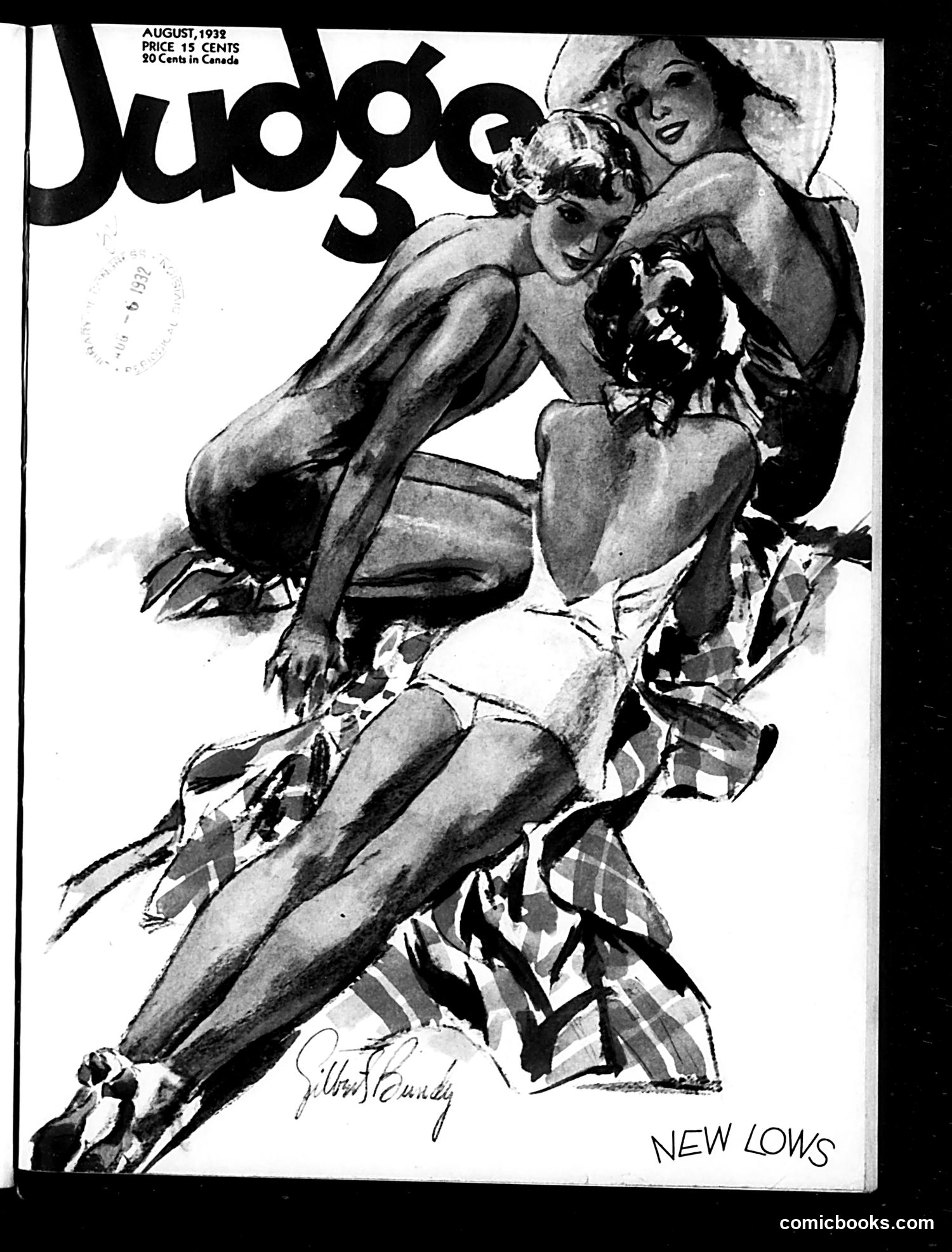
Judge Magazine, August 1938 This is primarily a magazine cover rather than a political cartoon. The illustration, signed by artist Gilbert Bundy, depicts three women in swimwear in a playful, flirtatious pose. The caption "NEW LOWS" appears to be a double entendre—likely referring both to new fashion trends (lower-cut or more revealing swimwear designs) and the women's physical positioning. The cover reflects 1938 summer leisure culture and emerging changes in acceptable beachwear. Judge magazine used such illustrated covers to attract readers with lighthearted humor and attractive imagery typical of American magazines during this era. This represents entertainment content rather than political satire.
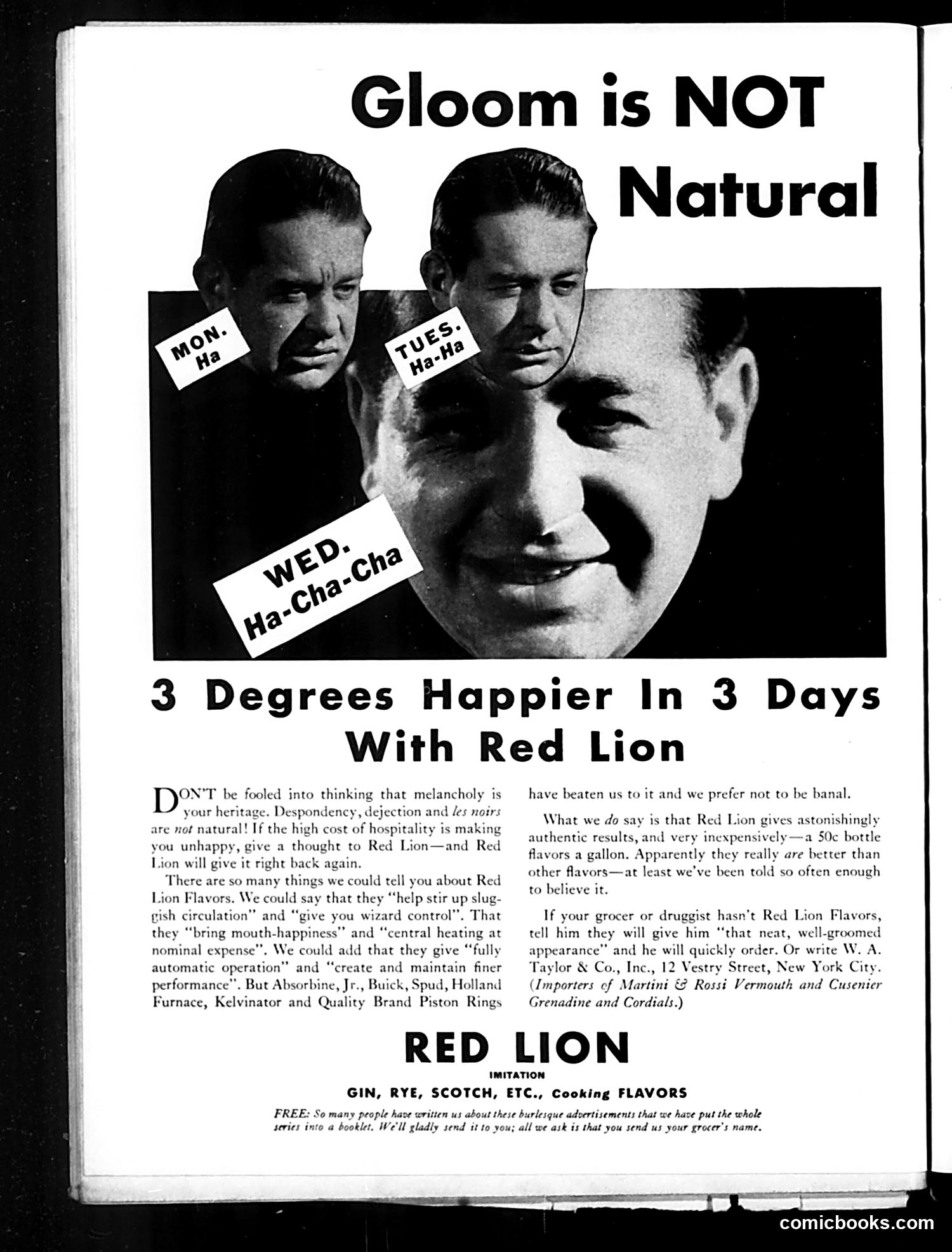
Analysis This is primarily a liquor advertisement for Red Lion flavoring extracts, not political satire. The page uses a humor hook to sell the product. The visual joke shows three male faces labeled with days of the week (MON, TUES, WED) and chemical formulas (Ha, Ha·dia; Ha·Cha·Cha), depicting increasingly cheerful expressions. The headline claims these flavor extracts make users "3 Degrees Happier In 3 Days." The accompanying text satirizes the marketing language itself—admitting they *could* make grandiose health claims (like competitors do) but instead honestly say the product simply tastes good and costs 50¢. The tone mocks both the exaggerated advertising of patent medicines and the notion that melancholy is unnatural and purchasable. This reflects Prohibition-era workarounds, where "flavoring extracts" were often covers for alcohol sales.
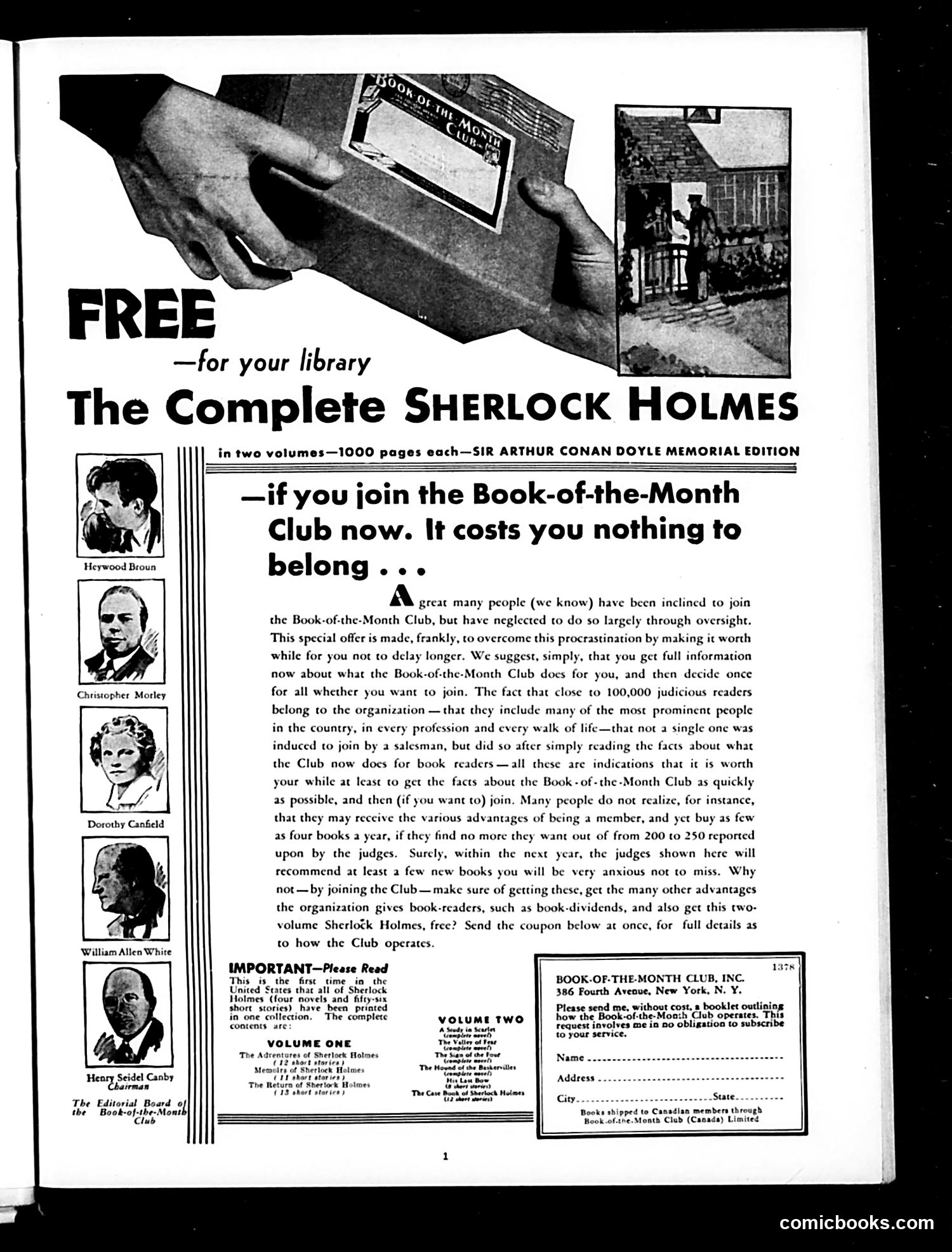
Analysis This page is primarily advertising, not satire or political commentary. It promotes the Book-of-the-Month Club's offer of a free, two-volume "Complete Sherlock Holmes" (Sir Arthur Conan Doyle Memorial Edition) to new members. The left sidebar features portraits of five judges who select the club's monthly books—identified as Heywood Broun, Christopher Morley, Dorothy Canfield, William Allen White, and Henry Seidel Canby. These were prominent American literary figures of the era, lending credibility to the club's selections. The advertisement emphasizes that membership is "free to join" and highlights the club's prestigious membership. A small photo shows what appears to be a book club gathering or distribution event. This represents mid-20th century book club marketing—leveraging celebrity endorsement and the prestige of literary gatekeepers to encourage subscription.
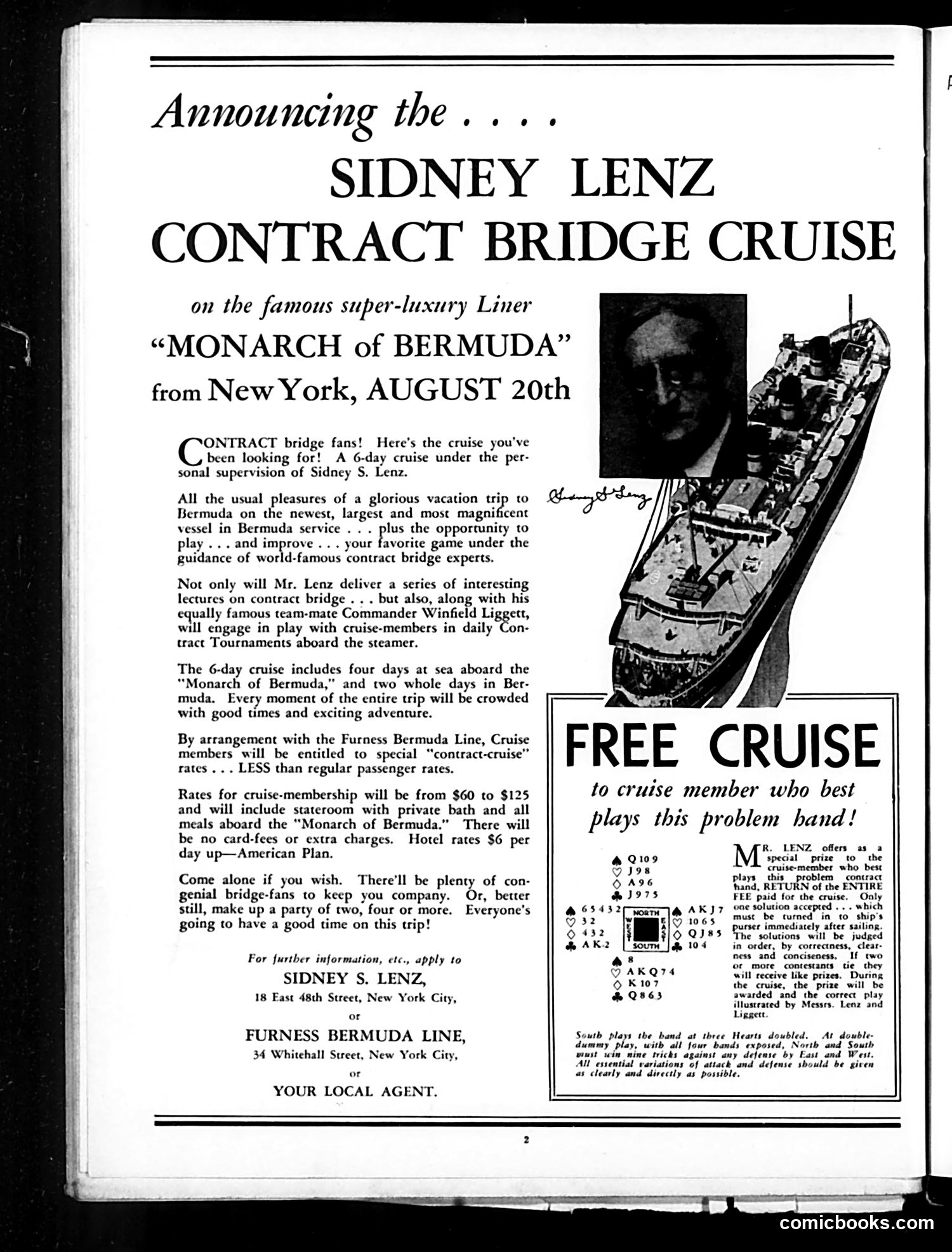
Page Analysis This page is primarily advertising for a cruise rather than editorial content or satire. The main advertisement announces a "Sidney Lenz Contract Bridge Cruise" departing from New York on August 20th aboard the luxury liner *Monarch of Bermuda*. Sidney Lenz was a famous contract bridge expert of this era. The right sidebar contains a bridge puzzle (a card game problem) with the heading "FREE CRUISE to cruise member who best plays this problem hand!" This gamifies the cruise marketing—participants solving the bridge problem correctly could win a free cruise ticket. The page reflects Judge magazine's audience: affluent readers interested in leisure travel and the increasingly popular game of contract bridge. The puzzle element makes the advertisement itself interactive entertainment for that demographic.
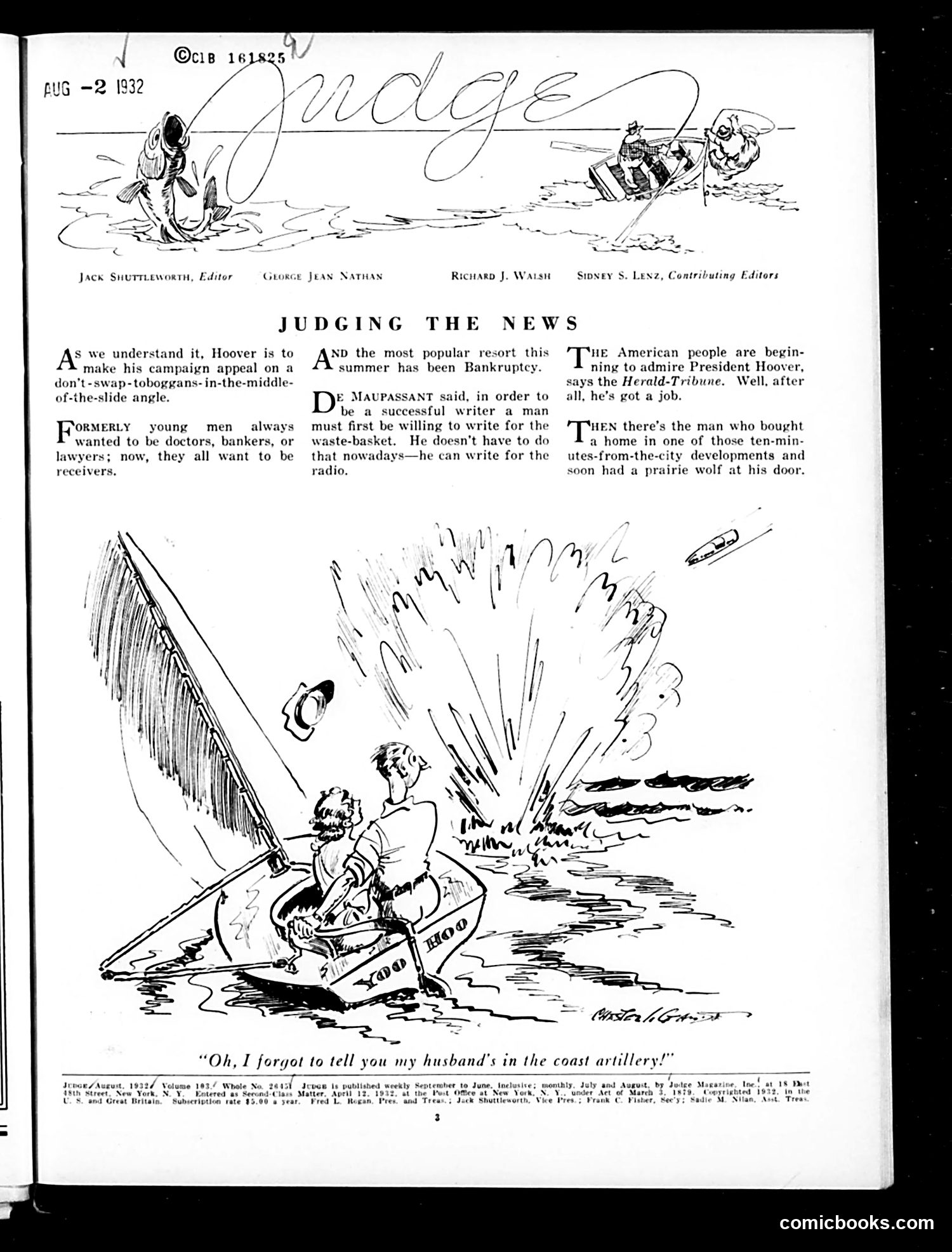
"Judging the News" - Judge Magazine, August 1932 This page contains satirical commentary on early Depression-era America. The "Judging the News" section critiques President Hoover's campaign strategy and changing career aspirations during the economic crisis. The main cartoon depicts a couple in a sinking boat labeled "1900" amid stormy seas—a metaphor for economic collapse. The woman says, "Oh, I forgot to tell you my husband's in the coast artillery!"—likely satirizing how people's professional identities became irrelevant amid financial ruin. The accompanying text mocks Hoover's campaign appeal and notes that Americans are "beginning to admire President Hoover" because "he's got a job"—biting commentary on Depression-era unemployment. It also jabs at career shifts: formerly aspiring doctors, bankers, and lawyers now want to be "receivers" (bankruptcy administrators), reflecting economic devastation.
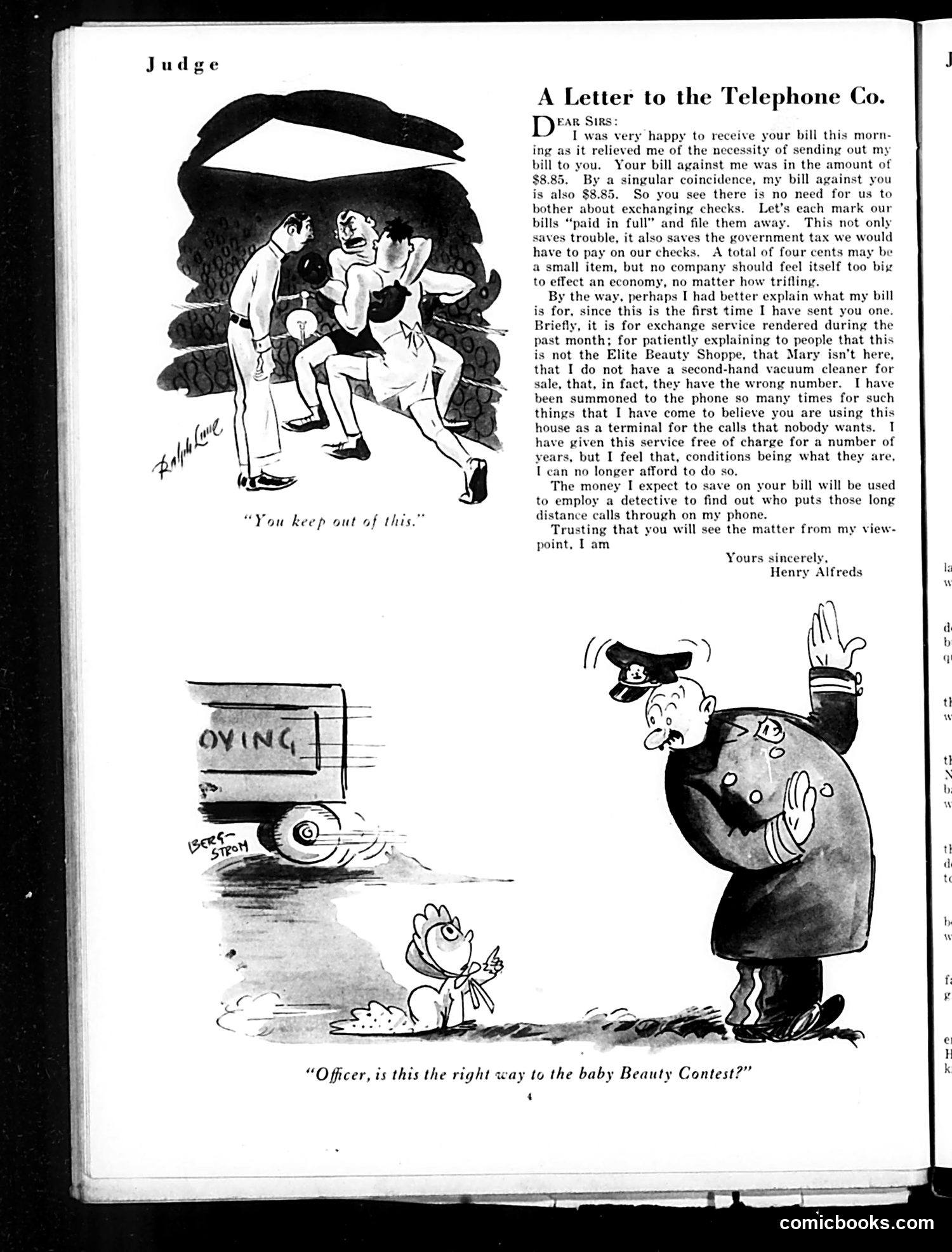
Judge Magazine Page Analysis This page features satirical commentary on telephone company practices. The main letter from Henry Alfreds complains that the telephone company bills him $8.85 for "exchange service," matching his prior month's bill exactly—suggesting no actual service was rendered, just a duplicate charge. Alfreds humorously proposes the company simply mark bills "paid in full" to save on check-processing costs, arguing this benefits everyone equally. The top cartoon depicts people squeezed uncomfortably together, captioned "You keep out of this"—mocking crowded telephone booth conditions. The bottom cartoon shows a man being directed toward "Baby Beauty Contest" by an officer, appearing to confuse the destination—likely satirizing absurd misunderstandings or the frivolous nature of such contests. The satire targets corporate billing inefficiency and poor service quality.
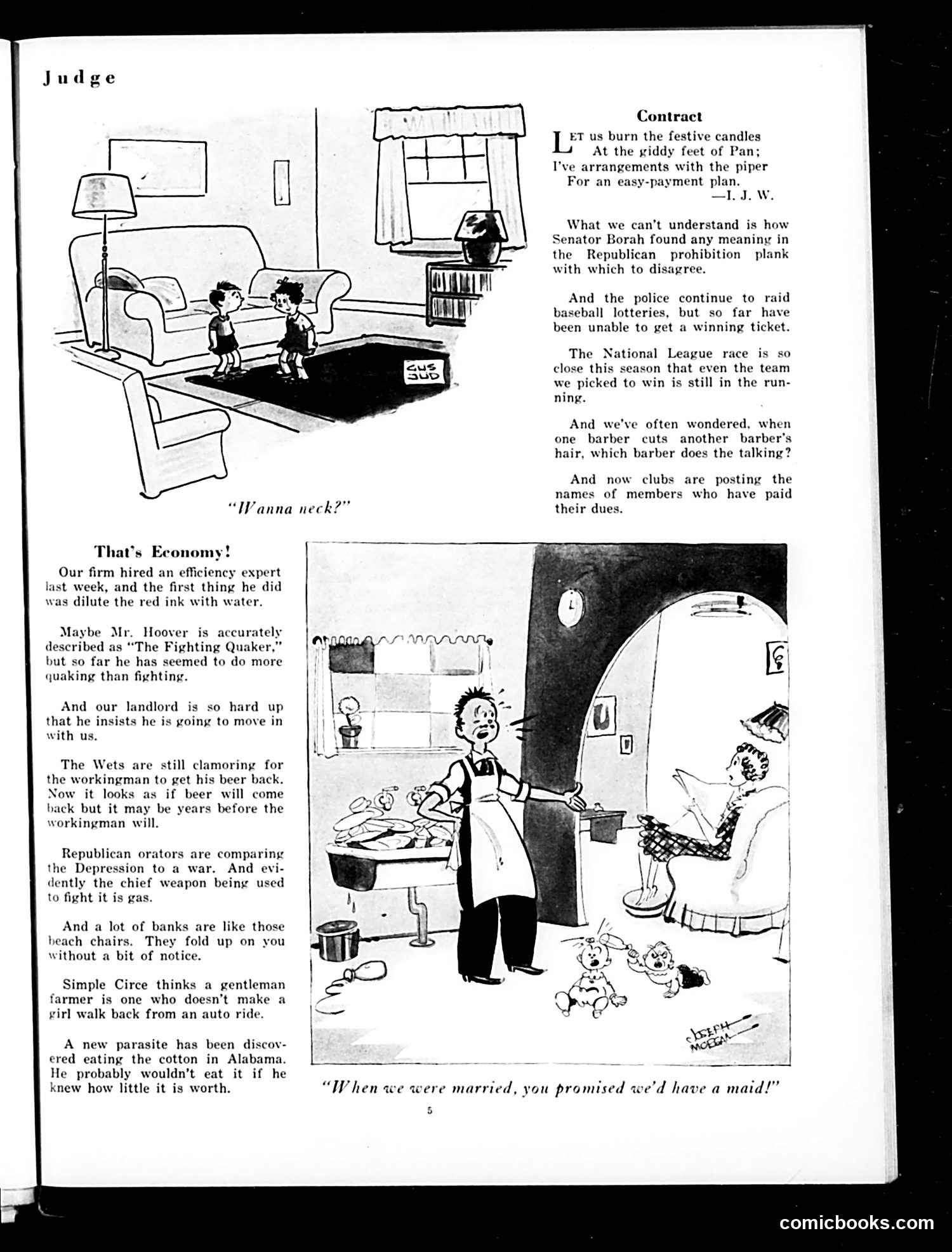
Judge Magazine Page Analysis This page contains satirical commentary and cartoons from Judge magazine's "Contract" section. The top cartoon shows two children asking "Wanna neck?" — likely mocking 1920s dating slang and changing social mores. The larger cartoon depicts a frustrated husband and domestic chaos, captioned "When we were married, you promised we'd have a maid!" This satirizes post-WWI economic struggles and the servant shortage, as working-class families could no longer afford household help. The accompanying text mocks various targets: inefficient "efficiency experts," landlords, the Wets (Prohibition opponents), Republican rhetoric about the Depression, banking practices, and agricultural problems. The satire reflects early-1930s economic anxiety and political frustration during the Great Depression era.
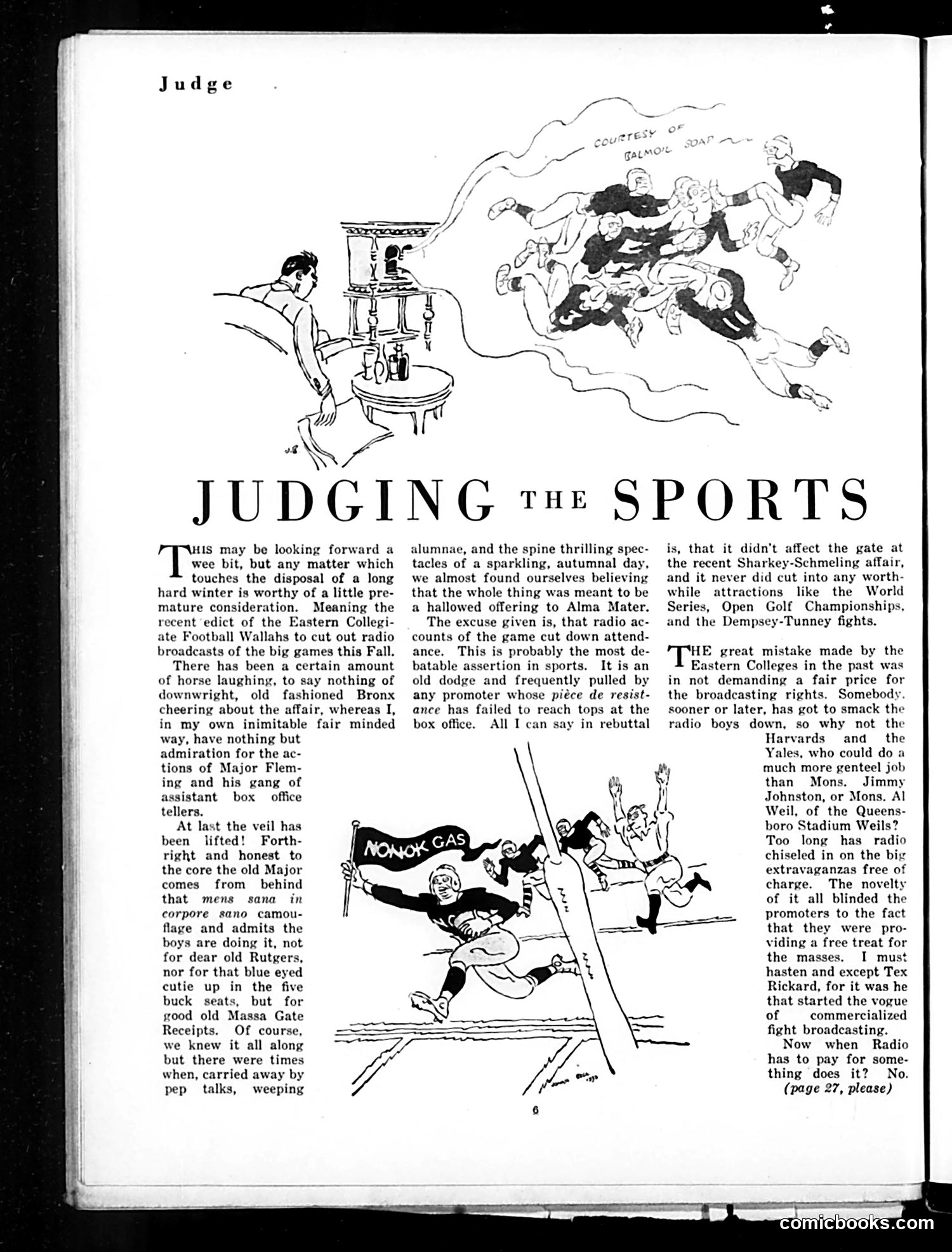
"Judging the Sports" This article critiques Eastern Colleges' radio broadcasts of football games. The author argues that colleges failed to demand fair payment from radio stations, allowing free transmission that hurt gate receipts. He contrasts this with Harvard and Yale—which "could do much more rented job than Mons"—and praises Tex Rickard for pioneering paid sports broadcasting. The piece mocks the naïveté of colleges that provided "free treat for the masses" without recognizing radio's commercial value. A cartoon labeled "HONOR GAS" depicts a figure being knocked down, likely satirizing the explosive consequences of this broadcasting mistake. The article addresses early 1920s debates over radio's relationship to live sports attendance—a novel problem in the emerging broadcast era.
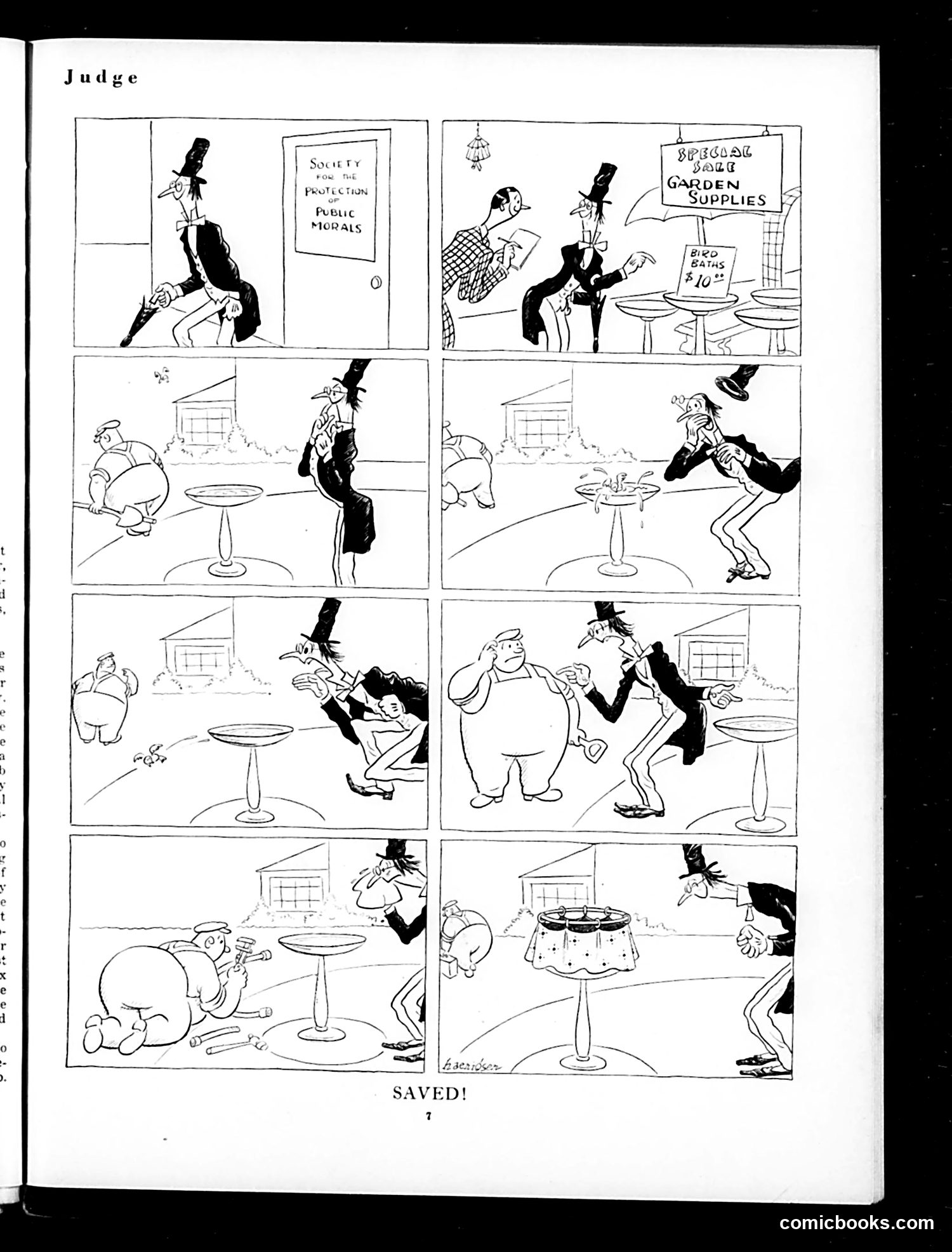
Judge Cartoon Analysis: "Saved!" This multi-panel satire depicts a tall, thin man in a top hat (appearing to represent a morality crusader or censor) attempting to "protect public morals." The sequence shows him lecturing a rotund figure about morality, then pursuing what appears to be a woman in a garden-supply store. His manic behavior—jumping, gesticulating wildly—escalates through the panels. The punchline arrives when he's finally stopped: a birdbath or garden fixture crashes down, literally restraining his chaotic crusading. The joke targets self-righteous moral activists whose zealous policing of "public morals" creates more chaos than the perceived problem they're fighting. The cartoon suggests such crusaders are hypocritical or destructively counterproductive.
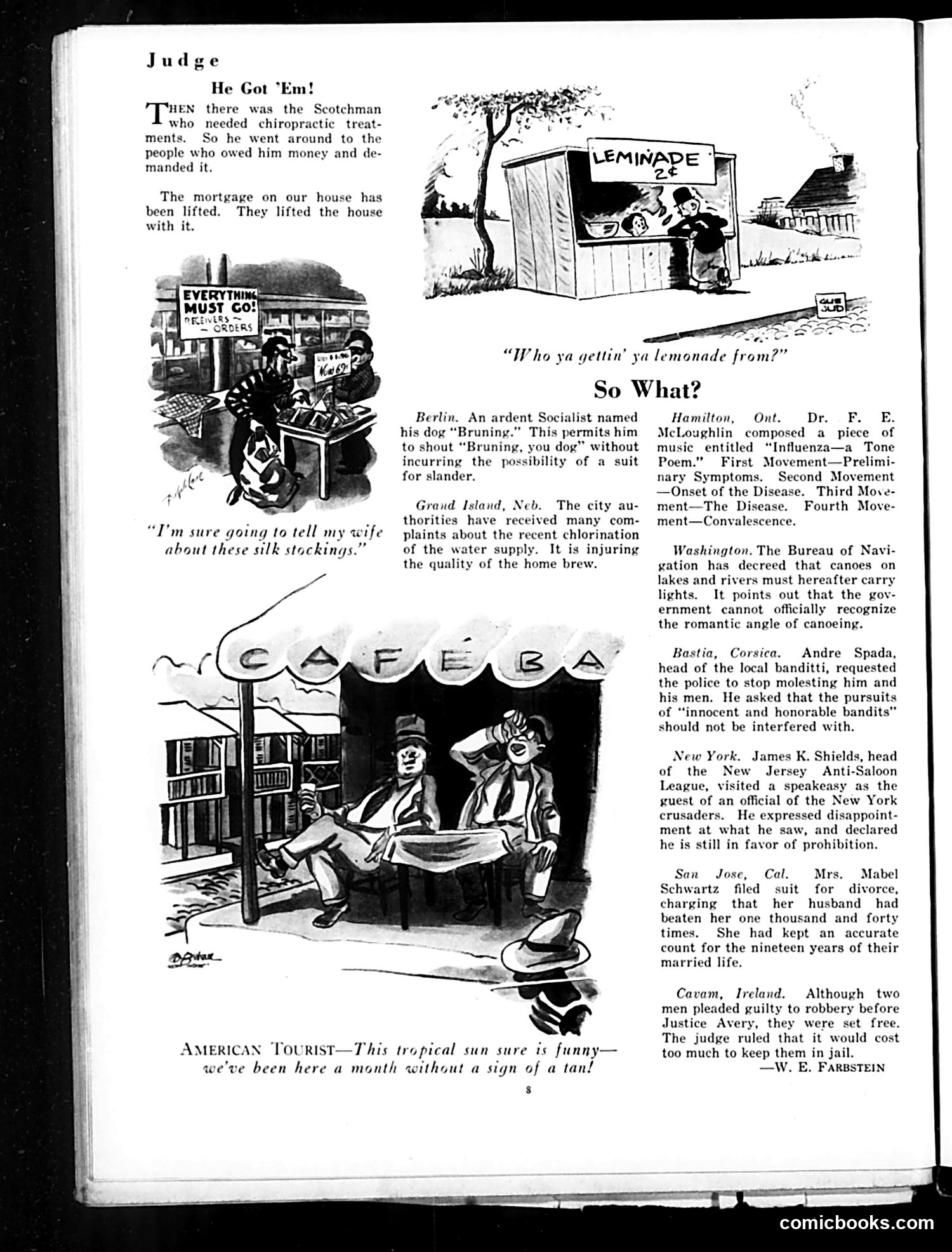
Judge Magazine Page Analysis This page collects satirical "news briefs" mocking contemporary social issues, circa 1920s-30s. The cartoons ridicule: 1. Economic hardship: A Scotsman demands payment from debtors for chiropractic care; a family's house is literally repossessed with the mortgage. 2. Prohibition's failure: Grand Island complains chlorinated water "injures" home brew quality—mocking speakeasies and illegal alcohol production despite the law. 3. Political hypocrisy: A New Jersey Anti-Saloon League leader visits a speakeasy and remains "in favor of prohibition"—exposing moral inconsistency. 4. Absurd bureaucracy: The Bureau of Navigation mandates lights on canoes, destroying romance through regulation. 5. Justice system failures: An Irish judge frees confessed robbers because jail costs too much; a woman endures 1,040 beatings over nineteen years. The humor targets government incompetence, legal corruption, class inequality, and the disconnect between stated values and actual behavior during Prohibition-era America.
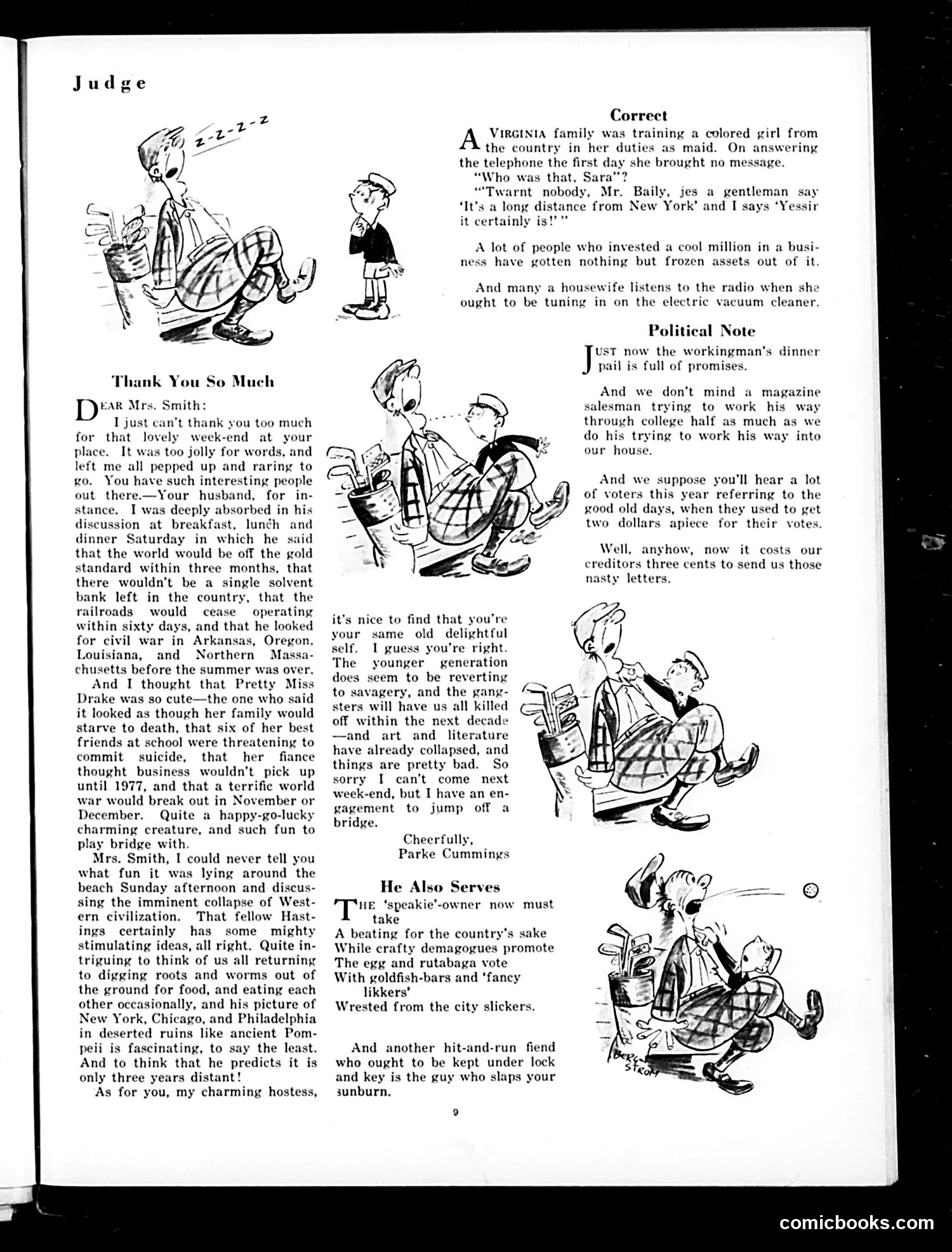
Judge Magazine Page Analysis This page of Judge satirizes 1930s economic pessimism and frivolous socializing. The "Thank You So Much" letter mockingly describes a weekend visit where guests discuss apocalyptic predictions: business collapse, bank failures, imminent war, and societal breakdown—all presented as cheerful dinner conversation. The satire targets wealthy people who entertain themselves with doom-saying while remaining insulated from actual hardship. The cartoons accompanying the text show exaggerated, bouncing figures illustrating these catastrophic scenarios, emphasizing the absurdity of treating civilizational collapse as parlor entertainment. The "Political Note" section adds commentary on Depression-era politics: politicians' empty promises, voter corruption (buying votes for two dollars), and the irony that creditors must spend three cents to collect debts—suggesting economic collapse has made debt collection pointless. Overall, the page satirizes how the wealthy discuss economic disaster casually while detached from ordinary people's suffering, and criticizes political corruption and failed economic promises of the era.
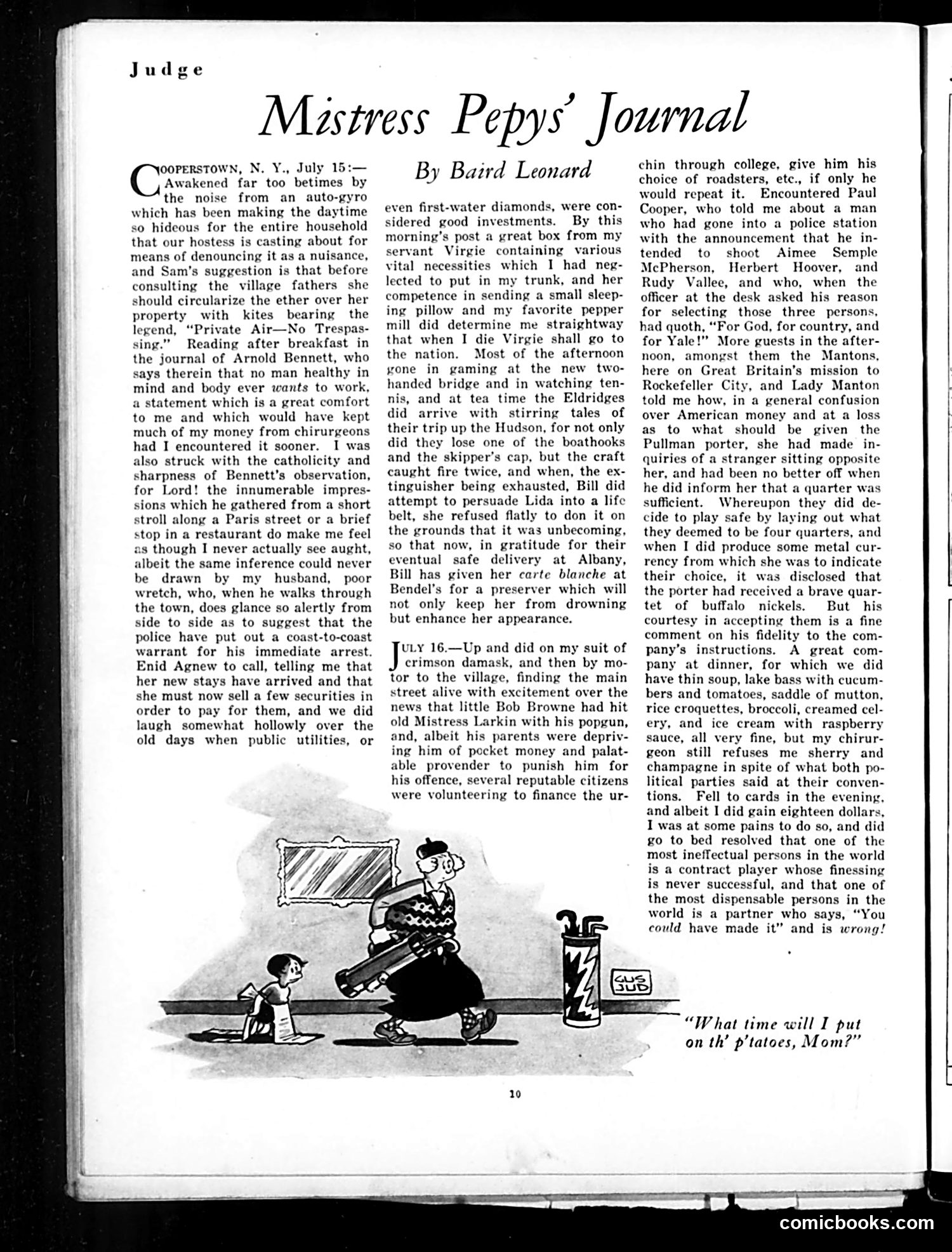
"Mistress Pepys' Journal" – Judge Magazine Satire This is a humorous column mimicking Samuel Pepys' famous 17th-century diary, but set in contemporary 1920s America. The author (Baird Leonard) uses the conceit to satirize modern social life and celebrity culture. Key satirical targets visible here: - Auto-gyros disrupting rural peace—mocking new aviation technology's nuisance - Arnold Bennett's philosophy on work avoidance—poking fun at intellectual pretensions - Wealth anxieties: characters selling securities to buy girdles; discussing investments in "utilities or diamonds" - Social climbing: the Eldridges' boating misadventure; Bendel's shopping spree - Celebrity mockery: reference to Aimee Semple McPherson (evangelist), Herbert Hoover, and Rudy Vallee as targets of a would-be shooter—satirizing their overexposure and cultural dominance - The Yale reference: "For God, for country, and for Yale"—skewering elite university loyalty The cartoon shows a mother with a child asking about dinner timing—a domestic vignette reinforcing the journal's focus on upper-class housekeeping concerns. The satire targets 1920s American materialism, celebrity obsession, and social pretension through witty, diary-style observation.
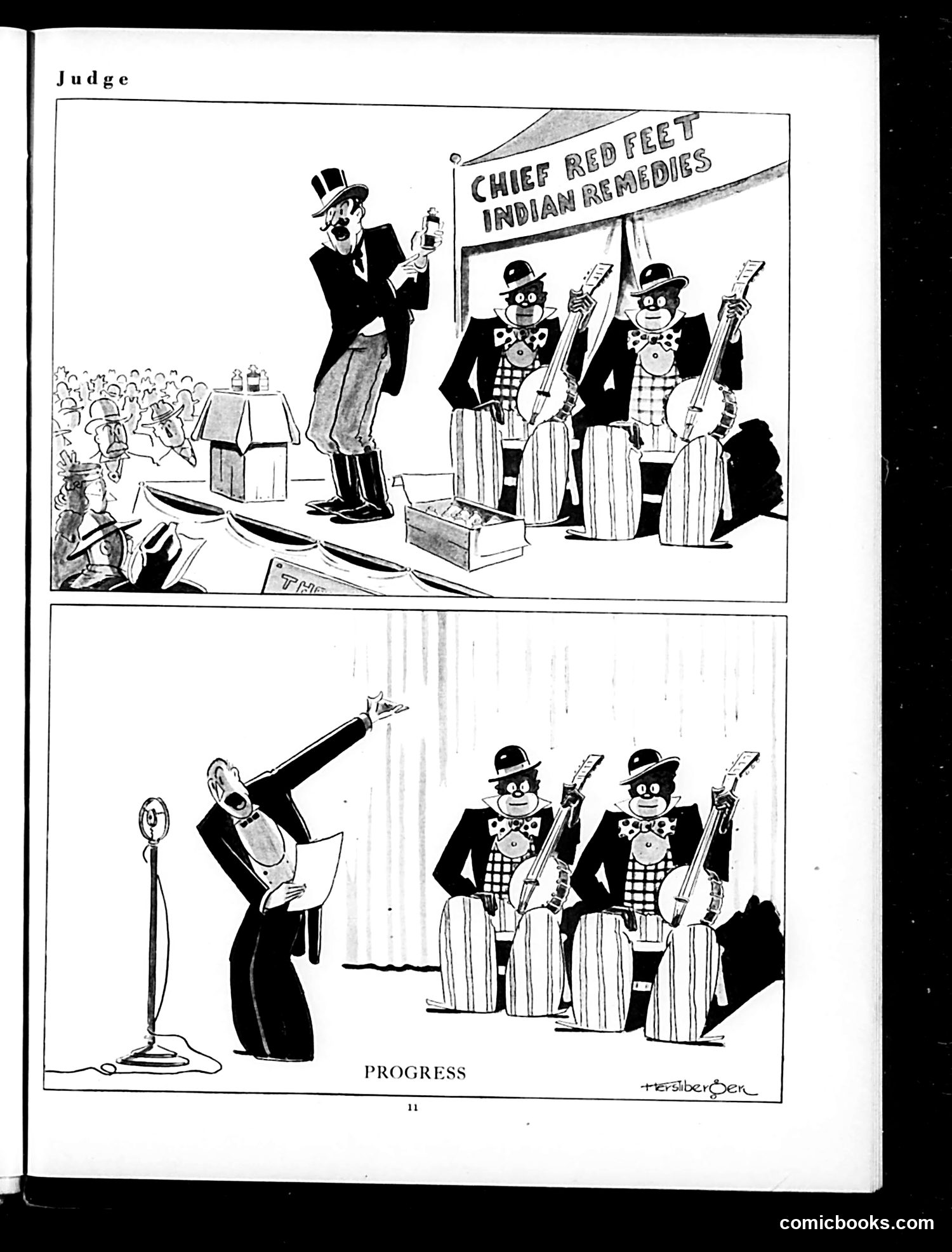
"Judge" Cartoon Analysis: "Chief Red Feet Indian Remedies" This two-panel satirical cartoon mocks the widespread sale of fraudulent "Indian remedies" — patent medicines marketed with Native American imagery that were popular in early 20th-century America. Top panel: A medicine-show barker in top hat hawking "Chief Red Feet Indian Remedies" to a crowd, with performers holding oversized bottles as props. Bottom panel: Titled "Progress," shows the same performers now performing for an empty room with just a microphone, suggesting the scam's decline. The satire targets both the exploitation of Native American imagery for commercial fraud and the gullibility of consumers. The racist caricatures and fake "Indian" branding were typical of how these dubious patent medicines deceived the public before FDA regulation.
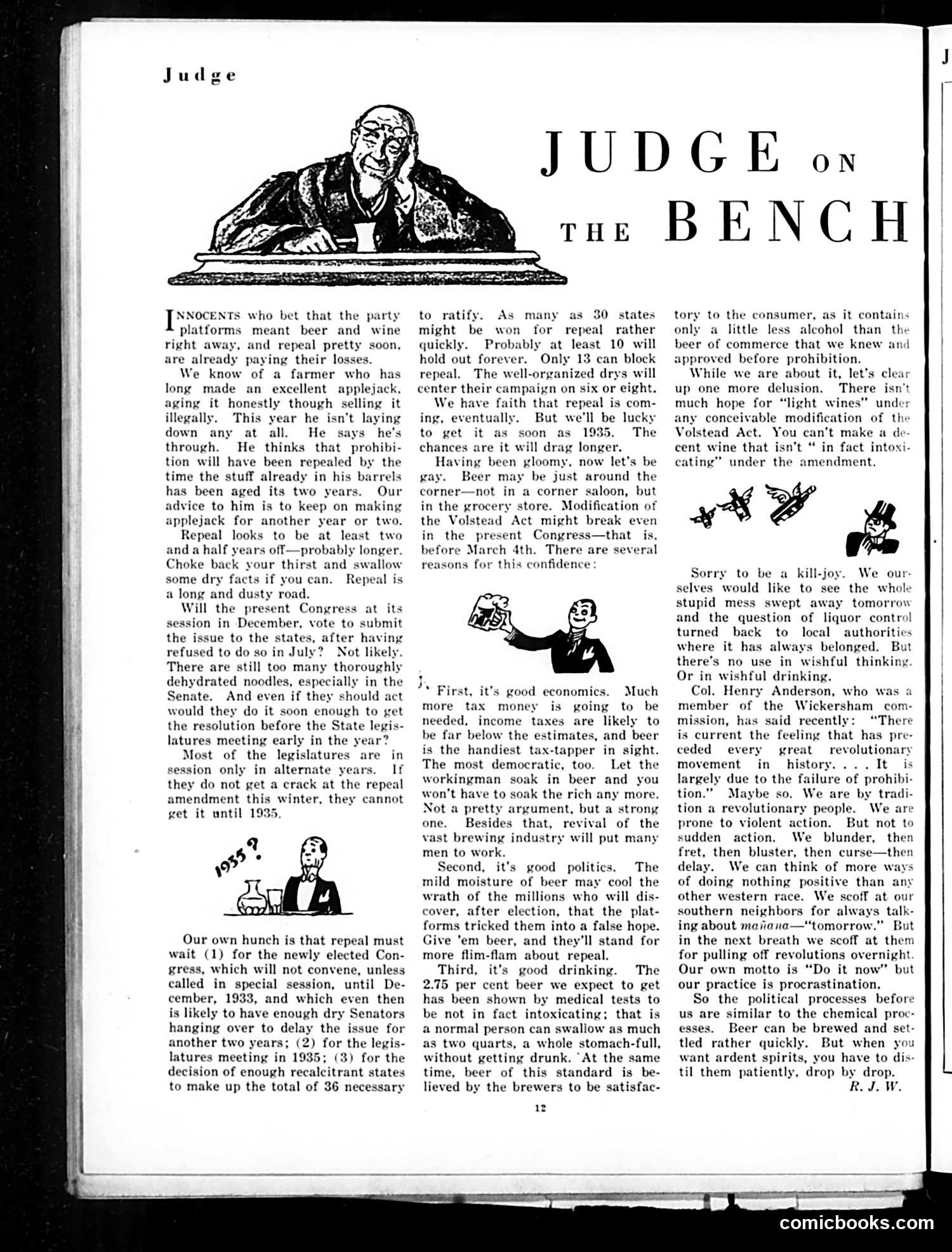
Judge Magazine: "Judge on the Bench" - Prohibition Repeal Commentary This editorial cartoon-essay addresses Prohibition repeal prospects during the early 1930s. The sitting judge represents judicial/authoritative commentary on political reality. The piece argues repeal will take much longer than optimists expect—likely not until 1935 or beyond, requiring newly elected Congress (December 1933), state legislatures in alternate years, and 36 states to ratify. A farmer mentioned made illegal applejack; the author advises patience. However, the text suggests beer modification might pass sooner (before March 4th) for three reasons: economic necessity (tax revenue during Depression), political expediency (appeasing disappointed voters), and because low-alcohol beer (2.75%) was deemed non-intoxicating by medical tests. The satire mocks that weak beer serves politicians' interests while disappointing genuine drinkers—a compromise satisfying neither temperance advocates nor those wanting real alcohol.
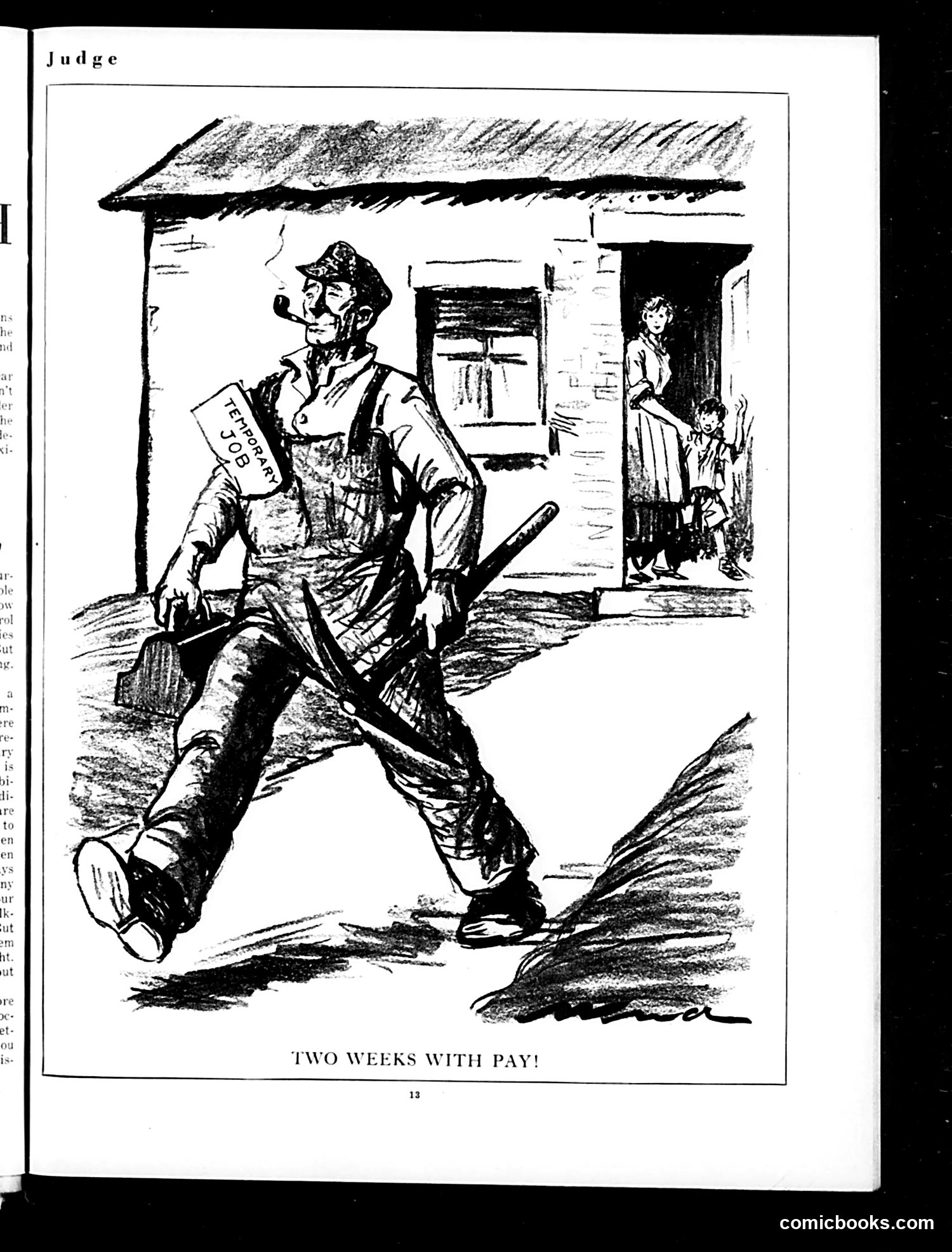
Analysis This political cartoon from *Judge* magazine depicts a military figure in WWI-era uniform brandishing a club labeled "FOR JOBS," striding aggressively past a woman and children in a doorway. The caption reads "TWO WEEKS WITH PAY!" The satire appears to criticize military recruitment or conscription practices, suggesting authorities used promises of paid military service to coerce working-class men into enlisting. The figure's aggressive stance and the frightened family watching from the doorway imply this was viewed as exploitative—offering minimal compensation ("two weeks with pay") while disrupting families and livelihoods. The cartoon likely protests how economic desperation made military recruitment effective, presenting it as coercive rather than voluntary. This reflects broader Progressive-era *Judge* skepticism toward both big business and military expansion.
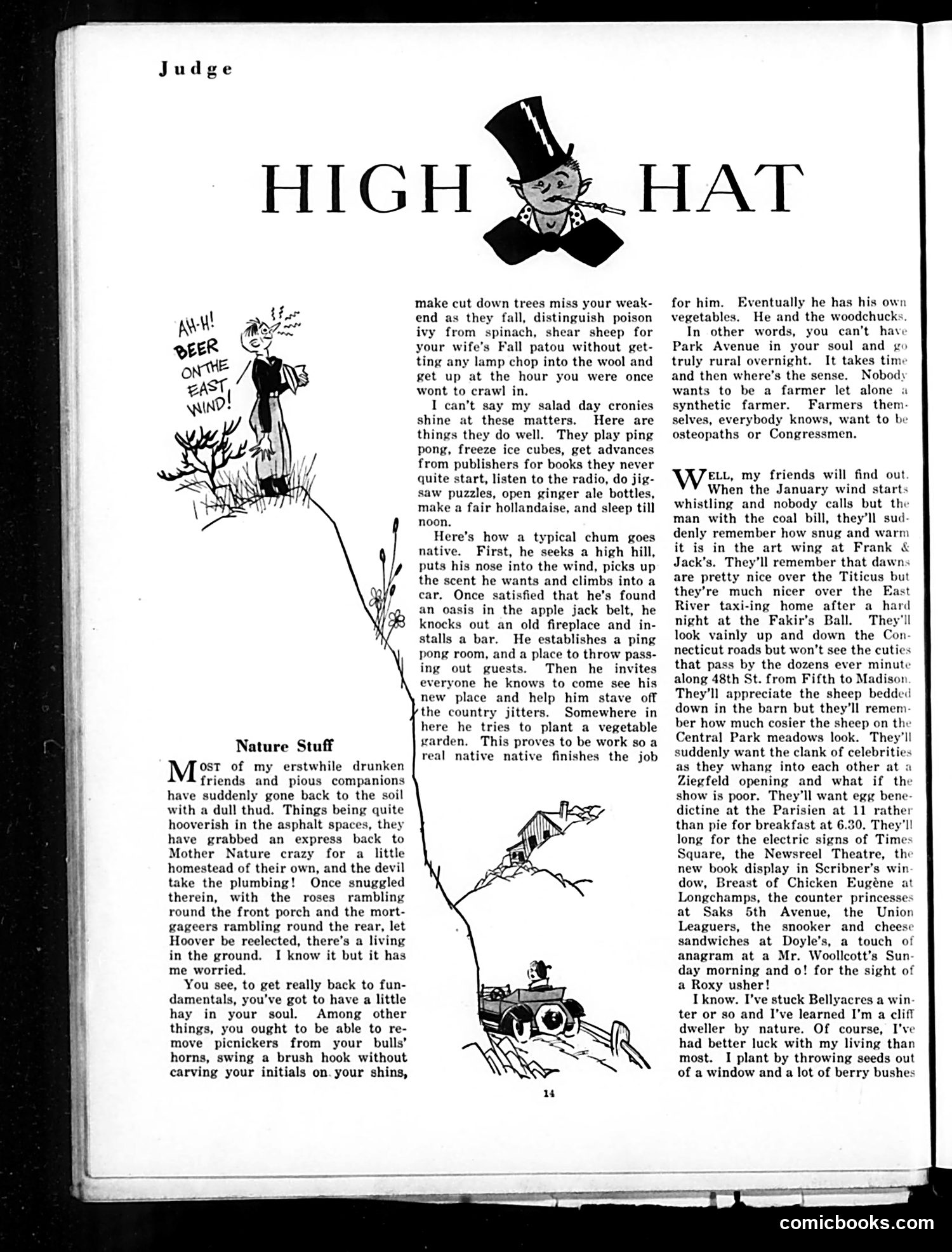
Analysis for Modern Readers This satirical essay mocks the 1920s-30s urban fad of wealthy city dwellers abandoning Manhattan for rural "homesteads"—a retreat-to-nature trend driven by economic hardship (the reference to "Hooverish" conditions suggests Depression-era struggle under President Hoover). The author ridicules these transplants as fundamentally unsuited to farm life. They're skilled at urban pleasures (ping-pong, cocktails, publishing advances) but hopeless at actual farming—unable to distinguish poison ivy from spinach or handle basic agricultural tasks. The satire's punchline: these "synthetic farmers" will inevitably abandon the countryside once January arrives, missing Manhattan luxuries: Broadway (Ziegfeld openings), upscale restaurants (Longchamps, the Parisien), department stores (Saks), and entertainment (Times Square, the Roxy Theatre). The author confesses personal experience ("I've stuck Bellyacres"), admitting he too is a "cliff dweller"—permanently urban despite pretensions otherwise. It's fundamentally about the incompatibility between city sophistication and genuine rural life.
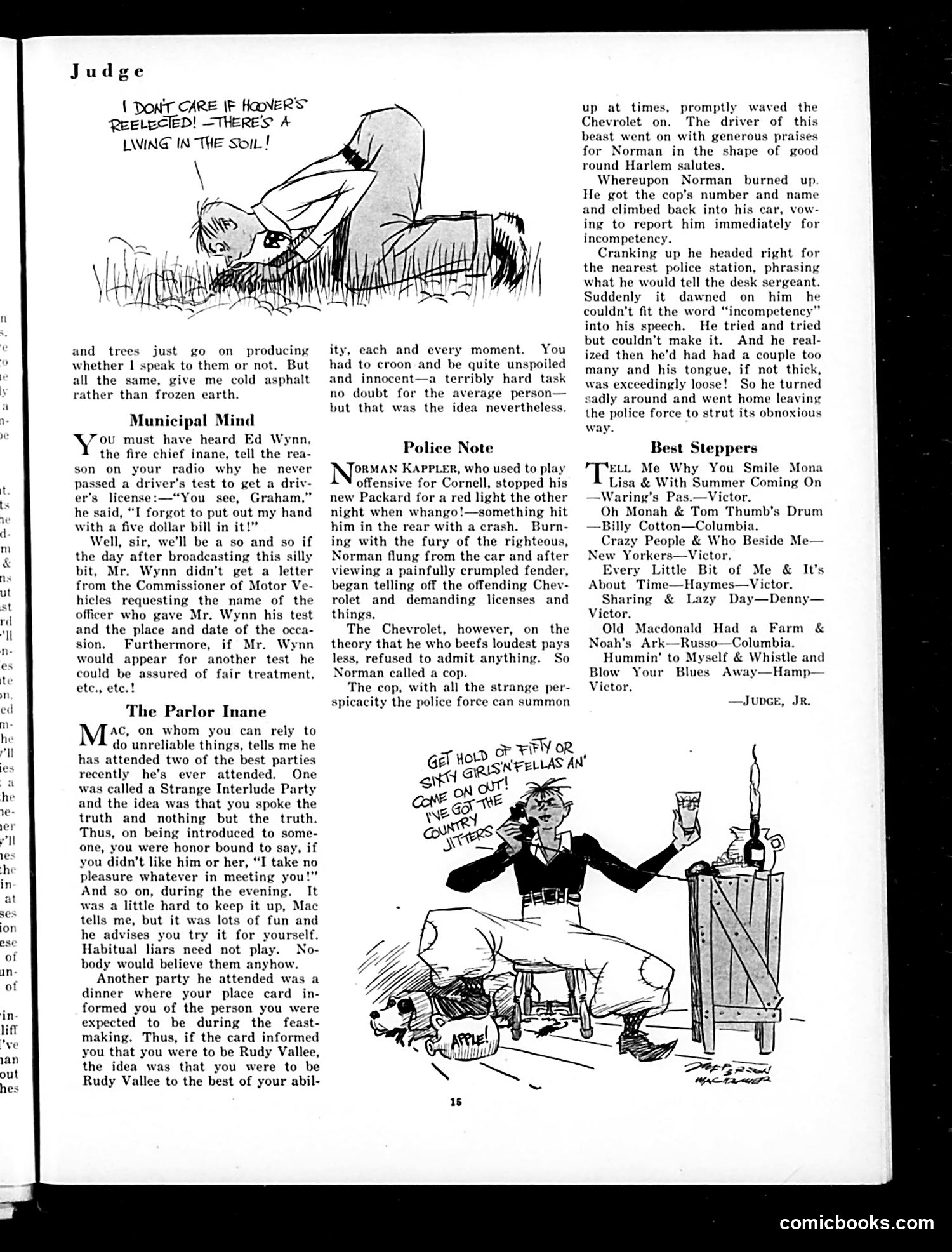
Judge Magazine Page Analysis This page contains three humorous social commentaries typical of Judge magazine's satirical style: "Municipal Mind" mocks bureaucratic overreaction. Radio personality Ed Wynn jokes about bribing a cop for a driver's license. When the Motor Vehicles Commissioner takes this seriously and demands investigation, it satirizes how officials mindlessly enforce rules without understanding context or humor. "The Parlor Inane" ridicules 1920s-30s sophisticated party games—one where guests must speak only brutal truths, another where they roleplay assigned celebrities (notably mentioning crooner Rudy Vallee). The satire targets upper-class affectation and forced "fun." "Police Note" depicts a driver (Norman Kappler, apparently Cornell football player) reporting a fender-bender, but the cop dismissively waves off the Chevrolet driver, who responds with "Harlem salutes" (apparently derogatory gestures). Norman, drunk and unable to pronounce "incompetency," abandons his complaint—satirizing police indifference and corruption. The cartoons criticize bureaucratic absurdity, class pretension, and police misconduct through everyday scenarios.
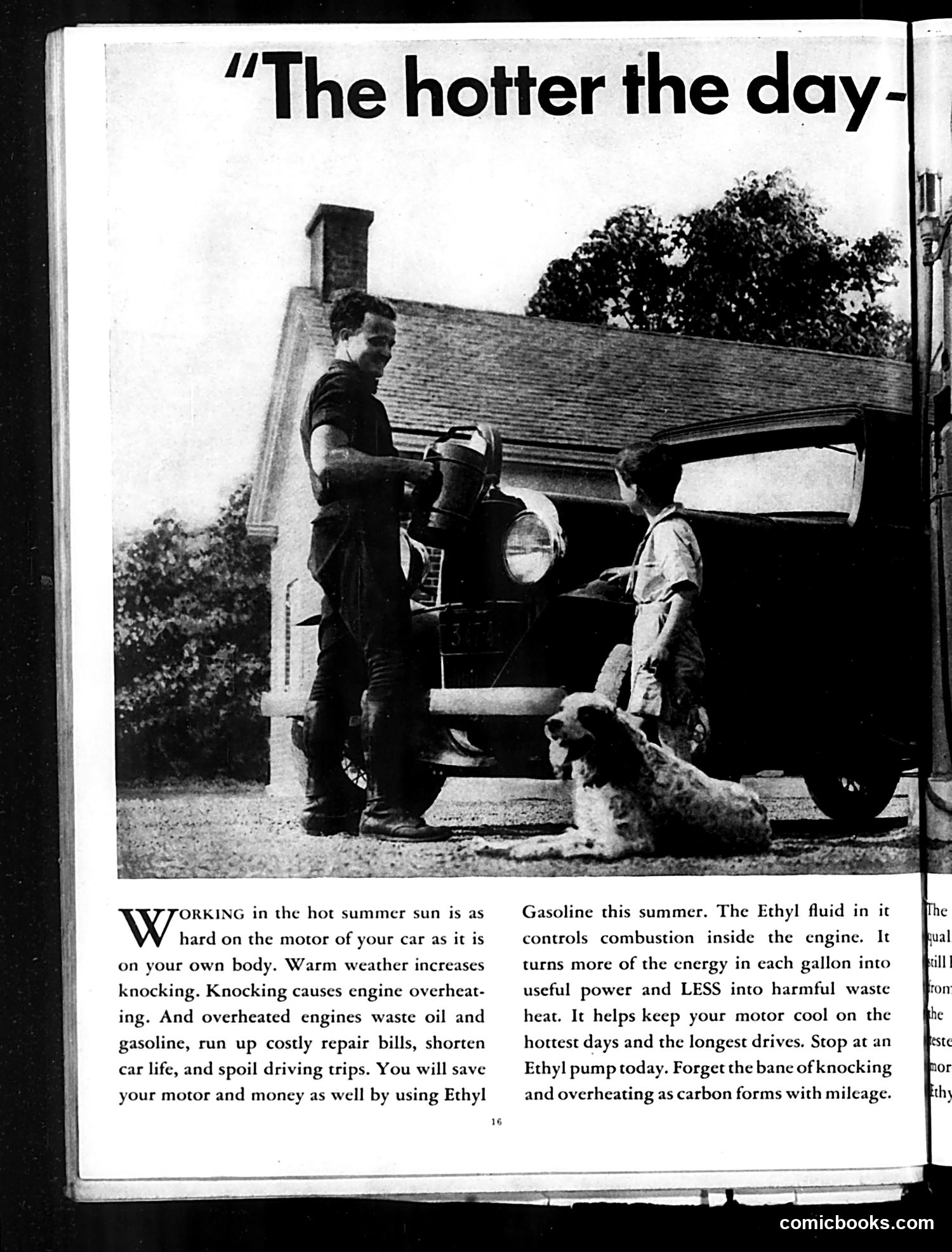
Analysis This is a product advertisement, not a political cartoon. It promotes Ethyl gasoline, a real fuel brand that existed from the 1920s-1970s. The image shows a period car (appears 1920s-30s era) with three men and a dog gathered around it during hot weather—illustrating the "problem" the ad addresses: engine strain in summer heat. The satire or social commentary is subtle: the ad anthropomorphizes the car's suffering ("as hard on the motor...as it is on your own body"), treating mechanical distress as relatable human experience. This was common advertising rhetoric of the era. The technical claim—that Ethyl's additive reduces "knocking" (engine pinging caused by poor combustion) and keeps engines cool—was a genuine product benefit. Tetraethyl lead, though later banned for health reasons, did improve engine performance. For modern readers: this represents early automotive marketing that linked product quality to leisure and reliability, appealing to middle-class car owners concerned about costly repairs.
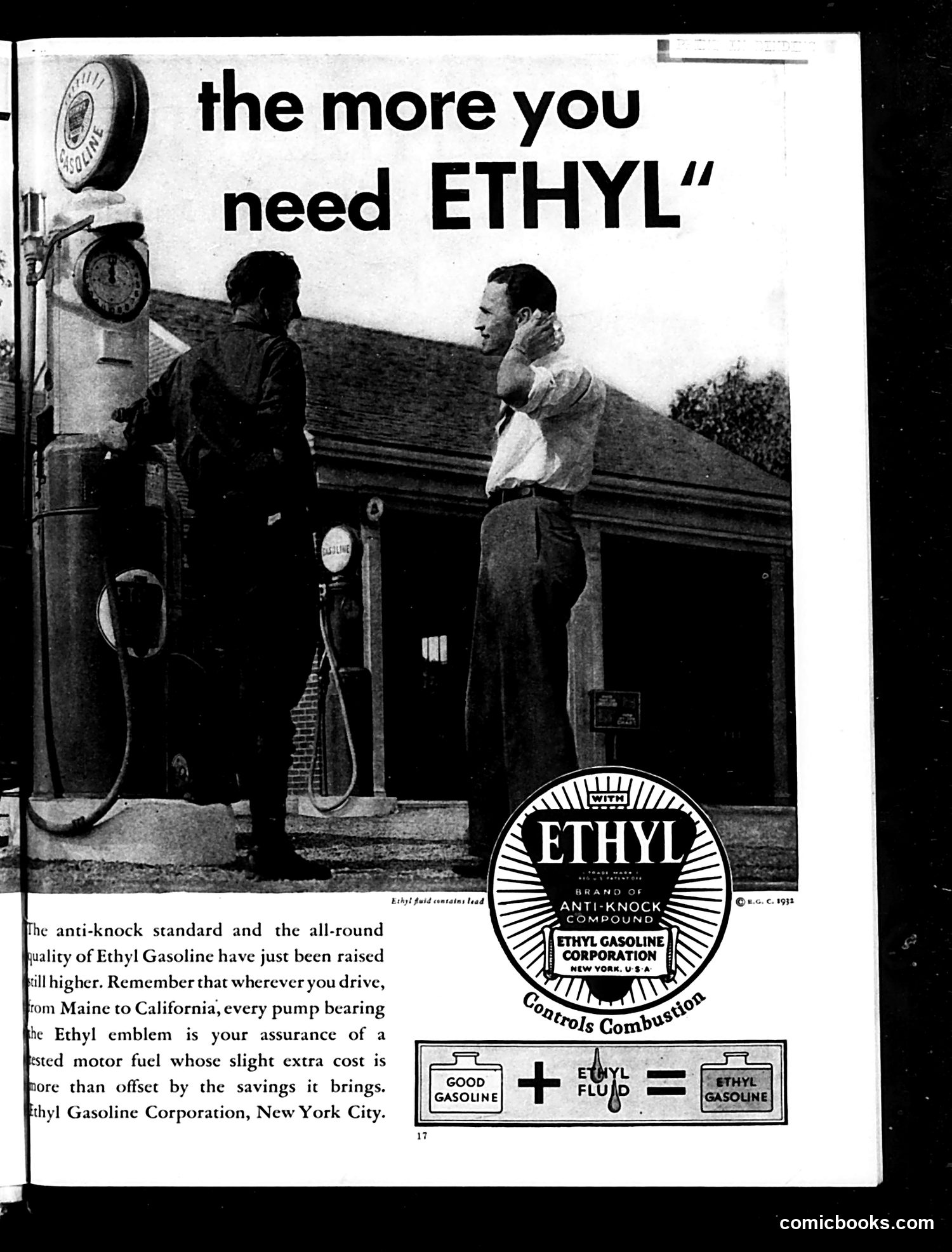
Ethyl Gasoline Advertisement This is a full-page advertisement, not satire or political commentary. It promotes Ethyl Gasoline, a real fuel brand that added tetraethyl lead as an anti-knock compound to improve engine performance. The image shows two men at a gas pump, with the tagline "the more you need ETHYL"—suggesting that higher-performance driving demands this premium fuel. The ad emphasizes that Ethyl's "slight extra cost" is justified by engine savings and reliability "from Maine to California." The formula at bottom (Good Gasoline + Ethyl Fluid = Ethyl Gasoline) presents the product as a simple, scientifically-backed solution. For modern readers: This predates awareness of lead's severe health hazards. Ethyl lead was widely used in gasoline until phased out in the 1970s-80s due to its neurotoxicity. The ad represents early 20th-century automotive marketing before environmental and public health regulations.
"The Theatre of George Jean Nathan" — Judge Magazine This is a satirical essay mocking the explosion of amateur dance recitals in 1920s New York. Nathan ridicules the phenomenon of thousands of aspiring dancers—women from across America—flooding the city with unrealistic dreams of becoming stage performers. The satire targets several absurdities: the proliferation of dance teachers offering wildly obscure styles (Nautch, Singalese, "Devil dancing," etc.), poor families bankrupting themselves to fund their daughters' "$6 worth of green gauze" performances, and the pathetic caliber of recitals where mediocre dancers merely manage not to fall over. References to Ziegfeld (the famous Broadway impresario) and the overcrowded "Dancers' Club" ground the piece in real 1920s New York conditions. The "speakeasies" reference dates this to Prohibition era. Nathan's point: aspiring dancers are deluded wannabes creating a market for hundreds of charlatan teachers and generating thousands of amateurish performances that no one actually wants to watch.
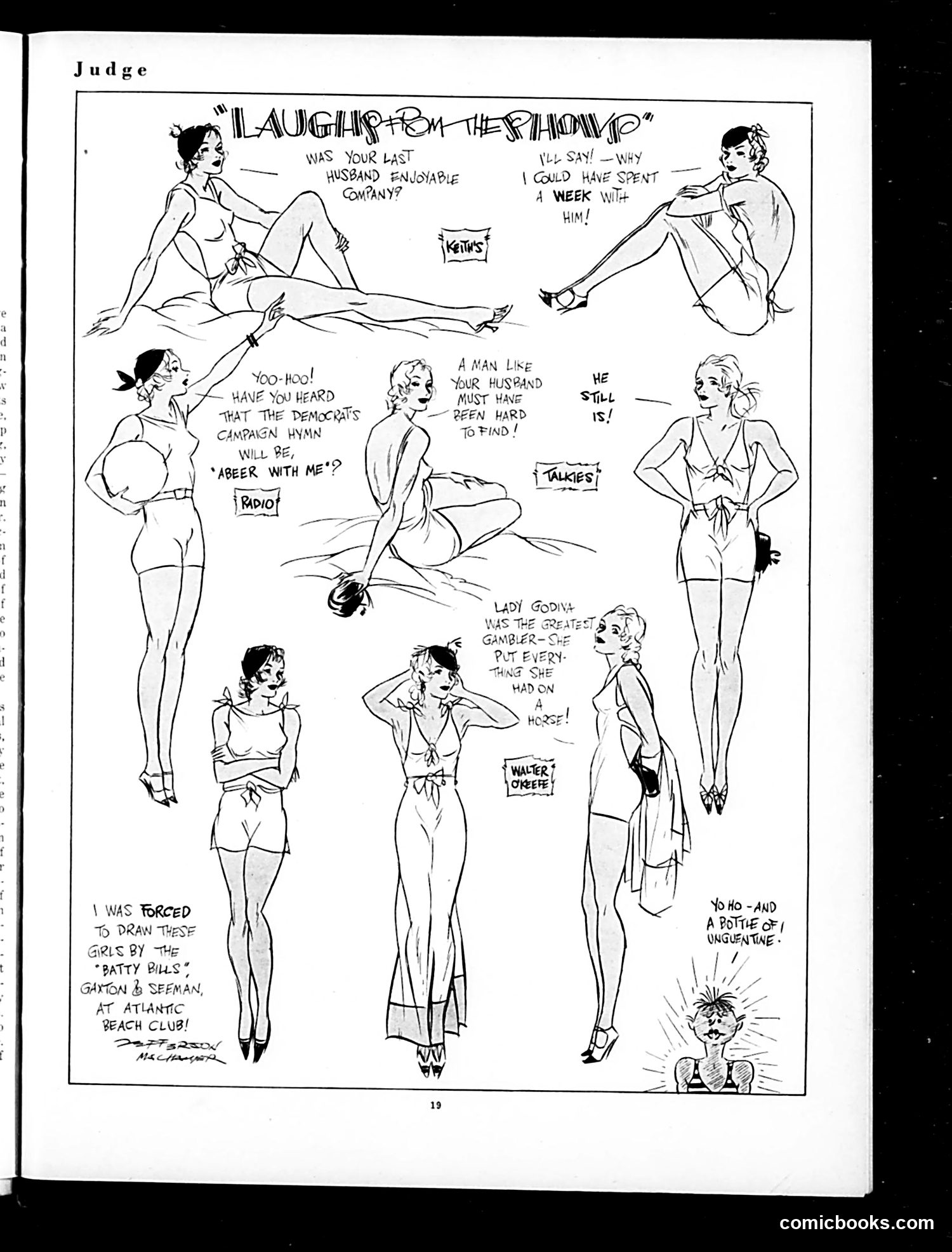
Judge Magazine Political Cartoon Analysis This page satirizes women's political engagement during what appears to be an early 20th-century Democratic campaign. The cartoons mock women discussing politics, particularly referencing a Democratic campaign hymn ("Agree with Me"). The central joke targets women as frivolous political participants—depicted in various states of undress at what's identified as Atlantic Beach Club, gossiping about husbands and politics interchangeably. References include Lady Godiva (a historical figure known for riding nude), radio broadcasts, and talking pictures (early cinema), suggesting women absorb political messaging through entertainment rather than serious engagement. The artist notes he was "forced" to draw these figures by "Batty Bills" Gayton and Seeman, suggesting editorial pressure. The overall satire mocks both women's political involvement and the Democratic Party's messaging strategy, implying their campaign relies on superficial appeals rather than substantive policy.
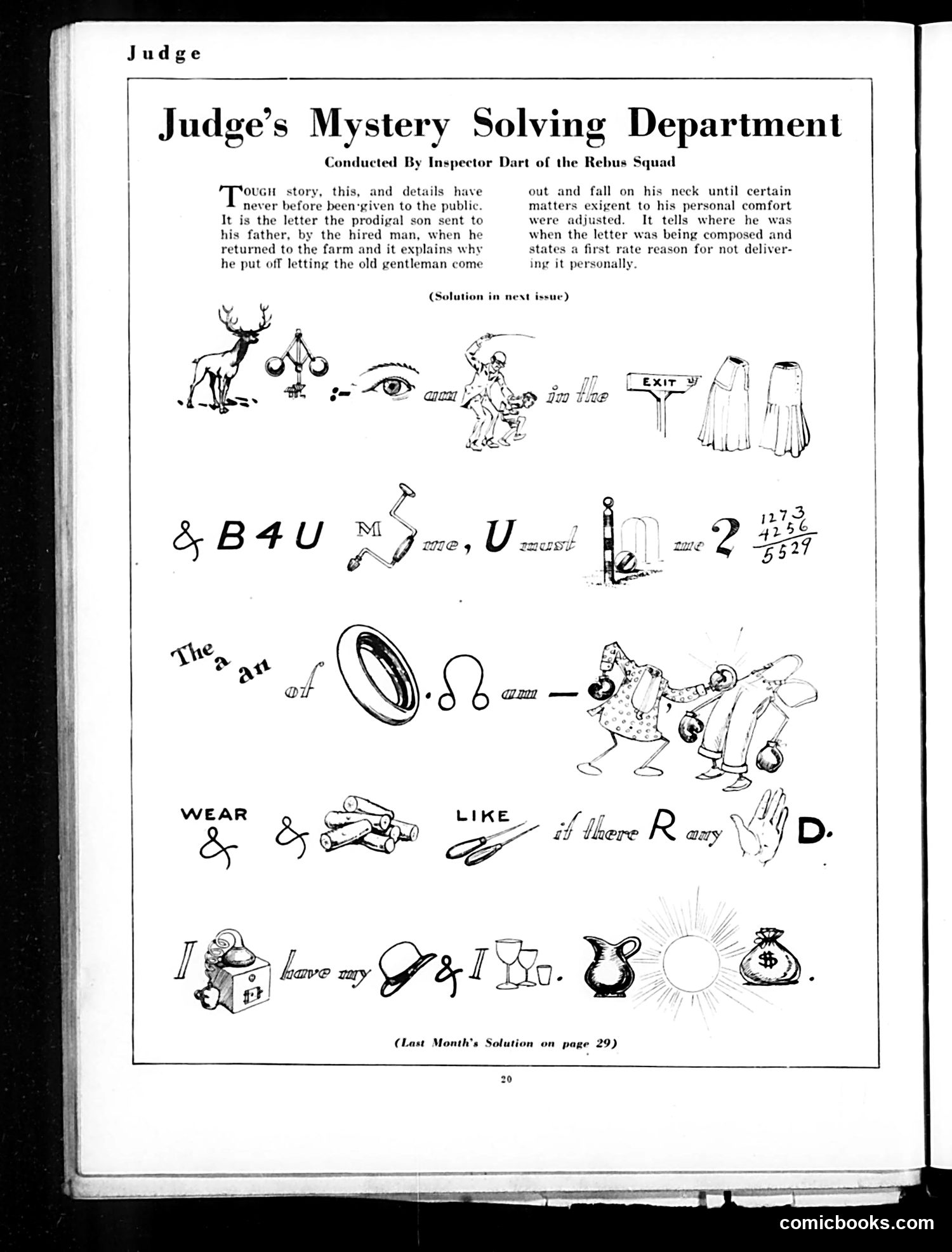
Judge Magazine's "Mystery Solving Department" This is a rebus puzzle—a visual word-game where pictures, symbols, and letters combine to form a sentence or story. The page presents an unsolved mystery: a prodigal son's letter to his father, delivered by a hired man upon returning to the farm. The riddle promises to reveal where the son was when composing the letter and why he didn't deliver it personally. The illustrated symbols below encode the answer in rebus form (deer + balance scales + eye + letters, etc. combining into words and phrases). Readers were expected to decode these visual puns to solve the mystery, with the solution promised "in next issue." This was a popular puzzle feature in early 20th-century magazines—intellectual entertainment for readers, nothing explicitly political or satirical, though the "prodigal son" framing carries Biblical moral weight typical of the era.
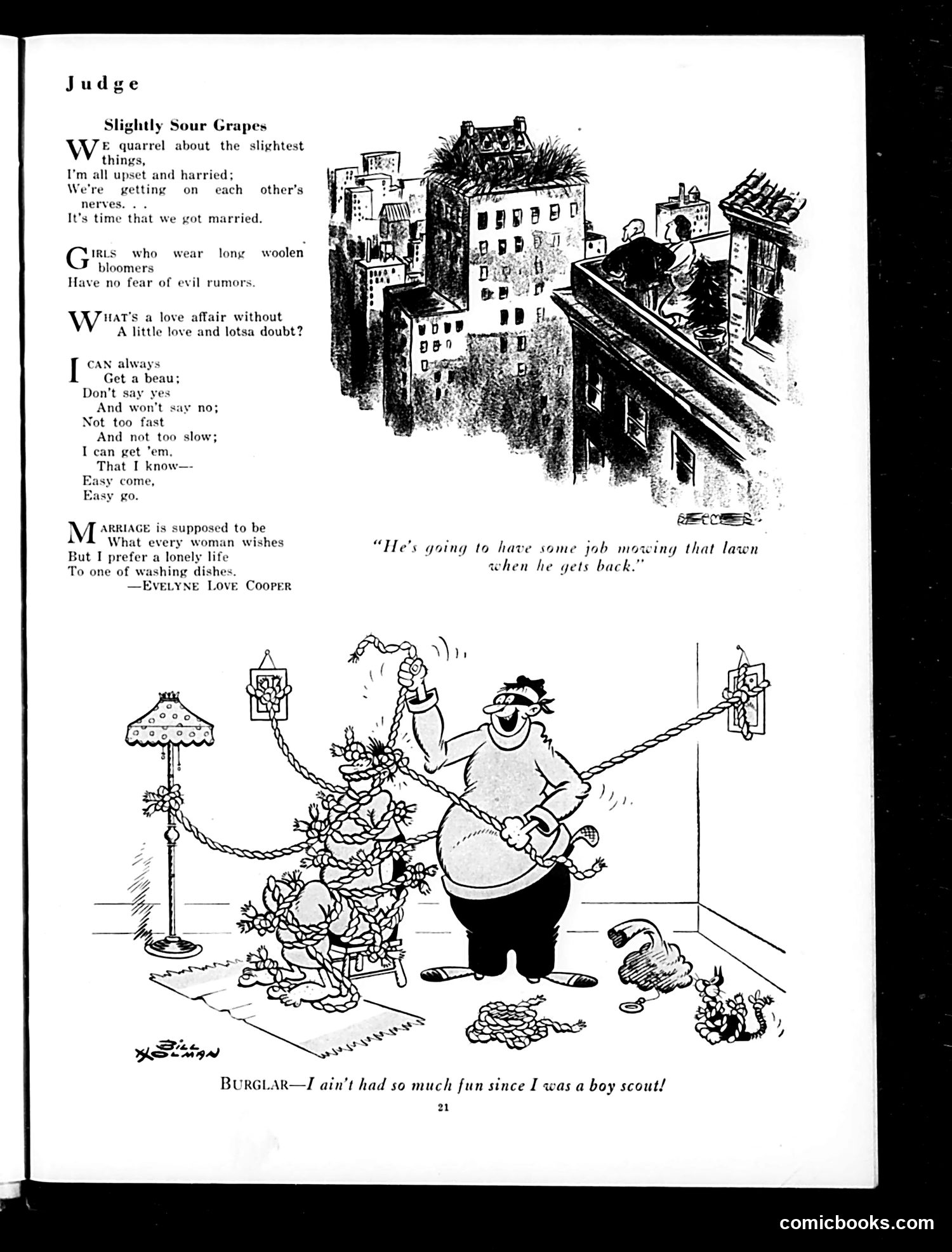
Judge Magazine Page Analysis This page contains satirical commentary on marriage and domestic life, typical of early 20th-century Judge magazine humor. The upper section presents cynical verses about courtship and marriage, mocking romantic ideals. A quote attributed to Evelyne Love Cooper humorously states she'd prefer a lonely life to "washing dishes"—satirizing women's domestic drudgery. The illustration shows a burglar surrounded by domestic chaos (flowers, decorative items, tangled ropes), cheerfully exclaiming he hasn't had such fun "since I was a boy scout." The joke appears to be that breaking into a cluttered home is more enjoyable than scouting—a backhanded criticism of messy domestic life or perhaps mocking the scout movement itself. The rooftop scene above depicts someone mowing a lawn, captioning domestic chores humorously. Overall, the page satirizes marriage as restrictive, domestic life as chaotic and tedious, and suggests that even burglary seems preferable—reflecting early 20th-century anxieties about matrimonial commitment and gender roles.
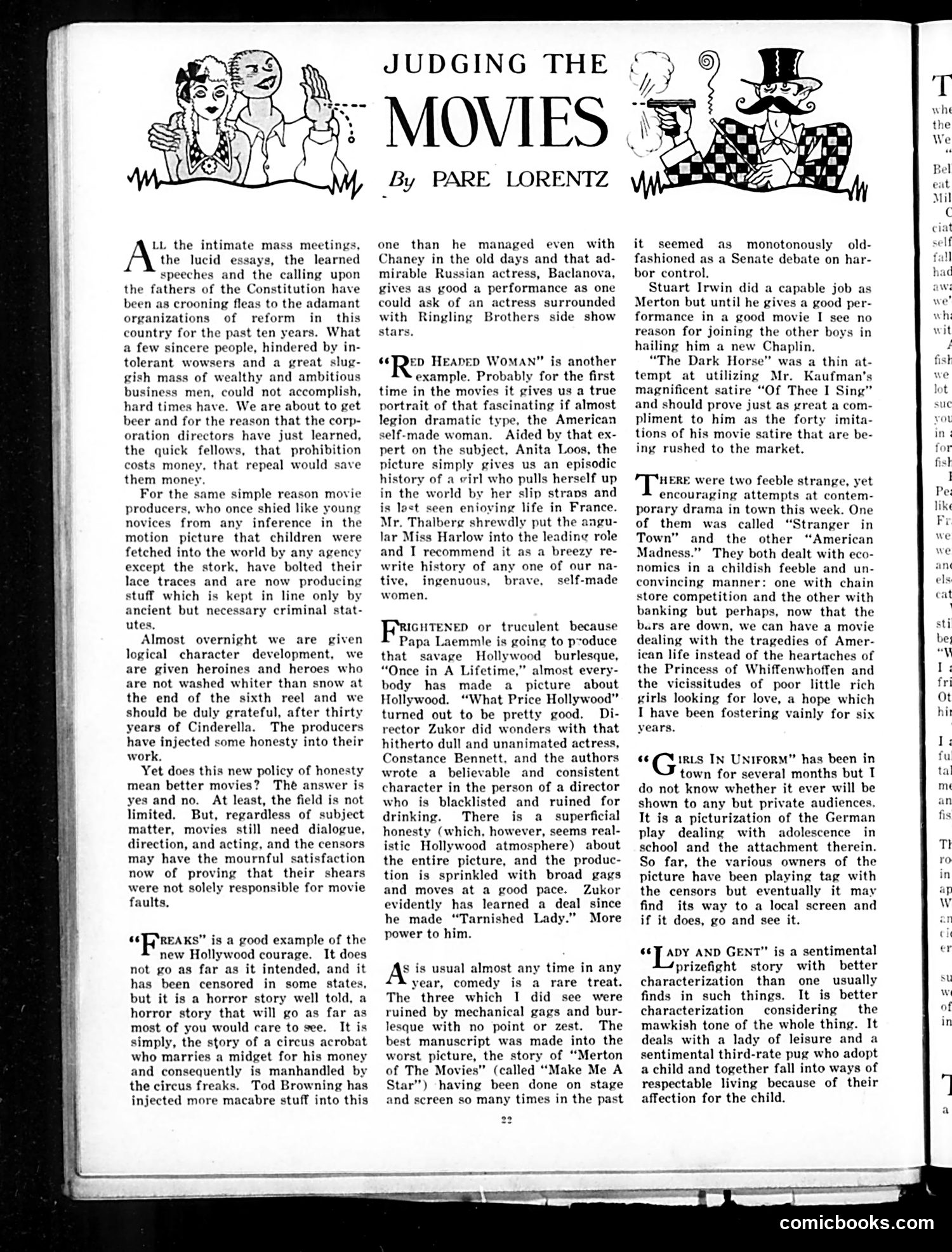
Judging the Movies: Historical Context This 1920s-30s film criticism column by Pare Lorentz addresses Hollywood's newfound willingness to depict adult themes—particularly sexuality and moral complexity—after decades of sanitized narratives. The author celebrates this shift as driven by economic necessity: producers discovered that honest storytelling was profitable, just as breweries discovered Prohibition repeal saved money. The cartoons at the masthead mock various film stereotypes. The column reviews contemporary films including *Freaks* (Tod Browning's horror film), *Red-Headed Woman* (featuring Jean Harlow), and *What Price Hollywood* (directed by Frank Borzage). Lorentz praises these for mature characterization while acknowledging Hollywood still struggled with dialogue, direction, and avoiding censorship. The underlying point: Hollywood's embrace of "honesty" isn't moral enlightenment but market-driven pragmatism—a theme satirized by the decorative cartoon figures embodying old theatrical conventions the industry was finally abandoning.
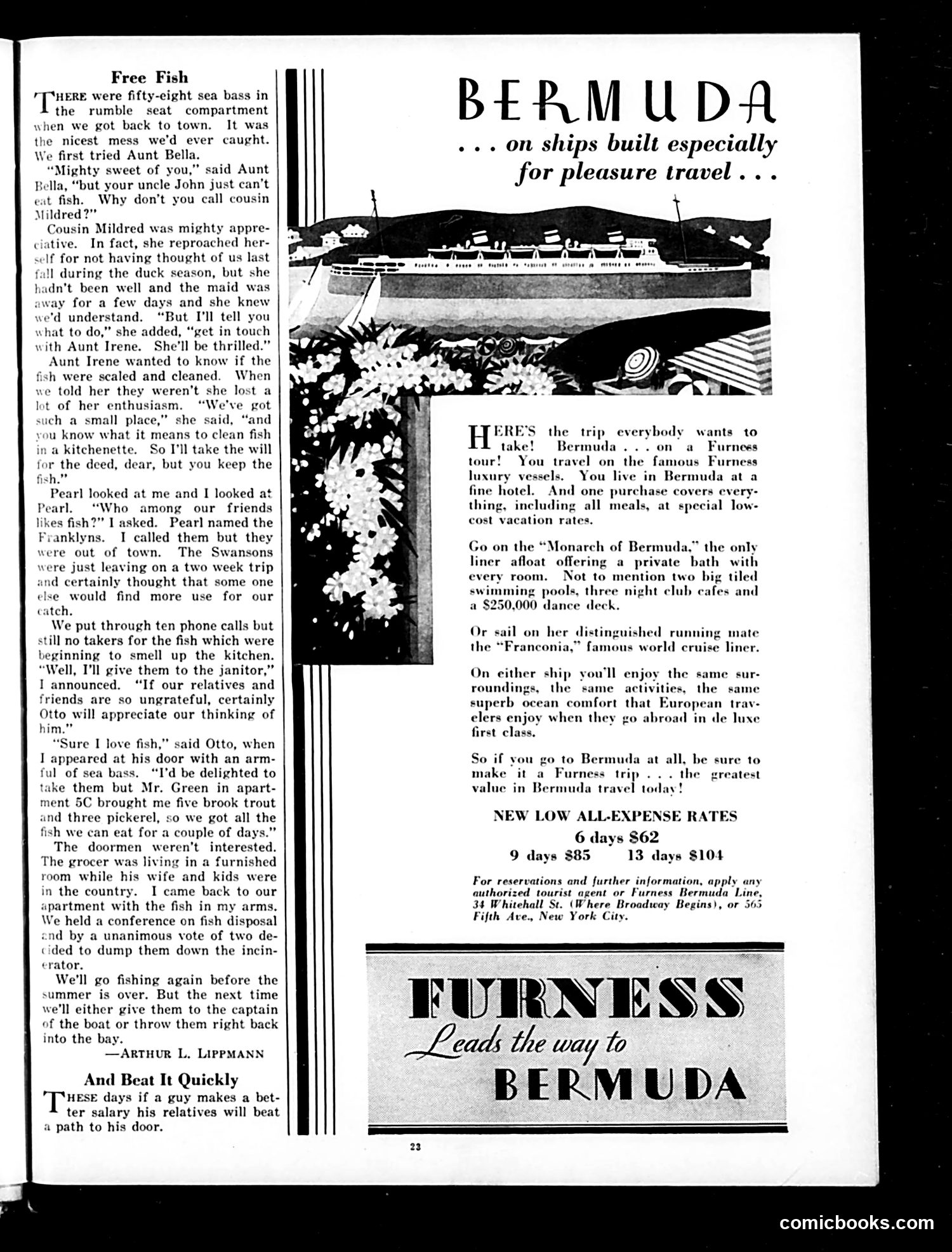
"Free Fish" - A Depression-Era Satire on Social Obligation This humorous story satirizes a common social problem of the era: the burden of unwanted gifts and the awkwardness of refusing them politely. The narrator catches 58 sea bass and attempts to distribute them among relatives and friends, but each person politely declines with increasingly creative excuses—health issues, small apartments, already having fish, being out of town. The joke's point: even generous gestures become burdensome when no one wants them, and social courtesy prevents honest refusal. The story culminates absurdly when the narrator must dump the fish down an apartment incinerator—a darkly comic ending during a period when food waste would have been particularly offensive to Depression-conscious audiences. The accompanying section advertises Bermuda cruise vacations, a stark contrast showing leisure travel for those with disposable income—highlighting class divisions of the era.
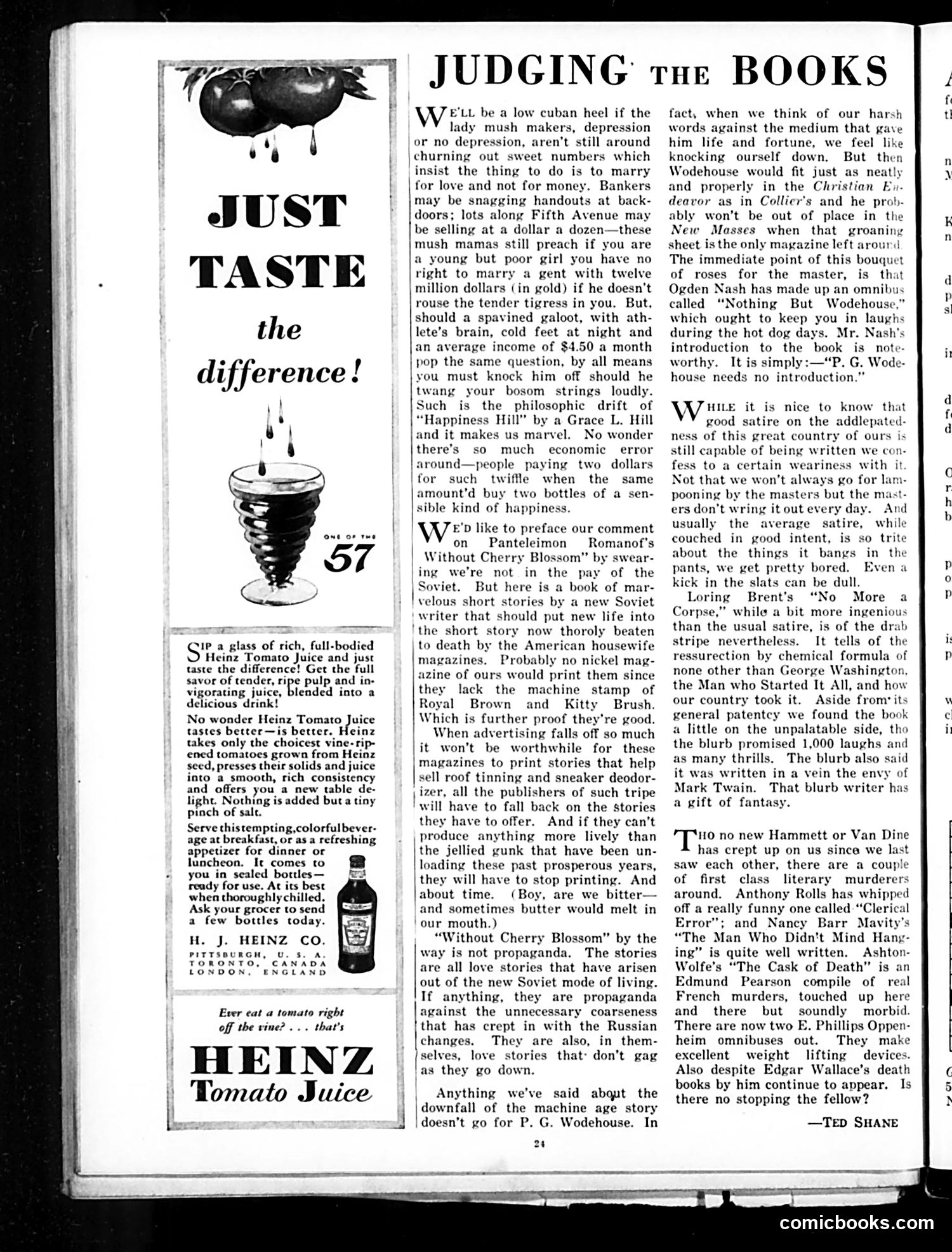
Analysis for Modern Readers This page is primarily advertising and book reviews, not political cartoons. The dominant feature is a Heinz Tomato Juice advertisement emphasizing product quality. The "Judging the Books" section reviews three works: 1. "Happiness Hill" by Grace L. Hill—criticized as sentimental pablum promoting the notion that poor men shouldn't propose to wealthy women, perpetuating economic ignorance. 2. "Without Cherry Blossom" by Panteleimon Romanoff—praised as a Soviet short-story collection superior to mass-market American magazine fiction, which relies on advertising-friendly commercial tripe rather than genuine literature. 3. P.G. Wodehouse—defended against the reviewer's own anti-capitalist sentiment, acknowledging Wodehouse's universal appeal despite concerns about the "machine age." The satire targets American commercial culture's stranglehold on publishing, contrasting it favorably with Soviet literary innovation. The reviewer adopts a bitter, leftist perspective critical of Depression-era economic disparities and mass-market mediocrity.
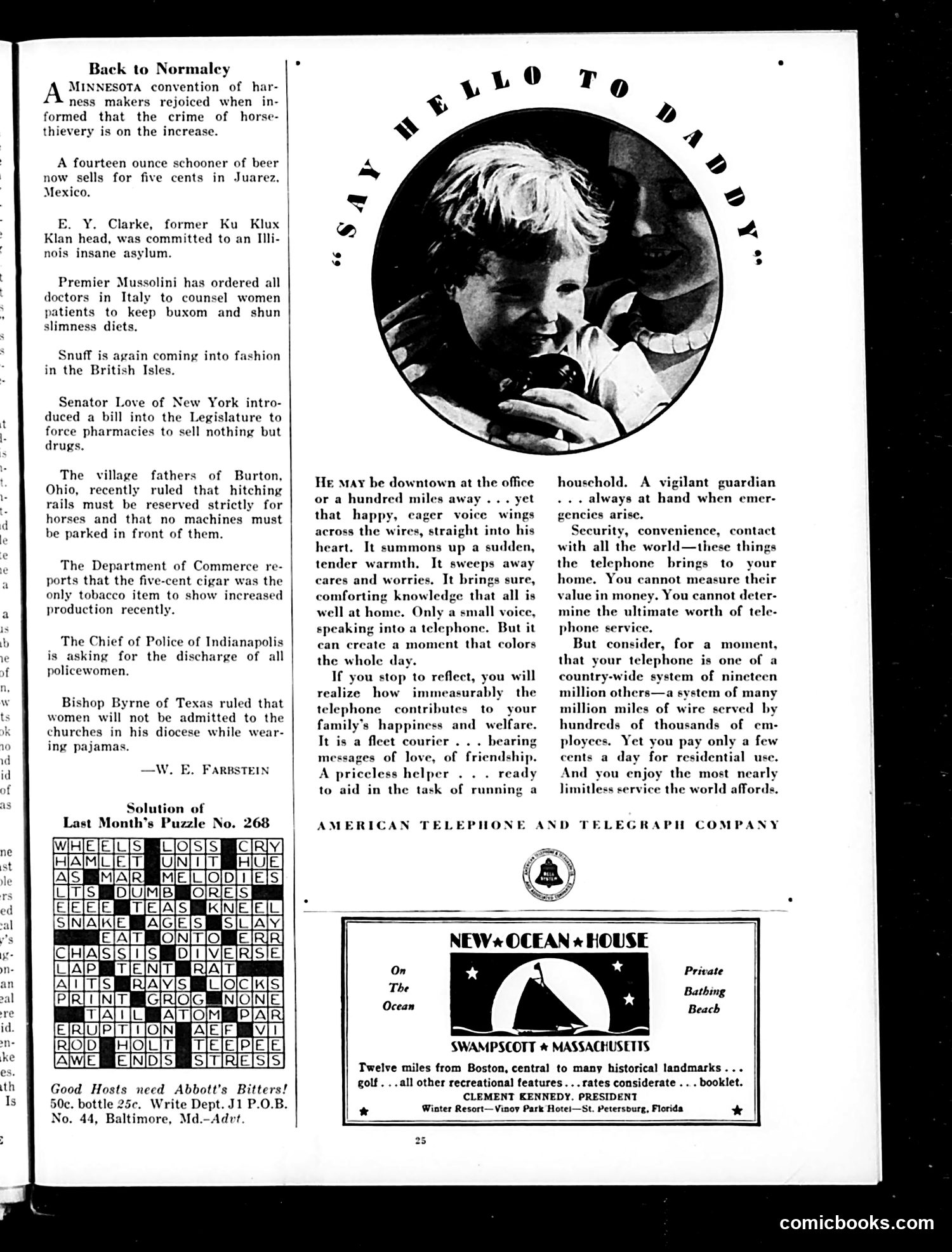
"Back to Normalcy" - Judge Magazine Satire This page satirizes American culture in the early 1920s post-WWI period (the "Back to Normalcy" heading references President Harding's 1920 campaign slogan). The left column mocks various absurdities and contradictions of the era through brief, deadpan items: - Horse thieves increasing while modern cars replace hitching posts - Ku Klux Klan leader E.Y. Clarke's institutionalization - Mussolini's directive on women's body standards - Prohibition's effects (cheap beer in Mexico; pharmacies forced to sell only drugs) - Reactionary local laws and religious restrictions on women The satire targets societal regression and hypocrisy—nostalgia for "normalcy" coexisting with modernization, fascism gaining credibility, and institutional misogyny. The right side features AT&T advertising praising telephone technology's family benefits, creating ironic contrast with the satirized backwards attitudes on the left.
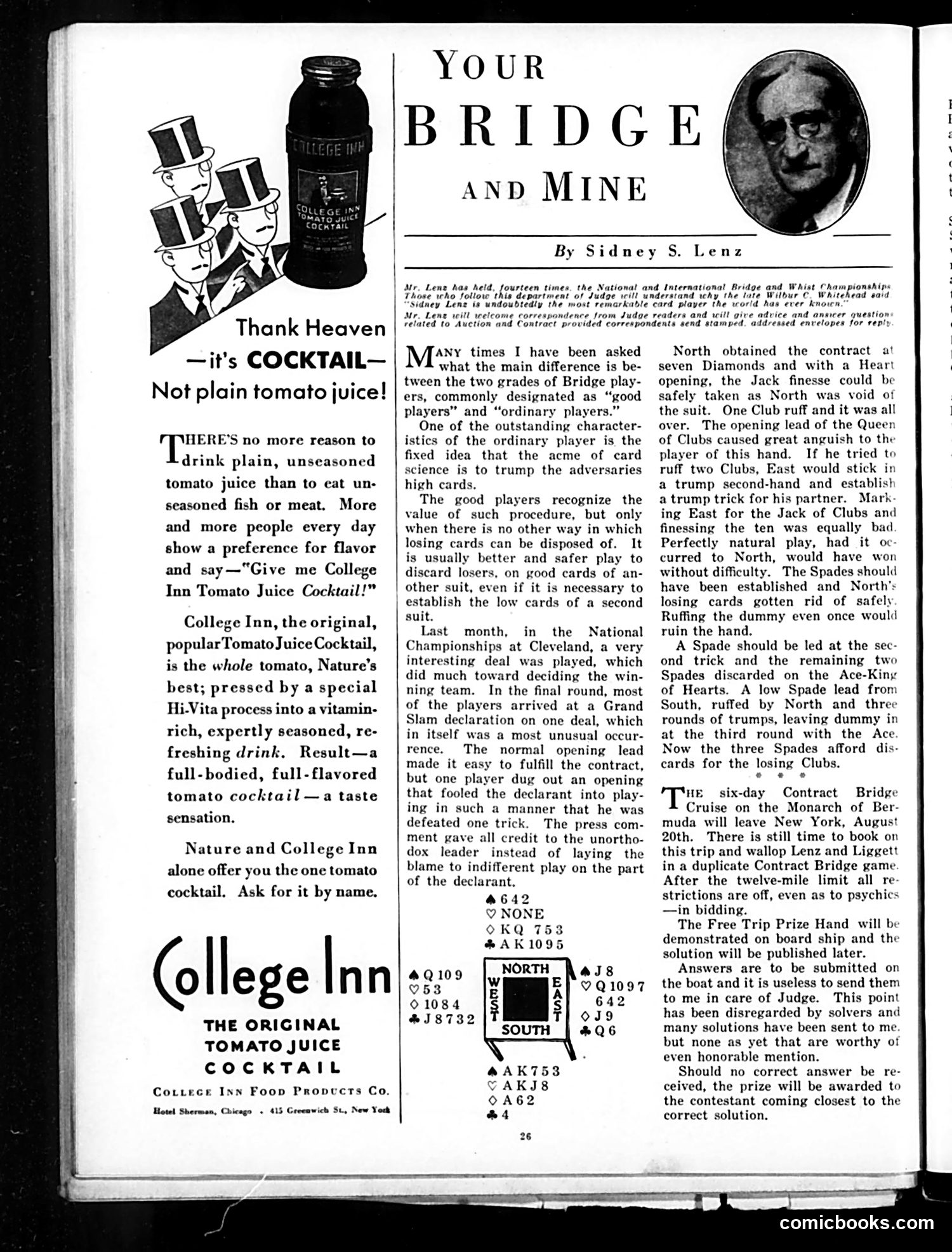
Explanation for Modern Readers This page contains two distinct elements: a full-page College Inn tomato juice advertisement (left) and a bridge card game instruction column by Sidney S. Lenz (right). The Advertisement: Uses humor to pitch cocktail-flavored tomato juice by mocking plain tomato juice as unappetizing—comparing it to eating unseasoned fish or meat. The cartoon figures in top hats are gentlemen rejecting plain juice in favor of the "seasoned" cocktail version. The Bridge Column: Lenz, apparently a renowned card player (described as holding fourteen national/international championships), teaches bridge strategy. His example critiques "ordinary players" who reflexively trump opponents' high cards, when skilled play requires discarding losers instead. He illustrates with a specific National Championship hand from Cleveland where unconventional play defeated a Grand Slam contract. The page reflects 1920s-30s magazine format: advertising subsidizing instructional content for educated readers interested in both cocktails and competitive card games.
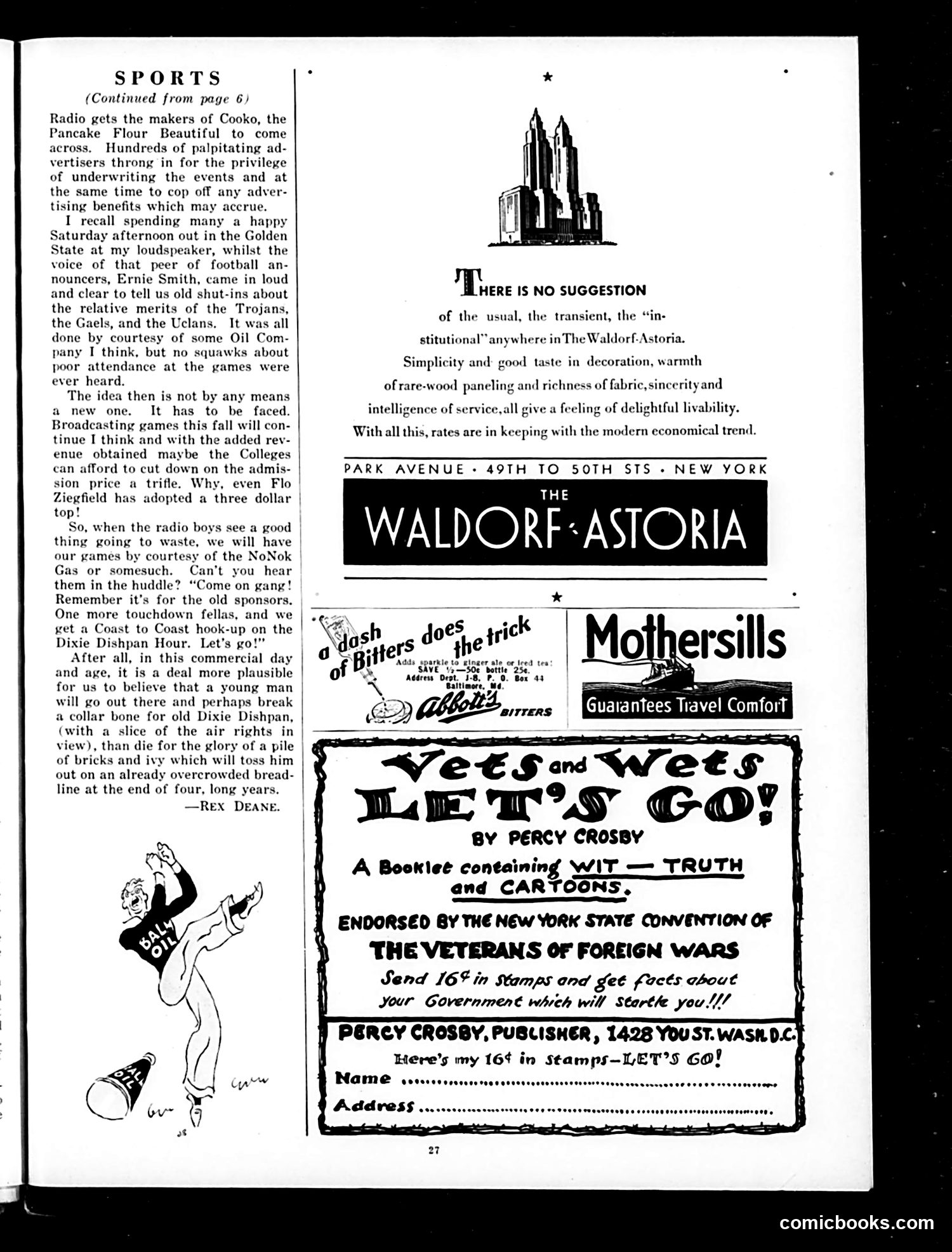
Analysis for Modern Readers The main article by Rex Deane critiques commercialization of college sports radio broadcasts. He argues that while sponsored broadcasts (funded by companies like oil firms advertising during games) generate revenue, they've created a cynical situation: college athletes now perform for commercial sponsors rather than institutional pride. Deane sarcastically suggests young men will suffer injuries for "Dixie Dishpan Hour" sponsorships more readily than for their college's honor—especially when they'll be discarded "on an already overcrowded breadline" after four years anyway. The cartoon (lower left) depicts a football player being kicked/knocked down, labeled "PROPS," emphasizing athletes as mere commercial props. The page is otherwise advertisements: the Waldorf-Astoria hotel, Mothersills travel comfort product, Abbott's Bitters, and Percy Crosby's patriotic booklet "Yets and Wets" endorsed by Veterans of Foreign Wars. The satire reflects 1920s-30s anxiety about commercialism corrupting amateur athletics and student welfare.
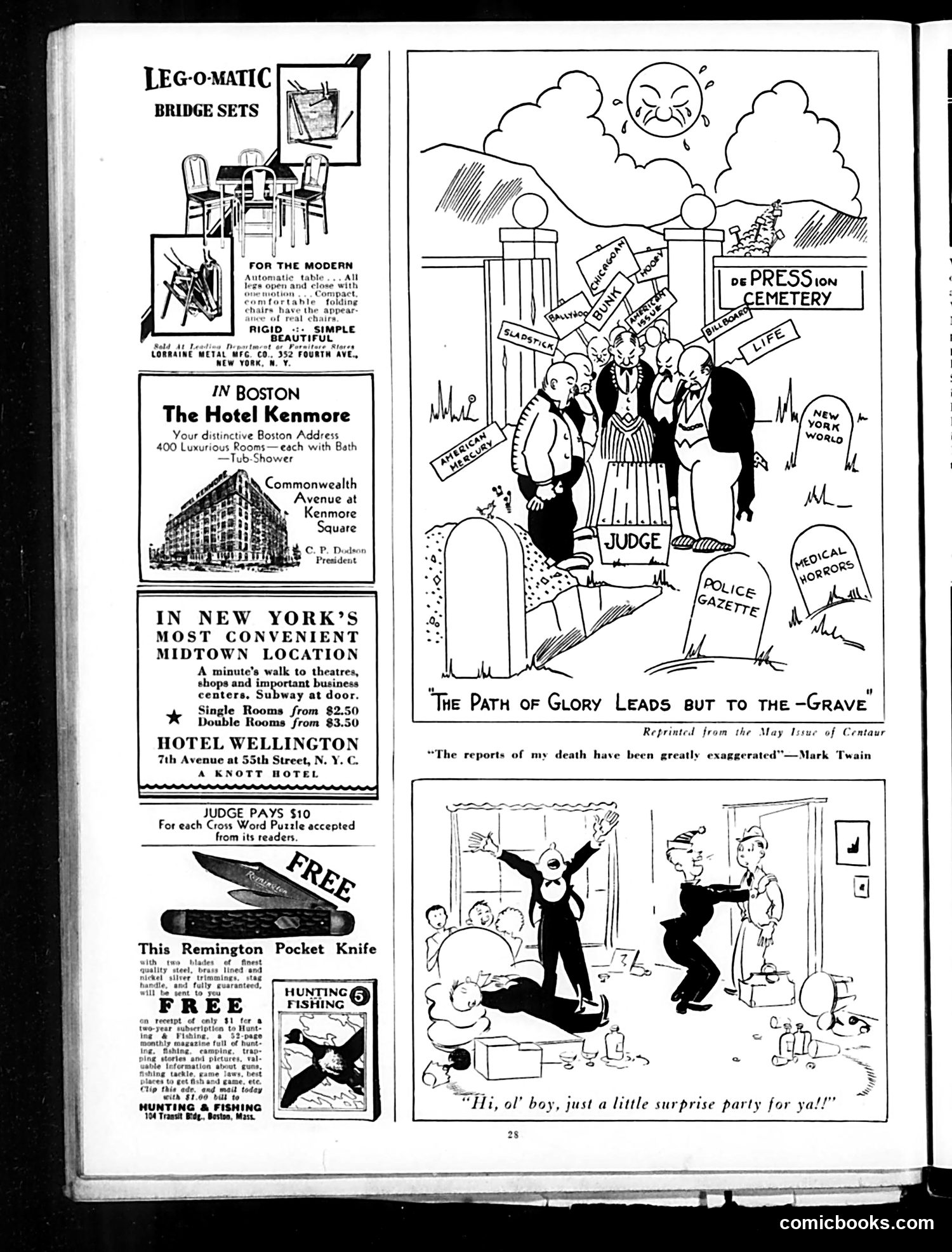
"The Path of Glory Leads but to the Grave" This satirical cartoon depicts the irony of achieving public success and acclaim. A central figure (likely representing an ambitious person or public figure) stands surrounded by gravediggers and cemetery markers labeled with the various paths to "glory"—including references to "Judge," "Police Gazette," "Medical Horrors," and "New York World." The angry sun in the sky oversees a "Depression Cemetery," emphasizing that despite all these institutions and publications celebrating one's achievements, the ultimate destination is death. The Mark Twain epigraph reinforces the dark humor: reports of one's importance are exaggerated, yet everyone ends up in the same place regardless. The cartoon mocks the 1920s obsession with fame, publicity, and success measured through press coverage, suggesting that all such earthly acclaim is meaningless in the face of mortality.
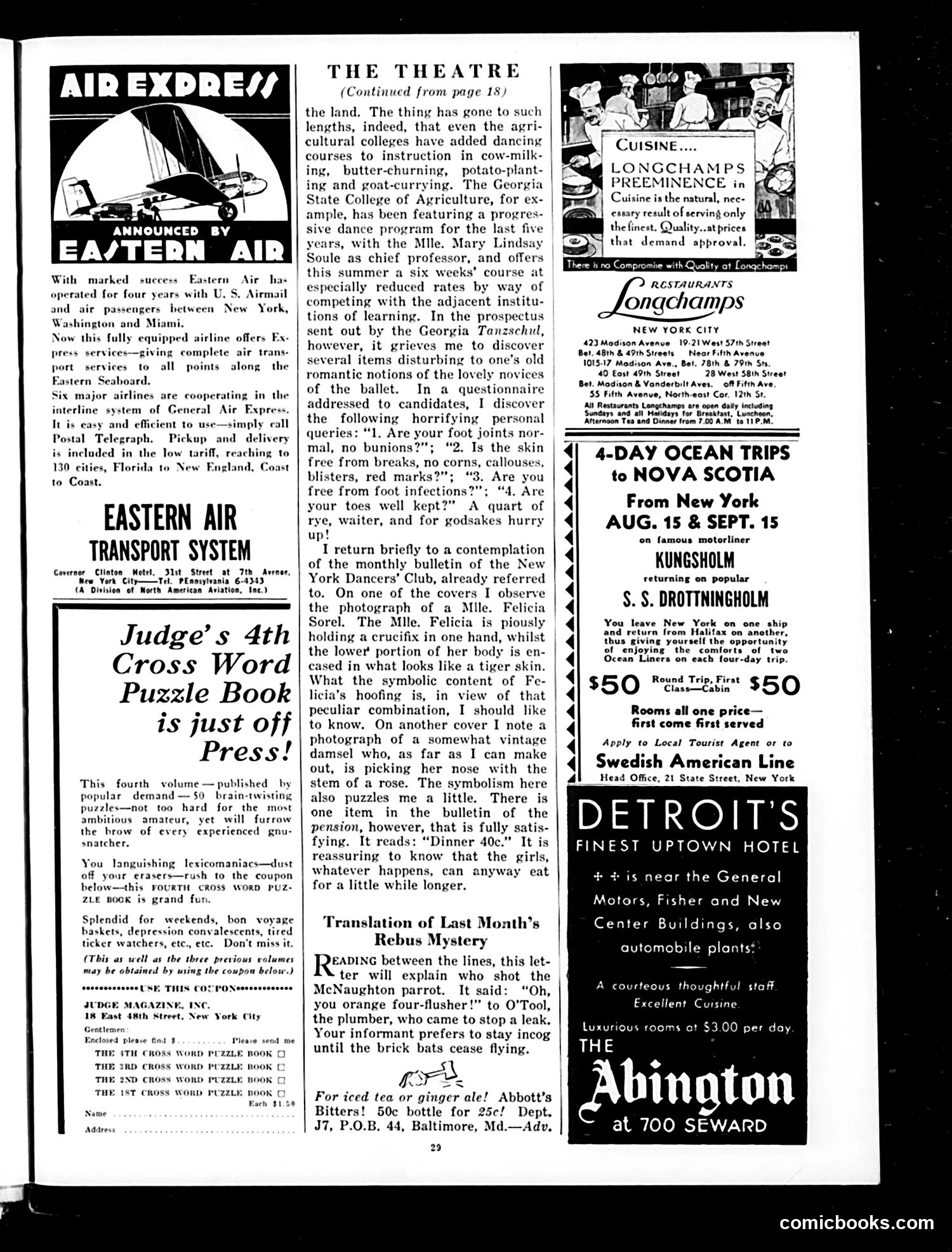
Analysis of Page 23 from Judge Magazine This page is primarily advertising and editorial content rather than political satire. The main cartoon element—Judge's 4th Cross Word Puzzle Book advertisement—is a simple self-promotional piece for the magazine's puzzle collection, with no satirical content. The substantive text is a theater column discussing the absurd trend of adding dance instruction to agricultural colleges. The author sarcastically critiques Georgia State College of Agriculture's dance program, mocking the disconnect between farming education and ballet training. He humorously quotes the program's medical questionnaire about dancers' foot conditions, then contrasts this clinical approach with romantic notions of ballet. The column concludes by noting a photograph of a dancer holding both a crucifix and wearing tiger skin—the author expresses bewilderment at the "symbolic content," suggesting pretentiousness in modern dance aesthetics. No identifiable political figures or events appear. The satire targets only the general absurdity of 1930s educational trends and artistic pretension.
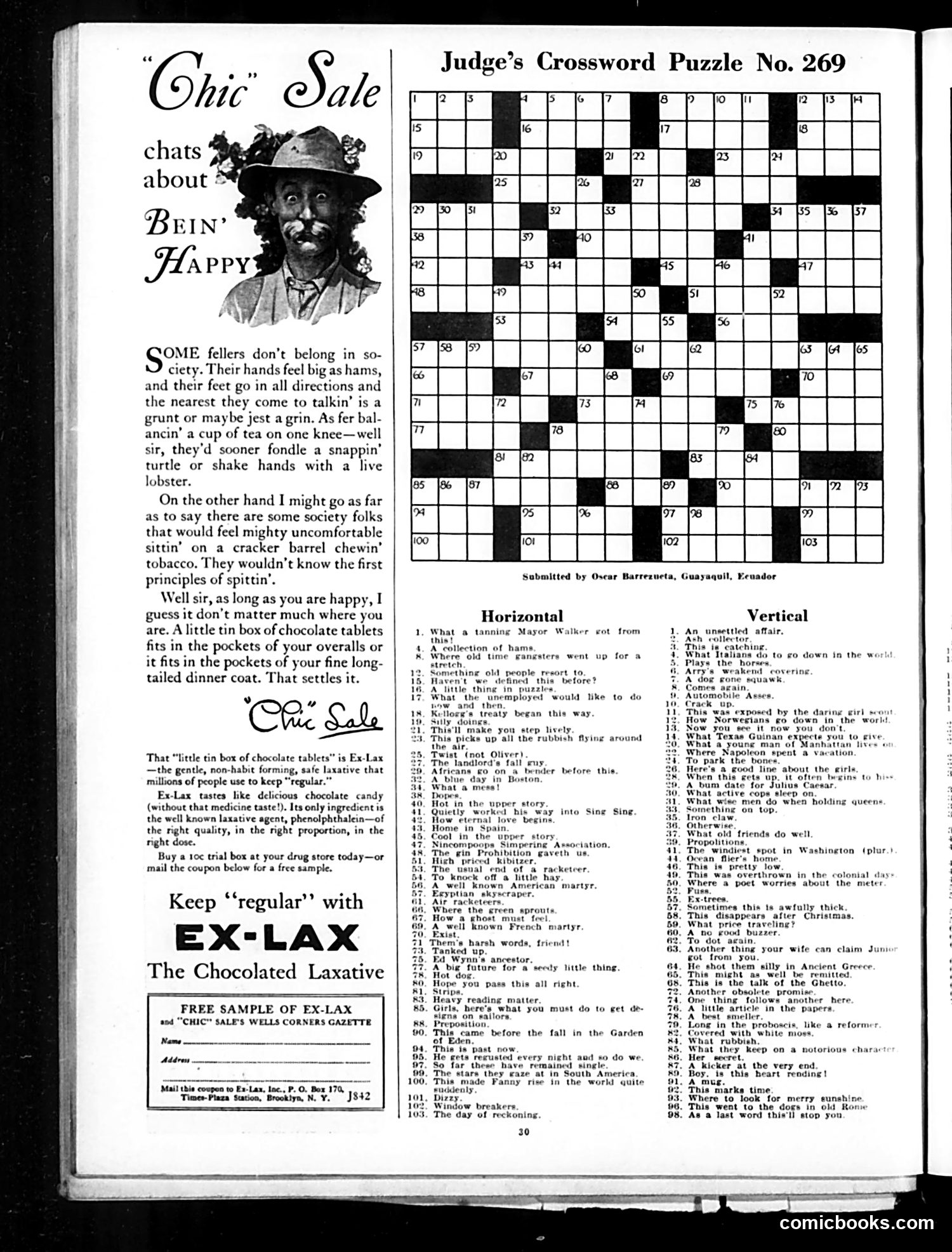
Judge Magazine Page Analysis This page combines a humorous essay with advertisements and a crossword puzzle. The main content, "Chic Sale Chats About Bein' Happy," features a folksy monologue in the voice of a rural character. The speaker argues that happiness matters more than social class—whether you're an uncouth laborer or an uncomfortable wealthy person, both can enjoy simple pleasures equally. The point is populist and democratic: a box of Ex-Lax laxative tablets fits in both overalls and dinner jackets, so class distinctions are ultimately meaningless. The bulk of the page is an Ex-Lax advertisement, a chocolate laxative marketed as gentle and non-habit-forming. The ad uses the essay to pitch the product's universality. Below is a standard crossword puzzle credited to a contributor in Ecuador, with clues referencing contemporary 1920s-30s figures (Mayor Walker, Prohibition references) and events. The crossword appears to be generic puzzle content rather than satirical. This is primarily an advertising page disguised as editorial content.
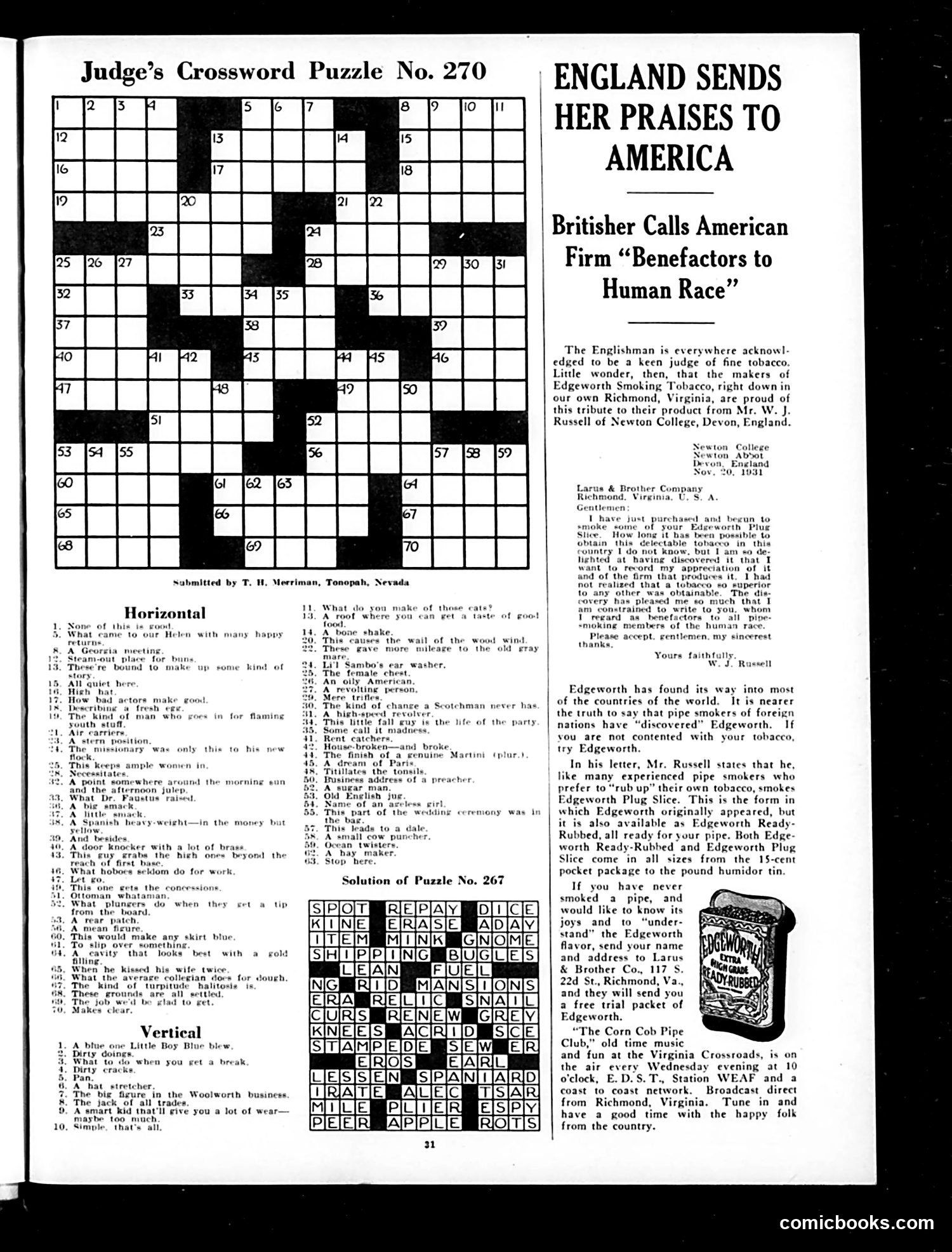
Judge Magazine Page Analysis This page is primarily advertising content, not political satire. The dominant feature is a testimonial advertisement for Edgeworth Smoking Tobacco, a Richmond, Virginia product. The ad presents a letter from W.J. Russell, an Englishman from Newton College, Devon, praising the American tobacco as a "Benefactor to Human Race." This represents early 20th-century advertising strategy: using foreign validation to enhance product prestige. The appeal to English connoisseurship ("The Englishman is everywhere acknowledged to be a keen judge of fine tobacco") flatters both the product and American manufacturing capability. The page also includes Judge's standard crossword puzzle and clues—routine editorial content. There is no political cartoon visible; the layout is dominated by the tobacco advertisement, which appears to be sponsored content rather than satirical commentary. The emphasis on "Corn Cob Pipe Club" radio broadcasts suggests this dates to the radio era, likely 1920s-1930s.
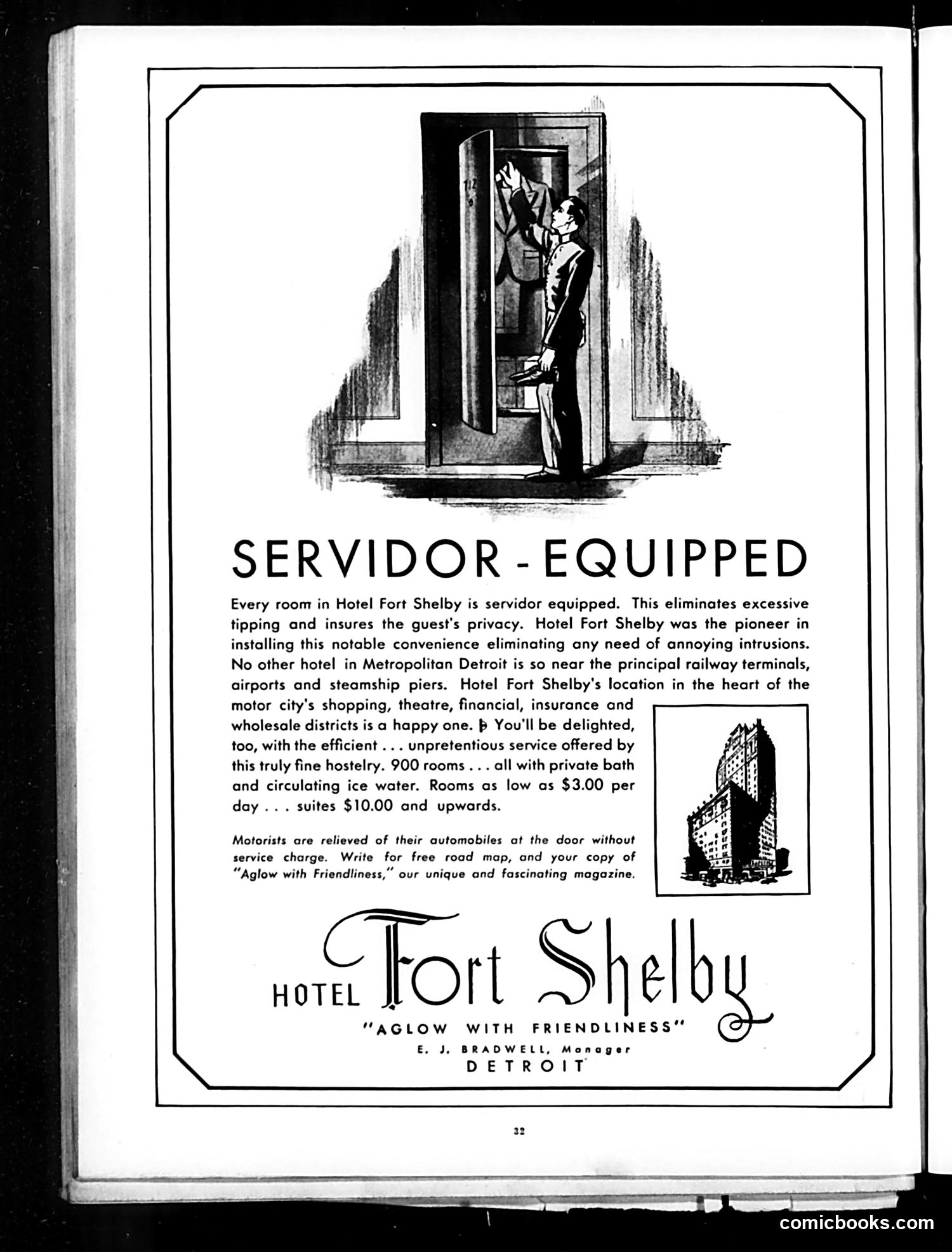
Analysis This is not a cartoon or satire—it's a hotel advertisement from Judge magazine for Detroit's Hotel Fort Shelby. The "servidor-equipped" illustration shows a bellhop or hotel staff member at a room door, depicting the hotel's key selling point: in-room service buttons (servidors) that eliminated the need to summon staff in person, thus reducing tipping and preserving guest privacy. The ad emphasizes modern conveniences: 900 rooms at low rates ($3.00/day), private baths, circulating ice water, and free automobile parking—luxuries targeting 1920s-30s motorists and business travelers. The tagline "Aglow with Friendliness" and mention of complimentary road maps and a magazine indicate aggressive marketing to automobile tourists. The building sketch in the corner shows the hotel's architecture. This reflects the era's enthusiasm for technological convenience and competitive hotel amenities during America's automotive boom.
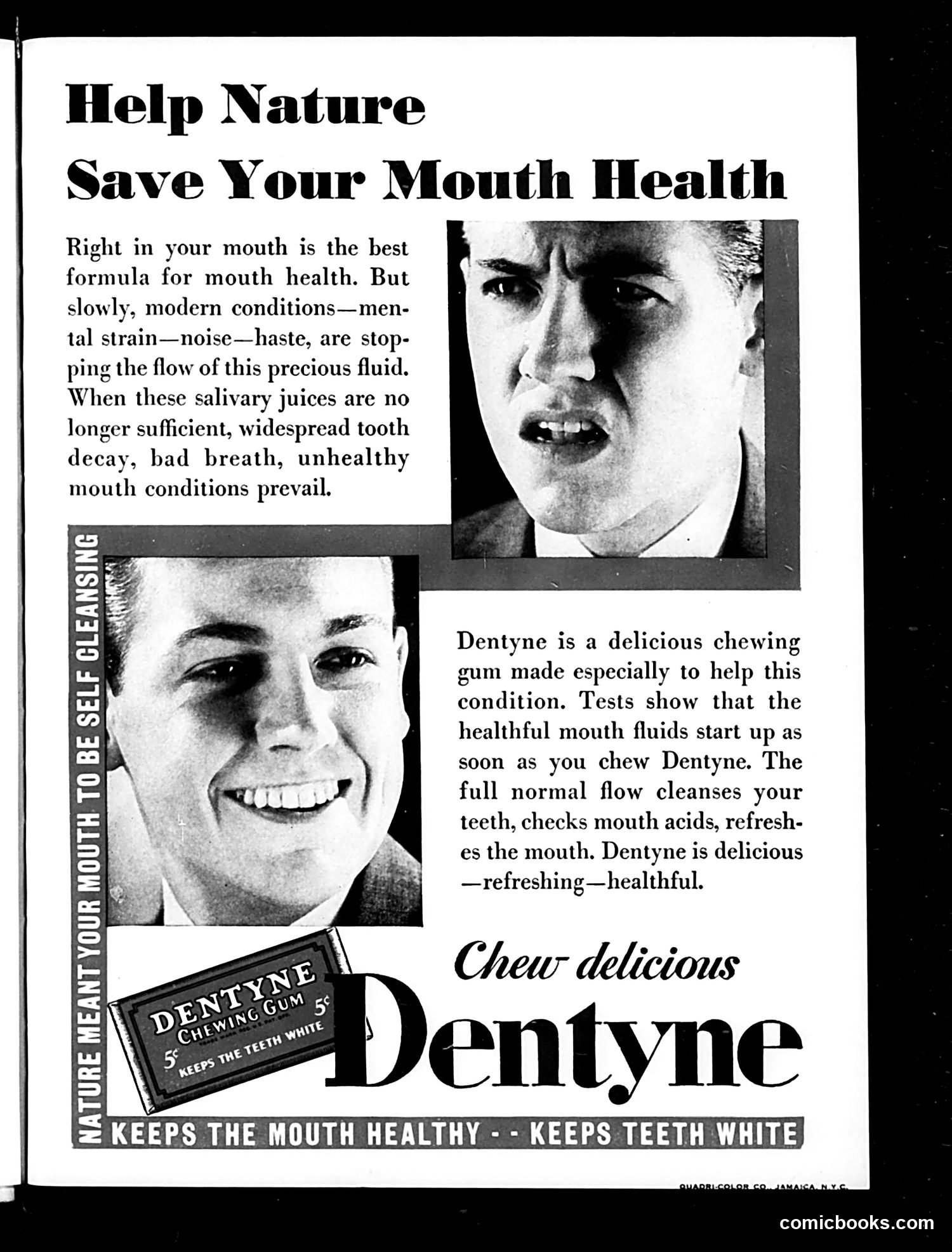
Analysis for Modern Readers This is not a cartoon but a Dentyne chewing gum advertisement from Judge magazine. The page promotes the product by claiming it stimulates saliva production to combat modern oral health problems. The ad's framing reflects early 20th-century anxieties: it blames contemporary life ("mental strain—noise—haste") for suppressing natural saliva flow, positioning Dentyne as a remedy. The two smiling male faces demonstrate the product's promised results—healthy teeth and fresh breath. The appeal to "nature" in the headline reflects period pseudo-scientific marketing common in that era, suggesting the gum merely "helps" the body's natural processes rather than being artificial. The emphasis on keeping teeth "white" reflects contemporary beauty standards. This represents typical Judge magazine content: advertising mixed with editorial material, though presented with the magazine's characteristic slick production values.

Analysis This is a cigarette advertisement, not satire or political commentary. The page features a Camel cigarettes ad from R.J. Reynolds Tobacco Company (Winston-Salem, N.C.). The ad emphasizes the "Humidor Pack"—a protective packaging innovation that kept cigarettes fresh by preventing exposure to air, dust, and odors. The smiling woman in the photograph represents the idealized consumer, suggesting cigarettes maintain their quality and appeal. The tagline "Switch to Camels for just one day, then leave them—if you can" is a playful sales pitch implying addiction/preference. The ad highlights "Turkish and mild sun-ripened Domestic tobaccos," marketing the product's quality ingredients. For modern readers: this reflects pre-1960s advertising when cigarette health dangers were not widely acknowledged and tobacco companies openly advertised in mainstream publications like *Judge* magazine.