judge
Judge — September 1932
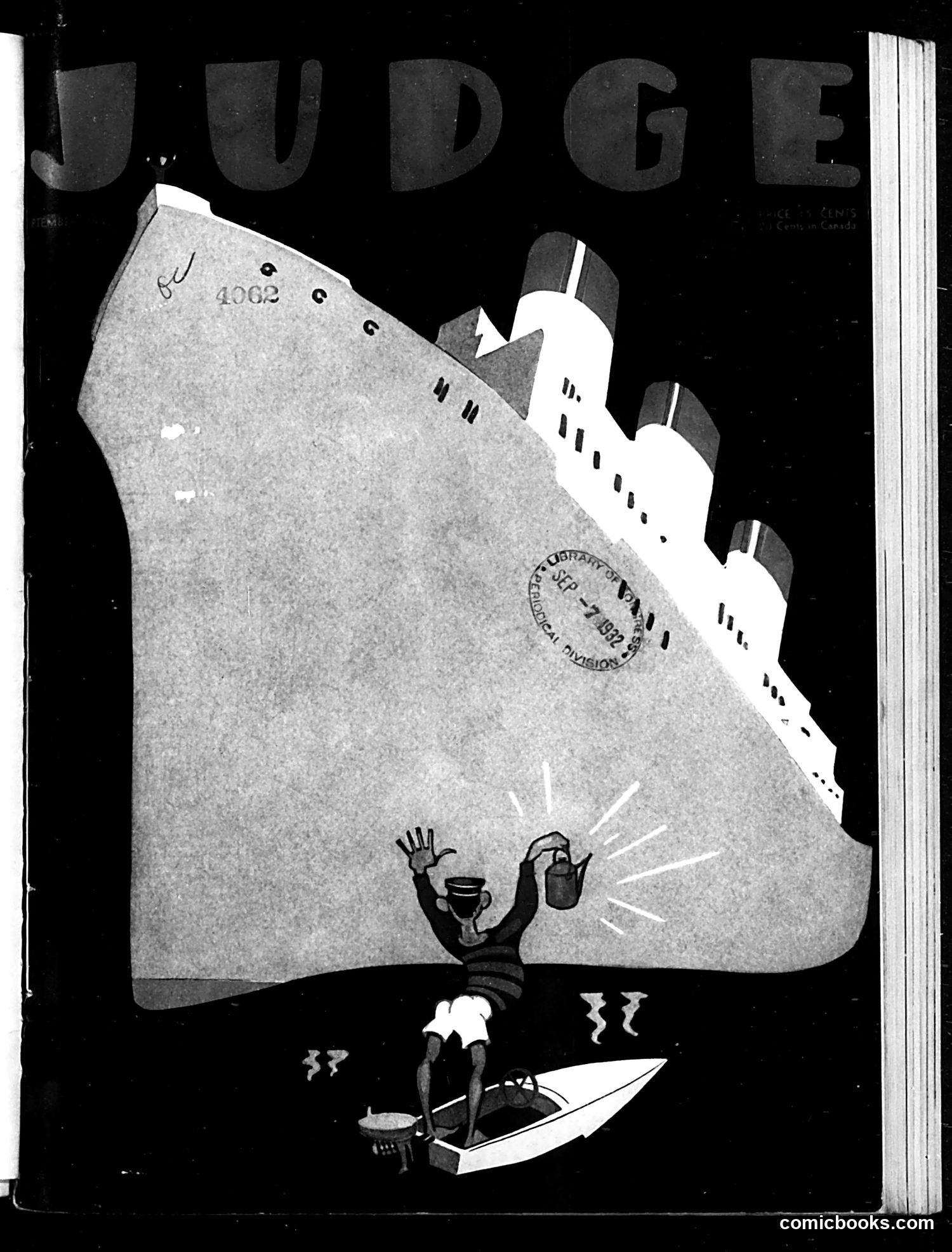
Judge Magazine Cartoon Analysis This satirical cartoon depicts a shipwreck scene titled "JUDGE" at top. A small figure in a lifeboat below frantically waves a cup and bucket toward a massive sinking ocean liner above, whose three prominent smokestacks are visible. The liner appears to be the "Titanic" (number 4062 visible), referencing the famous 1912 disaster. The satire likely comments on class disparity and futility—the wealthy aboard the luxury vessel face catastrophe while a common person below attempts rescue with comically inadequate tools (a cup and bucket). This critiques both the tragedy itself and broader social inequalities it exposed, mocking the helplessness of ordinary people witnessing disaster among the privileged elite.
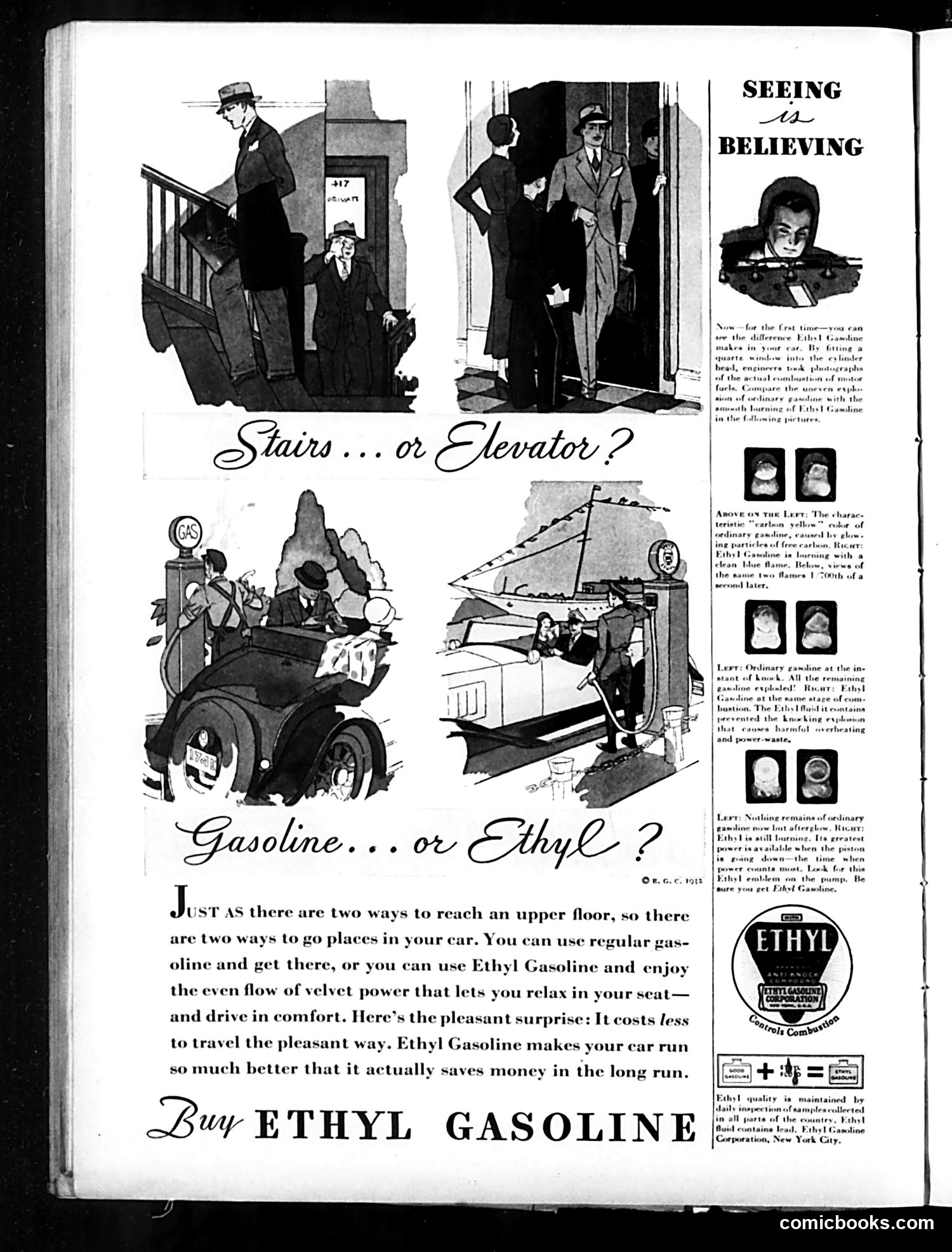
Analysis This is primarily an advertisement for Ethyl Gasoline from the Ethyl Gasoline Corporation (New York City), not satirical content. The page uses visual analogies rather than political cartoons. The "Stairs...or Elevator?" and "Gasoline...or Ethyl?" comparisons suggest that Ethyl Gasoline offers superior performance and comfort versus regular gasoline—a smoother, more efficient "ride" to your destination. The right panel titled "Seeing is Believing" shows microscopic comparisons of ordinary gasoline versus Ethyl fuel, attempting to demonstrate technical superiority. This represents early 20th-century automotive marketing, emphasizing that Ethyl fuel, despite costing slightly more, delivers better engine performance and reliability, ultimately saving money long-term. The advertising targets middle-class car owners seeking convenience and efficiency.
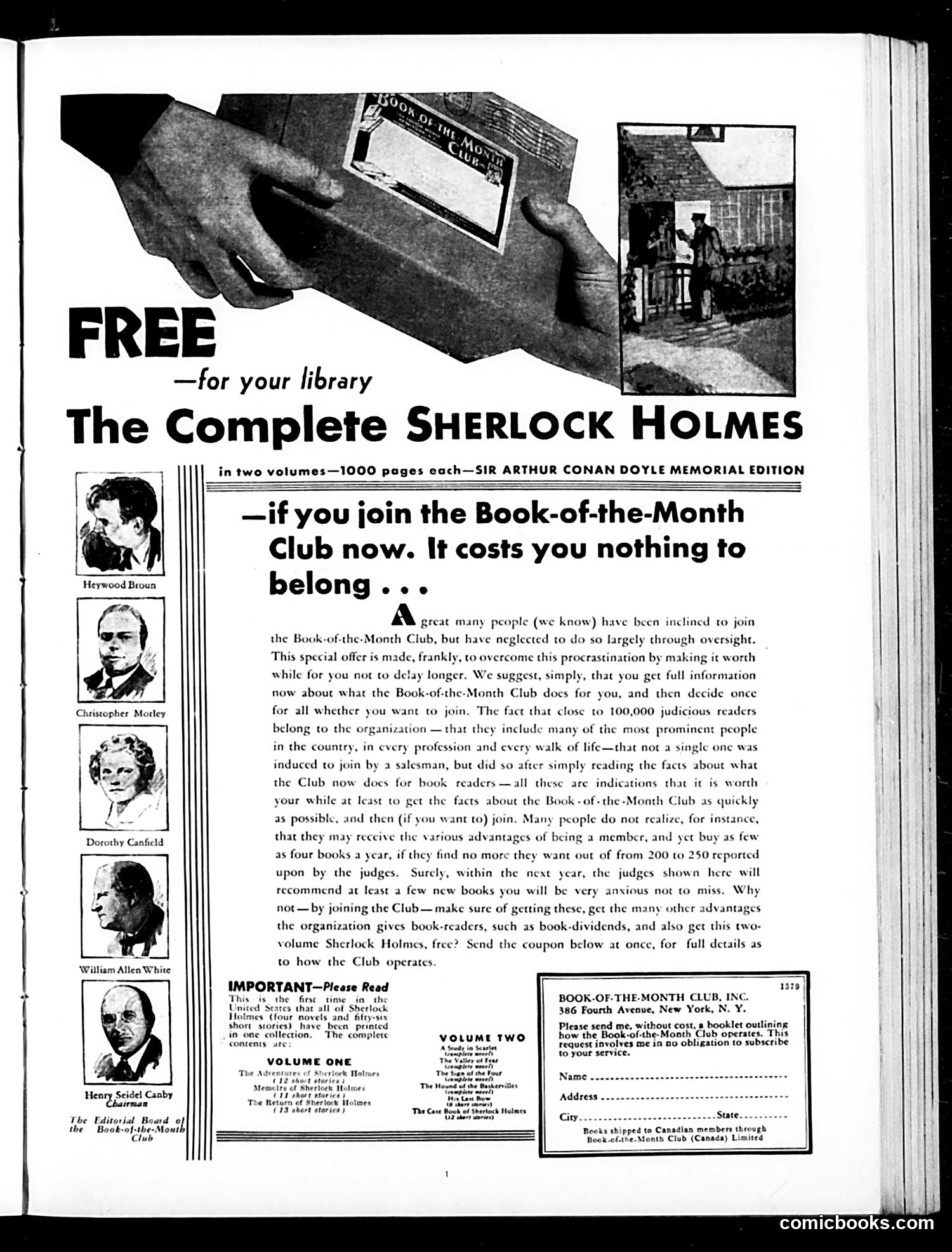
This page is primarily an advertisement for the Book-of-the-Month Club, not a satirical cartoon. It features portraits of five editorial judges: Heywood Broun, Christopher Morley, Dorothy Canfield, William Allen White, and Henry Seidel Canby. These were prominent American literary critics and intellectuals of the early 20th century whose names lent credibility to the club's book selections. The ad emphasizes that membership is "free" and costs "nothing to belong," while promoting the exclusive two-volume Sherlock Holmes memorial edition as an incentive. The persuasive text argues that joining requires minimal effort and offers significant benefits through book dividends and curated selections. This represents early direct-mail marketing targeting educated readers, leveraging celebrity endorsement before modern advertising terminology existed.
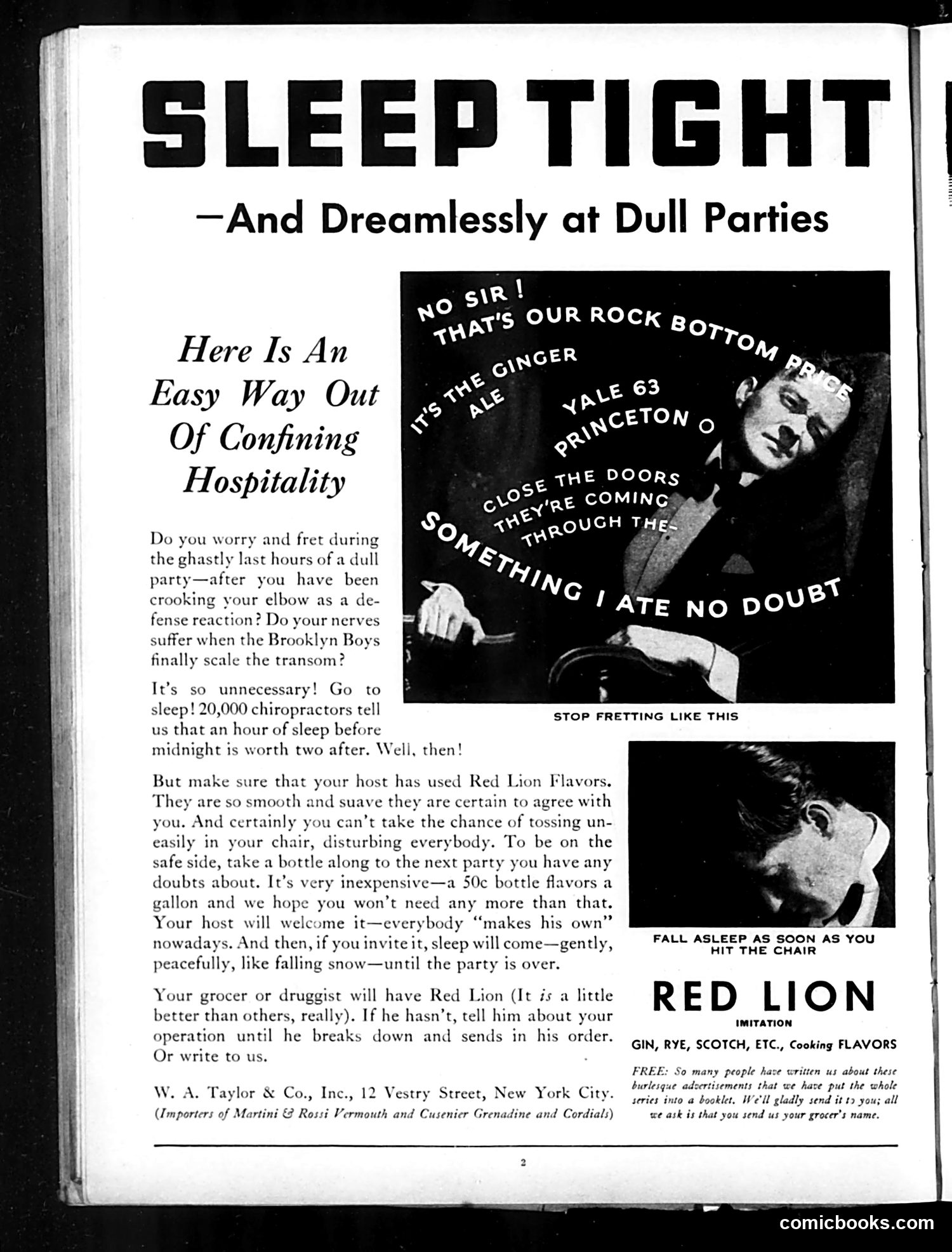
Analysis This page is primarily a liquor advertisement disguised as satirical advice, promoting Red Lion flavoring extracts for alcohol. The "SLEEP TIGHT" headline jokes about falling asleep at dull parties—a socially awkward problem. The cartoon shows a man at a party who has consumed Red Lion-flavored drinks and fallen asleep in his chair, captioned "FALL ASLEEP AS SOON AS YOU HIT THE CHAIR." This is presented humorously as a solution to the anxiety of attending boring social events. The text sarcastically advises readers to have their host use Red Lion Flavors to make smooth, palatable homemade alcohol ("20,000 chiropractors" endorse sleep). The ad promises the product is inexpensive (50¢ per gallon) and suggests bringing a bottle to parties. This reflects Prohibition-era humor (likely 1920s-early 1930s), when home alcohol production was common and advertised obliquely through "cooking flavors."
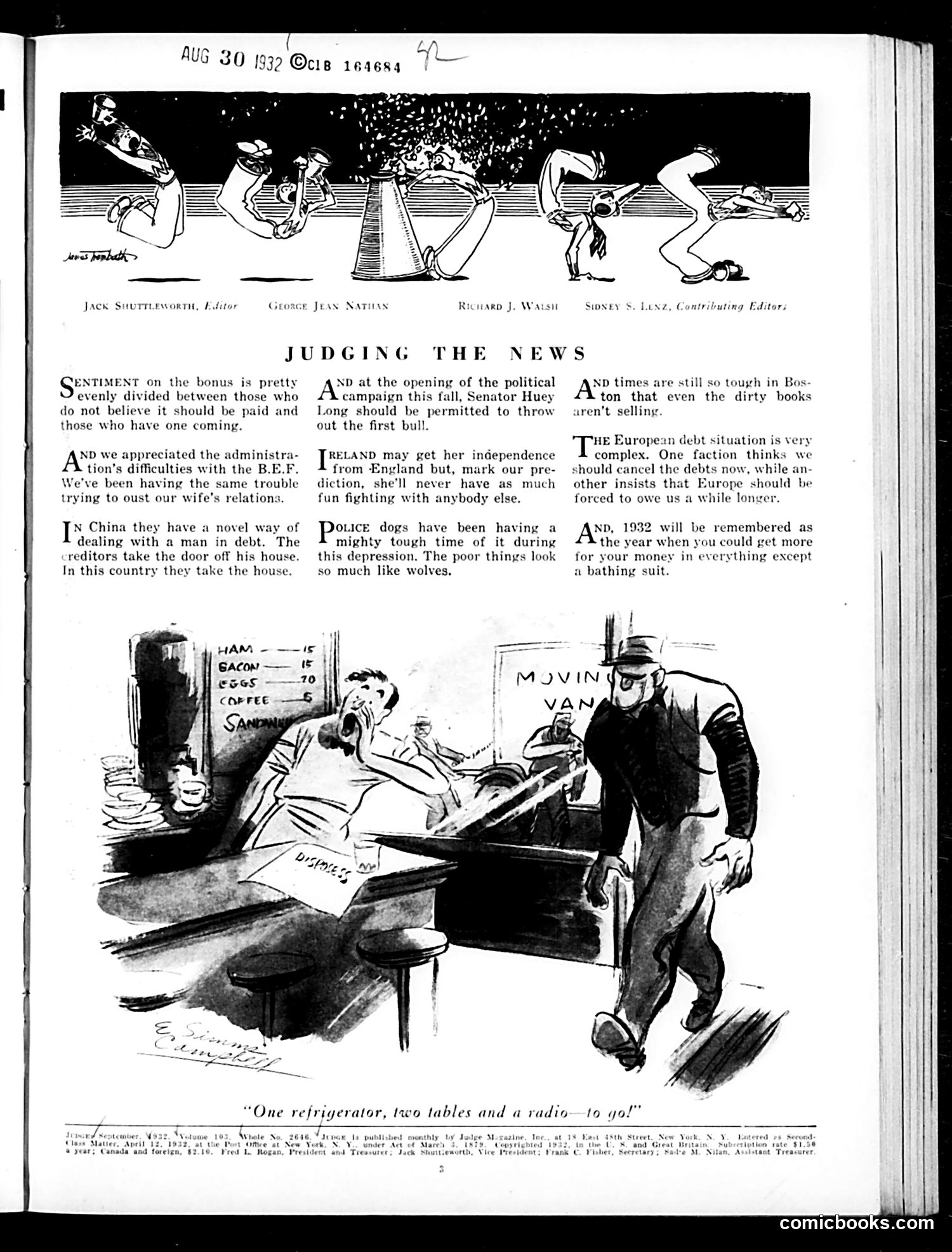
Analysis of "Judging the News," August 30, 1932 This page features editorial commentary and one prominent cartoon. The main cartoon depicts a moving van labeled "MOVING VAN" at a house, with a man in a hat appearing to evict or remove someone. The caption reads: "One refrigerator, two tables and a radio—19 go!" This satirizes Depression-era evictions and financial hardship. The sparse possessions itemized suggest a family losing their home and reduced to minimal belongings—a common tragedy during the 1932 economic crisis. The text commentary addresses contemporary issues: the political campaign, Ireland's independence, China's debt practices, Boston's strict moral climate, and Europe's financial troubles. The overall tone reflects Judge magazine's satirical critique of current events and social conditions during the Great Depression.
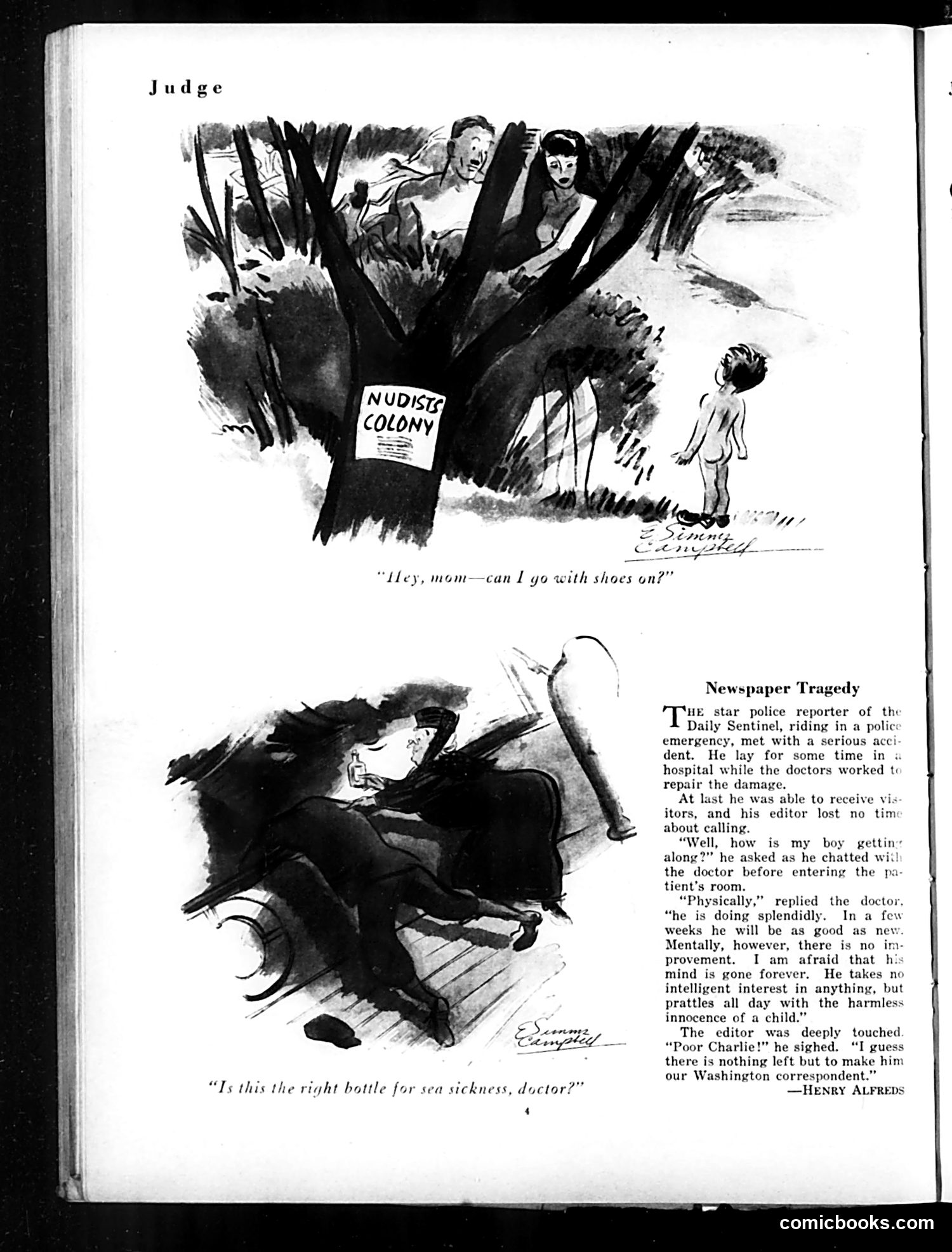
Analysis of Judge Page Top Cartoon ("Nudist Colony"): A child asks their mother if they can go to a nudist colony "with shoes on." This satirizes the 1930s fad of nudist colonies—a controversial social movement that shocked mainstream America. The joke mocks both the colonies' extremism and parental anxiety about modern trends, suggesting even nude advocates might draw the line at complete undress. Bottom Cartoon & "Newspaper Tragedy": A police reporter injured in an accident asks the doctor if this is "the right bottle for sea sickness." The accompanying text describes the editor visiting the hospitalized reporter, offering dark commentary on the reporter's permanent mental damage. The satire critiques callous editorial attitudes toward injured workers, treating human suffering as inconvenient rather than tragic.
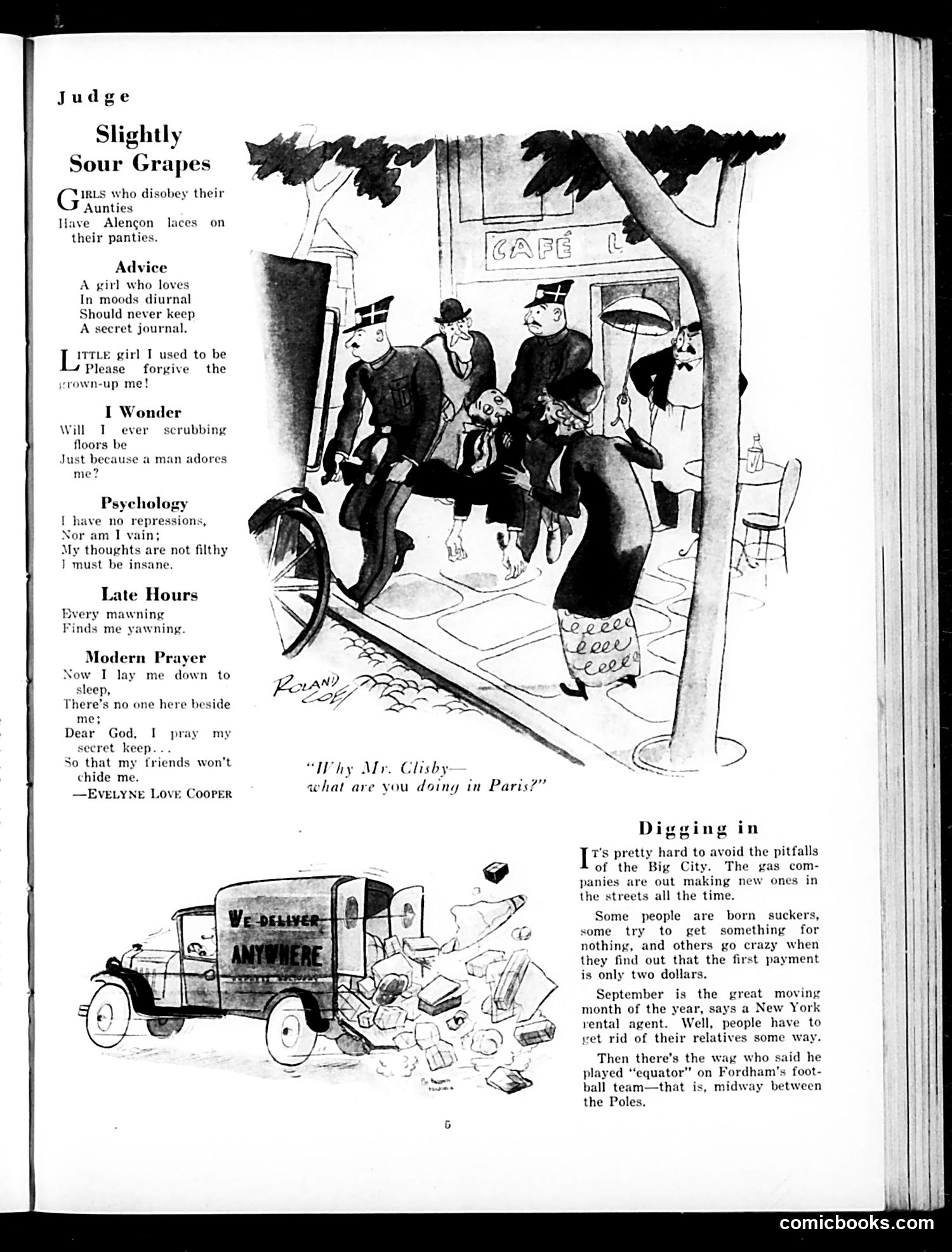
Analysis of Judge Magazine Page The page contains multiple humor pieces targeting women's behavior and modern life: "Slightly Sour Grapes" mocks girls who disobey aunts, suggesting they deserve punishment ("Alençon laces"). Several brief satirical poems (including one by Evelyn Love Cooper) humorously critique young women's psychology, secret journals, and dating anxieties—standard early 20th-century gender commentary. The main cartoon shows well-dressed men outside a Paris café encountering a woman in revealing dress. The caption "Why Mr. Clisby—what are you doing in Paris?" suggests infidelity or scandal—a common Judge theme mocking sexual hypocrisy. "Digging In" discusses urban moving season and housing costs, with a cartoon showing a delivery truck buried under household goods—satirizing the chaos of September relocations in New York City. The page reflects 1920s anxieties about women's independence, urban life, and moral propriety.
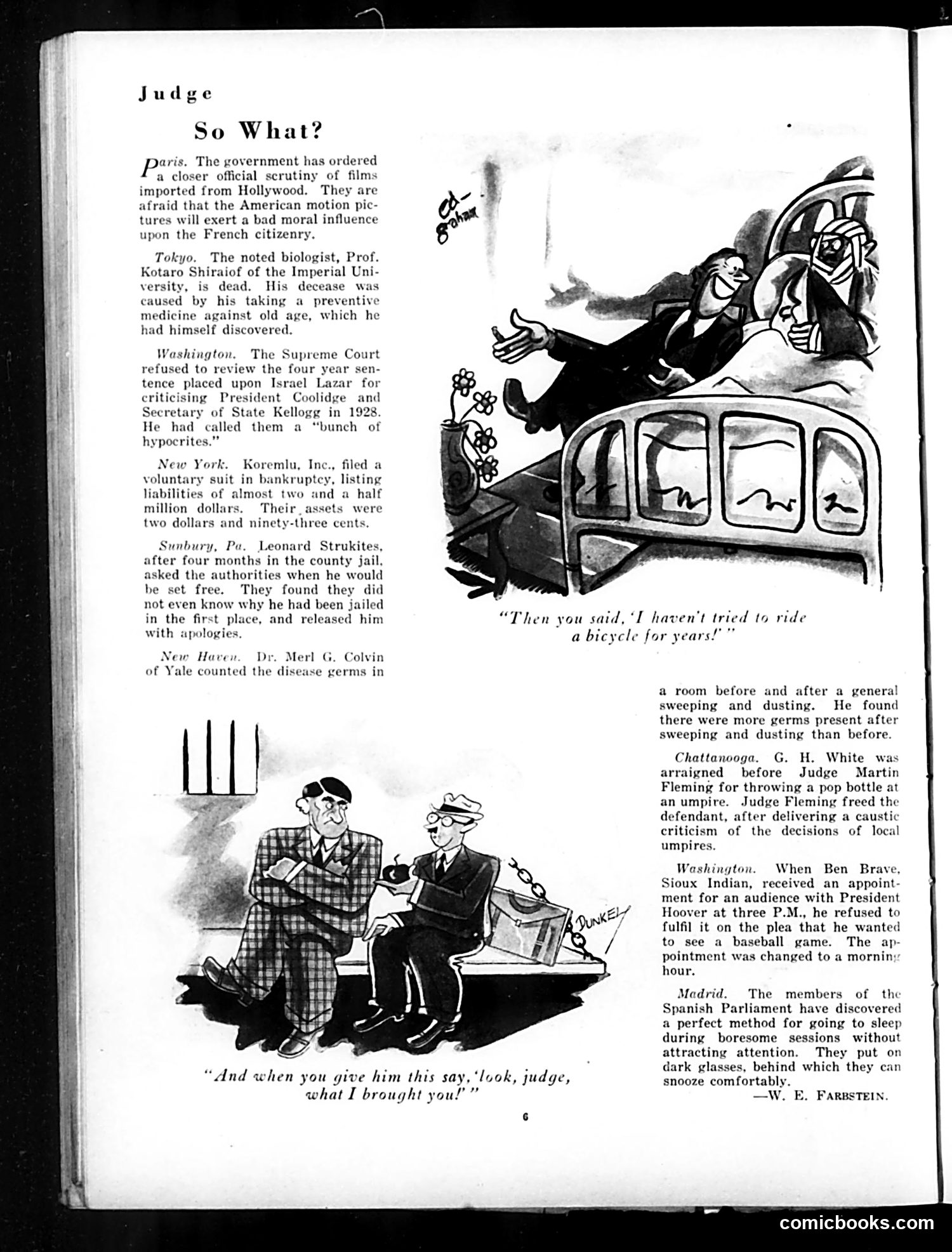
"So What?" — Judge Magazine Satire This page contains brief satirical news items with two accompanying cartoons. The top cartoon shows a man enthusiastically driving a car, captioned "Then you said, 'I haven't tried to ride a bicycle for years!'" — likely mocking someone bragging about past accomplishments before attempting something difficult and failing. The bottom cartoon depicts a judge with a prisoner, captioned "And when you give him this say, 'look, judge, what I brought you!'" — appearing to satirize either bribery attempts or the absurdity of gift-giving in legal proceedings. The "So What?" news briefs mock various institutions: the French government's film censorship concerns, a Yale scientist's findings about germs, and Spanish Parliament members secretly sleeping during sessions wearing dark glasses—all presented as humorous absurdities of contemporary life.
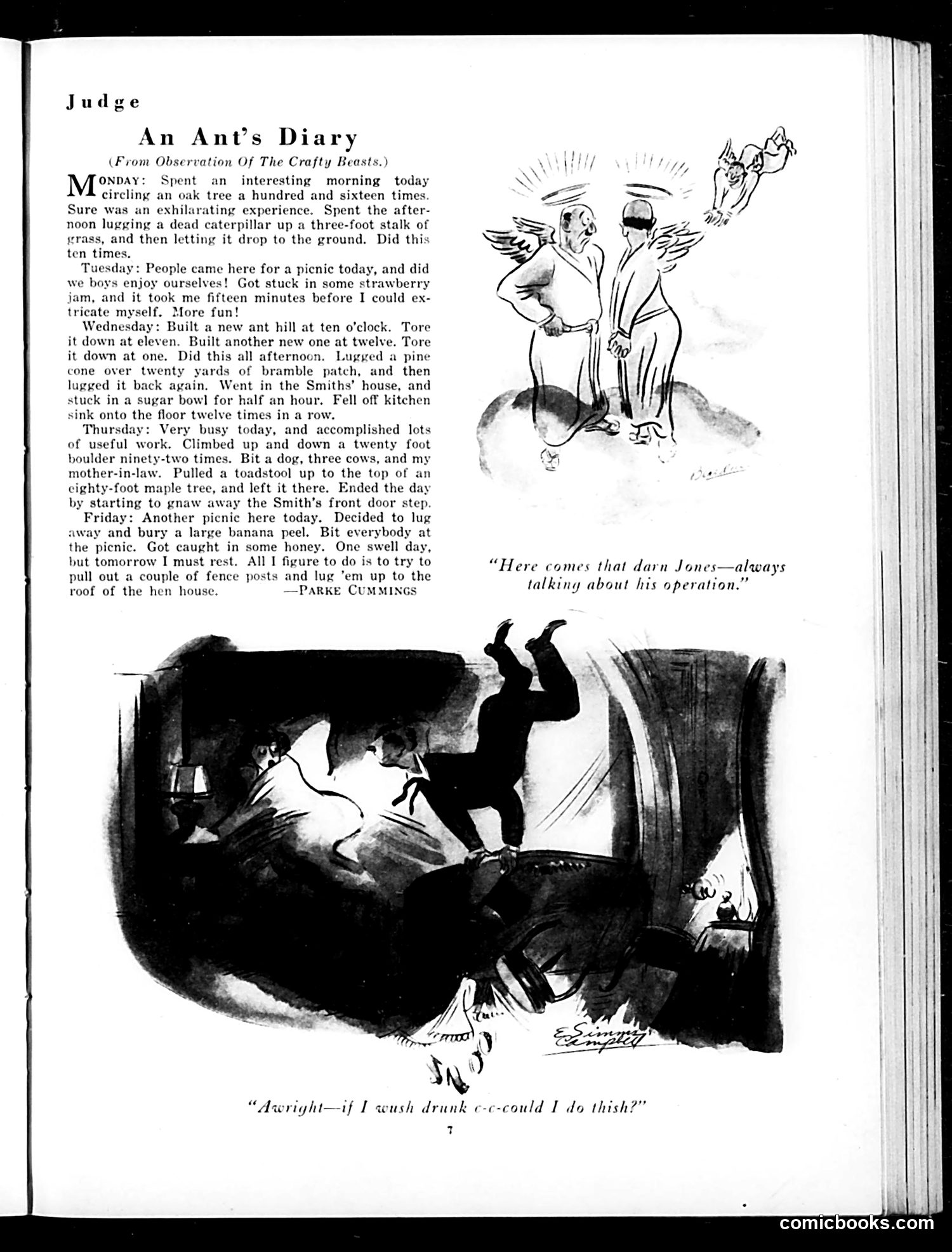
"An Ant's Diary" Explanation This is a humorous piece by Parke Cummings that satirizes the pointless, repetitive busy-ness of ant colonies. The diary format documents an ant's week of relentless, circular activity: circling trees 116 times, building and destroying hills repeatedly, hauling objects back and forth. The joke is that ants appear industrious but accomplish nothing meaningful—they're trapped in endless, purposeless cycles. The two cartoon panels below add social commentary unrelated to the diary. The top cartoon mocks people who constantly discuss their medical procedures ("talking about his operation"). The bottom cartoon depicts drunken behavior, capturing how intoxication undermines physical coordination and judgment—a man can barely perform an acrobatic feat while drunk. Together, these pieces gently satirize both the natural world's absurdity and human folly: ants are mindlessly busy; people are tediously self-absorbed; drunkenness reveals human limitations. The satire is gentle rather than biting.
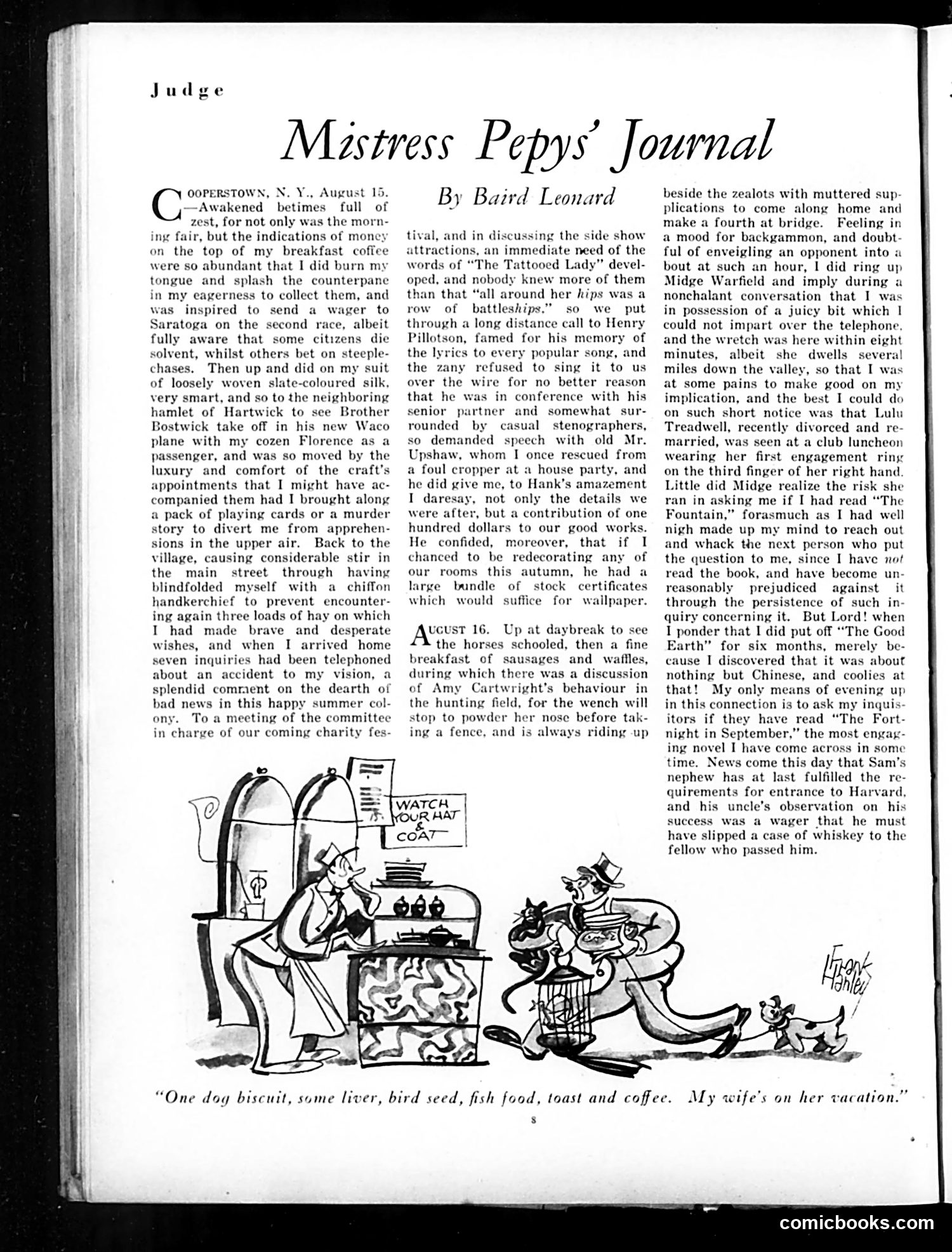
"Mistress Pepys' Journal" - Judge Magazine Satire This is a humorous society column by Baird Leonard, written in the style of Samuel Pepys's famous 17th-century diary but documenting 1920s upper-class leisure activities. The satire mocks wealthy summer-colony life in upstate New York (Cooperstown area). The jokes target: - Frivolous concerns: finding money in breakfast coffee, blindfolding herself with a handkerchief near hay wagons - Social pretension: gossiping about neighbors' behaviors (Amy Cartwright powdering her nose before fences) - Shallow entertainment: obsessing over trivial details like which finger someone's engagement ring is on - Wealth and boredom: the narrator manufacturing dramatic gossip to lure visitors The bottom cartoon depicts a man alone at home with pets while his wife vacations—showing he's reduced to feeding himself whatever's available. The satire suggests wealthy leisure society is simultaneously self-important and utterly trivial.
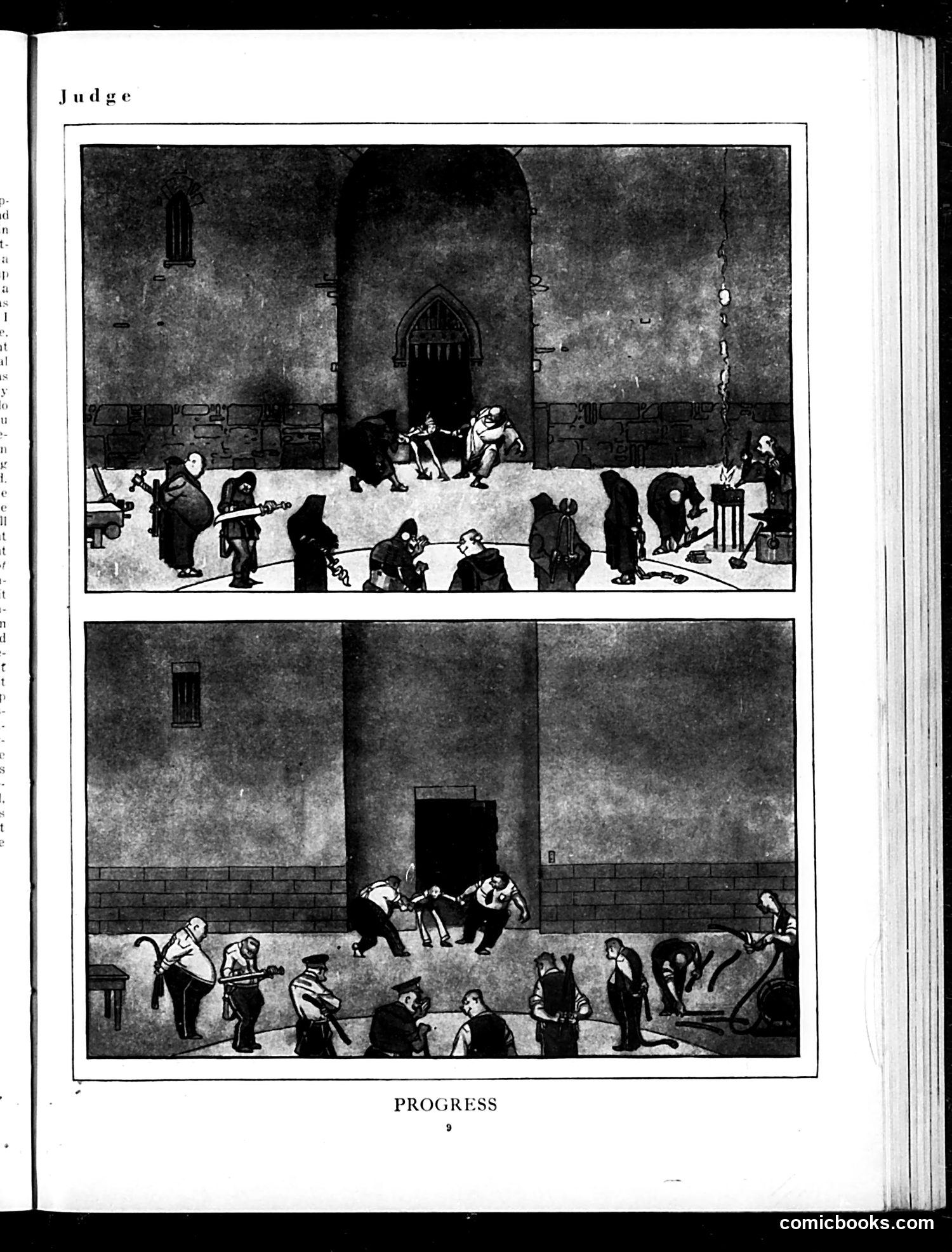
"Progress" - Judge Magazine Cartoon This two-panel cartoon titled "Progress" contrasts social conditions before and after, likely commenting on judicial or legal reform. Both panels depict courthouse or prison scenes with crowds of common people and officials. The top panel shows figures engaged in what appears to be chaotic or rough justice outside a stone building with a Gothic arch. The bottom panel depicts a similar scene, suggesting that despite claims of institutional "progress," the fundamental nature of how justice operates—or how the poor are treated by the system—remains essentially unchanged. The satire suggests that legal or governmental reforms are merely cosmetic, failing to genuinely improve conditions for ordinary citizens. Without a visible date, the specific historical context remains unclear, though the aesthetic suggests early-to-mid twentieth century.
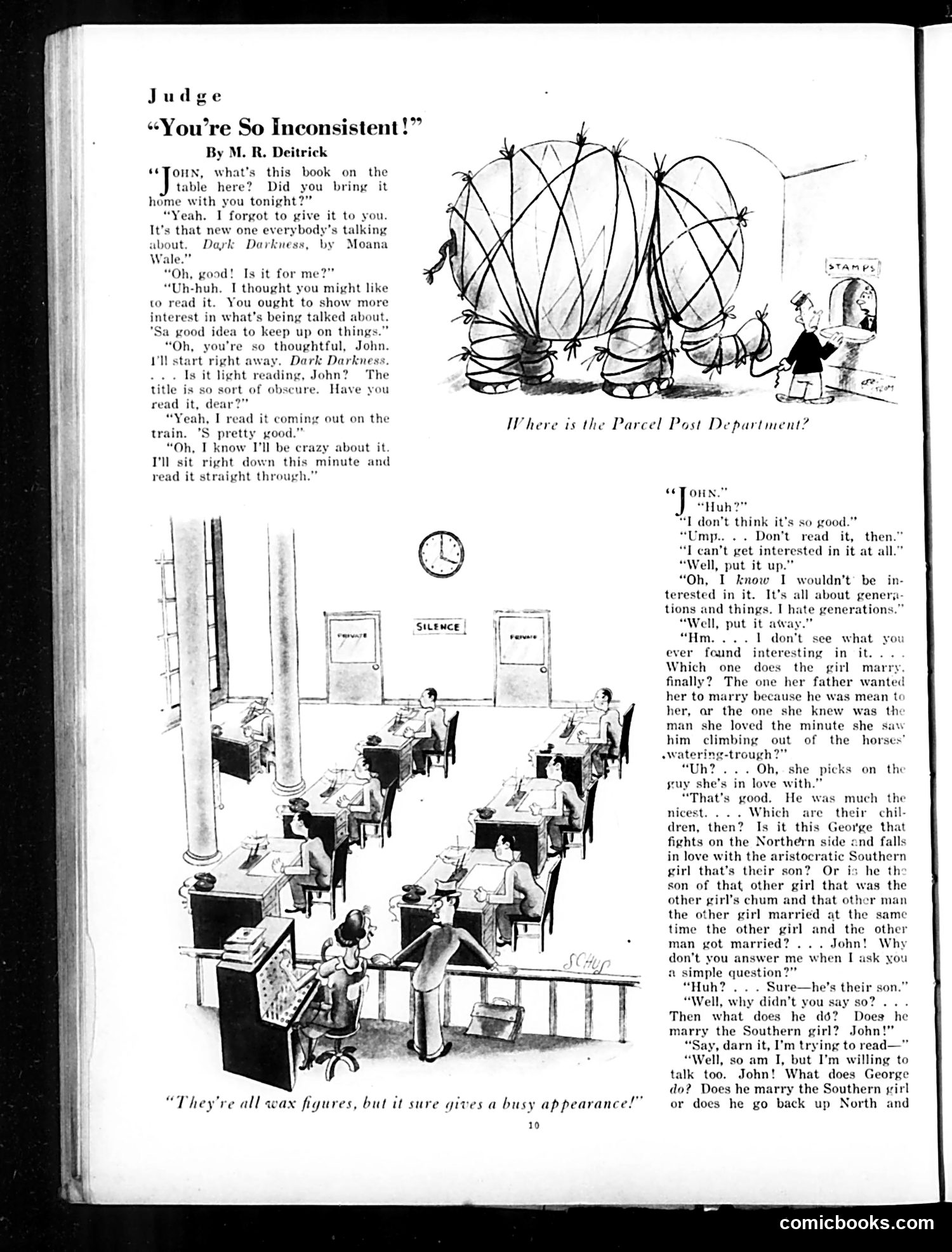
"You're So Inconsistent!" — A Satire on Reading Habits This two-part cartoon by M. R. Deitrick satirizes marital discord over reading and cultural pretense. The dialogue (top): A husband brings home a fashionable novel called *Dark Darkness* by "Moana Wale," claiming his wife should read it to stay culturally informed. She initially agrees enthusiastically but then admits she finds it boring and incomprehensible—yet demands he summarize the convoluted plot anyway, interrupting his attempts to actually read it. The bottom cartoon depicts a busy office of silent typists at desks, captioned "They're all wax figures, but it sure gives a busy appearance!"—suggesting mere performative activity without substance. The satire's point: Both cartoons mock social and domestic pretense—the wife wanting to *appear* cultured without engaging seriously with literature, and the office appearing productive while accomplishing nothing. The title "You're So Inconsistent!" underscores the hypocrisy of demanding cultural sophistication while displaying none.
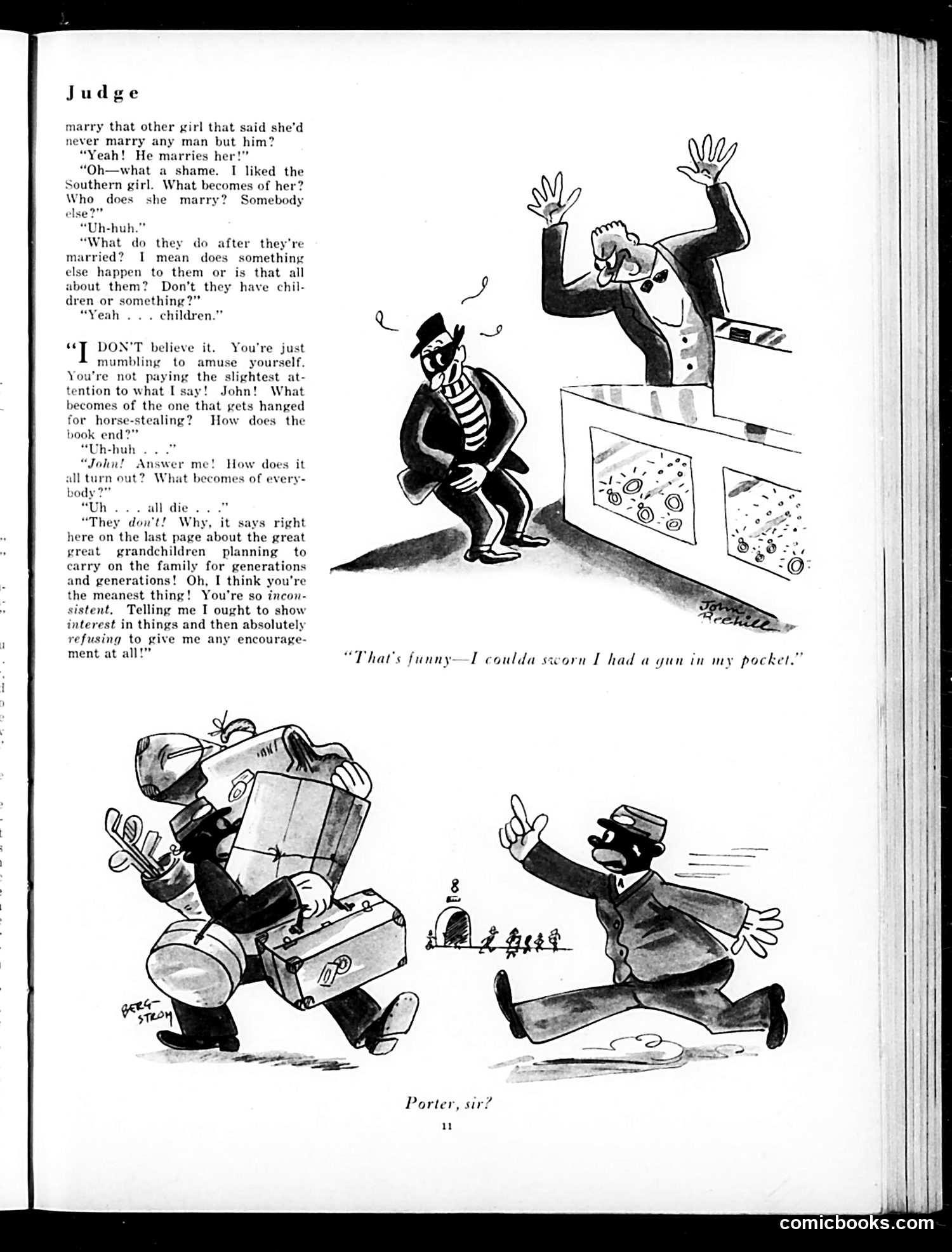
Judge Magazine Cartoon Analysis This page satirizes marital dynamics and spousal attention. The main dialogue shows a wife pestering her husband "John" about a story he's reading—demanding he engage with her questions about plot details (marriages, children, a horse-thief's hanging). John responds dismissively with monosyllables ("Uh-huh"), infuriating her. The wife accuses him of inconsistency: he claims she should take interest in things, yet refuses to encourage her by discussing what she cares about. Her complaint highlights the paradox of a disengaged husband. The accompanying cartoons illustrate the chaos of married life: one shows a man juggling luggage (domestic burdens); another depicts him fleeing or being chased (marital conflict). The caption "That's funny—I coulda sworn I had a gun in my pocket" is dark humor—the husband jokingly threatens to shoot himself rather than endure his wife's nagging, a common trope in early 20th-century comedy about matrimonial misery.
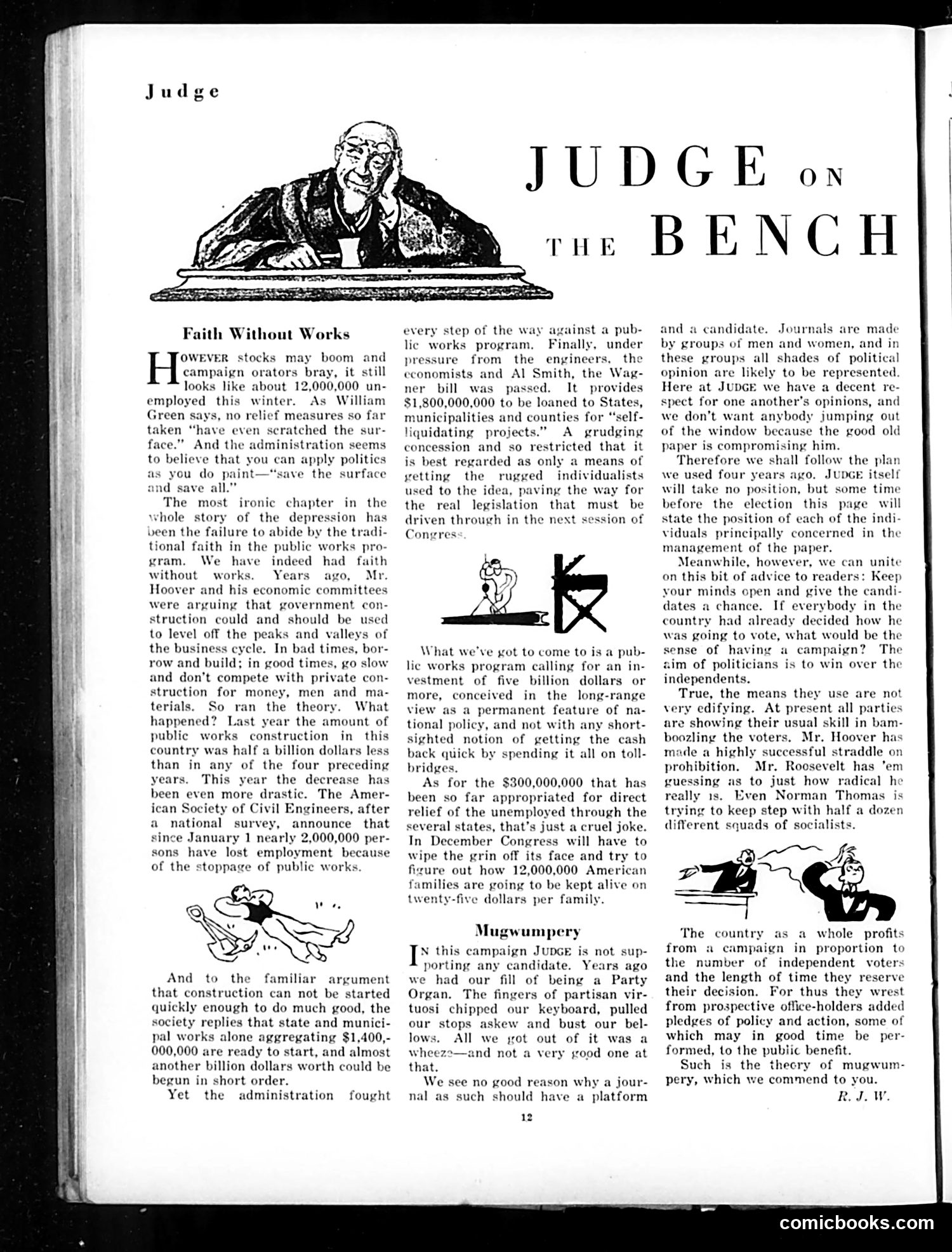
Judge Magazine Political Commentary Analysis This 1932 article criticizes President Hoover's insufficient response to Depression unemployment. The "Faith Without Works" essay attacks the administration for fighting public works programs while unemployment reached 12 million. Though Hoover eventually supported the Wagner bill ($1.8 billion in loans), the author deems it inadequate—arguing a genuine $5 billion permanent program is needed. The cartoons mock Hoover's failure: one depicts a judge figure presiding over economic disaster; another shows figures in distress, symbolizing the crisis. In "Mugwumpery," Judge declares editorial independence. The magazine refuses to endorse candidates, instead allowing individual staff members' positions to appear before elections. This critiques the politicization of media while maintaining journalistic credibility. The overall message: Hoover's timid measures fail desperate circumstances, and media should maintain independence from partisan pressure.
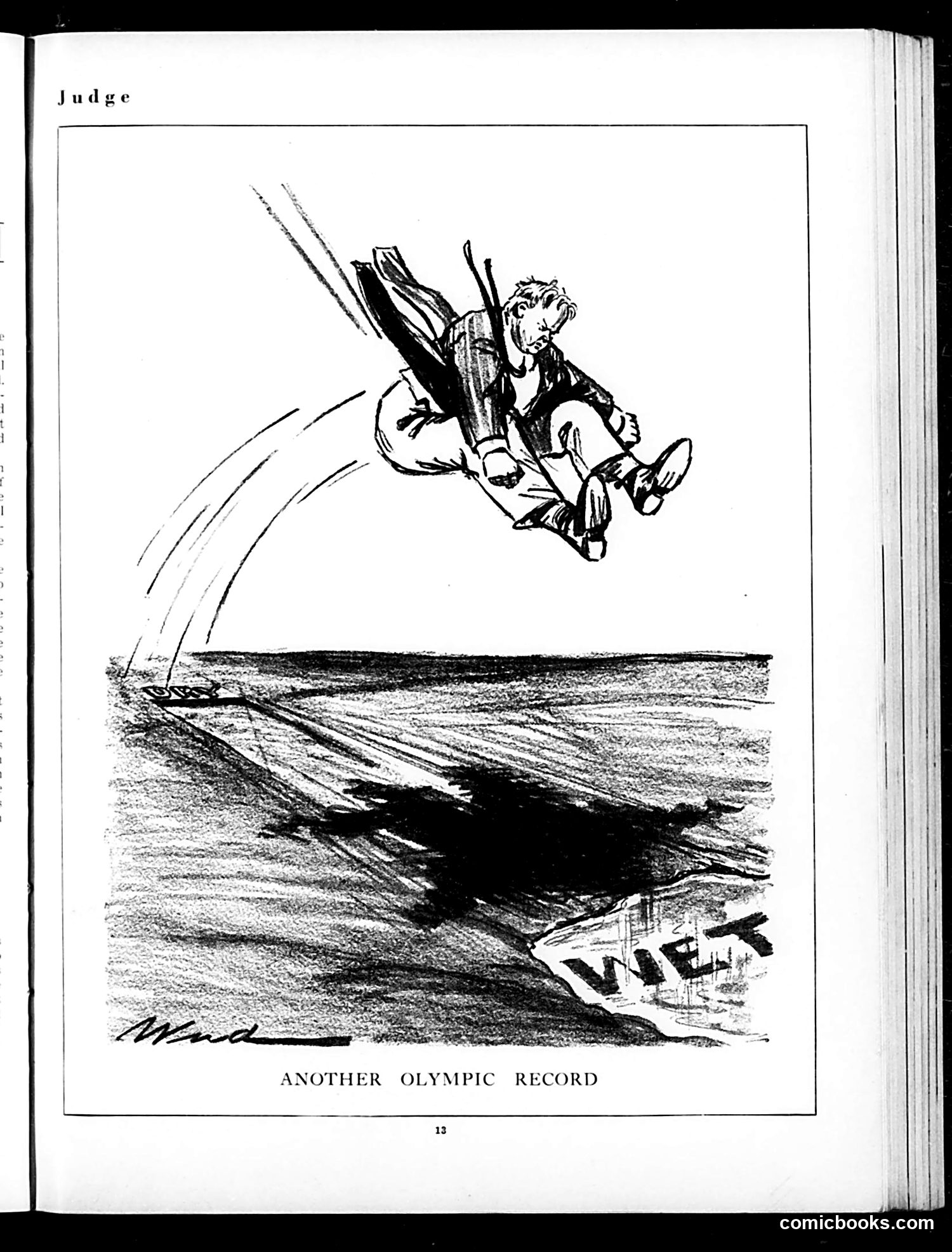
Cartoon Analysis This political cartoon titled "Another Olympic Record" depicts a figure being launched or catapulted through the air above turbulent water, with what appears to be a ship or vessel labeled "WET" in the lower right. The cartoon likely satirizes an Olympic athlete or public figure, using the "Olympic record" as a humorous reference. The violent trajectory and the water below suggest either a fall, expulsion, or dramatic failure—common metaphors in political cartooning for scandal or disgrace. Without additional context about Judge magazine's publication date or contemporary events, the specific identity of the figure and the exact political/social situation remain unclear. The "wet" reference might allude to humiliation or a fall from grace, but definitive interpretation requires knowing when this was published.
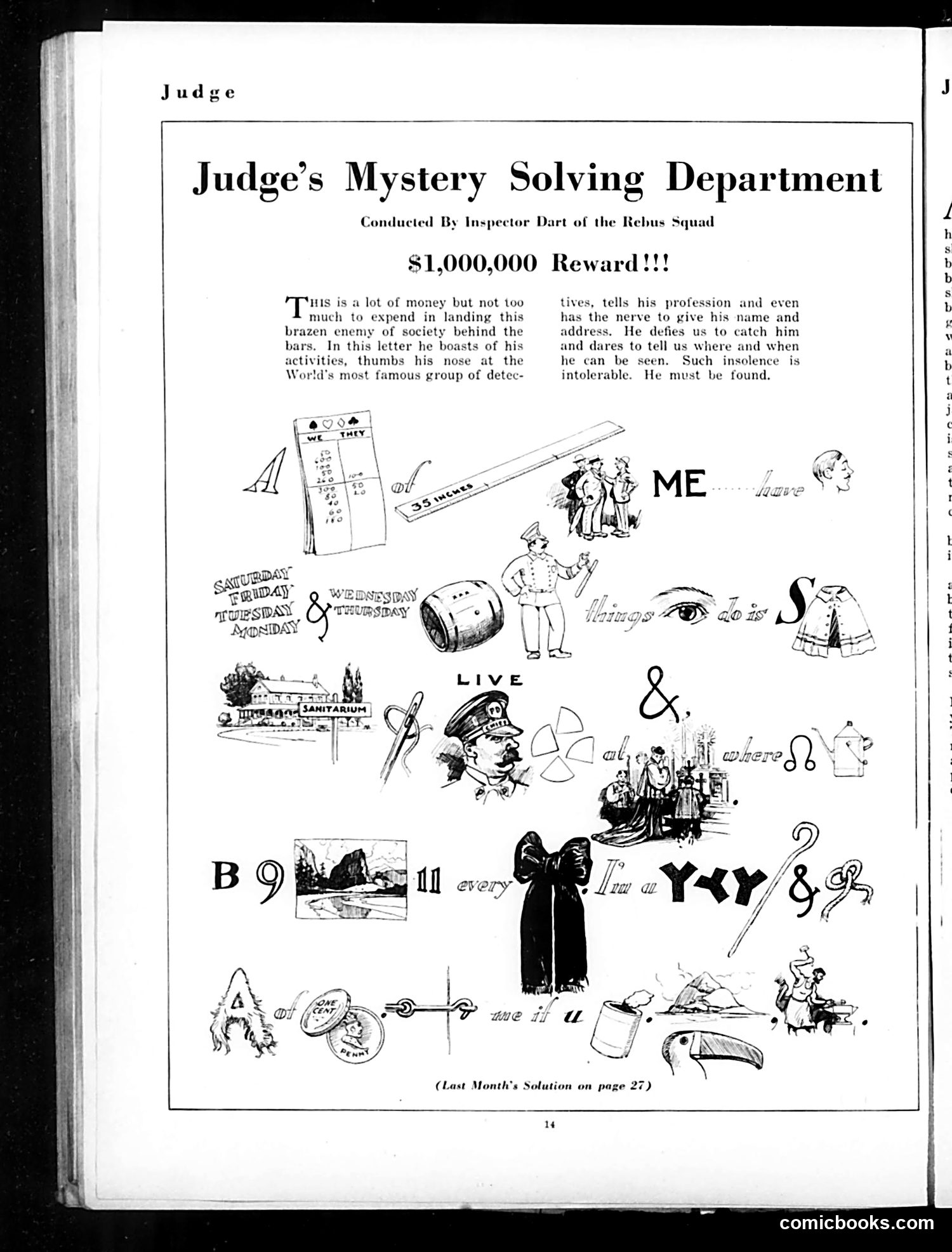
Judge's Mystery Solving Department This is a puzzle page from *Judge* magazine featuring "Inspector Dart of the Rebus Squad," a recurring feature that presents visual riddles for readers to solve. The format combines drawings, symbols, letters, and numbers that must be decoded to reveal a hidden message—apparently a criminal's boastful letter about evading the "World's most famous group of detectives." The puzzle uses rebus conventions popular in early 20th-century puzzle culture: a sailboat + playing card suit + measurements become phonetic clues; a sanitarium building, military officer, and various objects each represent words or sounds when combined. Readers compete to decode it, with a $1,000,000 reward offered humorously. This reflects the era's fascination with both detective fiction and participatory puzzle-solving entertainment.
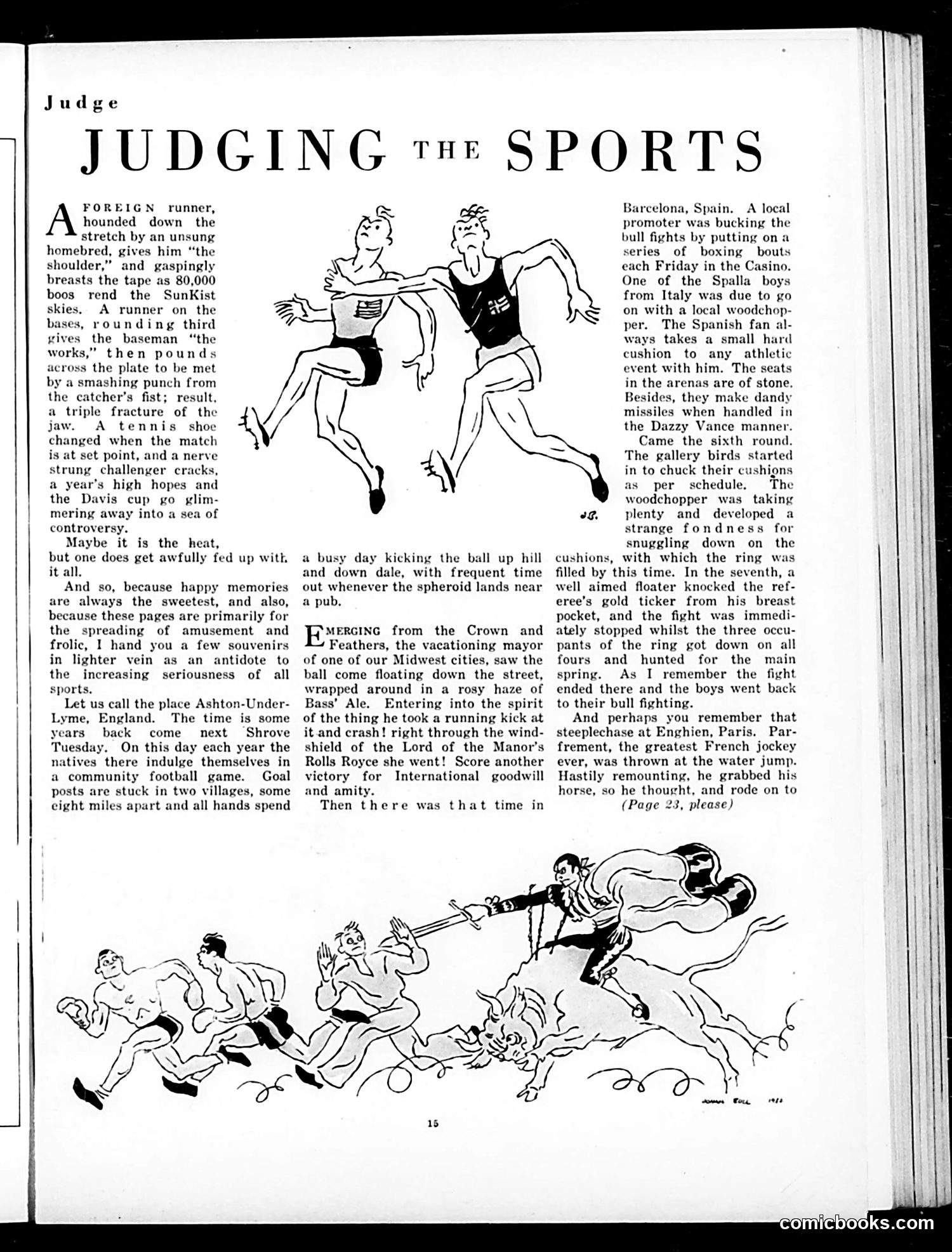
"Judging the Sports" - Judge Magazine Satire This humorous column mocks the absurdity and chaos of international sports through exaggerated anecdotes. The author catalogues ridiculous incidents: a foreign runner "shoulders" an American competitor; a baseman punches out a runner; tennis players crack under pressure; a Davis Cup is lost to controversy. The main satirical targets are absurd incidents involving sports tourists and cultural misunderstandings abroad. A vacationing American mayor, drunk on Bass Ale, kicks a soccer ball through a Rolls Royce during an English community game—a jab at American tourist behavior and diplomatic blunders. Spanish boxing fans throw stone cushions as "per schedule." A French jockey allegedly mounts the wrong horse after a fall. The satire critiques how sports—supposedly noble competitions—devolve into violence, cheating, drunkenness, and chaos. The recurring theme: international sporting events expose human folly rather than goodwill, contradicting the stated goal of "International goodwill and amity."
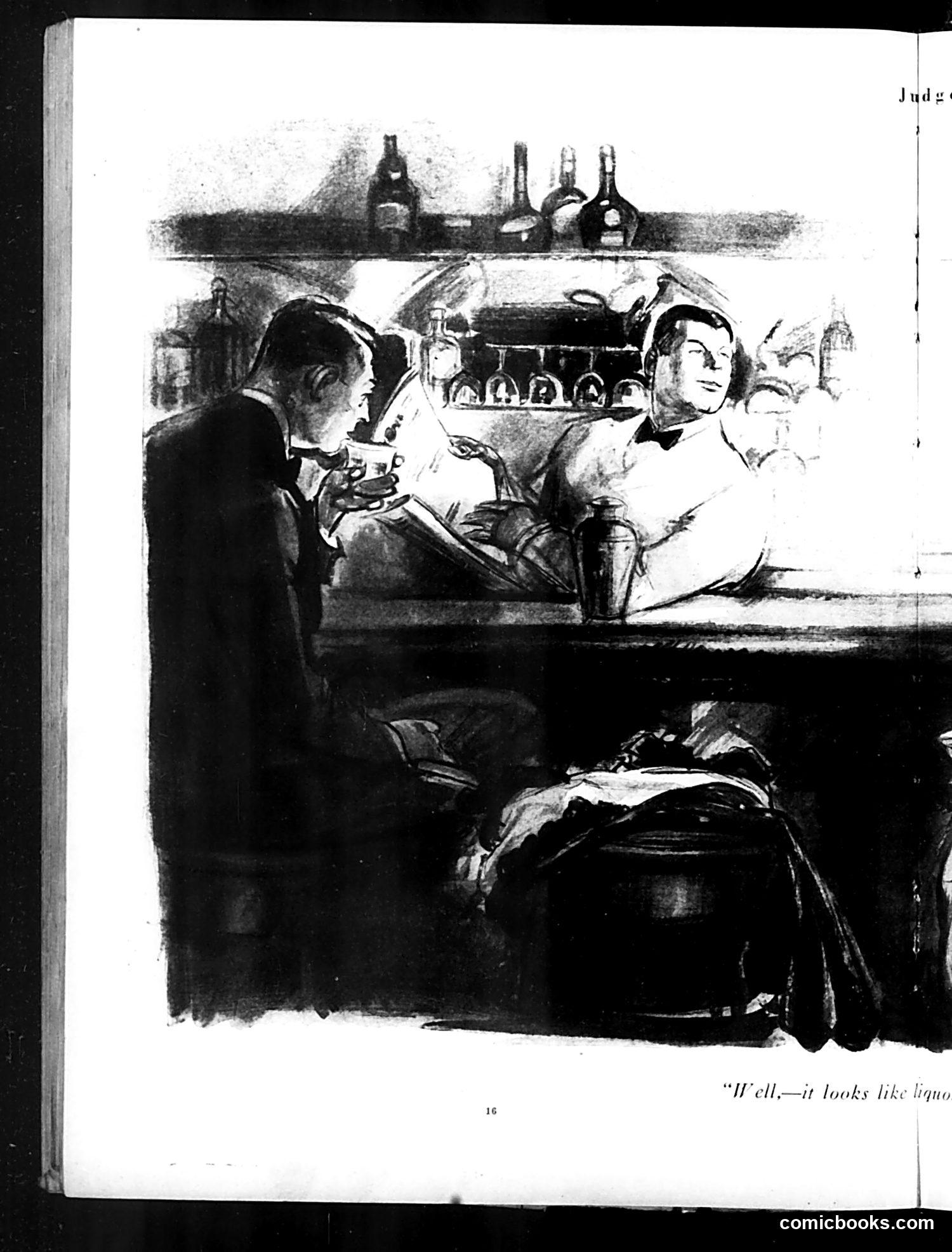
Analysis This appears to be a satirical illustration from Judge magazine depicting a bar or tavern scene. A well-dressed man on the left examines what appear to be bottles on a shelf above the bar, while figures on the right (including what looks like a bartender or server) observe him. The partially visible caption reads "Well—it looks like liquo[r]," suggesting commentary about alcohol or drinking establishments. Without a visible date or clearer context, the specific political or social reference remains unclear. However, given Judge's satirical nature, this likely comments on Prohibition-era concerns, alcohol quality/authenticity, or social attitudes toward drinking. The formal dress and bar setting suggest commentary on social class and alcohol consumption practices, though the exact target of the satire cannot be determined from this image alone.
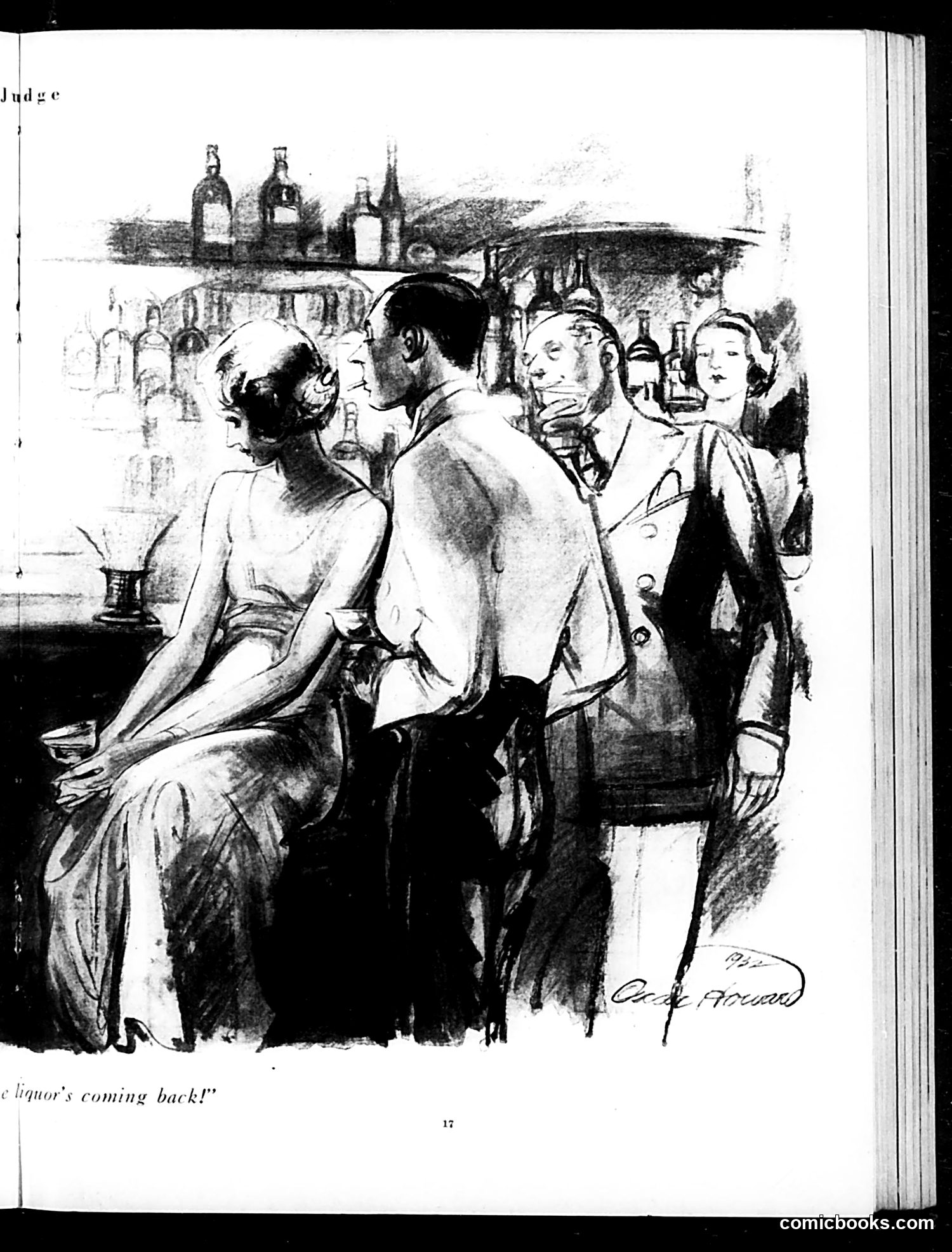
Analysis of Judge Magazine Cartoon This cartoon depicts a social scene at what appears to be a bar or liquor establishment. The caption reads "e liquor's coming back!" — a reference to Prohibition's repeal (1933). The sketch shows well-dressed patrons, including a woman in an evening gown seated prominently, interacting with men in formal attire. The background displays numerous bottles, emphasizing the alcohol theme. The satire likely mocks the social upheaval following Prohibition's end: the cartoon suggests changing social norms, particularly regarding women's public drinking and mixed-gender socializing in bars — previously considered scandalous. The fashionable dress and casual interaction reflect post-Prohibition society's shifting attitudes toward alcohol consumption and gender roles. The artist's signature appears at bottom right.
"The Theatre of George Jean Nathan" This is an essay—not a cartoon—by prominent theatre critic George Jean Nathan. Nathan reflects on the moral discomfort of his profession: he has spent decades harshly criticizing theatrical figures like producer M. Al Woods, impresario David Belasco, and actor-playwright Willard Mack, yet these men have responded with consistent grace, kindness, and professional courtesy. Nathan's point is that this gracious forbearance creates an awkward ethical predicament. It's easier to criticize someone who fights back; when critics face undeserved kindness from those they've attacked, they experience what Nathan calls "ignominy"—a sense of shame and dishonor. He argues this reveals something uncomfortable about criticism itself: that professional critics, despite their authority, are fundamentally human and vulnerable to guilt. The essay criticizes neither the theatre figures nor criticism generally, but rather explores the psychological burden critics bear when their targets respond with dignity.
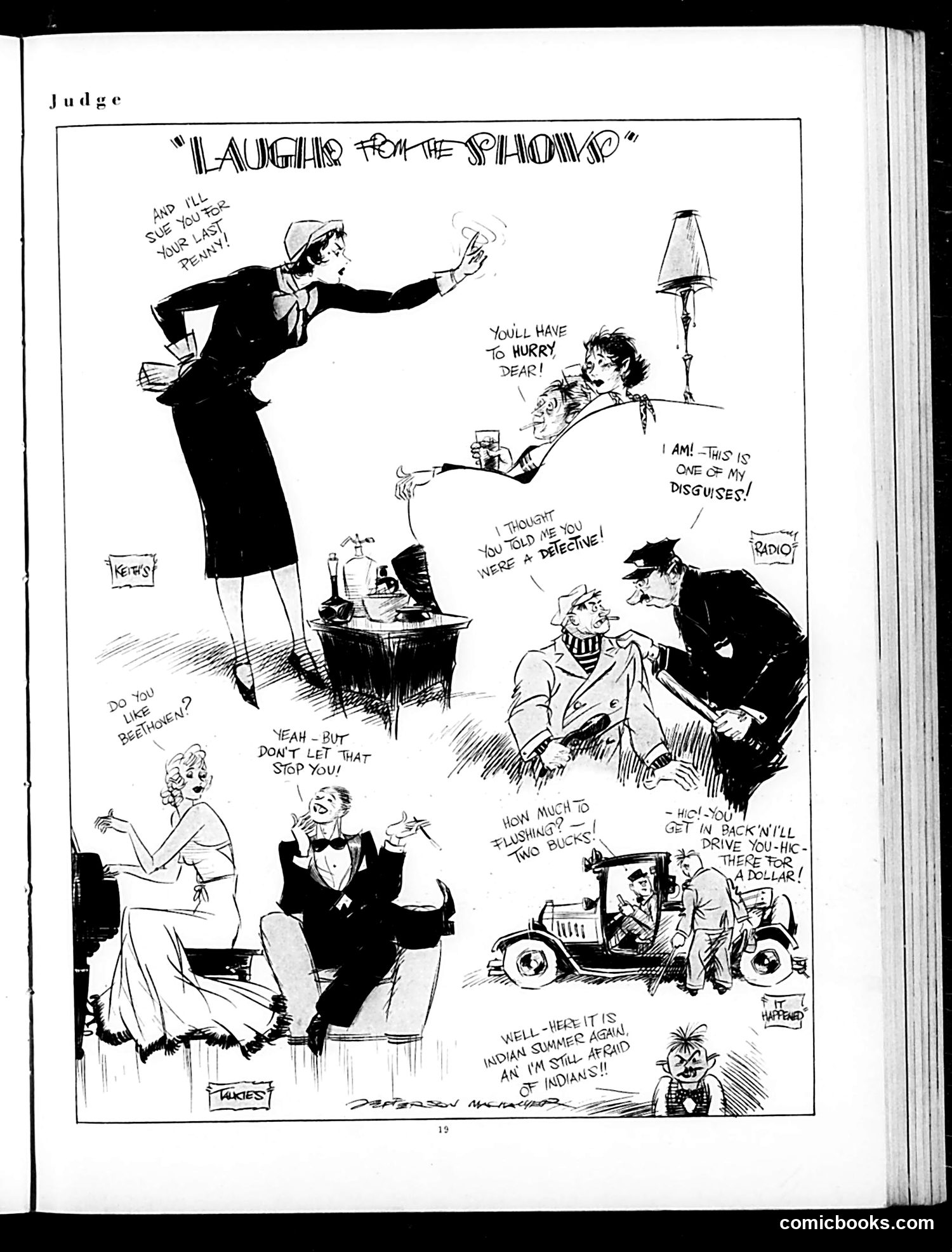
"Laugh For The Showd" - Judge Magazine Cartoon This single-panel satirical cartoon depicts various social scenarios involving disguise and deception. The title "Laugh For The Show" suggests performative pretense as its theme. The cartoon shows multiple vignettes: a woman in formal dress attempting to pass off a disguised figure; characters discussing being "a detective"; someone claiming a costume is "one of my disguises"; and notably, what appears to be a taxi scene with drunk patrons ("Hic!") negotiating a ride for a dollar. The overarching satire appears to mock social pretense and disguise—people assuming false identities or personas for various purposes (deception, entertainment, or economy). The repeated theme of "disguise" and the various characters in formal dress attempting to fool others suggests commentary on class pretension and the gap between appearance and reality in early 20th-century American society. The drunk taxi scene particularly emphasizes how alcohol loosens social propriety, adding another layer to the "performance" theme.
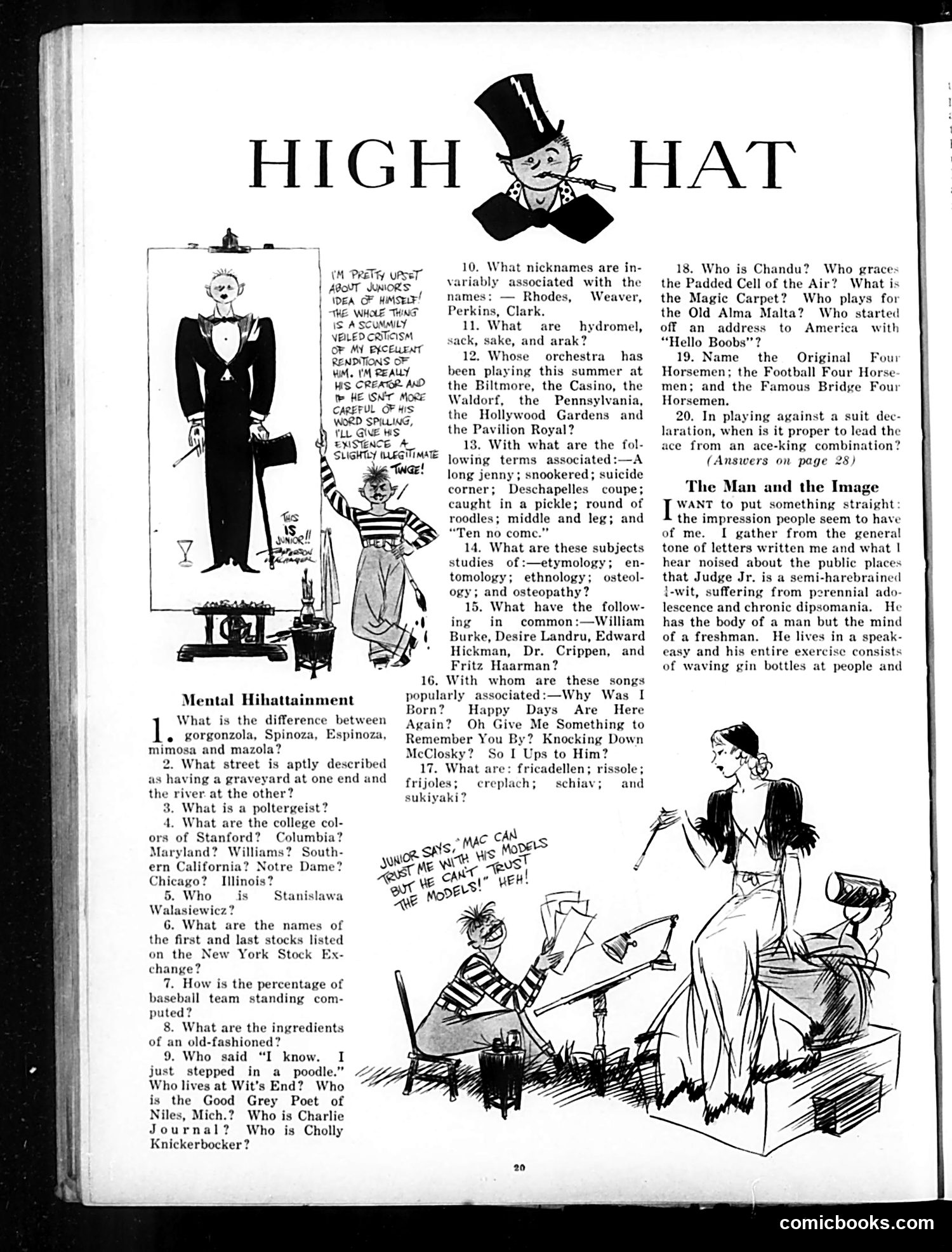
Analysis of Judge Magazine Page This page from the satirical magazine Judge contains two main elements: "Mental Hihattainment" is a trivia quiz featuring deliberately obscure and mixed-difficulty questions—from cheese types to college colors to Broadway songs—poking fun at the pretentious know-it-all reader. "The Man and the Image" is a tongue-in-cheek editorial defending the magazine's fictional character "Judge Jr." against public misconceptions. The author protests that readers stereotype him as a scatter-brained, perpetually drunk flapper-era youth who frequents speakeasies and waves gin bottles. The cartoon shows a woman photographing a man, visualizing this exaggerated stereotype. The satire works on two levels: mocking both the readers' assumptions about the magazine's persona *and* gently ribbing Jazz Age youth culture stereotypes—the "harebrained" drunk college kid archetype that dominated 1920s social commentary. The defense is self-aware and humorous rather than genuinely indignant.
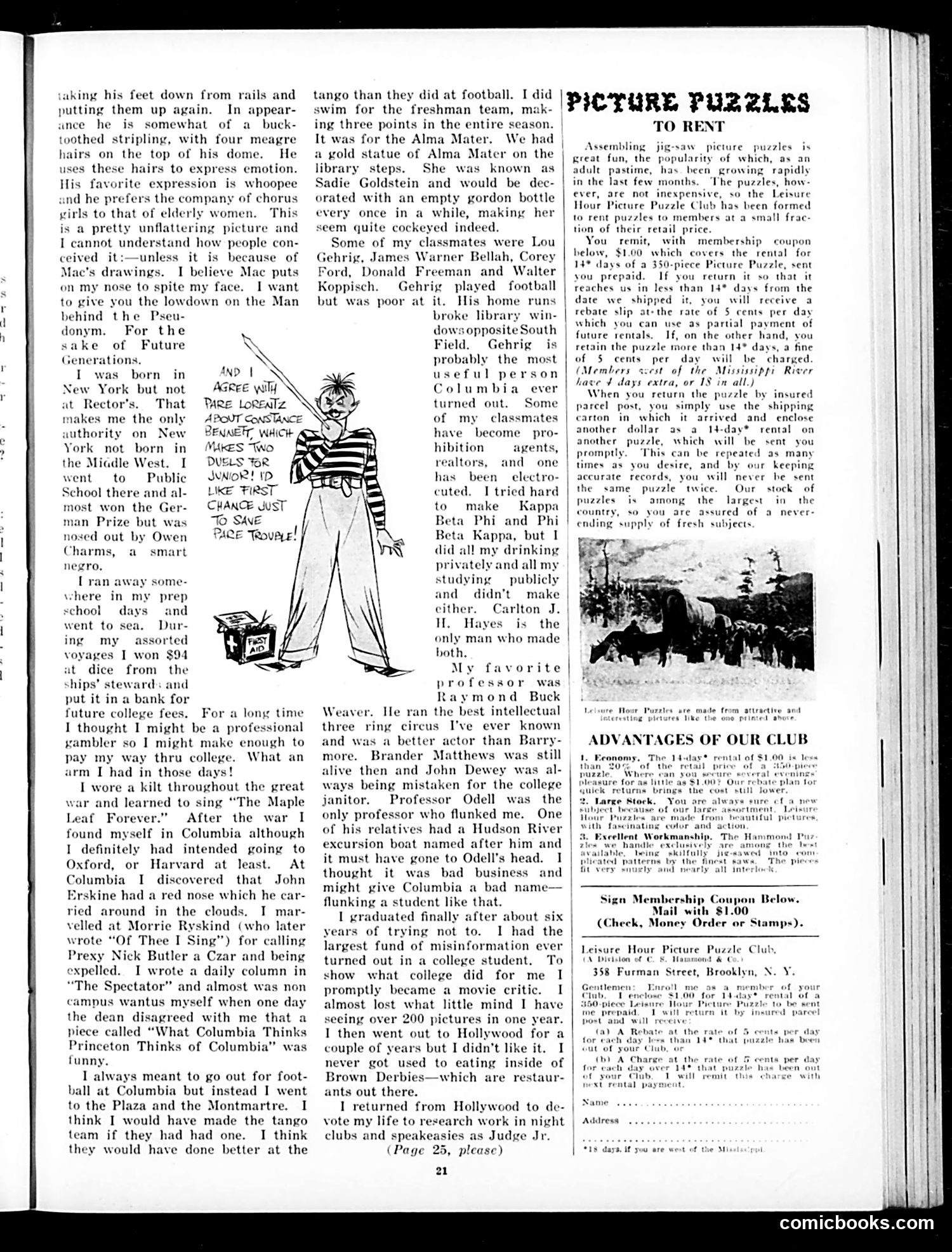
Analysis of Judge Magazine Page This page contains a humorous autobiographical essay by a Judge contributor, accompanied by a cartoon illustration and an advertisement for picture puzzle rentals. The Cartoon: Shows a caricatured young man in striped clothing with exaggerated buck teeth and sparse hair. Speech bubbles reference Constance Bennett (a 1920s-30s actress) and debate over "Junior," likely satirizing college students' obsession with Hollywood starlets and shallow social competition. The Essay: A self-deprecating account of the author's Columbia University years, name-dropping classmates Lou Gehrig (future baseball legend) and others. The humor derives from contrasting his intellectual pretensions with actual mediocrity—failing to make fraternity initiations, preferring nightclubs to studies, nearly expelled for satire. Social Context: Reflects 1930s college culture, Prohibition-era drinking, and the glamour surrounding Hollywood celebrities. The casual mention of someone being "electrocuted" reflects dark 1930s humor. The Advertisement: Promotes picture puzzle rentals—a Depression-era entertainment craze—with membership coupons. The piece satirizes pretentious yet ordinary college experiences.
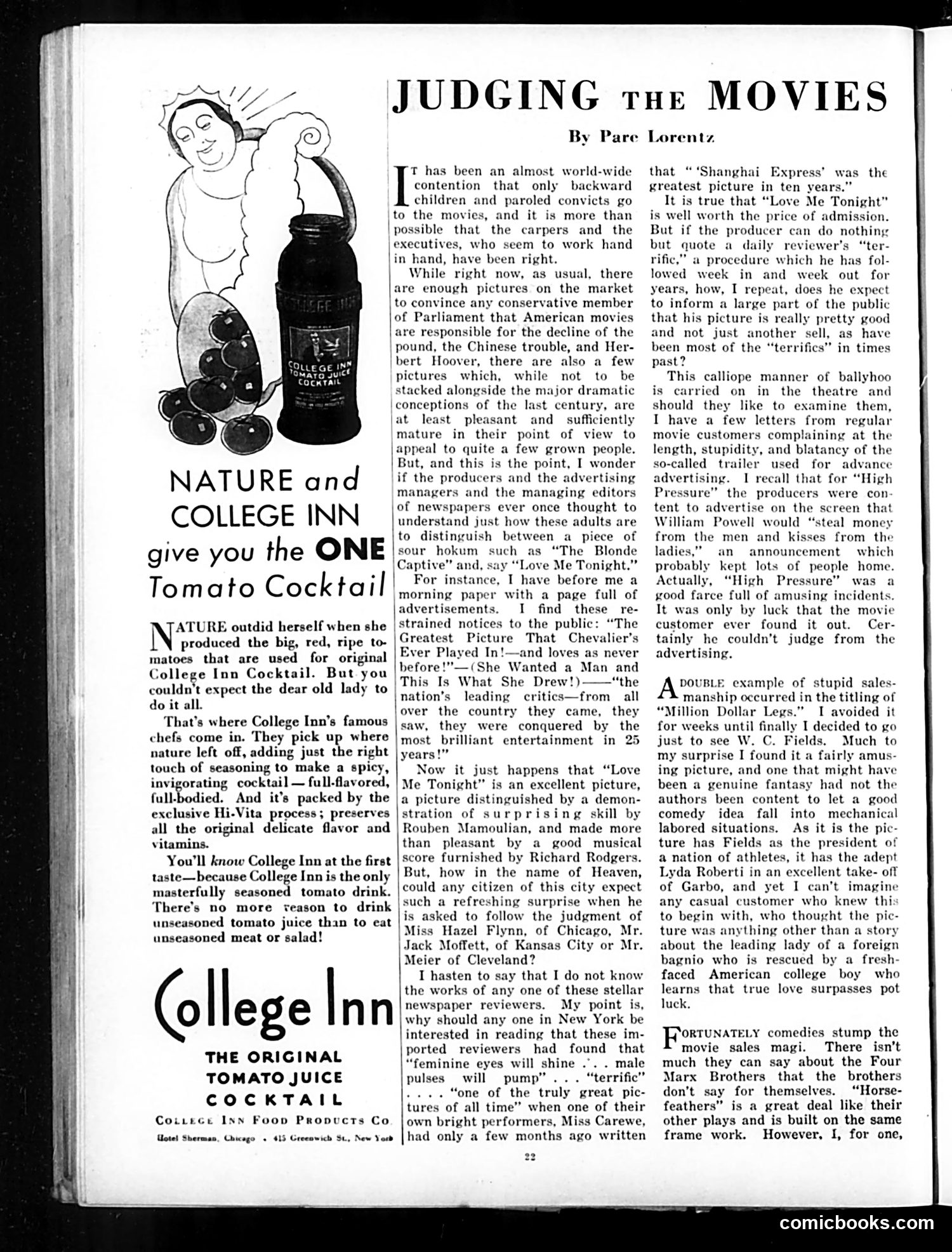
Analysis: "Judging the Movies" by Pare Lorentz This essay critiques deceptive movie advertising practices. Lorentz argues that film studios and newspapers mislead audiences by quoting sensationalized reviews from out-of-town critics (Miss Hazel Flynn of Chicago, Jack Moffett of Kansas City, Mr. Meier of Cleveland) rather than thoughtful analysis. His specific complaint: studios use hyperbolic praise like "Greatest Picture Ever Played In!" and "terrific" to advertise films, regardless of actual quality. While acknowledging "Love Me Tonight" genuinely deserves praise for director Rouben Mamoulian's skill and Rodgers' score, Lorentz argues audiences cannot distinguish good films from poor ones when bombarded with identical superlatives for everything. The satire targets both studios' cynical marketing and newspapers' role in amplifying exaggerated claims—practices that obscure legitimate critical judgment from ordinary moviegoers.
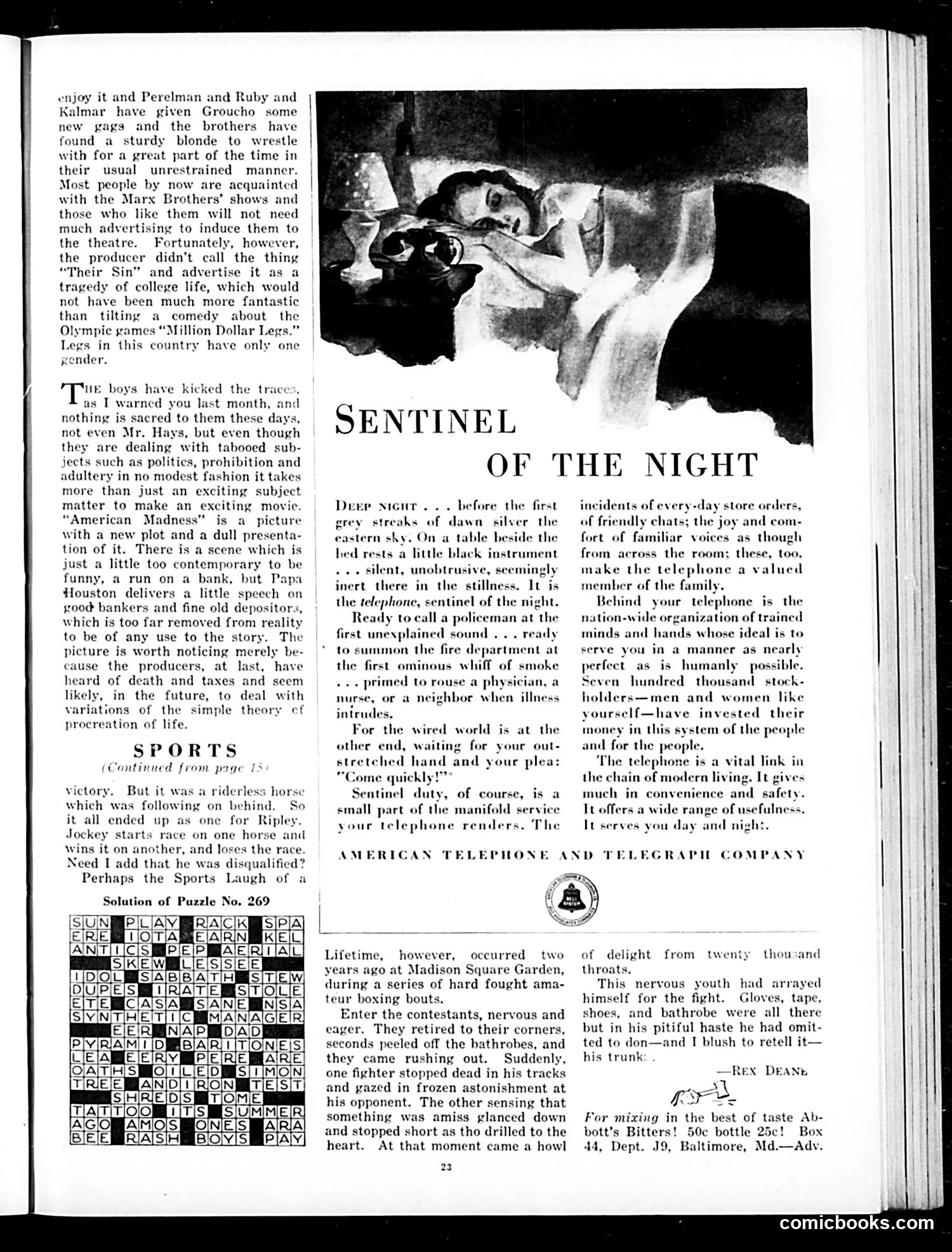
Analysis of This Judge Magazine Page This page contains film reviews and an advertisement rather than political cartoons. The "Sentinel of the Night" section is a full-page AT&T telephone advertisement, disguised as editorial content. It romanticizes the telephone as a nighttime guardian—ready to summon police, fire departments, doctors, and neighbors. This is corporate propaganda presenting the telephone monopoly as a benevolent service run by "700,000 stockholders" serving "the people." The text above discusses Marx Brothers films and other Hollywood movies, critiquing their plots and presentations. One review mockingly notes that calling a comedy "Million Dollar Legs" is absurd since women's legs are the only gender being referenced—a mild joke about 1930s film marketing and gender. A brief sports anecdote describes a boxing match where both fighters inexplicably stop, though the text cuts off before revealing the punchline. The page reflects 1930s media: entertainment reviews alongside corporate advertising presented as public information.
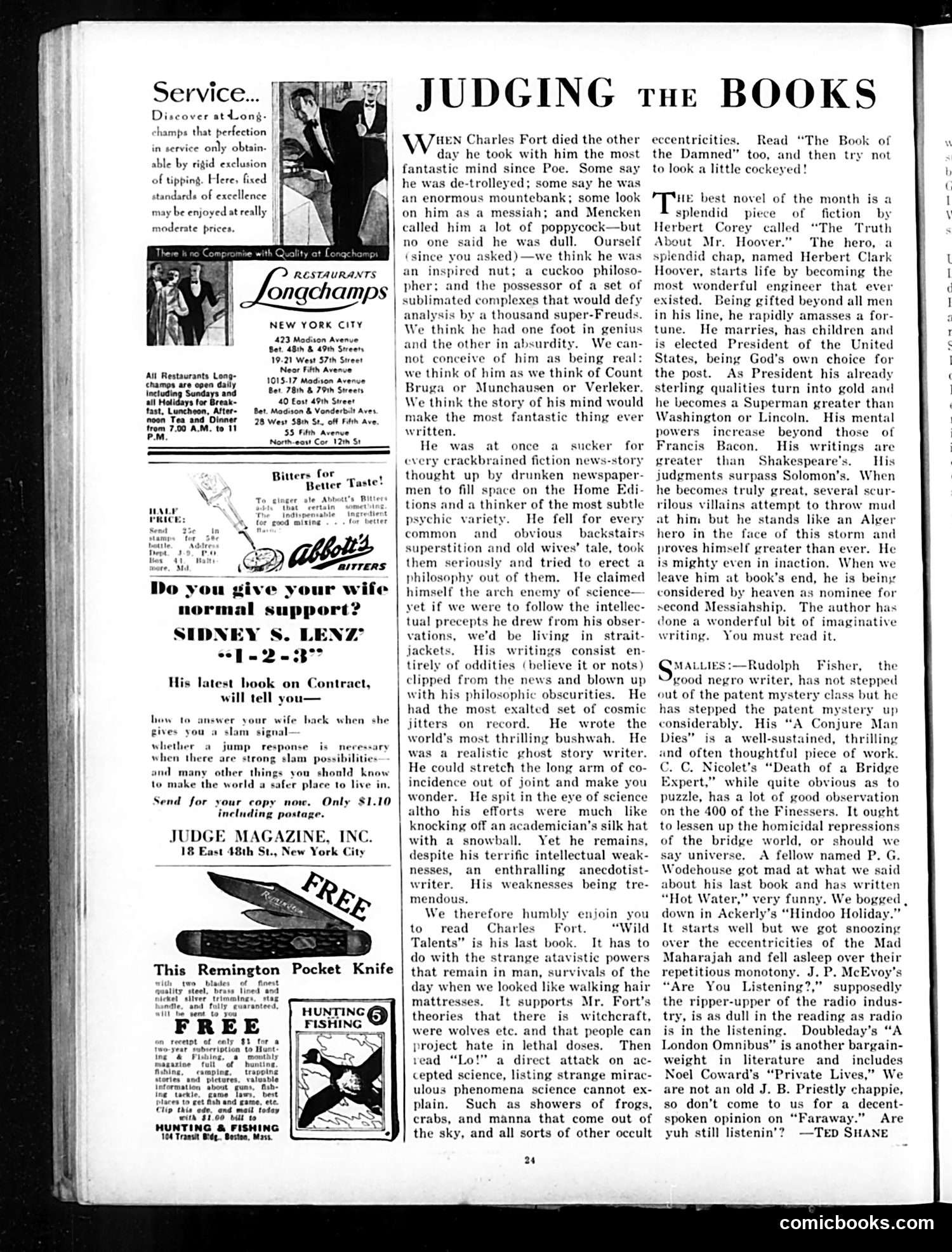
"Judging the Books" - Judge Magazine Book Review This page is primarily a book review column discussing Charles Fort, an eccentric writer and collector of anomalies who recently died. The reviewer characterizes Fort as a brilliantly contradictory figure: simultaneously a credulous believer in newspaper hoaxes and a sophisticated thinker; an enemy of science whose logic would require "living in strait-jackets"; a writer of compelling "bushwa" (nonsense) who paradoxically produces genuinely thrilling work. The satire lies in celebrating Fort's fundamental absurdity—his tendency to collect unexplained phenomena (raining frogs, witchcraft, supernatural powers) and construct elaborate pseudo-philosophical systems around them. The reviewer recommends Fort's books "*Wild Talents*" and "*The Book of the Damned*" while acknowledging readers will find them bewildering. The surrounding page contains typical Judge magazine advertising for restaurants, books, and consumer goods—standard period content with no apparent satirical intent.
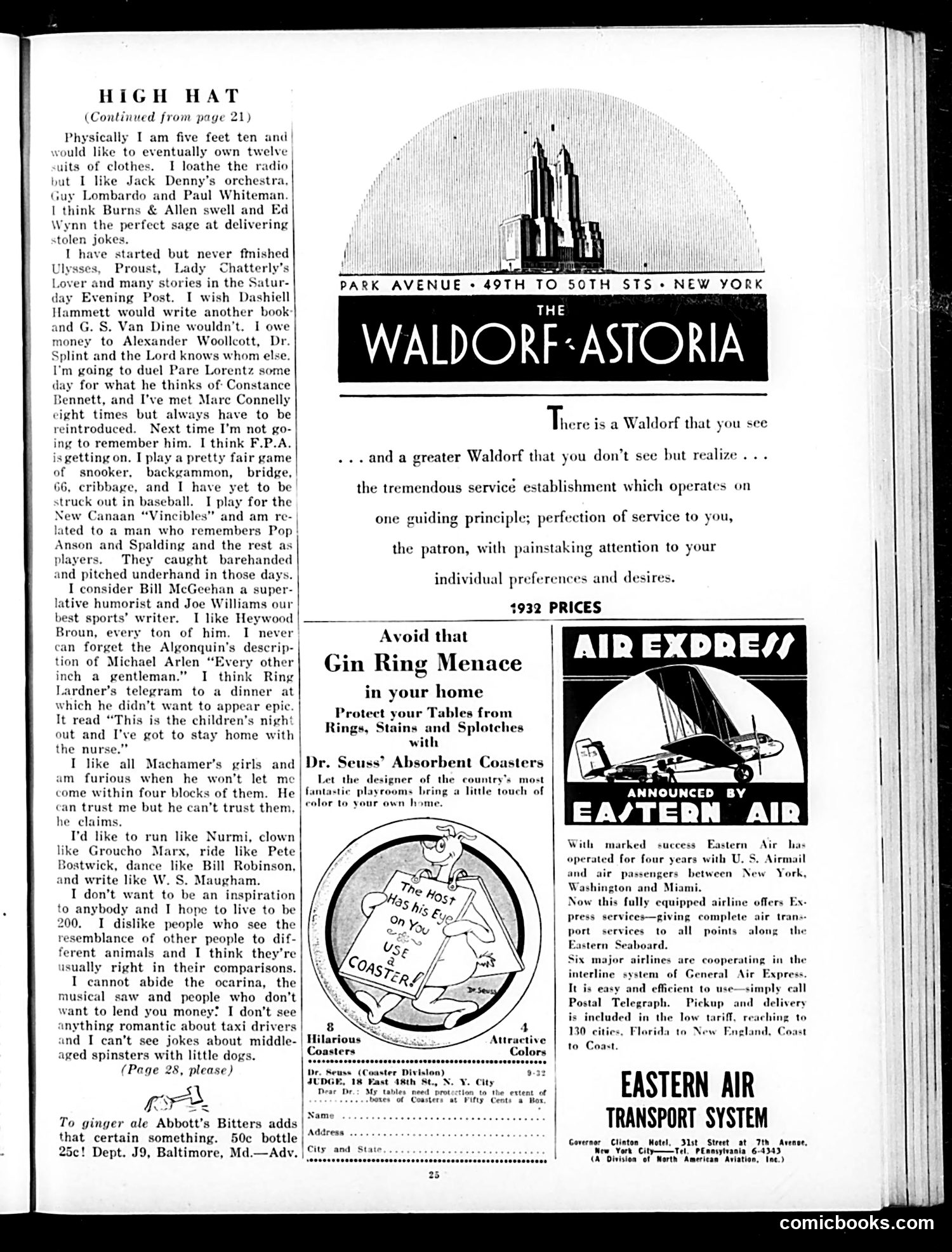
Analysis of This Judge Magazine Page (circa 1932) This page is primarily advertising and editorial content, not political satire. The main elements are: "High Hat" Column: A first-person piece listing the author's preferences and name-drops—praising entertainers like Jack Denny, Guy Lombardo, and Ed Wynn; literary figures like Dashiell Hammett; and humorists like Ring Lardner and Heywood Broun. It's social commentary on 1930s cultural taste among Manhattan's elite. Advertisements: - Waldorf-Astoria Hotel: Luxury hospitality ad emphasizing service excellence during Depression-era 1932. - Dr. Seuss Coasters: Protecting furniture from "gin ring menace"—satirizing Prohibition's end (1933) and cocktail culture. - Eastern Air Transport System: A new airline service advertisement. Context: This reflects 1930s upper-class Manhattan life—radio, Broadway, cocktails, and emerging air travel. The "gin ring menace" joke assumes readers recognize the recent legalization of alcohol and associated social anxieties about modern domesticity.
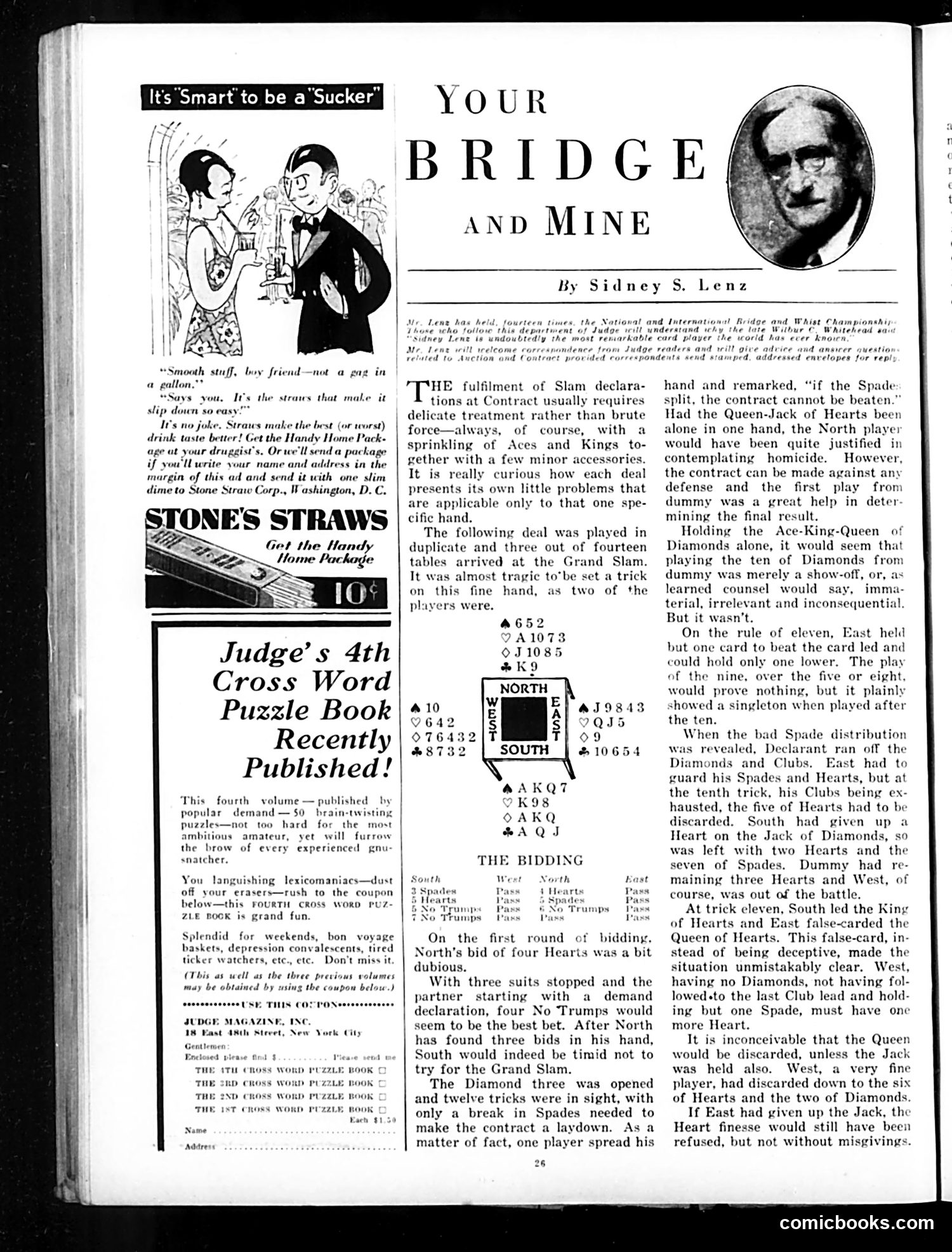
Explanation for Modern Readers This page combines bridge instruction with period advertisements and humor. The Main Cartoon ("It's Smart to be a 'Sucker'") appears to reference Prohibition-era drinking. A well-dressed man offers another a drink, saying "not a gag in a gallon"—meaning it contains no humor or deception, just quality liquor. The visual joke plays on the double meaning of "sucker" (both a foolish person and the candy), while the accompanying ad for Stone Straws suggests using straws to consume drinks discreetly during Prohibition. The Bridge Article by Sidney S. Lenz (a famous bridge champion noted in the text) demonstrates a complex card game scenario. It's educational content typical of Judge magazine, which mixed satire with instructional material. The Advertising for Judge's Crossword Puzzle Book and Stone Straws represent typical 1920s-30s consumer marketing, emphasizing leisure activities (puzzles, drinking) and modern conveniences (home delivery). The page reflects an era when satirical magazines functioned as entertainment combining humor, instruction, and advertising for middle-class readers.
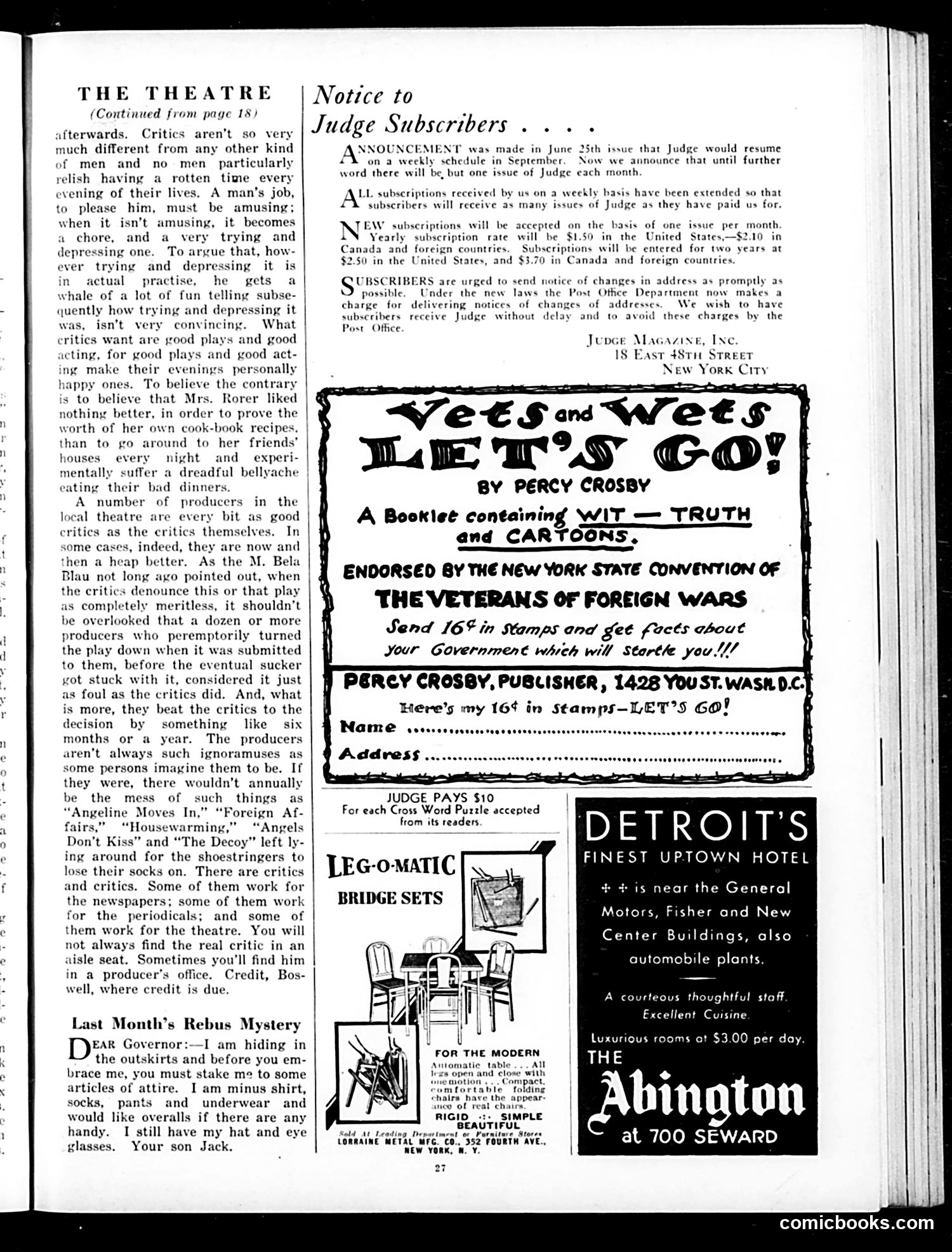
Analysis of Judge Magazine Page This page is primarily theatrical criticism and advertising rather than political satire. The main content discusses theater critics and producers, arguing they share more common ground than assumed—both ultimately want good plays and good acting. The notable satirical element is a rebus mystery (a visual word puzzle) at bottom left: a reader claims to be hiding "in the outskirts" needing clothes (shirt, socks, pants, underware, overalls) while keeping his hat and eyeglasses. This is a playful riddle for readers to solve. The advertisements include Percy Crosby's "Vets and Wets" booklet, endorsed by the New York State Convention of Veterans of Foreign Wars, promoting "wit, truth and cartoons" about government—likely Cold War-era patriotic content. The Leg-O-Matic bridge set and Detroit/Abington hotel ads are standard period commercial notices. The page reflects 1920s-era magazine culture: theater discussion, reader puzzles, and patriotic veteran-themed promotion.
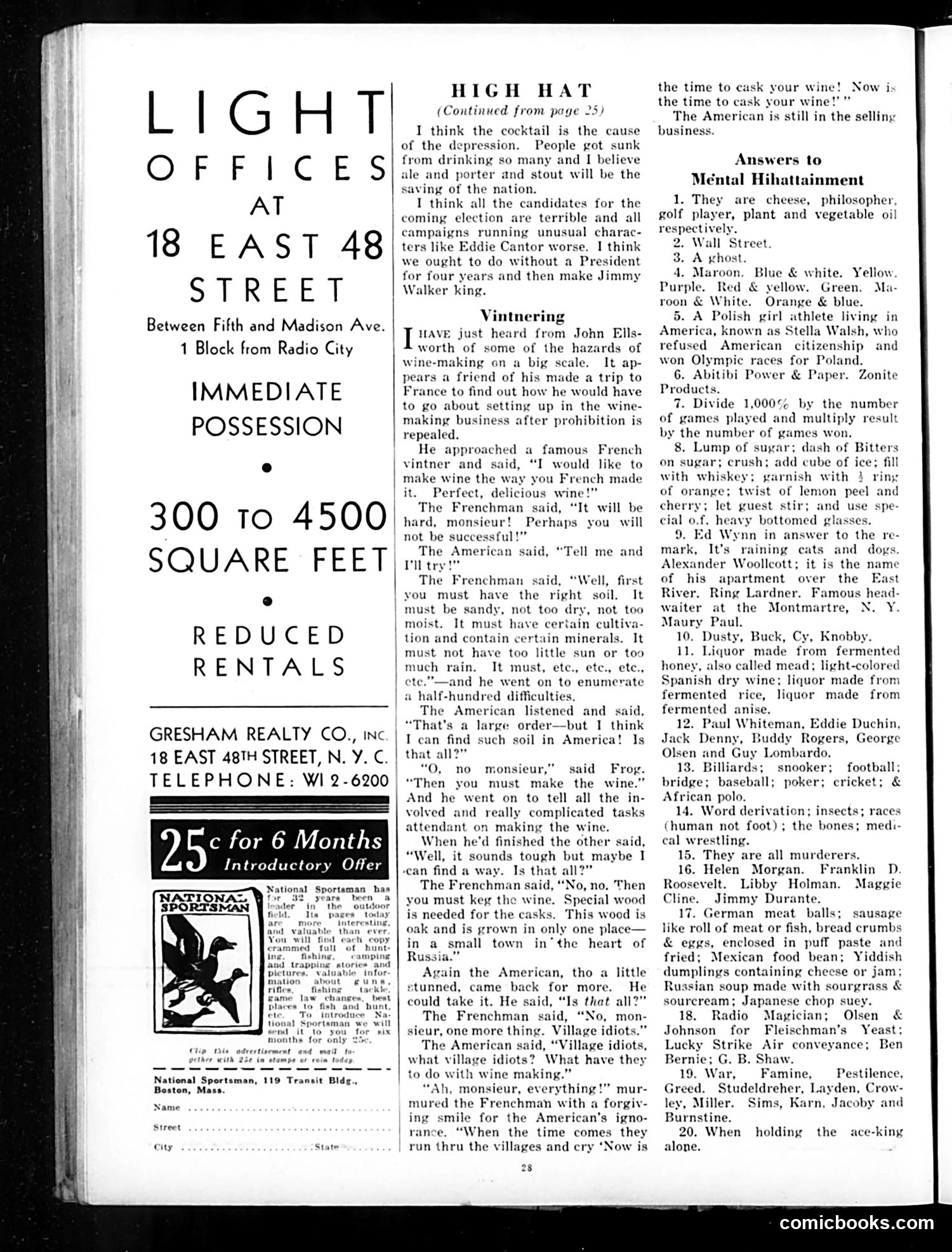
Content Analysis This page is primarily advertising and puzzle answers, not political satire or cartooning. The main content is a continuation of "High Hat," a humorous essay about Prohibition's repeal. The satire here is social commentary rather than political cartooning: it mocks American ignorance through a joke about an American businessman visiting France to learn winemaking. The Frenchman elaborates on soil conditions, fermentation techniques, and oak cask requirements—all crucial details—before revealing the punchline: the French villages have "village idiots" who run through town shouting "Now is the time to cask your wine!" mocking American salesmanship tactics. The page also contains "Answers to Mental Hithattainment" (likely a puzzle feature), identifying figures like Alexander Woollcott and Ring Lardner, and references to Stella Walsh, a Polish-American athlete. The advertisements are for office space and National Sportsman magazine subscriptions. No cartoons are visible on this page.
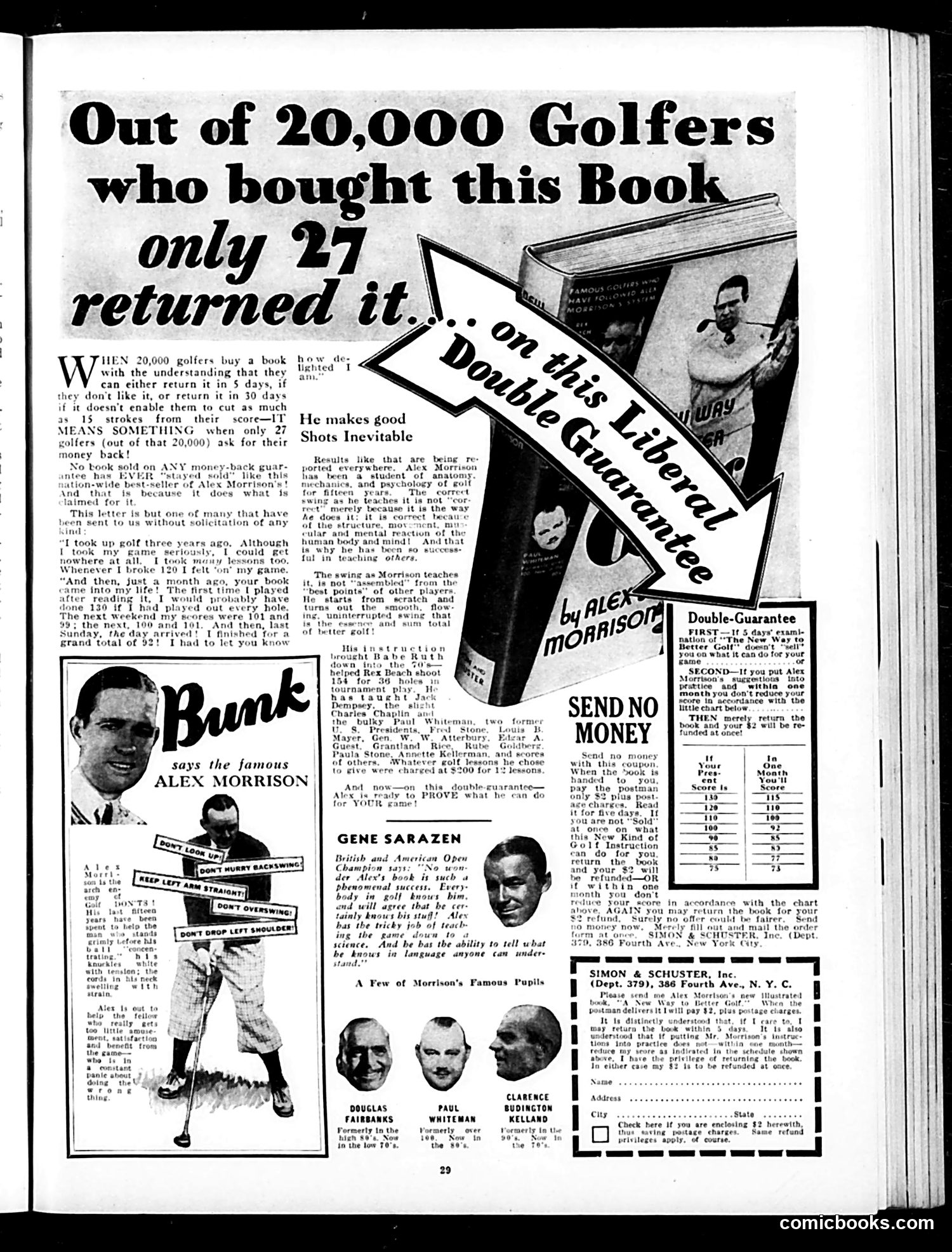
Analysis of This Judge Magazine Advertisement Page This page is primarily a book advertisement, not a political cartoon. It promotes Alex Morrison's golf instruction book using testimonial marketing. The ad's central claim: of 20,000 golfers who purchased the book with a money-back guarantee, only 27 returned it—positioning this as proof of the book's effectiveness. Featured endorsers include: - Alex Morrison himself (the golf instructor/author) - Gene Sarazen (British and American Open Champion) - Celebrity pupils: Douglas Fairbanks, Paul Whiteman, and Clarence Budington Kelland The sales pitch: The "Double Guarantee" promises buyers can return the book if it doesn't reduce their golf score within 5-30 days, requiring no upfront payment. A testimonial letter describes a golfer improving from 130+ strokes to 92. Historical context: This appears to be mid-1920s-1930s advertising, when celebrity endorsements and "scientific" self-improvement books were booming. The ad exploits emerging mass-marketing techniques and aspirational celebrity culture rather than containing political satire.
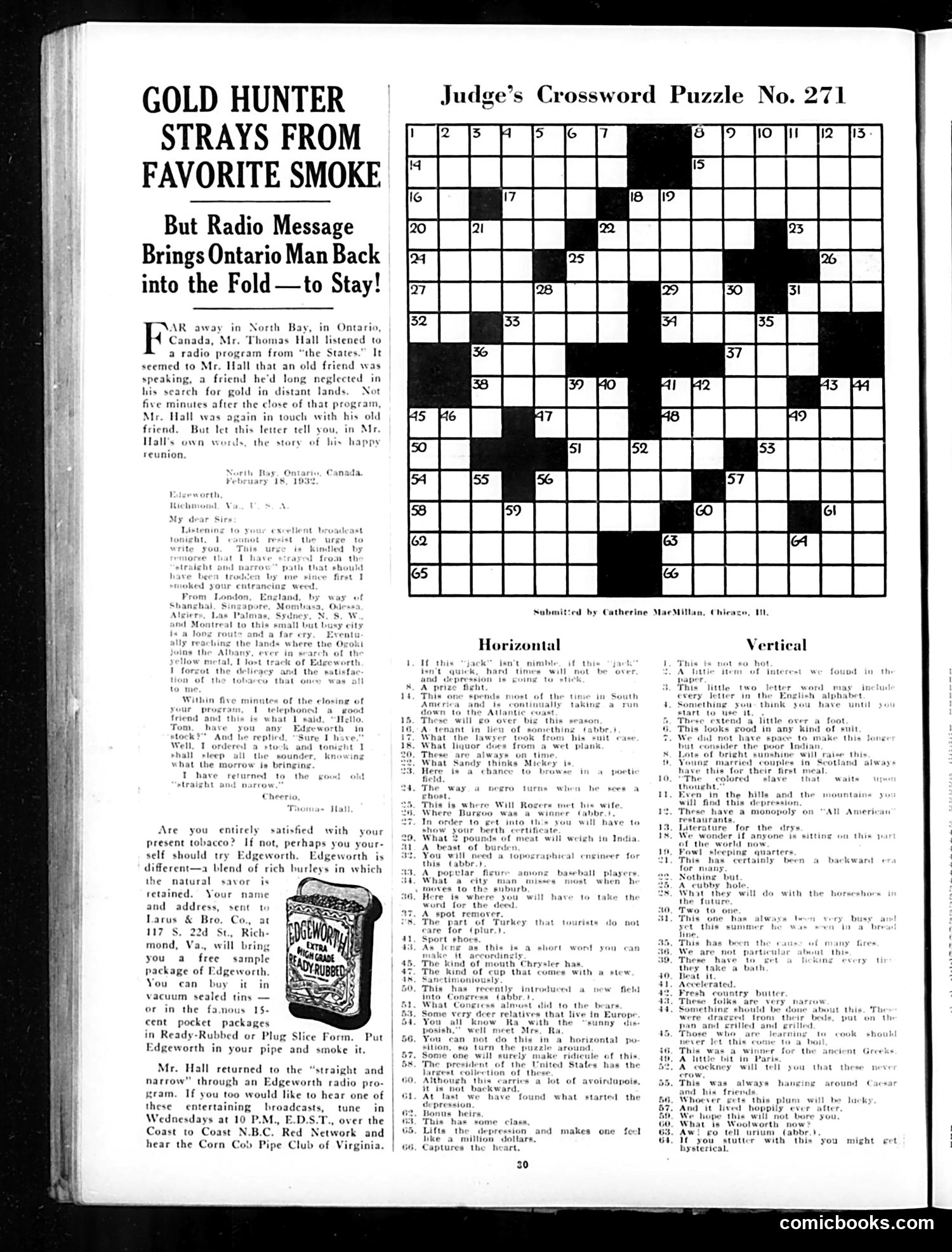
"Gold Hunter Strays from Favorite Smoke" This page advertises Edgeworth tobacco through a framing narrative about Mr. Thomas Hall, a gold prospector in Ontario, Canada. The story presents Hall as having abandoned his "favorite smoke" (Edgeworth) while pursuing gold in distant lands. He reconnects with an old friend via radio broadcast, which apparently reminds him of Edgeworth tobacco—bringing him back to the product. The advertisement uses the radio broadcast as a plot device, positioning Edgeworth as something worth returning to. The phrase "into the Fold—to Stay!" suggests the product's reliability and comfort. This reflects 1930s advertising strategy: using entertainment and human-interest narratives to sell consumer goods. The Edgeworth brand name appears in the ad copy below, promoting their pipe tobacco in "Ready-Rubbed or Plug Slice Form." The crossword puzzle on the right is filler content typical of Judge magazine.
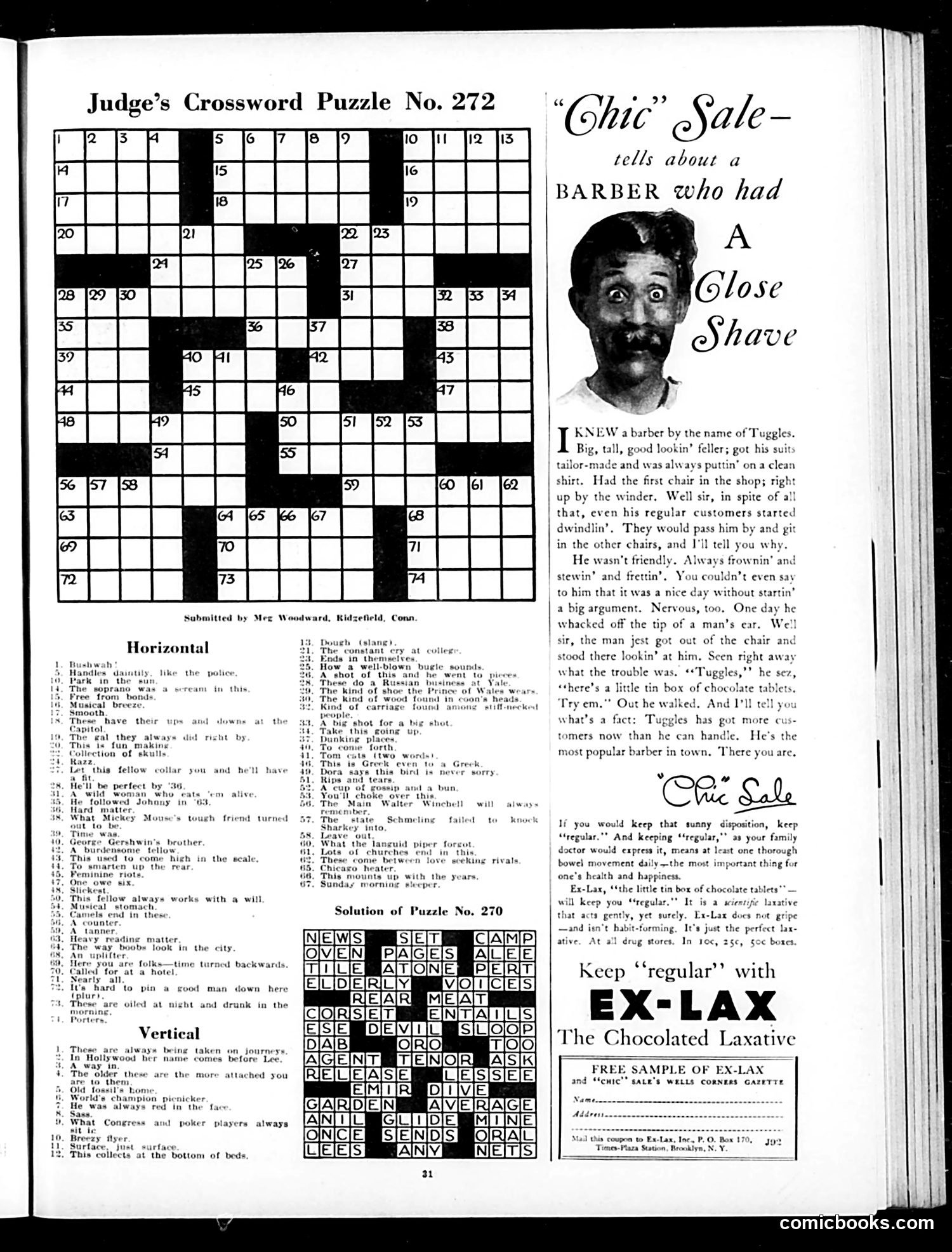
"A Close Shave" Advertisement This page features an advertisement disguised as a humorous short story. The narrative tells of "Tuggles," a skilled but temperamentally difficult barber whose grumpy, argumentative personality drives away customers—until he gives one an accidental ear injury and apologetically offers him Ex-Lax chocolates. The joke's premise: once Tuggles becomes "regular" (implying consistent bowel regularity from Ex-Lax use), his disposition improves, he becomes friendly, and he becomes the town's most popular barber. This is classic early-20th-century marketing satire, using a relatable character flaw (irritability) and connecting it to the product's benefit through wordplay on "regular." The advertisement presents constipation relief as literally transforming a person's personality and social success—a humorous exaggeration typical of Judge magazine's advertising content, which often blended entertainment with commercial promotion.
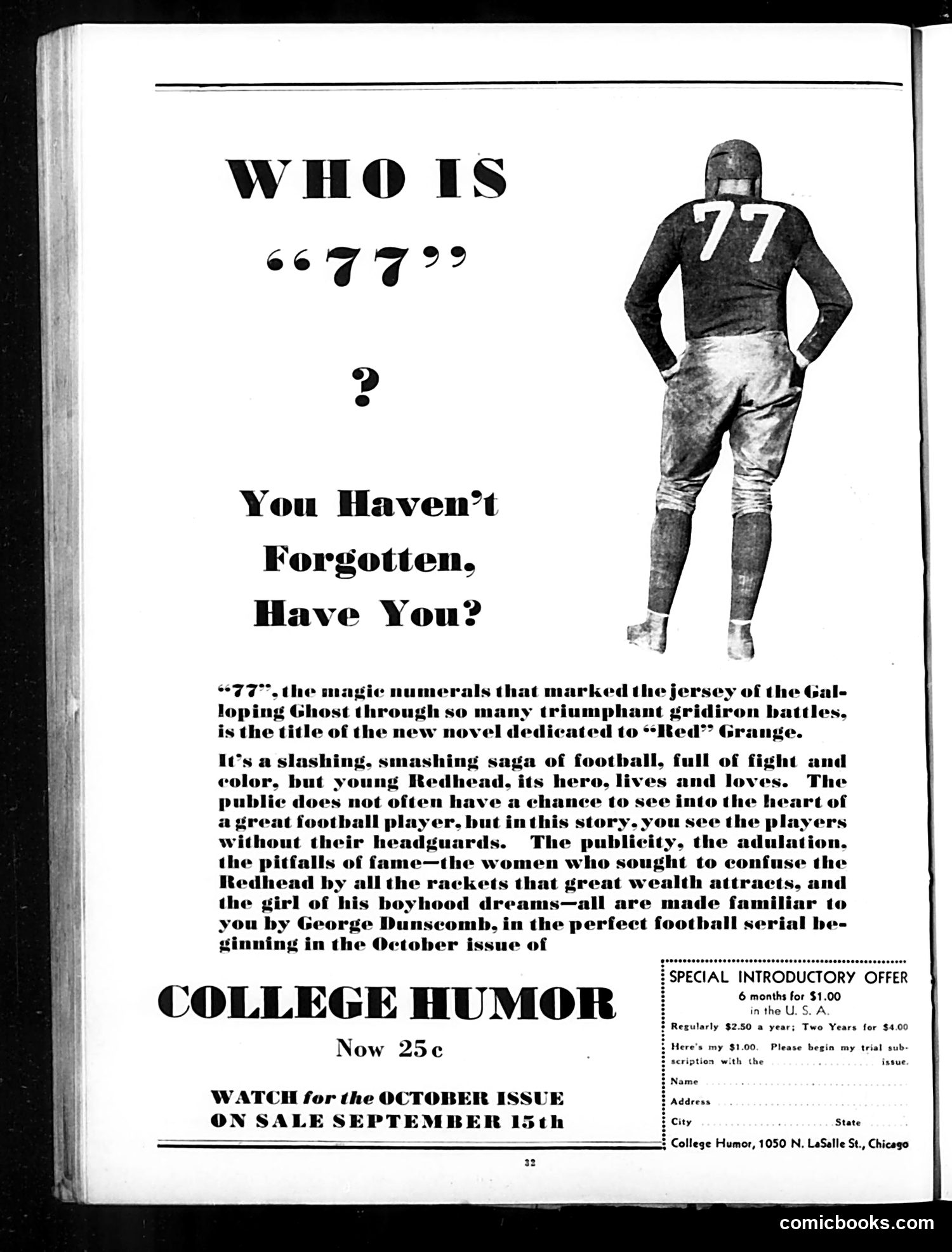
Analysis of This Judge Magazine Advertisement This is primarily a subscription advertisement for *College Humor* magazine, not a political cartoon. It promotes a serialized football novel titled "77" (the jersey number), dedicated to "Red" Grange, the famous 1920s college football player known as the "Galloping Ghost." The ad uses Grange's celebrity appeal to market the magazine's October issue. The novel, written by George Dunscomb, promises to reveal the glamorous and scandalous "behind-the-scenes" life of a great football player—the women, fame, wealth, and temptations beyond what fans see on the field. The accompanying image shows a football player from behind wearing jersey number 77, reinforcing the Grange reference. The special introductory offer (6 months for $1.00) was designed to attract new subscribers by leveraging Grange's immense popularity during the golden age of American college football.
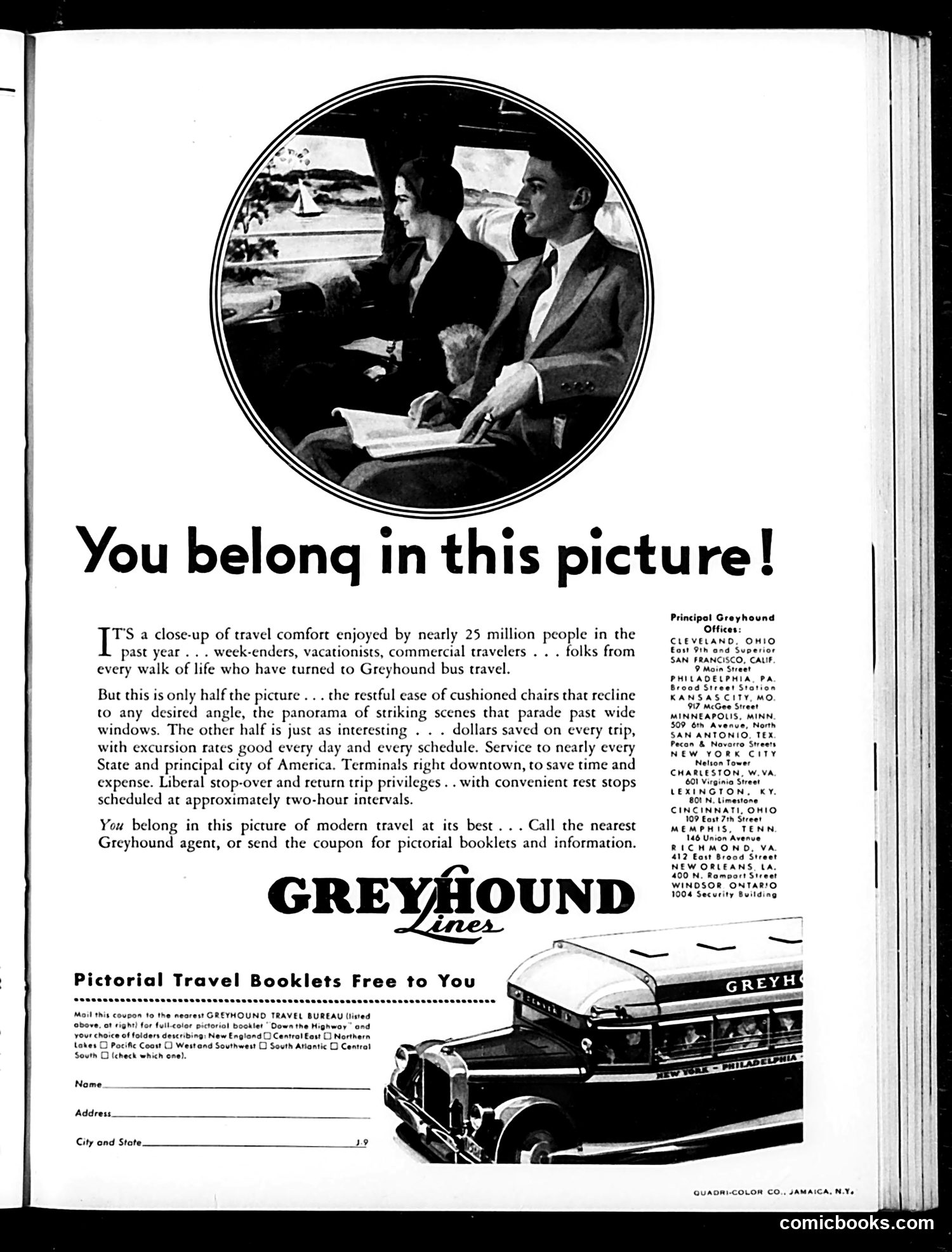
Greyhound Bus Advertisement This is not satire—it's a straightforward advertisement for Greyhound Lines bus service, likely from the 1930s-40s based on the styling and vehicle design. The circular photograph shows two well-dressed passengers inside a Greyhound bus, illustrating the advertised comfort of bus travel. The ad's appeal is democratic: "You belong in this picture" invites ordinary Americans ("folks from every walk of life") to enjoy modern travel comfort previously associated with wealthier transportation. The pitch emphasizes practical benefits: reclining cushioned chairs, scenic windows, money saved through excursion rates, downtown terminals, and convenient rest stops. The coupon requests pictorial booklets for various regional routes. This represents mid-century American consumer advertising celebrating affordable intercity bus travel as modern, comfortable, and accessible to the general public—a significant transportation option before interstate highways became dominant.
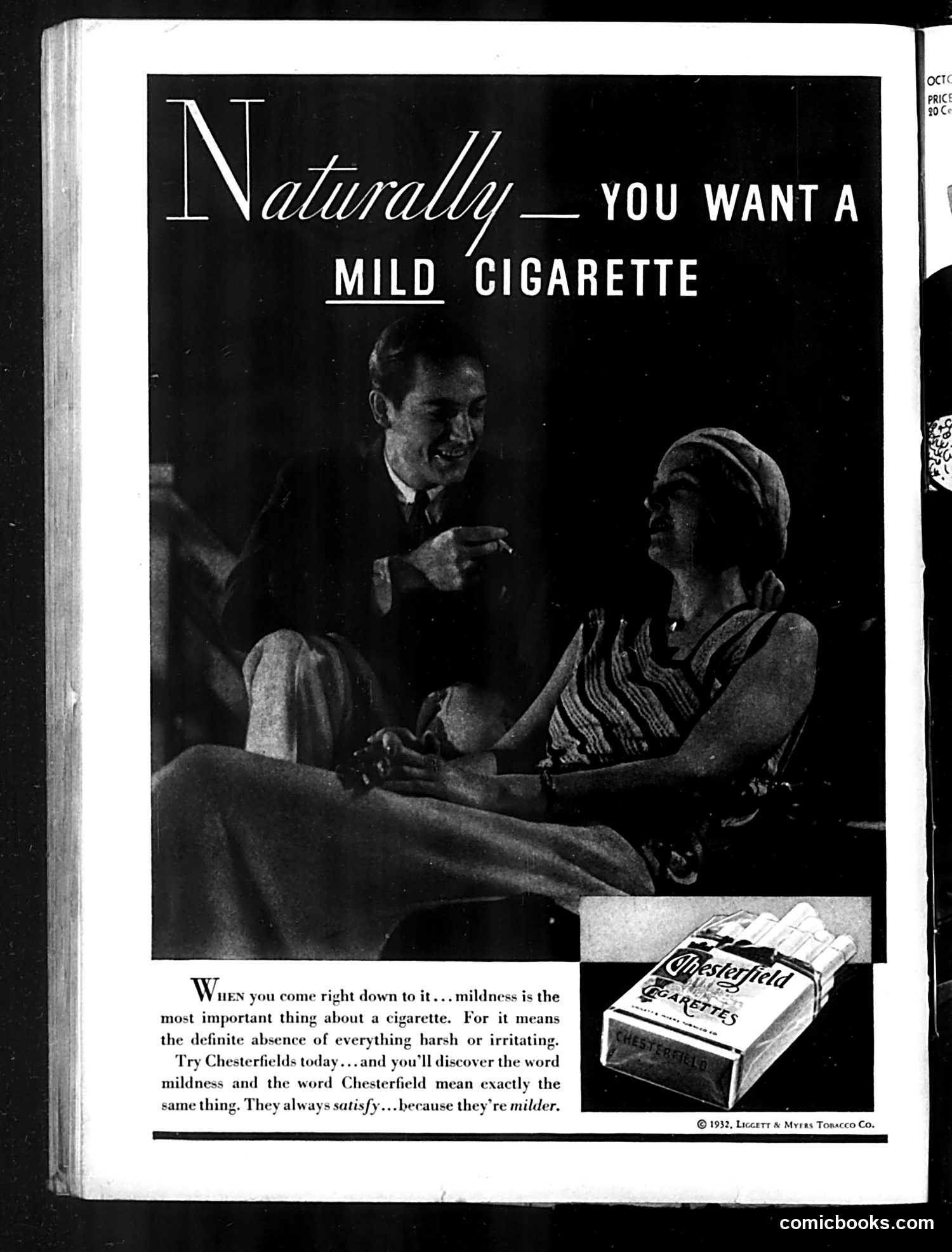
Analysis This is a cigarette advertisement, not political satire or a cartoon. It's a Chesterfield cigarette ad from 1932 (per the copyright notice), placed in *Judge* magazine. The image shows a man offering a cigarette to a woman in what appears to be a social setting. The ad's message emphasizes "mildness" as the key selling point—the absence of harshness or irritation. For modern readers: This represents pre-health-warning era advertising, when cigarettes were marketed as desirable consumer products with no health disclaimers. The gendered imagery (man offering to woman) reflects 1930s advertising conventions. The word "satisfy" and emphasis on "milder" reflect cigarette marketing language common before tobacco's health dangers were widely acknowledged or regulated.