judge
Judge — October 1932
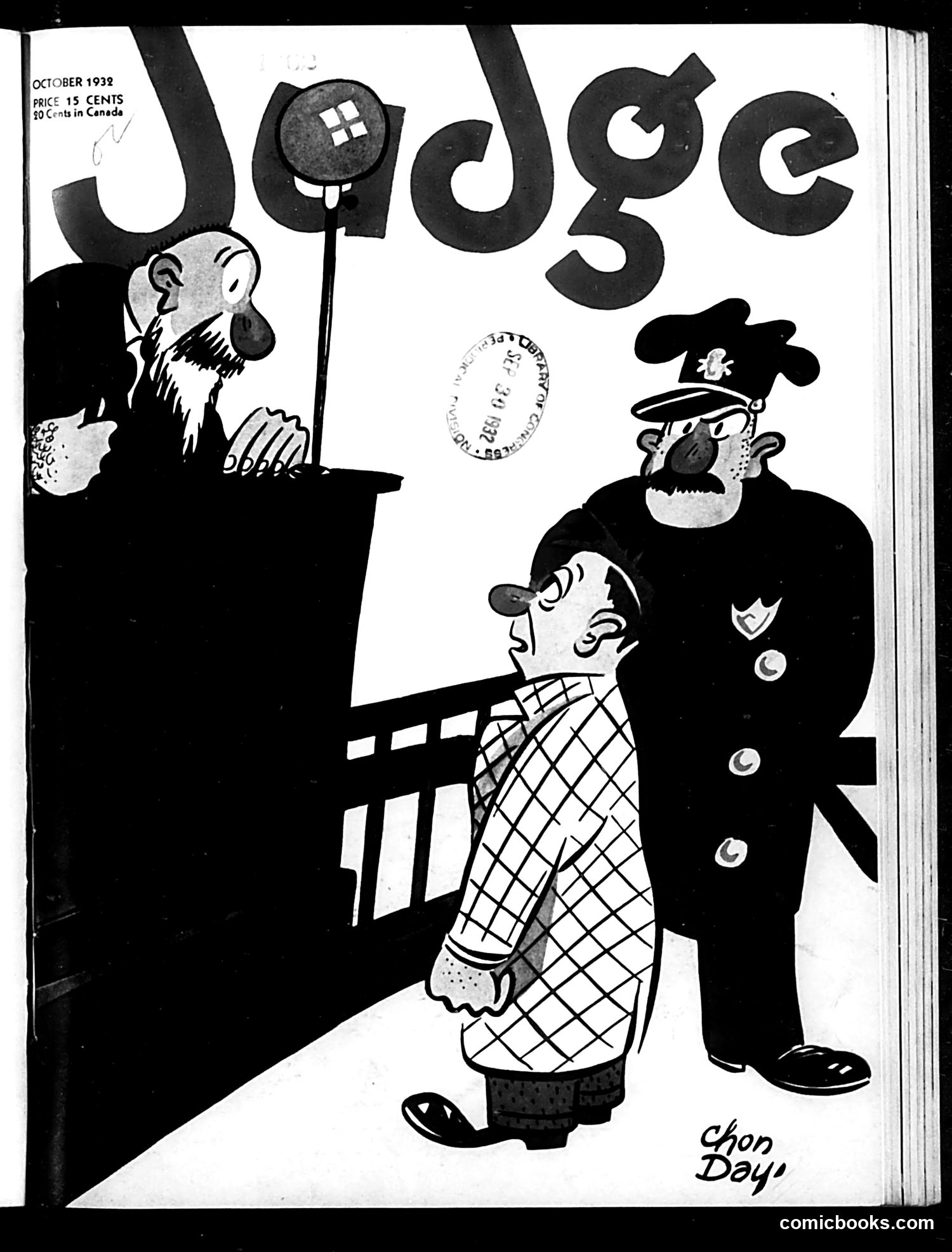
Judge Magazine, October 1938 This cover satirizes military authority and bureaucratic intimidation. A uniformed officer with an exaggerated authoritarian appearance confronts a nervous civilian. The military figure's oversized features and aggressive posture suggest mockery of authoritarian leadership. The October 1938 date is significant—this coincides with the Munich Crisis, when Nazi Germany's expansionism dominated headlines. The cartoon likely critiques either fascist militarism abroad or domestic concerns about authoritarian power. The civilian's anxious expression and the officer's domineering stance suggest themes of oppression or coercion. The cartoonist (signed "Leon Barks") uses caricature to mock militaristic authority figures, a common Judge approach when addressing political threats to democratic values during the late 1930s.
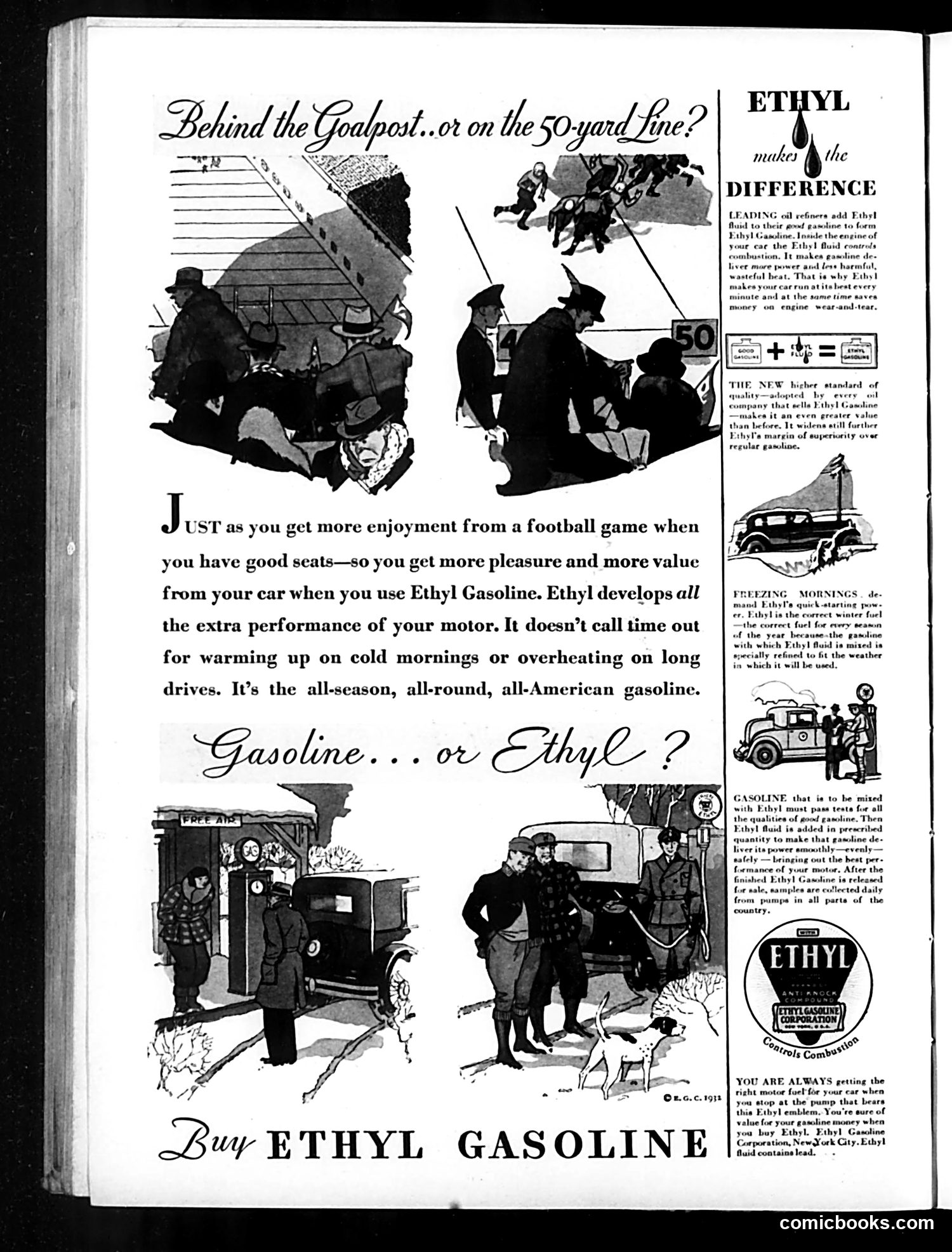
Analysis This page is primarily an advertisement for Ethyl Gasoline, not satire. The top heading asks "Behind the Goalpost...or on the 50-yard line?" using a football analogy: just as good seats enhance enjoyment of a game, Ethyl Gasoline enhances car performance. The illustrations show everyday scenarios—people at gas stations and driving in winter—emphasizing Ethyl's reliability in cold weather and its anti-knock properties. The copy claims Ethyl is "all-American" and superior to regular gasoline. The "cartoon" elements are purely decorative vignettes supporting the sales pitch. There are no political figures or satirical commentary here—this is straightforward commercial promotion from the Ethyl Gasoline Corporation, highlighting their fuel additive's competitive advantages.
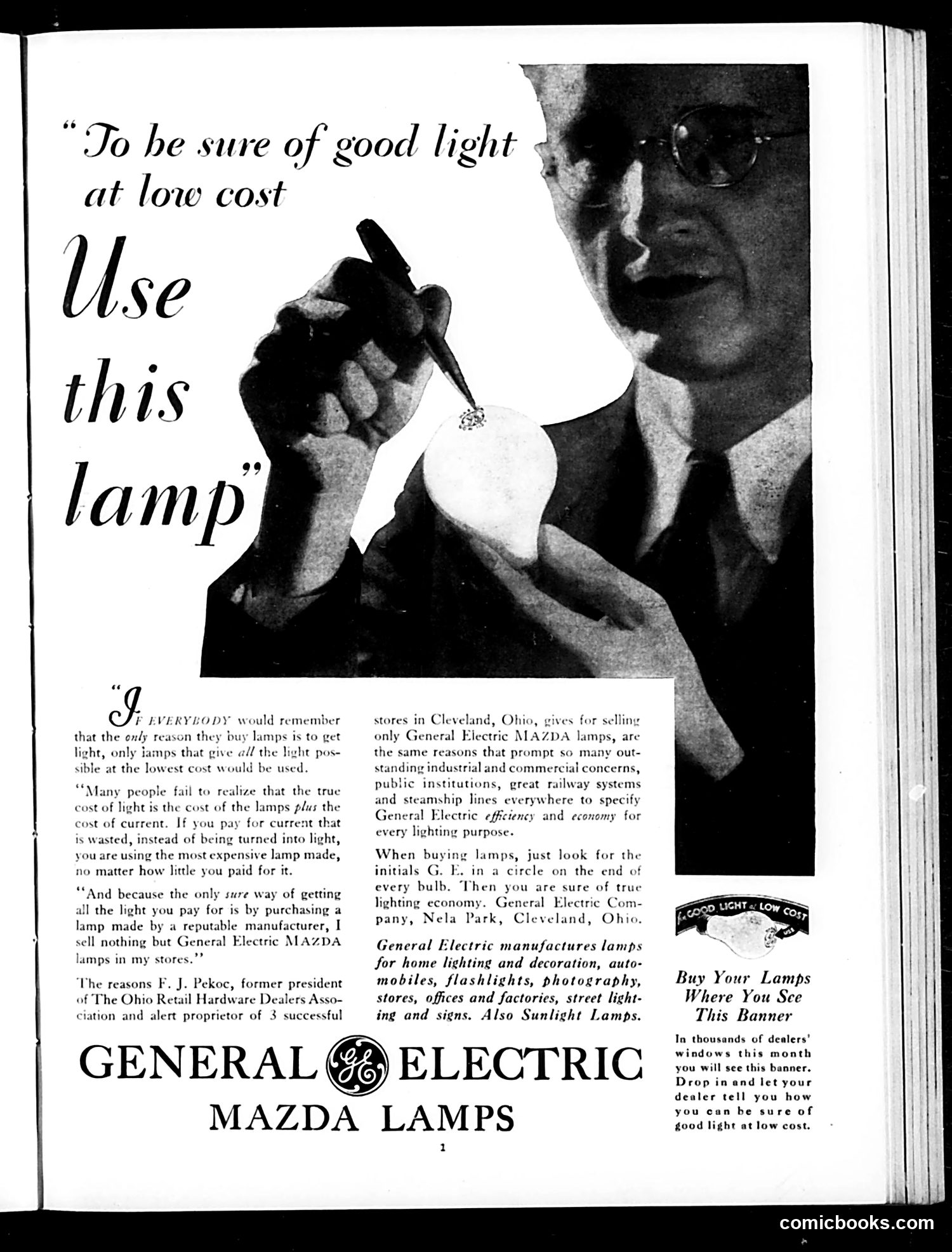
Analysis This page is primarily an advertisement, not a satirical cartoon. It promotes General Electric MAZDA lamps, featuring a man in sunglasses holding a light bulb. The ad uses a testimonial format, quoting F. J. Pekoe, former president of the Ohio Retail Hardware Dealers Association, claiming that General Electric MAZDA lamps offer superior efficiency and economy compared to competitors. The copy emphasizes that buyers should look for the "G.E." mark on bulbs to ensure quality. There is no political satire or social commentary evident. This is straightforward product marketing from what appears to be an early-to-mid 20th century publication, emphasizing the cost-effectiveness of purchasing name-brand light bulbs over cheaper alternatives.
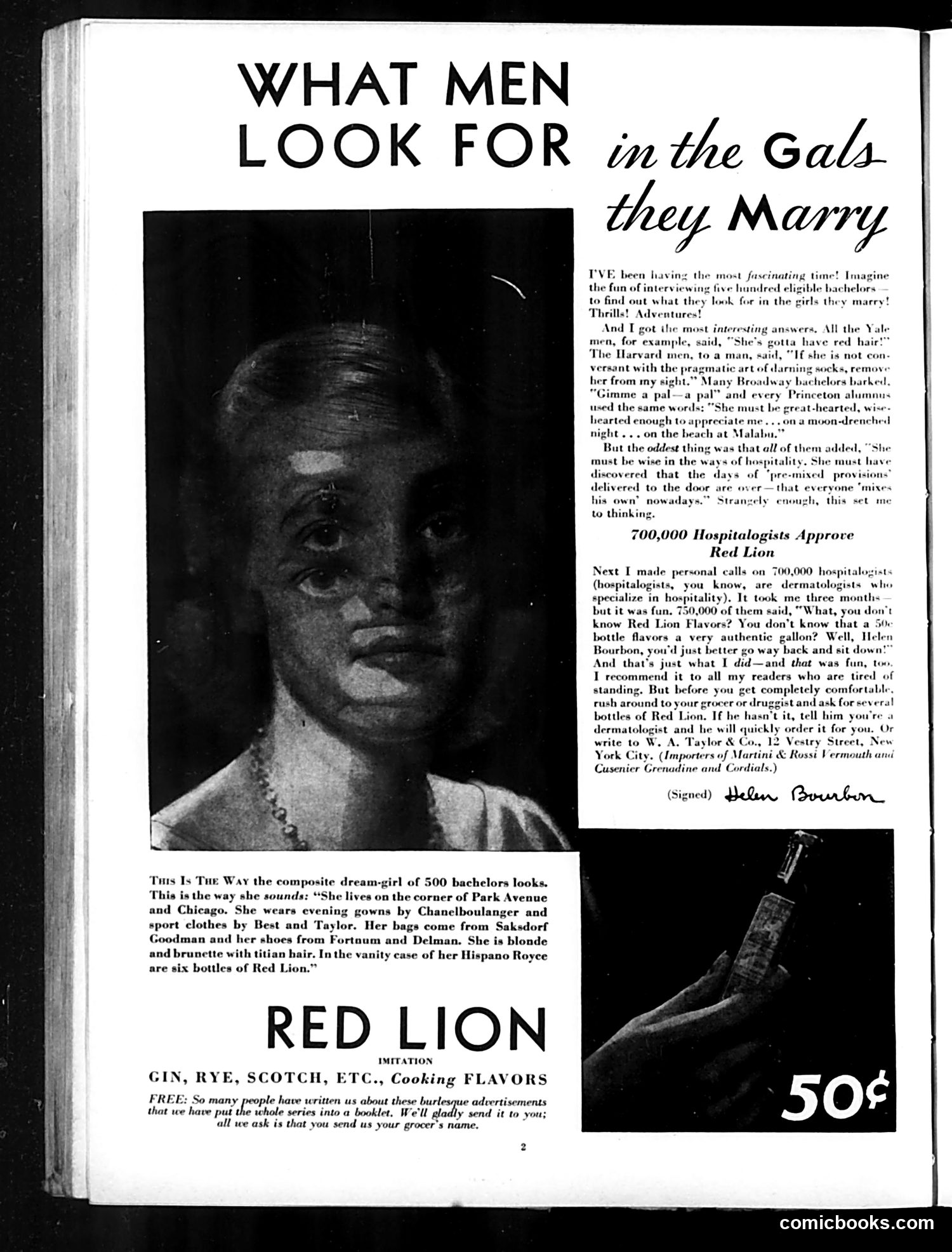
Red Lion Advertisement (Judge Magazine) This page is primarily a liquor advertisement for Red Lion flavored spirits (gin, rye, scotch), not political satire. The ad uses a humorous framing device: an unnamed author claims to have interviewed 500 eligible bachelors about what qualities they seek in wives. The punchline suggests all 500 agreed the ideal woman should be hospitable, wise, and great-hearted—then reveals she should also stock Red Lion liquor in her home. The accompanying composite photograph shows an idealized "dream girl" styled fashionably for the era, described as living on Park Avenue in Chicago and wearing designer clothing. The ad's joke relies on mid-century gender stereotypes: that women's primary value is providing hospitality (particularly alcohol) to men. This reflects 1920s-30s advertising conventions targeting male readers.
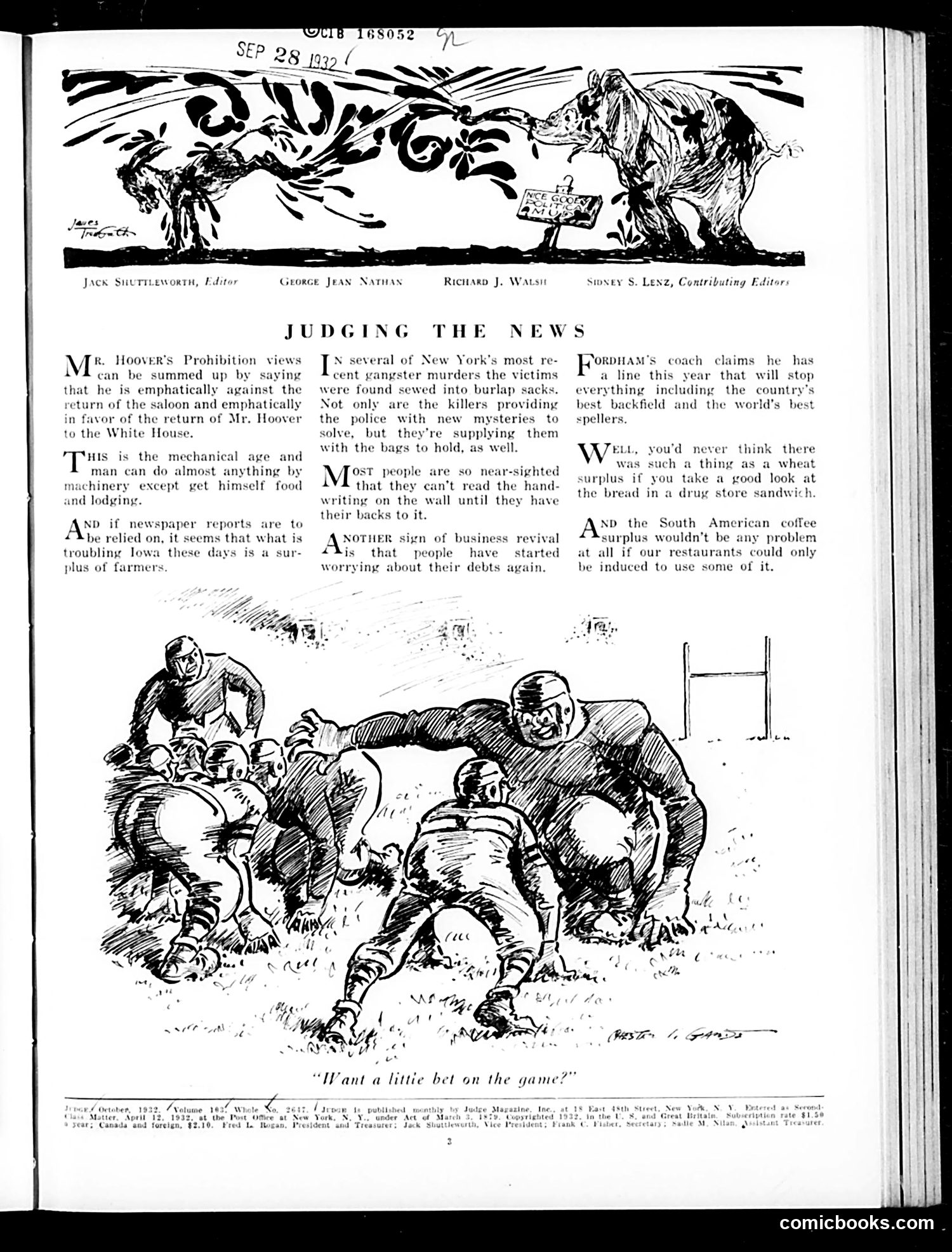
"Judging the News" - October 1932 This editorial page satirizes contemporary issues through short commentary and a cartoon titled "Want a little bet on the game?" The cartoon depicts what appears to be three men in suits positioned around a prone figure, seemingly engaged in or proposing gambling. Given the October 1932 date (Great Depression era), this likely critiques corruption or improper dealings among businessmen or politicians. The text above addresses Prohibition enforcement (gangster murders, police mysteries), business revival (people worrying about debts), agricultural surplus problems, and resource management issues of the early 1930s. The cartoon's title suggests ironic commentary on risky financial or political "games" being played during economically unstable times, possibly mocking those profiting from others' misfortune during the Depression.
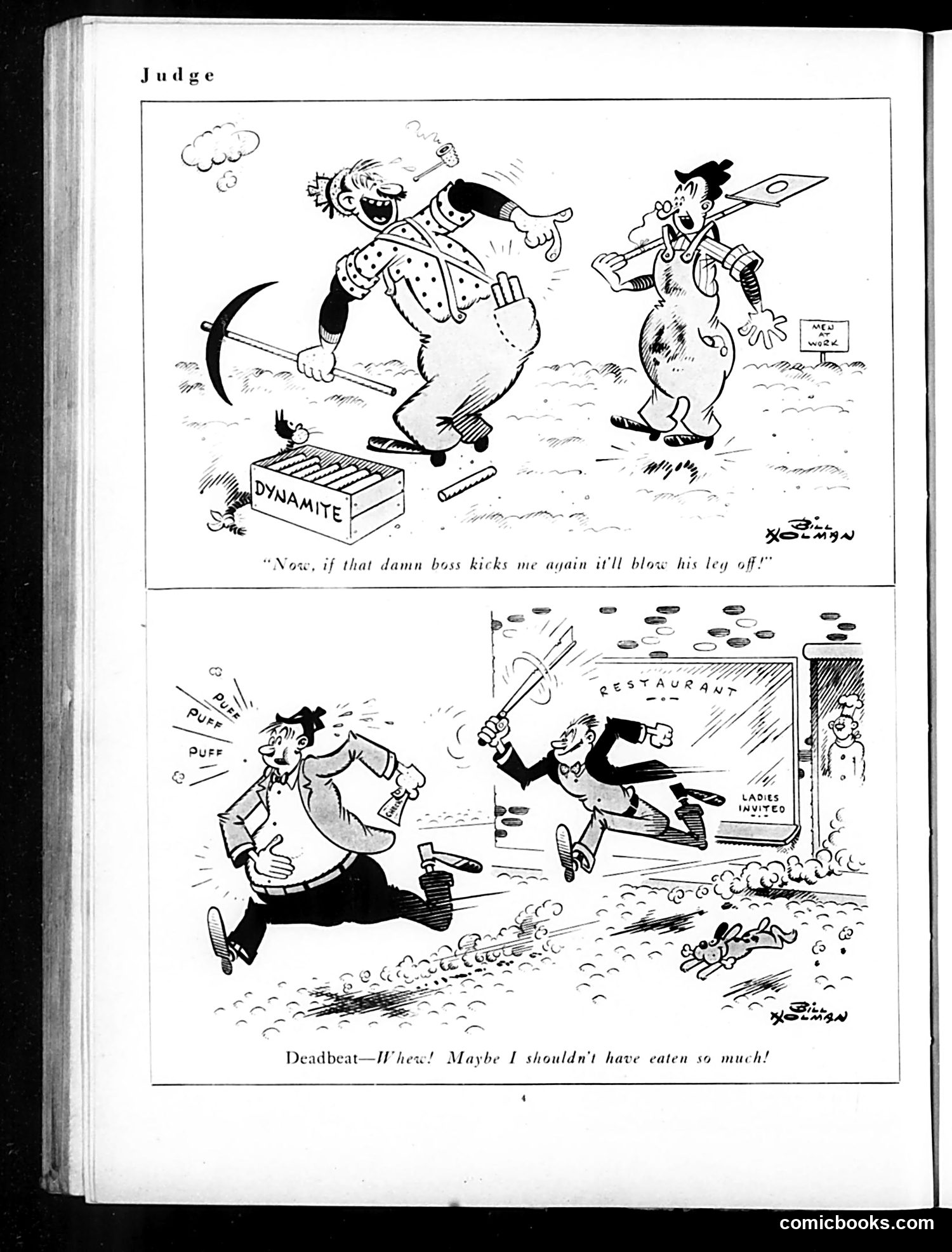
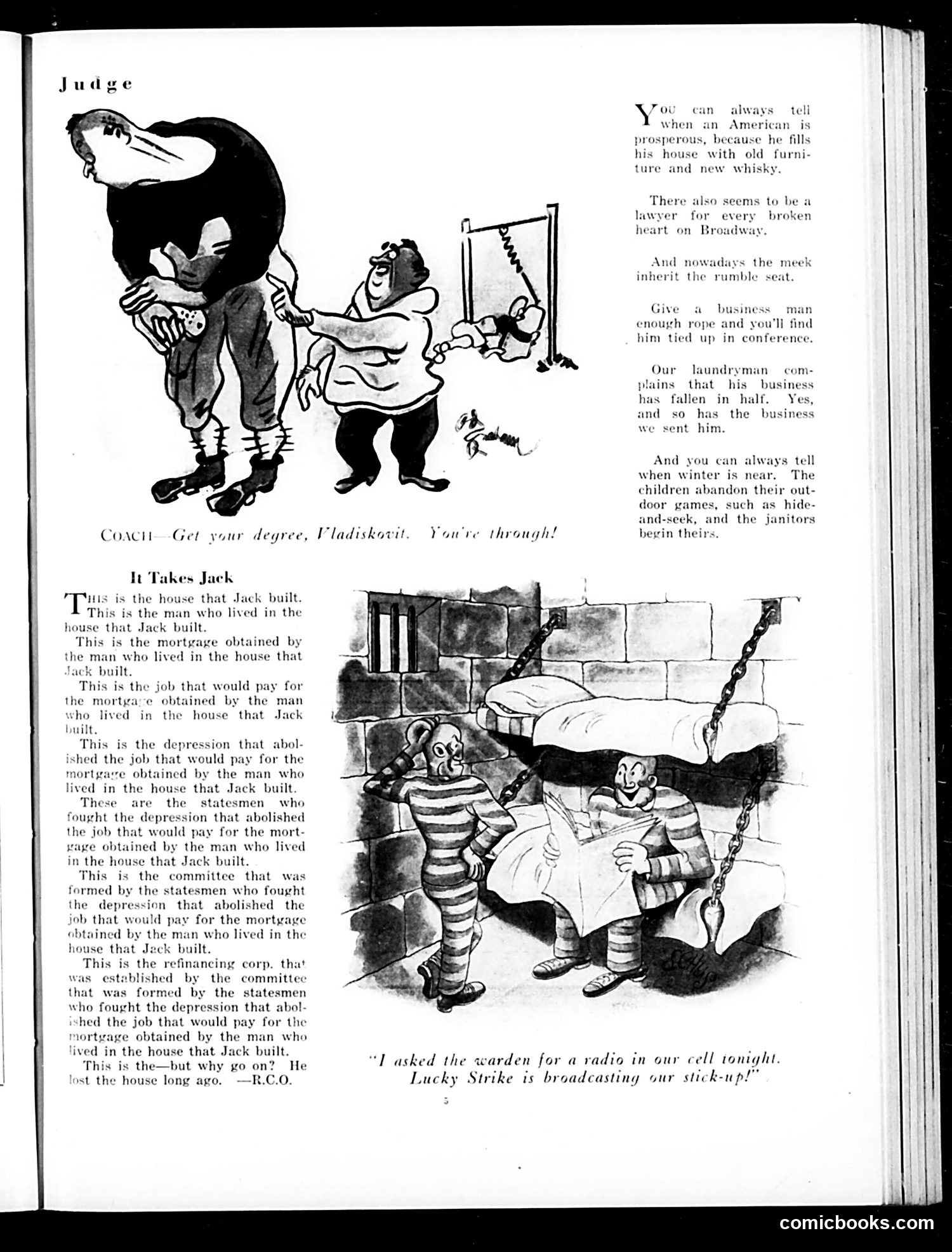
Analysis The top cartoon titled "Judge" mocks a Russian official named Vladiskovitch, depicted in caricatured ethnic stereotypes, being told by a coach "Get your degree, Vladiskovitch. You're through!" This appears to satirize Russian immigration or diplomatic competence during a period of U.S.-Russian tension (likely early 20th century). The longer section "It Takes Jack" is a cumulative poem in the style of "The House That Jack Built," tracing economic consequences of Depression-era unemployment. It sarcastically chains together: a house, a mortgage, unpaid job, resulting depression, politicians who fought the depression, a committee, a refinancing corporation, and finally asks "who go on?"—suggesting endless bureaucratic failure to resolve the crisis. The accompanying cartoon shows prisoners in stocks, reinforcing themes of economic hardship and confinement.
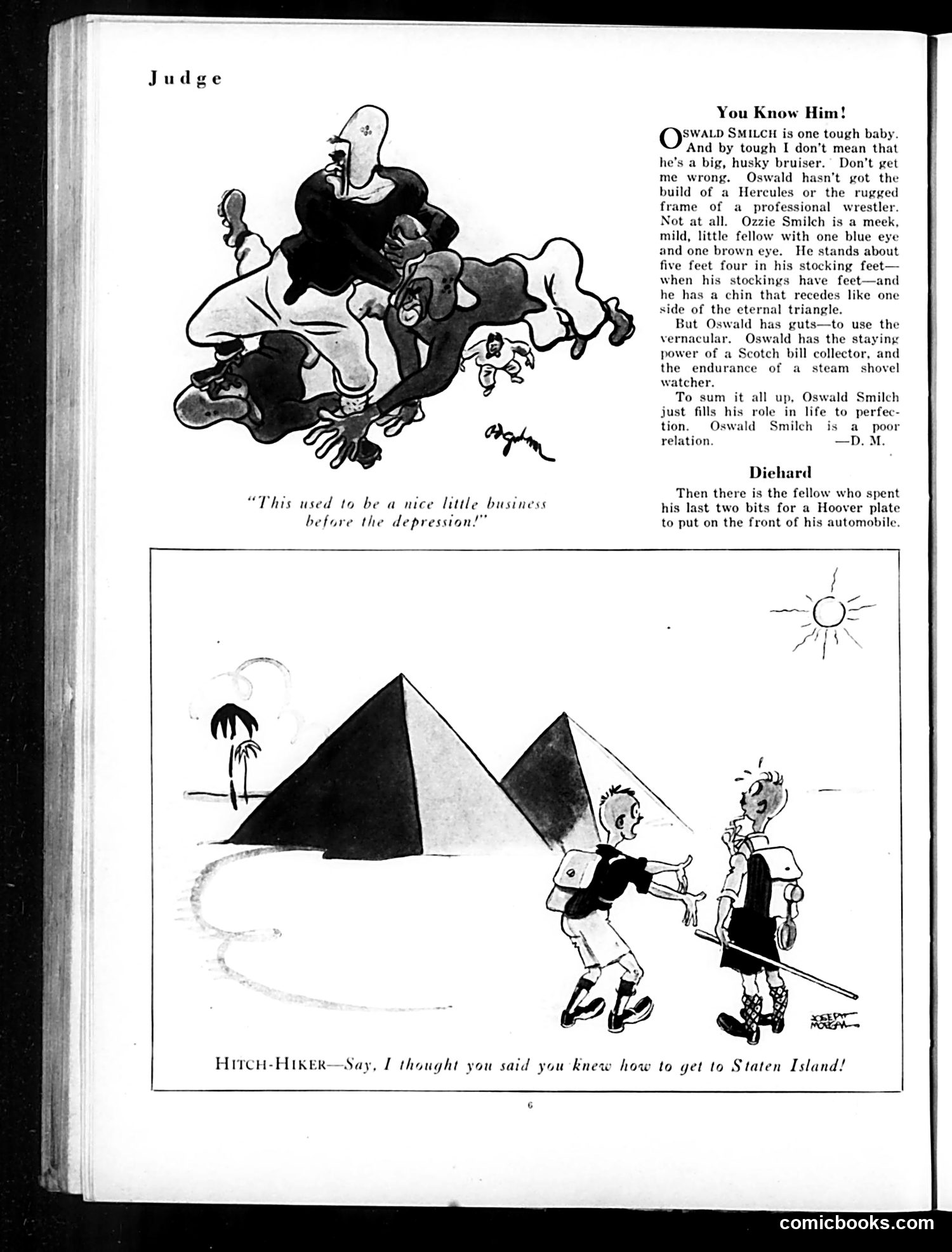
Analysis of This Judge Magazine Page Top Cartoon ("You Know Him!"): A satirical character sketch of Oswald Smilch, presented as a stereotypically weak and ineffectual man—small-framed, meek, with physical quirks. The humor mocks his inability to succeed, characterizing him as a "poor relation" who merely "fills his role in life to perfection" through failure. Bottom Cartoon ("Hitch-Hiker"): Two characters appear lost in a desert landscape with pyramids, suggesting Egypt. The joke plays on miscommunication—one hitchhiker believed they were heading to Staten Island (New York), not this remote location, implying comedic incompetence in navigation or deception about directions. Both cartoons employ period-typical visual exaggeration and rely on character-based humor rather than specific contemporary events.
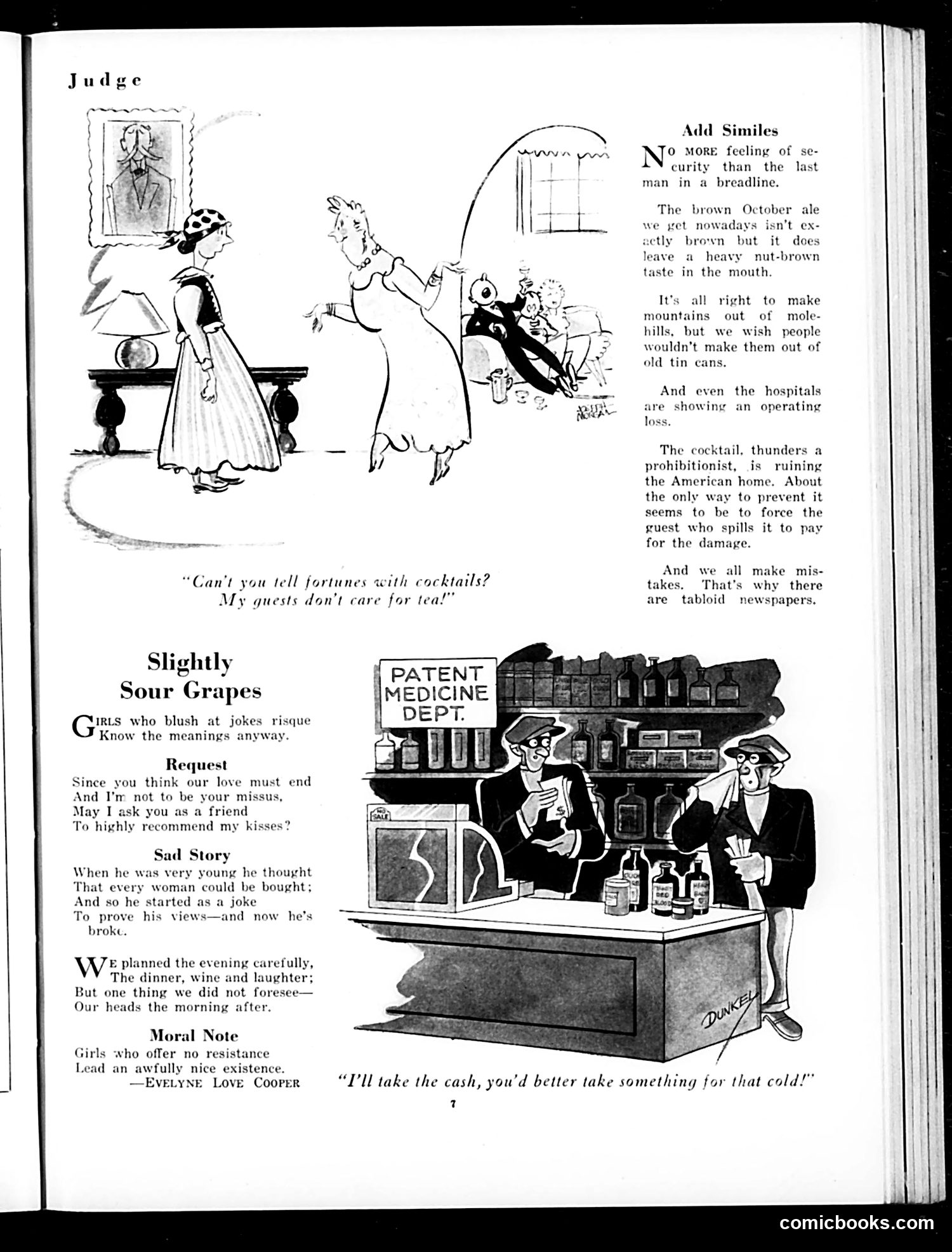
Judge Magazine Page Analysis This page from *Judge* contains multiple satirical pieces targeting 1920s American social issues, particularly Prohibition and economic anxiety. The top cartoon mocks fortune-telling with cocktails, referencing the Prohibition era (1920-1933) when alcohol was illegal—guests secretly drinking cocktails at social gatherings. The "Add Similes" section uses comparative humor to critique contemporary problems: breadline poverty (Great Depression context), watered-down beer during Prohibition, hospitals losing money, and prohibition's failure to protect homes—the cocktail's real damage is spilled drinks guests must pay for, a wry commentary on enforcing an unpopular law. The "Patent Medicine Dept." cartoon shows two men at a drugstore counter discussing a cold remedy, likely satirizing how patent medicines were marketed as cure-alls during this period. The poetry sections ("Slightly Sour Grapes," "Request," "Sad Story") offer lighthearted commentary on romance, relationships, and hangovers—the latter clearly referencing secret drinking despite Prohibition. Overall, the page satirizes Prohibition's ineffectiveness and broader post-war social disruption.
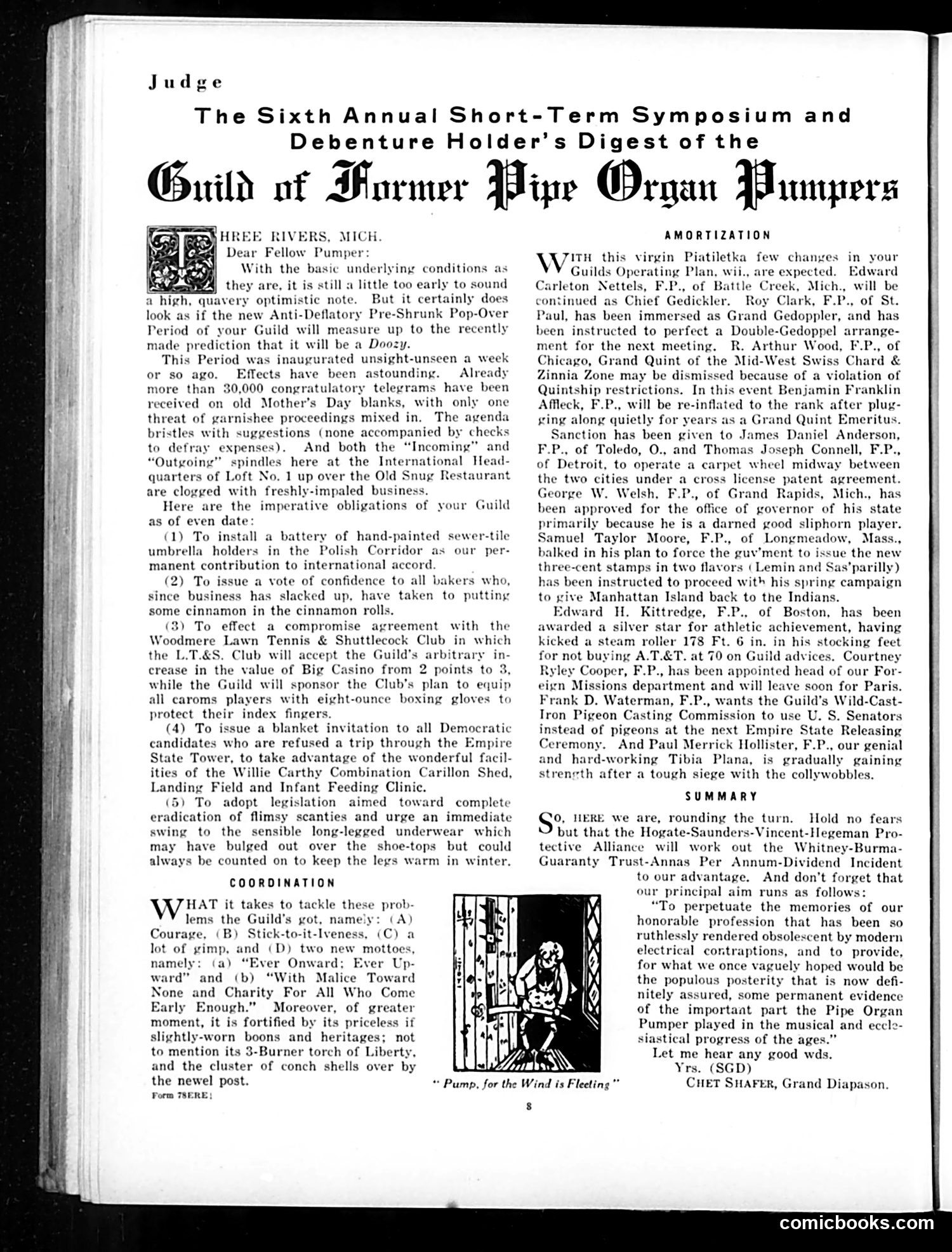
Judge Magazine Satire: "Guild of Hormer Pipe Organ Pruners" This is mock-serious organizational satire—Judge parodies corporate and fraternal bureaucracy by inventing an absurd trade guild for "pipe organ pruners" (a nonsensical profession). The satire targets: - Overblown institutional language: Dense business jargon ("Anti-Deflate Pre-Shrunk Pop-Over Period," "Gedopplement") masks meaningless activity - Fraternal lodge pretension: The faux-official meeting minutes, numbered resolutions, and invented officers mimic actual organizational minutes - Absurd "important" business: Resolutions range from ridiculous (sewer-tile umbrella holders, cinnamon-roll confidence votes) to contradictory (equipping card players with boxing gloves) - Corporate cheerleading: The breathless optimism ("astounding effects") about nothing The embedded cartoon shows someone at a window captioned *"Pump, for the Wind is Fleeting"*—possibly the only coherent element—suggesting even whimsy deflates under bureaucratic weight. The satire mocks how organizations generate elaborate procedures to justify their own existence.
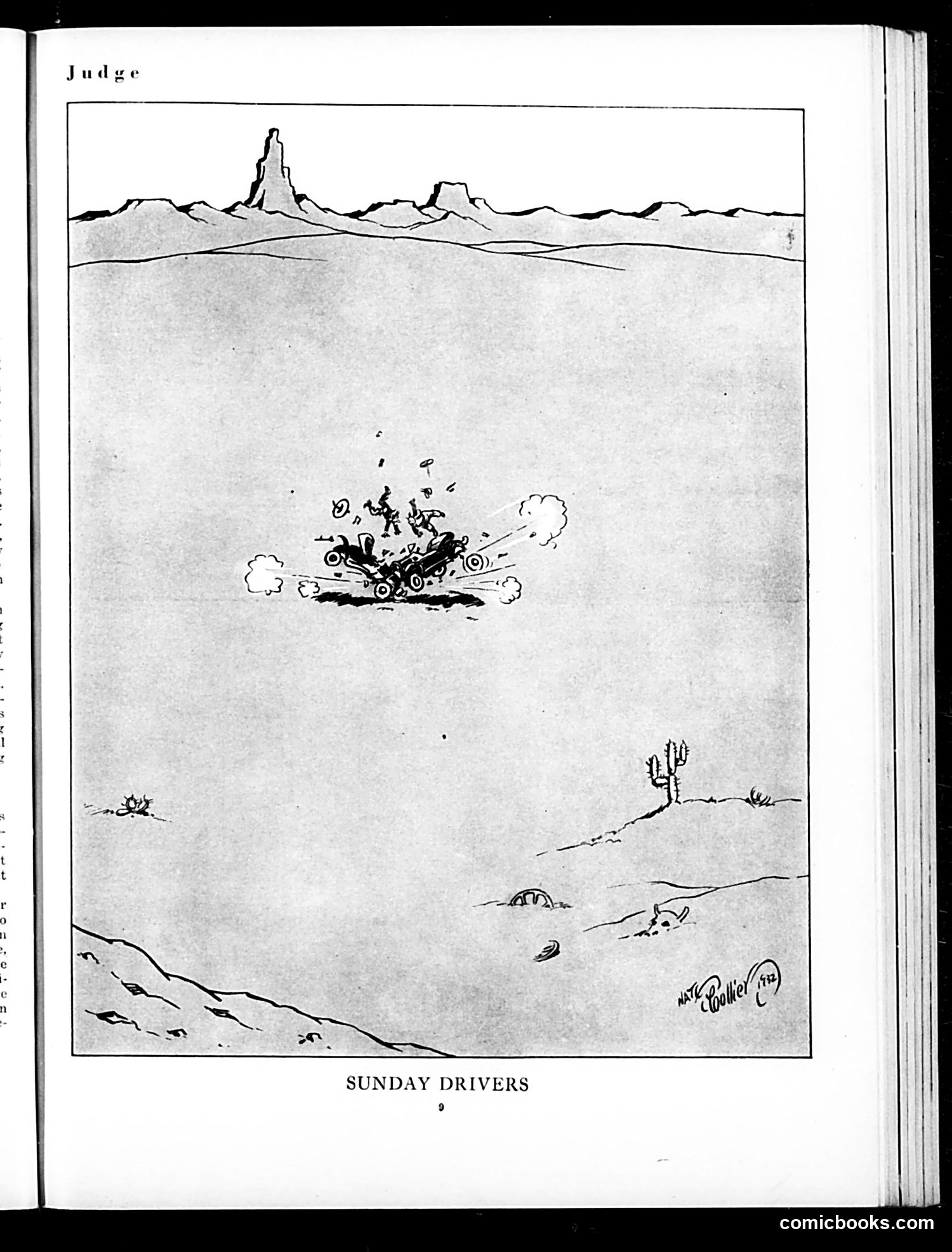
"Sunday Drivers" - Judge Magazine Cartoon This cartoon satirizes reckless weekend motorists in the early automobile era. The image depicts a chaotic car crash in a desert landscape, with a vehicle exploding in a cloud of dust and debris. Scattered mechanical parts and smoke clouds surround the wreckage, while a cactus stands nearby—likely indicating the American Southwest. The title "Sunday Drivers" refers to casual, inexperienced drivers who took recreational car trips on weekends. The satire mocks their dangerous driving habits and the resulting accidents. The cartoon reflects early-20th-century anxieties about automobile safety and the recklessness of untrained drivers, making it a social commentary on road safety rather than political satire.
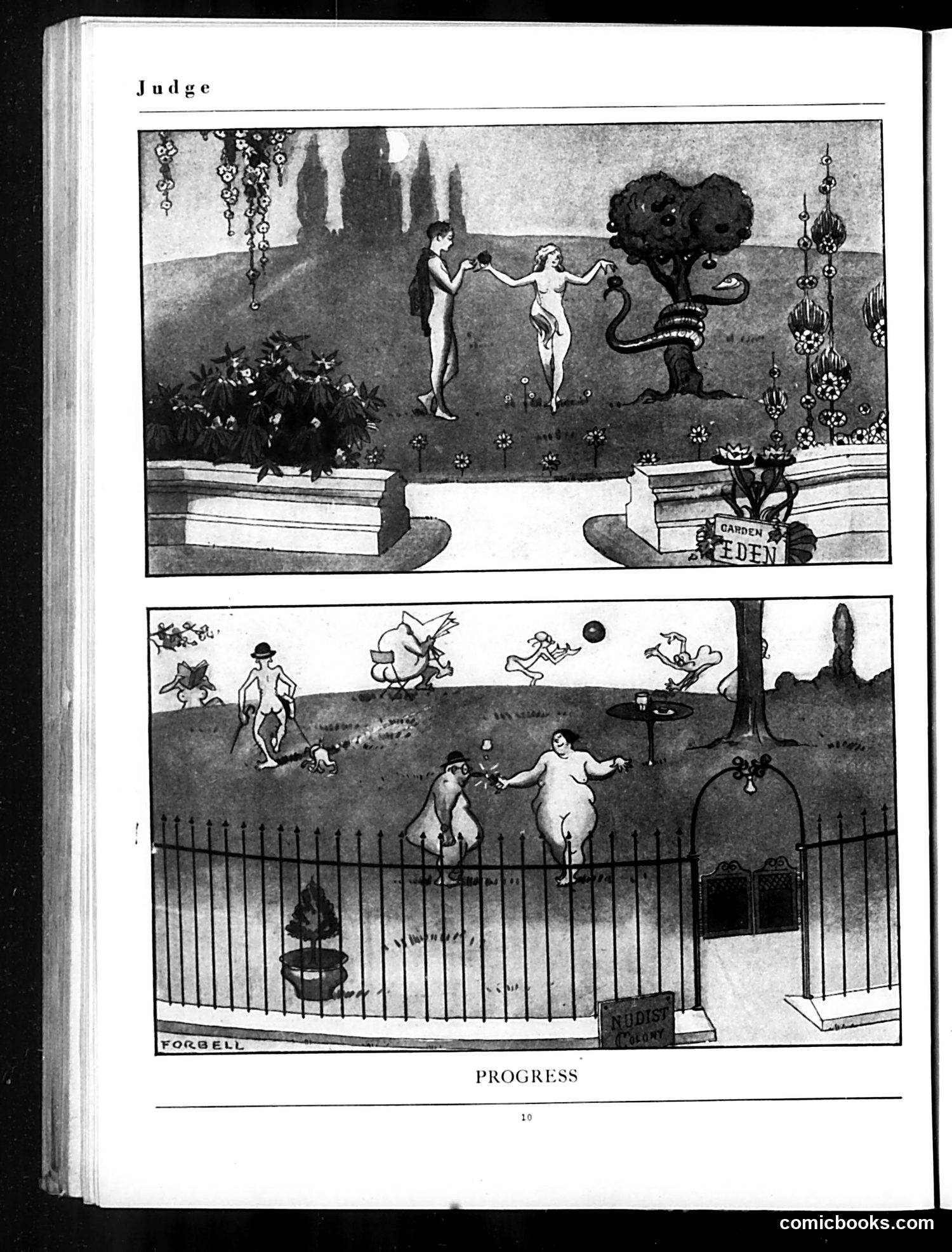
"Progress" - Judge Magazine Cartoon Analysis This two-panel cartoon by Forbell satirizes the concept of human "progress." The top panel depicts the Garden of Eden—a paradisiacal scene with naked figures, exotic creatures, and ornamental vegetation, labeled "GARDEN OF EDEN." The bottom panel shows the same figures now confined behind an iron fence, labeled "NUDIST COLONY," engaged in the same activities but within restrictive boundaries. The satire critiques modernity's illusion of progress: civilization constrains rather than liberates humanity. Despite advancing society, modern people remain fundamentally imprisoned—now by laws, property ownership, and social restrictions—compared to humanity's "natural" state. The cartoon suggests that progress is merely progress toward greater control and confinement.
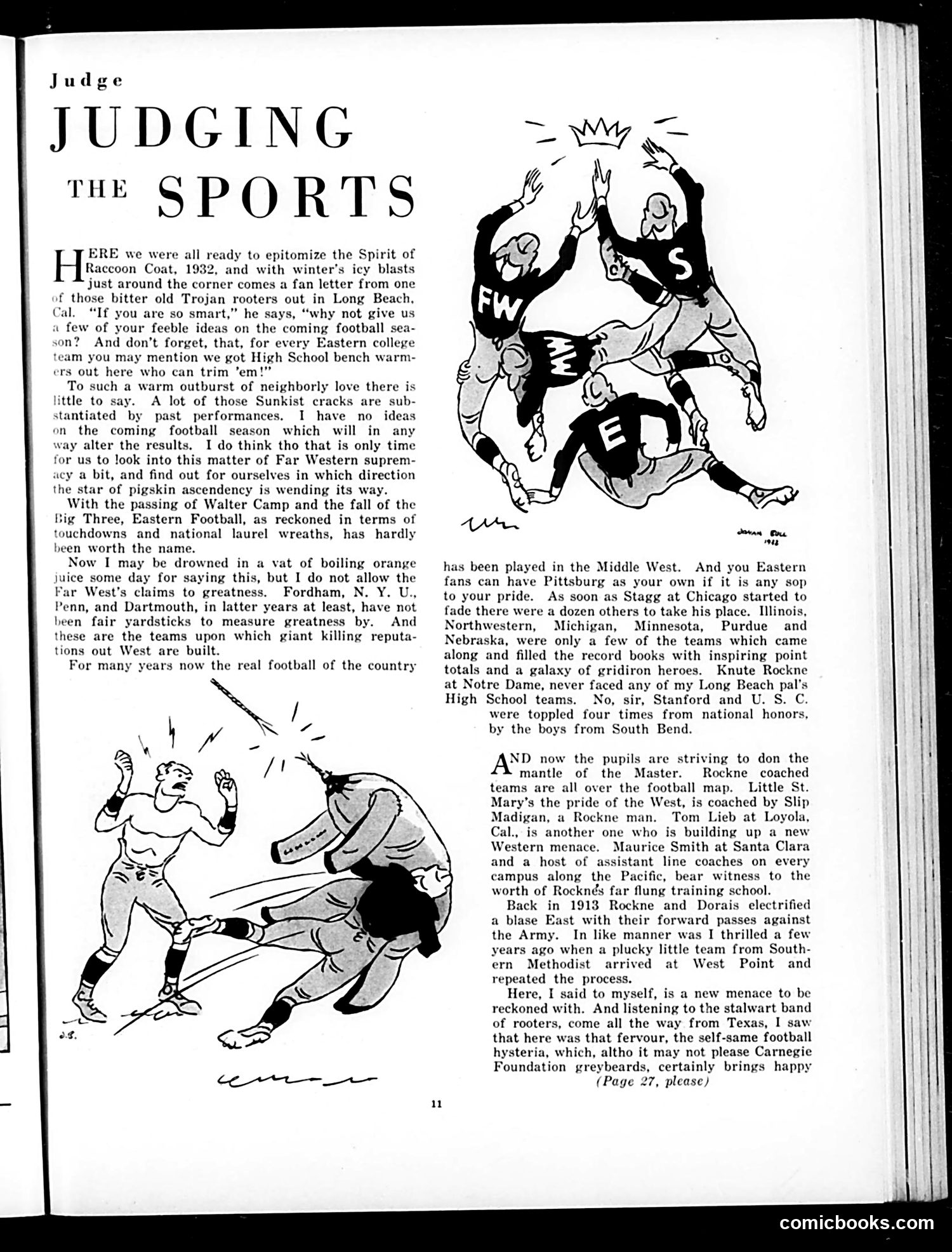
Judging the Sports: East vs. West Football Supremacy (1932) This Judge magazine article satirizes the rivalry between Eastern and Western American college football programs. The author responds to a boastful letter from a Long Beach, California fan claiming Western teams (particularly high schools) surpass Eastern colleges. The piece argues that while the Far West claims football superiority, Eastern powerhouses like Fordham, NYU, and Penn aren't truly representative. The author credits the Midwest—Illinois, Northwestern, Michigan, Minnesota, Purdue, Nebraska—as the real center of American football excellence, particularly since Notre Dame coach Knute Rockne became dominant. The cartoons illustrate the competitive tension humorously: one shows a victorious football player; another depicts a boxer knocking down an opponent, representing the regional athletic conflict. The author credits Rockne's coaching disciples spreading Western dominance nationwide, referencing his famous 1913 forward-pass victory over Army and Southern Methodist's similar upset at West Point as evidence of emerging Western football power challenging Eastern hegemony.
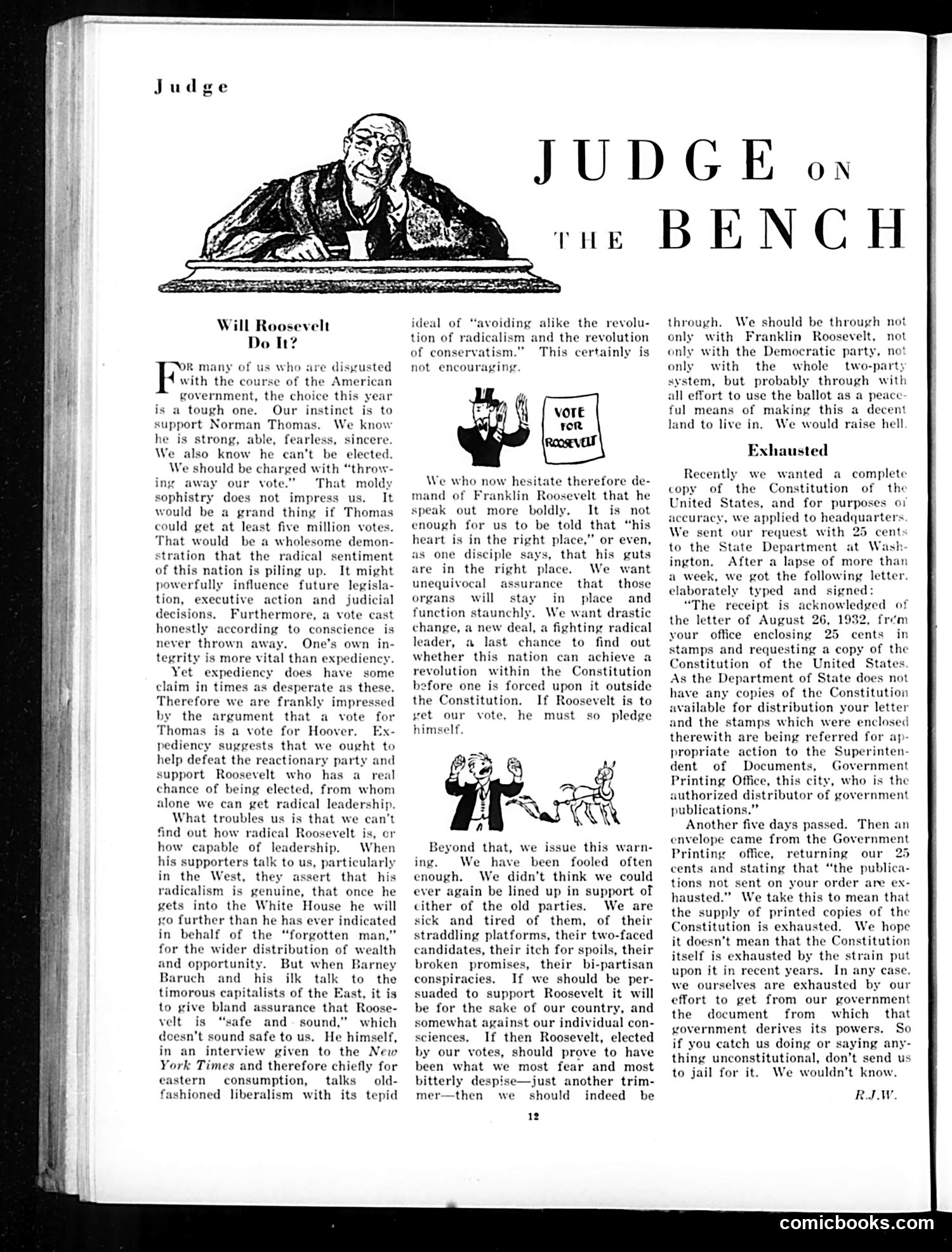
"Judge on the Bench: Will Roosevelt Do It?" This editorial cartoon and article from Judge magazine (circa 1932, based on context) addresses the dilemma facing radical voters in the upcoming presidential election. The Central Conflict: The author wrestles with whether to vote for Norman Thomas (the Socialist candidate, whom they admire but believe cannot win) or Franklin D. Roosevelt (the Democratic nominee with a real chance of defeating the incumbent Hoover). Key Figures: - Norman Thomas: Socialist candidate representing genuine radicalism but electoral impossibility - Franklin D. Roosevelt: Democratic candidate whose true radicalism remains unclear - Barney Baruch: Wealthy financier representing Eastern establishment interests reassuring themselves that Roosevelt is "safe" - Hoover: The reactionary incumbent the author wants defeated The Satire's Point: The author demands Roosevelt publicly pledge himself to genuine radical reform—not vague promises. The warning is sharp: if voters compromise their principles to elect Roosevelt, only to find him another timid centrist ("trimmer"), they'll lose faith in electoral democracy itself. The cartoon likely illustrates judicial skepticism about Roosevelt's actual commitments.
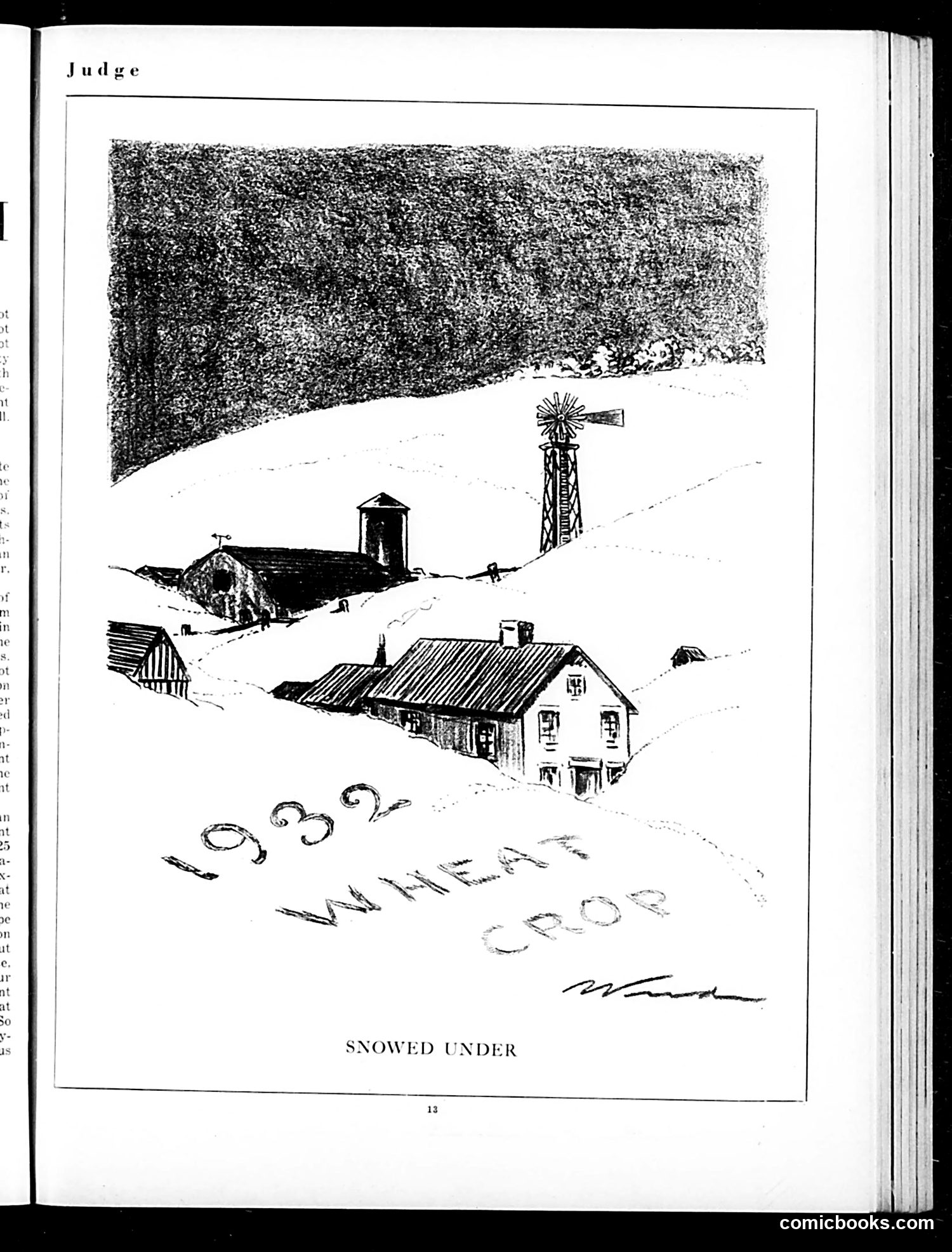
"Snowed Under" This is a single cartoon depicting a rural winter scene with a farmhouse, barn, windmill, and forest during heavy snowfall. The title "Snowed Under" appears at the bottom. The phrase "snowed under" is an idiom meaning to be overwhelmed or buried by circumstances. The cartoon illustrates this metaphorically—a farmstead literally buried beneath deep snow, suggesting the hardship and isolation rural communities faced during harsh winters. Given Judge magazine's satirical nature, this likely comments on rural American agricultural struggles, particularly the economic or social difficulties farmers endured during winter months or broader economic downturns. The stark, isolated homestead conveys vulnerability and hardship rather than prosperity.
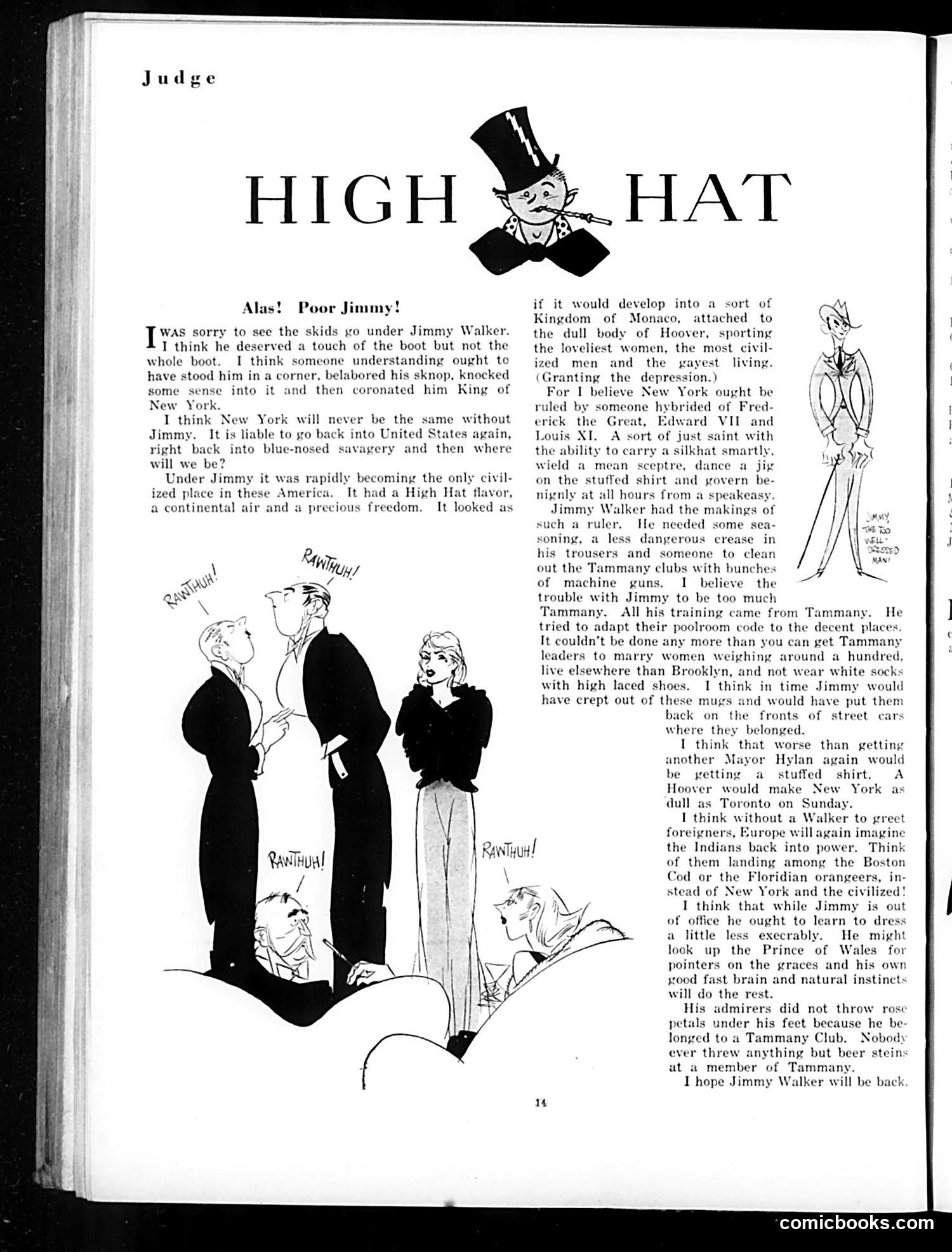
"High Hat" - Judge Magazine Satire on Jimmy Walker This is a satirical defense of Jimmy Walker, New York City's mayor (1926-1932) who was forced to resign amid corruption scandals. The cartoonist mourns Walker's fall, arguing he was a colorful, sophisticated leader who gave NYC continental glamour and civilized freedom—contrasting it with stodgy American puritanism ("blue-nosed savagery"). The illustration shows Walker surrounded by people crying "RANTHUA!"—apparently distressed citizens or associates affected by his downfall. The satire's point: Walker needed refinement and de-Tammanyization (the Tammany Hall political machine represented crude, corrupt machine politics), but he was preferable to alternatives like the dull Mayor Hylan or a generic "stuffed shirt" successor. The piece romanticizes Walker as a hybrid of European sophistication (Frederick the Great, Edward VII, Louis XI) while acknowledging his Tammany-bred flaws. The joke is ironic—praising a corrupt politician for making the city *feel* civilized, even if he couldn't truly reform it.
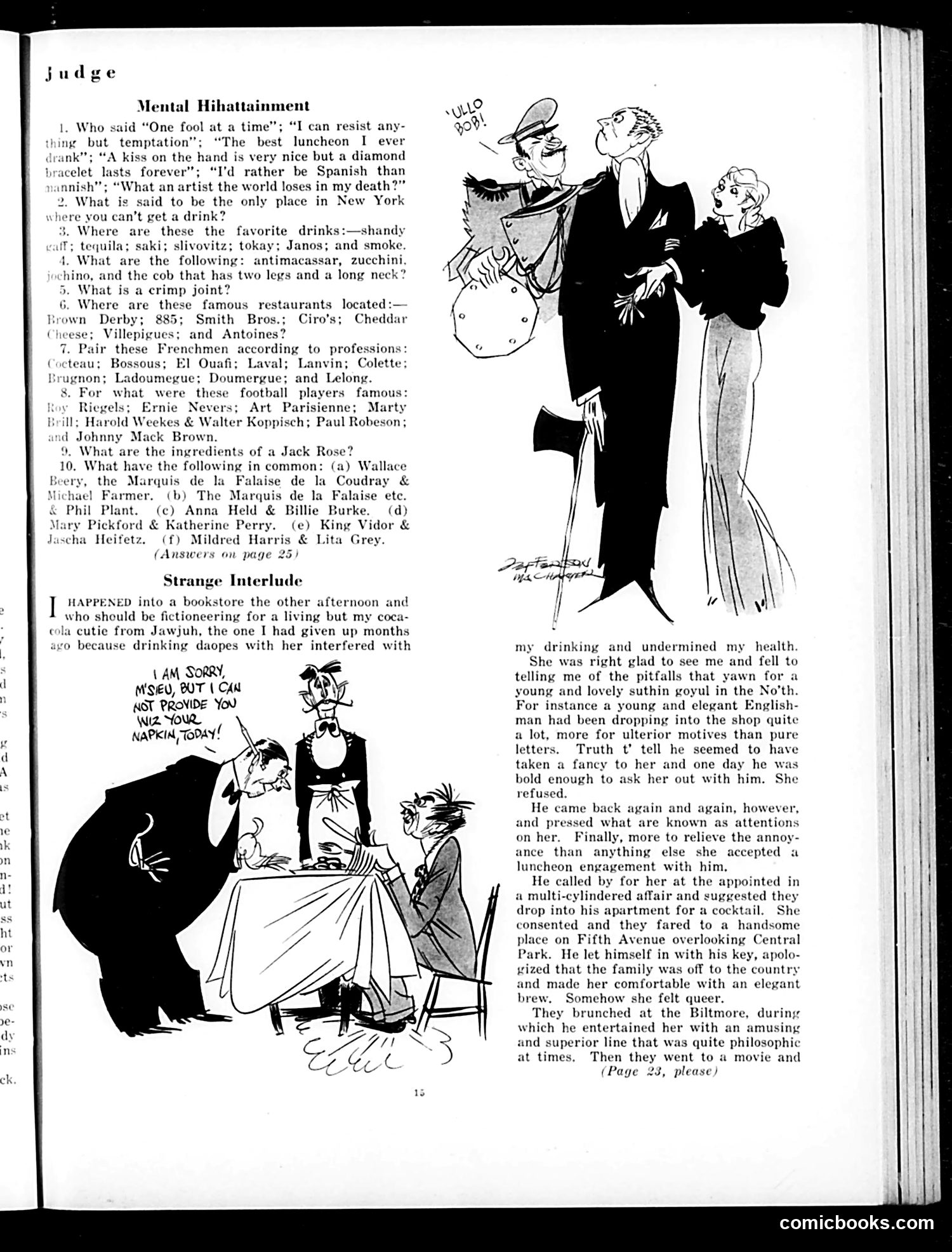
Analysis of Judge Magazine Page This page contains two distinct sections: "Mental Hihattainment" is a trivia quiz section testing readers' knowledge of 1920s-30s celebrity culture, high society, and entertainment. The questions reference famous actors (Charlie Chaplin, Mary Pickford), restaurant landmarks (Brown Derby, Ciro's), and European celebrities—reflecting Judge's audience of educated, cosmopolitan urbanites. The humor lies in the assumption readers would recognize these cultural references. "Strange Interlude" is a satirical short story with accompanying cartoon. It mocks American pretension and Southern stereotypes. The narrator, a Southern woman ("Jawjuh," "suthin goyul"), describes a manipulative English gentleman's seduction attempt. The cartoon shows a waiter apologizing for lacking napkins—visual comedy about service failures. The story critiques both the gullible Southern woman and the predatory European sophisticate, reflecting period anxieties about Old World corruption infiltrating American innocence. The narrative's continuation ("Page 23, please") suggests serialized content typical of Judge's format.
"The Theatrical Bazaar" by George Jean Nathan This is a satirical article by prominent theater critic George Jean Nathan, not a cartoon. It's a catalog of hypocritical theater professionals and critics, presented as comic types. Nathan mocks critics who claim ethical standards but lack integrity; actors who give pompous lectures despite minor roles; authors who fawn over reviewers on opening nights; and producers who make excuses for poor shows. He ridicules actresses feigning surprise during curtain calls, English actors condescending to American audiences, and critics who dismiss propaganda plays reflexively. The piece satirizes pretension throughout theatrical culture—the gap between what theater people claim to represent and their actual behavior. Nathan's humor targets vanity, cowardice, and self-serving hypocrisy among those involved in Broadway theater. The article continues on page 28, suggesting this was a regular feature in *Judge*.
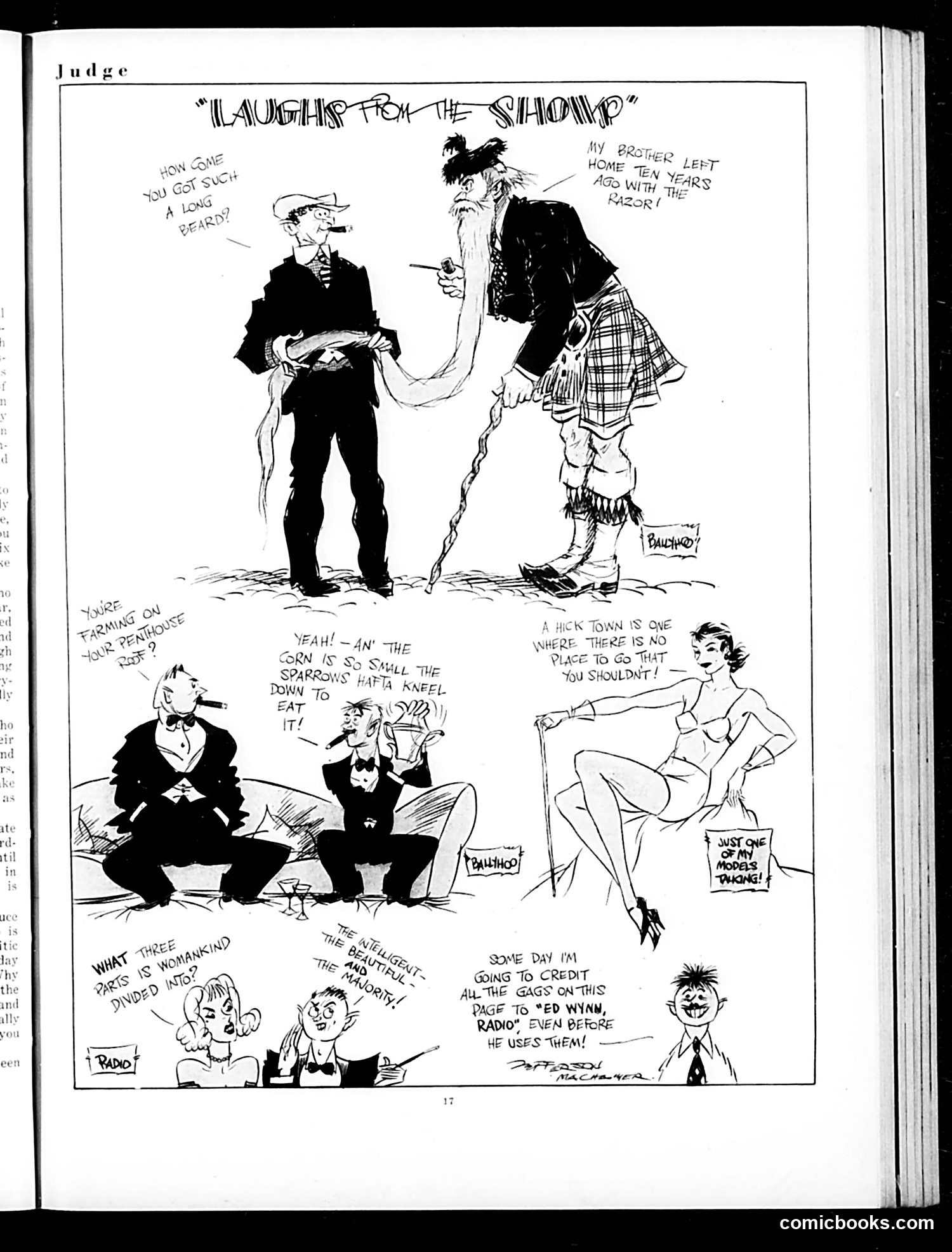
"Laughs from the Shop" - Judge Magazine Cartoon This is a collection of interconnected gags about rural small-town life and radio entertainment. The top scene shows a barber and a long-bearded hillbilly character exchanging witticisms about frontier living ("my brother left home ten years ago with a razor"). The subsequent panels feature two men in formal wear delivering one-liners about small-town society—jokes about lacking proper amenities ("a hick town is one where there is no place to go that you shouldn't"), and references to farming and rural customs. The final panel credits "Ed Wyan, Radio" as the source of these jokes, with the cartoonist humorously claiming he'll attribute future gags to Wyan even before the radio personality uses them himself. The satire targets both rural stereotypes and the emerging radio entertainment industry's relationship to print media comedy during this era.
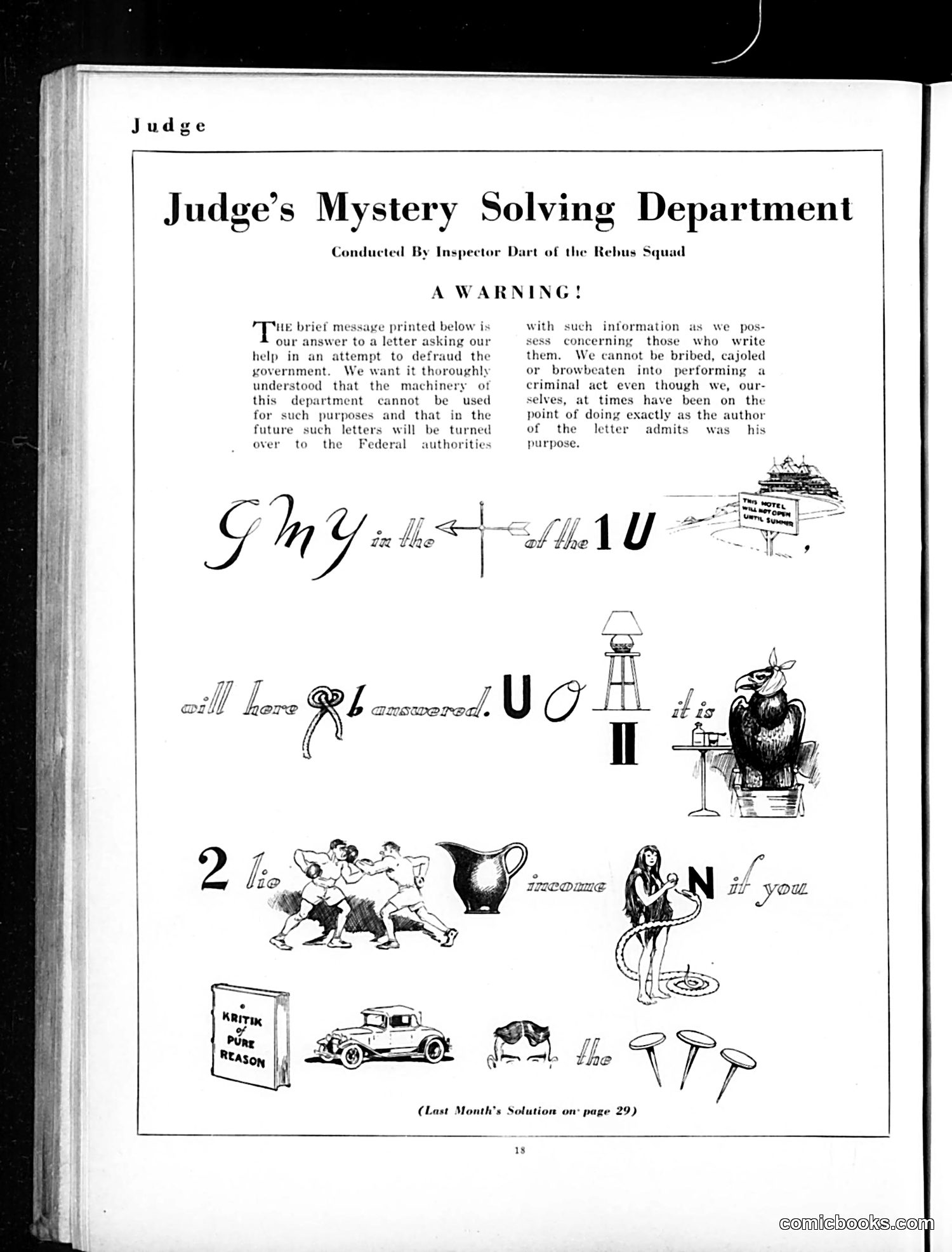
Judge's Mystery Solving Department This page features Judge magazine's "Mystery Solving Department," a rebus puzzle column conducted by "Inspector Dart of the Rebus Squad." The main content is a warning to readers: someone attempted to use the department to solicit help defrauding the government, and Judge is publicly refusing—stating such requests will be turned over to Federal authorities. Below the warning is an unsolved rebus puzzle combining words, images (children fighting, a pitcher, a car, a woman, nails), and symbols that readers must decode. The solution appeared in the previous month's issue. The tone is characteristically satirical: Judge presents itself as righteously law-abiding while humorously acknowledging the temptation to participate in fraud. This reflects Prohibition-era anxieties about government deception and criminal schemes.
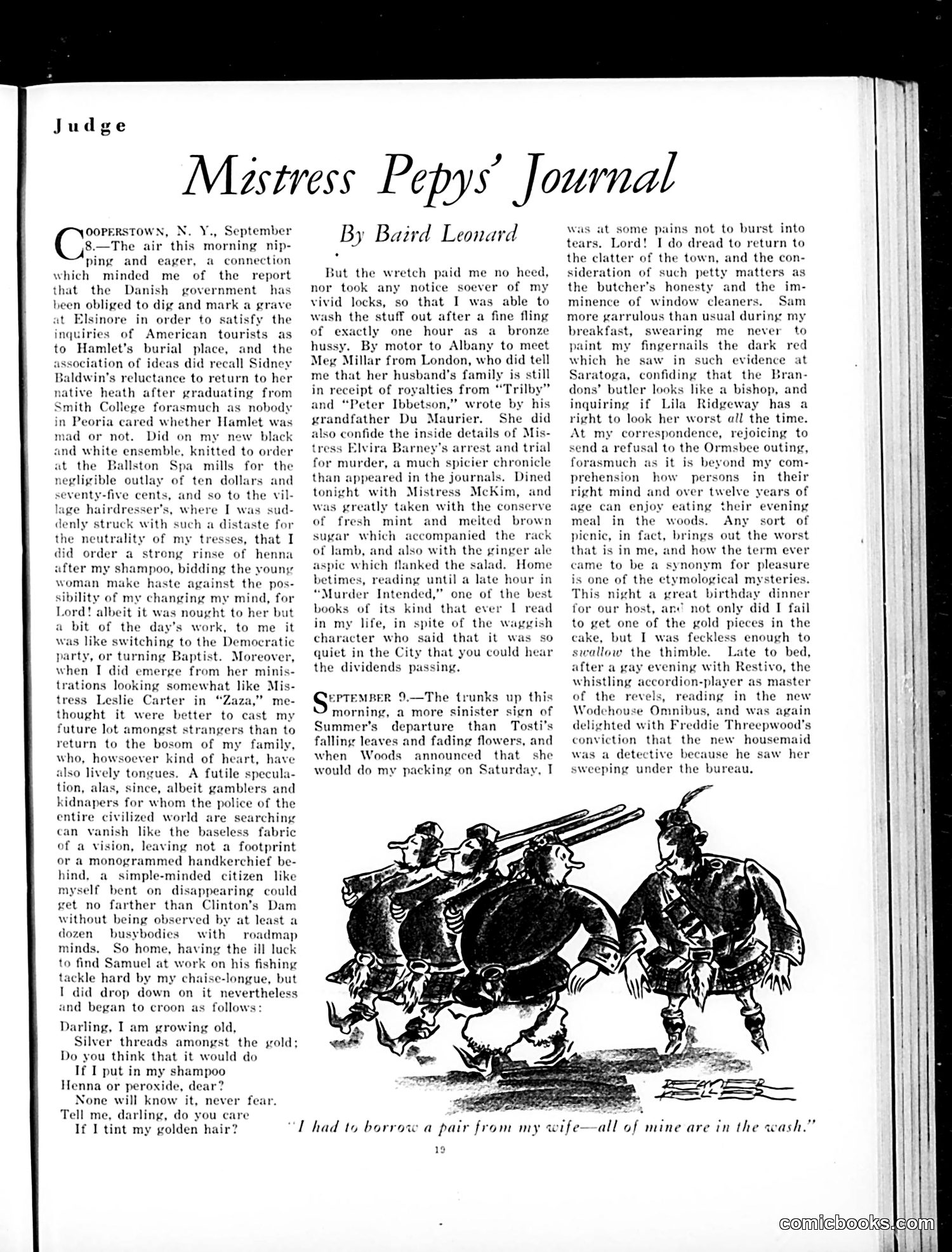
"Mistress Pepys' Journal" - Judge Magazine Satire This is a humorous society column mimicking Samuel Pepys' famous 17th-century diary, but set in early 20th-century upstate New York. The narrator—a gossipy, self-absorbed society woman—chronicles trivial domestic events with overwrought drama. The satire targets: 1. Female vanity: Her agonizing over dyeing her hair and fearing family judgment 2. Name-dropping: References to literary figures (Hamlet, Du Maurier's *Trilby*) and scandal (Elvira Barney's murder trial—a real 1932 case) 3. Affluent boredom: Complaints about returning from summer to town life, concern with servants and butchers 4. Pseudo-literary pretension: Adopting Pepys' archaic style for mundane gossip The accompanying cartoon shows figures struggling with oversized trunks, captioned "I had to borrow a pair from my wife—all of mine are in the wash," satirizing the burden of seasonal travel and accumulated possessions among the wealthy leisure class. The humor lies in the gap between grand literary aspirations and petty suburban concerns.
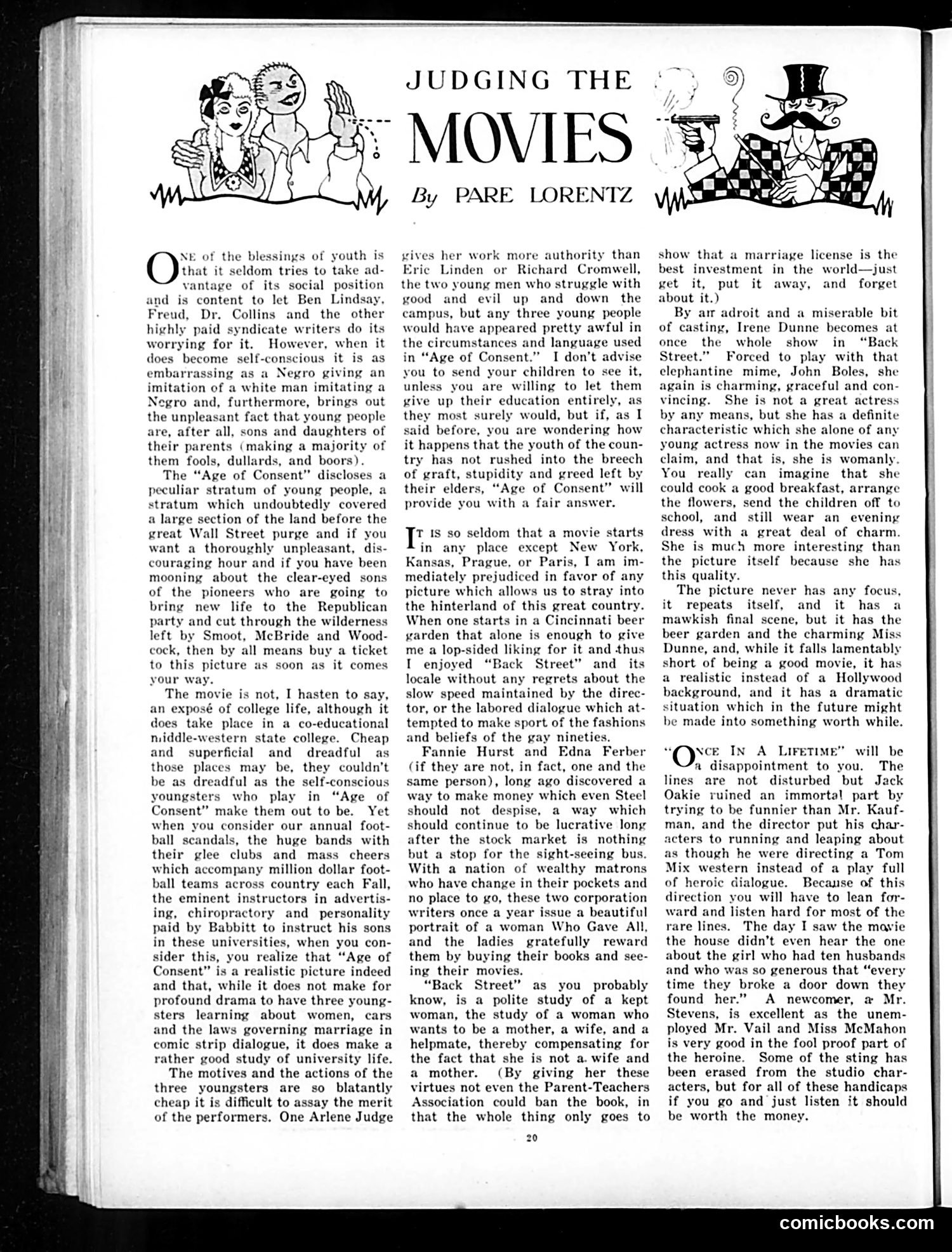
"Judging the Movies" by Pare Lorentz This is a film criticism column reviewing two movies: "Age of Consent" and "Back Street." "Age of Consent": Lorentz critiques this college-set film as an accurate (if unflattering) portrait of American youth. He argues the young characters' shallow materialism reflects real societal problems—the moral vacuum left by their elders' corruption during the 1920s stock market crash ("Wall Street purge"). The film features Arlene Judge, Eric Linden, and Richard Cromwell. Though dramatically uninspired, Lorentz considers it realistic commentary on why youth haven't "rushed into the breach" to fix the country. "Back Street": Lorentz praises this film simply for being set in Cincinnati rather than typical cosmopolitan locales. He credits female authors Fannie Hurst and Edna Ferber with discovering a profitable formula (suggesting they may be the same person—a humorous exaggeration). The column reflects 1930s anxieties about youth morality, Depression-era cynicism, and dismissive attitudes toward women writers' commercial success.
Explanation for Modern Readers This page is primarily a book review section titled "Judging the Books," not a political cartoon. The main content critiques several novels: 1. "More Merry Go Round" — a satirical Washington D.C. exposé that allegedly names real political figures (Patrick Hurley, Marion Davies) in scandals. The reviewer praises its political criticism while noting it's dirtier than the original. 2. "Between White and Red" by Erich Dwinger — a German WWI prisoner's memoir about being trapped in Russia during the Revolution. The review criticizes its philosophical, pacifist protagonist as reflecting post-war disillusionment—contrasting with old "jumbo historical novels" where heroes fought heroically. The point: modern war literature shows soldiers questioning warfare rather than embracing it. 3. Brief mentions of other books including works by Aldous Huxley and James Ashton. The right side contains a Halloween candy advertisement for Gales "L'Offre" chocolates. This reflects 1930s literary culture and post-WWI cynicism about traditional heroism.
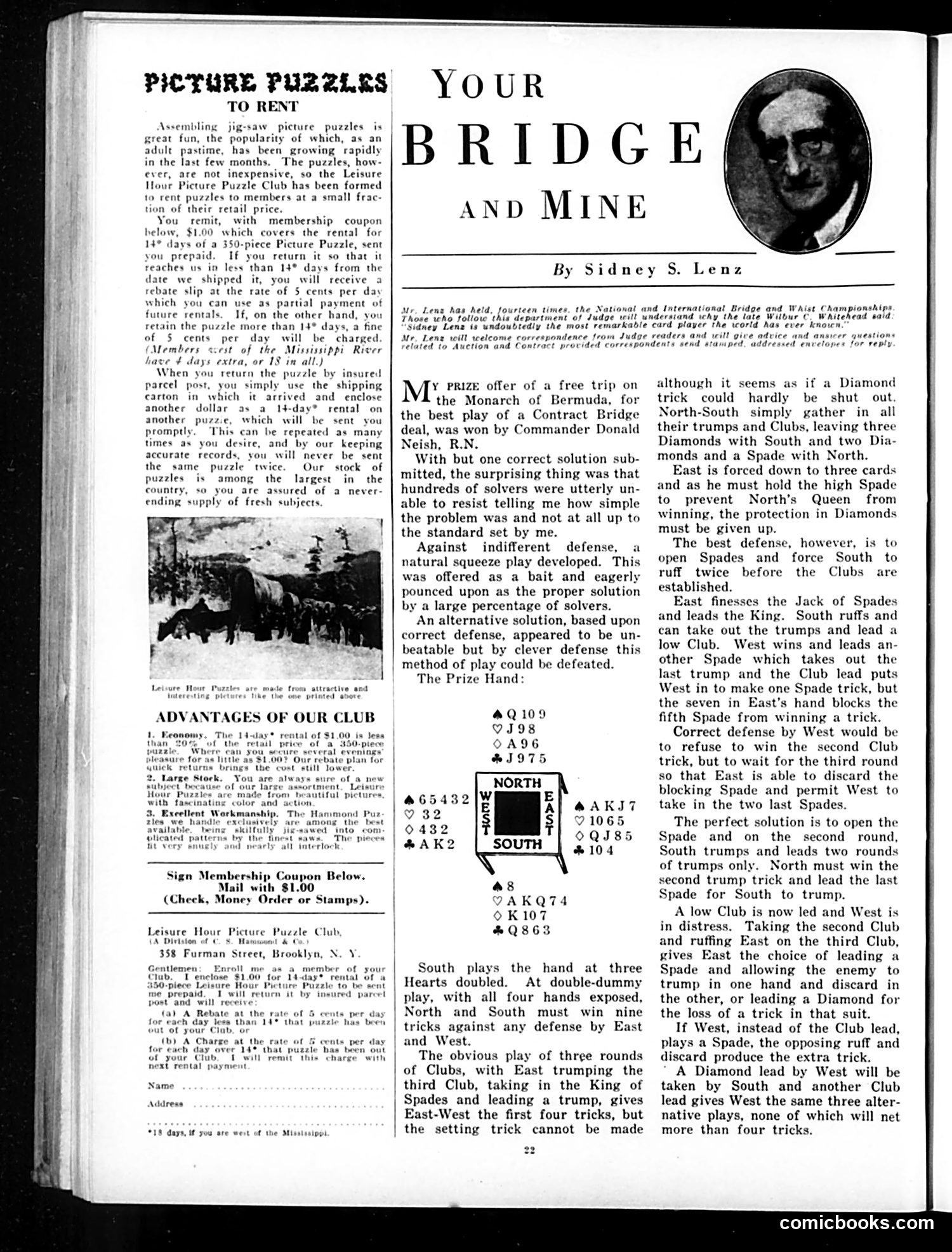
What This Page Shows This page is primarily advertising and instructional content, not satire or political commentary. The main elements are: 1. Left side: An advertisement for the "Leisure Hour Picture Puzzle Club," a mail-rental service for jigsaw puzzles. This reflects the 1920s-30s craze for jigsaw puzzles as affordable home entertainment. The text explains rental terms, pricing, and membership details. 2. Right side: A bridge column by Sidney S. Lenz, a renowned contract bridge champion. It presents a card game puzzle for readers to solve, with analysis of winning strategies. The page contains no political cartoons or satire—it's a straightforward mix of commercial promotion and recreational content typical of Judge magazine's miscellaneous pages.
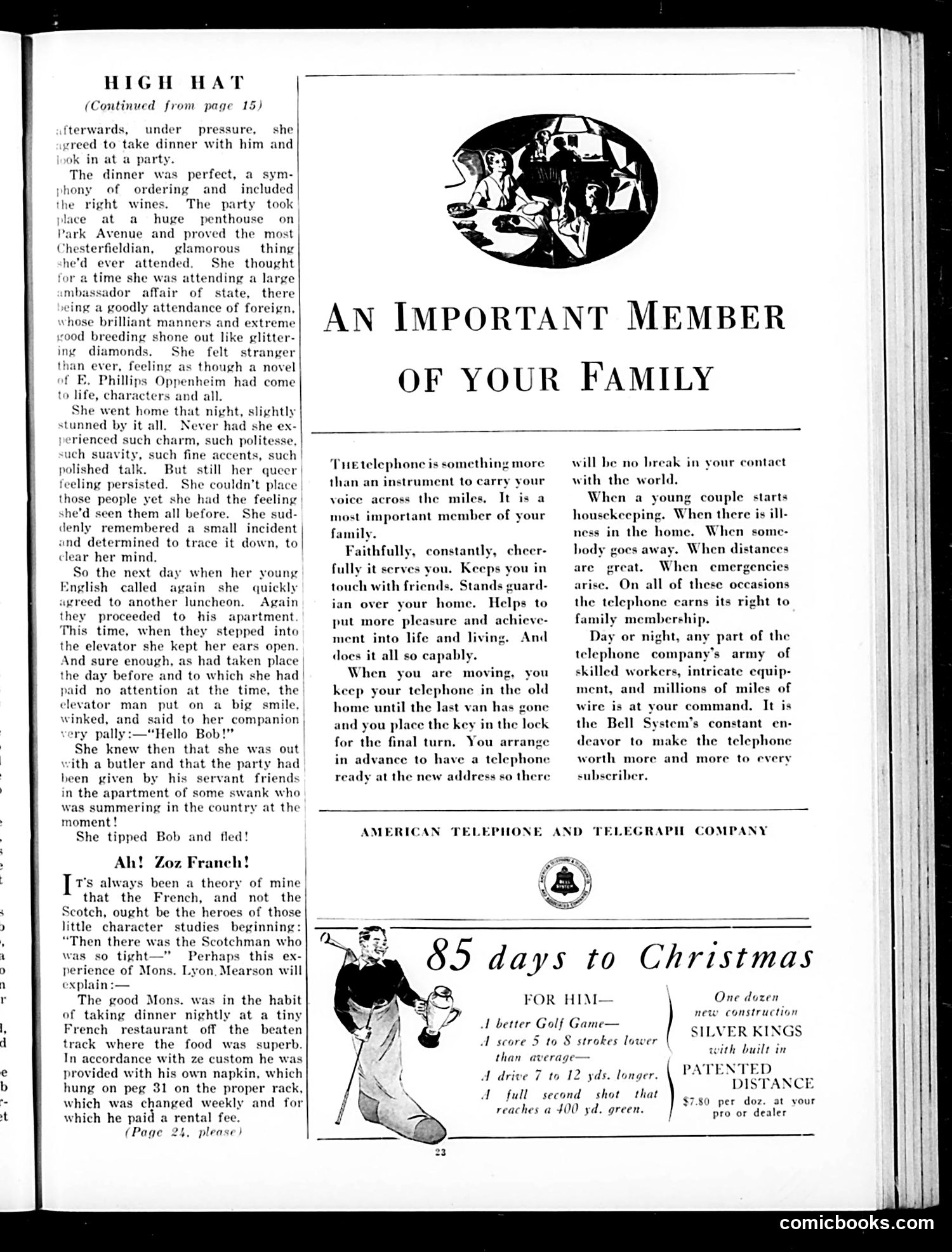
Page Analysis: "High Hat" and Telephone Advertisement This Judge magazine page contains two distinct elements: "High Hat" Story (left): A satirical narrative about social climbing. A woman attends an elegant Park Avenue penthouse dinner, feeling transported into an E. Phillips Oppenheim novel by the guests' sophistication and refined manners. She's startled to discover the party was actually hosted by the building's *elevator operator*—"Bob"—using his employer's apartment while they summered away. The joke satirizes both the pretension of affected upper-class performance and the blurred class boundaries of 1920s urban life, where servants could temporarily inhabit their employers' luxury spaces. Bell Telephone Advertisement (right): A corporate pitch positioning the telephone as essential to modern family life—enabling connections during moves, illnesses, emergencies, and romance. The "85 Days to Christmas" sidebar advertises golf balls as gifts. The page reflects 1920s anxieties about class authenticity and consumer modernity, using humor to both mock social pretension and promote technological integration into domestic life.
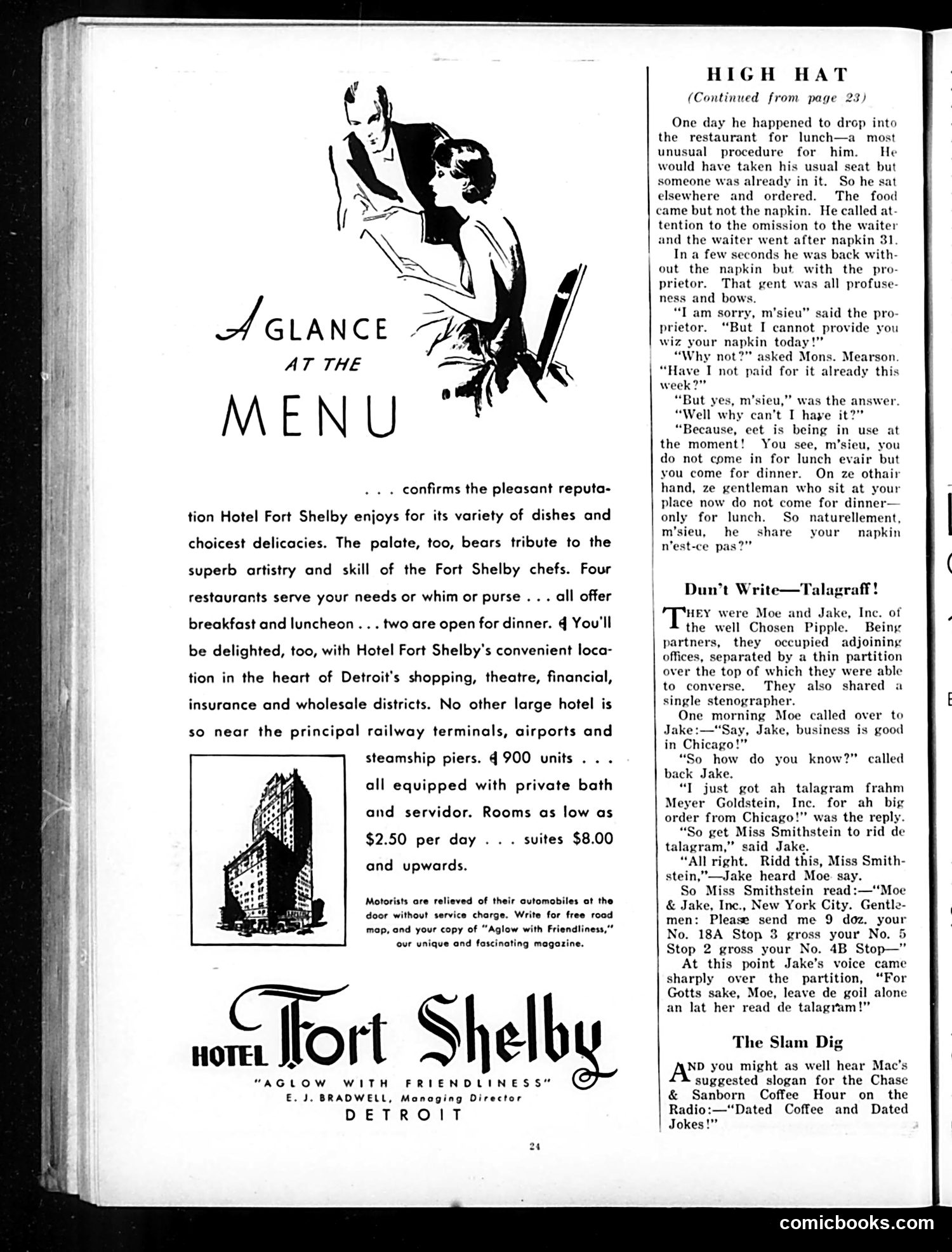
Page Analysis: Judge Magazine This page is primarily advertising for Hotel Fort Shelby in Detroit, featuring a stylized illustration of a couple dining. The ad emphasizes the hotel's restaurants, convenient downtown location, and affordable rates ($2.50-$8.00 per day). The right column contains two humorous short stories: 1. "High Hat": A satirical anecdote about a Parisian restaurant owner who refuses to provide a customer's paid napkin because it's currently in use by a lunch patron (the customer only dines at dinner). The joke mocks rigid French restaurant protocol and class distinctions based on meal times. 2. "Dun't Write—Talagraff!": A comedy sketch about two Jewish businessmen (Moe and Jake) whose stenographer must read a telegraphed order while Moe interrupts with romantic advances toward her. Jake's exasperated command to "leave de goil alone" delivers the punchline. Both stories use ethnic stereotypes and accent-heavy dialect common to 1920s-30s humor. The content reflects period attitudes toward immigrants and working-class romance.
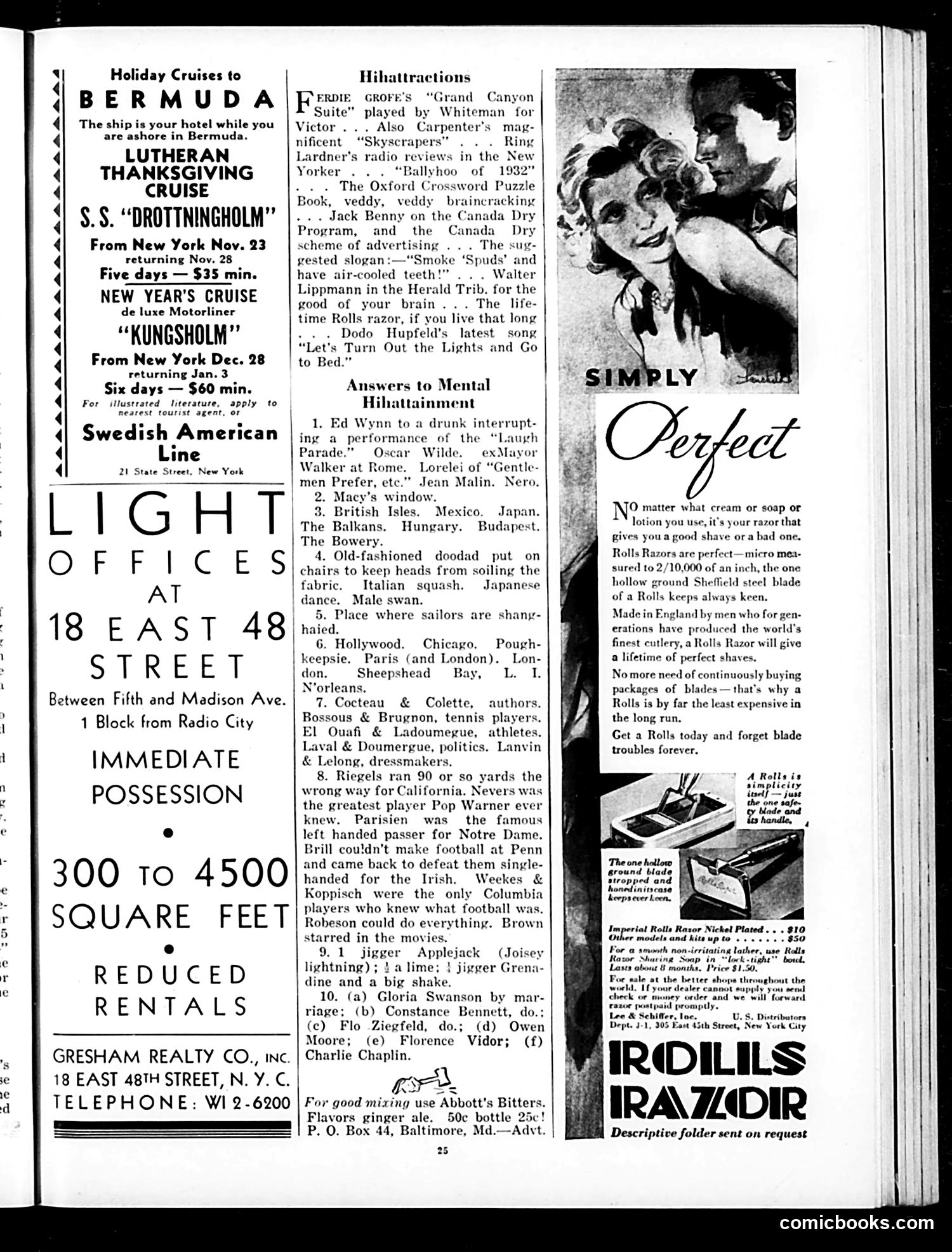
Page Content Analysis This page is primarily advertising and entertainment filler from Judge magazine, not political satire. The left side features cruise ship advertisements (Swedish American Line voyages to Bermuda and New York), office rental listings, and real estate services—typical magazine advertising of the era. The right side contains a quiz feature titled "Answers to Mental Hihattainment" (likely a misspelling of "hiatus entertainment")—a trivia or riddle section referencing popular 1930s entertainment figures and cultural references: Ed Wynn, Oscar Wilde, Jack Benny, Walter Lippmann, and athletes like Red Grange. This appears to be a reader participation feature. The page also includes advertisements for Rolls Razor (a safety razor brand) and Irdills Irazzoir products. There are no political cartoons on this page. It represents typical Judge magazine filler content between more substantial satirical pieces.
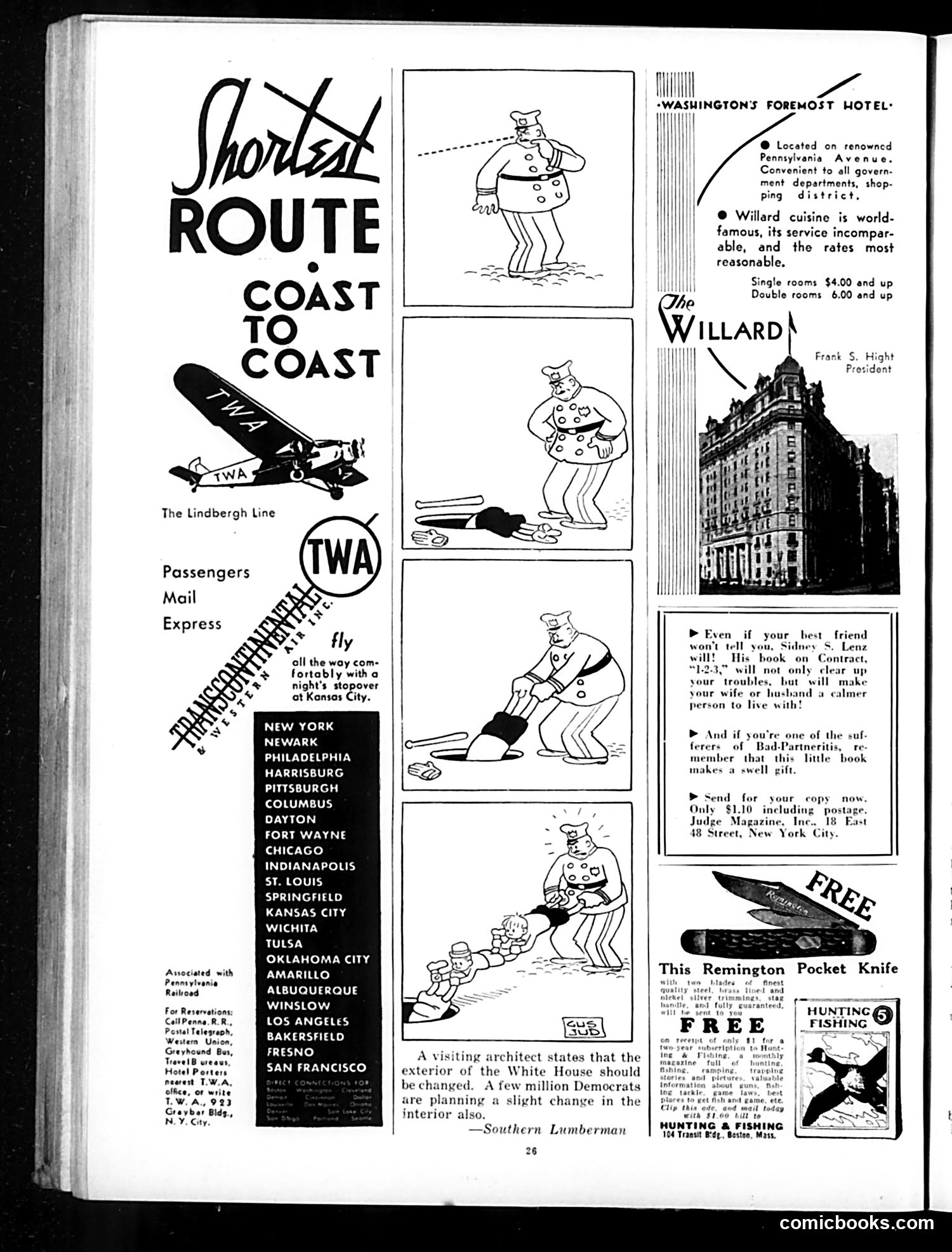
Judge Magazine Page Analysis This page is primarily advertising and promotional material rather than political satire. It features: Main Content: - A TWA airline advertisement for "Shortest Route Coast to Coast" (The Lindbergh Line), listing major cities served - The Willard Hotel ad (Washington D.C.'s "foremost hotel") - A Remington Pocket Knife giveaway offer - A hunting/fishing magazine promotion The One Satirical Element: The small quote at bottom references Democrats planning to change the White House's interior, attributed to *Southern Lumberman*. This appears to be a jab at the incoming Roosevelt administration (likely FDR's 1933 arrival), suggesting Democrats would make significant changes. It's mild political humor rather than sharp satire. Historical Context: The Lindbergh Line references Charles Lindbergh's fame (post-1927 transatlantic flight), using his celebrity to market air travel—still relatively new and glamorous in this era. Overall, this is a typical magazine page mixing advertisements with light commentary rather than serious political cartooning.
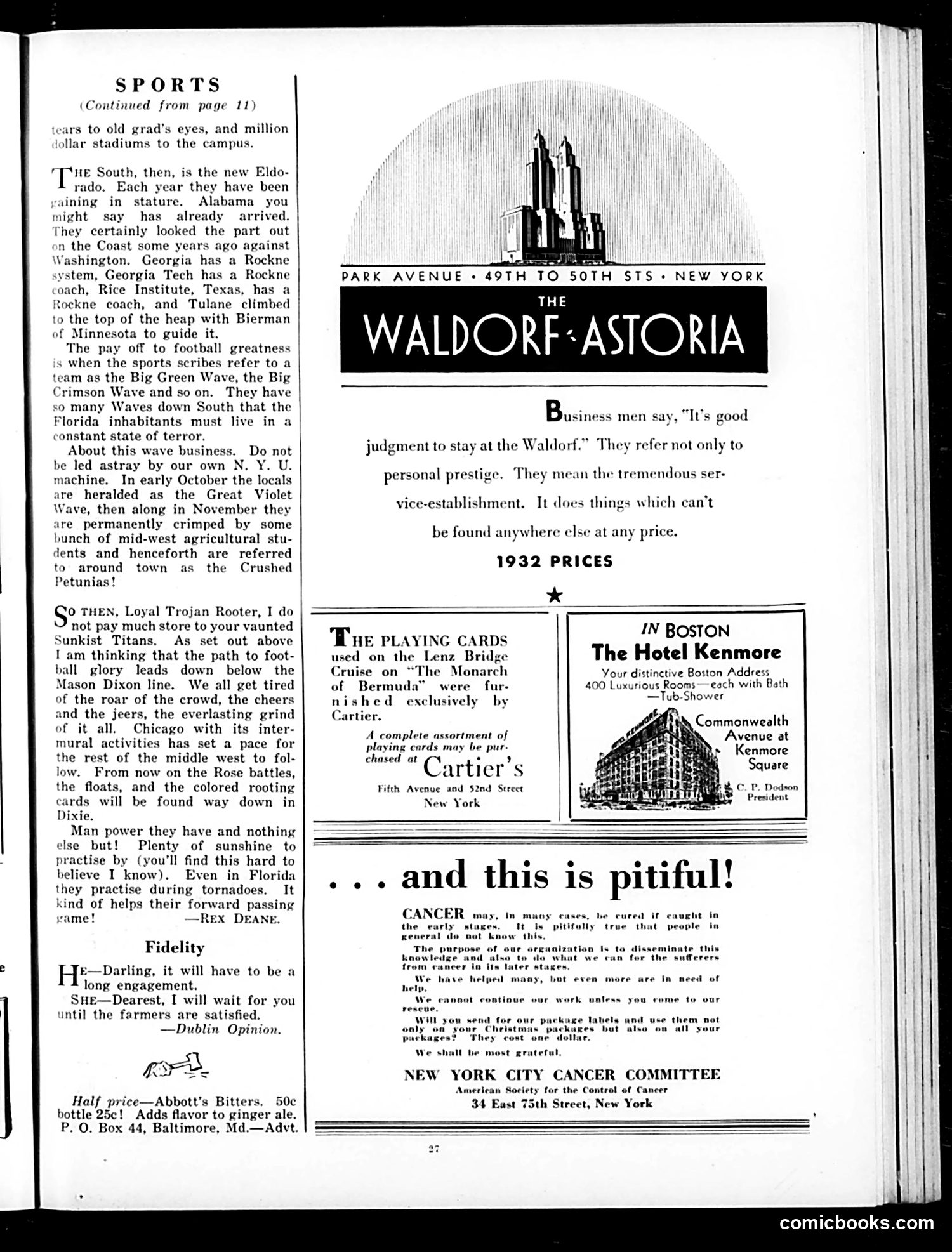
Judge Magazine Page Analysis This page is primarily advertising and public service announcements rather than satirical content. The main article (continued from previous page) discusses college football's growth in the American South, with a humorous tone about regional "Wave" nicknames (Big Green Wave, Crimson Wave, etc.). The author argues Southern football programs are ascending and that the path to "football glory" now leads south of the Mason-Dixon line, offering sunny weather as an advantage for practice. The page features luxury hotel advertisements (Waldorf-Astoria in New York, Hotel Kenmore in Boston) typical of 1930s Judge advertising, plus a notice about playing cards sold on a cruise ship. The largest non-advertisement element is a public health announcement from the New York City Cancer Committee, urging readers to recognize cancer's curability if caught early and soliciting donations (one dollar for package labels) to support cancer research and patient aid. The small "Fidelity" joke at bottom-left is unrelated social humor about engagement length.
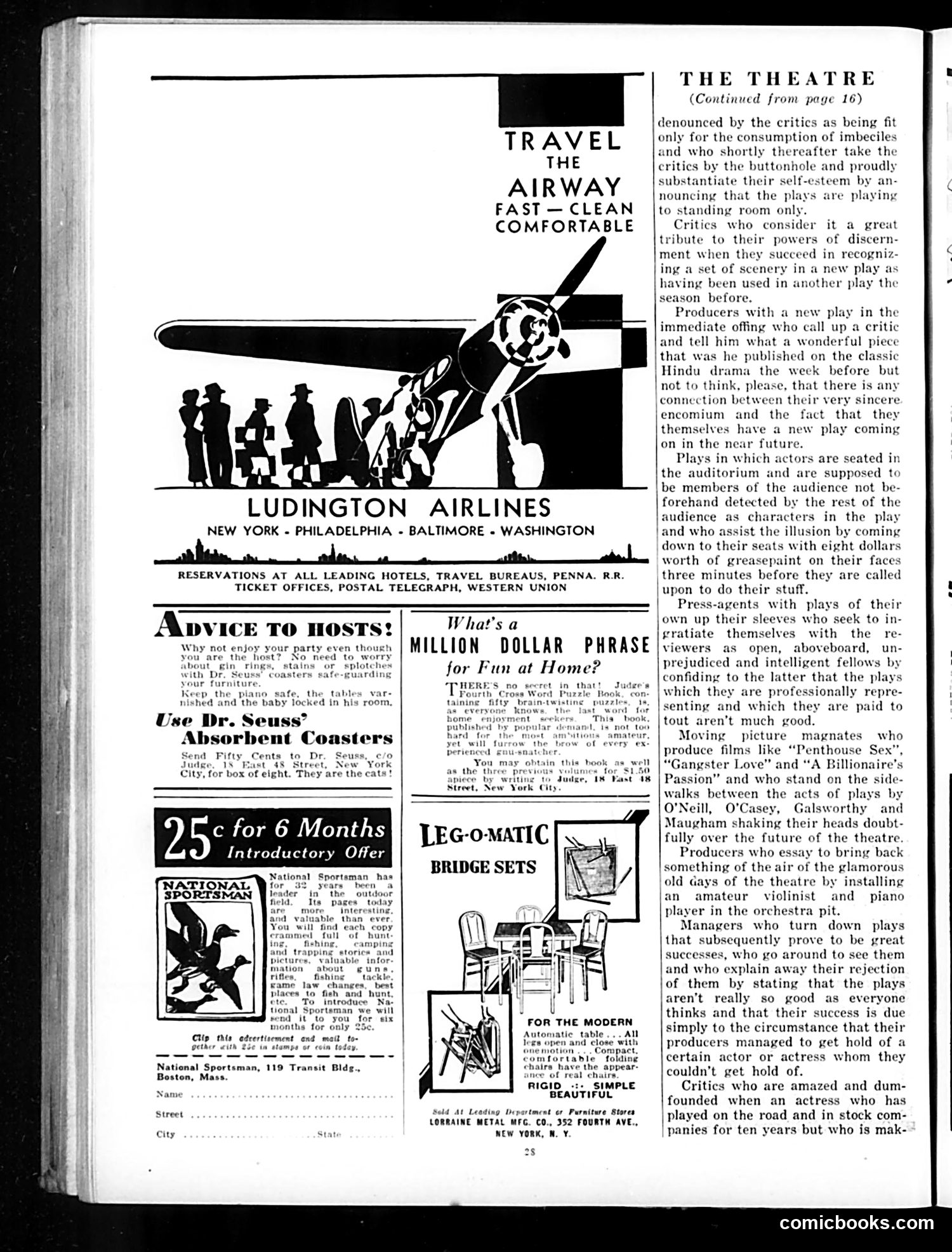
Analysis of Judge Magazine Page Content This page is primarily advertising, not political satire. It contains: 1. Ludington Airlines ad — promoting airway travel between East Coast cities (New York, Philadelphia, Baltimore, Washington) as "fast, clean, comfortable" 2. Various consumer product ads — including absorbent coasters, National Sportsman magazine, and Leg-o-Matic bridge sets (collapsible furniture) 3. Theatre column continuation — a lengthy piece satirizing theatrical pretensions and hypocrisy. It mocks: - Critics who dismiss plays then later claim credit for recognizing them - Producers who flatter critics about past reviews - Actors planted in audiences posing as spectators - Film producers who lament theatre's decline while making sensational movies - Managers rejecting successful plays then claiming they weren't actually good The theatre satire targets the self-deception and dishonesty endemic to 1920s-30s Broadway culture rather than political figures.
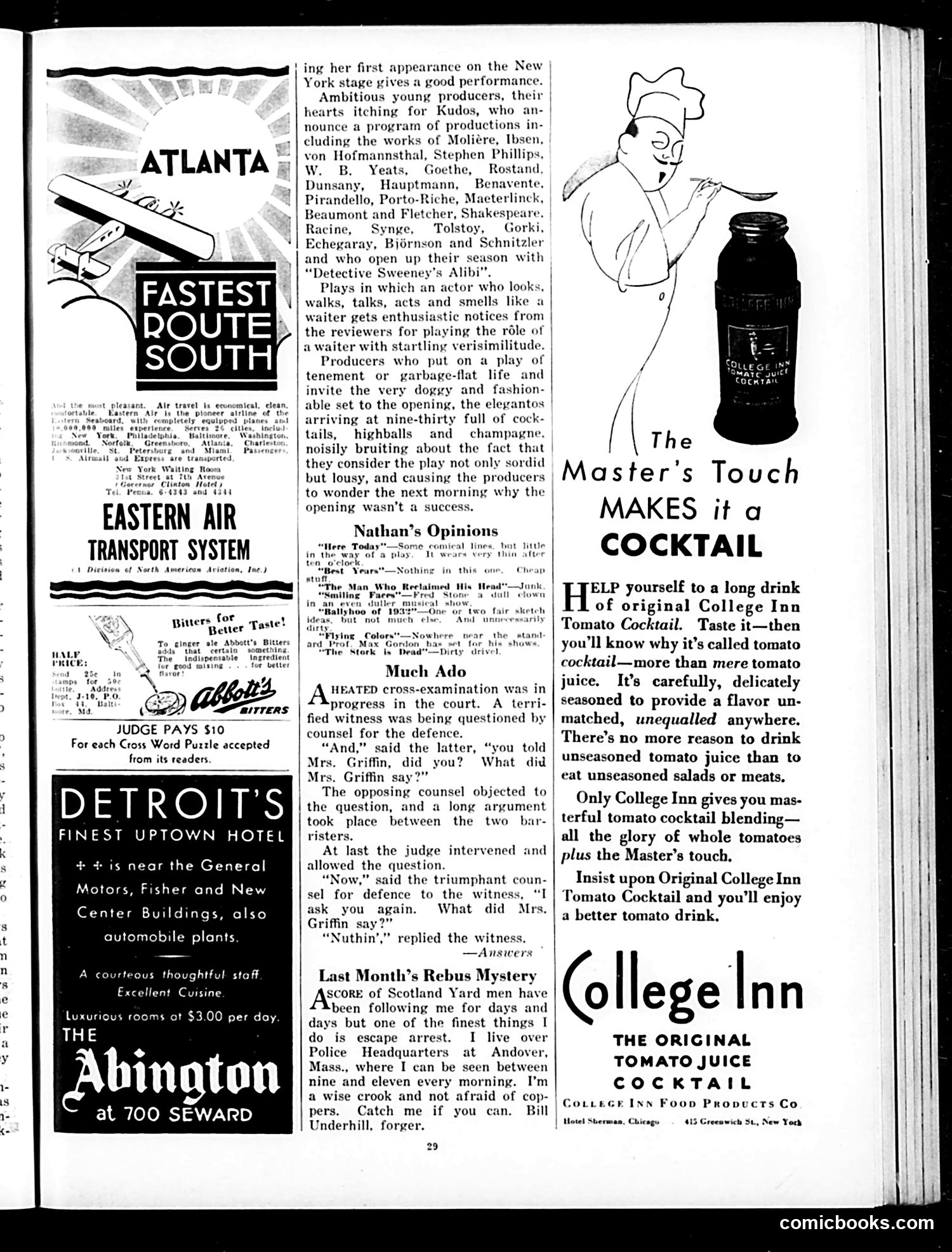
Judge Magazine Page Analysis This page mixes advertisements with satirical commentary rather than traditional cartoons. The main satirical content critiques pretentious Broadway theater producers. The central article mocks ambitious young producers who announce grandiose seasons featuring prestigious European playwrights (Ibsen, Yeats, Goethe, etc.), then undercut their artistic ambitions by staging lowbrow plays about tenement life, attracting fashionable audiences arriving drunk on cocktails. The satire targets the disconnect between producers' stated highbrow intentions and actual commercial compromises—staging plays they consider "sordid but lousy" to attract wealthy patrons. A separate section, "Nathan's Opinions," contains brief theatrical reviews using coded brevity, while "Much Ado" presents a courtroom joke about a witness's evasive testimony. The remainder comprises period advertisements for airlines, hotels, and College Inn tomato cocktail—typical Judge revenue sources. No identifiable caricatured figures appear. The satire addresses a general type: pretentious theater impresarios of the 1920s-30s era.
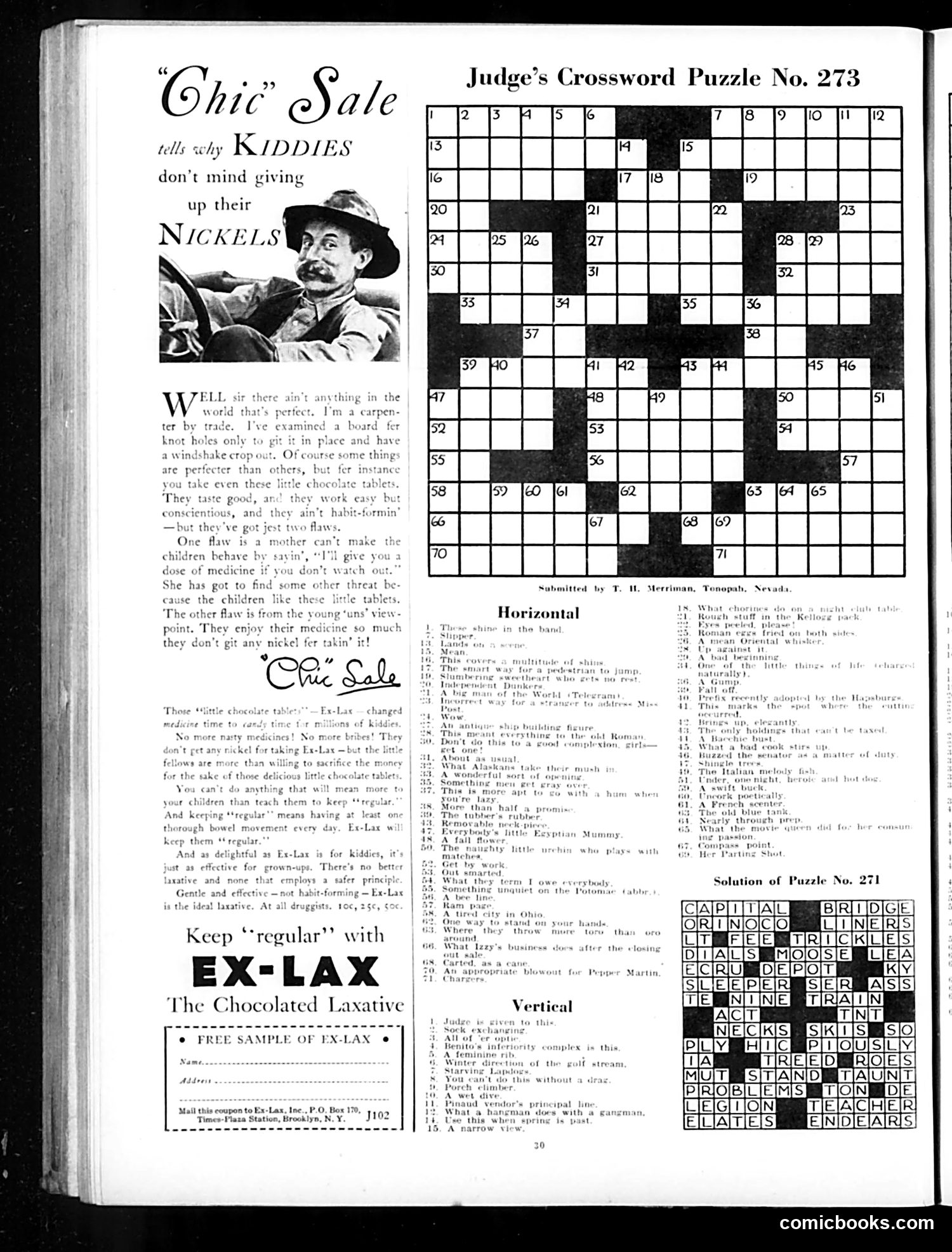
Analysis of Judge Magazine Page Content This page is primarily advertising and puzzles, not political satire. The main content consists of: 1. "Chic Sale" Advertisement: Features a caricatured man (likely the humorist Chic Sale himself) promoting Ex-Lax laxative chocolate tablets to parents. The ad uses humor about children's bowel regularity—a common advertising theme of the era when such products were heavily marketed to families. The copy jokes that kids "don't mind giving up their nickels" for these chocolates. 2. Crossword Puzzle No. 273 and its solution (Puzzle No. 271) 3. Ex-Lax Advertisement: Offers a free sample coupon There is no political satire or cartoon on this page. It represents typical 1920s-30s magazine content mixing humor-based product advertising with entertainment puzzles. The "satire" is purely commercial—using gentle family humor to sell laxatives.
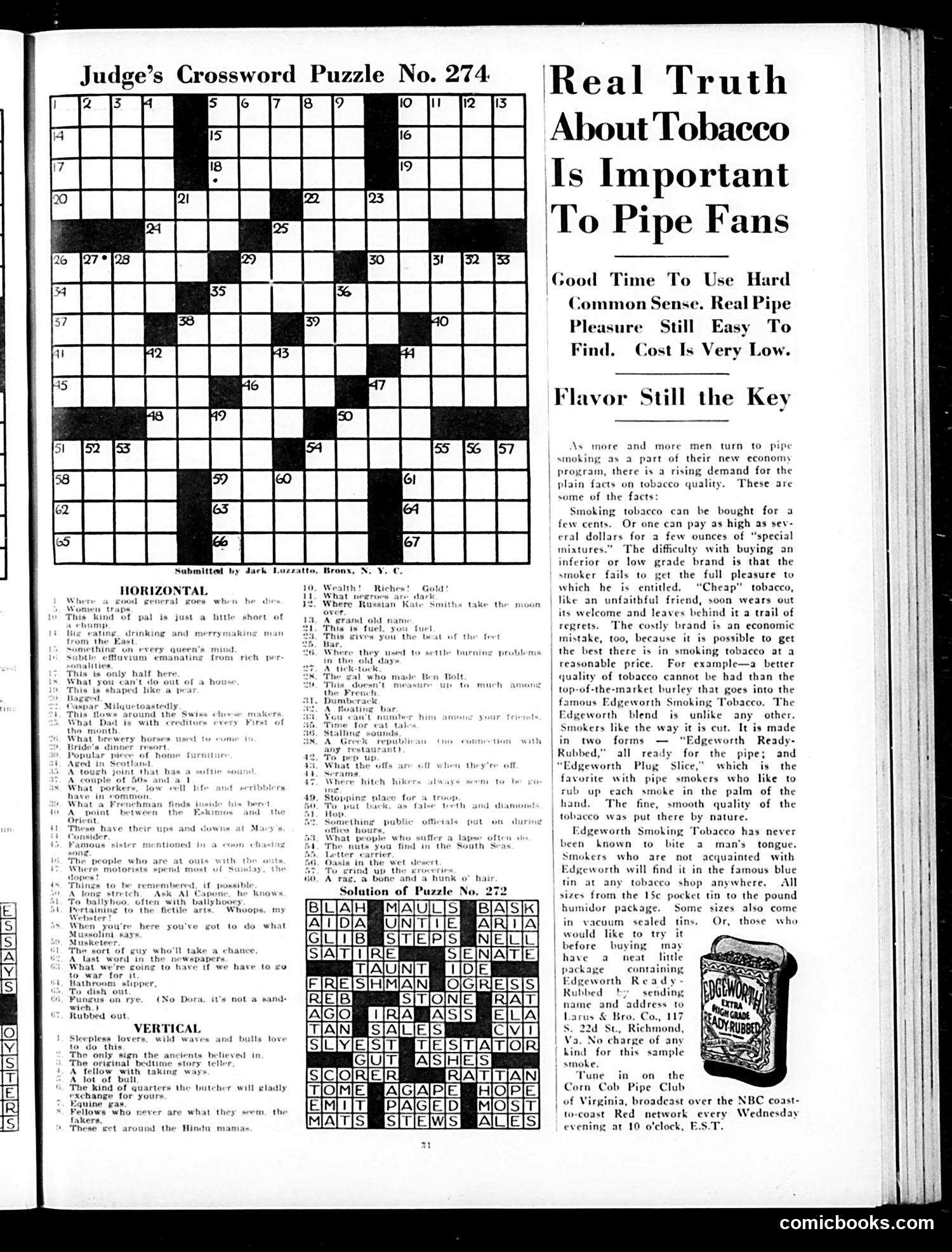
Analysis of Judge Magazine Page This page is primarily advertising disguised as editorial content. The crossword puzzle and "Real Truth About Tobacco" article are vehicle for promoting Edgeworth Smoking Tobacco. The "article" employs a common 1920s-30s marketing strategy: presenting product promotion as objective consumer advice. It frames expensive tobacco as foolish ("costly brand is an economic mistake") while positioning mid-range quality—specifically Edgeworth—as the rational choice offering "best there is...at reasonable price." The advertisement emphasizes that Edgeworth won't "bite a man's tongue" and comes in convenient formats ("Ready-Rubbed" and "Plug Slice"), targeting pipe smokers transitioning to tobacco as part of a "new economy program" (likely Depression-era belt-tightening). The crossword puzzle appears unrelated to tobacco—standard puzzle content—suggesting Judge magazine accepted substantial paid advertising embedded within editorial pages, a common practice before modern advertising disclosure requirements.
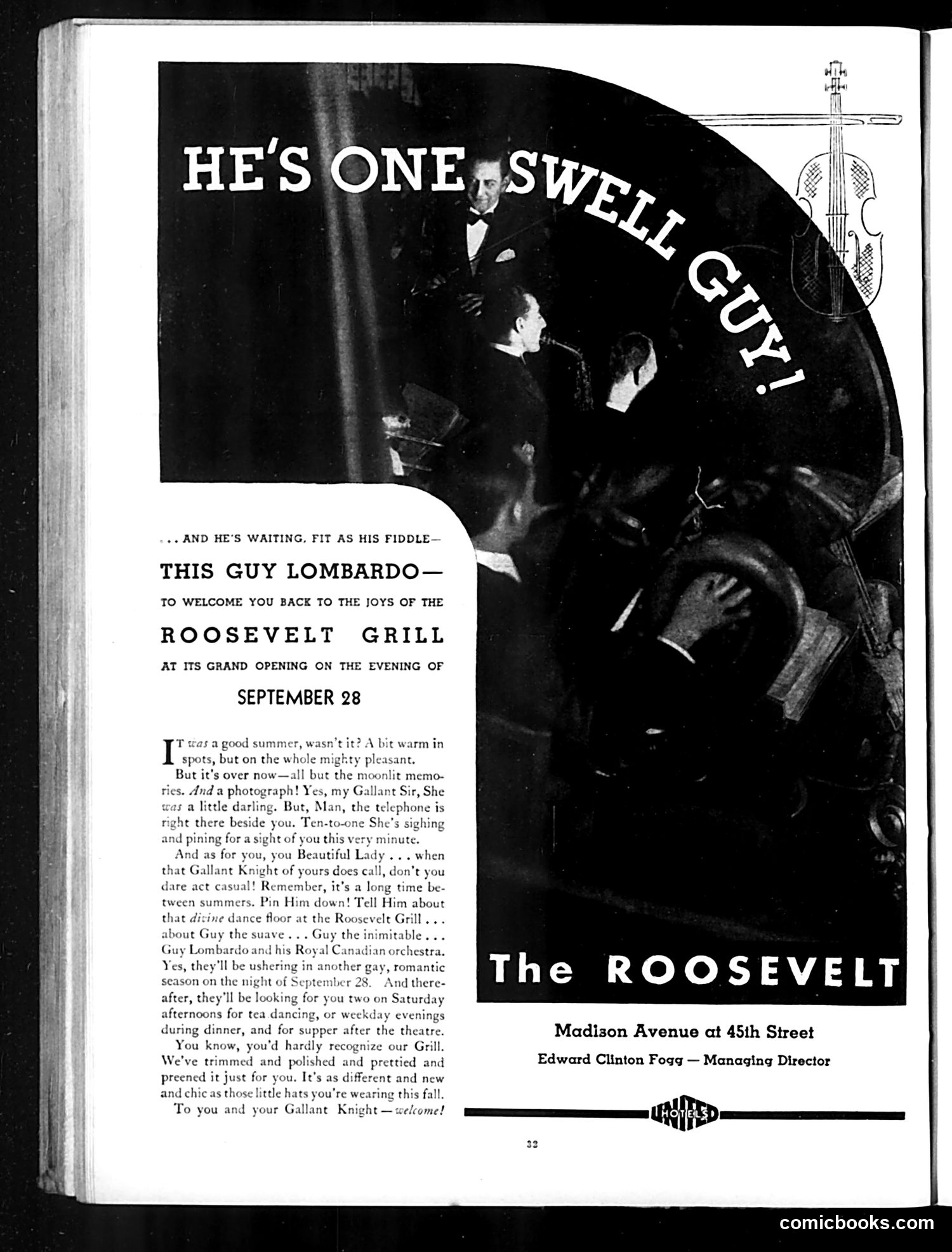
Analysis This is primarily a restaurant advertisement, not a political cartoon. It promotes the Roosevelt Grill's grand opening on September 28 at Madison Avenue and 45th Street in New York. The "satire" is light and social rather than political. It humorously references Guy Lombardo, a famous bandleader of the era, calling him "one swell guy" who will perform at the venue. The ad uses flirtation and romance as its selling point, addressing both "Gallant Knight" (male patrons) and "Beautiful Lady" (female patrons), encouraging them to return for dancing and dining after summer. The illustration shows well-dressed men in formal attire (tuxedos) at what appears to be an upscale social gathering, with a violin visible—matching Lombardo's orchestra theme. This is vintage advertising humor playing on sophisticated nightlife culture, not commentary on Roosevelt administration politics, despite the restaurant's name.
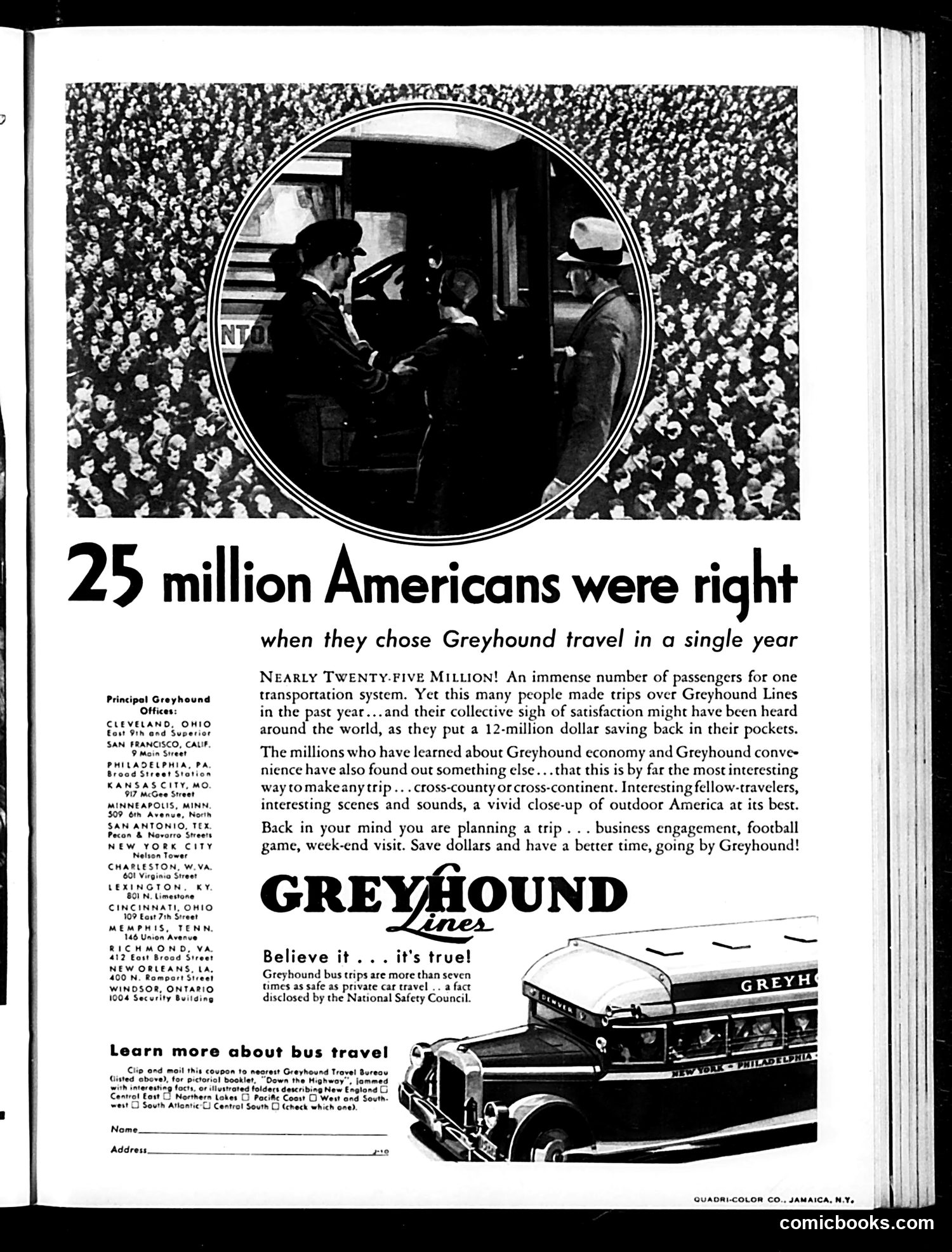
Analysis This is not a satirical cartoon but a straightforward advertisement for Greyhound bus lines, placed in *Judge* magazine (likely 1930s-40s based on style). The circular photograph shows men boarding a Greyhound bus—ordinary passengers, not caricatures or political figures. The ad's claim that "25 million Americans" chose Greyhound in a single year is promotional hyperbole meant to convey popularity and reliability. The "satire" or humor is minimal and gentle: the ad ironically claims bus travel is more economical AND more interesting than driving privately, promises you'll meet fascinating fellow travelers and see "outdoor America at its best," and ends with the somewhat tongue-in-cheek reassurance that buses are "seven times as safe" as cars (citing the National Safety Council). For modern readers: this is essentially a vintage travel ad emphasizing economy, safety, and adventure—common marketing appeals then and now. There's no hidden political commentary or caricatured targets visible.
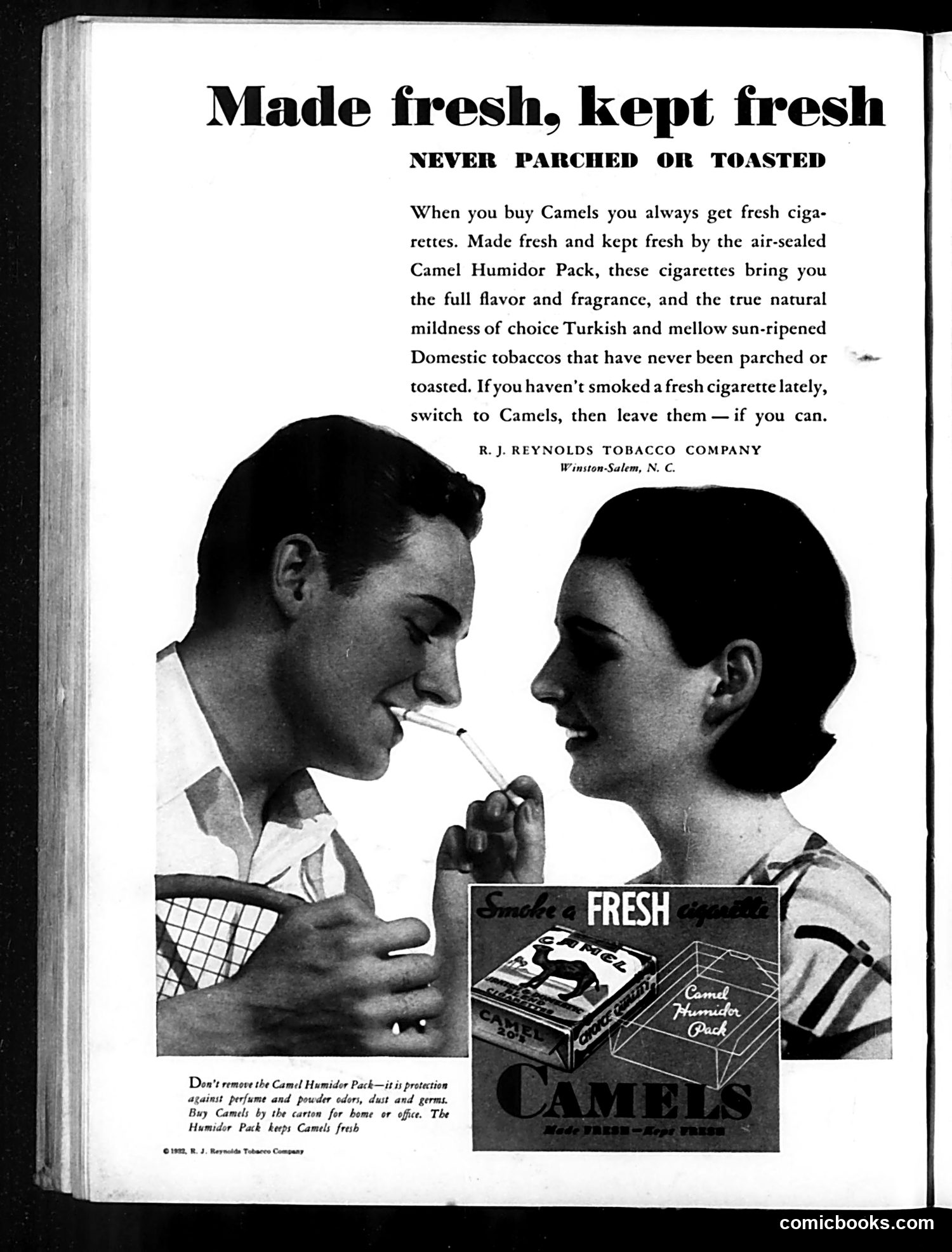
Analysis This page is a cigarette advertisement, not political satire. It's a Camel cigarettes ad from R.J. Reynolds Tobacco Company promoting their "Humidor Pack" packaging innovation. The image shows two people (a man and woman) smoking cigarettes, presented as an aspirational lifestyle scene. The advertising copy emphasizes that Camels are "made fresh, kept fresh" and never "parched or toasted," highlighting the sealed packaging as protection against moisture loss and contamination. The tagline "switch to Camels, then leave them—if you can" uses humor to suggest the product's addictiveness. This appeared in *Judge* magazine, which despite being satirical, carried commercial advertising like any period publication. For modern readers: This represents pre-regulation cigarette marketing that openly advertised smoking as desirable and made no health disclosures—practices now illegal in most countries.