judge
Judge — December 1932
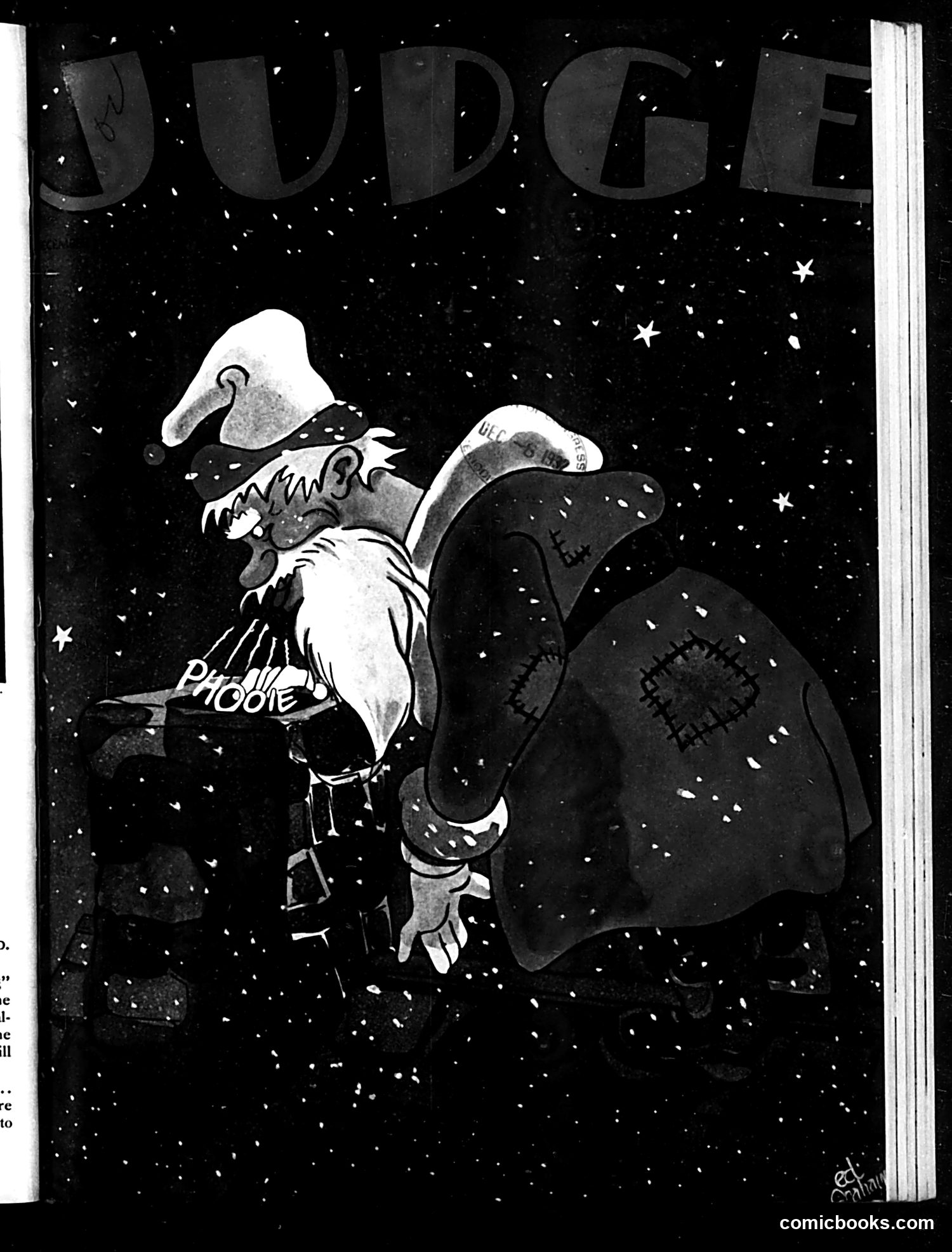
Analysis This Judge magazine cover depicts Santa Claus in a starry night sky, but with a satirical twist. Santa appears disheveled or worn, with a patched coat bearing visible stitching—suggesting hardship or poverty. The exaggerated caricature and tattered appearance likely comment on economic hardship during a specific historical period, possibly the Great Depression or another era of financial struggle. The satire suggests that even Santa—traditionally a symbol of abundance and gift-giving—cannot escape the era's economic difficulties. The starry background frames this commentary as somewhat cosmic or inevitable. Without the full article text, the exact political target remains unclear, but the central joke appears to be that financial crisis affects even mythical figures associated with prosperity and generosity.
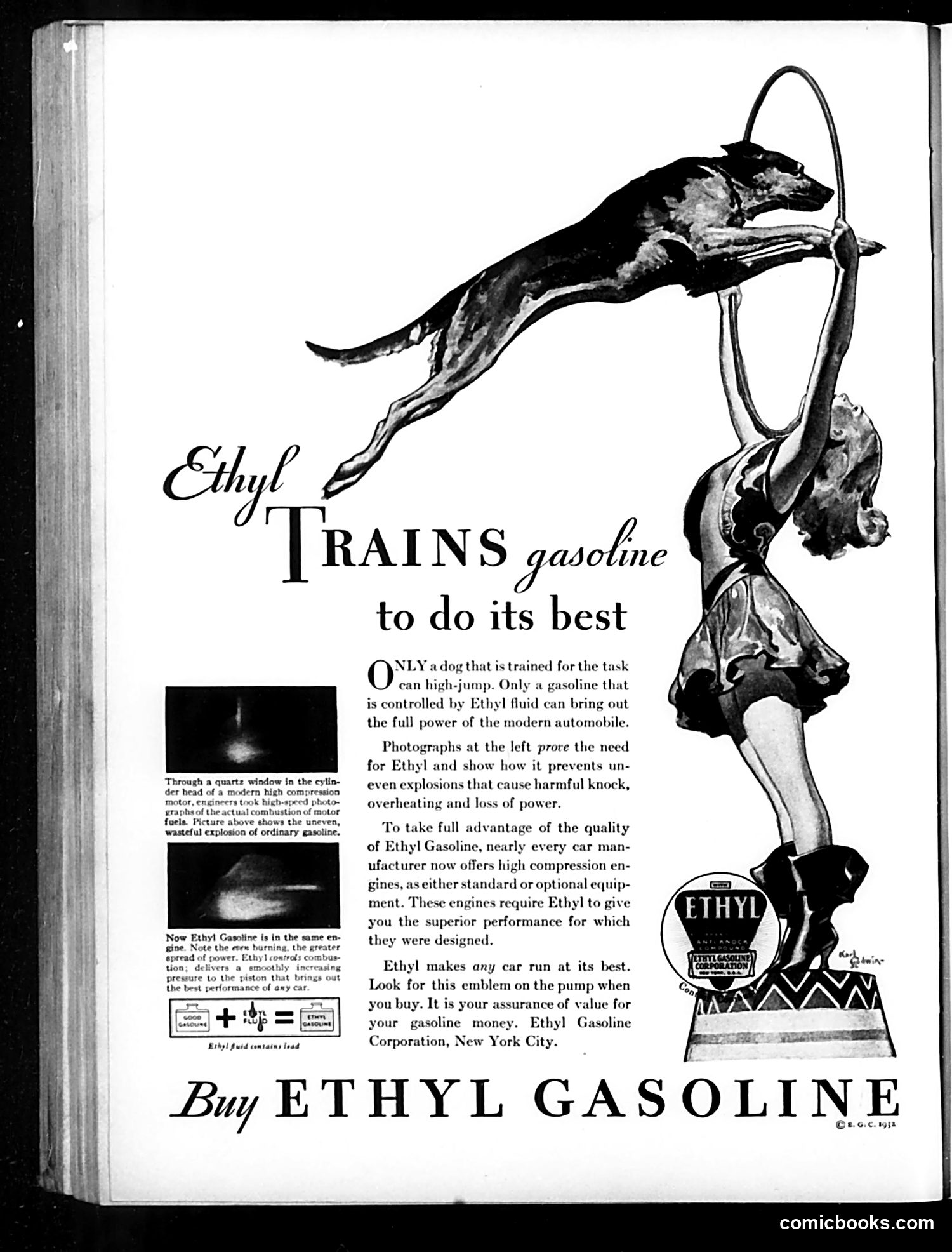
Analysis This is not a political cartoon but rather a 1920s advertisement for Ethyl Gasoline. The page uses a clever metaphor: just as a dog must be "trained for the task" to high-jump successfully, gasoline requires "Ethyl fluid" (tetraethyl lead) to perform optimally in high-compression engines. The striking illustration shows a trained dog leaping through a hoop, paralleling the "training" of gasoline. Small technical photographs on the left demonstrate combustion differences, showing how Ethyl prevents "knock" and explosions in modern motors. The advertisement emphasizes that most new car manufacturers now offer high-compression engines requiring Ethyl Gasoline. It directs consumers to look for the Ethyl emblem at pumps and closes with the corporate address: Ethyl Gasoline Corporation, New York City. This is pure product advertising, not satire.
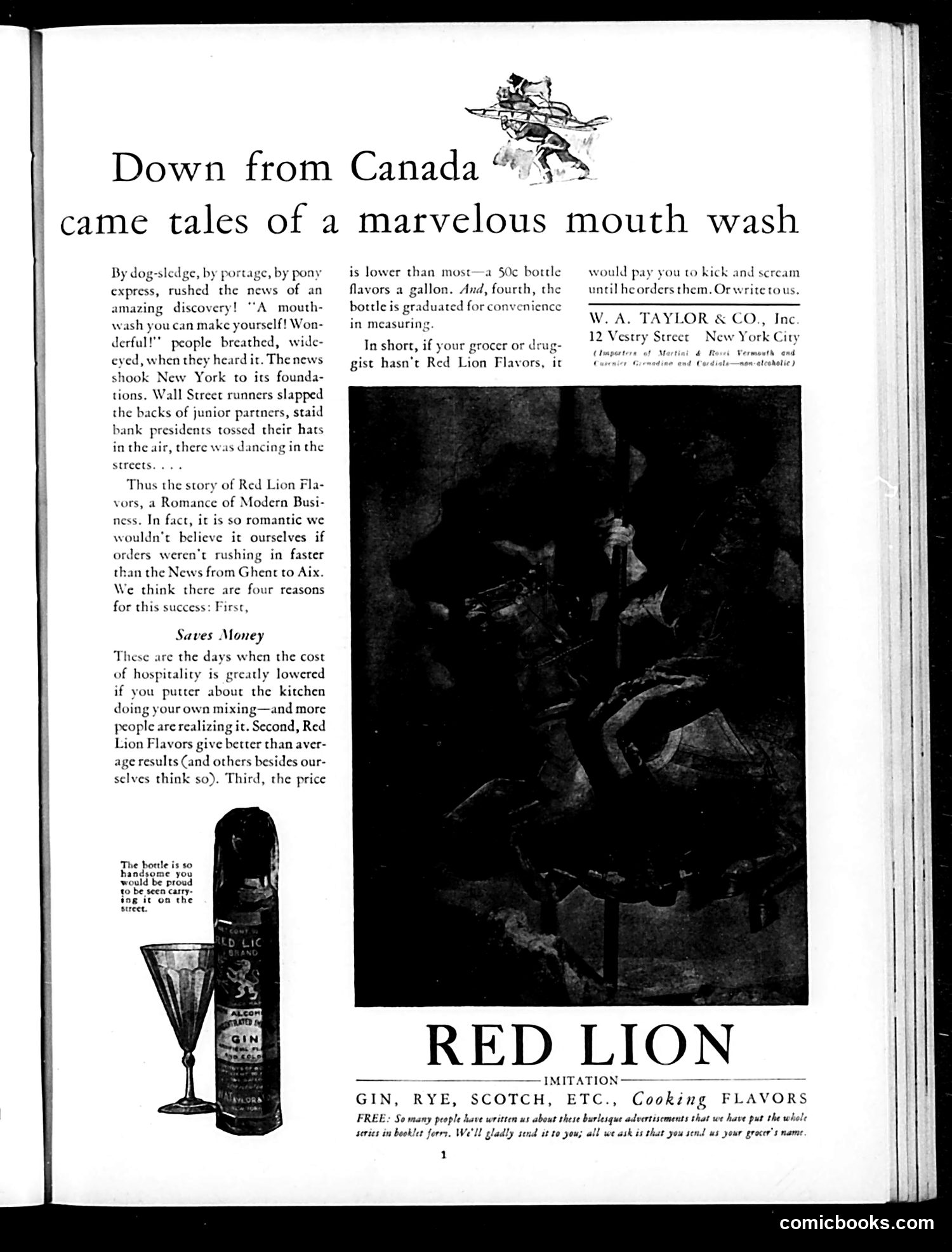
Red Lion Mouthwash Advertisement This page is primarily a commercial advertisement for Red Lion brand mouthwash and cooking flavorings, not a political cartoon. The ad describes the product's popularity "down from Canada," claiming it caused excitement on Wall Street and in New York's financial district. The advertisement emphasizes four selling points: cost savings (home mixing), superior results, attractive bottle design, and pricing structure (50¢ for a gallon of flavoring). The central image appears to be a dark, atmospheric scene—possibly depicting frontier or outdoor activity—though its relevance to mouthwash is unclear. The accompanying bottle illustration shows the product's packaging. This represents typical early-20th-century *Judge* magazine content: advertisements alongside satire, targeting middle-class urban readers interested in consumer products and business news.
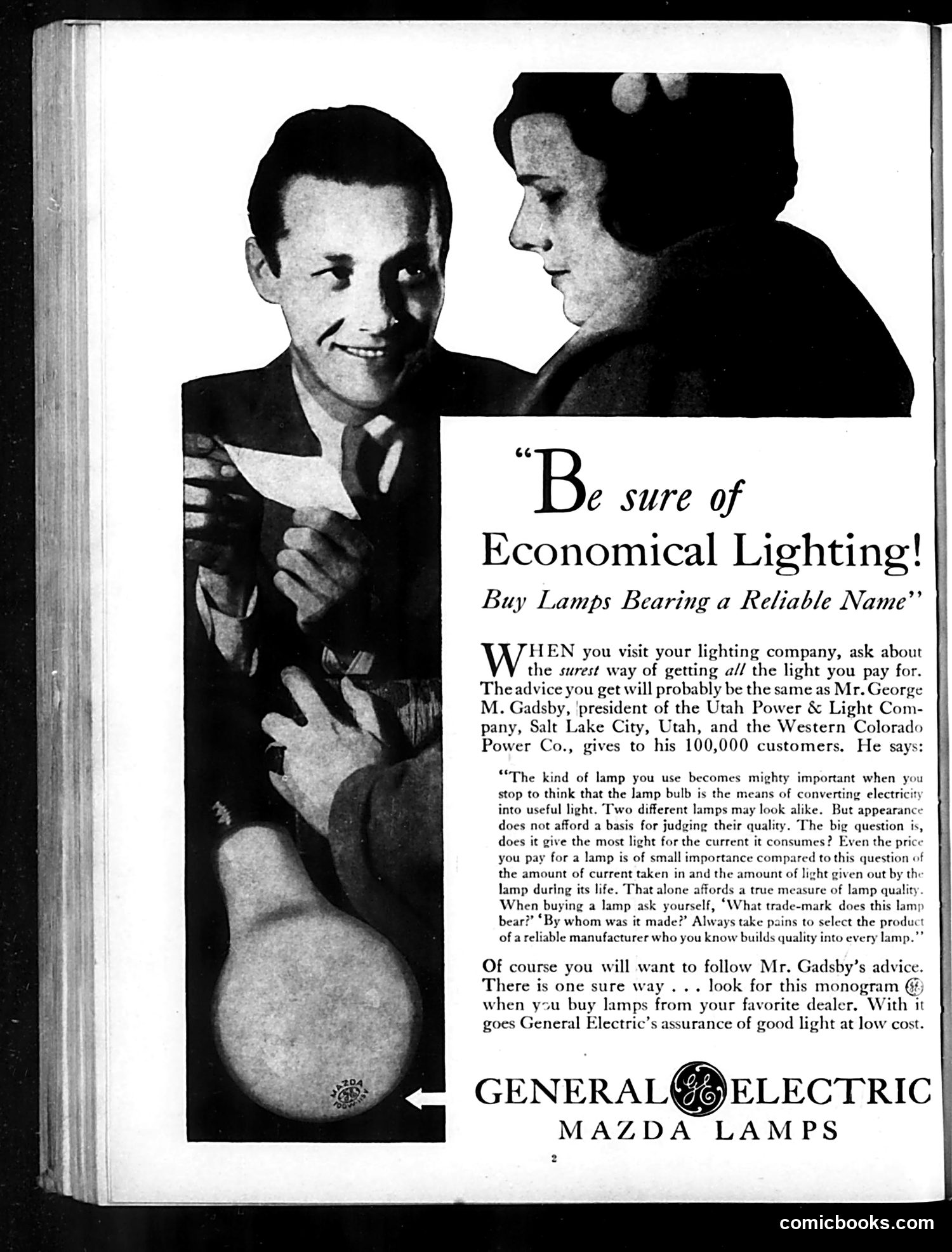
Analysis This page is primarily an advertisement, not satire or political commentary. It features a General Electric Mazda Lamps advertisement disguised as editorial content. The "cartoon" element is minimal—two men in professional dress examining a light bulb. One appears to be identified as George M. Gadsby, president of Utah Power & Light Company, presented as an expert endorsing economical lighting practices. The "satire" (if any exists) is subtle: the ad uses the authority of a real utility executive to promote buying name-brand lamps, framing this as consumer advice. However, this is straightforward advertising copy rather than biting satire. There's no clear political reference or caricature to decode. The page exemplifies how Judge mixed advertisements with editorial content to generate revenue.
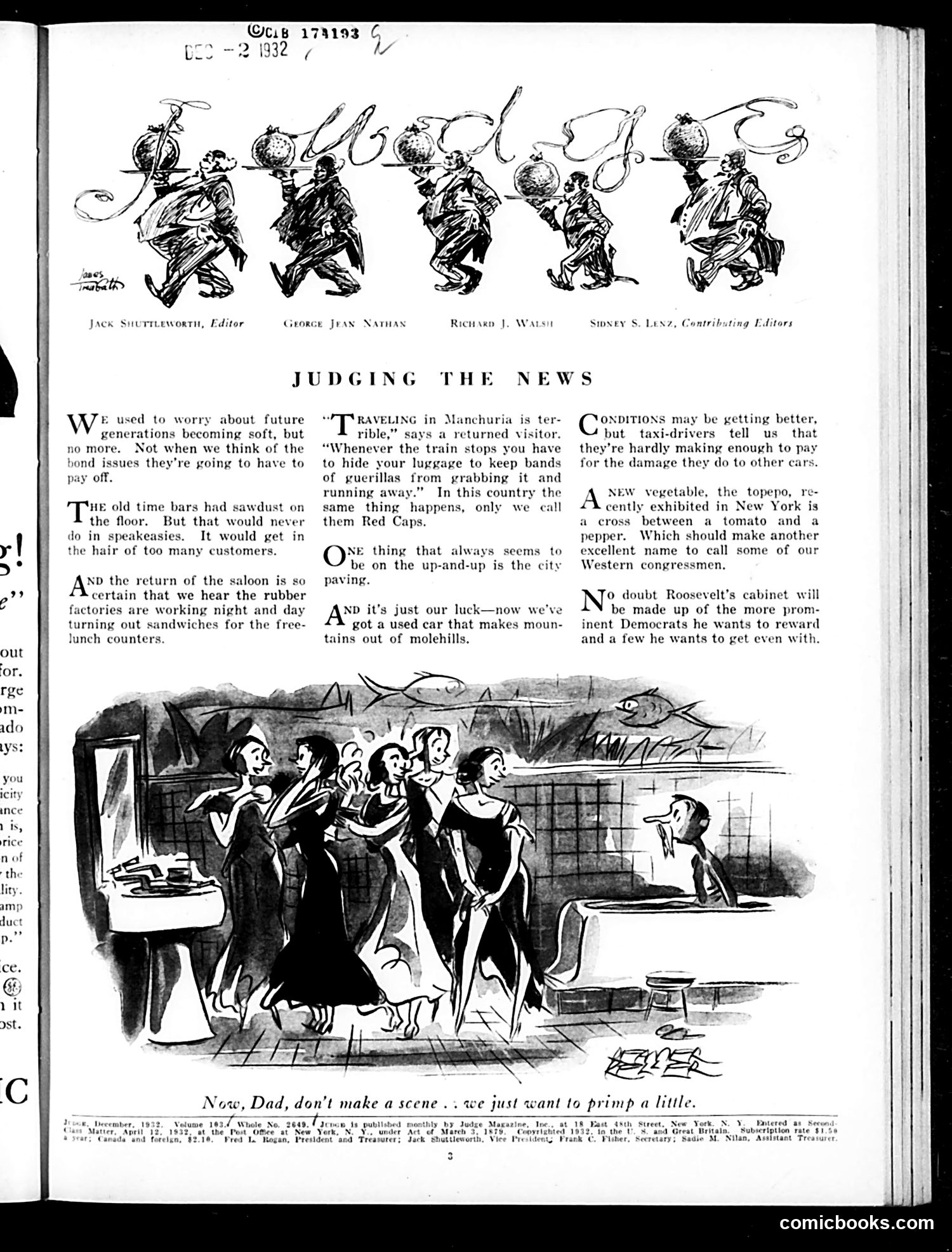
"Judging the News" - December 1932 This page from Judge magazine (dated December 1932) contains satirical commentary on contemporary events during the Great Depression and early New Deal period. The top cartoon shows five figures juggling globes—likely representing editors or political commentators attempting to manage multiple international crises simultaneously. The main cartoon below depicts a domestic scene where a woman says to a man, "Now, Dad, don't make a scene...I see just want to primp a little." This appears to satirize Roosevelt's cabinet selections, referenced in the text: the satire suggests family members (possibly representing Democratic factions) disagreeing over appointments, with implied tension between those wanting immediate action versus those preferring delay. The brief text items mock various 1932 issues: Manchuria troubles, urban conditions, vegetables, and Roosevelt's political balancing act.
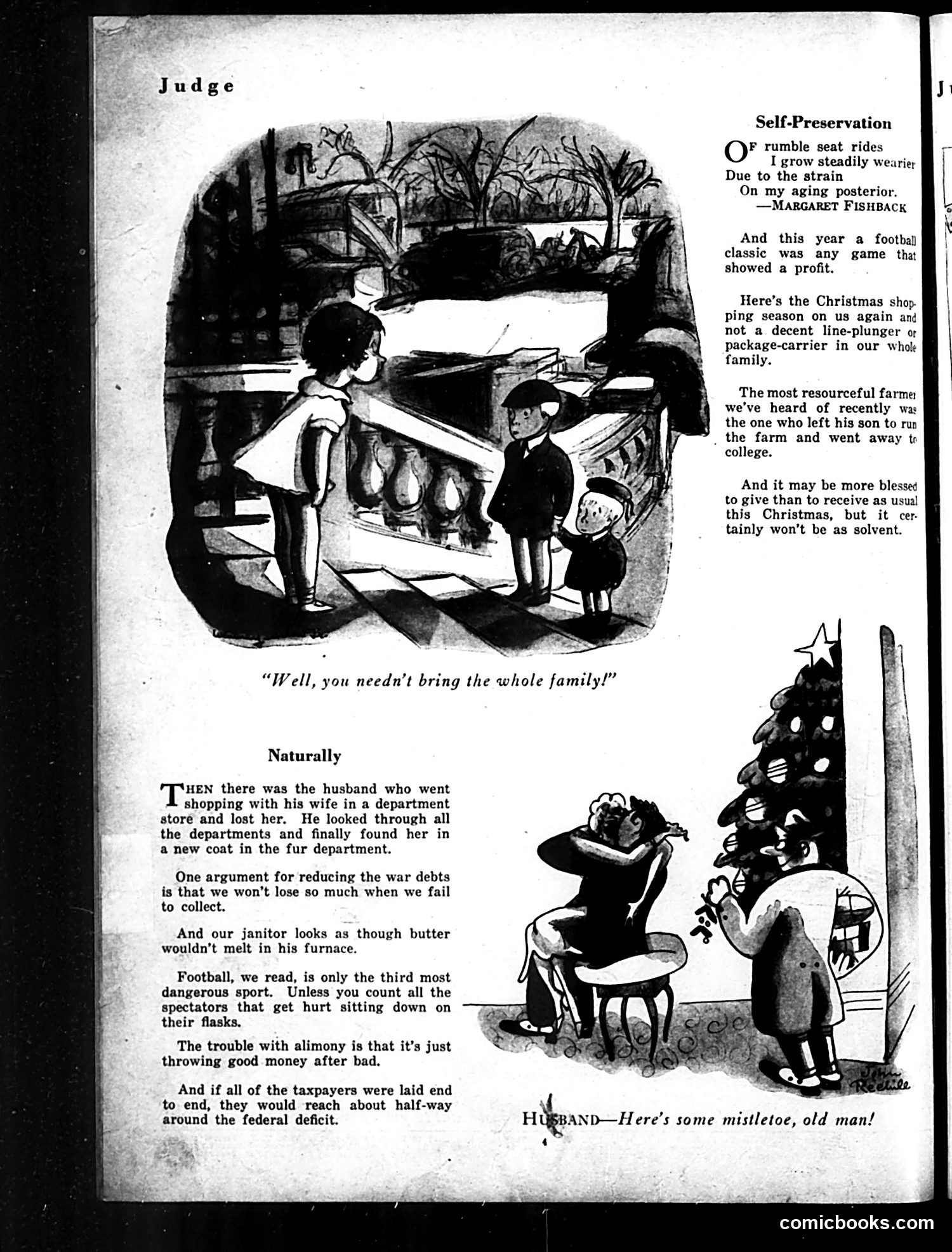
Analysis of Judge Magazine Page This page contains two satirical pieces commenting on post-WWI economic hardship and Christmas spending. Top cartoon ("Self-Preservation"): Shows a family Christmas shopping trip where someone suggests bringing extended relatives along. The satire criticizes economic strain—families can barely afford their own shopping without supporting additional dependents, reflecting Depression-era financial anxiety. "Naturally" section: Multiple brief jokes mock post-war difficulties: lost war debts, dangerous football spectators, "alimony throwing good money after bad," and taxpayer burden from federal deficit. Bottom cartoon: Shows a husband offering mistletoe to his wife during Christmas, a traditional holiday gesture now treated as cautiously humorous—likely suggesting marital strain from financial pressures. Overall, the page saririzes economic hardship disguised within holiday tradition and family obligation.
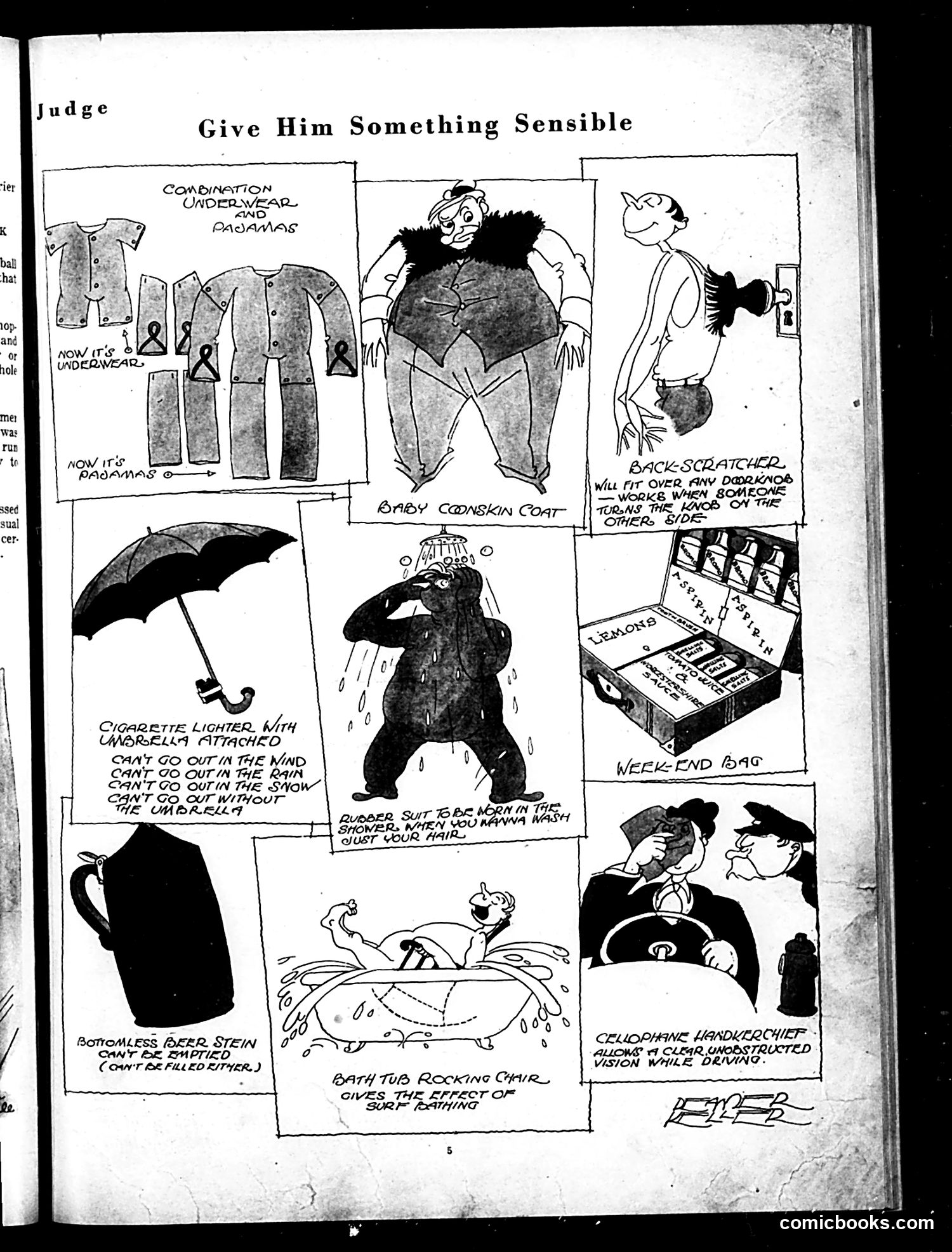
"Give Him Something Sensible" This page satirizes impractical gift-giving for men. Each panel mocks frivolous or absurd presents: - Combination underwear/pajamas: Criticized as pointlessly complicated - Baby coonskin coat: Suggests giving a child's fur coat to an adult man - Back-scratcher: Described as something to wear over other clothes - Cigarette lighter with umbrella: Mocked for being useless in various weather conditions - Rubber suit for shower: Impractical bathing attire - Week-end bag: Appears to be a travel item - Bottomless beer stein: A joke item that cannot function - Bath tub rocking chair: Combines bathing with furniture absurdly - Cellophane handkerchief: Clear but obstructed vision while driving The headline's irony—"Give Him Something Sensible"—undercuts the page by showing only ridiculous options, satirizing the difficulty of gift selection.
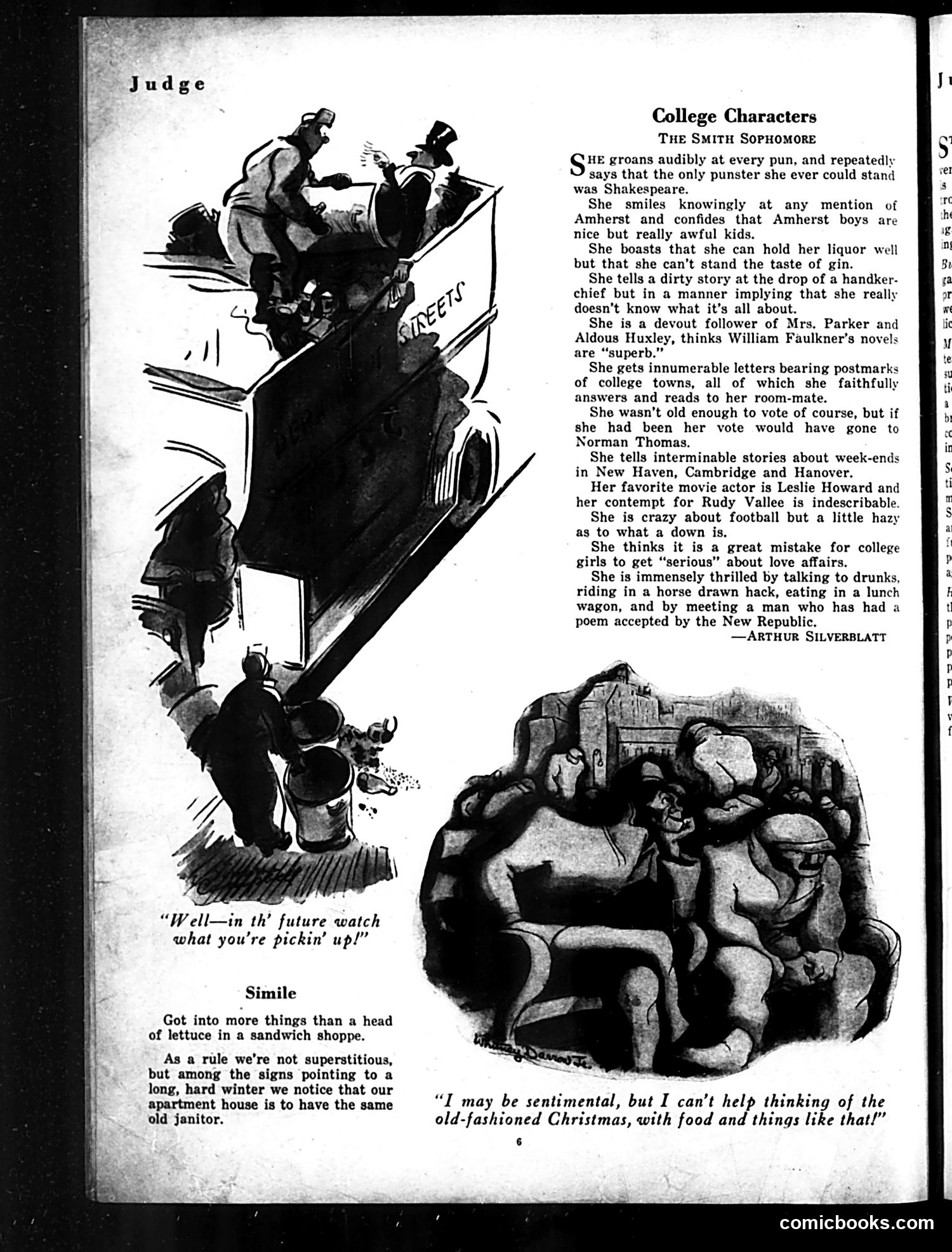
Analysis of Judge Magazine Page This page contains two distinct satirical pieces about college life: Top cartoon ("Judge"): Depicts a chaotic scene of students in a vehicle labeled "KINETIC," with the caption "Well—in th' future watch what you're pickin' up!" The satire appears to mock reckless student behavior and poor judgment. "College Characters" section: A character sketch of "The Smith Sophomore"—a female college student who enjoys drinking, tells crude stories, reads modernist literature (Faulkner), and engages in casual socializing. The satire mocks pretentious intellectual affectation mixed with crude behavior. References to Leslie Howard (actor) and "the New Republic" ground this in 1920s-30s college culture. "Simile" section: A brief humorous comparison about an apartment janitor, using the metaphor of "lettuce in a sandwich shoppe." The overall tone satirizes youthful excess and affected sophistication among college students of the era.
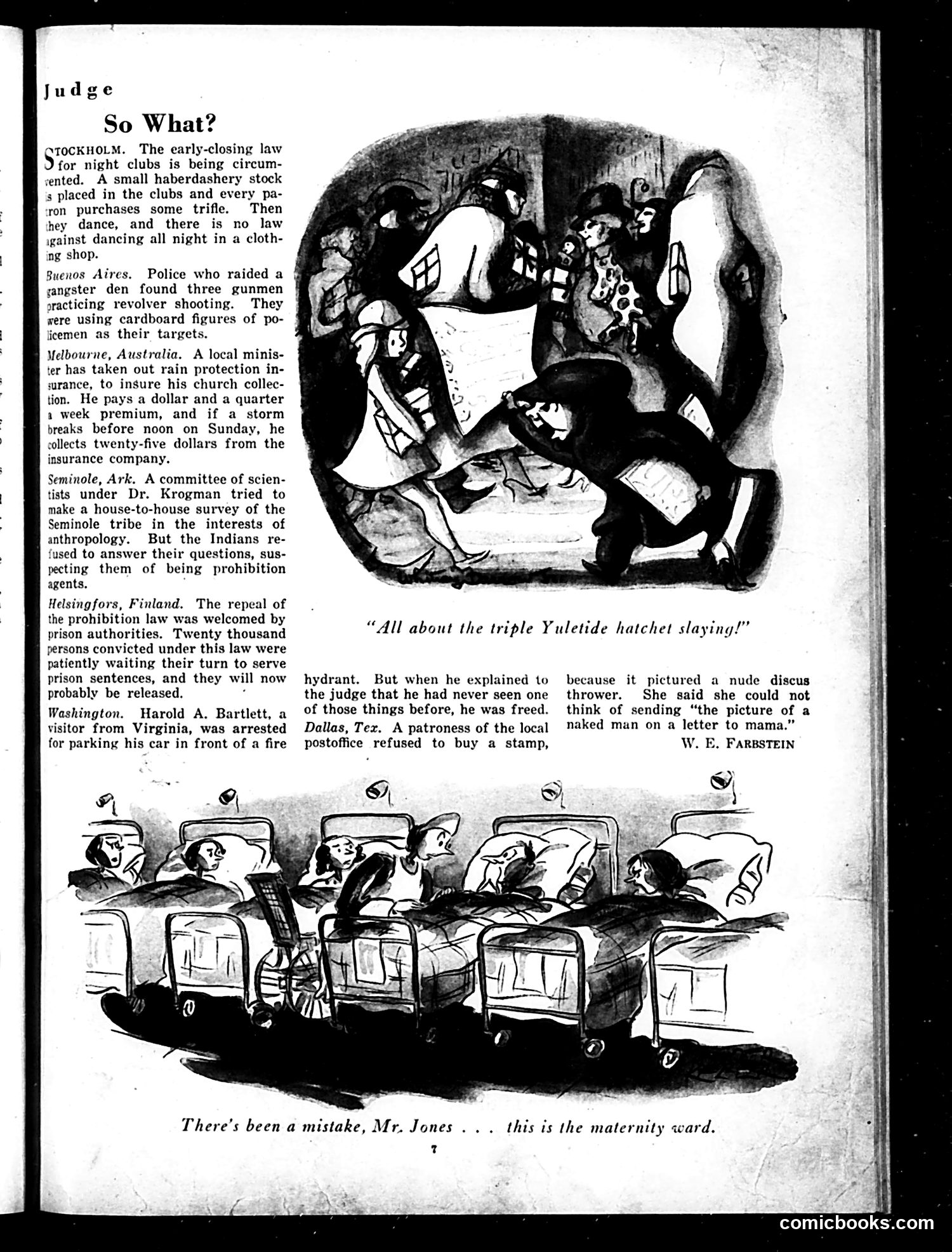
Judge Magazine Page Analysis This page contains short satirical news items ("So What?") mocking absurd real-world situations, plus two unrelated cartoons. The news briefs use exaggeration to critique: - Legal loopholes (Stockholm nightclubs selling clothing to circumvent closing laws) - Irony (gangsters practicing on cardboard police targets; prohibition conviction backlog released after repeal) - Absurdity (Australian minister insuring church donations against rain; Virginia man freed for parking violation because he'd "never seen" a fire hydrant; Texas woman refusing to mail a stamp depicting a classical nude discus thrower as "indecent") The top cartoon illustrates the Dallas stamp story, showing shocked reactions to the nude figure. The bottom cartoon depicts a hospital maternity ward mix-up, with the caption "There's been a mistake, Mr. Jones...this is the maternity card"—likely meaning someone received the wrong paperwork or newborn. The humor relies on period-specific sensibilities (prudishness about nudity, post-Prohibition attitudes, cultural assumptions) that require historical context for modern readers.
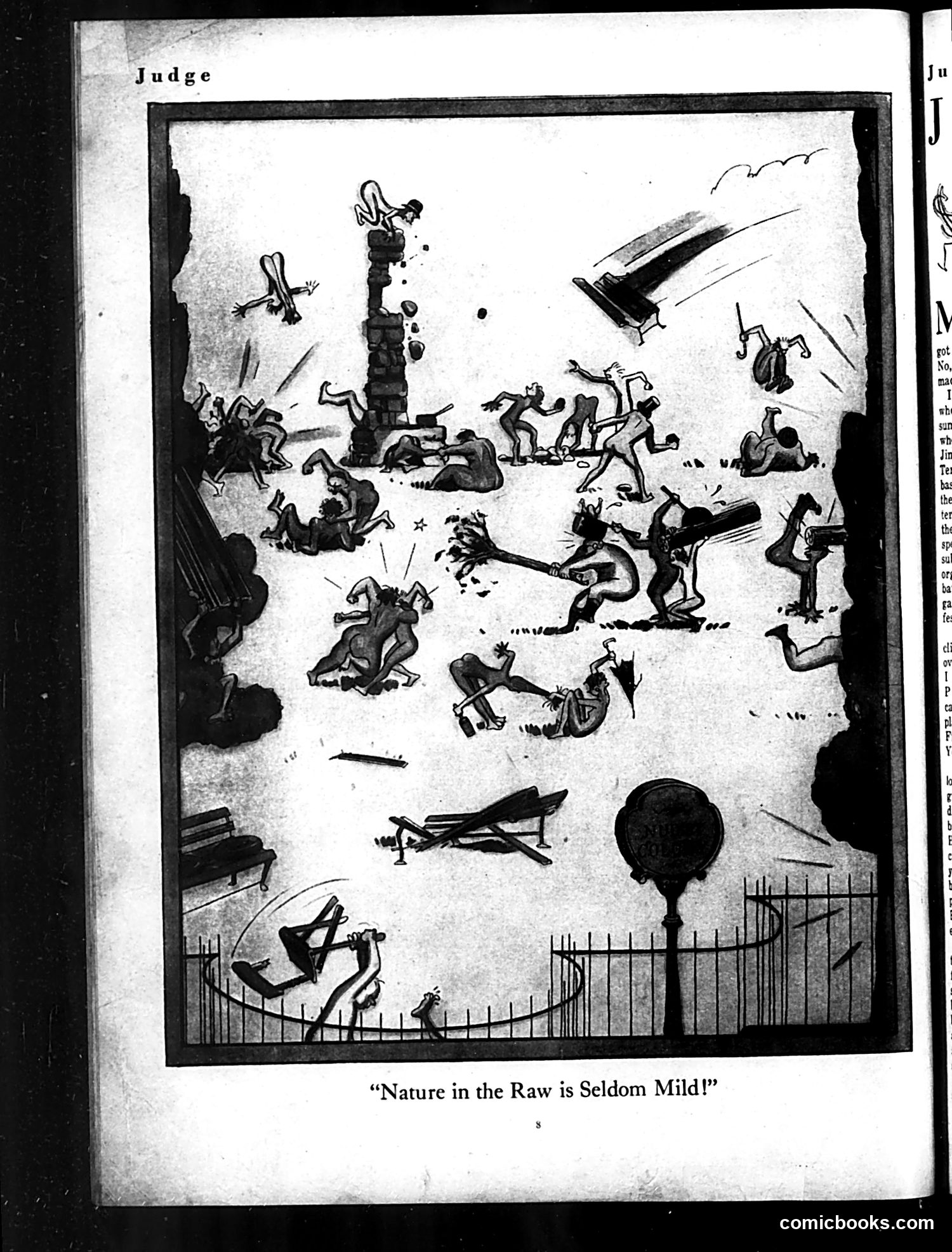
"Nature in the Raw is Seldom Mild!" This Judge cartoon depicts violent chaos in a park or public space. Figures are shown fighting, fleeing, and being struck by falling objects—including what appears to be an airplane crashing from above. A tall tower or structure collapses at center, while people scatter in panic. The fence and lamp post suggest an urban setting. The caption's phrase "Nature in the Raw" suggests the cartoon satirizes either uncontrolled human nature or actual natural disasters. The chaotic violence, aircraft, and destruction could reference industrial-age anxieties, warfare, or accidents—though without publication date context, the specific event or social commentary remains unclear. The work emphasizes nature or circumstance as fundamentally dangerous and unpredictable.
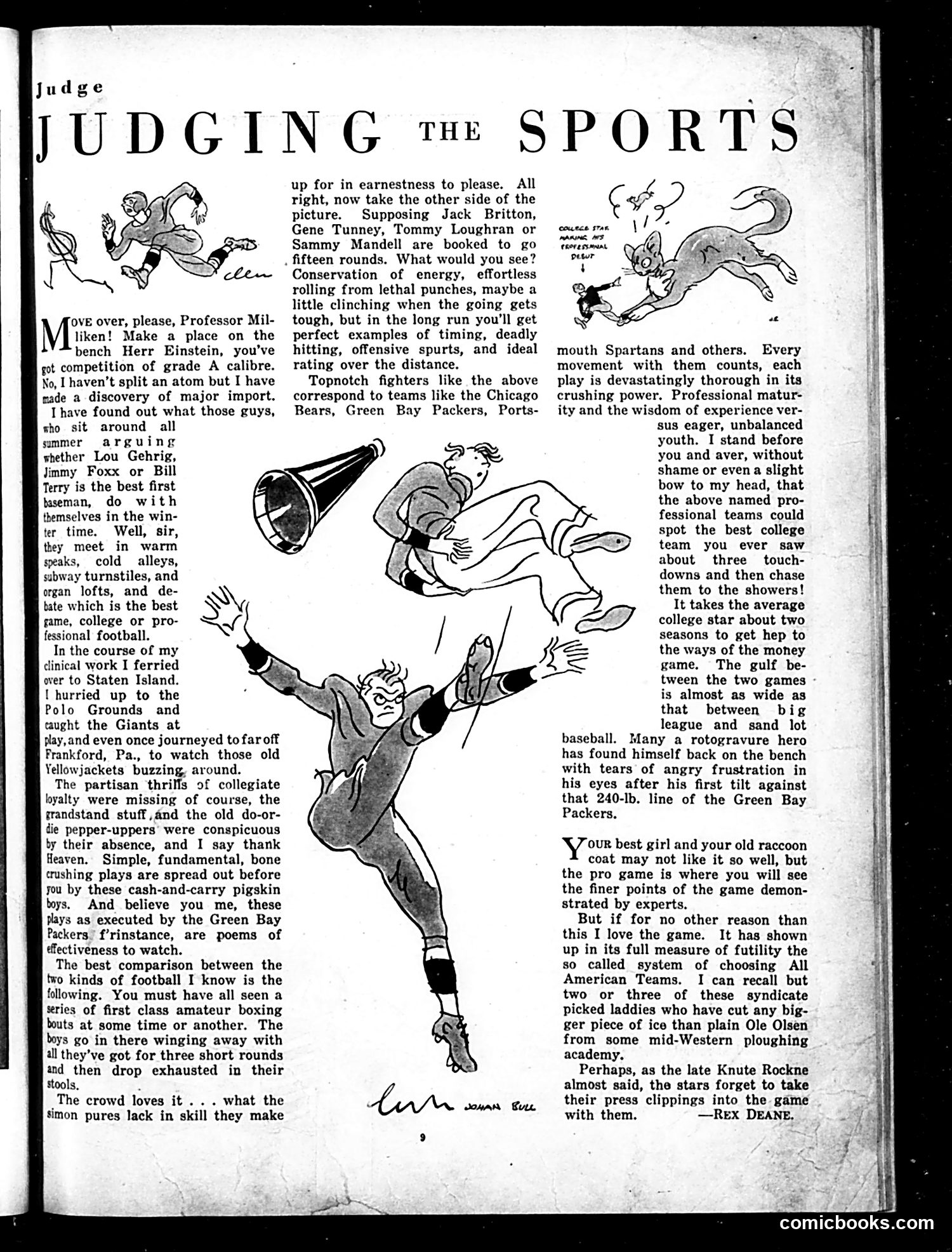
"Judging the Sports" - Judge Magazine This article argues that professional football (specifically teams like the Green Bay Packers, Chicago Bears, and Portsmouth Spartans) is superior to college football. The author, writing as "Professor Miliken," compares the difference to professional vs. amateur boxing: college players are enthusiastic but clumsy; professionals execute plays with precision and maturity. The piece names real athletes from the era—Lou Gehrig, Jimmy Foxx, Bill Terry (baseball stars)—and boxers Jack Britton, Gene Tunney, and others, suggesting these men debate sports endlessly during winter months. The satire targets the reverence for college football and the "All-American Teams" selection system, which the author dismisses as meaningless hype. He claims professional players would "spot the best college team...about three touchdowns," and that college stars often fail their first pro game against defensive lines like Green Bay's. The cartoons illustrate these arguments with exaggerated depictions of football players in action. The overall message: ignore the romantic college tradition—pro football shows the true, technical mastery of the game.
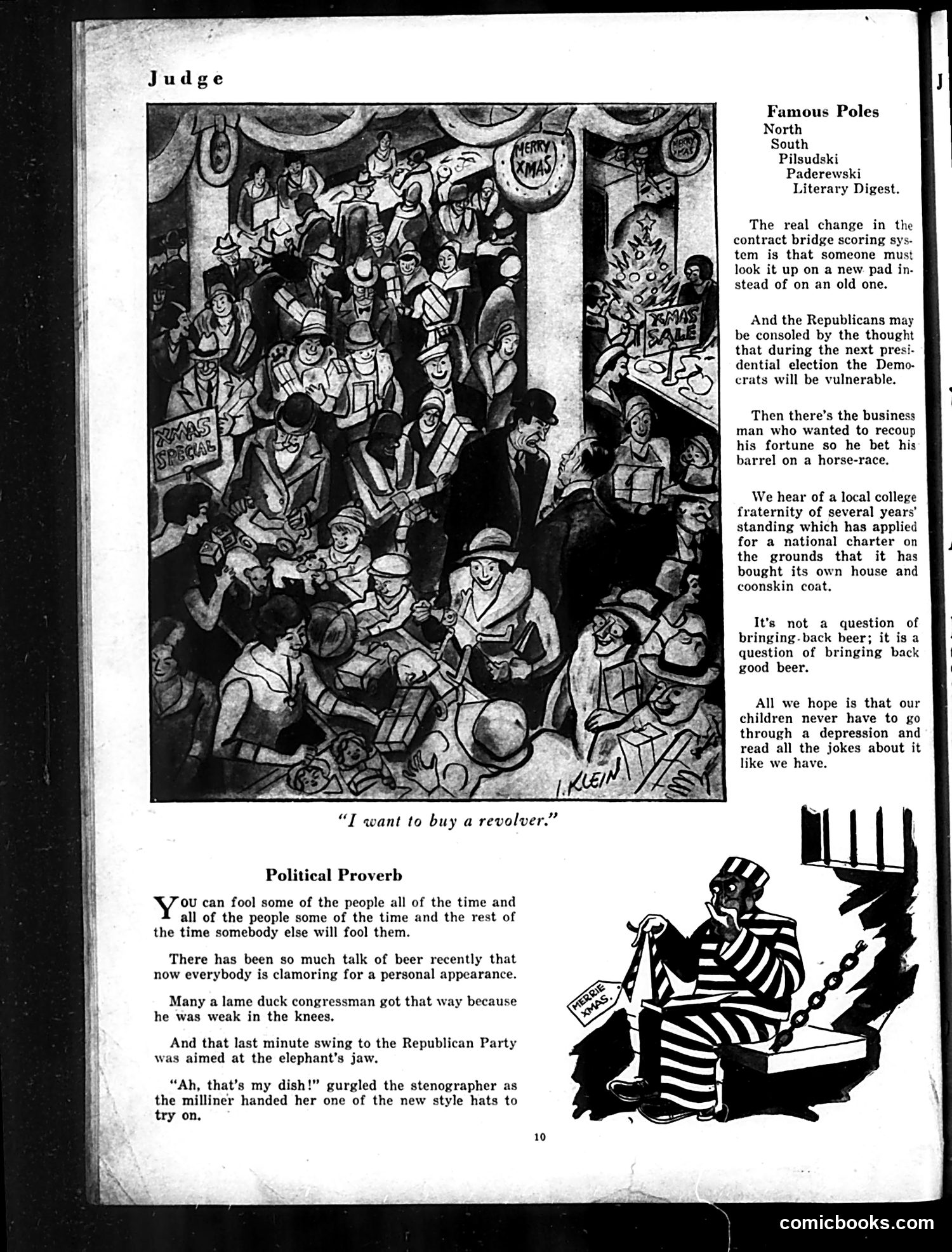
Analysis of Judge Magazine Page This page contains political humor and satirical commentary circa the Prohibition era and early Depression period. Main Cartoon: Depicts a crowded, chaotic Christmas scene with the caption "I want to buy a revolver." The satire mocks Depression-era desperation and holiday stress—someone wanting a weapon as a (darkly humorous) response to seasonal chaos. "Political Proverb" Section: A series of brief jokes targeting: - General political deception ("fool some of the people") - Beer/Prohibition nostalgia (recently topical) - Weak Republican politicians ("lame duck congressman") - Last-minute Republican electoral swings - Fashion and stenographers (dated gender humor) Right Column: Miscellaneous commentary on bridge scoring, upcoming Democratic electoral vulnerabilities, financial desperation (betting on horse races), college fraternities, beer quality, and Depression-era jokes. The overall tone reflects Judge's satirical approach: mocking politicians, social anxieties, economic hardship, and contemporary fads through quick jokes and visual humor aimed at educated readers.
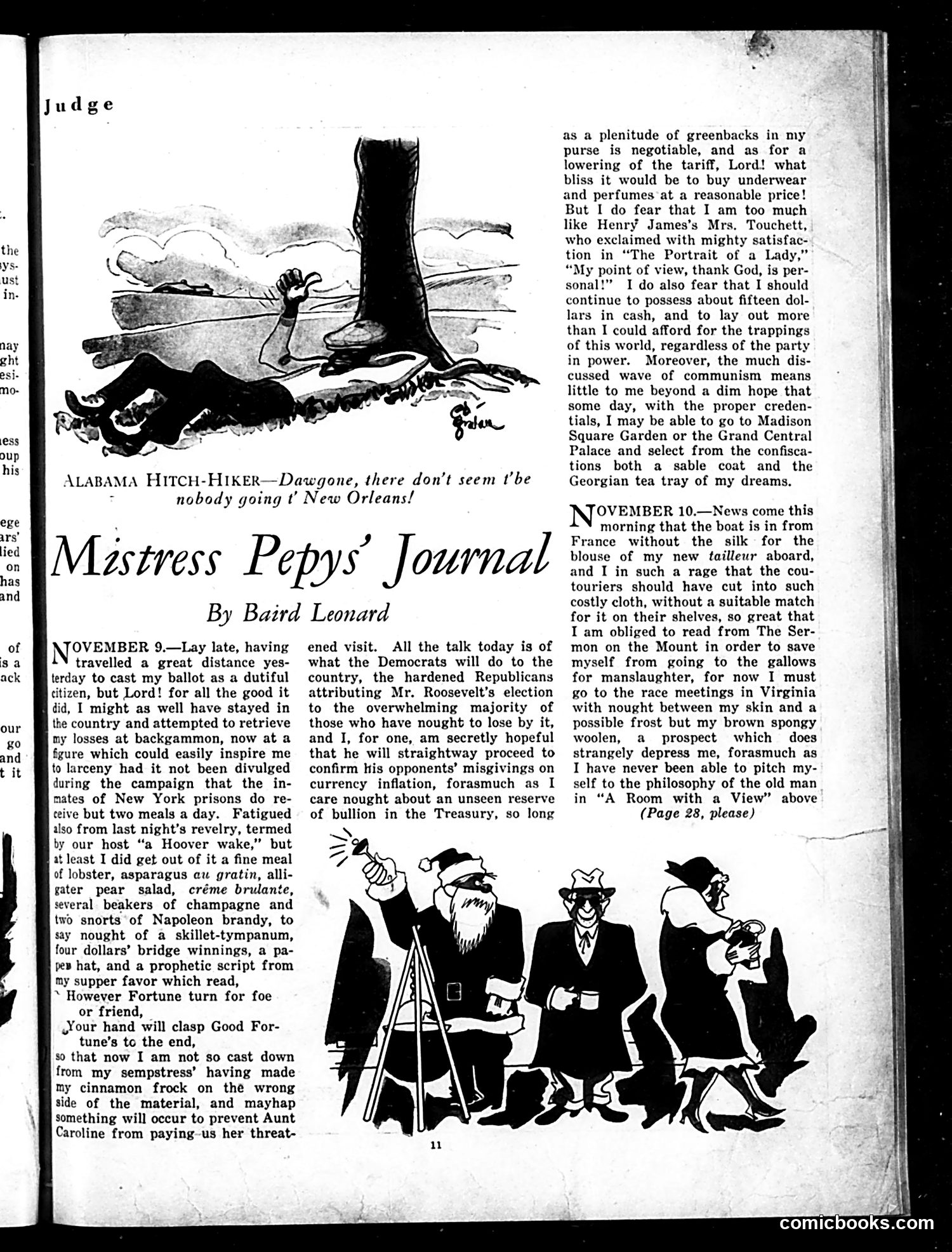
Explanation for Modern Readers This Judge magazine page from November 1932 contains two satirical pieces about the recent presidential election (Franklin D. Roosevelt defeated Herbert Hoover). Top cartoon: An Alabama hitchhiker sits dejectedly by a tree—a visual commentary on Depression-era unemployment and mobility. The joke is that even heading to New Orleans, nobody's traveling. "Mistress Pepys' Journal": A humorous diary column mocking wealthy, self-absorbed socialites indifferent to politics. The narrator voted but admits it was pointless; she cares only about tariffs affecting luxury goods (underwear, perfumes, silk blouses), not actual policy. She dismisses communism as interesting only for confiscated luxury items she might acquire. The piece satirizes the privileged class's obliviousness during economic crisis—they worry about fashion disasters while the country suffers. Both pieces mock different aspects of 1932 America: rural poverty and upper-class disconnection from real economic suffering.
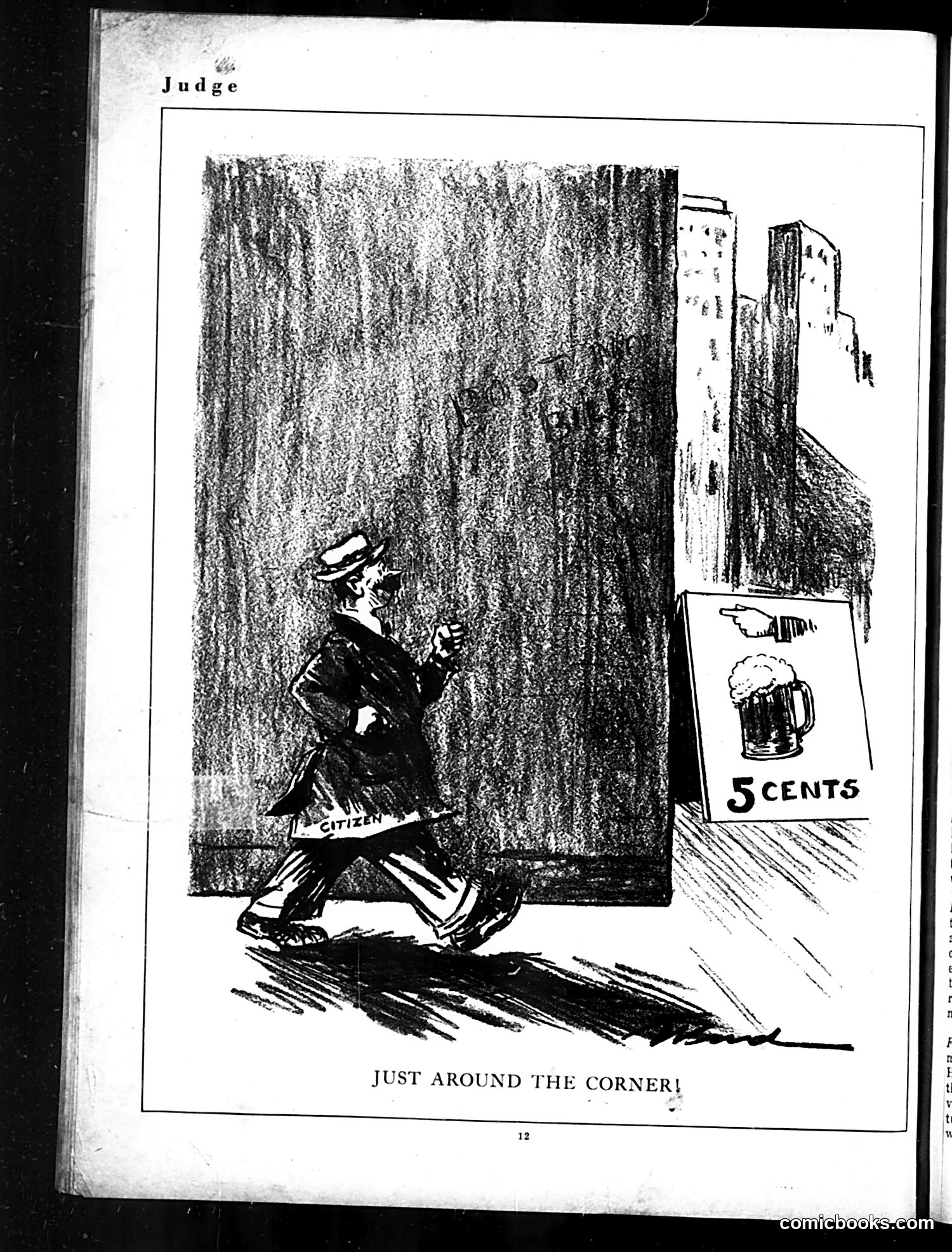
"Just Around the Corner" This cartoon shows a man labeled "CITIZEN" peering around a corner at a saloon advertising beer for 5 cents. The illustration is satirizing the anticipation and temptation of cheap alcohol readily available in urban America. The figure's cautious posture—literally tiptoeing around the corner—suggests both the allure and the social shame or secrecy surrounding drinking, particularly among working-class citizens. The "5 CENTS" price emphasizes how affordable and accessible alcohol was, making it an easy vice for common people. Judge magazine, as a satirical publication, likely used this image to comment on drinking culture, temptation, and the pervasiveness of saloons in American cities. The humor comes from the human weakness depicted—the casual, almost guilty way one might sneak toward a drink.
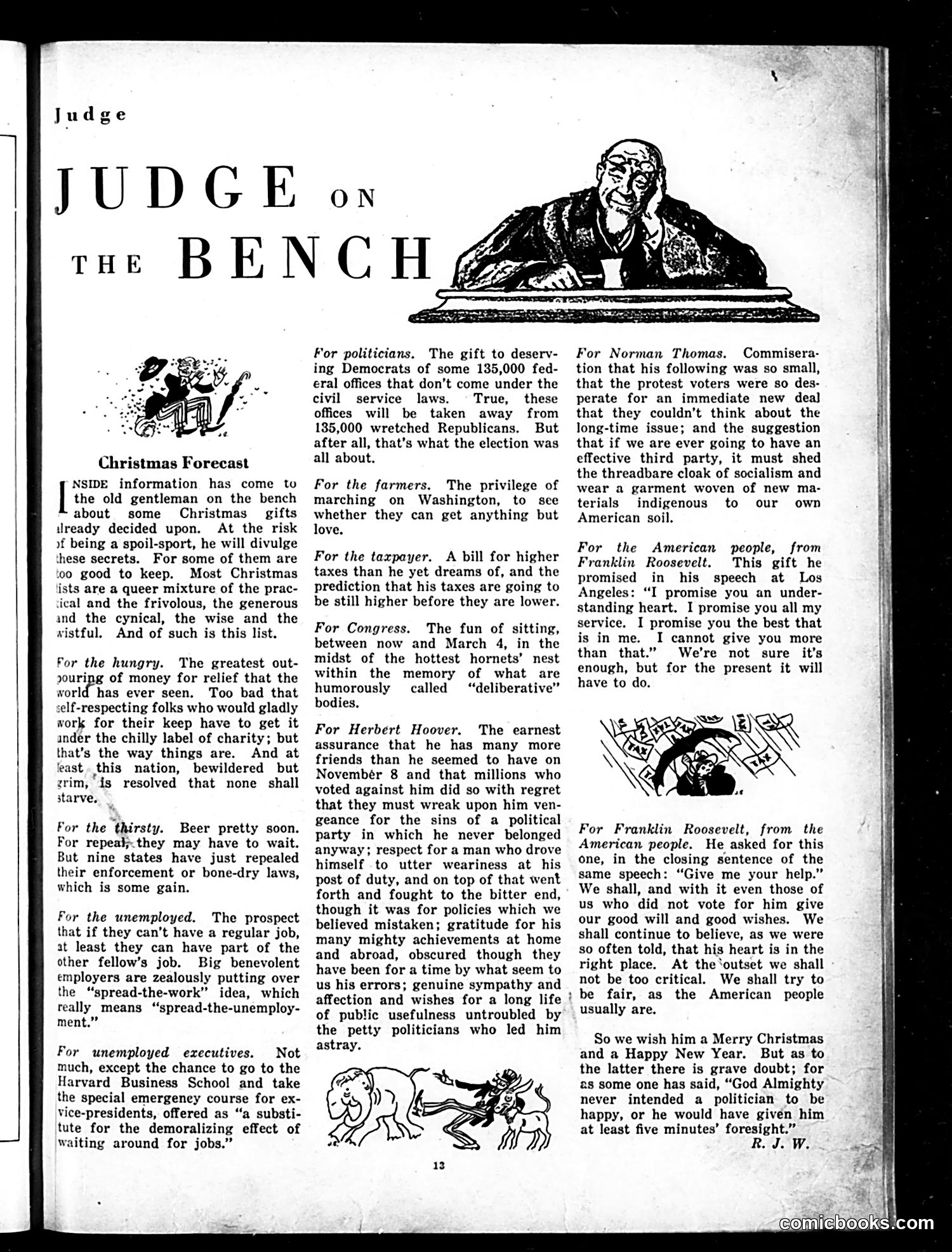
Analysis for Modern Readers This is a satirical "Christmas Forecast" from *Judge* magazine, likely from late 1932 or early 1933, written by "R.J.W." The seated judge figure dispenses tongue-in-cheek "gift predictions" for various groups. Key references: - Herbert Hoover: The defeated 1932 president, receiving backhanded sympathy for his exhaustion and unpopular policies - Franklin Roosevelt: The president-elect, promised to deliver an "understanding heart" - Norman Thomas: Socialist Party candidate, mocked for his tiny following - Politicians/Democrats: Satirizing the spoils system—135,000 federal jobs going to Democrats - Farmers, unemployed, taxpayers: All facing grim economic prospects The satire: The "gifts" are actually complaints about the Depression era—unemployment, poverty, political corruption, high taxes, and congressional dysfunction. The judge's deadpan delivery of these bleak "forecasts" as "Christmas gifts" creates dark humor about the nation's severe economic crisis and political transition.
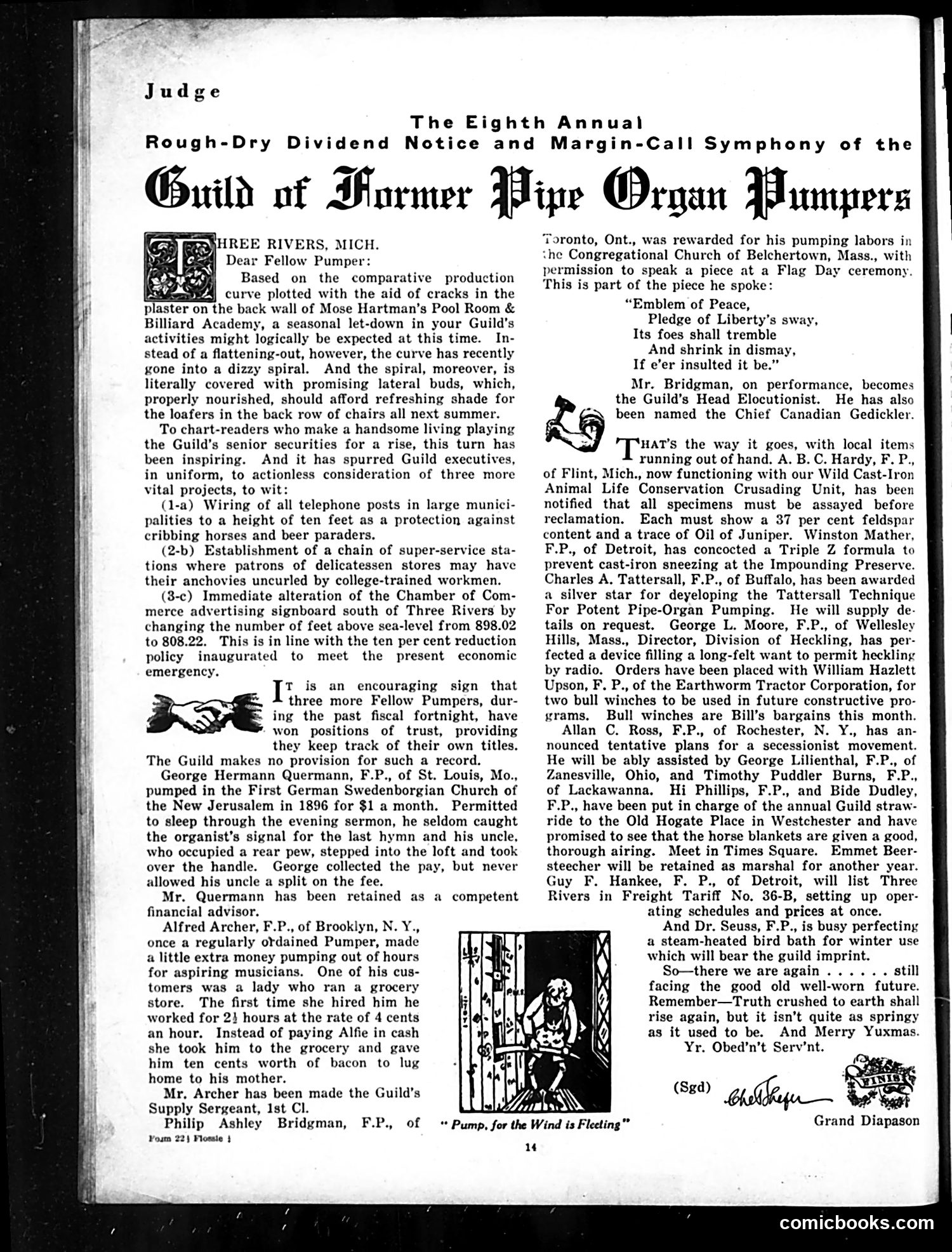
This page satirizes the "Guild of Former Pipe Organ Pumpers"—a fictional organization mocking real occupational fraternities. Before electric motors, church organs required human pumps to operate the bellows, a now-obsolete job. The humor lies in treating this humble, vanished profession with absurd corporate solemnity: issuing "dividend notices," discussing stock performance, and awarding promotions and medals to members. References to "chart-readers playing securities," economic policy adjustments, and financial advisors mock contemporary business jargon applied ridiculously. Individual anecdotes—like George Quermann pocketing organ-pumping fees from his uncle, or Alfred Archer paid in bacon—treat trivial historical incidents as momentous organizational history. The cartoon ("Pump, for the Wind is Fleeting") reinforces the elegiac tone about a vanished trade. This is *Judge* magazine's typical satire: mock-serious treatment of the absurd and obsolete, deflating both nostalgia and corporate pretension circa the 1920s-30s.
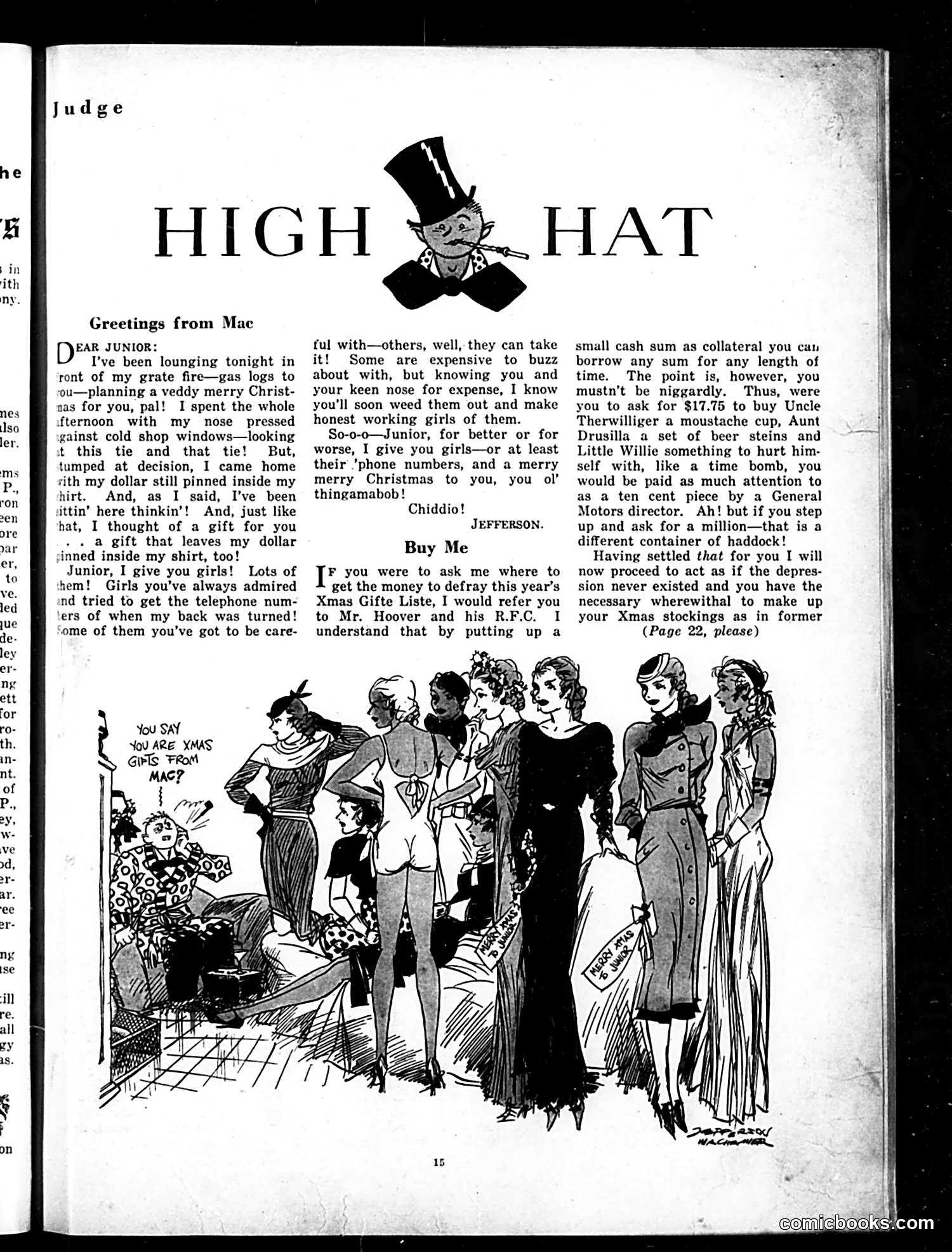
"High Hat" - Judge Magazine Christmas Gift Advice This is a satirical advice column with two sections offering tongue-in-cheek Christmas gift suggestions. "Greetings from Mac" presents a cynical gift idea: the writer claims to give his junior friend access to telephone numbers of desirable women, framing it as helping him pursue "honest working girls" while admitting some are expensive to court. The humor lies in the patronizing tone and the "gift" of social access rather than anything tangible. "Buy Me" satirizes Depression-era economics by referencing Herbert Hoover and the RFC (Reconstruction Finance Corporation)—the government agency created to provide emergency loans during the economic crisis. The columnist jokes that while modest loan requests get ignored, requesting a million dollars gets attention from corporate directors. The satire critiques how financial institutions treated desperate small borrowers versus large corporations. The accompanying illustration shows fashionable women at what appears to be a social gathering, supporting the column's focus on dating and courtship among the affluent. The overall tone is cynical about both romance and Depression relief efforts.
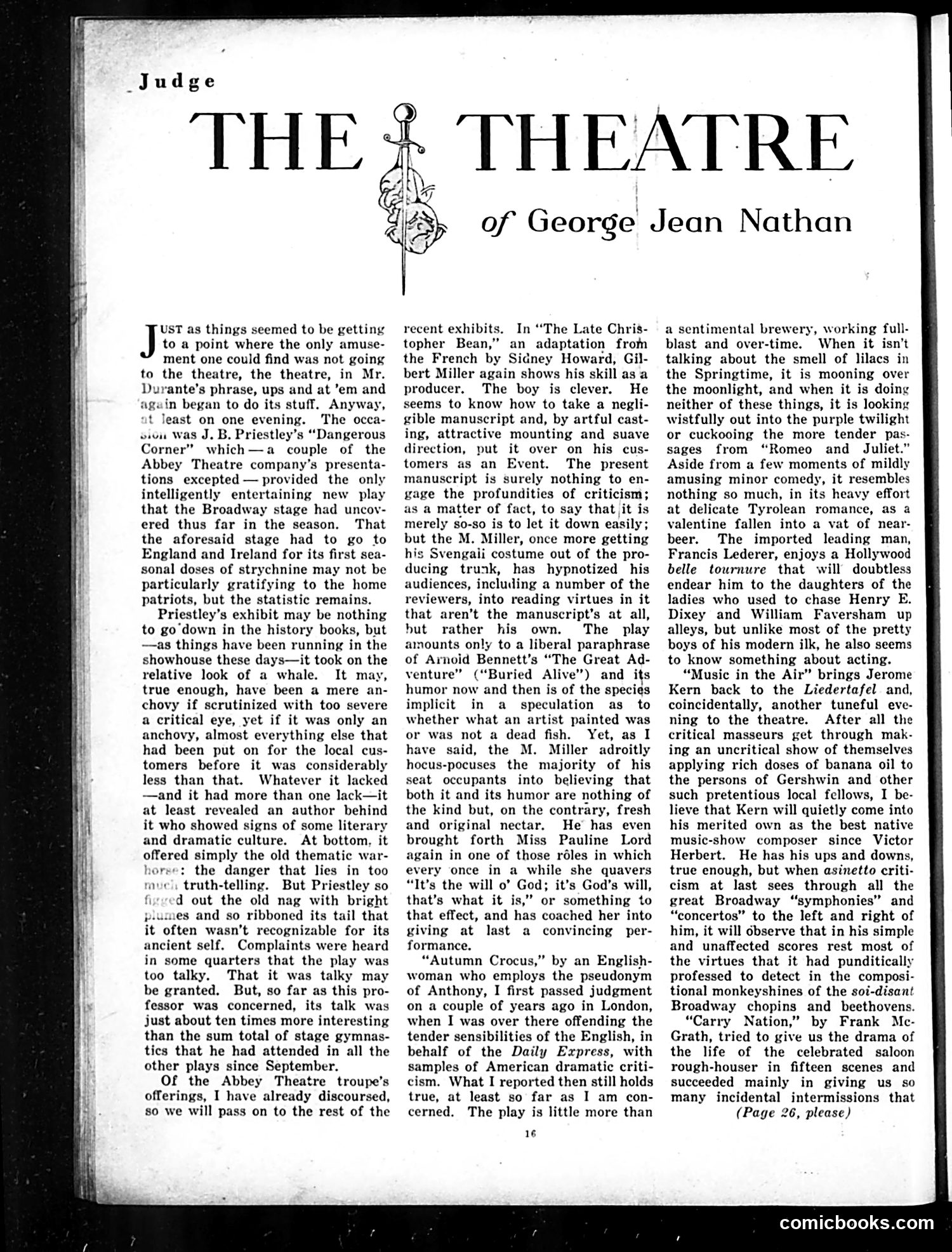
Judge Theater Review: George Jean Nathan This is a theater criticism column by prominent drama critic George Jean Nathan, reviewing Broadway productions. The page discusses several plays: J.B. Priestley's "Dangerous Corner" (which Nathan praises as intelligently entertaining despite Broadway's general mediocrity), "The Late Christopher Bean" (adapted from Arnold Bennett, which Nathan criticizes as mediocre but effective through producer Gilbert Miller's skillful staging and casting), and mentions "Autumn Crocus." Nathan's satire targets both inferior Broadway productions and producers who manipulate audiences into appreciating weak material through technical showmanship rather than genuine merit. He particularly skewers Miller's "Svengali" producer tactics—hypnotizing audiences into overlooking a play's fundamental weakness. Nathan's complaint reflects early 1930s theater criticism's tension between commercial entertainment and artistic integrity.
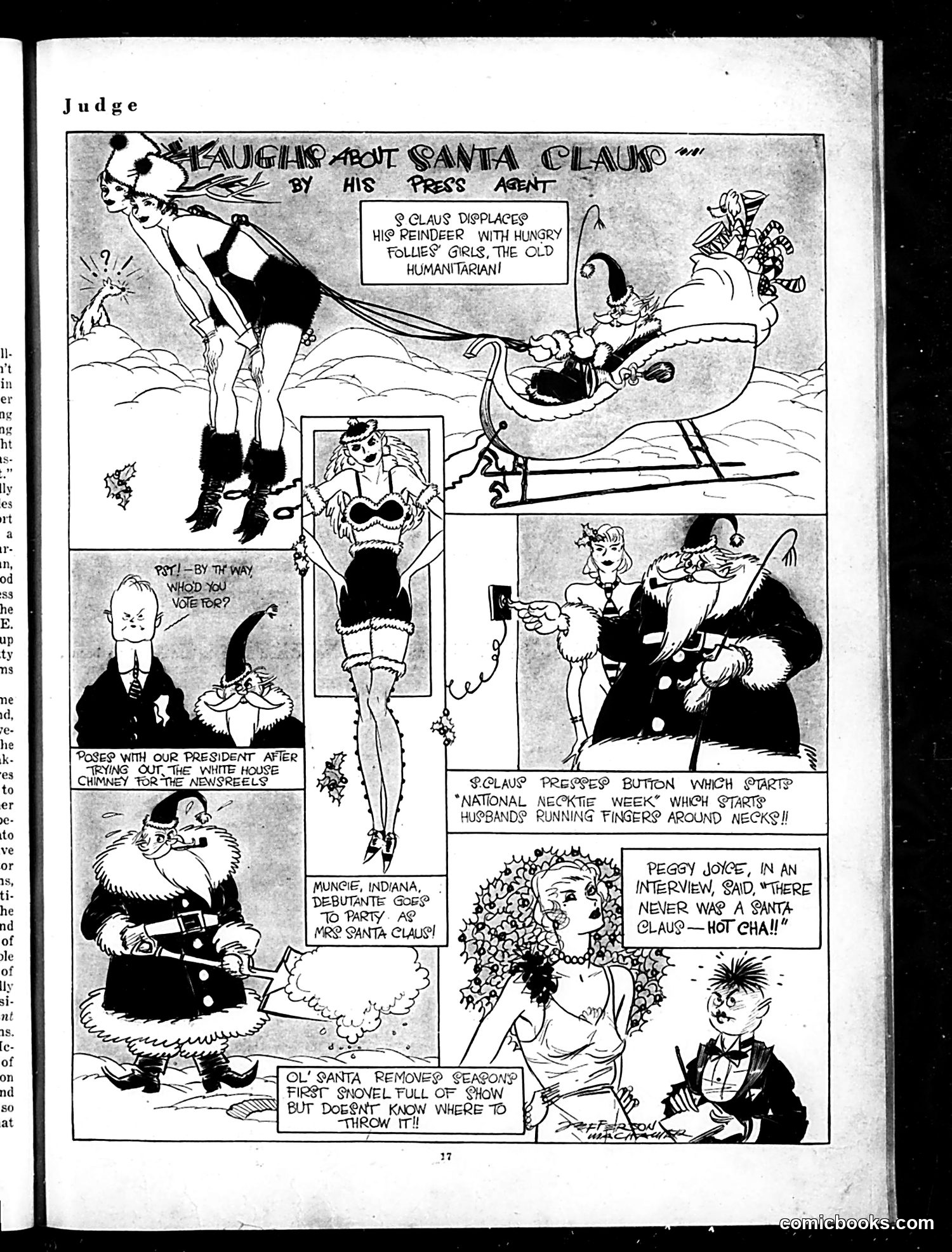
Analysis: "Laughs About Santa Claus" (Judge Magazine) This satirical comic mocks Santa Claus's modernization through a fictional "press agent" promoting him as a contemporary celebrity. The humor centers on Santa being rebranded for 1920s American consumer culture: Key references: - Santa displaces reindeer with chorus girls from the Follies (Broadway revue)—playing on celebrity excess - He poses with the President at the White House for newsreels—satirizing media publicity stunts - A "National Necktie Week" promotion—mocking corporate marketing schemes - Reference to Peggy Joyce, a notorious 1920s socialite/gold-digger, claiming "there never was a Santa Claus"—suggesting modern cynicism has replaced childhood innocence The cartoon critiques commercialization of Christmas and how traditional figures are exploited for profit through modern publicity machinery. Santa becomes just another celebrity managed by a press agent, stripped of authentic meaning.
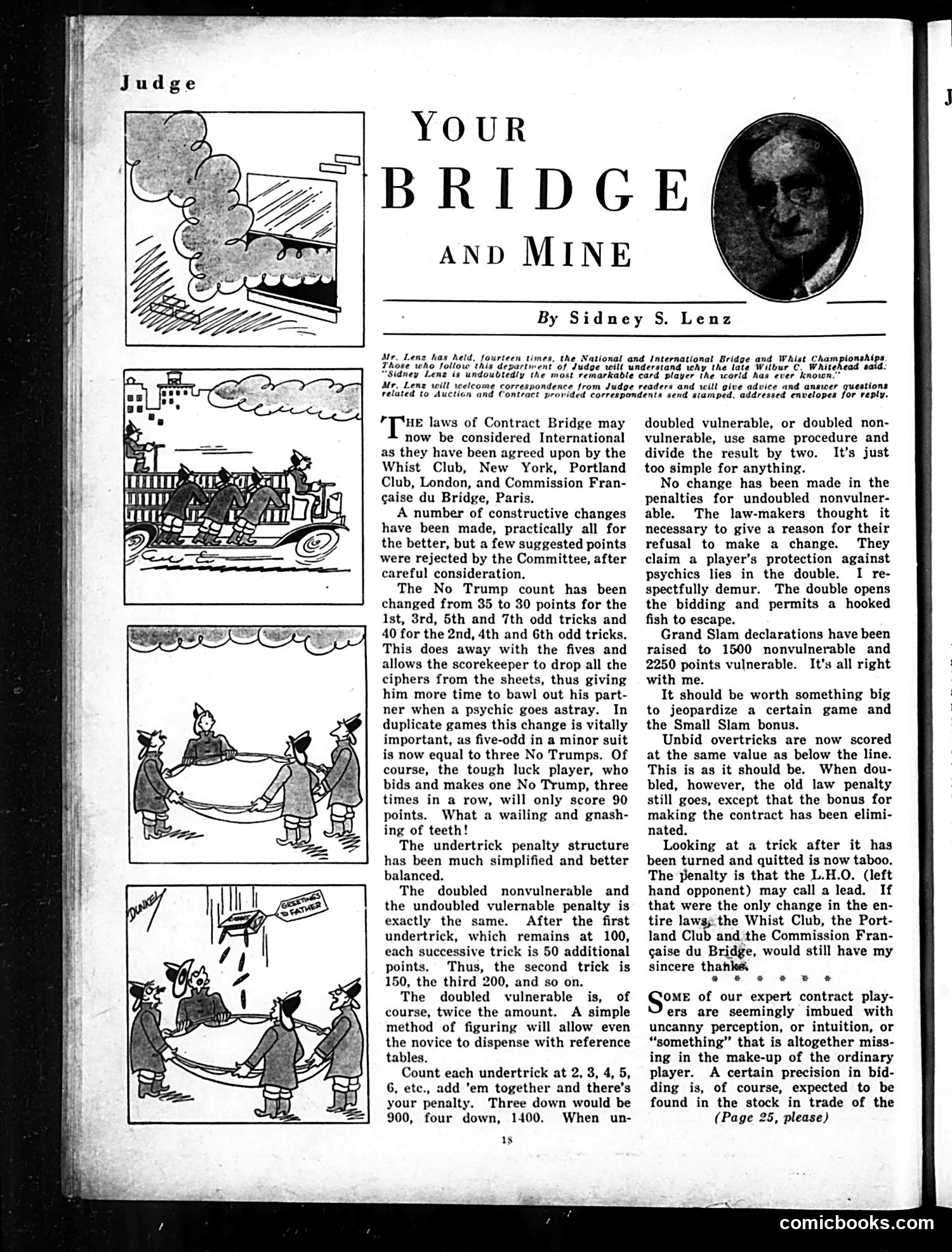
"Your Bridge and Mine" — A Contract Bridge Rules Explainer This page is not satire but rather an instructional column by Sidney S. Lenz, a renowned bridge champion (as evidenced by his credentials noted at top). The accompanying cartoons humorously illustrate bridge scenarios—players arguing over rules, celebrating wins, or experiencing the frustrations of the game. The text explains recent changes to Contract Bridge rules adopted internationally by major clubs in New York, London, and Paris. Lenz details specific scoring adjustments: modified No Trump point values, simplified penalty structures for undertricks, and increased Grand Slam bonuses. The humor derives from bridge players' emotional reactions to rule changes and scoring complications. Lenz concludes by noting that some expert players possess seemingly supernatural intuition—a gentle jab at bridge's reputation as a game requiring both precision and mysterious "something" beyond ordinary skill.
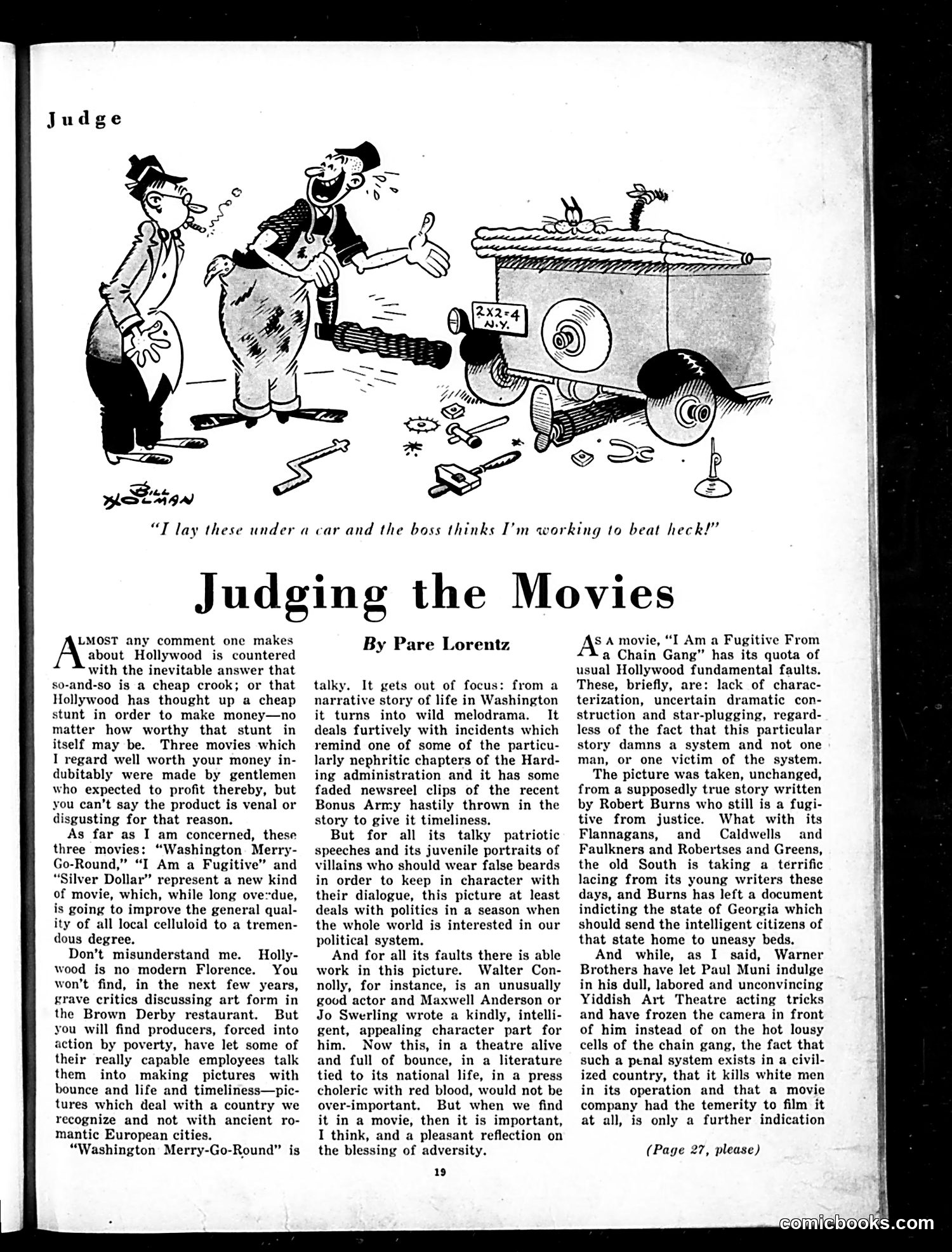
Explanation for Modern Readers The cartoon depicts a mechanic lying under a car with tools scattered about, telling a coworker he's arranged these tools to make the boss think he's working hard—when he's actually loafing. The accompanying article by Pare Lorentz reviews three 1932 films: "Washington Merry-Go-Round," "I Am a Fugitive from a Chain Gang," and "Silver Dollar." Lorentz praises them as a new type of American cinema—socially conscious, dealing with contemporary issues (politics, the Bonus Army, chain gang brutality in Georgia) rather than escapist European settings. He acknowledges their technical flaws but argues their social importance matters. "I Am a Fugitive" particularly impresses him for exposing systemic injustice, though he critiques the acting and direction. The cartoon's joke about deception parallels the article's broader point: even flawed movies can have social value if they honestly address real American problems—suggesting substance matters more than polished appearance, much like the mechanic's actual work versus its theatrical presentation.
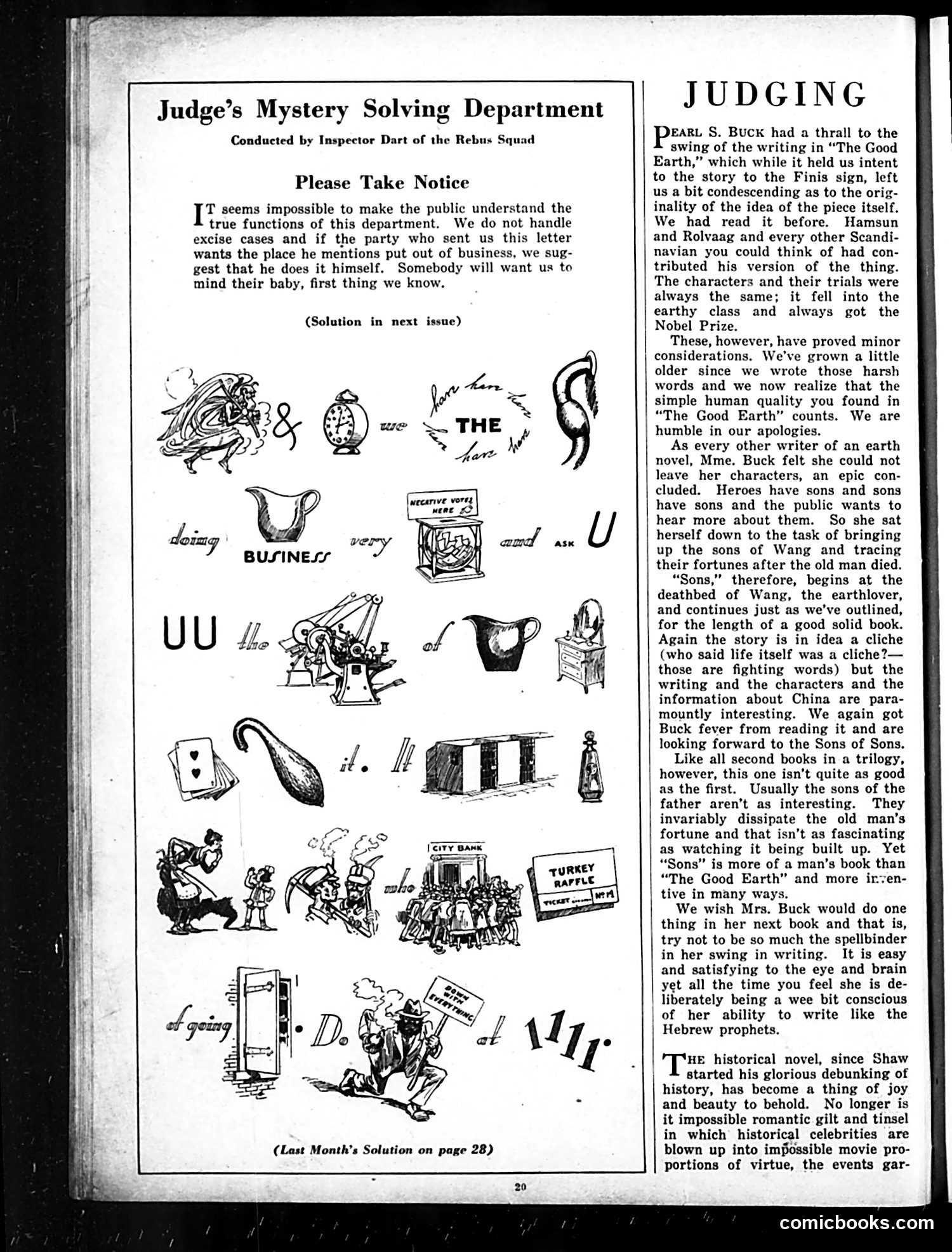
Judge Magazine Mystery Puzzle Page Analysis This page contains Judge magazine's "Mystery Solving Department"—a rebus puzzle feature where readers solve visual riddles by interpreting the illustrated symbols and words. The left side presents an unsolved puzzle made of various drawings (a witch, clock, business signs, playing cards, etc.) alongside cryptic text fragments ("being business very" and "gazed at all"). Readers are invited to solve it; the answer appears in the next issue. The right side is primarily a book review by "Pearl S. Buck," discussing her novel *Sons* (sequel to *The Good Earth*). The critic praises Buck's character development and Chinese cultural details while critiquing the book as less compelling than the original—noting that sequels typically lack the patriarch's compelling arc of building fortune. The review also comments on modern historical fiction's move away from romanticized portrayals, citing Shaw's influence. This appears to be a standard Judge content mix: entertainment puzzle plus literary criticism—no specific political satire is evident on this page.
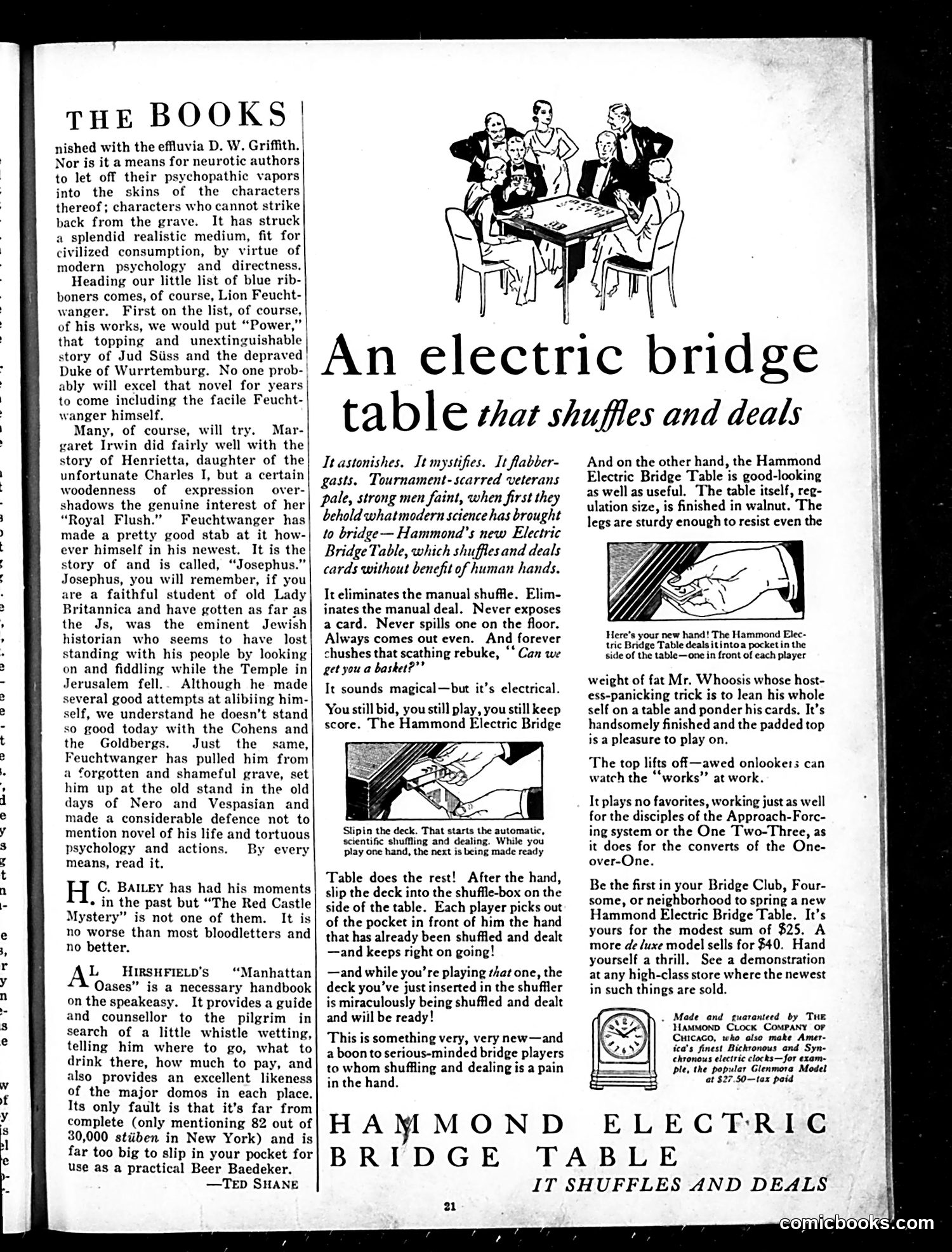
Analysis of Page Content This page is primarily advertising, not political satire. The dominant content is a large advertisement for the Hammond Electric Bridge Table, a novelty device that automatically shuffles and deals cards for the game bridge. The small section at top labeled "THE BOOKS" contains brief literary reviews by Ted Shane, discussing works by Lion Feuchtwanger, Margaret Irwin, C. Bailey, and Al Hirshfield. These are straightforward critiques with no apparent satire—though Hirshfield's "Manhattan Oases" (a speakeasy guide) obliquely references Prohibition-era drinking culture. The Hammond ad dominates, featuring an illustration of people gathered around an automatic card table. The pitch emphasizes the device eliminates manual shuffling and dealing—presented as a marvel of modern electrical science solving a social problem (the complaint "Can we get you a basket?" suggesting fumbled cards). There is no political cartoon or meaningful satire on this page. It's a Judge magazine issue used primarily to showcase consumer advertising alongside book reviews.
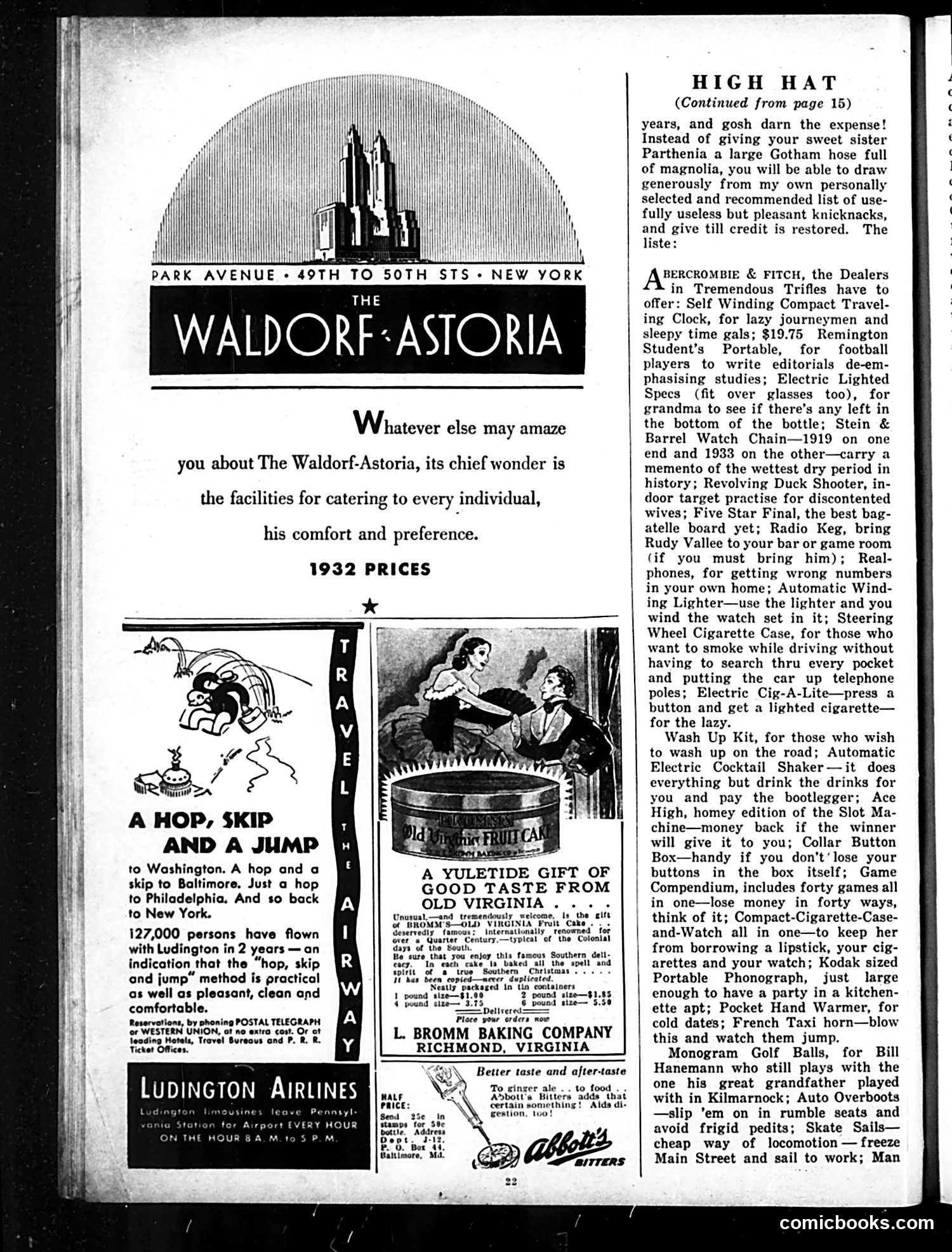
Analysis of Judge Magazine Page (1932) This page is primarily advertising, not political satire. It features luxury hotel and airline promotions alongside a satirical gift column titled "High Hat." The "High Hat" column mocks wealthy gift-giving during the Great Depression. The author suggests replacing expensive gifts with absurd novelty items from Abercrombie & Fitch—a luxury retailer. The humor targets conspicuous consumption: instead of a "large Gotham hose full of magnolia" for a sister, give useless trinkets like self-winding clocks, electric reading glasses, or a "Slot Machine" card game where you "lose money in forty ways." The social satire lies in the gap between Depression-era economic hardship and upper-class frivolity. Phrases like "gosh darn the expense" and "give till credit is restored" acknowledge financial strain while mocking the wealthy's ability to spend recklessly on gadgets. The surrounding ads—Waldorf-Astoria (luxury hotel), Ludington Airlines, and Virginia Fruit Cake—represent the affluent lifestyle the column both celebrates and ridicules. The page reflects 1932's class tensions through ironic humor.
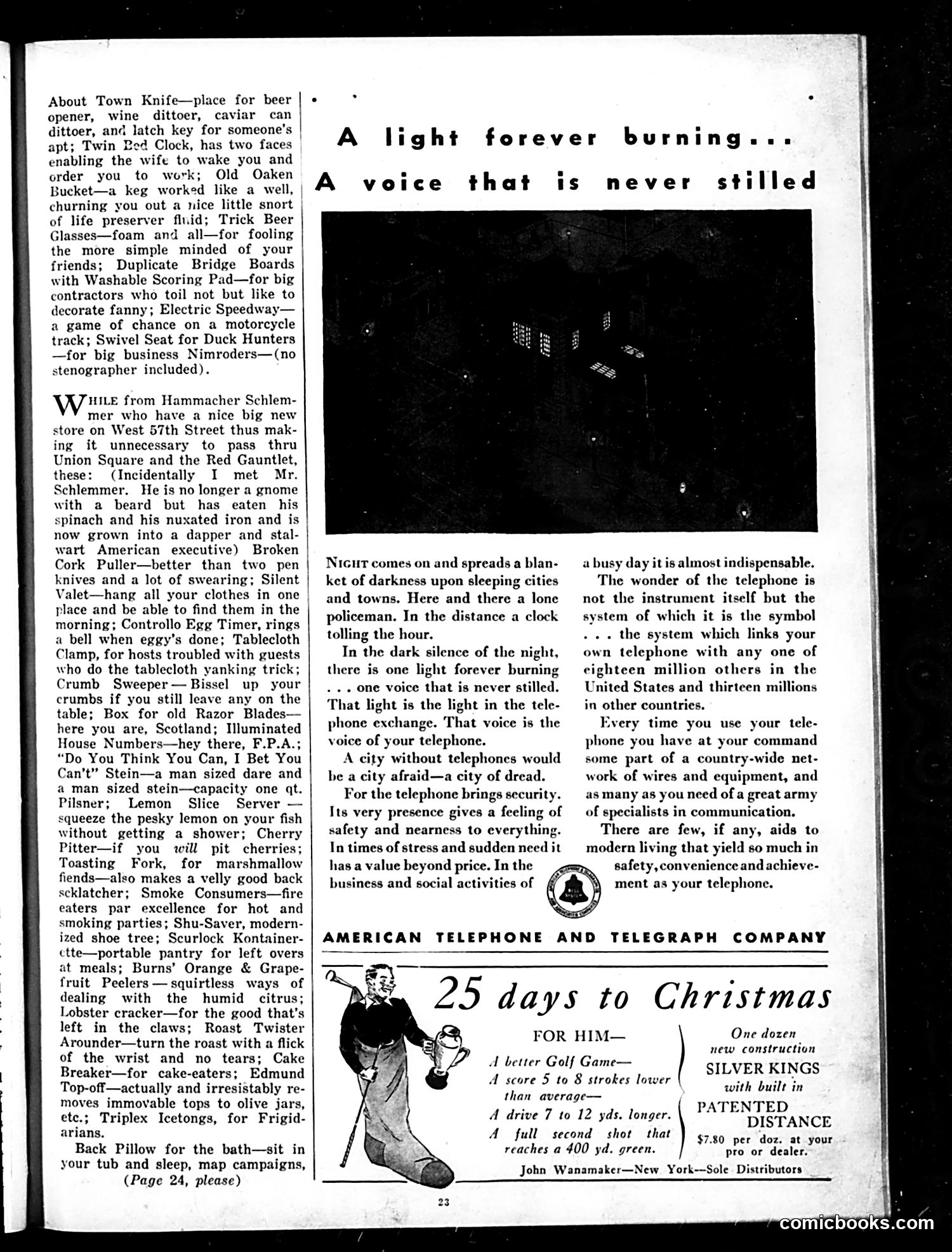
Judge Magazine Page Analysis This page is primarily advertising and consumer product listings, not political satire. The left column humorously catalogs novelty gift items from Hammacher Schlemmer's new West 57th Street store—gadgets like a "Broken Cork Puller," "Silent Valet," and "Lemon Slice Server." The writing adopts a gossipy tone (mentioning meeting Mr. Schlemmer, noting he's now a "dapper and stalwart American executive" rather than a bearded gnome), characteristic of Judge's urban sophistication. The right side features a full-page American Telephone and Telegraph Company advertisement. It romanticizes the telephone exchange's nighttime operations—"a light forever burning...a voice that is never stilled"—positioning the telephone as essential infrastructure providing security and connection across the nation's eighteen million phones. Below is a separate Christmas gift advertisement for golf equipment. There is no political cartoon or satire on this page; it's a commercial publication mixing product humor with corporate messaging typical of 1920s magazine advertising.
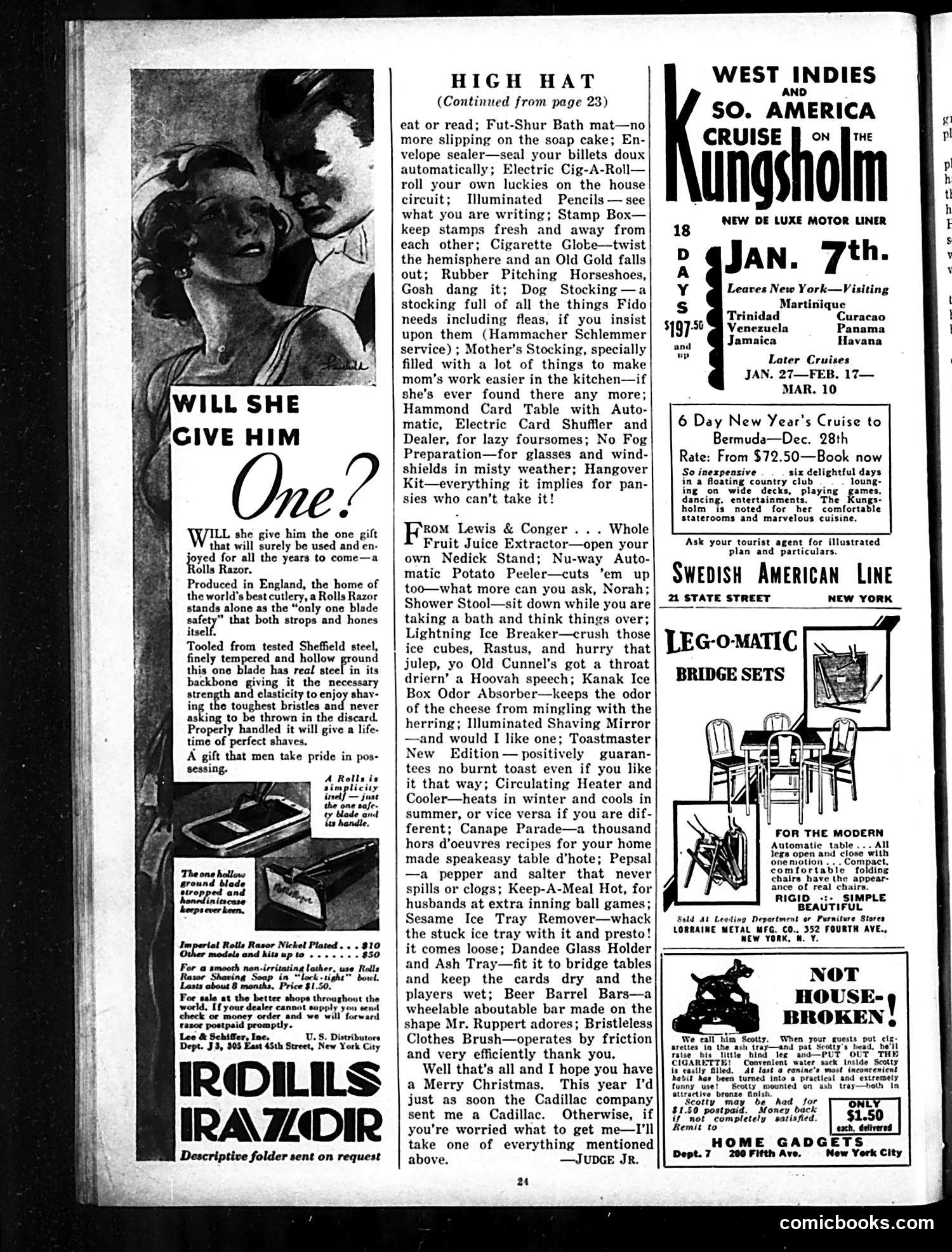
Page Analysis: Judge Magazine Advertisement & Humor Column This page is primarily advertising mixed with satirical gift suggestions. The main content includes: Left side: A Rolls Razor advertisement targeting men, emphasizing its quality Sheffield steel construction and self-stropping mechanism as an ideal gift. Center: "High Hat" — a humorous gift column continuing from page 23, listing absurd and novelty gift items from department stores (Hammacher Schlemmer, Lewis & Conger, etc.). The satire mocks consumerism and gadgetry culture of the era, with jokes about labor-saving devices, speakeasy equipment ("Canape Parade," "Beer Barrel Bars"), and impractical novelties ("Dog Stocking"). References to "Rastus" and casual ethnic humor reflect period prejudices. Right side: Tourism and household product advertisements. The humor targets wealthy consumers obsessed with gadgets and modern conveniences during the prosperous 1920s. The column's closing joke—preferring a Cadillac to these trinkets—undercuts the entire consumer gift catalog.
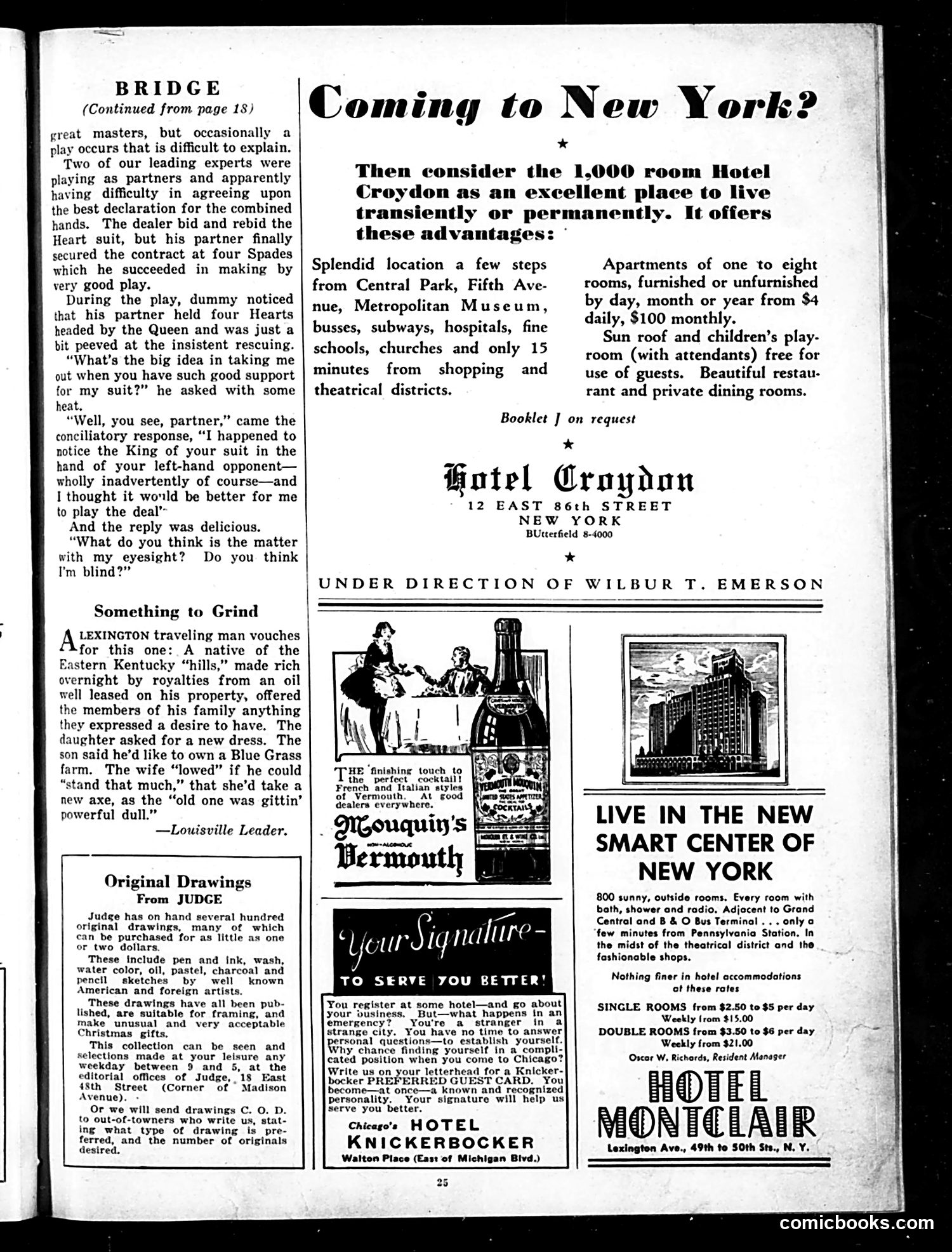
Judge Magazine Page Analysis This page is primarily advertising and humor content, not political commentary. The main article "Bridge" (top left) recounts amusing anecdotes about the card game bridge, including a story about partners disagreeing on strategy. The humor relies on wordplay and misunderstandings during gameplay—standard recreational humor for 1920s magazine readers familiar with bridge. "Something to Grind" presents a folksy tall tale about Appalachian "hill people" who suddenly become wealthy from oil royalties. The humor trades on stereotypes of rural Eastern Kentucky dialect and values (the wife wanting a new axe). This reflects period attitudes toward rural Americans. The remainder is hotel and commercial advertising: Hotel Croydon, Montelair Hotel, Knickerbocker Hotel, Mouquin's Vermouth, and Judge's original artwork sales. The "Your Signature" hotel ad emphasizes convenience for traveling businessmen. No identifiable political figures or satirical commentary appear on this page.
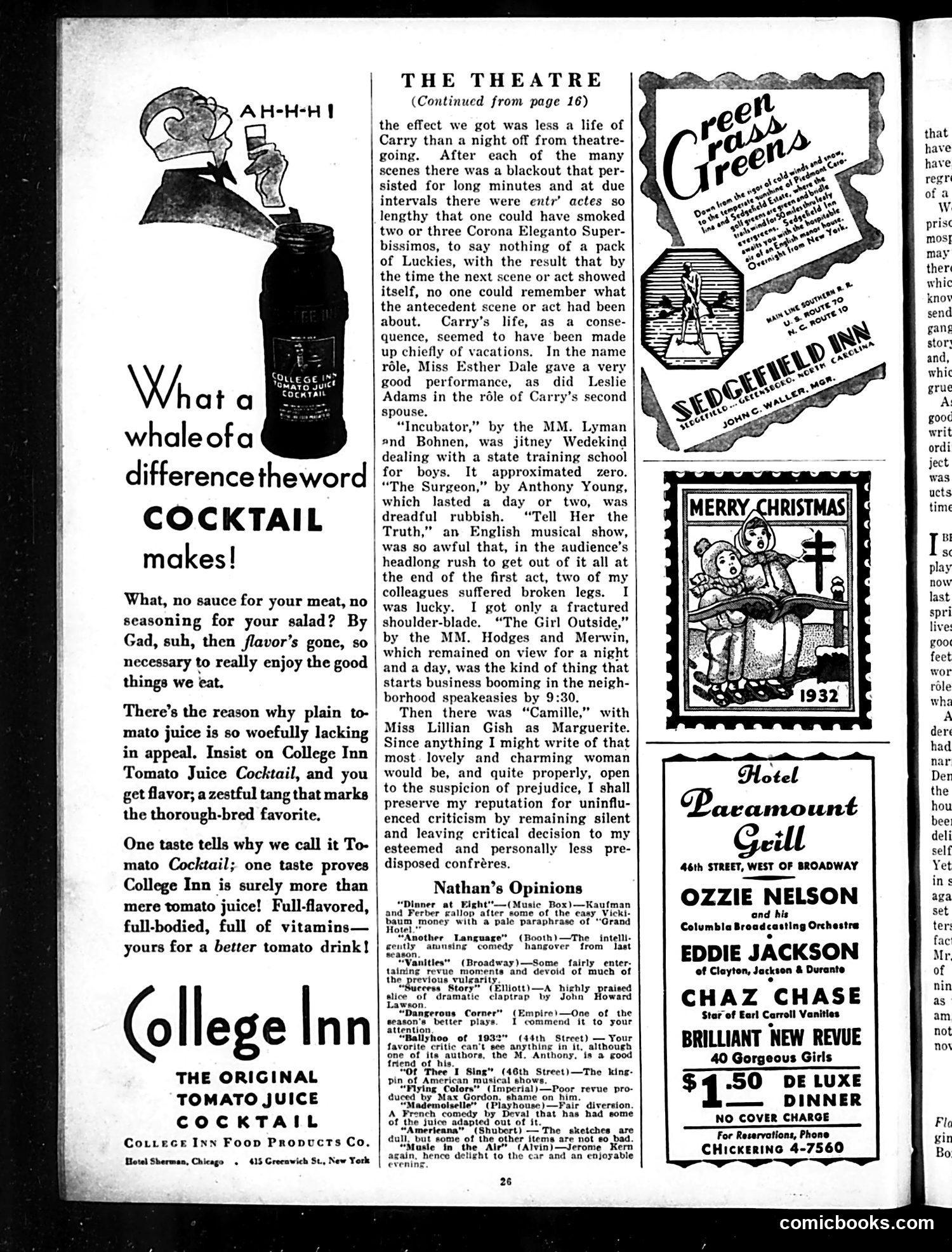
What This Page Means This is primarily a College Inn tomato juice advertisement disguised as editorial content, using humor to sell a product during Prohibition. The cartoon shows a man saying "AH-H-H!" while holding a bottle, with text declaring "What a whale of a difference the word COCKTAIL makes!" This is satirical wordplay: since actual alcoholic cocktails were illegal (Prohibition era), College Inn marketed tomato juice as a "cocktail" substitute—a mock-sophisticated drink for those missing real cocktails. The ad's copy cynically argues that plain tomato juice lacks "flavor" and "seasoning," implying that adding the College Inn brand gives it the kick of an actual cocktail. The joke targets affluent consumers who resented Prohibition's restrictions and sought legal alternatives that mimicked forbidden beverages. The rest of the page contains theater reviews and restaurant advertisements typical of *Judge* magazine's entertainment coverage.
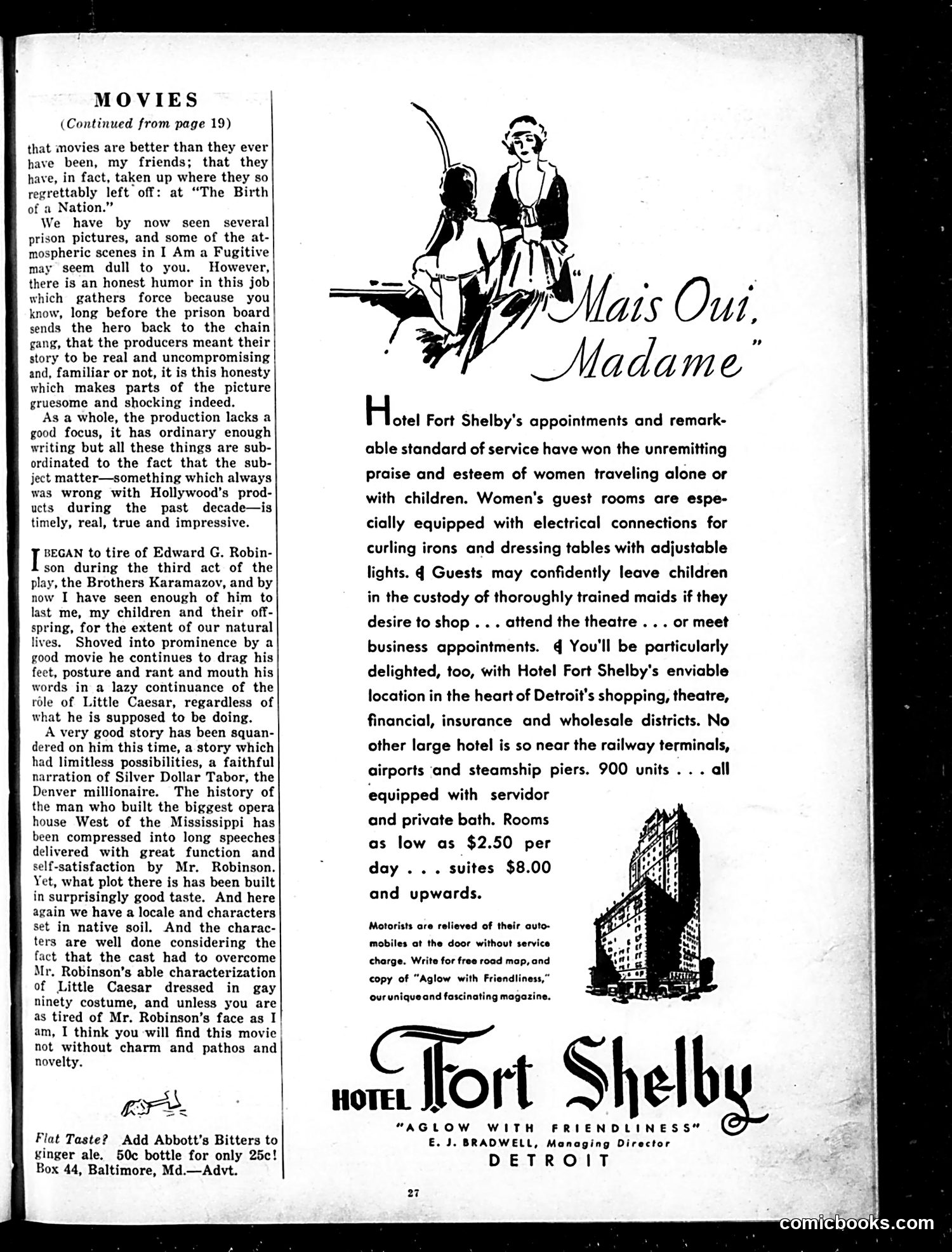
This page is primarily a film review column with a large hotel advertisement. The movie criticism discusses recent films: "I Am a Fugitive" (praised for honesty despite dull moments) and an unnamed Dostoevsky adaptation with Edward G. Robinson (criticized for Robinson's overacting and derivative mannerisms from his breakout role in "Little Caesar"). The reviewer notes Robinson continues playing similar characters rather than adapting to new material. The reference to "The Birth of a Nation" appears ironic—the classic 1915 D.W. Griffith film was groundbreaking but also notoriously promoted Ku Klux Klan ideology; mentioning it suggests reviewing where cinema left off artistically while implying Hollywood should move beyond such content. The remainder is a Hotel Fort Shelby advertisement targeting women travelers, emphasizing safety for solo travelers and mothers with children—reflecting 1930s concerns about women's security while traveling independently.
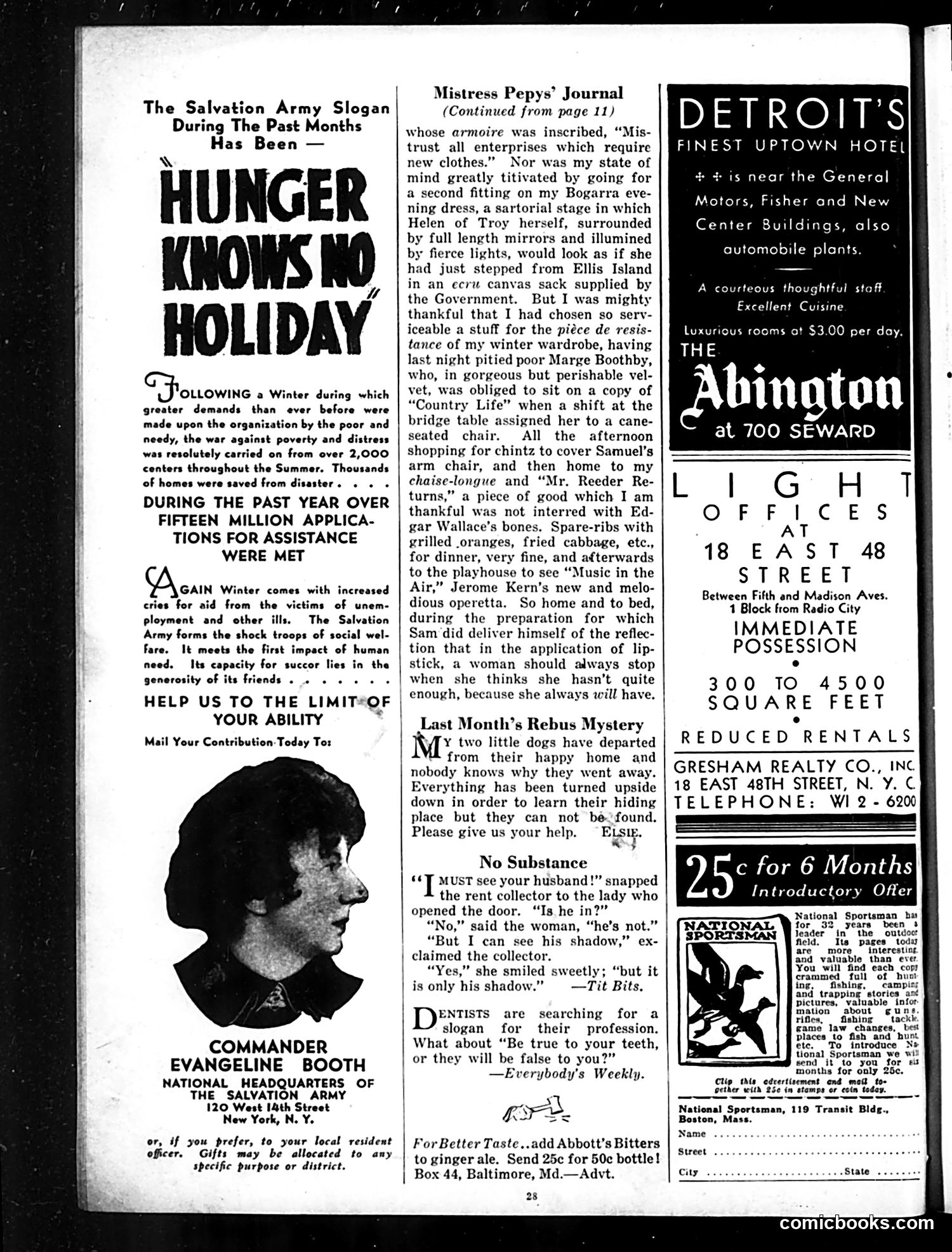
Analysis of Judge Magazine Page This is primarily a fundraising appeal for the Salvation Army, with supporting humorous columns and advertisements. The main feature announces the Salvation Army's winter relief campaign, headed by Commander Evangeline Booth (then leading the organization). The appeal emphasizes that poverty is year-round ("Hunger Knows No Holiday") and claims the organization processed over 15 million applications for assistance in the past year. The page also includes "Mistress Pepys' Journal" — a lighthearted column mimicking Samuel Pepys' famous diary, chronicling the author's mundane social activities (dress fittings, shopping, theater visits) in an affected, gossipy tone. Below are brief humor pieces: jokes about a rent collector seeing only someone's shadow, dentists seeking a slogan, and a "rebus mystery" about missing dogs. The page serves dual purposes: generating charitable donations while entertaining readers with society gossip and light humor — typical of Judge's satirical approach to social and cultural commentary during the Depression era.
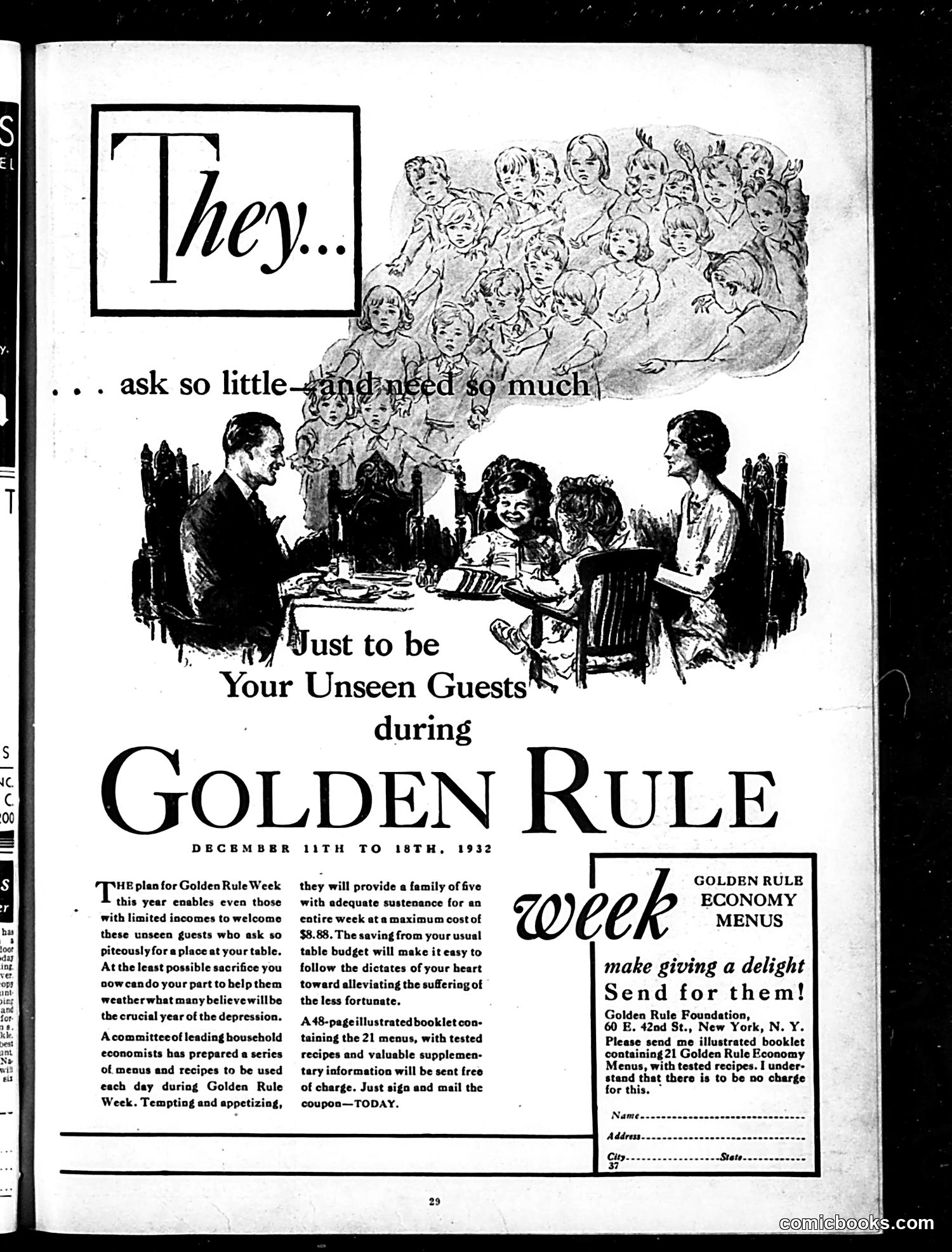
Golden Rule Week Advertisement (1932) This is primarily a charitable advertisement, not political satire. During the Great Depression, the "Golden Rule Foundation" promoted "Golden Rule Week" (December 11-18, 1932) to encourage middle-class families to economize and donate savings to help the poor. The illustration depicts a family dining while "unseen guests"—ghostly images of hungry children—hover above their table, representing the suffering poor. The phrase "They ask so little—and need so much" appeals to guilt and compassion. The ad promotes economy menus that could feed a family of five for $8.88 weekly, allowing diners to redirect their usual food budget toward relief. The "48-page illustrated booklet" with 21 tested recipes was offered free to encourage participation. This reflects Depression-era charitable initiatives relying on voluntary middle-class sacrifice rather than government intervention—a common approach before New Deal programs expanded federal relief efforts.
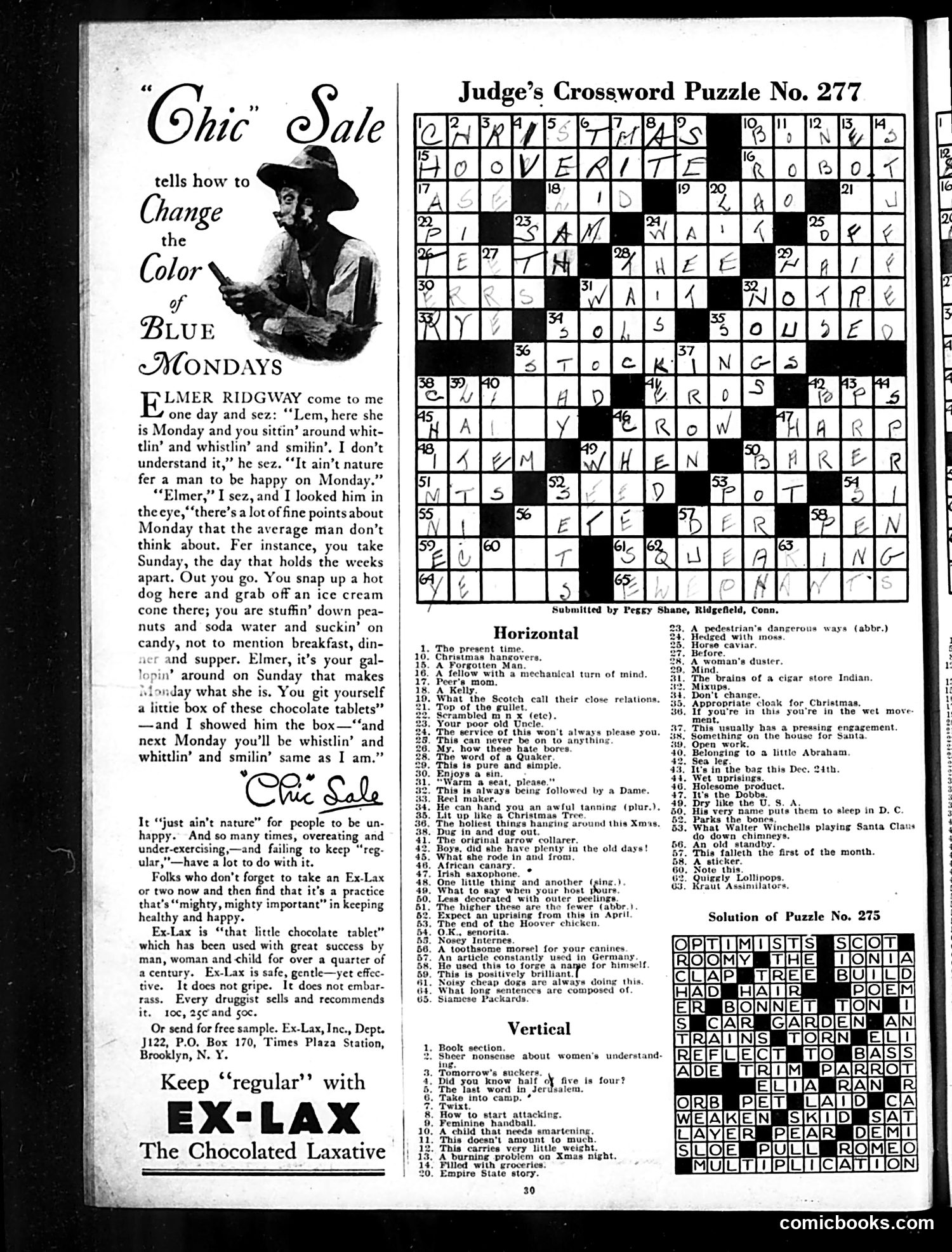
Judge Magazine Page Analysis This page is primarily advertising, not political satire. The main content is a lengthy Ex-Lax laxative advertisement disguised as a folksy anecdote by "Cue Sale." The advertisement uses a rural, conversational narrative: a character named "Elmer Ridgway" complains about Monday blues, and the narrator explains that overeating and poor digestion from Sunday indulgence cause unhappiness. The solution? Ex-Lax chocolate tablets maintain "regularity." The pitch appeals to 1920s-30s health anxieties by linking constipation to general malaise and mood. The message: staying "regular" through laxatives ensures happiness and proper functioning. The remainder of the page contains Judge's Crossword Puzzle No. 277 and its solution—standard magazine filler content. There are no political cartoons or satire on this page—it's purely commercial and entertainment content typical of Judge's revenue model.
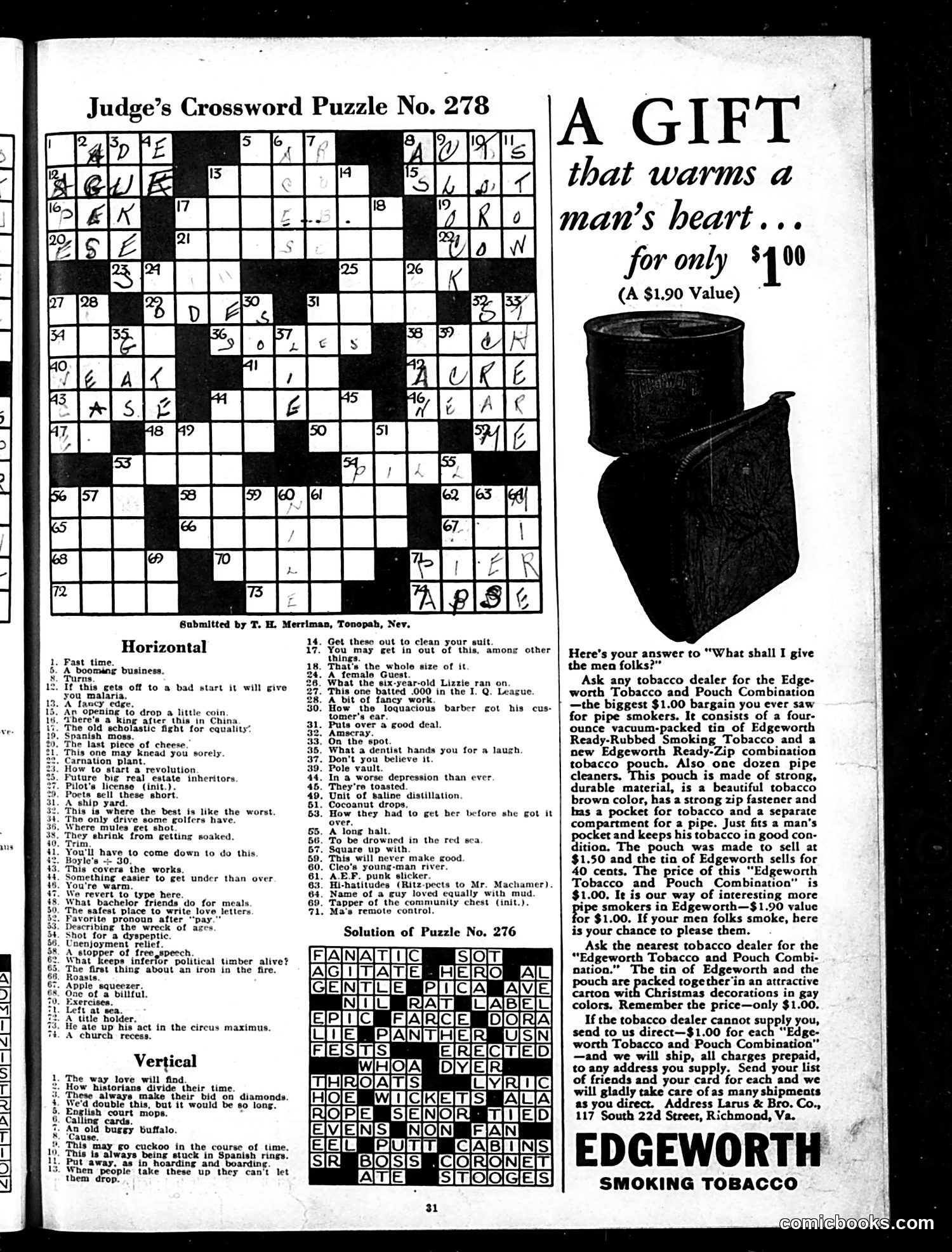
Judge Magazine Page Analysis This page is primarily advertising and a crossword puzzle, not political satire. The dominant content is a large Edgeworth Tobacco advertisement featuring a tobacco pouch and pipe. It promotes a "$1.00 gift combination" (marked down from $1.90 value) containing smoking tobacco and a zippered pouch, marketed as an ideal gift "for the men folks." The copy emphasizes the product's durability and convenience. Above this runs Judge's Crossword Puzzle No. 278, a standard word puzzle with typical clues of the era—many referencing contemporary culture, products, and social conventions (Spanish moss, barber shops, Chinese geography, etc.). The puzzle credits T. H. Merriman of Tonopah, Nevada as the constructor. At bottom appears the solution to the previous puzzle (No. 276), displayed in a completed grid. The page reflects early 20th-century magazine advertising practices: major publishers like Judge funded operations partly through product placement. There is no discernible political cartoon or social satire on this particular page.
Page Content Analysis This page is primarily advertising, not a cartoon or satirical piece. It's a Book-of-the-Month Club promotional advertisement for Van Loon's *Geography*. The text includes a whimsical philosophical passage (attributed to Van Loon) imagining humanity compressed into a box and dropped into the Grand Canyon—a meditation on human insignificance against geological time and cosmic scale. This reflects early 20th-century popular science writing that aimed to inspire awe at Earth's vastness. The bulk of the page explains the Book-of-the-Month Club's membership benefits: free initial book, no mandatory purchases, no membership dues, just retail prices for selected volumes. The Club positioned itself as curating quality literature for readers. The small illustration shows what appears to be the Grand Canyon landscape. This is not satirical content but rather a marketing piece designed to attract new members by offering an intellectually ambitious geography book as an incentive.
Judge Magazine Page Analysis This page combines editorial content with advertising. The main text is a philosophical essay by Van Loon (likely the historian/cartoonist Hendrik Willem van Loon) using dark satire: he calculates that all 2 billion humans could fit in a box half a mile per side, imagines dropping it into the Grand Canyon, and concludes humanity would be forgotten within a century—reduced to "a little mound, densely covered with vegetable matter." The satire targets human insignificance against geological and cosmic scales. Van Loon's microscopic illustration of the Grand Canyon emphasizes this perspective. The lower half advertises the Book-of-the-Month Club, promoting a free copy of Van Loon's *Geography* as membership incentive. The club promised curated book selections without mandatory purchases—a novel concept for 1920s readers accustomed to aggressive sales tactics. The juxtaposition is notable: humanity's cosmic irrelevance contrasted with consumer marketing optimism.
Van Loon's Geography Advertisement This is primarily a Book-of-the-Month Club advertisement, not political satire. The page promotes "Van Loon's Geography" ($3.75 retail) as a free gift to new members. The Book: Henrik Van Loon's "Geography" was a popular illustrated geography text featuring 163 of the author's own drawings, many in color. The ad emphasizes it as an exceptional educational work that would enlighten readers about Earth and its peoples. The Sales Pitch: The Club addresses reader procrastination directly, emphasizing its flexible membership terms: no mandatory purchases, no dues, no fixed fees—members pay only retail price for books they choose. The Club claims members receive 50%+ value back in free books based on purchase spending. Historical Context: This reflects 1930s book club marketing when such clubs were novel membership concepts. The appeal to "Olympians chastened to humility" suggests the book teaches intellectual humility about human civilization's place in nature—a common theme in Van Loon's educational work.
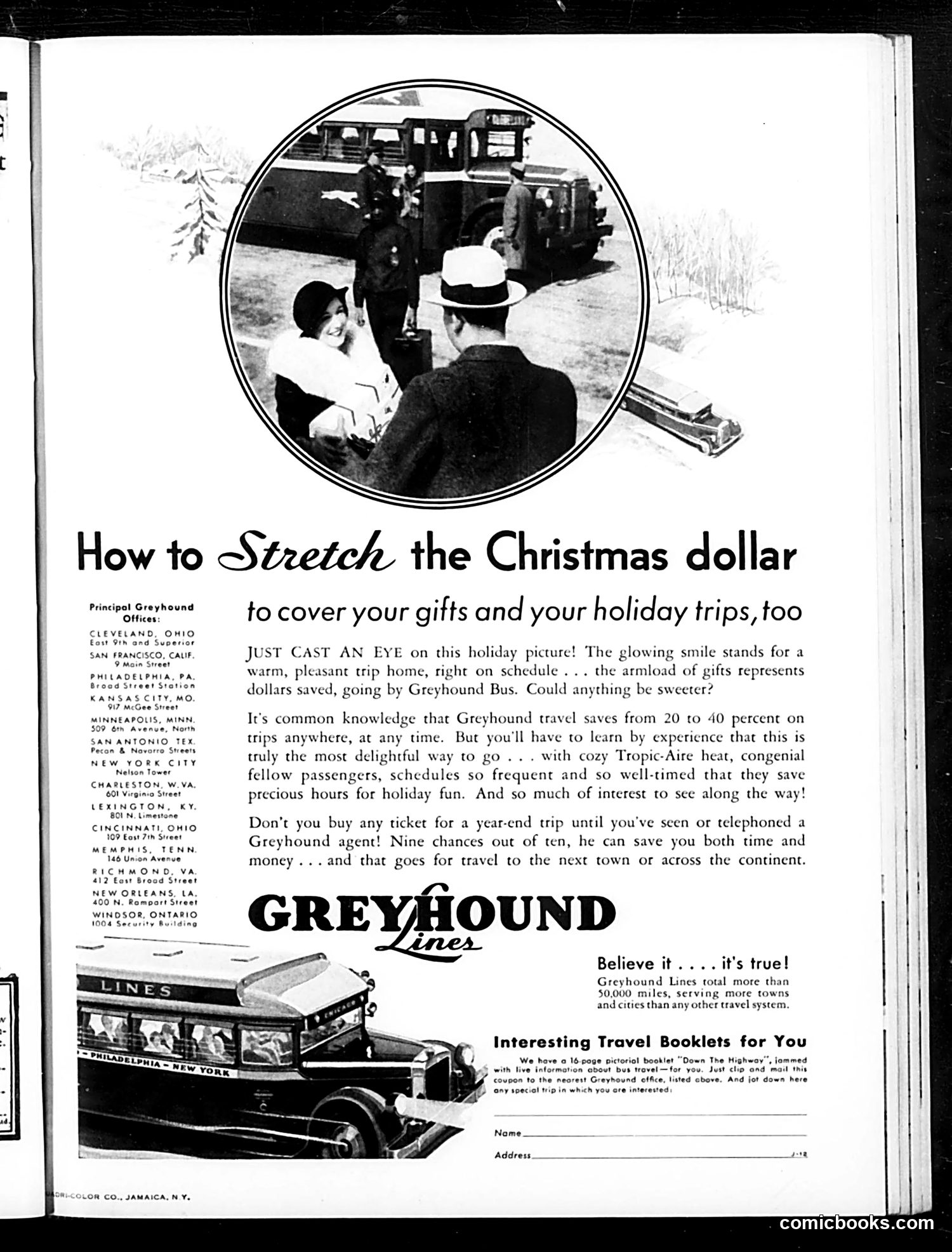
Analysis This is a Greyhound Bus advertisement, not a political cartoon or satire. The page uses the heading "How to Stretch the Christmas dollar" as a marketing hook to promote bus travel as an economical holiday option. The circular photograph shows a family boarding or near a Greyhound bus, representing the "warm, pleasant trip home" promised in the text. The advertisement emphasizes practical benefits: Greyhound saves 20-40 percent on travel costs, offers comfortable amenities (Tropic-Aire heat), frequent schedules, and serves more towns than competitors. The "stretch" metaphor suggests that by choosing bus travel over other transportation, families can afford both holiday gifts and travel—making limited budgets go further. The accompanying bus illustration at bottom promotes the company's extensive network. This reflects 1930s-40s consumer culture, when intercity buses represented an affordable middle-class travel option between personal automobiles and trains.
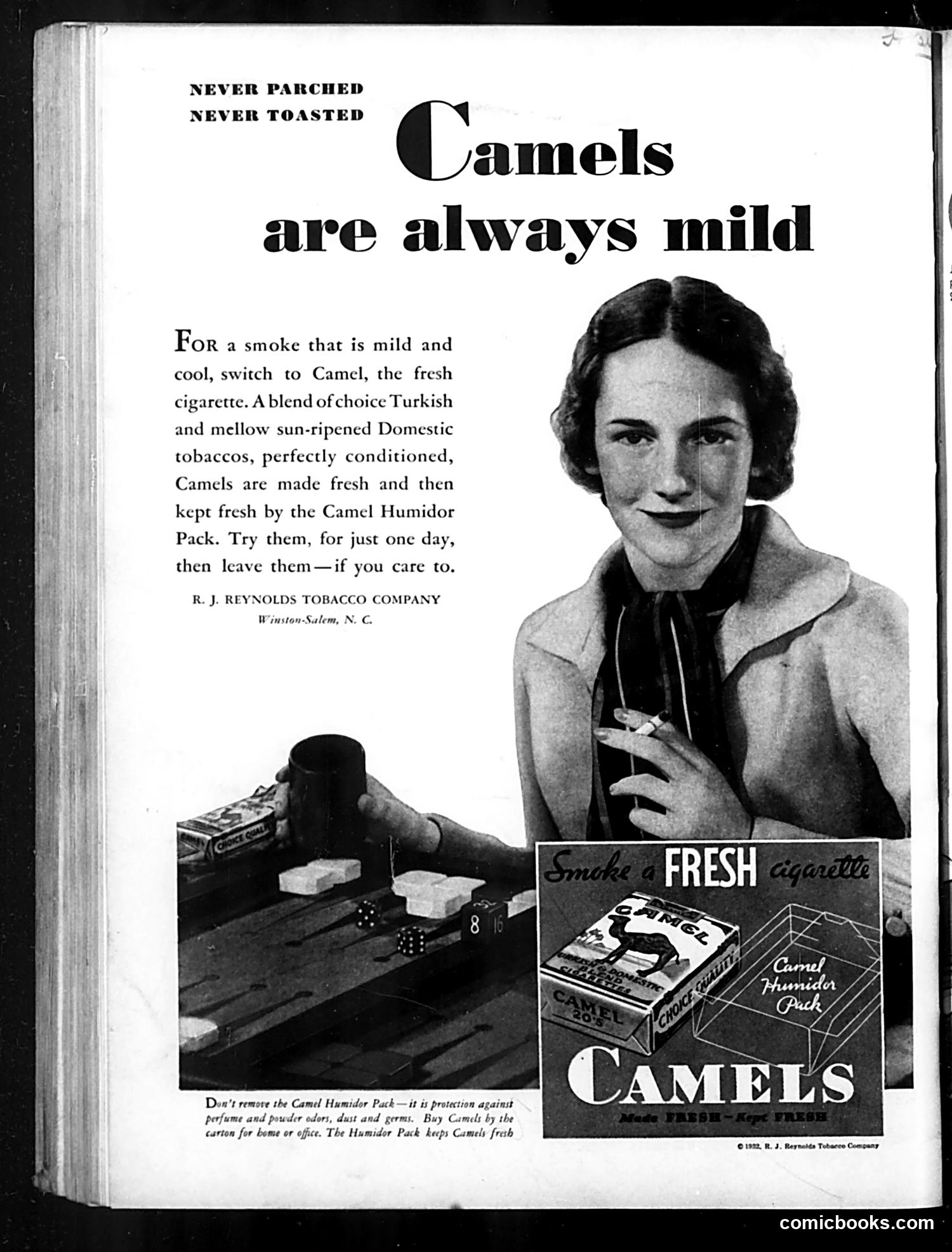
Analysis This is a Camel cigarette advertisement, not satire or political commentary. The page features a professional advertisement for R.J. Reynolds Tobacco Company promoting their Camel brand cigarettes. Key elements: - A woman holds a cigarette, appearing refined and modern - The "Camel Humidor Pack" (protective packaging) is highlighted as keeping cigarettes fresh - Text emphasizes mildness and freshness as selling points - Lower left shows the humidor pack's protective qualities against "perfume and powder odors, dust and germs" Historical context: This appears to be from the early-to-mid 20th century when cigarette advertising was widespread and unregulated. The emphasis on freshness and a woman smoking reflects marketing toward female consumers, a strategy that was relatively novel at the time. There is no satire here—it's a straightforward product advertisement that would be impossible (and illegal) to publish today due to tobacco advertising restrictions.