judge
Judge — January 1933
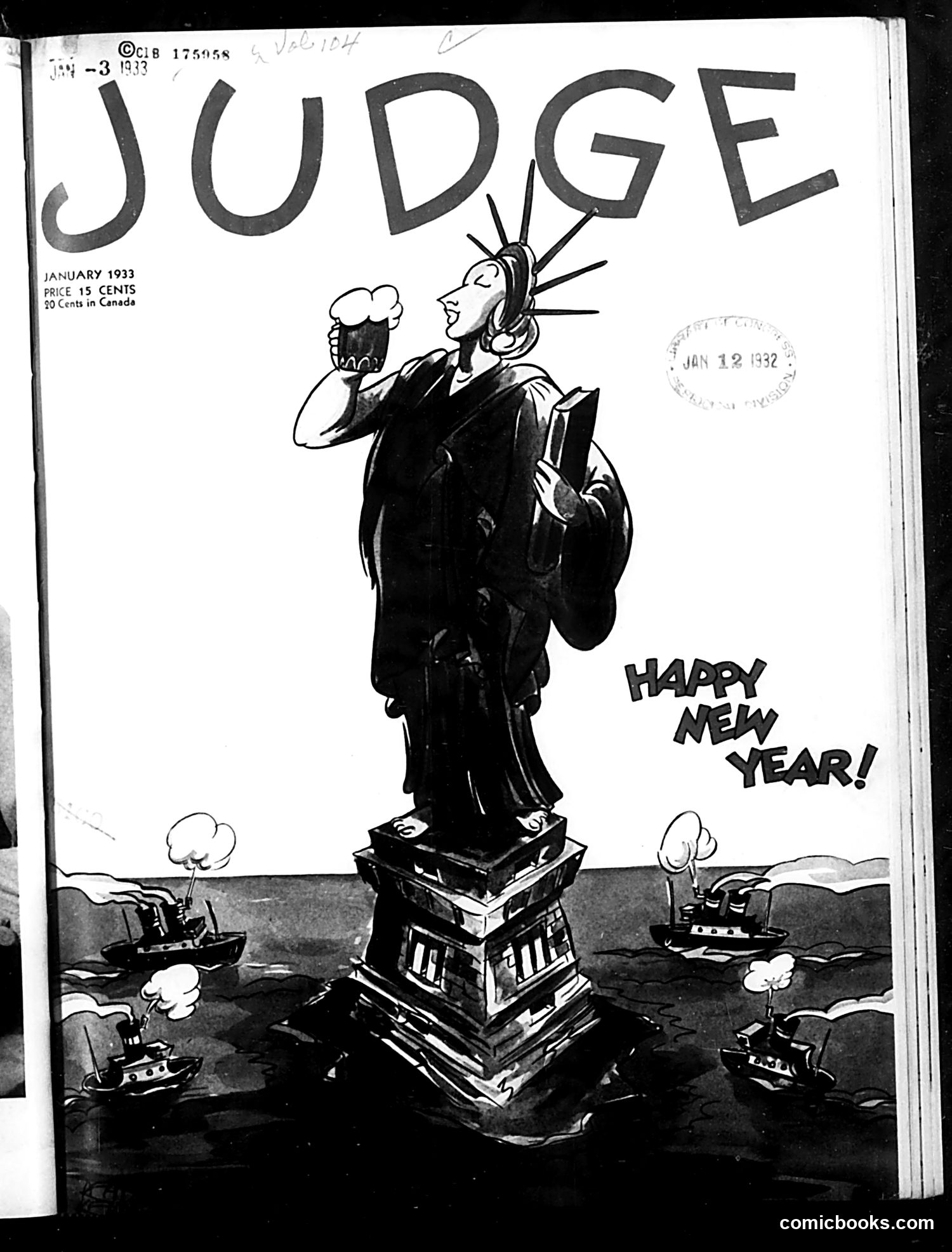
Judge Magazine Cover Analysis - January 1933 This is a New Year's greeting cover depicting Lady Liberty (identifiable by her crown and torch) standing atop a pedestal, holding a beer stein and celebrating "Happy New Year!" Below her, warships fire celebratory shots in a harbor scene. The cartoon likely references the imminent end of Prohibition, which occurred in December 1933 (just months after this January issue). The beer stein—illegal to publicly celebrate just months earlier—symbolizes the anticipated repeal of the 18th Amendment. Lady Liberty's prominent display of alcohol suggests optimism about regaining this "freedom," with the military salutes emphasizing the significance of this constitutional change. This represents the magazine's humorous take on a major political shift anticipated for 1933.
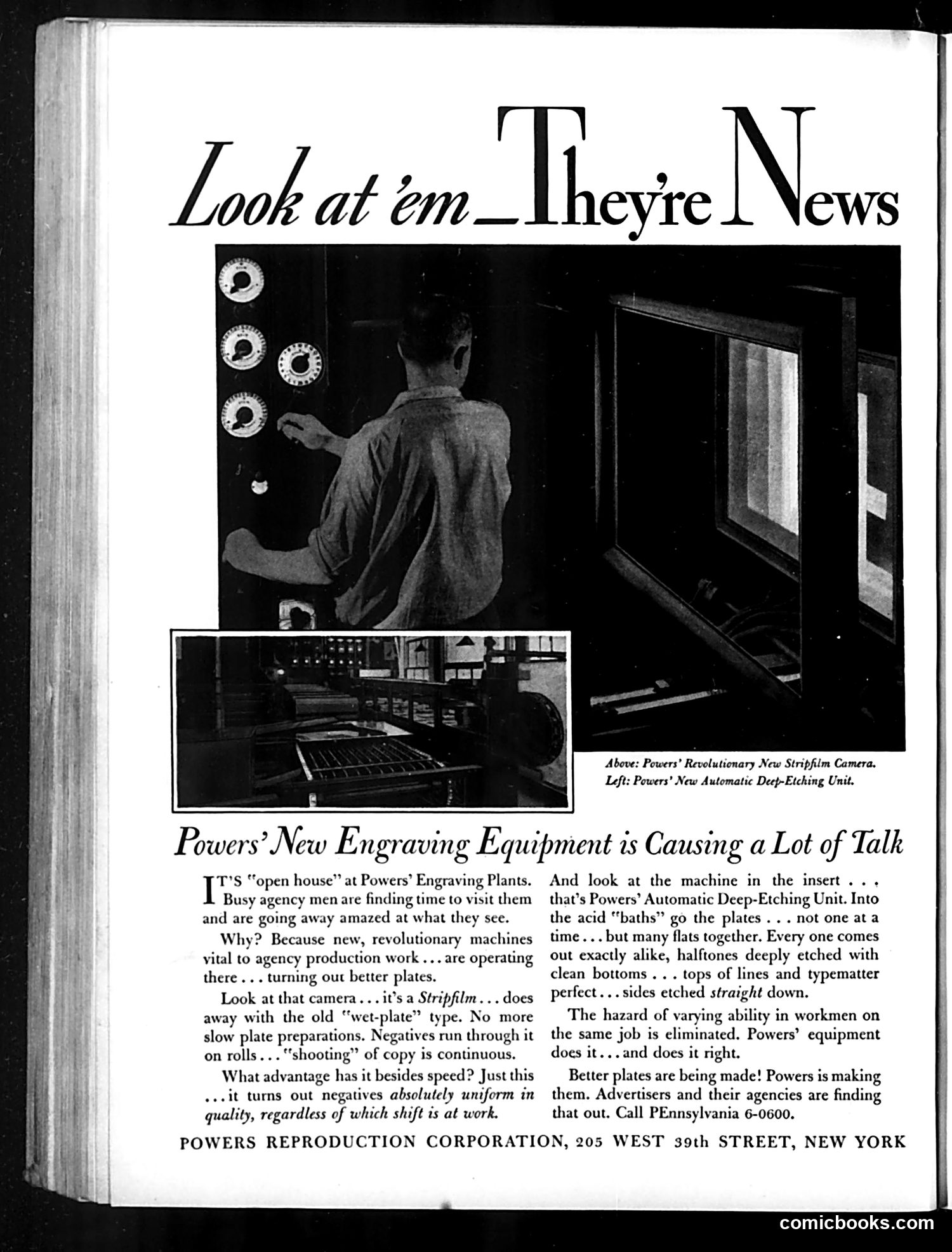
Analysis This is not a satirical cartoon but rather a trade advertisement for Powers Reproduction Corporation, a printing/engraving equipment manufacturer. The page promotes their new "Stripfilm Camera" and "Automatic Deep-Etching Unit" as revolutionary technological advances for advertising agencies and print shops. The images show workers operating this equipment. The "satire" here is gentle corporate self-promotion: the headline "Look at 'em—They're News" frames the machines as newsworthy innovations. The text emphasizes that this equipment produces uniform, high-quality printing plates without the variable quality issues caused by different workers. For modern readers: this represents 1940s-era industrial advertising celebrating automation and technological improvement in the printing industry—a common Judge magazine feature during this period.
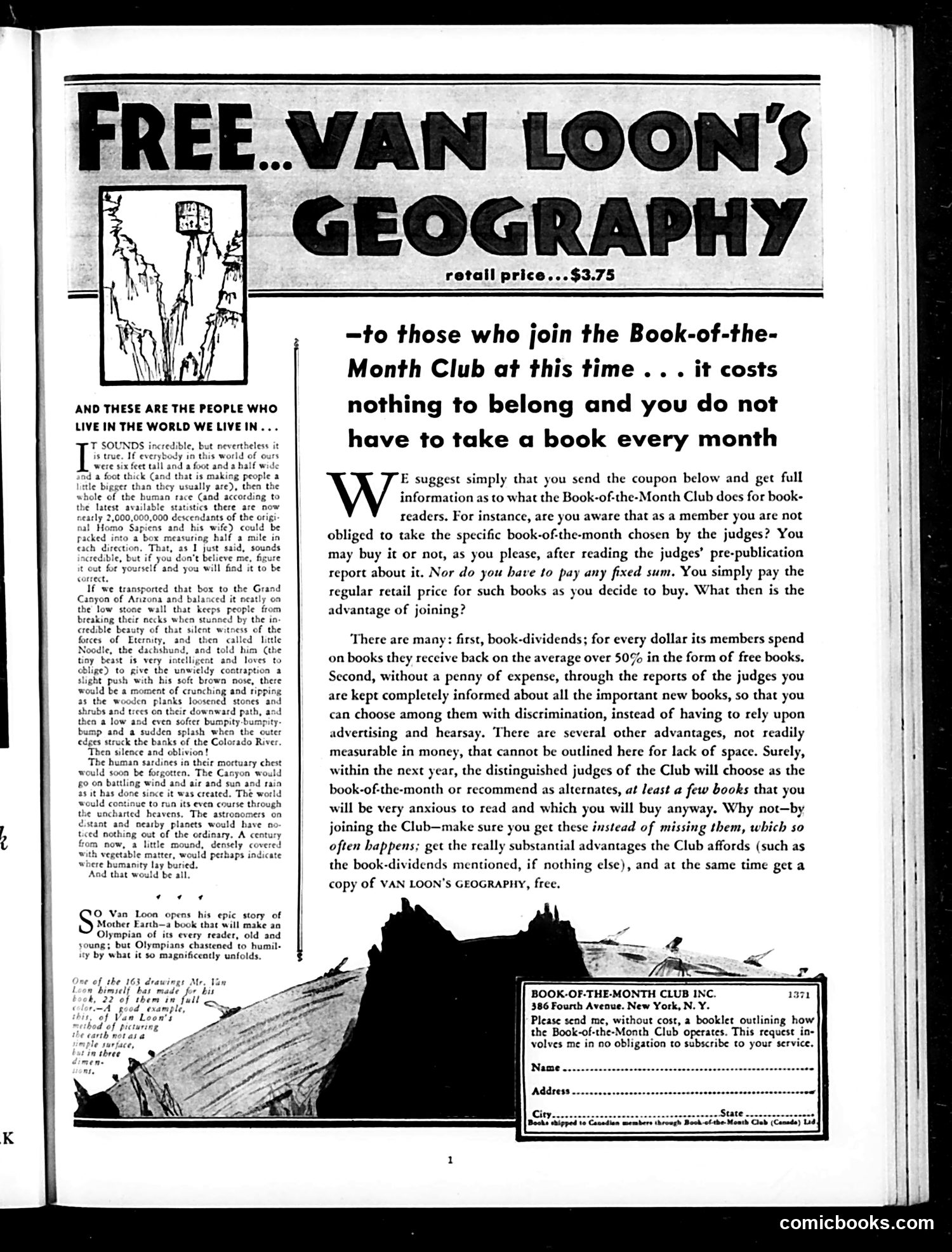
Analysis This page is primarily an advertisement, not political satire. It promotes Van Loon's *Geography* textbook (retail price $3.75) and encourages joining the Book-of-the-Month Club. The visual elements include: - A small illustration of plants/flowers (relating to geography/nature) - A larger landscape illustration showing mountainous terrain with what appears to be a river or water features The text emphasizes the Book Club's benefits: no membership fees, book dividends (over 50% value back as free books), and access to judges' expert recommendations rather than relying on advertising. It positions joining as advantageous for readers seeking curated selections. The Van Loon mention references the author's reputation for making geography engaging and accessible to general readers, though the specific historical context of the textbook's prominence is unclear from this page alone.
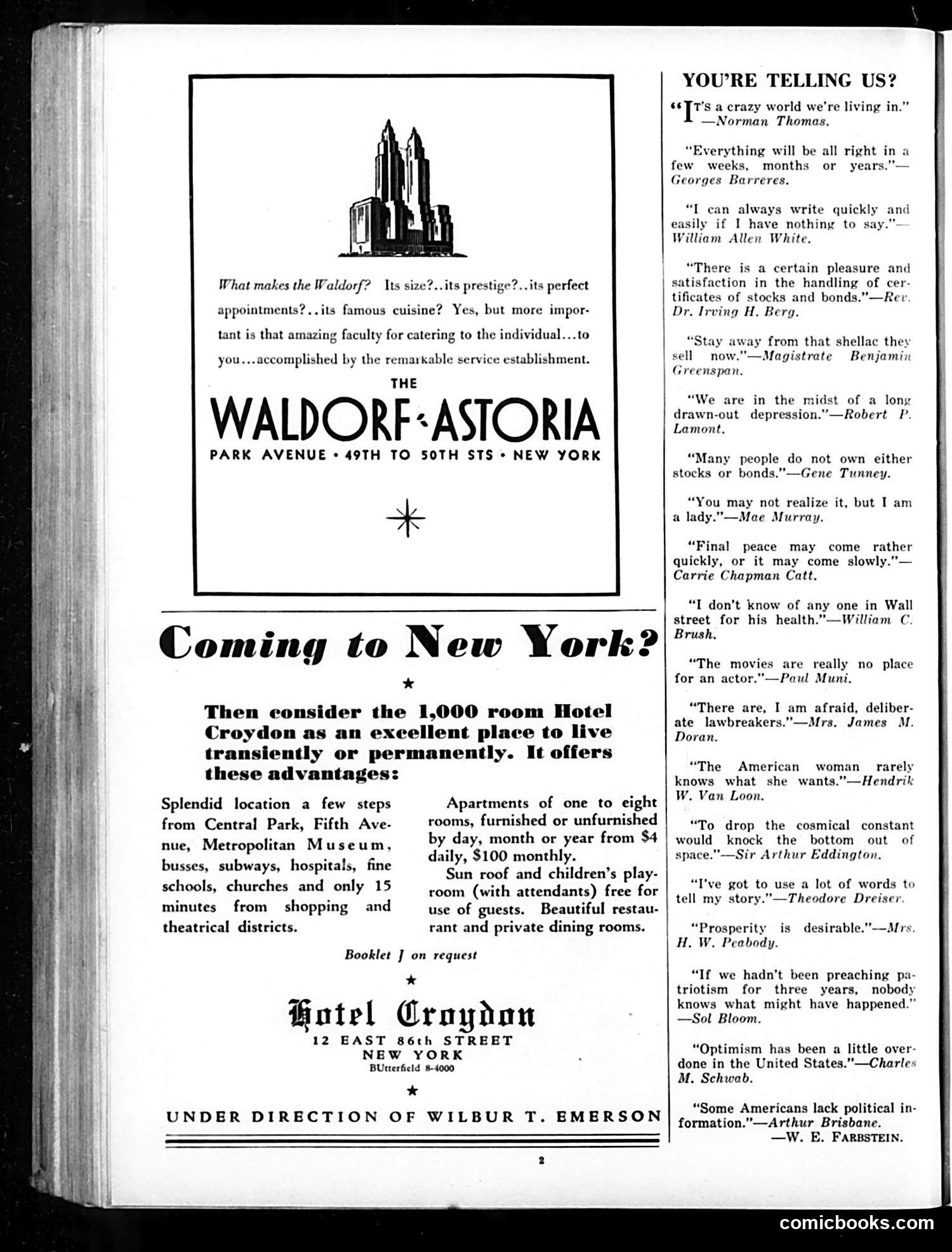
Analysis This page is primarily advertising, not political satire. The dominant content features two hotel advertisements: 1. The Waldorf-Astoria (top): A luxury hotel ad emphasizing its prestigious location, cuisine, and service on Park Avenue. 2. Hotel Croydon (bottom): A competing hotel advertising affordability and convenience for visitors to New York, with rates from $4 daily. The right column contains unrelated celebrity quotes under "YOU'RE TELLING US?"—brief witticisms attributed to figures like Norman Thomas and William Allen White, a common magazine feature of the era. There is no political cartoon on this page. The content reflects 1920s-30s New York commercial culture and Judge magazine's mix of advertising revenue with celebrity commentary rather than satirical commentary.
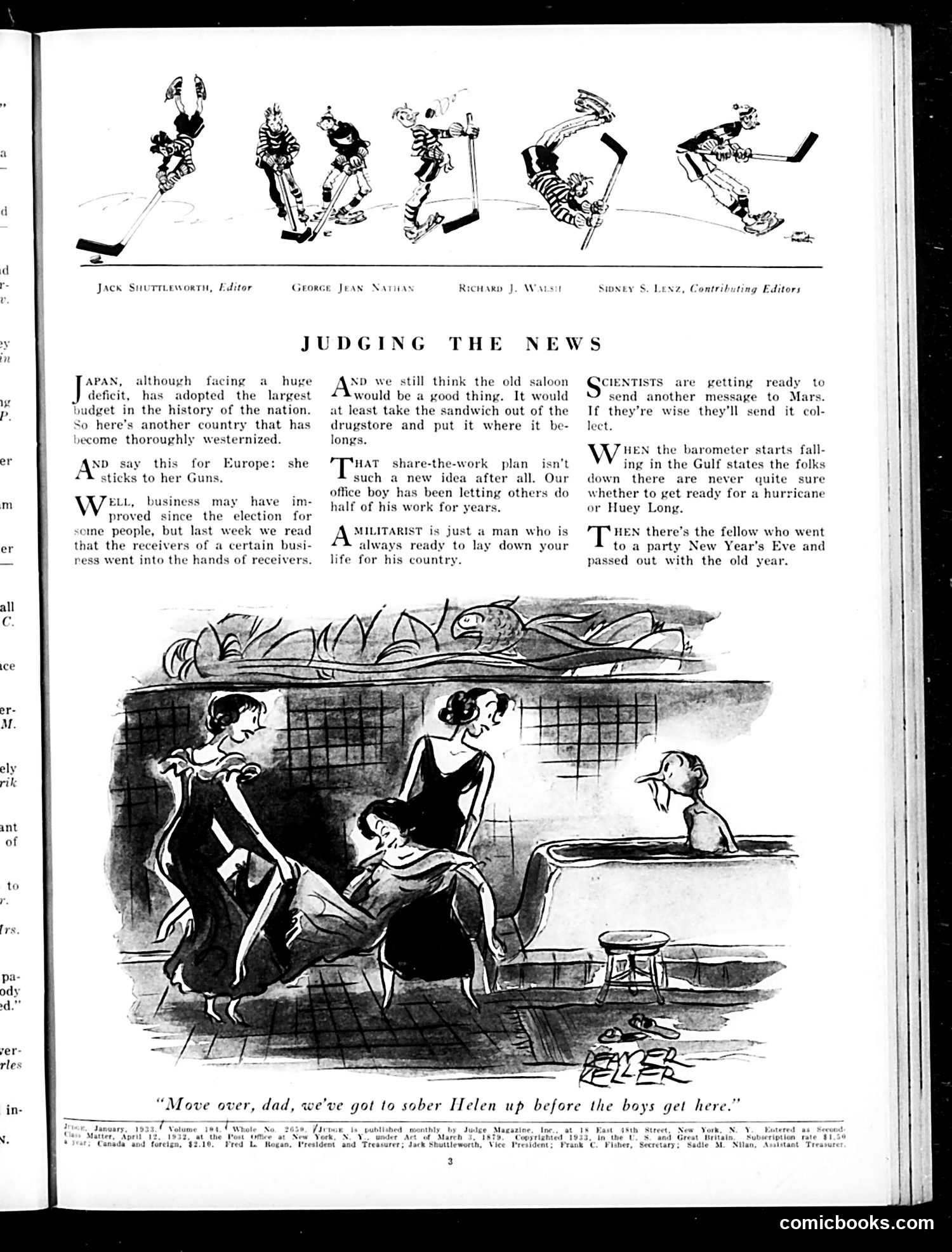
"Judging the News" - January 1933 This page satirizes contemporary news events through brief editorial comments and a cartoon. The cartoon depicts a domestic scene where a woman urgently tells a man ("dad") to move a drunk man ("sober Helen up before the boys get here"). It jokes about priorities during Prohibition's final days—with alcohol illegal but apparently still present in homes. The editorial snippets mock various topics: Japan's budget deficit, Europe's militarism, business receiverships, share-the-work employment schemes, and scientists' Mars plans. The hockey player illustrations at the top appear decorative rather than directly related to the page content. The overall tone is cynical commentary on Depression-era politics and social hypocrisy, particularly regarding Prohibition enforcement as the era neared its repeal.
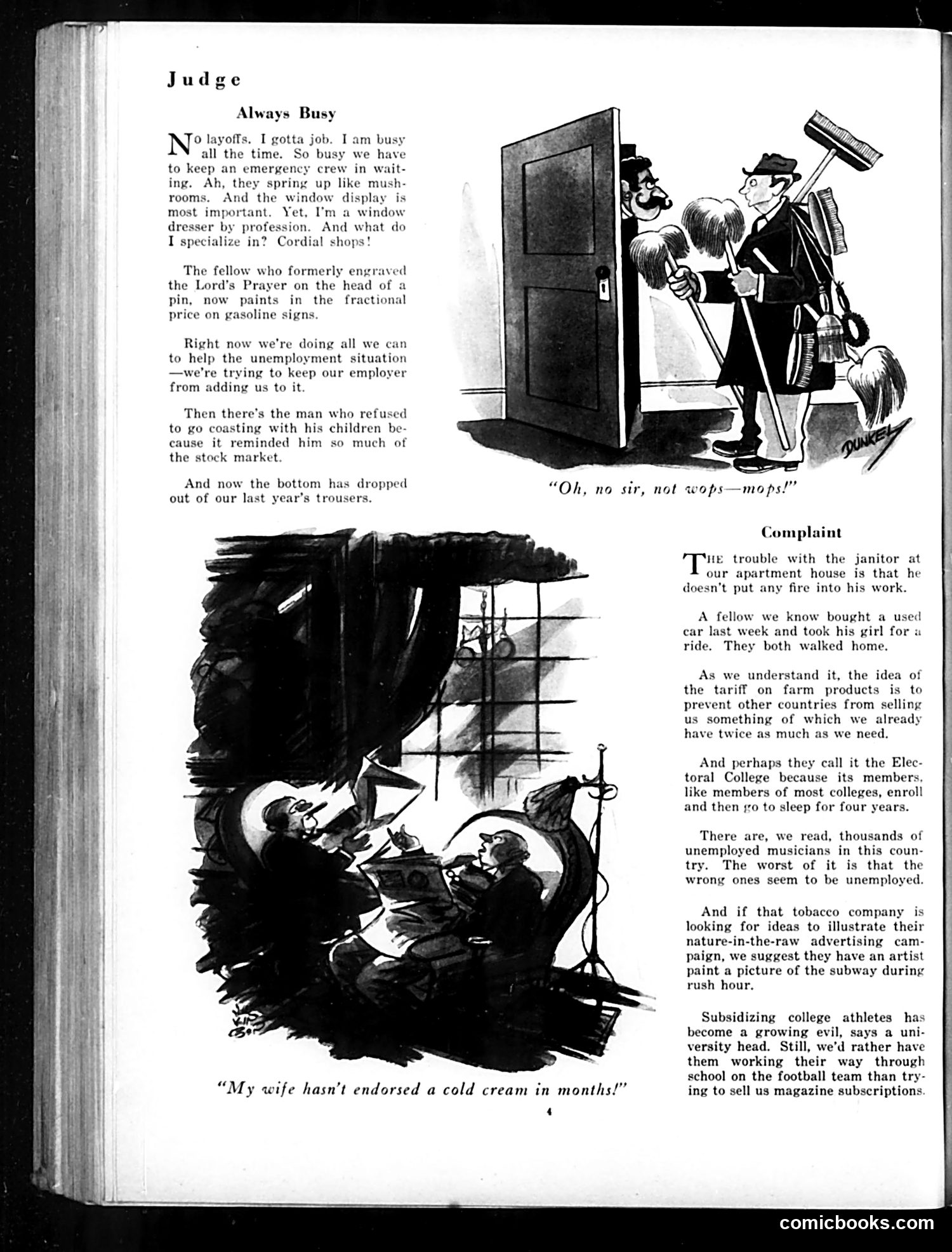
Analysis of Judge Magazine Page "Always Busy" (top cartoon): A judge satirizes society's misplaced priorities. While people anxiously crowd a window display (likely related to stock market or economic concerns), he notes the irony: window dressing is his profession—literally arranging displays. The commentary critiques how people obsess over superficial economic indicators while ignoring deeper problems. "Complaint" (text section): A series of satirical observations about contemporary issues: a janitor's poor work ethic, a man buying a used car for a date, farm product tariffs, the Electoral College, unemployed musicians, advertising concepts, and college athletes selling magazine subscriptions. These appear to be brief, witty social critiques typical of Judge's satirical approach to 1920s-30s American life.
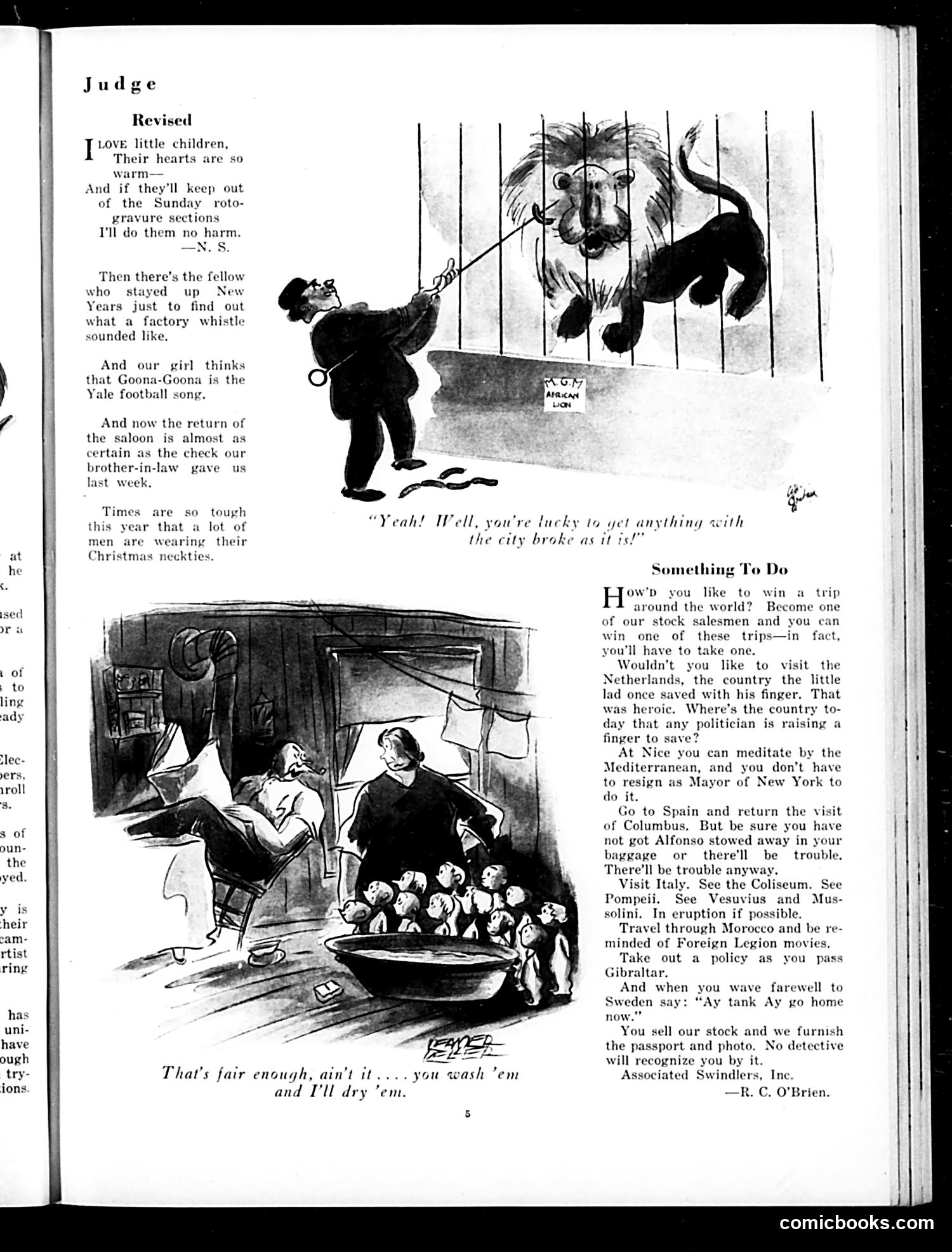
Judge Magazine Page Analysis This page contains two cartoons and satirical commentary from an unspecified era (likely early 20th century based on style). Top cartoon: A man with a factory whistle confronts a donkey, captioned "Yeah! Well, you're lucky to get anything with the city broke as it is!" This appears to satirize urban economic hardship—the city's financial struggles are so severe that even animals should be grateful for basic provisions. Bottom cartoon: Shows a woman washing children while a man observes, captioned "That's fair enough, ain't it....you wash 'em and I'll dry 'em." This domestic humor reflects traditional gender roles and division of household labor. "Something To Do" section offers humorous travel suggestions for unemployed stock salesmen, satirizing the economic depression affecting business professionals.
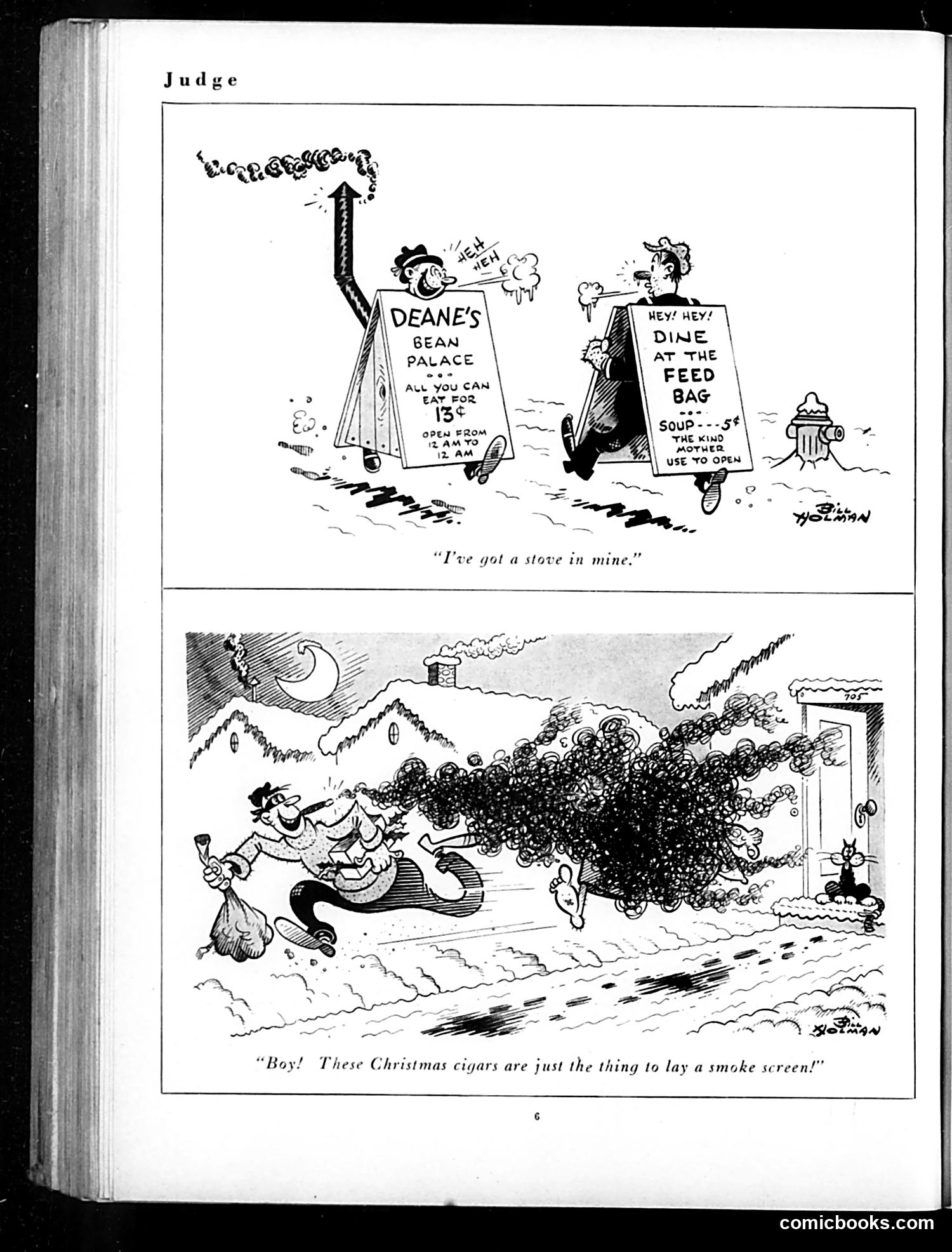
Analysis of Judge Page This page contains two cartoons satirizing Depression-era commercialism and entrepreneurship. Top cartoon: Two men wearing sandwich boards advertise competing cheap eateries—"Deane's Bean Palace" (15¢ all-you-can-eat) and "Feed Bag" (soup for 5¢). The humor lies in their competitive boasting ("I've got a stove in mine"), mocking how desperate Depression entrepreneurs oversold minimal offerings. Bottom cartoon: Men use Christmas cigars to create a smoke screen, apparently to hide from someone or something. The joke appears to reference using cheap merchandise as deception—"just the thing to lay a smoke screen"—satirizing how inferior holiday goods were marketed to unsuspecting consumers. Both cartoons mock working-class struggles and dubious commercial practices during economically desperate times.
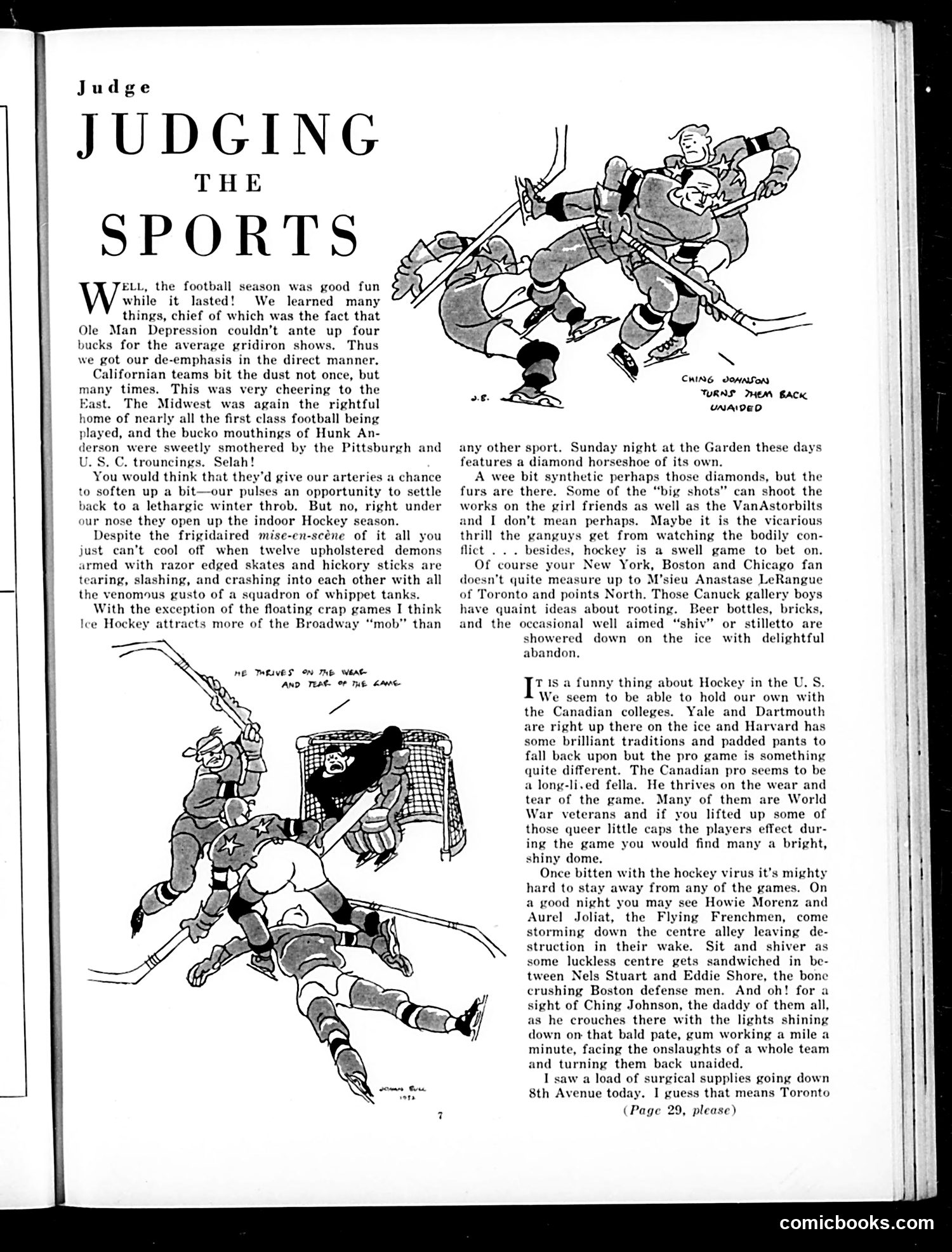
Judging the Sports: A Depression-Era Commentary This *Judge* magazine article satirizes American sports during the Great Depression. The author notes that the economic crisis has decimated football attendance—"Ole Man Depression couldn't ante up four bucks"—forcing de-emphasis of the sport. The cartoons humorously depict the violent, physical nature of ice hockey, which the author suggests attracts Broadway's "mob" crowd seeking vicarious thrills from bodily conflict. Named players like Howie Morenz, Aurel Joliat (the "Flying Frenchmen"), Nels Stuart, Eddie Shore, and Ching Johnson are praised for their toughness—particularly Johnson, depicted as a tough, bald veteran who single-handedly stops opponents. The satire contrasts American and Canadian hockey culture, suggesting Canadian fans' passionate (violent) rooting style—"Beer bottles, bricks...and the occasional well aimed 'shiv'"—surpasses American spectators' restraint. The closing joke about surgical supplies heading to Toronto implies the Canadian game's brutality necessitates medical supplies.
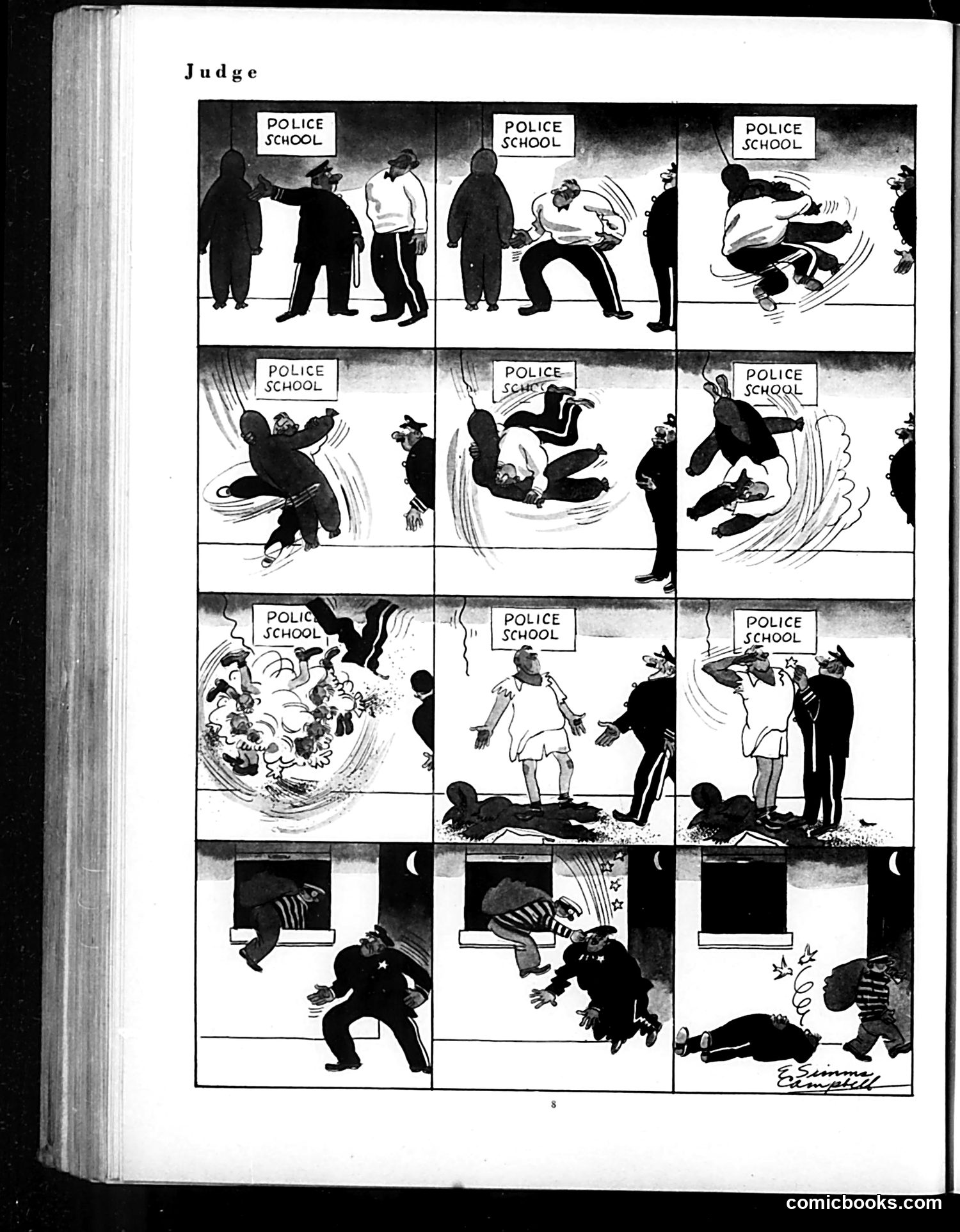
"Judge" Political Cartoon: Police School This single-panel comic satirizes police training or police brutality through a sequential narrative at a "Police School." The cartoon depicts officers progressively using more violent tactics—from initial confrontations to throwing suspects, culminating in nighttime scenes of officers attacking figures on the ground. The satire appears to critique either inadequate police training that encourages excessive force, or mock the normalization of police violence as an accepted "school" curriculum. The repetition of "POLICE SCHOOL" labels emphasizes how violence becomes systematized and taught rather than aberrant behavior. The final nighttime panels suggest violence occurring beyond public oversight, possibly criticizing how such conduct goes unpunished when hidden from daylight scrutiny. Without a visible date, the specific historical context remains unclear, though the critique of police violence has remained relevant across American history.
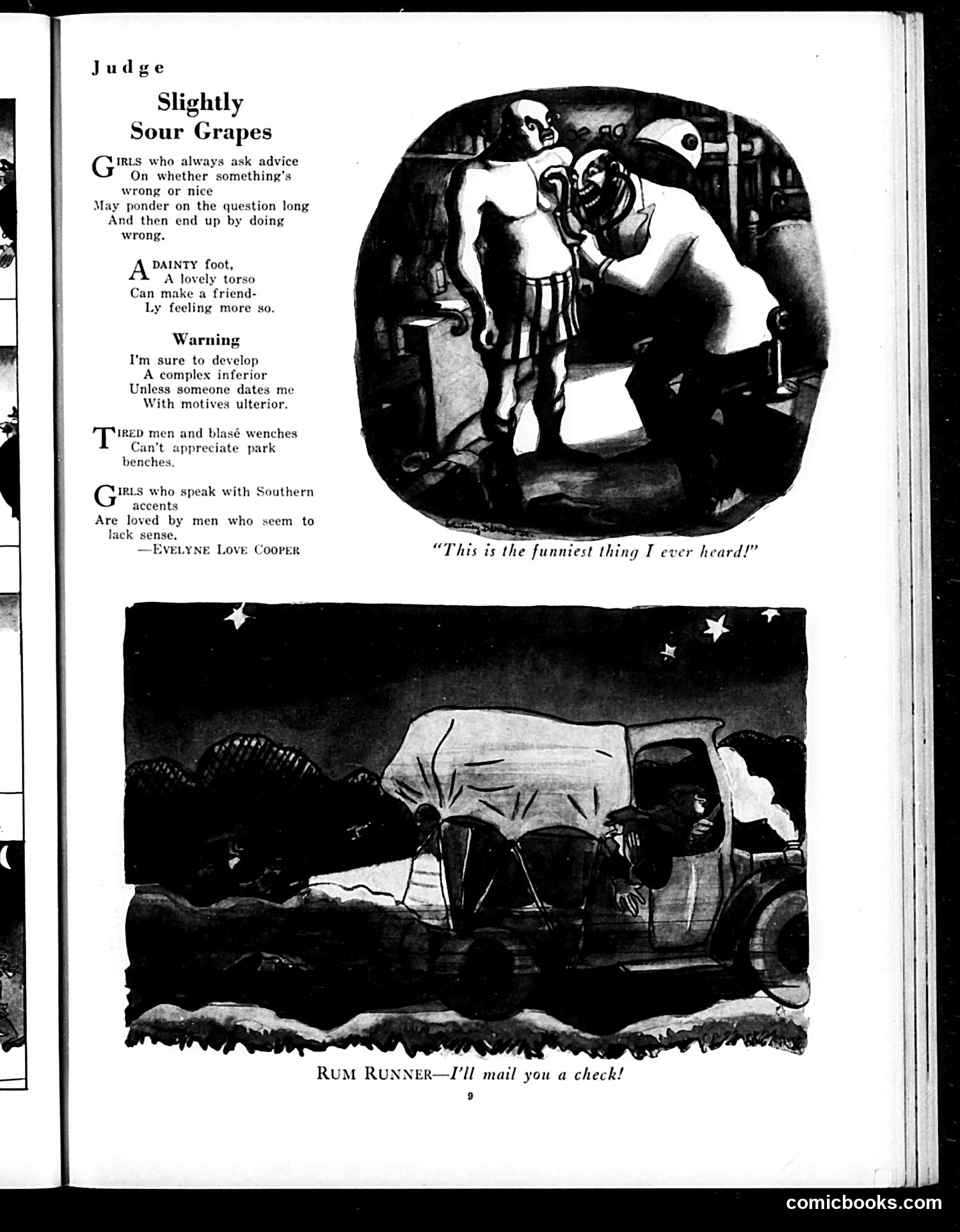
Judge Magazine Page Analysis This page contains two distinct satirical pieces: "Slightly Sour Grapes" (top) offers cynical commentary on 1920s dating and gender dynamics. The verses mock women who seek romantic advice yet behave poorly, men attracted to Southern-accented women (implying lack of intelligence), and the general superficiality of courtship. The accompanying photograph shows what appears to be a humorous/flirtatious scene, with the caption "This is the funniest thing I ever heard!" "Rum Runner" (bottom) is a Prohibition-era joke. It depicts a car at night with a large container, captioned "I'll mail you a check!" This references the illegal liquor trade during Prohibition (1920-1933). The humor lies in the casual, transactional nature of bootlegging—suggesting someone is purchasing illegal alcohol with a mailed check, treating criminal activity like ordinary commerce. Both pieces reflect 1920s social concerns: dating culture and Prohibition enforcement.
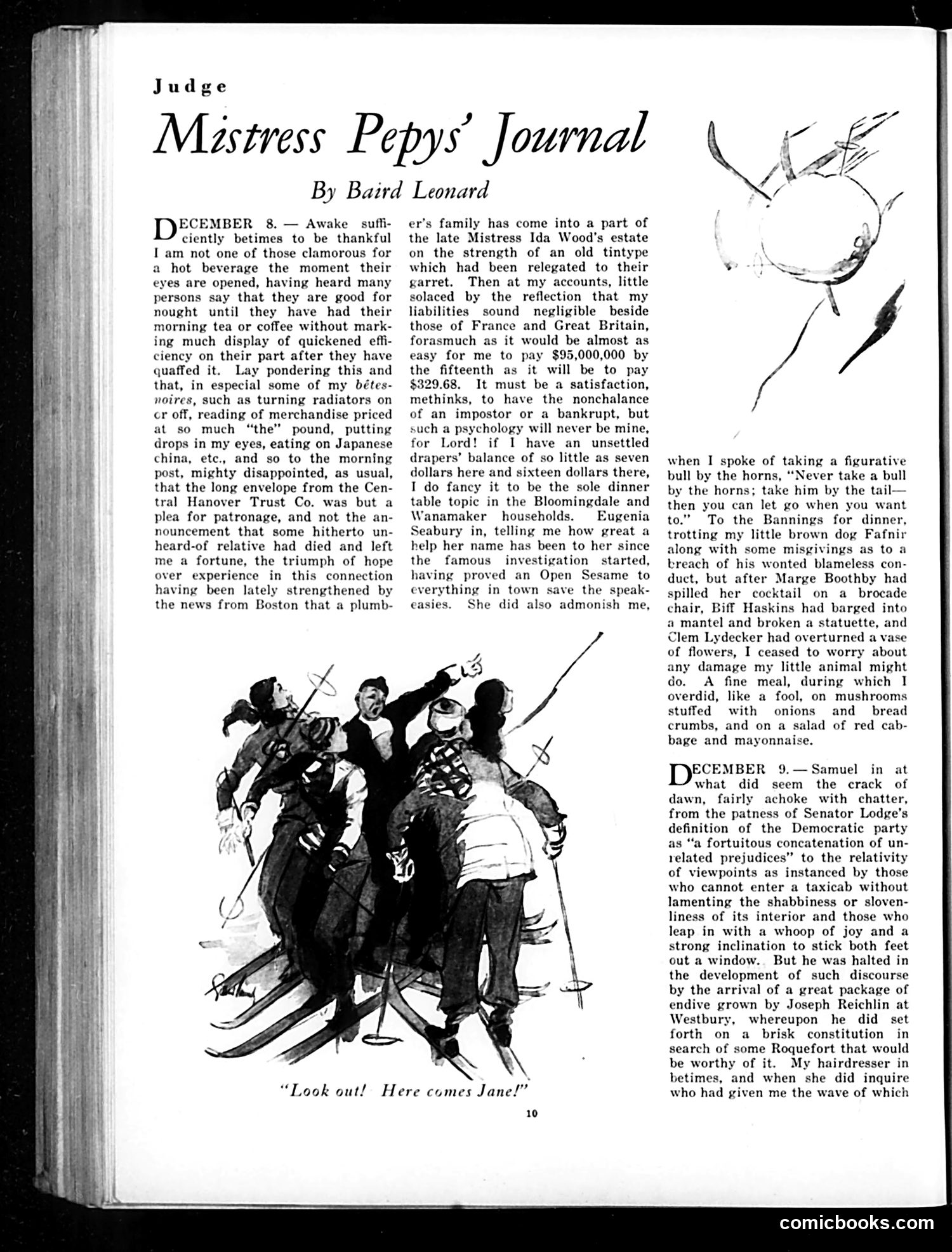
"Mistress Pepys' Journal" - Judge Magazine Satire This is a humor column by Baird Leonard parodying Samuel Pepys's famous 17th-century diary, transplanting his format to 1920s America. The satire targets upper-middle-class anxieties and pretensions. The entry mocks: - Financial anxiety: The narrator obsesses over small debts ($329.68) while casually noting France and Britain owe vastly more - Social gossip: References to "Eugenia Seabury" and a famous investigation (likely the Seabury investigations into NYC corruption) - Dinner party mishaps: The cartoon shows clumsy guests causing damage, yet the narrator ceases worrying—satirizing how the wealthy normalize chaos among themselves - Snobbish consumption: Detailed discussion of expensive foods (endive, Roquefort) - Political commentary: Senator Lodge's definition of Democrats as a "fortuitous concatenation" of unrelated prejudices The humor lies in applying Pepys's dignified diary style to trivial, neurotic modern concerns, exposing class vanity.
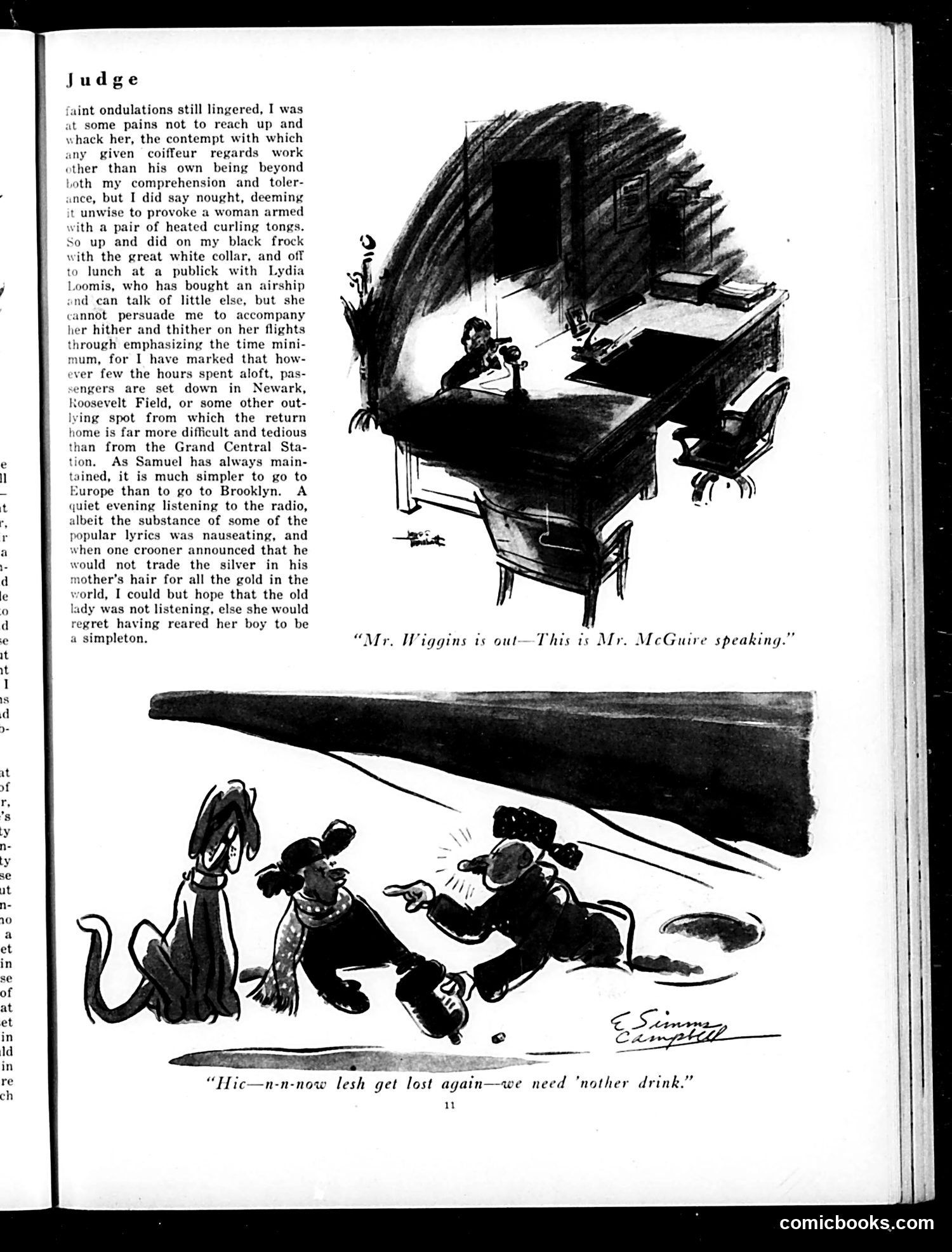
Analysis of Judge Magazine Page This page contains two cartoon illustrations satirizing early 20th-century American life. Top cartoon: Shows a man at a telephone desk, labeled with the caption "Mr. Wiggins is out—This is Mr. McGuire speaking." It satirizes office culture and telephone etiquette of the era, poking fun at formal business communication protocols. Bottom cartoon: Depicts what appear to be three intoxicated figures (drawn in caricature style suggesting working-class or immigrant characters) with a dog, with the caption "Hic—n-n-now lesh get lost again—we need 'nother drink." The slurred speech and stumbling poses ridicule drunkenness, likely commentary on Prohibition-era drinking culture or working-class stereotypes. The accompanying text discusses mundane domestic and social observations (hairdressing, airships, radio) but doesn't directly relate to the cartoons' humor. The satire relies on visual exaggeration and period-specific social anxieties about modern technology, workplace formality, and public behavior.
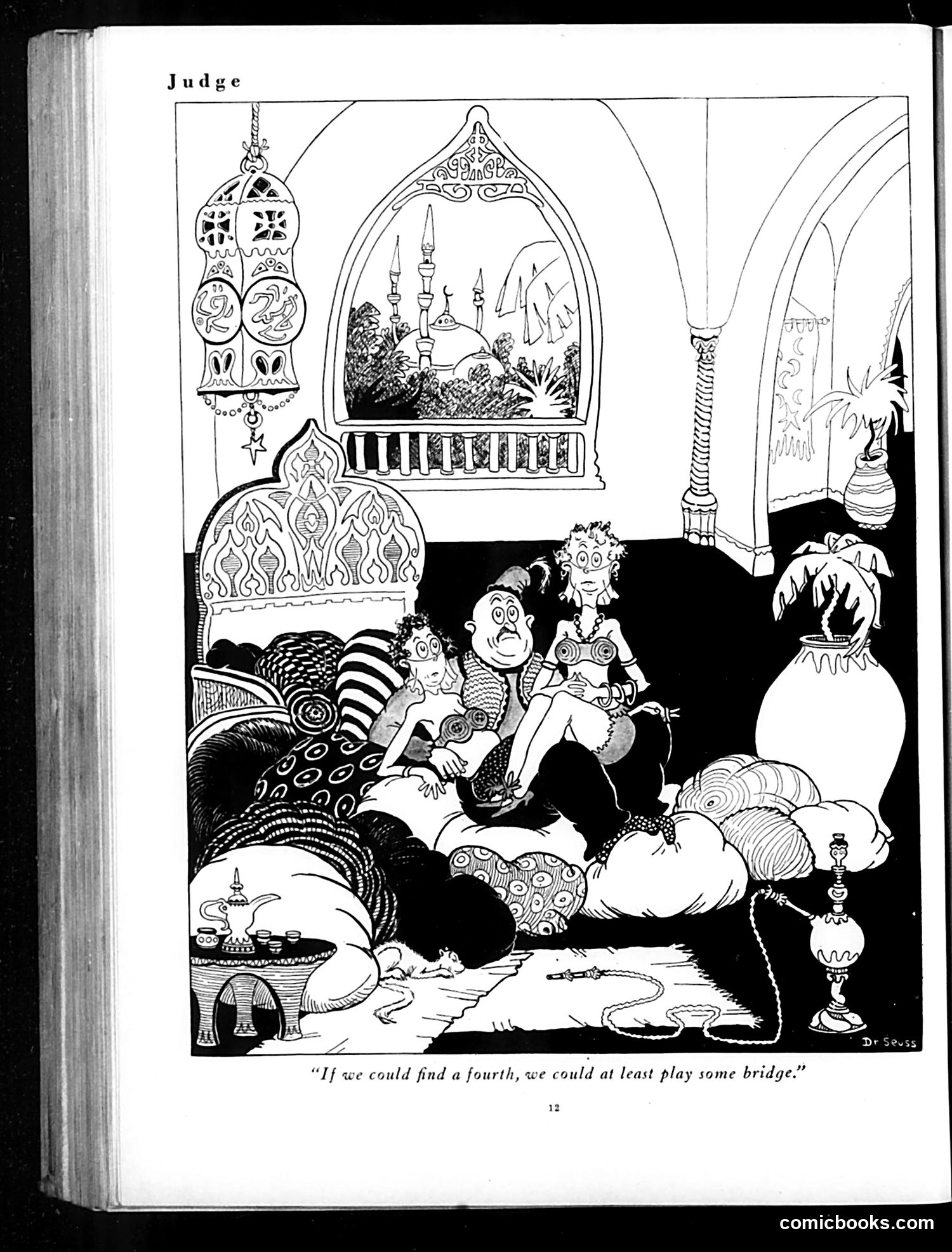
Cartoon Analysis: "Judge" - The Bridge Game This cartoon satirizes wealthy leisure culture, likely from the early-to-mid 20th century. The scene depicts an opulent Oriental-themed interior with ornate furnishings, treasures, and exotic décor. Three well-dressed figures lounge among luxurious cushions and objects d'art, appearing bored despite their obvious affluence. The caption's joke plays on the card game "bridge," which requires exactly four players. The figures lament they cannot play because they lack a fourth person—suggesting that even amid tremendous wealth and comfort, they're unable to entertain themselves without a specific social activity. The satire targets the ennui and emptiness of the wealthy elite: despite surrounding themselves with expensive possessions and exotic goods, they remain idle and dependent on social conventions for amusement. The cartoon mocks the privileged class's inability to create their own entertainment or find meaning beyond fashionable pastimes.
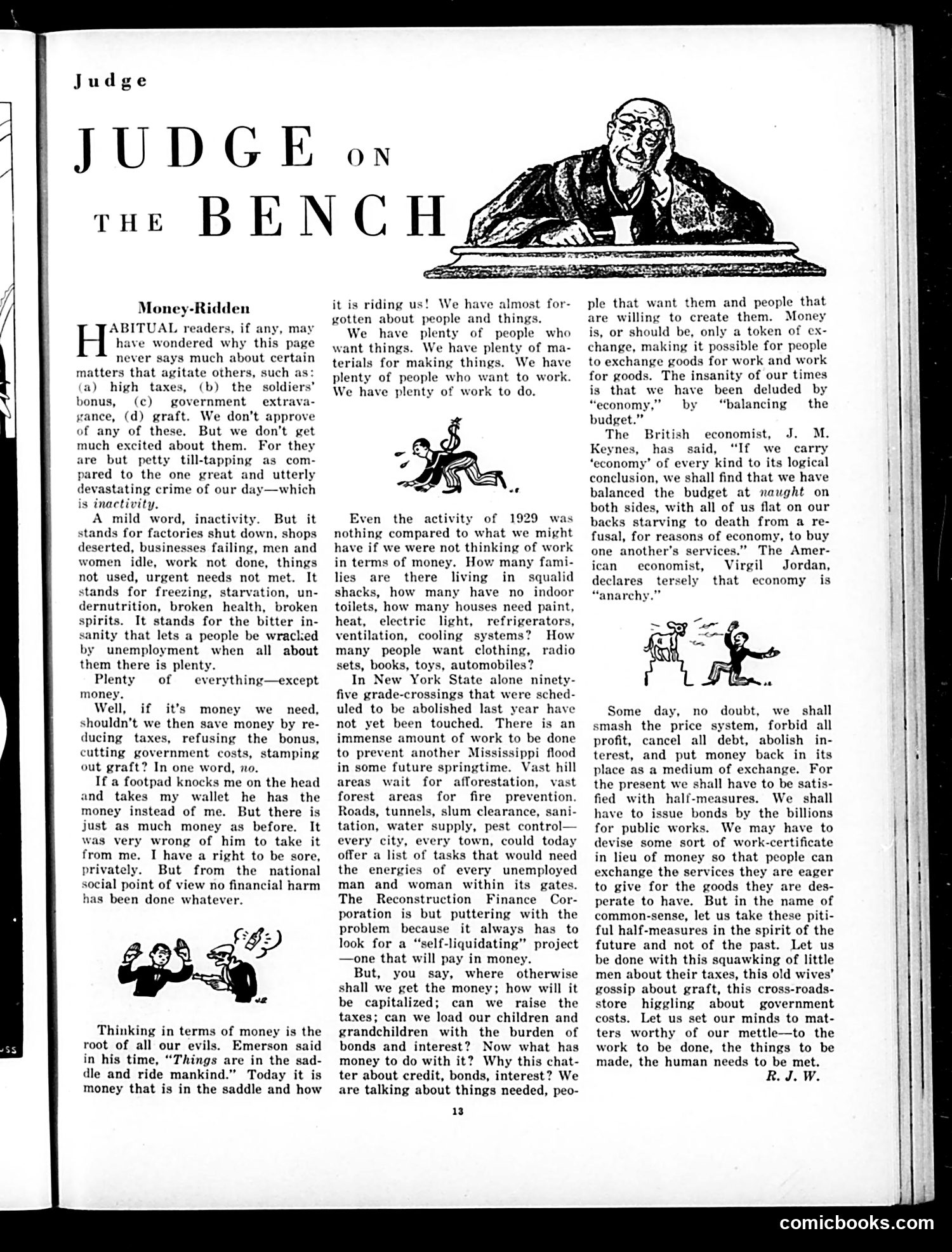
"Judge on the Bench" - Money-Ridden (circa 1930s) This editorial column attacks the era's obsession with balanced budgets and monetary scarcity during economic depression. The author argues that "inactivity"—unemployment and shuttered factories—is the real crime, not government spending or taxation. The satire's target: policymakers who prioritize financial orthodoxy (cutting taxes, refusing bonuses, eliminating graft) over addressing actual human need. The author contends money is merely a token of exchange, not a genuine constraint. He catalogs real work needed—infrastructure, slum clearance, reforestation, road building—and idle workers willing to do it, yet both remain unutilized due to misguided "economy." The column cites British economist J.M. Keynes approvingly, suggesting government stimulus and public works. The judge figure symbolizes institutional wisdom judging current policy as foolish. This reflects Depression-era debates over Keynesian economics versus austerity—a strikingly modern argument about whether government should spend to create jobs.
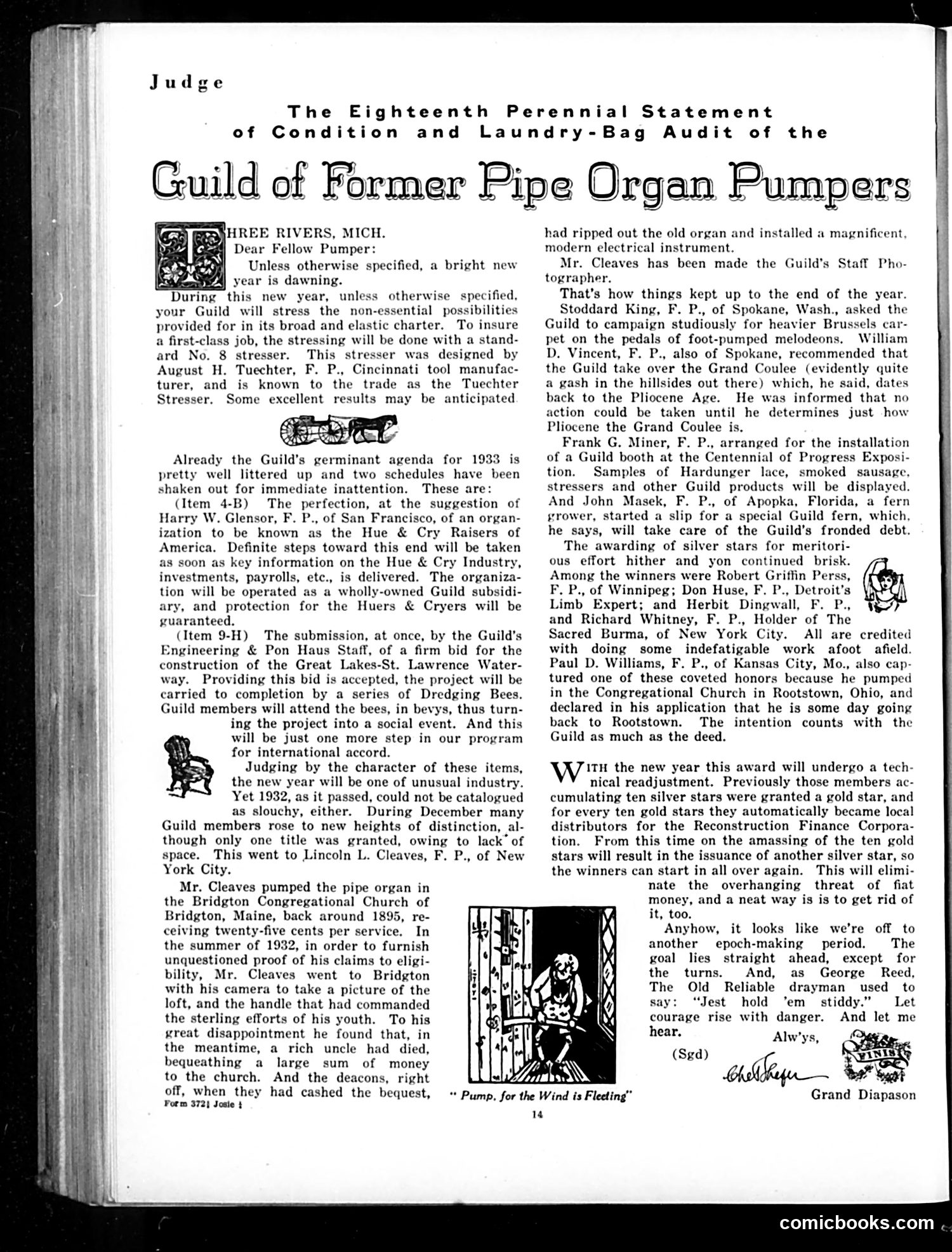
Judge Magazine Satire: "Guild of Former Pipe Organ Pumpers" This is absurdist humor mocking fraternal organizations and their self-important bureaucracy. The "Guild" is a fictional society of men who once pumped pipe organs—a job made obsolete by electric motors. The satire targets: - Grandiose minutiae: The guild proposes elaborate projects like organizing "Hue & Cry Raisers of America" and bidding on the St. Lawrence Seaway, treating trivial matters with false importance. - Ceremonial traditions: Members receive titles and awards for nostalgic recollections of obscure past work, elevating menial labor to prestigious status. - Bureaucratic absurdity: References to "stressed" work, "stressers," and formal procedures for meaningless activities lampoon organizational red tape. The opening cartoon appears to depict a figure working a pump mechanism—visualizing the extinct profession being memorialized. The humor relies on readers understanding that such fraternal clubs existed (Rotary, Masons, etc.), making their mock-serious tone and irrelevant activities recognizable parody of genuine organizational pomposity.
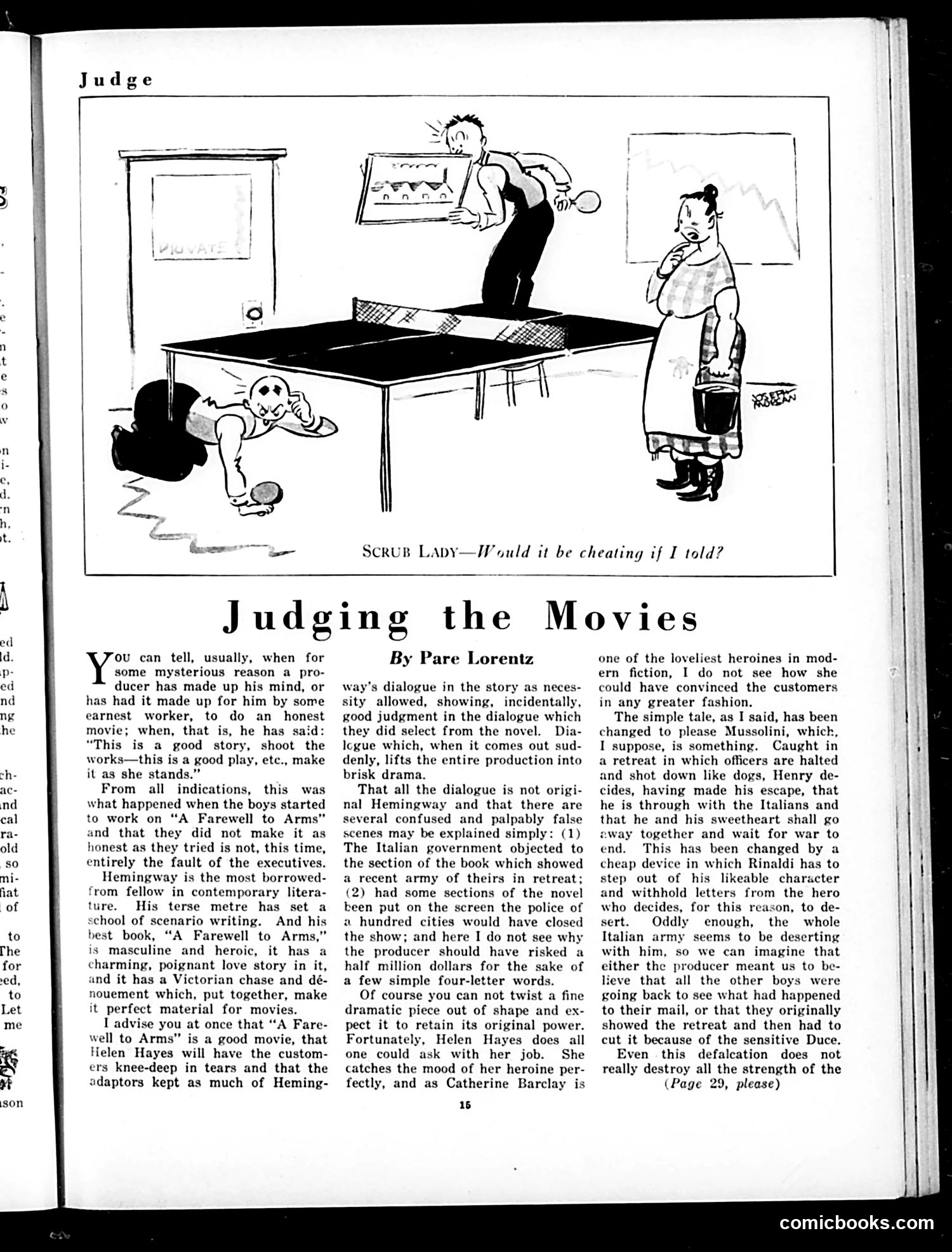
"Judging the Movies" - Judge Magazine Film Criticism This page features film critic Pare Lorentz reviewing the movie adaptation of Hemingway's *A Farewell to Arms*. The cartoon above shows a ping-pong game where a scrub lady asks if reporting the score would constitute cheating—a visual metaphor for the dishonesty in adapting literature to film. Lorentz praises the film and Helen Hayes's performance but critiques its compromises. The Italian government censored sections depicting their army in retreat during WWI. The producer also removed profanity and altered plot points to appease Mussolini's fascist regime (the "sensitive Duce"). Lorentz argues these changes—particularly replacing the original retreat sequence with a contrived device involving withheld letters—weaken the story's dramatic power, though Hayes's acting largely salvages the production. The underlying satire: political censorship and commercial cowardice distort artistic integrity.
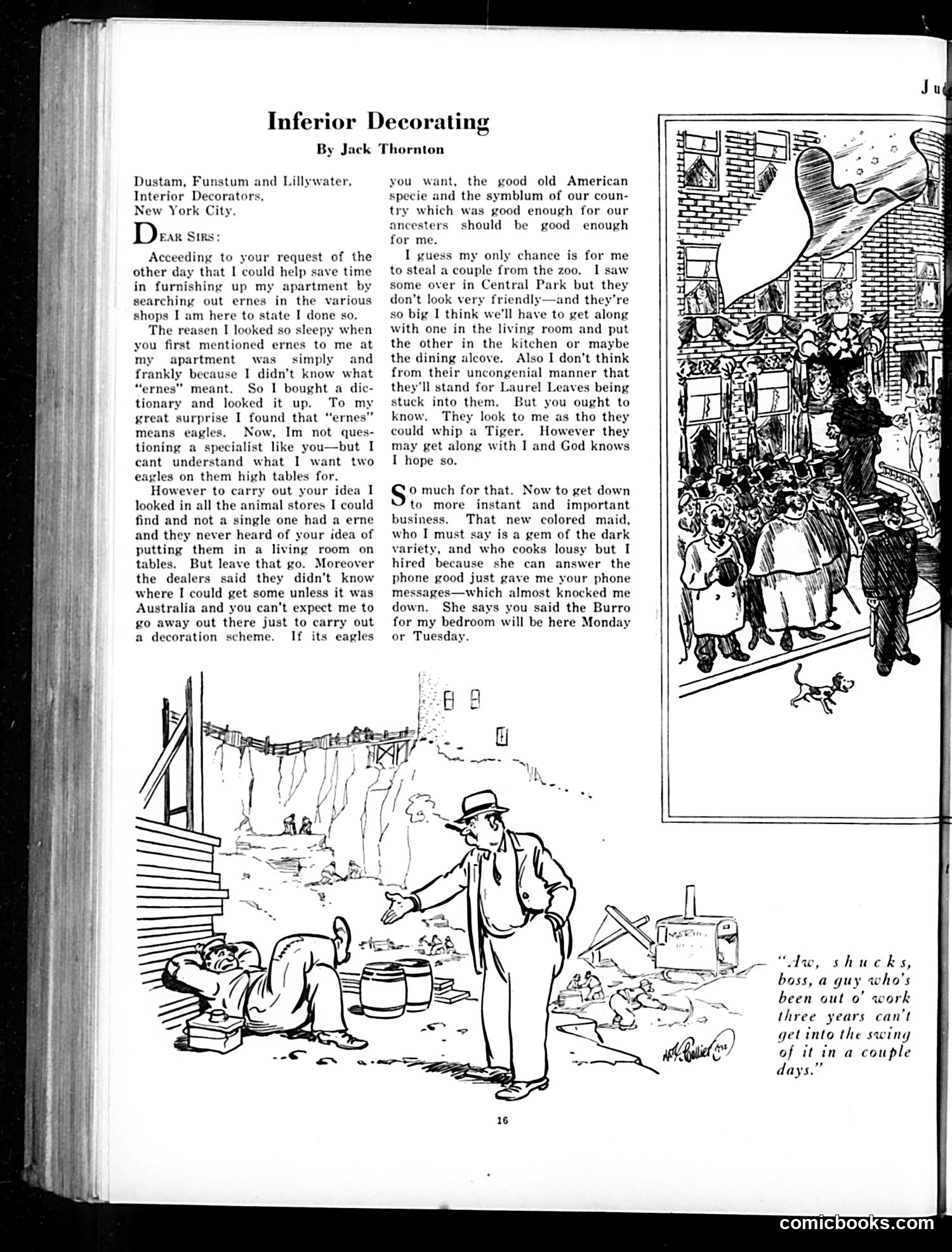
"Inferior Decorating" - Judge Magazine Satire This humorous letter satirizes the pretensions of interior decorators and their wealthy clients. A working-class apartment dweller writes to the fancy New York decorating firm "Dustam, Funstum and Lillywater" about their ridiculous suggestion to place live eagles (*ernes*) on high tables as decoration. The joke operates on multiple levels: the decorator's absurd, impractical advice; the writer's deadpan confusion about why anyone would want dangerous birds indoors; and his practical working-class perspective (he'd have to steal from the zoo). There's also class satire—the writer can barely afford help but has hired a maid simply because she answers phones well, despite her poor cooking. The bottom cartoon depicts a jobless man, illustrating Depression-era economic hardship—suggesting this magazine dates to the 1930s. The overall satire mocks both pretentious decorating trends and the economic gap between those who could afford such frivolities and struggling workers.
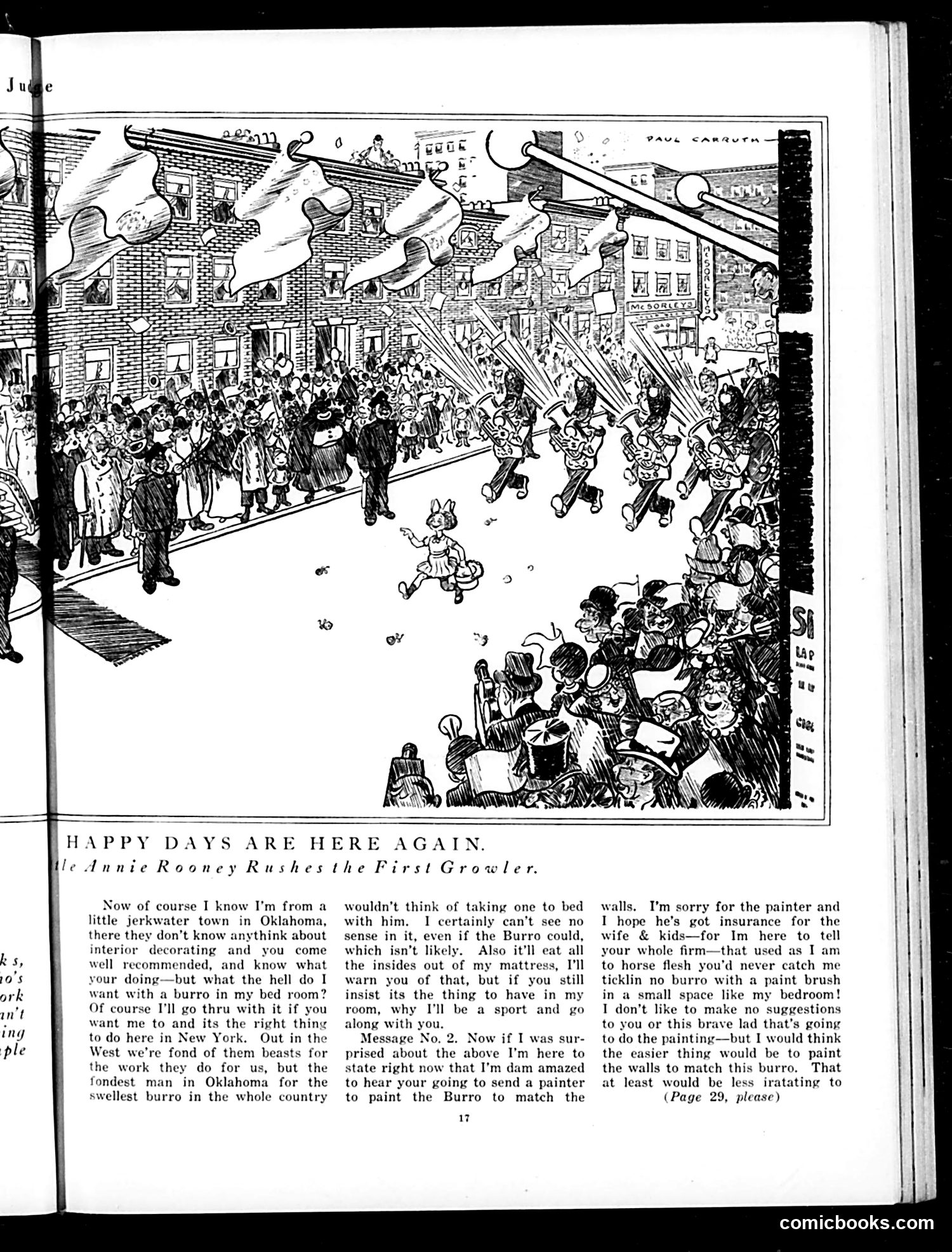
Explaining This Judge Magazine Page This is a humorous letter from an unsophisticated Oklahoman to a New York interior decorator, likely mocking both rural ignorance and urban pretension circa the 1920s-30s. The cartoon depicts a street celebration or parade with crowds and children. The accompanying text is from "Annie Rooney," apparently a character responding to decorating advice. The joke hinges on cultural clash: the Oklahoma writer—self-described as from a "jerkwater town"—cannot fathom why anyone would keep a burro (donkey) in a bedroom as decoration, a practice he assumes is fashionable among wealthy New Yorkers. The satire targets both the rural character's bewilderment at urban sophistication and implicitly mocks New York's absurd decorating trends. The escalating absurdity (painting the burro to match walls) amplifies the ridicule. This reflects Judge's typical approach: satirizing American manners and social pretension through exaggerated dialogue and misunderstandings between regions.
Theater Review from Judge Magazine This is a theater review column rather than a political cartoon. The critic (identified as "Judge" at the top) discusses three Broadway productions: 1. "Firebird" by Lajos Zilahy—criticized as recycling the tired "cross-examination scene" plot device, featuring stock characters in a contrived interrogation about infidelity. 2. "The Dubarry" (Millocker operetta)—an old show updated with jokes from 1904, though the melodies retain charm. The critic praises singer Grace Moore. 3. "Gay Divorce" (Cole Porter)—praised for Porter's witty lyrics and dancing by Fred Astaire and Claire Luce, though the book is dismissed as familiar boulevard farce. The satire targets theatrical staleness: producers recycling ancient plot devices and outdated material while relying on star performers to salvage weak scripts. The column exemplifies Judge's theatrical criticism style—urbane, dismissive of hackneyed formulas, and focused on entertainment industry trends of the 1930s era.
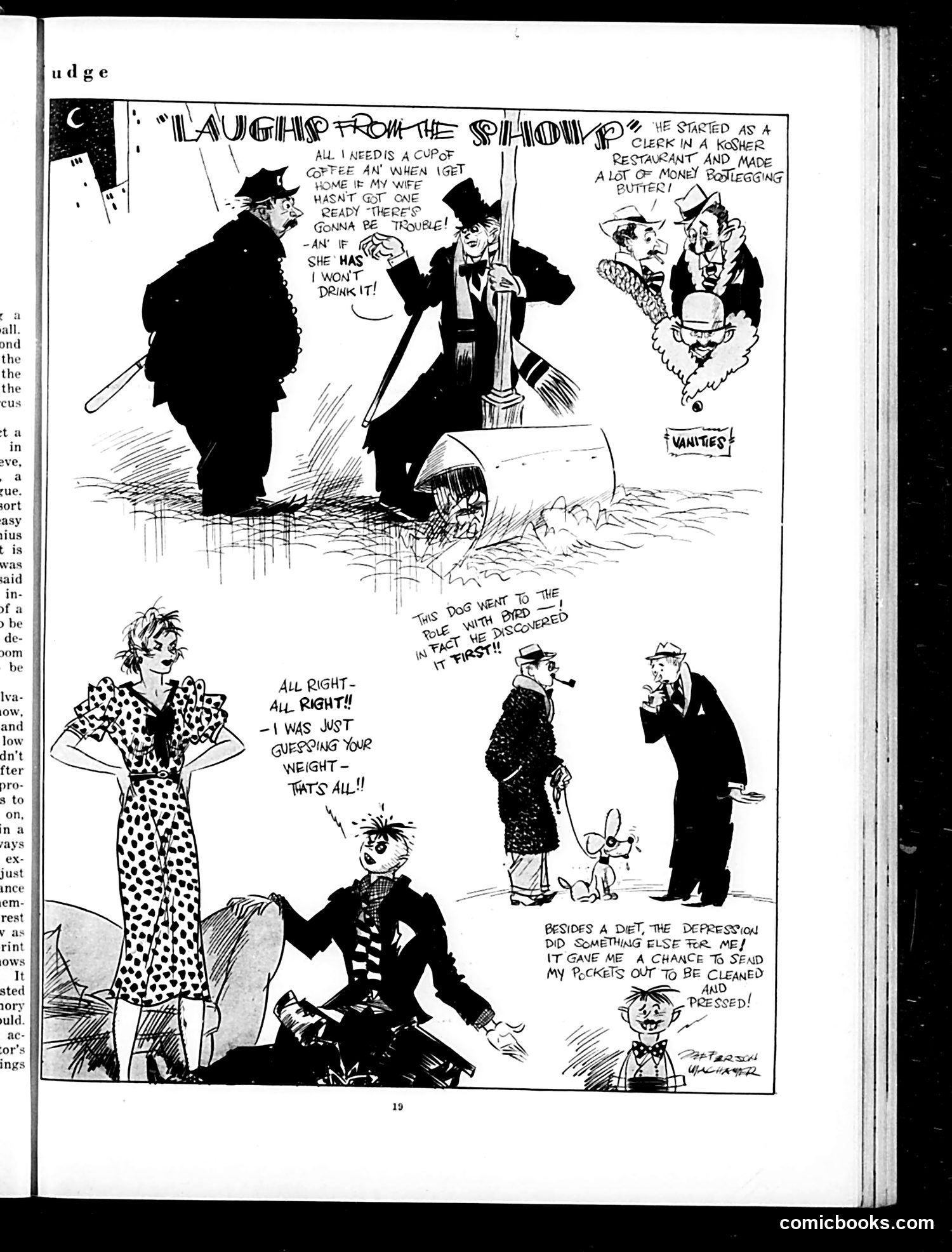
"Laughs from the Soup" - Judge Magazine Cartoon This is a multi-panel satirical comic about Depression-era financial hardship and social pretense. The main narrative follows a man who started as a kosher restaurant clerk and is now apparently successful, boasting to his wife about money. The humor relies on several layers: The setup: A wife threatens trouble if her husband doesn't bring home coffee—she hasn't a cup ready, implying poverty despite his claims of prosperity. The satire: Various panels show people making light of financial desperation. One woman jokes about weight-guessing; another notes the Depression ironically "gave me a chance" to send clothes to the cleaners (implying she previously couldn't afford to). A small figure celebrates finally being "cleaned out"—a dark joke about bankruptcy. The point: The cartoon mocks how people mask genuine economic suffering with humor and false bravado during the Great Depression, maintaining appearances while facing real deprivation.
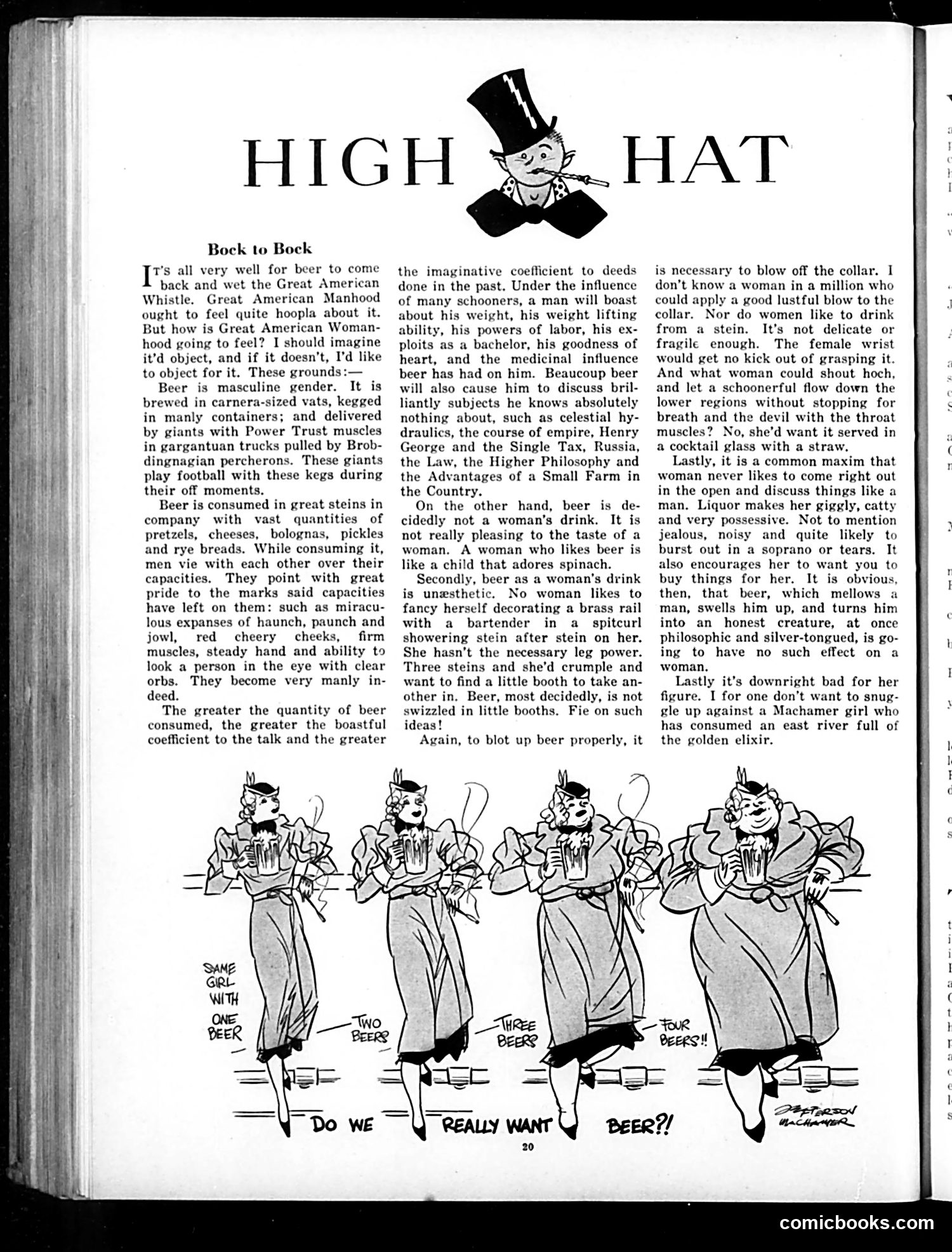
Analysis: "High Hat" — Beer and Gender in Prohibition-Era America This Judge magazine piece satirizes the return of legal beer (likely referencing the end of Prohibition in 1933) by arguing—tongue-in-cheek—that while beer suits masculine American manhood, it's entirely unsuitable for women. The text uses exaggerated logic: beer is "masculine" (brewed in huge vats, consumed competitively by muscular men), while women lack the physical capacity, aesthetic sensibility, and proper comportment for beer drinking. The author mock-seriously claims women can't properly "blow off the collar," lack leg power for multiple steins, and would prefer delicate cocktails with straws. The bottom cartoon shows four increasingly rotund women labeled "One Beer," "Two Beers," "Three Beers," and "Four Beers?!"—visually punching the joke that beer makes women fat and undesirable. The satire actually critiques rigid gender expectations: by making the argument absurdly elaborate, it exposes how arbitrary these "masculine" and "feminine" drink distinctions are. The exaggeration suggests the author recognizes the reasoning as ridiculous, mocking both beer culture's machismo and society's tight restrictions on women's behavior.
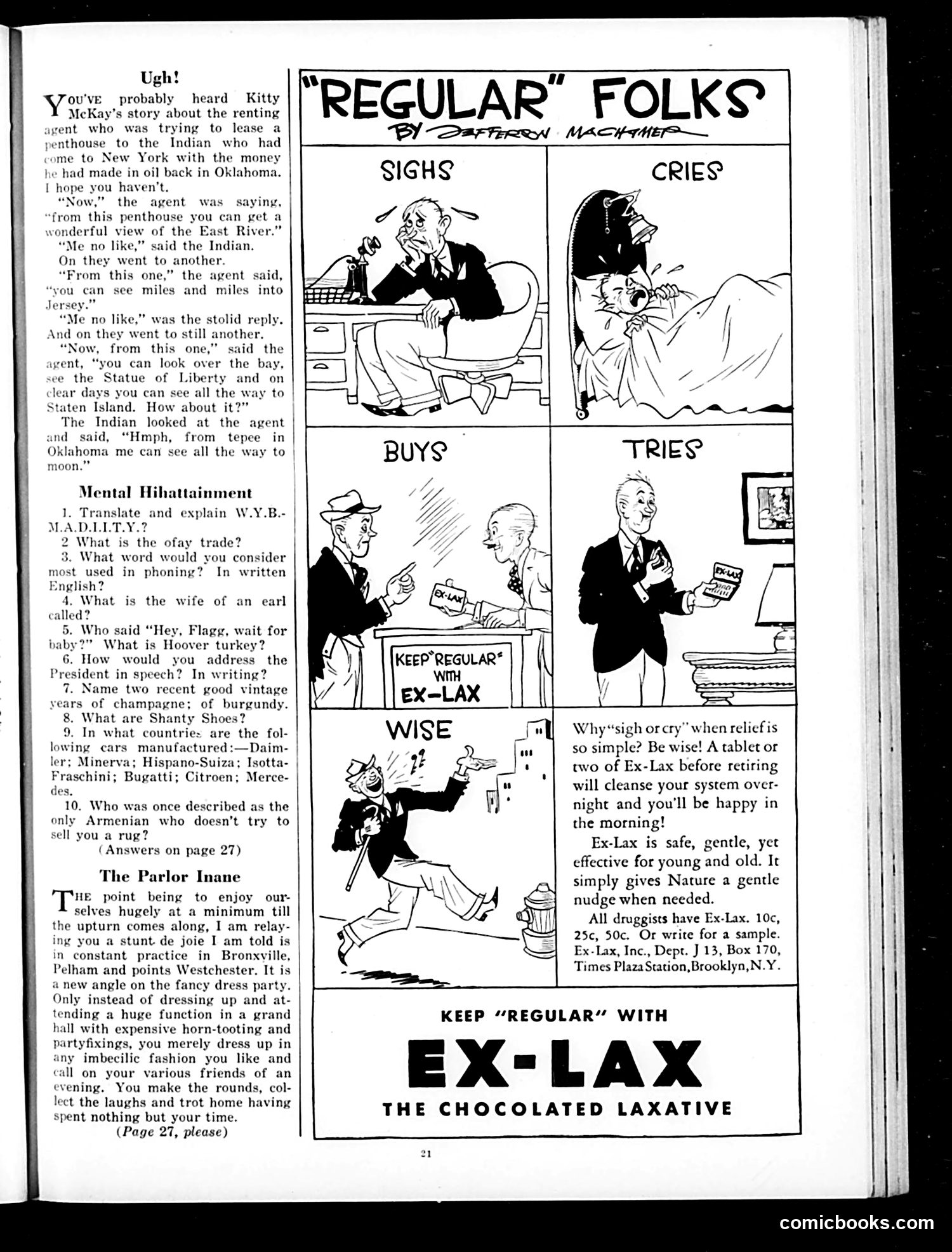
"Regular Folks" Comic Analysis This page features a satirical comic strip mocking different personality types through exaggerated scenarios. The four panels—"Sighs," "Cries," "Buys," and "Tries"—depict stereotypical characters in comedic situations showing their responses to life circumstances. The opening story about Kitty McKay's Indian oil millionaire renting a penthouse satirizes the newly wealthy from Oklahoma's oil boom (early 1900s) and their perceived lack of sophistication. The Indian's reply about seeing "all the way to moon" from his tepee mocks both his indifference to Eastern landmarks and the absurdity of boasting. The bulk of the page is advertising for Ex-Lax, a chocolated laxative—a common patent medicine of the era. The ad's copy ("Keep 'Regular'") uses the double meaning of "regular" (both normal and bowel-function-related) as marketing wordplay. "Mental Hihattainment" poses trivia questions for readers, while "The Parlor Inane" discusses Depression-era party etiquette emphasizing inexpensive socializing.
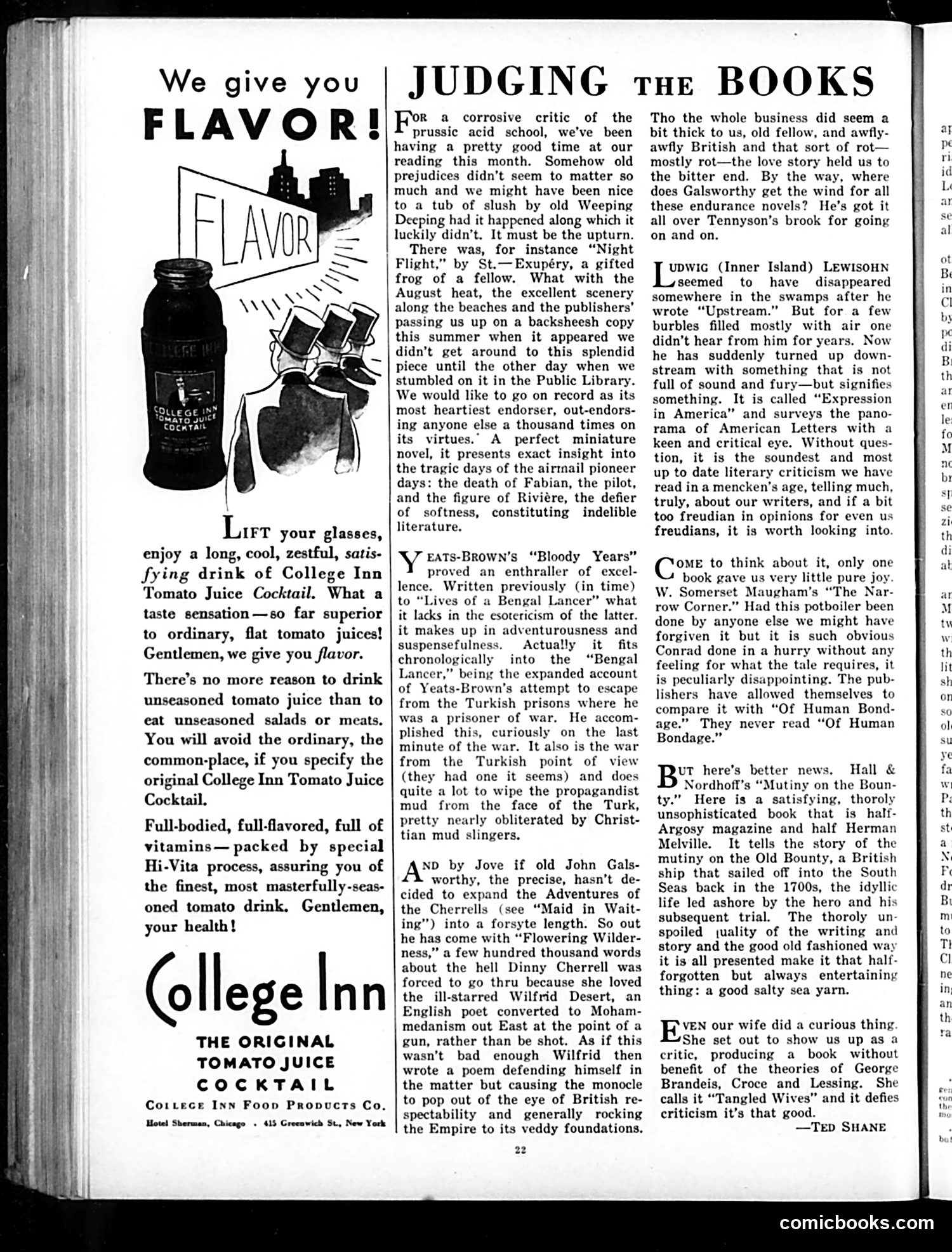
Judge Magazine Book Review Page Analysis This page combines a College Inn tomato juice cocktail advertisement with book reviews by Judge's satirical critics. The ad uses masculine appeal ("Gentlemen, we give you flavor"), emphasizing the product's superior seasoning versus bland competitors—typical 1930s marketing positioning quality as sophistication. The reviews mock contemporary literary pretension while praising genuine merit. The critic adopts a deliberately casual, irreverent tone ("corrosive," "Prussic acid school") to skewer overwrought writing. Saint-Exupéry's *Night Flight* receives sincere praise for capturing airmail pioneer tragedy. Yeats-Brown's *Bloody Years* is endorsed for offering the Turkish WWI perspective—a countervailing viewpoint to British propaganda. However, Galsworthy's *Flowering Wilderness* is mocked as tediously long British melodrama: an English poet converting to Islam and writing self-justifying verse is treated as absurdly overwrought social scandal ("the monocle to pop out of the eye of British respectability"). The satire targets both pretentious literary excess and British social conventions as equally ridiculous.
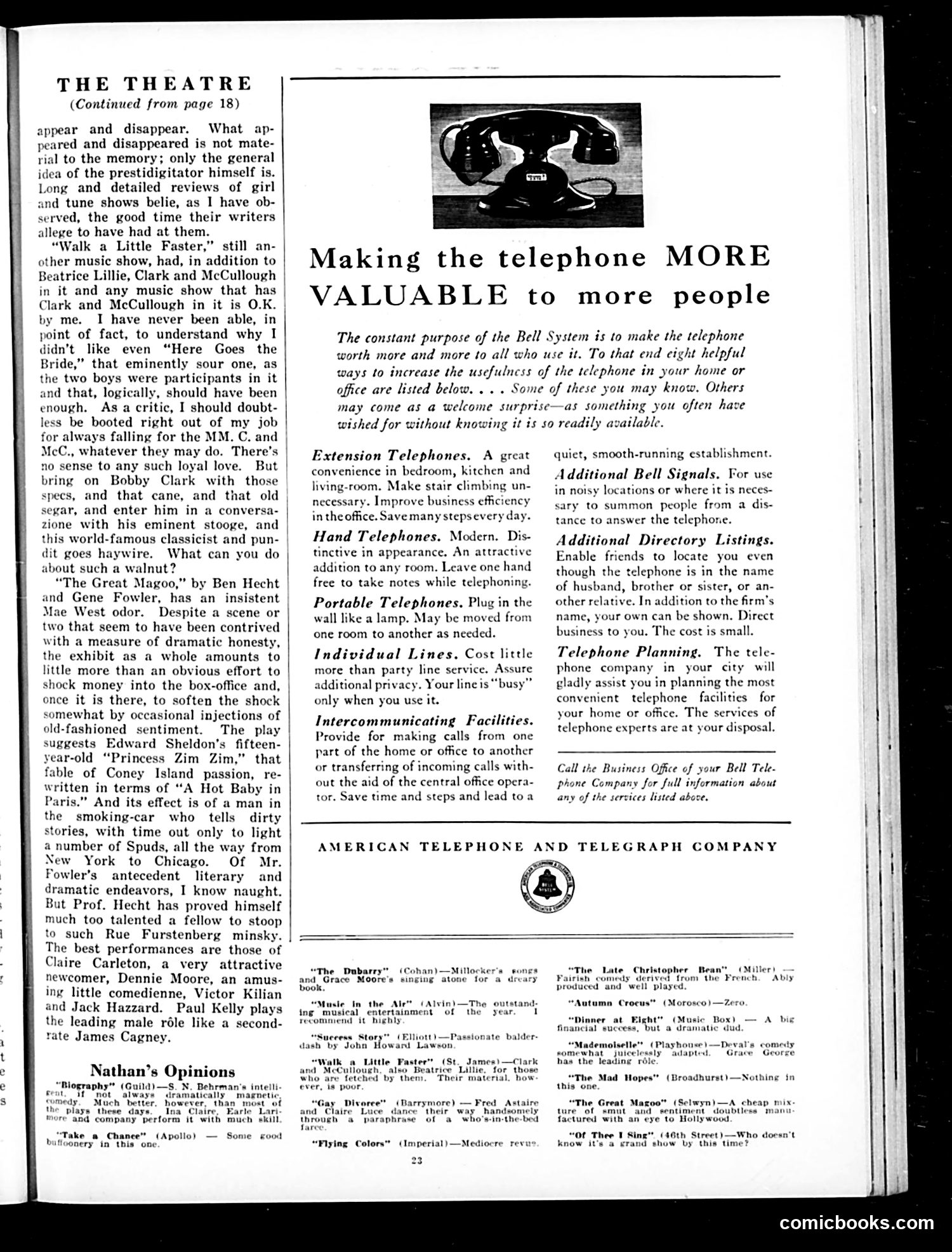
Analysis of This Judge Magazine Page This page is primarily advertising and theatre criticism, not political satire. The main content consists of: 1. Theatre reviews by "Nathan" (likely Alexander Woollcott or similar critic), discussing contemporary Broadway shows like "Walk a Little Faster" and "The Great Magoo." The critic praises performers Bobby Clark and McCullough while critiquing Mae West-influenced material as shock value for money. 2. A large Bell Telephone advertisement promoting eight "helpful ways" to increase telephone utility—extension phones, hand phones, portable phones, etc. This represents early 20th-century marketing normalizing residential telephone infrastructure. The small photograph at top appears to show a vintage telephone device, supporting the advertisement below. This represents commercial Judge magazine content: theatre reviews alongside advertising, reflecting how magazines monetized through ads alongside editorial matter. There is no apparent political cartoon or satire on this particular page—it's primarily business and entertainment journalism.
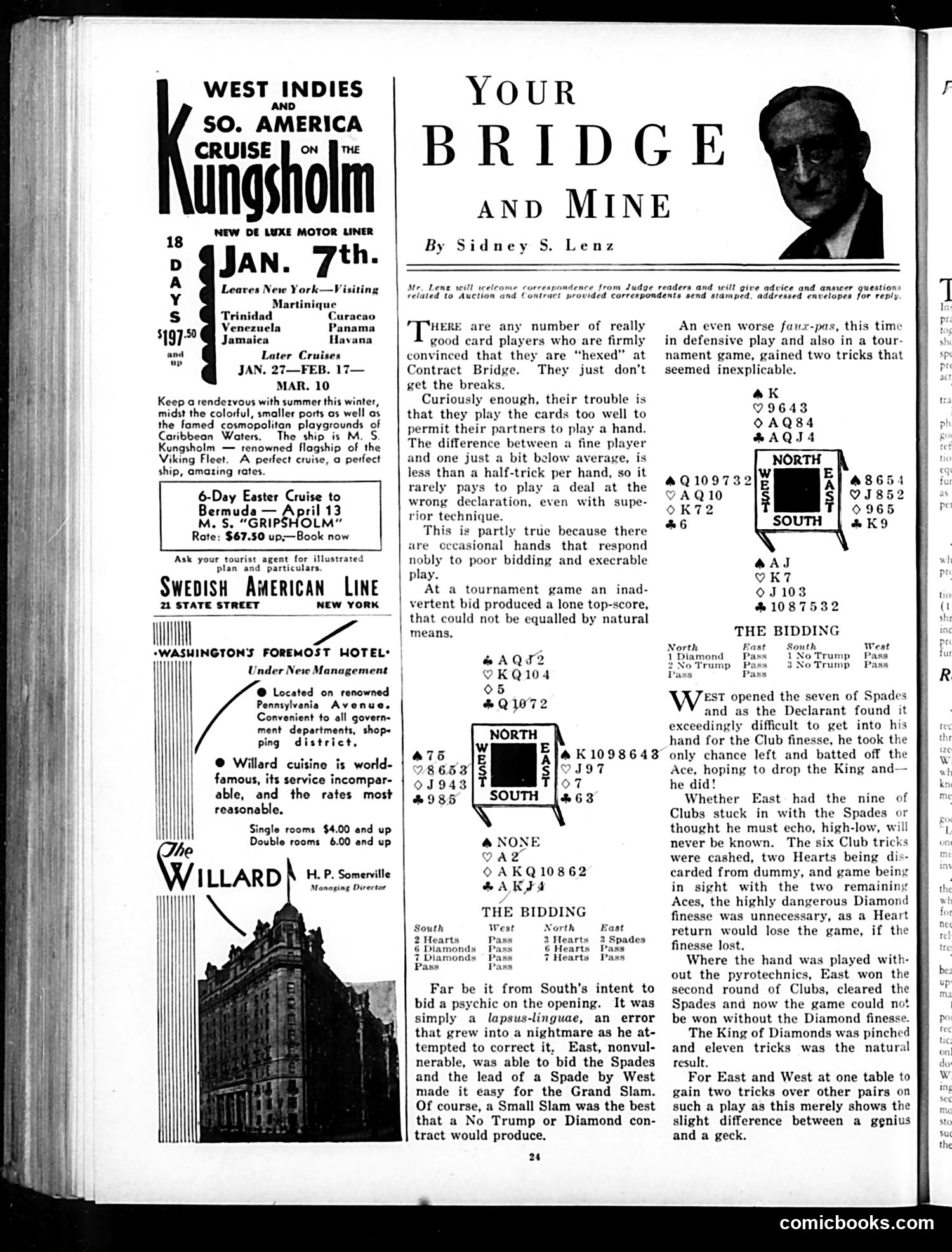
Judge Magazine Page Analysis This page is primarily advertising and instructional content, not political satire. The left side features cruise ship advertisements (Swedish American Line's Kungsholm and Gripsholm vessels to the Caribbean) and The Willard Hotel in Washington, D.C.—standard commercial advertisements typical of Judge magazine's revenue model. The main content is "Your Bridge and Mine" by Sidney S. Lenz—a contract bridge instruction column. Lenz was a prominent bridge authority of the era, and this appears to be a regular advice column explaining bidding strategy and card-playing technique through dealt-hand examples. The bridge hands illustrate how even expert players can succeed despite poor bidding ("lapsus-linguae"—a slip of the tongue), and conversely, how players can fail despite good cards when they make unnecessary risky plays. There is no political cartoon or satire on this page. It represents Judge's broader editorial mix beyond political humor, serving as a general-interest magazine with instructional and advertising content alongside its satirical features.
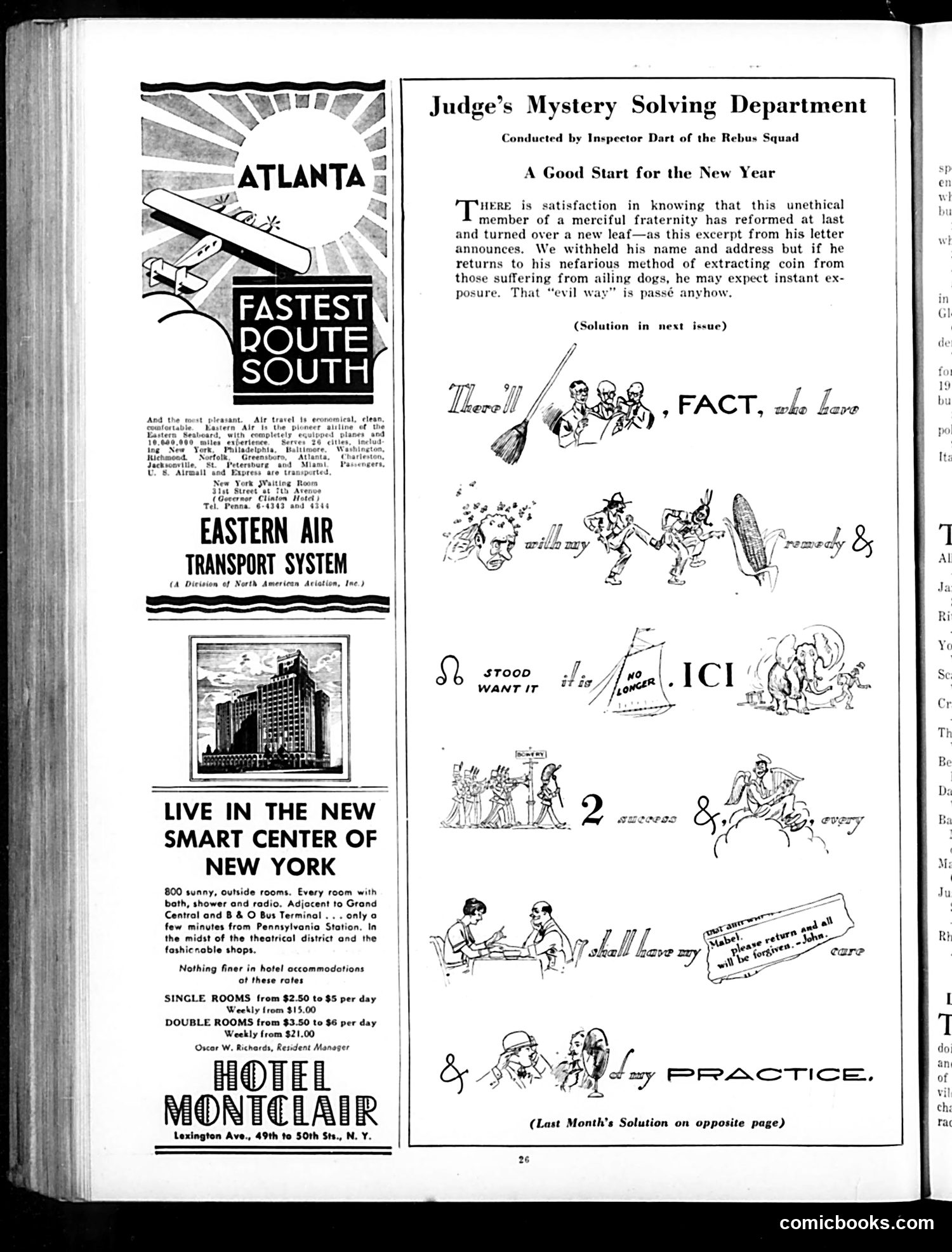
Judge Magazine: "Judge's Mystery Solving Department" This page features a rebus puzzle, a visual word-game popular in early 20th-century magazines. Readers solve it by interpreting drawings and text combinations to form phrases or sentences. The puzzle tells a morality tale: someone engaged in an unethical scheme—extracting money from people with sick dogs (likely a fraudulent veterinary or con scheme)—has reformed and "turned over a new leaf." The department withholds the reformer's identity as incentive for genuine change. The cartoons use simple illustrations combined with words to create hidden messages. For example, drawings might show figures alongside text that combines visually to spell out the solution. The phrase "There'll be FACT and Love" appears to begin the puzzle sequence. This was entertainment for the era's educated readers who enjoyed wordplay and moral lessons wrapped in puzzle form. The solution would appear in the next issue, maintaining reader engagement across multiple copies of the magazine.
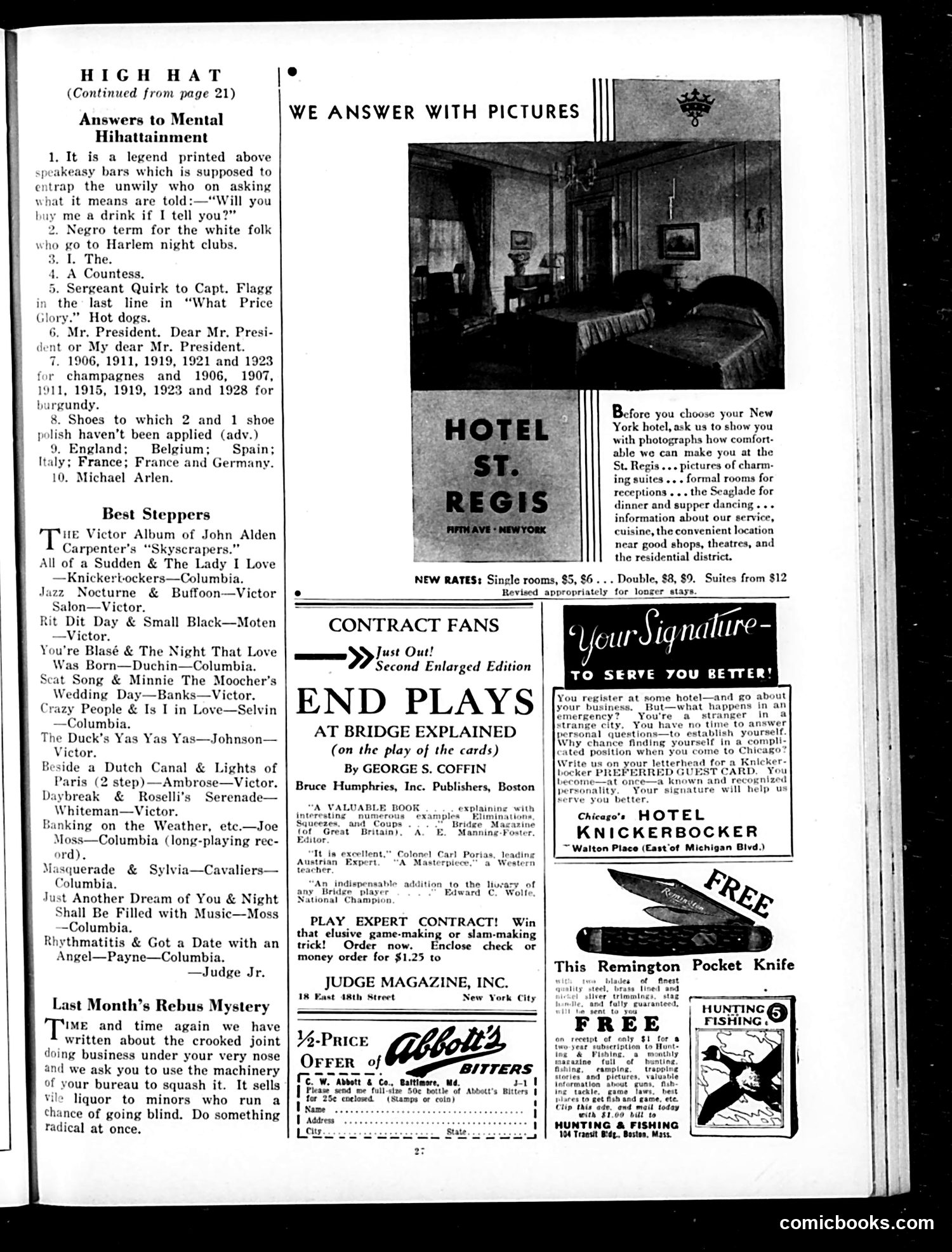
Page Analysis: Judge Magazine Content This page is primarily advertising and puzzle content rather than political satire. The main elements are: "High Hat" Section: A quiz column answering readers' riddles about slang and culture. References include "What Price Glory" (a popular play), Harlem nightclubs, and vintage wine years—typical 1920s-30s cultural touchstones. Advertisements: The page features multiple ads for hotels (St. Regis, Hotel Knickerbocker), a bridge card-game instruction book, Abbott's Bitters, and a Remington pocket knife. These reflect period consumer products. "Last Month's Rebus Mystery": A brief editor's note complaining about illegal alcohol sales to minors—referencing Prohibition-era bootlegging and corrupt establishments. "Best Steppers": A music recommendation column listing jazz and popular recordings from Victor and Columbia Records. The page contains no political cartoons or satire—it's primarily a service/entertainment page typical of Judge's lighter content, mixing puzzles, product ads, and cultural commentary aimed at educated, middle-class readers.
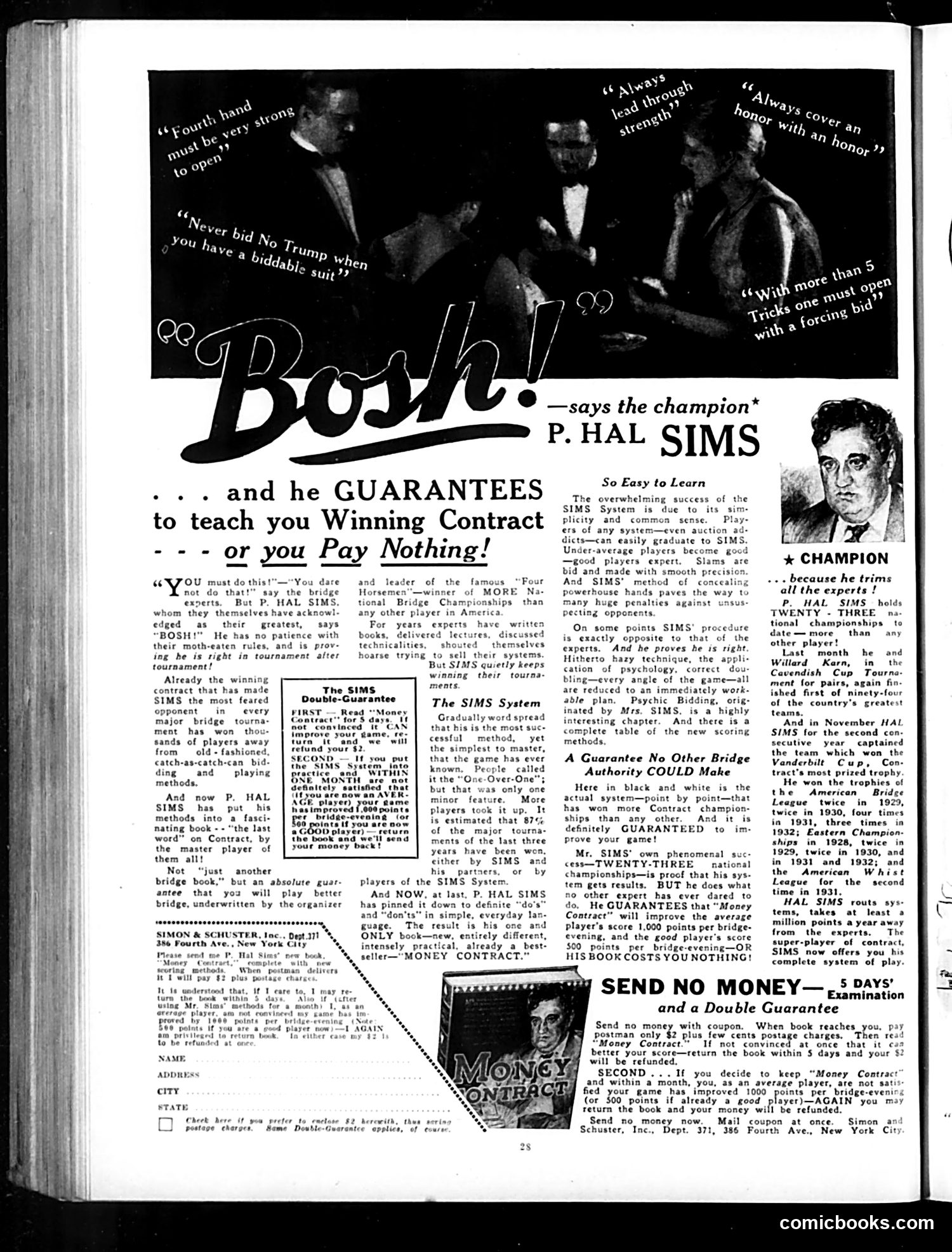
"Bosh!" — P. Hal Sims Bridge Advertisement This is primarily a bridge-game advertisement, not political satire. P. Hal Sims was a legendary contract bridge champion promoting his instructional book and system, "Money Contract." The page uses testimonial-style quotes from bridge experts ("Fourth hand must be very strong to open," etc.) to establish credibility. Sims's repeated tournament victories and championships are listed as proof his method works. The "satire" element appears mild: the opening "Bosh!" mocks traditional bridge-playing advice and old-fashioned methods, positioning Sims's system as revolutionary common sense against stuffy expert convention. The "double guarantee" (teach you winning or refund your money) was a sales gimmick. This reflects 1930s American bridge mania among the educated middle and upper classes—a period when contract bridge was enormously popular. The advertisement targets players seeking to improve through a "scientific" system rather than rote memorization.
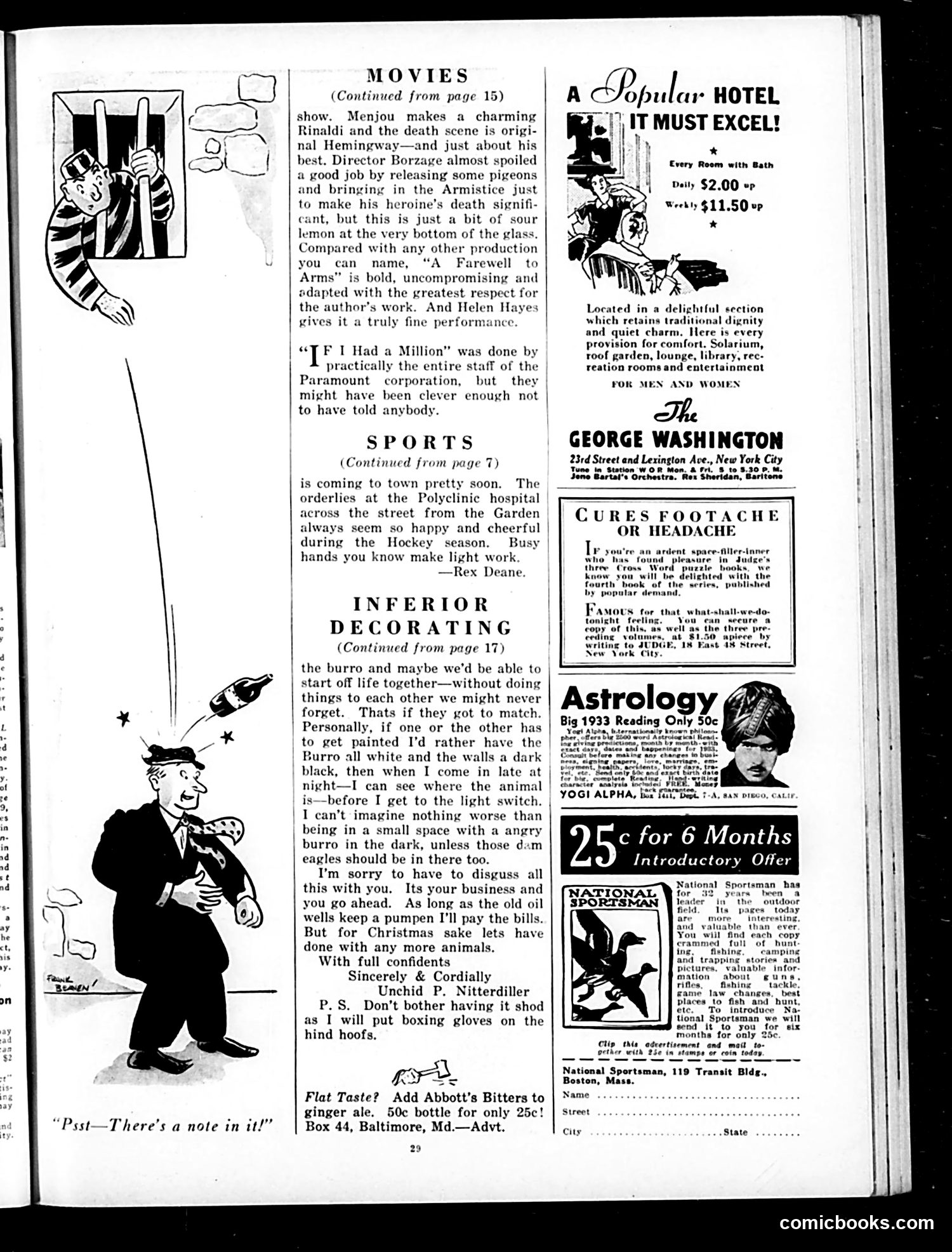
Judge Magazine Page Analysis This page is primarily advertising and filler content from Judge magazine, with minimal satirical cartoon material. The only significant cartoon is the small illustration accompanying "Inferior Decorating"—a humorous advice column by "Unchid P. Nitterdiller." The cartoon shows a man in formal dress holding a burro (donkey), illustrating the absurdist premise of the column: the writer discusses whether to paint a burro white or walls black for a shared living space, culminating in the joke about putting boxing gloves on the animal's hind hooves instead of shoeing it. The cartoon's humor relies on the incongruity of treating a burro as a serious interior design problem—a gentle satire on pompous home-decorating advice. The figure appears to be an everyman type, not a specific political caricature. The rest of the page consists of hotel, astrology, and magazine advertisements, plus concluding sections on movies and sports with no notable satirical content.
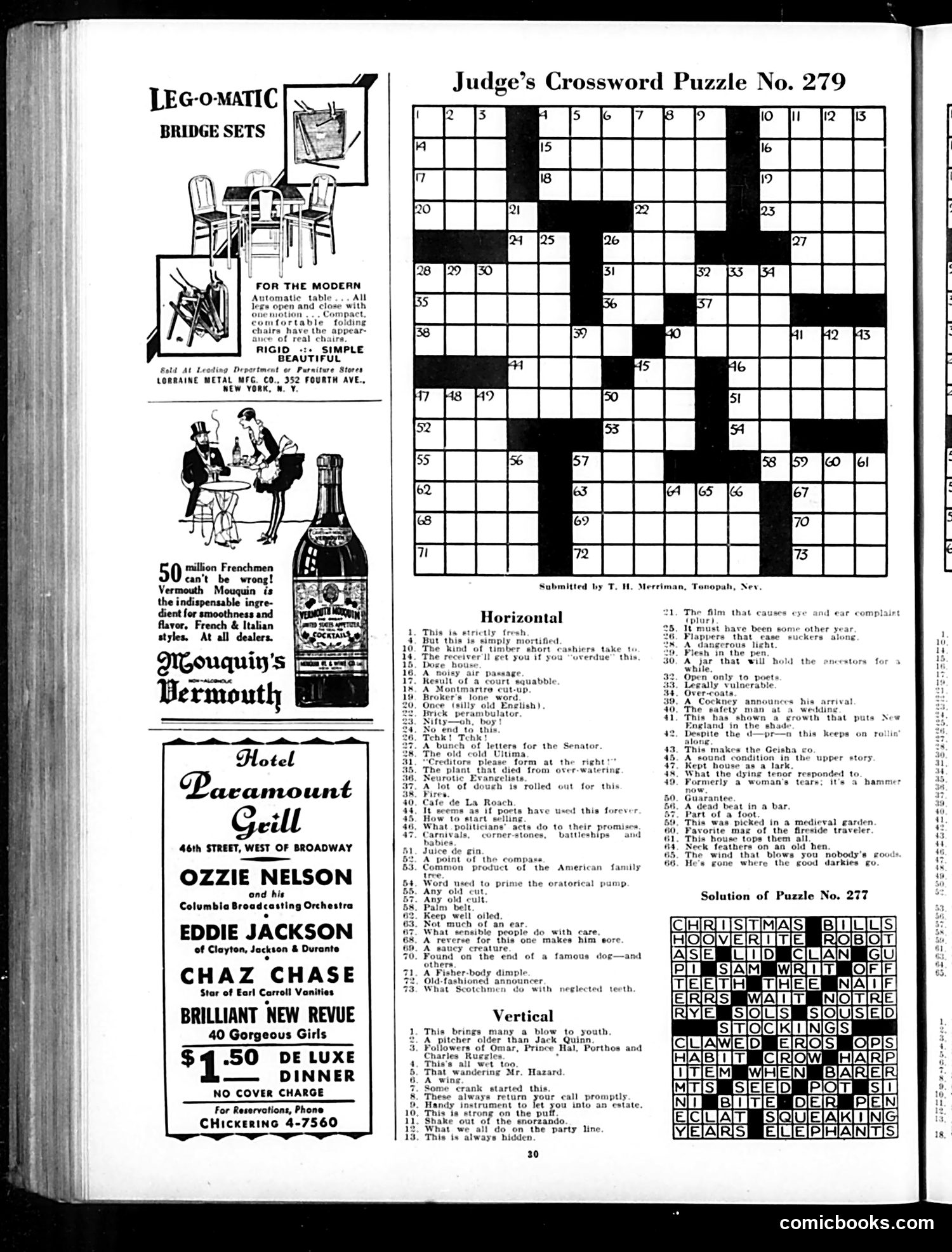
Judge Magazine Page Analysis This page is primarily advertising and a crossword puzzle rather than political satire. The visible content includes: Left side: Advertisements for Leg-o-Matic bridge table sets, Mouquin's Vermouth (with the phrase "5 million Frenchmen can't be wrong"—a common marketing slogan of the era), and the Hotel Paramount Grill nightclub featuring entertainers Ozzie Nelson, Eddie Jackson, and Chaz Chase. Right side: Judge's Crossword Puzzle No. 279, with clues listed below. The only potentially satirical element is the Vermouth ad's French appeal, which plays on 1930s-40s American fascination with European sophistication. The overall page reflects Judge's mix of humor, entertainment advertising, and puzzles typical of mid-century American magazines rather than pointed political commentary.
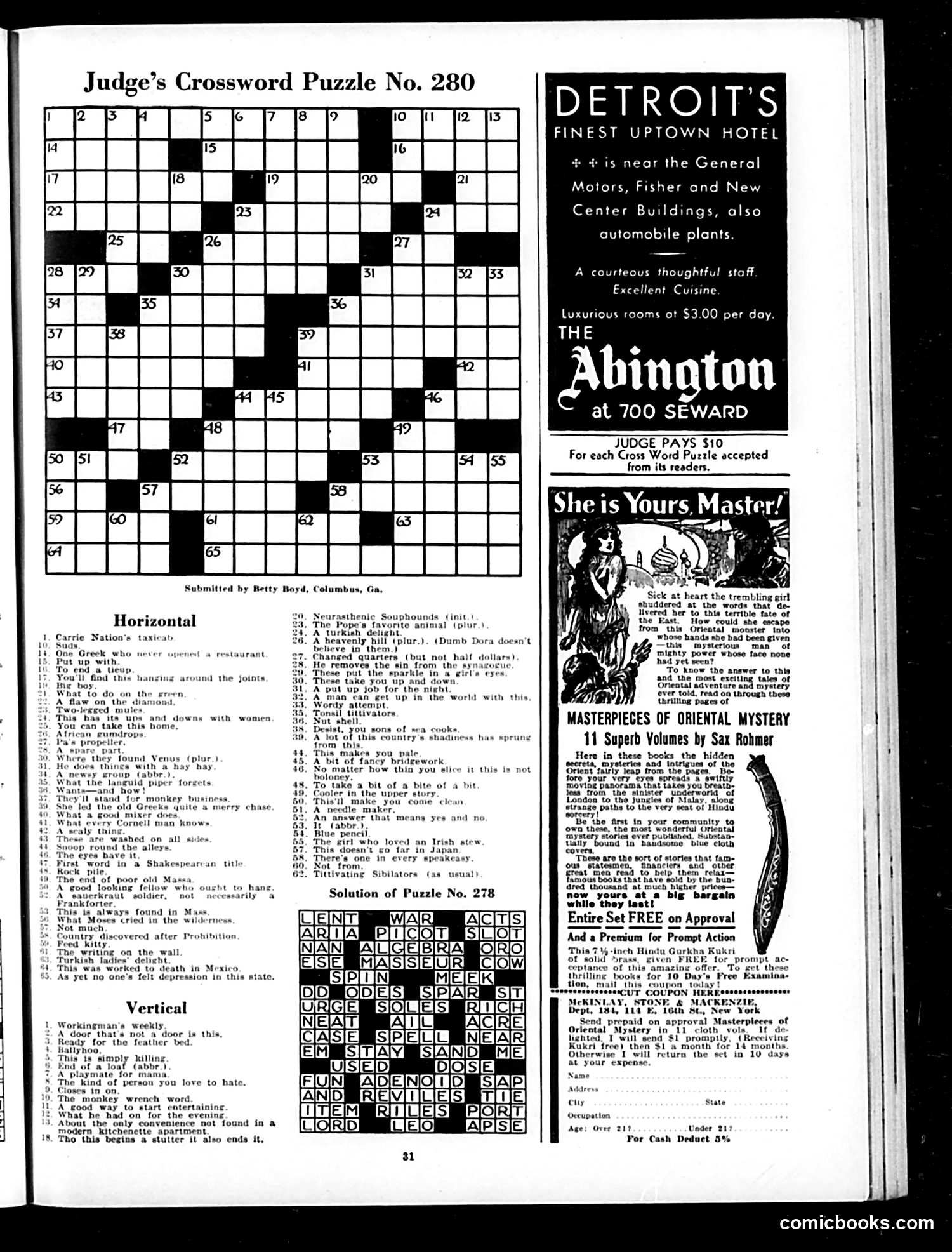
Judge Magazine Crossword Puzzle Page Analysis This page is primarily a crossword puzzle with advertisements—not a political cartoon. Judge Crossword Puzzle No. 280 occupies the left side, featuring clues with characteristic 1920s-30s humor and cultural references (Carrie Nation's taxi, speakeasies, Turkish delight). The right side contains period advertisements: The Abington hotel in Detroit ($3.00/day rooms), and a lengthy ad for "Masterpieces of Oriental Mystery"—11 volumes of pulp fiction by Sax Rohmer, famous for his "Fu Manchu" series. The ad emphasizes exotic, sensational "Oriental adventure" tales and offers the set free on approval. The satire is implicit: the crossword clues mock Prohibition-era American life (speakeasies, hanging around "joints"), while the Rohmer ad reflects period fascination with "Oriental" exoticism as thrilling, dangerous, and mysterious—reflecting contemporary racial attitudes and pulp literature conventions of the era.
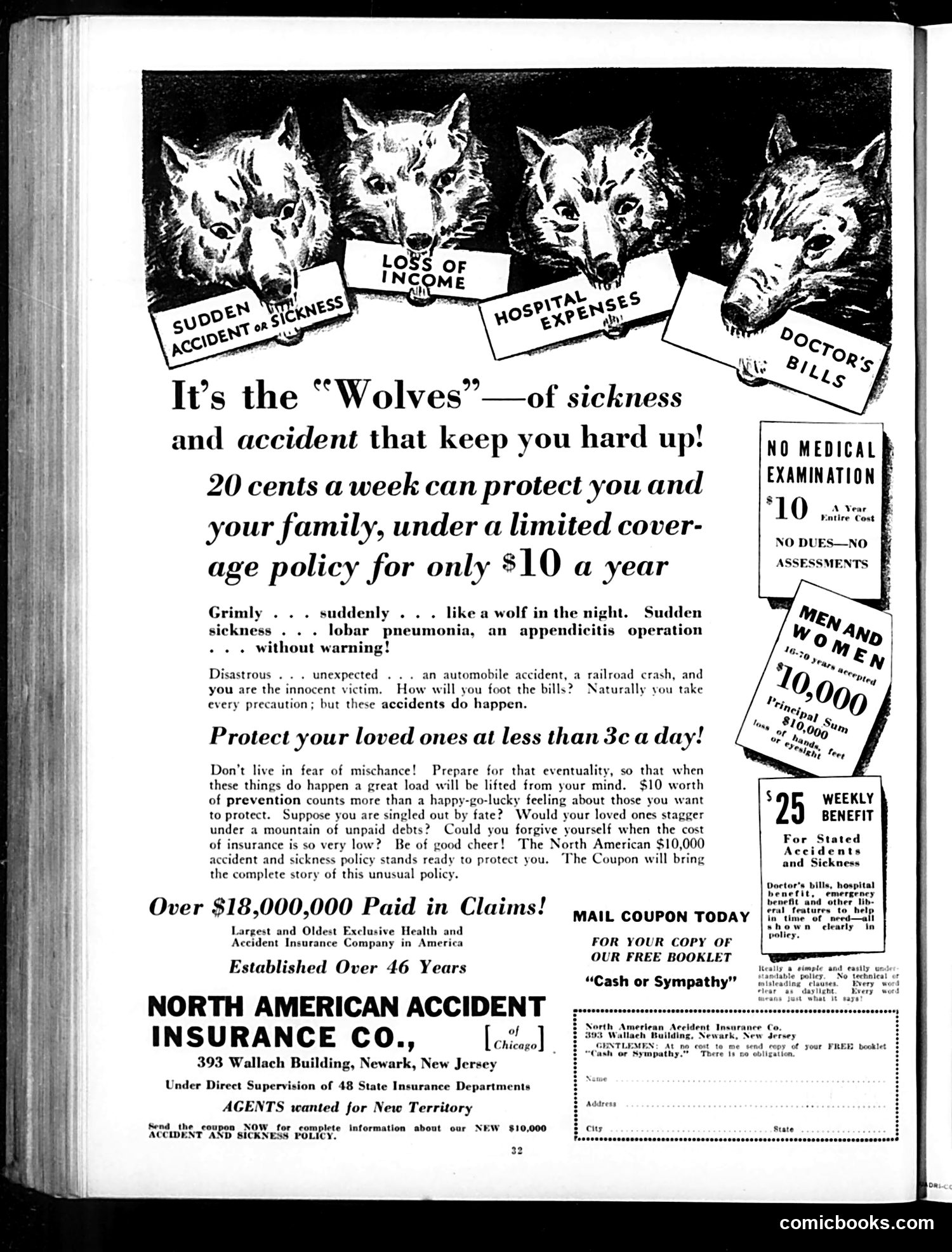
Analysis for Modern Readers This page is primarily advertising, not political satire. It's a 1920s-era insurance company ad for the North American Accident Insurance Co. The "wolves" are a metaphor for life's financial dangers—sudden illness, accidents, and medical bills that could bankrupt families. The illustrated wolf heads represent specific threats: "Sudden Accident or Sickness," "Loss of Income," "Hospital Expenses," and "Doctor's Bills." The advertisement's pitch appeals to working-class anxiety: for just 20 cents weekly ($10/year), families could protect themselves from catastrophic debt. The language emphasizes unpredictability ("like a wolf in the night") and emotional manipulation ("Could you forgive yourself"). This reflects early 20th-century America before widespread health insurance—when serious illness or injury could financially devastate ordinary people. The ad promises security and peace of mind for pennies daily, a common sales tactic of the era. The coupon at bottom invites readers to request their free booklet, "Cash or Sympathy."
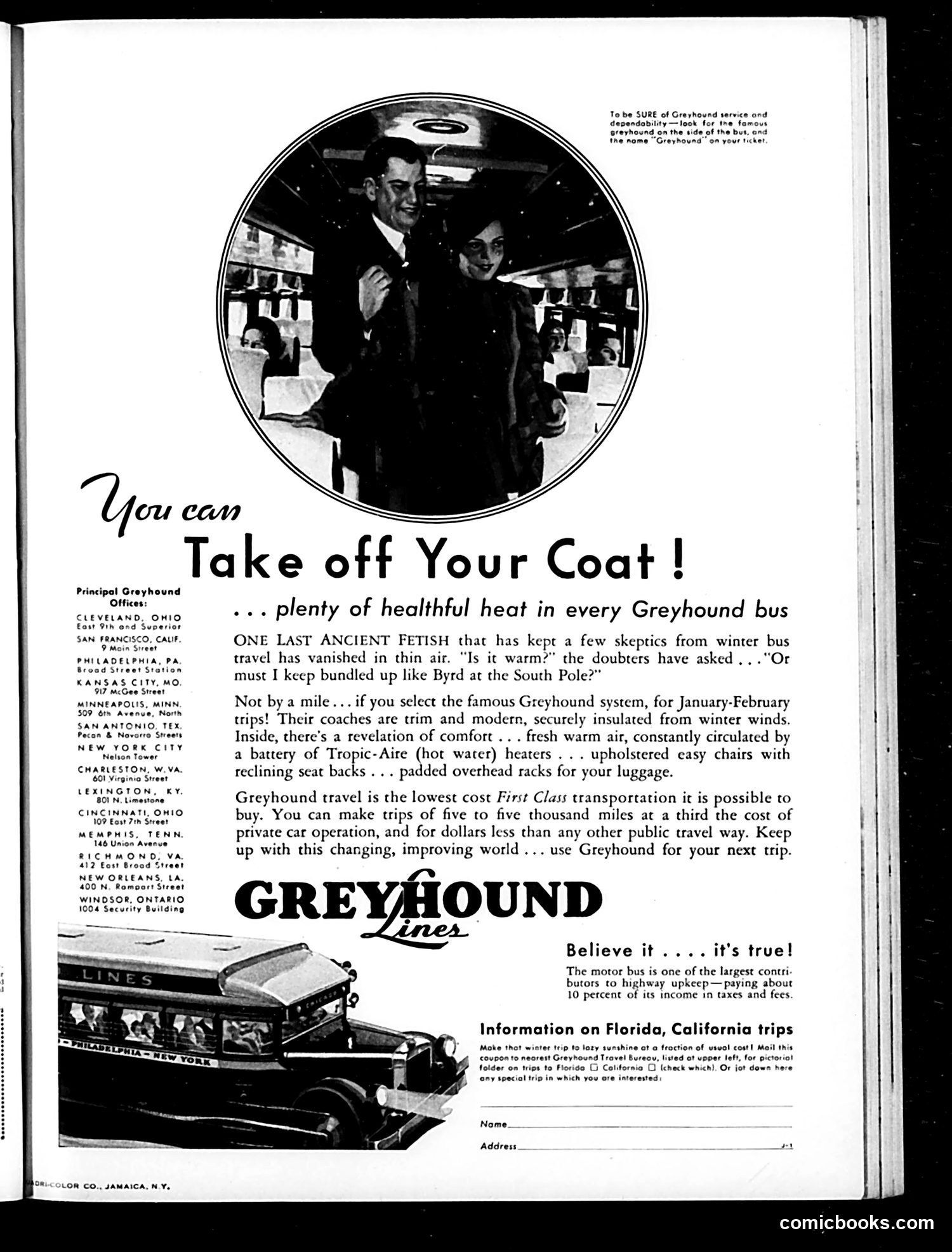
Greyhound Bus Advertisement Analysis This page is not a political cartoon or satire—it's a straightforward vintage advertisement for Greyhound Lines bus service, likely from the 1930s-40s. The circular photograph shows a well-dressed couple inside a modern bus interior, illustrating the advertisement's main pitch: "You can Take off Your Coat!" The ad humorously references an "ancient fetish" (doubt about bus heating) by comparing skeptics to Admiral Byrd at the South Pole, implying buses are now warm and comfortable. The copy emphasizes Greyhound's competitive advantages: modern insulation, "Tropic-Aire" heating systems, reclining seats, and affordable pricing ("First Class transportation" at low cost). A secondary appeal notes buses contribute substantially to highway maintenance through taxes. The page also includes a list of Greyhound terminals across major American cities and an offer for travel information about Florida and California trips—standard direct-mail advertising copy. This is commercial promotion, not editorial commentary.
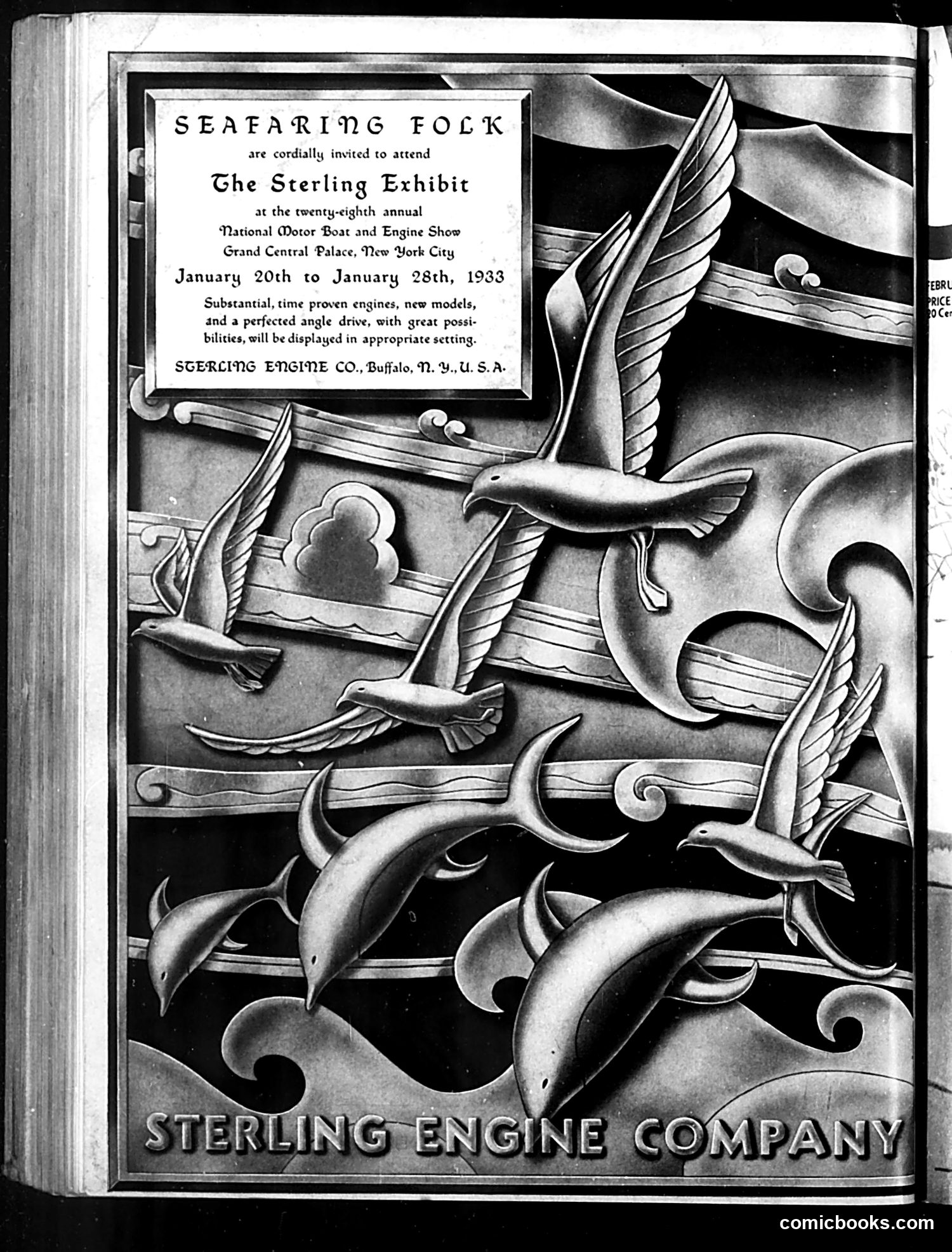
Analysis This is primarily an advertisement, not a political cartoon. The Sterling Engine Company placed this full-page ad in *Judge* magazine to promote their exhibit at the 1933 National Motor Boat and Engine Show in New York City. The decorative artwork features stylized seafaring imagery—winged fish, dolphins, and nautical motifs—to evoke maritime themes appropriate to a boat engine company. This art deco or art nouveau aesthetic was typical of 1930s commercial design. The timing (January 1933) places this during the Great Depression's depths, when manufacturers still advertised luxury goods like recreational boats, suggesting the ad targeted wealthier readers of *Judge*, a magazine known for sophisticated humor and upscale audiences. The content is commercial messaging, not satire.