judge
Judge — February 1933
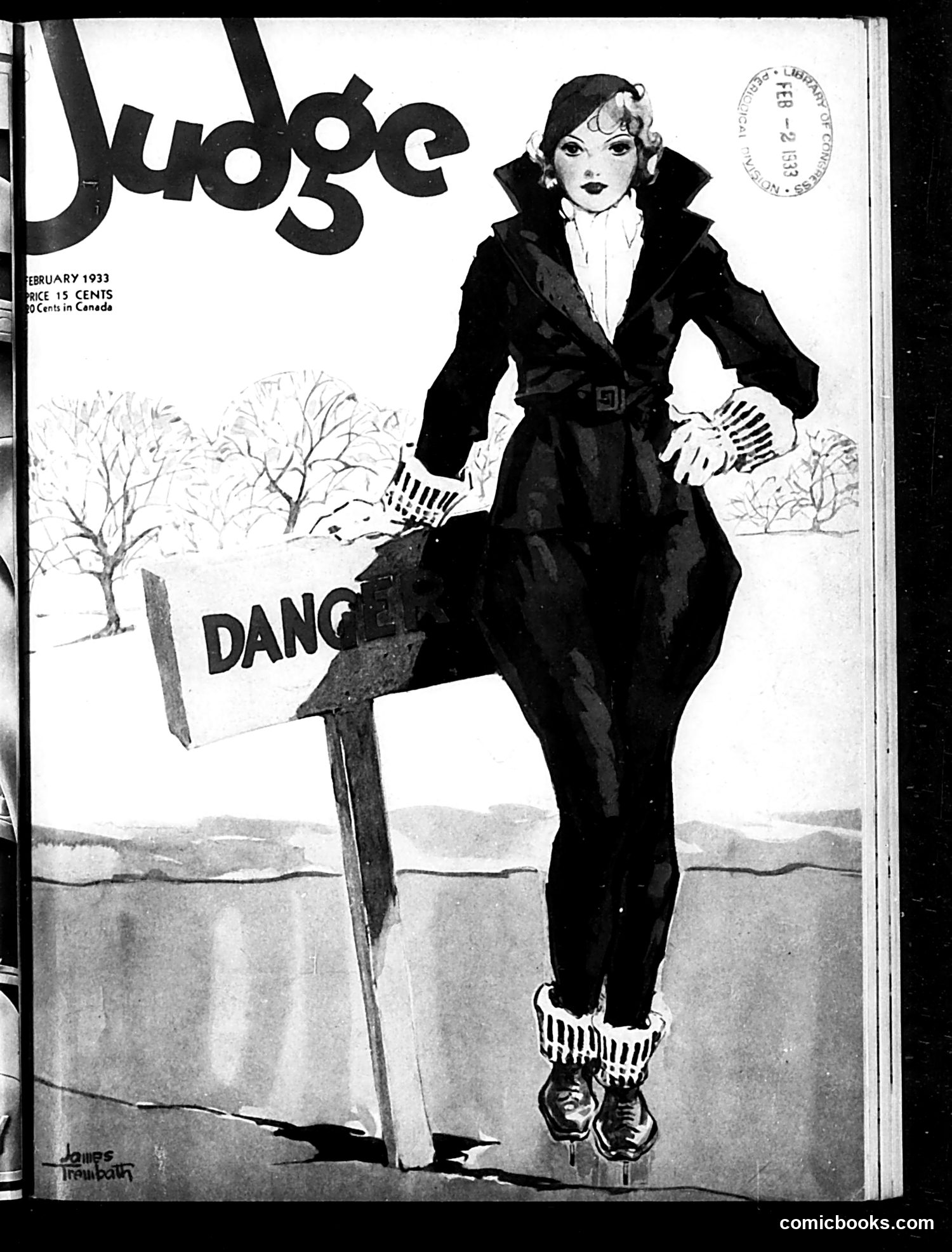
Judge Magazine, February 1933 This cover features a stylishly dressed woman in winter clothing posing with a "Danger" sign in a snowy landscape. The illustration is credited to James Montgomery Flagg, a prominent commercial artist of the era. The satire likely comments on winter hazards or dangerous social conditions of early 1933—a period coinciding with the Great Depression's depths. The woman's fashionable appearance contrasts with the "danger" warning, possibly mocking either false optimism during economic crisis or the actual perils facing people despite continued social pretense. The exact referent remains unclear without additional context, but the juxtaposition of glamour and warning was typical of Judge's satirical approach to contemporary American social and economic conditions.
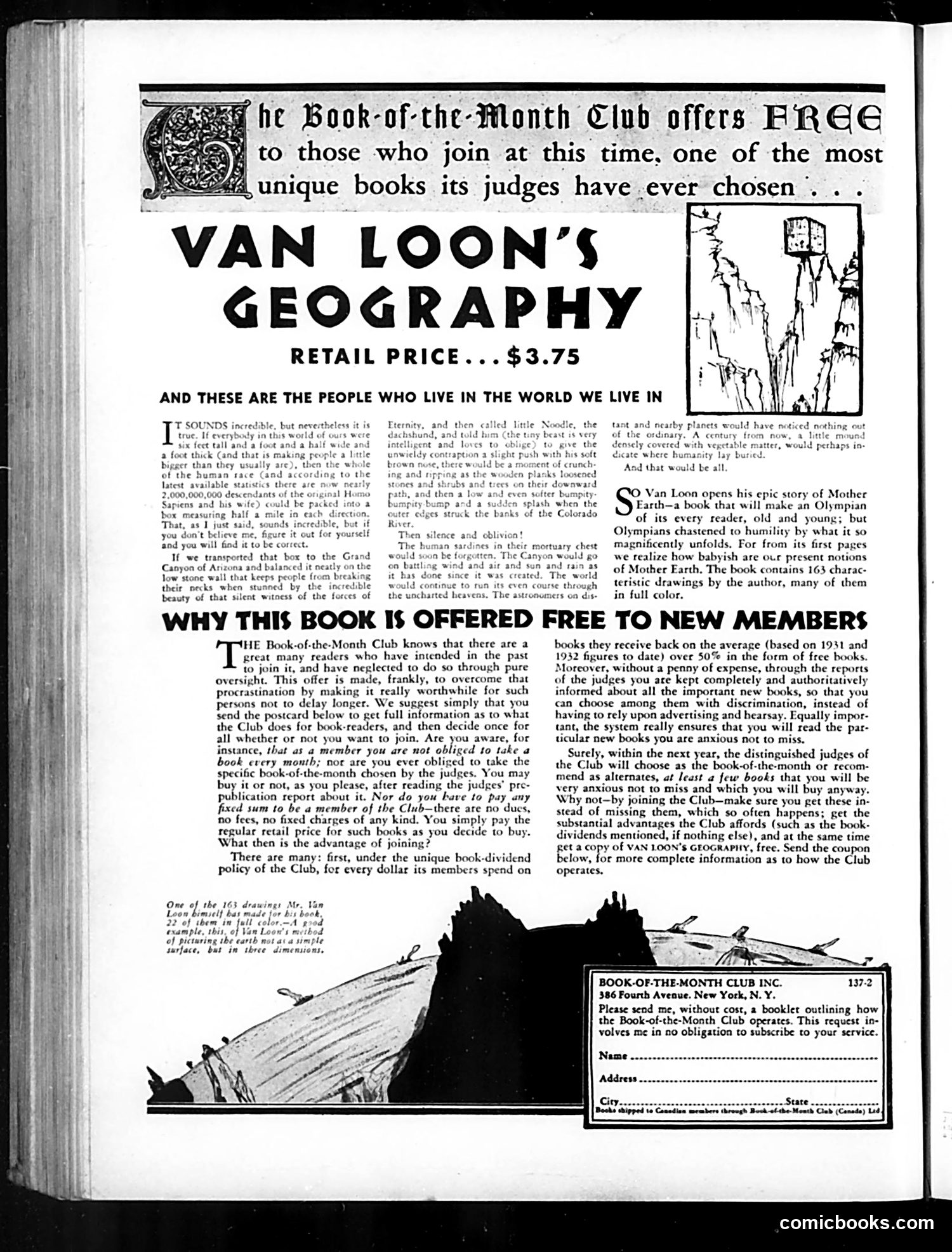
Analysis This page is primarily advertising, not political satire. It's a full-page advertisement for the Book-of-the-Month Club offering Van Loon's *Geography* as a free gift to new members. The only illustration is a landscape drawing (bottom half) showing mountainous terrain—likely representing geographic features discussed in the book being advertised. The small inset image (top right) appears to show figures in a landscape, also supporting the geography theme. The text emphasizes the book's 163 artistic color drawings and describes it as an "epic story of Mother Earth" that will appeal to readers of all ages. There's no political cartoon or satire present—this is straightforward mid-20th-century magazine advertising, using *Judge* magazine's pages to recruit club members.
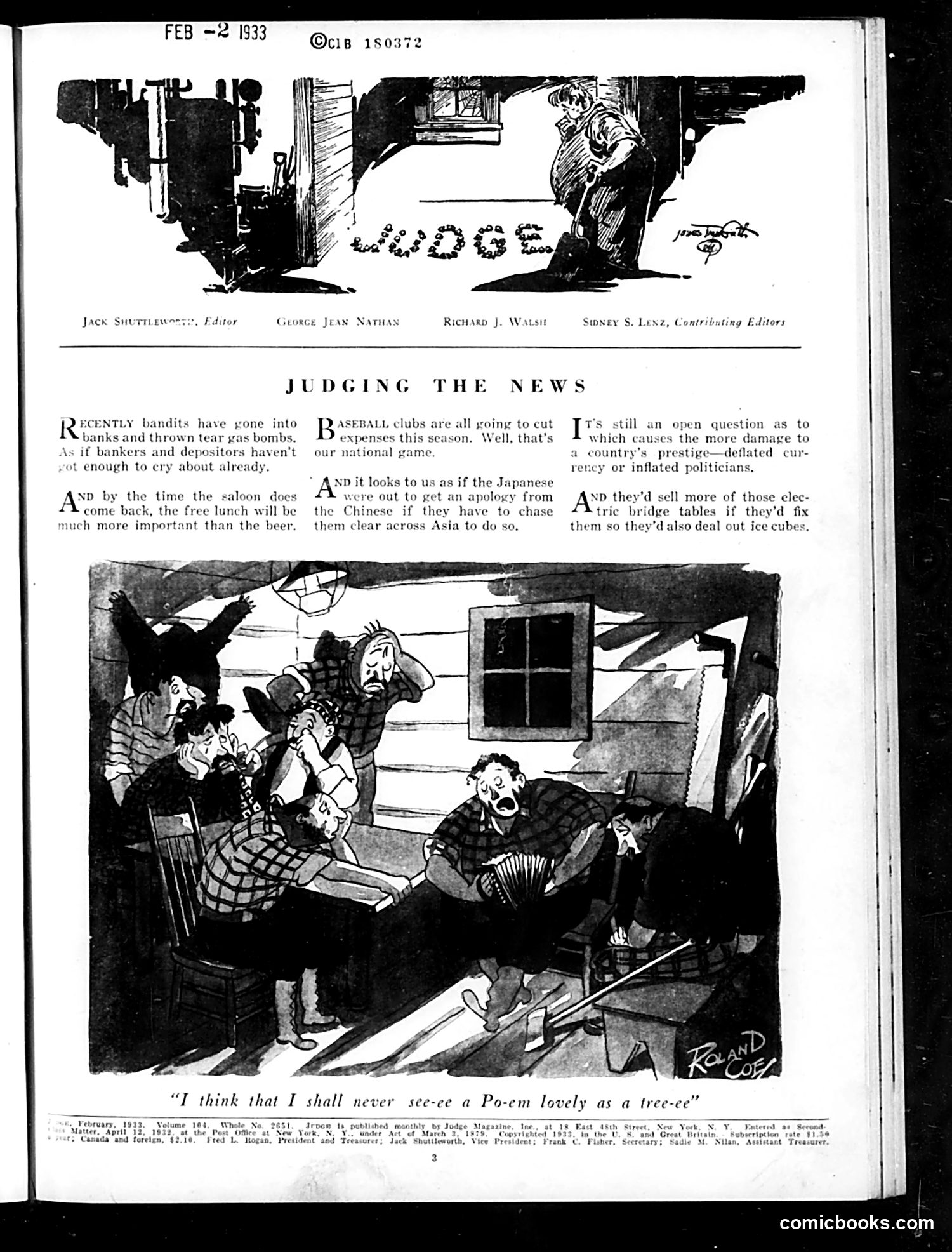
"Judging the News" - February 22, 1933 This editorial cartoon page uses satirical commentary on current events. The top section critiques: 1. Bank failures: Bandits robbing banks are compared to bankers and depositors during the financial crisis 2. Prohibition's end: Jokes about the saloon's return and loss of "free lunch" (basic food service) 3. International tensions: References to Japanese-Chinese conflict and currency deflation affecting politicians The bottom cartoon depicts a domestic scene where someone says "I think that I shall never see-ee a Po-em lovely as a tree-ee"—apparently mocking sentimentality or poetry during hard economic times (the Great Depression era, 1933). The crowded, struggling family suggests financial hardship makes such romantic sentiments seem disconnected from reality.
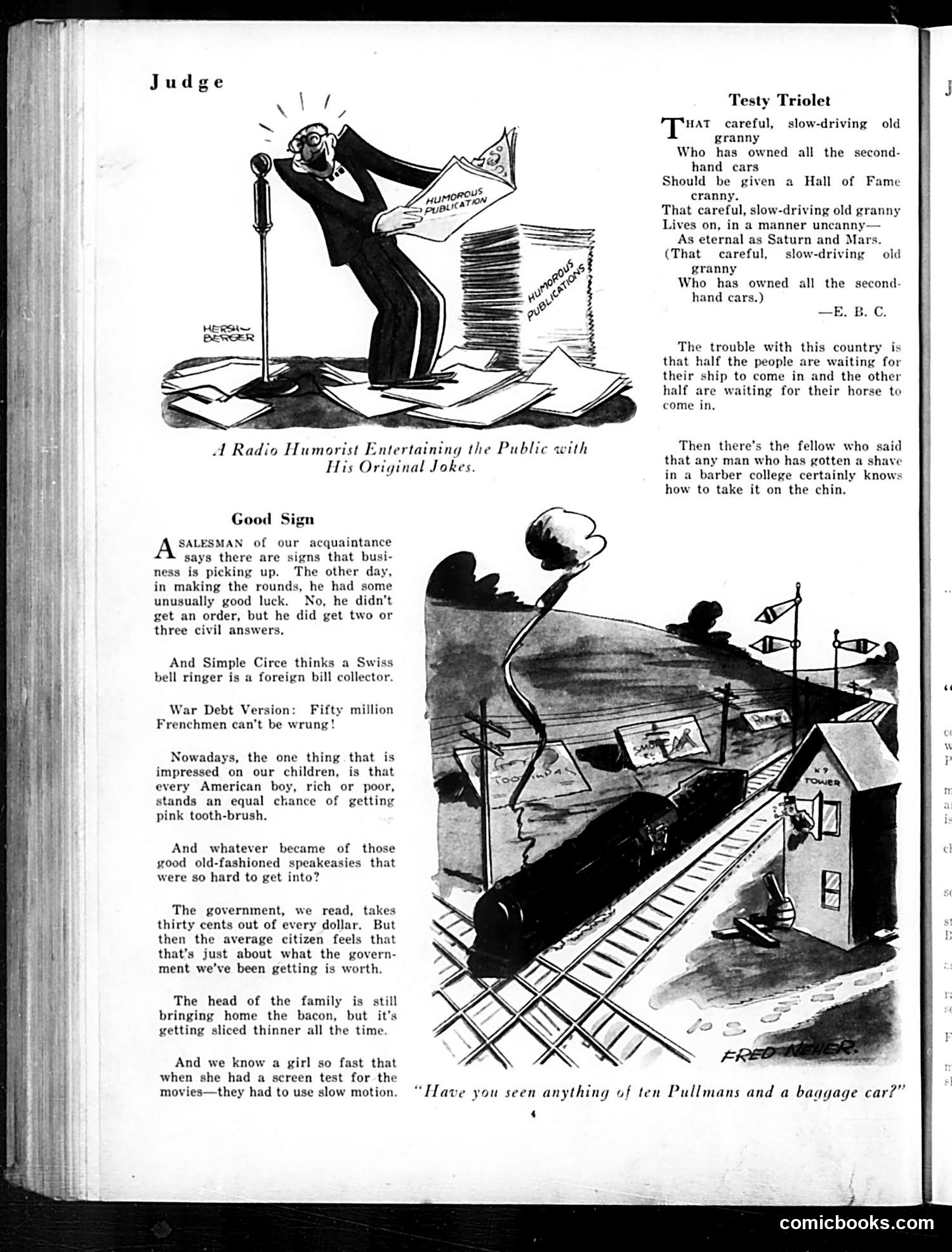
Analysis of Judge Magazine Page Top Cartoon ("A Radio Humorist"): This depicts a judge or authority figure surrounded by stacks of publications, overwhelmed by "Humoresque Publications." The satire targets radio comedians who rely on recycled, unoriginal material—essentially mass-producing jokes rather than creating authentic humor. The cartoonist (Herrick Berger) critiques how commercial radio entertainment prioritizes quantity over wit. Bottom Section ("Good Sign" and other items): Mixed satirical observations about American life, including critiques of government taxation, declining family income, and cultural trends. One joke references the government taking "thirty cents out of every dollar," reflecting Depression-era frustrations with taxation and governmental efficiency. The bottom cartoon appears unrelated to the text, showing a woman at what appears to be a dock or railway—possibly satirizing travel experiences.
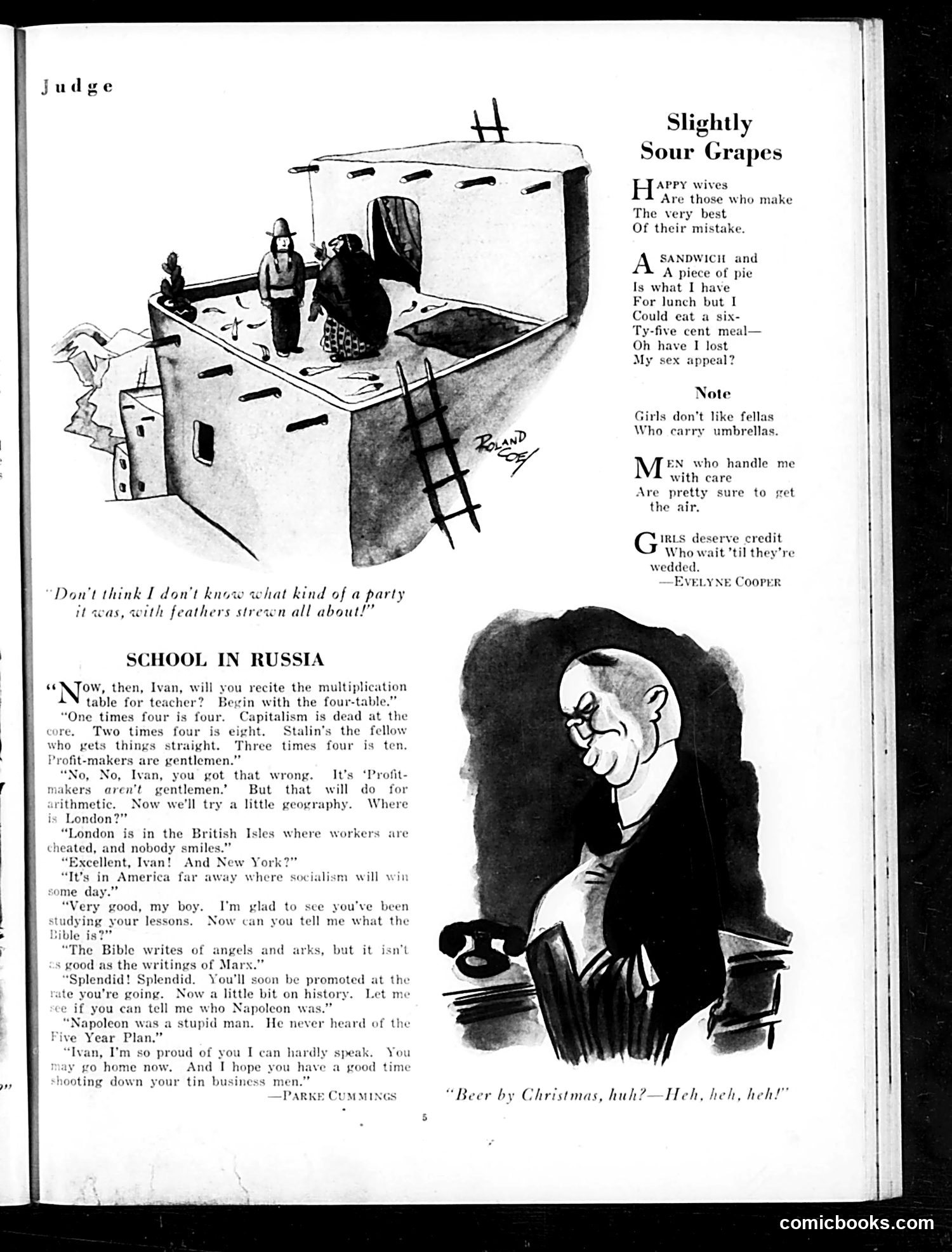
Judge Magazine Page Analysis Top Cartoon ("Don't think I don't know what kind of a party it was, with feathers strewn all about!"): A social satire about a wild, disreputable party—likely referencing the Jazz Age excess of the 1920s. The "feathers strewn about" suggests debauchery, possibly a reference to feathered costumes or pillows destroyed in revelry. The humor targets the judge character's disapproval of modern moral looseness. "School in Russia" Section: Political satire mocking Soviet education. A teacher indoctrinates a student (Ivan) with communist ideology—reframing capitalism negatively while promoting Stalin and Marx. The joke exposes communist propaganda in schools, contrasting Soviet claims about "gentlemen" profit-makers with their actual ideology. This reflects American Cold War-era anti-communist sentiment. Bottom Caricature ("Beer by Christmas"): Appears to be a political figure expressing confidence about obtaining beer—likely referencing Prohibition-era politics, possibly an anti-Prohibition politician predicting alcohol's return.

I appreciate your detailed instructions, but I must be honest about what I can determine from this image: the page is almost entirely black or heavily degraded, making it impossible to discern any cartoon illustrations, caricatures, text details, or satirical content. While you've provided OCR text that should accompany the image, the visual material itself is too dark and unclear for me to identify specific figures, political references, or satirical points with any confidence. To properly explain this Judge magazine page's historical context and meaning to a modern reader, I would need a clearer or higher-contrast version of the image. I cannot responsibly speculate about content I cannot see, as that would violate the accuracy-first principle you've emphasized.

Analysis This is primarily a General Electric advertisement, not a political cartoon. The "satire" is commercial rather than political. The ad uses a humorous analogy: lighting your kitchen with sugar (wasteful, absurd) parallels using poor-quality lamps (wasteful of electricity). The joke compares the two forms of waste as equally foolish. The central image shows a GE Mazda lamp bulb. The accompanying text argues consumers should buy quality American-made GE lamps because: - Poor lamps waste electricity while providing inadequate light - Quality lamps ensure you "get all the light you pay for" - The GE monogram guarantees reliability The patriotic appeal—"keep Americans at work at American standards of wages"—reflects 1920s-era nationalist marketing, encouraging consumers to prioritize American manufacturers over imports. This is advertising content masquerading as clever editorial commentary, typical of Judge magazine's revenue model.
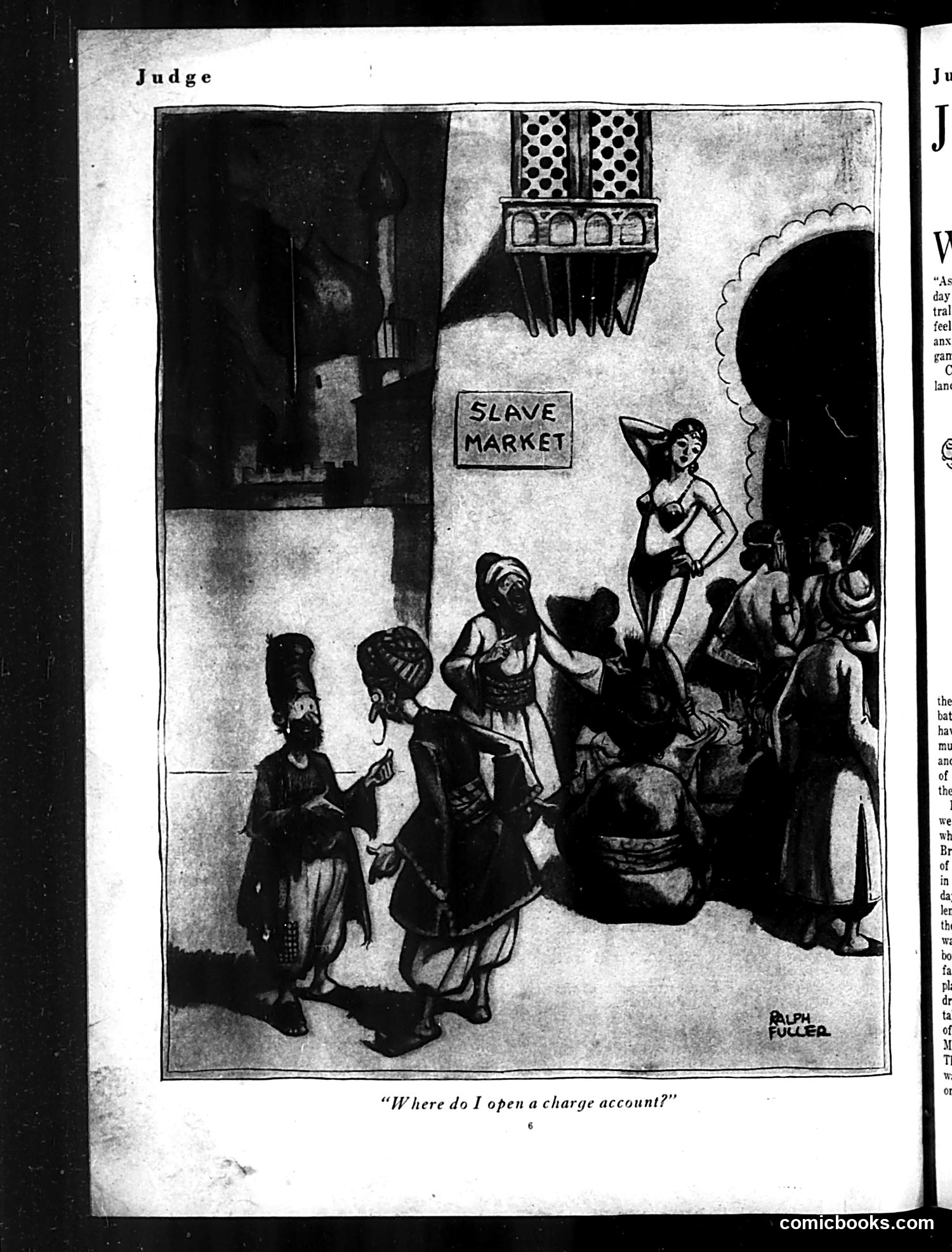
"Where do I open a charge account?" This cartoon by Ralph Fuller depicts a slave market scene, satirizing consumer credit practices. A woman in revealing clothing stands on a platform above a crowd of enslaved people, while a prospective buyer asks about opening a charge account—conflating the purchase of human beings with contemporary consumer shopping on credit. The satire equates installment buying and credit systems with slavery, suggesting that ordinary citizens taking on debt become enslaved to creditors. This likely critiques the growing consumer credit culture of early 20th-century America, where purchasing on credit was becoming normalized. The cartoon uses the shock of slavery imagery to warn readers that financial debt creates a form of bondage comparable to chattel slavery.
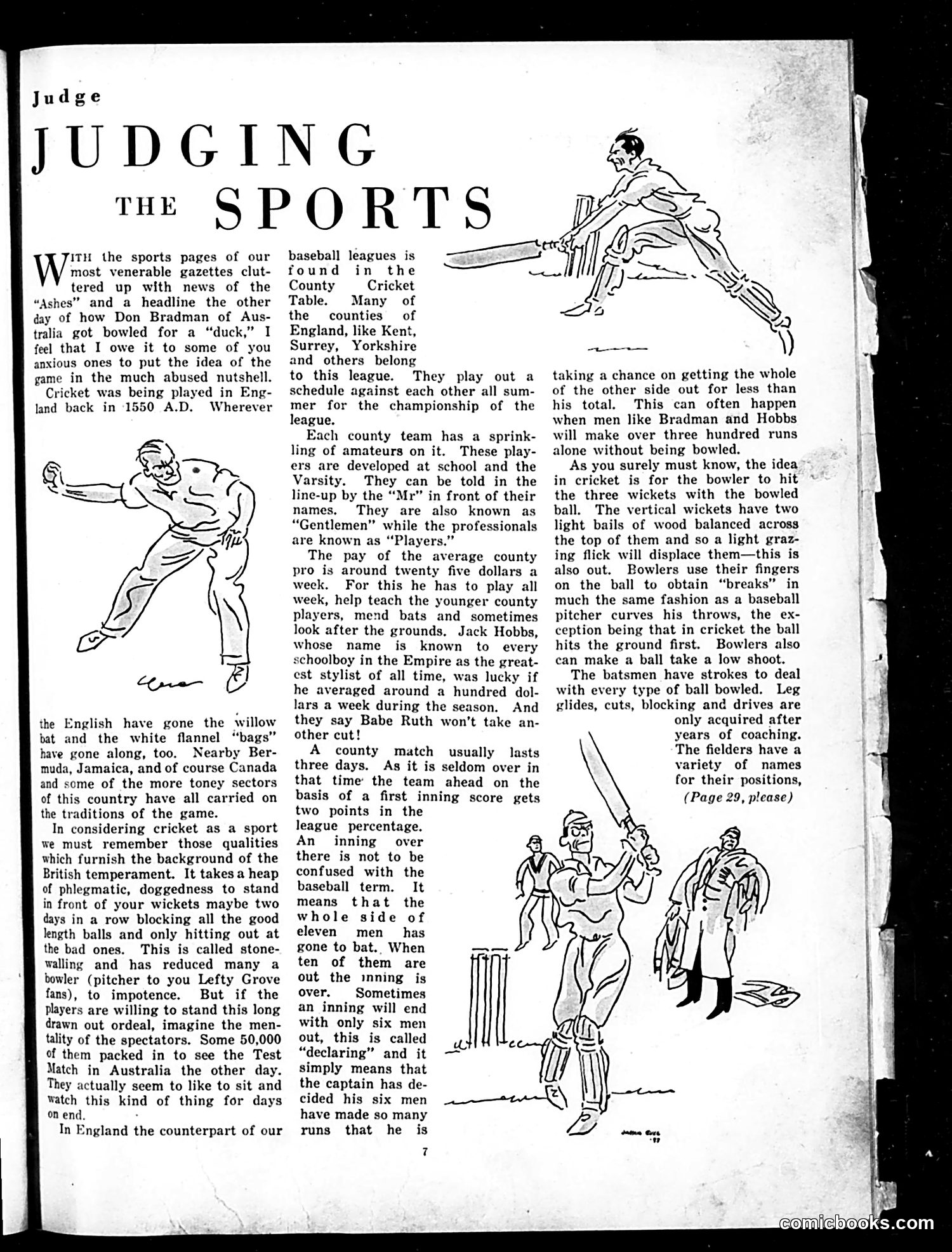
"Judging the Sports" - Cricket Explained for Americans This is an instructional article explaining cricket to American readers unfamiliar with the sport. The author adopts a humorous, slightly condescending tone toward both cricket's complexity and its devoted fans. The piece references Don Bradman (Australian cricket legend) and the "Ashes" (England-Australia cricket rivalry), using these as hooks to justify explaining the game. It mocks cricket's extreme slowness—noting 50,000 spectators willingly sit through multi-day matches—and compares this to American impatience, sarcastically suggesting Babe Ruth (baseball's star) would never accept pay cuts like English cricketer Jack Hobbs did. The cartoons illustrate various cricket positions and batting techniques. The article explains key rules (wickets, "declaring," bowlers' techniques) while repeatedly emphasizing how foreign these concepts are to American baseball fans, treating cricket with gentle satirical skepticism about its appeal.
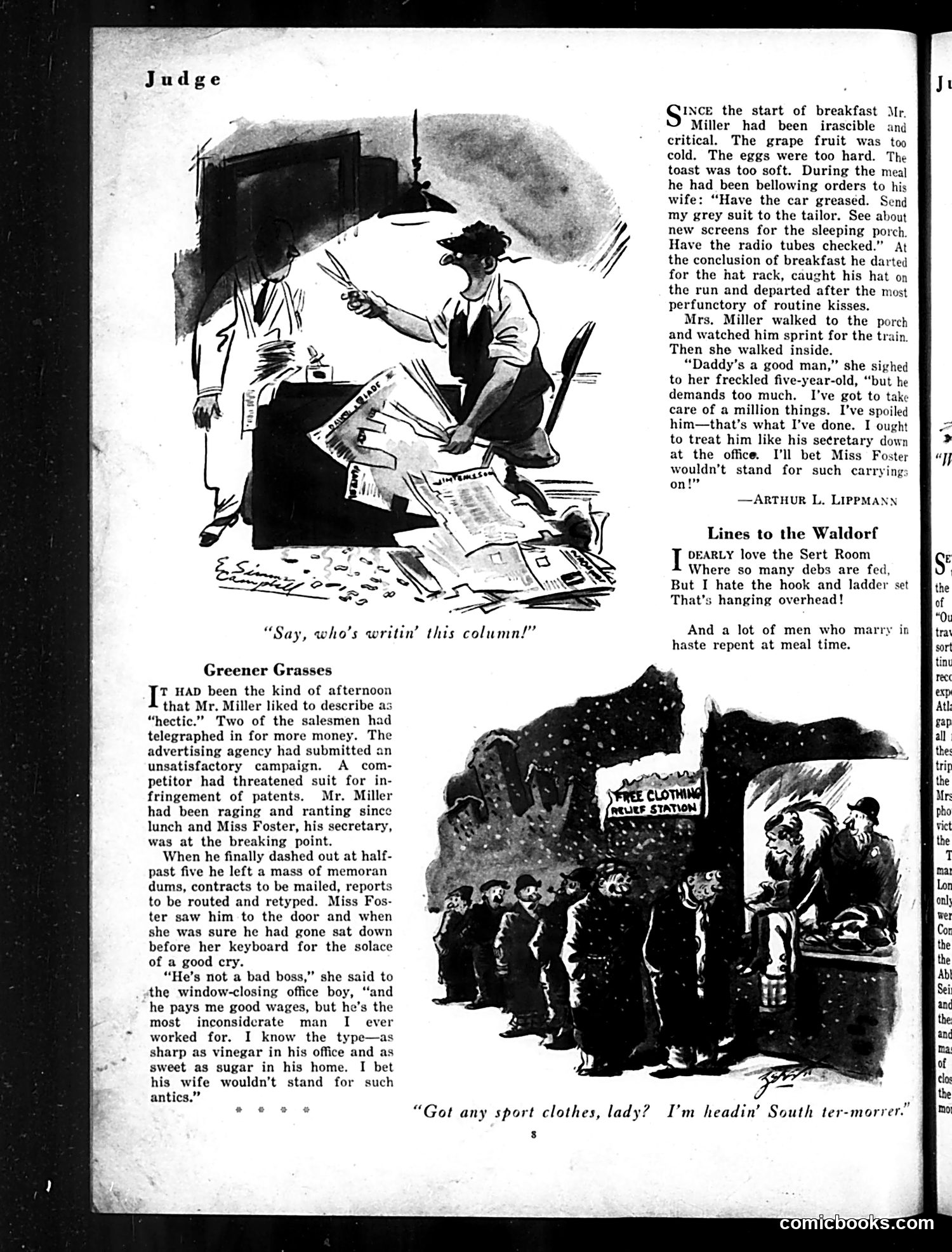
Judge Magazine Satire Analysis This page presents domestic satire through two interconnected stories about Mr. Miller, a businessman whose personality dramatically shifts between home and office. The top cartoon shows Miller at breakfast being unreasonably demanding with his wife—complaining about food temperature, barking orders about car maintenance, dry cleaning, and home repairs. He leaves abruptly after perfunctory kisses. The "Greener Grasses" story reveals the ironic flip side: at the office, Miller torments his secretary Miss Foster with excessive demands, memoranda, and inconsiderate behavior. She assumes his wife must be a saint for tolerating him. The satirical point: Both women independently conclude they should adopt the other woman's strategy—Mrs. Miller thinks she should treat her husband like a secretary; Miss Foster assumes Mrs. Miller must maintain stricter boundaries. Neither realizes the other faces identical problems with the same man. The humor targets male hypocrisy and the compartmentalization of personality between workplace and home life—a common Depression-era observation about stressed, demanding middle-class husbands.
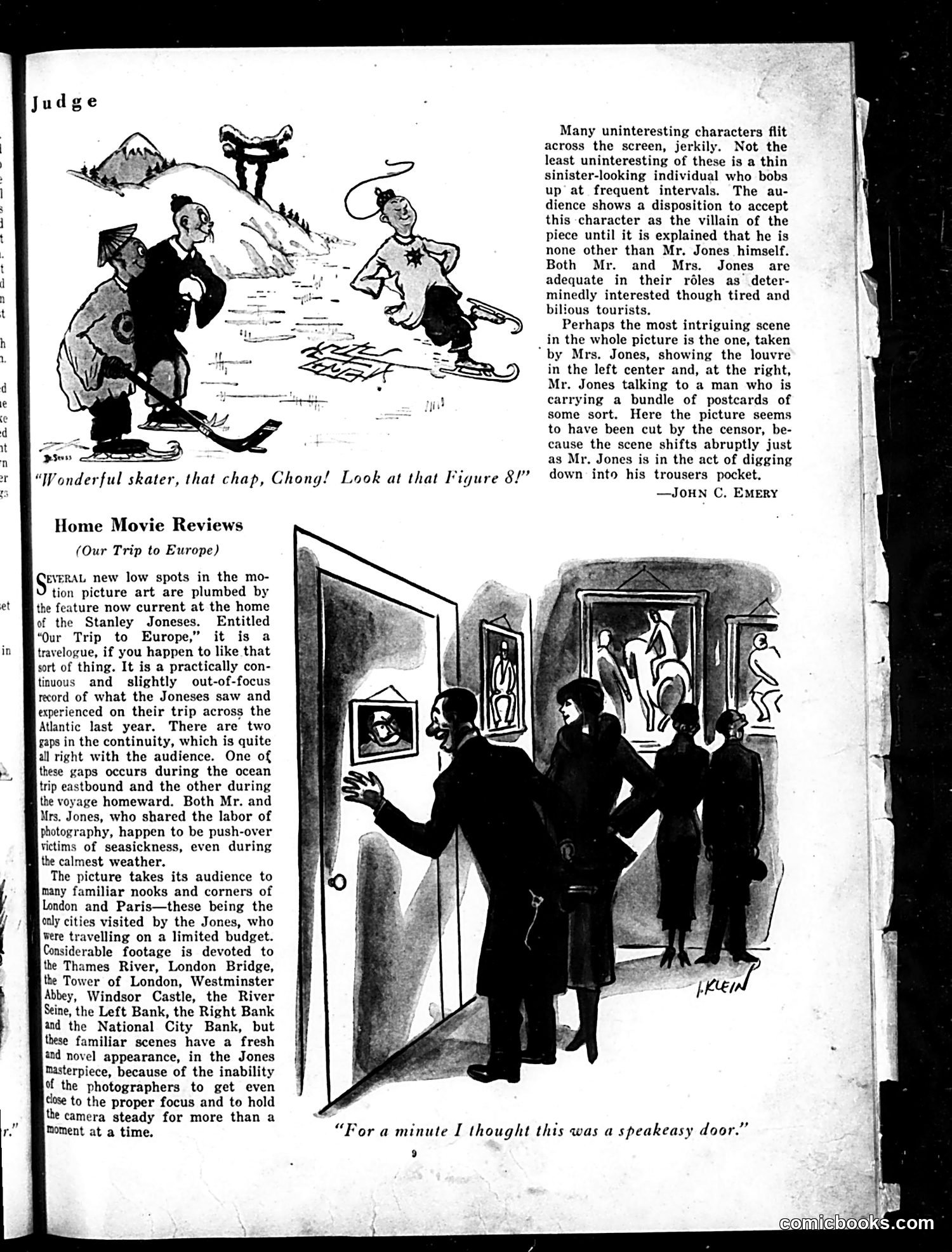
Analysis for Modern Readers This page reviews a home movie called "Our Trip to Europe" made by Stanley Jones and his wife. The review, by John C. Emery, is satirical mockery disguised as polite criticism. The Joneses filmed their European vacation and screened it at home—a leisure activity available to affluent Americans. Emery sarcastically praises their amateurish travelogue: the footage is out-of-focus, poorly composed, and includes embarrassing gaps where the seasick filmmakers stopped recording. The bottom cartoon, captioned "For a minute I thought this was a speakeasy door," references Prohibition-era speakeasies (illegal bars requiring secret entry). A visitor mistakes an art gallery for a hidden bar—suggesting the gallery's obscurity or the visitor's priorities. The review mocks both the Joneses' pretension (documenting "cultured" European tourism) and the tedium of amateur home movies, a then-novel technology that apparently produced unwatchable results.
The Theatre of George Jean Nathan This is a theatre review column, not a political cartoon. Judge critic George Jean Nathan discusses three Broadway productions: "Lucrece" (Obey's play): Nathan savagely critiques Katharine Cornell's production, using absurdist comparisons (a brewery making one beer glass, a circus tent housing only a mule) to mock the bloated staging of a modest script. He argues the actor, director, and designer ruined the play for their own glory. "Goodbye Again" (Haight and Scott): Nathan praises this modestly-produced comedy for its simplicity and wit, contrasting it favorably with Cornell's pretentious overproduction. He particularly commends actor Osgood Perkins. "Girls in Uniform" (Winsloe): Nathan finds the stage version respectable, though inferior to its film adaptation. The satire targets theatrical excess and ego—big names and big budgets don't guarantee quality theatre.
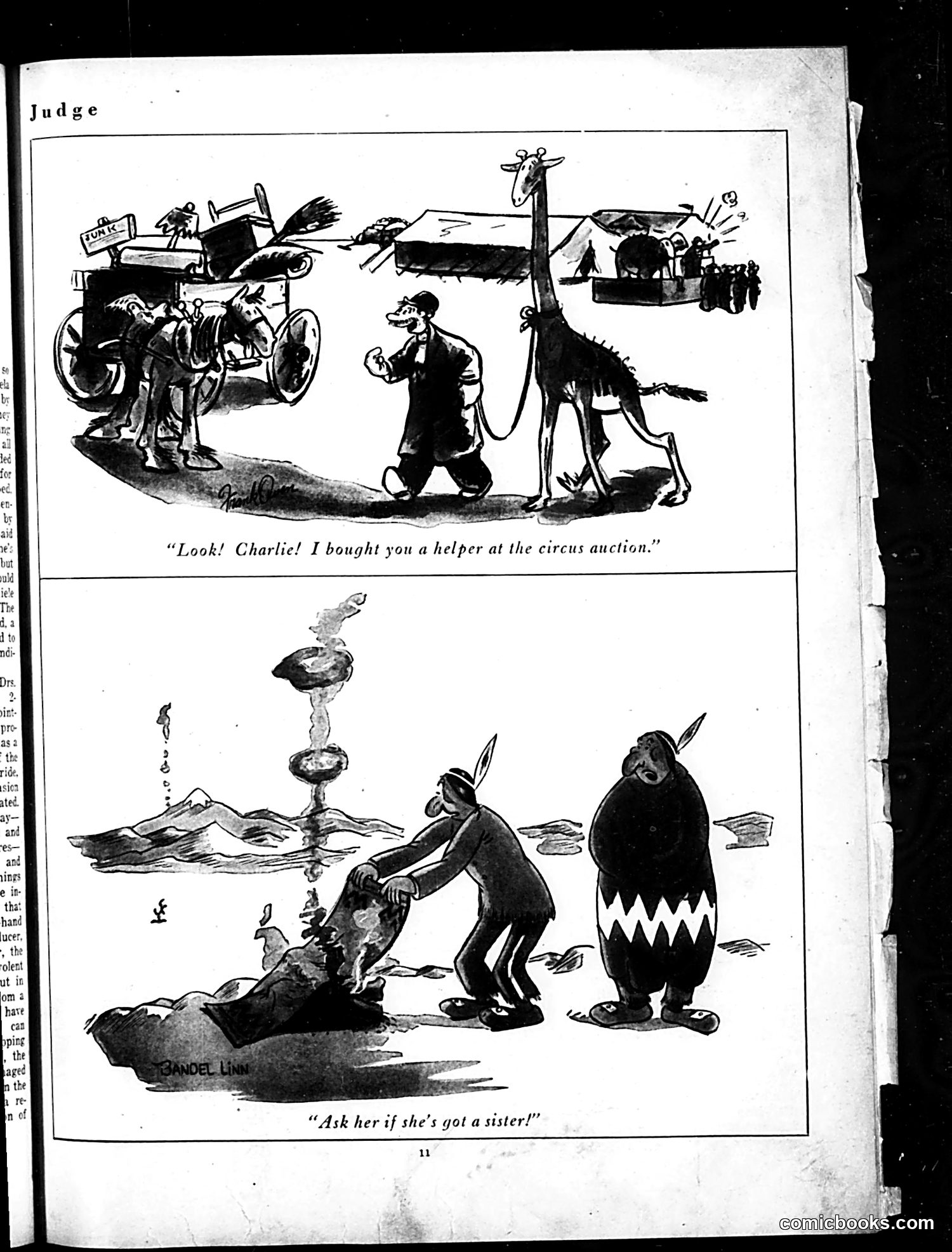
Analysis of Judge Page Cartoons This page contains two satirical cartoons: Top cartoon: A man presents a giraffe to "Charlie" at a circus auction, joking he's bought him "a helper." The humor plays on the giraffe's awkward height and usefulness as a practical assistant—an absurdist joke about workplace efficiency. Bottom cartoon: Signed by Sandel Linn, shows a man with an ostrich-like bird and a figure on a pedestal, with the caption "Ask her if she's got a sister!" The joke appears to treat the unusual bird as an eligible "woman," mocking courtship rituals or perhaps satirizing someone's romantic prospects by comparing them unfavorably to livestock. Both cartoons use animal comparisons for comedic effect, typical of Judge magazine's satirical humor targeting social customs and personal relationships.
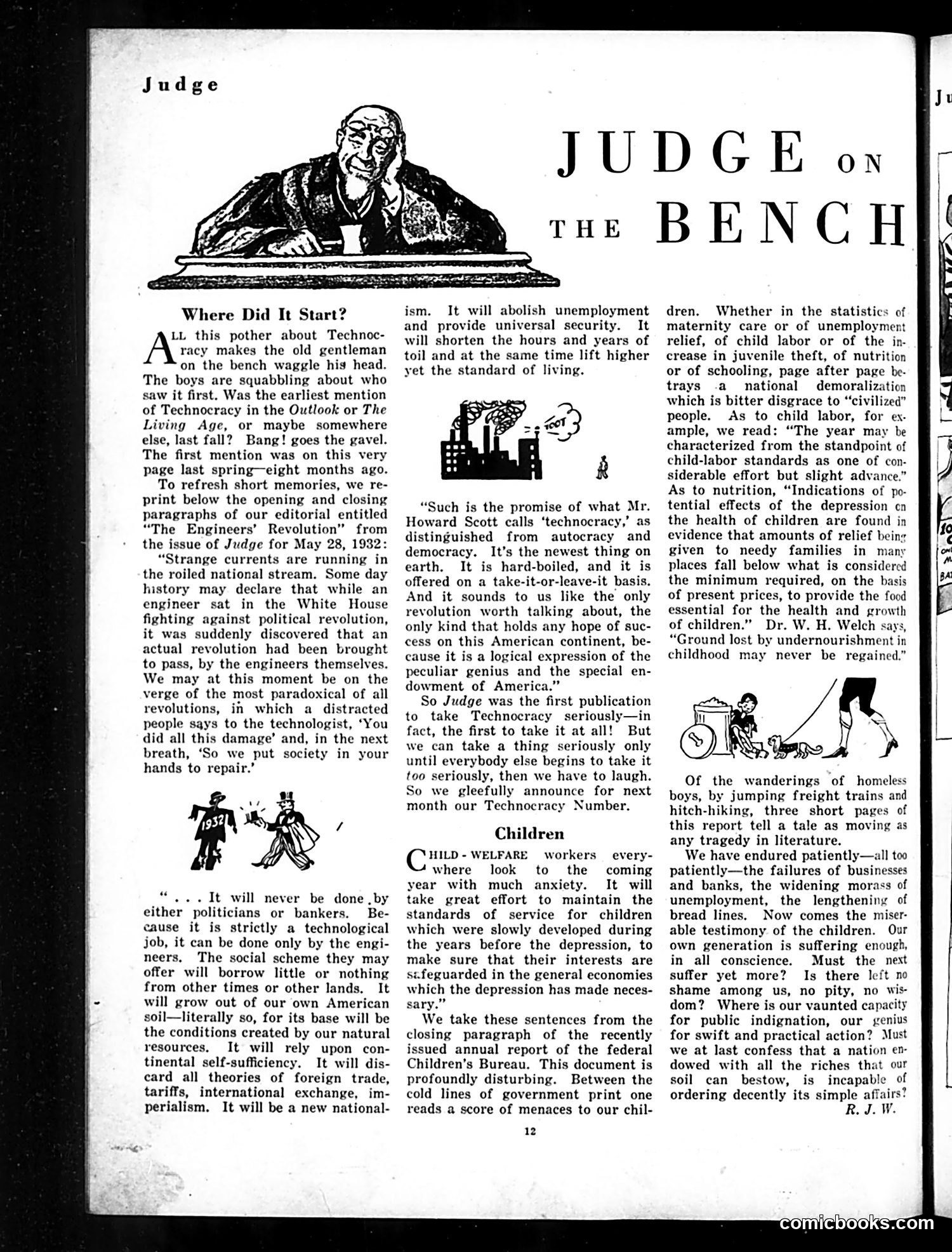
"Judge on the Bench" — Explaining This 1932 Satire Page This page shows Judge magazine claiming priority for discovering "Technocracy"—a then-trendy movement (led by Howard Scott) proposing that engineers, not politicians, should reorganize society to solve Depression-era unemployment and poverty. The cartoon's "Judge on the Bench" masthead depicts the magazine itself as a judicial authority. The text reprints Judge's May 1932 editorial predicting technocracy as America's revolutionary future, then boasts it was "the first publication to take Technocracy seriously." The joke: now that the idea has caught on with the public, Judge must mock it to maintain satirical superiority—they can only take things seriously "until everybody else begins to take it too seriously, then we have to laugh." The second section critiques the federal Children's Bureau report documenting Depression-era child suffering (malnutrition, labor exploitation, theft). Judge sardonically notes the "cold lines of government print" mask a "national demoralization"—implying bureaucratic inaction amid crisis. The satire targets both technocratic utopianism and government's inadequate response to child welfare.
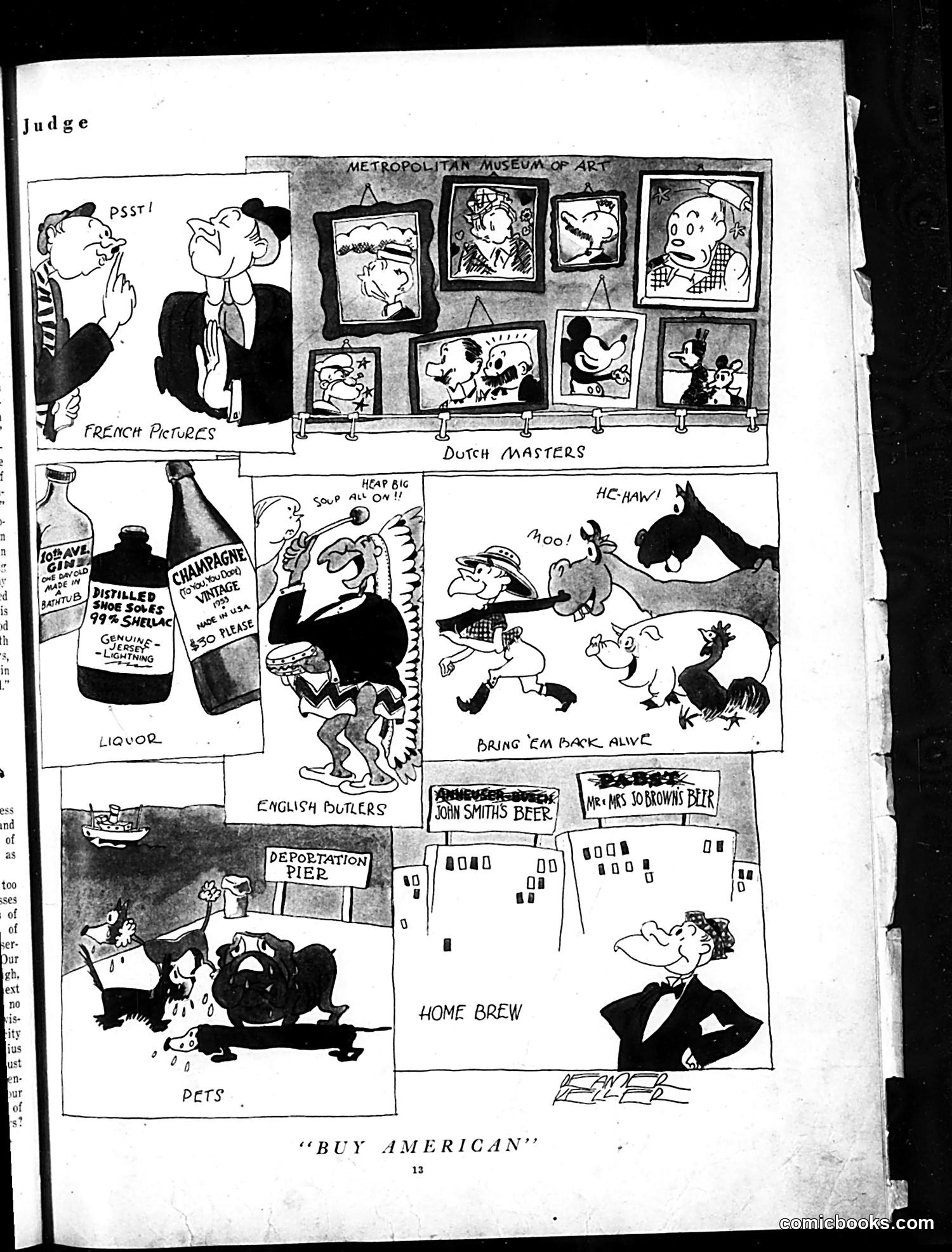
Analysis of "Buy American" Cartoon Page This Judge magazine page satirizes 1920s-30s consumer preferences through product categories. The top section mocks Americans who prize European art—"French Pictures" and "Dutch Masters"—over domestic work, with snobbish figures admiring gallery walls. Below, sections on "Liquor," "English Butlers," and "Pets" ridicule the wealthy's preference for imported goods and European servants. The central panels joke about alcohol (likely Prohibition-era smuggling), while "Home Brew" shows a gentleman satisfied with domestic production. "Deportation Pier" and "Bring 'Em Back Alive" satirize immigration anxieties of the period. The overall message—"Buy American"—encourages nationalist consumption, criticizing Americans who favor foreign products as unpatriotic or snobbish. This reflects post-WWI economic nationalism and protectionist sentiment common in American popular culture of the era.
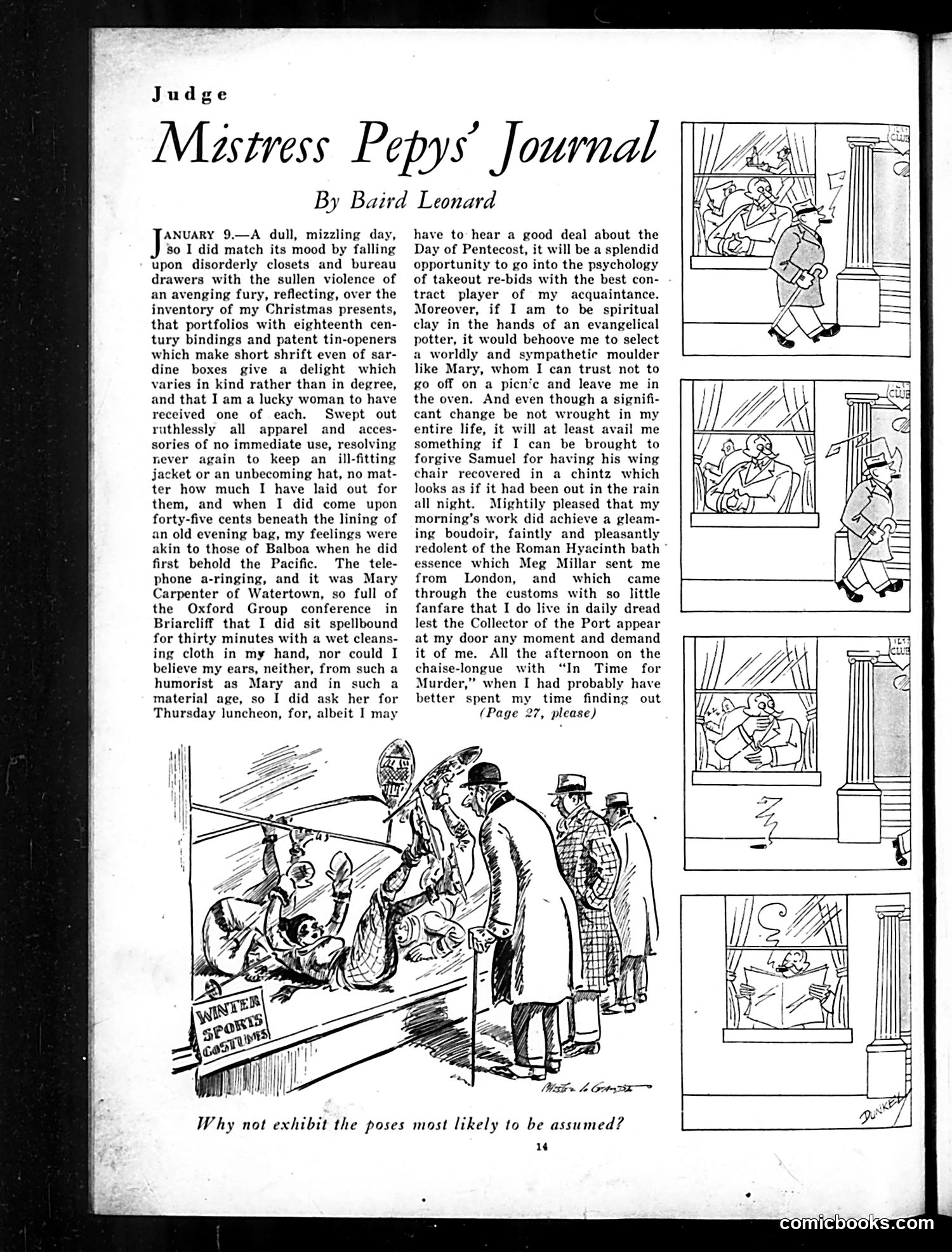
"Mistress Pepys' Journal" - A Parody of Domestic Life This is a humorous column mimicking Samuel Pepys' famous 17th-century diary, but written from a woman's perspective about mundane 1930s American domestic life. The narrator catalogs trivial domestic concerns: organizing closets, Christmas gifts (portfolios, tin-openers), an ill-fitting jacket, and finding forty-five cents in an old purse—which she compares dramatically to Balboa discovering the Pacific. The satire mocks both the pretentiousness of literary references (Balboa, the Oxford Group movement) applied to housewifely tasks, and the narrator's breathless social concerns: lunch with a "contract player," spiritual self-improvement, and forgiving her husband Samuel for reupholstering a chair in unflattering chintz. The accompanying comic strip (right side) appears to illustrate domestic scenes, reinforcing the theme of ordinary household situations treated with mock-heroic language. The bottom cartoon about winter sports poses remains unclear without additional context.
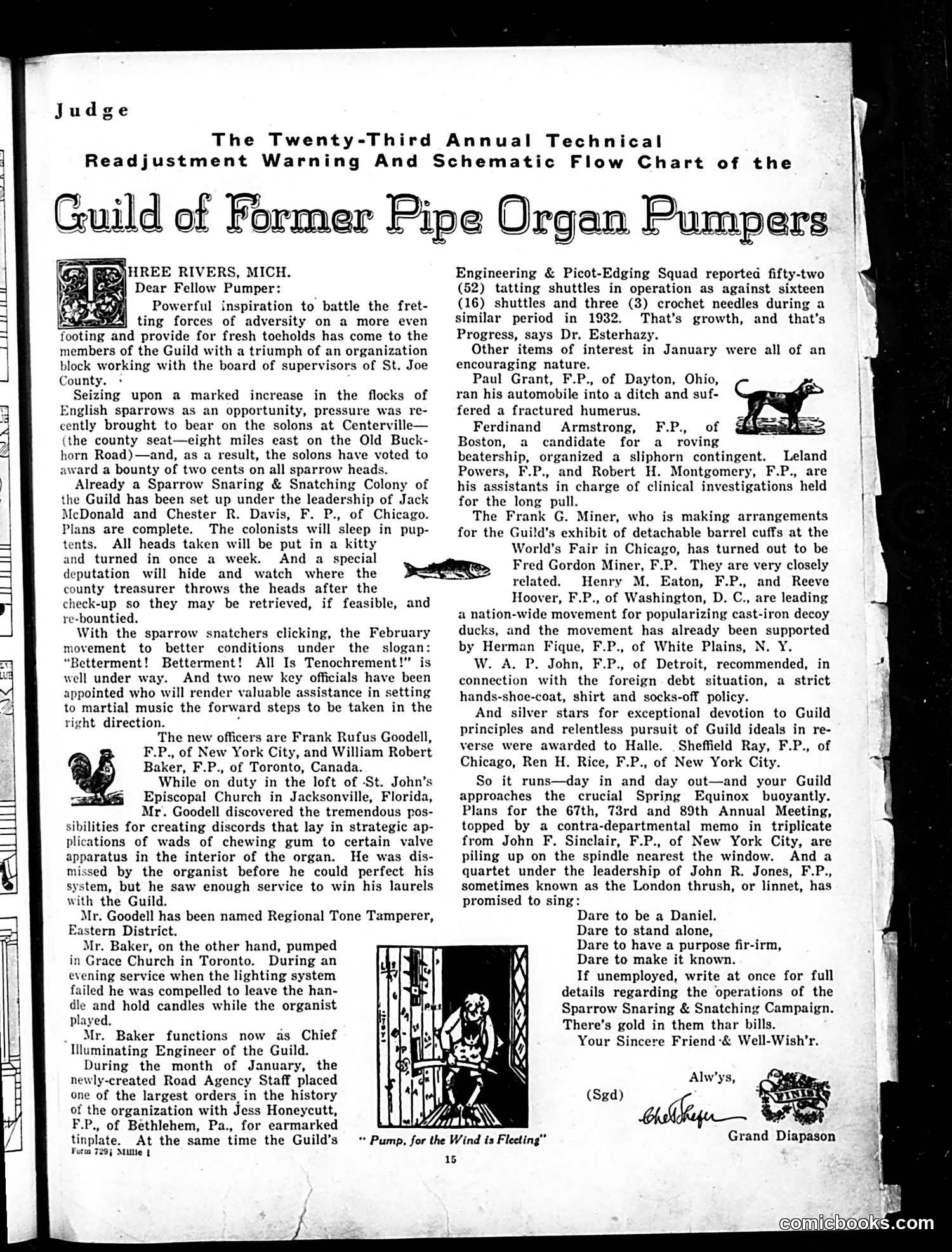
Judge Magazine Content Analysis This page is entirely devoted to satirizing the "Guild of Former Pipe Organ Pumpers"—a completely fictional organization created for comedic effect. The satire mocks bureaucratic absurdity, organizational formality, and corporate-speak. The humor relies on treating a trivial, obsolete job (manually pumping air into pipe organs before electric systems existed) as if it were a serious professional guild with ranks, departments, official committees, and grandiose initiatives. Key satirical elements include: creating imposing titles for ridiculous positions ("Regional Tone Tamperer," "Chief Illuminating Engineer"); presenting mundane activities in bureaucratic language ("Road Agency Staff"); fabricating detailed statistics about "tatting shuttles" and "crochet needles"; and describing absurd accomplishments (organizing sparrow-snatching colonies for a two-cent bounty, discovering organ-disruption techniques using chewing gum). The accompanying illustrations show figures in formal attire, reinforcing the mockery of excessive institutionalization. This is pure comedic social commentary on organizational pomposity, requiring no historical events to understand—only recognition that Judge Magazine enjoyed elaborate, nonsensical satire.
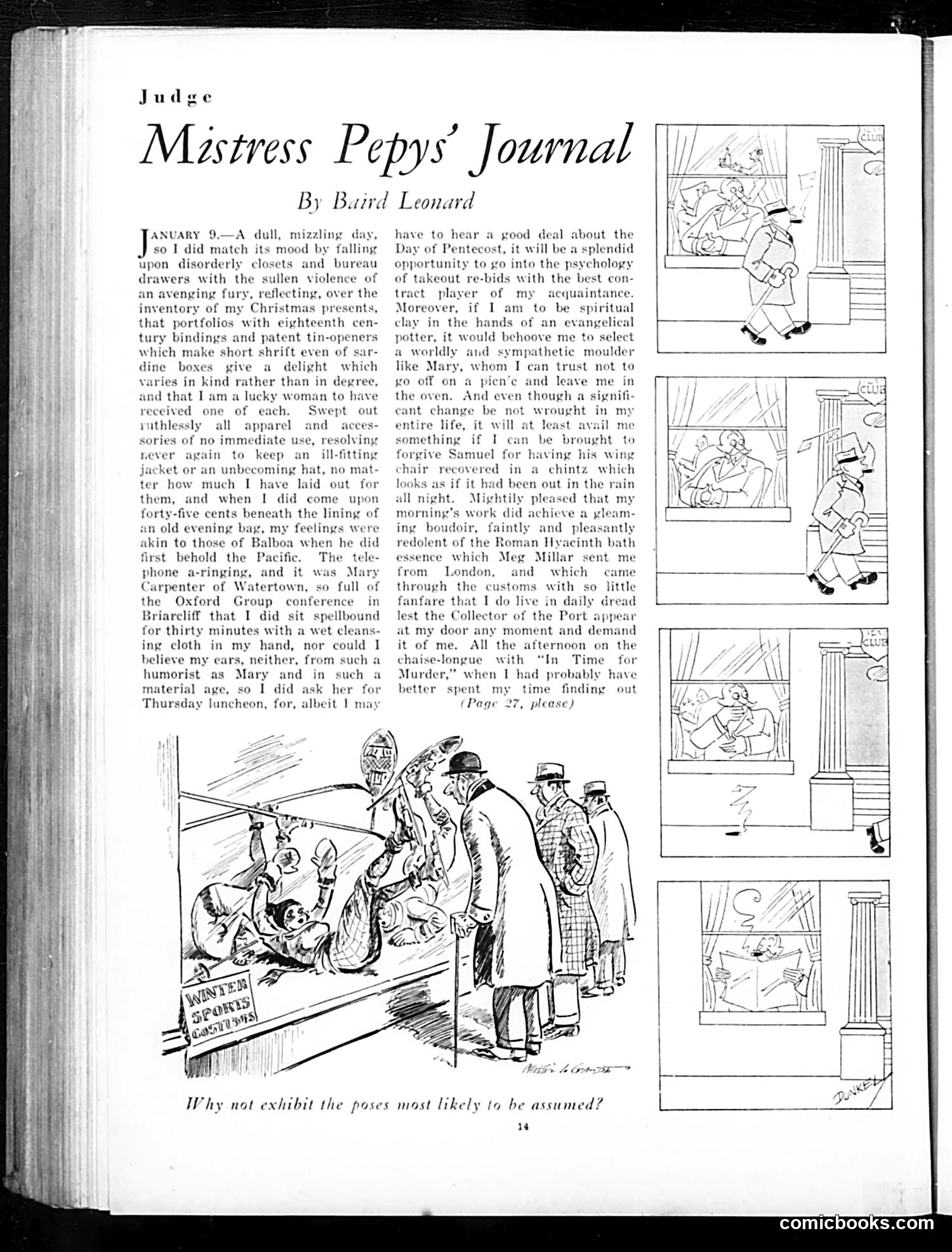
Analysis of "Mistress Pepys' Journal" This is a humorous column mimicking Samuel Pepys' famous 17th-century diary, but written from a woman's perspective in the 1920s-30s. The narrator details mundane domestic activities—organizing closets, Christmas gifts, a phone call about an Oxford Group religious conference—in deliberately grandiose, archaic language. The satire targets several things: the pretentiousness of adopting Pepys' ornate style for trivial modern concerns (finding forty-five cents, a bridge game, reupholstering a chair), and the social pretensions of upper-middle-class women involved in religious movements like the Oxford Group. The bottom cartoon, captioned "Why not exhibit the poses most likely to be assumed?", appears to mock people crowding around some kind of exhibition or public spectacle, likely satirizing fashionable social gatherings or evangelical meetings referenced in the text. The humor derives from the contrast between aspirational sophistication and actual mundane reality.
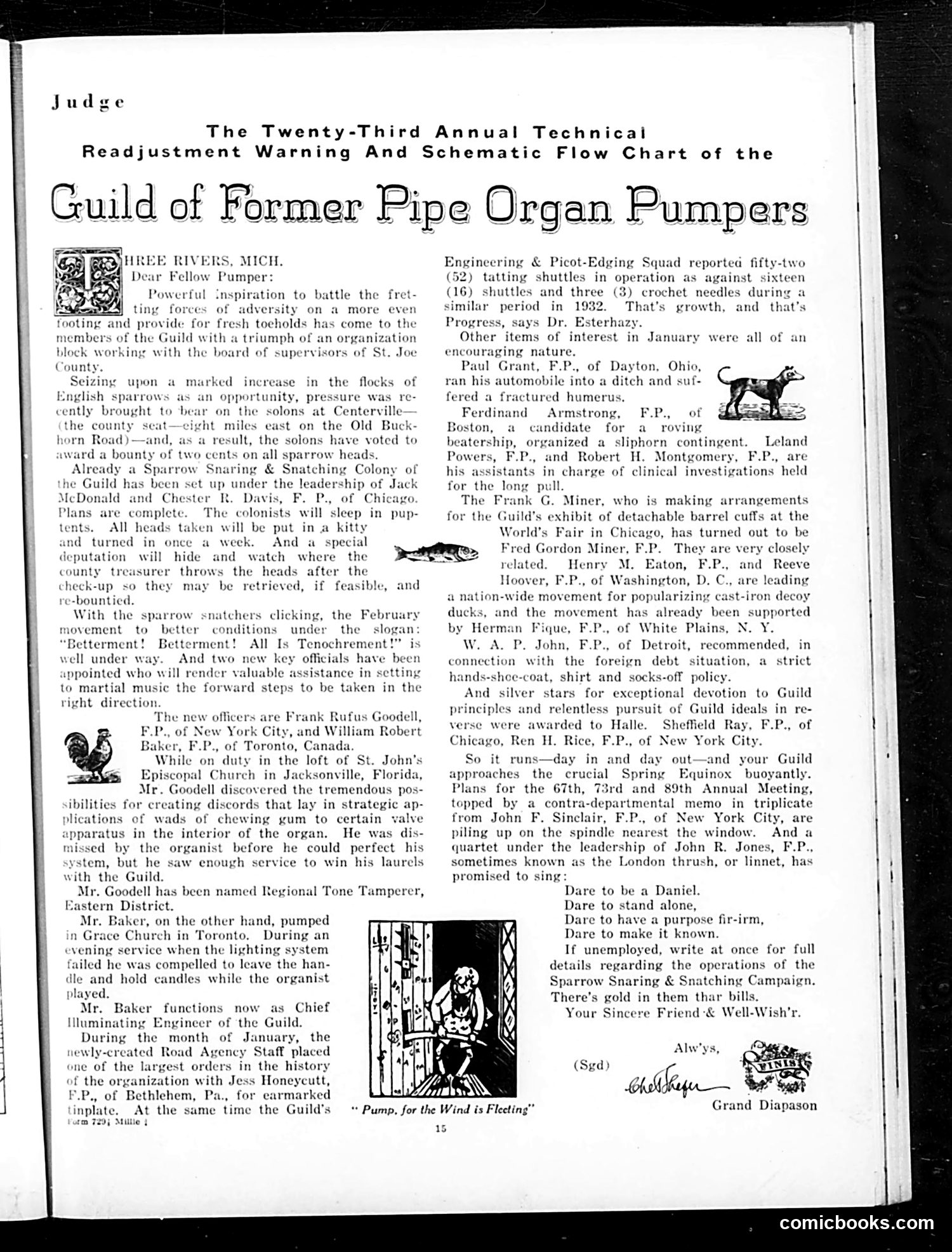
Judge Magazine Satire Analysis This page satirizes fraternal organizations and their self-important bureaucracy through the fictional "Guild of Former Pipe Organ Pumpers"—a deliberately absurd premise mocking groups that memorialize obsolete professions. The satire works on multiple levels: The Setup: The Guild solemnly reports on "technical readjustments" and organizational growth, using inflated language ("Regional Tone Tamperer," "Chief Illuminating Engineer") for trivial activities. The Joke: Members' "accomplishments" are ridiculous—one officer sabotaged an organ with chewing gum; another held candles during a blackout. These become credentials for prestigious Guild positions. The Cartoon (captioned "Pump, for the Wind is Fleeting") depicts an organ pumper at work, visually anchoring the mockery of treating this vanished job as worthy of elaborate organizational structure. The accompanying illustration of birds and hunting references the absurd sparrow-bounty campaign the Guild pursues. This lampooned the era's proliferation of fraternal organizations and civic clubs that often prioritized ceremony over substance—a recognizable target for Judge's satirical readership.
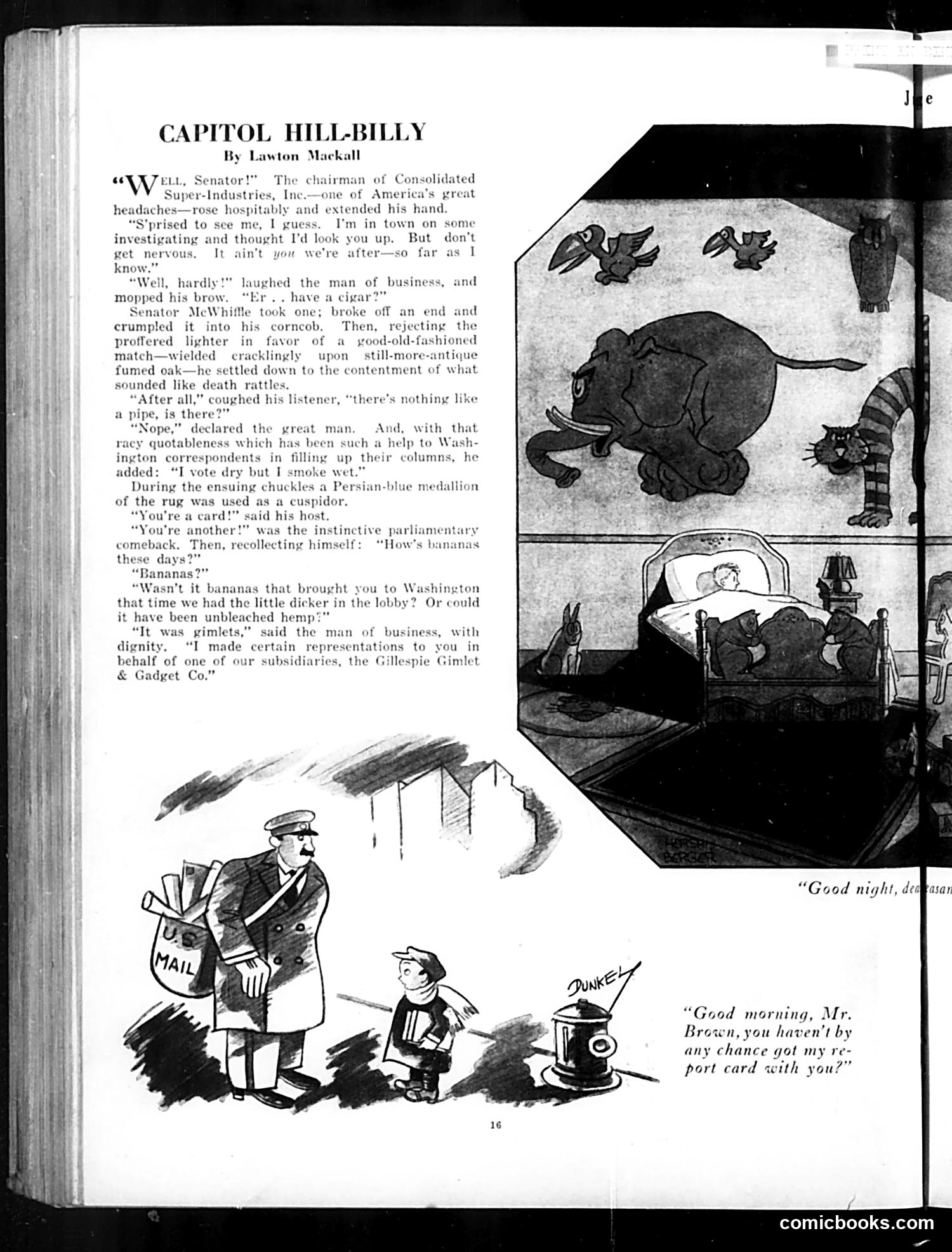
Capitol Hill-Billy: A Satire of Corporate Lobbying This story by Lawton Mackall satirizes the cozy relationship between wealthy industrialists and U.S. senators. The unnamed senator ("McWhiffle") represents a rural, folksy politician—note his corncob pipe and old-fashioned manners—while the businessman represents "Consolidated Super-Industries, Inc.," a corporate power with obvious political influence. The joke centers on their casual, friendly dynamic: the senator claims to be "investigating" but assures the businessman they're not after *him* specifically. They banter about past favors involving bananas, hemp, and gimlets (tools)—transparent euphemisms for bribery or quid-pro-quo arrangements. The bottom cartoon shows a child asking about a "report card," likely implying the senator should be graded poorly for his corrupt dealings. The satire exposes how openly senators and corporate interests collaborate, treating bribes as everyday social currency rather than serious crimes.
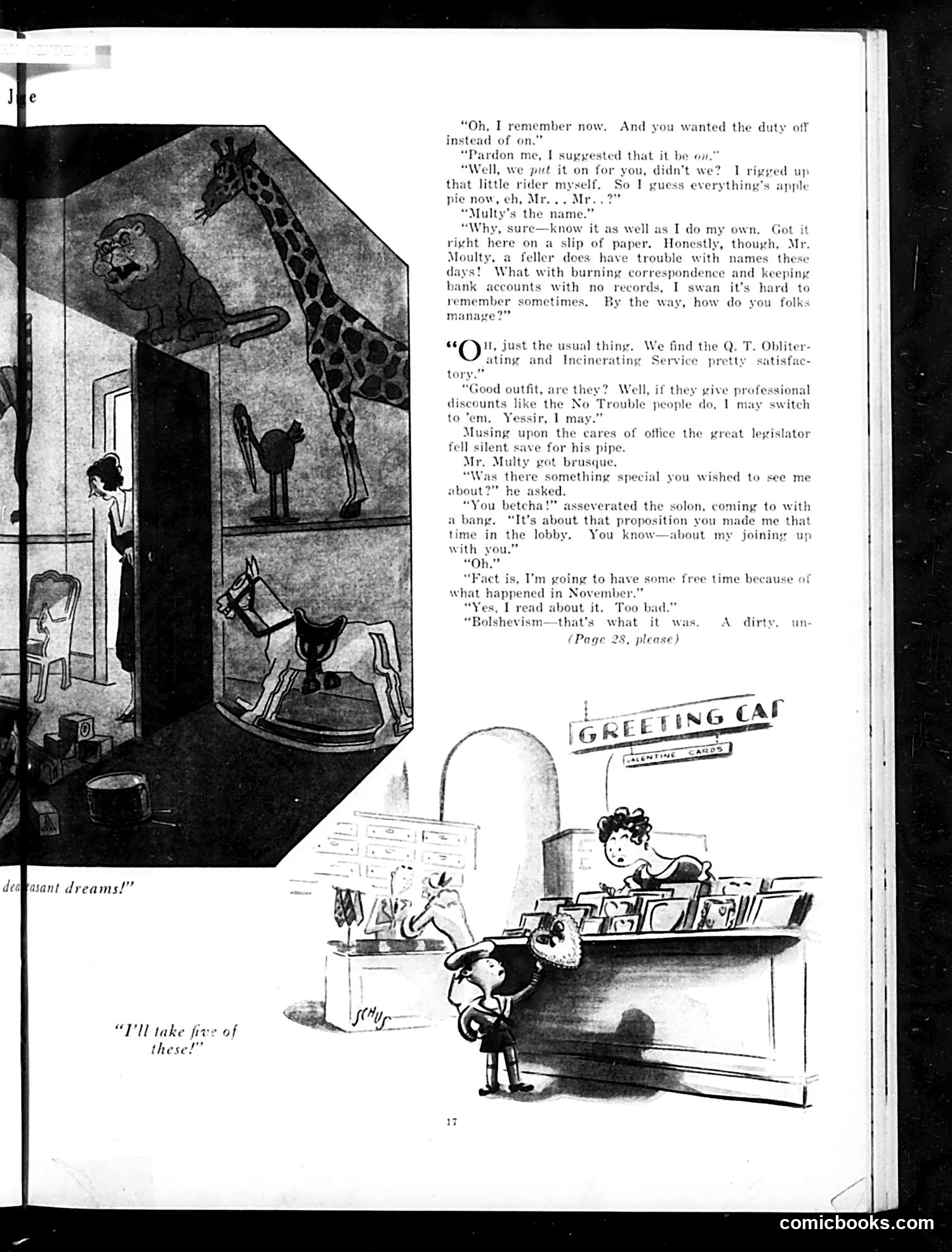
Political Satire Analysis This page depicts a conversation between a corrupt politician ("Mr. Multy") and an unnamed government official, likely satirizing early 20th-century American political corruption and backroom dealing. Key elements: - "Multy" appears to be a generic everyman politician, with the official openly admitting he doesn't remember his name despite keeping records - The discussion of duties (tariffs) being placed "on" or "off" suggests trade legislation manipulation - "Q.T. Obligating and Incinerating Service" is a fictional corrupt service for destroying records—a direct jab at politicians destroying correspondence to hide wrongdoing - References to "Bolshevism" and November events (unclear which November) suggest post-WWI anxieties about radical politics - The giraffe illustration (top left) appears unrelated or is an advertisement The satire targets systematic corruption: politicians casually destroying evidence, forgotten favors, and the machinery of political quid pro quo dressed in bureaucratic language.
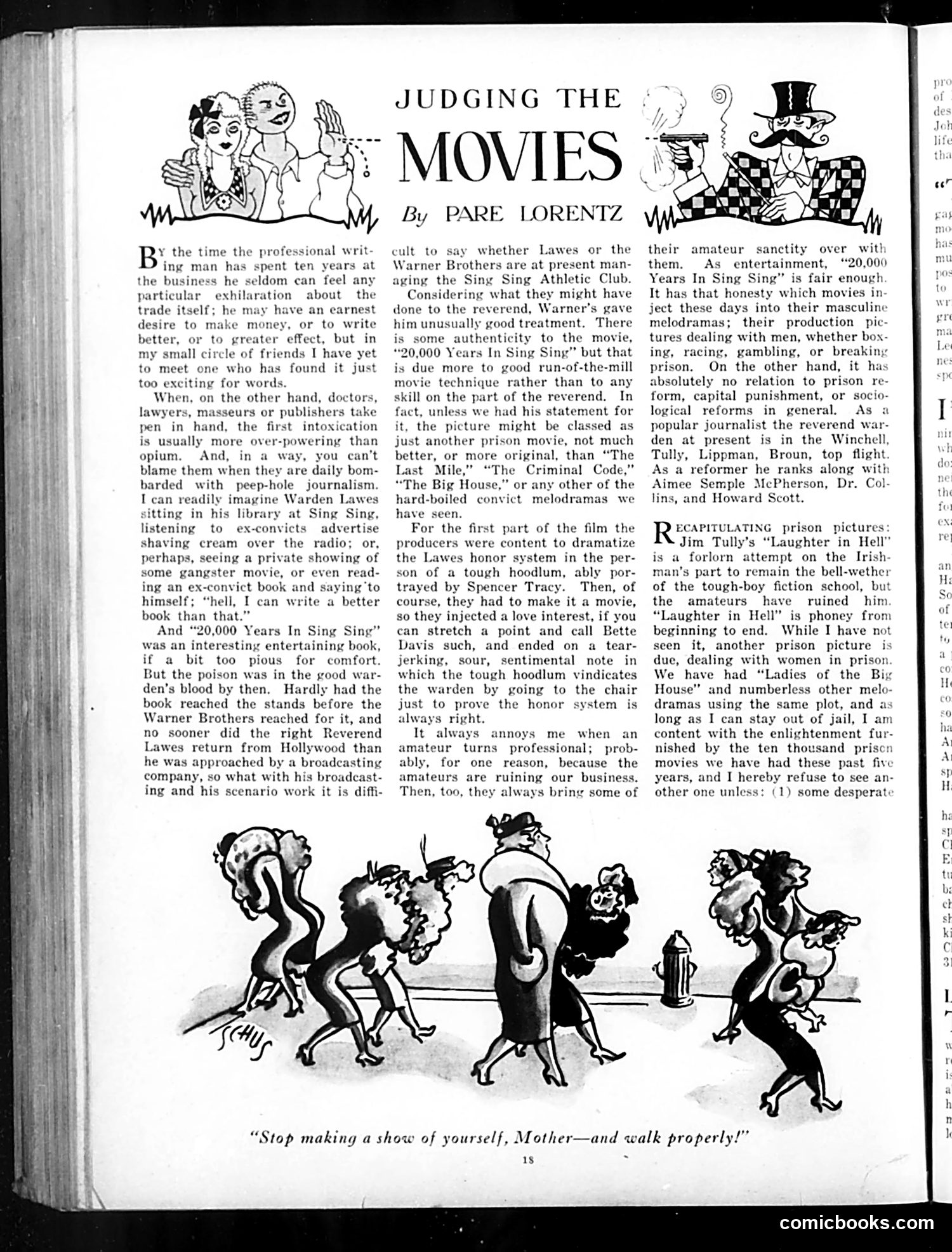
"Judging the Movies" by Pare Lorentz This film-criticism essay satirizes amateur writers who turn to screenwriting. Lorentz mocks Reverend Lewis Lawes, warden of Sing Sing prison, whose book "20,000 Years in Sing Sing" Warner Brothers adapted into a film. Though Lawes claimed reformist intentions, Lorentz argues the movie is merely standard prison melodrama—no more authentic than "The Big House" or "The Criminal Code." The satire targets Lawes' transformation from serious penal reformer into a celebrity broadcaster and scenario writer, suggesting he's abandoned genuine prison reform for showbiz publicity. Lorentz also criticizes the film's injection of sentimental love interest (with Bette Davis) and emotional resolution, which undermine authenticity for commercial appeal. The cartoon below illustrates this theme: figures engaged in exaggerated, undignified behavior—the visual joke mocking how serious subjects become absurd spectacle in movies.
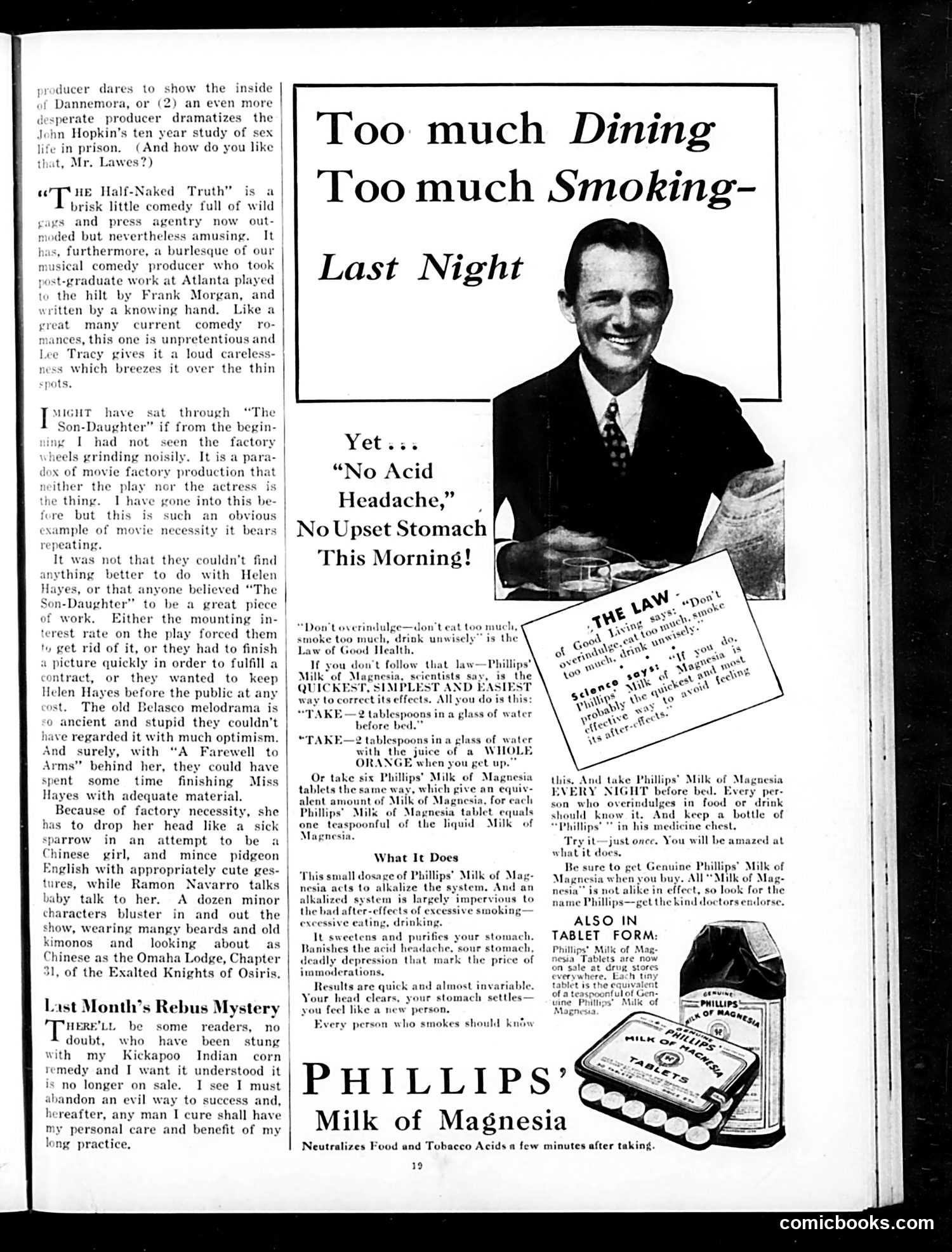
Analysis of This Judge Magazine Page This page is primarily a full-page advertisement for Phillips' Milk of Magnesia, disguised as editorial content with satirical framing. The top portion features a smiling man with text claiming "Too much Dining, Too much Smoking—Last Night" yet "No Acid Headache, No Upset Stomach This Morning!" This uses a relatable hangover scenario—a satirical jab at excess—to pitch the antacid product. The accompanying text includes mock "medical advice" presented as "The Law of Good Health," claiming Phillips' Milk of Magnesia corrects overindulgence in smoking, drinking, and eating. The dosage instructions ("2 tablespoons") are framed as a miraculous remedy. The satire: Judge magazine lampoons both over-indulgent 1920s behavior and patent medicine advertising that made dubious health claims. By presenting the ad within its editorial pages, the magazine satirizes how advertising infiltrates content while simultaneously profiting from it. The bottom section includes a separate complaint letter about a "Kickapoo Indian corn remedy"—another jab at fraudulent remedies—reinforcing the page's theme: American consumer gullibility toward miracle cure claims.
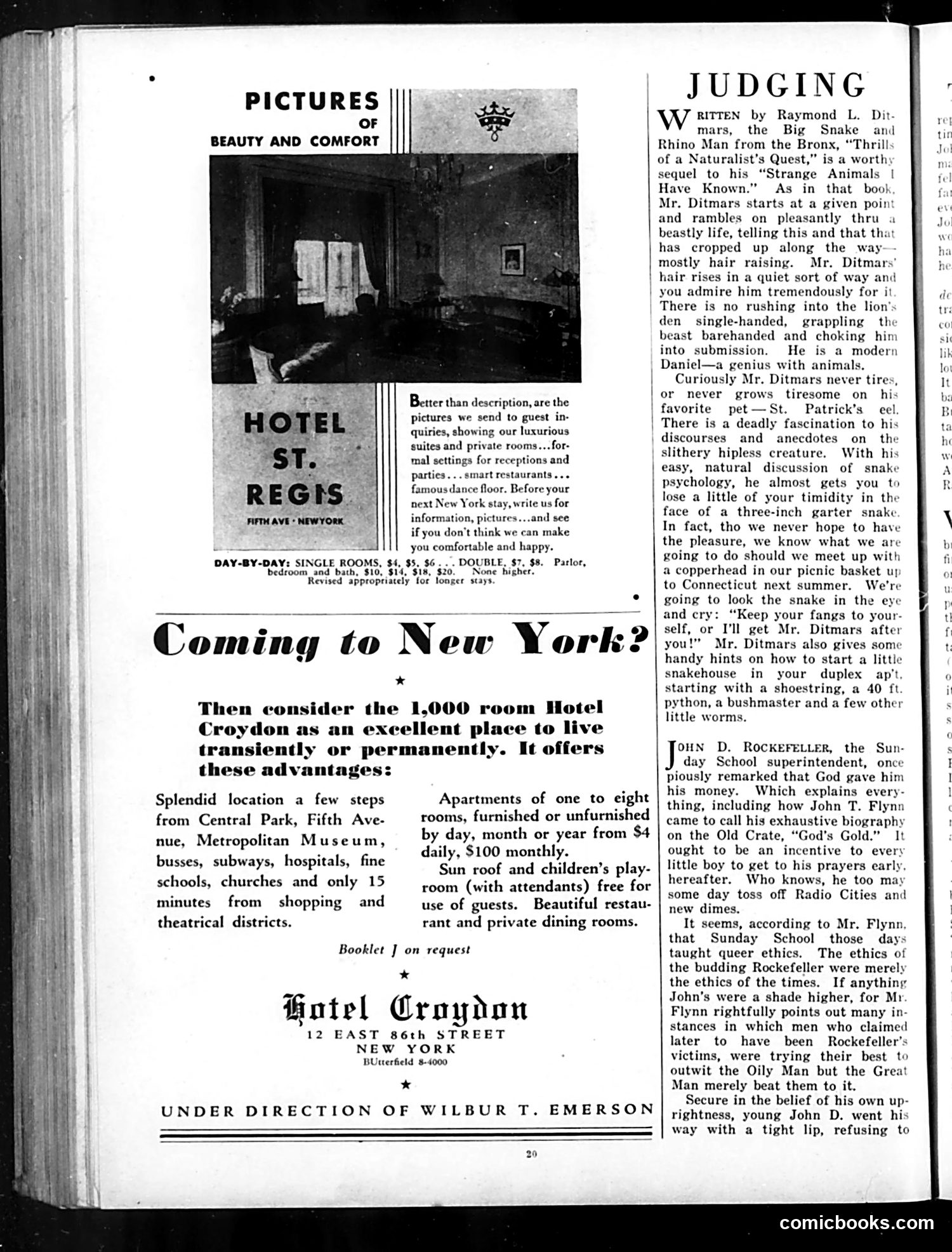
Analysis This page is primarily advertising for two New York hotels (Hotel St. Regis and Hotel Croydon), with a "Pictures of Beauty and Comfort" hotel spread. The right column contains book reviews under the heading "JUDGING": 1. Raymond L. Ditmars' "Thrills of a Naturalist's Quest" — a favorable review praising Ditmars as a "genius with animals" who writes engagingly about snakes (particularly eels) without sensationalism. The reviewer humorously suggests readers might gain confidence handling snakes after reading it. 2. John T. Flynn's biography "God's Gold" about John D. Rockefeller — This review is satirical. It mocks Rockefeller's claim that "God gave him his money" and criticizes the "queer ethics" taught in his Sunday School era. The reviewer suggests Rockefeller's wealthy competitors were often trying to cheat him, so Rockefeller merely "beat them to it" — implying he succeeded through superior cunning rather than divine favor or ethical superiority. The Rockefeller review is the page's actual satirical content, using a book review to critique Gilded Age robber baron ethics and the hypocrisy of religious justification for wealth accumulation.
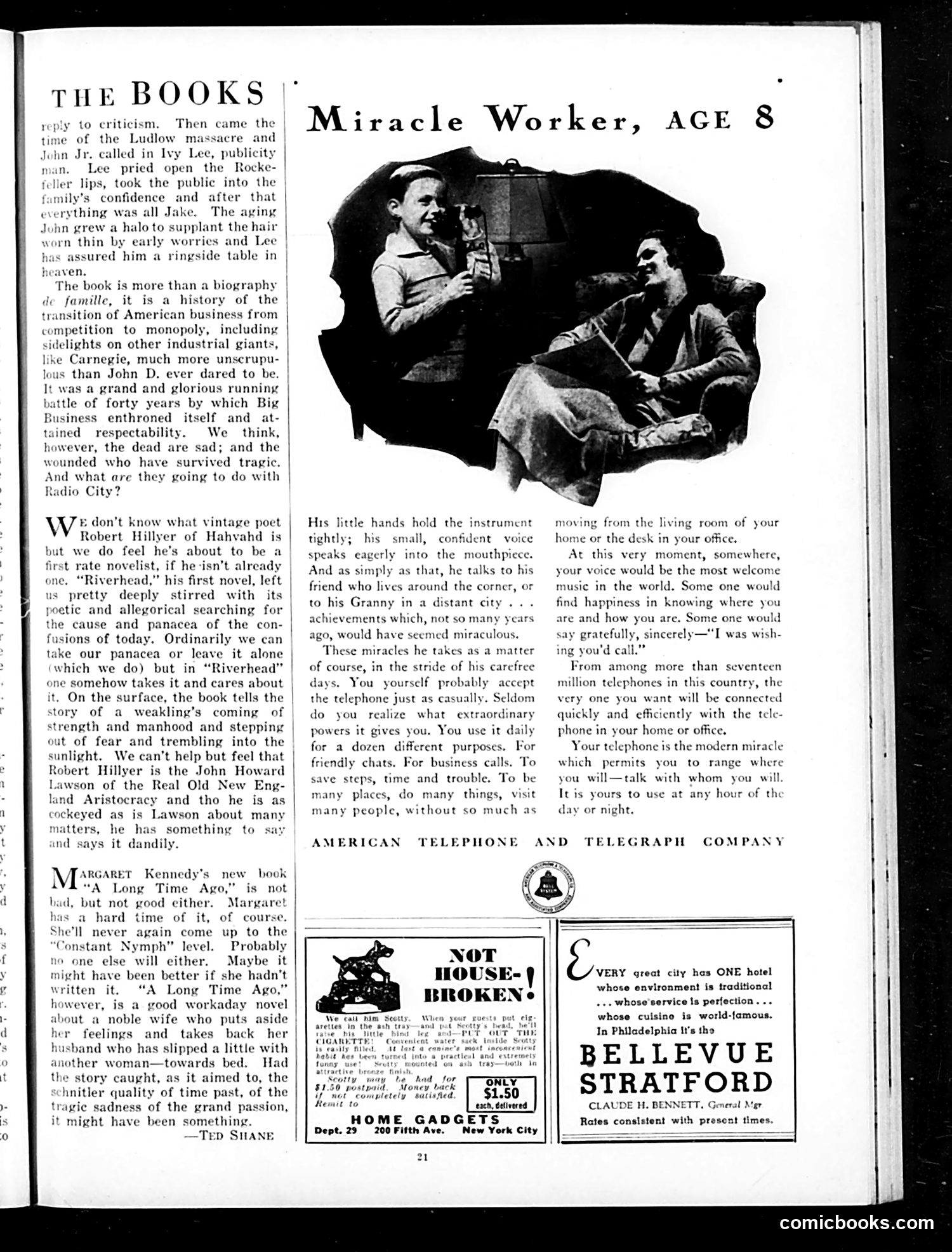
Analysis of Judge Magazine Page This page contains book reviews and advertisements rather than political cartoons. The main content discusses three literary works: a biography of John D. Rockefeller (addressing his reputation damage from the Ludlow Massacre and his PR rehabilitation by Ivy Lee), Robert Hillyer's novel "Riverhead," and Margaret Kennedy's "A Long Time Ago." The significant visual element is a photograph labeled "Miracle Worker, Age 8" showing a child using a telephone—part of an American Telephone and Telegraph Company advertisement celebrating how ordinary the telephone has become for young people. The ad emphasizes the technology's accessibility and life-changing utility. The page also includes period advertisements for "Home Gadgets" and the Bellevue Stratford hotel. This appears to be from the 1930s based on style and references. The content reflects contemporary debates about industrial monopolies, modern literature, and technological progress rather than partisan politics.
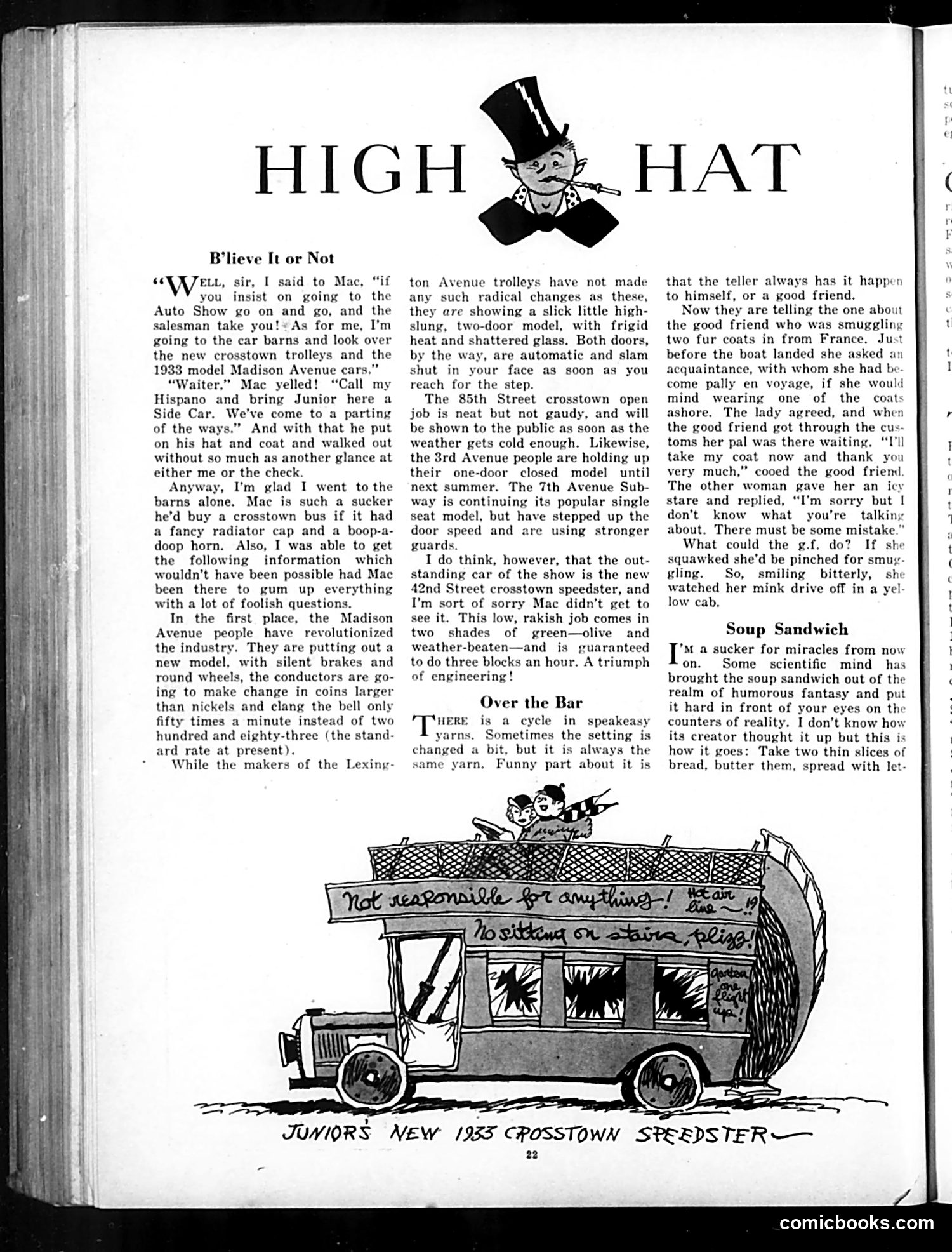
Analysis: "HIGH HAT" Page from Judge Magazine This page contains satirical commentary on 1930s New York City transportation and urban life, presented through humor pieces rather than political cartoons. "B'lieve It or Not" Section: A narrator boasts about visiting trolley car barns instead of an auto show, claiming the new Madison Avenue and crosstown trolley models represent revolutionary design. The satire mocks the mundane reality of public transit—describing features like "silent brakes," automatic doors that "slam shut in your face," and a 42nd Street "speedster" that manages "three blocks an hour." The joke is that New York's trolley system is being discussed with the same breathless enthusiasm typically reserved for luxury automobiles, highlighting the gap between ordinary urban transportation and glamorous consumer goods. "Over the Bar" and "Soup Sandwich" Sections: Brief humorous anecdotes: one about smuggling fur coats through customs (referencing Prohibition-era concerns), another celebrating an invention of soup sandwiches. The cartoon illustration depicts the fictional "1953 Crosstown Speedster" trolley as an absurdly ramshackle vehicle, reinforcing the satirical point about mundane transit being promoted as exciting innovation.
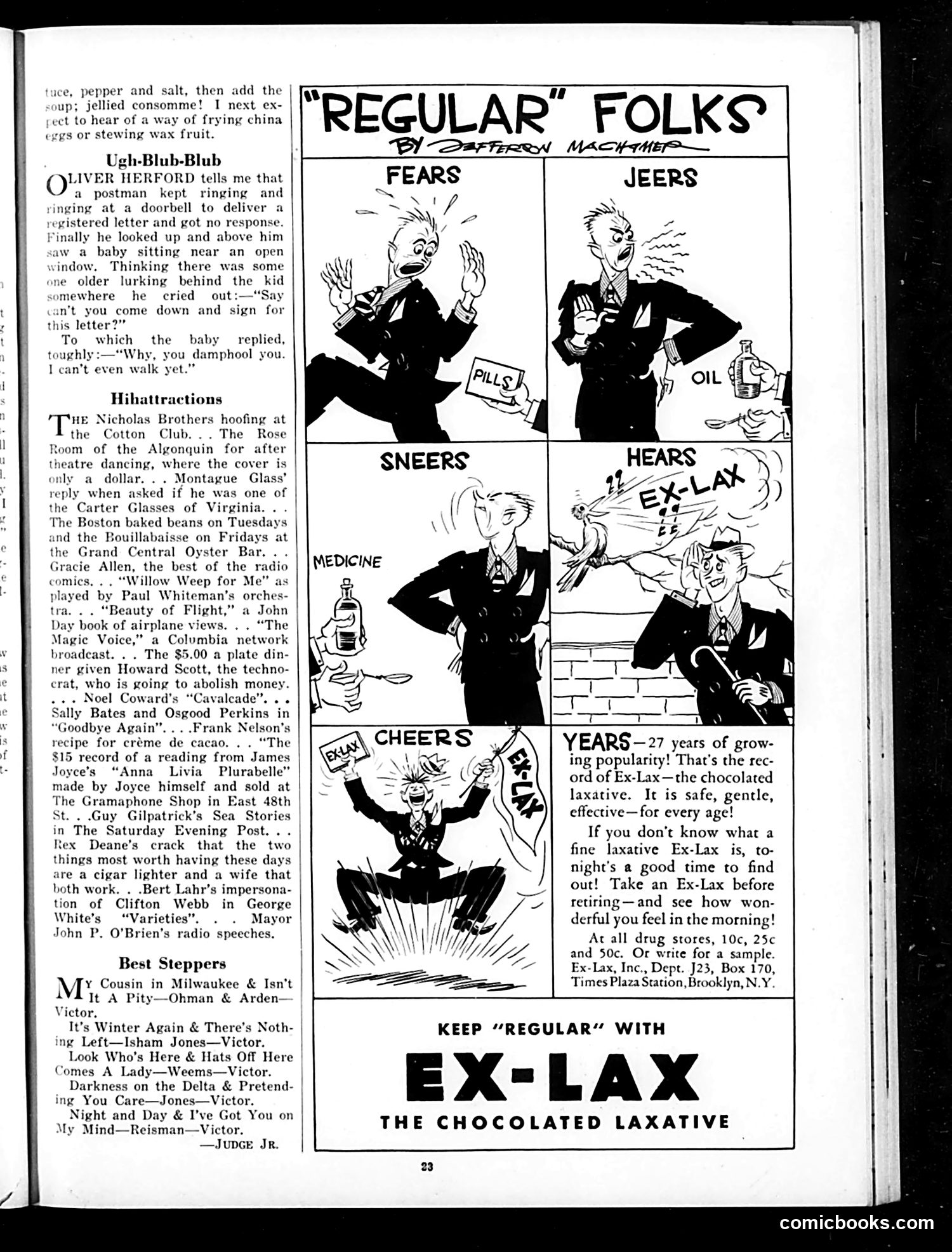
"Regular" Folks: A 1930s Satirical Comic Strip This page features a four-panel comic strip by Darterson Mackhimer satirizing common personality types through exaggerated reactions. Each panel pairs a human "type" with their characteristic response: - Fears (anxious person clutching pills) - Jeers (cynic with alcohol) - Sneers (condescending person with medicine) - Hears (gossip/eavesdropper caught spreading rumors marked "EX-LAK") The cartoon mocks how different personalities handle stress and information. The humor relies on visual caricature and broad stereotyping typical of 1930s comic culture. The strip functions primarily as a vehicle for an Ex-Lax laxative advertisement—a chocolated digestive aid. The final panel explicitly pivots to advertising copy, suggesting the comic was designed to promote the product while entertaining readers with social commentary on human nature and anxieties. This blending of entertainment and advertising was standard in mid-century American magazines.
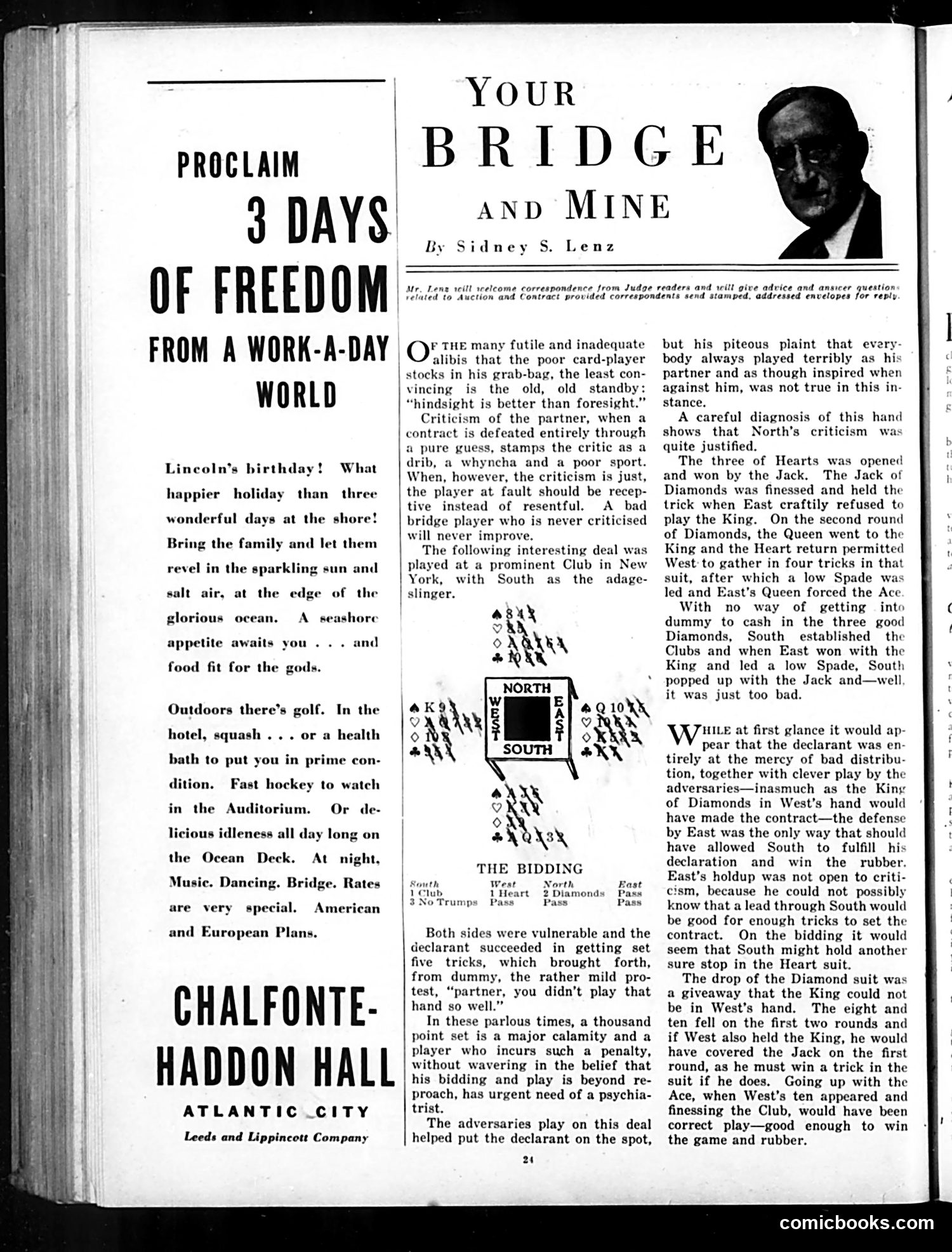
Judge Magazine Bridge Column Analysis This page contains a bridge card game instructional article by Sidney S. Lenz, a prominent bridge expert, alongside vacation advertising. The article analyzes a specific bridge hand played at a New York club where South (the "adage-slinger"—a dismissive term) bid ambitiously but failed by five tricks, a catastrophic loss. When dummy criticized the poor play, South defensively blamed bad luck and claimed everyone plays badly as his partner but brilliantly against him. The satire's point: Lenz uses this hand to demonstrate that South's complaints were unjustified—North's criticism was actually correct. The article teaches readers that bad bridge players never improve unless they accept valid criticism gracefully rather than making excuses. The "piteous plaint" (whining complaint) about partner incompetence while blaming adversarial luck is exposed as the refuge of an ego-defensive, improving player. This combines bridge instruction with social satire about accepting responsibility—a common Judge magazine approach mixing practical advice with gentle mockery of human failings.
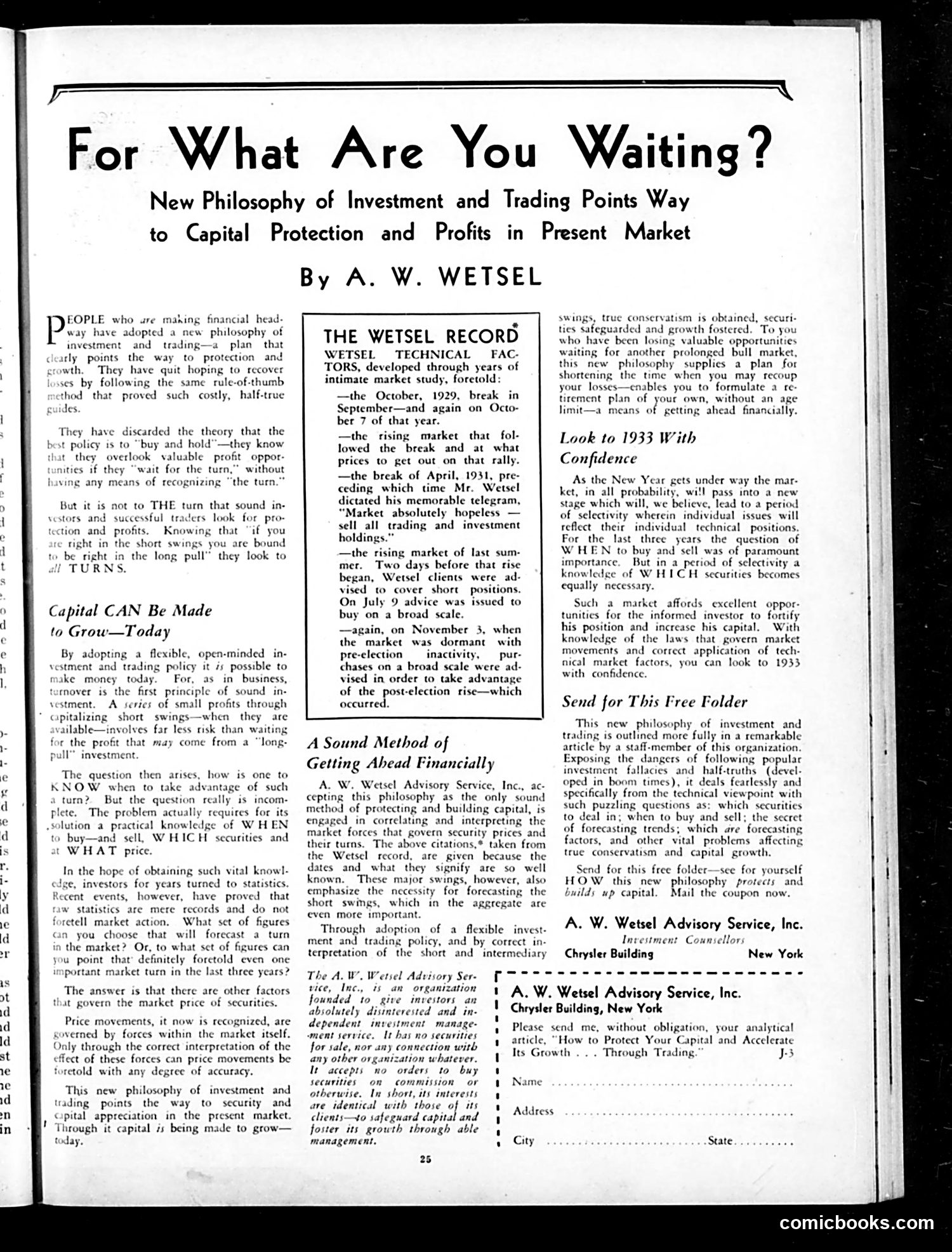
Analysis for Modern Readers This page is primarily advertising, not satire. It presents A. W. Wetsel's investment advisory service, which claims to predict stock market movements through technical analysis. The historical context: Published during the Great Depression era (references to 1929 crash, 1931 break), this represents the emerging "technical analysis" movement—the belief that past price patterns could forecast future market movements. The pitch promises investors can make money through frequent "short swings" rather than buy-and-hold strategies, and claims Wetsel's "Technical Factors" successfully predicted major market turns (October 1929, April 1931, July 1932, November 1932). Modern relevance: This is a historical example of market-timing claims that resurface regularly. The copywriting emphasizes past "hits" while ignoring misses—a common pattern in investment promotion then and now. The service promised scientific precision about inherently unpredictable markets, reflecting Depression-era desperation for financial certainty. The accompanying coupon invites readers to request a free folder explaining this "philosophy."
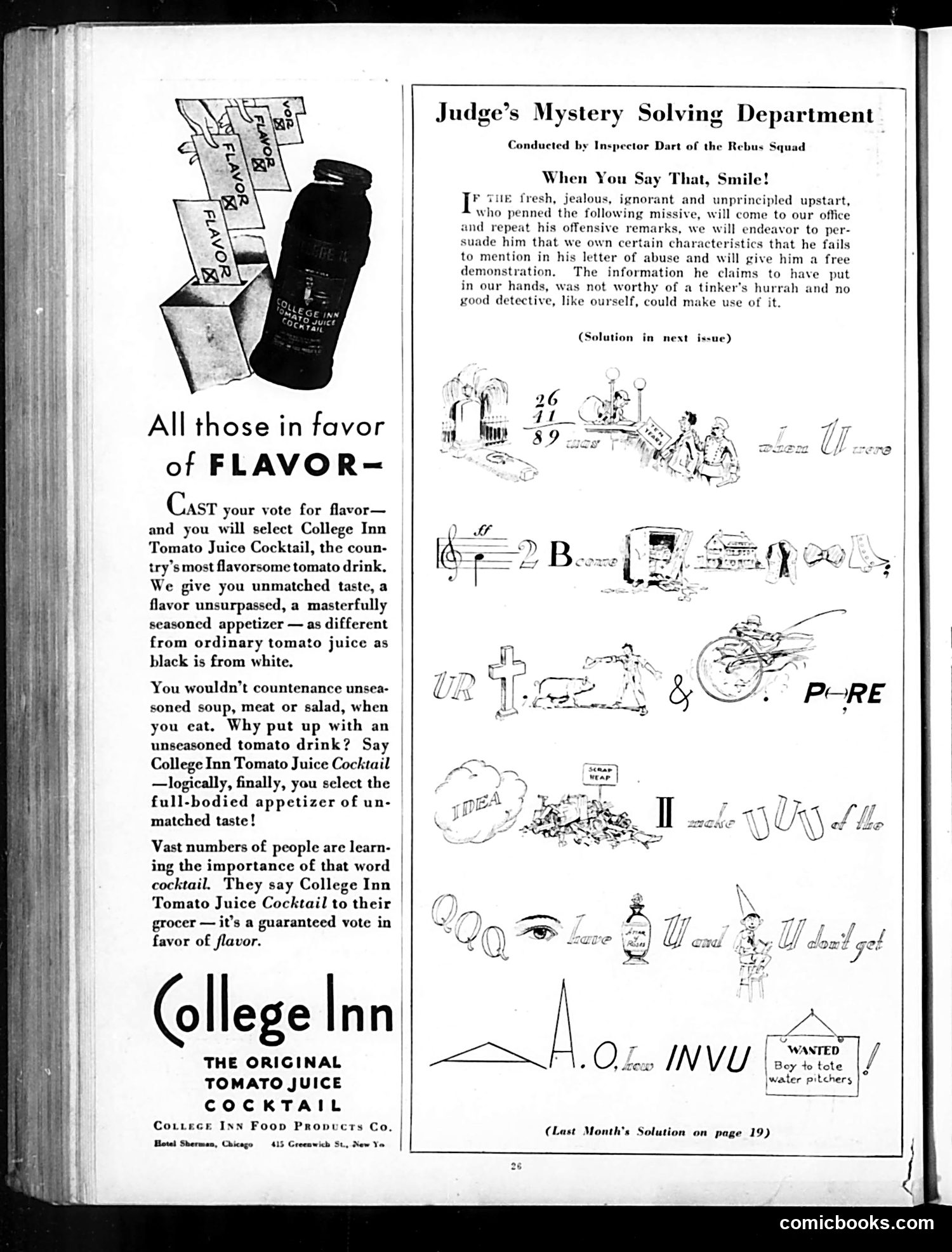
Judge Magazine Page Analysis This page contains two distinct elements: Left side: A College Inn Tomato Juice Cocktail advertisement using a voting metaphor ("Cast your vote for flavor"). The ad emphasizes the product's superior seasoning compared to plain tomato juice, appealing to consumers' logic and taste preferences. The bottle and leaflets shown suggest promotional materials. Right side: Judge's "Mystery Solving Department," a rebus puzzle feature conducted by "Inspector Dart." The opening section appears to be a sarcastic editorial response to a critical letter from a reader—the magazine defends itself against an "ignorant and unprincipled upstart" who sent complaints, dismissing his claims as worthless. Below that is a visual rebus puzzle (numbered sequences with illustrations and text fragments) designed for readers to solve, with the solution promised in the next issue. This page primarily showcases advertising alongside the magazine's regular puzzle feature, which was a popular entertainment format of the era.
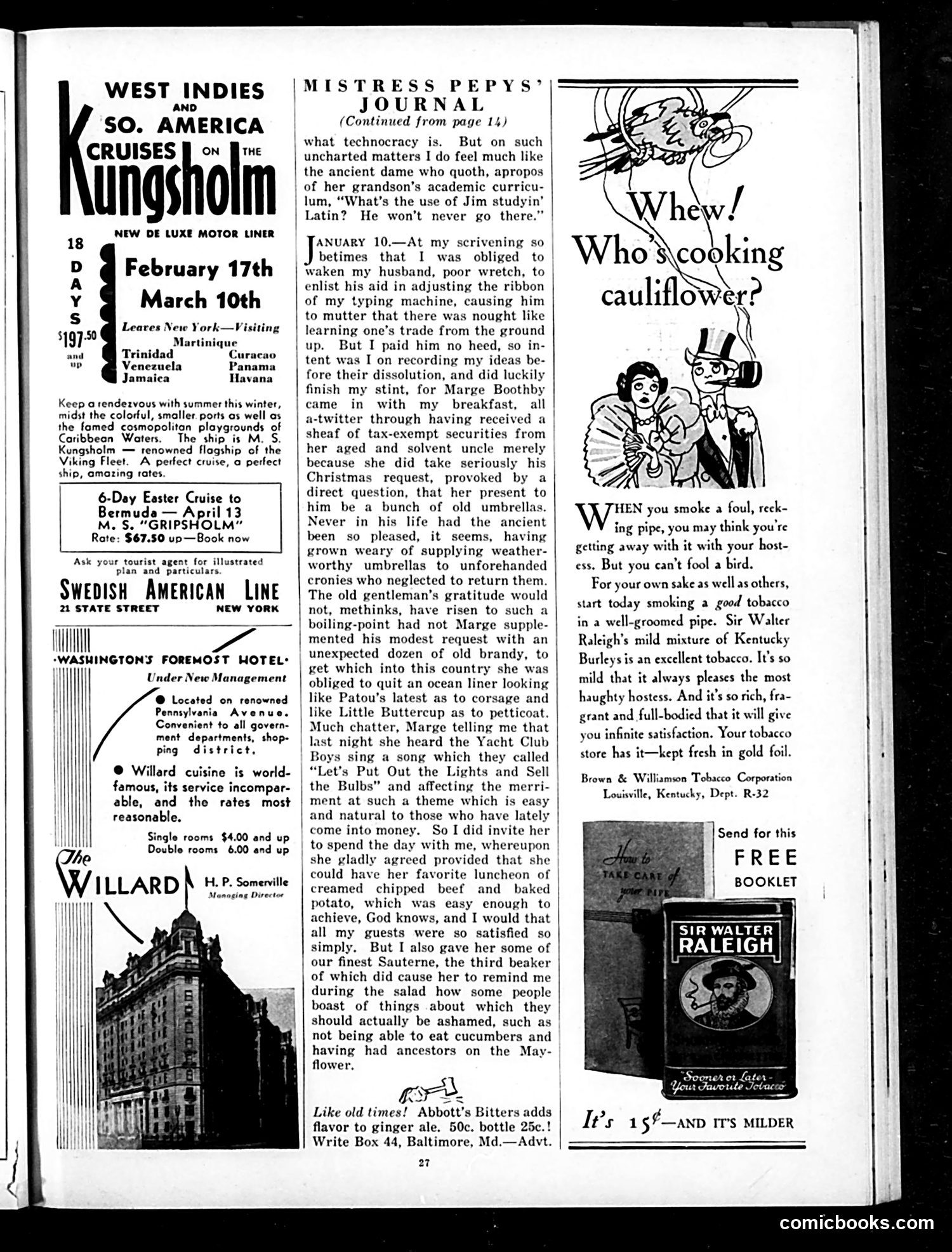
Analysis of Judge Magazine Page Content This page is primarily advertising and serialized humor columns rather than political cartoons. The main content is "Mistress Pepys' Journal," a humor column mimicking Samuel Pepys's diary style. It satirizes 1920s-30s upper-class social pretensions: a character named Marge receives old umbrellas and brandy as gifts (the latter requiring elaborate smuggling during Prohibition), which delights her uncle. The column mocks people who boast about ancestry (Mayflower references) while being unable to eat basic vegetables. The page includes travel advertisements (Caribbean cruises via Swedish American Line, Kungsholm ship) and hotel ads (The Willard in Washington D.C.), typical of Judge's revenue model. A small cartoon titled "Who's cooking cauliflower?" appears to be a domestic humor joke about smoking pipes indoors, suggesting guests can't hide bad pipe smoke from their hostess—social embarrassment humor common to the era. The "Sir Walter Raleigh" tobacco advertisement emphasizes pipe tobacco quality and masculinity, standard for period advertising.
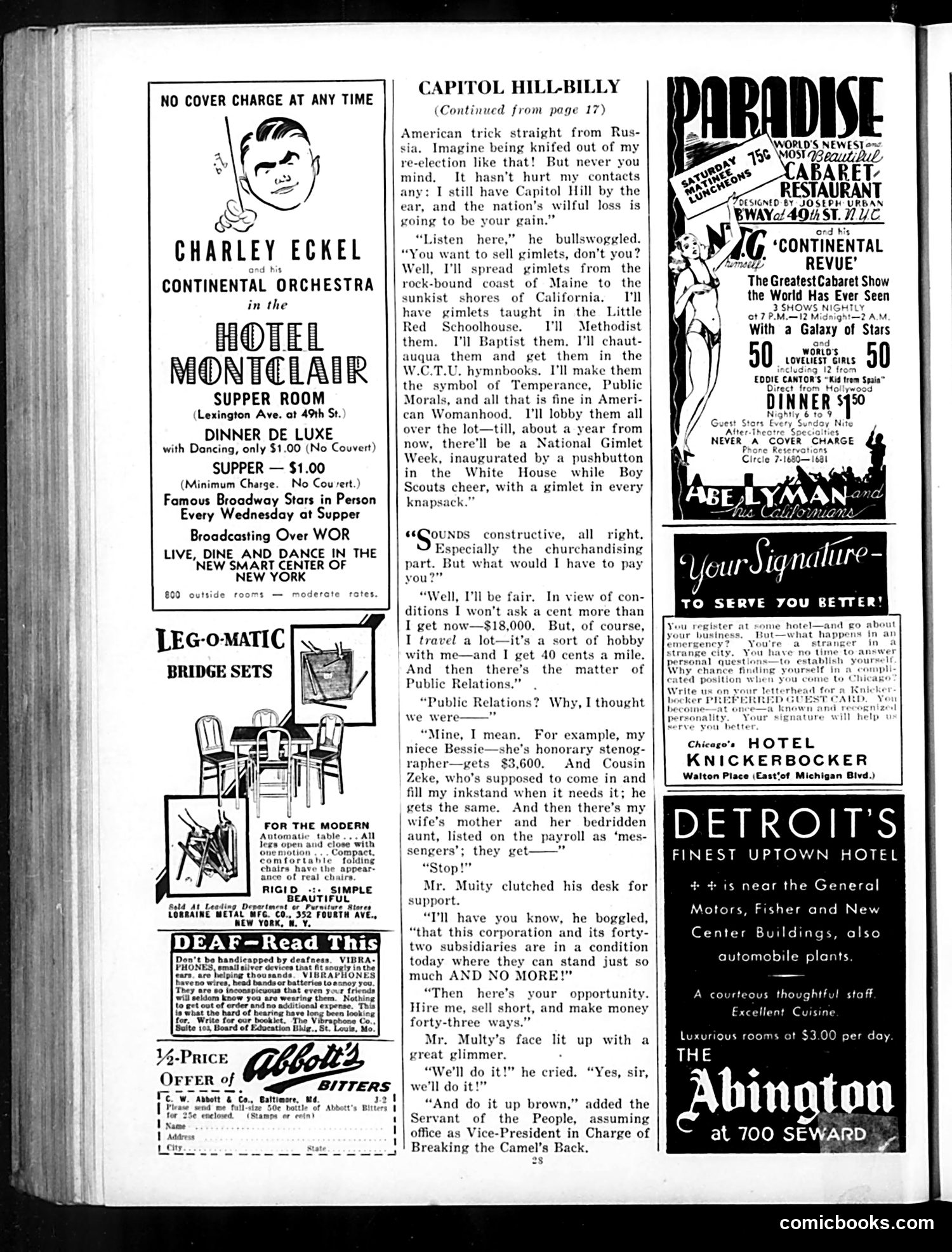
Analysis of Judge Magazine Page This page is primarily advertisements and commercial content with one substantial satirical narrative: "Capitol Hill-Billy" (continued from page 17). The main satire depicts a corrupt political/business exchange. A lobbyist ("Capitol Hill-Billy") attempts to bribe a corporate executive (Mr. Multy) by promising to promote "gimlets" (likely a temperance-era product or metaphor) through manipulative means—schools, churches, Boy Scouts, and a fabricated "National Gimlet Week." The executive counters by listing inflated expenses: an $18,000 salary, travel reimbursements, plus phantom payroll entries (his wife's mother, a bedridden aunt listed as "messengers"). The satire mocks both figures: the lobbyist's cynical merchandising of fake grassroots support, and the executive's casual corporate fraud. The punchline—hiring the lobbyist to "make money forty-three ways"—suggests the corporation will exploit every possible angle for profit. This reflects 1920s-30s anxieties about corporate corruption, lobbying manipulation, and phony public relations campaigns.
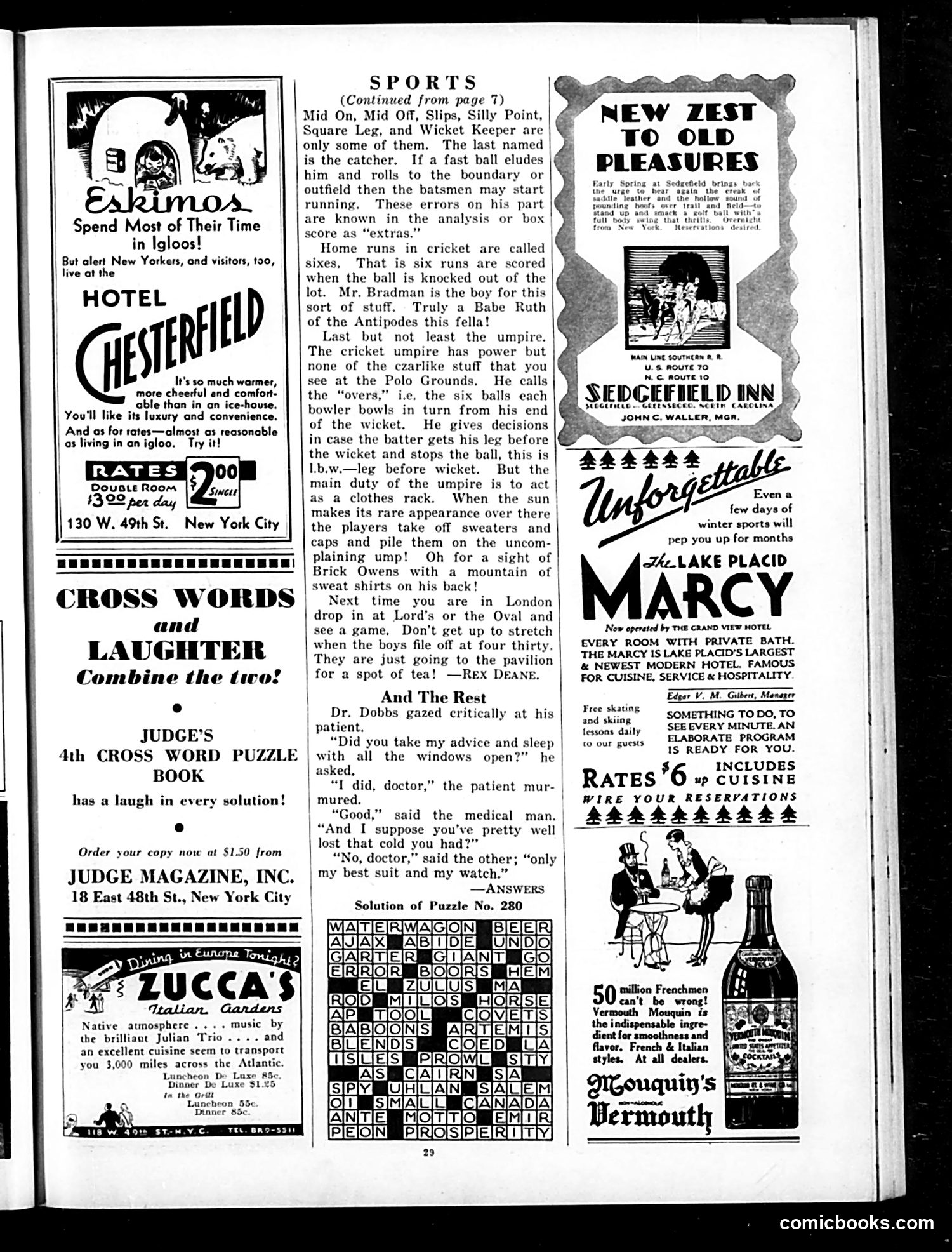
Judge Magazine Page Analysis This page is primarily advertising and filler content rather than political satire. The main elements include: "Eskimos" Hotel Advertisement: A dated ethnic stereotype ad depicting Indigenous peoples as living in igloos, used to humorously promote the Hotel Chesterfield as warmer than ice-houses. This reflects early 20th-century casual racism in American advertising. Sports Column: A cricket primer explaining British cricket terminology (wicket keeper, "sixes," l.b.w.) to American readers unfamiliar with the sport. It references Australian cricket star Don Bradman and compares cricket umpires unfavorably to American baseball umpires. Doctor Joke: A mild pun about a patient losing a cold but also losing his best suit and watch—suggesting financial hardship from medical bills. Crossword & Restaurant Ads: The page concludes with promotional material for Judge's puzzle book, Zucca's Italian restaurant, and various resort advertisements (Marcy Hotel, Sedgefield Inn, Unforgettable Lake Placid). The page contains no significant political commentary—it's typical mid-century magazine padding mixing light humor with commercial content.
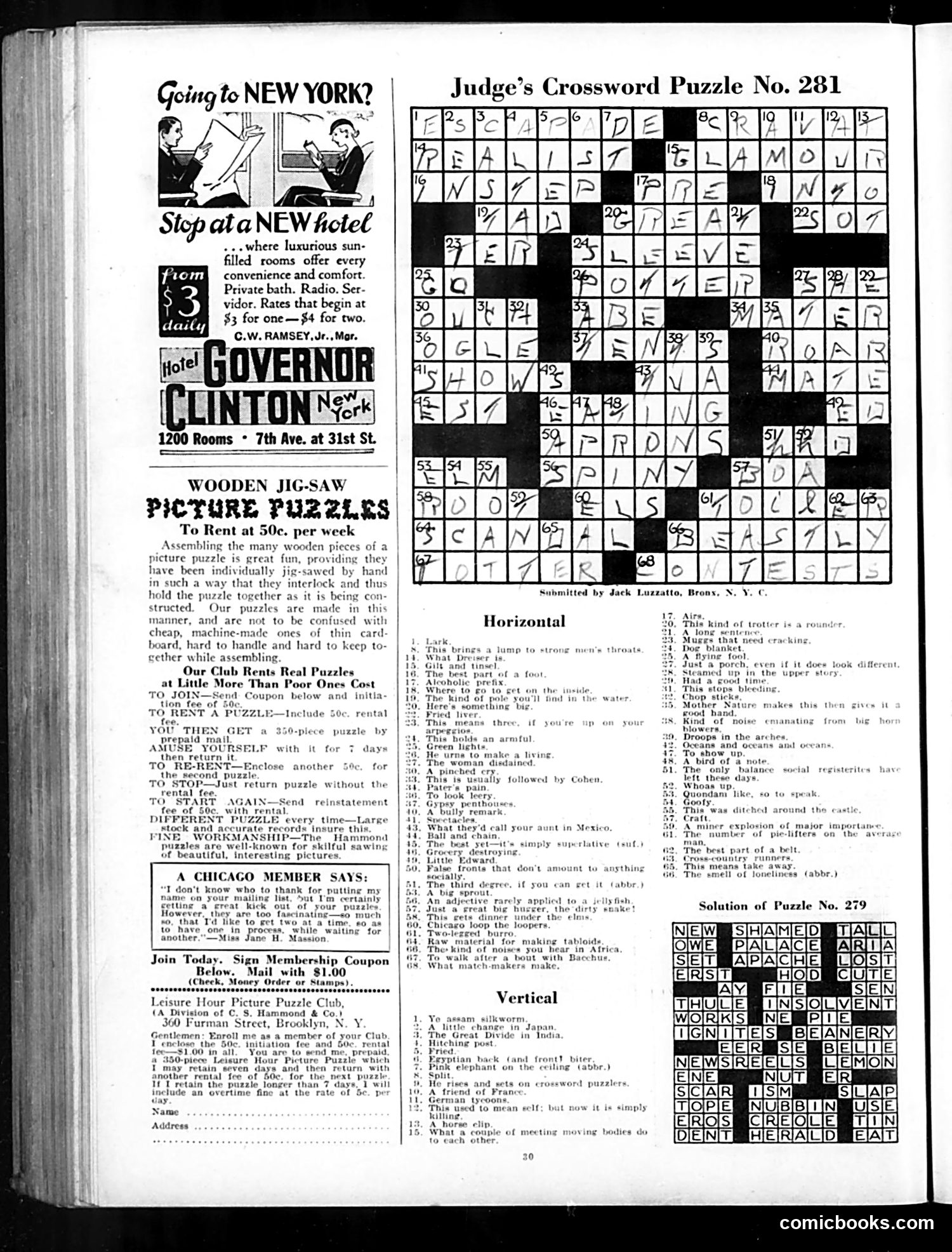
Judge Magazine Page Analysis This page is primarily advertising and service content, not political satire. It contains: 1. Hotel Governor Clinton ad — promoting a New York hotel with 1,200 rooms at 7th Avenue and 31st Street, rates starting at $3/night. This is straightforward commercial advertising typical of the era. 2. Wooden Jig-Saw Picture Puzzles rental service — advertising puzzle rentals at 50¢/week from a "Picture Puzzle Club." The text emphasizes their puzzles are hand-sawed wood (superior to cheap cardboard competitors) and explains the rental subscription model. 3. Crossword puzzle No. 281 — a full crossword grid with clues, plus the solution to puzzle No. 279. 4. Leisure Hour Picture Puzzle Club membership coupon — inviting readers to join for $1.00. There is no political cartoon or satirical commentary visible on this page. It appears to be a standard advertising and games page from Judge magazine, likely from the 1920s-30s based on the aesthetic and pricing.
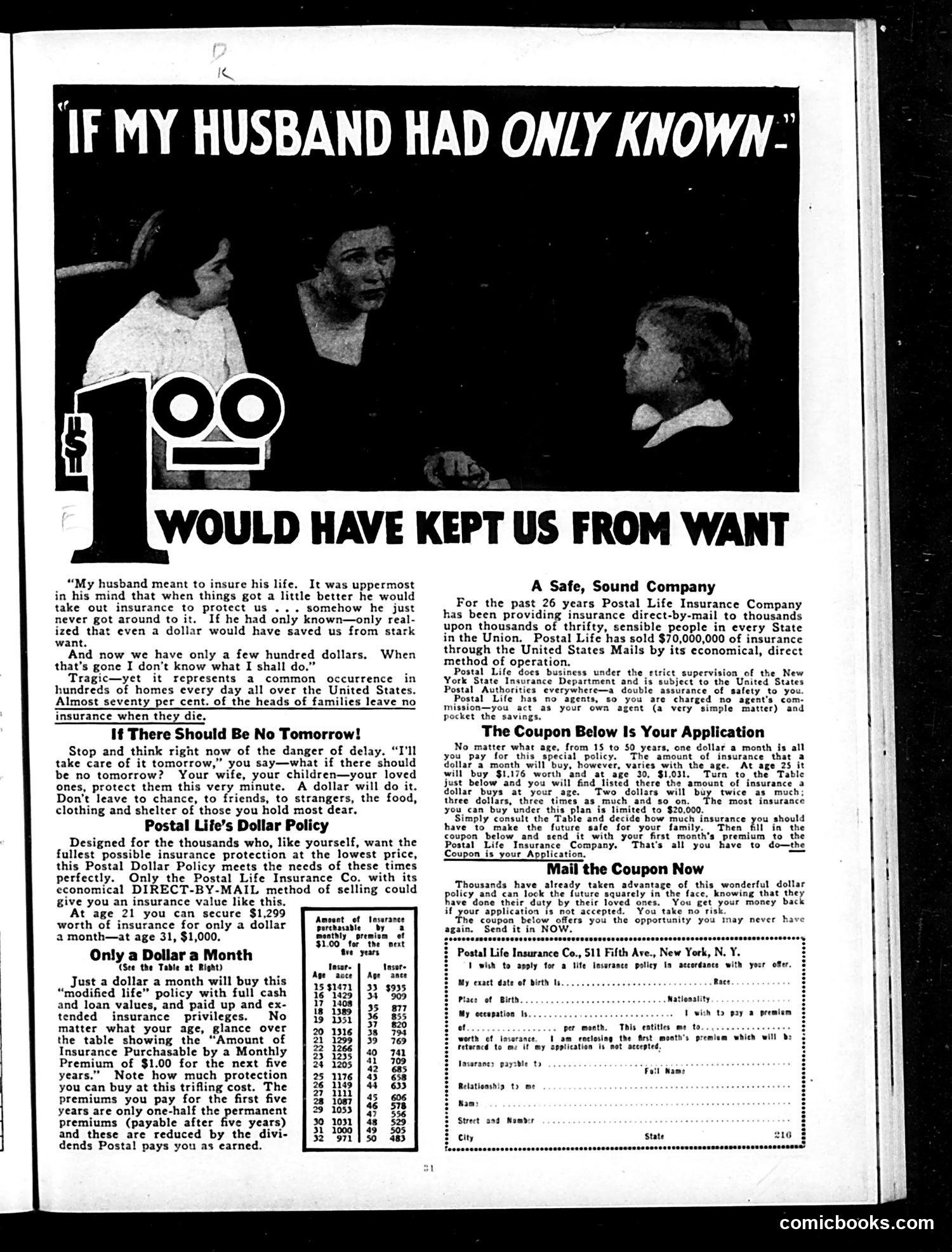
Understanding This 1920s Insurance Advertisement This page is primarily a direct-mail advertising campaign for Postal Life Insurance Company, not political satire. The dramatic headline image shows a widow and children in apparent distress—the emotional appeal of a bereaved family facing poverty. The advertisement's message is straightforward: a man failed to purchase life insurance, leaving his family destitute. The satire is mild and self-directed—the company essentially mocks procrastination ("I'll do it tomorrow") to sell their product. The key selling point: for just one dollar per month, working-class men could secure life insurance ($1,200+ value at age 21). This was revolutionary marketing for the era—insurance made affordable and direct-by-mail, avoiding expensive agents. The page includes an application coupon and premium tables. This reflects early 20th-century American anxiety about economic security and family welfare, positioned against the company's claims of safety and accessibility.
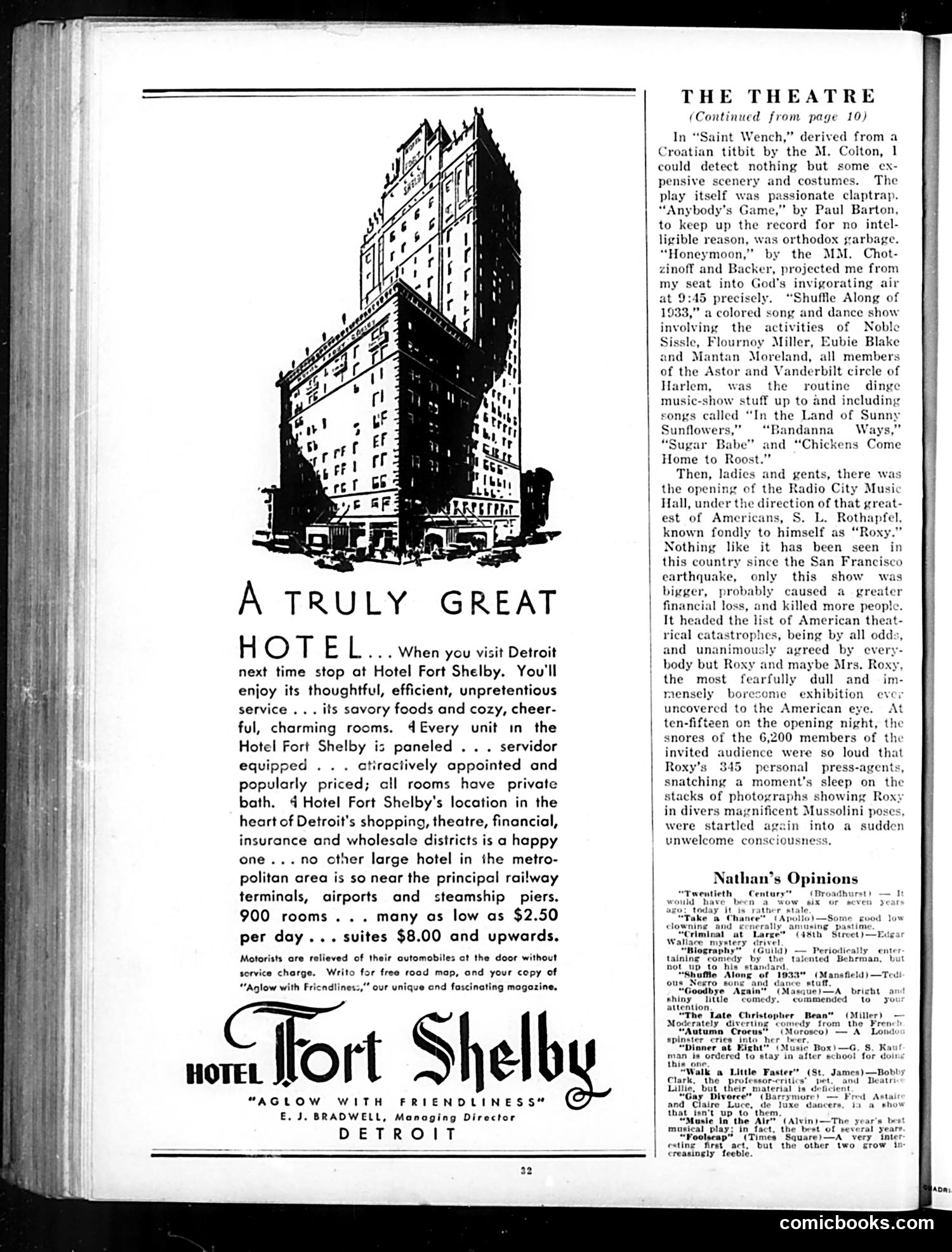
Analysis of This Judge Magazine Page This page is primarily advertising, not satire or political commentary. The dominant content is a full-page advertisement for Hotel Fort Shelby in Detroit, featuring an illustration of the hotel building and promotional text emphasizing its location, amenities, and affordability (rooms from $2.50/day). The remaining text is a theatre review column titled "Nathan's Opinions" (likely by drama critic George Jean Nathan), which critiques various Broadway productions from what appears to be the 1930s, including "Shuffle Along of 1933" and the opening of Radio City Music Hall. The reviews are dismissive and sarcastic—notably, the critic mockingly calls the Radio City Music Hall opening "bigger, probably caused a greater financial loss, and killed more people" than the San Francisco earthquake, characterizing it as a "fearfully dull" exhibition. There is no political cartoon on this page.
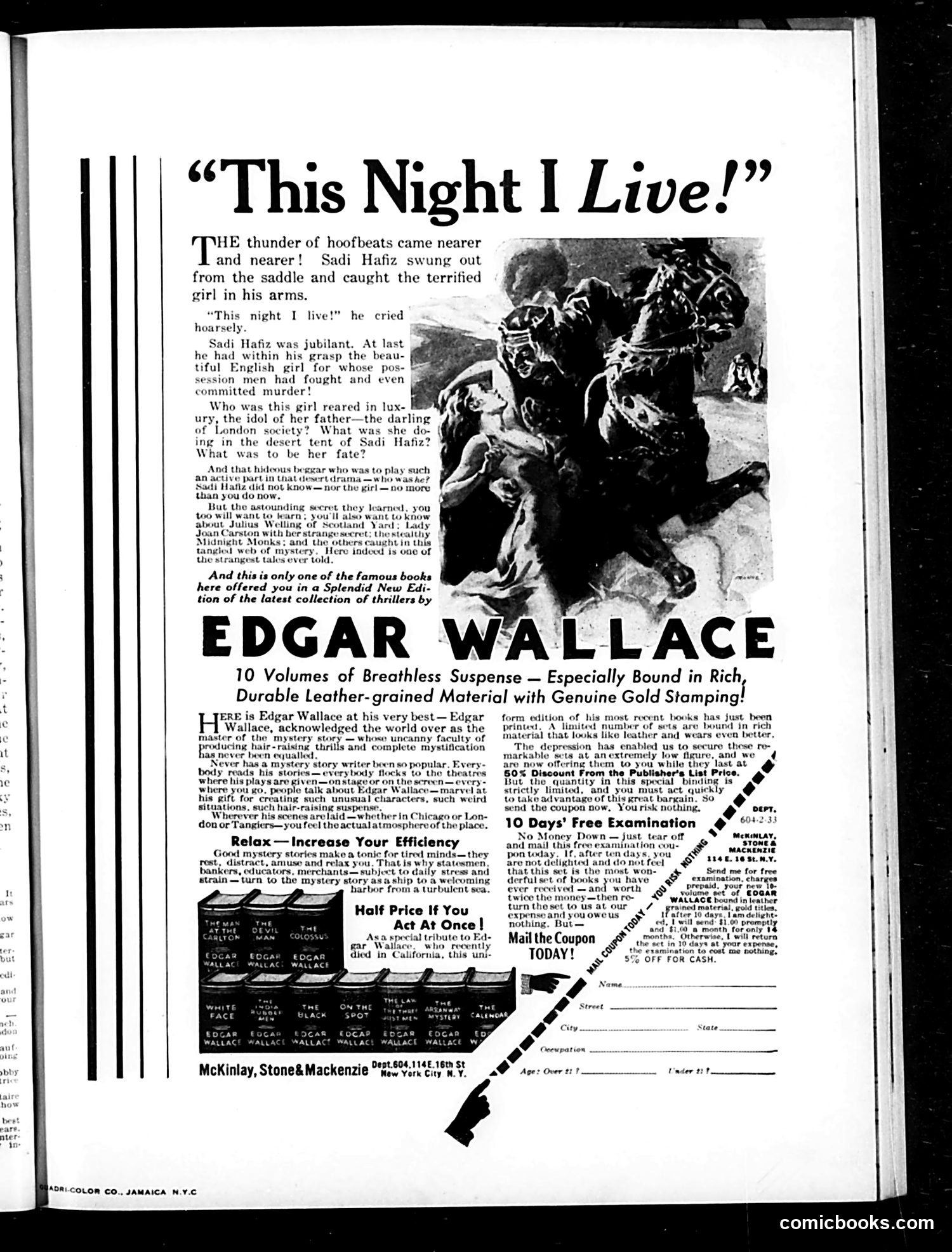
What This Page Means This is primarily a book advertisement, not a political cartoon. It promotes a 10-volume collection of Edgar Wallace mystery novels. The page opens with a lurid fictional excerpt featuring "Sadi Hafiz" abducting an English girl in the desert—typical of Wallace's sensational thriller plots. This teaser is designed to hook readers and demonstrate Wallace's dramatic storytelling style. The sales pitch emphasizes: - Wallace's fame as a mystery writer (he "died in California" recently, adding urgency) - His books' appeal to stressed professionals (bankers, educators, statesmen) seeking relaxation - A special limited edition in leather binding with gold stamping, offered at 50% discount The coupon at bottom offers a 10-day free examination with no money down—a common mail-order sales tactic of the era. This reflects early 20th-century popular culture: Wallace was genuinely hugely popular, and publishers aggressively marketed book collections through magazines using dramatic excerpts and limited-time offers to drive impulse purchases.

Analysis This is not a political cartoon or satirical content—it's a Camel cigarette advertisement from the R.J. Reynolds Tobacco Company. The page features a glamorous woman holding a cigarette, promoting Camel's "quality tobacco" and the famous slogan "I'd walk a mile for a Camel." For modern readers, the striking element is how openly tobacco was advertised using celebrity endorsement and lifestyle marketing. The ad emphasizes the product's "freshness" via the "Humidor Pack" and appeals to taste sophistication by highlighting "Turkish and mellow, sun-ripened Domestic tobaccos." By today's standards, this represents advertising now banned in most countries—using attractive models to sell cigarettes with health claims and aspirational messaging. The ad exemplifies mid-20th century marketing practices completely prohibited under modern tobacco regulations.