judge
Judge — March 1933
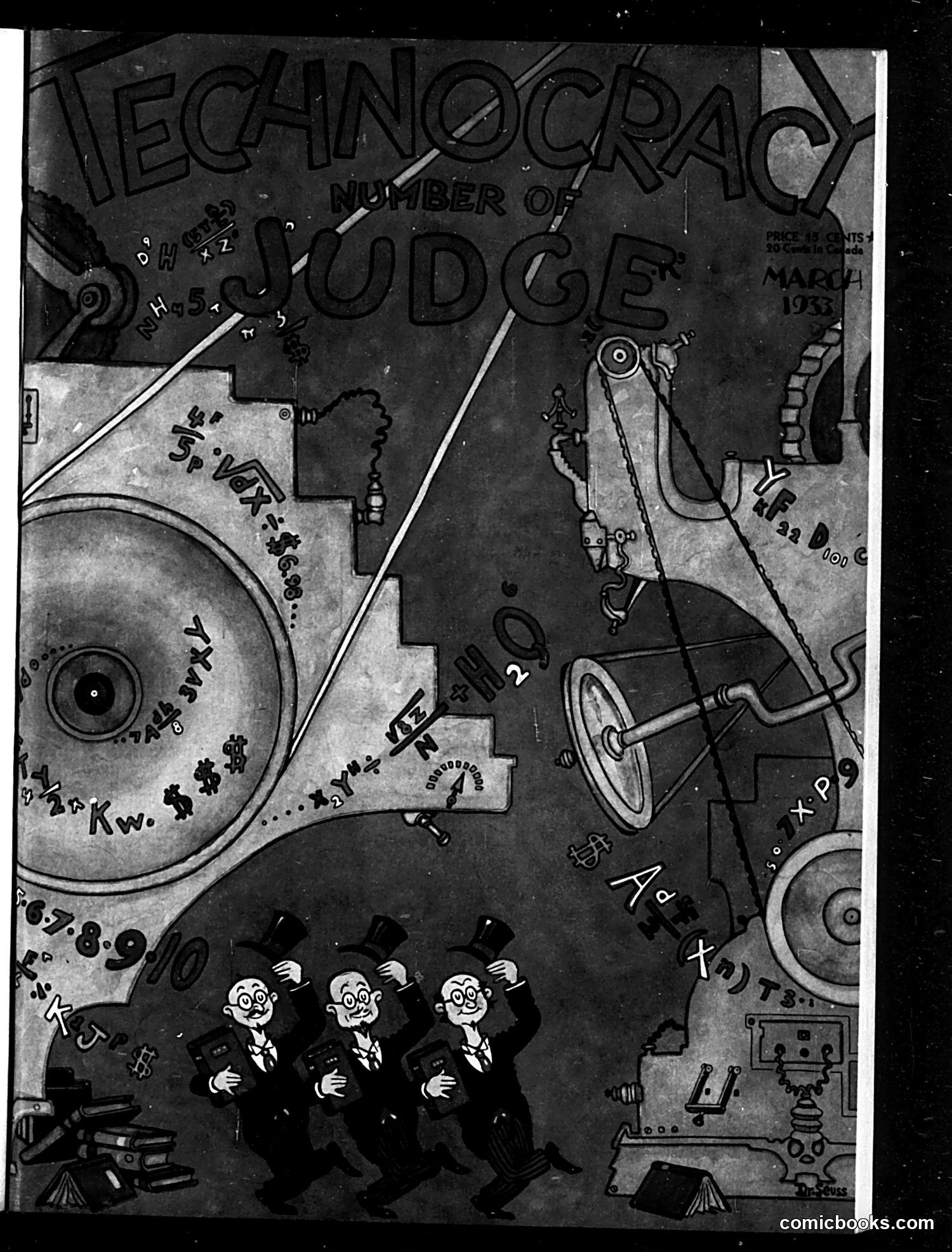
Analysis of "Technocracy Number of Judge" (March 1933) This cover satirizes the "Technocracy" movement—a 1930s proposal that engineers and scientists should replace politicians to solve economic problems during the Great Depression. The three identical suited figures at bottom likely represent technocrats or their advocates. The mechanical diagram filling the page parodies how technocrats viewed society: as an engineering problem with calculations, gears, and circuits to optimize. The abundance of numbers, formulas, and mechanical components suggest both the movement's pseudo-scientific pretensions and Judge magazine's mockery of reducing human society to mere machinery. The price (15 cents) and date (March 1935—likely 1933 given Technocracy's peak popularity) place this during the Depression when such radical restructuring proposals gained serious traction before being largely discredited.
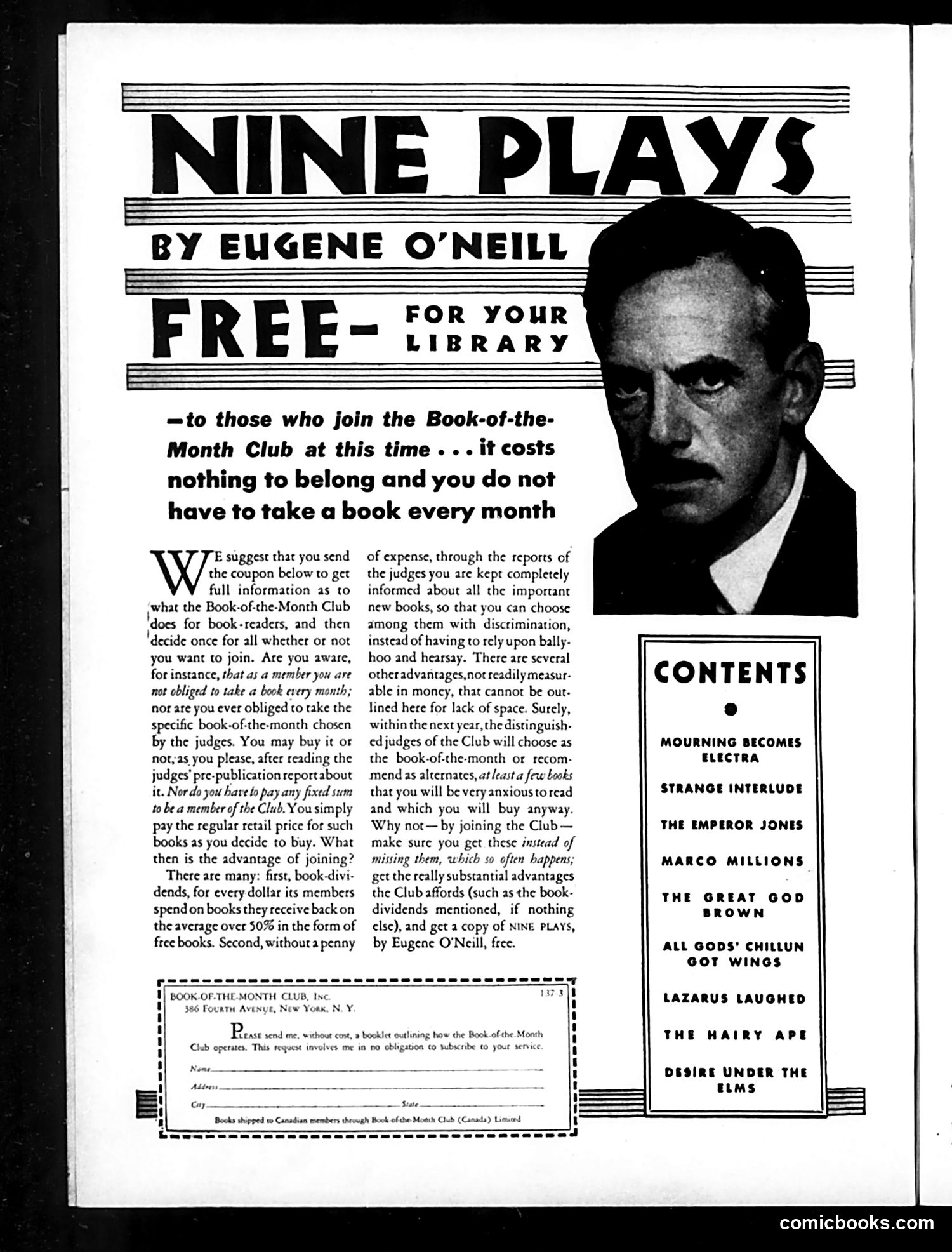
Analysis This is primarily advertising, not satire or commentary. The page promotes the Book-of-the-Month Club by offering Eugene O'Neill's nine plays free to new members. The portrait appears to be O'Neill himself, the prominent American playwright, positioned to lend prestige to the offer. The advertisement emphasizes membership benefits: members receive substantial discounts (reportedly 50% savings), enjoy curated book selections without obligation to purchase monthly selections, and get quality editorial guidance. The listed plays in the "Contents" box are O'Neill's actual works. This represents 1920s-30s marketing strategy—using celebrated authors' prestige to attract subscribers to a then-novel subscription service. No satire is evident; it's straightforward promotional content.
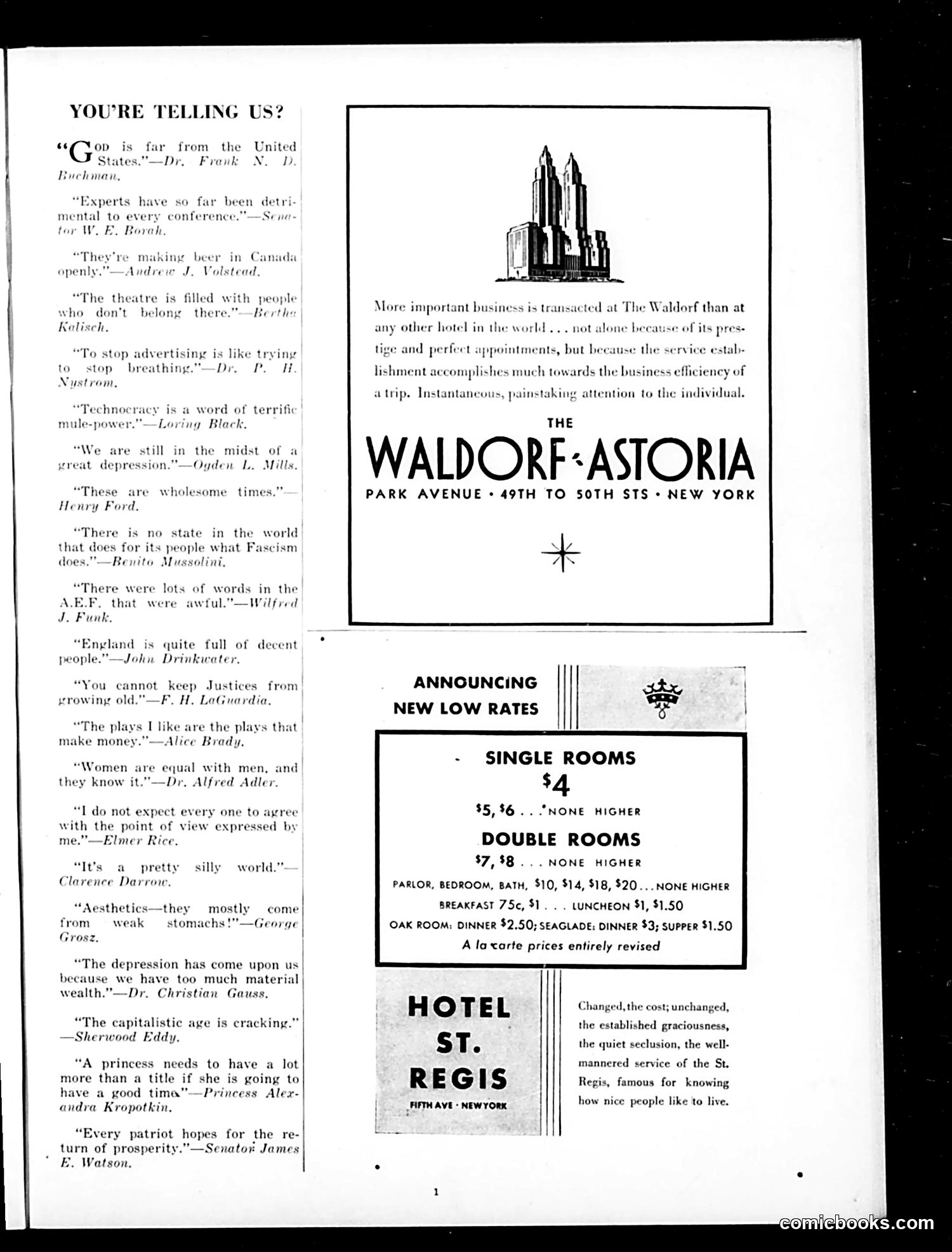
Page Analysis: Judge Magazine This page is primarily advertising with minimal editorial content. The left column features a "You're Telling Us?" section—a common Judge format presenting satirical quotes attributed to public figures commenting on contemporary issues (depression, fascism, women's rights, advertising). The main advertisements promote: - The Waldorf-Astoria hotel (Park Avenue, NYC) - Hotel St. Regis (Fifth Avenue) - Waldorf-Astoria's "new low rates" for rooms and dining The quotes reference 1930s concerns: economic depression, World War II-era fascism (Mussolini quote), gender equality debates, and theatrical criticism. Without a publication date visible, the economic language ("depression," "wholesale times") and fascism references suggest early-to-mid 1930s. The page reflects how Judge used humor to address serious contemporary anxieties while maintaining advertising revenue.
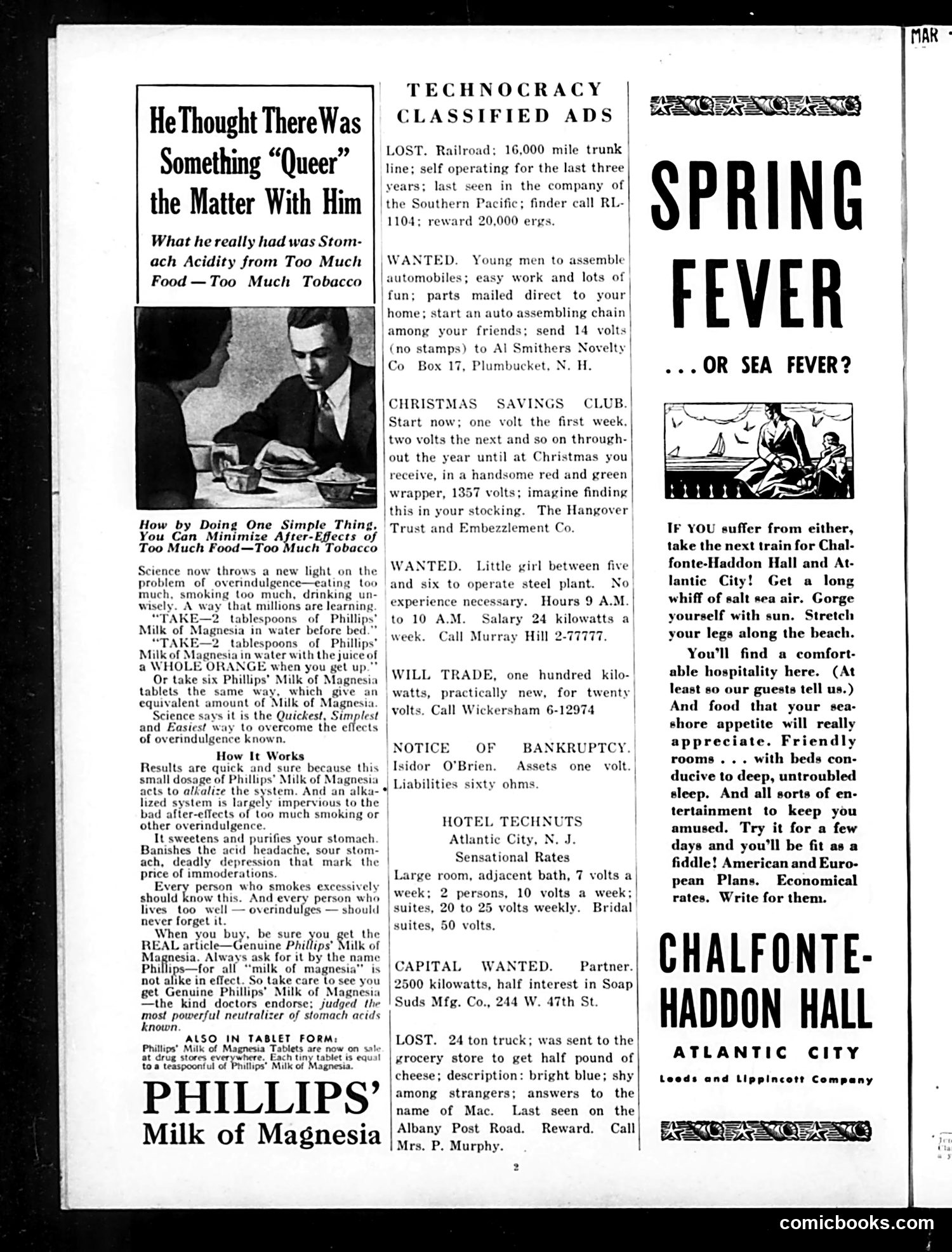
Analysis This page is primarily advertising and classified notices, not political satire. The main content includes: Left side: A Phillips' Milk of Magnesia advertisement featuring a man discussing stomach issues caused by overeating and smoking. The ad promotes the antacid as a remedy for acid indigestion and related discomfort. Right side: Multiple classified ads (wanting workers, Christmas savings club, hotel rooms) and a prominent advertisement for Chalfonte-Haddon Hall, a resort in Atlantic City, N.J., offering seaside hospitality and relaxation. The page reflects early 20th-century consumer culture and commercial messaging rather than political commentary. The mild humor in the Magnesia ad derives from relatable domestic situations rather than satire of public figures or events.
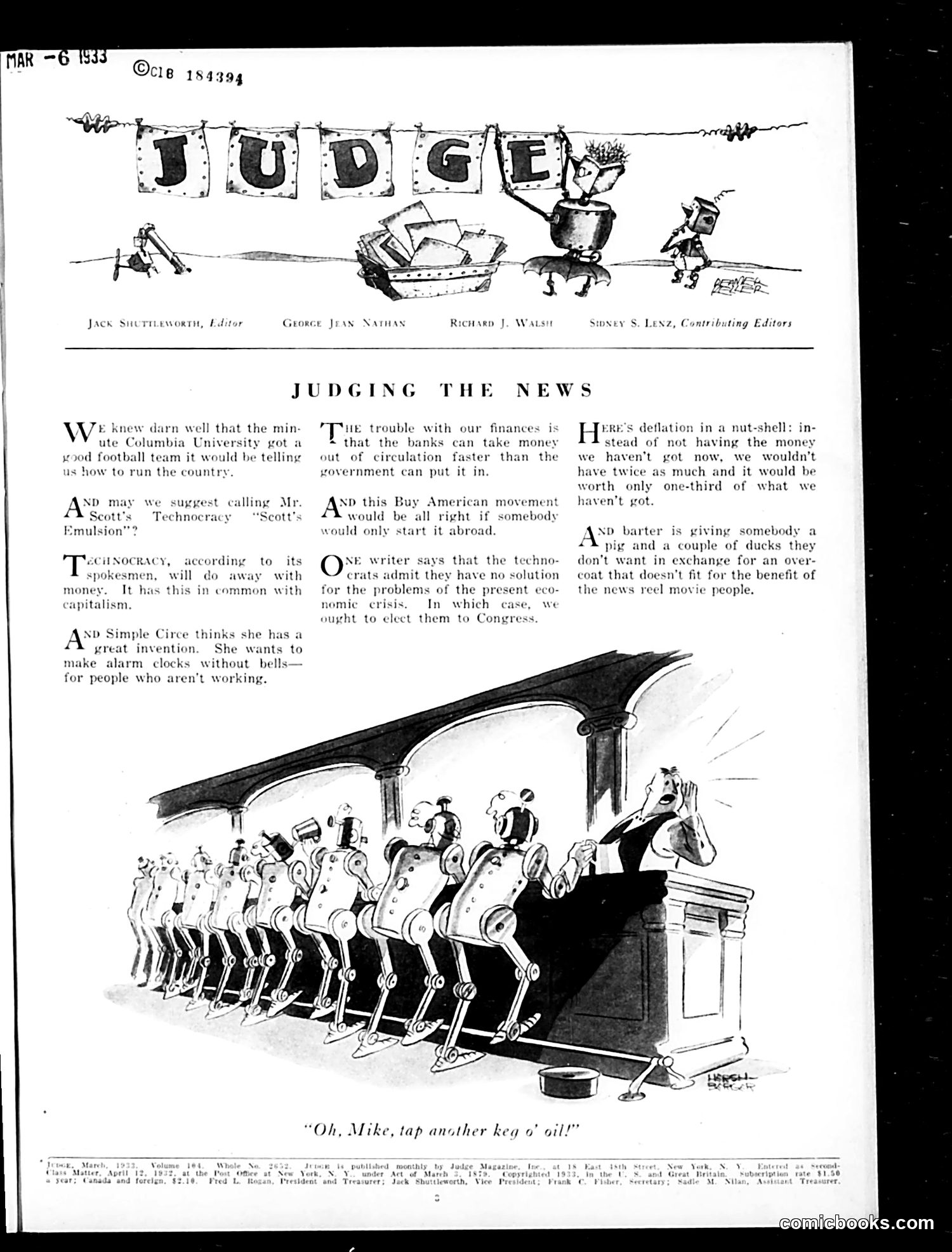
Analysis This is the March 6, 1933 issue of Judge magazine. The page features "Judging the News," a satirical commentary section on current events. The main cartoon depicts a long line of identical mechanical figures (appearing to be workers or citizens) operating like machines under a large industrial structure, with one figure at a podium commanding "Oh, Mike, tap another keg o' oil!" This appears to satirize mechanized labor or bureaucratic control during the Great Depression era. The text snippets above mock various contemporary proposals and problems: financial crisis, the "Buy American" movement, technological unemployment, and political incompetence. The cartoon suggests that people are being treated as interchangeable machine parts rather than individuals—a commentary on industrialization's dehumanizing effects and perhaps the period's economic desperation.
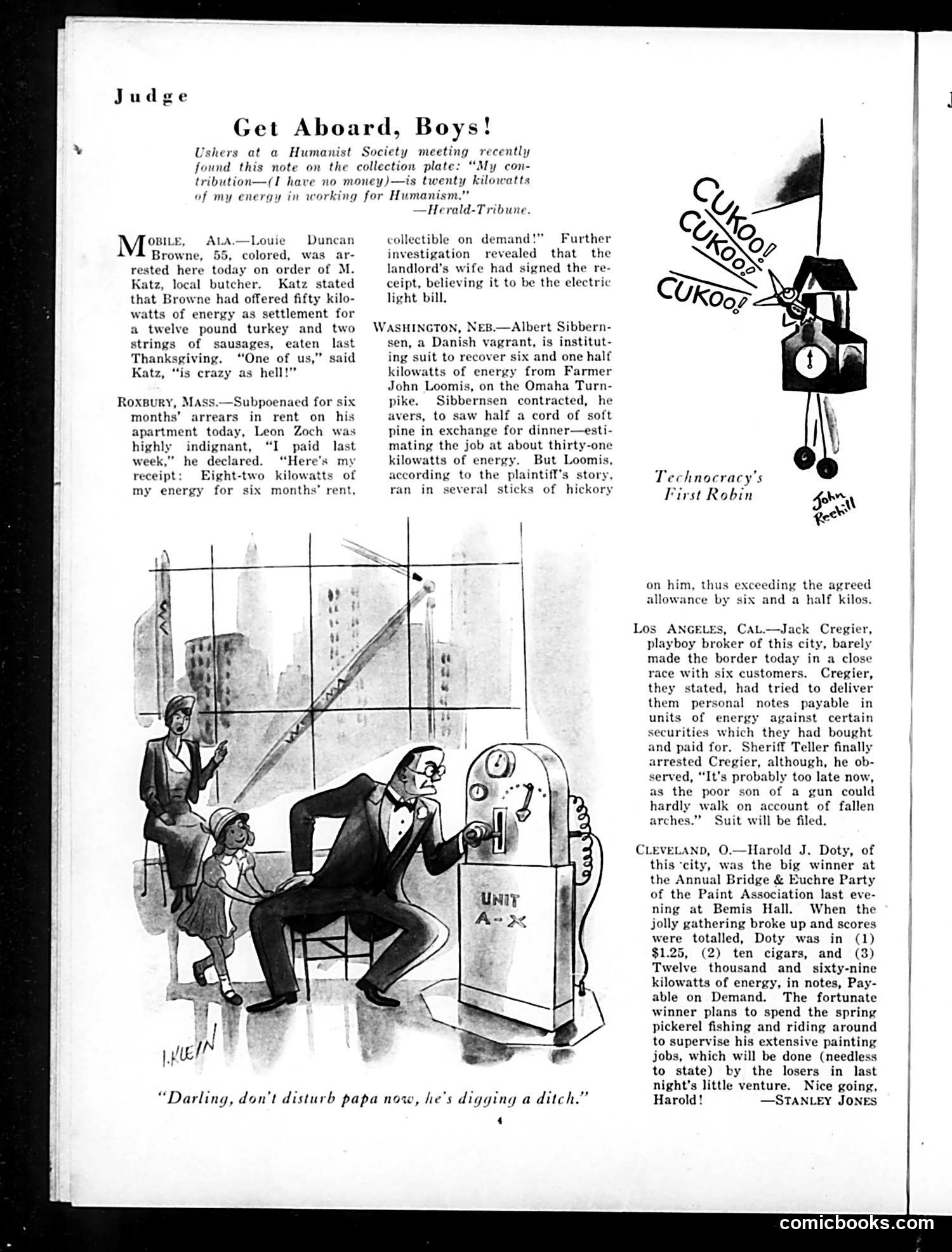
"Get Aboard, Boys!" - Judge Magazine Satire This page satirizes people attempting to extract energy as payment or settlement. The column reports absurd cases: a butcher offered fifty kilowatts for meat; a tenant demanded rent in "kilowatts of energy"; a vagrant sought compensation in energy units; a playboy broker tried selling energy-backed securities; a raffle winner claimed prizes in kilowatts. The cartoon below shows a man operating a bizarre "energy-extraction machine" labeled "UNIT A-X" while his wife protests: "Darling, don't disturb papa nose, he's digging a ditch." The satire mocks the obsession with converting *everything*—including physical labor and daily life—into measurable energy units, reflecting early 20th-century technocratic enthusiasm taken to ridiculous extremes.
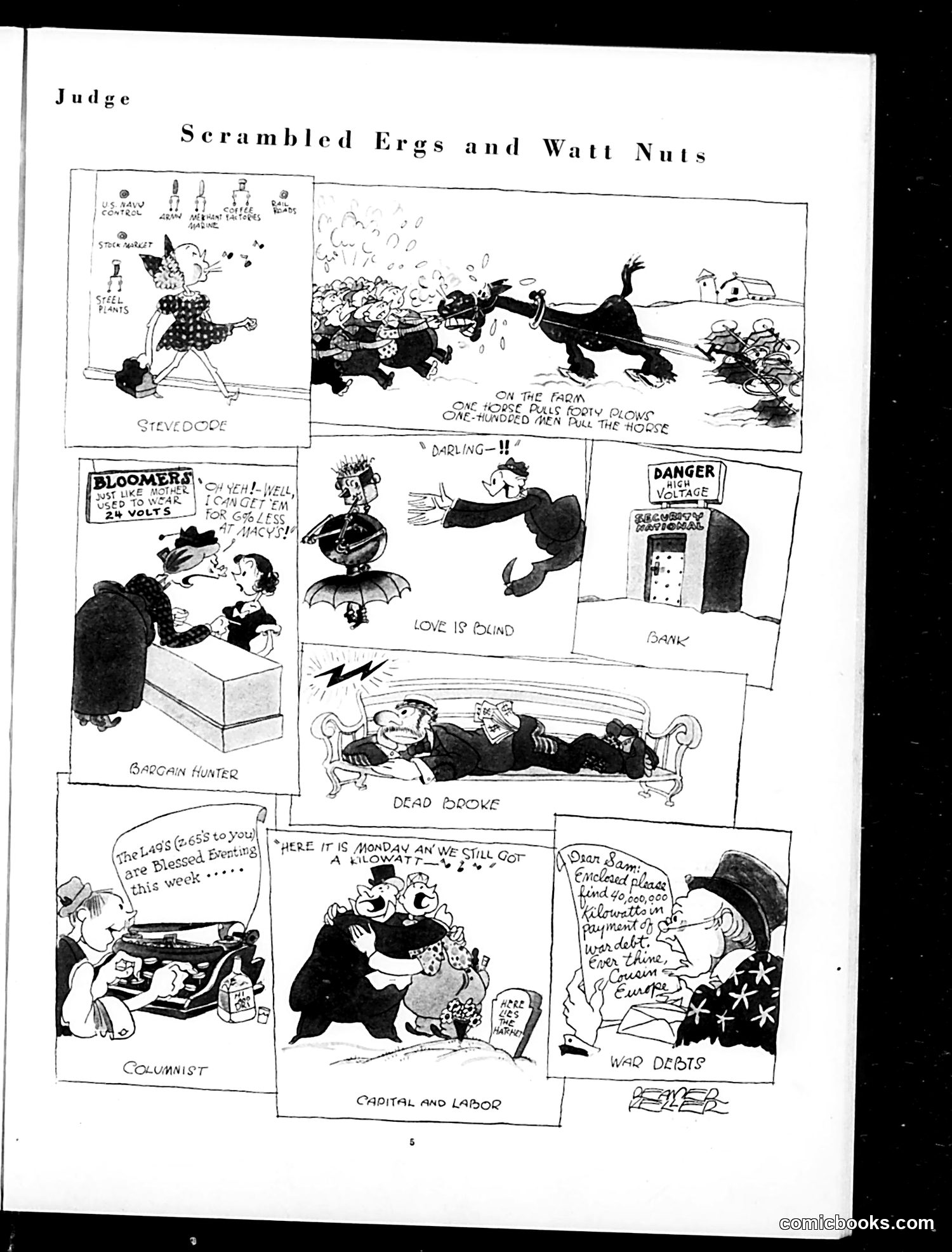
"Scrambled Eggs and Watt Nuts" This Judge magazine page satirizes American political and social issues through multiple cartoon panels: Top panel: A "Stevedore" (dock worker) operates machinery labeled "U.S. Navy Control," with text referencing "Sticks," "Bolts," and "Hams"—likely satirizing labor disputes or industrial management conflicts in naval/dock operations. Middle panels: "Bloomers," "Bargain Hunter," "Love is Blind," "Dead Broke," and a "Danger High Voltage Bank" mock consumer behavior, romance, and financial precarity during what appears to be an economic downturn. Bottom panels: "Columnist," "Capital and Labor," and "War Debts" panels address post-WWI economic tensions—specifically labor disputes, financial recovery debates, and international war reparations that characterized 1920s American politics. The overall theme critiques economic anxiety and class conflict.
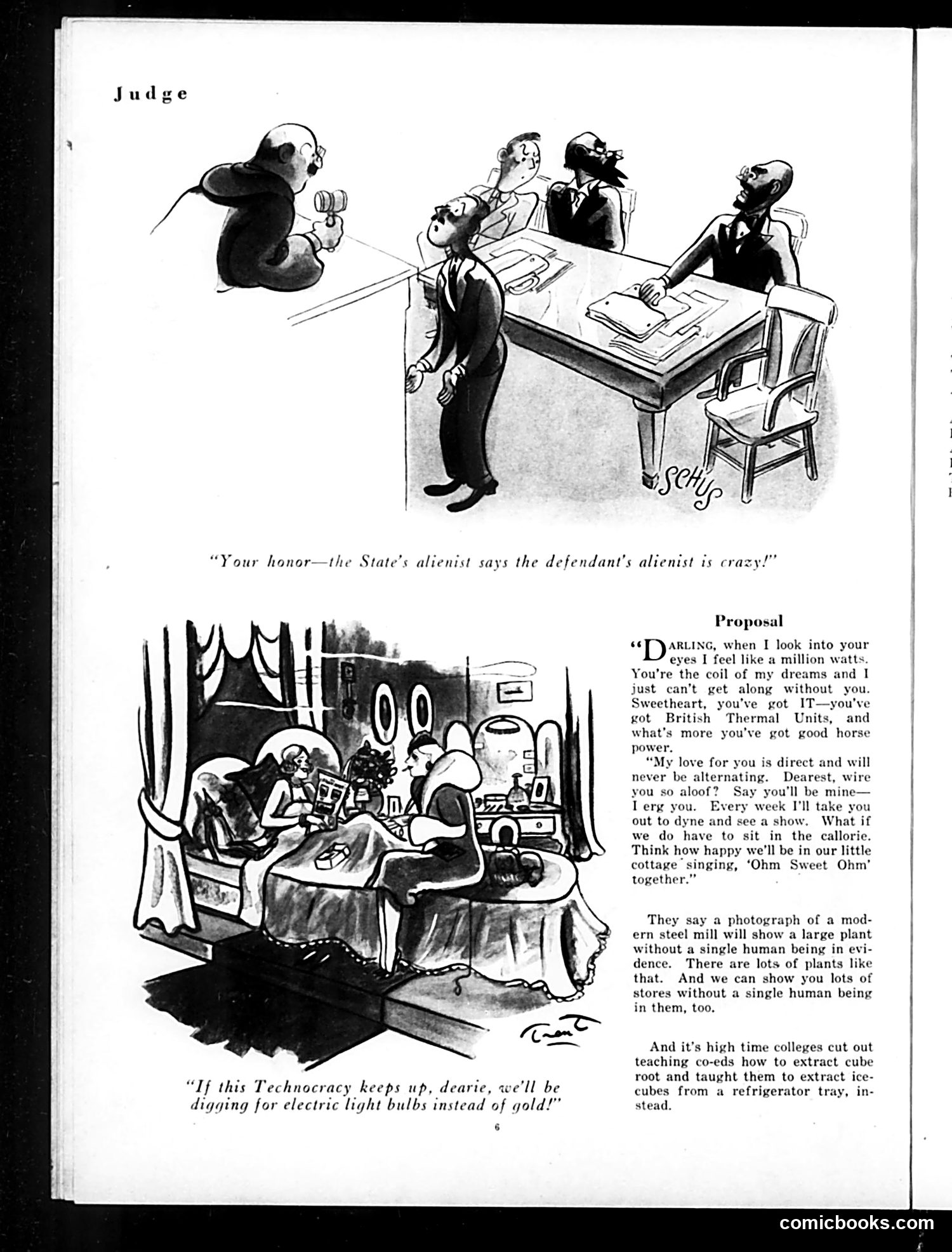
Analysis of Judge Page Top Cartoon ("Judge"): A courtroom scene where a defendant's lawyer argues that the "State's alienist [psychiatrist] says the defendant's alienist is crazy." This satirizes expert witness testimony in legal proceedings—mocking how opposing psychiatric experts contradict each other so thoroughly that their credibility becomes questionable. Bottom Cartoon ("Proposal"): A romantic scene where a suitor pitches himself by boasting of owning "British Thermal Units" and "good horse power"—technical measurements. The humor mocks how mechanization and industrial measurement language have infiltrated even romantic expression. The caption about "Technocracy" references the 1930s movement advocating rule by technical experts, suggesting absurd over-mechanization of life itself.
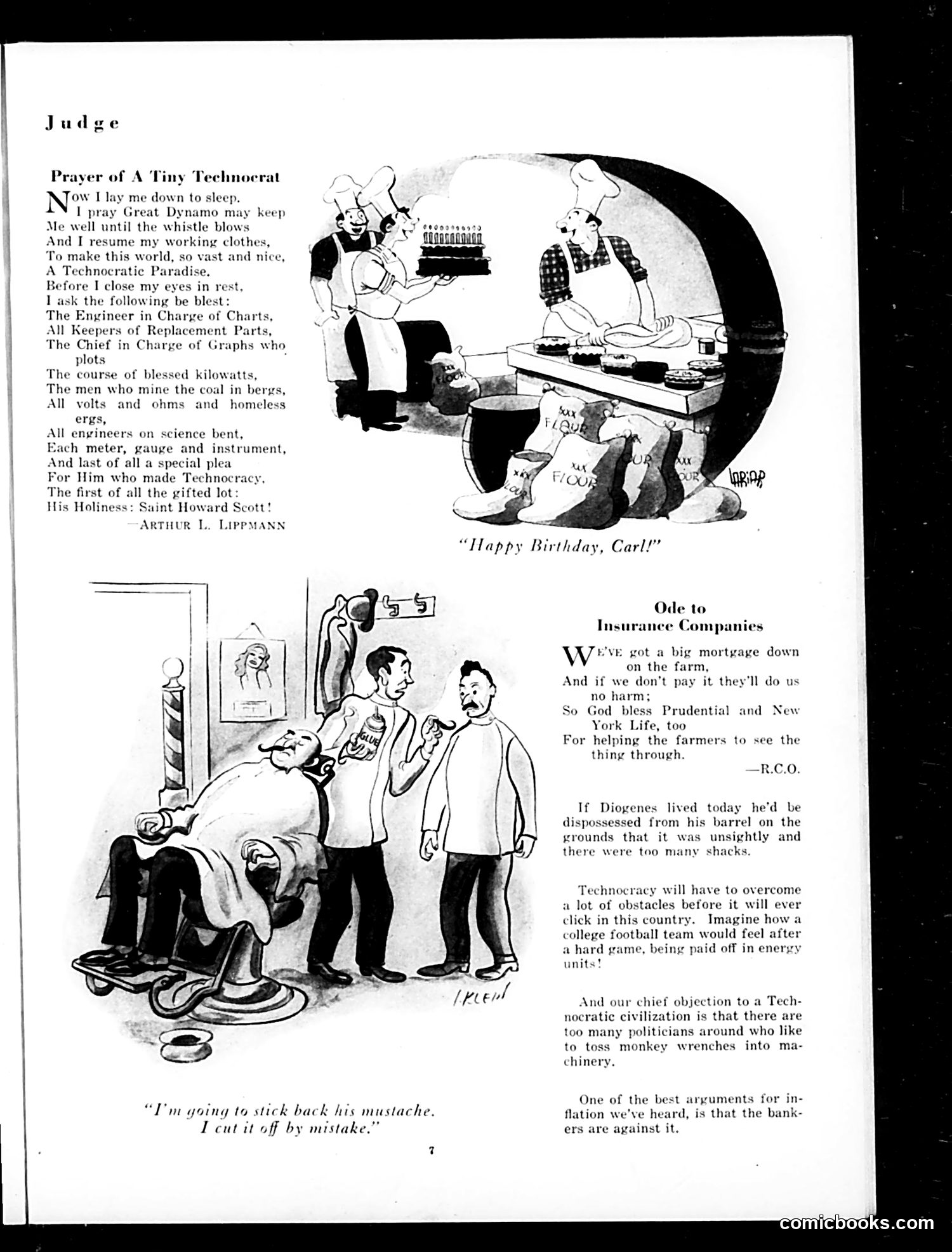
Judge Magazine Page Analysis This page satirizes Technocracy, a 1930s movement advocating rule by technical experts and engineers. "Prayer of a Tiny Technocrat" mocks technocrats' quasi-religious devotion to industrial systems, personifying infrastructure (dynamos, kilowatts, engineers) as objects of worship. It references Howard Scott, who founded the Technocracy movement, calling him "Saint Howard Scott"—ridiculing the movement's cult-like following. The cartoon below shows a man at some kind of medical/mechanical device with observers—the caption jokes about accidentally cutting off someone's mustache, likely satirizing how technocratic solutions cause unintended consequences. "Ode to Insurance Companies" employs sarcastic praise to critique how insurance companies profit from farmers' desperation during economic hardship. The page's broader point: Judge mocks Technocracy as an impractical ideology that would replace human judgment with mechanical systems, while politicians would sabotage it anyway. The satire warns that technocratic "solutions" ignore human realities and create more problems than they solve.
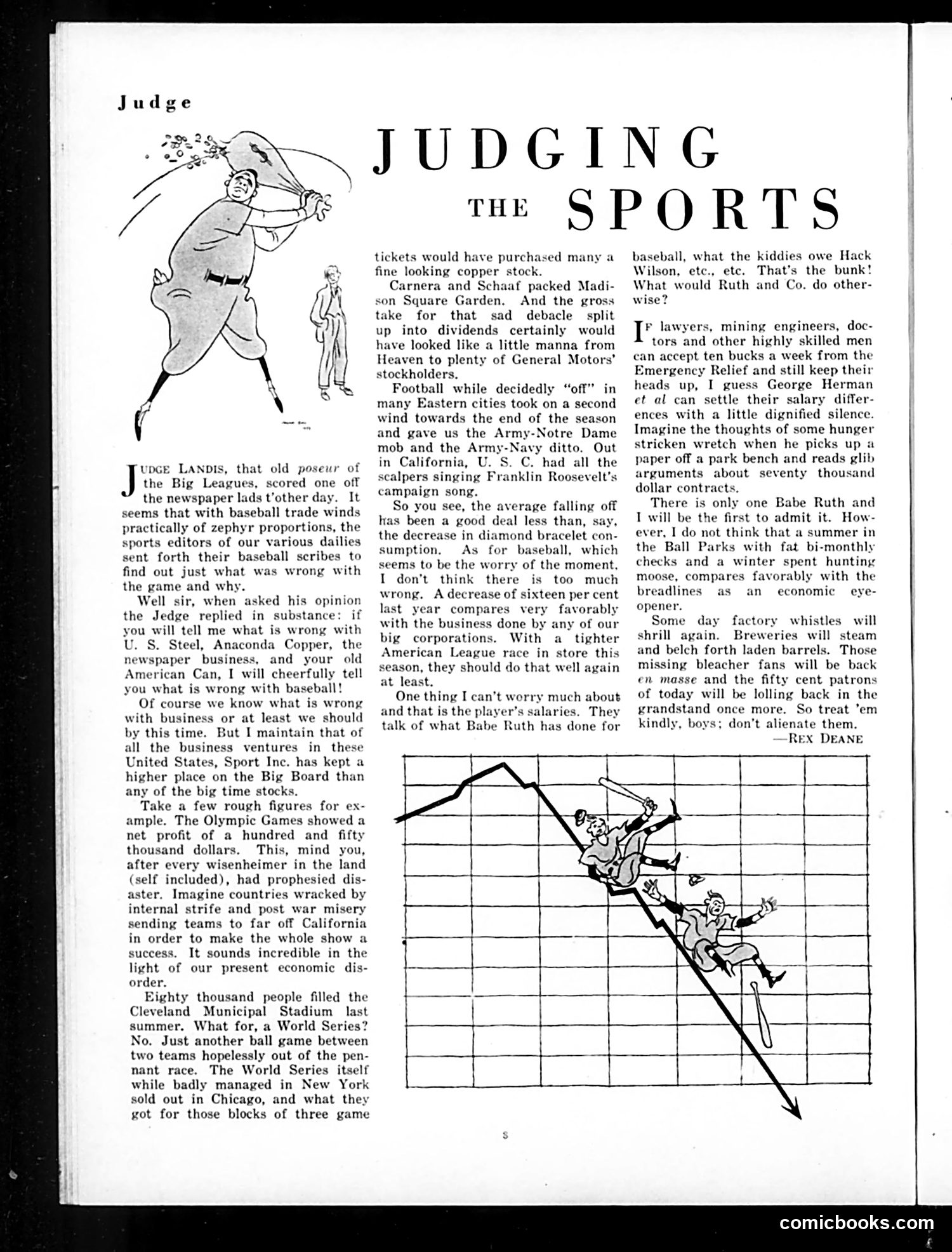
Analysis of "Judging the Sports" Page This Judge magazine article defends professional sports' financial health during the Great Depression. Judge Landis (baseball's commissioner) argues sports have performed better economically than major industries like U.S. Steel and Anaconda Copper. The author cites successful events: the 1932 Olympics in California, sold-out baseball games, and boxing matches (Carnera-Schaaf at Madison Square Garden). He claims baseball's 16% revenue decrease compares favorably to other businesses. The article's main target is sympathy for high player salaries, especially Babe Ruth's. The satire suggests Ruth and other athletes complaining about wages lack perspective—skilled professionals accept Depression-era emergency relief, so athletes should "settle their salary differences with dignified silence." The chart showing declining attendance illustrates the revenue drop. Overall, the piece uses sports economics to argue workers should accept hardship without complaint during the economic crisis.
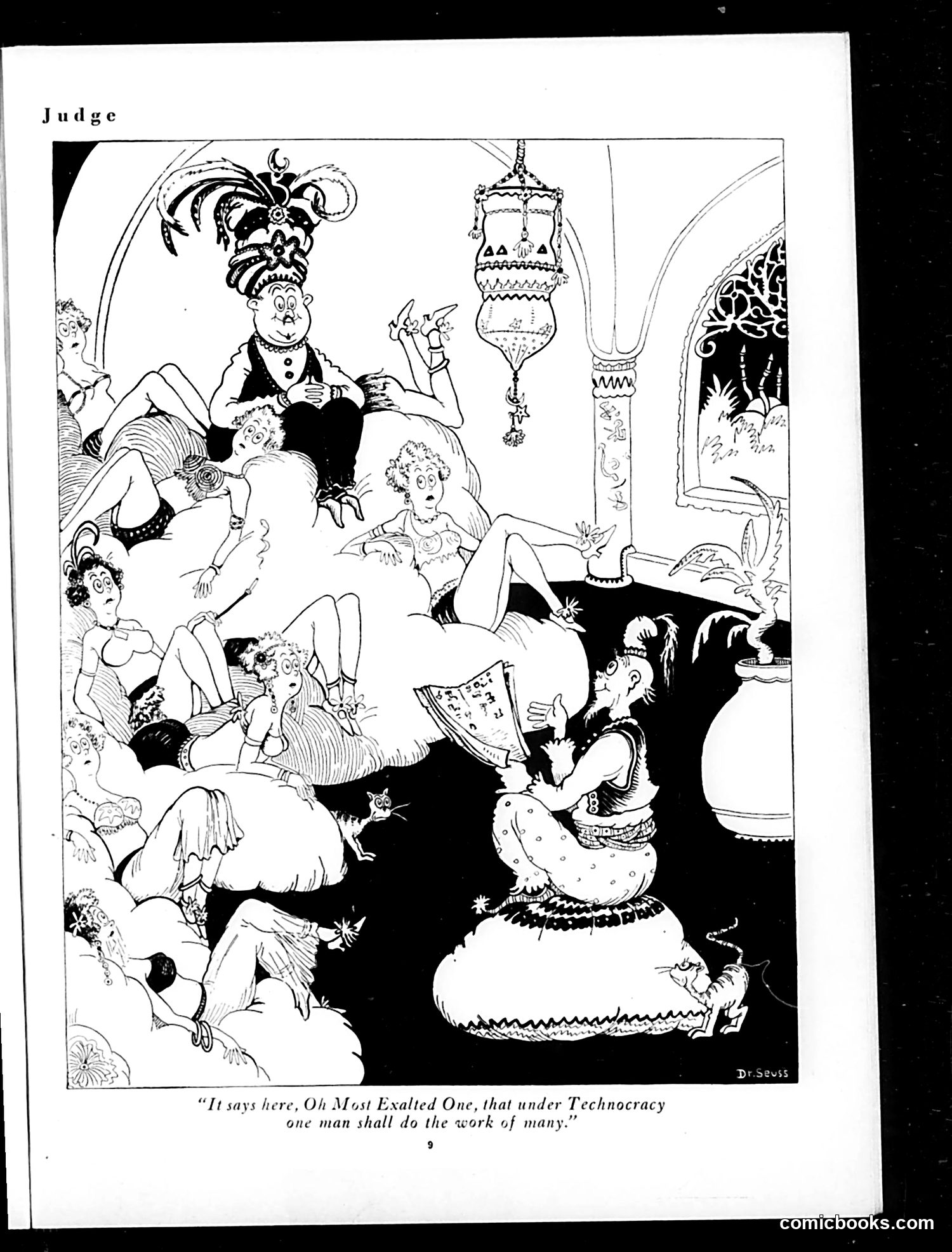
Judge Cartoon Analysis: "Technocracy" This Dr. Seuss cartoon satirizes the technocracy movement of the early 1930s—a utopian ideology proposing that engineers and technicians should govern society for maximum efficiency. The scene depicts an opulent harem or palace setting with multiple leisure-lounging figures, while a single servant reads the technocracy quote aloud to what appears to be a wealthy authority figure (the "Most Exalted One"). The satire's point: technocracy's promise that machines and efficiency would allow one person to do work previously requiring many sounds appealing in theory, but the cartoon suggests the real result would be concentrated wealth and power—one privileged person enjoying leisure while others labor. It mocks both technocracy's naive optimism and the wealthy's likely co-optation of such systems.
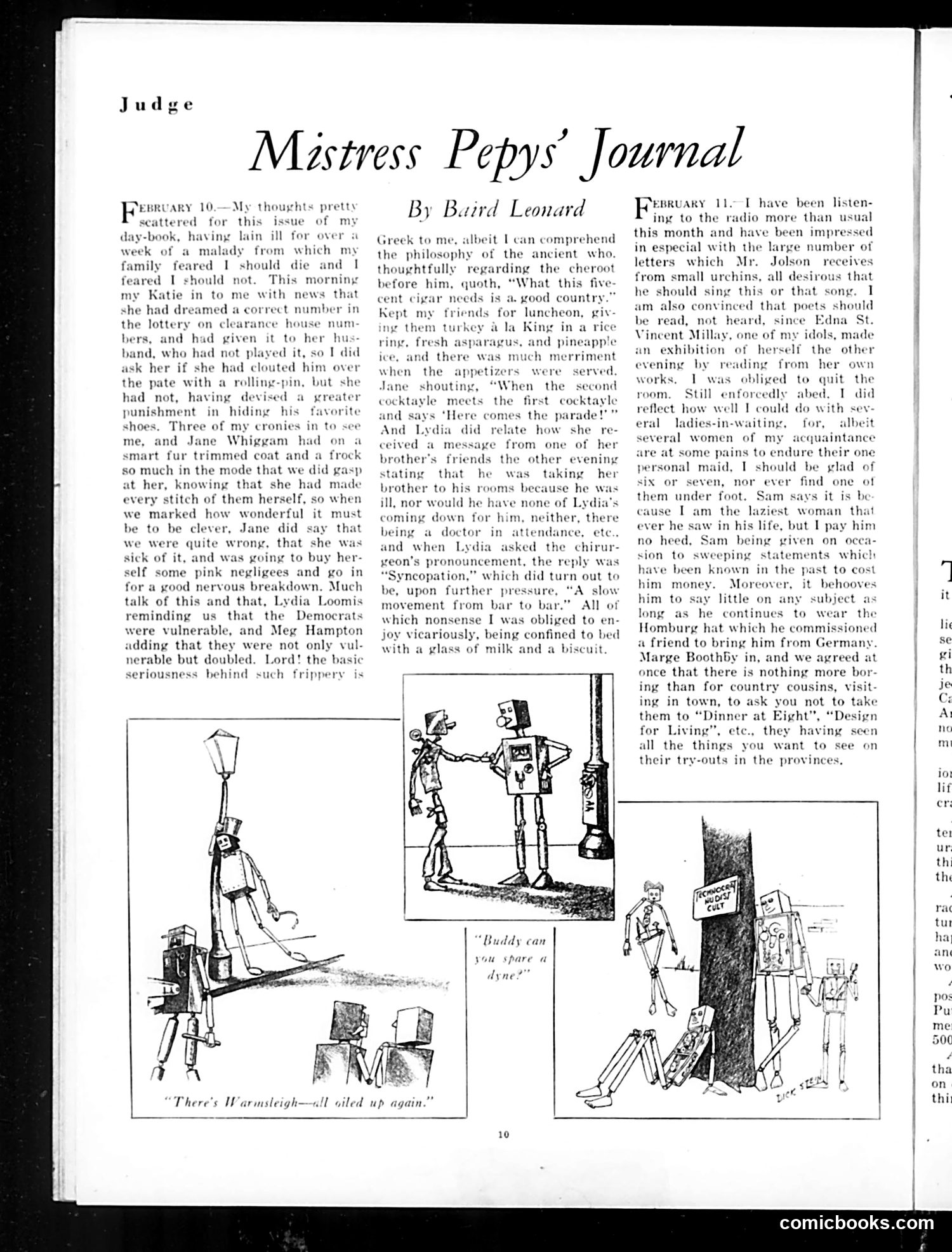
"Mistress Pepys' Journal" by Baird Leonard This is a humorous society column mimicking Samuel Pepys' famous 17th-century diary, but covering 1930s upper-middle-class domestic life. The narrator (a woman) records trivial social events—luncheons, fashion, gossip—alongside casual references to contemporary culture (radio, Al Jolson, the poet Edna St. Vincent Millay). The three cartoons illustrate jokes from the text: one shows a malfunctioning heating system; another depicts people asking to "spare a dyne" (a physics pun, likely referencing Depression-era economics); the third shows visiting country relatives at a theater. The satire targets both the pretentiousness of society women discussing serious topics (Democrats being "vulnerable") while obsessed with clothes and gossip, and the affectations of imitating Pepys' archaic language for trivial modern matters. The "basic seriousness behind such frippery" is the joke itself—these concerns are fundamentally frivolous.
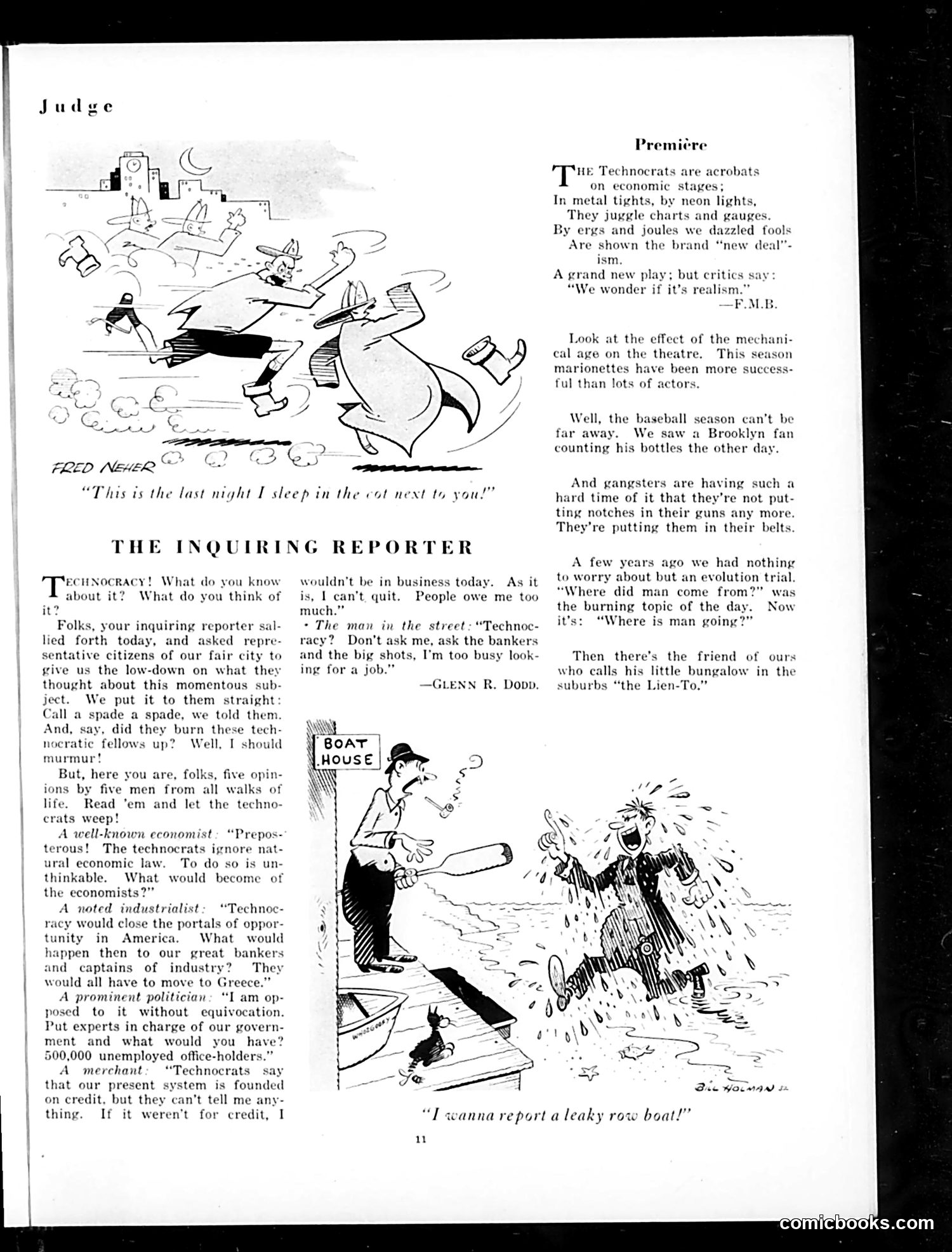
The Inquiring Reporter: Technocracy Satire This page satirizes the 1930s "Technocracy" movement—a proposal that engineers and scientists should run the economy instead of politicians and businessmen. The main cartoon features five representative citizens dismissively rejecting technocracy: - An economist fears losing professional relevance - An industrialist warns it would destroy American opportunity - A politician objects to losing power (and patronage jobs) - A merchant defends credit-based capitalism - A working man admits ignorance, too busy seeking employment The satire's point: each self-interested group opposes technocracy for selfish reasons, not principled ones. Their contradictory objections reveal how vested interests protect the status quo. The bottom cartoon ("leaky row boat") appears unrelated—a marionette reporter struggling with a failing boat, possibly continuing the mechanical/automation theme. The "Première" poem mocks the theatrical spectacle of technocratic ideas as entertaining but unrealistic. The page reflects Depression-era anxieties about whether experts or politicians better served public welfare.
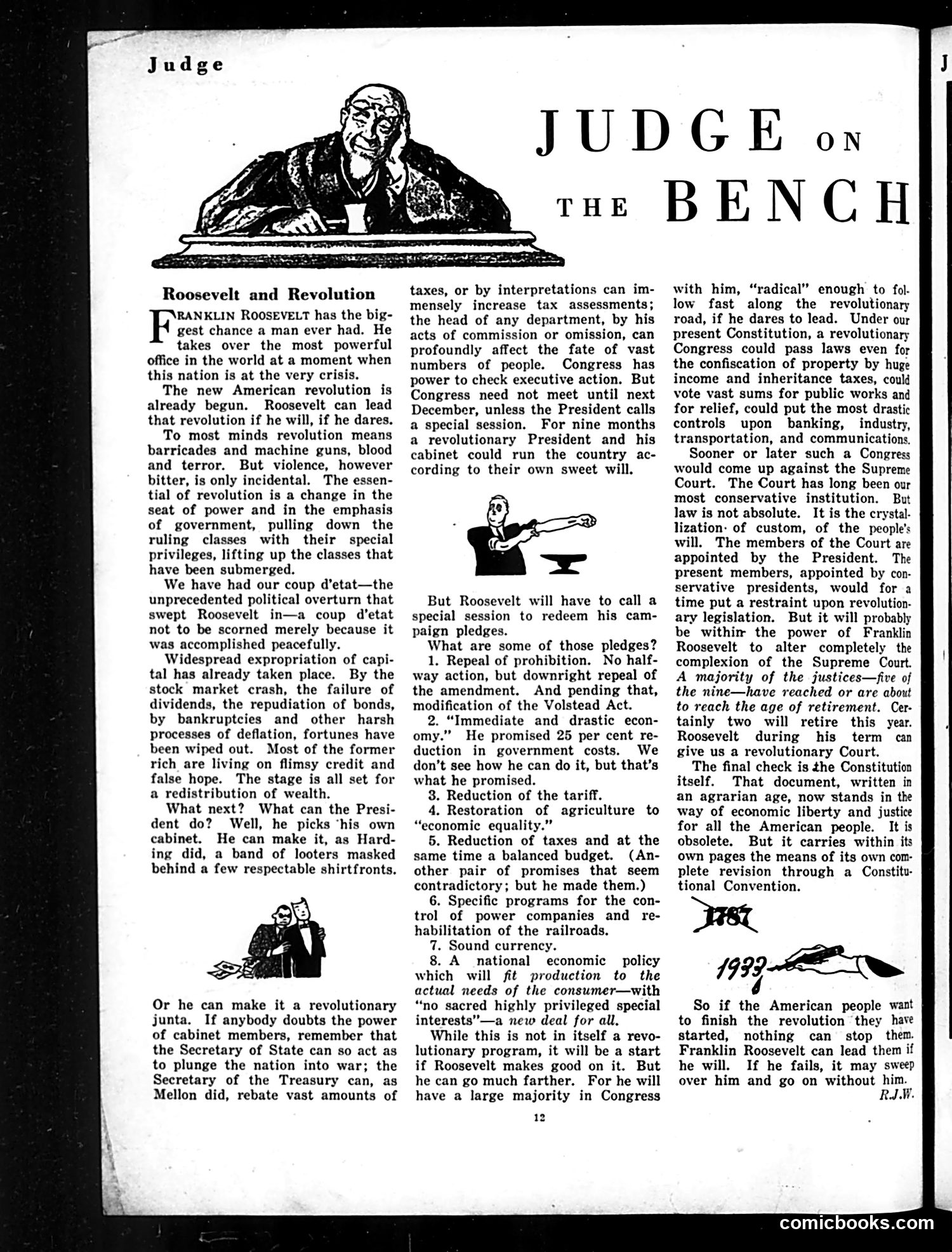
"Judge on the Bench: Roosevelt and Revolution" This Judge magazine editorial, written early in Franklin D. Roosevelt's presidency (likely 1933), praises FDR's unprecedented political power while cautiously outlining his campaign promises and potential revolutionary agenda. The piece argues that Roosevelt has an extraordinary opportunity to fundamentally reshape American government—describing his election as a peaceful "coup d'état." The author lists eight campaign pledges: prohibition repeal, government economy, tariff reduction, agricultural relief, tax cuts with balanced budget, power company regulation, sound currency, and a consumer-focused economic policy ("a new deal for all"). The satire's point: these promises are contradictory (tax cuts *and* balanced budget?) and potentially radical, yet Roosevelt commands enough Congressional support to enact them. The cartoons (a judge at bench, a man at a scale/balance) visually reinforce the theme of power and judgment. The author suggests FDR could push even further—confiscating property through inheritance taxes—if he dares. The underlying message critiques both the scope of executive power and the vagueness of FDR's actual commitments.
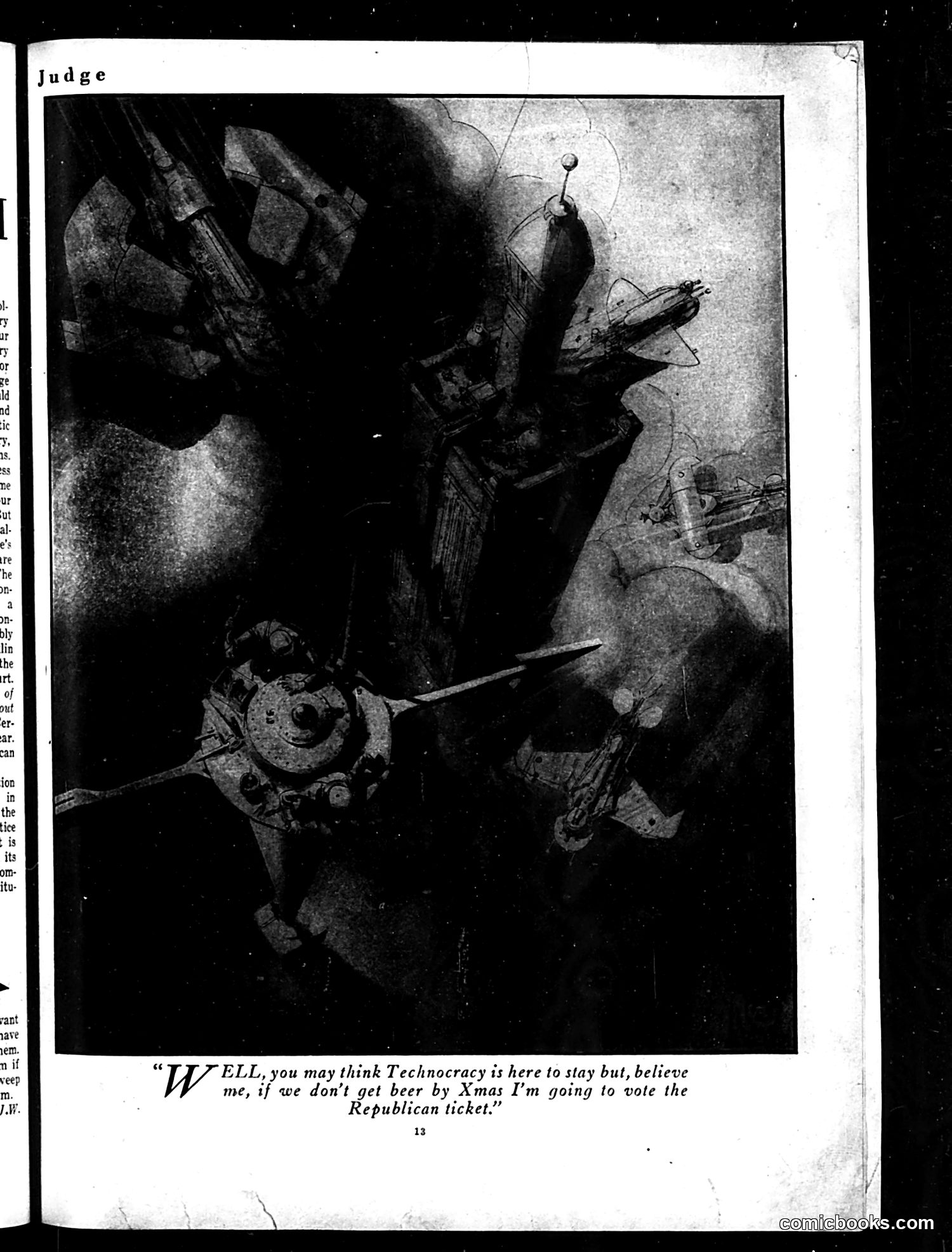
Explanation for Modern Readers This political cartoon satirizes the priorities of American voters during Prohibition (1920-1933). A figure—likely representing an average citizen or working-class voter—declares that while he acknowledges "Technocracy" (a 1930s movement advocating scientific/technical management of society), his actual concern is beer availability by Christmas. The joke: the speaker threatens to vote Republican if beer doesn't return, suggesting voters care more about practical pleasures than ideological movements. This reflects real Depression-era tensions where economic hardship and Prohibition's unpopularity were driving political realignment. The cartoon mocks both technocratic idealism as disconnected from ordinary concerns, and voters' willingness to switch parties over single issues like alcohol access rather than substantive policy.
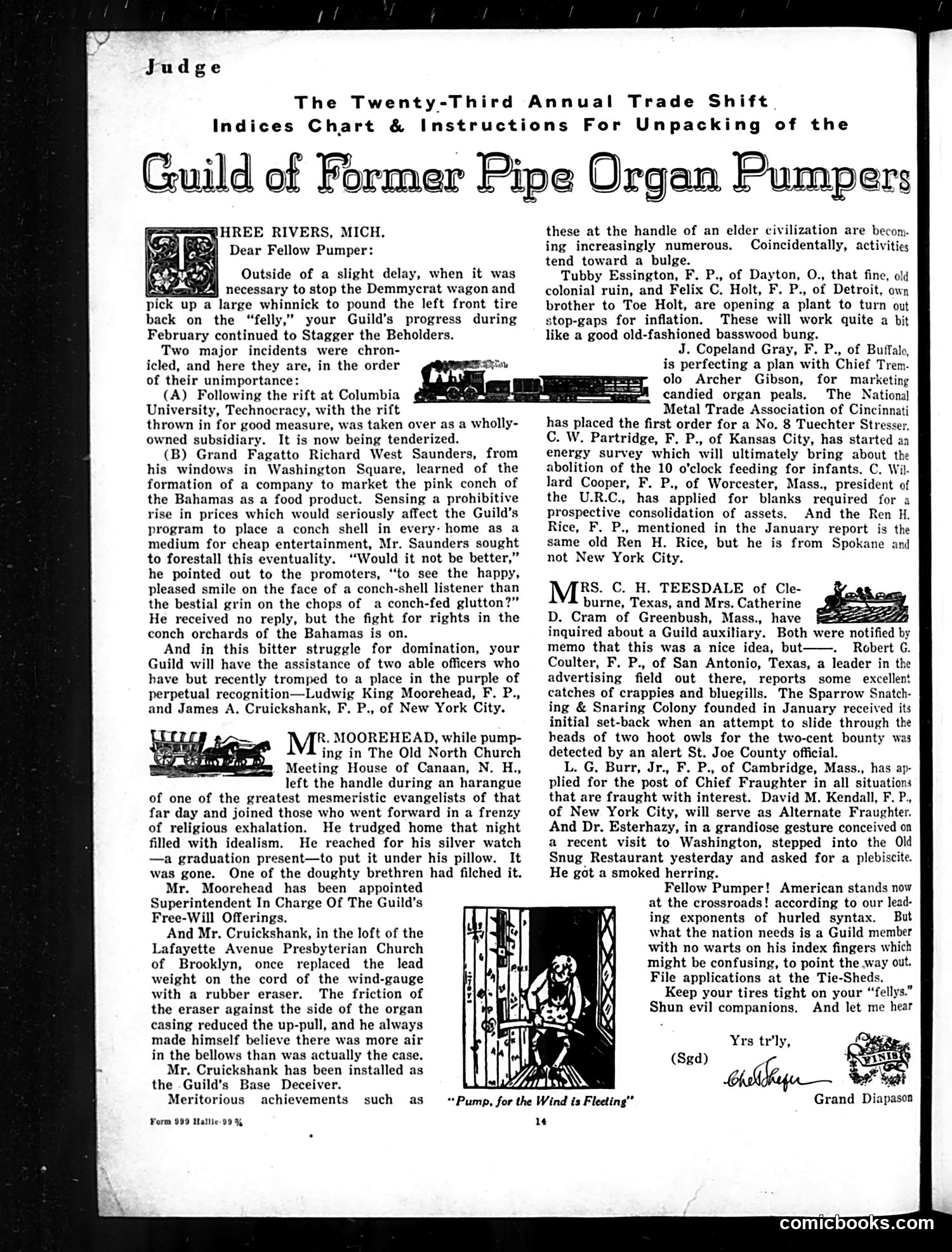
Judge Magazine Satire Analysis This is a satirical editorial piece masquerading as official Guild correspondence about "Former Pipe Organ Pumpers"—a fictional organization. The humor operates through absurdist bureaucracy and invented pseudo-credentials ("F.P." = Fellow Pumper). The satire ridicules both excessive organizational formality and contemporary 1930s trends. References include Technocracy (an actual Depression-era political movement), Columbia University controversy (unclear which specific incident), and economic anxieties about inflation and unemployment. The conch-shell scheme and "free-will offerings" mock elaborate commercial schemes and religious hypocrisy. Character names like "Tubby Essington" and invented job titles ("Base Deceiver," "Grand Diapason") create comic absurdity. The embedded illustration ("Pump, for the Wind is Fleeting") reinforces the nostalgic mockery of pre-industrial labor. The overall message criticizes organizational bloat, faddish movements, and the economic desperation driving get-rich-quick schemes during the Great Depression.
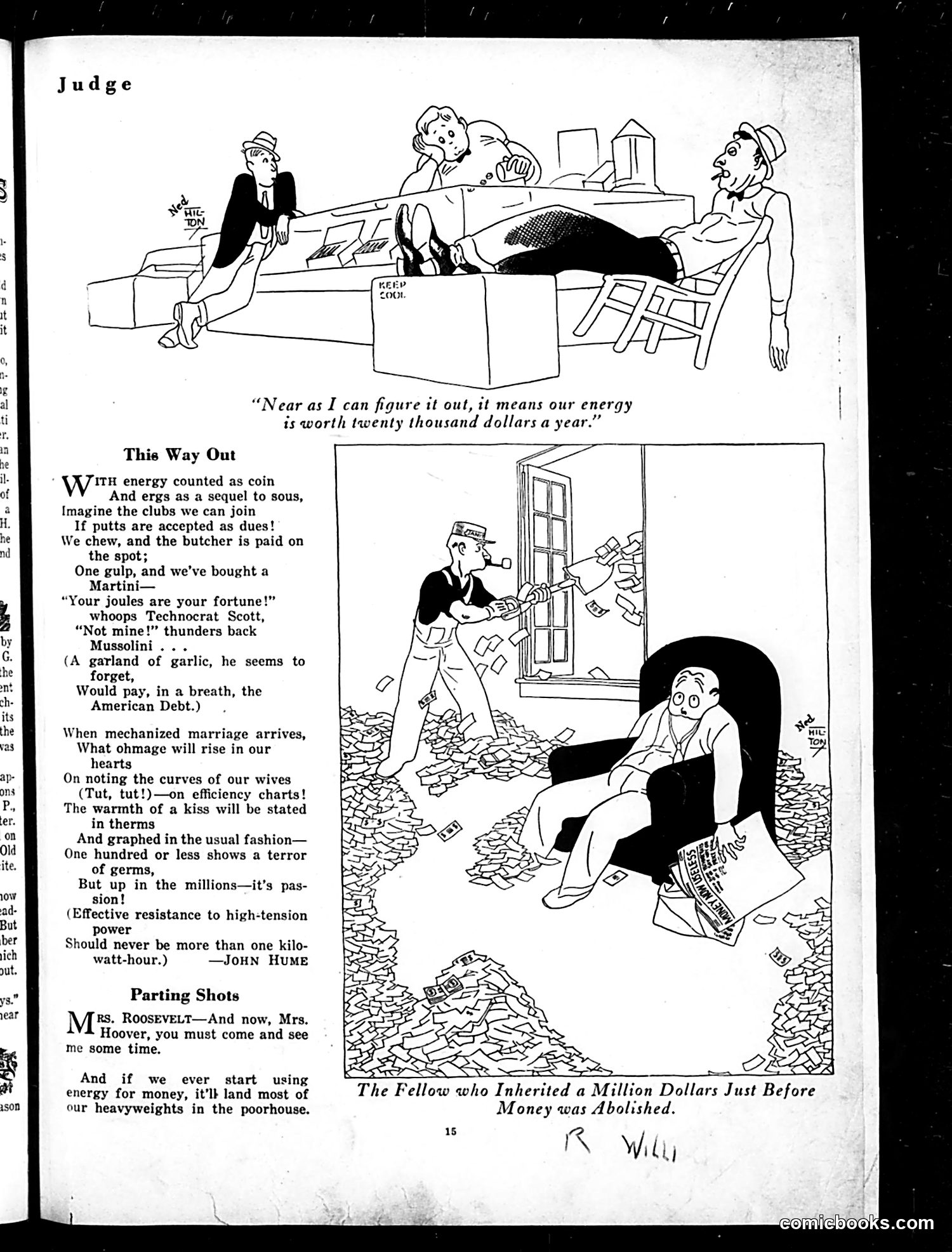
Analysis for Modern Readers Top Cartoon: A judge presides over two men debating whether human "energy" has monetary value ($20,000/year). This satirizes the Technocracy movement of the early 1930s—a fringe ideology proposing to replace capitalism with an energy-based currency system measuring work in "ergs" and "joules." "This Way Out" Poem: John Hume mocks Technocracy's absurdity: if energy became currency, you'd pay for martinis with calories ("gulps"), clubs with golf scores ("putts"), and marriage satisfaction would be graphed on efficiency charts. References "Technocrat Scott" and Mussolini (likely satirizing authoritarian efficiency obsession). The joke: reducing human life to energy measurements is dehumanizing nonsense. Bottom Cartoon: "The Fellow who Inherited a Million Dollars Just Before Money was Abolished"—depicts a man buried in cash after money becomes worthless, illustrating Technocracy's proposed elimination of traditional currency. "Parting Shots": A quip about Mrs. Roosevelt and Mrs. Hoover reflects 1930s political gossip. The page ridicules Technocracy as impractical utopianism during the Depression era.
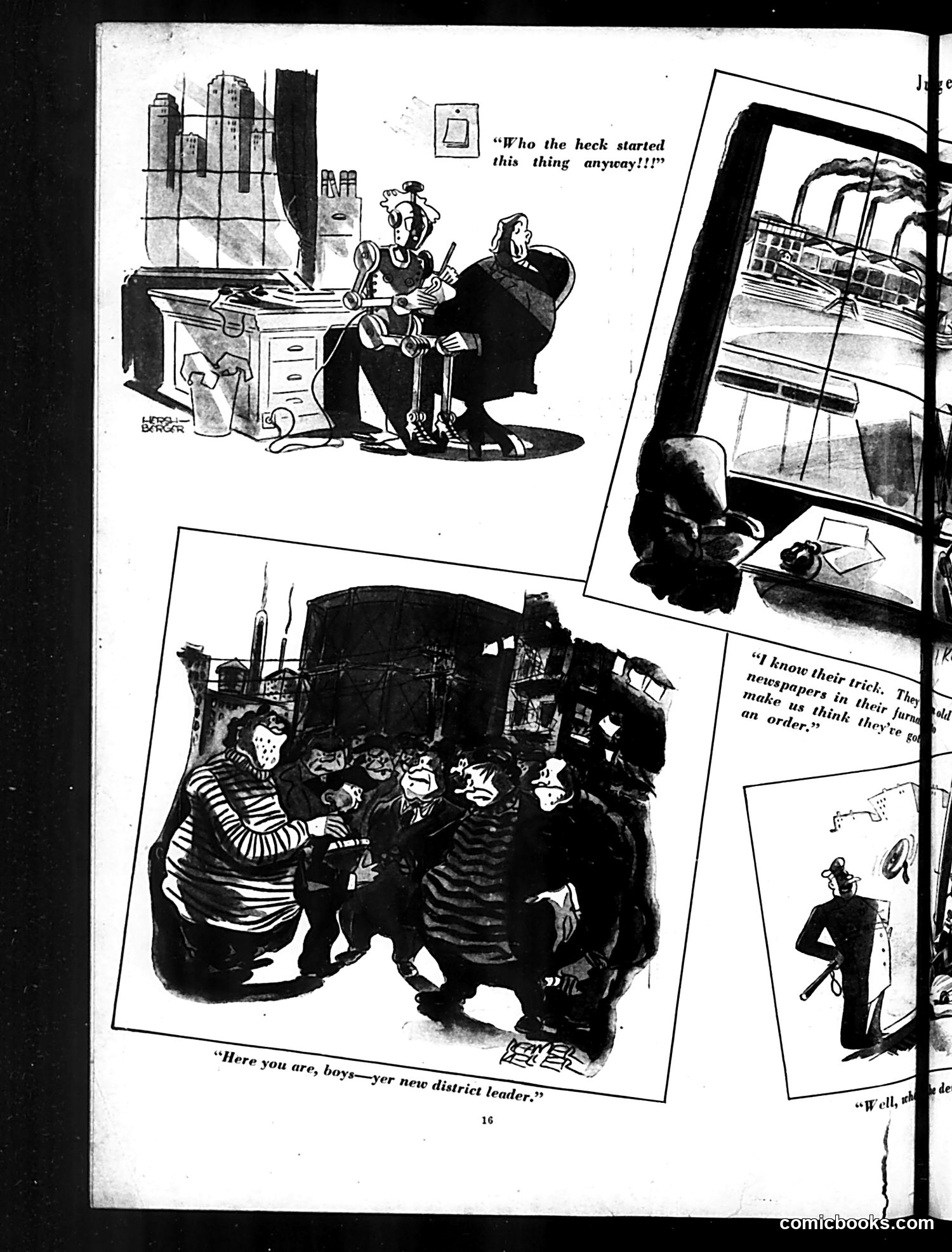
Analysis This page contains political cartoons satirizing urban machine politics and corruption. The top cartoon shows two men at a desk in what appears to be a city office, with one angrily demanding who started "this thing"—likely referencing some corrupt political scheme or administrative problem. The large middle cartoon depicts several heavyset men in striped suits gathered together, with a caption: "Here you are, boys—yer new district leader." This appears to satirize the appointment of a new political operative, with the figures representing either corrupt politicians or party machine members. The striped suits and caricature style suggest these are meant as unflattering portraits of political establishment figures. The right panel shows what appears to be a window scene with figures, possibly depicting surveillance or oversight of these political dealings. The satire targets municipal political corruption, patronage systems, and the interchangeability of dishonest political operatives.
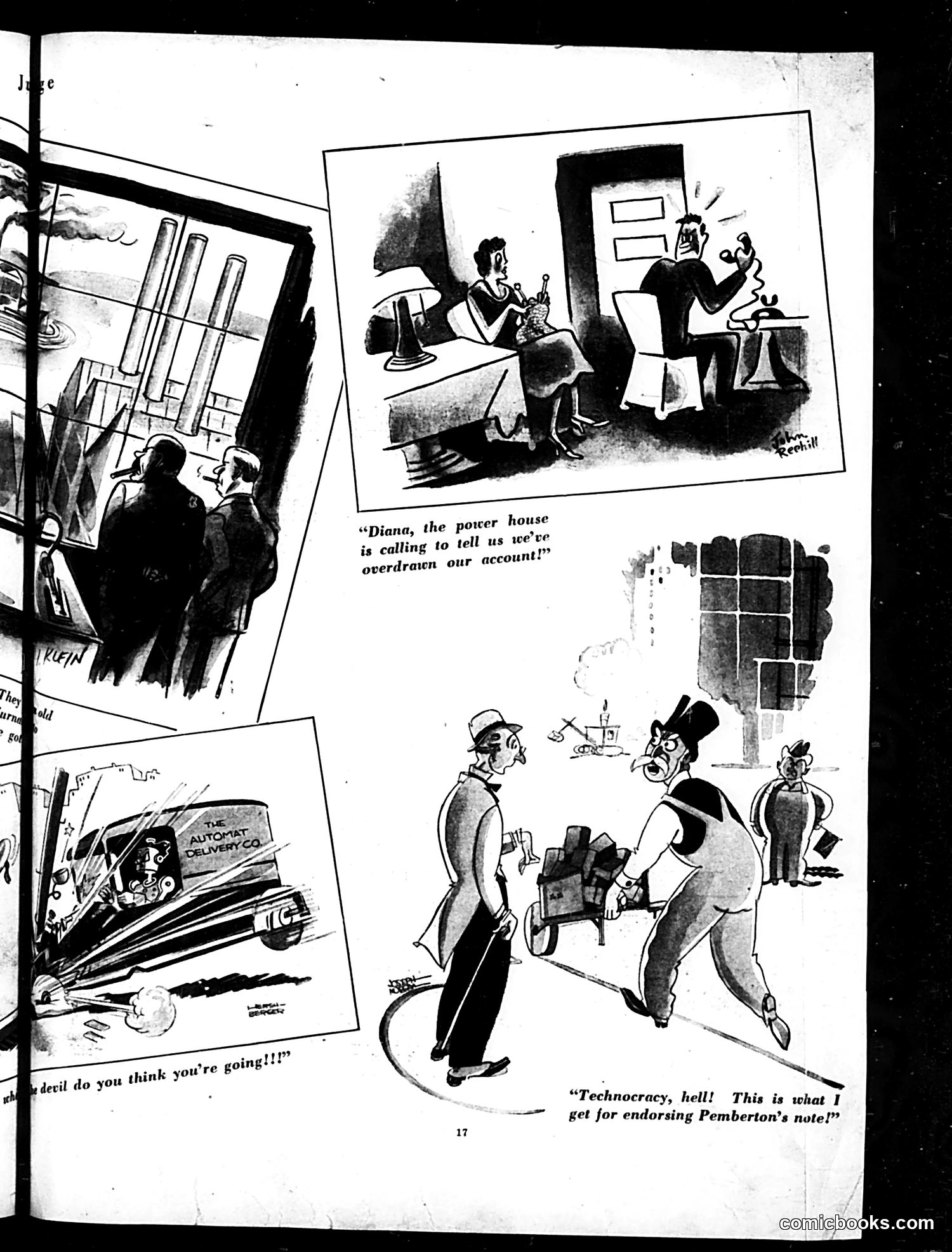
Analysis of Judge Magazine Page This page contains four separate cartoons satirizing early 20th-century American life and politics. The top cartoon mocks a woman calling from a "power house" about an overdrawn account—likely satirizing both domestic financial mismanagement and expanding utilities/services. The middle-left cartoon depicts a delivery truck crash, with the caption "devil do you think you're going!!!"—humor about reckless driving. The bottom cartoon references "Technocracy" and "Pemberton's note," appearing to mock someone's endorsement backfiring. "Technocracy" likely refers to the 1930s movement advocating rule by technical experts. The figure's regret suggests the satire targets either the movement itself or naive political endorsements with unforeseen consequences. The cartoons collectively reflect Depression-era anxieties about economic management, modern conveniences, and political movements.
Analysis of Judge Magazine Page This page from Judge magazine features theater criticism by George Jean Nathan, a prominent early 20th-century drama critic. The content critiques theatrical taste and defends popular entertainment against intellectual elitism. Main Subject: Nathan defends George M. Cohan's comedic theater against "serious" critics who dismiss entertainment as artistically inferior. Nathan argues that fun and gayety in theater are valuable, not trivial, and mocks the pretentious who only respect grim, psychologically-complex dramas (references to "Freud and Jung," "Czechoslovakian modernizations of Oedipus Rex"). Secondary Reviews: Brief dismissals of "Pardon My English" (a musical with Jack Pearl and Lyda Roberti) and commentary on "Pigeons and People." The Satire: Nathan mocks intellectual snobs who conflate artistic merit with grimness and deny pleasure any cultural legitimacy—comparing their taste to appreciation for "Boston buses" and "Ovaltine." This reflects 1930s debates about high versus popular culture.
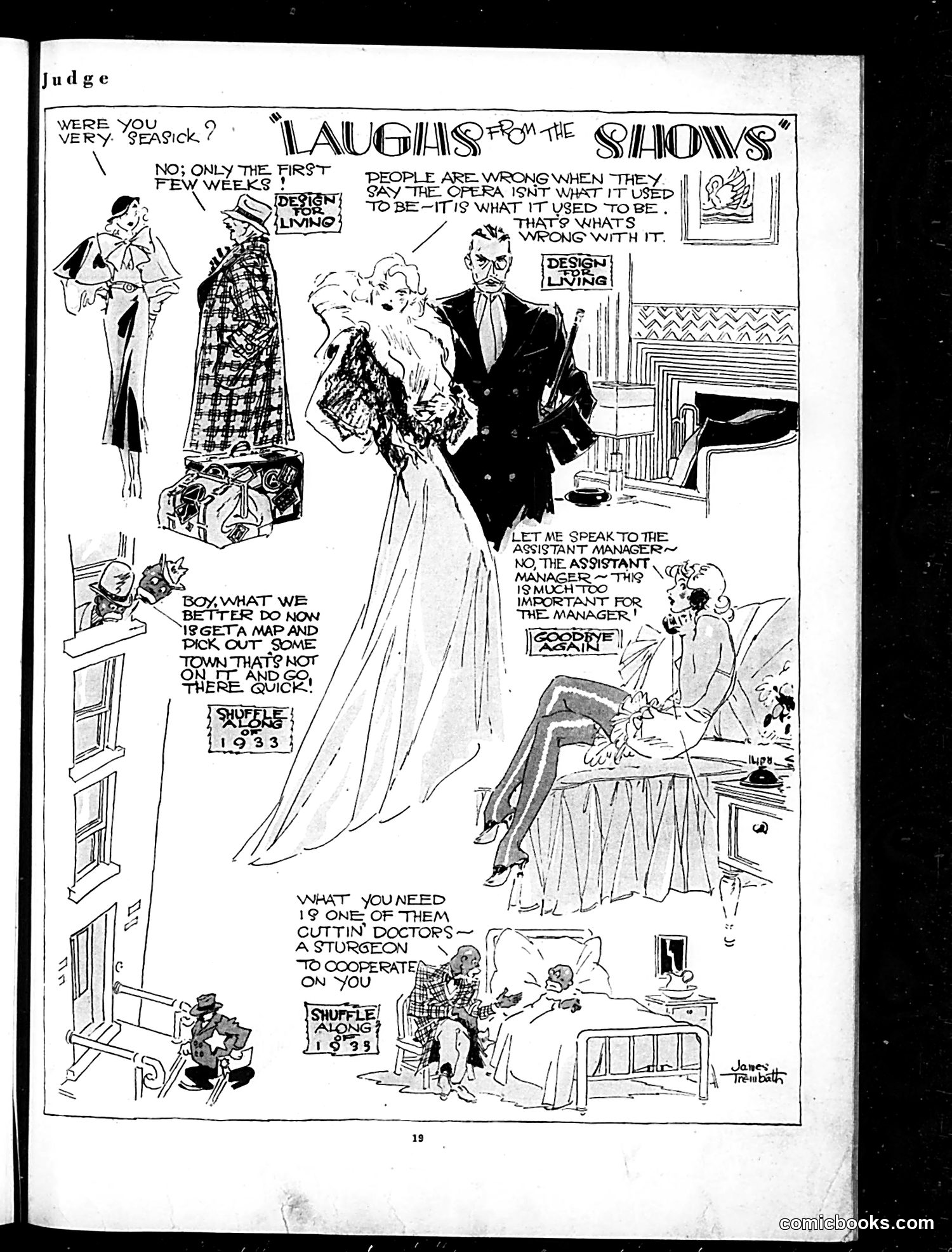
Analysis: "Laughs from the Shows" This is a satirical commentary on the decline of opera as entertainment, circa 1933 (visible date stamp). The cartoon presents a sophisticated couple attending the opera, where they encounter various comedic obstacles. The satire's central point: opera enthusiasts claim the art form isn't "what it used to be," but the cartoon suggests the real problem is that it *is* exactly what it was—outdated and no longer relevant to modern audiences. The couple's attempts to enjoy their evening are derailed by bureaucratic theater staff, medical emergencies requiring "doctors" and "surgeons," and general chaos. The implicit critique targets both opera's pretentiousness (the "Design for Living" references suggest artificial sophistication) and the theatrical industry's inability to adapt. The 1933 date places this during the Great Depression, when traditional "high culture" entertainments were losing audiences to cheaper popular amusements. The humor derives from contrasting refined opera-goers' expectations with the messy, chaotic reality of attending a show.
"The Movies" by Pare Lorentz - State Fair Review This is a film criticism column, not political satire. Lorentz reviews the movie "State Fair," praising it as genuinely newsworthy cinema. The piece argues that while the film—starring Janet Gaynor, Lew Ayres, and Will Rogers—is technically a mild romantic comedy about an Iowa farm family at a state fair, its real significance lies in its *accurate* portrayal of modern farmers as educated, prosperous people living comfortable lives, rather than the stock "booted, mustachioed, and penniless yokels" typically shown in films. Lorentz credits director Henry King and North Carolina playwright Paul Green's adaptation for elevating what could have been a forgettable production into important cinema by authentically dramatizing genuine American rural life—something rarely attempted in movies at that time.
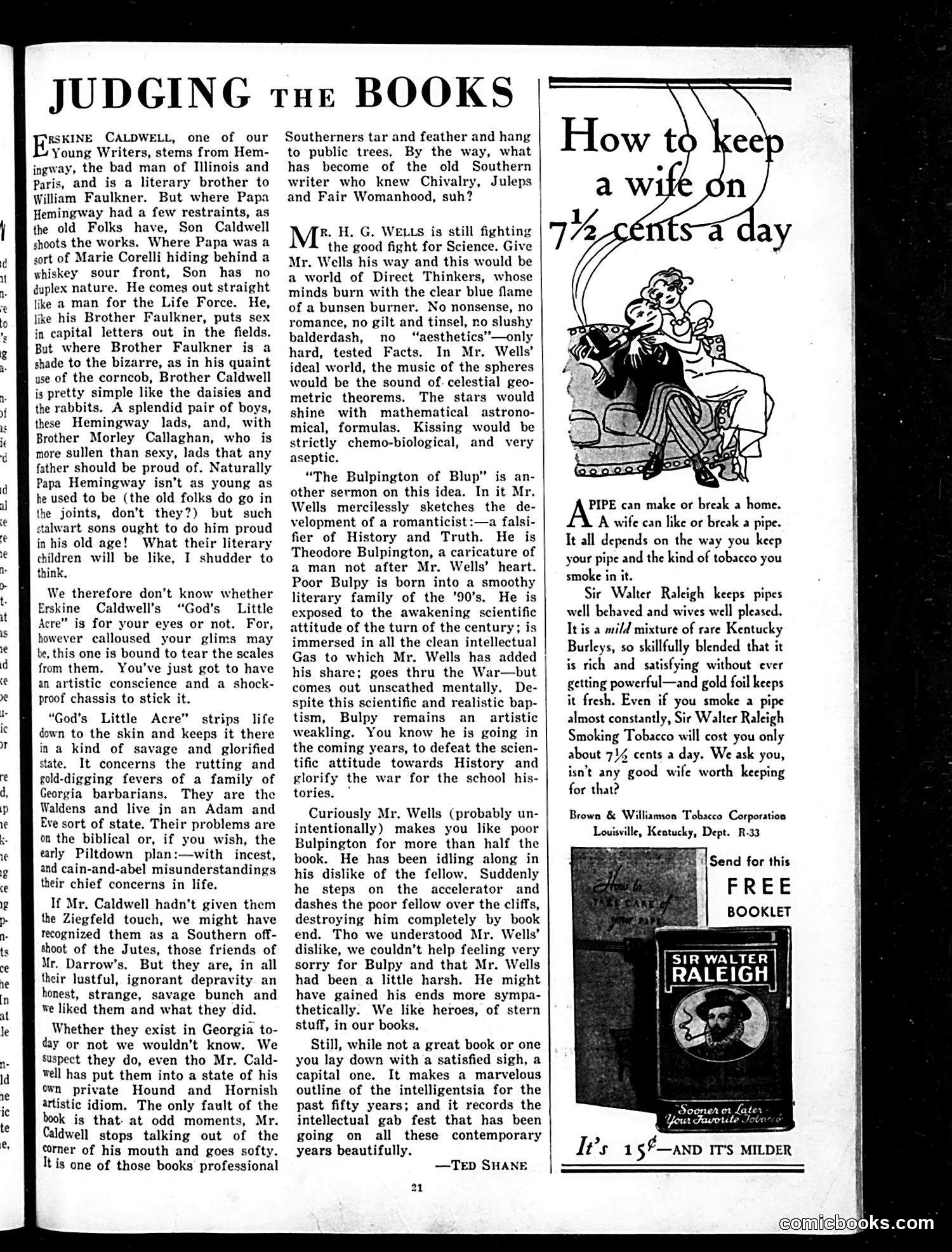
Analysis of "Judging the Books" Page This page reviews two contemporary novels through the lens of 1930s literary criticism. Erskine Caldwell's "God's Little Acre": The reviewer praises Caldwell's raw depiction of poor Georgia farmers, comparing him favorably to literary predecessors Hemingway and Faulkner. The satire targets prudish readers who might be shocked by the book's explicit treatment of sexuality and incest among rural characters. The reviewer defends Caldwell's "honest" portrayal against Southern gentility traditions that romanticized the region. H.G. Wells' "The Bulpington of Blup": Wells is satirized as an overly rationalist ideologue who reduces human experience to cold science. The reviewer mocks Wells' vision of a world governed by logic and mathematics, where even kissing becomes "chemo-biological." Bulpington represents Wells' criticism of romantics who falsify truth—a character Wells clearly despises. The right-side advertisement for Sir Walter Raleigh tobacco is unrelated product placement typical of the era.
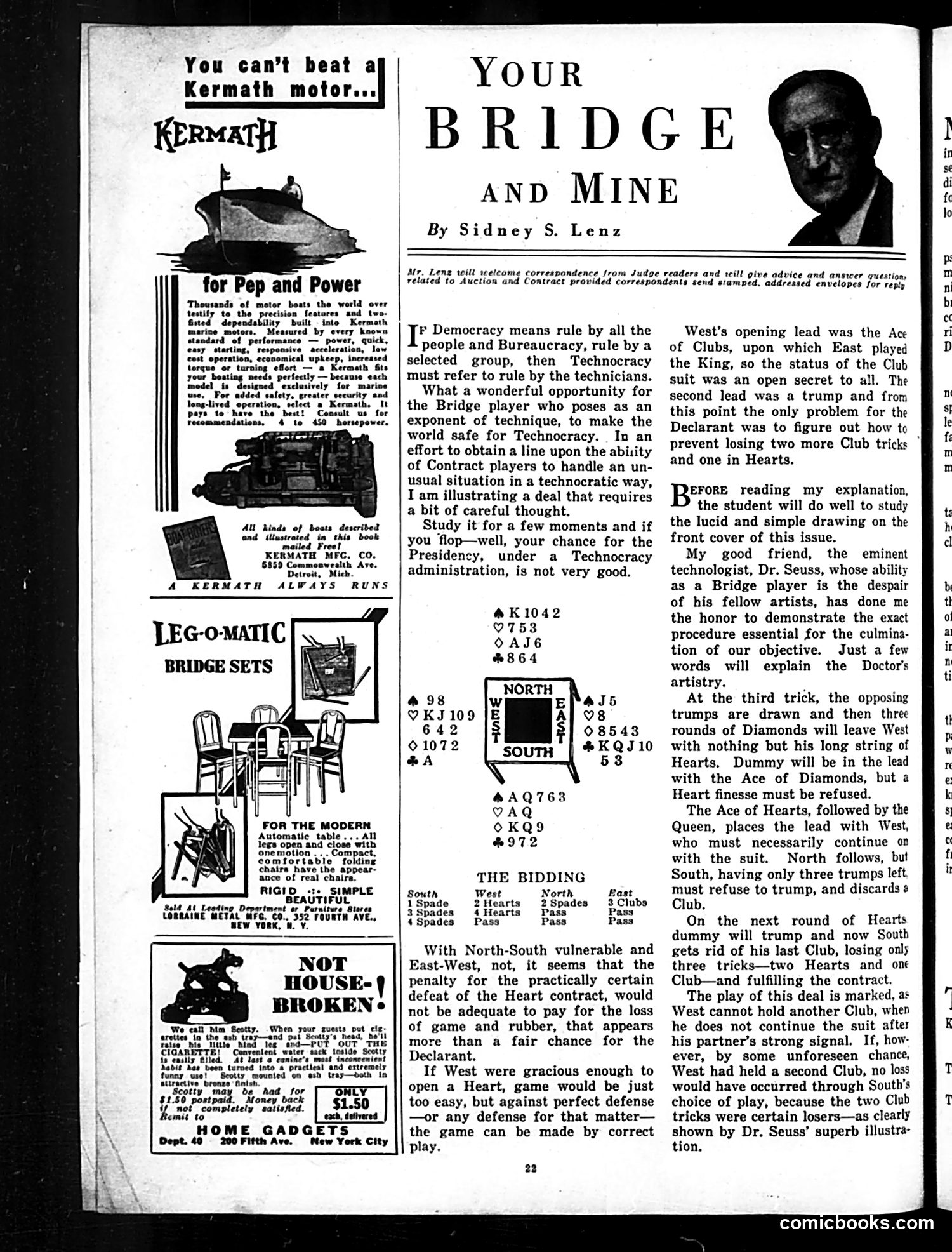
Analysis of This Judge Magazine Page This page is primarily advertising and a bridge column, not political satire. The main content is "Your Bridge and Mine" by Sidney S. Lenz, a technical article about contract bridge strategy using a specific card hand. The page includes several period product advertisements (Kermath motors, Lego-Matic bridge sets, Home Gadgets novelty items) typical of magazine filler. The only satirical element appears in Lenz's opening paragraphs, which make a light joke about "Technocracy"—referencing the 1930s technocratic movement proposing rule by technical experts rather than elected officials. Lenz humorously suggests that bridge players, as experts in "technique," could claim authority under such a system. This is gentle wordplay rather than sharp political commentary. The reference to Dr. Seuss (Theodor Geisel) as a bridge enthusiast and illustrator is noteworthy—he was already known as a cartoonist before becoming famous as a children's author. Overall, this is a bridge instruction page with advertising, not a political cartoon issue.
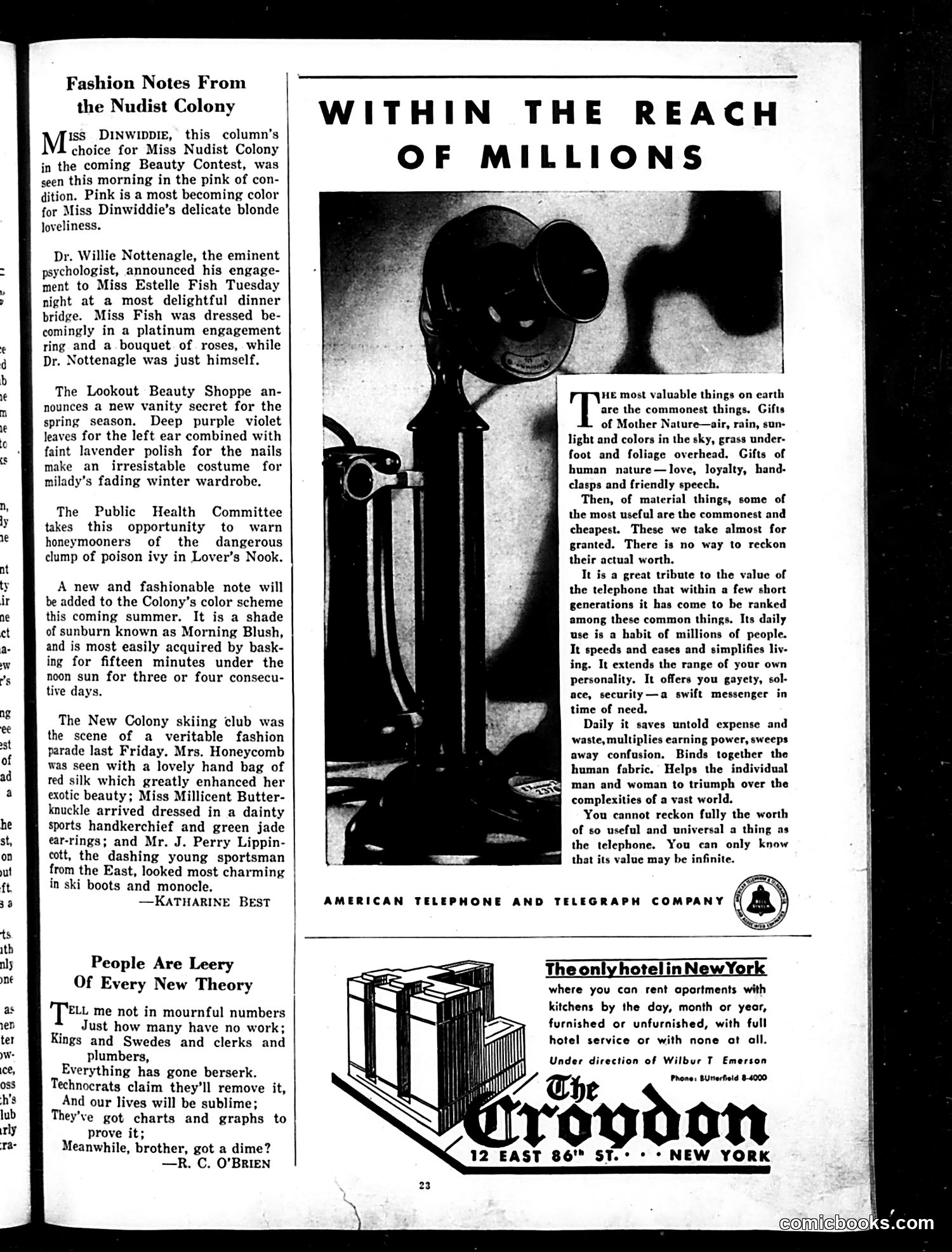
Page Analysis This is primarily an advertising page for the American Telephone and Telegraph Company, with satirical content filling surrounding space. The main advertisement ("Within the Reach of Millions") is a corporate pitch promoting the telephone as an essential utility that has become commonplace—highlighting how it simplifies life, extends communication range, and saves money. The satirical content includes: "Fashion Notes from the Nudist Colony" — a humorous column by Katharine Best mocking both nudist communities (a novelty in the era) and fashion journalism through absurd observations about clothing choices at a "nudist colony," creating obvious contradictions. "People Are Leery of Every New Theory" — a poem by R.C. O'Brien satirizing technocrats and economic theorists promoting solutions while ordinary people face unemployment and hardship ("Meanwhile, brother, got a dime?"), suggesting skepticism toward grandiose new theories during what appears to be Depression-era economic anxiety. The page balances corporate messaging with humor deflating both social trends and expert pretensions.
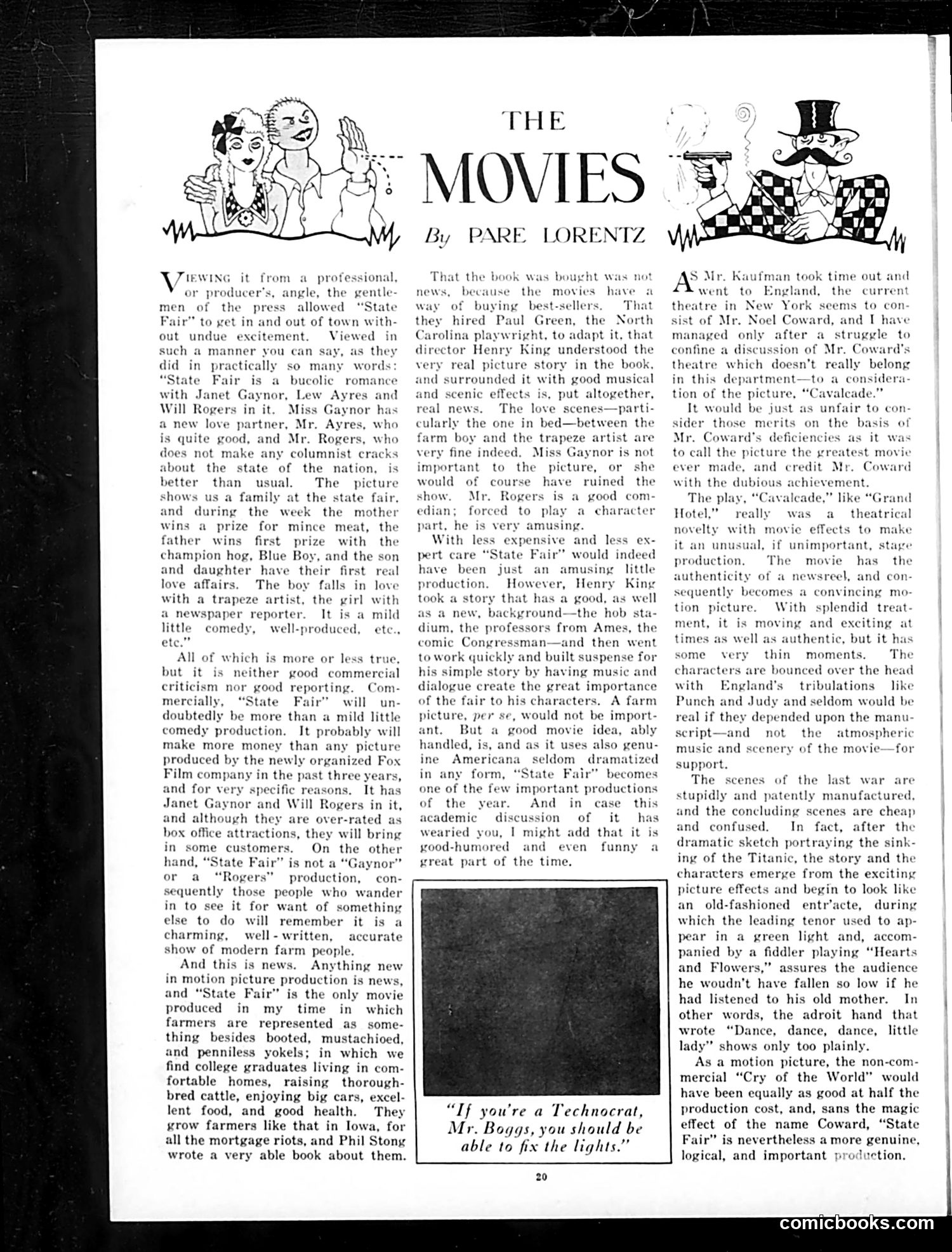
"The Movies" by Pare Lorentz - Judge Magazine This is a film criticism column reviewing "State Fair," a 1933 Fox production starring Janet Gaynor, Lew Ayres, and Will Rogers. Lorentz argues that while critics dismissed it as mild rural comedy, it's actually commercially significant and newsworthy because it represents farmers realistically—as educated, prosperous people living in comfortable homes with thoroughbred cattle—rather than the stereotypical "booted, mustachioed, and penniless yokels" typically shown in movies. The column credits director Henry King and playwright Paul Green with elevating Phil Stong's novel through music, dialogue, and authentic Iowa settings (the state fair, Ames professors, a comic Congressman) into something genuinely important. Lorentz positions the film as rare Americana cinema, worth noting simply for depicting modern American farm life authentically. The small cartoon caption appears unrelated—a Technocrat joke about fixing lights.
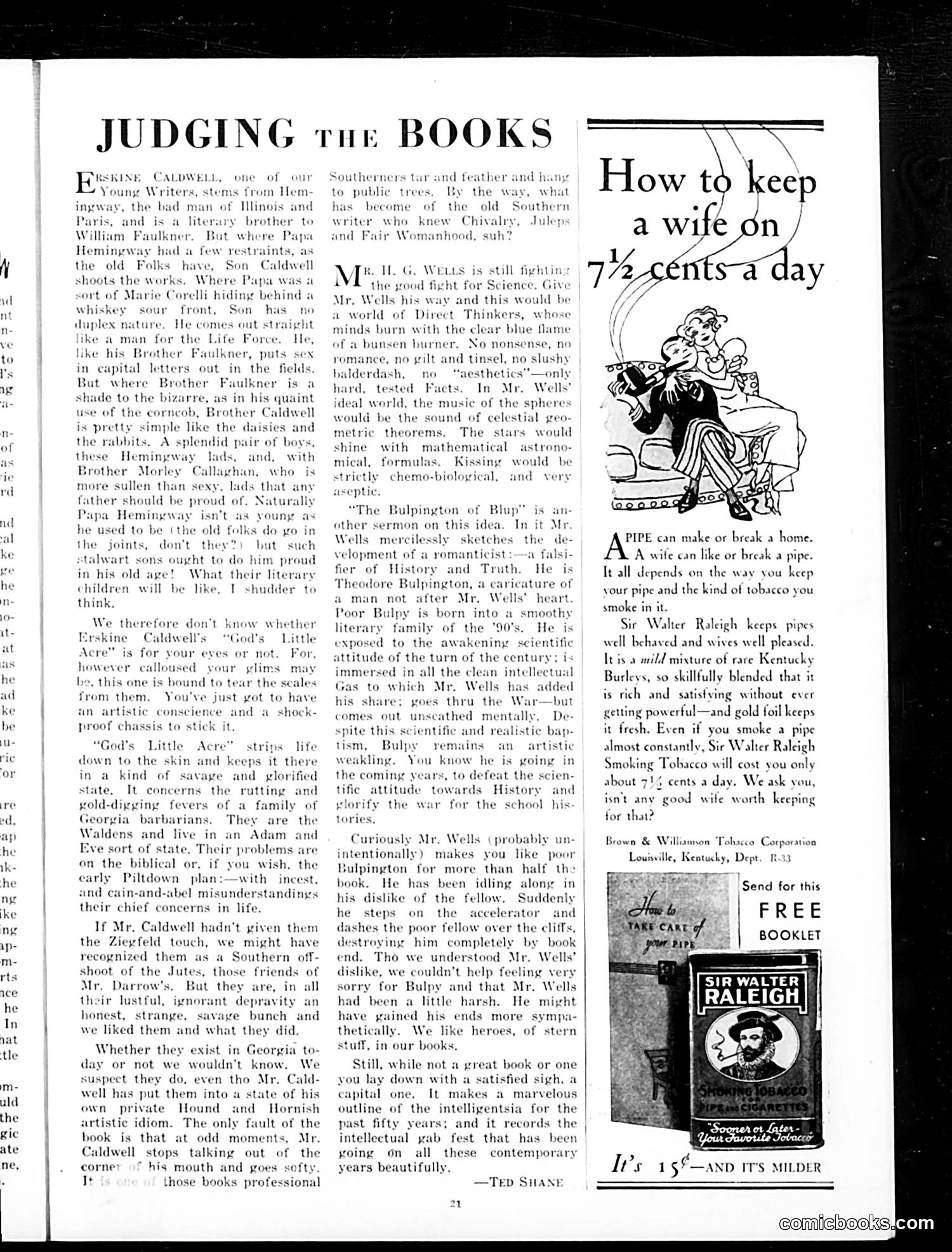
Analysis of Page Content This is primarily a book review section titled "Judging the Books," not a political cartoon page. The main content reviews two literary works: 1. "God's Little Acre" by Erskine Caldwell — The reviewer praises this novel about rural Georgia families, comparing Caldwell favorably to Hemingway and Faulkner as part of a new generation of American writers. The book depicts poor, sexually frank rural life without romanticization. 2. "The Bulpington of Blup" by H.G. Wells — Wells critiques a romanticist character named Bulpington who clings to outdated historical ideals despite exposure to scientific, rational thinking. The review suggests Wells champions direct, logical thinking over artistic sentimentality. The right side contains an unrelated advertisement for Sir Walter Raleigh tobacco, featuring a humorous piece about keeping "a wife on 7½ cents a day" through pipe smoking—typical period advertising humor. There are no political cartoons on this page; it's a literary criticism section from Judge magazine.
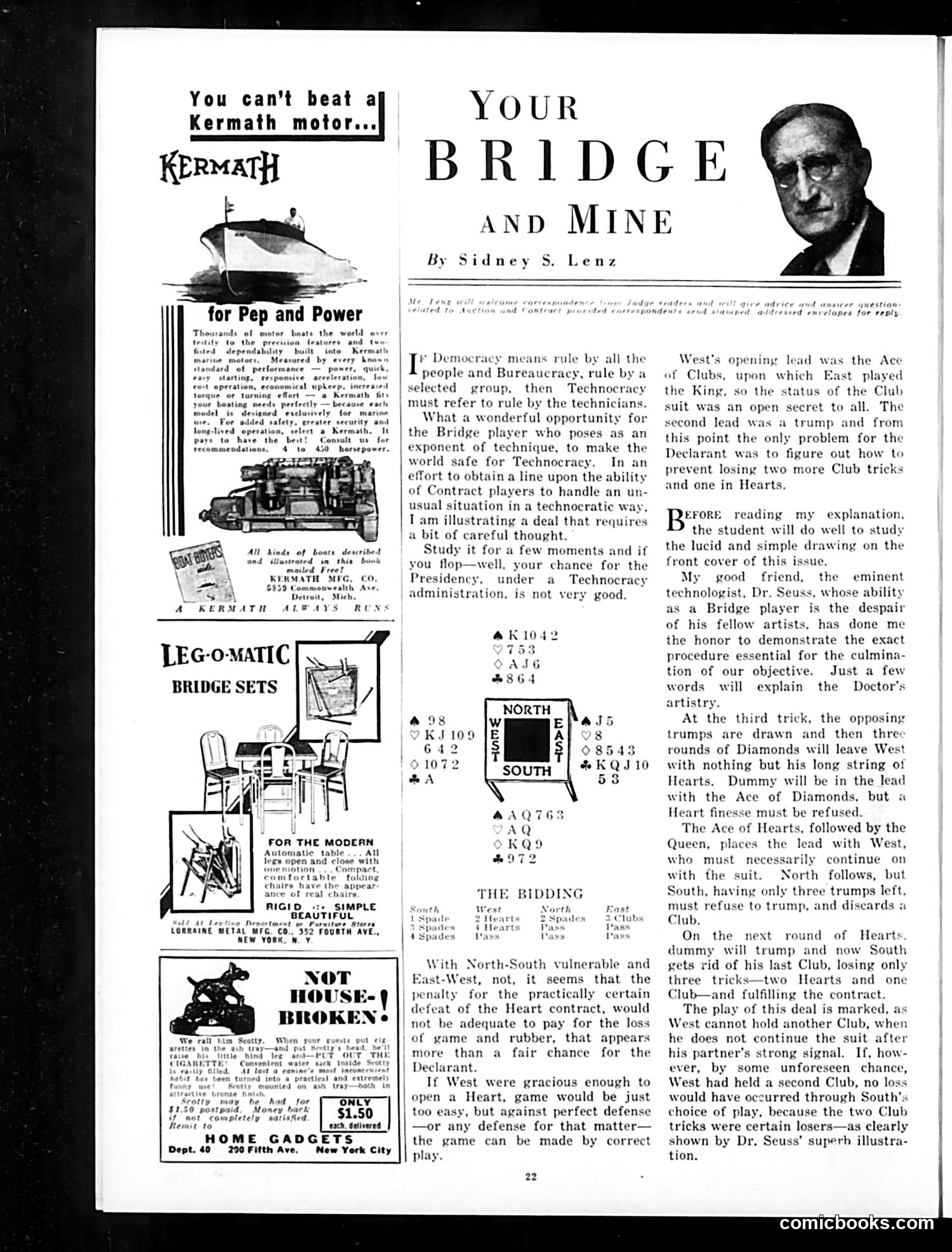
"Your Bridge and Mine" - A Technocracy Satire This page mixes bridge card game instruction with political satire about Technocracy, a 1930s movement proposing rule by technical experts rather than elected politicians. The article by Sidney S. Lenz uses bridge as metaphor: Democracy allows all people to rule; Bureaucracy lets a selected group rule; Technocracy means rule by technicians. The author sarcastically suggests bridge players have a chance at the presidency "under a Technocracy administration"—but only if they can solve a complex card problem correctly. The joke is that specialized technical skill (bridge mastery) supposedly qualifies someone for political leadership—a critique of Technocracy's claim that engineers and experts should govern. The satire implies this is absurd: bridge ability has nothing to do with running a country. Dr. Seuss (the artist) illustrates the card deal, adding credibility to the technical demonstration while participating in the satire. The surrounding advertisements are unrelated commercial content typical of Judge magazine.
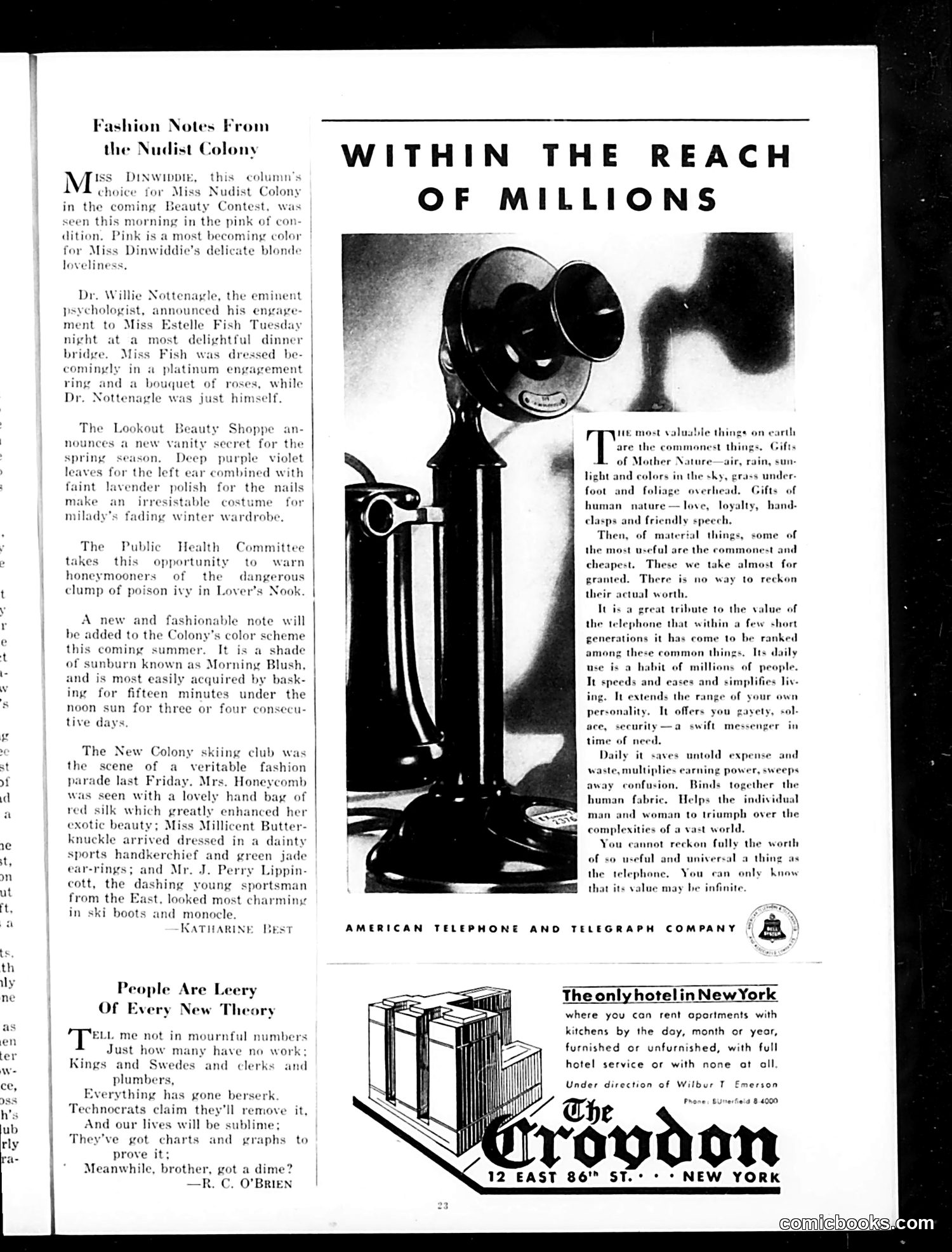
Satire on the "Nudist Colony" and Period Concerns This page satirizes 1920s-30s fads and anxieties. The "Fashion Notes From the Nudist Colony" mockingly reports on a nudist community as if it were a high-society resort—complete with beauty contests, engagements, and fashion commentary. The satire lies in treating nudism (a real but controversial movement gaining attention then) with the same breathless tone used for conventional fashion news, undercutting both the nudists and fashion journalism itself. The humor relies on absurdist details: a woman wearing only an engagement ring and roses; advice on applying cosmetics to nude skin; "sunburn" as haute couture. The implicit joke: nudists ironically obsess over appearance despite rejecting clothing. The separate poem "People Are Leery of Every New Theory" satirizes Depression-era "Technocrats"—a real movement claiming scientific management could solve unemployment. The poem mocks both their pseudointellectual charts and the desperate jobless ("got a dime?"). Both pieces reflect 1930s skepticism toward fashionable new movements and pseudoscientific solutions.
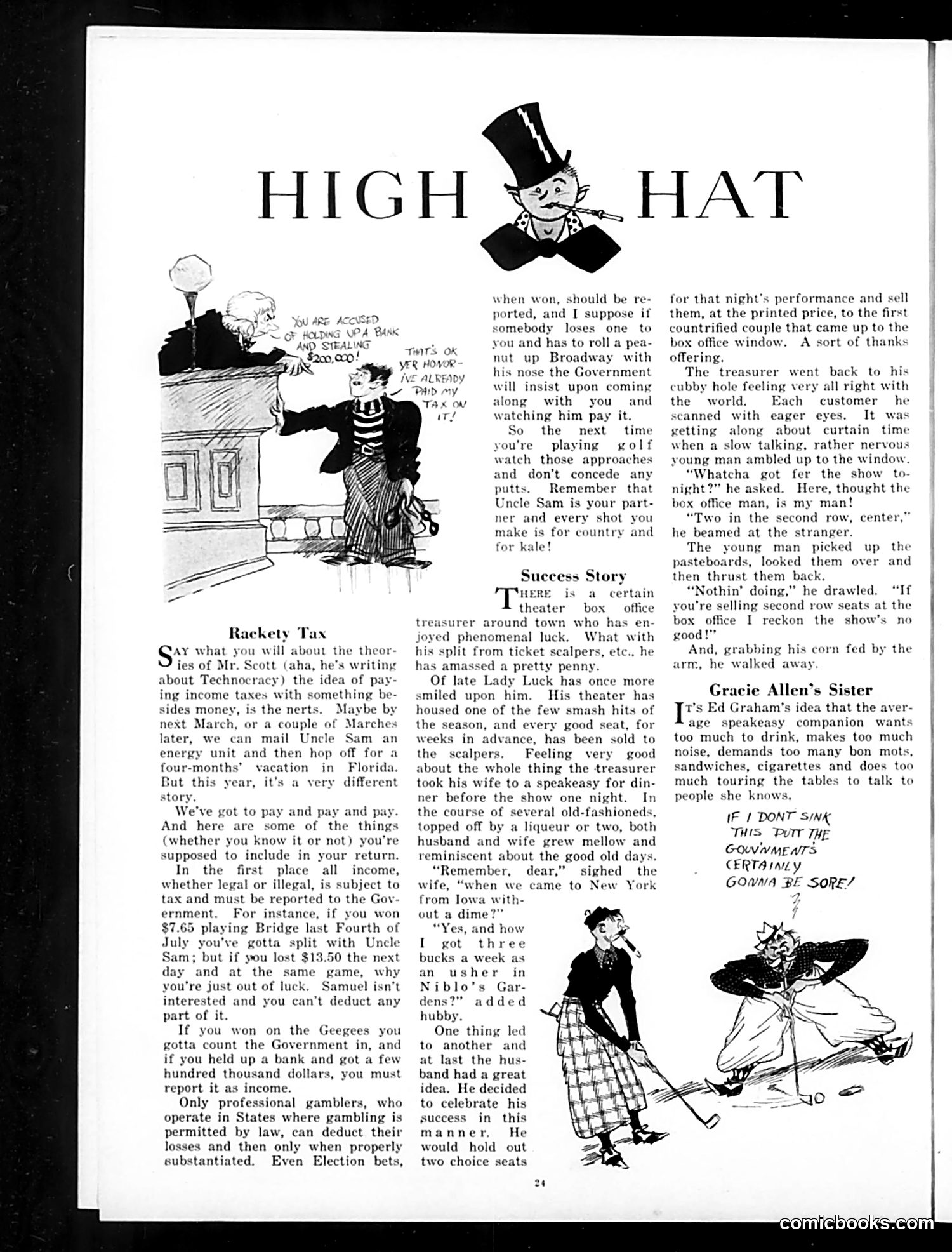
Judge Magazine Page Analysis This page contains two satirical pieces reflecting 1920s-30s American concerns: "Rackety Tax" mocks income tax compliance. The text humorously argues that Americans must report ALL income to Uncle Sam—even illegal gambling winnings or money from bank robberies—while losses cannot be deducted (except for professional gamblers in licensed states). The satire targets the absurdity of comprehensive tax reporting and the government's relentless pursuit of revenue. References to "Technocracy" and paying taxes with "energy units" suggest contemporary economic theory debates. "Success Story" ridicules nouveau riche pretension. A theater treasurer who's made money through ticket scalping attempts a sentimental gesture—offering choice seats at face value to "countrified" (rural, unsophisticated) newcomers as thanks for his success. When a suspicious farmer rejects them, assuming cheap seats mean a bad show, the treasurer's condescension backfires. The joke satirizes both working-class skepticism and middle-class self-congratulation. "Gracie Allen's Sister" (partial) appears to joke about speakeasy culture during Prohibition, mocking demanding companions.
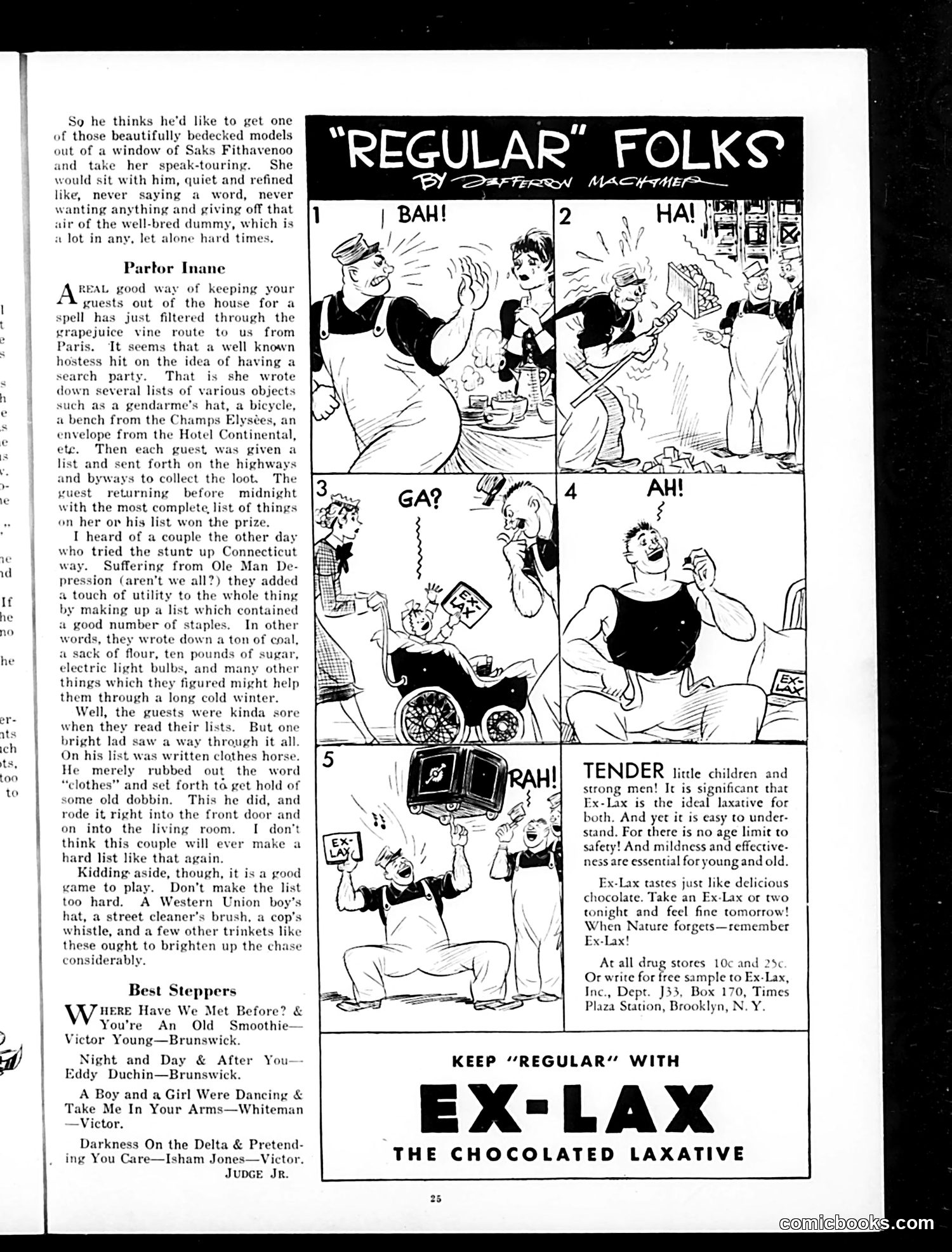
"Regular Folks" Comic Strip & Page Analysis This page is primarily an advertisement disguised as editorial content. The main feature is a five-panel comic strip by Daffan Machthmer titled "Regular Folks," depicting a domestic scene where a man attempts to charm a woman into a compromising situation—the humor relies on slapstick and innuendo typical of 1920s-30s comedy. The page's real purpose, however, is promoting Ex-Lax laxative chocolate. The comic's title—"Regular Folks"—is a double entendre; "regular" refers both to ordinary people and to digestive regularity. The advertisement explicitly plays on this pun, claiming the product keeps one "regular." The left column contains filler content: "Parlor Inane" (a humor piece about scavenger hunts during the Depression) and "Best Steppers" (song recommendations), likely included to provide editorial legitimacy to what is essentially advertorial space. This represents common 1930s magazine practice: embedding advertisements within entertainment content.
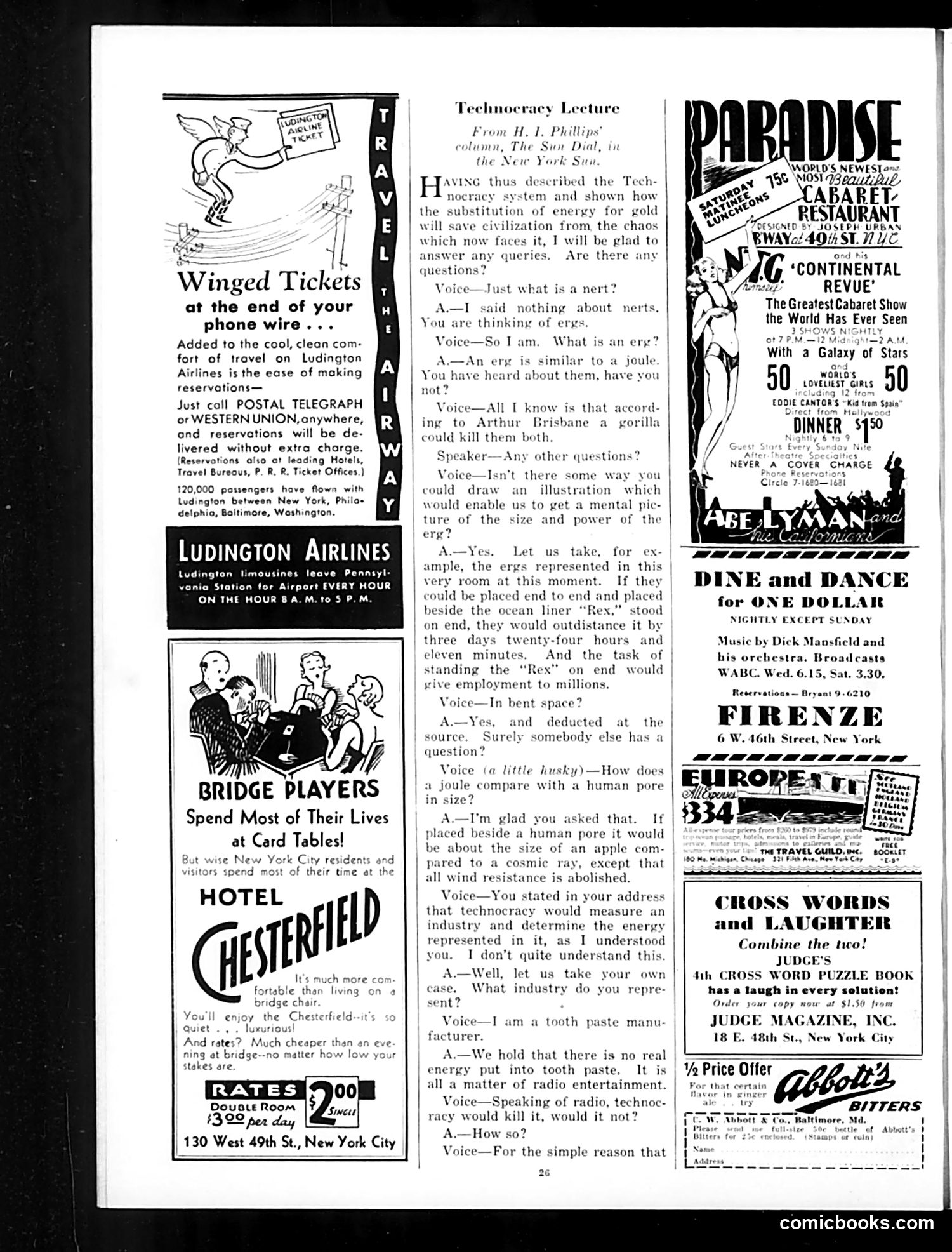
Judge Magazine Page Analysis This page from Judge magazine is primarily advertising and entertainment listings, not political satire. The notable content includes: "Technocracy Lecture" (center): A satirical Q&A mocking the technocracy movement, a 1930s fad proposing replacing capitalism with energy-based economics. The humor relies on absurdist comparisons—ergs (units of energy) placed end-to-end would outlast an ocean liner; a joule equals an apple compared to a cosmic ray. The final joke: technocracy would eliminate radio because there's "no real energy" in tooth paste (the questioner's industry), so radio entertainment wouldn't exist. The satire targets technocracy's pseudoscientific pretensions and how it would render modern conveniences obsolete. Surrounding advertisements promote 1930s NYC nightlife (Paradise cabaret, Firenze nightclub), hotels, airlines, and puzzle books—typical Depression-era entertainment venues and services.
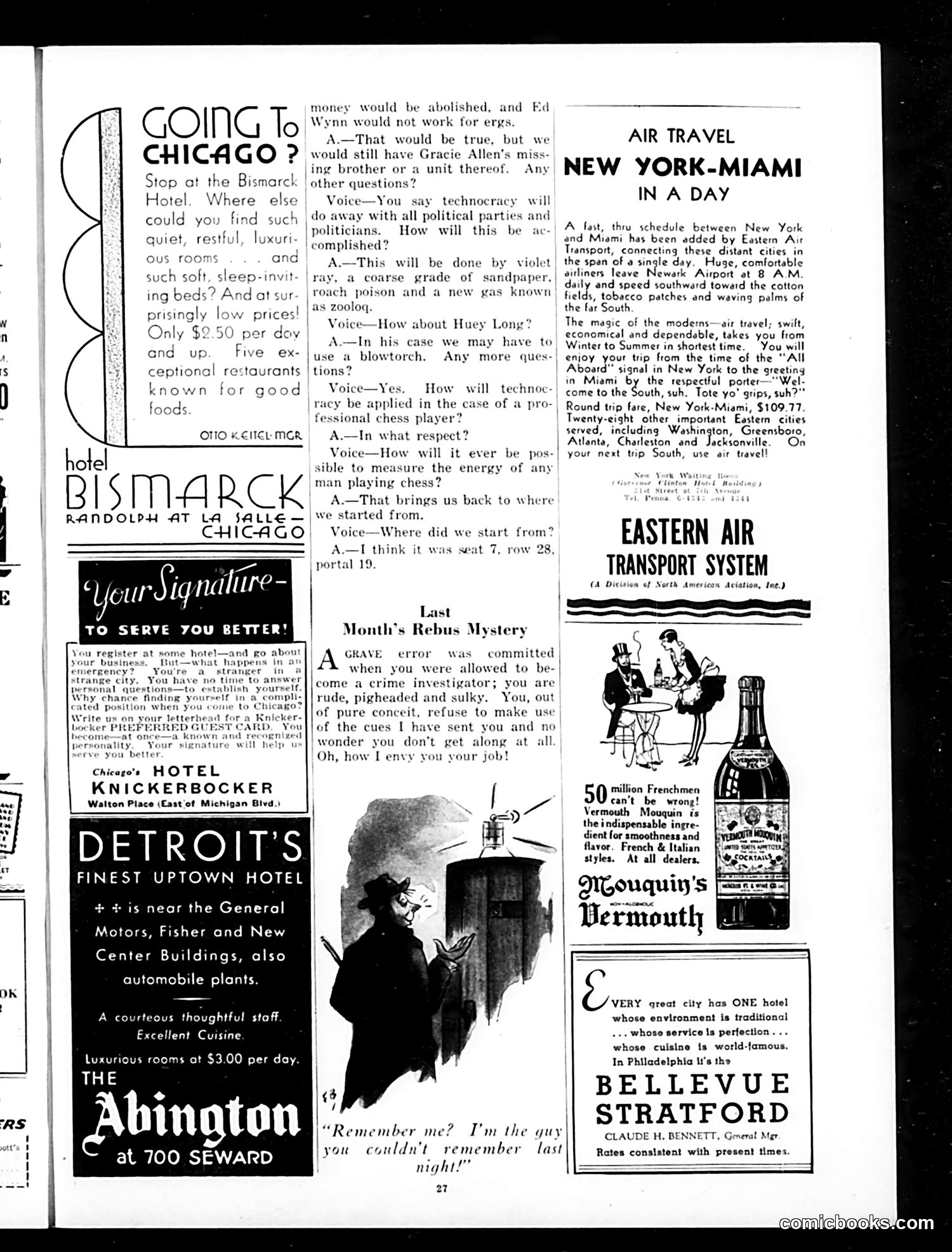
Page Analysis: Judge Magazine Advertisement & Content Page This page is primarily advertising with one satirical feature. The main content is "Last Month's Rebus Mystery"—a humorous Q&A dialogue mocking Technocracy, a 1930s movement advocating replacing politicians with technical experts and scientists. The satire references contemporary figures: Ed Wynn (comedian), Gracie Allen (radio personality), and Huey Long (Louisiana political figure known for wealth-redistribution schemes). The joke: even a technocratic system couldn't solve absurd problems like Allen's "missing brother" or fairly judge a chess player's energy output—suggesting technocracy's naive utopianism. The remaining content consists of hotel and airline advertisements (Bismarck, Knickerbocker, Abington, Eastern Air Transport) and product ads (Mouquin's Vermouth, Bellevue Stratford). These reflect 1930s-era travel and hospitality marketing targeting affluent readers.
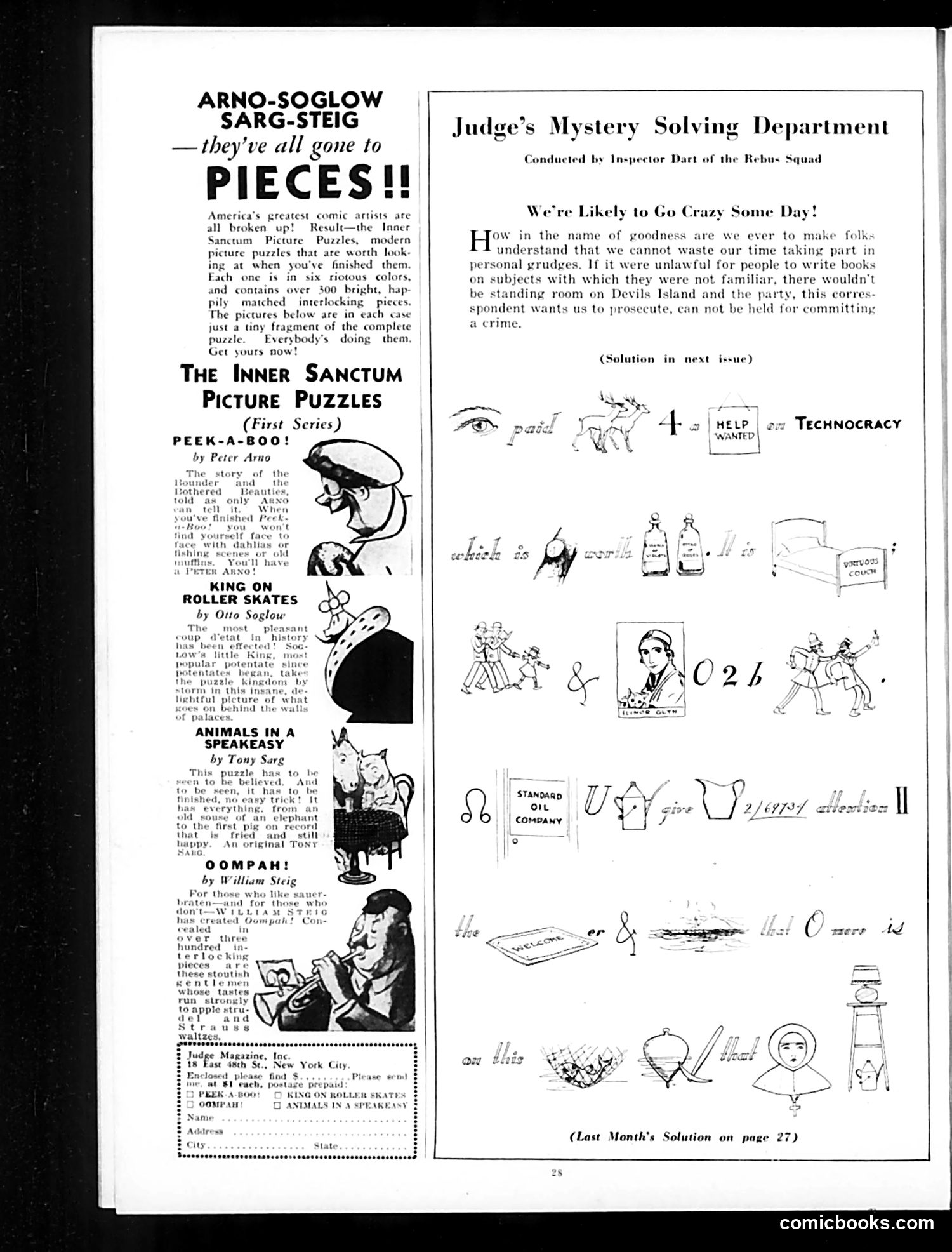
Analysis This page mixes advertising with a puzzle department. The left side advertises "Inner Sanctum Picture Puzzles"—jigsaw puzzles featuring artwork by prominent cartoonists (Peter Arno, Otto Soglow, Tony Sarg, William Steig). The ad's humor plays on these artists being "all broken up" and their work now "in pieces"—a pun since the puzzles literally fragment their illustrations. The right side features "Judge's Mystery Solving Department," a rebus puzzle column. The visual puzzles combine images and text to form phrases (like "paid," "help wanted," "technocracy"). This was a popular recurring feature in Judge magazine—readers solved them by interpreting the visual-verbal wordplay. The column header's text mocks readers who write about unfamiliar topics, suggesting they'd overpopulate "Devils Island" (a penal colony, used figuratively for imprisonment). The tone is typical Judge satire: irreverent and self-aware. Both sections represent common Judge content: commercial tie-ins and interactive puzzles designed to engage readers.

Explanation for Modern Readers This is primarily a book advertisement page, not a political cartoon. The dominant feature is a large ad for "The Human Body" by Dr. Logan Clendening, a medical education book being sold for $1 (reduced from $5). The headline "The Indian with a Lid on His Stomach!" references a real 19th-century medical curiosity—an 1822 frontier incident where a Native American reportedly survived a severe abdominal gunshot wound that left his stomach exposed and visible. This sensational case became famous in medical history and is used here as a hook to interest readers in learning about human anatomy and digestion. The ad emphasizes debunking health "fads and fallacies" and promises to explain actual bodily functions. The "Stop Worrying About Yourself" sidebar at top reinforces this educational angle. The page also advertises 24 other discounted books, many on sexual health, civilization, and biography—typical 1920s-30s popular education titles. There is no significant political satire on this page; it is essentially a mail-order book catalog.
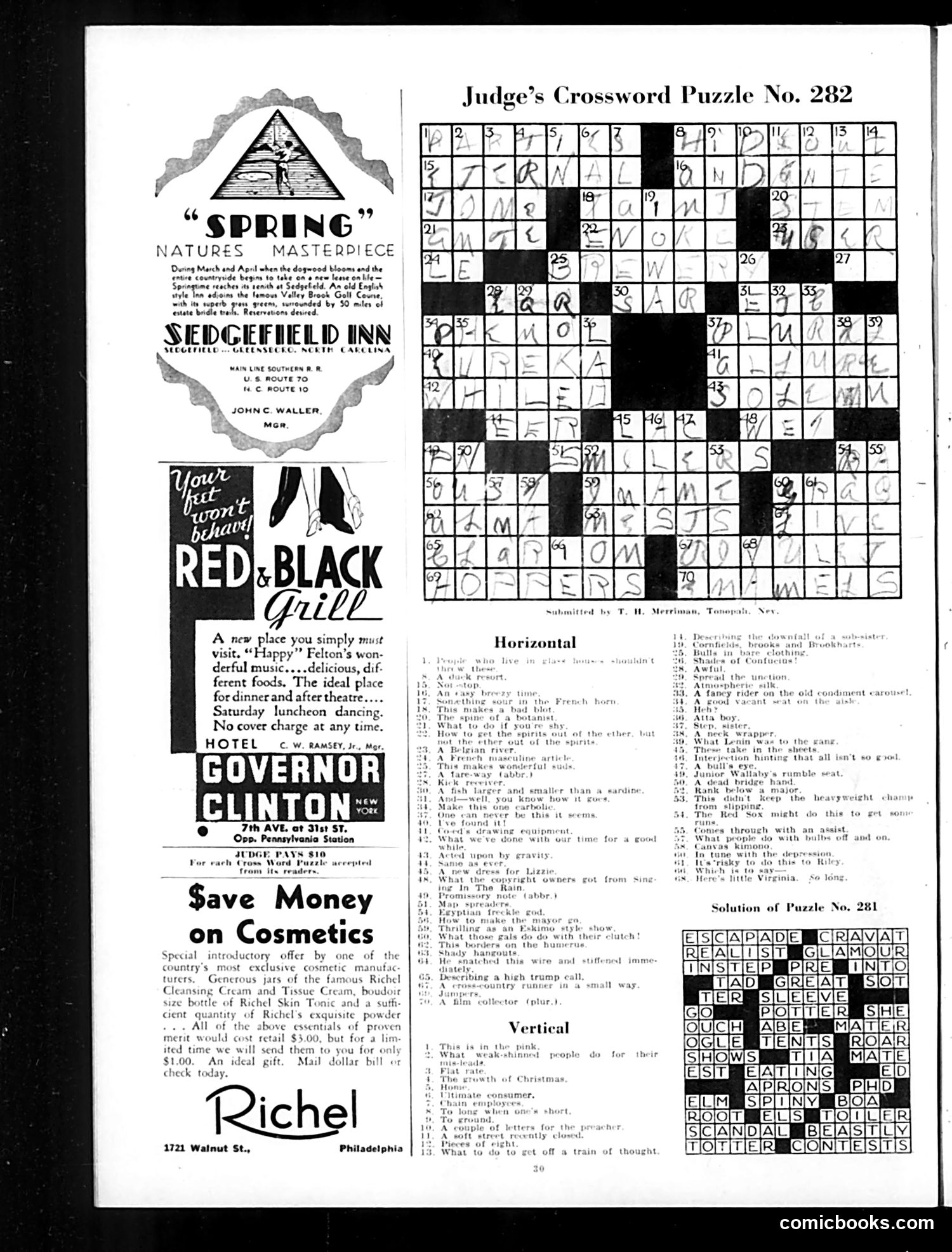
Judge Magazine Page Analysis This page is primarily advertising and commercial content rather than editorial satire. The main elements are: Advertisements: - Sedgefield Inn (North Carolina resort) - promoting spring tourism and leisure dining/dancing - Governor Clinton Hotel (NYC) - mid-range Manhattan lodging - Richel Cosmetics - beauty products with an introductory offer Crossword Puzzle: A standard "Judge's Crossword Puzzle No. 282" with clues and a solution from the previous puzzle (No. 281). Context: This appears to be from the 1920s-30s era (based on typography, hotel styles, and cosmetics advertising). There is no apparent political cartoon or satire on this page. It represents how magazines of this period filled space with paying advertisements and entertainment features like puzzles to support editorial content found elsewhere in the publication.
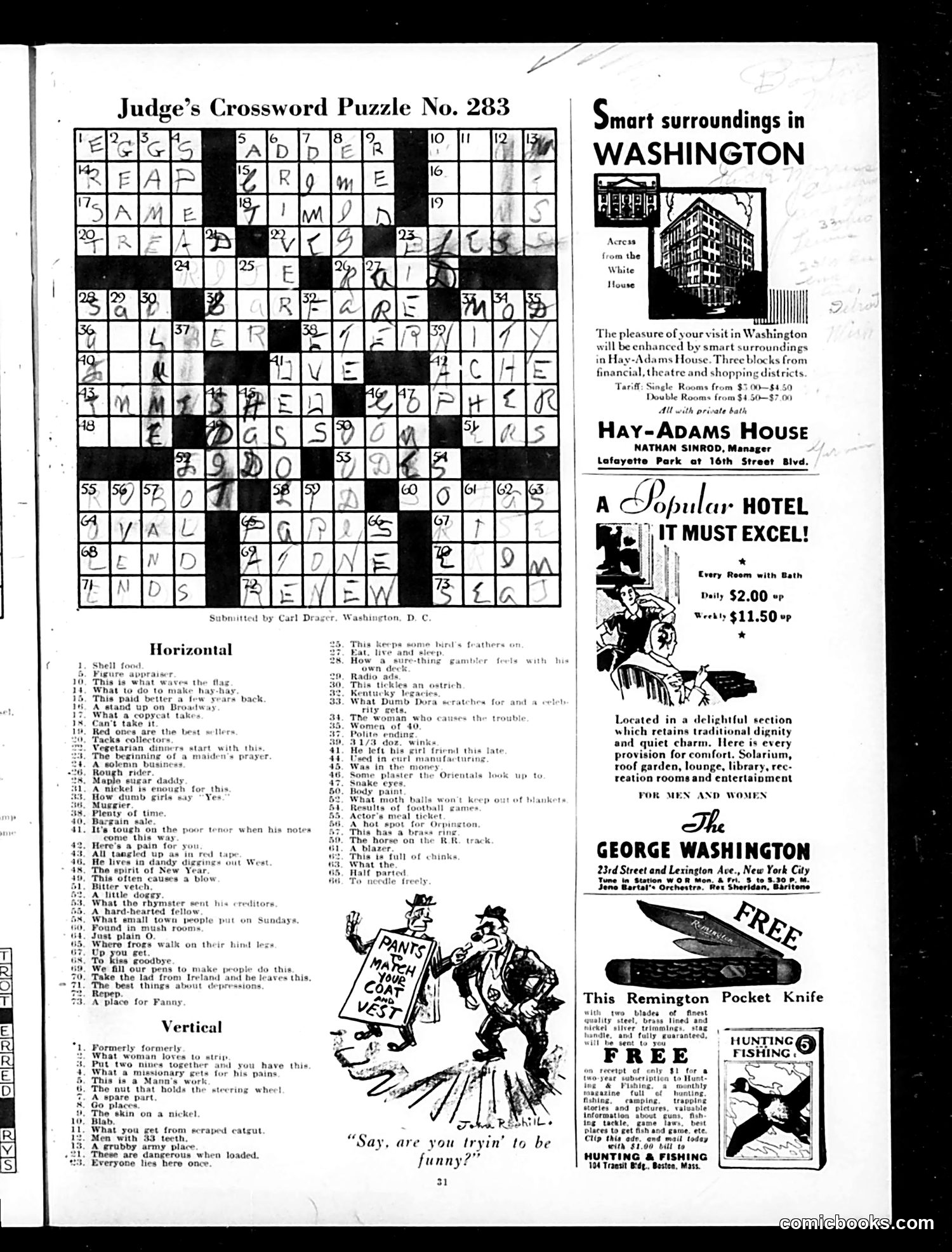
Judge Magazine Page Analysis This page is primarily a crossword puzzle with accompanying advertisements for Washington D.C. and New York hotels, plus promotional offers for a Remington pocket knife and hunting/fishing magazine. The single cartoon at bottom-left shows two men in formal attire (appearing to be politicians or businessmen) in a comedic exchange. One holds a sign reading "PANTS WATCH COAT VEST" while the other asks "Say, are you tryin' to be funny?" The joke appears to reference clothing rationing or shortages, possibly from a wartime period, mocking someone's odd fashion choices or the absurdity of having to account for individual garments. The cartoon critiques either economic hardship or bureaucratic oversight of consumer goods. The page reflects early-to-mid 20th century Judge magazine content: satirical humor mixed with commercial advertisements targeting urban professionals and travelers, typical of the publication's advertiser-supported model.
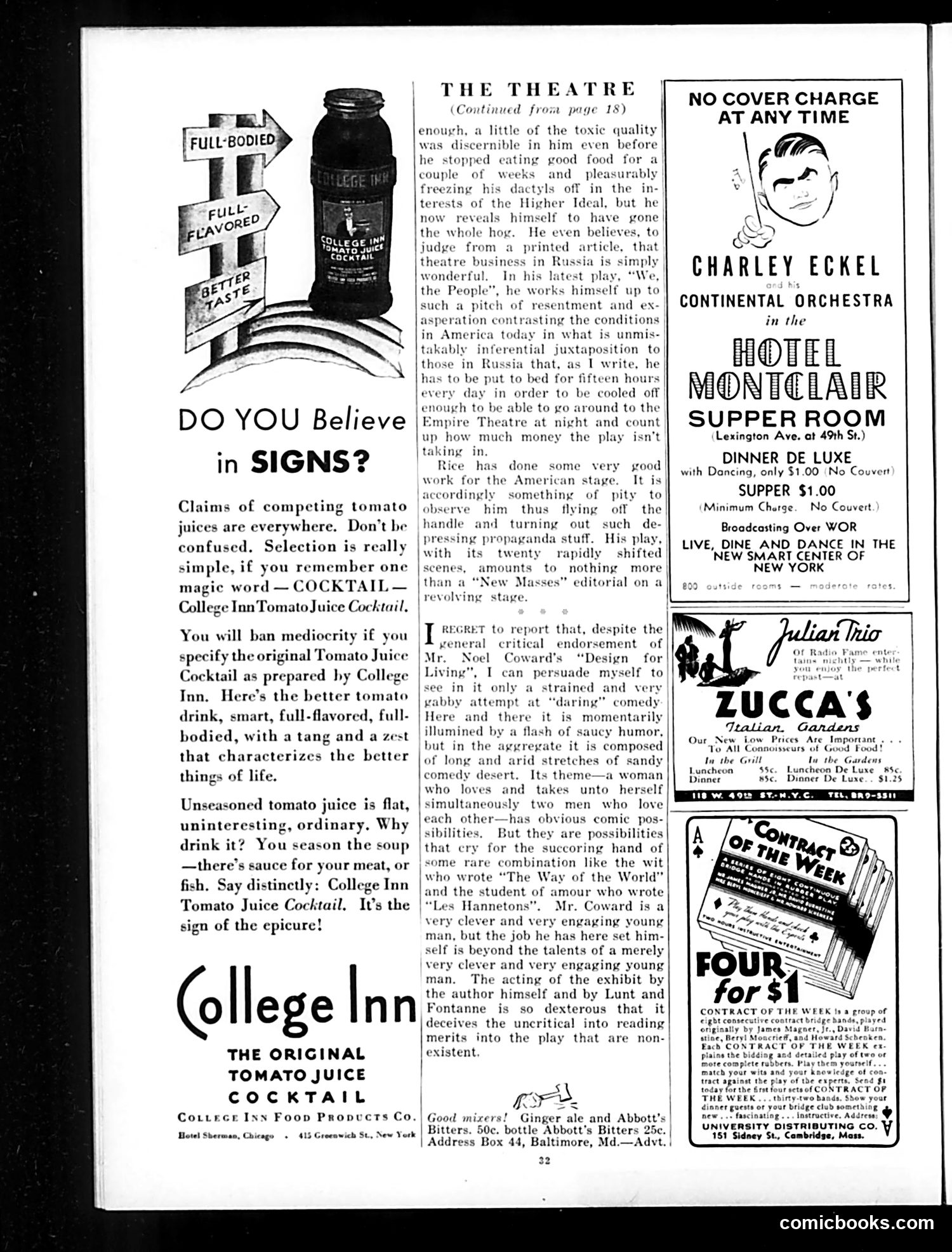
"DO YOU Believe in SIGNS?" - College Inn Advertisement This page is primarily advertising, not political satire. The main content is a large advertisement for College Inn Tomato Juice Cocktail, which uses wordplay on the phrase "believe in signs" — the ad features a literal arrow sign pointing to the product bottle. The ad's argument: competing tomato juice brands make similar claims, but you can distinguish the superior "original" College Inn cocktail by remembering the "magic word" — cocktail. It emphasizes the drink's "full-bodied," "full-flavored" qualities versus plain, "flat" tomato juice, appealing to epicurean sophistication. The page also contains a theatre review (continued from page 18) discussing Elmer Rice's plays and Noël Coward's "Design for Living," plus advertisements for upscale venues like Zucca's Italian restaurant and the Hotel Montclair supper room. The satire, if present, is subtle — the ad's notion that adding a fancy name elevates a simple product reflects broader 1920s-30s consumer culture assumptions about branding and status.
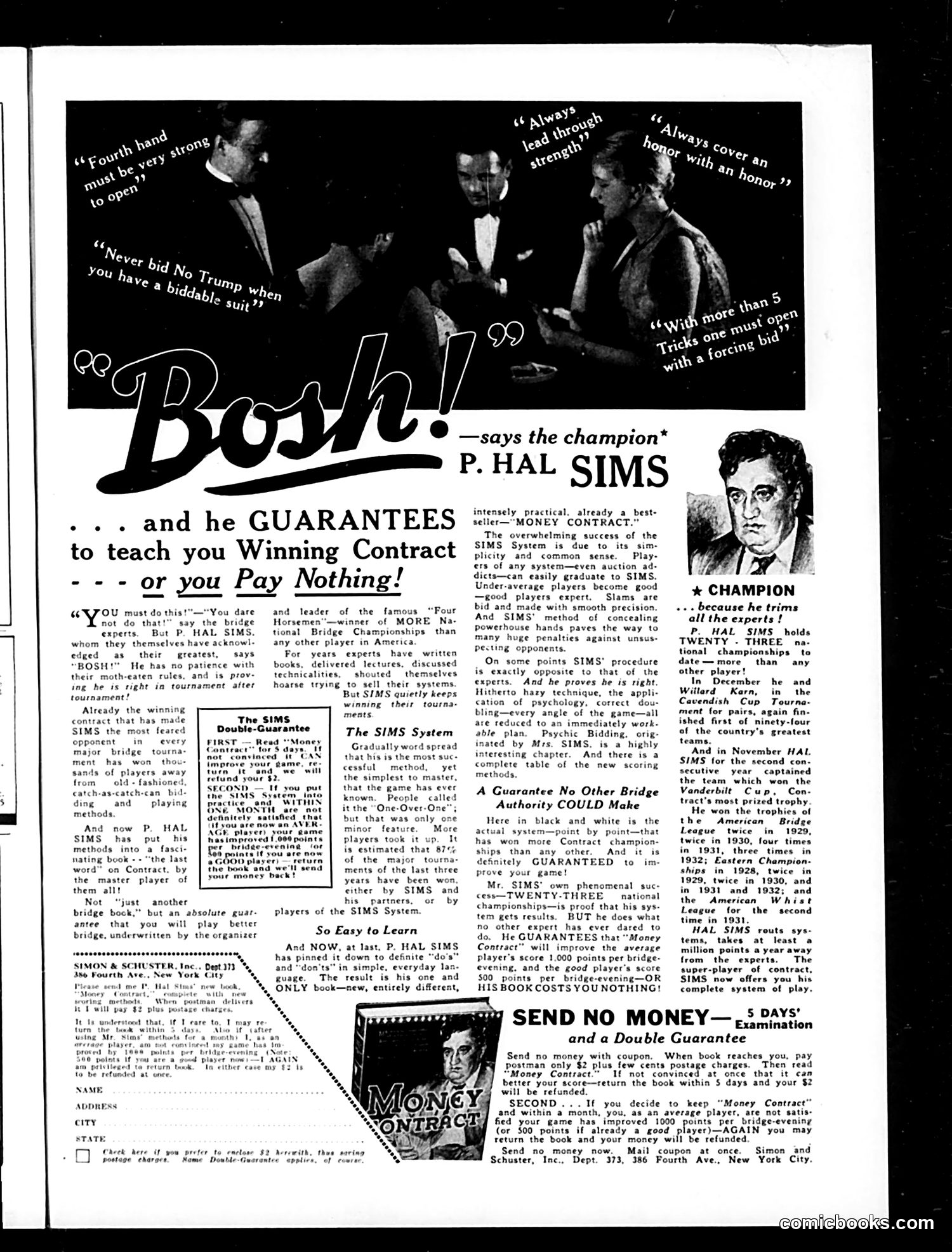
What This Page Means to a Modern Reader This is an advertisement, not satire or editorial content—it's a full-page promotion for P. Hal Sims's bridge instruction book "Money Contract." The Context: Bridge was an enormously popular card game in the 1930s, and "Contract Bridge" was its modern competitive form. Sims was a genuinely celebrated champion (the text claims he won 23 national championships). The Sales Pitch: The ad uses celebrity endorsement and a "money-back guarantee" to sell his simplified bidding system. It contrasts his practical, winning approach against stuffy, outdated expert rules ("BOSH!"). The accompanying photographs show people playing bridge in formal evening dress, reflecting the game's upper-class social status. The Appeal: For modern readers, this represents pre-digital self-help marketing—promising ordinary players they can beat experts by learning a secret system from the champion himself. The "send no money" offer with coupon was a direct-mail sales technique of the era. This isn't satire; it's earnest advertising exploiting bridge's cultural prominence.
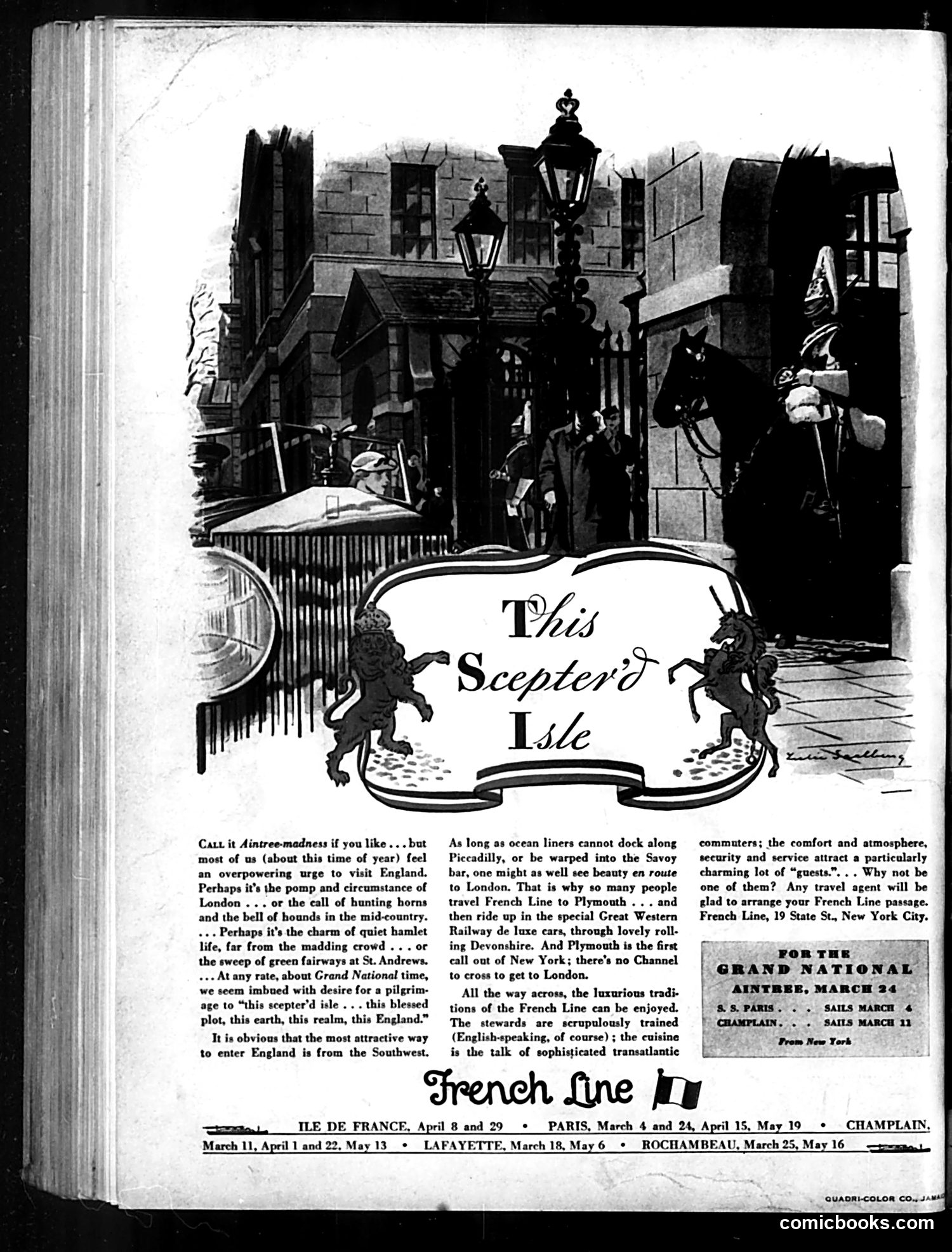
Analysis: "This Scepter'd Isle" Advertisement This is primarily a French Line shipping advertisement, not political satire. The page promotes transatlantic ocean liner travel to England. The illustration depicts a picturesque English street scene, establishing romantic appeal. The title quotes Shakespeare's *Richard II* ("this scepter'd isle"), invoking England's cultural prestige. The ad's satire is gentle and commercial: it acknowledges Americans' irrational "Aintree-madness" (obsession with the Grand National horse race) that compels them to visit England, then persuades readers that traveling via French Line steamships to Plymouth—rather than direct docking—actually enhances the journey aesthetically. The logic is somewhat tongue-in-cheek: since ships can't dock at Piccadilly, passengers might as well enjoy luxury travel and scenic English countryside views. The humor targets affluent American travelers' aspirations toward English sophistication and sporting traditions, while the advertisement hijacks this sentiment to sell passage.