judge
Judge — April 1933
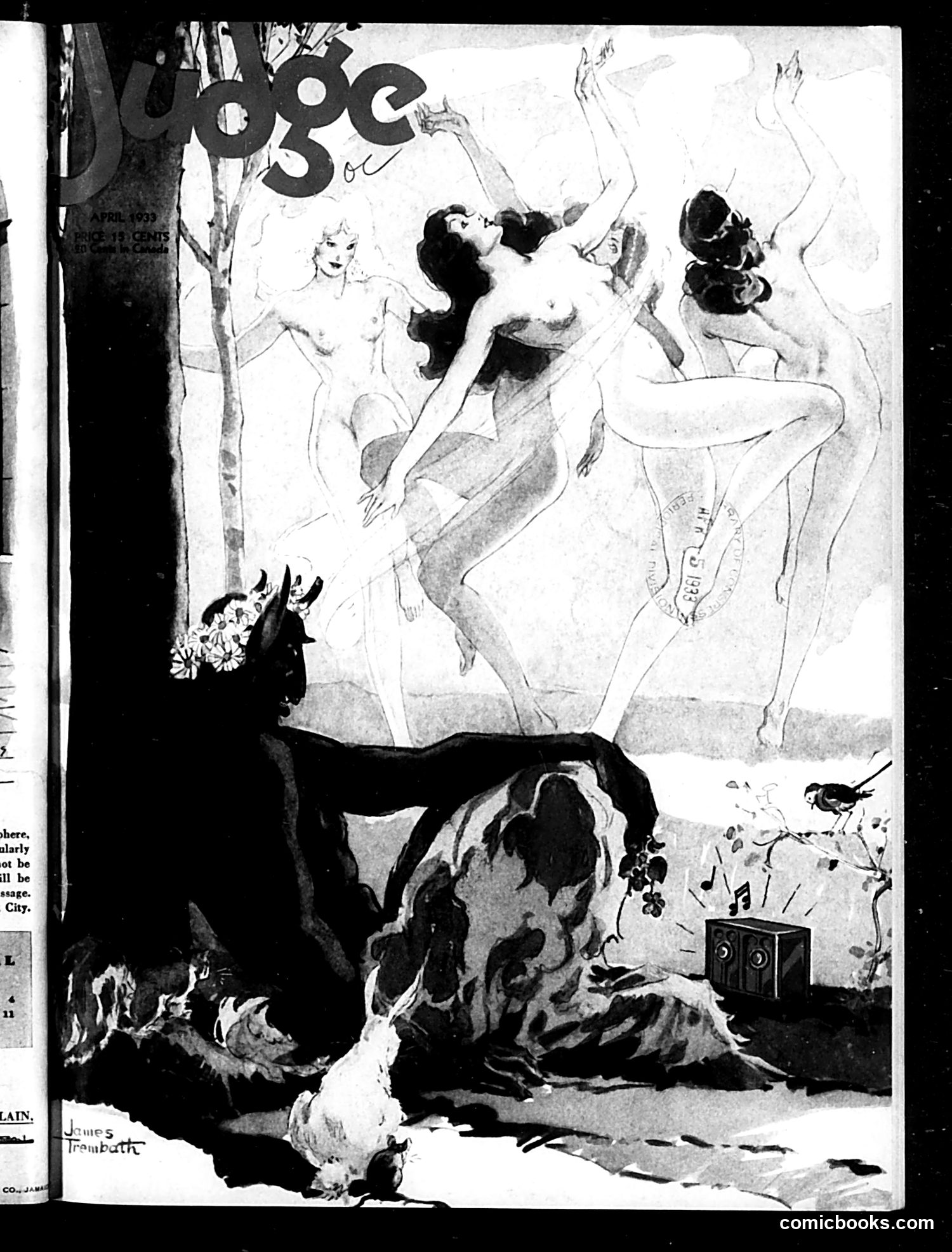
Judge Magazine Cartoon Analysis This appears to be a Jude magazine cover from April 1905 (based on visible text), featuring an Art Nouveau-style illustration by artist James S. Trombarth. The image depicts mythological or allegorical female figures in a dreamlike, sensual scene with classical references—including what appears to be a satyr or demon figure in the lower left. The satire likely mocks contemporary artistic pretension or the fashion for elaborate, mythologically-themed illustration popular in early 1900s aesthetics. The theatrical, exaggerated poses and classical references suggest mockery of decadent or overly romantic artistic movements of the period. Without clearer text, the specific political or social commentary remains unclear, though Judge typically targeted artistic trends, social affectations, and cultural excess.
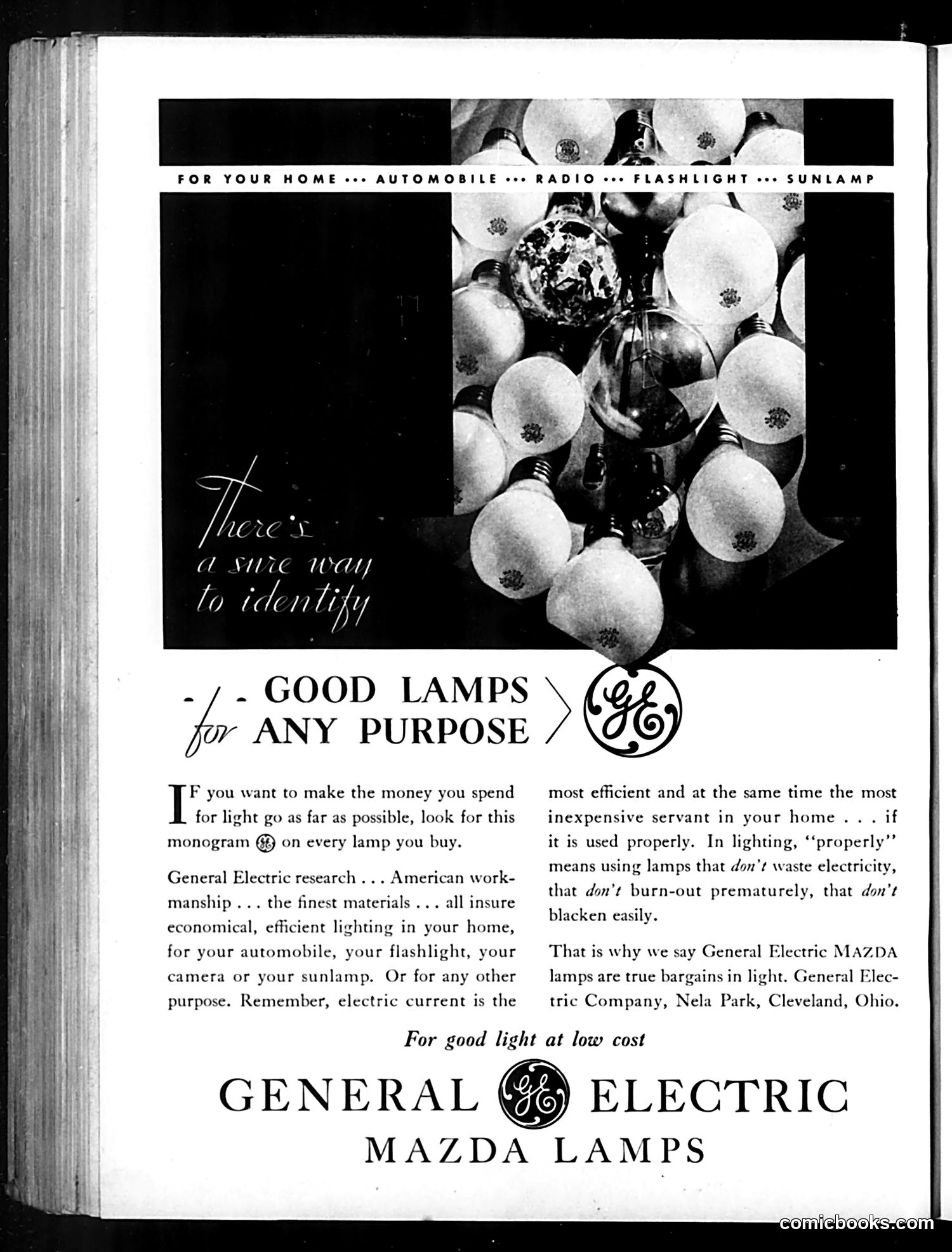
Analysis This page is primarily a General Electric advertisement, not satirical content. It advertises GE Mazda lamps for household, automotive, and other uses. The ad emphasizes GE's quality through their monogram (®) trademark, positioning their lamps as economical and efficient. The headline "There's a sure way to identify" and the image of various bulbs suggests consumers should recognize the GE mark to ensure they're buying reliable products rather than inferior alternatives. The text appeals to value-conscious buyers: GE lamps supposedly waste less electricity and don't burn out prematurely. The company location (Nela Park, Cleveland, Ohio) establishes corporate credibility. This is straightforward advertising, not political satire. Judge magazine clearly accepted commercial advertisements alongside editorial content.
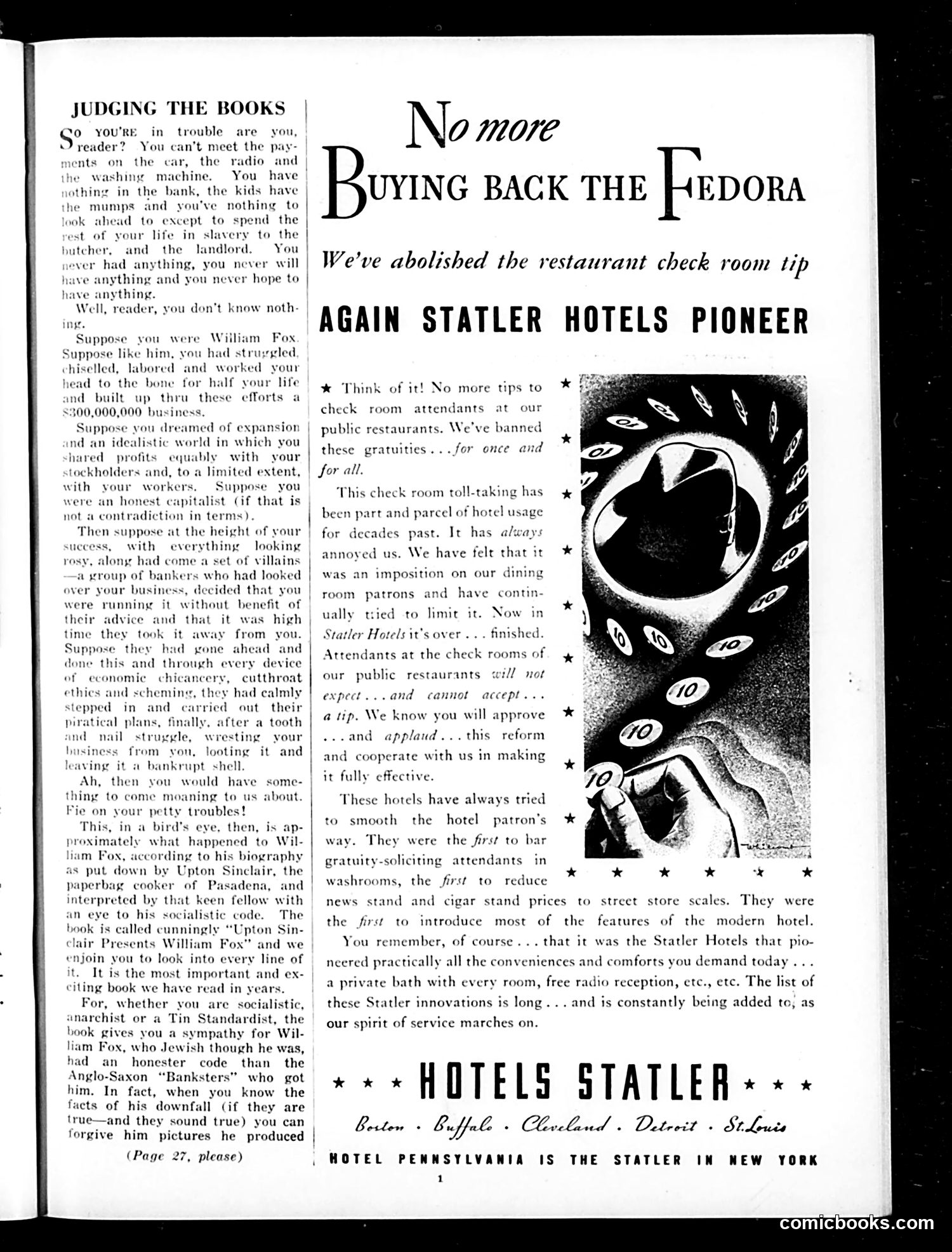
Analysis This page is primarily a Statler Hotels advertisement, not political satire. The ad announces that Statler Hotels has abolished tipping in their restaurant check rooms—a progressive labor reform for the era. The left column contains unrelated editorial content titled "Judging the Books," discussing William Fox (a film producer) and his biography by Upton Sinclair. The satirical point appears to be mocking Fox's rags-to-riches story while suggesting he faced opposition from corrupt business rivals. The main advertisement uses the illustration of a fedora hat to visually reinforce the headline "No more buying back the fedora"—a play on the phrase about tipping. The ad emphasizes Statler Hotels' pioneering stance on eliminating gratuities, positioning the chain as a modern, patron-friendly establishment that pioneered hotel conveniences.
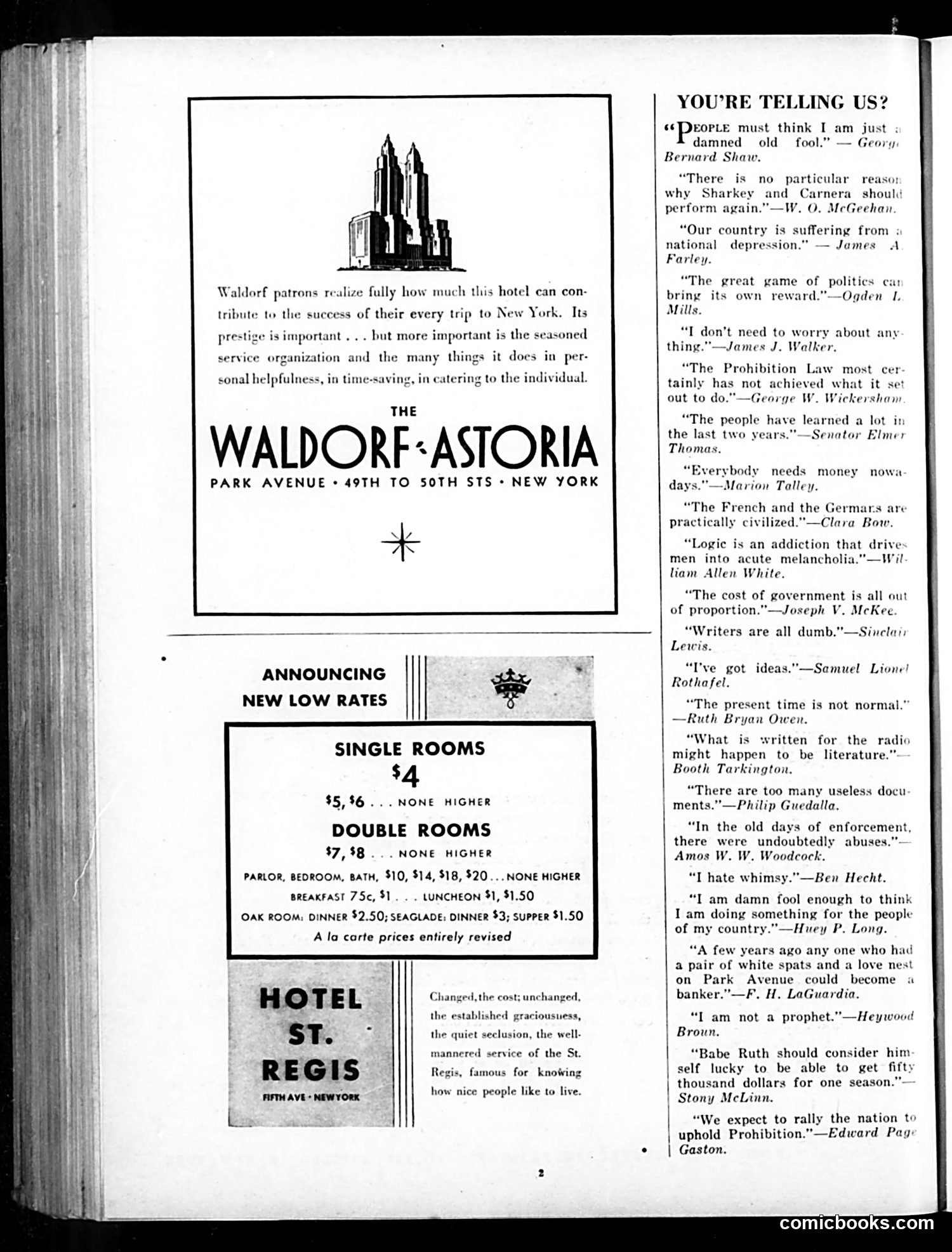
Page Analysis This page is primarily advertising, not political satire. It features two hotel advertisements: 1. The Waldorf-Astoria (top) - promoting luxury accommodations on Park Avenue with new reduced rates during what appears to be an economic downturn (single rooms from $4, double rooms from $7). 2. Hotel St. Regis (bottom) - emphasizing its established reputation for serving "nice people." The right column contains "You're Telling Us?" — a humor feature showcasing brief satirical quotes attributed to public figures like George Bernard Shaw and Sinclair Lewis, commenting on contemporary issues: Prohibition, economic depression, government costs, and politics. The quotes mock prevailing attitudes and policies of the era rather than targeting specific individuals. This appears to be from the 1920s-early 1930s based on references to Prohibition and economic concerns.
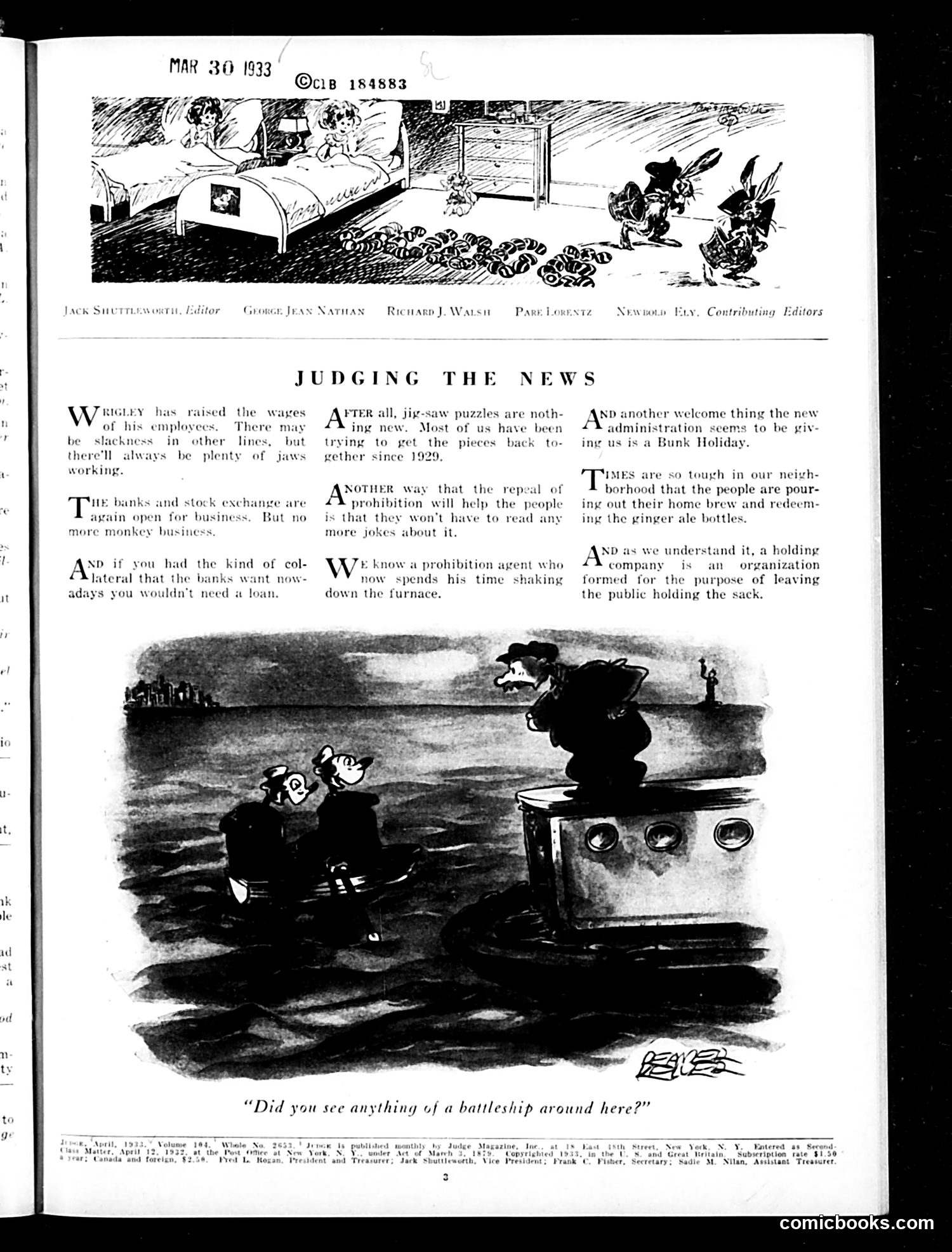
"Judging the News" - March 30, 1933 This editorial page satirizes current events through brief commentary and a cartoon. The text references Wrigley raising employee wages, banks reopening for business, Prohibition's repeal, and a "holding company" organization for "leaving the public holding the sack" — a common phrase meaning being left responsible for problems. The main cartoon depicts two figures in a small boat asking a third figure on what appears to be a submarine or ship: "Did you see anything of a battleship around here?" The joke likely references uncertainty about naval power or military readiness during the early New Deal era (March 1933), though the specific historical context isn't entirely clear from the image alone. It may comment on American military preparedness or international tensions of the period.
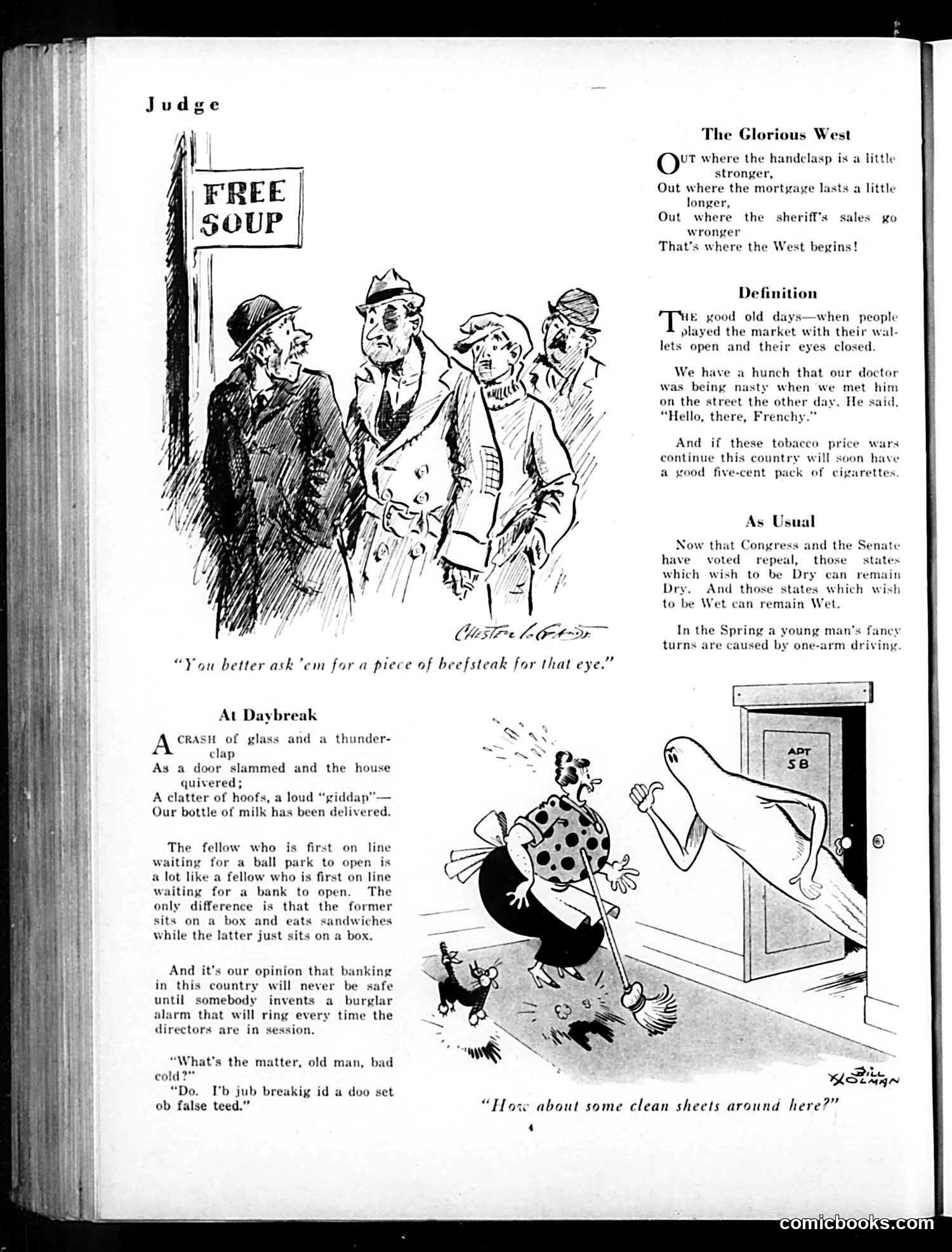
Analysis of Judge Magazine Page "Judge" (Free Soup cartoon): This depicts Depression-era poverty. Men in worn clothes queue at a "Free Soup" line—likely referencing breadlines during economic hardship. The caption "'You better ask 'em for a piece of beefsteak for that eye'" suggests these men are destitute and battered, possibly from unemployment or street life. The cartoon critiques economic conditions forcing citizens into charity lines. "At Daybreak" section: Humorous verse about domestic chaos—broken glass, a loud "giddap," milk delivery. It satirizes everyday household mishaps. Right-side cartoons: Include commentary on Prohibition repeal (Congress voting on states going "Dry" or "Wet") and a slapstick scene of someone evicting a woman from an apartment, mocking housing instability. These reflect 1920s-30s American social anxieties.
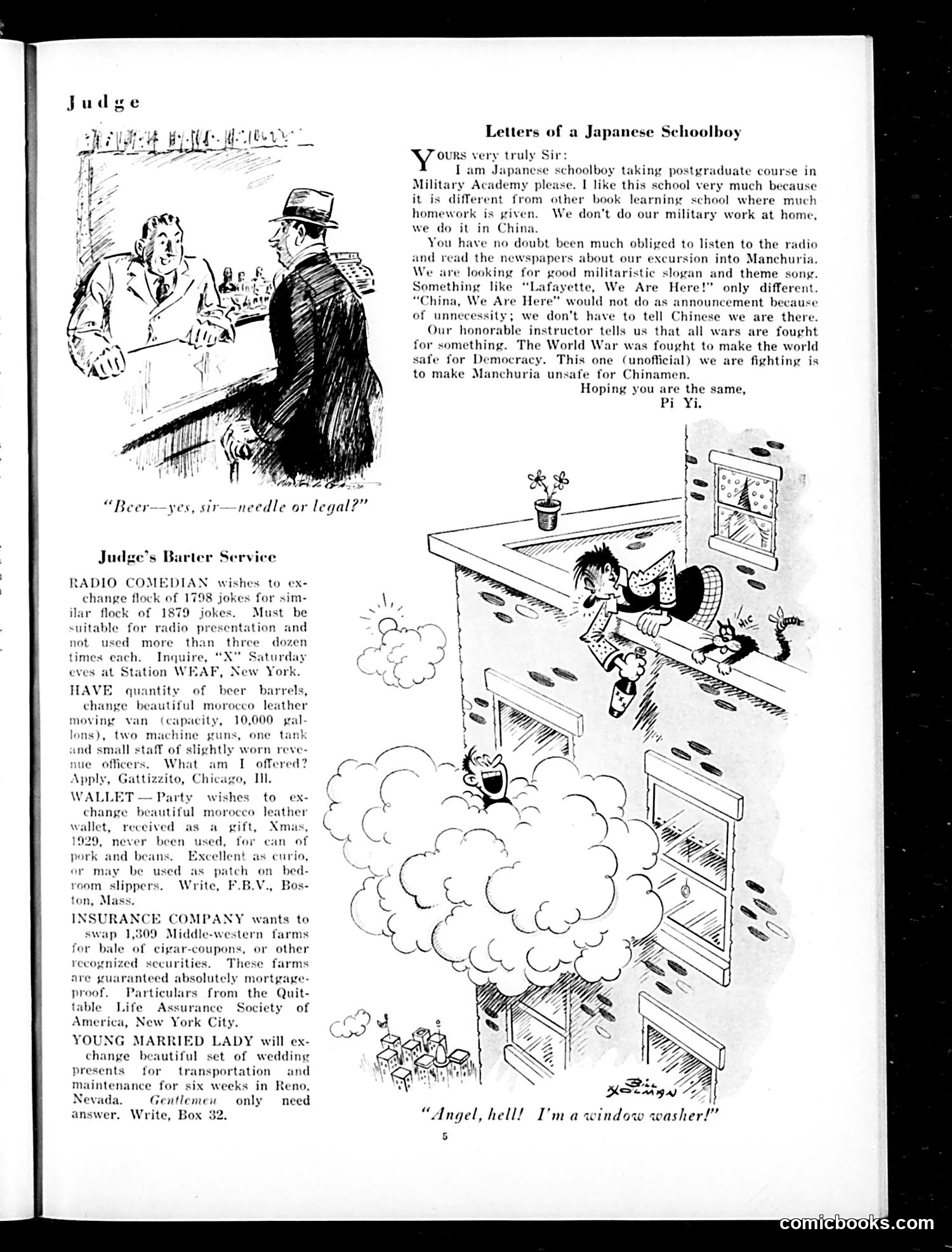
Analysis of This Judge Magazine Page Top Section - "Letters of a Japanese Schoolboy": This letter from a Japanese military academy student justifies Japan's invasion of Manchuria as fighting for "Democracy" and making "Manchuria un-safe for Chinamen." The satire mocks Japan's propaganda claims—presenting aggressive imperialism as noble defense of democracy. This likely dates to Japan's 1931-32 Manchurian invasion, which Judge sarcastically critiques as transparent military aggression disguised in ideological language. Bottom Section - "Angel, hell! I'm a window washer!": A cartoon showing a child covered in soot falling through a window into clouds, exclaiming he's "a window washer." The joke plays on the child's misinterpretation or humorous reframing of his accident as labor rather than mishap—visual slapstick humor common to the era. The page primarily satirizes Japanese militarism's deceptive rhetoric.
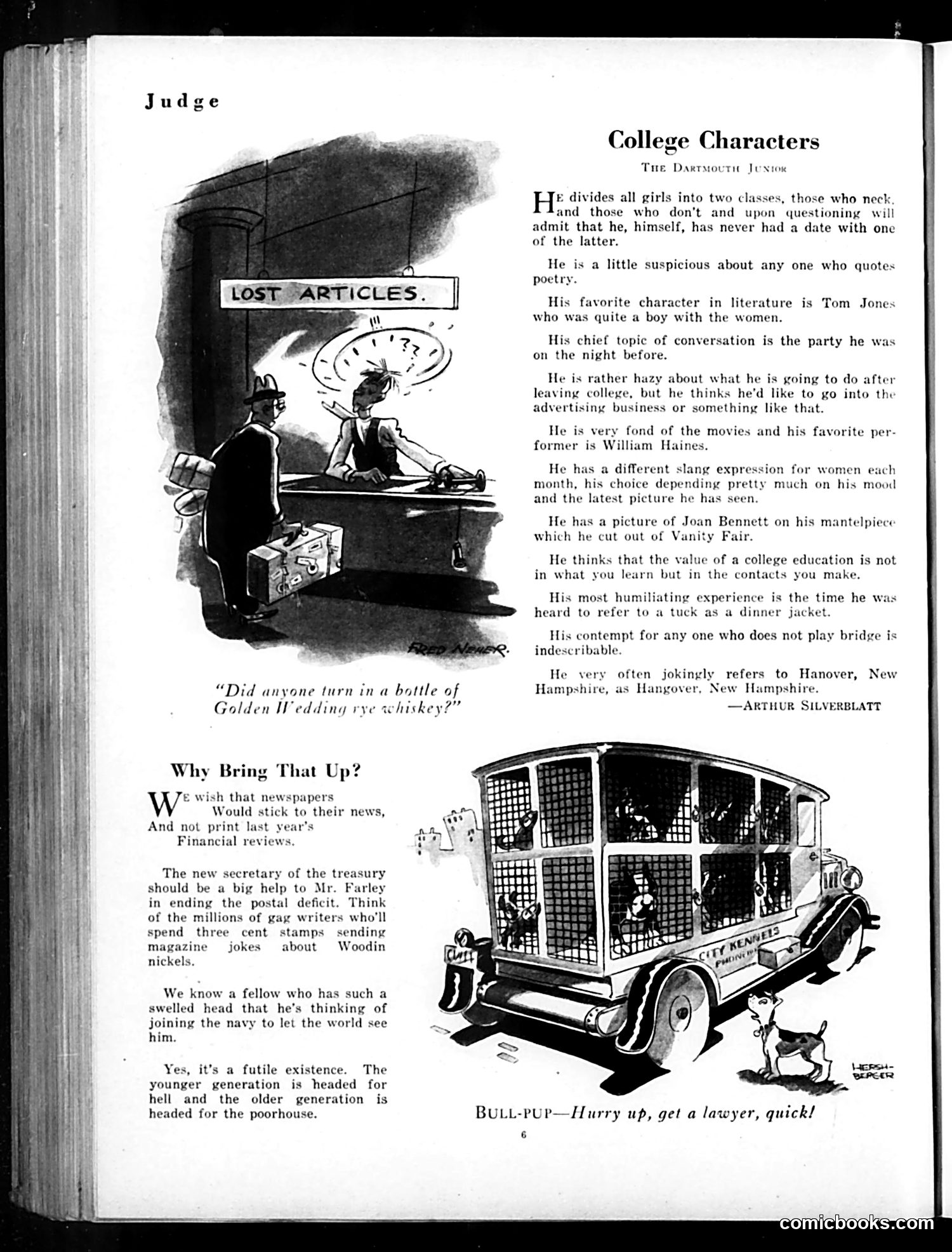
Analysis of Judge Magazine Page This page from Judge magazine contains three distinct pieces of satire: 1. "Lost Articles" cartoon: Shows a man at a lost-and-found desk, with the caption asking if anyone turned in a bottle of "Golden Wedding rye whiskey." This satirizes Prohibition-era alcohol smuggling and the absurdity of claiming lost contraband. 2. "College Characters" profile: Describes a Dartmouth Junior who classifies girls, loves Tom Jones and William Haines (a silent film star), and jokingly values college for "contacts you make" rather than education. This mocks shallow college culture and materialism. 3. "Why Bring That Up?": Political satire suggesting the Treasury Secretary should reduce postal deficits by having postage stamps feature jokes about Woodin (likely Secretary William Woodin). The bull-pup cartoon below appears unrelated social humor about lawyers.
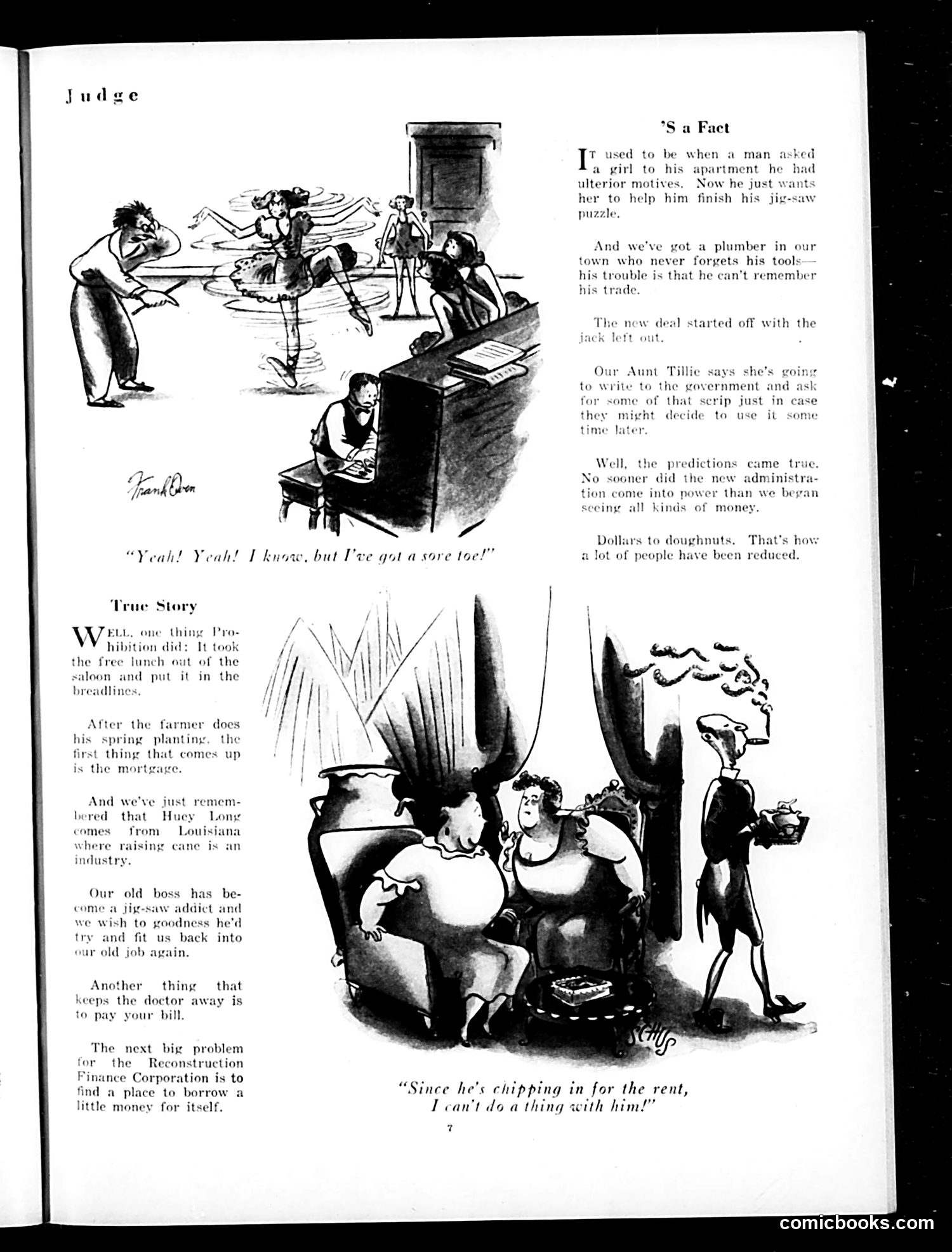
Judge Magazine Satire Analysis This page contains Depression-era humor (likely early 1930s) satirizing New Deal policies and economic hardship. Top cartoon: Shows a man inviting a woman to his apartment—once implying seduction, now just asking help with a jigsaw puzzle. It's a joke about changed courtship in hard times; romance is replaced by innocent domestic activities. "True Story" section: A collection of one-liners mocking: - Prohibition's end: Breadlines replaced free lunches once offered in saloons—sardonically commenting on ongoing poverty despite alcohol's legalization - Farmer debt: Spring planting immediately followed by mortgage foreclosure - Huey Long reference: "Huey" (Louisiana politician) associated with populist movements - Government scrip: Aunt Tillie plans requesting emergency currency from the government - RFC lending problem: The Reconstruction Finance Corporation (New Deal agency) struggles to find funds to lend itself The satire targets government relief programs' inadequacy and the persistence of economic misery despite New Deal interventions.
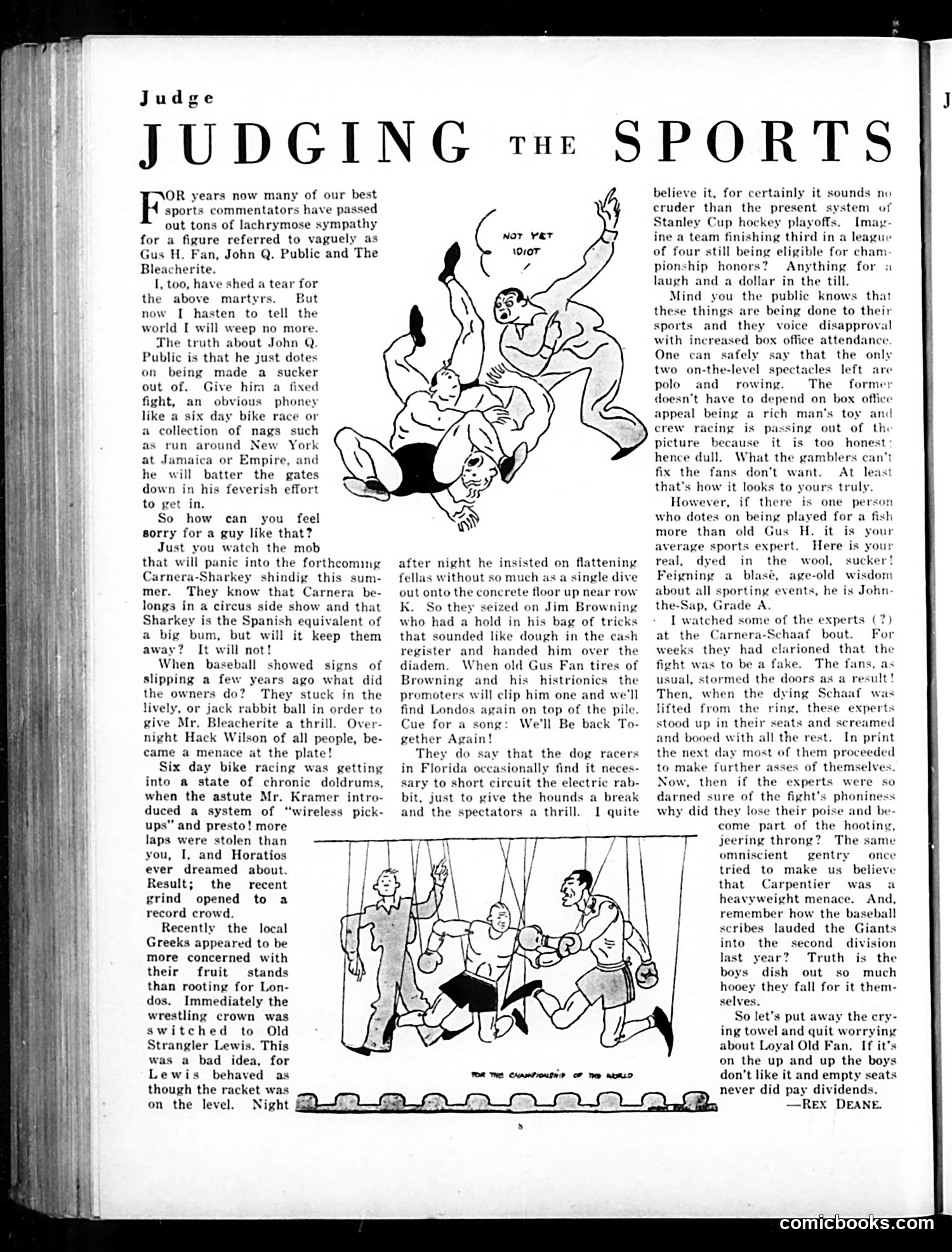
"Judging the Sports" – Rex Deane's Critique of Sports Spectacle (Judge Magazine) This satirical column attacks the American sports public for willingly embracing obvious frauds and rigged events. The author argues that fans—called "Gus H. Fan," "John Q. Public," and "The Bleacherite"—*enjoy* being duped by fixed fights, phoney races, and manufactured drama. Deane cites specific examples: the lively "jack rabbit" baseball used to revive sagging interest; six-day bike races with stolen laps; wrestling matches (Old Strangler Lewis, Jim Browning) where outcomes are predetermined; greyhound racing allegedly involving electrical sabotage; and hockey playoffs allowing third-place teams into championships. The cartoon shows spectators in frenzy, labeled "NOT YET IDIOT." Deane's point: fans claim to disapprove yet pack venues anyway, proving they prefer entertaining fakery to honest competition. Only polo and rowing remain genuinely "on the level"—and tellingly, they're dull and unpopular. Even sports experts are "suckers," pretending wisdom while knowingly watching fraud. The satire targets both sports corruption and public complicity.
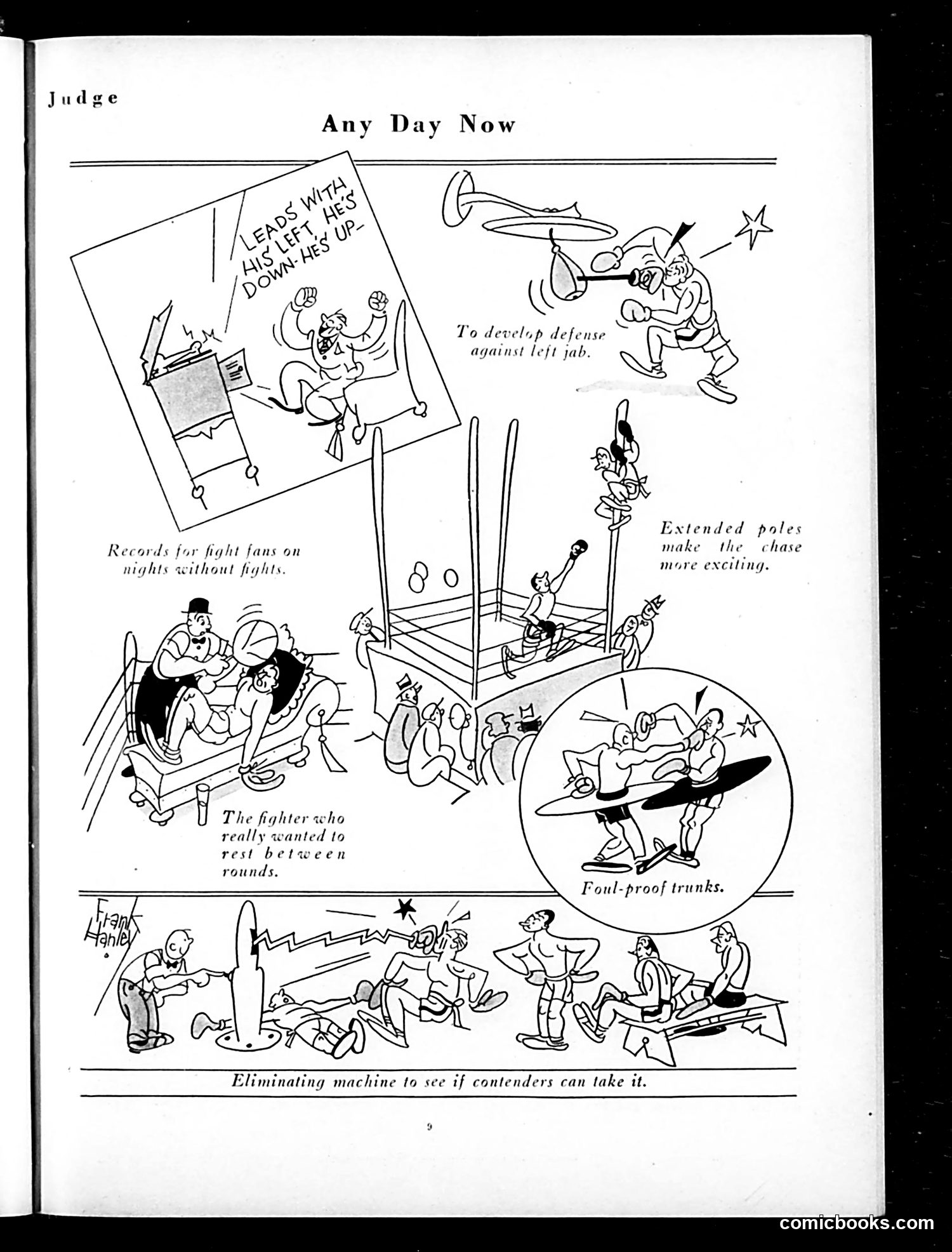
"Any Day Now" - Judge Magazine Satire This page satirizes boxing entertainment and its increasingly theatrical innovations. The cartoons mock efforts to make fights more exciting for fans through absurd contraptions and rule changes: - A helicopter attacking a fighter to develop defensive skills - Extended poles making "the chase more exciting" - Night fights under artificial lights for non-paying fans - A boxing ring with elevated poles for spectacle - "Fool-proof trunks" as protective equipment - An "eliminating machine" to test fighter endurance The satire critiques boxing promoters' desperation to innovate and sensationalize the sport, suggesting they're adding ridiculous obstacles and technological gimmicks rather than relying on genuine athletic competition. The title "Any Day Now" implies these absurd changes are imminent. The cartoons reflect early-20th-century anxieties about commercialized sports losing authenticity.
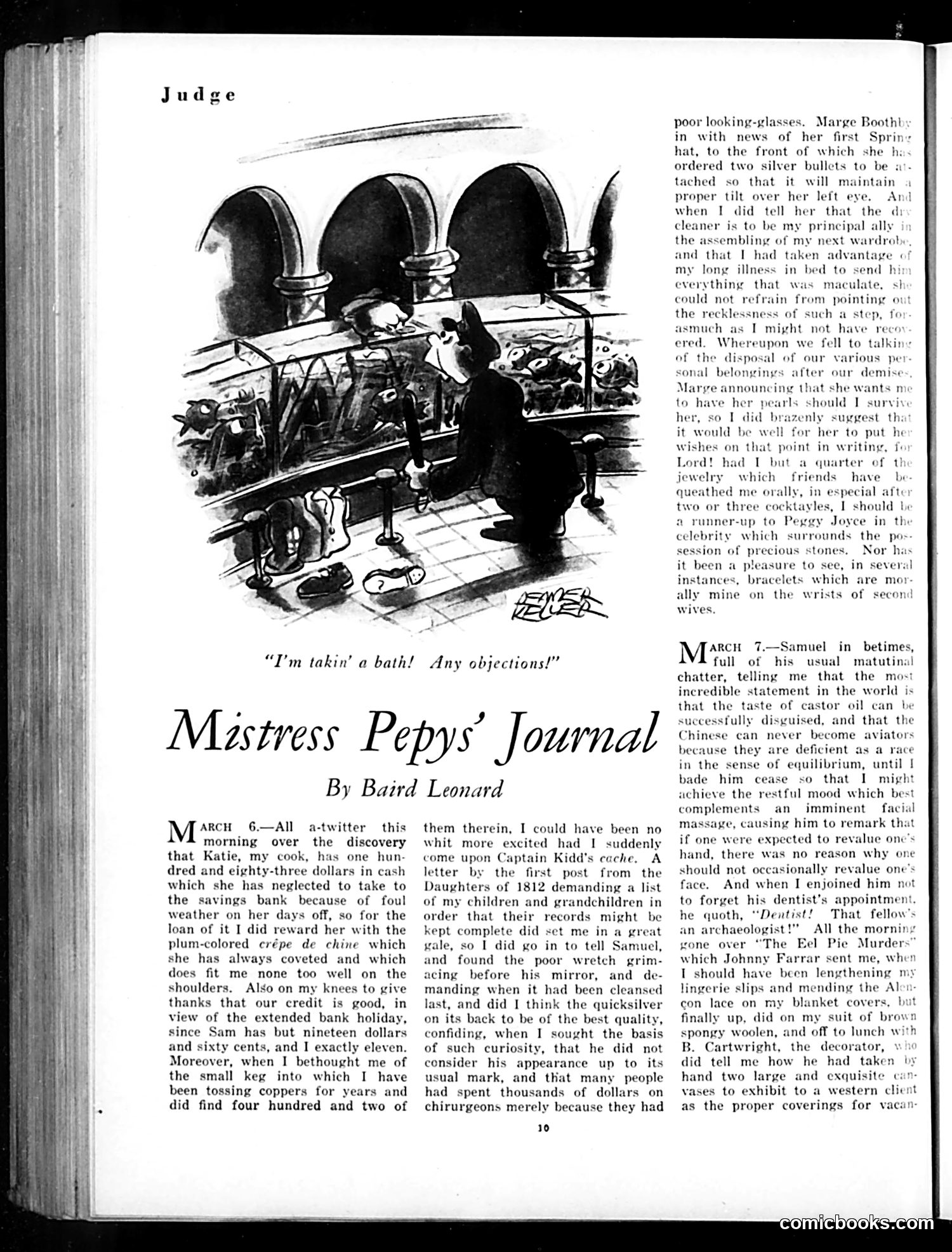
Explanation of This Judge Page This page contains a cartoon and the opening installment of "Mistress Pepys' Journal," a humor column by Baird Leonard that parodies Samuel Pepys's famous 17th-century diary. The Cartoon: Shows a woman taking a bath in an ornate tub while a servant stands nearby. The caption "I'm takin' a bath! Any objections!" is a joke about the speaker's entitled attitude—she's announcing her activity as if daring anyone to object, suggesting social pretension or selfishness. The Column: Adopts Pepys's style to humorously chronicle the domestic life of a wealthy woman managing servants, household finances, and social obligations. Notable details include: discovering her cook has saved $183, worrying about bank holidays, finding $402 in copper coins, discussing an inheritance of jewelry, and social gossip about friends' spring hats and possessions. The satire gently mocks upper-class concerns—financial anxiety despite privilege, obsession with material goods and appearances, and the leisure activities of the wealthy during what appears to be the 1920s.
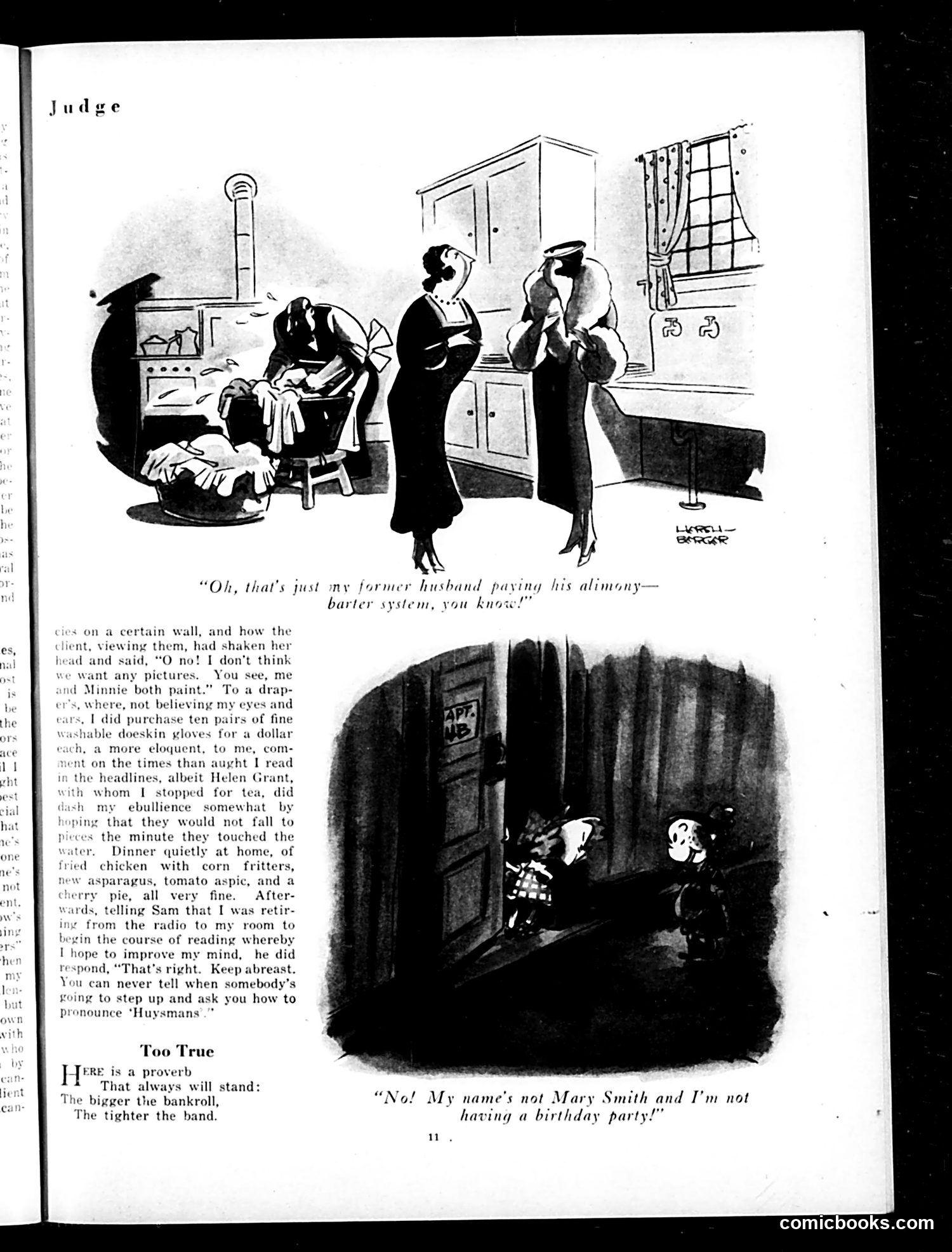
"Judge" Page Analysis Top Cartoon ("Judge"): A woman explains to two visitors that the man paying her alimony uses a "barter system"—a satirical jab at men who avoid paying court-ordered support by trading goods or services instead of cash. The joke targets deadbeat ex-husbands evading financial obligations to ex-wives, a common social complaint of the era. Bottom Cartoon: Two figures at a doorway, with one indignantly denying she's "Mary Smith" having a birthday party. The humor likely mocks either party-crashers, mistaken identity, or social pretension—though the specific reference isn't entirely clear from the image alone. Context: Both cartoons mock domestic relations and social behavior typical of Judge's satirical focus on marriage, divorce, and changing gender dynamics in early-to-mid 20th century American life.
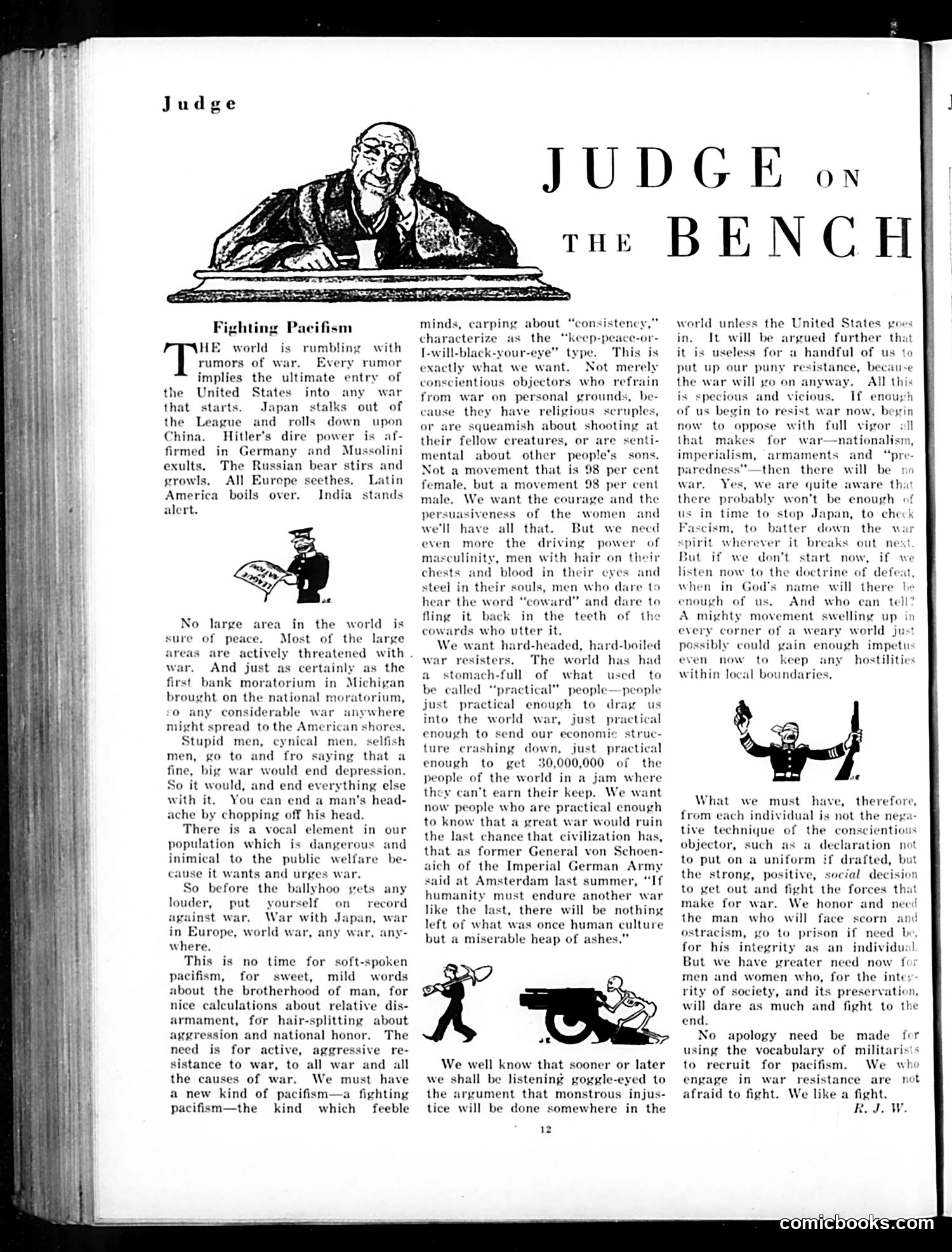
"Judge on the Bench: Fighting Pacifism" This editorial argues for aggressive anti-war activism rather than passive pacifism. Writing amid 1930s global tensions (Japan's aggression, Hitler's rise, Mussolini's expansion), the author warns that war rumors could draw America into conflict. The piece mocks "soft-spoken pacifism" and religious conscientious objectors as ineffectual. Instead, it calls for a "fighting pacifism"—muscular, male-dominated resistance to war and its causes (nationalism, imperialism, arms buildup). The author rejects the argument that war could end the Depression, noting it would only spread American conflict globally. The cartoons show a military officer at top and small figures with weapons below, visually emphasizing the text's call for forceful, not meek, opposition to war preparation. The author invokes a German general's warning that another world war would destroy civilization entirely, making urgent action necessary *now*.
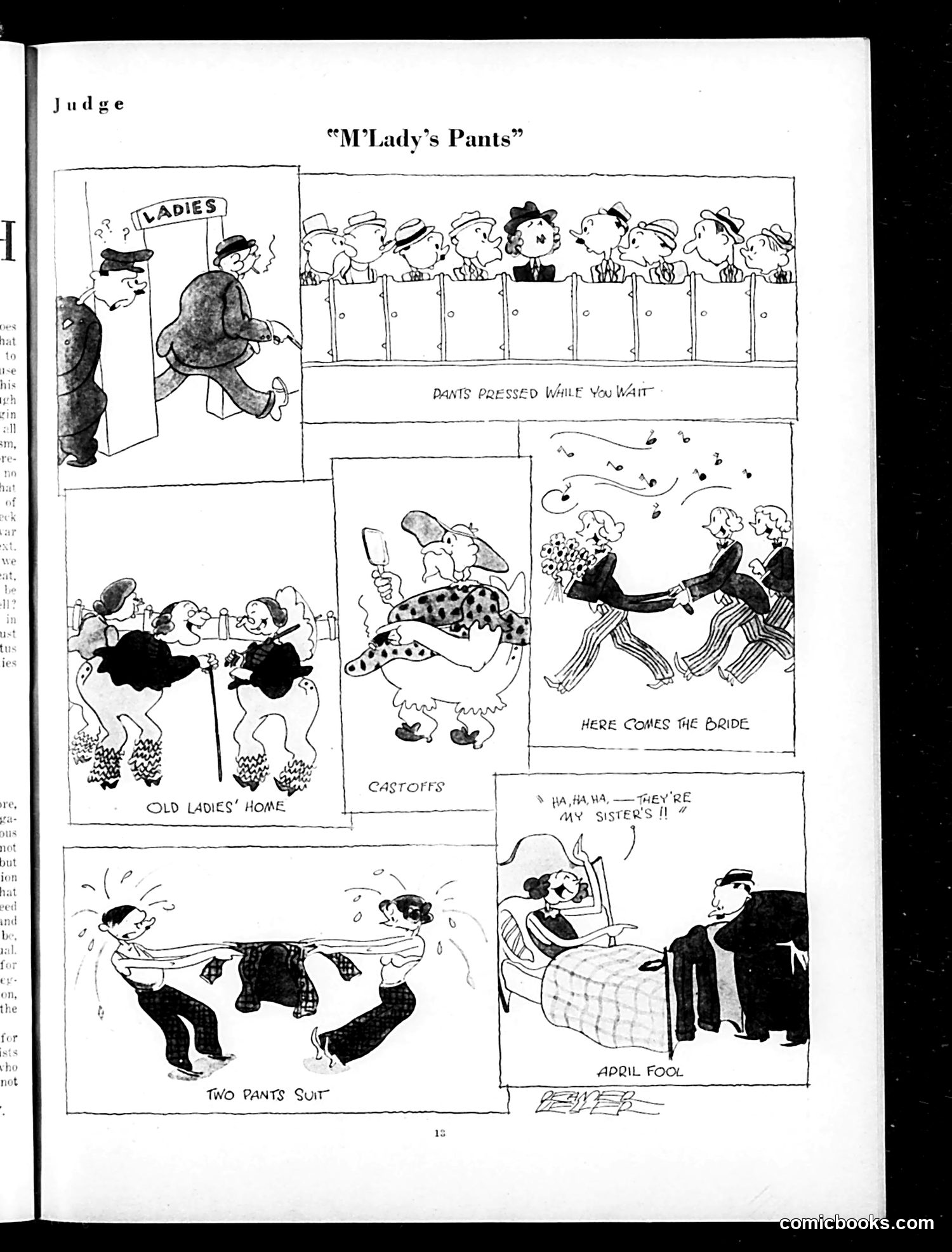
"M'Lady's Pants" - Judge Magazine Satire This comic satirizes women wearing pants—a controversial fashion development in early 20th-century America. The sequence mocks the social chaos this caused: - "Pants Pressed While You Wait": A tailor shop where men nervously await women customers - "Old Ladies' Home": Elderly women dancing in pants, suggesting moral disorder - "Castoffs": A woman in spotted pants being struck with a club - "Here Comes the Bride": Women in pants greeting a bride - "Two Pants Suit": Men fighting over pants fabric - "April Fool": The punchline—a man discovers his wife wears pants in bed The humor relies on period anxiety about women's liberation and changing gender roles. The exaggerated chaos suggests that women adopting trousers threatens social order and masculinity. This reflects actual resistance to women's practical clothing that challenged Victorian gender norms.
Judge Theatre Review Page This page contains drama criticism by George Jean Nathan, Judge magazine's theatre critic. Rather than a cartoon, it's a satirical theatre review section critiquing contemporary Broadway productions. Nathan reviews several plays with characteristic acerbic wit: - "Alien Corn" (Sidney Howard): He dismisses it as a conventional vehicle designed merely to showcase actress Katharine Cornell, criticizing its reliance on tired European romanticism and "Weltschmerz" sentimentality. - "American Dream" (George O'Neil): Nathan savagely attacks this Guild Theatre production as "garbled" and confusing, suggesting the script was so badly rewritten it might be "played backwards." - "Conquest" (Arthur Hopkins): He acknowledges Hopkins' modern "Hamlet" adaptation contains some imaginative writing but criticizes its static, metronome-like staging. Nathan's reviews exemplify Judge's satirical voice: intellectually sharp, dismissive of commercial mediocrity, and employing elaborate vocabulary and wit to mock both playwrights and producers prioritizing box-office appeal over artistic merit.
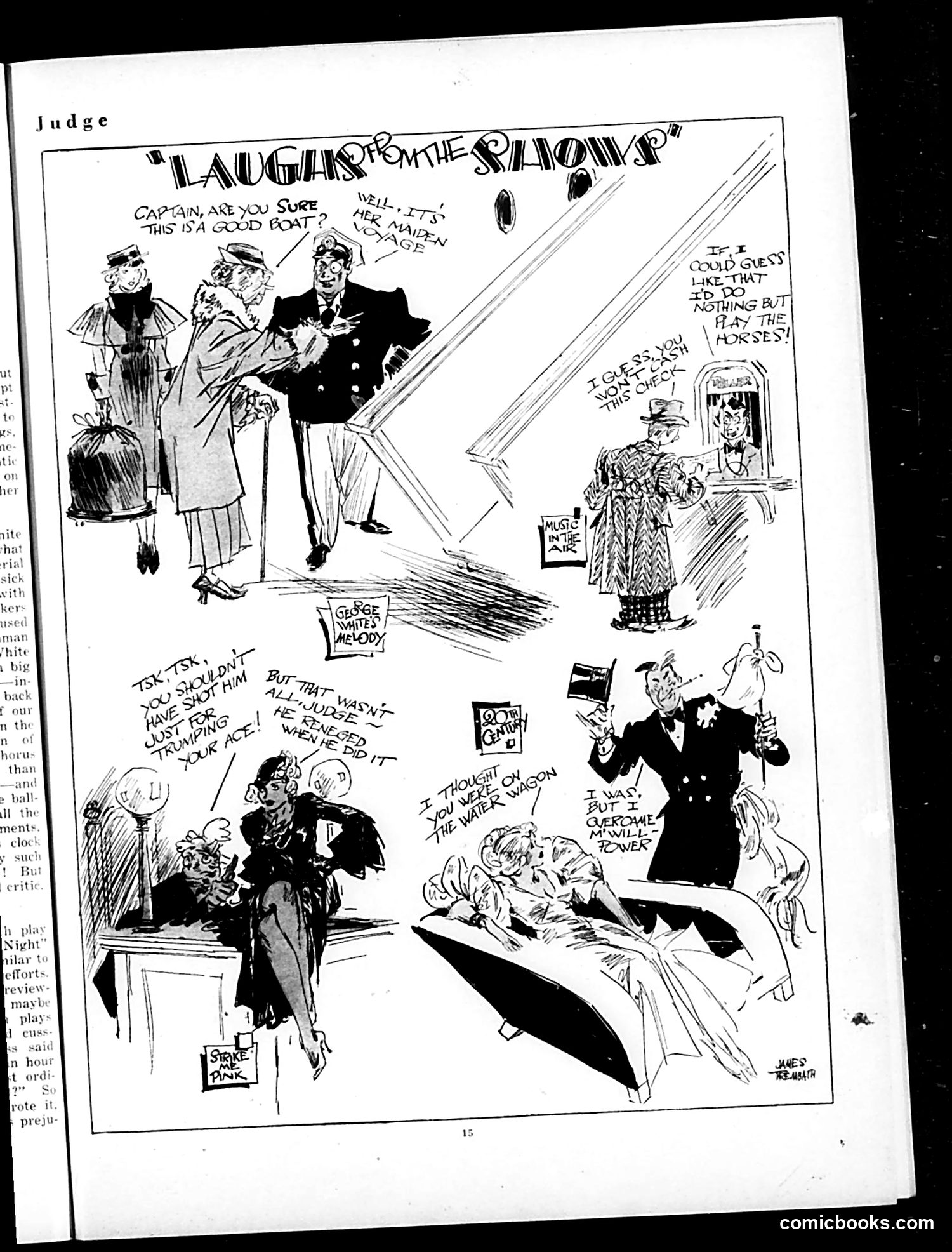
"Laughs on the Samp" - Judge Magazine Cartoon This multi-panel satirical cartoon appears to mock wealthy or elite figures aboard a ship. The title references "The Samp" (likely a vessel name). The scenes depict: - Well-dressed passengers questioning the captain about the boat's quality - References to "George White's Melody" and "Music in the Air" (appearing to be Broadway show references) - Characters worrying about seasickness and comfort - A figure claiming to overcome "Neville Tower" (unclear reference) - Social commentary on wealthy travelers' complaints and pretensions The satire targets upper-class concerns about luxury travel accommodations and entertainment. The cartoonist (signature appears to be present) uses exaggerated expressions and situations to mock the passengers' anxieties and self-importance during what should be leisure. Without clearer dating or context, the specific political/social targets remain somewhat unclear, though the general thrust satirizes wealthy society's complaints.
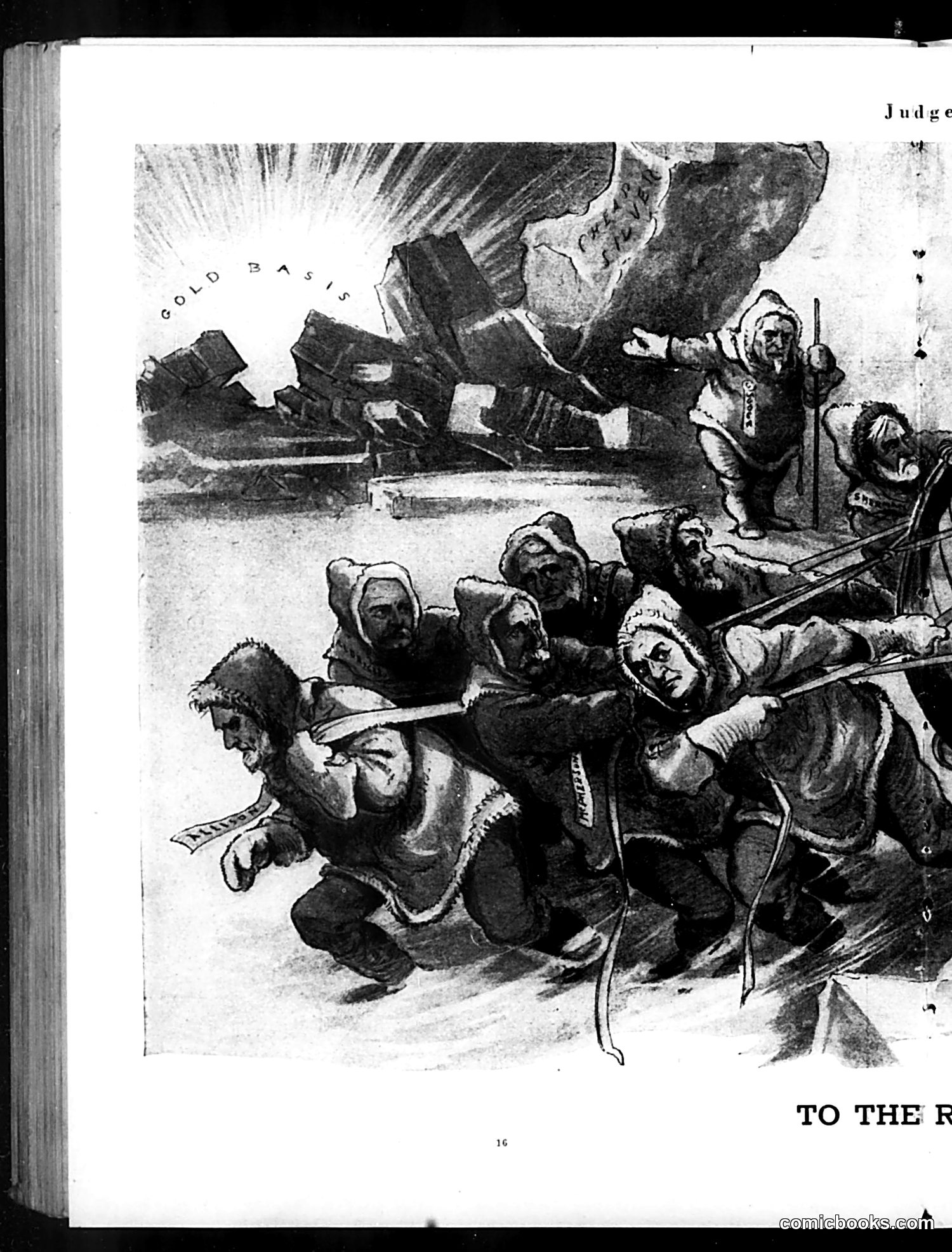
Political Cartoon Analysis This appears to be a satirical illustration from *Judge* magazine depicting a scene labeled "GOLD BASIS" at the top. The image shows a group of figures huddled together on the ground, appearing distressed or struggling, while observers stand above them. The "gold basis" reference likely relates to monetary policy debates—a significant political issue in late 19th/early 20th century America. The cartoon appears to satirize the effects of gold standard economic policies on ordinary people, representing them as burdened or oppressed by financial decisions made by elites or government officials. The caricatured style and dramatic composition emphasize the human cost of abstract economic policy. However, without seeing the magazine's date and accompanying article text, the specific political figures targeted and exact historical context remain unclear.
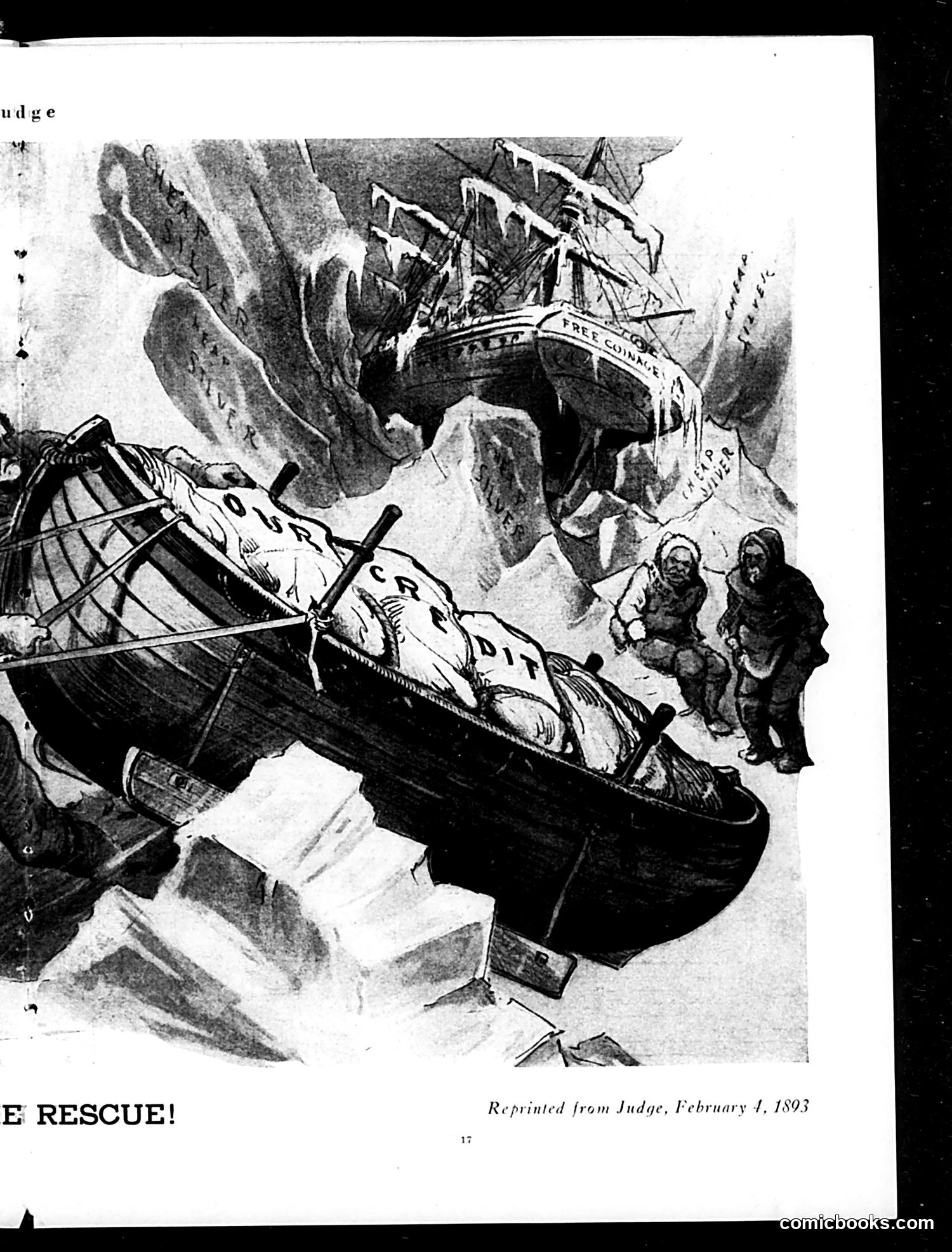
Political Cartoon Analysis This 1893 *Judge* magazine cartoon depicts a dramatic sea rescue. A ship labeled "FREE COINAGE" appears trapped in icy waters while two figures (likely representing sailors or politicians) stand on an iceberg gesturing toward it. Another vessel approaches from the left, presumably offering assistance. The satire likely concerns the free coinage of silver debate—a major 1890s political controversy. The trapped ship symbolizes the silver coinage movement, depicted as imperiled. The cartoon suggests either that free coinage advocates need "rescue" from their doomed policy, or conversely, that the movement itself requires saving. The icy, treacherous setting emphasizes the perceived danger or foolishness of the position, depending on the cartoonist's stance. The exact political position requires additional context about *Judge* magazine's editorial leanings during this period.
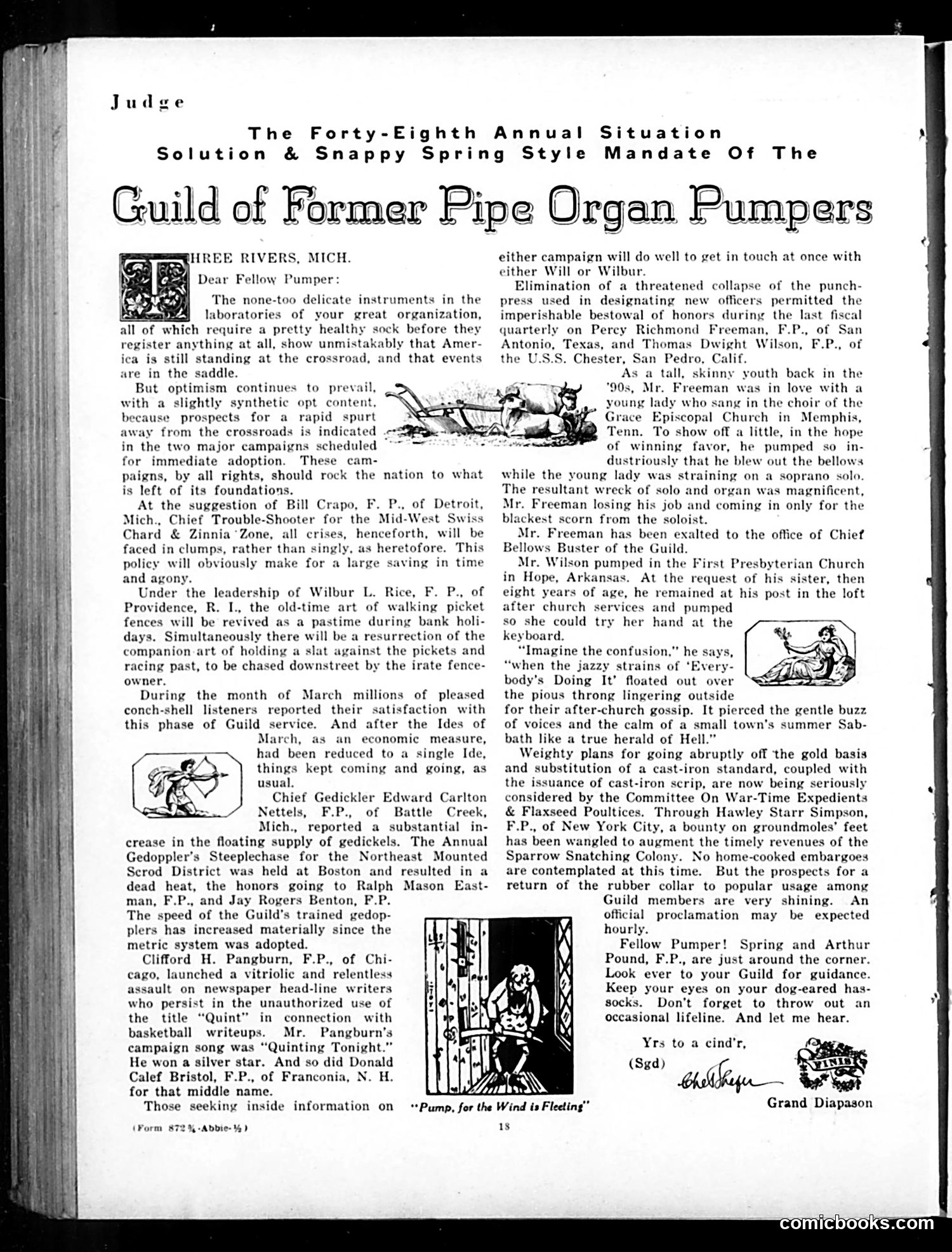
Analysis: "Guild of Former Pipe Organ Pumpers" This is a mock-serious satirical piece parodying organizational announcements and bureaucratic jargon. Judge magazine presents a fictional "Guild" of pipe organ pumpers—the young men and boys who once manually pumped air into church organs before electric motors existed. The satire works through: 1. Absurdist invented titles and activities: "Chief Gedickler," "Gedoppler's Steeplechase," and nonsensical terms ("gedickels," "ides") mock corporate hierarchies and overwrought officialdom. 2. Mundane accomplishments treated grandly: Proposals like "planting flowers in clumps" and "reviving the art of walking on picket fences" are presented as major policy initiatives. 3. Genuine nostalgia mixed with absurdity: The anecdote about Freeman blowing out organ bellows during a soprano's solo is humorously embarrassing, yet he receives ceremonial honors. The piece ridicules 1920s organizational inflation and self-importance while affectionately mocking a now-obsolete profession. The humor relies on readers knowing that organ pumping was real, humble work—making its inflation into formal "Guild" ceremony inherently funny.
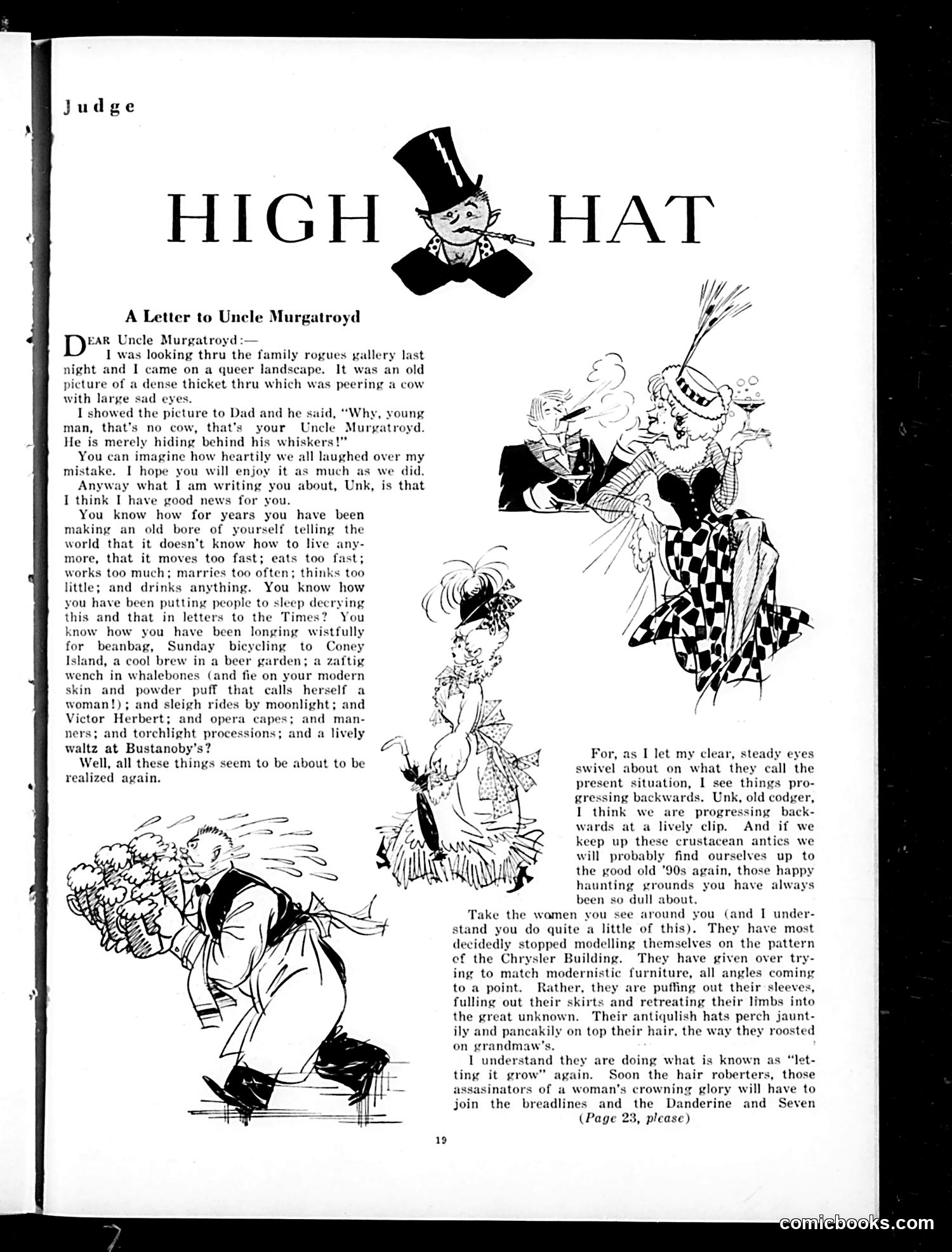
Analysis: "High Hat" — A Letter to Uncle Murgatroyd This satirical piece mocks an elderly curmudgeon ("Uncle Murgatroyd") who constantly complains that modern life moves too fast and lacks the virtues of the 1890s. The joke: women's fashion is *actually reverting* to those old styles, proving his nostalgic complaints inadvertently correct. The writer catalogs what Uncle wanted back: leisurely activities (beanbag, Sunday bicycling), old-fashioned romance (corsetted women/"zaftig wench in whalebones"), and Victorian entertainment (sleigh rides, Victor Herbert operettas, Bustanoby's ballroom waltzes). The punchline observes women are now adopting 1890s fashion—puffed sleeves, fuller skirts, antiquated hats—and letting their hair grow long again, abandoning the sleek, modernist "Chrysler Building" aesthetic of the 1920s flapper era. The satire targets both Uncle's tedious complaints and the fashion cycle itself: modernity briefly rejected Victorian excess, but now cyclically embraces it, vindicating the bore while mocking fashion's irrationality.
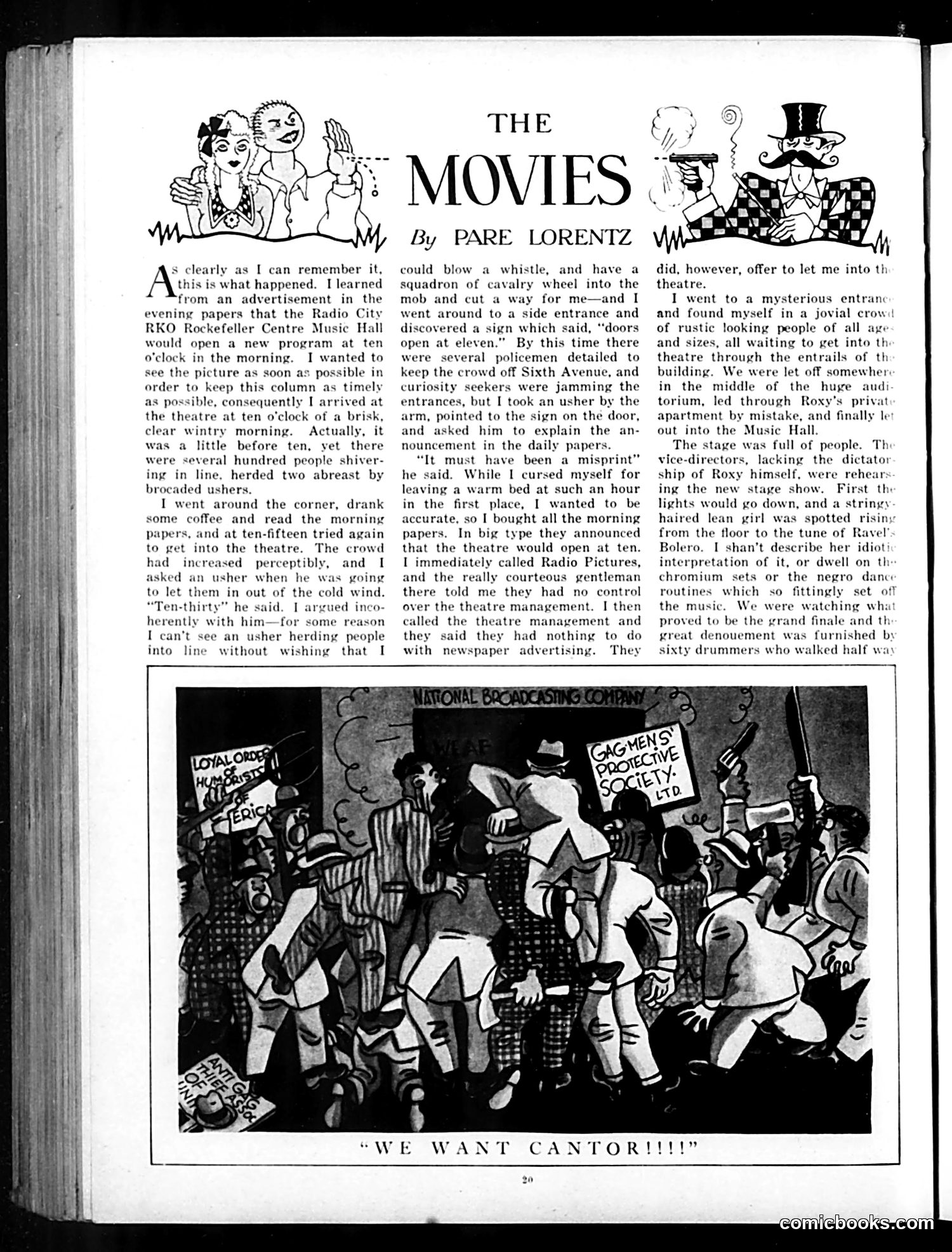
"The Movies" by Pare Lorentz This is a satirical account of opening day chaos at the new RKO Rockefeller Center Music Hall. The author arrived early after reading advertisements promising a 10 a.m. opening, only to find hundreds already queuing in freezing weather. He encountered contradictory information—signs said "doors open at eleven," ushers claimed "ten-thirty," but newspapers announced ten o'clock. The cartoon at bottom shows a chaotic crowd scene with protest signs including "Local Organized Musicians" and "Gaghens Protective Society," suggesting labor disputes or union objections to the theater's opening. Lorentz satirizes the disconnect between publicity and reality, and the lack of coordination between Radio Pictures, theater management, and newspapers. The piece mocks the pretension of the grand new venue while exposing organizational incompetence. His description of the stage show's mediocrity ("idiotic interpretation," "stringy haired lean girl") adds further mockery of the theater's actual content despite its architectural grandiosity.
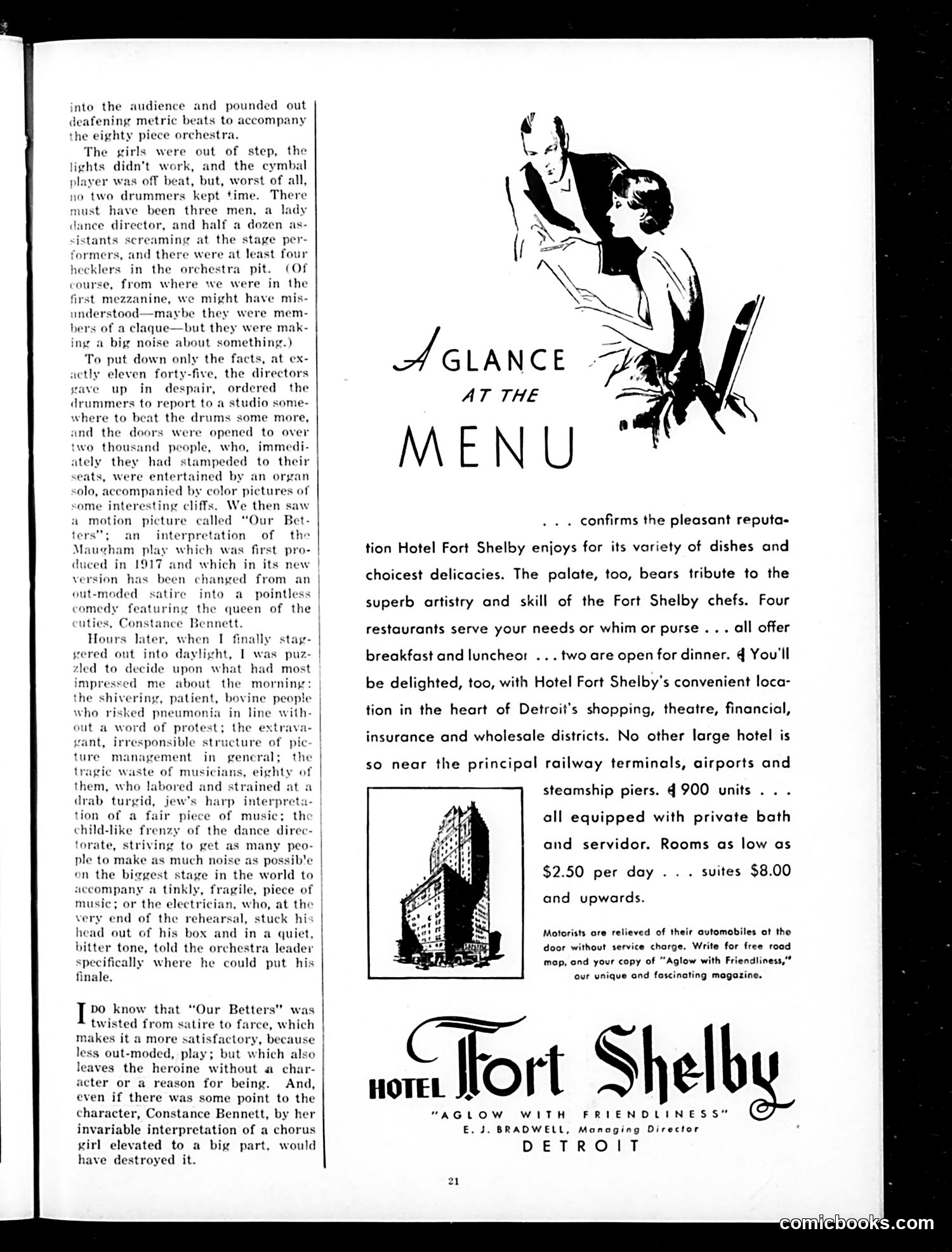
Analysis of Judge Magazine Page This page contains a satirical theater review of a stage production, likely from the 1920s-30s, followed by a hotel advertisement. The Main Satire: The author ridicules a chaotic theatrical rehearsal or performance featuring an 80-piece orchestra, incompetent musicians (drummers unable to keep time), malfunctioning lighting, and dancers out of step. The piece mocks the producers' desperation and incompetence—ordering drummers to "report to a studio somewhere to beat the drums some more" before opening doors to 2,000 waiting patrons. Target: "Our Betters" The review savagely critiques a stage adaptation of Somerset Maugham's 1917 play "Our Betters," transformed from biting satire into "pointless comedy." The review specifically attacks actress Constance Bennett, claiming her standard "chorus girl" interpretation destroys whatever character development existed. The Satire's Point: Judge ridicules both theatrical incompetence and passive audiences who patiently endure poor productions without protest—reflecting broader 1920s-30s criticism of mass entertainment mediocrity and audience complacency. The page concludes with an unrelated advertisement for Hotel Fort Shelby in Detroit.
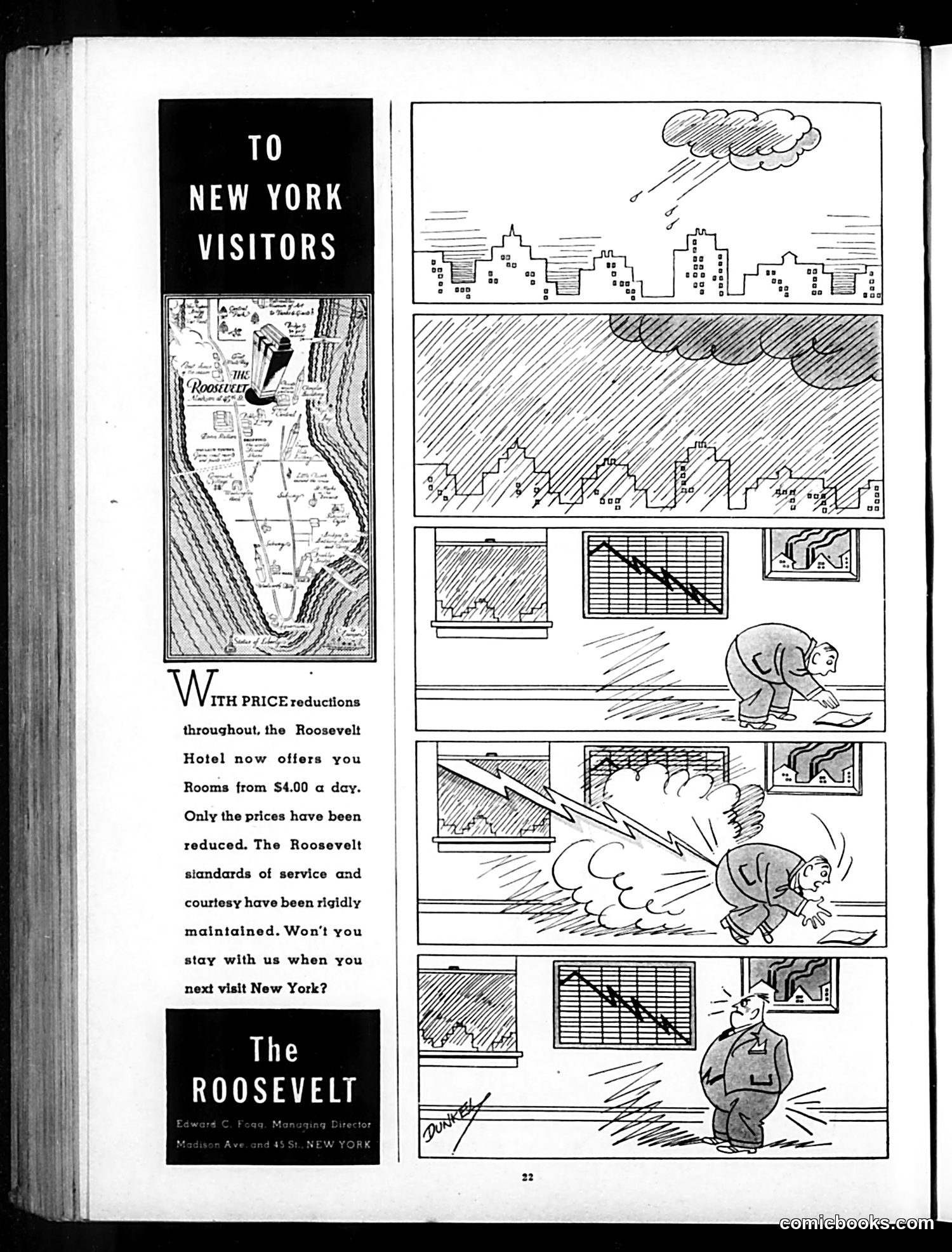
Page Analysis This is primarily a hotel advertisement for the Roosevelt Hotel in New York City, occupying the left side of the page. The right side contains a comic strip (artist signed "Dunne") depicting someone struggling through increasingly severe weather—rain, wind, and lightning—while trying to reach shelter, presumably the hotel. The joke appears to be: despite terrible conditions outside, the Roosevelt offers comfortable refuge at the bargain price of $4.00 per day. The advertisement emphasizes that during the economic downturn (appears to be Depression-era, given the drastic price reduction language), the Roosevelt maintains quality service while lowering rates—a selling point to budget-conscious visitors. The comic visually reinforces the appeal of affordable shelter during hard times.
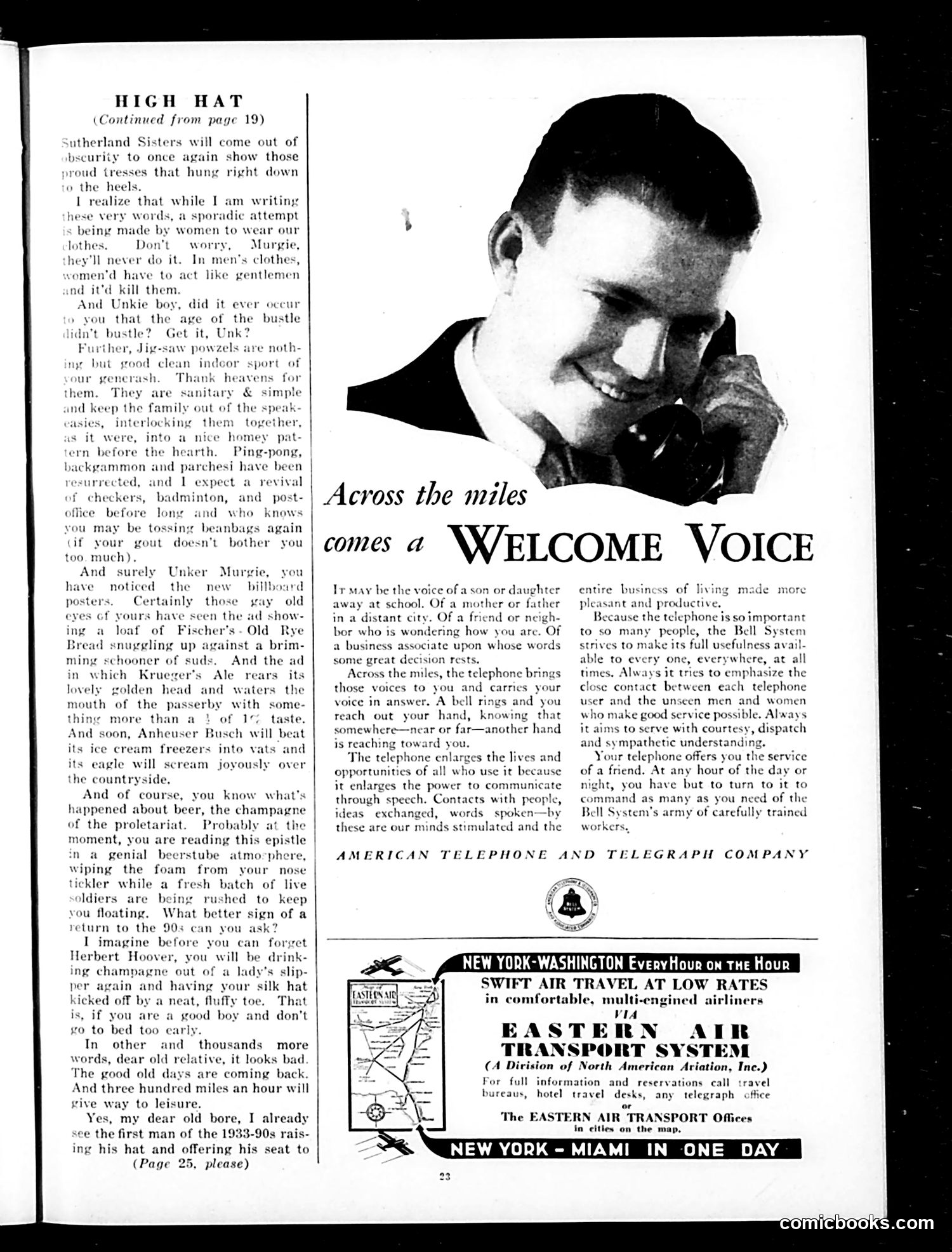
Content Analysis: Judge Magazine Page This page contains a satirical column titled "High Hat" (continued from page 19) and a full-page advertisement. The Column: The writer addresses "Unkie" (Uncle), discussing 1930s social trends with sardonic humor. References include: - Women attempting to wear men's clothing (the writer dismisses this as impossible) - The Sutherland Sisters (likely referring to a historical hair-care brand) - Indoor leisure activities (jigsaw puzzles, ping-pong, backgammon) - Alcohol advertising, particularly beer and ale brands (Krueger's Ale, Fischer's Old Rye, Anheuser Busch) - Herbert Hoover and nostalgia for the 1890s-1930s era - Predictions about returning to 1933-90s fashions and leisure The satire mocks period anxieties about changing gender roles and celebrates a return to pre-Prohibition drinking culture. The Advertisement: The AT&T Bell System ad emphasizes the telephone's importance in connecting distant loved ones and business associates, positioning it as essential to modern life.
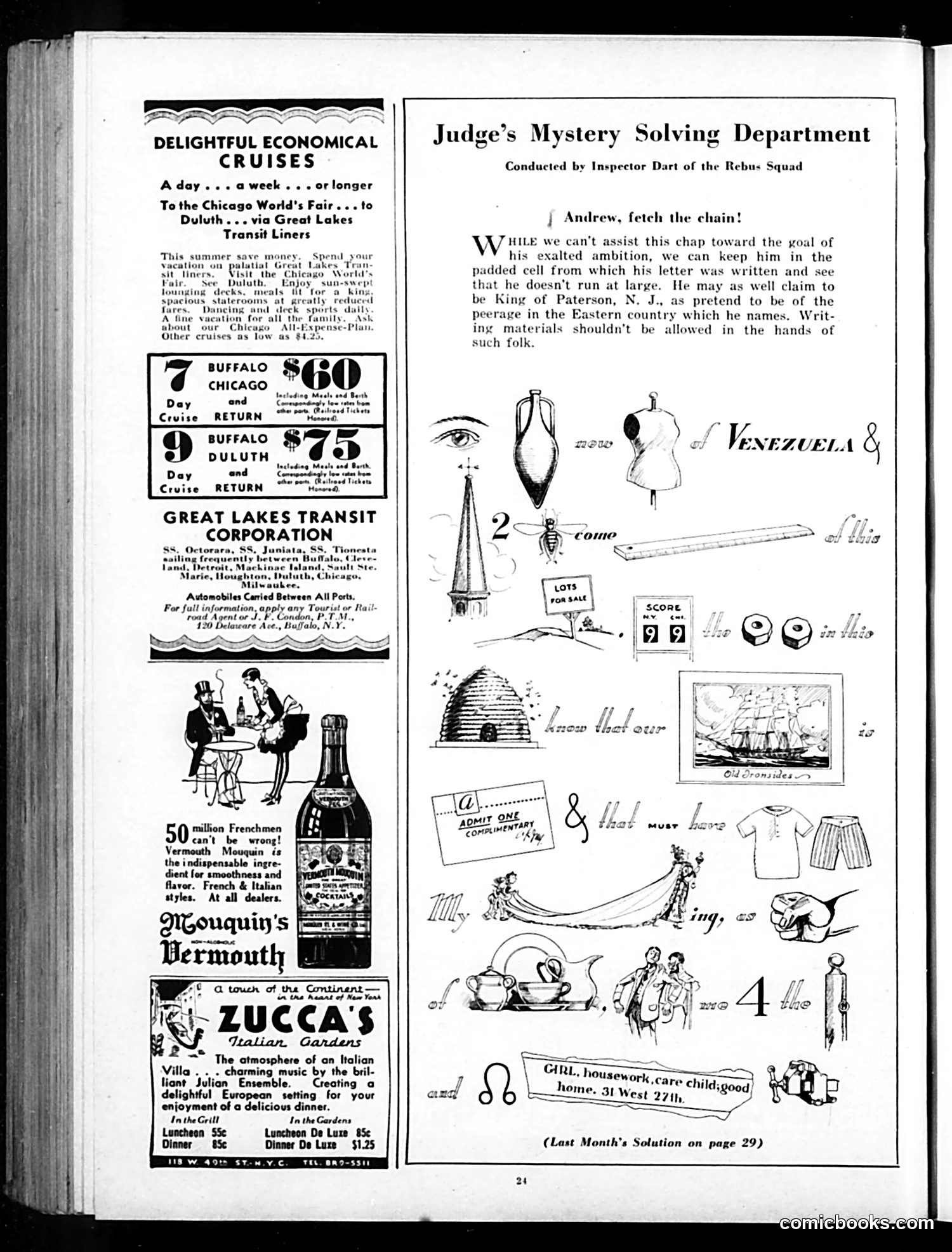
Judge's Mystery Solving Department Analysis This is a rebus puzzle page where readers must identify a mystery subject through visual clues. The "solution" involves a person claiming to be "King of Paterson, N.J." who pretends to hold a "peerage in the Eastern country" (likely Venezuela, based on the text label visible). Inspector Dart's dismissive commentary mocks the letter-writer as delusional, suggesting he belongs in a padded cell rather than receiving serious consideration. The joke satirizes people who make grandiose or false claims of nobility and aristocratic status—a common target of early 20th-century American humor. The rebus includes various illustrated clues (a gavel, clothing, ships, admission ticket, etc.) that solvers must interpret to identify the answer. The phrase "Andrew, fetch the chain!" suggests confinement or restraint, reinforcing the asylum joke. This represents typical *Judge* magazine humor: mocking pretension and mental instability through wordplay and visual puzzles.
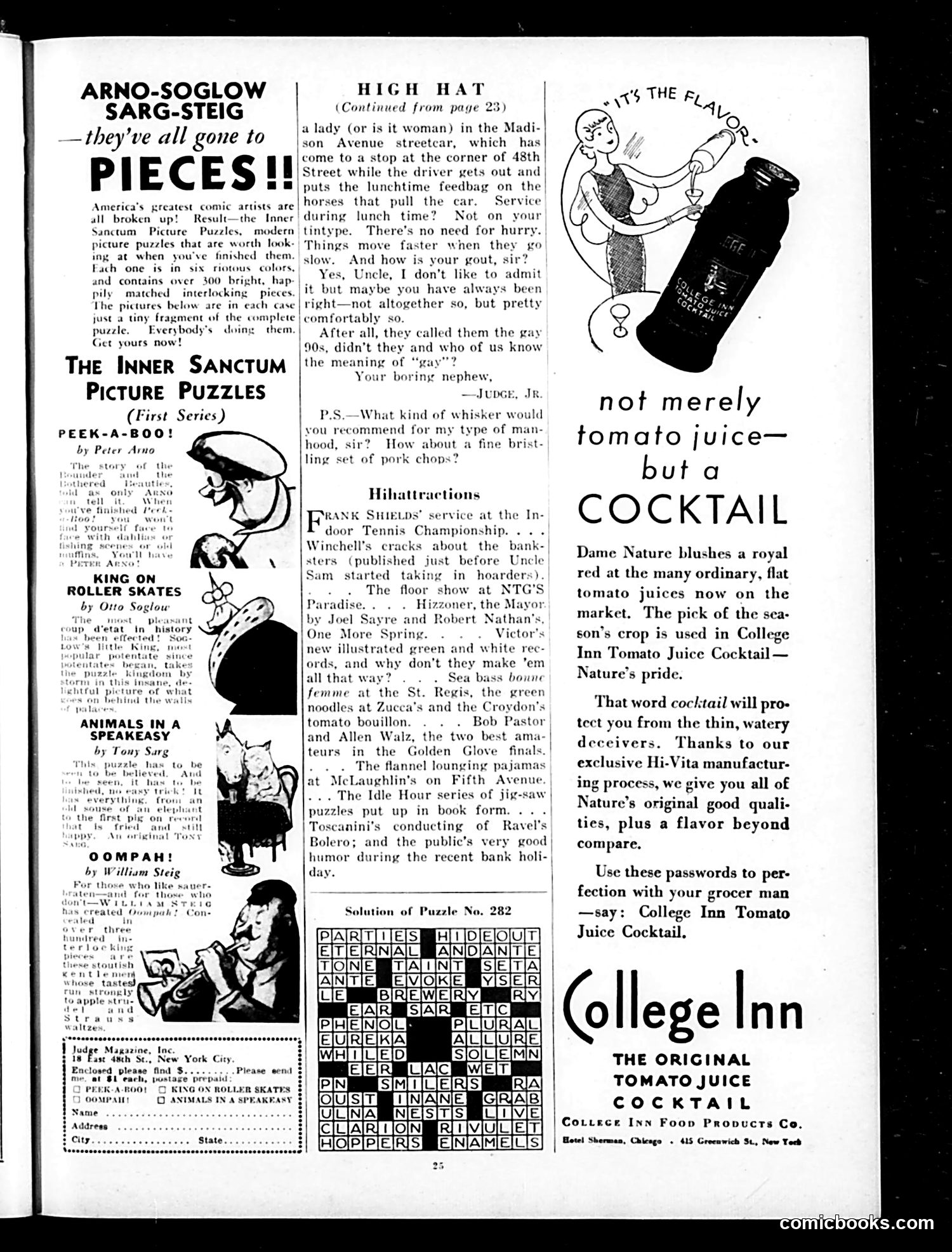
Judge Magazine Page Analysis This page primarily advertises picture puzzles by famous comic artists (Arno, Soglow, Sarg, Steig) marketed as "Inner Sanctum Picture Puzzles"—a commercial product tie-in. The joke is that these celebrated cartoonists have "gone to pieces," a pun meaning both their work is fragmented into puzzles and they've been broken up/dispersed. The "High Hat" column contains social gossip and commentary typical of Judge's satirical style, referencing 1930s Manhattan leisure activities (tennis, nightclubs, radio broadcasts). A notable reference: the author dismisses modern "gay 90s" nostalgia by questioning whether readers even understand what "gay" meant then—a historically significant moment showing the word's original meaning of "carefree/lighthearted." The page is otherwise dominated by a College Inn Tomato Juice Cocktail advertisement, emphasizing the product's quality and marketing it as superior to "thin, watery" competitors.
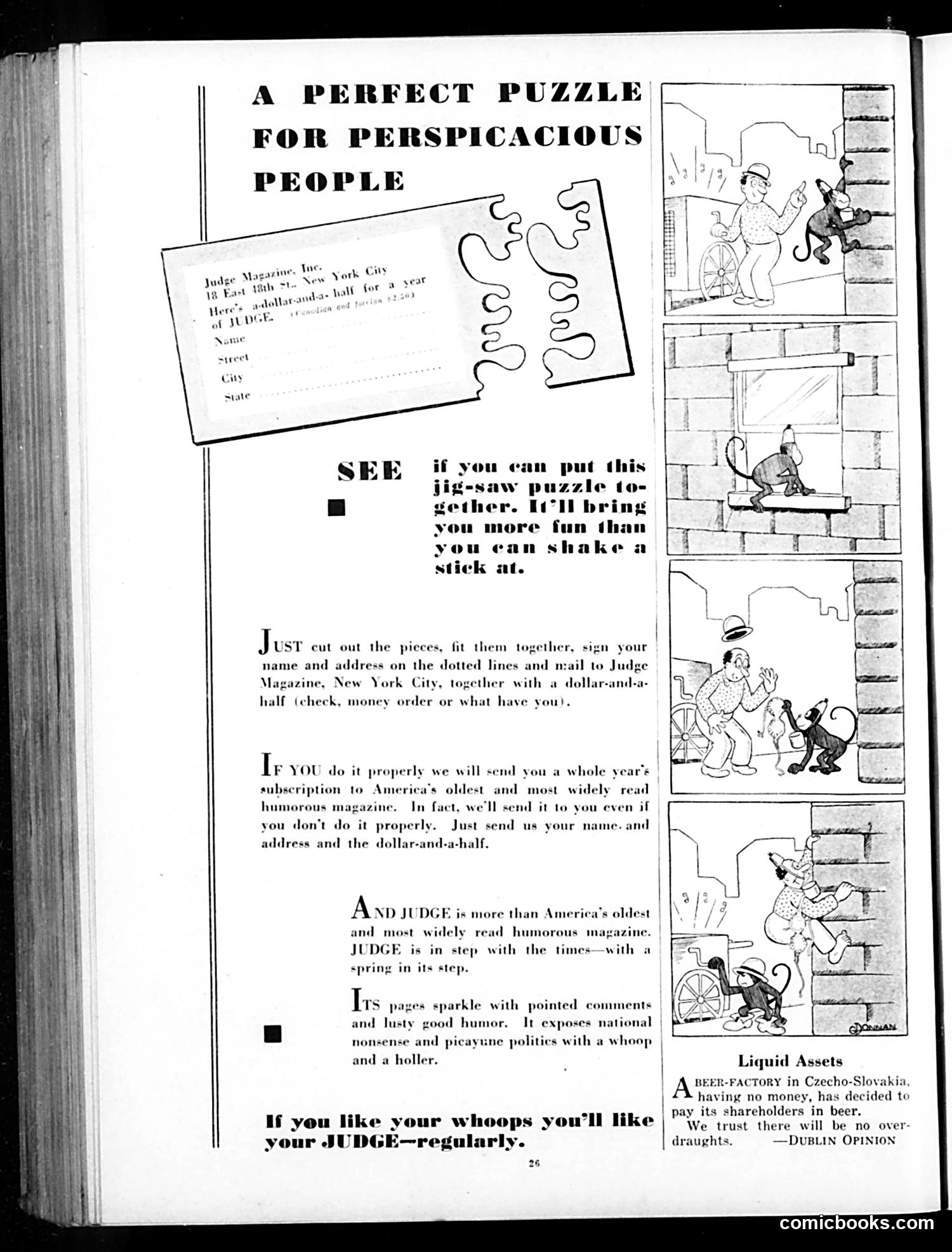
Analysis This page is primarily a subscription advertisement for *Judge* magazine, disguised as a puzzle promotion. The jig-saw puzzle shown depicts comedic street scenes (appears to show figures on a city street and a bicycle) that readers are instructed to assemble and mail in with $1.50 to receive a year's subscription. The satire is self-referential: *Judge* markets itself as "America's oldest and most widely read humorous magazine" that "exposes national nonsense and picayune politics with a whoop and a holler." The puzzle itself is the joke—it's deliberately difficult, yet the magazine promises to send a subscription "even if you don't do it properly," mocking readers' likely failure. At bottom, there's an unrelated joke ("Liquid Assets") about a Czecho-Slovak brewery paying shareholders in beer rather than cash—a Depression-era gag about deflated currency and absurd corporate solutions. The page reflects early-20th-century magazine marketing: combining entertainment with subscription drives.
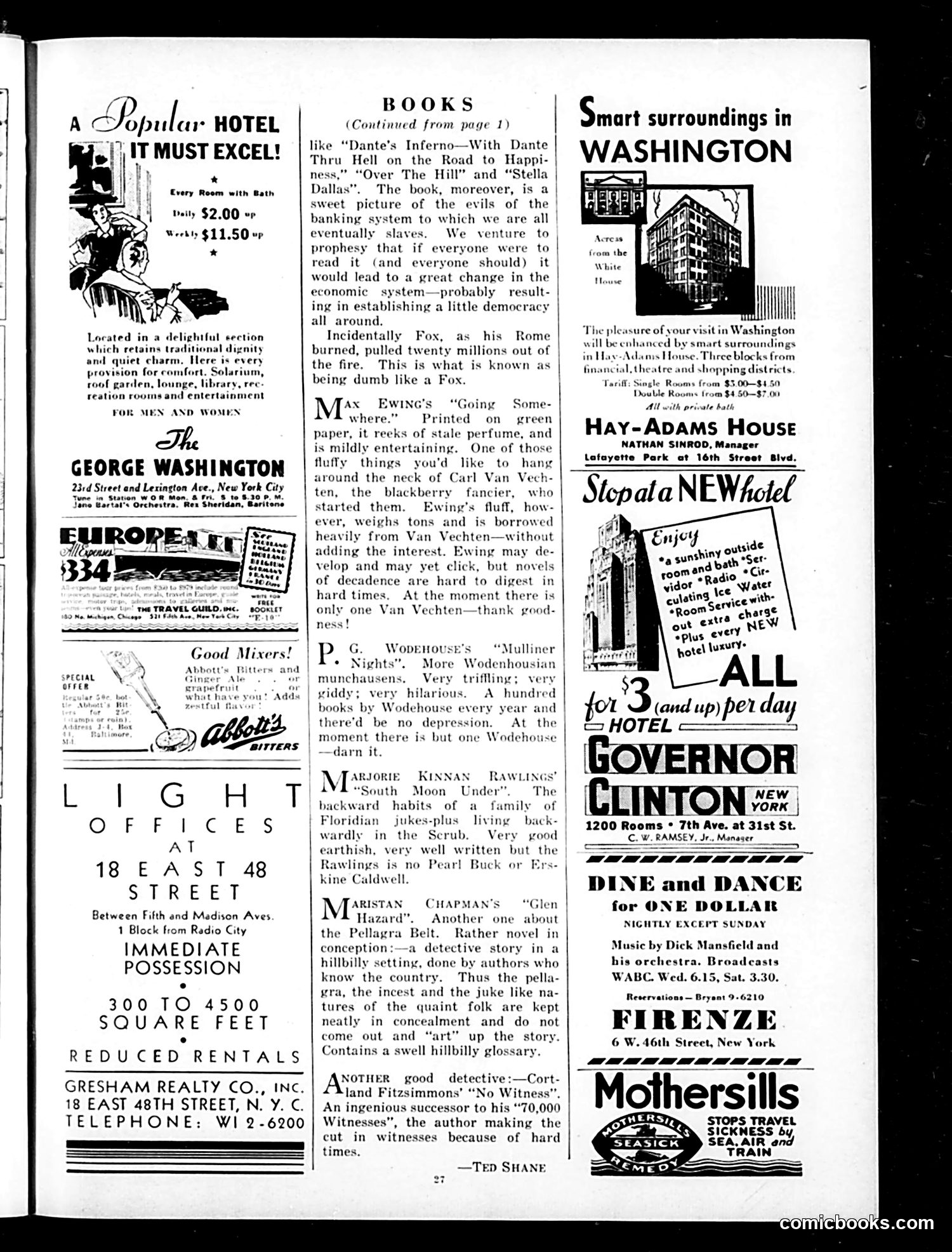
Judge Magazine Page Analysis This page is primarily advertising and book reviews, not political satire. The top half contains brief literary reviews by Ted Shane of recent novels, including works by Upton Sinclair (banking system critique), Max Ewing, P.G. Wodehouse, and others—mostly dismissive commentary on contemporary fiction. The bottom half is entirely commercial advertising: hotel rates in New York City (The George Washington, Governor Clinton), real estate rentals, restaurants offering "dine and dance for one dollar," and travel services. The Washington, D.C. hotel advertisements reference Depression-era affordability ("$3 and up per day"). The only potential satirical content appears in Shane's book reviews, where he mocks various authors' work as derivative or poorly executed. However, there are no visible political cartoons or caricatures on this page. It's a typical mid-1930s magazine layout mixing editorial content with period advertising.
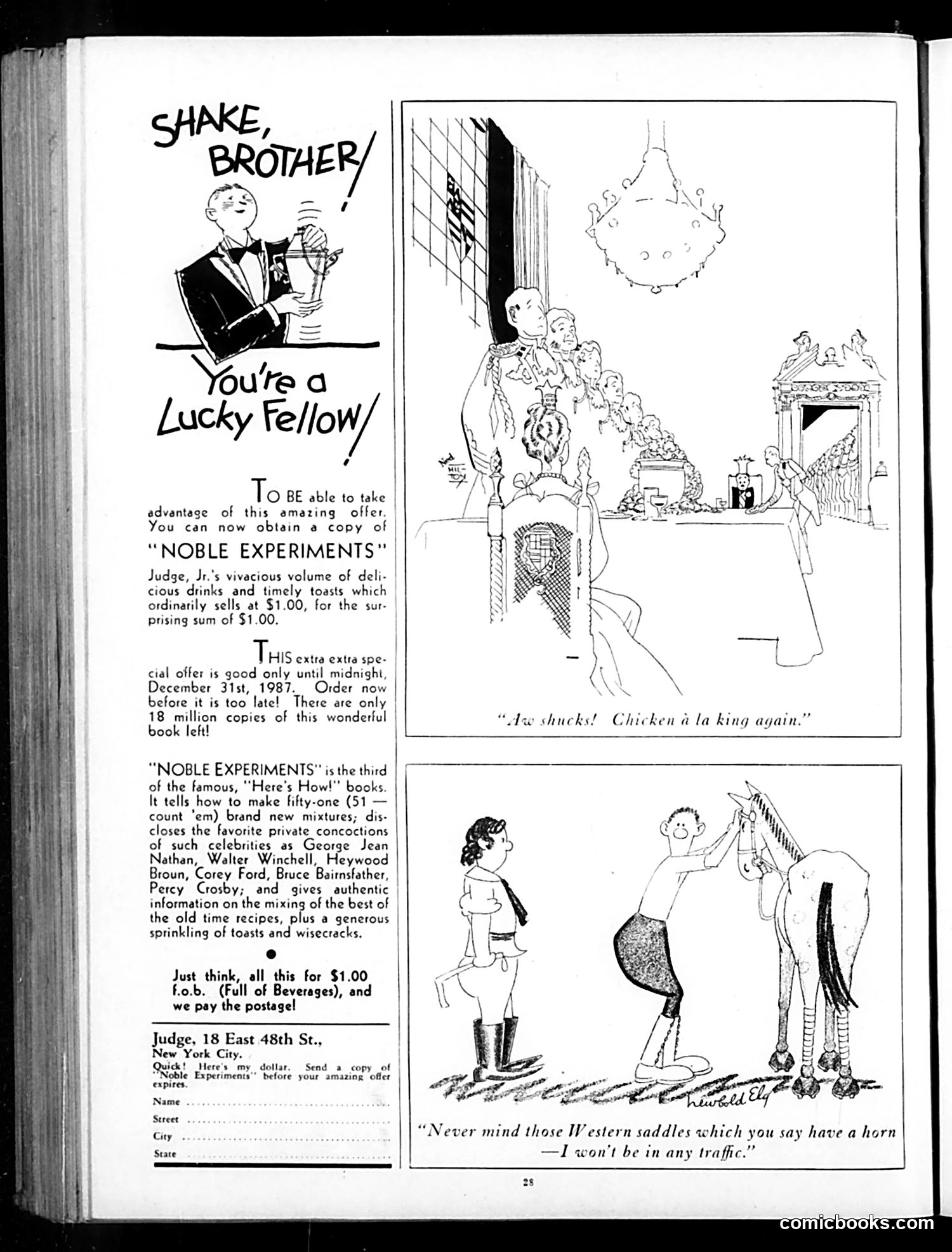
Content Analysis This page is primarily advertising for "Noble Experiments," a Judge magazine publication about cocktail recipes and toasts. The satire lies in the fake "special offer" copy: the book "ordinarily sells at $1.00, for the surprising sum of $1.00"—a humorous non-deal presented as an amazing bargain. The reference to "December 31st, 1987" (clearly a typo for 1927, given the Prohibition-era context) and the emphasis on "delicious drinks" is satirical commentary on Prohibition, which was in effect 1920-1933. The book promises recipes from celebrities like Walter Winchell and Heywood Broun, mocking the era's speakeasy culture and underground cocktail-making during alcohol bans. The two cartoons below are unrelated vignettes about domestic complaints and horseback riding—standard comic filler with no apparent political significance.
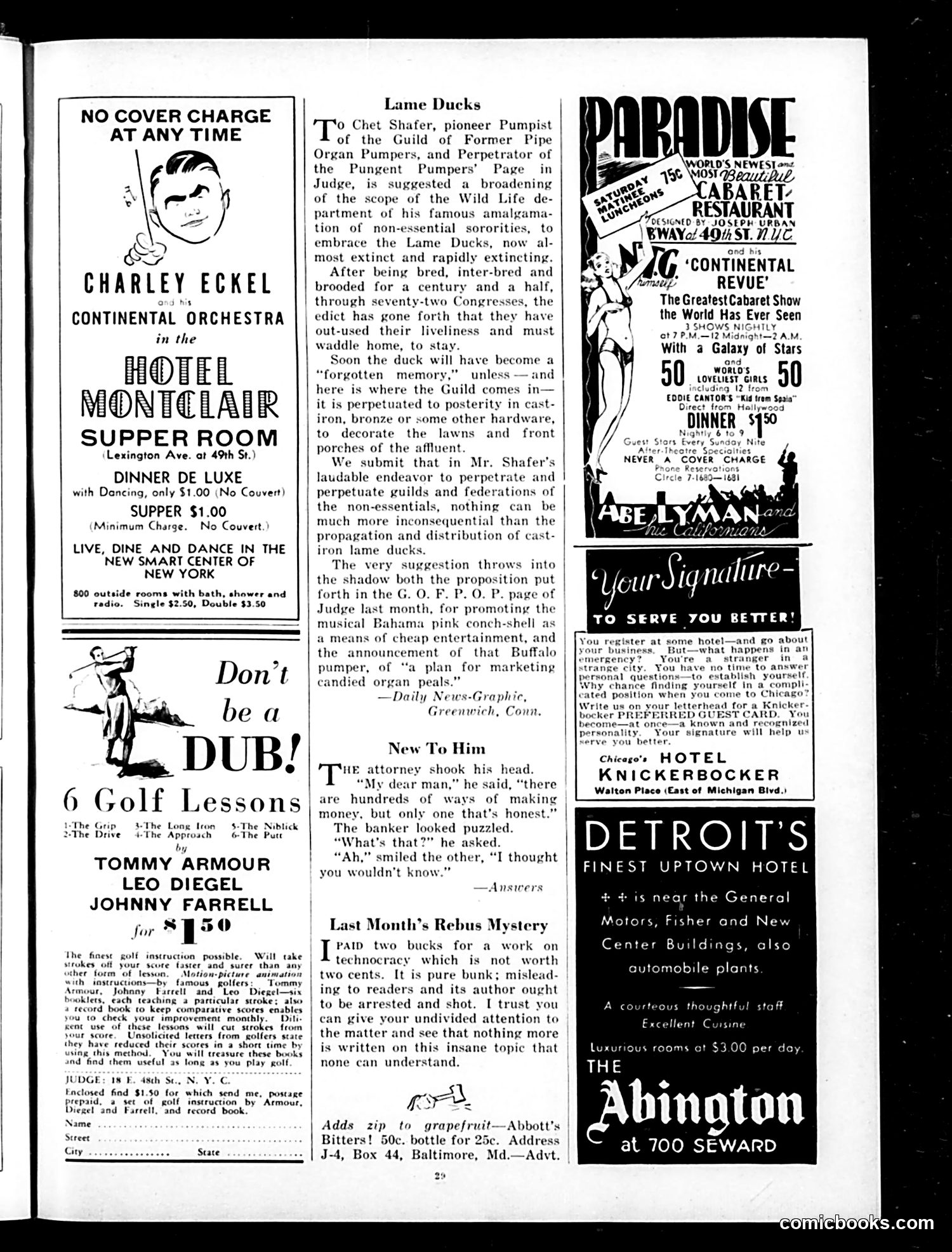
Analysis of Judge Magazine Page Content This page is primarily advertising and light humor rather than political satire. The main editorial content includes: "Lame Ducks" article: A humorous piece about preserving extinct "lame ducks" (politicians defeated in elections but still serving until their successors take office) through cast-iron decorations. The satire mocks both the impracticality of perpetuating useless political positions and earlier proposals for cheap entertainment (like "Bahama pink conch-shells" and "candied organ peals"). "New to Him" joke: A brief attorney-banker anecdote about honesty in moneymaking—a mild class commentary suggesting bankers aren't naturally honest. "Last Month's Rebus Mystery": A reader complaint about a worthless technocracy book. The remainder is commercial advertising for hotels, restaurants, golf lessons by famous professionals (Armour, Diegel, Farrell), and entertainment venues—typical of Judge's revenue model during this era.
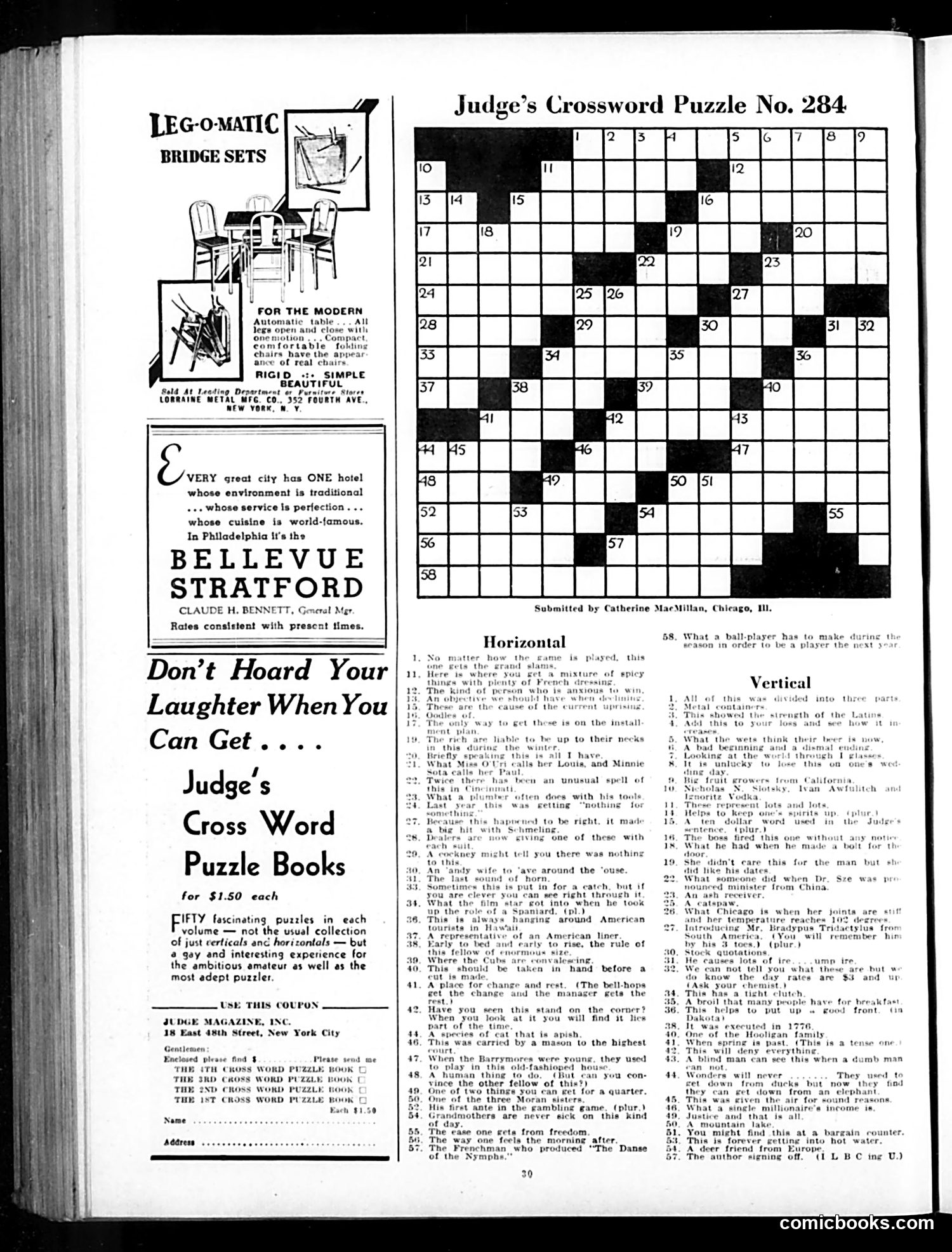
Judge's Crossword Puzzle Page (circa 1920s-1930s) This page is primarily commercial content, not political satire. It features: Main Content: Judge's Crossword Puzzle No. 284, submitted by Catherine MacMillan of Chicago. The puzzle itself contains typical crossword clues with wordplay and cultural references of the era (references to "the Cubs," "the Barrymores," "the Frenchman who produced 'The Danse of the Nymphs'"). Advertisements: The left side contains ads for leg-o-matic bridge table sets, the Bellevue Stratford hotel in Philadelphia, and Judge's Crossword Puzzle Books ($1.50 each). Tagline: "Don't Hoard Your Laughter When You Can Get... Judge's Cross Word Puzzle Books" — a light promotional pitch. There are no political cartoons or satirical commentary visible on this page. It's essentially a puzzle page with supporting advertisements, typical of Judge magazine's commercial content.
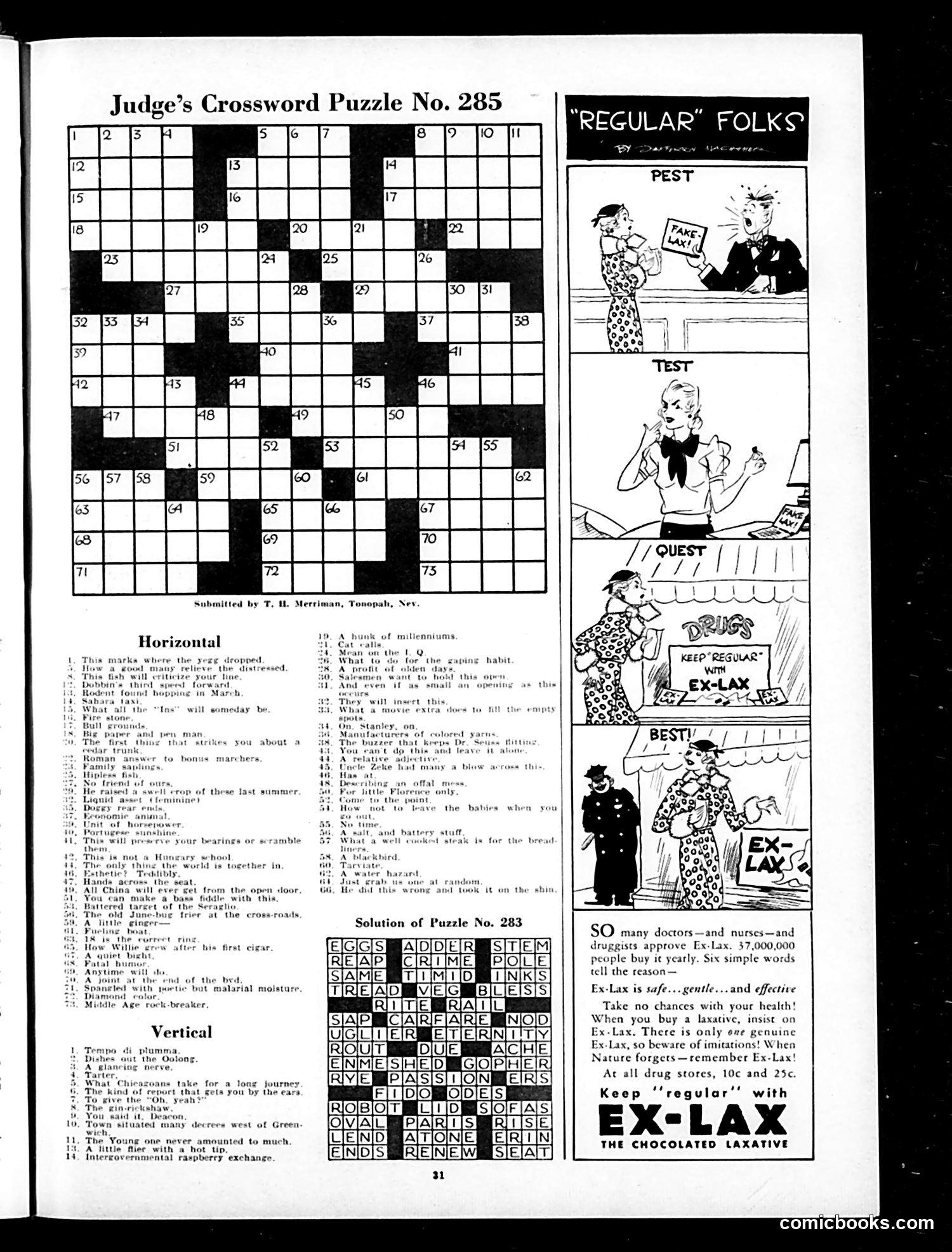
Judge Magazine Page Analysis This page is primarily advertising and puzzle content, not political satire. The main feature is "Judge's Crossword Puzzle No. 285" with its solution below. The right side contains a comic strip titled "Regular Folks" (appears to be a recurring feature) showing four domestic scenes with a couple, illustrating different uses or contexts—labeled "PEST," "TEST," "QUEST," and "BEST." The strip functions as an extended advertisement for Ex-Lax laxative, a chocolate-based bowel regulator. The "Regular Folks" scenarios humorously frame situations where digestive regularity matters, leading to the product pitch: "So many doctors—and nurses—and druggists approve Ex-Lax." The ad emphasizes the product's safety, gentleness, and effectiveness while warning against imitations—standard 1930s-40s pharmaceutical marketing. This represents Judge's commercial content rather than its satirical journalism; the magazine relied heavily on advertising revenue.
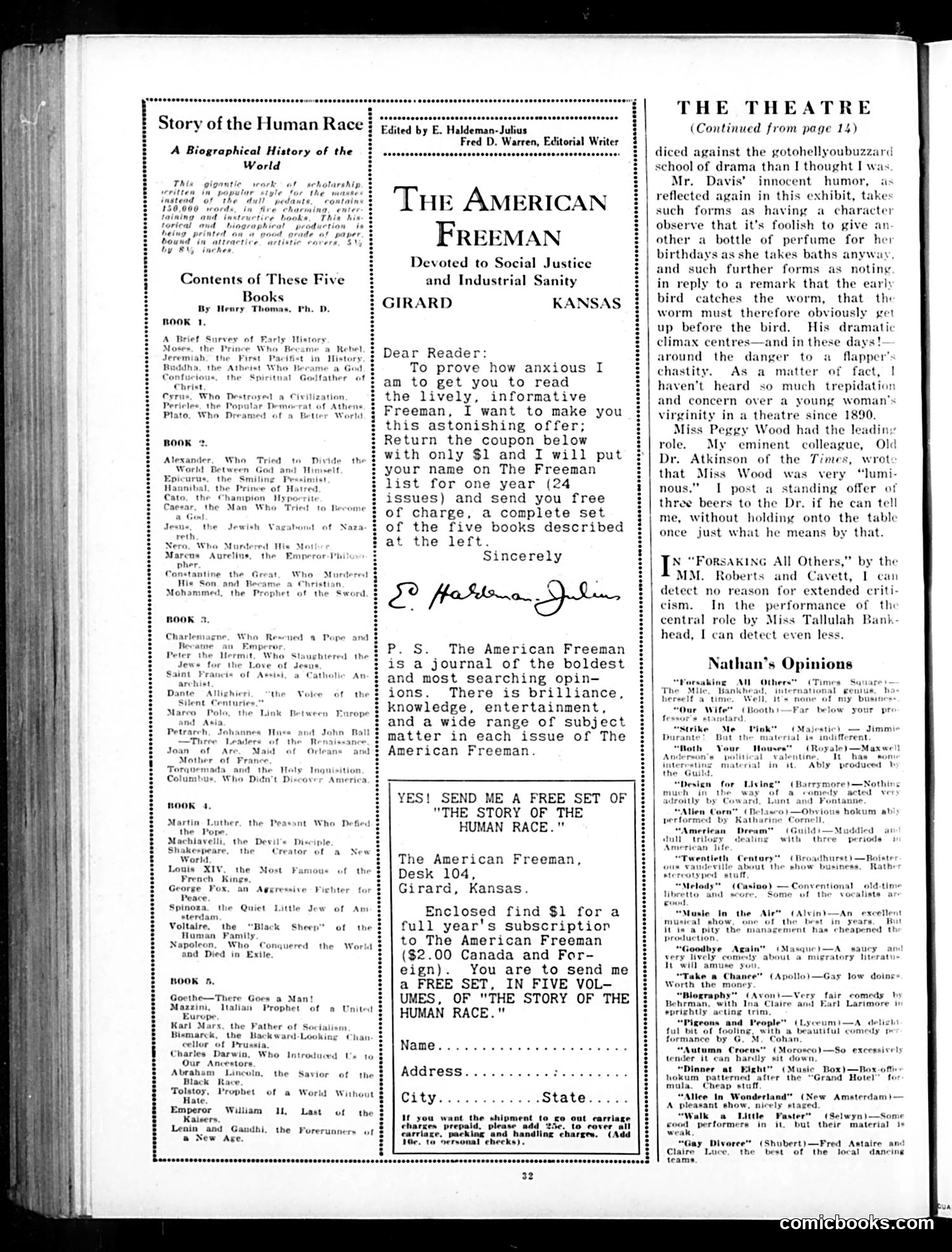
What This Page Means for Modern Readers This page mixes advertising and theater criticism from *Judge* magazine. The main content is a subscription pitch for *The American Freeman*, a socialist publication from Girard, Kansas, offering a five-volume "Story of the Human Race" biography series (covering figures from Socrates to Gandhi) for just $1 with a year's subscription. The biographical emphasis—pairing famous historical figures with their defining achievements or conflicts (Luther vs. the Pope, Darwin's evolutionary theory)—suggests the magazine positioned itself as intellectually serious and progressive, targeting readers interested in radical social critique. The theater section critiques contemporary plays, particularly mocking sentimentality around protecting women's chastity and praising performer Tallulah Bankhead's restraint. The tone suggests *Judge* was satirizing both dramatic conventions and bourgeois morality of its era. Together, the page reflects an American radical-intellectual culture that mixed earnest social-justice publishing with sophisticated cultural criticism.
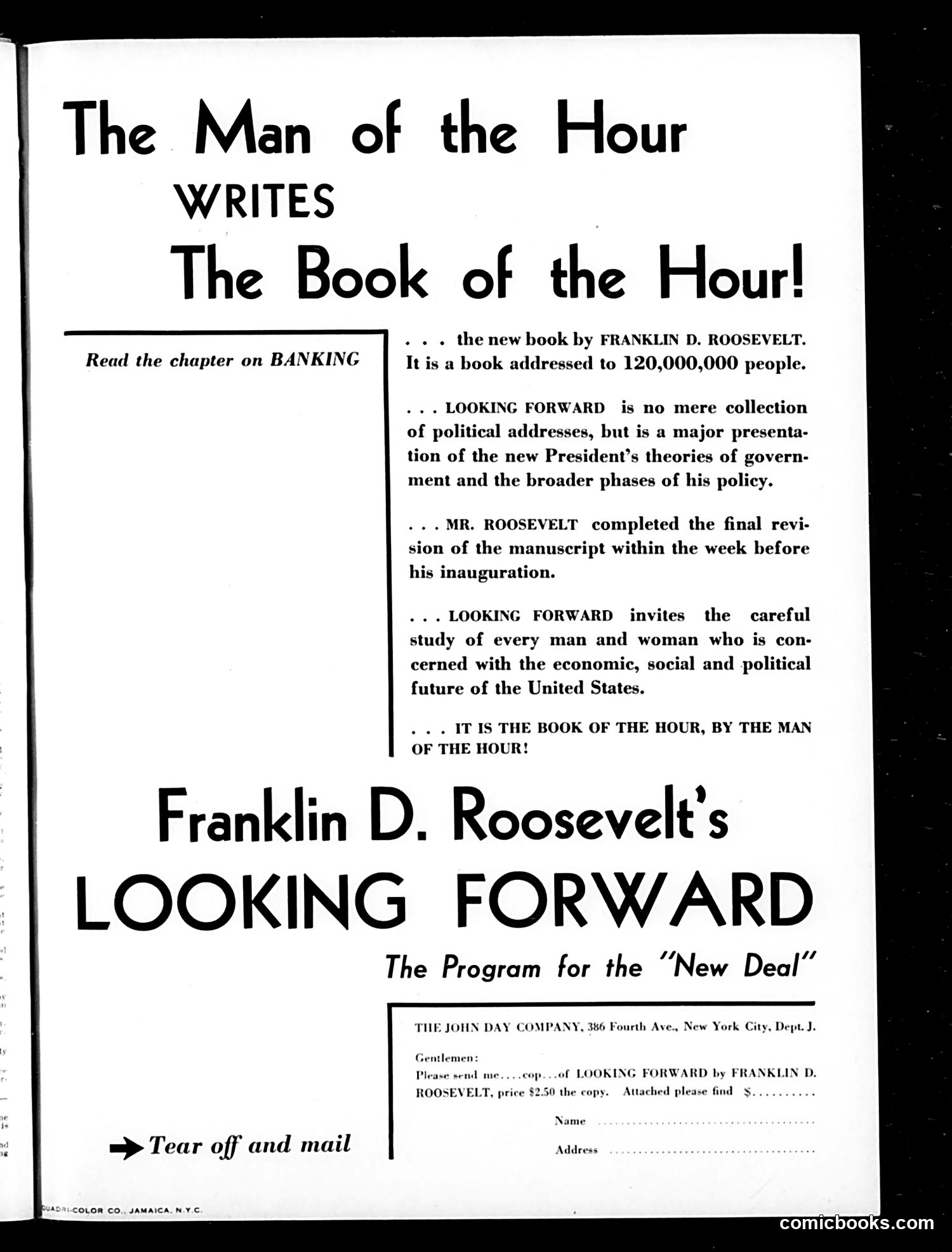
Analysis This is primarily advertising content, not satire or a political cartoon. It's a promotional page for Franklin D. Roosevelt's book *Looking Forward*, published around his 1933 inauguration. The page celebrates FDR as "the Man of the Hour" and his newly published book as "the Book of the Hour"—emphasizing his timeliness and relevance as the newly inaugurated president addressing the Great Depression. The advertising highlights that Roosevelt completed the manuscript just before taking office, positioning it as authoritative exposition of his "New Deal" economic program. The tone is promotional and earnest rather than satirical. Judge magazine is running this as paid advertising (note the mail-in order form at bottom). While Judge was a satirical publication, this particular page is straightforward marketing aimed at readers concerned with "economic, social and political" issues—essentially selling Roosevelt's policy vision to the American public during the early New Deal period.
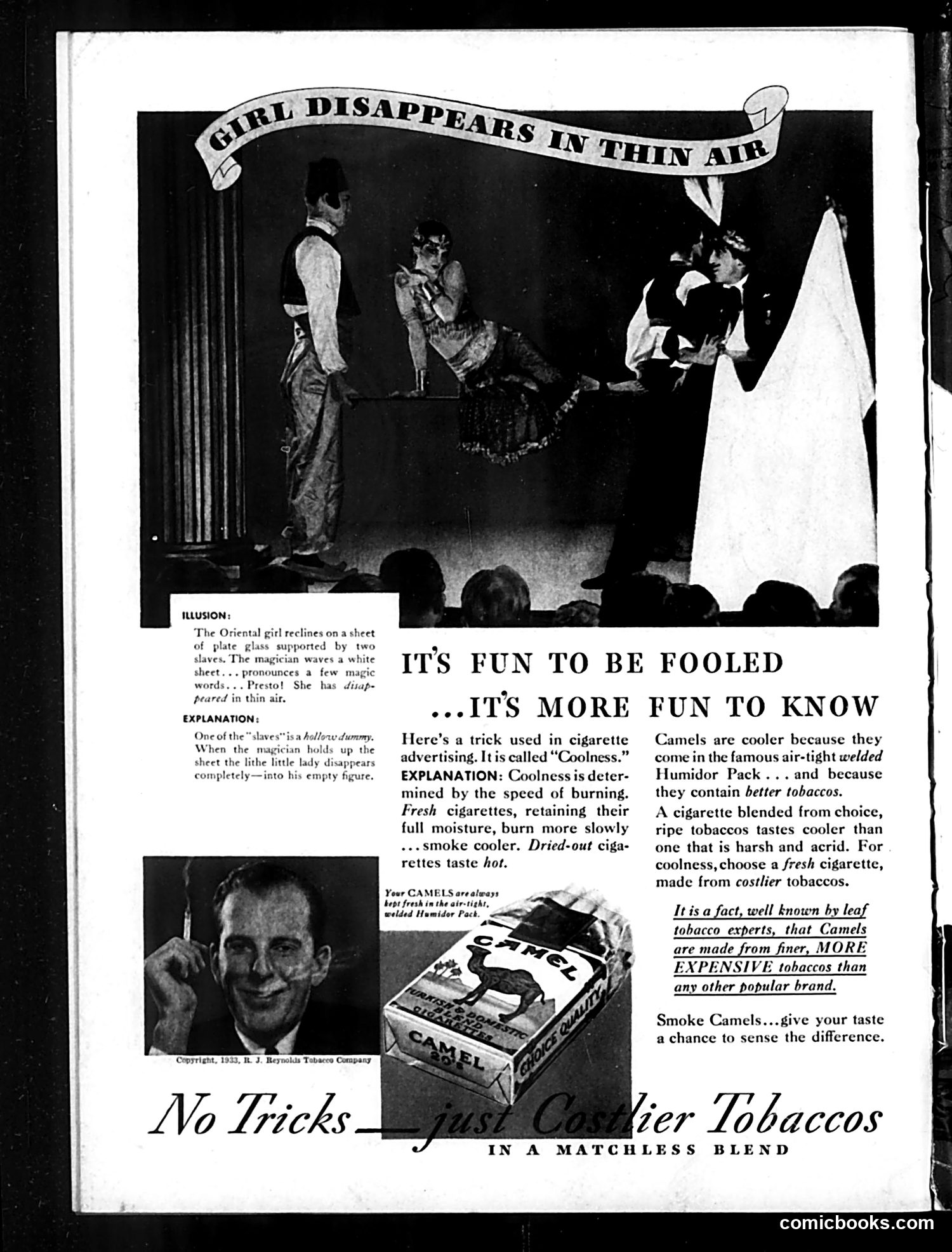
A 1933 Camel Cigarette Advertisement Disguised as Satire This page is primarily a Camel cigarette advertisement masquerading as educational satire. The top illustration shows a stage magic trick—a girl appearing to vanish into thin air using a hollow dummy figure—as a visual metaphor for advertising deception. The ad then "exposes" a cigarette industry trick: claiming coolness through moisture retention and slower burning. However, rather than truly criticizing the tactic, the advertisement uses this "explanation" to actually promote Camel's superiority, arguing their air-tight packaging and "costlier tobaccos" genuinely deliver coolness. The irony is self-aware but ultimately self-serving: Judge magazine appears to be calling out manipulative advertising while running an ad that uses the same technique—framing product claims as revealed truth. This exemplifies 1930s tobacco marketing's sophisticated approach: acknowledging consumer skepticism while reinforcing brand superiority claims.