judge
Judge — May 1933
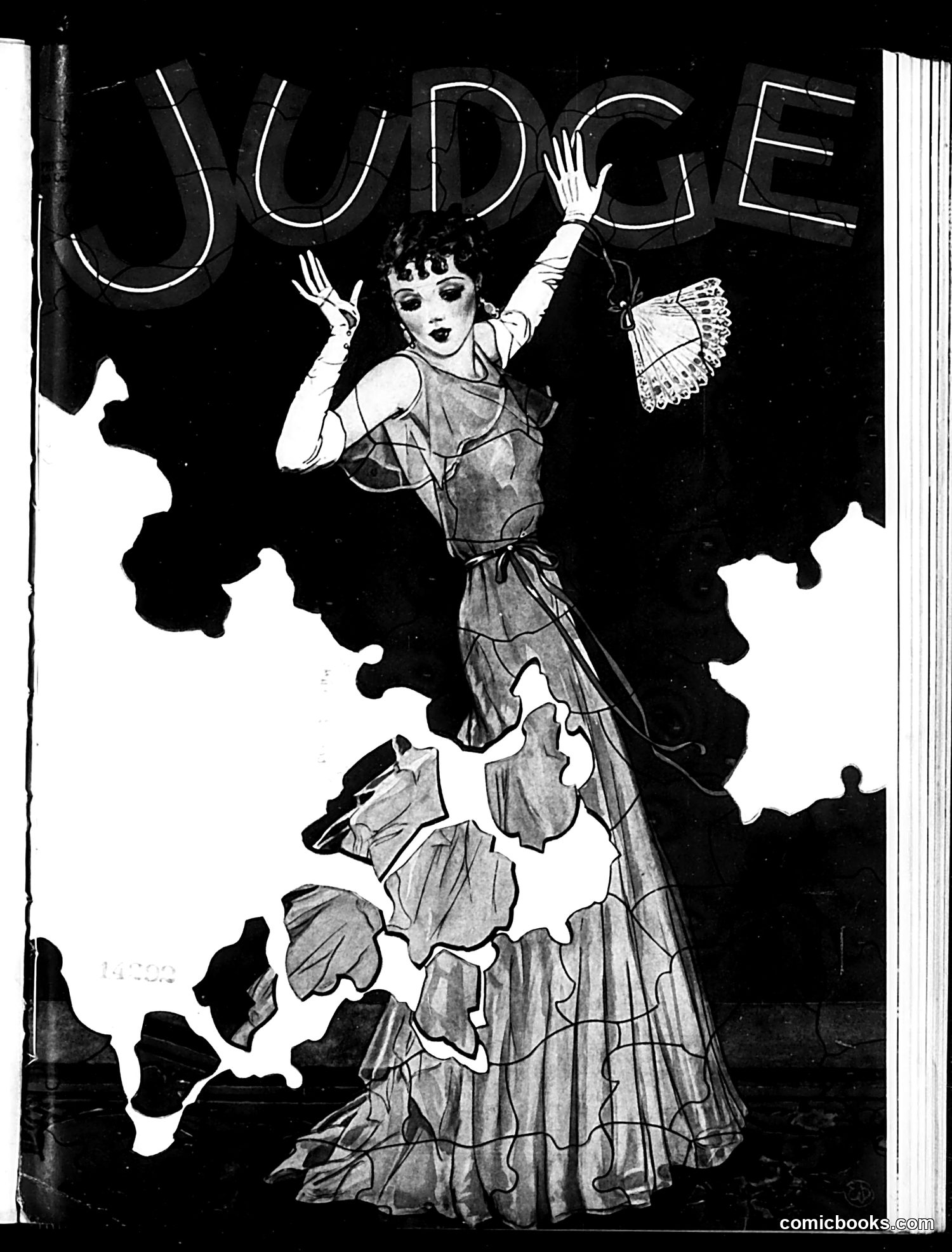
Judge Magazine Cover Analysis This appears to be a Judge magazine cover featuring the word "JUDGE" at the top. The illustration shows a stylized female figure in an elegant, flowing gown with dramatic pose and gesture, wearing long gloves and what appears to be theatrical or performance attire from the early 20th century. Without additional OCR text or captions visible on the page itself, I cannot definitively identify which specific political figure, social commentary, or satirical point this cover intends. The artistic style and composition suggest commentary on fashion, performance, or possibly theatrical/entertainment culture of that era, but the exact subject and satirical message remain unclear without supporting text or context clues I can reliably read.
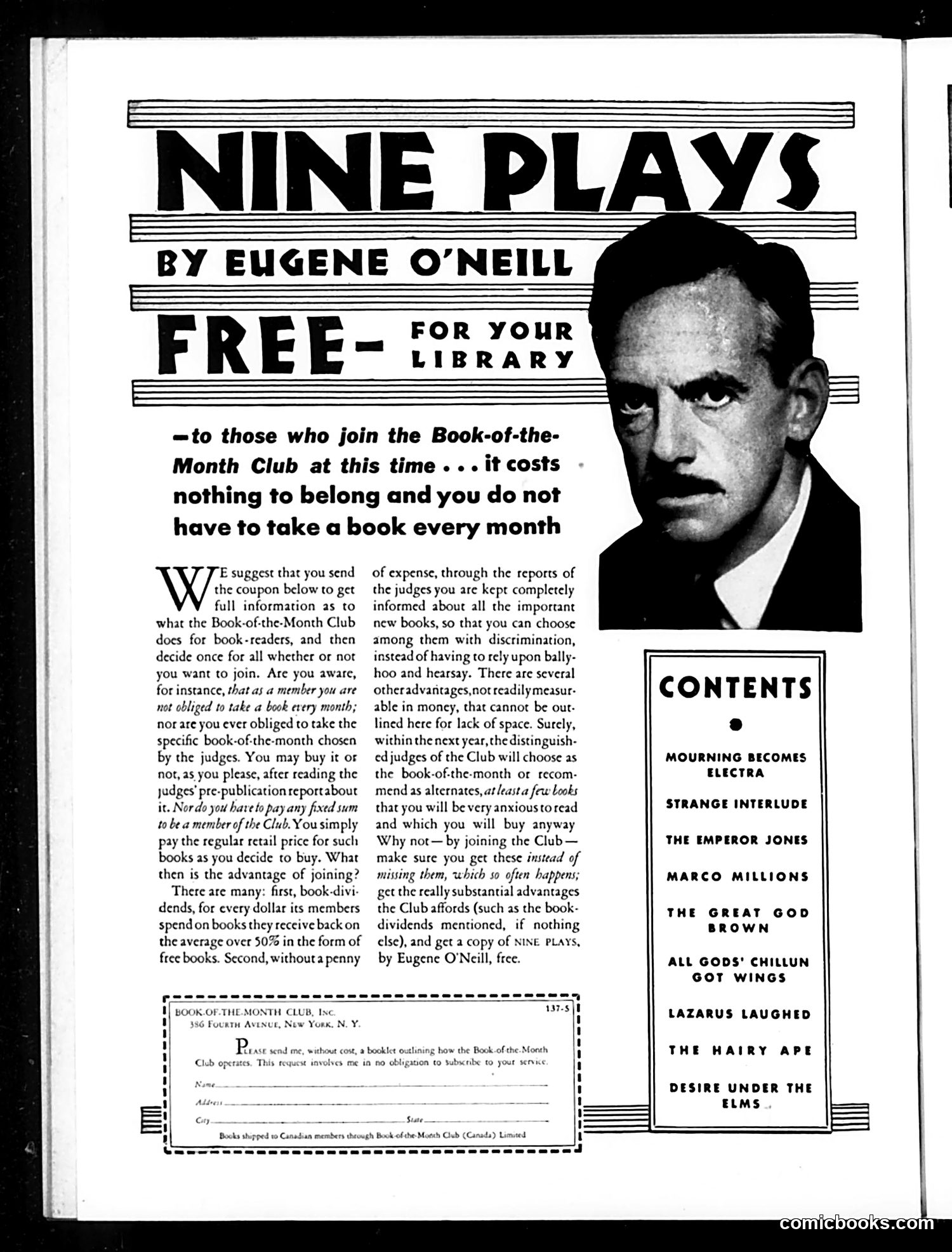
Advertisement, Not Satire This page is primarily a Book-of-the-Month Club advertisement, not political satire. It features a portrait of Eugene O'Neill, the acclaimed American playwright, and offers nine of his plays free to library patrons who join the club. The advertisement emphasizes the club's value proposition: membership is free, members aren't obligated to purchase monthly selections, and they receive books at discounts. The "Contents" box lists O'Neill plays including *Mourning Becomes Electra* and *The Hairy Ape*. There is no political cartoon or satirical content here—this is straightforward commercial promotion, likely from the 1930s, using O'Neill's literary prestige to attract club members.
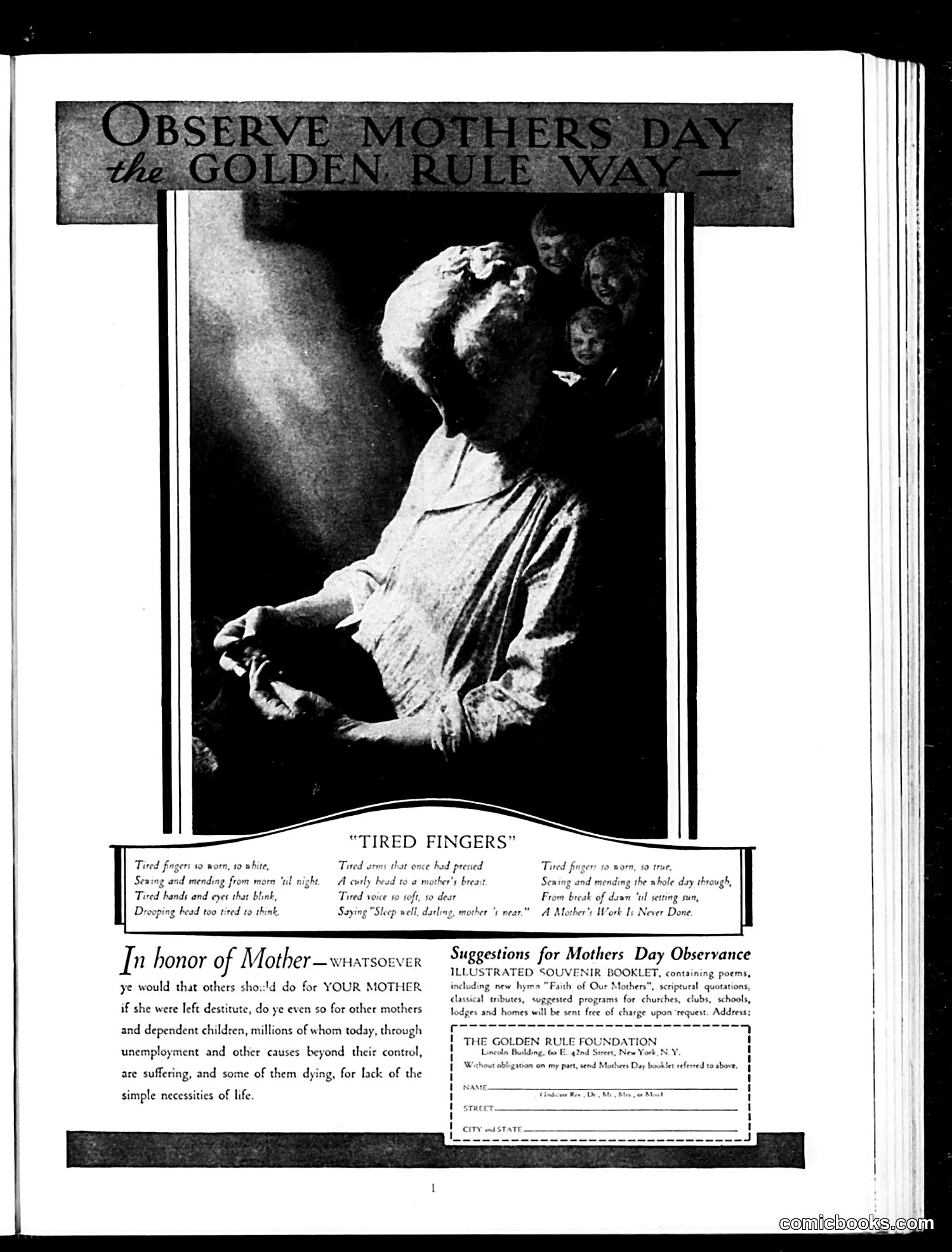
Analysis This is a Mother's Day advocacy page, not a political cartoon. The central image titled "Tired Fingers" depicts a mother with her head tilted back in exhaustion, with children visible in the background. The accompanying poem emphasizes her physical and emotional exhaustion from labor. The text below appeals to readers' sympathy for struggling mothers, particularly those facing poverty, unemployment, and lack of basic necessities. It advocates for broader social support—suggesting others should help destitute mothers as they would help their own. The page includes a coupon for "The Golden Rule Foundation" (based in New York), which distributed Mother's Day souvenir booklets and educational materials to schools and homes. Rather than satire, this represents early 20th-century progressive advocacy using sentimental imagery to promote maternal welfare and social responsibility.
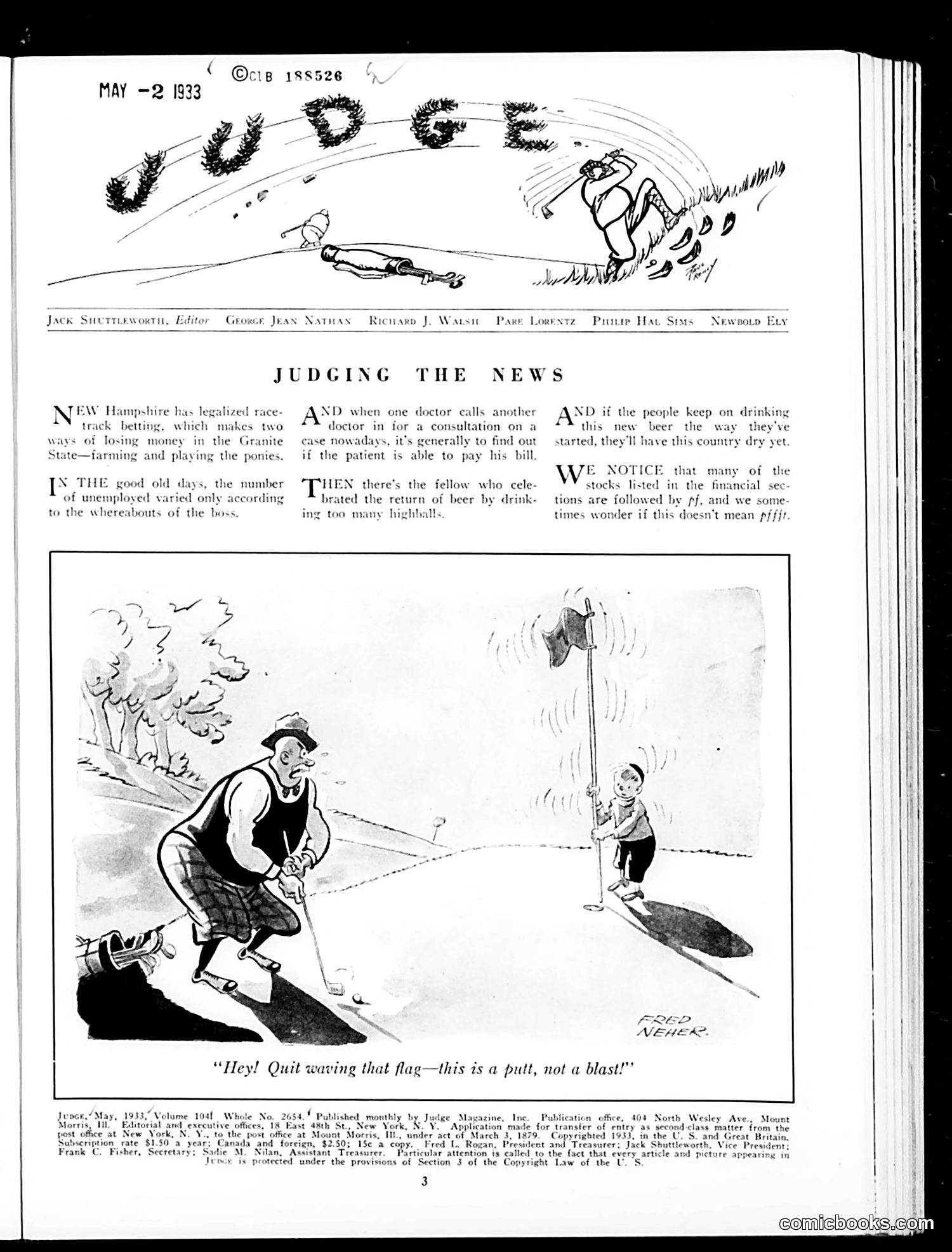
Cartoon Analysis: "Judge," May 22, 1933 The Main Cartoon shows a man in golfing attire telling a child, "Hey! Quit waving that flag—this is a putt, not a blast!" The child holds a flag on the green while an adult prepares to putt. The Joke: The adult misinterprets the child's flag-waving as signaling for a dramatic "blast" (explosion or forceful shot) rather than its actual purpose—marking the hole location for putting, the gentlest golf stroke. Historical Context: Published May 1933, during the Great Depression and early New Deal period, this appears to be simple recreational humor rather than political satire—a straightforward golf mishap joke for a general audience seeking light entertainment during difficult economic times.
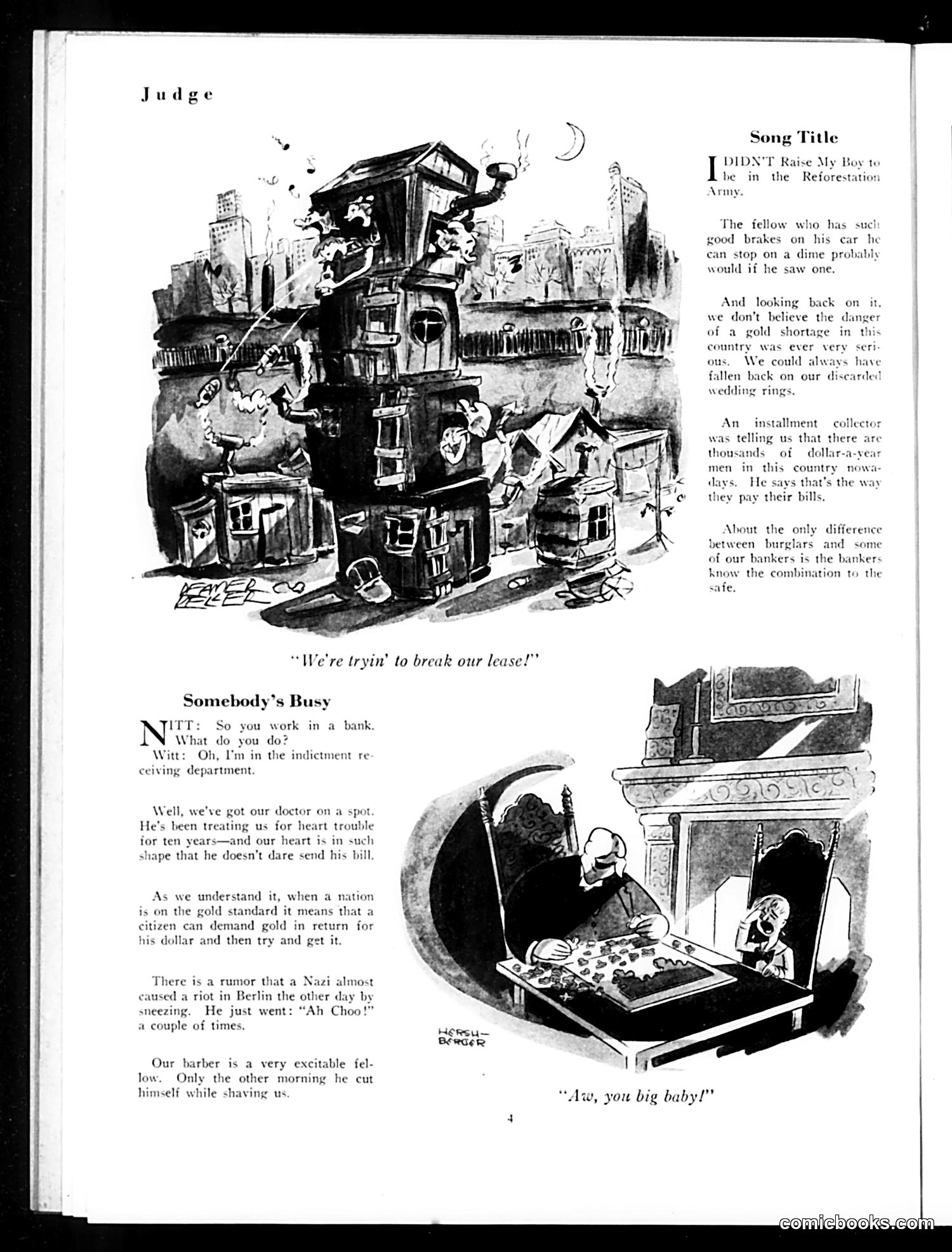
Explanation for Modern Readers This Judge magazine page contains two satirical pieces: "Judge" (top): A cartoon mocking housing shortage and overcrowding, showing a precariously stacked tenement where residents are "tryin' to break our lease." The accompanying text discusses economic hardship—installment debt, banking practices, and the gold standard—suggesting this reflects Depression-era financial anxiety. "Somebody's Busy": A dialogue joke between a banker and a client. The humor depends on understanding 1930s banking practices: clients could demand gold for dollars under the gold standard. The joke implies banks were anxious about such demands. Additional anecdotes mock excitable barbers and Nazi sneezing—trivial humor typical of the era's satirical magazine style. Both pieces reflect economic anxiety and banking concerns of the interwar period.
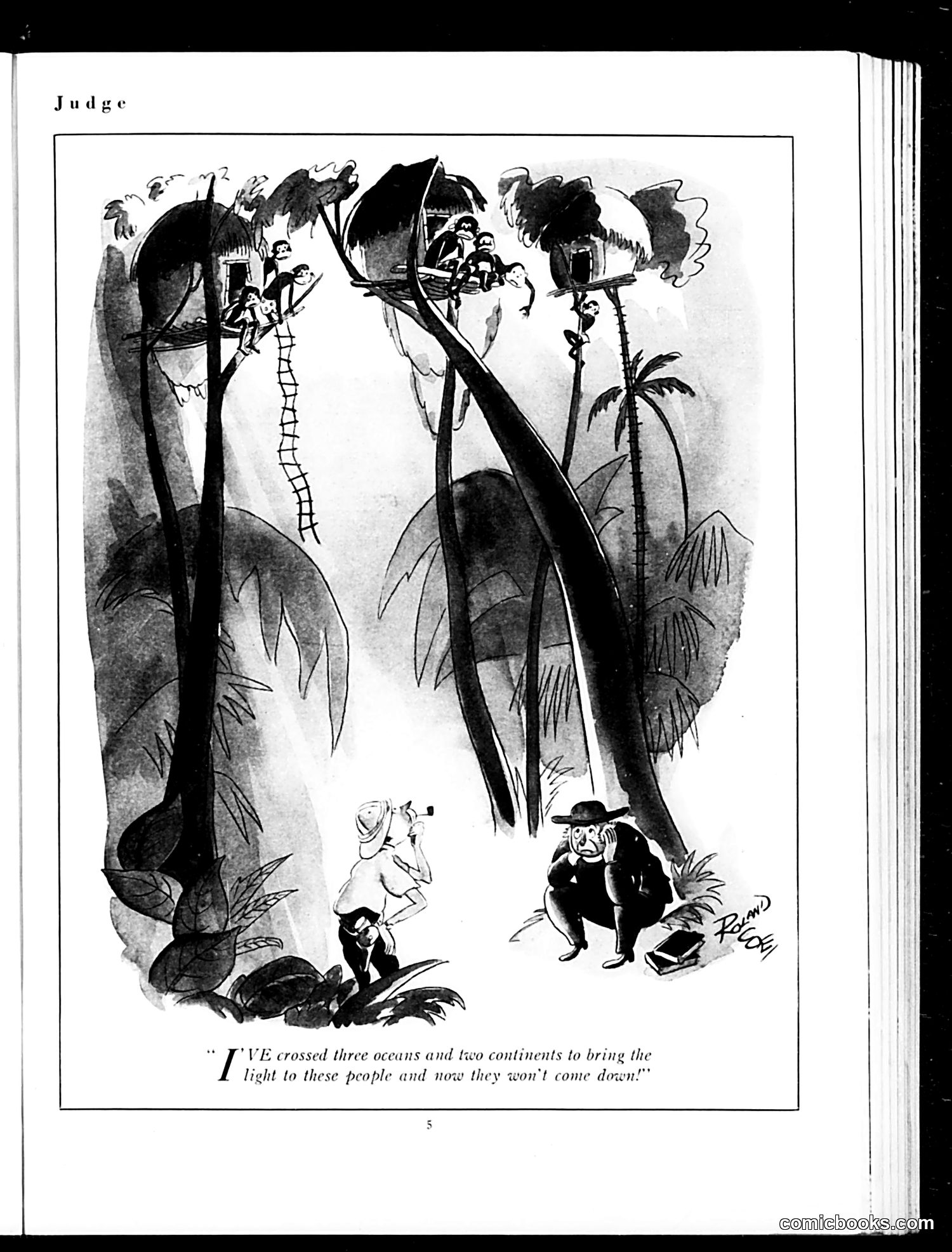
Analysis of Judge Cartoon Page This political cartoon satirizes missionary work in remote regions. Two figures at bottom—one appears to be a missionary with surveying equipment, the other a skeptical observer—stand beneath tall trees where indigenous people are perched in the canopy. The missionary's quoted boast—"I've crossed three oceans and two continents to bring the light to these people and now they won't come down!"—mocks the disconnect between Western missionary zeal and actual indigenous resistance or indifference to conversion efforts. The humor lies in the literal and figurative distance: the natives remain physically elevated and unreachable despite the missionary's efforts, suggesting that imposing Western religion on indigenous populations proves more complicated than missionaries anticipated. This reflects early-20th-century skepticism toward colonial missionary enterprises.
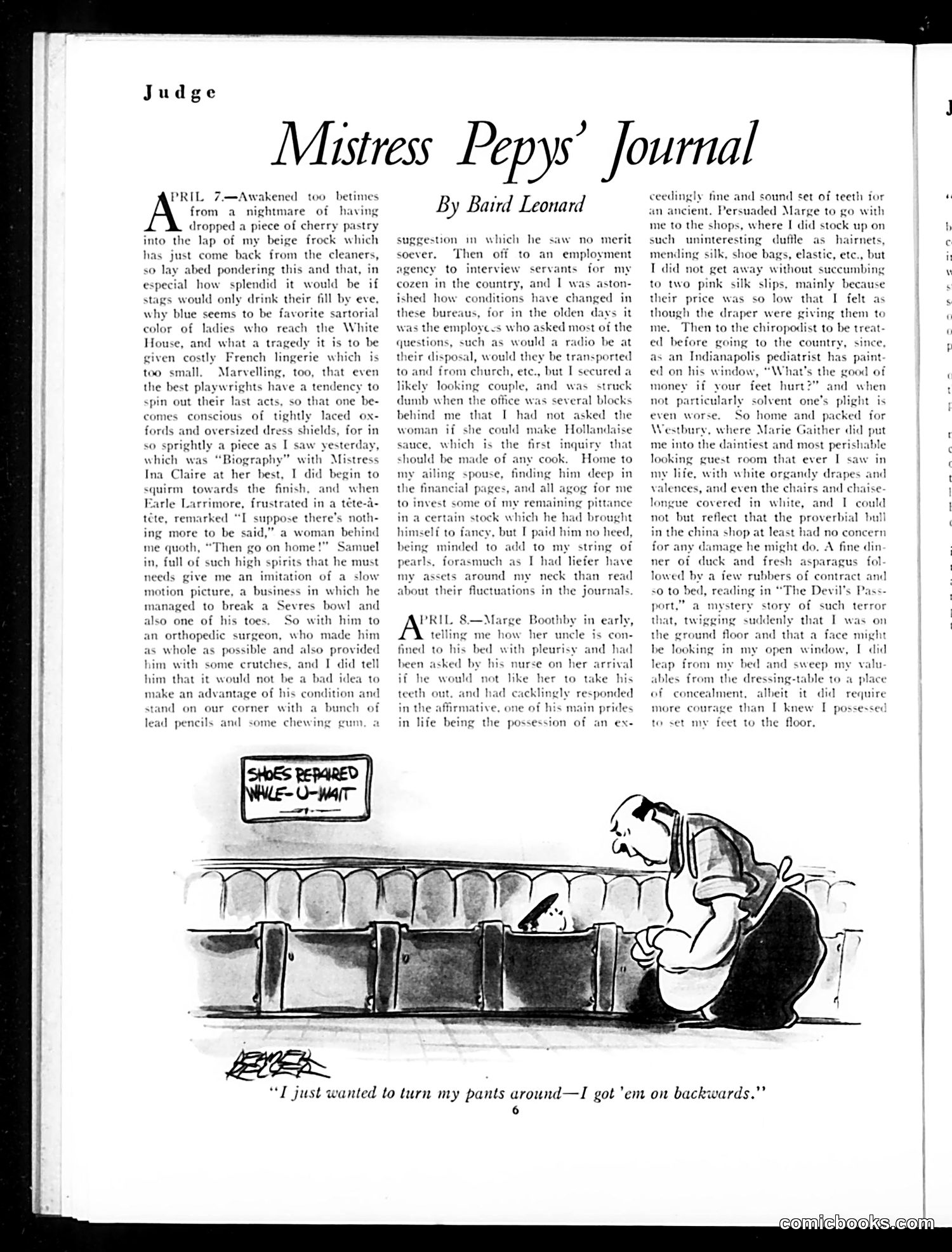
Analysis of Judge Magazine Page This page contains "Mistress Pepys' Journal" by Baird Leonard, a humor column mimicking the famous diary of Samuel Pepys. The accompanying cartoon depicts a shoe-repair shop scene where a customer sits in theater-style seating labeled "SHOES REPAIRED WHILE-U-WAIT." The man's caption reads: "I just wanted to turn my pants around—I got 'em on backwards." The joke satirizes the absurdly fast "while-you-wait" service trend of the era. The customer humorously suggests he put his pants on backwards while waiting for shoe repairs—implying the service is so quick, there's barely time for anything else. This mocks the novelty and advertising claims of rapid-turnaround services that were apparently popular during this period.
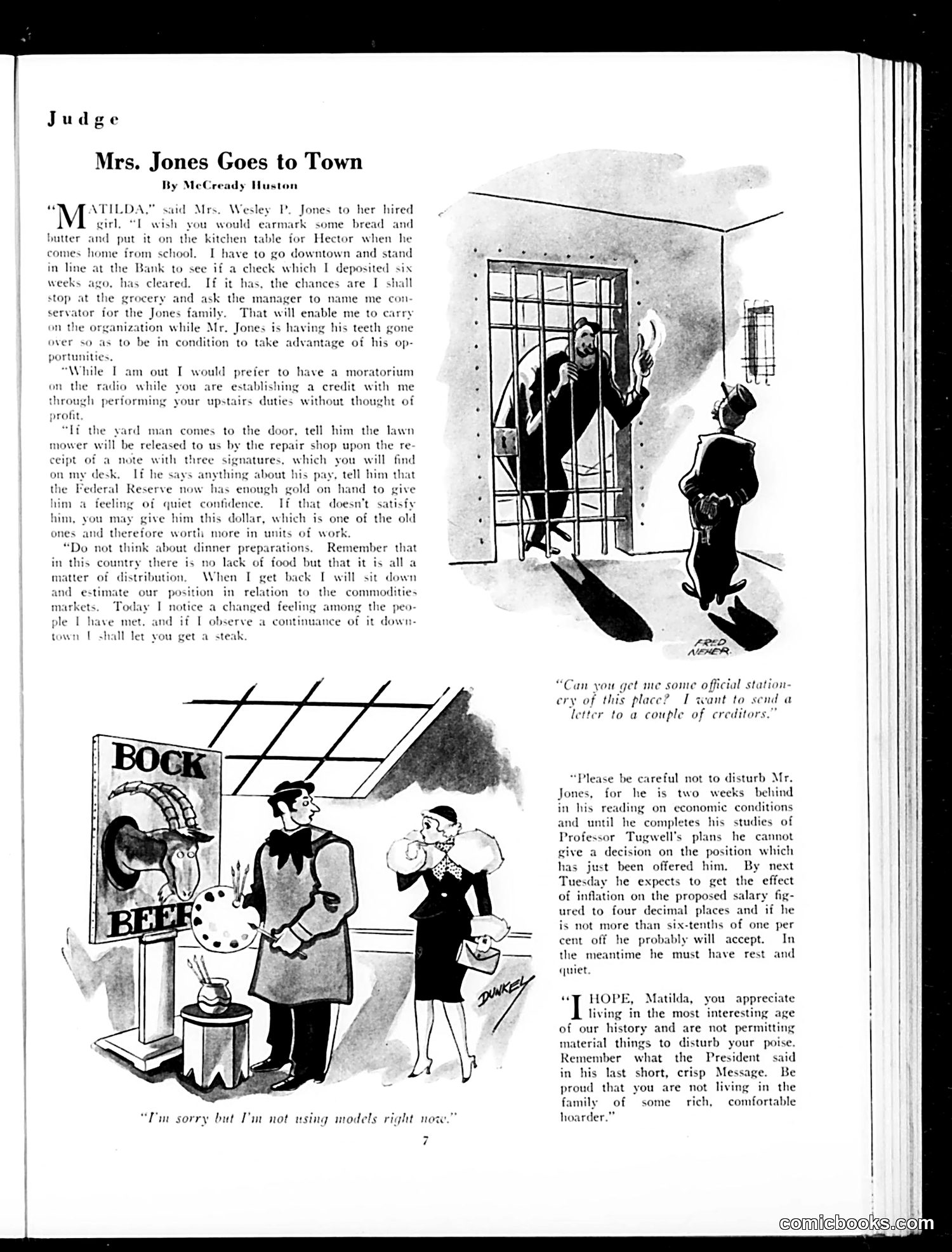
"Mrs. Jones Goes to Town" This satirical story mocks Depression-era economic anxiety and New Deal bureaucracy. Mrs. Jones instructs her maid Matilda with absurd priorities: she must wait in line at the bank to check if a six-week-old deposit has cleared, discuss becoming "conservator" for the family finances, and handle a yard man by referencing Federal Reserve gold reserves. The satire targets: - Banking paralysis: Deposits take weeks to clear - Economic confusion: Citizens obsessively calculating inflation to "four decimal places" - New Deal jargon: References to Professor Tugwell (a Roosevelt advisor) and economic planning - Class pretense: The wealthy Joneses performing anxiety while assuring themselves they're morally superior to "rich, comfortable hoarders" The bottom cartoon shows a butcher display labeled "Bock Beef"—likely mocking rationing or meat distribution controls. The humor lies in depicting respectable middle-class people as simultaneously bewildered by and desperately trying to master incomprehensible economic systems.
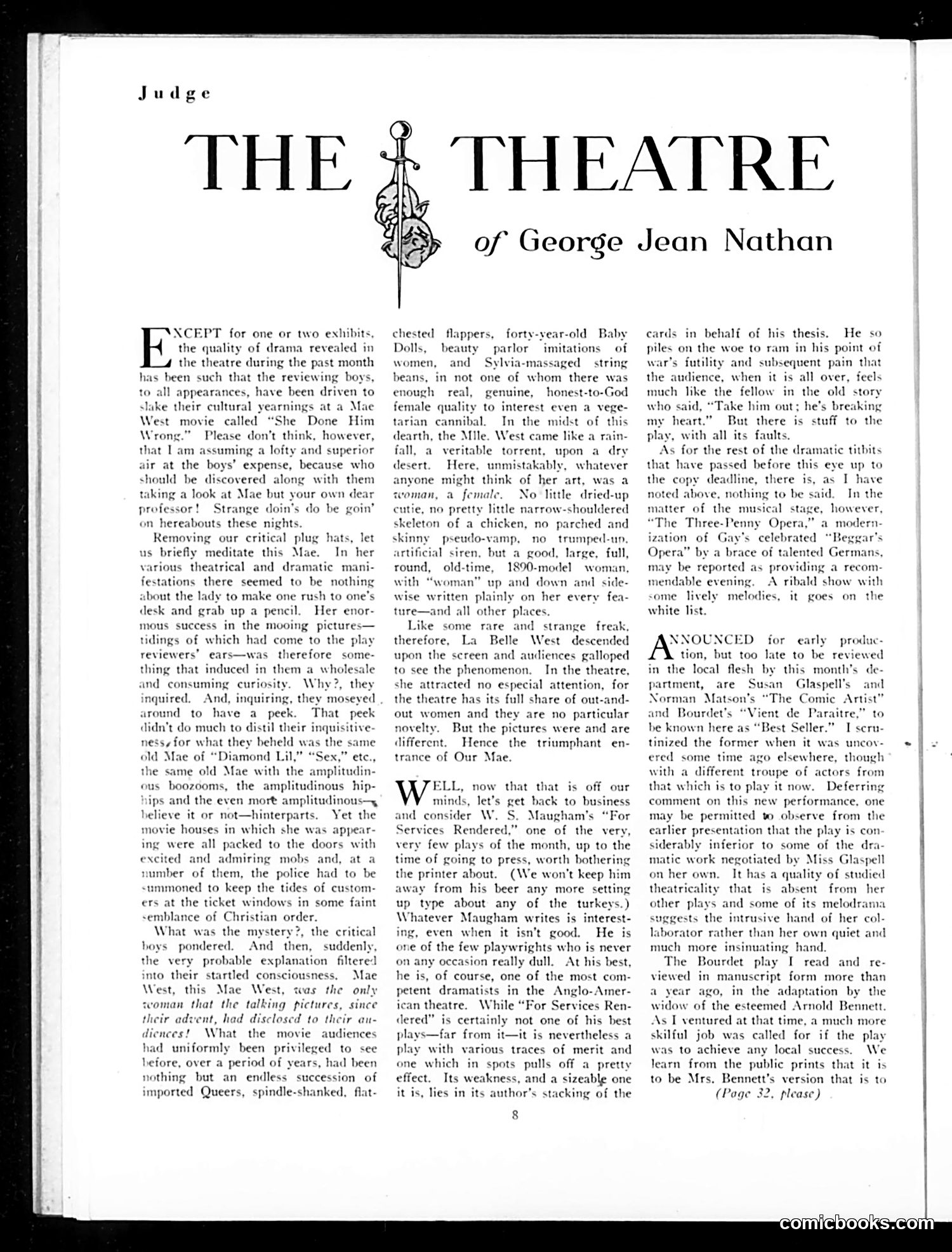
Analysis of Judge Magazine Page This page is primarily a theater review essay, not a political cartoon. The critic discusses Mae West's surprising success in movies versus theater, attributing it to her representing authentic femininity—a "woman, a female"—in contrast to the "imported Queers, spindle-shanked, flat-chested flappers" and artificial actresses dominating cinema. The satire targets 1930s film industry aesthetics: the critic argues audiences flocked to West's films precisely *because* she embodied conventional womanly curves and presence, unlike the prevailing trend of androgynous or overly stylized female performers. The tone is tongue-in-cheek but suggests genuine puzzlement at this popularity gap between her theatrical and film appearances. The second half reviews W.S. Maugham's play "For Services Rendered," praising his consistent quality as a playwright. The ornamental column divider and period typography are typical Judge magazine design elements.
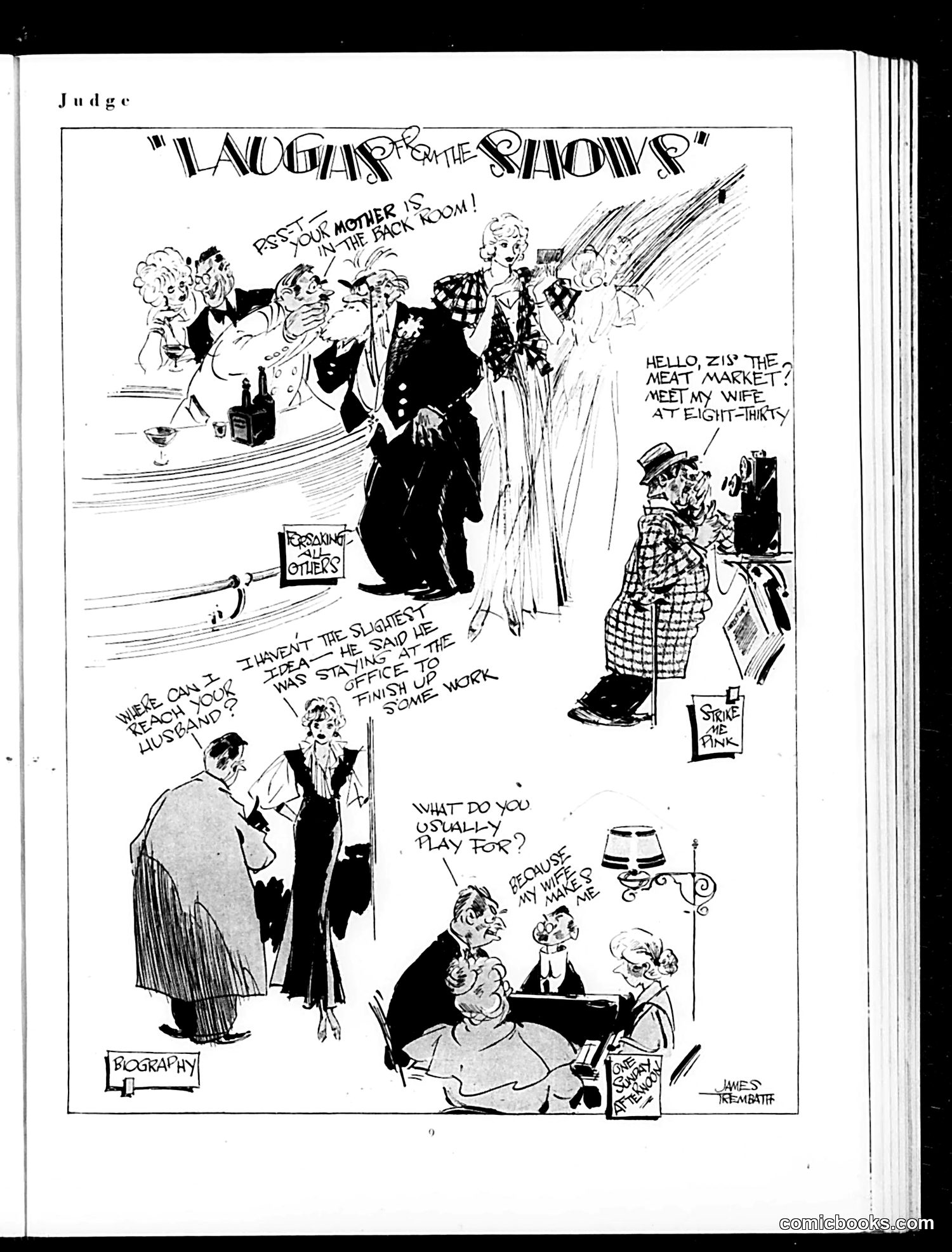
"Laughs at the Shadows" - Judge Magazine Cartoon This appears to be a satirical cartoon about infidelity and marital deception, likely from the early-to-mid 20th century based on the art style. The scene depicts a man arranging a clandestine meeting with a woman ("Hello, zis the meat market? Meet my wife at eight-thirty"), using coded language to disguise an affair. Meanwhile, his actual wife appears at the gathering, creating a comedic collision of his deceptions. The cartoon satirizes the common trope of men using pretexts (business meetings, "the meat market" as cover) to conceal extramarital affairs, while their unsuspecting spouses inadvertently expose these lies by showing up. The "what do you usually play for?" dialogue suggests games or stakes are involved in these social gatherings. The humor relies on the audience recognizing the transparent deceptions men employed and the inevitable consequences of getting caught.
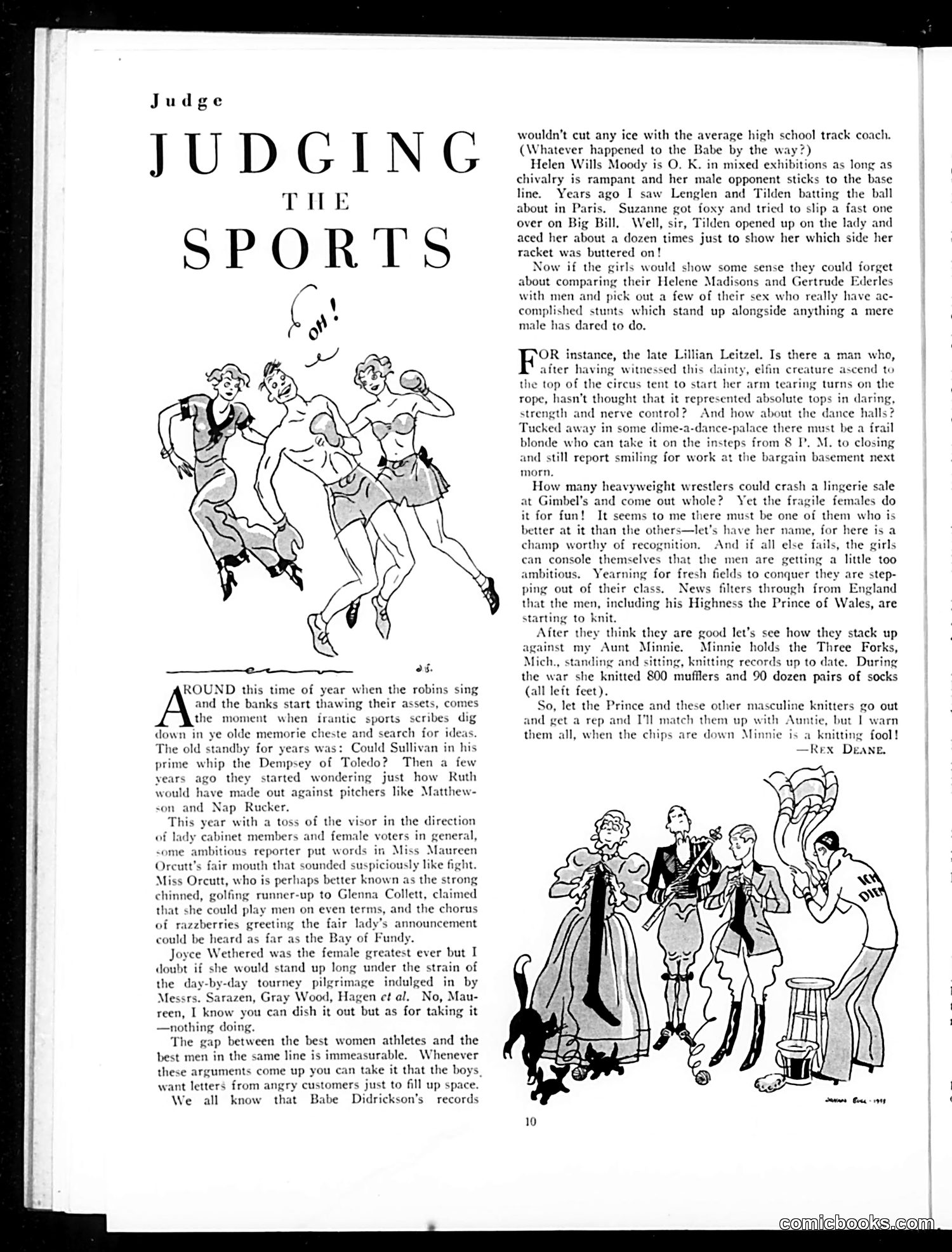
"Judging the Sports" — Judge Magazine Satire This article satirizes debates about whether women athletes can compete equally with men. The author, Rex Deane, references contemporary female athletes (Maureen Orcutt, Helen Wills Moody, Gertrude Ederle) who claimed competitive parity with male counterparts. Deane argues women *cannot* match men athletically, using examples: Babe Didrickson's records wouldn't impress high school coaches; tennis champion Wills only succeeds against men showing "chivalry"; Tilden easily defeated Lenglen. However, the satire's punchline inverts the argument: he concedes women *excel* in distinctly feminine domains—circus acrobatics, dance halls, department store shopping "crashes," and knitting. His aunt Minnie's wartime knitting record (800 mufflers, 90 dozen socks) becomes the ultimate "athletic" achievement. The piece mocks both competitive women and male condescension, ultimately suggesting women's "real" accomplishments lie in traditionally gendered domestic spheres.
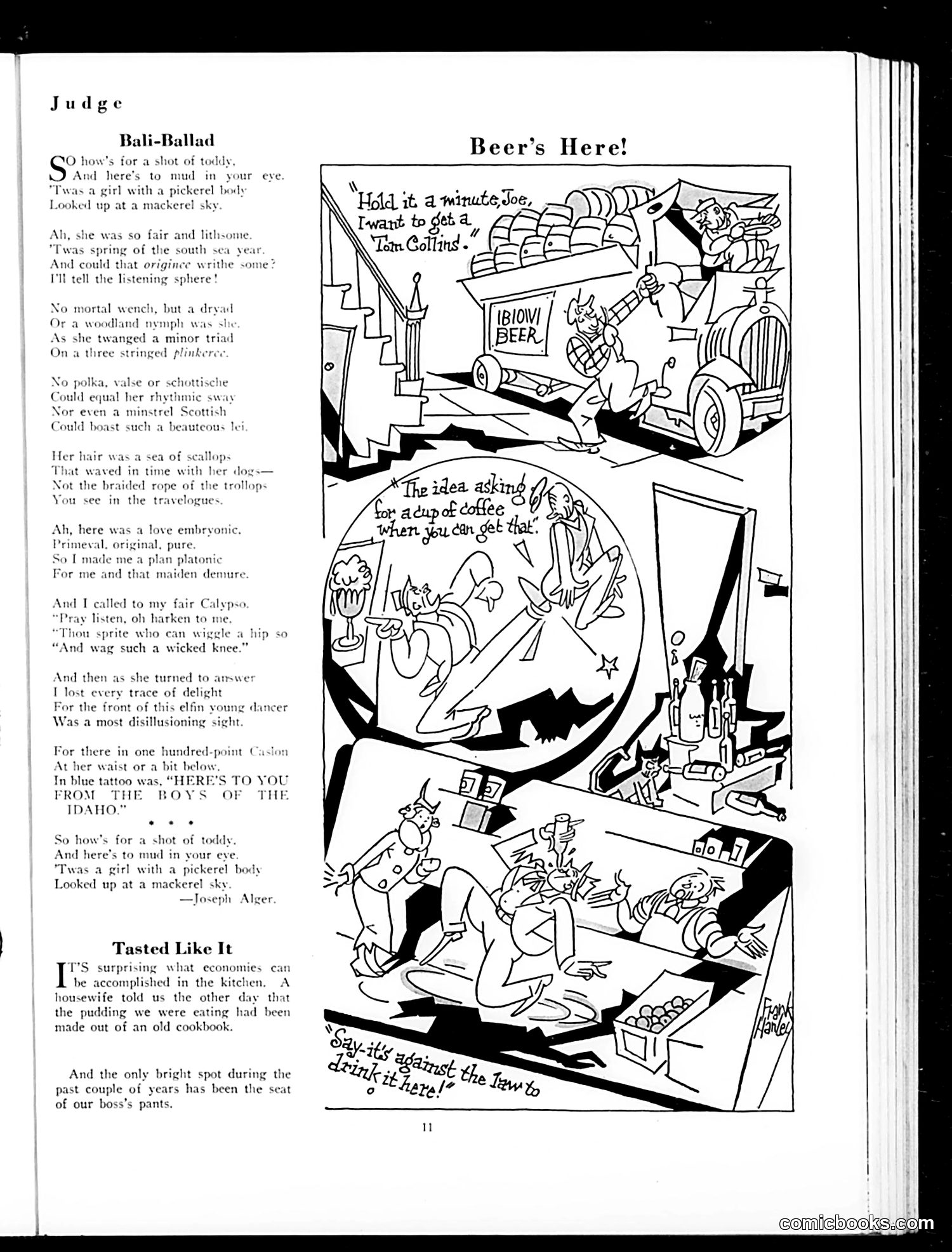
"Beer's Here!" - Judge Magazine Satire This cartoon satirizes Prohibition-era America (likely 1920s-1930s), when alcohol was illegally manufactured and consumed. The main joke depicts a chaotic, drunken scene where characters celebrate the arrival of "Biovi Beer" — clearly bootleg/illegally-produced beer. The illustration shows people drinking, driving recklessly, and generally carousing despite Prohibition laws. The accompanying poem "Bali-Ballad" mocks romantic idealization: a sailor falls for an exotic island girl, only to discover a tattoo reading "HERE'S TO YOU FROM THE BOYS OF THE IDAHO" — a naval ship reference that punctures the romantic fantasy, revealing she's actually a working-class woman familiar with American servicemen. Together, these pieces mock both illegal drinking culture and false romantic notions. The secondary item "Tasted Like It" jokes about Depression-era food scarcity and poor quality, with a pun about "old cookbook" pudding. The satire targets social hypocrisy and the gap between idealization and reality during economically and legally turbulent times.
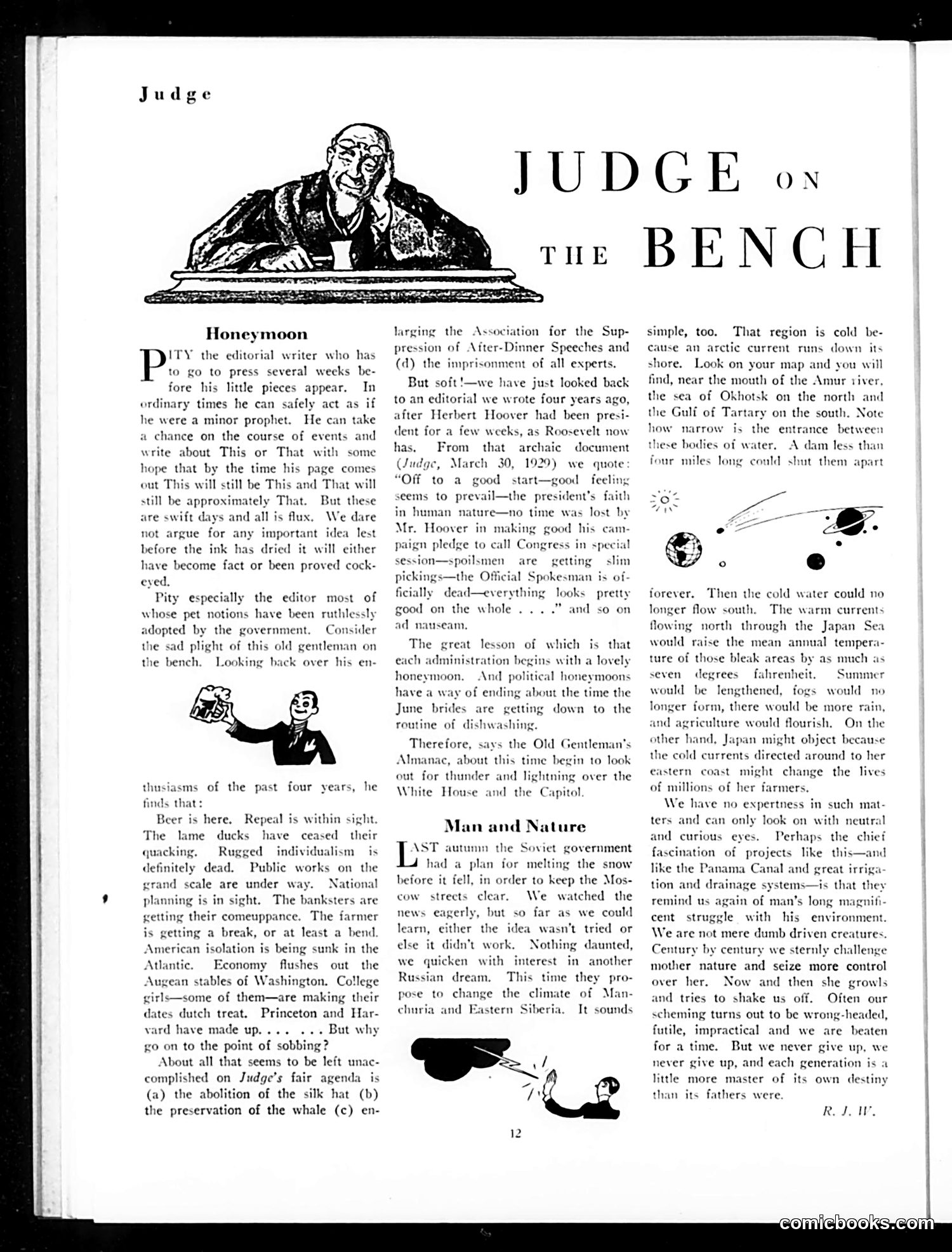
"Judge on the Bench" - Political Commentary This editorial page satirizes the predictable pattern of American presidential "honeymoons." The main illustration shows a judge reflecting on editorial predictions made four years earlier under Hoover that proved premature. The satire's point: editors confidently proclaimed reforms (repealing Prohibition, ending "rugged individualism," public works, ending isolation) would solve America's problems. Now, under Roosevelt, similar optimistic proclamations are being made. The joke is the cyclical naiveté—each new administration begins with hopeful editorials that inevitably sour once political reality sets in, "about the time June brides get down to the routine of dishwashing." The secondary article on Soviet climate engineering and Japan's cold currents appears unrelated commentary on ambitious technological schemes. The cartoons show the judge's wry amusement at editorial hubris and changing fortunes—a critique of the magazine's own predictive track record.
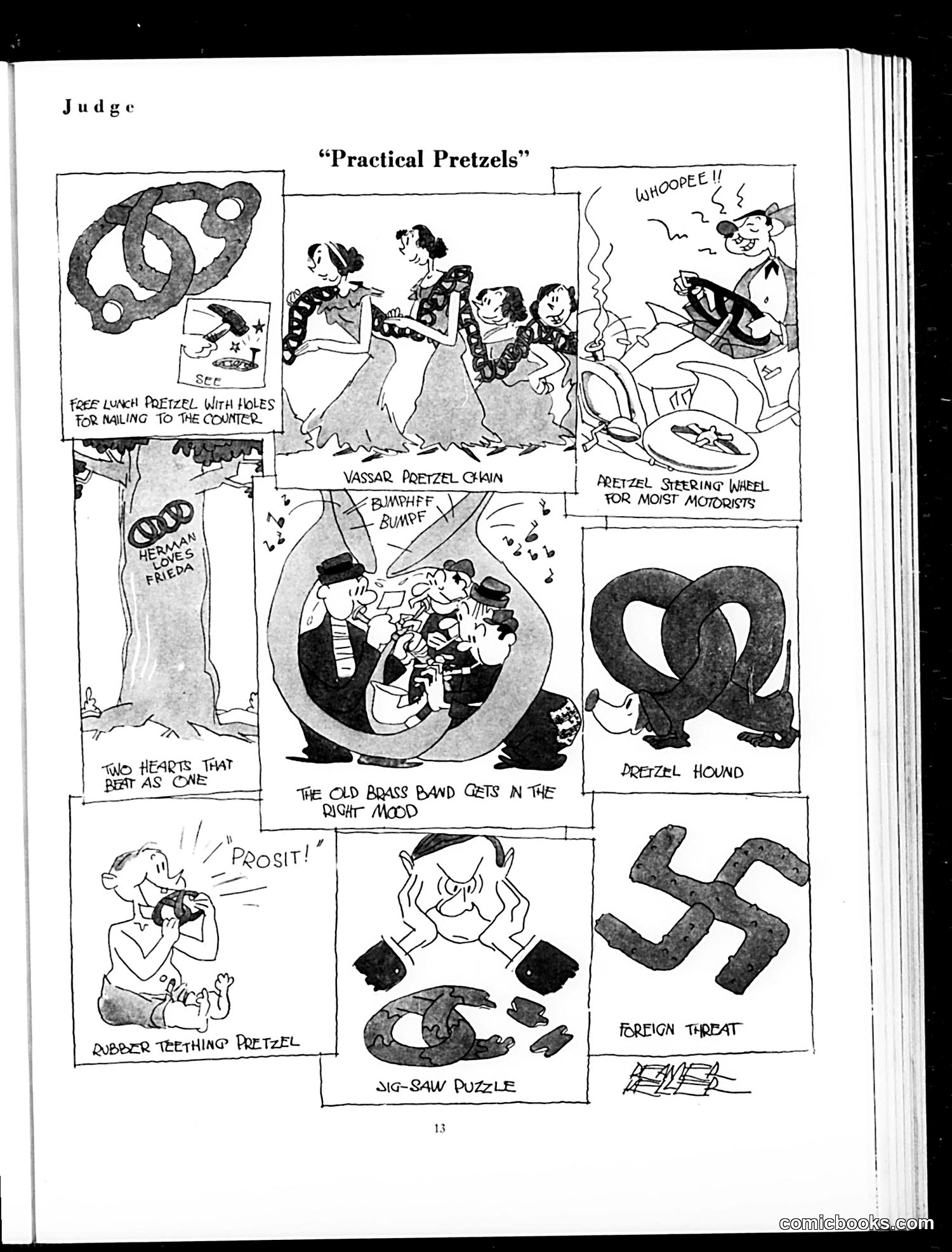
"Practical Pretzels" Satire Explanation This Judge magazine page satirizes pretzels as absurdly multi-functional novelty items. Each panel presents ridiculous "practical" uses: a pretzel with holes for counter display, a pretzel as a steering wheel for cars, a pretzel-shaped "hound" dog, rubber teething pretzels, and a pretzel puzzle. The humor relies on treating ordinary pretzels as solutions to everyday problems—an absurdist critique of American consumer culture's obsession with gadgets and novelty items. One panel mocks sentimental symbolism ("two hearts that beat as one"), while "foreign threat" (a swastika) appears to be dated Cold War-era satire. The central panel about a brass band in "the right mood" suggests pretzels inspire celebration, though this reference is unclear without additional context. Overall, the page ridicules marketing hype and overzealous commercialism of ordinary food items.
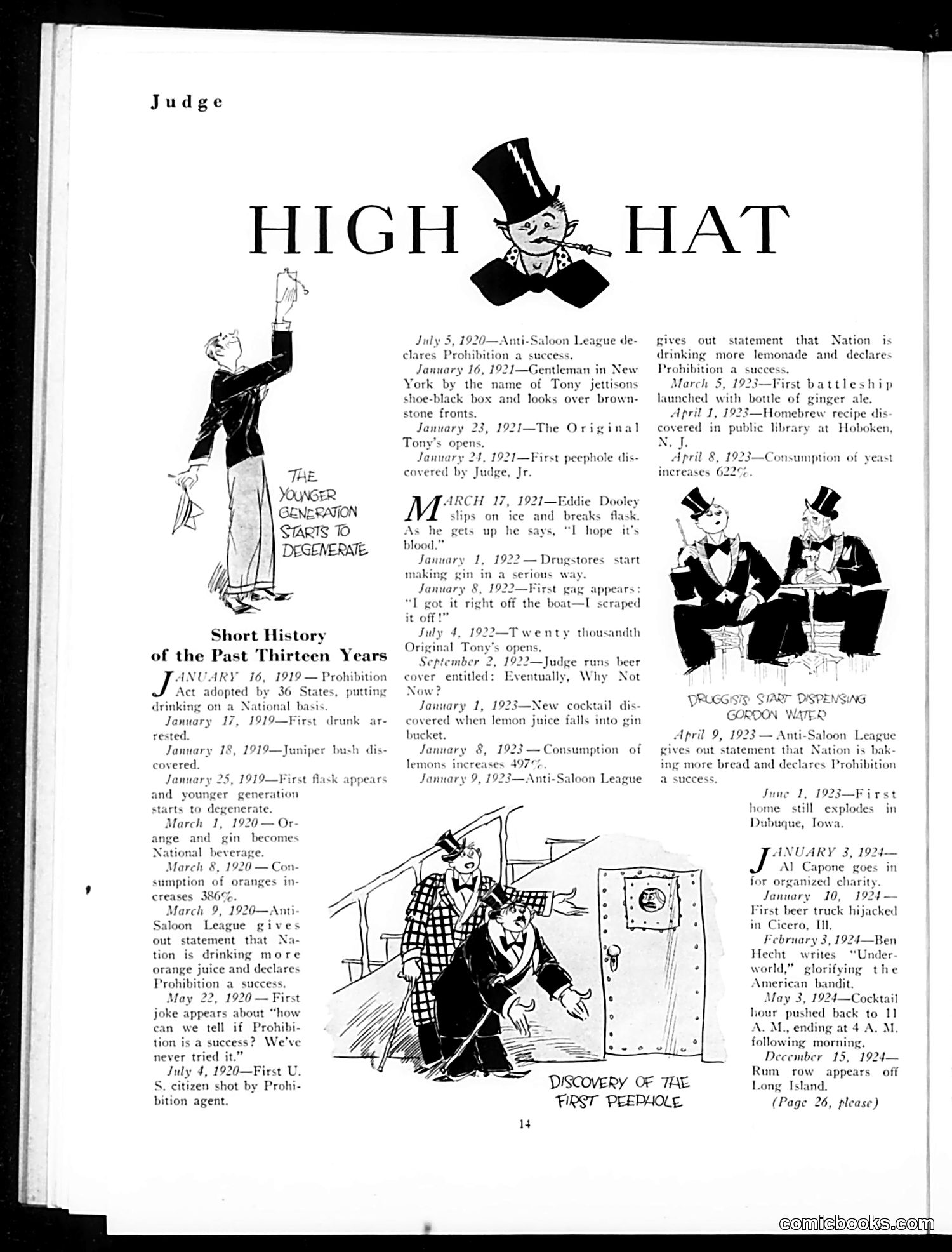
Judge Magazine: "High Hat" — Prohibition Satire This page satirizes American Prohibition (1919-1924) and the younger generation's creative defiance of alcohol bans. The "Short History" is a mock-serious timeline documenting how people circumvented the law through increasingly absurd means: flasks, peepholes, bathtub gin, homemade stills, and hijacked beer trucks. The cartoons ridicule both Prohibition's failure and the Anti-Saloon League's delusional claims of success—they repeatedly announced victory while consumption actually increased (oranges up 386%, yeast up 62%). References to Al Capone, bootleggers, and "rum row" highlight organized crime's rise. The "younger generation" illustration shows well-dressed dandies literally "degenerate" into drinkers, implying Prohibition backfired spectacularly. Judge presents the policy as farcical: unenforceable, enabling criminality, and creating a culture of lawbreaking that contradicted its moral aims.
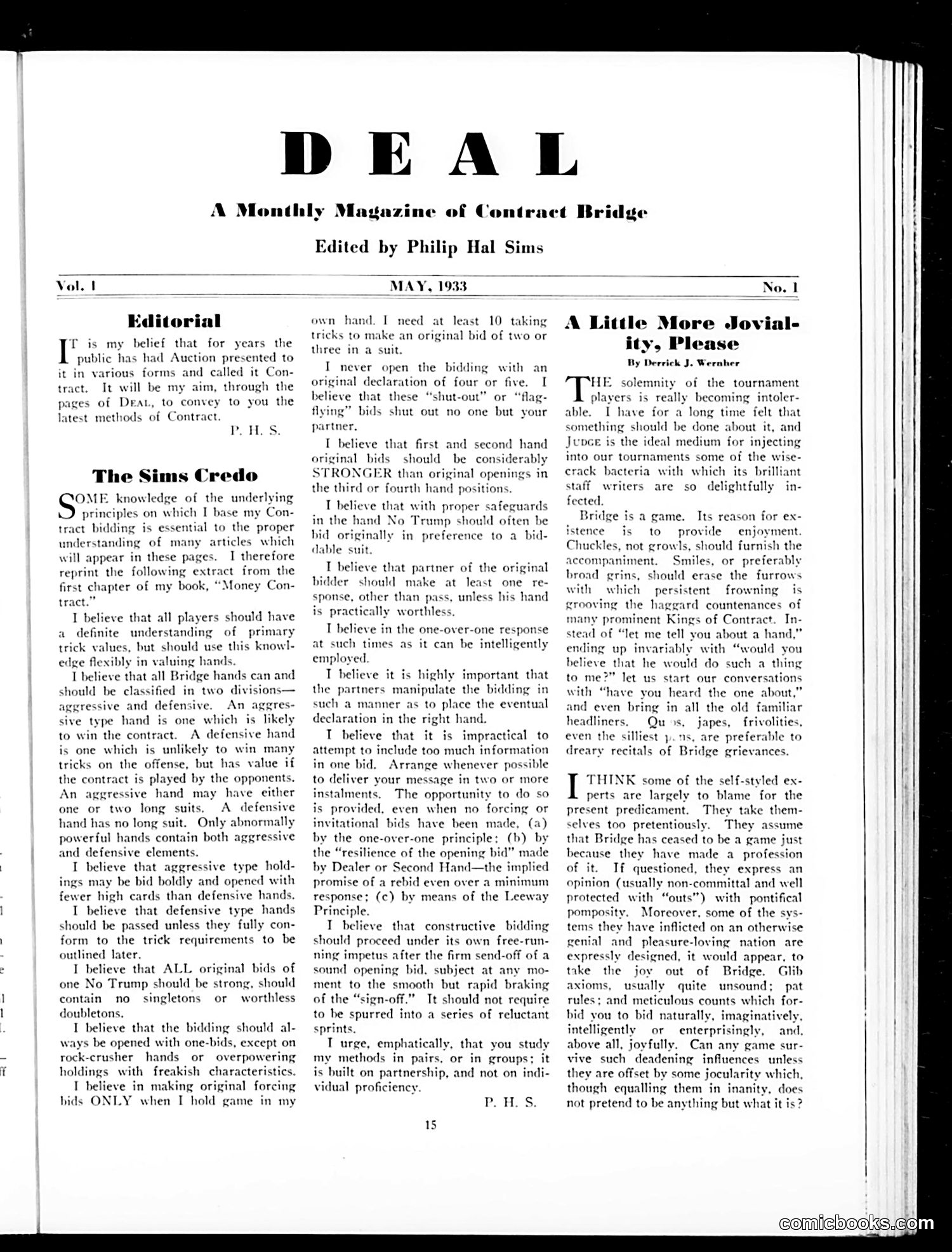
This is the title page and opening editorial of DEAL, the first issue of a new monthly magazine dedicated to Contract Bridge (the card game), edited by Philip Hal Sims in May 1933. There are no cartoons on this page. The content is entirely instructional and editorial—Sims outlines his "Credo" of Contract Bridge bidding principles for serious players. Topics include hand classification (aggressive vs. defensive), bidding strategy, trump declarations, and partnership communication. The magazine's purpose was to teach Bridge methodology to the American public, which Sims felt had been poorly instructed in "various forms" of the game. This reflects Bridge's enormous popularity in the 1930s among middle and upper-class Americans as both a social game and competitive pursuit.
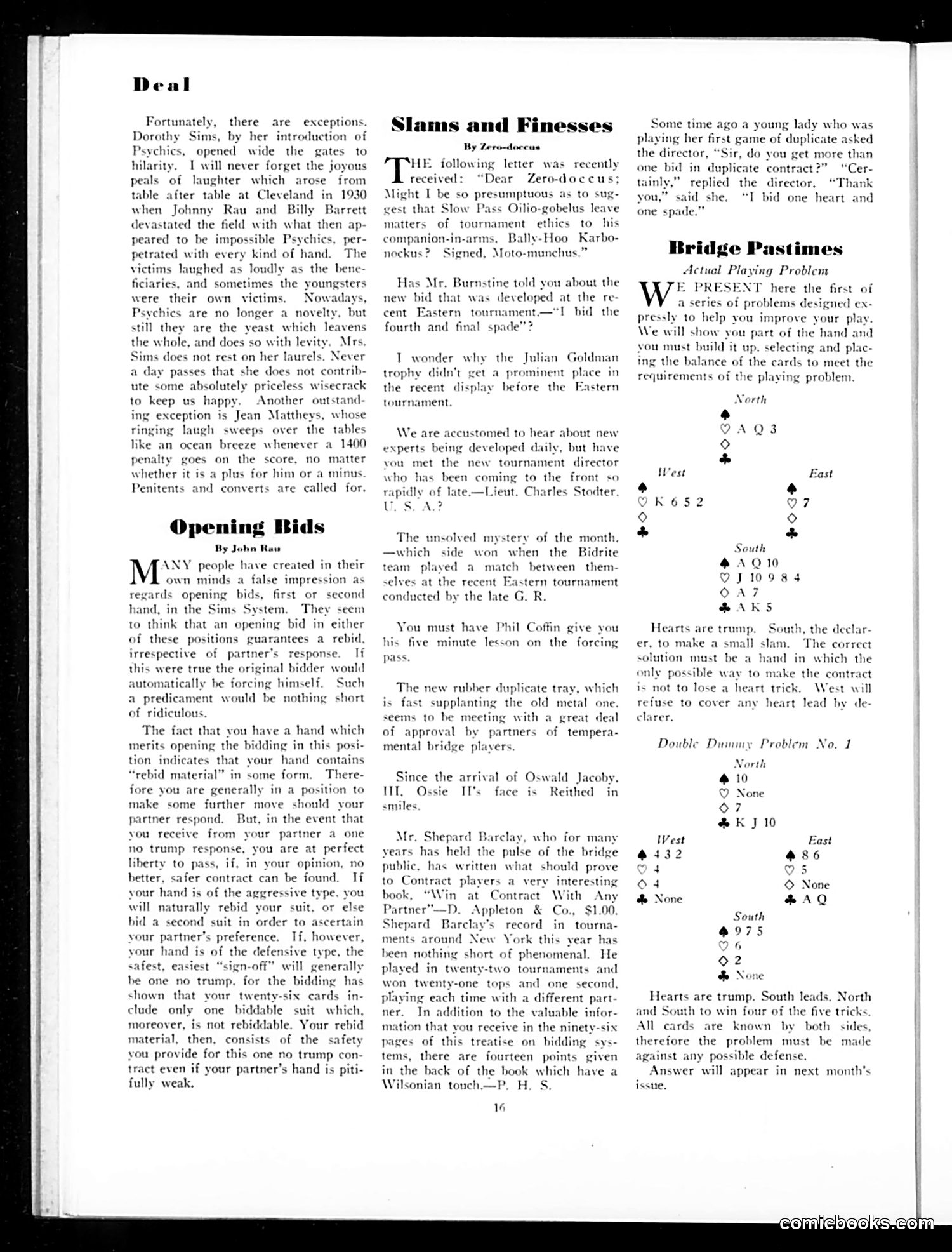
Judge Magazine Page: Bridge Content Analysis This page from Judge magazine focuses entirely on bridge—the card game—not politics or satire. The content includes instructional articles on bridge strategy and tournament gossip: Main sections: - "Deal" by Dorothy Sims: praises bridge personalities and their contributions to making the game enjoyable - "Opening Bids" by John Raw: technical instruction on opening bid strategy in the Sims System - "Slams and Finesses" by Zero-doccus: a humorous letter column about bridge tournaments, featuring playful fictional names (Moto-munchus, Bally-Hoo Karbonockus) mocking various bridge personalities - "Bridge Pastimes": an actual bridge problem for readers to solve The humor is entirely bridge-specific—inside jokes about tournament directors, new bidding conventions, and player personalities. This represents Judge's coverage of leisure activities and hobbies for its educated, affluent readership.
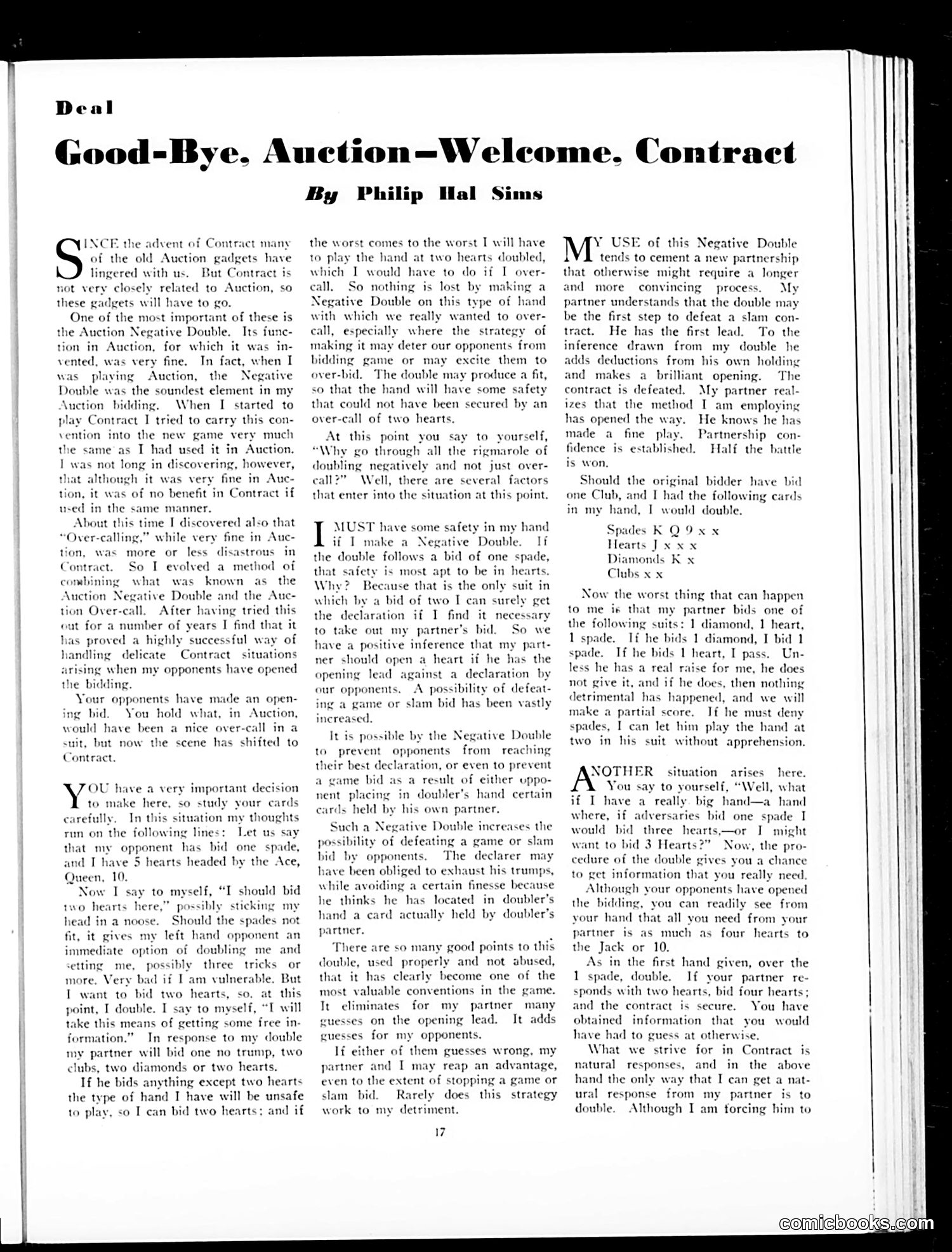
"Good-Bye, Auction—Welcome, Contract" by Philip Hal Sims This is not a cartoon but rather a technical bridge instruction article explaining contract bridge strategy to replace the older "Auction" bridge variant. The piece discusses the "Negative Double"—a bidding convention that was valuable in Auction bridge but required modification for the newer Contract bridge game. Sims explains how players should adapt their bidding strategies when opponents open the bidding, using doubled bids to communicate hand information to their partner rather than making direct overcalls. The article is practical and educational rather than satirical. It addresses bridge players who learned Auction bridge and need guidance transitioning to Contract bridge, which was becoming the dominant form of the game during this period. The "Judge" publication context suggests this appeared in a sophisticated entertainment magazine aimed at educated readers interested in card games.
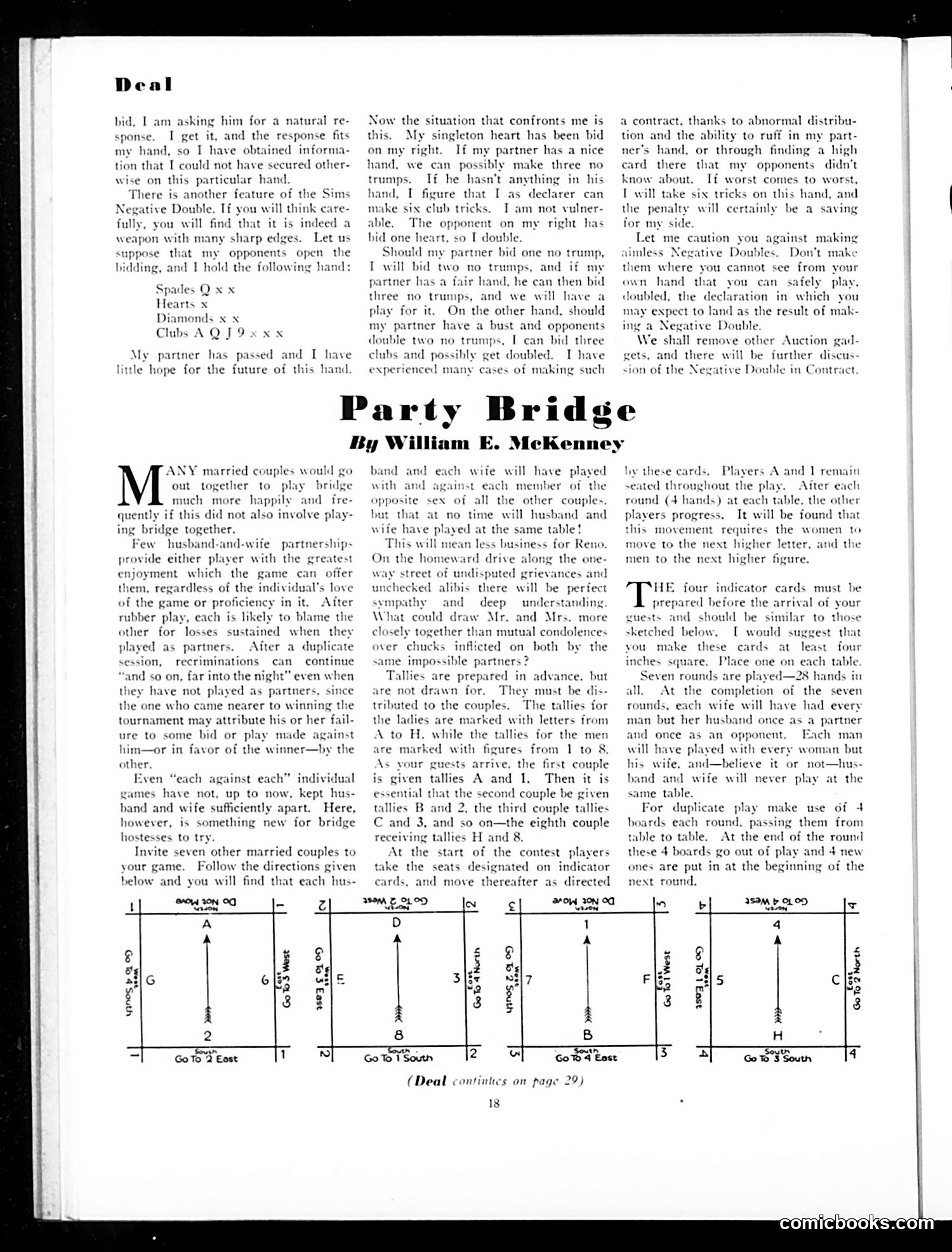
Content Analysis This page contains two bridge articles, not political cartoons. The top section concludes a technical discussion of the "Sims Negative Double" — a bridge bidding convention. The main feature is "Party Bridge" by William E. McKenney, a bridge columnist. "Party Bridge" Content: McKenney proposes a solution to a social problem: married couples playing bridge together often end in arguments, each blaming the other for losses. His satirical "solution" arranges a party where seven other couples attend, using a rotating seating system ensuring husbands and wives never play at the same table. The joke's point: married couples fighting over bridge are so predictable that the only way to enjoy the game socially is to keep spouses completely separated. The closing quip about "less business for Reno" (the divorce capital) suggests the real stakes—marital harmony depends on avoiding partner play entirely. This reflects 1930s-era anxieties about marriage, domesticity, and leisure activities.
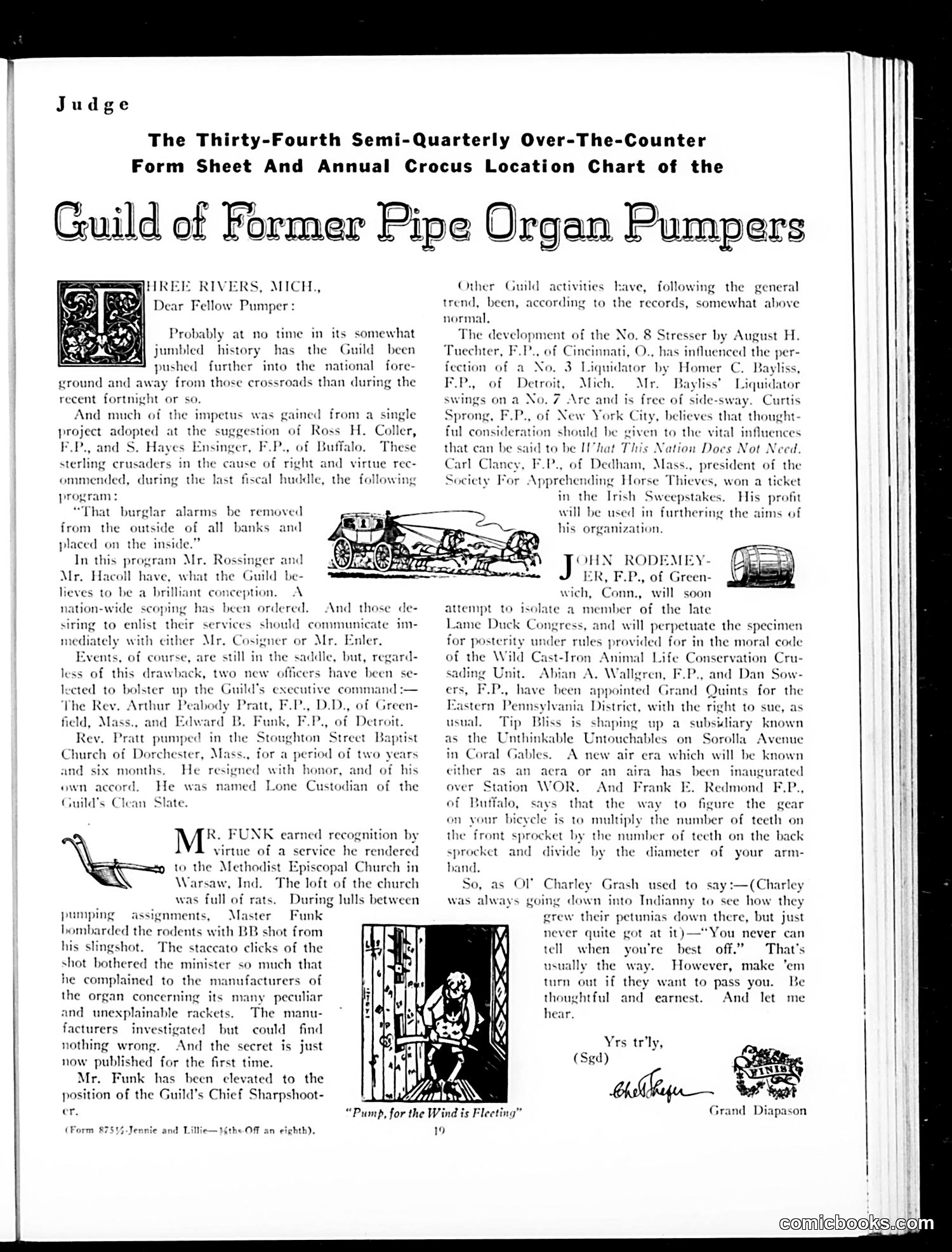
Judge Magazine Page Analysis This page satirizes the "Guild of Former Pipe Organ Pumpers"—a fictional fraternal organization. The satire targets self-important civic groups and their elaborate bureaucracies through absurdist humor. The central joke: The page mocks organizations that grant grandiose titles and structure to mundane or obsolete activities. Pipe organ pumping (manually operating bellows before electric motors) was already antiquated when this was written, yet the "Guild" treats it with utmost seriousness, appointing officers like "Chief Sharpshooter" and establishing committees. Specific absurdities: Members earn recognition for unrelated accomplishments (shooting rats in a church), the "Society For Apprehending Horse Thieves" wins lottery tickets, and elaborate procedures govern preserving "specimens" from "the Lame Duck Congress." The cartoon ("Pump, for the Wind is Fleeting") shows a figure at a window, reinforcing the nostalgic yet ridiculous premise—romanticizing an obsolete job. The humor targets American organizational culture: the tendency to formalize the trivial and award status through membership in increasingly obscure groups.
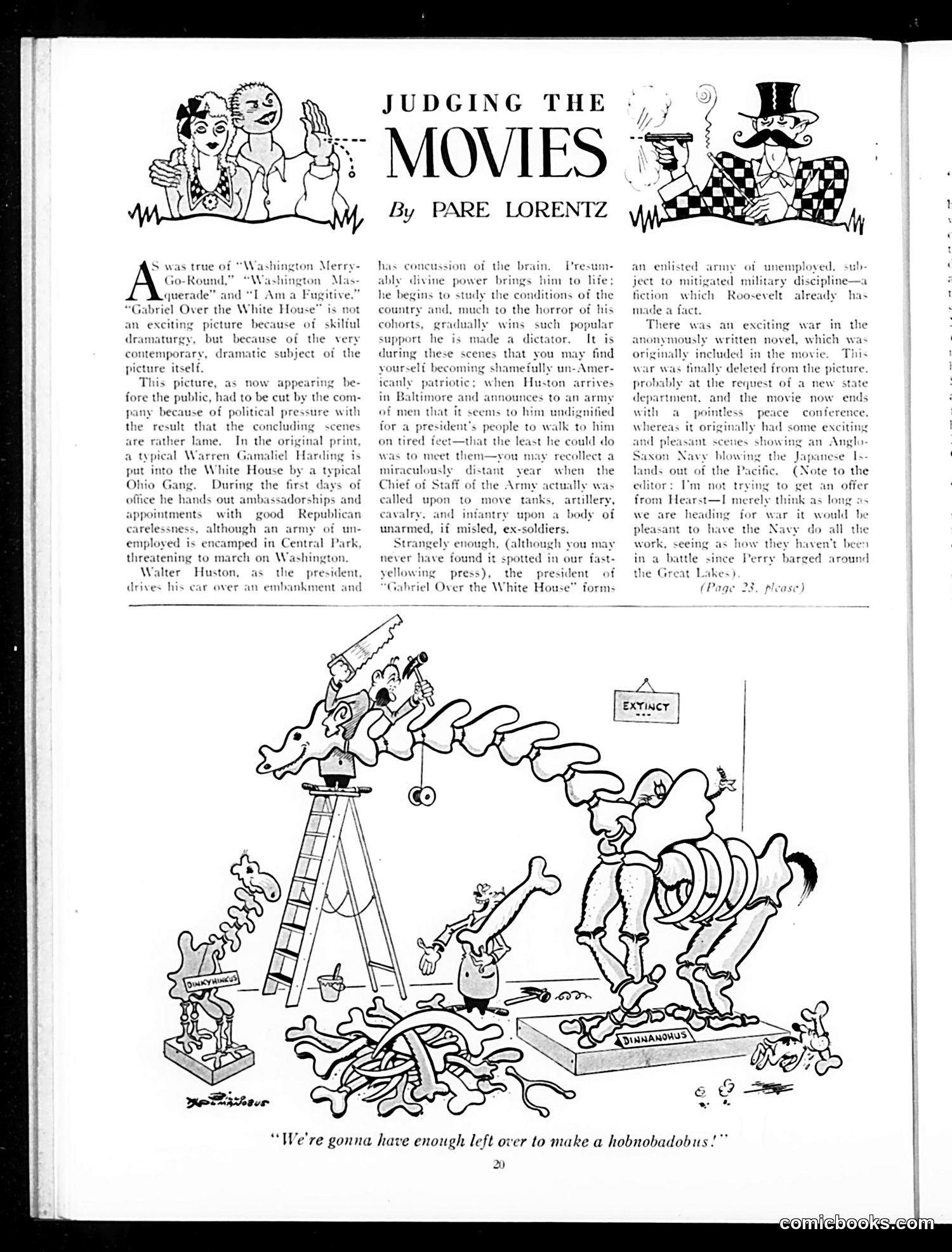
Explaining "Judging the Movies" by Pare Lorentz This page reviews "Gabriel Over the White House," a political film about a corrupt president (resembling Warren G. Harding, referenced explicitly) who undergoes a moral awakening after a car accident and becomes a benevolent dictator. The satire critiques the film's heavily edited version. Originally, the movie depicted an "exciting war" against Japanese forces in the Pacific and included a scene where the Army's Chief of Staff was called upon to disperse unemployed veterans (likely referencing the real 1932 Bonus Army incident in Washington, D.C.). The studio censored these sequences due to political pressure. Lorentz's sarcasm suggests the cuts made the story "rather lame." The cartoon below—showing chaotic movie production with creatures and an "EXTINCT" sign—mocks how studios butcher political content, leaving only sanitized entertainment. The caption jokes about having "enough left over to make a hobnobadobus" (nonsense), implying the edits destroyed the film's coherence.
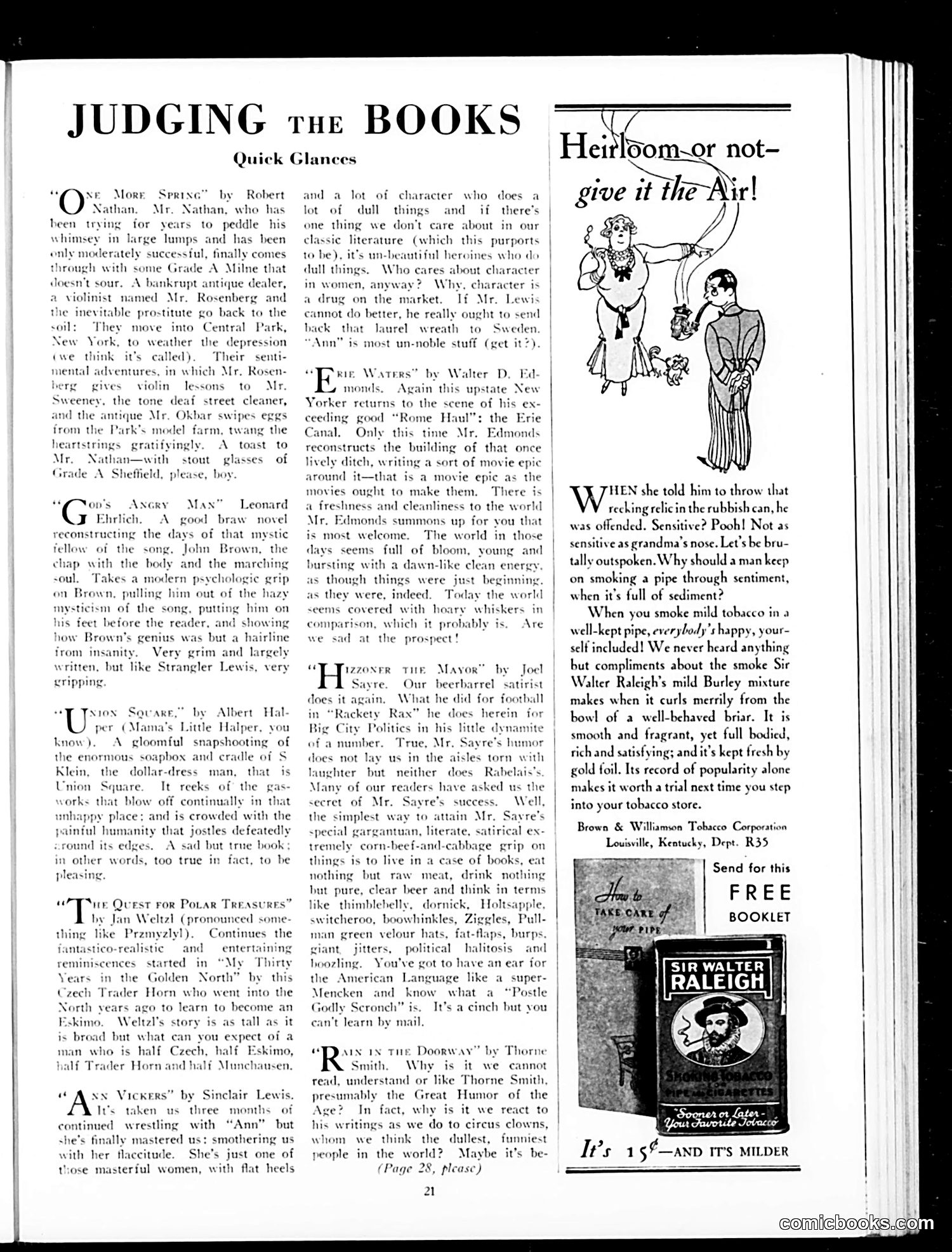
"Heirloom or Not—Give It the Air!" Cartoon Analysis This cartoon satirizes upper-class pretension about smoking and social propriety. A well-dressed woman (likely representing old-money aristocracy) instructs a younger woman to discreetly remove a smoking pipe from view—treating it as an embarrassing "heirloom" that shouldn't be displayed publicly. The joke targets two things: the hypocrisy of the wealthy who hide their actual behaviors behind appearances of refinement, and contemporary anxieties about women smoking (still considered scandalous in some circles during this era). By framing the pipe as a family relic to be ashamed of, the cartoon mocks how the upper classes maintained false propriety while privately engaging in "common" practices. The accompanying tobacco advertisement immediately below undercuts the satire's moral stance, revealing *Judge* magazine's commercial complicity in promoting the very behavior it supposedly ridicules.
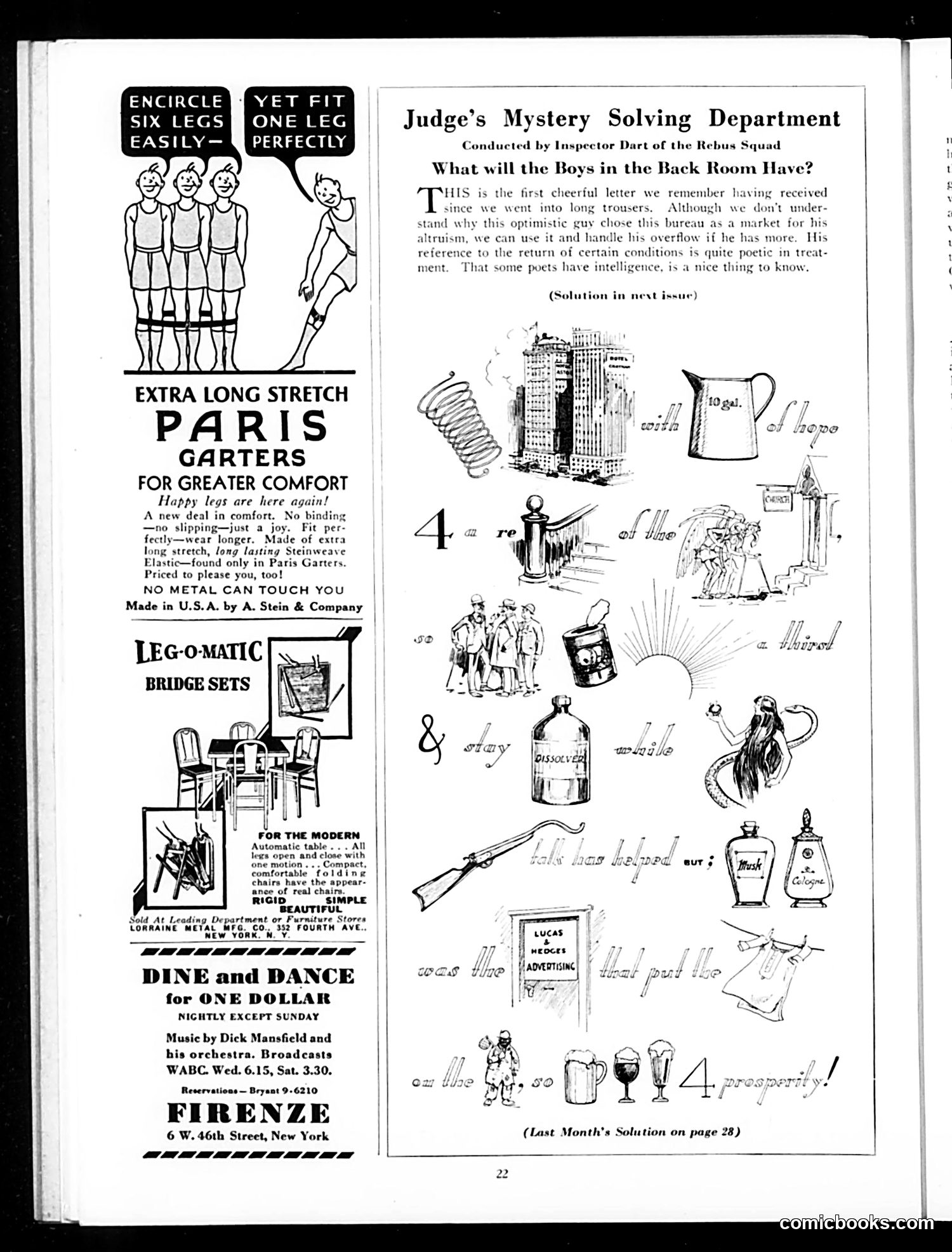
Judge Magazine Page Analysis This page is primarily advertisements with a small editorial puzzle feature. The left side contains ads for Paris Garters (hosiery), Leg-O-Matic Bridge Sets (folding furniture), and the Firenze restaurant/nightclub in Manhattan. The right side features "Judge's Mystery Solving Department," a rebus puzzle where illustrated objects and handwritten text form a riddle. The solution appears next issue. The puzzle's title—"What will the Boys in the Back Room Have?"—references a famous 1930s political phrase from Democratic operative Louis Howe, making a topical joke about backroom political dealings. Readers would decode the visual puzzle to discover the answer. The editorial note praises a reader's cheerful letter, humorously suggesting this bureau (the magazine itself) could use more optimism and overflow. This is typical Judge content: commercial advertising mixed with reader-participation puzzles and light satirical commentary.
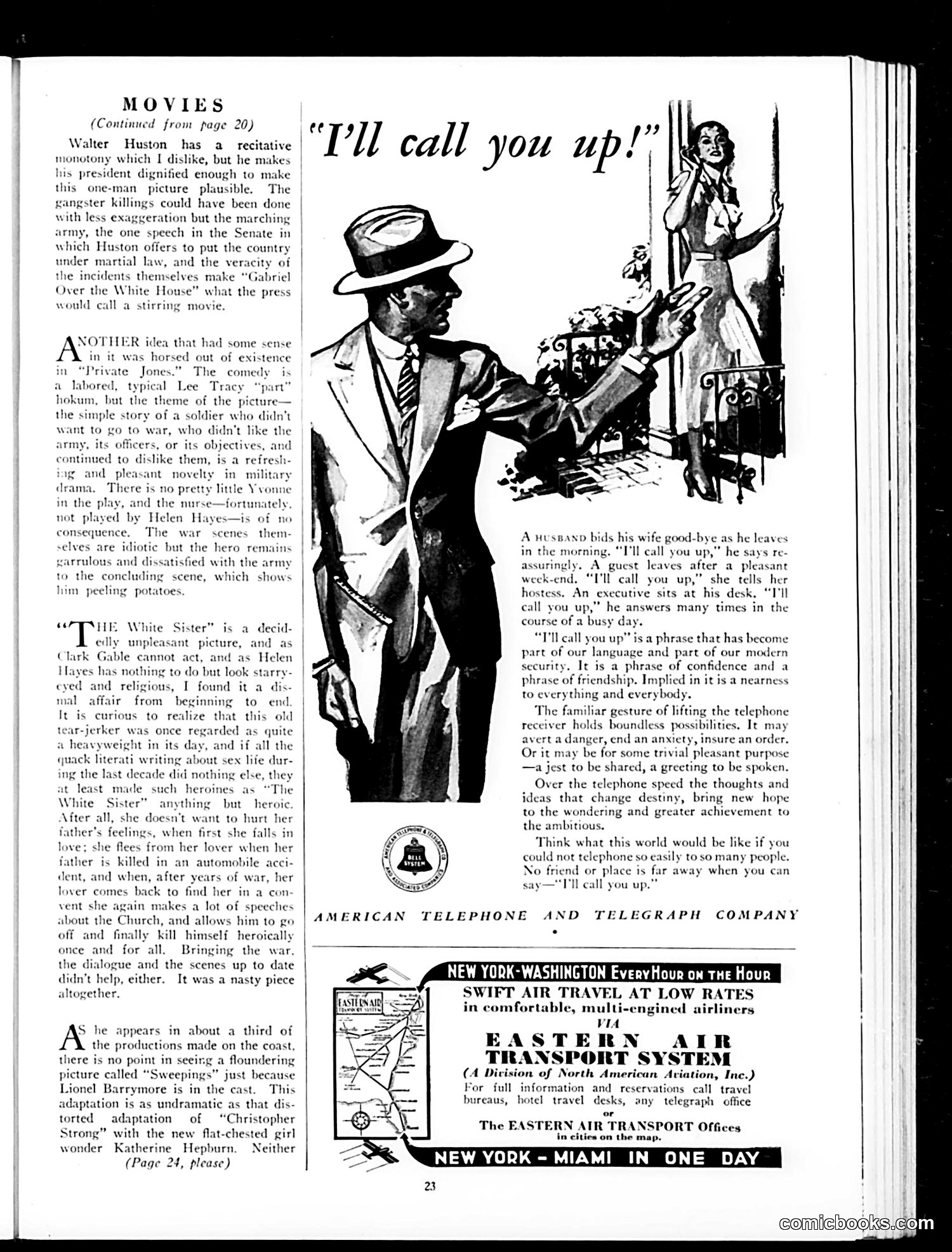
This page contains movie reviews by Judge magazine's critic, followed by advertisements. The reviews discuss films including "Gabriel Over the White House" (starring Walter Huston as a president), "Private Jones" (a Lee Tracy comedy about a reluctant soldier), and "The White Sister" (criticizing Clark Gable and Helen Hayes). The critic finds most films mediocre or unpleasant, particularly objecting to outdated moral heroines and melodramatic plotting. The large illustration shows a man in a hat saying goodbye to his wife with the caption "I'll call you up!"—accompanying an AT&T advertisement celebrating the telephone's role in modern life and relationships. Below is an Eastern Air Transport advertisement promoting affordable flights between New York, Washington, and Miami. The page reflects 1930s concerns about technology enabling connection and security.
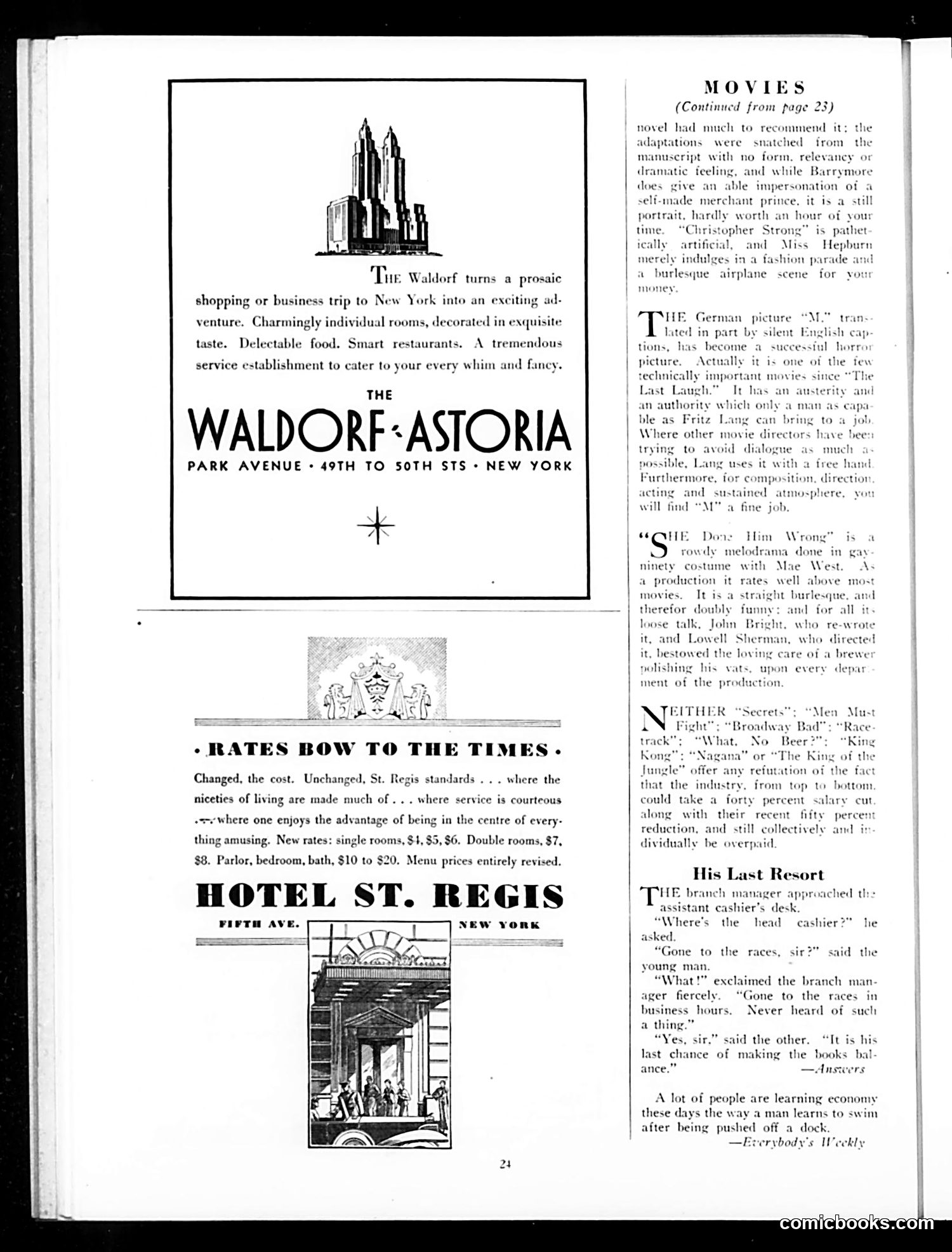
Analysis of Judge Magazine Page This page is primarily advertising with a movie review section. The ads promote luxury New York hotels (Waldorf-Astoria and St. Regis) emphasizing their unchanged quality despite economic hardship—they've reduced prices but maintained "standards" and service. This reflects Depression-era marketing: reassuring wealthy clientele that luxury persists. The movie reviews discuss contemporary films starring Mae West and John Bright. The satirical content is minimal here. Below the ads sits a brief joke titled "His Last Resort" mocking economic desperation: a bank manager discovers his head cashier has gone to the races during business hours. The cashier's defense—it's "his last chance of making the books balance"—darkly suggests embezzlement or financial ruin as a final gamble. The closing quote about learning economy "the way a man learns to swim after being pushed off a dock" reinforces Depression-era gallows humor about economic crisis.
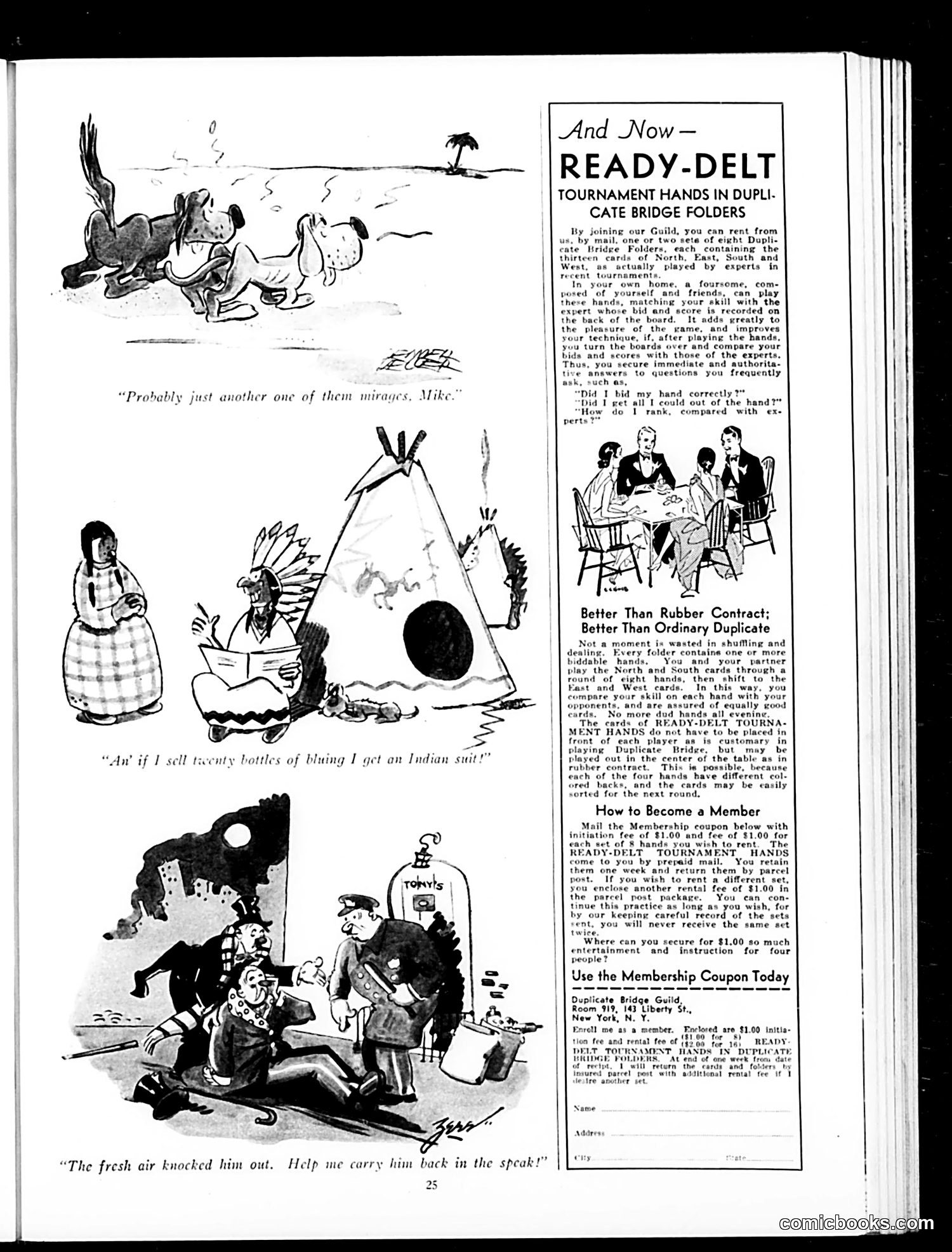
Judge Magazine Page Analysis This page contains three unrelated cartoons on the left and a bridge game advertisement on the right. The cartoons appear to be humorous domestic/social scenes from the Prohibition era (references to "speak" suggest speakeasies). The top cartoon shows someone in a desert mirage; the middle depicts what appears to be a Native American trading scenario; the bottom shows people outside a speakeasy where someone has been knocked unconscious by "fresh air"—likely satirizing the contrast between the stale air inside illegal bars versus outdoor air. The right side advertises "Ready-Delt Tournament Hands in Duplicate Bridge Folders"—a service allowing bridge players to rent pre-dealt card hands from actual tournament games to practice at home. This was apparently a commercial offering marketed to bridge enthusiasts, allowing players to compare their play against expert performances recorded on the back of each hand. The content reflects 1920s-30s leisure culture and the popularity of bridge as a middle-class social activity.
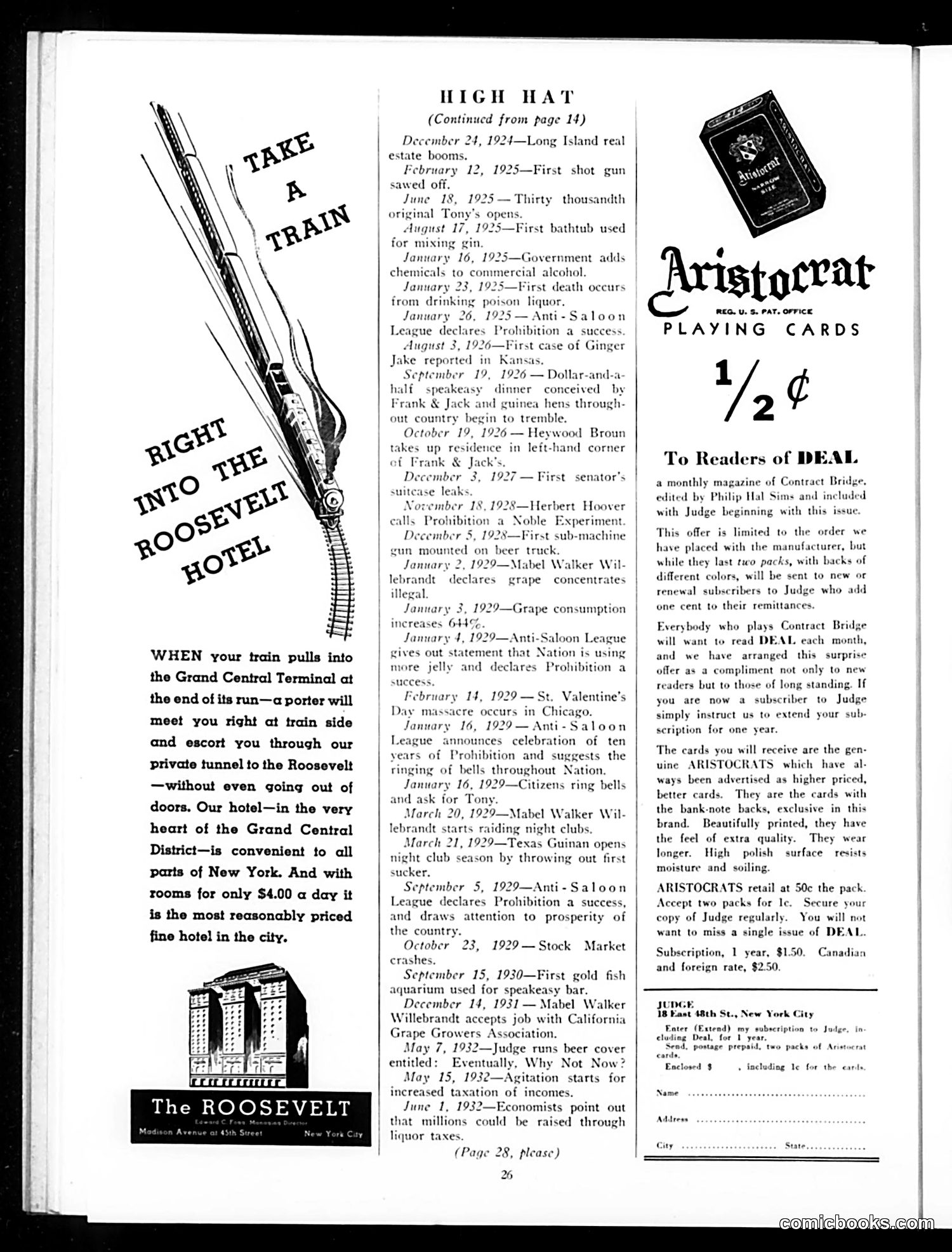
High Hat: Prohibition-Era Satire This page from *Judge* magazine (1924-1932) presents a satirical chronology mocking Prohibition's failure. The "HIGH HAT" column catalogs the era's absurdities: government-poisoned alcohol, bathtubs converted to gin production, speakeasy culture flourishing despite enforcement, and the St. Valentine's Day Massacre (1929). The timeline's dark humor underscores the contradiction between Prohibition's stated success and observable reality—grape concentrate sales skyrocketing, illegal nightclubs operating openly (Texas Guinan mentioned), and citizens requesting bootlegger "Tony" by name. The 1929 stock market crash ending the chronology suggests economic collapse coincided with Prohibition's hypocrisy. The page also advertises Roosevelt Hotel rooms ($4/day) and Aristocrat playing cards—typical magazine fare. The satire targets both Prohibition's enforcement failures and the Anti-Saloon League's delusional declarations of success amid nationwide lawbreaking.
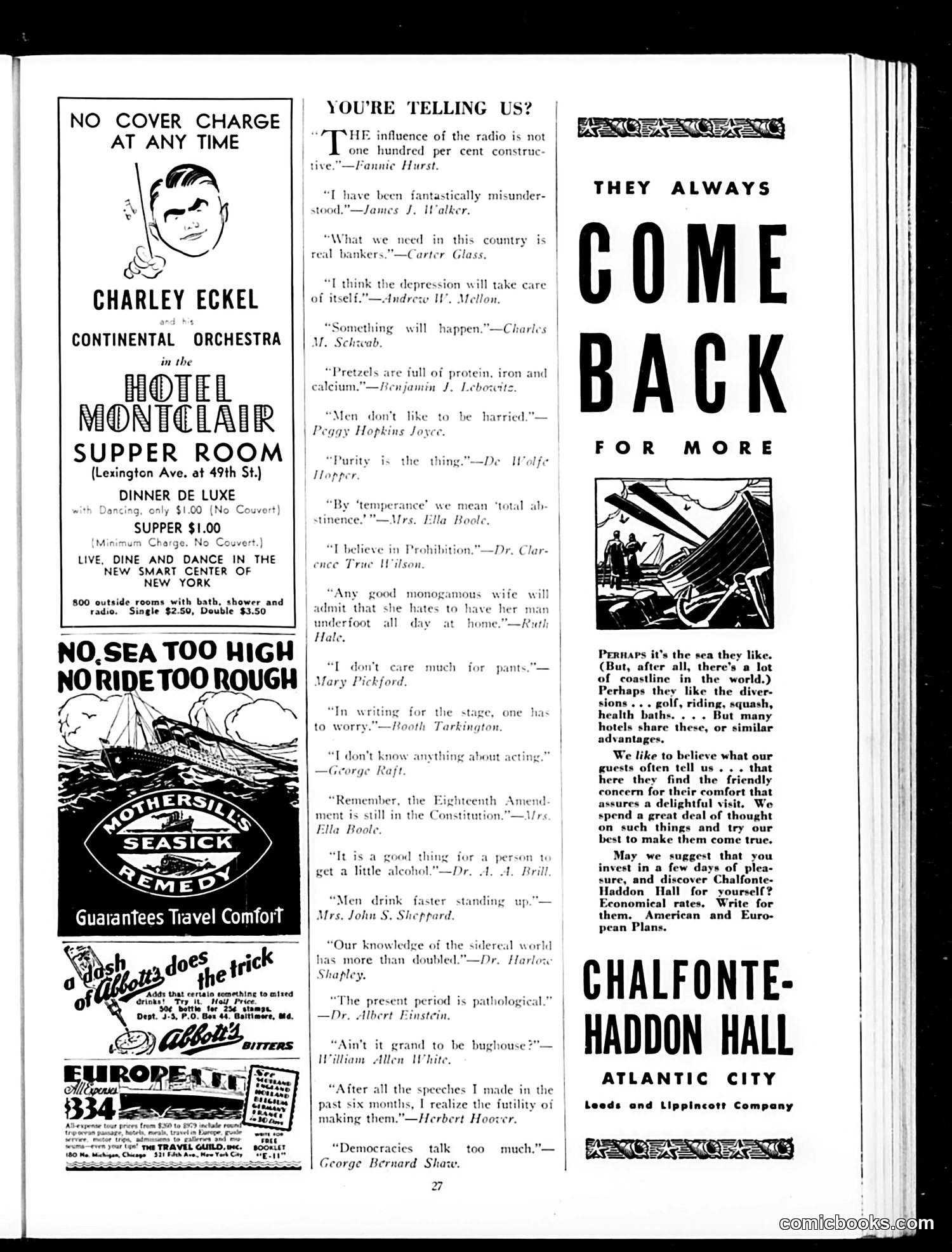
Judge Magazine Page Analysis This page is primarily advertising with a satirical quote collection. The main feature is "YOU'RE TELLING US?" — a humor section collecting contradictory or ironic statements from famous 1920s-30s figures (Herbert Hoover, George Bernard Shaw, Dr. Einstein, William Allen White, and others). The satire works by presenting these public figures' quotes that undermine themselves or reveal hypocrisy. For example, Hoover admits his speeches were futile, while various figures make questionable claims about radio, prohibition, and progress. The advertisements promote 1920s leisure: the Hotel Montclair supper room (dinner/dancing), Mothersill's Seasick Remedy, European travel packages, and most prominently, Chalfonte-Haddon Hall in Atlantic City — a resort hotel emphasizing its superior amenities and "friendly concern" for guests. The small cartoon ("No Sea Too High") advertises seasickness medicine. The overall page reflects Prohibition-era American consumer culture and light political mockery typical of Judge magazine's satire.
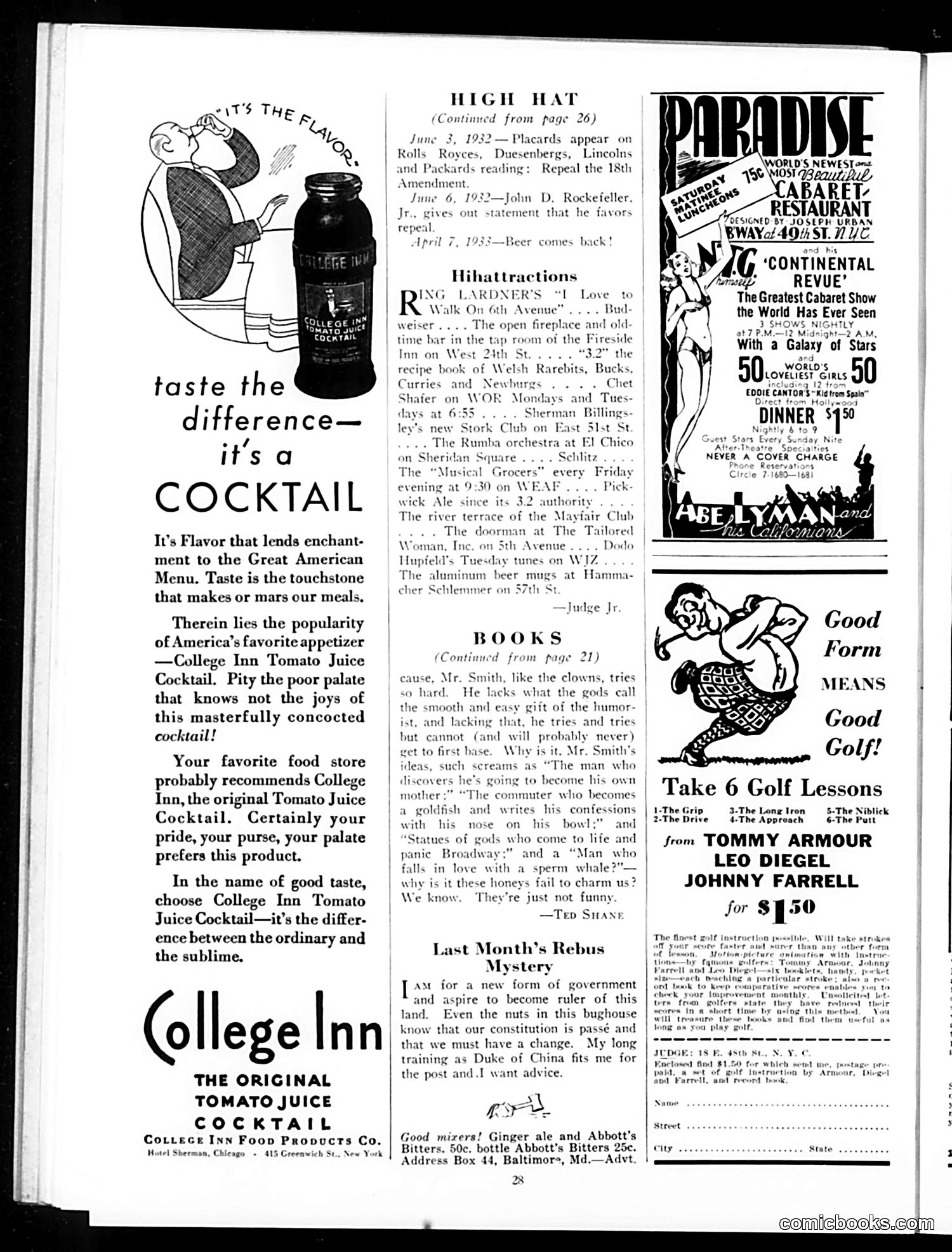
Page Analysis: Judge Magazine This page is primarily advertising and entertainment listings, not political satire. The dominant content includes: Left side: A College Inn Tomato Juice Cocktail advertisement featuring an illustration of a man tasting the product, emphasizing "taste the difference." This references Prohibition's repeal (1933 was imminent in 1932), as cocktails were illegal under the 18th Amendment. Right side: Entertainment and nightlife ads for venues like the Paradise cabaret and golf lessons from famous instructors (Tommy Armour, Leo Diegel, Johnny Farrell). Center column: "High Hat" section mentions Prohibition repeal sentiment (placards on luxury cars reading "Repeal the 18th Amendment," beer's return April 7, 1933), John D. Rockefeller's pro-repeal statement, and restaurant/nightlife recommendations. Lower section: Book and rebus puzzle reviews—mostly literary commentary unrelated to political satire. The page reflects 1932's anticipation of Prohibition's end, evident in the cocktail advertising and repeal references, rather than presenting political cartoons or social commentary.
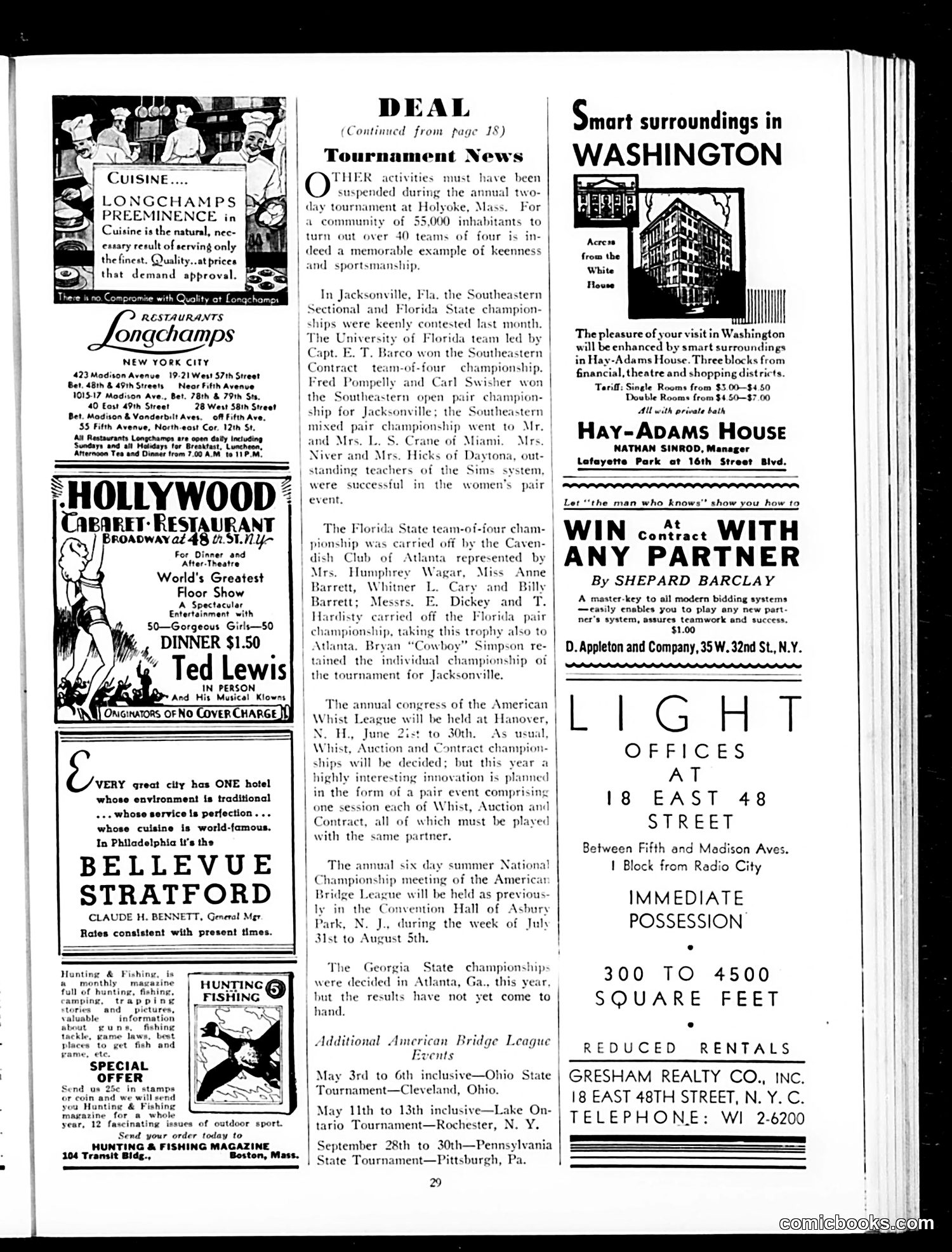
This page is primarily advertising and tournament reporting with minimal satirical content. The top-left contains a Longchamps restaurant advertisement emphasizing quality cuisine without price compromise—a pre-Depression era pitch to affluent diners. Below it, the Hollywood Café advertises a floor show with "50 Gorgeous Girls," reflecting 1920s entertainment culture. The main editorial content reports bridge tournament results from Jacksonville, Atlanta, and other locations, listing competition winners among amateur players. This reflects bridge's significant popularity as a social game among middle and upper classes during this era. The right-side advertisements promote Washington D.C. hotels and New York office space, targeting business travelers. The Hay-Adams House ad and Gresham Realty listing offer "smart surroundings"—period language emphasizing fashionable, respectable accommodations. This page contains no political satire or caricature—it's a straightforward mix of leisure advertising and hobby reporting typical of *Judge* magazine's commercial content during the 1920s.
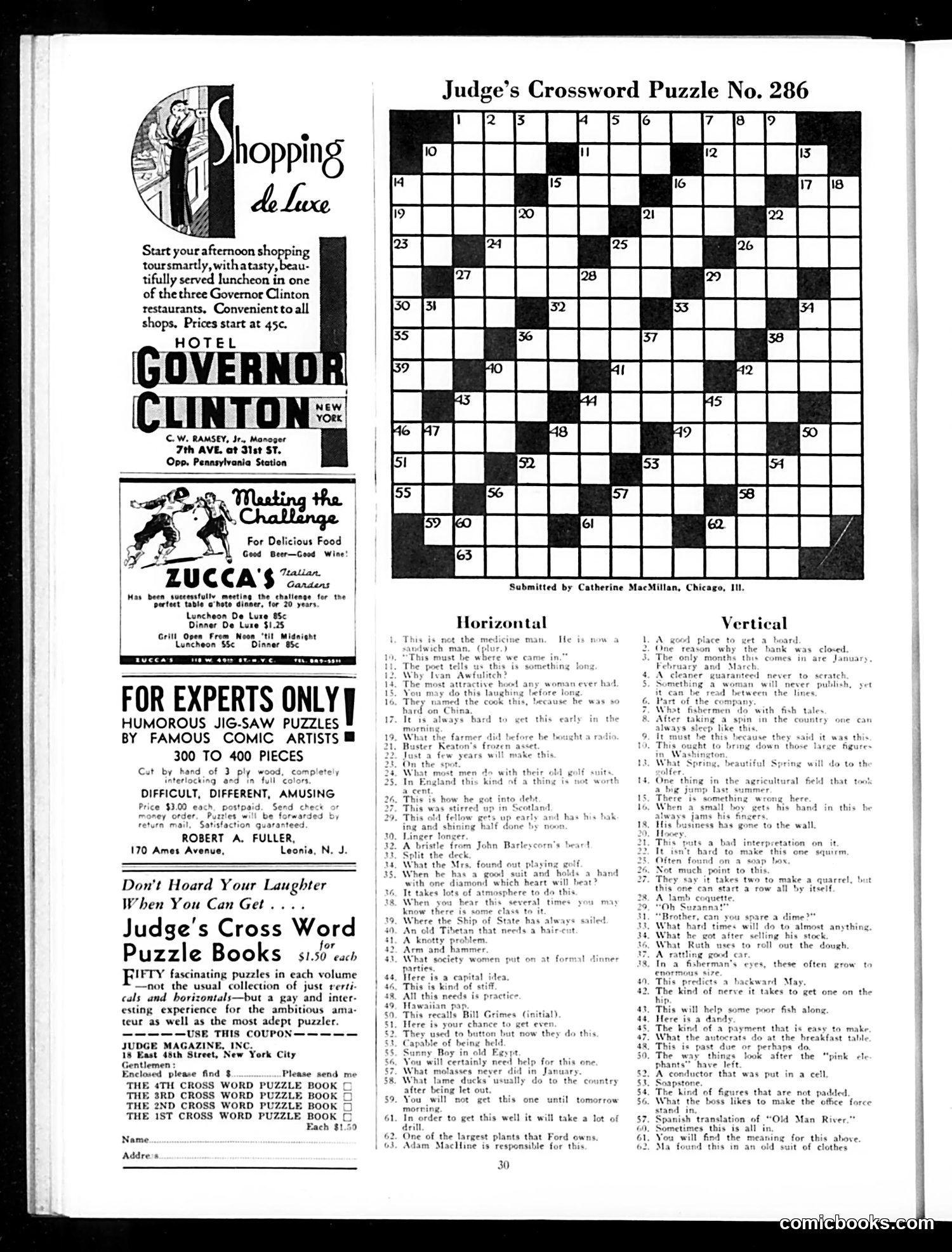
Judge Magazine Page Analysis This page is primarily advertisements and a crossword puzzle, not a political cartoon. The main content includes: Advertisements: - Hotel Governor Clinton (restaurant promotion) - Zucca's Italian Gardens (restaurant) - Robert A. Fuller's humorous jig-saw puzzles by comic artists - Judge's Cross Word Puzzle Books The Crossword Puzzle: "Judge's Crossword Puzzle No. 286" occupies the right side. The clues reference contemporary 1920s-30s culture and concerns: mentions of Ford, banks closing (likely referencing Depression-era bank failures), radio ownership, formal dinner etiquette, and casual period references. Social Context: The advertisements reflect leisure activities and dining culture of prosperous urban readers. The puzzle itself serves as entertainment while subtly embedding references to current events—bank closures and economic concerns appear as puzzle answers, suggesting how deeply financial anxiety permeated even recreational content of this era. This is a typical Judge magazine page mixing commercial content with puzzle entertainment.
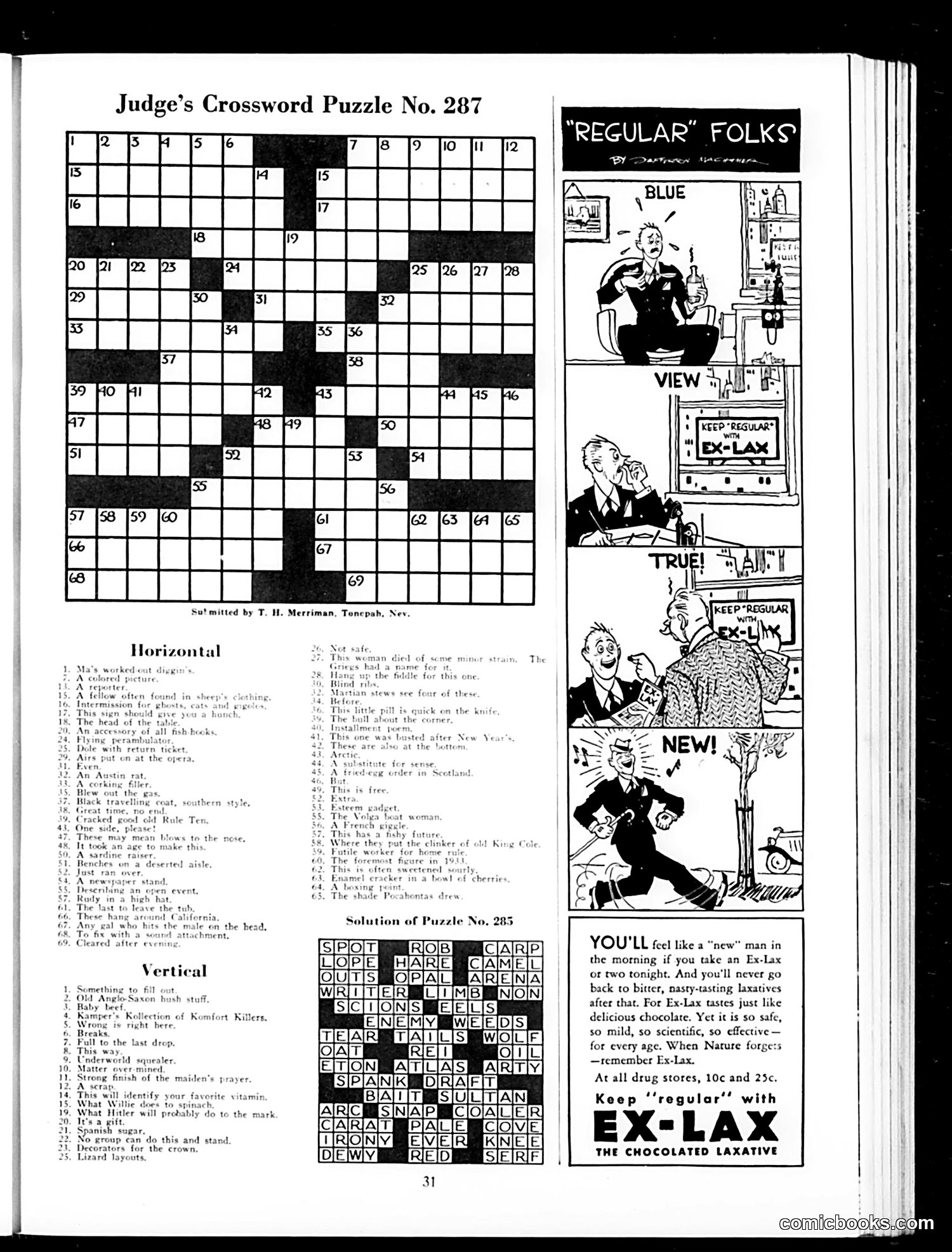
Analysis of Judge Magazine Page No. 287 This page is primarily a crossword puzzle with an accompanying advertisement, not a political cartoon. The main content is "Judge's Crossword Puzzle No. 287," submitted by T.H. Merriman of Tonepah, Nevada, featuring standard crossword clues (horizontal and vertical). The significant element is a full-page Ex-Lax advertisement on the right side. Ex-Lax was a chocolated laxative marketed as a gentler alternative to "bitter, nasty-tasting laxatives." The ad emphasizes the product's palatability and safety across all ages. The cartoon vignettes labeled "BLUE," "TRUE," and "NEW" appear to be unrelated comic strips or advertisements also promoting Ex-Lax's regularity benefits. This represents typical Judge magazine content from the mid-20th century: puzzles and substantial advertising revenue alongside satirical humor—reflecting how magazines funded themselves during this era.
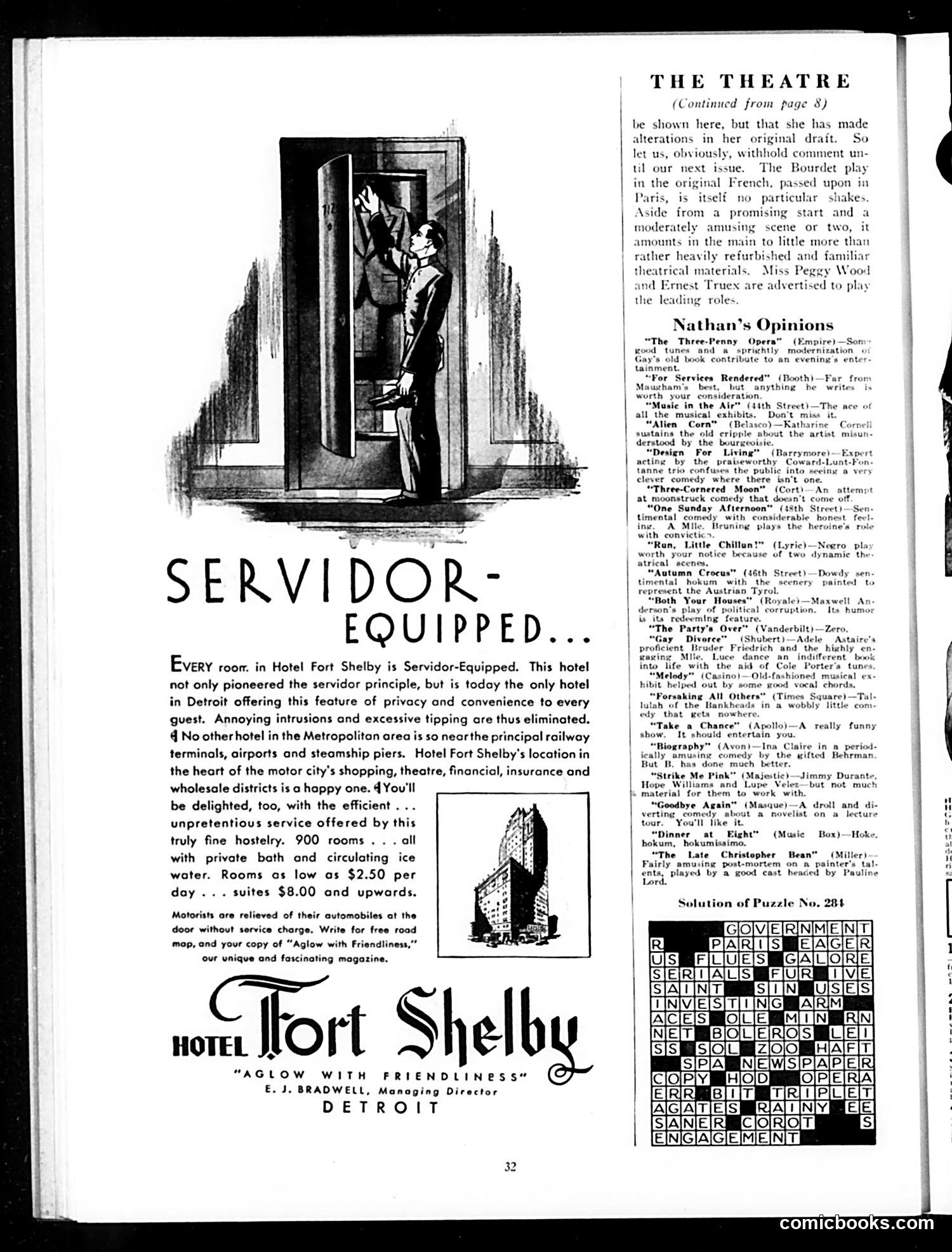
Analysis of Judge Magazine Page This page is primarily advertising and theater criticism, not political satire. The dominant content is a large advertisement for Hotel Fort Shelby in Detroit, promoting its "Servidor" system—a hotel service innovation allowing guests privacy without constant bellhop interruptions and excessive tipping. The ad emphasizes modern convenience and affordable rates ($2.50+ per day), targeting motorists and business travelers. The right column contains "Nathan's Opinions," theater reviews by what appears to be a drama critic discussing contemporary Broadway productions—including *Alien Corn*, *Dinner at Eight*, and others. These are straightforward critical assessments rather than satirical commentary. The page also includes a completed crossword puzzle solution. There is no political cartoon visible. The single illustration (showing two figures at a hotel doorway) is merely promotional artwork supporting the hotel advertisement. This is a standard magazine page mixing ads, criticism, and puzzles rather than satirical political content.
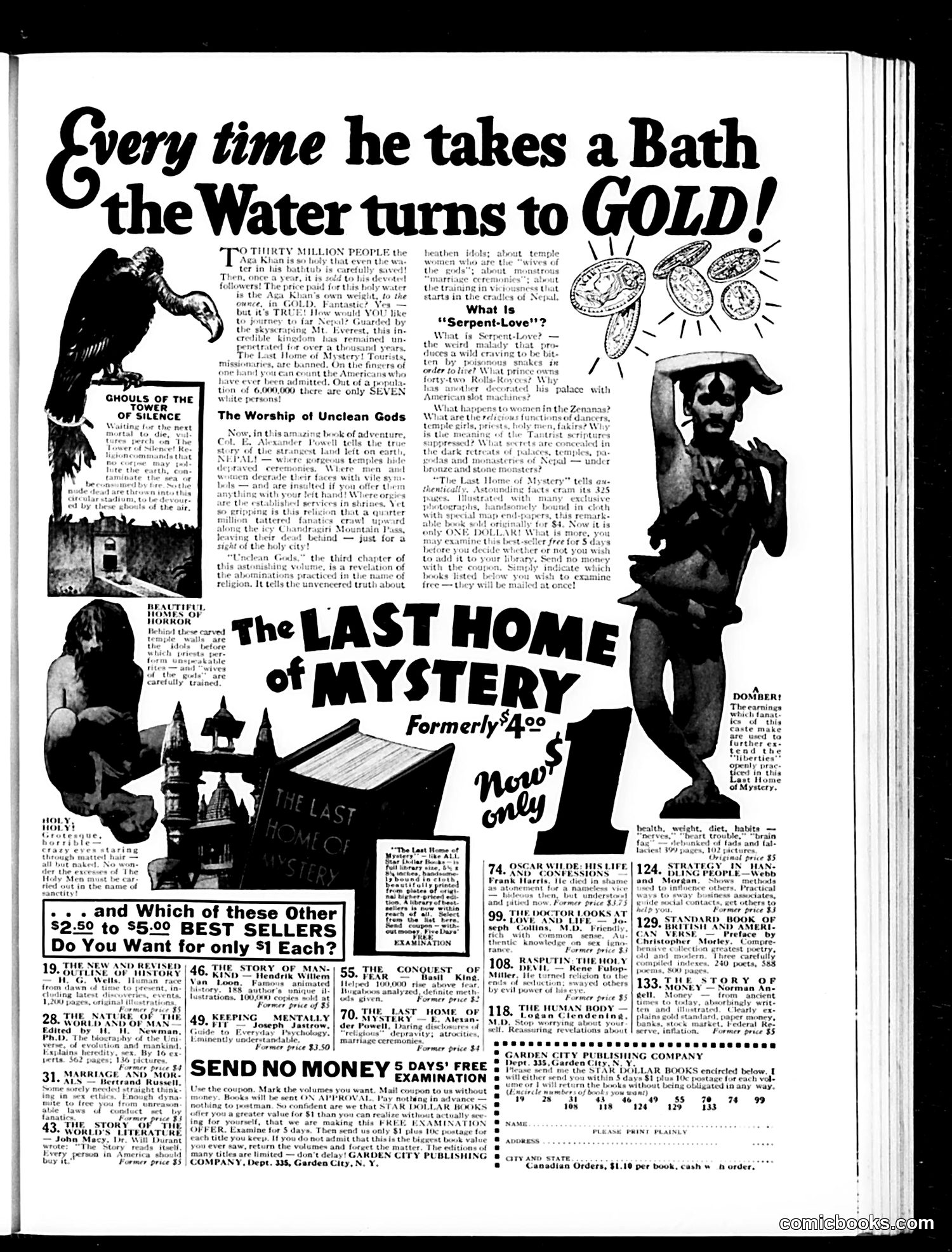
Analysis for Modern Readers This page is primarily advertising, not political satire. The top banner "Every time he takes a Bath the Water turns to GOLD!" advertises a sensationalist book called *The Last Home of Mystery*, promoted as formerly $4.50, now at a lower price. The accompanying text and grotesque illustrations reference Orientalist exotica—depicting Hindu temples, "serpent worship," and "unclean gods" in highly prejudicial terms typical of early 20th-century Western publications. These were designed to intrigue readers with promises of forbidden, mysterious Eastern practices. The bulk of the page consists of mail-order book advertisements from Garden City Publishing, listing titles like Oscar Wilde's confessions and pop-psychology books. The "$2.50 to $5.00 Best Sellers" promotion invites readers to order multiple volumes with "5 Days' Free Examination." This reflects the era's appetite for sensationalist "exotic" content packaged alongside accessible self-help literature—all marketed through lurid illustrations and promotional copy.