judge
Judge — June 1933
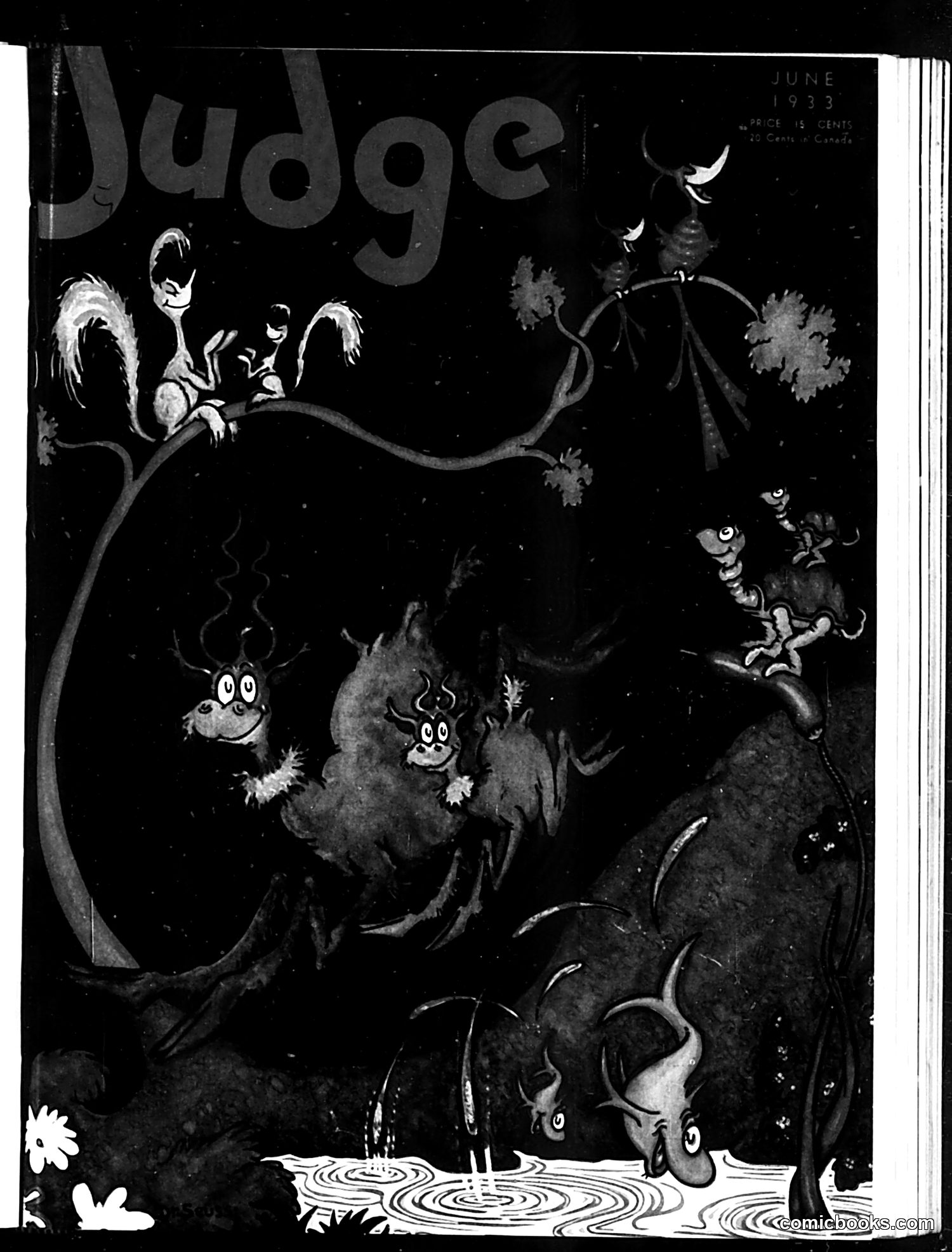
Analysis This June 1933 *Judge* cover depicts surreal, grotesque creatures in a nightmarish landscape. The creatures appear to be caricatured animals or demons with exaggerated features—bulging eyes, twisted bodies—engaged in what seems chaotic activity around water or pools. Without clearer text identifying specific figures or references, the exact satirical target is unclear. However, given the 1933 date (early New Deal era), this likely comments on Roosevelt's policies or contemporary political figures through grotesque imagery—a common *Judge* technique. The nightmarish quality suggests criticism of something the cartoonist viewed as dystopian or monstrous. The surreal style and grotesque creatures are characteristic of early 1930s American political satire, but specific identification of the referenced figures or events would require additional context.
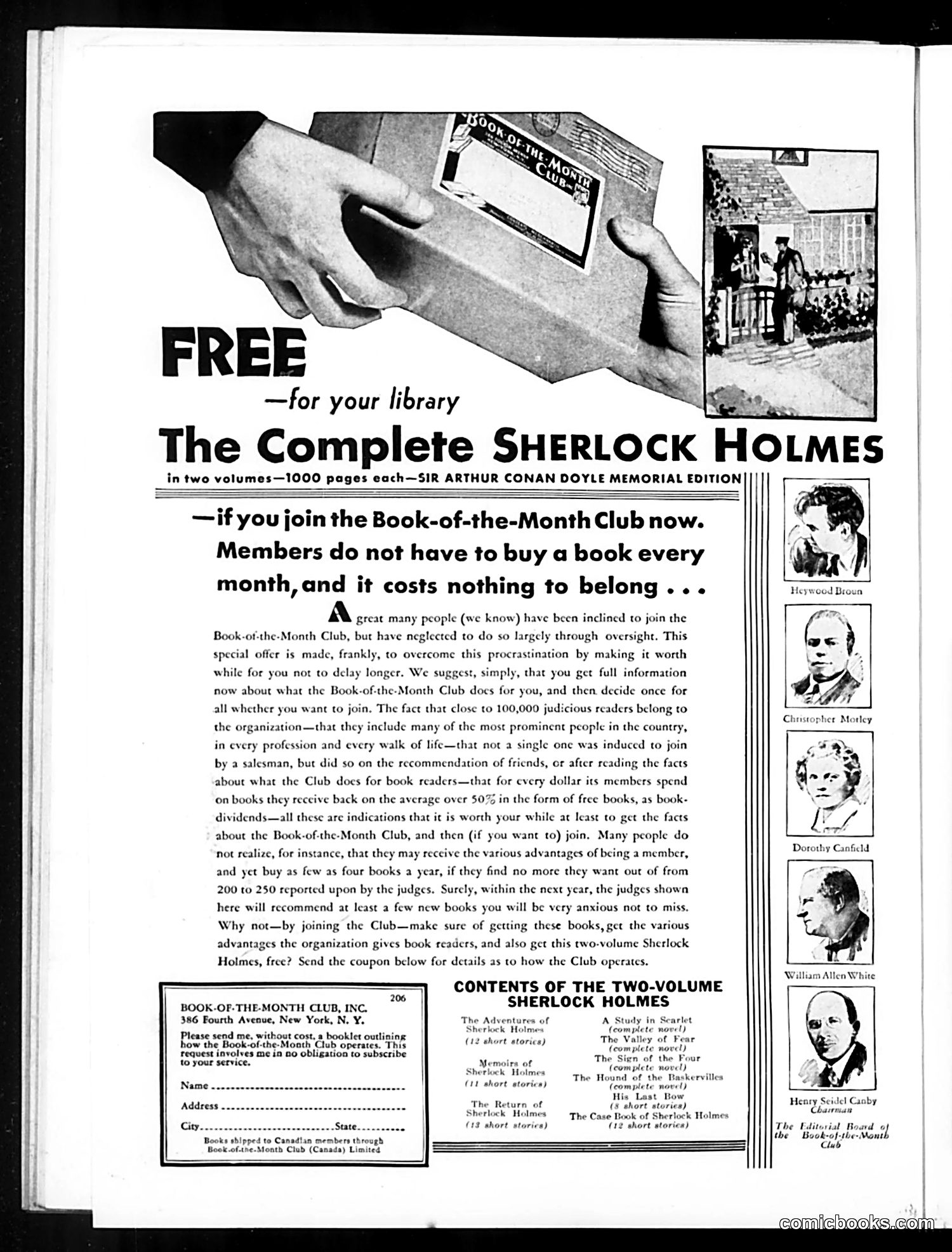
Analysis This page is primarily advertising, not satire or cartooning. It's a Book-of-the-Month Club promotional ad from Judge magazine, offering a free two-volume Sherlock Holmes collection (Sir Arthur Conan Doyle Memorial Edition) to new members. The right side displays portraits of club judges/endorsers: Heywood Broun, Christopher Morley, Dorothy Canfield, William Allen White, and Henry Seidel Canby—prominent early 20th-century literary figures who lent credibility to the club's selections. The ad uses persuasive copy emphasizing membership benefits: no obligation to buy monthly, and members receive over 50% of book value in free selections. A coupon at bottom invites readers to request club information. This is marketing material, not editorial satire.
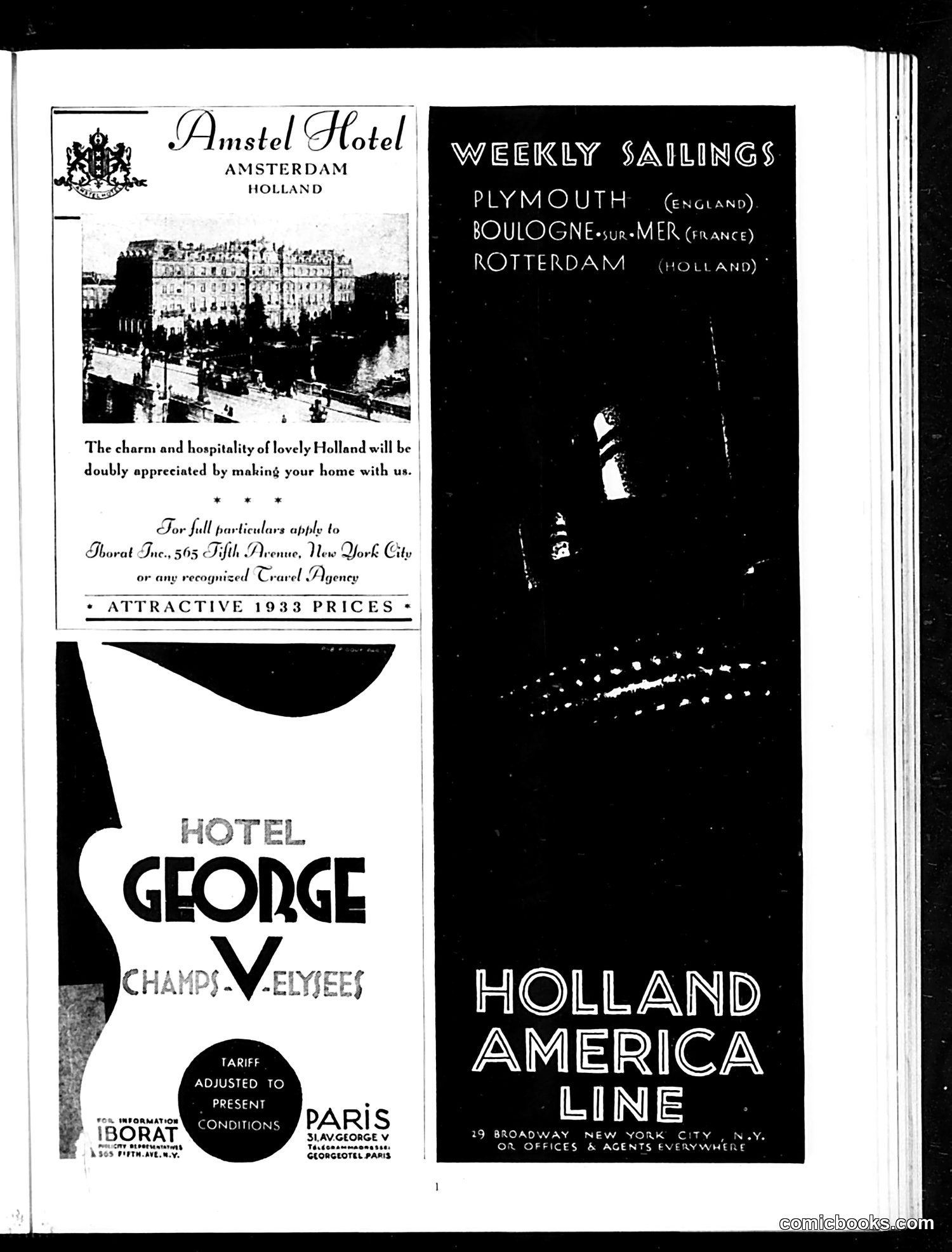
Analysis This page contains advertisements only, not editorial cartoons or satirical content. The left side advertises the Amstel Hotel in Amsterdam, Holland, emphasizing Dutch hospitality and offering "attractive 1933 prices." Below that is an ad for Hotel George V in Paris's Champs-Élysées, noting tariffs "adjusted to present conditions"—a reference to the Great Depression's economic impact. The right side advertises the Holland America Line, a shipping company offering weekly sailings from Plymouth (England), Boulogne-sur-Mer (France), and Rotterdam (Holland) to New York. All three ads target American travelers and reflect 1933's economic depression, with explicit mentions of reduced pricing to attract customers during financially difficult times.
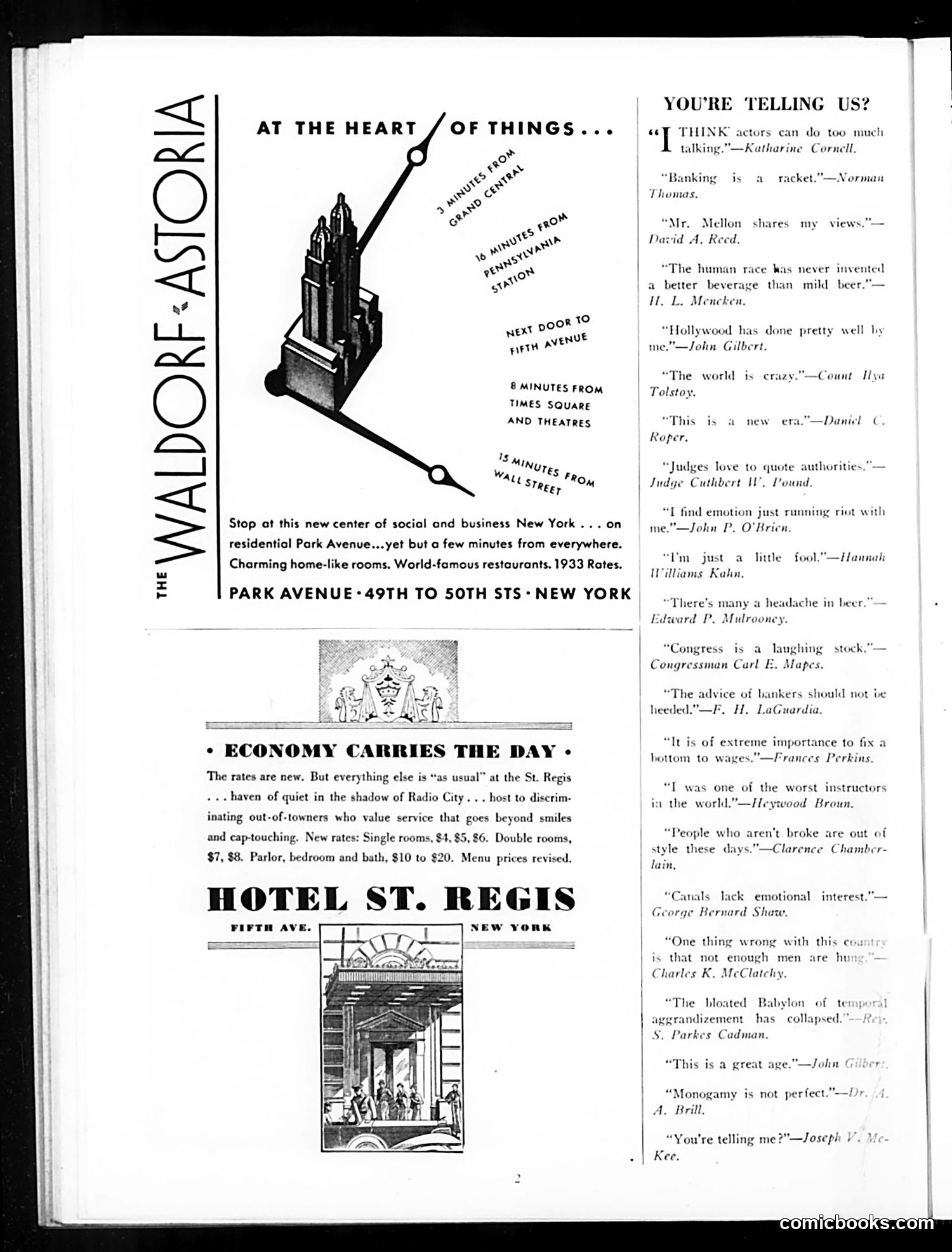
Analysis This page is primarily advertising rather than satire or editorial cartoon. The dominant content comprises two hotel advertisements: 1. The Waldorf Astoria (top) - promoting its Park Avenue location, emphasizing proximity to business districts and cultural attractions via a map graphic. 2. Hotel St. Regis (bottom) - advertising new reduced rates during what appears to be an economic downturn ("Economy Carries the Day"), with specific pricing for rooms. The right column contains "You're Telling Us?" — a recurring Judge feature showcasing witty quotations attributed to public figures (actors, politicians, judges, etc.). These are brief, humorous or pointed observations meant to satirize their subjects' personalities or public personas, though without additional context, their specific targets aren't always evident to modern readers. The page reflects 1930s American magazine formatting, mixing commercial content with light satirical commentary.
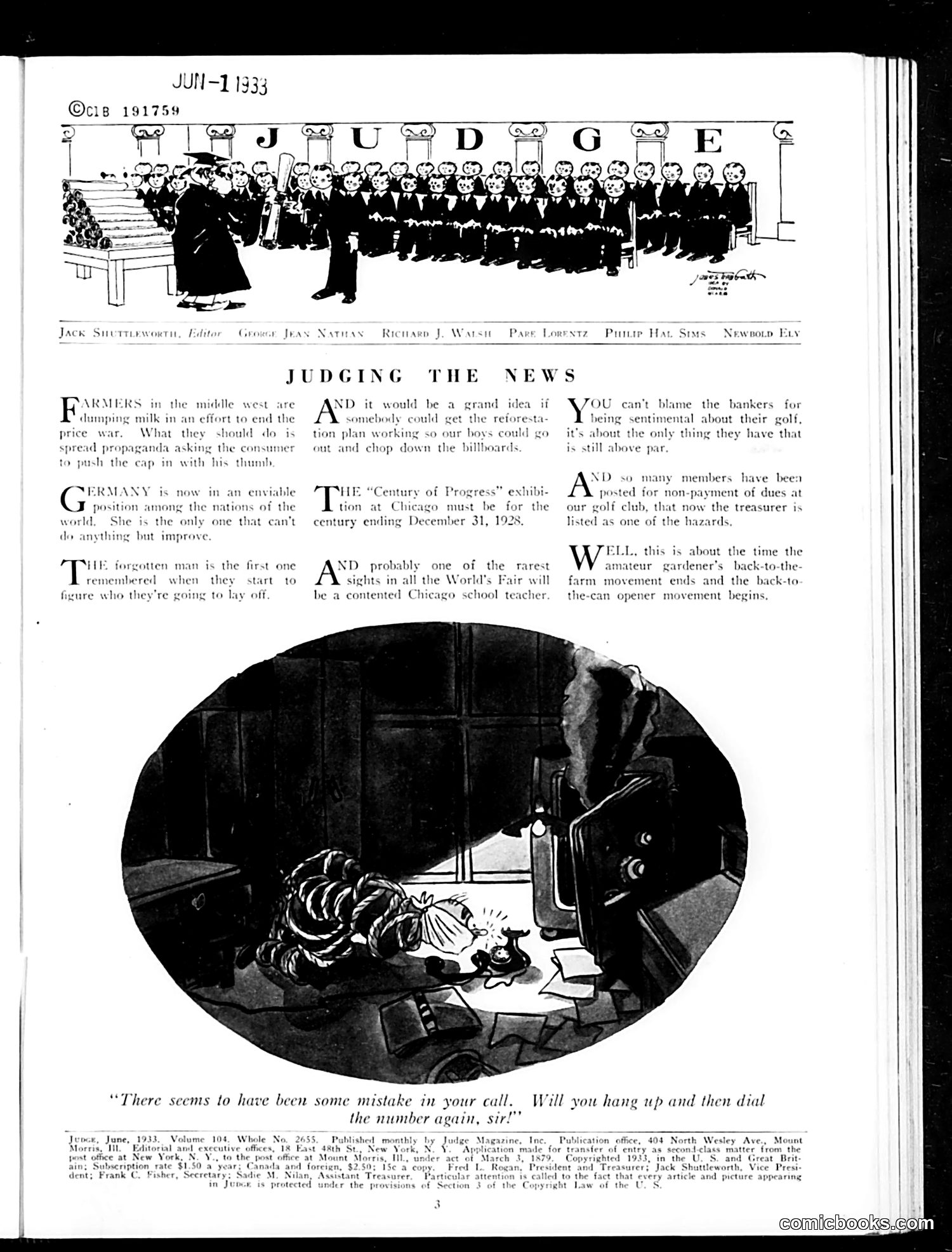
Analysis of Judge Magazine Page (June 1928) The main cartoon depicts a woman at a telephone, apologizing for a misdial. The humor relies on a common early telephone experience: wrong numbers due to operator error or misdialing. The "Judging the News" column contains brief satirical commentary on contemporary issues: - Midwest farmers dumping milk to protest low prices - Germany's economic position post-WWI - Memory of forgotten public figures - Bankers' sentiment about golf - Non-payment issues at a golf club - The "Century of Progress" Chicago exhibition (opening 1928) - A contented Chicago teacher's perspective on the World's Fair - The back-to-farm movement gaining momentum These brief items mock various social and economic concerns of 1928 America, from agricultural crisis to leisure pursuits among the wealthy.
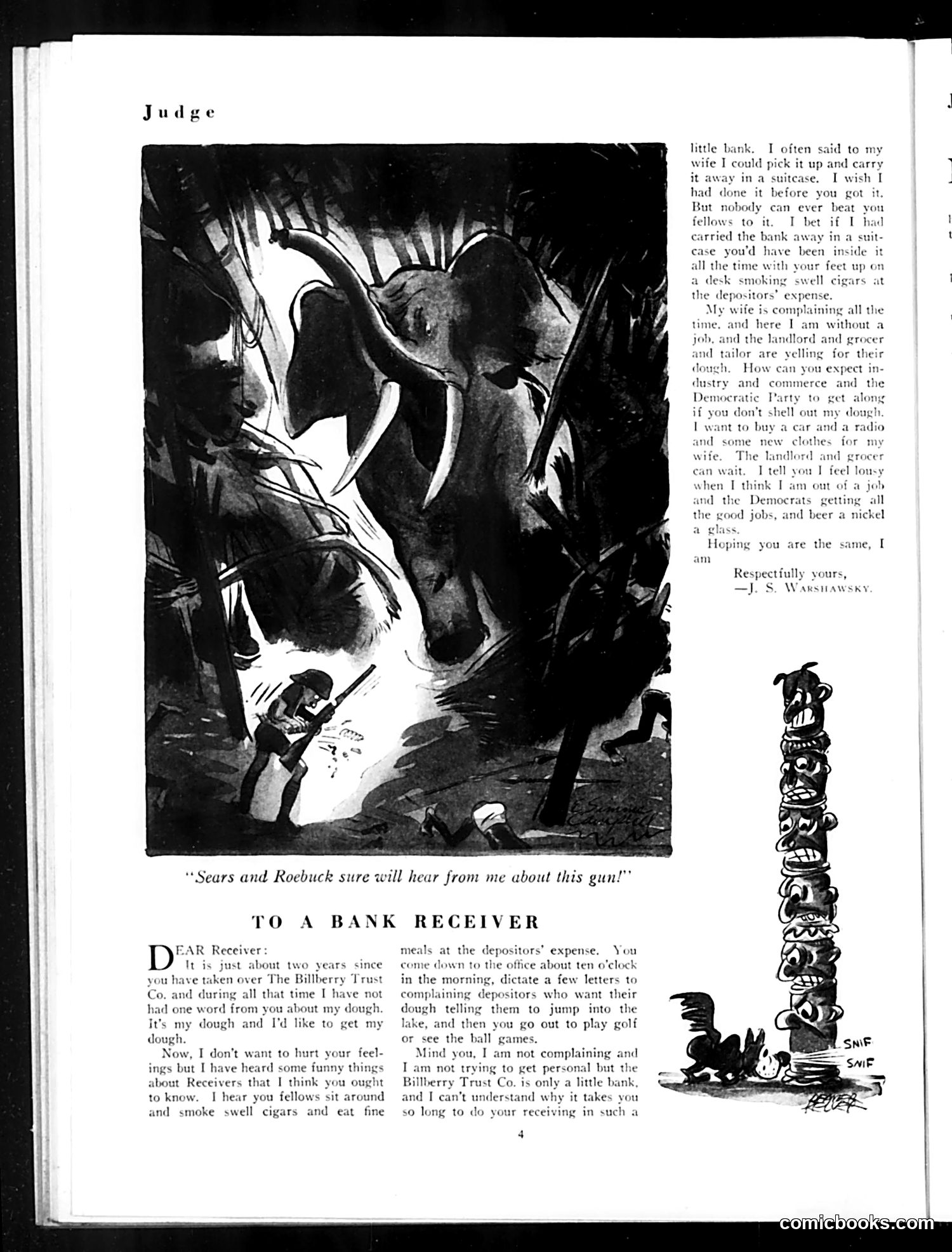
Political Satire Analysis This Judge magazine page contains two distinct pieces of satire: "To a Bank Receiver" is a letter mocking bank receivership during what appears to be an economic crisis. The sender, J.S. Warshawsky, complains about unemployment and financial hardship while a bank receiver lounges comfortably, dictating letters and playing golf. The satire critiques the contrast between ordinary citizens suffering job loss and creditors' debt collection while bank officials enjoy leisure and perks paid for by depositors' funds. The accompanying illustration depicts a small figure confronting a menacing judge or official figure, with the caption "Sears and Roebuck sure will hear from me about this gun!" This appears to reference consumer complaint or product liability issues, though the specific incident is unclear without additional context. Both pieces target institutional power imbalances and economic injustice.
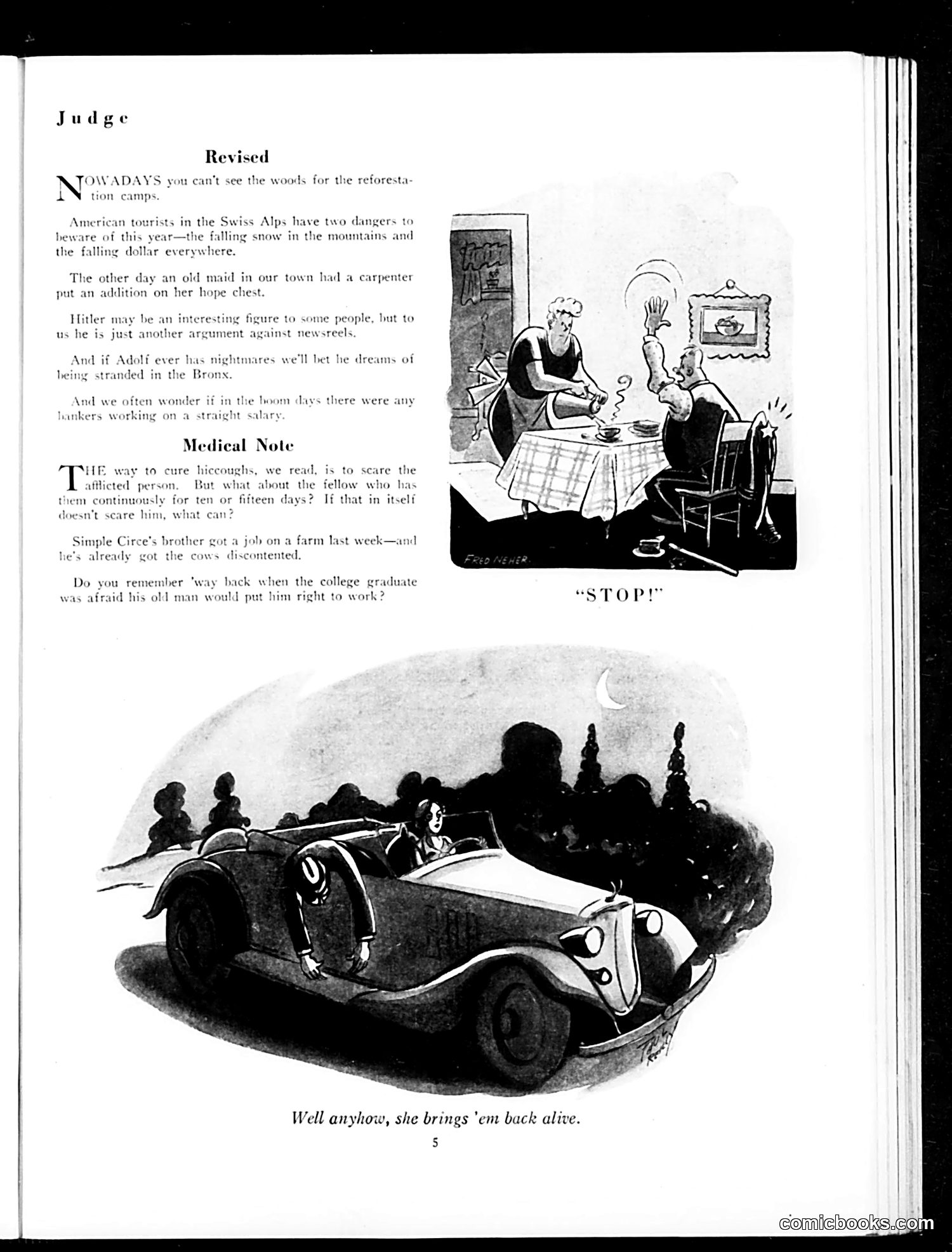
Analysis of Judge Magazine Page This page contains humor pieces rather than political cartoons. The top section, "Revised," mocks contemporary concerns—falling snow in mountains, currency devaluation, and new cars—suggesting these are overblown worries compared to historical problems. The "Medical Note" section jokes about hypochondria: a man who complains continuously for fifteen days shouldn't worry others, especially when others face real hardship (like a farm worker already disappointed). The implied satire targets people who manufacture anxiety. The lower cartoon, captioned "Well anyhow, she brings 'em back alive," shows a reckless female driver in a sports car at night. The joke appears to criticize women drivers as dangerous, a common stereotype of the era, though the caption suggests paradoxically that safety is somehow her strength.
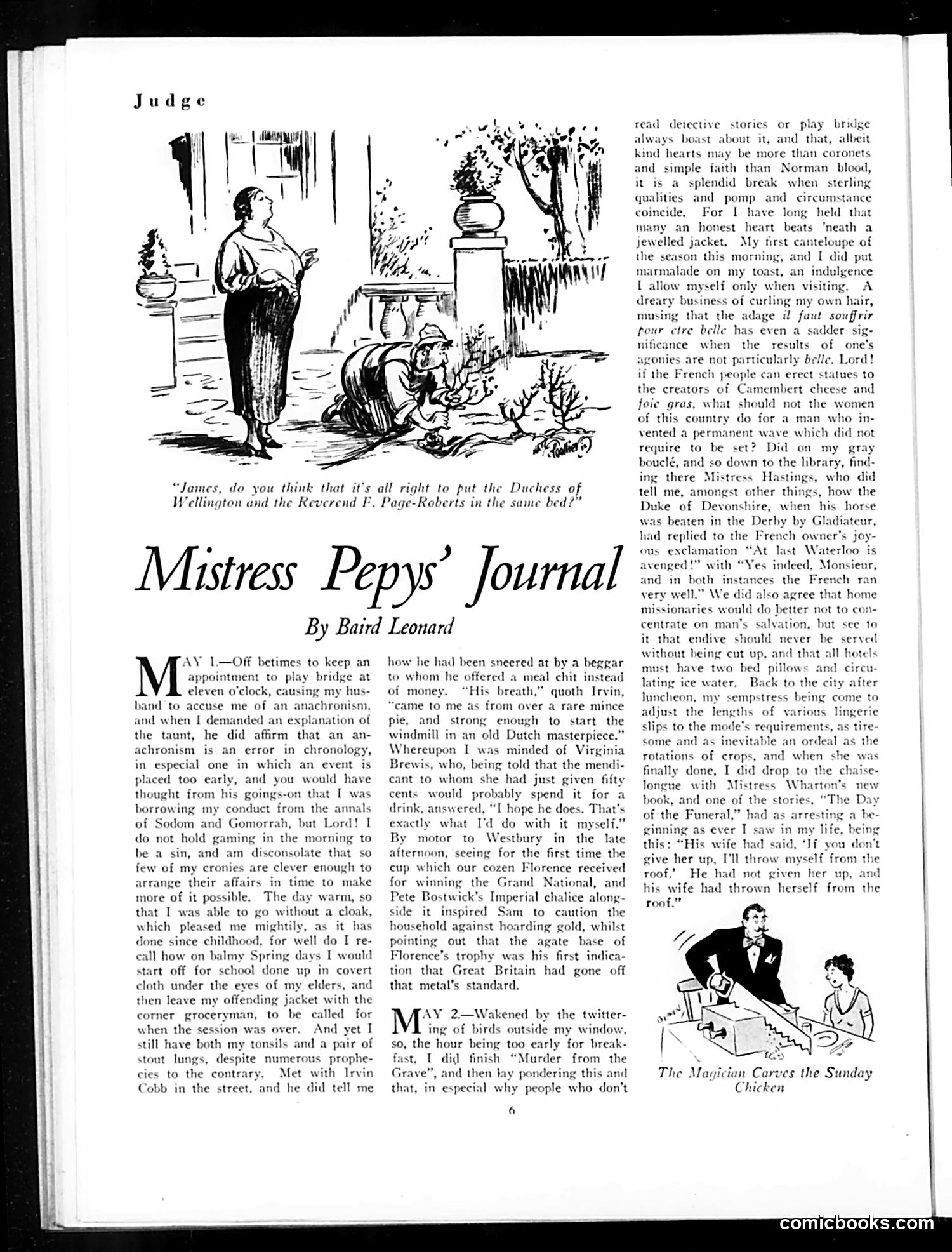
"Mistress Pepys' Journal" by Baird Leonard This satirical column mimics Samuel Pepys' famous diary, but from a female perspective observing high society. The May 1st entry mocks the author's social obligations—specifically being pressured to play bridge at afternoon gatherings despite preferring her own pursuits. The cartoon at top illustrates the tension: a servant asks "James, do you think that it's all right to put the Duchess of Wellington and the Reverend F. Page-Roberts in the same bed?"—a joke about domestic staff managing seating arrangements (literal beds or figurative social positioning) and the awkwardness of mixing social ranks. The May 2nd entry continues gossiping about society figures and their embarrassments, establishing the column as aristocratic social commentary through comedic diary format.
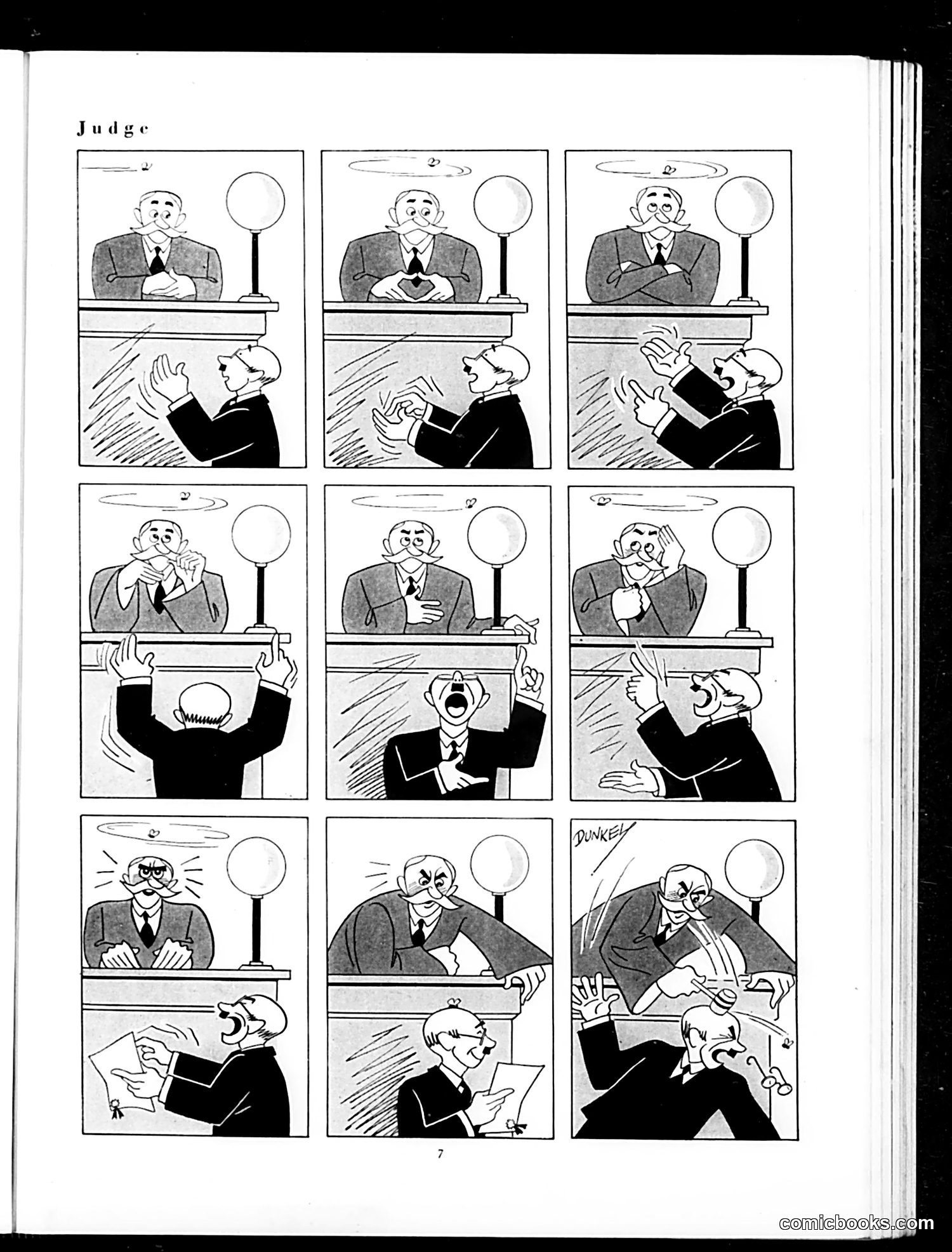
Judge Magazine - "Judge" Comic Strip This nine-panel comic depicts a judge presiding over a courtroom, with an attorney (shown below) repeatedly presenting arguments or evidence. The strip appears to satirize courtroom procedure and judicial patience. The judge's expressions shift from attentive (panels 1-2) through increasingly exasperated (panels 3-6) to visibly agitated (panels 7-9), while the attorney below persistently gestures and advocates. The final panel shows the judge's frustration reaching its peak. The satire likely mocks either: verbose legal arguments that test judicial patience, an attorney's relentless persistence despite the judge's obvious annoyance, or the tedious nature of courtroom proceedings. Without date or specific case reference visible, the cartoon works as general commentary on judicial frustration with advocate conduct—a timeless institutional critique.
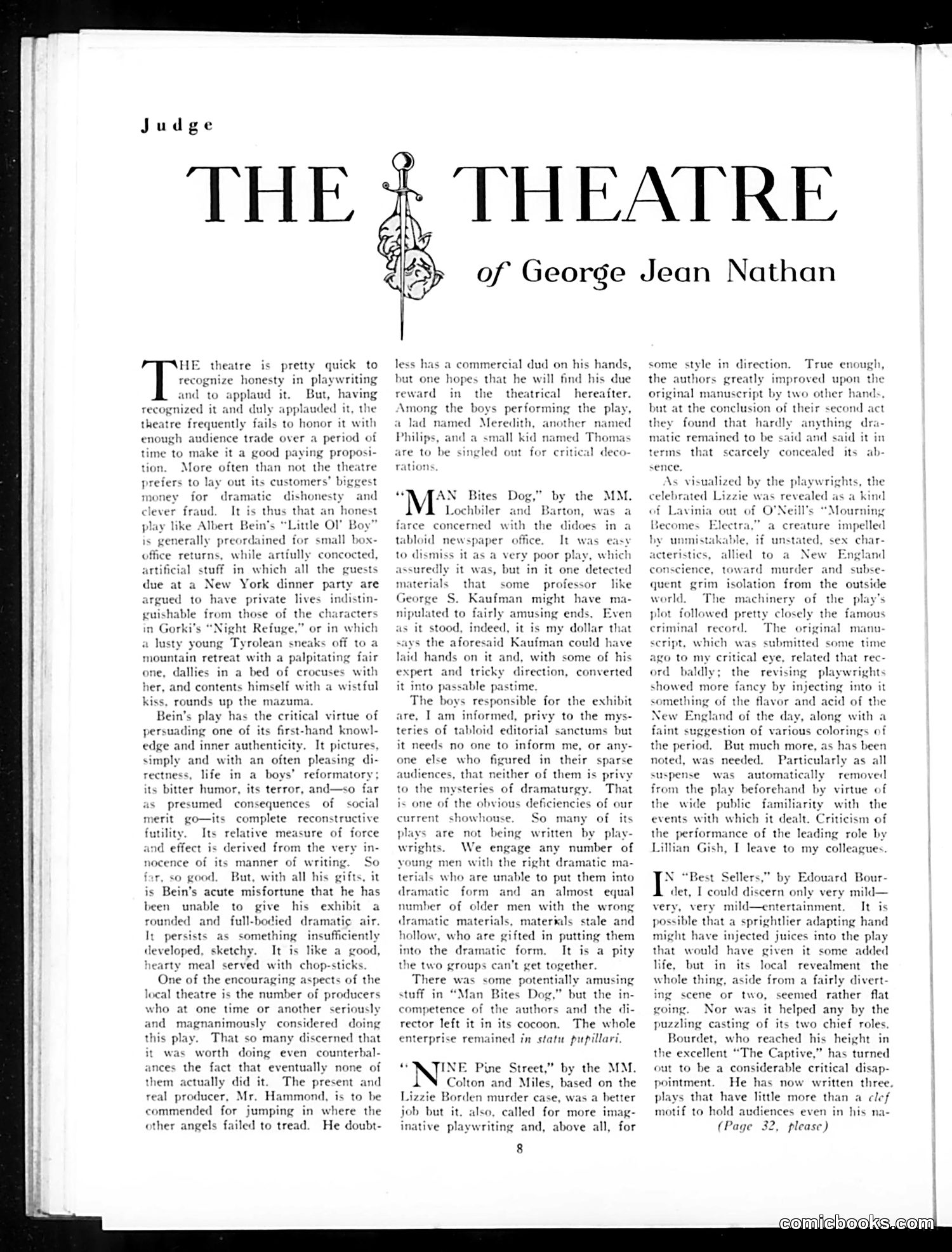
"The Theatre of George Jean Nathan" This is a drama critique column, not a political cartoon. Judge's theater critic George Jean Nathan reviews several plays, critiquing both their quality and commercial prospects. Nathan praises Albert Bein's honest play "Little Of Joy" for its authenticity and reformatory setting, but laments that truthful drama struggles financially while "artificial stuff" succeeds commercially. He notes Bein's work lacks full dramatic development despite its merit. He also dismisses "Man Bites Dog" (a tabloid newspaper farce) as poor, though acknowledging George S. Kaufman could improve it. Nathan's recurring complaint: talented writers lack dramatic materials, while experienced dramaturgists possess only stale material—a mismatch preventing good theater. The column advocates for matching skilled writers with worthy subjects.
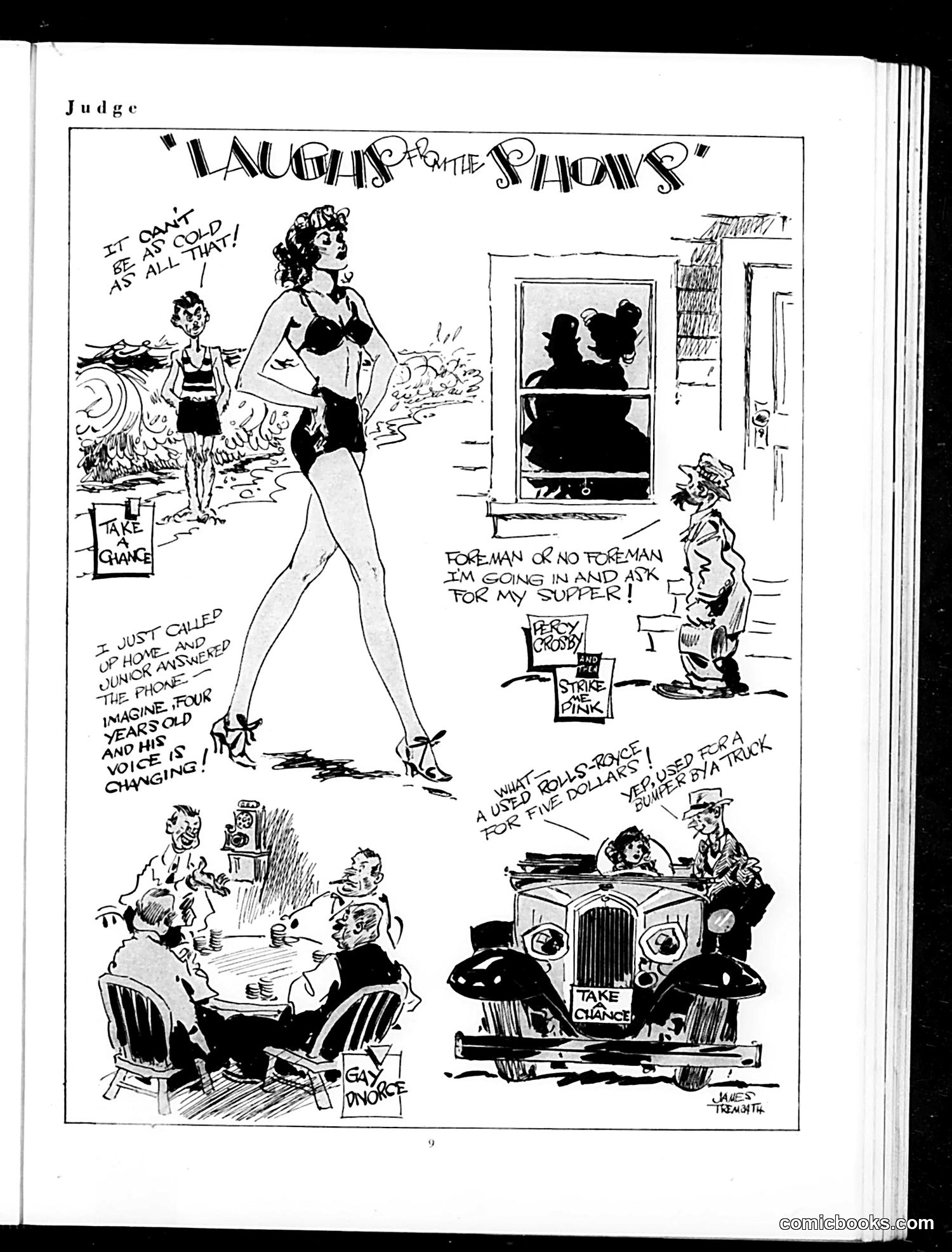
"Laughs at the Shows" This page contains four cartoon vignettes satirizing early 20th-century entertainment and social scandals: 1. Top left: A scantily-clad woman at a beach ("Take Quake") mocks her small companion, referencing a phone call where someone's voice supposedly aged four years. 2. Top right: A domestic scene where a woman announces she's going out, asking a foreman or man for "supper" money—satirizing either labor strikes ("Strike Pink") or marital financial disputes. 3. Bottom left: Labeled "Gay Divorce," depicting people in what appears to be a comedic domestic argument scene. 4. Bottom right: A car scene labeled "Take Quake," showing people in an automobile, likely satirizing both automotive culture and some unspecified con or scheme ("Used for a temperance trick"). The overall theme appears to mock contemporary theater, scandal, and social behavior through exaggerated caricature.
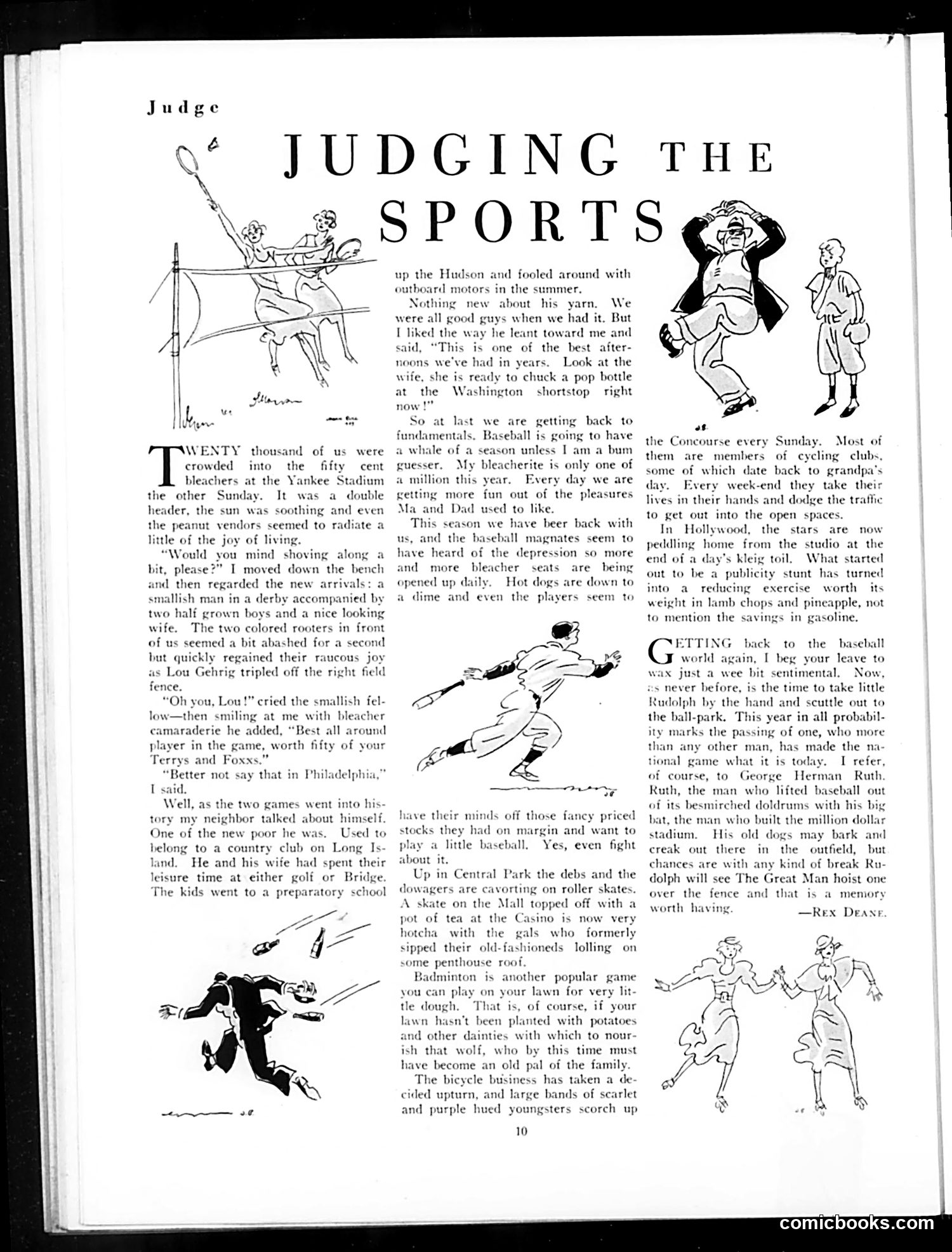
"Judging the Sports" — Judge Magazine This article celebrates baseball's resurgence during the Great Depression. The author describes attending a Yankees game at the stadium where he encounters a formerly wealthy man ("new poor") now enjoying simple pleasures with his family—attending baseball games instead of country clubs and golf. The satire targets Depression-era economic hardship with dark humor: families plant potatoes in their lawns to survive; the wealthy ("debs and dowagers") roller-skate in Central Park; Hollywood stars pedal home from studios as a "reducing exercise" (weight loss masked as economy). The piece sentimentally references Babe Ruth, baseball's greatest star, apparently nearing retirement. Ruth "lifted baseball out of its besmirched doldrums"—the author suggests the sport provided affordable joy and restored dignity when Americans lost wealth and status. Baseball becomes a democratic escape where rich and poor sit together in bleachers.
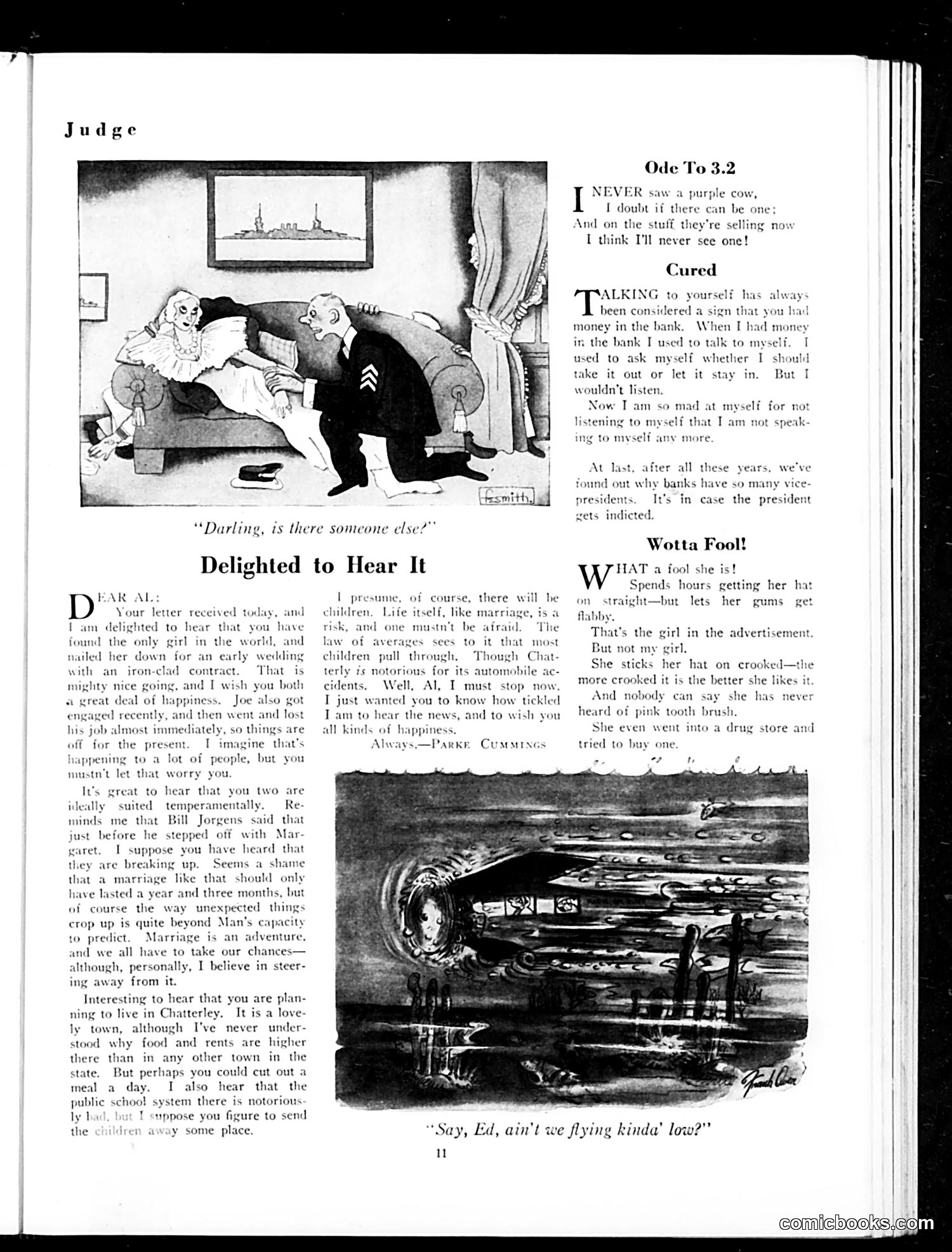
Judge Magazine Page Analysis This page from *Judge* (a major American satirical magazine) contains several social commentaries typical of early-to-mid 20th century humor: Top cartoon: A man and woman on a couch with the caption "Darling, is there someone else?" satirizes marital infidelity and domestic suspicion. "Cured": A humorous piece mocking self-talk and introspection, concluding with a joke about bank vice-presidents existing "in case the president gets indicted"—suggesting widespread corruption in banking. "Wotta Fool!": Ridicules women's vanity and beauty standards. The joke centers on a woman obsessing over getting her teeth straightened ("crooked"), yet when told crooked teeth are actually fashionable, she immediately wants them that way. The accompanying illustration shows a wreckage, captioned "Say, Ed, ain't we flying kinda' low?"—likely commenting on reckless behavior or poor judgment. The satire targets gender stereotypes, materialism, and institutional corruption common to the era's social criticism.
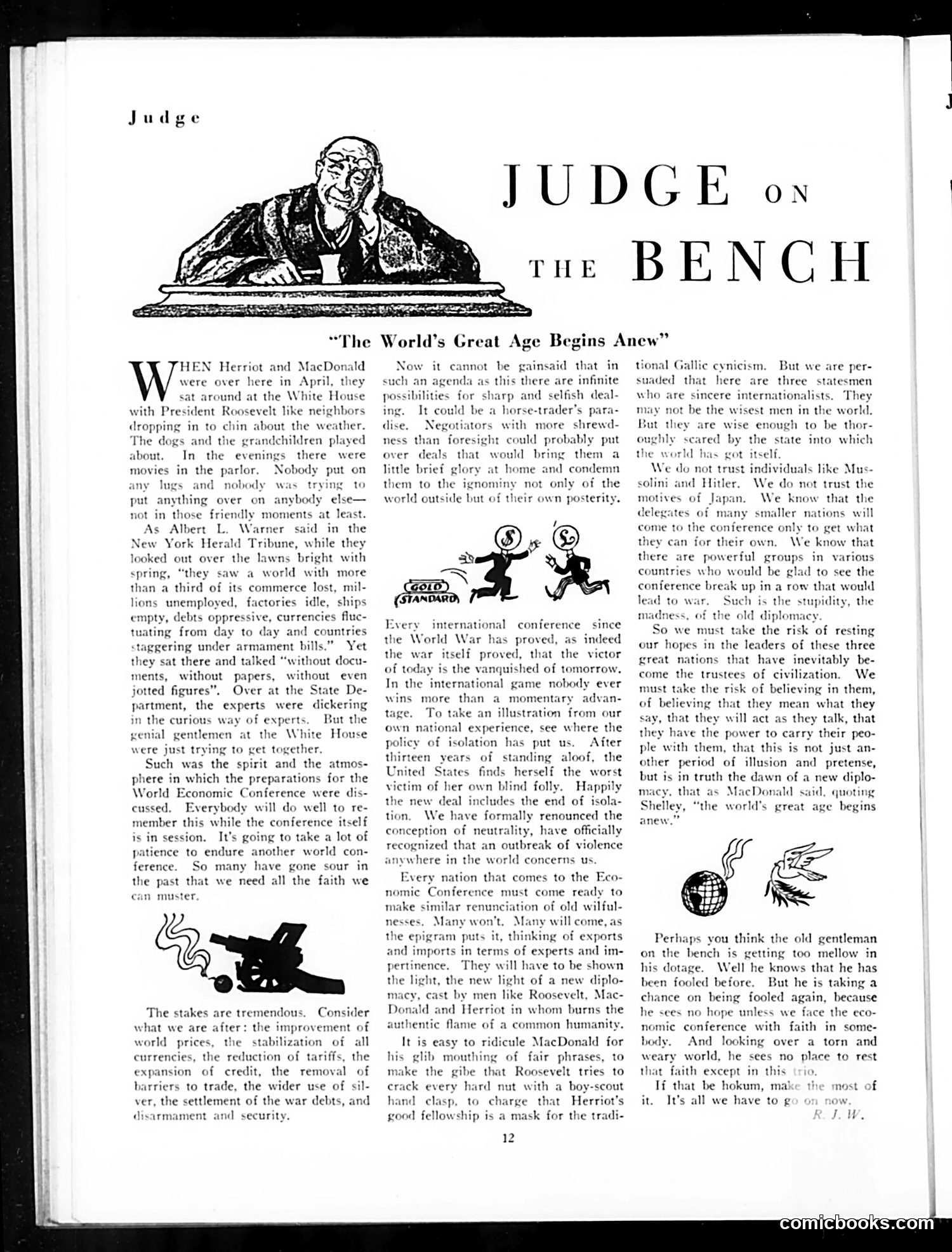
"Judge on the Bench" - Political Commentary on the World Economic Conference This editorial cartoon critiques the 1933 World Economic Conference, where President Roosevelt hosted British Prime Minister Ramsay MacDonald and French Premier Édouard Herriot at the White House. The piece sarcastically celebrates their informal, friendly discussions ("without documents, without papers") while acknowledging the stakes are enormous: stabilizing world prices, reducing tariffs, settling war debts, and achieving disarmament during the Great Depression. The satirical angle: the Judge author simultaneously mocks these leaders' optimism ("The world's great age begins anew") while defending their sincere internationalism against cynics. He argues that despite their sometimes glib rhetoric, MacDonald, Roosevelt, and Herriot genuinely believe in collective security—that isolationism (America's previous policy) only harmed everyone, including themselves. The cartoon's point: these three leaders deserve faith precisely *because* previous conferences failed and cynicism abounds. Their humanity and good intentions matter more than expert paperwork.
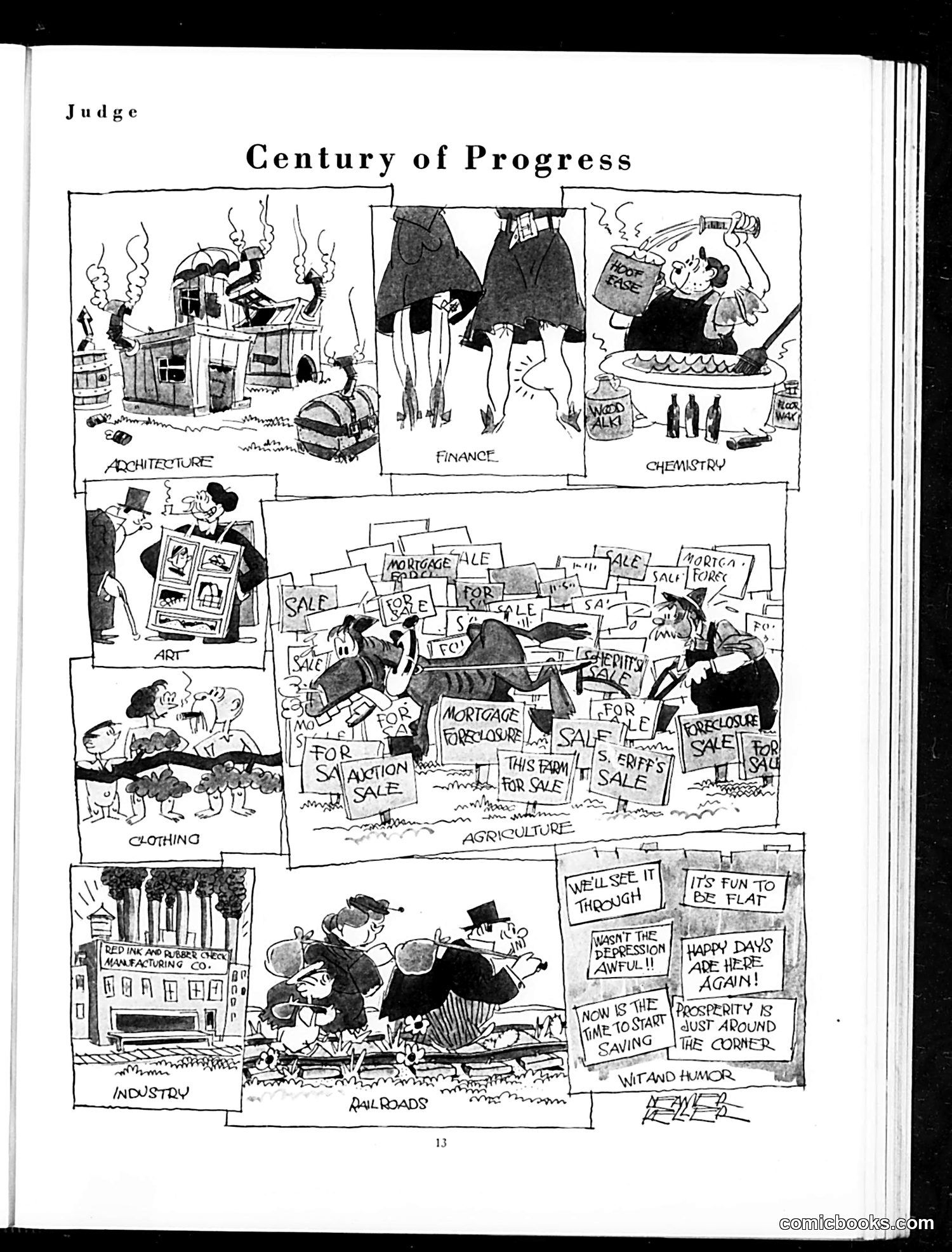
"Century of Progress" Political Cartoon Analysis This satirical comic page mocks American progress during the Great Depression era. The title ironically contrasts various sections labeled "Architecture," "Finance," "Chemistry," "Art," "Clothing," "Agriculture," "Industry," and "Railroads" with depictions of economic devastation. The central "Agriculture" panel shows a farmer surrounded by foreclosure and "For Sale" signs, depicting rural collapse. "Finance" shows women in distress, suggesting economic hardship. "Chemistry" depicts hazardous conditions. The bottom panels show industrial decline and railroad problems. The final section "Wit and Humor" contains characters making darkly comic statements about the Depression ("wasn't the depression awful," "prosperity is just around the corner"), suggesting Americans cope through cynical humor while facing genuine hardship. The cartoon's satire targets the gap between claims of national progress and citizens' actual suffering during economic crisis.
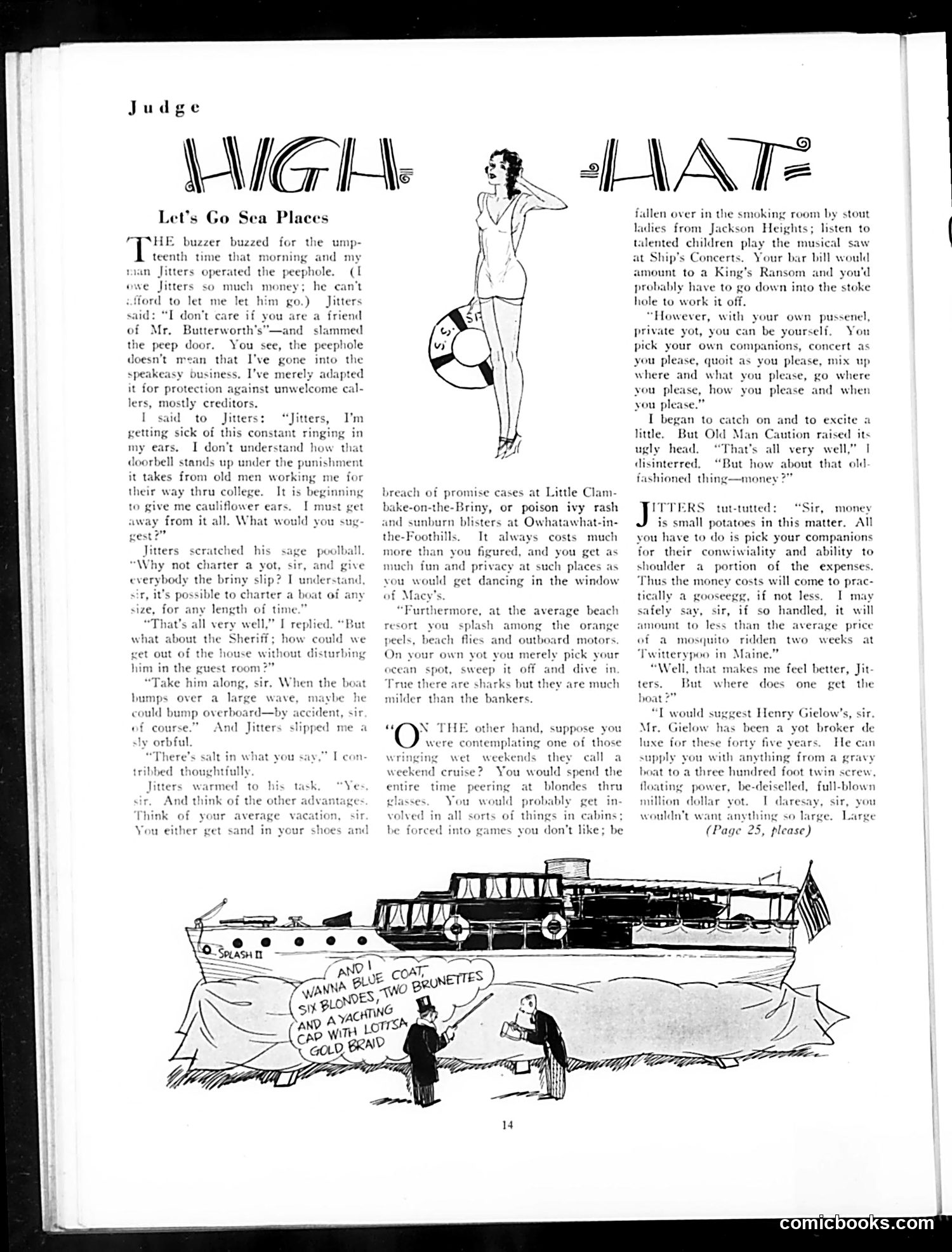
Satire Analysis: "Let's Go Sea Places" This humorous piece satirizes the leisure aspirations of 1920s American upper-middle-class professionals burdened by everyday annoyances. The narrator, "Jitters," is harassed by constant bill collectors ringing his doorbell—so persistently he's installed a peephole for protection. A judge (the magazine's persona) suggests chartering a private yacht as an escape. The satire targets two social anxieties: (1) the contradiction between desiring luxury vacations and actual financial limitations—the narrator worries vacations still cost money despite promises of "freedom," and (2) the absurdity of yacht-broker "solutions" to middle-class problems. References to modest beaches, seasickness, and "Jackson Heights" ladies suggest ordinary vacation realities. The cartoon below shows two figures contemplating a boat, one mentioning "gold bead"—likely mocking the aspirational yacht-club fantasy the article simultaneously promotes and ridicules.
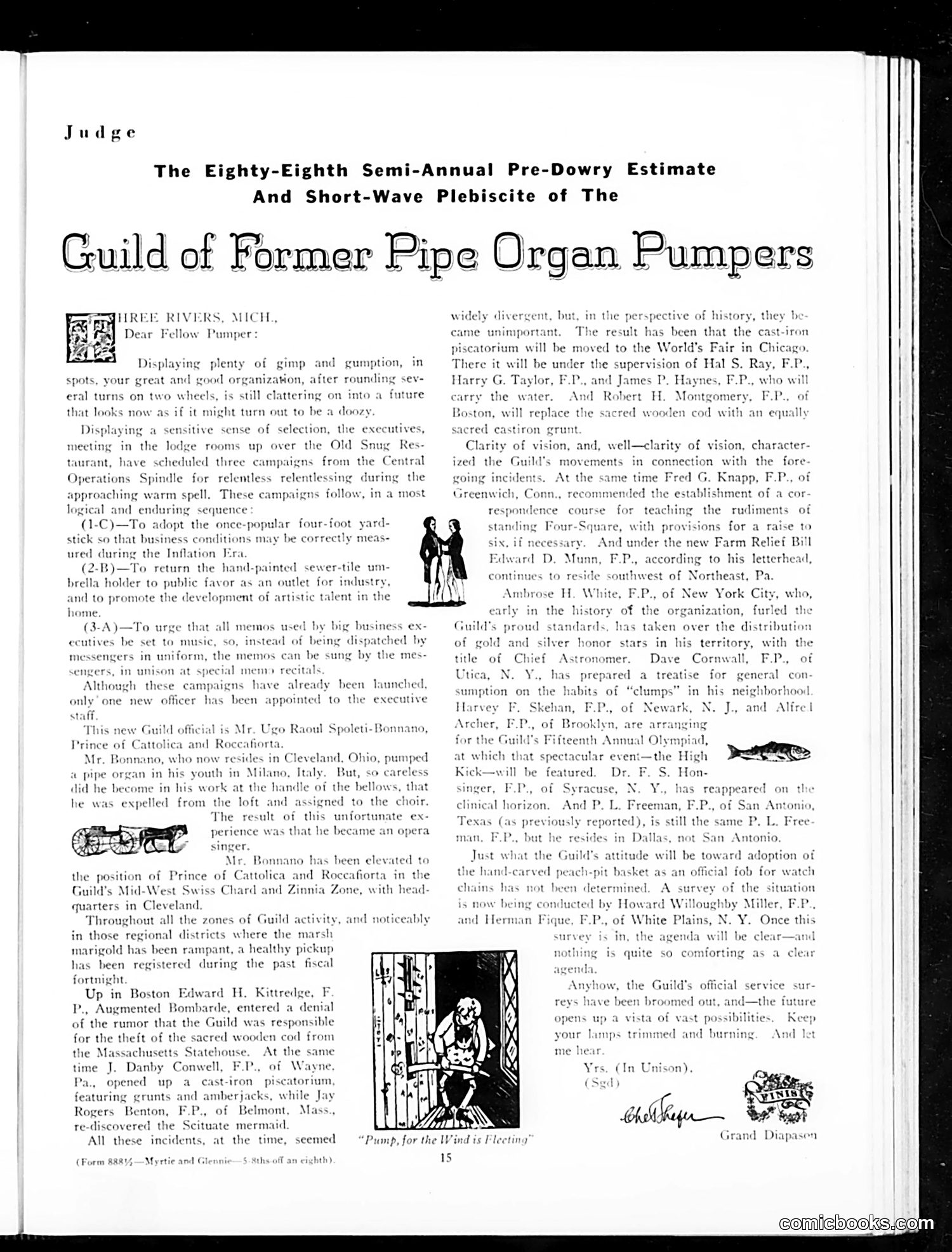
Judge Magazine Satire Analysis This page satirizes the "Guild of Former Pipe Organ Pumpers"—a fictional organization of men who once manually pumped church organs before electric motors replaced them. The satire targets several things: The Subject: Before electric blowers, churches employed young men to pump bellows that supplied air to pipe organs. The guild appears to be a nostalgic fraternal organization for these now-obsolete workers. The Jokes: The text ridicules their self-importance through absurdly grandiose language ("Prince of Cattolica," "sacred wooden cod," "hand-carved peach-pit basket as official fob"). Their "campaigns" and meetings parody pompous fraternal lodge proceedings. References to moving a "cast-iron piscatorium" to the World's Fair mock their inflation of mundane objects into treasured relics. The Satire's Point: Judge mocks American fraternal organizations (Masonic lodges, etc.) and their elaborate rituals, titles, and self-aggrandizement—particularly the elevation of obsolete labor into romantic nostalgia. The decorative illustrations throughout reinforce the whimsical tone.
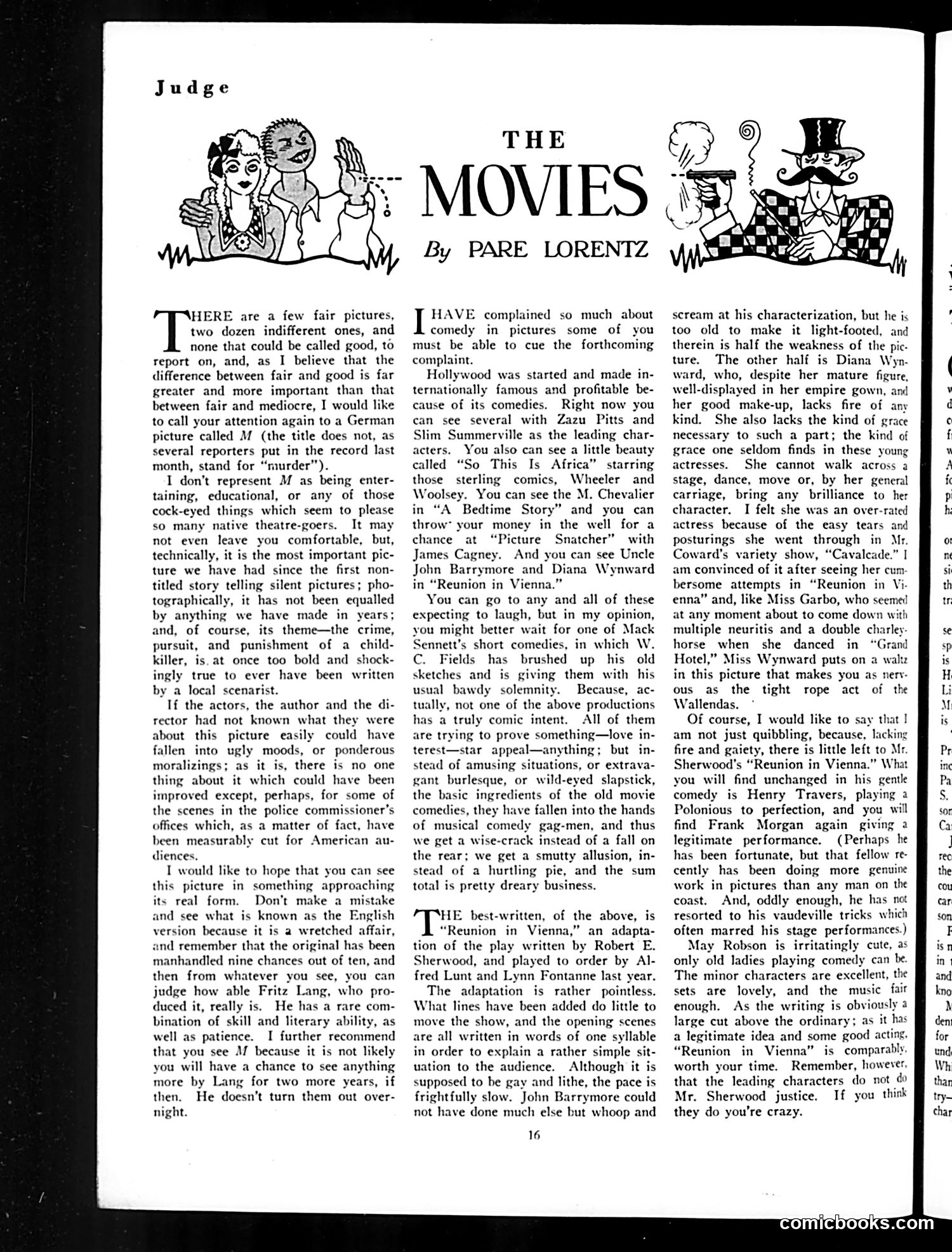
Judge Magazine Film Criticism Page This is a film criticism column by Pare Lorentz reviewing 1930s Hollywood movies. The cartoons at the top appear to be decorative header illustrations featuring exaggerated theatrical/comedic characters typical of Judge's style. Lorentz praises the German film *M* (directed by Fritz Lang) as technically superior and thematically bold—a serious crime thriller about a child-killer that avoids sentimentality. He criticizes contemporary Hollywood comedies (featuring Zazu Pitts, Wheeler and Woolsey, Maurice Chevalier, James Cagney, and John Barrymore) for abandoning genuine slapstick in favor of plot-driven "wise-cracks" and innuendo. He argues these films have lost the anarchic, physical humor that made early cinema comedies successful, instead becoming vehicles for star appeal. The satire targets Hollywood's shift toward narrative sophistication at the expense of comedy's essential ingredients: absurdity, physical humor, and genuine amusement rather than moralizing or romance.
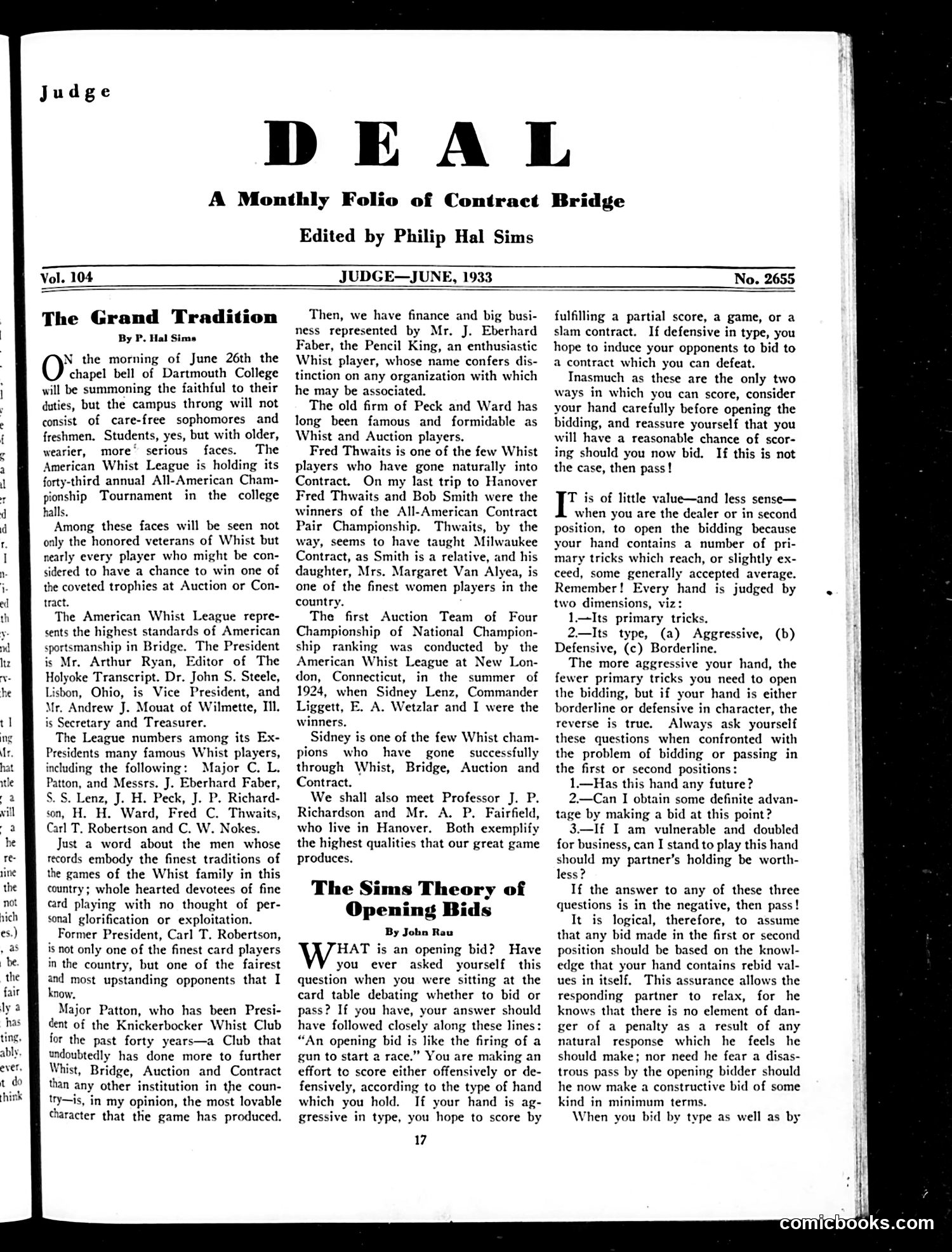
Judge Magazine, June 1933: Bridge Content, Not Political Satire This page contains no cartoons or political satire. It is entirely devoted to contract bridge instruction and community news. The content includes: 1. "The Grand Tradition" by P. Hal Sims—a profile of the American Whist League's 43rd championship tournament at Dartmouth College, celebrating prominent bridge players and the game's traditions. Named figures include Carl T. Robertson, Major C. L. Patton, and J. Eberhard Faber (identified as "the Pencil King"). 2. "The Sims Theory of Opening Bids" by John Rau—instructional article about bridge strategy, explaining how to assess hand value when deciding whether to bid or pass. This reflects that *Judge* magazine during this period published diverse content beyond satire, including lifestyle and hobby features aimed at its affluent readership interested in card games.
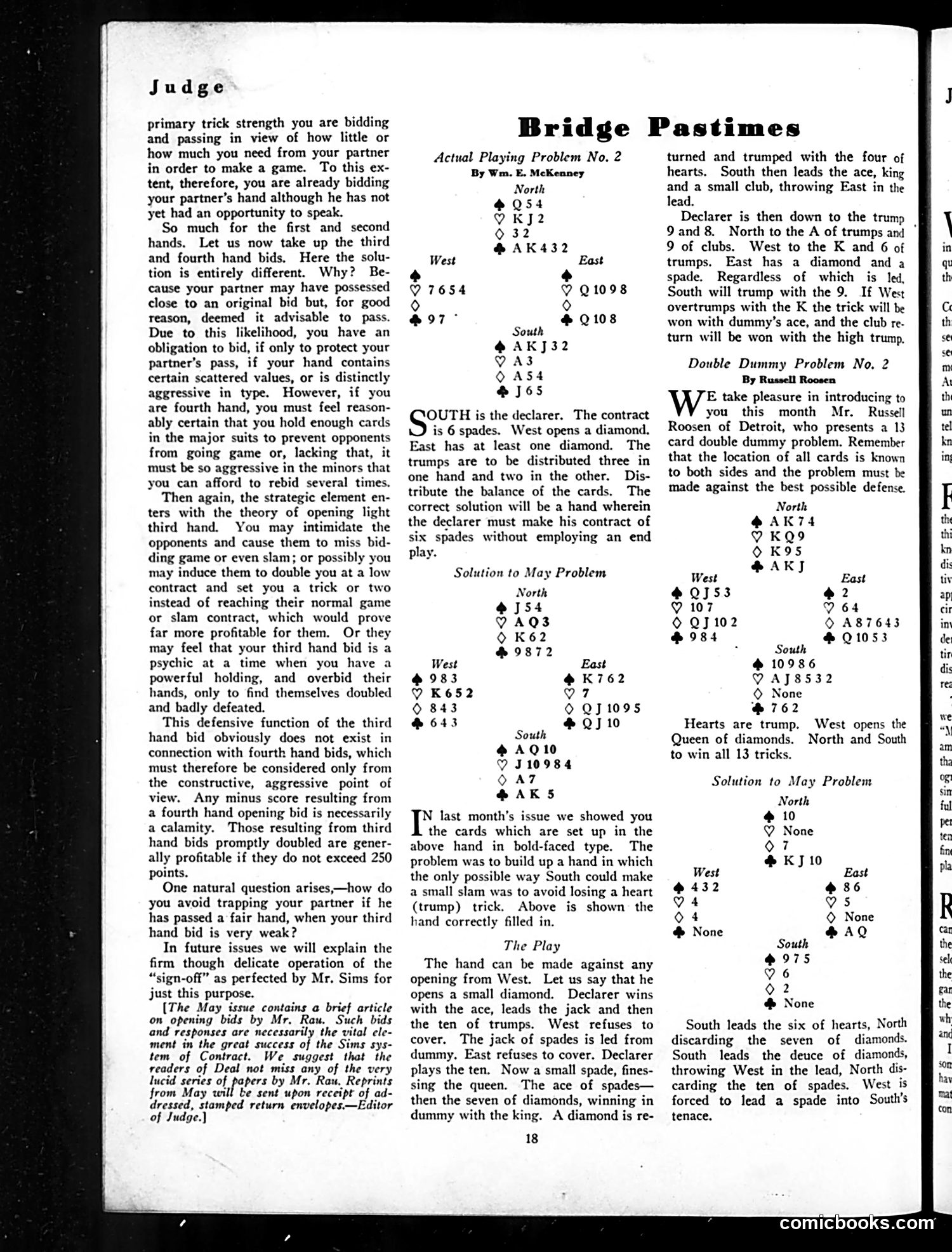
Bridge Content Analysis This page contains bridge card game instructional content, not political satire. It's from *Judge* magazine's "Bridge Pastimes" section, featuring: 1. Educational article on bidding strategy by Wm. E. McKenney, discussing third and fourth hand bids in contract bridge 2. Two bridge problems: "Actual Playing Problem No. 2" and a "Solution to May Problem" with card hands and strategic analysis 3. A problem by Russell Roosen featuring a 13-card double dummy scenario The content is entirely devoted to teaching bridge players advanced bidding and play techniques. There are no political cartoons, caricatures, or social satire on this page—it's straightforward instructional material for bridge enthusiasts, reflecting the magazine's diverse content beyond its famous political satire sections.
Analysis of "The Fog Has Been Dispelled" This article by Derrick J. Wernher discusses the development of Contract Bridge, a card game that was revolutionizing American leisure in the early 1930s. The Subject: Hal Sims, a bridge expert who developed a systematic approach ("the Sims system") to Contract Bridge, which was still relatively new and confusing to players trained in the older "Auction" Bridge. The Metaphor: Wernher uses fog as a metaphor for the confusion Contract Bridge initially caused players. Sims is the guide who "led me out of the fog." The Point: The article celebrates how Sims transformed an obscure, poorly-understood card game into something logical and teachable through systematic analysis. His methods were finally published in 1932, making Contract Bridge accessible to the general public. Cultural Context: This reflects the 1930s American enthusiasm for bridge as a sophisticated social activity. Ed Wynn (mentioned as a comedic reference) was a famous entertainer of the era. The adjoining "Slams and Finesses" column provides related bridge commentary and book reviews.
Analysis of Judge Magazine Page This page contains two distinct elements: an article about bridge card play and period advertisements. The Main Article ("Good Cards Make Good Players?" by Millard P. Kaiser) discusses contract bridge strategy. The author argues that skilled play matters more than card luck. He recounts a St. Louis club experience where, despite receiving favorable hands, his skillful play—and opponents' demoralized play—enabled him to win substantially. When challenged by a losing opponent, he confidently bet that the same hands dealt to different tables would produce wildly different scores (600+ point swings). His investigation of tournament data confirmed this: analyzing duplicate bridge tournaments showed massive scoring variations (up to 1200+ points) when identical hands were played by different players. The satire targets amateur players who blame bad cards rather than poor play. The Advertisements are for Vicks Voratone Antiseptic mouthwash, using humor ("Amount of Mouth-wash you get for 35¢") to advertise a budget-friendly product at half the typical price. The page reflects 1930s-1940s leisure culture and the emerging popularity of competitive bridge among middle-class Americans.
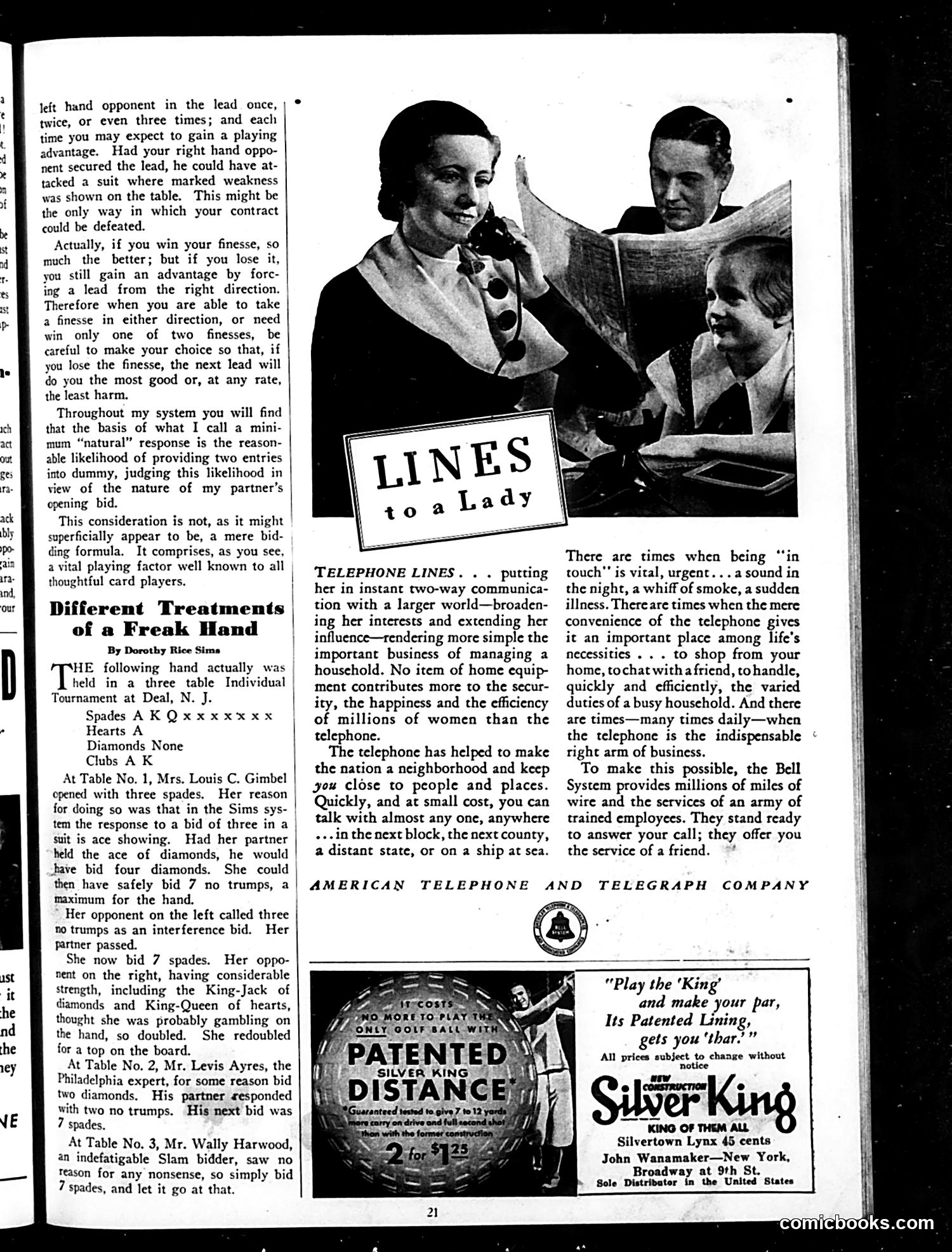
Analysis for Modern Readers This page is primarily advertising and instructional content rather than political satire. The main article, "Different Treatments of a Freak Hand" by Dorothy Rice Sims, is a bridge (card game) strategy lesson analyzing how different players bid an exceptional hand at a tournament in Deal, New Jersey. It's technical content for card enthusiasts. The photo labeled "Lines to a Lady" is an advertisement for the Bell Telephone System. It shows a woman at a telephone and promotes how telephones connect people across distances—positioning the telephone as essential for household management, business, and emergencies. The accompanying text emphasizes that telephone service is vital, affordable, and indispensable to modern life. Below is a product advertisement for "Silver King" golf balls, claiming a patented lining improves performance. The page reflects early-to-mid 20th-century consumer culture: bridge as popular entertainment, telephone infrastructure as modern convenience, and branded sporting goods as aspirational products.
"Judging the Books" - A Literary Critic's Spring Lament This page is primarily a book review column, not a political cartoon. The left side advertises Chalfonte-Haddon Hall hotel in Atlantic City; the right contains humorous literary criticism. The column's premise satirizes the "Spring List" phenomenon—the overwhelming flood of new books publishers release annually. The critic (identified as "yr. lit. pal") jokes about experiencing "Spring Listlessness," a guilt-ridden paralysis from the *obligation* to read and review everything while knowing it's impossible. The reviews themselves employ witty, irreverent commentary typical of Judge magazine's satirical tone. For instance, the critic nicknames Russian author Panteleimon Romanof "Pantie" and praises him for avoiding Soviet propaganda themes to write about human emotions instead. Similarly, Tiffany Thayer is mocked as writing "like a cross-eyed Hemingway" with offensive humor that morality crusader John Sumner will likely censor. The satire targets both publishing excess and literary pretension of the era.
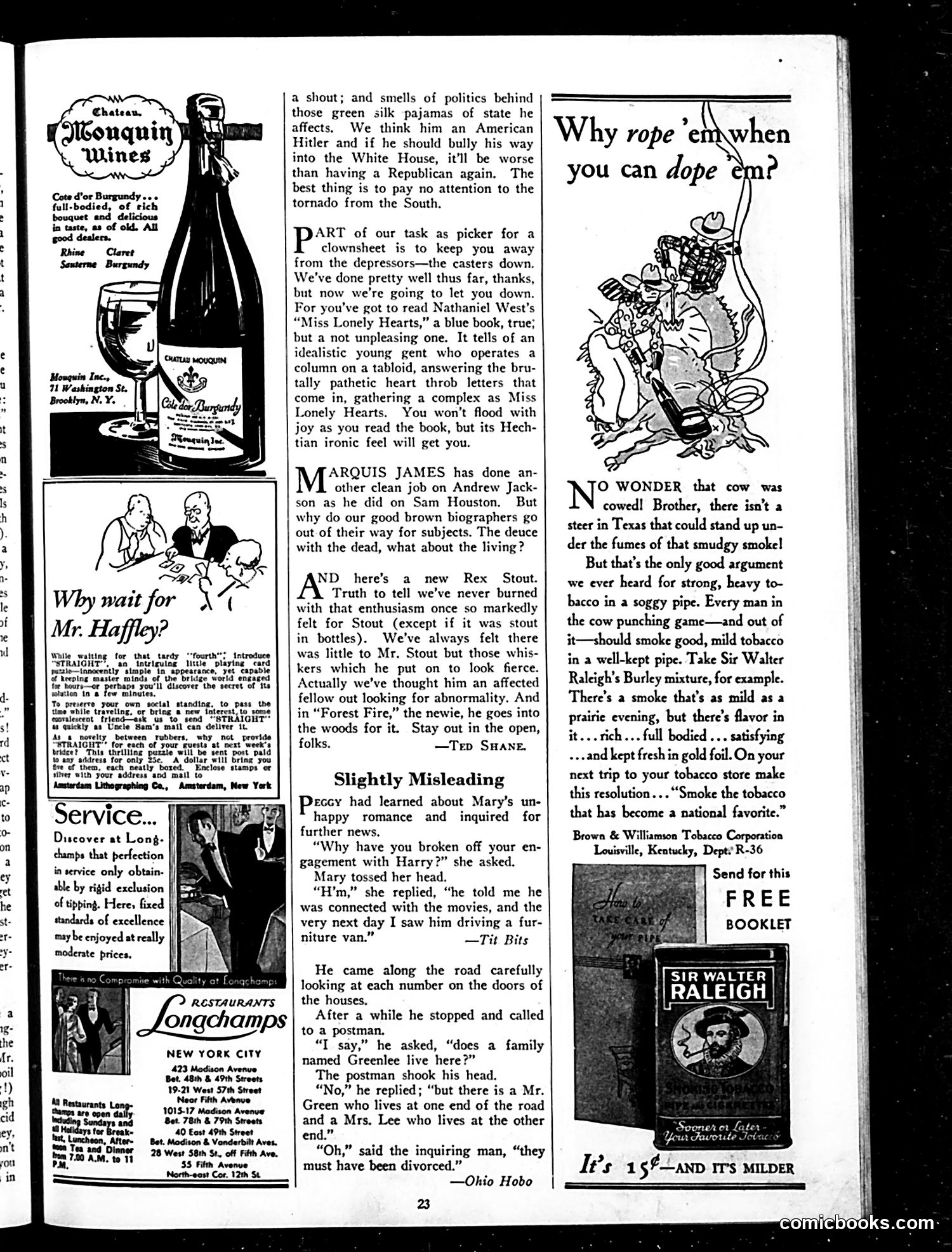
Analysis of Judge Magazine Page Content This page from *Judge* magazine contains several distinct elements: Political Commentary: The opening text attacks an unnamed Southern political figure (described as "an American Hitler"), warning he threatens worse outcomes than Republicans. This appears to reference a contemporary Southern politician from the magazine's era, likely 1930s. Literary Reviews: The page recommends Nathaniel West's *Miss Lonely Hearts* and praises a biography by Marquis James on Andrew Jackson, offering satirical commentary on contemporary literature. Advertisements: Multiple ads for Chateau wine, bridge game cards, restaurants (Longchamps), and Sir Walter Raleigh tobacco dominate the layout. Humorous Anecdotes: Two brief comedic stories—one about a woman who breaks her engagement after discovering her fiancé drives a furniture van (implying lower status), and another wordplay piece about someone searching for "Greenlee" but finding "Green" and "Lee" separately. The page is primarily advertising-driven with satirical commentary interspersed, typical of *Judge's* format blending commerce with social observation.
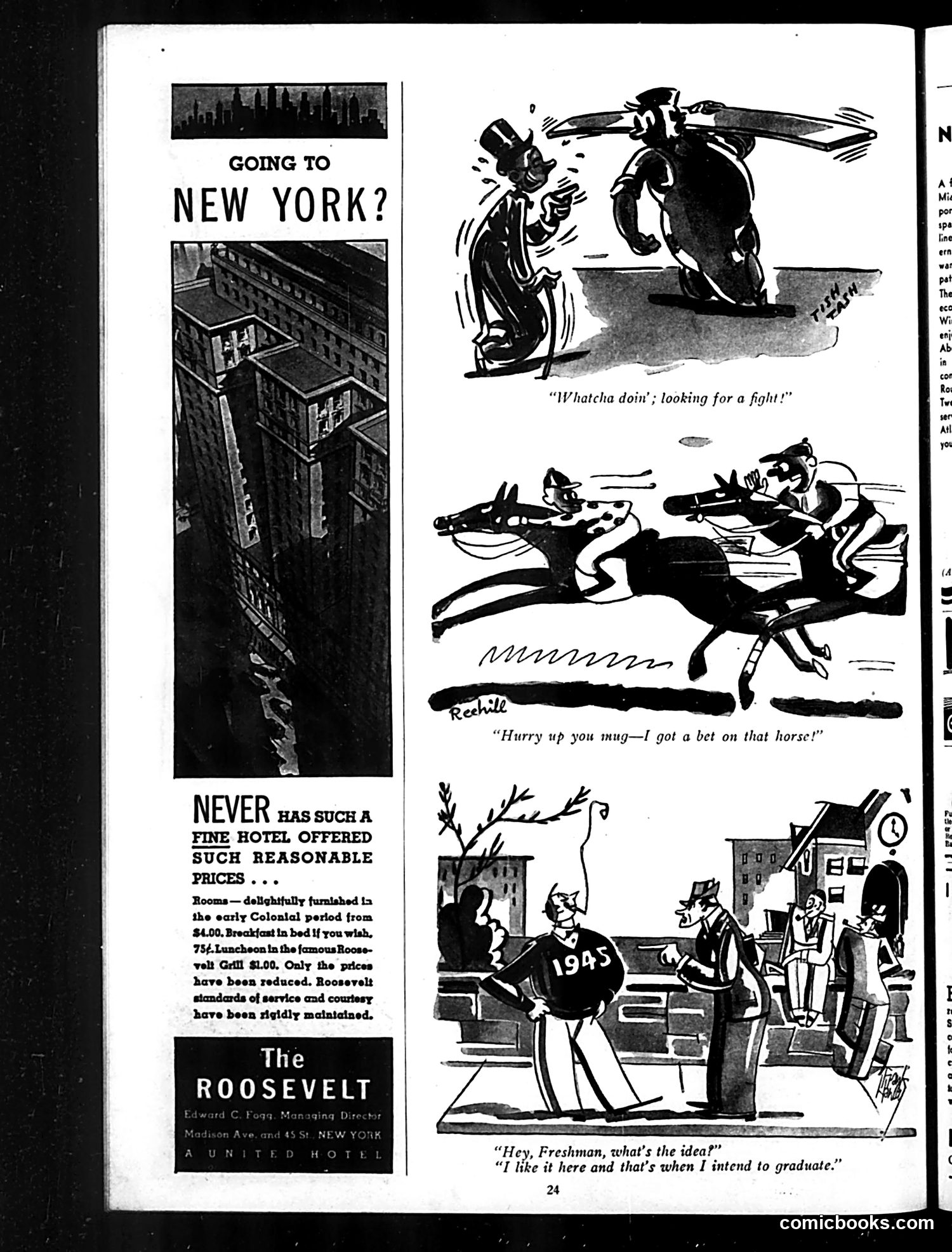
Judge Magazine Page Analysis This page contains three editorial cartoons (upper right) and a hotel advertisement (left). The cartoons appear to satirize 1940s American leisure and social life. The top two panels mock gambling and horse racing culture with characters seeking fights and placing bets. The bottom cartoon, dated 1943, depicts a college freshman amid town buildings, with dialogue suggesting he plans to stay through graduation—likely satirizing wartime disruptions to education as young men faced military service pressures. The Roosevelt Hotel advertisement emphasizes maintaining quality service ("standards of service and courtesy have been rigidly maintained") while reducing prices—presumably responding to wartime economic conditions or competition. Room rates of $4.00 and meal prices of 75¢-$1.00 are highlighted as bargains for a fine hotel. Together, the page captures 1940s American life during wartime, blending social satire with commercial messaging typical of Judge magazine's format.
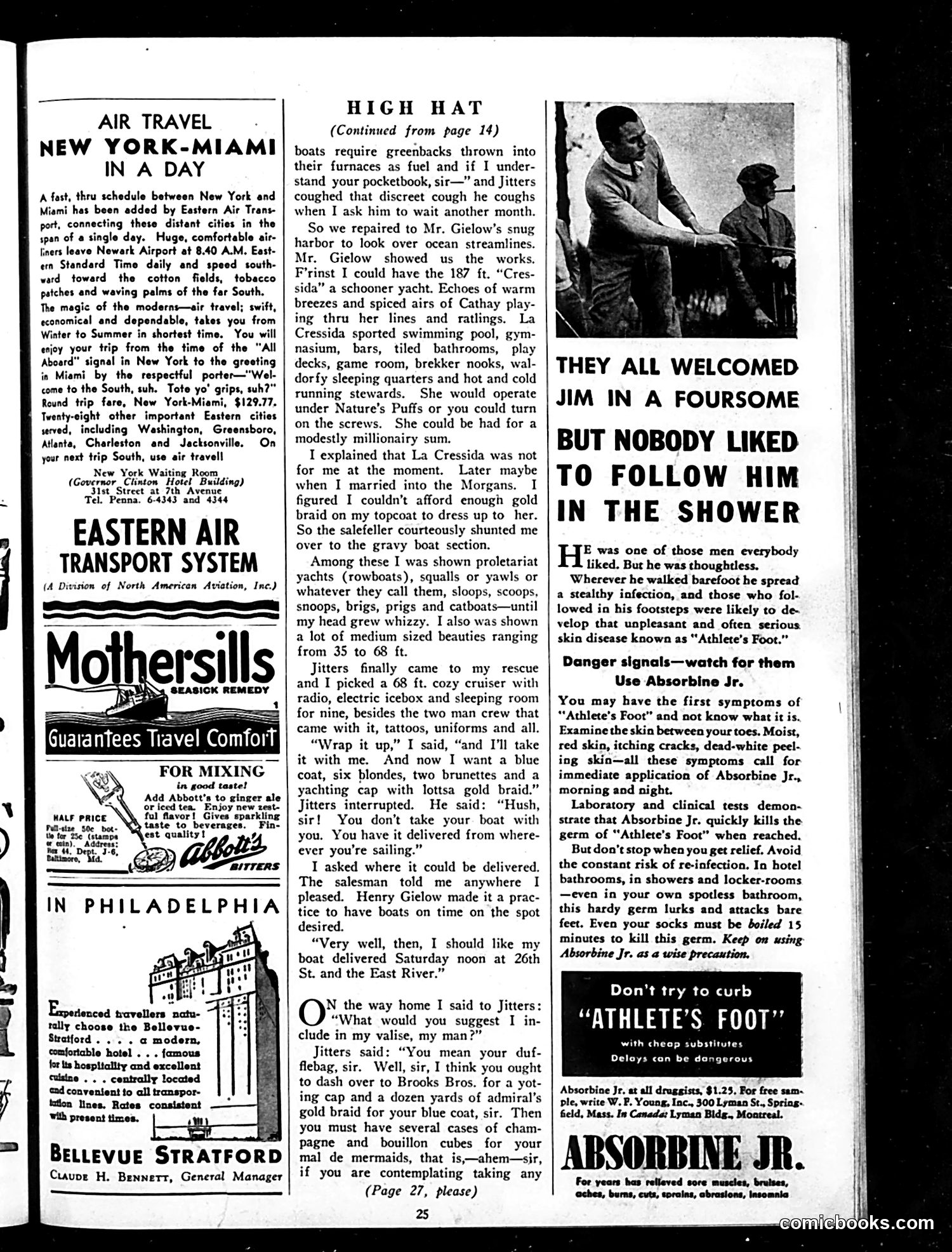
Explanation for Modern Readers This page is primarily advertisements and serialized fiction, not political satire. The main content is "High Hat," a humorous short story about a narrator shopping for a yacht with his assistant "Jitters." The satire is social—mocking wealthy leisure-class pretensions: the narrator fantasizes about buying an expensive schooner (La Cressida) but settles for a modest 68-foot cruiser, joking he can't afford the "gold braid" to dress appropriately for the fancier vessel. The joke hinges on class anxiety and conspicuous consumption humor typical of 1920s-30s magazines. The ads (Eastern Air Transport, Bellevue Stratford hotel) reflect the era's enthusiasm for modern travel and luxury services. The Absorbine Jr. advertisement uses "Athlete's Foot" as a cautionary health message—common medical advertising of the period. No specific political figures or events are referenced on this page.
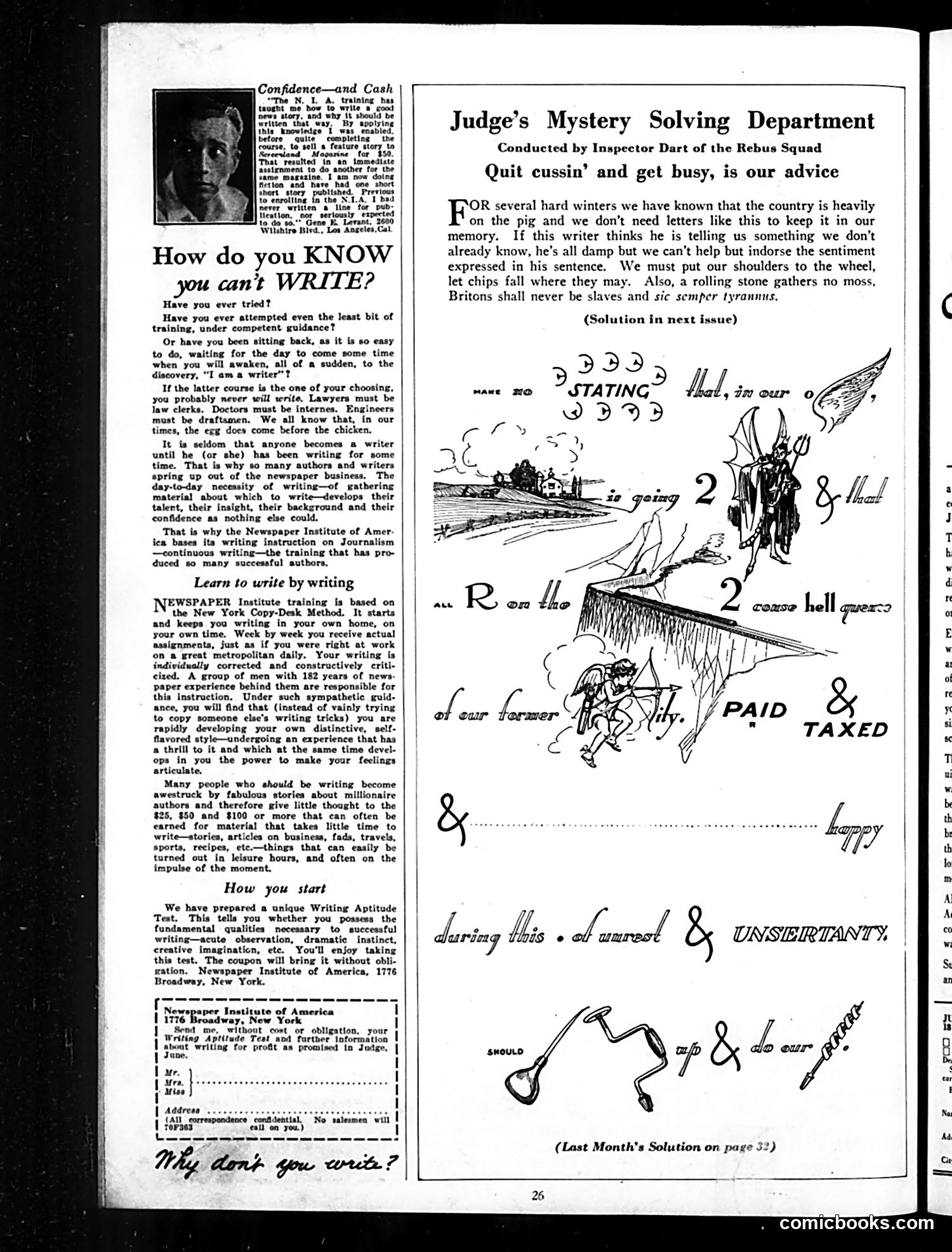
Judge Magazine Page Analysis This page contains two distinct sections: Left side: An advertisement for the Newspaper Institute of America's writing course. It uses motivational copy ("How do you KNOW you can't WRITE?") to recruit students, positioning journalism training as the path to becoming a published author. The ad appeals to aspiring writers by emphasizing that successful authors typically develop through newspaper work rather than sudden inspiration. Right side: "Judge's Mystery Solving Department," a visual puzzle feature. It presents a rebus (picture-word puzzle) where readers must decode a message using images and text fragments. The solution apparently references economic hardship—mentions of "pig," winter difficulties, and phrases like "PAID & TAXED" and "during this all worried & UNCERTAINTY" suggest the puzzle contains a commentary on financial struggle, possibly related to Depression-era concerns about employment and taxation. The page blends commercial promotion with entertainment typical of Judge's mix of advertising and satirical content.
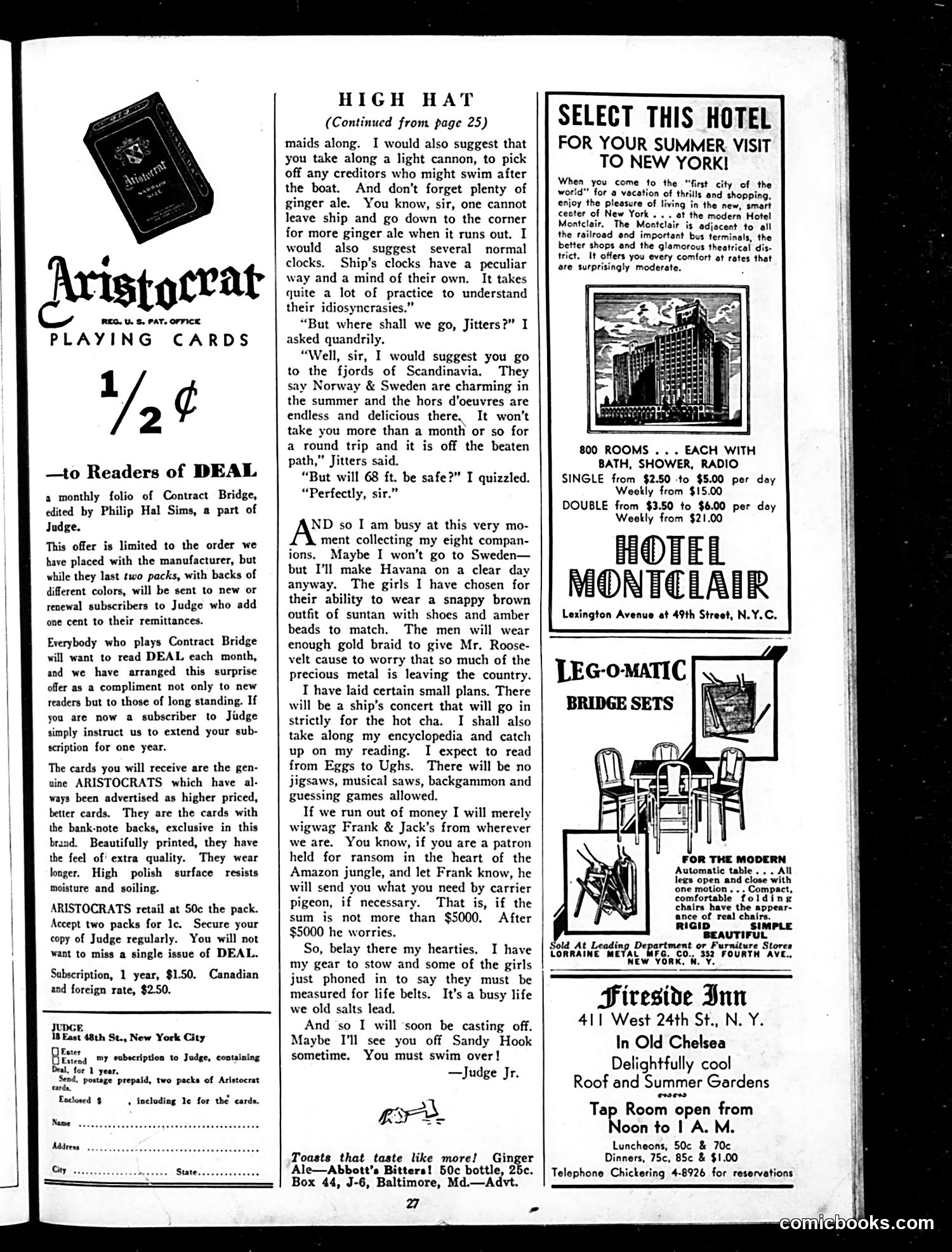
"High Hat" Satirical Story Column This page contains the continuation of a humorous fictional narrative titled "High Hat" (the author appears to be "Judge Jr."). The story satirizes wealthy leisure travel and pretension through a first-person narrator planning an extravagant yacht voyage. The satire targets: wealthy dilettantes and their absurd preparations for travel (bringing cannons to ward off creditors, excessive gold braid uniforms), excessive consumption (abundant ginger ale, endless Scandinavian seafood), and the casual entitlement of the rich (assuming they can simply "wigwag" (telegraph) wealthy friends like Frank and Jack for $5,000 ransoms if kidnapped in the Amazon). The humor lies in the narrator's oblivious, rambling account of staffing the voyage with attractive women and gold-braided men, ship's concerts, and encyclopedic reading—treating serious matters as entertainment. The remainder of the page contains advertisements and subscription offers unrelated to the satire.
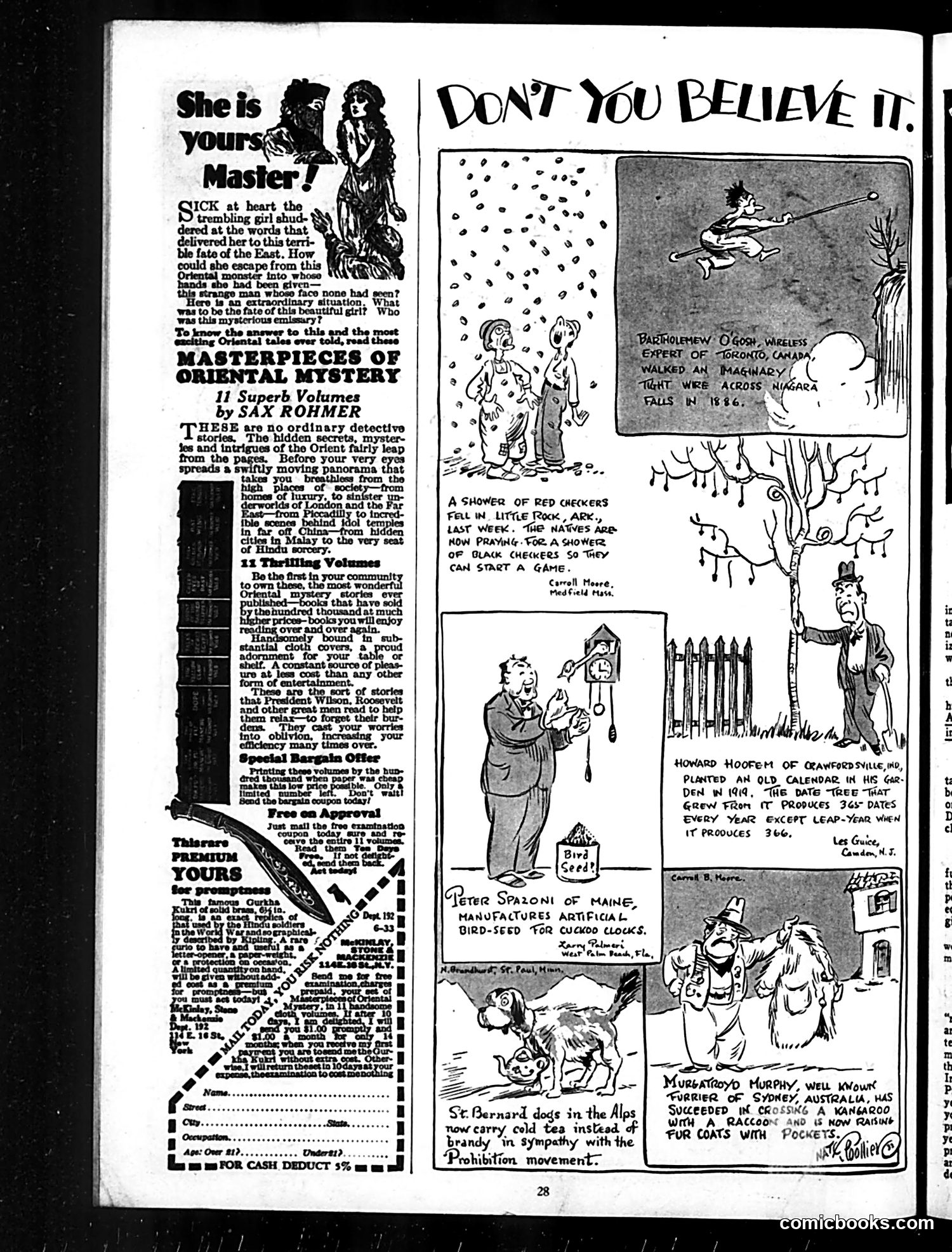
Analysis of Judge Magazine Page This page contains two distinct elements: Left side: An advertisement for Sax Rohmer's "Masterpieces of Oriental Mystery"—a 11-volume detective fiction series featuring exotic Eastern intrigue. This represents early 20th-century pulp fiction marketing, playing on Western fascination with "Oriental" mysteries and danger. Right side: A collection of humorous tall tales titled "Don't You Believe It," featuring absurdist anecdotes with credited authors. These include impossible scenarios: a calendar producing dates, artificial bird-seed for cuckoo clocks, and a kangaroo-raccoon fur coat hybrid. The humor relies on deadpan presentation of obvious fabrications, mocking gullible readers and perhaps tabloid culture's credulous reporting. The page reflects Judge's satirical purpose: entertaining readers through both consumer critique (the exotic fiction ads) and absurdist humor debunking tall tales and exaggeration in popular media.
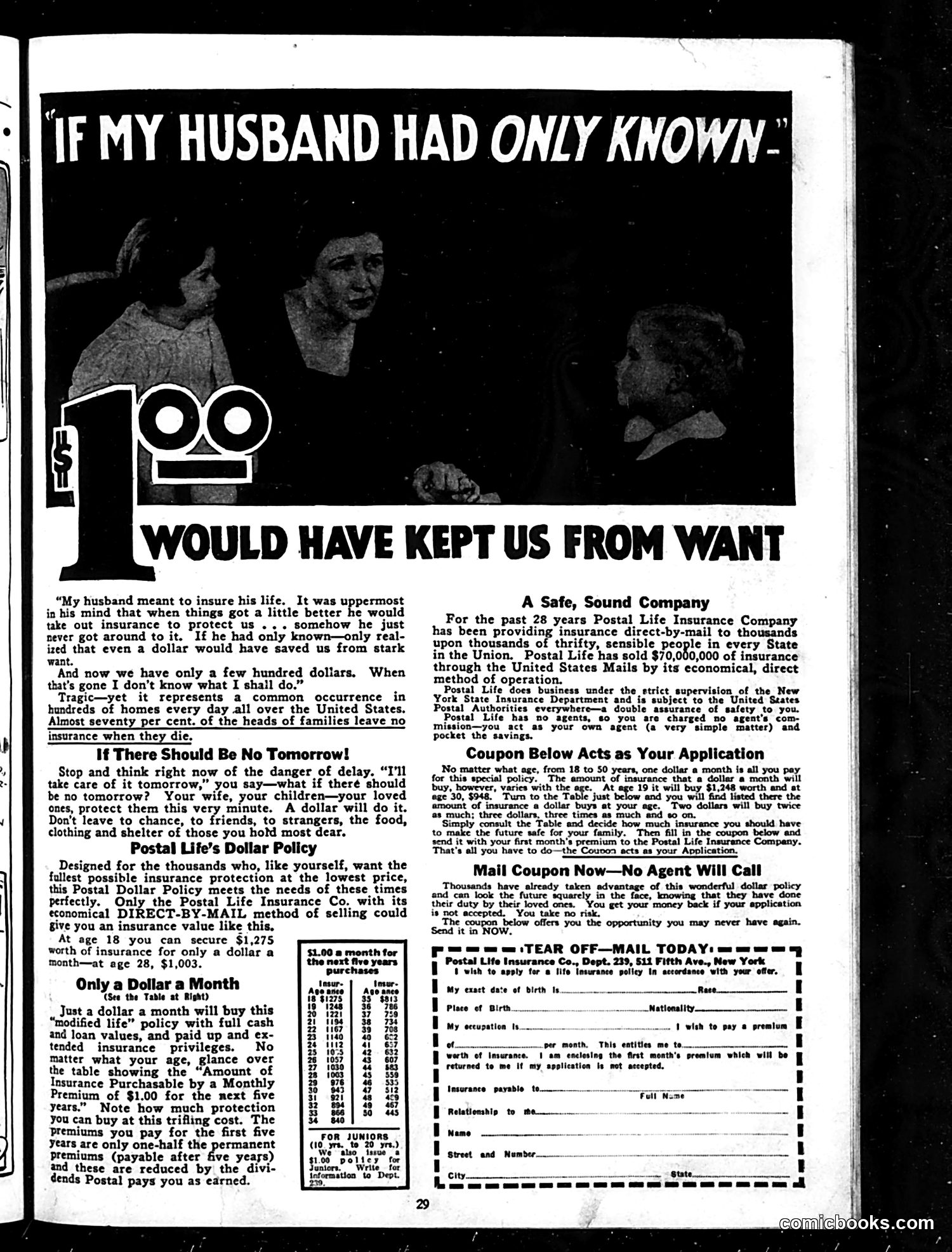
Analysis of This Insurance Advertisement This page is primarily a life insurance advertisement, not a political cartoon. It's a mail-order pitch from Postal Life Insurance Company promoting their "Dollar Policy." The Content: The advertisement opens with a testimonial from a widow whose husband delayed buying life insurance—he died without it, leaving her and their children in financial hardship. This emotional appeal frames the sales pitch: for just one dollar per month, a young person can secure substantial life insurance coverage. The Social Context: In the early 20th century, life insurance was marketed directly to working- and middle-class families as protection against the catastrophic poverty that followed a breadwinner's death. The advertisement targets anxious readers by emphasizing how common it was for families to face destitution after losing the primary earner—seventy percent of family heads supposedly left no insurance. The Pitch: Postal Life's innovation was "direct-by-mail" selling (no agents needed), which allegedly reduced costs, allowing younger purchasers to buy significant coverage cheaply. This advertisement represents how insurance companies addressed widespread economic anxiety about family security.
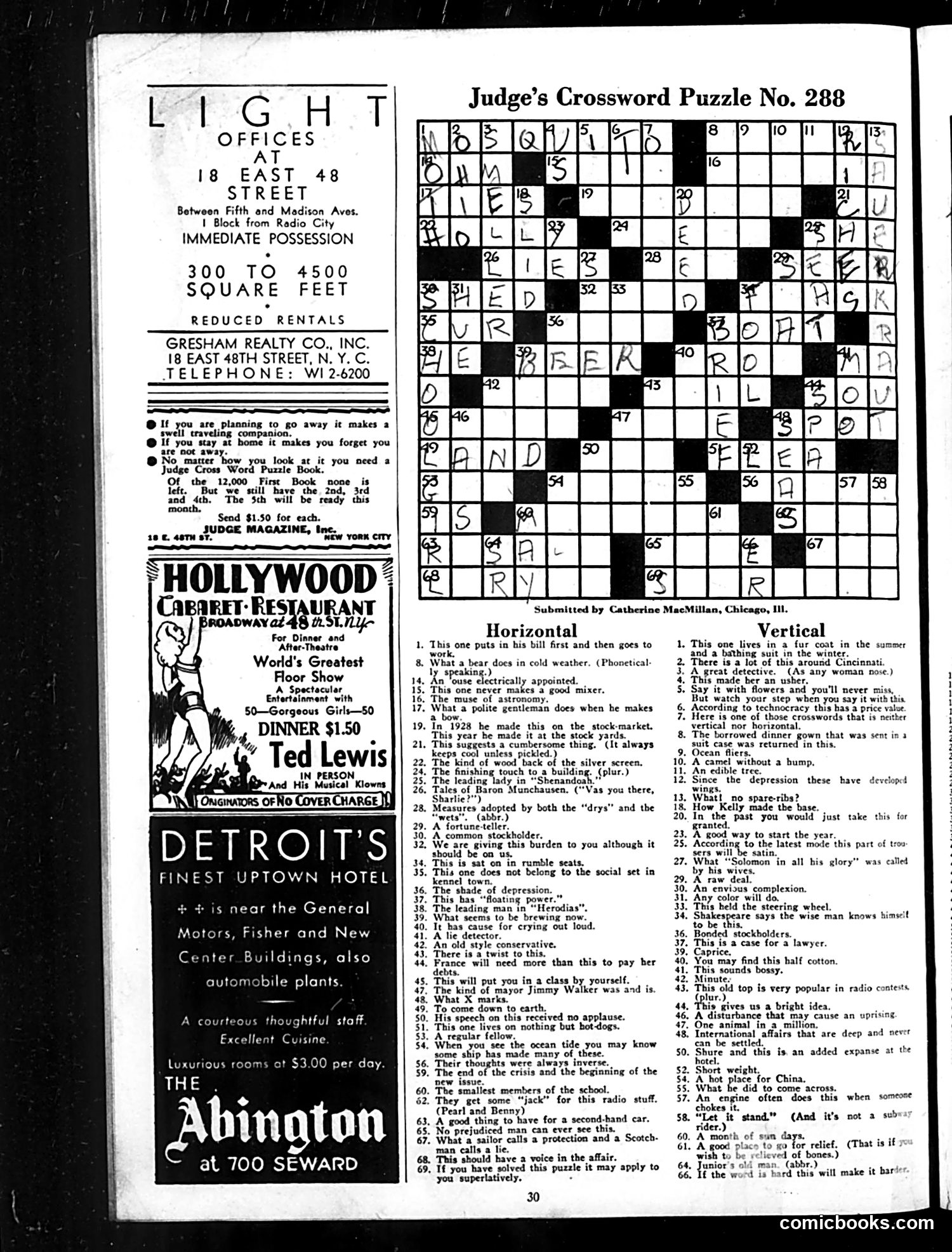
Judge Magazine Page Analysis This page is primarily advertising and a crossword puzzle, not a political cartoon. The main content is "Judge's Crossword Puzzle No. 288," submitted by Catherine MacMillan of Chicago. The advertisements reflect 1920s-30s era concerns: office space near "Radio City," reduced commercial rentals (suggesting economic depression), hotel rooms at $3.00/day, and entertainment venues like the Hollywood Cabaret-Restaurant featuring "Ted Lewis" and a "Floor Show." The crossword clues contain period-specific references: mentions of "stock-market" gains in 1928, "Mayor Jimmy Walker" (NYC politician), Prohibition-era language about "drys" and "wets," and technological novelties like "floating power" (engine technology) and "lie detector" (early forensic science). The clues use contemporary slang and social commentary typical of Judge magazine's satirical approach, but this particular page is dominated by commercial advertising and puzzle content rather than editorial cartooning or explicit political satire.
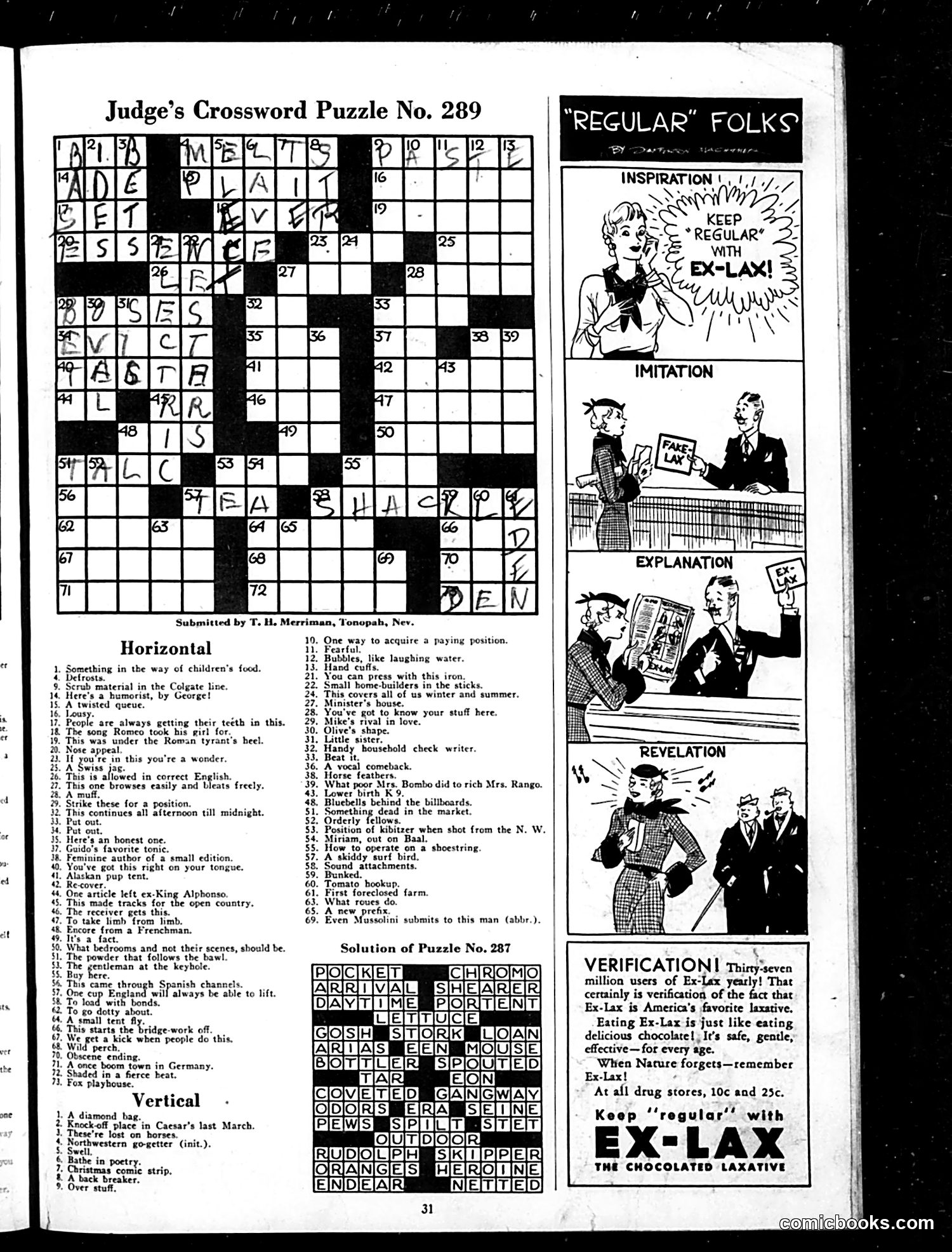
Analysis of Judge Page No. 289 This page is primarily a crossword puzzle with accompanying clues, submitted by T. H. Merriman of Tonopah, Nevada. The puzzle itself contains no political satire or cartoon content requiring historical context. The right side features "Regular" Folks, a comic strip segment showing four panels labeled "Inspiration," "Imitation," "Explanation," and "Revelation." These appear to depict everyday domestic or social situations with mild humor, though the specific narrative is difficult to parse from this reproduction. The bottom section includes the solution to a previous puzzle and an Ex-Lax laxative advertisement—a product that was heavily marketed in American magazines of this era, emphasizing its chocolate flavor and gentleness as a bowel regulator. This page is primarily recreational/advertising content rather than satirical commentary. No specific political figures or events are identifiable from the visible material.
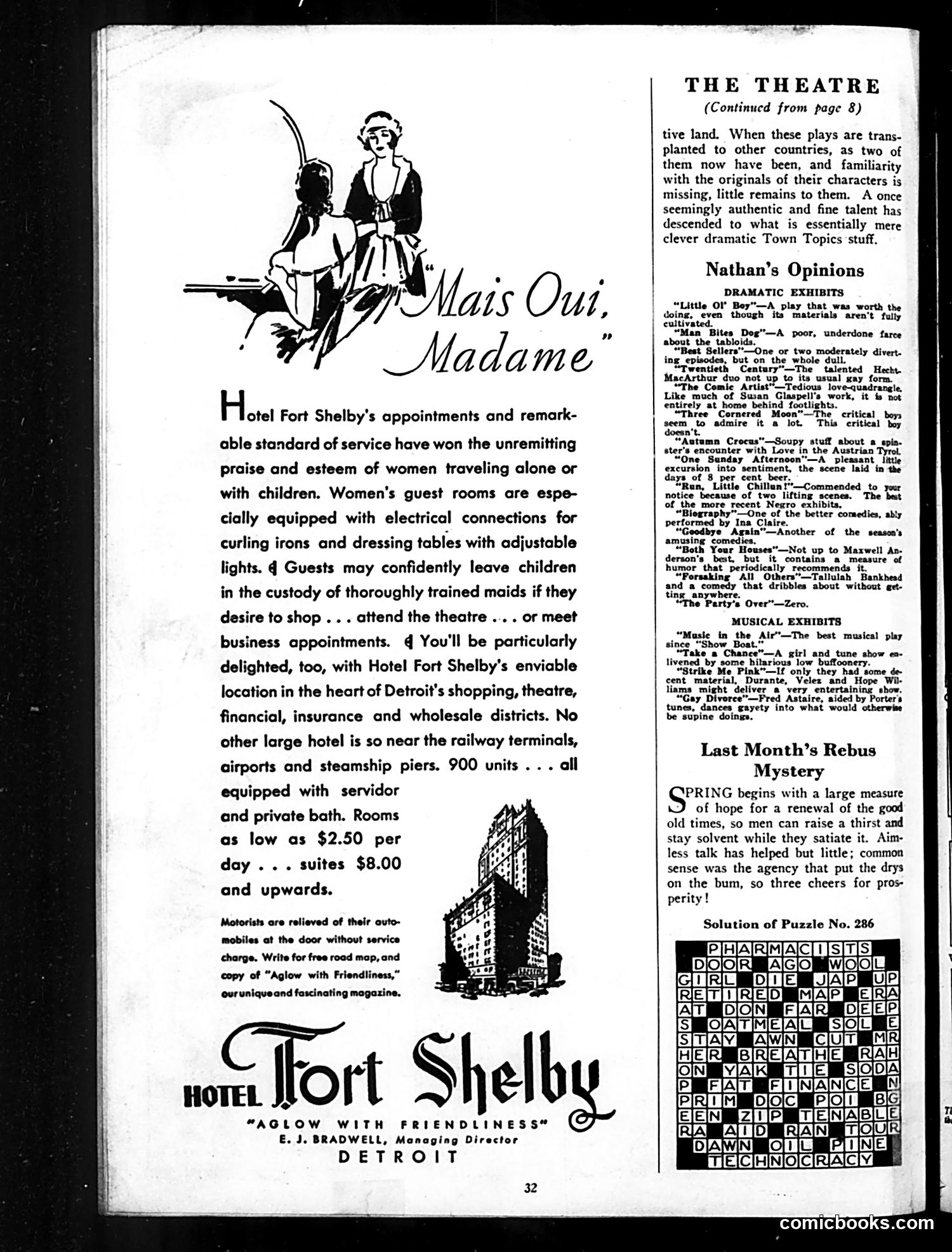
Analysis for Modern Readers This page mixes advertising with theater criticism from Judge magazine. The Illustration ("Mais Oui, Madame"): A stylized drawing of two women—likely depicting the hotel's appeal to female travelers—accompanies a Hotel Fort Shelby advertisement. The French phrase suggests sophistication. The Hotel Ad: Targets women traveling alone or with children, highlighting safety features (trained maids for childcare) and modern amenities (electrical outlets for curling irons, adjustable lights). The emphasis on women's independence—shopping, attending theater, conducting business—reflects 1930s anxieties about and appeals to the "New Woman." Nathan's Opinions: Theater critic George Jean Nathan reviews recent Broadway plays and musicals. His dismissive tone toward several productions (rating some "zero" or "dull") represents the acerbic theater criticism typical of the era. References to performers like Tallulah Bankhead and Fred Astaire situate this in early 1930s theater. The Rebus: A word puzzle unrelated to other content—standard magazine filler of the period.

I can see this is a page from Judge magazine, but the image is almost entirely black or severely degraded, making it impossible to discern any cartoon illustrations, text content, or identifying details beyond the "comicbooks.com" watermark at the bottom. Without being able to see the actual cartoon(s), figures, captions, or article text clearly, I cannot identify specific political or social references, explain the satire, or provide meaningful historical context for a modern reader. To properly analyze this Judge magazine page, a clearer or higher-contrast image would be needed.
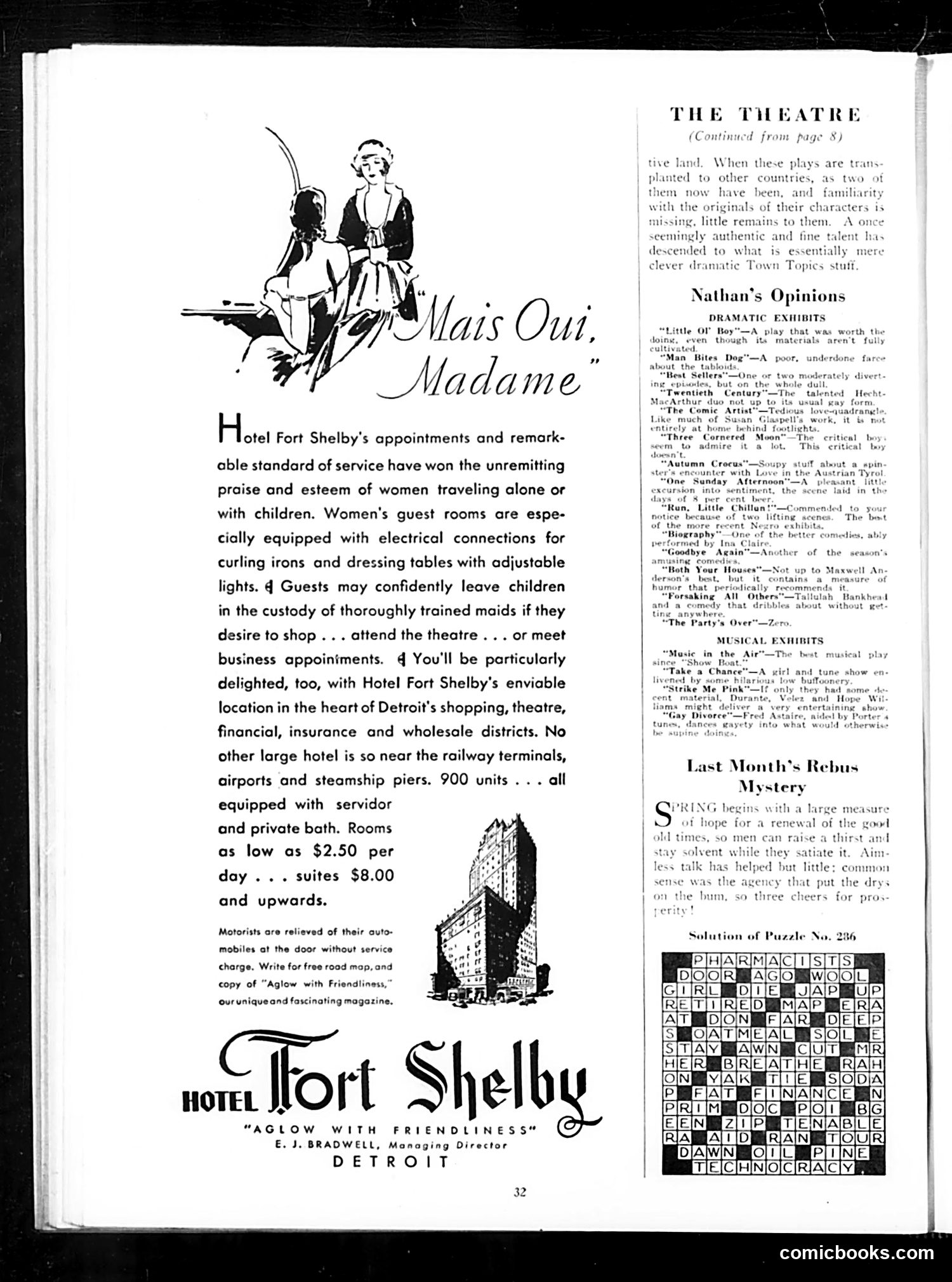
This page is primarily a hotel advertisement for Hotel Fort Shelby in Detroit, not a political cartoon or satirical content. The left side features an elegant illustration labeled "Mais Oui, Madame"—a stylized drawing of two fashionable women, likely meant to appeal to female travelers. The ad emphasizes the hotel's amenities specifically marketed to women: electrical outlets for curling irons, childcare services, proximity to shopping and theaters, and affordable rates ($2.50-$8.00). The right side contains theater reviews under "Nathan's Opinions" (likely drama critic George Jean Nathan) and includes a crossword puzzle solution. The "Mais Oui, Madame" illustration reflects 1920s-30s attitudes toward women travelers as a growing consumer market, positioning the hotel as catering to independent or semi-independent women—a relatively progressive marketing angle for the era, though still emphasizing beauty and leisure rather than professional travel. This is primarily commercial content, not satire.
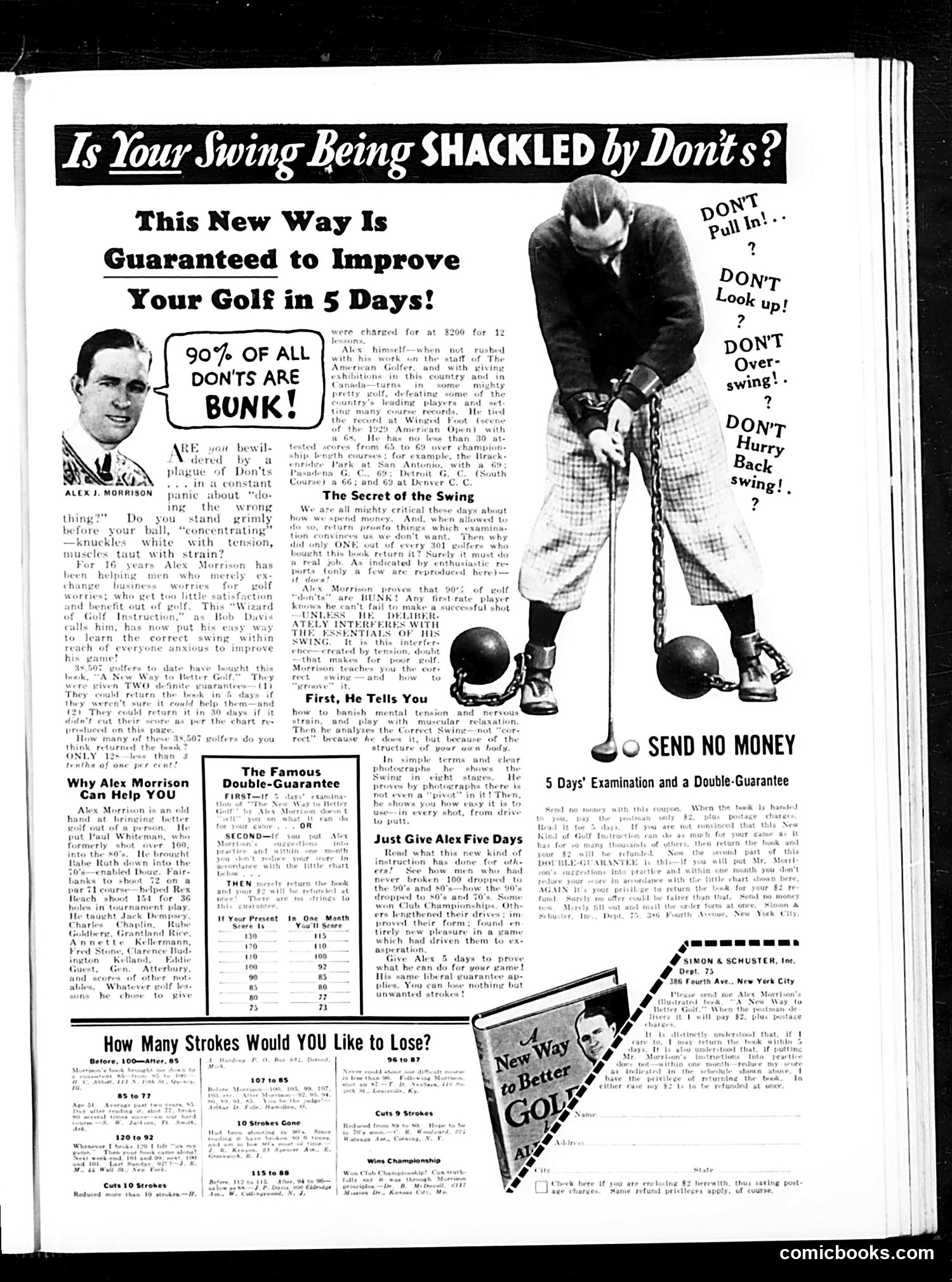
Judge Magazine Golf Instruction Advertisement This page is primarily a commercial advertisement for golf instruction by Alex J. Morrison, not political satire. It promotes Morrison's "5 Days' Examination and a Double-Guarantee" method to improve golfers' swings by eliminating bad habits—the "don'ts" referenced in the headline. The humor is gentle and self-promotional: Morrison claims "90% of ALL DON'TS ARE BUNK," positioning his positive instruction method against the discouraging emphasis on what golfers *shouldn't* do. The photograph shows proper swing mechanics, while testimonials display dramatic score improvements (golfers losing 10-25 strokes). This reflects 1920s-30s American consumer culture, where instructional mail-order courses promised quick self-improvement. The "New Way to Better Golf" book being advertised by Simon & Schuster was Morrison's actual published guide—a legitimate commercial product of the era, not satire.
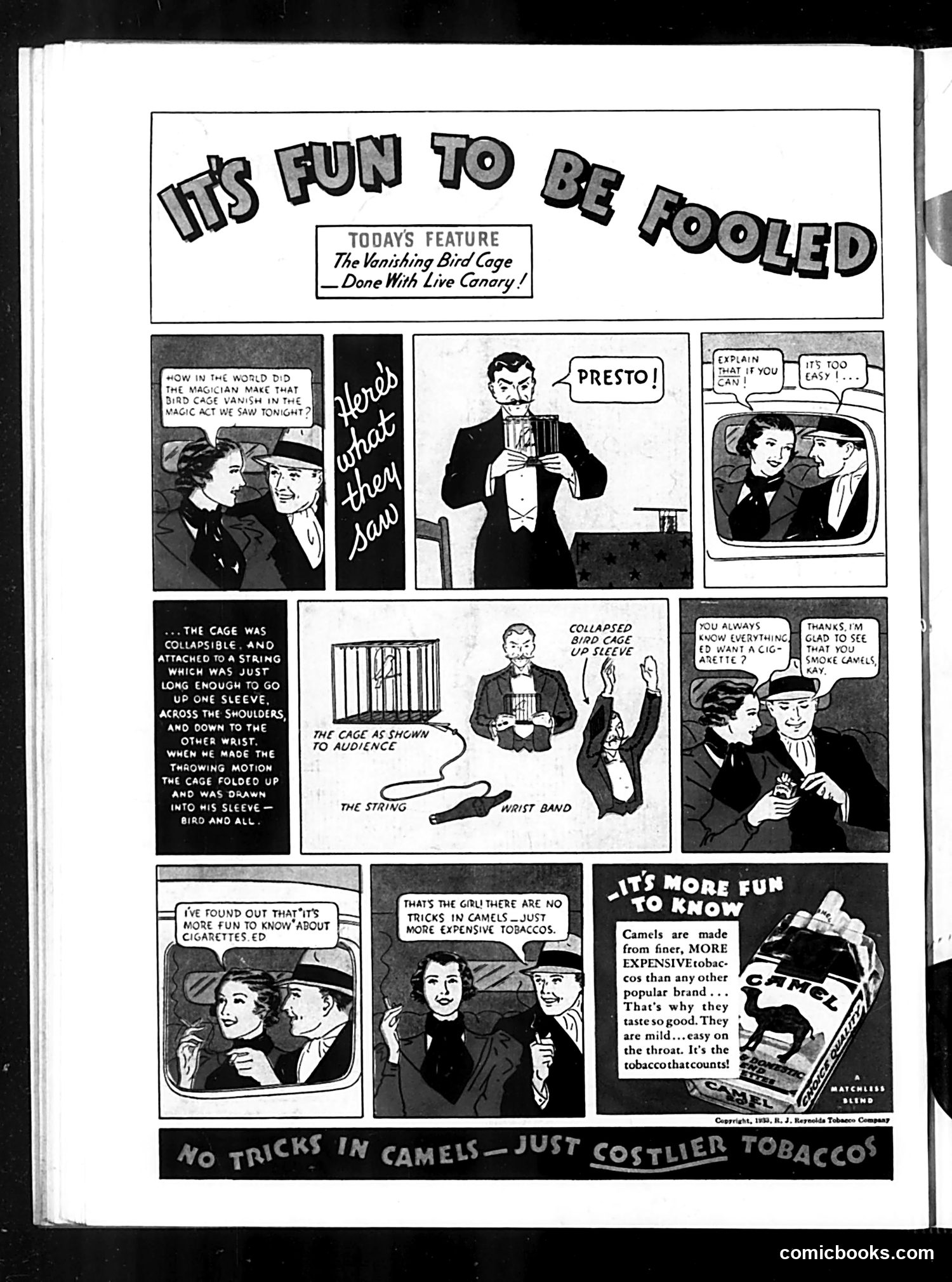
Analysis for Modern Readers This page combines an educational comic strip with cigarette advertising—a common 1930s practice before tobacco marketing restrictions. The Comic Strip: Shows a magician's trick explained to two characters (Ed and Kay). The "vanishing bird cage" illusion uses a collapsible cage attached to a string running up the magician's sleeve—when he throws his arm, the cage folds and gets drawn up his sleeve, making it disappear. The Advertising: The bottom half pivots to Camel cigarettes. The dialogue humorously claims that understanding cigarette quality (rather than magic tricks) is "more fun to know about." The ad emphasizes Camels use "finer, MORE EXPENSIVE tobaccos" and are "mild...easy on the throat." The Satire's Point: The page sarcastically suggests that just as the magic trick has a simple mechanical explanation, Camel's supposed superiority also has a straightforward one—expensive tobacco. It's playful product placement disguised as clever wordplay about revealing hidden truths. This reflects pre-1960s advertising standards when tobacco marketing was unrestricted and integrated into entertainment media.