judge
Judge — August 1933
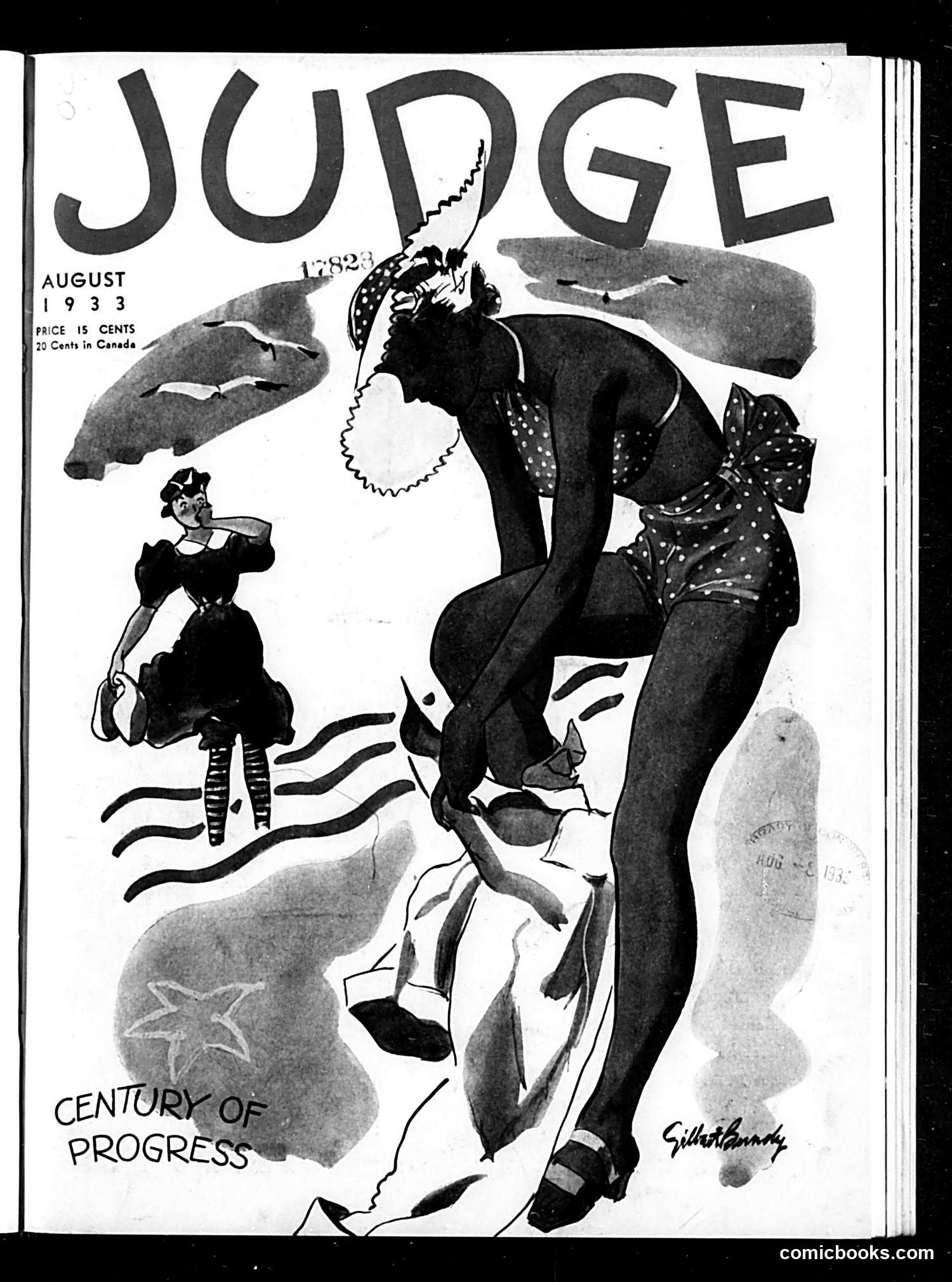
Judge Magazine Analysis - August 15, 1925 This cover illustrates "Century of Progress" through a grotesque, exaggerated female figure emerging from what appears to be a cocoon or chrysalis. The imagery suggests transformation or evolution, likely mocking 1920s optimism about modernization and women's changing roles. A smaller, fashionably-dressed woman on the left appears startled or disapproving—possibly representing "old-fashioned" values confronting the "new woman" of the Jazz Age. The exaggerated proportions and caricatured style typical of Judge magazine's satirical approach suggest the cartoonist is mocking contemporary enthusiasm about women's liberation, fashion modernization, or social progress generally. The overall tone appears skeptical, using grotesque imagery to question whether "progress" represented genuine improvement or merely absurd change.
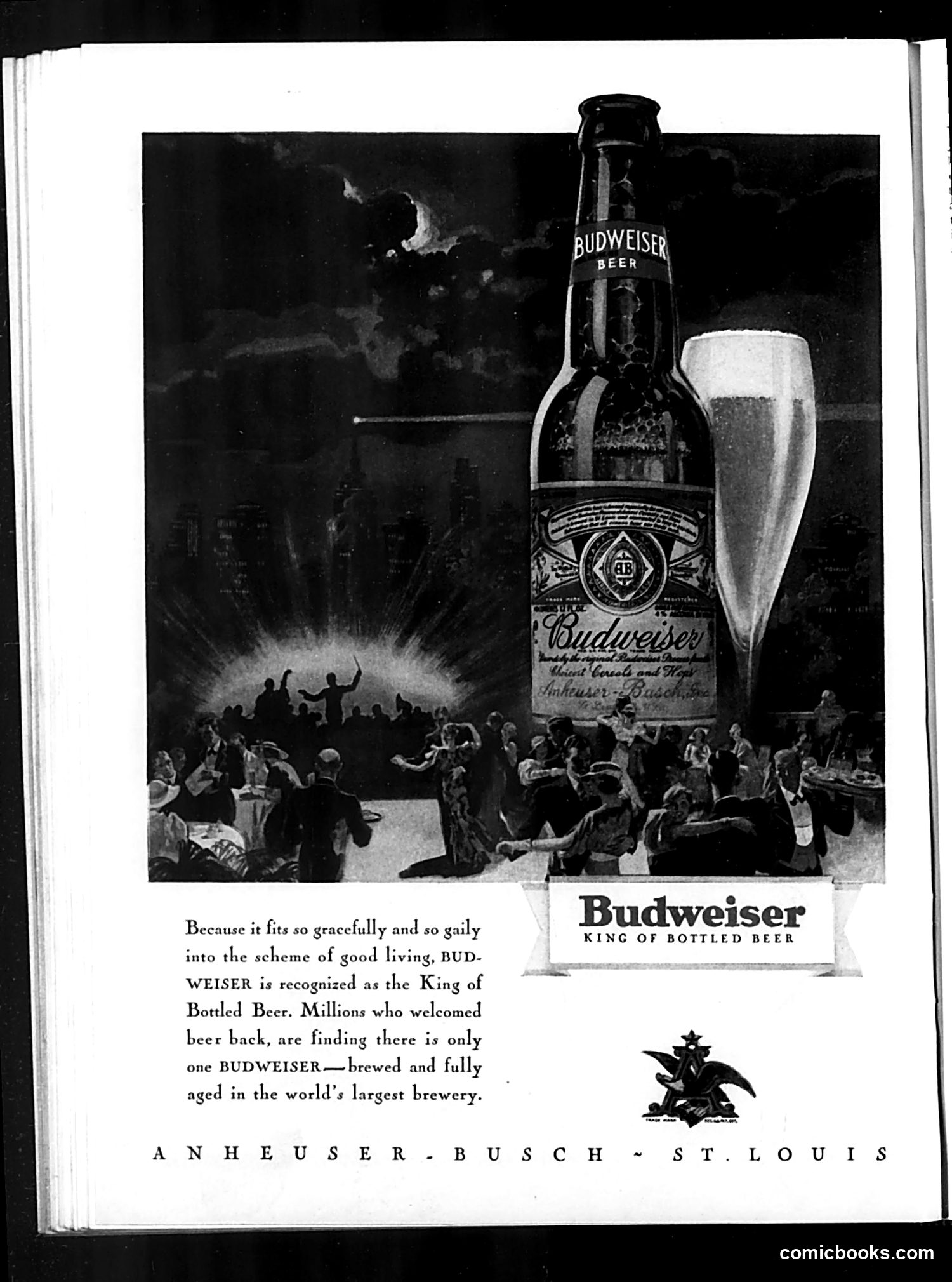
Analysis This page is primarily a Budweiser beer advertisement, not political satire. The ad features a bottle and glass of Budweiser towering over a celebratory crowd scene, with text describing it as the "King of Bottled Beer." The imagery appears to reference beer's return to American markets, likely following Prohibition's end in 1933. The text celebrates that "millions who welcomed beer back" are choosing Budweiser specifically. The dramatic nighttime crowd scene with searchlights suggests a triumphant public celebration. This is commercial advertising leveraging a significant historical moment—the legalization of beer—rather than political commentary. The "King of Bottled Beer" tagline positions Budweiser as the premium choice for consumers rejoining the beer-drinking market.
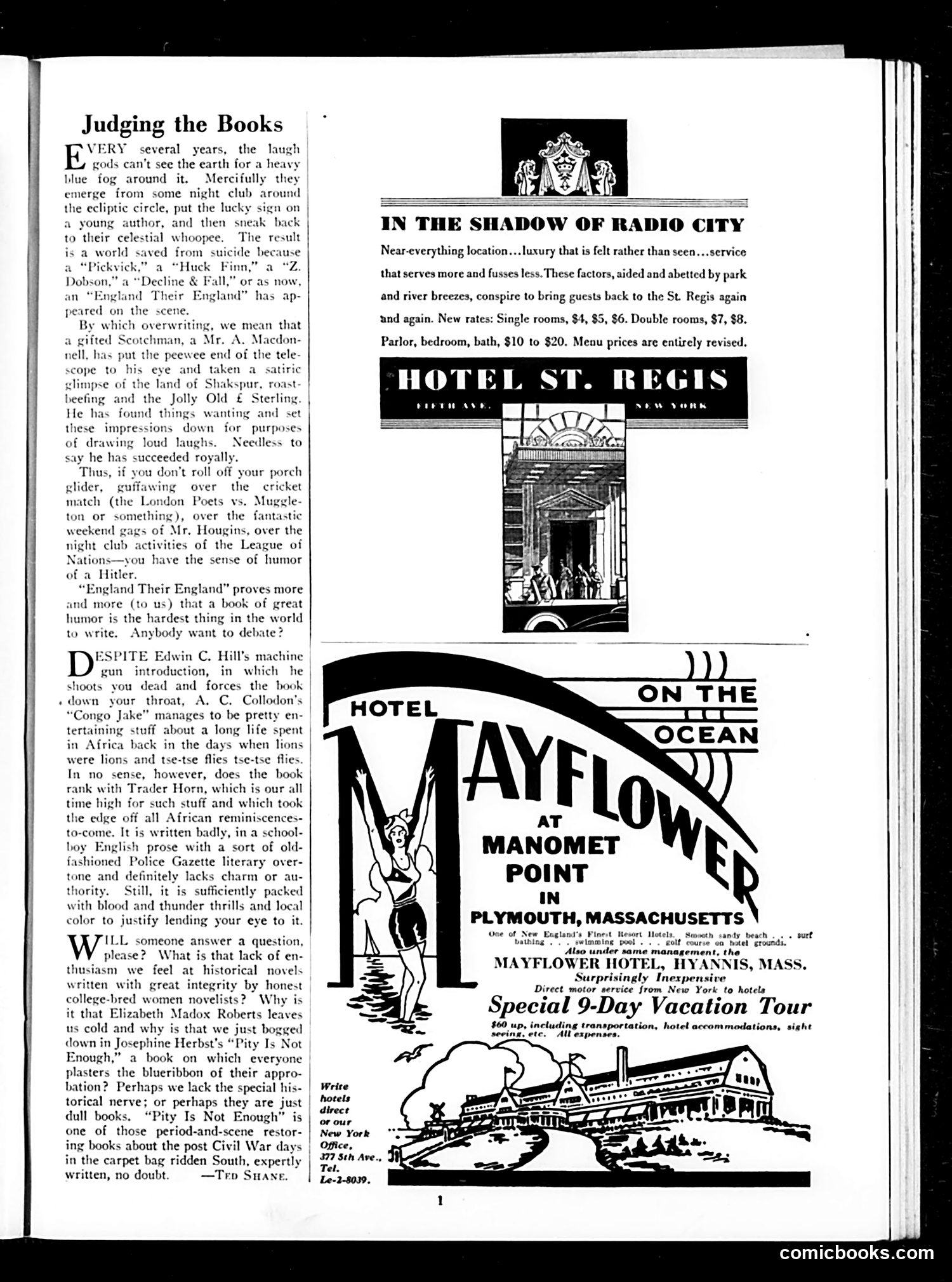
Analysis This page is primarily advertising rather than editorial cartoon content. The top half features hotel advertisements (Hotel St. Regis in New York and Mayflower Hotel in Massachusetts), while the left column contains a book review section titled "Judging the Books." The review discusses several books, including works by A.A. Macdonell and Edwin C. Hill, praising their humor. A notable mention criticizes "Elizabeth Madox Roberts" for lacking "enthusiasm" and "historical novelty," suggesting disappointment with her serious literary approach compared to humorous works. The satire is subtle—the reviewer contrasts entertaining, character-driven books with earnest historical fiction, implying that serious literature sometimes fails to engage readers effectively. No specific political figures or events are caricatured on this page.
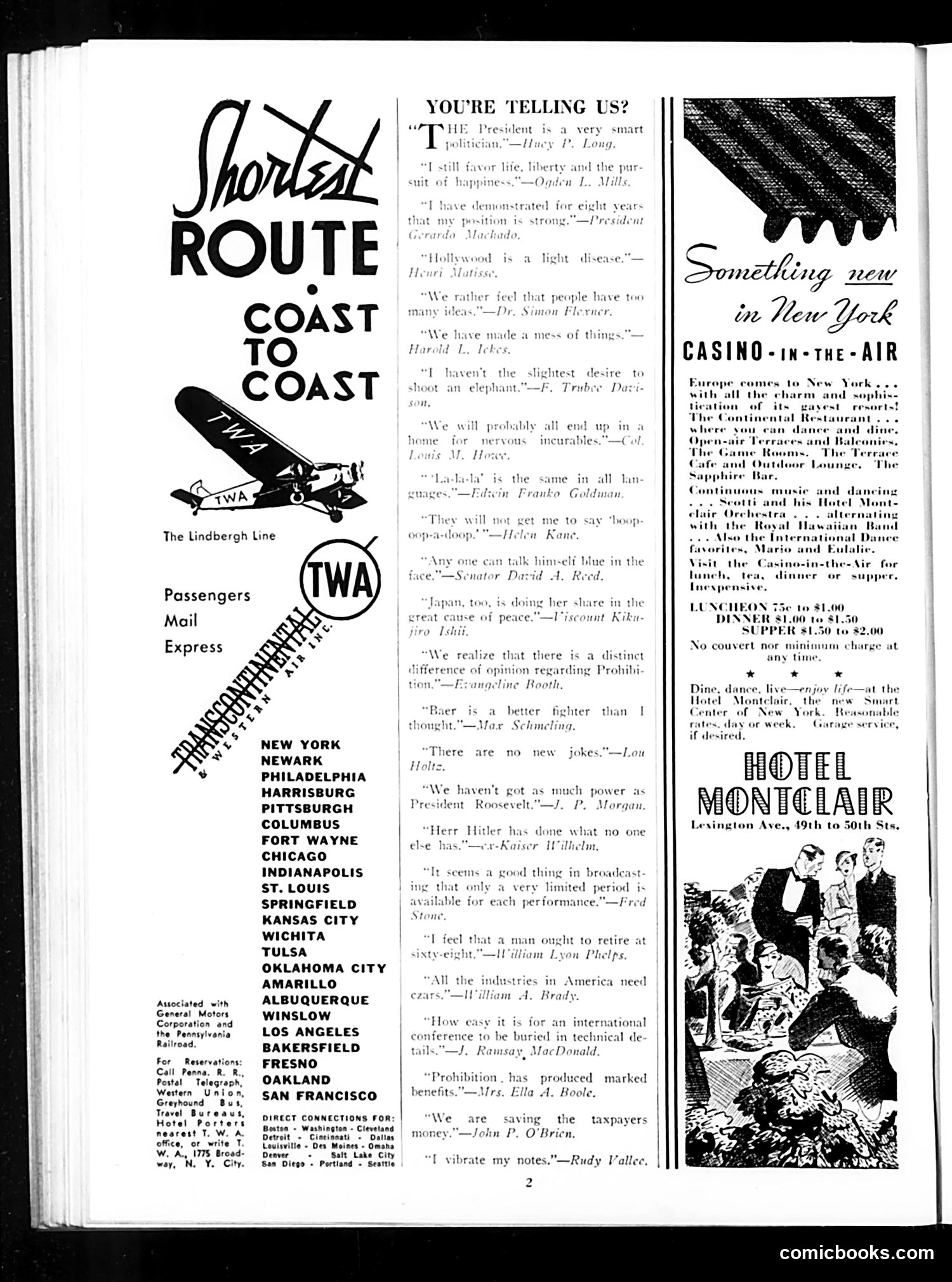
Analysis of Judge Magazine Page This page is primarily advertising and filler content rather than political satire. The left side features a TWA (Transcontinental & Western Air) advertisement for their "Shortest Route Coast to Coast" airline service, listing numerous American cities served by the Lindbergh Line. The center column contains a section titled "YOU'RE TELLING US?" — a humor feature presenting satirical quotes attributed to famous figures of the era (Hoey P. Long, Orson L. Mills, President Gerardo Machado, and others). These appear to be mock statements offering contradictory or absurd viewpoints on contemporary issues like politics, Hollywood, and Prohibition. The right side advertises the Hotel Montclair and the Casino-in-the-Air nightclub in New York. The page offers social commentary through humor rather than visual cartooning, mocking public figures and 1920s-30s concerns like Prohibition.
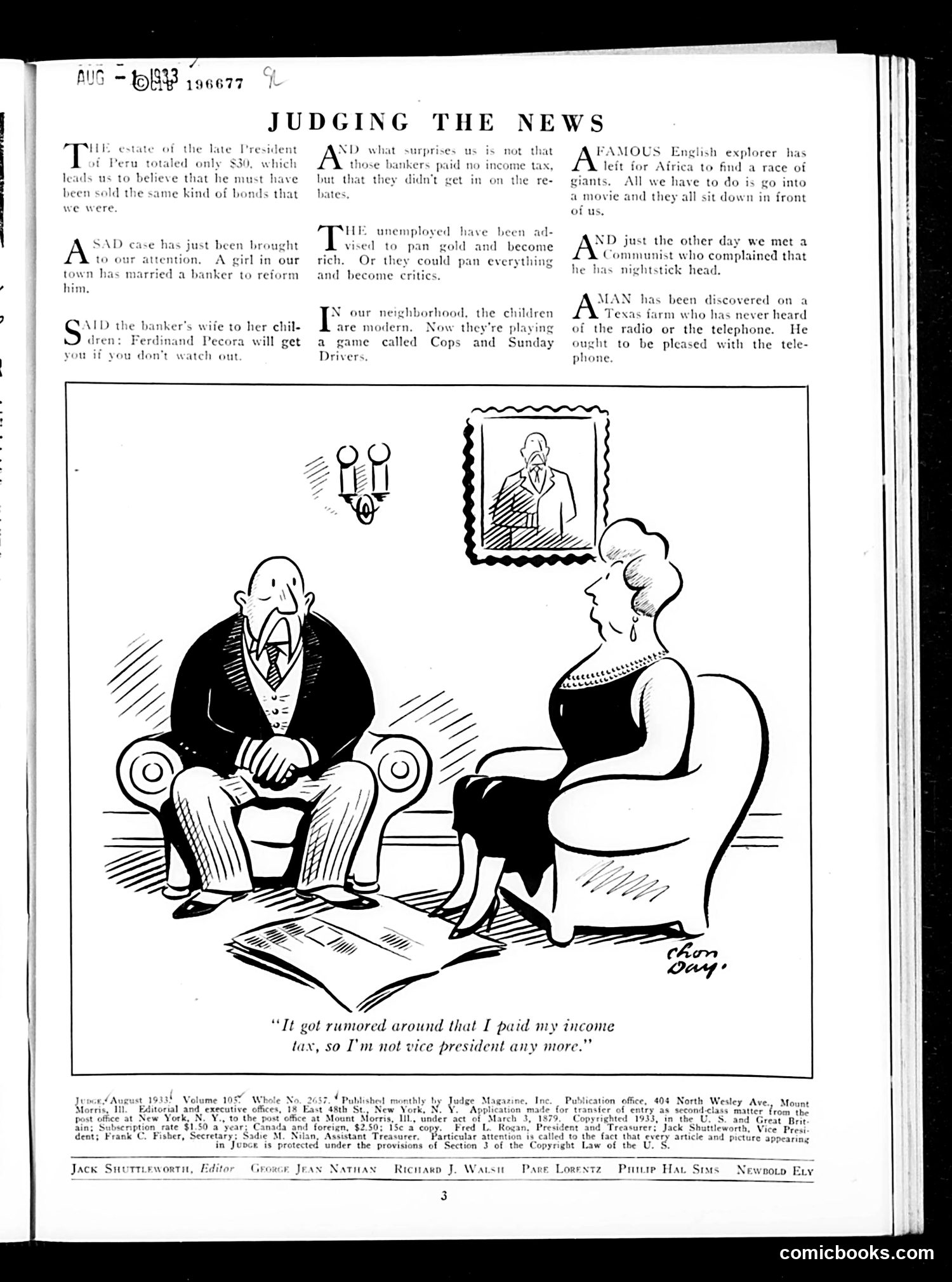
Cartoon Analysis This cartoon satirizes income tax complaints. A well-dressed man sits with a woman, gesturing toward a portrait on the wall. His caption reads: "It got rumored around that I paid my income tax, so I'm not vice president any more." The joke targets wealthy individuals avoiding taxes. The reference to losing a "vice president" position suggests that tax avoidance was so common among the elite that actually *paying* taxes made one socially or professionally suspect—an embarrassment among peers who typically evaded them. The surrounding "Judging the News" section contains brief satirical takes on contemporary issues: the President's estate sale, unemployed Americans becoming gold prospectors, children's games, and a Texas farmer discovering modern technology. The cartoon mocks both tax dodging culture and the irony that honest taxpaying had become unusual enough to damage one's reputation.
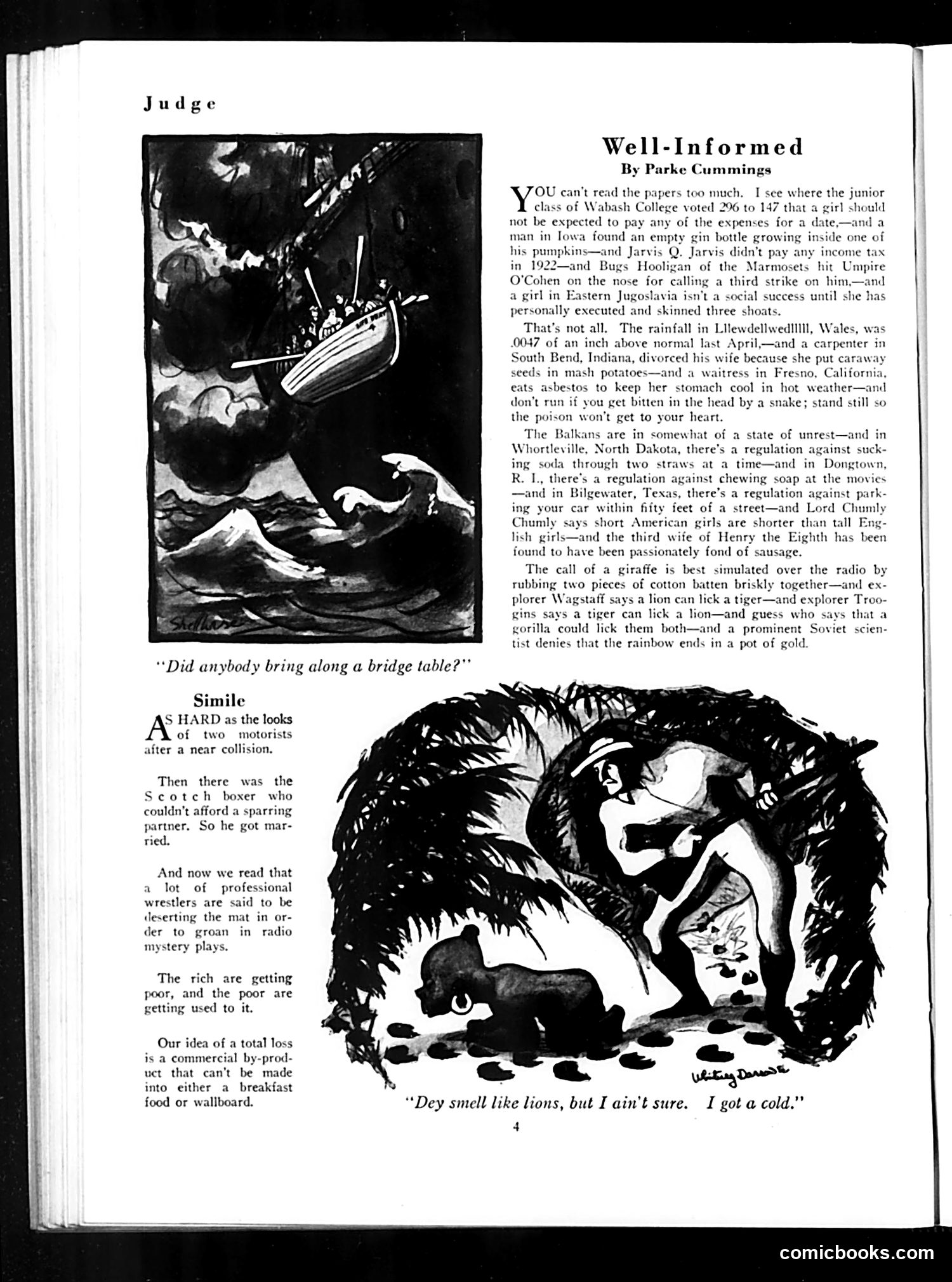
Judge Magazine Page Analysis This page contains two satirical sections by Parke Cummings: "Well-Informed" is a humorous collection of absurd facts and regulations—mostly fabricated—designed to mock social pretension and arbitrary rules. Examples include unlikely statistics (rainfall measurements, income taxes from the 1920s) and ridiculous local ordinances (regulations against sucking soda through straws or parking near streets). The satire targets those who pride themselves on knowing obscure trivia. "Simile" presents brief comic vignettes comparing situations. The visible cartoon shows two figures huddled in what appears to be a cave or enclosed space, with one saying "Dey smell like lions, but I ain't sure. I got a cold." The humor derives from the absurd situation and character dialect typical of Depression-era comedy. The page mocks both pretentiousness and everyday mishaps.
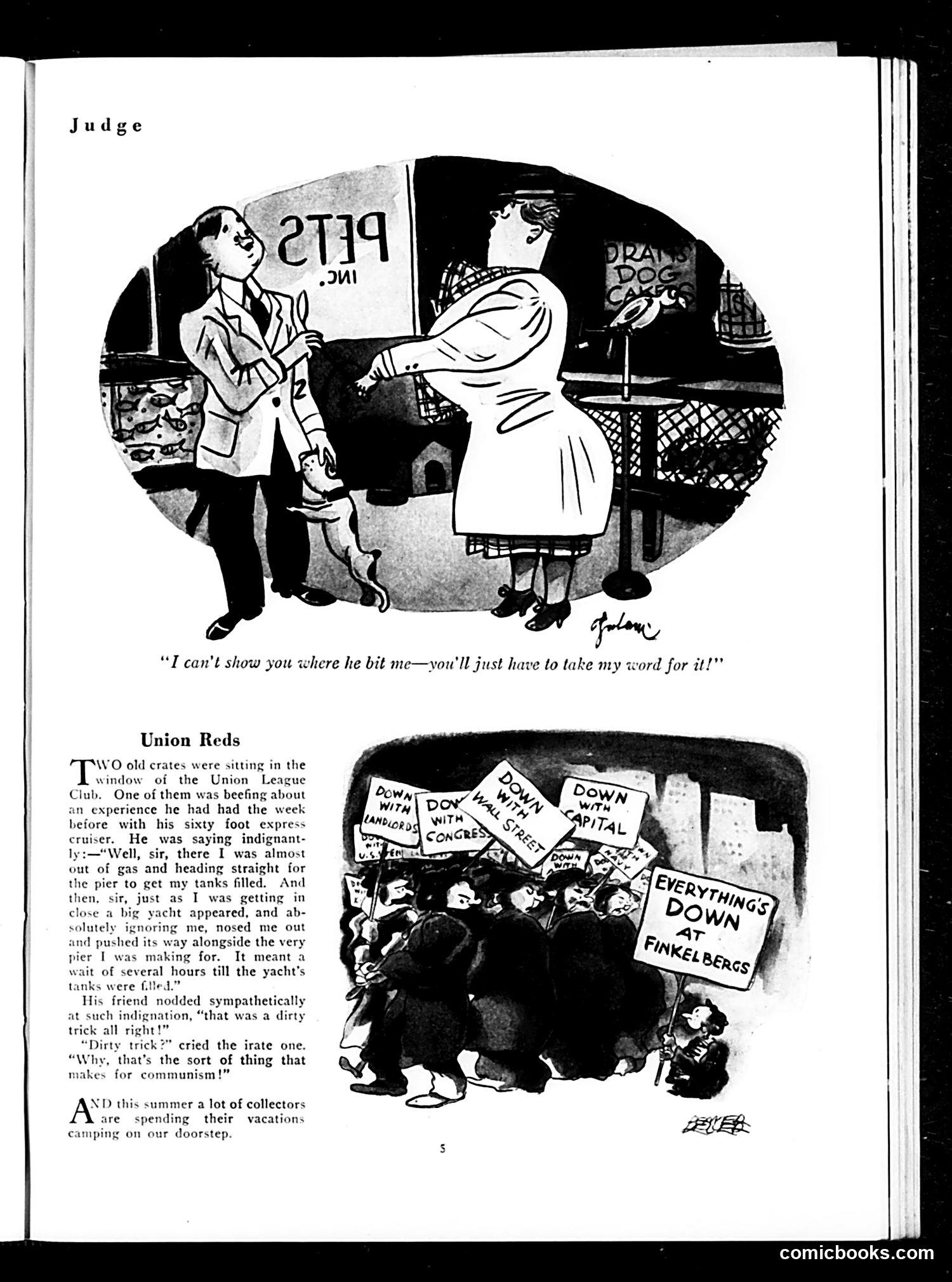
Analysis Top Cartoon ("Judge"): A man shows a woman a bruise, claiming someone bit him. She responds skeptically that she can't verify his story and he'll have to prove it himself—a joke about unsubstantiated claims requiring evidence. Bottom Cartoon ("Union Reds"): Two older men discuss a labor incident involving a yacht and a "sixty-foot cruiser." One describes being ignored by union workers who blocked access to a pier. His friend calls this "a dirty trick" for communism, and the first agrees. The cartoon satirizes union activism by depicting it as communist-influenced obstruction. The accompanying text about "collectors spending vacations camping on our doorstep" suggests Red-baiting anxiety—a common Cold War-era concern about communist organizing or surveillance. Judge magazine frequently ran anti-communist and anti-labor union content during this period.
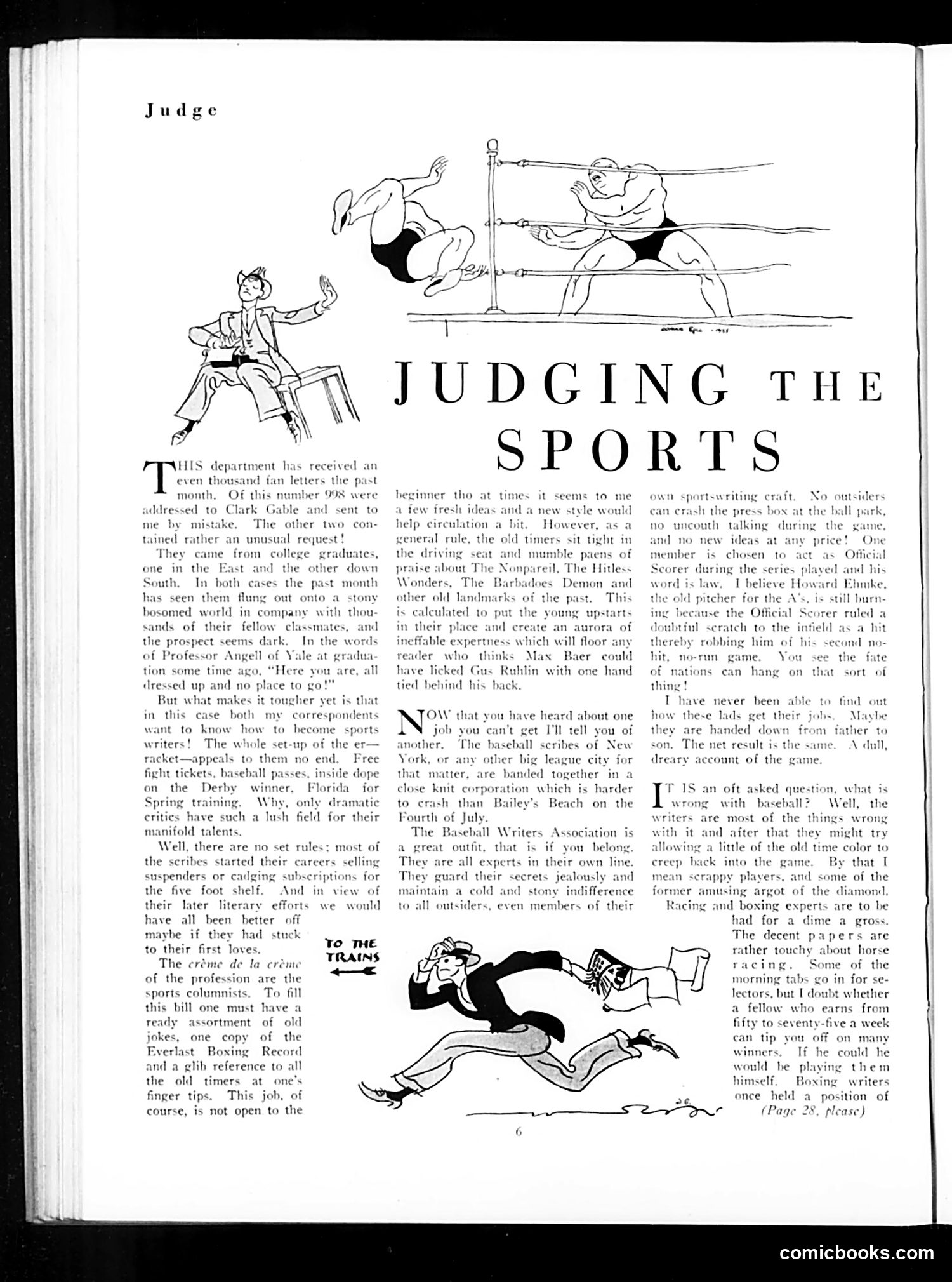
"Judging the Sports" - Judge Magazine Sports Commentary Page This page satirizes sports journalism and the difficulty of predicting sports outcomes. The main article discusses how sportswriters struggle to judge games fairly, mentioning baseball, horse racing, and boxing. The cartoons illustrate the chaos of sports commentary: one shows a wrestling match with judges, another depicts a man racing against a horse (labeled "TO THE TRAINS"), mocking the absurdity of certain sporting predictions or matchups. The text humorously notes that sportswriters jealously guard insider knowledge about games and athletes, creating an exclusive "Baseball Writers Association." The satire targets both the pretentiousness of sports experts and readers' fascination with their dubious predictions and gossip about athletes.
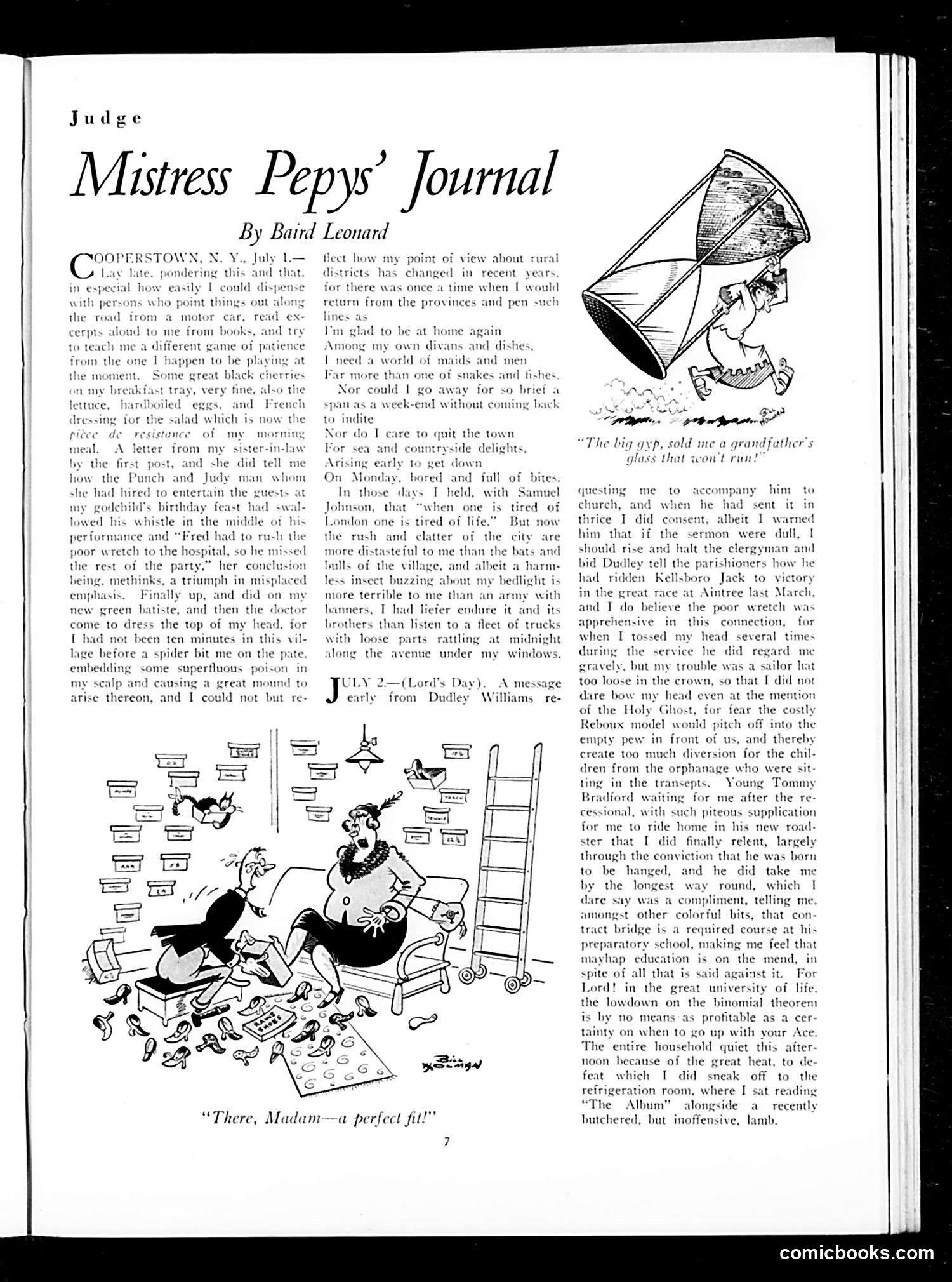
"Mistress Pepys' Journal" - Judge Magazine Satire This column mimics Samuel Pepys's famous 17th-century diary but applies it to modern (1920s-era) upper-class domestic life. "Baird Leonard" writes as a wealthy woman reflecting on rural versus urban living, social obligations, and domestic servants. The satire mocks: 1. Pretentious literary affectation — adopting Pepys's style for trivial complaints (spider bites, loose hat crowns at church) 2. Class consciousness — obsession with servants, weekend country visits, and social propriety 3. Modern inconveniences — trucks rattling at midnight, heat, boredom contrasted with romanticized rural nostalgia The two cartoons illustrate domestic chaos: one showing a cluttered woman's room ("a perfect fit!"), the other depicting a woman struggling with an oversized hat ("The big gyp, sold that grandfather's glass that won't run!"). The humor lies in treating petty modern anxieties with mock-serious, literary grandeur—deflating upper-class pretension through absurdist juxtaposition of high style and mundane complaint.
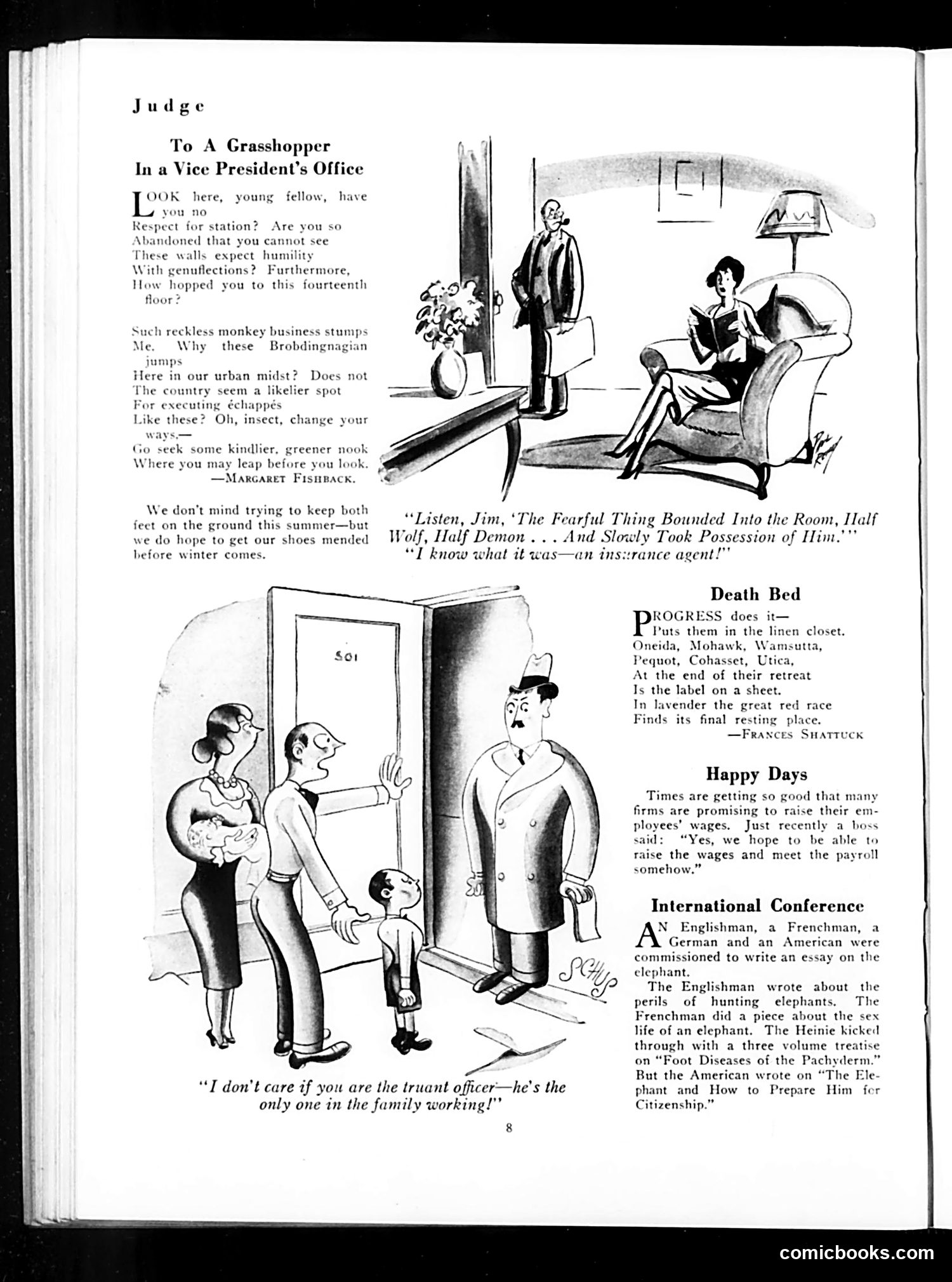
Judge Magazine Page Analysis This page contains several satirical pieces typical of early 20th-century American humor: "To A Grasshopper" mocks bureaucratic pomposity—a Vice President's aide lecturing a grasshopper about respecting formal office decorum, treating an insect as if it were an undisciplined employee. The insurance agent cartoon jokes about paranoia and salesmen; what appears as a supernatural "fearful thing" is merely an insurance agent—suggesting they're viewed as intrusive or unwelcome. "Death Bed" satirizes Native American blanket brands (Oneida, Mohawk, Wamsutta, etc.) by treating their "final resting place" as a linen closet label—dark humor about both commercialization and indigenous peoples' historical decimation. "Happy Days" mocks employers' hollow wage-raising promises—they hope to raise wages "somehow" while barely meeting payroll, exposing economic strain beneath optimistic rhetoric. "International Conference" stereotypes national character through elephant essays: the English emphasize hunting tradition, French focus on sexuality, Germans produce dense academic tomes, and Americans aim for practical assimilation/citizenship—poking fun at perceived national traits.
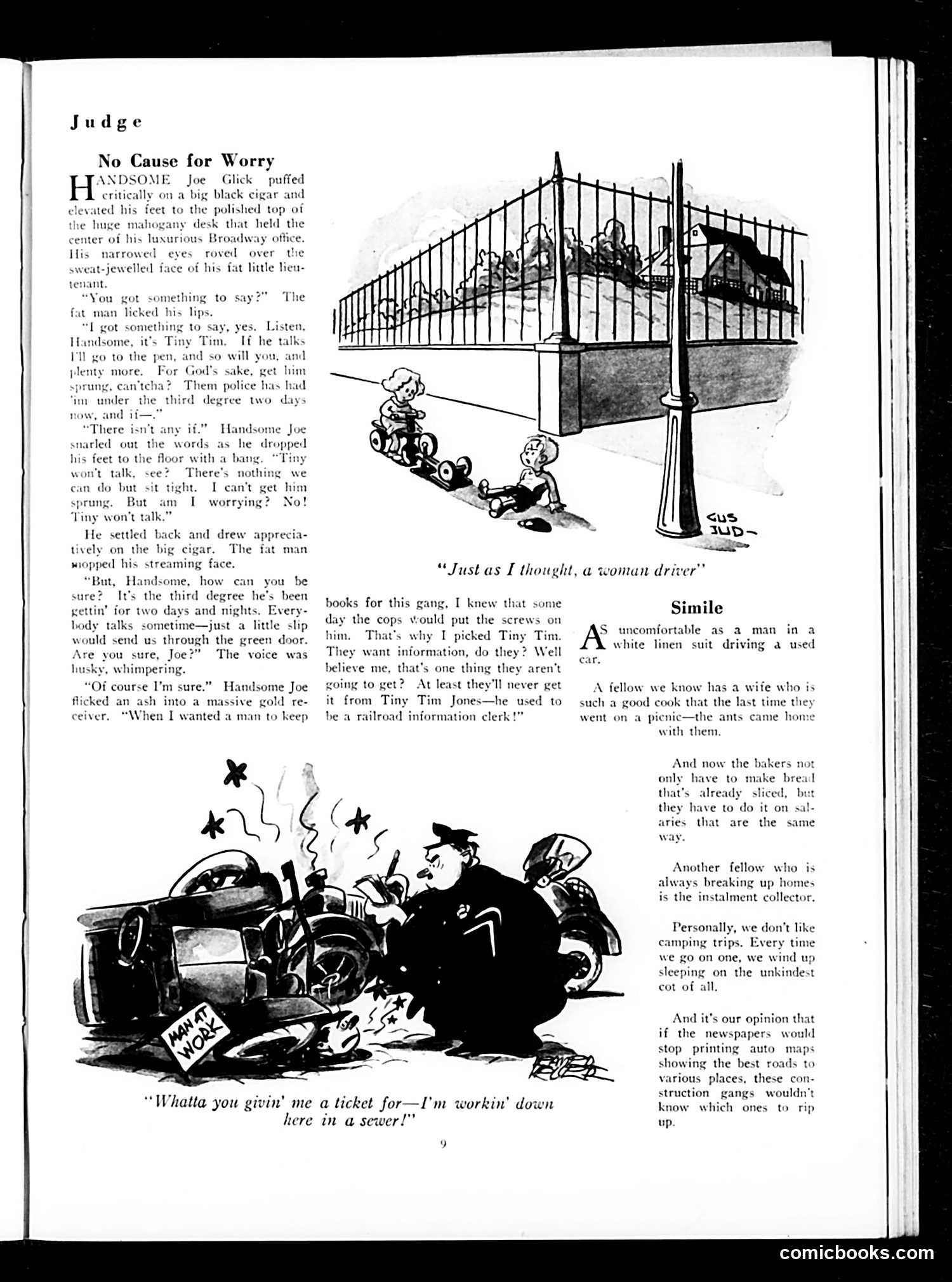
Judge Magazine Page Analysis This page contains two distinct pieces of satire from Judge magazine: Main Story: "No Cause for Worry" A crime story featuring "Handsome Joe Glick," a gangster boss confidently assuring his nervous lieutenant that their arrested associate "Tiny Tim Jones" won't inform on them. The joke: Joe selected Tiny Tim specifically because he was a railroad information clerk—a man whose entire job was providing information to the public. The irony is that Joe trusts a compulsive informant not to inform, despite police interrogation. Lower Cartoon: Shows a cop ticketing a man working in a sewer, captioned "Whatta you givin' me a ticket for—I'm workin' down here in a sewer!" The adjacent caption "Just as I thought, a woman driver" suggests the joke involves prejudice about women drivers being careless or unsafe. Right Column: "Simile" A collection of brief, witty comparisons satirizing everyday life—uncomfortable situations, inflation, and humorous complaints about modern conveniences and social problems. The page exemplifies Judge's mix of narrative comedy, visual gags, and observational humor targeting 1920s-era American society.
Analysis of Judge Magazine Page This is an editorial essay by George Jean Nathan titled "The Theatre: Inter-Seasonal Reflections"—not a cartoon, but rather critical commentary on American theater and drama critics. Nathan argues that theatre audiences and critics lack proper respect for their craft. He contrasts shabby but authentic theaters with elegant movie houses, noting people prefer movies despite superior theatrical performances. His main complaint concerns dramatic critics who, despite lifelong dedication to theater, receive less professional deference than lawyers or doctors. The public treats critics dismissively, yet feels entitled to ask their free opinions on plays and performances. Nathan also criticizes actors and reviewers who consult with one another casually between acts, suggesting unprofessional conduct. He laments that young, talented actors like those trained in Germany are rarely properly recognized in American theater. The piece reflects early 20th-century anxieties about theater's decline amid rising film popularity and the low cultural status of drama criticism as a profession.
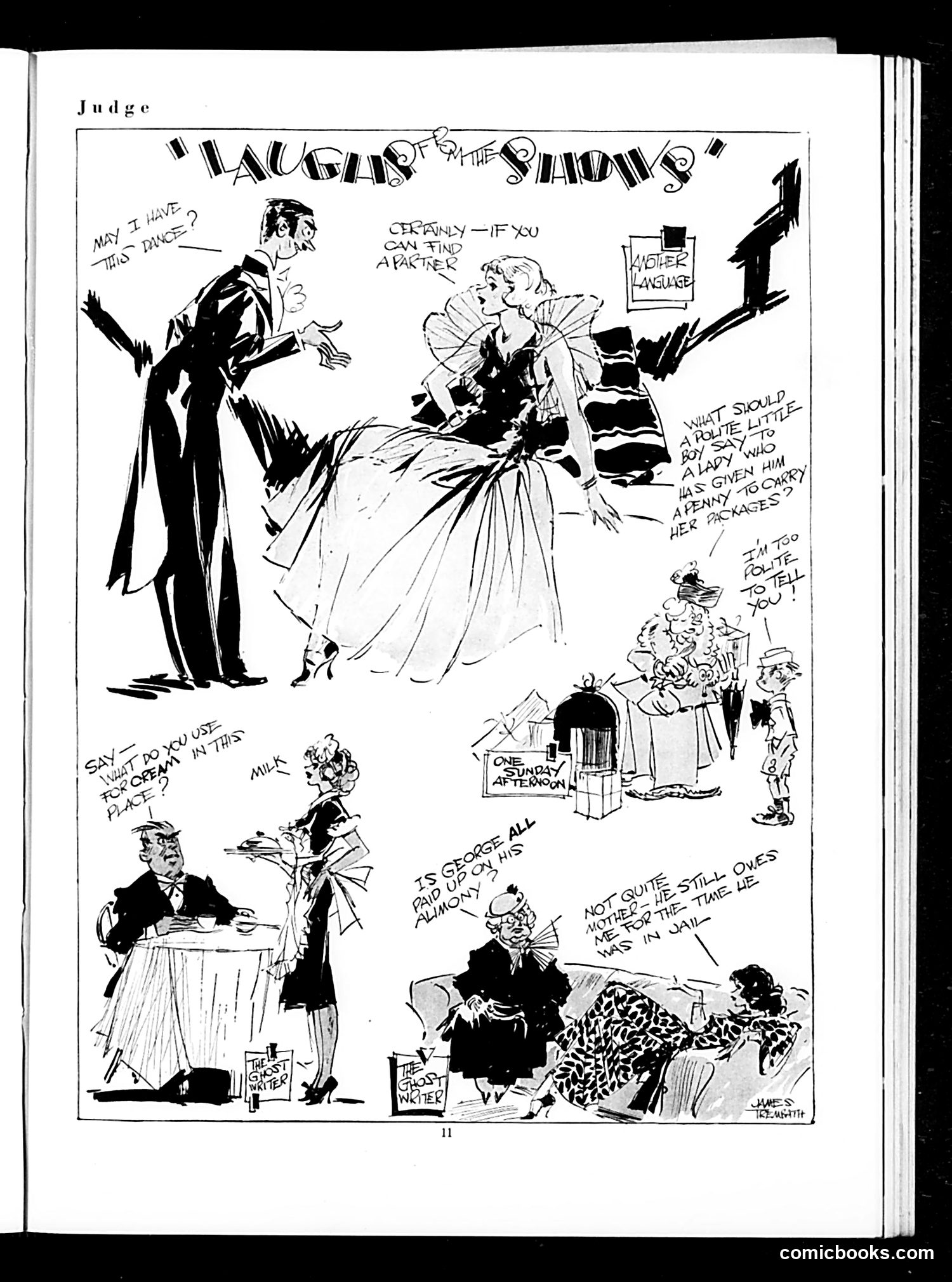
"Laughs of the Shadows" This page satirizes early 20th-century theatrical and social life. The main illustration depicts a well-dressed man and woman (likely representing theater personalities or socialites) in exaggerated poses, surrounded by smaller comic scenes. The scattered vignettes mock various social conventions: a man asking "what you use to keep places in this milk" (unclear reference), discussions about finding "a partner" and learning "another language," and scenes involving servants or working-class characters labeled "the ghost walker" and "one Saturday afternoon." The overall theme appears to satirize upper-class pretension, romantic entanglements, and the gap between wealthy sophistication and practical reality. The theatrical staging and dramatic poses suggest commentary on artificiality in high society. Without clearer dating or specific figure identification, the precise political targets remain unclear, though the humor targets class distinctions and social affectation typical of Judge magazine's satirical approach.
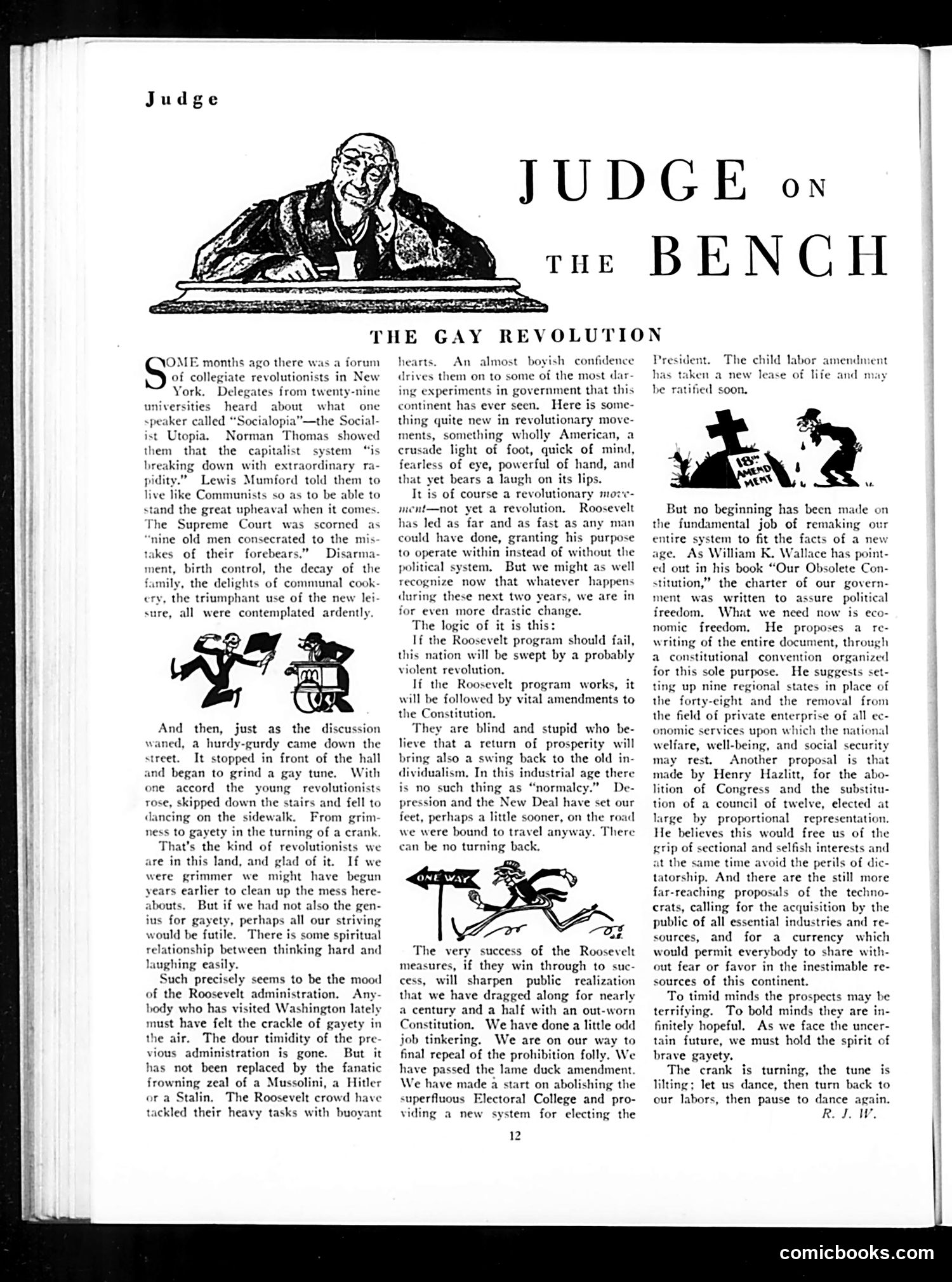
"The Gay Revolution" - Judge Magazine Satire This article satirizes young American revolutionaries and the Roosevelt administration during the New Deal era (likely early-to-mid 1930s). The Setup: College radicals attend a forum in New York where speakers like Norman Thomas (Socialist leader) and Lewis Mumford criticize capitalism, the Supreme Court ("nine old men"), and advocate communal living and disarmament. The satire: when a street organ-grinder passes by, these serious revolutionaries immediately abandon their grim ideology to dance. The Point: Judge mocks the shallowness of American radical movements—they lack the sustained conviction of genuine revolutionaries elsewhere (Mussolini, Hitler, Stalin are mentioned as cautionary comparisons). Yet paradoxically, the article praises Roosevelt's administration for pursuing drastic change while maintaining American good humor and optimism, contrasting favorably with authoritarian grimness. The Underlying Argument: True revolutionary change may be inevitable, but America's lighter temperament—its ability to think seriously while laughing—is actually a strength, not a weakness.
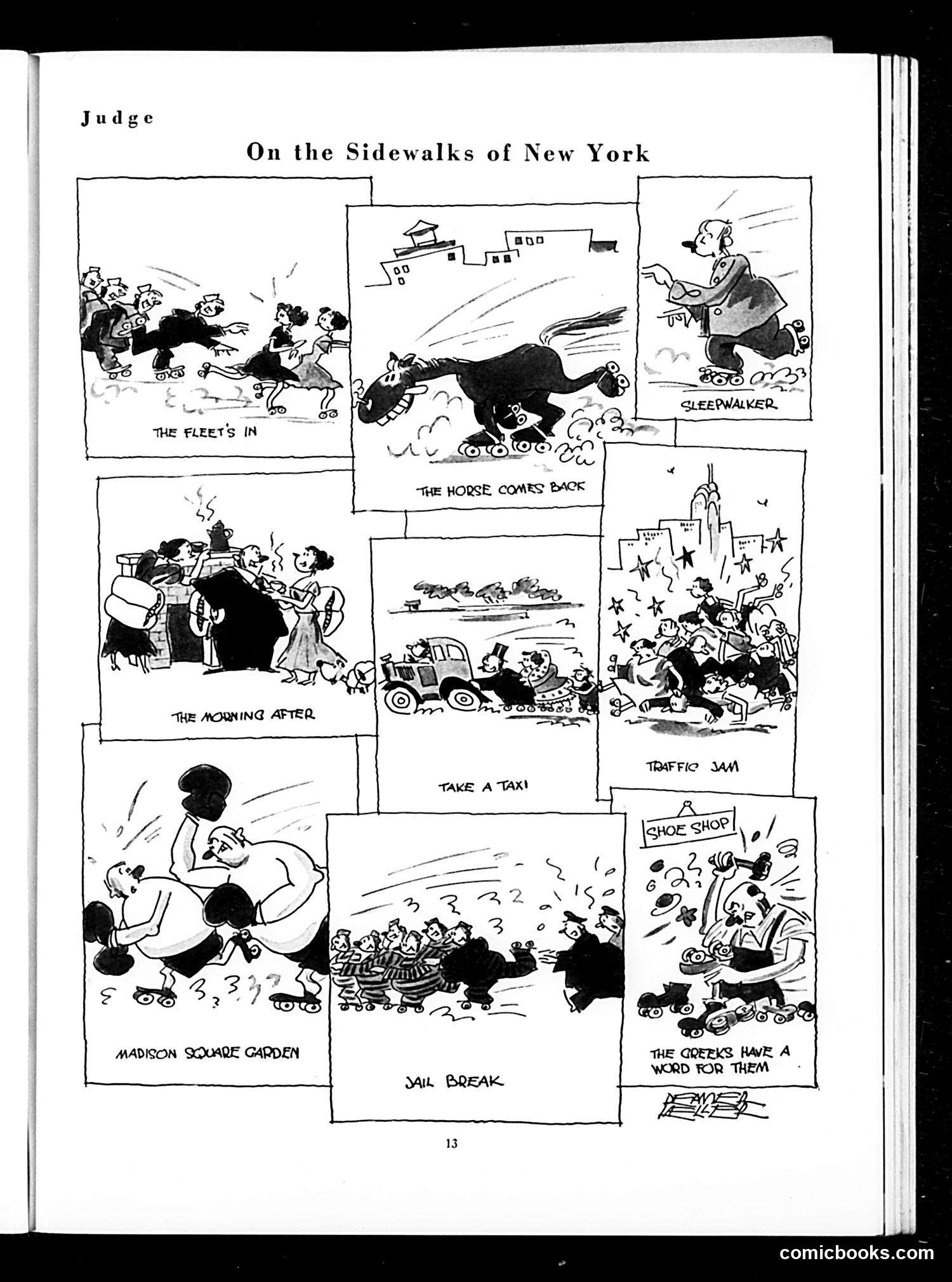
Analysis: "On the Sidewalks of New York" This is a multi-panel satirical cartoon mocking New York City street life and traffic chaos. The panels depict various urban hazards: roller-skating pedestrians causing collisions ("The Fleet's In"), a sleepwalker in danger, traffic jams, and overcrowded venues like Madison Square Garden and a shoe shop. The recurring theme is dangerous, chaotic street conditions—congestion, reckless behavior, and near-constant accidents. The "horse comes back" panel suggests nostalgia for earlier transportation methods, implying automobiles and urban density have made streets more perilous. "Jail Break" and "Traffic Jam" panels emphasize lawlessness and gridlock. The cartoon critiques modern urban life's hazards and inefficiency, using visual humor to highlight pedestrian safety concerns and infrastructure failures common in 1920s-era New York City.
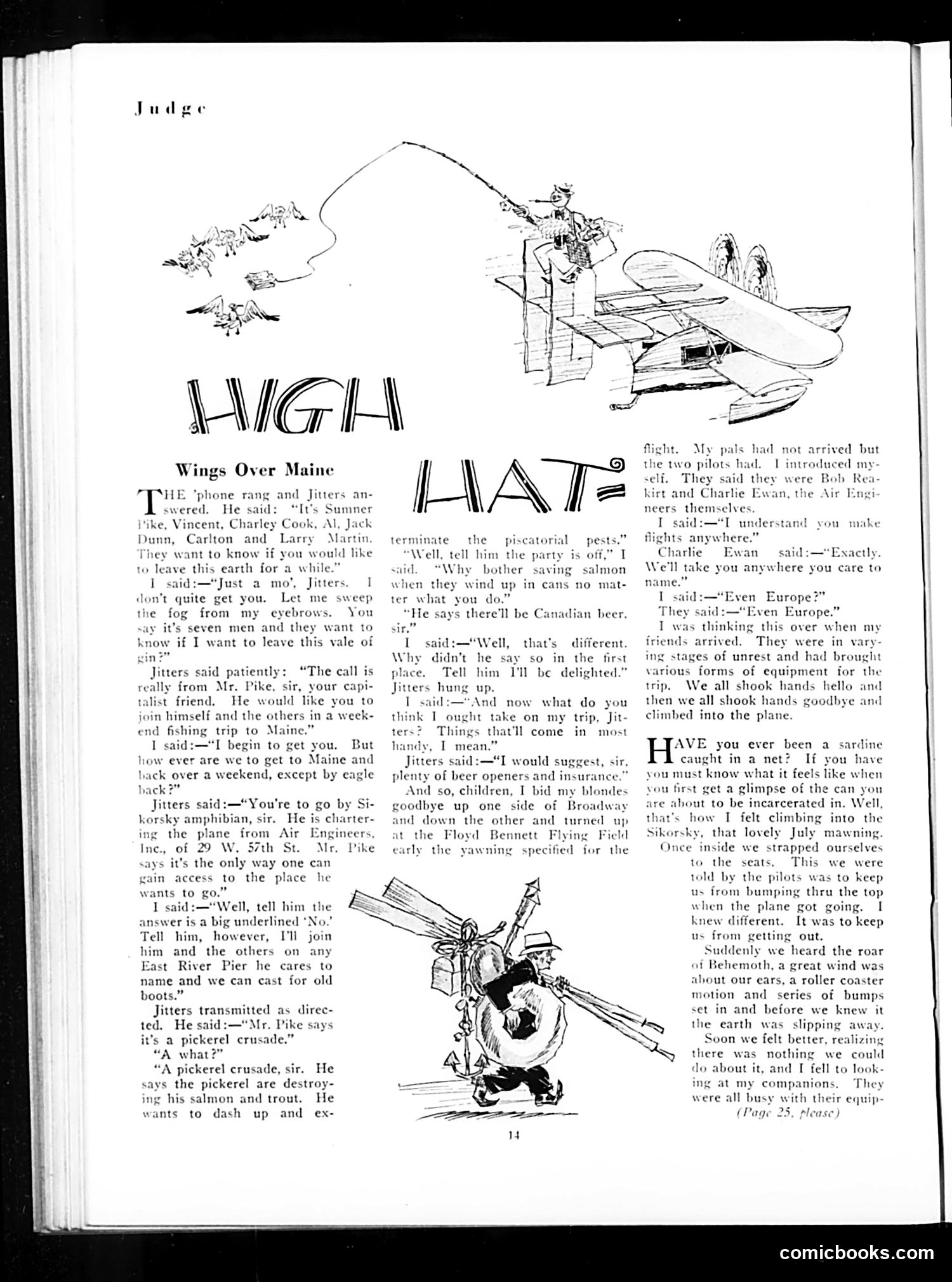
"Wings Over Maine" - Judge Magazine Satire This humorous story satirizes wealthy New York leisure culture and amateur aviation in the early aviation era. The narrator (appearing to be a Judge editor or society figure) receives a call from "Sumner Pike" — likely referencing a real prominent businessman — inviting him on a fishing trip to Maine to wage a "pickerel crusade" against fish destroying salmon. The satire targets: the absurdity of using newfangled seaplanes for weekend trips, the overcomplication of leisure activities for the wealthy, and early aviation's novelty and discomfort. References to "East River Pier," "Floyd Bennett Flying Field," and the Sikorsky amphibian plane ground this in 1920s-30s New York aviation. The narrator's sardonic tone ("a big underlined 'No'") and the account of the cramped, turbulent flight poke fun at aviation enthusiasts treating dangerous, uncomfortable flying as fashionable recreation. The illustrated vignettes show the chaotic reality of early air travel—far from glamorous.
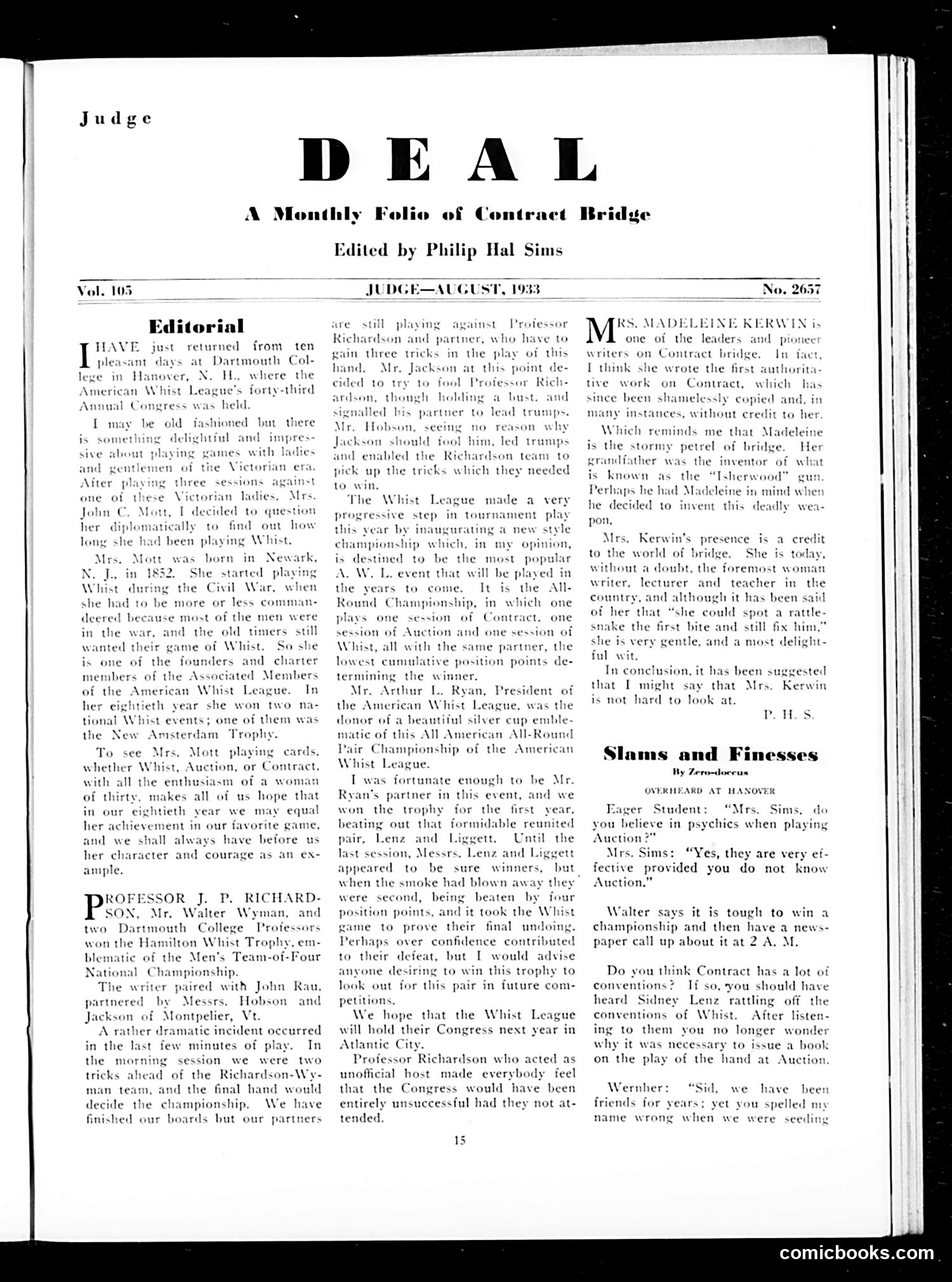
Judge Magazine Analysis (August 1933) This page is primarily editorial content about contract bridge, not a political cartoon. It contains: Main Content: - An editorial by Philip Hal Sims (the magazine's bridge editor) discussing the American Whist League's 40th annual congress held in Hanover, New Hampshire - Discussion of Mrs. John C. Mott, an 80-year-old woman who has been playing Whist since the Civil War and won national championships - Coverage of Professor J.P. Richardson and his Dartmouth College team winning the Hamilton Whist Trophy - A profile of Mrs. Madeleine Kerwin, described as a pioneering writer on contract bridge The Satire/Humor: The "Slams and Finesses" section contains brief humorous anecdotes about bridge players' conventions and foibles—not political satire. It mocks players' pretensions and the game's competitive nature. Context: In 1933, contract bridge was enormously popular among American society, particularly the upper classes. *Judge* magazine, a general-interest satirical weekly, regularly covered bridge tournaments and personalities as lifestyle/society content.
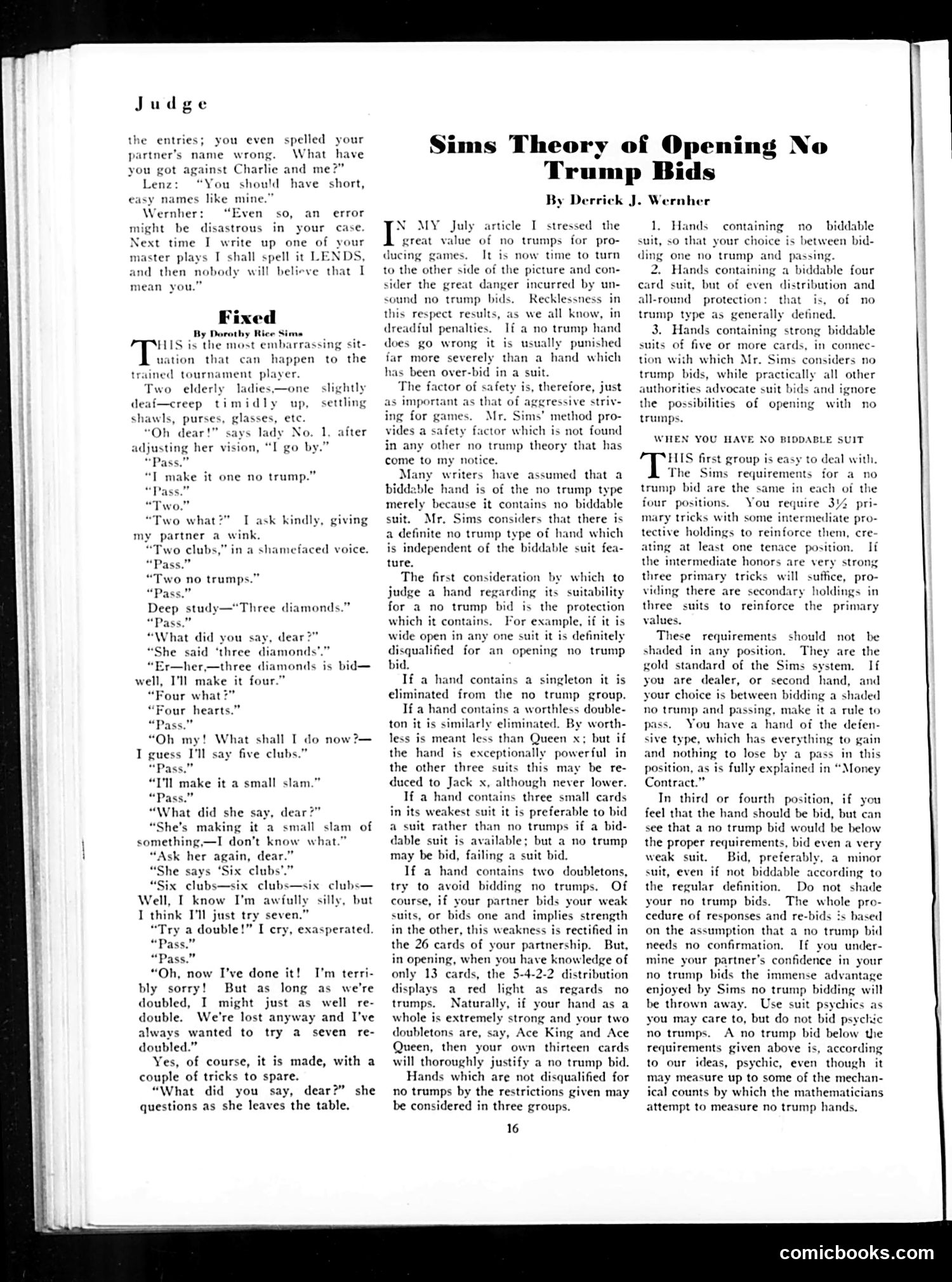
Analysis of Judge Magazine Page This page contains two unrelated bridge (card game) articles, not political satire. The left column, titled "Fixed," humorously depicts elderly female bridge players who are hard of hearing and confused about bidding calls. One player repeatedly mishears her partner's bids—"three diamonds" becomes "six clubs"—leading to increasingly absurd escalations. The joke satirizes amateur tournament players' incompetence and the comedic miscommunication between confused seniors at the card table. The right column, "Sims Theory of Opening No Trump Bids" by Derrick J. Wernher, is a serious instructional article about bridge strategy, discussing when players should bid "no trump" hands based on card protection and suit distribution. This appears to be from *Judge*'s sports/games section rather than its political content. There are no political figures, social commentary, or satirical targets—just recreational bridge humor and instruction for card-playing readers.
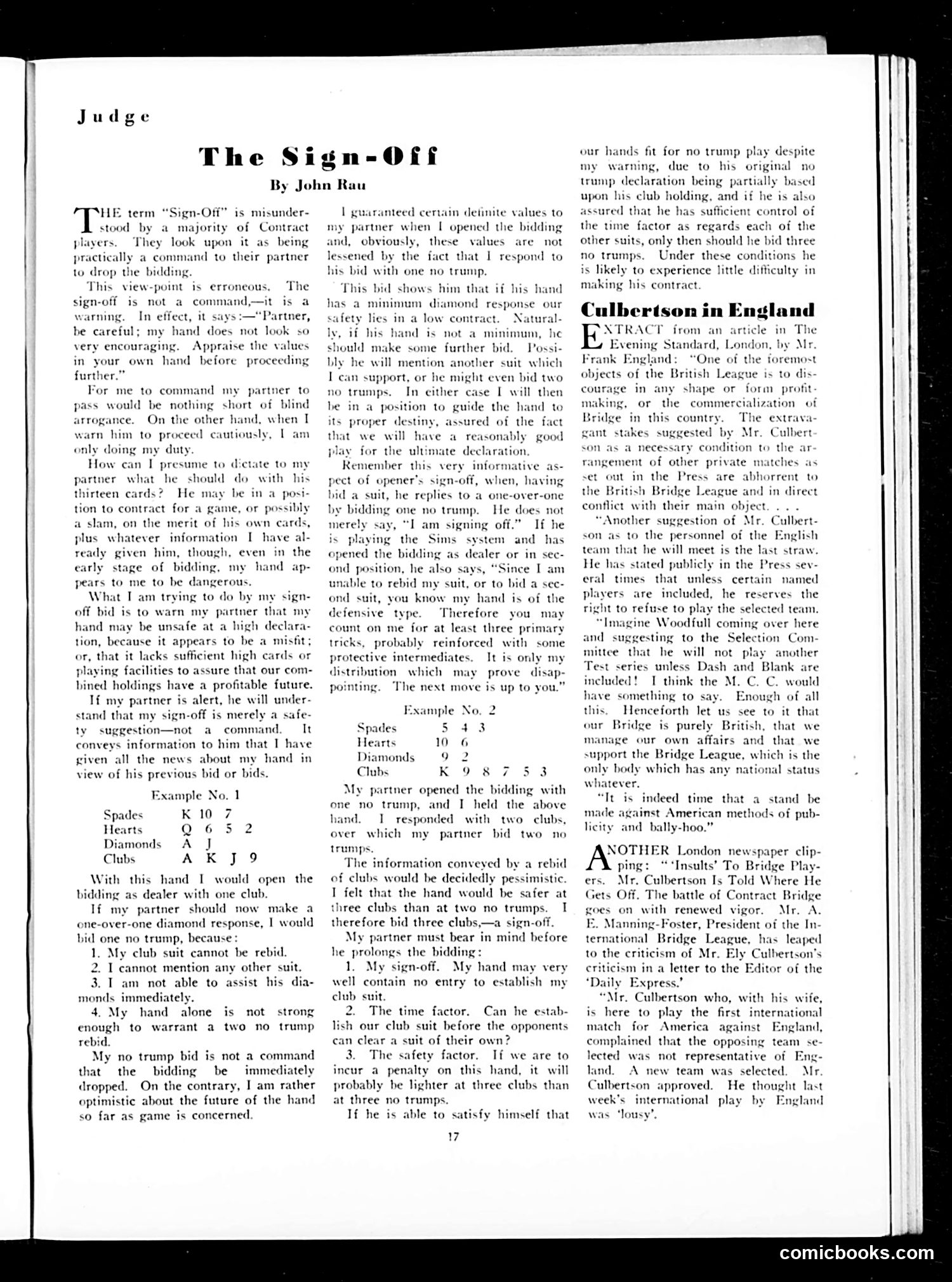
Explanation for Modern Readers This page contains a bridge (card game) instruction article, not political satire. "The Sign-Off" by John Rau explains contract bridge bidding strategy to *Judge* magazine readers—a common feature in early-20th-century publications that mixed humor with practical advice. The article clarifies that a "sign-off" bid is not a command to stop bidding, but rather a warning signal conveying information about hand strength. Rau uses numbered examples to demonstrate proper bidding sequences. The second article excerpt, "Culbertson in England," briefly mentions bridge player Ely Culbertson's visit to England for international matches—establishing that bridge was a popular, competitive game worthy of magazine coverage. This reflects an era when contract bridge was a mainstream leisure activity, and educational content about its rules and strategy could fill general-interest magazine pages.
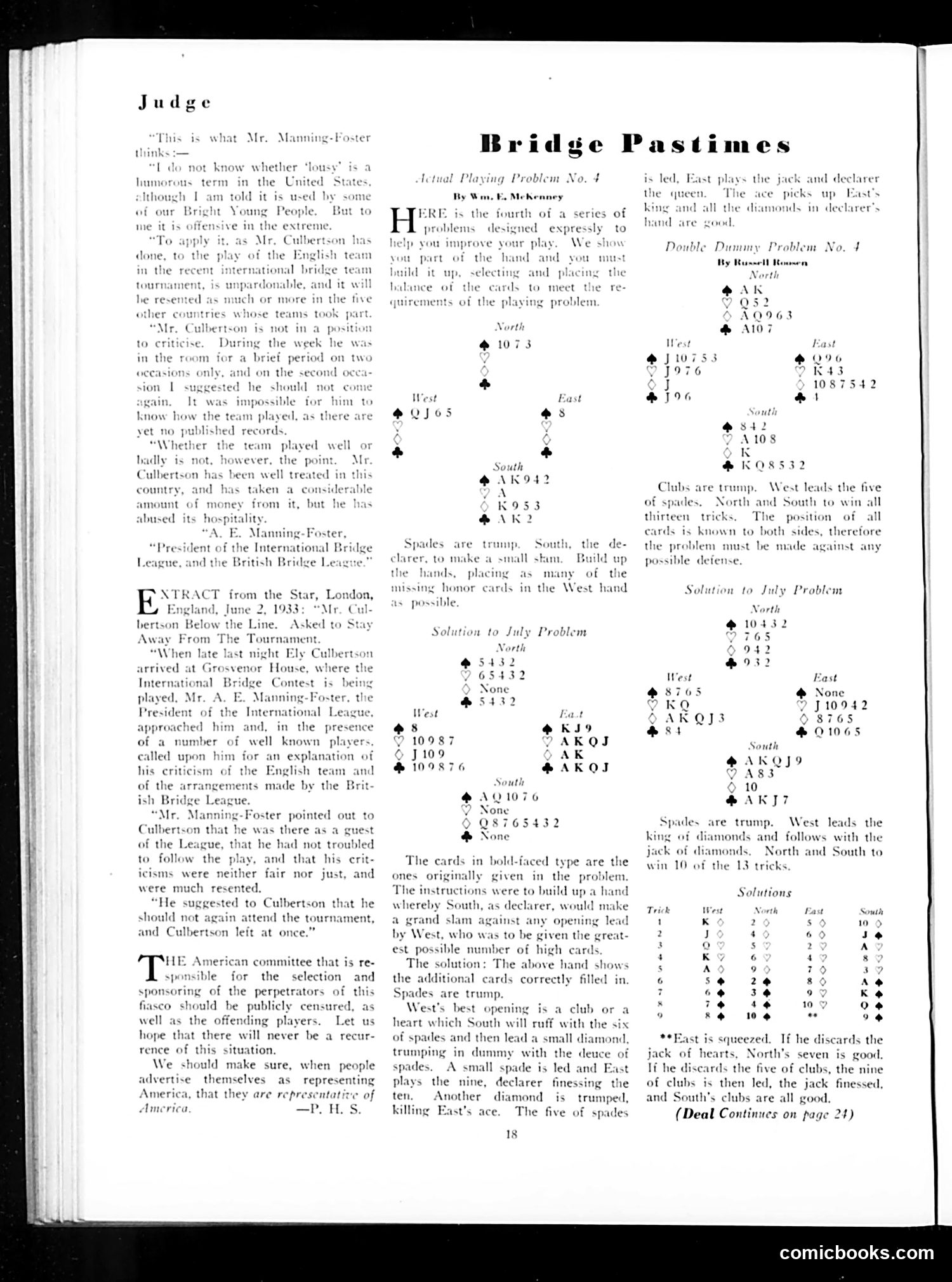
What This Page Contains This page is not a political cartoon but rather bridge instruction and tournament coverage from *Judge* magazine. The content focuses on the international bridge scandal involving Ely Culbertson, the famous American bridge expert and tournament organizer. The text discusses criticism Culbertson faced regarding arrangements for an international bridge tournament. A.E. Manning-Foster, President of the International Bridge League, apparently challenged Culbertson's conduct, leading to his departure from the event. The article suggests Culbertson's presence as a guest observer was controversial among competing players. The remainder consists of bridge problem solutions—technical card-game puzzles with hands diagrammed for readers to solve, a regular feature in bridge-focused publications of the era. This is primarily instructional content rather than satire.
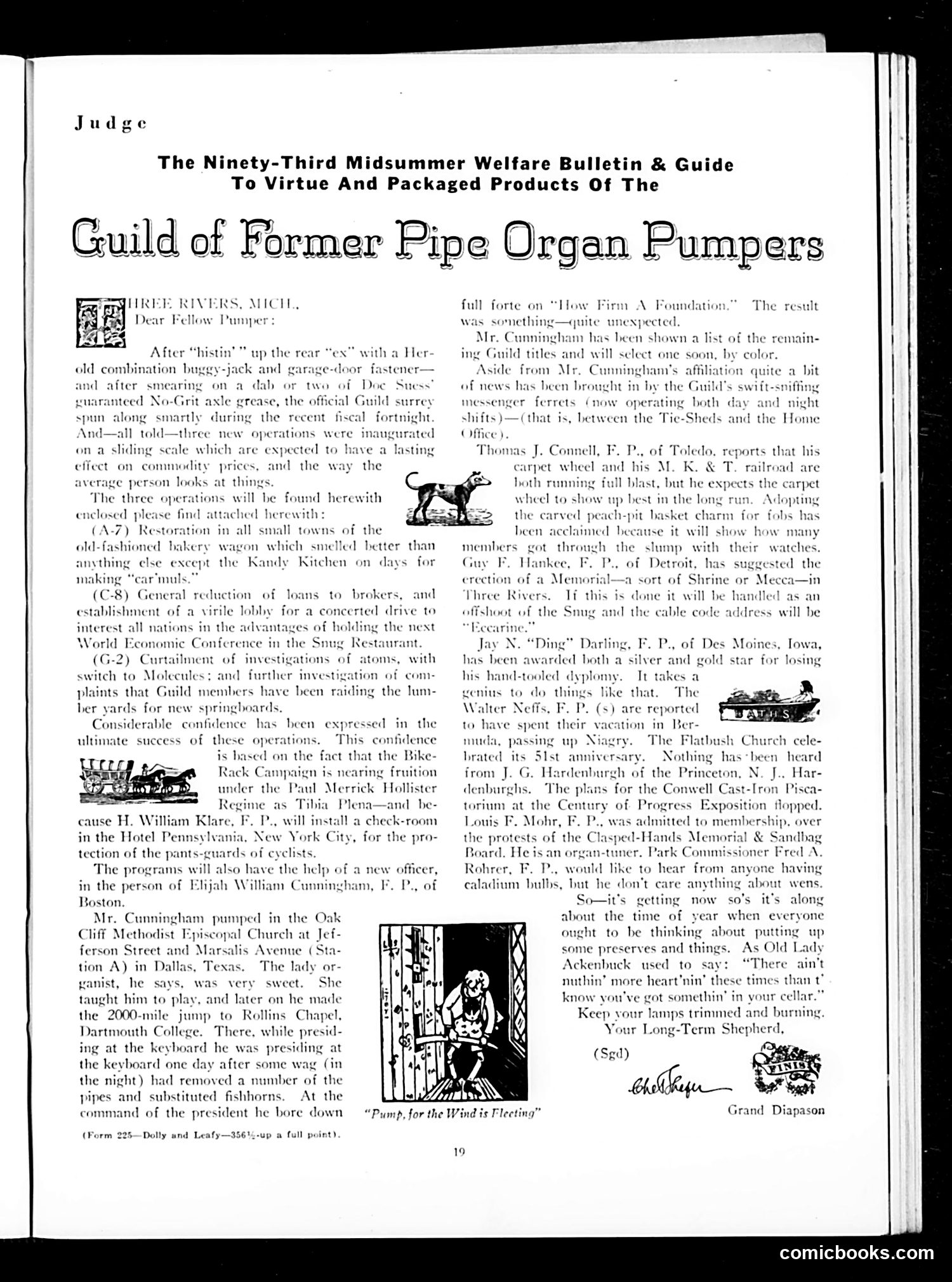
This is a satirical humor piece in Judge magazine mocking the absurdity of corporate and organizational bureaucracy during an era of rapid industrialization. The main article presents a mock "welfare bulletin" from the "Guild of Former Pipe Organ Pumpers"—a fabricated organization presumably commenting on how mechanization made certain professions obsolete. The satire ridicules the self-important language of organizational memos ("A-7," "C-8") announcing trivial initiatives presented with inflated importance: closing bakery wagons, reducing loans, and investigating "complaints that Guild members have been raiding the lumber yards." The included anecdotes about members (Cunningham, Connell, Darling) parody the earnest biographical tributes typical of organizational newsletters. The famous organist anecdote—where Cunningham unknowingly plays an organ with fishhorns substituted for pipes—exemplifies the humor: physical comedy exposing the absurdity of solemn institutional procedures. The small illustration ("Pump, for the Wind is Fleeting") depicts someone at an organ, reinforcing the joke. This appears to be satire of American organizational culture and self-importance during the early 20th century.
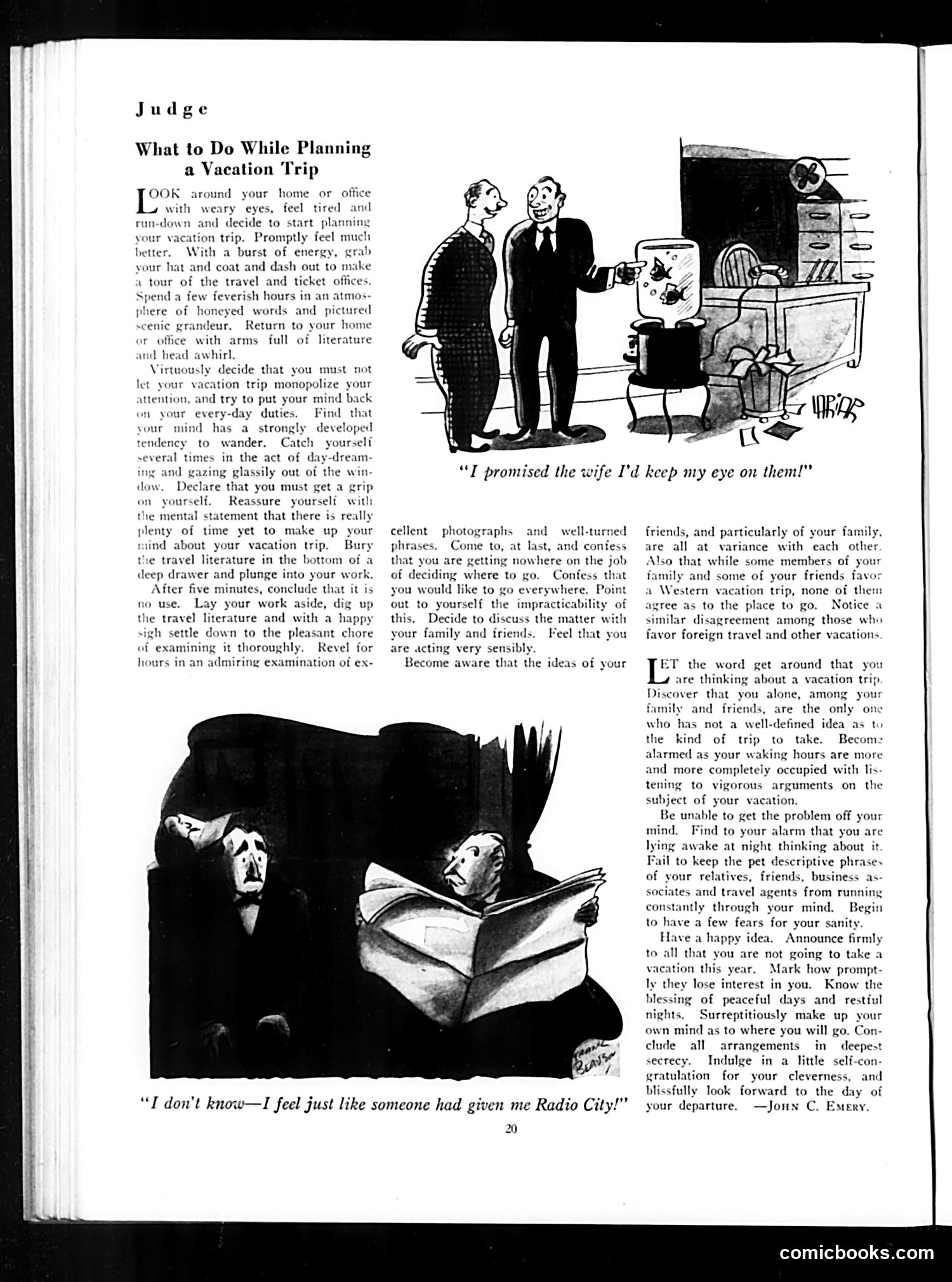
"What to Do While Planning a Vacation Trip" This humorous article satirizes the modern middle-class experience of vacation planning. The top cartoon shows a travel agent enthusiastically pitching destinations to a weary businessman, illustrating how the planning process itself creates excitement and distraction from work. The lower cartoon depicts a man lying in bed unable to sleep, tormented by vacation anxiety—the caption reads, "I don't know—I feel just like someone had given me Radio City!" (likely referencing the newly opened Rockefeller Center). The satirical text chronicles the neurotic cycle: initial enthusiasm gives way to daydreaming, work paralysis, family disagreement about destinations, sleepless nights, and competing advice from relatives and travel agents. The ironic resolution suggests the only relief comes from *canceling* the vacation entirely, allowing peace of mind—until one secretly books a trip anyway. The satire gently mocks American anxieties about leisure, indecision, and the way vacation planning consumes mental energy rather than providing the promised rest.
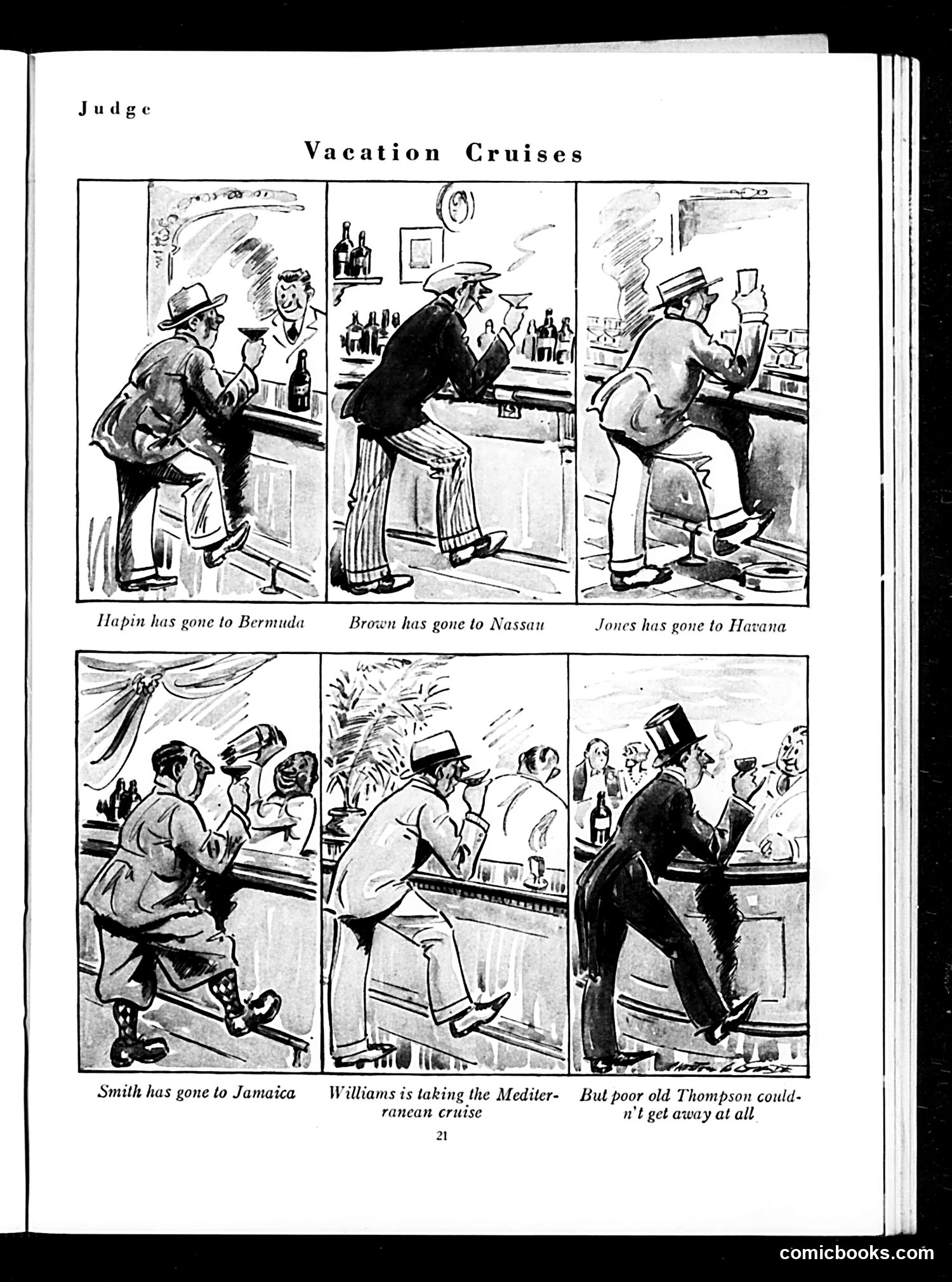
Vacation Cruises This six-panel satirical cartoon contrasts wealthy men enjoying tropical vacations with one man left behind. The top row shows three men at bars in different cruise destinations (Bermuda, Nassau, Havana), all drinking and enjoying themselves. The bottom row depicts similar scenes—a man relaxing on a ship to Jamaica, another on a Mediterranean cruise—while the final panel shows "poor old Thompson" stuck at a bar at home, apparently unable to afford a vacation while his friends travel. The satire mocks the leisure culture and one-upmanship among the wealthy during what appears to be the early 20th century, when Caribbean and Mediterranean cruises were expensive luxuries. Thompson's predicament—left behind while colleagues brag about their exotic trips—humorously highlights economic inequality and social anxiety about keeping up appearances.
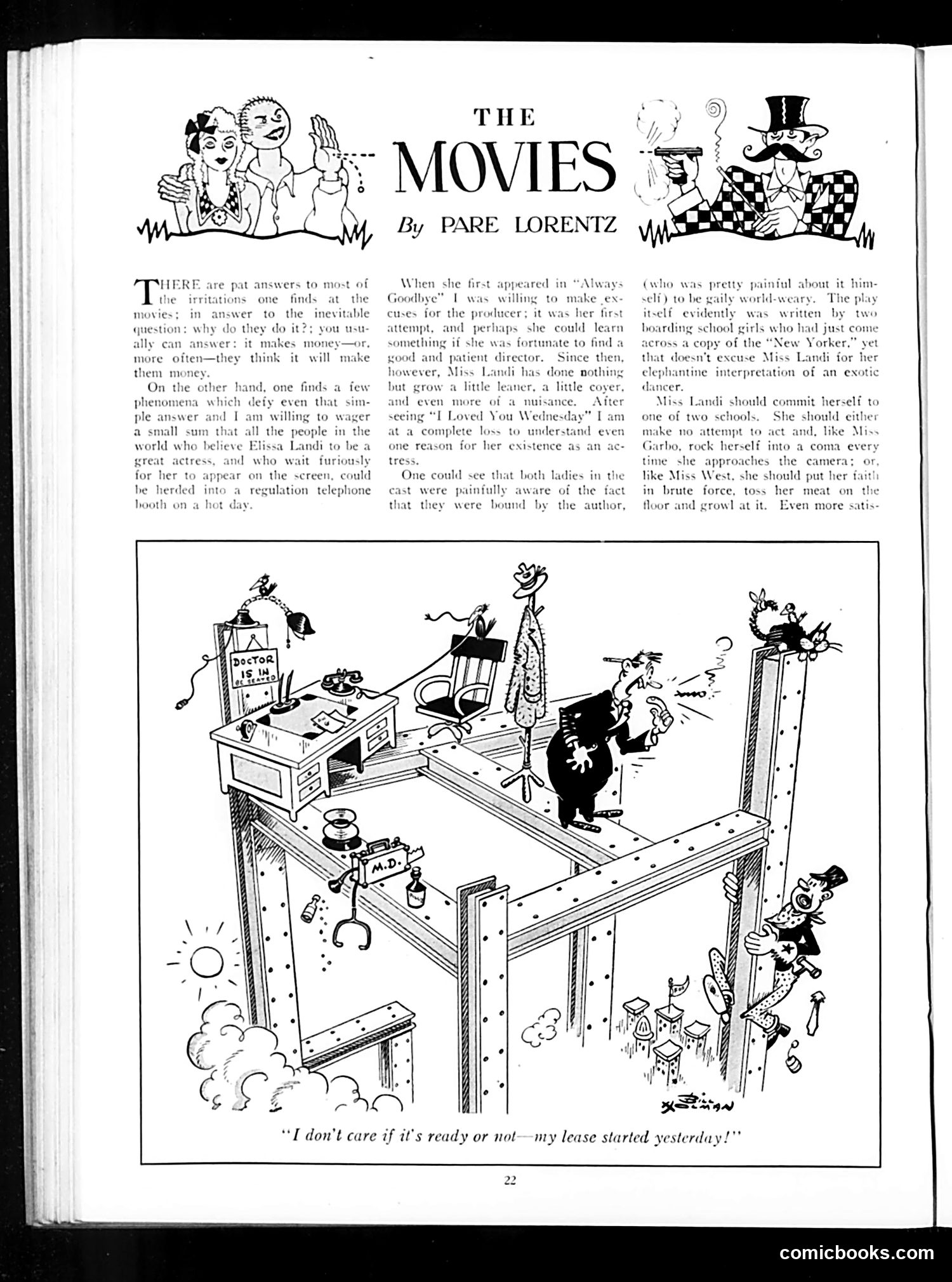
"The Movies" by Pare Lorentz This is a satirical critique of actress Elissa Landi and her film work. The article dismisses her as a mediocre performer who appeared in "Always Goodbye" and other films, noting she lacks talent despite opportunities with good directors. The cartoon below depicts a movie studio set in chaos—a director and crew atop a tall platform, with the stage collapsing or malfunctioning. A businessman declares "I don't care if it's ready or not—my lease started yesterday!" The joke satirizes Hollywood's commercial pressure: productions prioritize financial deadlines over quality. The studio literally falls apart because profit timelines override artistic preparation. This reflects 1920s-30s tensions between art and commerce in early cinema, when studios rushed films to market regardless of readiness, sacrificing quality for box-office schedules and lease obligations.
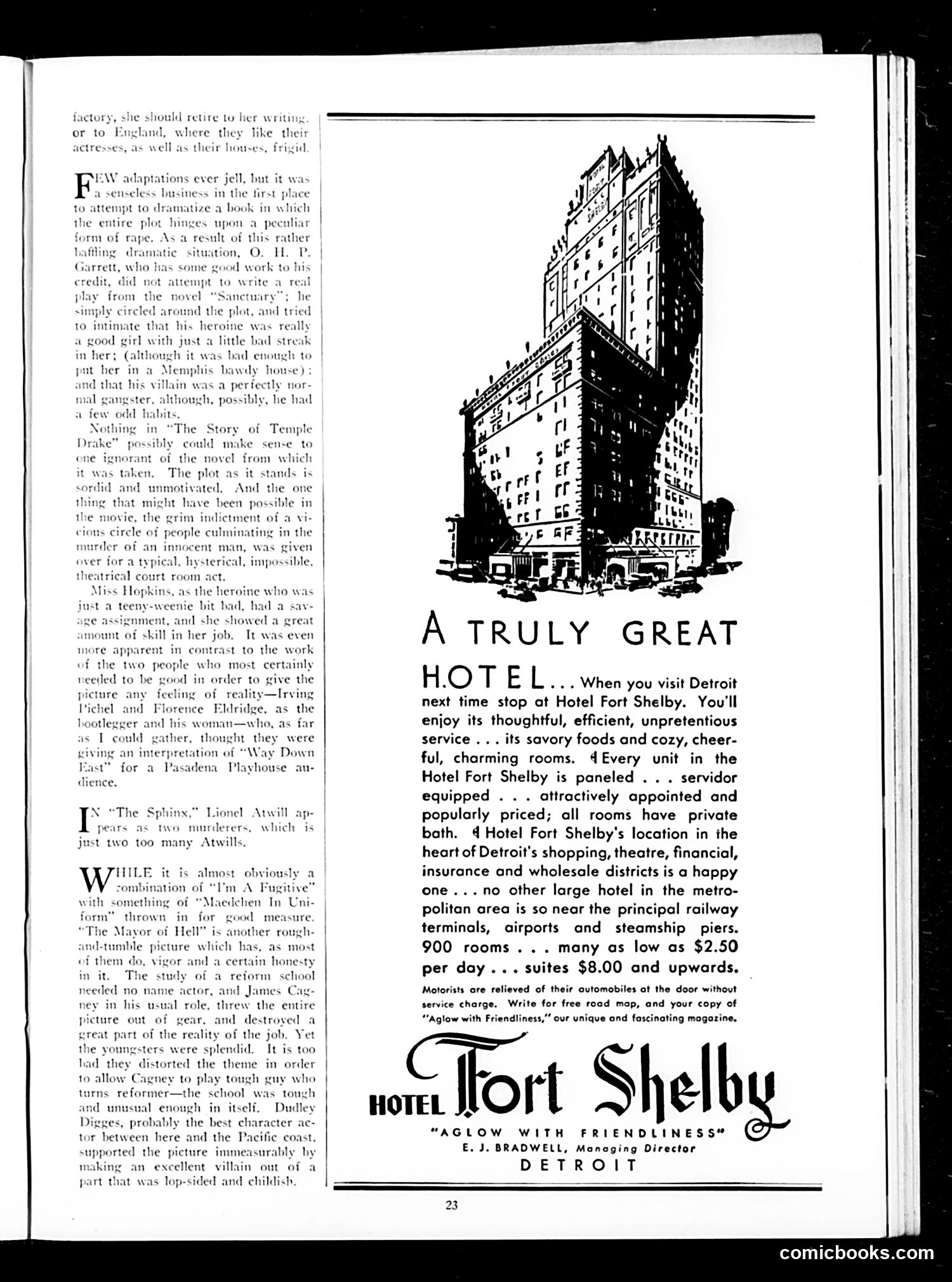
Judge Magazine Page Analysis This page is primarily advertising, not satire or political commentary. The dominant content is a large advertisement for the Hotel Fort Shelby in Detroit, occupying roughly half the page. The left column contains film criticism—reviews of recent movie adaptations discussing their quality and casting. The reviewer critiques several films based on novels, noting that "Sanctuary" and "The Story of Temple Drake" failed to capture their source material effectively. The text mentions actors like James Cagney and Lionel Atwill. No political cartoon or satire is present. This appears to be a typical Judge magazine page from the 1930s-40s era, mixing entertainment commentary with period advertising. The magazine's satirical content, if any exists on this page, is limited to the critical film reviews themselves—which gently mock how poorly Hollywood adapted literary material.
Understanding This Judge Magazine Page This page is primarily advertising and instructional content about bridge (the card game), not political satire. The small cartoon at top-left showing four figures merely illustrates the bridge theme. The main content includes: 1. "4 Aces" section: Advertisements for bridge books and instruction materials, including titles like "101 Celebrated Hands" and "Duplicate Contract Bridge in the Home." 2. "Party Bridge" article: Instructions for hosting a 10-player bridge game that deliberately separates husbands and wives at different tables. The humorous premise is uncertainty about whether "beer is helping bridge or bridge is helping beer"—suggesting social drinking accompanies the card game. 3. "Tournament News": Reports on the 43rd Annual American Whist League Congress held in Hanover, New Hampshire, listing championship winners in various bridge categories. This is essentially a bridge enthusiast's page from what appears to be a 1930s-era magazine, mixing practical gaming advice with competitive tournament coverage and product promotion.
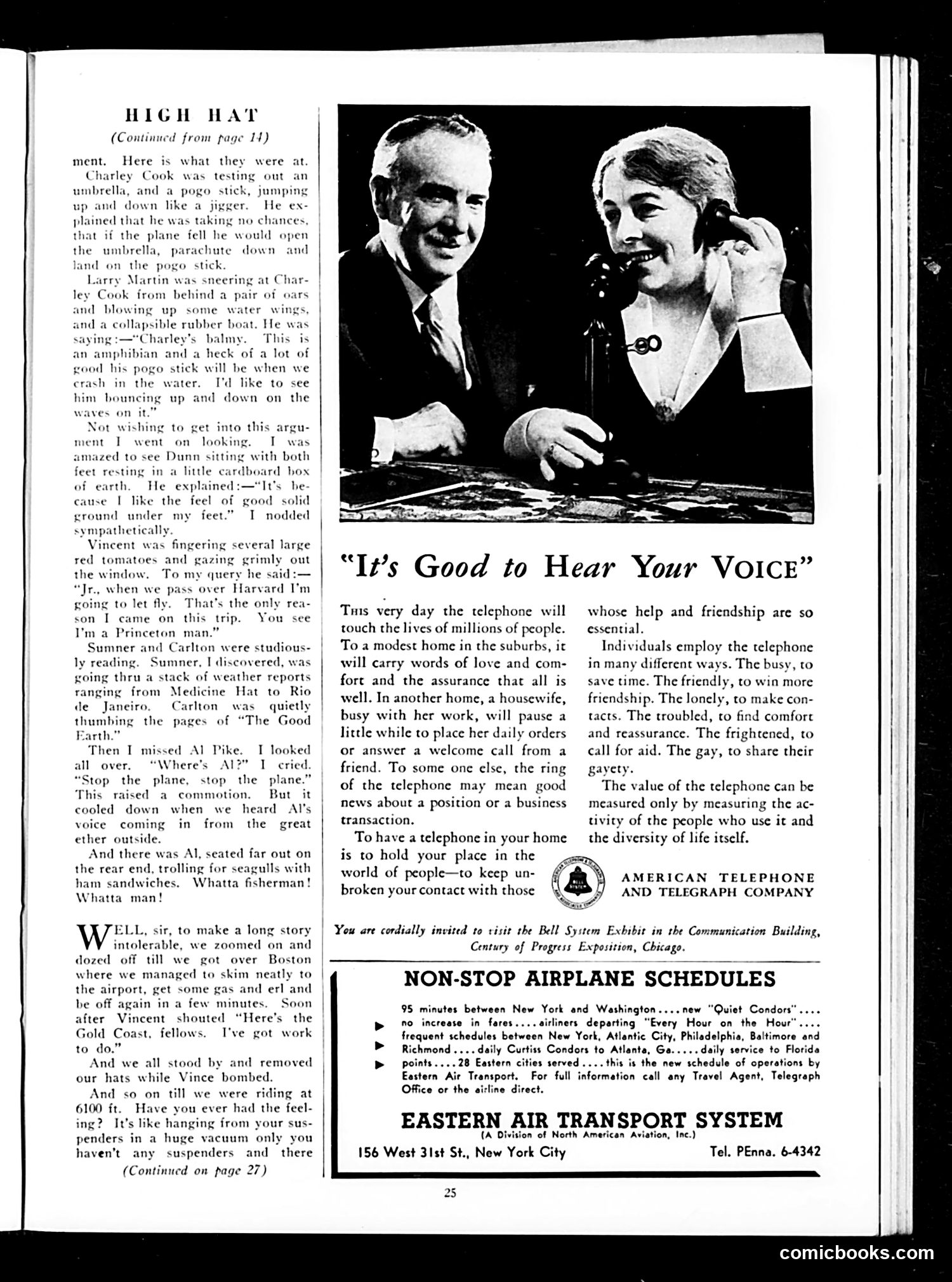
This page consists mainly of text and advertising rather than political satire. The editorial article "High Hat" describes a humorous airplane flight where various passengers (named individuals like Charley Cook, Larry Martin, Vincent, and Al Pike) employ absurd safety precautions and behaviors—umbrella parachutes, pogo sticks, rubber boats, tomato-throwing, seagull-fishing with sandwiches, and feet planted in dirt boxes. The satire targets the irrational anxieties and superstitious behaviors people display about flying, which was still novel and anxiety-inducing in this era. The piece mocks excessive caution and nervousness as passengers perform comically exaggerated rituals. The remainder is an earnest AT&T advertisement about the telephone's value to society and Eastern Air Transport flight schedule promotions—typical magazine content of the period.
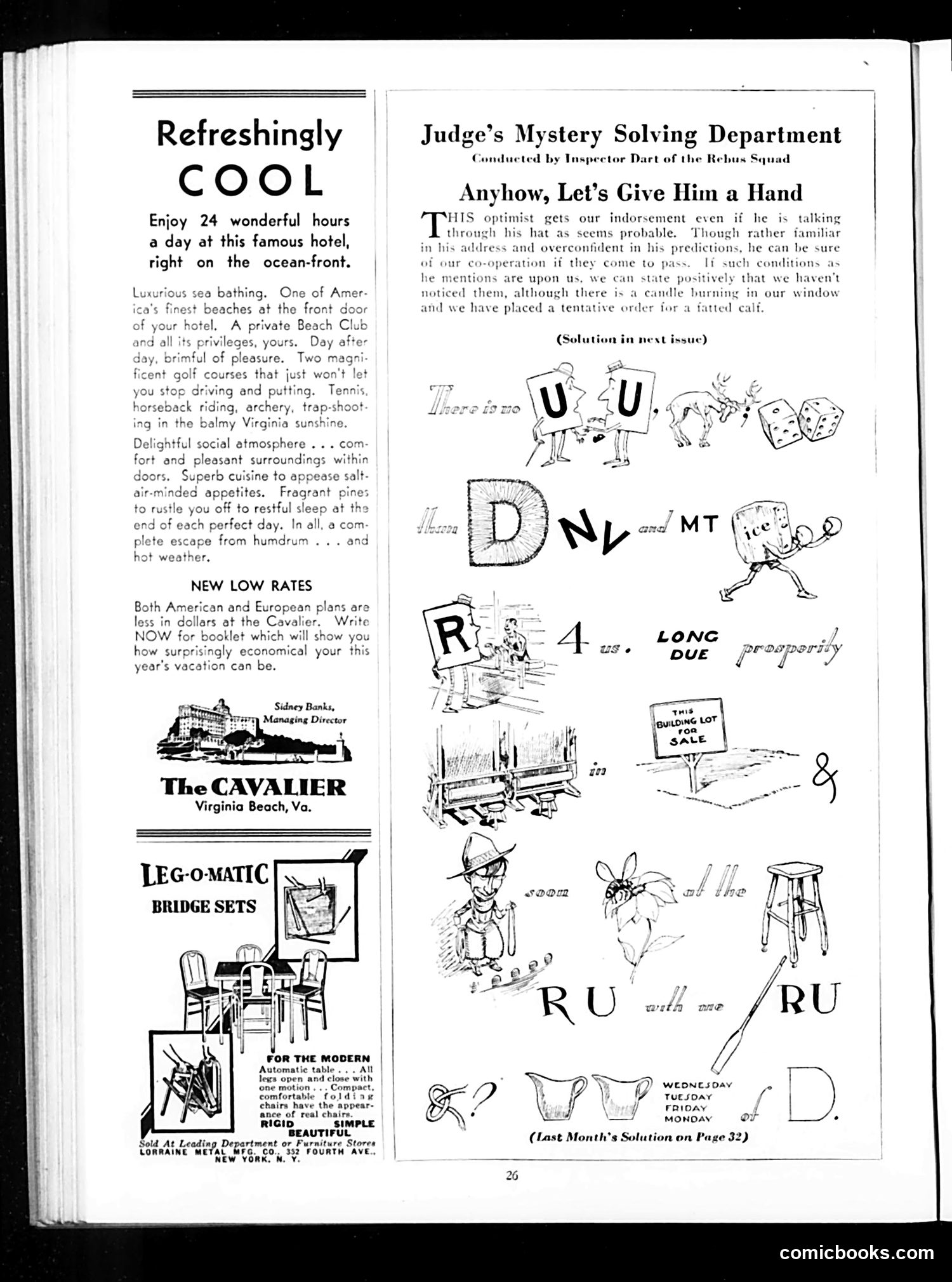
Judge Magazine's Mystery-Solving Rebus Puzzle This page features Judge magazine's "Mystery Solving Department"—a popular puzzle feature where readers decode visual and textual clues to find an answer. The rebus puzzle uses simple line drawings and letter combinations to spell out a phrase. The clues include: "U" and "U" (two U's), "D" with "NLY" and "MT," "R" with "4," dice showing "8," a cowboy figure, a bee, a leaf, and a stool labeled "RU" repeated. When decoded, these elements combine to form a message or phrase (the solution appears next issue, suggesting readers submitted answers). The surrounding advertisements—for The Cavalier hotel in Virginia Beach and Leg-O-Matic bridge sets—indicate this was leisure-oriented content for middle-class readers. Rebus puzzles were enormously popular early-20th-century entertainment, appearing regularly in magazines as engaging wordplay that encouraged reader participation and return purchases.
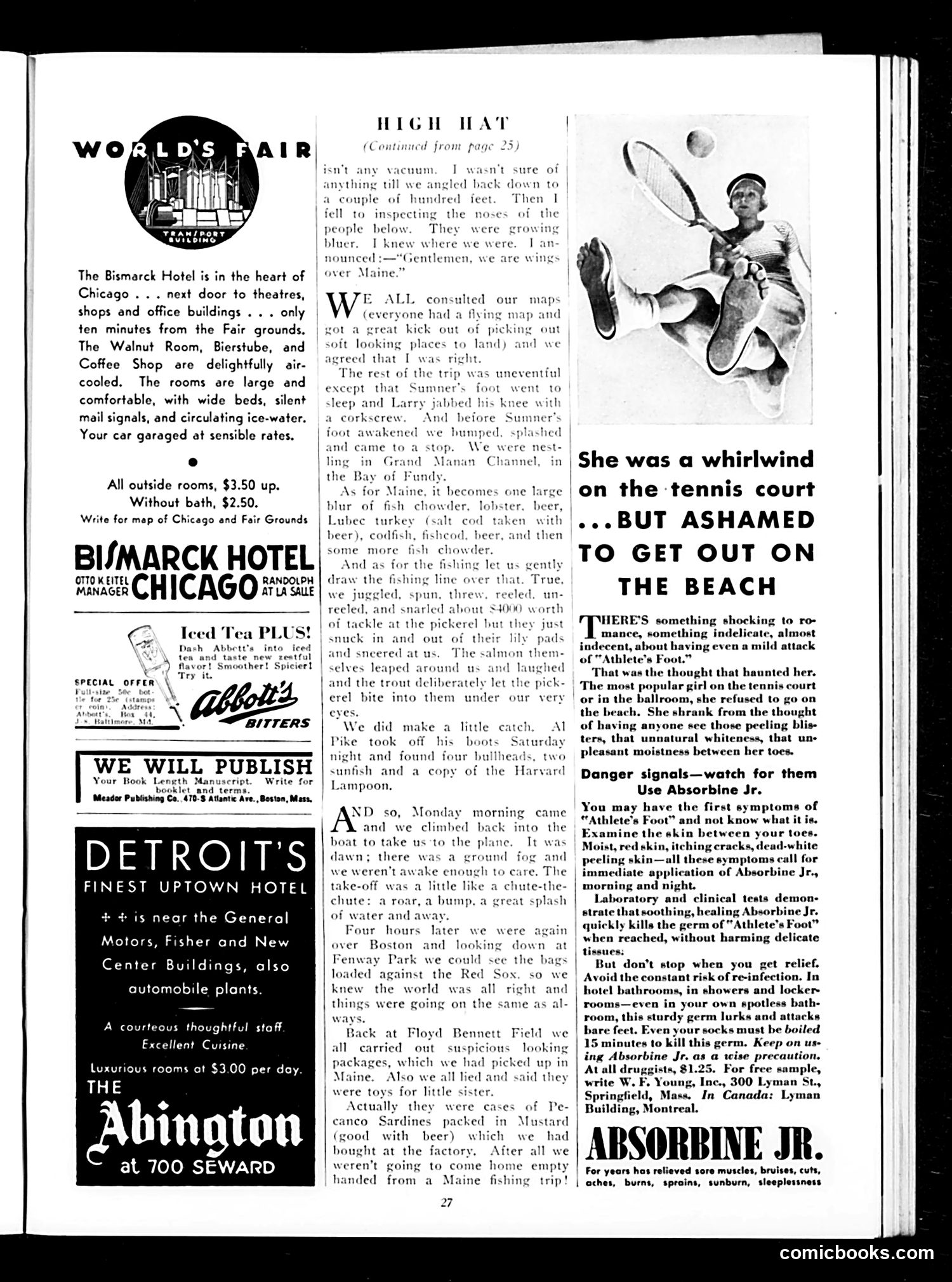
Analysis: Judge Magazine Page Content This page is primarily advertising for hotels, beverages, and patent medicine, with one narrative article ("High Hat," continued from page 25) describing a humorous flying trip to Maine. The main illustrated advertisement is for Absorbine Jr., a patent medicine. It features a young woman depicted as an athletic tennis player—"a whirlwind on the tennis court"—who refuses to go to the beach due to shame about "Athlete's Foot," a fungal infection characterized by "peeling blisters" and "unnatural whiteness" between the toes. The satire/social commentary: The ad exploits common anxieties about bodily imperfection and social embarrassment, particularly regarding women's appearance and fitness for public display. The stark contrast between her athletic prowess and her shame about an invisible condition reflects early-20th-century attitudes about propriety and physical vulnerability. The product pitch promises to eliminate these "danger signals" through daily application, positioning Absorbine Jr. as essential to maintaining social acceptability. This represents typical period advertising that weaponized shame to market remedies.
Page Analysis: Judge Magazine Sports Column This page is primarily advertising with a sports column rather than political cartoons. The "SPORTS" section (continued from page 6) discusses the decline of sportswriting as a profession. The columnist laments that famous sportswriters like Tad, Hype Igoe, and Robert Edgren—recognizable names to contemporary readers—have largely disappeared from the field. He critiques how college football publicity machines now dominate sports reporting, with each school employing a "demon publicity man." The piece offers career advice to young journalists (likely college seniors), suggesting they study skilled writers like Westbrook Pegler and Joe Williams as models. The columnist argues that sports—full of "drama, trickery, pathos, courage"—deserves better literary treatment, wondering why no modern writer has matched Ring Lardner or Van Loan's storytelling abilities. The satire targets the professionalization and commercialization of sports coverage, lamenting lost golden-age standards.
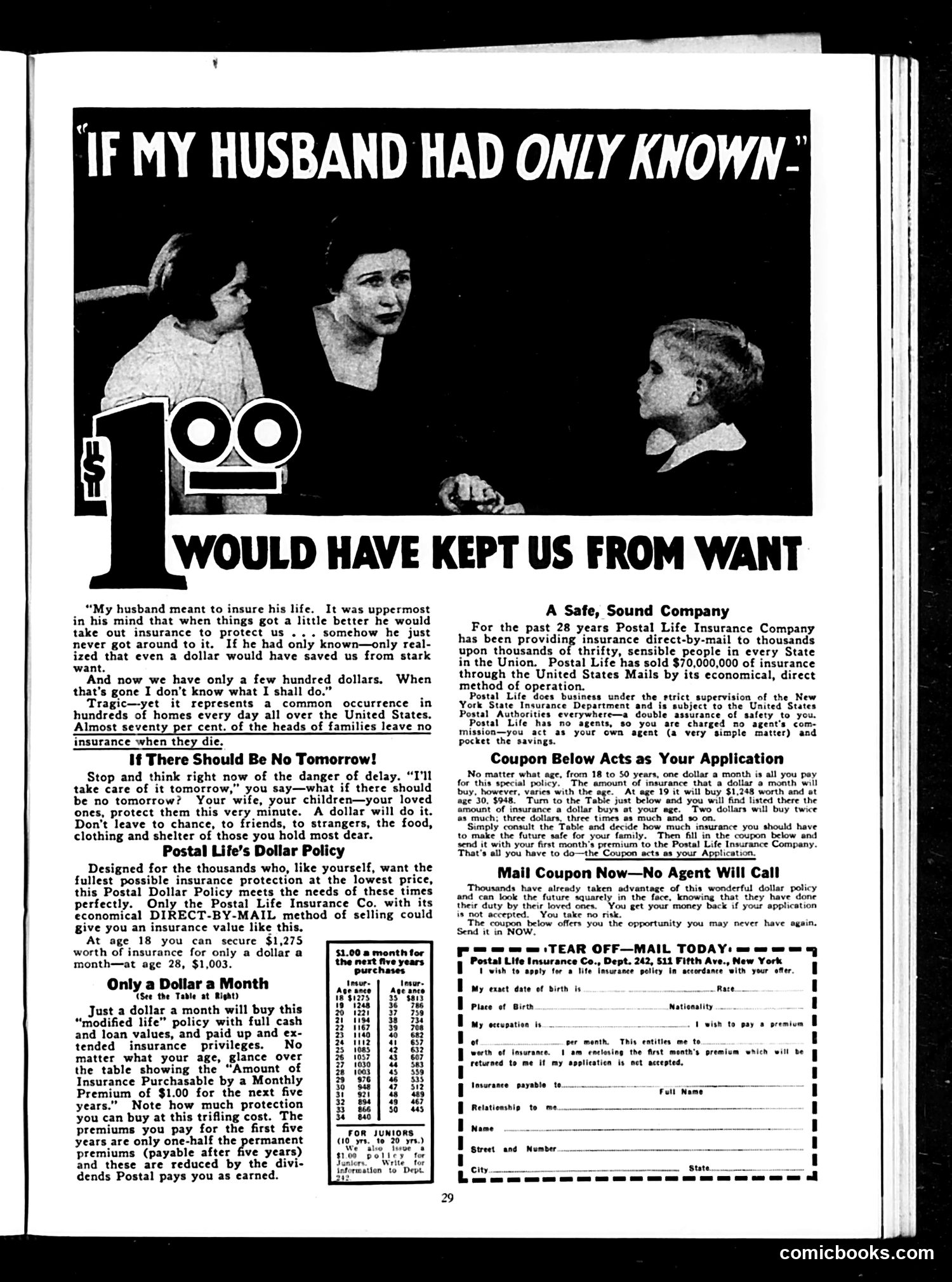
Analysis for Modern Readers This page is primarily a life insurance advertisement for Postal Life Insurance Company, presented as editorial content in *Judge* magazine. The opening narrative features an unnamed widow lamenting that her husband delayed purchasing life insurance until it was too late. She's shown with two children, emphasizing the financial vulnerability left behind. The "satire" here is gentle moralizing rather than sharp comedy—the tragic scenario serves to motivate readers toward purchasing insurance. The advertisement's pitch targets middle-class Americans of modest means: for just one dollar per month, a young man could secure substantial coverage ($1,275 at age 18). The company emphasizes safety through New York State regulation and direct mail-order sales (no agents meant lower costs). The social context: early 20th-century America lacked Social Security or widespread employer benefits. Life insurance was genuinely novel and necessary protection for working families. The advertisement exploits legitimate anxiety about premature death leaving families destitute. The page reflects *Judge*'s business model—mixing satirical commentary with paid advertising, blurring editorial and commercial content in ways that would raise ethical concerns today.
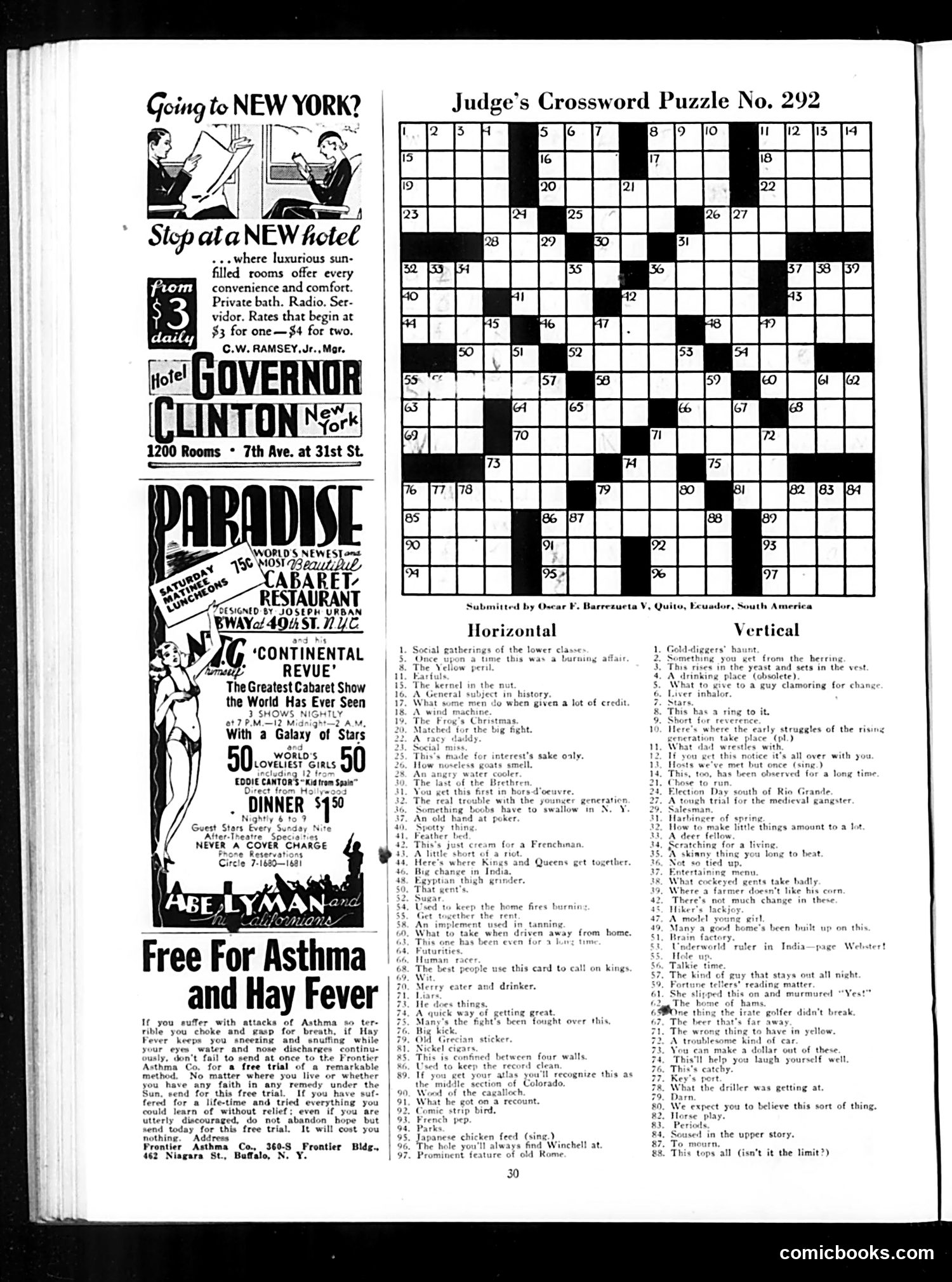
Judge Magazine Page Analysis This page is primarily advertising and a crossword puzzle, not political satire. The left side contains vintage advertisements for New York hotels (Governor Clinton), a cabaret show ("Continental Revue" with 50 chorus girls), and a medical remedy for asthma and hay fever—typical 1930s-era magazine ads emphasizing luxury accommodations and entertainments. The right side is Judge's crossword puzzle No. 292, submitted by Oscar F. Barruereta of Ecuador. The clues are standard crossword fare with contemporary references (e.g., "Election Day south of Rio Grande" for 25-Down, "Talkie time" for 62-Across). The small illustration at top left shows two men with newspapers, relating to the "Going to NEW YORK?" header—likely promoting travel to the city. There is no discernible political cartoon or satire on this page; it's a service/advertising-heavy magazine layout typical of Judge during this period.
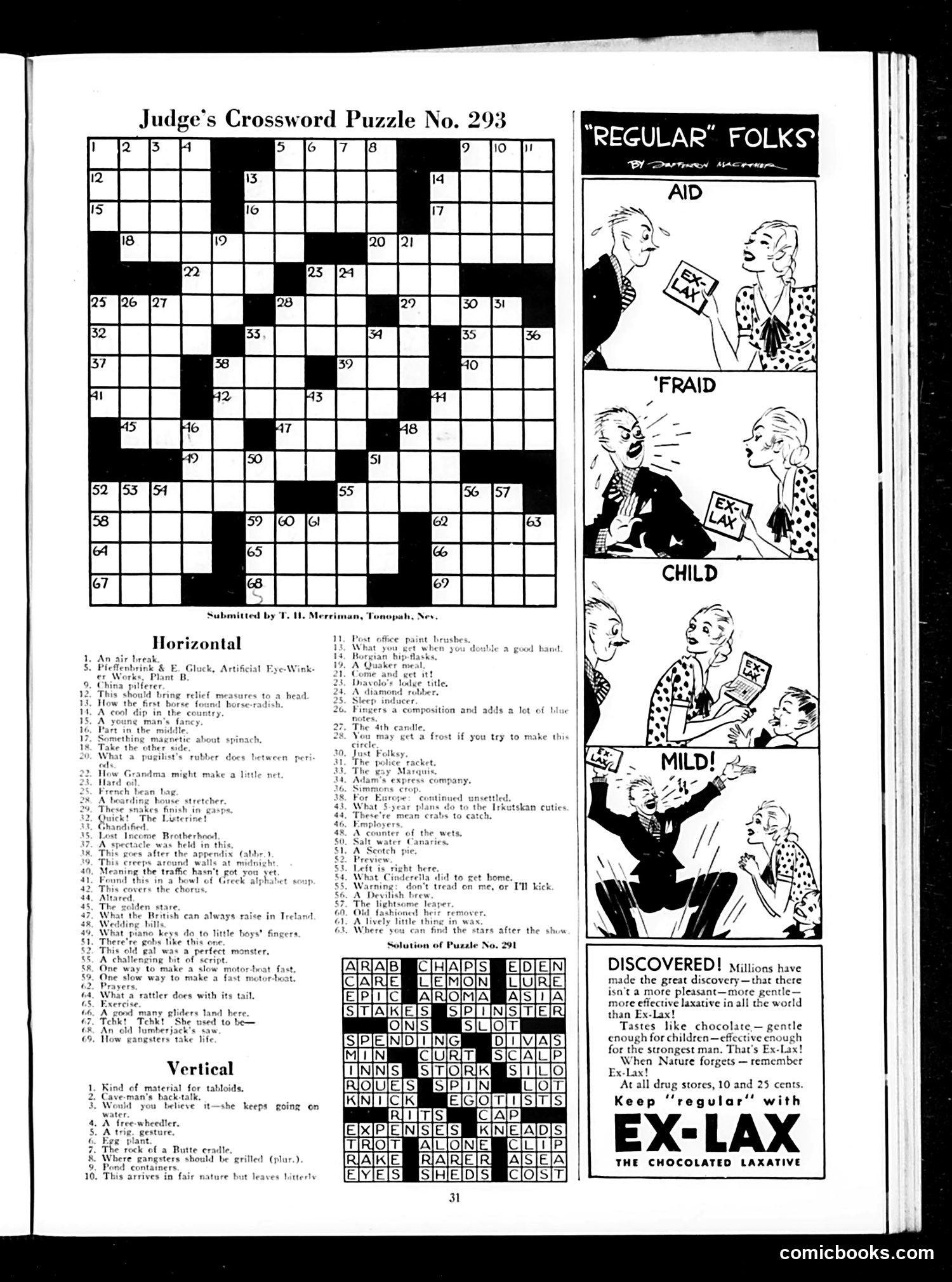
Judge Magazine Page Analysis This page from *Judge* magazine consists primarily of a crossword puzzle (No. 293) with clues and a solution grid, plus an advertisement for Ex-Lax laxative. The only satirical content is the "Regular Folks" comic strip on the right side, which shows a sequence of four panels depicting a man showing a woman what appears to be a complaint letter or similar document. The progression moves from "Aid" (the man explaining) to "Fraud" (the woman's angry reaction) to "Child" (a child entering the scene) to "Mild!" (suggesting a resolution or calming effect). The comic appears to be a domestic humor strip satirizing ordinary middle-class life—specifically, a marital dispute over some complaint or grievance. The "Regular Folks" title indicates this targets everyday American family situations for comedic effect. The Ex-Lax advertisement below emphasizes the product is "gentle enough for children" while remaining effective, using humor to market a laxative to a general audience.
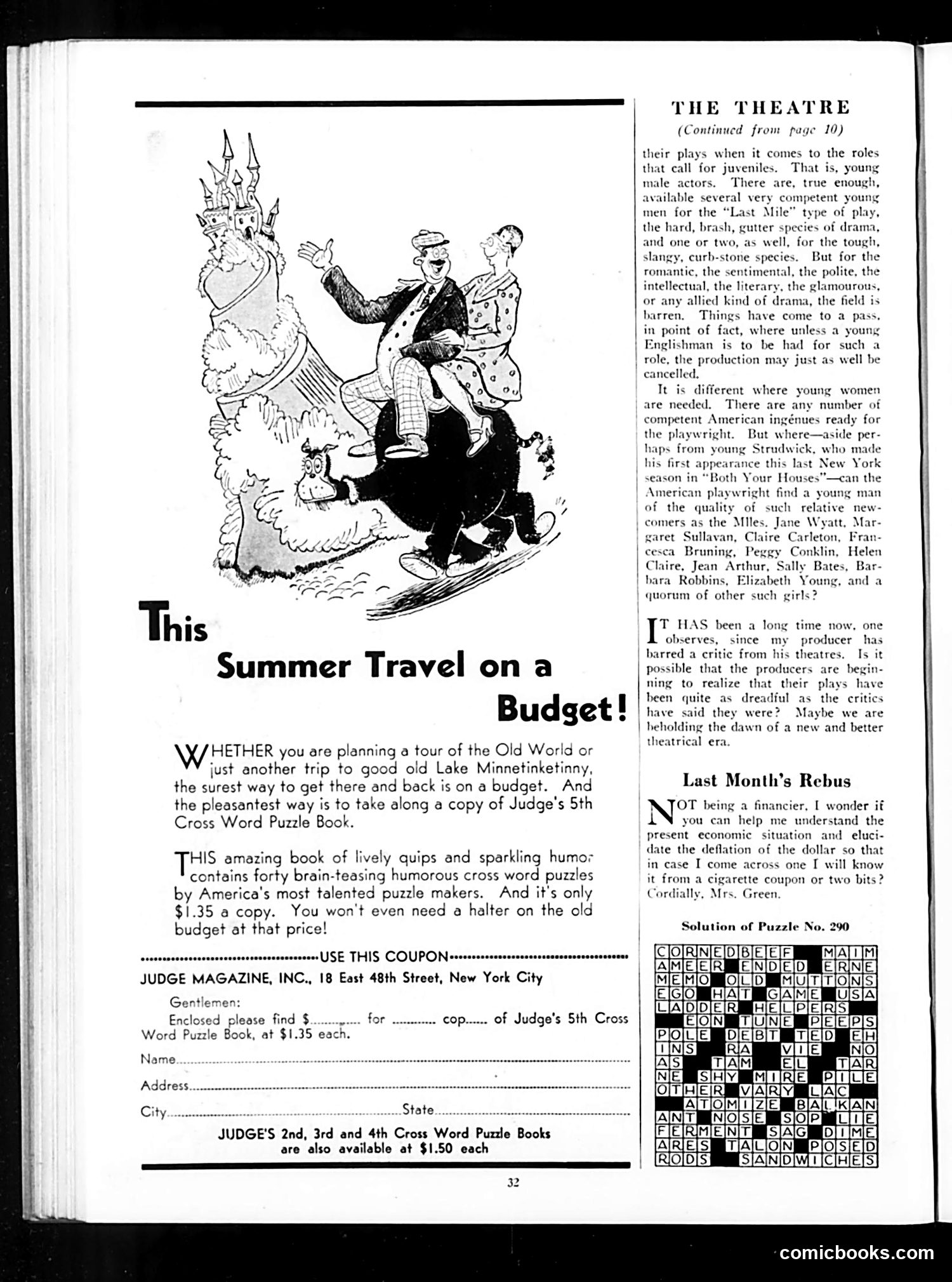
Analysis of Judge Magazine Page 32 This page combines theater criticism with advertising. The main cartoon (top left) depicts two men riding a fantastical creature, illustrating the advertisement below: "This Summer Travel on a Budget!" promoting Judge's 5th Cross Word Puzzle Book ($1.35). The theater column critiques American theater's lack of suitable young male actors for romantic/literary roles, suggesting producers must import English actors. It favorably names several young American actresses (Jane Wyatt, Margaret Sullavan, Claire Carleton, etc.) as proof that talented female performers exist domestically—the field isn't "barren" for women as it is for men. This reflects 1930s gender disparities in theatrical casting opportunities. A separate "Last Month's Rebus" humor feature addresses economic hardship: a reader asks how to recognize deflated currency, joking they might confuse it with cigarette coupons or two-bit coins. This reflects Depression-era economic anxiety presented as gentle satire. The page is primarily advertisement with embedded cultural commentary on both theater and economics.
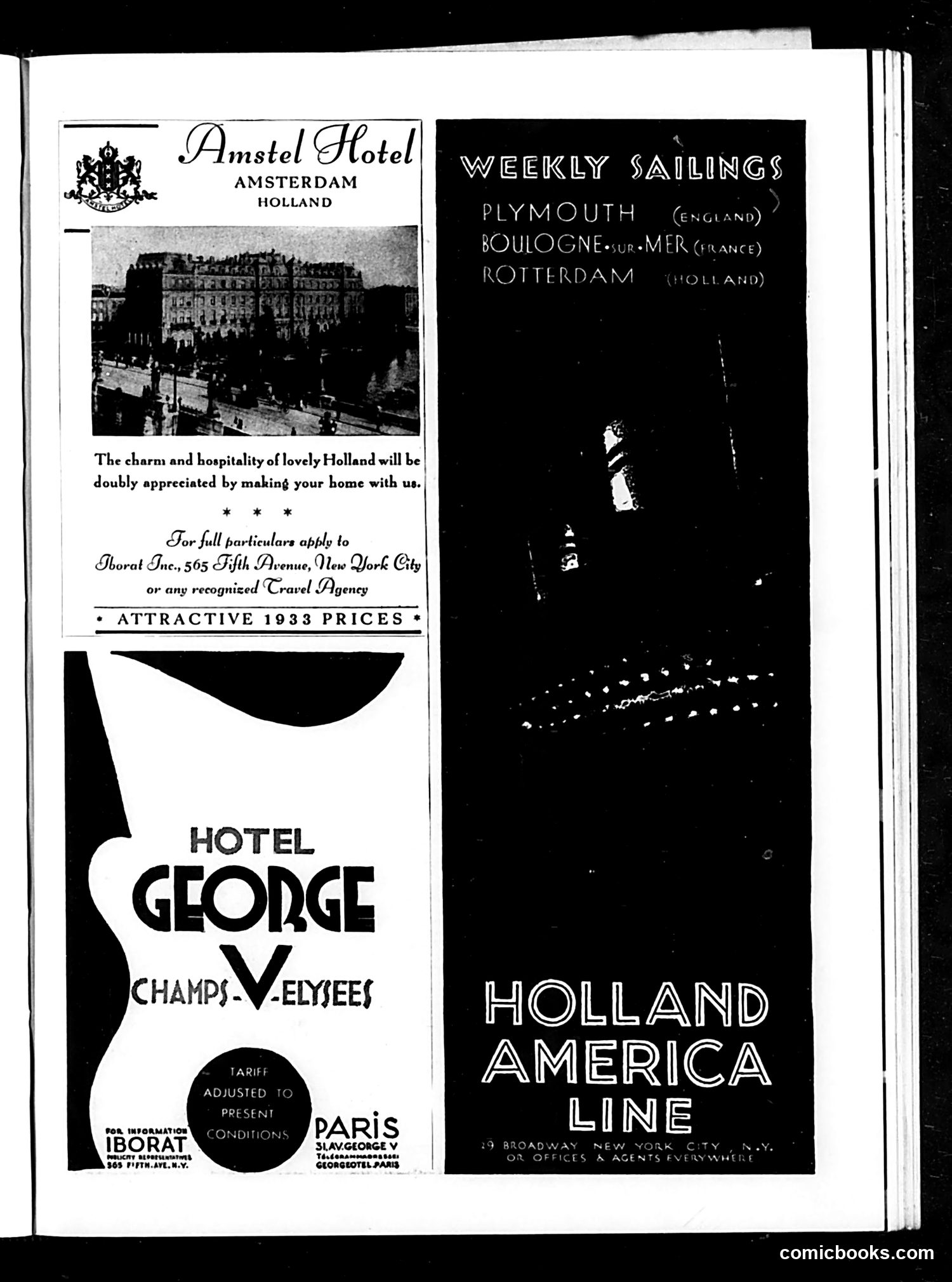
Analysis for Modern Readers This page is primarily advertising, not political satire. It contains three travel and hospitality advertisements from 1933: 1. Amstel Hotel (Amsterdam, Holland) - promotes Dutch hospitality and "attractive 1933 prices," with contact info through Iborat Inc. in New York 2. Hotel George (Paris, Champs-Élysées) - advertises Parisian lodging with pricing "adjusted to present conditions" (reflecting Depression-era economics) 3. Holland America Line - shipping company advertising weekly sailings from Plymouth, Boulogne-sur-Mer, and Rotterdam to New York The context: During the 1933 Great Depression, travel companies aggressively marketed European vacations to American tourists, emphasizing reduced prices. The ads target affluent Americans who could still afford international travel. There is no identifiable political cartoon or satire on this page—it's a commercial advertisement section typical of *Judge* magazine's revenue model.
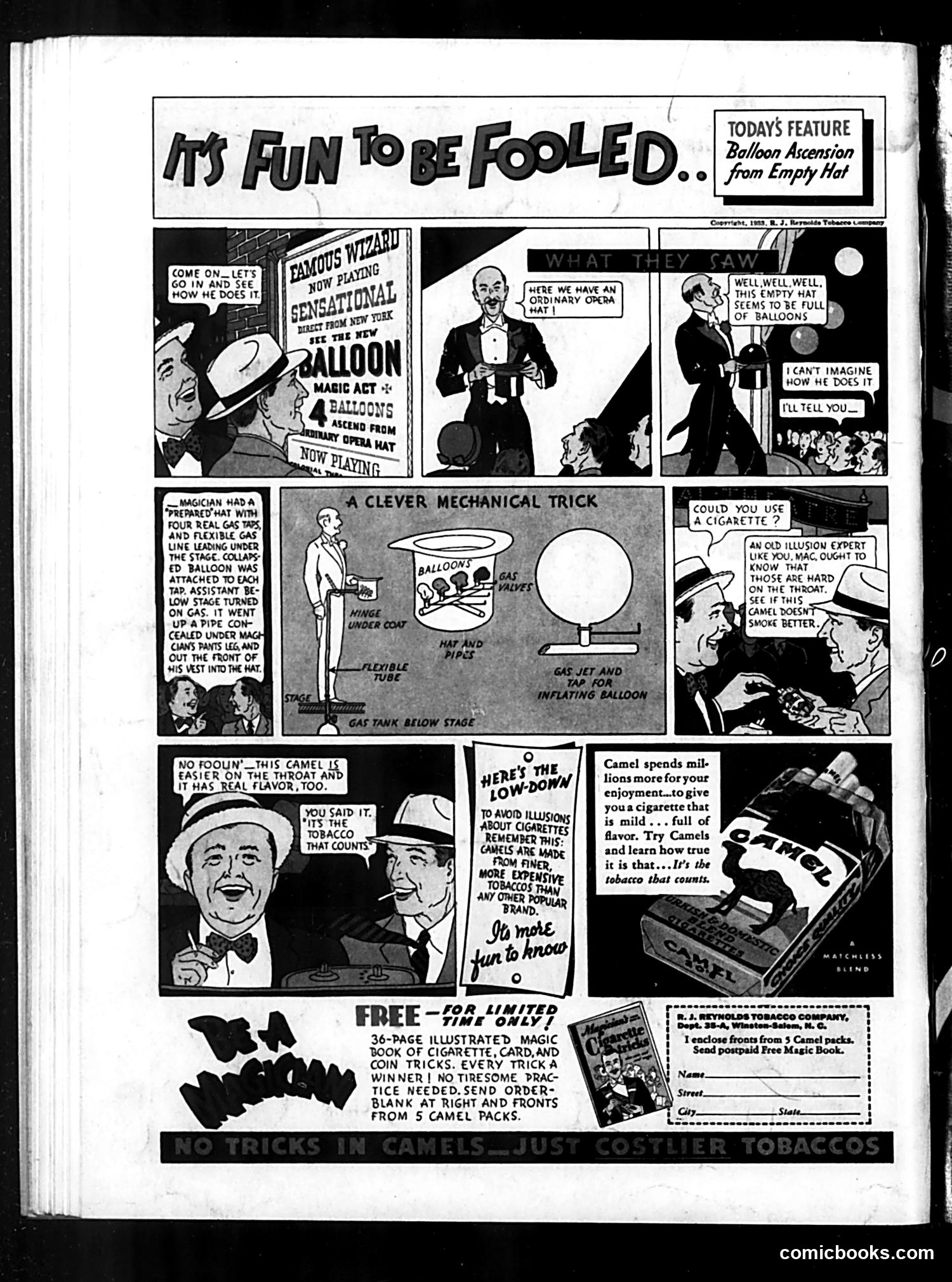
"It's Fun to Be Fooled" - Balloon Ascension Magic Trick This page presents a magic trick explanation paired with Camel cigarette advertising. The cartoon depicts a stage magician performing an illusion where balloons appear to ascend from an ordinary opera hat. The trick explanation (middle panels) deconstructs the illusion's mechanics: a prepared hat contains real gas taps and flexible tubing concealed under the stage, allowing the magician's assistant below to inflate balloons that rise through hidden pipes into the hat. The bottom half shifts to advertising copy for Camel cigarettes, with two men discussing the brand's throat-friendly qualities. The ad emphasizes that Camels spends more money on quality tobacco than competitors—"It's the tobacco that counts." A free premium offer appears: a 36-page magic book available for five Camel cigarette pack fronts, combining entertainment value with product promotion—a common mid-20th-century marketing strategy to encourage repeat purchases and brand loyalty.