judge
Judge — September 1933
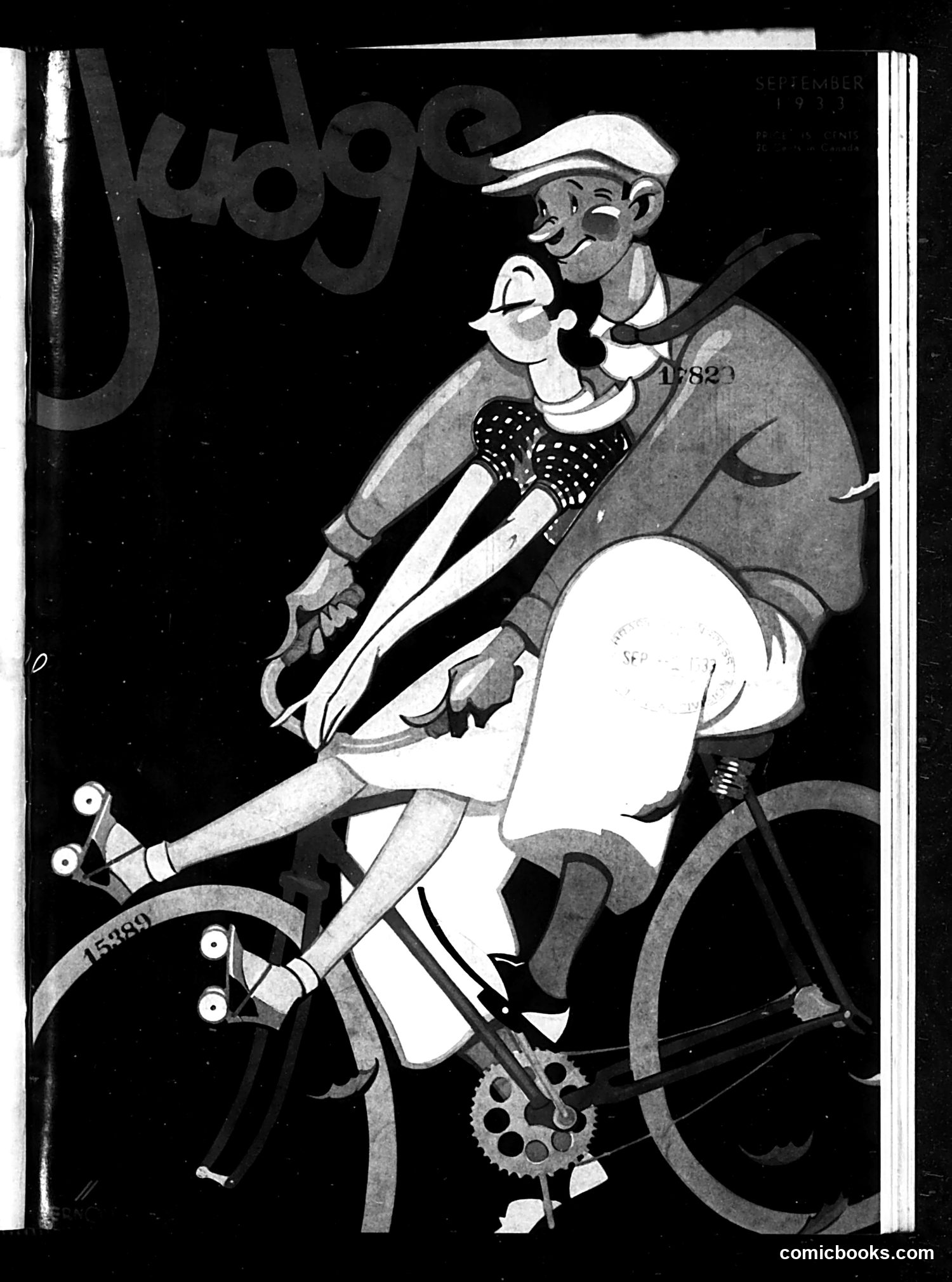
Analysis This appears to be a *Judge* magazine cover from September 1922 (based on the visible date marker). The illustration depicts a man in a cap and suit seated on a bicycle with an exaggerated, cartoonish woman on his lap. The styling suggests early 1920s satire about changing gender roles and modern dating customs. The woman's elongated legs, bobbed-hair styling, and prominent positioning likely satirize the "flapper" phenomenon—the newly liberated young women of the Jazz Age who challenged Victorian social norms through fashion, behavior, and independence. The bicycle scene appears to mock the awkwardness or impropriety of modern courtship practices compared to traditional social conventions. The overall tone suggests conservative social commentary critiquing 1920s youth culture and shifting morality.

NRA Member Propaganda This is a membership badge or advertisement for the National Rifle Association (NRA), featuring their iconic eagle emblem holding a gear (representing industry/manufacturing) and lightning bolts (representing power). The text "WE DO OUR PART JUDGE" appears to reference the NRA's Blue Eagle campaign from the early 1930s New Deal era, when the NRA (then the National Recovery Administration) promoted compliance with industrial codes. However, this appears to be a satirical repurposing by *Judge* magazine—a publication known for political humor. The ambiguity between the two "NRA" organizations and the somewhat absurd juxtaposition suggests satire of either corporate self-regulation, government agency overreach, or possibly the firearms organization's claims of public service. The specific satirical target remains unclear without additional context.
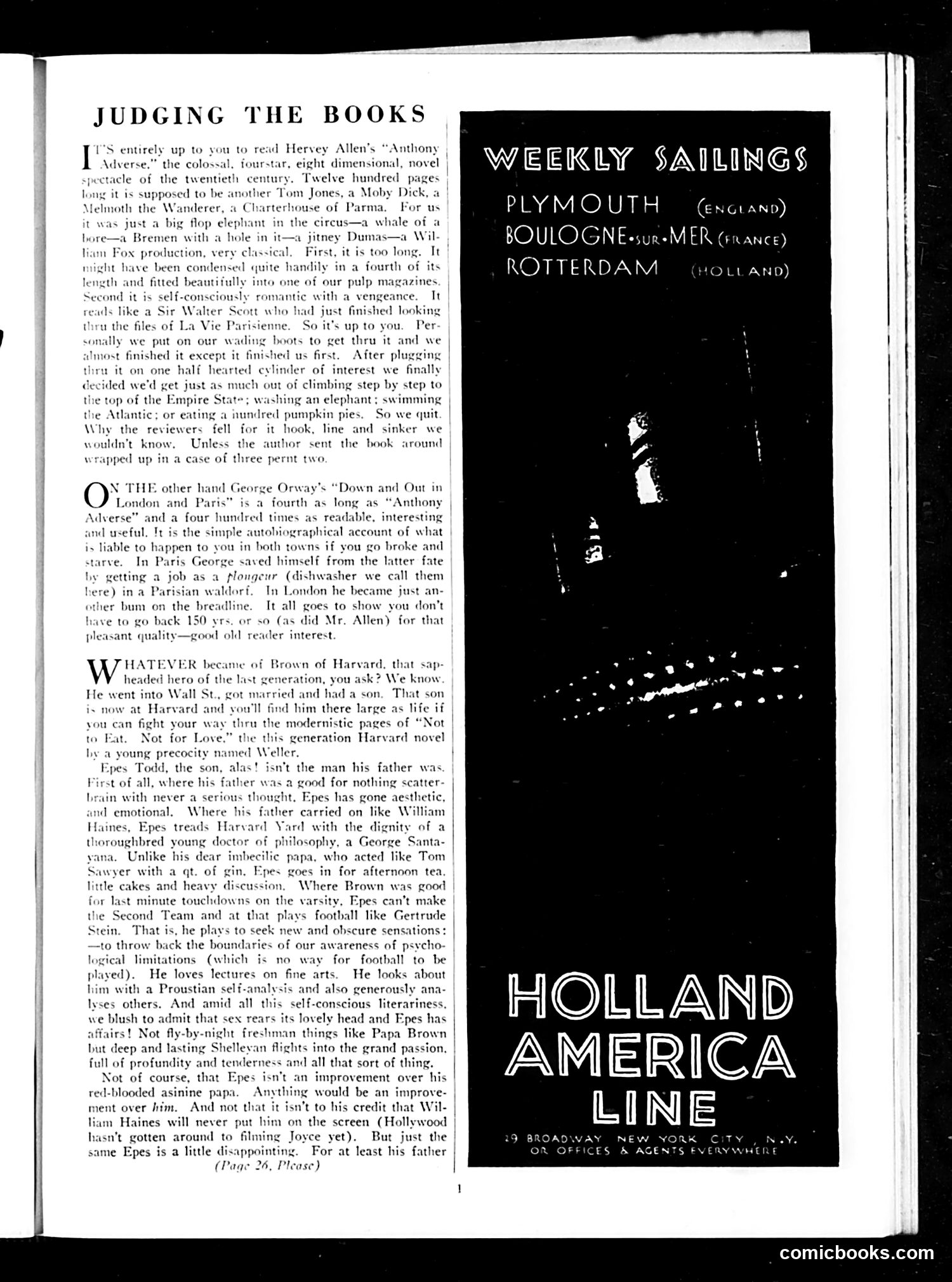
Analysis This page combines book reviews with maritime advertising. The left column critiques three novels: Hervey Allen's "Anthony Adverse" (criticized as too long and overly romantic), George Orway's "Down and Out in London and Paris" (praised as readable autobiography), and a Harvard novel by Weller featuring protagonist Epes Todd (satirized as an affected, aesthete character embodying 1920s intellectual pretension—contrasted unfavorably with his father's practical values). The right side displays two advertisements: "Weekly Sailings" announcing passenger routes to European ports, and the "Holland America Line" shipping company logo, targeting affluent travelers. The Epes Todd satire appears to mock contemporary Harvard students as emotionally indulgent, overly introspective pseudo-intellectuals interested in obscure sensations rather than practical achievement—a common Judge theme criticizing generational cultural shifts.
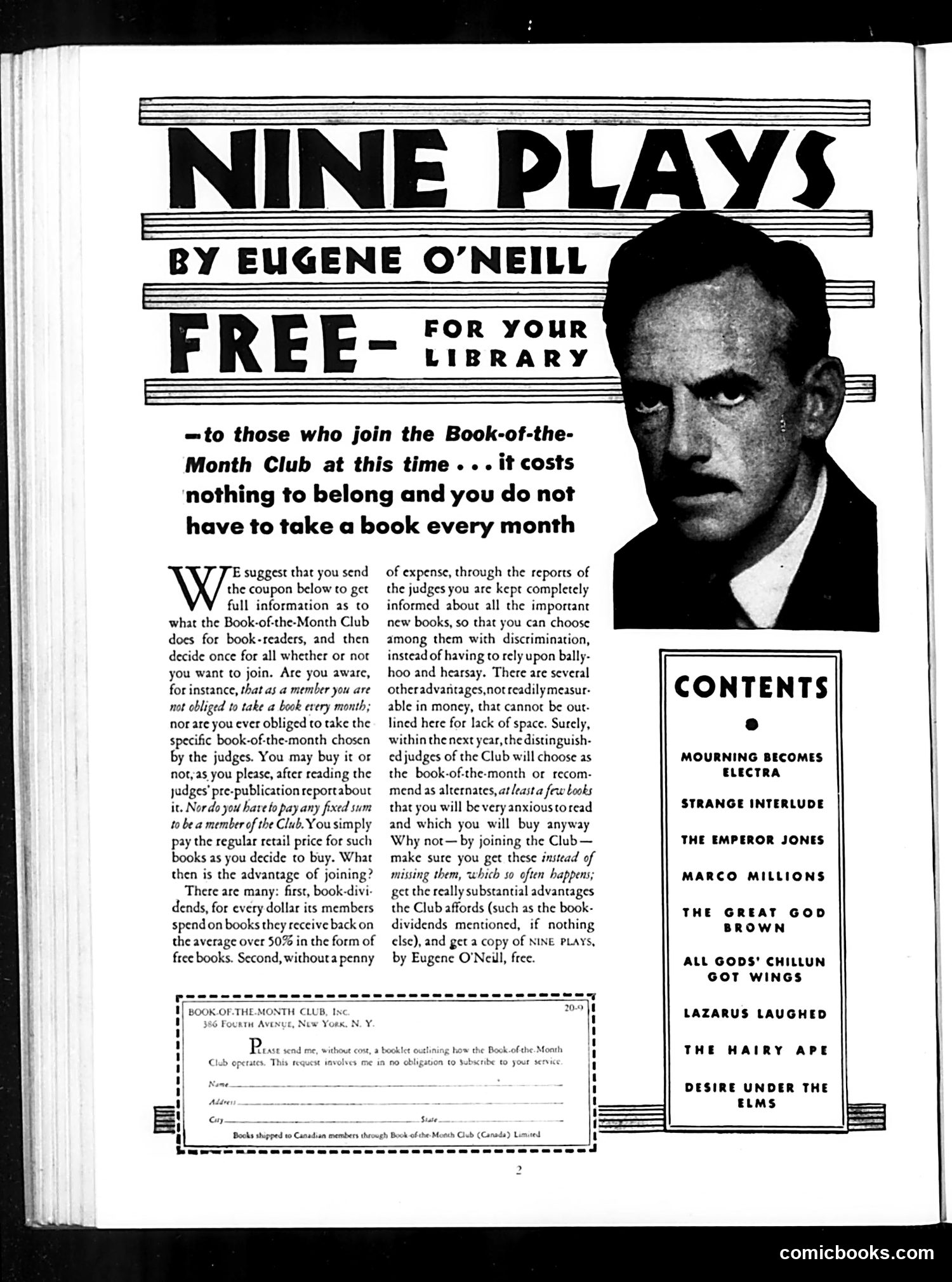
Analysis This page is primarily advertising content, not satirical commentary. It promotes a Book-of-the-Month Club membership, offering nine plays by Eugene O'Neill free to new members. The photograph shows a man's portrait (likely O'Neill himself, given the context), presented as an endorsement. The advertisement emphasizes membership benefits: members receive dividends on book purchases and can obtain the O'Neill plays collection at no additional cost. The "Contents" box lists the nine plays included: *Mourning Becomes Electra*, *Strange Interlude*, *The Emperor Jones*, and others—all genuine O'Neill works. The coupon at bottom allows readers to request membership information. This is straightforward promotional material rather than satire or political commentary, typical of magazine advertising from this era.
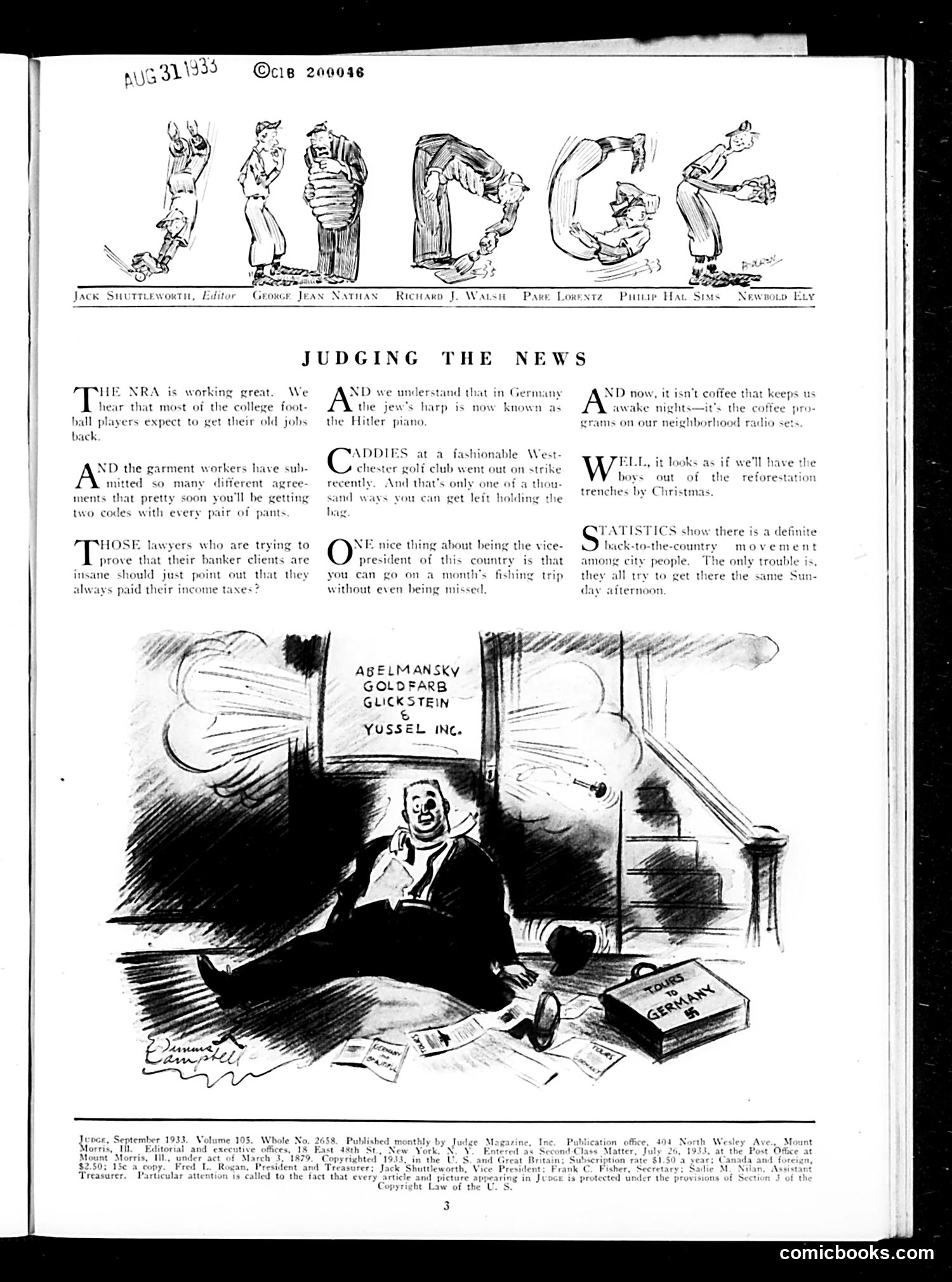
"Judging the News" - September 1933 This page satirizes contemporary 1933 issues through brief commentary and a main cartoon. The NRA (National Recovery Administration) is praised as "working great," while German news about "the littler piano" likely references Hitler's rise to power. The garment workers' labor disputes and banker tax evasion are mocked. The dominant cartoon depicts a clown holding a sign reading "AGELMANSKY GOLDFARB GLICKSTEIN & YUSSEL INC." surrounded by toys labeled "TOYS OF GERMANY." The figure appears to represent Jewish businesses, likely satirizing Nazi persecution or antisemitic stereotypes—though the exact intent (condemning or reflecting prejudices of the era) remains ambiguous from the image alone. The cartoon critiques either Nazi actions or contemporary American attitudes toward Jewish immigrants.
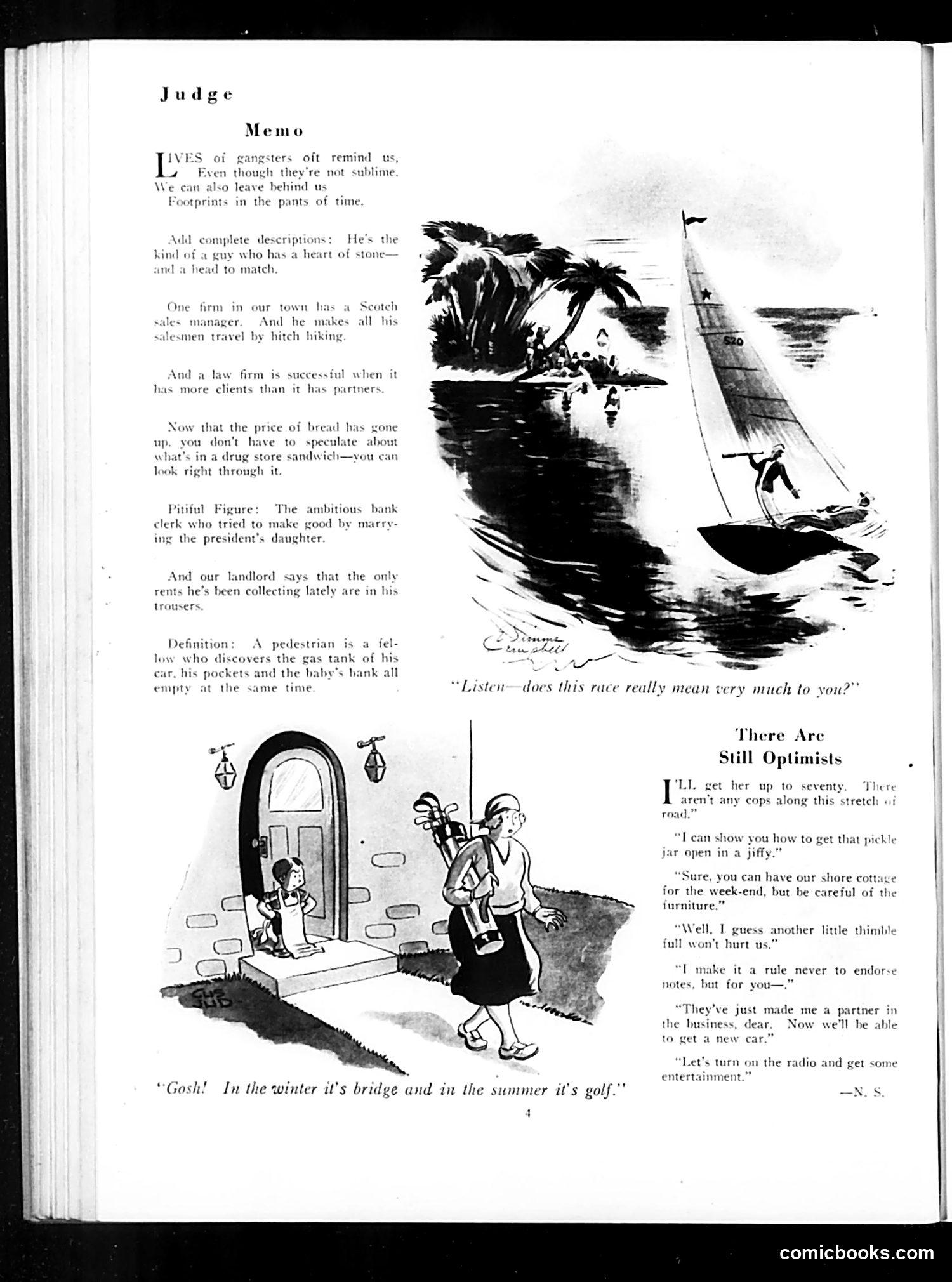
Analysis This page from *Judge* magazine contains two distinct sections: "Judge Memo" (top left): A humorous column offering satirical "definitions" and observations about American life—including commentary on gangsters, business practices, and economic conditions. The jokes reference bread prices and financial anxiety, suggesting this is from an economically stressed period. "There Are Still Optimists" (right): A dialogue-based humor piece showcasing naive optimism amid hardship. Couples exchange cheerful platitudes about getting a cottage, avoiding endorsements, and getting a new car—clearly satirizing people's ability to maintain hope despite obvious financial constraints. Illustrations: Include a sailboat scene and a domestic interior, both supporting the humorous tone. The cartoons mock middle-class aspirations and economic realities of their era. The overall theme critiques American optimism and commercial culture during apparent economic difficulty.
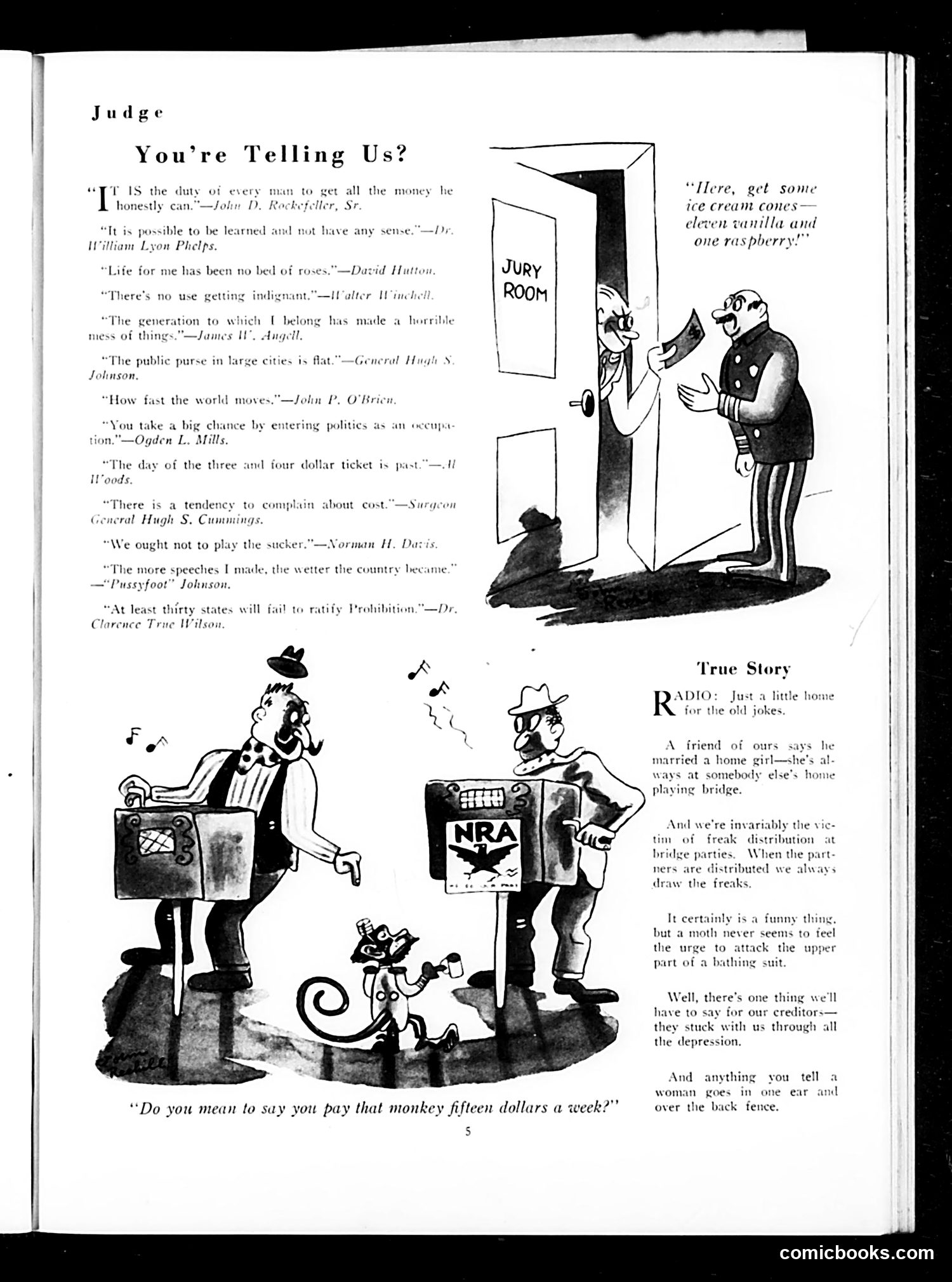
Analysis of Judge Page 5 Top Cartoon ("You're Telling Us?"): A judge emerging from the jury room offers ice cream cones to what appears to be a juror, satirizing judicial corruption or improper influence on verdicts. The caption suggests bribery or jury tampering—a commentary on courtroom integrity. Bottom Cartoon ("Do you mean to say you pay that monkey fifteen dollars a week?"): Features a man with a radio set and another with an "NRA" (National Recovery Administration) sign, with a small monkey figure. This references 1930s New Deal politics, likely mocking the NRA's regulations and economic policies as absurd—comparing them to paying a monkey. The satire criticizes government intervention in business during the Depression era.
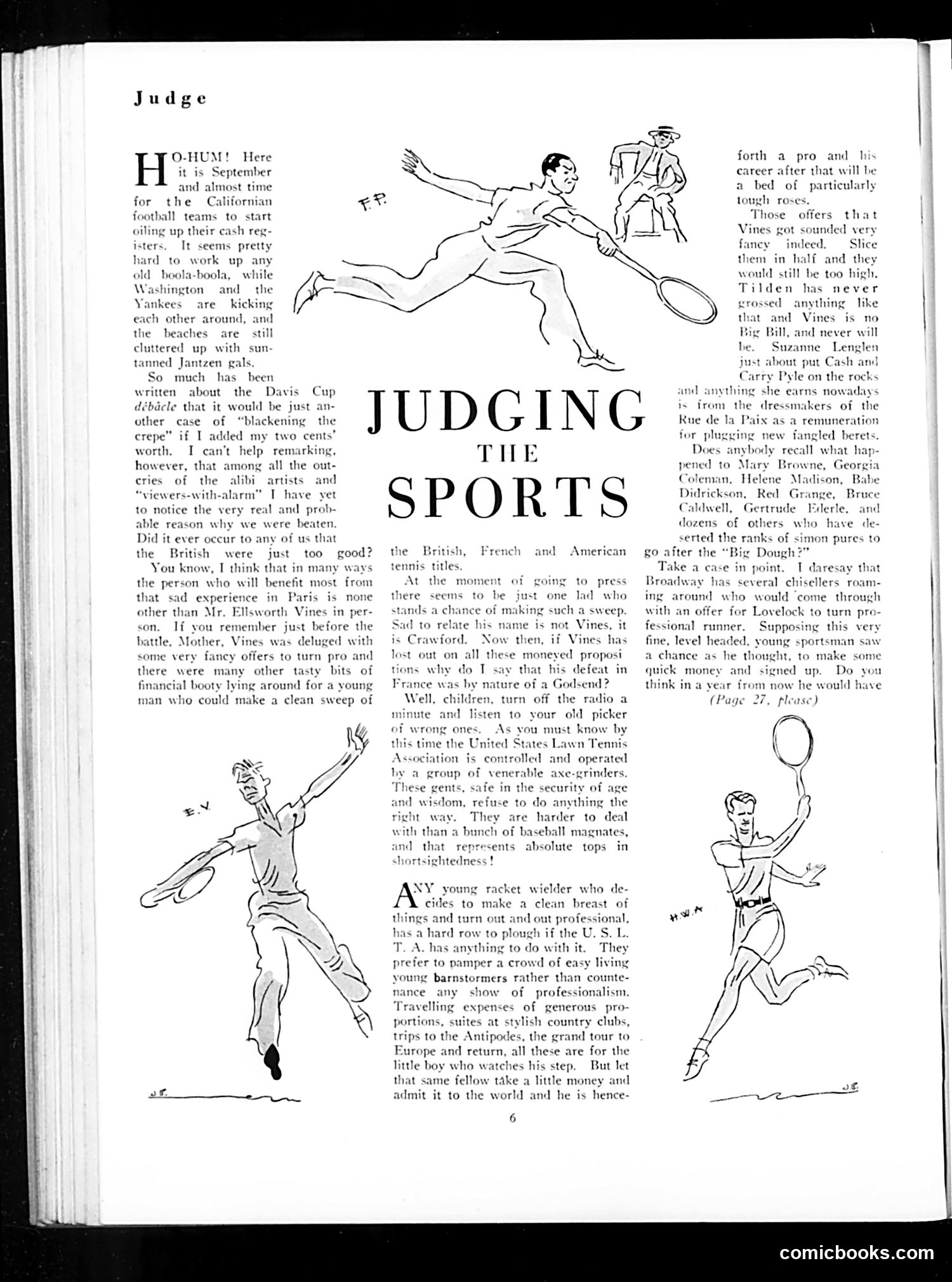
"Judging the Sports" - Judge Magazine Sports Commentary This is a satirical sports column criticizing tennis judging and professionalism. The article attacks the U.S. Lawn Tennis Association's control of tennis, claiming its judges are inflexible ("harder to deal with than a bunch of baseball magnates"). The author mocks players—apparently including someone named Vines—who pursue money through professional tennis rather than maintaining amateur standing. The piece ridicules the sport's governing body for rewarding "young barnstormers" with lavish expenses while penalizing those seeking legitimate professional careers. The accompanying line drawings show tennis players in dynamic poses, illustrating the athletic subject matter. The satire targets institutional gatekeeping in amateur sports and the hypocrisy of allowing certain commercialization while condemning professionalism.
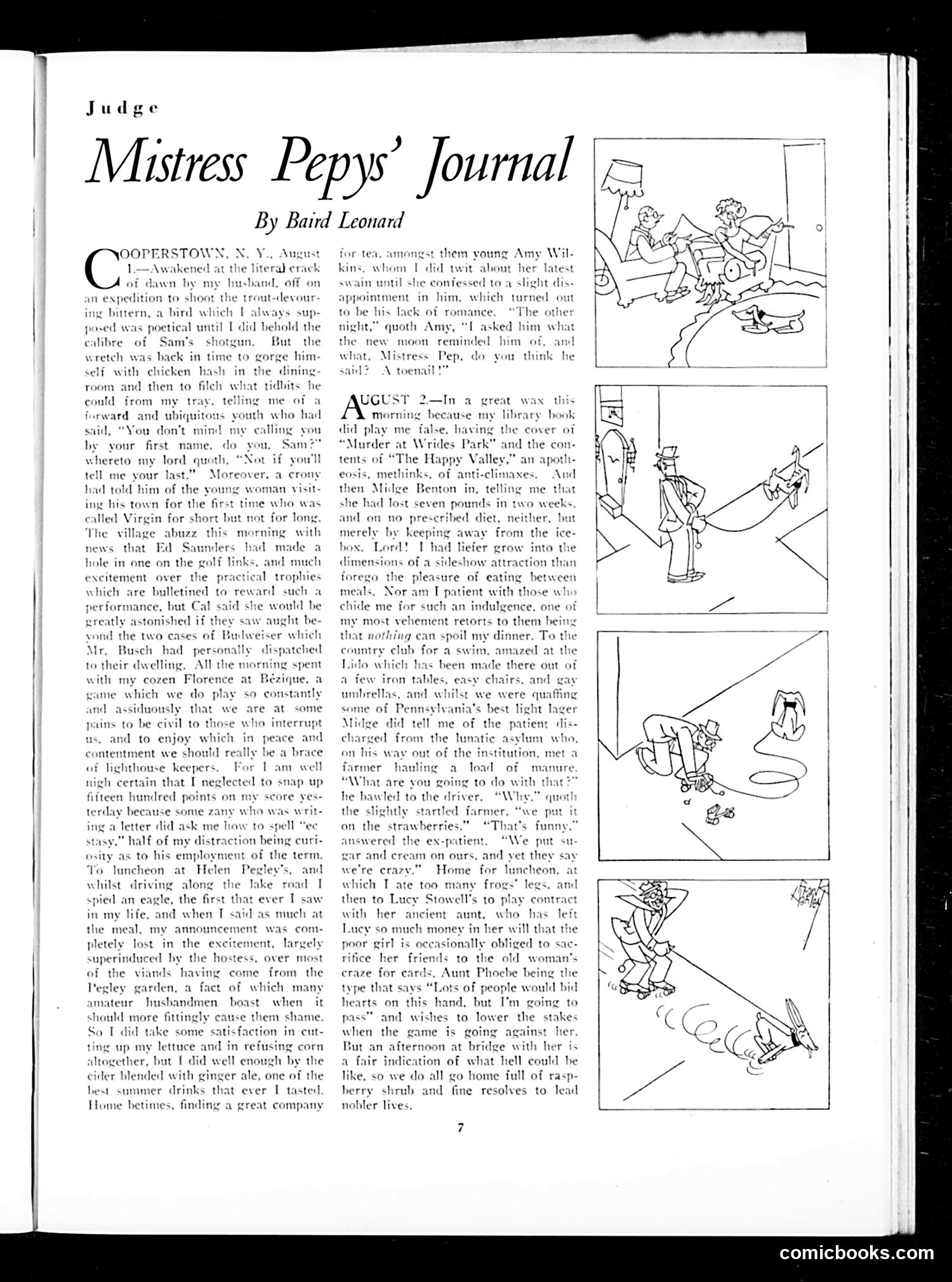
Mistress Pepys' Journal: A Social Satire Column This is a humorous diary column by Baird Leonard, modeled on Samuel Pepys's famous 17th-century diary. The narrator—a wealthy, gossipy society woman—chronicles her summer activities in Cooperstown, New York, with satirical observations about upper-class leisure and pretension. The accompanying cartoons illustrate her social encounters: ladies lounging, playing bridge, swimming, golfing, and engaging in idle pursuits. The satire targets the boredom and self-absorption of the leisure class—the narrator frets over minor social slights (not being called by her first name, losing bridge points), while self-importantly noting her sightings of an eagle and encounters with notable people like "Aunt Phoebe." A key joke involves a mental patient's innocent misunderstanding about strawberries, contrasting common-sense practicality with upper-class absurdity. The column gently mocks society women's preoccupations with food, gossip, card games, and social one-upmanship.
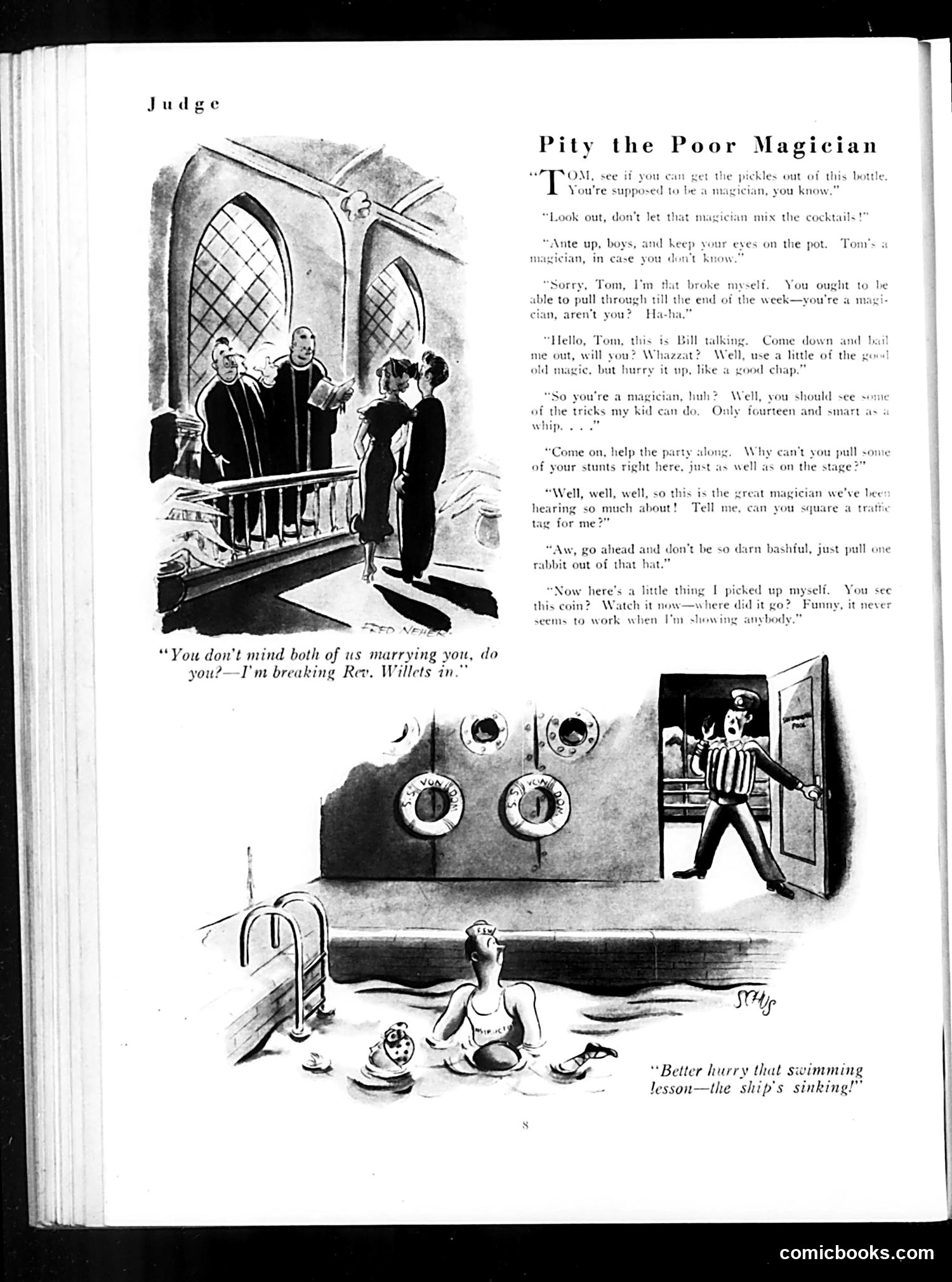
"Pity the Poor Magician" - Judge Magazine This is a humorous piece satirizing the social burden placed on amateur magicians. The title character, Tom, is apparently known as a magician (possibly a stage performer or hobbyist), and the cartoon shows how relentlessly people exploit this reputation, constantly demanding he perform tricks at inappropriate moments. The four scenes depict escalating requests: someone asks him to retrieve pickles from a bottle, guests demand he perform at a party, a friend calls asking him to pull off a magic trick to resolve a problem, and a child insists on seeing tricks. The final panel shows a drowning person requesting he perform a swimming "lesson" while a ship sinks—the ultimate absurdist demand. The satire targets the social expectation that anyone with a specialized skill or reputation must constantly demonstrate it for others' entertainment, regardless of context or appropriateness. It's a relatable critique of being typecast by one's talents.
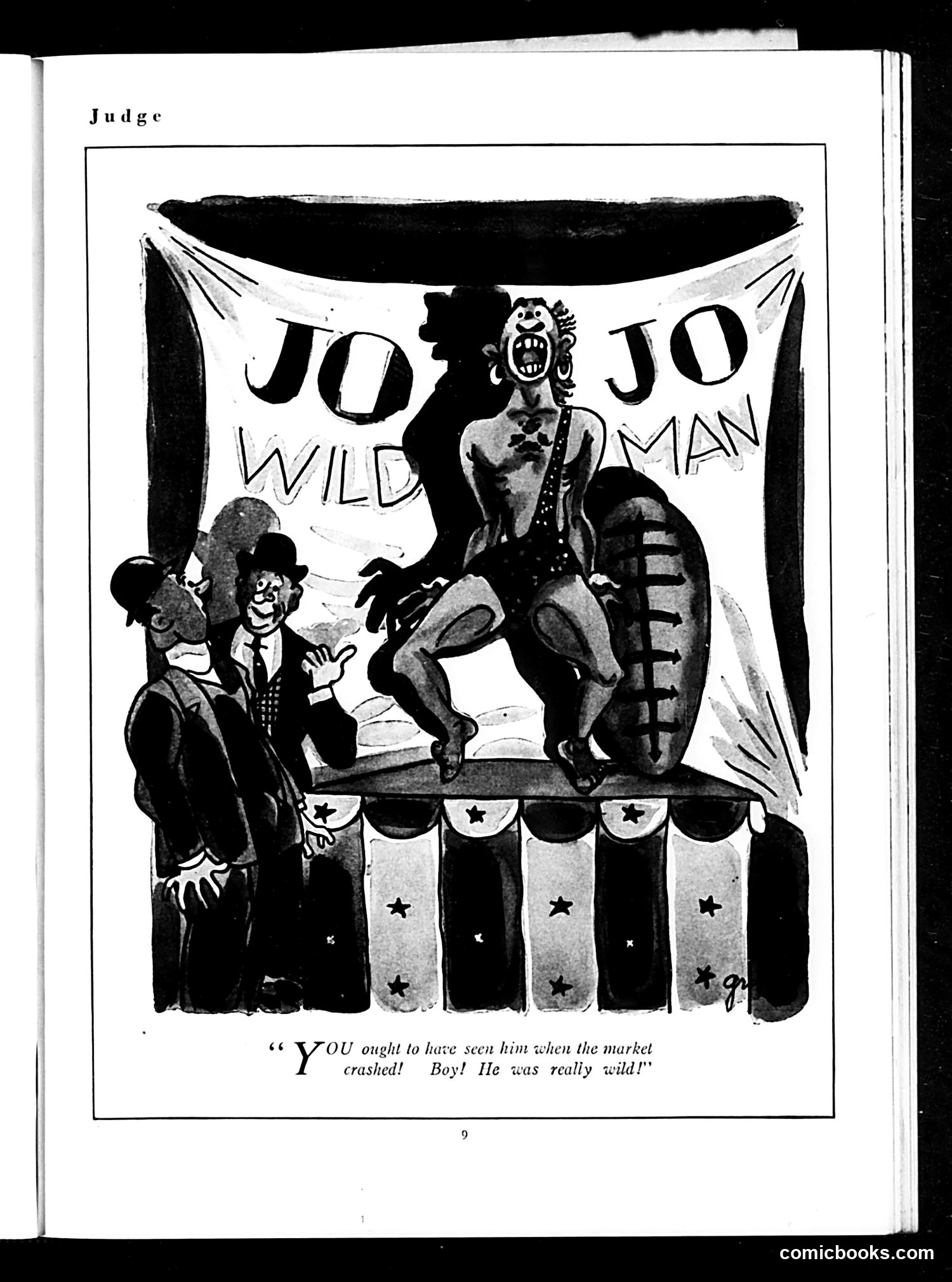
"Jo Jo, Wild Man" - Judge Magazine Cartoon This satirical cartoon depicts a circus-style attraction featuring "Jo Jo the Wild Man," likely referencing a real sideshow performer. Two well-dressed gentlemen in suits and hats observe the spectacle, with one exclaiming about witnessing "him when the market crashed" — he was "really wild!" The joke targets the 1929 stock market crash and its chaotic aftermath. The cartoon satirizes how ordinary businessmen became uncontrolled and frenzied during financial panic, comparing their wild behavior to that of a circus curiosity or "wild man." The implied message: respectable, civilized men became as unhinged as carnival attractions when facing financial disaster. This reflects Judge's satirical commentary on Wall Street's vulnerability and the loss of composure among the wealthy during economic crisis.
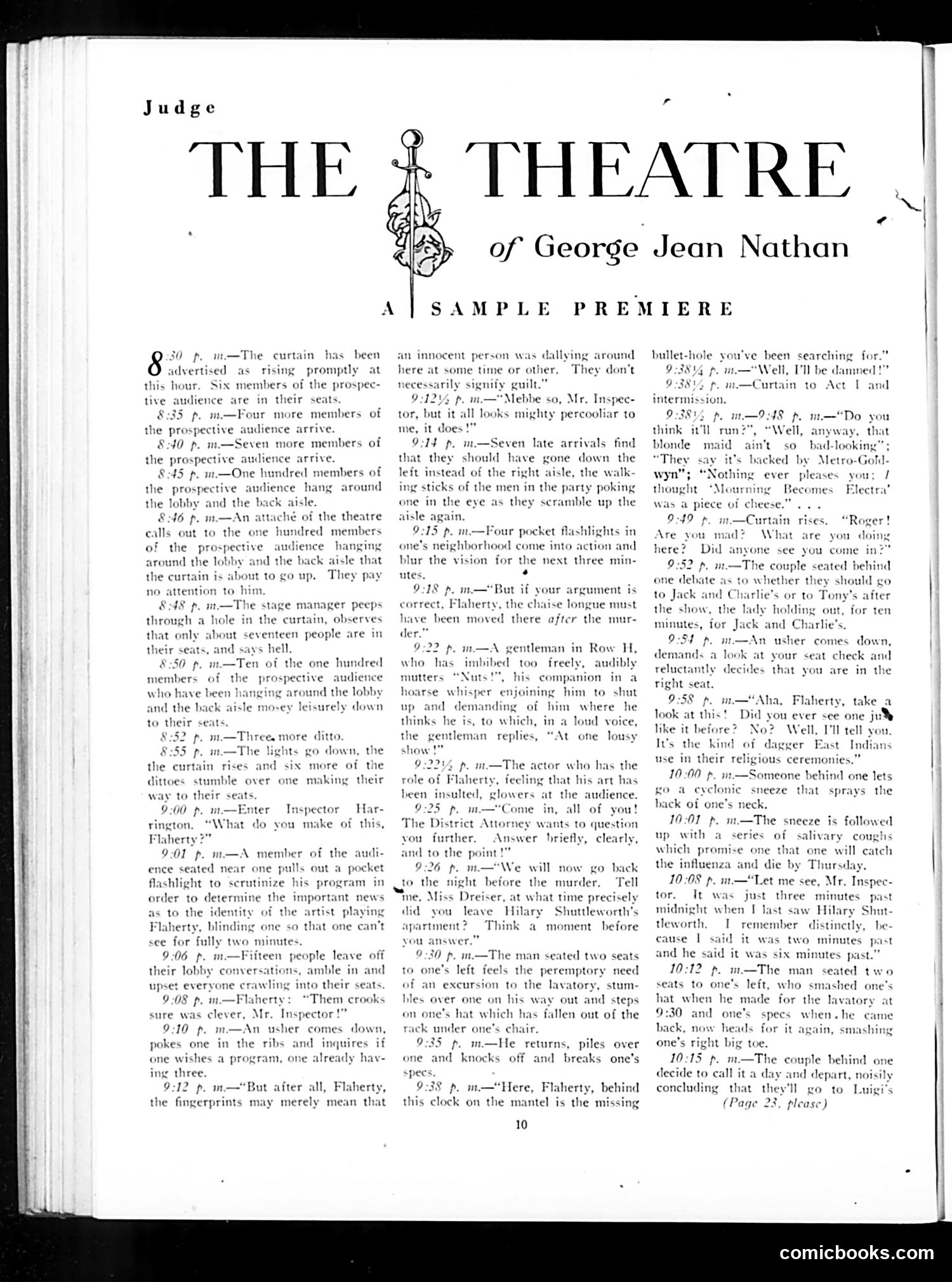
"The Theatre of George Jean Nathan: A Sample Premiere" This is a theatrical satire by Judge magazine's drama critic George Jean Nathan, mocking the chaos of a Broadway opening night. The piece humorously documents the audience's arrival and behavior before curtain, using timestamps to chronicle escalating disruptions. The satire targets typical theatergoers: latecomers blocking aisles with walking sticks, audience members using pocket flashlights to read programs (blinding others), drunk patrons making loud comments, and people constantly leaving/returning to seats. The dialogue features "Inspector Flaherty" investigating a murder mystery onstage while the real chaos unfolds in the audience. Nathan's point: Broadway audiences are so poorly behaved and disruptive that the theatrical performance itself becomes secondary to the genuine "entertainment" of watching fellow patrons misbehave. The humor lies in the contrast between the serious murder-mystery plot onstage and the farcical audience conduct disrupting it—suggesting early 20th-century theater audiences lacked basic courtesy.
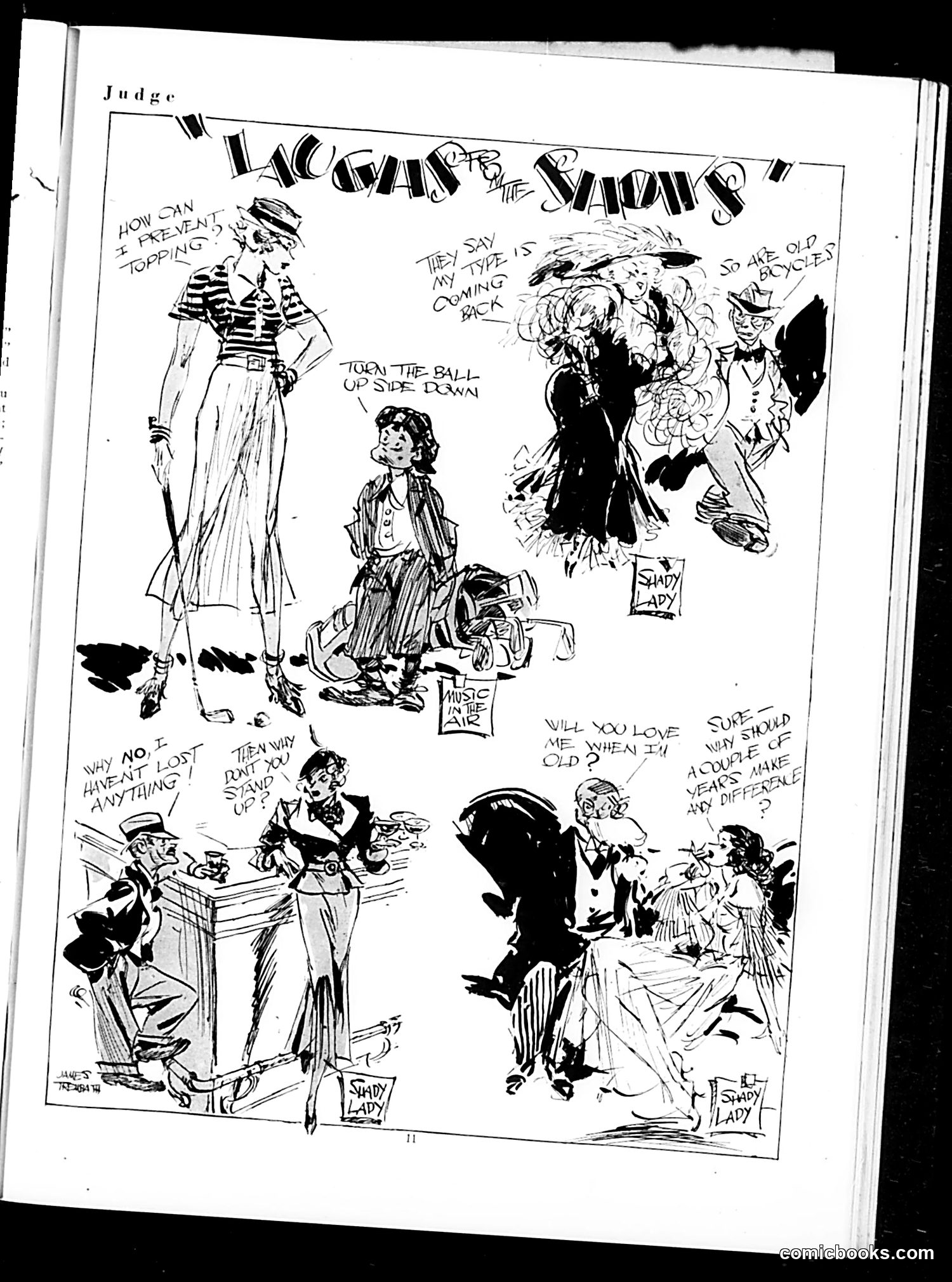
"Judge's Snows" - Satire on Dating and Marriage This page satirizes courtship and aging through multiple vignettes labeled "Shady Lady." The cartoons depict a woman asking men various questions about commitment and love, contrasting their youthful enthusiasm with skepticism about long-term prospects. The central joke appears to satirize the "Shady Lady" — likely a woman of questionable reputation or moral standing — and how men respond differently to her depending on circumstances. One panel questions "Why no, I haven't lost anything!" while another asks "Will you love me when I'm old?" and "Sure, should make a couple years difference any?" The satire mocks both women's desperation for marriage and men's dishonesty about commitment. The crude artistic style and "Shady Lady" branding suggest this is typical Judge magazine fare — bawdy humor targeting gender relations and courtship conventions of the era.
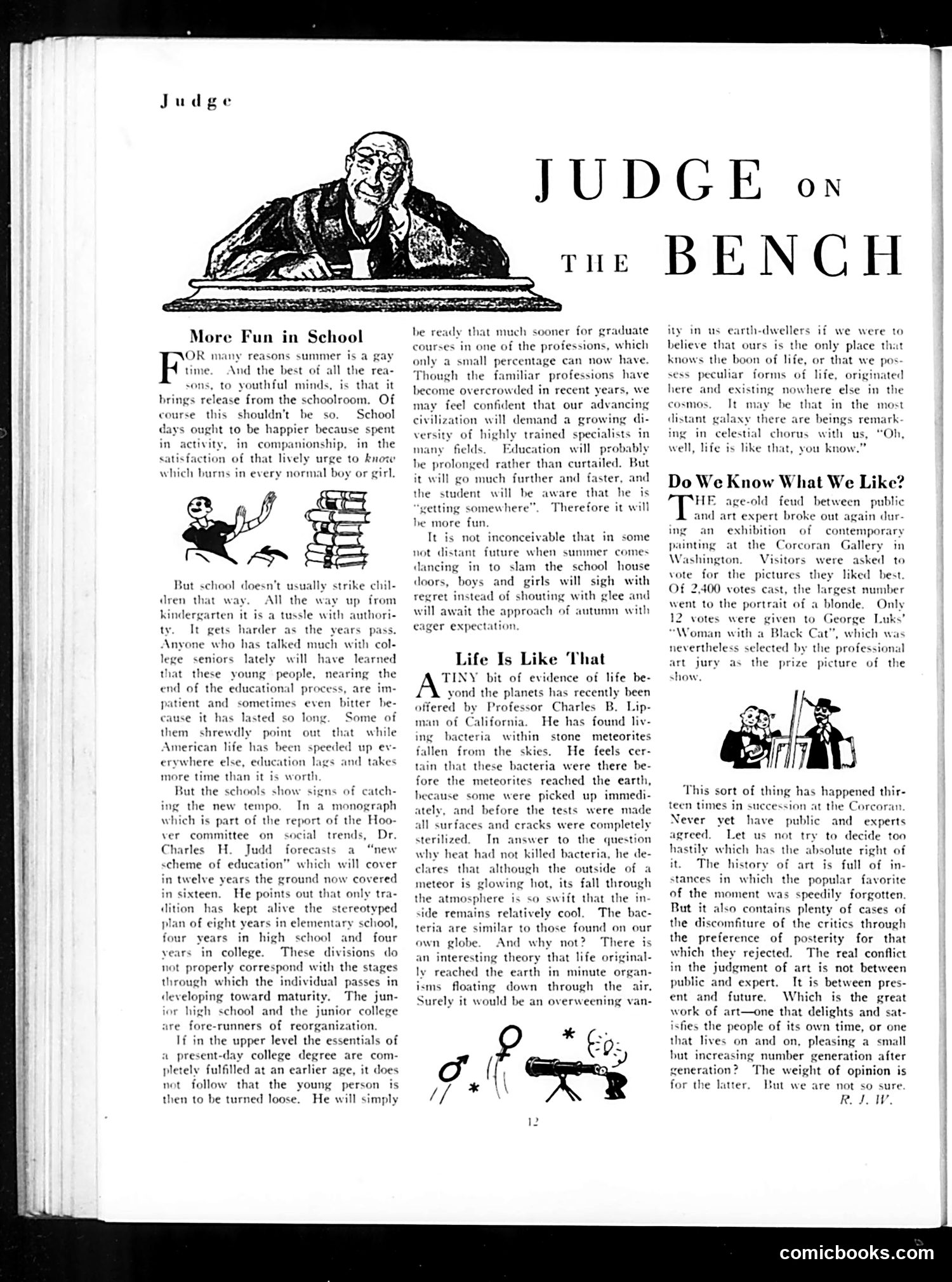
Judge Magazine Page Analysis This page contains two opinion essays typical of Judge's satirical approach to American life and ideas. "More Fun in School" advocates education reform, citing Dr. Charles H. Judd's proposal to compress the traditional 16-year education (8 elementary + 4 high + 4 college) into 12 years. The author argues schools are unnecessarily prolonged and that students become bitter about their duration. The piece suggests reorganizing education into more developmentally appropriate stages, referencing the emerging "junior high school" and "junior college" as promising reforms. The satire targets educational inefficiency and outdated traditions rather than specific individuals. "Life Is Like That" discusses Professor Charles B. Lipman's discovery of living bacteria in meteorites, theorizing life may have originated from space. The piece uses this to mock human arrogance—suggesting Earth isn't uniquely special if extraterrestrial life exists. It's tongue-in-cheek speculation presented as philosophical commentary. Both articles reflect 1920s-30s progressive attitudes toward modernization and scientific advancement, typical of Judge's intellectual satirical voice.
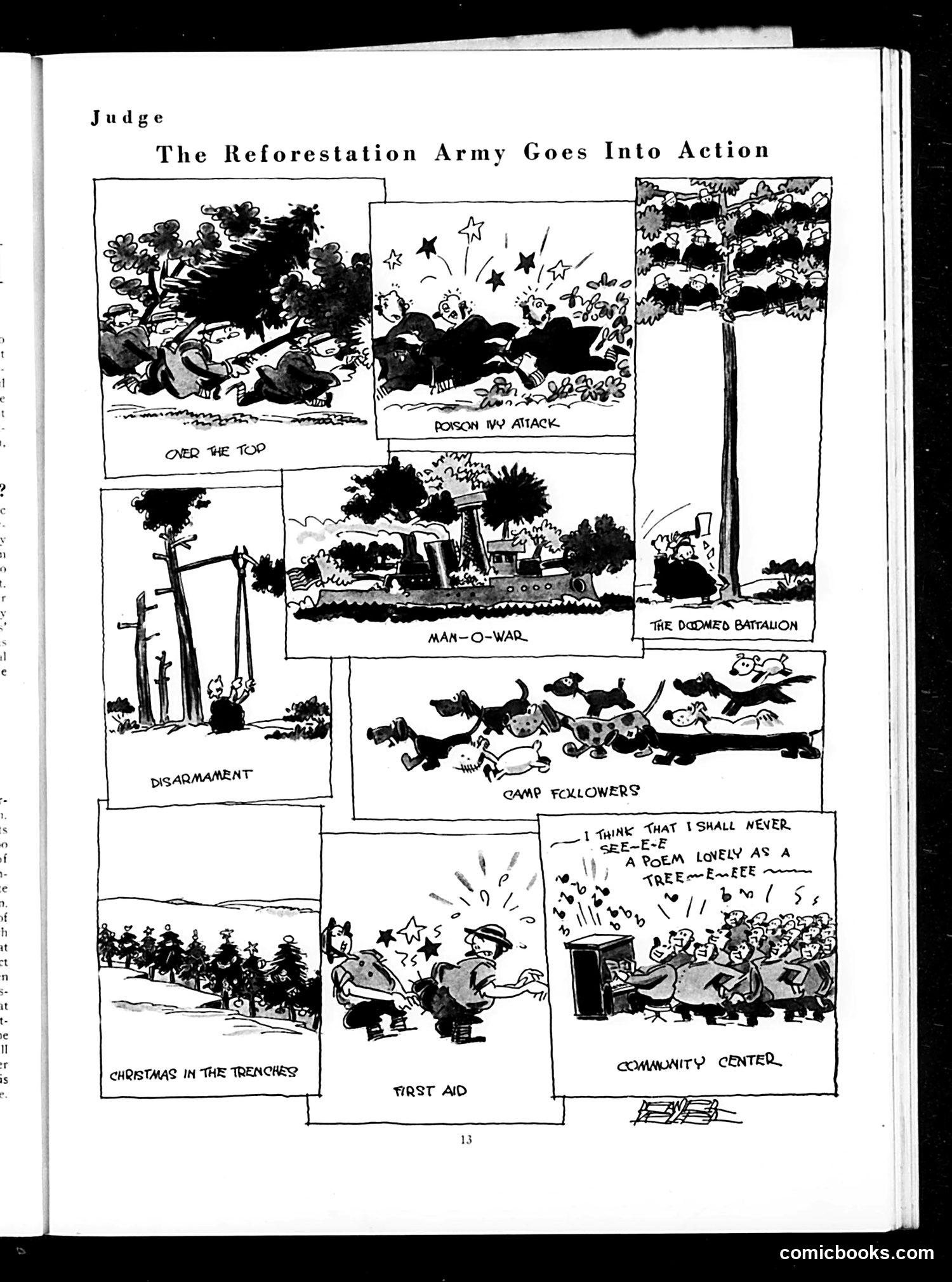
Explanation This satirical comic mocks the "Reforestation Army," likely the Civilian Conservation Corps (CCC) or similar New Deal program. The panels depict military-style operations against trees through humorous warfare scenes: "Over the Top," "Poison Ivy Attack," "Man-o-War," and "Disablement." The satire criticizes the program's militaristic bureaucracy and inefficiency. References include: - Camp Followers: hangers-on profiting from the initiative - First Aid & Community Center: the social programs accompanying reforestation - "Christmas in the Trenches": comparing tree-cutting to WWI combat The joke undercuts the government's ambitious conservation messaging by depicting reforestation as chaotic, wasteful, and absurdly militarized. The dialogue about never seeing "a poem lovely as a tree" suggests ironic commentary on destroying rather than preserving nature—likely criticizing the actual environmental or economic impact of the program.
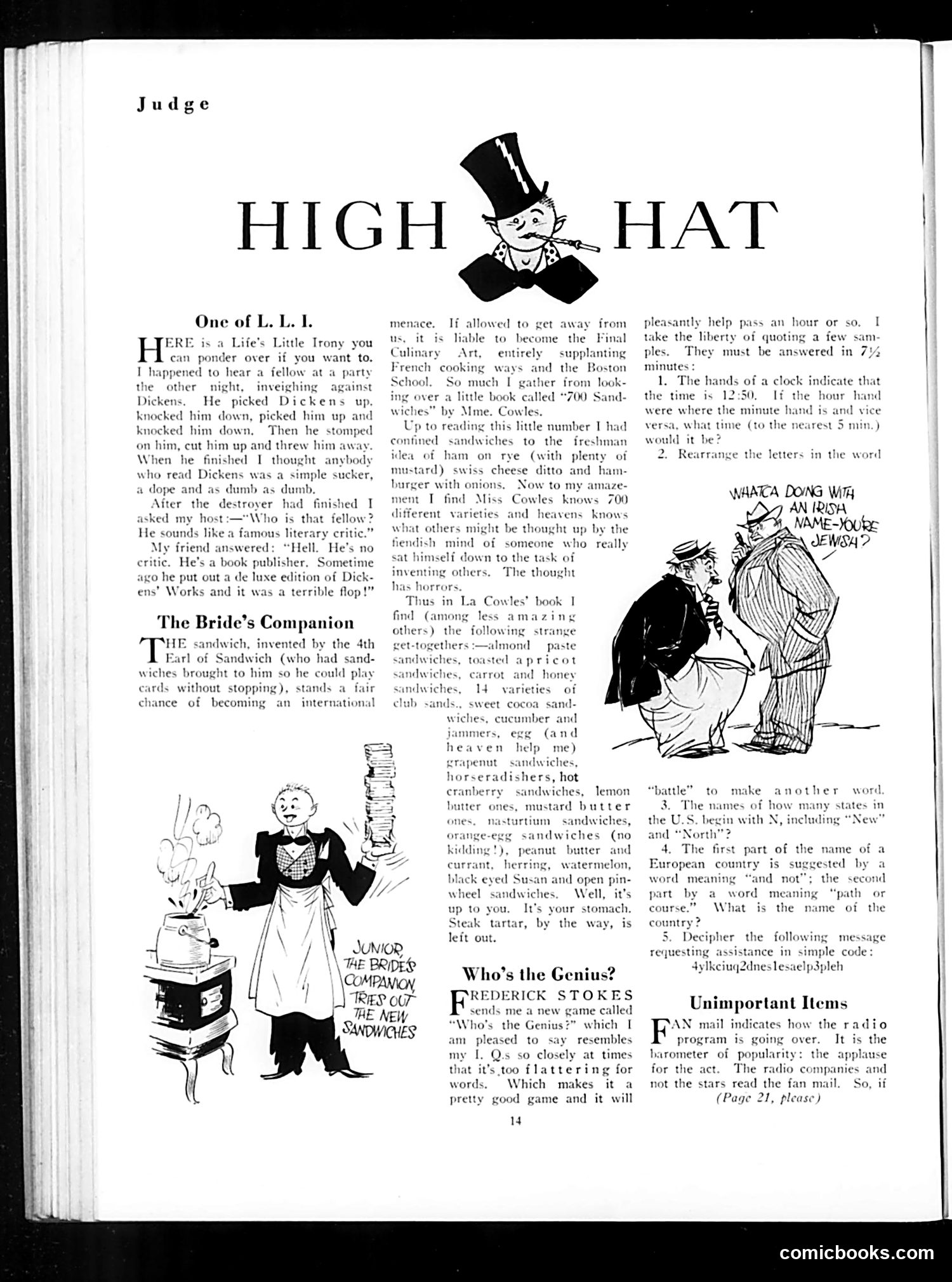
Judge Magazine Page Analysis This page contains three separate humor pieces typical of Judge's early 20th-century satirical style: "High Hat" (top): A short anecdote mocking a book publisher who violently disparages Dickens at a party, then is revealed to have published a failed deluxe edition of Dickens' works. The irony: his harsh criticism masks commercial failure. "The Bride's Companion" (left): Satirizes the sandwich's evolution into an absurdly elaborate culinary form. The cartoon shows a woman with 700 sandwich varieties, mocking how a simple invention becomes overcomplicated and pretentious—likely criticizing both culinary snobbery and commercialization. "Who's the Genius?" (right): Features IQ test puzzles submitted by reader Frederick Stokes, presented as entertainment. The humor seems self-deprecating, suggesting these puzzles humorously mirror readers' intelligence levels. The illustrations use exaggerated caricature and visual comedy typical of Judge's style. Overall, the page satirizes intellectual pretension, commercialism, and American consumer culture.
Judge Magazine Editorial (September 1933) This page is primarily editorial content about contract bridge, the popular card game of the era. The editor celebrates Oswald Jacoby and his team winning the Asbury Park Challenge Trophy, and discusses competitive bridge events and personalities. Key references include: - Oswald Jacoby: A bridge champion who challenged the "self-styled American team" (the Culbertsons) to a high-stakes match - A. Manning-Foster: Retiring president of the International Bridge League, honored as a bridge pioneer - Bridge competitions: The National Masters' Pair Championship and Vanderbilt Cup, prestigious tournaments - Women players: Miss Elinor Murdoch and Helen Bonwit, noted for their championship performance The anecdote about borrowing money humorously illustrates the excitement surrounding high-stakes bridge betting among enthusiasts. This page contains no political cartoons—it's an editorial celebrating the sport and its personalities during the Depression era, when bridge was a major American pastime.
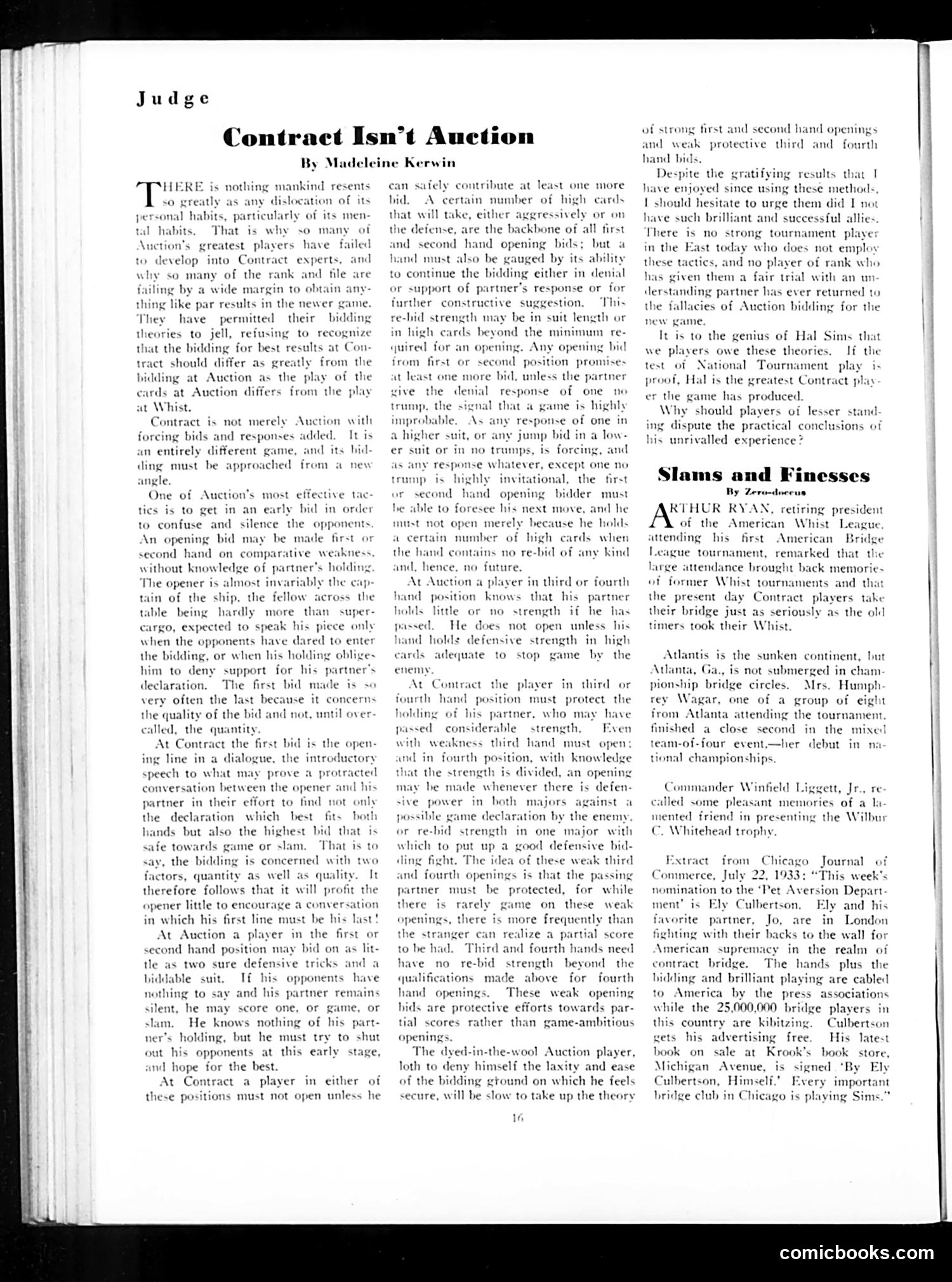
Content Analysis: "Contract Isn't Auction" by Madeleine Kerwin This is a bridge card game strategy article, not political satire. The page discusses distinctions between two variants of contract bridge—Auction Bridge and Contract Bridge. Main Point: Kerwin argues that experienced Auction Bridge players struggle at Contract Bridge because bidding strategy differs fundamentally between the games. In Auction, early aggressive bidding confuses opponents; in Contract, opening bids require specific point values and must promise continuation strength. Players must unlearn old habits. Key Contrasts Explained: - Auction: Bidding about disruption and deception; opening bids can be weak - Contract: Bidding a conversation between partners revealing hand strength; openings require defensive strength plus rebid capability The sidebar "Slams and Finesses" notes that Arthur Ryan and Humphrey Wagar won recent bridge tournaments, and an excerpt from *Chicago Journal of Commerce* advertises Culbertson's bridge book. For Modern Readers: This reflects 1930s enthusiasm for bridge as an intellectual game, when Contract Bridge was displacing Auction Bridge as the standard form.
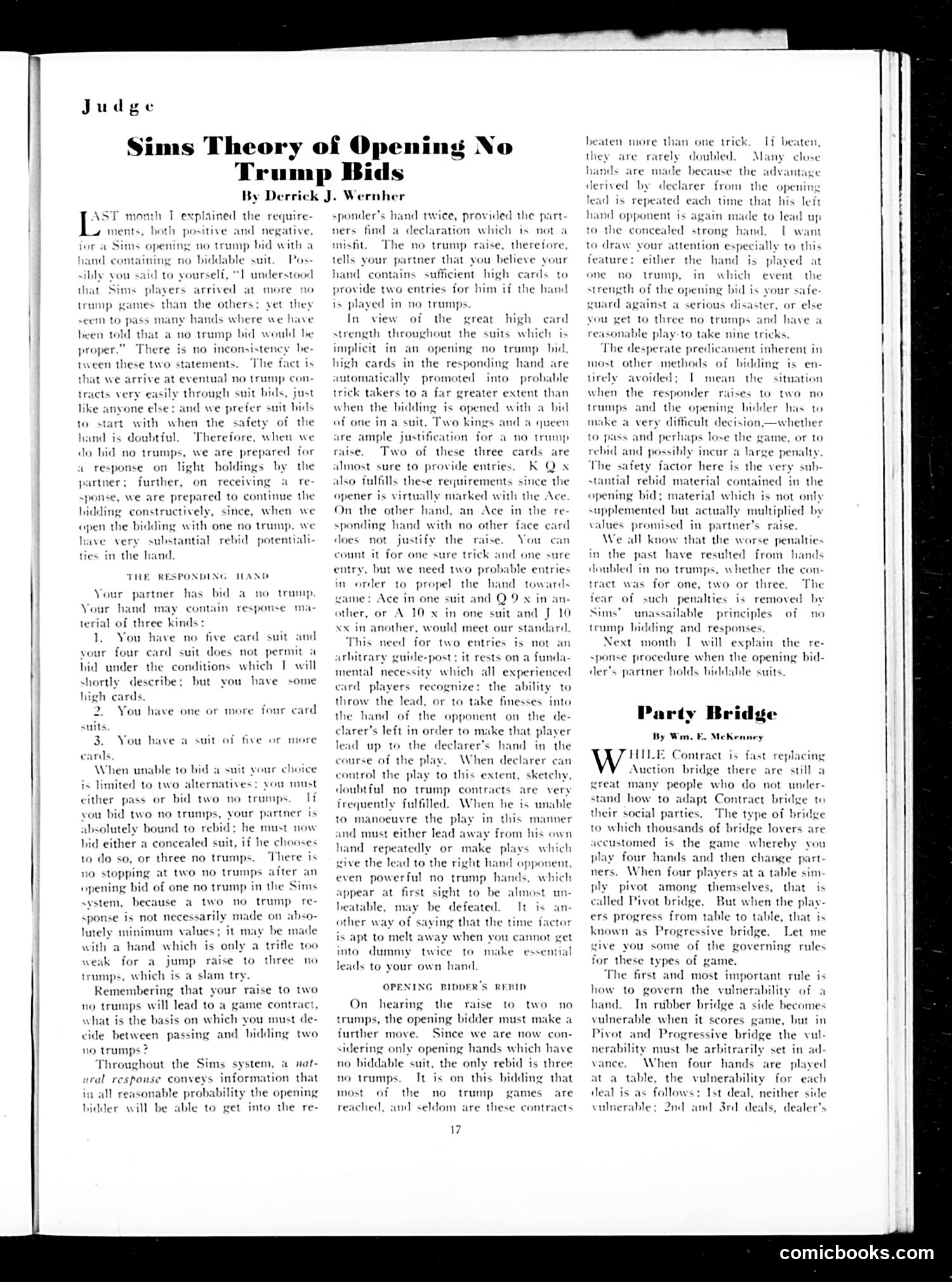
Judge Magazine: "Sims Theory of Opening No Trump Bids" This page contains no political cartoon or satire. It is a bridge instruction article by Derrick J. Wernher explaining contract bridge bidding strategy—specifically the "Sims system" for opening no-trump bids and how the responding partner should evaluate their hand. The text discusses technical bridge concepts: when to bid two no-trumps versus pass, the importance of having entry cards (Kings, Queens, Aces) to control play, and probability calculations for trick-taking. A sidebar titled "Party Bridge" by W.E. McKenney begins discussing Progressive bridge rules. This appears to be educational/instructional content rather than satirical commentary. Judge magazine, while primarily known for political satire and humor, also published miscellaneous articles and columns for its readers.
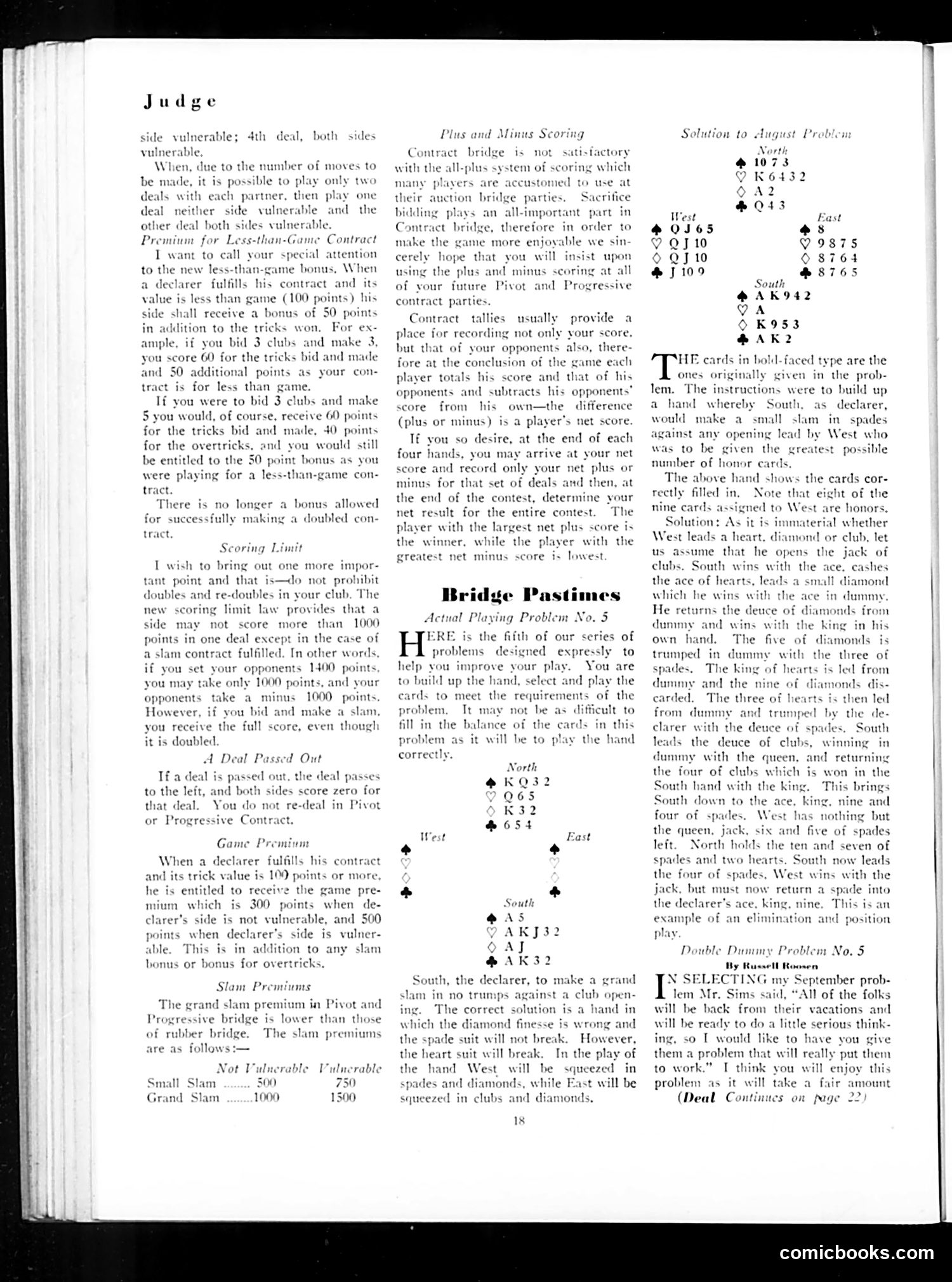
Content Analysis This page from Judge magazine contains bridge instruction and strategy articles—not political satire or cartoons. The content focuses on contract bridge gameplay rules and scoring systems. The text discusses: - Scoring modifications for contract bridge (Plus and Minus Scoring, Game Premiums, Slam Premiums) - Rule clarifications about bonus points for less-than-game contracts and scoring limits (1000-point maximum per deal) - Bridge Pastimes section: instructional problems teaching players optimal card play The only substantive content visible is educational material about the card game bridge itself. There are no political figures, caricatures, or social satire evident on this page. This appears to be a practical how-to section rather than Judge's typical satirical commentary. The page demonstrates how Judge diversified content beyond political humor to include recreational instruction for its readership.
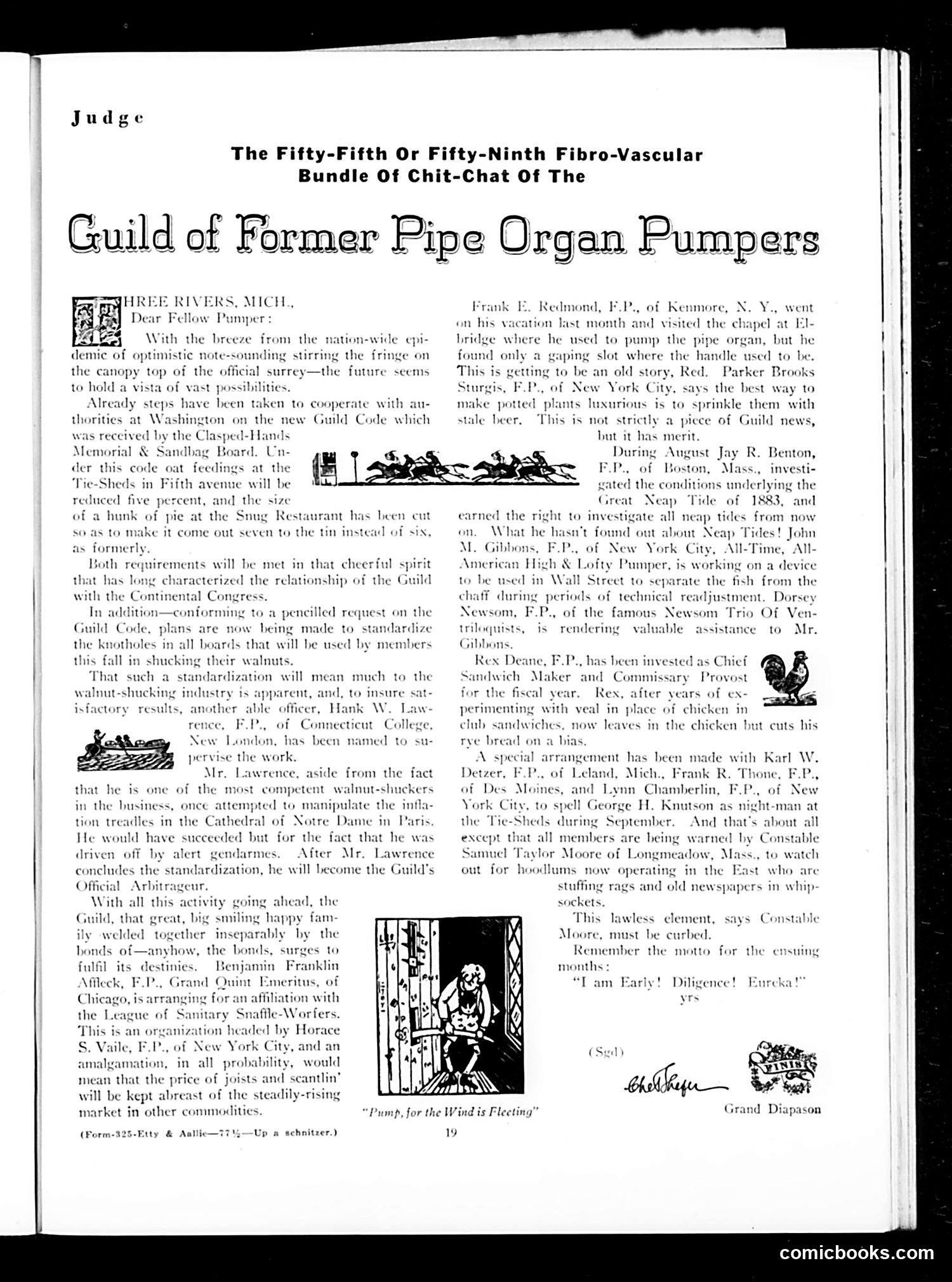
Judge Magazine: "Guild of Former Pipe Organ Pumpers" This is a satirical article mocking earnest, verbose organizational bureaucracy. The "Guild" is a fictional fraternal organization for men who once pumped pipe organs (a mechanical task now replaced by electric fans). The satire targets: What it's mocking: - Corporate reorganization codes and standardization protocols (likely referencing New Deal era workplace regulations) - Pompous organizational jargon ("Official Arbitrageur," "Grand Quint Emeritus") - Absurdist "achievements" like reducing pie sizes at restaurants or standardizing walnut-shucking procedures - Self-important member anecdotes presented as guild accomplishments (studying historical tides, experimenting with sandwich ingredients) The humor: Distinguished men are given grandiose titles and their trivial activities are described with overwrought bureaucratic language. References to famous figures (Benjamin Franklin, Notre-Dame cathedral) contrast with mundane membership activities. The cartoon illustration (bottom) shows someone at a window labeled "Pump, for the Wind is Fleeting"—reinforcing that organ-pumping is obsolete nostalgia. The piece satirizes mid-century American organizational culture and corporate speak.
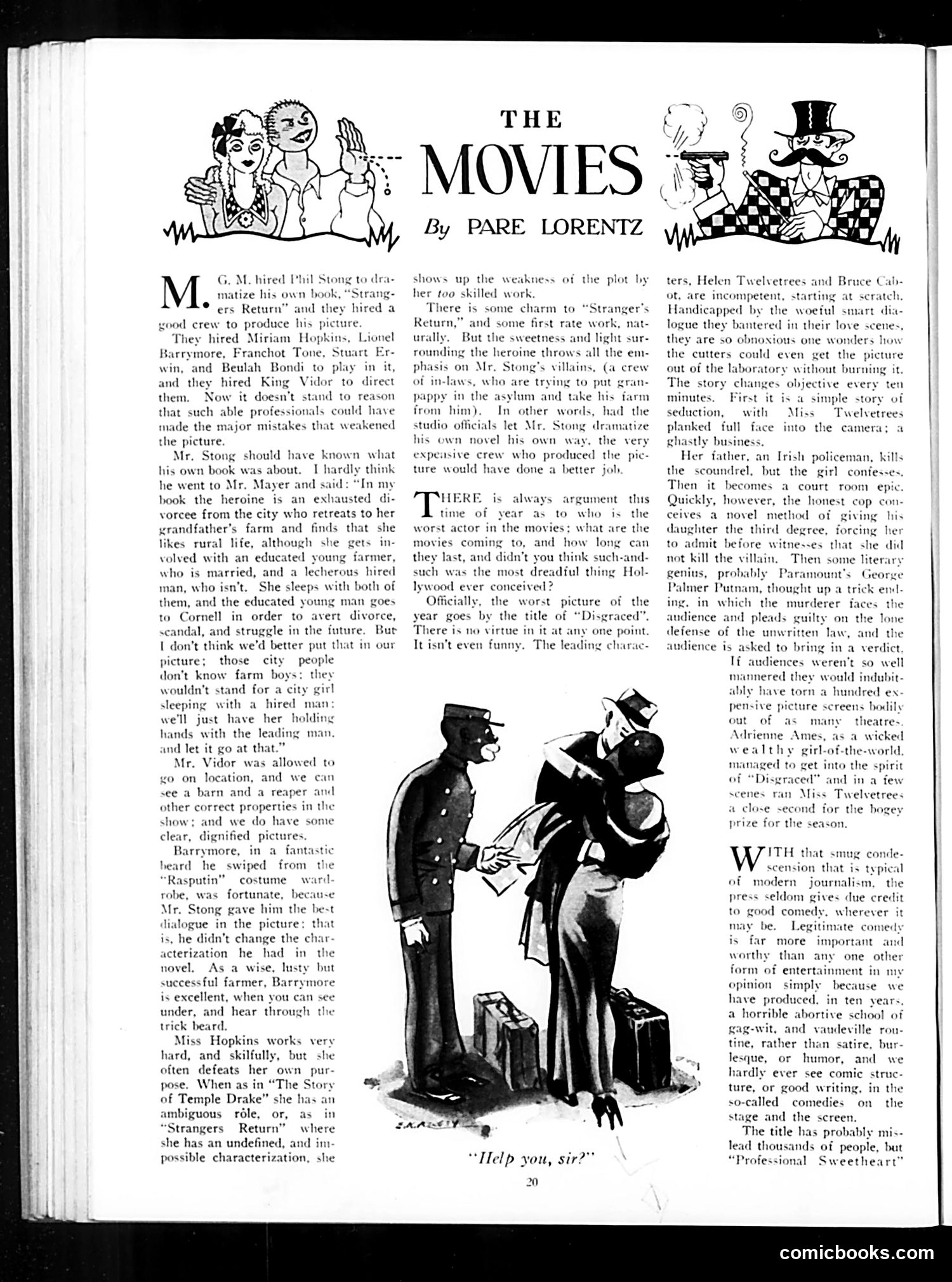
"The Movies" by Pare Lorentz - Judge Magazine Film Criticism This page reviews contemporary 1930s Hollywood films, critiquing the adaptation of Phil Stong's novel "Strangers Return" (featuring Miriam Hopkins, Lionel Barrymore, and Franchot Tone). Main Point: The critic argues that despite hiring prestigious talent and director King Vidor, the film weakened Stong's story by sanitizing it—removing the heroine's sexual encounters with multiple men to appease audiences who "wouldn't stand for a city girl sleeping with a hired man." The irony: removing morally "objectionable" content actually *worsened* the picture by creating plot confusion. The Illustration shows what appears to be a scene of seduction or romantic entanglement, captioned "Help you, sir?"—likely depicting the very compromised situations the review discusses. Broader Context: This reflects 1930s Hollywood's struggle between artistic integrity and the Motion Picture Production Code's moral censorship, which sanitized narratives in ways that often damaged storytelling logic.
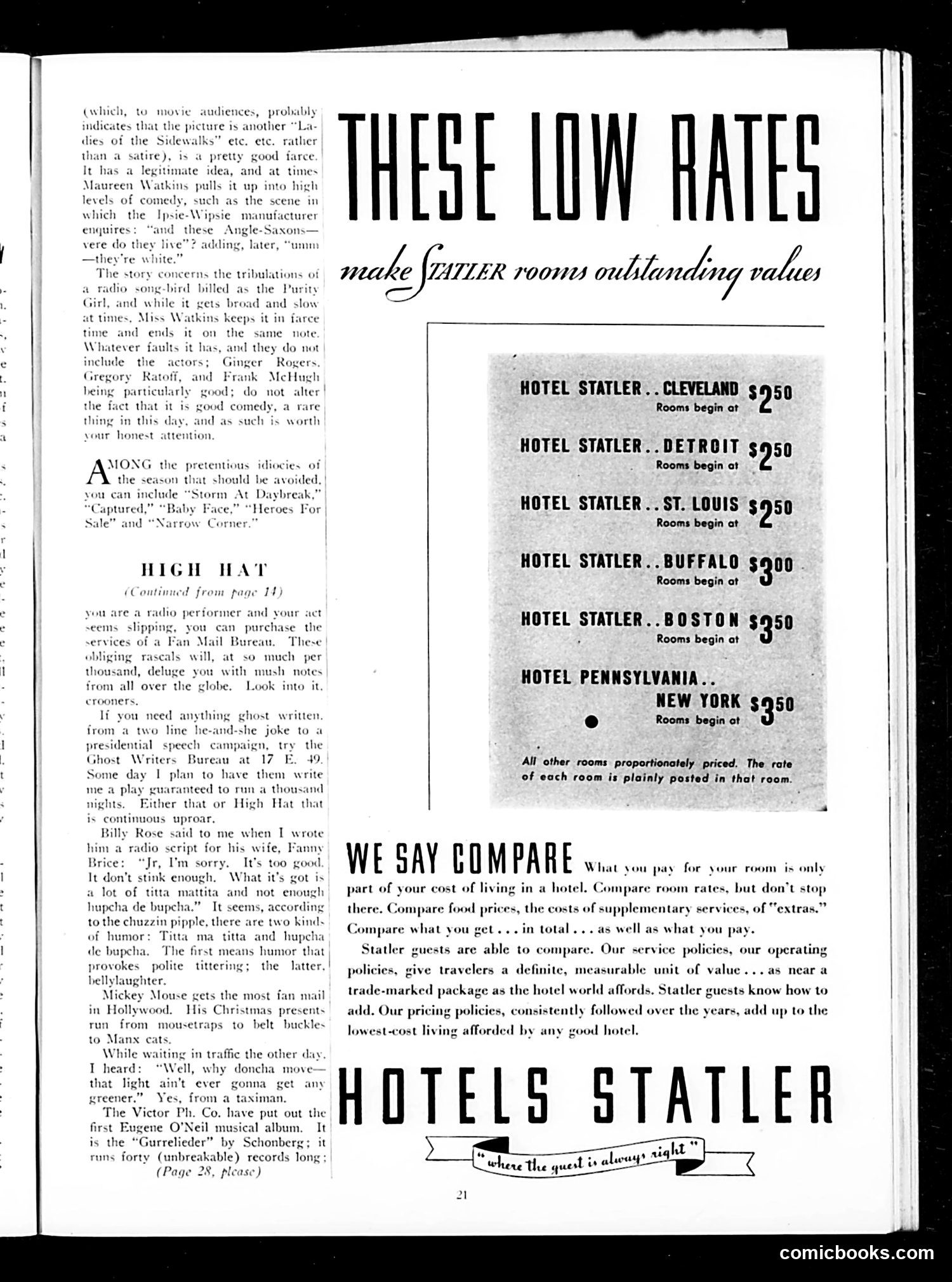
Analysis for Modern Readers This page is primarily advertising, not political satire. The dominant content is a Hotels Statler advertisement promoting budget hotel rooms across major American cities ($2.50-$3.00 per night). The left column contains entertainment criticism and gossip, discussing 1930s films and radio industry practices. Notable references include: - Ginger Rogers and Gregory Ratoff: actors in a film being reviewed - Billy Rose and Fanny Brice: a real married entertainment couple; the exchange about "titta mattita" and "hupcha" appears to mock theatrical/vaudeville slang - Mickey Mouse: noted as receiving the most fan mail in Hollywood - "Fan Mail Bureaus" and "Ghost Writers Bureaus": satirizing the practice of artificially generating popularity through hired services The satire here targets entertainment industry fakery—the notion that performers could purchase manufactured fame through mail campaigns and hired writers. This reflects genuine 1930s concerns about authenticity in an increasingly commercialized entertainment landscape. The Statler ad uses a comparative approach emphasizing transparent pricing and reliable service—positioning itself as honest value against less transparent competitors.
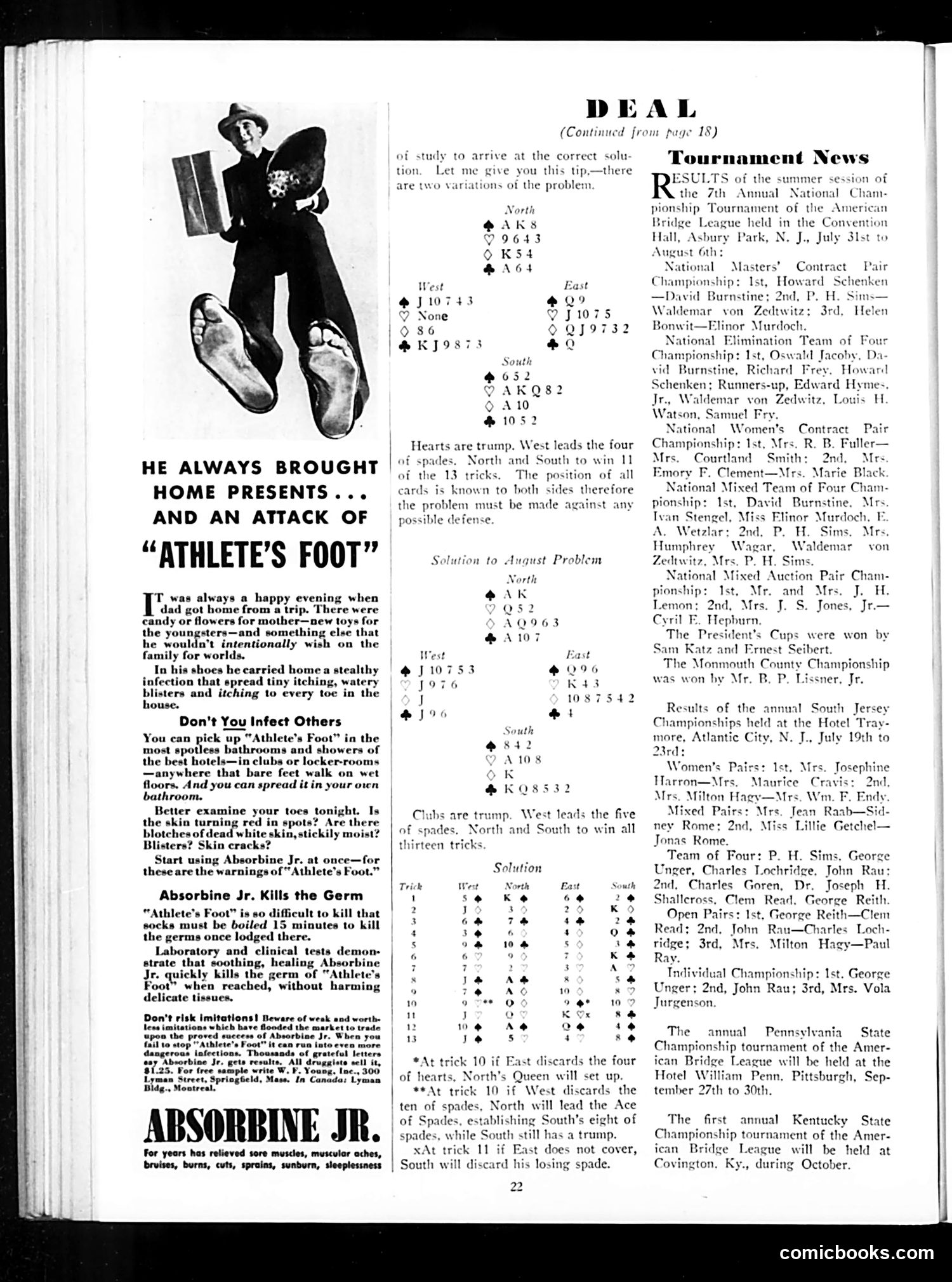
Analysis for Modern Readers This page is primarily advertising for Absorbine Jr., a medicinal product, combined with bridge tournament coverage. The "Athlete's Foot" Advertisement The large cartoon depicts a figure bringing home athlete's foot fungus like an unwanted souvenir from travel. The advertisement warns that this contagious foot infection spreads in public bathrooms, showers, and locker rooms—anywhere bare feet walk on wet floors. The ad encourages self-examination for symptoms (red skin, blisters, cracks) and promotes Absorbine Jr. as a germ-killing solution. It explicitly warns against "imitations" and includes a sample-order address. Context This reflects early-to-mid 20th-century public health anxieties about fungal infections spreading in modern public facilities. The humorous framing—dad unknowingly infecting his entire family—made health warnings relatable and memorable to readers. The second half covers bridge championship tournament results, suggesting this issue targeted readers interested in card games and social/competitive activities.
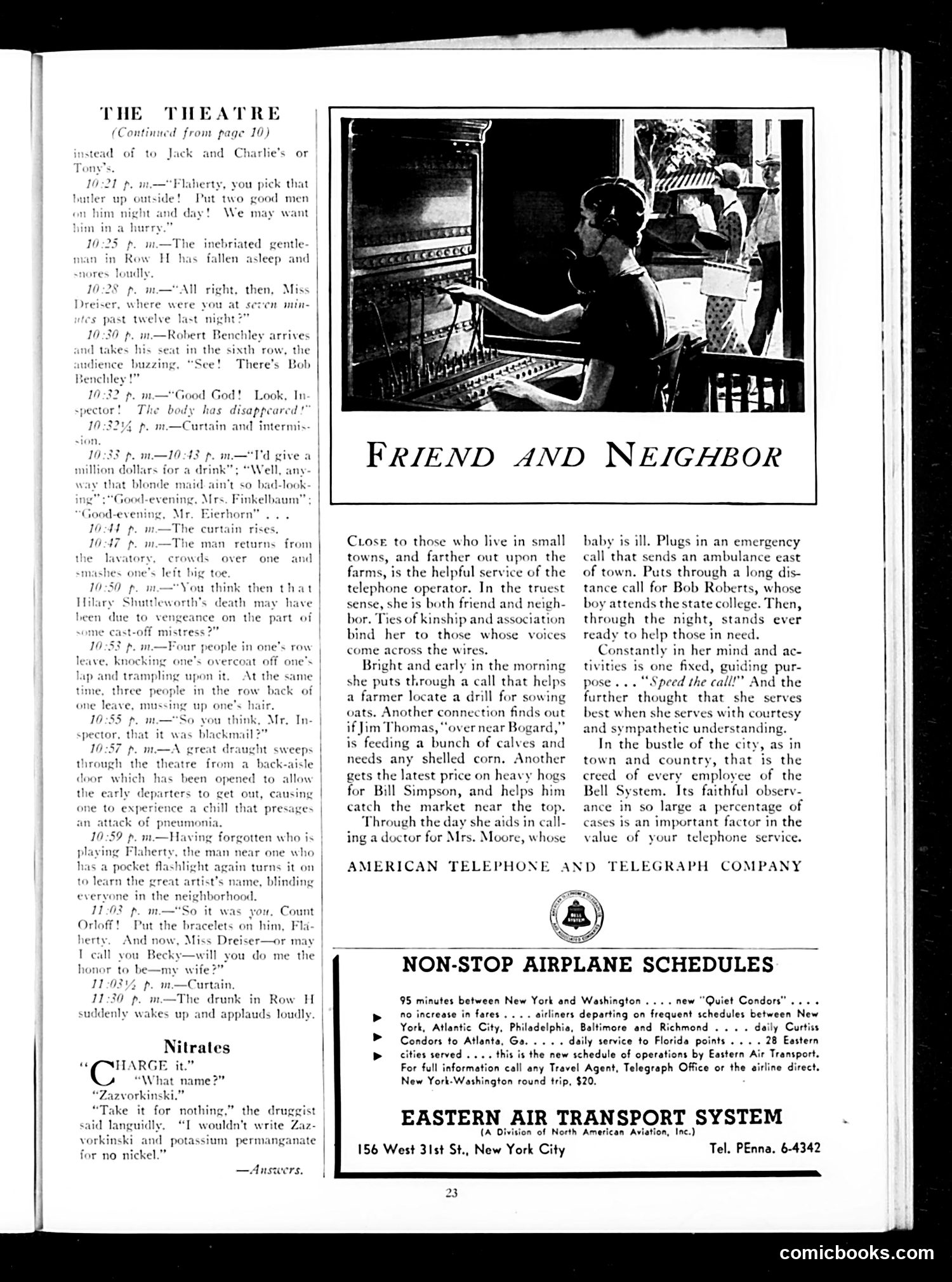
Analysis: Page 23 of Judge Magazine The left column presents a theatrical play review (continued from page 10) mocking a pretentious stage production. The satire targets the absurdity of plot complications—a man asleep and snoring, a disappeared body, possible murder by vengeance, blackmail accusations, and an awkward proposal. A drunk audience member, blindingly wielding a pocket flashlight, disrupts the show further. The review concludes with a brief joke about a druggist refusing to fill a prescription for "Zarvorkinski and potassium permanganate" as uneconomical. The right side features a substantial advertisement for Bell Telephone's rural telephone operators, praising women who connect farmers to markets, doctors, and distant relatives. This corporate messaging—presented as public service narrative—emphasizes the operator's indispensability to small-town life. Below is an Eastern Air Transport airplane schedule advertisement promoting non-stop service between major East Coast cities. The page juxtaposes theatrical satire against earnest corporate messaging.
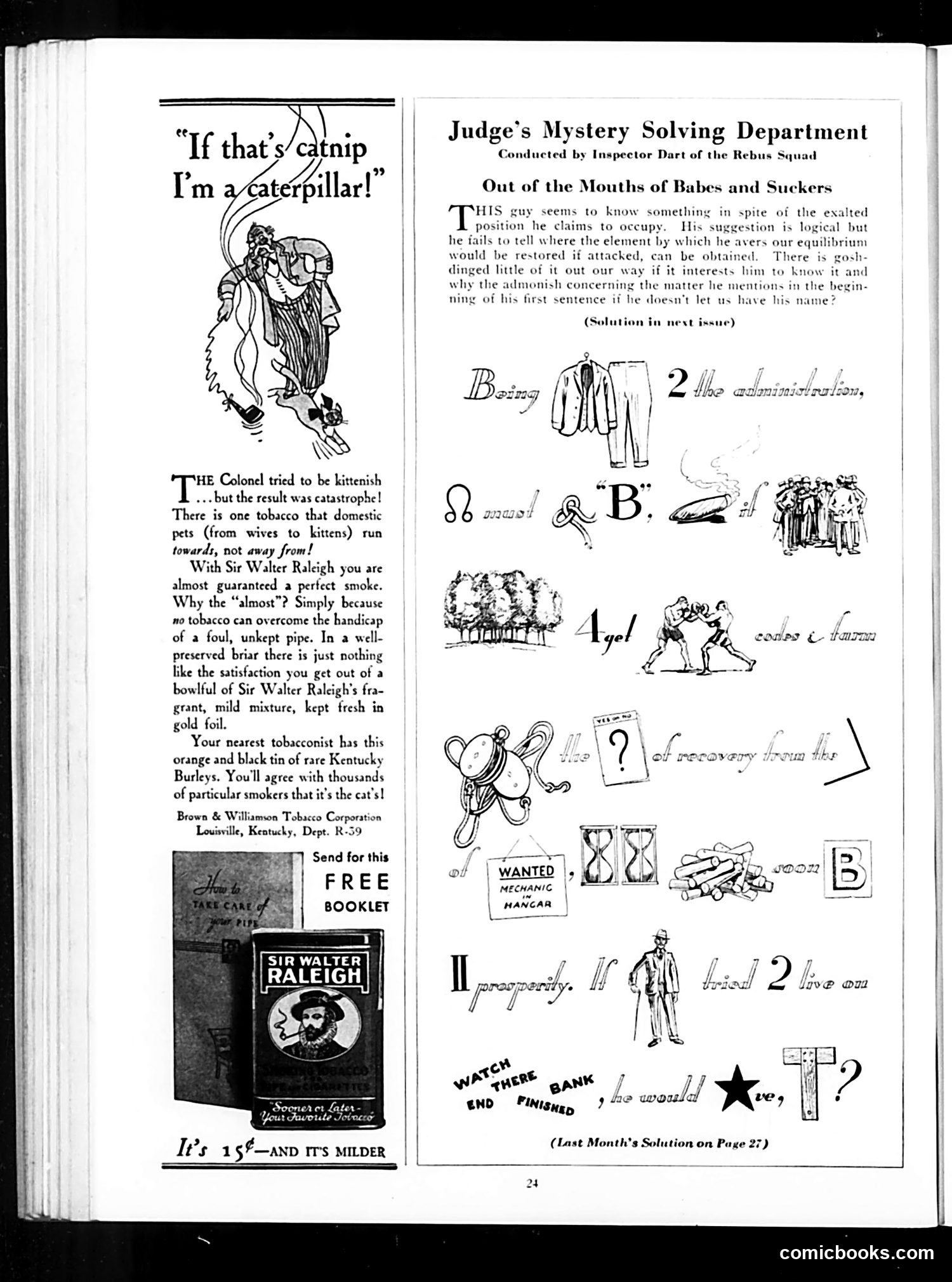
Judge Magazine Page Analysis This page combines a rebus puzzle ("Judge's Mystery Solving Department") with a tobacco advertisement for Sir Walter Raleigh brand. The Puzzle The visual riddle uses drawings and text to obscure a message readers must decode. The introduction notes someone in an "exalted position" makes a logical suggestion but won't reveal his identity—readers must solve it by deciphering the rebus clues below. The Advertisement The left column features a satirical anecdote: a Colonel tried acting playful ("kittenish") with a cat but caused disaster. The moral: Sir Walter Raleigh tobacco is so appealing that even pets are drawn to it. The copy humorously emphasizes that while the tobacco is excellent, smokers must maintain their pipes properly to enjoy it fully. The ad promotes "rare Kentucky Burleys" kept fresh in gold foil, positioning the product as premium and appealing to "particular smokers." Context This represents typical 1920s-30s advertising blending humor, wordplay, and product promotion—common in satirical magazines where ads subsidized publication.
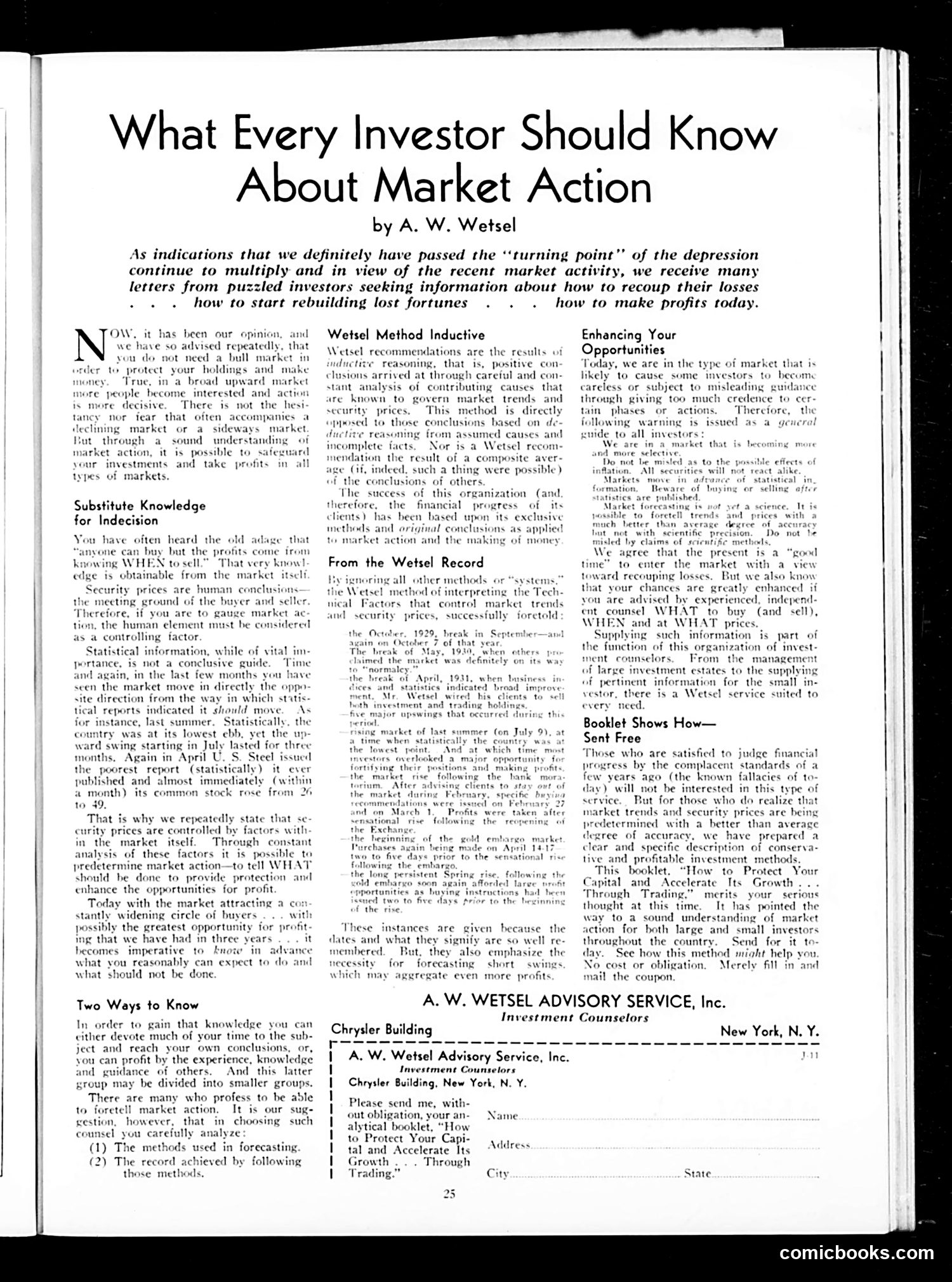
Analysis of Page Content This is primarily advertising and editorial content, not a political cartoon. The page features an article by A. W. Wetsel promoting his investment advisory service during the Great Depression era. Context: Written as economic conditions showed signs of improvement, the piece addresses anxious investors seeking to recover losses. Wetsel argues that successful investing depends on understanding "market action"—the human psychological factors driving prices—rather than relying solely on statistics. The Pitch: Wetsel contrasts his "inductive method" (analyzing actual market behavior and trends) against other forecasting approaches. He claims his organization's success proves this approach works, and offers a free booklet titled "How to Protect Your Capital and Accelerate Its Growth Through Trading." The Sales Angle: By positioning himself as scientifically superior to competing investment advisors while emphasizing emotional control and timing ("WHEN to sell"), Wetsel targets Depression-era investors desperate for expert guidance and profit recovery. This is not satire—it's genuine period advertising using psychological reassurance to sell investment counsel.
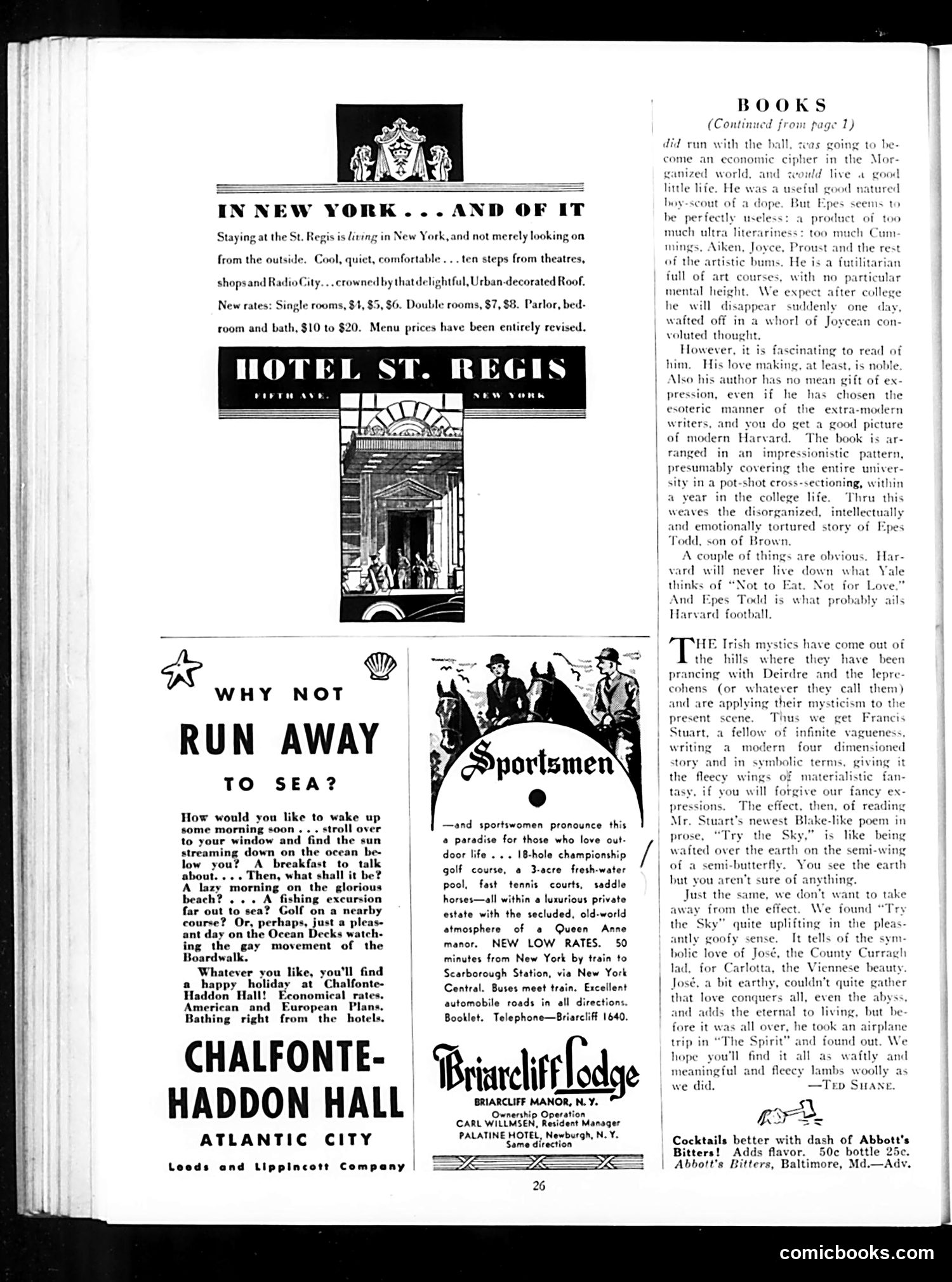
Page Analysis: Judge Magazine Advertisement and Book Review This page is primarily advertisements for hotels and resorts, with a brief book review section. The ads emphasize leisure travel during what appears to be the 1920s-30s era: the St. Regis Hotel in Manhattan, Chalfonte-Haddon Hall in Atlantic City, and Briarcliff Lodge offer middle-to-upper-class getaways. The "Run Away to Sea?" tagline appeals to urban professionals seeking escape. The book review (right column) discusses a novel about "Epes Todd, son of Brown" attending Harvard. The reviewer critiques modern experimental literature—praising the author's nobility but mocking the work's obscurity and ultra-literary style (referencing Joyce, Proust, Aiken). The review's tone is gently satirical toward avant-garde fiction and Harvard culture. A final jab: the reviewer quips that Todd's story "is what probably ails Harvard football"—implying intellectual pretension damages college athletics. No political cartoons appear on this page; it's primarily commercial content with literary commentary.
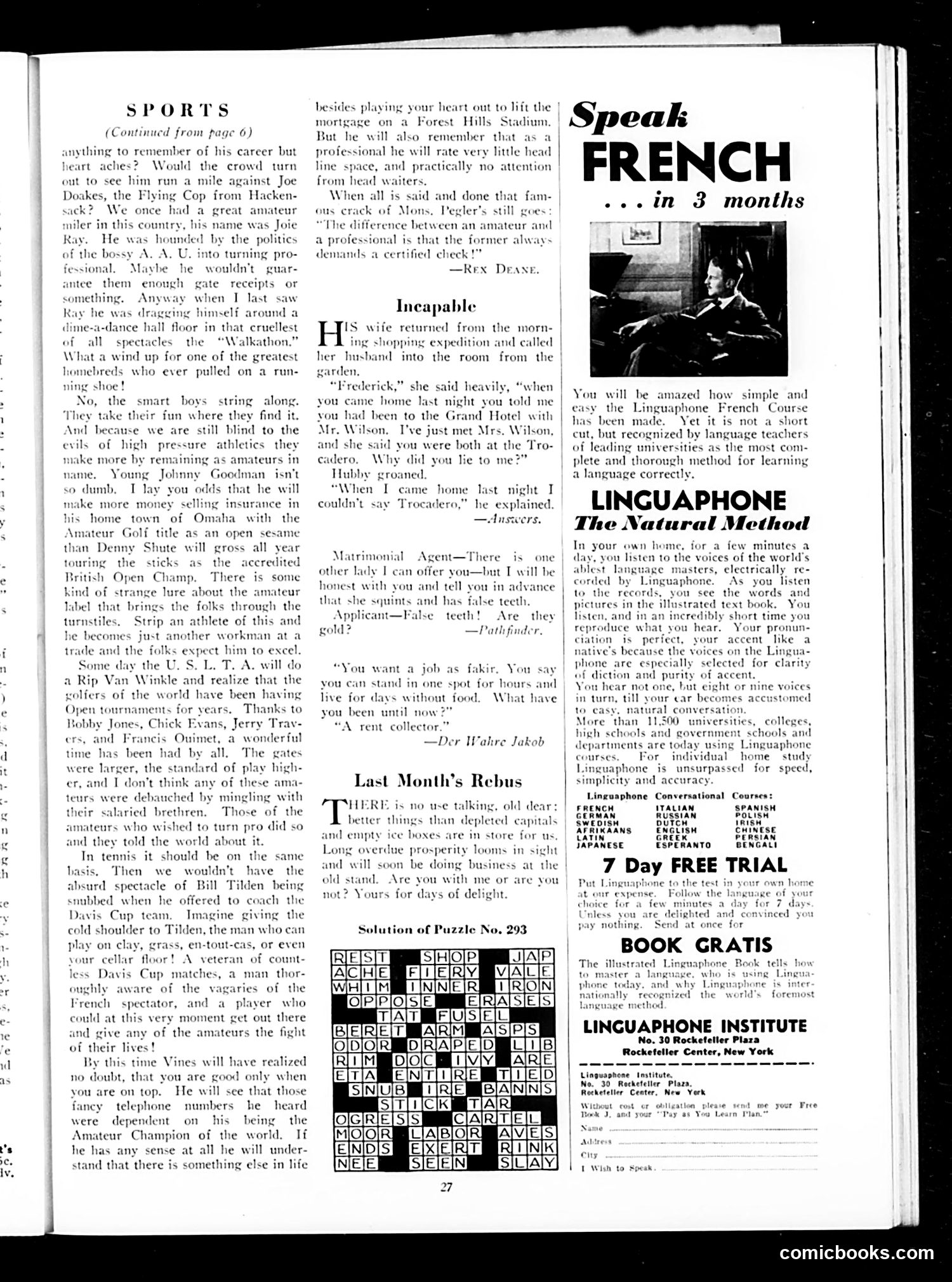
Page Analysis: Judge Magazine This page mixes sports commentary with advertisements and humor pieces—not a political cartoon per se. The sports column (top) criticizes amateur athletes who refuse professional opportunities, citing examples like golfer Johnny Goodman and tennis player Bobby Jones. The author argues that amateurs paradoxically profit more by maintaining amateur status while drawing large crowds, creating a hypocritical system. The piece laments that talented athletes like "Ray" end up in degrading "Walkathon" dime-a-dance halls rather than receiving proper compensation. The humor pieces ("Incapable" and "Matrimonial Agent") are brief, unrelated jokes about marital deception—a husband caught lying about his evening location, and a dating agent's pitch. The dominant content is a Linguaphone language-learning advertisement promoting French lessons in three months—typical 1930s commercial space in magazines. There's no discernible political satire here; the page reflects period concerns about amateurism rules in sports and capitalist contradictions, but focuses mainly on filler content and paid advertising.
Analysis of Judge Magazine Page Content This page is primarily advertisements and entertainment listings rather than political satire. The content reflects 1930s American commercial and cultural life. Key Content: - Restaurant ads (Longchamps, Hotel Governor Clinton) targeting middle-class New Yorkers - Furniture advertising (Leg-o-Matic bridge sets) for modern homes - Entertainment venues (Paradise Cabaret, Abington Hotel in Detroit) - Real estate listings The "High Hat" Column (top) contains conversational humor about 1930s urban life: a brewery using radio-equipped trucks to deliver beer, jokes about Irish and Jewish names, a anecdote about a man taking a woman to an upscale restaurant where she orders only "meat and potatoes," and movie industry gossip. "Hihattractions" section lists popular radio entertainers and their comedic acts (John Henry, Lou Holtz, Al Jolson, Rudy Vallee)—typical entertainment coverage for the era. The page captures everyday Depression-era consumer culture and entertainment rather than political commentary.
Analysis of Judge Magazine Page This page is primarily advertising, not satire or political commentary. The dominant content consists of hotel advertisements (Bismarck Hotel in Chicago, Hotel Montclair in New York, and Bellevue Stratford in Philadelphia) interspersed with commercial ads for Abbott's Bitters and publishing services. The only editorial content is a brief column titled "Answers to Who's the Genius?" which appears to be a humorous recap of recent entertainment and cultural events—including references to mystery novels, popular songs, movies, and Broadway shows. The humor is lighthearted cultural commentary rather than political satire. The page reflects 1930s advertising aesthetics and consumer culture, emphasizing hotel amenities and competitive pricing during what appears to be the Depression era ("Rates consistent with present times"). There are no identifiable caricatures or political figures—this is a commercial/entertainment magazine page focused on leisure and hospitality.
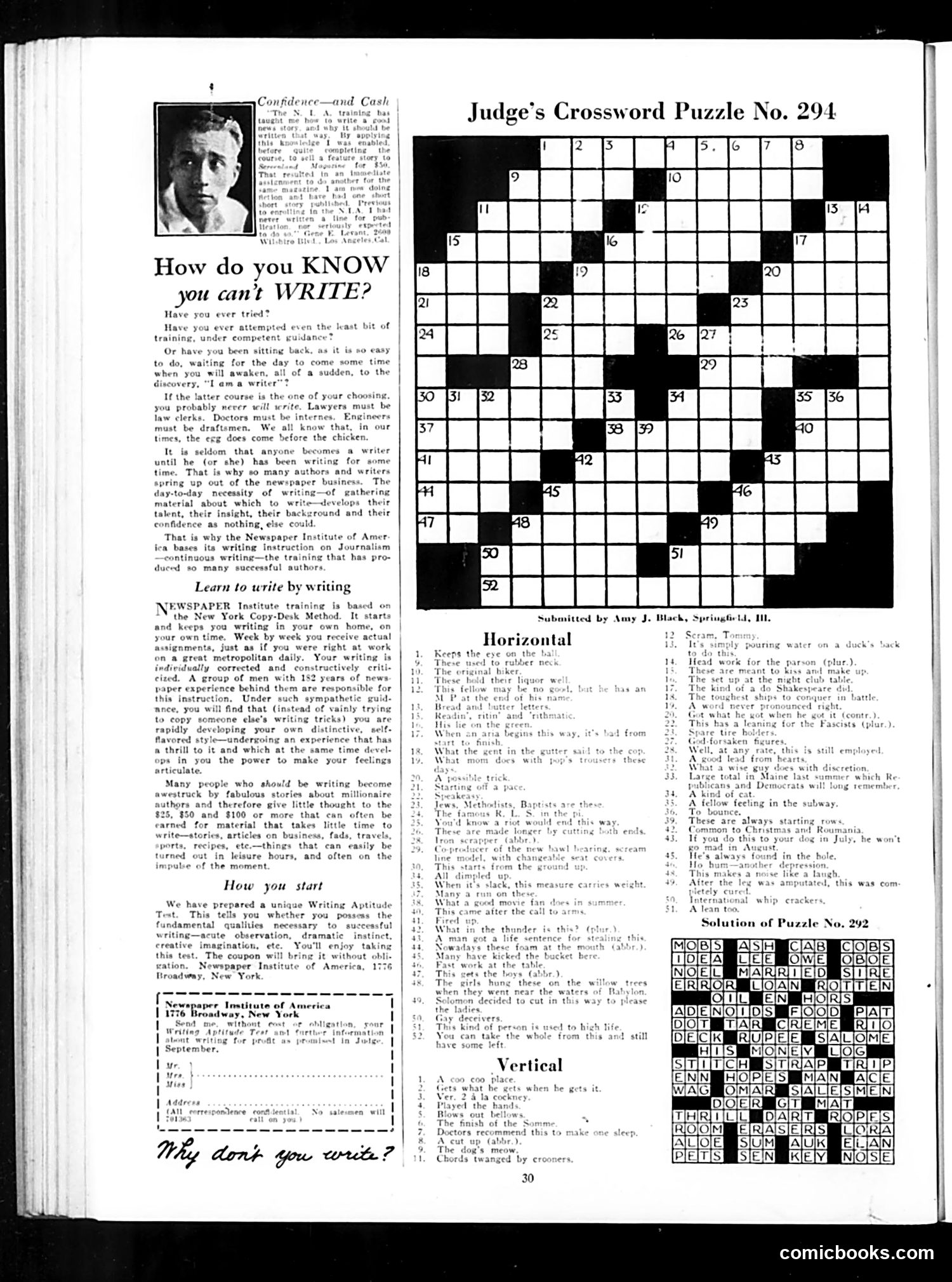
Judge Magazine Page Analysis This page is primarily instructional advertising rather than political satire. It promotes the Newspaper Institute of America's writing correspondence course. The main content includes: 1. "How do you KNOW you can't WRITE?" — A persuasive advertisement arguing that aspiring writers shouldn't assume they lack talent without training. It encourages readers to attempt writing with professional guidance. 2. A photograph (top left) of an unidentified man, likely a successful author or instructor featured as testimonial. 3. Crossword Puzzle No. 291 — A standard puzzle grid, typical filler content for magazines. 4. The advertisement's pitch: The Institute offers correspondence training with feedback from experienced newspaper professionals (claiming 182 years combined experience). It emphasizes learning through actual writing assignments done at home. 5. A coupon inviting readers to request information about the course. The page reflects early-20th-century American optimism about self-improvement through correspondence education—a common marketing approach of that era. There is no apparent political satire or social commentary on this particular page.
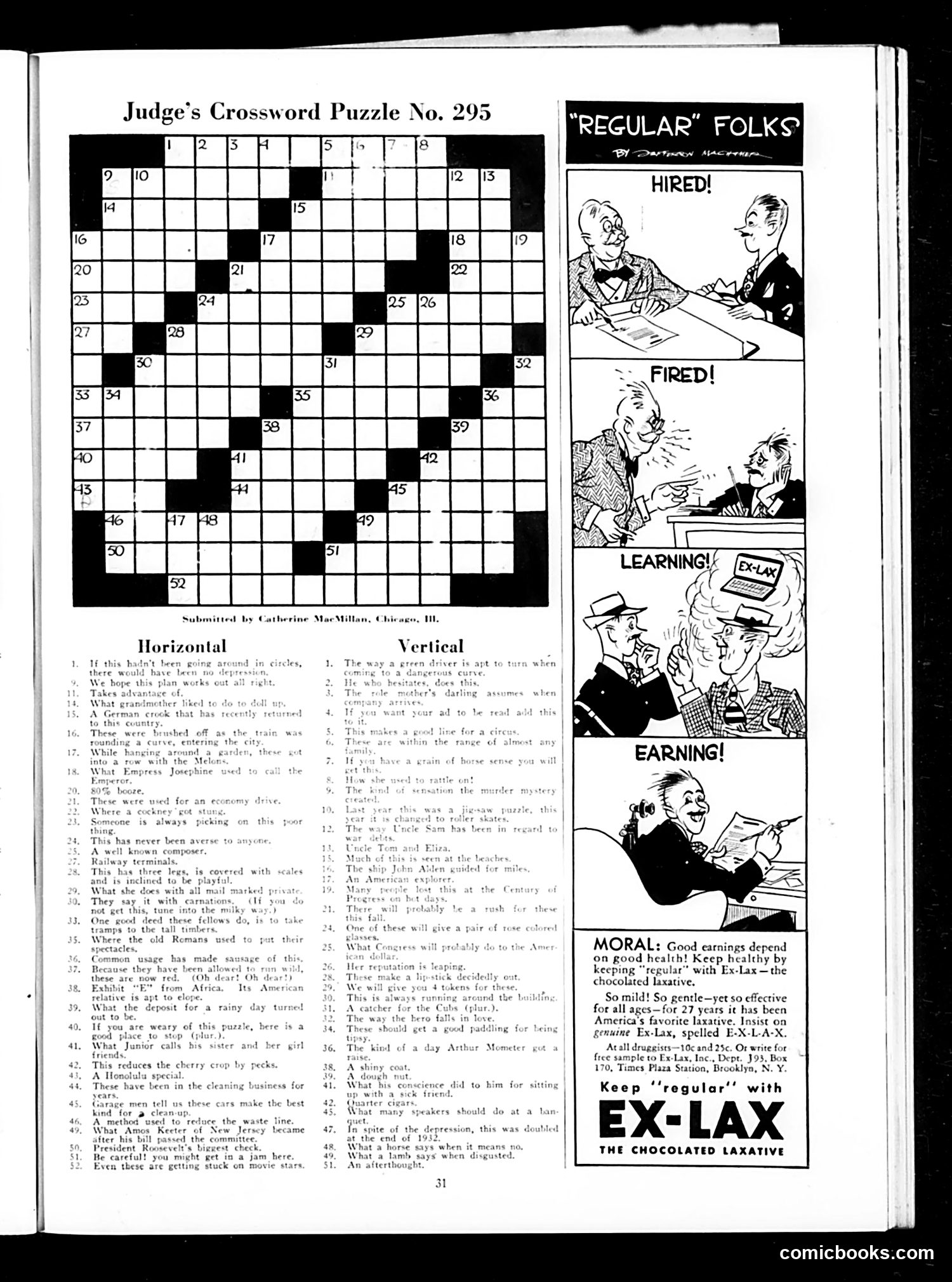
Analysis of Judge Page No. 295 This page combines a crossword puzzle with a comic strip advertisement for Ex-Lax laxative. The comic, titled "Regular Folks" by Darton Hartman, shows a job interview scenario: a man is "HIRED," then immediately "FIRED," then shown "LEARNING" (apparently being trained), and finally "EARNING" money while appearing healthy and energetic. The moral explicitly ties the narrative to the product: good earnings depend on good health, which requires staying "regular" (having proper bowel function) through Ex-Lax use. This is a straightforward product advertisement disguised as humor—a common Judge advertising strategy. The pun on "regular" (both meaning "normal/typical" and "having regular bowel movements") drives the joke. The implication is that digestive health directly enables workplace success and financial prosperity, a typical mid-20th-century advertising claim linking personal hygiene products to social/economic advancement.
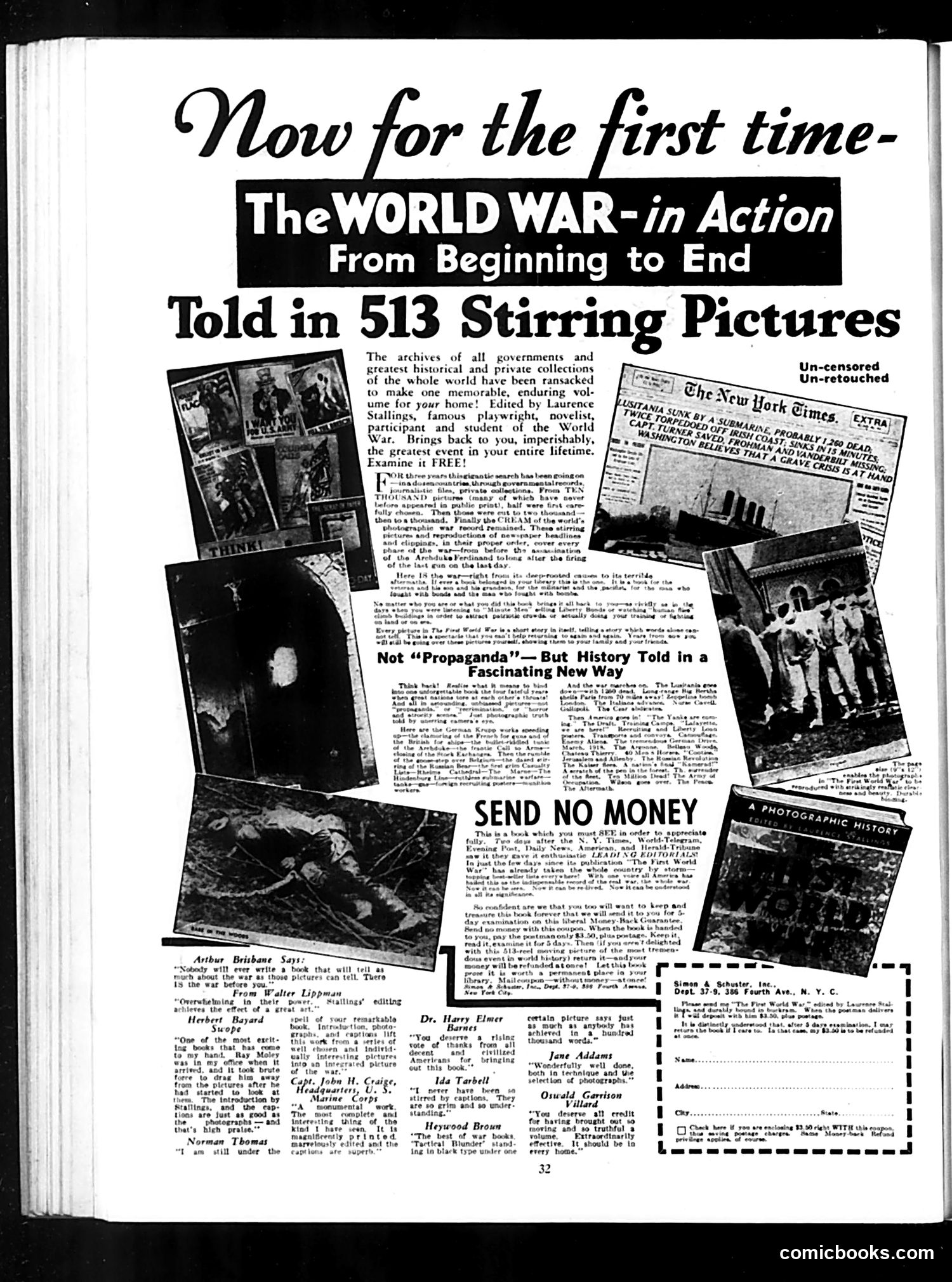
"The World War—in Action" Book Advertisement This is primarily advertising, not satire or political cartooning. It promotes a book collecting 513 photographs documenting World War I "from beginning to end," edited by Laurence Stallings (a noted WWI novelist and playwright). The page features endorsements from prominent contemporary figures—Arthur Brisbane, Walter Lippman, Dr. Harry Elmer Barnes, Jane Addams, Ida Tarbell, Oswald Garrison Villard, and Heywood Broun—lending credibility to the project. Key marketing claims: the photographs are "Un-censored" and "Un-retouched," sourced from government and private archives worldwide. The book promises to show the war as it actually occurred, presented as historical documentation rather than propaganda. The testimonials emphasize the photographs' emotional power and educational value—they convey what words cannot. This reflects post-WWI efforts to document the war's reality for posterity and public understanding.
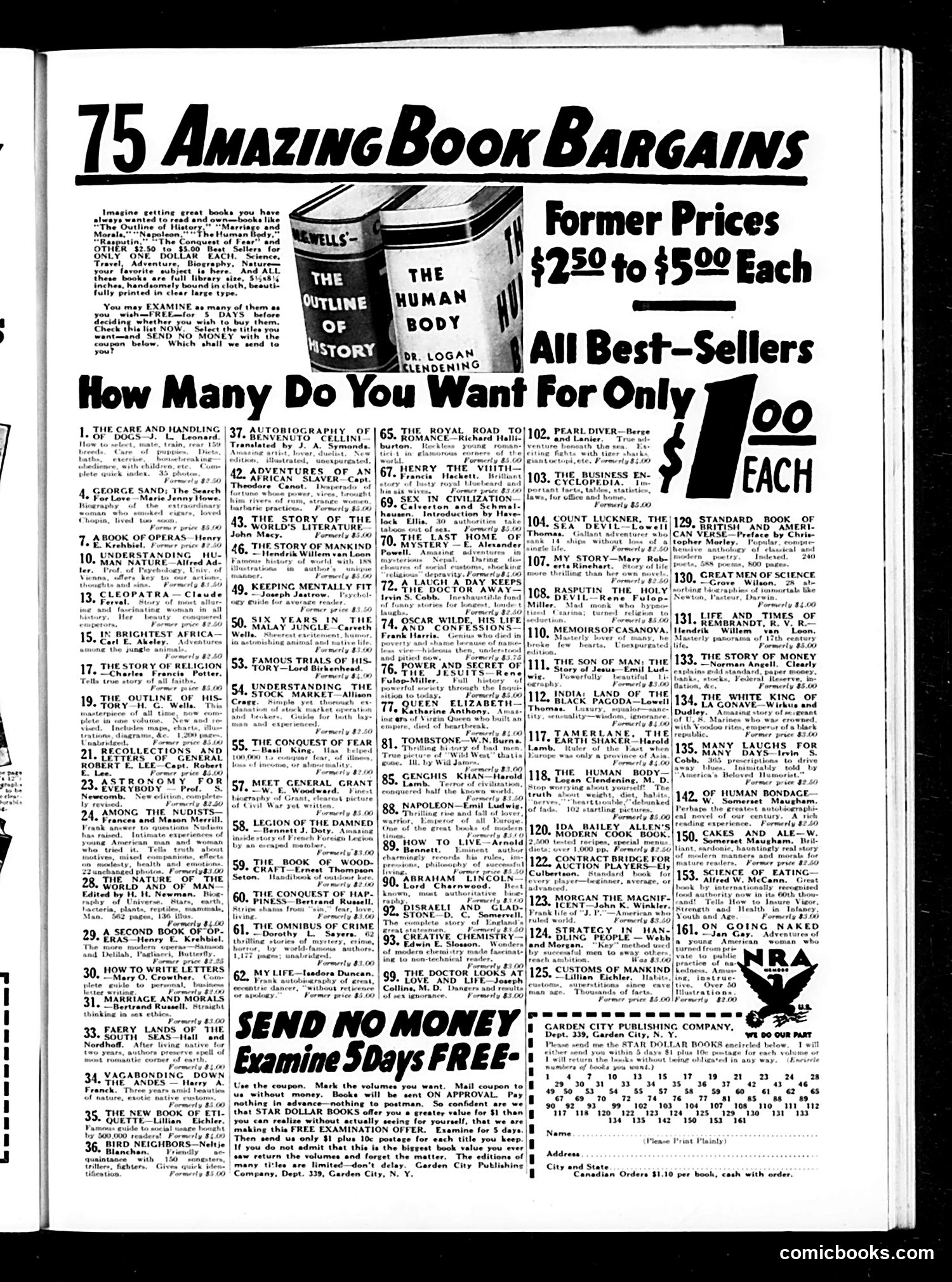
What This Page Means to Modern Readers This is primarily a mail-order book advertisement, not a political cartoon. The page advertises the "Star Dollar Books" collection from Garden City Publishing Company, offering 75 titles at $1 each (reduced from $2.50-$5.00 originally). The books listed are serious non-fiction works popular in the early-to-mid 20th century: biographies (Lincoln, Rembrandt, Oscar Wilde), historical narratives (Genghis Khan, Disraeli), and reference works (The Outline of History, Business Encyclopedia). The advertisement emphasizes this as a bargain offer—appealing to Depression-era or post-Depression readers seeking affordable access to quality literature. The "Examine 5 Days FREE" offer and "Send No Money" language reflect direct-mail marketing tactics of that era, designed to remove purchase barriers and encourage ordering by mail. This reflects a historical moment when books were luxury items and mail-order clubs made them accessible to middle-class readers.
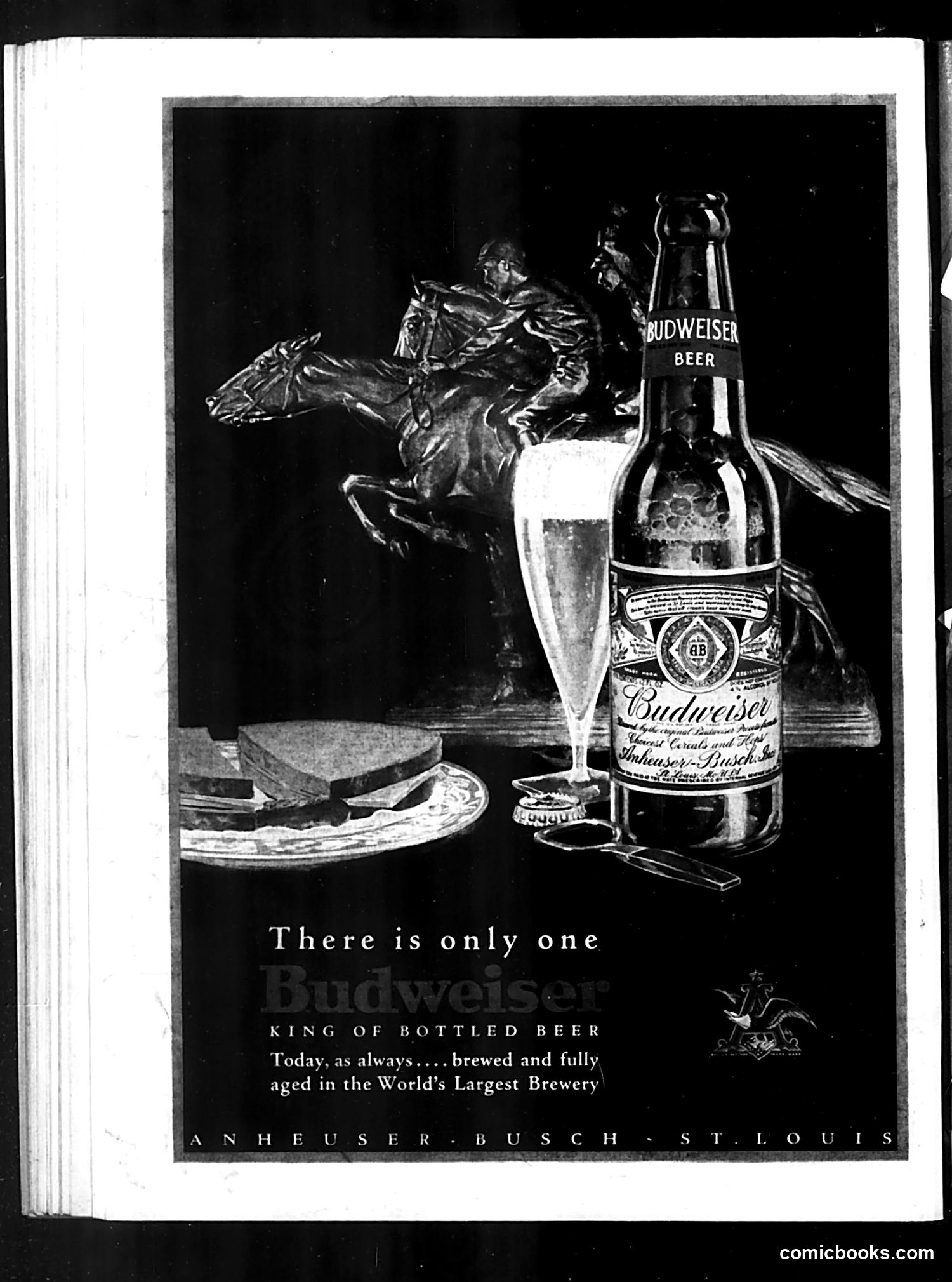
Budweiser Advertisement This is a full-page advertisement rather than satire or political content. It promotes Budweiser beer as the "King of Bottled Beer," emphasizing it's brewed and aged in "the World's Largest Brewery" (Anheuser-Busch, St. Louis). The imagery depicts elegance and prestige: a equestrian statue (evoking nobility and tradition), a filled beer glass, and fine dining elements like a plate and utensils. The visual composition suggests Budweiser belongs in refined, upscale settings. This ad likely dates to the pre-Prohibition era (before 1920) when such lavish beer advertising was common in magazines like *Judge*. The "king" language and aristocratic imagery were typical marketing tactics to position beer as a sophisticated product for respectable consumers.