judge
Judge — October 1933
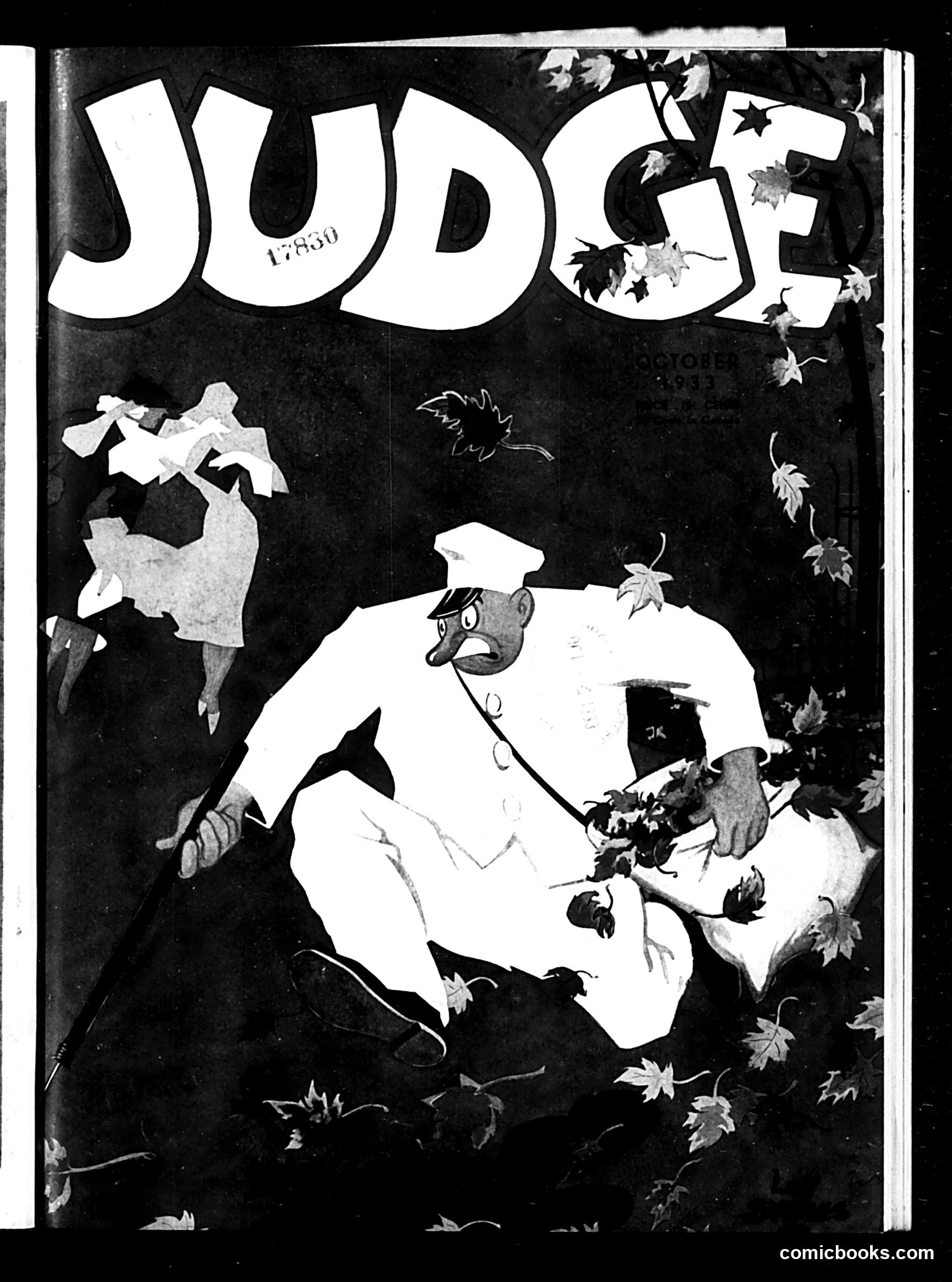
Analysis This appears to be a cover from Judge magazine, an American satirical publication. The large letters "JUDGE" dominate the top, with decorative autumn leaves surrounding the scene. The central figure is a caricatured chef or cook in white chef's attire and hat, depicted with exaggerated features typical of early 20th-century American political cartooning. The chef appears to be preparing or handling something (possibly food/vegetation), surrounded by falling autumn leaves. Without clearer context or visible caption text, the specific political or social reference is unclear. The chef's prominent position and caricatured style suggest commentary on a public figure or institution, but the precise satirical point—whether addressing labor issues, food safety, political leadership, or another contemporary concern—cannot be determined with certainty from the image alone.
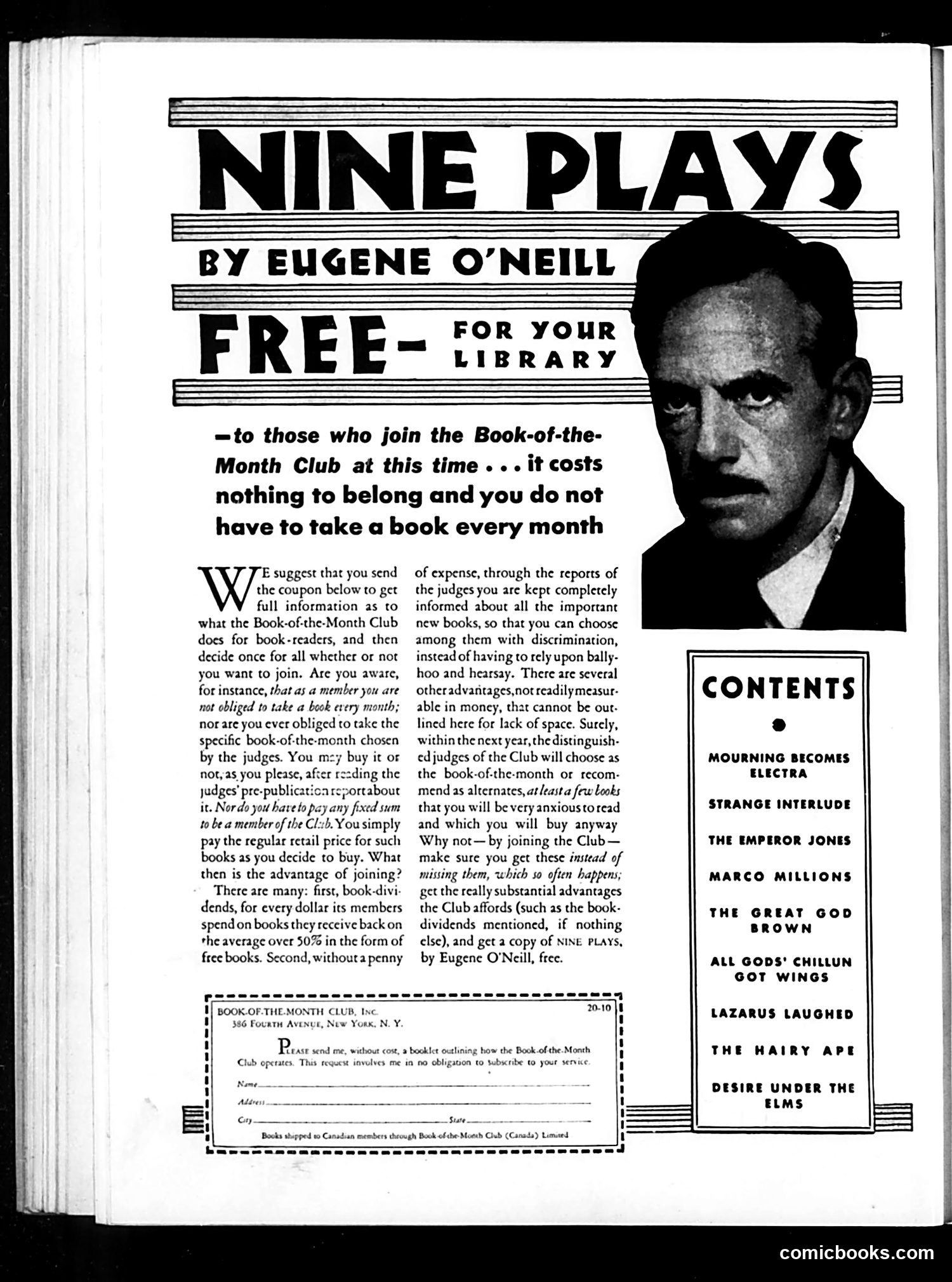
Analysis This page is primarily advertising, not satire or political commentary. It promotes the Book-of-the-Month Club, offering Eugene O'Neill's "Nine Plays" free to new members. The photograph shows a stern-faced man in formal attire—likely O'Neill himself, though not explicitly identified. The advertisement emphasizes the Club's value proposition: membership costs nothing, members aren't obligated to purchase monthly selections, and they receive substantial discounts (averaging over 25% savings). The listed plays in the contents box include titles like "Mourning Becomes Electra" and "Desire Under the Elms," establishing O'Neill's reputation as a serious dramatist. This represents mid-20th century direct marketing, using celebrity endorsement and membership incentives to drive subscriptions. There is no satirical content present.
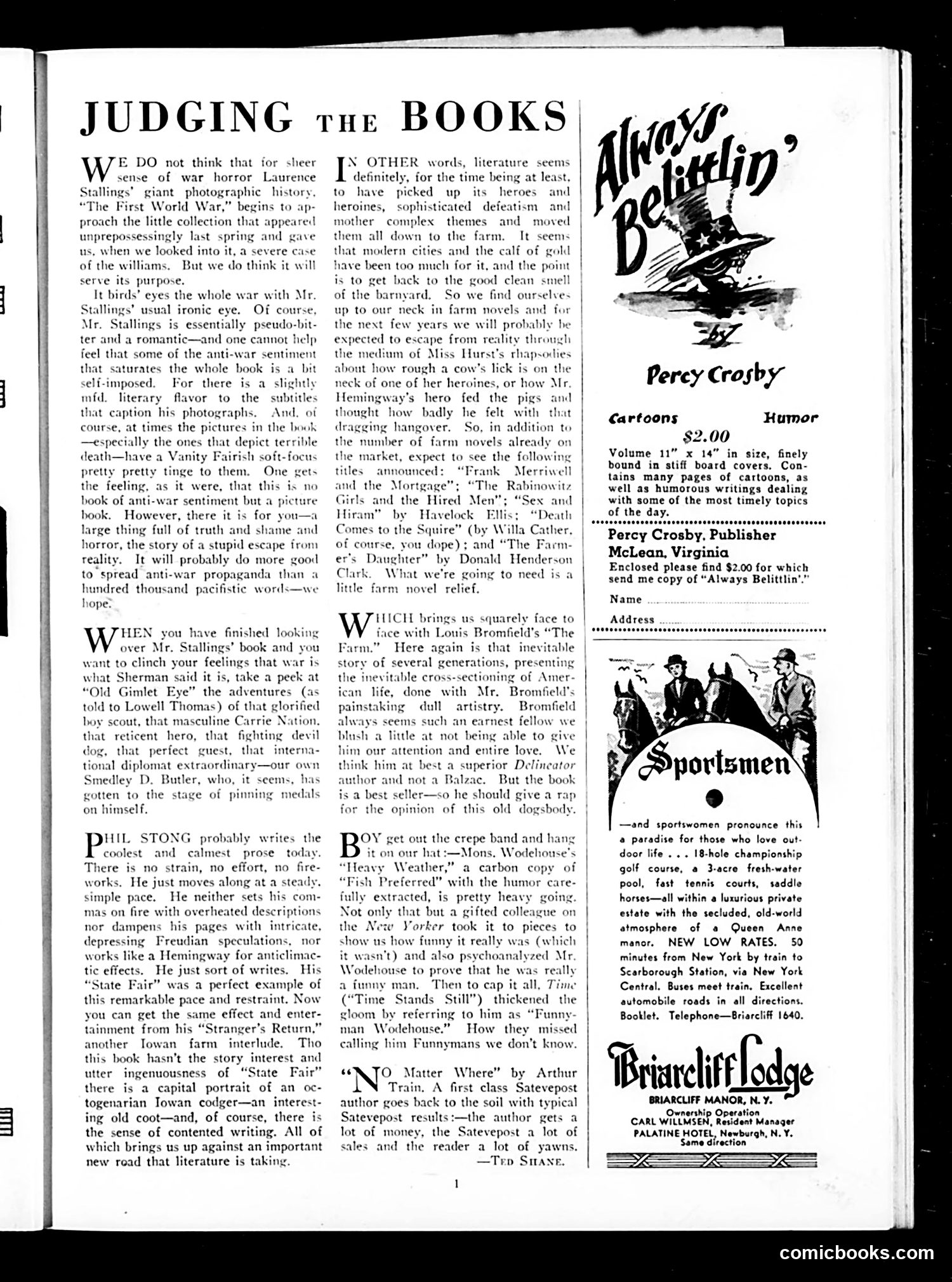
Analysis of Judge Magazine Page This page is primarily book reviews and advertising rather than political satire. The left column reviews farm novels and wartime literature by authors like Laurence Stallings and Louis Bromfield. The reviewer discusses their literary merits and anti-war sentiment. The right side advertises Percy Crosby's cartoon collection ("Always Believin'") and two leisure destinations: Sportsmen (a golf/hunting resort) and Briarcliff Lodge (a Westchester hotel). The only illustration is Percy Crosby's cartoon logo—a bird in flight—which advertises his humor collection, not political commentary. There is no political cartoon or satire visible on this page. It represents Judge's shift toward lifestyle advertising and literary criticism during this period.
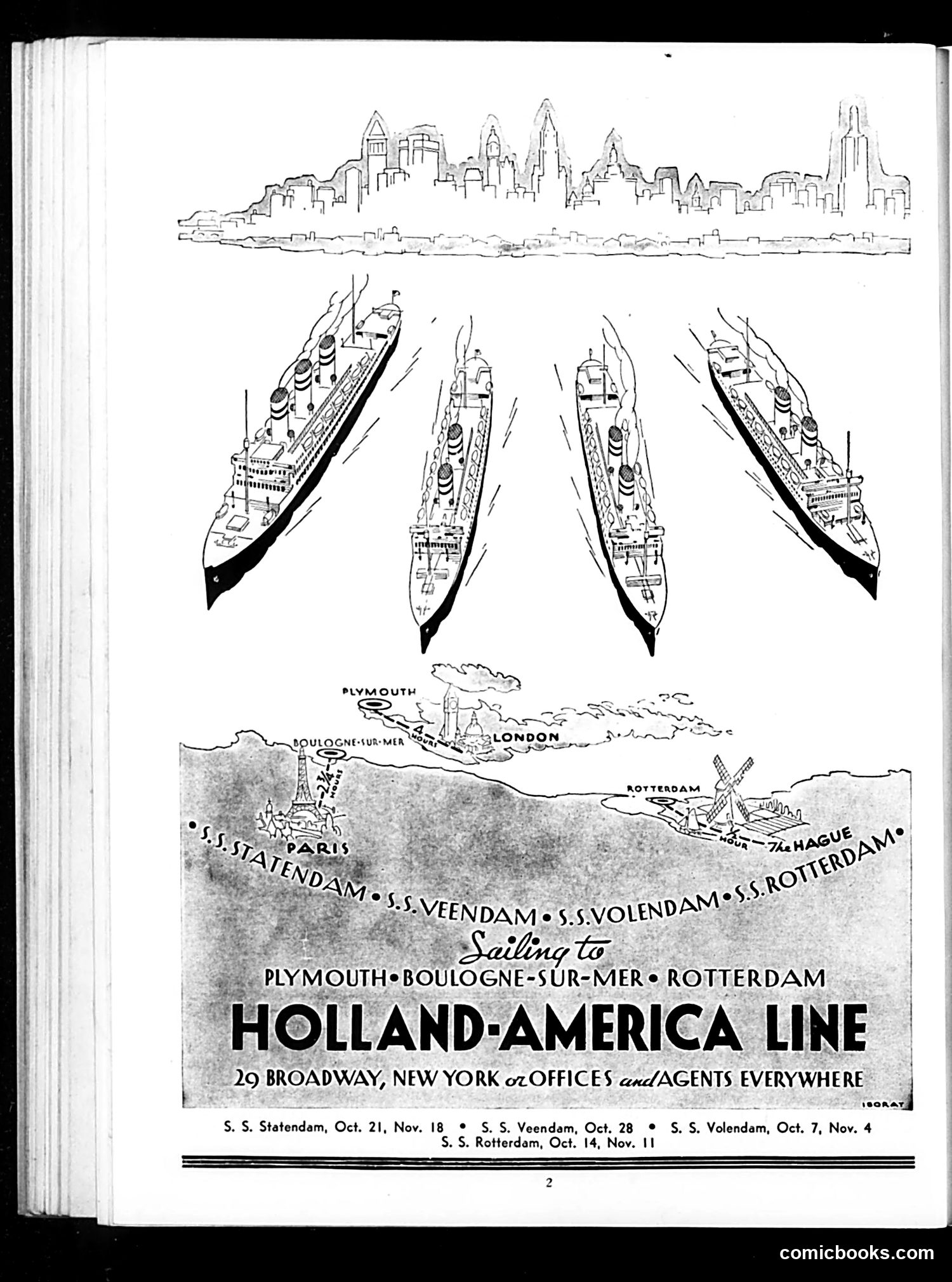
Analysis This page is primarily advertising, not satire or political commentary. The Holland-America Line shipping company presents its transatlantic passenger service with illustrated views of four steamships (S.S. Statendam, Veendam, Volendam, and Rotterdam) and a stylized New York City skyline. The map shows the sailing route: Plymouth → Boulogne-sur-Mer → Rotterdam, with stops in London and The Hague also marked. Departure dates are listed at bottom (October-November sailings). The "29 Broadway, New York" address indicates this is a recruiting advertisement for passengers, positioned in *Judge* magazine to reach affluent American readers interested in European travel during the interwar period. There is no satirical content—this is straightforward commercial advertising.
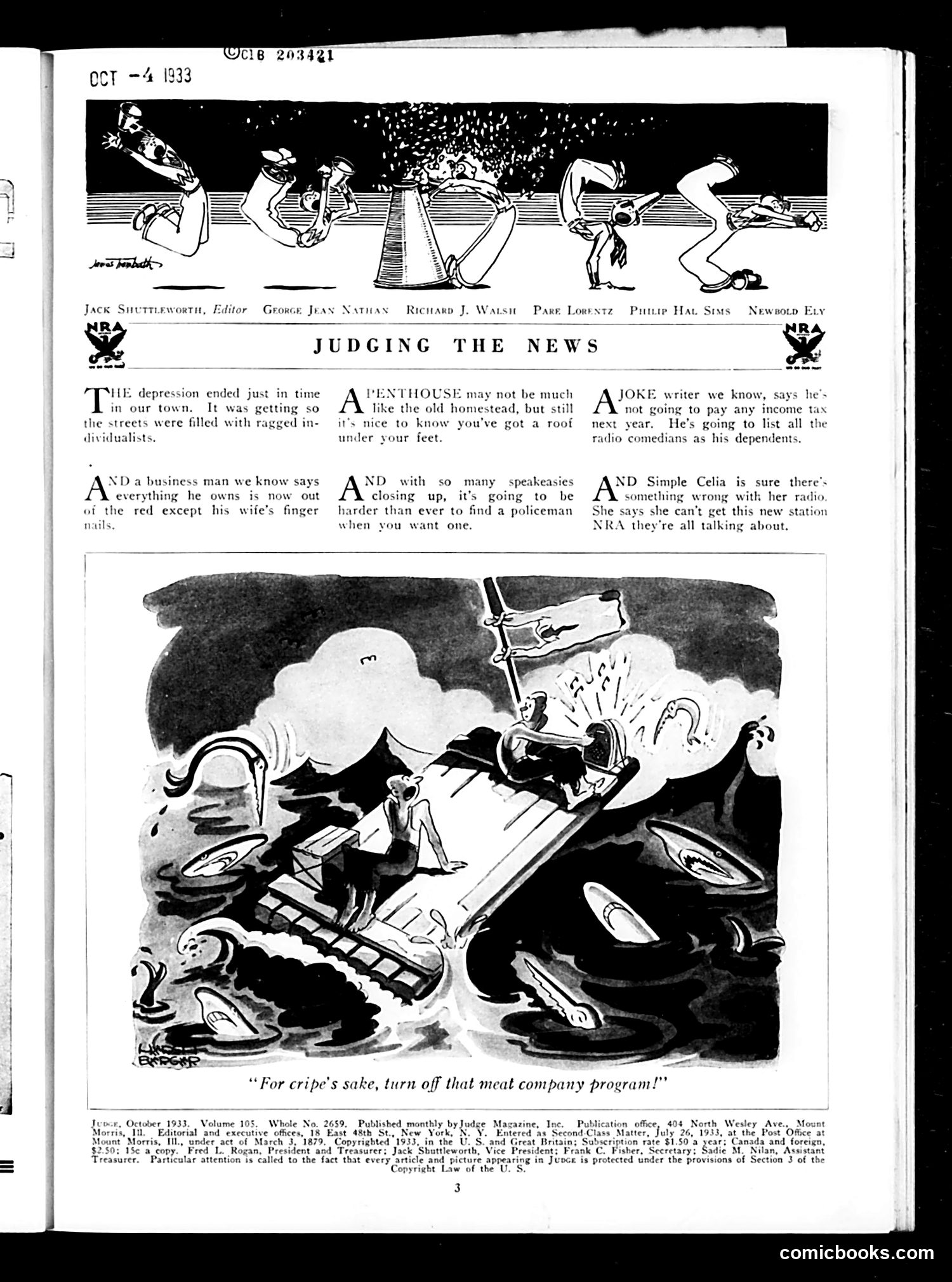
Analysis of Judge Magazine Page, October 1933 This page features "Judging the News," a satirical commentary section typical of Judge magazine. The main cartoon depicts a chaotic scene with a figure wielding a gavel or mallet amid swirling clouds and debris, with a flag visible. The caption reads: "For cripe's sake, turn off that meal company program!" The accompanying text jokes reference Depression-era concerns: businesses struggling, difficulty finding police, radio programming (mentioning NRA and "Simple Celia"), and income tax worries. The cartoon likely satirizes New Deal programs or radio content from FDR's administration (early 1933), suggesting public frustration with either government broadcasts or commercial radio programming during economic hardship. The specific "meal company program" reference remains unclear without additional context.
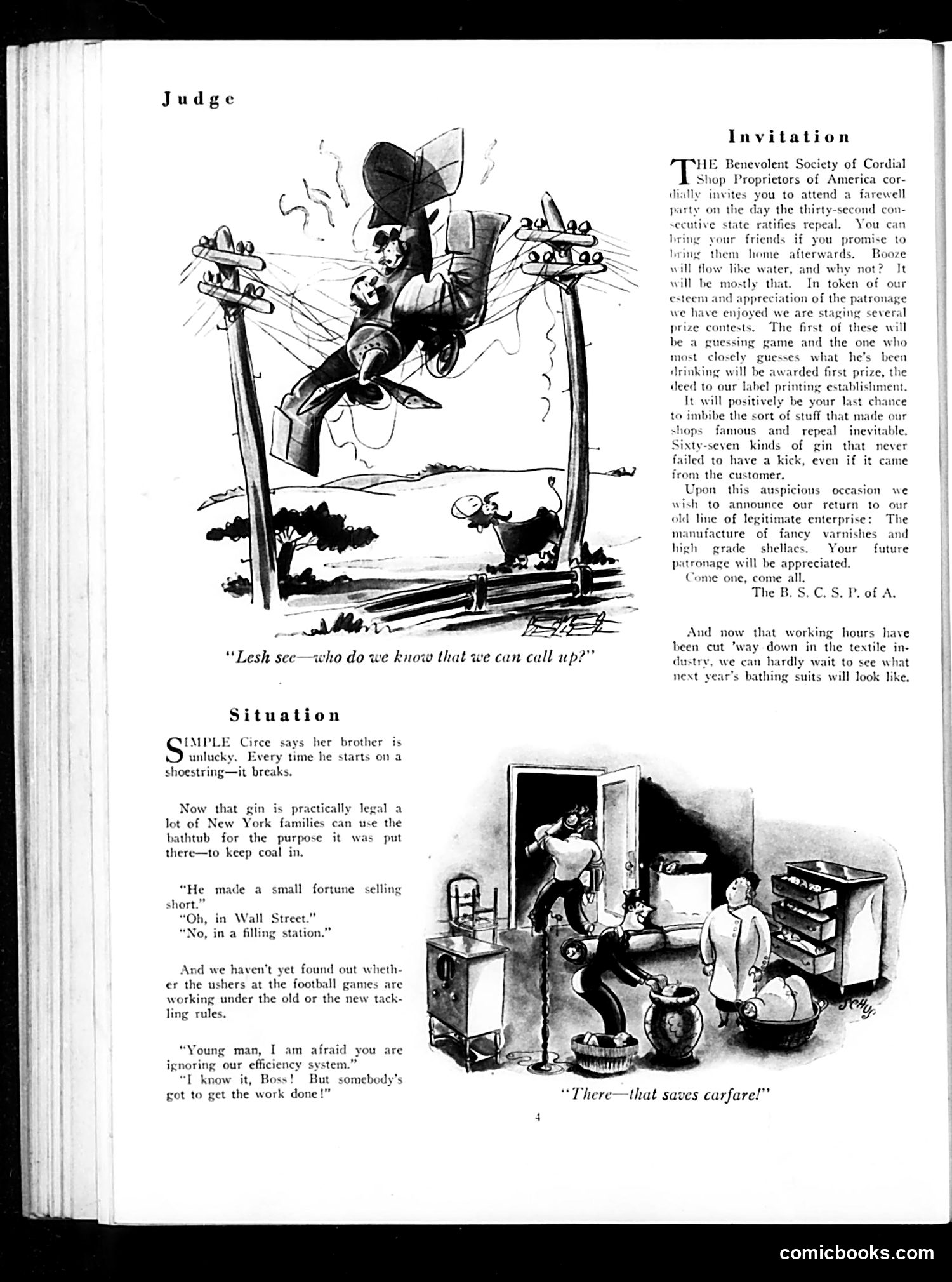
Judge Magazine Page Analysis This page contains two distinct sections: "Judge" (top cartoon): A acrobat/performer is suspended between two poles while juggling. The caption "Lesh see—who do we know that we can call up?" suggests uncertainty about whom to contact. This likely satirizes someone attempting to maintain balance amid competing pressures or obligations—though the specific political figure or situation remains unclear without additional context. "Situation" (bottom): Comic vignettes mock workplace inefficiency and changing social norms. References to New York families misusing bathtubs, Wall Street fortunes, and football game ushers suggest post-Prohibition era satire. The final panel critiques "efficiency systems" as impractical when actual work needs doing—a common Jazz Age complaint about corporate management fads. Both sections employ humor to critique contemporary American society and workplace culture.
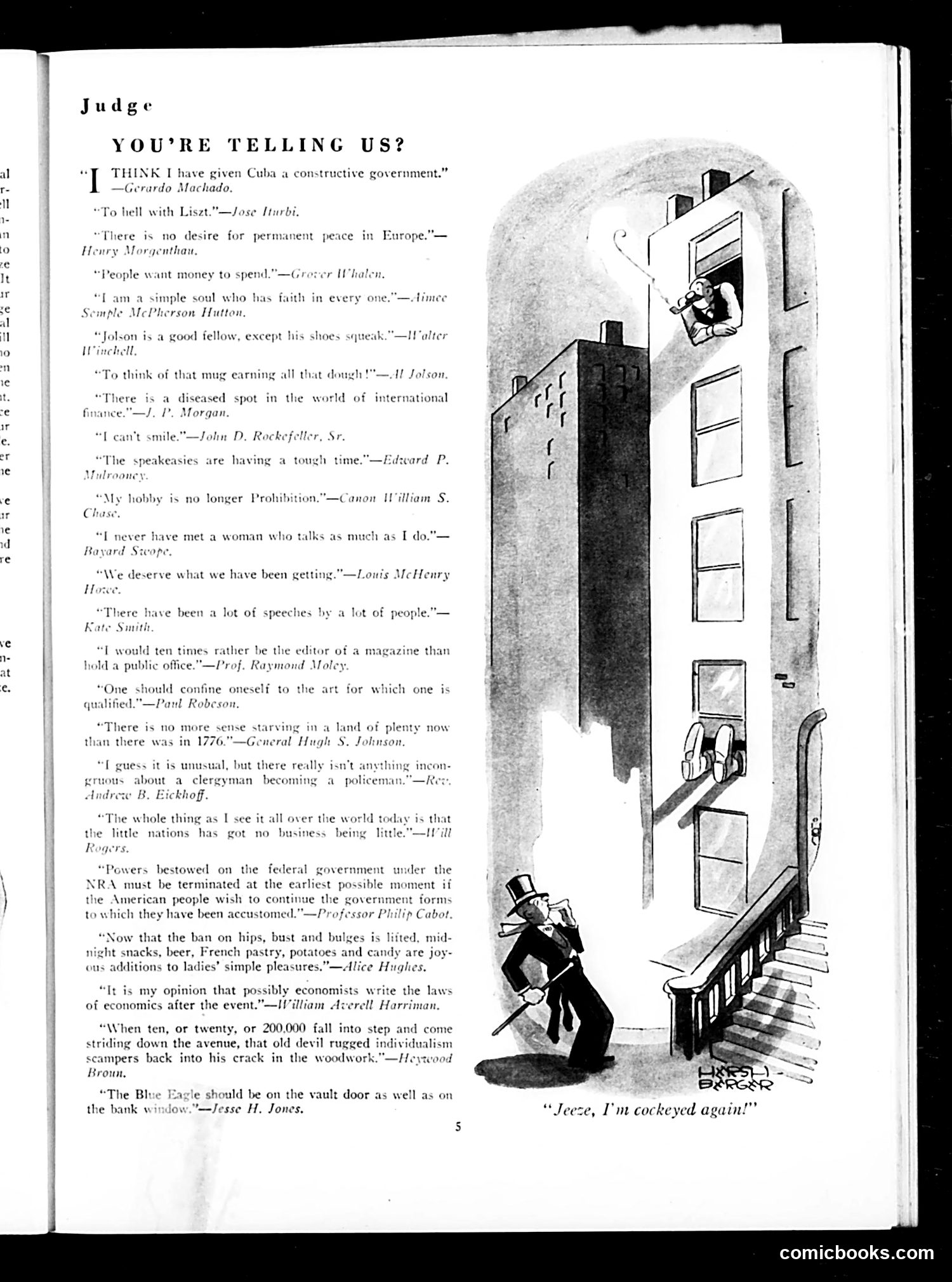
Analysis of Judge Magazine Page This page consists primarily of quotations from public figures, not a political cartoon. The left column collects humorous, cynical quotes attributed to famous people—politicians, businessmen, and celebrities—on topics like government, Prohibition, economics, and social conditions. The single cartoon (right side) shows a man in a top hat repeatedly locked out of a tall building, exclaiming "Jeeze, I'm cocked again!" This appears to be satirizing Prohibition-era troubles—the figure's repeated lockouts and frustration likely reference the difficulty obtaining alcohol or accessing speakeasies during the ban. The cartoon's simple visual joke complements the page's broader satirical commentary on contemporary American social and political absurdities.
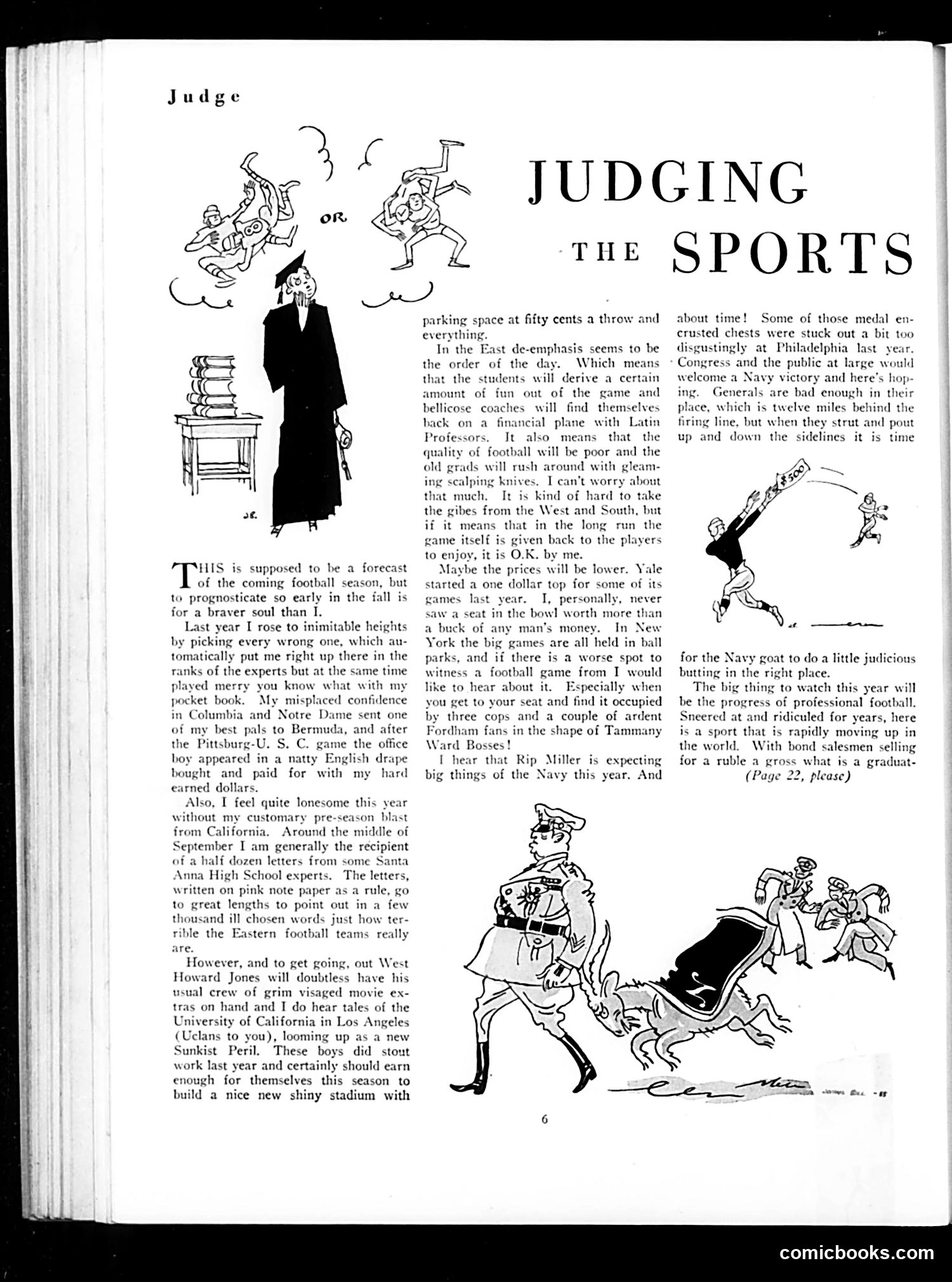
"Judging the Sports" - Football Season Preview This is a satirical column about the upcoming football season, illustrated with humorous cartoons. The author critiques overpriced football tickets and inflated expectations around college and professional games. Key points of satire: - Ticket prices: The author mocks exorbitant costs for stadium seats, mentioning paying fifty cents for parking alone - Eastern vs. Western football: Letters from Santa Anna High School experts supposedly prove Eastern teams are overrated - Coach Amos Alonzo Stagg reference: The column discusses California football's reputation - Yale's pricing: Even Yale reduced ticket prices, suggesting the market correction is widespread - Navy football: Mentions Rip Miller expecting "big things" from Navy's program The cartoons depict judges/authorities making decisions about sports, with physical comedy illustrations accompanying the text's sardonic tone about commercialized collegiate athletics.
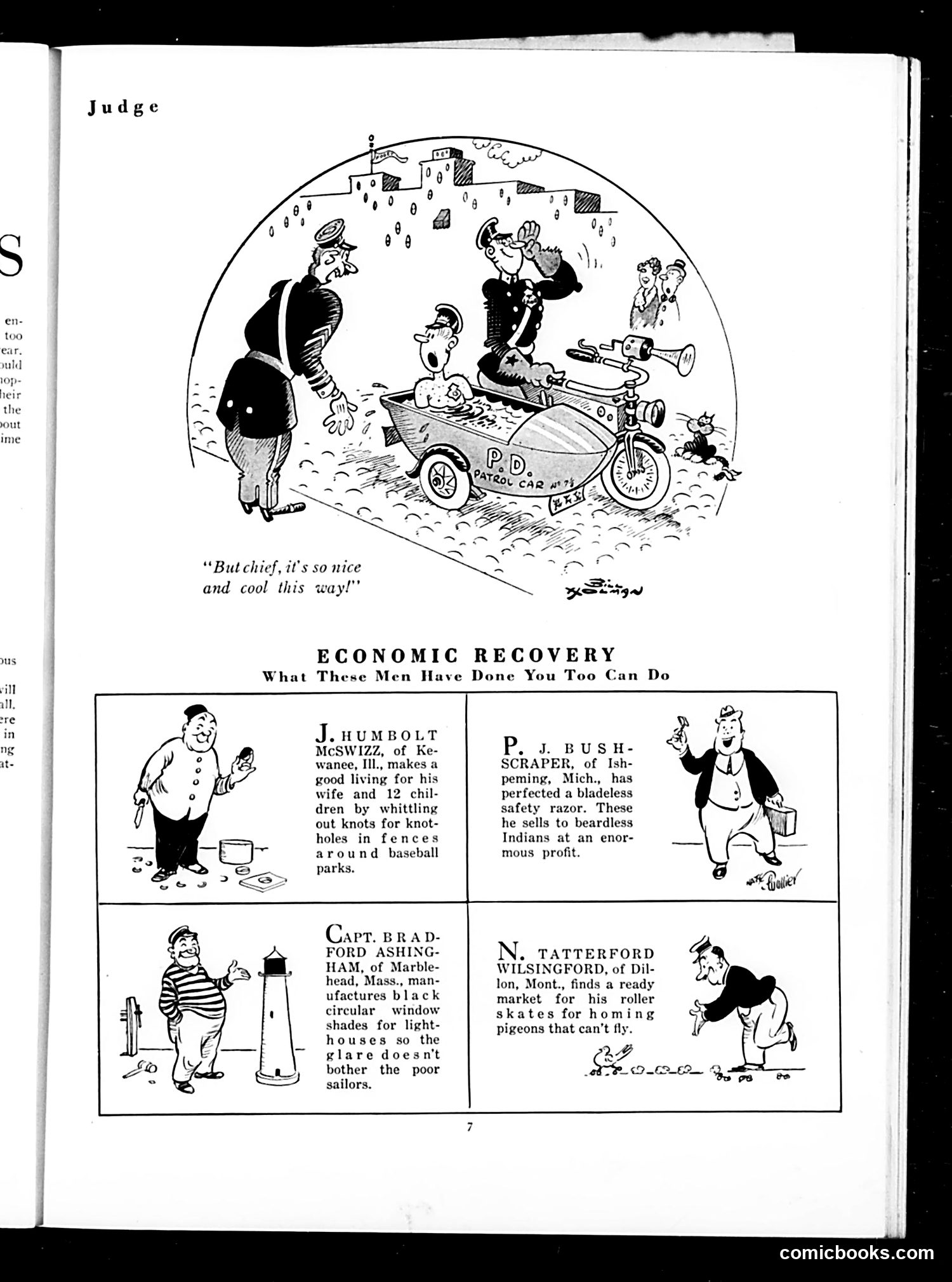
Economic Recovery Satire This page satirizes Depression-era "self-help" entrepreneurship schemes. The top cartoon shows police officials admiring a child's elaborate patrol car, with the caption suggesting admiration for makeshift ingenuity. Below, "Economic Recovery: What These Men Have Done You Too Can Do" mocks absurd business ideas presented as legitimate success stories. Each example describes comically useless products: - Whittling knots for fence holes - Window shades for lighthouses (to protect sailors from glare) - A bladeless razor marketed to beardless Native Americans - Roller skates designed for homing pigeons unable to fly The satire targets the period's proliferation of dubious money-making schemes pitched to desperate Americans seeking economic recovery. Judge magazine ridicules both the con-artist promoters inventing fake markets and the desperation of people willing to try anything to survive economically. The crude drawings and impossible business premises emphasize the absurdity of the pitches.
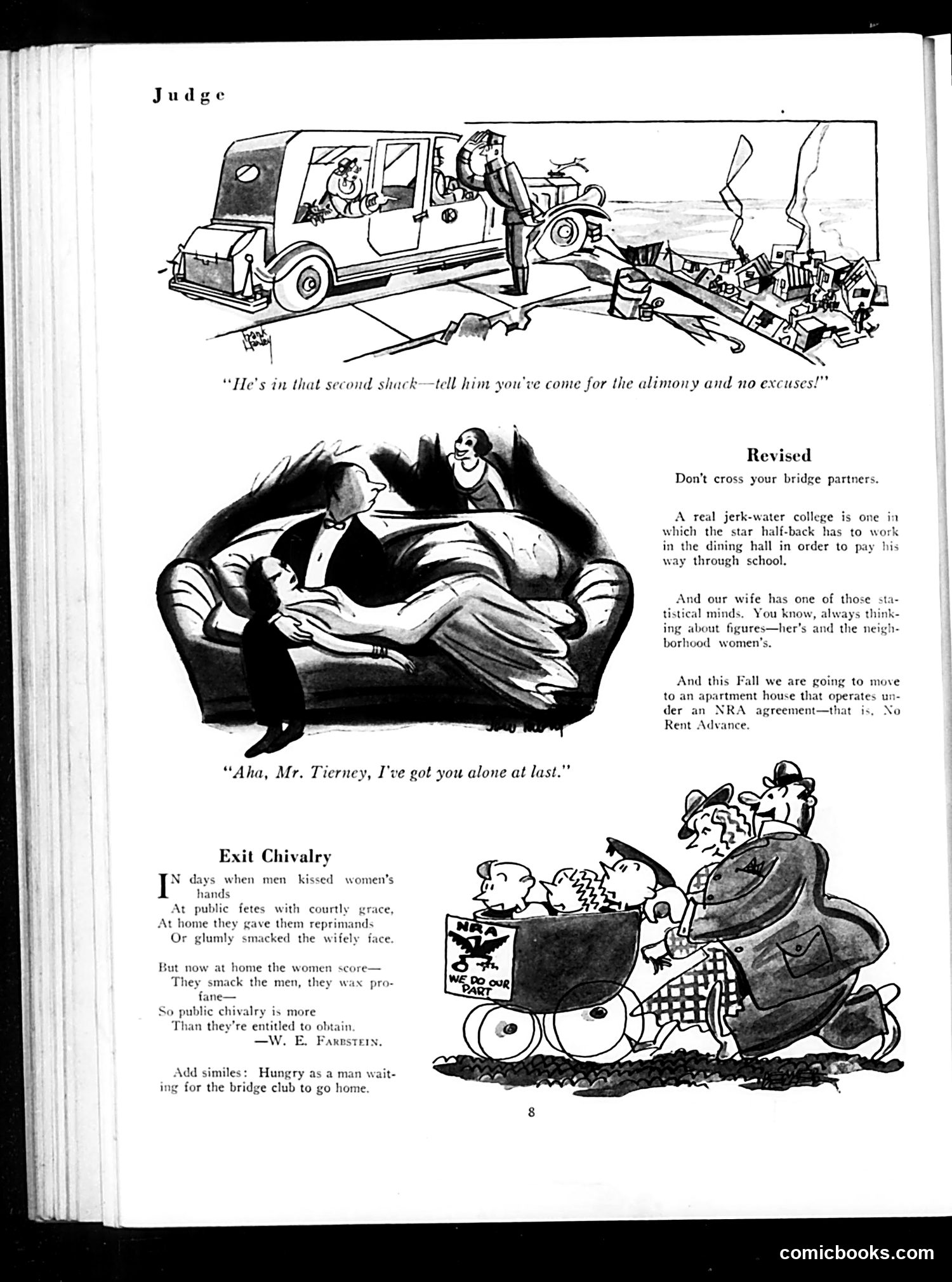
Analysis of Judge Magazine Page This page contains several satirical pieces from an era when the NRA (National Recovery Administration) was active—likely the 1930s New Deal period. Top cartoon: A man confronts another about alimony payments during a car accident, satirizing divorce litigation and financial obligations. Middle section ("Revised"): Brief jokes mocking college athletics (star athletes working menial jobs), wives' preoccupation with appearance and gossip, and housing costs under NRA price controls. Lower cartoon: Shows a woman threatening a man alone—likely satirizing changing gender dynamics and women's newfound assertiveness. "Exit Chivalry" poem: The central satire. It contrasts idealized past courtship (men kissing women's hands publicly) with domestic reality (men striking wives), then inverts the equation: now women "score" by hitting men in retaliation. The point: public displays of chivalry are hypocritical when domestic abuse was normalized. The satirist argues men don't deserve public courtesy they didn't extend privately. The final joke equates a man waiting for his wife's bridge club to leave with extreme hunger—mocking domestic ennui.
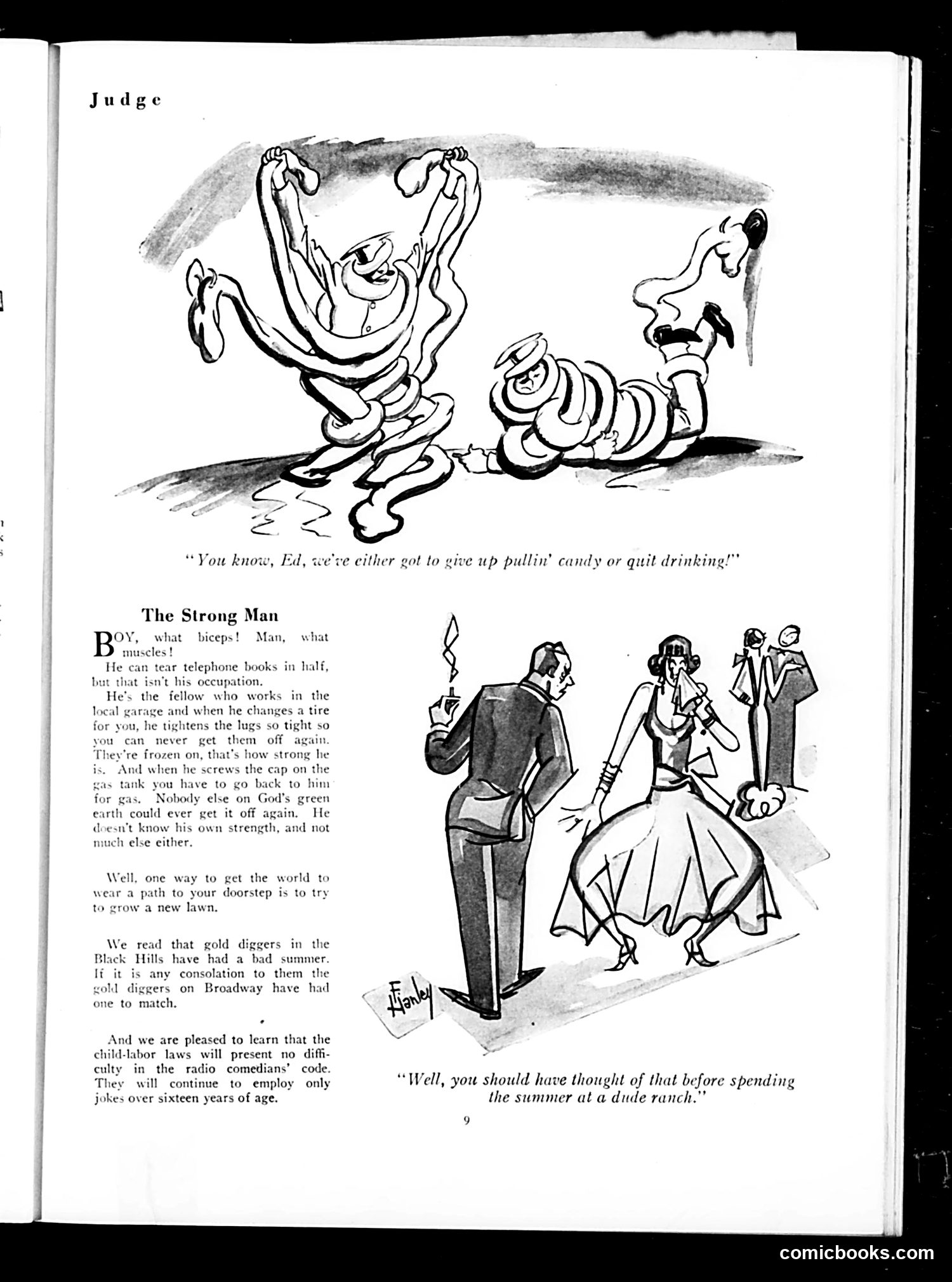
"The Strong Man" - Judge Magazine Satire This page contains two satirical pieces: Top cartoon: Shows a man whose literal physical strength becomes a liability. He's so strong that when performing routine tasks—changing tires, opening gas caps—he over-tightens everything so severely that only he can undo it. The joke satirizes the "strong man" archetype: his strength, rather than being universally useful, actually creates dependency and frustration. It's commentary on misapplied or poorly-controlled power. Bottom section: "The Strong Man" essay continues the theme ironically, discussing a genuinely strong man's occupational hazard. The accompanying cartoon shows a woman at a dude ranch confronted by an angry man—she's spent money frivolously at a vacation spot while he struggles financially. The caption mocks her lack of foresight. The page also includes brief satirical notes about gold diggers (fortune-hunters) on Broadway having poor summers, and jokes about radio comedians' new code allowing only jokes "over sixteen years of age"—a jab at the enforced maturity of new broadcasting standards.
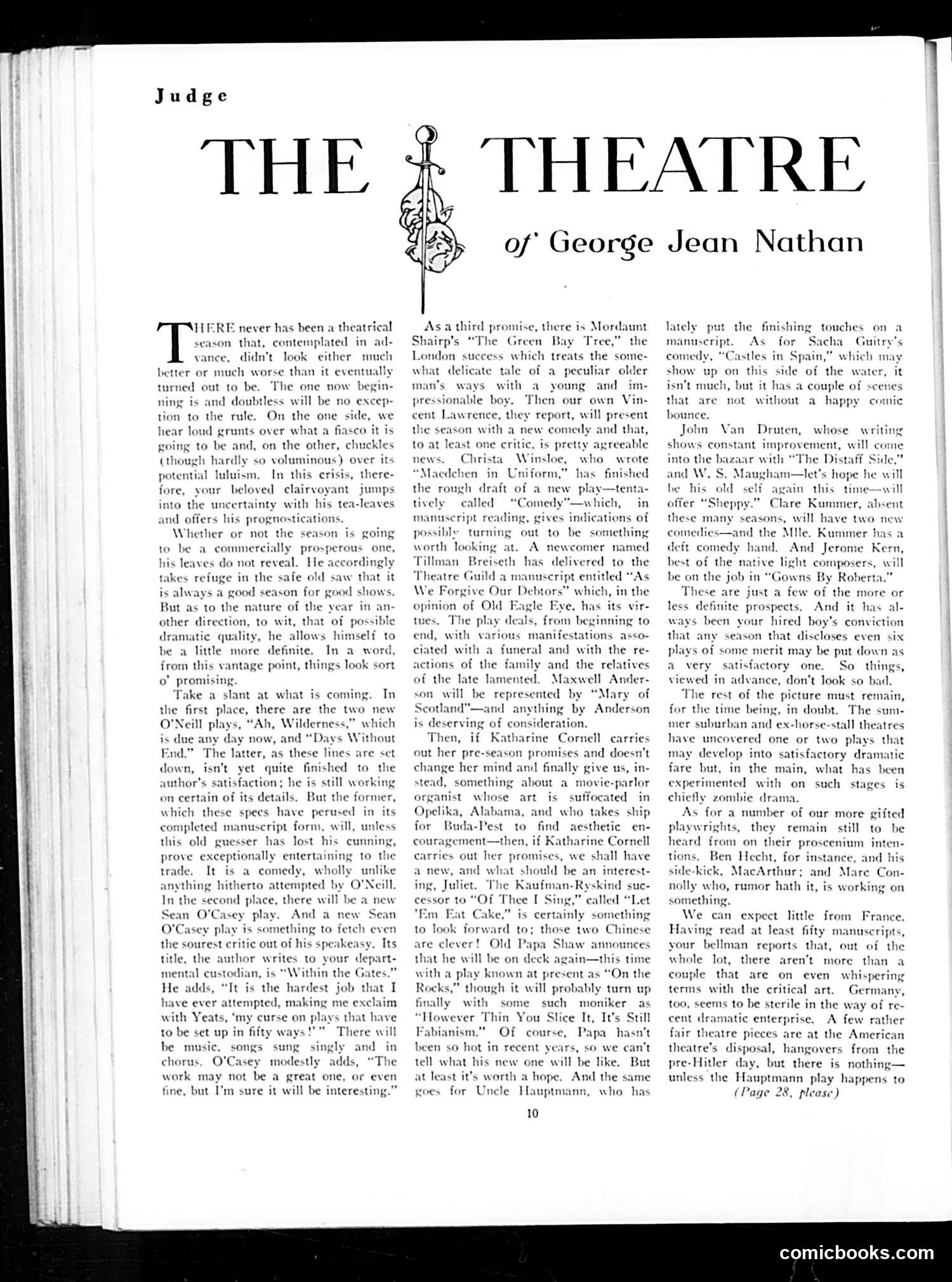
"The Theatre of George Jean Nathan" This is a theater review column by Judge magazine's drama critic. The page contains no cartoon—it's entirely text discussing the upcoming theatrical season's prospects. Nathan surveys promising new plays, including Eugene O'Neill's "Ah, Wilderness!" and "Days Without End," Sean O'Casey's "Within the Gates," and works by Mordaunt Shairp and Maxwell Anderson. He expresses cautious optimism about the season's quality, though he withholds judgment on commercial success. The piece reflects 1930s Broadway culture, mentioning prominent figures like actress Katharine Cornell and playwright-producers like the Theater Guild. Nathan's tone is characteristic of Judge's sophisticated, insider perspective on American entertainment—offering sardonic predictions while acknowledging theatrical uncertainty. The review demonstrates how theater criticism functioned as substantial cultural commentary in this era.
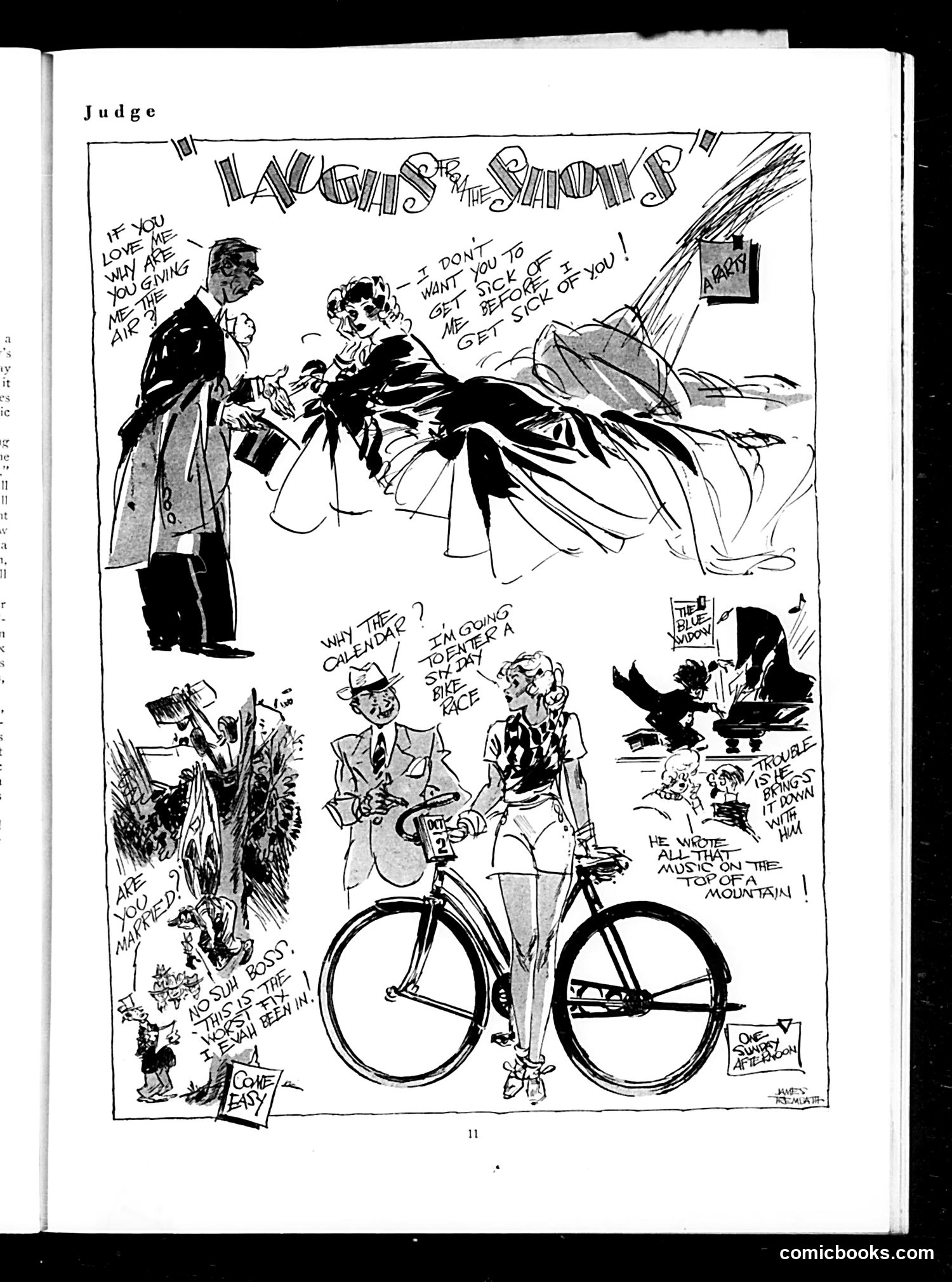
Analysis of "Judge" Satirical Page This page contains multiple comic panels satirizing romantic and social scenarios, centered on the theme "Laughs and Sighs." The cartoons depict exaggerated romantic situations: a man struggling with an aggressive woman, couples on bicycles (a popular leisure activity suggesting dating), and various domestic/romantic conflicts. The dialogue references jealousy, infidelity concerns, and relationship anxieties. The bicycle imagery is particularly significant—bicycles were symbols of women's independence and modern courtship in the early 20th century, making them frequent targets for satirical commentary about changing gender relations. The overall tone mocks both male and female romantic behaviors, presenting relationships as comic battlegrounds. Without the magazine's date, the exact historical context remains unclear, though the style suggests early-to-mid 20th century origins.
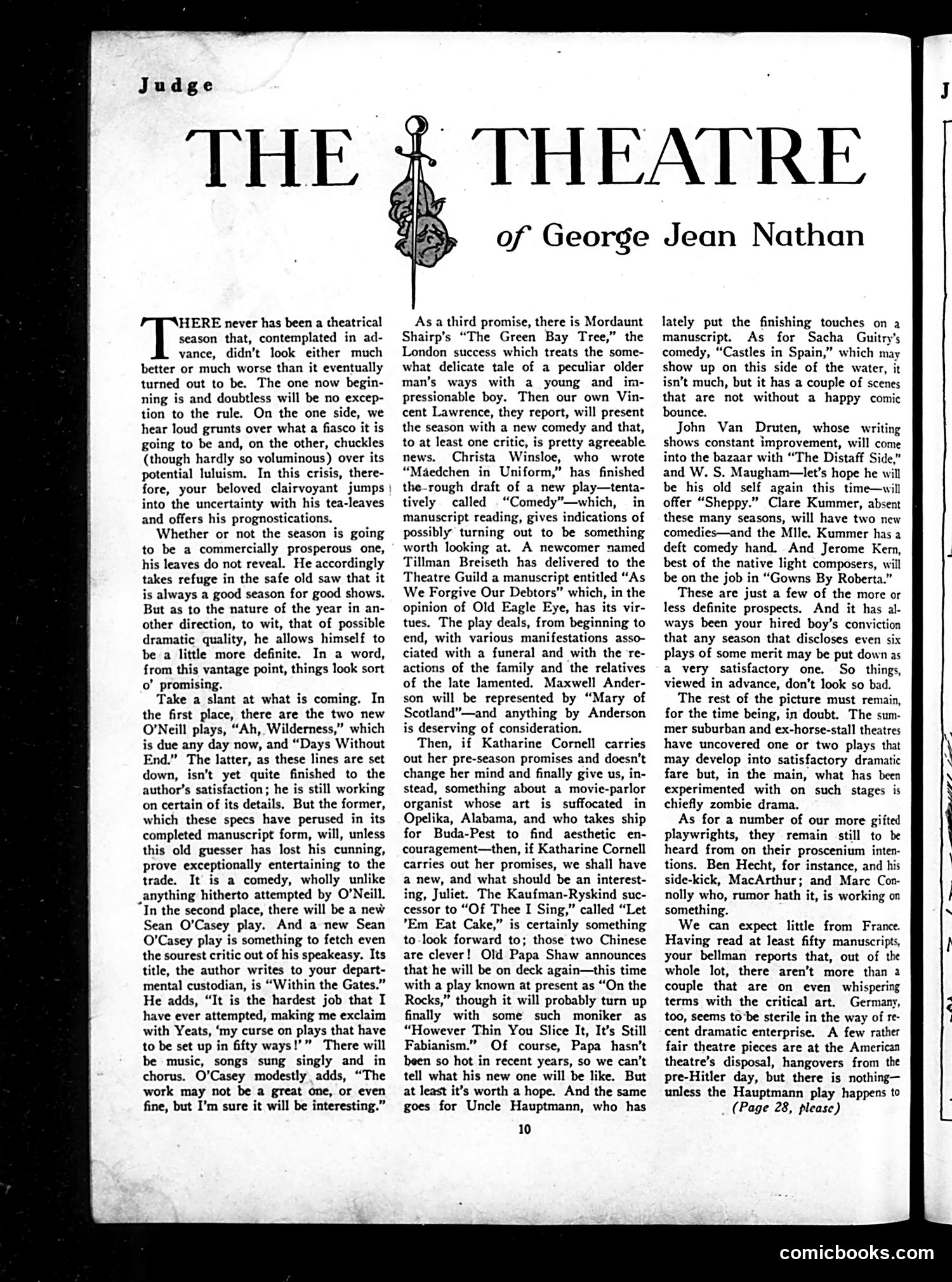
The Theatre of George Jean Nathan This is a theater column—not a cartoon—by Judge magazine's drama critic George Jean Nathan, surveying the upcoming theatrical season. Nathan offers predictions about new plays coming to Broadway, including works by Eugene O'Neill ("Ah, Wilderness" and "Days Without End"), Sean O'Casey ("Within the Gates"), and others. The column's tone is characteristically witty and skeptical. Nathan takes a jab at Katharine Cornell, suggesting she might break her promises and instead perform something trivial—a comedy about an organist in rural Alabama who seeks artistic validation abroad. This appears to mock celebrity caprice and the gap between grand artistic promises and actual choices. The piece exemplifies Judge's style: urbane, insider commentary on the arts and entertainment world, written for a sophisticated readership familiar with Broadway personalities and dramatic trends of the early 1930s.
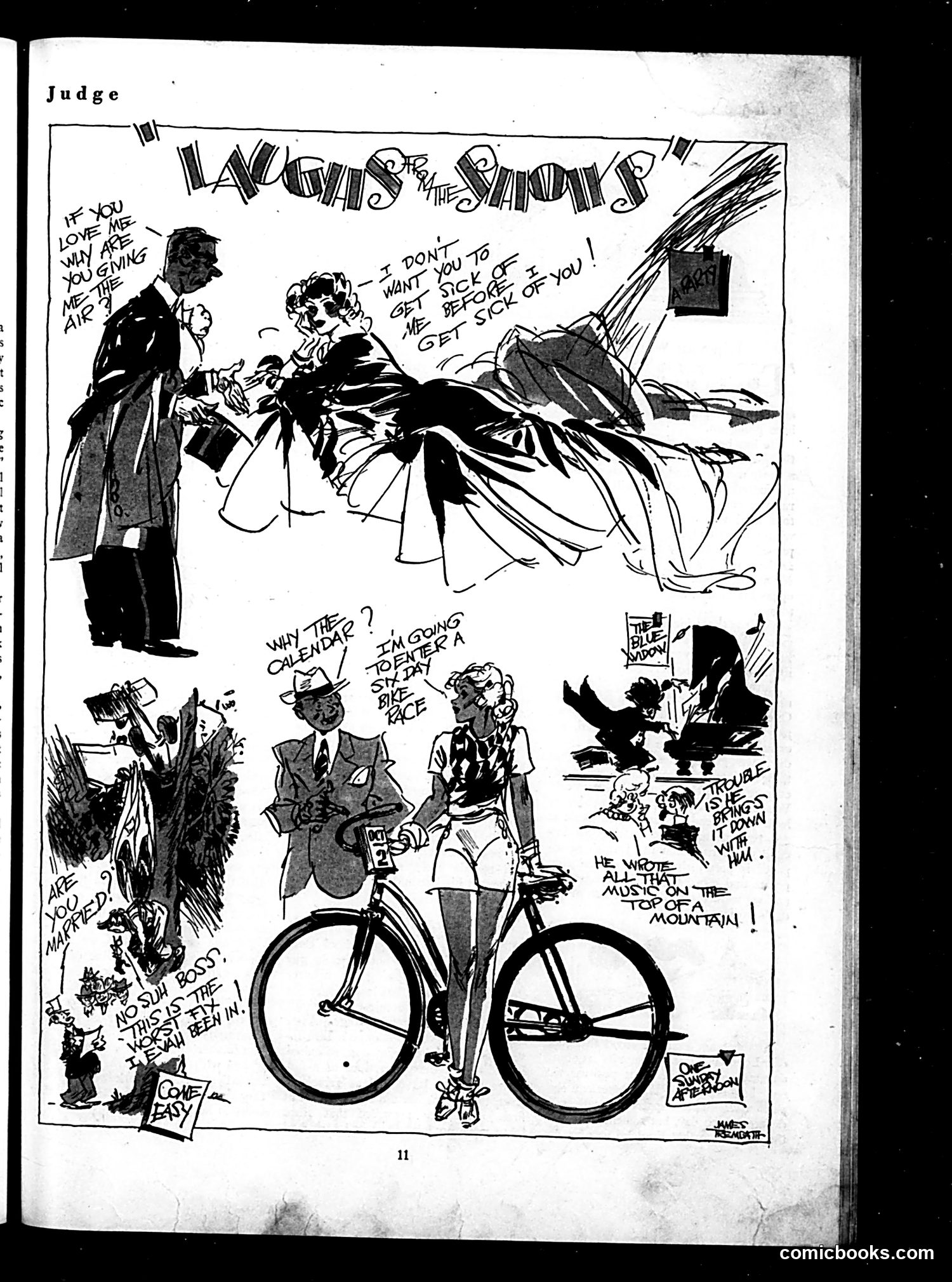
Judge Magazine Cartoon Analysis This page from *Judge* contains multiple satirical vignettes titled "Laugh's the Sandbox" (visible at top). The cartoons mock romantic and social scenarios, likely from the early-to-mid 20th century. The top panel shows a man refusing a woman's advances with the line "I don't want you to get sick before I get sick of you!"—satirizing insincere romantic excuses. The middle section depicts a couple on a bicycle with dialogue about a calendar and "stranded" situation, suggesting a tryst or scandalous rendezvous. The smaller panels on the left and right contain additional domestic/romantic humor, including references to mountains and questionable behavior. The overall theme ridicules male dishonesty, romantic pretense, and improper courtship customs of the era. The crude cartooning style is typical of *Judge*'s satirical approach to social commentary.
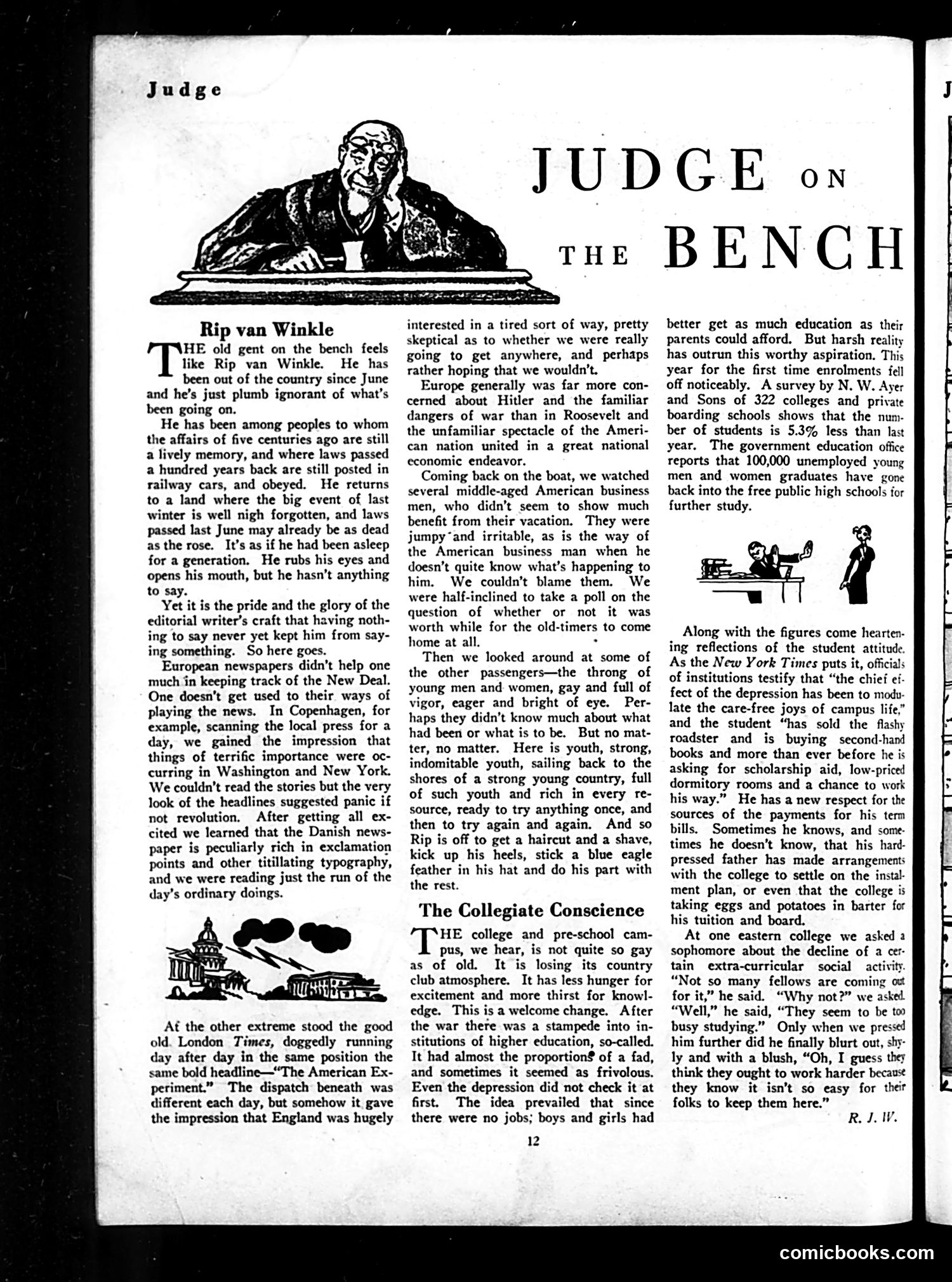
"Judge on the Bench" - Analysis This satirical piece mocks the editorial writer's predicament: an American returning from Europe after months abroad finds the New Deal's rapid changes have made him feel like Rip Van Winkle—out of touch with his own country. The satire targets multiple subjects: European newspaper coverage (Copenhagen's sensationalism versus London Times's skeptical tedium regarding "The American Experiment"), business-men's anxiety about Roosevelt's economic policies, and American insularity. The "Collegiate Conscience" section critiques Depression-era college enrollment trends. Previously, campus life was frivolous and club-like; now students show genuine scholarly hunger. However, the piece notes this shift occurred even during the economic crisis—suggesting that depression-driven joblessness finally motivated young people toward actual education rather than mere social advancement. The text reflects 1930s anxieties about New Deal effectiveness, European responses to American policy, and generational attitudes toward higher education.
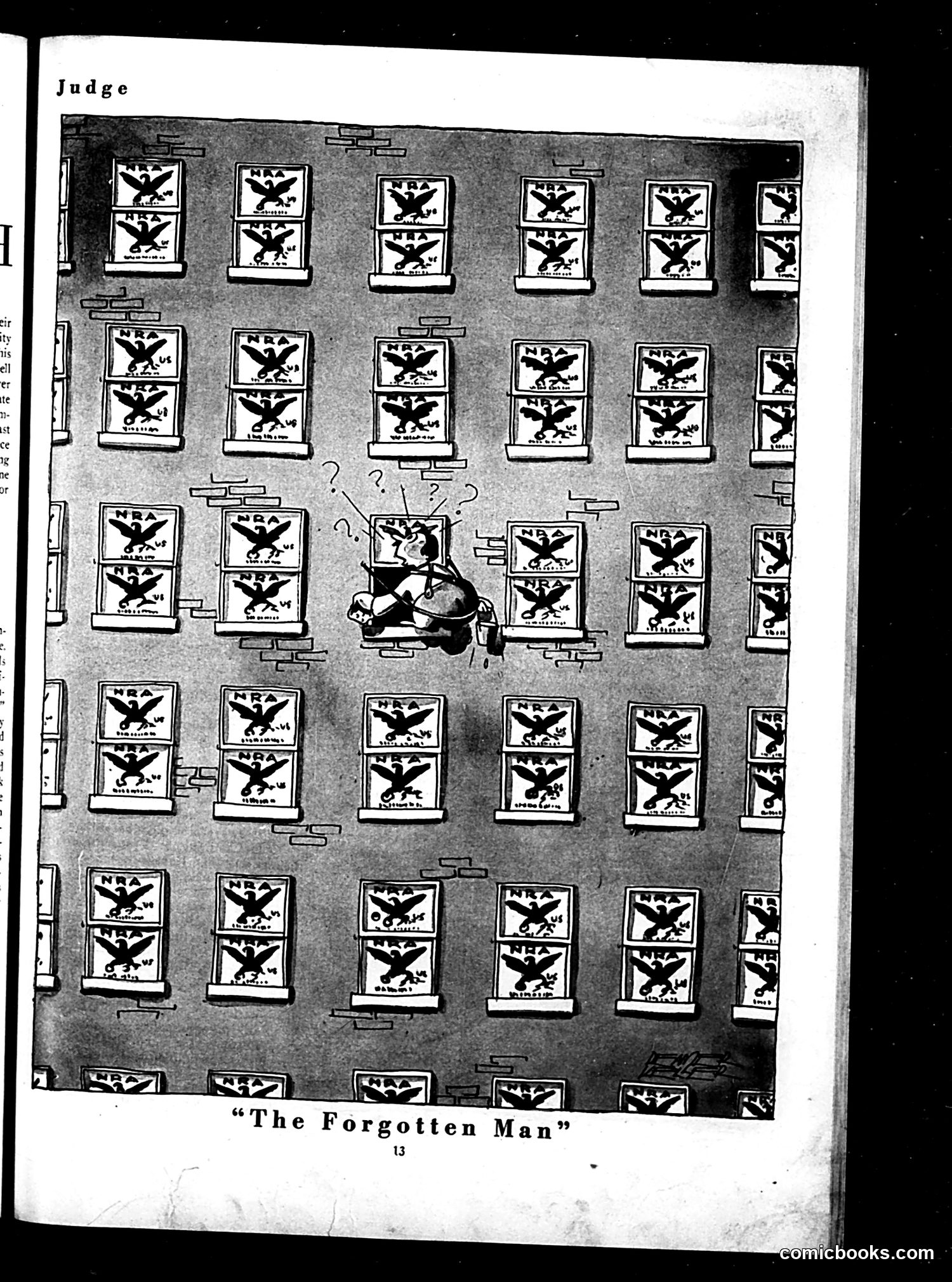
"The Forgotten Man" - Judge Magazine This page displays a comic strip titled "The Forgotten Man," showing a central confused figure surrounded by numerous boxes bearing the NRA (National Recovery Administration) eagle emblem—a New Deal program symbol from the 1930s. The cartoon satirizes bureaucratic complexity and confusion under Franklin D. Roosevelt's New Deal policies. The bewildered protagonist, surrounded by stacked NRA regulations and paperwork, represents the "forgotten man"—ordinary citizens overwhelmed by government red tape rather than helped by it. The question marks above his head emphasize his bewilderment. This reflects conservative/Republican criticism that New Deal programs, despite good intentions, created confusing regulatory mazes that burdened regular people and businesses rather than providing meaningful relief during the Great Depression.
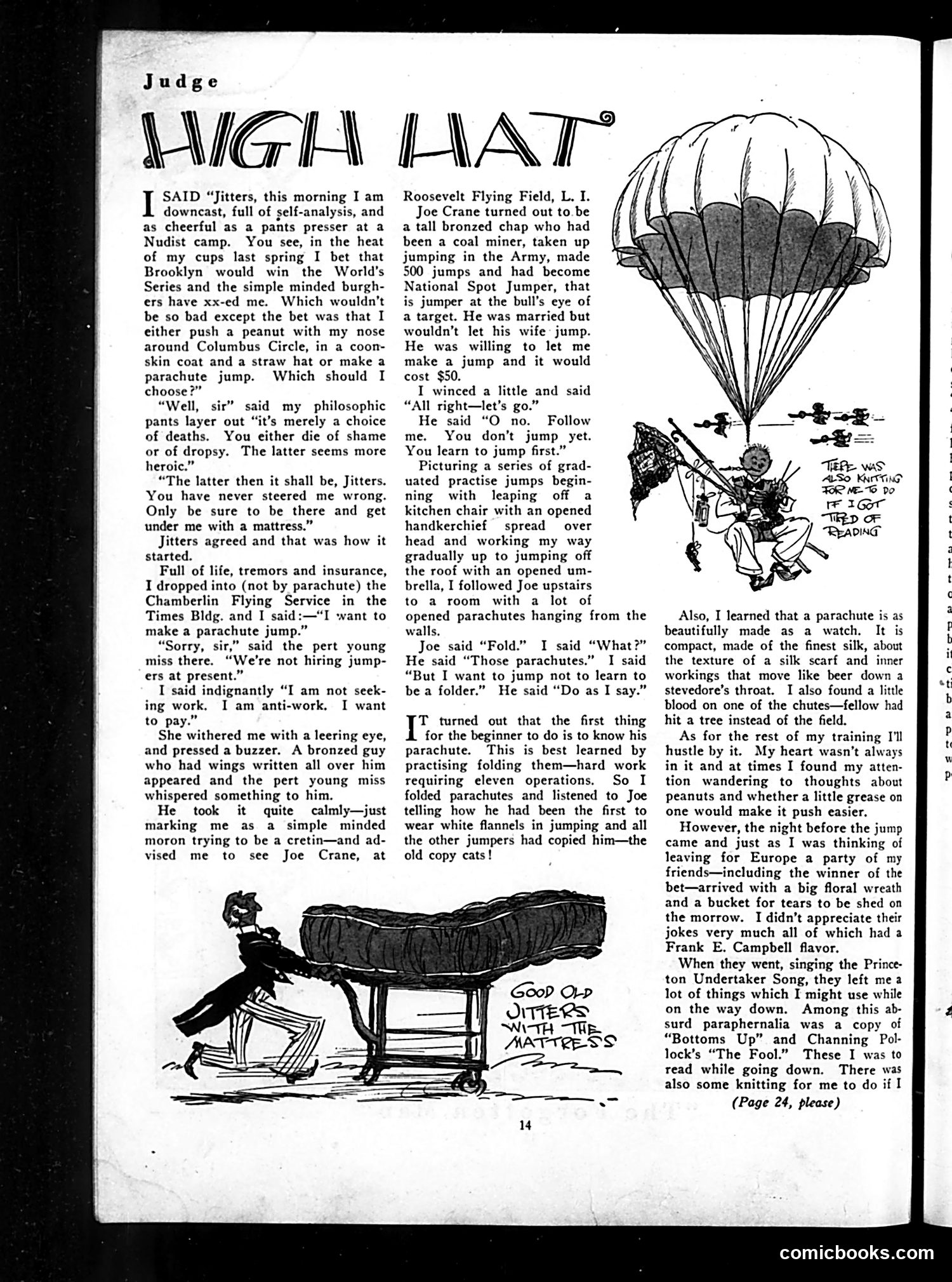
"High Hat" - Judge Magazine Satire This humorous essay recounts the narrator's foolish lost bet on the Brooklyn Dodgers winning the World Series. The penalty: either push a peanut around Columbus Circle or make a parachute jump. He chooses the jump. The satire mocks the narrator's vanity and poor judgment. He contacts the Chamberlin Flying Service expecting immediate action, but is redirected to Joe Crane, a real parachute instructor at Roosevelt Flying Field, Long Island. The joke lies in the deflation of the narrator's expectations—rather than jumping immediately, he must learn to *fold* parachutes, tedious work requiring eleven operations. Joe Crane is portrayed as a rugged professional: a former coal miner turned Army jumper with 500 jumps. The humor derives from the contrast between the narrator's impatience and the serious, methodical training required. The references to "Frank E. Campbell flavor" jokes (Campbell was a famous funeral director) and friends arriving with "a bucket for tears" suggest mock-morbid humor about his impending jump.
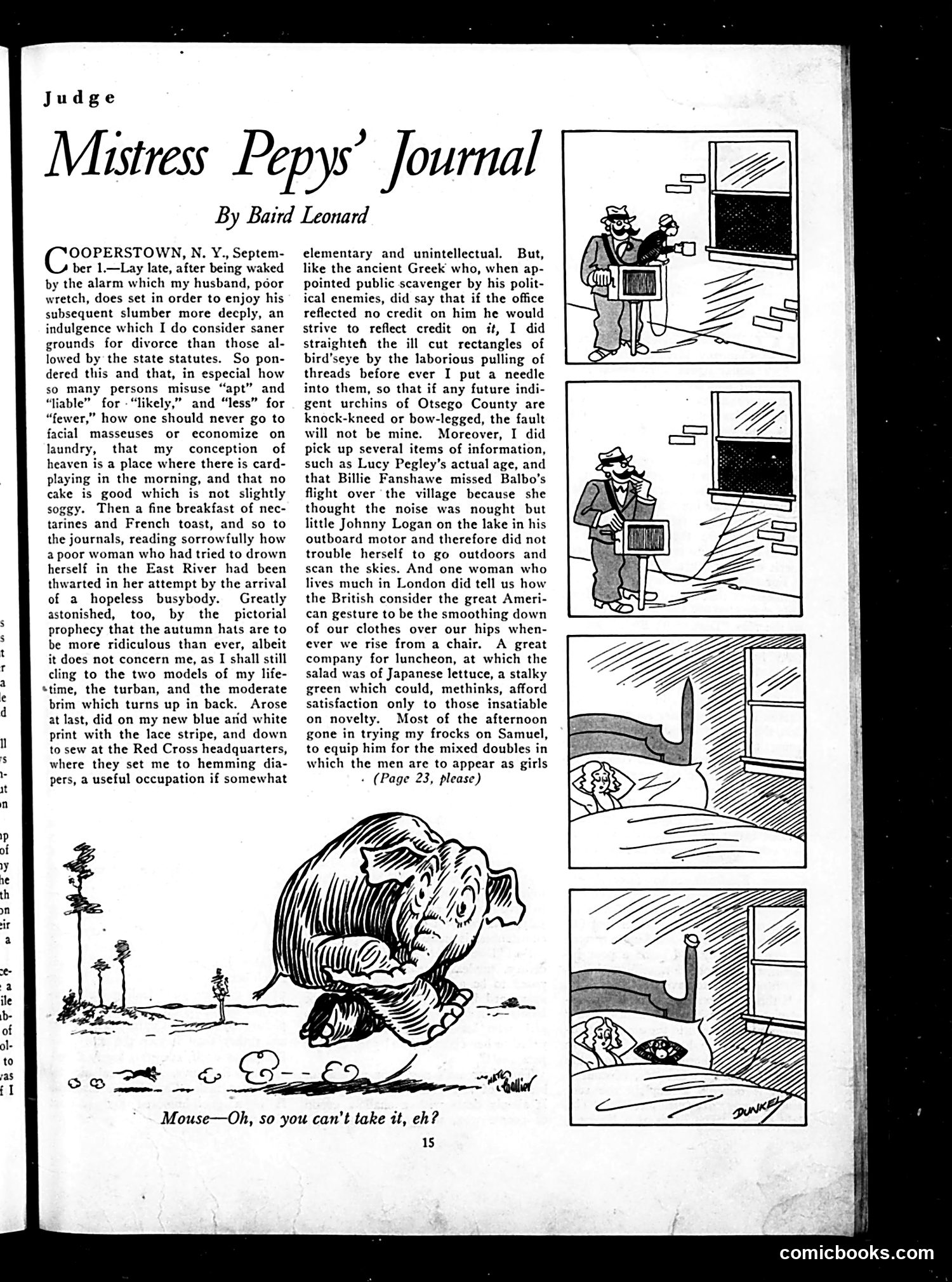
"Mistress Pepys' Journal" - Judge Magazine Satire This is a humorous diary column mimicking Samuel Pepys' famous 17th-century journal, but set in modern (1920s) upstate New York. The narrator is an upper-middle-class woman documenting her daily observations and complaints with sardonic wit. The satire targets: - Gender absurdities: Women forced into tedious Red Cross work (hemming diapers) while men get glamorous adventures - Celebrity culture: References to Balbo's flight (likely Italo Balbo's 1933 transatlantic flight) that locals dismiss - Social pretension: British superiority complexes and obsession with novelty foods - Linguistic pet peeves: Misuse of words like "apt" and "liable" The bottom cartoon shows a mouse confronting a trap—a visual pun on "taking it" (enduring hardship). The overall tone is sophisticated complaint disguised as casual journaling, poking fun at both upper-class anxieties and social trends of the era.
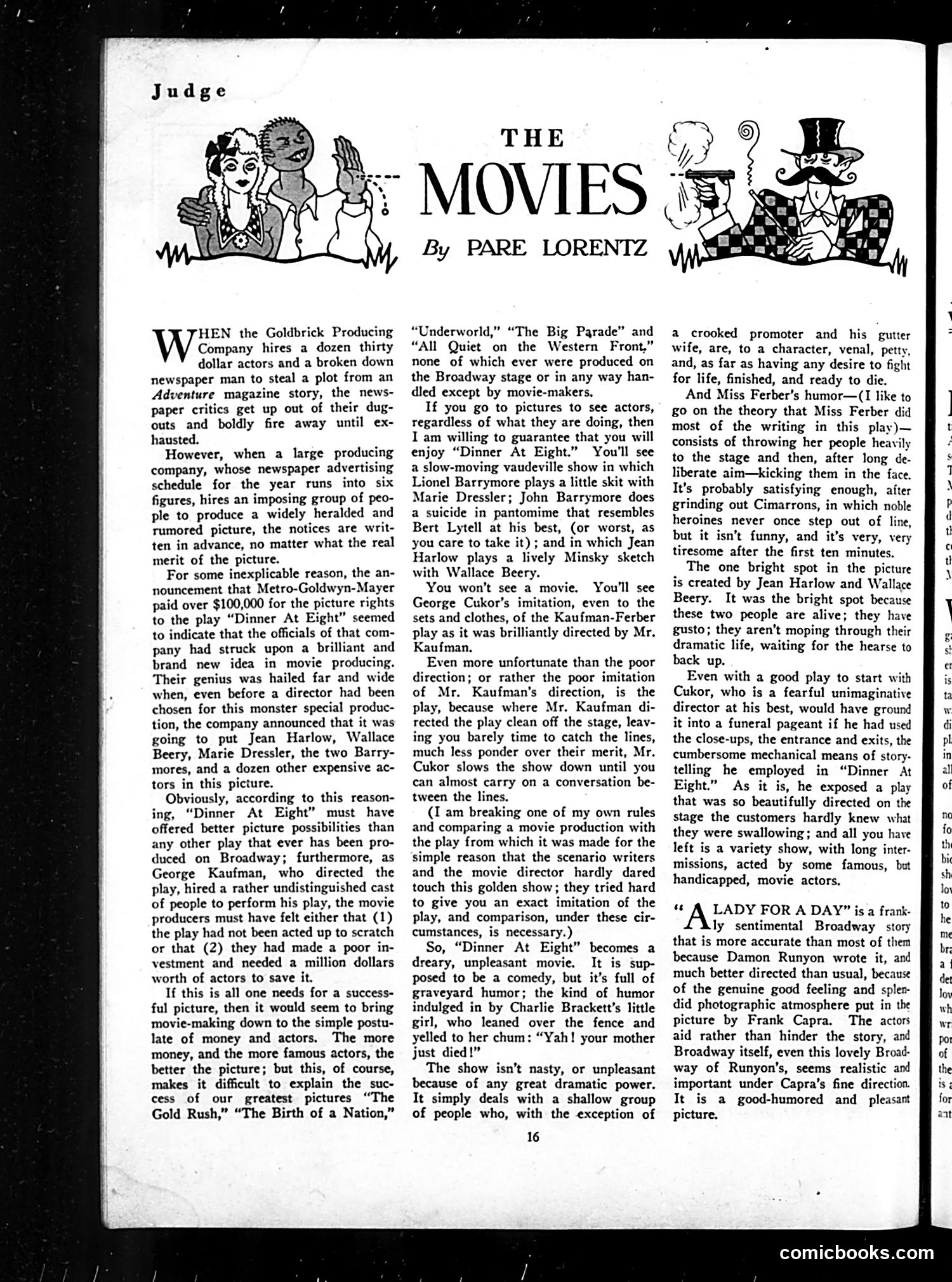
"The Movies" by Pare Lorentz — Judge Magazine This is a film criticism column reviewing Hollywood's approach to adapting Broadway plays. The author satirizes how major studios like Metro-Goldwyn-Mayer rely on star power over artistic merit. The specific target: MGM's adaptation of George S. Kaufman's play "Dinner At Eight," which cast major stars (Jean Harlow, Wallace Beery, the Barrymores, Marie Dressler) rather than the original's less-famous actors. The satire's point: Lorentz argues that MGM's $100,000 investment and A-list casting prove studios believe money equals quality—a "simple postulate of money and actors." He contends this approach produced a tedious, slow imitation of Kaufman's brilliant staging, reducing cinema to mere celebrity showcase rather than genuine filmmaking. The author contrasts this with truly great films (*Gold Rush*, *Birth of a Nation*) made by filmmakers, not star vehicles. The implied critique: Hollywood confuses commercial appeal with artistic achievement.
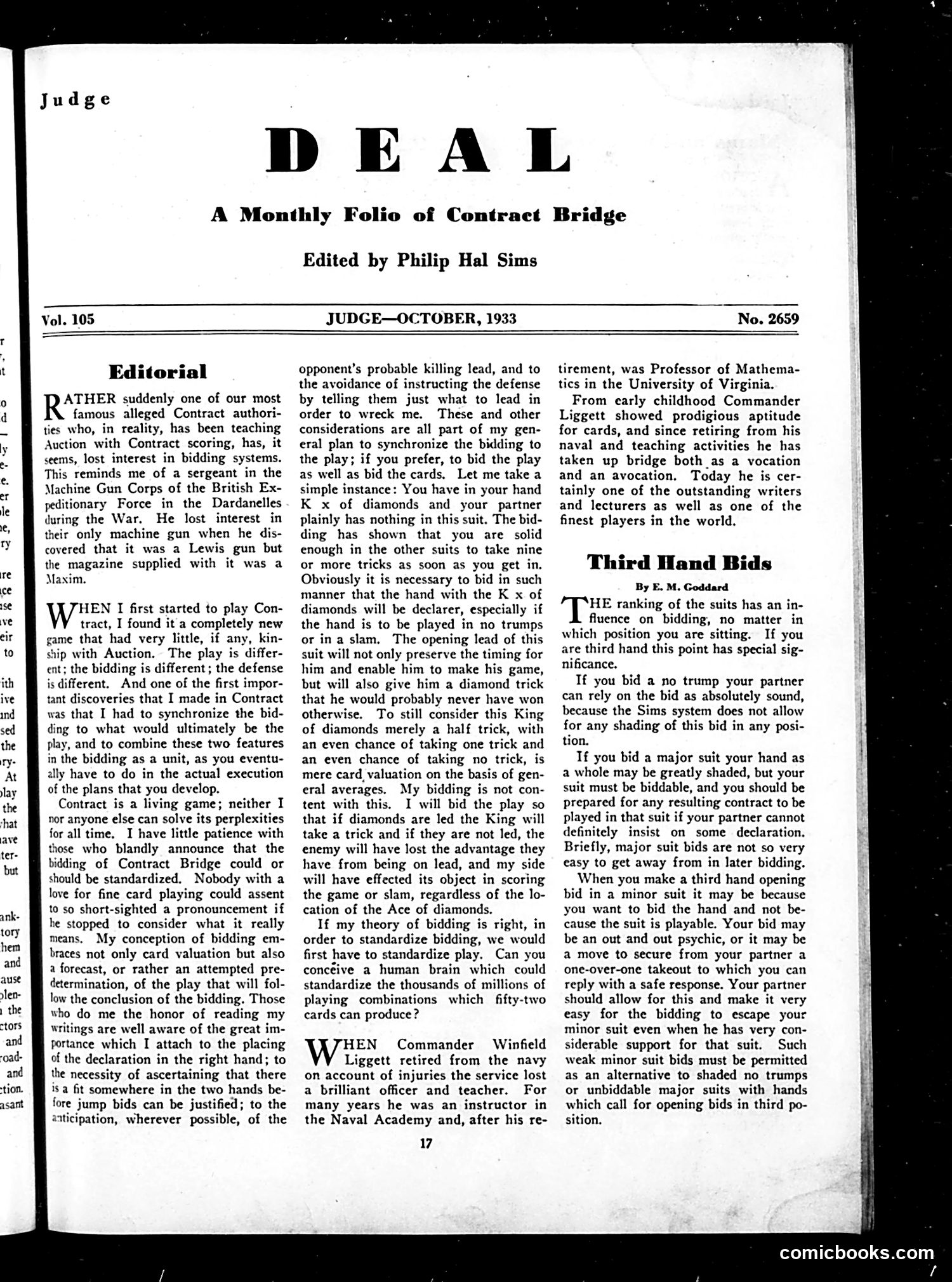
Judge Magazine, October 1933: Contract Bridge Editorial This page is primarily text content — an editorial about Contract Bridge bidding strategy, not a political cartoon. Judge magazine, known for satire, here uses bridge (the card game) as its subject matter. The editorial, likely by Philip Hal Sims (the editor), argues against standardizing Contract Bridge bidding rules. The author criticizes "alleged Contract authorities" who oversimplify the game, using a WWI anecdote about a British sergeant with mismatched gun parts as metaphor: just as incompatible equipment fails, rigid bidding systems ignore the game's living complexity. The piece advocates "bidding the play as well as the cards" — coordinating bids with actual gameplay strategy rather than following formulaic point-counting. This was apparently a contemporary debate among bridge enthusiasts in 1933. The accompanying article on "Third Hand Bids" continues the technical discussion. This reflects bridge's popularity as a sophisticated parlor game among educated Americans in the Depression era.
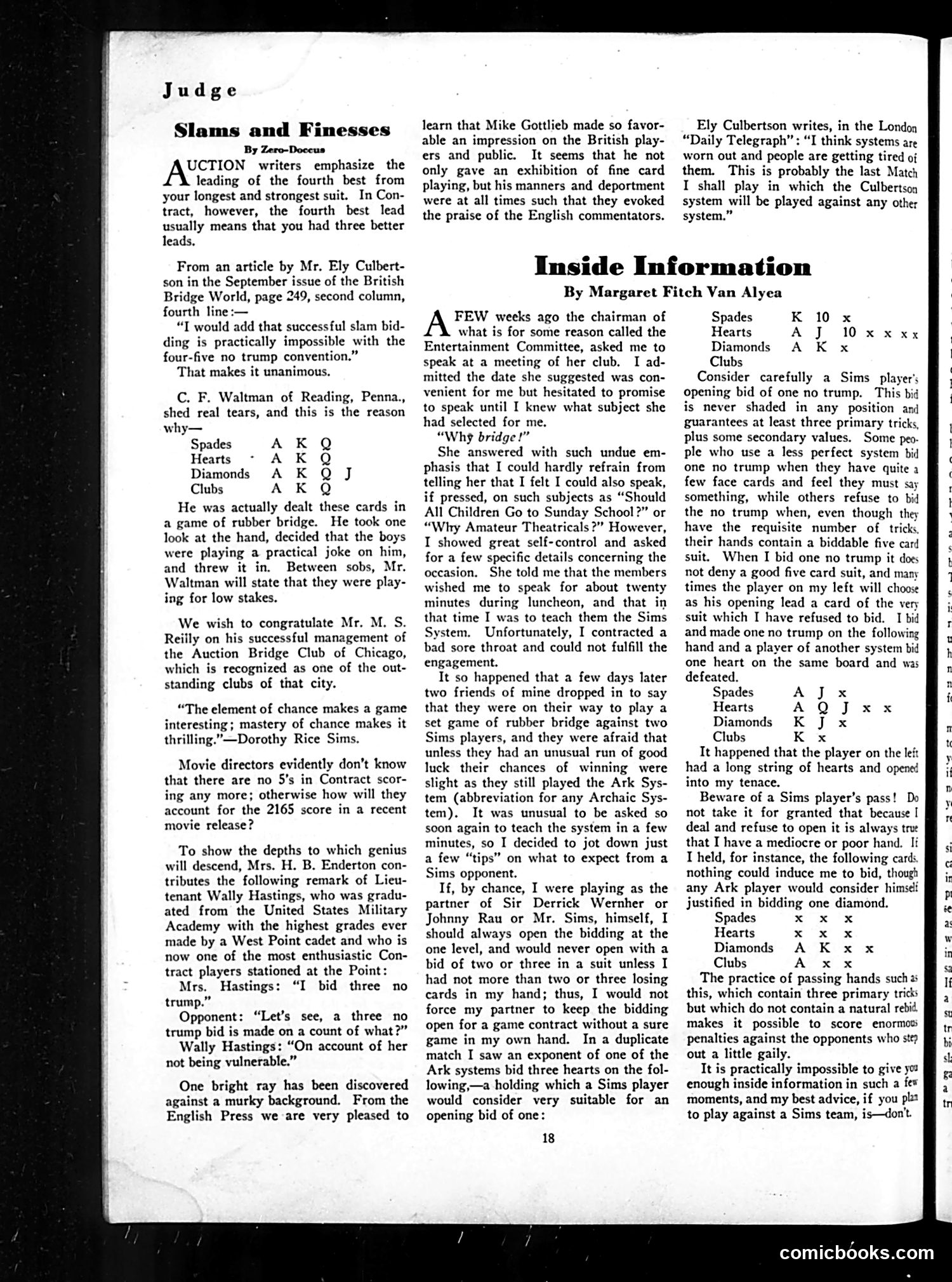
"Slams and Finesses" - Judge Magazine Bridge Column This page contains bridge (card game) humor and instruction, not political satire. It's a specialized column for the card game enthusiast audience. The main "Judge" column by Zero-Doceus ridicules the complexities of Contract Bridge bidding conventions through absurdist examples. The humor relies on bridge players recognizing the technical absurdities: C.F. Waltman being dealt a perfectly impossible hand (all aces and kings), and Lieutenant Wally Hastings's joke response about bidding "on account of her not being vulnerable" (a technical term he deliberately misapplies). The "Inside Information" column by Margaret Fitch Van Alyea relates a social anecdote about being asked to teach the "Sims System" of bridge in twenty minutes over lunch—an obviously unrealistic task meant to amuse readers familiar with bridge's byzantine rules. The brief mention of Mike Gottlieb's positive reception in England and Ely Culbertson's prediction that his bridge "system" will soon become obsolete suggest contemporary bridge world personalities and debates among enthusiasts. This is niche hobby content, not general satire.
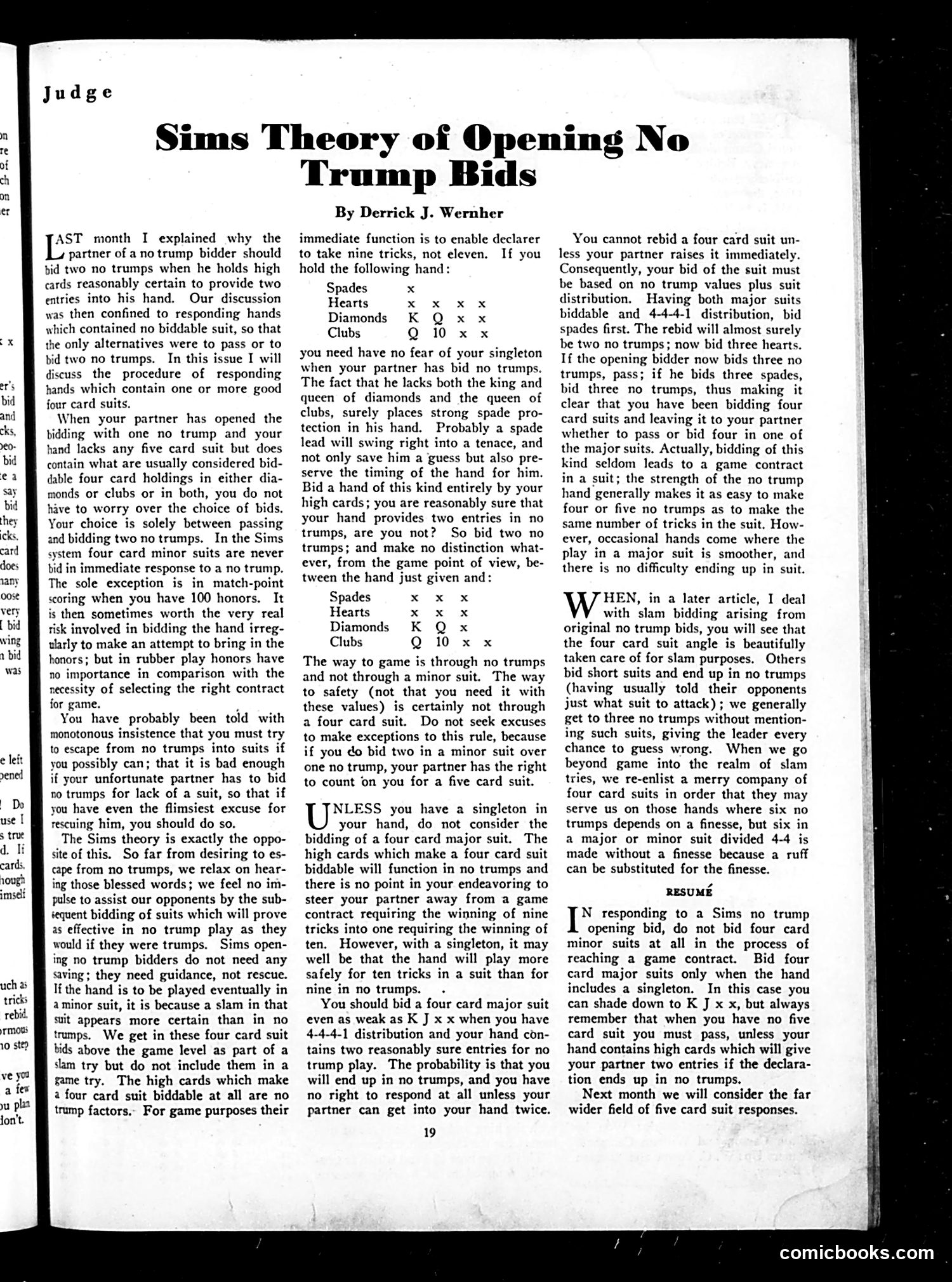
Content Analysis This page is not a cartoon but rather a bridge advice column by Derrick J. Wernher titled "Sims Theory of Opening No Trump Bids." It appears in *Judge*, a satirical magazine, though this particular content is instructional rather than satirical. The article explains contract bridge bidding strategy, specifically teaching readers when to bid "two no trumps" in response to a partner's one no trump opening bid, rather than attempting to escape into minor suits. Wernher argues against the conventional wisdom that players should flee no trump contracts—instead advocating that strong hands should stay in no trumps because the declarer has the high cards needed for nine tricks. The piece includes example card hands with suit distributions to illustrate the bidding principles. This appears to be part of an ongoing instructional series ("Last month I explained..."; "Next month we will consider..."). No political or social satire is evident on this page—it's purely a specialized bridge instruction article.
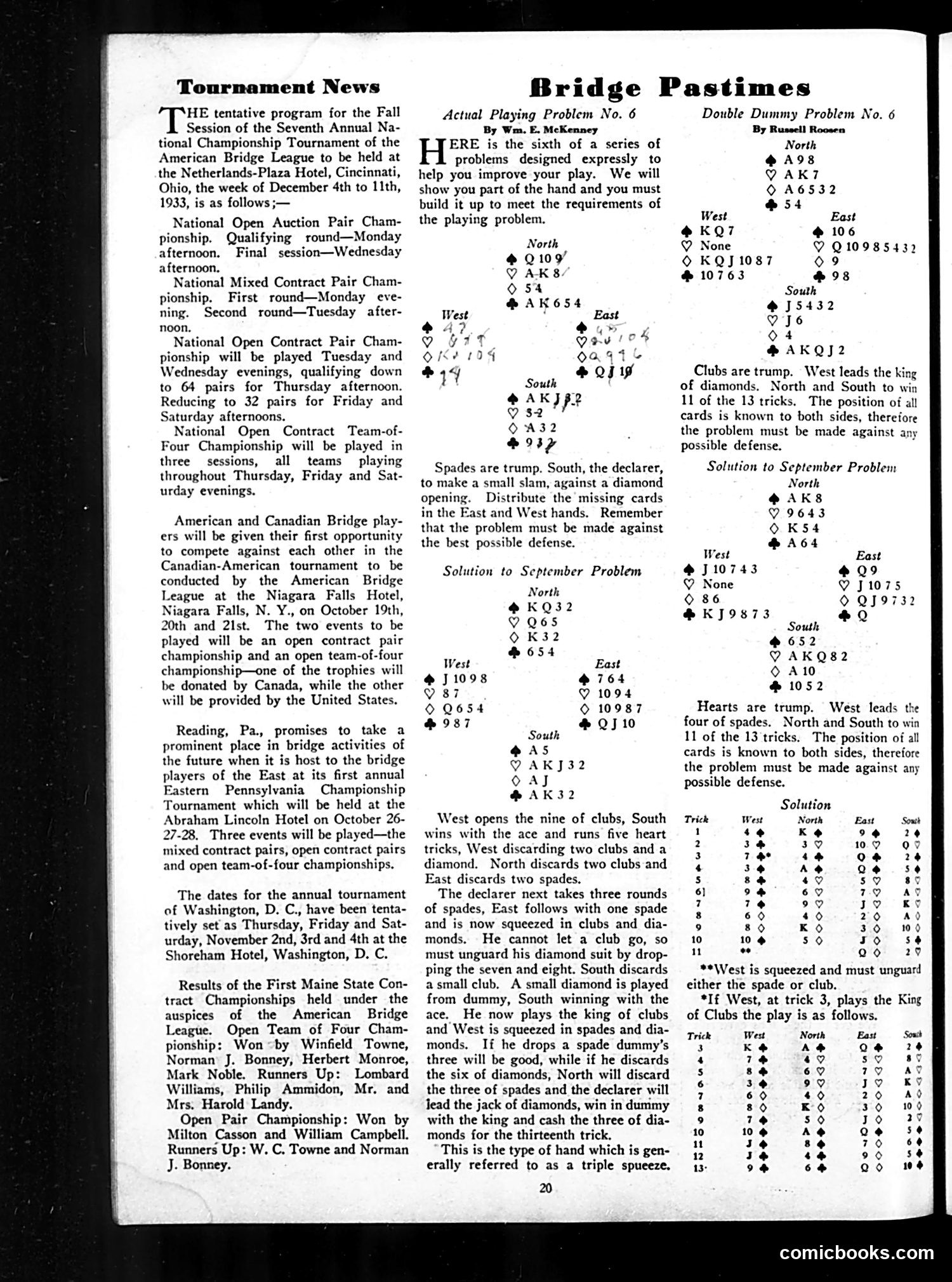
Analysis This page contains no cartoons or satirical content. It is entirely devoted to bridge card game coverage and instruction. The page features: 1. Tournament News: Announcements of upcoming American Bridge League championship tournaments scheduled for fall 1933 in various cities (Cincinnati, Niagara Falls, Reading PA, Washington DC). These describe qualifying rounds and competition formats. 2. Bridge Pastimes: Two sections with detailed card hands and strategic playing problems for readers to solve. "Actual Playing Problem No. 6" presents a bridge scenario, while "Double Dummy Problem No. 6" offers another puzzle. 3. Results: Listings of winners from Maine State Contract Championships. This is instructional sports content, not political satire or humor. While *Judge* was primarily a satirical magazine, this particular page demonstrates the publication also covered other topics to fill space or appeal to different reader interests.
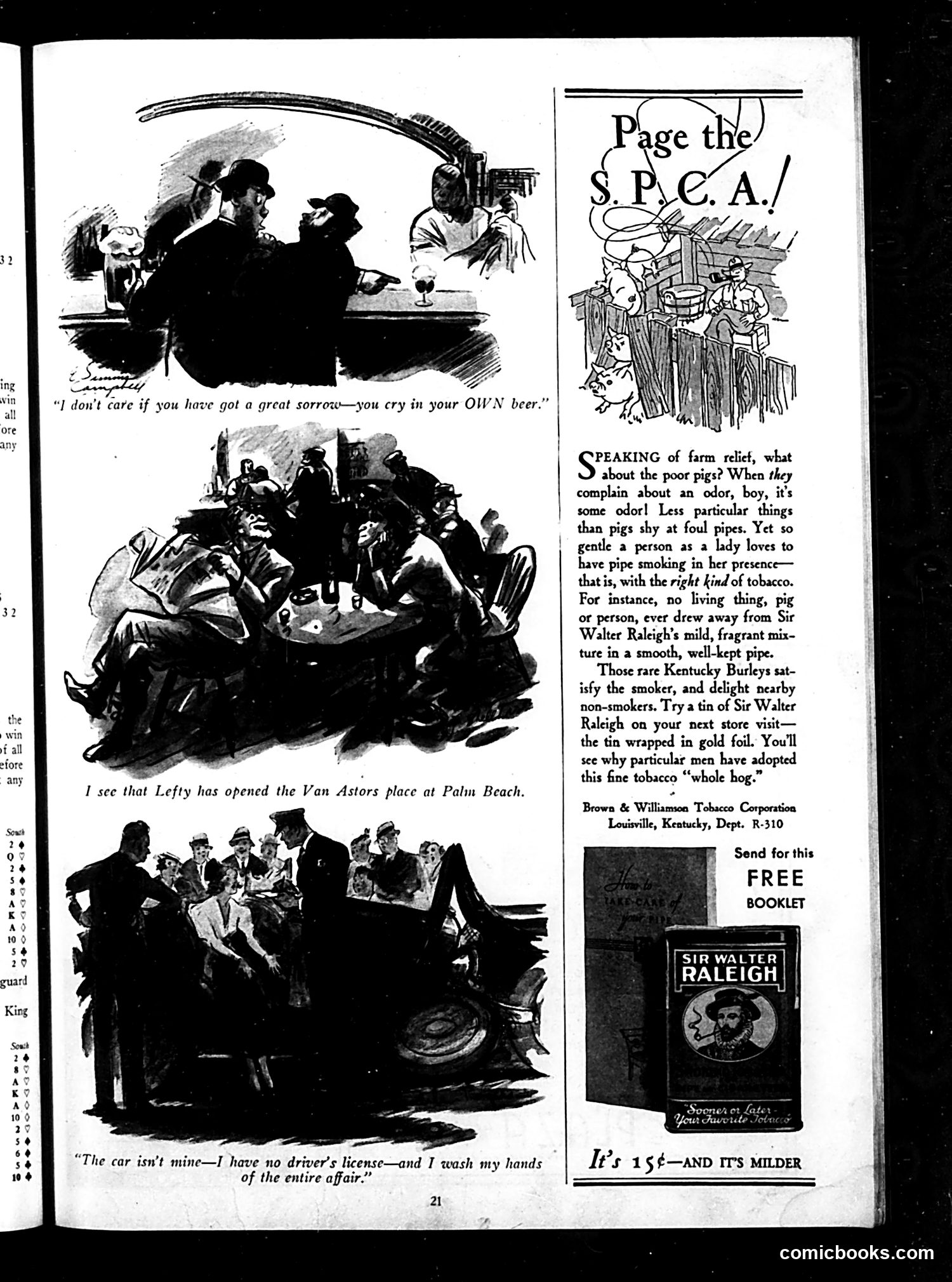
Political Cartoon Analysis: Judge Magazine Page 21 This page contains three separate cartoons plus a Sir Walter Raleigh tobacco advertisement disguised as editorial content. The cartoons satirize social anxieties of their era (likely 1920s-30s): 1. Top cartoon: A man at a bar claims emotional distress, told to "cry in your own beer"—mocking overwrought sentimentality. 2. Middle cartoon: Depicts crowded, working-class socializing, likely satirizing immigrant communities or lower-class gathering spots. 3. Bottom cartoon: A man denies ownership of a car and involvement in an accident, suggesting criminal evasion or irresponsibility. The tobacco ad's "farm relief" framing attempts humor by comparing pigs' sensitivity to odors with ladies' appreciation for "proper" pipe tobacco—implying refined taste distinguishes genteel people from animals. The cartoons collectively mock contemporary social types: sentimental drunks, ethnic crowds, and dishonest drivers—reflecting period prejudices and class anxiety.
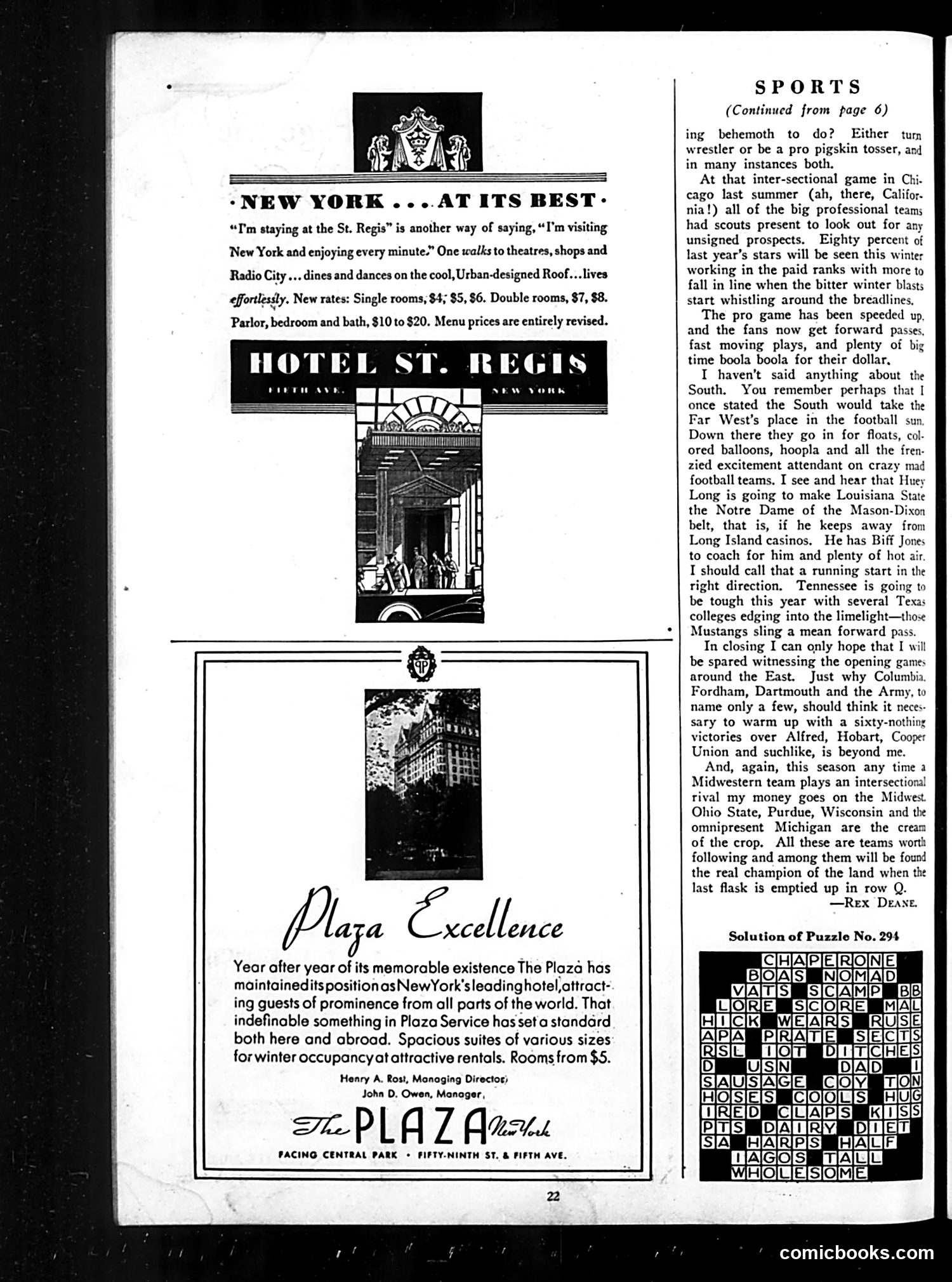
Page Analysis: Judge Magazine - Sports & Hotel Advertising This page combines sports commentary with luxury hotel advertisements, typical of Judge's format. The Advertisements: The St. Regis and Plaza hotels occupy the left side, marketing New York's high-end accommodations during what appears to be the Depression era (note the modest room rates: $4-$8 mentioned). These ads emphasize elegance and urban sophistication. The Sports Column (right side): Written by Rex Deane, this discusses college and professional football prospects. Notable references include Huey Long's efforts to make Louisiana State a football powerhouse (mentioning coach Biff Jones), and predictions about regional dominance. The author expresses confidence in Midwestern teams—Ohio State, Purdue, Wisconsin, Michigan—over Eastern rivals like Columbia, Fordham, and Army. Key Context: The mention of "opening flasks" and "row Q" references Prohibition-era drinking culture. The column reflects inter-regional college football rivalry that was intensely competitive during this period. No specific political cartoon appears; the page is primarily advertising with sports commentary.
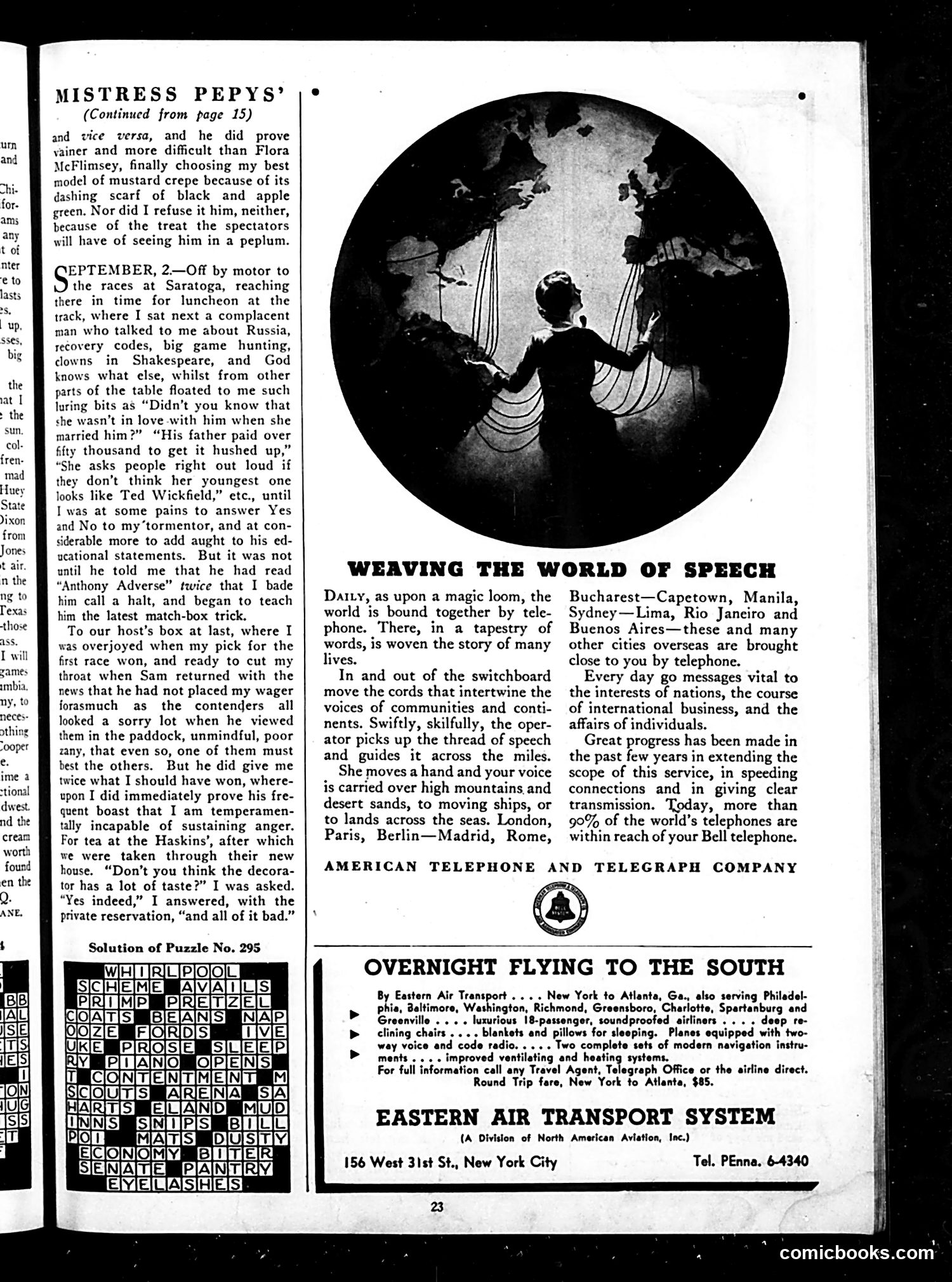
Page Content Analysis This page is primarily advertising, not satirical content. The left column continues "Mistress Pepys'" — a society gossip column recounting a woman's visit to the Saratoga races and subsequent social engagements. It's written in a witty, affected tone mocking upper-class pretensions (the narrator's cutting remark about a decorator's taste: "Yes indeed...and all of it bad"). The right side features three advertisements: 1. "Weaving the World of Speech" — A Bell Telephone ad with an illustration of a telephone operator at a switchboard, promoting long-distance service to international cities. 2. Eastern Air Transport — Advertising overnight flights from New York to Atlanta and other southern cities, emphasizing luxury amenities (soundproofed cabin, comfortable chairs, modern navigation). 3. A crossword puzzle solution (bottom left). The page reflects 1930s consumer culture and emerging technologies (long-distance telephony, commercial aviation). The Pepys column provides society-page humor; the ads showcase modern conveniences and travel options available to affluent readers.
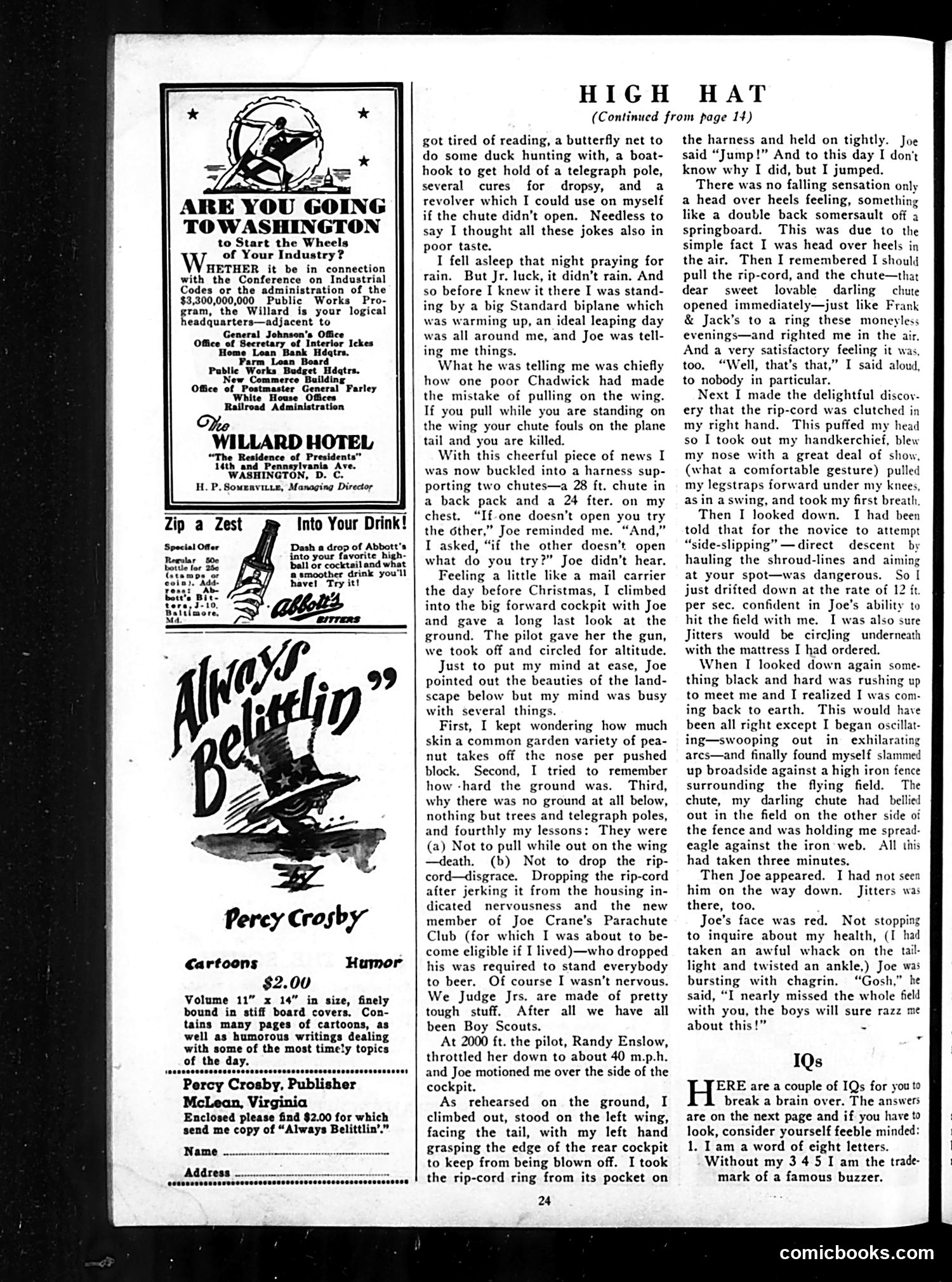
Content Analysis: High Hat Article and Advertisements This page primarily contains a continuation of "High Hat," a humorous first-person narrative about a Judge magazine writer's first parachute jump. The story describes pre-jump nervousness, including crude jokes from fellow jumpers about potential disasters, detailed descriptions of equipment (dual parachutes), and the experience of climbing into a biplane at 2000 feet. The advertisements reflect 1920s-30s commercial interests: the Willard Hotel promotes itself as suitable for businessmen visiting Washington during New Deal public works programs; Abbott's bitters advertises as a cocktail ingredient (likely during or just after Prohibition); Percy Crosby's cartoon collection is offered for sale. The "IQs" puzzle at page bottom offers brain teasers. The content is primarily entertainment-focused rather than overtly political, though the Washington hotel ad references contemporary industrial policy discussions.
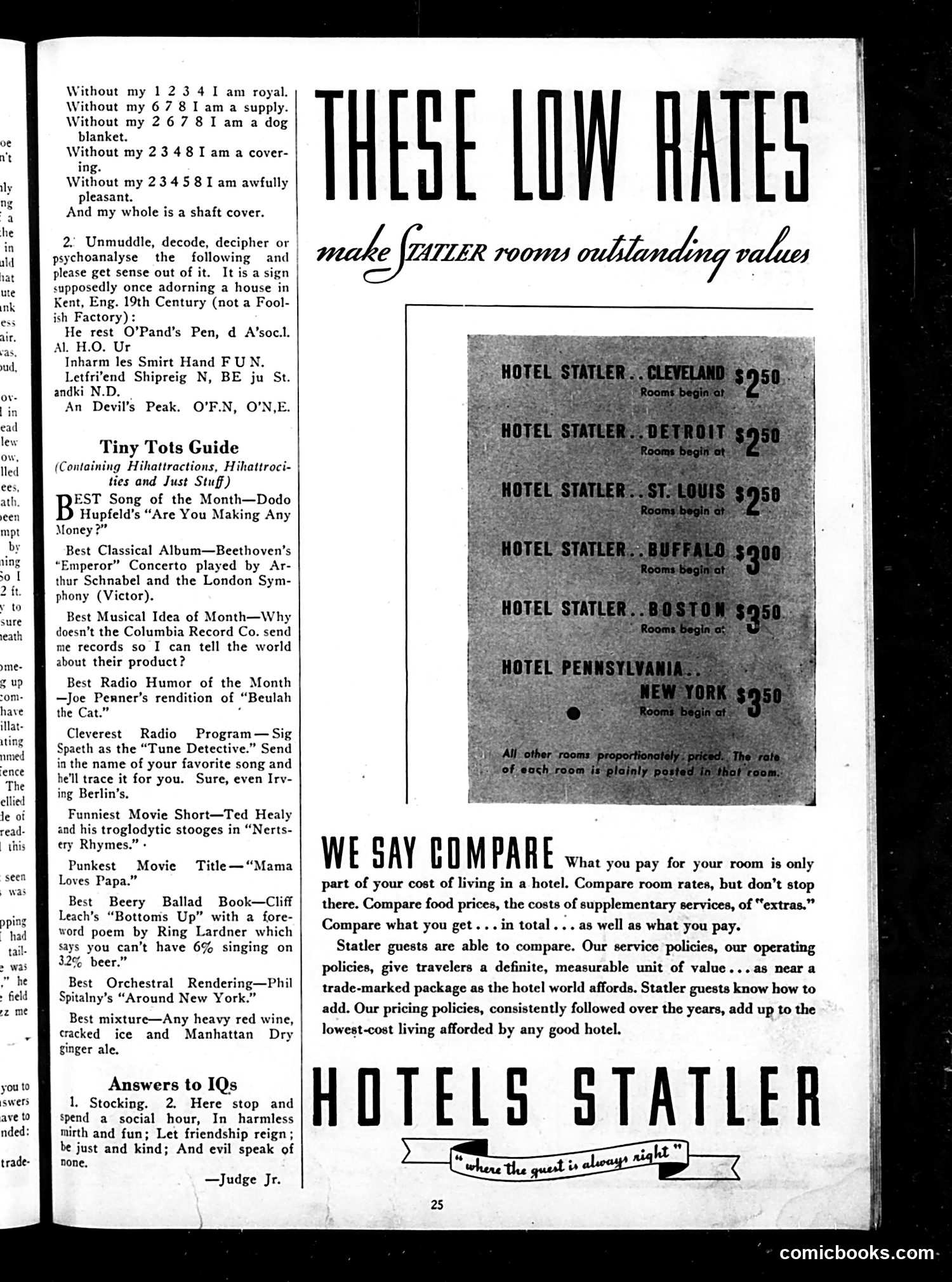
Analysis for Modern Readers This page is primarily advertising, not editorial satire. The dominant content is a Hotel Statler advertisement promoting low room rates ($2.50–$9.50) across multiple cities (Cleveland, Detroit, St. Louis, Buffalo, Boston, New York). The ad's rhetorical strategy targets Depression-era budget consciousness: "We Say Compare" emphasizes that low room rates are only part of the value—guests should also compare food, services, and total cost of living. This positioning suggests Statler hotels offered comprehensive affordability, a selling point during economically difficult times. The page's left column contains lighter content: riddle puzzles ("Tiny Tots Guide") and "Best of the Month" entertainment recommendations (radio shows, classical music, movies). These filler sections were typical Judge magazine features meant to entertain readers between advertisements. The advertising reflects how magazines monetized content through hotel, entertainment, and consumer product placements during the 1930s.
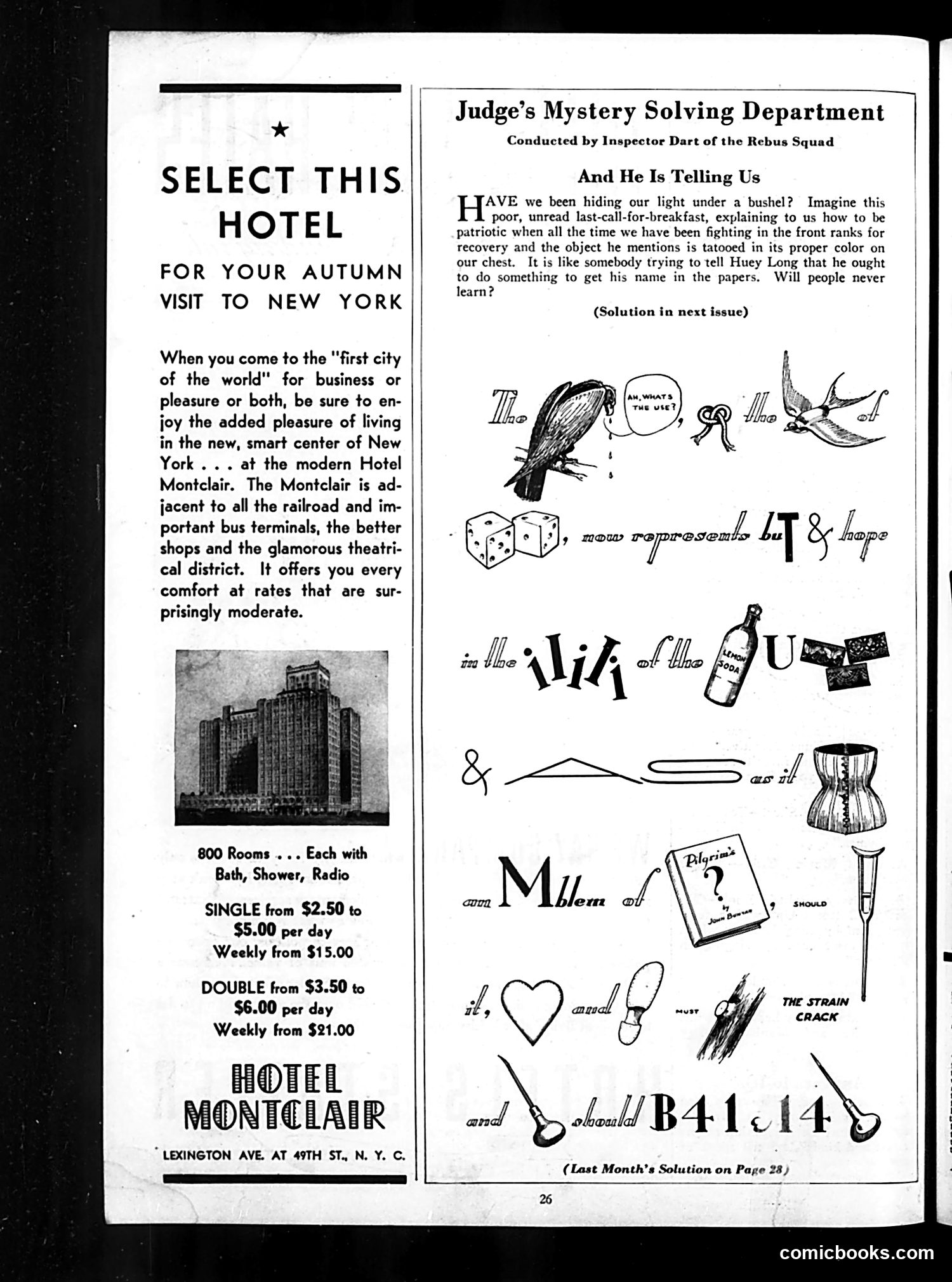
Judge Magazine Page Analysis This page contains a hotel advertisement (left) and a rebus puzzle (right), typical of Judge magazine's mix of advertising and entertainment. The rebus puzzle presents a mystery to solve using visual and textual clues—a recurring feature conducted by "Inspector Dart of the Rebus Squad." The introductory text references Huey Long, the populist Louisiana politician famous in the 1930s for self-promotion and demanding media attention. The puzzle mocks someone claiming patriotic credentials while their actual contributions go unrecognized—a satirical jab at politicians or public figures who seek credit for work already done by others. The accompanying illustrations (bird, dice, bottle, heart, scissors, etc.) form a visual riddle whose solution would be revealed in the next issue. The Hotel Montclair advertisement is straightforward promotional copy highlighting convenient Manhattan location and affordable rates ($2.50–$6.00 daily for singles).
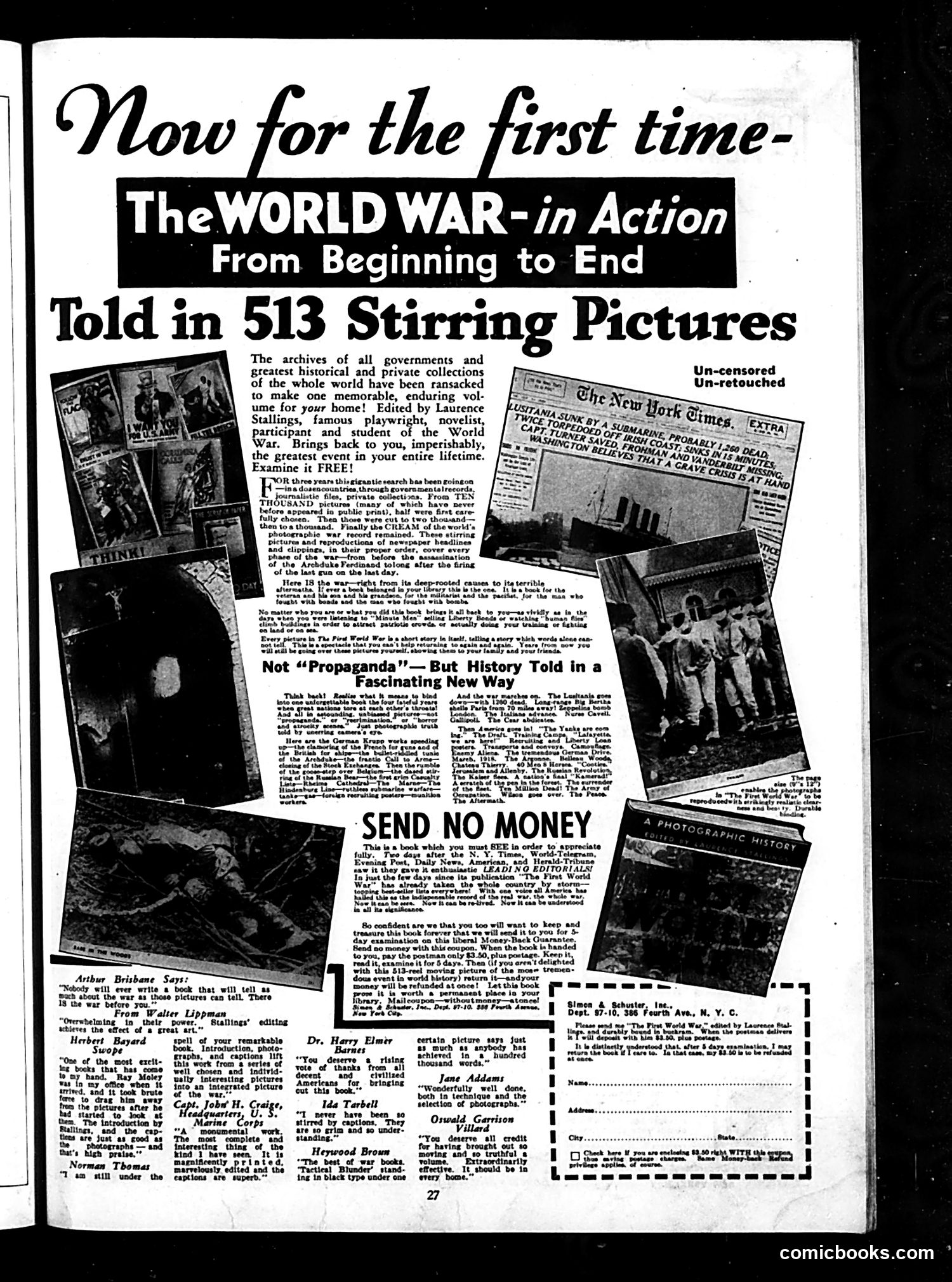
Analysis of This Judge Magazine Page This is primarily advertising, not satire or cartoon content. The page promotes "The First World War: A Photographic History," a newly published book edited by Laurence Stallings, featuring 513 photographs documenting WWI "from beginning to end." The advertising emphasizes the book's historical authenticity and comprehensive scope—claiming images were drawn from government archives and private collections worldwide, with careful curation from 10,000 photographs down to 1,000. It stresses the material is "Un-censored" and "Un-retouched," positioning the book as objective historical documentation rather than propaganda. Notable endorsements from prominent figures (Walter Lippman, Herbert Bayard Swope, Dr. Harry Elmer Barnes) lend credibility. The "Send No Money" offer—a five-day free examination with money-back guarantee—was a common early 20th-century direct-mail sales tactic. The page reflects post-WWI interest in documenting the conflict through photography, a relatively new medium for capturing warfare.
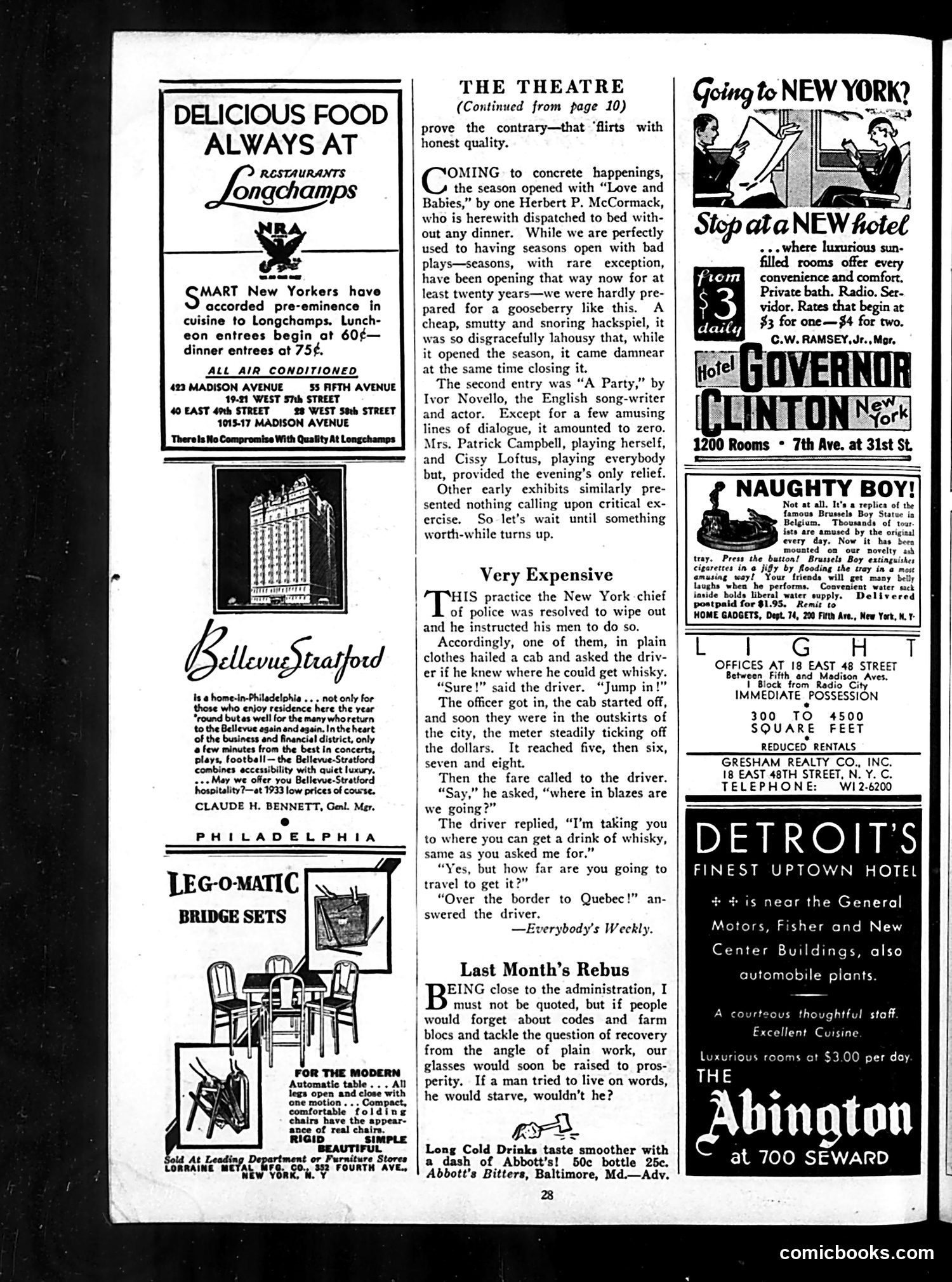
Judge Magazine Page Analysis This page is primarily advertisements and filler content rather than editorial cartoons. The main elements include: Advertisements: Restaurant (Longchamps), hotels (Bellevue-Stratford Philadelphia, Hotel Governor Clinton, Detroit's Abington), furniture (Leg-O-Matic Bridge Sets), and novelty items (Naughty Boy cigarette dispenser). Theater Review: A brief critique dismissing the play "Love and Babies" as cheap and "lahousy" (disreputable), while similarly trashing "A Party" by Ivor Novello. The reviewer notes early-season theatrical offerings are uniformly poor. Two Anecdotes: 1. A New York police officer, attempting to catch taxi drivers facilitating illegal whisky sales (likely during Prohibition), ironically gets driven across the border to Quebec—the meter running the entire time. 2. A brief "Rebus" joke about economic recovery requiring actual work rather than political rhetoric. The page reflects 1920s-30s concerns: Prohibition enforcement, economic recovery (Depression era), and entertainment criticism.
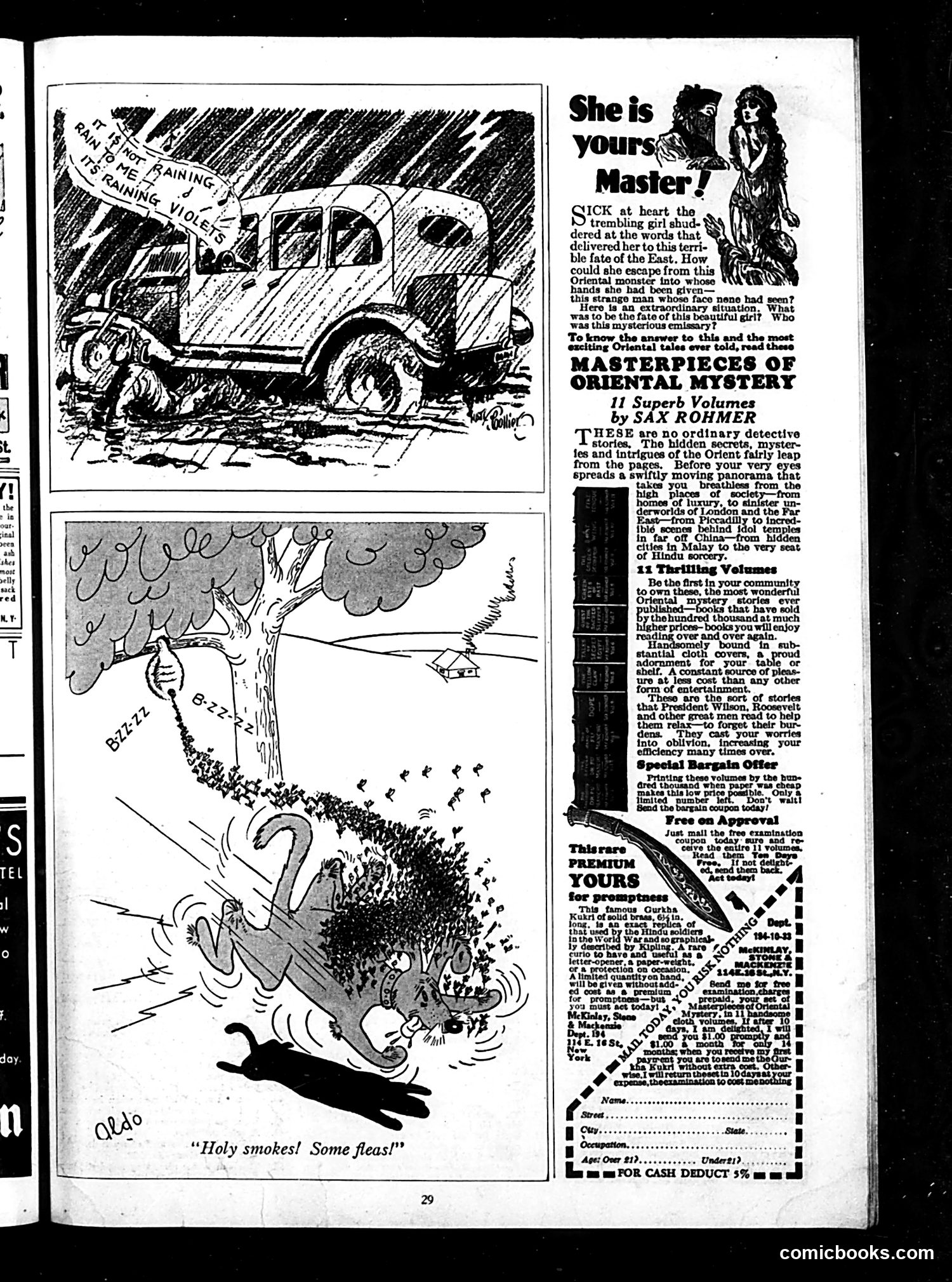
Analysis of Judge Magazine Page This page combines two distinct elements: satirical comics and advertising. The Cartoons The top cartoon depicts a car stuck in mud with text about "training violets"—likely satirizing wasteful wartime gardening efforts or frivolous domestic concerns during WWI. The bottom cartoon shows a man discovering fleas in what appears to be a dog or animal, with the exclamation "Holy smokes! Some fleas!"—a simple slapstick joke about pest infestation. The Advertisement The bulk of the page advertises Sax Rohmer's "Masterpieces of Oriental Mystery"—11-volume detective fiction series featuring "hidden secrets" and "Oriental" intrigue. The ad copy trades in period-typical "Yellow Peril" stereotypes, emphasizing exotic danger and mysterious Eastern villainy ("Hindu sorcery," sinister emissaries). The juxtaposition reflects early 20th-century American attitudes: dismissive domestic humor alongside sensationalized, racially-coded adventure fantasy. The advertisement's melodramatic tone about threatened women and inscrutable Eastern plots was mainstream entertainment marketing of the era.
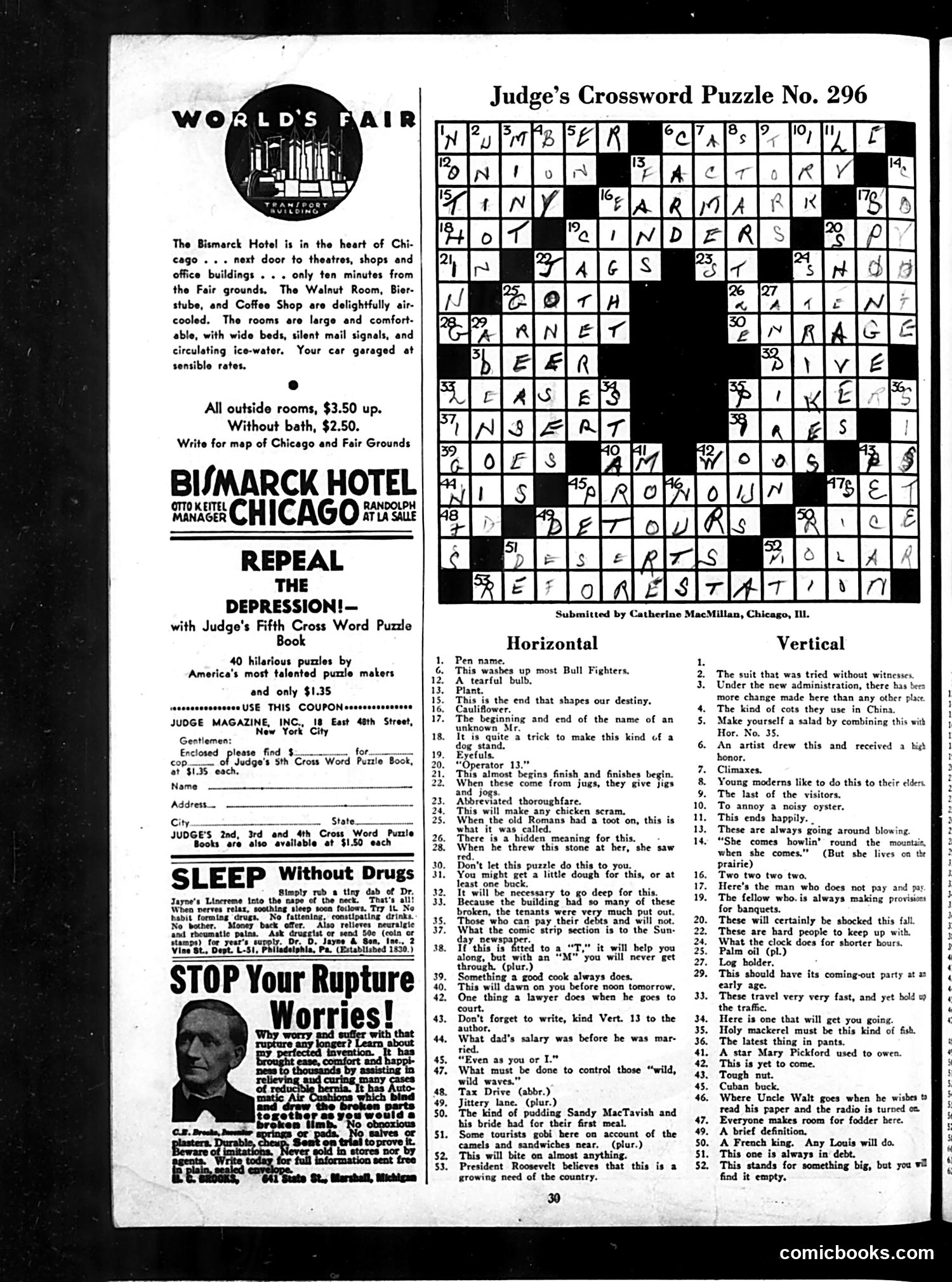
Judge Magazine Crossword Puzzle Page - Historical Context This page is primarily a crossword puzzle advertisement from Judge magazine, a prominent American satirical publication. The main content is "Judge's Crossword Puzzle No. 296," submitted by Catherine MacMillan of Chicago. The page's editorial message appears in the banner "REPEAL THE DEPRESSION!" — referencing the Great Depression of the 1930s. This suggests the puzzle book is being marketed as entertainment meant to distract from economic hardship, with the ironic promise that solving crosswords will "repeal" (eliminate) the Depression itself. The surrounding advertisements — for the Bismarck Hotel, sleep aids, and rupture treatments — target working-class readers seeking affordable comfort and health solutions during economically difficult times. The crossword clues themselves reference contemporary 1930s culture: prohibition repeal, radio shows ("Operator 13"), and New Deal policies (Roosevelt's programs). This reflects Judge's role as a mirror of popular American concerns and humor during the Depression era.
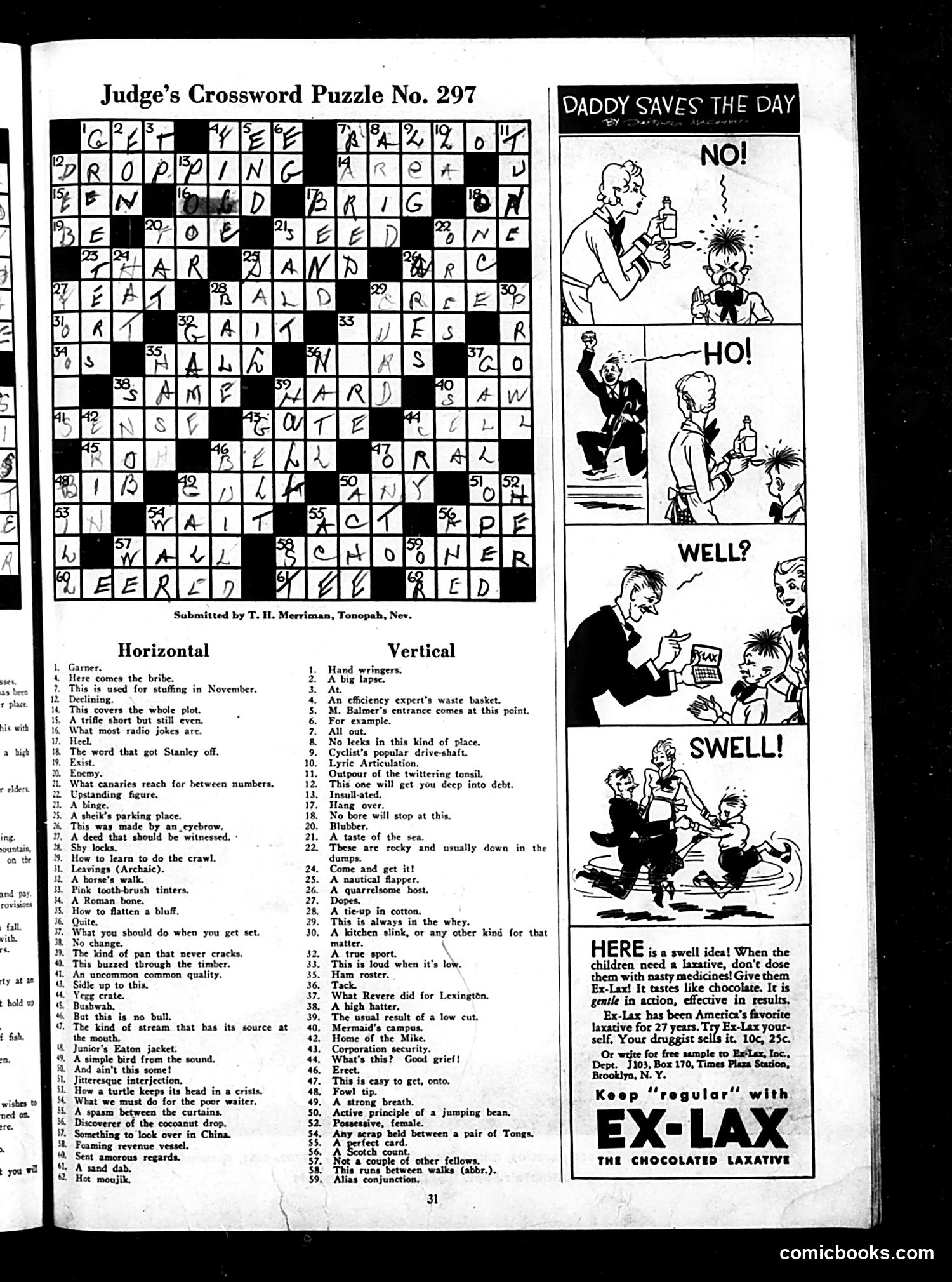
Explanation for Modern Readers This page contains Judge magazine's crossword puzzle (the main content) and advertising for Ex-Lax laxative. The crossword clues are satirical wordplay typical of 1920s-30s Judge humor, referencing contemporary figures and events: - "Garner" (clue 1) likely refers to John Nance Garner, a political figure - "Here comes the bribe" suggests cynicism about politics - "The word that got Stanley off" appears to reference a legal case - "Insull-ated" is a pun on Samuel Insull, a utilities magnate involved in financial scandals The right side features a comic strip titled "Daddy Saves the Day" showing a father using Ex-Lax on children, with the joke being that the children react enthusiastically to medicine that tastes like chocolate rather than resisting it. The page reflects Judge's characteristic blend of political satire, wordplay, and advertising from the era—cynical about corruption while promoting commercial products.
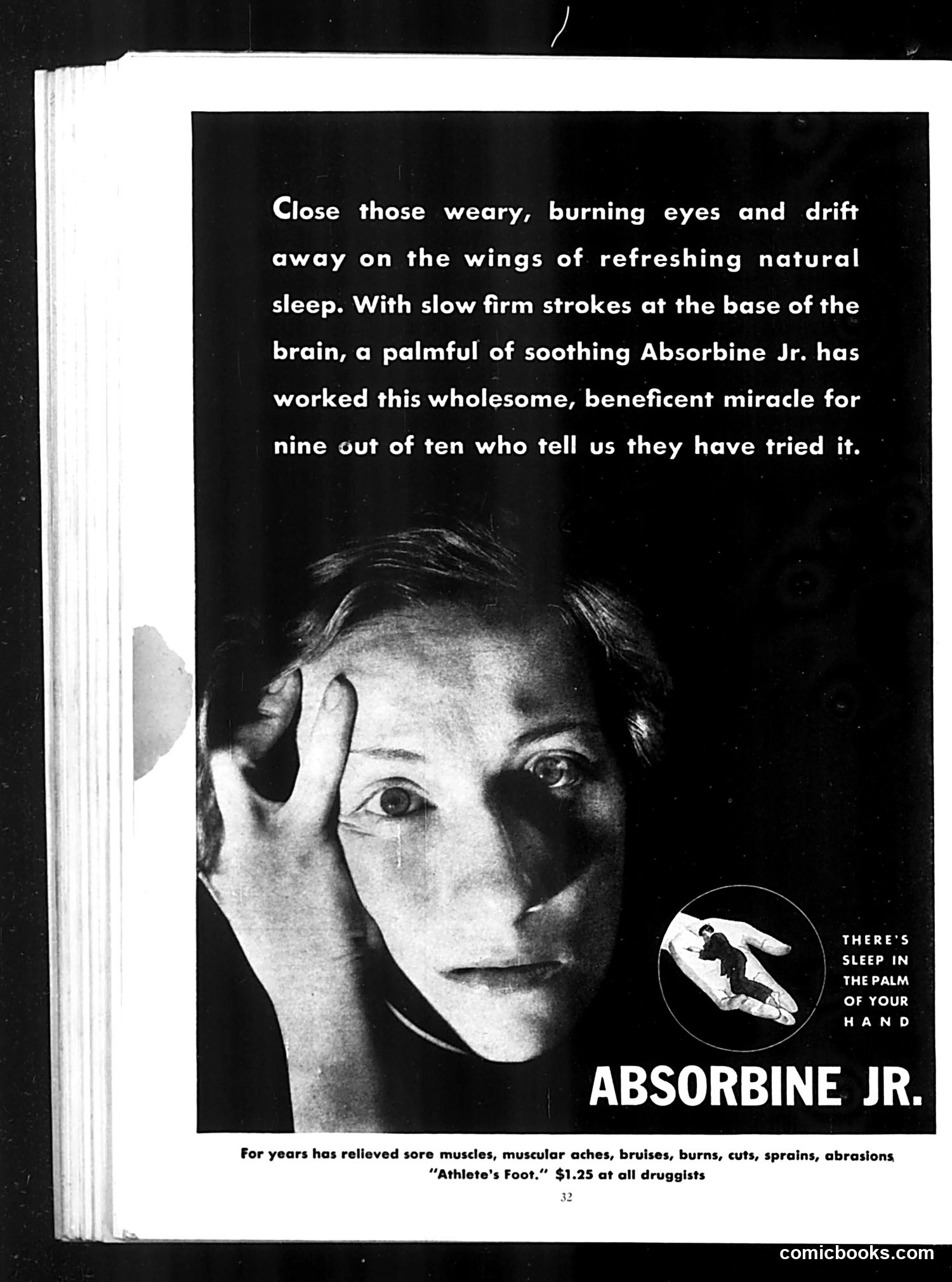
Analysis This page is a vintage advertisement, not political satire. It promotes Absorbine Jr., a topical medicinal product marketed for pain relief and various ailments including athlete's foot. The ad features a black-and-white photograph of a woman with her hand to her head, appearing exhausted or distressed—establishing the "problem" the product solves. The copy promises that applying the product via "slow firm strokes at the base of the brain" will induce natural sleep and relief. By modern standards, the medical claims are absurdly exaggerated and unsubstantiated. The vague promise of sleep induction through scalp massage, combined with a $1.25 price point, typifies early-to-mid 20th-century patent medicine marketing—before FDA regulations strictly governed health claims. The tagline "there's sleep in the palm of your hand" is straightforward advertising copy, not satire.
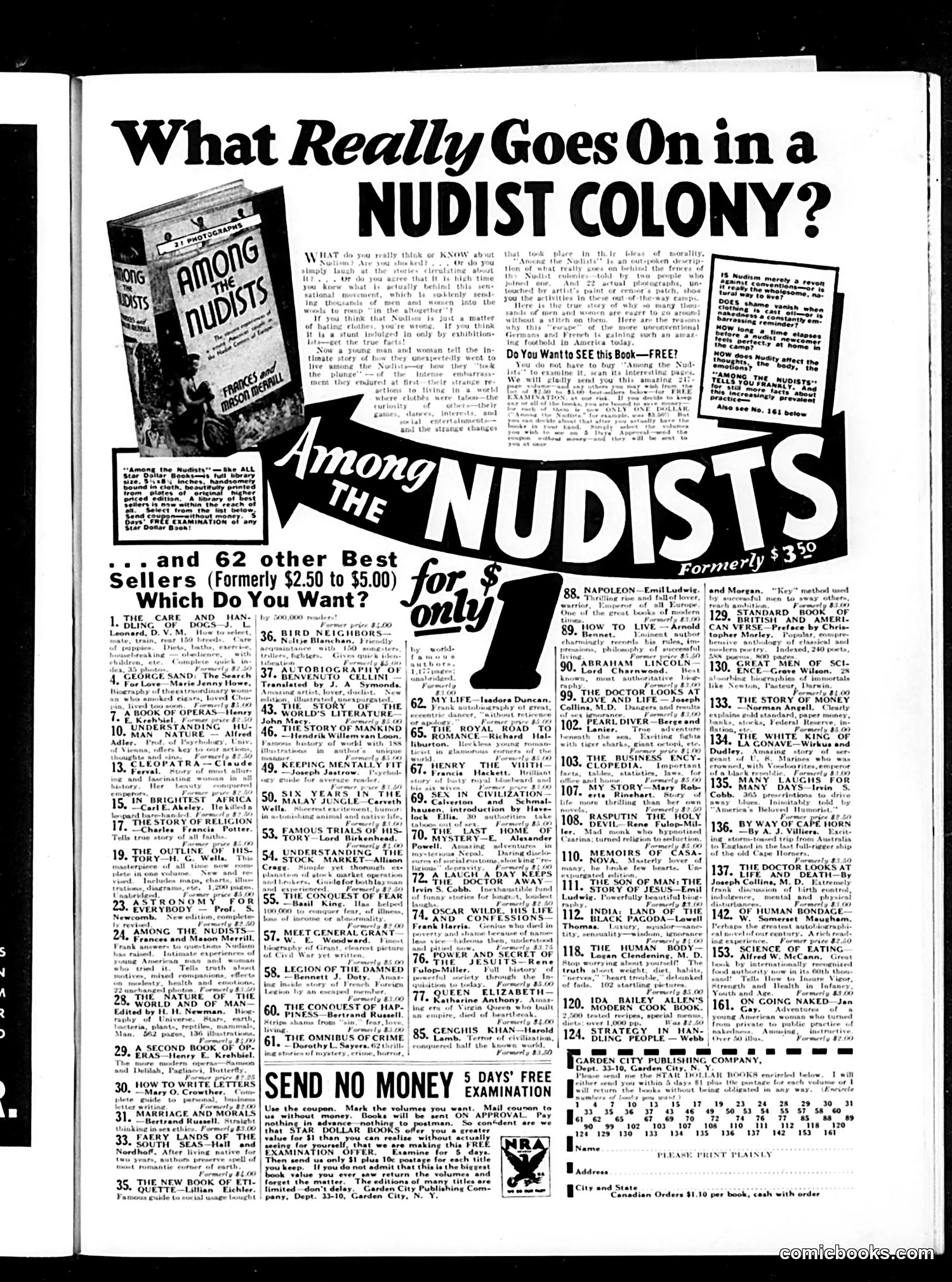
Analysis of "Among the Nudists" Advertisement This page is primarily a book advertisement, not political satire. It promotes "Among the Nudists" (formerly priced $2.50–$5.00) alongside 62 other bestselling books available for $1 each through a mail-order offer. The headline "What Really Goes On in a Nudist Colony?" uses sensationalism typical of 1930s advertising—promising to reveal scandalous secrets about nudist communities, which were exotic and controversial to mainstream readers. The book's cover image shows shocked expressions, amplifying this sensational angle. The list includes serious works (autobiography, history, philosophy) mixed with salacious titles, suggesting the publisher capitalizes on diverse reader interests. The "Send No Money" examination offer was standard mail-order marketing of the era. Historical context: Nudism was gaining attention in America during the 1930s as a movement, sparking public curiosity and moral concern. This advertisement exploits that interest to drive sales. The satire is minimal—the page is primarily commercial marketing rather than editorial commentary.
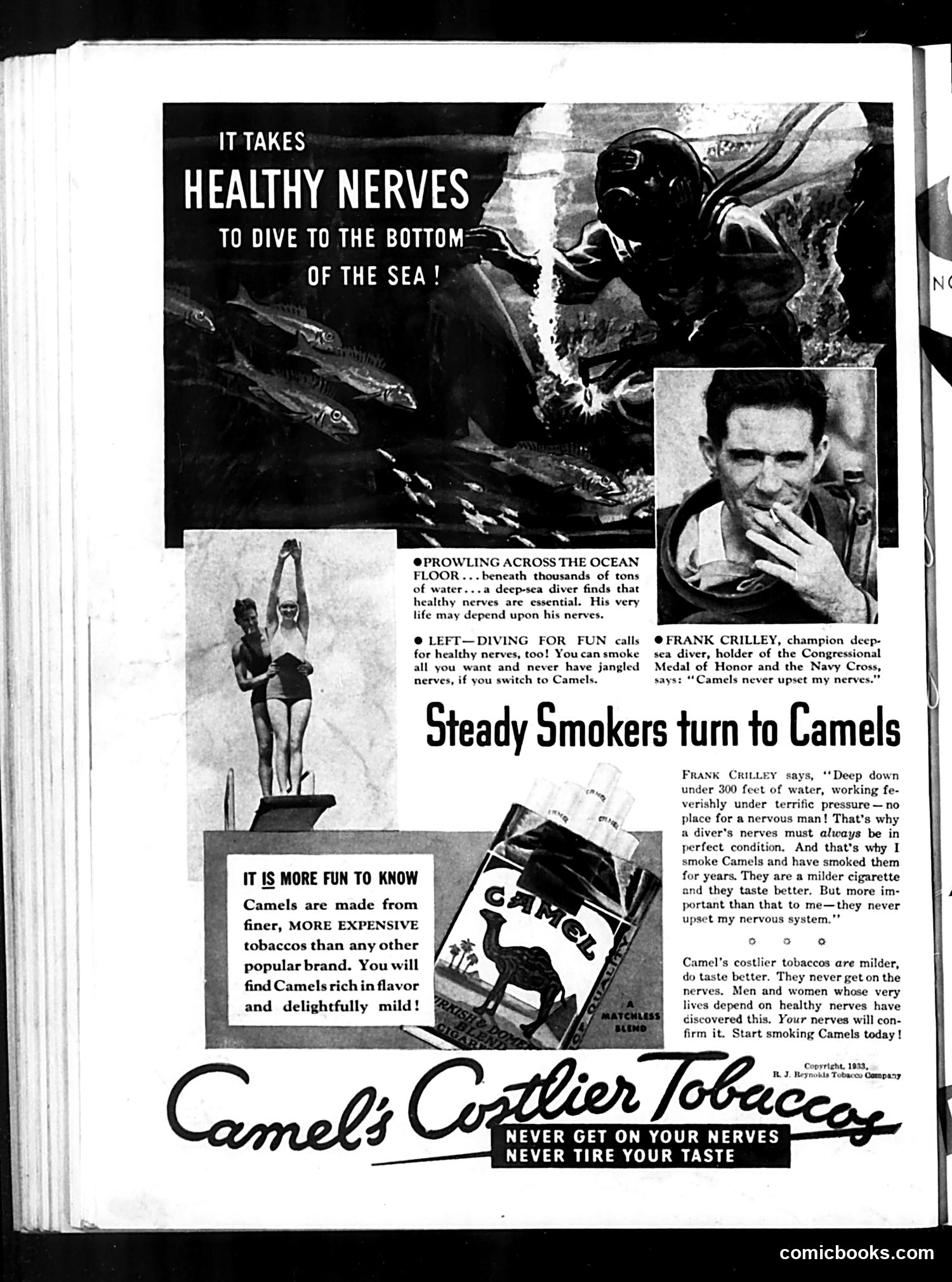
Analysis This is primarily a Camel cigarette advertisement, not satire. The page uses testimonial advertising featuring Frank Crilley, an actual deep-sea diver and Congressional Medal of Honor recipient, to promote cigarettes by claiming they won't "upset your nerves." The advertisement's logic appeals to 1930s consumers by associating Camel smoking with nerve steadiness—positioning cigarettes as beneficial for high-stress professionals. The imagery of dangerous deep-sea diving under pressure serves to validate the product's claimed calming properties. What's notable today: This represents pre-regulation tobacco marketing that made explicit health claims (that cigarettes were "milder" and wouldn't harm nerves), using authority figures and extreme scenarios to build credibility. The ad exemplifies how cigarettes were openly marketed as beneficial rather than harmful, a practice now prohibited. The page contains no evident satire or political commentary—it's straightforward period advertising.