judge
Judge — November 1933
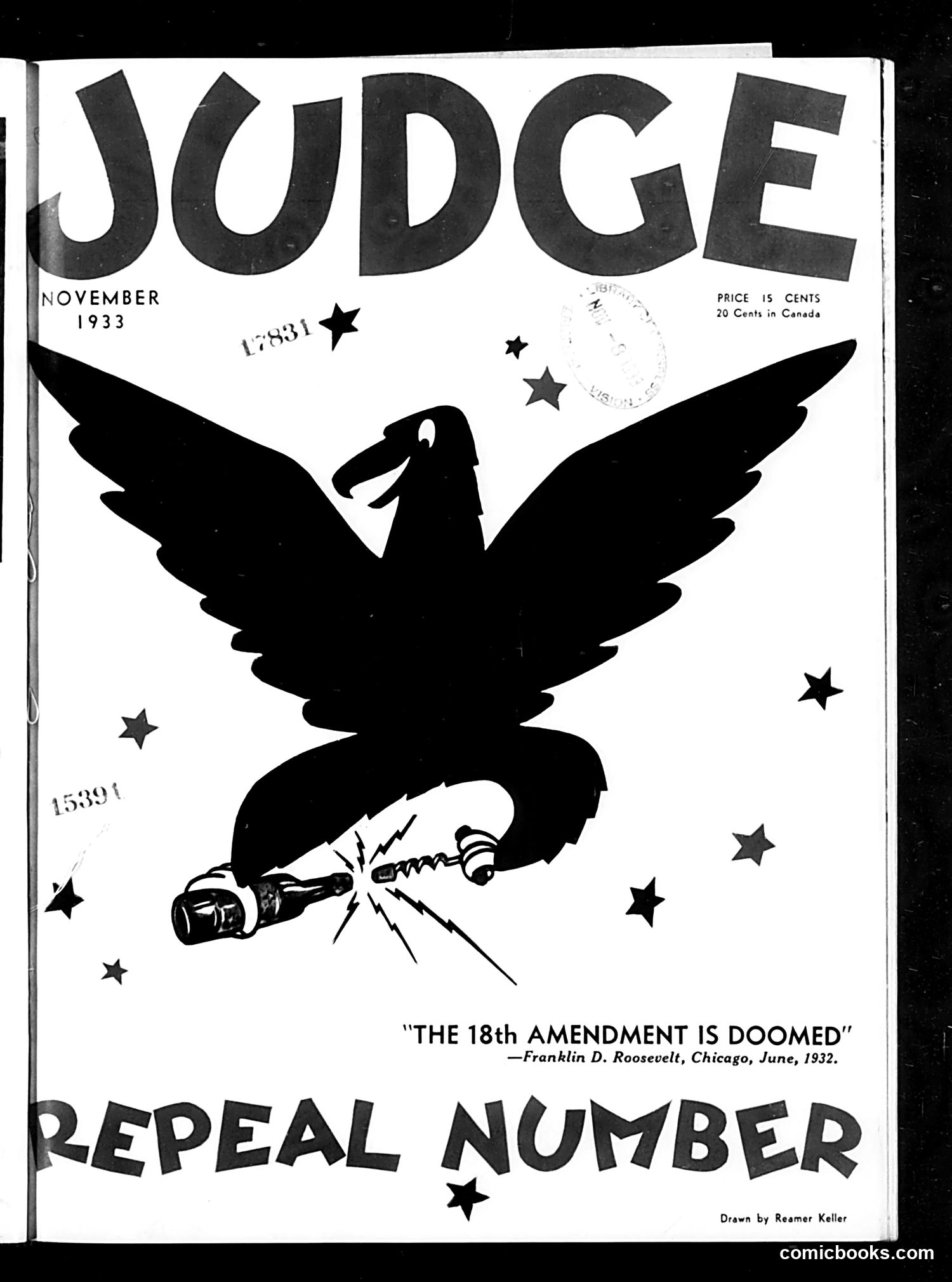
Judge Magazine, November 1933: "Repeal Number" This is the cover of Judge's special issue celebrating the repeal of Prohibition. The eagle—a symbol of America—clutches a broken bottle, surrounded by stars. The quote from Franklin D. Roosevelt (dated June 1932) reads "THE 18th AMENDMENT IS DOOMED," referencing his support for ending alcohol prohibition. The 18th Amendment, ratified in 1920, had banned alcohol production and sale. By 1933, during the Great Depression, repeal gained momentum. Roosevelt supported it, and the 21st Amendment repealed Prohibition in December 1933—just weeks after this issue. Judge's satirical message is celebratory: the magazine mocks Prohibition as a failed policy, depicting its end as patriotic American victory.
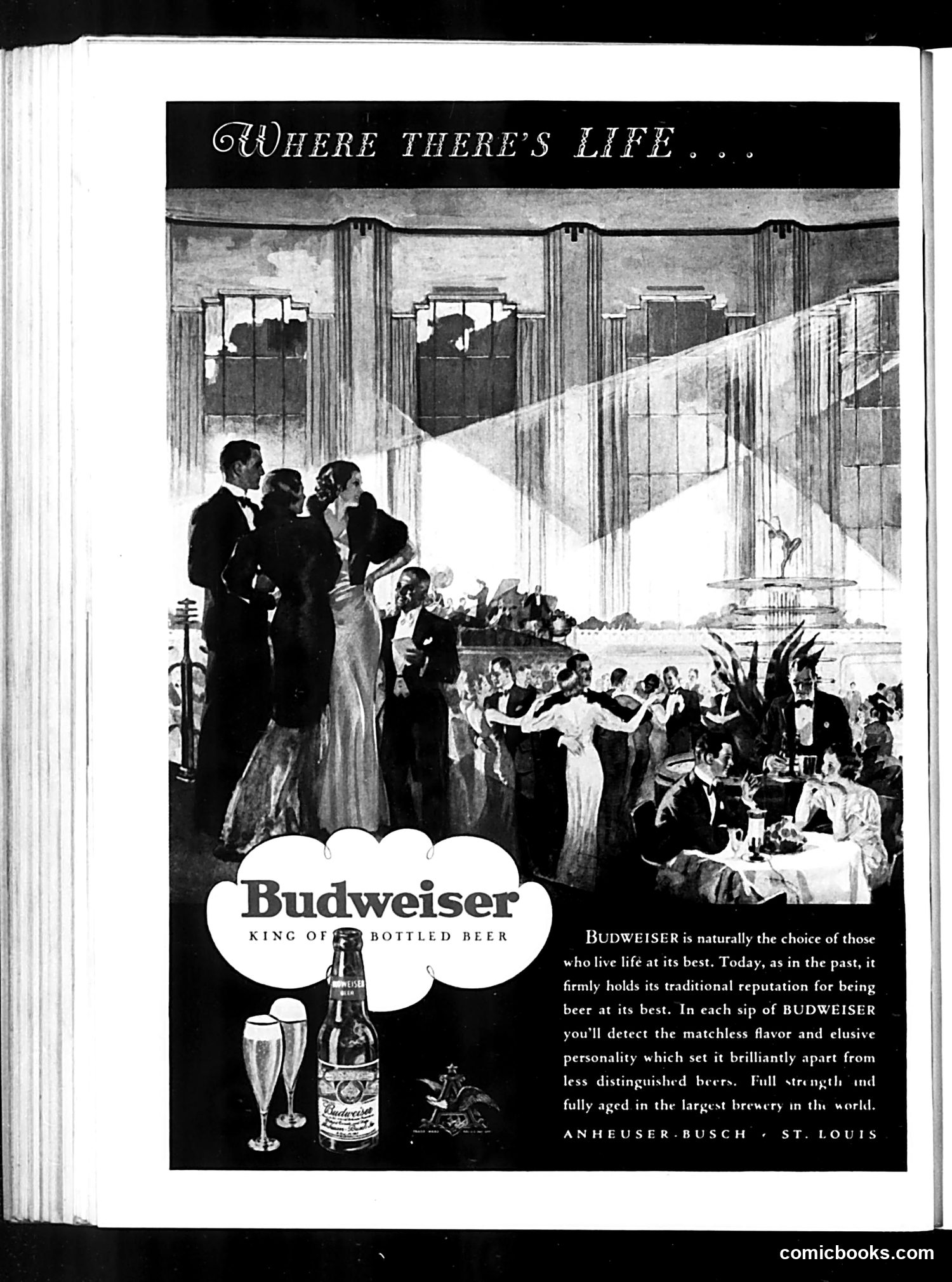
Analysis This is primarily a Budweiser advertisement, not political satire. The tagline "WHERE THERE'S LIFE..." depicts an elegant social gathering—well-dressed men and women at what appears to be an upscale outdoor event or party, with servers and entertainment visible. The advertisement's message is that Budweiser beer is "naturally the choice of those who live life at its best"—associating the product with sophistication, leisure, and social status. The text emphasizes the beer's traditional reputation and quality ("Full strength and fully aged in the largest brewery in the world"). This represents typical early-to-mid 20th century aspirational advertising, linking consumer products to idealized lifestyles and class identity.
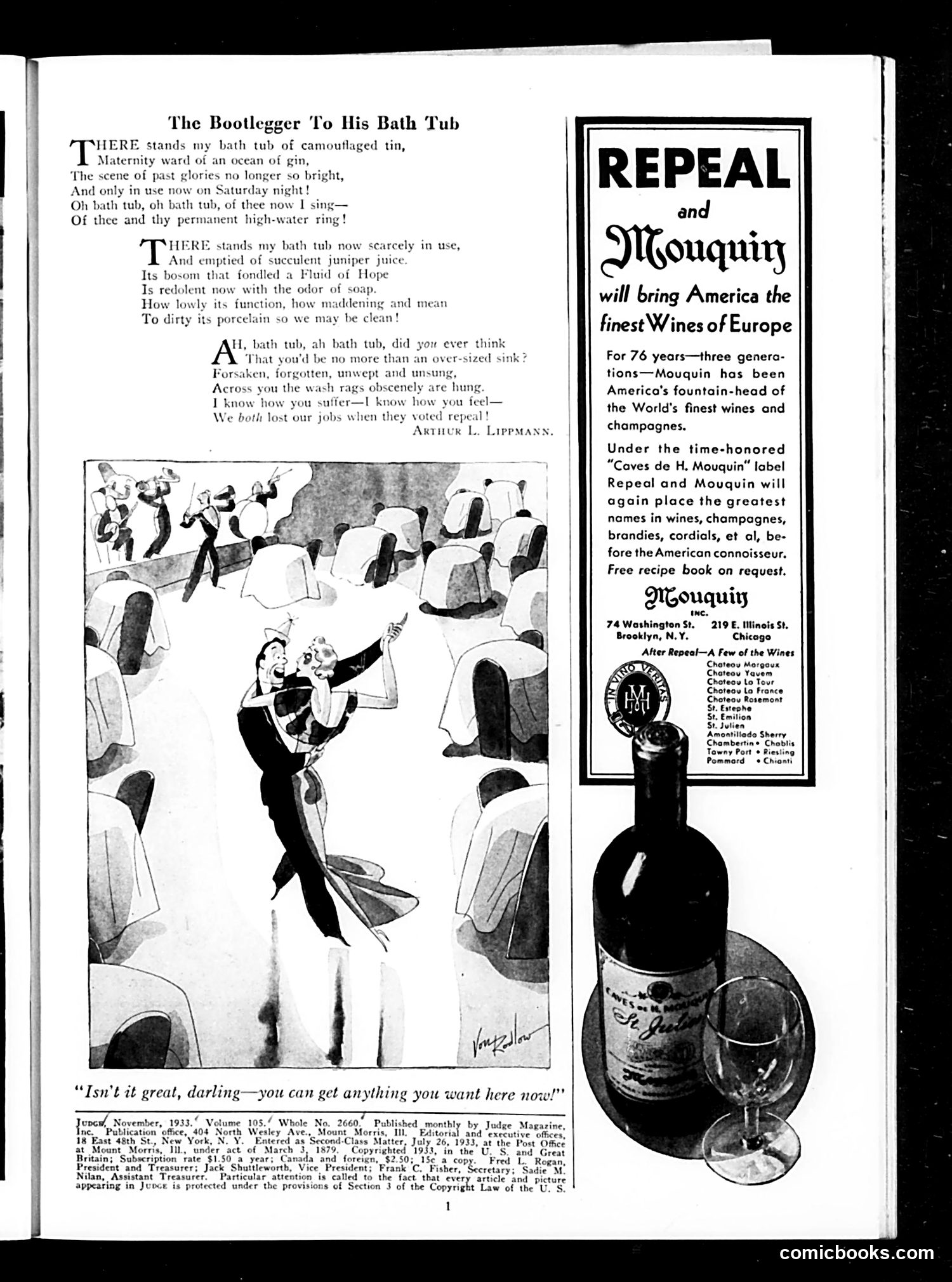
"The Bootlegger To His Bath Tub" This page satirizes Prohibition-era bootlegging. The poem by Arthur L. Lippmann depicts a bootlegger mourning his now-defunct operation—his camouflaged tin bathtub previously used to manufacture illegal alcohol is now merely a bathtub. The illustration shows figures in white garments (appearing to be bathtub disguises or covers) in a snowy setting, suggesting how bootleggers concealed their operations. The accompanying Moquin wine advertisement celebrates Prohibition's repeal, promising the return of legitimate European wines to America after 76 years of prohibition. The juxtaposition is ironic: the satire mocks bootleggers whose illegal enterprises are being replaced by legal commerce. The issue is dated November 1933, shortly after Prohibition's repeal that December.
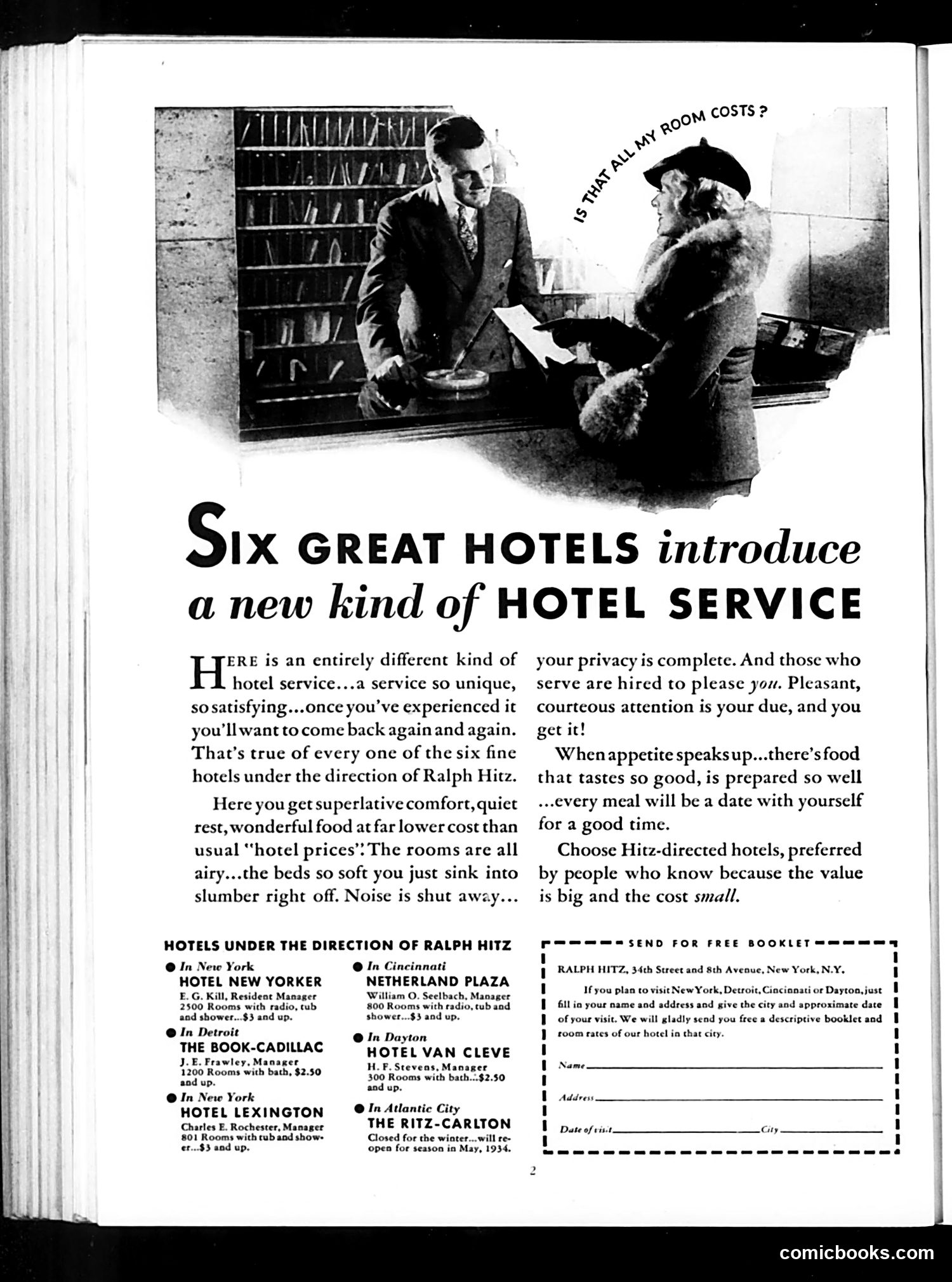
Analysis This page is primarily a hotel advertisement, not satire or political commentary. It's a 1934 advertisement for six luxury hotels under the direction of Ralph Hitz, a prominent hotelier of that era. The illustration shows a hotel clerk at a desk speaking with an elegantly dressed female guest asking about room costs. The ad emphasizes "a new kind of hotel service" featuring comfort, good food at lower prices than typical hotels, and courteous attention. The only mildly humorous element is the guest's question—"Is that all my room costs?"—which sets up the ad's pitch that these Hitz-directed hotels offer exceptional value. This is straightforward advertising using light humor, not political satire. The page reflects 1930s Depression-era marketing emphasizing affordability and quality.
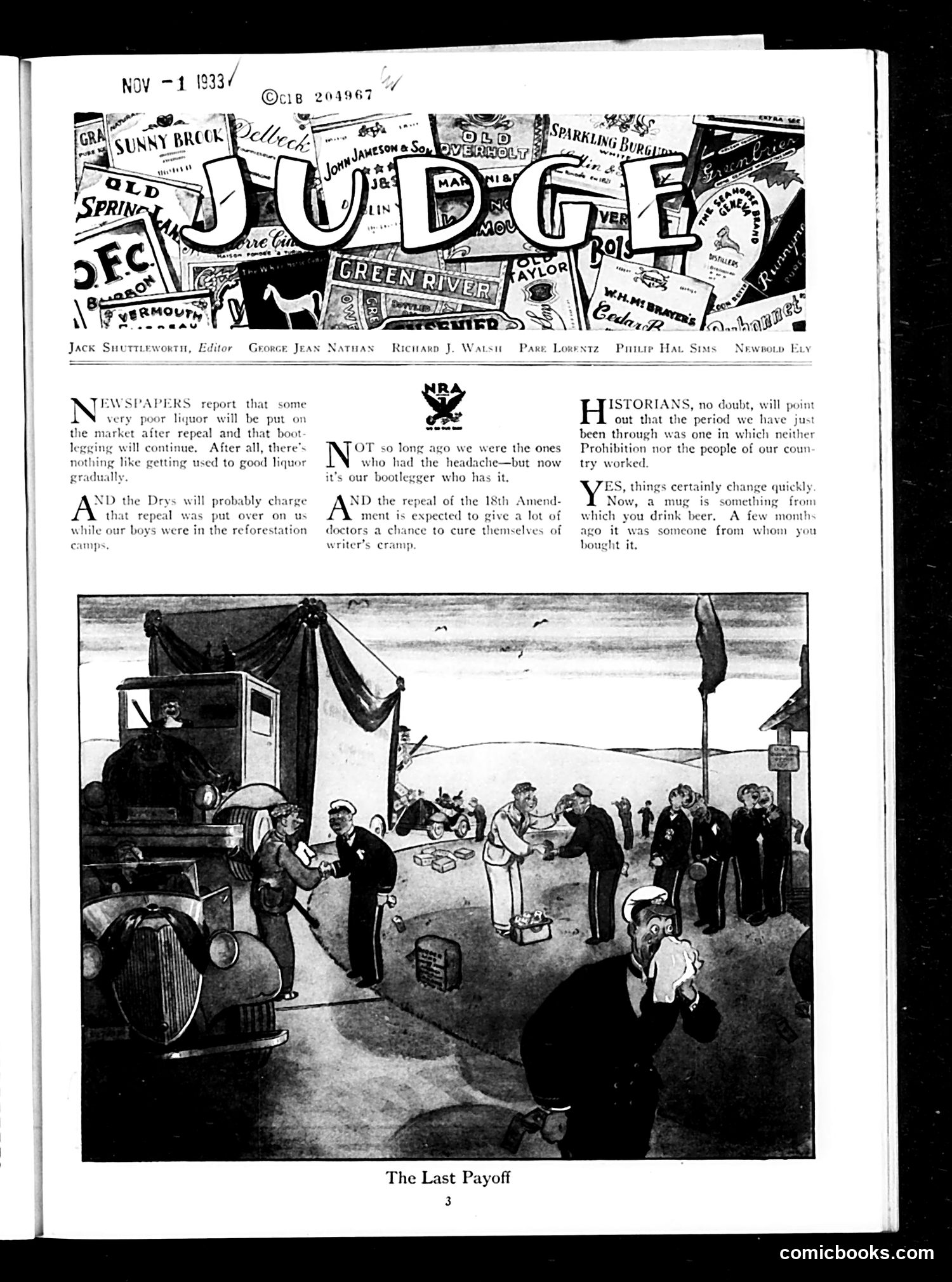
"The Last Payoff" - Judge Magazine, November 1, 1933 This cartoon satirizes Prohibition's end. The image depicts what appears to be bootleggers or illegal liquor distributors receiving final payments as their underground operations shut down following Prohibition's repeal (December 1933). The editorial text above references the transition: newspapers report poor liquor will flood the legal market as Prohibition ends; the 18th Amendment's repeal is imminent. The commentary notes that bootleggers—who profited during the ban—now face obsolescence as legitimate commerce resumes. "The Last Payoff" caption suggests these illegal operators collecting their final profits before legal alcohol distribution replaces their black-market enterprise. The cartoon mocks how quickly the criminal liquor trade will become unnecessary once legitimate businesses can operate openly.
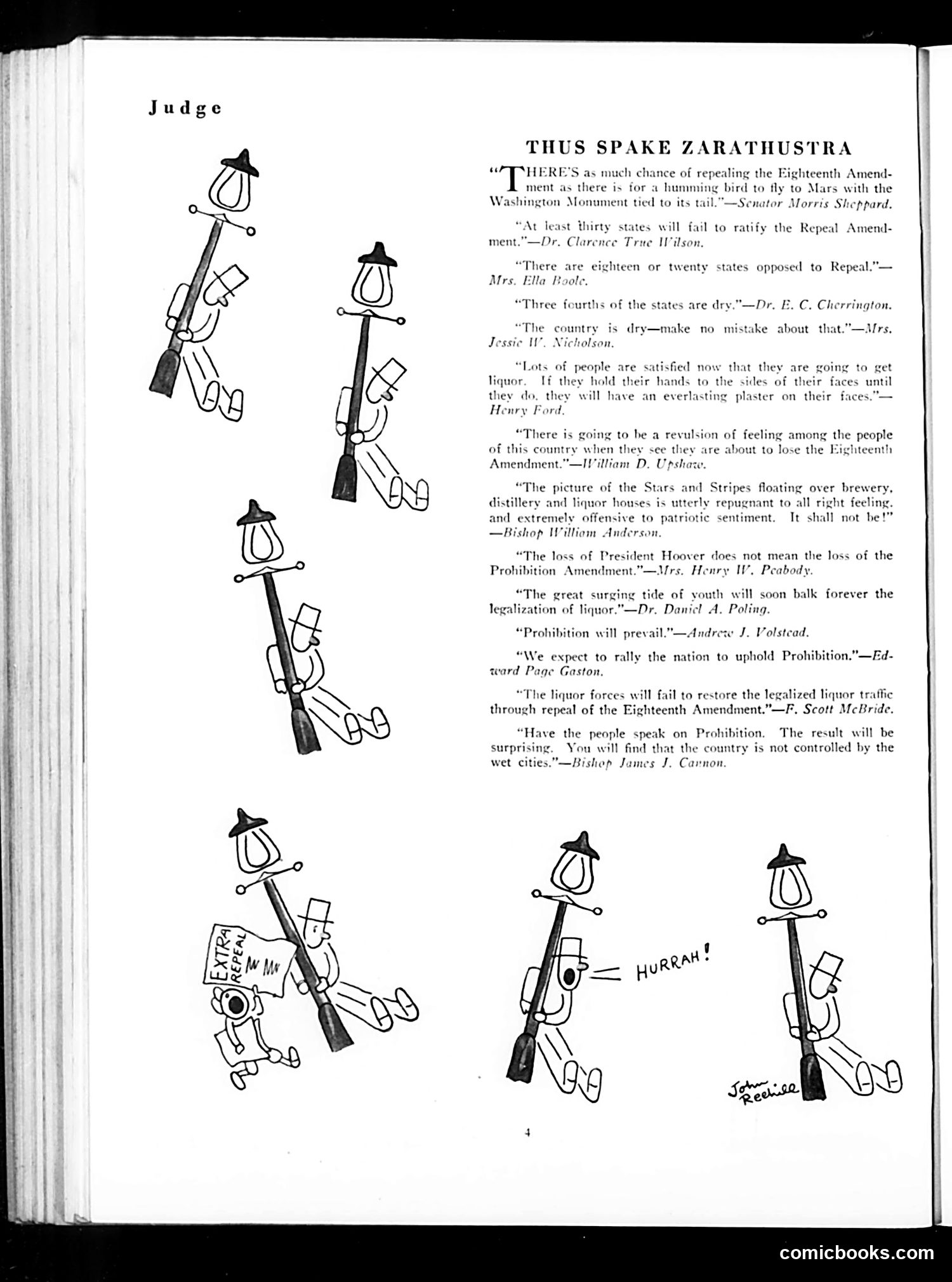
Analysis: "Thus Spake Zarathustra" - Judge Magazine Prohibition Satire This page satirizes the 18th Amendment (Prohibition) through competing predictions from prominent figures. The cartoons depict a "Judge" character—personified as a rifle-wielding figure with a liquor bottle for a head—balancing precariously on one leg, visually representing Prohibition's instability. The quotes from Senator Sheppard, Dr. Clarence Wilson, and others debate whether Prohibition will succeed or fail. The satire mocks both prohibitionists' confidence and their opponents' pessimism, suggesting the amendment's fate remains uncertain and ridiculous. The final cartoon shows the Judge celebrating "Hurrah!" alongside a small figure holding "For Me" papers—likely mocking how different groups claimed Prohibition served their interests while the policy's actual consequences remained unpredictable.
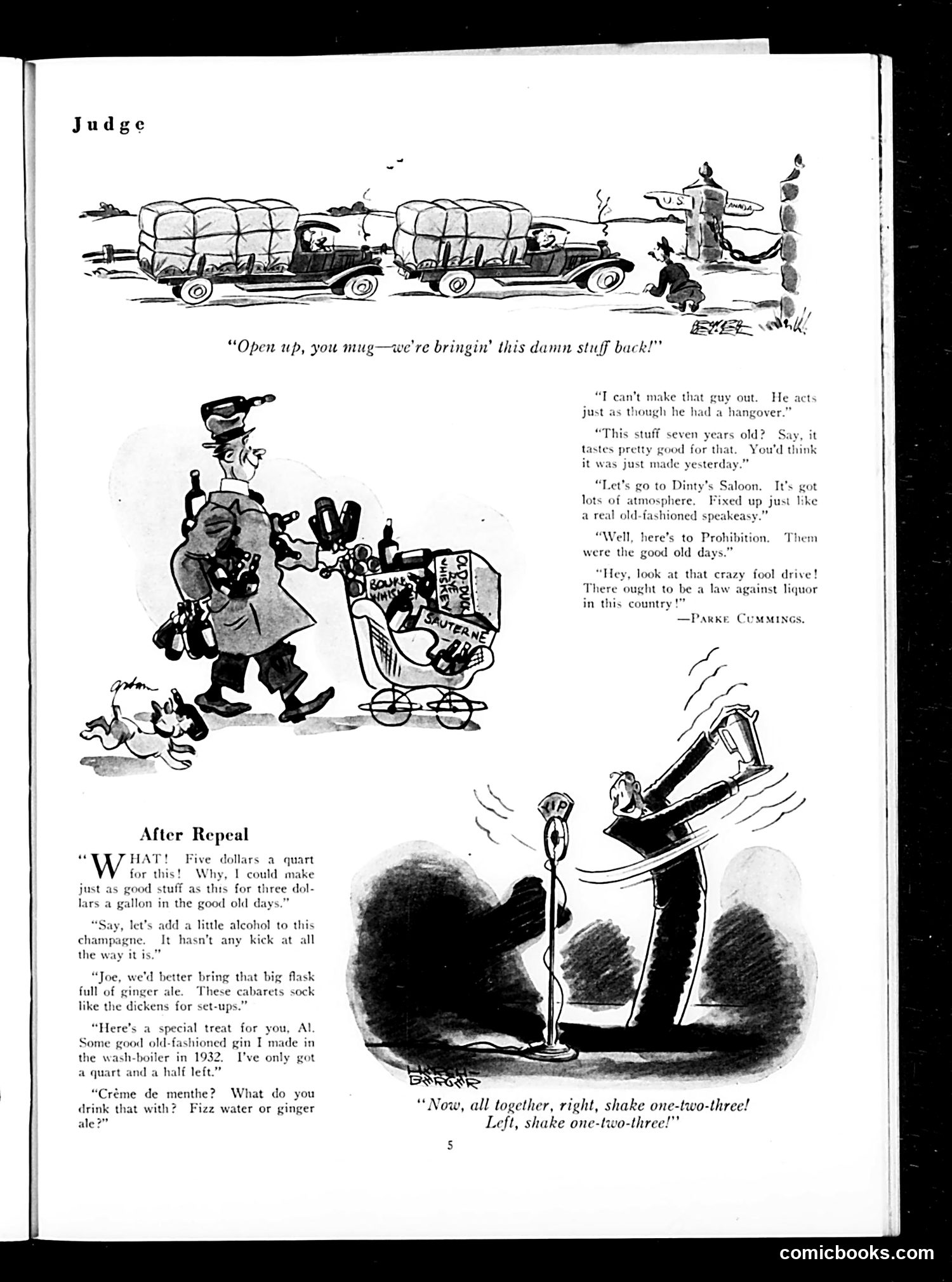
Explanation of "Judge" Page This page satirizes Prohibition's repeal (the 1933 end of the alcohol ban). The top cartoon shows bootleggers brazenly returning contraband liquor in trucks, mocking law enforcement's inability to stop illegal alcohol distribution. The middle cartoon depicts a drunk man surrounded by bottles and liquor advertisements—satirizing how quickly commercialized alcohol returned after repeal. The bottom cartoon shows people shaking a large cocktail shaker, labeled "Now, all together, right, shake one-two-three!"—mocking the public's enthusiastic embrace of legal drinking. The accompanying text contains period-appropriate jokes about homemade liquor quality and cocktail recipes. The satire targets both the chaos following repeal and society's immediate return to heavy drinking after fourteen years of prohibition. The cartoonist—likely Parke Cummings (credited)—presents repeal as a chaotic, morally questionable development.
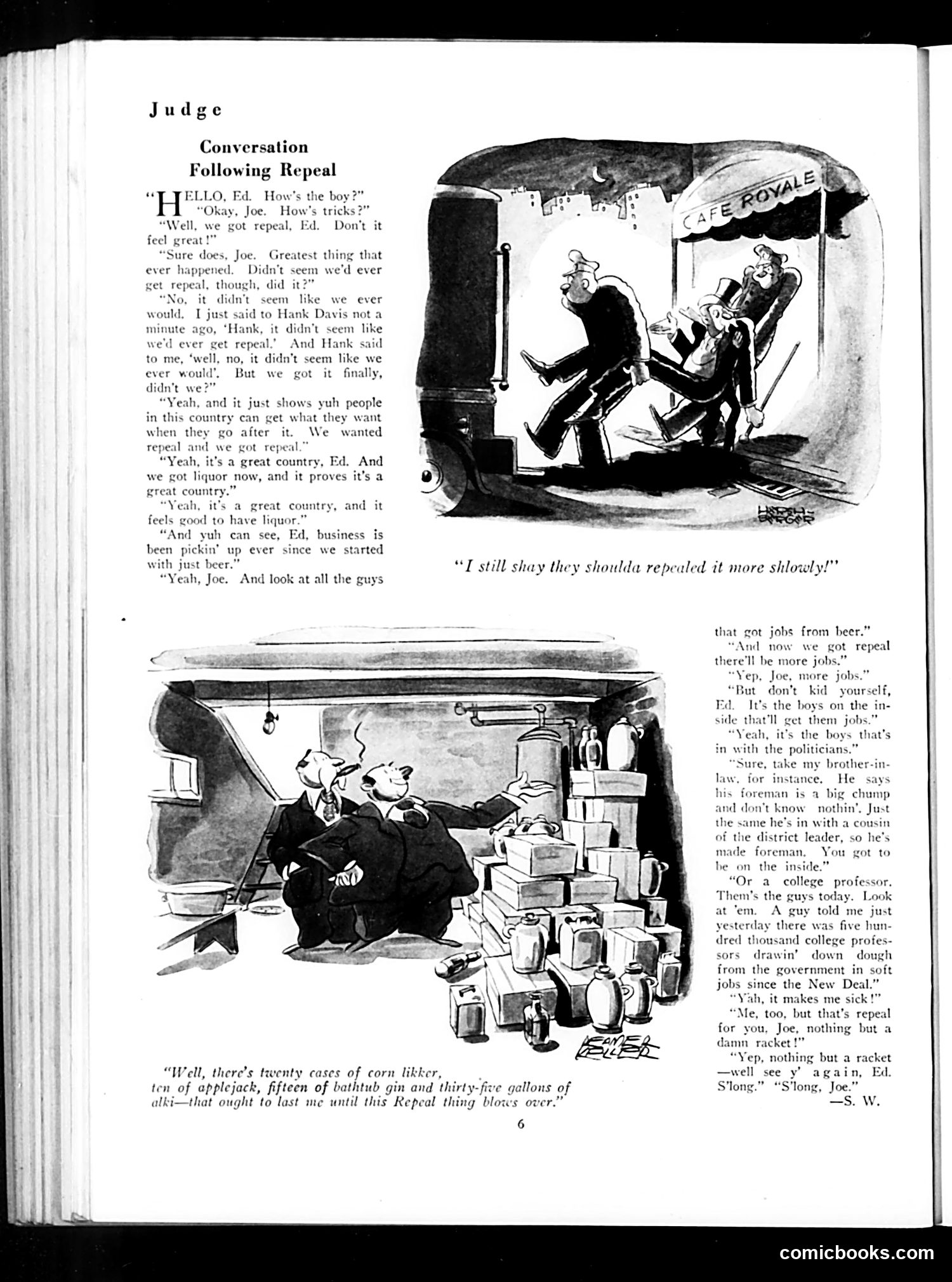
Analysis This page satirizes the consequences of Prohibition's repeal. The conversation between characters named Ed and Joe celebrates the return of legal alcohol, but mocks how quickly it has created new corruption and patronage problems. The two cartoons illustrate the satire: the top shows men relaxing at a cafe, while the bottom depicts two figures surrounded by stacks of cases—representing the bootlegging/distribution industry that has boomed since repeal. The joke targets what the text calls "the boys on the inside" and "the boys that's in with the politicians"—suggesting repeal hasn't eliminated criminal enterprise but rather shifted it into government-connected circles. References to "college professors drawin' down dough from the government in soft jobs" and comparisons to "a big chump foreman" imply New Deal patronage and corruption replaced Prohibition-era bootlegging as the real racket.
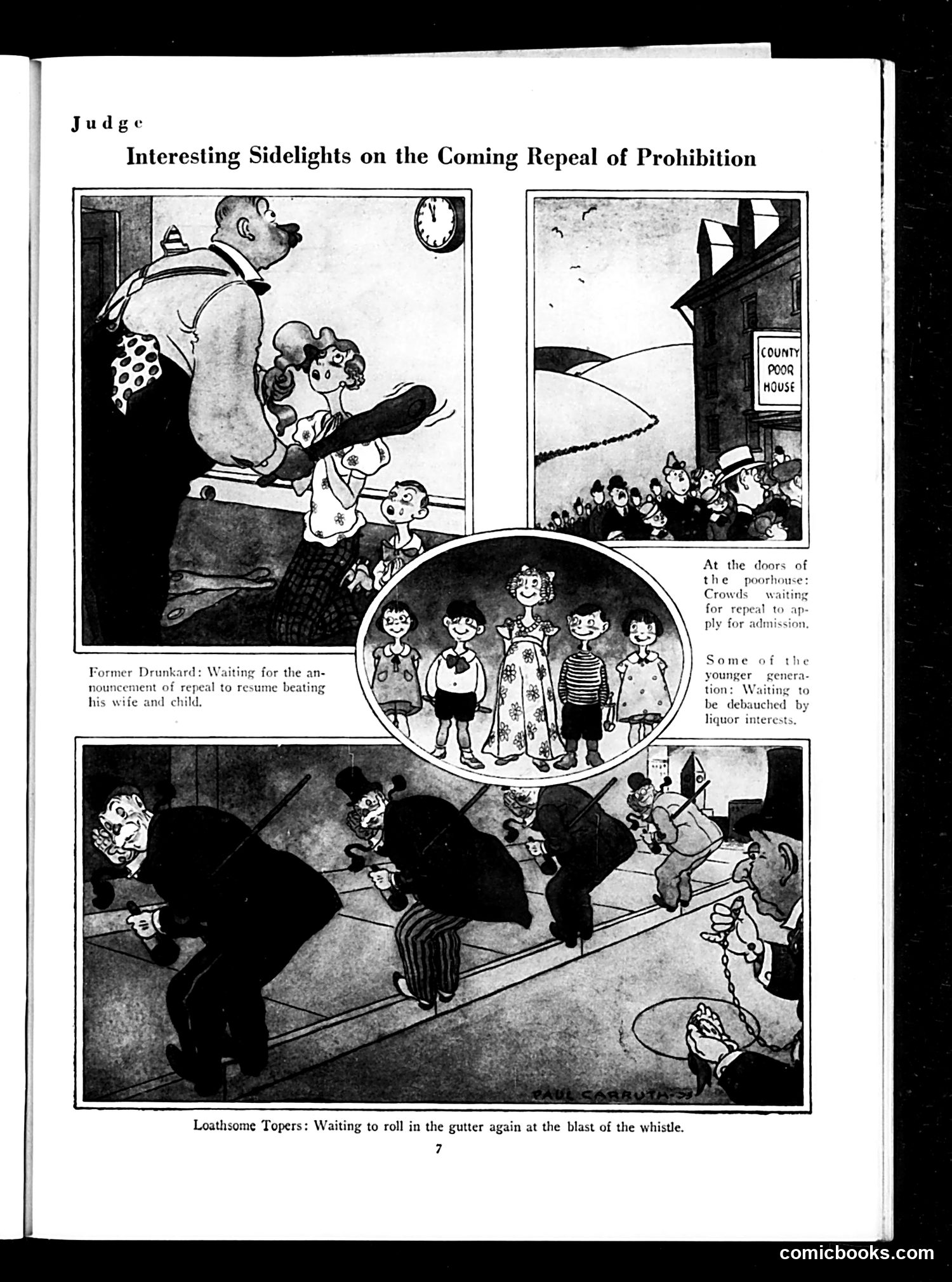
Analysis: "Interesting Sidelights on the Coming Repeal of Prohibition" This Judge magazine page satirizes opposition to Prohibition's repeal (ratified in 1933). The cartoons present apocalyptic scenarios meant to convince readers that ending Prohibition would be catastrophic: Top left: A "former drunkard" eagerly awaits repeal to resume domestic violence against his wife and child—implying alcohol abuse caused family harm. Top right: The "poorhouse" fills with crowds expecting admission once drinking resumes, suggesting alcohol consumption leads to destitution. Center circle: Children representing "the younger generation" might be "debauched by liquor interests"—fear-mongering about youth corruption. Bottom: "Loathsome topers" (habitual drinkers) wait to "roll in the gutter," depicting alcoholics in degradation. The satire cuts both ways: Judge presents these as inevitable consequences of repeal while implicitly mocking prohibitionists' dire predictions as exaggerated propaganda.
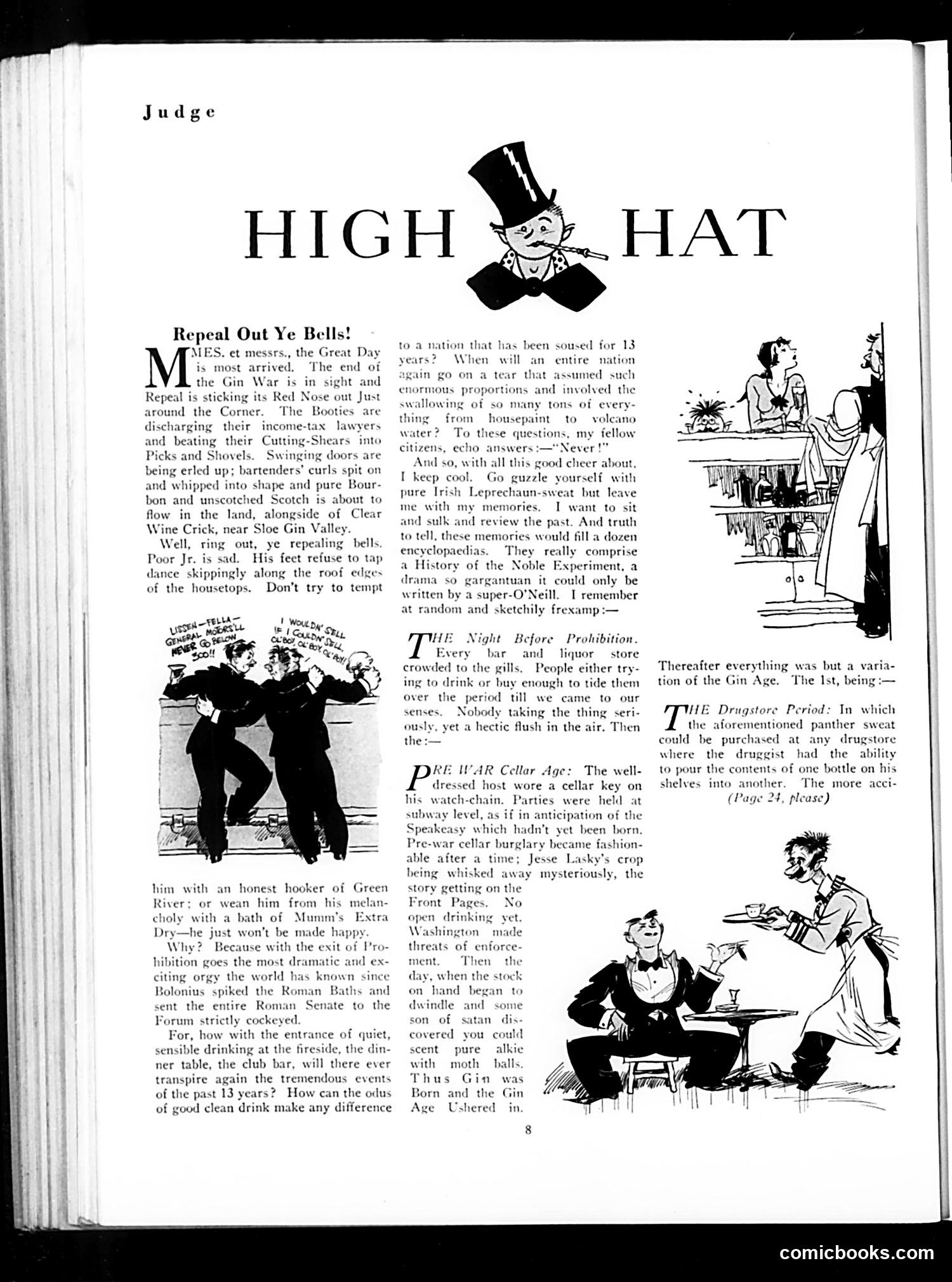
Analysis for Modern Readers This Judge magazine page satirizes the end of Prohibition through the voice of a melancholy character lamenting alcohol's return to legality. The humor operates on multiple levels: The Core Joke: A prohibitionist mourns that Prohibition's repeal eliminates the *drama* and *excitement* that illegal drinking provided. The 13-year period of lawbreaking created memorable chaos—speakeasies, bathtub gin, cellar keys as status symbols, drugstore alcohol schemes—that legal, "sensible drinking" cannot match. Historical Context: The piece references real Prohibition-era phenomena (Jesse Lasky's wine theft, speakeasies) and specific drinking periods: the pre-Prohibition "Gin Age," the "Pre-War Cellar Age" (when hosts stored wine), and the "Drugstore Period" (when pharmacists sold alcohol under the guise of medicinal purposes). The Satire: Judge mocks both prohibitionists' naivety and the drinking culture's excess. The narrator's complaint—that legal drinking lacks excitement—inadvertently reveals Prohibition's true appeal: lawlessness itself, not temperance. Published around 1933 (Prohibition's end), this reflects contemporary debates about alcohol's return.
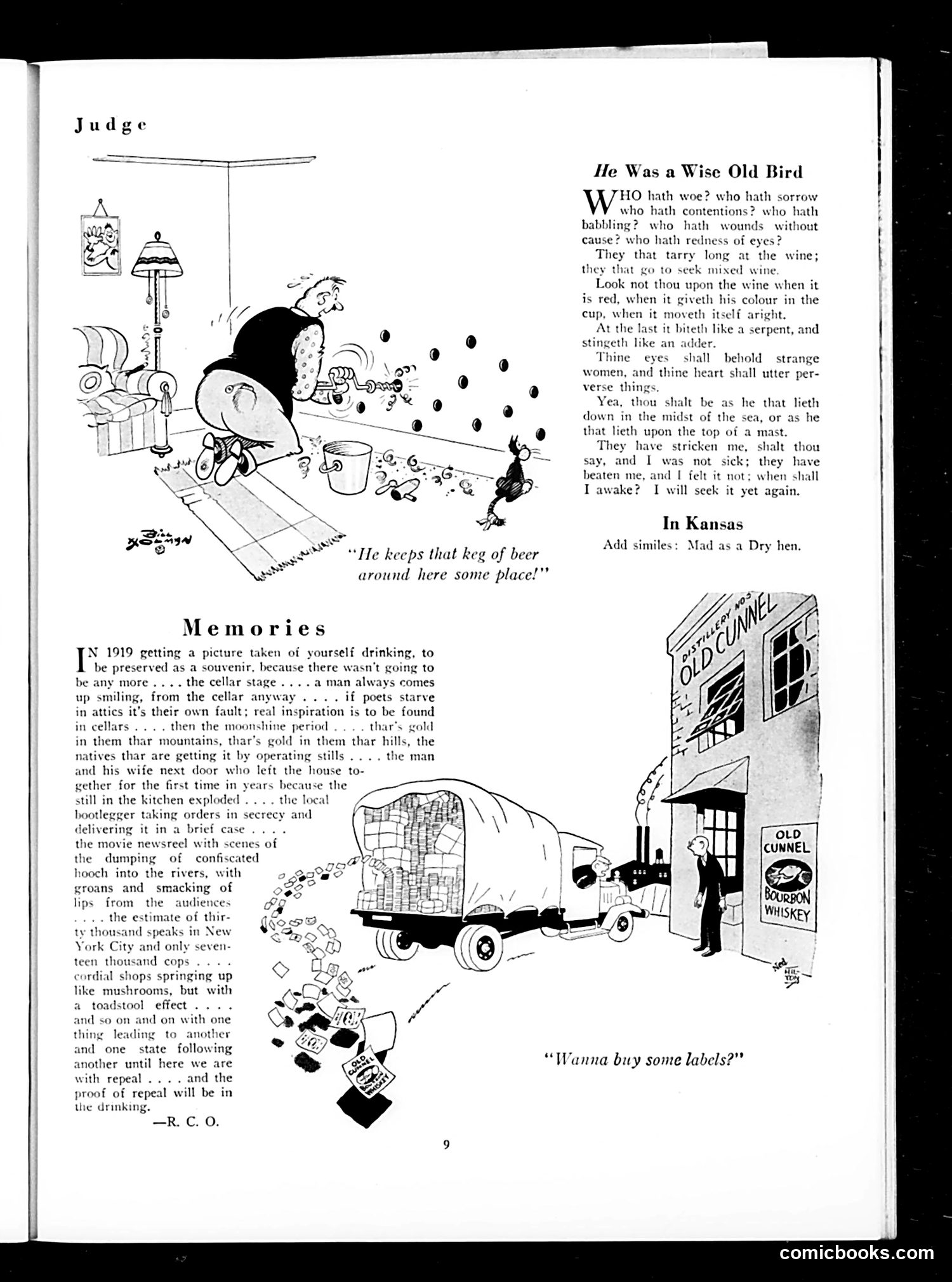
Analysis of Judge Magazine Page This page satirizes Prohibition era America (likely early 1920s). The top cartoon "Judge" shows a drunk man juggling bottles while a small figure chases him—mocking the futility of enforcing alcohol bans. "He Was a Wise Old Bird" pairs biblical warnings against drunkenness with contemporary Kansas references, suggesting the moral case against drinking proved ineffective. The "Memories" section by R.C.O. is nostalgic satire about Prohibition's actual effects: backyard stills, bootleggers, illegal speakeasies (thirty thousand in NYC versus seventeen thousand cops), confiscated liquor dumps, and the inevitable rise of "cordial shops" selling labels—euphemisms for illegal alcohol distribution networks. "In Kansas" depicts a bootlegger's truck, humorously asking "Wanna buy some labels?"—code for purchasing illegal liquor. The overall point: despite Prohibition's legal apparatus, Americans continued drinking through underground networks that flourished during the ban, making the law's enforcement impossible and its intent laughable.
"The Theatre" by Judge Magazine This is a theater review column by Judge magazine critic George Jean Nathan. The page discusses whether theater is truly "dead" — a perennial claim Nathan dismisses as absurd, pointing to packed houses proving otherwise. Nathan reviews Eugene O'Neill's "Ah, Wilderness!" — calling it O'Neill's most important recent work. It's a folk comedy about an American family from 27 years prior, notable for abandoning O'Neill's experimental techniques (Expressionism, Impressionism) to return to simple, traditional dramaturgy like Ibsen. Nathan also mentions Irving Berlin's revue "As Thousands Cheer," describing it as featuring caricatures of world celebrities set to Berlin's music. The piece dismisses bad plays that opened the season as "dramatic zombies," while celebrating genuine theatrical hits as evidence the medium thrives. Nathan's sardonic tone throughout mocks critics who repeatedly pronounce theater dead while audiences pack venues.
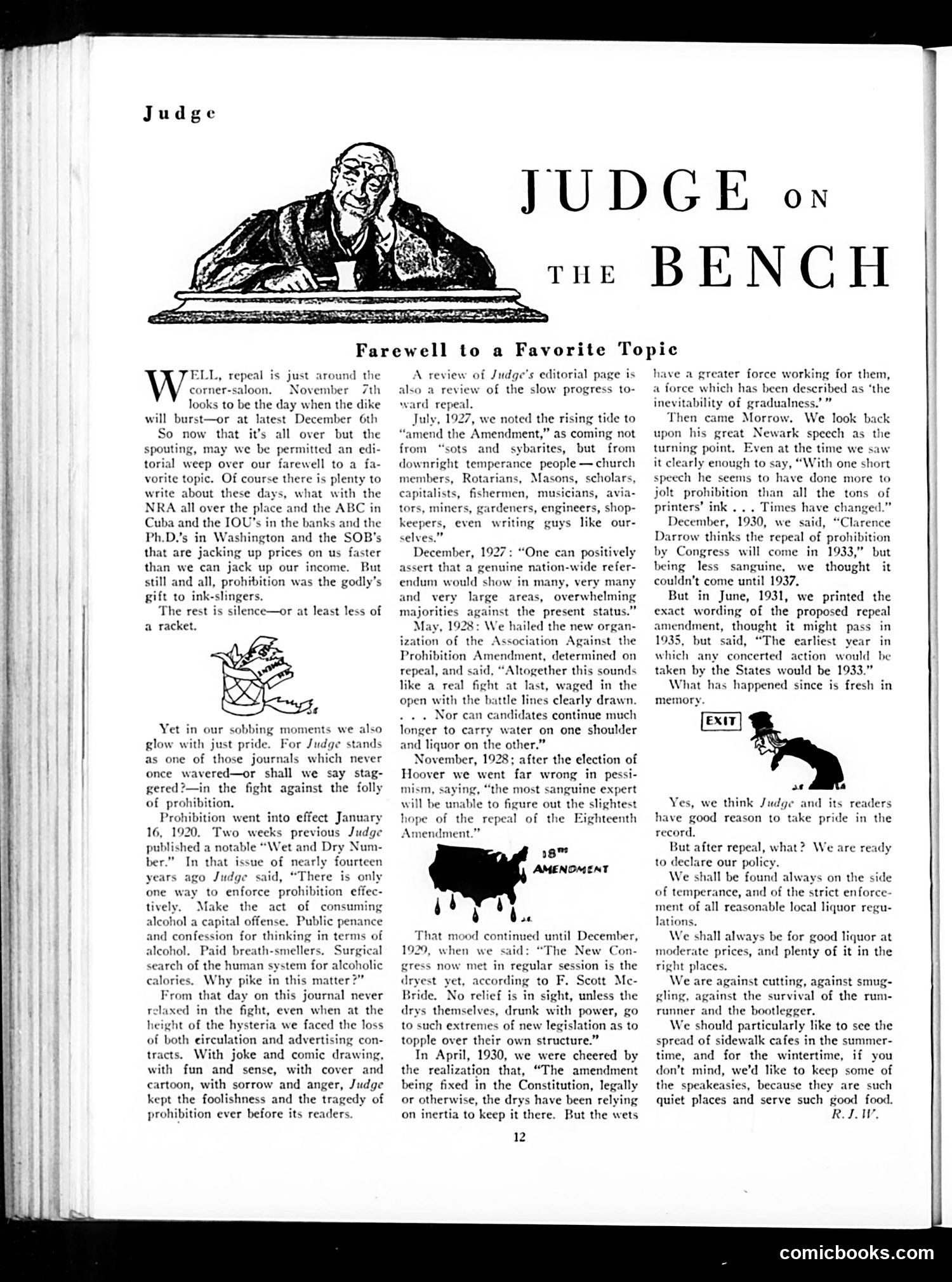
"Judge on the Bench: Farewell to a Favorite Topic" This editorial celebrates Judge magazine's consistent opposition to Prohibition, which is about to be repealed (expected November or December 1933). The piece traces the magazine's coverage from Prohibition's 1920 enactment through its anticipated repeal, noting that Judge "never once wavered" in satirizing the policy through cartoons and commentary. The article references key moments: the 1927 "rising tide" toward amendment repeal; the 1928 Association Against the Prohibition Amendment; and Hoover's 1928 election (when Judge wrongly predicted no repeal was likely). It credits increasing public opposition to forces beyond "sots and sybarites"—respectable citizens like Rotarians, church members, and capitalists. The cartoons (a judge at his bench, a cow marked "18th Amendment") are straightforward visual satire mocking Prohibition's authority and impact. The piece bids farewell to what Judge considers its most productive subject for satirical ink-slinging, while acknowledging new topics (NRA, banking) now demand attention.
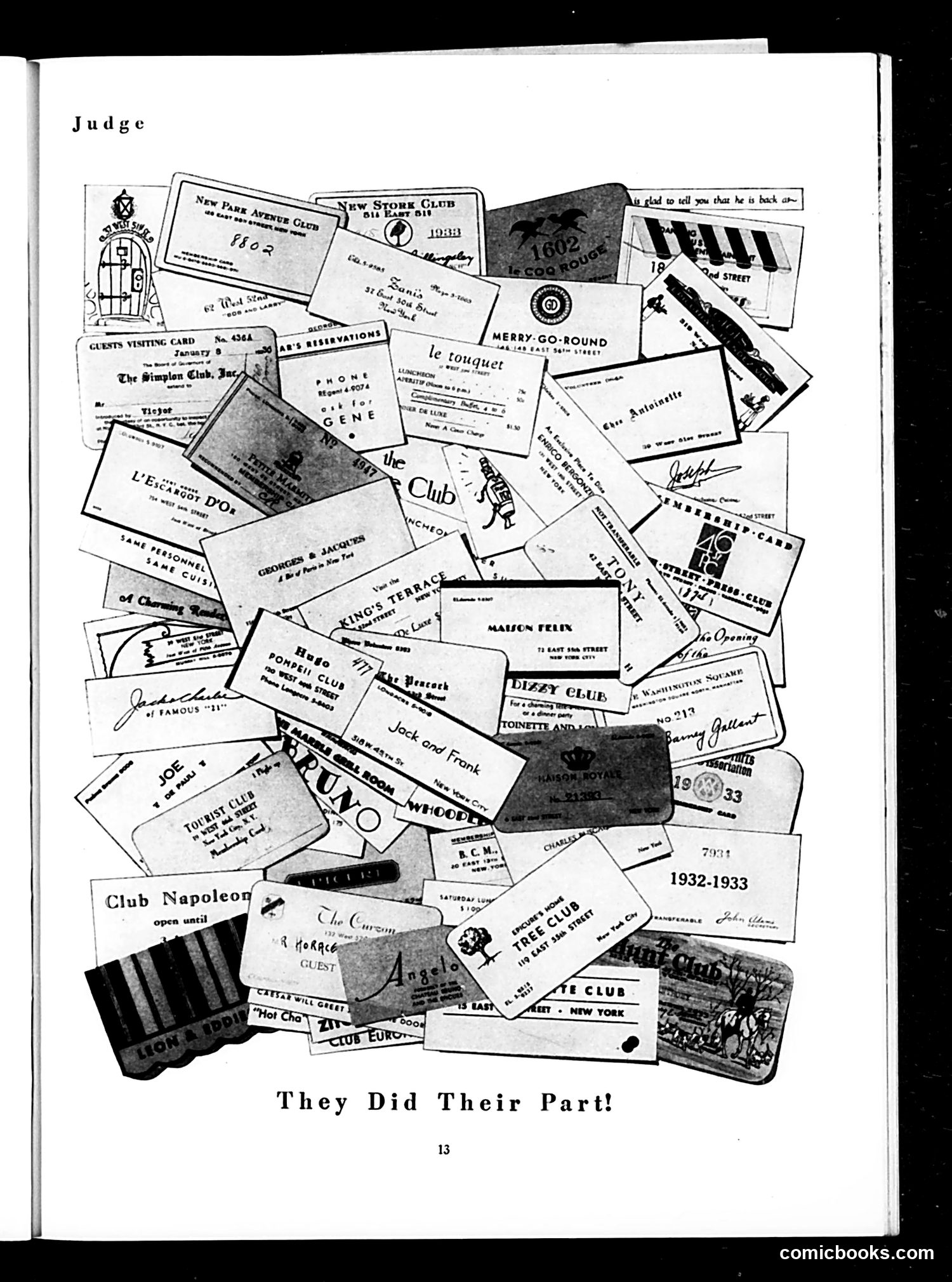
Judge Magazine Page Analysis This page is primarily a collage of nightclub and restaurant business cards and membership passes from 1932-1933 New York establishments, arranged to form a visual composition. Visible venues include the Dizzy Club, Club Napoleon, Merry-Go-Round, the Runo Club, and various others. The caption "They Did Their Part!" appears to be satirizing Prohibition-era speakeasies and illicit drinking establishments. During Prohibition (1920-1933), such clubs proliferated illegally. The collage likely mocks how numerous these venues were and their role in flouting alcohol laws. The page functions as social satire highlighting the prevalence of underground nightlife culture, possibly suggesting these establishments were "doing their part" to undermine federal law—a common Judge magazine critique of Prohibition's failure to eliminate drinking culture.
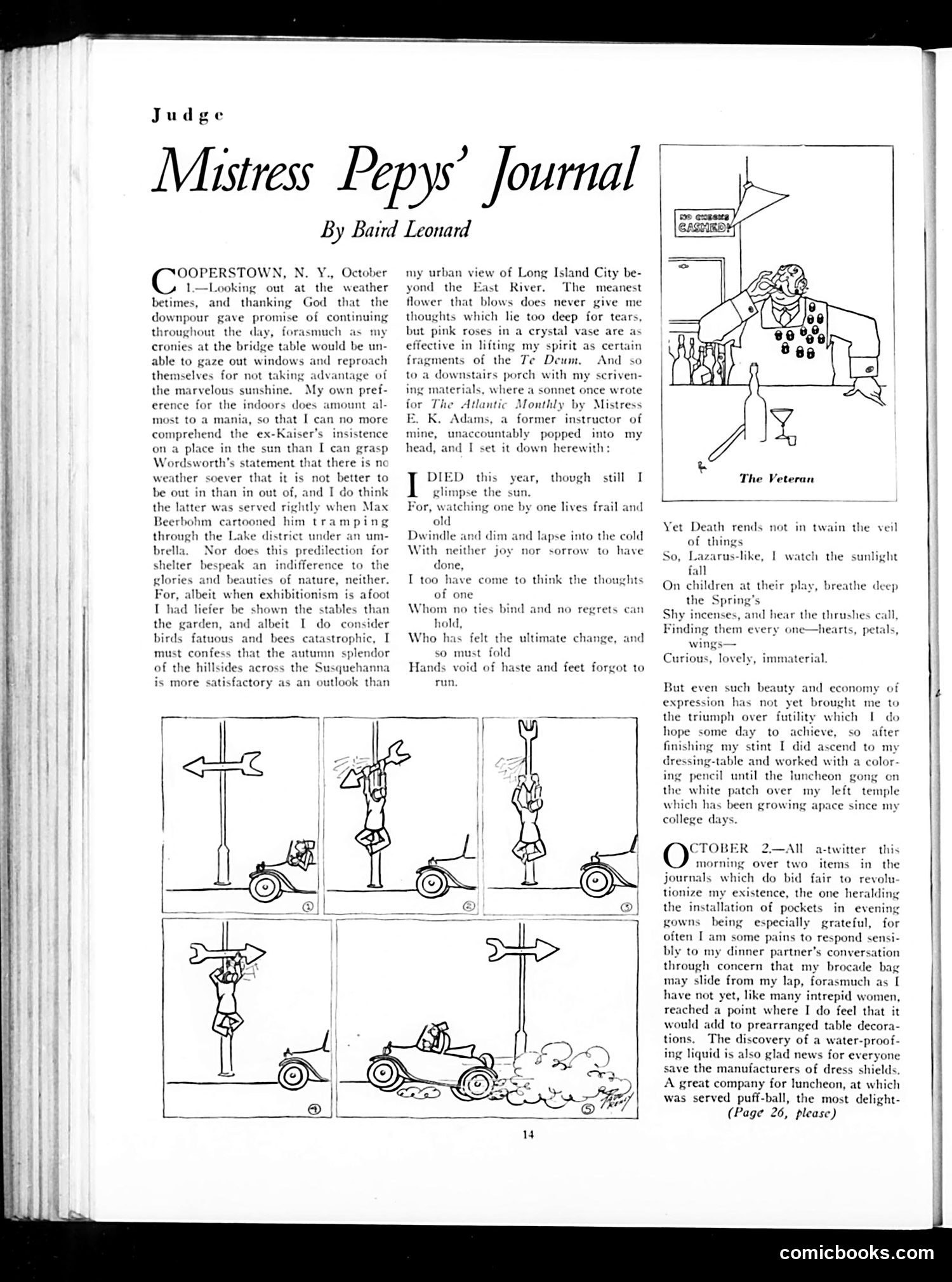
Mistress Pepys' Journal - Analysis This is a humorous column mimicking Samuel Pepys' famous diary style, written by Baird Leonard for *Judge* magazine. The narrator is a woman chronicling mundane domestic life with mock-pretentious literary references. The accompanying comic strip (below the text) shows a figure on a tricycle performing increasingly absurd acrobatic poses—suggesting physical comedy or slapstick humor, though the specific joke's context is unclear without additional pages. The journal itself satirizes: - Pretentious intellectualism: Name-dropping Wordsworth, the Te Deum, and Lazarus while discussing trivialities like bridge games and dress pockets - Women's fashion anxieties: Concerns about brooches sliding, lack of pockets in evening gowns, and dress shields - Indoor/outdoor snobbery: Defending preference for staying indoors against claims that outdoor life is superior The satire mocks how educated people dress up ordinary complaints in grandiose language. The sonnet inserted mid-diary about death and futility undercuts this pretension further.
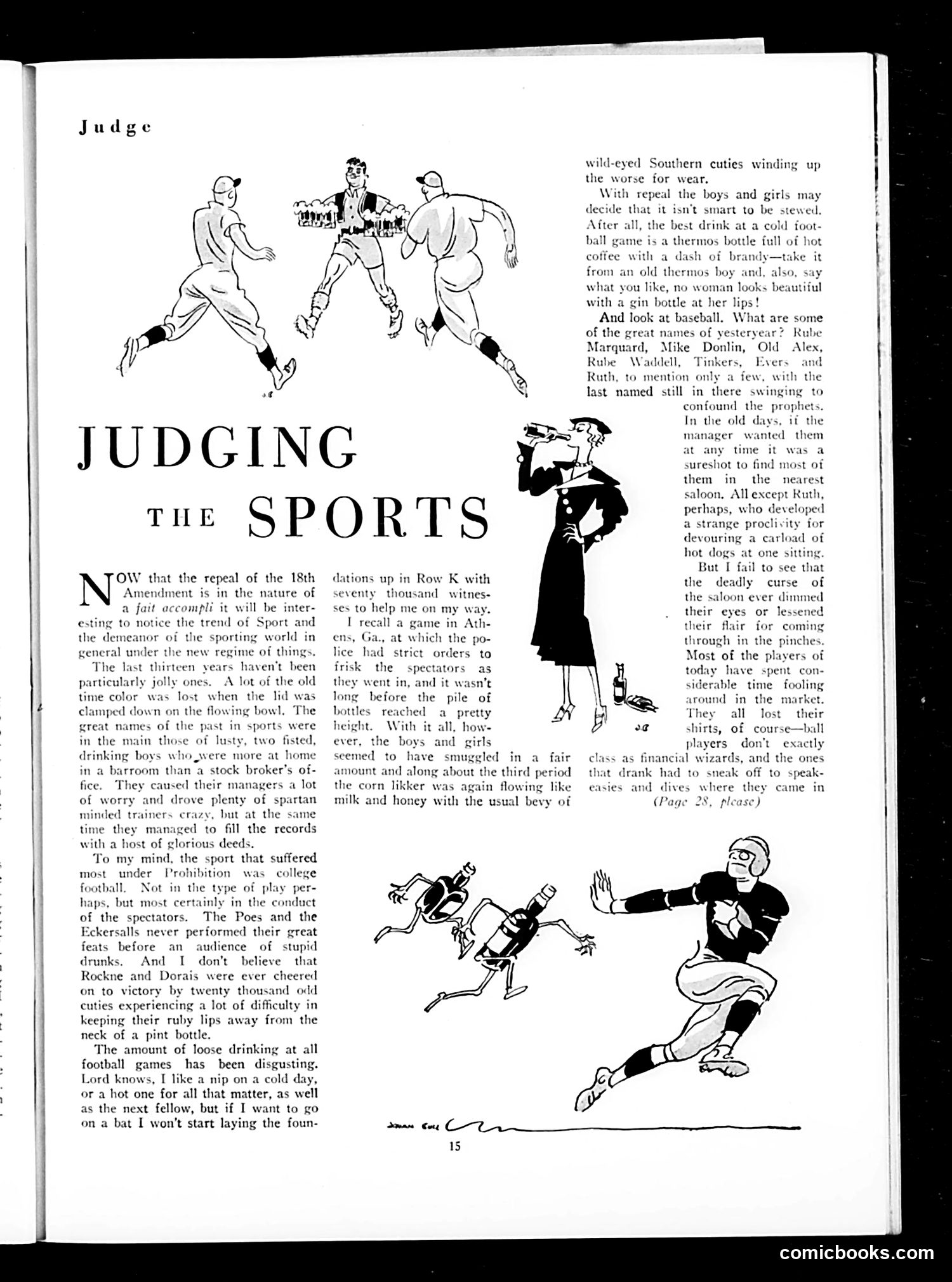
"Judging the Sports" - Analysis This satirical piece argues that Prohibition's repeal will benefit sports by restoring the "old time color" that made athletics exciting. The author claims Prohibition harmed sports by changing athlete and spectator behavior. He nostalgically references legendary baseball players (Marquard, Donlin, Waddell, Ruth, Tinkers) who were famously hard-drinking men, suggesting their excessive alcohol consumption somehow enhanced their performance and character. The satire's central irony: the author criticizes rampant, chaotic drinking at football games (seventy thousand witnesses smuggling bottles past police), yet romanticizes the same behavior in athletes of an earlier era. He laments that modern players have become "financial wizards" and health-conscious, implying this represents a decline. The accompanying illustrations show football and baseball players in action, contrasting with a woman drinking from a flask—depicting the casual drinking culture the author discusses. For modern readers: this reveals how Prohibition's end was celebrated in some circles as restoring "authentic" American sporting culture, even while acknowledging widespread drinking problems.
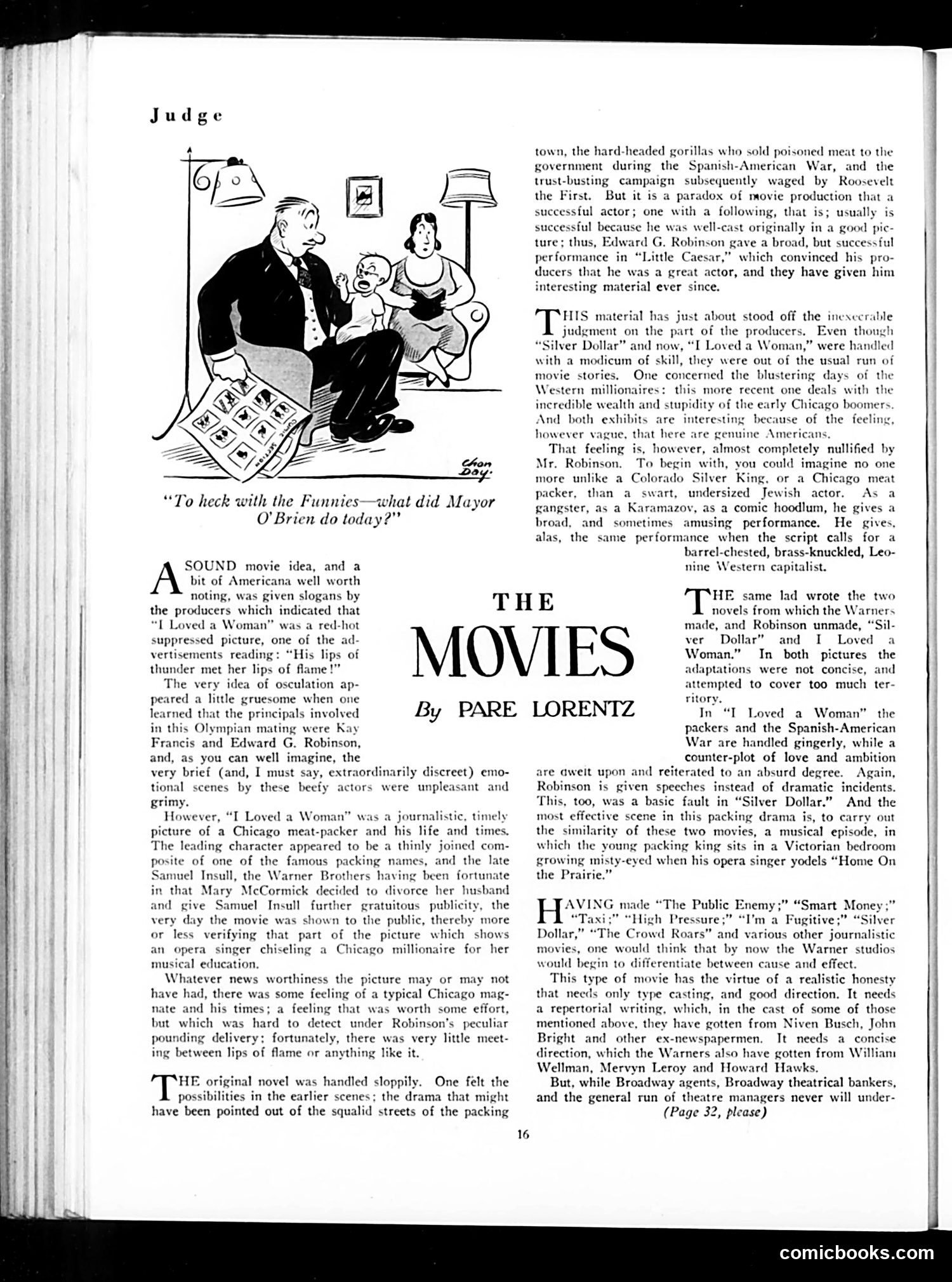
Explanation for Modern Readers The cartoon satirizes the public's obsession with newspaper comic strips ("the Funnies") over serious civic news. A father figure complains that his family cares more about comic strips than about what Mayor O'Brien actually accomplished that day—suggesting comics were consuming attention that should go to local politics and governance. The article reviews Edward G. Robinson films, criticizing his wooden acting style. The author argues Robinson succeeds only because he was well-cast in *Little Caesar*—yet producers keep giving him unsuitable roles (wealthy capitalists, meat packers) where his "swart, undersized" appearance and "peculiar pounding delivery" undermine authenticity. The implicit critique is that Hollywood casts by star power rather than suitability, and that Robinson's limitations go unrecognized because of his early success. The piece reflects 1930s concerns about both mass entertainment's cultural dominance and Hollywood's formulaic production practices.
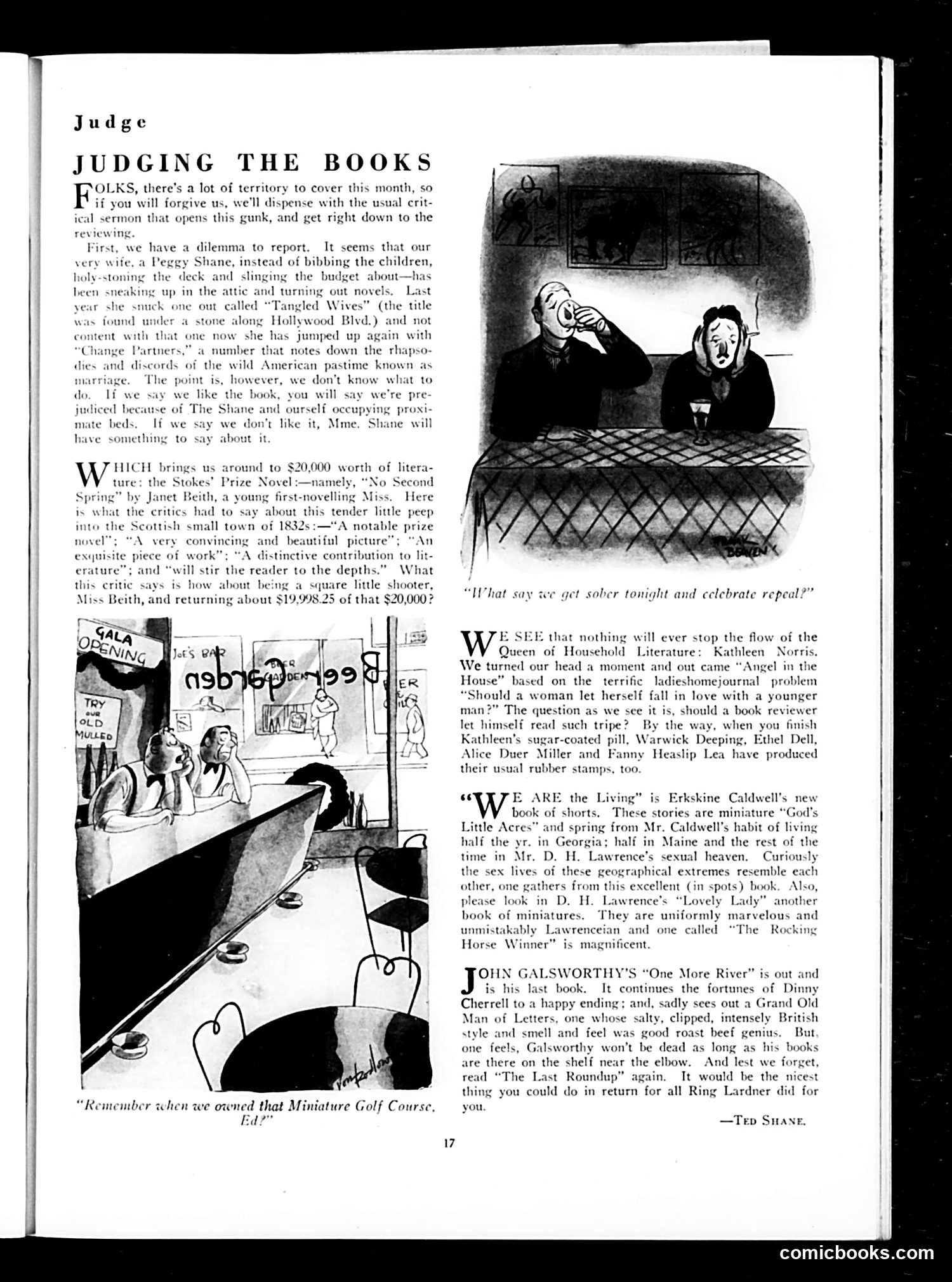
Judge Magazine Book Review Page This is a book review column titled "Judging the Books" by Ted Shane. The two cartoons illustrate satirical commentary on contemporary literature and social behavior. Top cartoon: Shows a couple in bed at night. The caption "What say we get sober tonight and celebrate repeal?" references the recent end of Prohibition (1933), satirizing how Americans immediately planned to resume drinking after its repeal. Bottom cartoon: Depicts a miniature golf course with the caption "Remember when we owned that Miniature Golf Course, Ed?" This mocks the miniature golf craze of the early 1930s—a fad business venture many Americans invested in during the Depression era. The review itself skewers popular authors of the period (Kathleen Norris, Erskine Caldwell, John Galsworthy) for repetitive, formulaic writing, while defending Janet Beith's prize novel. The column humorously opens by noting the critic's wife (Peggy Shane) has become a novelist, creating a conflict of interest in reviewing her work.
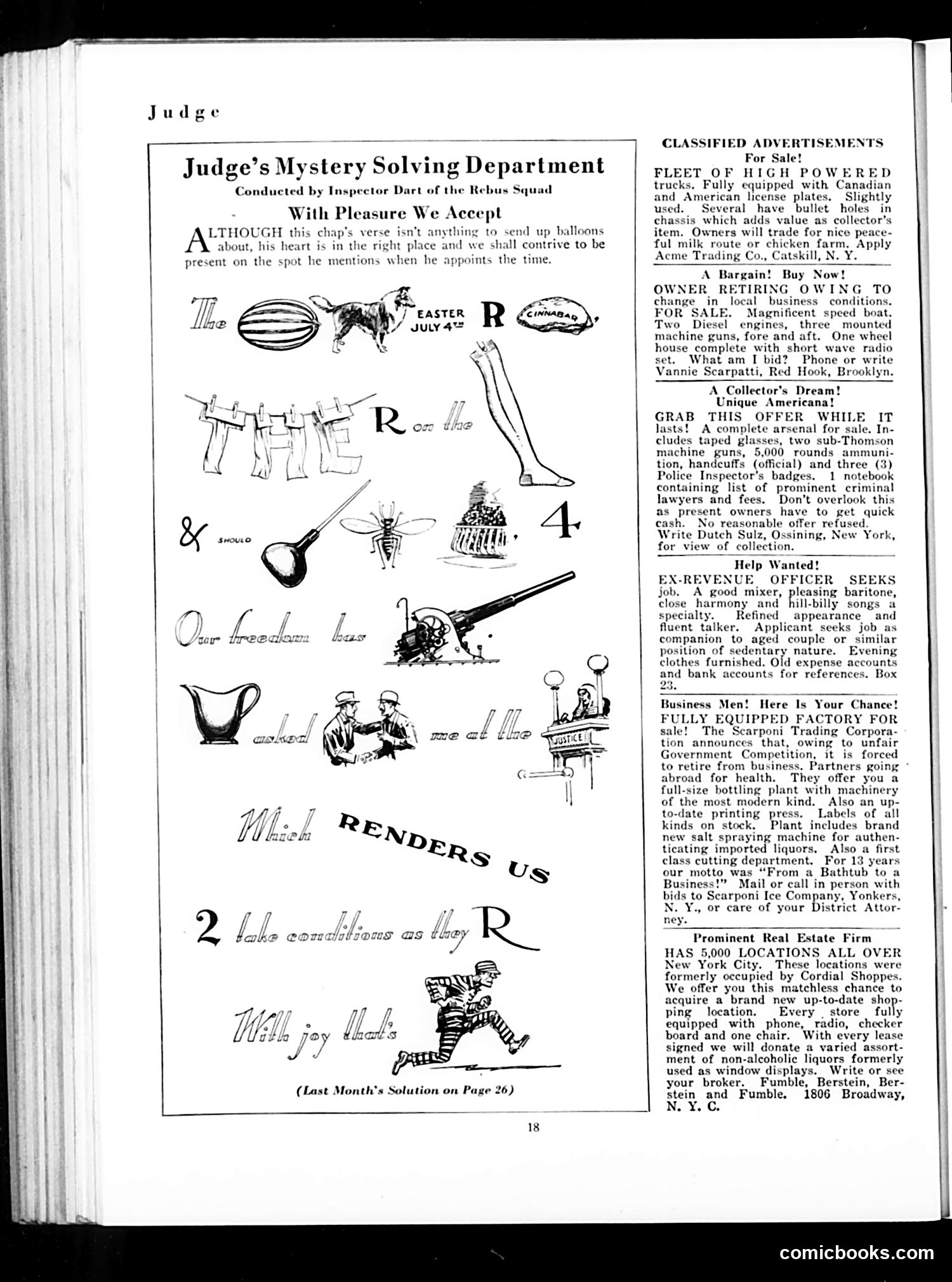
Judge Magazine Page Analysis This page contains a rebus puzzle (visual word game) in the "Mystery Solving Department" section, where readers must decipher images and text to solve a riddle. The solution appears on page 26. The bulk of the page consists of satirical classified advertisements mocking Prohibition-era criminality. The fake ads are thinly-veiled jokes about bootlegging, organized crime, and police corruption during the 1920s alcohol ban. References include: - A "speed boat" with machine guns (used for smuggling) - An "arsenal" and police badges (criminal equipment) - A "bottling plant" and "printing press" (illegal liquor production) - "Cordial Shoppes" (speakeasy fronts) - Mobster names like "Scarpatti" and "Scarponi" - An "ex-revenue officer" (corrupt Prohibition agent) The satire suggests how widespread and normalized criminal enterprise had become under Prohibition, with even "respectable" business transactions veiled in criminal apparatus. This reflects Judge's commentary on the law's ineffectiveness and societal corruption it enabled.
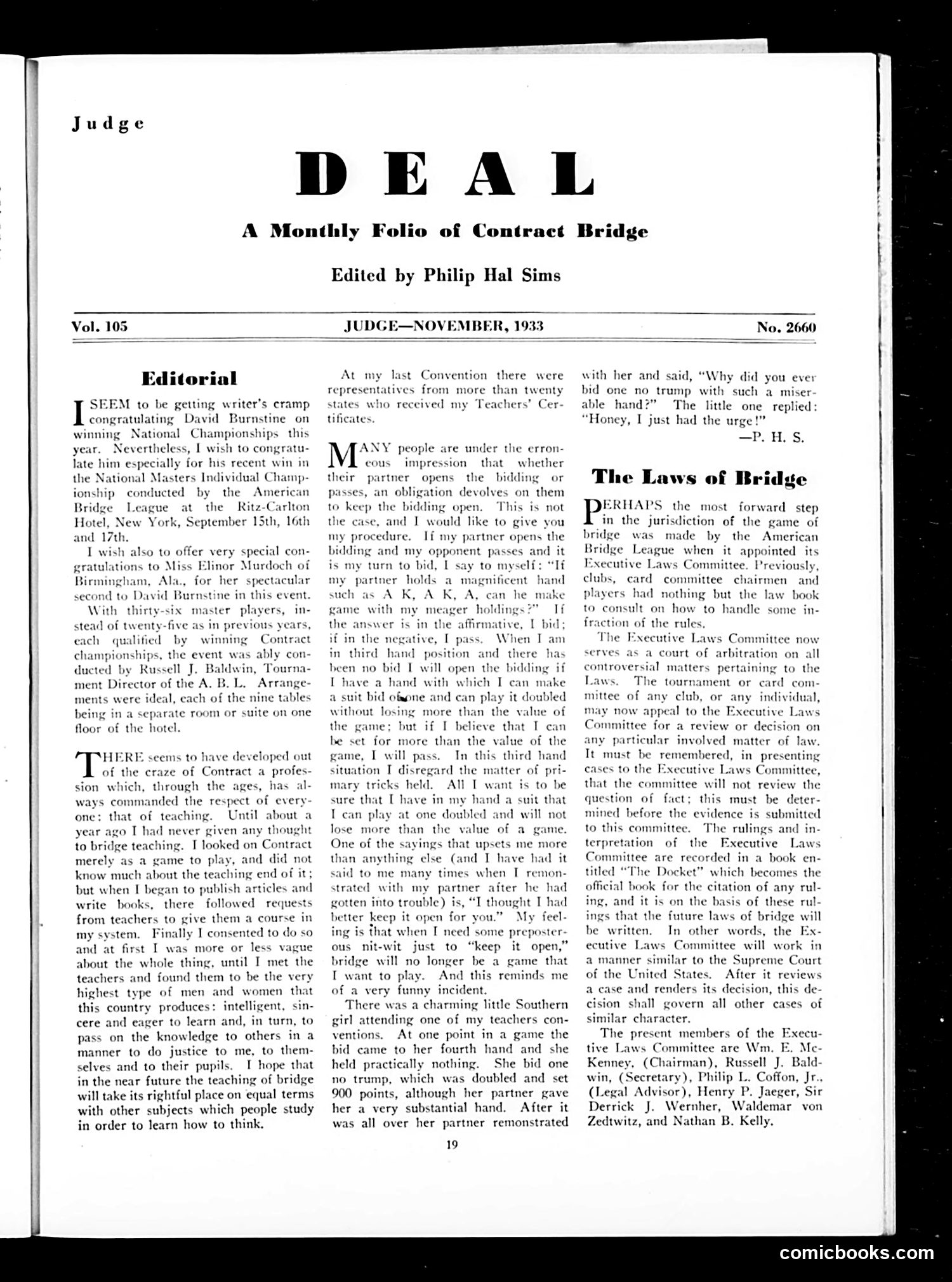
Analysis of Judge Magazine Page (November 1933) This page is primarily editorial and instructional content about contract bridge, not a political cartoon. It's the opening of "DEAL," a monthly bridge instruction column edited by Philip Hal Sims. The editorial discusses: - David Burnstine's recent victory in the American Bridge League's National Masters Championship - The legitimization of bridge teaching as a respectable profession, previously dismissed as mere recreation - Bridge bidding strategy, explaining proper procedure when one's partner opens bidding The text includes an anecdote about a Southern woman player who bid one no-trump with nearly nothing and lost 900 points—illustrating poor judgment. Context for modern readers: This reflects 1930s enthusiasm for contract bridge as both competitive sport and intellectual pursuit. The magazine devoted serious editorial space to the game, suggesting it was a significant cultural phenomenon of the era, attracting national championship tournaments and widespread instruction. No political satire or caricature appears on this page.
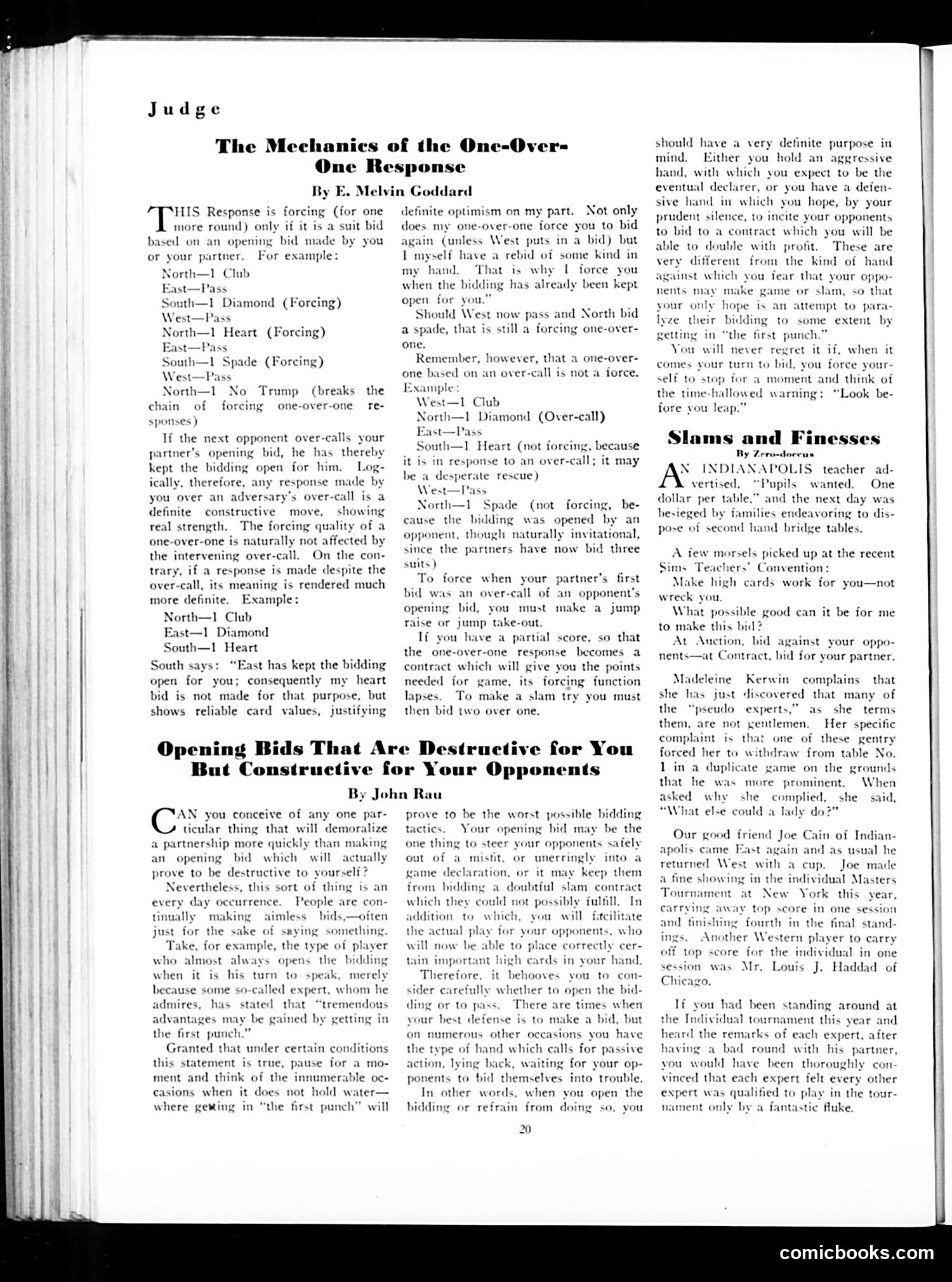
Judge Magazine Bridge Column Analysis This page contains bridge instruction articles, not political cartoons or satire. The content consists of two instructional pieces on contract bridge bidding strategy: 1. "The Mechanics of the One-Over-One Response" by E. Melvin Goddard explains forcing bids and proper responses in bridge. 2. "Opening Bids That Are Destructive for You But Constructive for Your Opponents" by John Rau warns against mindlessly opening bids just to "get in the first punch," arguing this common practice often helps opponents more than helps your partnership. There is also a brief society gossip item titled "Slams and Finesses" about Indianapolis teachers and socialites at bridge tournaments. This represents Judge magazine's non-satirical editorial content—bridge was apparently a popular leisure activity for the magazine's educated, middle-to-upper-class readership of this era. The page demonstrates Judge's broader appeal beyond political humor.
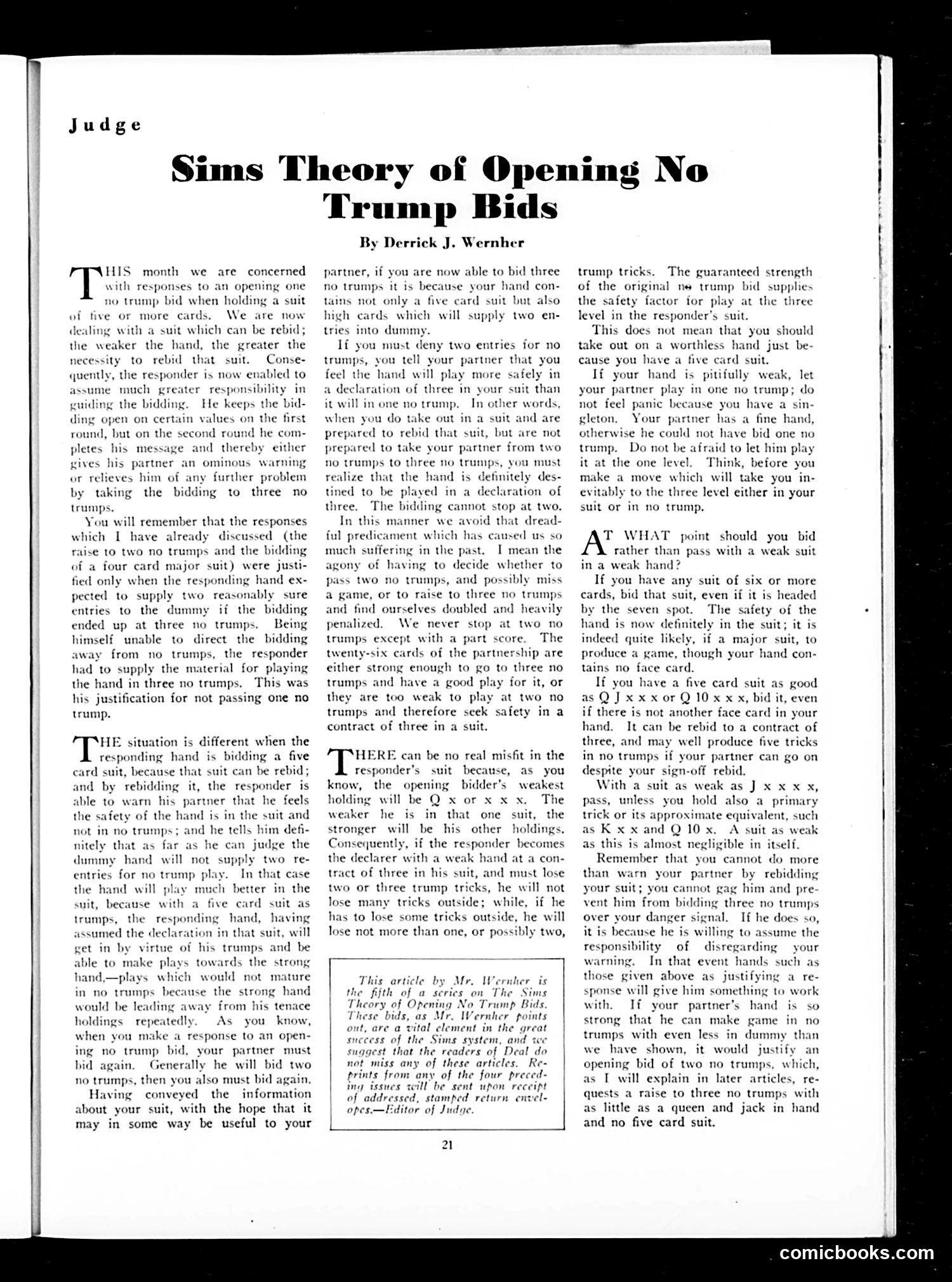
"Sims Theory of Opening No Trump Bids" This page is not a political cartoon but rather a bridge strategy article by Derrick J. Wernher explaining contract bridge bidding conventions. It appears in *Judge*, a satirical magazine, but this particular content is purely instructional about card game tactics. The article discusses how a responder should bid when their partner opens with "one no trump" and the responder holds a five-card suit. Wernher explains the logic for rebidding suits versus playing in no trumps, and argues his approach prevents the "dreadful predicament" of uncertainty between passing two no trumps or risking a doubled penalty at three. There are no political figures, social satire, or contemporary references—this is technical bridge instruction using *Judge's* editorial space for a specialized audience of card game players.
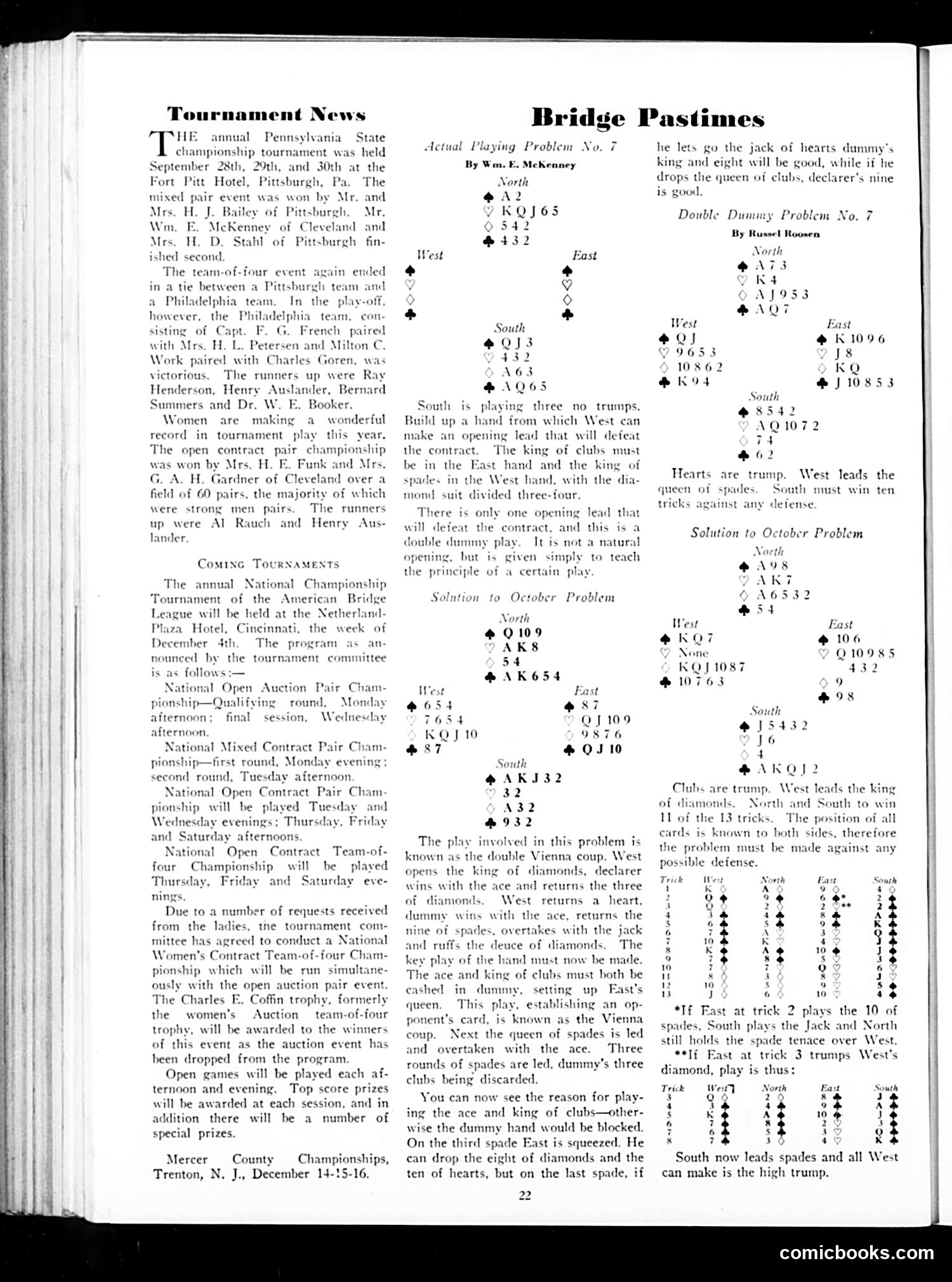
Bridge Pastimes Page Analysis This page contains no political cartoons or satirical content. Instead, it is a specialized bridge (card game) section from Judge magazine featuring: 1. Tournament News: Reports on Pennsylvania State championship results, listing winners like Mr. and Mrs. H. J. Bailey and noting women's strong tournament performance. 2. Upcoming Tournaments: Announcements for the National Championship at Cincinnati's Netherland-Plaza Hotel in December, detailing various competition categories including a newly-added Women's Contract Team-of-Four Championship. 3. Bridge Problems: Two detailed hands with card diagrams ("Actual Playing Problem No. 7" and "Double Dummy Problem No. 7") by bridge expert Wm. E. McKenney, explaining advanced techniques like the "Vienna coup." The content is instructional and reportorial—aimed at bridge enthusiasts—rather than satirical. This reflects Judge's diverse editorial mix beyond political humor.
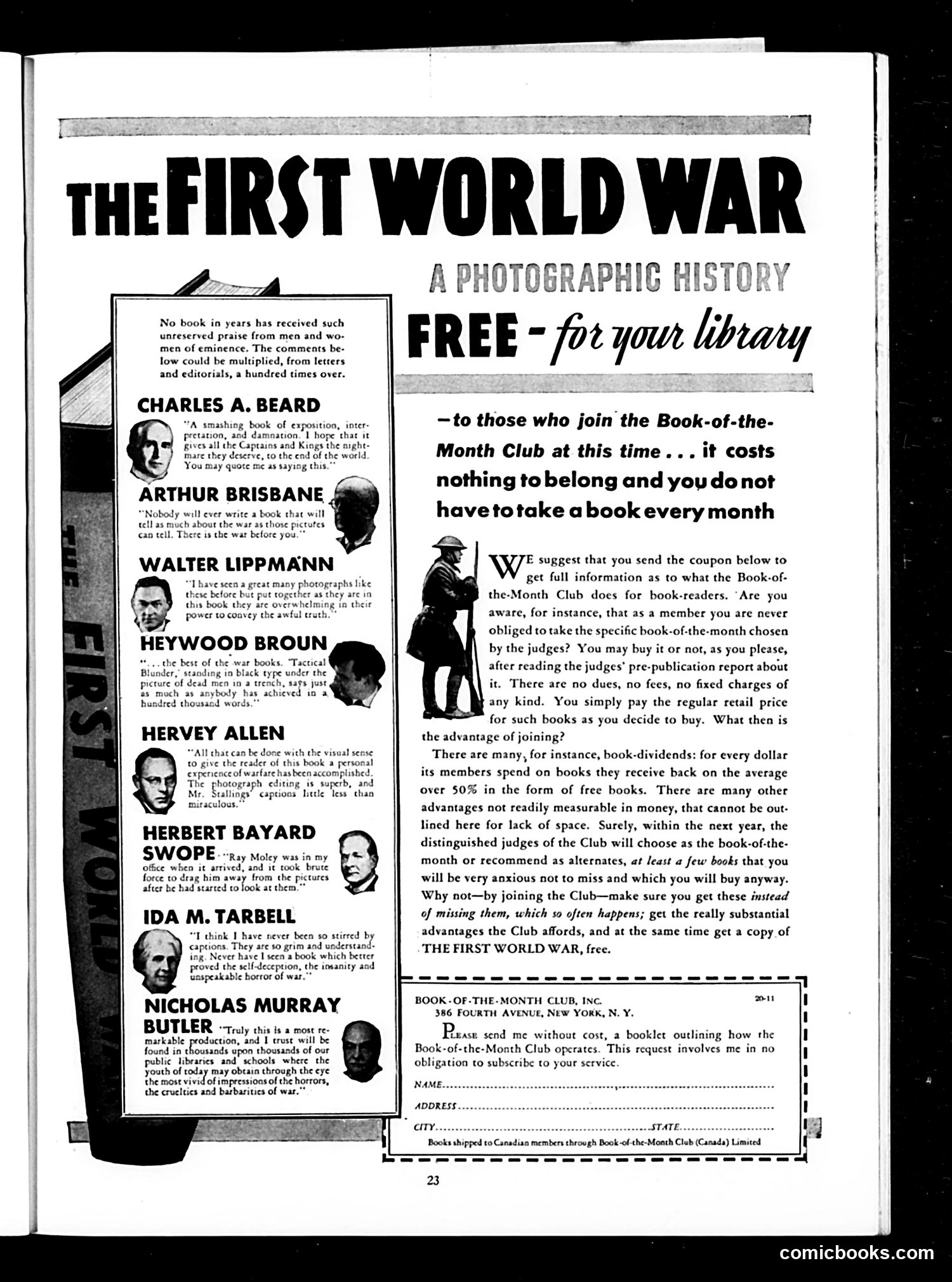
What This Page Means This is primarily advertising, not satire. It promotes "The First World War: A Photographic History" and the Book-of-the-Month Club. The left column features endorsements from prominent American intellectuals and journalists of the era—Charles A. Beard, Arthur Brisbane, Walter Lippmann, Heywood Broun, Ida M. Tarbell, and Nicholas Murray Butler. These were genuinely influential figures whose praise lent credibility to the book. The right side is a sales pitch for the Book-of-the-Month Club membership, emphasizing benefits: free books as "dividends," no mandatory purchases, and—crucially—this WWI photography book offered free to new members. The appeal targets educated, affluent readers concerned with serious topics. The repeated emphasis on the book's power to show war's "horrors" and "barbarities" suggests post-WWI America's complex relationship with the conflict—marketed as educational and morally instructive rather than jingoistic. This is straightforward commercial messaging rather than satire or political commentary.
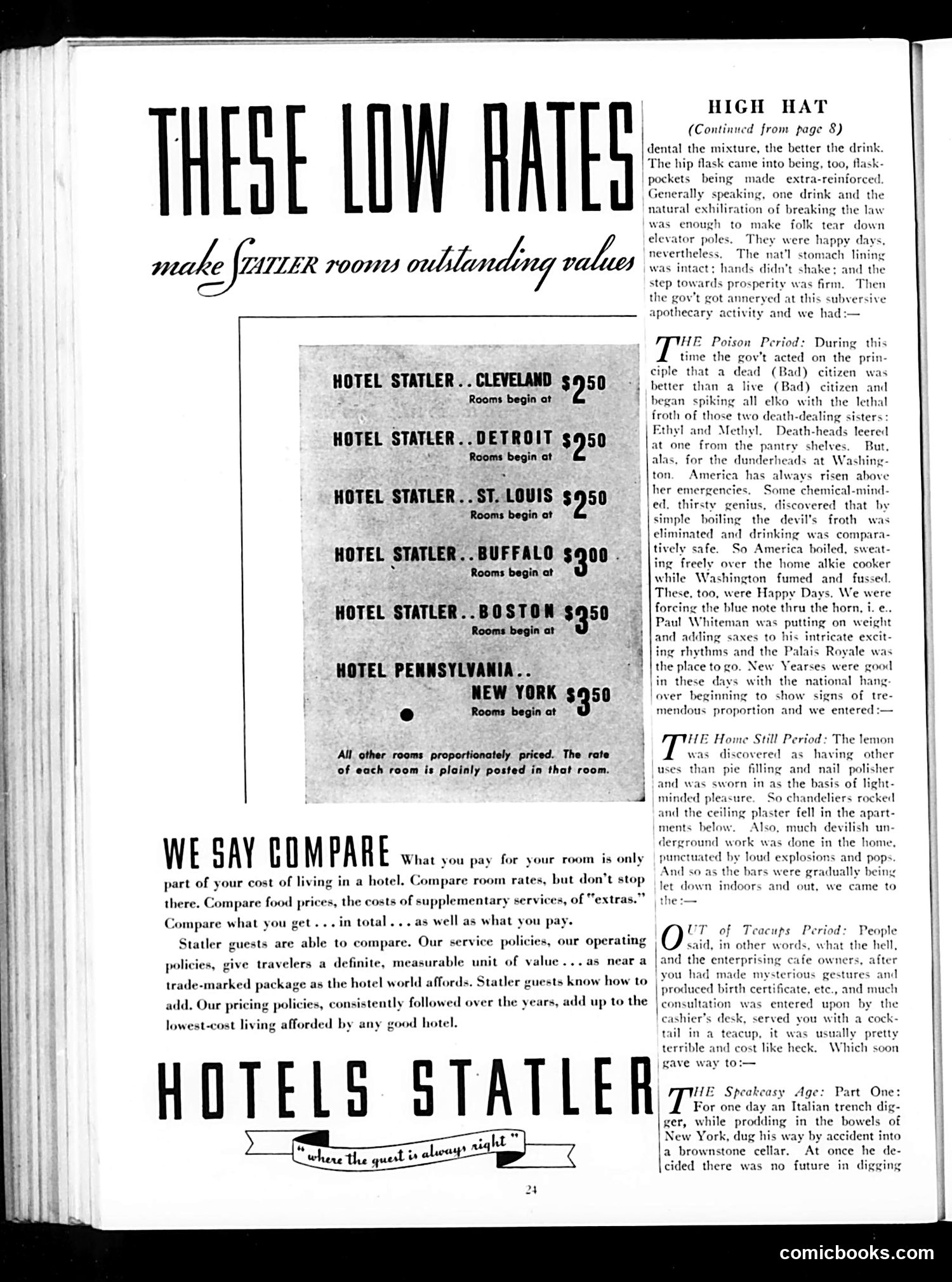
Analysis This page is primarily a Hotel Statler advertisement, not a political cartoon. The ad promotes budget hotel rooms across major American cities (Cleveland, Detroit, St. Louis, Buffalo, Boston, New York) at $2.50-$3.00 per night, emphasizing value and transparent pricing. The right column contains a humorous essay titled "HIGH HAT" (continued from page 8) that satirizes Prohibition-era American drinking culture. It chronicles periods of illegal alcohol consumption through nicknames: the "Poison Period" (when the government spiked alcohol with deadly denaturants to discourage drinking), the "Home Still Period" (homemade distillation), the "Out of Teacups Period" (speakeasies disguising drinks), and the emerging "Speakeasy Age." The satire mocks both government heavy-handedness and Americans' creative workarounds, while celebrating jazz-age excess (referencing bandleader Paul Whiteman). The tone is nostalgic and darkly humorous about Prohibition's failures and unintended consequences—a common Judge magazine stance during the 1920s-30s.
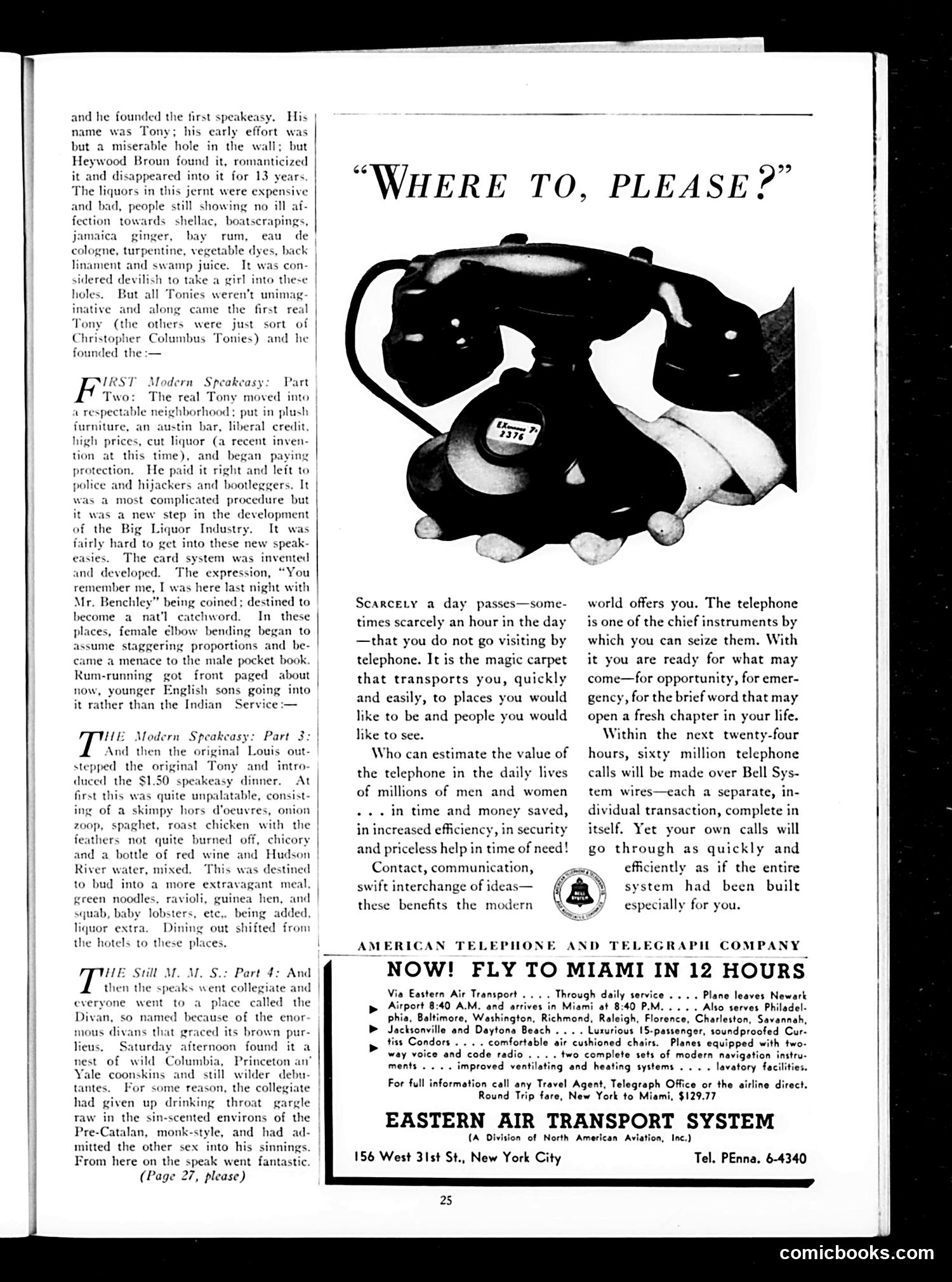
Analysis of Judge Magazine Page Content This page is primarily advertising, not political satire. The main content consists of two distinct elements: Left side: A humorous article titled "The Modern Speakeasy" (Parts 1-4) satirizing Prohibition-era speakeasies—illicit bars operating during the alcohol ban. It traces the evolution from crude underground establishments to respectable venues with protection payments to police, card-based membership systems, and eventually upscale dinner service. The humor targets the absurdity and corruption of Prohibition enforcement. Right side: Two full-page advertisements—one for American Telephone and Telegraph Company promoting the telephone's utility, and one for Eastern Air Transport advertising Miami flights. These ads use sophisticated marketing rhetoric about opportunity and modernity. The speakeasy article reflects real 1920s-30s concerns: police corruption, bootlegging culture, and the social transformation alcohol prohibition created. The reference to "Mr. Benchley" suggests contemporary cultural figures frequenting these establishments.
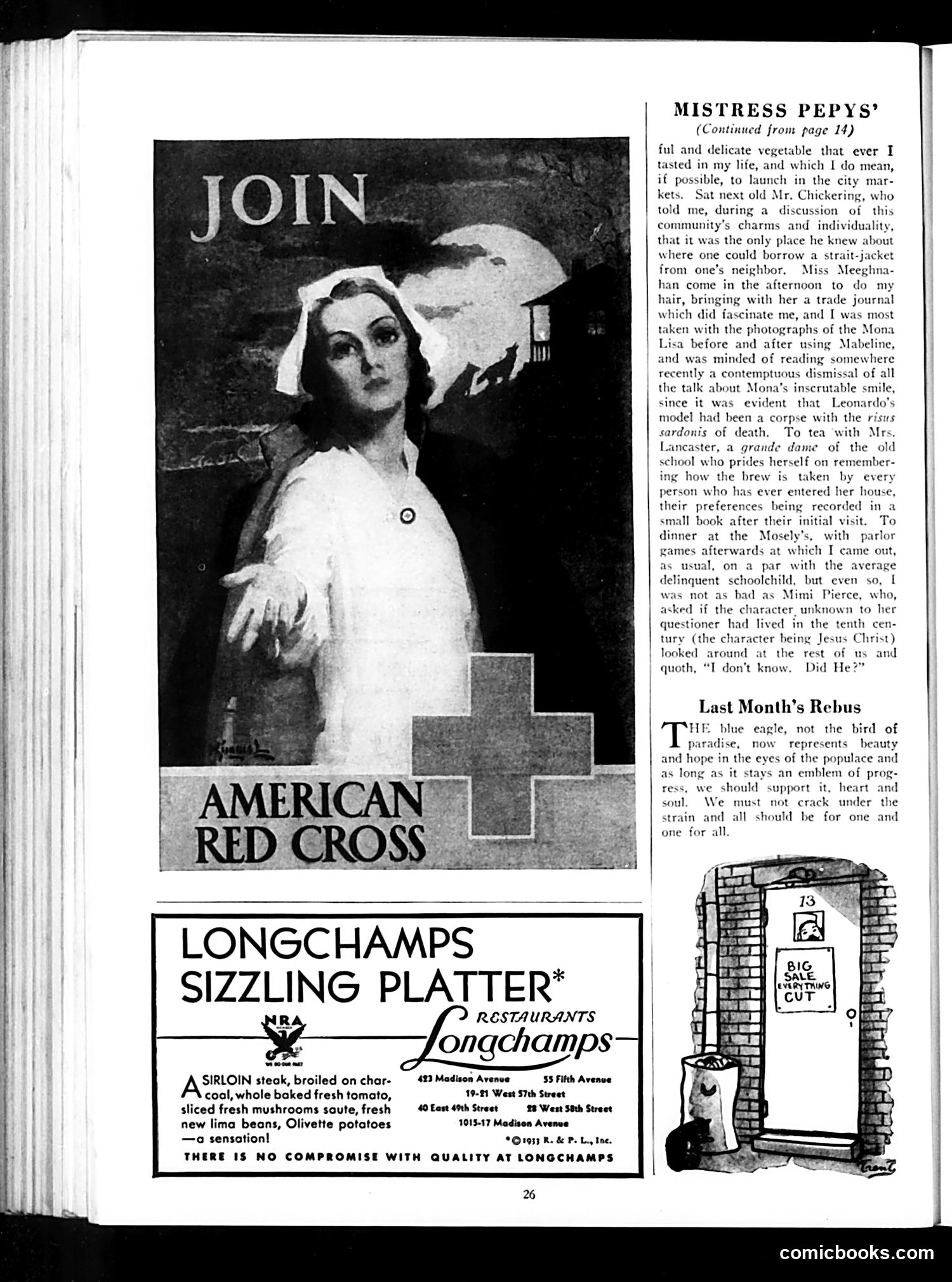
Page Content Analysis This page contains primarily advertising and social commentary rather than political satire. Main Elements: 1. American Red Cross recruitment poster (top left): Features a nurse in white cap and uniform with a Red Cross symbol, soliciting membership during what appears to be the 1930s. 2. Longchamps restaurant advertisement (center/bottom): Promotes a "Sizzling Platter" sirloin steak dinner at multiple NYC locations, emphasizing quality. 3. "Mistress Pepys" column (right): A society gossip/diary piece discussing the author's social activities—salon visits, tea with socialites, dinner parties—written in pseudo-18th-century diary style. 4. "Last Month's Rebus" (bottom right): A short patriotic commentary about the Blue Eagle symbol (associated with FDR's NRA—National Recovery Administration) as representing progress, urging public unity and support. The page reflects 1930s American consumer culture and New Deal symbolism, mixing charitable appeals, upscale dining, society chitchat, and patriotic messaging typical of Judge magazine's content.
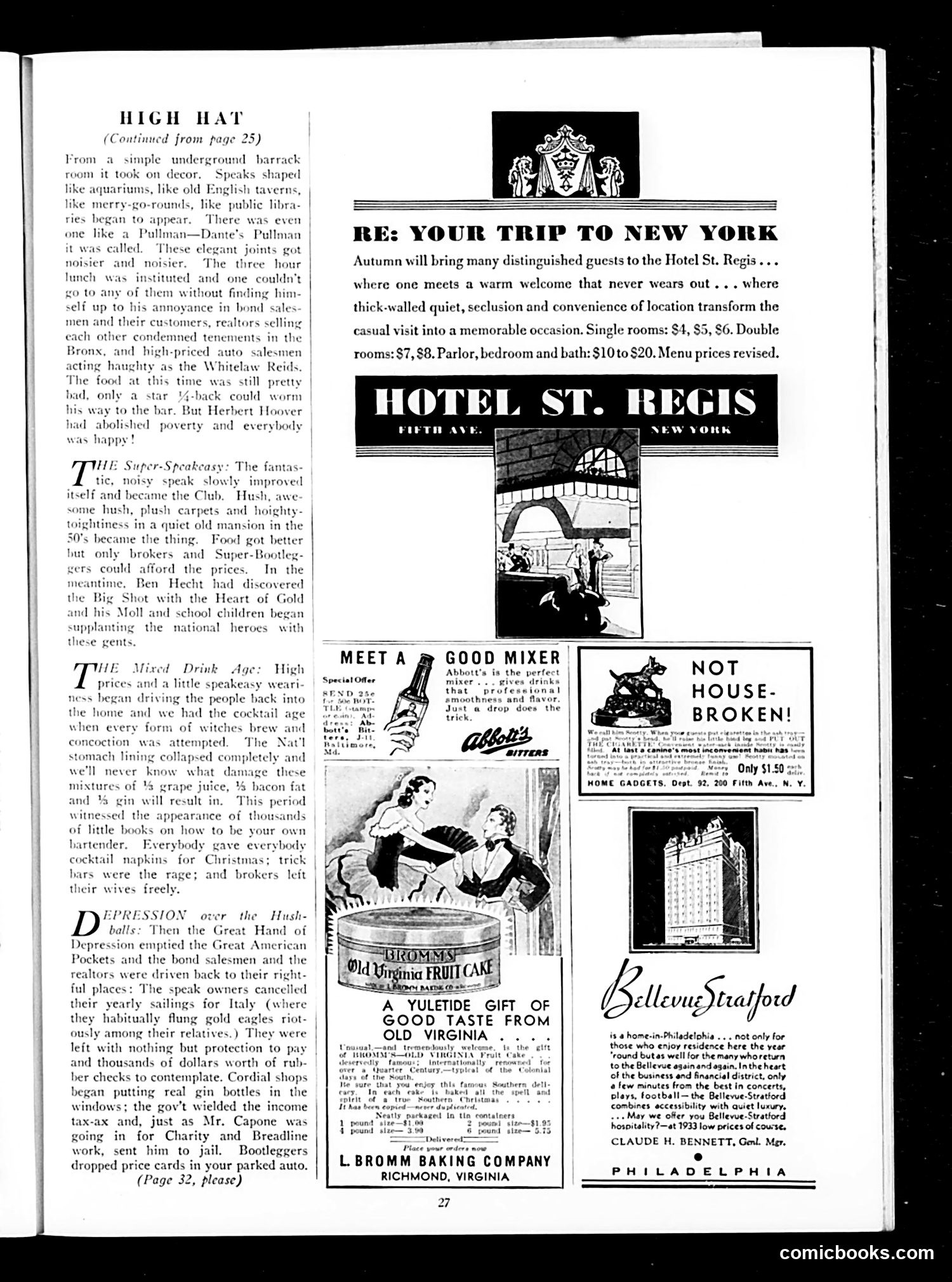
High Hat: A Judge Magazine Page on Prohibition and Economic Class This page from Judge magazine presents a satirical essay titled "High Hat," tracing the social history of speakeasies and cocktail culture from Prohibition through the Great Depression. The text mocks the pretensions of wealthy clientele who frequented illegal bars—describing how humble underground rooms transformed into faux-elegant establishments aping English taverns and Pullman cars. It ridicules "Whitelaw Reids" (wealthy elites) and brokers who adopted affected airs while patronizing these venues. The essay charts Prohibition's arc: initially exclusive and expensive, speakeasies democratized as competition increased. During the 1920s cocktail boom, even middle-class Americans embraced home bartending and elaborate cocktail parties. The Depression's arrival then punctured this pretense—wealthy speakeasy patrons lost fortunes, bootleggers undercut prices with legitimate gin sales, and the entire social apparatus collapsed. The satire's point: Prohibition-era excess exposed the hollowness of upper-class aspirations, revealing that economic status, not taste, determined social standing. The page surrounds this essay with period advertisements (Hotel St. Regis, Abbott's Bitters, Bellevue-Stratford), ironically reinforcing the commercial underpinnings of the world being satirized.
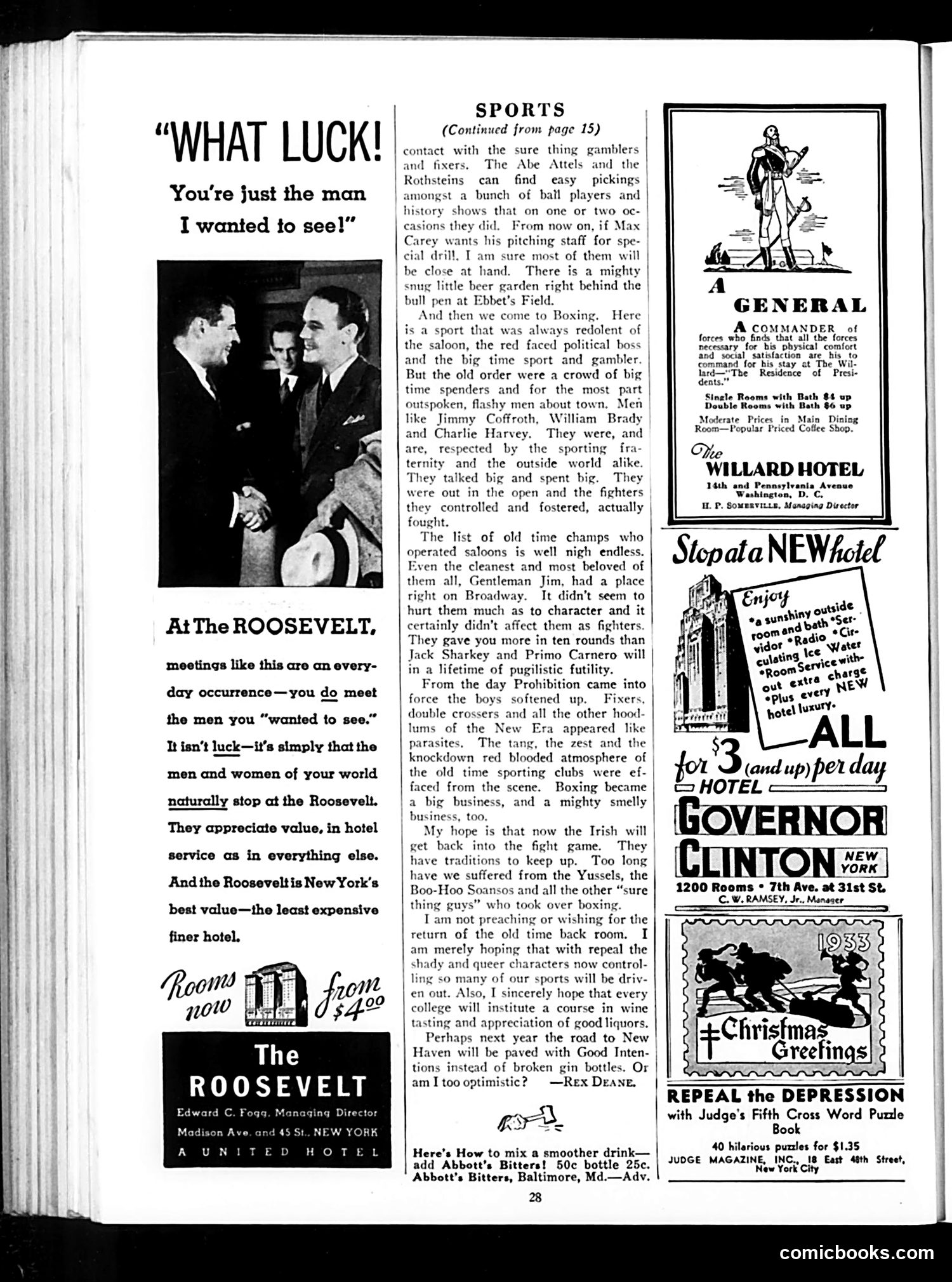
Analysis of Judge Magazine Page Content This page is primarily advertising, not political satire. The main content features a large ad for the Roosevelt Hotel (left side) depicting two businessmen meeting, with copy emphasizing that the hotel naturally attracts the people you "want to see"—a pitch for its value and prestige. The right side contains a sports column discussing boxing's decline during Prohibition. The author (Rex Deane) laments that boxing lost its colorful, honest character when Prohibition forced the sport underground. He nostalgically references old boxing promoters like Jimmy Coffroth and William Brady, and complains that modern fighters like Jack Sharkey and Primo Carnero lack the vigor of earlier champions. He hopes Repeal (the end of Prohibition, recently passed in 1933) will restore boxing's vitality and allow Irish fighters back into the sport. The remaining right column contains hotel and book advertisements, including a reference to "Judge's Fifth Cross Word Puzzle" promoting the magazine itself. The "satire" here is gentle social commentary about sports culture rather than sharp political critique.
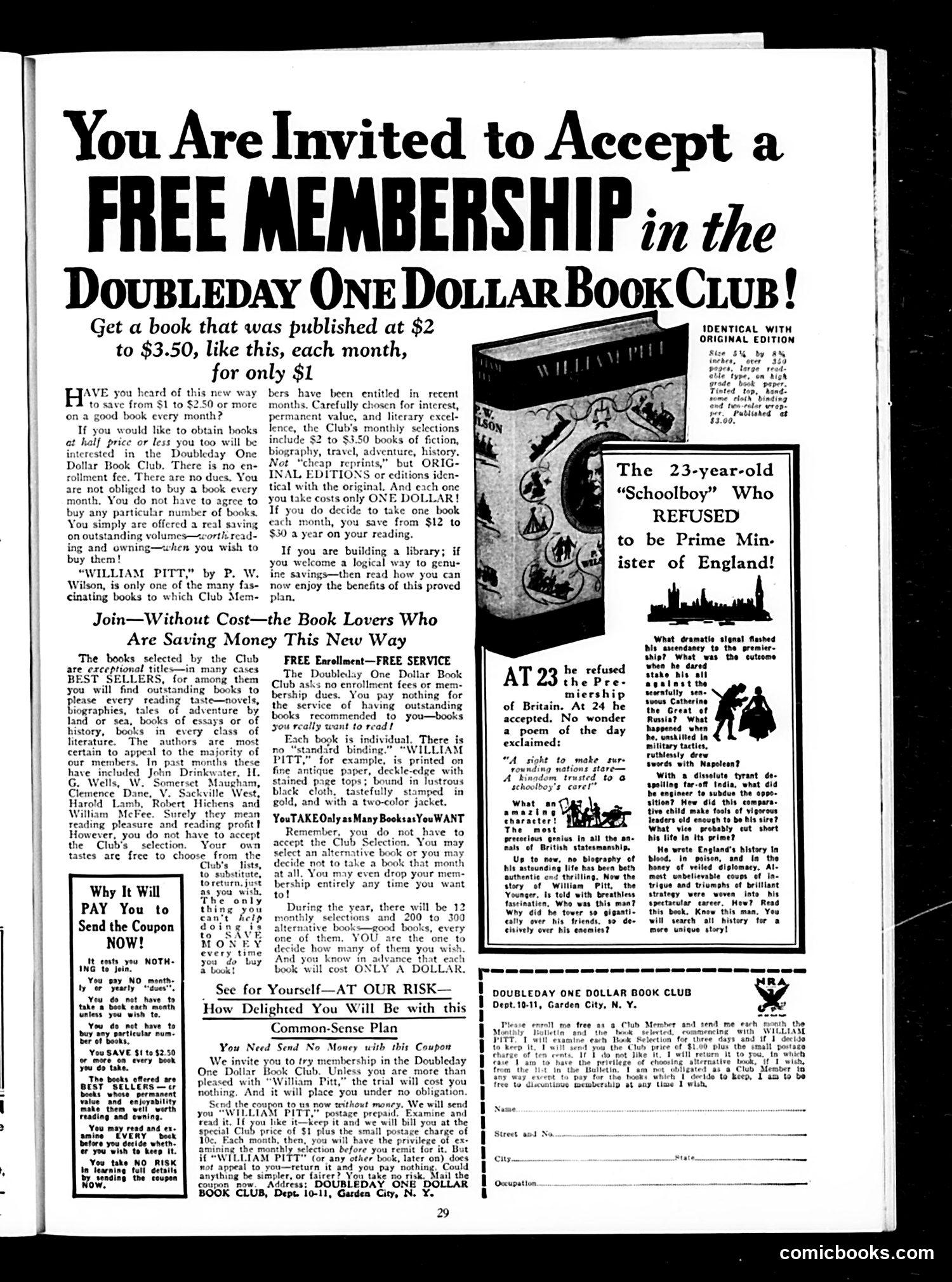
Analysis for Modern Readers This page is primarily advertising for the Doubleday One Dollar Book Club, a subscription service offering discounted books ($1 versus $2-3.50 retail). The club required no membership fees and allowed flexibility in purchases. The small sidebar features a historical anecdote about a 23-year-old "Schoolboy" who refused the British Prime Ministership but accepted at age 24—likely referencing William Pitt the Younger, who became PM at 24 in 1783, making him Britain's youngest prime minister. The reference frames this as remarkable enough for contemporary poetry. The main advertisement emphasizes the club's appeal by listing past selections from popular authors (Wells, Maugham, Hichens), stressing that books are "original editions" (not cheap reprints) and that members retain complete choice in purchases. The coupon at bottom invites enrollment with minimal commitment—reflecting 1920s-30s direct mail marketing tactics targeting middle-class readers wanting access to quality literature at bargain prices.
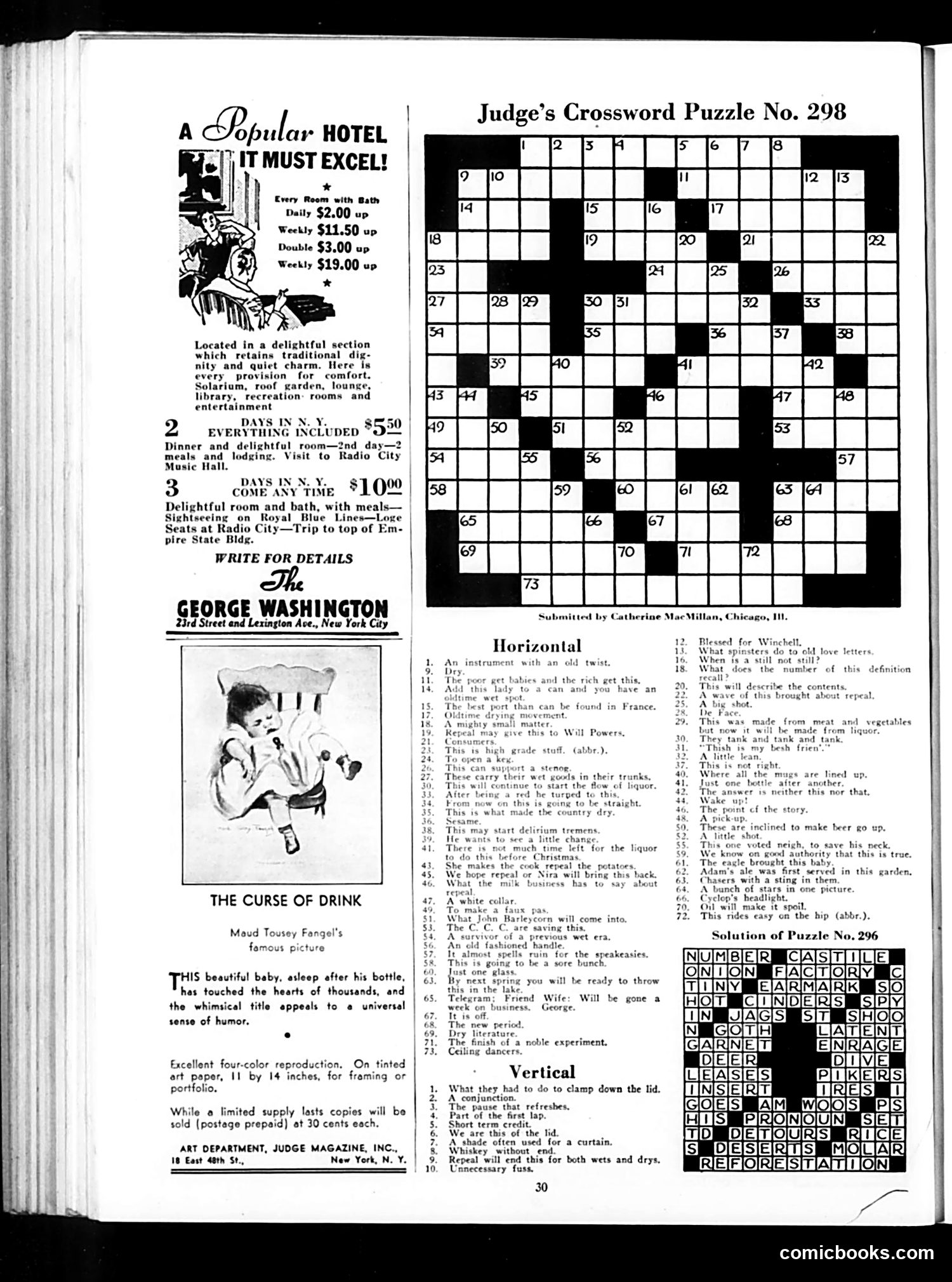
Judge Magazine Page Analysis This page is primarily advertising and a crossword puzzle, not satirical content. The main feature is "The Curse of Drink," a famous illustration by Maud Tousey Fangel showing a sleeping baby—presented here as a reproduction for sale. The title ironically references prohibition-era anxiety: the baby appears peaceful after drinking milk, but the caption plays on concerns about alcohol's effects on children and families. This reflects 1930s debates over Prohibition's repeal. The crossword puzzle's clues heavily reference Prohibition and its repeal—entries mention "speakeasies," "wet goods," "repealing," and "liquor." This dates the page to around 1933, when Prohibition ended. The hotel advertisements promote New York City accommodations, typical period advertising. The overall page reflects pre-WWII American anxieties about alcohol, morality, and the recent end of Prohibition, presented through commercial and puzzle content rather than explicit political cartoons.
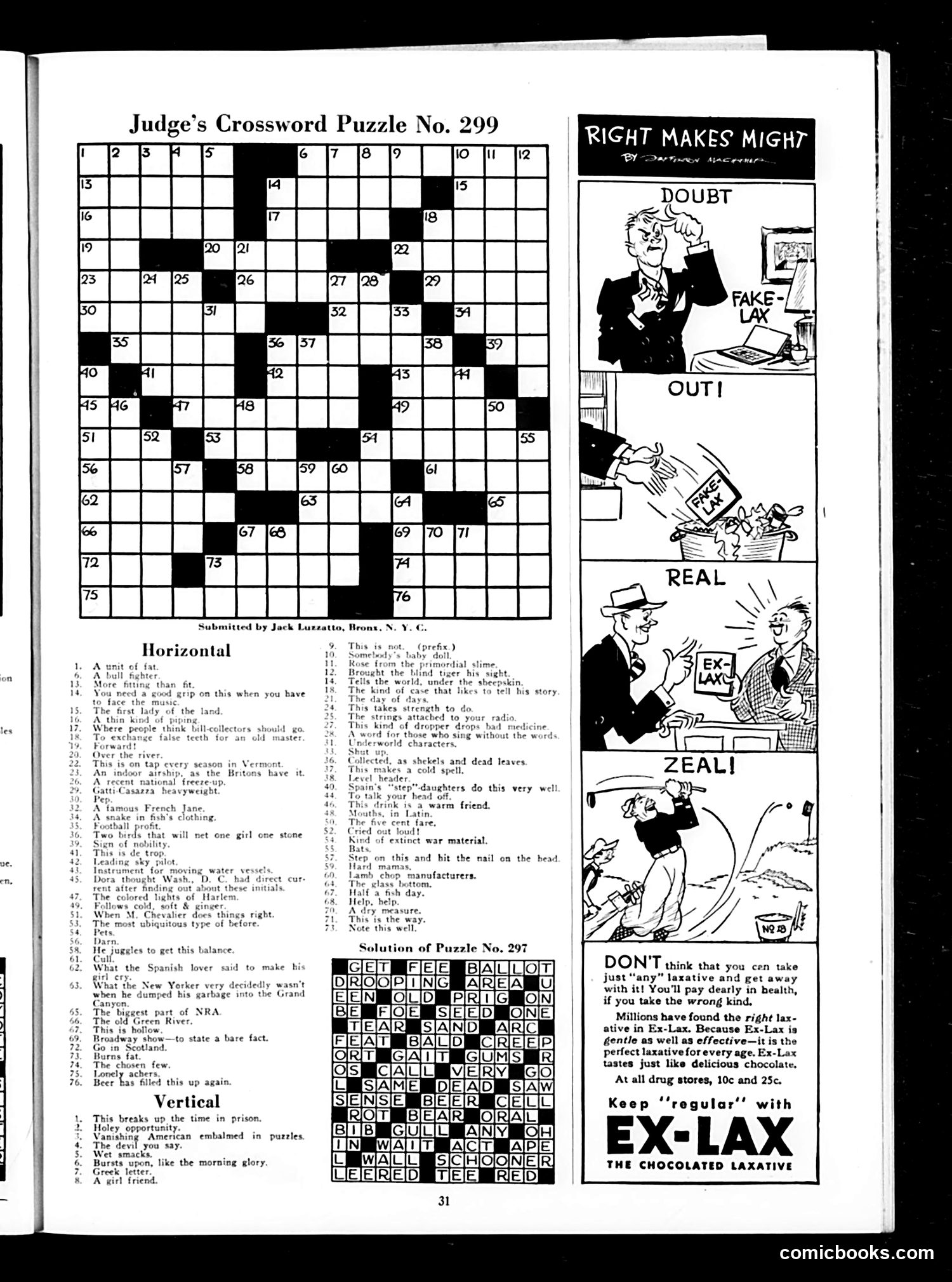
Judge Magazine Page Analysis This page is primarily a crossword puzzle (No. 299) with accompanying advertisements and small cartoon vignettes titled "Right Makes Might." The four cartoon panels on the right ("Doubt," "Out!," "Real," and "Zeal!") appear to satirize legal/business practices, though details are small. They seem to depict characters dealing with concepts like fake lawsuits and questionable dealings—typical Judge magazine satire of business ethics. The main content is the crossword puzzle itself, submitted by Jack Luzzatto from the Bronx, with clues referencing contemporary (to the publication date) cultural references, politics, and wordplay. Below is an advertisement for Ex-Lax laxative, emphasizing it's "gentle" and "effective" compared to other options, presented as a health recommendation rather than mere product promotion. The page represents typical Judge magazine content: puzzles, satirical cartoons mocking contemporary abuses, and period advertisements—this appears to be from sometime in the mid-20th century based on style.
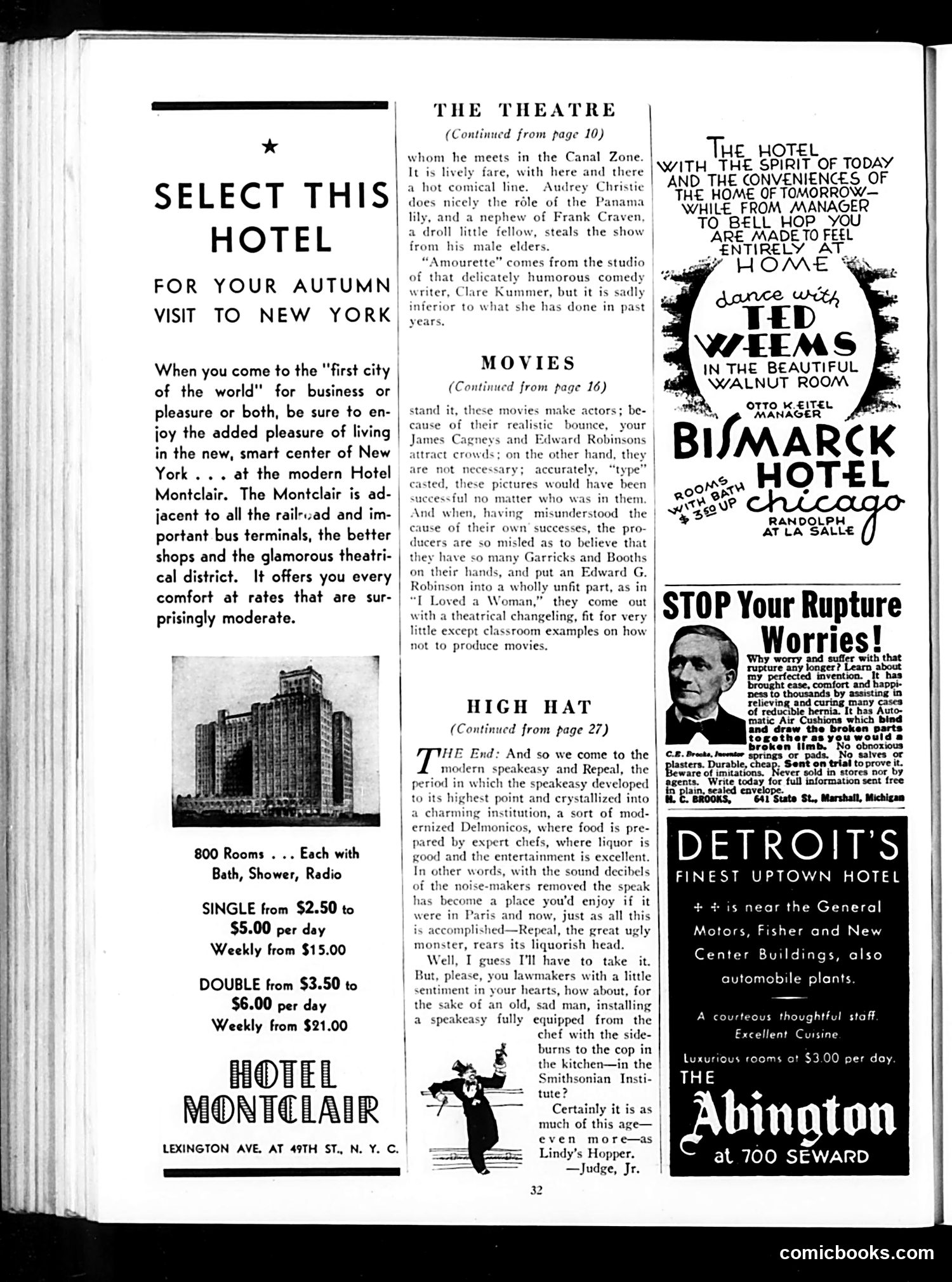
Analysis for Modern Readers This is primarily an advertising page from Judge magazine, featuring hotel and entertainment promotions rather than satirical cartoons. The page includes: - Hotel Montclair advertisement (left): Promoting affordable New York lodging with modern amenities (radio, shower) at Depression-era prices ($2.50–$5 daily). - Theatre and Movies reviews (center): Critiques of contemporary productions, discussing how film actors like James Cagney and Edward G. Robinson are sometimes miscast despite their talent. - "High Hat" column (bottom center): Social commentary on Prohibition's end and the evolution of speakeasies into respectable establishments, suggesting nostalgia for their illicit appeal. - Hotel advertisements (right): Bismarck Hotel (Chicago) and Abington Hotel (Detroit) promoting themselves to travelers. - Medical device advertisement: A rupture support product marketed as durable and cheap. The page reflects 1930s consumer culture—affordable travel, entertainment criticism, and medical solutions—with minimal political satire. It's essentially a commercial product page rather than the magazine's typical satirical content.
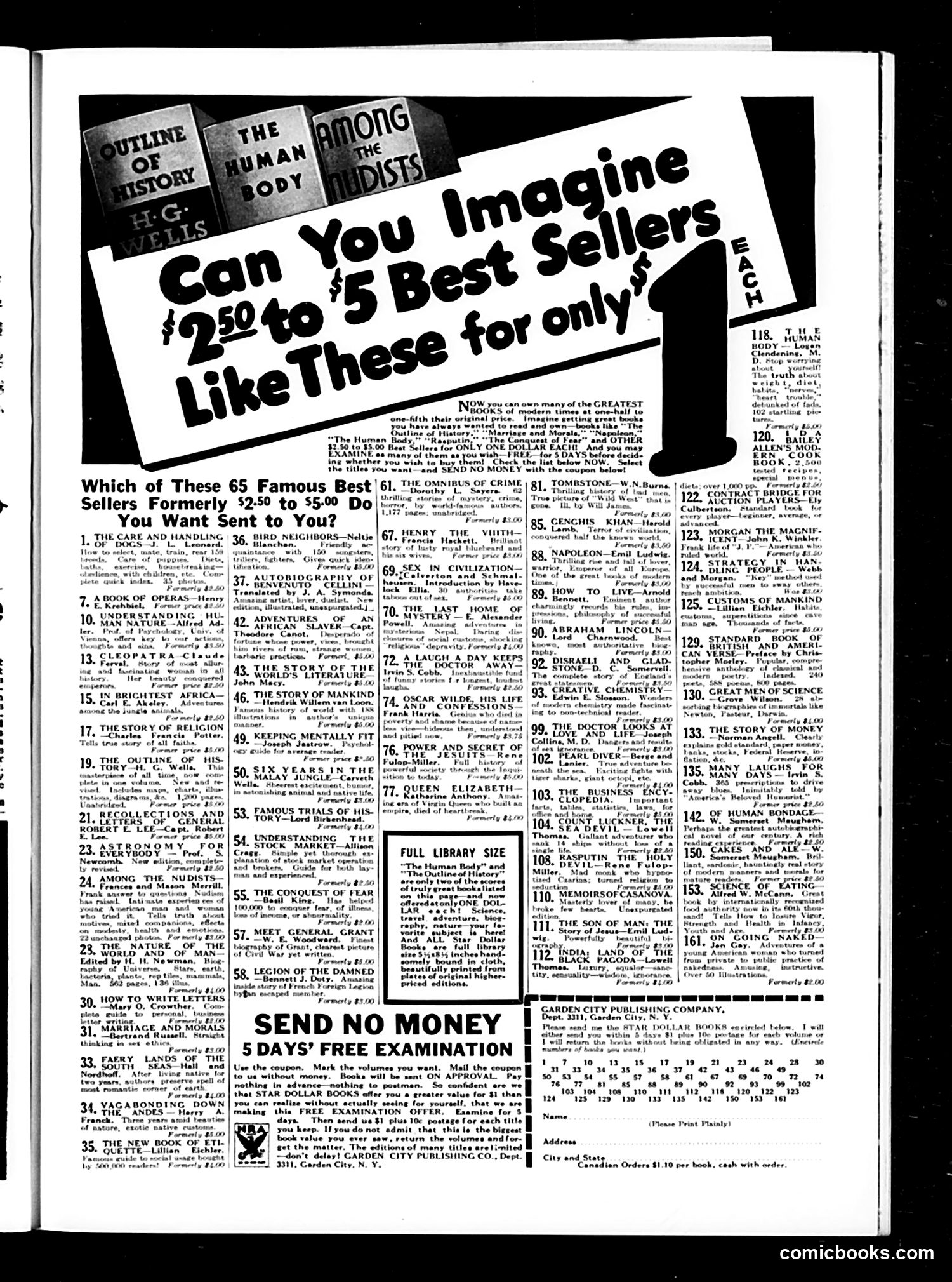
Analysis: Advertisement Page from Judge Magazine This page is primarily a book club advertisement, not a political cartoon. It promotes the "Star Dollar Books" offer from Garden City Publishing Company. The advertisement showcases 65 classic bestselling books originally priced $2.50-$5.00, now offered for one dollar each. Titles listed include well-known works like "The Outline of History" by H.G. Wells, "Napoleon," "The Human Body," and "Rasputin." The key sales pitch: customers can examine multiple books free for 5 days before purchasing, with "SEND NO MONEY" upfront. The satirical/editorial content appears minimal on this page—it's primarily a commercial offer typical of 1920s-30s print advertising. The prominent "1" graphic and headline ("Can You Imagine $2.50 to $5 Best Sellers Like These for only $1") emphasize the remarkable value proposition rather than social commentary. This reflects the era's direct-mail marketing tactics and accessible pricing strategies for literature distribution.
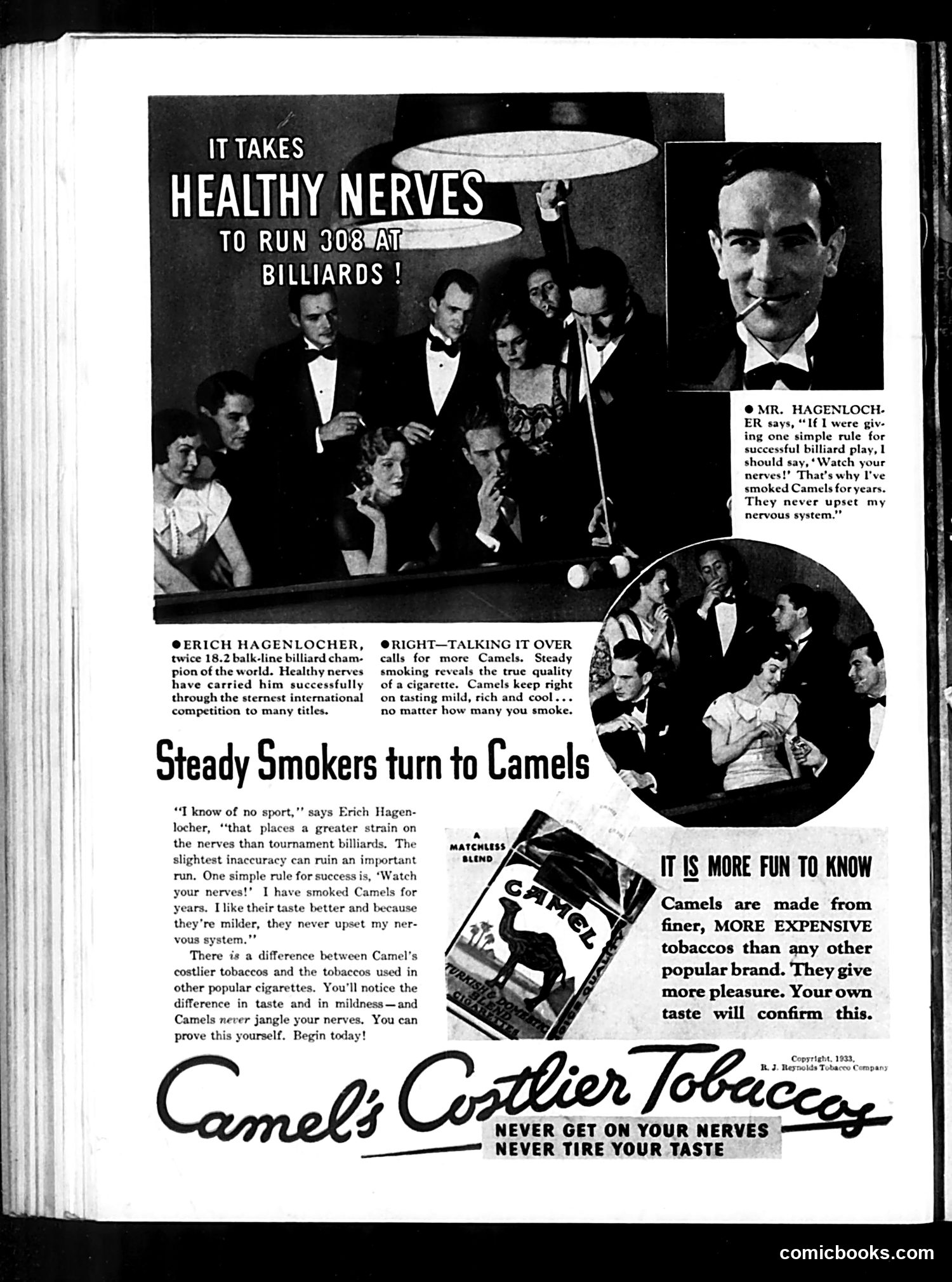
Camel Cigarettes Advertisement (1933) This is a cigarette advertisement, not satire. It features Erich Hagenlocher, a real professional billiards champion of the era, endorsing Camels as a "nerve-steadying" product. The ad exploits a genuine concern of the 1930s: competitive sports and stress damage the nervous system. Hagenlocher claims smoking Camels actually *helps* maintain composure during high-pressure billiards tournaments because they're "milder" and won't upset his "nervous system." The photos show him at billiards tables and discussing strategy with others—establishing his credibility as a world-class athlete whose endorsement matters. By modern standards, this is remarkable for its transparent health claims. Cigarettes are marketed as *medicinal*, calming aids rather than mere enjoyment. The tagline "Never Get on Your Nerves" directly positions smoking as beneficial to mental health—claims now recognized as fraudulent and strictly prohibited in advertising.