judge
Judge — December 1933
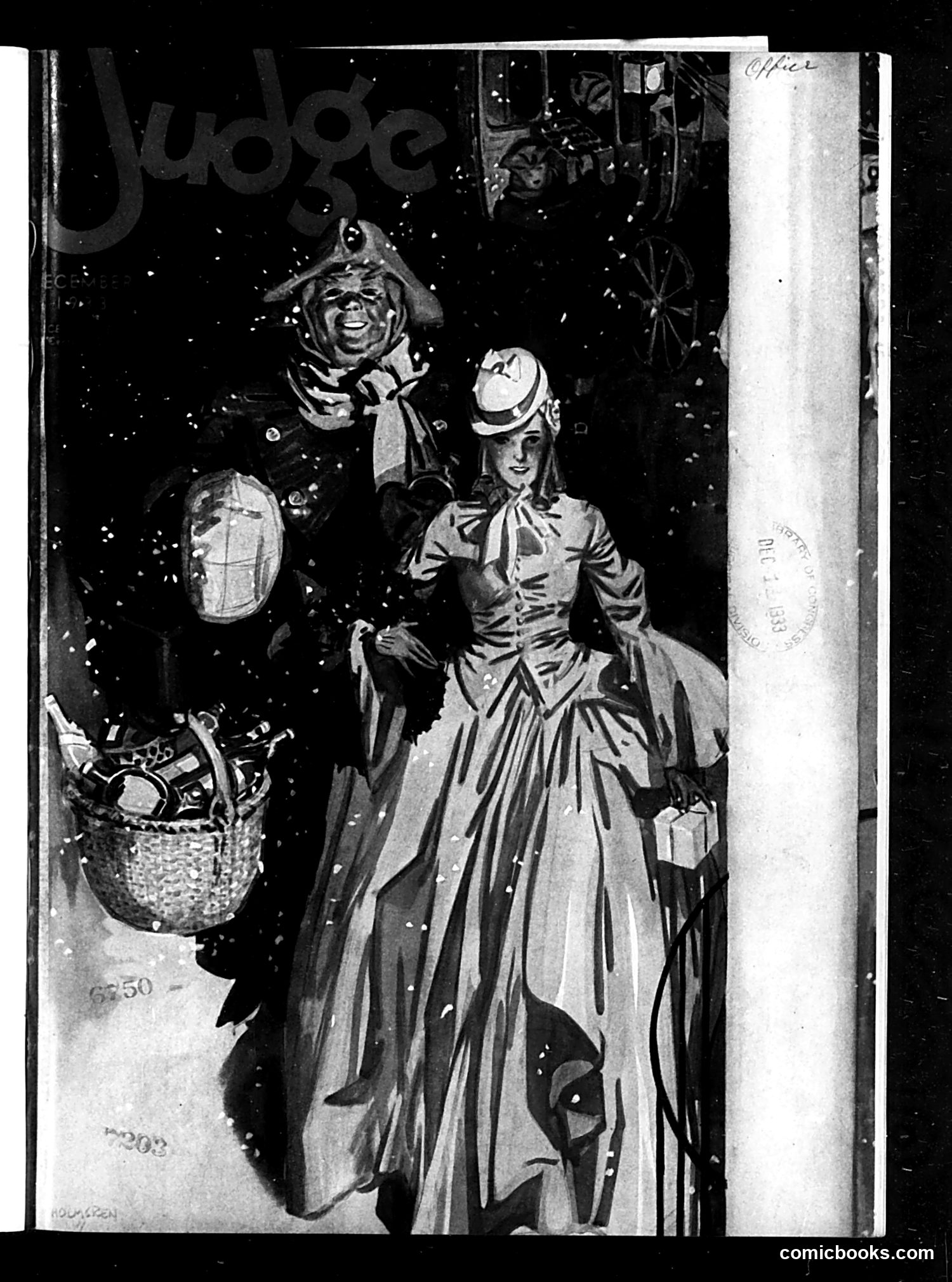
Judge Magazine Page Analysis This appears to be a holiday-themed illustration from Judge magazine featuring two figures in festive attire. The image shows a woman in an elaborate dress with a decorative hat alongside a figure in a clown or jester costume with an exaggerated painted face. The style and composition suggest this is seasonal entertainment or holiday content rather than political satire. Without clear text visible connecting these figures to specific contemporary political figures or events, the exact satirical target remains unclear. The clown character and formal dress suggest this may mock artificial holiday cheer or contrast between refined society and theatrical entertainment. However, the OCR text provided doesn't clarify the intended meaning. This appears primarily illustrative rather than explicitly political in nature.
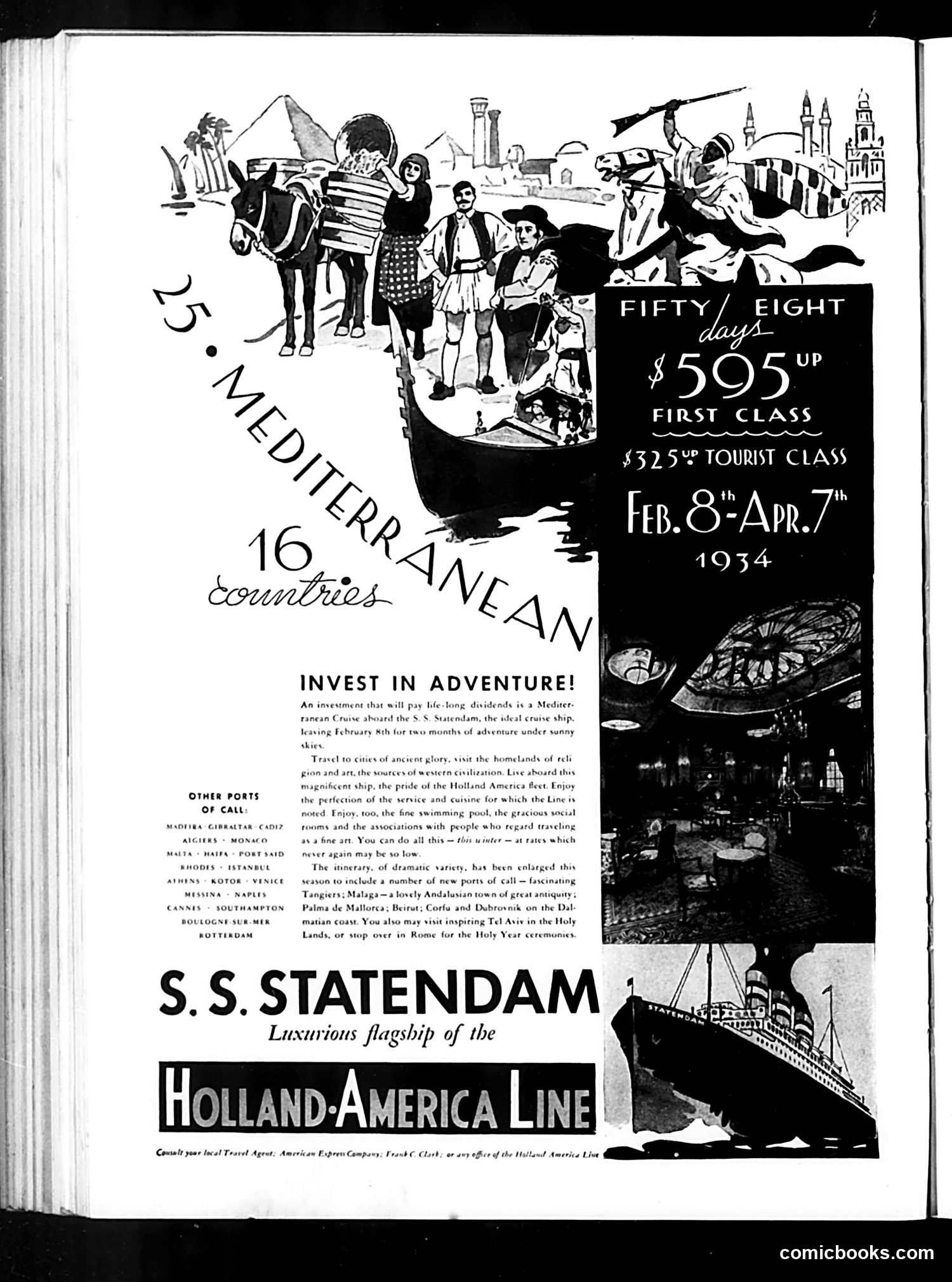
Analysis of This Judge Magazine Page This page is primarily a cruise ship advertisement, not a political cartoon. It advertises the S.S. Statendam of the Holland-America Line, promoting a 58-day Mediterranean cruise departing February 8 - April 7, 1934. The illustrated header depicts tourists visiting various Mediterranean destinations across 16 countries—Egypt, Greece, Italy, and others. The illustration is generic tourist imagery rather than satire: travelers viewing pyramids, mosques, classical architecture, and cultural landmarks. The ad emphasizes luxury ("Invest in Adventure!"), amenities (swimming pool, fine dining), and accessibility across social classes (First Class $505+; Tourist Class $325+). This reflects 1930s leisure marketing to Americans during the Depression era, targeting those wealthy enough to afford extended international travel. No political satire is evident on this page.
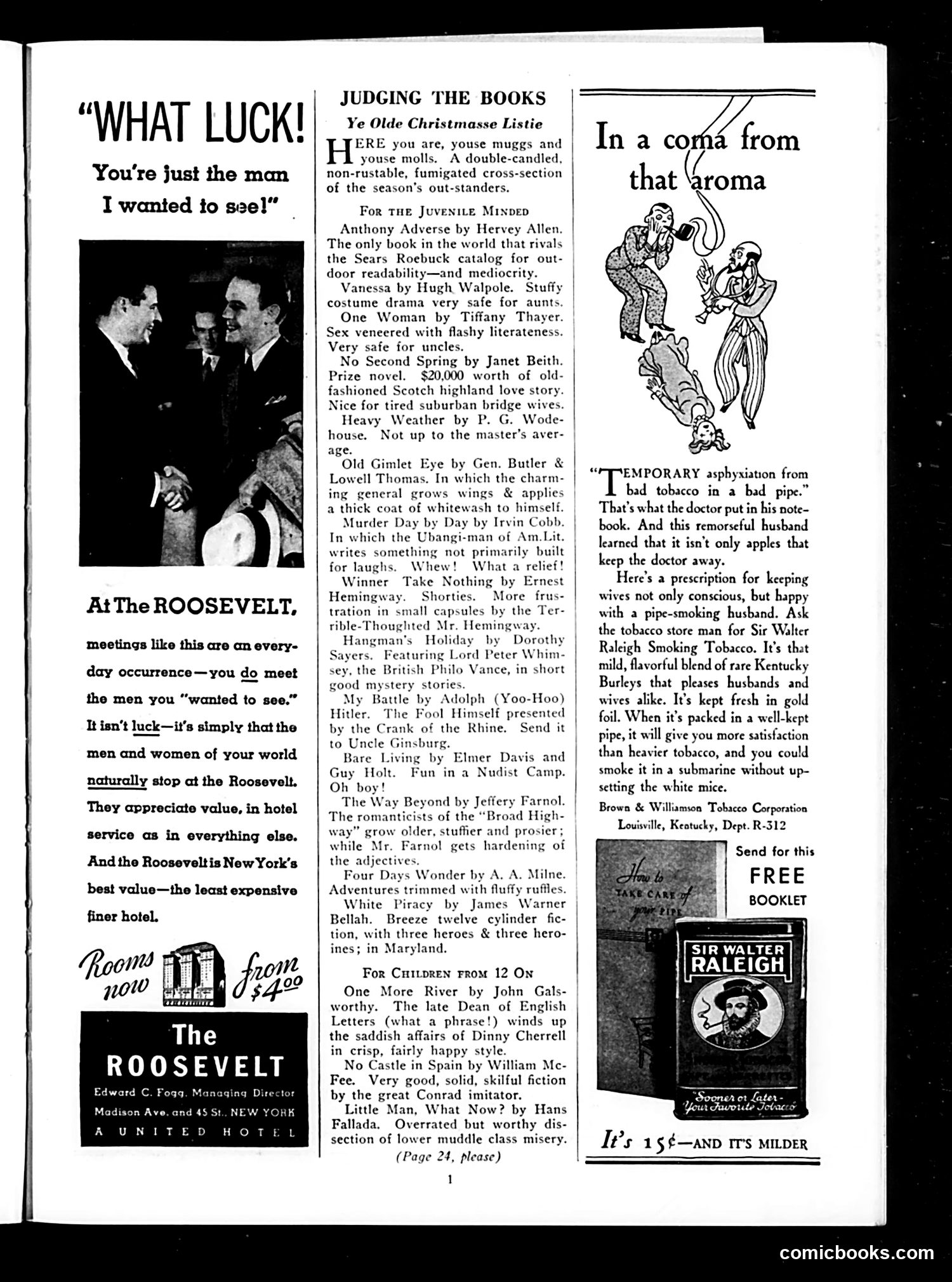
Analysis This page is primarily advertising and book reviews rather than political satire. The dominant content is: 1. Roosevelt Hotel advertisement (left side): Promotes the hotel's value and convenience, claiming "meetings like this are an everyday occurrence—you do meet the men you 'wanted to see.'" The accompanying photograph shows three men in conversation, apparently demonstrating this social networking benefit. 2. "Judging the Books" section (center): A lengthy book review column recommending various titles for different audiences—juvenile readers, tired suburbanites, uncles, etc. 3. Sir Walter Raleigh Tobacco advertisement (right): Features an illustrated couple and promotes smoking as beneficial for marital happiness. The page reflects 1920s-30s consumer culture and advertising rather than political commentary.
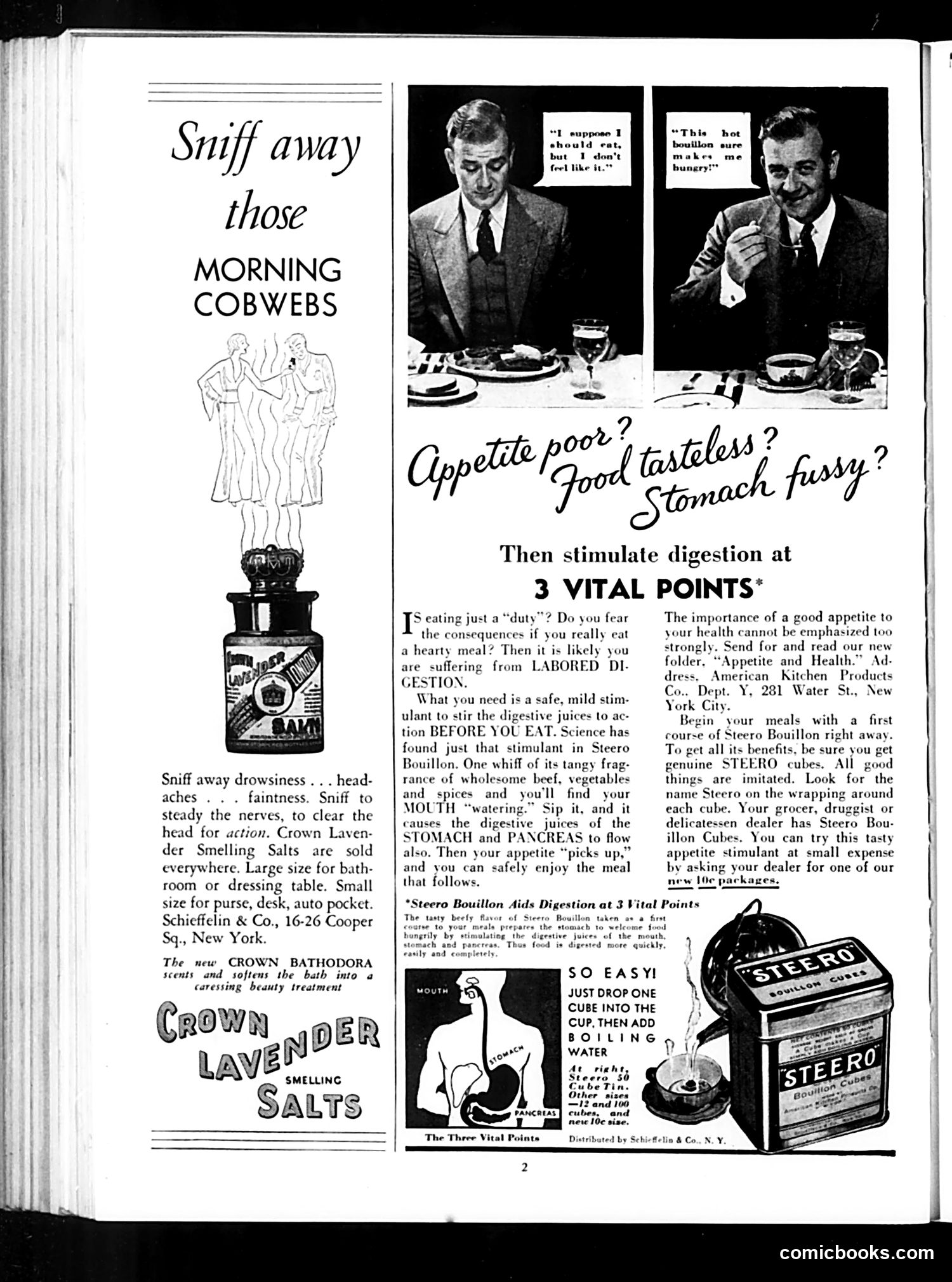
Analysis This page is primarily advertising rather than satire or political commentary. It contains two main advertisements: 1. Crown Lavender Smelling Salts (left): Promotes the product for addressing drowsiness, headaches, and "faintness," with an illustration of women inhaling the salts. The ad references "Labored Digestion" as a concern. 2. Steero Bouillon Cubes (right): Features two men at meals discussing poor appetite and digestion problems. The ad promotes the bouillon cubes as a digestive aid that stimulates digestion "at 3 vital points" (mouth, stomach, pancreas). Instructions show how to prepare the product. Both advertisements reflect early 20th-century patent medicine marketing, promoting dubious health claims common to the era. There is no discernible political cartoon or satire on this page—it's straightforward period advertising.
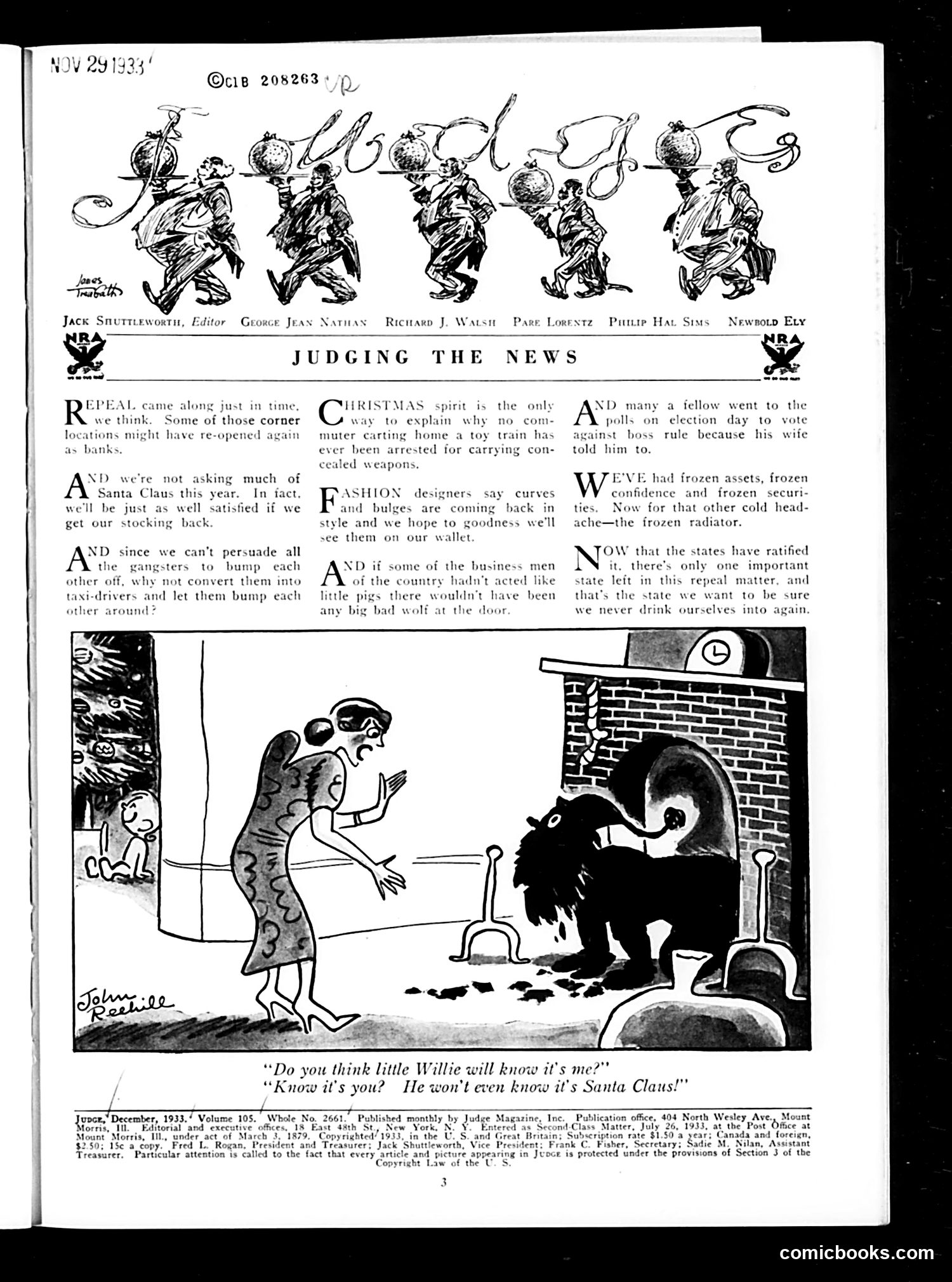
"Judging the News" - November 29, 1933 This page presents editorial commentary on contemporary events through five caricatured figures juggling globes—likely representing editors or news commentators of the era. The main cartoon depicts a woman discovering a shaggy dog in her fireplace, asking "Do you think little Willie will know it's me?" with the punchline "I know it's you! He won't even know it's Santa Claus!" The commentary text addresses Prohibition's repeal, frozen assets from the Depression, and Prohibition-era bank robberies—topical issues of late 1933. The dog-and-Santa joke appears unrelated, likely a seasonal gag coinciding with Christmas preparation. The overall page mixes political/economic satire with domestic humor typical of Judge magazine's mixed editorial and entertainment content.
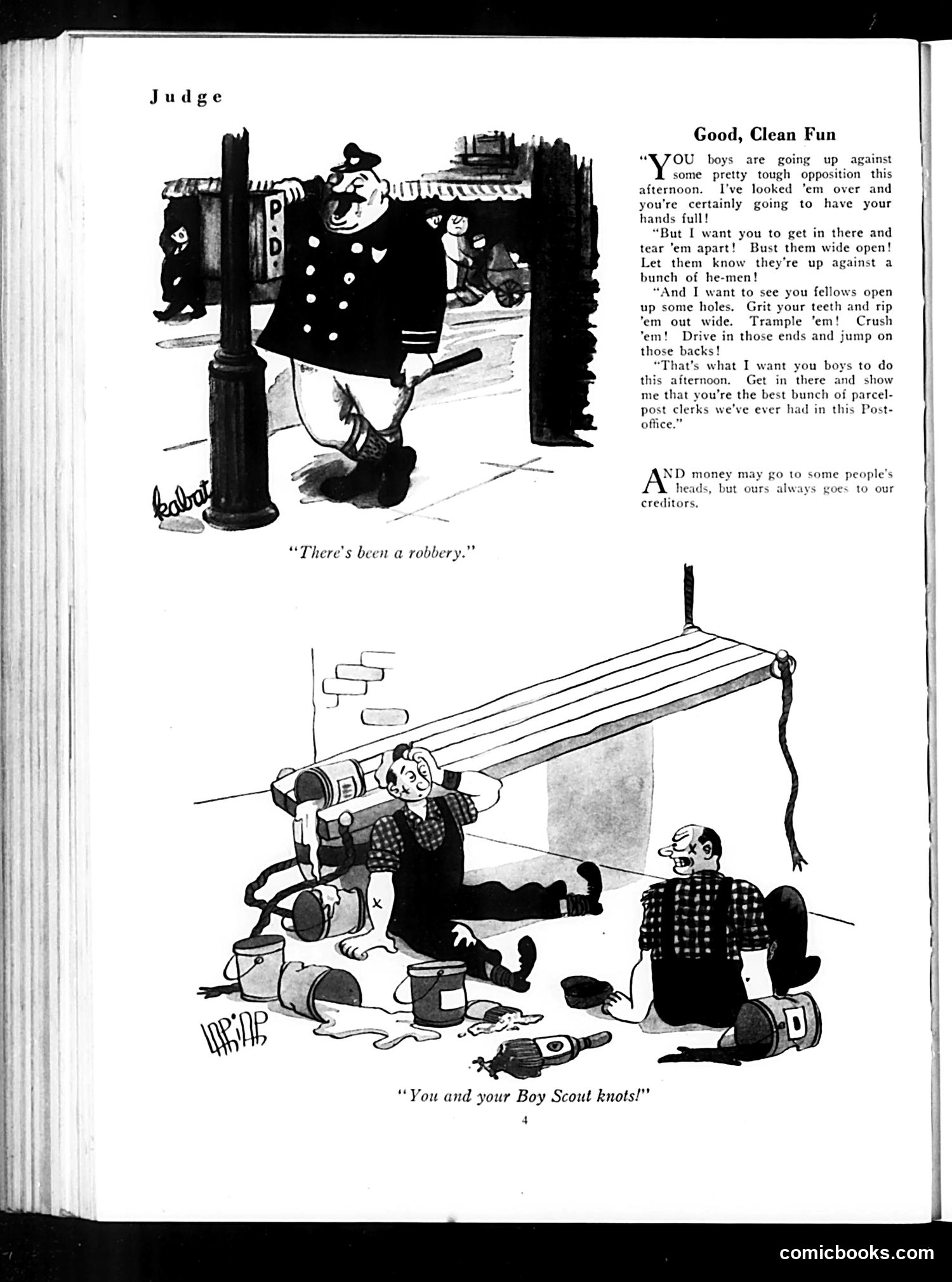
Analysis of Judge Magazine Page This page contains two cartoons satirizing postal workers and management. Top cartoon ("There's been a robbery"): A policeman confronts a mail carrier about a robbery. The accompanying text presents a judge (likely a postal supervisor) giving an aggressive pep talk to mail carriers, urging them to act tough and fight back against criminals. The joke appears to target the postal service's incompetence or the irony of postal workers being blamed for robberies. Bottom cartoon ("You and your Boy Scout knots!"): Two postal workers struggle to untie a knot while surrounded by scattered mail. The satire criticizes poor organization or incompetence at the Post Office—the workers' inability to manage basic tasks, humorously attributed to faulty knot-tying skills. Both cartoons mock the postal service's operational failures and worker competence during this era.
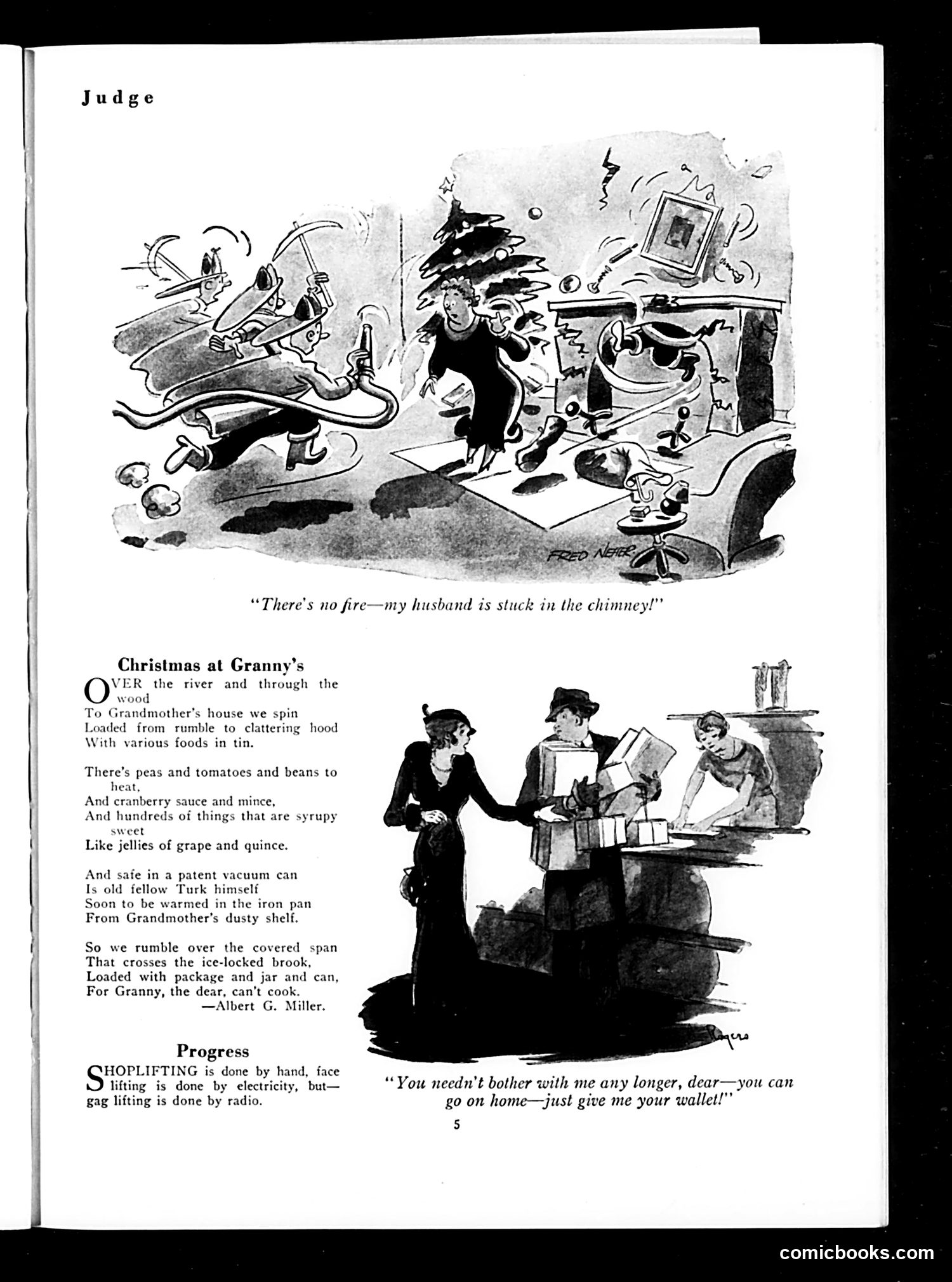
Analysis of Judge Magazine Page Top Cartoon ("Judge"): A chaotic domestic scene shows a woman amid flying furniture and debris, exclaiming "There's no fire—my husband is stuck in the chimney!" This is a slapstick joke about a husband attempting to enter through the chimney (likely inebriated or foolish) and becoming wedged. The humor relies on physical comedy and marital discord. "Christmas at Granny's": An illustrated poem by Albert G. Miller depicting a family visiting grandmother's house laden with packages, describing the journey and feast awaiting them. It's sentimental holiday verse. "Progress": A brief joke contrasting old shoplifting methods (manual theft) with modern ones (radio-controlled gag lifting)—satirizing technological advancement applied to crime. The page blends humor, holiday sentiment, and social satire typical of early-20th-century Judge magazine.
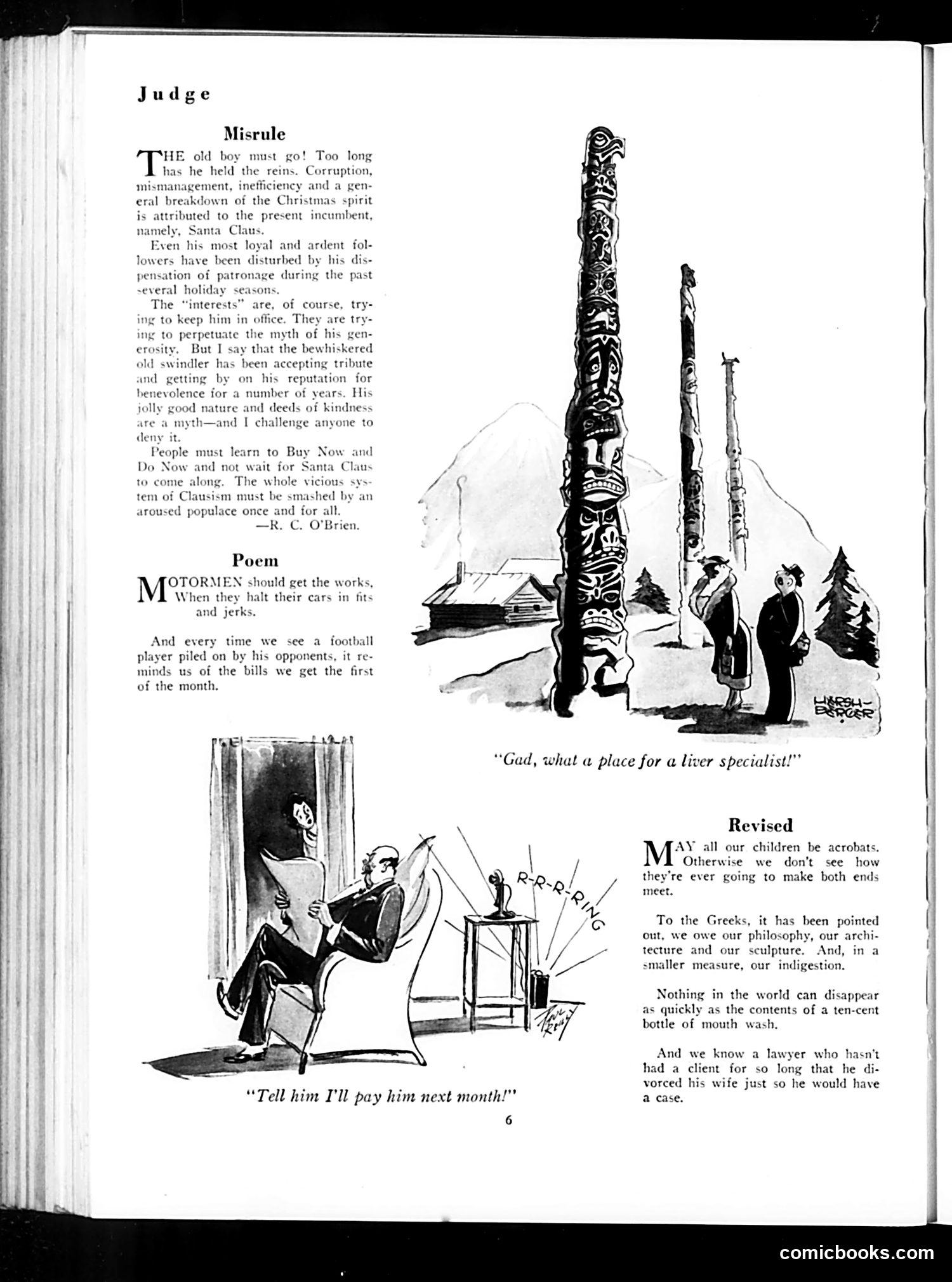
Analysis of Judge Magazine Page This page contains satirical pieces critiquing American institutions: "Misrule" (attributed to R.C. O'Brien) attacks Santa Claus as a symbol of political corruption—arguing the "old boy" has held power too long through false generosity and myth-making. It's a call to reject consumer culture ("Buy Now and Do Now") in favor of immediate reform. "Poem" mocks motorists' aggressive driving and bills arriving after accidents. "Revised" uses Greek philosophy as a springboard for dark humor about contemporary life: acrobatic children, quick disappearances of resources, and a cynical observation about divorce. The cartoons illustrate these satirical points visually, with sketches showing financial disputes and Native American totem poles (setting unclear but suggesting remote location). The overall tone reflects early-20th-century American social criticism.
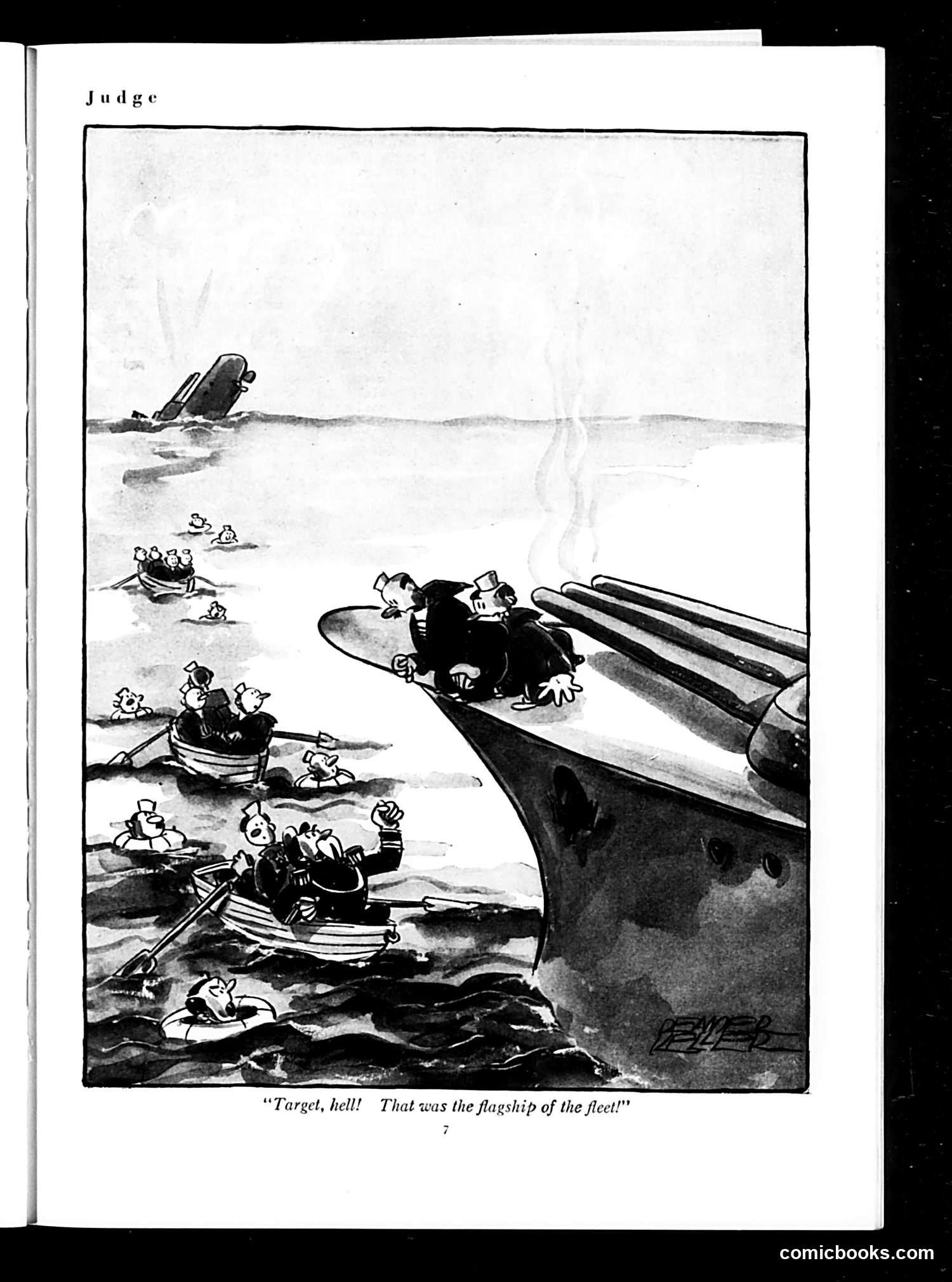
Analysis This is a satirical cartoon titled "Judge" depicting a naval disaster. The image shows a large warship (right foreground) with small lifeboats and survivors scattered in the water. Two figures on the ship's deck exclaim that they've hit their target—but it turns out to have been "the flagship of the fleet," their own command vessel. The satire criticizes military incompetence or friendly fire incidents. The shocked reaction of the officers suggests the absurdity of destroying one's own flagship while attempting to hit an enemy target. Without additional context or visible dates, the specific historical incident remains unclear, but the cartoon mocks serious naval blunders and the consequences of poor judgment in warfare.
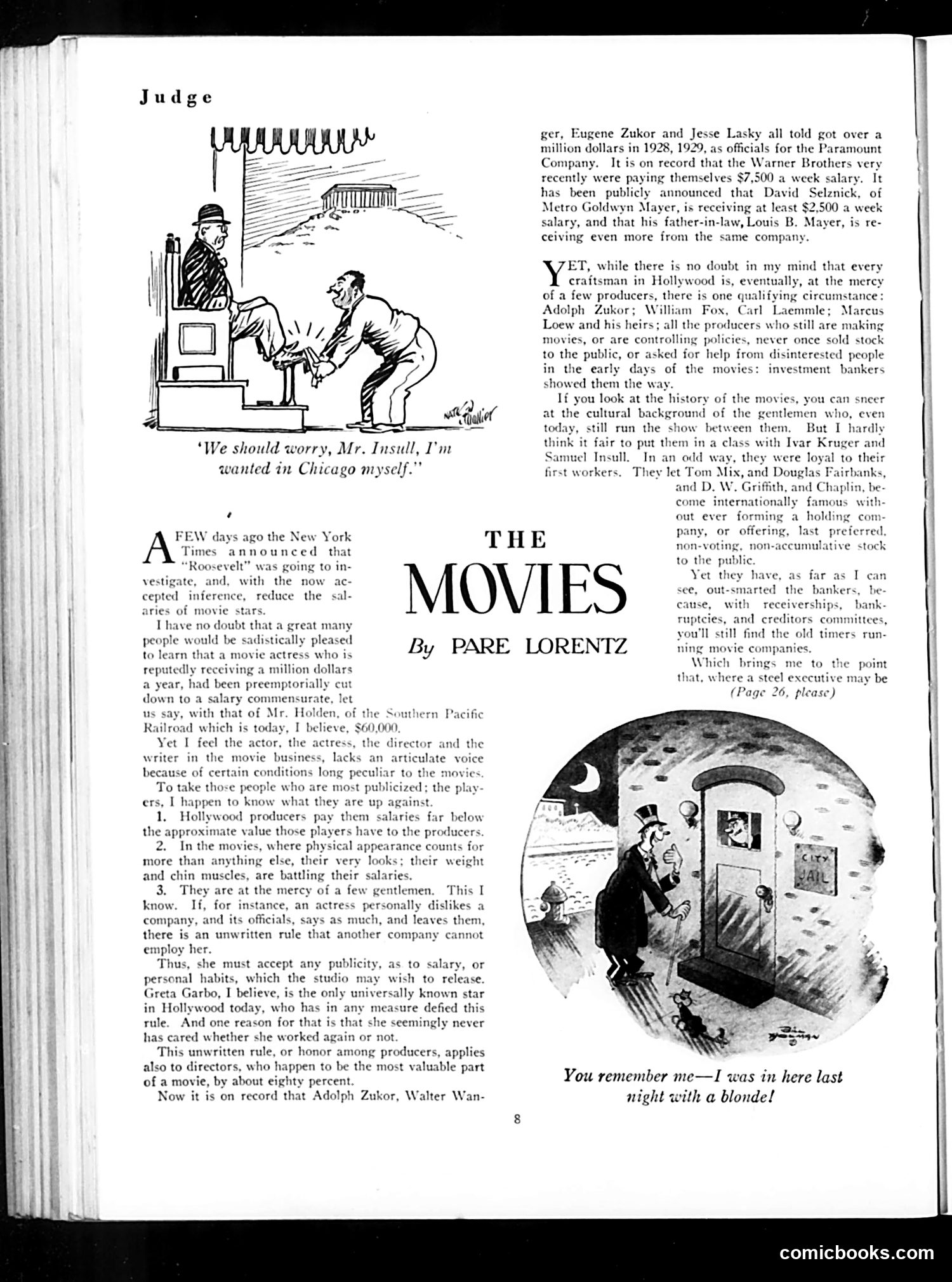
Explanation for Modern Readers The top cartoon satirizes Samuel Insull, a prominent utilities magnate who faced legal troubles in Chicago (he was indicted in 1932 for fraud). The judge warns a defendant about his salary, and the defendant replies he's also "wanted in Chicago"—equating the defendant's minor legal problem with Insull's major scandal. The main article by Pare Lorentz criticizes Hollywood's power structure. It argues that studio moguls like Adolph Zukor, Louis B. Mayer, and the Warner Brothers pay actors far below their market value, enforce blacklists against difficult employees, and extract enormous personal salaries (millions yearly) while controlling everything. Lorentz defends these moguls slightly—unlike financial swindlers like Insull and Ivar Kruger, they at least didn't defraud the public and helped early stars become famous. Still, the piece exposes the exploitative system where a few executives hold absolute power over performers' careers.
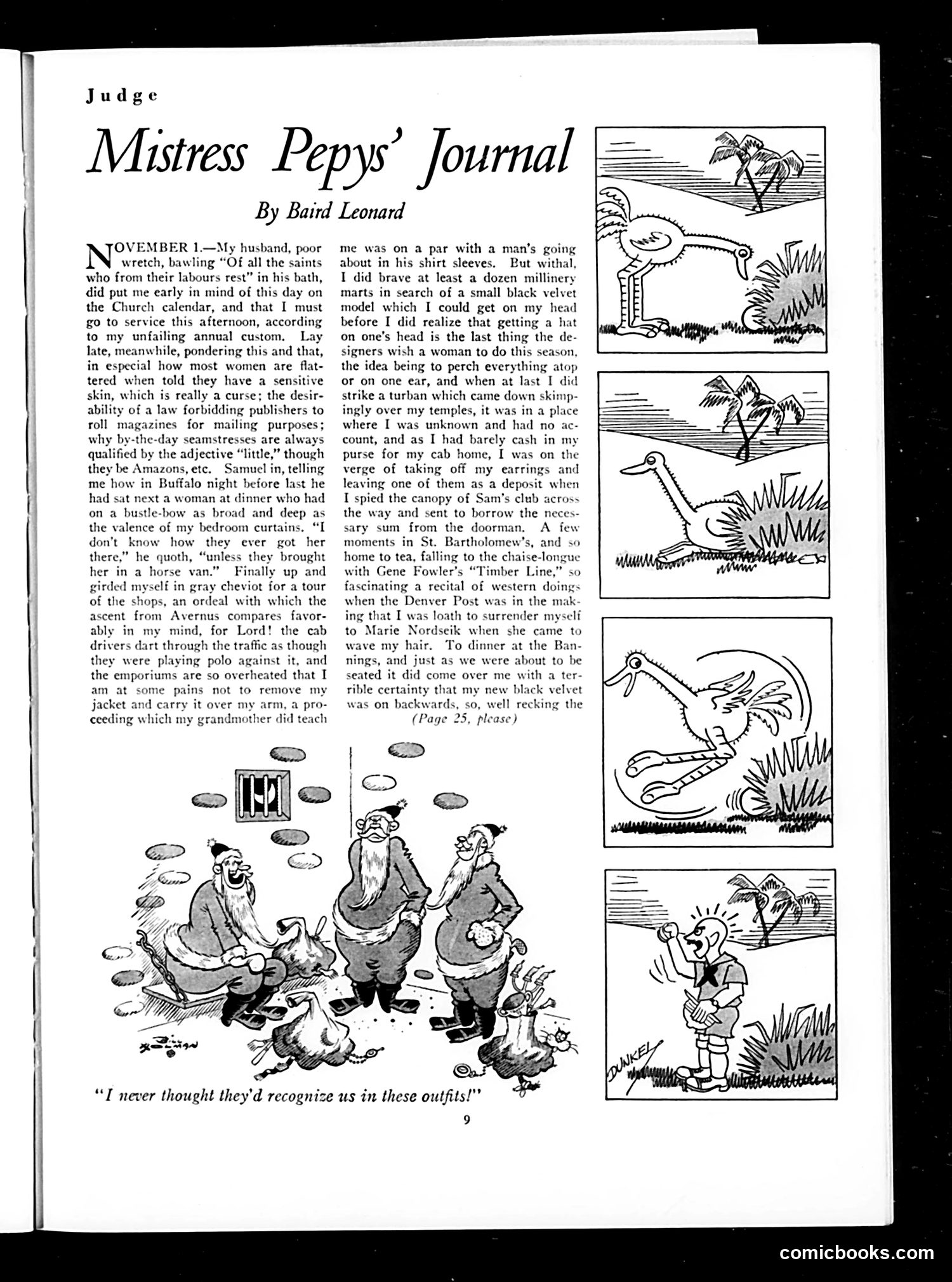
Mistress Pepys' Journal: A Modern Reader's Guide This is a humorous column mimicking Samuel Pepys' famous 17th-century diary, but set in contemporary (1920s-30s) society. The narrator—a society woman—recounts her November day in comic, self-deprecating fashion. The satire targets women's fashion obsessions: she spends hours shopping for an impossible hat (designers intentionally make hats unwearable), worries about hat placement, and discovers mid-dinner her new velvet dress is on backwards. The column mocks upper-class concerns: sensitive skin vanity, shipping magazines, cab drivers' recklessness, overheated department stores, and social embarrassment. The cartoon below shows three disguised figures at a bonfire with the caption "I never thought they'd recognize us in these outfits!"—a visual punchline about costumes and disguises, likely referencing a Halloween or masquerade context. The piece is genteel satire of privileged women's trivial preoccupations.
Judge Theatre Column: George Jean Nathan's Critical Survey This is a theatre review column by Judge's drama critic, covering Broadway productions from what appears to be the early 1930s (references to NRA code suggest pre-1935). Nathan humorously complains about attending eight to nine plays weekly, comparing his workload to NRA labor regulations. He reviews several shows: "As Thousands Cheer" (highly praised), the political musical sequel "Let 'Em Eat Cake" by Kaufman and Ryskind (good but overly clever), "The Green Bay Tree" (intelligent English import about "abnormal males"), and several detective plays. Nathan praises strong performances while criticizing weak scripts and overwrought wit. The tone is witty self-deprecation—Nathan positions himself as exhausted yet conscientious, mocking both theatrical mediocrity and his own critical pretensions. This is professional theatre criticism masquerading as casual complaint.
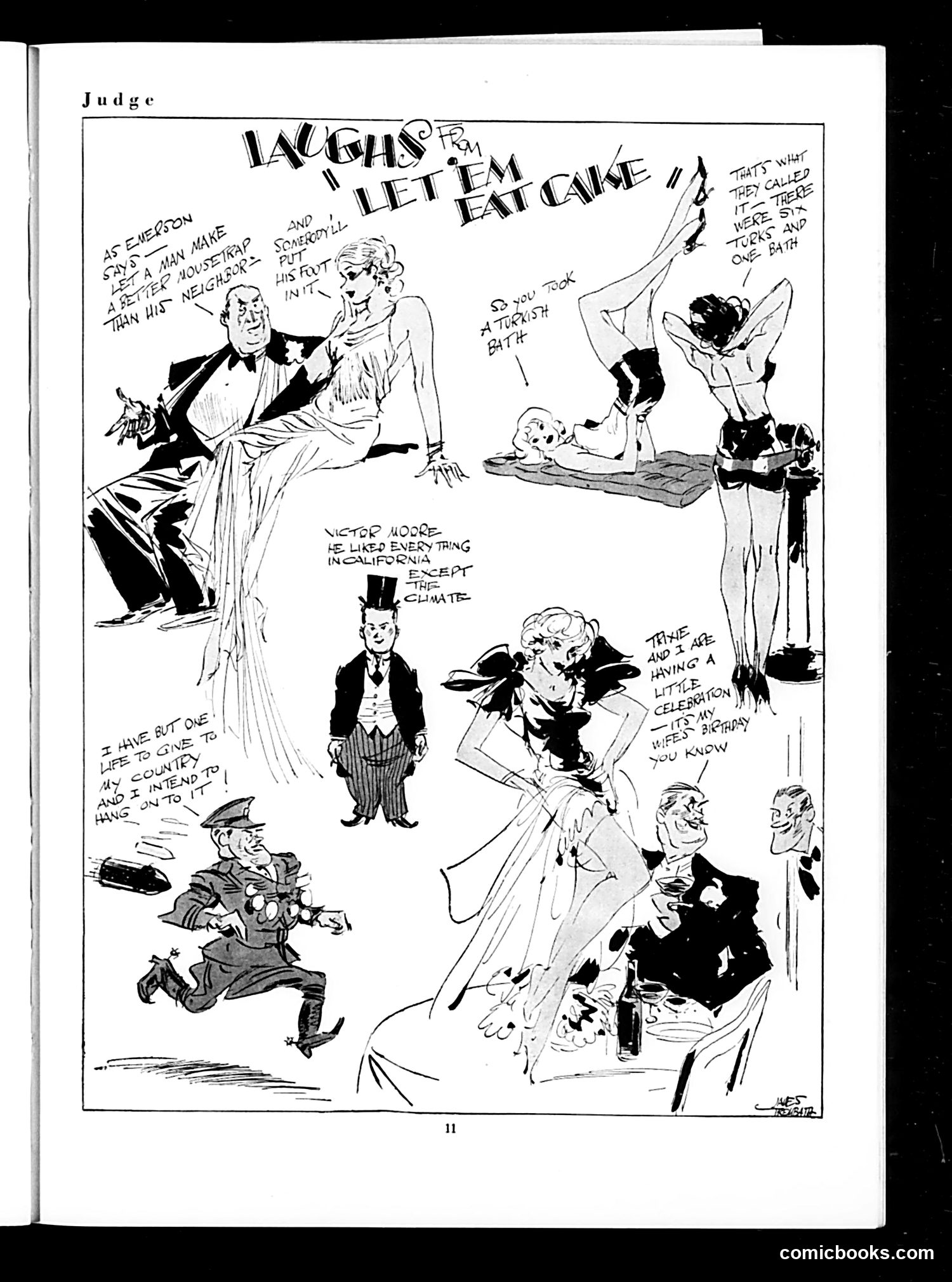
This cartoon satirizes Victor Moore, likely a public figure of the era, through the caption "Nicer Moore—He Liked Everything in California." The sketch depicts various social scenarios: a man and woman in formal dress, figures engaged in leisure activities, a small man in a top hat, and people celebrating. The dialogue includes references to Turkish baths, a "little celebration" for a wife's birthday, and someone who "intends to hang it all." The satire appears to mock Moore's indiscriminate tastes and California's permissive culture. The title "Laughs from Let Them Eat Cake" suggests this comes from a satirical piece about excess and hedonism. Without knowing Moore's specific biography, the cartoon likely ridicules either his gullibility or his embrace of California's loose social standards of the time.
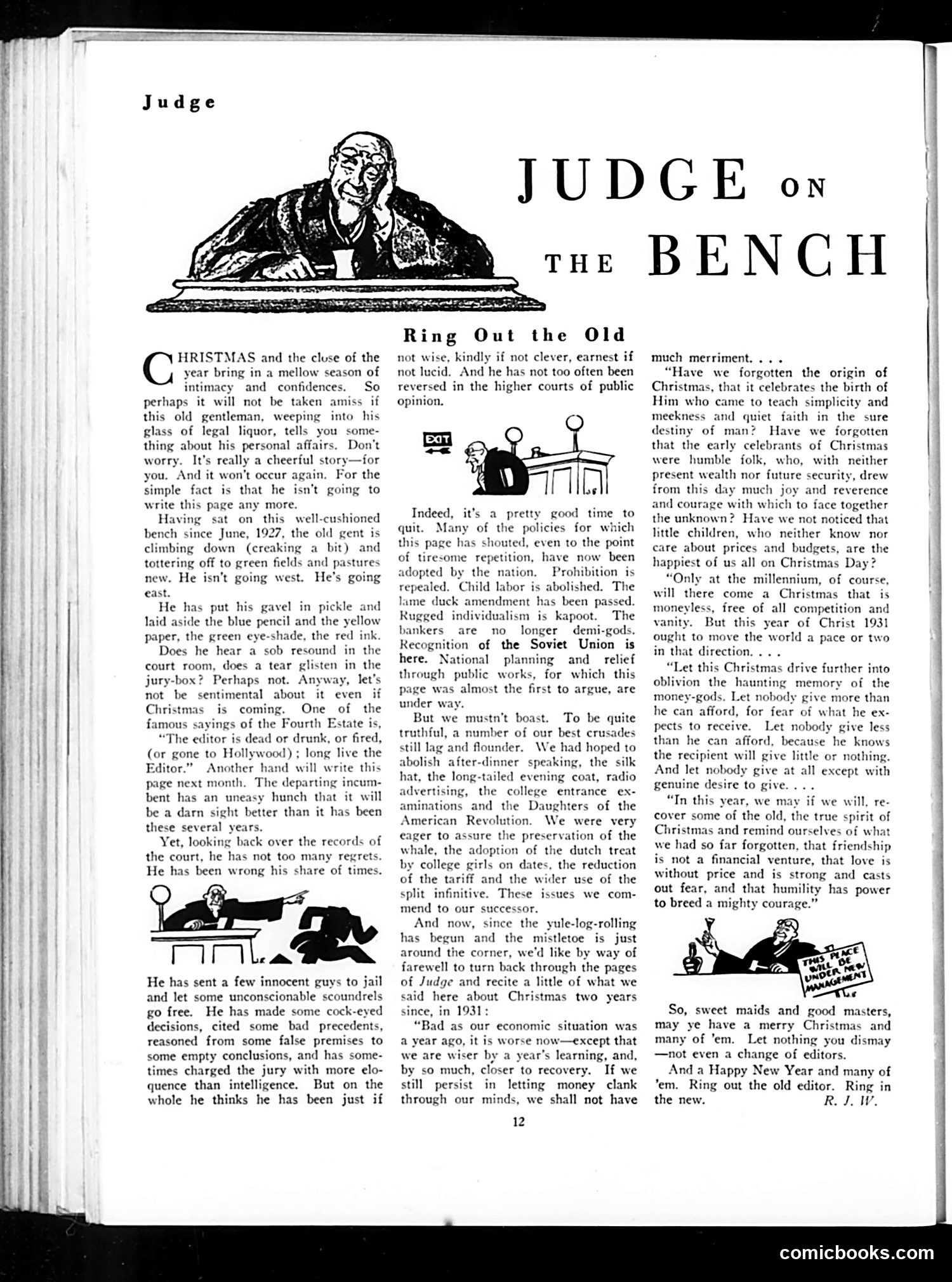
Understanding "Judge on the Bench" This is a farewell column by Judge magazine's long-serving editorial judge character, who has written the column since June 1927 and is now retiring. The illustrated figure is this personified "Judge"—a stern older man representing the magazine's voice of satirical authority. The piece reflects on the magazine's crusades and victories: Prohibition's repeal, abolished child labor, the lame duck amendment, and the Soviet Union's recognition. It acknowledges failures (after-dinner speeches, the DAR, tariff reduction still pending). The satire targets both the magazine's own pretensions ("we mustn't boast") and broader 1930s American society. The column reprints a Christmas message from 1931 emphasizing spiritual values over material concerns—relevant given the Great Depression context. The small cartoons show judges at work, mocking the judicial system's absurdities. This is fundamentally a nostalgic, self-congratulatory send-off by an influential publication marking institutional change.
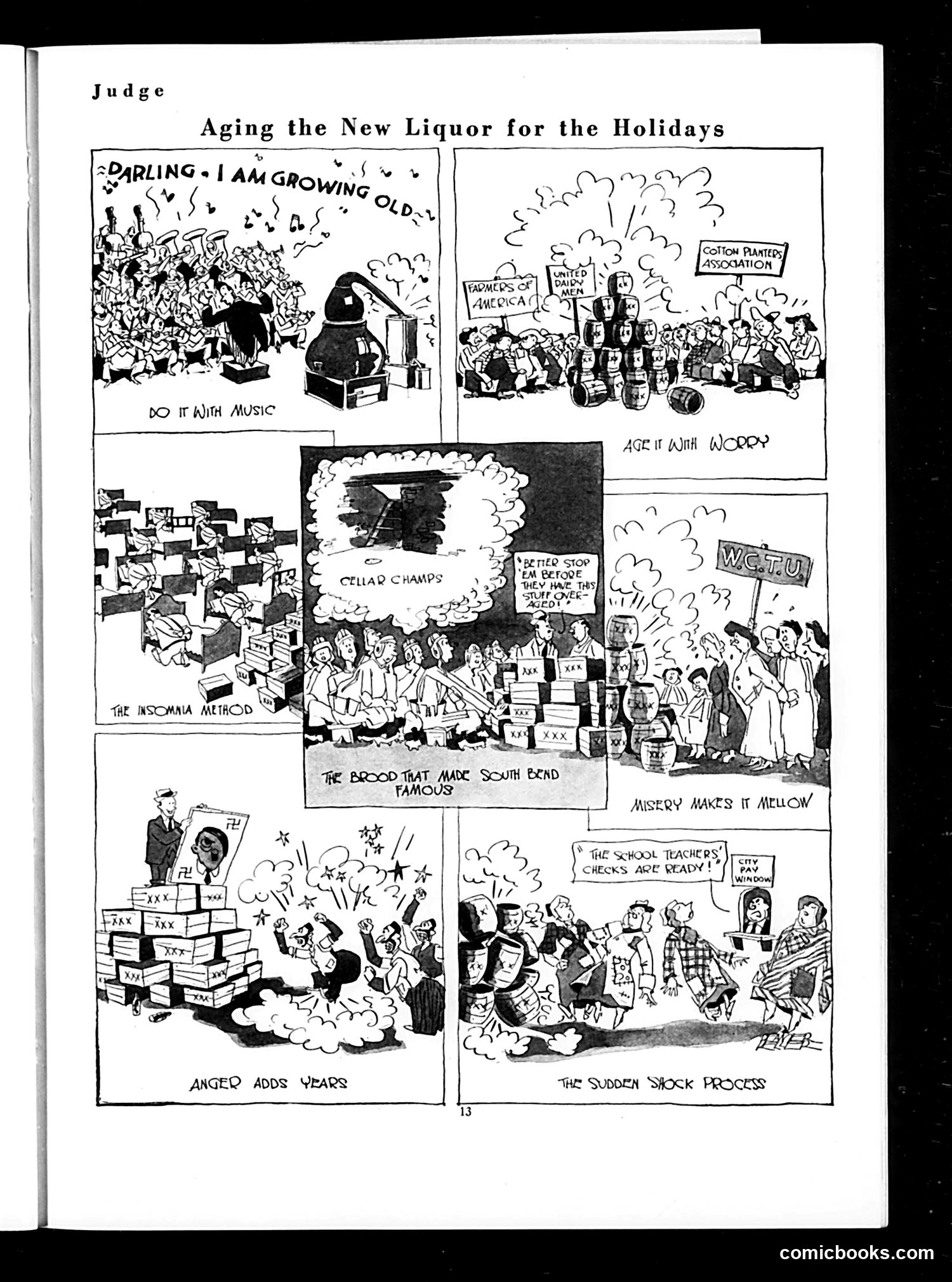
"Aging the New Liquor for the Holidays" This satirical comic strip mocks Prohibition-era methods for illegally aging and distributing alcohol. Each panel depicts a different "aging technique": - "Do it with Music": Playing music to spirits - "Age it with Work": Labor-intensive processes - "The Insomnia Method": Sleep deprivation supposedly hastens aging - "Cellar Champs": Underground storage - "The Brood that Made South Bend Famous": References a specific distillery - "Misery Makes it Mellow": Hardship supposedly improves liquor - "Angled Adds Years": Stacking bottles at angles - "The Sudden Shock Process": Extreme temperature changes The cartoon satirizes creative bootleggers' dubious claims about accelerating alcohol production during Prohibition. References to "Cotton Planters Association" and "School Teachers' Checks" suggest various cover organizations used to distribute illegal liquor. The humor lies in the absurdity of these pseudo-scientific methods for making cheap homemade spirits seem aged and legitimate.
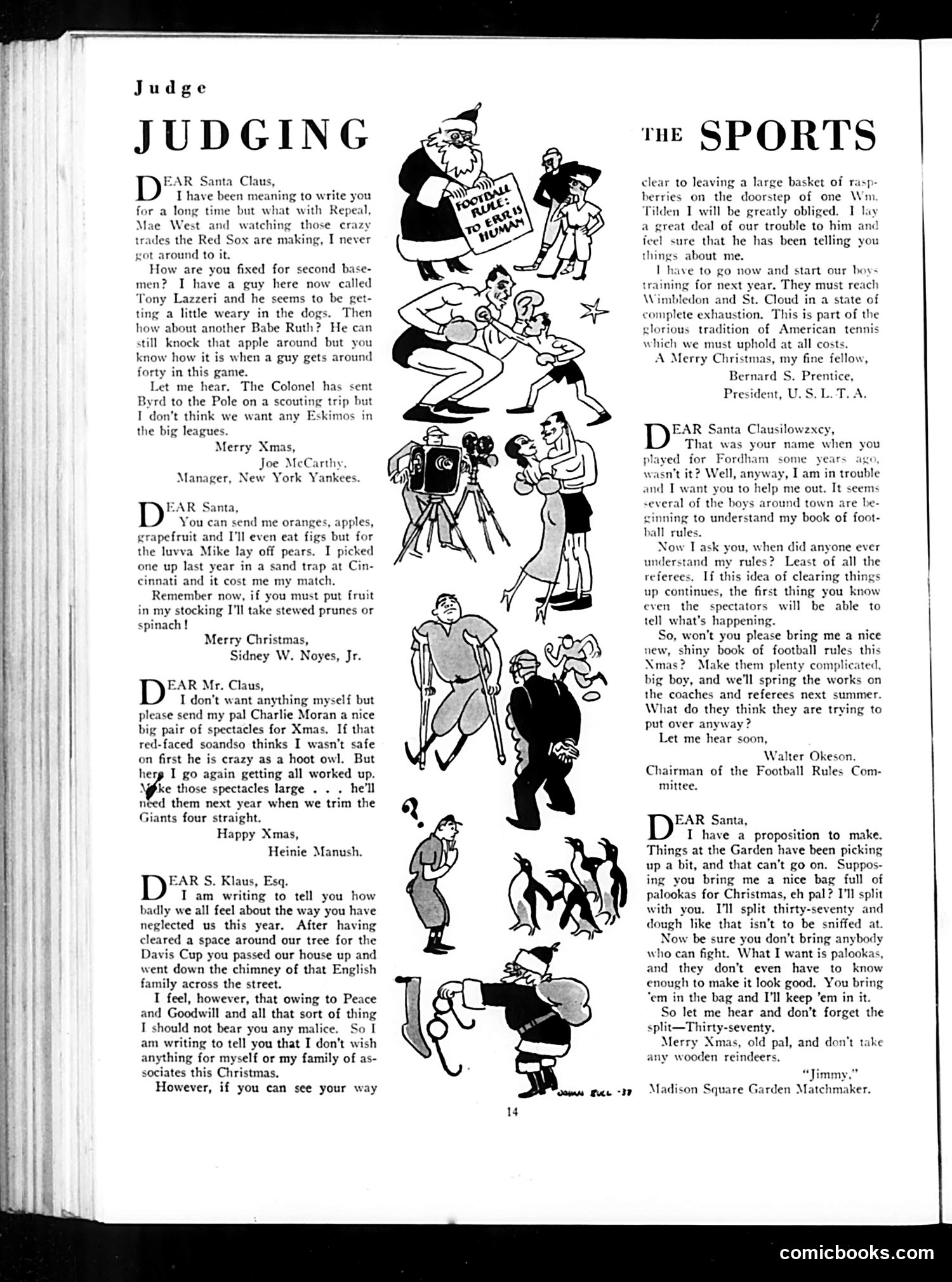
"Judging the Sports" — Judge Magazine Letters to Santa This page satirizes American sports figures' Christmas wishes through fake letters to Santa Claus. The humor relies on insider knowledge of 1930s sports scandals and personalities. Key figures referenced: - Joe McCarthy (Yankees manager): jokes about aging star Tony Lazzeri and wanting another Babe Ruth - Charlie Moran (baseball umpire): mocked for poor eyesight on calls - W. Tilden (tennis): the U.S. Lawn Tennis Association president complains Tilden is spreading bad publicity - Walter Okeson (Football Rules Committee chair): requests *more* complicated rulebooks to confuse referees and coaches The satire targets these sports authorities' self-interest: managers want better players, umpires need glasses, tennis officials blame rivals, and football officials profit from confusion. The illustrations show Santa dispensing advice to various athletes and officials, mocking their petty complaints and professional vanities during the Depression era.
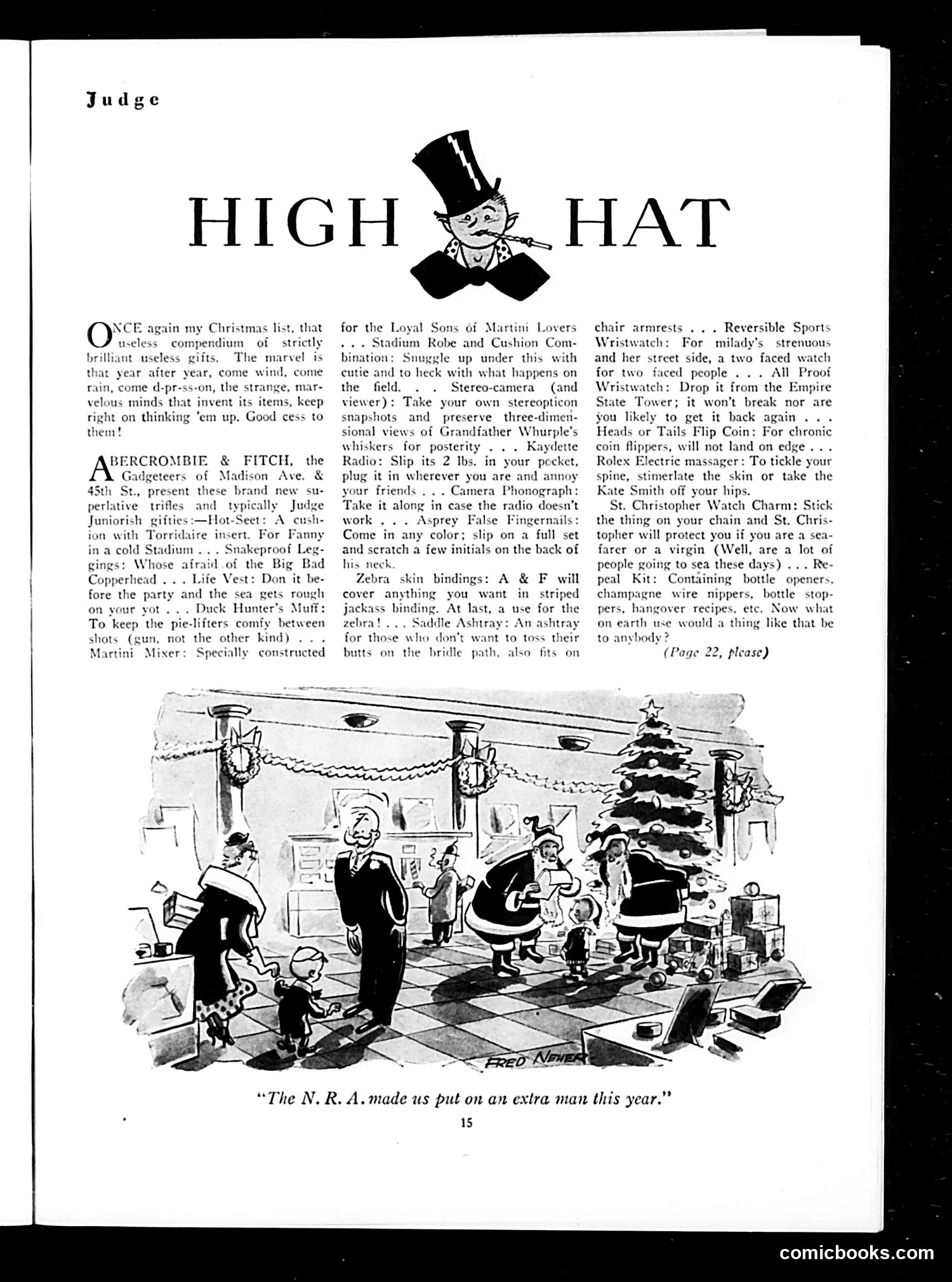
Judge Magazine Satire Analysis This page satirizes frivolous luxury gift-giving through a fake product catalog from Abercrombie & Fitch. The humor targets wealthy consumers obsessed with useless status items—stereo cameras for three-dimensional photographs, fake fingernails, zebra-skin book bindings, and "all-proof" watches. The cartoon below depicts a wealthy family's Christmas party with the caption: "The N.R.A. made us put on an extra man this year." This references the National Recovery Administration (New Deal era legislation), satirizing how businesses complained about hiring requirements. The joke: even the wealthy couldn't avoid labor regulations. The overall message critiques both conspicuous consumption among the rich and the tensions between business interests and New Deal labor policies. Judge uses exaggerated product descriptions and the NRA reference to mock both the privileged class and their resistance to government intervention.
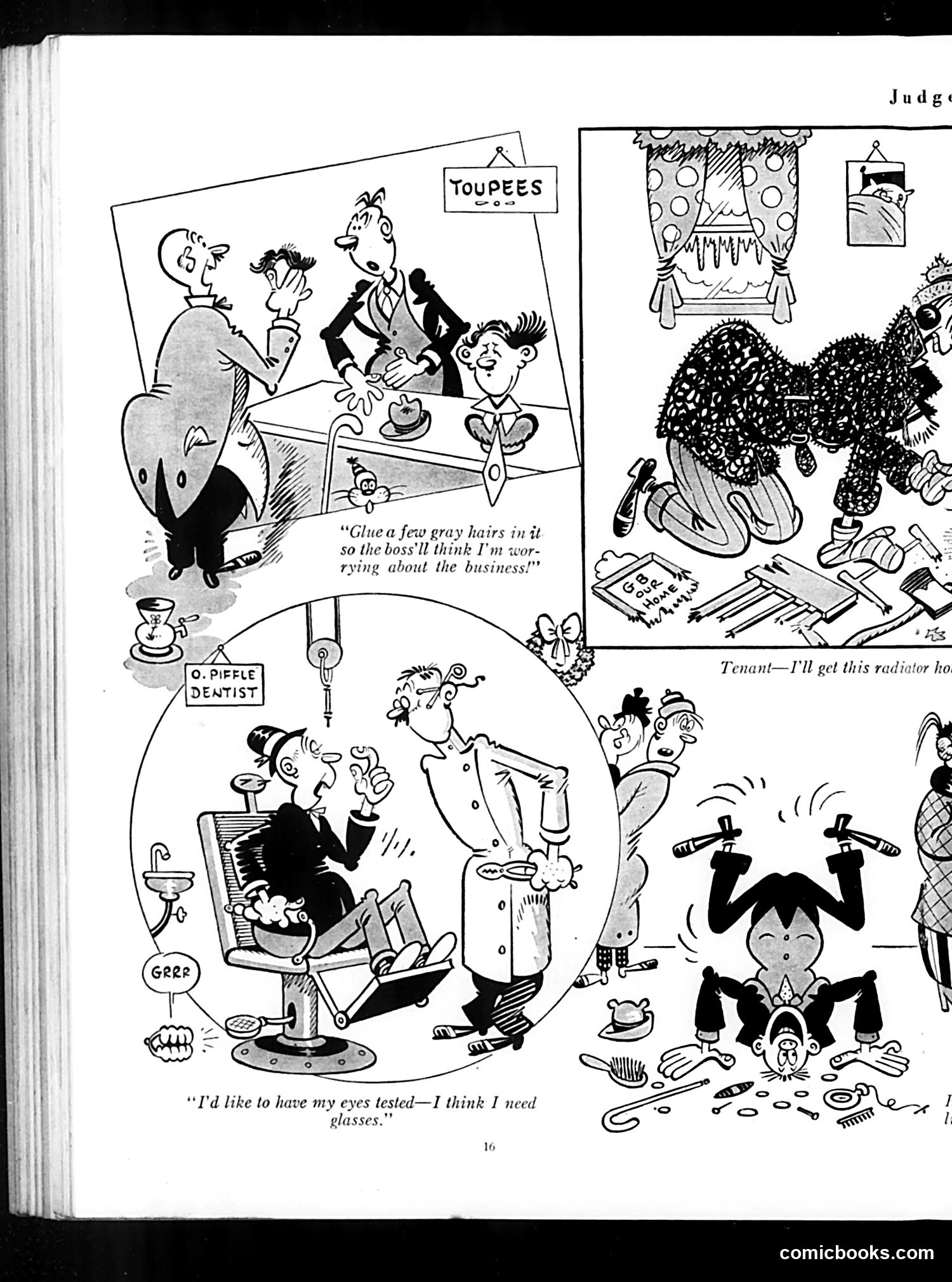
Judge Magazine Cartoon Analysis This page contains three separate comic vignettes satirizing workplace anxieties and vanity: Top panel ("Toupees"): A businessman at a salon discusses adding gray hairs to his hairpiece to appear more serious and dedicated to his employer—satirizing the performative aspects of corporate ambition and the anxiety men felt about aging in business. Middle panel ("O. Piffel Dentist"): A man in a dentist's chair expresses worry, mocking hypochondriac behavior and dental anxiety. Bottom panel: A man doing exercises with dumbbells has apparently strained himself, humorously suggesting over-exertion from fitness routines. The common theme mocks urban middle-class male anxieties about appearance, health, and professional reputation—the comedian targets insecurity and self-consciousness among aspirational workers trying to maintain facades of competence and vigor.
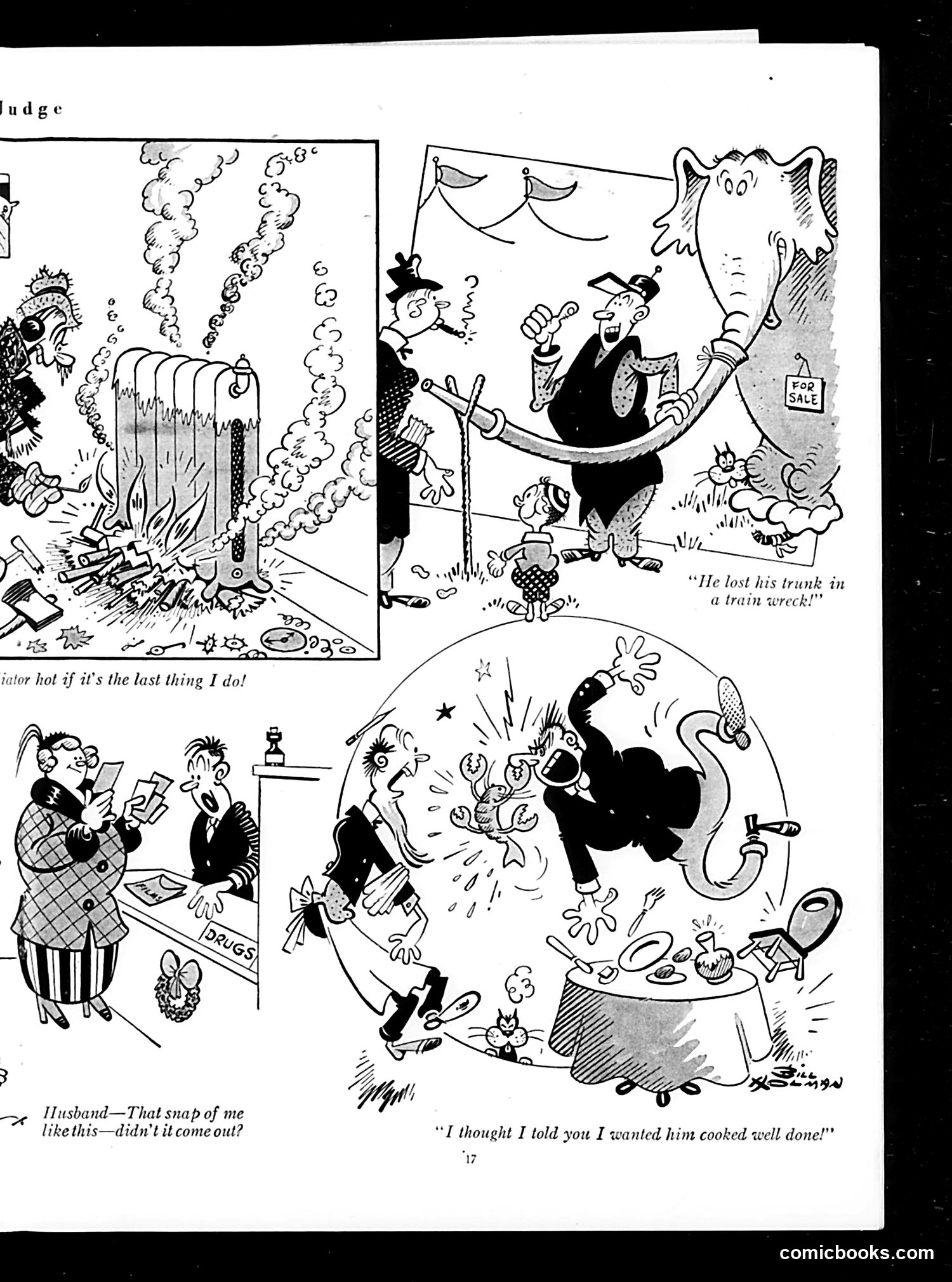
Judge Magazine Comic Page Analysis This page contains three unrelated domestic humor comics typical of Judge magazine's satirical style. Top right: A couple displays a large elephant to potential buyers with a "FOR SALE" sign. The caption explains they lost its trunk in a train wreck—a visual pun playing on the double meaning of "trunk" (luggage vs. an elephant's appendage). Bottom left: A husband complains to his wife that a photograph of him didn't turn out well, suggesting vanity or photographic incompetence. Bottom right: A wife angrily confronts her husband after cooking mishap, having apparently cooked the family pet or an unwanted guest "well done" instead of preparing a meal properly—dark humor playing on miscommunication about cooking instructions. All three comics mock domestic life and marital misunderstandings through wordplay and slapstick situations.
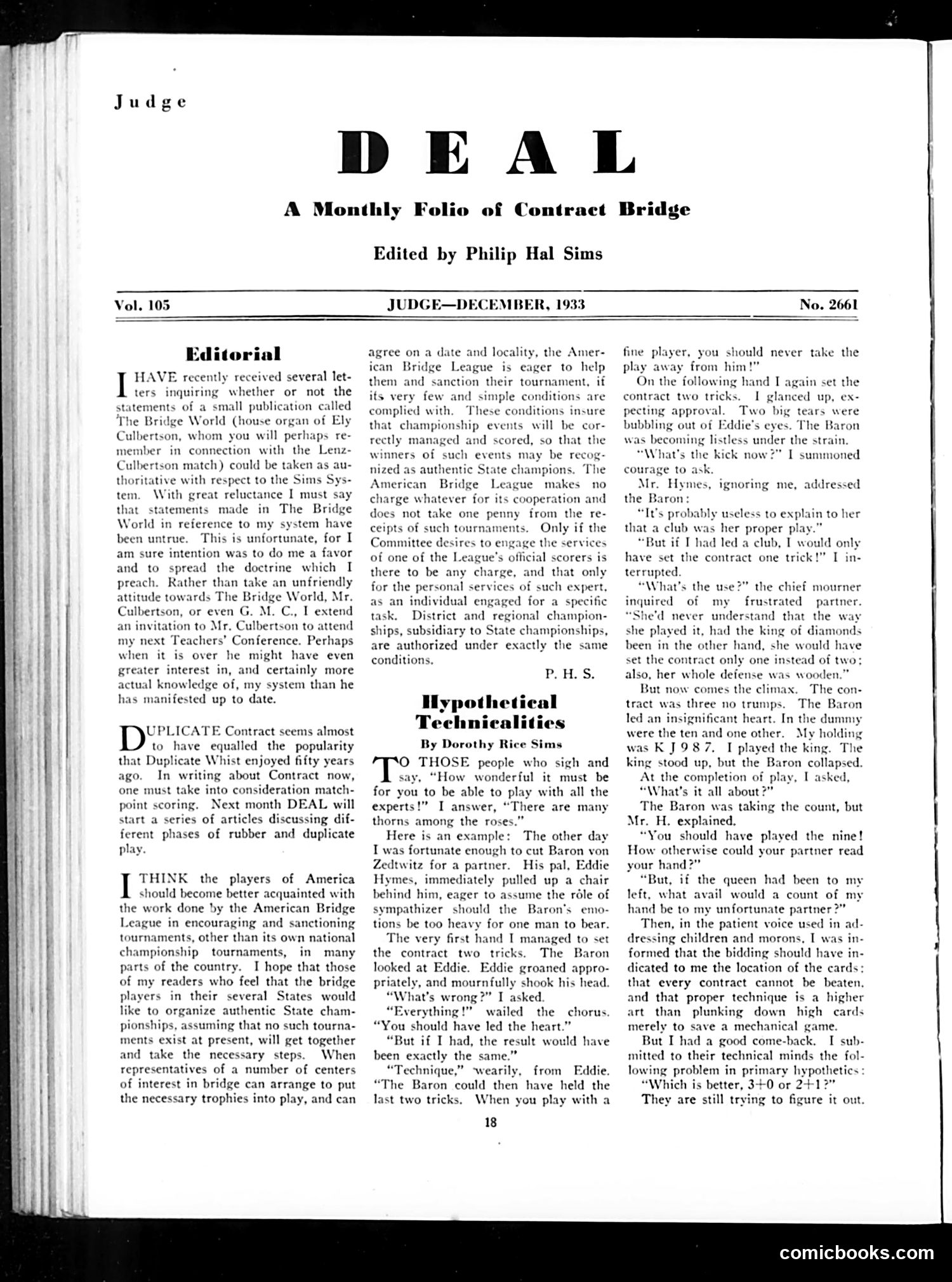
Judge Magazine Bridge Column—December 1933 This page is primarily an editorial and advice column about contract bridge, the card game that was enormously popular in the 1930s. The content is not satirical but rather instructional and competitive. The editorials discuss disputes within the bridge world, particularly between Ely Culbertson (a famous bridge expert who ran *The Bridge World* magazine) and Philip Hal Sims (the editor). Sims complains that Culbertson's publication misrepresented his "Sims System" of bridge play. The second section, "Hypothetical Technicalities" by Dorothy Rice Sims, recounts a humorous anecdote about playing bridge with Baron von Zedtwitz and Eddie Hymes. After Sims sets the contract (a good outcome), Hymes—sympathizing with the Baron—groans and criticizes her card play, insisting she should have played differently. Sims proves the outcome would've been identical anyway. The joke satirizes bridge kibitzers (backseat critics) who offer unsolicited, often incorrect advice during play.
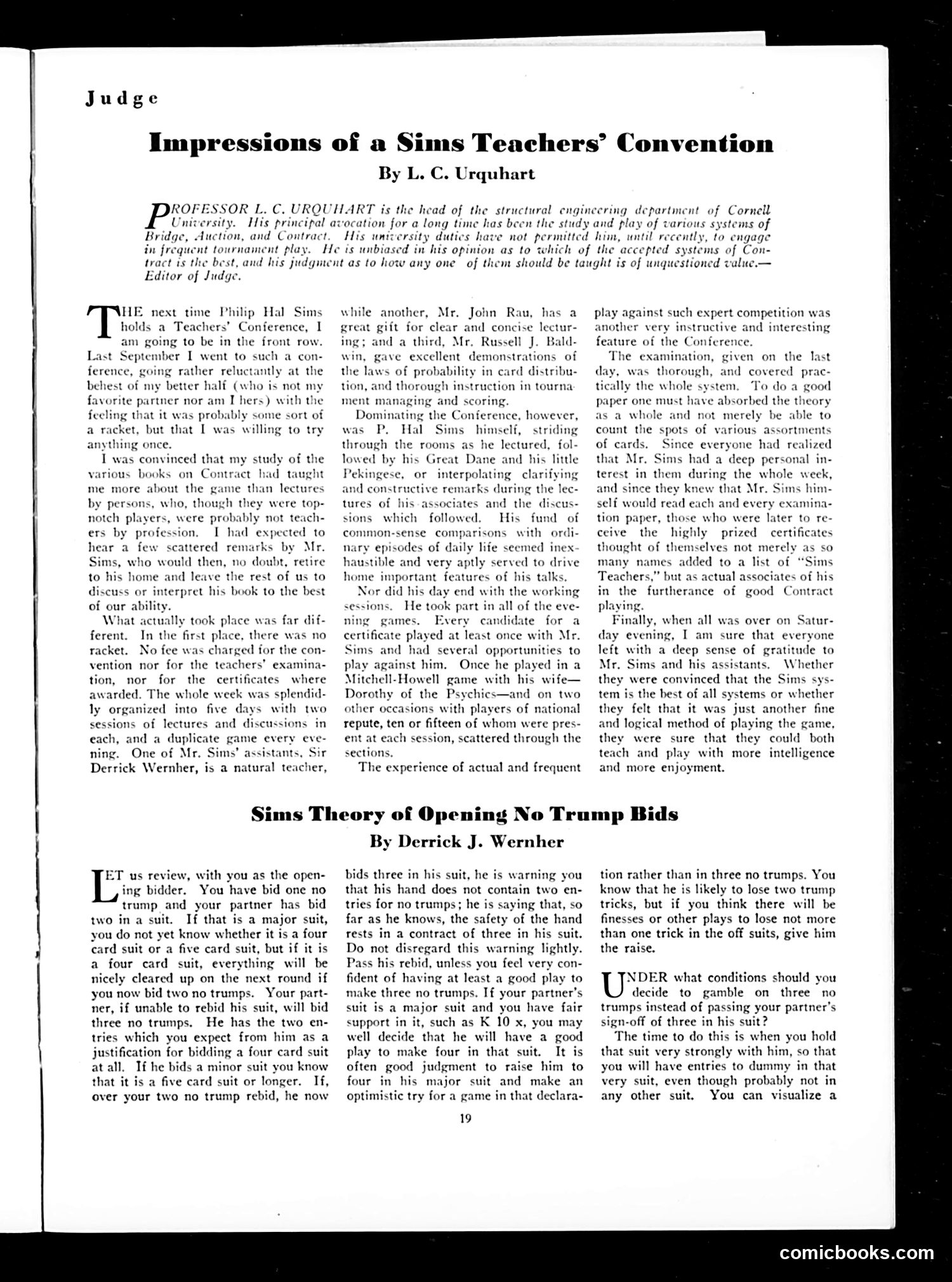
Explanation for Modern Readers This page from *Judge* magazine contains two articles about contract bridge, a popular card game among educated American society in the early-to-mid 20th century. The first article praises Philip Hal Sims, a renowned bridge authority, for hosting a teachers' convention. The author (Professor L.C. Urquhart) initially attended skeptically, suspecting a "racket," but was impressed by Sims's well-organized, free instruction involving lectures, demonstrations, and competitive play. The satire is gentle—poking fun at the author's initial cynicism about anything educational. The second article discusses bridge bidding strategy, written by Derrick Wernher (identified as one of Sims's assistants in the first piece). Historical context: Bridge was intellectually prestigious among elites; teaching it seriously through structured conferences reflects how seriously this leisure activity was taken. The humor derives from treating a card game with academic rigor comparable to university education.
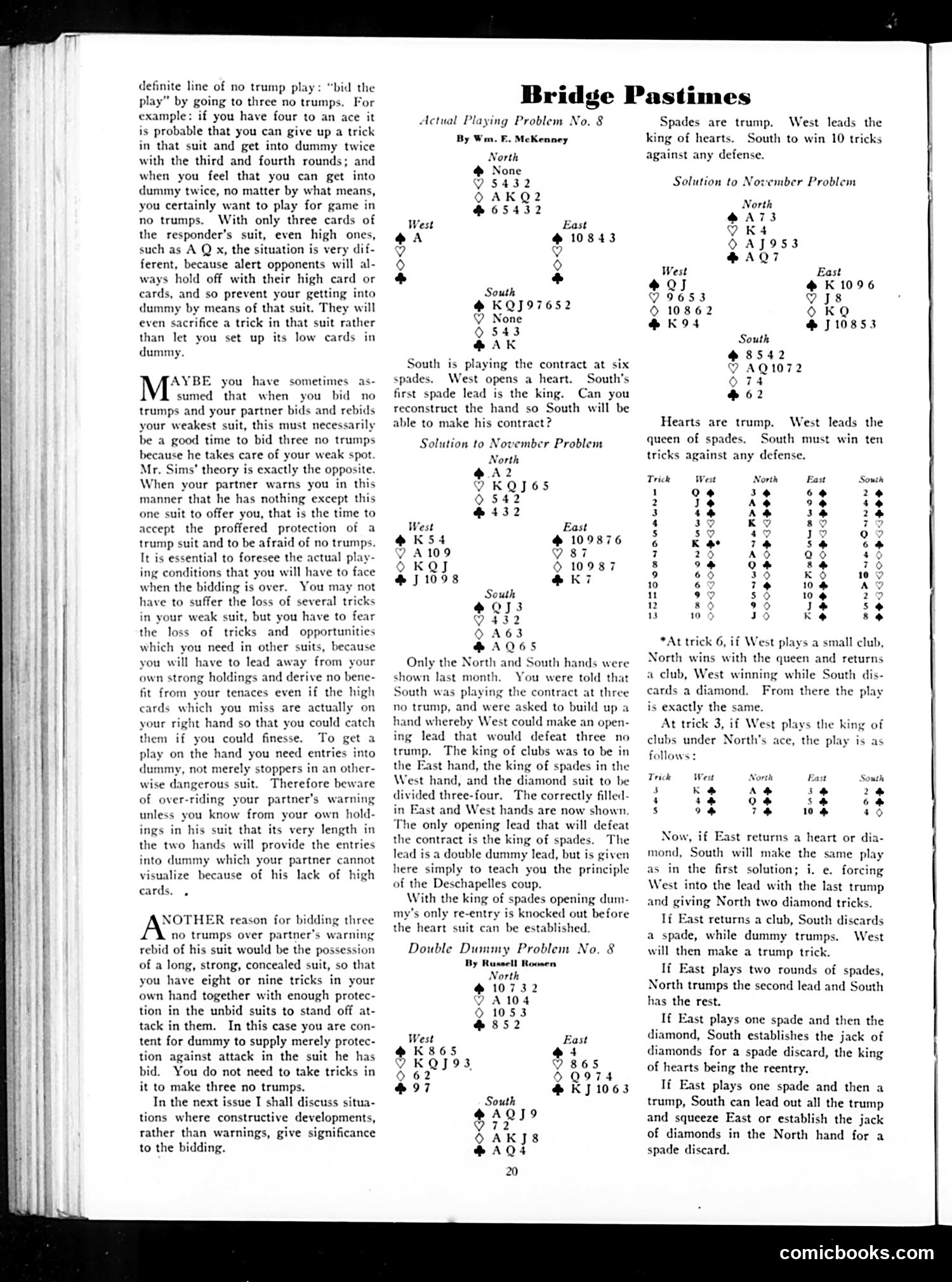
Bridge Pastimes Page Content Analysis This page contains bridge instruction and card game problems, not political satire or cartoons. It's educational content from Judge magazine's "Bridge Pastimes" column. The page features: 1. Instructional articles by William F. McKenney on bridge bidding strategy, discussing concepts like "no trump play" and when to bid three no trumps versus trump suits. 2. Card game problems with hand diagrams showing North/South/East/West card distributions, asking readers to solve bidding and play scenarios. 3. Solutions to previous problems, explaining correct card play principles. There are no political cartoons, caricatures, or satire on this page. This appears to be recreational/hobby content that Judge magazine included alongside its satirical material—bridge was a popular pastime among educated audiences in this era. The "Sims' theory" referenced likely refers to bridge expert P. Hal Sims.
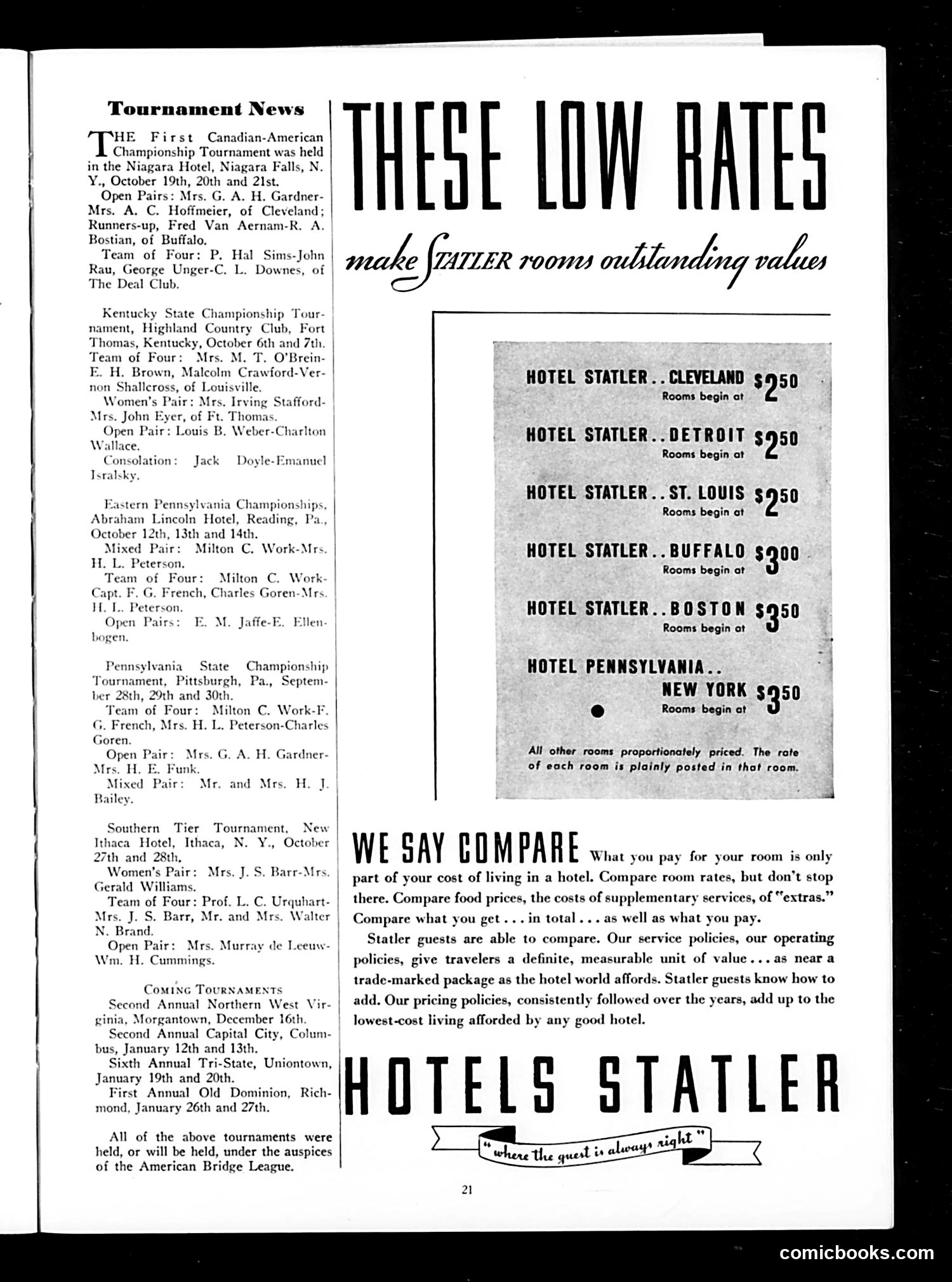
Analysis This page is primarily advertising and tournament reporting, not satire or political commentary. The left column lists bridge tournament results and upcoming events across various American cities—results from competitions held under American Bridge League auspices, naming winners in categories like "Open Pairs" and "Team of Four." The dominant content is a Hotel Statler advertisement promoting their chain's low room rates ($2.50-$3.00 per night, depending on location). The ad's tagline—"where the guest is always right"—emphasizes value and transparency. The marketing message urges travelers to compare not just room rates but total costs including food and services, positioning Statler as offering measurable, consistent value ("as near a trade-marked package as the hotel world affords"). This reflects 1920s-30s advertising strategy: competitive hotel pricing during the pre-Depression or Depression era, when detailed cost comparisons were selling points. There is no satirical content or political reference visible on this page.
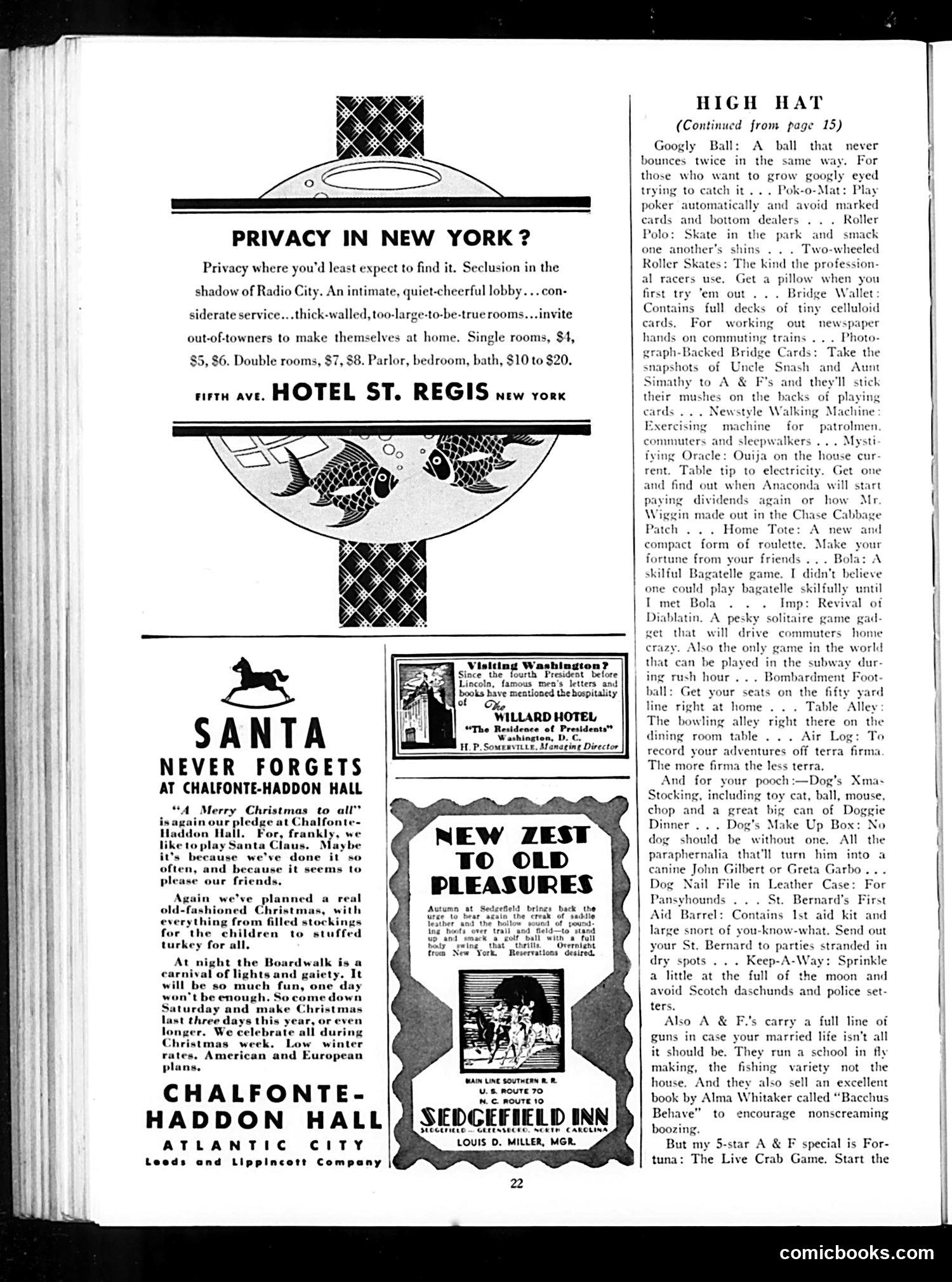
Judge Magazine Page Analysis This page is primarily advertising for luxury hotels and resorts, with a satirical "High Hat" column on the right. The main cartoon—showing fish in a bowl beneath a hotel—is a visual pun on the advertised Hotel St. Regis's claim to offer "privacy" in New York. The joke: despite promises of seclusion, you're actually on display like fish in a fishbowl, observable to all. The "High Hat" column satirizes frivolous novelty games and gadgets of the era—items like "Googly Ball," "Pok-o-Mat" (automatic poker), and "Bombardment Football." The humor targets wealthy leisure-seekers and their obsession with trivial amusements. The dog-related items mock pet owners' excessive indulgence. The tone is gently mocking of upper-class consumerism and boredom-driven gadget purchasing during what appears to be the interwar period.
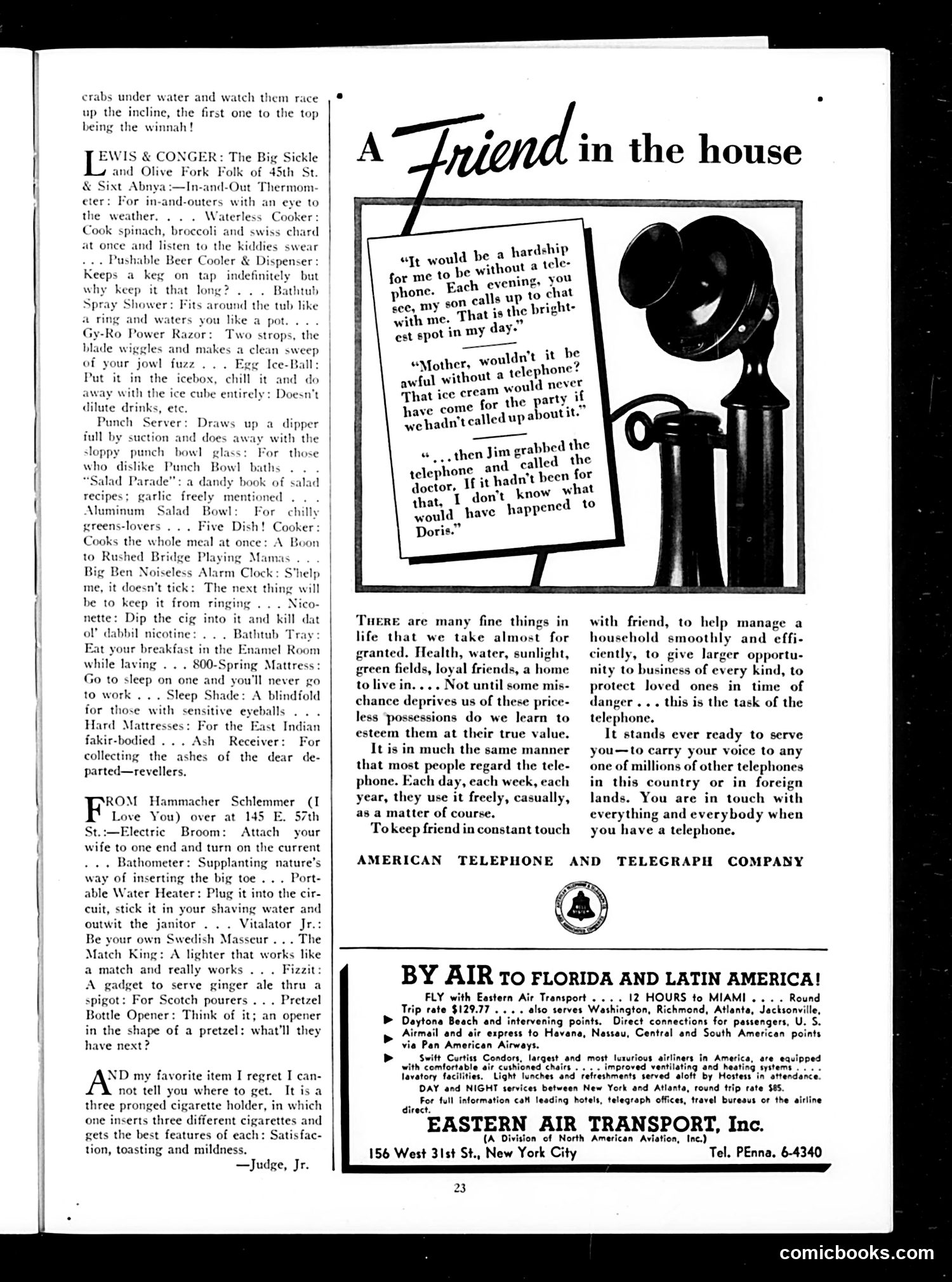
"A Friend in the House" - Judge Magazine Advertisement This page combines product advertisements with a charming narrative advertisement for telephone service. The main illustrated feature depicts a family scene where a young man (Jim) uses the telephone to call a doctor when his sister Doris falls ill, implying the telephone's life-saving utility. The satire is gentle: the left column mockingly lists absurd household gadgets from department store Hammacher Schlemmer—a noiseless alarm clock, an electric broom, a "waterless cooker"—products Judge's readers would recognize as the era's misguided inventions promising to solve modern living problems. By contrast, the telephone advertisement (right side) presents the telephone as a genuinely *useful* luxury—not a gimmick, but essential infrastructure connecting families and protecting loved ones. The implicit message: amid all these frivolous consumer goods, the telephone represents real progress in human connection. The page reflects 1920s-30s consumer culture anxiety and advertising satire typical of Judge magazine.
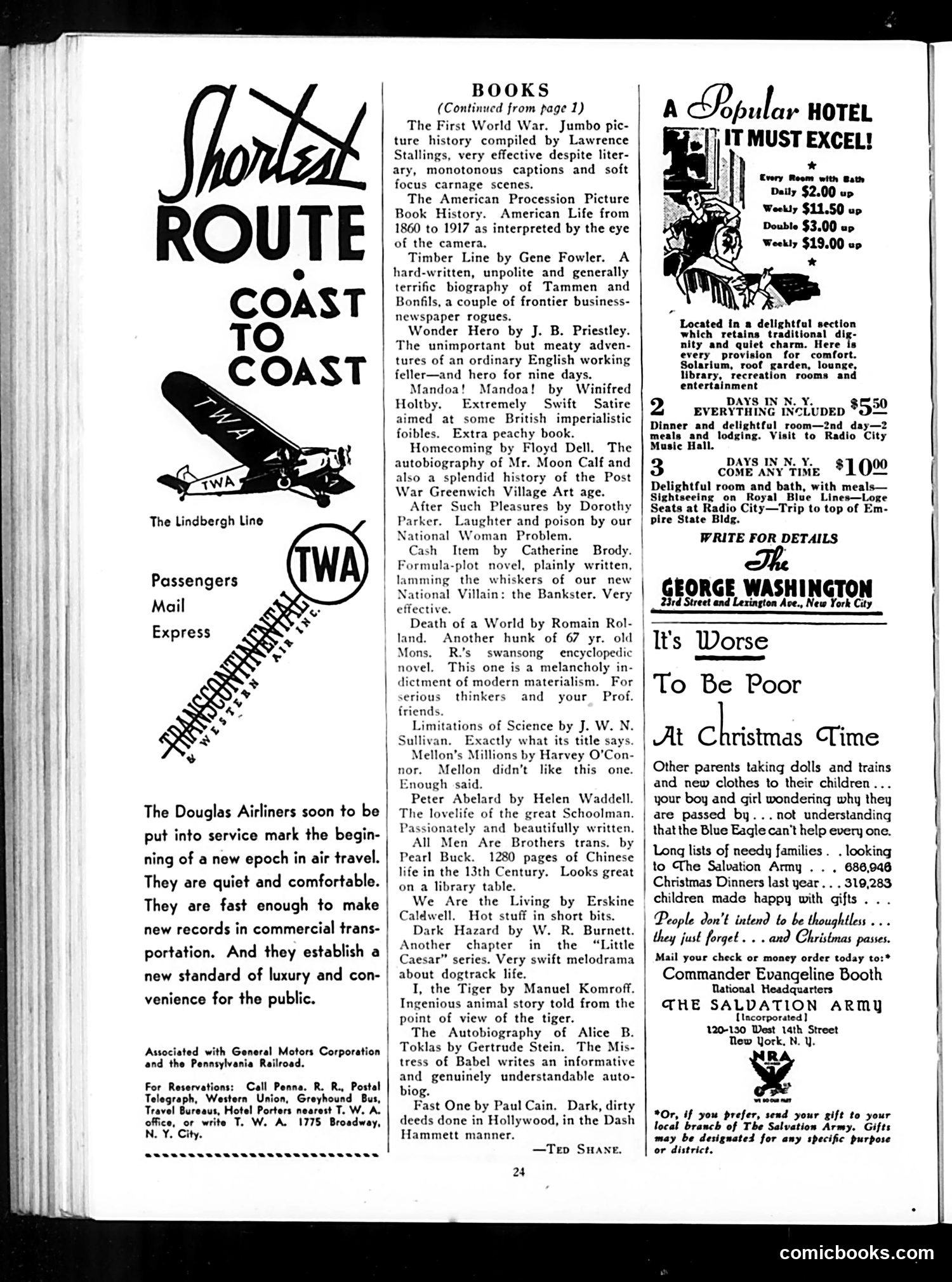
Analysis of This Judge Magazine Page This page is primarily advertising and book reviews, not political satire. The main content consists of: Left side: TWA airline advertisement promoting "The Lindbergh Line" and Douglas Airliners—referencing Charles Lindbergh's famous 1927 transatlantic flight to capitalize on aviation enthusiasm. The copy emphasizes luxury, speed, and comfort as selling points for commercial air travel (then novel and prestigious). Center/Right: Book reviews by "Ted Shane" covering 1930s literature—mostly standard novel summaries with brief critical assessments. Right side: Hotel advertisements for New York City establishments. The only quasi-satirical element is the small box titled "It's Worse to Be Poor At Christmas Time," which appears to be a Salvation Army fundraising appeal contrasting wealthy children receiving gifts with poor families' struggles—social commentary wrapped in advertising rather than sharp satire. No identifiable political figures or caricatures appear; this is a commercial magazine page typical of the era's advertising-heavy format.
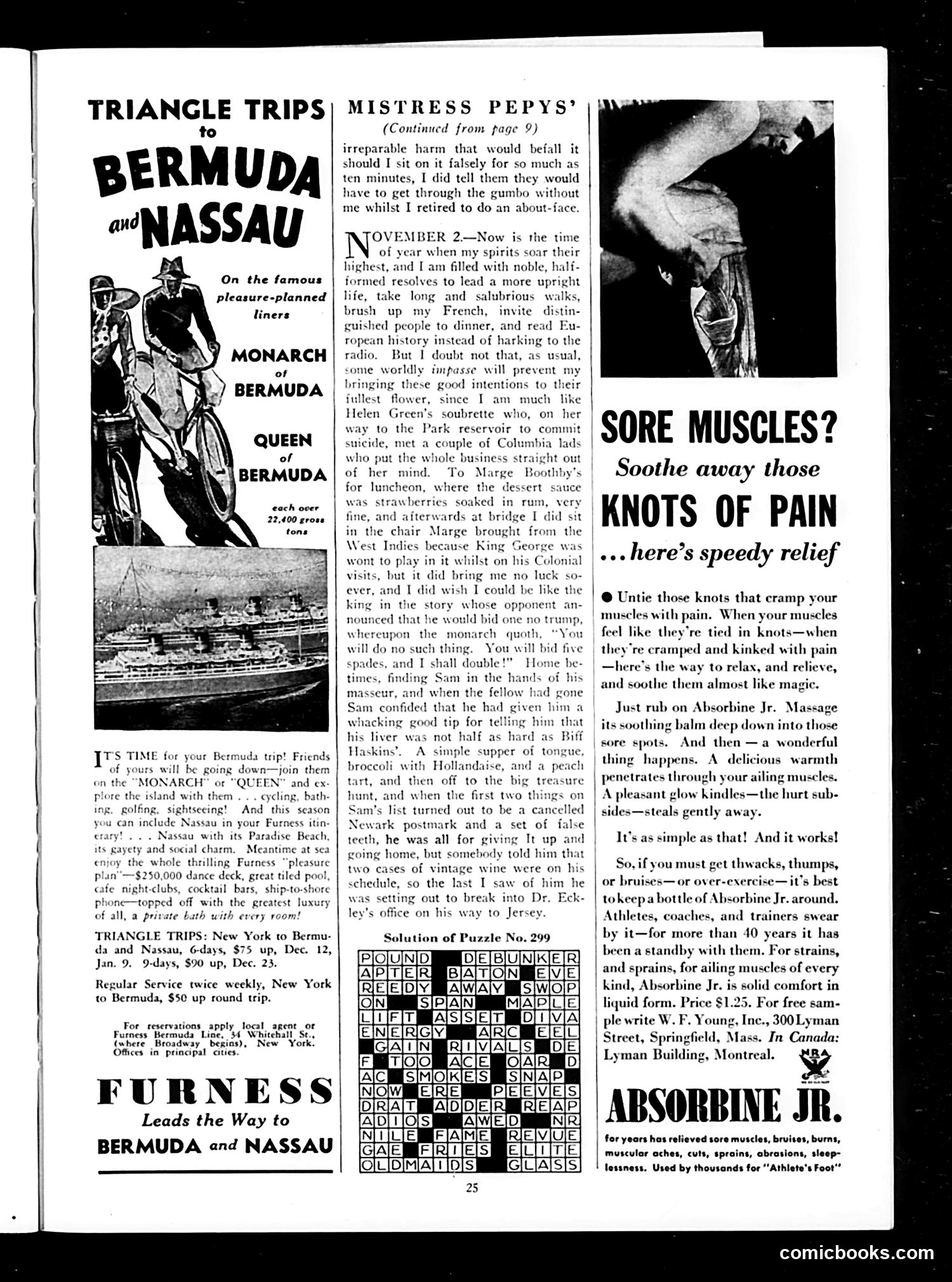
Analysis of This Judge Magazine Page This page from Judge magazine contains primarily advertisements and a serialized humor column rather than political cartoons. The main content is "Mistress Pepys'" (a recurring humor column mimicking Samuel Pepys' diary style), which satirizes 1930s upper-class social life through mock-earnest anecdotes about luncheons, bridge games, and domestic trivialities. The narrator obsesses over trivial matters (a chair King George sat on, vintage wine) while claiming noble intentions. The page also advertises luxury cruise vacations to Bermuda and Nassau on Furness Line ships ("Monarch" and "Queen"), appealing to wealthy readers with promises of dance decks, pools, and private baths. An Absorbine Jr. advertisement uses a photograph of someone's sore, cramped leg to sell muscle-pain relief balm—typical patent medicine marketing of the era, promising nearly magical curative powers. No significant political satire or caricature is present; this page reflects Judge's shift toward lifestyle content and advertising rather than topical political commentary.
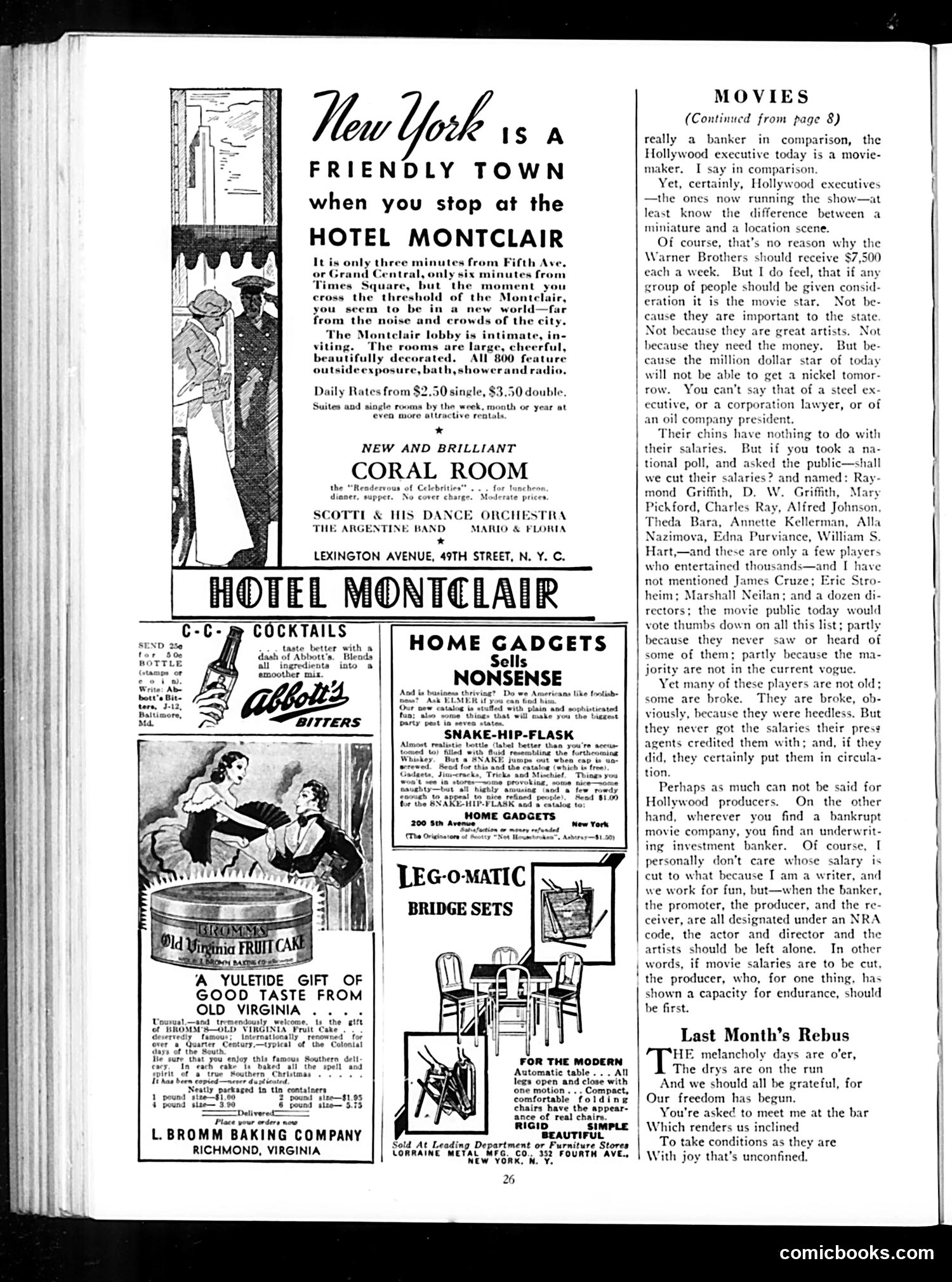
Analysis for Modern Readers This page is primarily advertising with a brief movie industry opinion piece rather than political satire. The main content is a continuation of a "Movies" column criticizing Hollywood salary structures. The Key Argument: The writer argues that movie stars—naming figures like D.W. Griffith, Mary Pickford, and Charles Ray—don't deserve their million-dollar salaries because the public wouldn't vote for them if polled. However, the column defends them against salary cuts, arguing that if anyone's pay should be reduced, it should be producers, not actors and directors, since producers have "shown a capacity for endurance." Historical Context: This appears to address 1920s-30s Hollywood debates about executive compensation versus talent pay during economic strain. The Rest: The page consists of hotel and product advertisements (Hotel Montclair, liquor flasks, bridge sets, baking products), typical of Judge magazine's revenue model. A brief poem at bottom appears unrelated filler content.
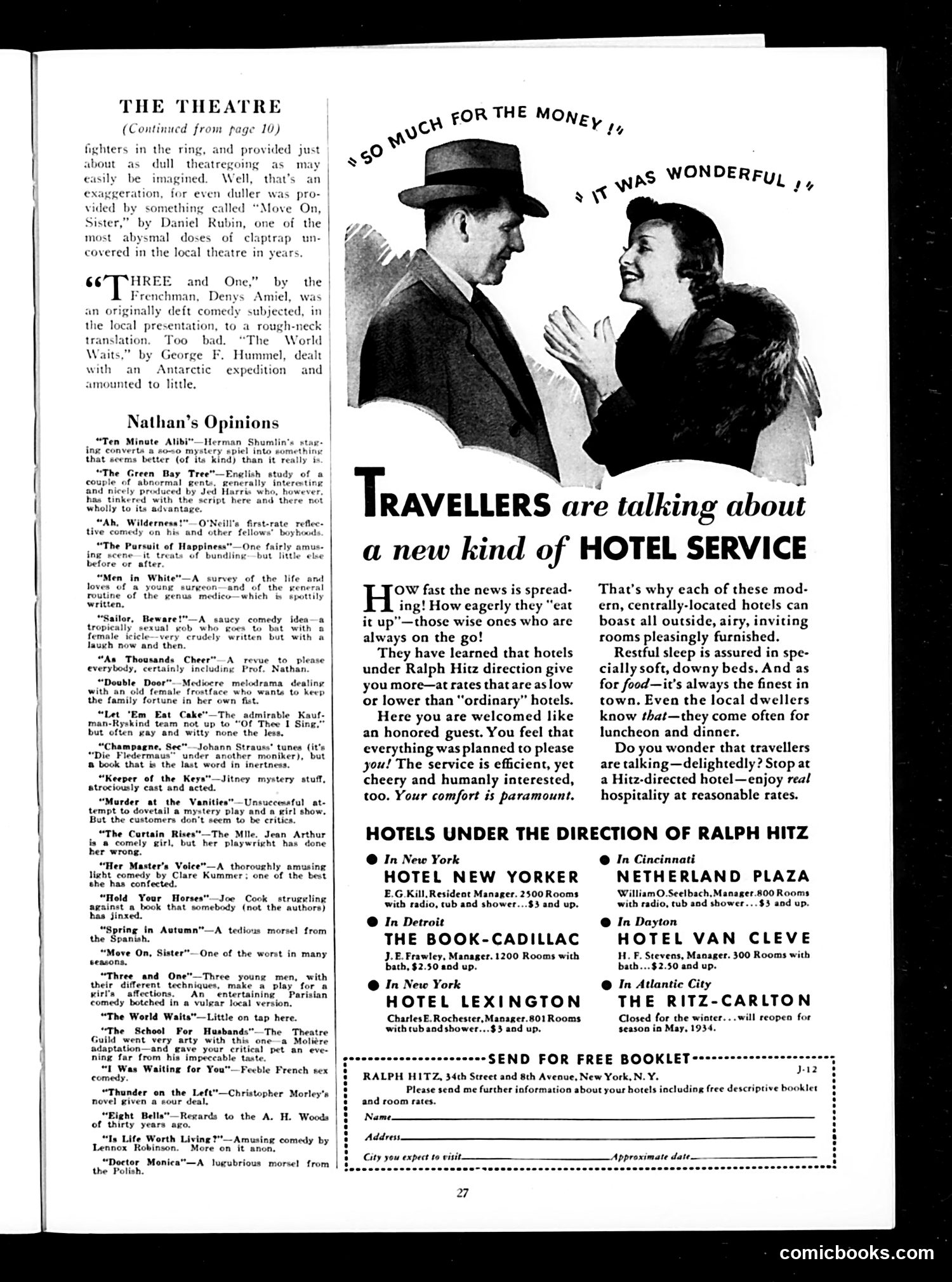
Understanding This Judge Magazine Page This page is primarily advertising, not satire. The dominant feature is a hotel advertisement featuring Ralph Hitz's hotel chain, which uses a photograph of two people (a man in a hat and suit, a woman) with dialogue bubbles praising the hotel service. The left column contains theatre reviews by "Nathan" (likely drama critic George Jean Nathan), critiquing recent Broadway plays with brief, often dismissive summaries. Reviews mention productions like "Three and One," "The World Waits," and various comedies and dramas. The satire, if any, lies in Nathan's sardonic tone toward mediocre productions—calling "Move On, Sister" one of the "most abysmal doses of claptrap uncovered in years." However, this is straightforward theatre criticism rather than political cartooning. The page reflects 1930s entertainment culture: Broadway's active theatre scene and the emerging hospitality industry's advertising in highbrow magazines. No specific political figures or events are referenced or caricatured here.
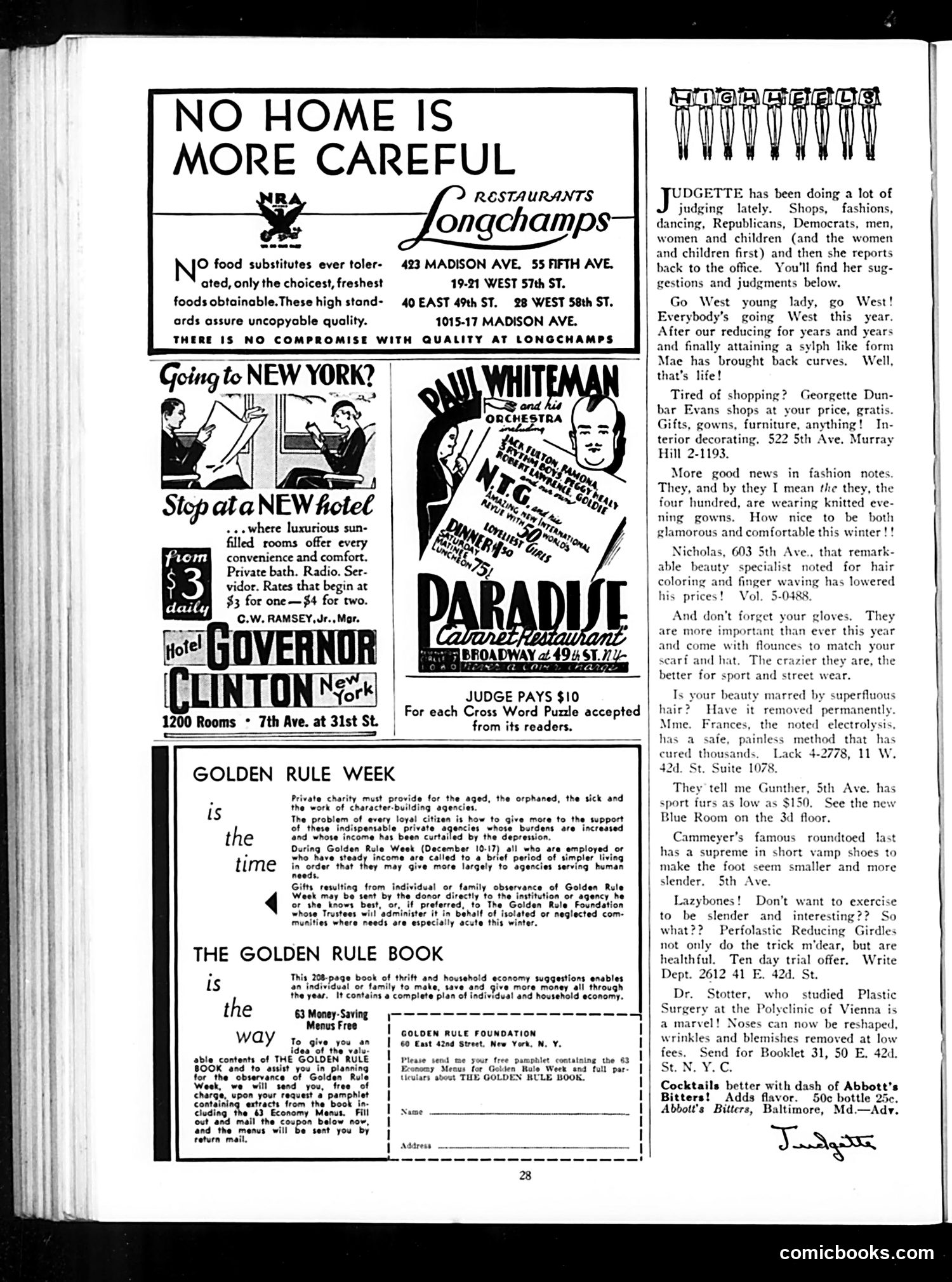
Analysis for Modern Readers This Judge magazine page is primarily advertisements and social commentary, not political satire in the traditional sense. The main content is "Judgette's" column—a female persona offering shopping and lifestyle advice to wealthy New York women in the 1920s. She reviews fashion trends (knitted evening gowns), beauty services (hair removal, plastic surgery), luxury goods (fur coats, shoes), and commercial establishments. The satire is gentle social observation: Judgette mocks women's vanity and obsession with appearance while simultaneously promoting the very services she critiques. She notes one woman's yo-yo dieting ("finally attaining a sylph like form Mae has brought back curves"), poking fun at beauty standards while advertising cosmetic procedures. The page also features paid advertisements for hotels, restaurants, and the "Golden Rule Book"—reflecting 1920s consumer culture targeting affluent urbanites. The crossword puzzle offer (Judge pays $10) was typical engagement tactics of the era. The humor assumes readers share class assumptions about what constitutes newsworthy lifestyle concerns.
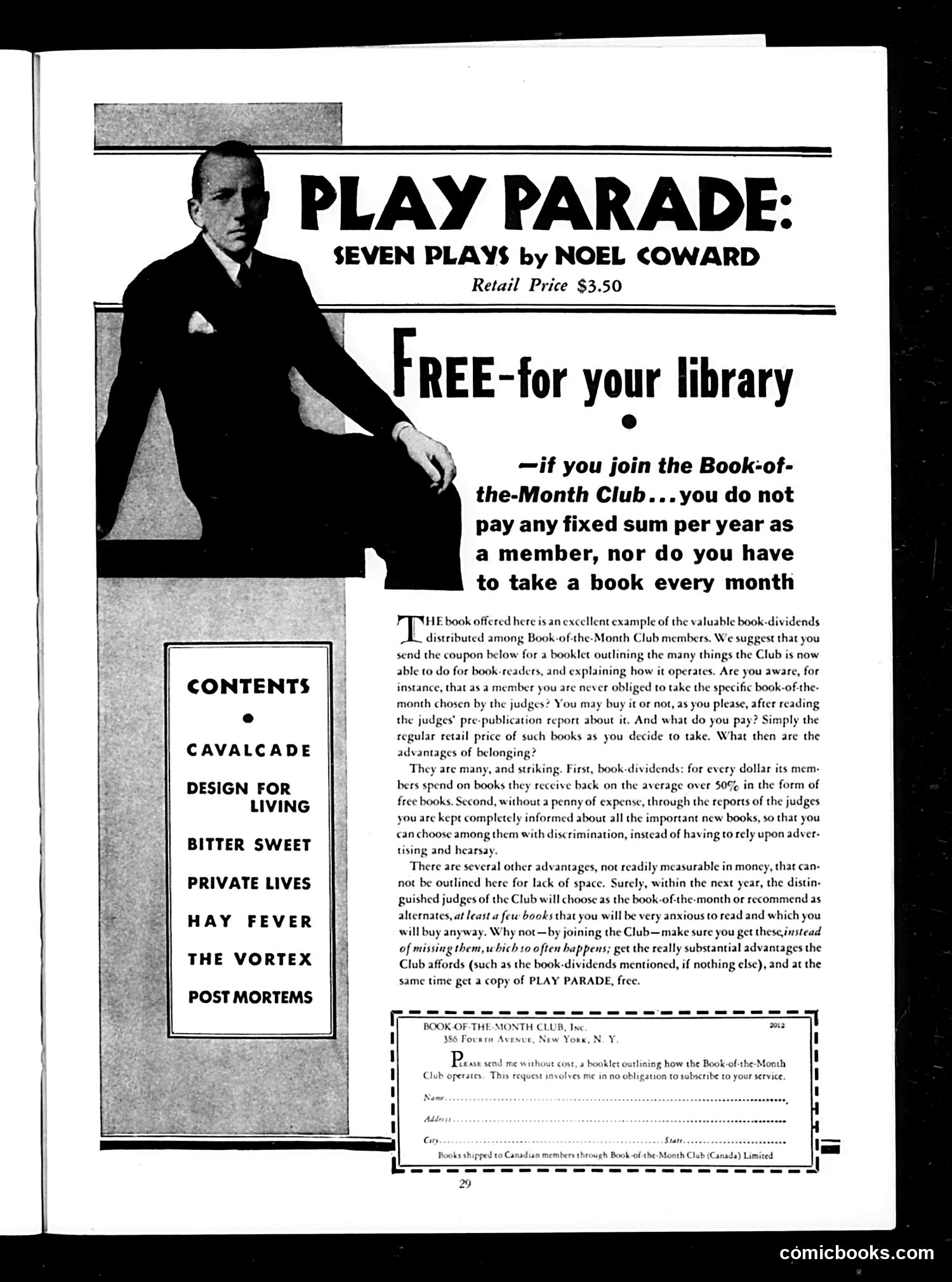
Analysis of "Play Parade" Advertisement This page is primarily an advertisement, not a satirical cartoon. It promotes Noel Coward's play collection "Play Parade" (seven plays, $3.50 retail) as a free bonus for joining the Book-of-the-Month Club. The photograph shows a distinguished gentleman in formal attire—likely Noel Coward himself, the celebrated British playwright. The ad emphasizes the Club's financial advantages: members receive over 50% back in free books for every dollar spent, and aren't obliged to purchase the monthly selection. The seven plays listed (Cavalcade, Design for Living, Private Lives, etc.) were Coward's actual recent works, establishing his contemporary prestige to entice Club membership. This is marketing material, not satire. It targets educated readers interested in theater and literature, using the author's reputation and the promise of "free" books to recruit Club members during the Book-of-the-Month Club's expansion era (1920s-30s).
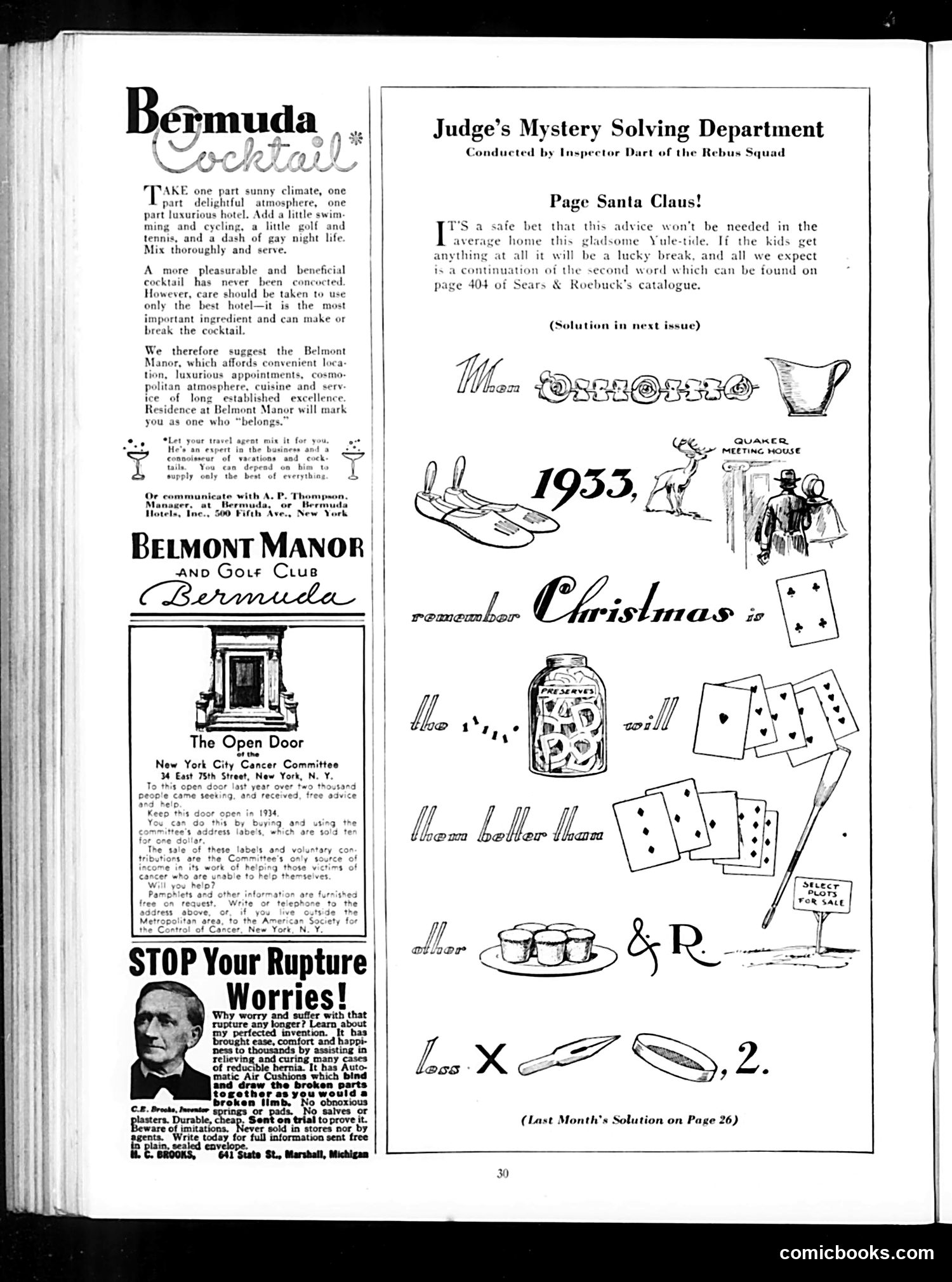
Judge Magazine Page Analysis This page combines advertising with a puzzle feature typical of Judge magazine's content. The right side features "Judge's Mystery Solving Department," a rebus puzzle where readers decode visual symbols to form words or phrases. The puzzle shown uses images (skis, a deer, a measuring cup, playing cards, butter, and a pencil) to create a hidden message—likely a Christmas-themed riddle given the "Page Santa Claus!" headline reference to a Sears catalogue page. The left side contains period advertisements: Belmont Manor (a Bermuda resort), "The Open Door" (promoting the New York Cancer Committee), and a rupture truss remedy. These ads reflect 1930s consumer products and social concerns. The rebus puzzle was a popular entertainment format in this era, encouraging reader participation and repeat purchases to solve subsequent installments. The overall page represents how Judge balanced satirical content with commercial advertisements and interactive puzzles.
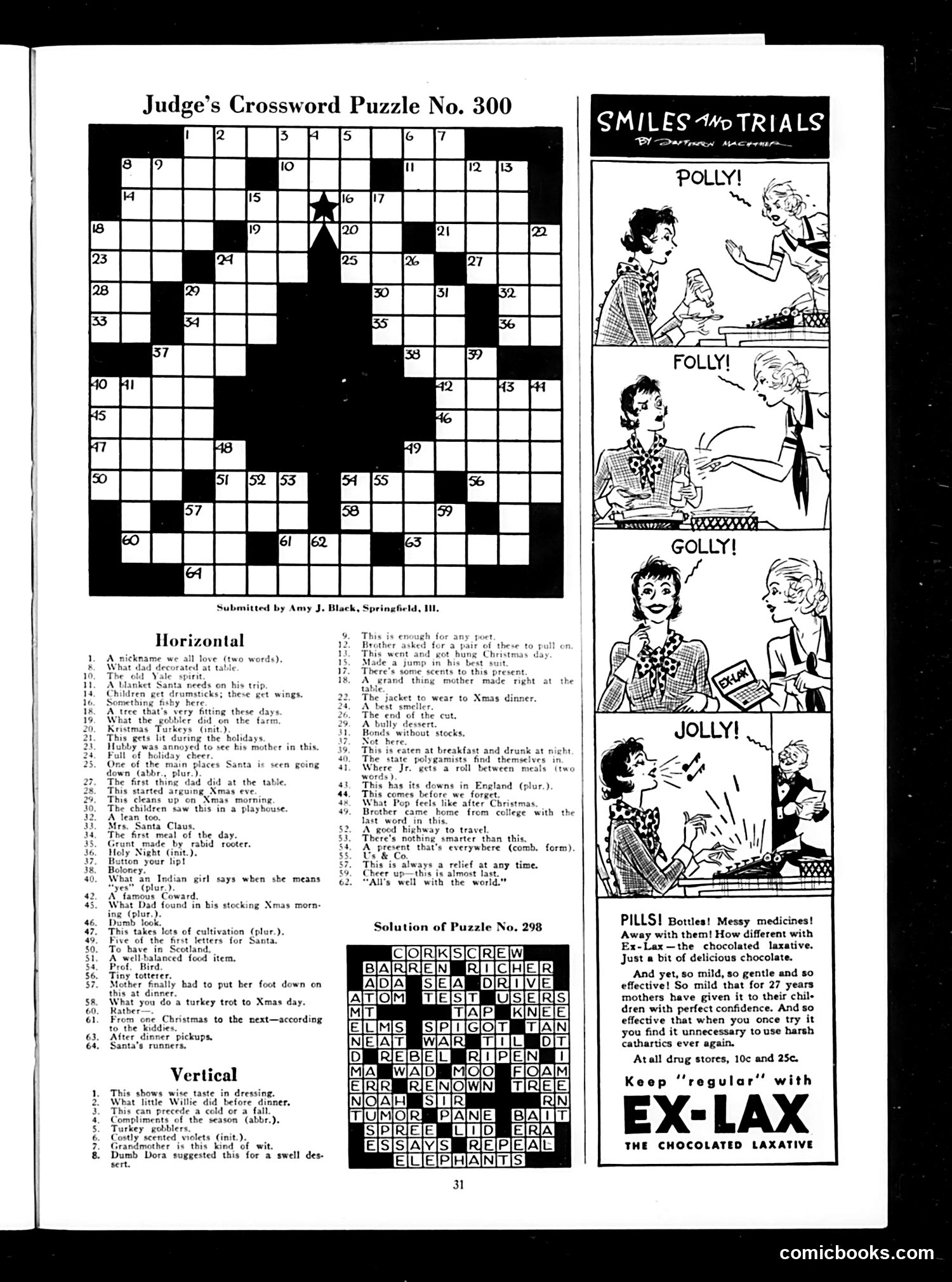
Analysis of Judge Magazine Page No. 300 This page contains a Christmas-themed crossword puzzle submitted by Amy J. Black of Springfield, Illinois, along with advertising and comic content. The main crossword clues reference holiday traditions and seasonal items contemporary to the publication period—turkey, stockings, Christmas dinner, sleighs ("Santa's runners"), and children's activities. The puzzle reflects early-to-mid 20th century domestic life and holiday customs. The comic strip "Smiles and Trials" depicts a domestic scenario where a woman named Polly interacts with what appears to be a young girl, progressing through four panels labeled "POLLY!", "FOLLY!", "GOLLY!", and "JOLLY!"—a wordplay sequence showing the relationship's emotional arc. The page also includes an advertisement for Ex-Lax, a chocolate laxative marketed to mothers as a gentle, palatable alternative to harsh medicinal treatments—reflecting historical attitudes toward children's healthcare through commercial products. The content overall represents typical American magazine fare from the interwar or early postwar period, blending entertainment with advertising.
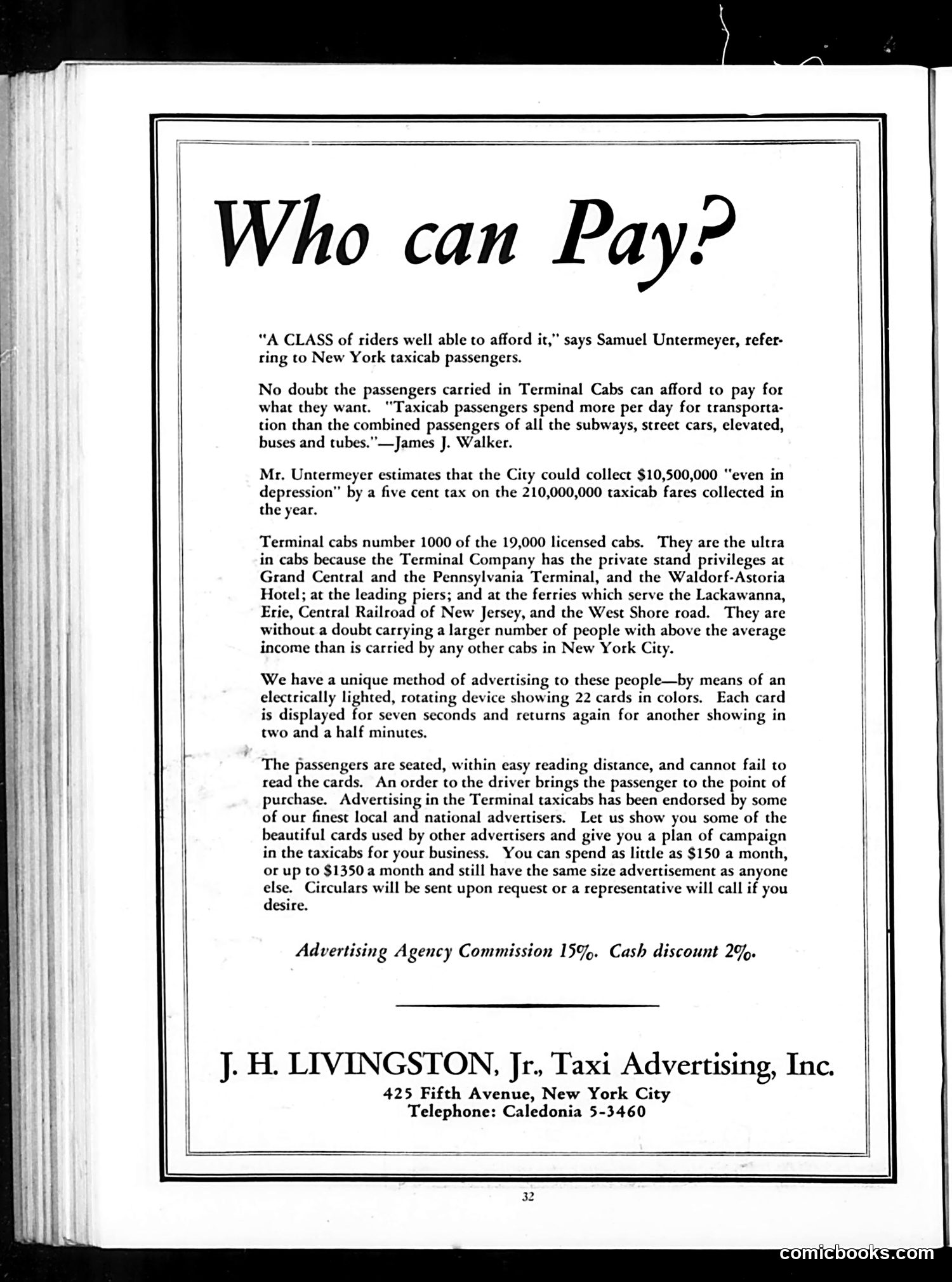
"Who can Pay?" Analysis This page is primarily advertising, not satire or political cartoon. It's a commercial advertisement for taxi advertising services by J.H. Livingston, Inc. The title references a contemporary debate: Samuel Untermeyer and NYC Mayor James J. Walker are quoted discussing whether taxicab passengers—who spend more on transportation than all other transit riders combined—should be taxed. Untermeyer proposes a five-cent tax that could raise $10.5 million even during the Depression. The ad pivots this discussion to argue these affluent riders are the *perfect advertising audience*. Terminal Cabs serve wealthy clientele at Grand Central, Pennsylvania Station, and the Waldorf-Astoria Hotel. The company offers rotating illuminated advertisements displayed to captive, seated passengers who cannot ignore them. The satire is implicit: while politicians debate *taxing* these wealthy riders, the advertiser simply wants to *sell to them*—exploiting the same audience discussion as a marketing opportunity. It's a clever conflation of public revenue versus private profit.
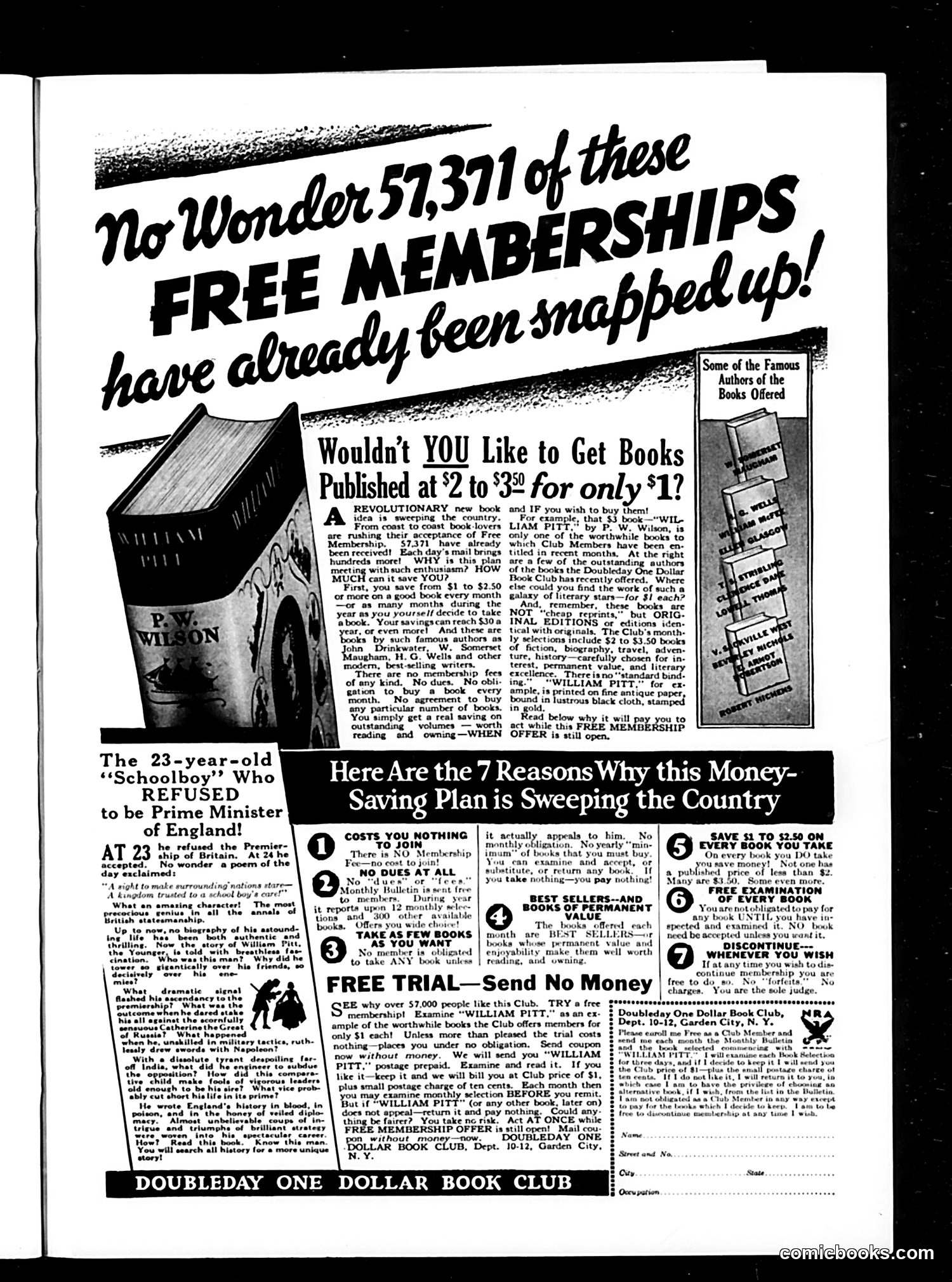
Explanation for Modern Readers This page contains two distinct elements: a political cartoon and a book club advertisement. The Cartoon: The small item at left references a 23-year-old British figure (identified as "Schoolboy") who refused the premiership of England. The text sarcastically marvels at this character's refusal of high office, suggesting it's an extraordinary and perplexing decision. Without clearer identification in the image, the specific historical reference remains unclear, though it appears to mock youthful political ambition or naiveté. The Advertisement: The bulk of the page promotes the Doubleday One Dollar Book Club, a mail-order service offering recent hardcover books for $1 (normally $2-$3.50). It emphasizes no membership fees, free trial membership, and bestsellers by famous authors like H.G. Wells and Somerset Maugham. This was a Depression-era innovation making literature affordable to average Americans—a genuinely revolutionary concept at the time.
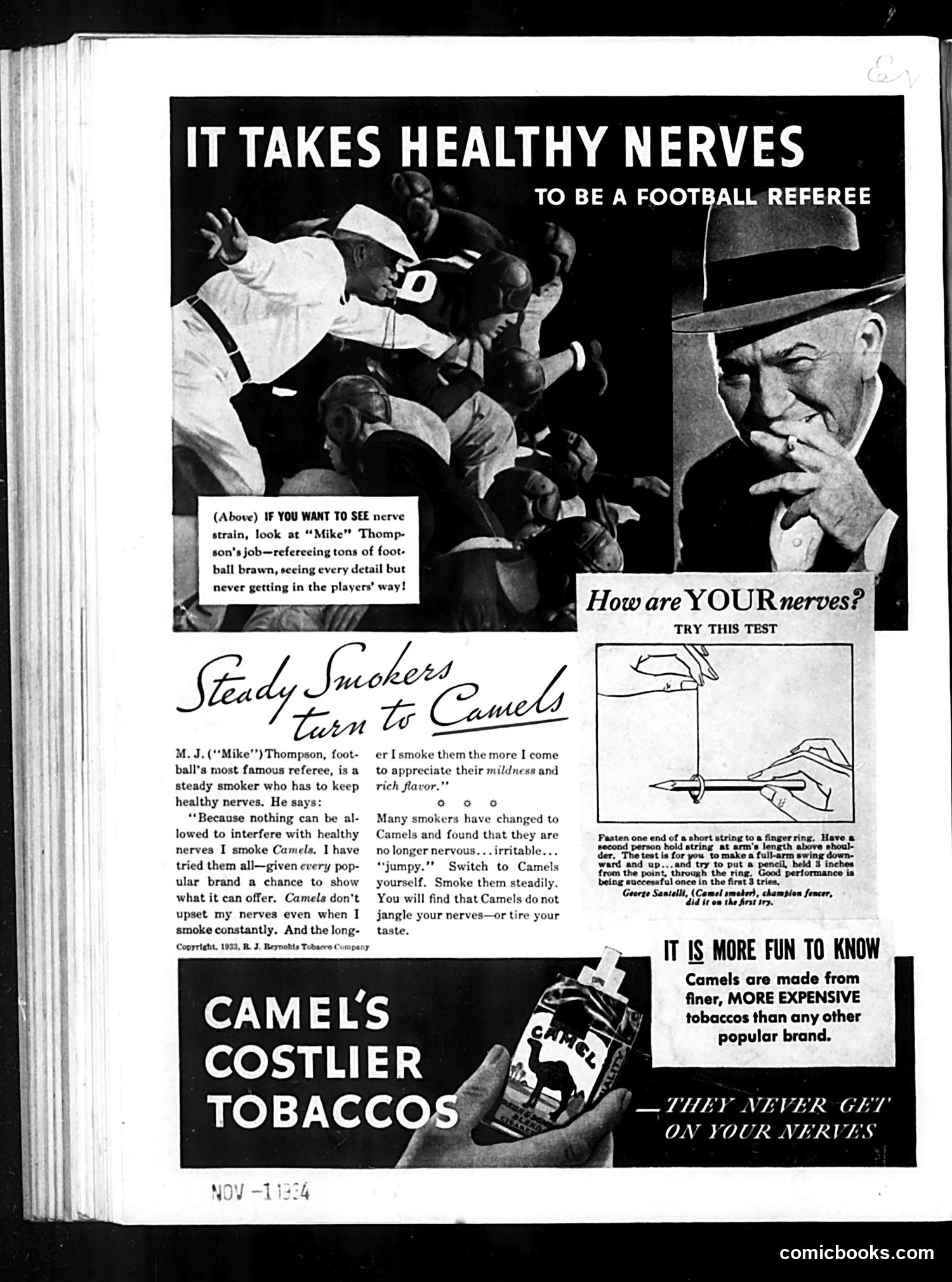
Analysis for Modern Readers This is a cigarette advertisement disguised as editorial content in Judge magazine (circa 1933). It exploits the high-stress profession of football referee M.J. "Mike" Thompson to claim that Camels cigarettes keep "healthy nerves" steady. The satire/irony (likely unintentional from the advertiser's perspective) is that the ad promotes smoking as a nerve-calming solution—a common marketing claim of that era before the health dangers of tobacco were widely acknowledged. The "nerve test" (a ring-and-string dexterity challenge) suggests Camels won't make you "jumpy." The key appeal: Camels uses "finer, more expensive tobaccos," positioning the brand as premium. The testimonial from a famous referee—someone whose job demands steady nerves under intense pressure—lends false credibility to the health claim. To modern readers, this is a striking example of tobacco industry marketing before regulation, when companies could openly advertise cigarettes as beneficial to health and composure without scientific evidence or legal consequences.

I can see this is a blank or nearly blank page from what appears to be a Judge magazine issue, based on the "comicbooks.com" watermark at the bottom. The page contains no visible cartoon, illustration, text content, or advertising that I can reliably analyze. Without legible images or substantive OCR text to interpret, I cannot identify any political figures, caricatures, satirical references, or jokes. This appears to be either a blank page, a title page, or a page where the scan quality or image reproduction has rendered the content illegible. To provide meaningful historical context about the satire or commentary intended, I would need a page with visible cartoons or readable text content.