judge
Judge — January 1934
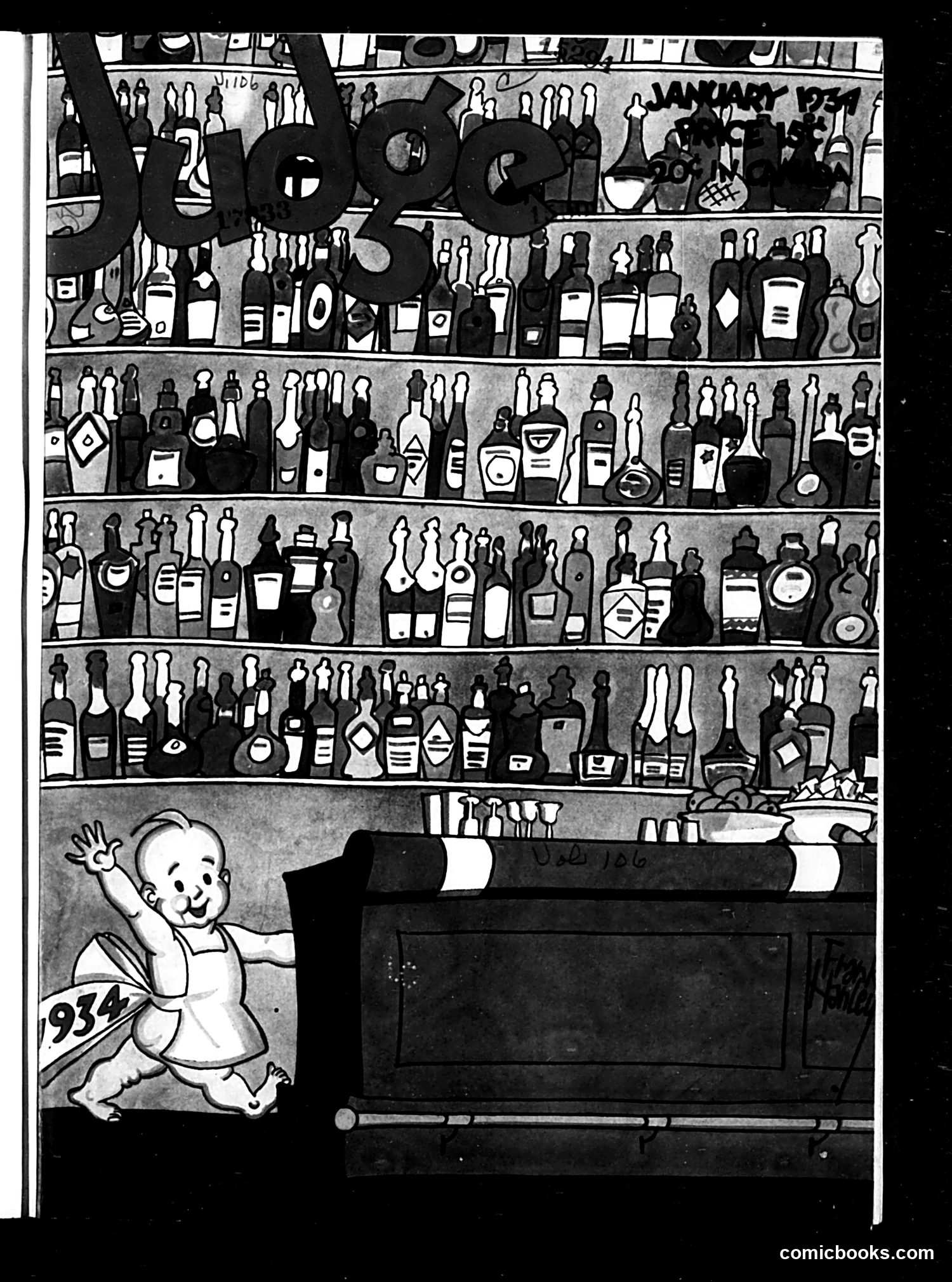
Analysis This appears to be a 1934 Judge magazine advertisement for liquor, featuring extensive shelves of bottles. The cartoon character at bottom left—a cheerful, rotund baby figure labeled "1934"—celebrates with raised arms, suggesting optimism about that year. The satire likely references Prohibition's repeal in December 1933. The massive display of diverse liquor bottles represents the sudden legal availability of alcohol after 13 years of federal prohibition. The jubilant "1934" baby personifies American joy at regaining legal drinking. The humor targets both the absurdity of Prohibition's failure and society's eager embrace of alcohol's return. For modern readers: this celebrates the end of a major federal ban, treating resumed drinking as cause for national celebration—a cultural touchstone that defined 1930s American life.
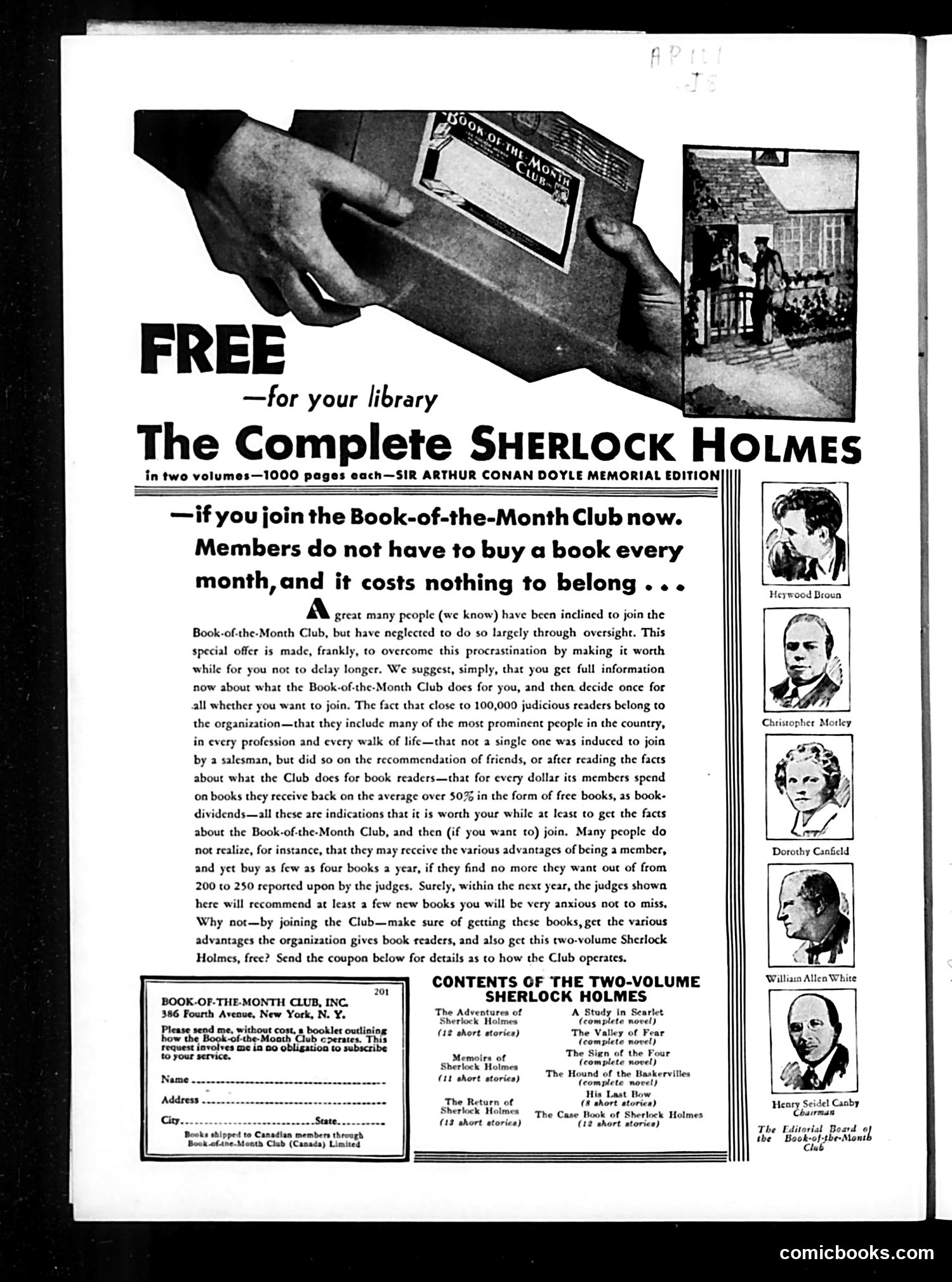
Analysis This page is primarily advertising, not satire or political commentary. It's a Book-of-the-Month Club promotion offering a free two-volume Sherlock Holmes collection (Sir Arthur Conan Doyle Memorial Edition) to new members. The imagery shows a hand holding a book and a photograph of what appears to be a Victorian-era street scene, likely evoking the Holmes stories' period setting. On the right are portraits of five people identified as the "Editorial Board of the Book-of-the-Month Club," including names like Heywood Broun and Dorothy Canfield. The text is persuasive marketing emphasizing membership benefits and value. There is no political satire present—this is straightforward commercial advertising typical of Judge magazine's revenue model.
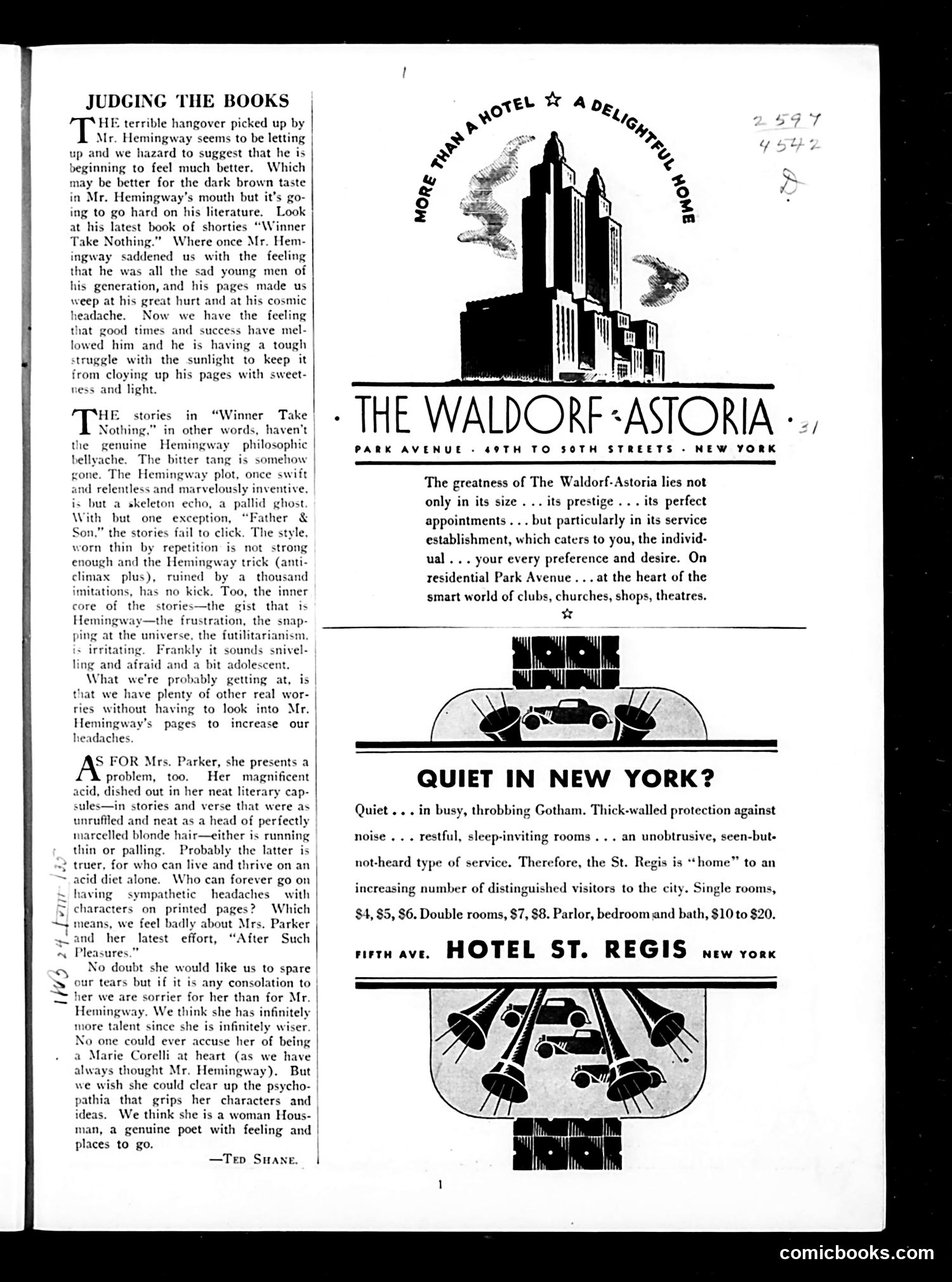
Analysis This page is primarily advertising rather than political satire. The left column contains a book review titled "Judging the Books" by Ted Shane, critiquing Ernest Hemingway's short story collection "Winner Take Nothing" and Dorothy Parker's work. Shane argues Hemingway's stories lack the philosophical depth of his earlier work, though he acknowledges Parker's superior talent. The right side features two hotel advertisements—The Waldorf-Astoria and Hotel St. Regis—both emphasizing luxury accommodations in New York City. The ads use Art Deco design typical of the era and target wealthy travelers seeking quiet, refined lodging. There is no political cartoon on this page. It represents Judge's mixed content format combining literary criticism with upscale advertising.
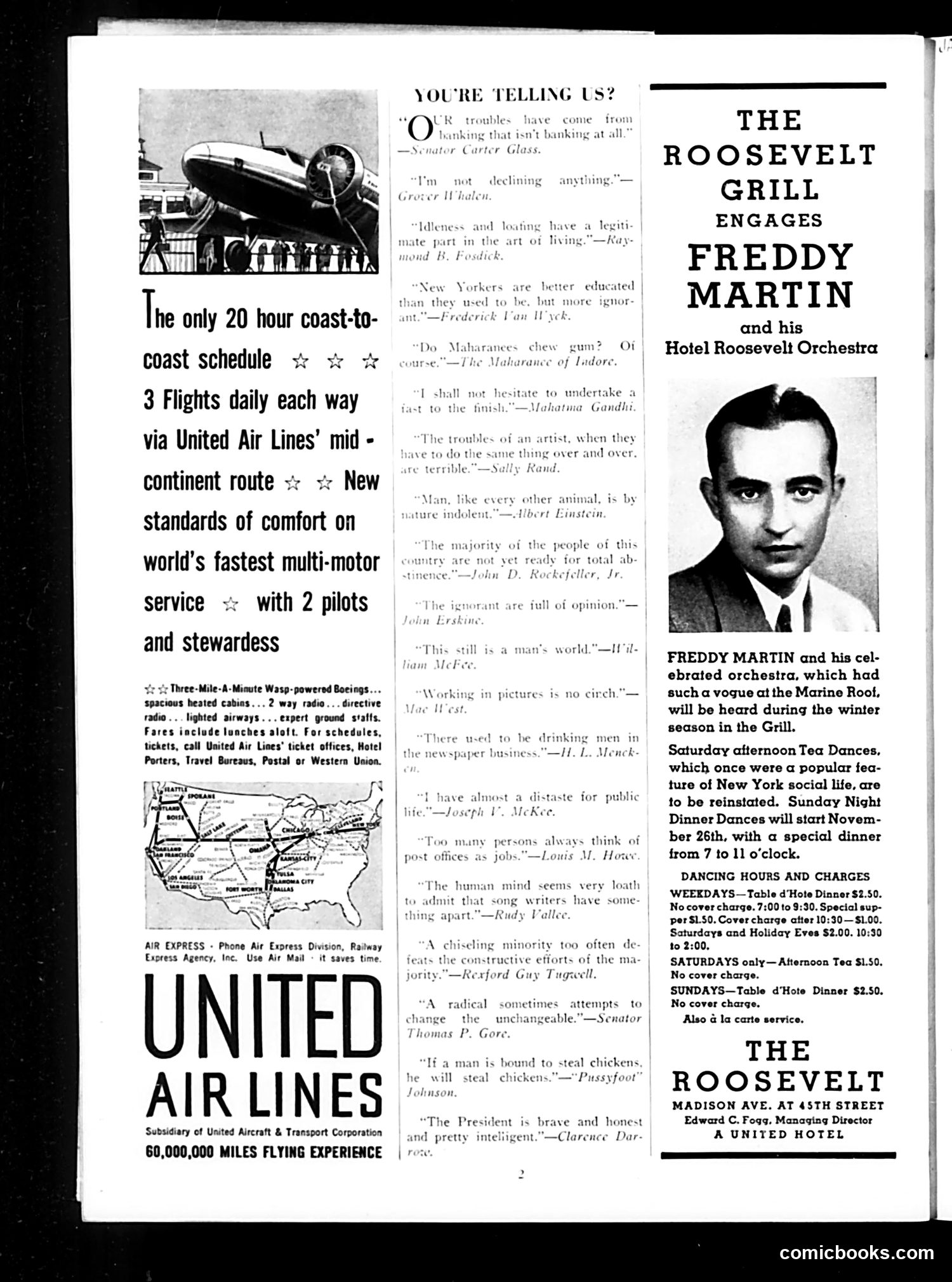
Analysis This page is primarily advertising rather than satire or political commentary. The left side features a United Airlines advertisement promoting their new 20-hour coast-to-coast service with three daily flights, highlighting comfort and modern amenities. A small map shows the mid-continent route. The right side advertises The Roosevelt Hotel's grill, announcing entertainment by Freddy Martin and his Hotel Roosevelt Orchestra. It promotes Saturday afternoon tea dances and Sunday night dinner dances, with pricing and cover charge information. The center column contains random quotations—some witty, some philosophical—from various public figures (Senator Glass, Gandhi, Einstein, Rockefeller, etc.), a common Judge magazine feature meant to provide brief social commentary or humor. The page reflects 1930s-40s leisure culture: commercial aviation, upscale hotel entertainment, and urban nightlife.
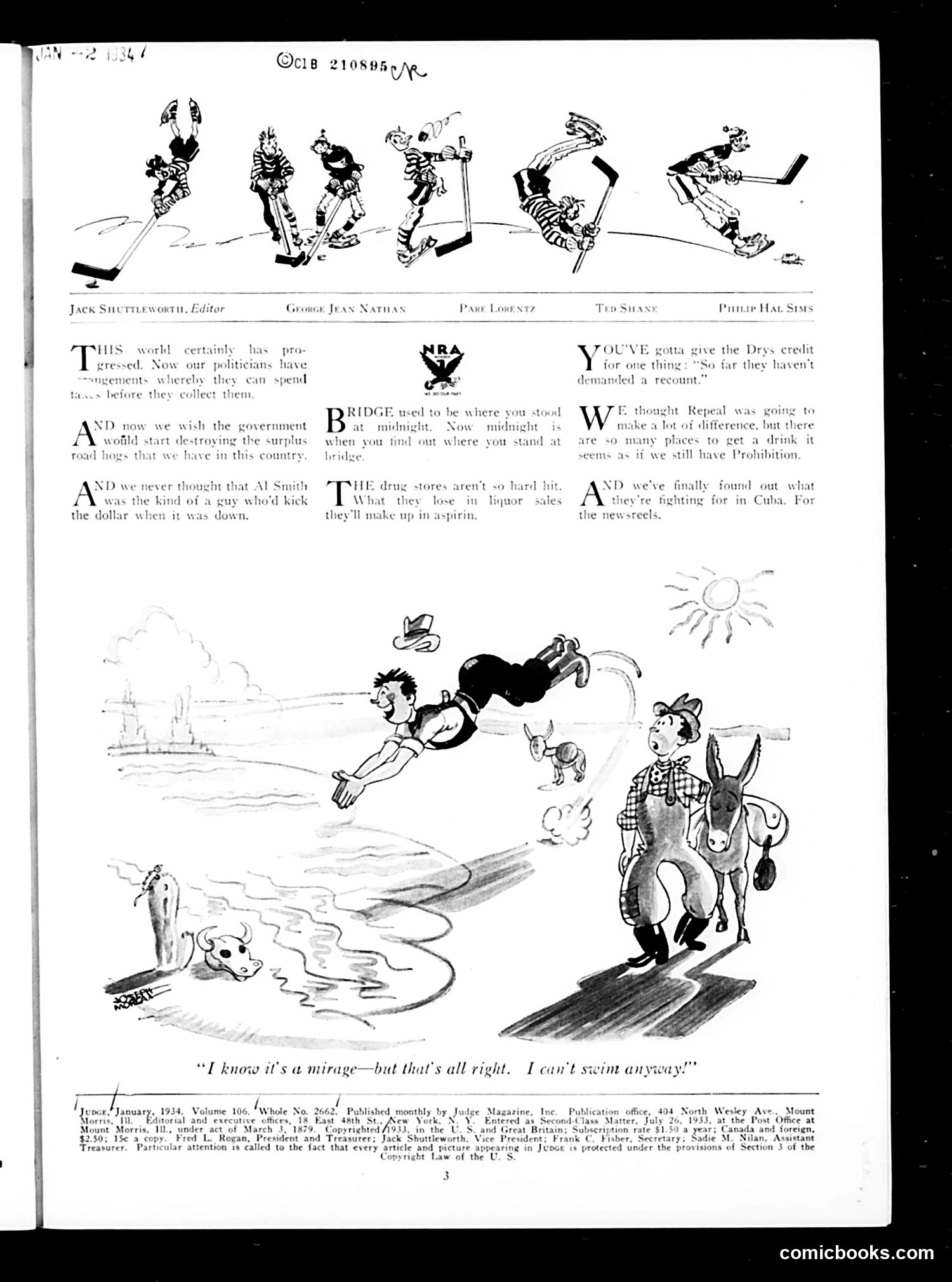
Analysis This January 1934 *Judge* page contains political satire about contemporary issues. The top strip shows six figures labeled with editors' names, each performing hockey-related actions—likely satirizing political figures through sport metaphors. The text comments mock government inefficiency ("politicians have amusements whereby they can spend taxes before they collect them"), reference Prohibition's repeal, and joke about drug stores selling liquor. One quip about "Al Smith" and "kicking the dollar" references the former presidential candidate and economic concerns. The bottom cartoon depicts a man swimming while a donkey approaches on land—captioned "I know it's a mirage—but that's all right. I can't swim anyway!" This appears to satirize Depression-era desperation, where even illusory hope seems preferable to the current situation.
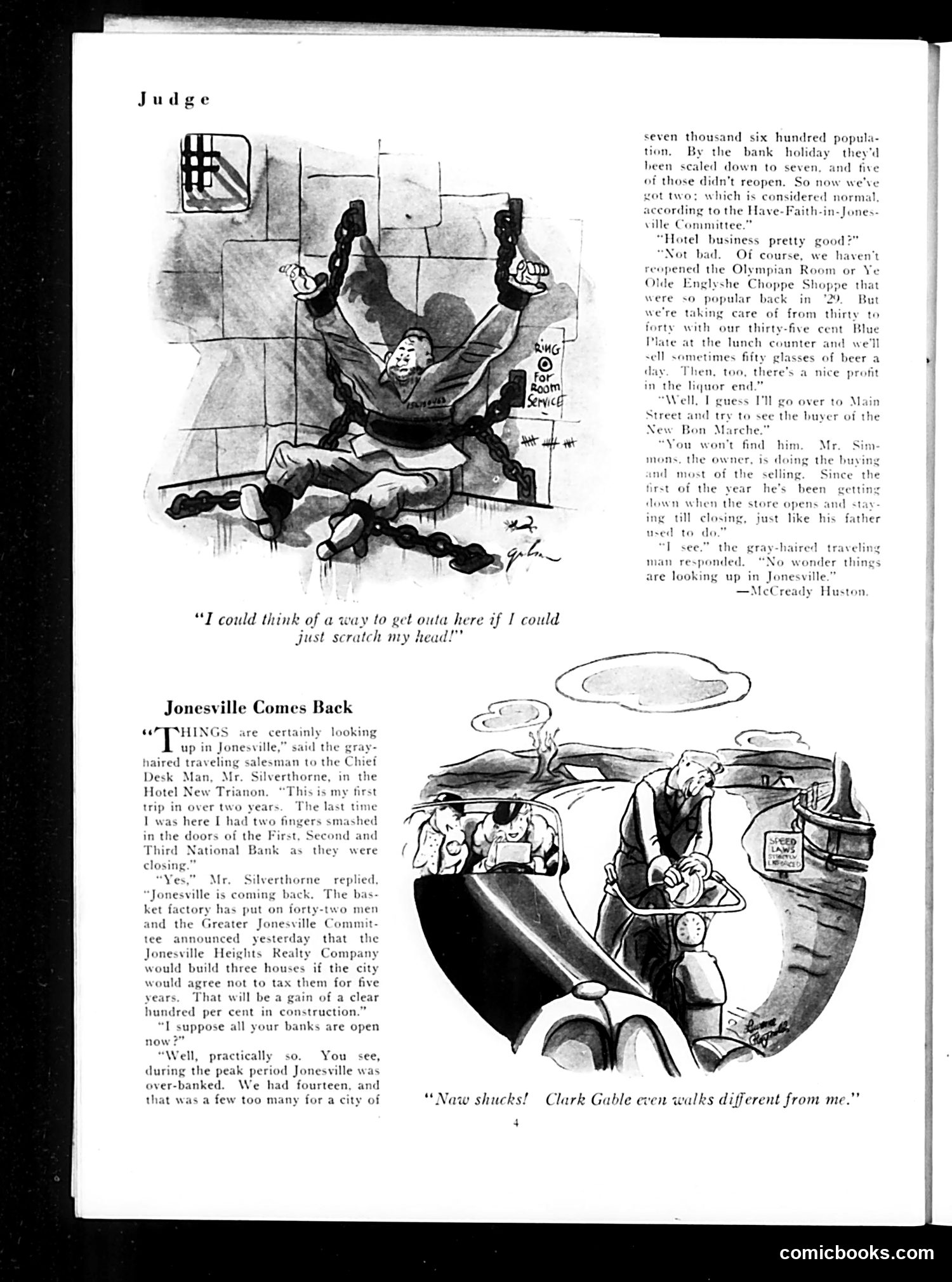
Analysis of Judge Magazine Page The page contains two distinct cartoons: Top cartoon ("Judge"): Shows a man trapped in what appears to be a cell or confined space, unable to scratch his head—a visual gag about frustration and helplessness. Bottom cartoon ("Jonesville Comes Back"): Depicts a traveling salesman discussing Jonesville's economic revival with a hotel desk clerk. The text references bank closures during an economic downturn, followed by recovery efforts including new construction incentives (tax breaks for builders). The second cartoon's caption jokes that "Clark Gable even walks different from me"—likely a reference to the famous actor's distinctive gait, used here as a humorous aside about class or status differences. Both pieces appear focused on American economic conditions and small-town recovery, typical Judge magazine satirical fare.
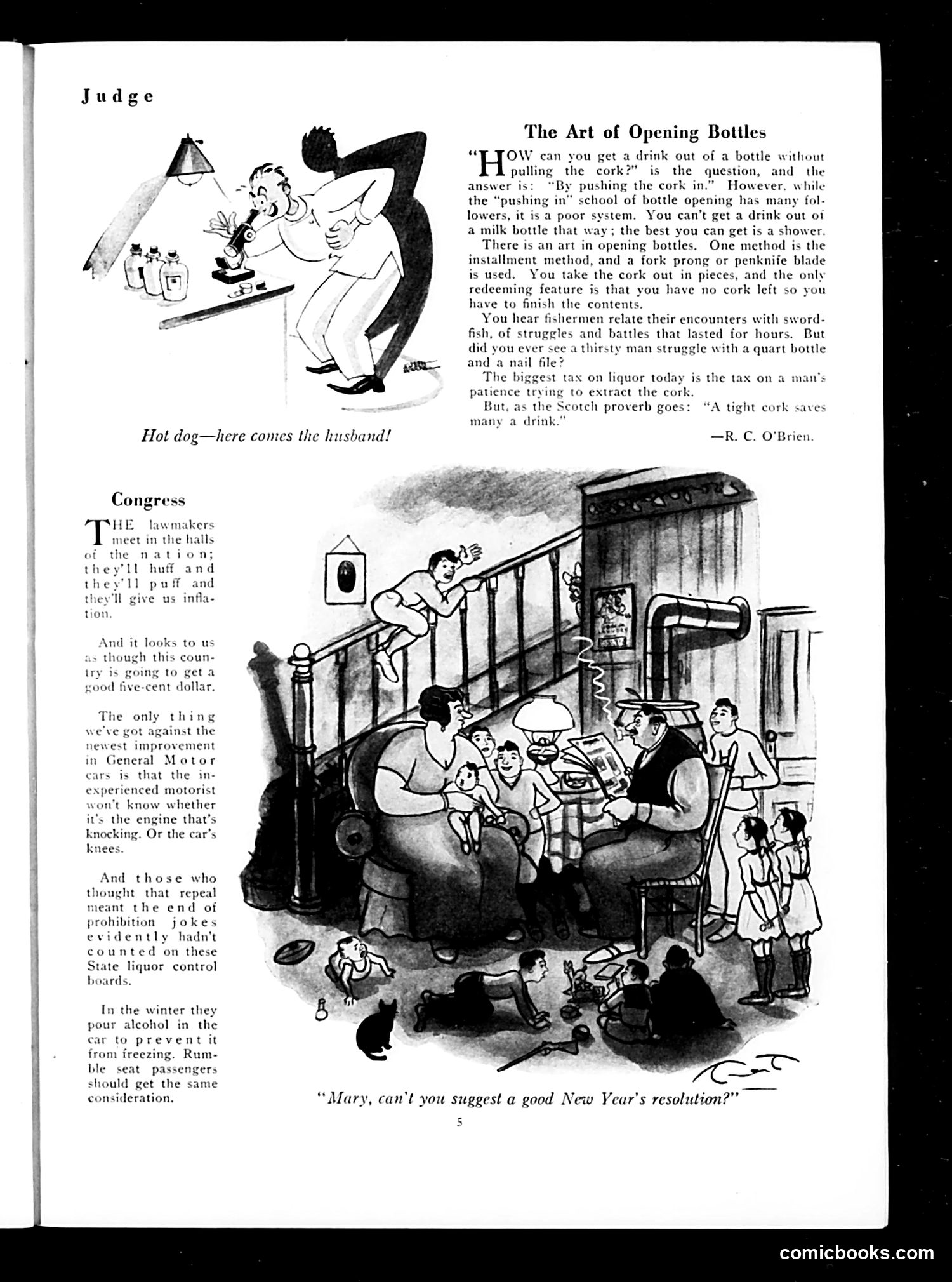
Analysis of Judge Magazine Page This page contains two satirical pieces from Judge magazine (likely 1920s-30s based on style): "The Art of Opening Bottles" (top right) humorously addresses Prohibition-era frustration with cork extraction, attributing it to patience-taxing difficulty. The accompanying cartoon shows a man struggling with a bottle while his wife waits—satirizing how even mundane domestic tasks became absurd under alcohol prohibition laws. "Congress" (left) mocks lawmakers as ineffective, suggesting they "huff and puff" while producing inflation. The large cartoon below depicts a crowded, chaotic domestic scene with the caption "Mary, can't you suggest a good New Year's resolution?"—likely satirizing Congress's inability to solve real problems affecting American families during the economic/social turbulence of the era. Both target government incompetence.
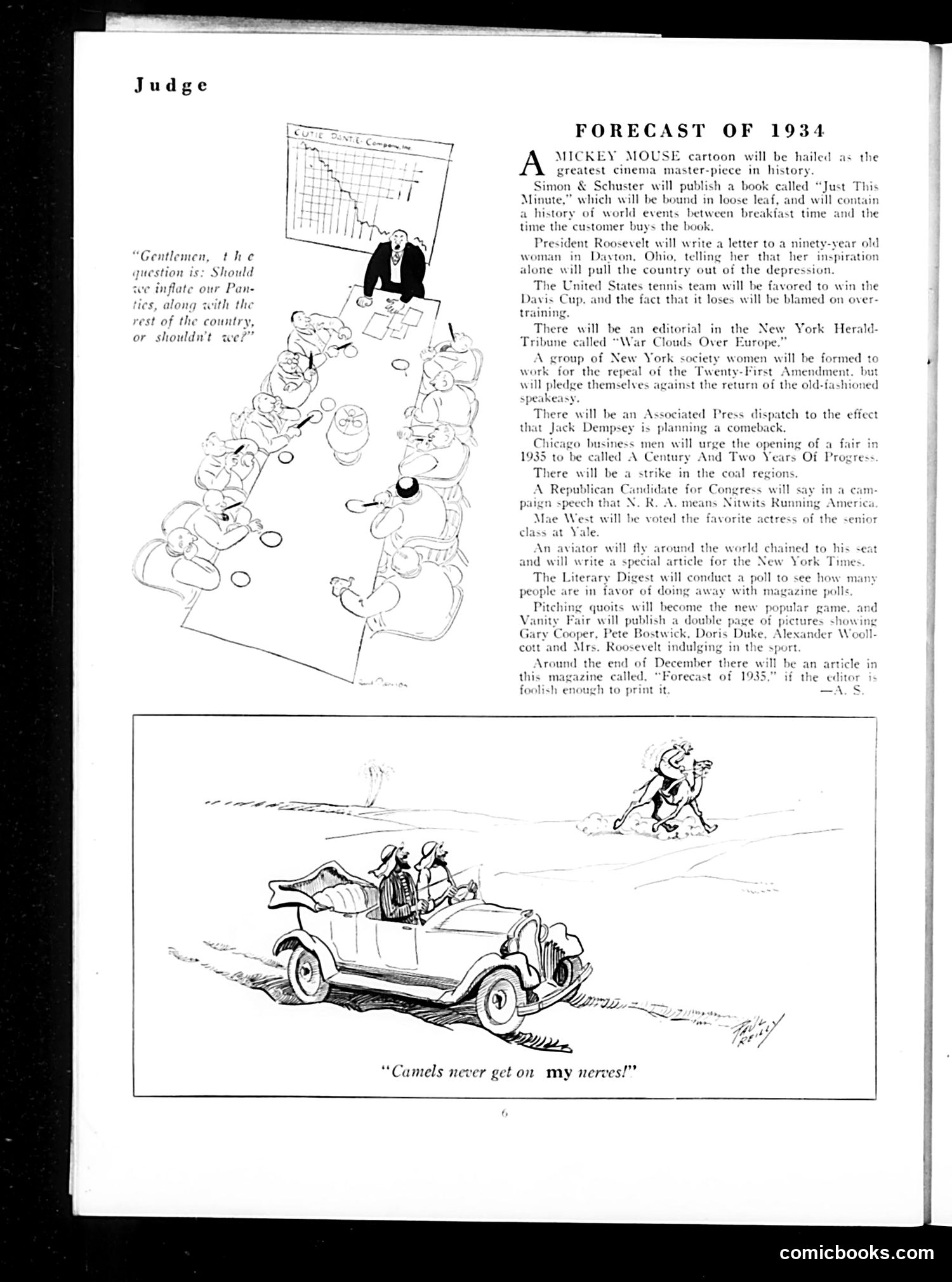
Analysis This page contains two distinct elements: Top Section: A political cartoon depicting a judge presiding over a debate about fiscal policy. Gentlemen argue whether to "inflate our Panics, along with the rest of the country, or shouldn't we?" The cartoon satirizes economic disagreement during what appears to be Depression-era debate about inflation versus deflation policy—a core disagreement among policymakers in the early 1930s. Bottom Section: A humorous cartoon showing a car stuck in desert sand with the caption "Camels never get on my nerves!" This is a simple joke about the frustration of automobile travel, likely poking fun at the unreliability of early 1930s cars compared to the dependability of camels in harsh terrain. The page also includes forecast predictions for 1934 events.
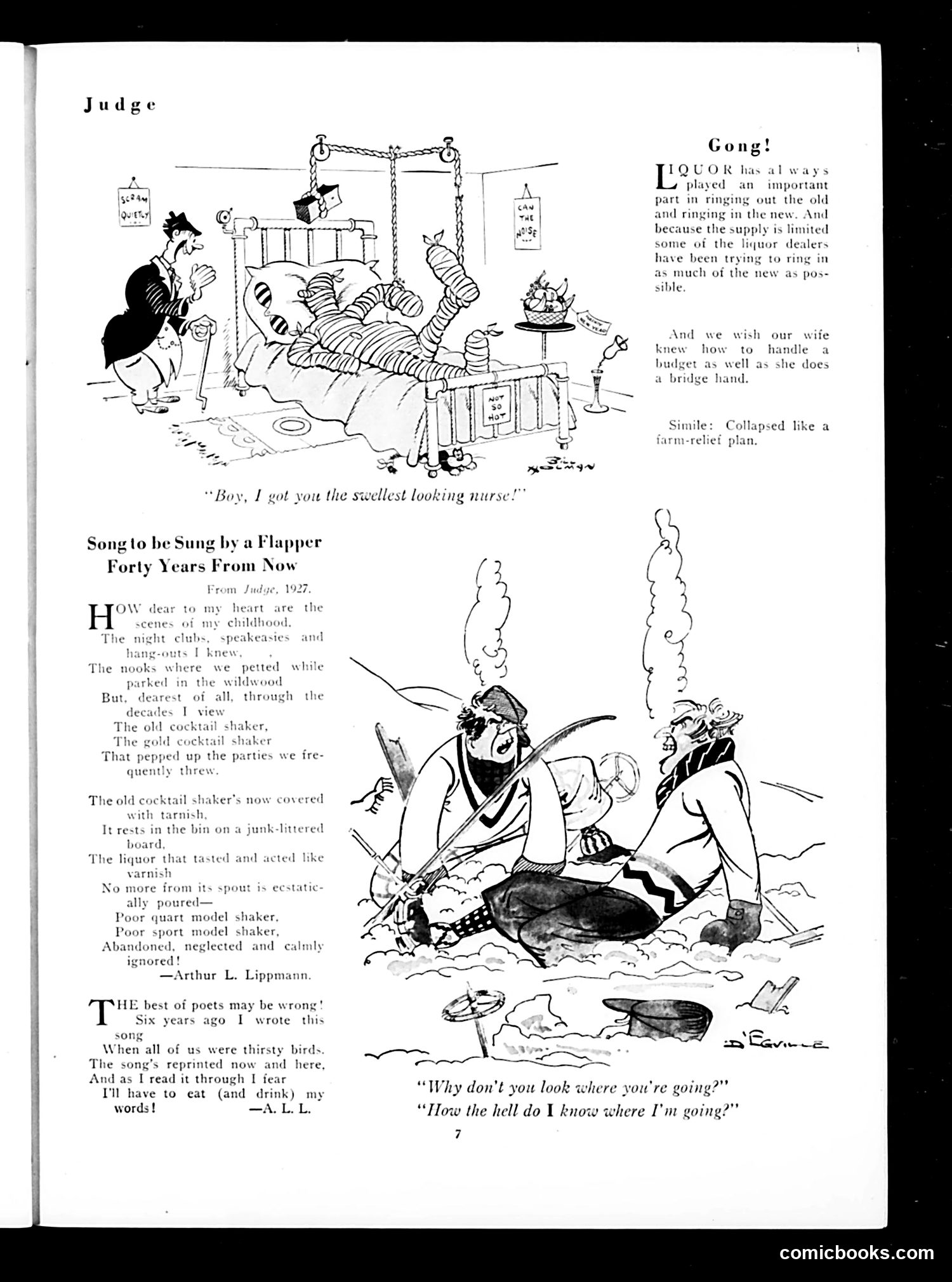
Analysis for Modern Readers This 1927 *Judge* page satirizes Prohibition-era America through two pieces: Top cartoon ("Boy, I got you the swellest looking nurse!"): A man presents an elaborate, mummy-wrapped patient to his wife. The joke is that he's disguised a liquor bottle as a "nurse" to sneak alcohol past her—playing on Prohibition's ban on alcohol sales and the common practice of hiding booze during this period. Lower section: A poem laments the decline of cocktail culture. Written by Arthur L. Lippmann in 1927 and reprinted from six years prior, it nostalgically recalls the "old cocktail shaker" now covered in tarnish, abandoned and useless. The accompanying illustration shows two figures lost in a snowy landscape, with dialogue mockingly questioning how anyone knows where they're going—likely referencing society's confused direction under Prohibition. Together, these pieces express *Judge*'s satirical frustration with Prohibition's effects on American social life and the drinking culture the magazine valued.
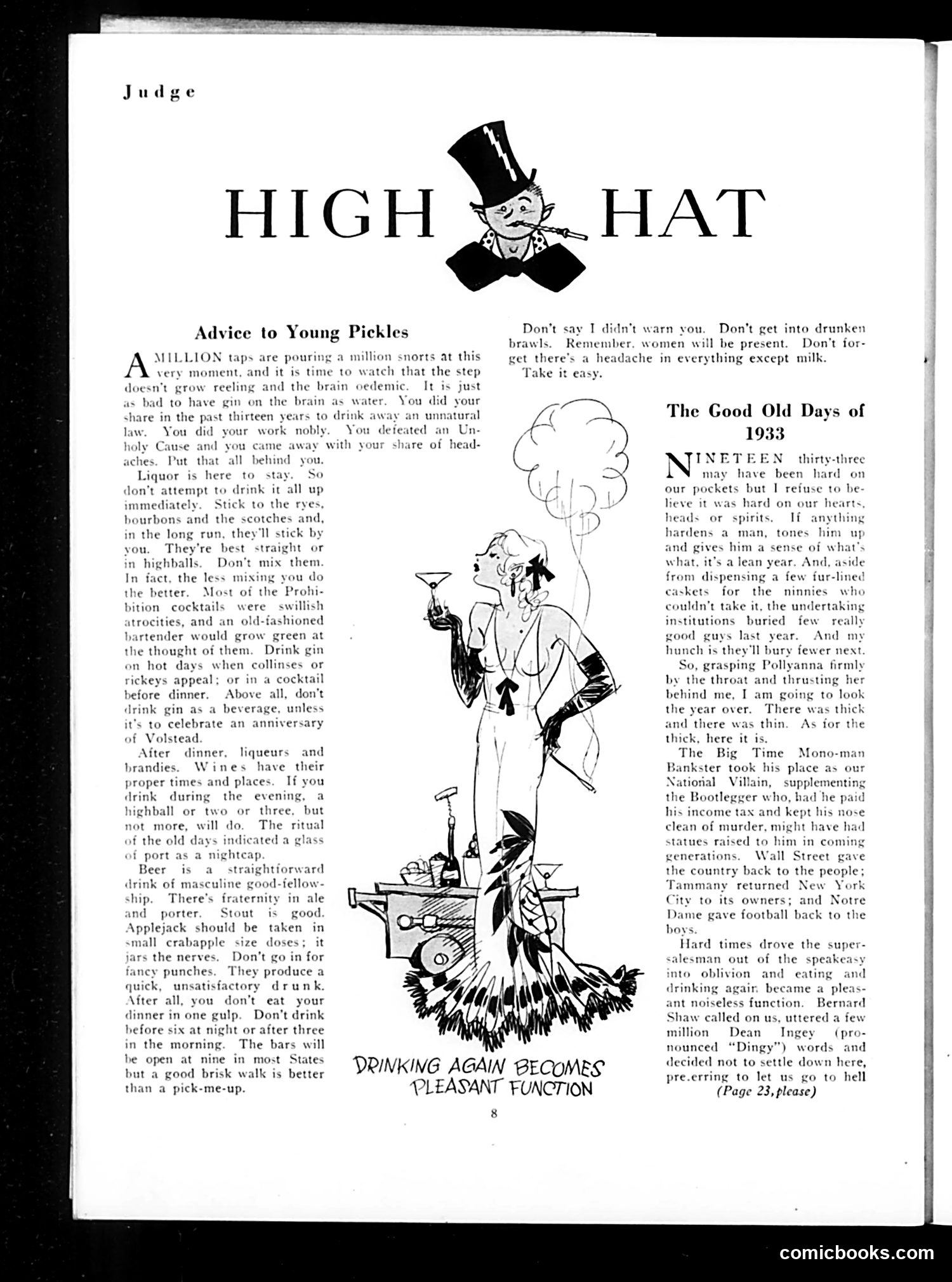
Analysis: "High Hat" Judge Magazine Page This page from Judge (likely 1933, based on "The Good Old Days of 1933" article) addresses Prohibition's repeal, which occurred in December 1933. Main Content: The "Advice to Young Pickles" column ironically offers etiquette for drinking now that alcohol is legal again. The satire mocks the sudden shift from Prohibition enforcement to regulated consumption—advising moderation to those eager to overindulge after years of illegality. "The Good Old Days of 1933" article nostalgically reviews the Depression year, noting that hardship built character. It references real 1933 figures: "Mono-man Bankster" (likely banker villainy generally), the "Bootlegger" (now unemployed post-Repeal), and Bernard Shaw's visit to America. The piece celebrates that Wall Street and Tammany Hall returned wealth/power, and Notre Dame football resumed—trivial consolations for economic suffering. The cartoon illustration shows a fashionable woman holding a cocktail over discarded liquor bottles and broken prohibition paraphernalia—celebrating Repeal's arrival. The overall satire: Americans are returning to drinking with comic earnestness, treating it as a "pleasant function" rather than criminal excess.
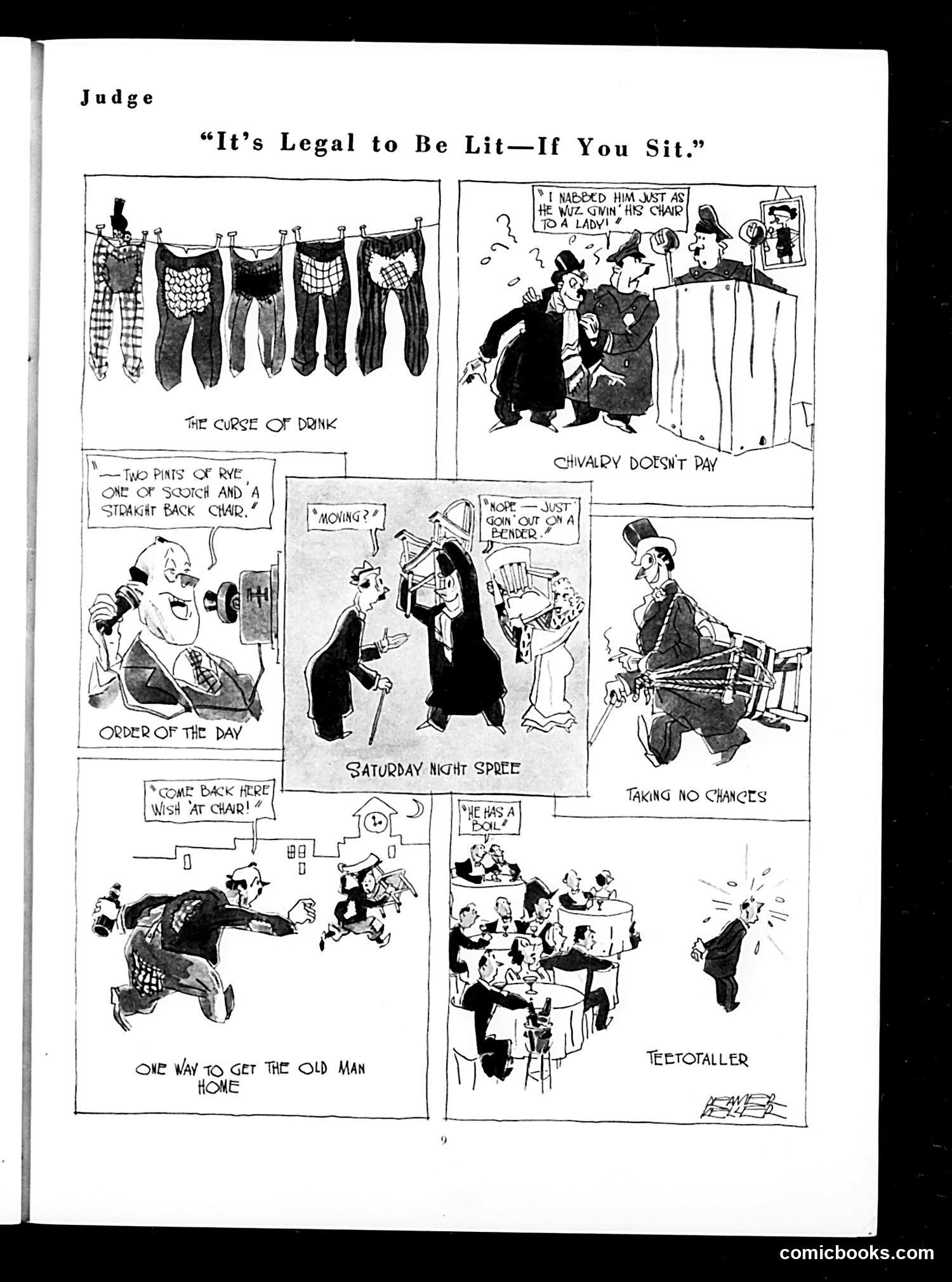
"It's Legal to Be Lit—If You Sit": Prohibition-Era Satire This Judge page satirizes Prohibition enforcement through the legal loophole that intoxication was illegal only while *standing*—if you sat down while drinking, you were technically within the law. The six panels mock various scenarios exploiting this absurdity: - "Curse of Drink": Hung laundry suggests a drunk's deteriorated state - "Order of the Day": A man orders multiple drinks, sitting in a chair - "Chivalry Doesn't Pay": A drunk man being arrested after offering his chair to a lady - "Saturday Night Spree": Men drinking while seated, staying "legal" - "One Way to Get the Old Man Home": A drunk man forcibly removed from his chair - "Teetotaler": A sober man jumping with energy (implying sobriety as unnatural excitement) The satire targets Prohibition's impractical enforcement and the ridiculous loopholes people exploited. The humor assumes readers know this sitting-while-drunk "technicality" was a real workaround during the dry era.
The Theatre of George Jean Nathan — Judge Magazine Review Page This is a theatre criticism column by prominent drama critic George Jean Nathan. The page reviews several Broadway productions from what appears to be the 1930s (based on references to Kern-Harbach musicals like "Roberta"). Nathan critiques shows including a nautical melodrama and discusses the Kern-Harbach musical "Roberta," praising its score but faulting librettist Harbach's book. He also reviews "She Loves Me Not," a comedy adapted from an Edward Hope novel, which he found moderately funny but not exceptional—comparing it favorably to older comedies but finding its college-dormitory-hijinks plot predictable. The recurring criticism is that theatrical conventions (sudden song interruptions, contrived comedic devices) have become tiresome through repetition. Nathan's tone is sophisticated and dismissive of obvious techniques, characteristic of his influential but notoriously acerbic critical style. This is primarily text with no visible political cartoons on this page.
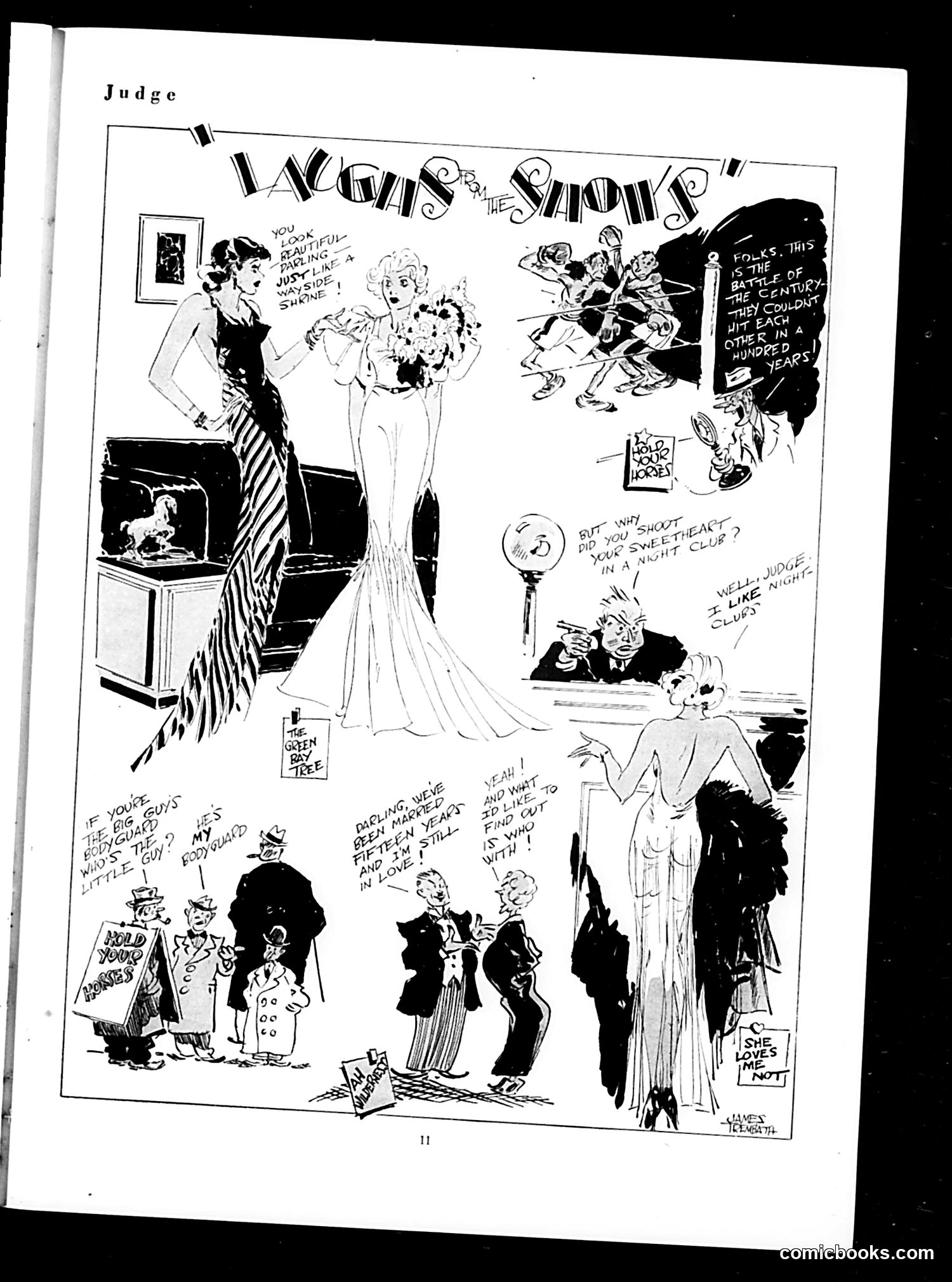
"Lacis & Snoops" This appears to be a satirical comic strip about romantic entanglements and social judgment. The central scene shows two elegantly dressed women—one in a striped gown, another in white—apparently discussing a third woman's affair. The surrounding vignettes mock various social observers: gossiping men with signs reading "HOLD YOUR HORSES," characters debating whether someone should "find out to find out with," and a figure declaring "SHE LOVES ME NOT." The satire targets turn-of-the-century high society's obsession with surveillance and moral judgment of women's romantic choices. The title "Lacis & Snoops" directly names the subjects—those who pry into and broadcast others' private affairs. The comic mocks how widely such scandals circulated through social circles, with numerous characters weighing in on matters that weren't theirs to judge.
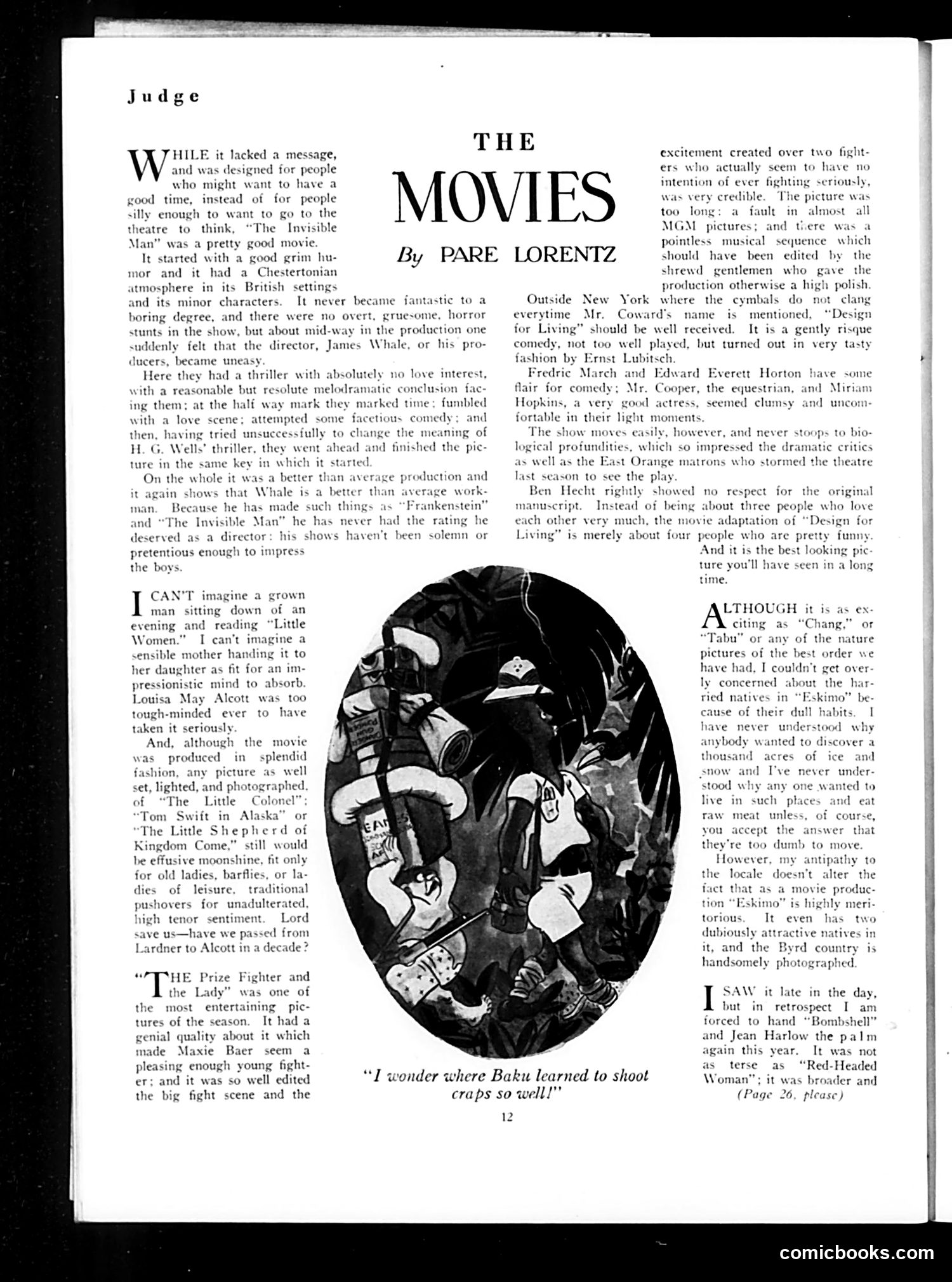
Judge Magazine Movie Review Page This is a film criticism page by Pare Lorentz reviewing several 1933 Hollywood releases. The central image shows a still from what appears to be a comedic fight scene, with the caption "I wonder where Baku learned to shoot craps so well!" Lorentz critiques: - "The Invisible Man" - Praising its tone but faulting director James Whale for losing narrative control mid-film - "Little Women" - Dismissing it as saccharine material unsuitable for thinking adults - "The Prize Fighter and the Lady" - Entertaining but featuring unconvincing boxers (likely referencing boxer Maxie Baer) - "Design for Living" and "Eskimo" - Brief favorable mentions The satire targets both filmmakers' artistic choices and Hollywood's reliance on sentimental material for audiences. Lorentz assumes his readers share contempt for mass entertainment pandering, mocking those who'd enjoy adaptations of classics like Louisa May Alcott's novel. The tone reflects 1930s critical elitism about cinema's artistic potential versus commercial mediocrity.
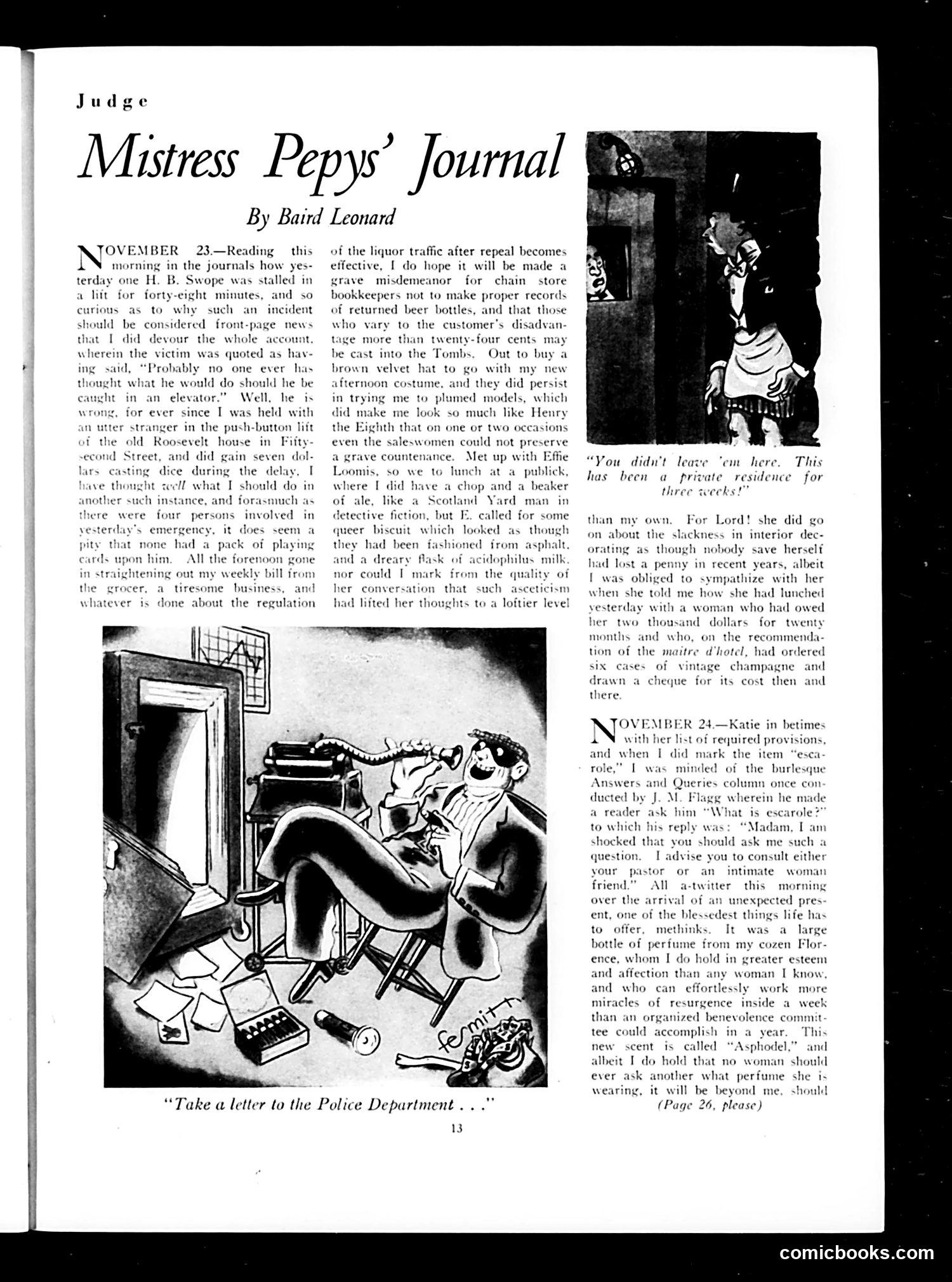
"Mistress Pepys' Journal" – November 23-24 This is a humor column written as a mock diary by "Judge" magazine, styled after Samuel Pepys's famous 17th-century diary. The author satirizes contemporary upper-class society through gossipy observations. The November 23 entry references H.B. Swope's real incident of being trapped in an elevator for 48 minutes—a trivial modern inconvenience treated as headline news. The cartoon jokes about calling police over such mundane problems. The satirical point: society obsesses over minor discomforts while ignoring serious issues like post-Prohibition liquor regulation and poor record-keeping in stores. The November 24 entry mocks pretentious etiquette questions and name-dropping (referencing a "Burlesques Answers and Queries column"), while poking fun at affected aristocratic concerns—interior decoration, champagne, and perfume snobbery. The overall satire targets wealthy society's superficiality and self-importance during the 1920s-30s.
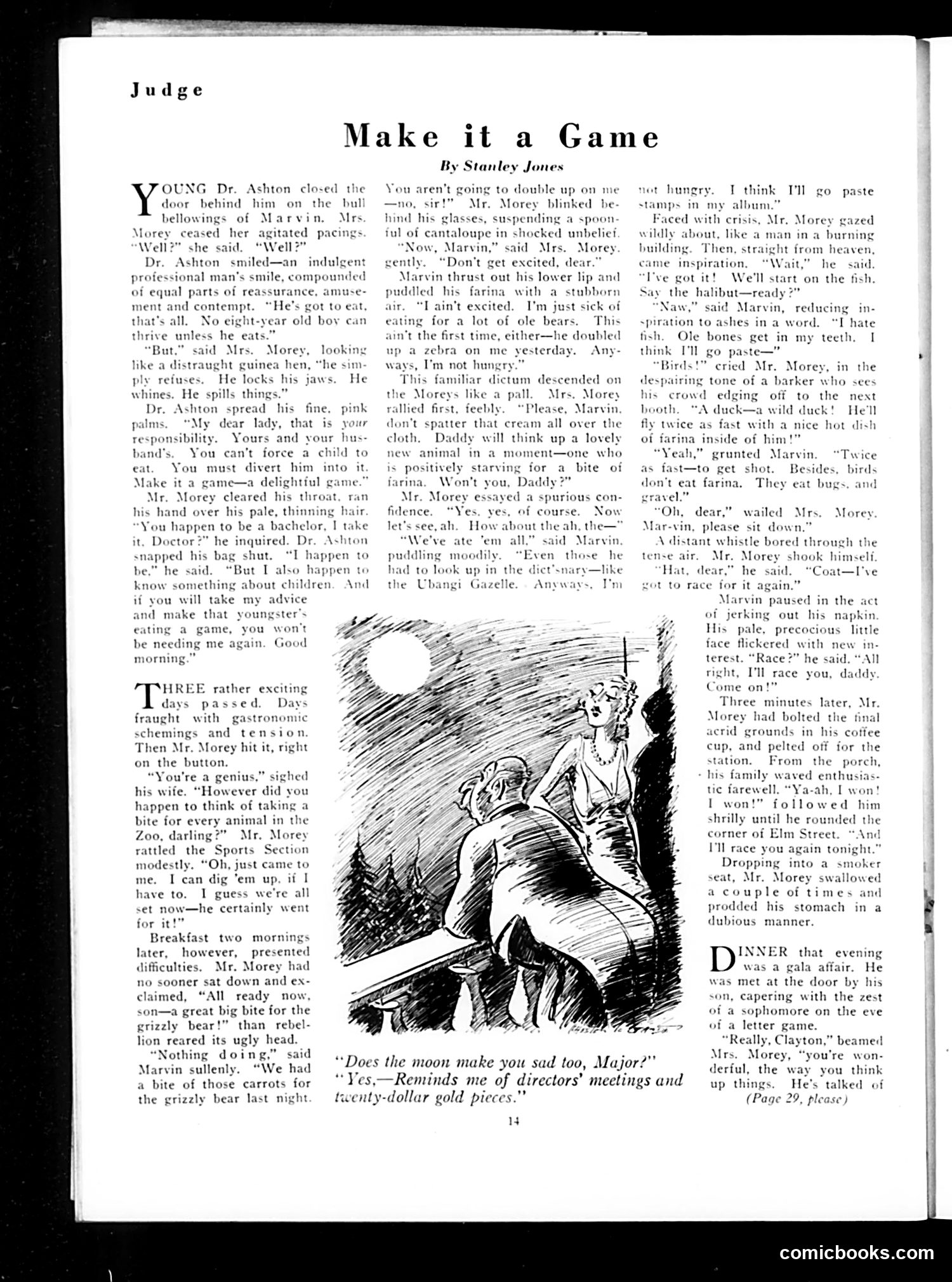
"Make it a Game" - Judge Magazine Satire This is a domestic humor story by Stanley Jones about a common parenting challenge of the era: getting a stubborn child to eat. The Setup: Dr. Ashton advises Mr. and Mrs. Morey that their finicky young son Marvin won't eat unless they make mealtimes fun—"make it a game." The Joke: The strategy initially works brilliantly. Mr. Morey invents animal names for each bite ("a bite for the grizzly bear," etc.), and Marvin eagerly eats. However, by day three, the boy rebels: he's tired of the same game and refuses to cooperate, claiming "I'm just sick of eating for a lot of ole bears." The Satire: The humor targets both parenting fads and children's logic. The "game" technique seemed like clever modern parenting advice, but the child's literal-minded exhaustion with it—and his increasingly absurd objections (refusing a duck because "birds don't eat farina")—undercuts the doctor's confidence and shows how unpredictable children actually are. The accompanying cartoon about the moon and directors' meetings appears unrelated.
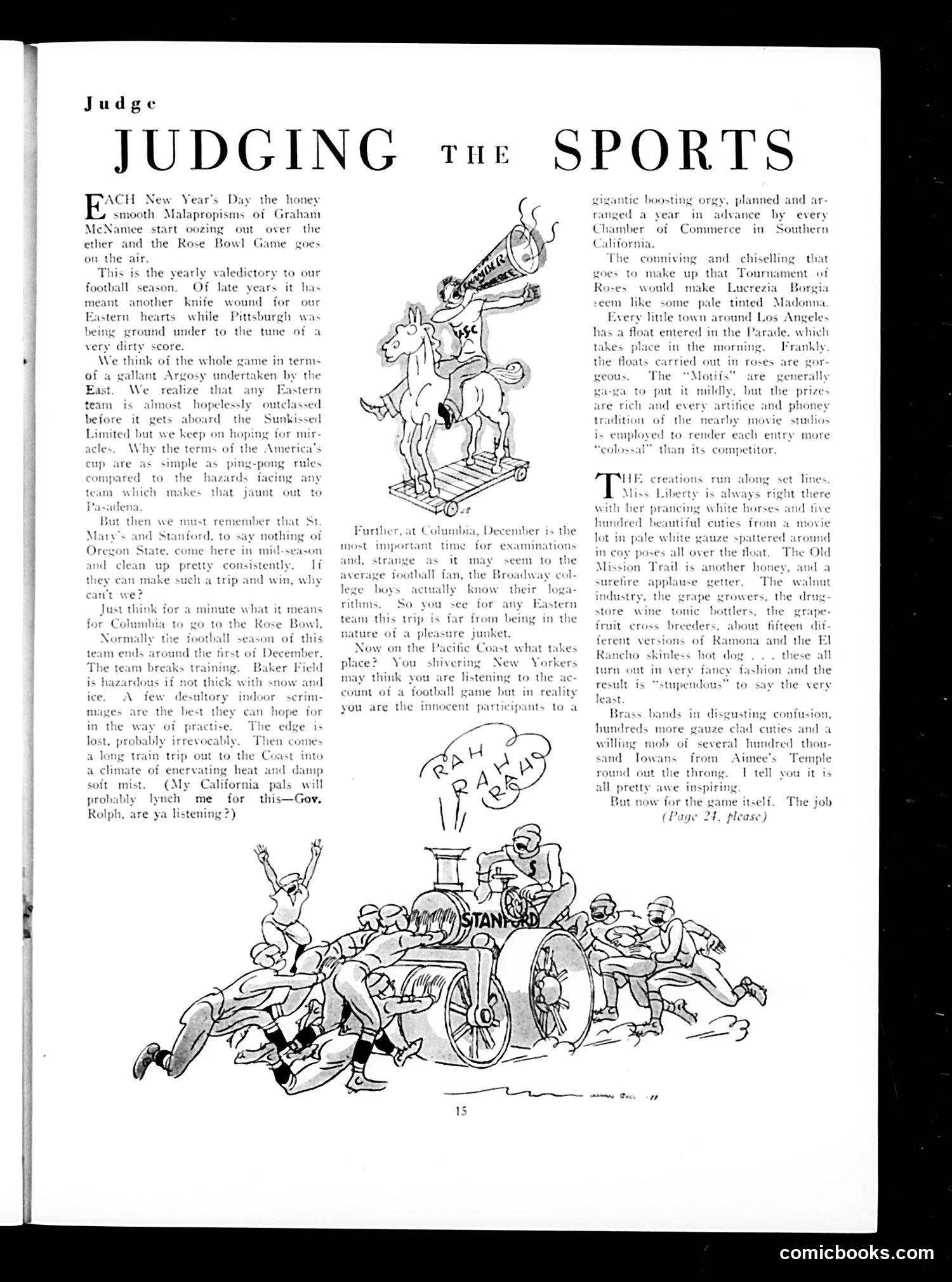
"Judging the Sports" - Judge Magazine Satire This article satirizes New Year's Day college football bowl games, particularly the Rose Bowl. The author criticizes Eastern football teams' annual humiliation in these West Coast games, contrasting the "dirty score" Pittsburgh endures with the ceremonial pomp of California's "gigantic boosting orgy." The satire targets the Tournament of Roses Parade and Rose Bowl as elaborate promotional theater—"conniving and chiselling"—where Hollywood studios (the "nearly movie studios") compete to create more "colossal" floats than competitors. The author mocks how participants are "innocent" dupes in what's really a Chamber of Commerce marketing spectacle disguised as sport. References to Miss Liberty, the Old Mission Trail, and Ramona invoke Southern California's romanticized tourist mythology. The cartoons below (depicting chaotic revelry) reinforce the message: this is manufactured celebration, not genuine competition. The humor derives from exposing the commercial machinery behind the "holiday tradition."
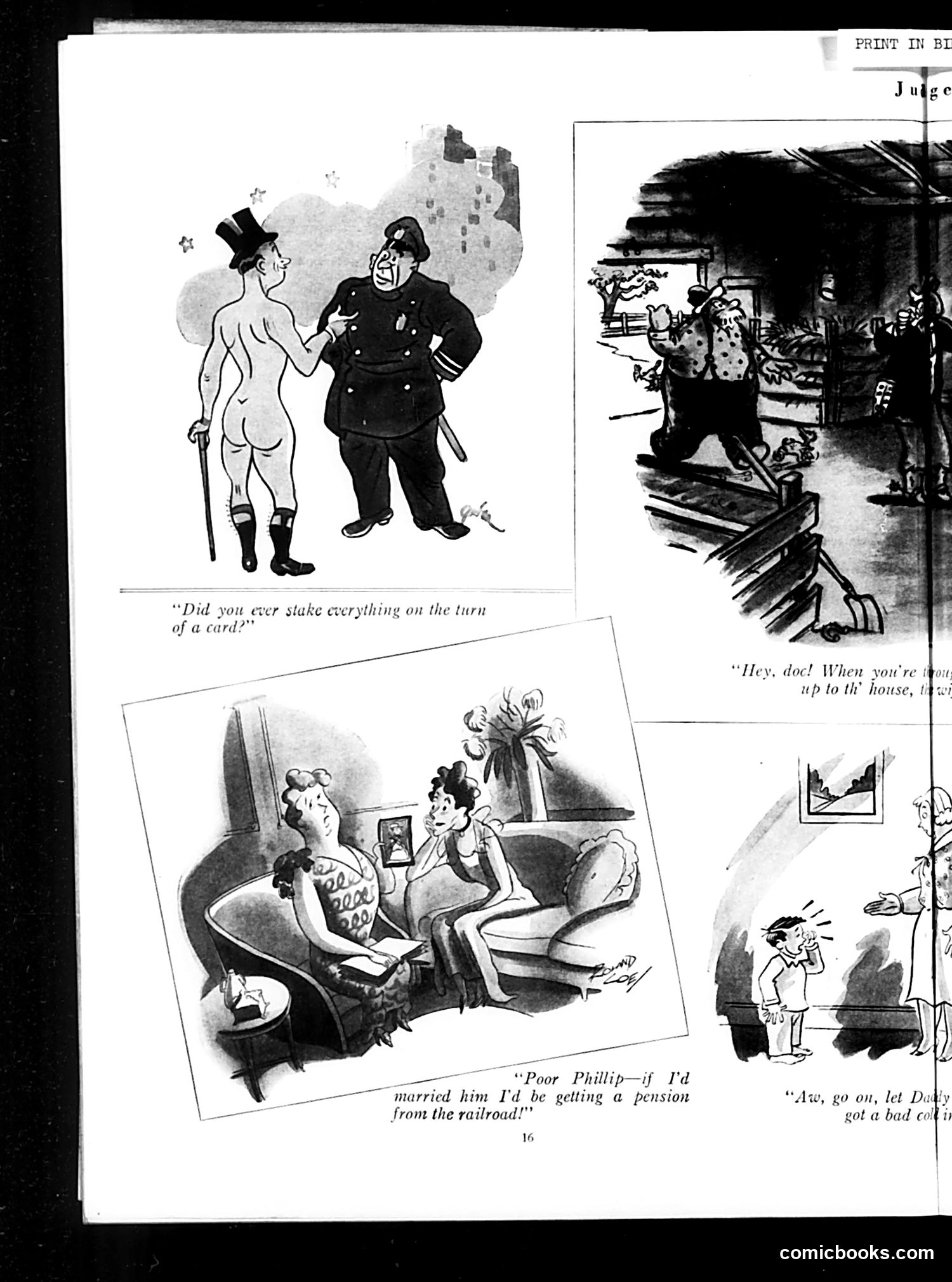
Analysis This page contains three separate cartoon gags typical of Judge magazine's humor: 1. Top left: A nude woman and uniformed officer discuss gambling losses—likely satirizing reckless financial behavior or military impropriety. 2. Bottom left: Two women in a bedroom; one laments that marrying "Phillip" would have secured her a railroad pension, implying she chose poorly in marriage for financial security. This reflects early 20th-century anxieties about women's economic dependence on husbands' employment. 3. Right side: A domestic scene where someone (appearing to be a child or servant) is told "let Daisy got a bad cold"—the caption is partially cut off, making the joke unclear. The humor targets gambling, marital regret, and domestic life, reflecting upper-class leisure culture concerns of Judge's era.
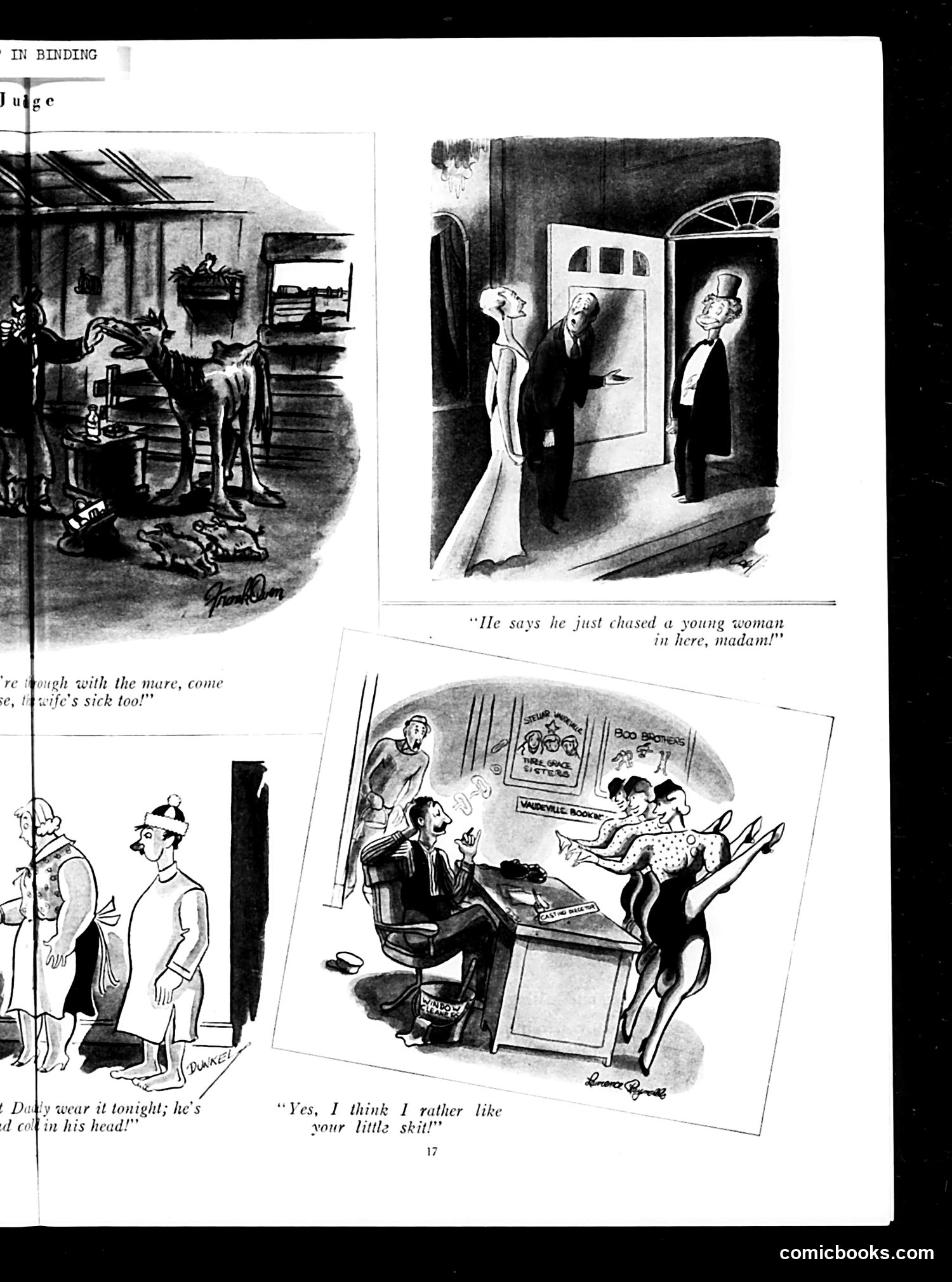
Judge Magazine Page Analysis This page contains four separate comic panels satirizing domestic and social situations, likely from the early-to-mid 20th century. Top right: A woman confronts two men at a doorway; one claims he "just chased a young woman in here." The joke appears to mock men's excuses and infidelity anxieties. Bottom right: An office scene where a man at a desk watches women dancing/performing, saying he prefers the woman's "little skit" — satirizing workplace distraction and objectification. Left panels: Appear to involve domestic disputes about clothing and behavior, with spouses or partners making exasperated comments about each other's choices. The overall theme is marital discord and gender relations humor typical of Judge's satirical approach — poking fun at modern (1920s-40s era) romantic entanglements, workplace dynamics, and shifting social attitudes toward women. The humor relies on period assumptions about courtship and marriage now considered outdated or offensive.
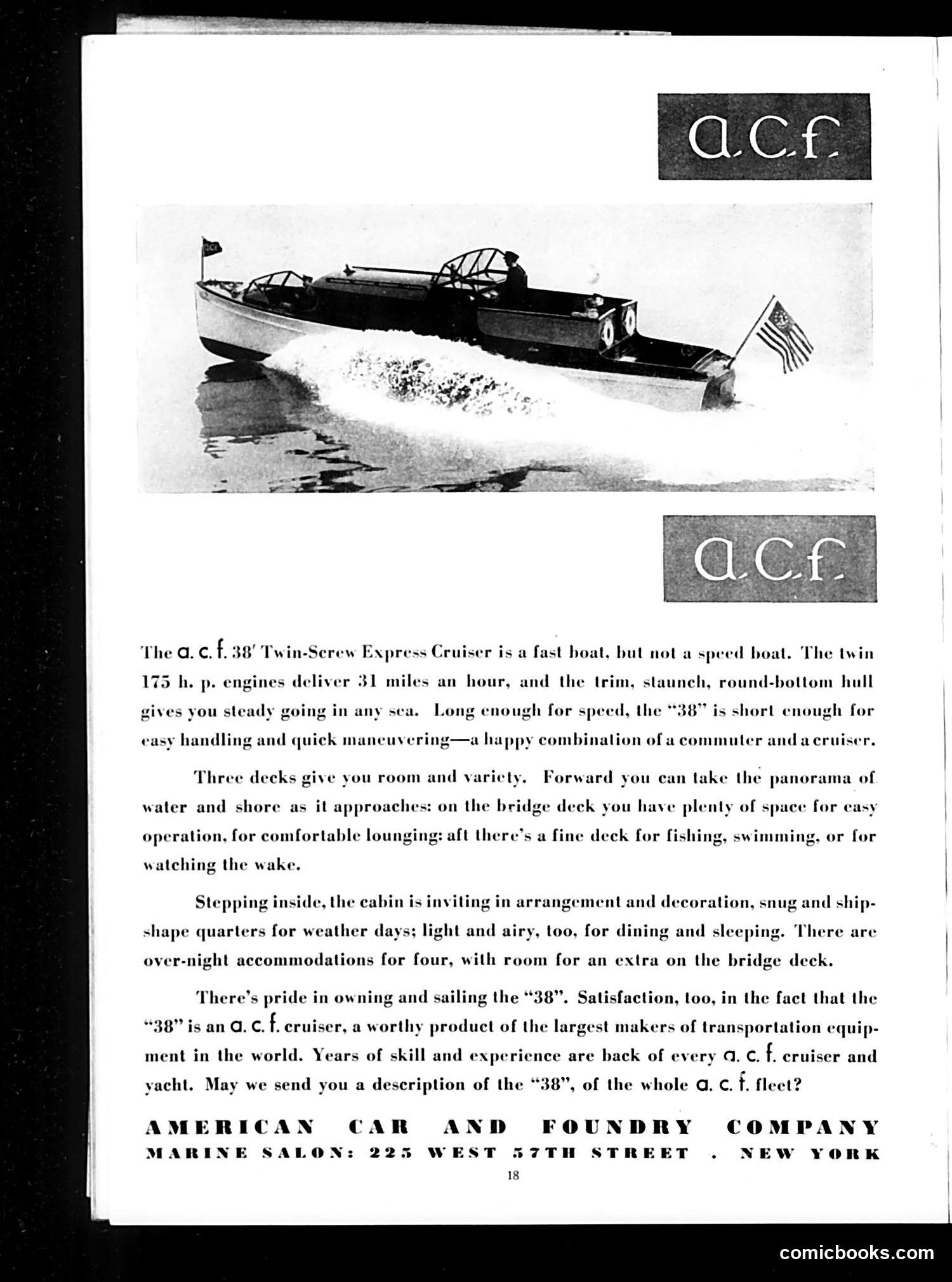
Analysis This page is not a cartoon or satire — it's a straightforward advertisement. The image shows a photograph of the a.c.f. 38' Twin-Screw Express Cruiser, a motorboat with two flags visible. The advertisement is from the American Car and Foundry Company, promoting their luxury recreational boat. The text emphasizes practical features: twin 175 h.p. engines delivering 31 mph, three decks, cabin accommodations for four, and a design balancing speed with maneuverability and comfort. This appears in *Judge*, a satirical magazine, but occupies page 18 as paid advertising content—typical of how magazines of this era (appears to be 1920s-1930s) monetized through luxury goods advertising aimed at wealthy readers. No satire or political commentary is present; it's purely commercial promotion.

This is a full-page advertisement, not a cartoon or satire. The American Car and Foundry Company promotes luxury speedboats—38-foot express cruisers priced at $10,500-$11,800. The ad emphasizes value: these boats match custom-built quality at significantly lower cost than competitors' reproduction prices. The photograph shows a sleek motorboat with an American flag. This appears in a satirical magazine but serves as straightforward commercial advertising targeting wealthy buyers during what seems to be the 1920s-30s era of American leisure boating. The "price within reason" framing appeals to affluent consumers concerned with getting quality goods economically.
Judge Magazine, January 1934: Bridge League Editorial This page is primarily an editorial and instructional content about contract bridge, not a political cartoon. It discusses the International Bridge League, a newly formed federation of national bridge organizations. The editor, Philip Hal Sims, announces organizational details and upcoming articles about bridge strategy. The substantive content includes two pieces: an editorial celebrating the American Bridge League's membership in the international federation and praising female player Anne Rosenfeld; and an instructional article by George Unger on bridge bidding strategy, specifically about "intervening overcalls and doubles." There is no political satire or cartoon visible on this page. It appears to be from a specialized bridge column or section of Judge magazine dedicated to contract bridge instruction and news rather than the magazine's typical satirical content.
Explanation for Modern Readers This page contains bridge instruction, not political satire or cartooning. It's an educational article by Derrick J. Wernher explaining contract bridge bidding theory, specifically Mr. Sims' system for "No Trump" opening bids. The text discusses how to classify strong bridge hands into two types: "Dummy type" and "Declarer type," based on whether they contain tenace combinations (strategically positioned high cards). The article explains that hands with powerful cards but weak long suits should be bid as no-trump rather than in a suit, and discusses the strategic advantages of this approach. Judge magazine was primarily a satirical and humorous publication, but this particular page is straightforward instructional content—likely part of a series on advanced bridge strategy that Judge was running for its readers. There is no cartoon, political reference, or satire visible on this page.
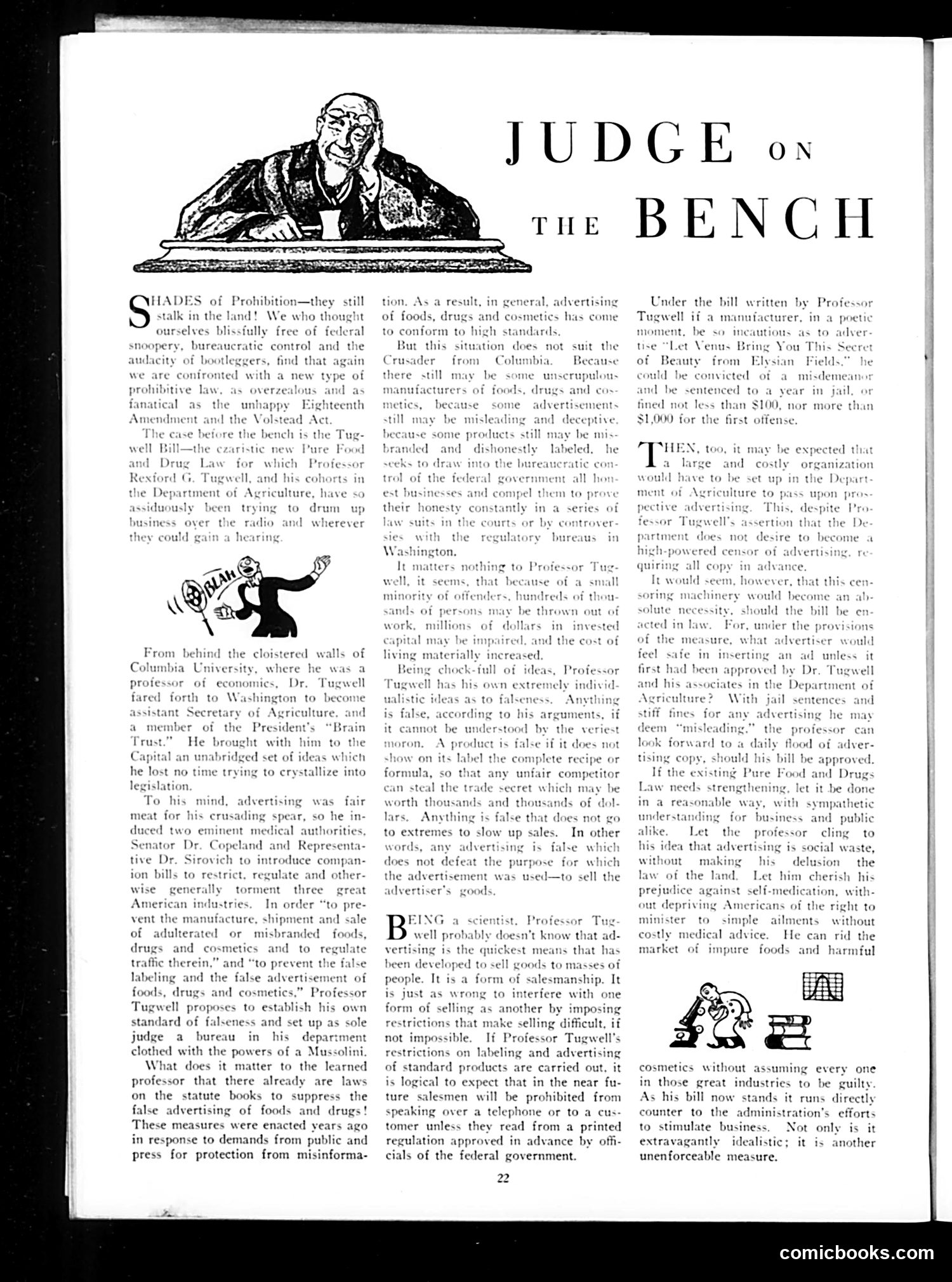
Judge Magazine: "Judge on the Bench" This article satirizes Professor Tugwell, identified as an assistant secretary of agriculture in the Roosevelt administration, who proposed stricter advertising regulations for foods, drugs, and cosmetics. The cartoon depicts him as an authoritarian figure. Tugwell's bill would establish his personal "standard of falseness" for advertising and empower him to censor all marketing copy in advance—powers the author compares to Mussolini. The satire argues this represents dangerous government overreach: advertising, while sometimes misleading, serves legitimate salesmanship purposes and shouldn't be suppressed by one man's subjective judgment. The piece defends American industry against what it frames as excessive bureaucratic control, even while acknowledging some advertising abuses exist. The implicit argument: existing Pure Food and Drug laws suffice; Tugwell's proposal grants dictatorial censorship powers under the guise of consumer protection.
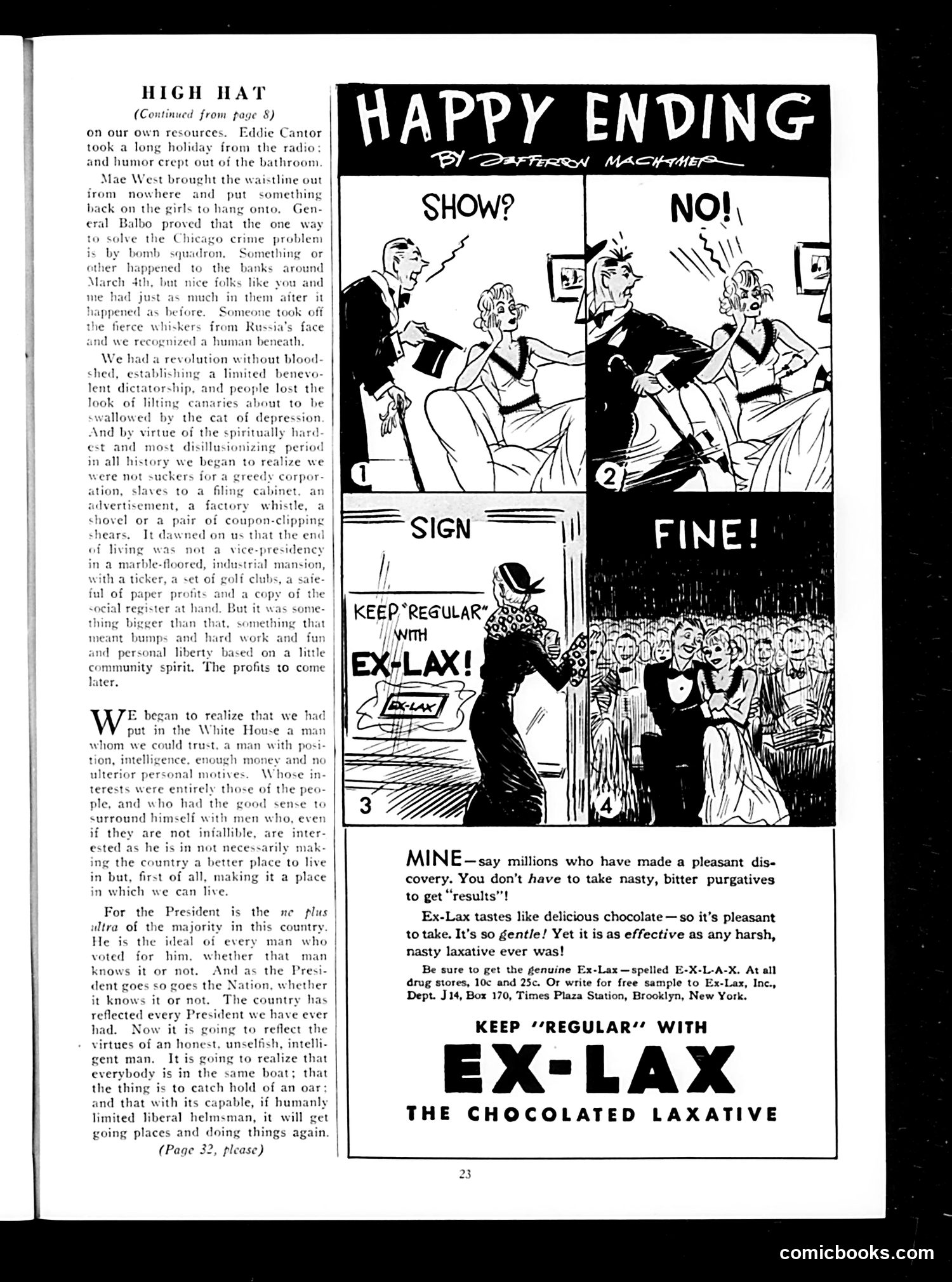
Page Analysis: Judge Magazine This page contains a four-panel comic strip titled "Happy Ending" by Daffan Machthera, depicting a domestic scenario where a man asks his female companion to appear in a "show," she refuses, he signs something (appears to be an Ex-Lax advertisement), and they end up at what looks like a formal event together. The left column contains editorial text praising Franklin D. Roosevelt's presidency, discussing how the country has stabilized after economic hardship and how FDR surrounded himself with trustworthy advisors. The author argues the President embodies integrity and community spirit necessary for national recovery. The comic strip itself appears designed to transition into the adjacent Ex-Lax laxative advertisement—the "happy ending" being digestive regularity rather than romantic resolution. This is a straightforward product ad using gentle humor to promote the chocolate laxative as an alternative to harsh purgatives, typical of 1930s magazine advertising strategy.
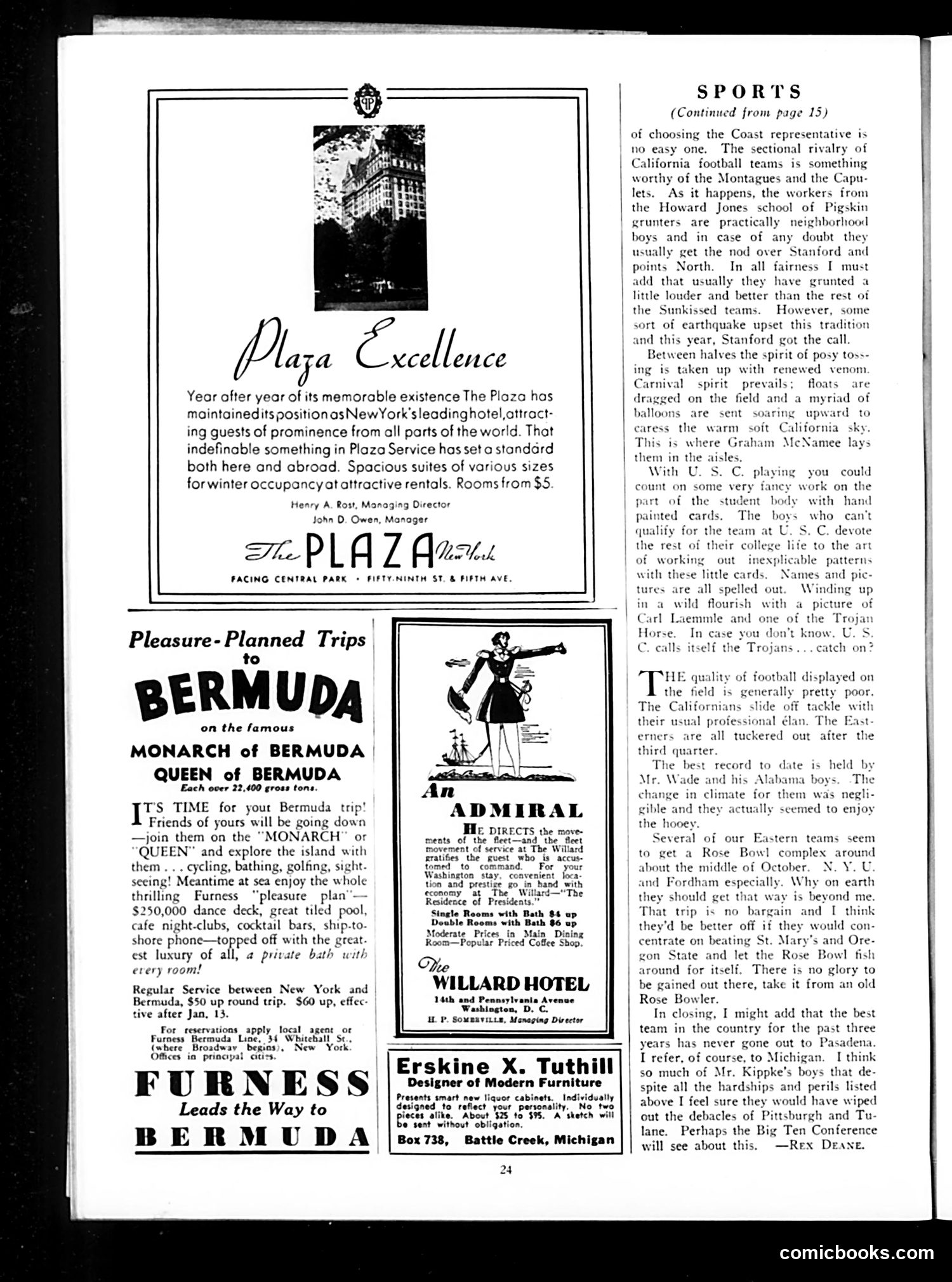
This is primarily a classified advertising page from an older Judge magazine. The main content consists of ads for luxury hotels, travel services, and furniture. The single illustrated cartoon at the center depicts a woman labeled "An Admiral" and appears to be a brief visual joke (text indicates it "directs the movements of the fleet" and service), serving as an advertisement for the Willard Hotel in Washington, D.C. The substantial "Sports" column (likely continued from a previous page) discusses college football, focusing on rivalry between University of California and Stanford, and selection of the Coast representative for a major game. It references USC's nickname as "Trojans" and mentions coastal football teams' sectional rivalry. For a modern reader: This page reflects 1920s-30s leisure culture and prestige advertising targeting wealthy travelers, alongside sports journalism discussing early college football rivalries that remain significant today.
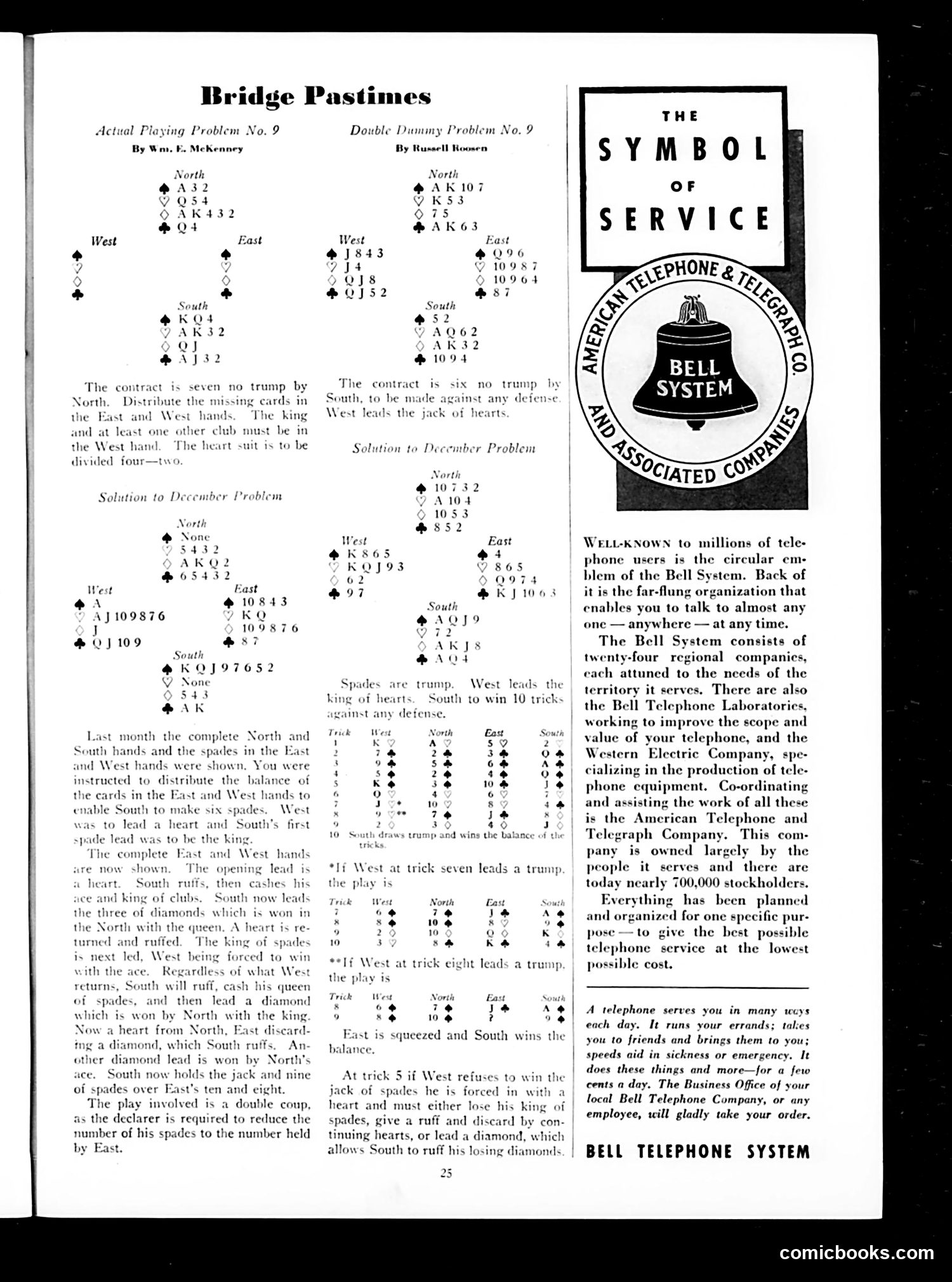
Bridge Pastimes Page Analysis This page is primarily instructional content, not satire or political commentary. It consists of bridge card game problems and solutions by two authors (Wm. E. McKenory and Russell Roosen), typical of hobby/games sections in magazines of this era. The right side contains a corporate advertisement for the Bell Telephone System—not a cartoon. It features the Bell System's circular logo and explains the organization's structure: twenty-four regional companies, Bell Laboratories, Western Electric Company, and AT&T as the parent company. The ad emphasizes the system's reach ("talk to almost any one—anywhere") and notes nearly 700,000 stockholders own the company. There are no political cartoons, caricatures, or satirical commentary on this page. It represents typical Judge magazine content mixing games, puzzles, and advertising rather than the satirical humor the publication was known for.
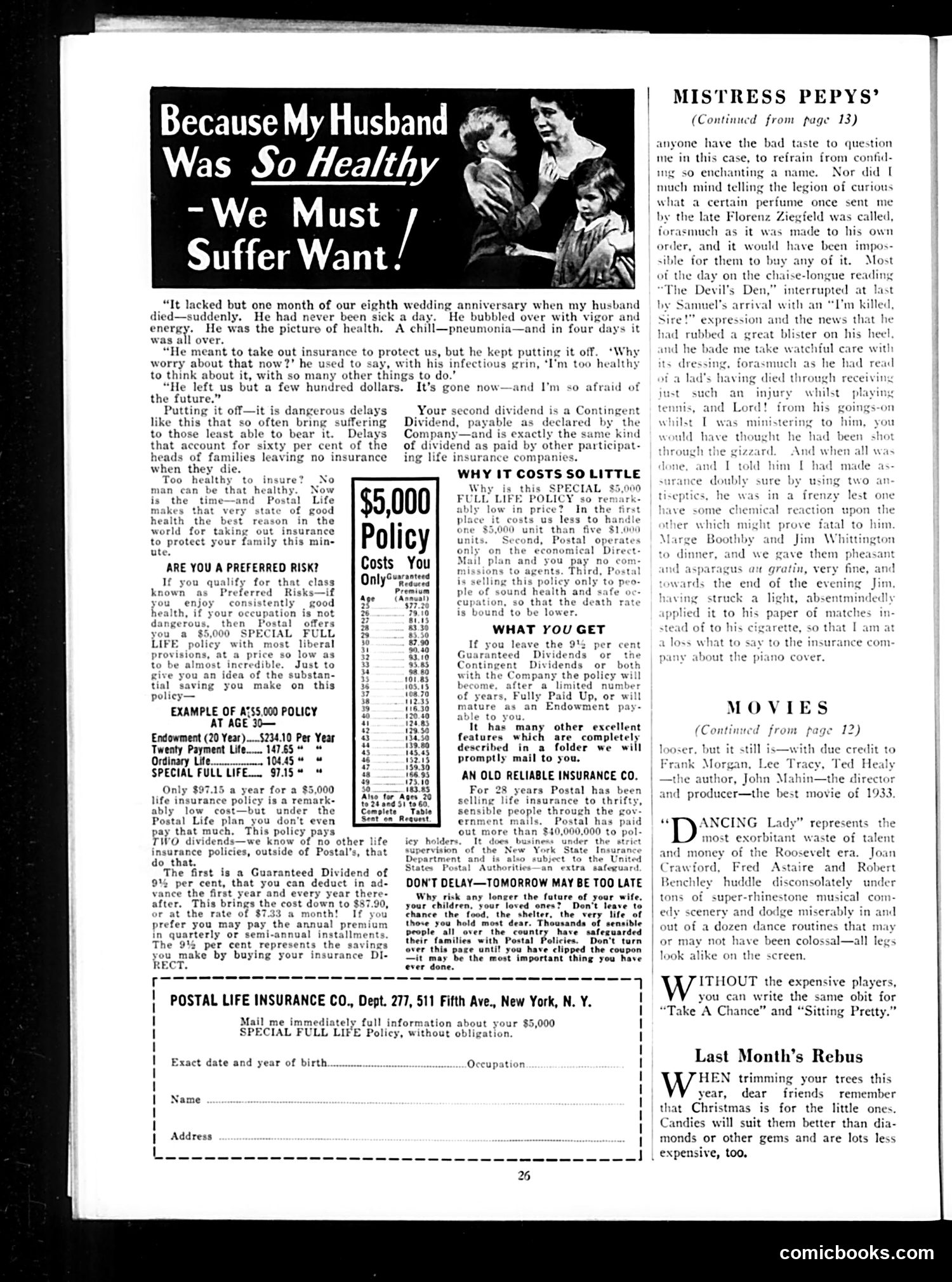
Analysis of Judge Magazine Page This page is primarily advertising for Postal Life Insurance, using emotional appeal rather than satire or political commentary. The main advertisement features a testimonial from a widow whose healthy husband died suddenly of pneumonia without life insurance, leaving her and their children in financial distress. The implied message: healthy people are most vulnerable to unexpected death, making insurance essential. The accompanying article "Mistress Pepys'" is a gossip column discussing social matters—mentioning Florenz Ziegfeld's custom perfume and anecdotes about acquaintances like Samuel Boothby and Jim Whittington. There is no political cartoon on this page. The "cartoon" element referenced in the header is actually the insurance advertisement's narrative scenario—a common early-20th-century marketing technique using dramatized domestic tragedy to convince readers of insurance necessity. The satire, if any, is implicit: the irony that good health creates false security and financial vulnerability.
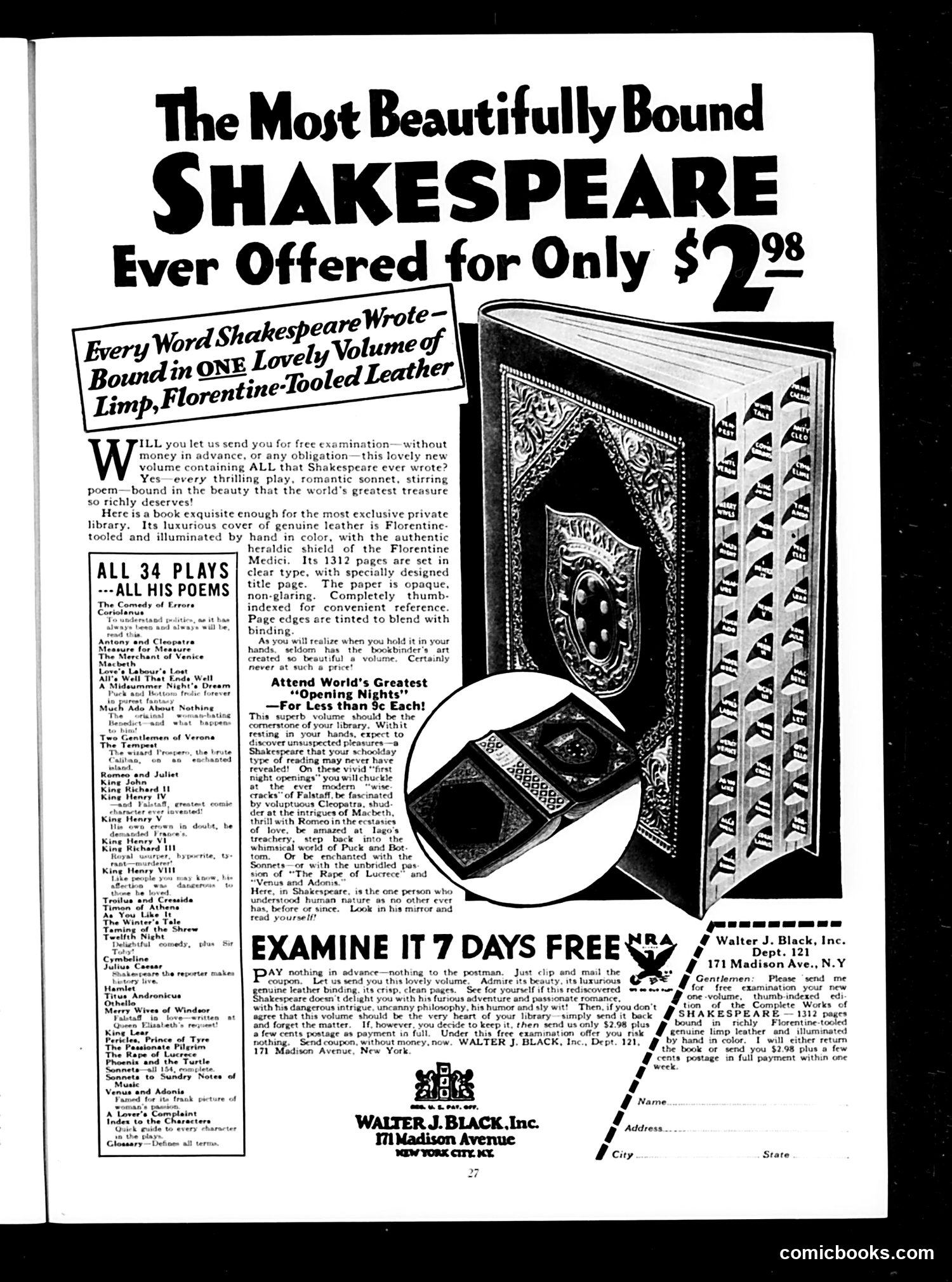
Advertisement Analysis This is primarily a full-page advertisement—not a cartoon or satirical content. Walter J. Black, Inc. is marketing a complete Shakespeare collection for $2.98, positioned as an affordable luxury item. The sales pitch emphasizes exclusivity through contradiction: it's a "beautifully bound" volume with "genuine leather" and hand-illuminated Florentine tooling, yet costs only $2.98—remarkably cheap even for the historical period. The ad appeals to aspirational readers who want a prestigious library without high cost. The "7 Days Free Examination" clause was a common mail-order marketing tactic of the era, removing purchase risk. The listing of all 34 plays and poems reinforces completeness and value. The satirical irony—unstated but clear to Judge readers—is likely the tension between Shakespeare's cultural prestige and mass-market commodification: high art made affordable and accessible. The elaborate decorative binding serves as conspicuous cultural signaling at working-class prices.
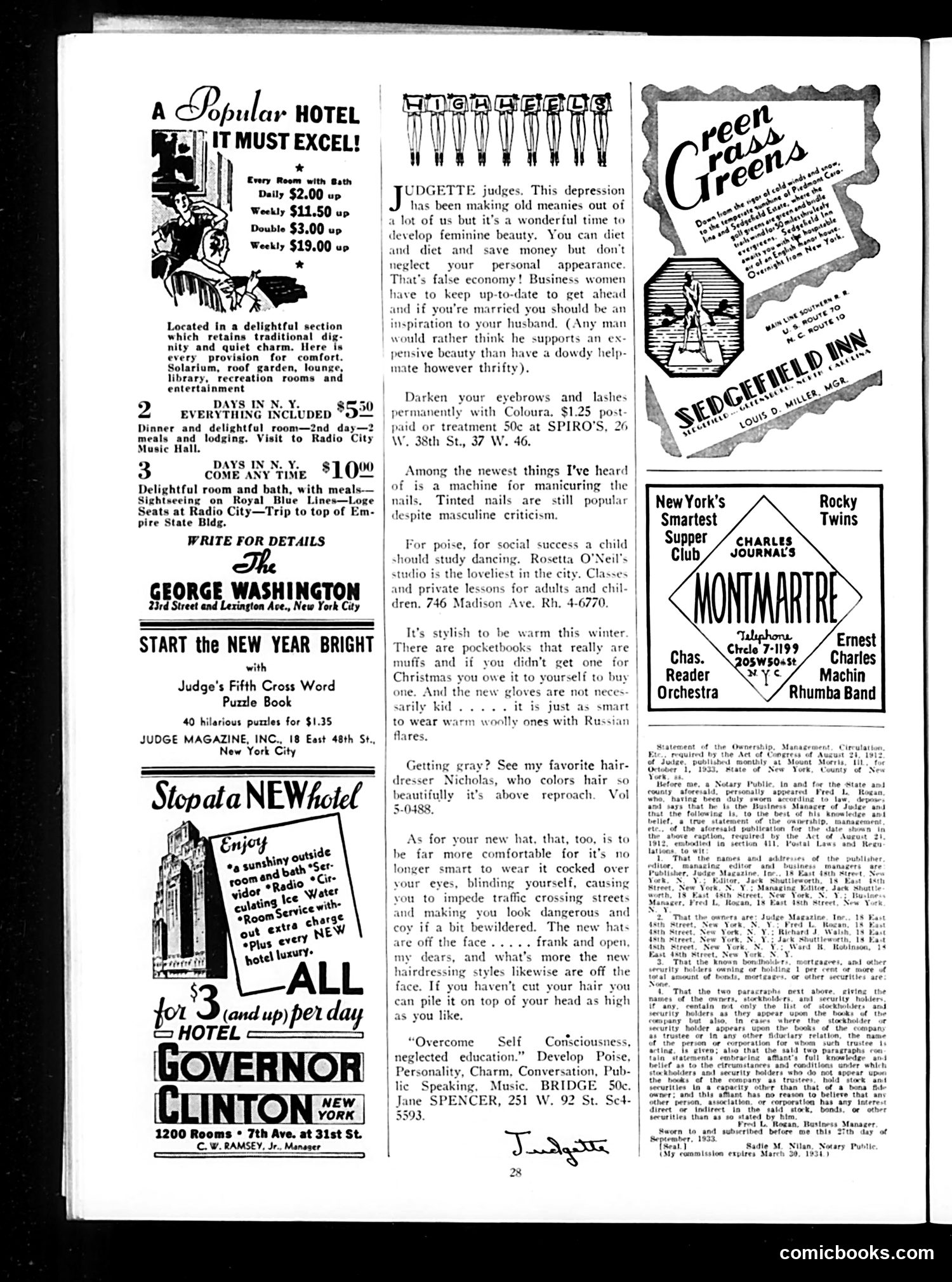
Judge Magazine Page Analysis This page is primarily advertising and advice columns, not a political cartoon. The main content is "Judgette" — a beauty and lifestyle advice column addressing women during the Great Depression. The writer counsels that despite economic hardship, women shouldn't neglect appearance: business women must "keep up-to-date to get ahead," and wives should remain "an inspiration to your husband." The column recommends beauty treatments (eyebrow darkening, manicures, hair coloring), fashionable accessories (muffs, gloves), and social refinement (dancing lessons, etiquette classes). The tone reflects 1930s assumptions about women's primary value being tied to physical attractiveness and spousal support. The surrounding advertisements promote New York hotels and entertainment venues at depression-era prices ($2-3 daily rates). Historical context: This reflects Depression-era contradictions—advising economic belt-tightening while promoting luxury beauty spending—and gender norms emphasizing women's decorative rather than economic roles.
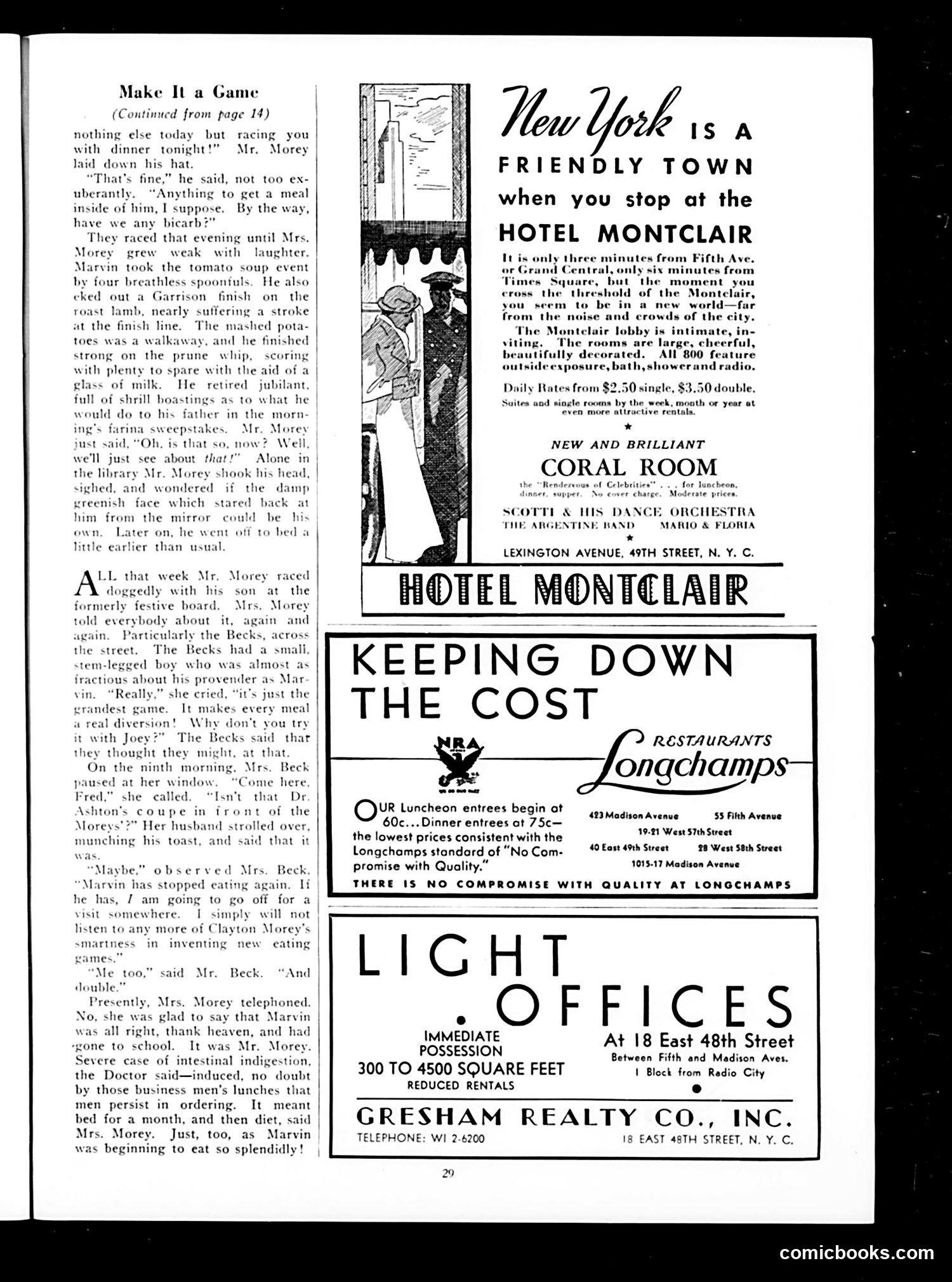
"Make It a Game" - Page Analysis This page contains a short story (continued from page 14) about Mr. Morey, who turns mealtimes into competitive "races" to encourage his son Marvin to eat faster. The story illustrates the unintended consequences of such gamification: Marvin eats so rapidly that he develops severe intestinal indigestion, requiring a doctor's visit and bed rest. The humor is gentle domestic satire—poking fun at parents' well-intentioned but misguided schemes. The Becks, neighbors, initially find the idea charming ("the grandest game"), but when they learn Marvin has become ill, they lose enthusiasm. Mr. Beck's "Double" agreement to avoid trying it with his own son suggests the story's implicit moral: clever parenting tricks can backfire. The remainder of the page consists of advertisements for New York hotels, restaurants, and office space—typical Judge magazine filler content from this era.
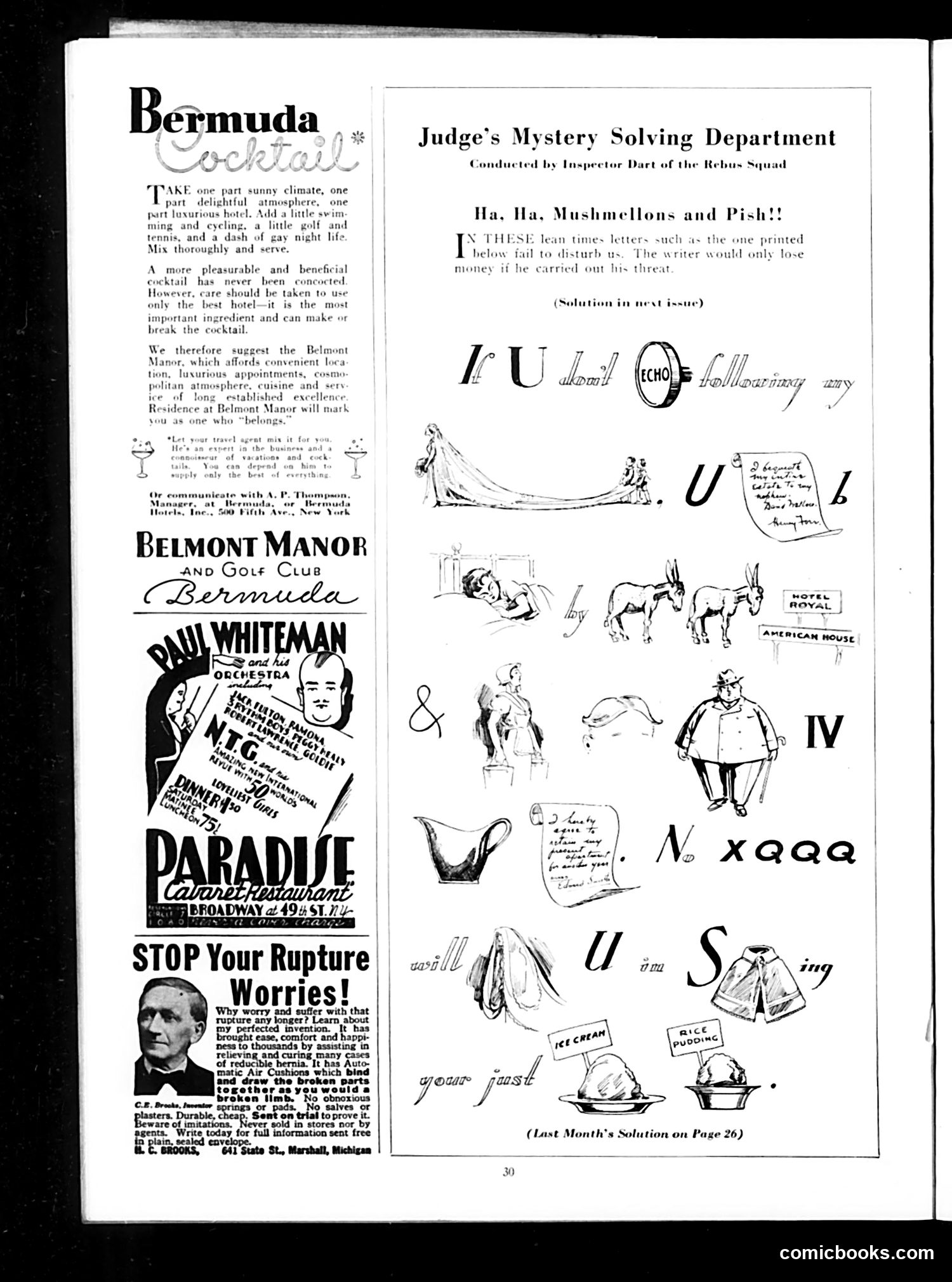
Judge Magazine Page Analysis This page combines advertisements with a rebus puzzle feature from Judge's "Mystery Solving Department." The right side presents a visual word puzzle where drawings represent letters or sounds to spell a hidden message. The images include: mushrooms, fish, animals (antelope), a fat man, a tent, food items (ice cream, rice pudding), and other objects meant to phonetically or visually suggest words or phrases. The left side advertises Belmont Manor Golf Club in Bermuda (a luxury resort), the Paradise restaurant in New York, and a rupture truss device by C.E. Brooks—a medical support garment for hernias. The rupture ad was common in early 20th-century publications, targeting men suffering this common workplace injury. The puzzle invitation warns readers not to send threatening letters demanding the solution—a humorous jab at overeager participants who took the mystery-solving game too seriously and needed warnings about civil behavior.
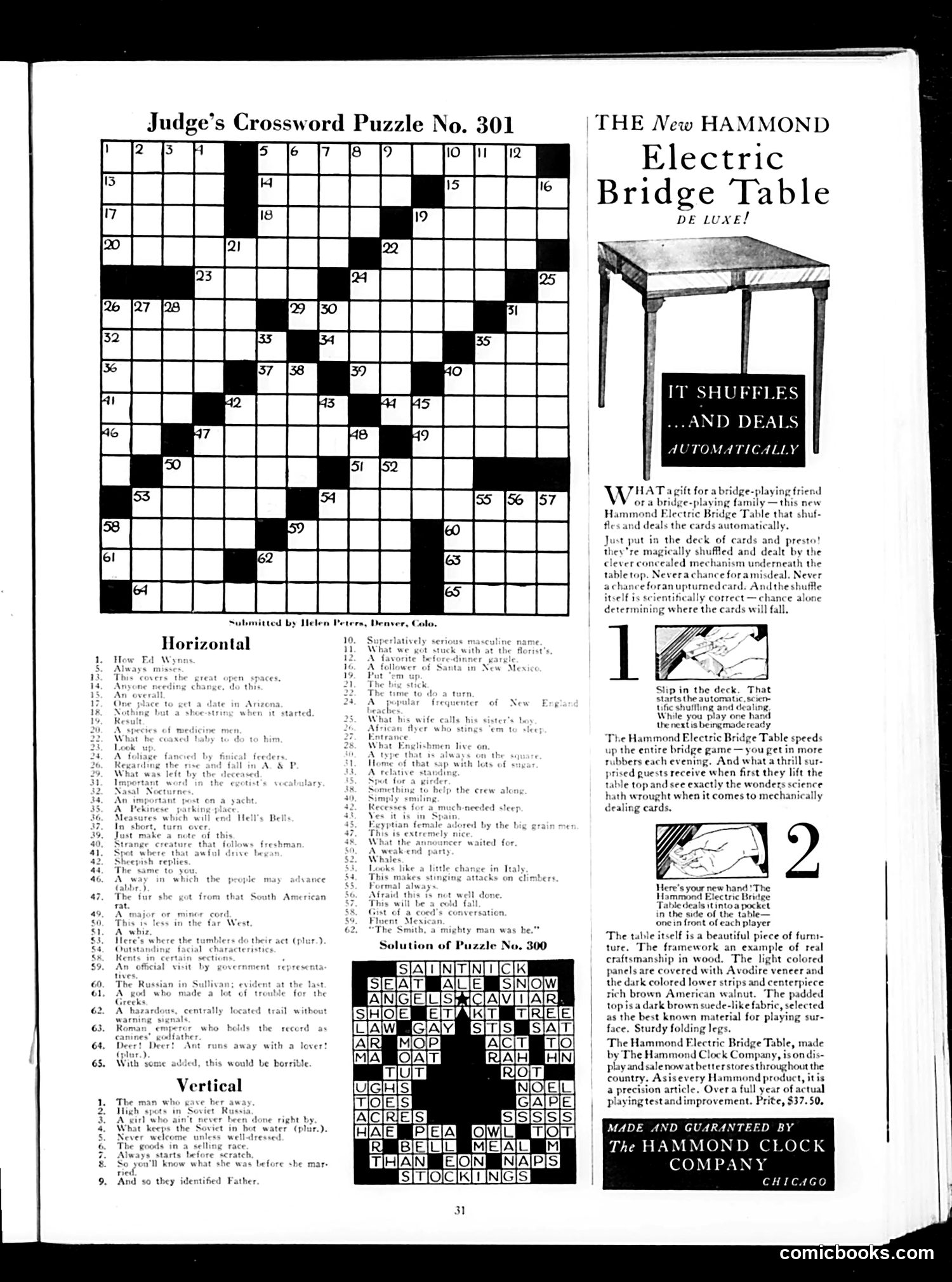
Judge Magazine Page Analysis This page is primarily advertising, not satire or political commentary. It features a full-page advertisement for the Hammond Electric Bridge Table, a novelty furniture item marketed to bridge players. The product automatically shuffles and deals cards through an internal mechanical system—a significant technological novelty for the era (likely 1920s-30s based on the style). The advertisement emphasizes the machine's precision, speed, and the entertainment value of surprising guests with its automatic operation. The accompanying crossword puzzle is standard filler content unrelated to the advertisement. No political figures or satire are present. This is simply a commercial advertisement in Judge magazine, capitalizing on the period's fascination with electrical automation and the popularity of bridge as a social pastime among middle and upper-class Americans. The appeal is purely to convenience and modern technological sophistication.
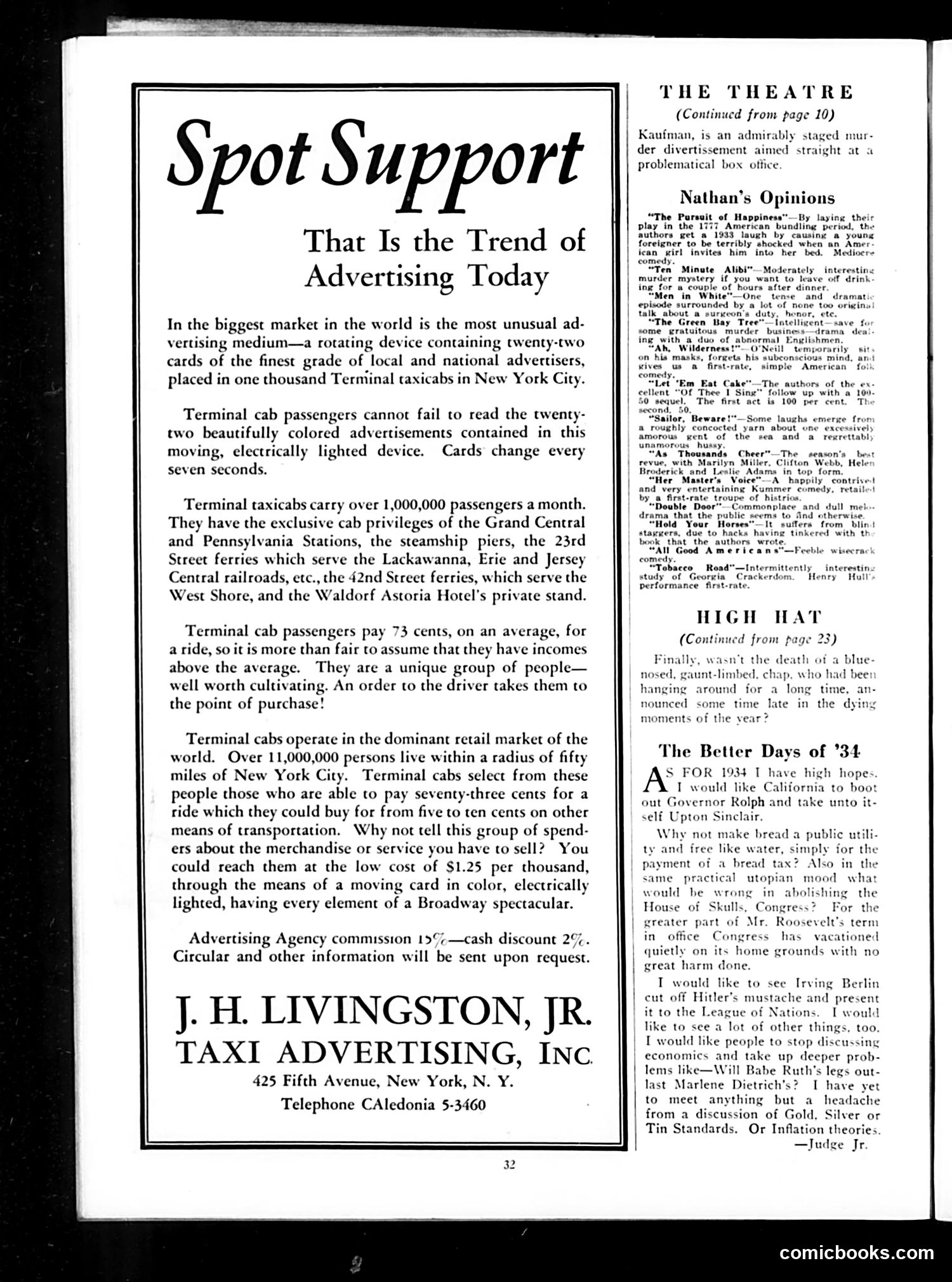
Spot Support Advertisement Analysis This page is primarily a full-page advertisement for J. H. Livingston Jr.'s Taxi Advertising Inc., not a political cartoon. The ad promotes "spot advertising"—a novel medium of the early 1930s: rotating illuminated cards placed in Terminal taxicabs throughout New York City. The pitch targets affluent advertisers by emphasizing that cab passengers, paying 73 cents per ride (expensive for the era), represent a desirable income demographic. The ad boasts access to over 1 million monthly passengers and strategic locations: Grand Central, Pennsylvania Station, steamship piers, and the Waldorf Astoria. The satire is implicit rather than visual: the ad exemplifies aggressive, data-driven marketing tactics aimed at capturing captive audiences—a distinctly modern advertising trend mocked as intrusive "spot support" strategy. The page's right side contains theater reviews and commentary by "Nathan" and "Judge Jr." unrelated to the advertisement.
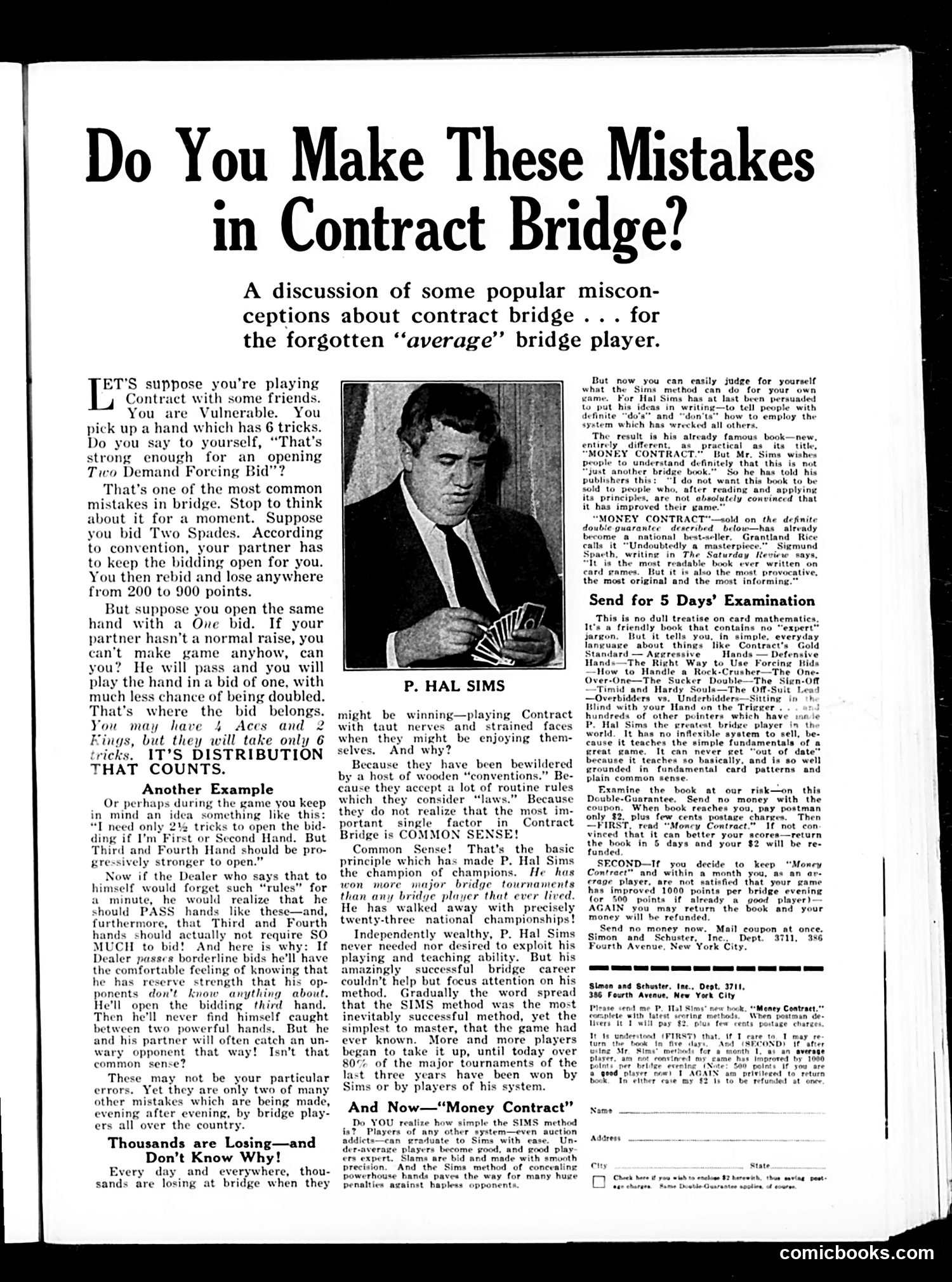
What This Page Means for Modern Readers This is an advertisement disguised as instructional content for P. Hal Sims's bridge strategy book "Money Contract." The Setup: The page presents itself as a friendly guide to common Contract Bridge mistakes—a card game popular among mid-20th-century middle-class Americans. It uses relatable examples (overbidding, misunderstanding hand strength) to hook readers. The Sales Pitch: The real message emerges gradually: P. Hal Sims, presented as an undefeated champion who "won more major bridge tournaments than any bridge player that ever lived," has a revolutionary method based on "common sense" rather than rigid convention. The copy claims 80% of major tournaments in three years were won by Sims or his followers. The Satire/Humor: There's no political satire here—this is sincere promotional copy in Judge magazine. The humor lies in the grandiose claims and the bait-and-switch structure: you think you're reading helpful tips, but you're actually being sold a book. The implied joke for Judge's readers: gullible bridge players everywhere are losing money because they don't know Sims's "method."
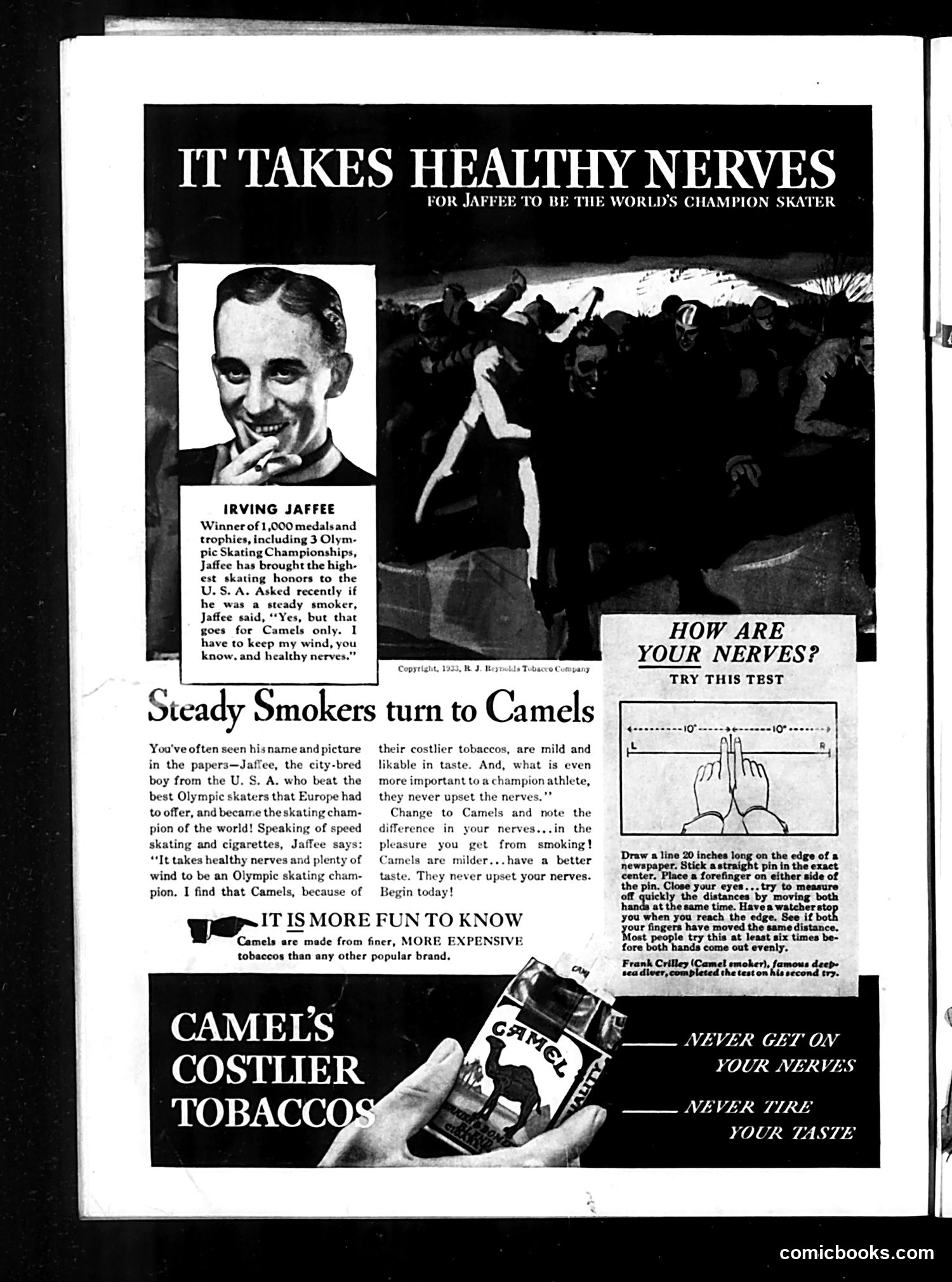
Vintage Camel Cigarettes Advertisement This is a cigarette advertisement, not satire or political cartoon. It promotes Camel brand cigarettes using endorsement from Irving Jaffee, an actual Olympic speed skater who won multiple medals and championships for the U.S. The ad's central claim is that smoking Camels won't harm an athlete's performance—that they're "mild" and "never upset your nerves." Jaffee is quoted claiming he smokes despite needing "healthy nerves" for competitive skating. The page includes a "nerve test" (drawing a steady line) to encourage readers to try Camels themselves. The tagline emphasizes Camels use "costlier tobaccos" than competitors. By modern standards, this is remarkable for its brazen false health claims about cigarettes and exploitation of an athlete's credibility to market a harmful product—practices now illegal in advertising.