judge
Judge — February 1934
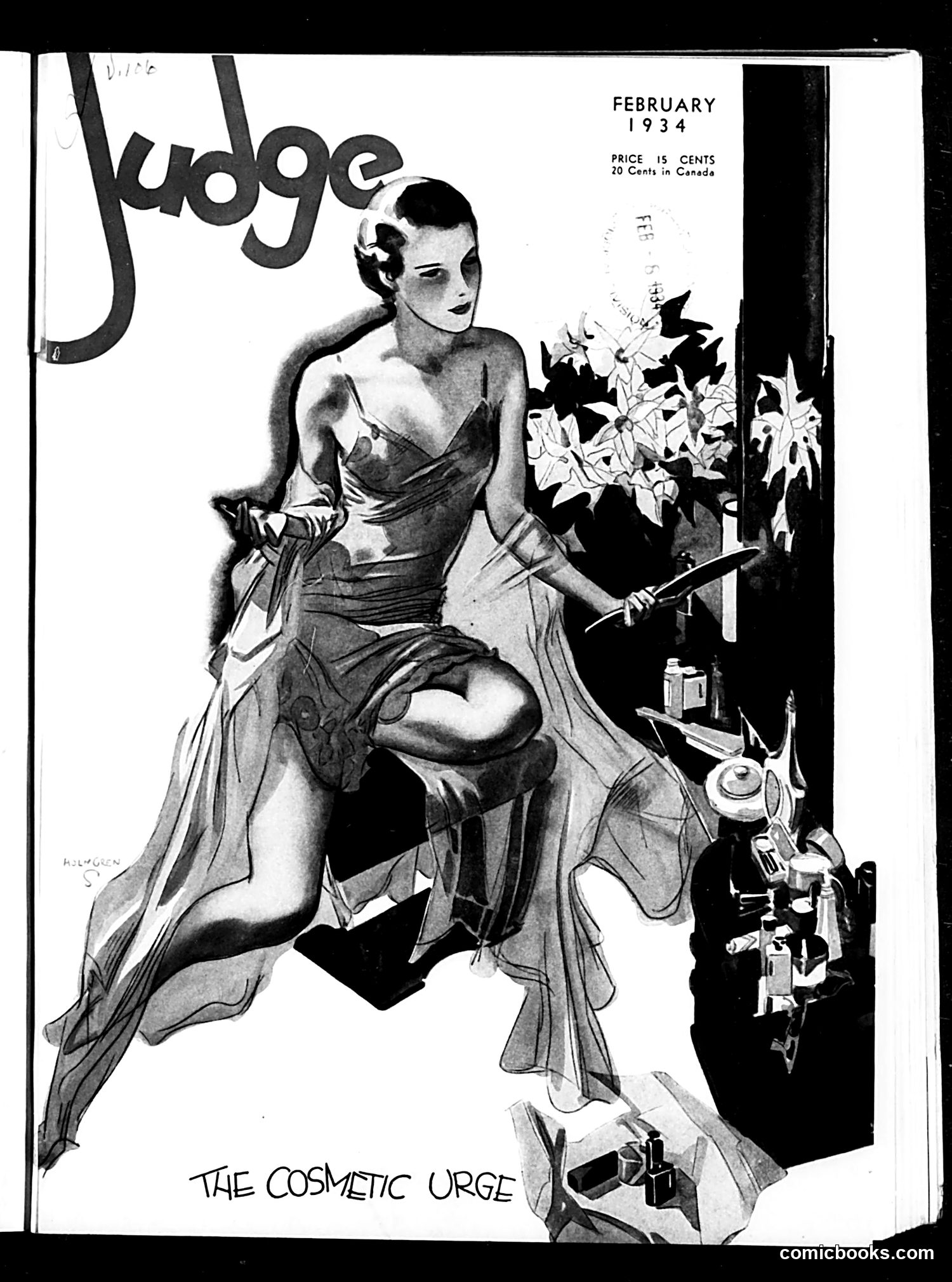
"The Cosmetic Urge" - Judge, February 1934 This cover satirizes women's enthusiasm for cosmetics and beauty products during the Depression era. The illustration shows an elegantly dressed woman surrounded by beauty supplies—makeup, flowers, and perfume bottles—applying cosmetics with a paintbrush. The title "The Cosmetic Urge" suggests an almost compulsive drive to beautify oneself. The satire likely mocks the contradiction of Depression-era economics: despite widespread financial hardship, women continued purchasing luxury beauty products. The woman's glamorous pose and abundance of cosmetics imply vanity or frivolous spending during economically difficult times. This reflects 1930s attitudes about gender, consumption, and the perceived priorities of middle-class women.
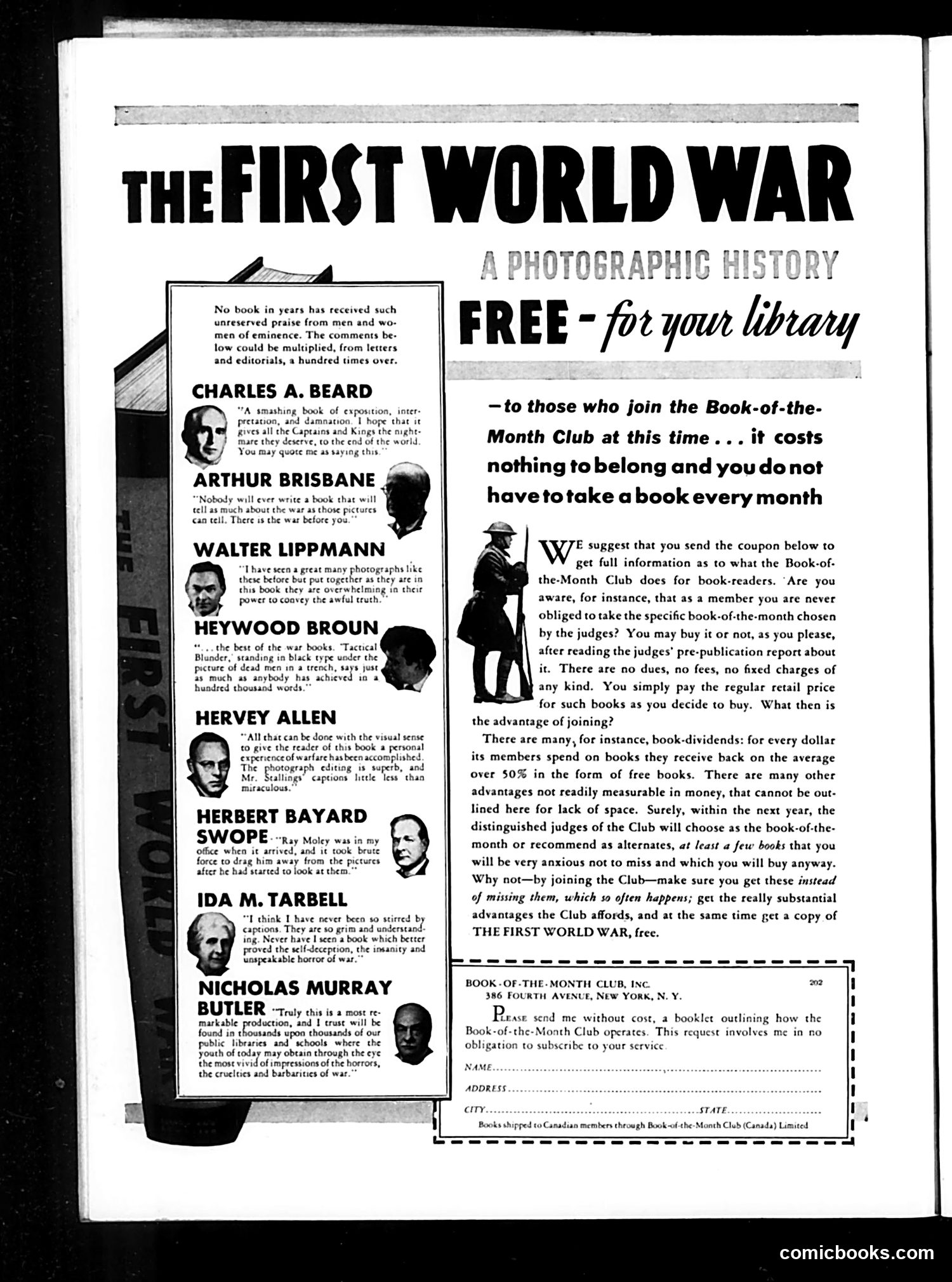
"The First World War: A Photographic History" This page is primarily an advertisement for a Book-of-the-Month Club promotion offering a free book about WWI. The left side features endorsements from notable figures of the era—including writers Charles A. Beard, Arthur Brisbane, Walter Lippmann, and Heywood Broun—praising the book's photographic documentation and historical value. Rather than satire, this represents a straightforward marketing appeal to library patrons, emphasizing the book's cultural importance and the Club's membership benefits (dividends, no fees). The emphasis on photography's power to document war reflects 1920s-30s attitudes about visual media as an objective historical record. There is no apparent cartoon or satirical commentary on this page.
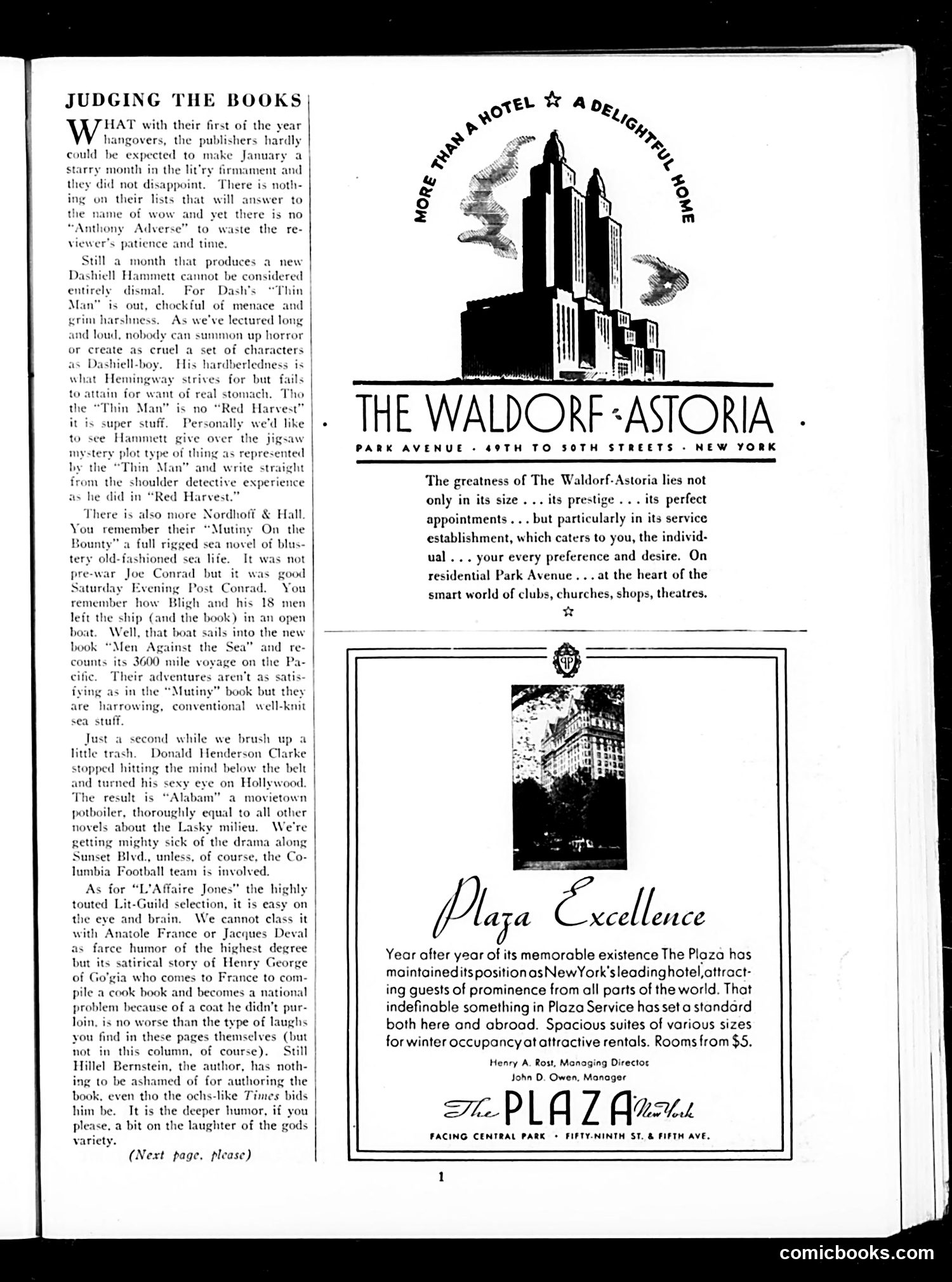
Analysis This page is primarily advertising, not editorial content. The main visual elements are hotel and hospitality advertisements: 1. The Waldorf-Astoria (top): A luxury hotel advertisement emphasizing its service and Park Avenue location in Manhattan's elite district. 2. The Plaza Hotel (bottom): Another prominent NYC hotel ad highlighting its "Plaza Excellence" and year-round prominence among wealthy guests, with room rates starting at $5. The left column contains a book review section titled "Judging the Books," discussing recent literary releases. There are no political cartoons or satirical illustrations on this page—it represents Judge magazine's advertising revenue model during this era, mixing light literary commentary with upscale hotel promotions targeting affluent readers.
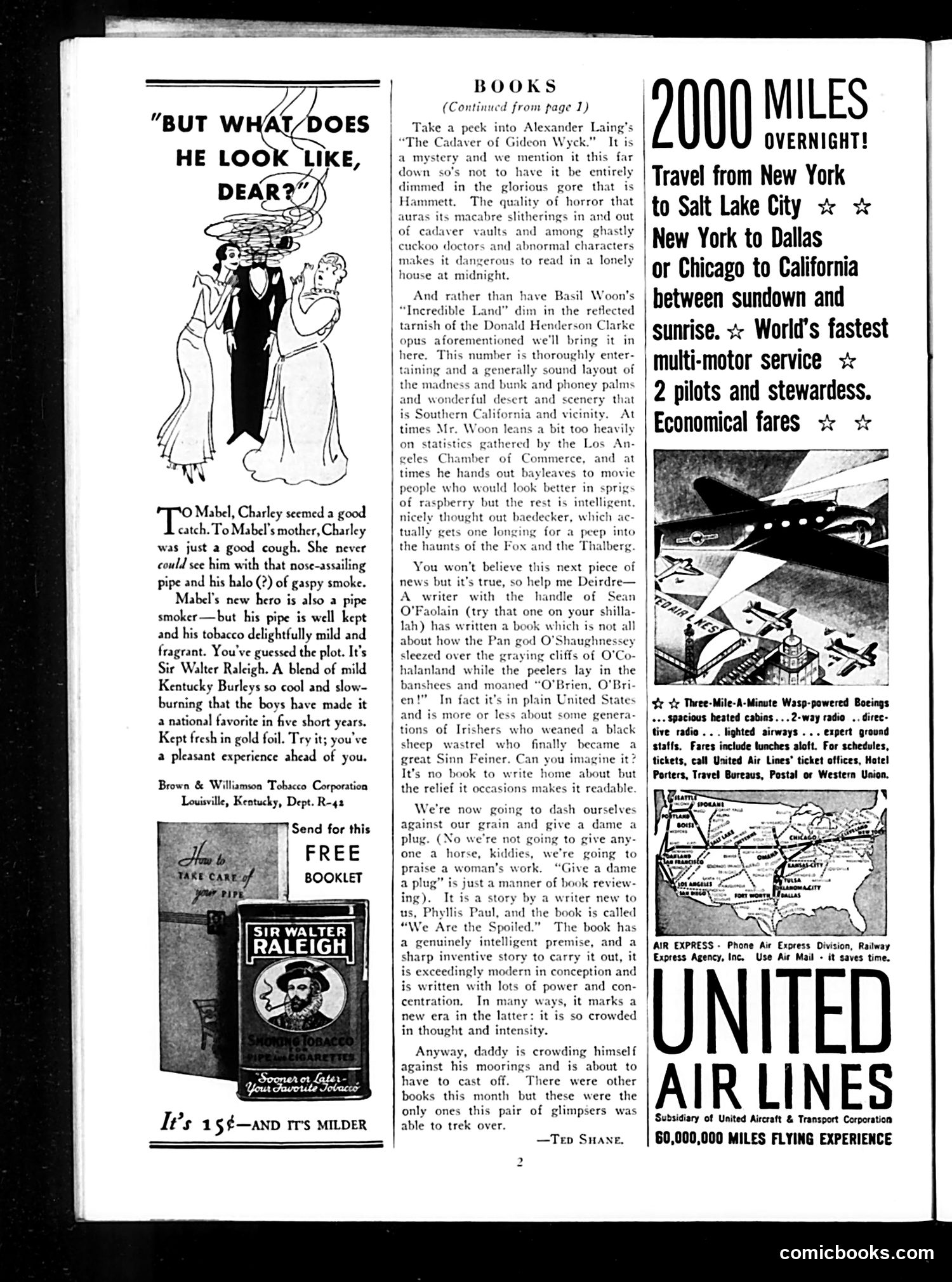
Analysis of Judge Magazine Page This page is primarily advertising with minimal editorial content. The left side features a tobacco ad for Sir Walter Raleigh pipe tobacco, using the historical figure of Sir Walter Raleigh as a brand mascot. The accompanying cartoon depicts a couple discussing a pipe smoker, playing on the product's claim to be mild and fresh—typical mid-century tobacco marketing that emphasized masculine sophistication. The right side contains United Airlines advertising, promoting transcontinental overnight flights as a modern marvel. A small book review section by Ted Shane discusses recent publications but contains no discernible political satire. The page reflects 1930s-40s consumer culture rather than political commentary, showcasing how Judge magazine balanced editorial content with revenue-generating advertisements.
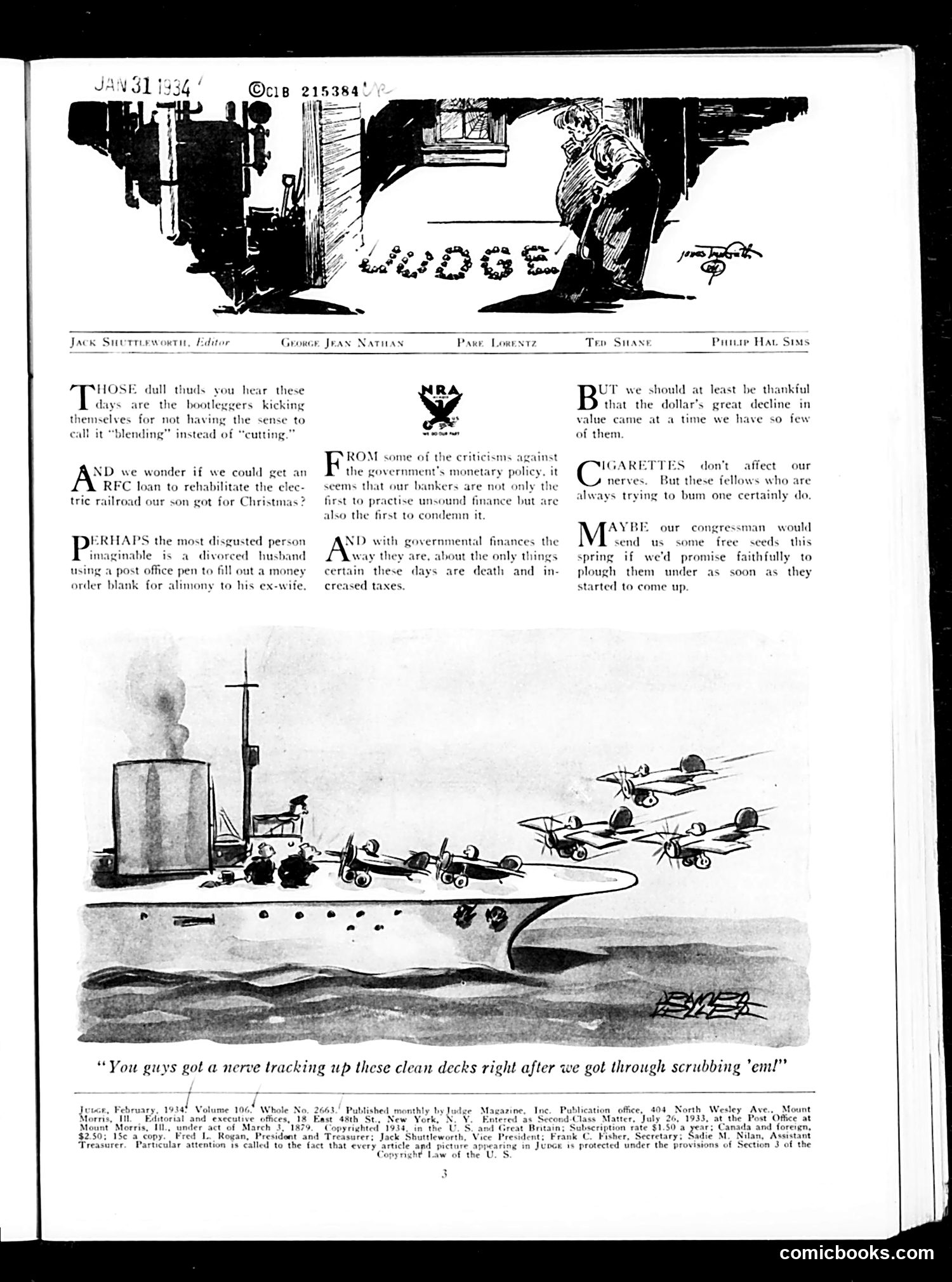
Judge Magazine Editorial Page Analysis This February 1934 editorial page combines commentary on Depression-era economic concerns with a naval/military cartoon. The text snippets criticize contemporary issues: questionable banking practices, government monetary policy, and tax increases. One piece sarcastically suggests a congressman send "free seeds" to constituents—likely referencing agricultural relief programs. The large cartoon depicts a naval vessel with planes launching from its deck. The caption reads: "You guys got a nerve tracking up these clean decks right after we got through scrubbing 'em!" This appears to satirize military readiness or naval operations during a period of American rearmament in the early 1930s, possibly mocking either bureaucratic inefficiency or the friction between different military branches' priorities during Depression-era budget constraints.
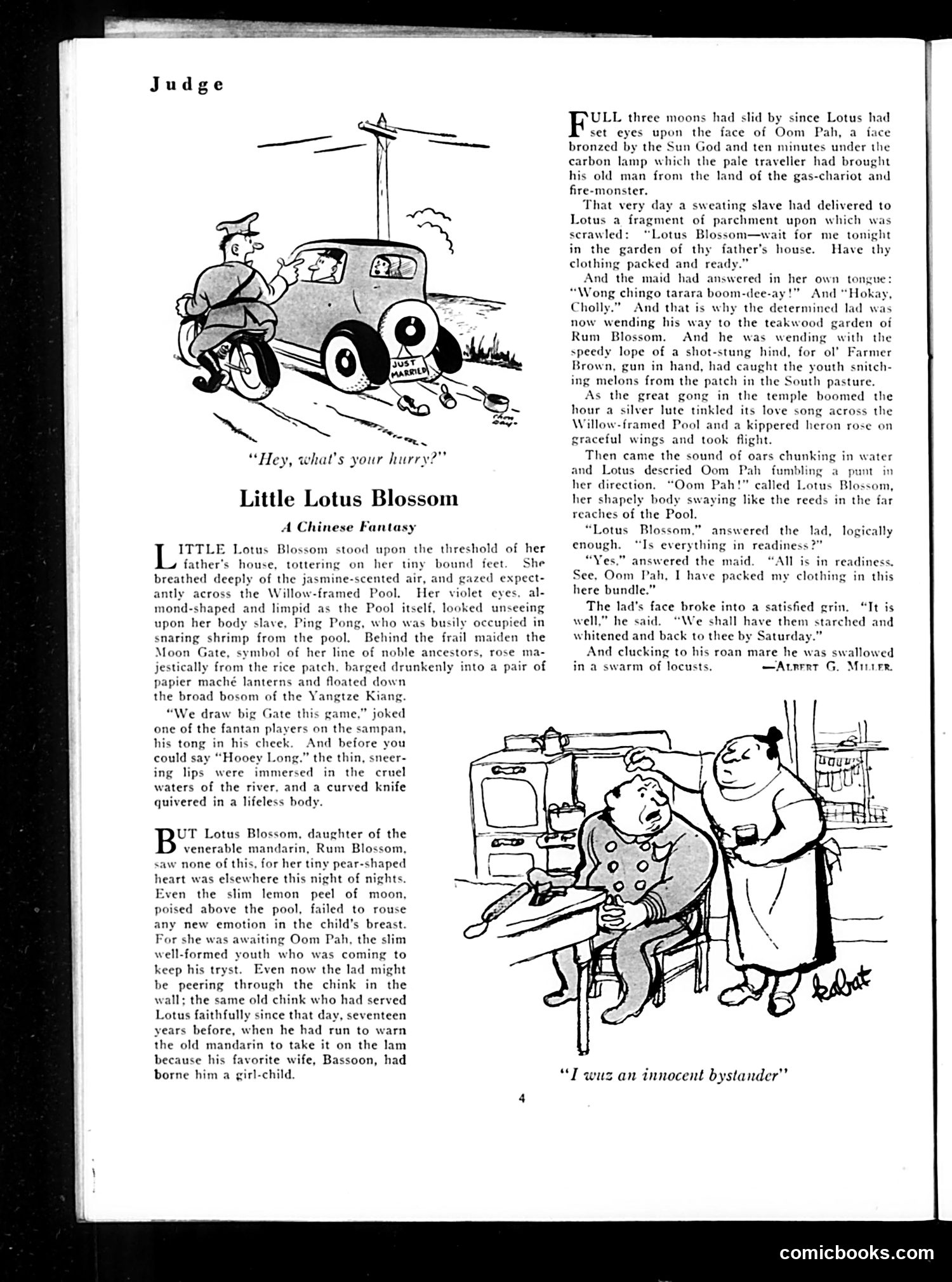
"Little Lotus Blossom" - Judge Magazine This page presents a serialized fiction story titled "Little Lotus Blossom: A Chinese Fantasy" by Albert G. Muir, illustrated with two cartoons. The top cartoon shows a figure on a bicycle next to a broken-down car, asking "Hey, what's your hurry?" — likely satirizing early automobile reliability compared to bicycles, a common Judge subject during the automotive era. The bottom cartoon caption reads "I wuz an innocent bystander," depicting what appears to be a domestic dispute or accident scene, suggesting commentary on everyday mishaps or family conflicts. The story itself involves Asian characters and settings (Lotus Blossom, Oom Pah, Rum Blossom, Moon Gate), representing the "Orientalist" fantasy fiction popular in early 20th-century American magazines—often containing period stereotypes reflecting contemporary attitudes toward Asian cultures.
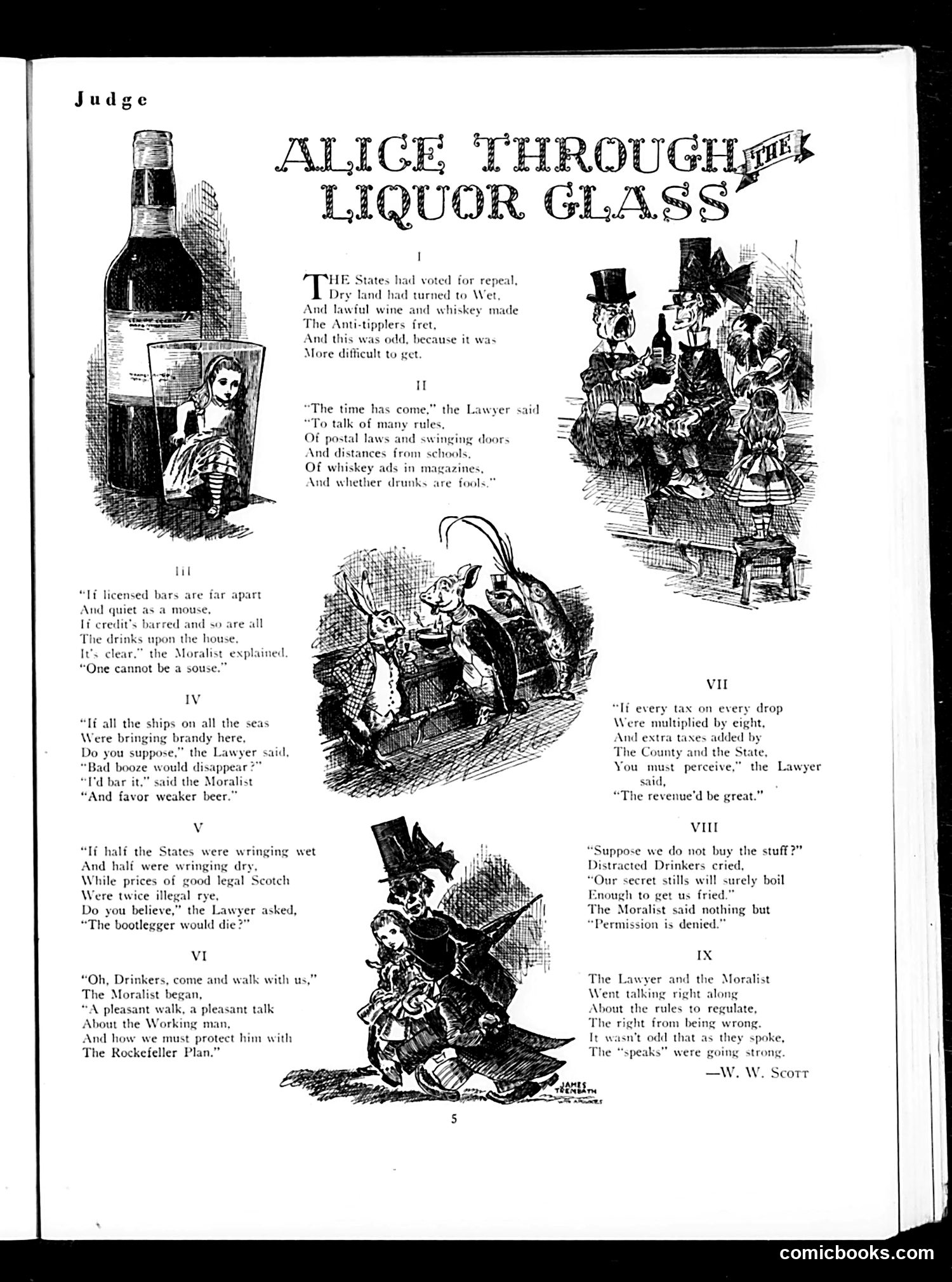
"Alice Through the Liquor Glass" This is a satirical poem by W. W. Scott responding to Prohibition's repeal. The poem uses Alice in Wonderland imagery to mock both the preceding dry era and post-repeal chaos. The satire targets: - Prohibition advocates ("Moralists") and their failed logic - Lawyers and politicians debating regulation details while missing the point - The impracticality of complex tax schemes to replace lost alcohol revenues - Drinkers' resistance to government control through secret stills - The absurdity of the entire situation The bottle and Alice-like character appearing in illustrations reference Carroll's work to underscore the "through the looking glass" illogic of alcohol policy from multiple perspectives. The piece mocks everyone involved—regulators, profiteers, and consumers—for participating in what the author sees as fundamentally foolish.
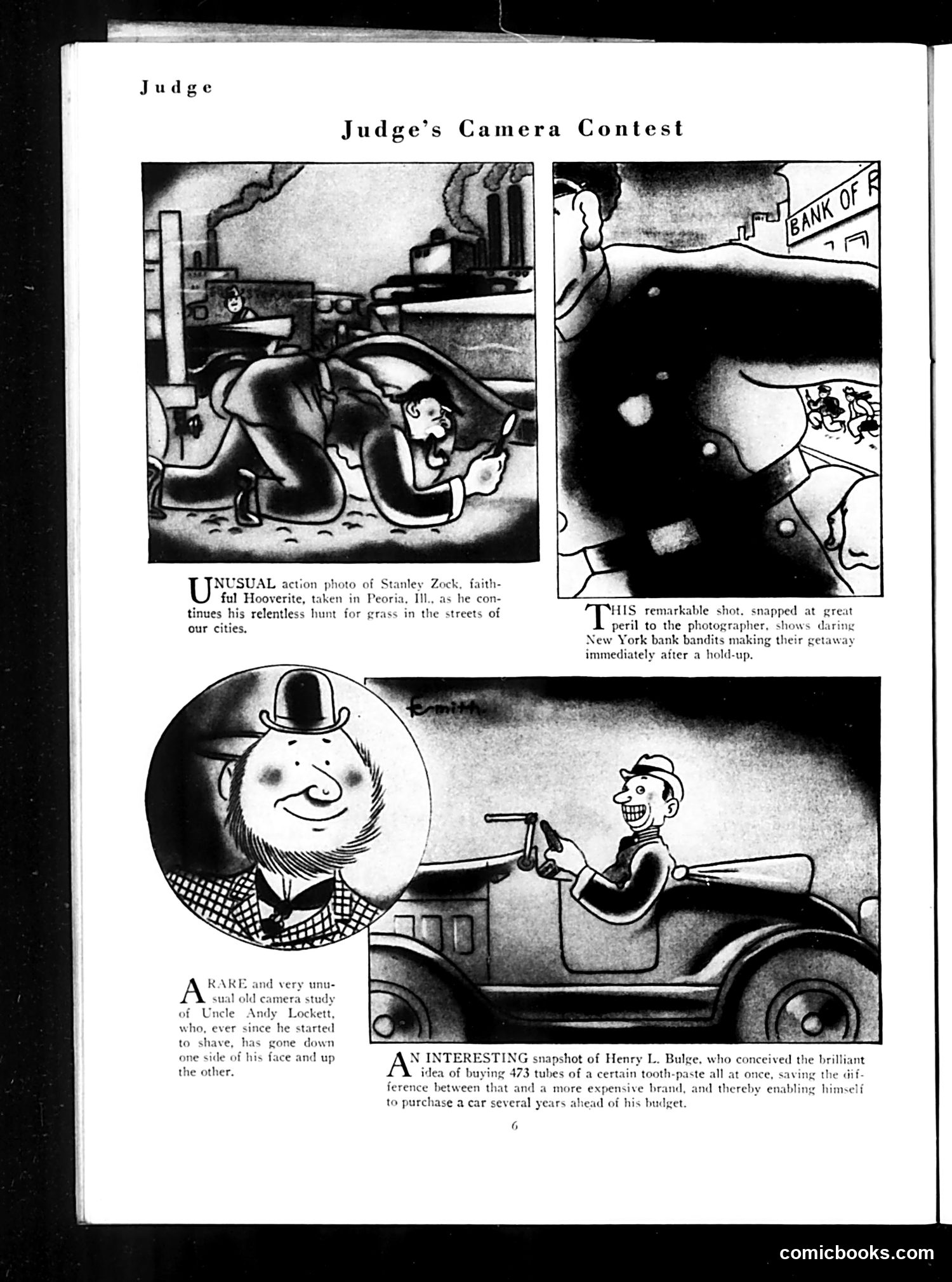
Judge's Camera Contest - Page Analysis This page showcases humorous photographs submitted to Judge magazine's "Camera Contest." The entries feature: 1. Stanley Zock (Peoria, Illinois): Photograph of a man crawling under industrial machinery, captioned as searching for grass in city streets—satirizing the absurdity of urban life and poverty. 2. Bank robbery scene: A daring photograph of criminals escaping after a New York bank hold-up, noted as dangerous to photograph. 3. Uncle Andy Lockett: An unusual old camera study showing his face split vertically—a visual joke about his shaving habits (one side shaved, one not). 4. Henry L. Bulge: A cartoon-style photo of a man with an exaggerated grin in a car, with text joking about buying 473 toothpaste tubes to save money for the vehicle—satirizing consumer purchasing logic and frugality. The page blends real photographs with illustrated humor.
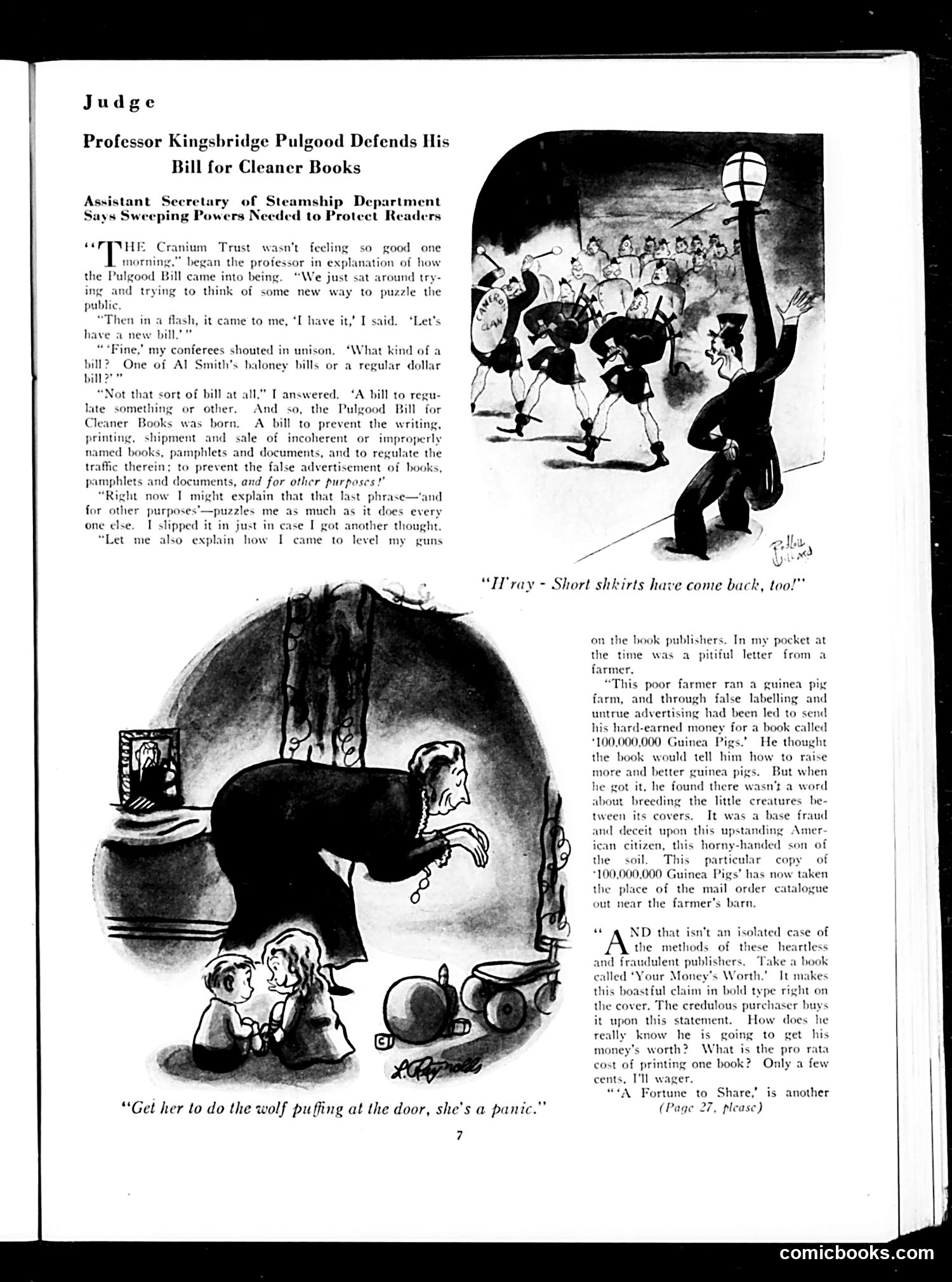
Explanation for Modern Readers This Judge magazine article satirizes legislative overreach and self-serving politicians. Professor Kingsbridge Pulgood openly admits that he and his colleagues invented the "Pulgood Bill for Cleaner Books" simply to create *some* new regulation without genuine purpose—they cynically included vague language like "for other purposes" as a joke because they had no real agenda. The satire exposes the absurdity: Pulgood claims moral concern for a defrauded farmer who bought a guinea pig book (likely the real 1933 exposé *100,000,000 Guinea Pigs*), but this is merely a pretext. The cartoons show people confused about fashion trends and moral panic—illustrating public gullibility. The point: politicians manufacture "reform" bills not to solve actual problems but to expand power and appear virtuous. The mockery targets legislative dishonesty and the public's susceptibility to hollow moral crusades dressed up as protection.
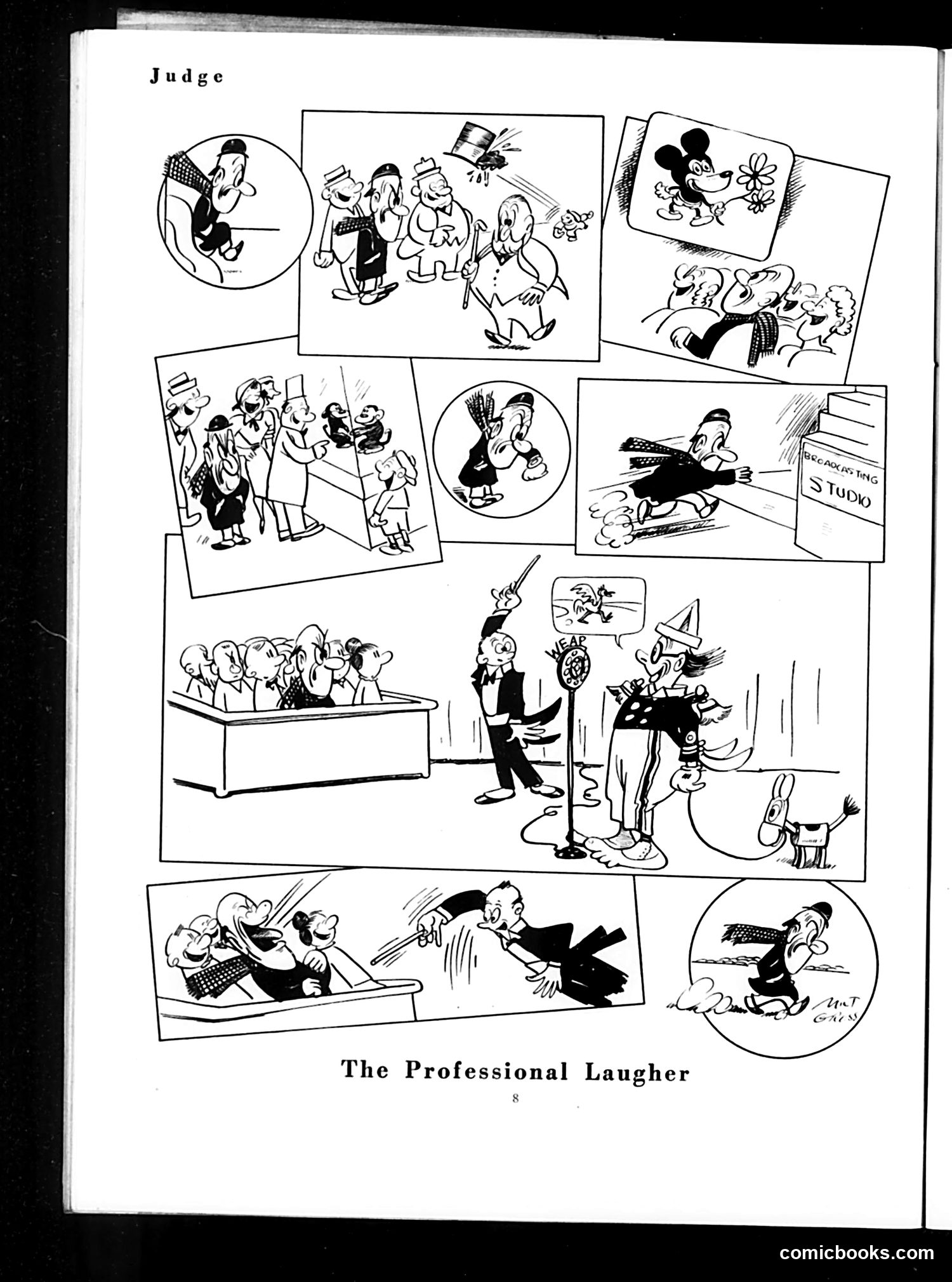
"The Professional Laugher" This Judge satirical comic depicts a courtroom scene mocking "professional laughers"—hired audience members who artificially boosted entertainment appeal by laughing on cue. The sequence shows: 1. A judge presiding over court 2. Various scenes of a theatrical performer/entertainer with exaggerated expressions 3. A courtroom full of jurors/observers 4. The protagonist apparently being pursued or in comedic chaos The satire targets the entertainment industry practice of employing paid laughers to manipulate audience response during performances. By placing this scheme in a courtroom setting with a judge, the cartoonist suggests the practice is fraudulent or worthy of legal judgment. This was a legitimate industry concern in early-to-mid 20th century theater and radio, where "laugh tracks" and hired audience members created false impressions of a show's popularity or quality.
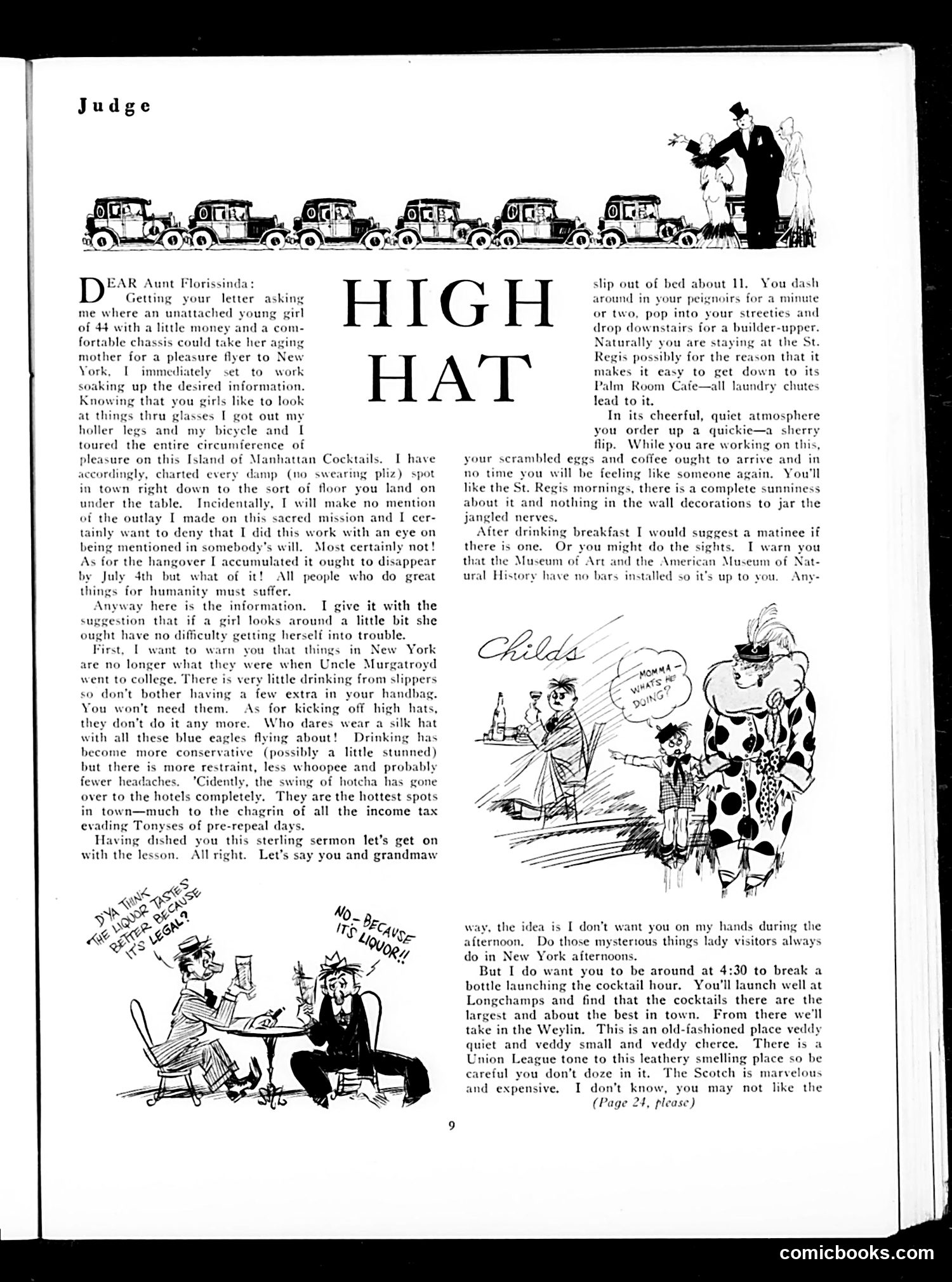
Judge Magazine Satire Analysis This is a humorous advice column disguised as a letter from "Judge" (the magazine's persona) to "Aunt Florissinda," offering New York City tourism tips for older women with disposable income. The Satire: The piece mocks 1930s high society and changing social mores. It references Prohibition's repeal ("blue eagles flying about" refers to NRA codes), noting that drinking is now "conservative" but has shifted to hotels. The narrator sarcastically claims to have researched NYC's bar scene exhaustively while accumulating hangovers—a self-deprecating joke about the magazine's own indulgence. Key References: - "Uncle Murgatroyd" = generic old-money figure representing pre-Prohibition excess - St. Regis, Longchamps, the Weylin = actual NYC establishments - The advice to occupy visitors with museums and matinees during afternoons reflects class assumptions about leisured women's activities The Point: Gentle ribbing of wealthy dowagers, post-Repeal drinking culture, and New York's hotel scene as the new center of social life, replacing speakeasies.
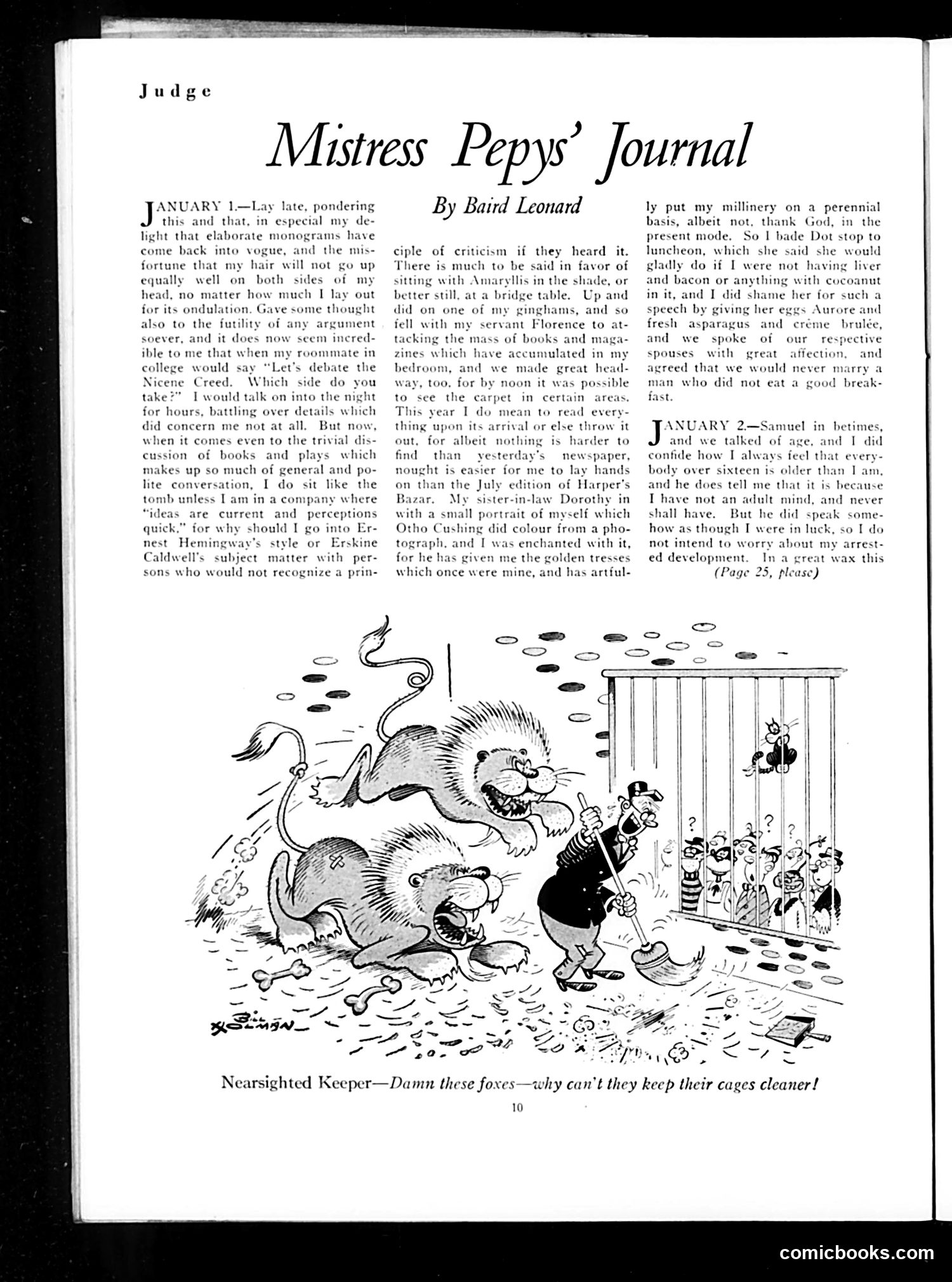
"Mistress Pepys' Journal" & "Nearsighted Keeper" "Mistress Pepys' Journal" is a humorous diary column mimicking Samuel Pepys's famous 17th-century diary, but featuring a modern (1920s-30s) woman's mundane concerns: hairstyles, monograms, books, bridge games, and marital observations. The satire gently mocks both women's intellectual pretensions (debating theology they don't understand) and their shallow domestic preoccupations. "Nearsighted Keeper" is a separate cartoon showing a frustrated zookeeper confronting escaped foxes destroying their cage, complaining they won't keep it clean. The joke appears to be about the keeper's nearsightedness—he can't see the obvious problem: the foxes have *escaped*, making cage cleanliness irrelevant. It's an absurdist humor commenting on missing the real issue due to poor vision (literal or figurative). Both pieces exemplify Judge's satirical style: gentle mockery of domestic life and human obliviousness.
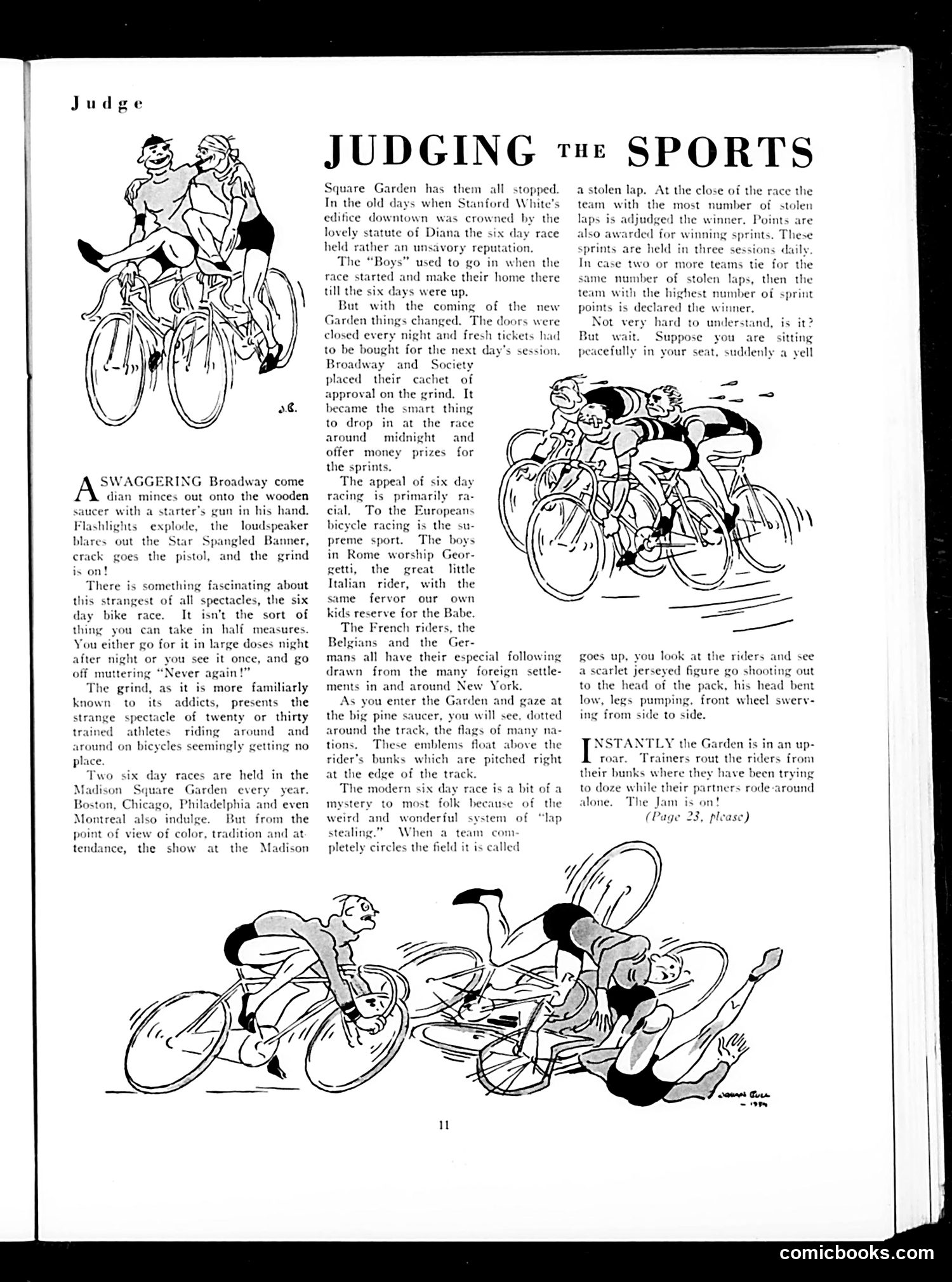
Judging the Sports: Six-Day Bicycle Racing This article celebrates the six-day bicycle race, a grueling endurance spectator sport held at Madison Square Garden. The piece explains how the event evolved from a disreputable attraction into fashionable entertainment, earning approval from "Broadway and Society." The cartoons illustrate the race's dramatic appeal: cyclists pedaling continuously around an indoor track while trainers rouse exhausted partners from bunks to rotate in. The article describes the sport's ethnic character—European and immigrant communities rallying behind riders like Italian champion Georgetti—and explains the mysterious scoring system of "lap stealing" (completing extra circuits). For modern readers, this reveals early 20th-century New York's immigrant culture and how a once-scandalous endurance spectacle became prestigious entertainment. The tone is enthusiastic yet slightly bemused at spectators' devotion to what seems absurd: watching cyclists ride in circles for six straight days.
"The Theatre of George Jean Nathan" This is a theater review column, not a political cartoon. Judge's drama critic Nathan critiques actress Katharine Hepburn's performance in the play "The Lake" (currently at the Martin Beck Theatre). Nathan's argument: Modern theater requires intelligent young women, and Hepburn possesses genuine intelligence—a quality he praises. However, he also frankly discusses her physical appearance as a theatrical asset, noting her slim figure helps her career despite playing in a weak script. The satire is self-aware: Nathan acknowledges that discussing an actress's body isn't serious criticism, but argues it's nonetheless true and relevant to her success. He contrasts this modern era with an earlier period when "dumb-bell" actresses and "director's robots" dominated, implying cultural progress toward valuing brains alongside beauty—though his own analysis suggests physical appeal remains commercially crucial.
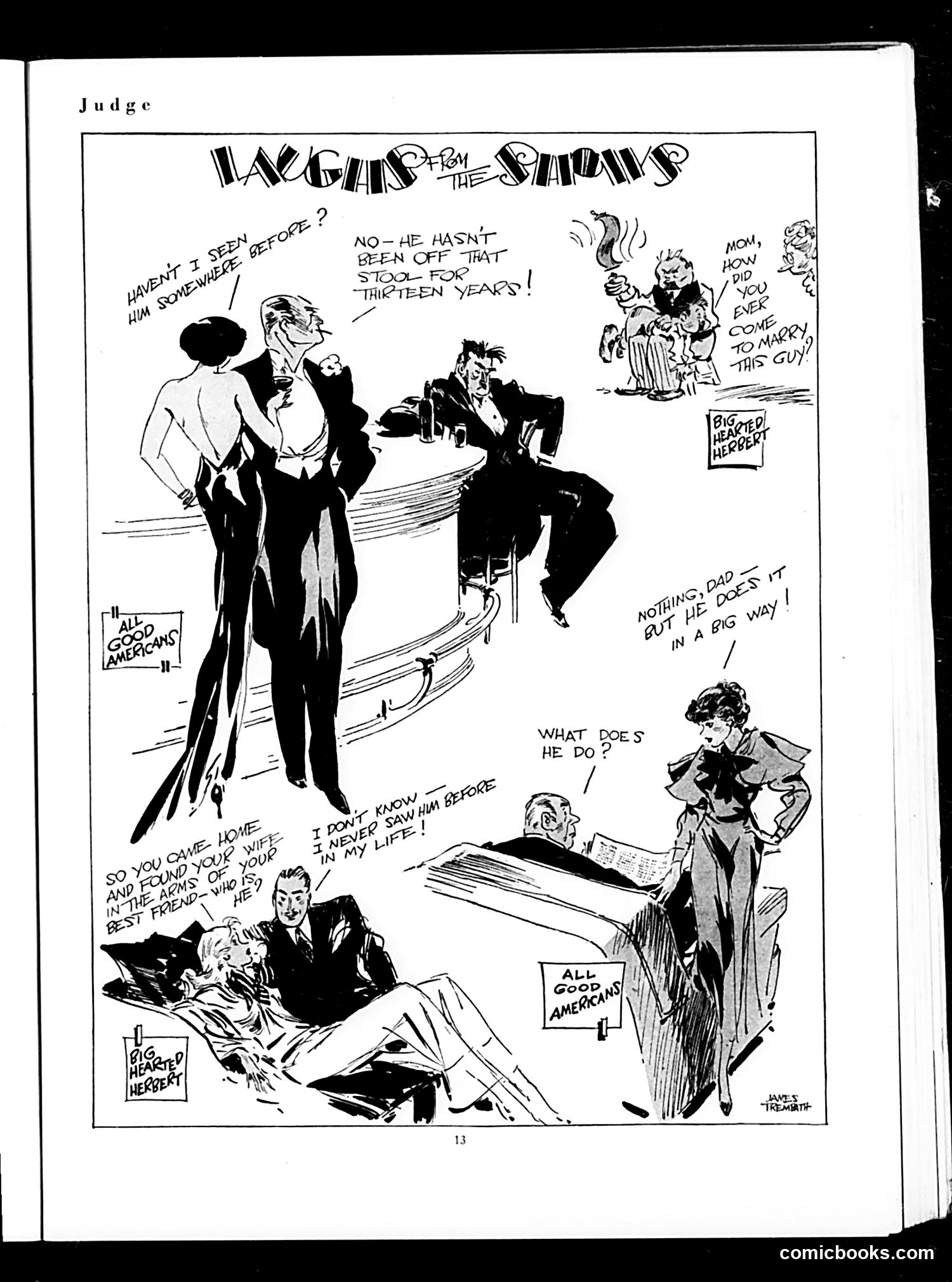
"Laughs by the Sands" - Judge Magazine Cartoon This cartoon satirizes a wealthy man's return home after an extended absence. The central figure (labeled "All Good Americans") has been away for thirteen years, apparently on a stool or vacation. The joke centers on his reintegration: his wife is shocked to see him; family members marvel at his return; and there's commentary about his lack of accomplishment ("Nothing dad but he does it in a big way"). The repeated "All Good Americans" labels suggest ironic commentary on this man's character or typical American behavior. The cartoon appears to mock either the idle rich or absent husbands, using the man's long disappearance and casual return as the setup for satirizing American social pretensions and domestic expectations of the era.
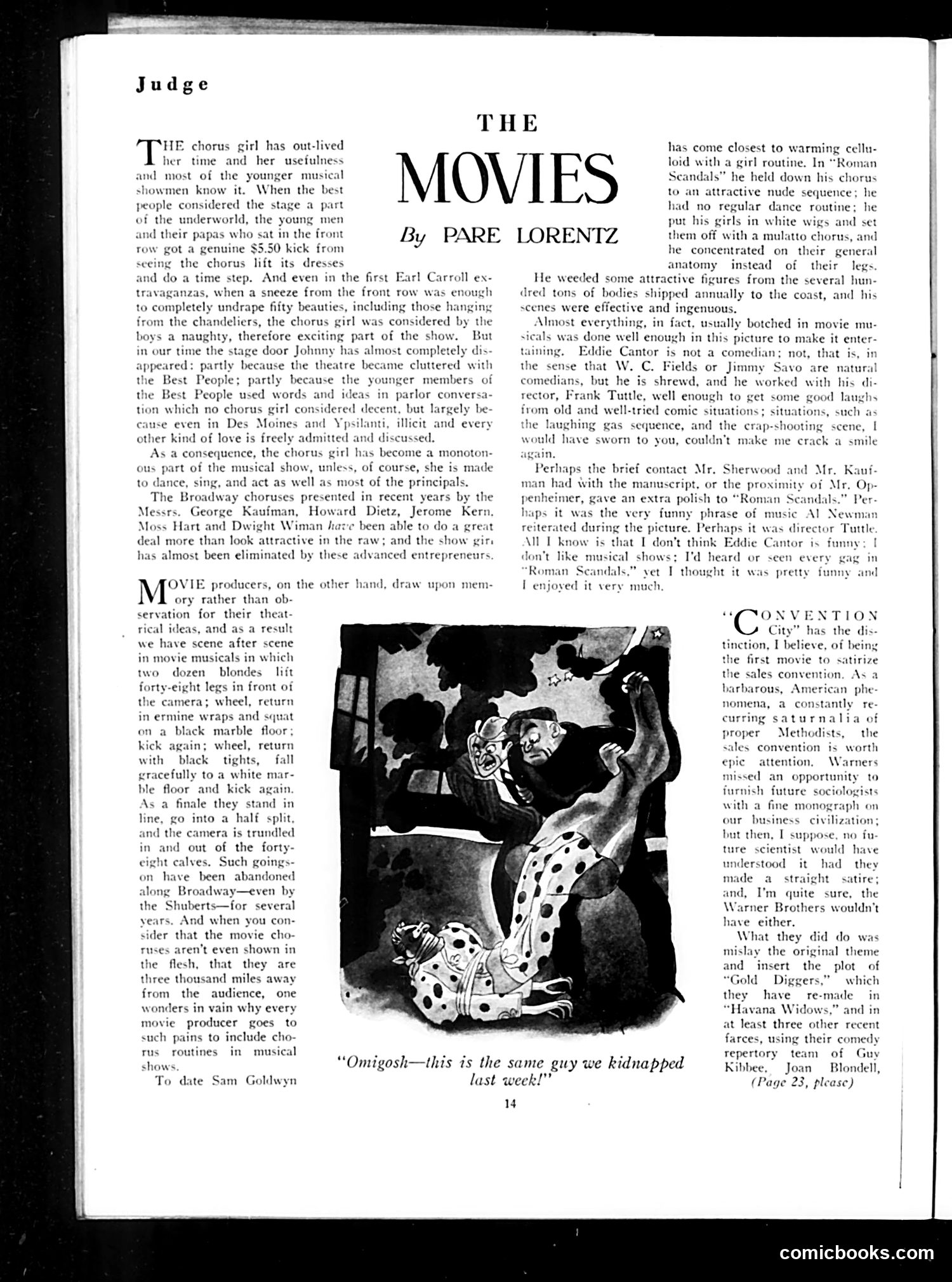
Analysis: "The Movies" by Pare Lorentz This is a theatrical criticism column, not a political cartoon. The page critiques how movie musicals misuse chorus girls compared to Broadway productions. Main argument: Broadway shows (by Kaufman, Dietz, Kern, Hart, Wiman) have evolved beyond simply displaying scantily-clad chorus girls—performers now must actually sing, dance, and act. Movie producers, however, mindlessly copy outdated spectacle formulas: rows of identical blonde women in repetitive, pointless routines filmed from thousands of miles away, where their physical presence adds nothing. The cartoon (bottom) shows two criminals discussing kidnapping, with the caption "Omigosh—this is the same guy we kidnapped last week!"—apparently illustrating absurd movie plot recycling. The praise goes to Eddie Cantor's "Roman Scandals," which the critic argues actually *integrated* chorus sequences meaningfully rather than padding the film with empty spectacle. The piece satirizes Hollywood's mechanical, unimaginative production methods versus Broadway's theatrical innovation—a common 1930s complaint about cinema's artistic inferiority to live theater.
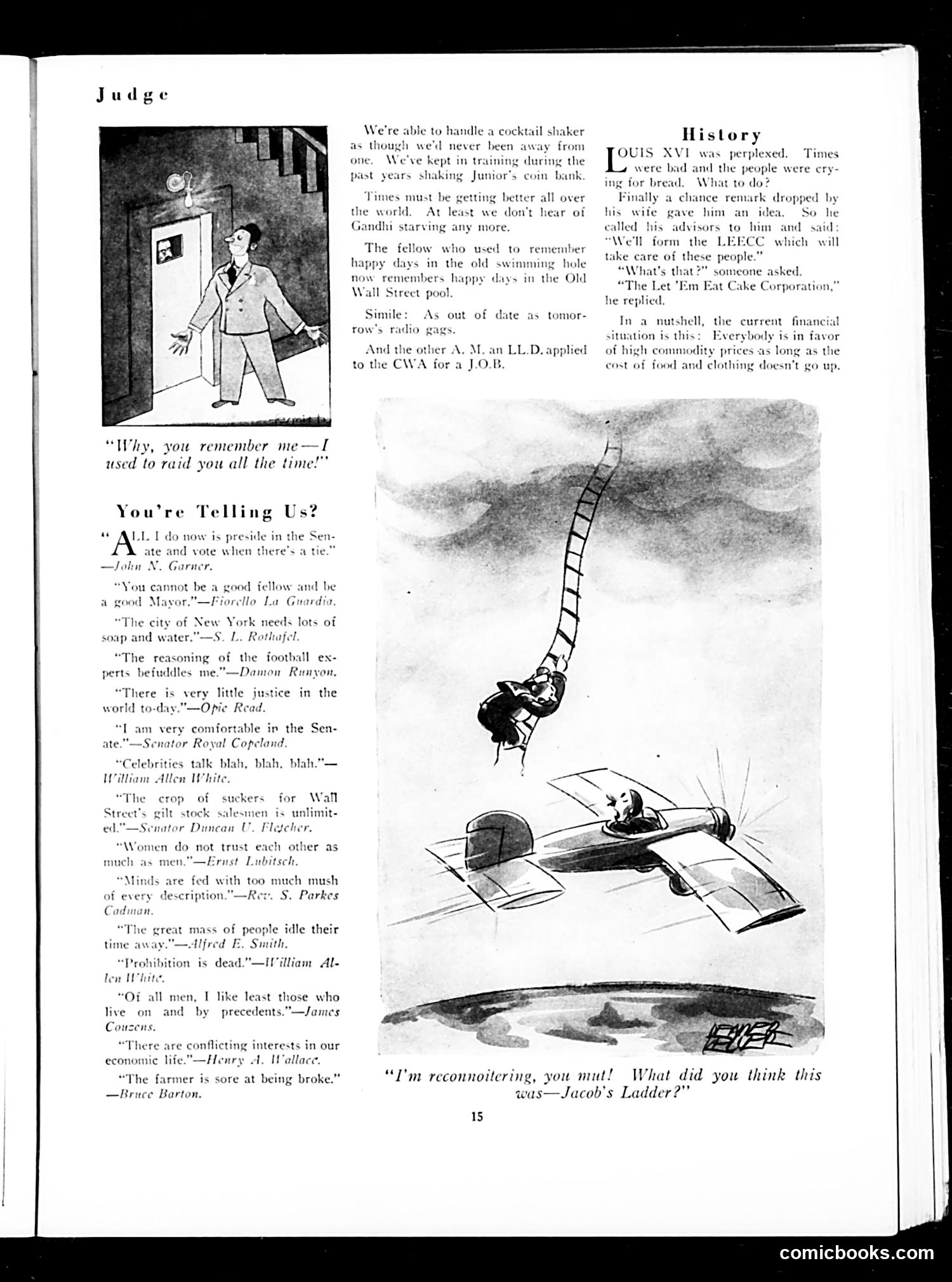
Analysis of Judge Magazine Page This page contains Depression-era satirical commentary. The main cartoon depicts someone climbing what appears to be a ladder toward an airplane, with the caption "I'm reconnoitering, you mutt! What did you think this was—Jacob's Ladder?" This likely mocks unrealistic economic optimism or get-rich-quick schemes during hard times. The "History" section parodies King Louis XVI's response to famine ("Let them eat cake") by describing a fictional "Let 'Em Eat Cake Corporation"—satirizing how political leaders offered inadequate solutions to Depression suffering. "You're Telling Us?" collects sardonic quotes from public figures (senators, judges, entertainers) making naive or contradictory statements about current problems—the magazine's way of criticizing their disconnect from public hardship. The opening joke references Prohibition's repeal and economic recovery hopes, while critiquing lingering unemployment and high prices. The overall tone suggests bitter humor at government incompetence during economic crisis.
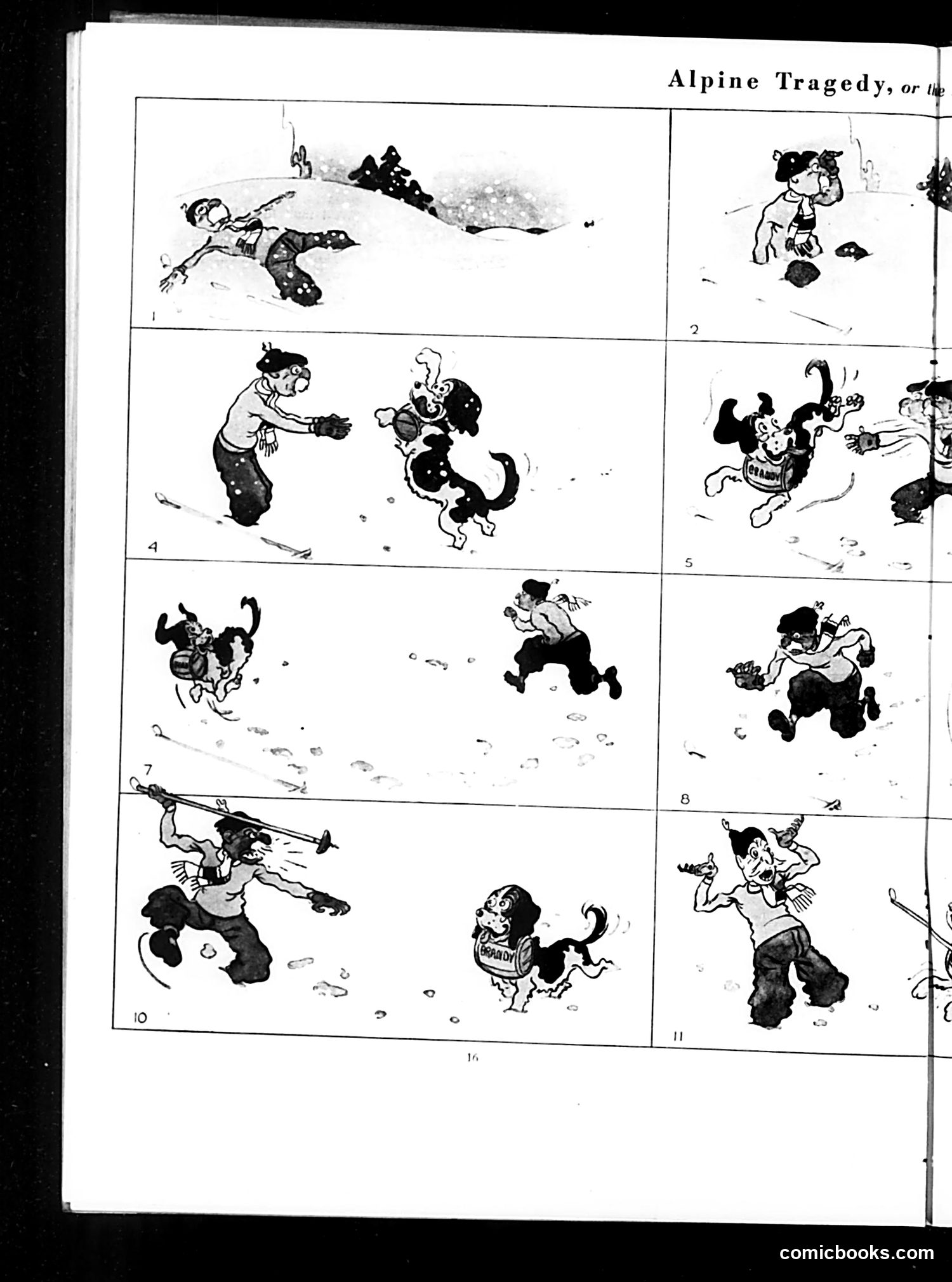
Alpine Tragedy Analysis This appears to be a sequential comic strip titled "Alpine Tragedy" depicting a mishap on a snowy mountain. The narrative shows: 1. A figure falling/sliding down a slope 2. Someone observing the accident 3-11. Subsequent panels showing what appears to be a rescue or recovery operation, with multiple characters engaged in increasingly chaotic action on the snow The humor likely derives from slapstick physical comedy typical of early 20th-century Judge magazine—the escalating chaos and exaggerated gestures of the characters as they react to or attempt to address the initial accident. The "tragedy" framing in the title contrasts with the cartoonish, comedic treatment. Without clearer text or identifying details, I cannot determine specific political or social commentary. The satire appears to be situational rather than topical.
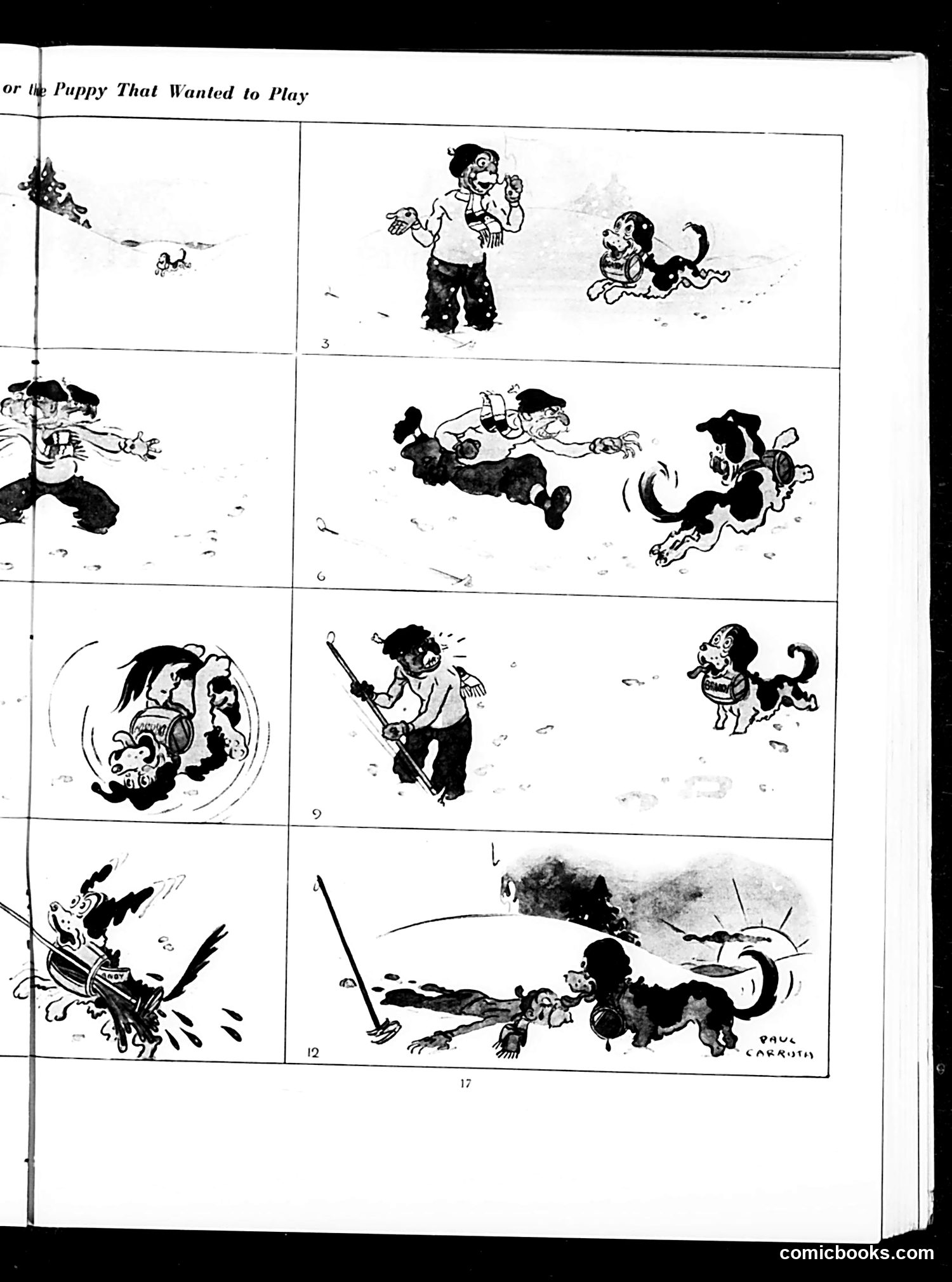
"Or the Puppy That Wanted to Play" This appears to be a sequential comic strip showing a man and a small dog attempting to play together. The narrative unfolds through twelve panels, with the interaction becoming increasingly chaotic and physical. The man tries various play activities—chasing, wrestling, using a stick—while the dog enthusiastically participates, often with destructive results. By the final panels, the man appears exhausted or injured, lying on the ground amid debris (possibly a broken bicycle), while the determined dog continues its exuberant play. The humor lies in the contrast between the man's intention for a simple, pleasant play session and the actual mayhem that ensues. It satirizes the gap between how people imagine pet ownership versus the reality of a dog's unbridled energy and lack of understanding of human boundaries. The comic illustrates universal domestic frustration.
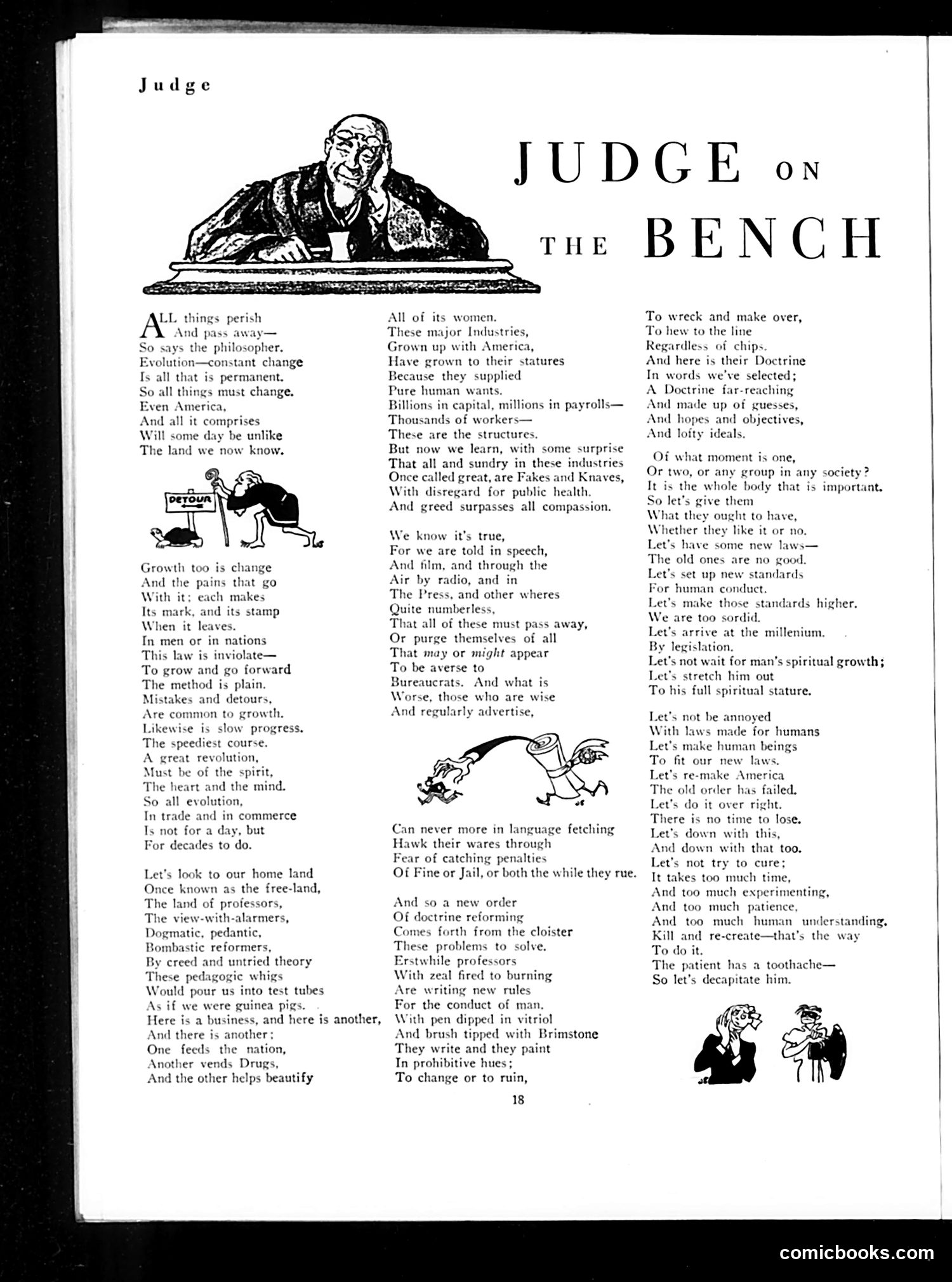
"Judge on the Bench": A Satire of Progressive Reform This 1920s editorial cartoon attacks what the artist sees as reckless progressive reformism. The seated judge represents the "reformer" class—academics and bureaucrats whom the text mockingly calls "erstwhile professors" and "pedagogic whigs." The satire's core argument: American industries (food, pharmaceuticals, cosmetics) built billions in capital and employed millions by serving genuine human needs. Yet reformers, emboldened by radio, film, and press, now brand these as corrupt "Fakes and Knaves" requiring destruction. The cartoon ridicules the reformist mindset as destructively impatient. Rather than allowing gradual spiritual and moral growth, reformers want to legislate human perfection overnight—"stretch him out to his full spiritual stature" through force. The closing joke: a patient with a toothache needs curing, not decapitation. Similarly, America's problems don't require wholesale destruction, merely targeted fixes. This reflects anti-Progressive sentiment common in Judge during the Prohibition and New Deal eras, when business-friendly publications opposed expanding government regulation.
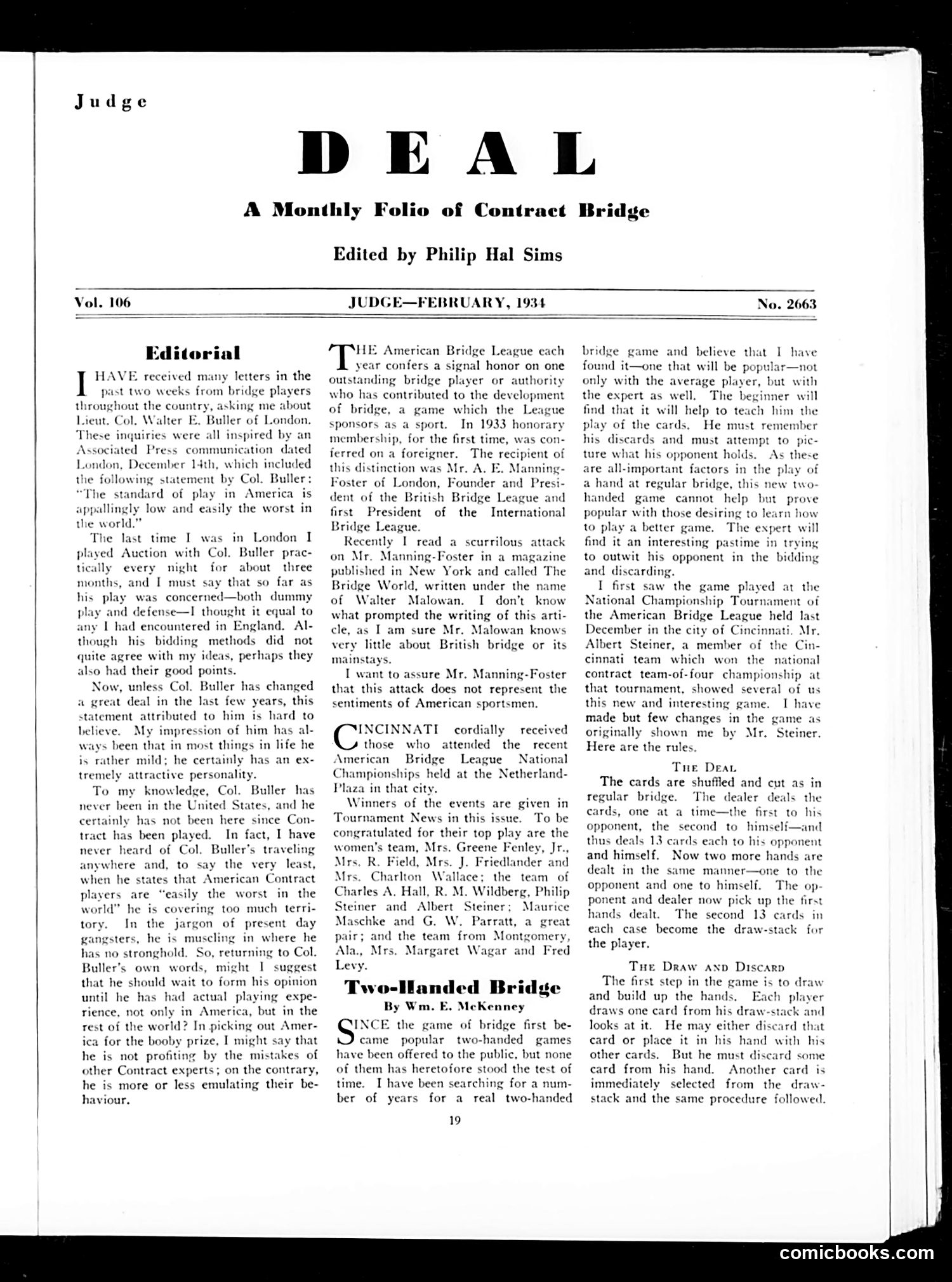
This page from Judge magazine (February 1934) is primarily a trade publication devoted to contract bridge, not a satirical cartoon section. The content consists of an editorial addressing two controversies in the bridge world: First, editor Philip Hal Sims defends American bridge players against critical remarks attributed to British Colonel Walter Buller, who allegedly claimed American players are "easily the worst in the world." Sims argues Buller lacks authority to judge, having never played in America. Second, Sims denounces an anonymous attack on A.E. Manning-Foster, founder of the British Bridge League, published in the New York-based *Bridge World* magazine under a pseudonym. The page also reports on the American Bridge League's National Championships in Cincinnati and begins an instructional article on two-handed bridge. This appears to be specialized content for bridge enthusiasts rather than general satire.
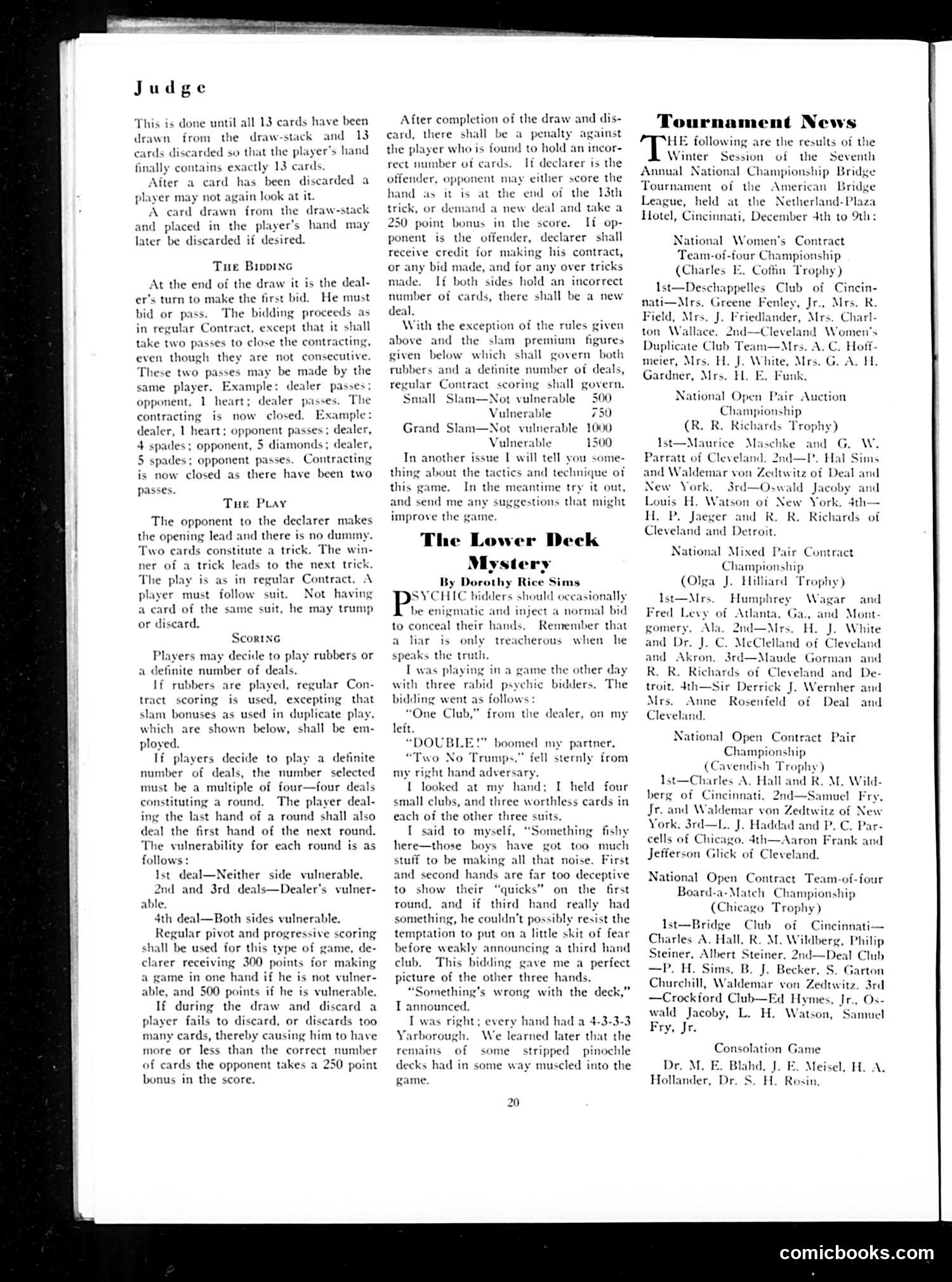
Judge Magazine Page Analysis This page contains bridge card game rules and strategy content, not political satire. The left two-thirds explain Contract Bridge variations—specifically a two-player version with draw and discard mechanics, bidding procedures, and scoring systems including slam bonuses. The right column presents "Tournament News" listing results from the Seventh Annual National Championship Bridge Tournament (held at the Netherland-Plaza Hotel, Cincinnati, December 8-10). It records winners of various competitions: National Women's Contract Team-of-Four Championship, National Open Pair Auction Championship, National Mixed Pair Contract Championship, and others, with winners' names and home cities listed. Below that is "The Lower Deck Mystery" by Dorothy Rice Sims—a bridge strategy column offering tactical advice about "psychic bidding" (deceptive bidding to conceal one's hand). This is not satirical content. Judge magazine, while famous for political cartoons, also contained instructional and recreational articles. This particular page serves bridge enthusiasts with rules clarification and tournament coverage.
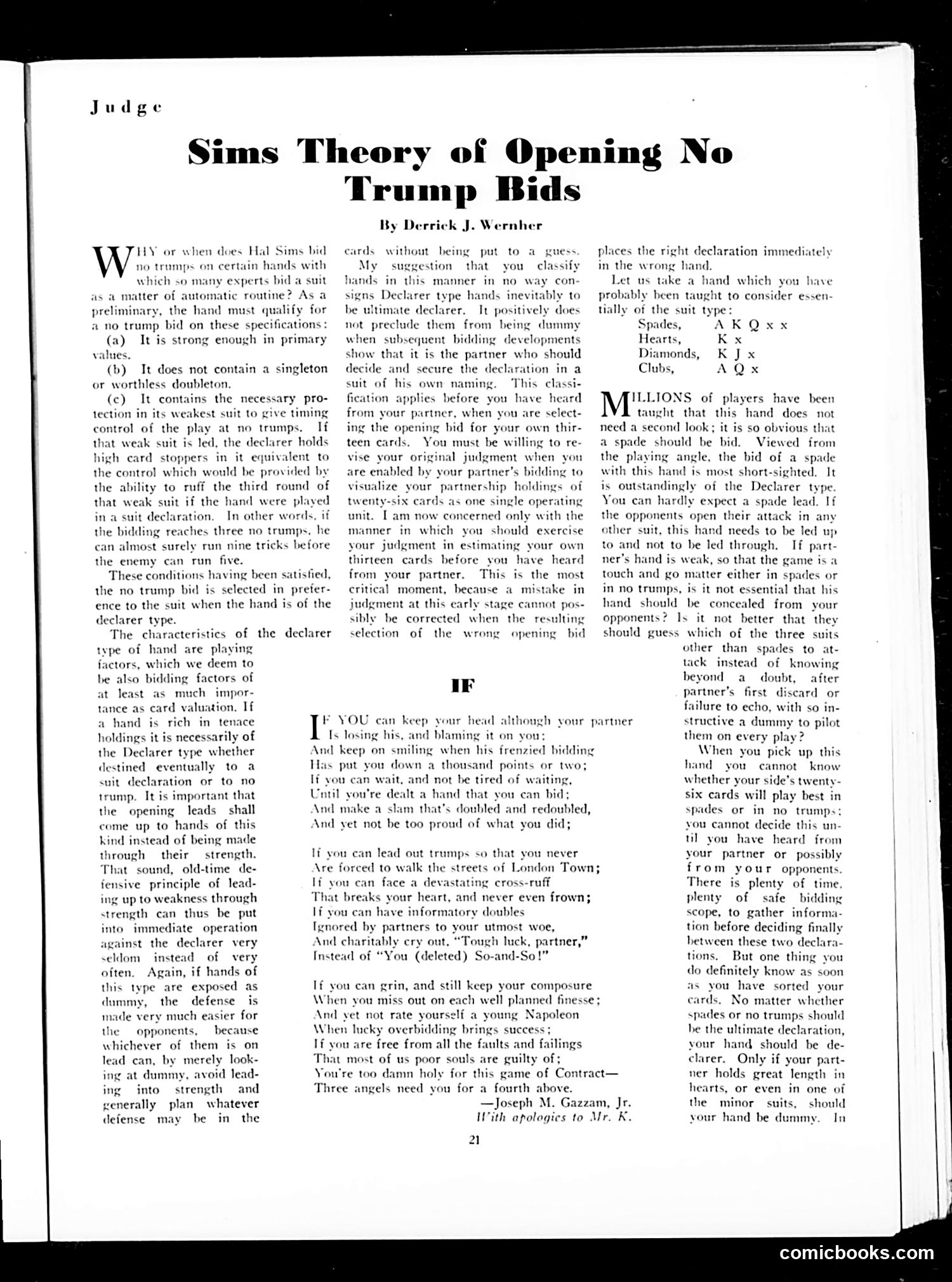
Explanation for Modern Readers This is a bridge instructional article, not political satire. Judge magazine, though primarily satirical, published serious content alongside humor. Hal Sims was a renowned 1920s-30s bridge expert whose bidding theories were debated among players. This article by Derrick J. Wernher explains Sims's strategy for when to bid "no trump" (a contract where one player tries to win tricks without a trump suit) versus bidding a suited hand. The piece discusses hand evaluation, declaring strategy, and defensive positioning—technical bridge concepts. The poem at bottom (credited to Joseph M. Gazzam Jr.) is humorous verse about bridge frustrations: keeping composure when partners make bad bids, losing large point totals, and enduring ignored "informatory doubles" from careless teammates. It uses the structure of Kipling's "If—" for comic effect. This represents Judge's bridge-obsessed readership of the era, when contract bridge was a major recreational phenomenon among American middle and upper classes.
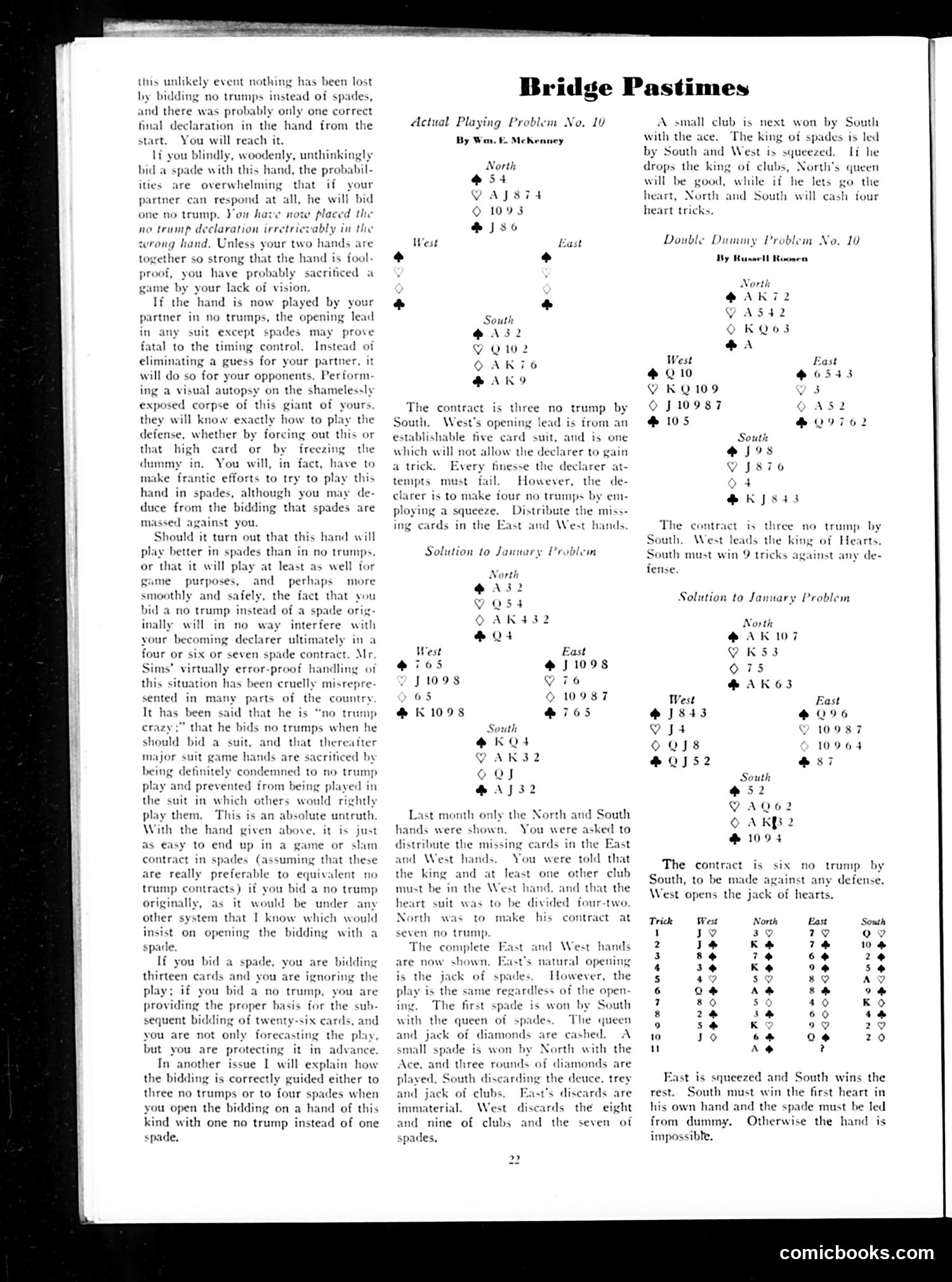
This page contains bridge card game problems and strategy discussion, not political cartoons or satire. The content consists of: 1. "Bridge Pastimes" — instructional bridge problems by William E. McKenney and Russell Howren, showing card hands and contract scenarios 2. Strategy article — a lengthy discussion about bidding philosophy, specifically defending the "no trump" bid strategy against critics who call its proponent (apparently someone named Sims) "no trump crazy" The article argues that bidding no trumps with certain hands is strategically sound and doesn't prevent eventual spade contracts, contrary to popular criticism. This is educational/recreational content for bridge players, not satire or political commentary. *Judge* magazine, while primarily known for humor and satire, also published instructional and hobby content for its educated readership.
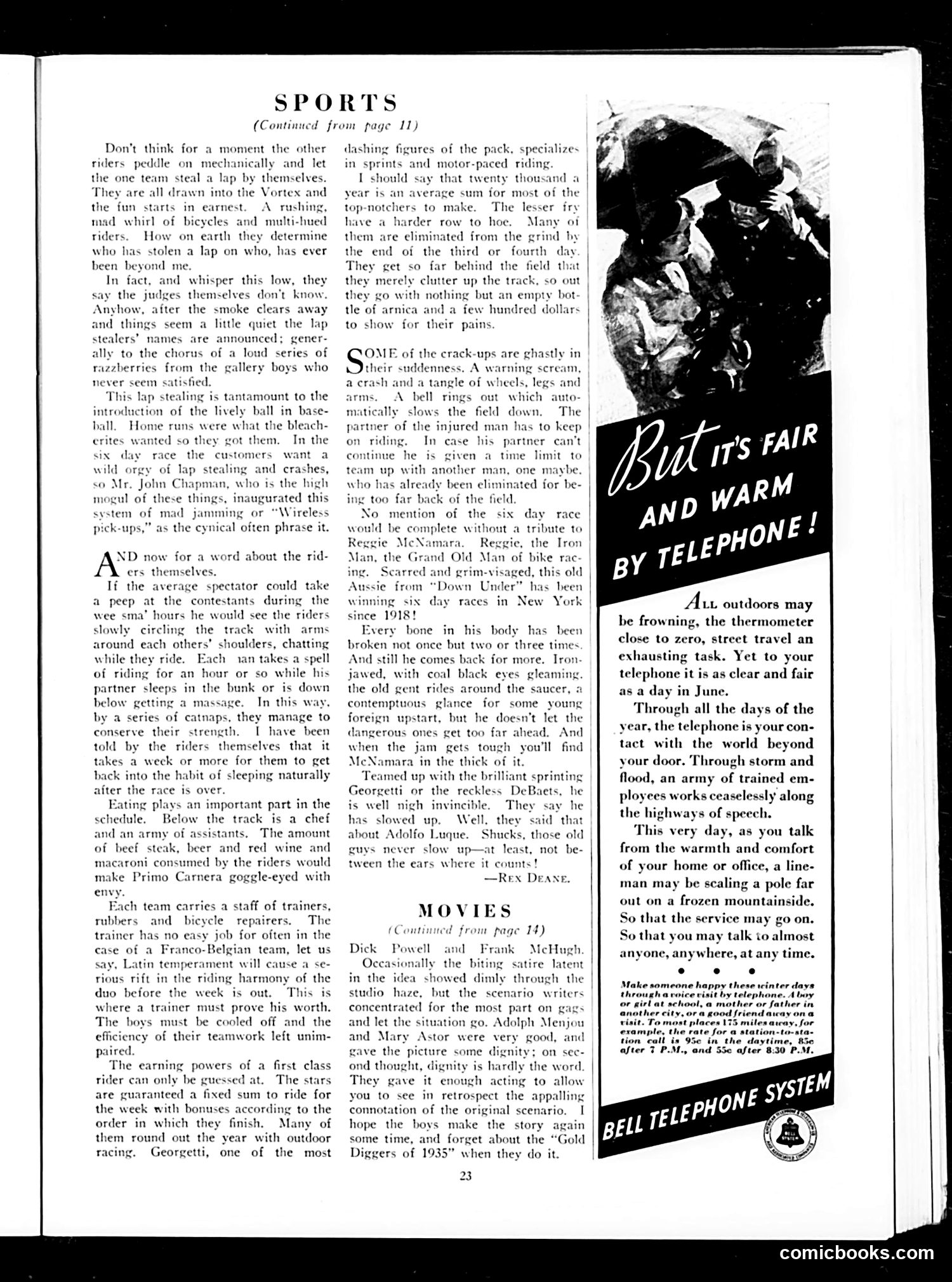
Judge Magazine Page Analysis This page primarily contains sports journalism about six-day bicycle racing, with a Bell Telephone System advertisement as the main visual element. The advertisement uses winter imagery—people bundled in cold weather—to argue that despite harsh outdoor conditions, telephone service remains "clear and fair" and "warm" by comparison. It emphasizes the reliability of Bell's infrastructure and workforce during difficult conditions, positioning the telephone as a comfort and connection point during winter isolation. The ad targets middle-class readers who might appreciate both the service's dependability and the poetic appeal of staying connected to loved ones during harsh weather. The sports text discusses lap-stealing tactics, rider injuries, prize money, and notable racer Reggie McNamara (the "Iron Man" from Australia). No political satire appears on this page—it's primarily informational sports coverage alongside commercial advertising typical of 1930s Judge magazine.
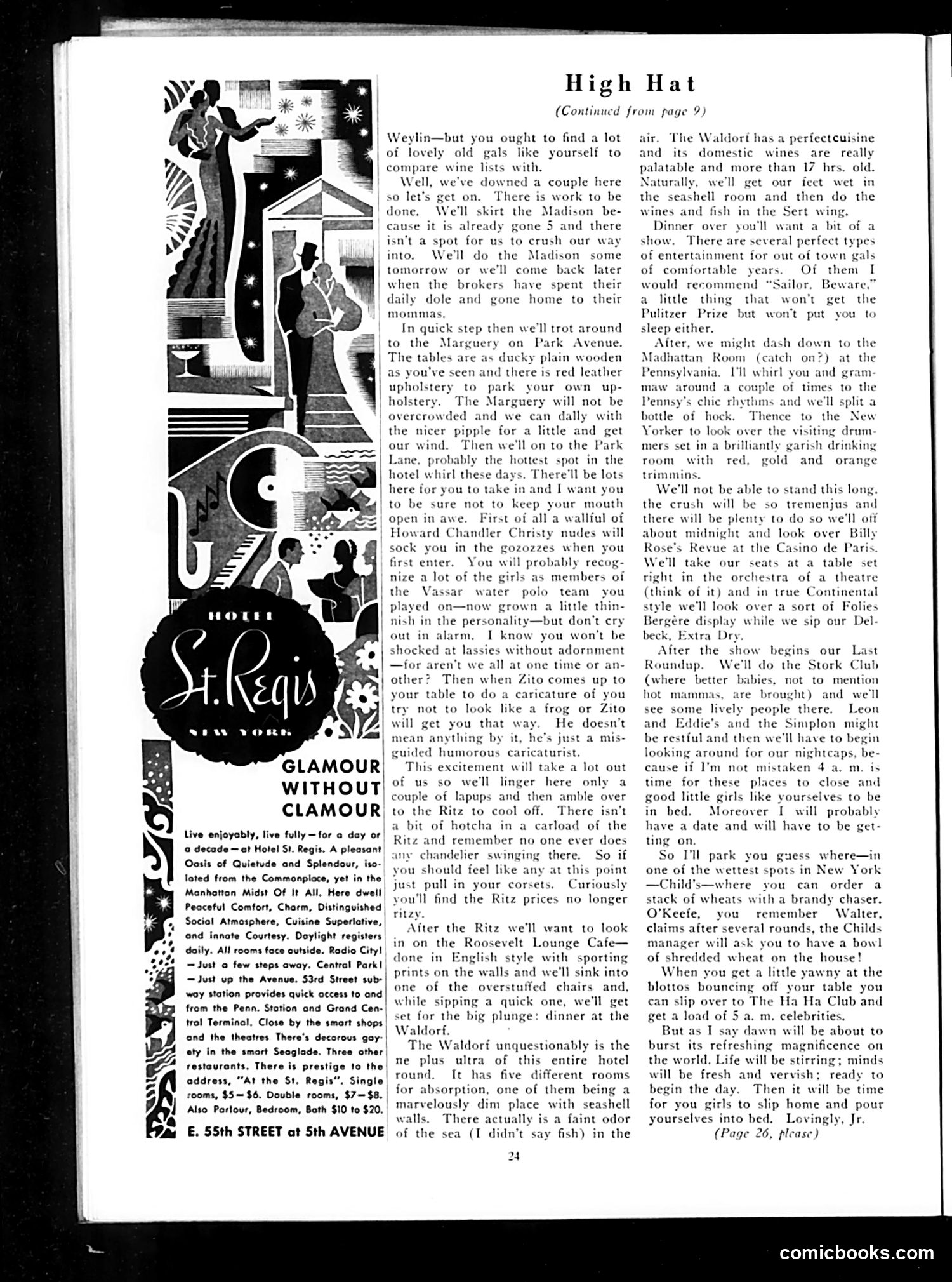
Explaining "High Hat" to Modern Readers This page presents a satirical article about New York nightlife during what appears to be the 1920s-30s, paired with hotel advertisements. The "High Hat" column (continued from page 9) is a snobby guide to upscale Manhattan venues—the Marguery, Park Lane, Ritz, Roosevelt Lounge, and Waldorf hotels—written in a deliberately pretentious tone mocking wealthy socialites. The satire targets: - Social climbing: The author condescends to his companion, advising her how to behave at exclusive spots - Affectation: References to "gozozzes" (slang for eyes), maintaining composure around caricaturist "Zito," avoiding looking "like a frog" - Wealth performance: Detailed descriptions of décor and wine lists as markers of status The humor derives from the exaggerated snobbery and the author's barely-concealed contempt for the very people he's guiding through these establishments. The accompanying St. Regis hotel ad exemplifies the luxury lifestyle being gently mocked.
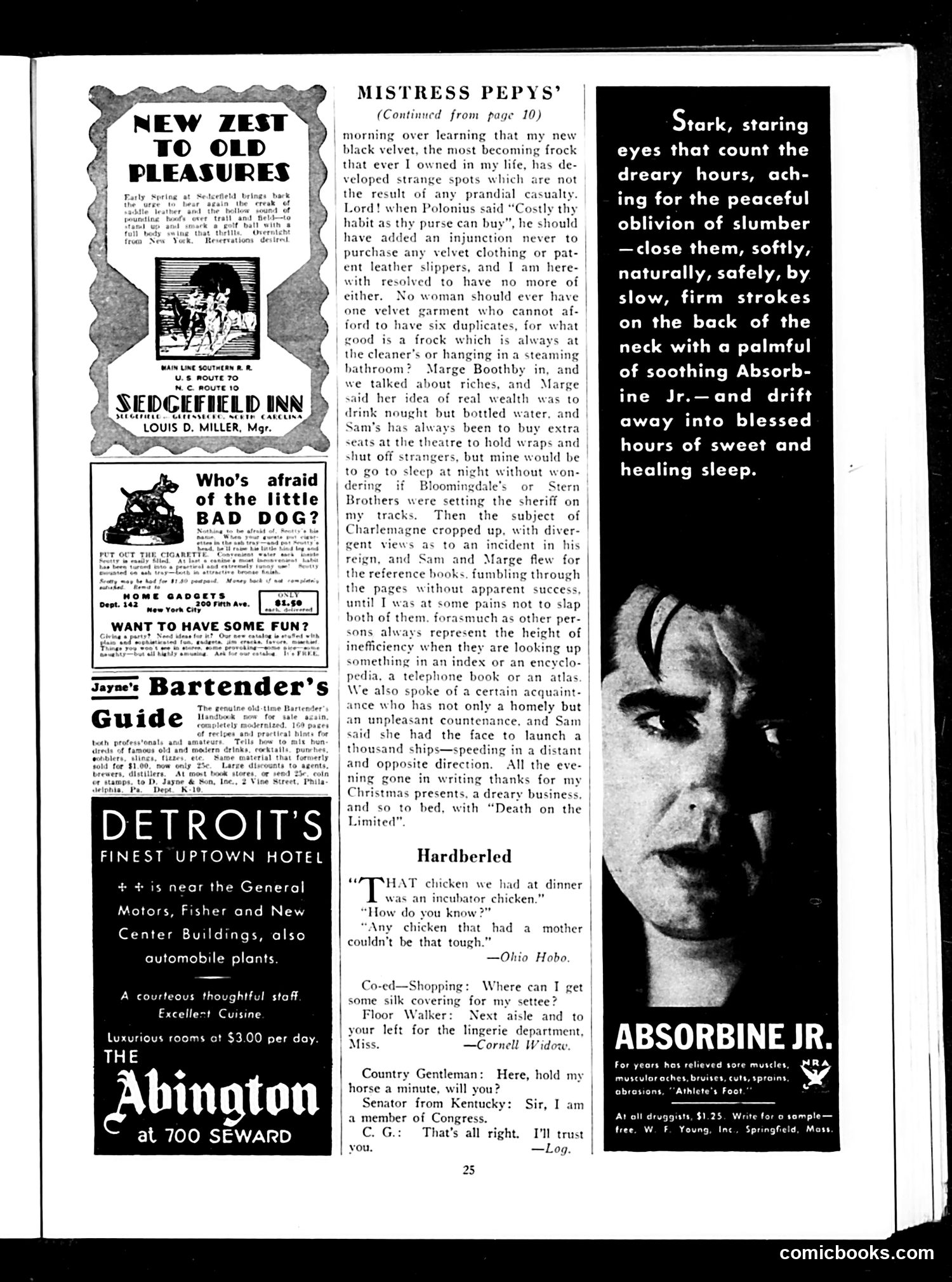
Analysis This page is primarily advertising and humor columns, not political satire. The content includes: Main Features: - "Mistress Pepys'" column: A society gossip piece where the narrator discusses velvet clothing spots, wealth philosophy, and social awkwardness—typical upper-class domestic humor of the era - "Hardberled" section: Brief jokes, including one about an "incubator chicken" (tough meat) and a comedic misunderstanding where a country gentleman asks a Senator to hold his horse, assuming he's a servant - Multiple hotel and product advertisements (Sedgefield Inn, Detroit's Abington Hotel, Absorbine Jr. liniment) The Satire: The humor targets everyday social pretension and inefficiency—women worrying about velvet maintenance, wealthy people's absurd definitions of luxury, people fumbling through reference books, and class confusion (mistaking a Senator for a servant). This reflects 1920s-30s middle/upper-class magazine humor focusing on domestic and social mishaps rather than politics. The page reflects Judge magazine's focus on lifestyle satire rather than political commentary.
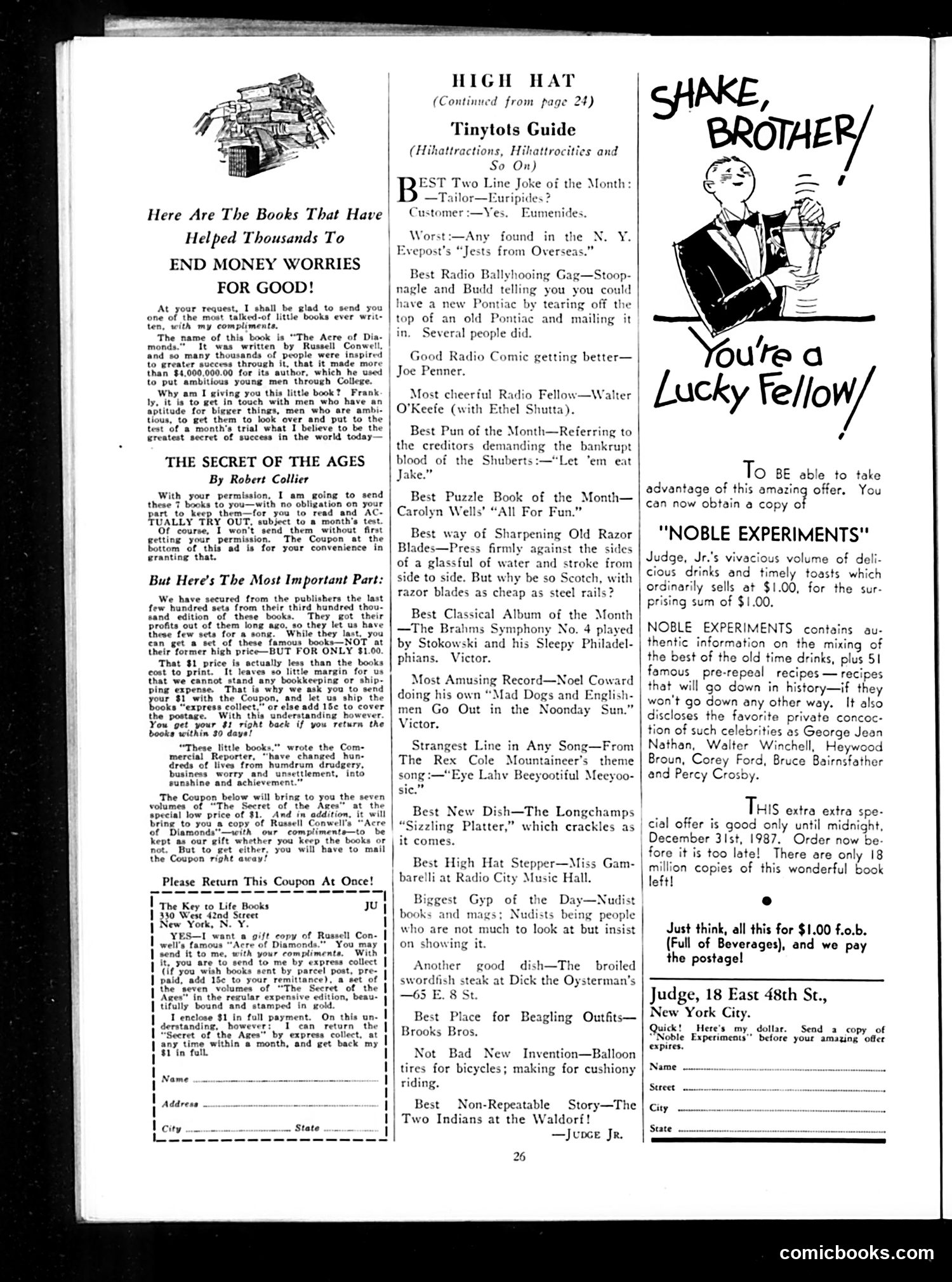
This page is primarily an advertisement for self-help books, not a political cartoon. The main content promotes "The Secret of the Ages" by Robert Collier and Russell Conwell's "Acre of Diamonds"—bestselling self-improvement guides from the early 20th century that promised financial success. The advertisement emphasizes that these books inspired thousands to overcome "money worries" and that Conwell's work earned its author millions (which he donated to colleges). The pitch uses urgency ("mail the Coupon right away!") and a loss-leader strategy, offering the books for $1—less than printing cost. In the upper right, there's an unrelated cartoon advertising "Noble Experiments," a book about pre-Prohibition cocktail recipes, with a man saying "Shake, Brother! You're a Lucky Fellow!"—a reference to Prohibition's ongoing social impact.
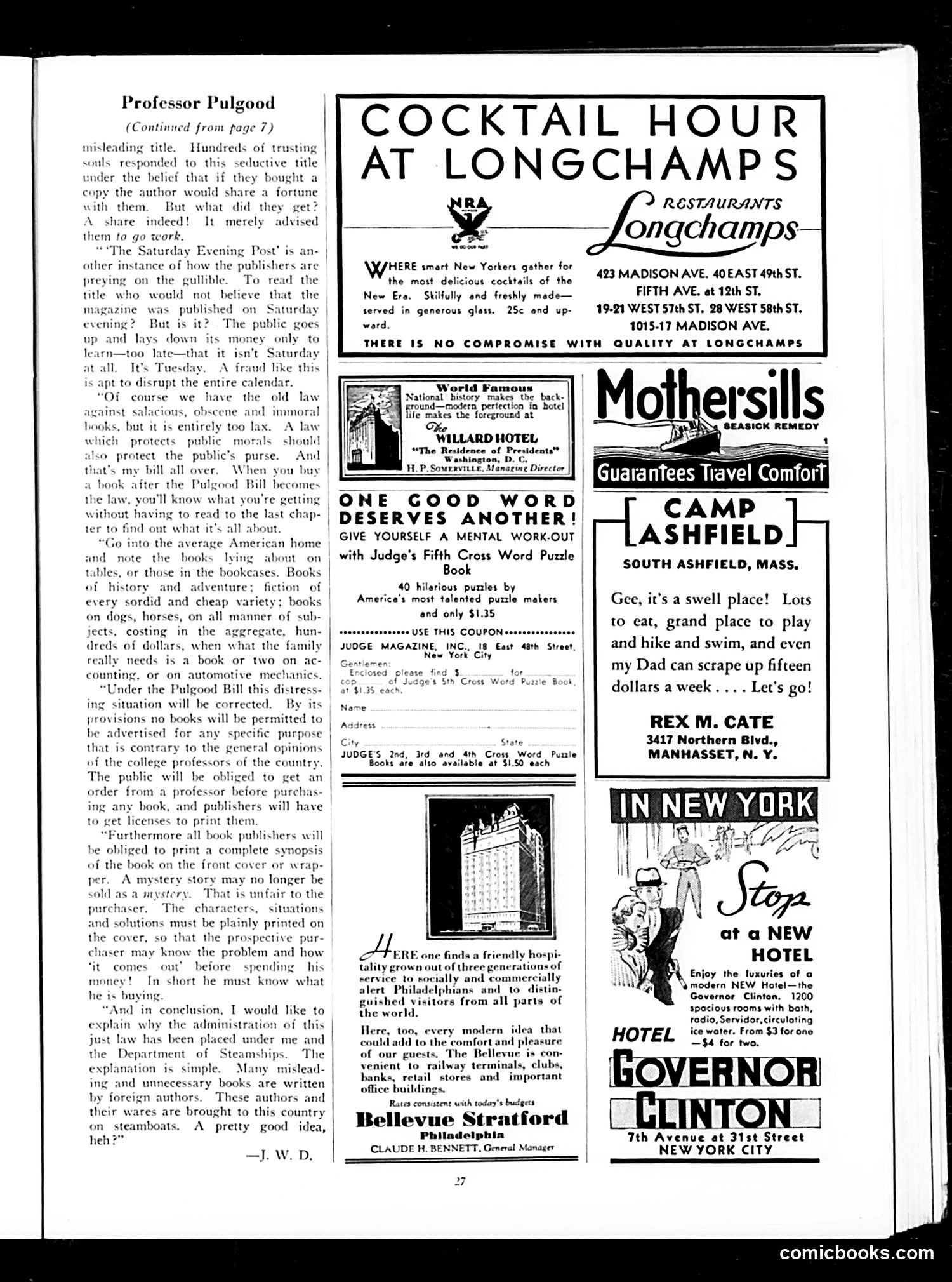
Analysis of Judge Magazine Page 27 This page is primarily advertising with a continued satirical article about "Professor Pulgood" at the top. The Pulgood piece satirizes book censorship and government overreach. The fictional professor proposes legislation requiring all books to be approved by college professors, to have plot summaries printed on covers (spoiling mysteries), and to be ordered through bureaucratic channels. The satire targets: - Moral panic about cheap literature (popular adventure and romance novels) - Intellectual snobbery — professors dictating what Americans should read - Absurd bureaucracy — requiring government "licenses" for publishers - The ridiculous justification that foreign authors arrive by steamboat, so the Department of Steamships should regulate books The author (J.W.D.) mocks reformers who wanted to control public reading habits, a real concern in 1920s America regarding "obscene" publications. The joke is that such censorship would be impractical, authoritarian, and destroy literature's purpose. The remainder of the page contains period advertisements for hotels, restaurants, and magazines.
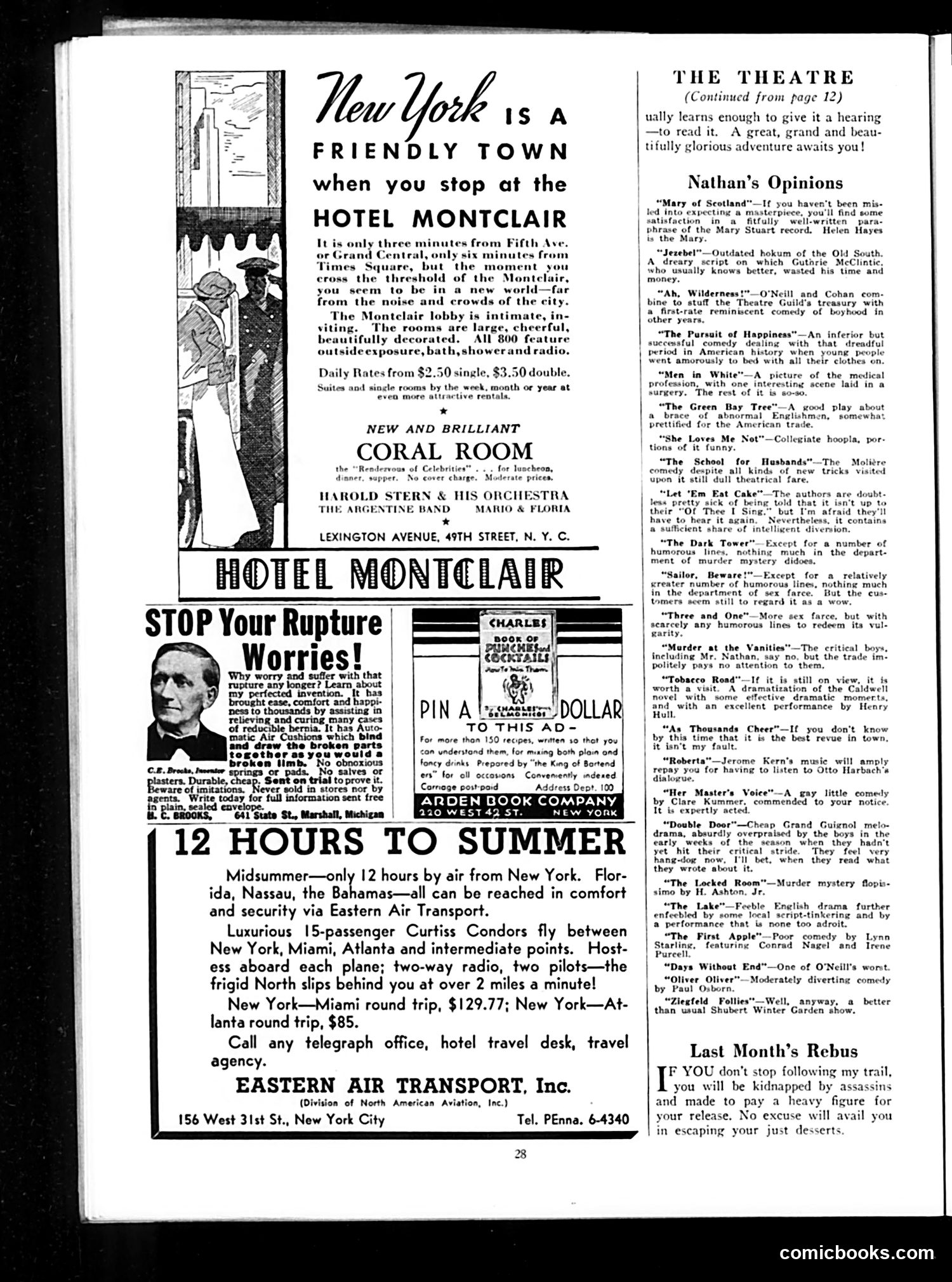
Analysis of Judge Magazine Page Content This page is primarily advertising and theater reviews, not political satire. The main content consists of: Advertisements: - Hotel Montclair (luxury lodging) - Coral Room restaurant - Eastern Air Transport (12-hour flights to Florida) - C.F. Brach's rupture remedy (medical device) - Arden Book Company Theater Column ("Nathan's Opinions"): The bulk of the page features drama critic Nathan's brief reviews of Broadway shows including "Mary of Scotland," "Ah, Wilderness!," and various comedies and farces. His assessments are dismissive of most productions, using phrases like "outdated hokum" and "cheap Grand Guignol melodrama." No political cartoons or caricatures appear on this page. The illustrated figures in advertisements are generic (hotel lobby attendants, medical case studies) without satirical intent. This represents typical 1930s-40s magazine layout: advertisements subsidizing entertainment journalism. The "satire" is limited to Nathan's acerbic theater criticism rather than political commentary.
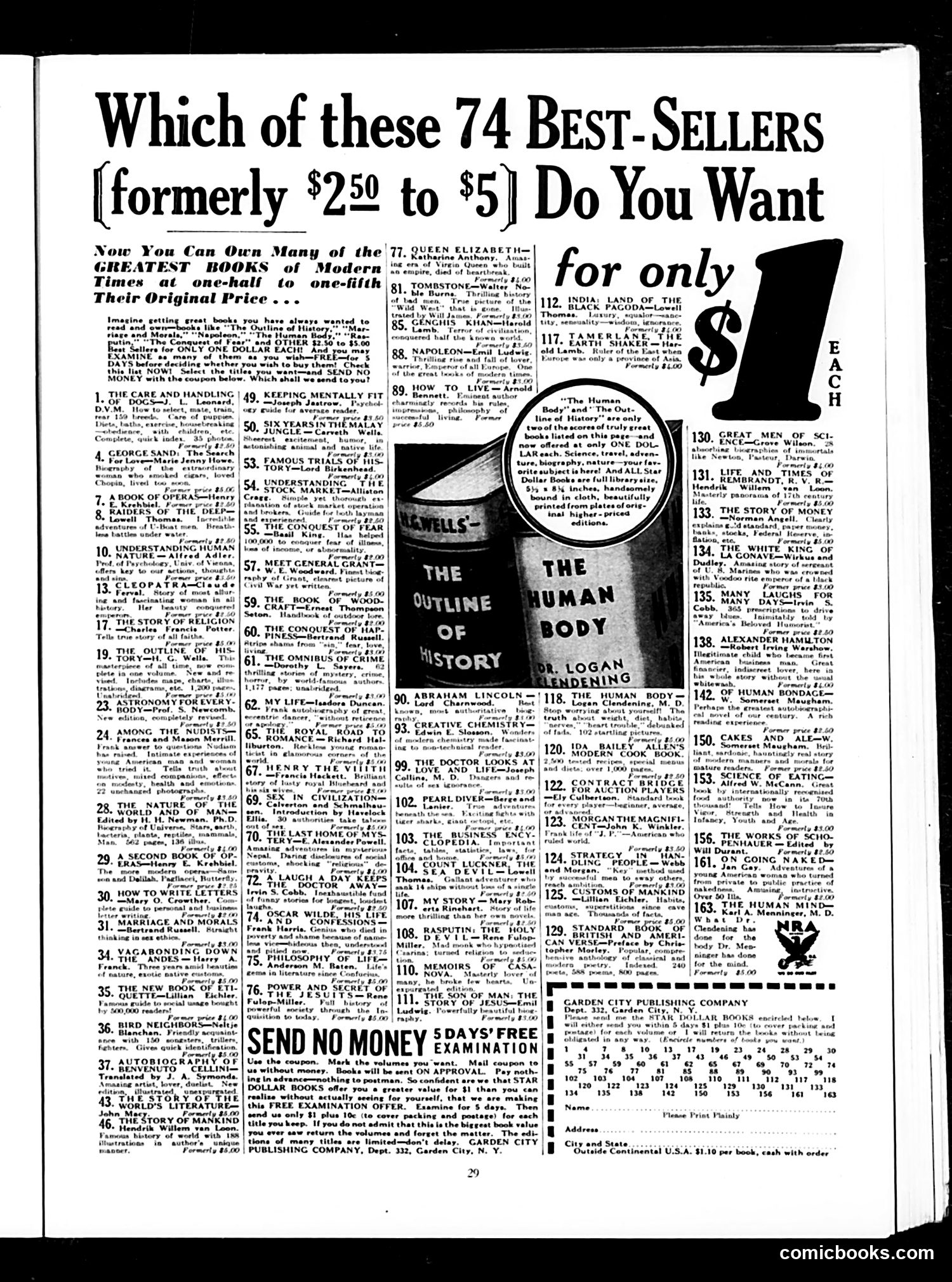
Judge Magazine Advertisement Analysis This is primarily a book-selling advertisement, not a political cartoon. The page promotes 74 "best-seller" books originally priced $2.50–$5.00, now available for one dollar each through a mail-order book club. The central visual shows two book spines: *"The Outline of History"* and *"The Human Body"* by Logan Lendening—examples of the popular educational and reference works being marketed. Historical context for modern readers: This appears to be from the 1920s–1930s, when mail-order book clubs emerged as major retailers. The ad emphasizes "5 days free examination" and "send no money"—novel consumer practices then. The book titles reflect that era's appetite for self-improvement literature: popular science, biography, health guides, and practical advice dominated bestseller lists. The satirical element is subtle: Judge (a humor magazine) is selling serious, improving literature—a mild irony for a publication otherwise devoted to comedy. The "dollar books" strategy democratized access to expensive volumes, targeting middle-class readers seeking knowledge and respectability.
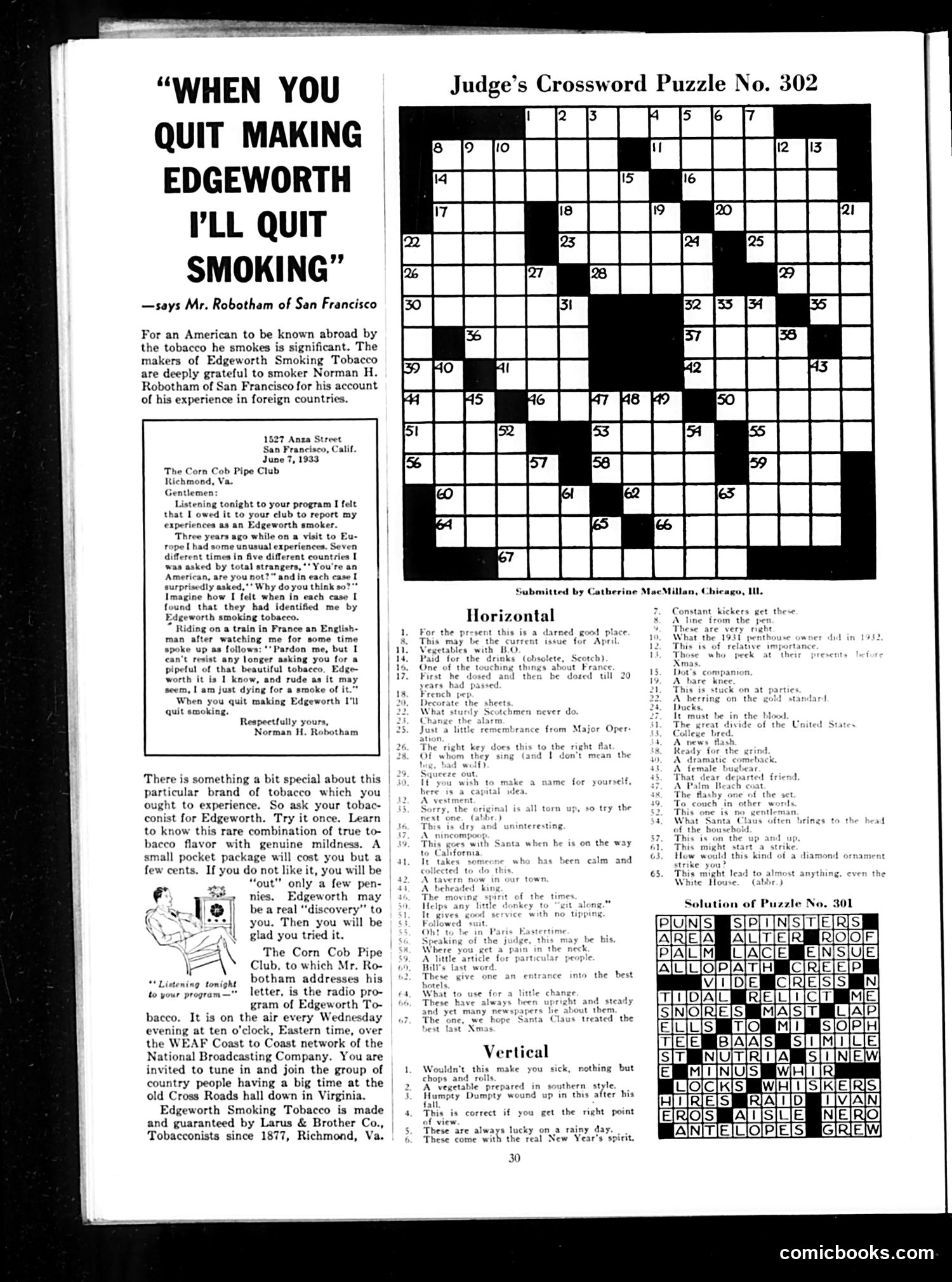
Judge Magazine Advertisement & Crossword (circa 1933) This page is primarily a tobacco advertisement for Edgeworth Smoking Tobacco, disguised as editorial content. The "cartoon" is a testimonial letter from Norman H. Robotham of San Francisco, claiming that his distinctive choice of Edgeworth tobacco made him recognizable to strangers across Europe—an Englishman on a French train, for instance, identified him by his pipe tobacco. The ad's premise: this brand is so notable that it becomes a personal identifier. The satire is subtle: the ad positions tobacco smoking as a mark of American identity and sophistication abroad, appealing to readers' vanity about being recognized for refined taste. For 1933 readers, this was straightforward marketing linking consumer products to personal distinction and international prestige. The remainder of the page contains an unrelated crossword puzzle. The tobacco industry advertising in Judge reflects the era's casual attitude toward smoking promotions in mainstream publications.
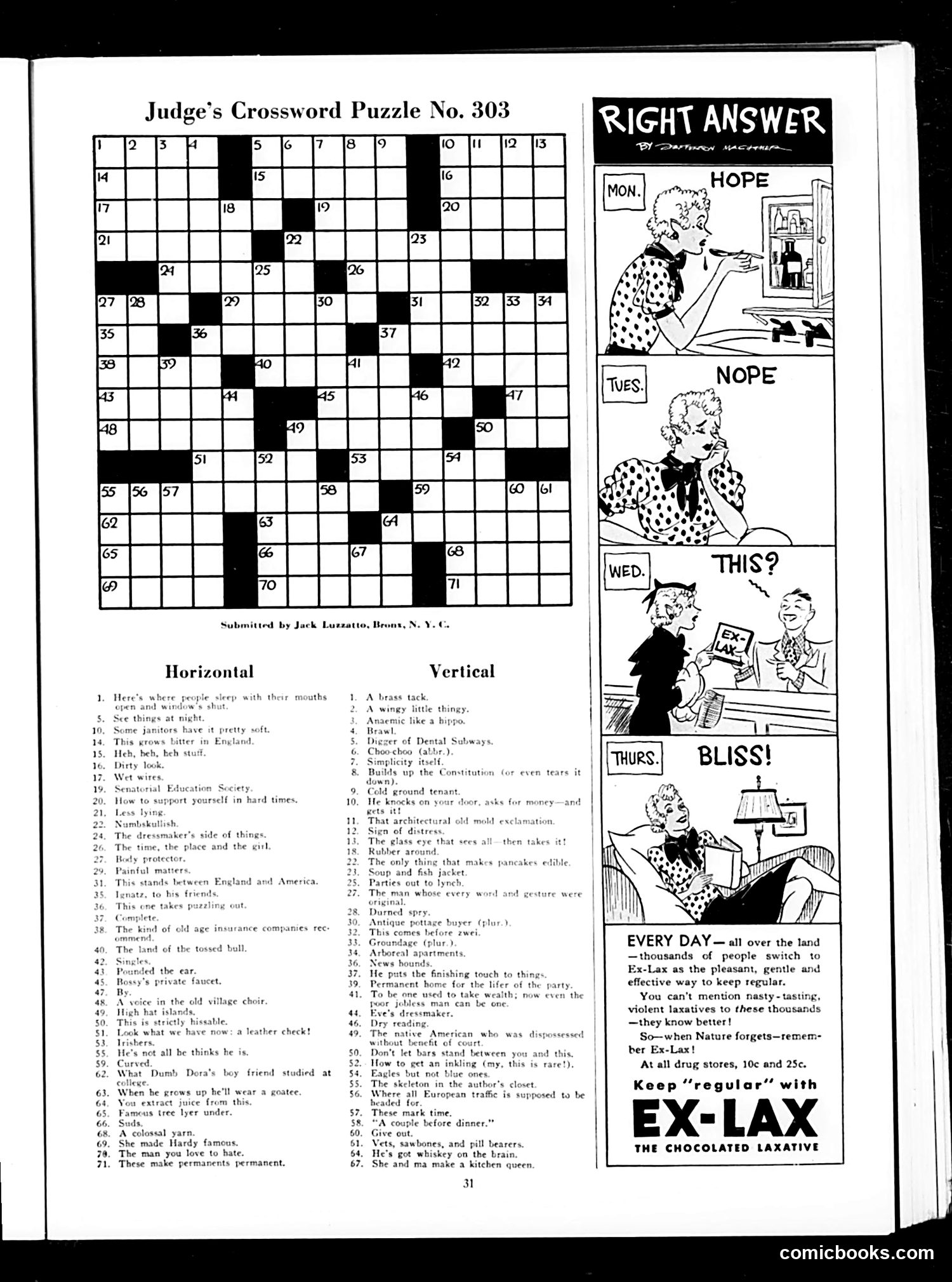
Judge Magazine Page Analysis This page contains a crossword puzzle and advertisement rather than editorial cartoons. The "Right Answer" comic strip in the upper right shows a recurring character (an older woman) in four daily panels labeled Monday through Thursday, depicting mundane domestic situations with her expressing "Hope," "Nope," "This?," and "Bliss!" — a gentle humor format common to newspapers of this era. The main content is Judge's Crossword Puzzle No. 303, submitted by Jack Luzzatto of the Bronx. The clues reference contemporary early-20th-century American life: Senatorial Education Society, references to England, insurance companies, and social types like "Dumb Dora" (a popular comedy character of the 1920s). The bottom half features a full-page advertisement for Ex-Lax, a chocolate laxative, using bold marketing language about keeping "regular" — typical of patent medicine advertising in this period, targeting the thousands supposedly using this product daily.
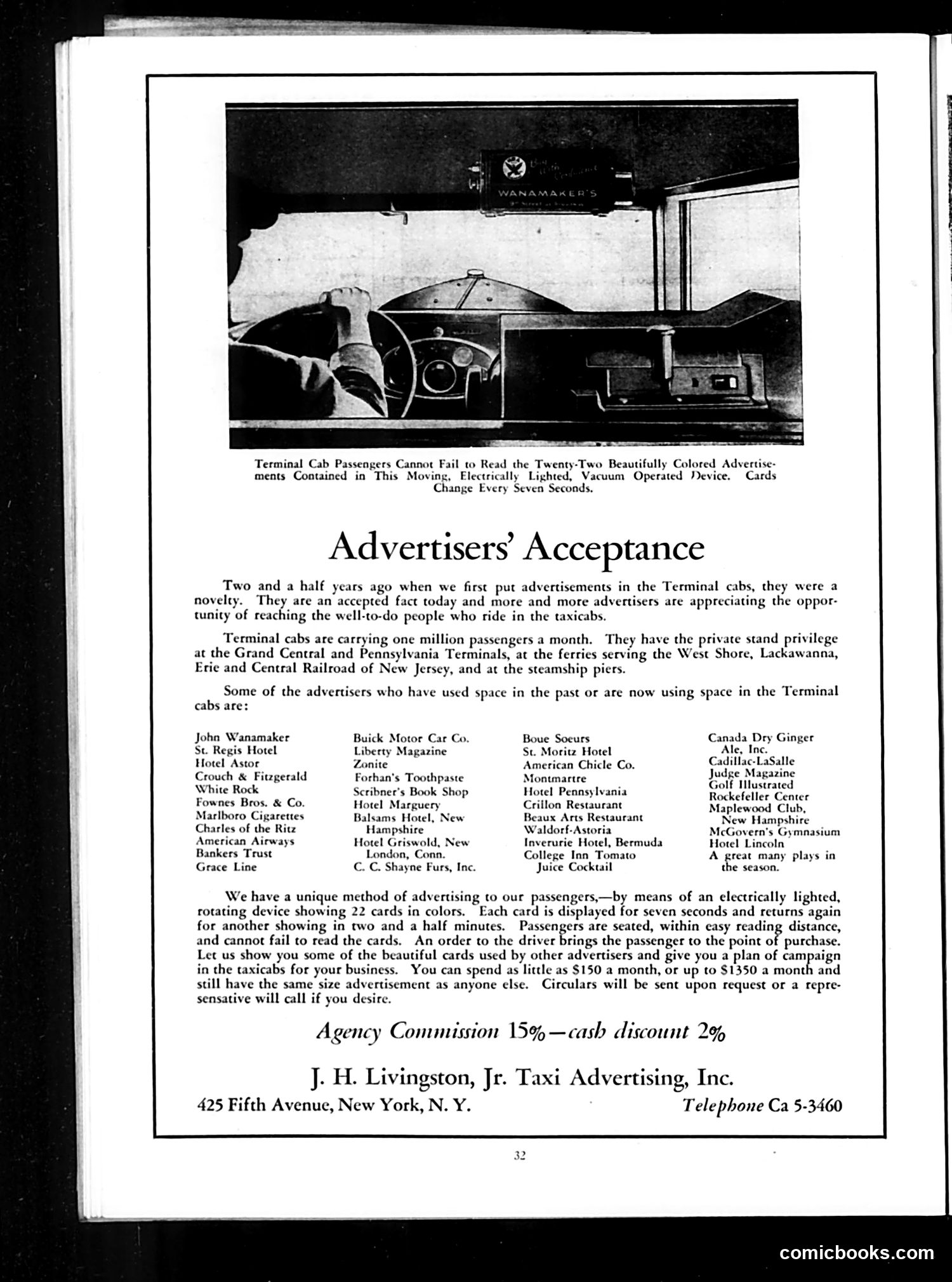
Advertisers' Acceptance This is primarily a trade advertisement, not a political cartoon. It appears in *Judge* magazine promoting taxi-cab advertising by J. H. Livingston, Jr.'s company. The image shows a taxicab interior with an electrically-lit rotating display device containing 22 colored advertisement cards that change every seven seconds. The pitch targets upscale advertisers: Terminal cabs carry "one million passengers a month" and have exclusive access to major transit hubs (Grand Central, Pennsylvania Station, steamship piers). The satire is implicit rather than overt—the humor lies in the *captive audience concept*. Passengers "seated within easy reading distance" literally "cannot fail to read the cards." This is advertising as an unavoidable experience. The extensive advertiser list (Wanamaker, Buick, Marlboro, American Airways, etc.) demonstrates the method's established credibility. Pricing ranges from $150-$1,350 monthly, offering equal visibility regardless of spend—a democratic advertising approach targeting the "well-to-do people" riding these cabs.
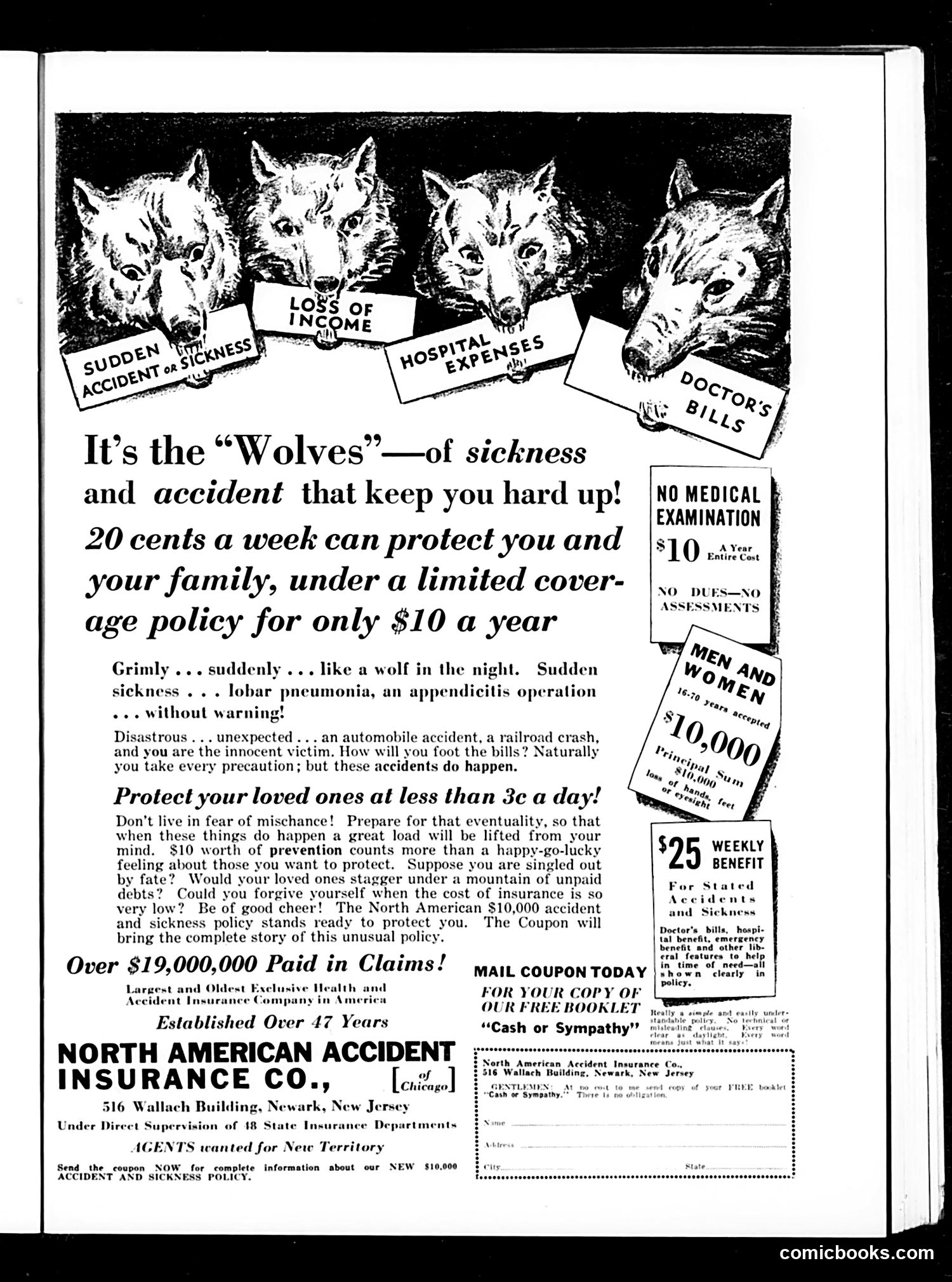
Explanation for Modern Readers This is primarily an insurance advertisement, not a political cartoon. It uses satirical imagery to sell accident and sickness insurance. The "wolves" are metaphorical dangers: four wolf heads labeled "Sudden Accident or Sickness," "Loss of Income," "Hospital Expenses," and "Doctor's Bills." The visual metaphor suggests these financial threats attack unexpectedly, like predators in the night. The ad's pitch exploits economic anxiety during the early 20th century, when medical emergencies could bankrupt families. It promises protection for just 20 cents weekly ($10 yearly) against catastrophes like pneumonia, appendicitis, auto accidents, or railroad crashes—common fears of the era. The rhetorical strategy is manipulative: "Don't live in fear... Could you forgive yourself?" This appeals to guilt and responsibility, particularly toward family. The tagline "Cash or Sympathy" suggests the choice between buying insurance and facing only sympathy from loved ones when disaster strikes—implying sympathy alone won't pay bills. This reflects a historical moment when health insurance was nascent, sold through direct-mail solicitation rather than employer benefits.
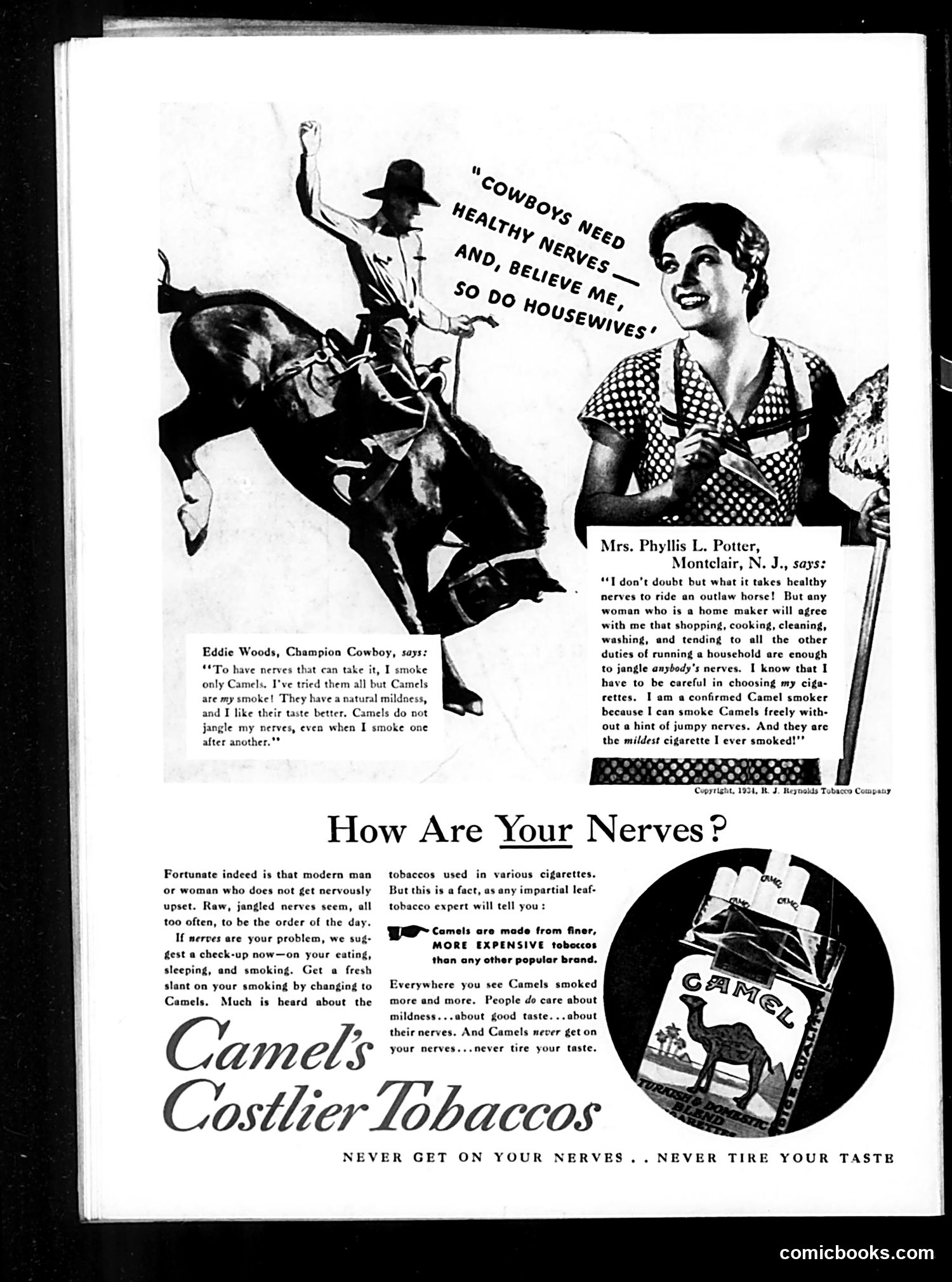
Analysis This is a Camel cigarette advertisement, not political satire. The page uses testimonials from two figures—Eddie Woods (identified as "Champion Cowboy") and Mrs. Phyllis L. Potter (a housewife)—to claim that Camel cigarettes are mild and won't cause "nerves" or anxiety. The ad's logic is straightforward but absurd to modern readers: it suggests smoking calms rather than stimulates the nervous system. It exploits 1920s-30s anxieties about modern life's stress while marketing cigarettes as a health solution. The humor lies in the contrasts: a rough cowboy and an overwhelmed housewife both face nerve-jangling situations (riding horses, housework), yet both credit *Camels* for keeping calm. The ad emphasizes "finer, MORE EXPENSIVE tobaccos" to justify the brand's premium positioning. This reflects pre-warning-label cigarette advertising that made health claims now recognized as false. The page demonstrates how tobacco companies once openly positioned smoking as beneficial to mental health.