judge
Judge — March 1934
I can see this is a cover page from *Judge* magazine featuring the publication's masthead at the top. However, the image is predominantly black with very limited visible detail—I can make out what appears to be a silhouetted figure in the lower portion, but cannot discern enough visual clarity to identify specific people, caricatures, or political references with confidence. Without clearer visibility of the cartoon's details or additional context about the publication date, I cannot reliably explain what satire or social commentary this cover intended to convey. To provide accurate historical analysis rather than speculation, I would need either a clearer image or the magazine's publication date to research the contemporary events being referenced.
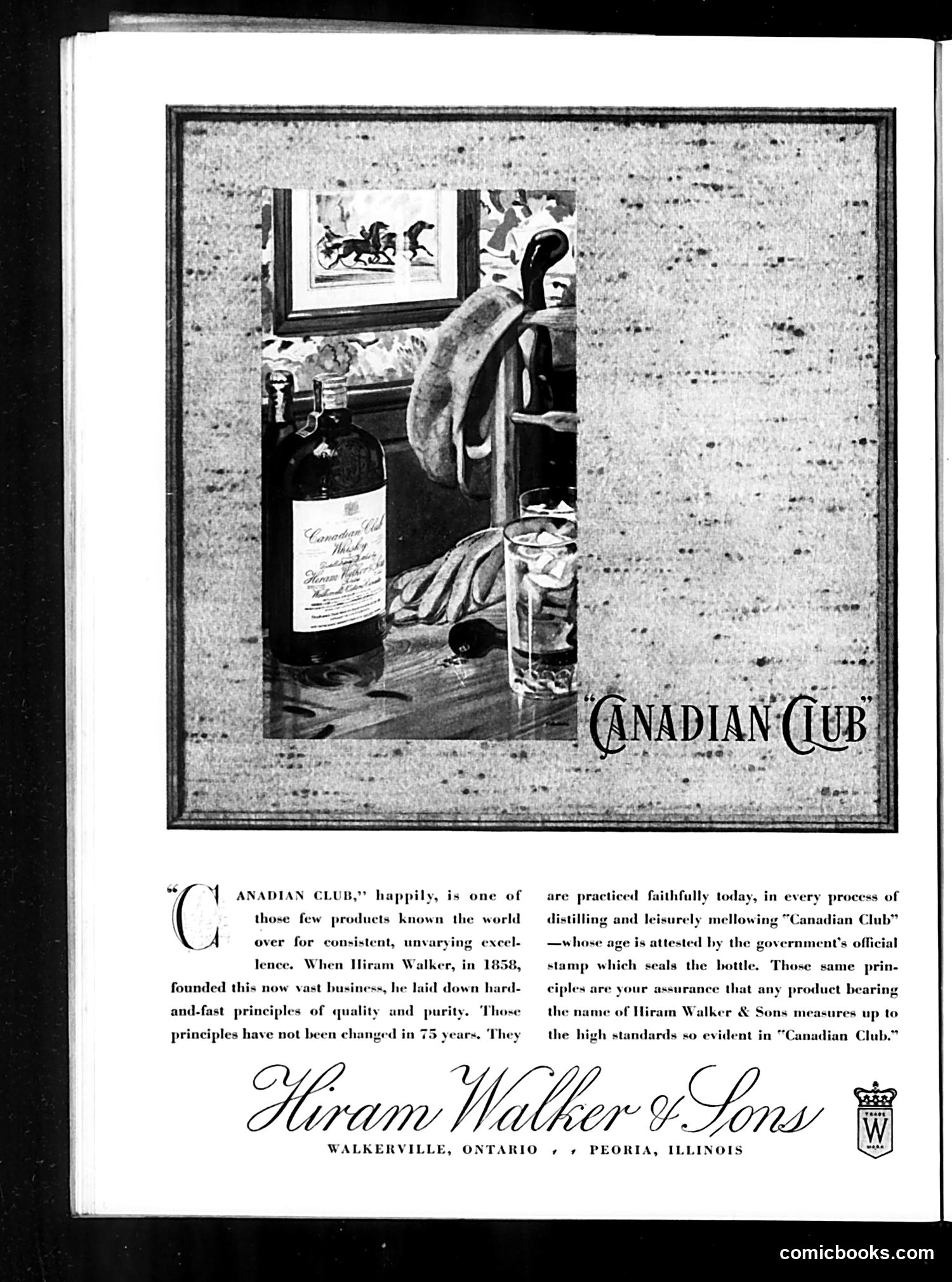
Analysis This page is primarily advertising, not satire. It's a full-page advertisement for "Canadian Club" whiskey by Hiram Walker & Sons, with manufacturing locations in Walkerville, Ontario and Peoria, Illinois. The ad emphasizes the product's long history (founded 1858) and quality standards maintained over 75 years. The image shows a bottle of Canadian Club whiskey displayed alongside a glass and what appears to be decorative serving items. Text stresses that the company's principles of "quality and purity" remain unchanged, and references the "government's official stamp" as assurance of quality. There is no political cartoon or satire present on this page—it's straightforward commercial advertising typical of Judge magazine's revenue model.
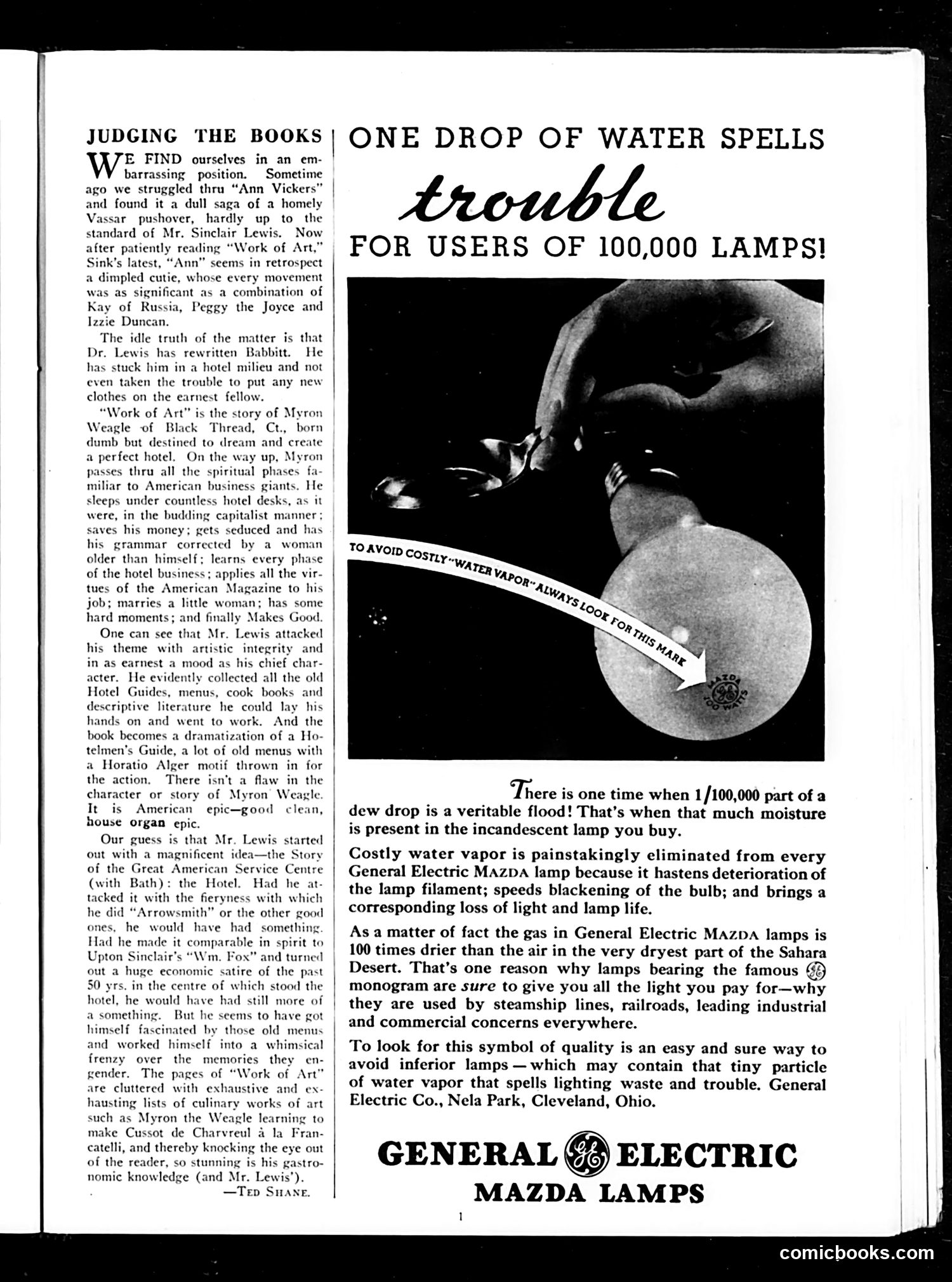
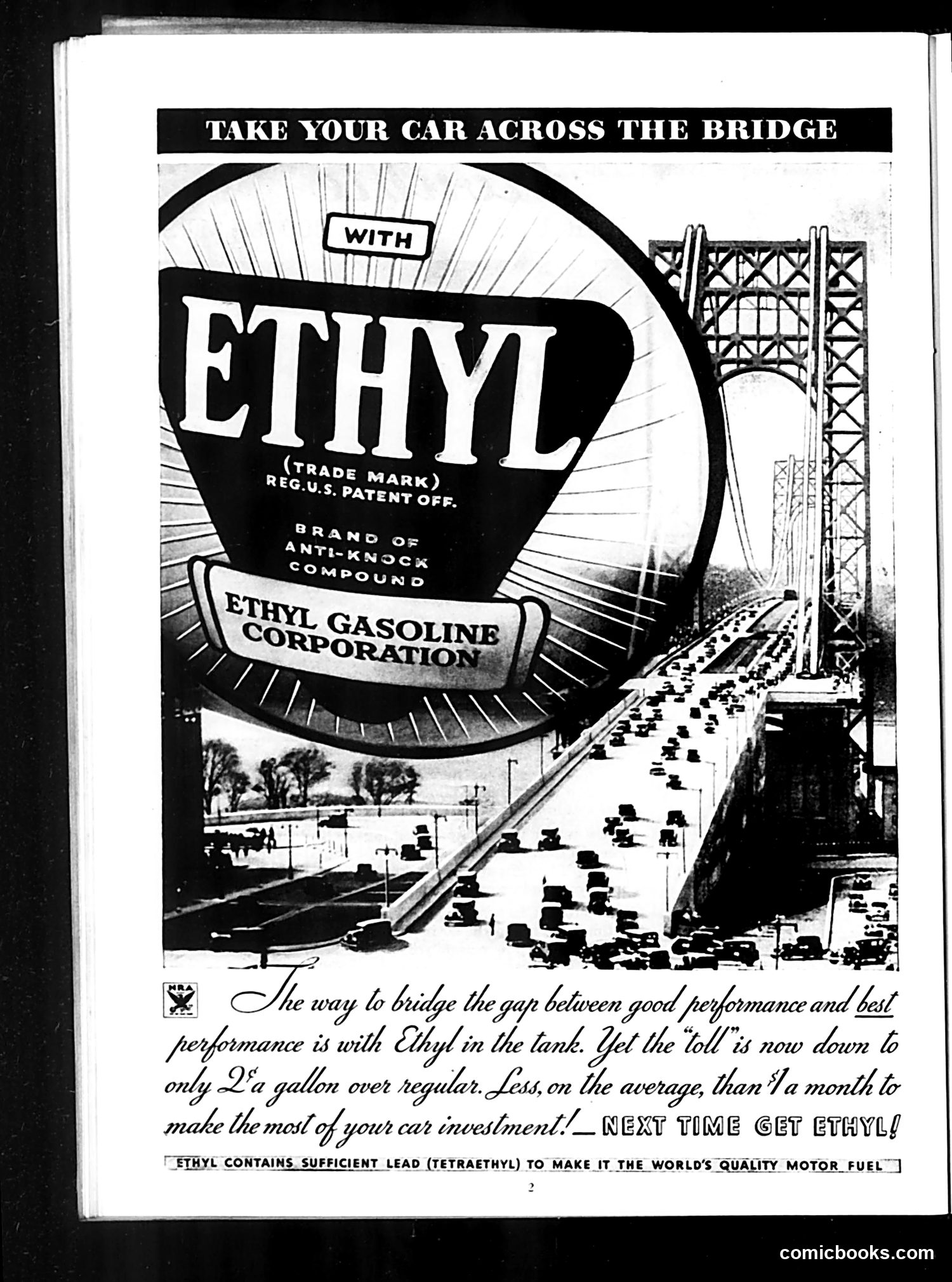
Analysis This is primarily advertising, not satire or editorial content. It's a full-page advertisement for Ethyl Gasoline Corporation promoting their leaded fuel product. The ad uses a dramatic visual metaphor: a giant container of Ethyl fuel hovering over a bridge crowded with cars, suggesting the product enables vehicles to successfully "bridge the gap" between adequate and superior performance. The headline promises performance improvement "down to only 2¢ a gallon over regular"—positioning the cost difference as negligible compared to benefits. The bottom text explicitly states Ethyl contains lead (tetraethyl), marketed as making "the world's quality motor fuel." Modern context: This celebrates leaded gasoline before its severe health hazards became widely recognized, ultimately leading to its ban decades later.
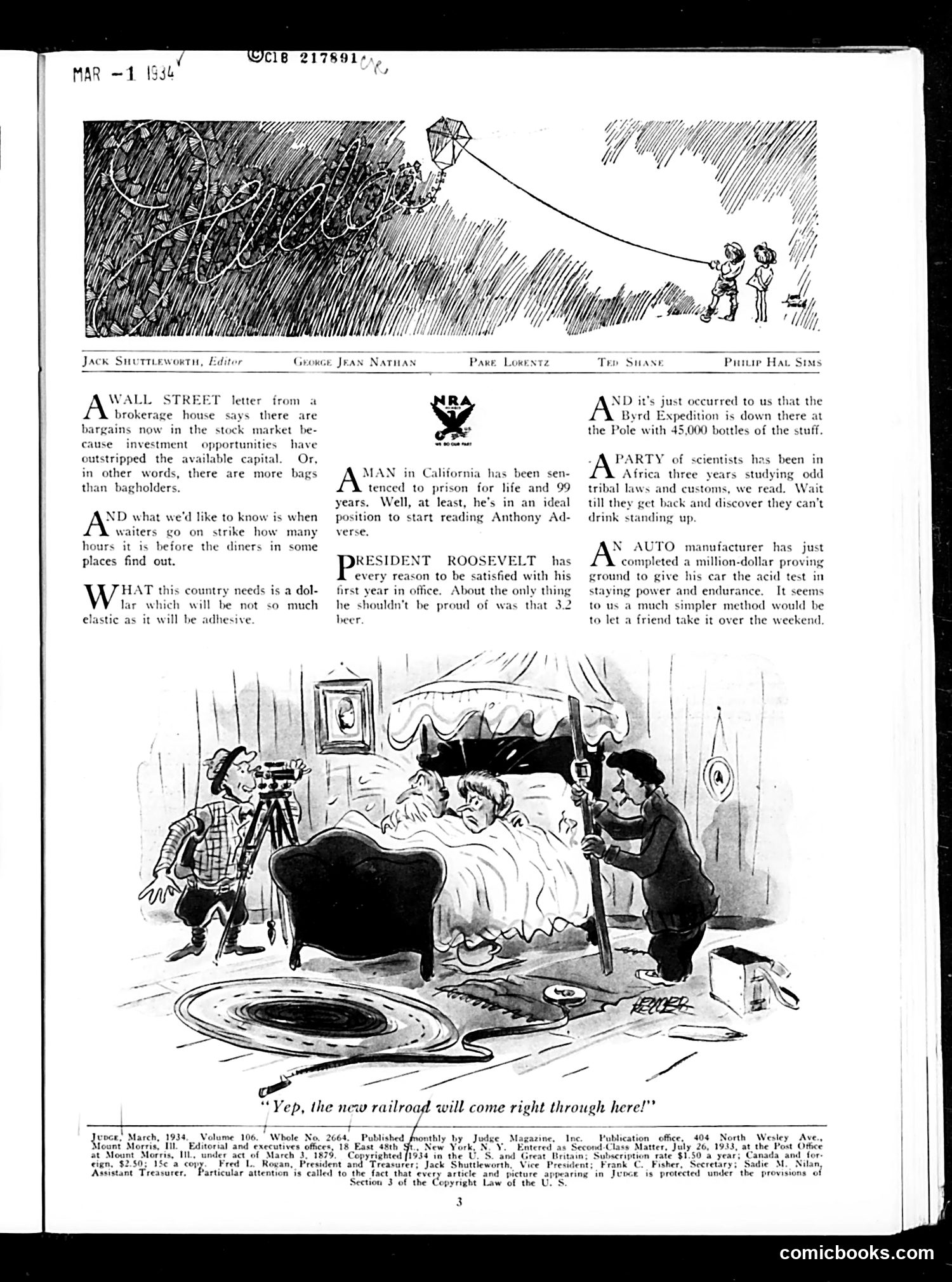
Judge Magazine Satire Analysis Top Cartoon: Two children fly a kite toward a massive, chaotic tangle labeled with financial terms. This satirizes 1930s stock market speculation—the "bag" imagery references how investors were "holding the bag" when market bubbles burst, losing their capital while brokers profited. Bottom Cartoon: A film crew shoots a scene of someone in bed while two men with surveying equipment stand nearby. The caption reads "Yep, the new railroad will come right through here!" This mocks the absurdity of Hollywood filmmaking—the contrast between staged bedroom drama and the intrusion of real-world infrastructure (railroad construction). It satirizes cinema's detachment from practical reality, a common Judge theme during the Depression era.
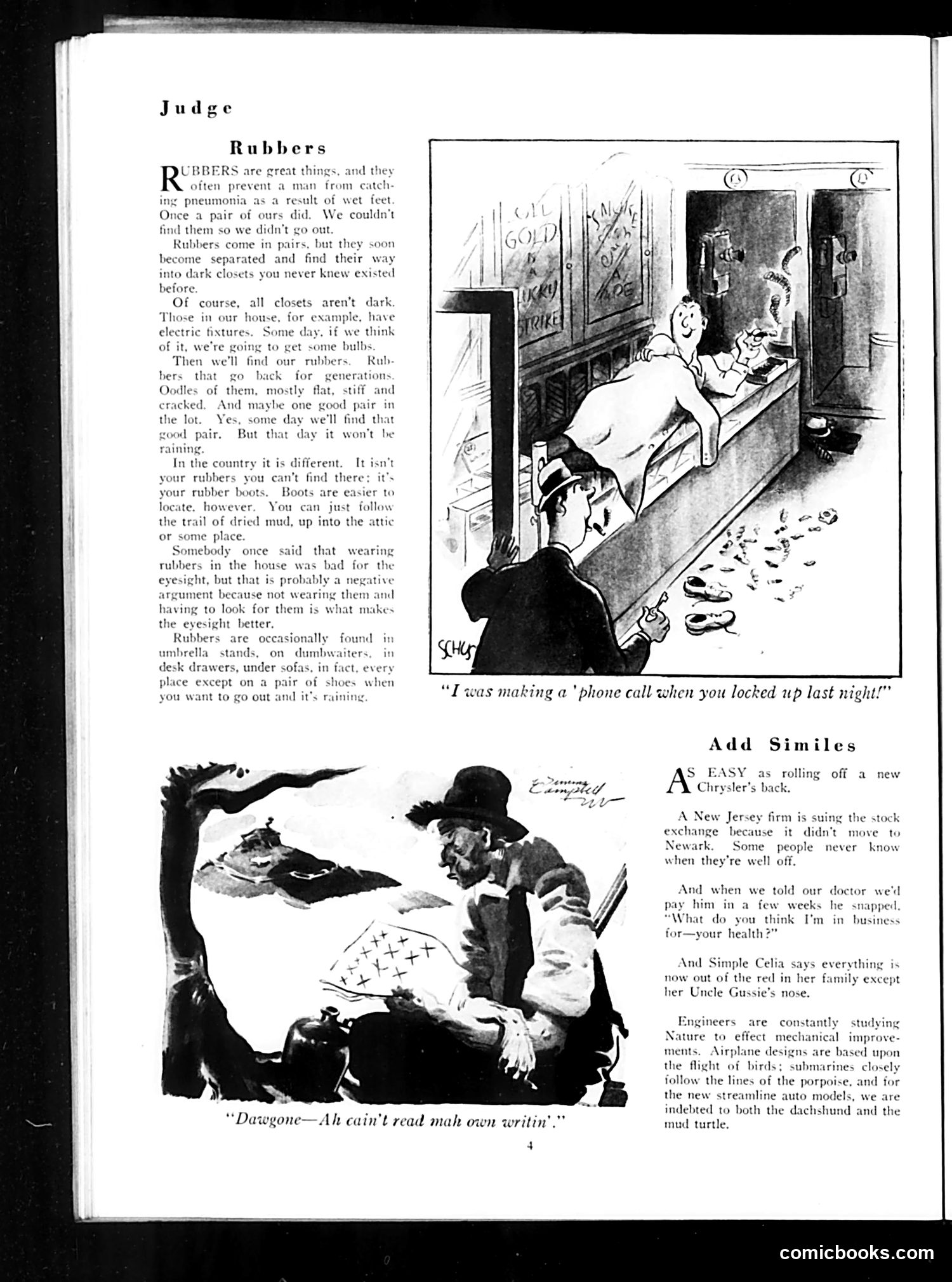
Analysis of Judge Page This page contains two separate humor pieces: "Rubbers" (top): A domestic comedy about lost rubber boots. The joke hinges on husbands and wives repeatedly misplacing rubbers in dark closets, eventually finding old pairs from previous generations. The satire targets the mundane frustrations of household management and marital life—the idea that even basic items like galoshes become sources of ongoing domestic disorder and minor conflict. "Add Similes" (bottom): A collection of brief humorous anecdotes and observations about everyday life, including quips about stock exchanges, doctors' fees, and family quirks. These are light social commentary rather than pointed satire—casual observations on commerce, health, and domestic eccentricity typical of early 20th-century magazine humor. Both rely on relatable domestic situations for comedy rather than political content.
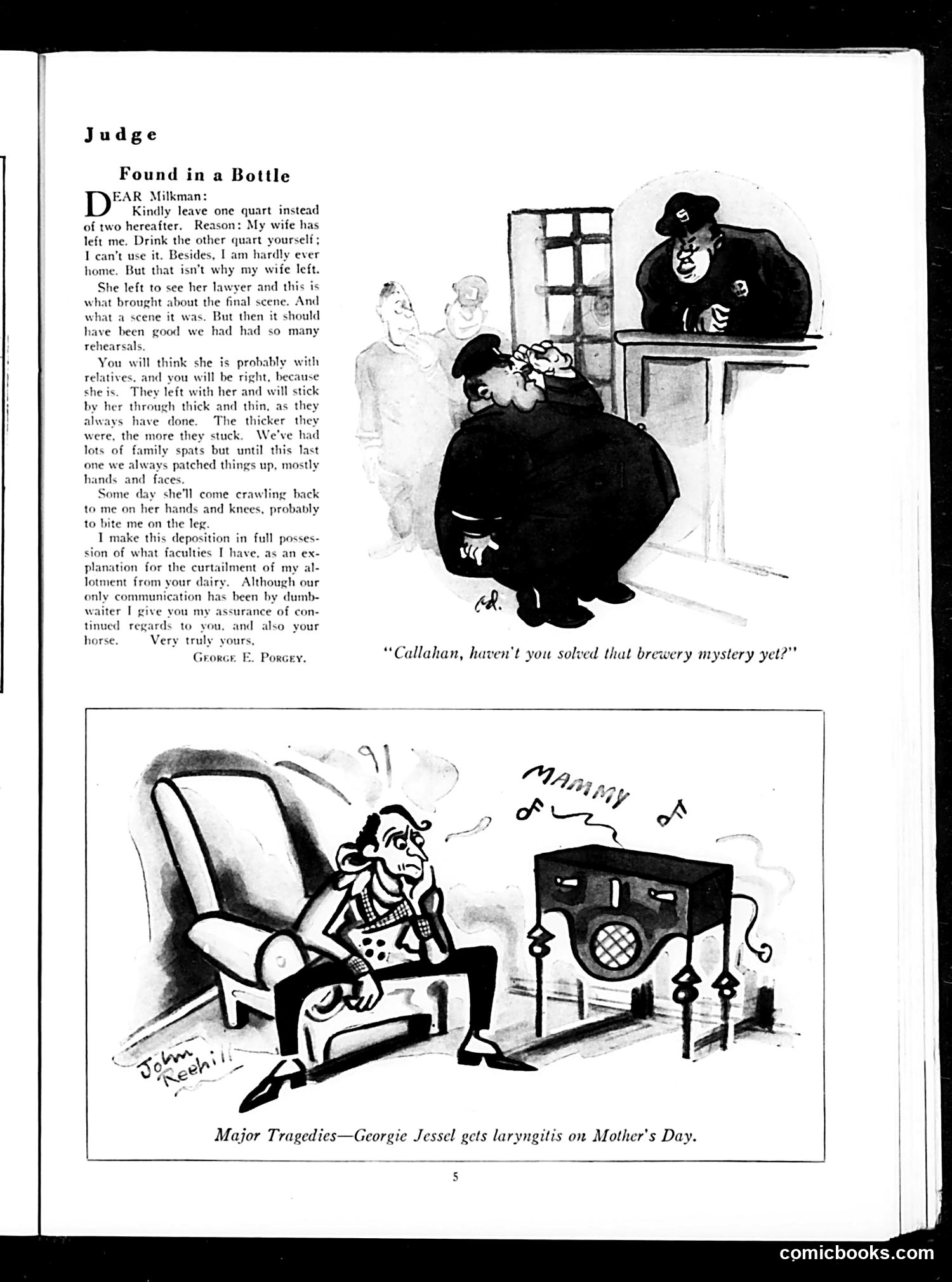
Analysis of Judge Page This page contains two humor pieces: "Found in a Bottle": A letter from George E. Porgey to "Judge" Milkman, humorously requesting one quart instead of two. Porgey claims his wife left him, and he's lonely and rarely home—thus needs less milk. The joke hinges on his elaborate, mock-serious "deposition" about marital discord and his wife's predictable return "on her hands and knees." It's domestic humor typical of early 20th-century Judge magazine, mocking unhappy marriages. "Major Tragedies": A cartoon caption stating "Georgie Jessel gets laryngitis on Mother's Day." This references Georgie Jessel, a known performer/personality of the era. The cartoon shows a man distressed beside a radio, implying his inability to perform vocally on a sentimental holiday—the humor derives from the inconvenient timing of his illness. Both pieces rely on period-specific cultural references and domestic/entertainment gossip.
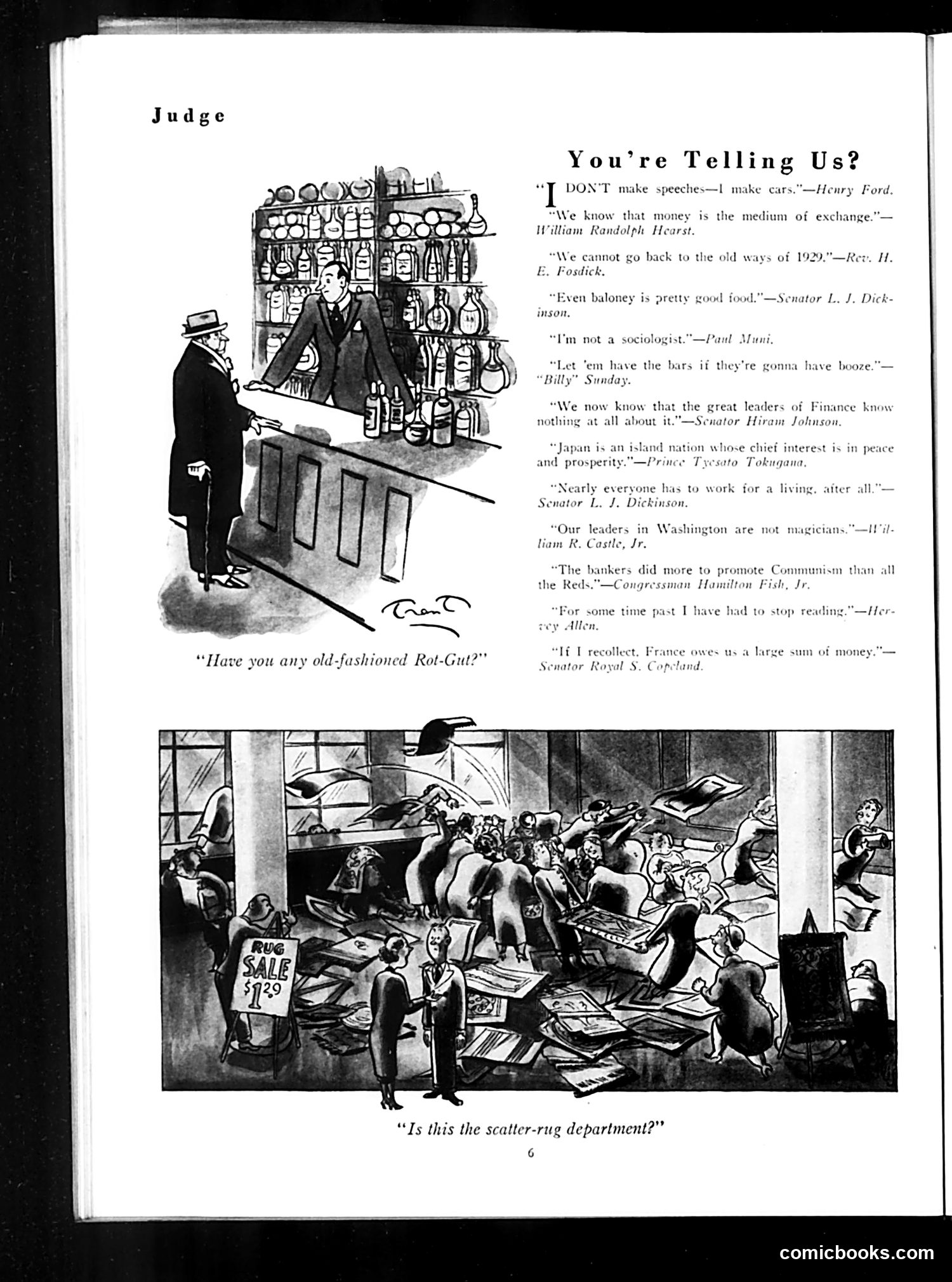
Analysis This page from *Judge* magazine presents political satire through two cartoons. The upper cartoon titled "Have you any old-fashioned Rot-Gut?" depicts a judge examining a store's shelves of bottles, satirizing Prohibition-era hypocrisy. The accompanying quotes mock various public figures (Henry Ford, William Randolph Hearst, senators, etc.) for contradictory or foolish statements about economics, finance, and social policy. The lower cartoon, "Is this the scatter-rug department?" shows chaos in what appears to be a department store with people and animals creating disorder. The humor likely references post-1929 economic collapse disruption—shoppers scrambling, sales signs visible—satirizing both retail pandemonium and broader societal upheaval following the stock market crash. Both cartoons critique American leadership and institutions during economic crisis.
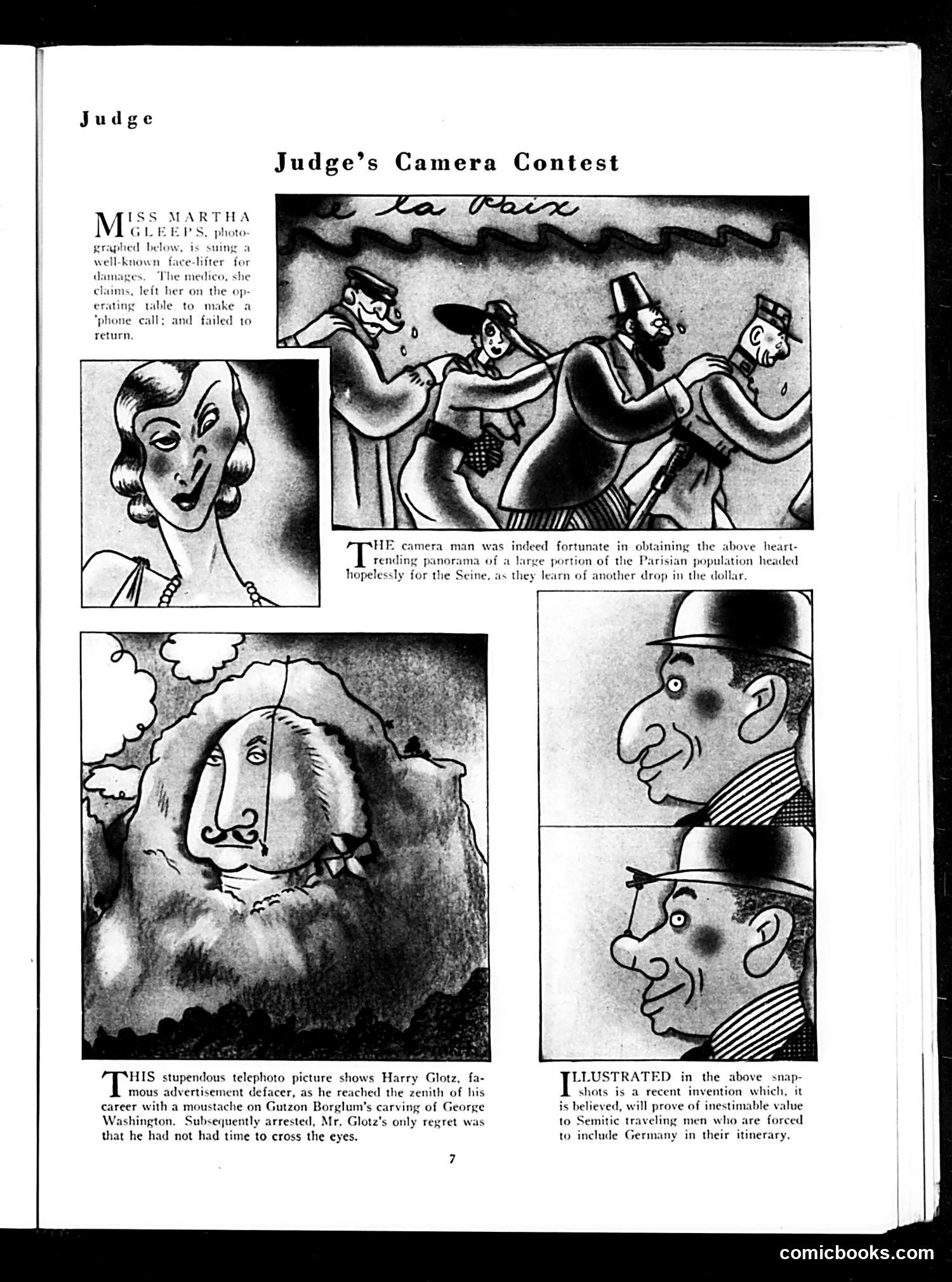
Judge Magazine Page Analysis This page from Judge presents three satirical cartoons mocking contemporary figures and situations: 1. Miss Martha Gleeps: A society woman suing her cosmetic surgeon (a "face-lifter") for malpractice after he abandoned her on the operating table to take a phone call, reflecting 1920s-30s anxieties about plastic surgery and frivolous lawsuits. 2. The Dollar Crisis: A cartoon showing Parisians rushing toward the Seine after learning of another dollar devaluation—satirizing international financial instability and European economic desperation. 3. Harry Glotz: A famous "advertisement defacer" arrested for vandalizing Gutzon Borglum's Mount Rushmore carving of George Washington with a moustache, lampooning both defacement crimes and Borglum's famous monument. 4. The "Invention": A mysterious device purportedly helping "Semitic traveling men" avoid Germany—a darkly antisemitic reference to rising German hostility toward Jewish people, likely dating this to the 1930s. The page exemplifies Judge's satirical approach to contemporary scandals, financial news, and social issues.
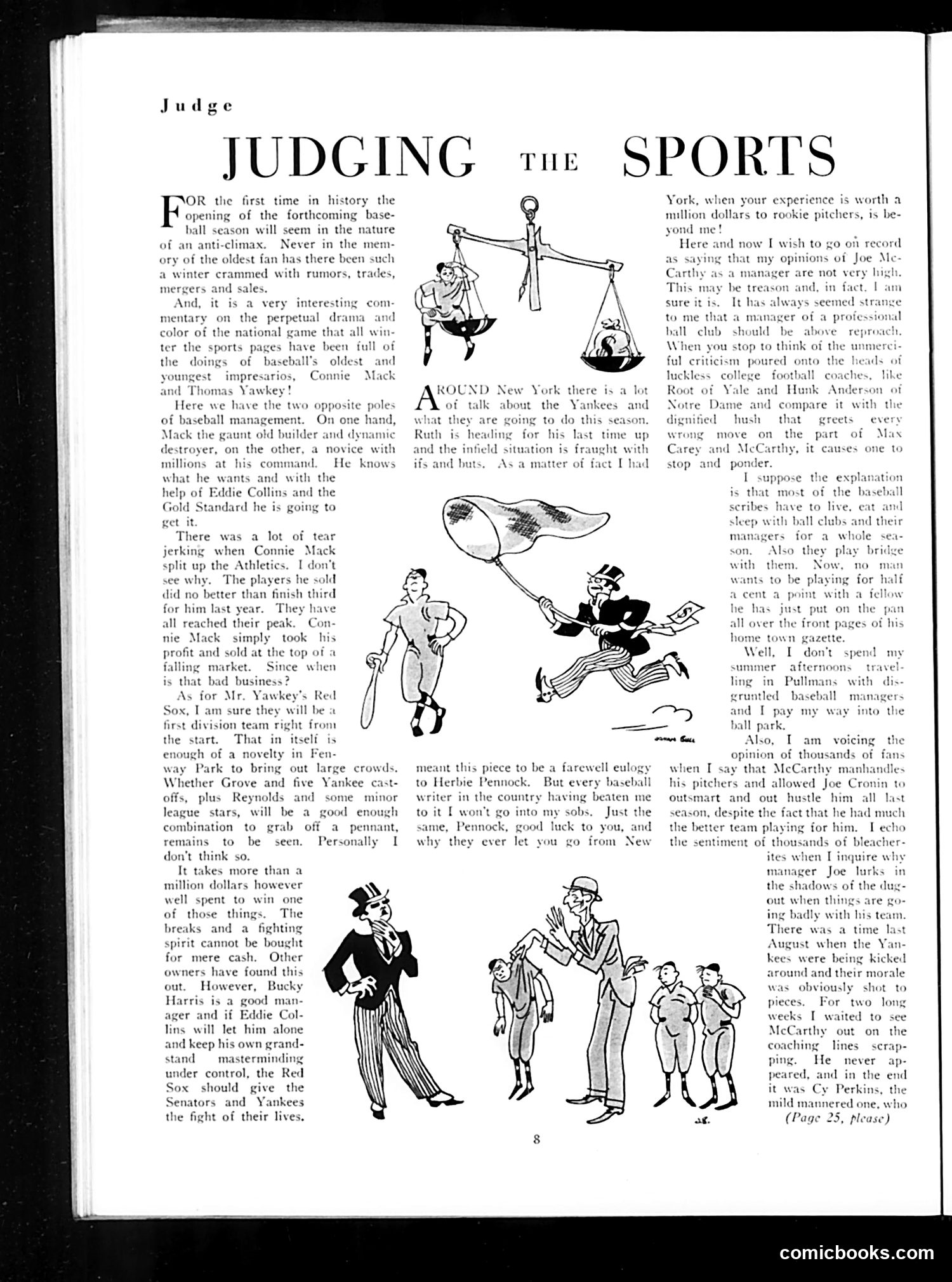
"Judging the Sports" - Judge Magazine Analysis This sports commentary addresses baseball's 1936 offseason drama, comparing two contrasting ownership styles. Connie Mack (Philadelphia Athletics owner) represents the pragmatist who profitably dismantled his aging team, while Tom Yawkey (Boston Red Sox owner) exemplifies the wealthy newcomer throwing money at problems—spending millions on veteran players to build a competitive roster. The author criticizes Joe McCarthy (Yankees manager) for mishandling pitchers and allowing Joe Cronin to outmaneuver him, despite McCarthy's resources. The cartoons illustrate baseball management tensions through satirical imagery—balancing scales of justice, money influencing outcomes, and authority figures controlling players. The satire mocks both excessive spending without strategy and poor management despite resources, arguing that mere financial investment cannot guarantee baseball success. Sentiment, fighting spirit, and smart decisions matter as much as money.
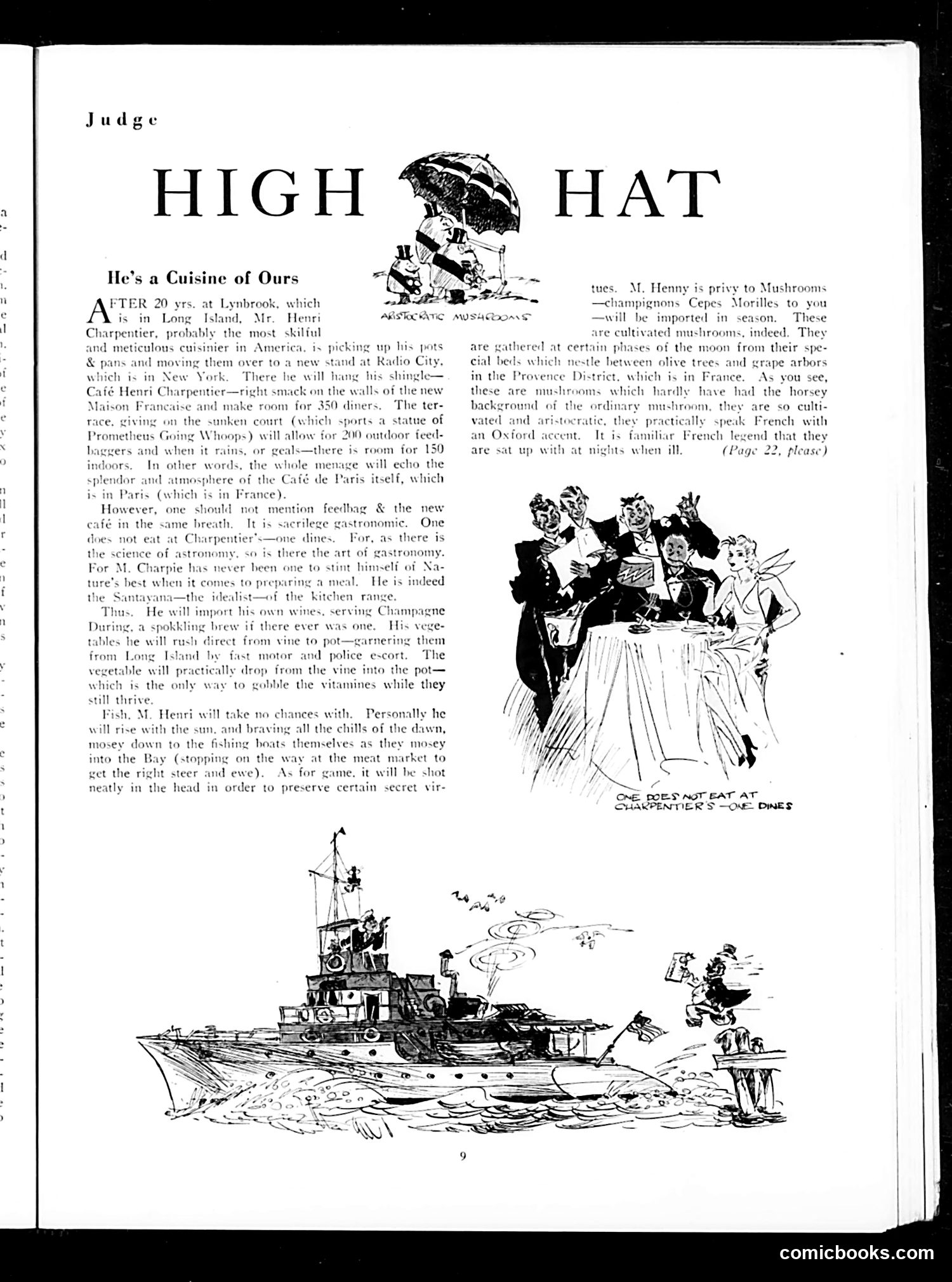
"High Hat" - Judge Magazine Article This is a profile of Henri Charpentier, a renowned French chef relocating his restaurant from Long Island to New York City. The piece satirizes the pretentiousness of high-end dining culture through exaggerated reverence for his culinary methods. The satire mocks: 1. Snobbish dining culture: The repeated insistence that one "dines" at Charpentier's rather than merely "eats"—a class distinction. 2. Foodie affectation: Absurd claims about mushrooms that "speak French with an Oxford accent" and vegetables rushed by police escort to preserve "vitamines." 3. Obsessive perfectionism: Charpentier's extreme measures (rising at dawn, personally selecting fish, shooting game in the head) presented as both admirable and ridiculous. The accompanying illustrations show diners at the restaurant and a humorous nautical scene, reinforcing the theme of ostentatious dining pretense.
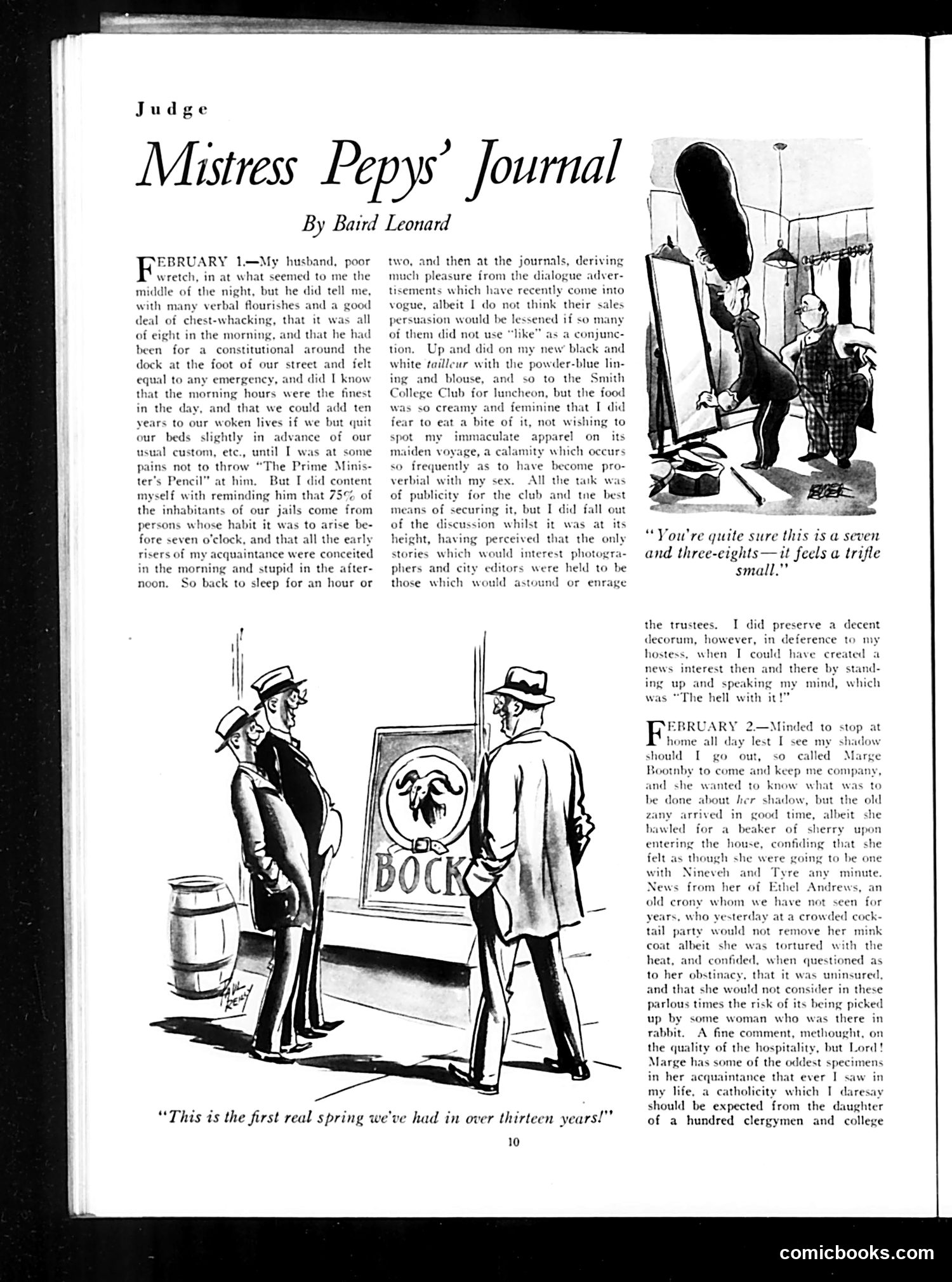
"Mistress Pepys' Journal" – Satire of Modern Women's Lives This humor column mimics Samuel Pepys's famous 17th-century diary but chronicles a contemporary upper-class woman's mundane social complaints. The satire targets 1920s-30s society women: their obsession with fashion ("new black and white tailleur"), fashionable clubs (Smith College Club), and trivial gossip. The cartoon below shows two men discussing a dock—likely mocking the husband's pretentious "constitutional" walk and his tedious health lectures. The satire mocks masculine pomposity alongside feminine vanity. Key social references include skepticism toward advertising ("dialogue advertisements"), critique of women's magazine culture, and gentle mockery of upper-class pretension. The author parodies both sexes: husbands who bore their wives with self-importance, and wives preoccupied with appearance and exclusive social circles. The tone is affectionate rather than biting—poking fun at leisure-class concerns while implying readers recognize themselves in these characters.
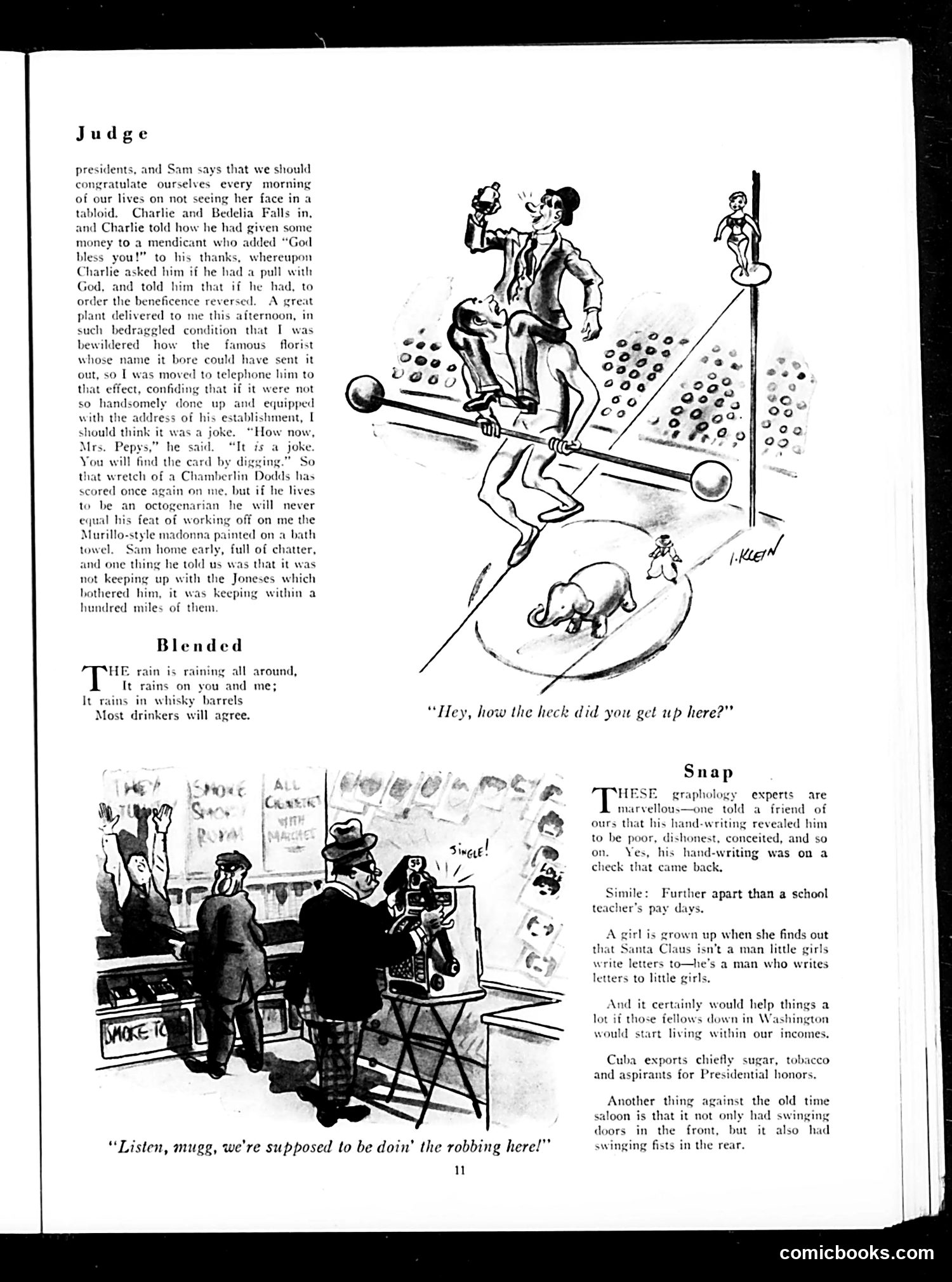
Judge Magazine Page Analysis This page contains three separate humorous pieces typical of Judge's satirical style: "Judge" (top): A gossipy social column mocking upper-class pretension and gift-giving etiquette. The florist's prank—sending a deliberately wilted plant—plays on expectations of quality service. "Blended" (middle): A simple joke about rain and whisky, relying on double meaning. "Blended" refers both to blended whisky and rain mixing together. "Snap" (bottom): Four brief social observations. The graphology joke mocks fraudulent "handwriting analysis" experts popular in the era. Other quips satirize Santa Claus, Congressional spending, Cuba's government corruption, and old saloon violence. The illustration shows what appears to be a robbery in progress, with the caption providing ironic commentary on criminal incompetence. The page exemplifies Judge's tone: urbane, class-conscious humor targeting both social climbers and government inefficiency.
"The Theatre of George Jean Nathan" This is a theater review column by Judge's drama critic George Jean Nathan, not a cartoon page. Nathan criticizes the poor quality of recent Broadway productions during what appears to be the 1933-1934 season. He particularly attacks Eugene O'Neill's "Days Without End," arguing it's one of O'Neill's weakest plays—forced, dull, and technically outdated. Nathan blames O'Neill's self-imposed isolation from real life and from theaters themselves for this decline. Nathan also dismisses several other recent plays as artistically mediocre: "Wednesday's Child" (weak writing), "Come of Age" (poor poetry and music), and "Mahogany Hall" (sentimentalized treatment of a brothel). The overall point: Broadway is in a creative slump, even established playwrights are failing, and artists must remain engaged with life—not isolated in "ivory towers"—to produce great work.
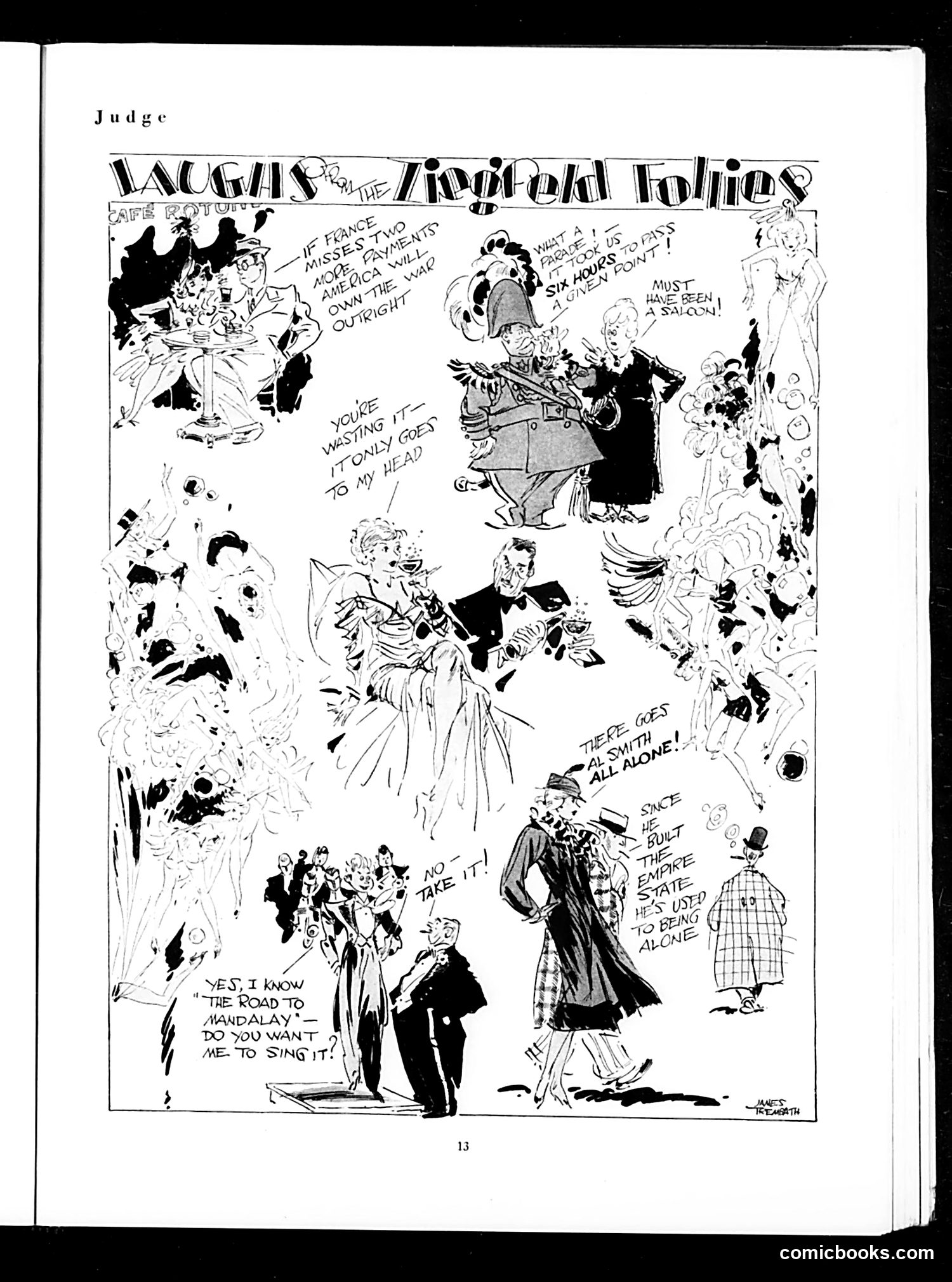
"Laugh at the Ziegfeld Follies" This is a theatrical satire of the *Ziegfeld Follies*, the famous American musical revue known for lavish productions and attractive performers. The cartoon depicts chaotic backstage or performance scenes with multiple figures in evening dress and elaborate costumes. The dialogue references include "Road to Mandalay" (likely Rudyard Kipling's poem), France/war references ("If France and America go to war"), and complaints about saloons and solo performances. One figure states "The Eff Goes Along with All Alone!" suggesting commentary on the show's structure or a performer's situation. The satire appears to mock the Follies' extravagance, dramatic conflicts among cast members, and topical references (possibly wartime concerns). The frantic, crowded composition emphasizes theatrical chaos and ego clashes typical of large production satires from this era.
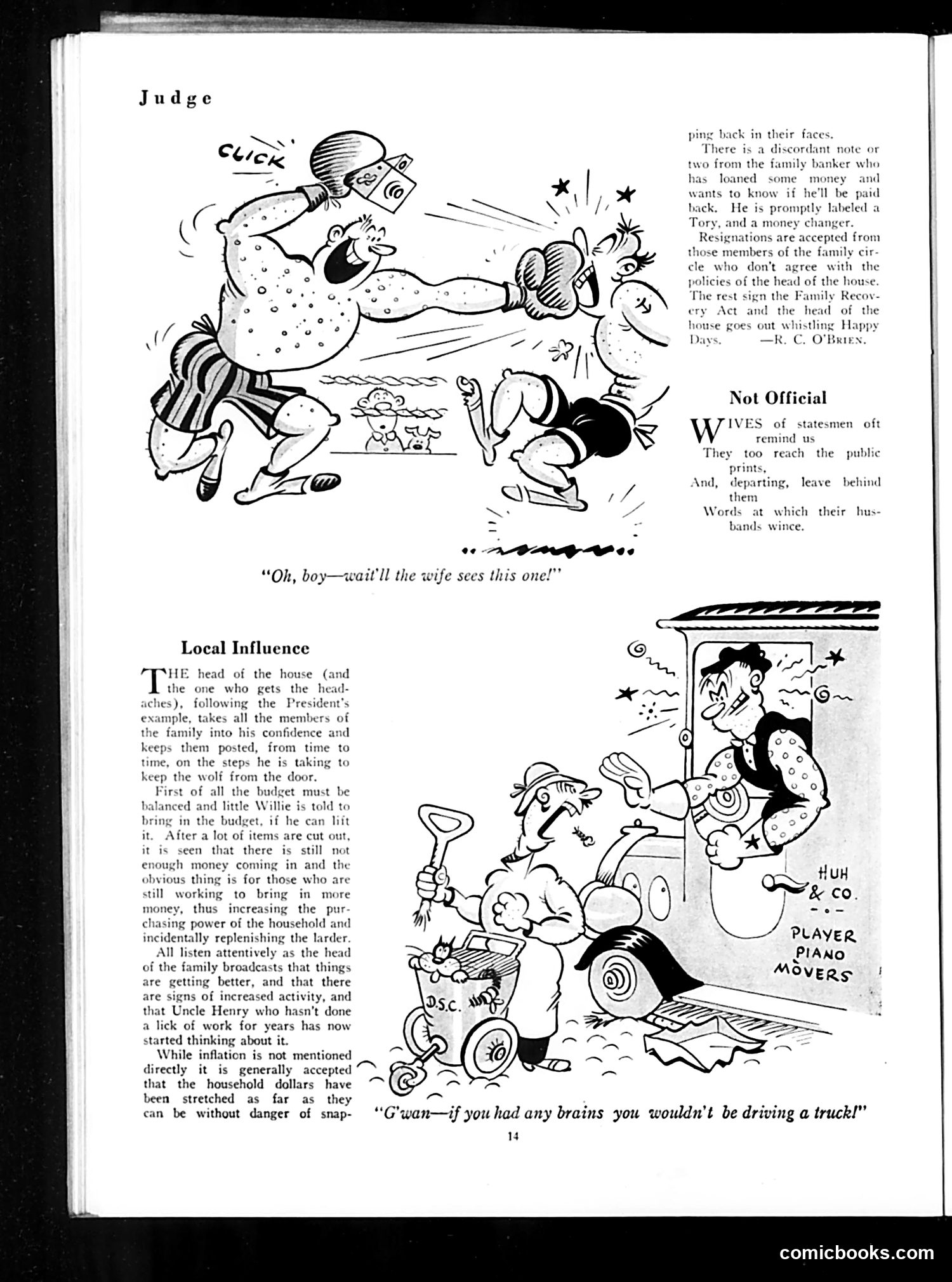
Judge Magazine Page Analysis This page satirizes how American households adopted Depression-era economic management strategies, mimicking government policies. The top cartoon jokes about wives discovering their husbands' indiscretions—a domestic scandal—with the caption "Oh, boy—wait'll the wife sees this one!" The main article, "Local Influence," describes a family head (analogous to the President) implementing austerity measures: balancing budgets, cutting expenses, and rallying family members to increased productivity. The satire suggests ordinary Americans internalized New Deal rhetoric about sacrifice and recovery. The lower cartoon mocks this absurdity: a moving company damages a piano while the driver (labeled a "Tory" money-changer for asking about payment) is insulted—mirroring how those questioning government spending were dismissed as disloyal. The satirical point: households stretched their dollars to breaking points while cheerfully accepting official narratives that "things are getting better," despite obvious financial strain. It critiques both economic hardship and the propaganda masking it.
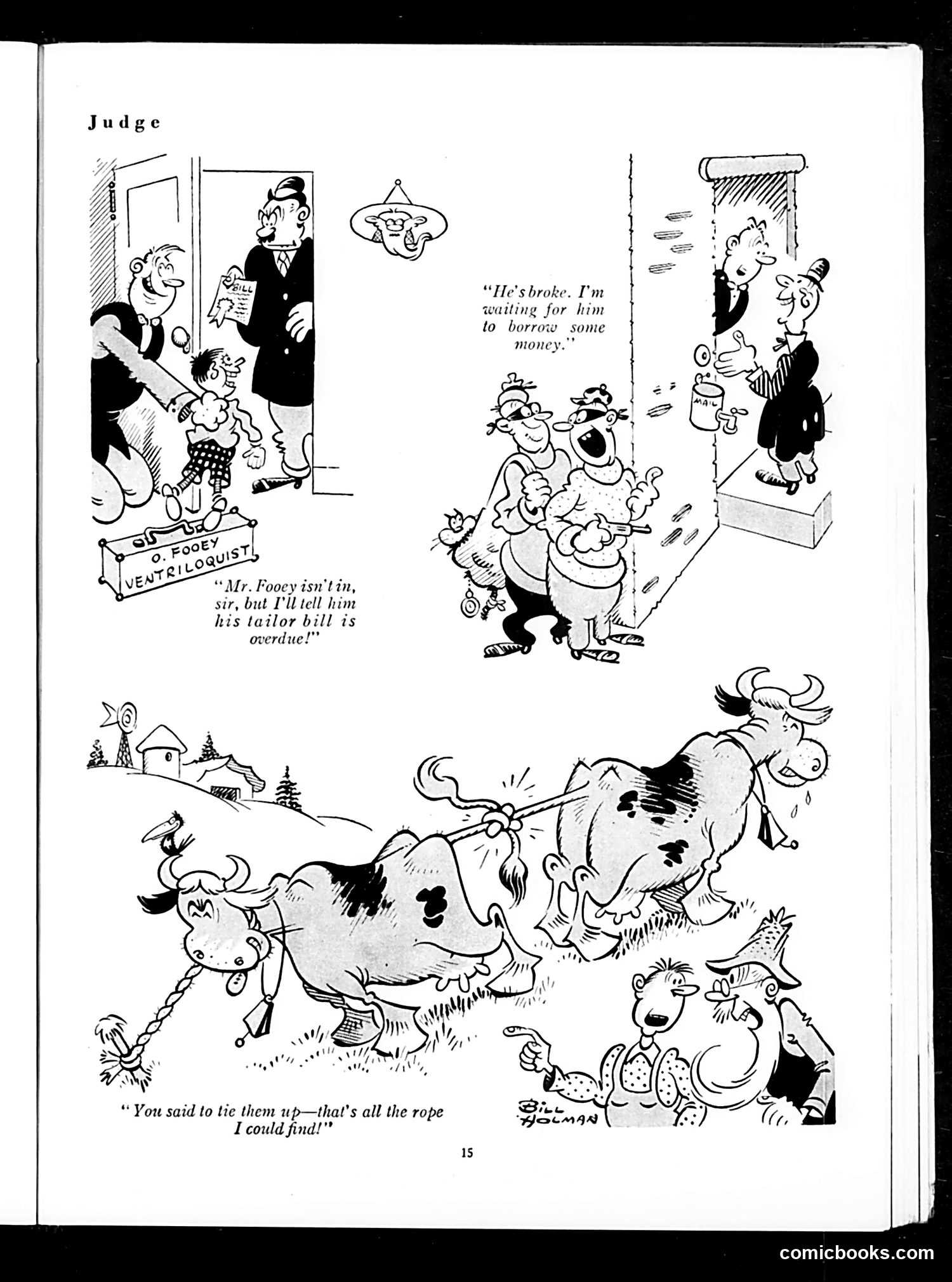
Judge Magazine Cartoon Analysis This page contains three separate satirical cartoons mocking financial irresponsibility and debt. The top panels depict "Mr. Fooey," a ventriloquist dummy, being used as an excuse by someone dodging creditors—a servant claims the "master" isn't home while a tailor pursues an overdue bill. The joke plays on using a dummy as a literal cover for financial evasion. The bottom cartoon shows someone attempting to tie up cattle with insufficient rope, captioning "You said to tie them up—that's all the rope I could find!" This appears to be a visual pun about being "broke"—having no money—by depicting literal inability to manage livestock properly due to resource scarcity. All three gags target the theme of financial inadequacy and the absurd excuses people make when they cannot pay their debts.
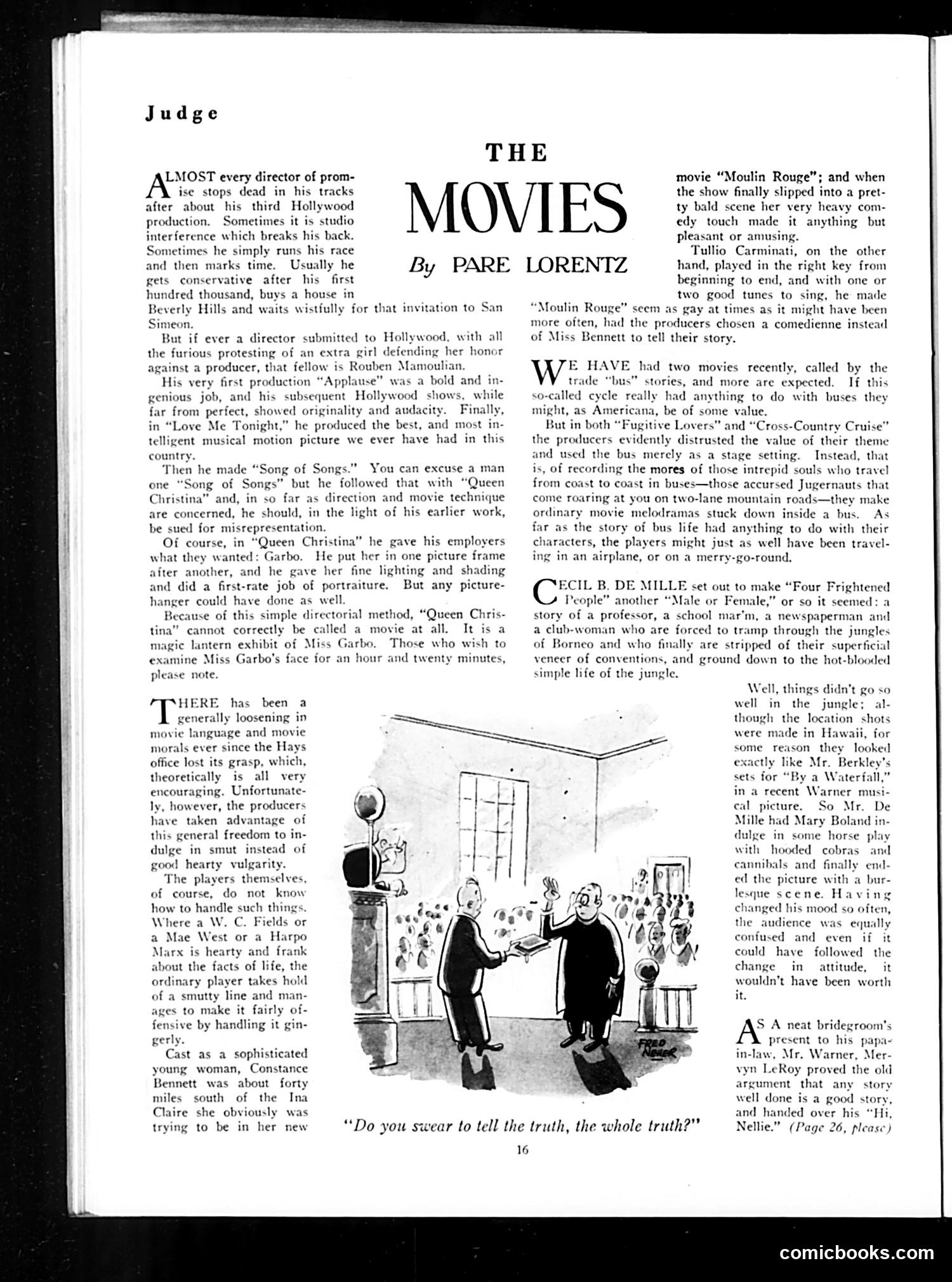
"The Movies" by Pare Lorentz — Judge Magazine Film Criticism This is a film criticism column evaluating recent Hollywood productions. The cartoon depicts a courtroom scene where someone is sworn to tell "the truth, the whole truth"—likely symbolizing Lorentz's demand for honest film criticism versus studio propaganda. Lorentz criticizes director Rouben Mamoulian for compromising his early artistic vision (praised for "Applause" and "Love Me Tonight") by reducing "Queen Christina" to merely a showcase for Greta Garbo's face, comparing it to a "magic lantern exhibit" rather than filmmaking. He also faults the "bus cycle" movies ("Fugitive Lovers," "Cross-Country Cruise") for using buses as mere set dressing rather than meaningfully exploring American travel culture. Additionally, he critiques Constance Bennett's heavy-handed comedy in "Moulin Rouge" versus Tullio Carminati's superior comedic timing. The broader satire targets Hollywood's descent into formulaic, profit-driven mediocrity and artistic compromise.
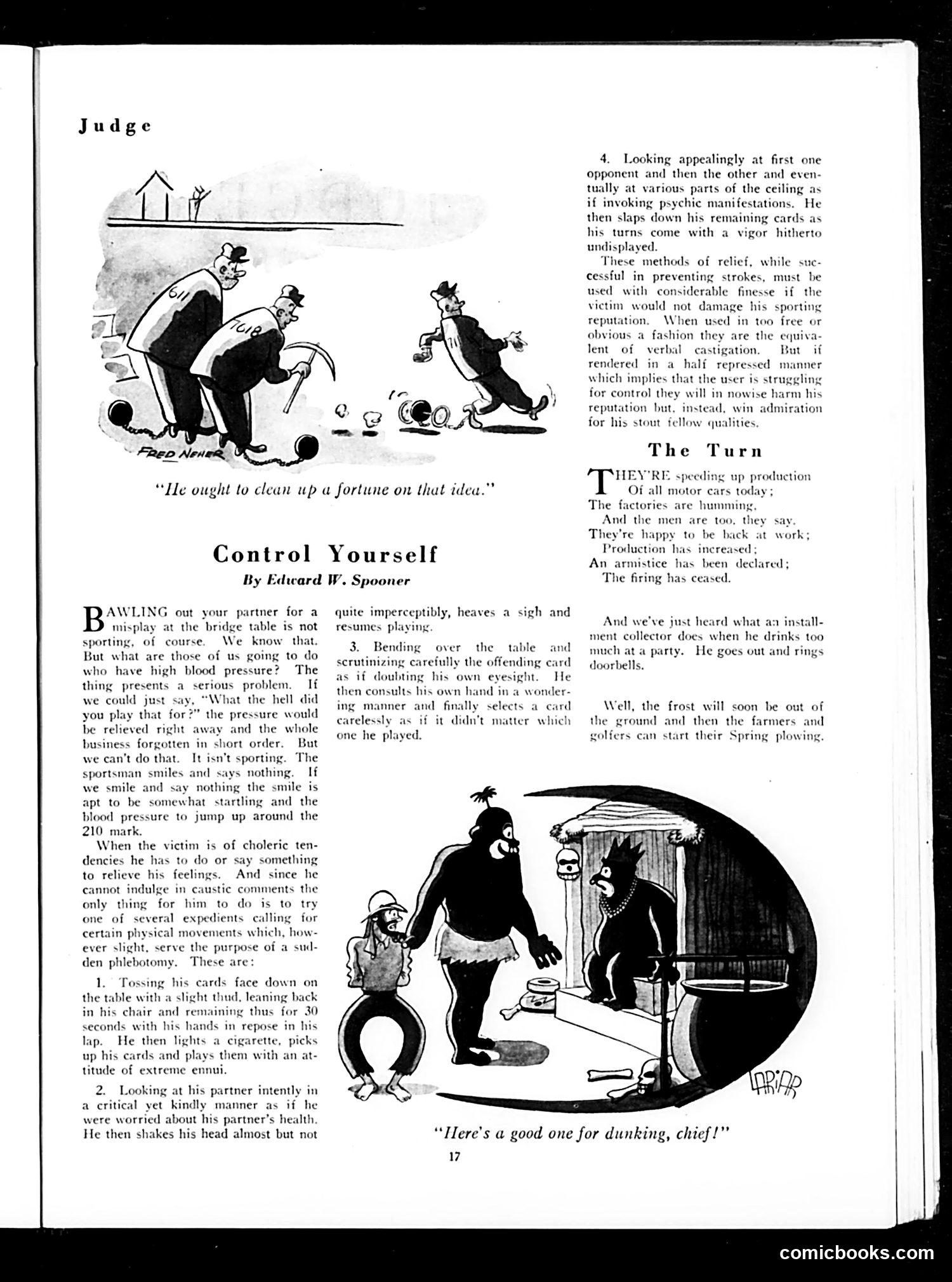
Content Analysis: Judge Magazine Page 17 This page contains two distinct pieces of social satire from the post-WWI era (indicated by references to "armistice" and factory production resuming). "Control Yourself" addresses bridge-playing etiquette among the upper classes. The article humorously describes acceptable methods for a high-strung player to express frustration at a partner's poor play without violating sporting codes of conduct. The cartoon shows two gentlemen so agitated they're literally erupting, suggesting the difficulty of maintaining composure. The satire targets the contradiction between genuine emotion and social propriety—gentlemen must disguise anger through elaborate physical gestures while pretending indifference. "The Turn" celebrates post-WWI industrial recovery, referencing the armistice (WWI's end) and resumed automobile factory production. The accompanying cartoon shows what appears to be a police officer or authority figure with a child, with the caption "Here's a good one for dunking, chief!"—likely a drinking joke about Prohibition-era enforcement humor. Both pieces reflect 1920s concerns: maintaining social respectability and celebrating post-war economic recovery.
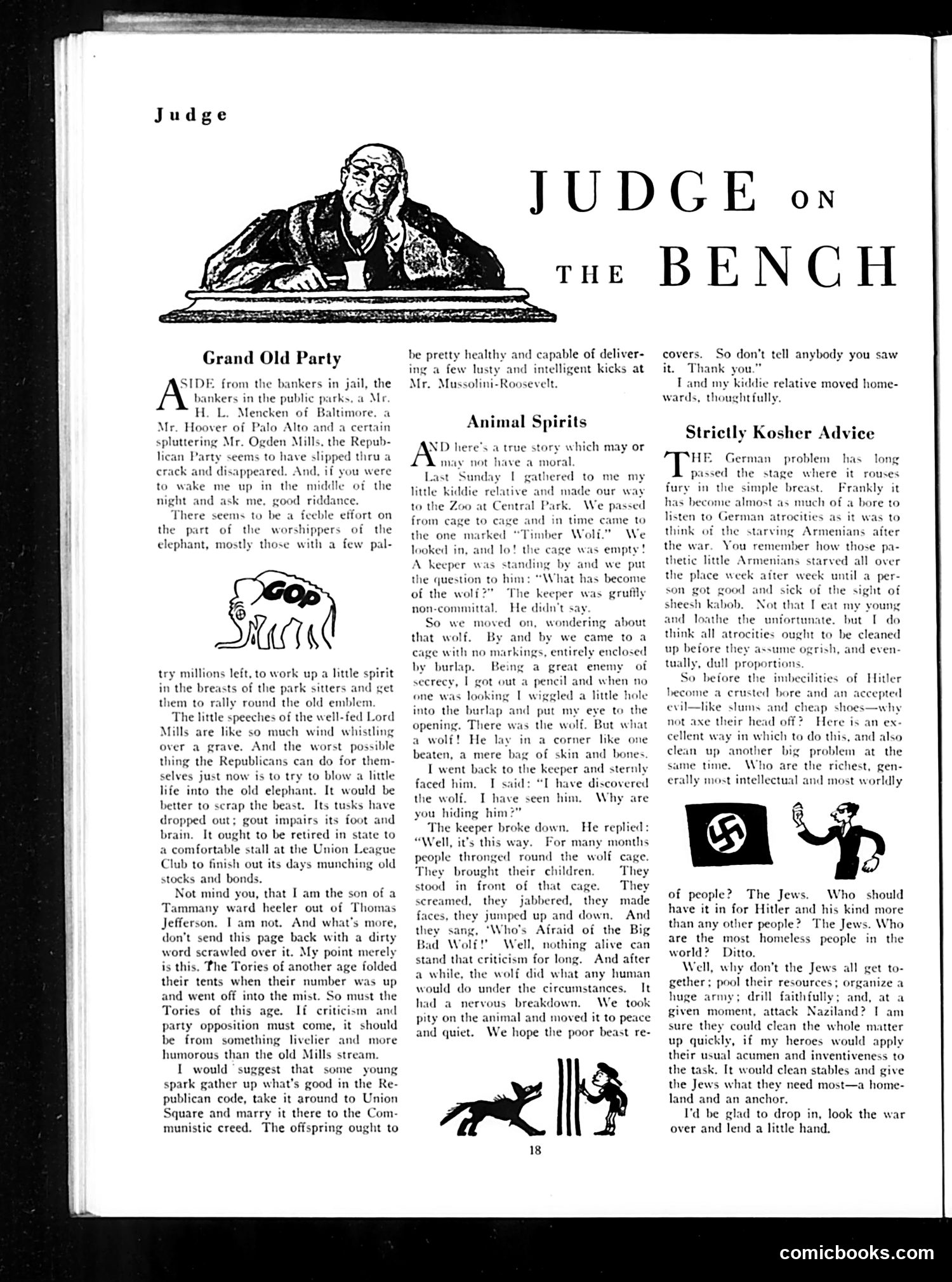
Analysis: "Judge on the Bench" Page This page contains two satirical pieces attacking American political and social figures of the early 1930s. "Grand Old Party" mocks the Republican Party's collapse during the Great Depression. The author, likely H.L. Mencken (a real Baltimore critic), compares the GOP to a dying elephant—useless and should be scrapped. He names Hoover (president), H.L. Mencken, and Ogden Mills as Republican failures. The satire suggests Republicans are impotent ("Lord Mills...like so much wind whistling over a grave"). The final jab proposes marrying Republican ideology to communism to create something viable—extreme criticism of GOP bankruptcy during economic crisis. "Animal Spirits" uses an animal fable to critique FDR (the "Big Bad Wolf" reference). A zoo wolf dies from nervous breakdown after crowds constantly mock it singing "Who's Afraid of the Big Bad Wolf?"—a popular song. The keeper hides the dead wolf. This allegorizes how public criticism has destroyed Roosevelt's confidence/effectiveness, suggesting his leadership is collapsing under scrutiny. Both pieces attack political leaders through clever indirection typical of Depression-era satirical magazines.
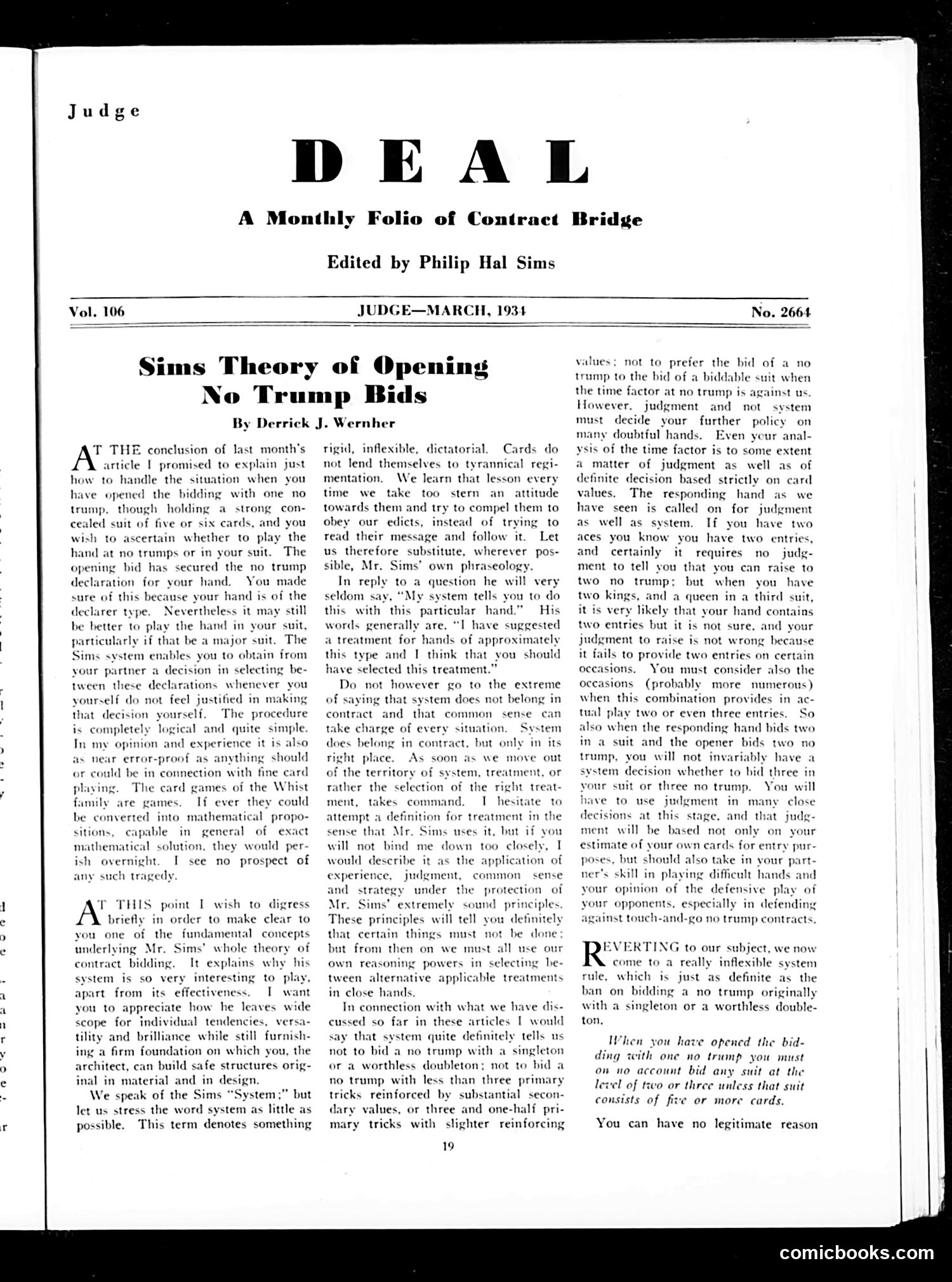
"Sims Theory of Opening No Trump Bids" — Judge, March 1934 This page contains instructional content about contract bridge, not political satire. It's an article by Derrick J. Wernher discussing Philip Hal Sims' bidding system for the card game bridge. The piece explains Sims' philosophy: his approach to bridge strategy should be understood as flexible "treatment" rather than rigid "system." Wernher argues that while Sims provides logical principles (e.g., don't bid no trump with weak holdings), players retain individual judgment in specific situations. He emphasizes that card games resist mathematical systematization and require experience, common sense, and strategic intuition alongside technical rules. This reflects 1930s bridge culture, when contract bridge was wildly popular and Sims was a renowned authority. The article advocates for a balanced approach: foundational principles with room for individual player skill.
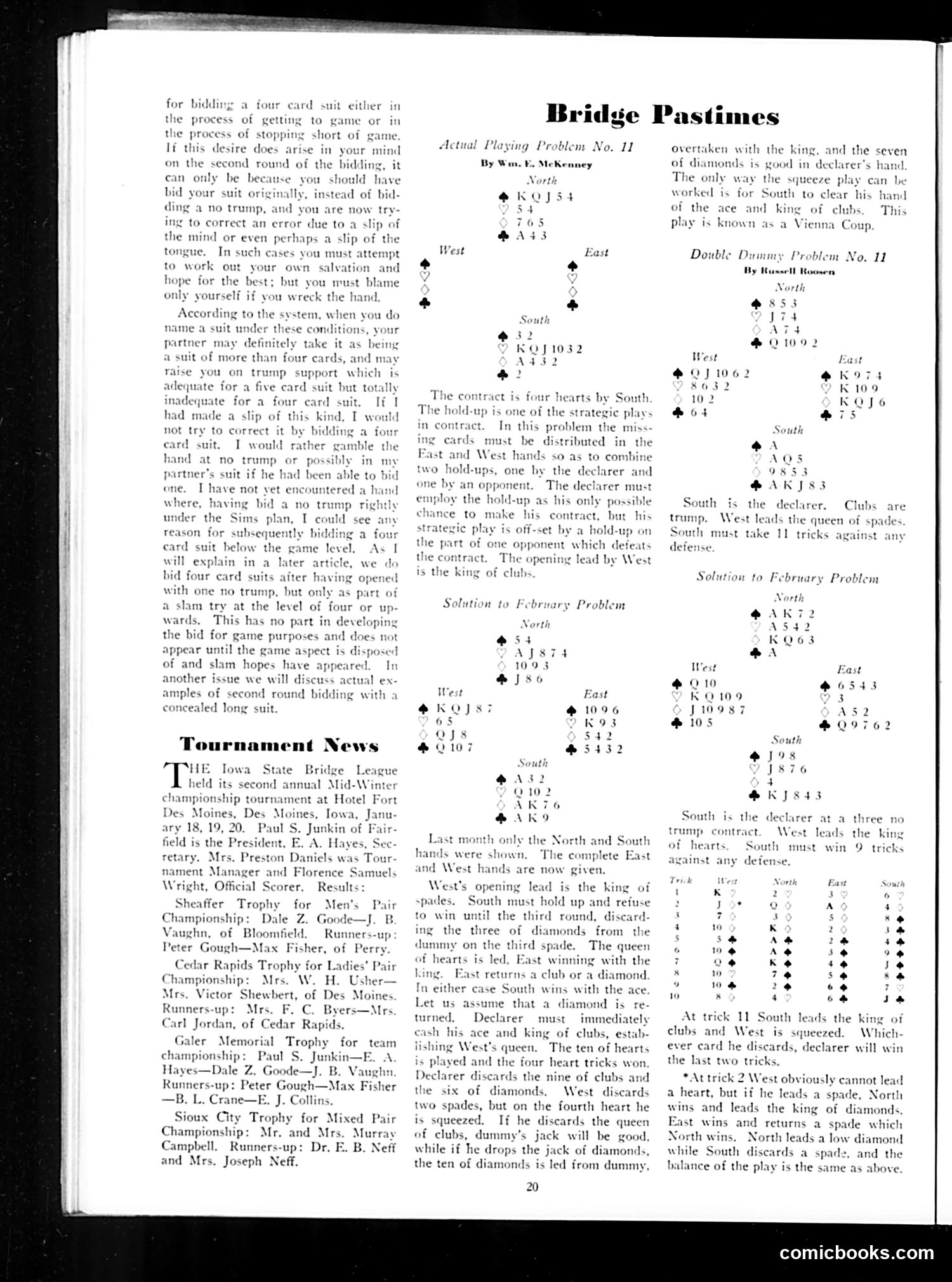
Content Analysis This page from *Judge* magazine contains no political cartoon or satire. Instead, it is a bridge instruction and tournament results page. The content consists of: 1. "Bridge Pastimes" — instructional articles on contract bridge card game strategy by W.B. McKenney, featuring two practice problems with detailed card layouts and solutions 2. "Tournament News" — results from the Iowa State Bridge League's second annual Mid-Winter Championship tournament (January 18-20), listing winners in various categories: Men's Pair, Ladies' Pair, Team, and Mixed Pair championships, with names of competitors from Iowa towns This is a practical how-to and results page for bridge enthusiasts—not satirical editorial content. The magazine apparently included bridge instruction alongside its political humor to appeal to a broad readership interested in leisure activities.
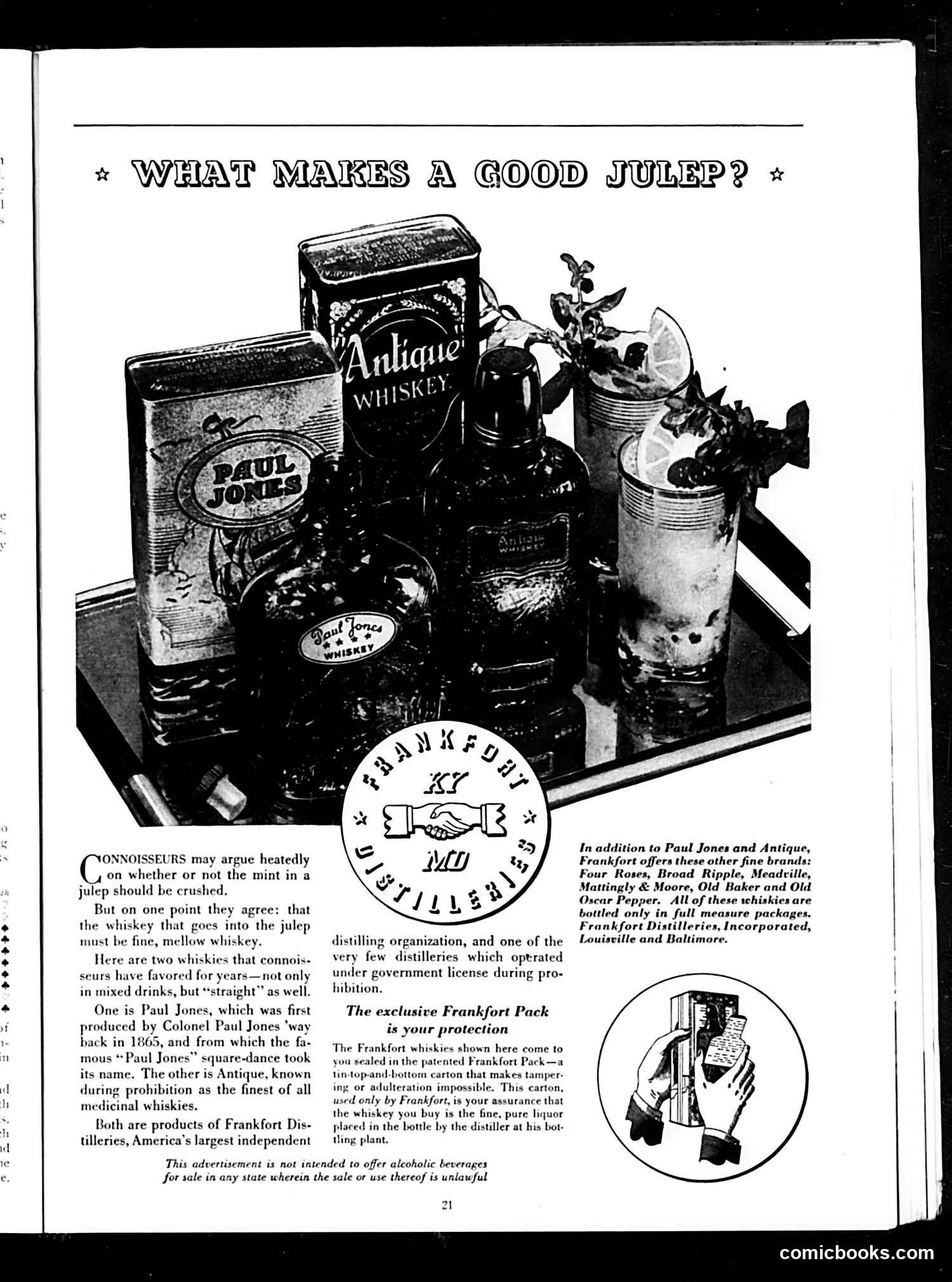
What This Advertisement Means This is a whiskey advertisement from Judge magazine, not a political cartoon. It dates to the Prohibition era or shortly after (the text references Prohibition and notes Frankfort operated "under government license during prohibition"). The ad promotes Frankfort Distilleries' whiskey brands—Paul Jones and Antique—by emphasizing quality and authenticity. The "Frankfort Pack" (a tamper-proof tin carton) addresses a real problem of the period: during Prohibition, counterfeit and adulterated alcohol flooded black markets, creating health risks. The ad's reference to Antique being "the finest of all medicinal whiskies" reflects how distilleries legally sold alcohol during Prohibition under medical pretense. The lengthy text about connoisseurs and mint juleps appeals to sophistication and tradition to position these as premium products for discerning drinkers, not cheap bootleg liquor.
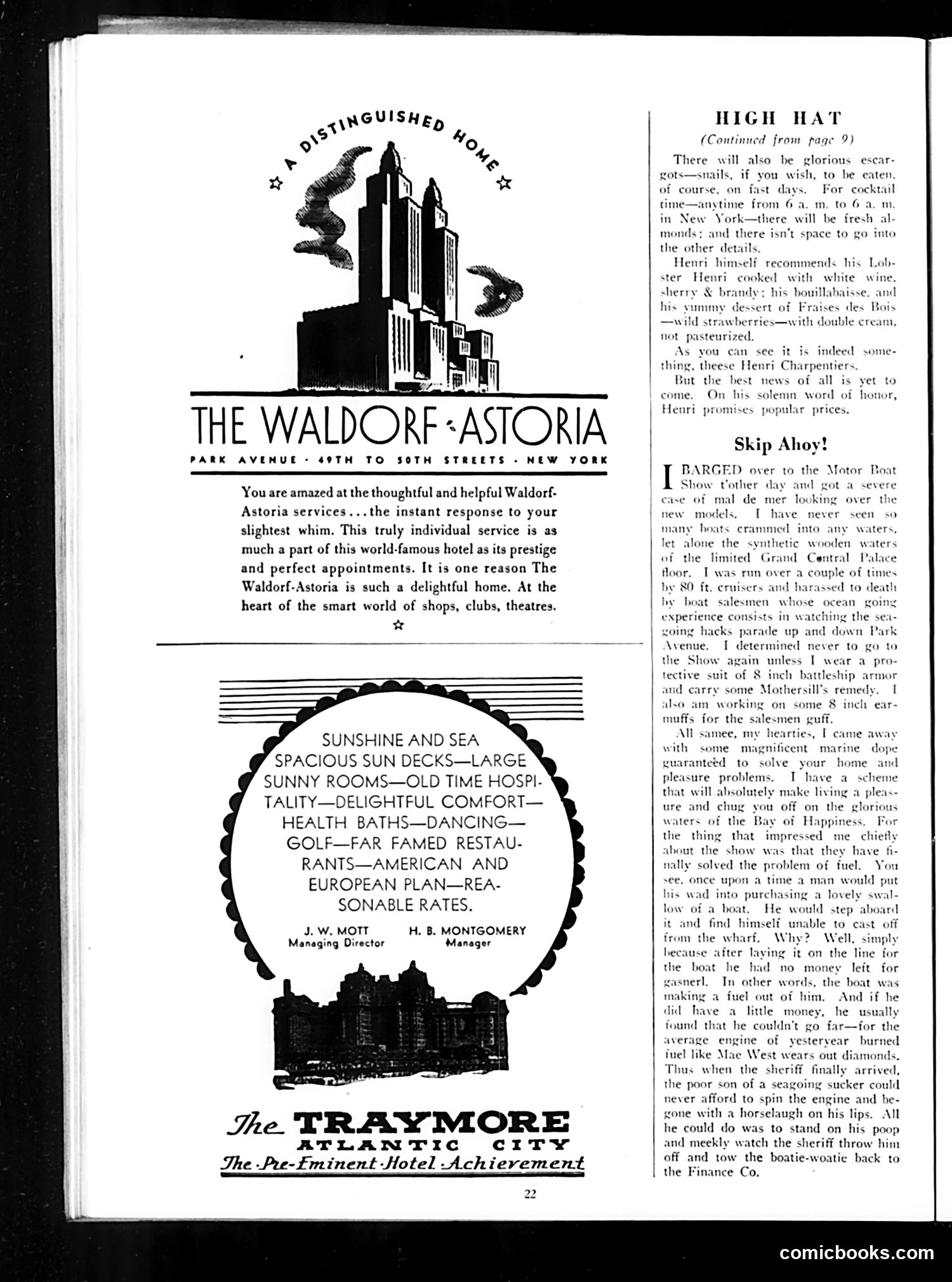
Analysis for Modern Readers This page is primarily advertisements for luxury hotels (Waldorf-Astoria and Traymore), with a humorous column titled "Skip Ahoy!" about attending a motor boat show. The satire concerns boat financing and repossession. The author describes visiting a boat show but being distracted by seasickness from the cramped display. The joke centers on a common economic problem: buyers would spend all their money purchasing a boat, leaving nothing for fuel. The engine would then consume fuel rapidly (compared humorously to "Mae West wears out diamonds"—a reference to the famously glamorous actress known for extravagance). Result: the boat owner couldn't afford to operate the vessel and would have it repossessed by sheriff. The satire targets consumer debt and poor financial planning during what appears to be the prosperous 1920s, when luxury goods were aggressively marketed. The humor suggests the absurdity of owning an expensive boat you cannot afford to use or fuel—a pointed commentary on aspirational spending beyond one's means.
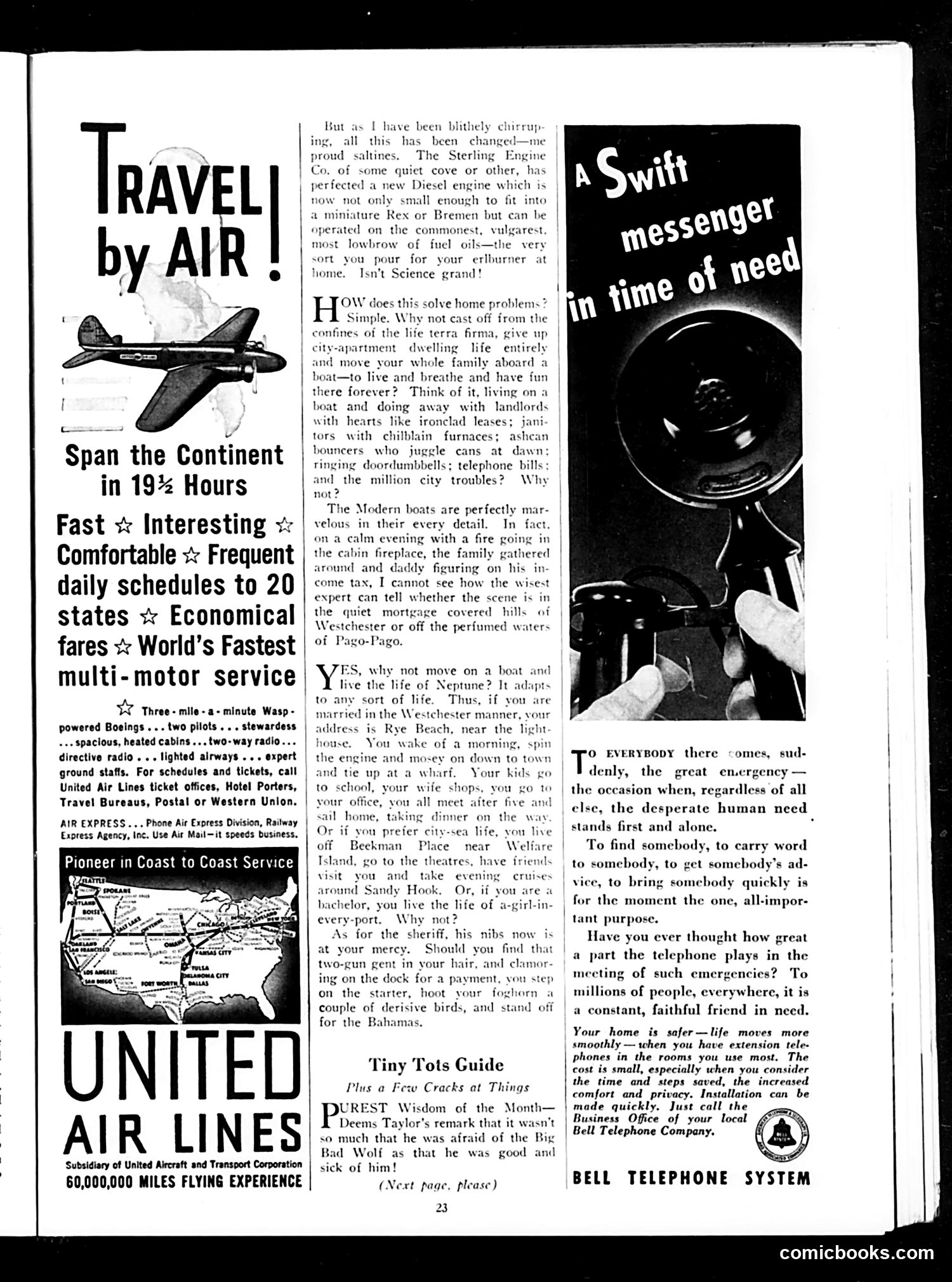
Analysis of Judge Magazine Page This page contains three distinct elements: Left side: A United Air Lines advertisement promoting transcontinental air travel as fast, comfortable, and economical—reflecting 1930s optimism about aviation technology. Center: A humorous essay satirizing the fantasy of escaping urban life by living permanently on a boat. The author mocks the appeal of avoiding landlords, janitors, and city problems, then absurdly suggests this lifestyle could work for anyone—commuters, families, even criminals fleeing sheriffs. The satire targets Depression-era escapism and impractical fantasies about abandoning modern urban existence. Right side: A Bell Telephone System advertisement emphasizing the telephone's role during emergencies and crises, positioning it as essential infrastructure for human connection and safety. The page juxtaposes escapist fantasy (boat living) with practical modernity (air travel, telephones), likely reflecting 1930s anxieties about technology, urbanization, and economic instability while promoting consumer solutions.
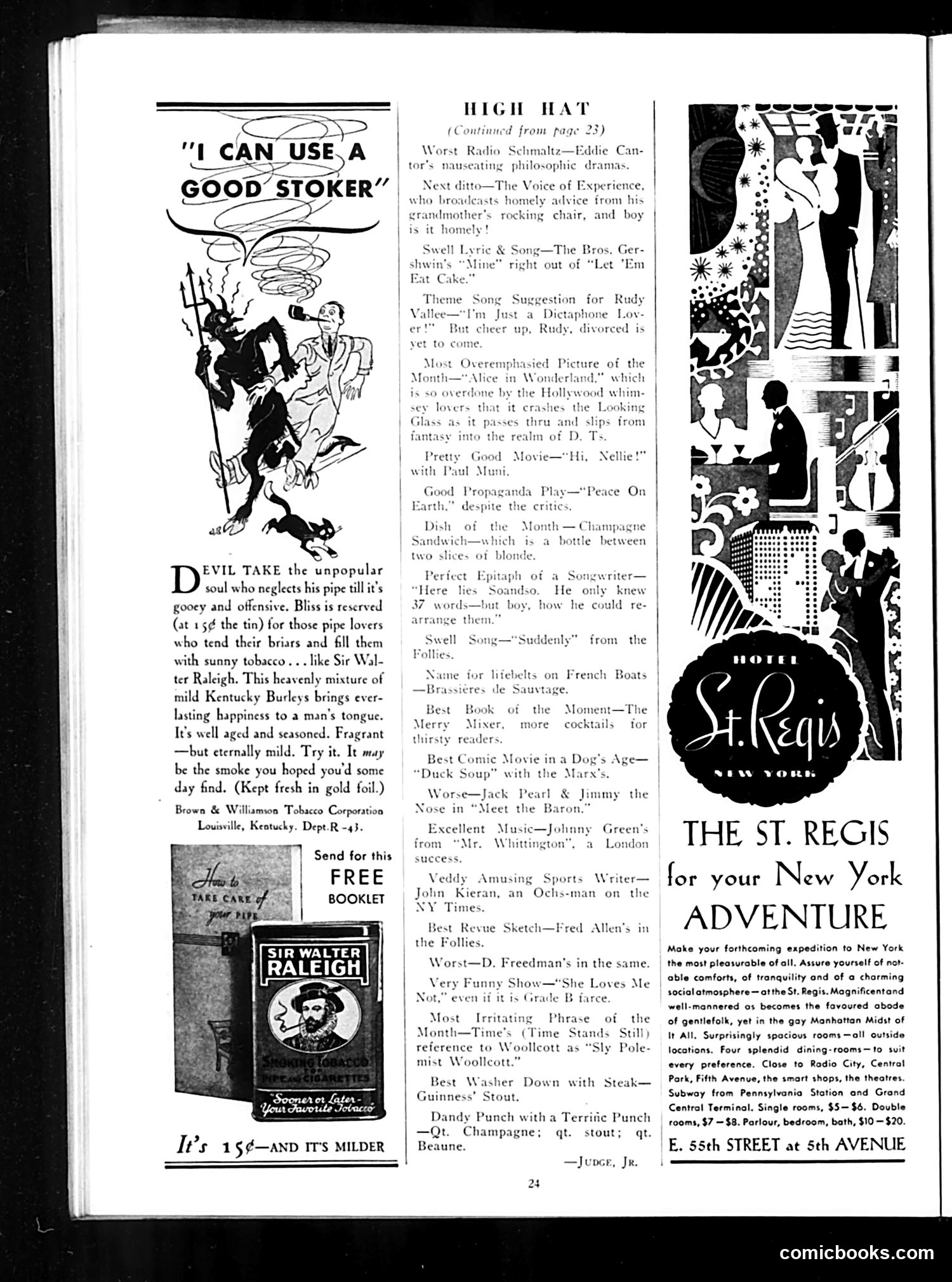
Page Analysis: Judge Magazine This page is primarily advertising and entertainment commentary, not political satire. The left side features a tobacco advertisement for Sir Walter Raleigh pipe tobacco, using the phrase "I Can Use a Good Stoker" as a pun. The ad warns against neglecting pipe maintenance and promotes the product's quality and mildness. Below is a free booklet offer for another tobacco brand. The right side contains "High Hat"—a satirical entertainment column reviewing popular media: radio programs (Eddie Cantor, Rudy Vallée), movies (Alice in Wonderland, Duck Soup), songs, and comedy acts. The critiques are humorous but lightweight: praising some performances, mocking others as overwrought or derivative. References include Johnny Green's music and Fred Allen's comedy sketch. An advertisement for the St. Regis Hotel in New York occupies the lower right, emphasizing luxury accommodations and proximity to Radio City and Fifth Avenue. The page reflects 1930s popular entertainment and consumer culture, with no discernible political commentary.
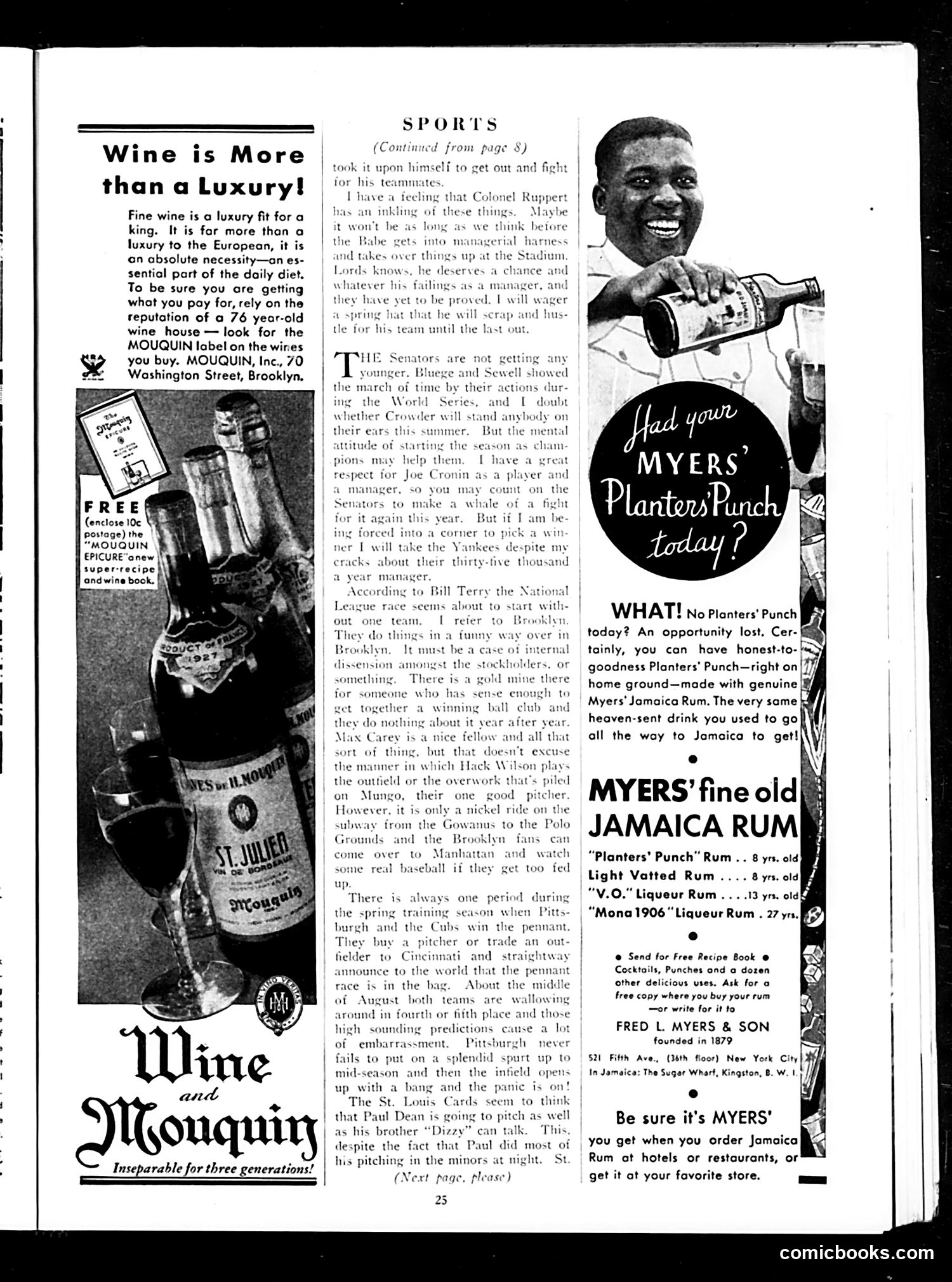
Judge Magazine Page Analysis This page is primarily advertising with a sports column, not political satire. The main content is a sports column (continued from page 8) discussing baseball, mentioning Colonel Ruppert (Yankees owner), Joe Cronin, the Senators, and various teams' prospects. The writer discusses managerial decisions and predicts the Cubs and Pirates may contend, though teams often disappoint by mid-season. Advertisements dominate the page: - A wine advertisement for Mouquin (a 76-year-old Brooklyn wine house) - A large rum advertisement for Myers' Jamaica Rum, featuring a smiling Black man holding a bottle, promoting "Planters' Punch" The rum ad's imagery—the enthusiastic Black figure and the "honest-to-goodness" domestic recreation of a tropical drink—reflects period advertising conventions, though modern readers would recognize the racial stereotyping common to 1930s-40s marketing. There is no political cartoon visible on this page.
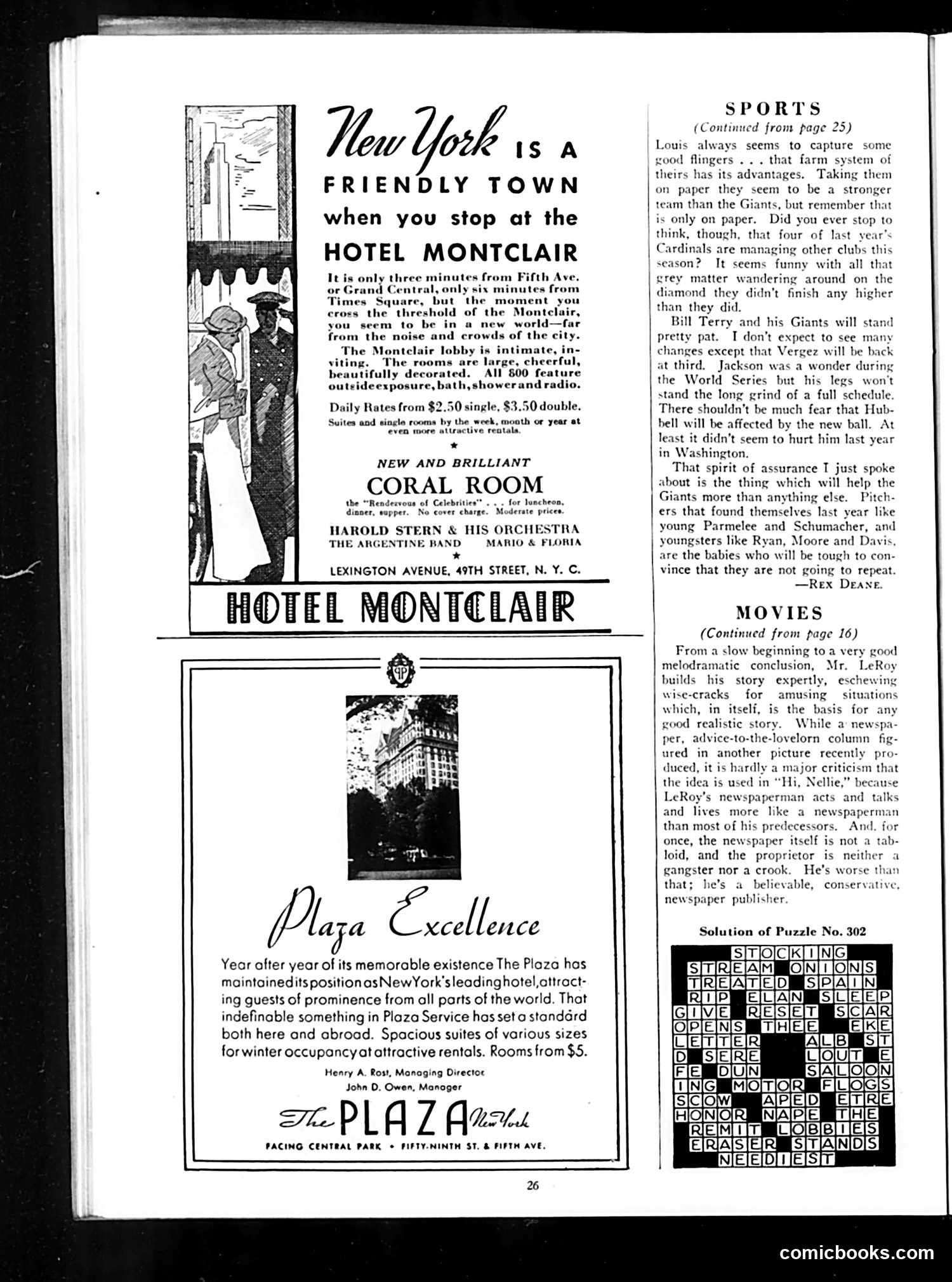
Analysis of Judge Magazine Page 26 This page contains no political cartoons—it's primarily advertising and sports/movies commentary from a 1920s-era magazine. The advertisements promote New York City hotels (Hotel Montclair and The Plaza) and entertainment venues, targeting affluent travelers. The tone reflects the era's luxury hospitality marketing. The "Sports" column discusses baseball, mentioning the Giants and Cardinals. The writer analyzes team composition, suggesting the Giants have stronger morale despite the Cardinals' superior roster "on paper." References to players like Bill Terry and Jackson indicate this covers contemporary 1920s baseball. The "Movies" section reviews a film called "Hi, Nellie," praising its realistic portrayal of a newspaper publisher character—notably *conservative* rather than the stereotypical gangster or crook. This suggests contemporary concern about media representation. A crossword puzzle solution is included—standard magazine filler content. Overall, this is a straightforward magazine page with period advertisements and sports/entertainment coverage, offering little satirical content requiring historical context for modern readers.
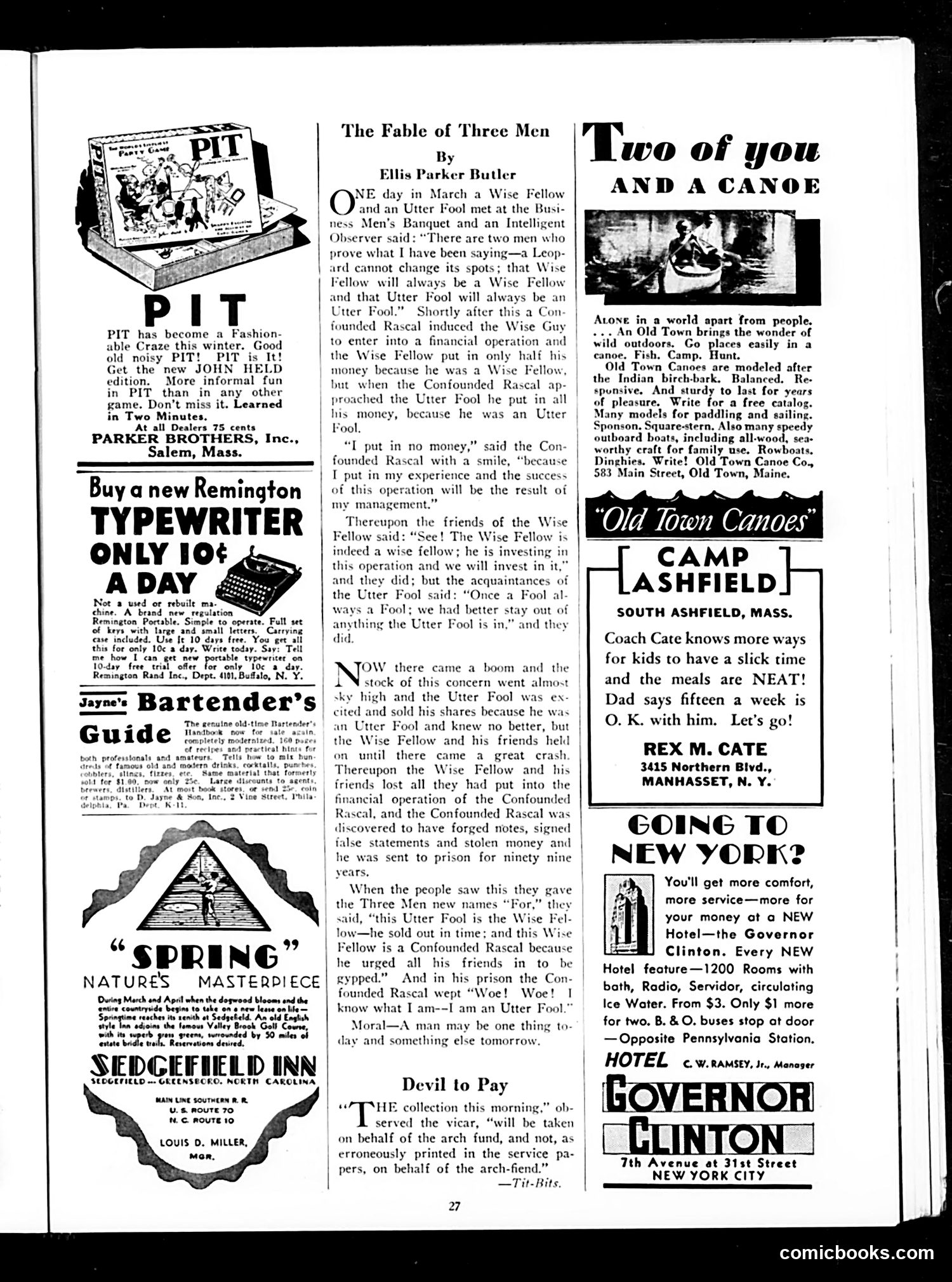
"The Fable of Three Men" by Ellis Parker Butler This is a satirical moral tale about character and financial decision-making. Three archetypes meet in a financial scheme: a Wise Fellow (who invests cautiously), an Utter Fool (who invests everything), and a Confounded Rascal (a con artist who invests nothing but his "experience"). The twist: When the scheme booms, the Fool sells out and profits; when it crashes, the "Wise" Fellow and his followers lose everything. The Rascal is imprisoned for fraud. The satire's point: The public then renames them—calling the Fool wise for his timing and the Wise Fellow a rascal for misleading others. The moral undercuts conventional wisdom: mere cleverness doesn't guarantee success; luck and instinct sometimes beat caution. For 1920s readers, this likely critiqued overconfidence in "smart money" during the pre-crash economic boom—suggesting that even supposed wisdom couldn't protect against market volatility or fraud.
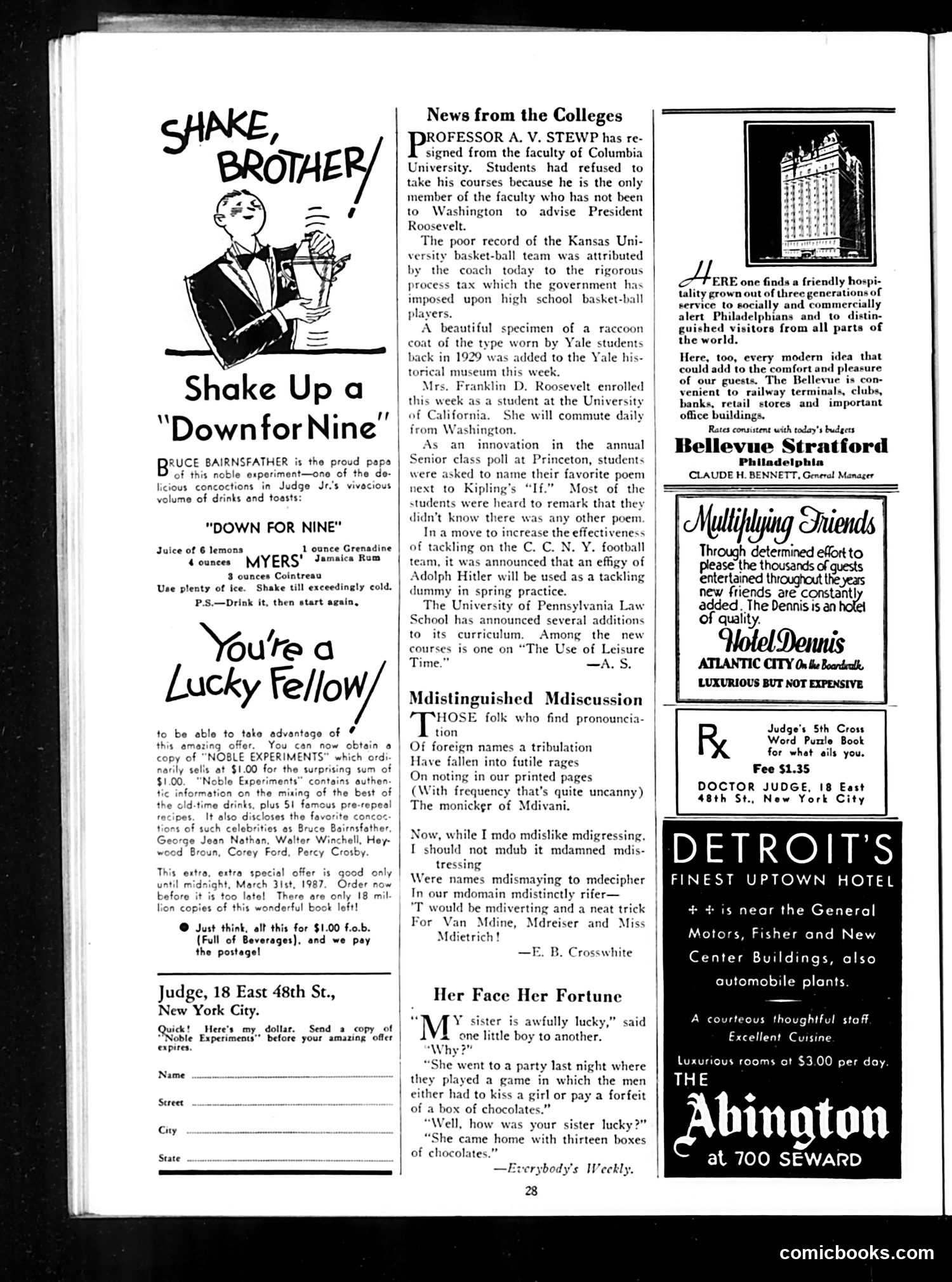
Judge Magazine Page Analysis This page from *Judge* (a satirical American magazine) contains several layers of 1930s humor: Main Cartoon: The "Shake Up a Down for Nine" features Bruce Bairnsfather promoting a cocktail recipe—likely satirizing Prohibition's end (1933) and the era's cocktail culture obsession. College News Section: The satire targets Depression-era absurdities: - A Columbia professor resigned because he hadn't visited Washington to advise FDR (mocking New Deal worship) - Kansas blamed basketball losses on "process tax" on high school players (unclear reference, possibly fictional) - Yale's raccoon coat in a museum (mocking 1920s nostalgia) - Eleanor Roosevelt as a UC student commuting from Washington (absurdist exaggeration) - Using Hitler effigies for football tackling practice (dark 1930s humor about rising fascism) "Distinguished Mdiscussion": Mocks the magazine's repeated misspelling of foreign names (Mdivani, Van Mdine, Dreiser, Dietrich), playfully suggesting it's a deliberate "mdomain mdistinctly rifer" with errors. The humor assumes readers recognize contemporary political figures and current events.
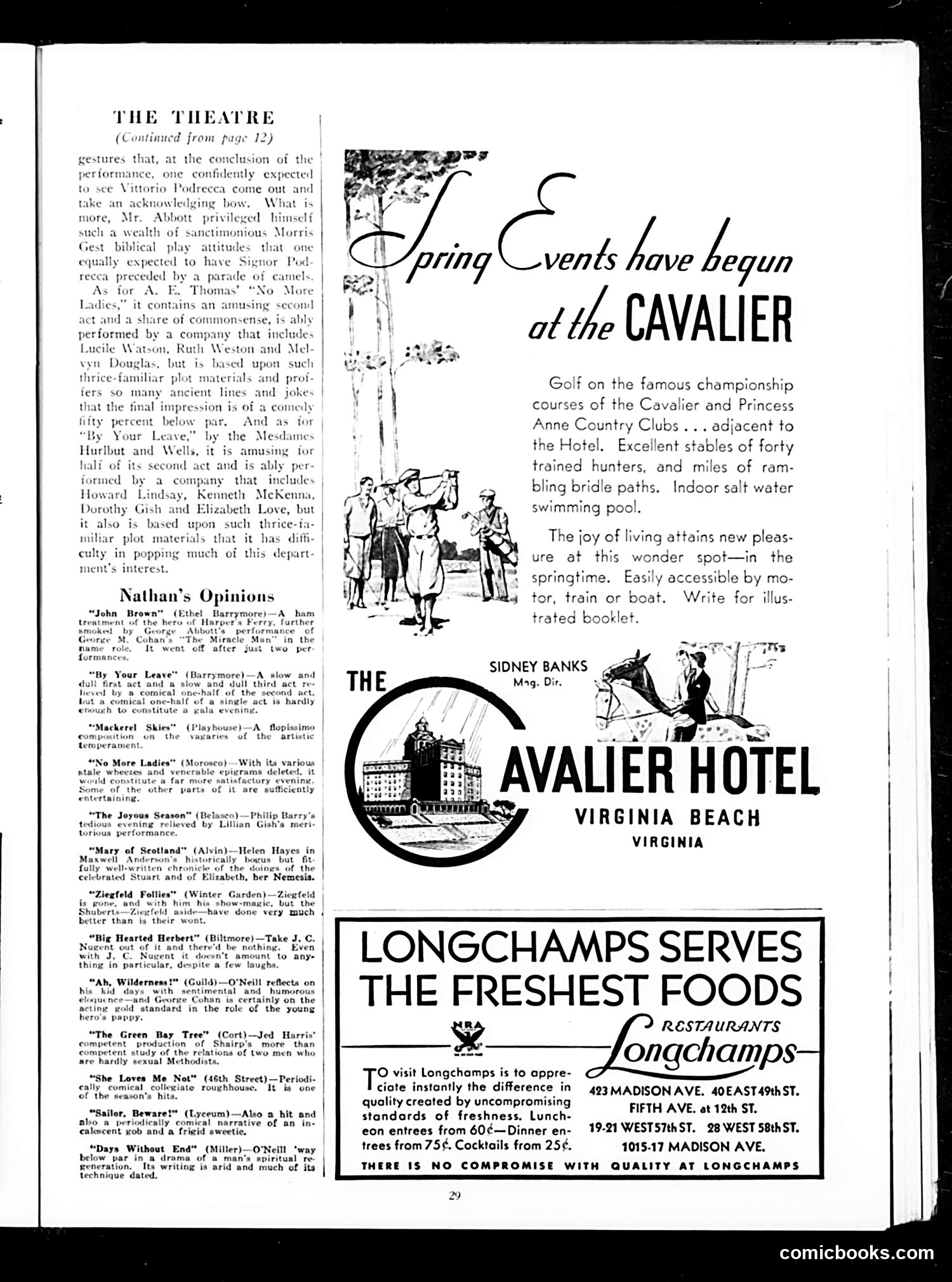
Analysis of Judge Magazine Page This page is primarily advertising and theatre reviews, not political satire or editorial cartooning. The upper section contains theatrical criticism reviewing Broadway shows of the era (titles like "By Your Leave," "No More Ladies," "Mary of Scotland"). The reviews are standard theatre commentary assessing performances and plot quality. The lower half features commercial advertisements: the Cavalier Hotel in Virginia Beach promoting spring activities (golf, horseback riding, swimming), and Longchamps restaurants advertising affordable dining in New York City. The small illustrations accompanying ads show typical leisure activities of the period—people golfing, riding horses, dining—meant to appeal to middle and upper-class readers. No political satire or social commentary is present. This appears to be a standard magazine page mixing entertainment coverage with paid advertising, representative of Judge's format during this era (likely 1930s based on styling and referenced Broadway productions).
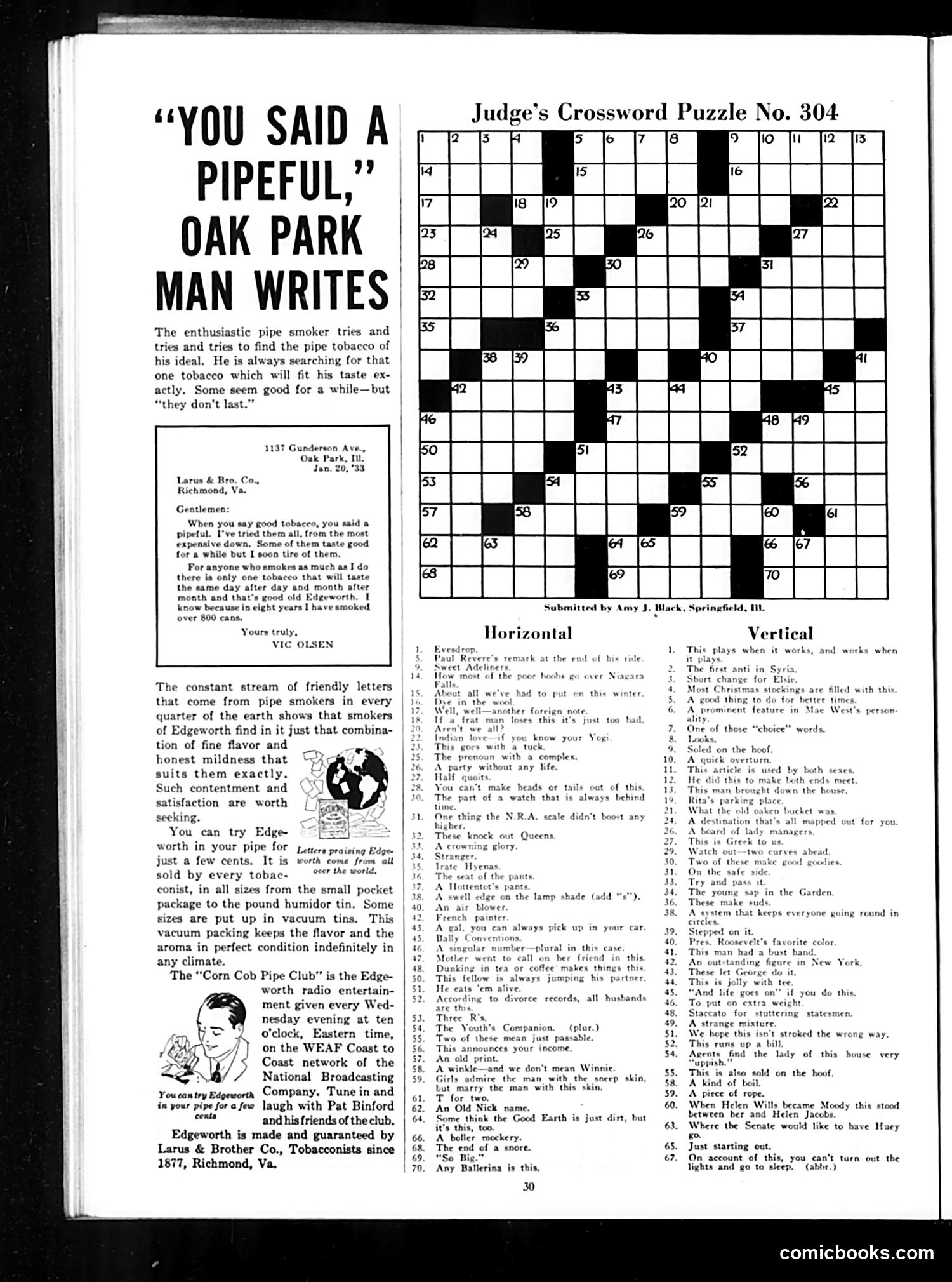
Judge Magazine Page Analysis This page is primarily advertising for Edgeworth pipe tobacco, disguised as editorial content. The "Oak Park Man Writes" framing presents a customer testimonial from "Vic Olsen," who claims to have smoked over 800 cans of Edgeworth in eight years, praising its consistent quality. The satire here is gentle: Judge is gently mocking the obsessive pipe smoker—a figure who endlessly searches for the "perfect" tobacco, trying brand after brand. The humor lies in presenting this compulsive behavior as relatable and noble ("Such contentment and satisfaction are worth seeking"), while subtly ridiculing the pipe smoker's particular anxiety about finding consistency. The rest of the page contains a crossword puzzle and advertising copy for Edgeworth's radio show, "The Corn Cob Pipe Club." This was a common 1920s-30s advertising strategy: combining entertainment (radio) with product promotion. There are no identifiable political figures or major social commentary—this is simply commercial content packaged as a magazine feature.
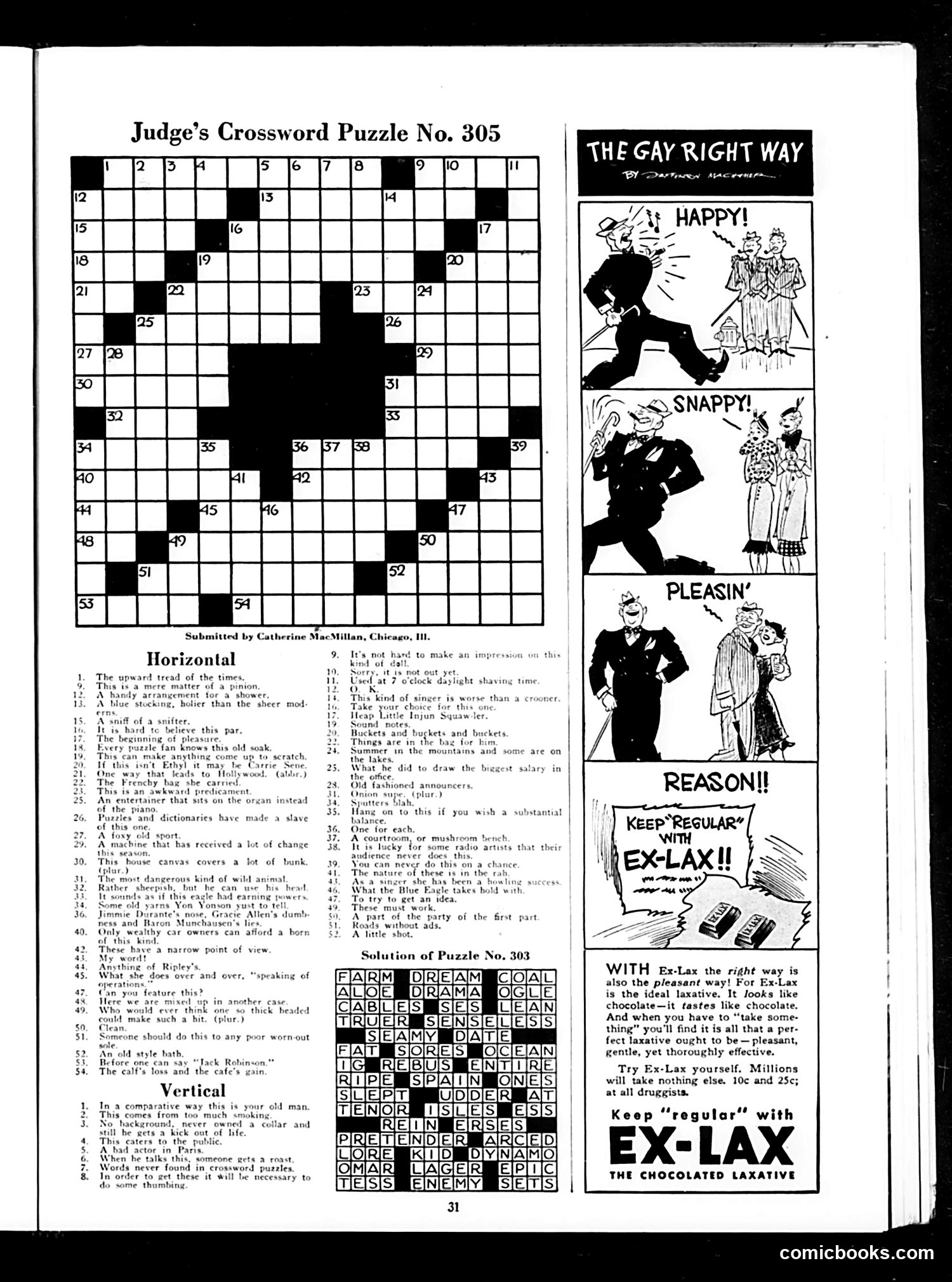
Analysis of Judge Magazine Page This page is primarily a crossword puzzle with advertisements, not political satire. The main content is "Judge's Crossword Puzzle No. 305" submitted by Catherine MacMillan of Chicago—a standard puzzle feature with horizontal and clues referencing wordplay and general knowledge. The cartoon strip titled "The Gay Right Way" (by Darrin Moretti) is actually an advertisement for Ex-Lax laxative. The three panels show a man in a suit displaying exaggerated cheerfulness ("Happy!", "Snappy!", "Pleasin'") before a couple, illustrating the product's promised benefits. "Gay" here means happy/cheerful, a common usage before mid-20th century. The bottom right features another Ex-Lax ad emphasizing the laxative tastes like chocolate and promoting regularity. This is not political satire but rather a typical magazine page mixing entertainment (puzzles, comics) with pharmaceutical advertising—common in vintage publications.
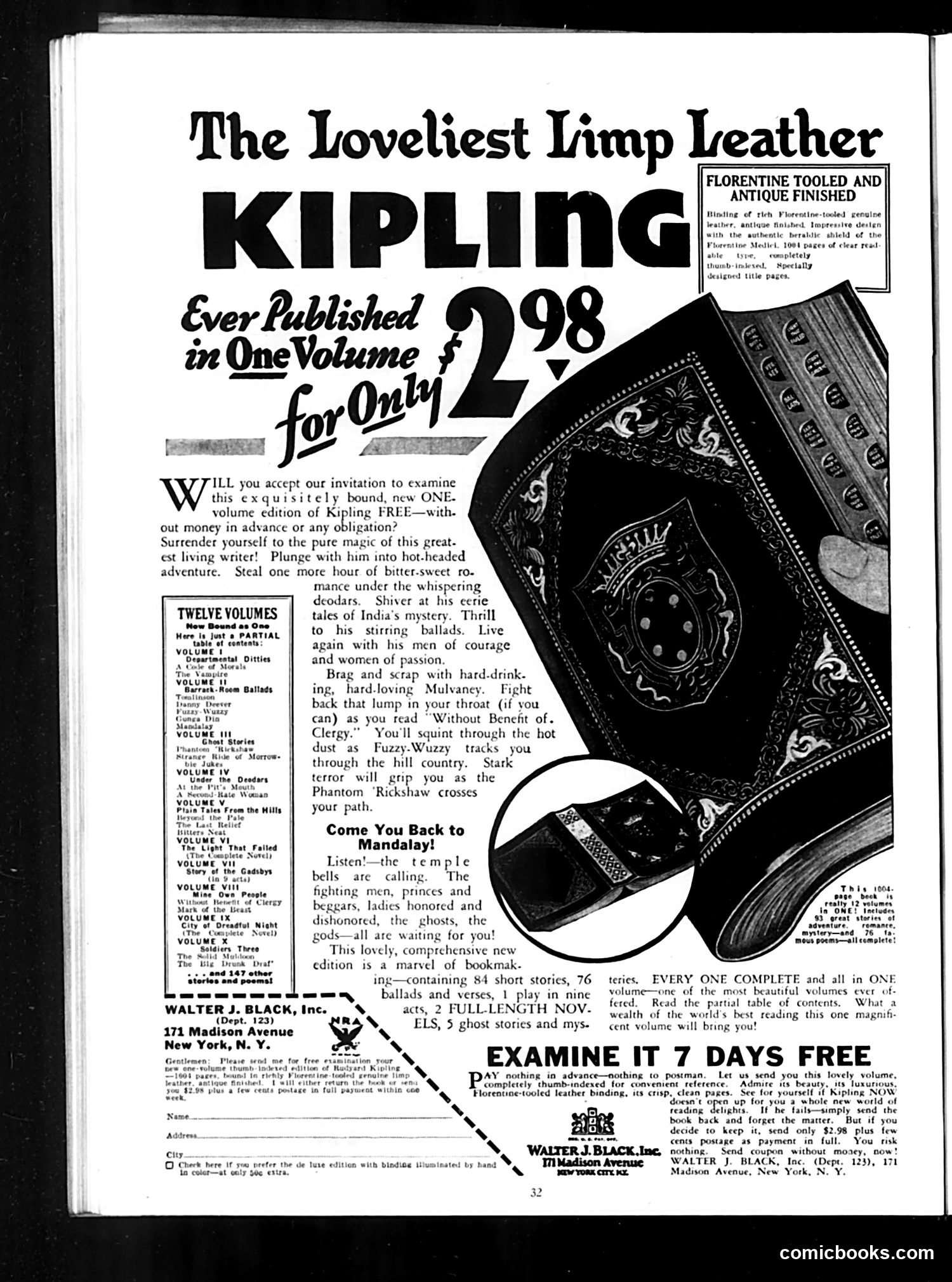
Explanation for Modern Readers This is not a cartoon or satire—it's a full-page advertisement for a single-volume collected edition of Rudyard Kipling's works, published by Walter J. Black, Inc. The ad sells an ornate leather-bound book for $2.98 (examining it free for 7 days first). It emphasizes the luxurious "Florentine tooled and antique finished" binding and appeals to readers' emotions by invoking Kipling's famous works set in India: *"Without Benefit of Clergy,"* *"Fuzzy-Wuzzy,"* and *"Mandalay."* The decorative leather book images shown are the actual product being sold. The left sidebar lists contents: 12 volumes' worth of material compressed into one, including short stories, ballads, verses, plays, and novels. This appears typical of *Judge* magazine advertising from this era—luxury goods marketed to educated, prosperous readers through emotional appeals to literary taste and adventure.
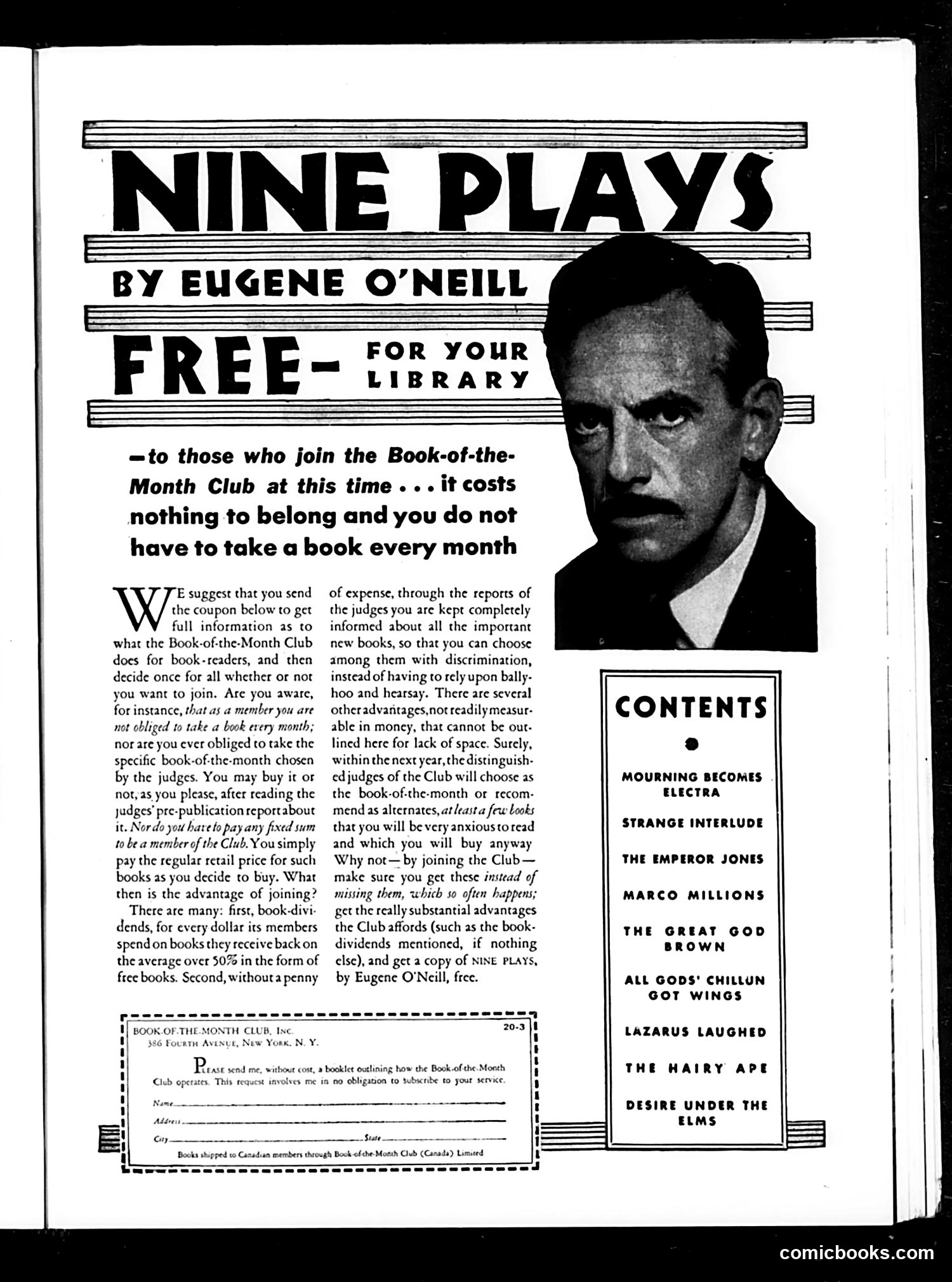
Analysis This is an advertisement, not a cartoon. It promotes the Book-of-the-Month Club, offering a free collection of nine plays by Eugene O'Neill as an incentive to join. The page features a portrait photograph of O'Neill himself—identifiable as the acclaimed American dramatist whose modernist works are listed in the "Contents" box. The ad targets educated readers by emphasizing the club's practical benefits: no mandatory monthly purchases, book dividends (50% return value in free books), and expert curation without "ballyhoo and hearsay." For modern readers, the significance lies in understanding how literary subscription services marketed themselves in this era—appealing to middle-class intellectuals through prestigious authors and democratic language about access to culture. O'Neill's status as a major American playwright (he won the Nobel Prize in 1936) made his complete works a valuable recruiting tool for the club's membership drive.
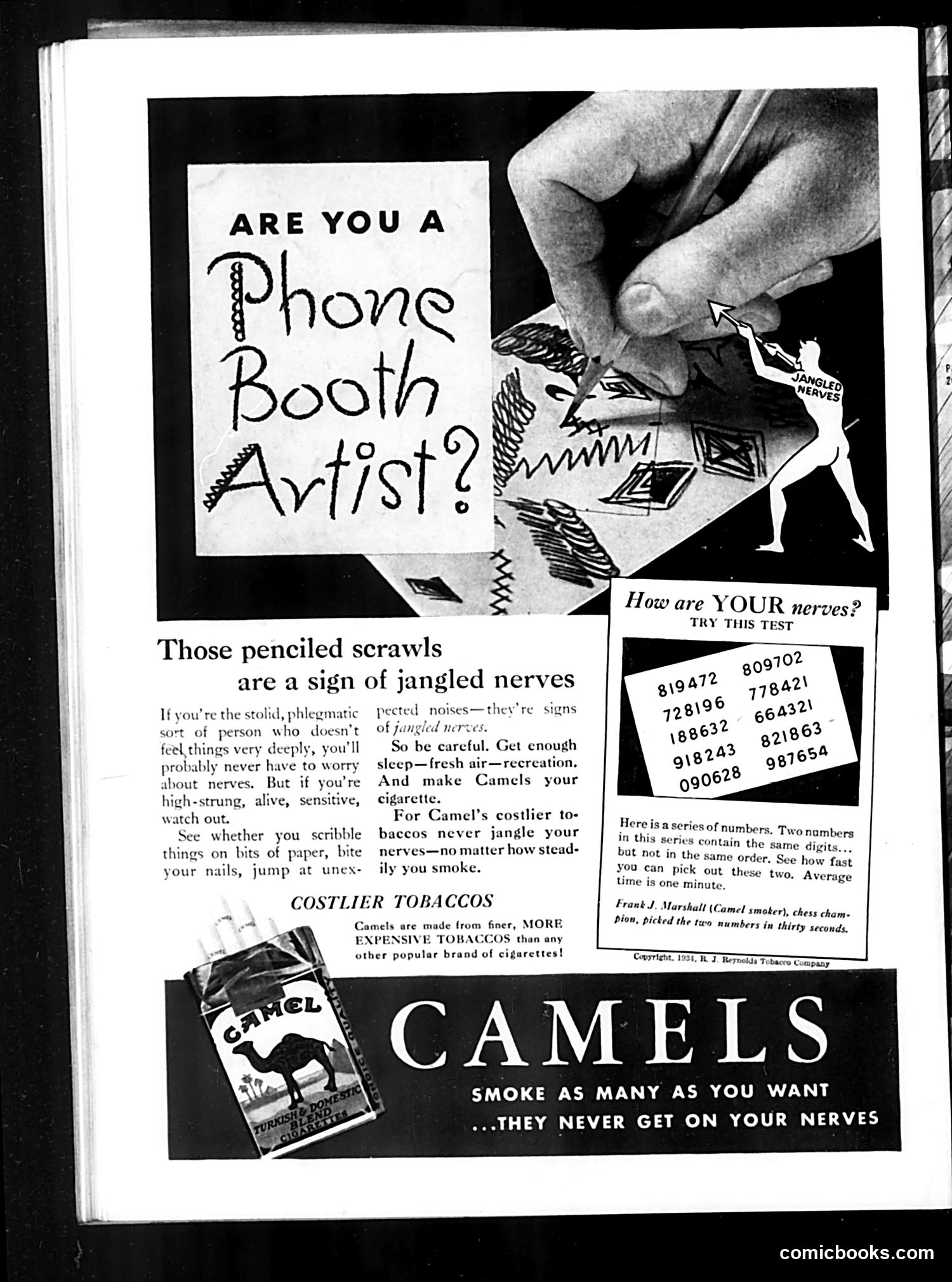
Analysis of Camel Cigarettes Advertisement This is a 1931 Camel cigarettes advertisement disguised as health advice. The ad addresses "jangled nerves"—a period term for anxiety and nervousness—by claiming that nervous, sensitive people should smoke Camels because the "costlier tobaccos" won't aggravate their condition. The "phone booth artist" reference mocks people who nervously doodle, bite nails, or fidget. The accompanying "nerve test" (finding matching number pairs) serves as pseudo-scientific credibility, even featuring chess champion Frank Marshall as endorsement. The core pitch is absurd by modern standards: smoking actually *causes* nervousness, yet the ad claims Camels prevent it. This reflects 1930s tobacco marketing that made false health claims before regulations prohibited them. The advertisement exploits contemporary anxiety about mental health to sell cigarettes as a cure.