judge
Judge — April 1934
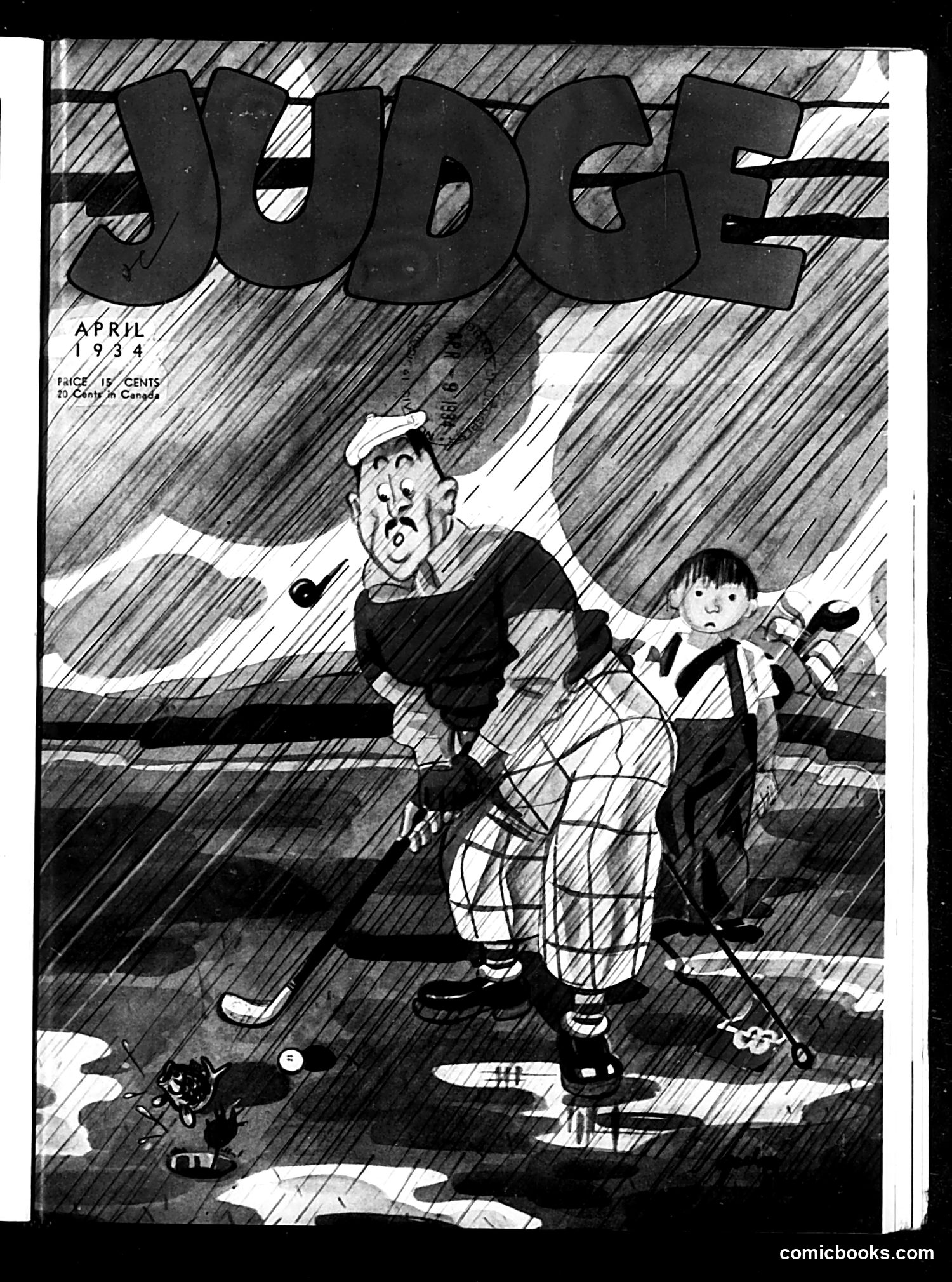
Judge Magazine, April 1934 This cover depicts an adult and child caught in heavy rain, both appearing distressed and poorly clothed. The figure appears to be a working-class father struggling to protect his child from the downpour. Given the April 1934 date, this likely satirizes economic hardship during the Great Depression. The imagery suggests commentary on poverty and the plight of families unable to afford adequate shelter or clothing during this period. The "JUDGE" masthead indicates this is satirical commentary rather than straightforward news. The exaggerated, somewhat crude rendering of the figures' expressions emphasizes the desperation of their situation—a common editorial approach in Depression-era humor magazines that used comedy to address social suffering and critique economic conditions.
Analysis This page is primarily advertising, not political satire. It promotes Schenley liquors and their "Mark of Merit" guarantee seal. The decorative emblem at the top—a starburst with ribbon banner—serves as the company's quality mark. The text instructs consumers to look for this mark on bottle necks as assurance of product quality from "the house of Schenley." The bottom line calls the Schenley mark "your unfailing guide," positioning it as a trusted indicator in an era when product regulation was limited and brand reputation mattered significantly for consumer confidence. This represents straightforward brand marketing rather than satirical commentary. The page demonstrates how Judge magazine, like most publications of its era, carried commercial advertisements alongside editorial content.
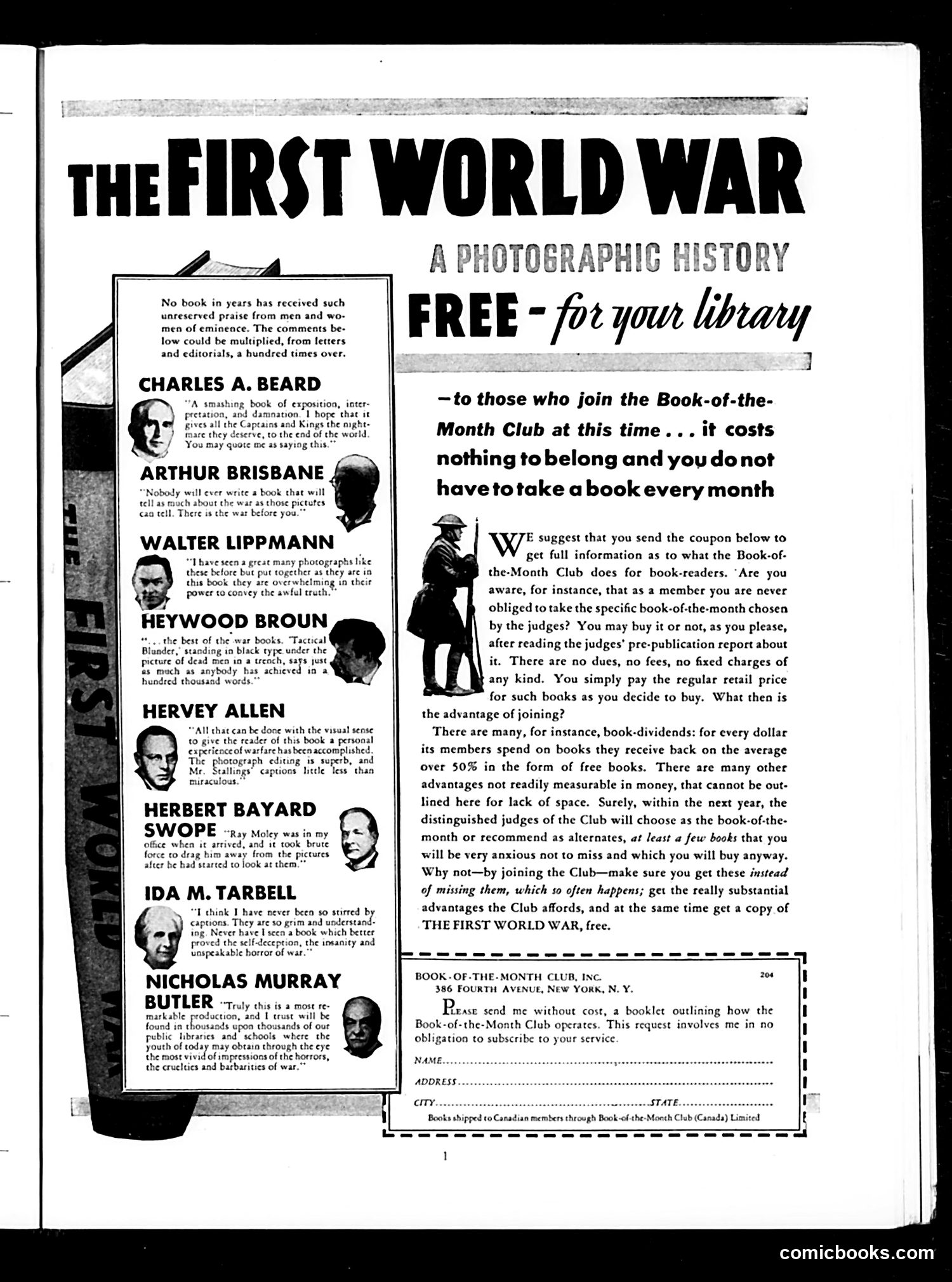
Content Analysis This page is primarily advertising, not satire or cartoon commentary. It promotes "The First World War: A Photographic History" as a free gift for joining the Book-of-the-Month Club. The left side features testimonials from notable figures endorsing the book's value—including Charles A. Beard, Arthur Brisbane, Walter Lippmann, Heywood Broun, and others. Their quotes praise the book's photographic documentation of WWI's reality and historical importance. The right side explains the Book-of-the-Month Club's membership benefits: members receive free books (over 50% value in giveaways), pay only for selections they choose, and face no subscription obligation. The image shows a soldier in military uniform—likely representing WWI troops—reinforcing the book's war subject matter. This is a commercial appeal to readers, not political satire.
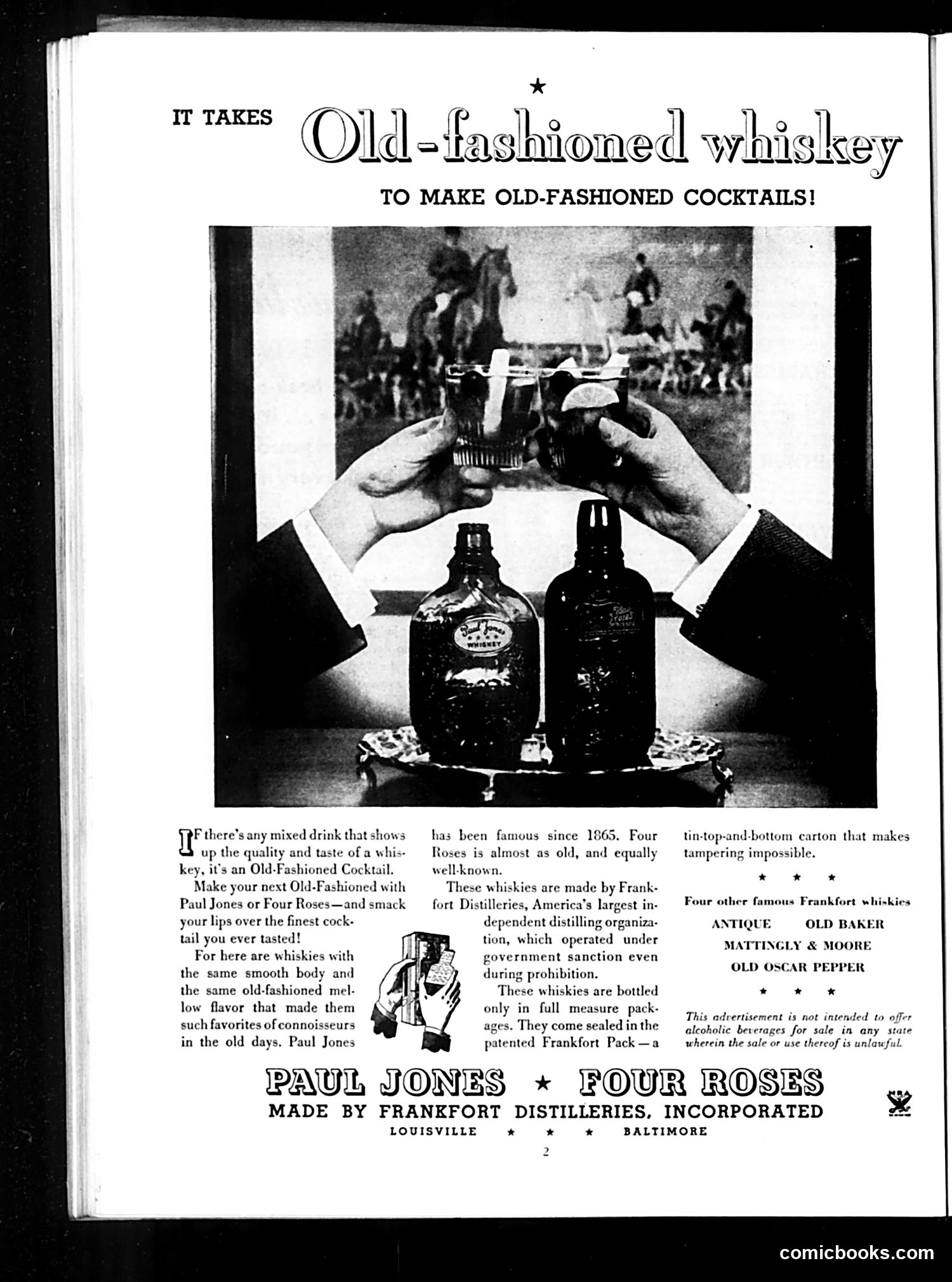
Analysis This page is primarily an advertisement, not satire or political commentary. It promotes Paul Jones and Four Roses whiskeys made by Frankfort Distilleries (Louisville and Baltimore). The ad emphasizes that these are old, established whiskey brands (Paul Jones since 1865, Four Roses "almost as old") suitable for making Old Fashioned cocktails. The image shows hands holding cocktail glasses with whiskey bottles displayed below. The disclaimer at bottom—"This advertisement is not intended to offer alcoholic beverages for sale in any state wherein the sale or use thereof is unlawful"—suggests this ran during Prohibition or its aftermath, when alcohol sales were restricted or recently legalized. The ad's focus on quality heritage and proper packaging reflects post-Prohibition marketing strategies.
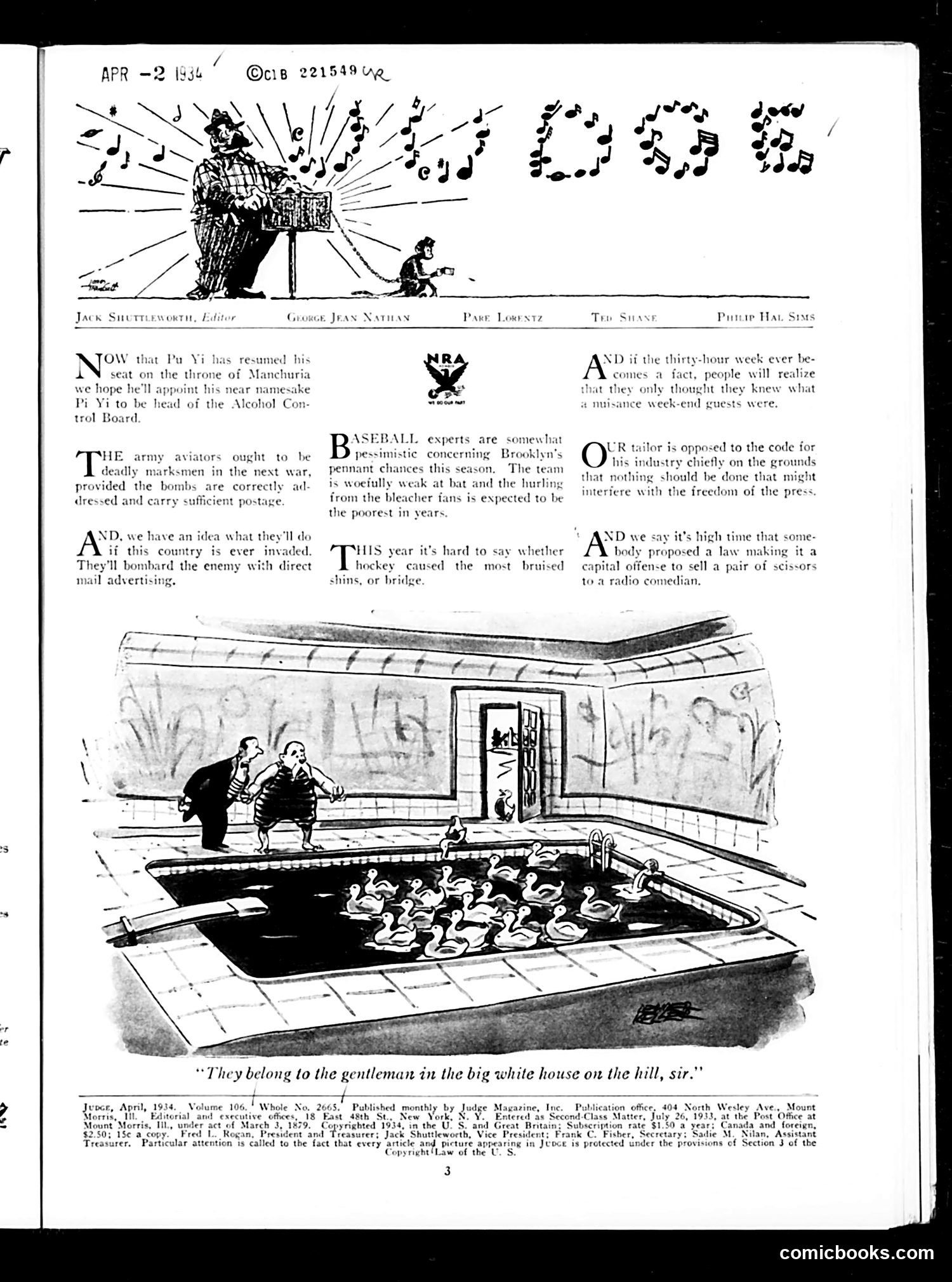
Judge Magazine, April 1934 - Satire & Cartoon Analysis The page contains several brief satirical columns about current events, plus one prominent cartoon at the bottom. The Cartoon: Two men in suits stand beside an indoor swimming pool filled with ducks. The caption reads: "They belong to the gentleman in the big white house on the hill, sir." This is a joke about President Franklin D. Roosevelt at the White House, likely satirizing either his New Deal programs or his personal wealth/resources during the Depression era. The Text: Brief commentaries mock: - Pa Xi's (unclear reference) appointment to the Alcohol Control Board - Army aviators' bombing capabilities - Brooklyn's weak baseball team - Hockey injuries - A proposed law allowing scissors sales to comedians (absurdist humor) The overall tone is light political satire typical of 1930s American humor magazines.
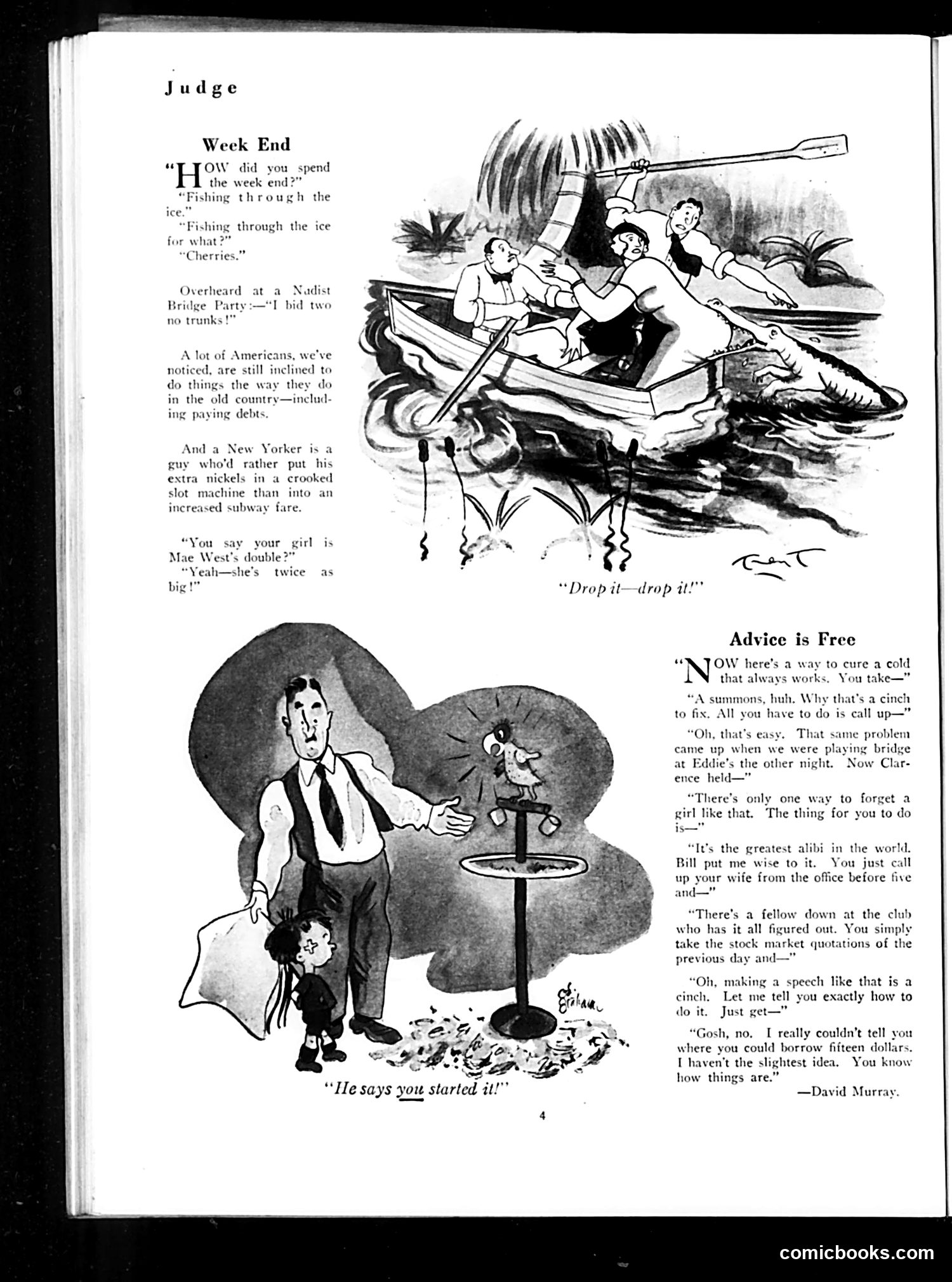
Judge Magazine Page Analysis This page contains two humor pieces satirizing American social behavior: "Week End" mocks outdated leisure activities—particularly ice fishing for cherries, a nonsensical pursuit. The joke appears to reference how Americans cling to old-fashioned pastimes. A secondary joke references a "Nudist Bridge Party" where someone "bid two no trumps," playing on the double entendre of "no trunks" (clothing). "Advice is Free" satirizes male excuses for infidelity. A man blames a cold on his wife's "Mae West" physique (referencing the famous actress known for curvaceous appearance), then receives increasingly absurd advice about forgetting her—culminating in the suggestion to check stock market quotes or borrow money from the club. Both pieces mock masculine behavior and relationships during the interwar period.
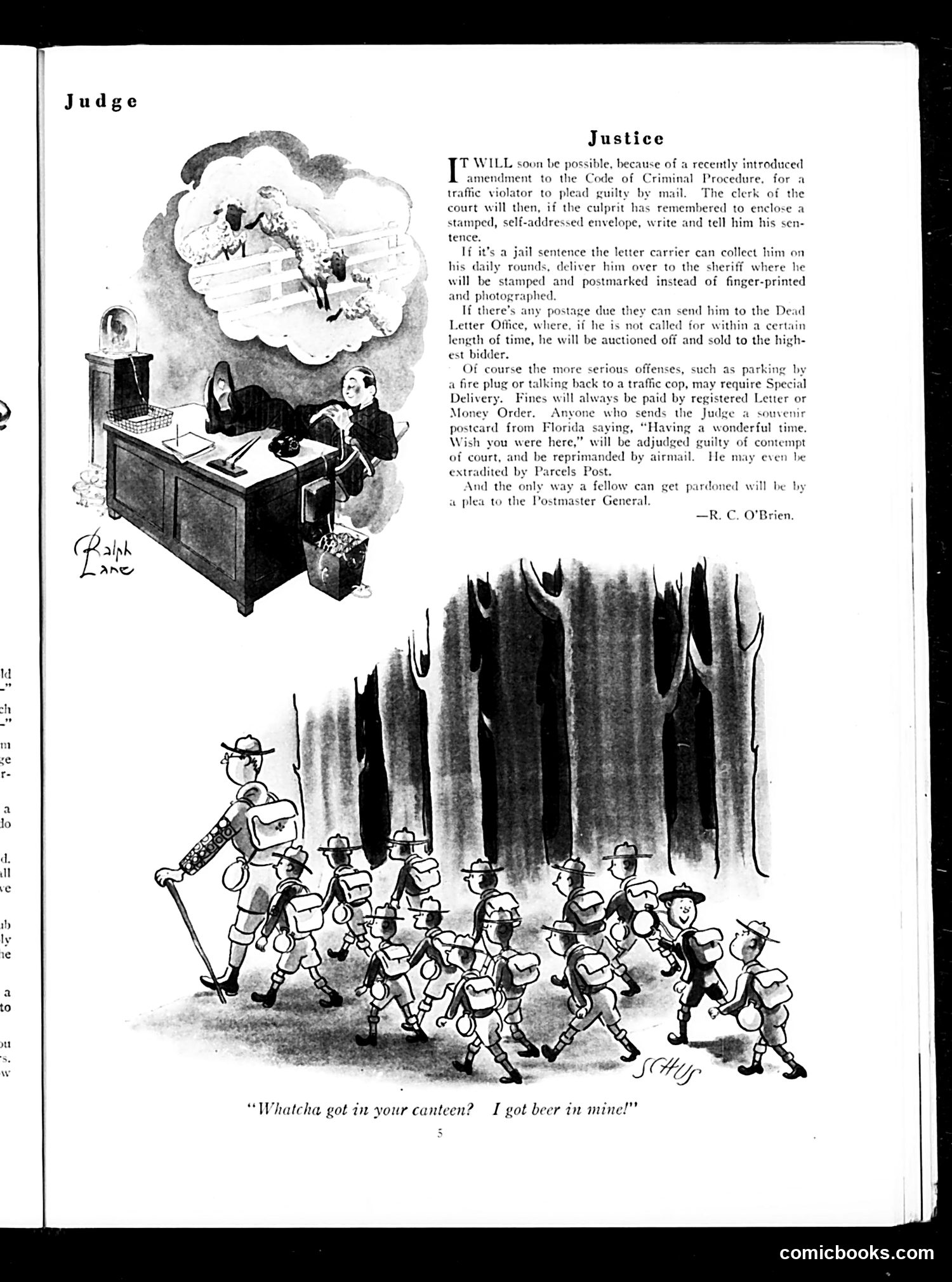
Analysis The top cartoon by Ralph Barton depicts a judge at his desk receiving mail—satirizing a proposed amendment to the Code of Criminal Procedure allowing guilty pleas by mail. The humor imagines absurd consequences: jail sentences delivered by stamped envelope, traffic fines via registered letter, and even convicted criminals pleading to the Postmaster General for pardons. The bottom cartoon by Cesare shows soldiers in a forest with the caption "Whatcha got in your canteen? I got beer in mine!" This appears to reference Prohibition-era enforcement, likely satirizing soldiers during WWI or the subsequent "dry" period, contrasting official military rules against alcohol with soldiers' actual behavior—a common Judge magazine joke theme.
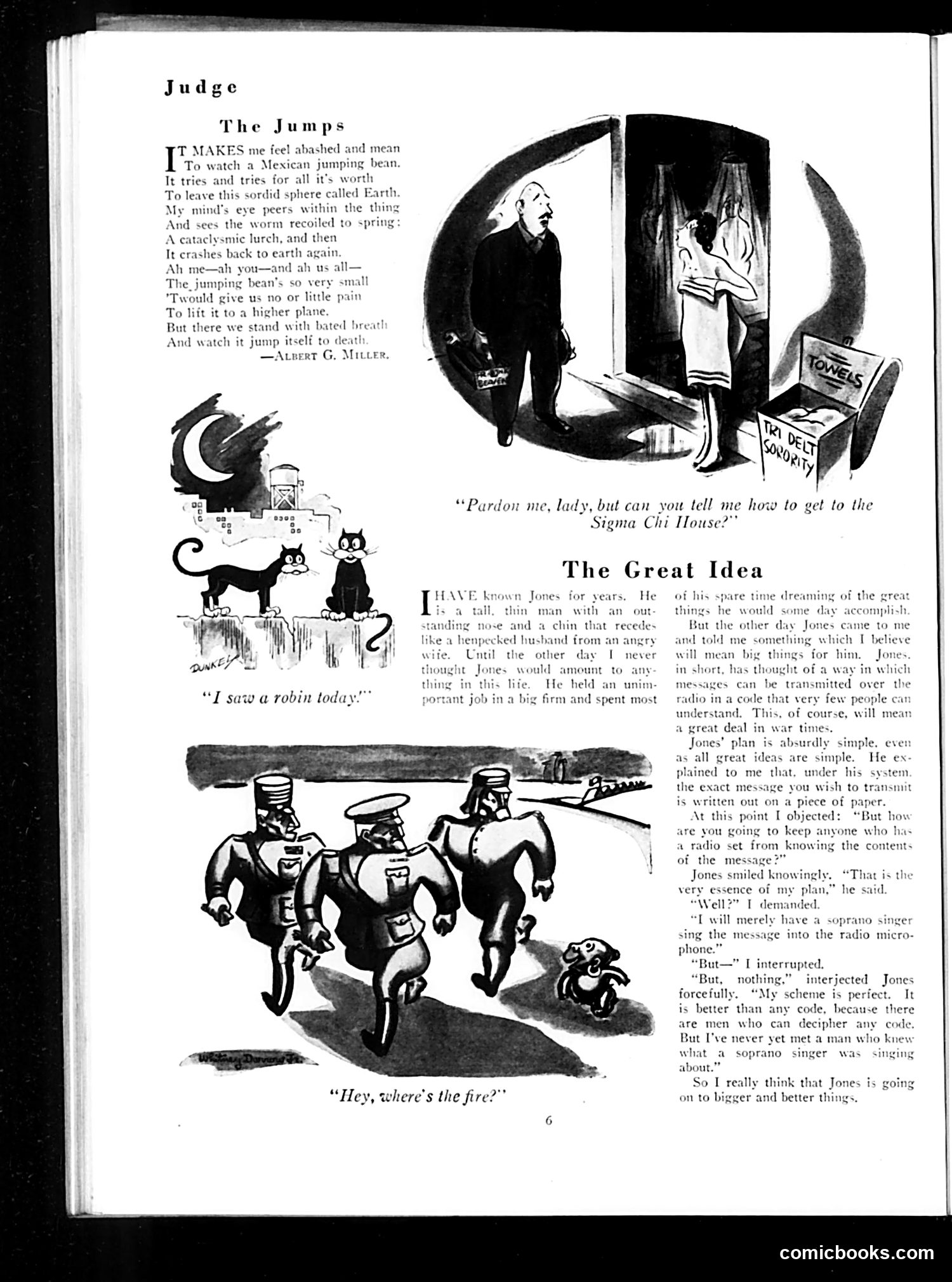
Judge Magazine Page Analysis This page contains three distinct pieces: "The Jumps" (top): A poem by Albert G. Miller mocking someone's anxious state—watching a "Mexican jumping bean" that repeatedly "springs" and crashes. The metaphor satirizes nervous fidgeting or anxiety, likely about some contemporary concern. "I saw a robin today!" (middle): A cartoon showing two black cats observing a robin, with deadpan commentary—a simple visual gag about cats' predatory interest. "The Great Idea" (right): A prose piece describing Jones's scheme to transmit secret wartime radio messages by having a soprano singer encode them into song lyrics, believing no one will decipher music-hidden content. The narrator questions the plan's security, but Jones confidently argues people won't suspect a soprano knows anything meaningful. The satire mocks overconfidence in a simplistic "clever" wartime scheme.
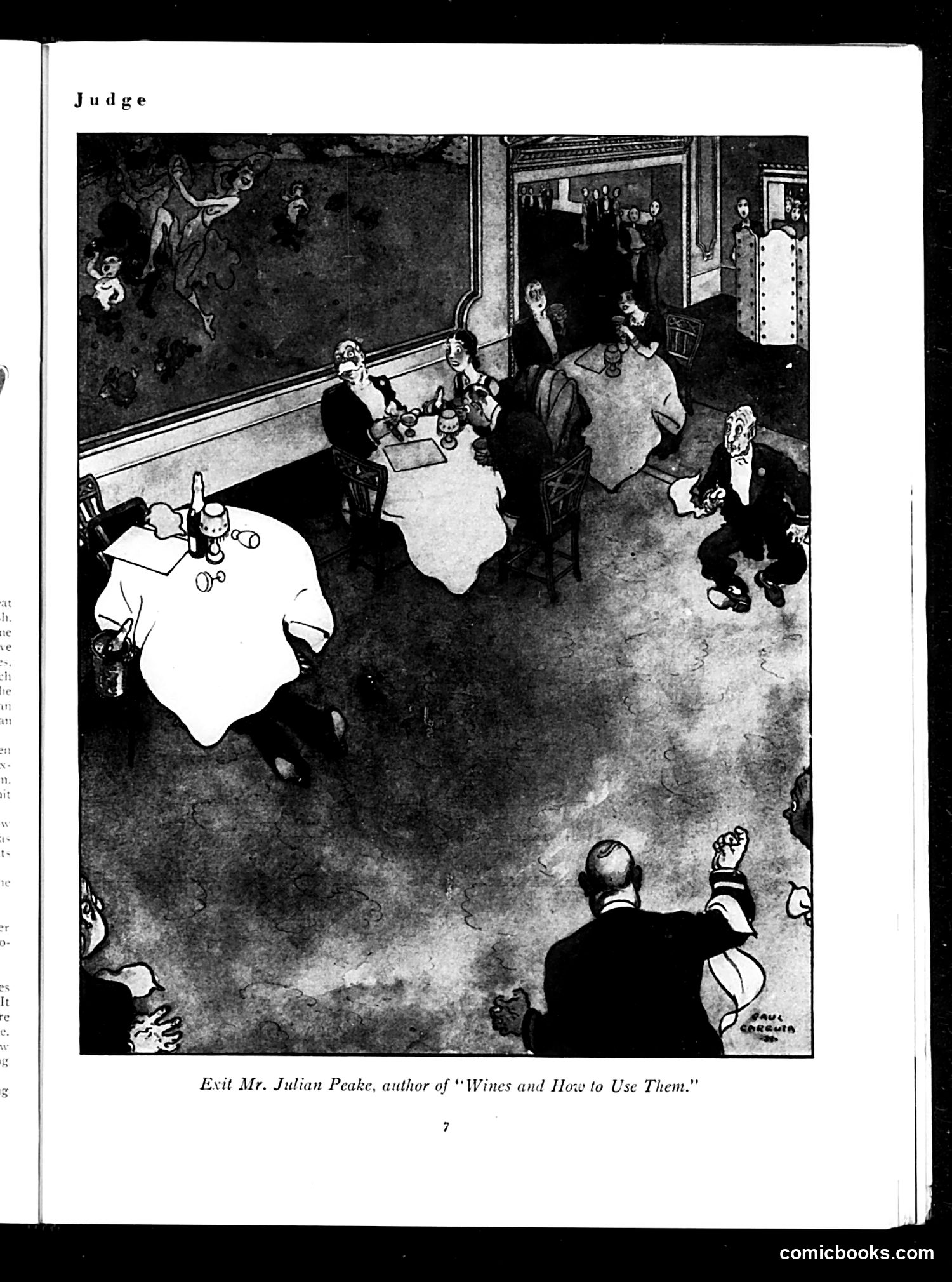
Analysis This page from *Judge* magazine shows a satirical cartoon titled "Exit Mr. Julian Peake, author of 'Wines and How to Use Them.'" The caption indicates the cartoon depicts Mr. Julian Peake leaving what appears to be an upscale social gathering or restaurant. The bird's-eye perspective shows well-dressed figures in an interior space with a round table in the foreground and various guests throughout the room. The satire likely mocks Peake through ironic reference to his book about wine consumption. The "exit" framing suggests either his embarrassing departure from the scene or his removal from polite society—implying his actual behavior contradicted his expertise or authority on refined wine etiquette. The cartoon ridicules the gap between someone's claimed sophistication and their actual conduct.
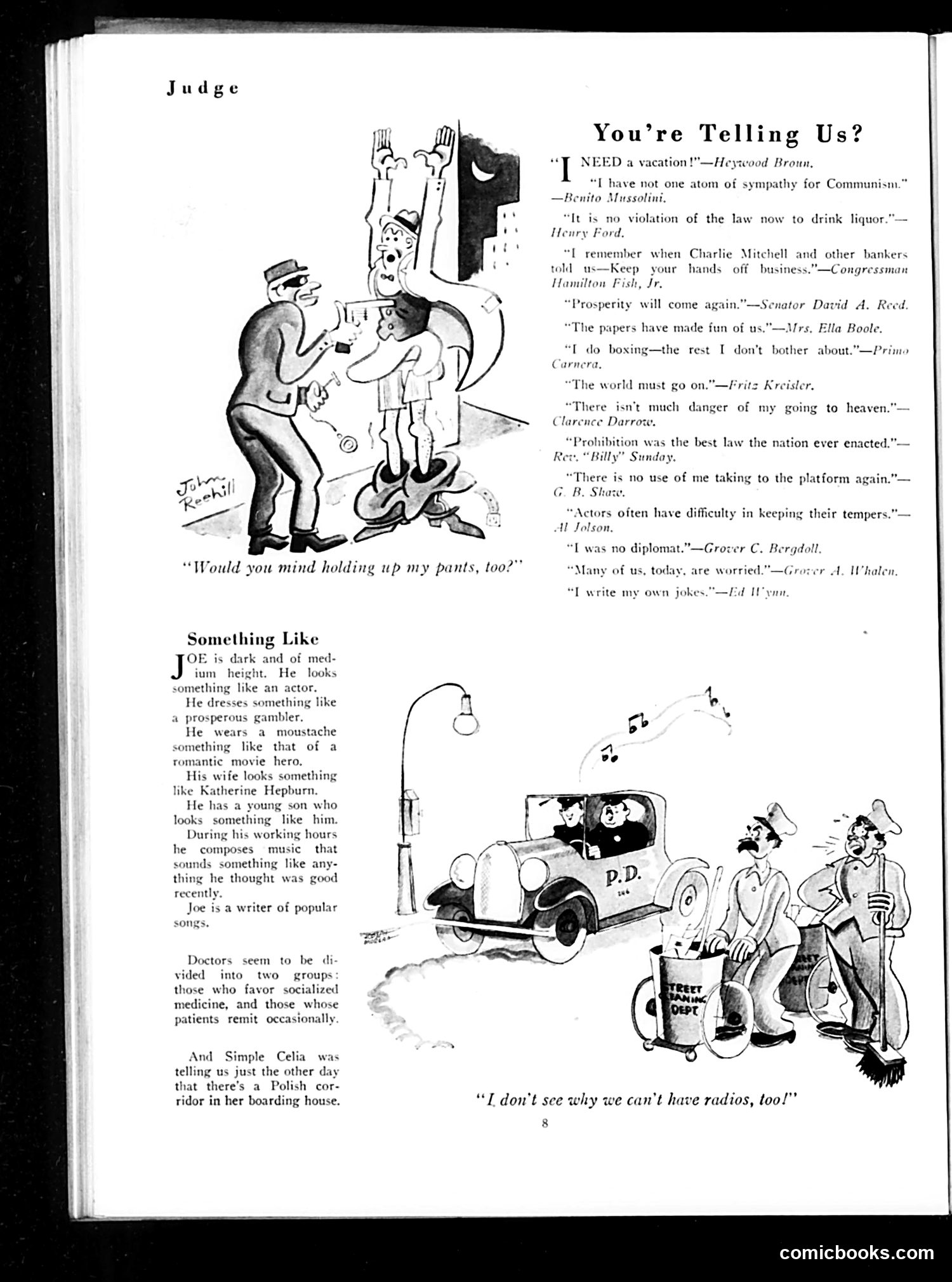
Judge Magazine Page Analysis This page contains two satirical sections: "You're Telling Us?" presents ironic quotes from prominent figures of the era (Mussolini, Henry Ford, Senator Reed, Billy Sunday, etc.), with the implicit joke being that their statements contradict reality or their known positions. For instance, Ford claiming no violation in drinking liquor mocks Prohibition-era hypocrisy, while Billy Sunday's claim that Prohibition was "the best law" is undercut by its obvious failure. "Something Like Joe" humorously describes a songwriter through vague comparisons—he resembles an actor, dresses like a gambler, has a movie-star mustache, wife like Katharine Hepburn—but "composes music that sounds something like anything he thought was good recently." This satirizes formulaic popular songwriting of the period. The bottom cartoon shows police and street cleaners arguing about radios, likely commenting on debates over municipal equipment or public amenities during economic hardship. The overall tone mocks contemporary public figures, consumer culture, and professional mediocrity.
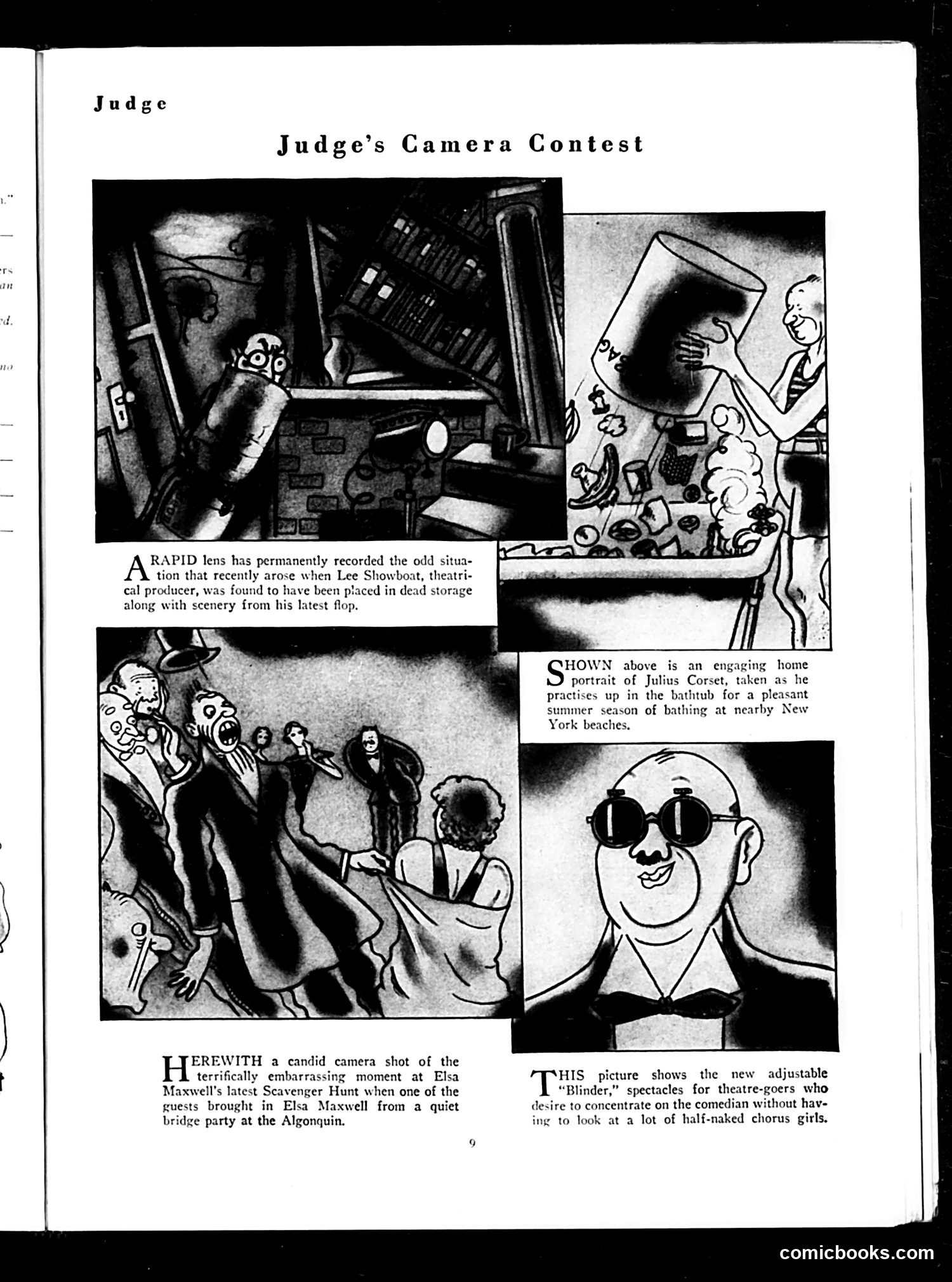
Judge's Camera Contest Explanation This page features humorous "candid camera" photographs satirizing 1920s theatrical and high-society figures. The top image jokes that theatrical producer Lee Showboat was literally placed in "dead storage" with his failed show's scenery—mocking his flop production. The middle photo captures socialite Elsa Maxwell at one of her famous scavenger hunts, where guests were fetched as "items" to retrieve, humorously suggesting Maxwell herself was brought as a prize. The bottom images mock entertainment culture: one shows Julius Corset (unclear who this refers to) bathing; the final cartoon satirizes prudish theater-goers with adjustable "Blinder" spectacles designed to block views of chorus girls' bodies while watching comedians—a jab at both moral hypocrisy and the era's sexualized chorus line performances. The satire targets vanity, theatrical pretension, and sexual double standards of the Jazz Age elite.
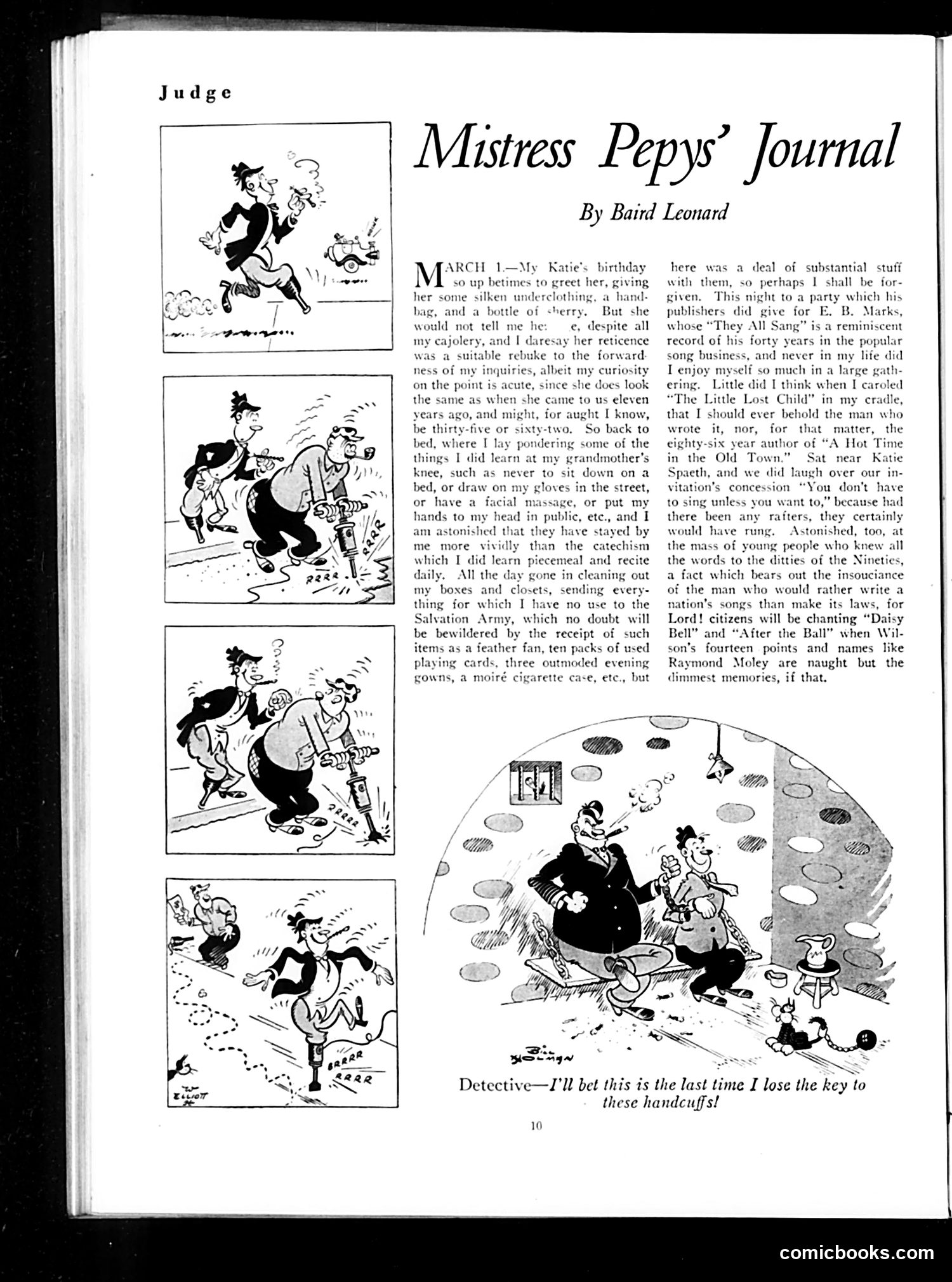
"Mistress Pepys' Journal" - Judge Magazine This is a humorous column mimicking Samuel Pepys' famous 17th-century diary, but set in the early 20th century. The narrator describes mundane domestic activities and social events with mock-serious reflection. The main joke plays on the contrast between Pepys' historically significant observations and this "Mistress Pepys'" trivial concerns: spring cleaning, etiquette rules learned from her grandmother (not sitting on beds while dressing, facial massages in public), and donating items to the Salvation Army. A secondary satire mentions attending a party for E.B. Marks celebrating his songwriting career. The writer reflects that popular songs outlast political achievements—Wilson's "Fourteen Points" and contemporary politician Raymond Moley will be forgotten while 1890s songs like "Daisy Bell" endure. The cartoon panels show slapstick domestic chaos, while the larger illustration depicts a detective losing handcuff keys—unrelated comedic vignettes typical of Judge's mixed-content format.
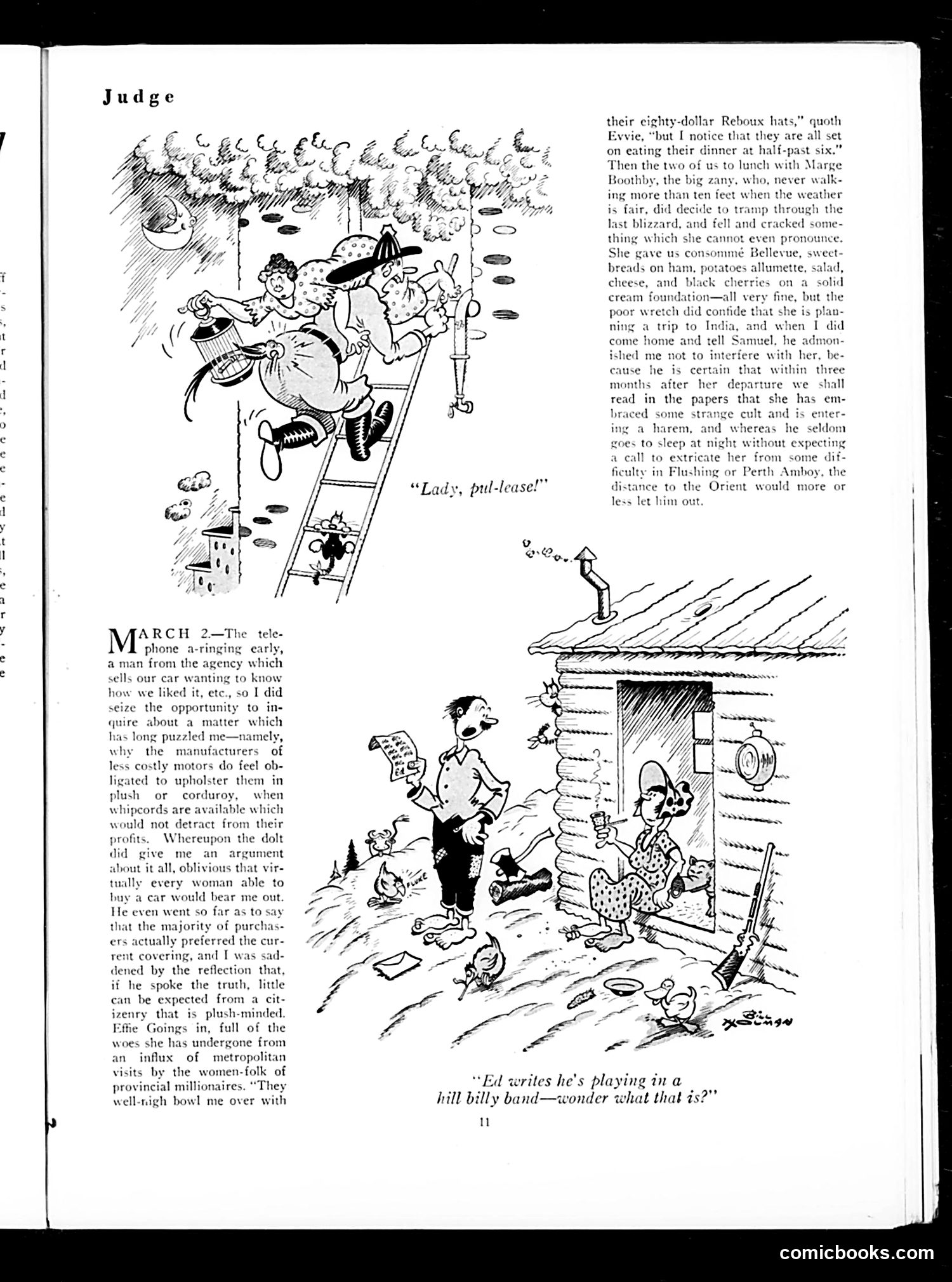
Explanation for Modern Readers This page from *Judge* magazine contains two separate satirical pieces: Top cartoon: Shows people on a ladder in rain with the caption "Lady, pul-lease!" The accompanying text describes wealthy women's frivolous vacation plans and their friend's anxiety about another woman planning a trip to India—he fears she'll join a cult or get into trouble in "Flushing or Perth Amboy," requiring rescue. Bottom section (March 2): A man from a car agency calls to ask about his purchase. The narrator uses this to vent frustration: why do cheap cars come upholstered in plush or corduroy instead of practical whipcord? The salesman claims customers prefer plush, which the narrator finds depressing—evidence of poor public taste. The final caption jokes about someone playing in a "hill billy band," implying rural/unsophisticated entertainment. Satire target: The pieces mock upper-class women's idle pursuits, the disconnect between manufacturers and consumers, and mockery of rural entertainment—typical *Judge* content attacking social pretension and American commercialism.
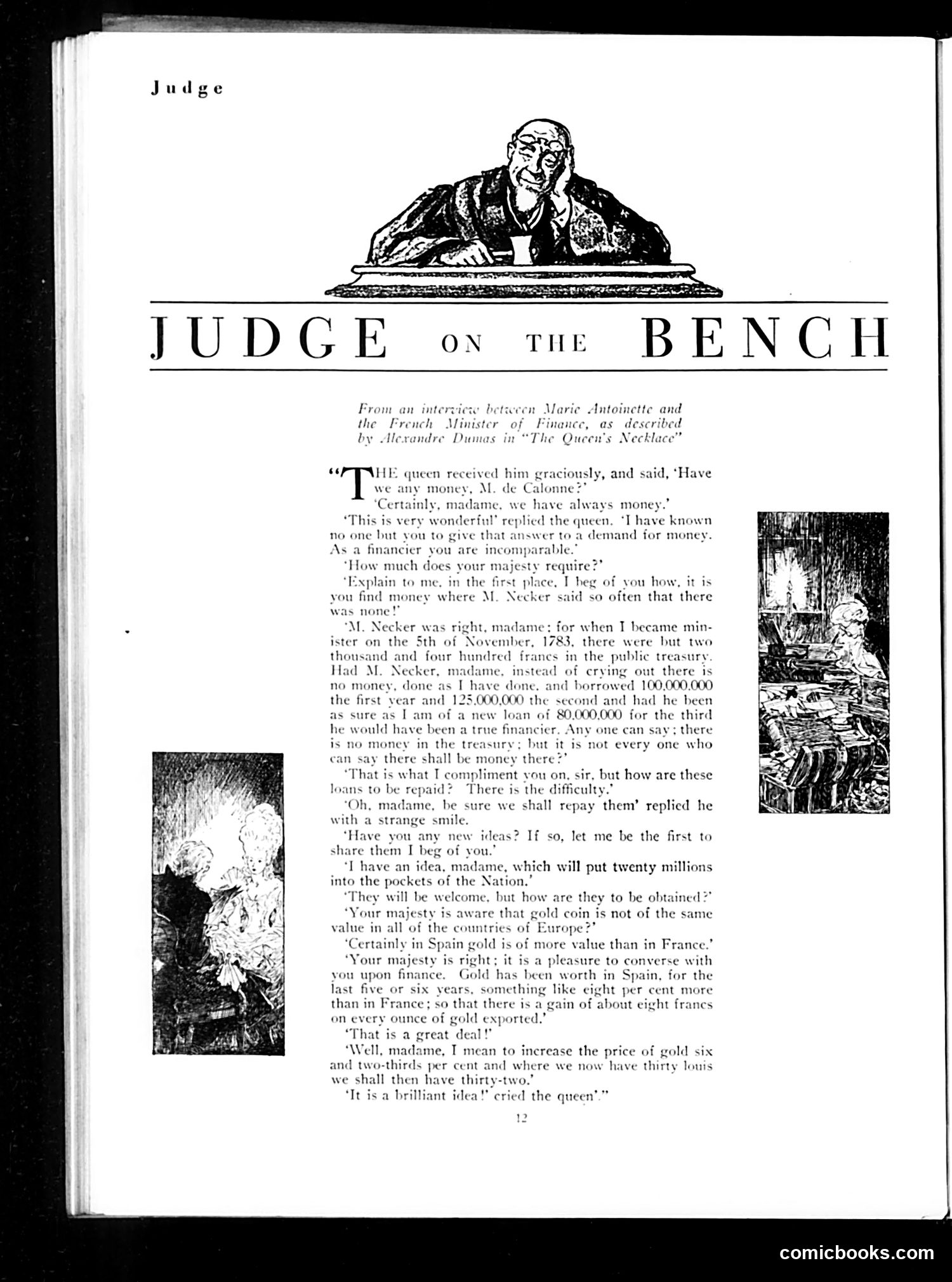
"Judge on the Bench": Marie Antoinette and French Financial Crisis This page satirizes pre-Revolution French finances through a dialogue (attributed to Alexandre Dumas's "The Queen's Necklace") between Queen Marie Antoinette and Finance Minister Calonne. The satire targets Calonne's financial schemes: he brags of "finding" money through massive borrowing (100-125 million francs annually) rather than addressing actual treasury depletion left by his predecessor Necker. His proposed solution—artificially inflating gold's value to gain 8 francs per ounce—exemplifies the cartoon's critique: creative accounting and monetary manipulation presented as brilliant policy, when the kingdom faces genuine insolvency. The "Judge on the Bench" framing suggests Judge magazine is offering its verdict: these are foolish, unsustainable schemes. The page mocks both the queen's naïveté and the minister's con-artist confidence, highlighting the financial mismanagement that historically contributed to the French Revolution's outbreak.
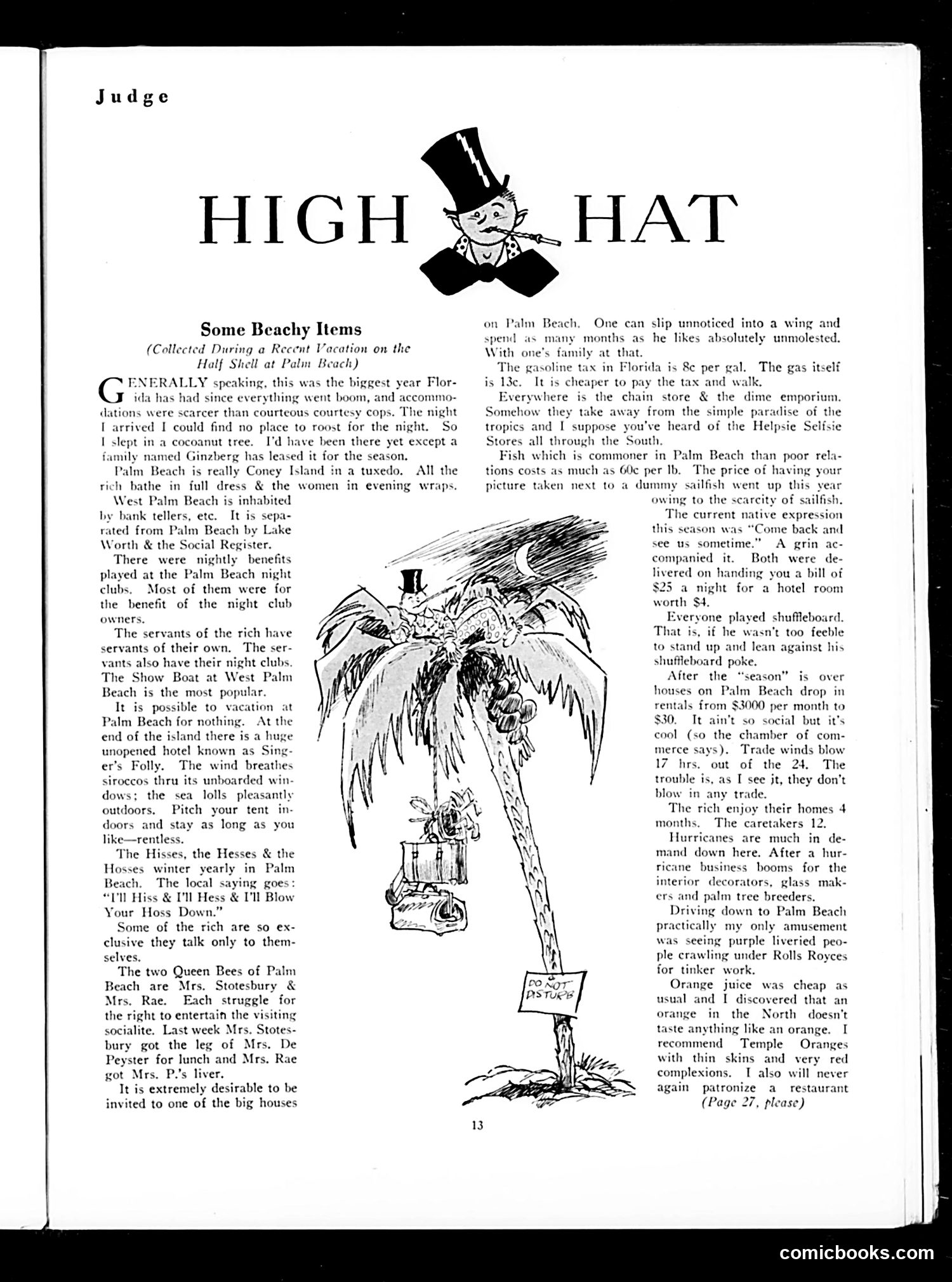
"High Hat" - Palm Beach Satire This is a humorous travel essay by Judge columnist about wealthy Palm Beach society, illustrated with a cartoon of an elegantly dressed figure in a top hat. The piece mocks the pretensions and absurdities of America's wealthy winter resort crowd through exaggeration and wordplay. Key satirical points include: the extreme class segregation (West Palm Beach separated from Palm Beach by "the Social Register"); wealthy people's exclusivity and hollow hospitality (charging $25/night for $4 rooms); the servant hierarchy where even servants have servants; and the overall artificiality of the scene ("Coney Island in a tuxedo"). The humor targets Gilded Age excess—expensive fish, inflated prices, and status-obsessed socialites like Mrs. Stotesbury and Mrs. Rae competing for prestige. References to hurricanes boosting decorator business and purple-liveried servants crawling under Rolls-Royces further mock both the precariousness and ostentation of wealthy life.
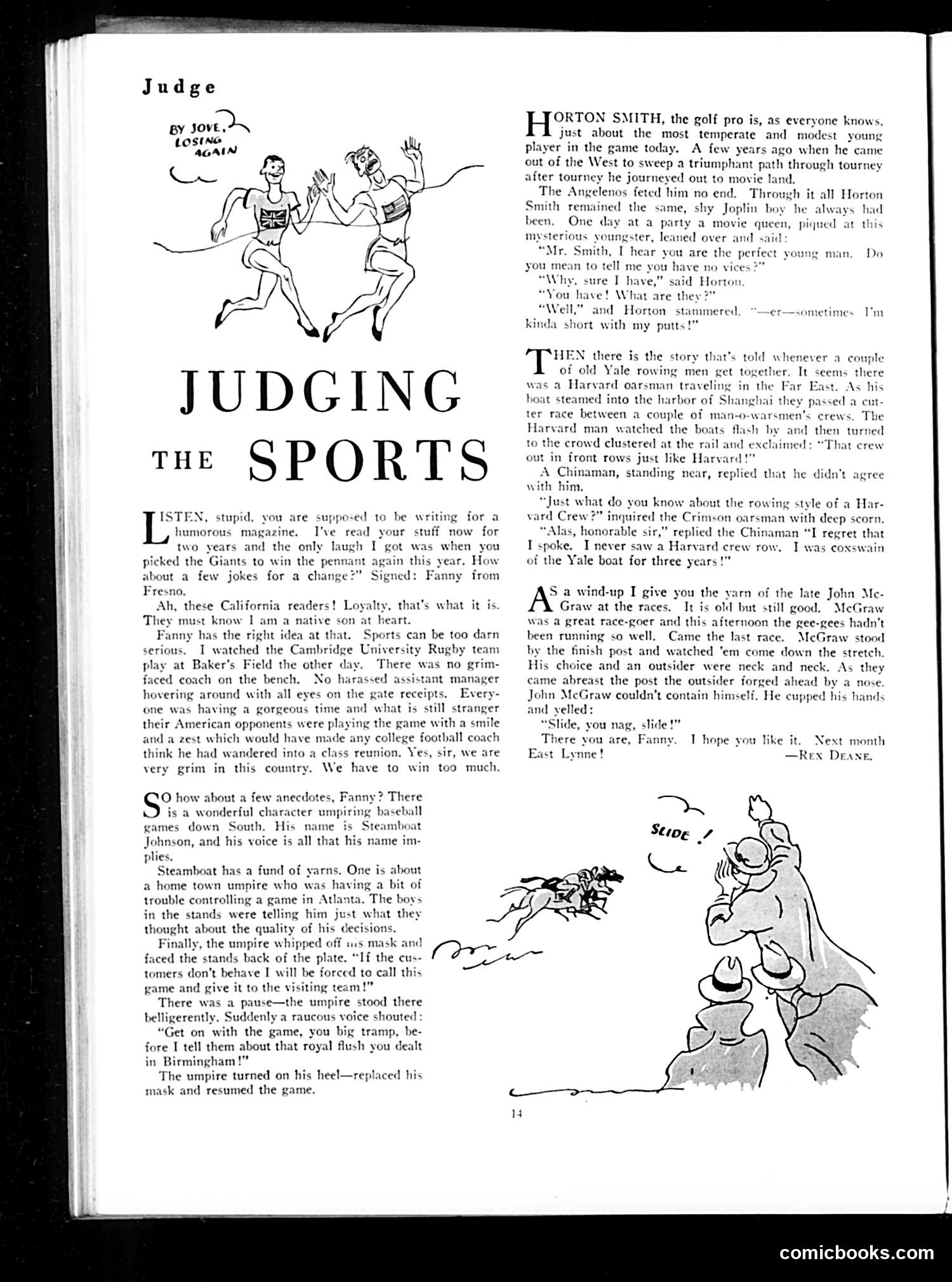
Judging the Sports This page satirizes American attitudes toward sports, contrasting them unfavorably with more relaxed approaches elsewhere. The main article critiques American seriousness about sports. The author describes witnessing a Cambridge University rugby match where players smiled and showed genuine joy—unlike American sports culture, which he suggests is grimly obsessed with winning. A California reader complained the writer picked the Giants to lose, illustrating how earnestly fans take sports outcomes. The anecdotes that follow reinforce this theme: a Southern baseball umpire maintains composure despite fan abuse; golfer Horton Smith remains modest despite success; a Yale oarsman condescendingly corrects a Chinese man about Harvard rowing style (only to learn the man watched Yale for three years—a joke about American competitive arrogance); and John McGraw appears at horse races. The overall message: Americans take sports far too seriously compared to other cultures, losing the joy and good humor that should characterize athletic competition.
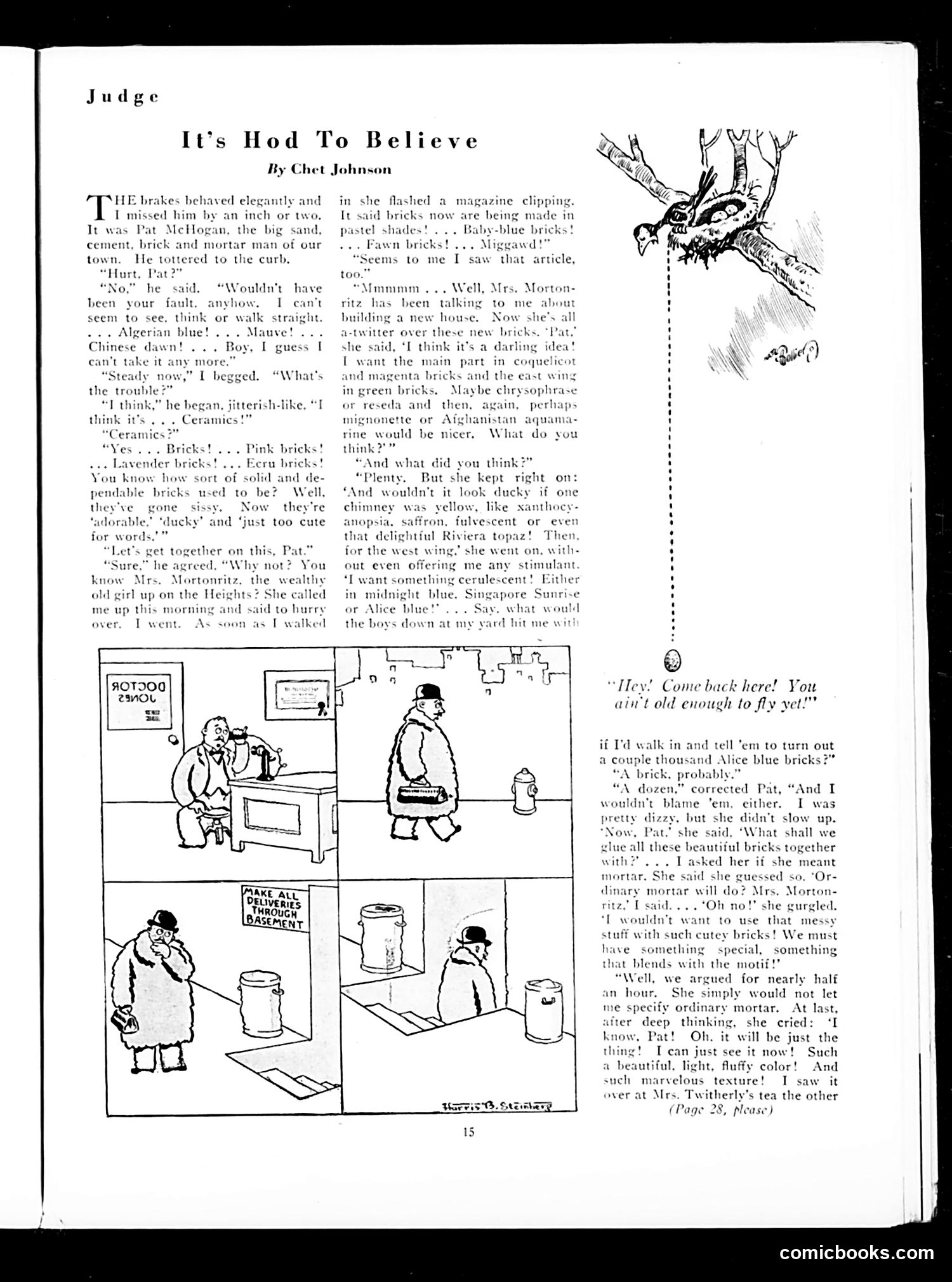
"It's Hod To Believe" — Satire of Aesthetic Pretension This Chet Johnson story mocks the affectations of wealthy society women who adopt trendy design concepts without practical understanding. The Setup: Pat McHogan, a working-class brick contractor, is accosted by Mrs. Mortonritz, a wealthy woman building a new house. She's obsessed with fashionable colored bricks (Alice blue, magenta, etc.) inspired by a magazine article, treating construction materials as art. The Satire: The humor targets her ridiculous demands—insisting on decorative brick colors, inventing pseudo-sophisticated names (Afghanistan aquamarine, Riviera topaz), and refusing ordinary mortar because it lacks "aesthetic blend with the motif." Pat's bewildered responses embody common sense confronting absurd pretension. The Point: Judge ridicules how the wealthy embrace trendy design language without substance, expecting working people to accommodate their impractical whims. The cartoon emphasizes the gap between her flowery aesthetic ideals and the practical realities of construction, making her posturing appear foolish rather than refined.
"The Theatre of George Jean Nathan" - Judge Magazine Theater Critique This page is a theater review column by Judge's drama critic examining recent Broadway productions. The critic praises "Richard of Bordeaux" (by Gordon Daviot, pen name of Agnes MacIntosh), calling it genuinely excellent drama that deserves success based on merit alone. However, the piece criticizes New York theater audiences and producers for preferring star-casting over quality plays. The critic argues that "Richard of Bordeaux" succeeded despite lacking a major celebrity lead (Dennis King), while inferior plays like Keith Winter's "The Shining Hour" gain traction through more famous casts. The underlying satire targets New York's theatrical taste—the claim that audiences won't support good plays unless populated by box-office names. It's a complaint about commercialism over artistry in early 20th-century American theater, suggesting the public and critics value spectacle and celebrity over genuine dramatic merit.
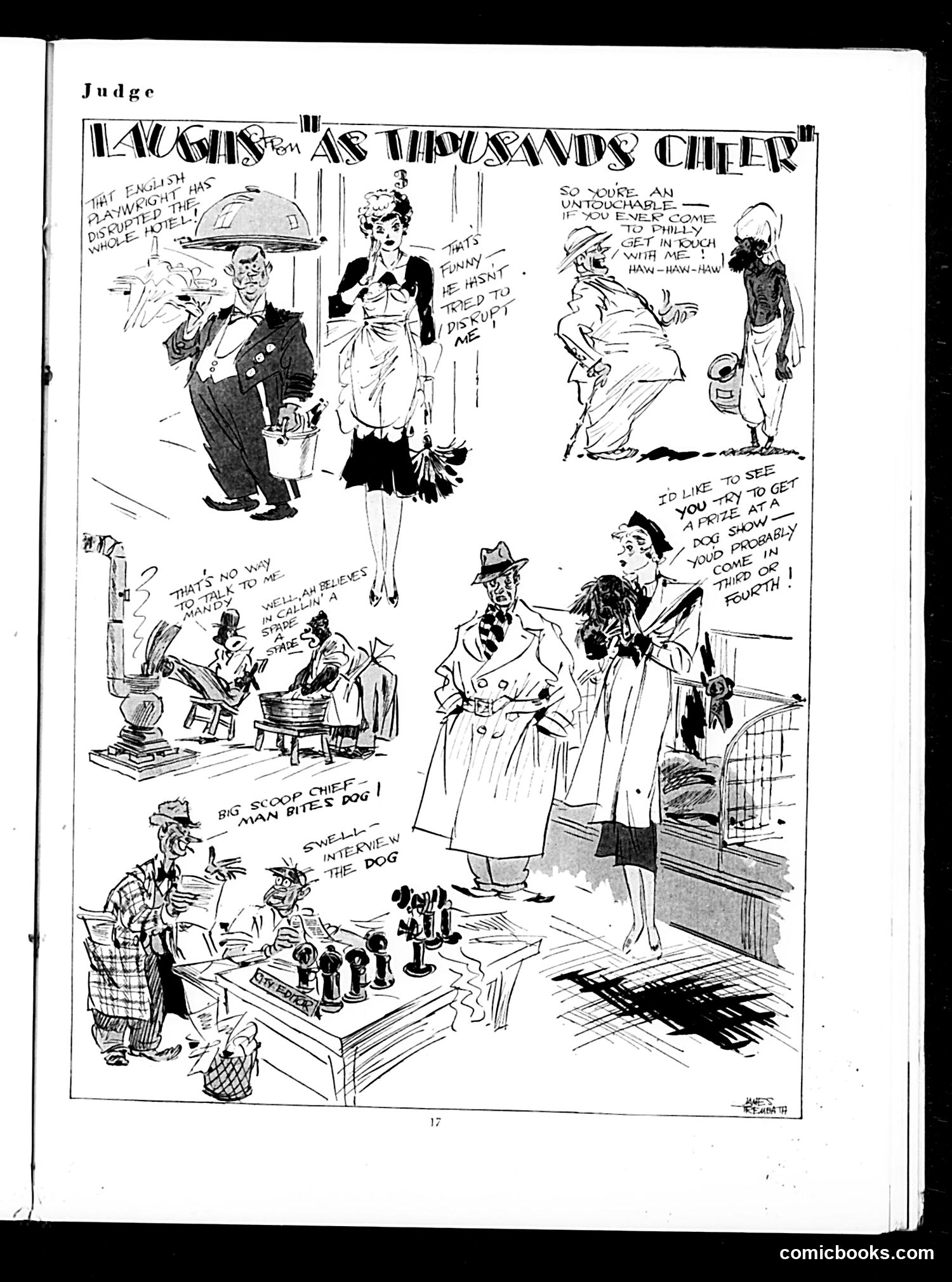
"Laughs as Thousands Cheer" This Judge page satirizes Philadelphia's reputation and social hierarchies. The cartoon mocks the city's pretensions through multiple vignettes: upper-class Philadelphians boasting about their "untouchable" status while being crude and unrefined; scenes depicting working-class life and petty crime (a "Big Scoop Chief" and criminal activity); and contrasts between claimed respectability and actual behavior. The satire targets class hypocrisy—wealthy Philadelphians claiming superiority while behaving no better than the lower classes they disdain. References to "Philly" and local pride appear throughout. The overall message ridicules the city's self-regard as a refined, exclusive place when reality shows otherwise across all social strata. The humor relies on recognizing Philadelphia's contemporary reputation and class pretensions.
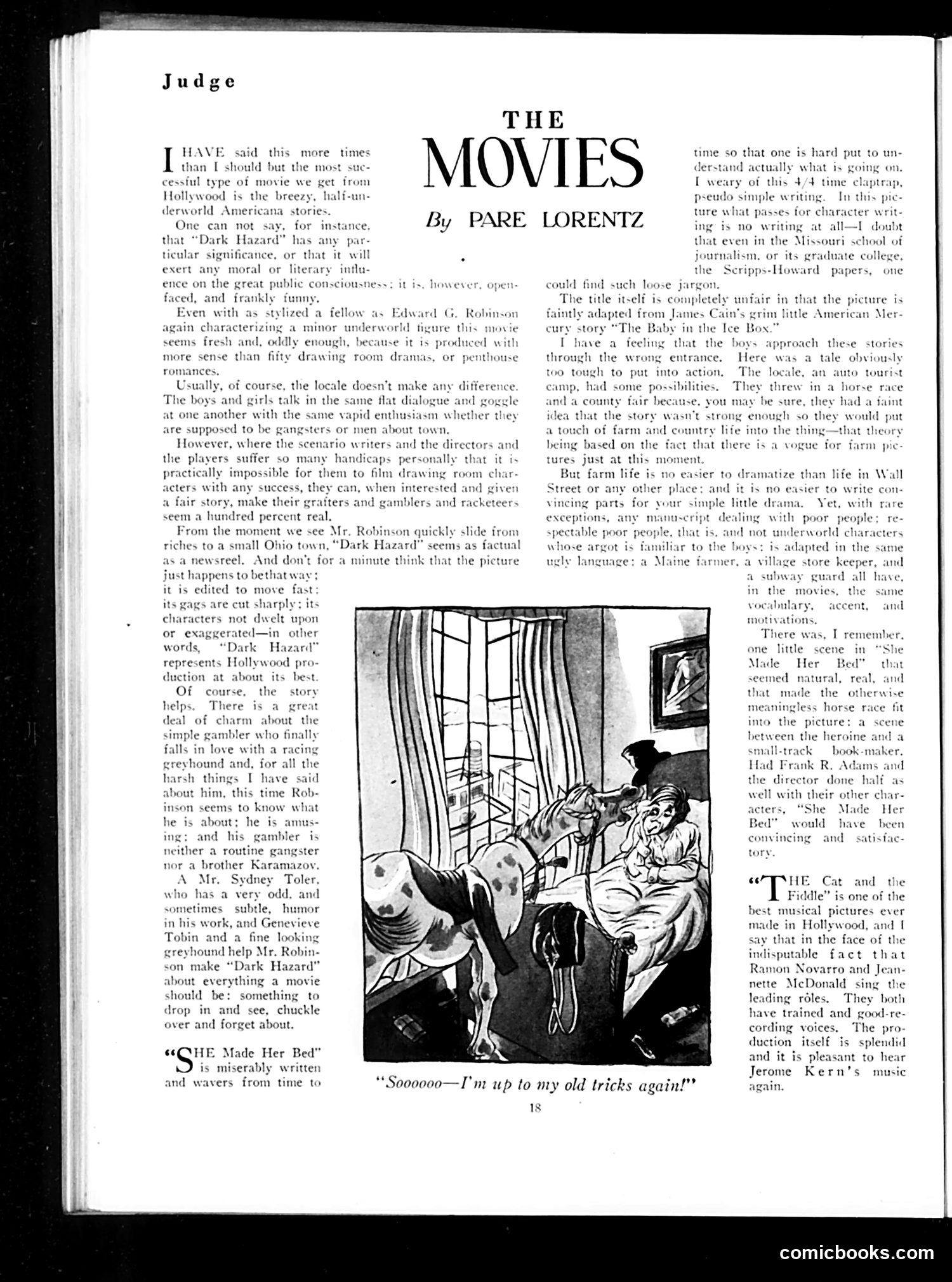
Judge Magazine Film Review - Page Analysis This page contains film criticism by Pare Lorentz reviewing contemporary Hollywood movies, primarily "Dark Hazard" starring Edward G. Robinson. The central cartoon illustration shows a man in formal attire (likely a gambler character from "Dark Hazard") in a bedroom scene with a woman, with the caption "Soooooo—I'm up to my old tricks again!" This depicts the "underworld Americana" genre Lorentz discusses. Key satirical point: Lorentz argues that Hollywood's "breezy, half-underworld" crime stories actually work *better* than pretentious drawing-room dramas because the genre frees writers from artificial constraints. Paradoxically, criminal characters seem more authentic and compelling than stylized wealthy characters. The critic praises Robinson's performance while noting that films about gamblers and racketeers can achieve genuine realism when given decent material—a backhanded compliment to Hollywood's lowest-brow output. The review exemplifies 1920s-30s cultural snobbery: lowbrow crime stories succeed precisely *because* audiences demand no literary ambition.
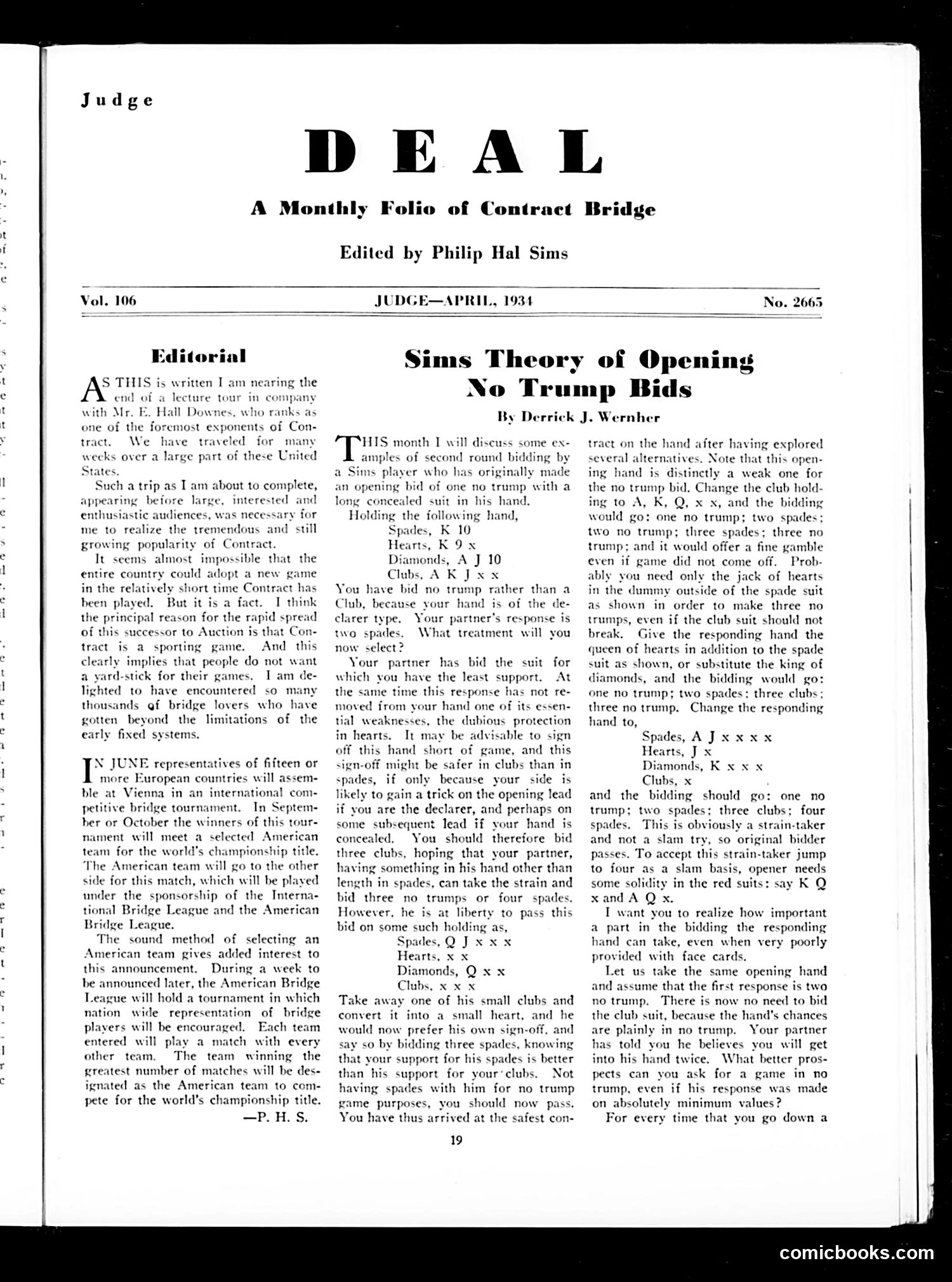
Analysis for Modern Readers This page from Judge magazine (April 1934) contains no political cartoon—it's primarily editorial and instructional content about Contract Bridge, a card game. The "Editorial" discusses Bridge's rapid popularity across America and announces an upcoming international bridge tournament in Vienna, with American competitors selected through a nationwide tournament. This reflects 1934 society's enthusiasm for Bridge as a legitimate sporting pursuit. The main article, "Sims Theory of Opening No Trump Bids" by Derrick J. Wernher, is technical bridge strategy—teaching players how to bid effectively when holding certain card combinations. It's educational content for bridge enthusiasts. Context: In the 1930s, Contract Bridge was genuinely fashionable among middle and upper-class Americans, featured prominently in magazines like Judge. This page exemplifies how thoroughly Bridge culture permeated American leisure and entertainment publications of the era.
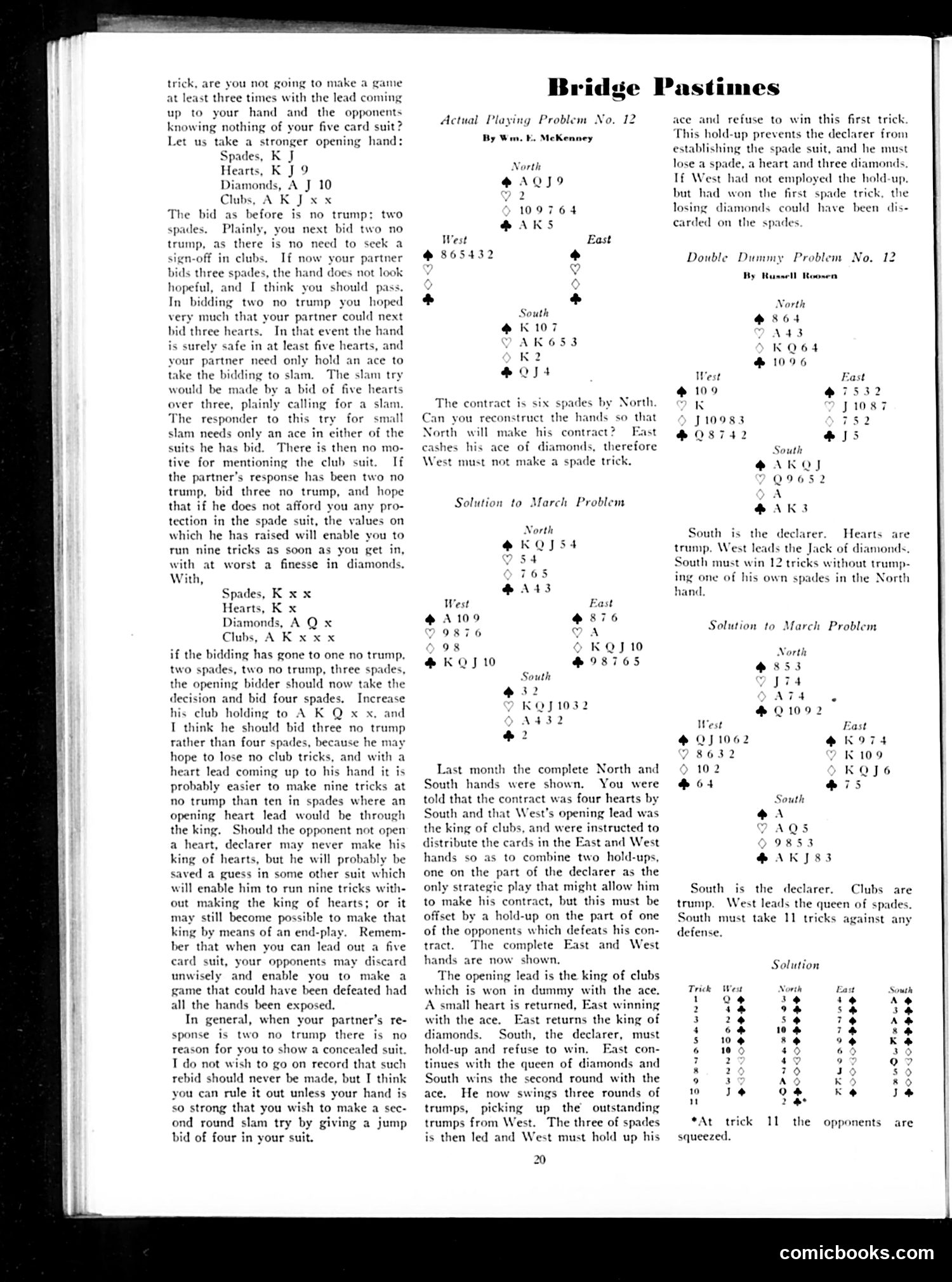
Content Analysis This page from Judge magazine contains no political cartoons or satire. It is entirely devoted to bridge instruction and problems. The content consists of: 1. "Bridge Pastimes" — an instructional column by W.B. McKenney discussing bridge bidding strategy, using example hands with specific card combinations (spades, hearts, diamonds, clubs). 2. "Actual Playing Problem No. 12" — a bridge puzzle asking readers to reconstruct hands from a six-spade contract scenario. 3. "Double Dummy Problem No. 12" by Russell Houston — another bridge problem. 4. Solutions to previous problems from March, explaining card play strategy. The page demonstrates that Judge magazine, while known for political satire, also published recreational content for its readers. Bridge was a popular card game among the educated middle and upper classes during this era, making it suitable entertainment content for the magazine's audience.
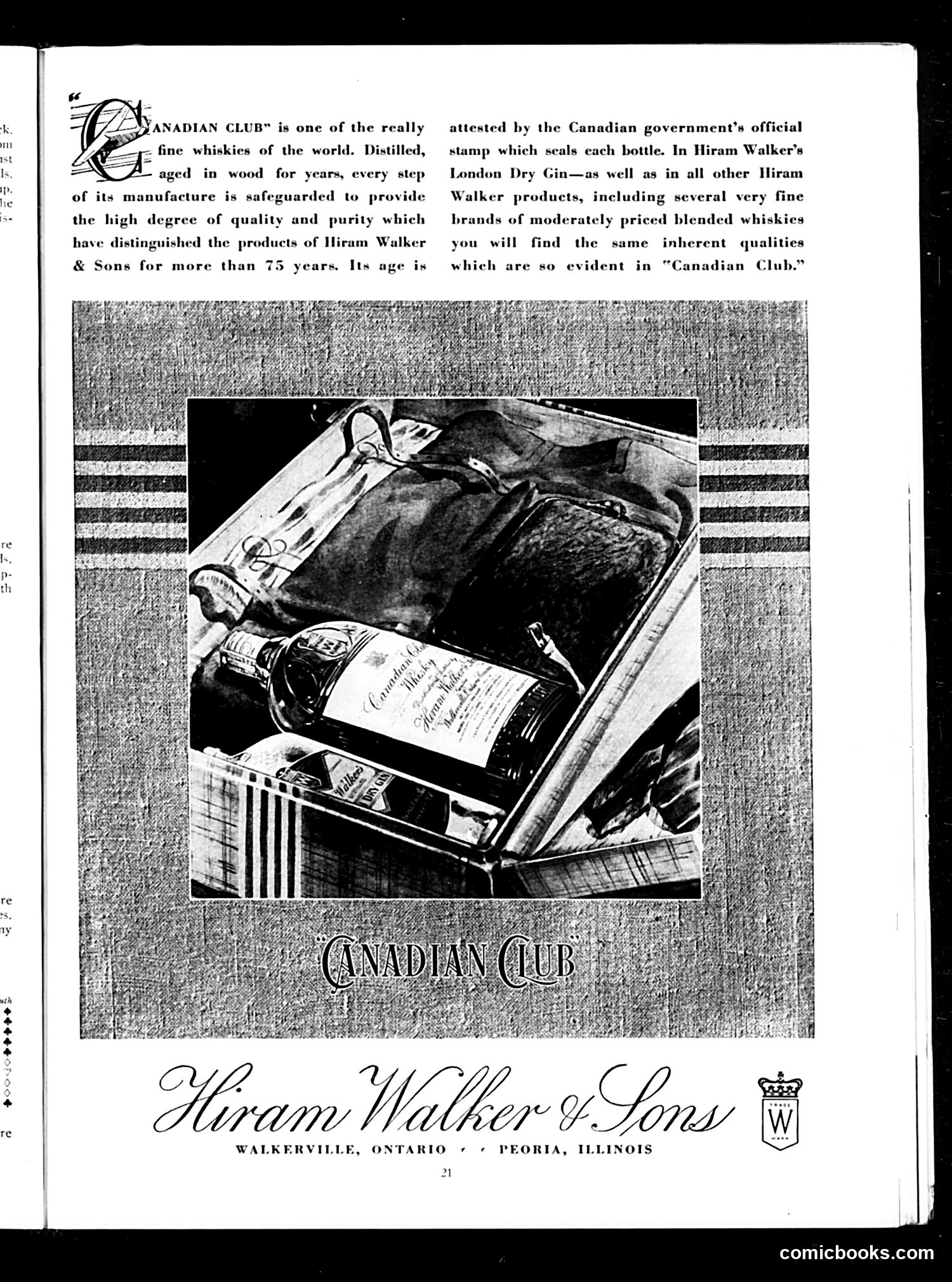
This is an advertisement, not political satire. The page promotes "Canadian Club" whiskey by Hiram Walker & Sons, a liquor manufacturer based in Walkerville, Ontario and Peoria, Illinois. The image shows an open gift box containing a bottle of Canadian Club whiskey alongside what appears to be cigars or tobacco products. The ad emphasizes the product's quality through claims of long aging in wood, government certification, and the company's 75+ year reputation. It mentions related products like London Dry Gin and blended whiskeys. This appears in *Judge* magazine, likely from the 1920s-1930s. The advertisement leverages prestige branding (Canadian origin, government approval) to market luxury spirits to affluent readers—a standard advertising approach of the era.
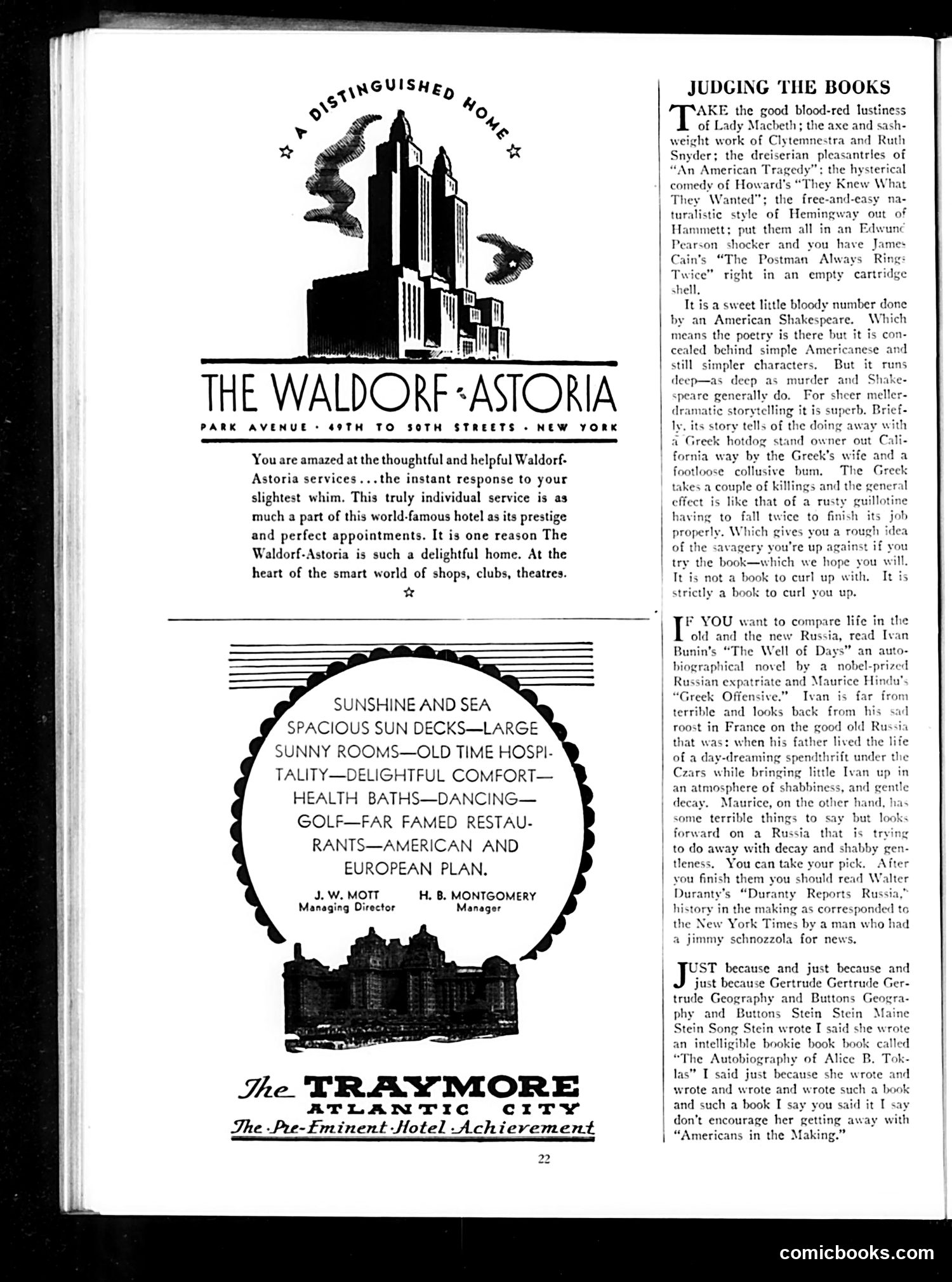
Page Analysis: Judge Magazine This page contains hotel and book advertisements, not political cartoons. The left side features ads for the Waldorf-Astoria and Traymore hotels, highlighting luxury amenities to wealthy readers—typical Judge magazine content targeting affluent New York audiences. The right side offers book reviews in a satirical tone. The critic praises an unnamed American crime novel (likely James M. Cain's *The Postman Always Rings Twice*, referenced directly) for combining literary merit with pulp violence. He compares Russian emigré literature (Bunin, Maurice Hindus) exploring old versus new Russia, and mocks Gertrude Stein's deliberately obscure experimental writing—a common modernist target of ridicule. The satire here isn't political but cultural: poking fun at literary pretension while acknowledging that accessible American fiction can achieve artistic depth. The Stein critique is particularly barbed, suggesting her incomprehensibility is self-indulgent rather than artistically justified.
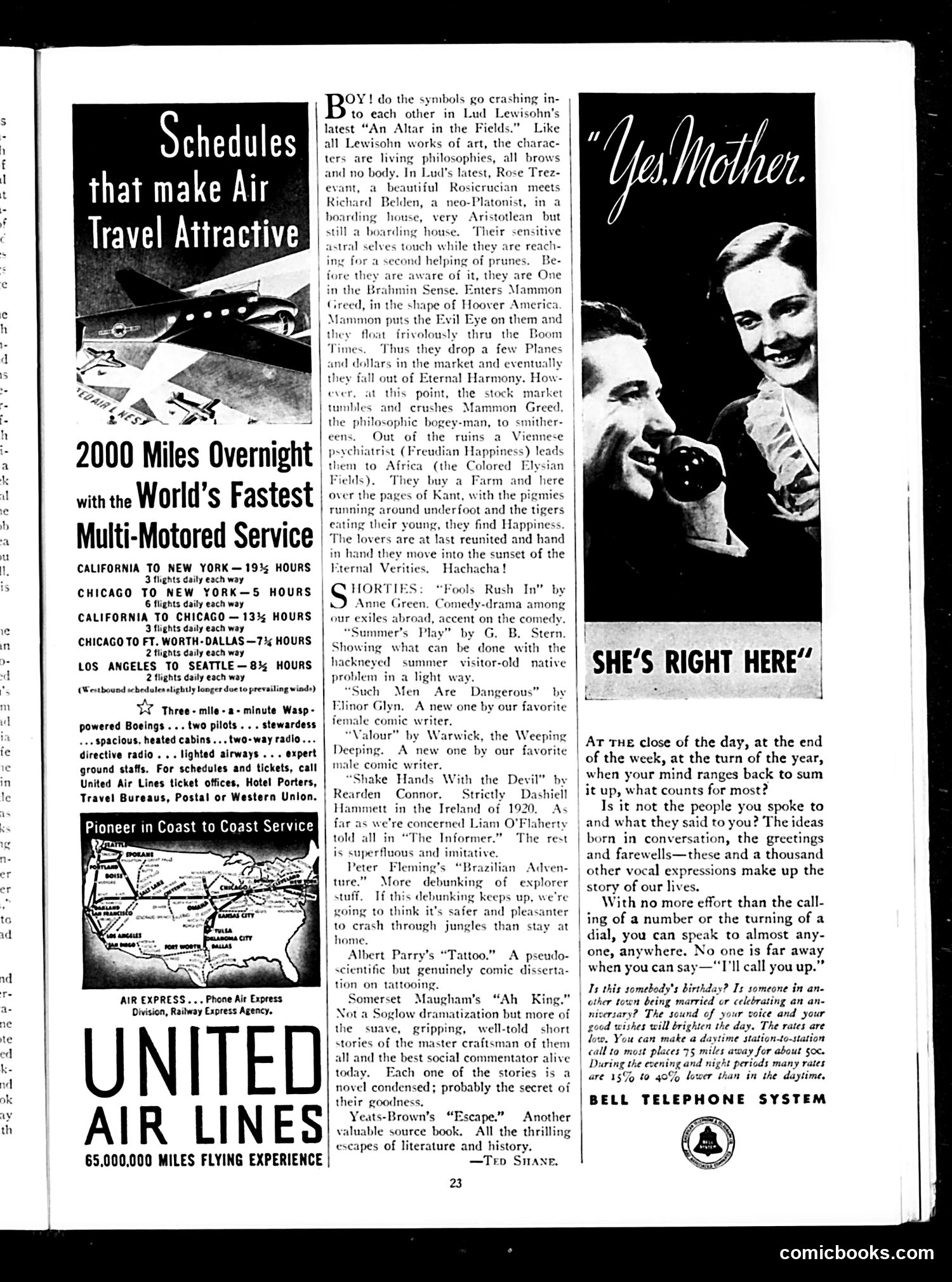
Analysis of Judge Magazine Page Content This page is primarily advertising for commercial services rather than political satire. The dominant content includes: 1. United Air Lines advertisements promoting transcontinental flight schedules (California-New York in 19.5 hours, Chicago-New York in 5 hours) 2. Bell Telephone System advertisement featuring a photograph of a man and woman, emphasizing long-distance communication convenience 3. Book reviews by Ted Shane critiquing contemporary literature, including works by Sinclair Lewis, Somerset Maugham, and others The small cartoon-like element appears to be Ted Shane's satirical review of Ludvig Lewisohn's novel "An Altar in the Fields," mocking its pretentious philosophical characters and absurd plot involving Rosicrucians, neo-Platonists, and African adventures. The page reflects 1930s commercial modernism—celebrating technological progress in aviation and telecommunications while maintaining literary criticism. There is no significant political satire or social commentary visible beyond standard book review snark.
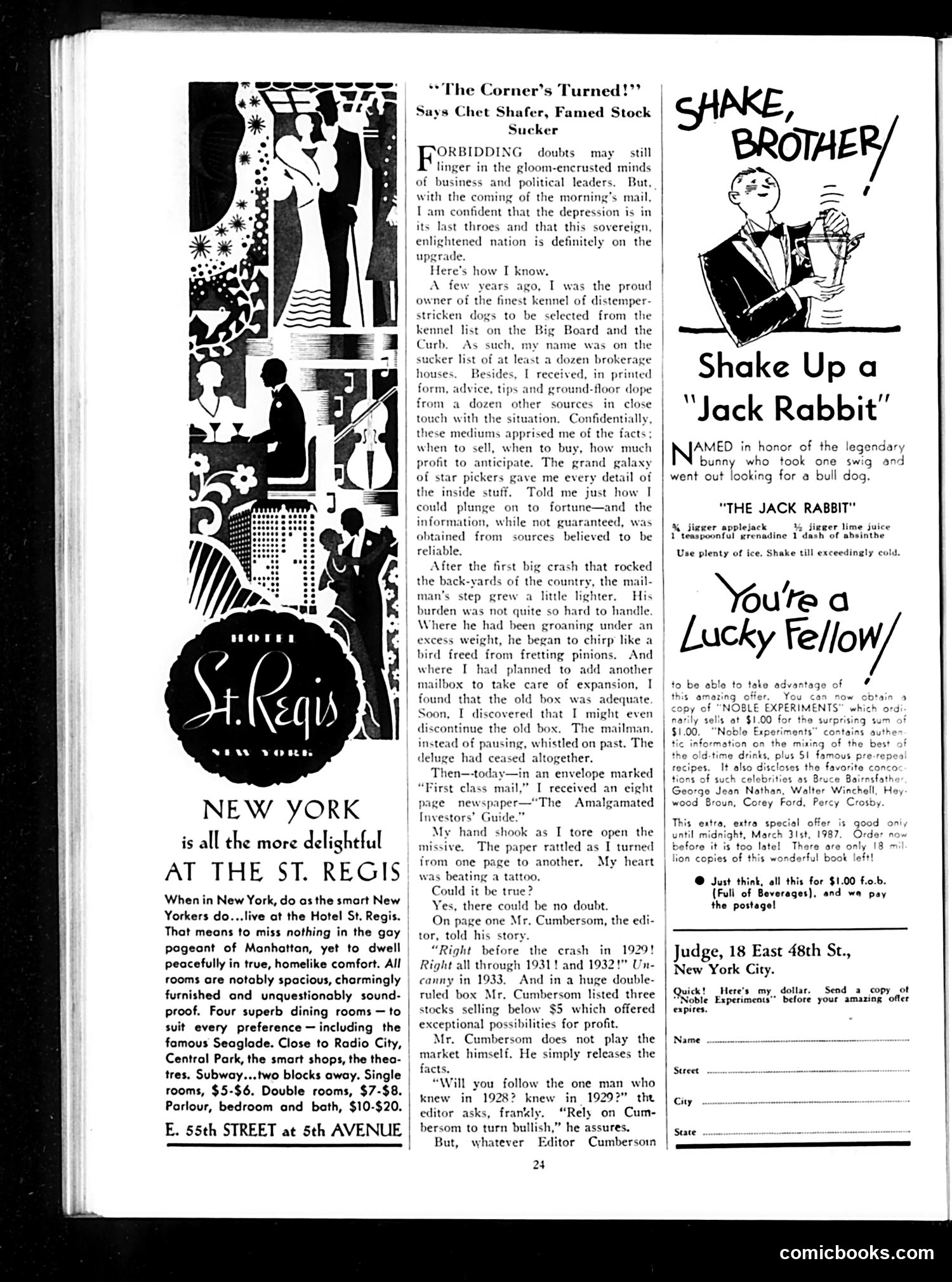
Political Satire Analysis: "The Corner's Turned!" This Judge magazine article satirizes the gullibility of Depression-era investors who follow stock-market "tipsters" and fraudulent investment advice. The Setup: "Chet Shafer, Famed Stock Sucker" describes himself as a proud owner of worthless stocks who received endless mail tips from brokers and investment newsletters claiming insider knowledge. The Satire's Point: After the 1929 crash, the mailman's burden lightened—fewer tip letters arrived. But now, mysteriously, *one* newsletter has reappeared: "The Amalgamated Investors' Guide," edited by "Mr. Cumbersom," claiming he predicted market moves in 1928, 1929, and 1933. Cumbersom now offers three stocks "selling below $5" as exceptional opportunities. The Joke: The satire mocks how suckers like Shafer eagerly trust the *same type of advice that failed before*, forgetting that these "famed stock pickers" never actually predicted anything accurately. The reappearance of investment spam signals false economic recovery, not genuine prosperity. It's Depression-era commentary on recurring financial fraud and investor amnesia.
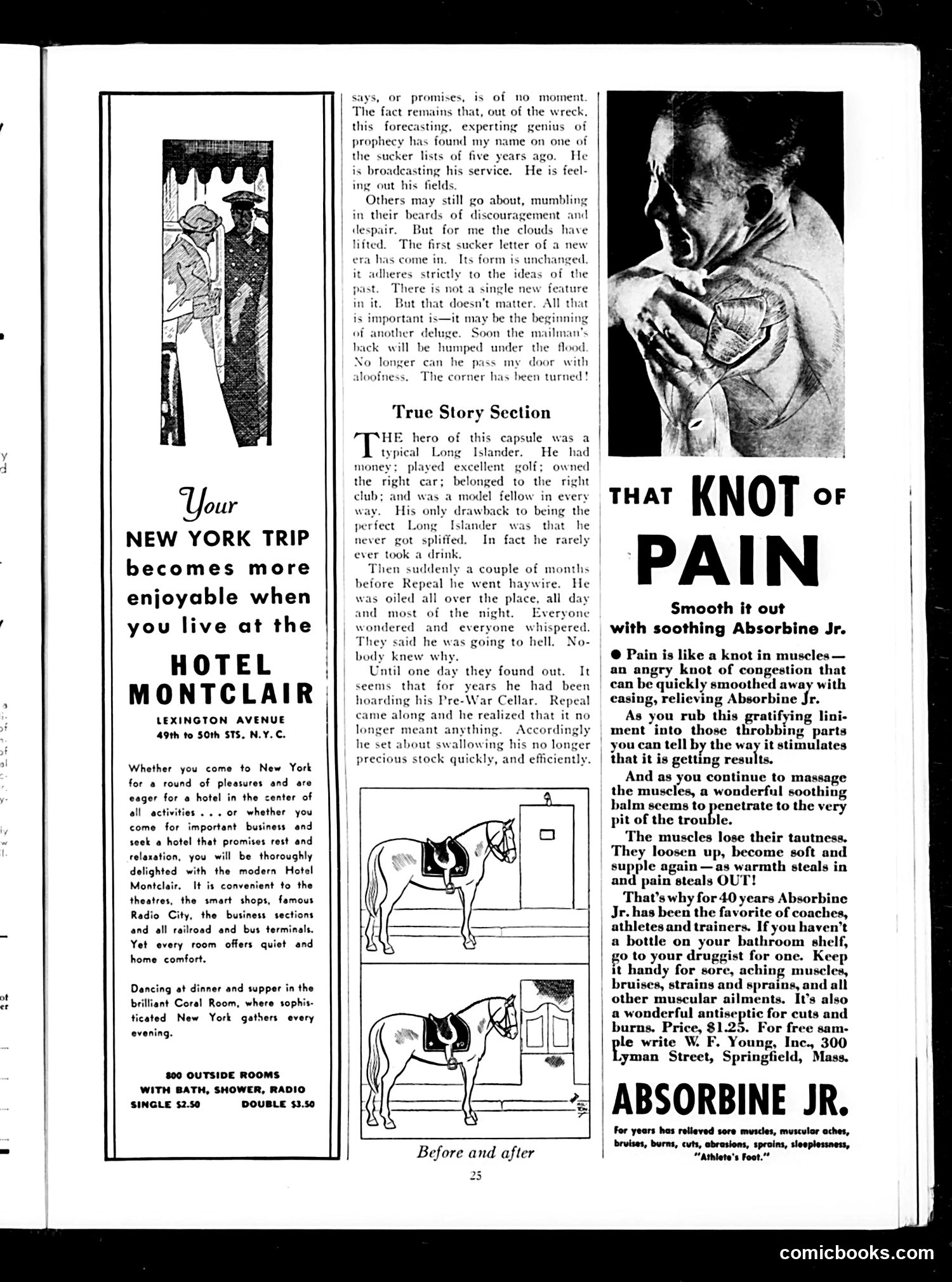
Page Analysis: Judge Magazine This page mixes advertisements with a satirical "True Story Section." The main cartoon ridicules a common American experience of the Depression era: investment scams and mail fraud. The narrative describes a man who received a "sucker list" solicitation five years prior from a forecasting/stock-picking service. Though he ignored it then, he's now thrilled to receive a new letter from the same outfit—seeing it as a sign of impending prosperity ("the clouds have lifted"). The satire is sharp: he recognizes the letter is identical to the old one, with no improvements, yet interprets this as the start of another profitable cycle. The joke exposes how desperate people became for financial hope, and how easily they fell for repeated fraud schemes. The second story, about a Long Islander hoarding pre-Prohibition liquor until Repeal made it worthless, reinforces the period's economic anxieties—assets losing value overnight. The page is otherwise dominated by hotel and liniment advertisements typical of 1930s magazines.
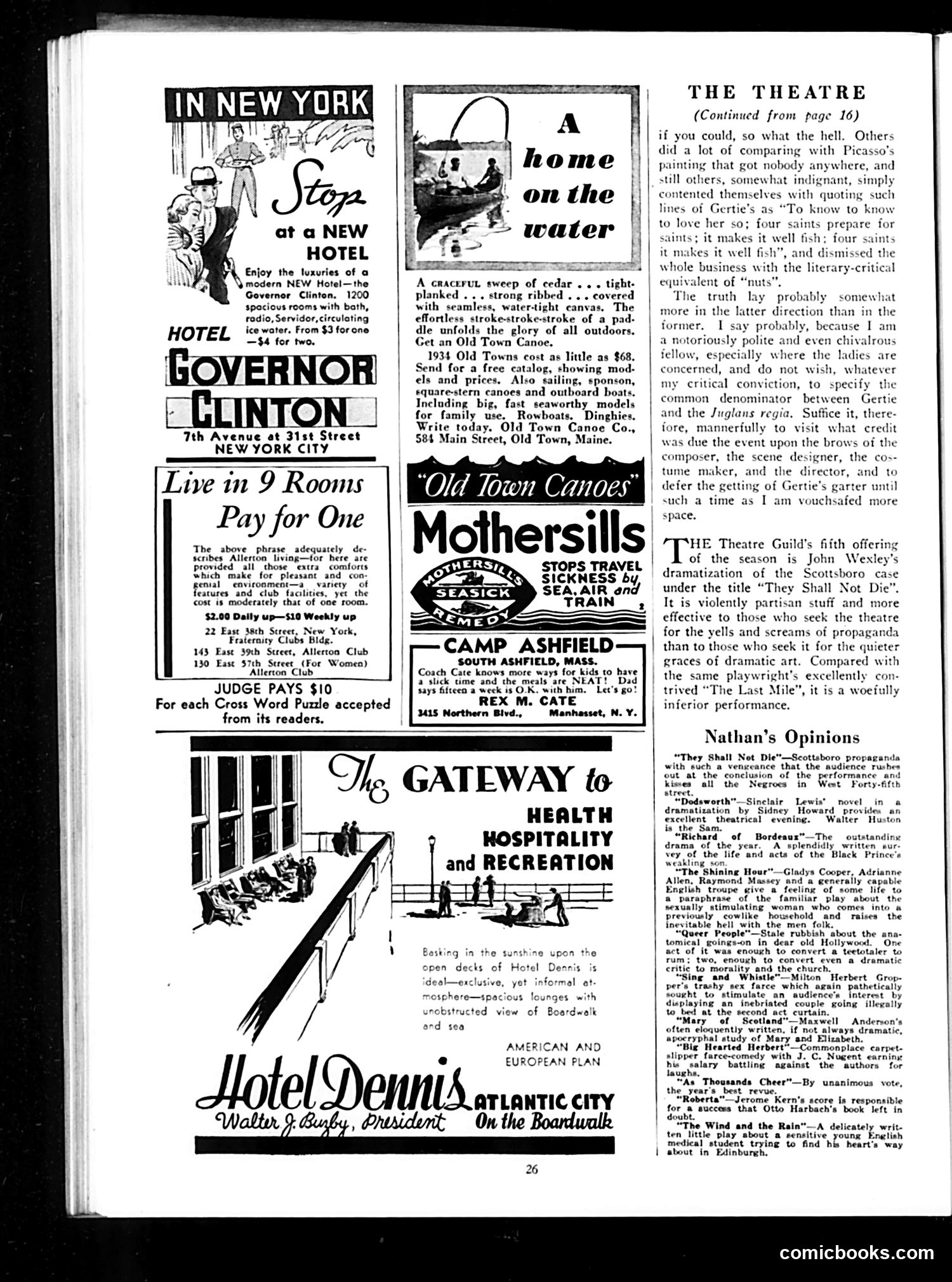
Content Analysis: Judge Magazine Page 26 This page is primarily advertisements for hotels, camps, and recreational products, with a small section of theater criticism ("Nathan's Opinions") in the upper right. The ads include: - Hotel Governor Clinton (NYC) - Allerton Club housing - Old Town Canoe company - Mothersills seasickness remedy - Camp Ashfield (children's camp) - Hotel Dennis (Atlantic City boardwalk) The theater section reviews contemporary Broadway productions, including John Wexley's "They Shall Not Die"—described as a "violently partisan" dramatization of the Scottsboro case (the infamous 1931 trial of nine Black teenagers accused of rape in Alabama). The critic notes the play generates strong audience reactions but criticizes it as propagandistic compared to Wexley's earlier work "The Last Mile." The Scottsboro reference would be immediately recognizable to 1930s readers as a major racial justice controversy, making this a notable inclusion in a satirical magazine's theater section.
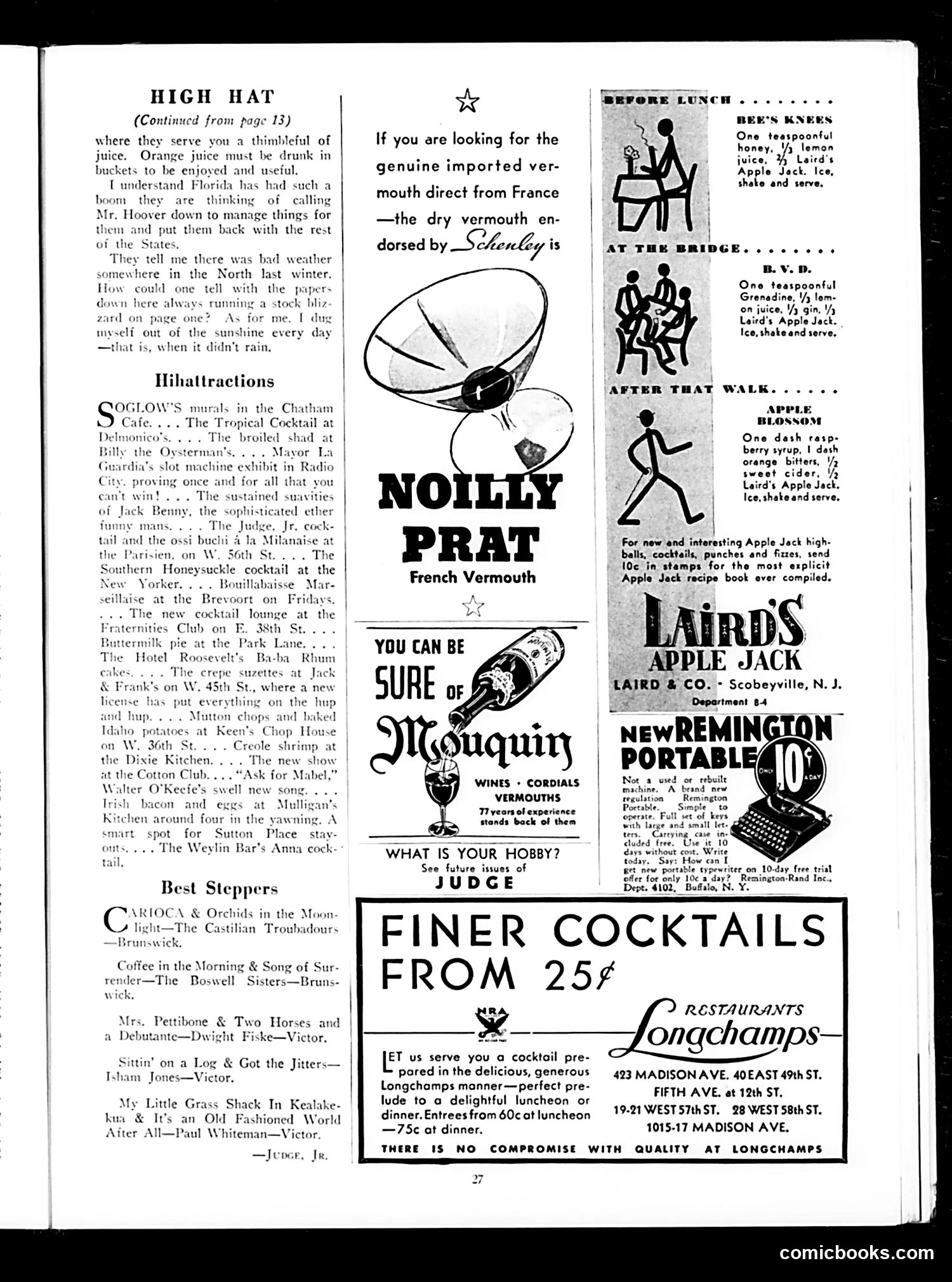
Analysis of Judge Magazine Page Content This page is primarily advertising and entertainment listings from what appears to be a 1920s-era Judge magazine. The substantive content includes: "High Hat" Column: A gossipy piece about New York nightlife and restaurants, mentioning entertainers like Jack Benny and Paul Whiteman. The opening references Prohibition-era cocktail culture ("thimbleful of juice"). "Illhattractions" & "Best Steppers": Lists of fashionable restaurants, speakeasies, and musical performances—typical Jazz Age venues and entertainers of the era. Main Advertisements: Multiple ads for Apple Jack liquor, Noilly Prat vermouth, Mosquin wines, and a Remington portable typewriter. These ads use period-typical imagery and casual sales language. "Finer Cocktails from 25¢": A Longchamps restaurant advertisement promoting affordable cocktails and dining. The page reflects Prohibition-era American culture, where liquor was legally banned but openly advertised and consumed in speakeasies. The tone is lighthearted and sophisticated, aimed at urban, affluent readers enjoying the Jazz Age nightlife scene.
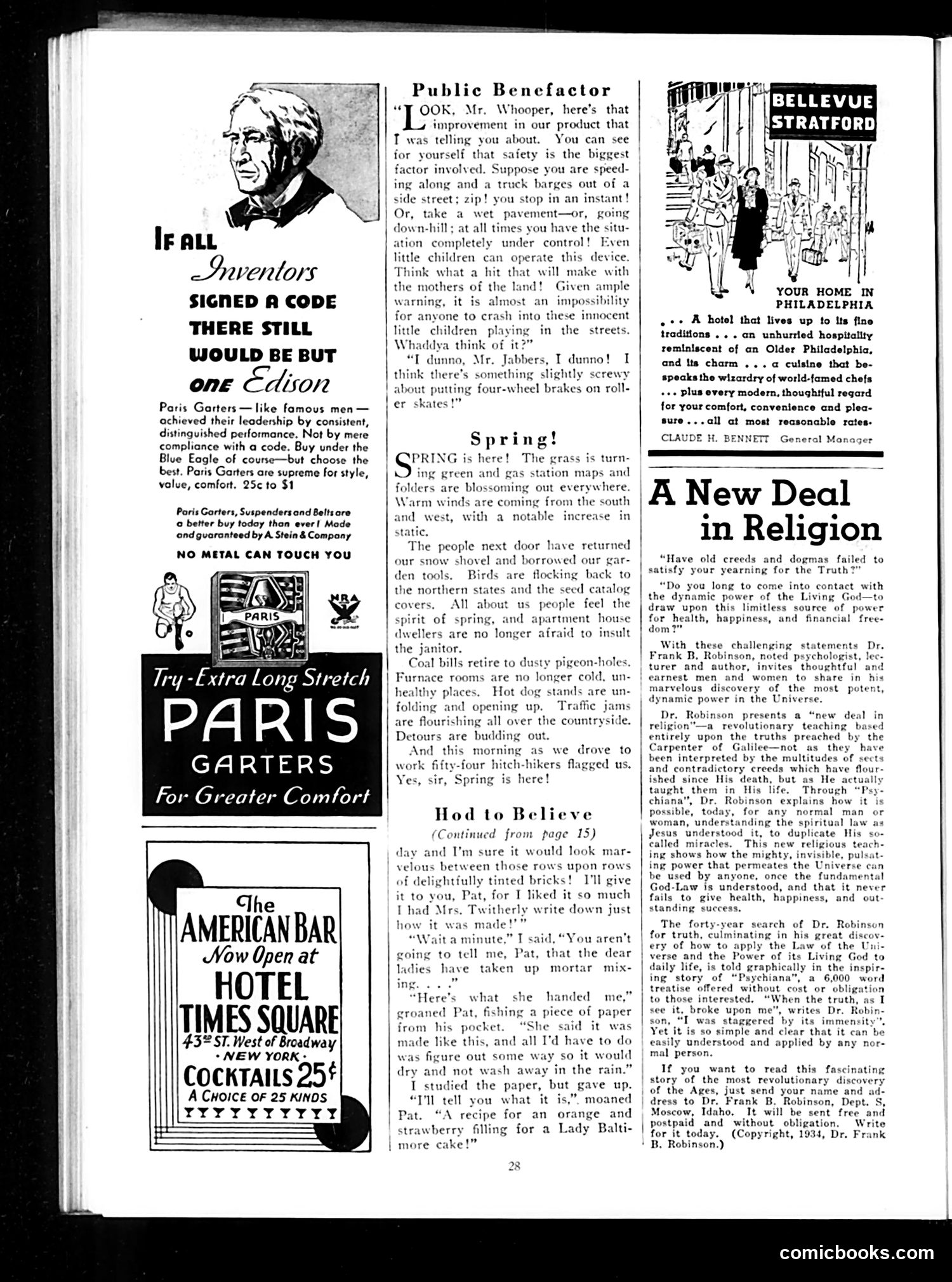
Judge Magazine Page Analysis This page mixes advertising with satirical content typical of 1930s-40s Judge magazine. The main cartoon lampoons product safety claims. Two businessmen discuss an "improvement" — four-wheel brakes on roller skates. One enthusiastically pitches it as a safety marvel preventing child injuries; the other responds with obvious skepticism: "I think there's something slightly screwy about putting four-wheel brakes on roller skates!" The satire targets exaggerated marketing claims — the absurdity of brakes on skates exposes how manufacturers oversell mundane or nonsensical "improvements" as revolutionary safety features. It's a jab at Depression-era product promotion and snake-oil salesmanship. The surrounding ads (Paris Garters, American Bar, hotels) are straightforward commercial content. A sidebar essay about spring offers seasonal observations with no political significance.
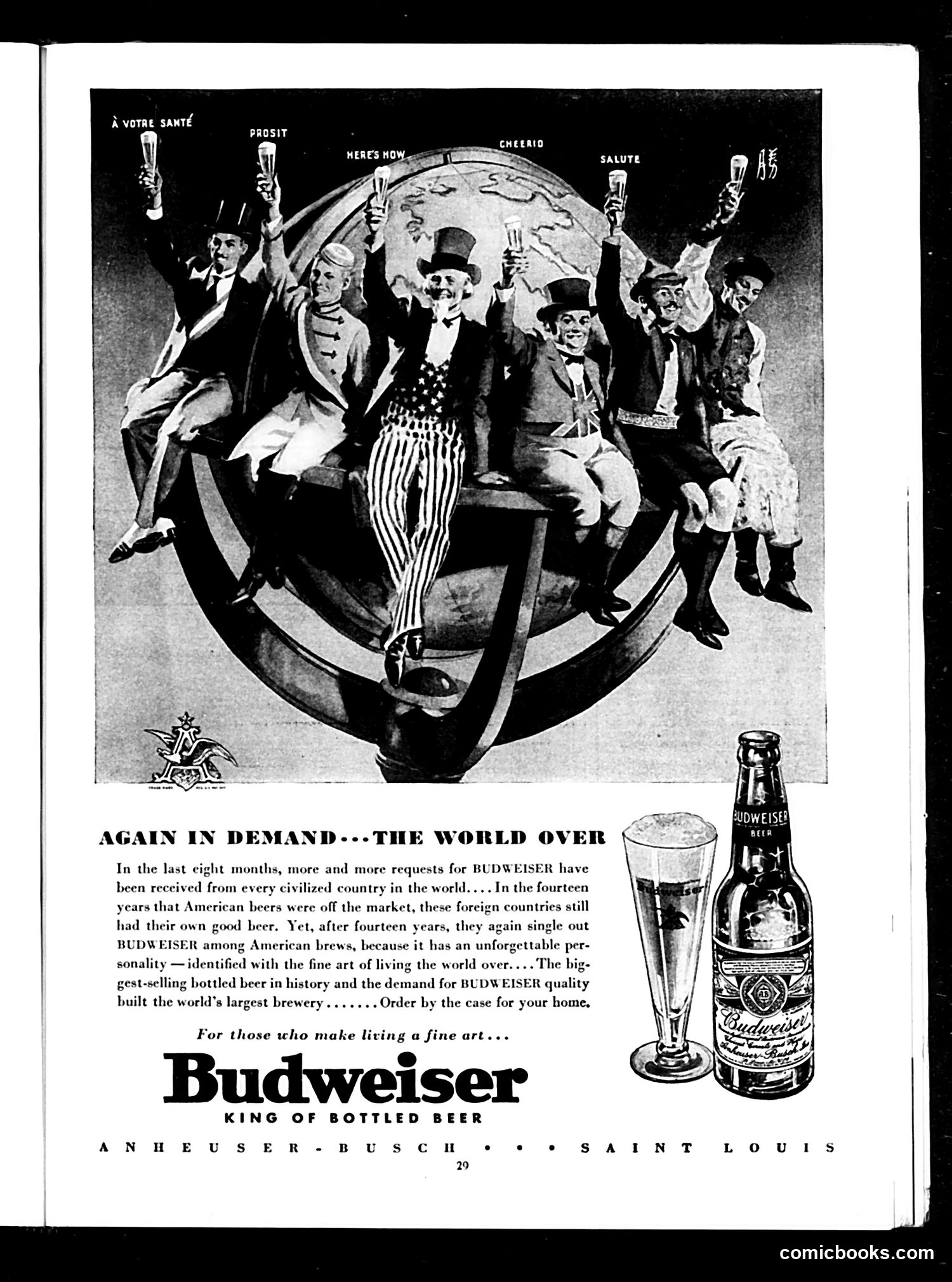
Budweiser Advertisement: Post-Prohibition Celebration This is primarily a Budweiser beer advertisement, not political satire. The cartoon celebrates the end of Prohibition (which lasted roughly 14 years, 1920-1933). The image shows men of various nationalities toasting around a globe, each labeled with drinking phrases in their language ("À votre santé," "Prosit," "Salute," etc.). This illustrates the ad's claim that foreign countries are requesting American Budweiser after years without it. The satire is commercial rather than political: the copy boasts that despite other American beers being unavailable during Prohibition, foreign countries still preferred their own beer—yet now they specifically want Budweiser back, suggesting American superiority and global brand loyalty. The page celebrates America's return to legal beer production and positions Budweiser as the world's premier beer brand.
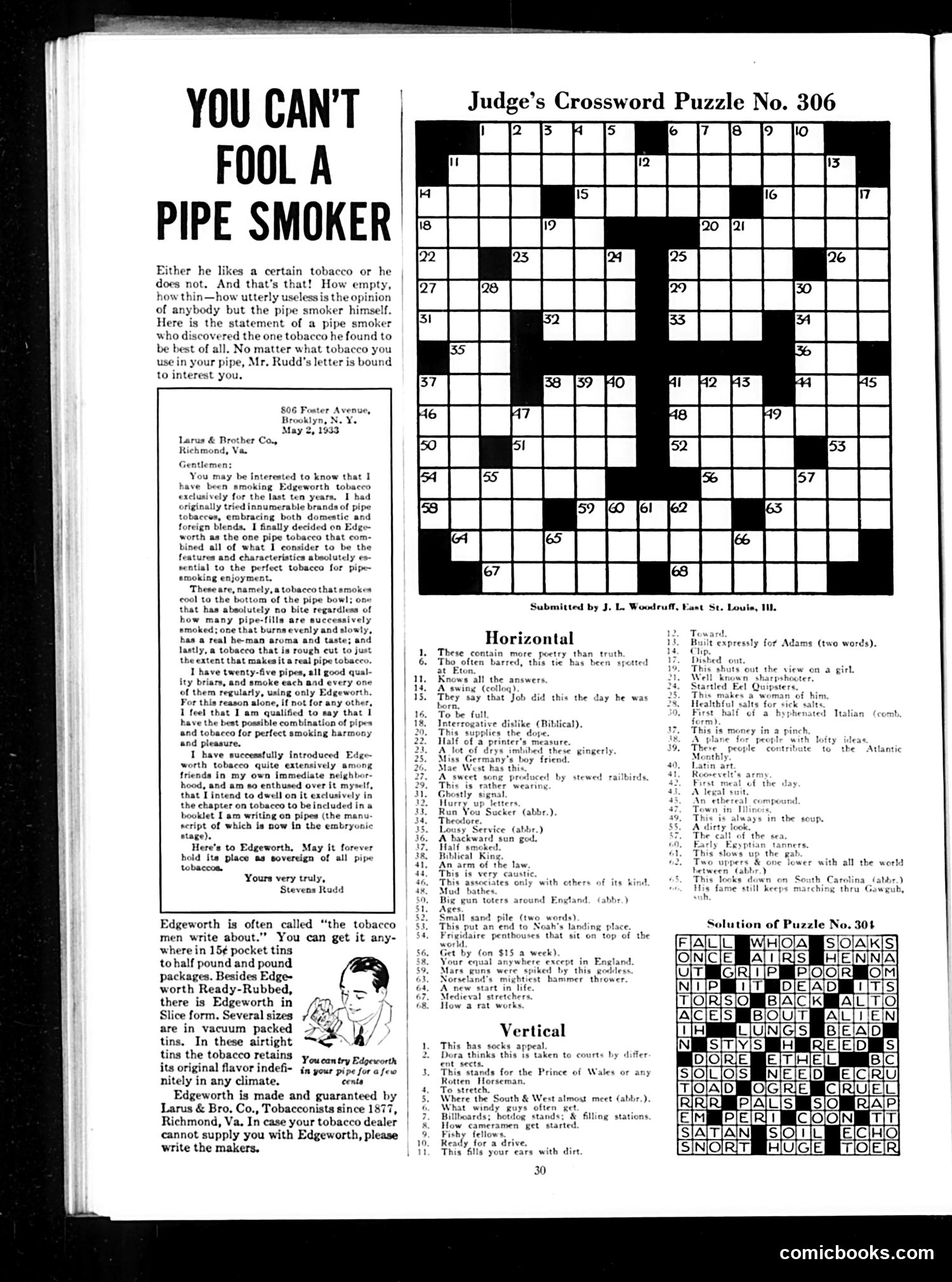
Judge Magazine Advertisement Page - Analysis This page is primarily a tobacco advertisement for Edgeworth pipe tobacco, not political satire. The main content features a testimonial letter from "Steven Rudd" praising Edgeworth as superior pipe tobacco—claiming it's cool, has no bite, and blends domestic and foreign varieties perfectly. The headline "YOU CAN'T FOOL A PIPE SMOKER" argues that experienced smokers have refined taste and can't be deceived by inferior products. The advertisement emphasizes that only the smoker's own judgment matters, positioning Edgeworth as the choice of discriminating men. The page includes a crossword puzzle and an illustration of a man smoking a pipe contentedly. The vintage advertising reflects early-20th-century marketing that appealed to masculine sophistication and expertise. No political figures or satire are present—this is straightforward commercial advertising using the magazine's space.
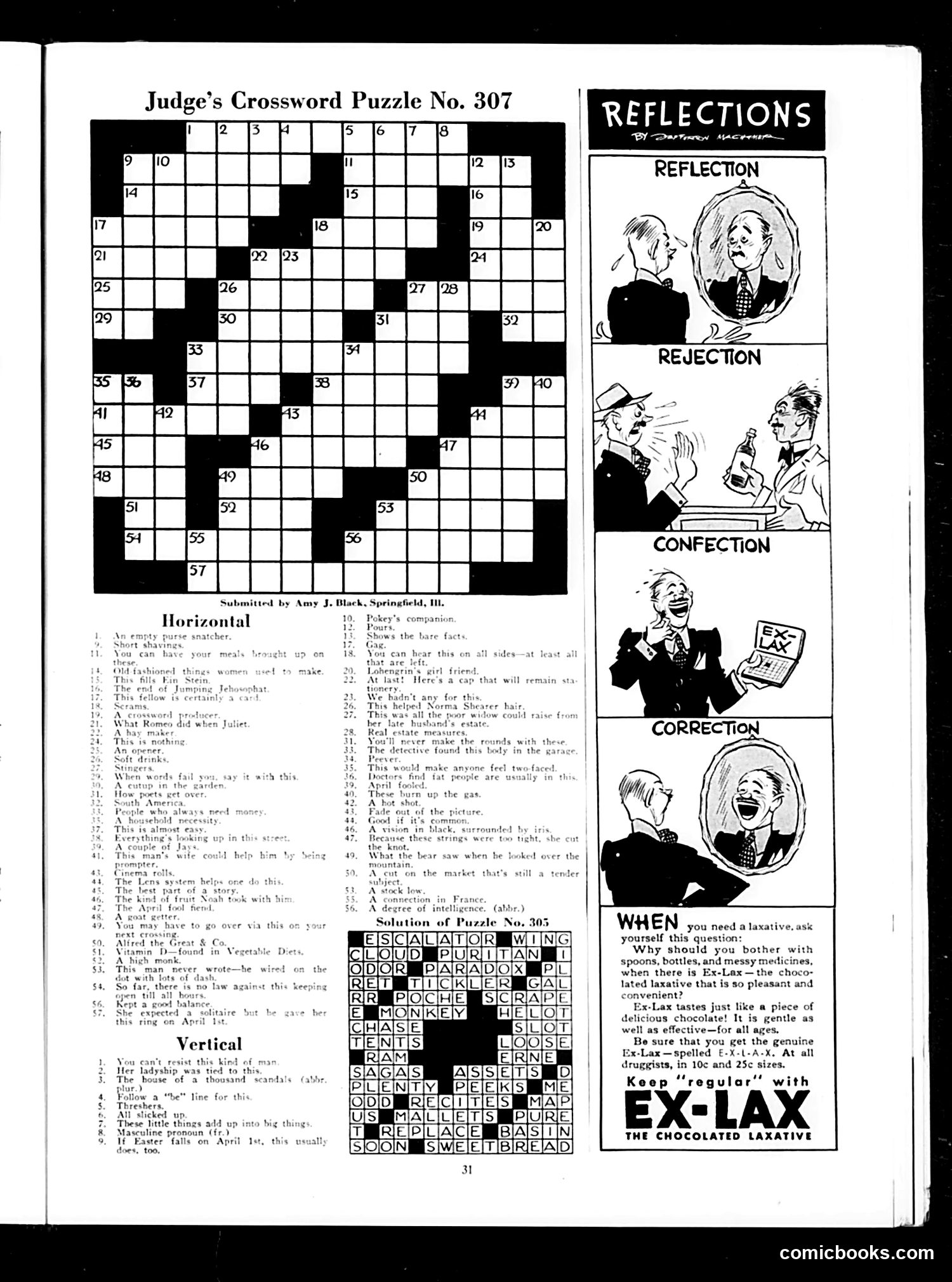
Analysis of Judge Magazine Page No. 307 This page is primarily a crossword puzzle with clues (Horizontal and Vertical sections visible). The "Reflections" panel on the right contains four cartoon vignettes illustrating contrasting concepts: - REFLECTION: A man viewing himself in a mirror, appearing satisfied - REJECTION: Two men in apparent conflict over a bottle - CONFECTION: A man examining what appears to be candy/sweets - CORRECTION: A man laughing heartily These appear to be wordplay-based visual gags exploring related terms differing by one letter. The page also features an Ex-Lax advertisement—a chocolate laxative—using the sales pitch that it's pleasant-tasting medicine disguised as candy, making it preferable to traditional remedies. This was typical direct advertising for such products in early-to-mid 20th century American magazines, before modern pharmaceutical regulations restricted medicinal claims. The crossword and cartoons reflect Judge's typical blend of wordplay, visual humor, and consumer advertising from this era.
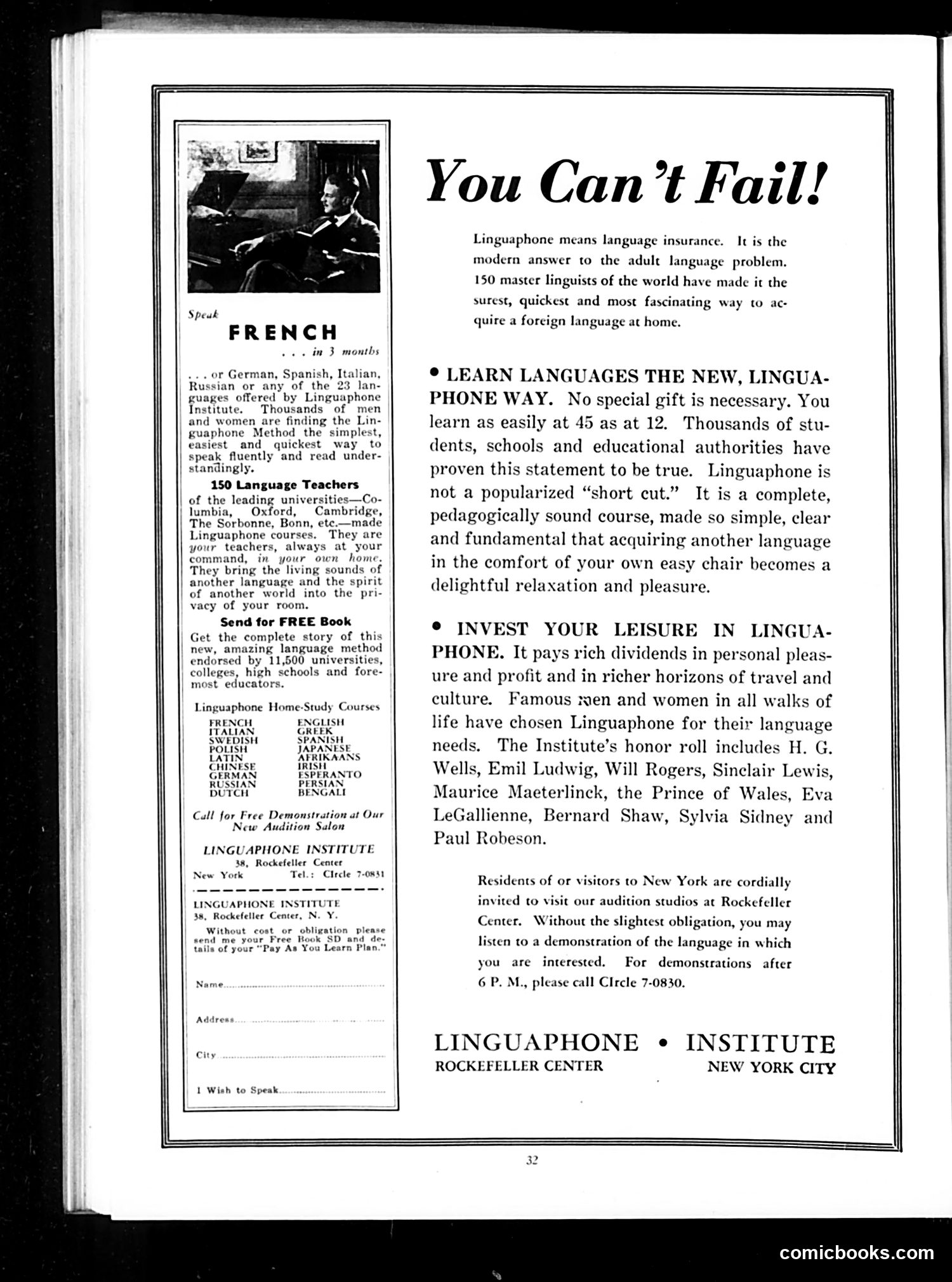
Analysis This page is not a cartoon or satire — it's a straightforward advertisement for the Linguaphone Institute, a language-learning correspondence course. The ad promotes home-study language instruction through phonograph recordings, claiming it's foolproof ("You Can't Fail!") and suitable for adults of any age. It emphasizes that 150 university linguists endorse the method and lists famous endorsers including H.G. Wells, Will Rogers, Bernard Shaw, and Paul Robeson. The left panel shows a registration form offering a free demonstration book. The right panel uses marketing language appealing to leisure seekers: learning languages becomes "delightful relaxation" in one's easy chair, with benefits for travel and culture. This reflects early-to-mid 20th-century American consumer optimism about self-improvement technology — the idea that sophisticated cultural pursuits (foreign languages) could be effortlessly acquired through modern methods. The prominent celebrity endorsements and "language insurance" framing are typical period advertising strategies.
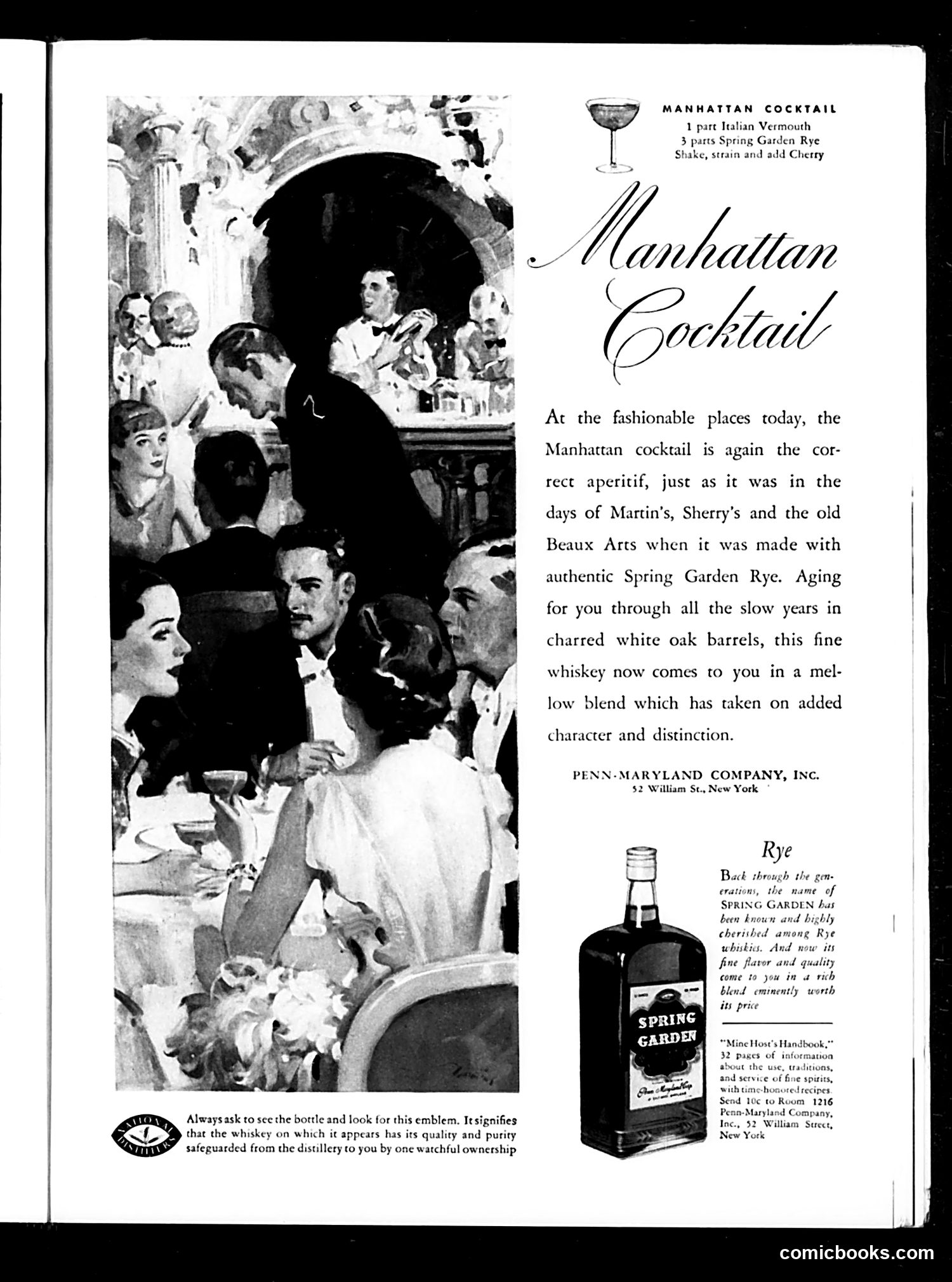
Analysis This page is primarily advertising, not satire or political commentary. It promotes Spring Garden Rye whiskey through Penn-Maryland Company, Inc. The content references the Manhattan cocktail's return to fashion among wealthy New York society at "fashionable places." It invokes nostalgic references to Martin's and Sherry's (upscale establishments) and the "old Beaux Arts" to suggest the drink's pedigree and respectability. The accompanying illustration shows an elegant social gathering—likely a speakeasy or upscale bar scene—depicting well-dressed patrons in formal attire, reinforcing the product's association with sophistication and status. The ad emphasizes that Spring Garden Rye has been "known and highly cherished" for generations, positioning it as an established, quality product. The emblem serves as a guarantee of authenticity and purity "from the distillery to you." This reflects Prohibition-era marketing (likely 1920s-1930s), where whiskey companies worked to reclaim legitimacy and reestablish branded products after legalization or to associate with pre-Prohibition prestige.
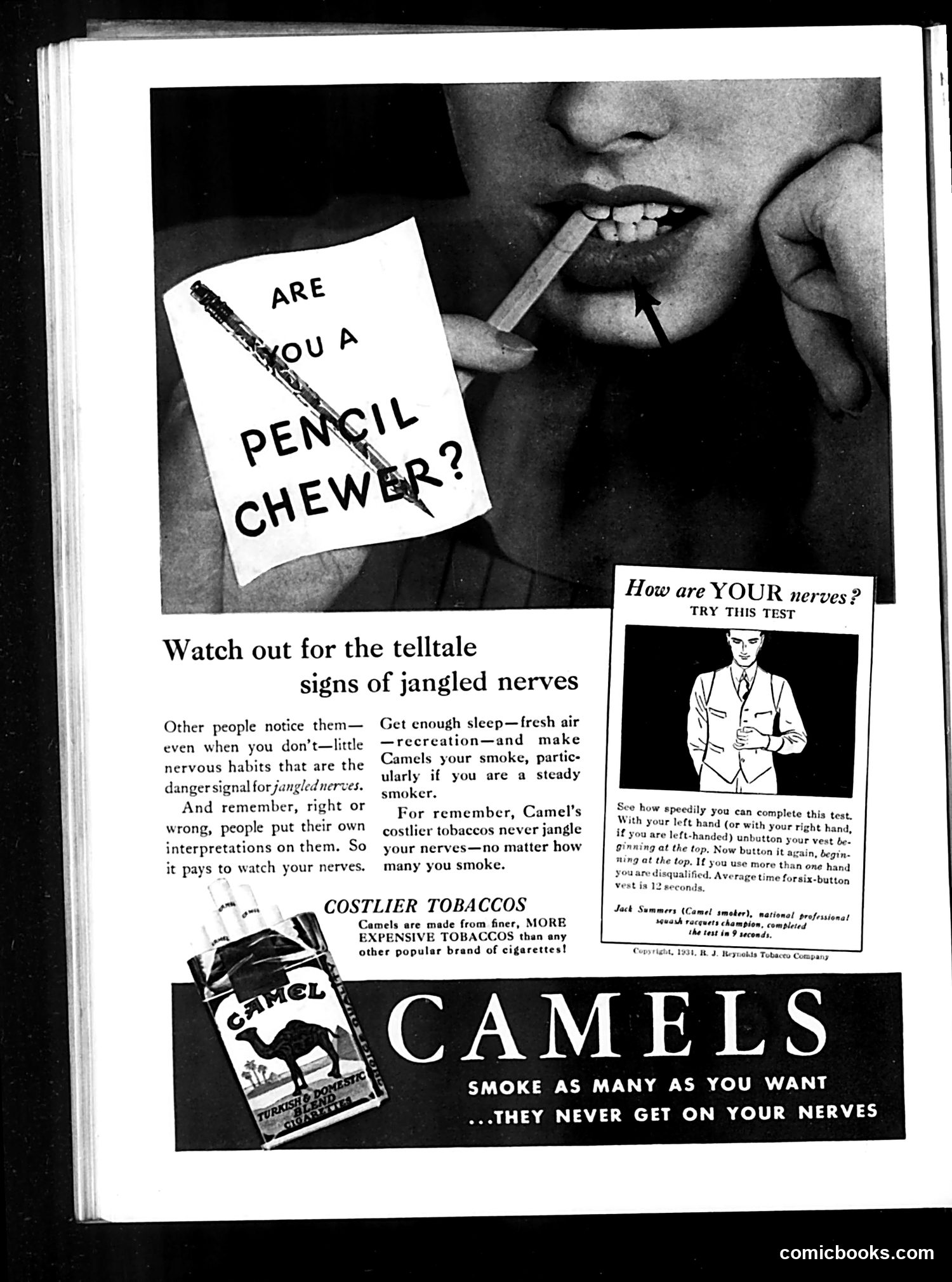
Analysis for Modern Readers This is a Camel cigarette advertisement disguised as health advice, likely from the 1930s. The page exploits anxiety about nervousness and social perception to sell cigarettes. The central image shows a young man chewing a pencil—presented as a "telltale sign of jangled nerves" that others judge negatively. The ad warns readers to control visible nervous habits, then pivots: smoke Camels instead, claiming their "costlier tobaccos" won't damage nerves. A companion "nerve test" (timing how quickly you can unbutton/button a vest) purports to measure nervousness objectively. The satire/irony for modern readers: This advertisement makes health claims about cigarettes that are completely false. We now know smoking increases anxiety and damages health. The ad exploits psychological vulnerability—social embarrassment about nervousness—to market an addictive, harmful product. It's a textbook example of mid-20th-century tobacco advertising deception before regulations restricted such claims.