judge
Judge — May 1934
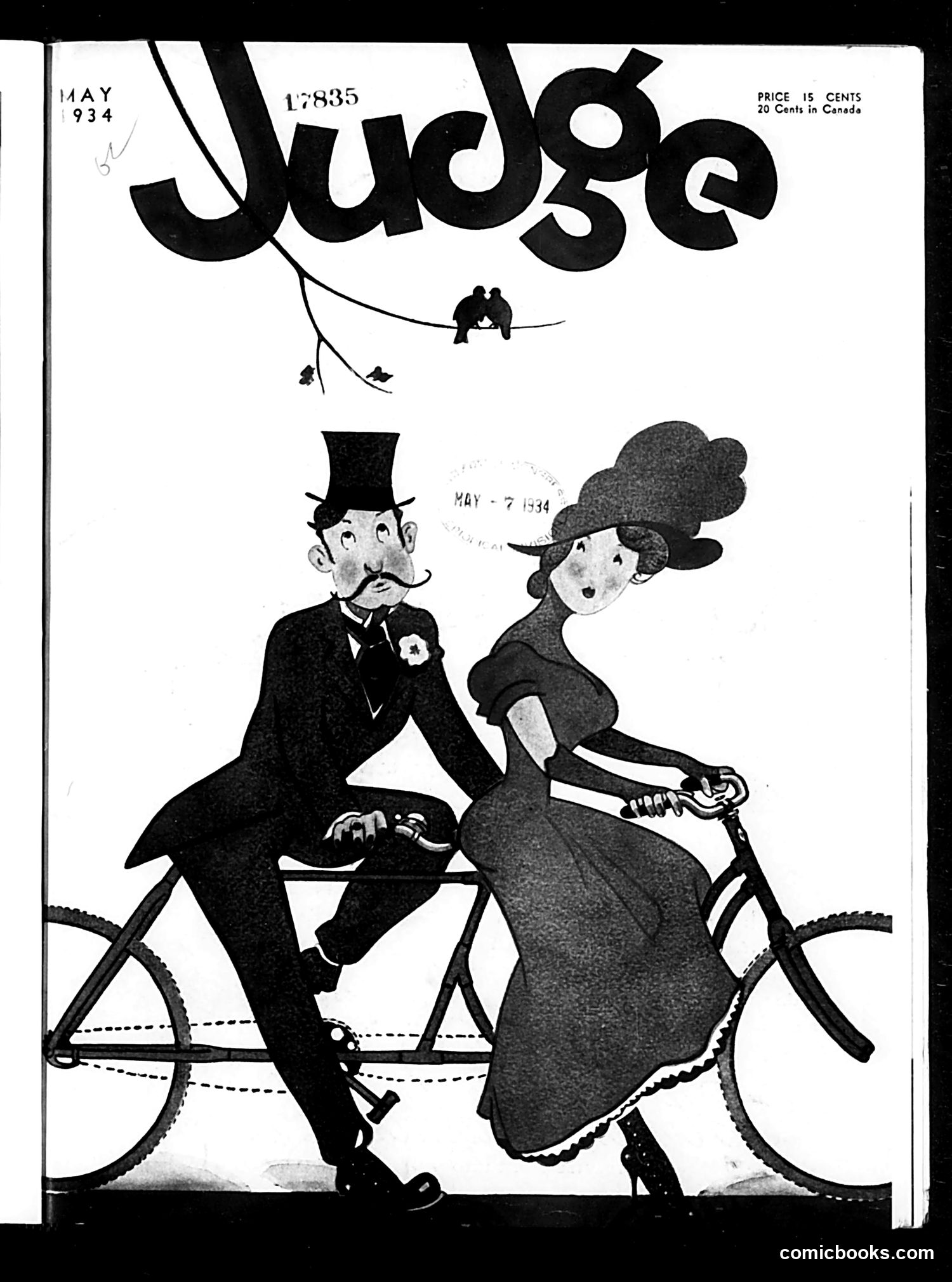
Judge Magazine Cover Analysis - May 1934 This is a Judge magazine cover from May 1934 featuring an illustration of two elegantly dressed figures sharing a tandem bicycle. The man wears a top hat and monocle with an exaggerated mustache, while the woman sports a fashionable hat and dress typical of 1930s high society. The cartoon appears to satirize wealthy or upper-class romance and courtship during the Depression era. The tandem bicycle—requiring cooperation and coordination—likely comments on romantic partnership or marriage dynamics among the elite. The characters' refined appearance contrasts with economic hardship many Americans faced in 1934, suggesting social satire about the disconnected lifestyles of the wealthy. The specific individuals depicted remain unclear without additional context.
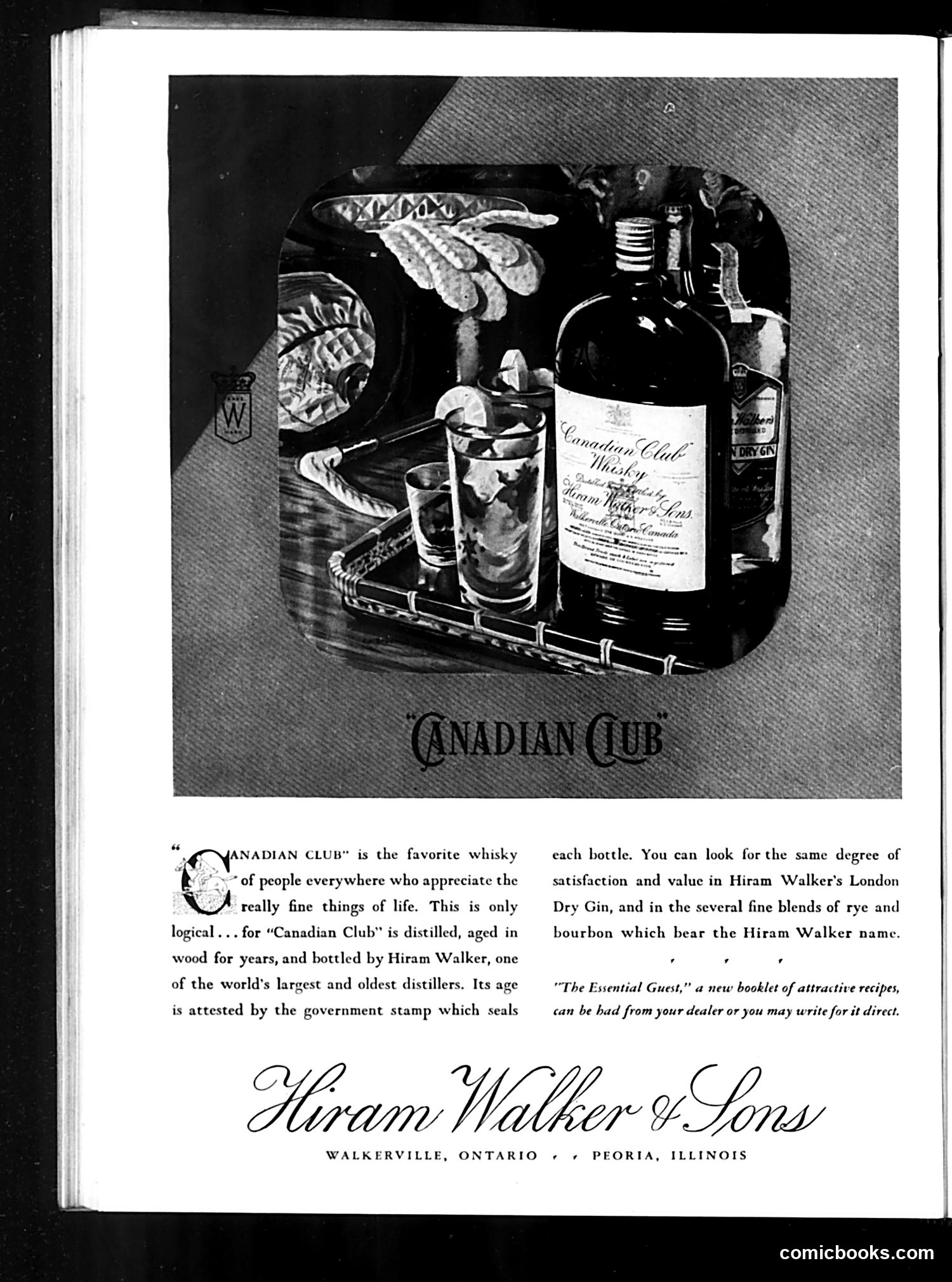
Analysis This page is primarily advertising, not political satire. It's a full-page advertisement for Canadian Club whiskey, produced by Hiram Walker & Sons (located in Walkerville, Ontario and Peoria, Illinois). The ad uses an elegant still-life composition showing a bottle of Canadian Club whiskey, two glasses with ice and what appears to be drinks, and decorative plates with food imagery. The text emphasizes the whiskey's age, wood-aging process, and government certification of quality. There is no cartoon or political commentary here. Judge magazine included paid advertisements alongside its satirical content. This particular ad appeals to readers who "appreciate the really fine things of life" and promotes Canadian Club as a luxury product. The mention of "The Essential Guest" booklet suggests tie-in promotional materials.
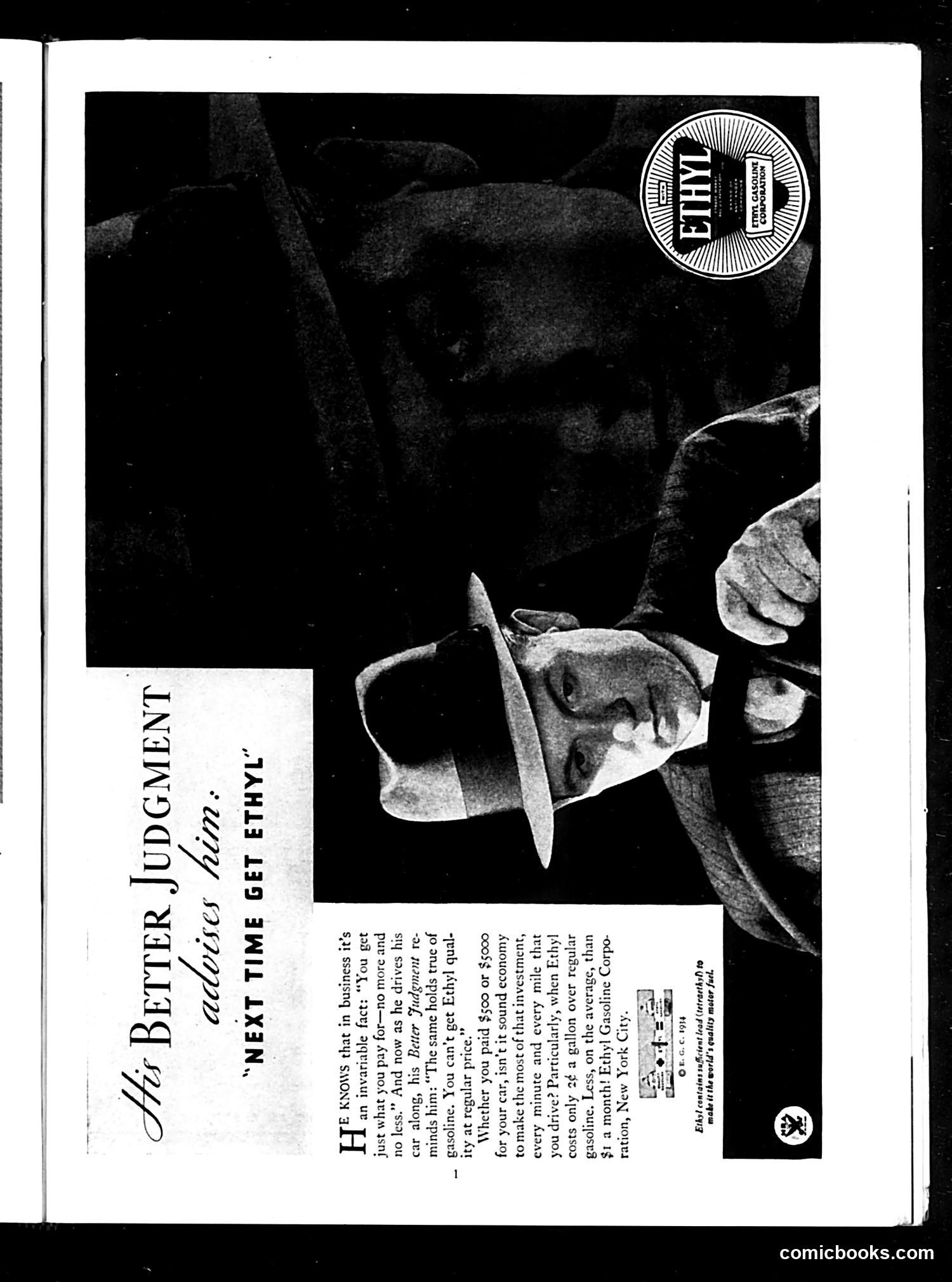
Analysis This Judge magazine page advertises a product called "His Better Judgment" with the tagline "Carries Him 'Next Time Get Ethyl.'" The advertisement features a photograph of a man in a hat and coat, appearing to be in some kind of distressed or awkward situation. The accompanying text suggests the product relates to automobile fuel or additives—likely Ethyl gasoline, a popular brand of the early-to-mid 20th century known for anti-knock properties. The humor appears to play on the phrase "better judgment," implying that using Ethyl fuel represents smarter decision-making for drivers. The man's awkward pose suggests he's learned a lesson about fuel choice, making this a straightforward product advertisement rather than political satire. This represents typical Judge magazine promotional content from the gasoline/automotive industry era.
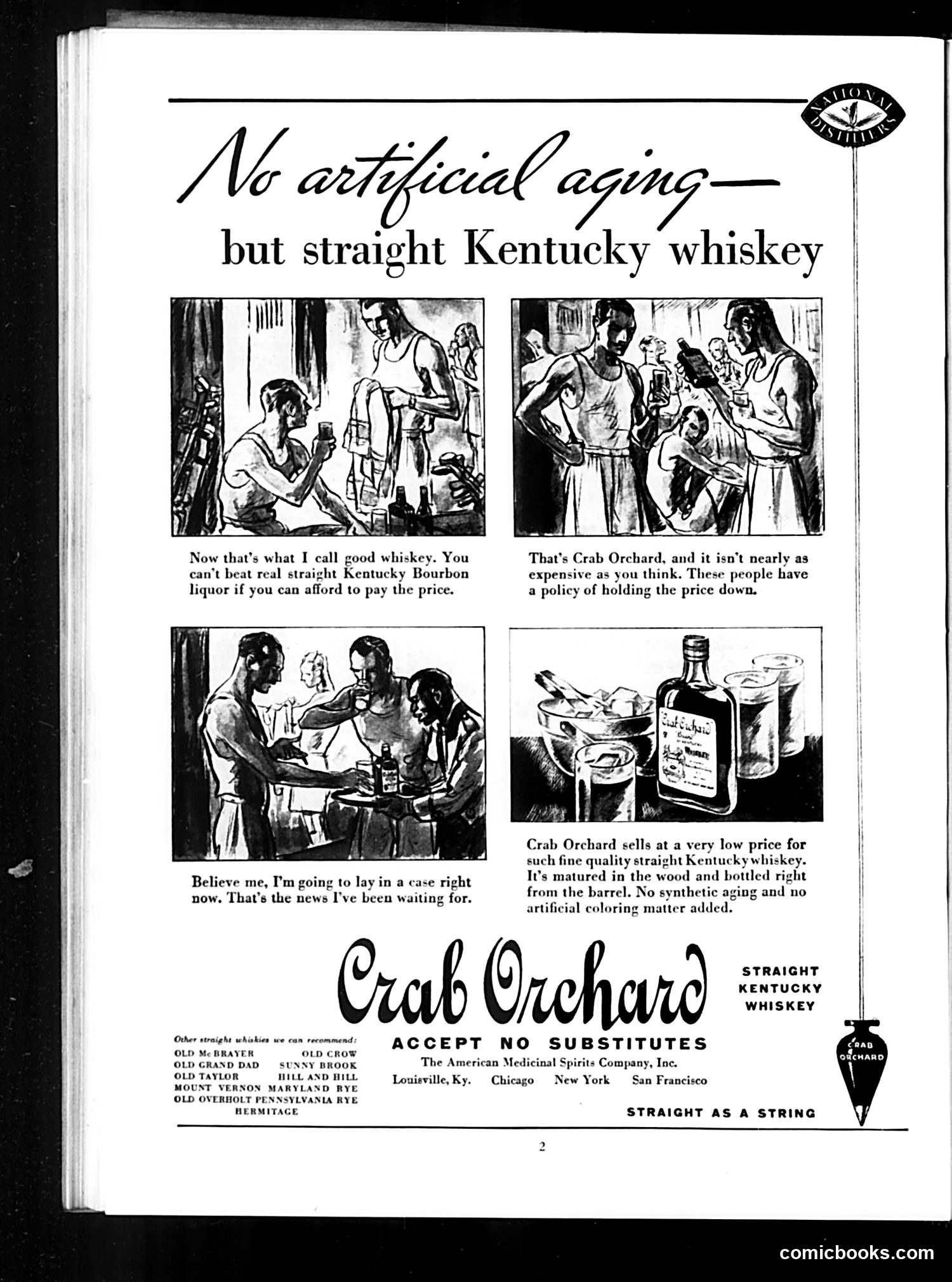
Crab Orchard Whiskey Advertisement This is a whiskey advertisement, not political satire. The four comic panels tell a narrative promoting Crab Orchard brand straight Kentucky whiskey. The story shows people discussing whiskey quality and price. The dialogue emphasizes that Crab Orchard offers "good whiskey" at an affordable price—a selling point during economically conscious times. The final panels display the product itself and reiterate its authenticity: "matured in the wood and bottled right from the barrel. No synthetic aging and no artificial coloring matter added." The ad's tagline, "Straight as a String," plays on the product name while suggesting reliability and honesty. The manufacturer, American Medicinal Spirits Company, lists multiple whiskey brands they produce, reflecting Prohibition's end (whiskey was again legal).
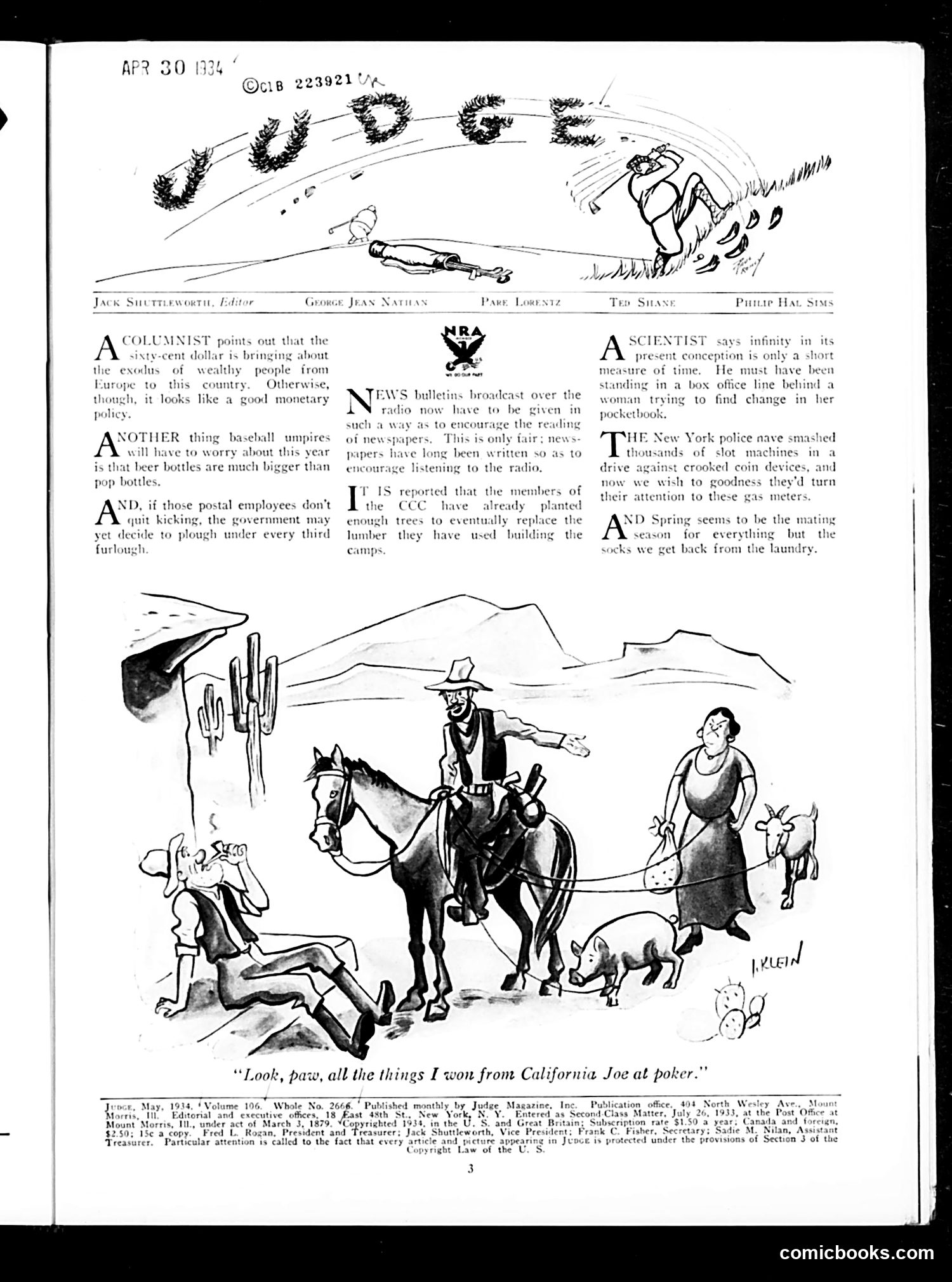
Judge Magazine Satire Analysis (April 30, 1924) The main cartoon depicts a cowboy showing off his winnings to a woman with livestock, captioned "Look, paw, all the things I won from California Joe at poker." The satire mocks gambling culture and the notion of winning possessions (a horse, goats, pig) through card games—suggesting reckless wagering where people stake tangible assets rather than money. The accompanying brief commentary items target contemporary issues: postal employees' job security, beer bottle sizes (likely Prohibition-era humor), and NYC police efforts against slot machines. A scientist's observation about infinity and a woman's datebook offers absurdist humor about spring dating season. The page combines editorial satire with comic observations typical of Judge's format—mixing visual humor with topical commentary on 1920s American life.
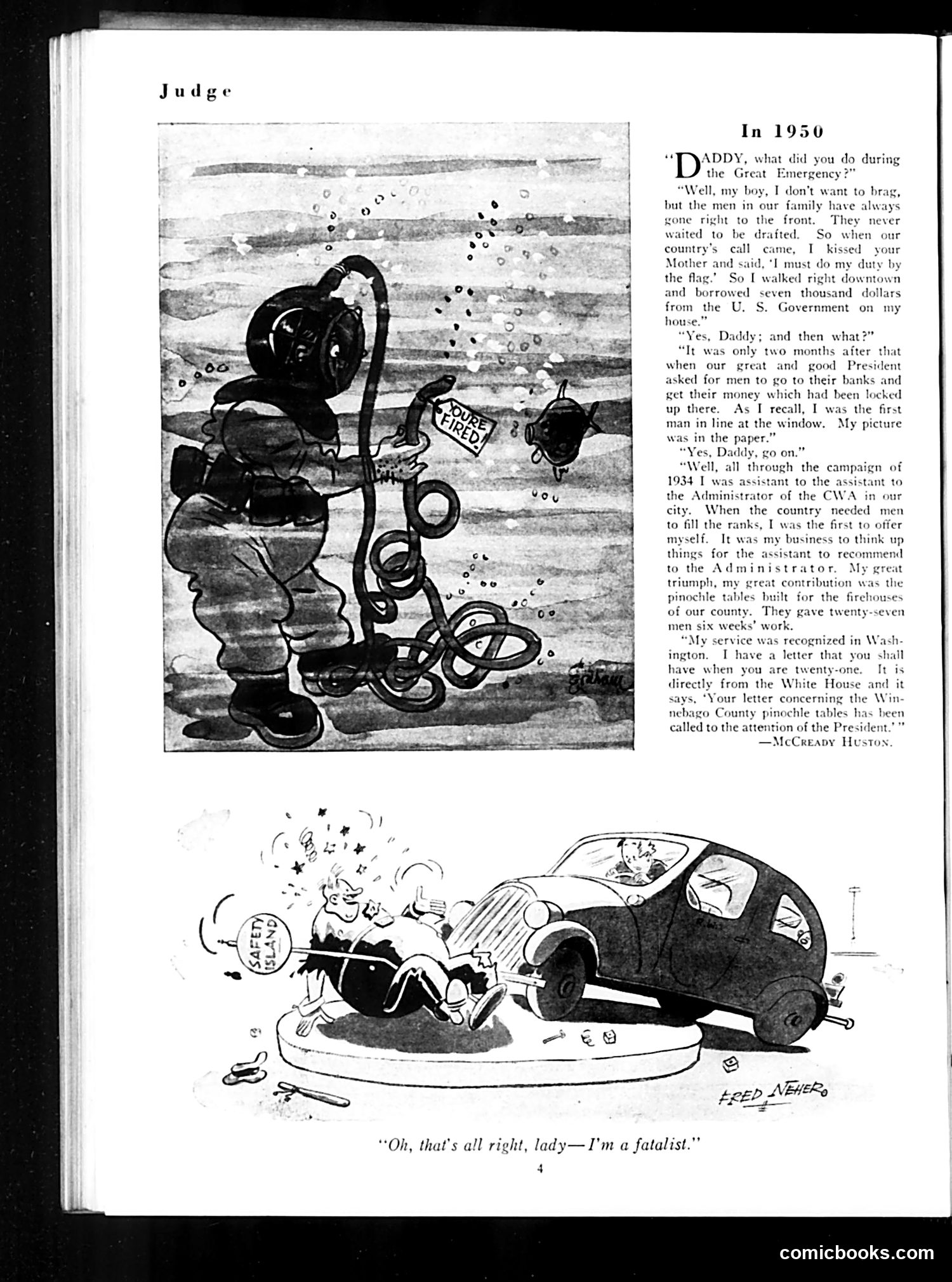
Analysis of Judge Magazine Page Top Cartoon: A figure labeled "FIRED" sits amid tangled wires and mechanical parts, referencing New Deal employment programs. The text describes someone's contributions during the "Great Emergency" (the Depression/WWII era), including work with the CVA (Civilian Works Administration) and pinochle tables for firehouses. The narrator boasts of recognition from the White House—satirizing how Depression-era workers claimed credit for relief work and New Deal projects. Bottom Cartoon: Captioned "Oh, that's all right, lady—I'm a fatalist," shows a fender-bender accident. The joke mocks fatalism as an excuse for poor driving—a social commentary on personal responsibility versus accepting misfortune passively, typical of 1950s humor. Both reflect post-war American attitudes toward Depression nostalgia and contemporary social behavior.
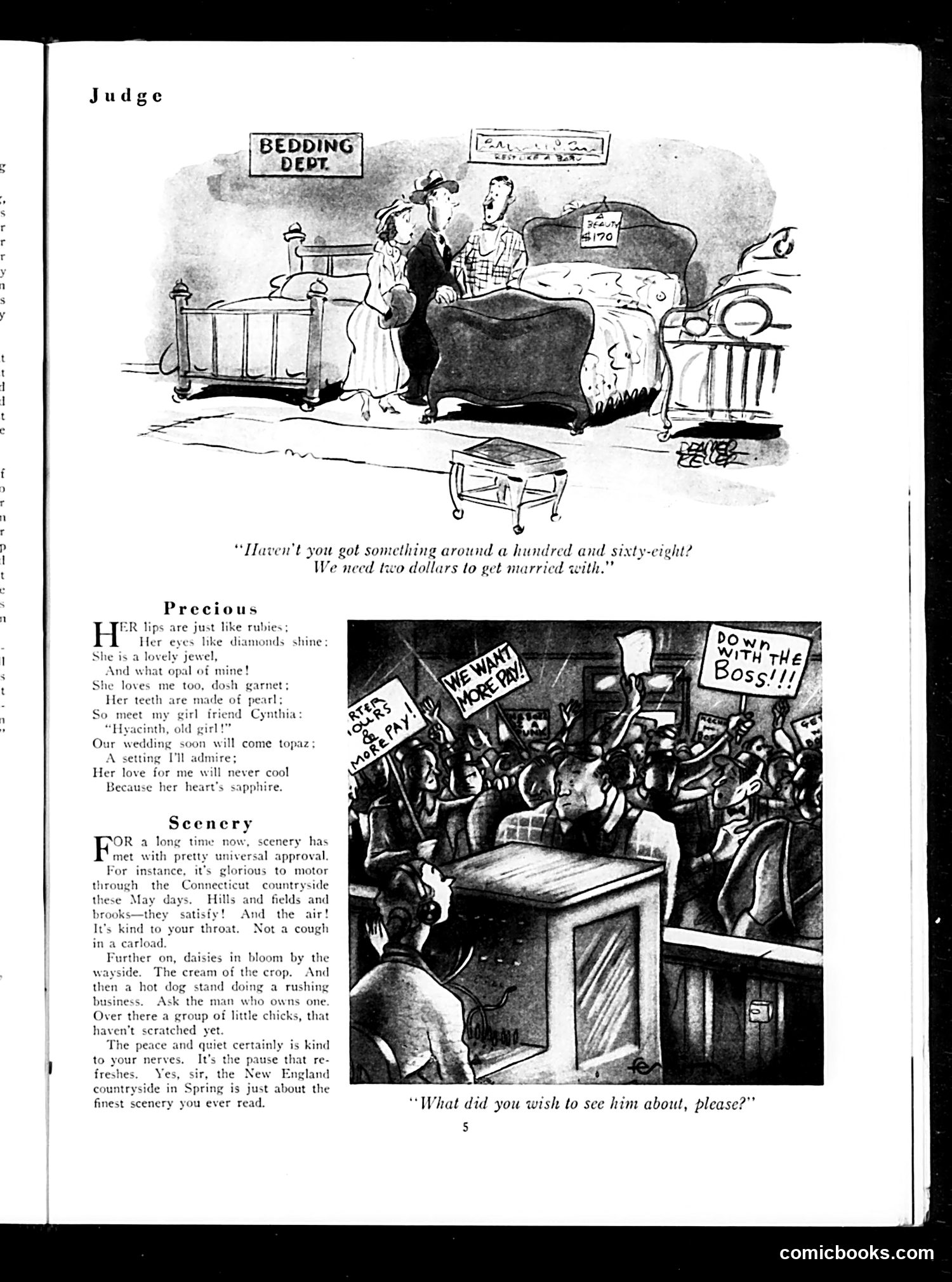
Judge Magazine Page Analysis Top Cartoon: A couple in a bedroom discusses marriage costs. The man mentions needing "$1.68" for marriage, likely referencing minimal legal fees or marriage license costs. The satire mocks how cheaply marriage itself can be obtained, contrasting with broader expenses of courtship and married life. The "Bedding Dept." sign suggests this takes place in a department store, adding absurdist humor. "Precious" Poem: Sentimental verse praising a woman's beauty using conventional romantic language ("rubies," "diamonds," "sapphire heart"). "Scenery" Section: Praises New England countryside in Spring, emphasizing natural beauty and health benefits. Bottom Photograph/Cartoon: Shows workers confronting a boss with protest signs reading "WE WANT HIGHER PAY" and "DOWN WITH THE BOSS!!!" This depicts labor unrest or strike activity, reflecting early 20th-century industrial conflict.
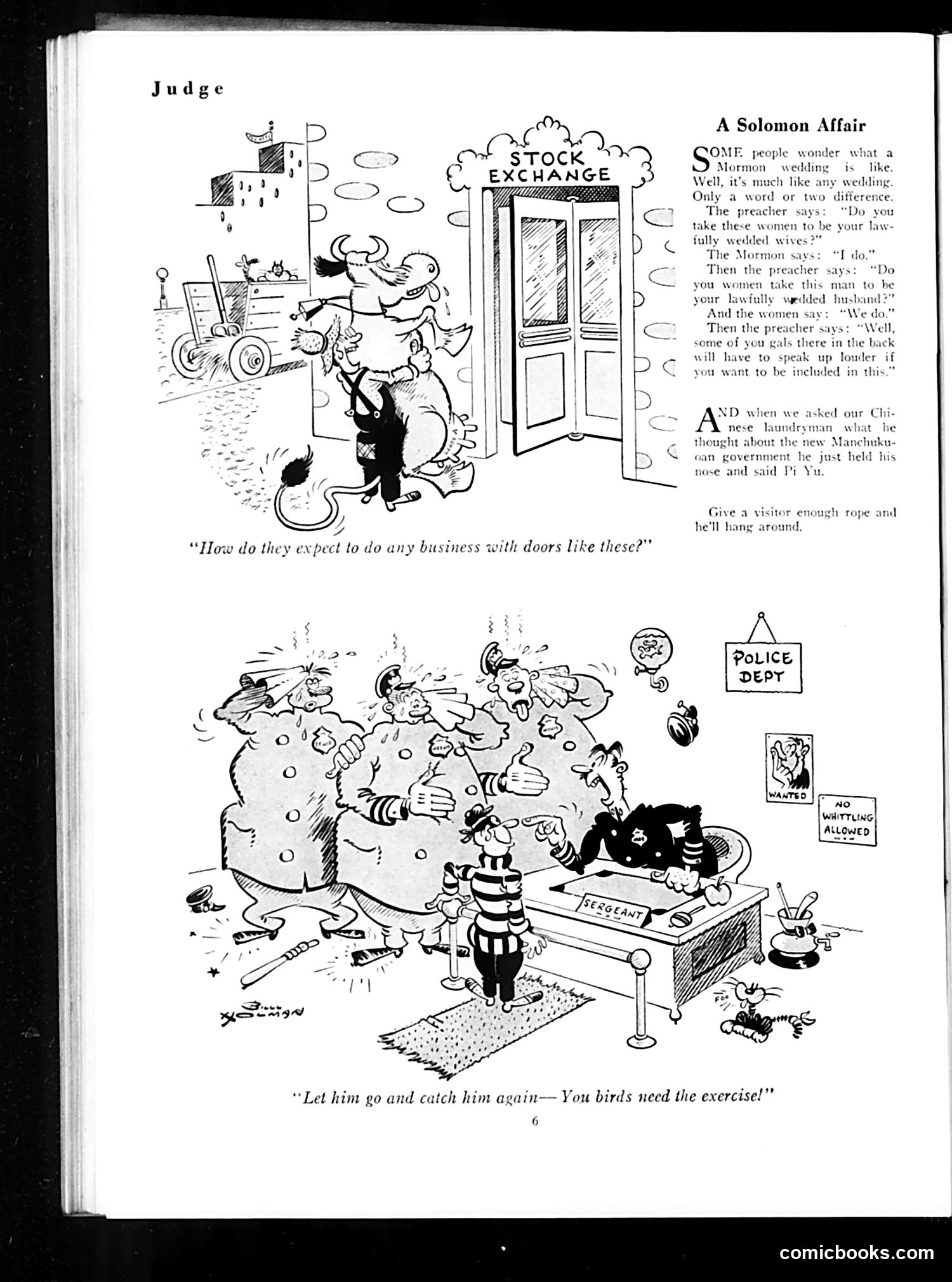
Analysis of Judge Page This page contains two cartoons satirizing different targets: Top cartoon ("Stock Exchange"): Mocks the chaotic state of business dealings, showing a bull and bear (stock market symbols) conducting commerce through absurdly malfunctioning doors. The caption "How do they expect to do any business with doors like these?" suggests incompetent management or structural dysfunction in financial institutions—likely referencing early 20th-century market instability or banking practices. Bottom cartoon ("Police Dept"): Depicts a sergeant at a police desk surrounded by chaotic birds in the office, suggesting officers are unprofessional or undisciplined. The caption about "exercise" implies satirical criticism of police conduct or department management—perhaps commenting on corrupt or ineffectual law enforcement. Both cartoons use animal caricatures and visual chaos to critique institutional incompetence in business and law enforcement.
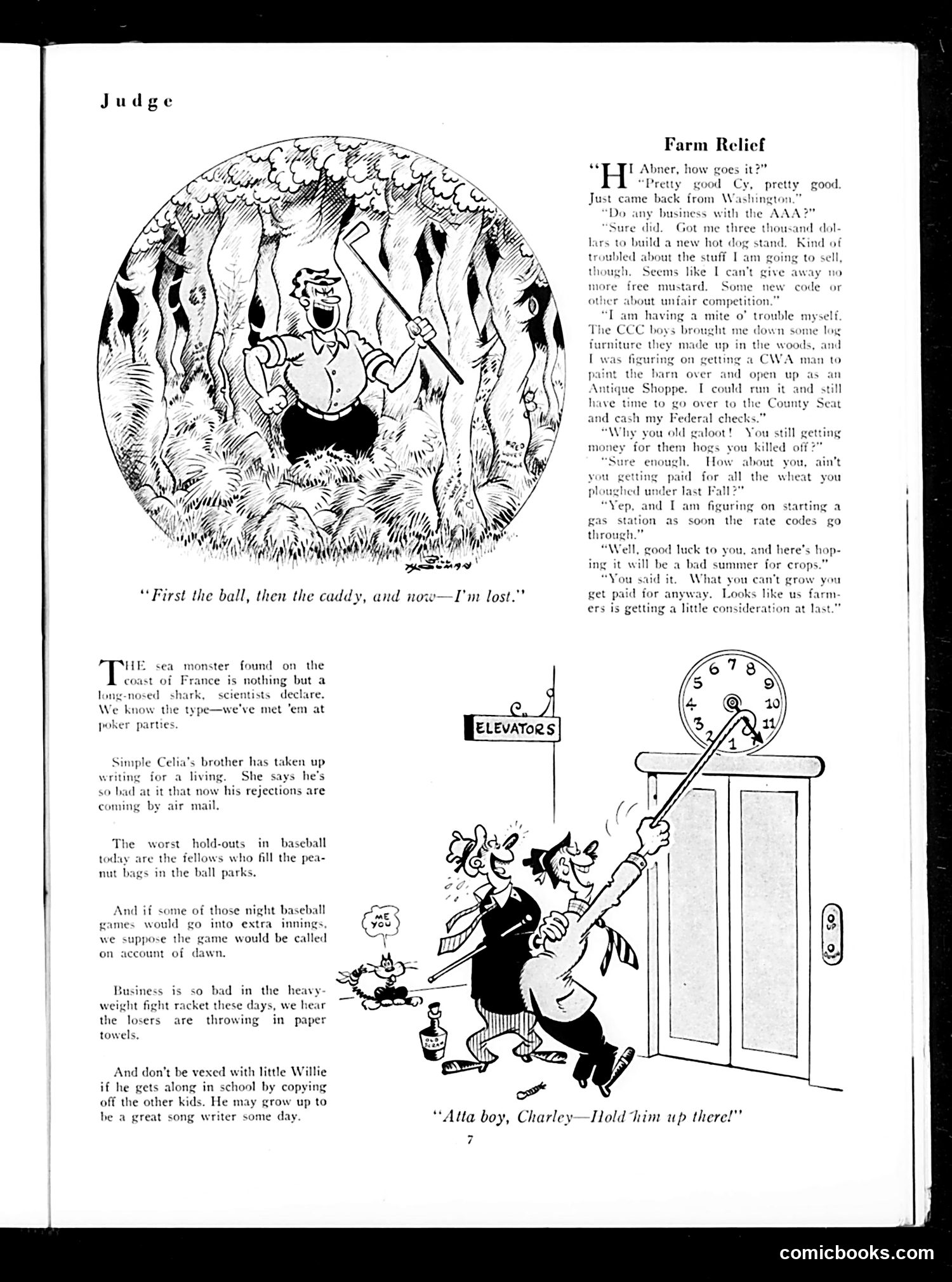
Farm Relief Cartoon Analysis This page satirizes New Deal agricultural programs through a dialogue between two farmers, "Cy" and "Abner." The cartoon mocks how farmers are exploiting government relief agencies (AAA, CCC, CWA) meant to address Depression-era hardship. The joke: farmers receive subsidies ostensibly for farm relief—the AAA paid them to reduce crop production, the CCC employed workers on conservation projects—but they're actually using the money to start unrelated businesses (hot dog stands, gas stations, tourist shops). One farmer grotesquely notes he's "paid for all the wheat you ploughed under," referring to the government's controversial policy of paying farmers *not* to grow crops to raise prices. The final ironic exchange—wishing "it will be a bad summer for crops" because "what you can't grow you get paid for anyway"—exposes the perverse incentive structure: farmers profit more from *not* farming than farming. The cartoon criticizes both the New Deal's apparent inefficiency and farmers' opportunism in exploiting it.
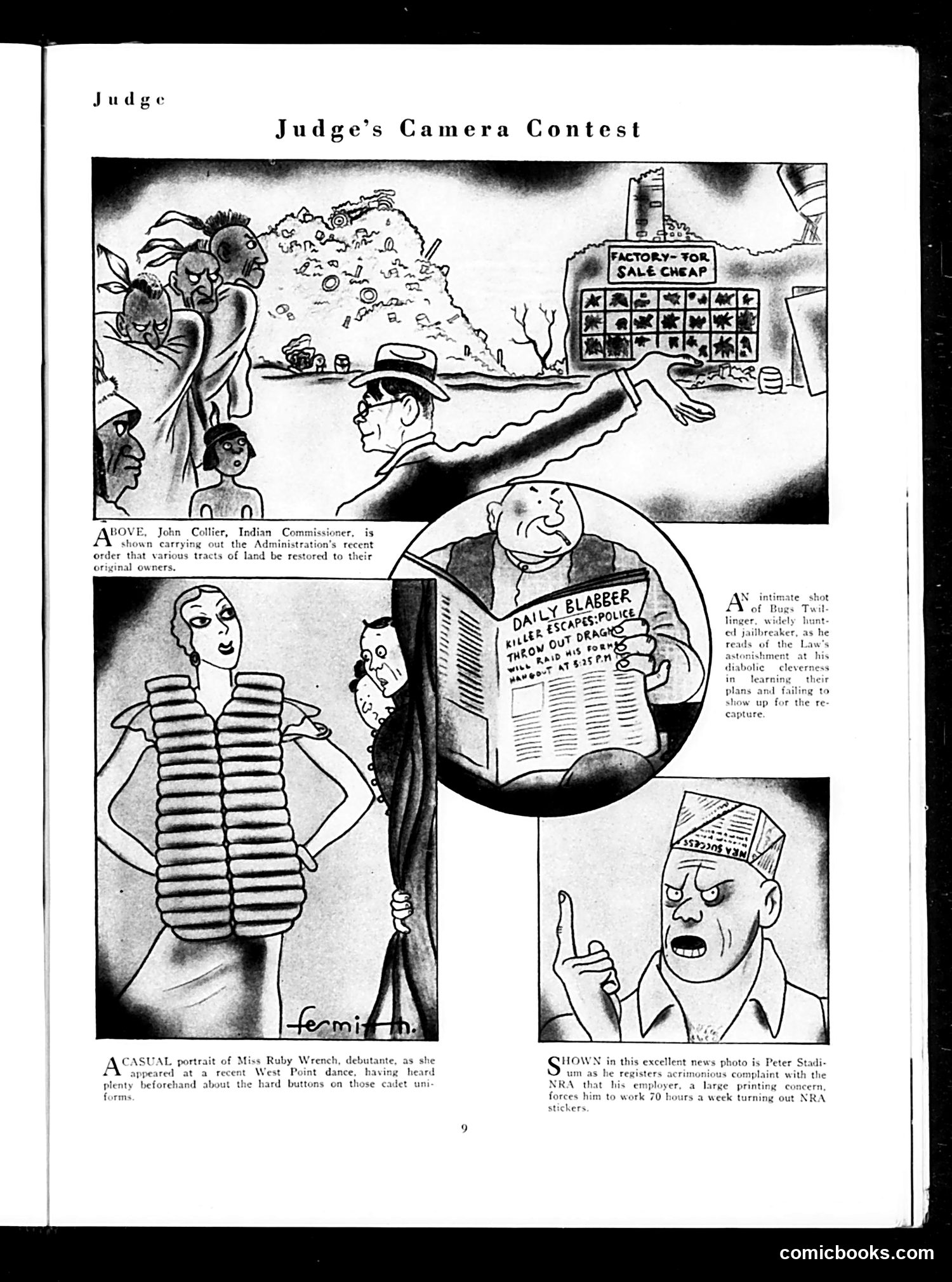
Judge's Camera Contest - Analysis This page presents a satirical "camera contest" mocking various figures and social issues of the era (likely 1930s based on NRA reference). The top panel shows John Collier, Indian Commissioner, surveying land restoration efforts—satirizing government Indian policy. The middle-left depicts Miss Ruby Wrench in a cadet uniform, mocking women's fashion at West Point dances. The circled portrait shows a man reading the "Daily Blabber" newspaper with sensational crime headlines, satirizing tabloid journalism and public fascination with scandals. The bottom panel ridicules an NRA employer complaining about forced 70-hour work weeks under NRA (National Recovery Administration) regulations—critiquing New Deal labor policies as burdensome to business. The overall satire targets government overreach, tabloid culture, and workplace regulation during the Depression era.
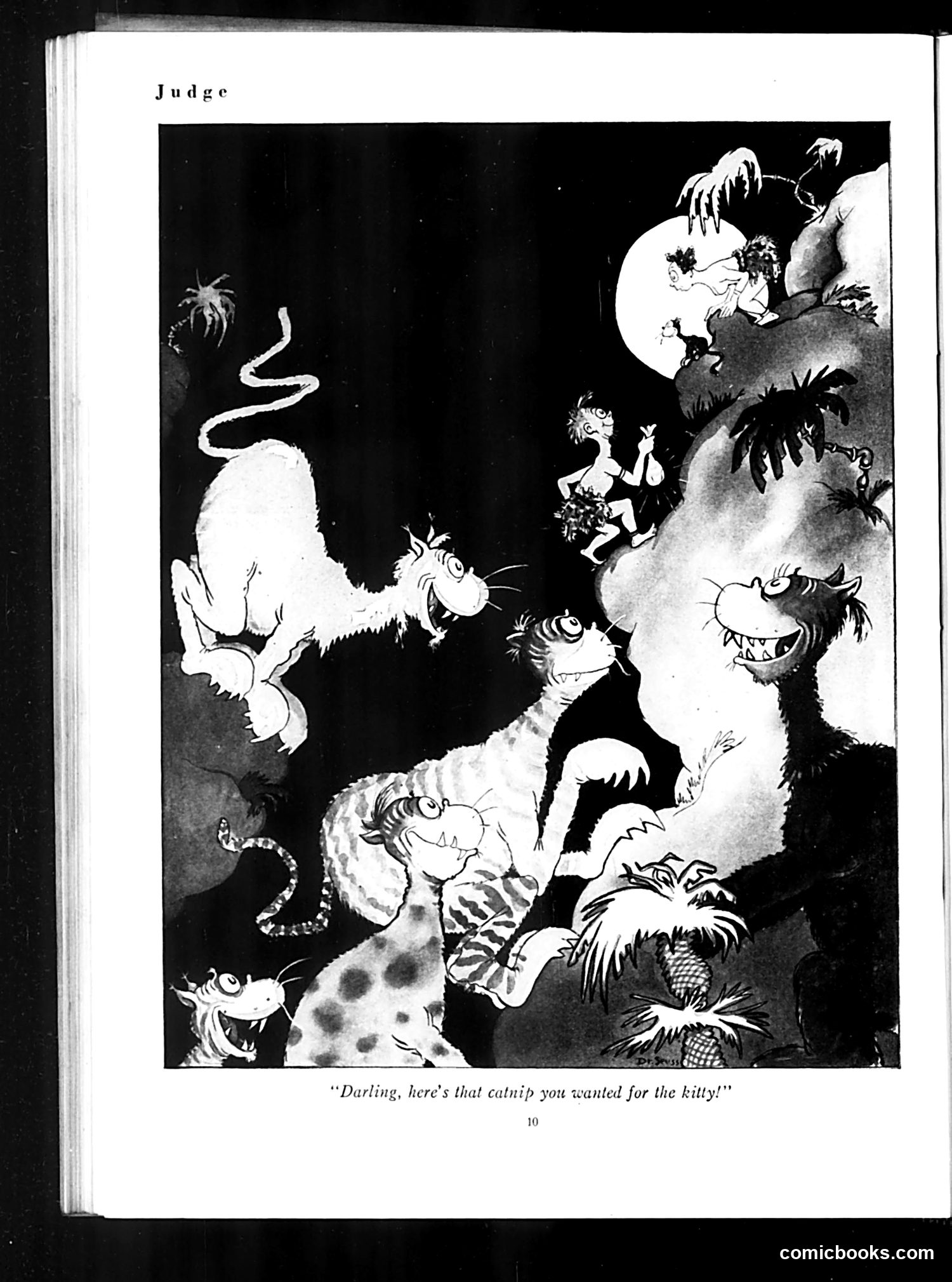
Analysis This appears to be a humorous domestic scene rather than political satire. The cartoon shows a man presenting catnip to his wife, who is surrounded by numerous cats in various playful poses. The joke seems to be a visual pun or gentle satire about cat ownership and feline behavior—the woman is so surrounded by cats that the catnip gift becomes comical or ironic. The style is typical of Judge magazine's light, whimsical humor. Without additional context about the publication date or any topical references in Judge's editorial calendar, this reads as straightforward domestic humor playing on common observations about cat lovers and pet behavior rather than commentary on specific political or social events.
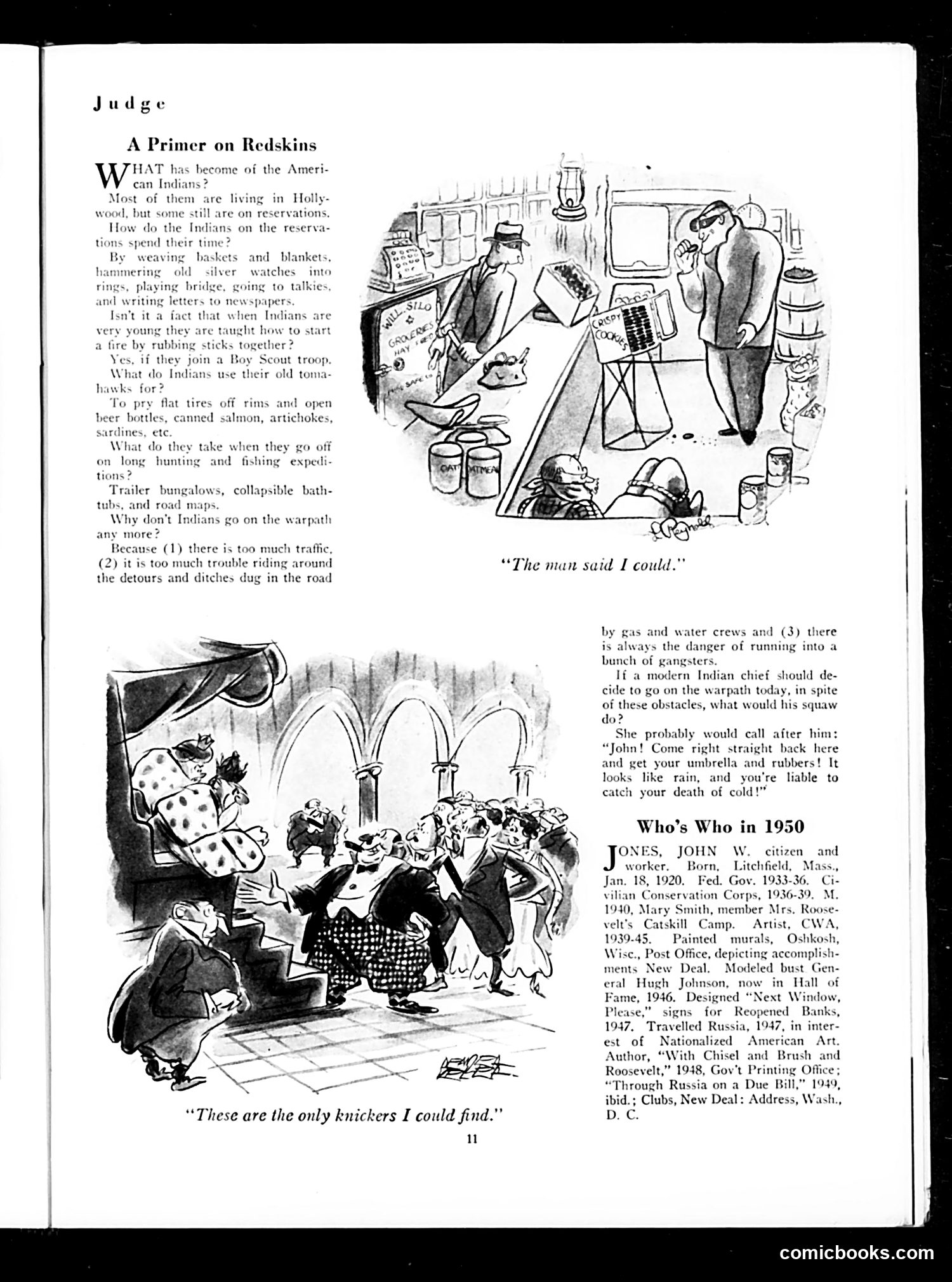
A Primer on Redskins - Judge Magazine Satire This 1950 piece satirizes modern Native Americans through a mock "primer" format. The satire works by contrasting romanticized stereotypes of "Indians" (the period's terminology) with mid-20th-century American consumer culture. The jokes mock how reservation life has been absorbed into mainstream America: Indians now play bridge, attend movies ("talkies"), and use modern conveniences like trailer bungalows and road maps instead of traditional practices. The warpath is abandoned not for noble reasons but because of traffic, road construction, and gangsters. The cartoons illustrate this collision of cultures—one showing modern camping chaos, another depicting Native Americans in urban clothing searching for period costumes. The squaw character warns her chief about catching cold, replacing warrior traditions with domestic concerns. The "Who's Who" entry for John W. Jones appears unrelated—likely an actual New Deal administrator included for contrast or additional satire about government employment. The humor relies on outdated racial caricature and assumes readers found "Indianness" inherently comic when modernized.
Judge Magazine Analysis: George Jean Nathan Theater Criticism This is a theater criticism column by Judge magazine, not a cartoon page. The author (identified as "Judge" in the header) defends playwright John Howard Lawson against critical dismissal of his anti-Nazi propaganda play "The Shattered Lamp." The piece argues that critics wrongly claim plays lose dramatic impact when audiences know the plot in advance. The author rebuts this, noting that familiarity doesn't diminish box-office appeal—citing "Dodsworth" as proof. The text references Lawson's earlier work ("Processional," "Roger Bloomer") and notes that German Expressionist playwrights like Hasencleaver and Goering once praised him, before dismissing his newer plays "The Pure in Heart" and "Gentlewoman." The author defends Lawson's artistic merit against contemporary critical reassessment, suggesting reviewers are now unfairly harsh on work they once celebrated. The satire targets critical inconsistency and the theater establishment's shifting judgments.
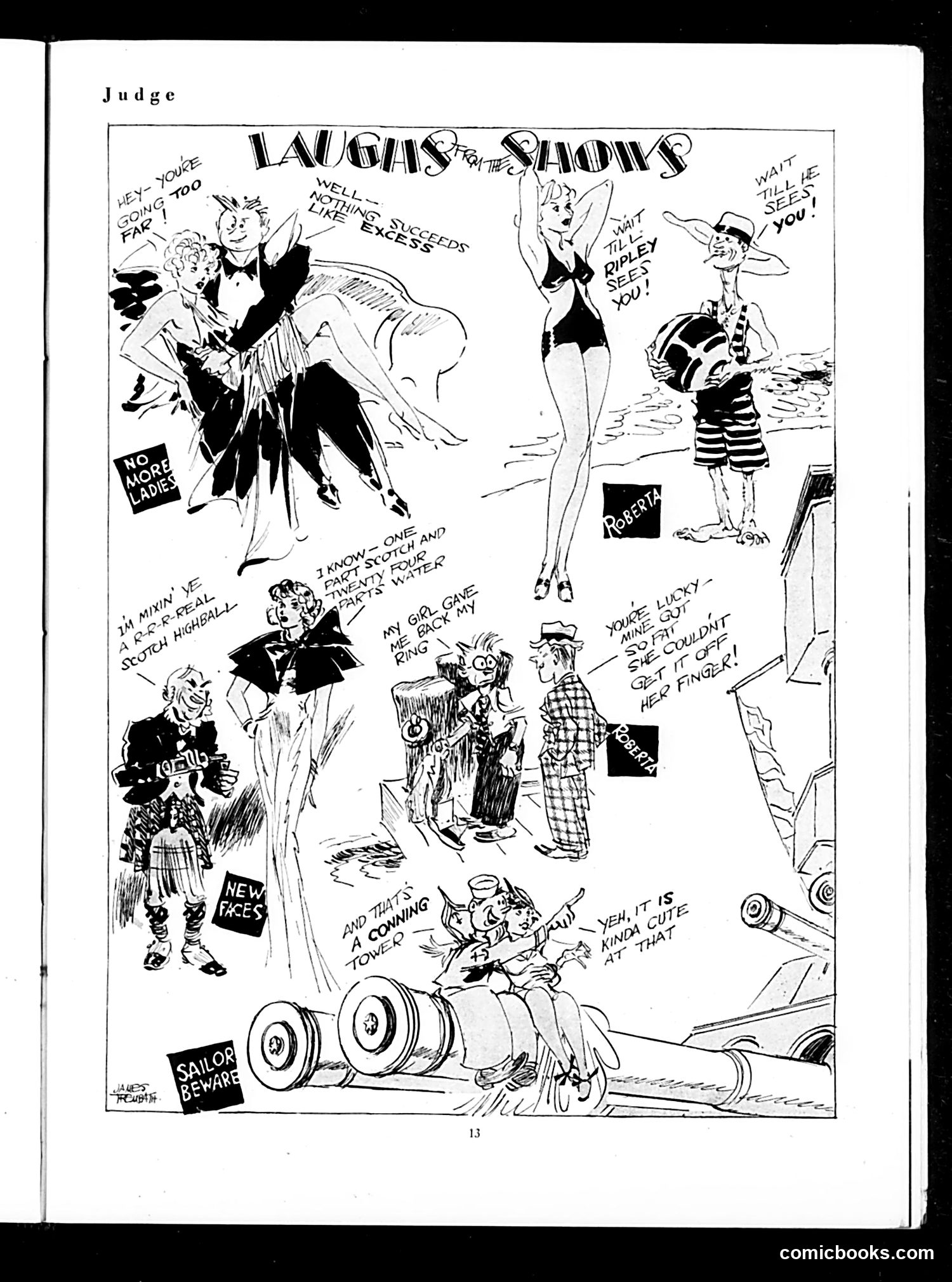
"Laughs of the Shadows" - Judge Magazine Cartoon This is a satirical cartoon depicting various entertainment industry figures and social types of the Jazz Age era. The page shows multiple vignettes featuring flapper women, men in formal wear and casual dress, and what appear to be theatrical or social scenarios. The humor targets contemporary social anxieties: references to "no more ladies," "new faces," and various romantic/social complications suggest satire of modern dating customs and changing gender roles. The "Sailor Beware" and "Roberta" labels likely reference contemporary shows or characters. The cannon at bottom appears a humorous non-sequitur typical of Judge's absurdist comedy. The overall tone mocks 1920s social pretension and romantic entanglements among urban entertainment circles.
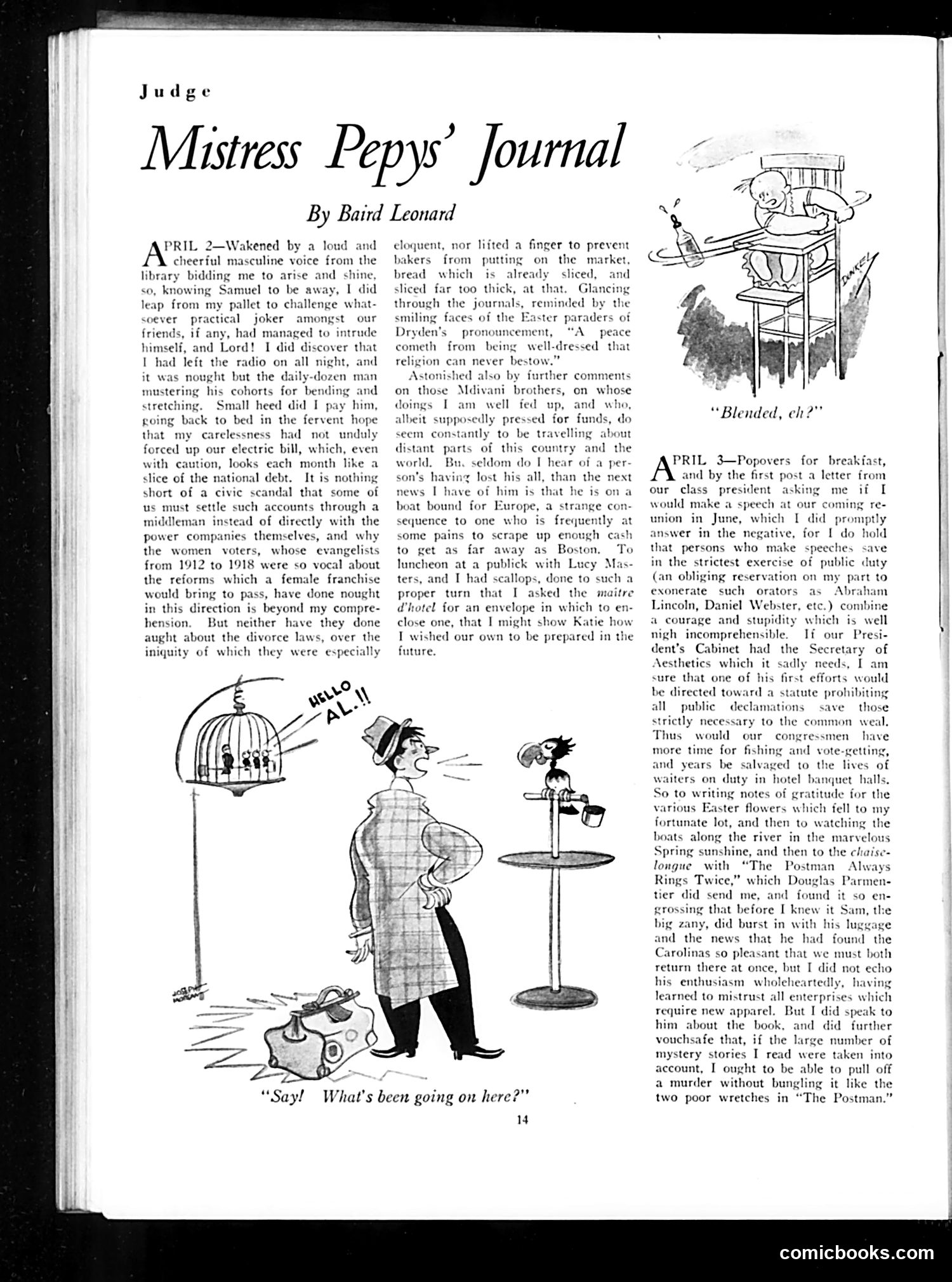
Mistress Pepys' Journal - Context for Modern Readers This is a humorous column mimicking Samuel Pepys's famous 17th-century diary, but set in the modern (1920s-30s) era. The satire comes from applying old-fashioned diary conventions to contemporary complaints. The main cartoon shows a woman discovering her radio left on overnight, running up the electric bill—a relatable modern annoyance presented dramatically. The satire targets: - Women voters who campaigned for voting rights (1912-1918) but allegedly failed to push for other reforms (cheaper utilities, divorce law changes, regulating bread-slicing practices) - The wealthy Mdivani brothers, socialites frequently in gossip columns despite claimed financial troubles - Pretentious public speaking and formal reunions The joke: A well-to-do housewife complains about daily inconveniences—oversized bread slices, electric bills, unwanted reunion speeches—using grandiose, historical language, making mundane problems sound momentous. The cartoons illustrate her domestic chaos humorously.
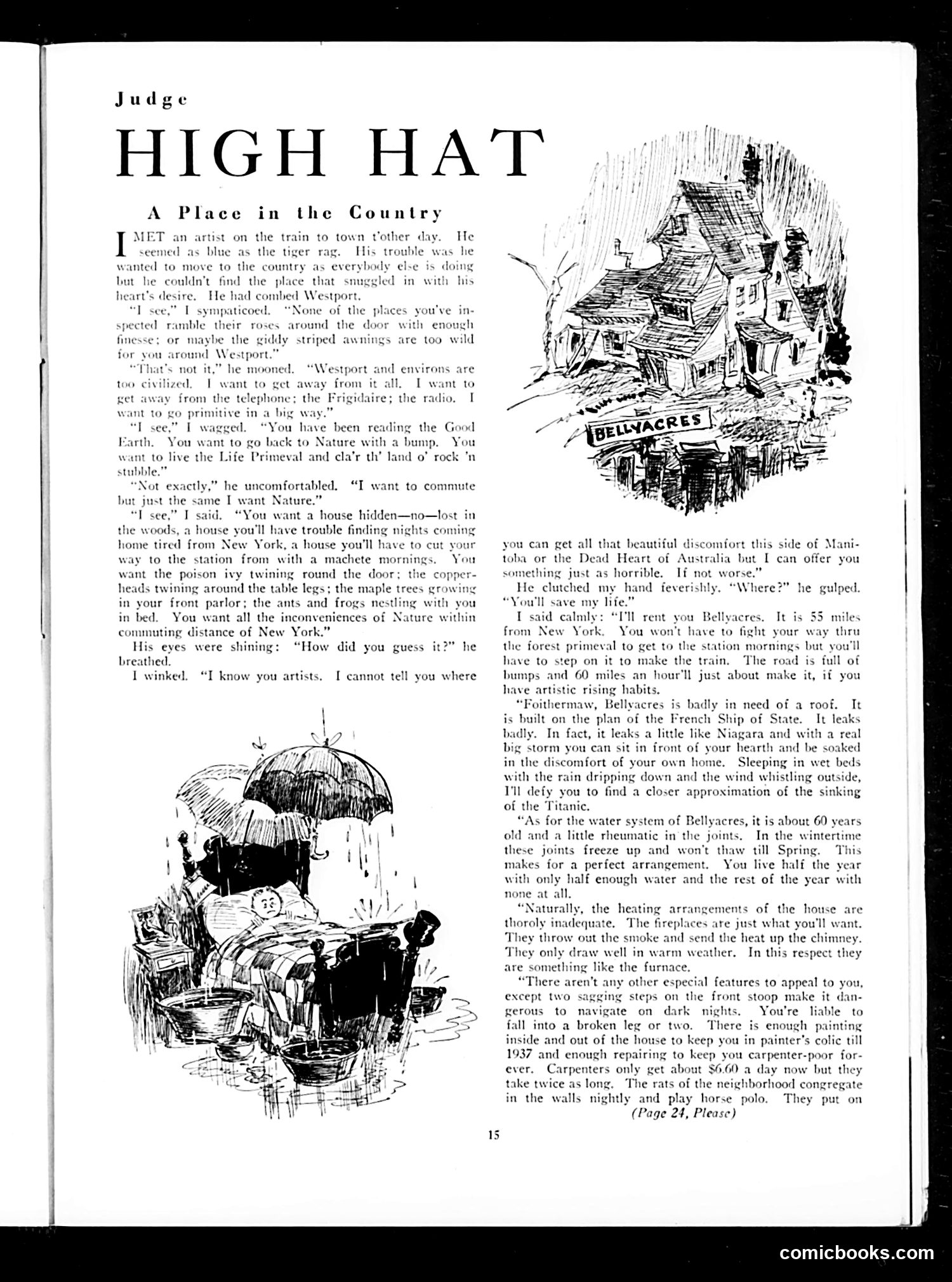
"High Hat: A Place in the Country" This is a satirical short story mocking 1920s urban intellectuals' romanticized desire to escape city life. An artist tells the narrator he wants to move to the country to live "back to Nature"—a trendy aspiration reflecting period anxieties about modernity (telephones, radio, the Frigidaire). The narrator deflates this pretension by offering "Bellyacres," a dilapidated property 35 miles from New York that embodies all the *actual* discomforts of rural living: a leaking roof (compared to the Titanic sinking), frozen water pipes, inadequate heating, sagging steps, rat infestations, and constant expensive repairs. The joke targets the gap between romantic pastoral fantasy and uncomfortable reality—the artist wants "Nature" but still needs his commuter train. The cartoon shows the artist holding an umbrella indoors, visually reinforcing the absurdity of choosing such a wretched dwelling. Judge ridicules both the artistic pretension and the impracticality of suburban retreat without genuine commitment to rusticity.
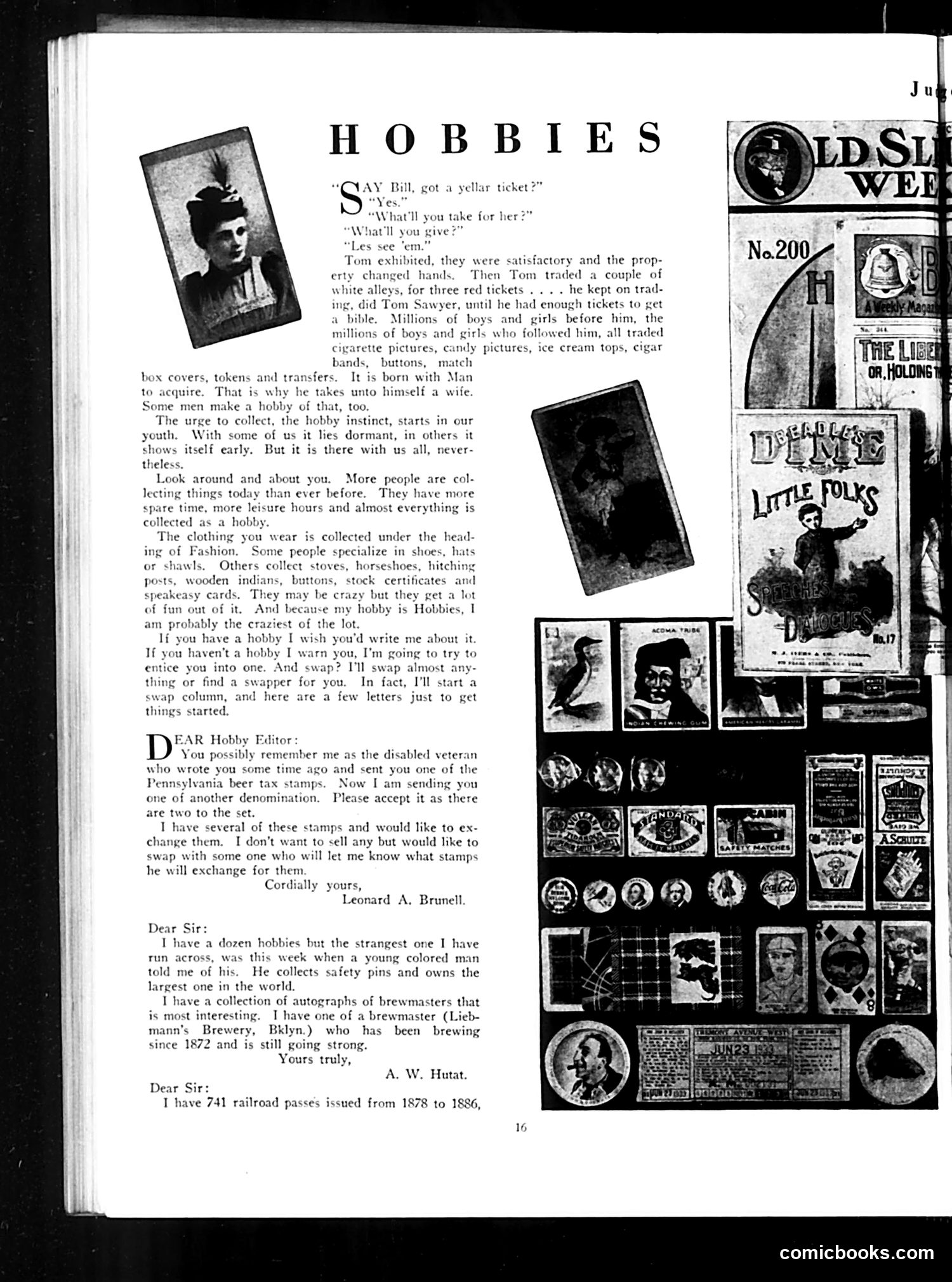
"Hobbies" Page Analysis This is a feature article (not a political cartoon) about collecting hobbies, illustrated with reader letters and period artifacts. The main text humorously traces collecting instinct from childhood—referencing Tom Sawyer's famous ticket-trading scene from Mark Twain—through adulthood, where people collect everything from clothing to railroad passes. The reader letters describe genuine collections: Pennsylvania beer tax stamps, safety pins, and brewmaster autographs. A colored illustration showcase on the right displays various collectible items (match boxes, tokens, pins, certificates, theatrical materials) that were typical of the era. The satire is gentle: the editor presents collecting as a nearly universal human compulsion—"probably the craziest of the lot"—while legitimizing it as a rational leisure activity. This reflects early 1900s America's growing consumer culture and middle-class leisure time. There's no political content; it's social commentary on modern collecting mania.
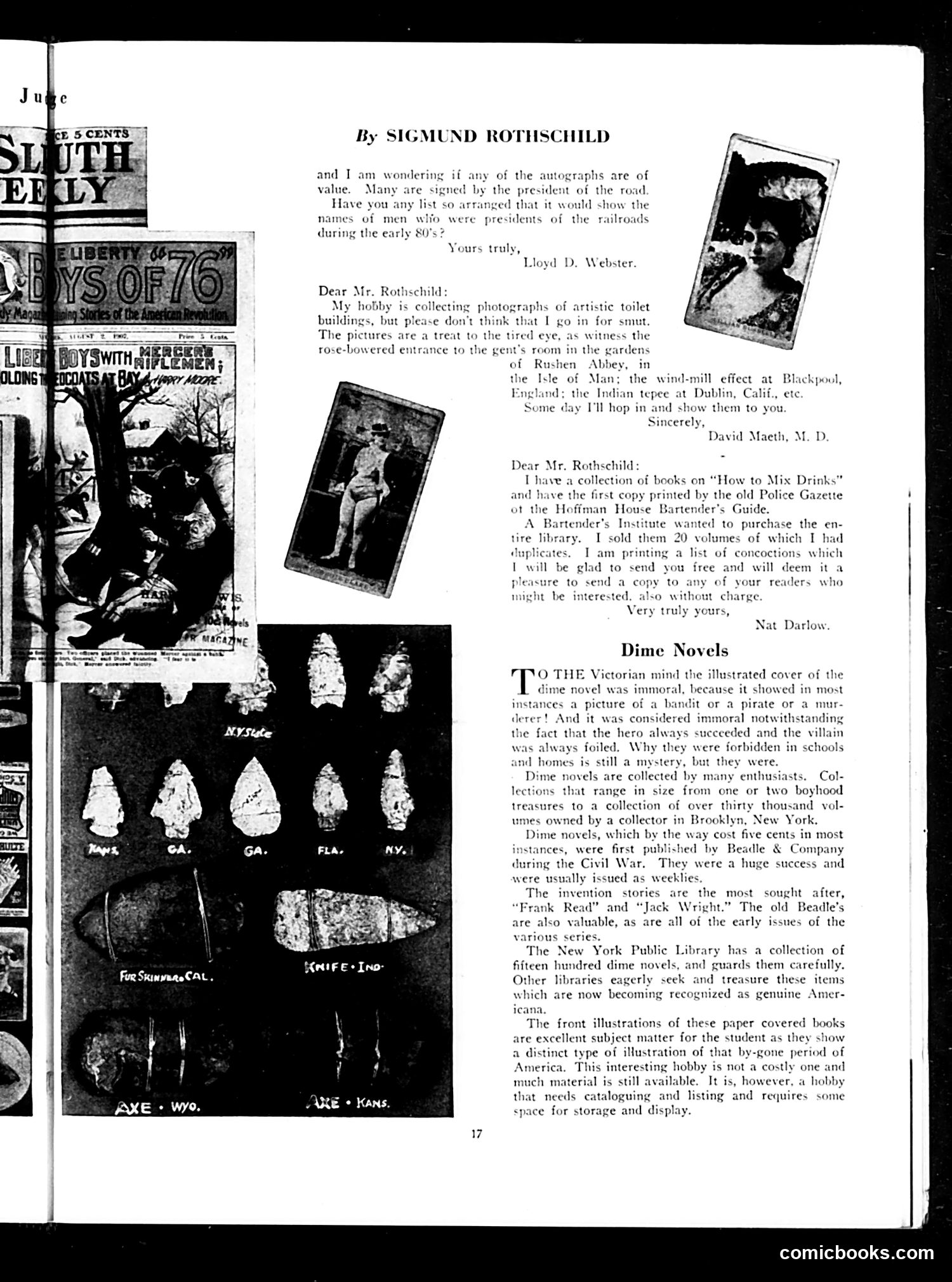
Judge Magazine Page Analysis This page is primarily reader correspondence and a feature article, not a political cartoon. The left side shows vintage advertisements and period imagery (appearing to be from an earlier era Judge was documenting). The main content consists of three reader letters to Sigmund Rothschild addressing collecting hobbies: 1. Railroad autographs - a collector seeking documentation of railroad presidents from the 1880s 2. Architectural photographs - someone collecting photos of notable buildings like Rushen Abbey 3. Bartending books - a collector of vintage "How to Mix Drinks" manuals offering to share his list The article "Dime Novels" discusses the Victorian-era scandal surrounding cheap illustrated fiction. It notes these 5-cent paperbacks—published by Beadle & Company during the Civil War—were considered immoral for depicting criminals, yet paradoxically acceptable because heroes always won. The piece frames dime novel collecting as a legitimate historical hobby, noting major collections exist in Brooklyn and the New York Public Library. The page reflects early 20th-century nostalgia for Victorian-era ephemera now recognized as Americana.
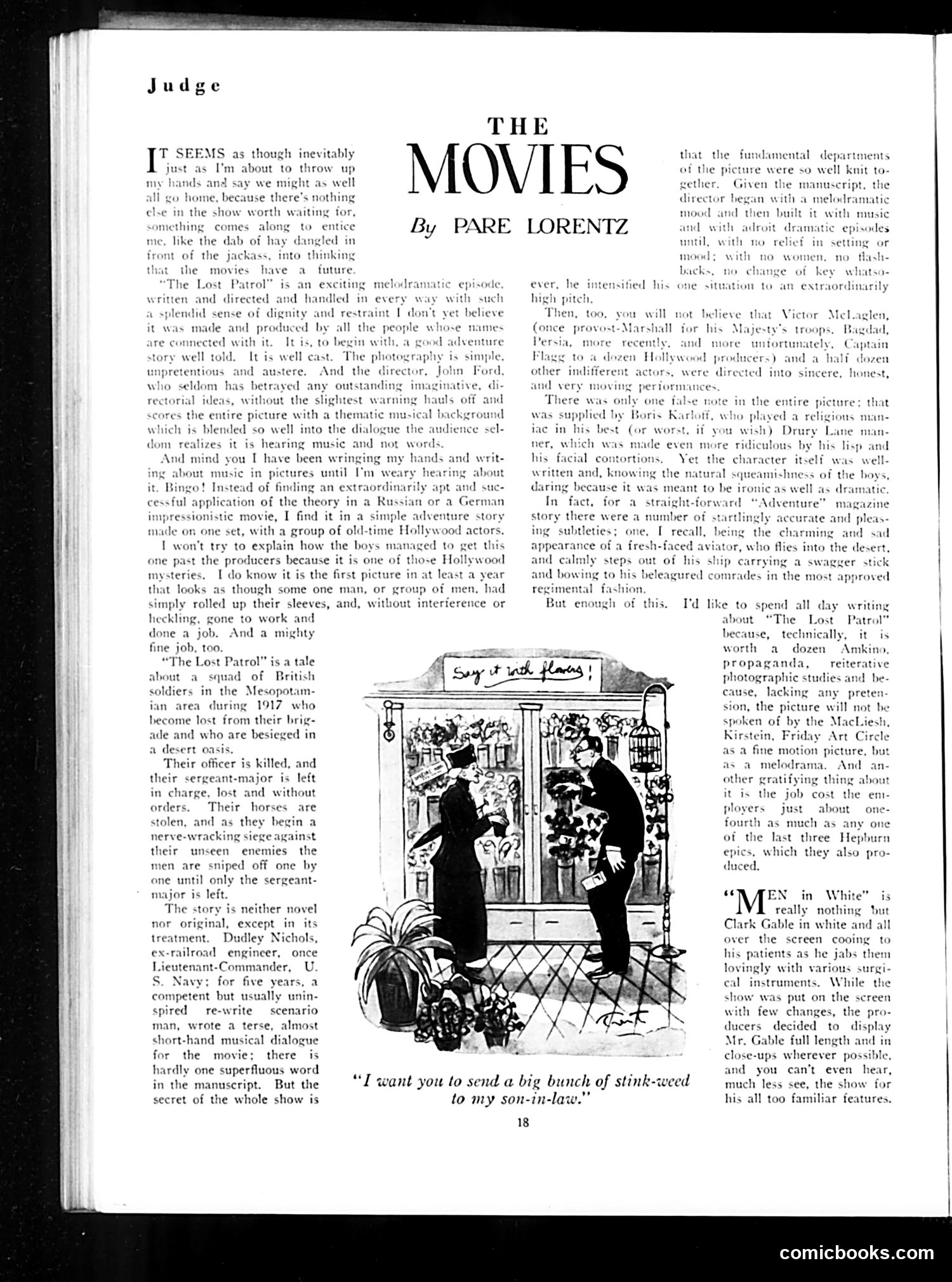
Analysis of Judge Magazine Page: "The Movies" by Pare Lorentz This is a film criticism column reviewing "The Lost Patrol," a British military adventure film set in 1917 Mesopotamia. The critic praises director John Ford's competent handling of the melodramatic story about besieged soldiers, particularly commending the integrated musical score and professional cast performances. The accompanying sketch shows two men in what appears to be a shop or establishment, with the caption: "I want you to send a big bunch of stink-weed to my son-in-law." This is a humorous non-sequitur cartoon, likely unrelated to the film review—typical of Judge's mixed content format mixing criticism with standalone jokes. The "stink-weed" reference is a period insult/crude humor common to the era. The page demonstrates Judge's role as a venue for both serious cultural commentary and light satirical humor, reflecting 1920s-30s entertainment criticism alongside slapstick comedy.
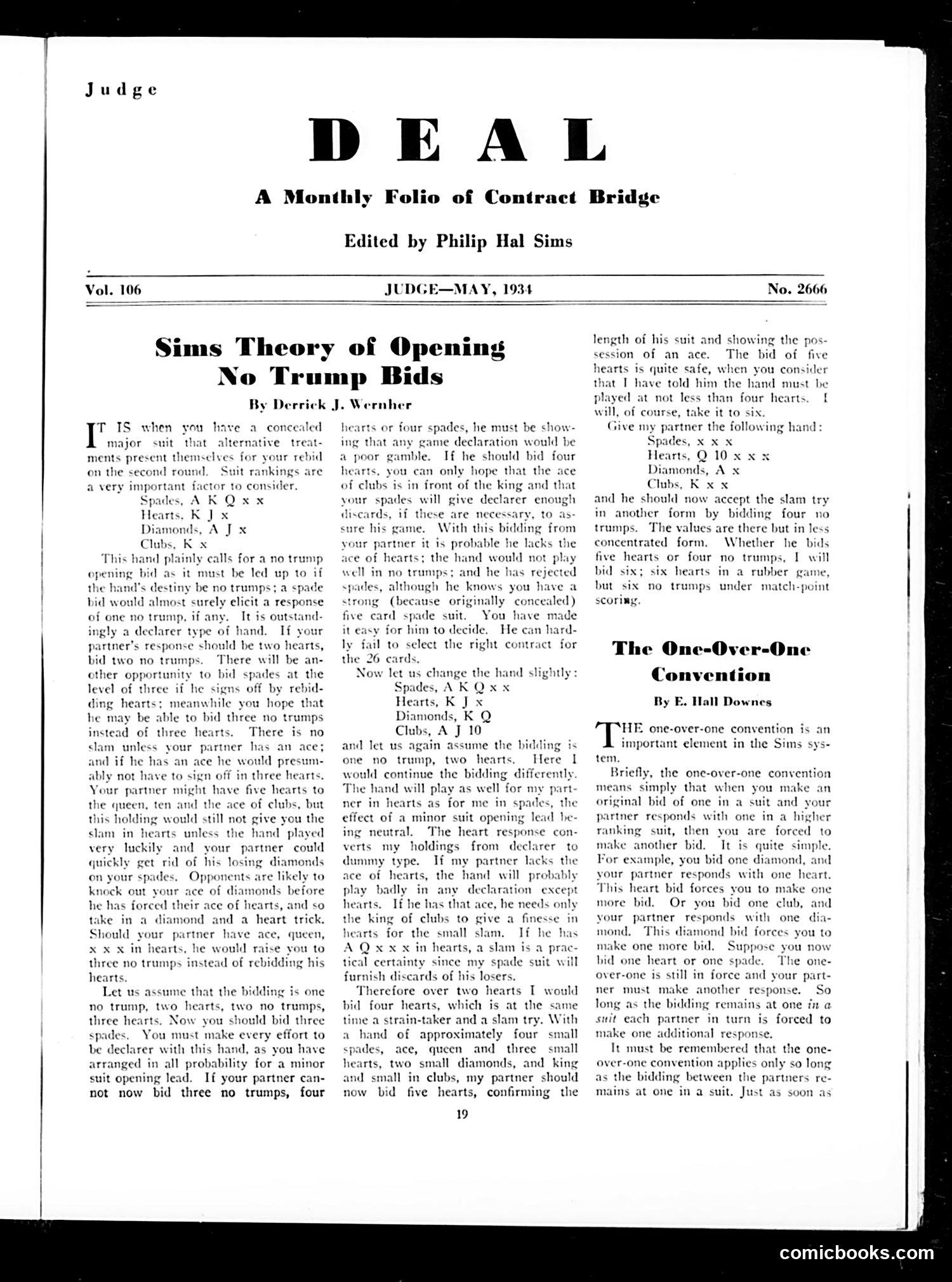
Bridge Strategy Article in Judge Magazine This page contains bridge instruction rather than satire or cartoons. It's from Judge's "Deal" section—a monthly folio dedicated to contract bridge strategy, edited by Philip Hal Sims. The content consists of two instructional articles: 1. "Sims Theory of Opening No Trump Bids" by Derrick J. Wernher—technical guidance on when to open with no-trump bids in bridge 2. "The One-Over-One Convention" by E. Hall Downes—explanation of a bidding convention in contract bridge Context for modern readers: Judge magazine (1920s-1940s) was a satirical publication, but it also contained instructional and entertainment content beyond political cartoons. Bridge was extremely popular in 1930s America—nearly a national obsession—so major publications dedicated significant space to bridge strategy and theory. This page reflects that cultural moment when bridge instruction was considered desirable magazine content for educated readers.
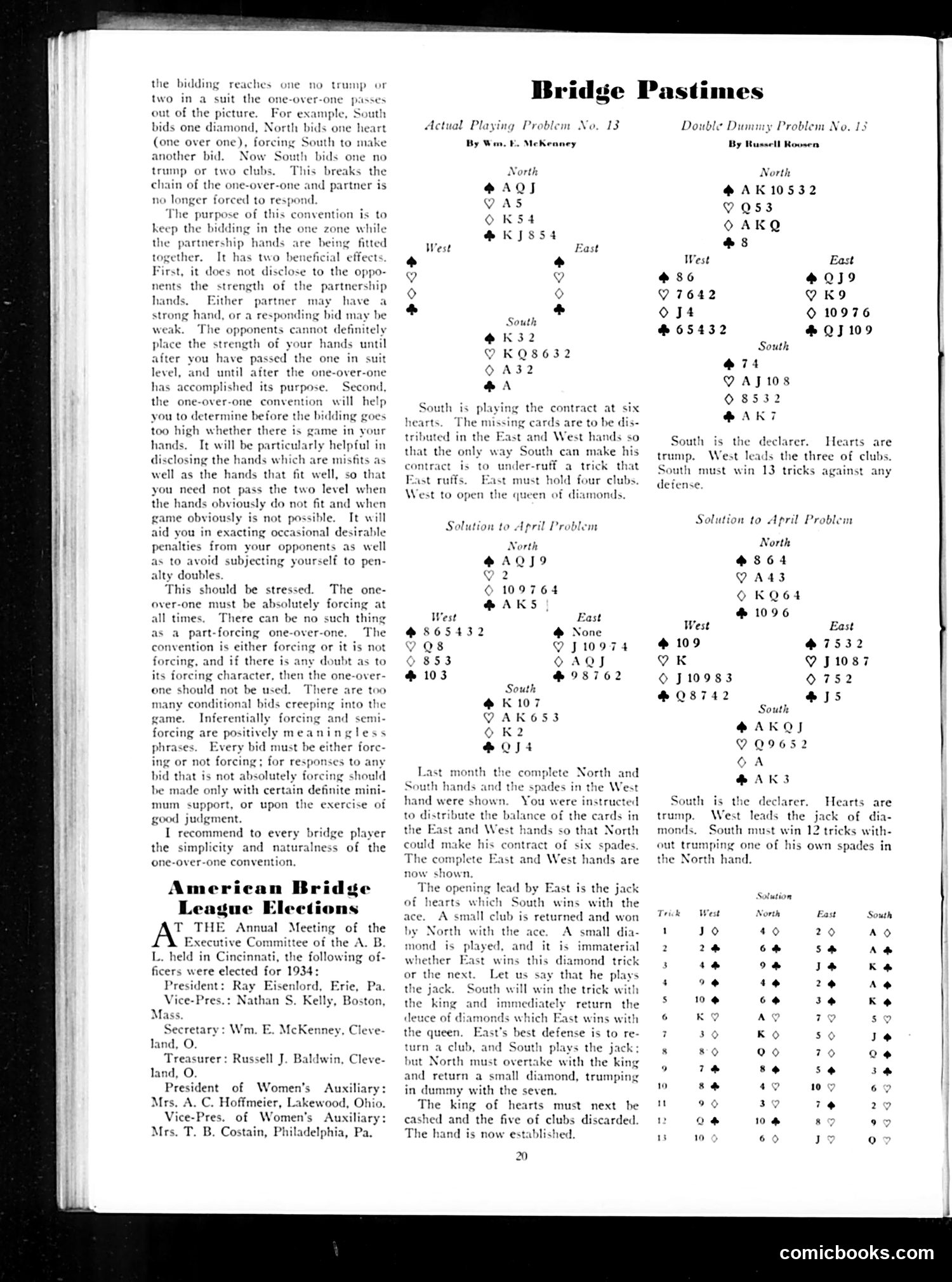
Page Analysis: Bridge Pastimes and League Elections This page from Judge magazine contains bridge instruction and administrative content, not satire or political cartoons. The main features are: 1. "Bridge Pastimes" — Two bridge problems (card game puzzles) with detailed hand diagrams and solutions, written by bridge experts Wm. E. McKenney and Russell Rosen. 2. "American Bridge League Elections" — A straightforward announcement of 1934 officer elections, listing names like Ray Eisenlord (President) and Wm. E. McKenney (Secretary). 3. Instructional text — Discussion of bridge bidding strategy, specifically the "one-over-one" convention in card play. This appears to be filler content or a regular feature in Judge magazine rather than satirical material. Bridge was a popular pastime during this era, and Judge apparently devoted space to it alongside their humor and cartoons. There are no caricatures, political references, or jokes apparent in this particular page.
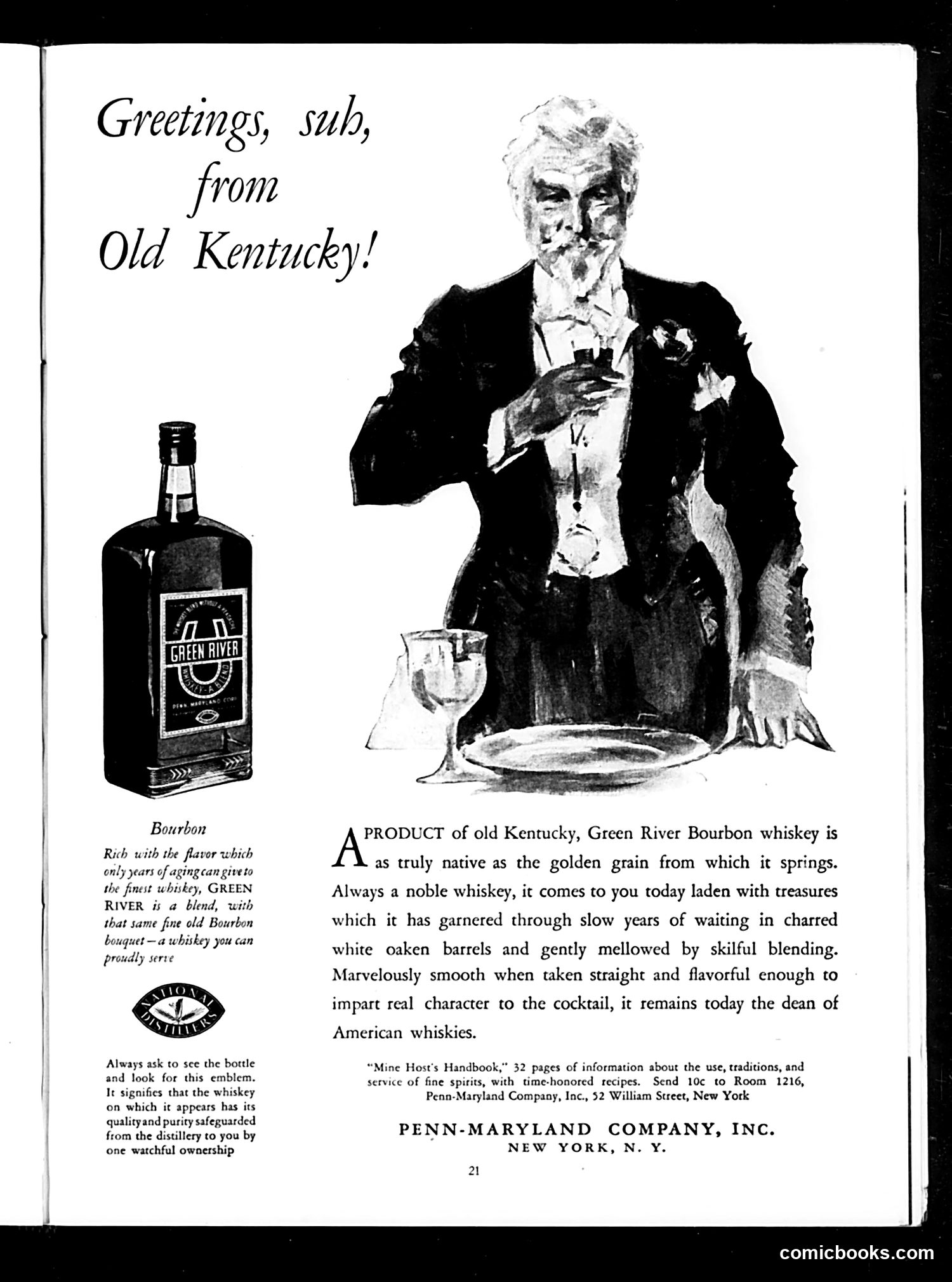
Analysis This is a full-page advertisement, not satire or political commentary. It promotes Green River Bourbon whiskey using a genteel Southern gentleman as the spokesperson. The illustration depicts an older, distinguished man in formal evening wear (tuxedo) holding a glass, embodying the "refined gentleman" archetype used to market luxury liquor. The text emphasizes Kentucky heritage, aging in charred barrels, and the whiskey's status as "dean of American whiskies." The ad's appeal relies on class aspiration and regional nostalgia: presenting whiskey consumption as a marker of sophistication and taste. The Southern ("suh") dialect and "Old Kentucky" branding tap into romanticized antebellum associations. This appears to be from the Prohibition era or shortly after repeal (the careful emphasis on "quality and purity safeguarded from the distillery" suggests post-Prohibition legitimacy). The advertisement conflates refined manners with product endorsement—a common marketing strategy of the period.
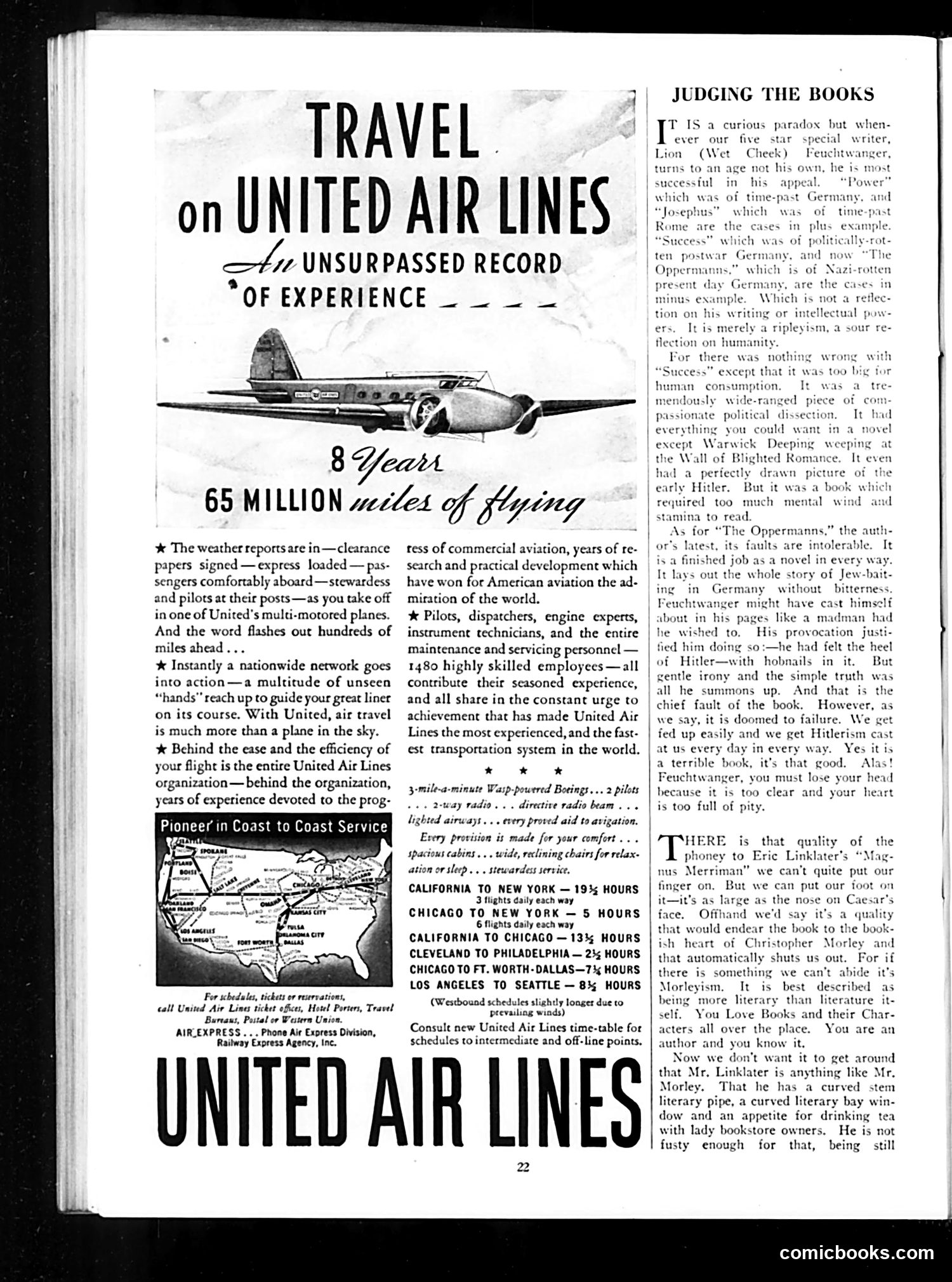
Analysis: United Air Lines Advertisement with Book Review This page is primarily a United Air Lines advertisement promoting their extensive flight network and experience—8 years of operation, 65 million miles flown, 1,480 skilled employees. The ad emphasizes safety, comfort, and reliability through technical details (radio beams, lighted airways, multi-motored planes) and lists major cross-country routes with flight times. The right column contains an unrelated book review titled "Judging the Books," discussing novels including works set in Nazi Germany and depicting Jewish persecution. The review critiques "The Oppermanns" (likely Lion Feuchtwanger's 1933 novel about a German-Jewish family under Nazi persecution), praising its authenticity but faulting its restraint—the author "might have cast himself about like a madman" given his personal experience of Hitler's regime, yet chose "gentle irony" instead. The reviewer argues this restraint, while admirable, undermines the book's emotional impact. The page reflects 1930s-era commercial aviation promotion and contemporaneous literary engagement with Nazi Germany themes.
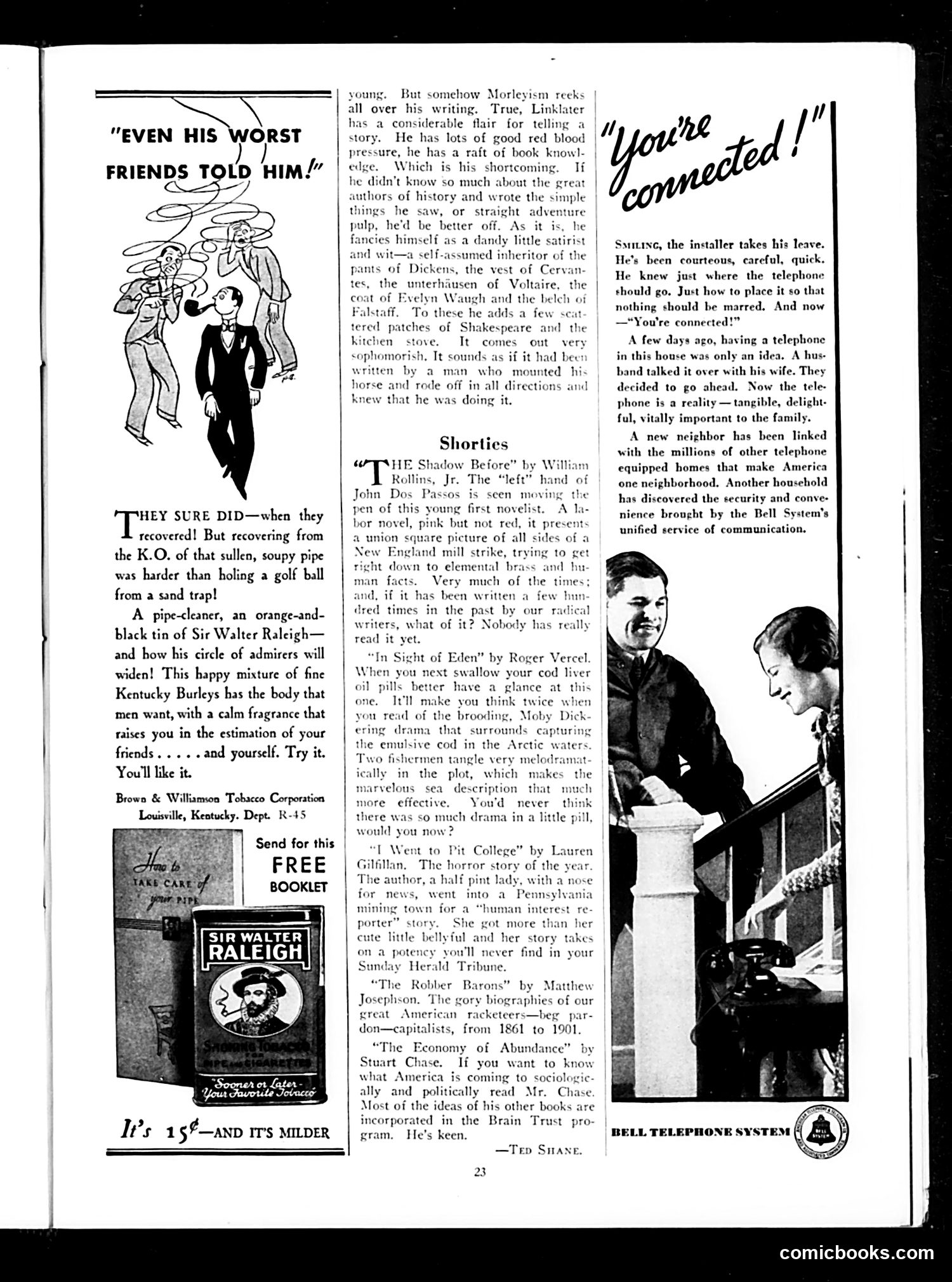
Analysis for Modern Readers This page contains two separate advertisements disguised as editorial content, a common magazine practice of that era. Left side: A cigarette advertisement for Sir Walter Raleigh pipe tobacco, using a cartoon showing a man being congratulated by friends. The joke plays on the phrase "even his worst friends told him"—implying his pipe smoking was so bad that even critics approved when he switched brands. The satire targets poor taste in tobacco choice. Right side: An advertisement for Bell Telephone System, depicting an installer connecting a home telephone. The narrative emphasizes how telephone installation brings families into a modern communication network, linking them to "millions of other homes." This reflects early 20th-century enthusiasm for telephone technology as a luxury good bringing families together and connecting communities. The book reviews in the center appear to be genuine editorial content by Ted Shane, critiquing contemporary literary works with a somewhat snobbish tone about modernist and leftist-leaning writers.
Analysis for Modern Readers This page is primarily advertising for three luxury hotels (Biltmore, Traymore, Atlantic City), occupying about two-thirds of the space. The remaining content consists of three short humor columns under the "High Hat" rubric: 1. "High Hat" (continued): A sardonic monologue about renting a cheap boarding house ("Bellyacres"). The joke satirizes both the dilapidated property itself and the narrator's awareness that he's complaining about something he can't afford to improve—a working-class complaint about poor housing conditions dressed up in cynical wit. 2. "Squaw Dish": A humorous recipe supposedly from a Spanish prospector who learned it from someone married to someone who knew an Indian. The humor relies on exoticized "ethnic" sourcing (common in 1920s-30s magazines) and a punchline where a wealthy socialite's chauffeur (Mrs. Stotesbury) requests the recipe after smelling it cooking on the beach. 3. "Easy Money": A brief joke about buying stock-market investment books to make quick money—satirizing get-rich-quick schemes during what appears to be a prosperous era. The page reflects 1920s-30s attitudes and humor conventions.
Explanation for Modern Readers This page is primarily advertising and miscellaneous content, not political satire. It contains: Main Articles: - A humorous column about stock market investing, where the writer claims to have mastered trading through tablecloth calculations and charts—so absorbed he's forgotten to pay restaurant bills. This gently mocks the get-rich-quick stock speculation craze of the 1920s-30s. - A "Tiny Tots Guide" section offering brief, comedic takes on current movies, inventions, and news items (Montreal bicycle licensing, Australian tennis court rollers, etc.). - Miscellaneous witty observations about celebrities and trends. Advertisements: Multiple ads for boats, motor travel guides, hotels, life insurance, and stock market publications dominate the page. Context: Judge was a satirical magazine, but this particular page emphasizes consumer advertising and light humor rather than political cartooning. The stock market commentary reflects Depression-era skepticism about financial schemes, but it's gentle satire rather than sharp political critique.
Content Analysis This page combines hotel advertisements with a humorous letter column titled "Letters of a Self-Made Athlete" by Rex Deane. The Main Content: The letter is a comedic first-person account from an athlete-turned-wrestler describing his winter adventures. He recounts training in Florida, wrestling competitors (including a character named "Gooter Khan the Kubla Killer"—actually himself in disguise), and performing in small towns with increasingly absurd gimmicks. The humor derives from his malapropisms, casual racism toward Indian/Hindu culture, and ridiculous schemes—like painting an elephant white and calling it "sacred" to draw crowds. The Satire: The piece mocks both the self-made man's pretensions and the era's casual orientalism and exoticism. The wrestler's incompetence (bowing to "Peoria" instead of Mecca, getting thrown into row G by an angry audience member) undercuts any dignity his schemes might claim. Context: This represents typical 1920s-30s Judge magazine humor—combining ethnic stereotypes, slapstick comedy, and cynical observations about American hustlerism—all presented as lighthearted entertainment that modern readers would find offensive.
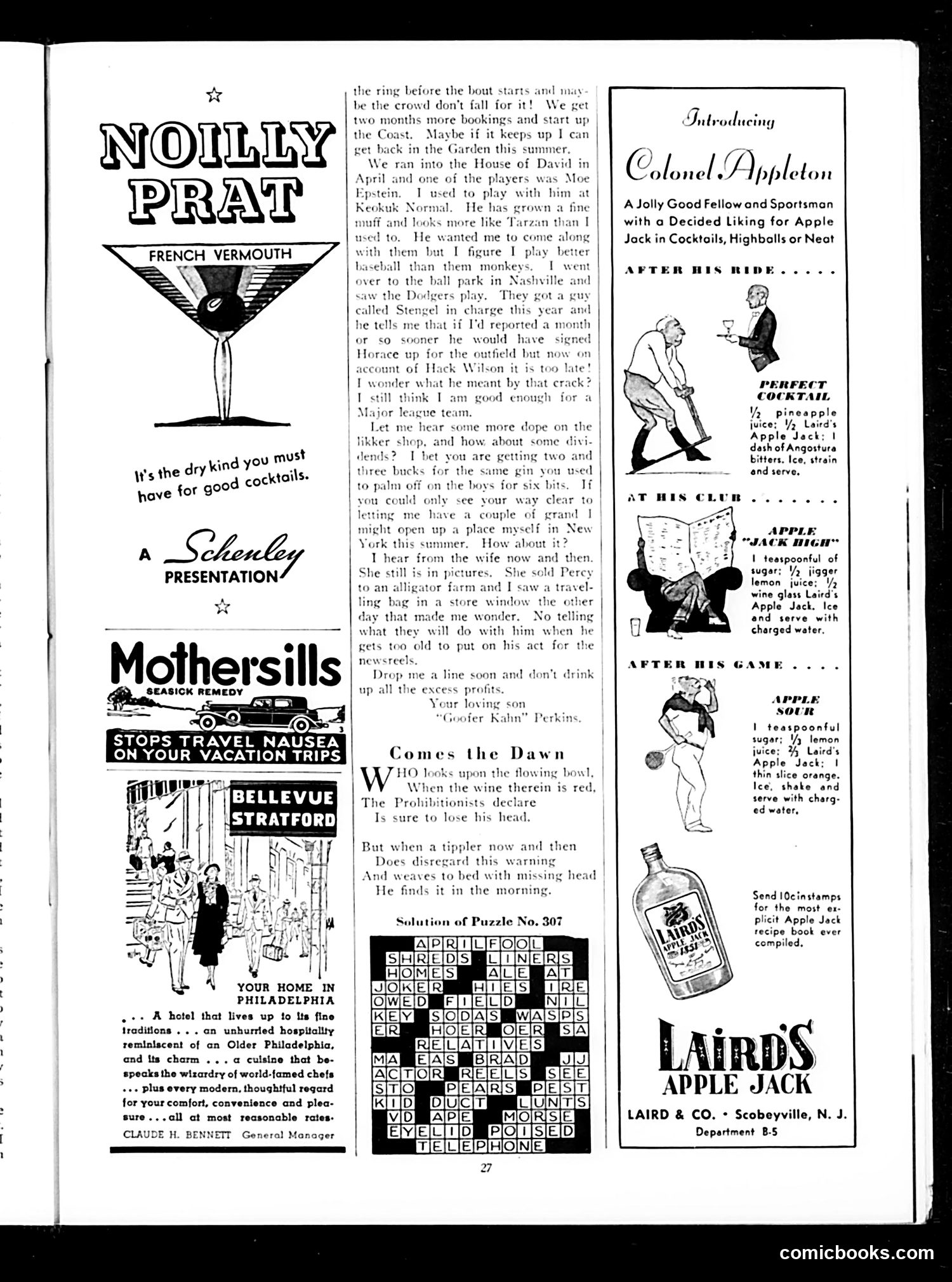
Analysis for Modern Readers This page is primarily advertising content from Judge magazine, showcasing liquor and travel products popular in the Prohibition era (likely 1920s-early 1930s). The main items advertised are: - Noilly Prat French Vermouth and cocktail recipes - Mothersills (travel nausea remedy) - Bellevue Stratford Hotel in Philadelphia - Laird's Apple Jack whiskey, featured through "Colonel Appleton," a fictional gentleman character The single editorial cartoon titled "Comes the Dawn" is a brief anti-Prohibition joke: it satirizes how prohibitionists warn drinkers will "lose their head," but the drunk simply loses his head literally—finding it the next morning after passing out. This mocks Prohibition's moral panic while celebrating drinking. The humor relies on wordplay and the absurdist image of a man without a head. The page's real purpose is selling alcohol and travel products, with the cartoon serving as light entertainment wrapper around advertisements.
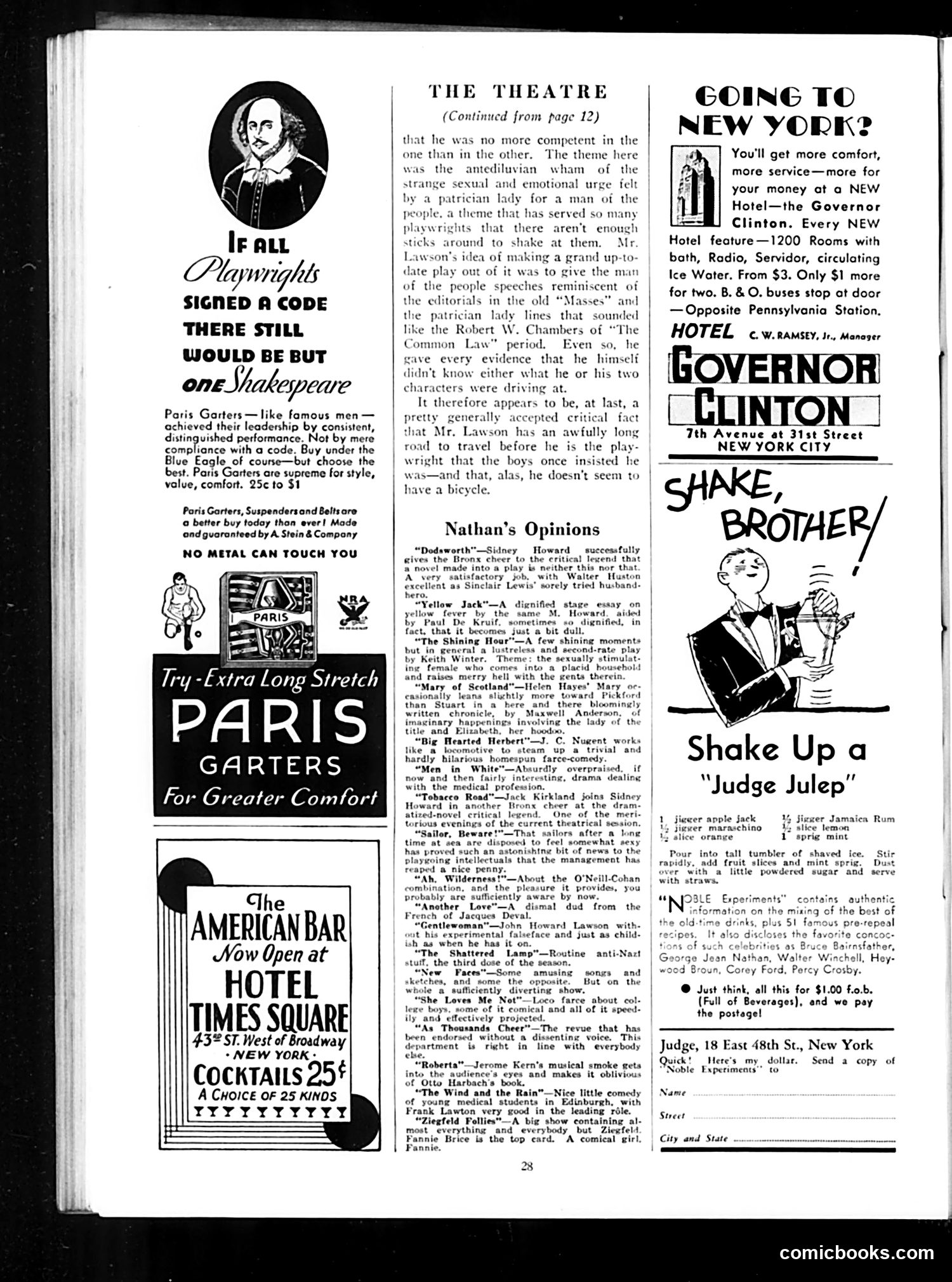
Analysis for Modern Readers This page is primarily advertising and theater reviews, not political satire. The main content is Nathan's Opinions—theater criticism reviewing Broadway shows from what appears to be the 1930s (references to "Blue Eagle" suggest New Deal era). The top left contains a Shakespeare advertisement for Paris Garters (men's suspenders), using the argument that even if playwrights signed a "code of conduct," only Shakespeare would endure—meaning quality matters more than rules. This likely references the Motion Picture Production Code (1930), recently implemented for film censorship. The theater reviews are professional critiques of plays like "Dodsworth," "Tobacco Road," and "As Thousands Cheer," offering brief assessments of their merit or dullness. The page also advertises NYC hotels and the American Bar, aimed at visiting theatergoers. No significant political cartoon or satire appears here—it's a standard magazine page mixing advertisements with entertainment journalism.
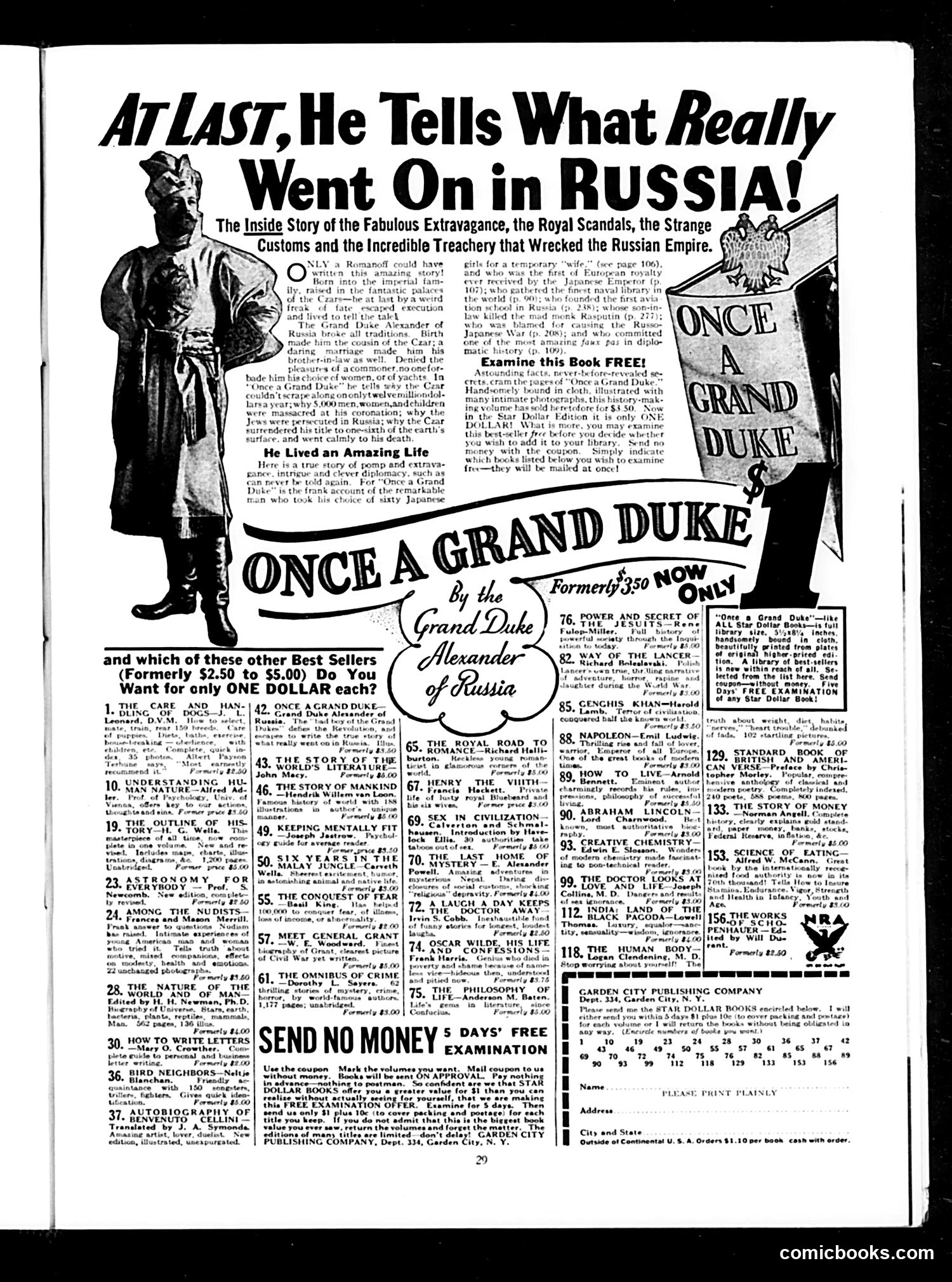
Analysis: "Once a Grand Duke" Advertisement This page is primarily a book advertisement for a sensational memoir titled "Once a Grand Duke," allegedly by Alexander of Russia (a real Grand Duke who emigrated after the 1917 Revolution). The pitch: The headline promises to reveal scandalous "inside stories" about Imperial Russian life—royal scandals, extravagance, and treachery that supposedly caused the empire's collapse. Specific teaser claims include details about Japanese diplomacy, the Russo-Japanese War, and bizarre customs. The satire/appeal: The advertisement exploits 1920s American fascination with Russian intrigue and the fallen Romanov dynasty. By framing this as an insider's "true story," it positions the book as forbidden knowledge about a dramatically collapsed regime. The gimmick: Garden City Publishing offers the $3.50 hardcover as a "Star Dollar Edition" for just $1—and promises free examination without payment, a common mail-order tactic. Historical context: This reflects post-Revolutionary American curiosity about Russia and nostalgia for imperial scandal, commodified through affordable reprinted editions marketed to mass audiences.
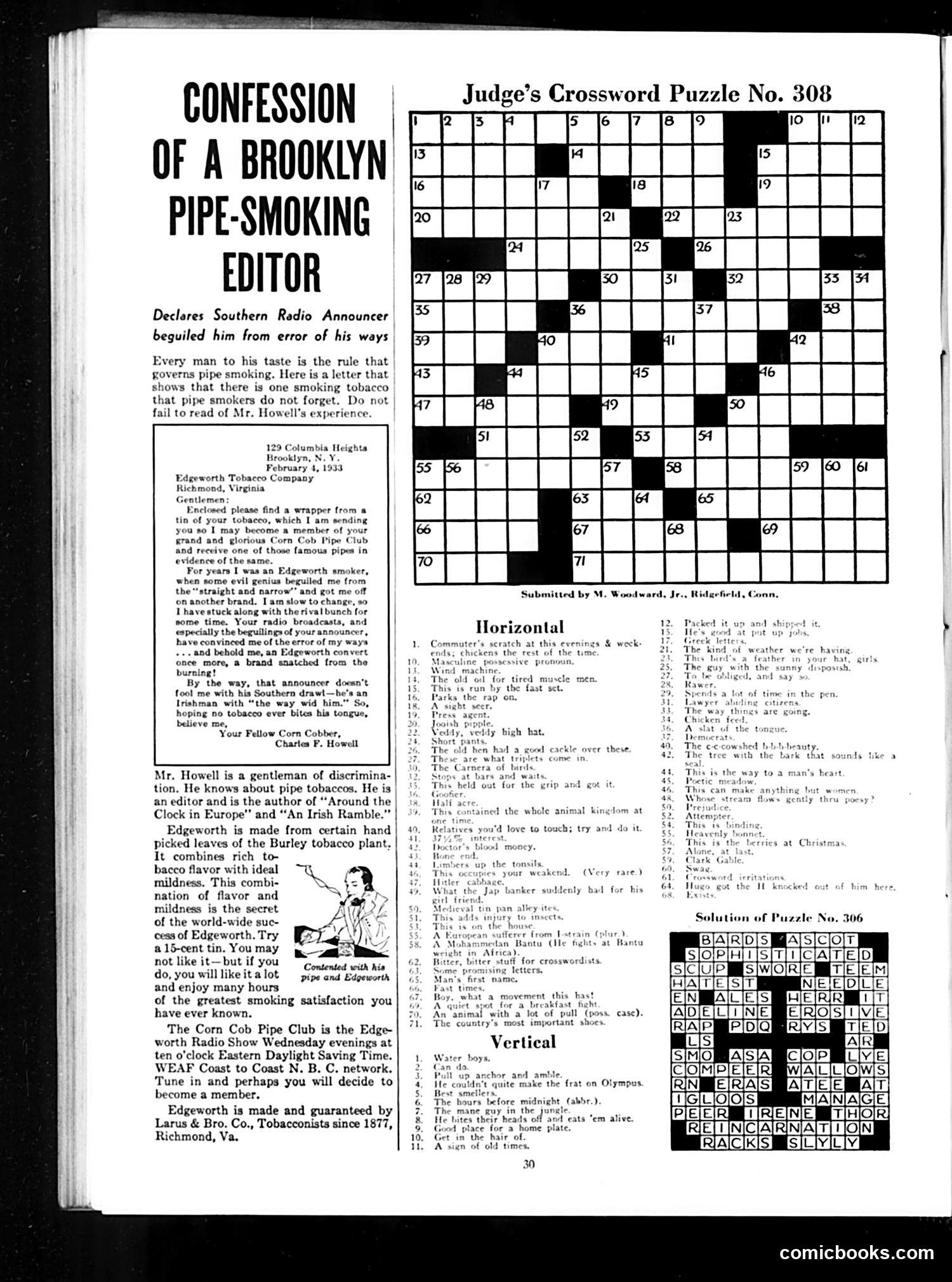
Judge Magazine Page Analysis This page is primarily advertising content for Edgeworth pipe tobacco, dressed up as editorial material. The centerpiece is a fabricated "confession" letter from Charles F. Howell, presented as a Brooklyn editor who switched from competing pipe tobacco brands to Edgeworth. The satire is gentle: Howell humorously admits his conversion after being "beguiled" by the brand's radio announcer—then jokes that the announcer's Southern drawl is actually an Irishman faking it, wryly wishing no tobacco ever "bites his tongue" (damages his credibility). The accompanying illustration shows a satisfied pipe smoker, reinforcing the testimonial's appeal. The page also includes Judge's crossword puzzle (No. 308) and the solution to a previous puzzle. This represents typical 1930s advertising disguised as humor—using a magazine's editorial voice and comedic framing to sell products while maintaining plausible deniability that it's "just entertainment."
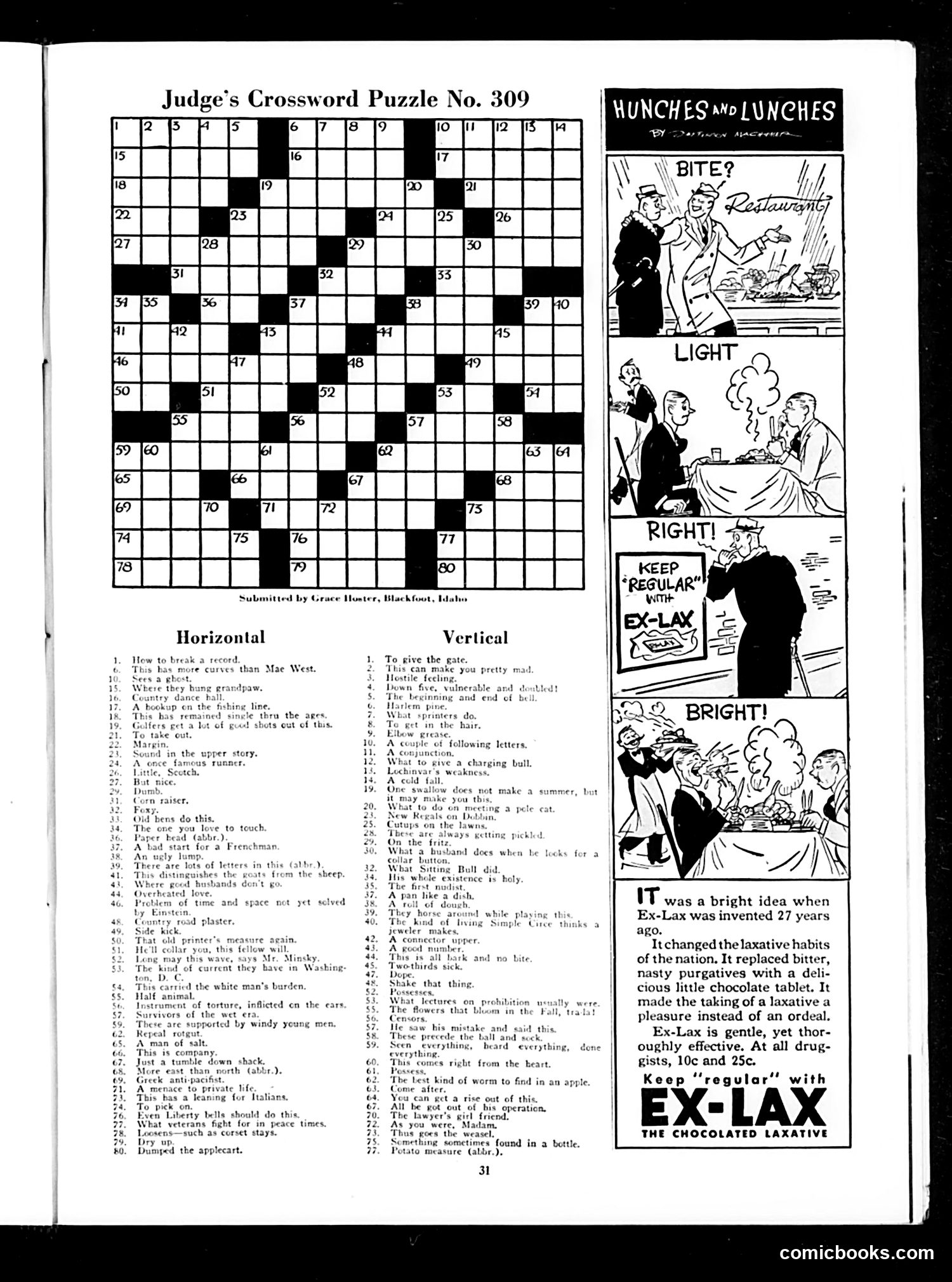
Judge Magazine Page Analysis This page contains a crossword puzzle (No. 309) submitted by Grace Hunter of Blackfoot, Idaho, alongside an Ex-Lax advertisement. The advertisement uses a common mid-20th-century marketing approach: it presents Ex-Lax as a revolutionary improvement in laxative products. The ad emphasizes that Ex-Lax "changed the laxative habits of the nation" by replacing "bitter, nasty purgatives with a delicious little chocolate tablet," making what was previously an unpleasant medicinal necessity into something actually pleasant. The accompanying cartoon panels (labeled "Bite?", "Light," "Right!" and "Bright!") appear to show social dining scenes, likely illustrating the product's benefit: users can now enjoy meals and social situations without the distress previously associated with digestive remedies. This represents typical vintage pharmaceutical advertising—promising dignity and comfort through product innovation while avoiding explicit discussion of bodily functions.
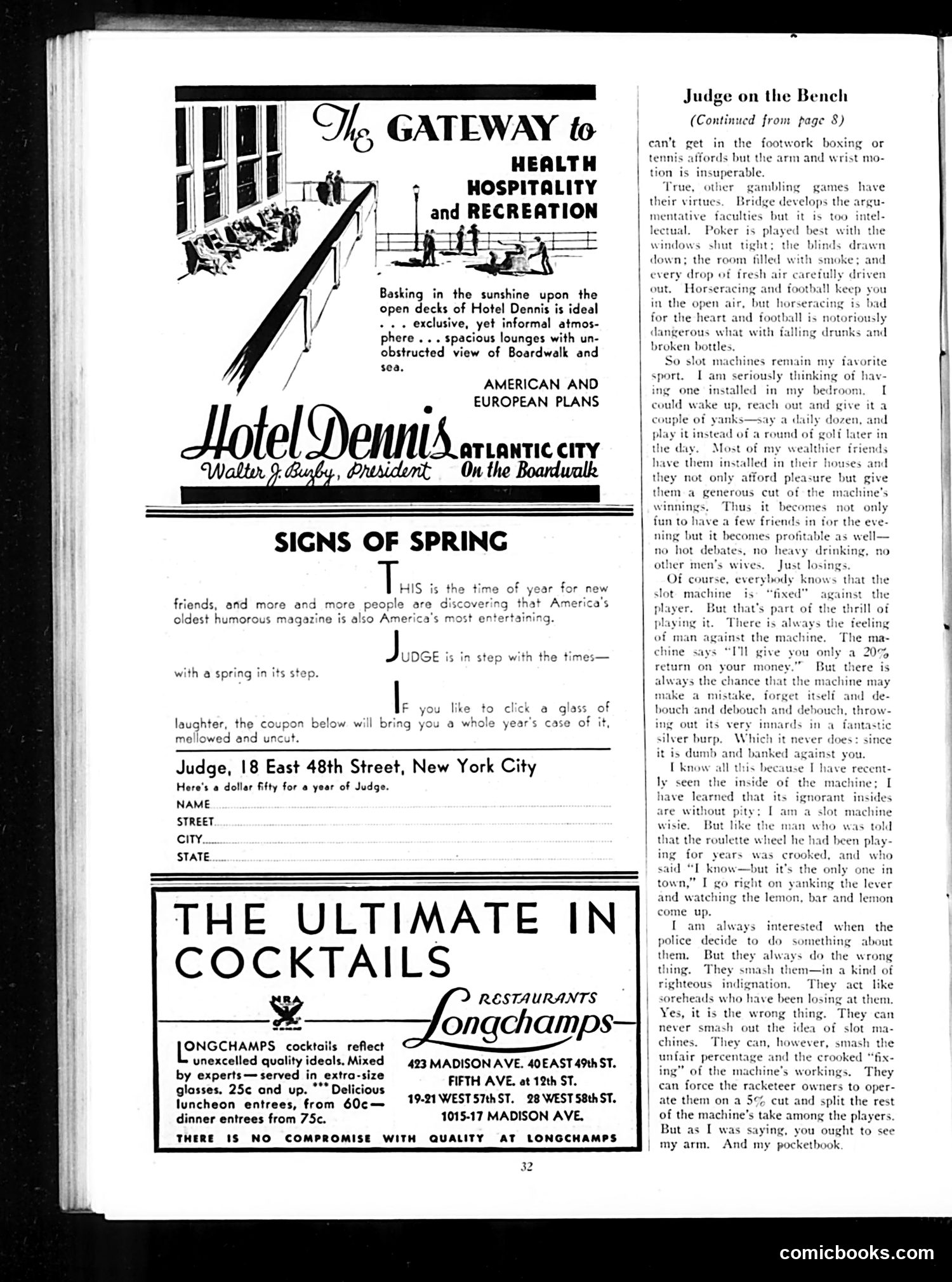
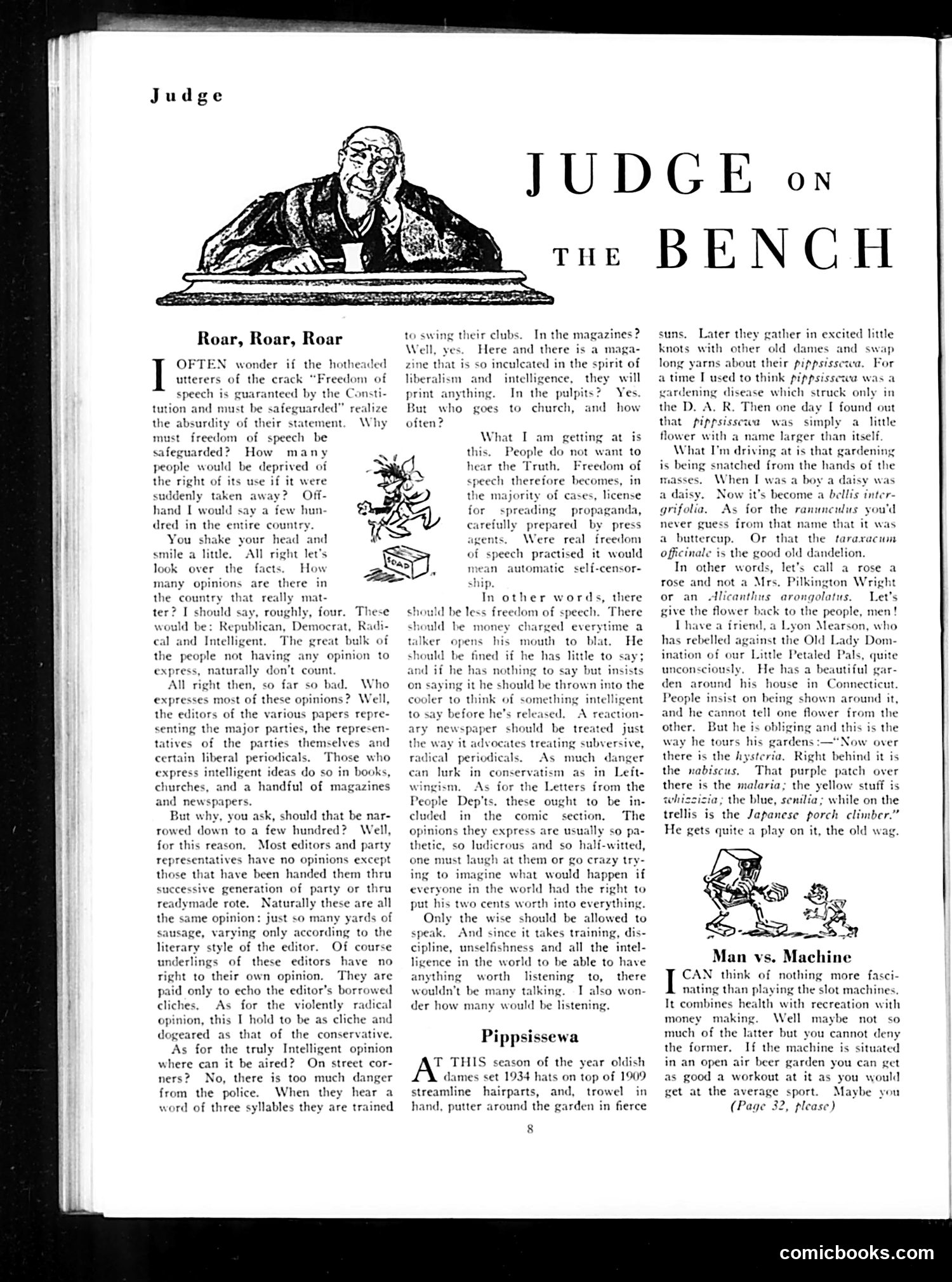
"Judge on the Bench" - Slot Machine Commentary This page is primarily advertising (Hotel Dennis, Longchamps restaurants, Judge magazine subscription), with the main editorial content being a continuation of a column titled "Judge on the Bench." The satire targets slot machines and police response to gambling. The unnamed author argues that slot machines are his "favorite sport" — superior to boxing, poker, or horseracing because they're convenient and profitable (friends install them in homes to "afford pleasure but give them a generous cut" of winnings). The joke lies in the author's cynical observation that police raids always "smash" machines "in a kind of righteous indignation" — acting like angry losers — when they should instead force racketeers to split profits with owners. The piece mocks both the hypocrisy of anti-gambling enforcement and the author's own weakness: despite knowing machines are "fixed," he admits to "yanking the lever" anyway, warning readers to "see my arm. And my pocketbook." The satire reflects 1920s-30s attitudes toward organized gambling and police corruption.
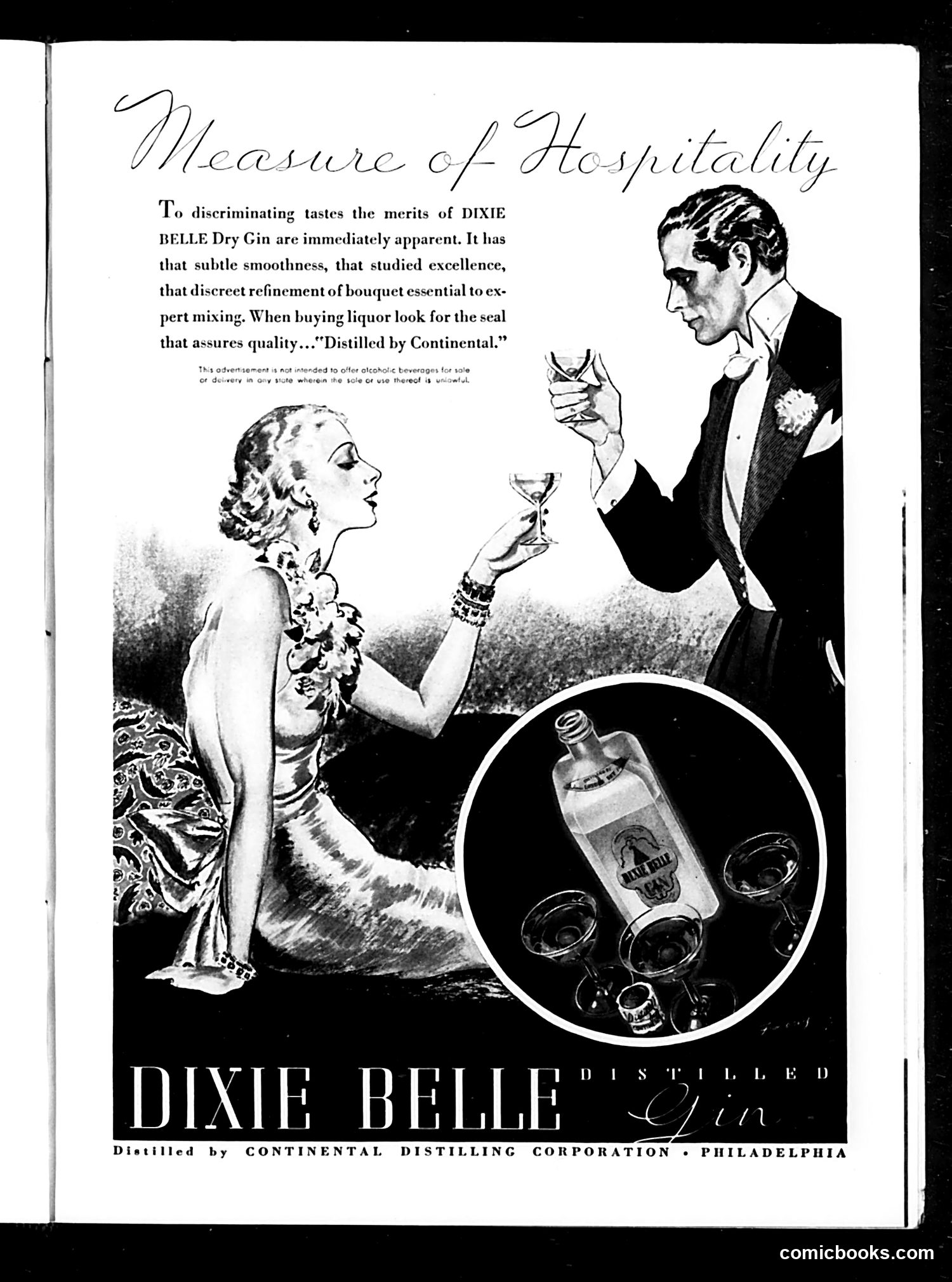
This is a liquor advertisement, not political satire. It promotes Dixie Belle Dry Gin, distilled by Continental Distilling Corporation in Philadelphia. The ad uses an elegant illustration of a well-dressed couple at what appears to be a formal social gathering. The man in a tuxedo offers a cocktail to a woman in evening wear, embodying the aspirational lifestyle marketing of the era. This reflects 1920s-30s advertising conventions: linking premium gin to sophistication, refinement, and upscale entertaining. The small circular inset shows the bottle and glasses, the product itself. The disclaimer text (barely visible) likely references Prohibition-era restrictions on alcohol advertising, which the ad circumvents by focusing on "quality" and "refinement" rather than directly promoting drinking. This represents how advertisers marketed alcohol during or immediately after Prohibition by emphasizing social prestige rather than the product's intoxicating effects.
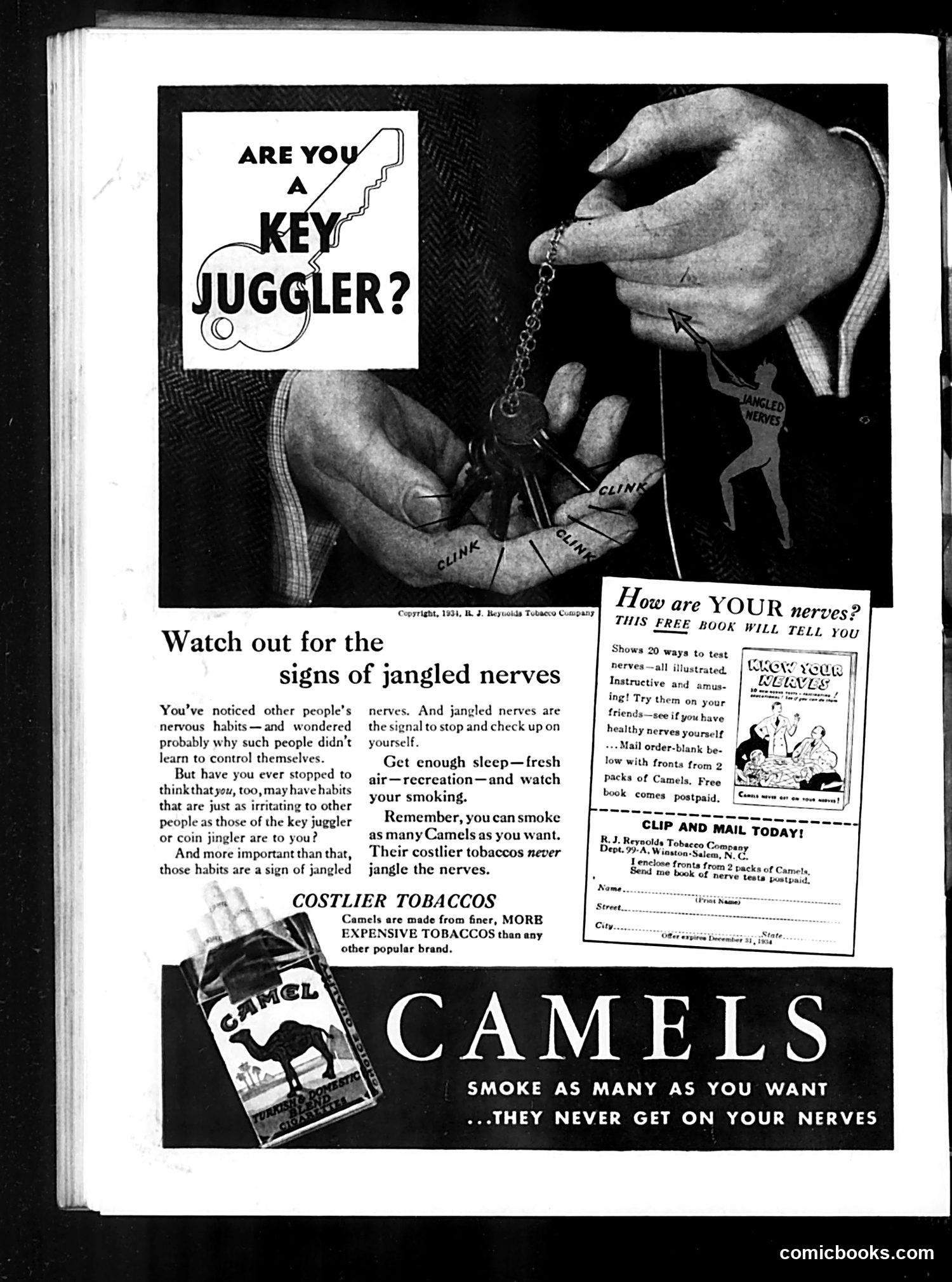
Camel Cigarettes Advertisement (1934) This is a cigarette advertisement, not political satire. The R.J. Reynolds Tobacco Company uses a health-anxiety marketing strategy typical of the 1930s. The ad exploits nervousness as a social concern—identifying "jangled nerves" (visible habits like key-jingling) as embarrassing character flaws. It then pivots to reassure smokers that Camels specifically won't cause this problem, unlike other brands. The advertisement includes: - A photo of hands with jingling keys/coins (examples of nervous habits) - A free booklet offering "20 ways to test nerves"—implicitly suggesting readers might already have nerve problems - Claims that Camels use "costlier tobaccos" that "never jangle the nerves" The appeal: Smoke without guilt. This exploits pre-scientific anxieties about smoking's health effects by redirecting concern toward social embarrassment rather than actual health damage. Modern readers would recognize this as misleading health marketing now illegal in many countries.