judge
Judge — June 1934
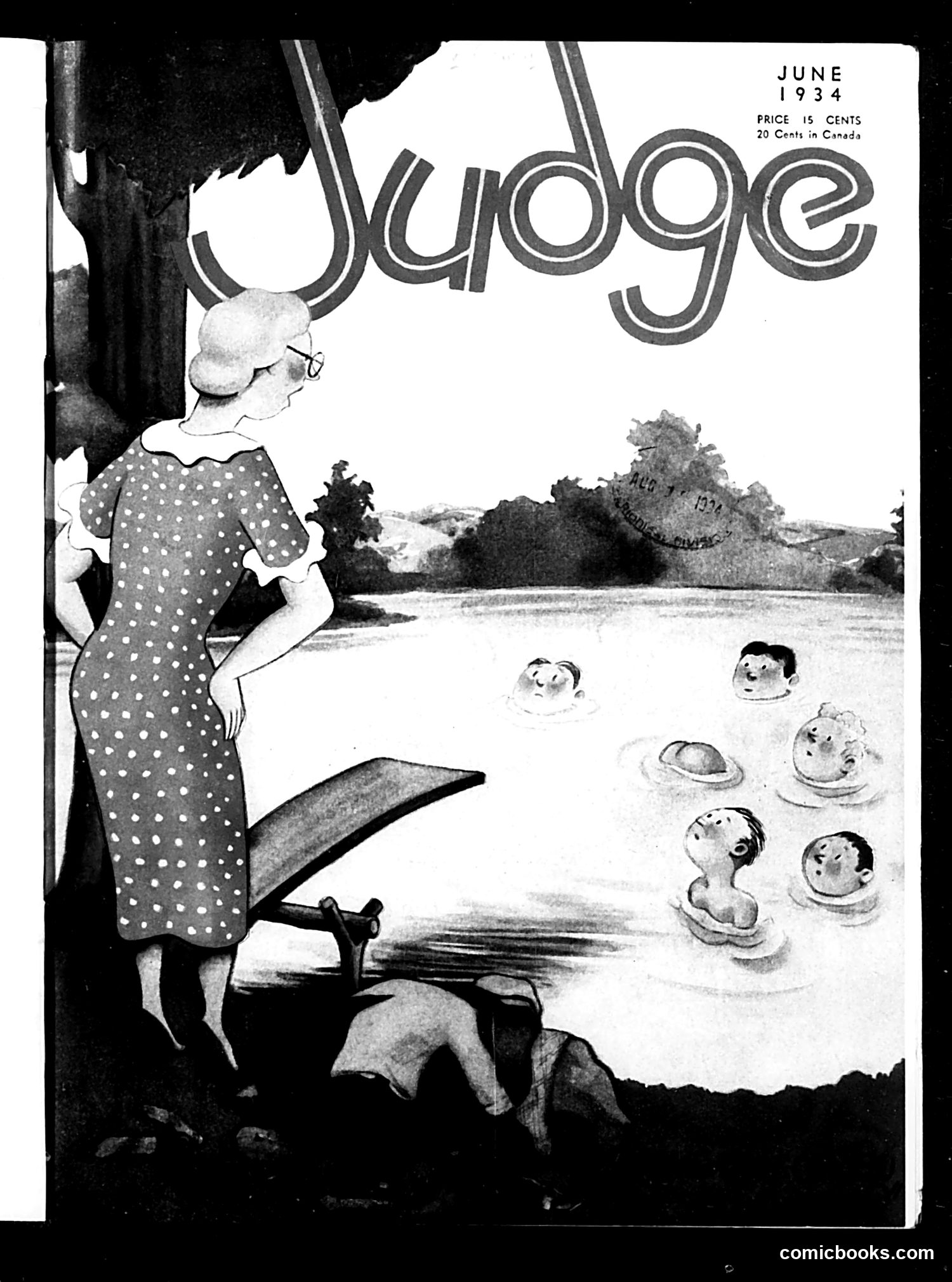
Judge Magazine, June 1934 This cover depicts a woman in a polka-dot dress observing several children swimming or bathing in water. The cartoon likely satirizes summer recreation during the Great Depression era. The exaggerated, somewhat grotesque rendering of the children's faces suggests social commentary—possibly mocking working-class leisure activities, or commenting on public bathing practices of the period. The woman's fashionable dress and glasses suggest she represents a middle or upper-class observer. Without additional context or visible text identifying specific figures, the precise satirical target remains unclear, though the composition suggests commentary on class differences or summer pastimes during this economically difficult period.
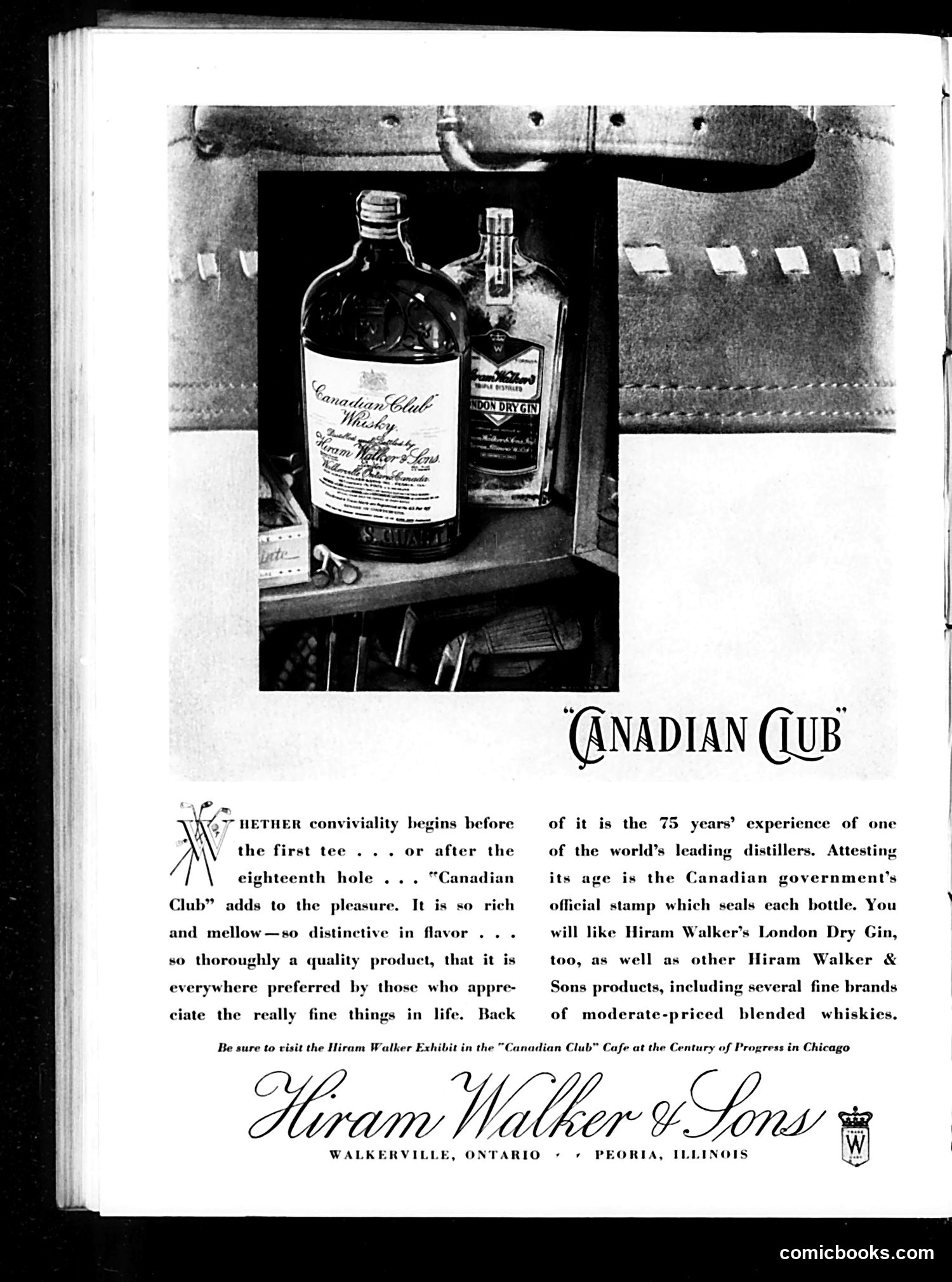
Analysis This page is primarily an advertisement, not a political cartoon. It promotes "Canadian Club" whisky and other Hiram Walker & Sons spirits products. The ad features a photograph of liquor bottles in what appears to be a display case or cabinet. The marketing copy emphasizes the whisky's quality, 75 years of distillery experience, and Canadian government authentication stamps on bottles. It also mentions Hiram Walker's London Dry Gin and "moderate-priced blended whiskies." The ad invites readers to visit "the Hiram Walker Exhibit in the 'Canadian Club' Cafe at the Century of Progress in Chicago"—referencing the 1933 World's Fair. There is no political satire or cartoon content visible on this page; it is straightforward commercial advertising typical of Judge magazine's revenue model.
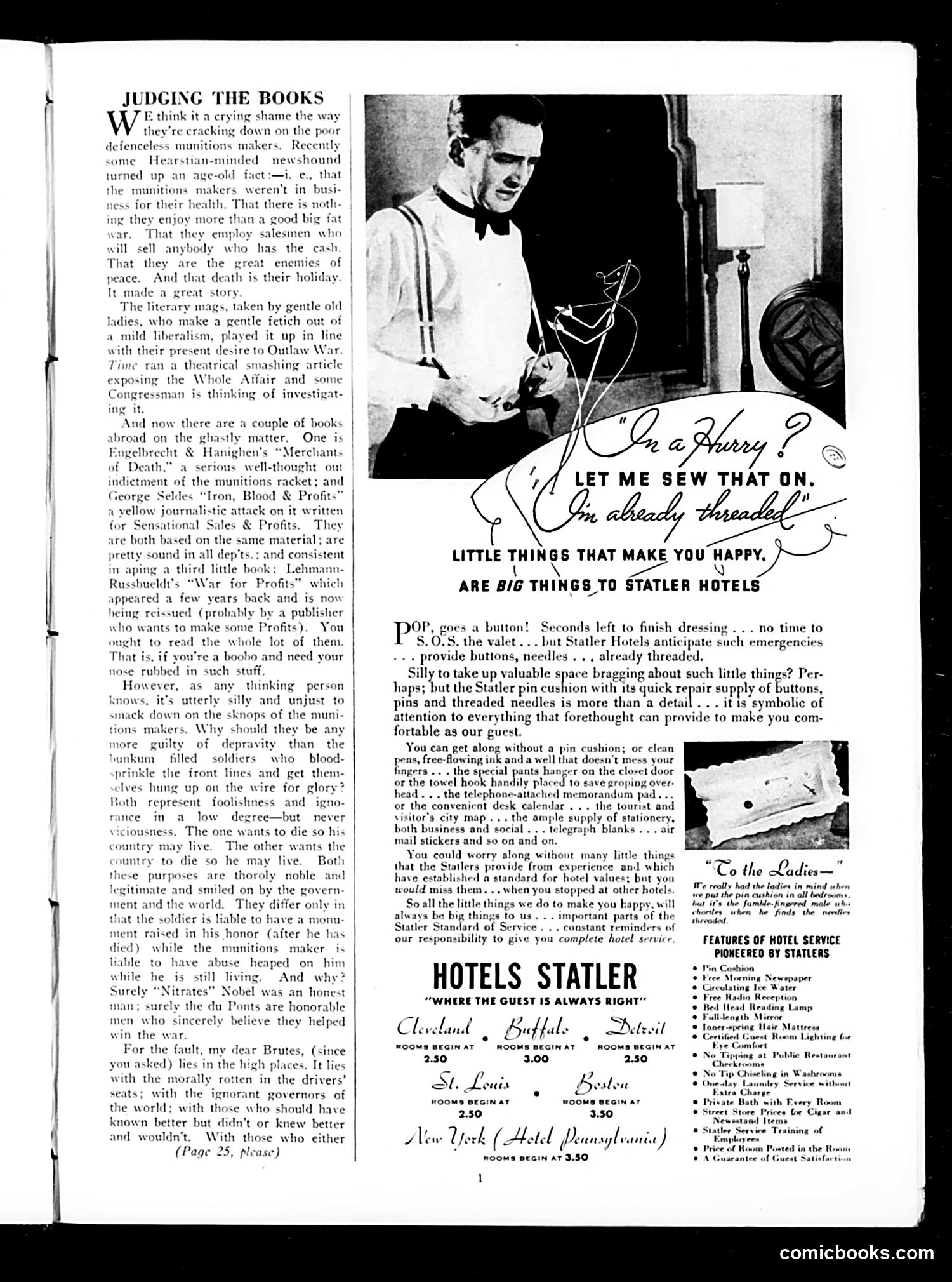
Page Analysis This page is primarily a Statler Hotels advertisement, not a political cartoon. The top half contains an article titled "Judging the Books" criticizing munitions manufacturers and yellow journalism, followed by a photograph of a man sewing with the caption "Or a Hurry? Let Me Sew That On." The advertisement emphasizes Statler Hotels' attention to detail—providing buttons, needles, and thread for guests. The text humorously argues that such "little things" are actually "big things" that distinguish quality hotels and reflect the "Statler Standard of Service." The bottom half lists five Statler Hotel locations with room rates (ranging from $2.50-$3.50) and features of their service. This is primarily commercial advertising, not satire or political commentary.
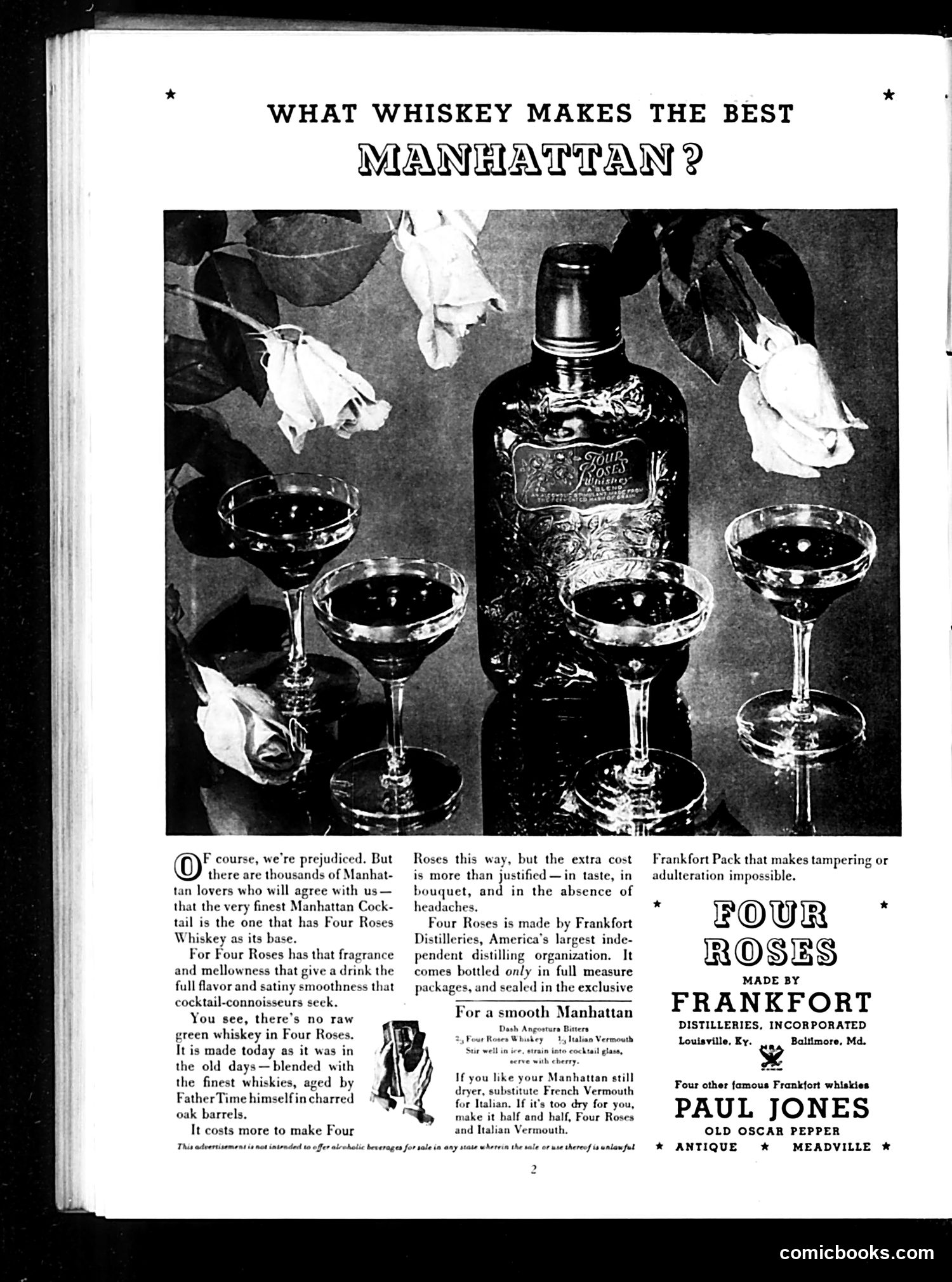
This page is primarily a whiskey advertisement, not political satire. It promotes Four Roses whiskey as the ideal base for Manhattan cocktails, targeting upscale drinkers during what appears to be the Prohibition era or its aftermath. The advertisement emphasizes Four Roses' superiority: no "raw green whiskey," aged properly in oak barrels, and sealed in tamper-proof bottles by Frankfort Distilleries in Louisville, Kentucky. The elegant black-and-white photograph shows sophisticated cocktail glasses alongside roses and the whiskey bottle. The text positions Four Roses as premium and costly but worth the expense for taste and smoothness. It includes a recipe variation for those preferring drier Manhattans using French Vermouth. This is marketing content, not editorial commentary or political humor.
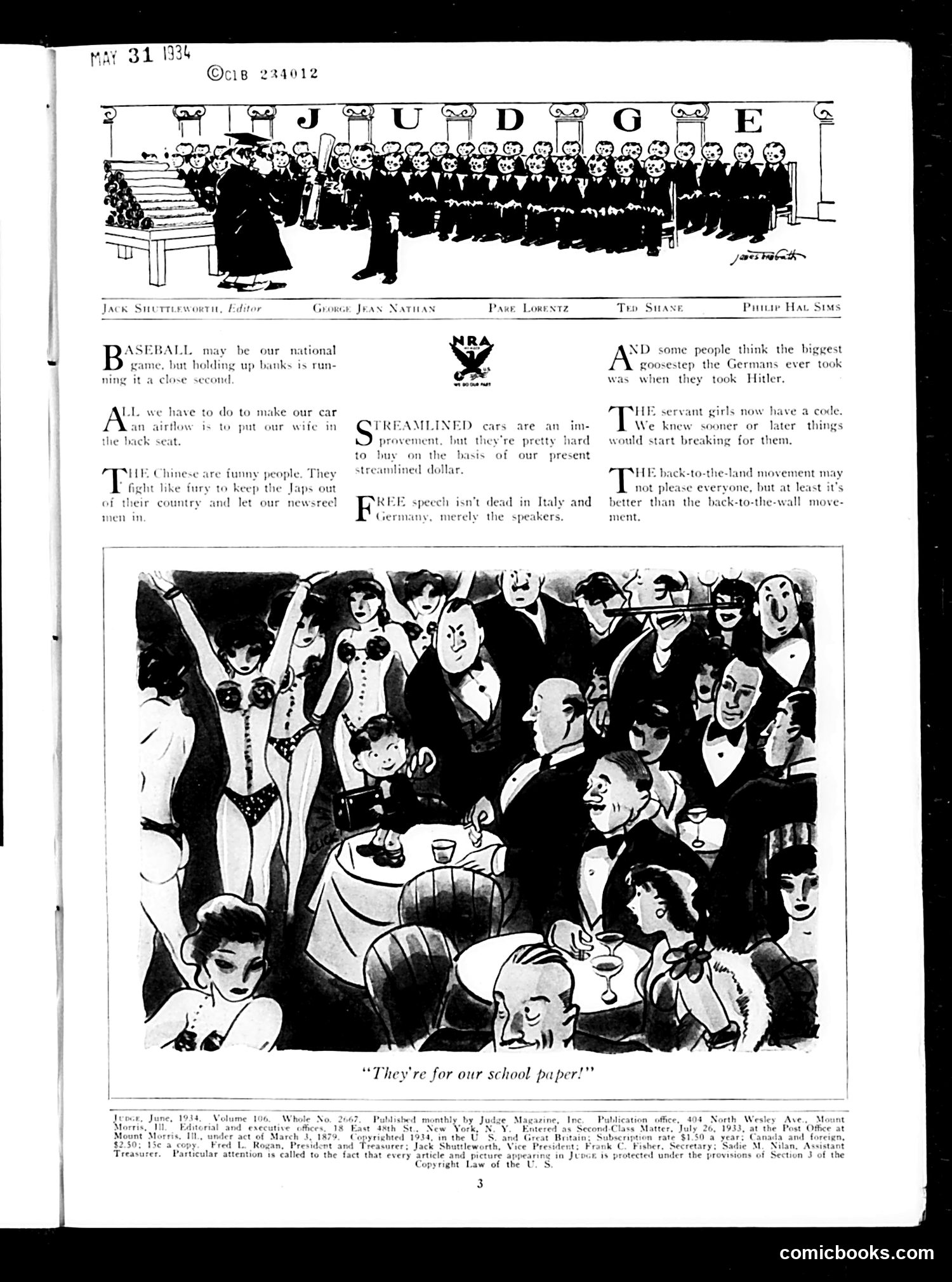
Analysis of Judge Magazine Page (May 31, 1934) The page contains editorial commentary on contemporary issues rather than a traditional political cartoon. The editorial quips critique: 1. Baseball and banking: A joke about holding up banks being "running it a close second" to baseball suggests Depression-era anxiety about financial institutions. 2. Cars and wives: Satirizes consumer culture and gender relations ("put our wife in the back seat"). 3. Hitler and goose-stepping: References Nazi Germany's recent rise, mocking Hitler's ideology. 4. Servant girls and codes: Appears to reference labor regulations or unionization efforts affecting domestic workers. 5. Free speech: Notes that free speech remains protected in Italy and Germany "merely the speakers" — dark irony about fascist censorship. The bottom illustration depicts a glamorous nightclub scene, captioned "They're for our school paper!" — likely satirizing sensationalism or inappropriate content.
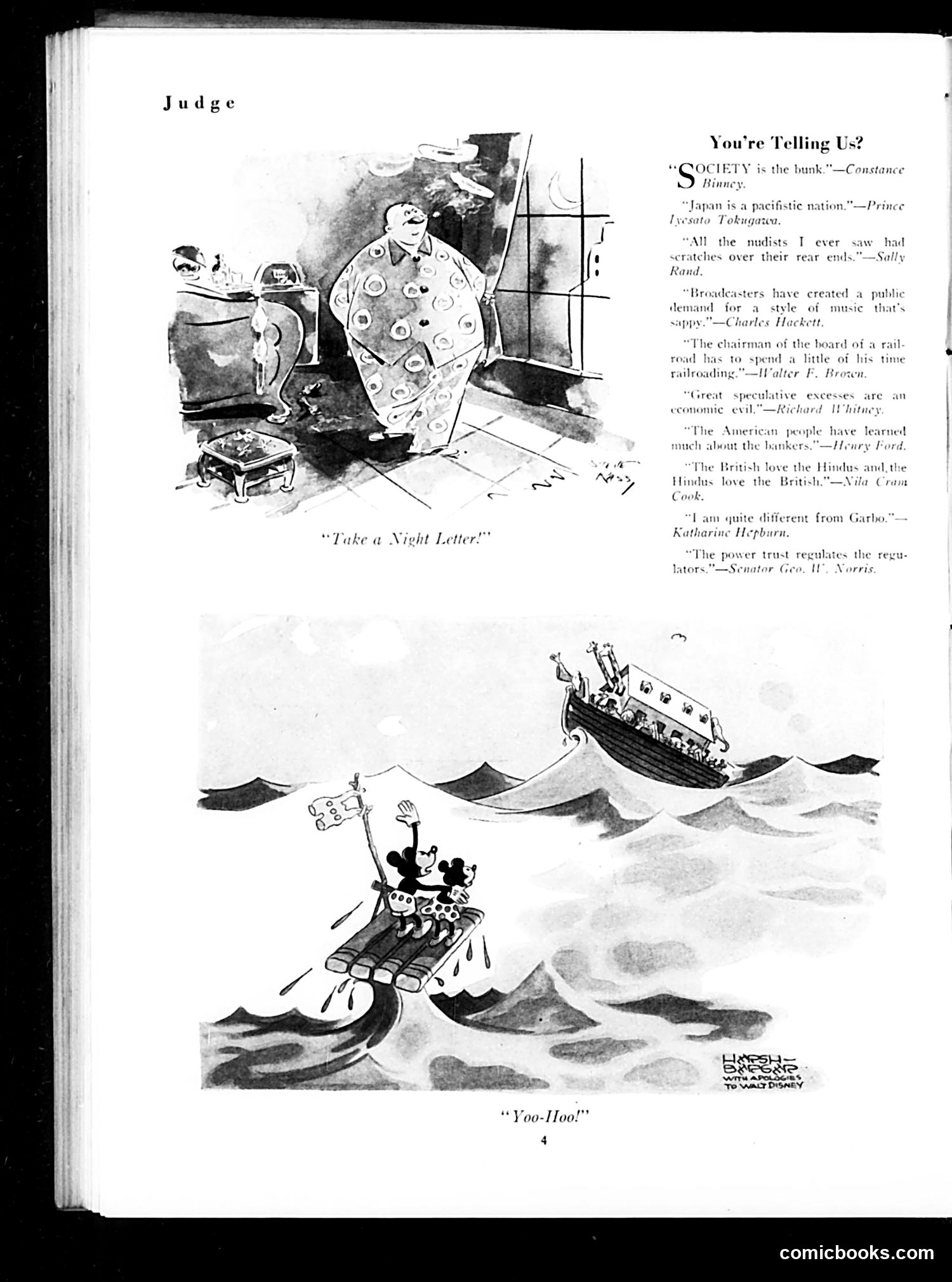
Analysis of Judge Magazine Page This page contains two political cartoons and a "You're Telling Us?" section of satirical quotes. "Take a Night Letter" (top): Depicts a bloated judge surrounded by money and legal papers, suggesting judicial corruption or that judges accept bribes. The "night letter" reference—a Western Union telegram service—implies illicit late-night communications with those seeking favorable rulings. "Yoo-Hoo!" (bottom): Shows Mickey Mouse characters on a raft signaling a ship, likely satirizing American entertainment's global reach or possibly commenting on rescue/aid situations, though the specific reference is unclear without additional context. The "You're Telling Us?" quotes mock various public figures and institutions—from bankers to broadcasters to political leaders—reflecting popular cynicism about authority during this era.
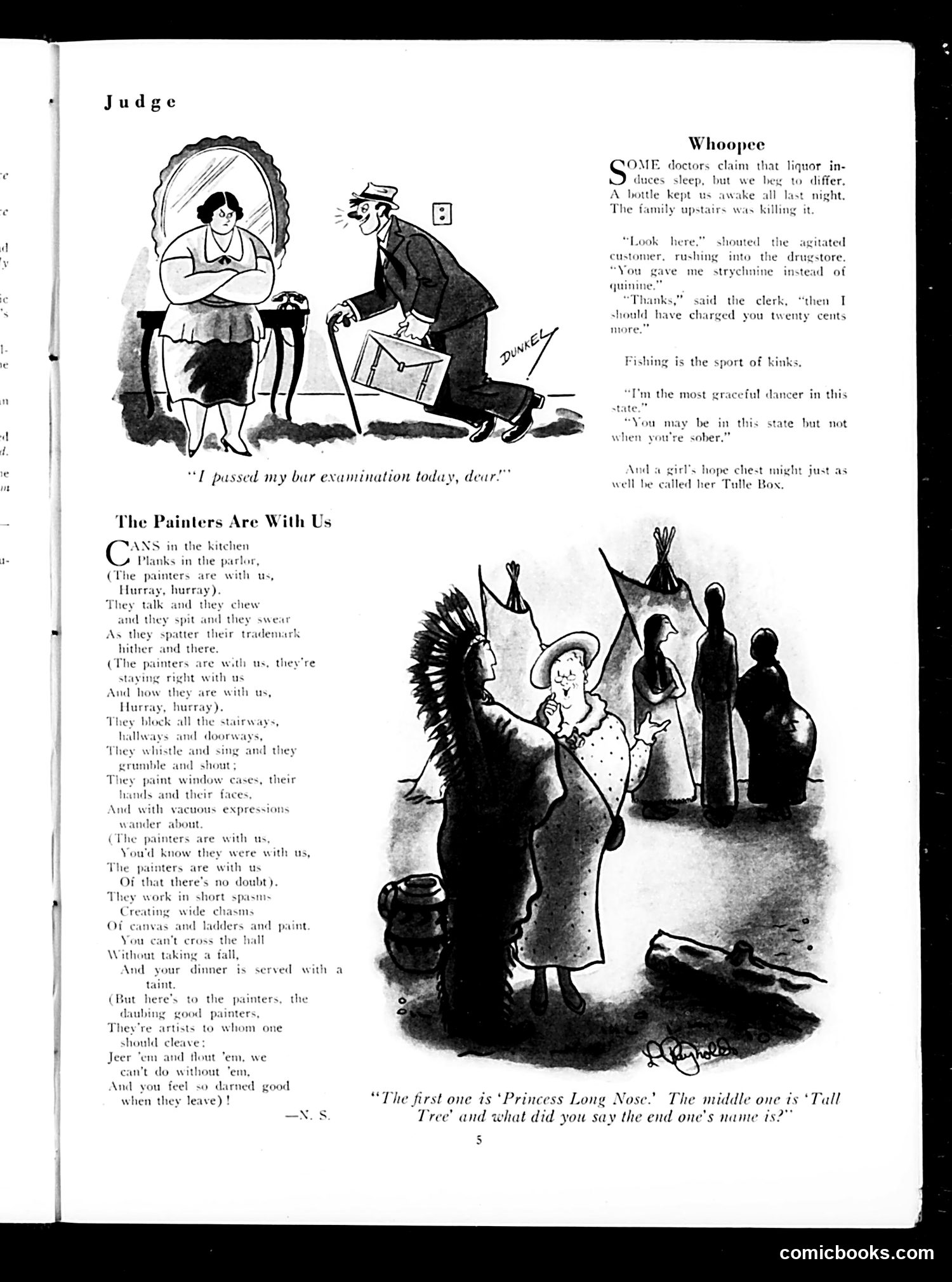
Analysis of Judge Magazine Page Top Cartoon ("Judge"): A woman sits in an examination chair while a man (appearing to be a doctor or examiner) enters. The caption reads "I passed my bar examination today, dear!" This satirizes women entering the legal profession—likely early 20th century when female lawyers were rare and controversial. The joke appears to mock the idea of a woman as a lawyer, treating it as an absurd achievement worthy of comedic treatment. "The Painters Are With Us": A humorous poem about house painters creating mess and disruption during home renovation work. This is general domestic satire with no specific political reference—simply mocking the chaos painters cause during jobs. Lower Cartoon: Shows a woman naming Native American dolls to other figures, suggesting stereotypical naming conventions of the era.
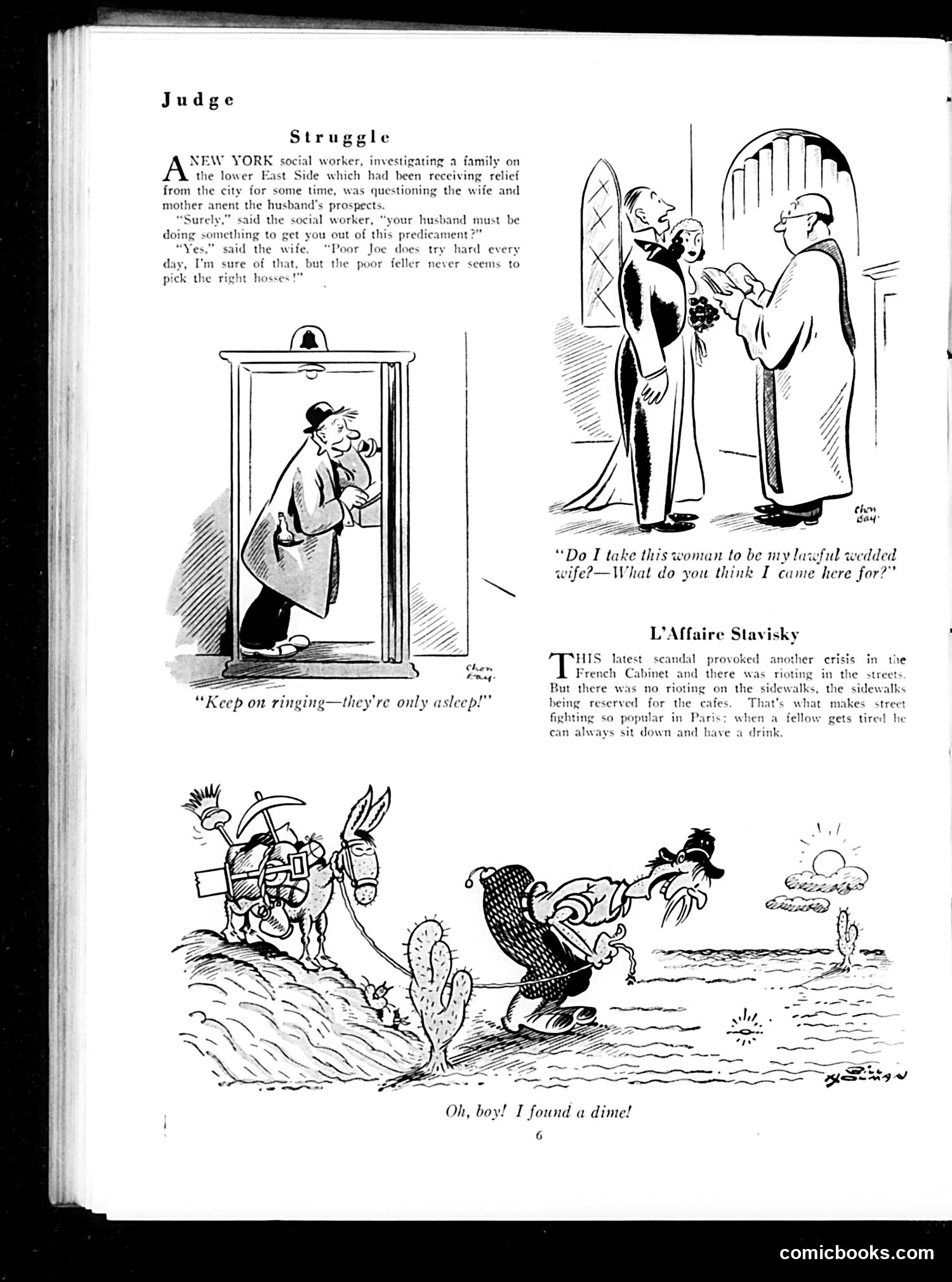
Analysis of Judge Magazine Page This page contains three unrelated satirical cartoons: 1. "Struggle" (top left): A social worker interviews a poor family on the Lower East Side. The wife complains her husband won't work to improve their situation. The satire critiques both poverty and the difficulty of social intervention. 2. "Do I take this woman..." (top right): A judge presides over what appears to be a bigamy case, satirizing marital scandals and legal proceedings. 3. "L'Affaire Slavsky" (bottom): Commentary on a French political scandal causing Cabinet crisis and street rioting. The text notes Parisians' preference for café culture over protest, satirizing French political volatility and social priorities. The cartoons reflect Judge's focus on urban social problems, legal absurdities, and international political turmoil.
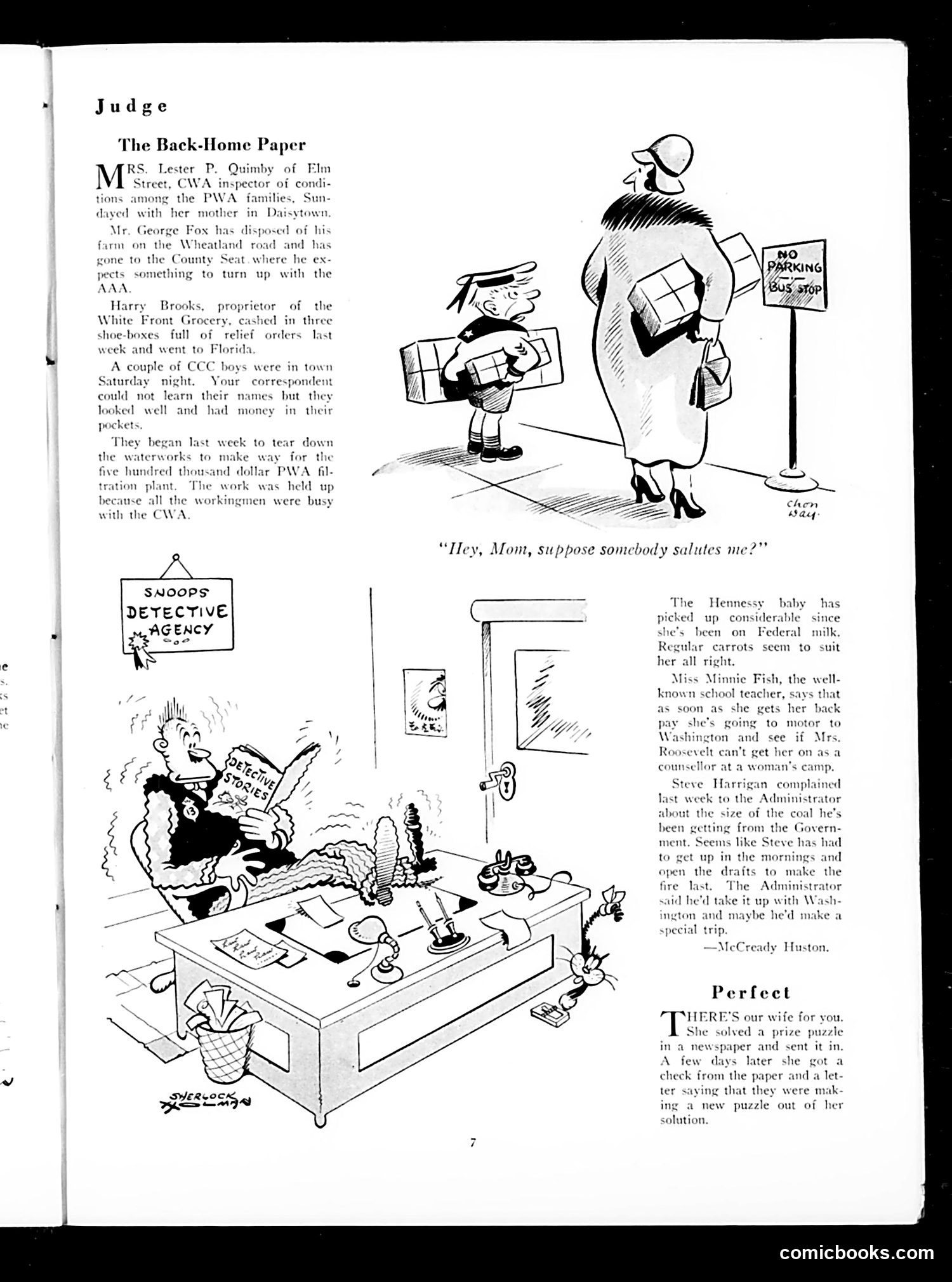
Explaining "The Back-Home Paper" to Modern Readers This page satirizes New Deal government programs of the 1930s Depression era through small-town gossip. The column references the CWA (Civil Works Administration), PWA (Public Works Administration), AAA (Agricultural Adjustment Administration), and CCC (Civilian Conservation Corps)—all actual New Deal agencies. The jokes mock how these programs affected ordinary people: farmers disposing of land hoping for AAA support, grocery owners cashing relief checks, young men from the CCC looking prosperous, and government projects like waterworks being torn down and rebuilt. The cartoon shows a boy carrying boxes (likely relief packages), joking about military salutes—suggesting these government handouts resembled military-style provisions. The "Snoops Detective Agency" panel satirizes bureaucratic incompetence. Overall, Judge presents New Deal aid as both absurd and potentially corrupting, reflecting conservative skepticism about Depression-era government intervention, while acknowledging its pervasive presence in American life.
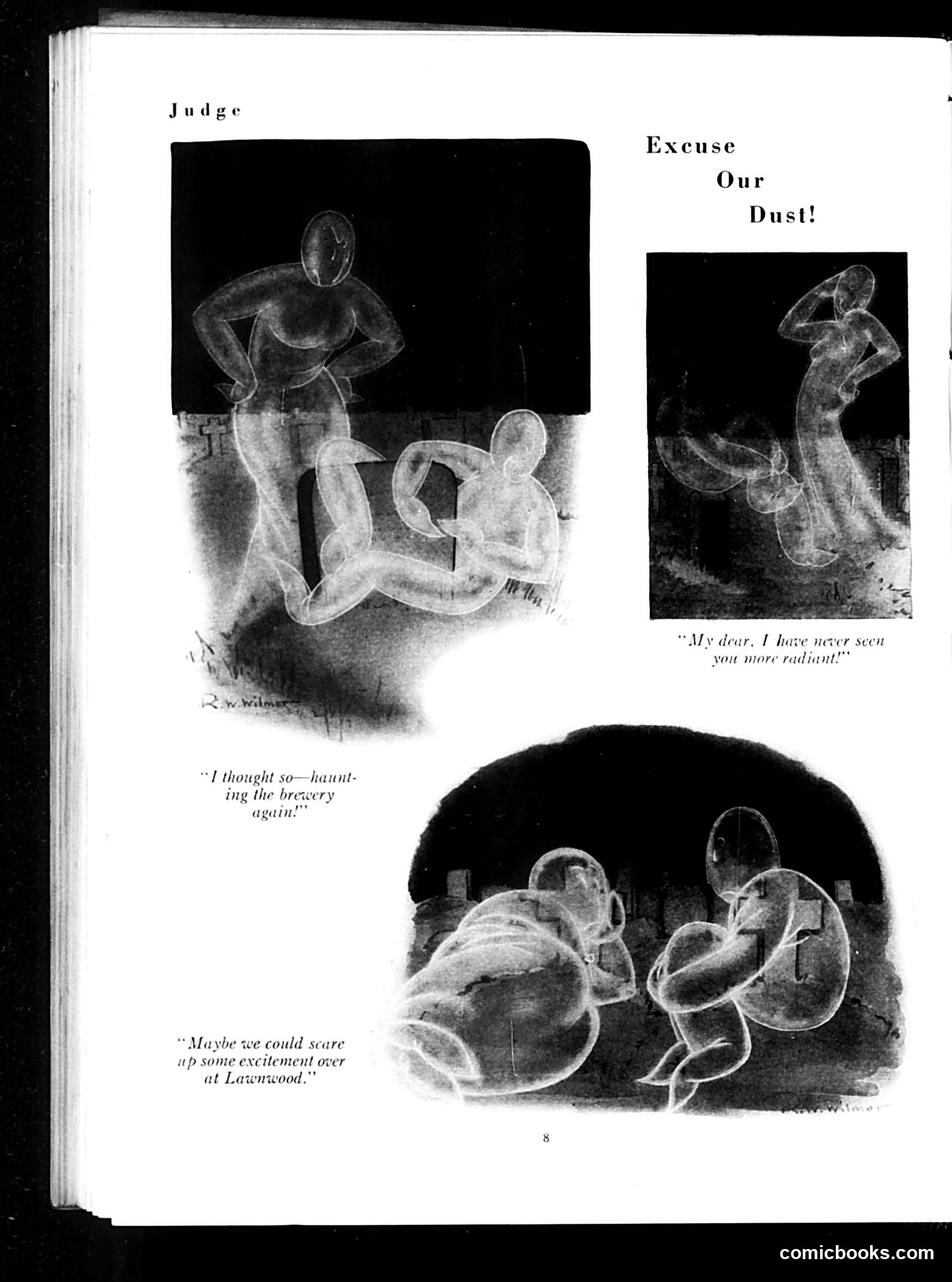
This page from *Judge* satirizes Prohibition-era speakeasies and illegal alcohol consumption. The X-ray style illustrations reveal ghost-like figures engaged in drinking activities—the visual conceit being that these hidden, illicit behaviors are "exposed" through the transparent overlay. The title "Excuse Our Dust!" suggests ongoing disruption, likely referencing the chaos of Prohibition enforcement. The dialogue references "haunting the brewery" and seeking "excitement over at Lawnwood" (apparently a known speakeasy location), implying that despite legal bans, people continue patronizing illegal drinking establishments. The cartoon mocks both the futility of Prohibition and the public's casual disregard for the law, presenting underground drinking culture as an accepted social reality that persists despite official attempts to eliminate it.
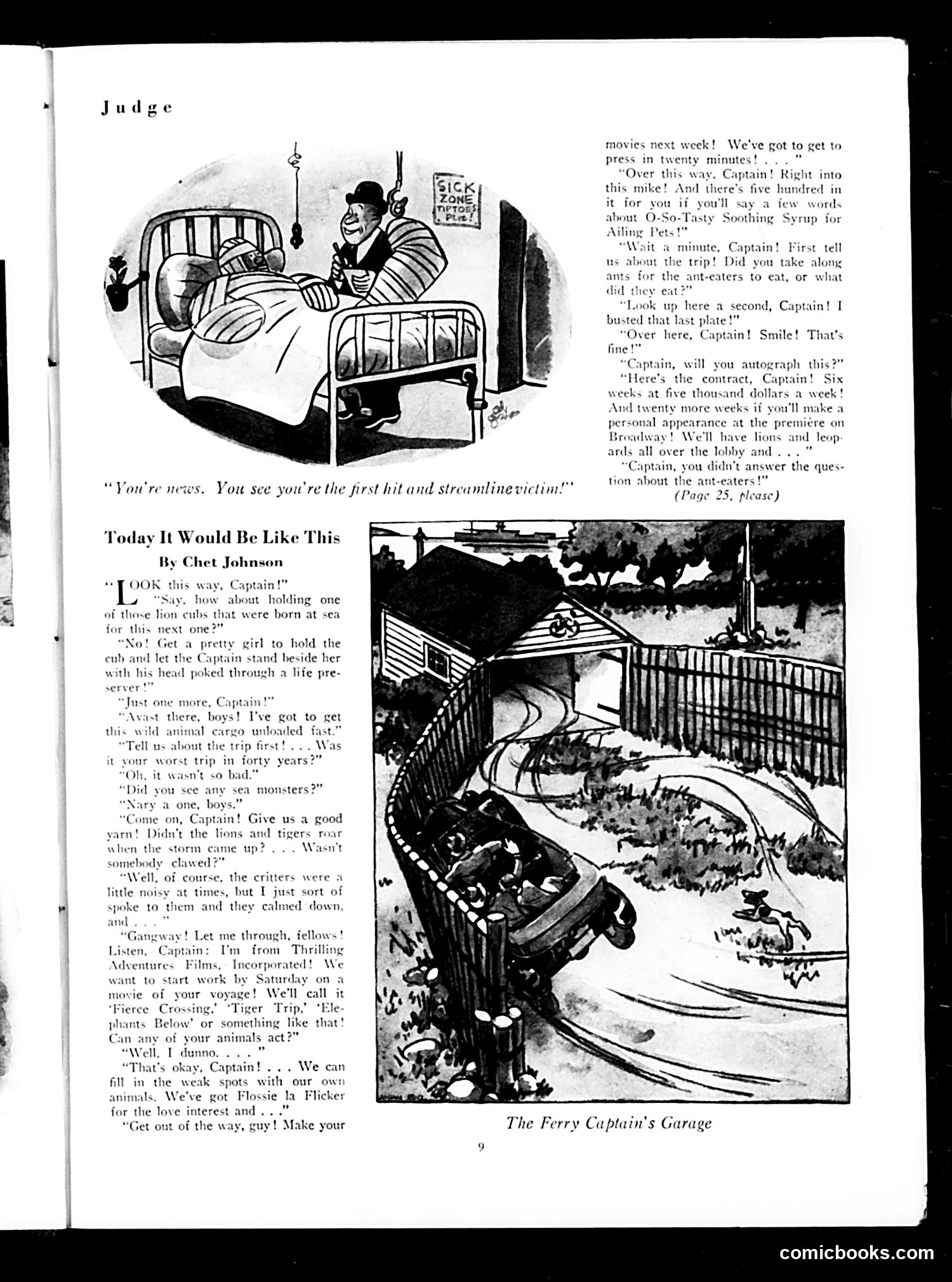
"Today It Would Be Like This" — Judge Magazine Satire This two-part piece by Chet Johnson satirizes the celebrity circus surrounding exotic animal expeditions and early film promotion. The top cartoon shows a hospital patient besieged by reporters, photographers, and film executives—each demanding different things: interviews, photos, contracts, autographs, and product endorsements. The caption "You're news. You see you're the first hit and streamline-viction!" captures the absurdity of instant fame-making. The accompanying story parodies this further: a sea captain arriving with wild animals is immediately mobbed by competing demands—journalists wanting sensational tales, filmmakers pitching movie deals ("Fierce Crossing," "Tiger Trip"), and agents offering five-thousand-dollar weekly contracts. The humor lies in how the captain's actual experience becomes irrelevant; everyone wants their version of the story, not the truth. This reflects 1920s-era anxieties about media sensationalism, celebrity manufacturing, and how technology (radio, film, photography) transforms real events into commodified entertainment.
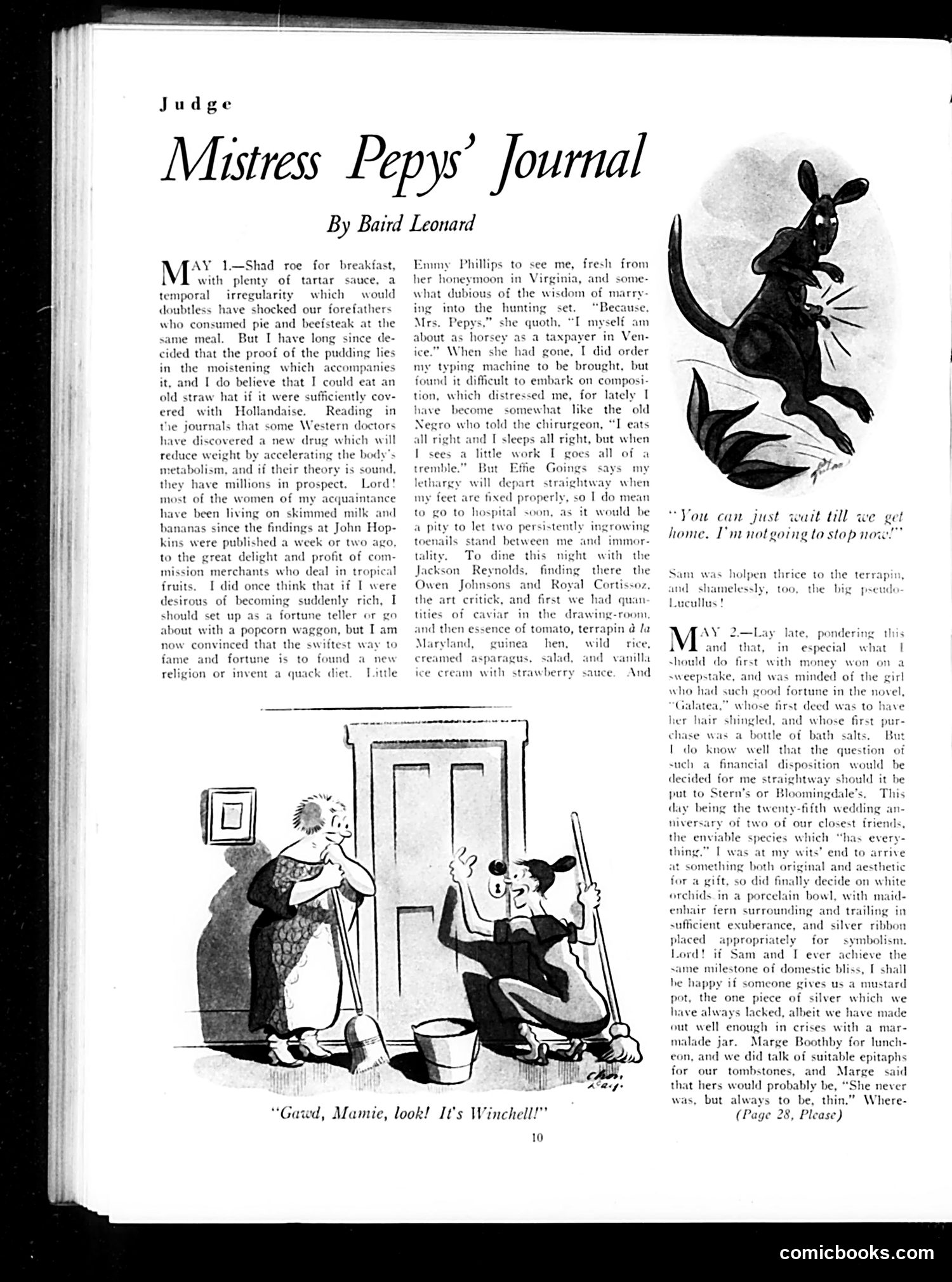
Mistress Pepys' Journal - Explanation for Modern Readers This is a humorous column styled as a fictional diary entry, parodying Samuel Pepys' famous 17th-century journal. The satire targets 1920s-30s society frivolities and fads. The Main Jokes: The narrator mocks contemporary women obsessing over a new "weight-reduction drug" discovered at Johns Hopkins. She quips that fortune-telling or selling diet products would be the fastest route to wealth—satirizing how gullible people are about quick-fix solutions. Social References: The column name-drops real figures (art critic Royal Cortissoz, journalist Walter Winchell in the cartoon), luxurious foods (caviar, terrapin), and upper-class concerns (wedding gifts, orchids). The lower cartoon depicts someone excited about spotting Winchell, a famous gossip columnist—mocking celebrity obsession. The Satire: The piece ridicules wealthy women's superficiality: their trendy diets, conspicuous consumption, marital anxiety, and preoccupation with appearing young and thin. The closing jab at "Marge" epitomizes this—even her epitaph should claim eternal youth.
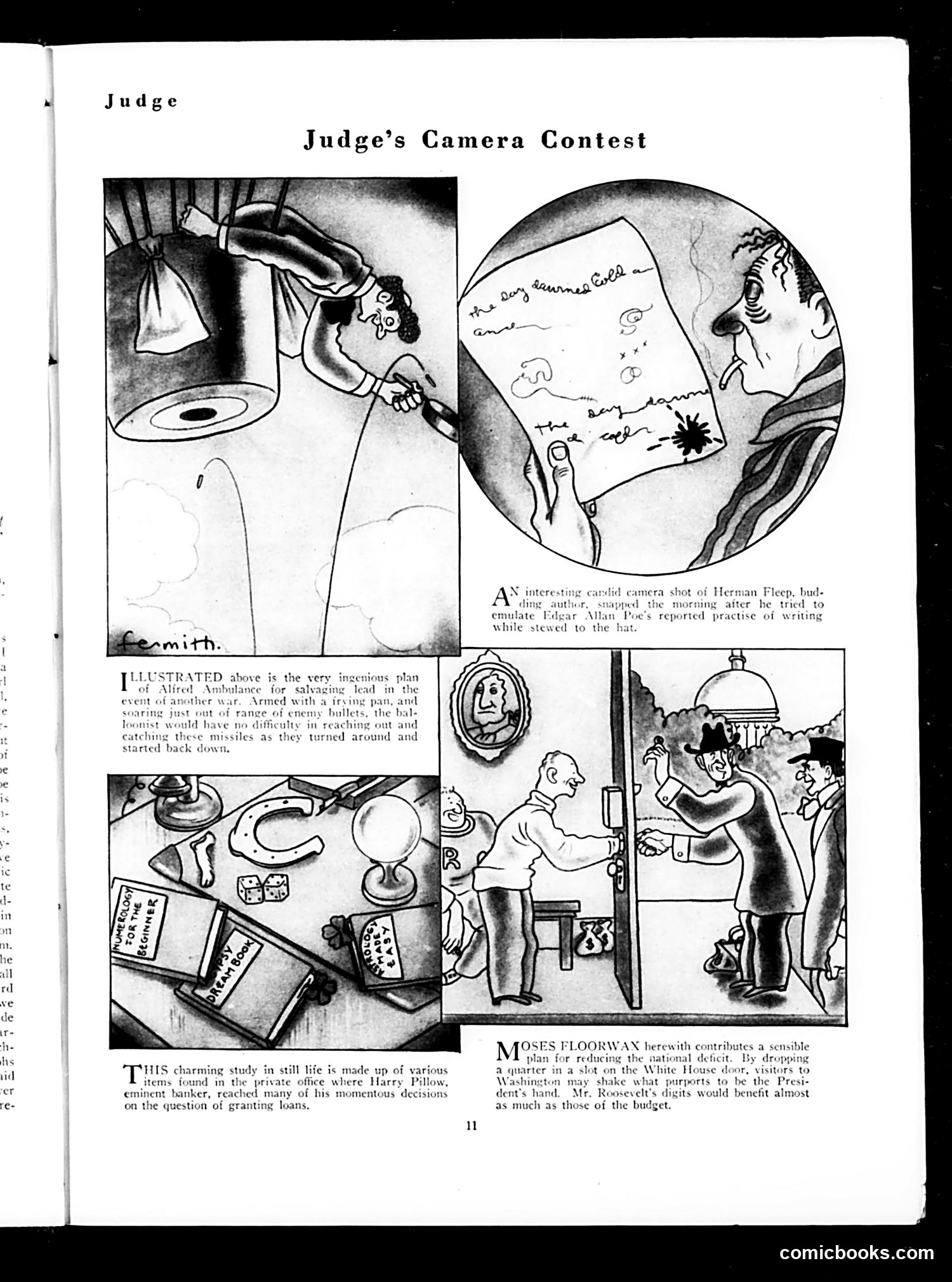
Judge Magazine: "Judge's Camera Contest" Page Analysis This page showcases satirical cartoon submissions for a photography/illustration contest. The cartoons mock various prominent figures and situations: Top left (Lesmith): Alfred Ambulance's wartime invention—a frying pan worn as armor to catch enemy bullets as they "turned around and started back down." Top right: Herman Fleep's mock of Edgar Allan Poe, showing someone writing while wearing a hat (referencing Poe's reported practice). Middle: A still-life of banker Harry Pilton's office—depicting the mundane items (desk items, dice, containers) used in his loan-granting decisions, satirizing that serious financial decisions may lack serious deliberation. Bottom right (Moses Floorwax): A joke about reducing the national deficit by having White House visitors shake the President's hand while standing on floorwax in the doorway, so they'd slip and lose money from their pockets. The page satirizes wartime absurdities, literary pretension, corrupt banking practices, and government inefficiency through humorous visual gags typical of Judge's satirical style.
Content Analysis This is a critical essay, not a cartoon—the page contains Judge columnist's commentary on theatrical industry conventions rather than illustrated satire. The author argues that American theater critics and industry figures arbitrarily declare the Broadway season "over" each May, despite evidence contradicting this claim: summer theaters opening nationwide, stock companies operating, and Broadway shows still performing successfully. The satire targets the illogical groupthink of theater reviewers and producers who announce season closure based on: - Gilbert and Sullivan revivals premiering (triggering European vacations) - A few poor-quality new plays - Personal fatigue and desire for rest - Producers like Max Gordon and Lee Shubert traveling to England The author mocks that critics "make up the season's mind for it" rather than observing actual theatrical activity. The piece suggests this annual ritual serves tradition over reality, preventing audiences from discovering ongoing quality productions while the industry pretends the season has ended.
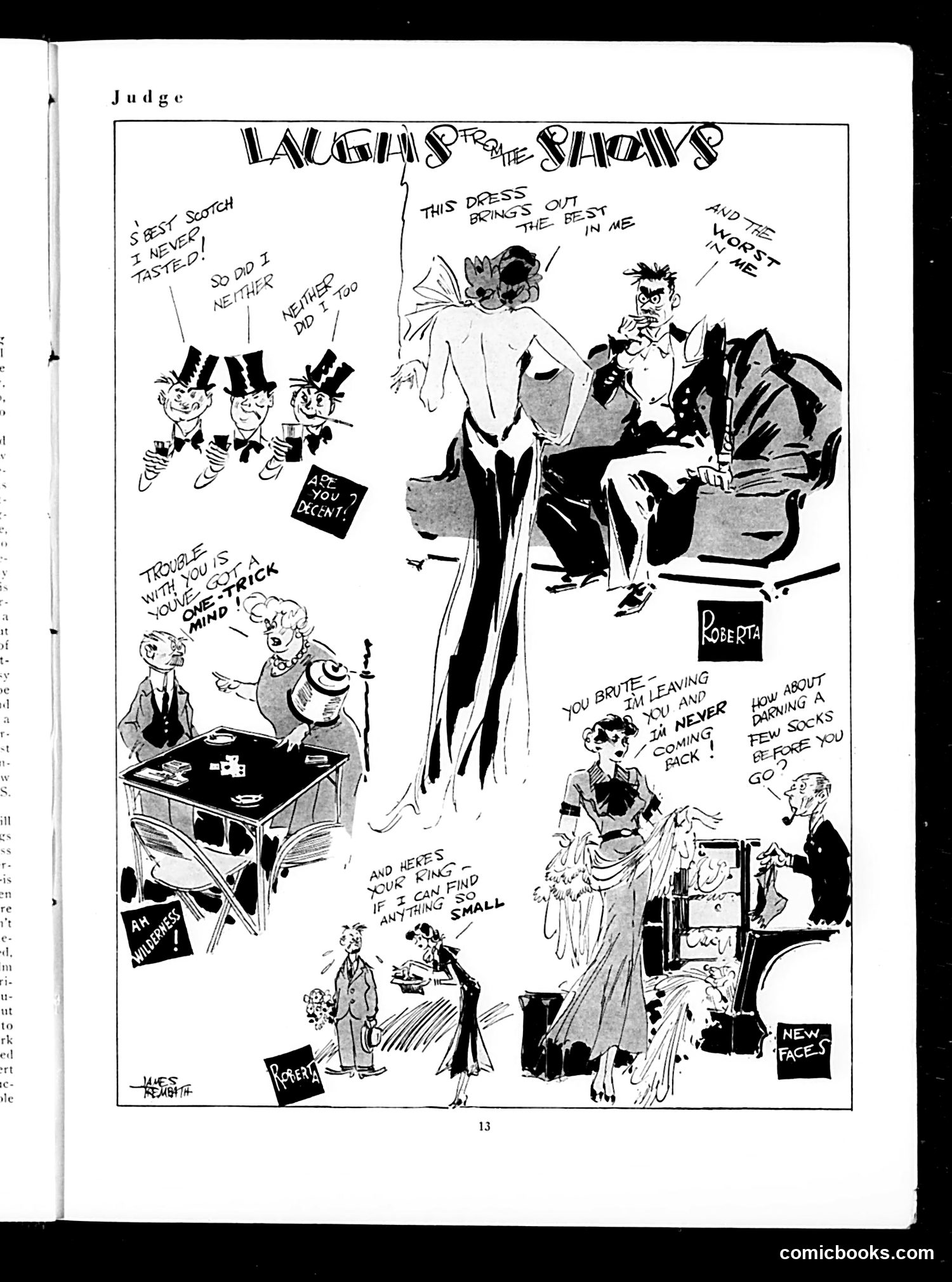
Explanation This page titled "Judge's Pirate Shows" contains satirical cartoons mocking theatrical productions. The top section shows three identical figures in top hats claiming to have created a "best Scotch" they "never tasted," satirizing fraudulent producers making false claims about their work. The central panel depicts a woman in an elegant dress at what appears to be a social gathering, with the caption "This dress brings out the best in me"—likely mocking vanity and superficial fashion obsession. The bottom sections show gambling scenes and theatrical disasters, with references to "Roberta" and "New Faces," appearing to ridicule contemporary stage shows as money-grubbing ventures filled with untalented performers and romantic drama rather than genuine artistic merit. The cartoons collectively critique theatrical producers, performers, and audiences of the era.
Analysis for Modern Readers This is a satirical advice column to college graduates, written during the New Deal era (likely early 1930s, given references to the Blue Eagle—the NRA symbol—and Roosevelt). The main joke: The author contrasts his own college graduation (when advised to work hard, save money, and be serious) with what today's graduates are being told—essentially the *opposite*. The new advice: work only 40 hours weekly, get drunk regularly ("spified"), embrace leisure, and stop hoarding money. This is framed as economic patriotism to stimulate the economy and fight the Depression. The P.S. from "General Johnson" (likely referring to NRA administrator Hugh Johnson) complains that Roosevelt's "Blue Eagle" price-code enforcement shut down free lunches at bars—a humorous complaint about unintended consequences of New Deal regulations meant to help workers. The satire mocks both Depression-era economic anxiety and New Deal paternalism: the government now tells citizens what behaviors are patriotic, including spending and drinking.
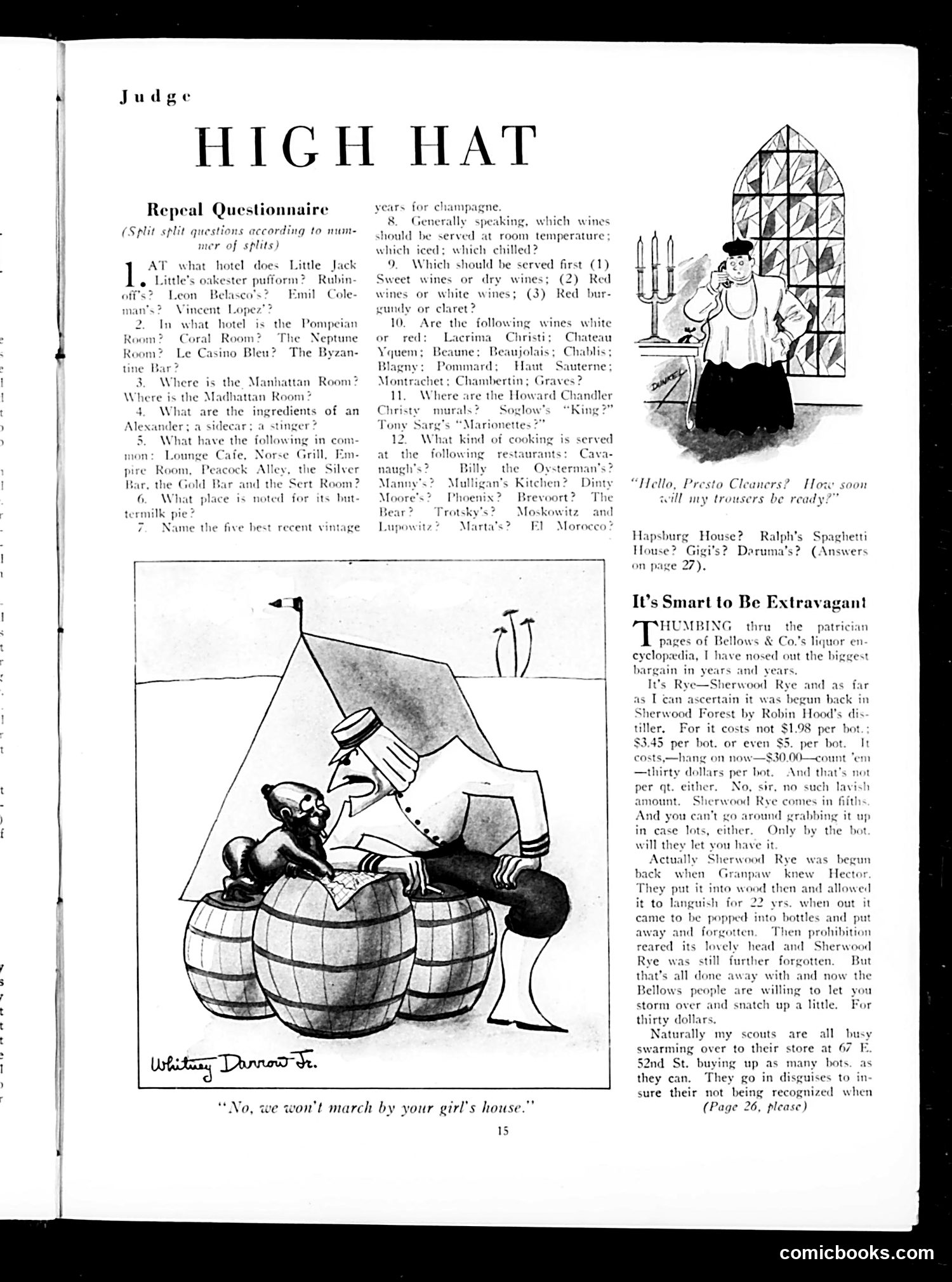
"High Hat" - Judge Magazine Satire This page satirizes Prohibition-era excess and pretension among the wealthy elite. The Main Cartoon (center): depicts a man lounging atop enormous barrels while a waiter serves him—mocking the conspicuous consumption and black-market drinking of the wealthy during Prohibition (1920-1933). The caption "No, we won't march by your girl's house" suggests discretion about illicit activities. "High Hat" Questionnaire (left): a mock "repeal questionnaire" listing exclusive Manhattan hotels, fancy cocktails, and upscale restaurants—ridiculing upper-class knowledge of luxury venues and fine dining. "It's Smart to Be Extravagant" (right): an advertisement for Sherwood Rye whiskey selling at $30 per bottle, mocking how wealthy consumers flaunted expensive black-market liquor during Prohibition. The author jokes that scouts must buy "in disguises to insure their not being recognized"—highlighting the illegal yet socially acceptable drinking among the rich. The overall satire targets wealthy hypocrisy: they publicly supported Prohibition while privately enjoying expensive contraband alcohol.
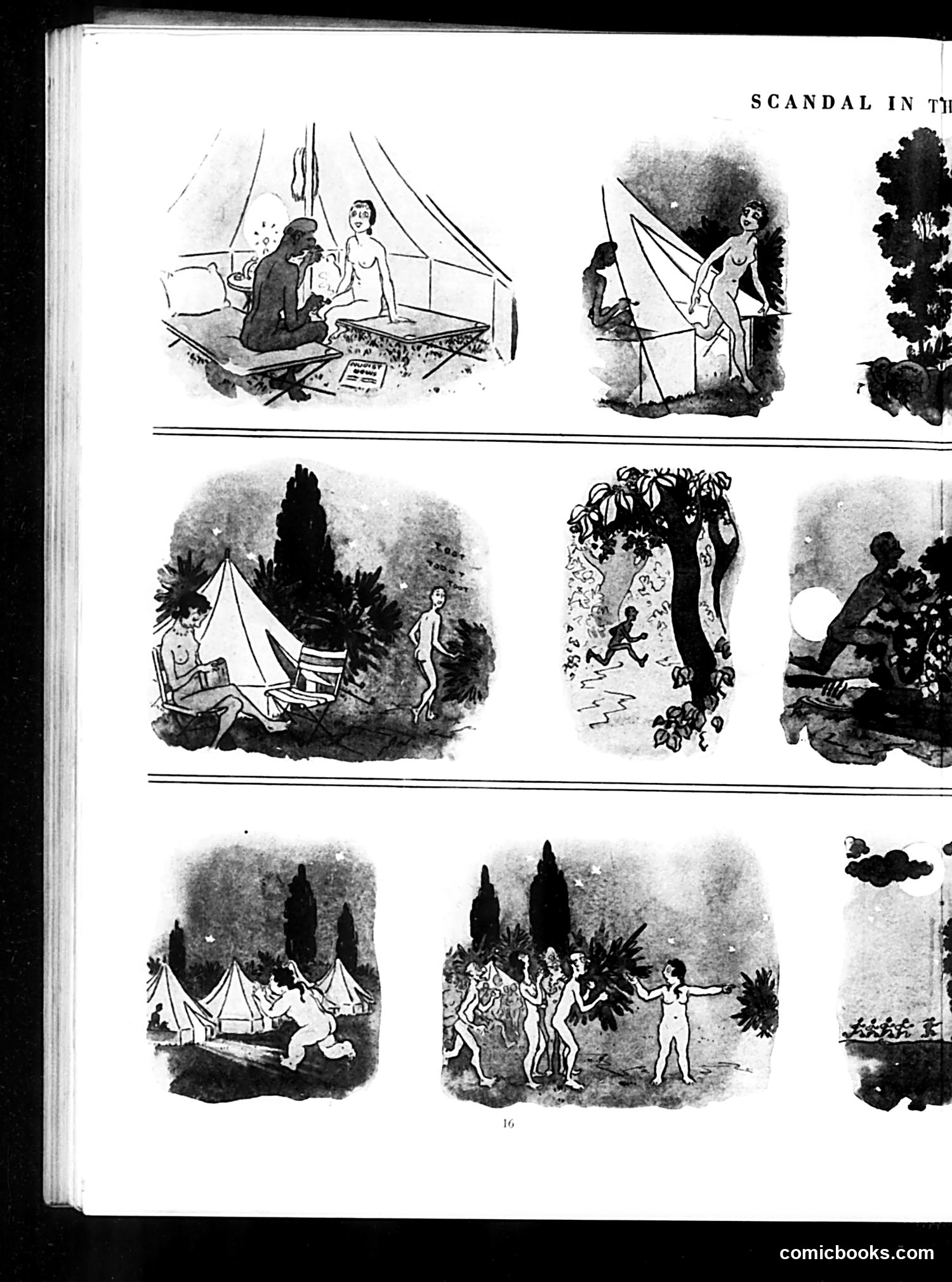
"Scandal in the..." (Title cut off) This page contains a series of six cartoon panels depicting what appears to be a nudist or naturist camp scenario. The scenes show nude or partially-nude figures in various camping activities—sitting in tents, playing, running, and gathering around trees. The satire likely mocks the naturist movement, which gained some popularity in early-to-mid 20th century America. The "scandal" referenced in the title suggests Judge magazine is presenting this lifestyle as shocking or ridiculous to conventional readers. The repeated imagery of nude figures in everyday camping situations creates comedic contrast—treating naturism as absurdly ordinary. Without the full title or accompanying text, the specific scandal being satirized remains unclear, but the general target is the perceived impropriety of public nudism.
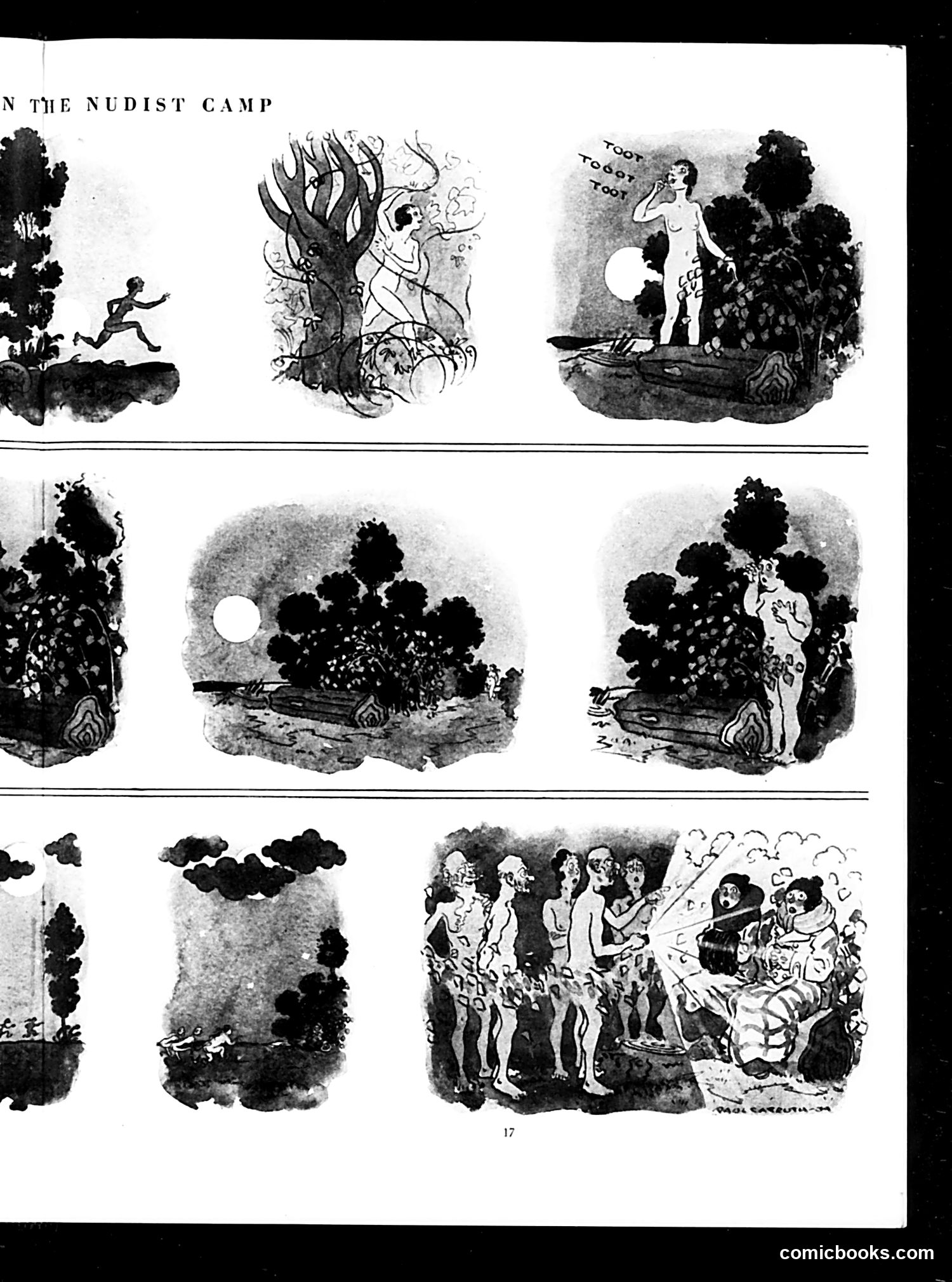
"In the Nudist Camp" This satirical comic sequence depicts the novelty and social controversy of 1920s-30s nudist camps—a then-shocking lifestyle movement. The panels show the progression: people discovering a nudist camp in nature, stripping down, and gathering together nude. The final panel appears to show clothed observers (possibly authorities or disapproving outsiders) reacting with shock or amusement to the nude campers. The satire mocks both the nudist movement itself and public prudishness about it. Nudism was a genuine but fringe phenomenon that shocked mainstream America, making it fertile ground for Judge magazine's satirical humor. The cartoons play on the absurdity and novelty of people casually removing clothing in nature, treating it as humorous social transgression rather than serious critique.
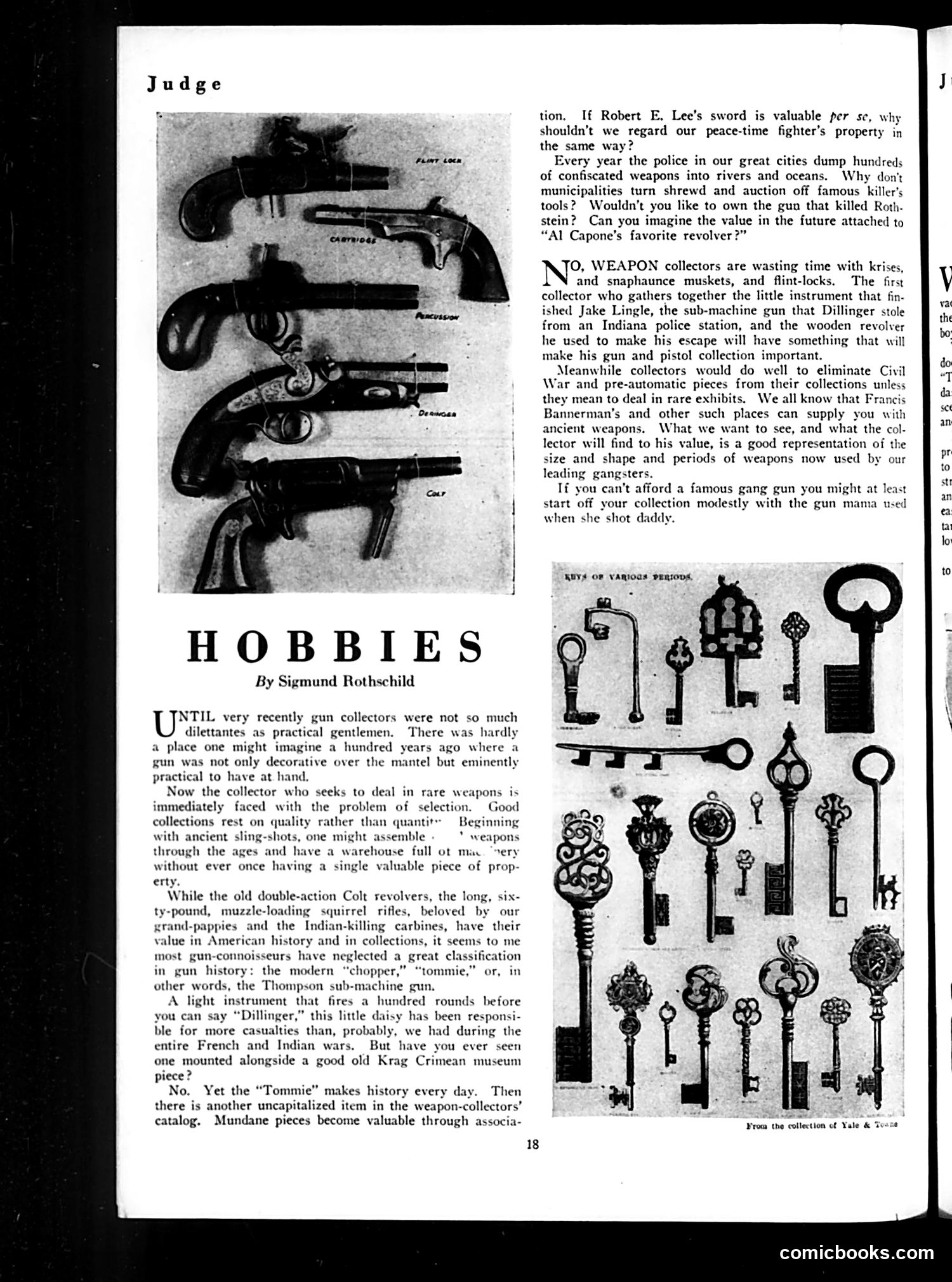
"Hobbies" by Sigmund Rothschild — Judge Magazine Satire This is a satirical article mocking weapon collectors' narrow focus on historical artifacts while ignoring contemporary gangster guns. Writing during Prohibition (references to Dillinger, Al Capone, Jake Lingle suggest the 1930s), Rothschild argues that modern "choppers" (Thompson submachine guns) and weapons used by famous criminals are historically more significant than Civil War relics. The satire's dark humor lies in its serious tone: it suggests collectors should acquire guns that killed gangland victims, auction off "famous killer's tools," or start collections with "the gun mama used when she shot daddy." The accompanying illustration shows ornamental keys and locks from various historical periods—a visual complement suggesting that while collectors prize antique decorative objects, they ignore the functional weapons shaping current events. The piece critiques both weapon fetishism and collector snobbery during an era of widespread criminal violence.
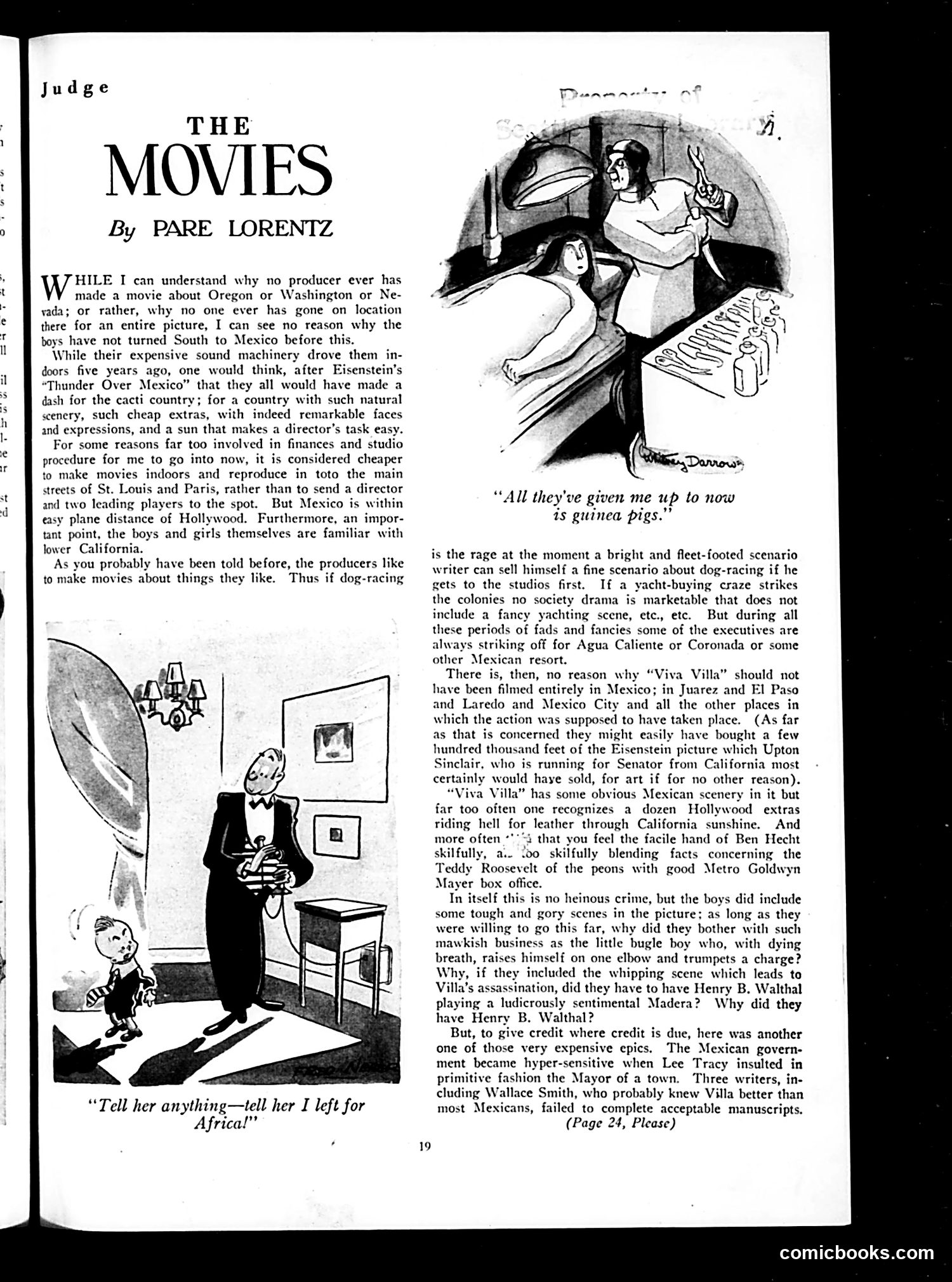
Analysis for Modern Readers This is film criticism by Pare Lorentz reviewing the movie "Viva Villa" (about Mexican revolutionary Pancho Villa). Lorentz argues the film should have been shot entirely in Mexico rather than using Hollywood sets and California locations with extras posing as Mexican scenery. The cartoons mock Hollywood's artificiality: one shows a man telling his wife he's leaving for Africa (implying he's escaping to exotic locations rather than staying in mundane reality); another depicts a producer complaining he's only been given "guinea pigs" to work with—suggesting inadequate resources or talent. Lorentz criticizes the film for mixing authentic Mexican violence (whipping scenes) with maudlin sentiment (a dying bugle boy), and questions casting choices like Henry B. Walthall. He also notes the Mexican government's sensitivity to American insults (Lee Tracy's incident with a mayor) and the script troubles, suggesting the production was compromised despite its expensive scope.
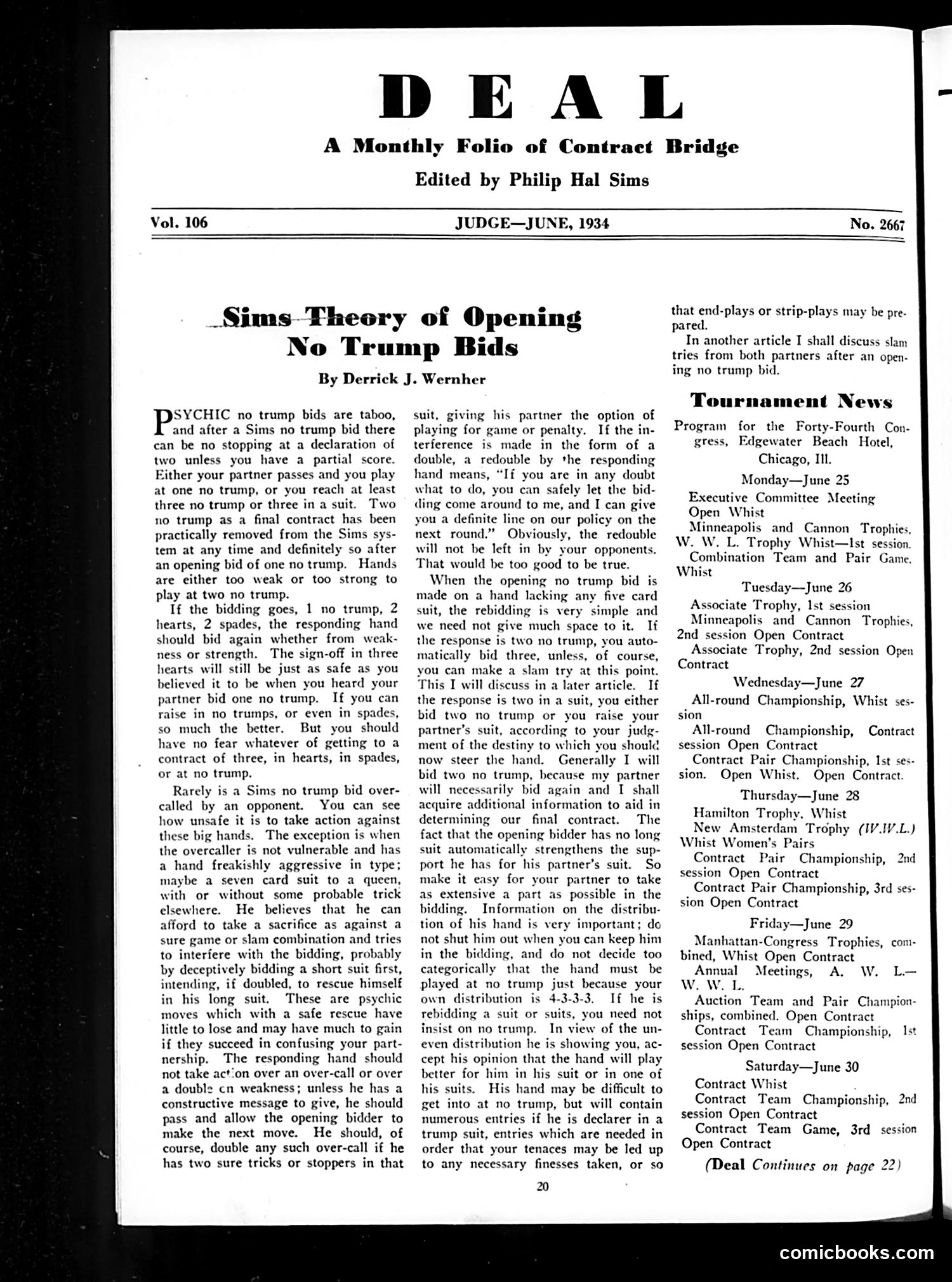
What This Page Means for Modern Readers This is not a satirical cartoon page—it's a specialized bridge column from Judge magazine's June 1934 issue. Judge, while famous for political satire, also published instructional content on contract bridge, a popular card game of the era. The page features an article by Derrick J. Wernher explaining Philip Hal Sims's "no trump bid" theory—a bridge bidding strategy. It discusses when players should (and shouldn't) open with "no trump" declarations and how partners should respond. The accompanying "Tournament News" section lists bridge competitions scheduled for late June in Chicago. For modern readers: This represents bridge's prominence in 1930s American leisure culture—sophisticated enough to warrant expert instruction in a humor magazine. The technical bridge content shows Judge's dual purpose as both satirical publication and lifestyle magazine for educated audiences.
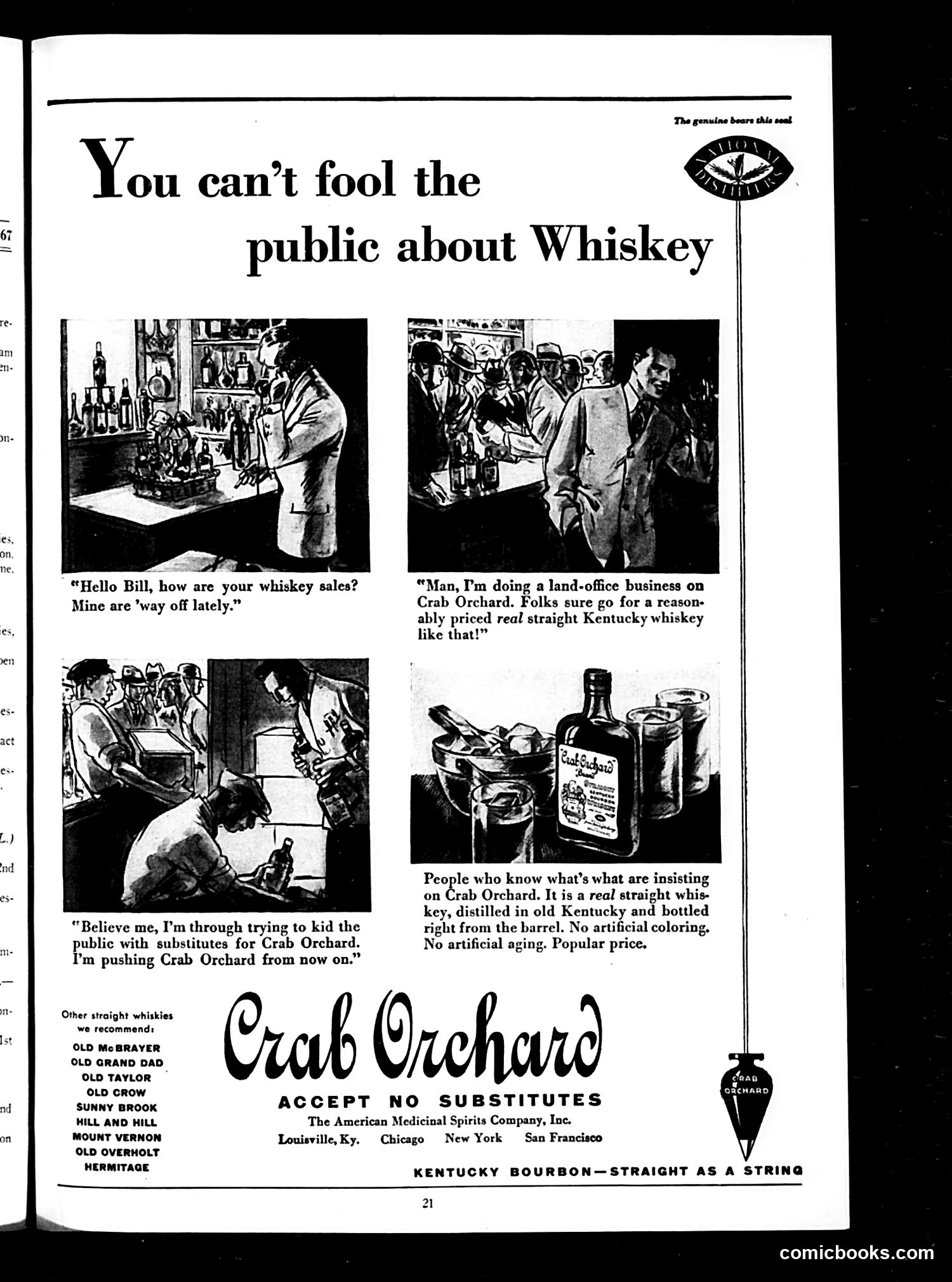
Analysis for Modern Readers This is a full-page advertisement for Crab Orchard whiskey disguised as satirical cartoons. During Prohibition (likely 1920s-1930s), alcohol sales were illegal, but producers marketed whiskey as "medicinal spirits" through loopholes. The "cartoon" depicts salesmen discussing whiskey: one admits his sales are down, another boasts about selling Crab Orchard's "reasonably priced real straight Kentucky whiskey." A third confesses he's stopped trying to deceive the public with substitutes. The satire is ironic—the ad's title claims "You can't fool the public about Whiskey," yet the entire page *is* an attempt to fool regulators and consumers. The emphasis on "real straight whiskey" and "no artificial" additives suggests competitors were selling counterfeit or adulterated products during this era of enforcement difficulty. The American Medicinal Spirits Company (the advertiser) sold whiskey legally as medicine, exploiting Prohibition's medical exemptions. The ad's mock-confessional tone actually reinforces brand trustworthiness while circumventing alcohol advertising restrictions.
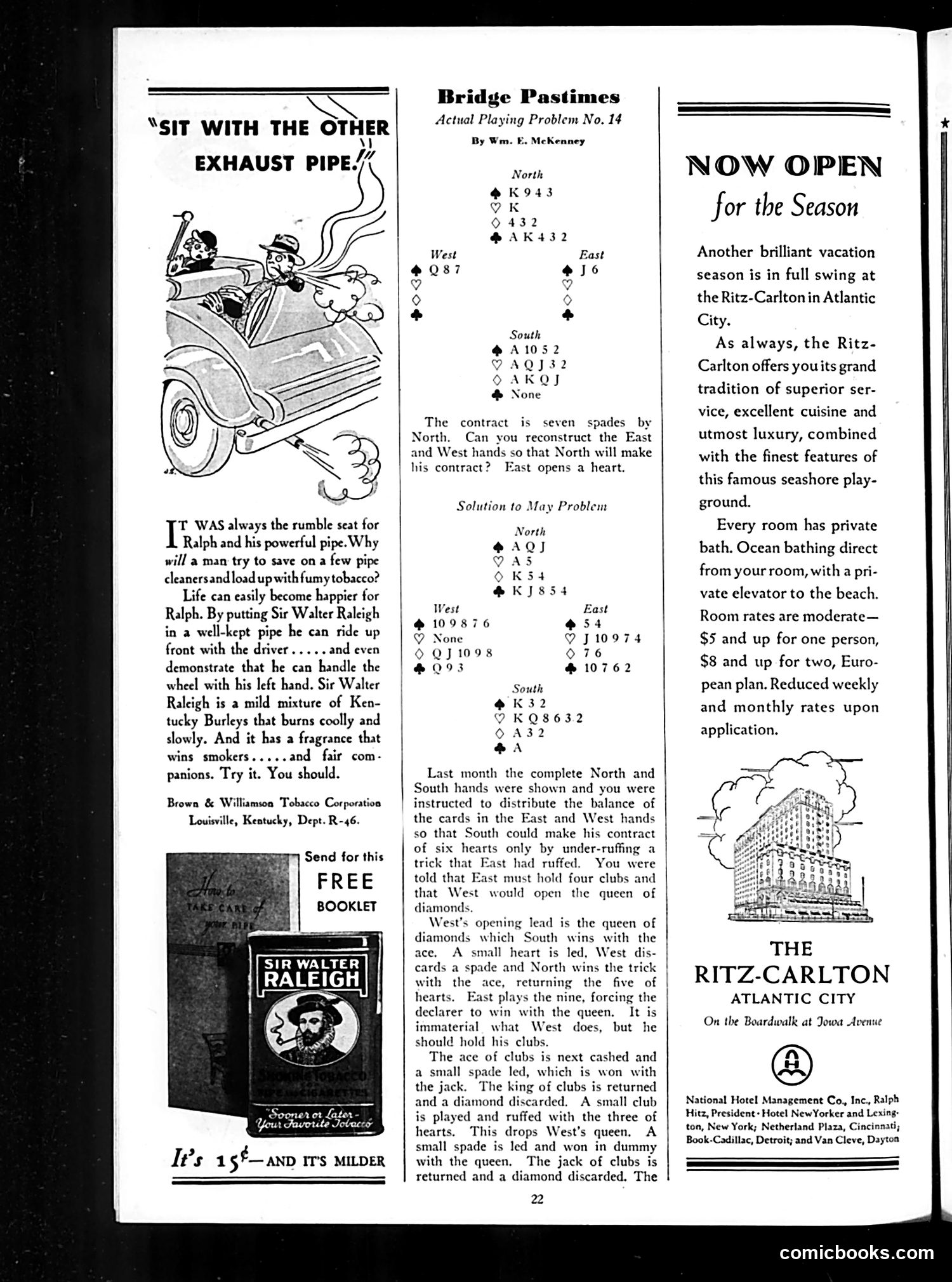
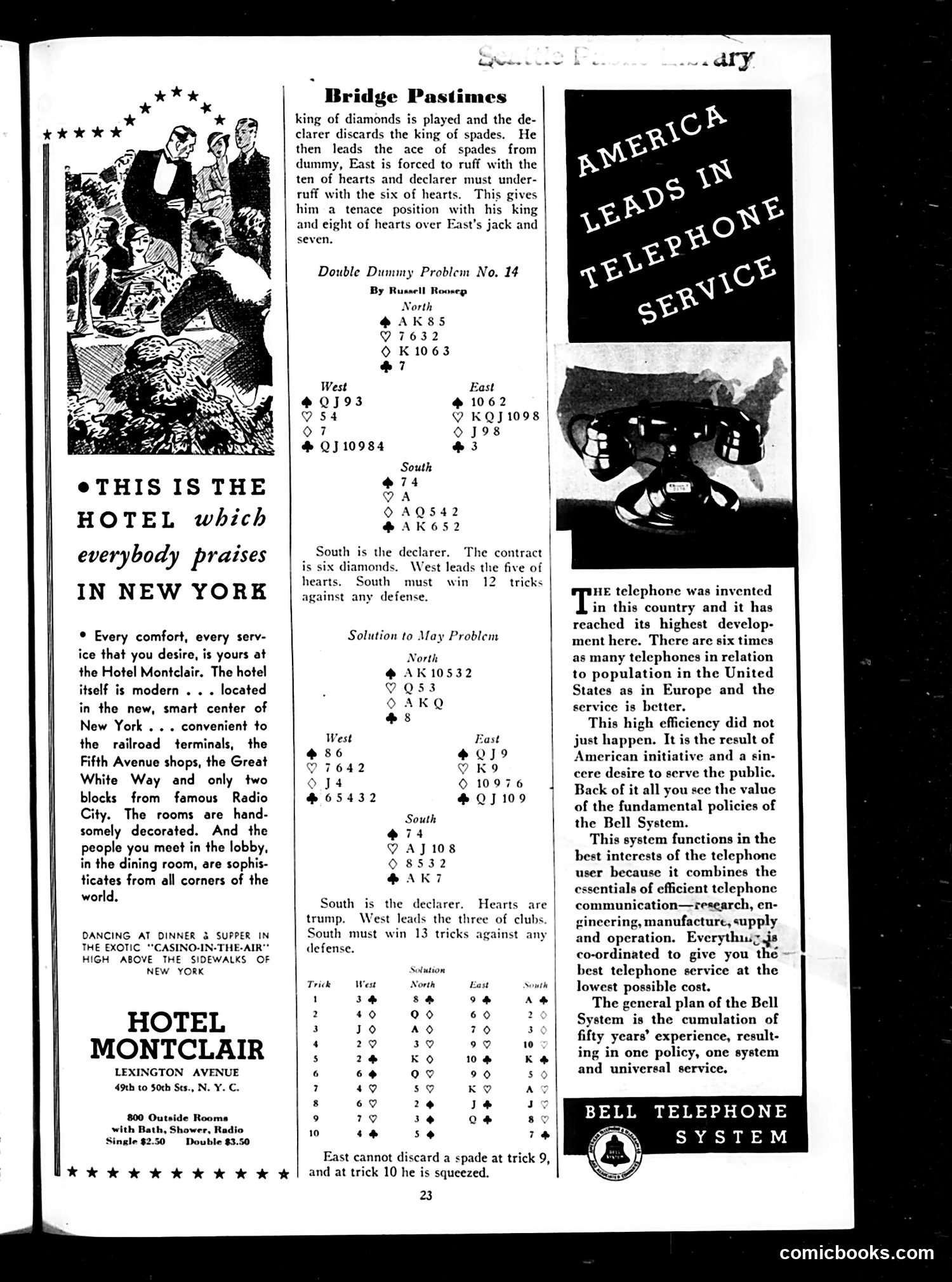
Analysis of Judge Magazine Page This page is primarily advertising and instructional content, not satire or political commentary. The left side features a Hotel Montclair advertisement targeting affluent travelers, emphasizing modern luxury, convenient Manhattan location, and cosmopolitan clientele—typical 1930s hotel marketing appealing to business travelers and tourists. The center contains bridge card game instruction—a "Double Dummy Problem" teaching advanced bridge strategy, reflecting the game's popularity among educated, leisure-class audiences during this era. The right side is a Bell Telephone System advertisement promoting American telephone superiority. The text boasts of superior telephone-to-population ratios compared to Europe and credits this to "American initiative" and Bell's integrated policies. This is corporate propaganda celebrating American technological achievement and monopoly efficiency—reflecting Depression-era faith in large institutional systems and American exceptionalism. No political cartoon or satirical content is present on this page.
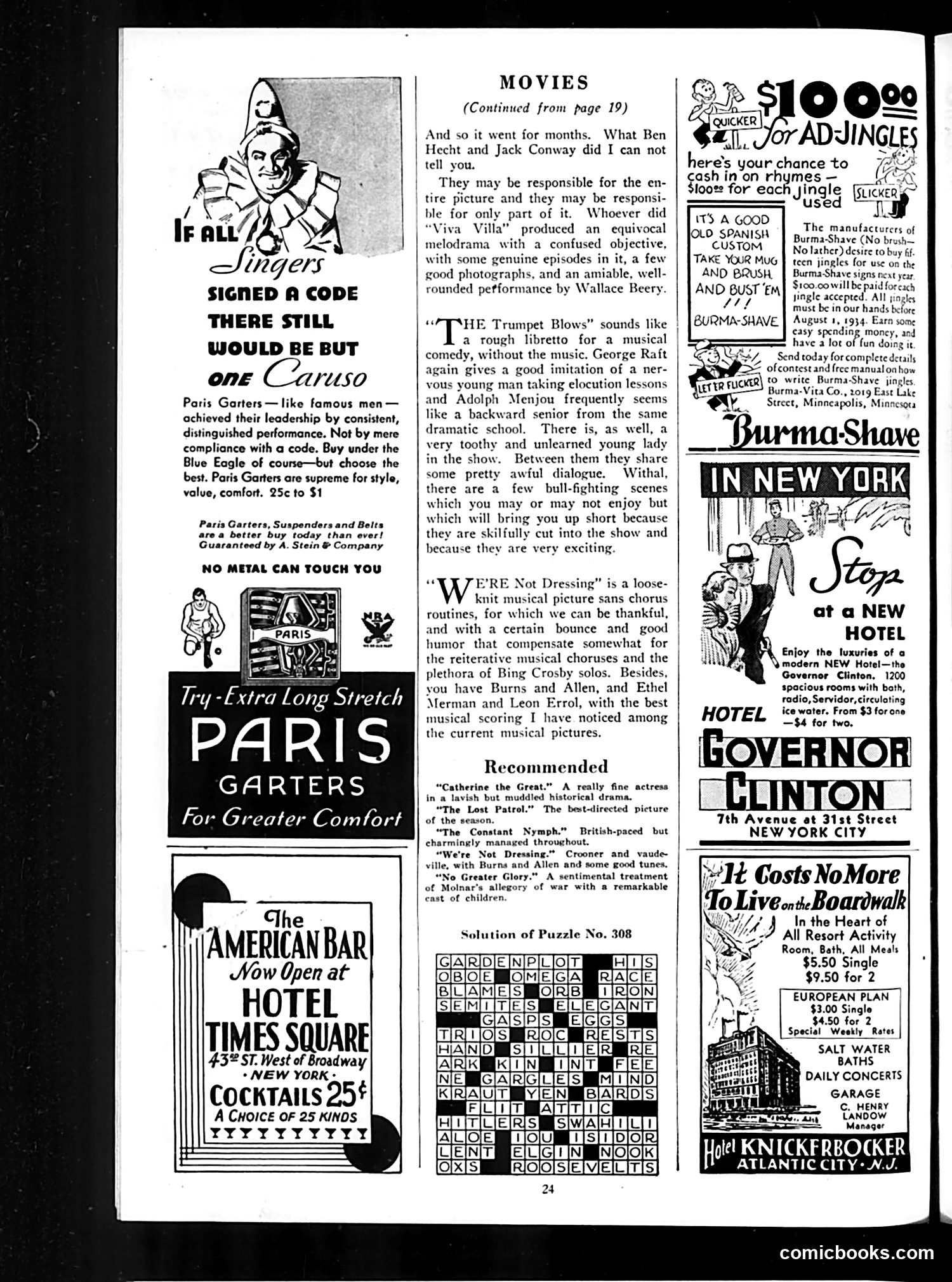
This page is primarily a movie review section and advertisements, not a political cartoon. The movie reviews critique contemporary 1934 films: "Viva Villa," "The Trumpet Blows," and "We're Not Dressing," offering critical assessments of plot, performances, and direction. The text references actors like Wallace Beery, George Raft, Adolph Menjou, and Bing Crosby. The satire appears minimal on this page. The only potentially satirical element is the opening quip about singers and "Caruso"—suggesting that if all singers had signed some code, "there still would be but one Caruso," likely mocking the quality of contemporary vocalists. The bulk of the page consists of period advertisements: Paris Garters, the American Bar at Hotel Times Square (cocktails for 25¢), Burma-Shave jingle contests ($100 prize), and hotel promotions. The "Blue Eagle" reference alludes to Franklin D. Roosevelt's NRA (National Recovery Administration) codes from the New Deal era. This is essentially a magazine page mixing entertainment criticism with commercial advertising typical of 1934 Judge magazine.
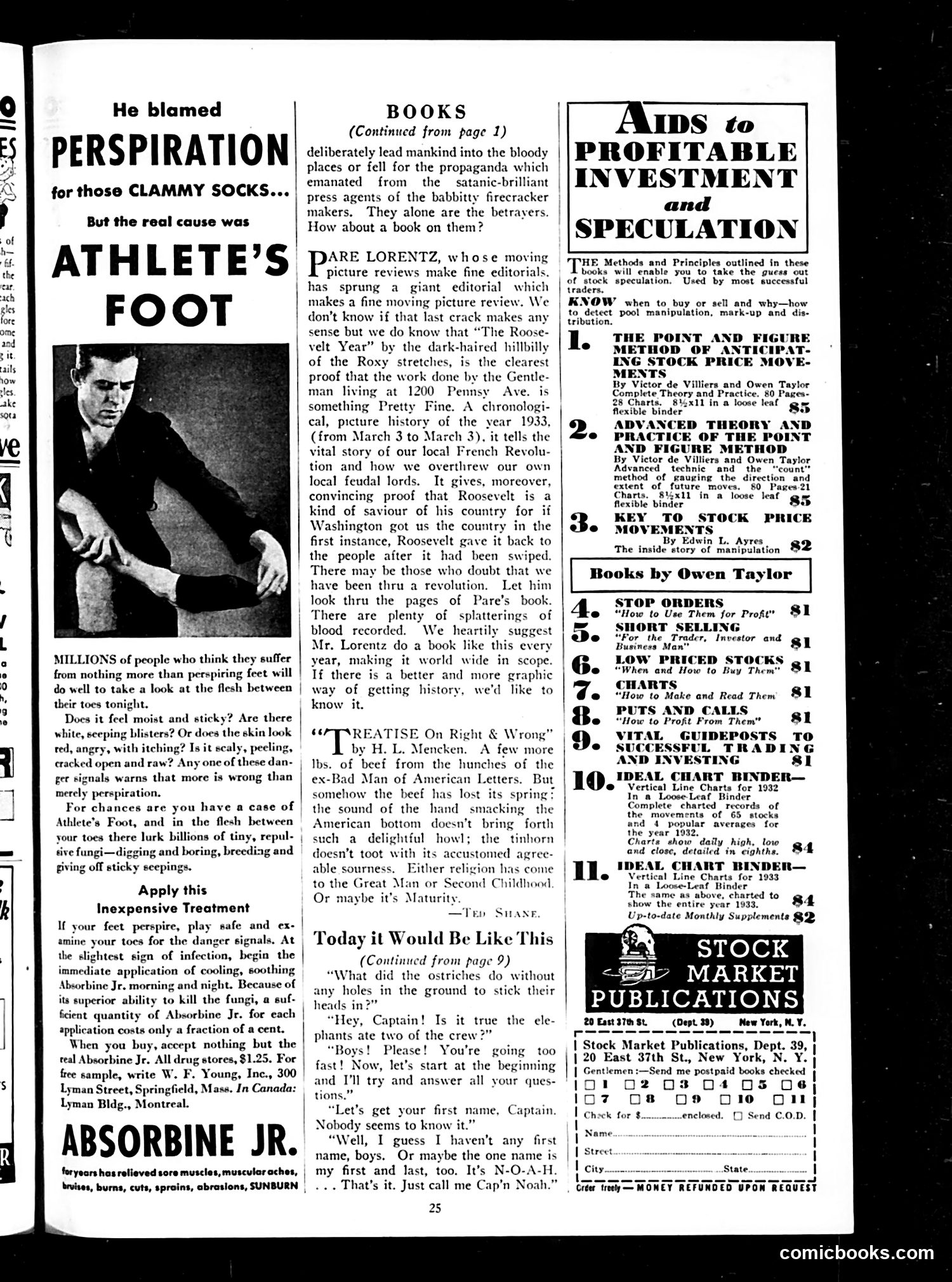
Judge Magazine Page Analysis This page mixes product advertising with book reviews and satirical commentary. The Main Content: Left side: A large advertisement for Absorbine Jr., a fungal treatment. The ad uses dramatic language about "athlete's foot," warning readers to examine their toes for infection—a straightforward (if somewhat sensationalist) medical pitch typical of vintage advertising. Right side: Book reviews. Notably, reviewer Pare Lorentz is praised for his book "The Roosevelt Year"—a photographic history of 1933-1934 depicting FDR's New Deal reforms as a "revolution" that saved America from its own "feudal lords." The satire here celebrates Roosevelt's rescue of the nation from financial ruin. The page also reviews H.L. Mencken's "A Treatise on Right & Wrong," suggesting his critical edge has dulled with age ("the beef has lost its spring"). Bottom: A humorous dialogue about ostriches and elephants—likely a cartoon caption or short comic piece. The juxtaposition reflects Judge's mix of consumerism and political commentary, with pro-Roosevelt sentiment evident in the book coverage.
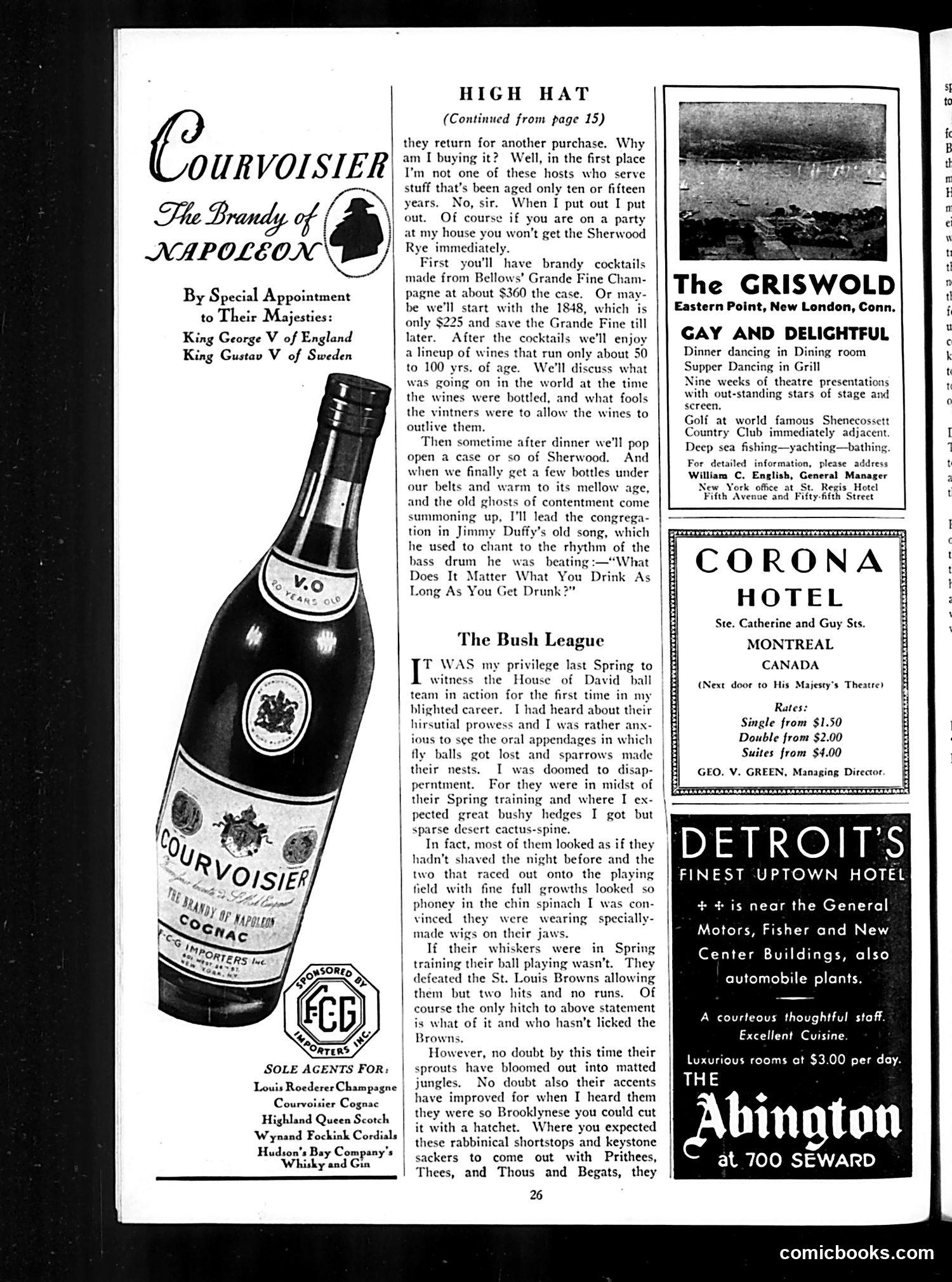
Page Analysis: Judge Magazine This page is primarily advertising and entertainment content rather than political satire. The left side features a prominent Courvoisier Cognac advertisement emphasizing luxury and royal patronage (appointed to King George V and King Gustav V). The main editorial content, "High Hat," is a humorous satirical column about wealthy social pretension—specifically mocking nouveau-riche hosts who ostentatiously serve aged, expensive liquors (brandy from 1848, hundred-year-old wines) to impress guests, then end the evening singing a vulgar drinking song. The satire targets class anxiety and performative sophistication. "The Bush League" section humorously describes attending a House of David baseball game (a real 1920s-era team known for their beards and religious identity). The humor relies on ethnic/religious stereotyping—the writer expected biblical speech ("Prithees, Thees, and Thous") from Jewish players but found Brooklyn accents instead. The right side contains hotel and resort advertisements (The Griswold, Corona Hotel, Detroit's Abington), typical of period magazines. This reflects early 20th-century advertising and humor conventions—largely devoid of the overtly political content one might expect from "Judge" magazine.
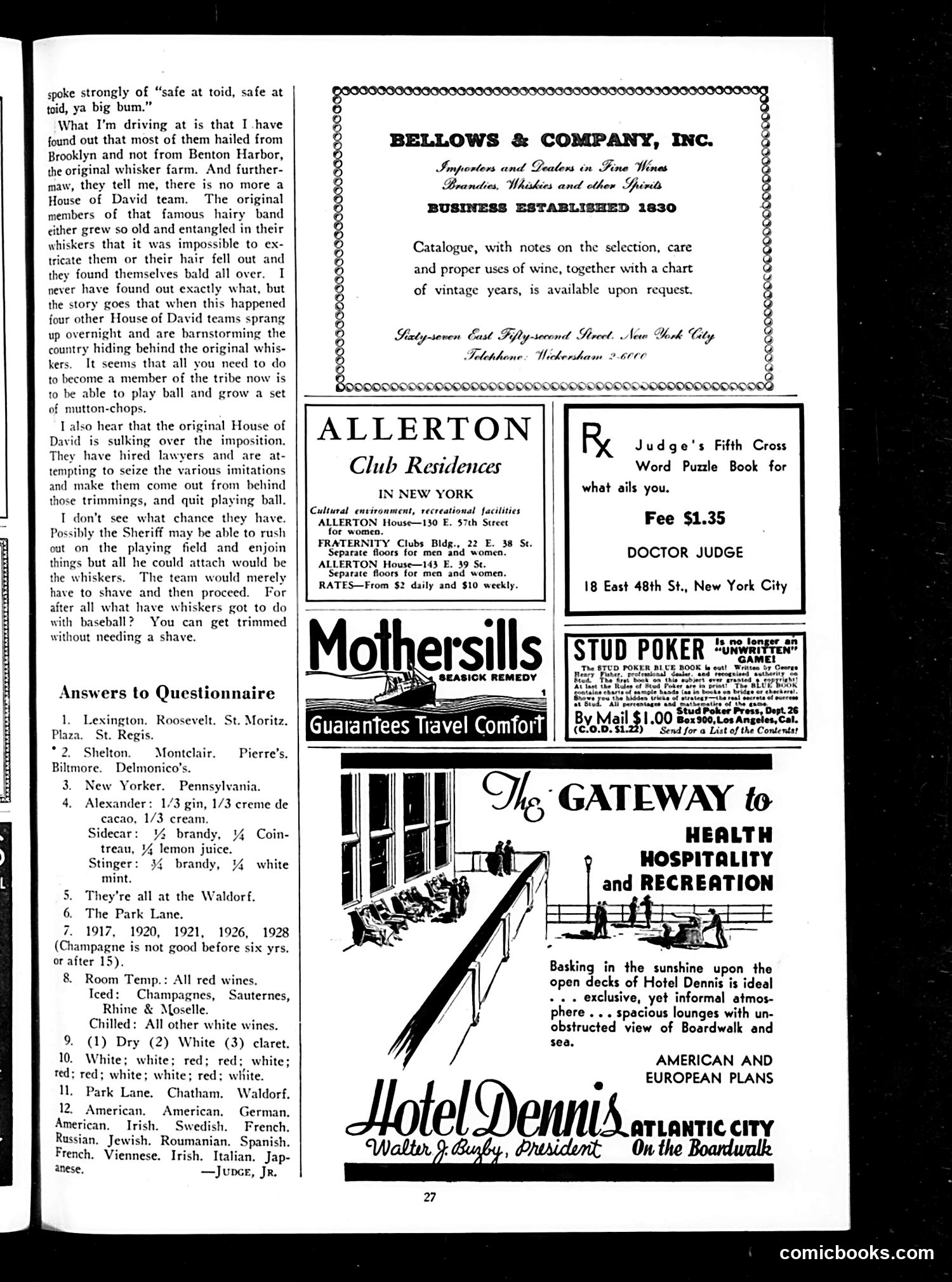
Analysis of Judge Magazine Page This page is primarily advertising and miscellaneous content rather than a satirical cartoon. The main editorial text discusses the House of David baseball team—a real religious commune known for their distinctive long beards. The writer satirizes how the original group's fame attracted imitators who simply grew whiskers to capitalize on the brand. He mocks the absurdity: the original House of David is suing impostors, but legally seizing only "whiskers" is useless since counterfeit players can simply shave. The joke is that the entire franchise identity rests on facial hair rather than actual baseball talent—a ridiculous basis for intellectual property. The remainder is vintage advertisements for luxury hotels, wine merchants, clubs, and novelty items typical of 1920s-30s Judge magazine. There are no political cartoons visible on this particular page—it's a mix of humorous commentary and commercial content aimed at wealthy urban readers.
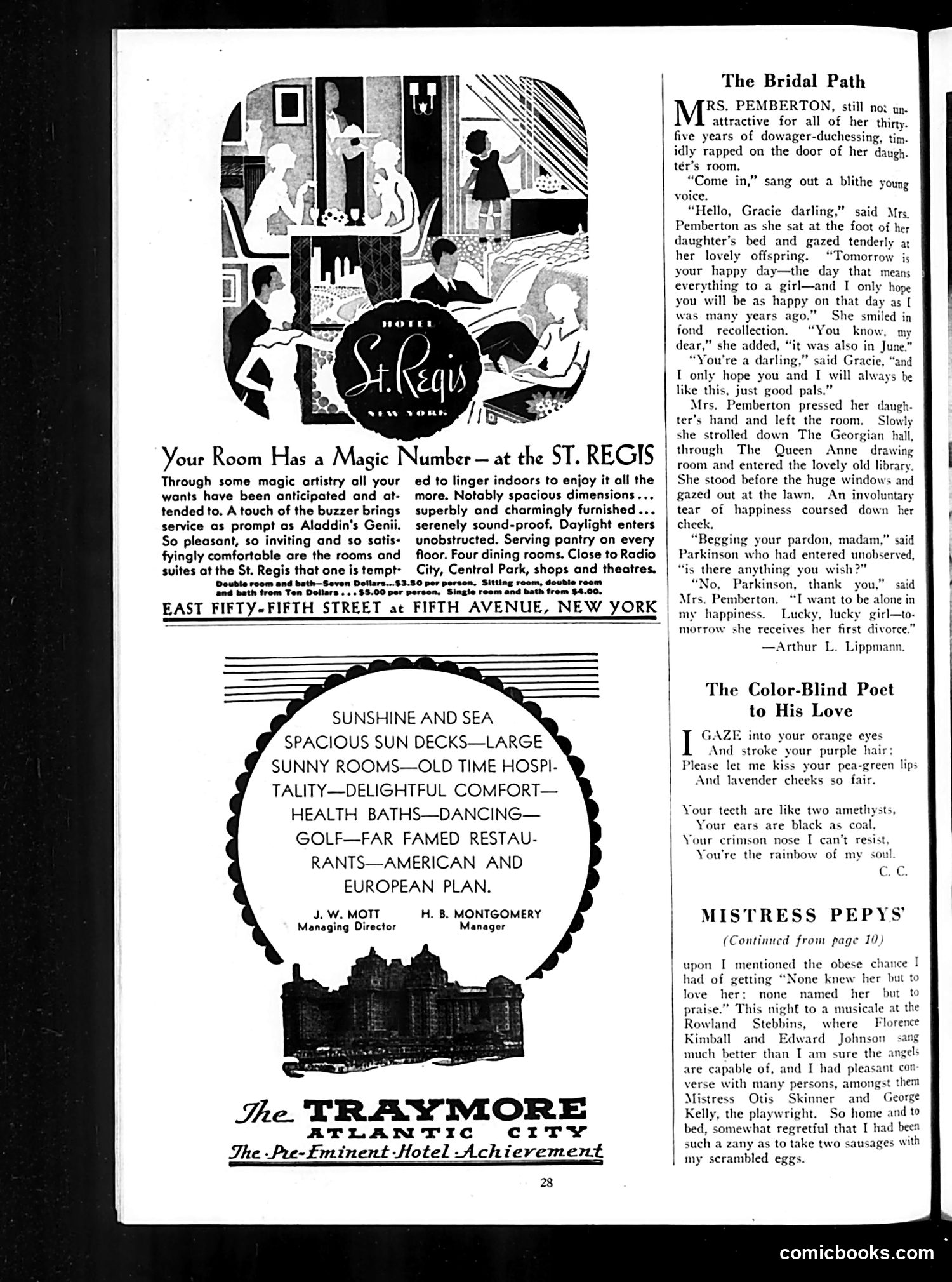
Analysis of This Judge Magazine Page This page is primarily advertising with satirical fiction pieces interspersed. The main content consists of hotel advertisements for the St. Regis (New York) and Traymore (Atlantic City), featuring typical luxury-hotel marketing language emphasizing spacious rooms, service, and proximity to entertainment. The satirical fiction includes: "The Bridal Path" — a short story mocking upper-class wedding sentimentality. Mrs. Pemberton tearfully reflects on her daughter's wedding day, but the punchline reveals the "happy" occasion is actually the daughter's *first divorce*—satirizing both the frivolity of wealthy society and the prevalence of divorce among the elite. "The Color-Blind Poet to His Love" — a brief parody of overwrought romantic poetry, listing contradictory, nonsensical colors (orange eyes, purple hair, pea-green lips), mocking sentimental love verse. "Mistress Pepys" — appears to be a gossip column mimicking Samuel Pepys's diary style, reporting on social events and encounters with theater personalities like Florence Kimball and George Kelly. The overall tone is light satire targeting wealthy society's pretensions and romantic excess.
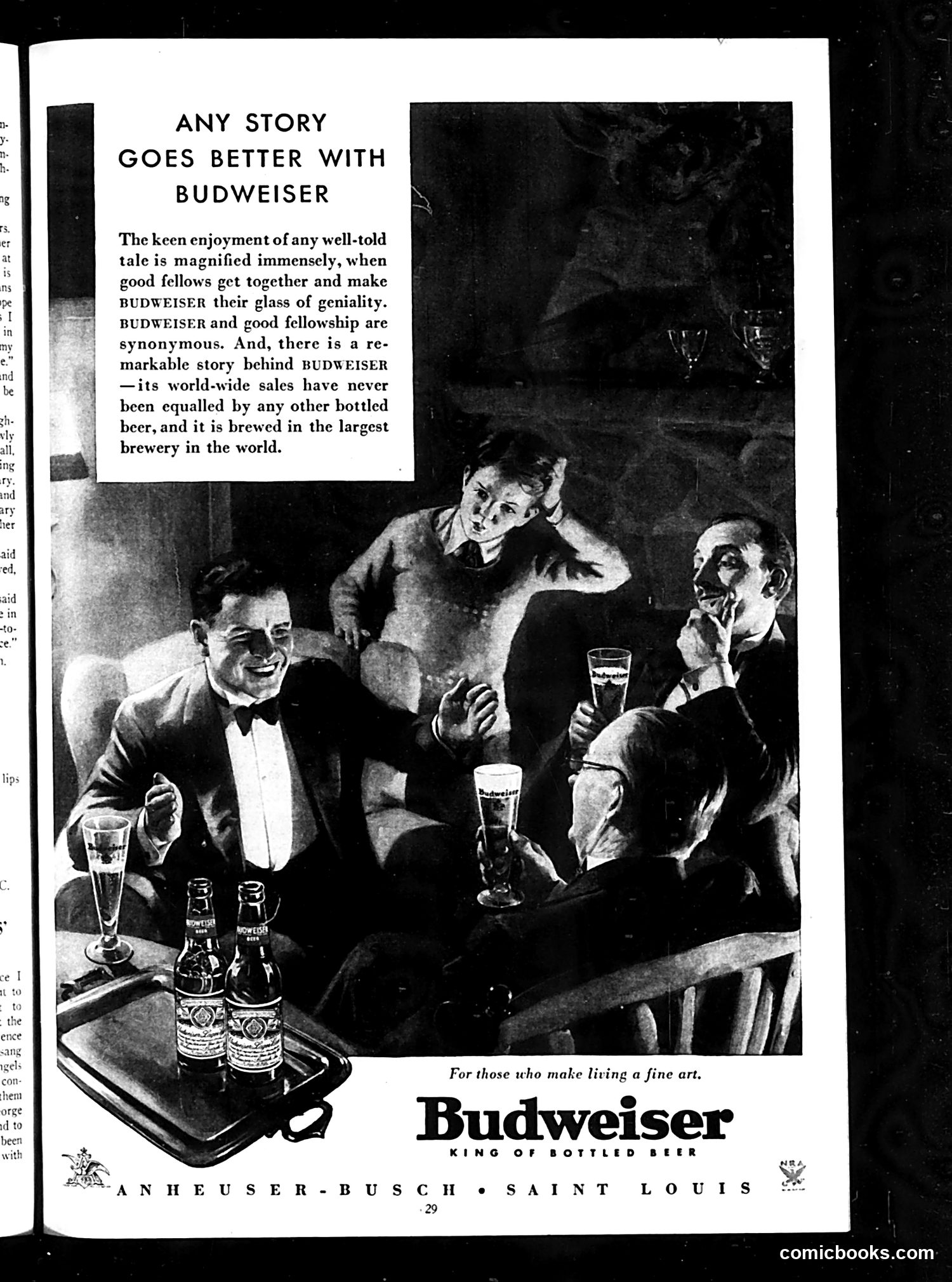
Analysis This is a Budweiser beer advertisement, not a political cartoon or satire. It depicts four well-dressed men in formal attire (tuxedos) gathered around a table, apparently enjoying drinks and telling stories. Budweiser bottles and glasses are prominently displayed. The ad's messaging equates beer-drinking with "good fellowship" and sophistication—the tagline "For those who make living a fine art" positions Budweiser as a luxury beverage for refined gentlemen. The text claims Budweiser has unmatched world-wide sales and is brewed in "the largest brewery in the world" (referring to Anheuser-Busch's Saint Louis facility). For modern readers, this reflects early-to-mid 20th century advertising that linked alcohol consumption with masculinity, social status, and refined taste—messaging now considered problematic and restrictive.
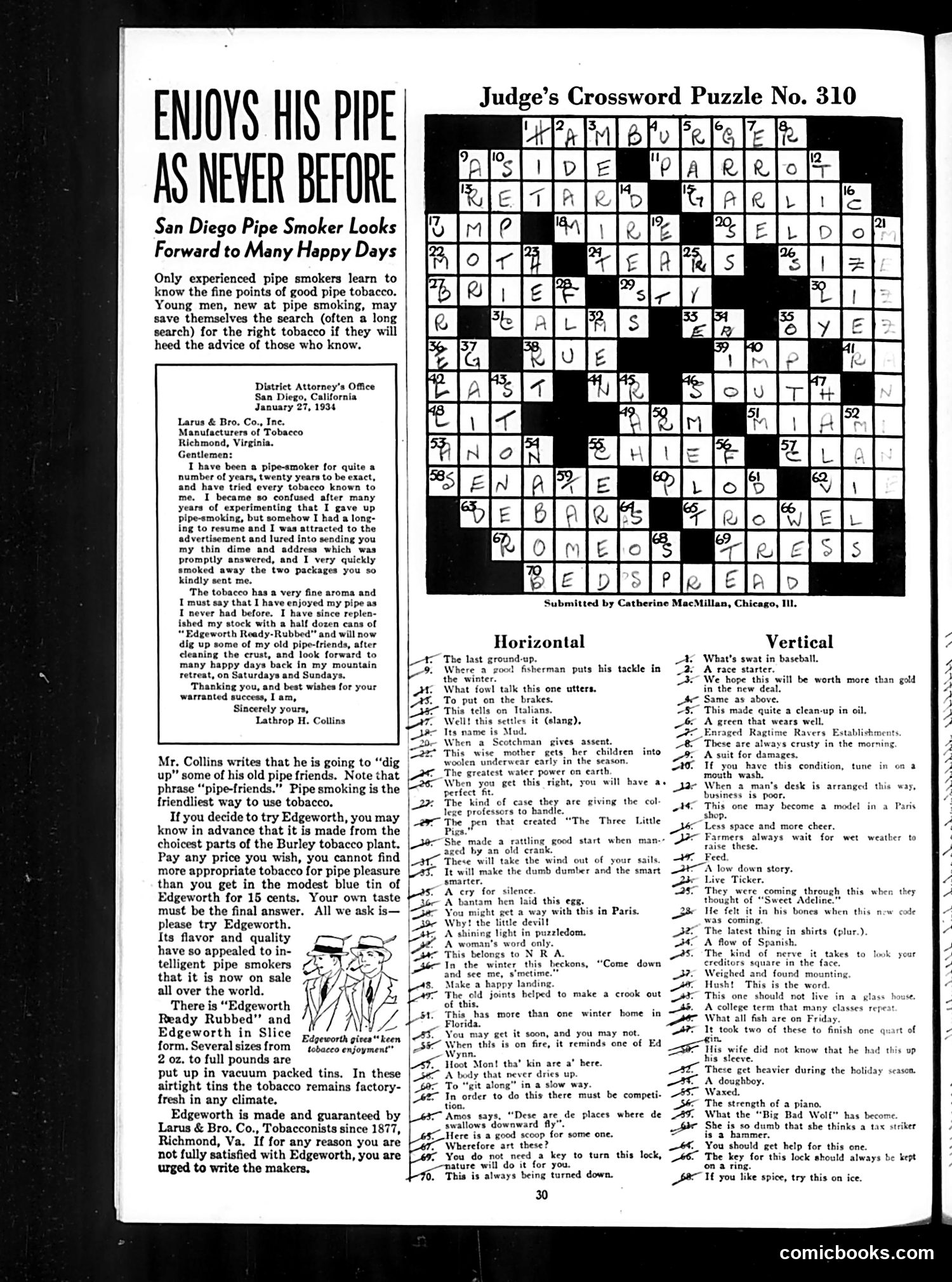
Judge Magazine Advertisement & Crossword Page (c. 1934) This page is primarily advertising for Edgeworth tobacco, presented as a testimonial letter from a San Diego District Attorney's official (Lathrop H. Collins) praising the pipe tobacco brand. Collins describes abandoning pipe-smoking due to confusion over tobacco types, then being lured back by an advertisement. He praises Edgeworth's aroma and quality, expressing plans to resume pipe-smoking with old friends. The advertisement emphasizes that Edgeworth is made from quality Burley tobacco, affordable at 15 cents, and available nationwide in vacuum-sealed tins. The copy stresses pipe-smoking as a "friendly" activity and appeals to "intelligent pipe smokers." The page also includes Judge's Crossword Puzzle No. 310, submitted by Catherine MacMillan of Chicago. The overall message reflects 1930s consumer culture and tobacco marketing targeting educated, professional men through testimonials and quality positioning rather than health claims.
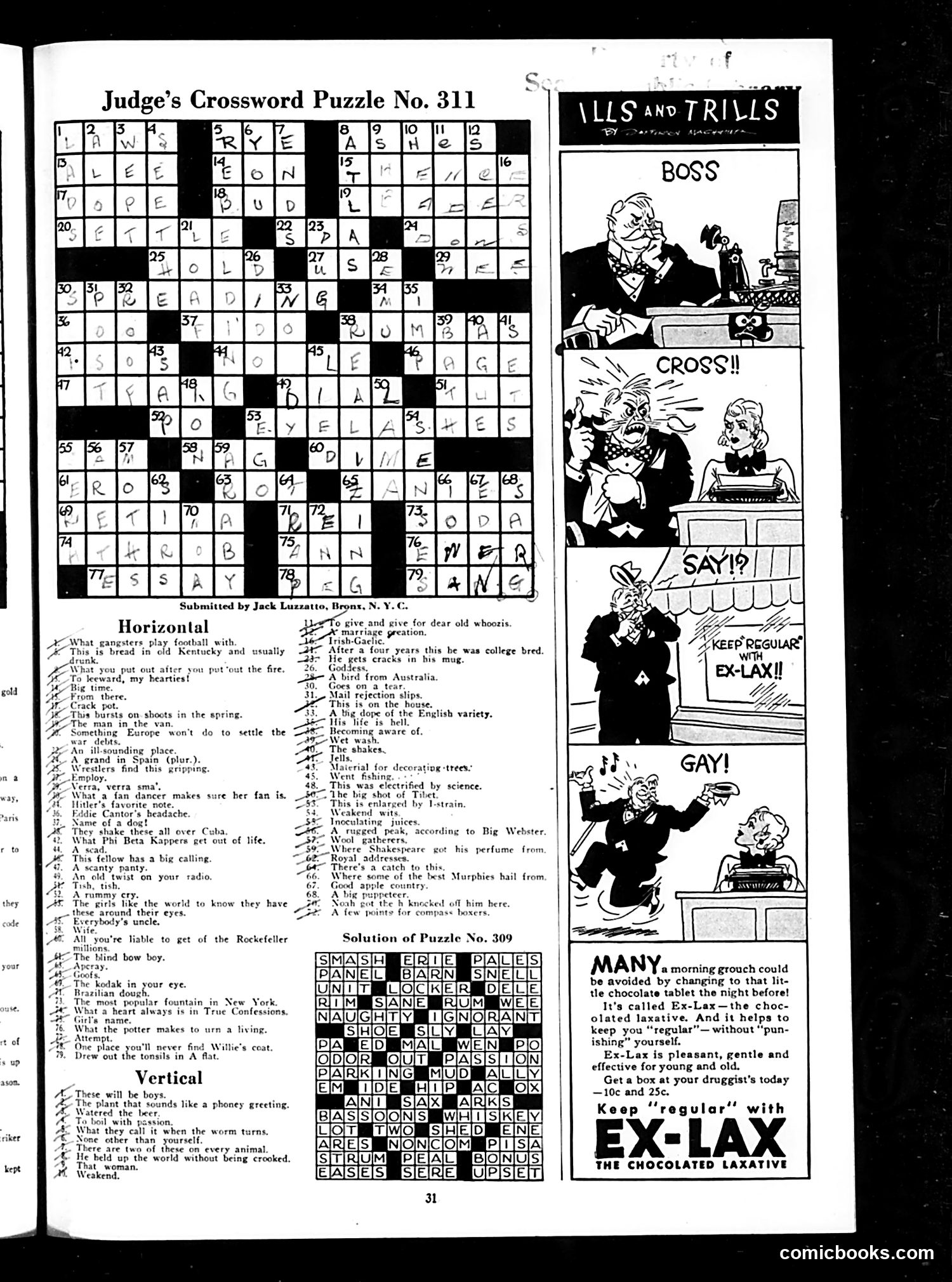
Judge Magazine Page Analysis This page primarily features Judge's Crossword Puzzle No. 311 with clues and a solved puzzle from a previous issue. The cartoon strip titled "Ills and Trills" appears on the right side. The cartoon depicts a boss figure at a desk interacting with what appears to be an employee or subordinate. The sequence shows the boss saying "CROSS!!" in reaction to something, followed by the employee's response "SAY!?", and concluding with "KEEP REGULAR with EX-LAX!!" The satire appears to target workplace dynamics and temperament—specifically a grouchy, difficult boss whose bad mood could be remedied by better digestive health (the punchline). This is an advertisement for Ex-Lax laxative cleverly disguised as workplace humor, suggesting that the boss's irritability stems from constipation, a common comedic target of the era. The accompanying advertisement reinforces this message: morning grouch and irritability can be solved by taking Ex-Lax the night before, positioning it as a social solution to workplace tension.
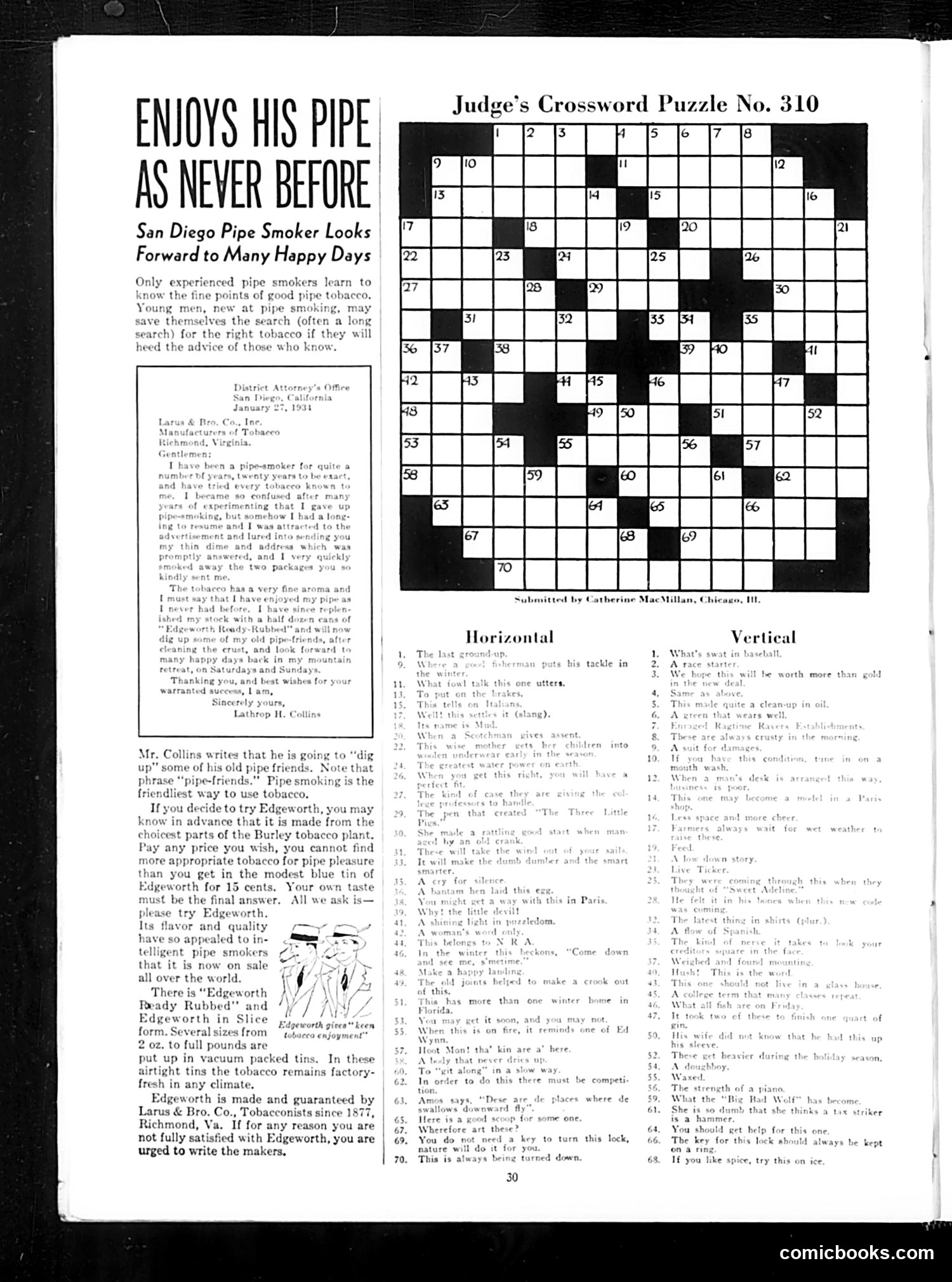
Analysis of Judge Magazine Page (Satirical Content) This page is primarily advertising content rather than political satire. It features a testimonial letter from "Lathrop H. Collins," a San Diego pipe smoker praising Edgeworth pipe tobacco. The letter emphasizes the tobacco's quality, aroma, and superiority to competitors. The accompanying crossword puzzle (No. 310) appears unrelated to the advertisement—it's standard puzzle content for the magazine's readers. The small cartoon illustrations show two gentlemen in period dress (early 20th century) appearing to discuss or enjoy smoking. These serve as generic visual support for the tobacco advertisement rather than satirizing specific political figures or events. The page reflects 1930s consumer culture: tobacco companies used testimonials and lifestyle marketing to appeal to middle-class readers. There's no apparent social or political satire here—just commercial messaging leveraging Judge's readership for product promotion.
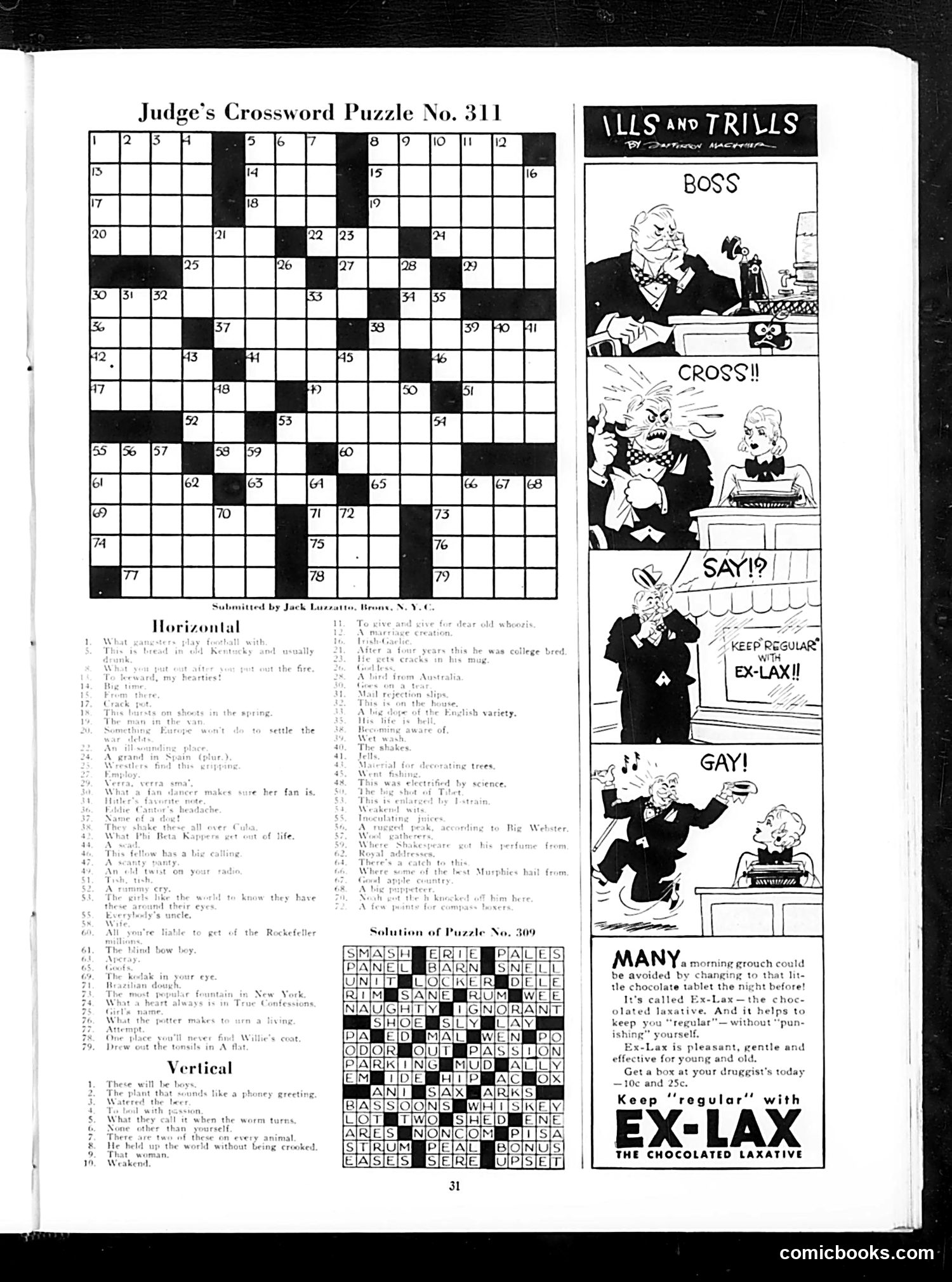
Judge Magazine Page Analysis This page contains a crossword puzzle, its solution, and an advertisement rather than political satire. The right side features a four-panel comic strip titled "Ills and Trills" depicting a businessman labeled "BOSS" in various situations—appearing stern at his desk, angry ("CROSS!!"), concerned about constipation ("SAY!?"), and cheerful ("GAY!")—as he discovers and uses Ex-Lax laxative chocolate. Below runs a full-page advertisement for Ex-Lax, a chocolated laxative marketed as maintaining digestive "regularity." The ad copy emphasizes the product's gentle effectiveness and pleasant taste, positioning it as a solution to constipation—a common advertised concern in mid-20th century American media. The comic's humor relies on the contrast between the boss's grumpiness before using the product and his improved mood after. This reflects period advertising strategies that attributed mood and personality changes to digestive health.
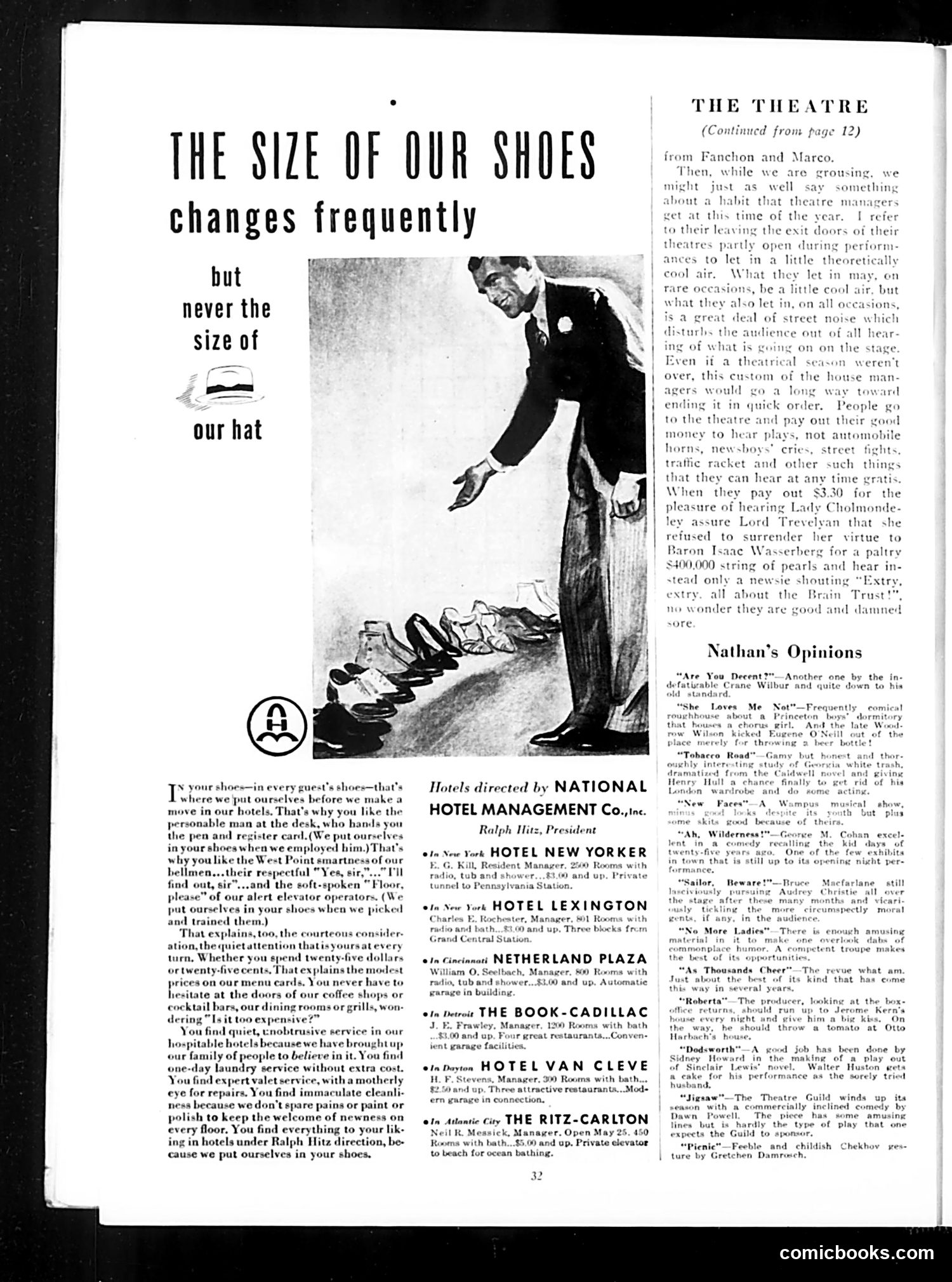
Content Analysis: Judge Magazine Page This page is primarily advertising, not satire or political commentary. The dominant feature is a hotel industry advertisement for National Hotel Management Co., directed by Ralph Hitz. The ad uses a shoe metaphor—"we put ourselves in your shoes"—to promote customer service philosophy across five luxury hotels (New Yorker, Lexington, Book-Cadillac, Van Cleve, and Ritz-Carlton). The accompanying photograph shows a well-dressed man examining shoes, illustrating the company's attentiveness to guest needs. The right column contains theater criticism (continued from a previous page), discussing theatrical conventions like open exit doors during performances and briefly reviewing several plays and performances, including works by Crane Wilbur and references to the Theatre Guild. No political satire or caricature is evident on this page. It represents Judge's commercial content—advertisements supporting the magazine's publication alongside its editorial matter.
Analysis This page is not a cartoon or satirical content—it's a business advertisement and credit line. The image shows a hanging floral arrangement (likely a decorative study or sample photograph), and the text below identifies the company responsible for its reproduction. Powers Reproduction Corporation was a commercial printing and photographic reproduction firm based in New York City, advertising their services in "direct color photography and engraving." The page appears in *Judge* magazine as a vendor credit or promotional advertisement, showcasing the company's technical capabilities to reproduce color images and engravings for print publications. This represents the business infrastructure behind magazine production rather than editorial content meant for satire or humor.
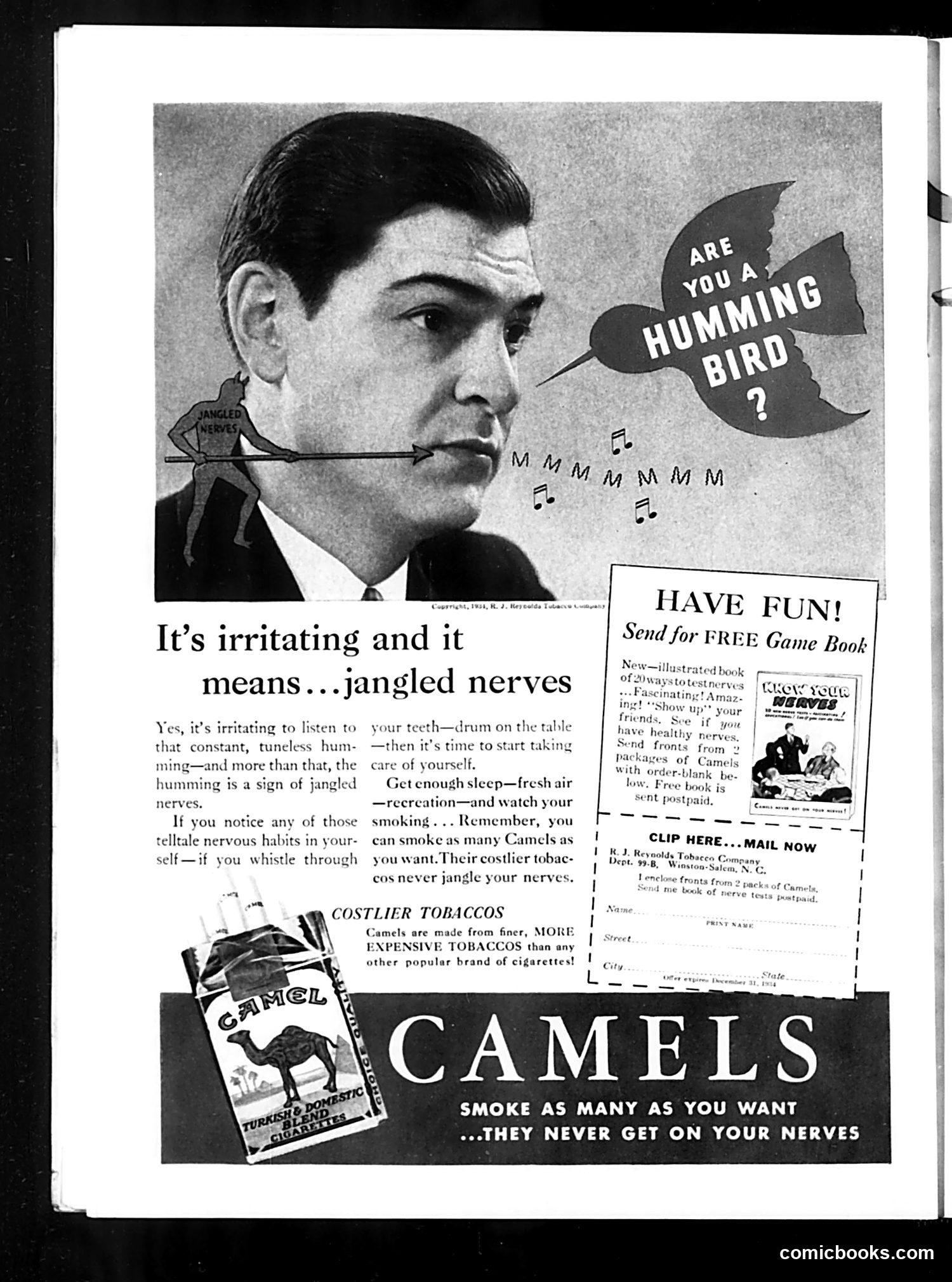
Analysis for Modern Readers This is a Camel cigarette advertisement, not editorial satire. The "cartoon" depicts a man humming nervously, with a speech bubble asking "ARE YOU A HUMMING BIRD?" The ad claims that humming indicates "jangled nerves" caused by inferior cigarettes. The solution? Smoke Camels instead—their "costlier tobaccos" supposedly won't make you nervous. The advertisement promises that you can "smoke as many as you want...they never get on your nerves." By modern standards, this is striking for its casual health claims and explicit pitch to manage anxiety through smoking. The ad exploits mid-20th-century nervousness about "nervous habits" while positioning cigarettes as a solution rather than a cause of stress. The free "game book" offer incentivizes reader engagement. This represents vintage tobacco marketing before health warnings were required.
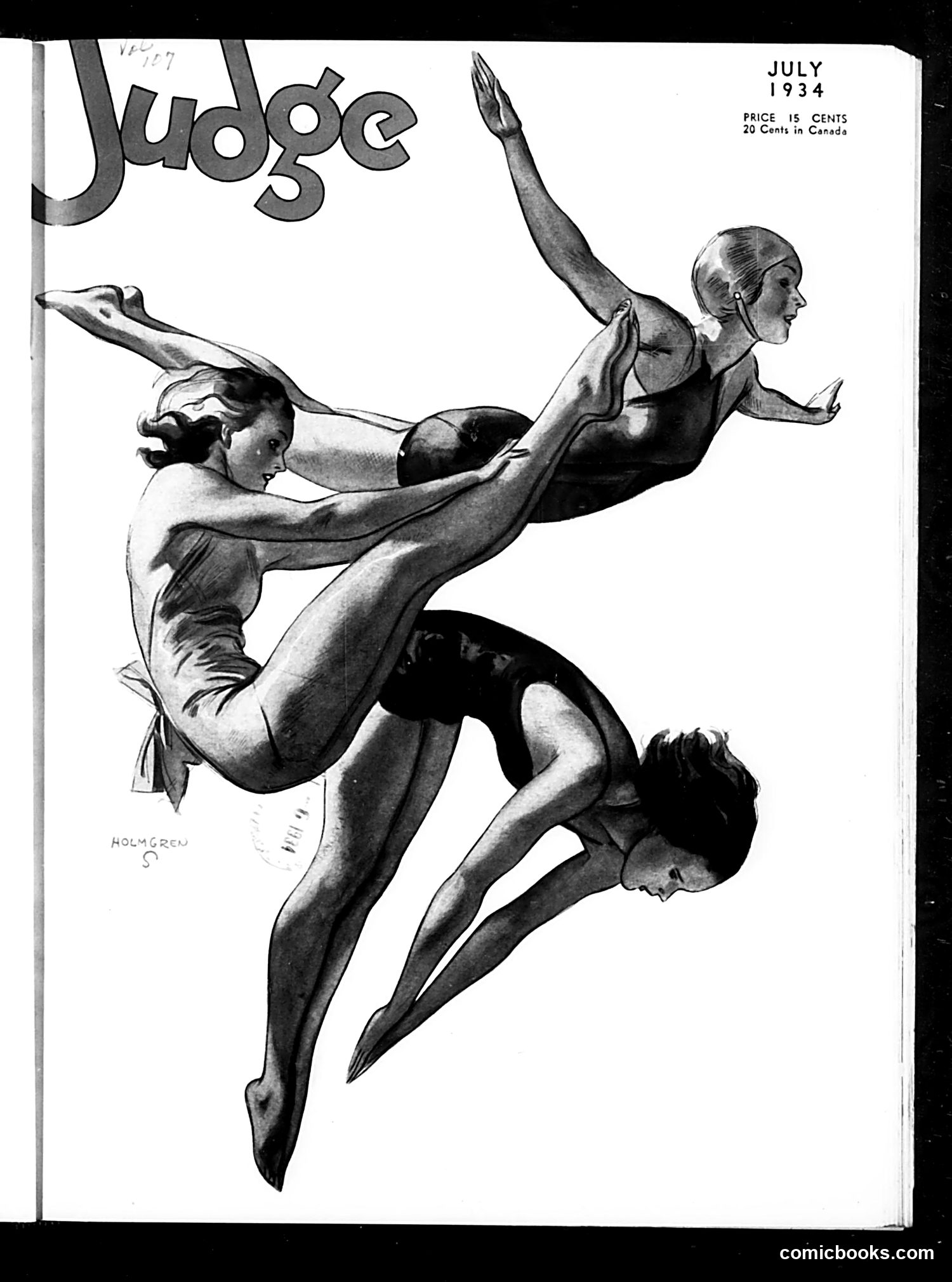
Judge Magazine, July 1934 This is the cover of Judge magazine from July 1934, a satirical publication. The illustration, signed by "Holmgren," depicts three figures in dynamic poses suggesting acrobatic or athletic movement—appearing to tumble or dive through space. The artistic style and composition suggest this is likely commenting on contemporary events or social conditions of 1934, though without additional visible text or captions, the specific satirical target isn't entirely clear from the image alone. The athletic/acrobatic theme was common in Judge's visual metaphors for political or economic situations. The price of 15 cents (20 cents in Canada) indicates this is a standard issue of the magazine, which focused on humor and social commentary during the Great Depression era.
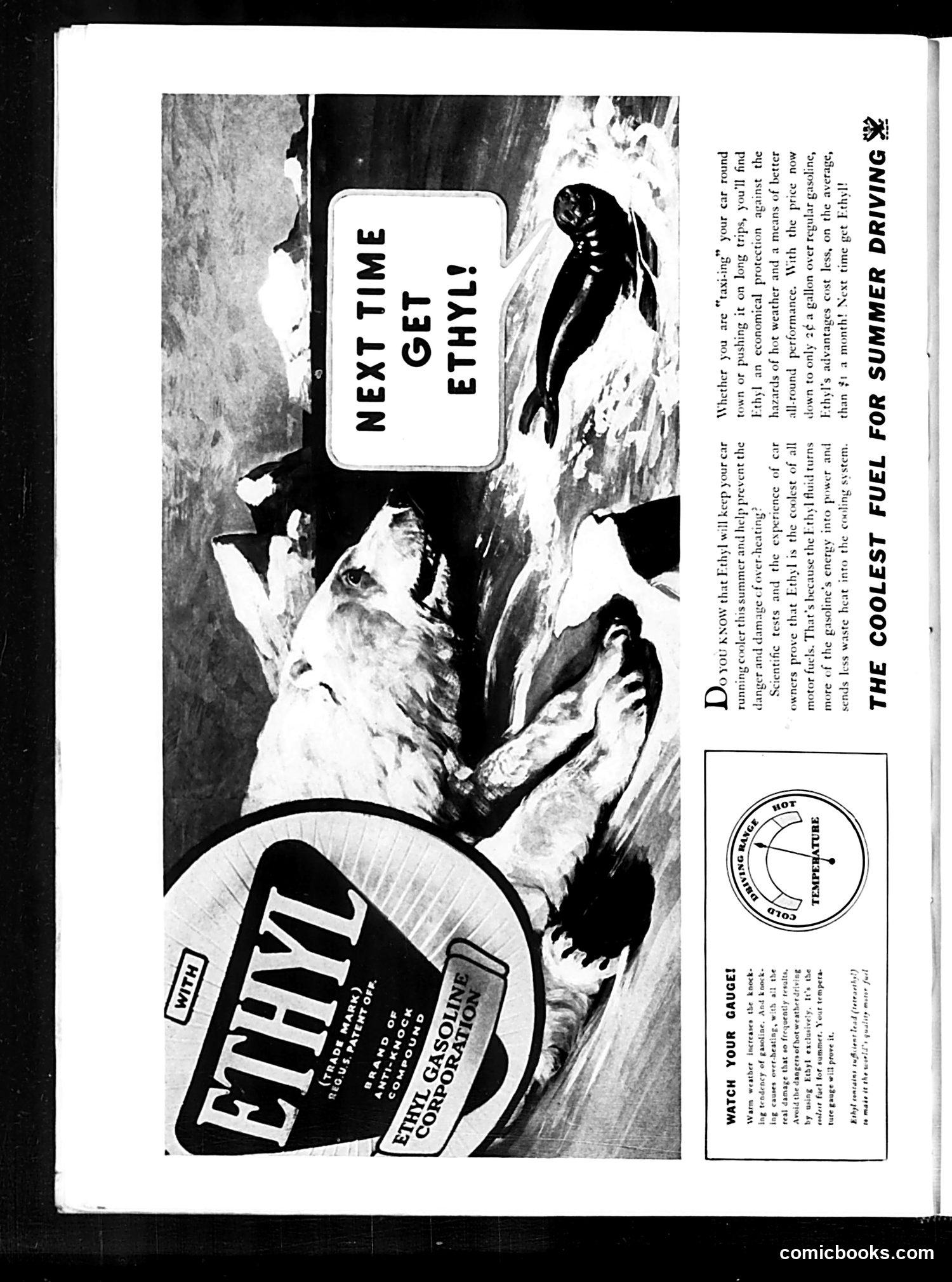
Analysis This page is primarily an advertisement for Ethyl gasoline, not a political cartoon. The ad features an elderly man (appears to be Santa Claus or a similar bearded figure) lying back comfortably, with text reading "NEXT TIME GET ETHYL!" The messaging promotes Ethyl as a superior fuel choice, claiming it provides cooler summer driving performance. A temperature gauge is visible on the right side. The tagline "THE COOLEST FUEL FOR SUMMER DRIVING" emphasizes the product's benefit during hot weather. This is a straightforward commercial advertisement from an era when Ethyl gasoline was marketed as a premium automotive fuel option. The imagery uses the comfort and satisfaction of the bearded figure to suggest consumer contentment with the product.
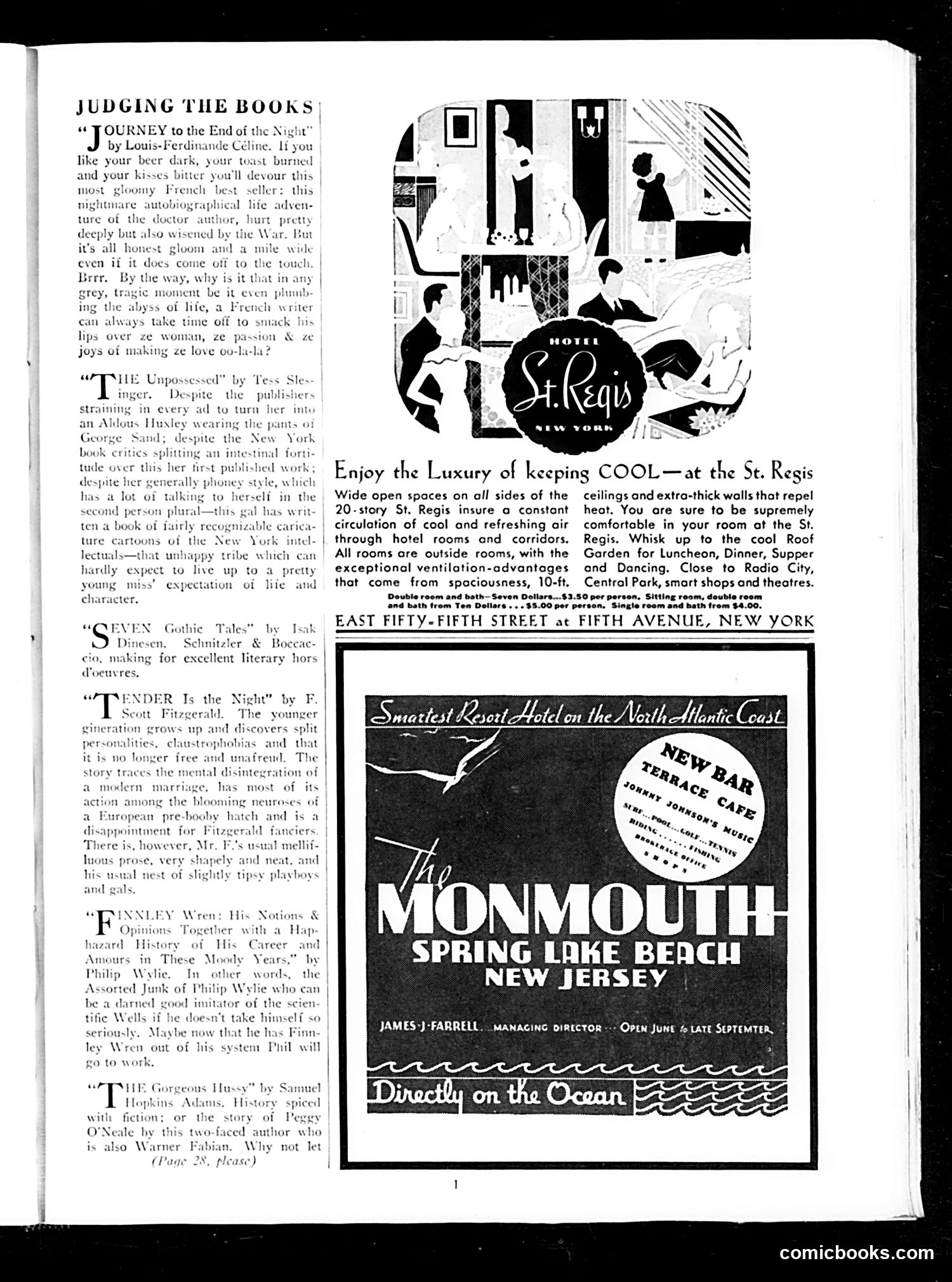
Judging the Books: A 1930s Literary Critique Page This page contains book reviews by Judge magazine's literary critic, not political cartoons. The reviews critique several contemporary novels with the magazine's characteristic wit and snark. Notable targets include Louis-Ferdinand Céline's *Journey to the End of the Night* (criticized for its gloominess and French romantic digressions), Tess Slesinger's *The Unpossessed* (mocked as phoney despite critical praise), and F. Scott Fitzgerald's *Tender Is the Night* (dismissed as featuring Fitzgerald's typical "tipsy playboys"). The tone is dismissive and sarcastic—typical of 1930s literary gatekeeping. The critic attacks authors for pretension, repetitive themes, and lack of authenticity. The page also includes hotel and resort advertisements (St. Regis in New York, Monmouth in New Jersey), standard for magazine monetization of this era.