judge
Judge — August 1934
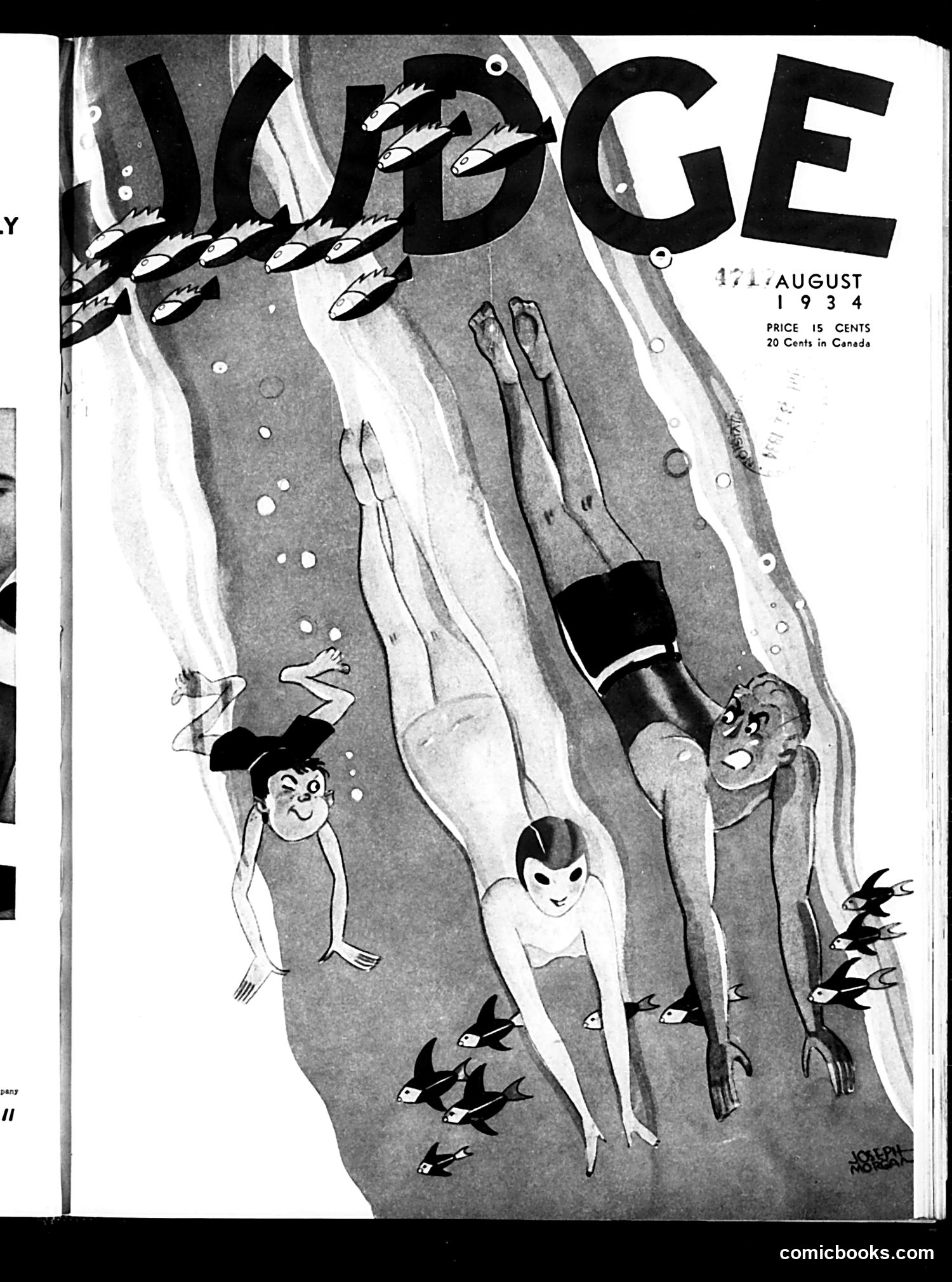
Judge Magazine Cover Analysis This is the August 1924 cover of *Judge* magazine, depicting an underwater swimming scene. The illustration shows several figures swimming among fish, with the large "JUDGE" text integrated into the composition as a design element. The cover appears to be a lighthearted summer swimming scene rather than political satire. The caricatured swimmers display exaggerated features typical of 1920s cartooning style. Without additional context or legible captions identifying specific figures, the exact satirical target remains unclear—it may reference contemporary swimming fashions, leisure culture, or public figures of that era, but the image alone doesn't reveal the specific reference or joke to a modern viewer unfamiliar with 1924 popular culture.
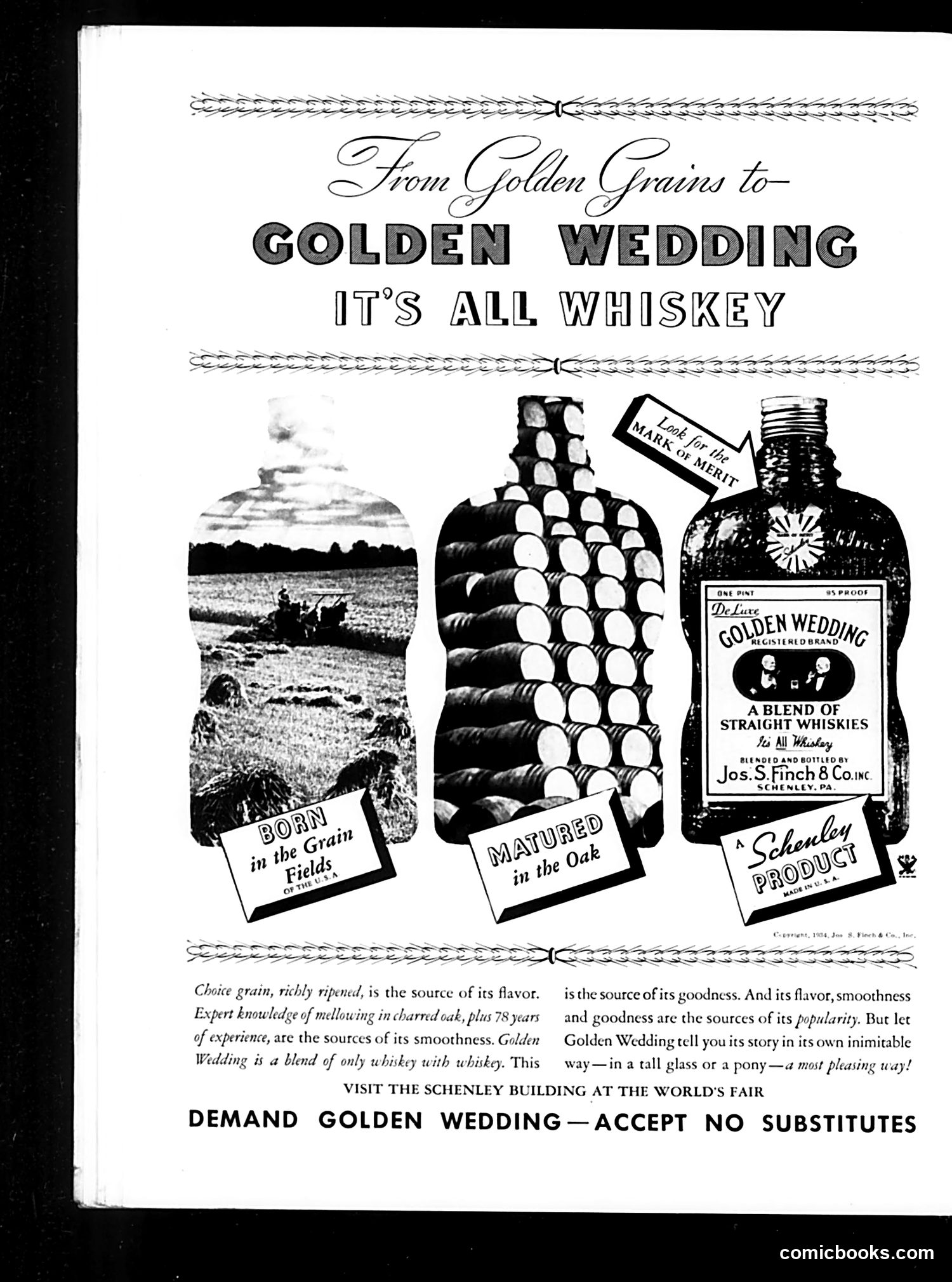
Analysis This is not a satirical cartoon but rather a whiskey advertisement for Golden Wedding brand, blended and bottled by Jos. S. Finch & Co. of Schenley, Pennsylvania. The ad uses a metaphorical visual narrative: grain fields → oak barrels → finished bottle, illustrating the production process from raw materials to final product. The tagline "From Golden Grains to Golden Wedding—It's All Whiskey" emphasizes the product's natural origins and quality. The text emphasizes smoothness achieved through "mellowing in charred oak" for 78 years of expertise, positioning Golden Wedding as a premium blend. The ad concludes with an appeal to visit "the Schenley Building at the World's Fair," suggesting this dates to a major exposition period. The final exhortation—"Demand Golden Wedding—Accept No Substitutes"—reflects competitive marketing practices of the era.
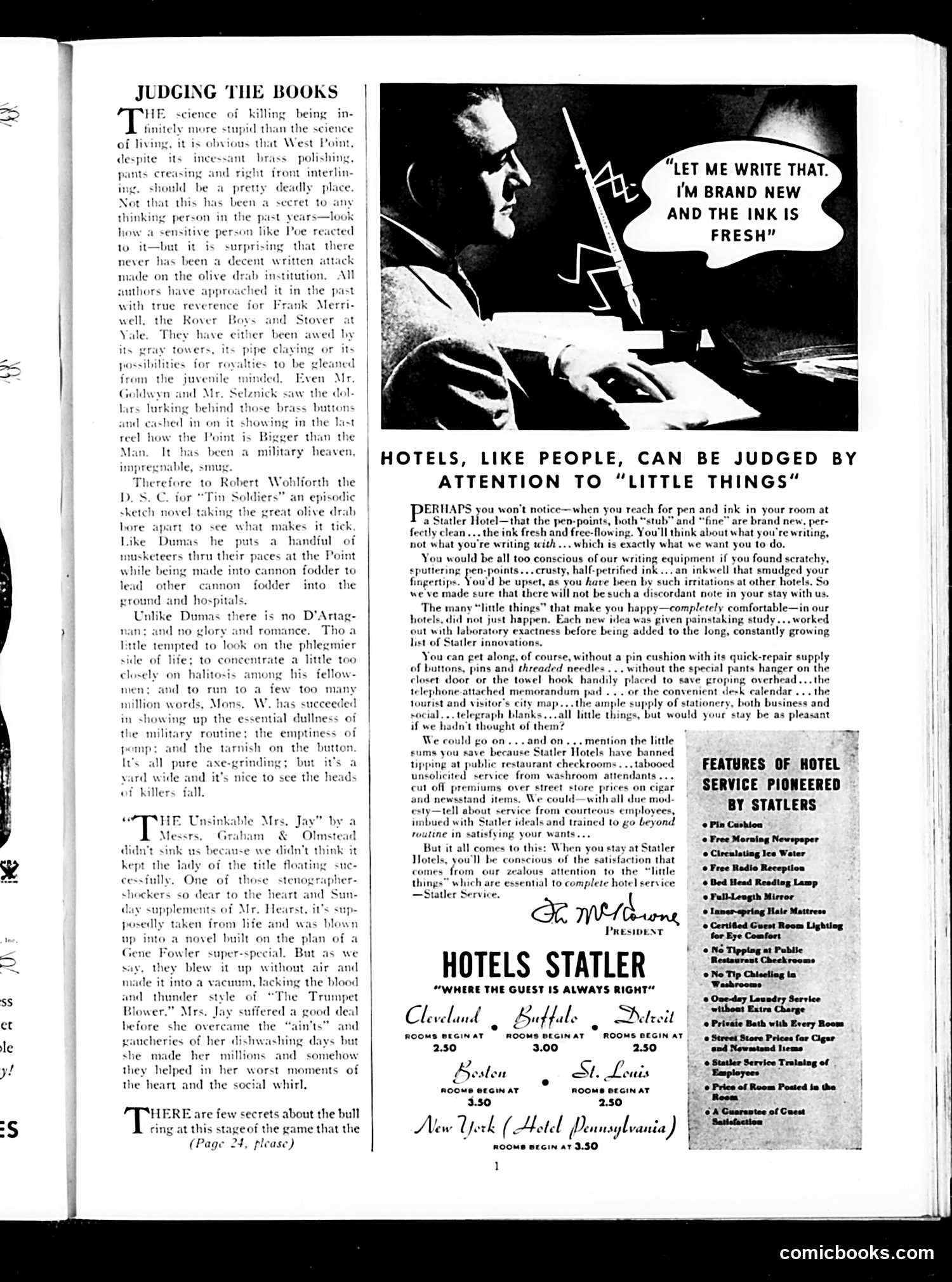
Analysis of Judge Magazine Page This page is primarily advertising for Statler Hotels, not political satire. The main cartoon shows a man at a desk writing, with a speech bubble: "Let me write that. I'm brand new and the ink is fresh." The accompanying text explains that hotels like Statler are "judged by attention to 'little things'"—details like fresh ink in pens, clean pen points, and well-maintained supplies. The advertisement emphasizes Statler Hotels' pioneering attention to guest service through these minor but noticeable details. The left column discusses literary criticism of war novels, but this appears unrelated to the hotel advertisement's main message about service quality and customer satisfaction.
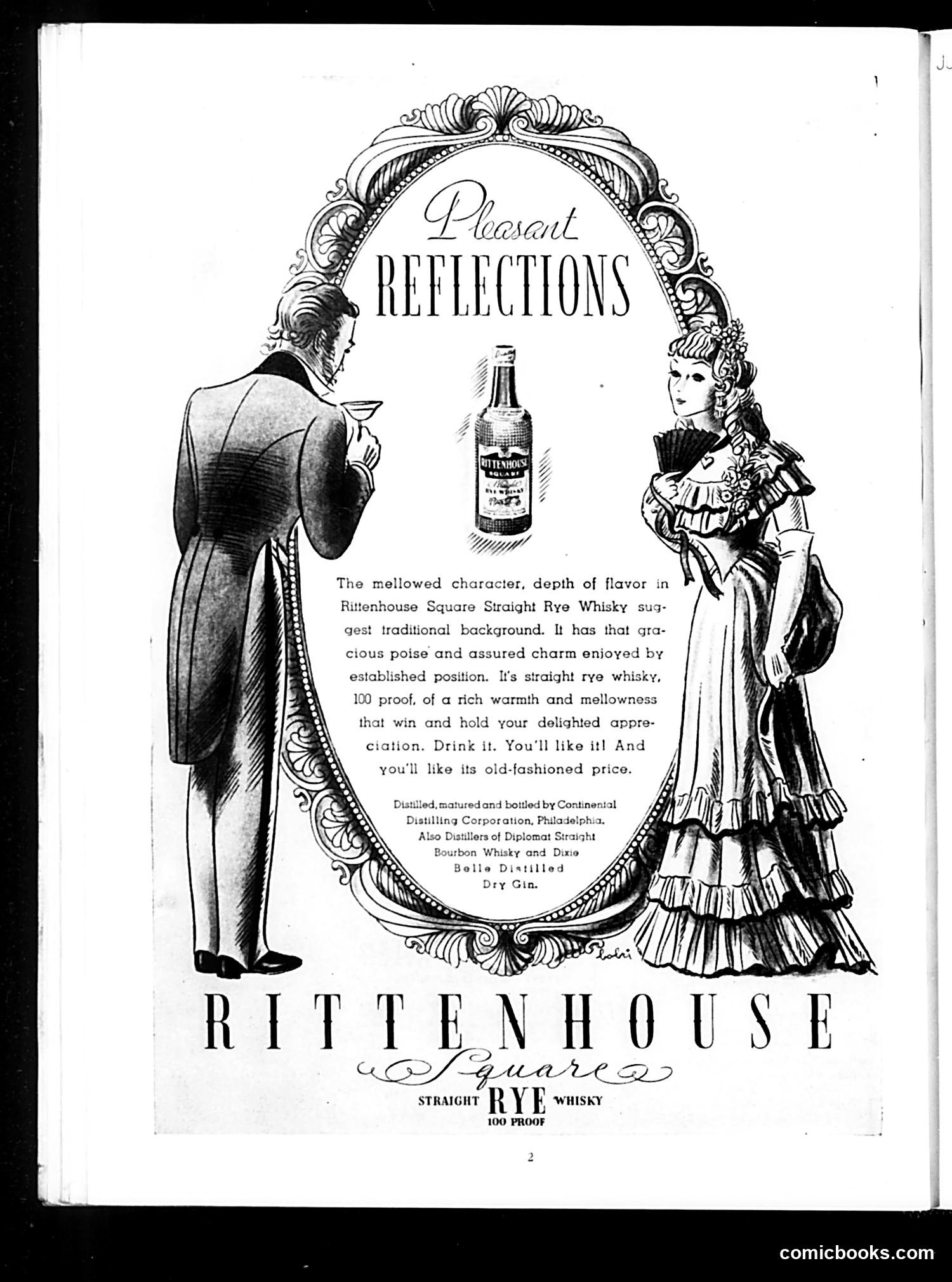
Analysis This is primarily a whiskey advertisement, not political satire. It promotes Rittenhouse Square Straight Rye Whisky (100 proof), distilled by Continental Distilling Corporation in Philadelphia. The ad uses the title "Pleasant Reflections" to depict two elegant figures—a man in formal attire and a woman in period dress—flanking a bottle. The copytext emphasizes the whiskey's "mellowed character," "gracious poise," and "assured charm," targeting upper-class consumers who valued "established position." The satire here is subtle: the advertisement itself satirizes genteel society by suggesting that refined social standing and whiskey consumption are linked. However, this is primarily an advertisement exploiting class aspirations rather than political commentary. Judge magazine, while satirical, frequently published paid advertisements alongside editorial content.
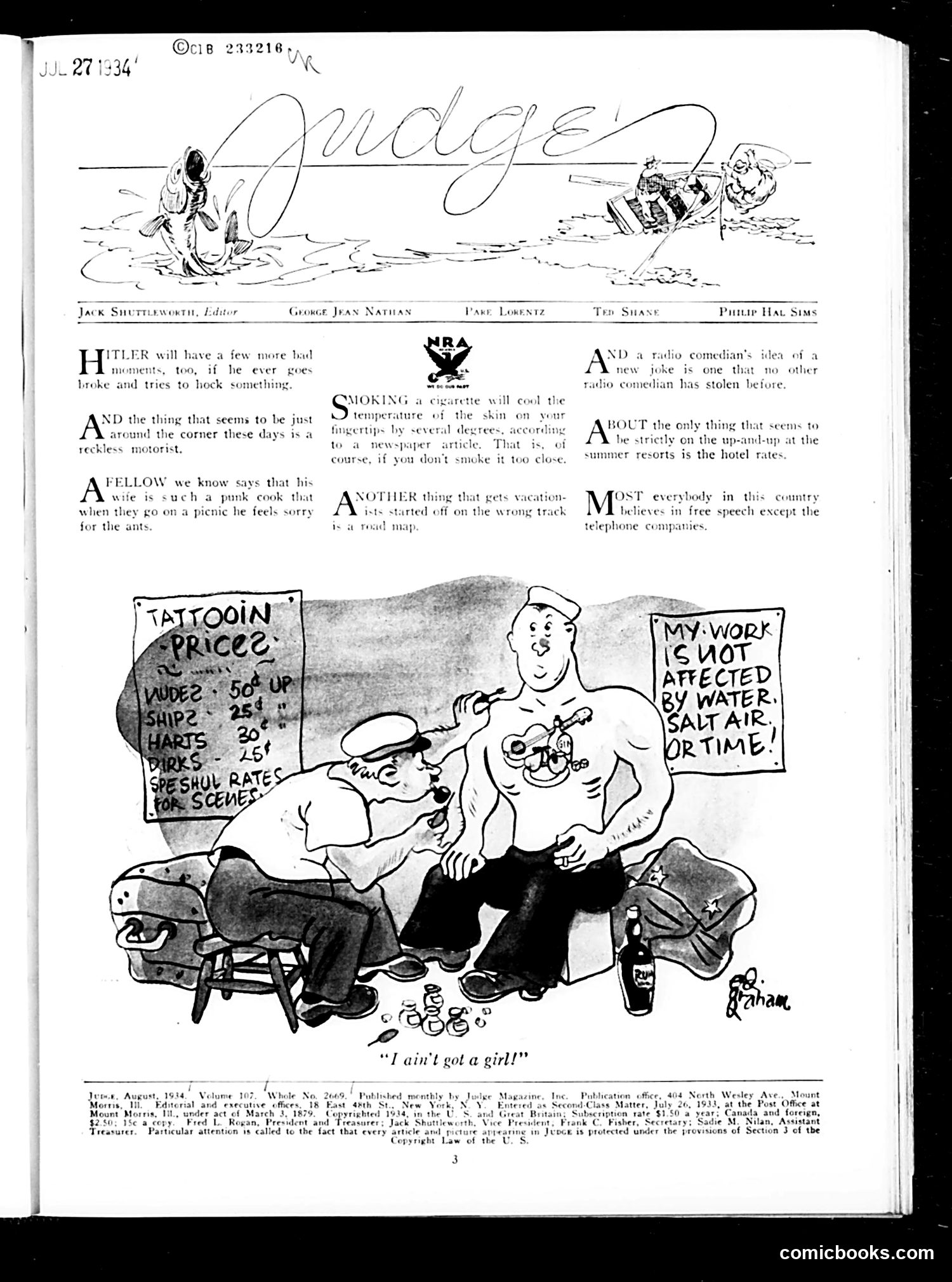
Analysis of Judge Magazine Page (August 1934) This page contains humorous observations about contemporary life rather than direct political commentary. The main cartoon depicts a sailor at a beach getting a tattoo, with the tattoo artist displaying price list and the sailor insisting "My work is not affected by water, salt air or time!" The upper text contains quips about various subjects: Hitler's potential future troubles, smoking's effects on skin temperature, wives complaining on picnics, vacationers using road maps incorrectly, hotel rates at summer resorts, and belief in free speech except by telephone companies. The satirical humor targets everyday American concerns—consumer prices, leisure activities, and corporate behavior—rather than specific political figures or events. The tone is lighthearted social commentary typical of Judge's general-audience satire.
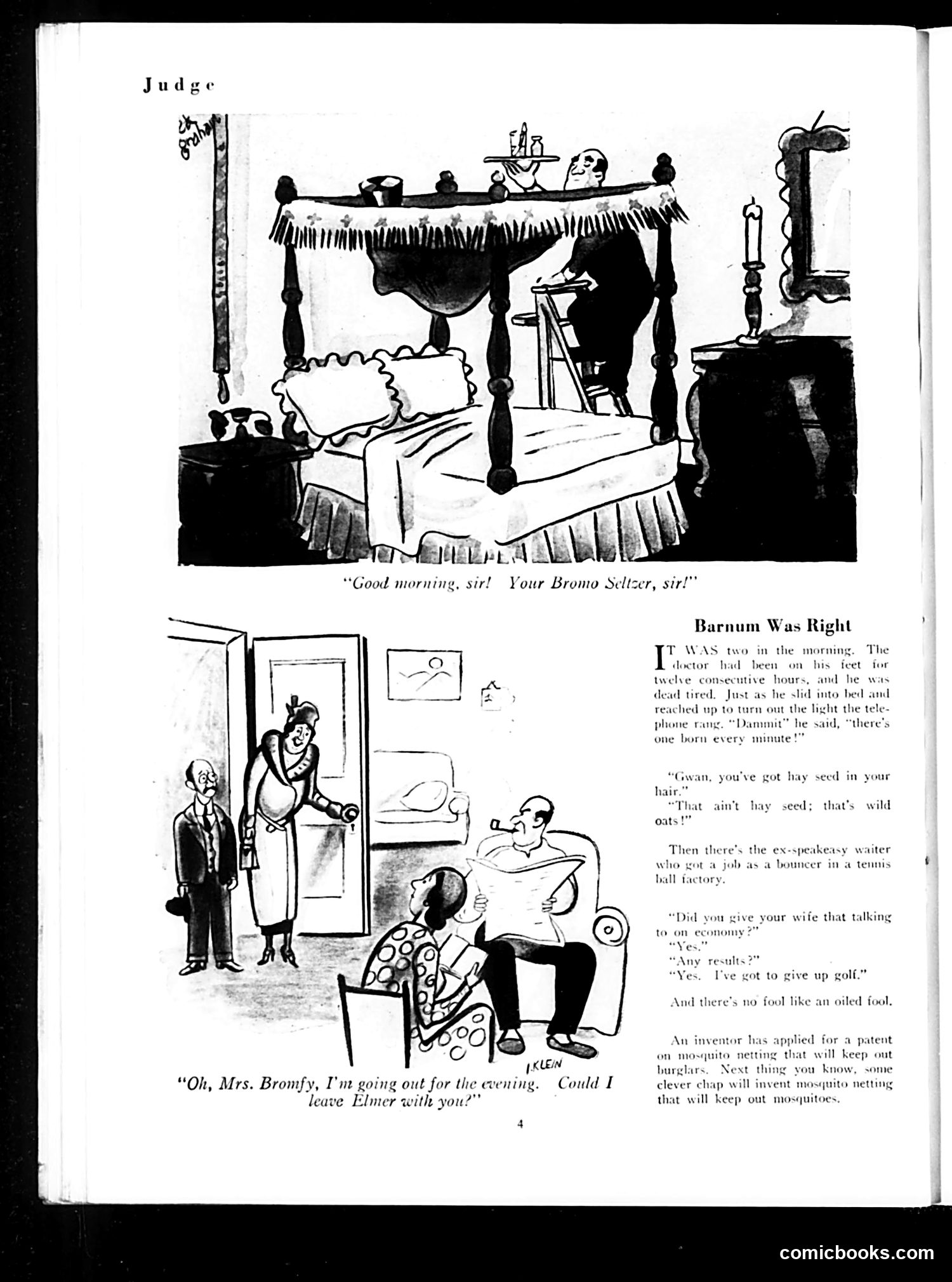
Analysis of Judge Magazine Page This page contains two distinct cartoons satirizing early 20th-century domestic life. Top cartoon ("Good morning, sir! Your Bromo Seltzer, sir!"): Depicts a judge's bedroom with an ornate bed. The servant's greeting references Bromo-Seltzer, a popular antacid/hangover remedy, satirizing the judge's presumed heavy drinking and morning digestive troubles—a common trope mocking judicial indulgence. Bottom cartoon ("Oh, Mrs. Bromfy, I'm going out for the evening. Could I leave Elmer with you?"): Shows a domestic scene where a man asks to leave someone named "Elmer" with neighbors. The accompanying article "Barnum Was Right" humorously catalogs the foolishness of modern life—from wives' wasteful economy lectures to absurd patent inventions like mosquito netting. Both pieces use humor to critique social pretension and domestic absurdities of the era.
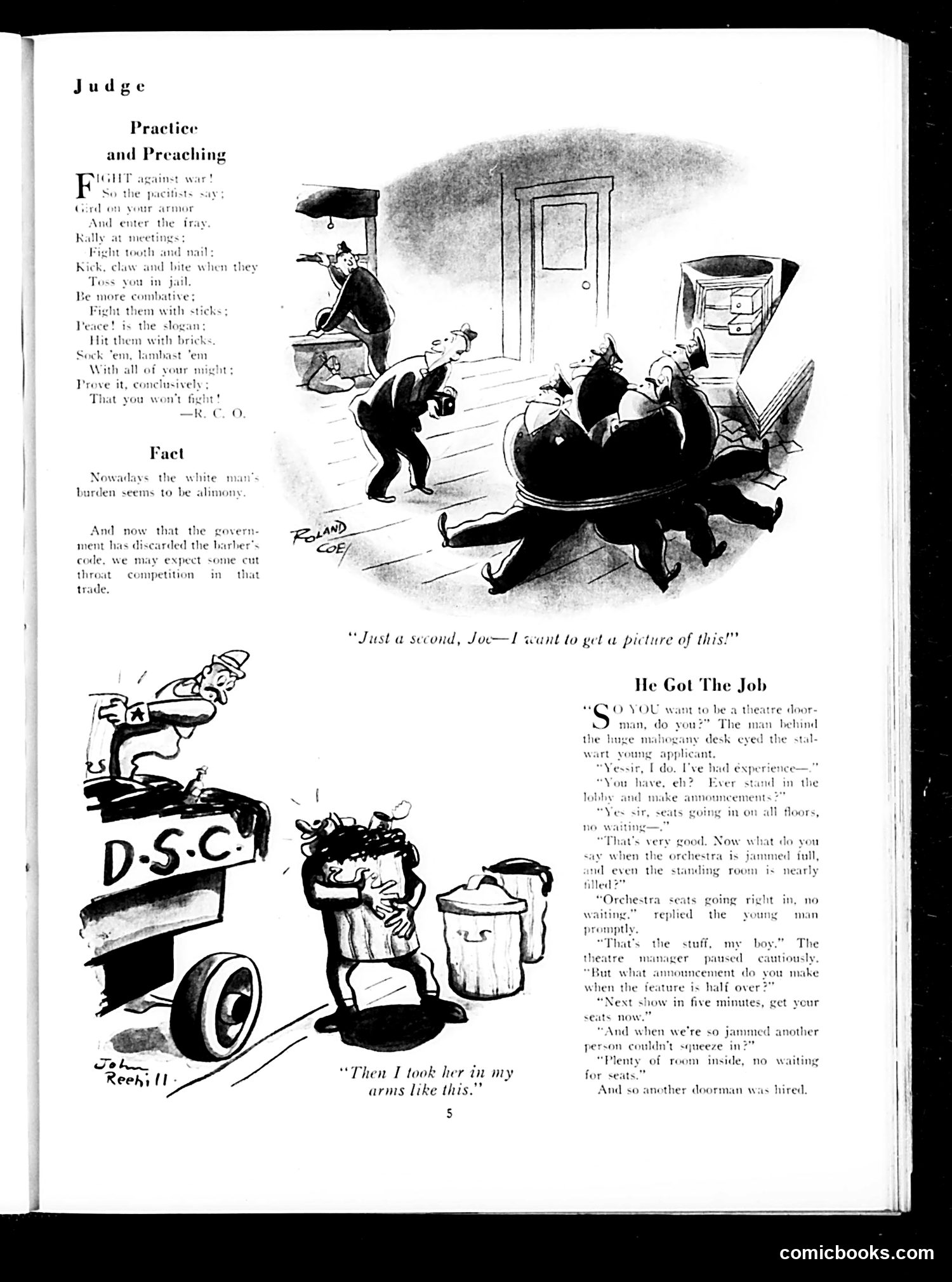
Analysis This Judge magazine page contains two distinct pieces of satire: "Practice and Preaching" (top): A violent cartoon mocking pacifists. The poem advocates fighting ("Fight against war!") while the illustration shows men engaged in physical combat in what appears to be a barber shop or public space. The satire targets the hypocrisy of anti-war advocates who paradoxically resort to violence, possibly referencing debates about pacifism versus militarism during the World War I era. "He Got The Job" (bottom): A humorous story about hiring a theatre doorman. The applicant claims experience but admits having no actual background. The manager hires him anyway due to overcrowding—satirizing both workplace desperation and incompetent hiring practices during what appears to be a period of labor shortage or economic upheaval. Both pieces use absurdist humor to critique social contradictions of their era.
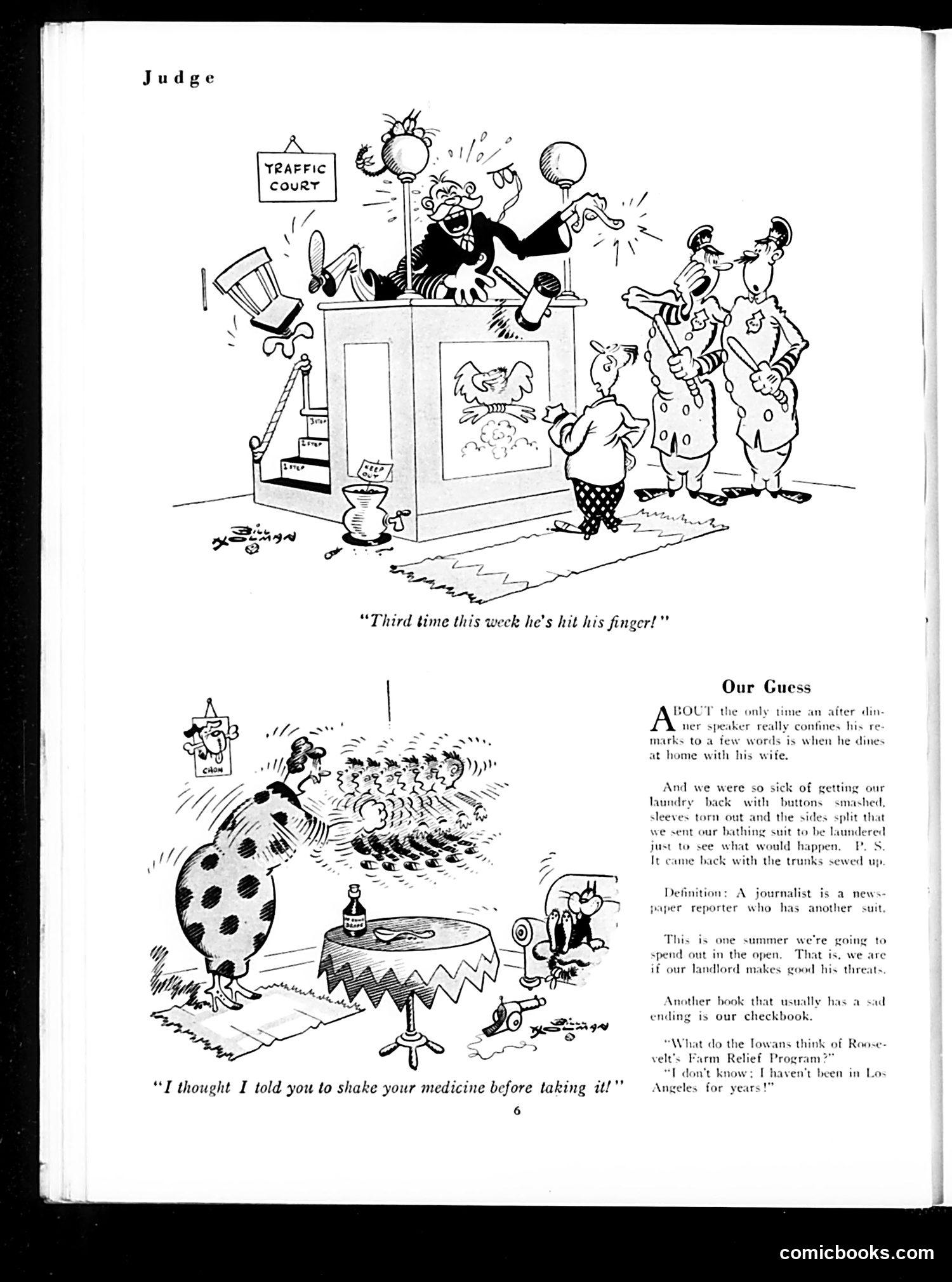
Judge Magazine Page Analysis Top Cartoon ("Third time this week he's hit his finger!"): A chaotic traffic court scene where an angry judge presides over what appears to be repeated traffic violations. The humor satirizes the frequency of traffic accidents and citations, suggesting the same offender keeps appearing with injury (hitting his finger), implying careless or reckless driving habits. Bottom Cartoon ("I thought I told you to shake your medicine before taking it!"): A spotted creature (possibly meant to be humorous/exaggerated) has apparently taken medicine without shaking it first, resulting in visible ill effects. This is a straightforward visual gag about failing to follow simple medical instructions. Right Column ("Our Guess"): Brief satirical commentary on contemporary topics: after-dinner speakers, laundry problems, summer plans, and Roosevelt's Farm Relief Program, poking gentle fun at 1930s American domestic and political concerns.
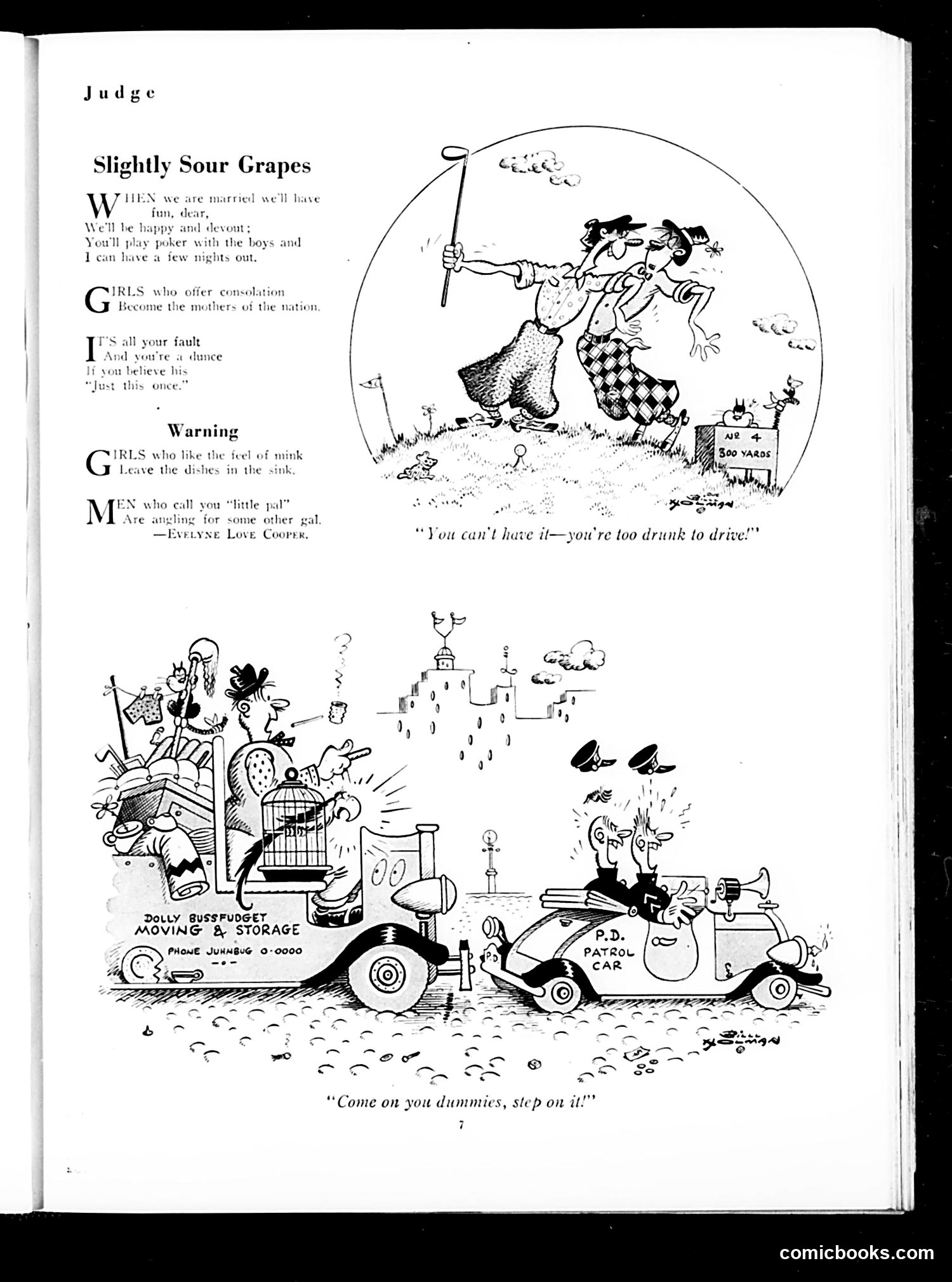
Analysis for Modern Readers This page from *Judge* magazine contains satirical commentary on gender relations and social behavior circa the early-to-mid 20th century. "Slightly Sour Grapes" mocks men's hollow promises before marriage—husbands claim they'll allow wives independence and poker nights, but the sarcastic tone suggests this won't happen. "Warning" offers cynical "advice" to women: those who enjoy luxury (mink coats) avoid housework, while men who use terms of false endearment are pursuing other women. It's social commentary on male infidelity and female materialism. The two cartoons below satirize domestic chaos: the first shows an intoxicated man being denied a ride ("too drunk to drive"), and the second depicts a comically chaotic moving company collision with a police patrol car. Both mock incompetence and recklessness, likely commenting on Prohibition-era drinking and general social disorder. The overall page critiques marriage, gender dynamics, and working-class mishaps with the satirical tone *Judge* was known for.
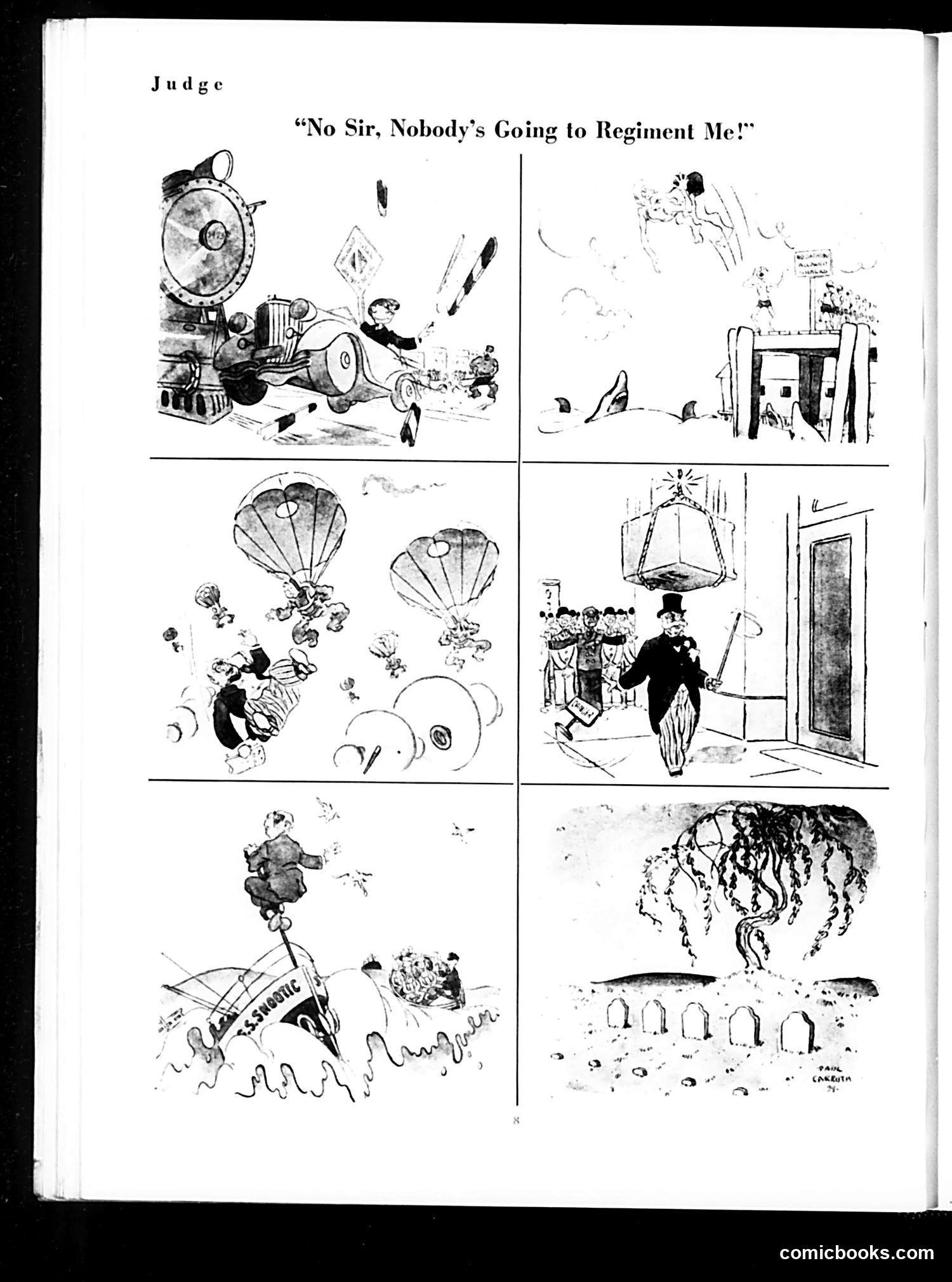
"No Sir, Nobody's Going to Regiment Me!" This Judge cartoon satirizes resistance to military conscription or mandatory military service. The protagonist declares his refusal to be "regimented"—placed under military discipline and control. The six-panel narrative depicts increasingly absurd consequences: the character is literally attacked by military machinery (top left), launches into the air via parachutes (middle panels), and ultimately ends up dead in a graveyard (bottom right). The progression suggests that defying military authority leads to disaster. The satire likely targets draft resisters or pacifists during a period of military buildup or war (the style suggests early-to-mid 20th century). Judge uses dark humor to mock those who refuse military service, implying their resistance is both foolish and self-destructive. The message supports military compliance and duty.
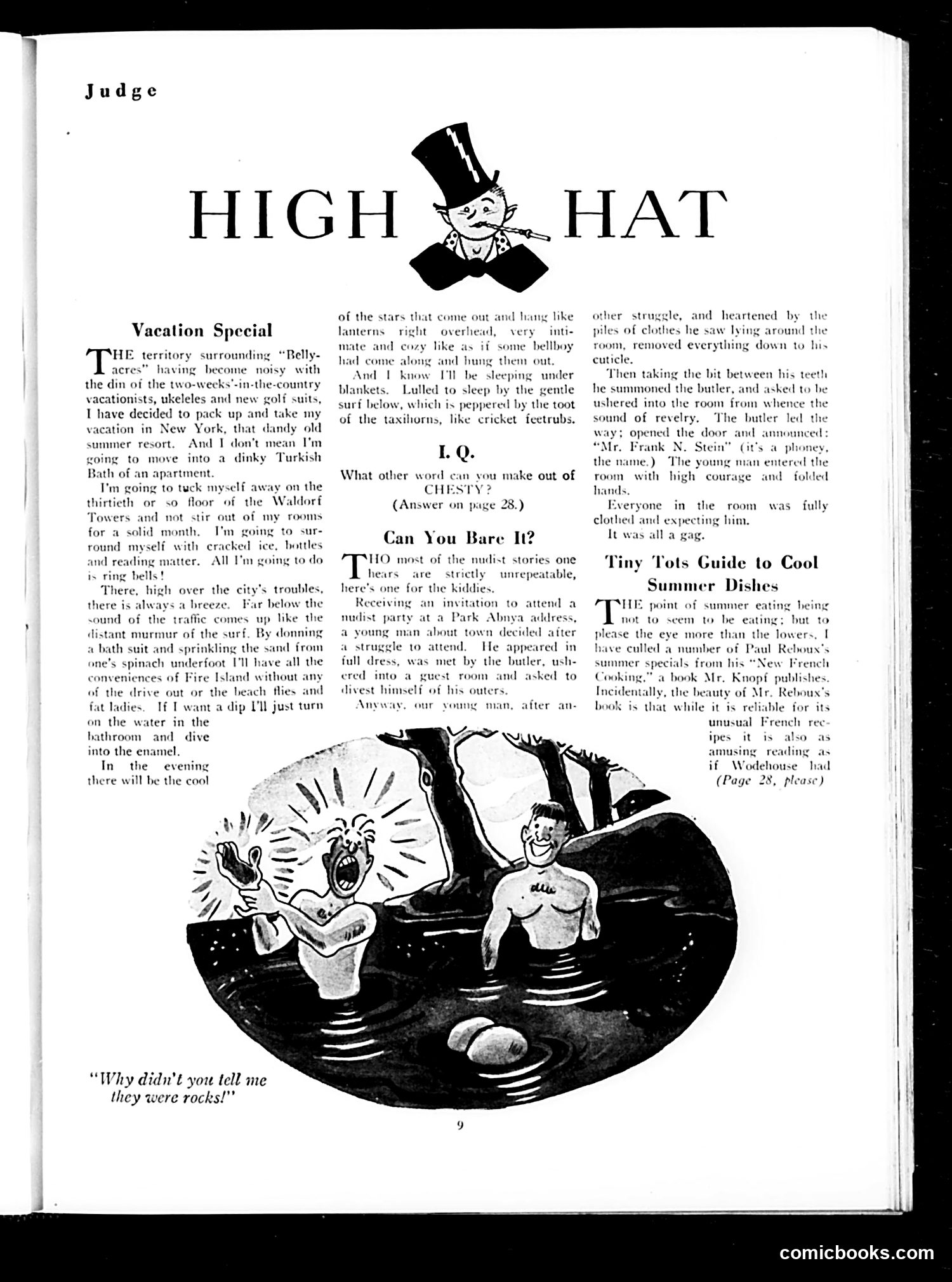
Judge Magazine Page Analysis This page contains three humorous pieces typical of 1920s-30s satirical magazine content: "High Hat" (Main Story): A wealthy urbanite describes escaping summer crowds by retreating to a luxury hotel (the Waldorf Towers) rather than countryside resorts. The satire mocks pretentious wealth—he'll lounge in an apartment high above the city, treating the urban soundscape as romantic ("distant murmur of the surf"), while avoiding the "beach flies and fat ladies" of traditional vacation spots. "Can You Bare It?" A crude joke about a young man attending a nudist party. The punchline relies on the shock value of nudism itself (still scandalous/novel in this era), with the butler's announcement of "Mr. Frank N. Stern" apparently creating embarrassment. Cartoon: Shows two figures in water with the caption "Why didn't you tell me they were rocks?"—a simple visual gag about mistaking rocks for solid ground while swimming. The page also includes a puzzle ("I.Q.") and an advertisement for a French cooking book. The overall tone reflects Depression-era magazine humor focused on class commentary and mild sexual innuendo.
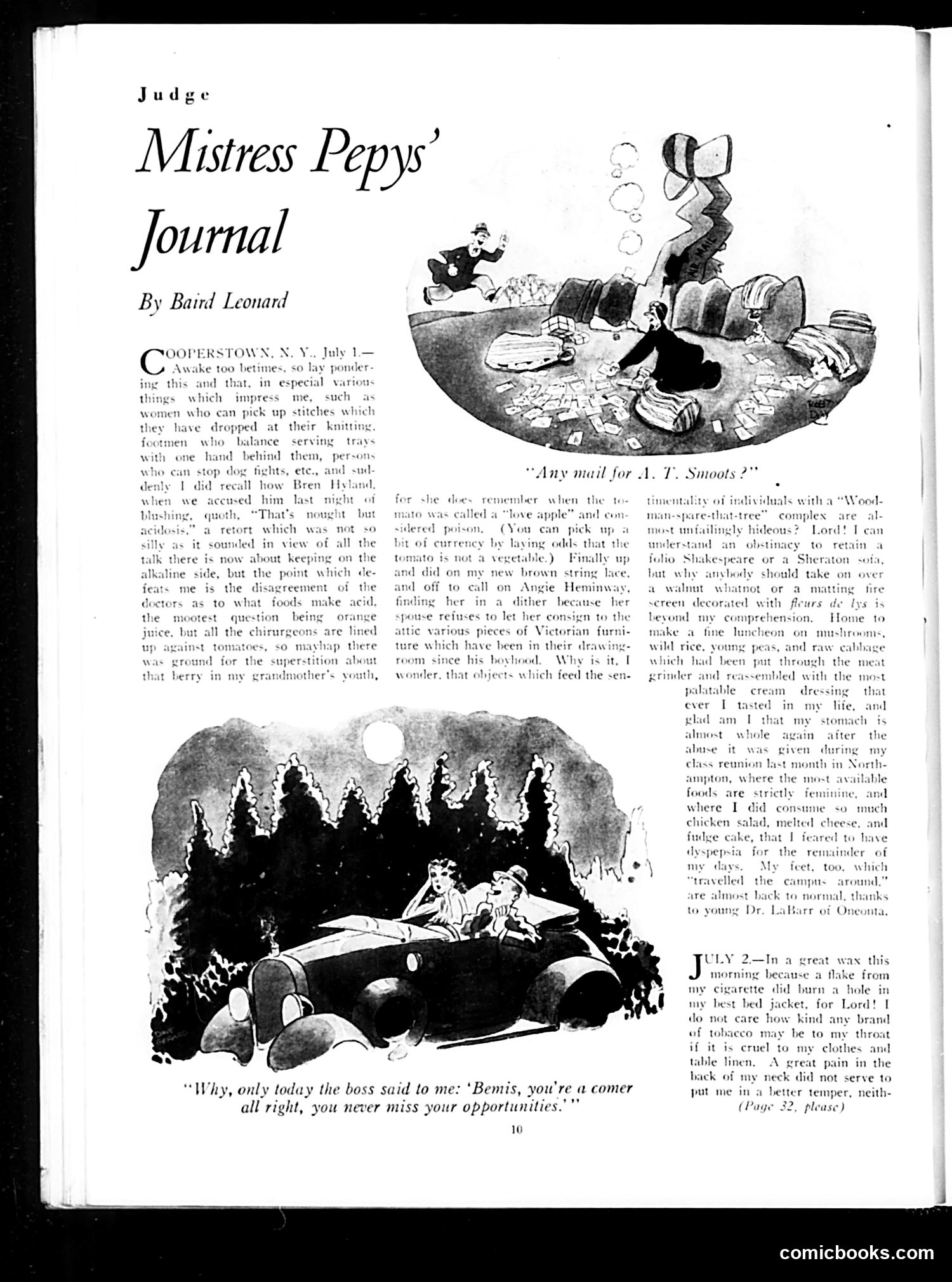
Judge Magazine: "Mistress Pepys' Journal" This is a humor column by Baird Leonard spoofing Samuel Pepys' famous 17th-century diary. The author presents a female narrator's observations from July 1-2, written in mock-historical style mimicking Pepys' casual, gossipy tone. The satire targets upper-class domestic concerns: women's knitting skills, servants' incompetence, social calls, and Victorian furniture (walnut whatnots, Sheraton sofas). A running joke involves the narrator's digestive troubles and a disastrous class reunion featuring "strictly feminine" foods. The cartoon at bottom shows two figures in a car, illustrating an office anecdote where a boss encourages an employee ("Bemis") not to miss opportunities—comic contrast between workplace ambition and real-life mishaps (cigarette burns, indigestion). The humor relies on period-specific domesticity and gender stereotypes about women's preoccupations with housekeeping minutiae.
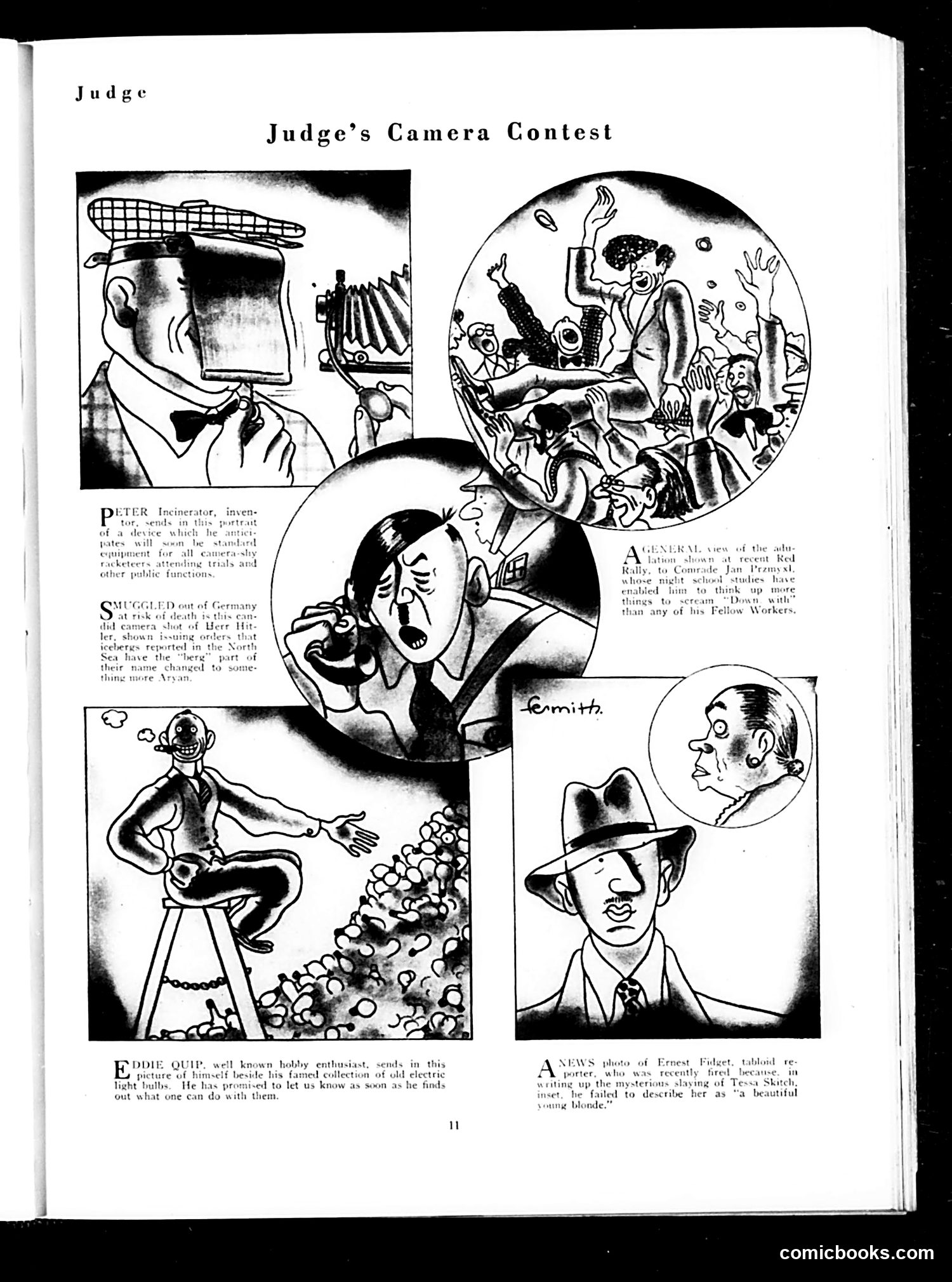
Judge's Camera Contest This page showcases a "Judge's Camera Contest" featuring cartoon submissions by various artists. The entries depict inventive or absurd camera designs and photography scenarios, satirizing technological innovation and amateur photography trends of the era. Notable entries include: - Peter Incinerator: A comically oversized camera designed for photographing cricket matches and public functions - Smuggled from Germany: A hidden camera supposedly used to photograph Nazi leader Hitler - Eddie Quig: Features an inventor with electric light bulbs, mocking impractical gadgetry - An untitled entry showing a man in a hat (labeled as related to "Tessa Sketch"), whose appearance was apparently noteworthy to describe The contest satirizes both photography hobbyists and technological excess through exaggerated mechanical designs and absurd applications.
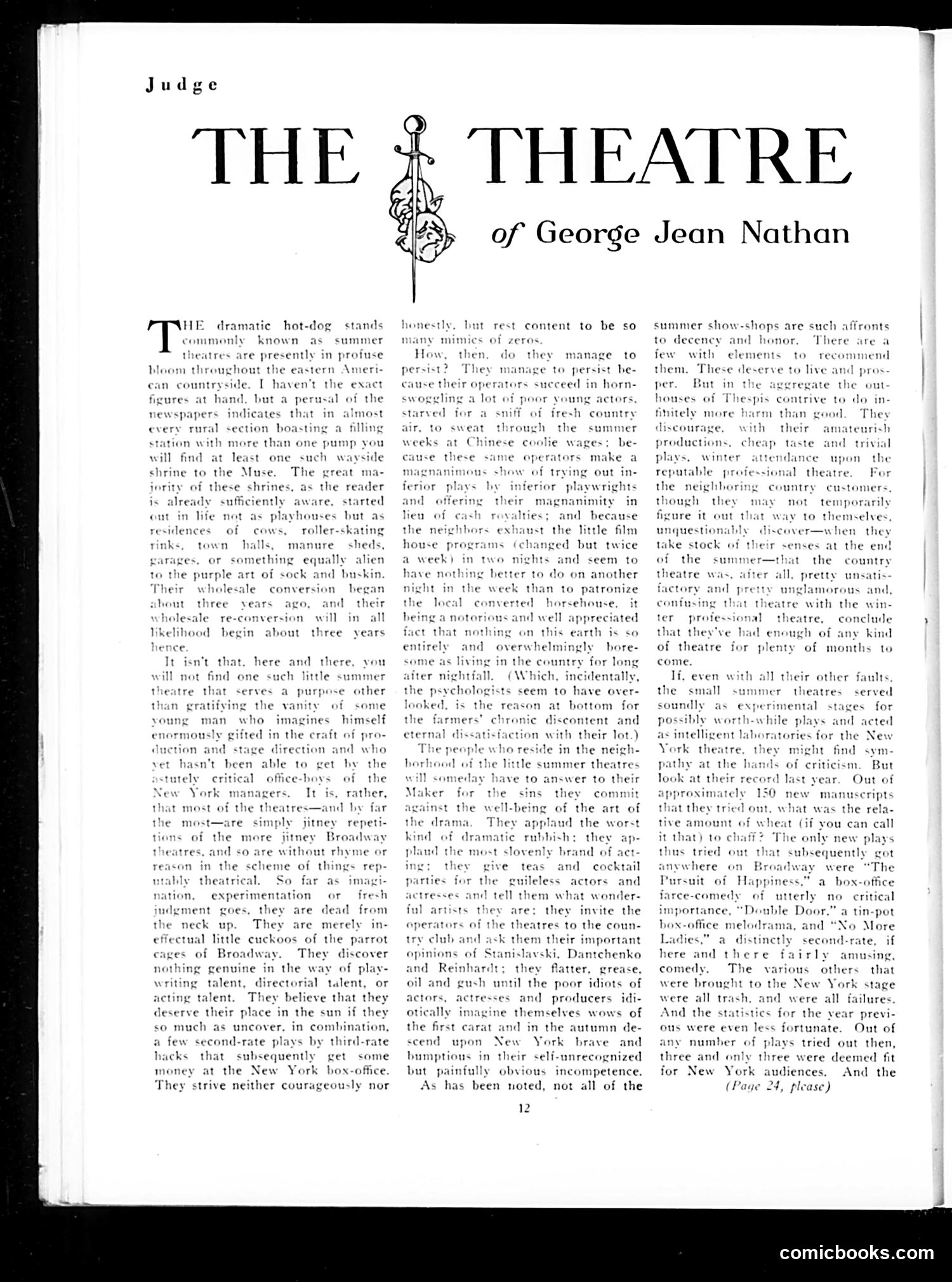
Judge Magazine: "The Theatre of George Jean Nathan" This is a critical essay by drama critic George Jean Nathan, not a cartoon. The page critiques summer stock theaters operating in rural America during the early 20th century. Nathan argues that these small-town "theatres" are actually converted barns, town halls, or other buildings serving a parasitic function: they provide vanity projects for talentless amateur producers while exploiting desperate young actors through low wages and exploitation. He dismisses them as mere imitations of Broadway that discover no genuine talent and serve primarily to damage public taste for theatre. The piece is satirical social commentary attacking the proliferation of mediocre, amateurish summer theatrical operations that he sees as damaging to legitimate theatre. Nathan presents this as a widespread American problem deserving ridicule—the democratization of theatrical production without accompanying standards or competence.
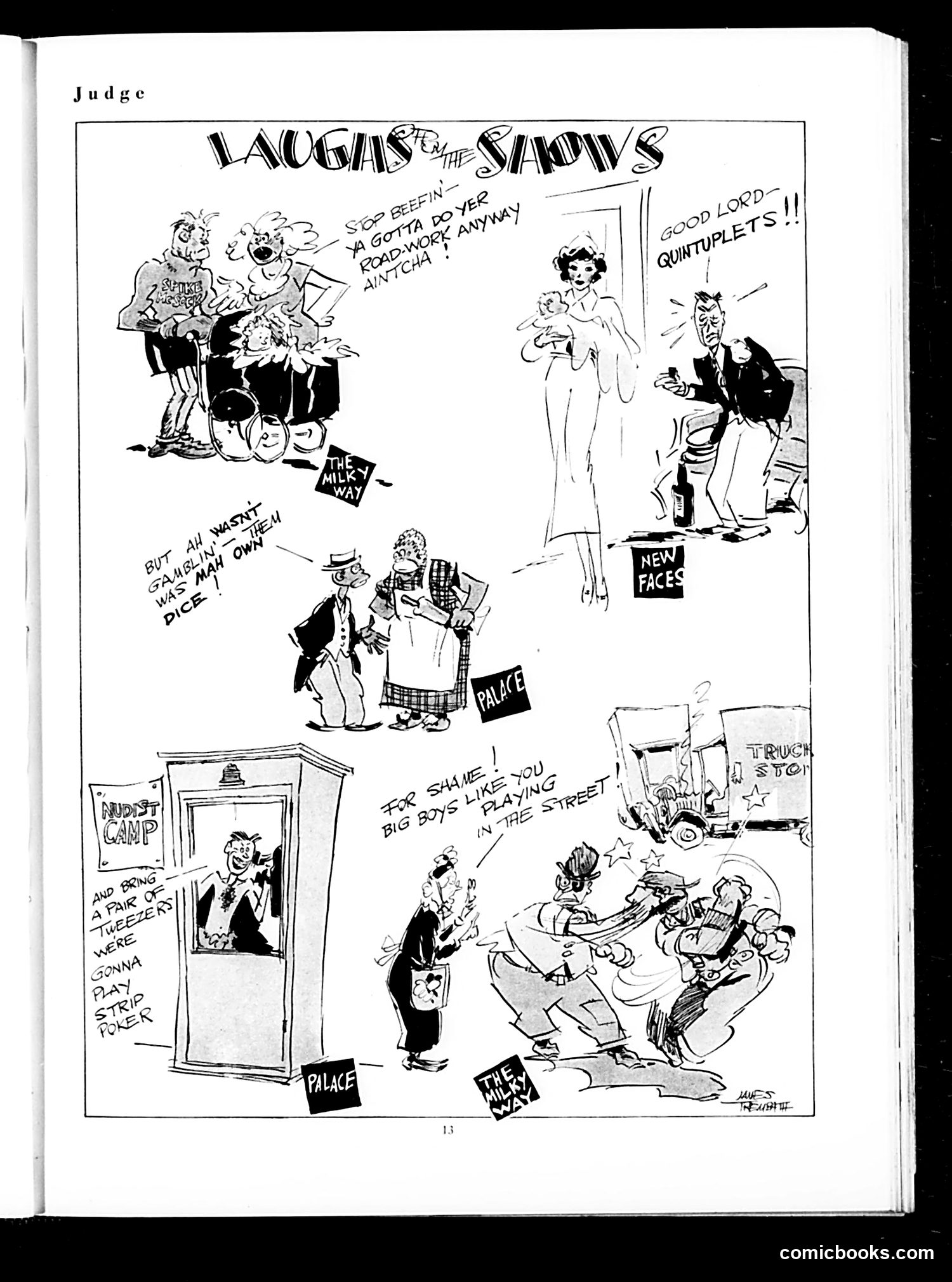
"Laughs at Serious" - Judge Cartoon Analysis This page from *Judge* magazine presents a series of vignettes satirizing entertainment venues and public figures of the era. The cartoons mock various "palaces" (nightclubs, theaters, and establishments) through exaggerated character types and situations. The humor targets social hypocrisy—contrasting respectable facades with seedier realities. References include "The Milk Man," "New Faces," and street scenes depicting vice and corruption. Characters appear to represent various social types: chorus girls, politicians, police, and working-class figures engaged in morally questionable activities. The satire criticizes urban entertainment culture, law enforcement complicity, and the gap between public morality and private behavior—common *Judge* themes from the Prohibition era through the early 20th century. Without the magazine's date, the specific topical references remain unclear.
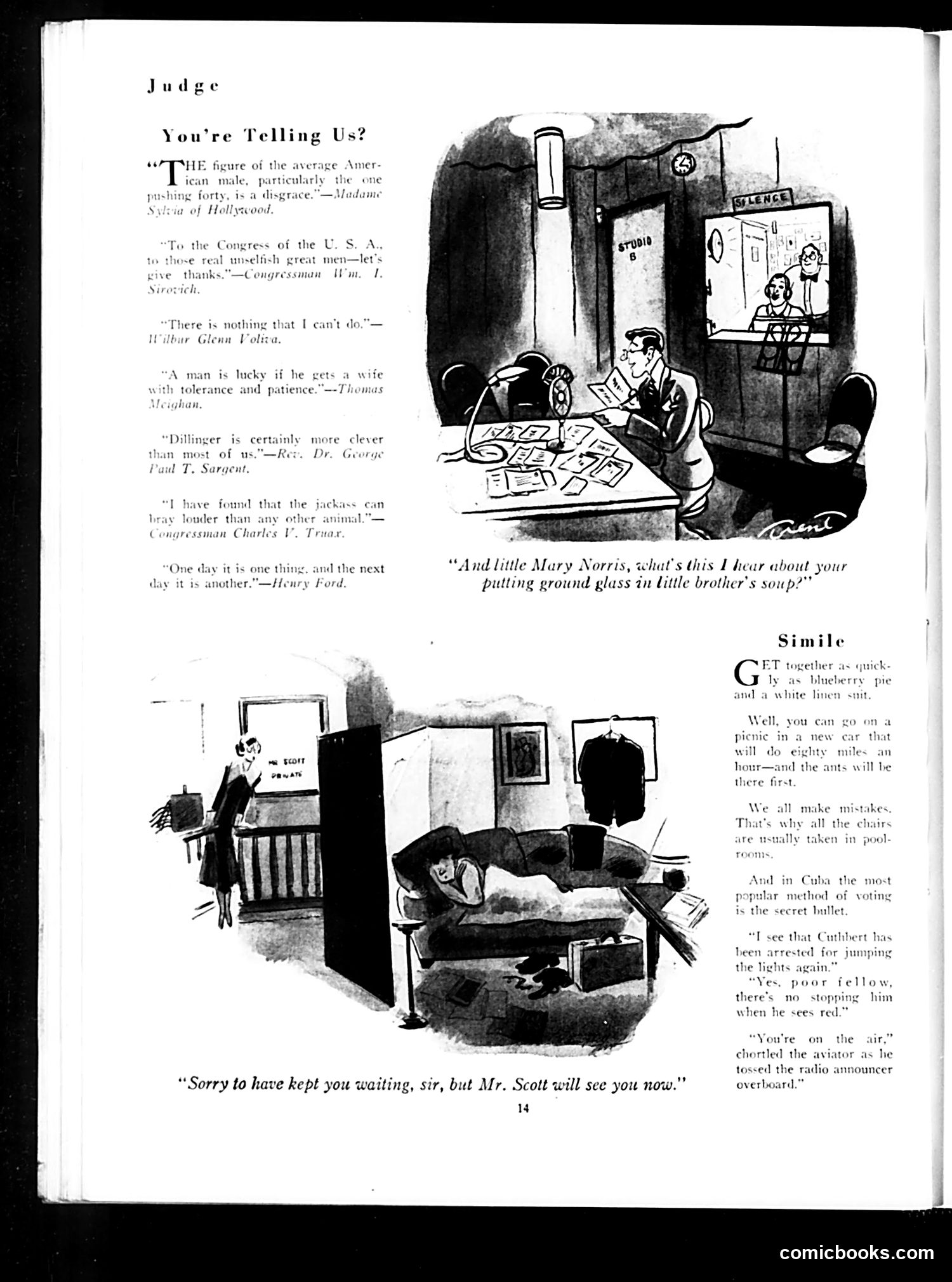
Judge Magazine Page Analysis This page from Judge magazine contains two cartoon sections satirizing American culture and politics circa the 1920s-1930s. "You're Telling Us?" presents ironic quotes from public figures—politicians, celebrities, and social commentators—that contradict themselves or reveal hypocrisy. The top cartoon shows a studio scene where someone discusses Mary Norris putting "ground glass in little brother's soup," mocking sensationalist media coverage of scandals. "Simile" section uses humor to illustrate common expressions and social absurdities. It includes observations about picnics, poolroom etiquette, Cuban voting practices (likely mocking authoritarian politics), and various anecdotes—including one where an aviator throws a radio announcer overboard while on air. The magazine's satire targets media sensationalism, political hypocrisy, social pretensions, and contemporary scandals. The style is typical of Judge's irreverent commentary on American society during this era.
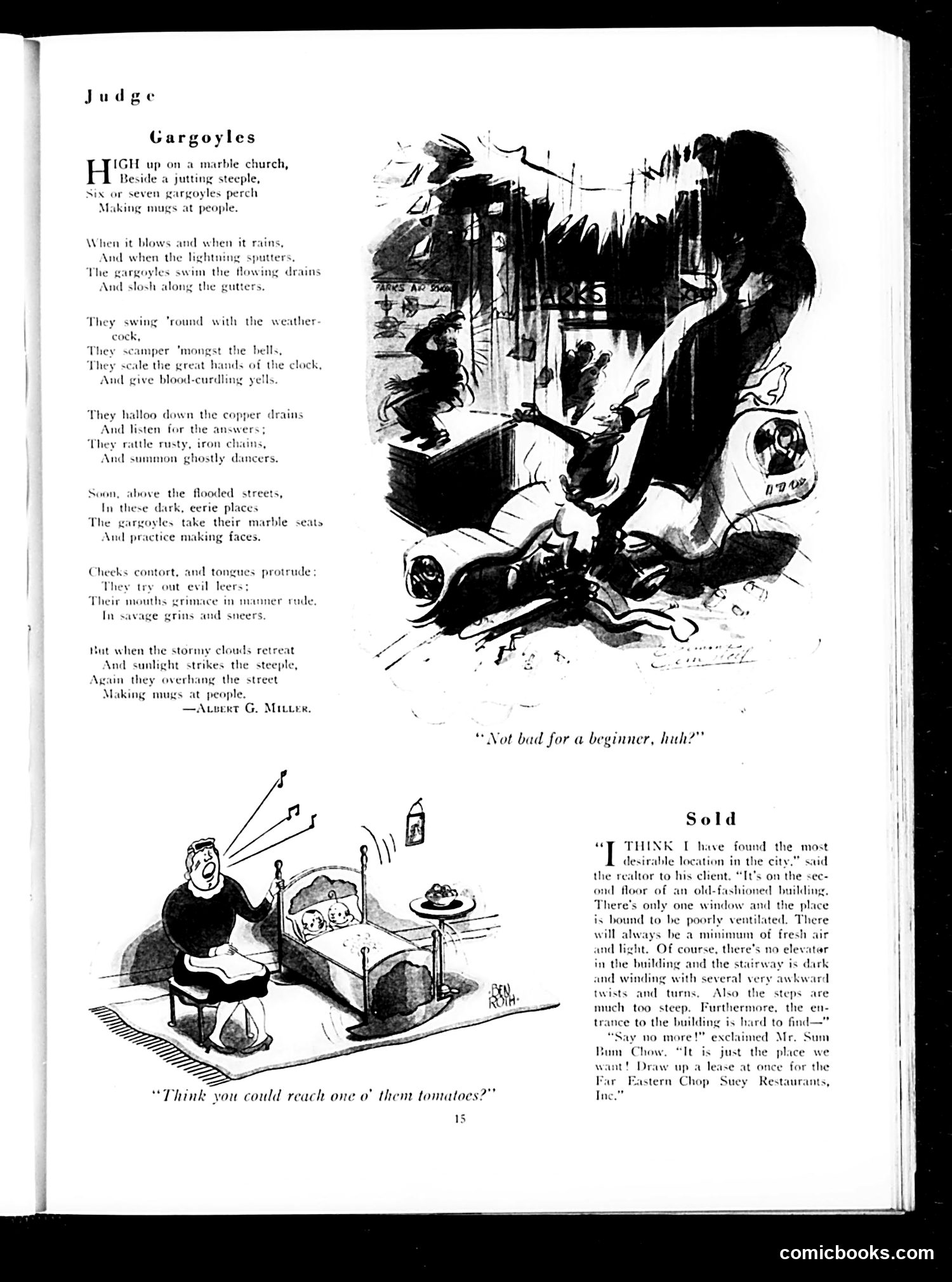
Explanation for Modern Readers This page contains two distinct pieces from *Judge* magazine: "Gargoyles" (top): A whimsical poem by Albert G. Miller describing architectural gargoyles as mischievous creatures that animate during storms, making faces and causing mayhem before returning to stone during fair weather. It's lighthearted fantasy with no political satire—just imaginative humor about church architecture. "Sold" (bottom): A satire on real estate deception. A crafty realtor deliberately lists a property's worst features—poor ventilation, no elevator, steep dark stairs, hard-to-find entrance—expecting the client to reject it. Instead, a Chinese restaurant owner named "Sum Bum Chow" eagerly accepts these terrible conditions. The joke likely plays on period stereotypes about Chinese immigrants accepting substandard accommodations others wouldn't tolerate, reflecting the casual racism common in early 20th-century American humor magazines.
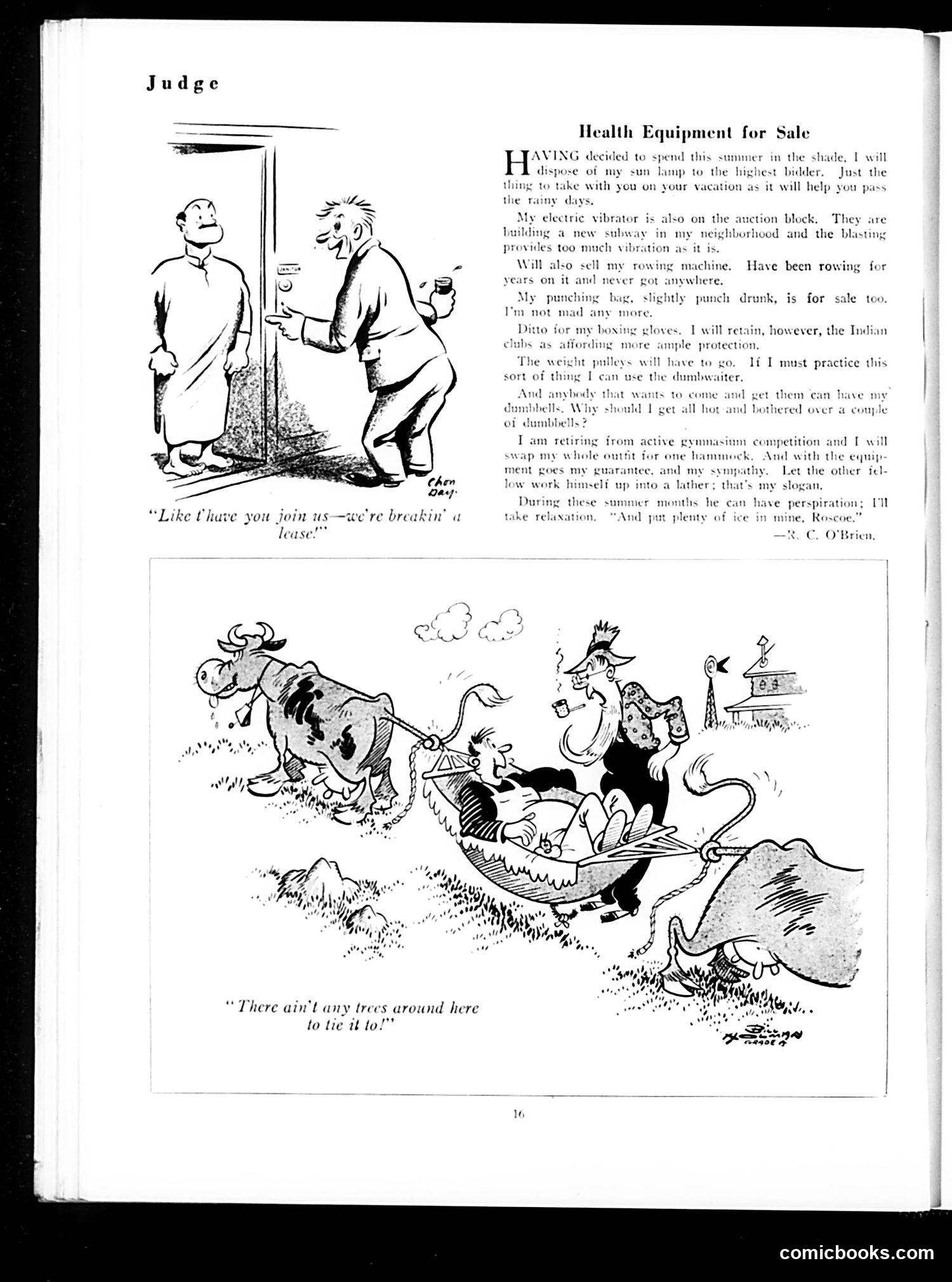
Judge Magazine Page Analysis This page contains two distinct cartoons satirizing early 20th-century American life. Top cartoon: A judge (identified by his robe) encounters a disheveled man with a bottle, who invites him to "join us—we're breakin' a lease!" This likely mocks Prohibition-era speakeasy culture, where even respectable figures like judges might be solicited for illegal alcohol consumption. Bottom cartoon: A man on a cow is being pulled by an absurdly costumed figure (appearing to be Uncle Sam or similar patriotic character) toward a mailbox. The caption "There ain't any trees around here to tie it to!" suggests this is commentary on rural infrastructure or a joke about tying up livestock in undeveloped areas. Accompanying text: A humorous classified ad by "R.C. O'Brien" selling various health equipment (sun lamp, vibrator, rowing machine, dumbbells) because he's retiring from "active gymnasium competition." The joke satirizes fitness fads and the absurdity of advertising used exercise equipment. The page overall mocks American consumer culture and recreational trends of its era.
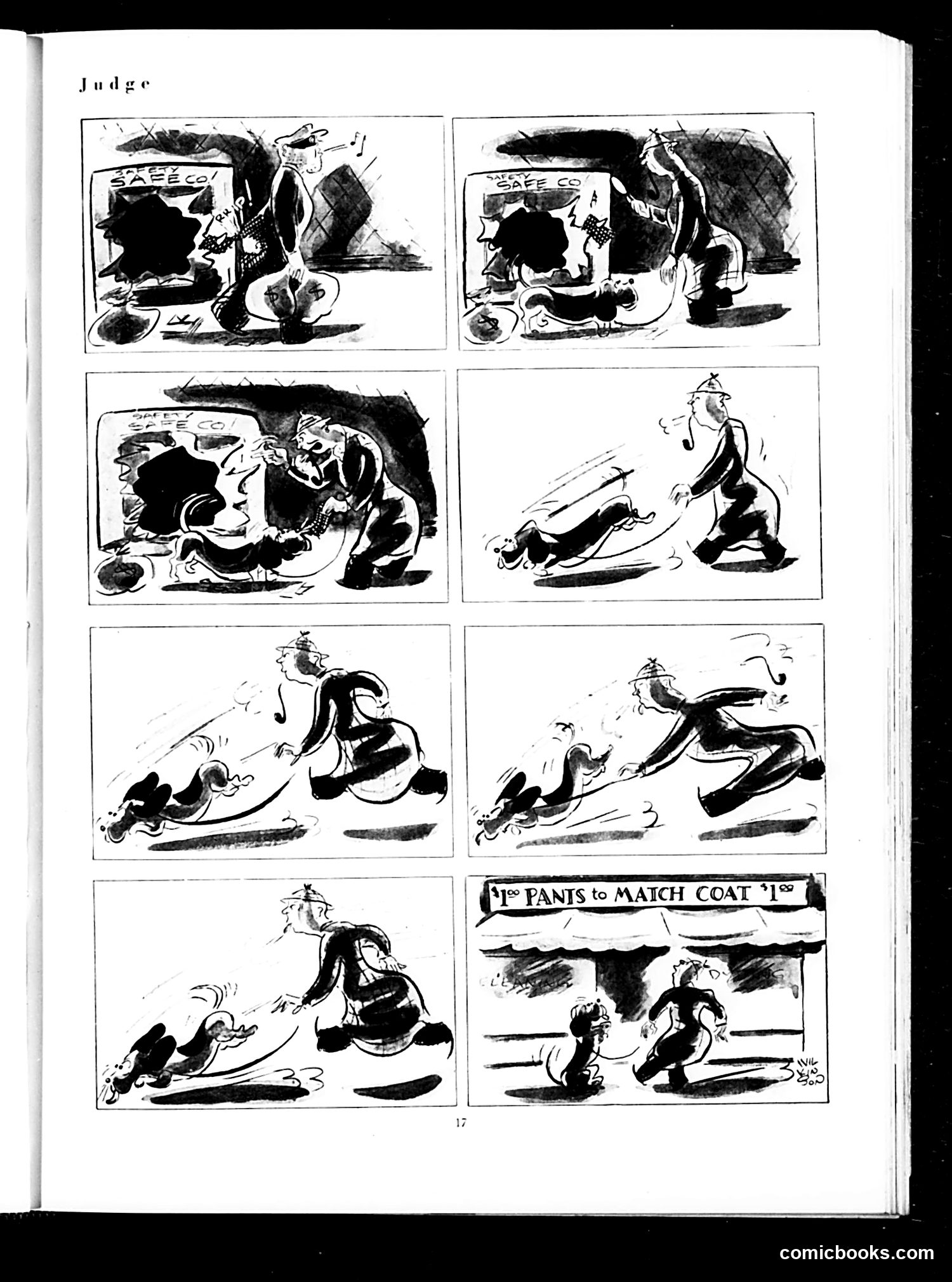
Judge Magazine - "Judge" Comic Strip This appears to be a multi-panel comic strip titled "Judge" depicting a slapstick sequence. The narrative seems to involve a character interacting with a "Safe Co." storefront (visible signage in early panels). The early panels show chaotic action around the safe company, while subsequent panels depict the character engaged in increasingly frantic physical comedy—chasing or being chased, with exaggerated running and falling motions typical of early 20th-century comic strip style. The final panel references "1st Pants to Match Coat 1st" with two figures, likely a humorous advertisement or product placement joke. Without clearer visual details or attribution, the specific satirical target remains unclear, though the humor relies on physical comedy and what appears to be commentary on commercial enterprise or consumer goods typical of Judge magazine's satirical approach.
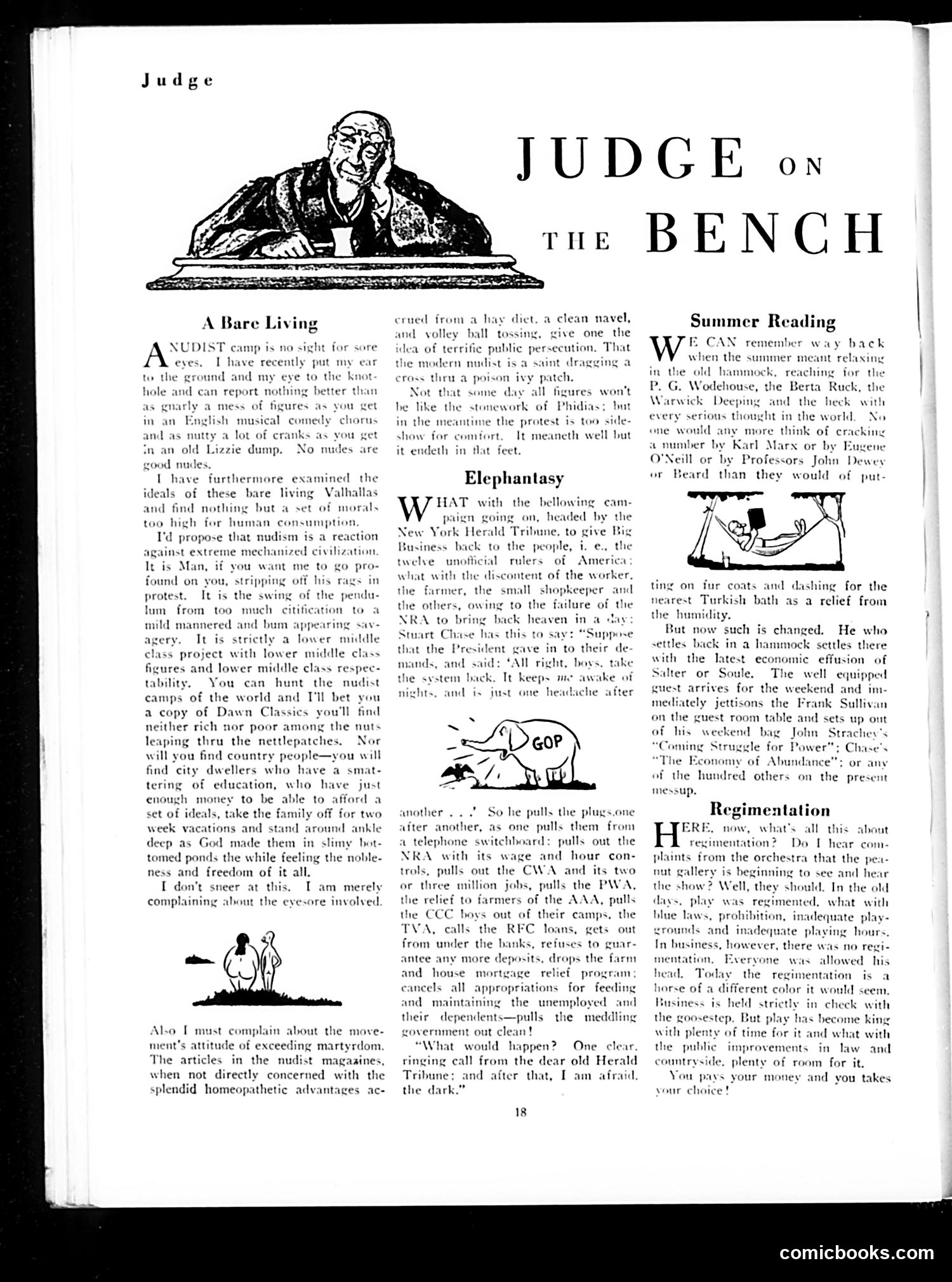
"Judge on the Bench" - Political Satire Analysis This page contains three satirical essays attacking contemporary movements and policies from what appears to be the 1930s New Deal era. "A Bare Living" mocks the nudist movement as a lower-middle-class affectation—not genuinely radical but performative self-righteousness. The judge dismisses nudists as urban professionals playing at freedom while standing in "slimy bottomed ponds." "Elephantasy" satirizes the New York Herald Tribune's advocacy for dismantling New Deal agencies (NRA, CWA, PWA, AAA, CCC, TVA, RFC). The cartoon shows someone pulling plugs from a switchboard, removing social programs. The satire suggests that eliminating these agencies would cause catastrophic collapse—yet the Herald Tribune would merely call it "clear" without acknowledging the consequences. "Regimentation" contrasts carefree 1920s summer leisure (P.G. Wodehouse novels, hammocks) with the 1930s, when readers now engage with serious economic theory (Marx, Dewey). The judge complains that economic anxiety has replaced simple relaxation. All three pieces mock what the author sees as either pretentious modern trends or dangerous policy positions.
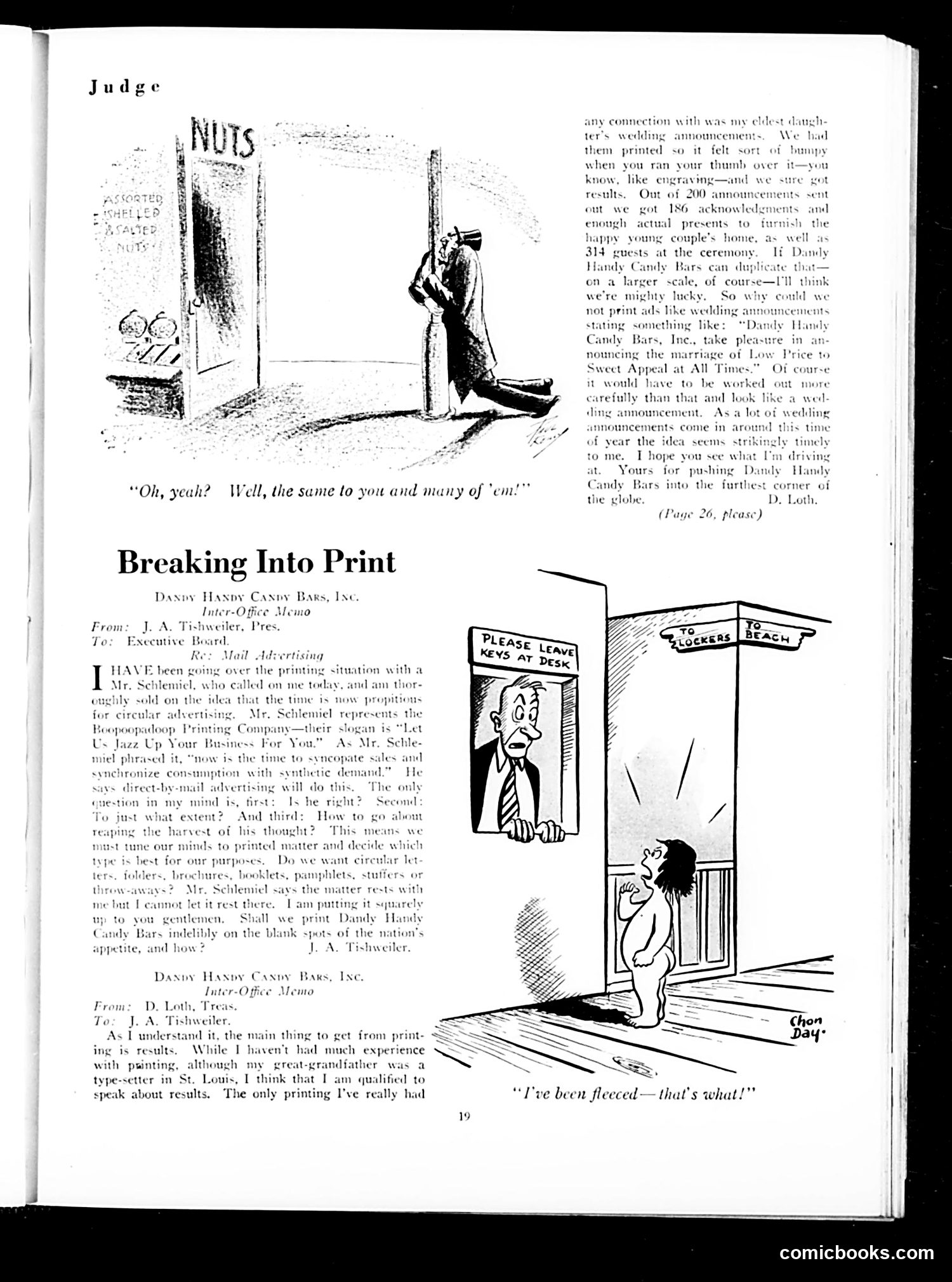
Analysis of "Breaking Into Print" This page satirizes corporate inter-office memo culture and advertising strategy, circa the 1920s-30s. The content shows debates within Dandy Handy Candy Bars, Inc. about whether to advertise via printed materials (circulars, pamphlets, etc.). The humor centers on corporate absurdity: executives with minimal qualifications making grandiose claims. J.A. Tishweiler (president) pushes aggressive print advertising based on vague ideas about "synchronizing consumption with synthetic demand." D. Loth (treasurer) claims qualification to discuss printing results because his great-grandfather was a typesetter in St. Louis—a comically weak credential. The cartoon (bottom right, signed "Chon Day") shows a man fleeing an office with "Please leave news at desk" sign visible, captioned "I've been fleeced—that's what!" This illustrates the satirical point: corporate decision-making driven by inexperience and buzzwords, not actual results.
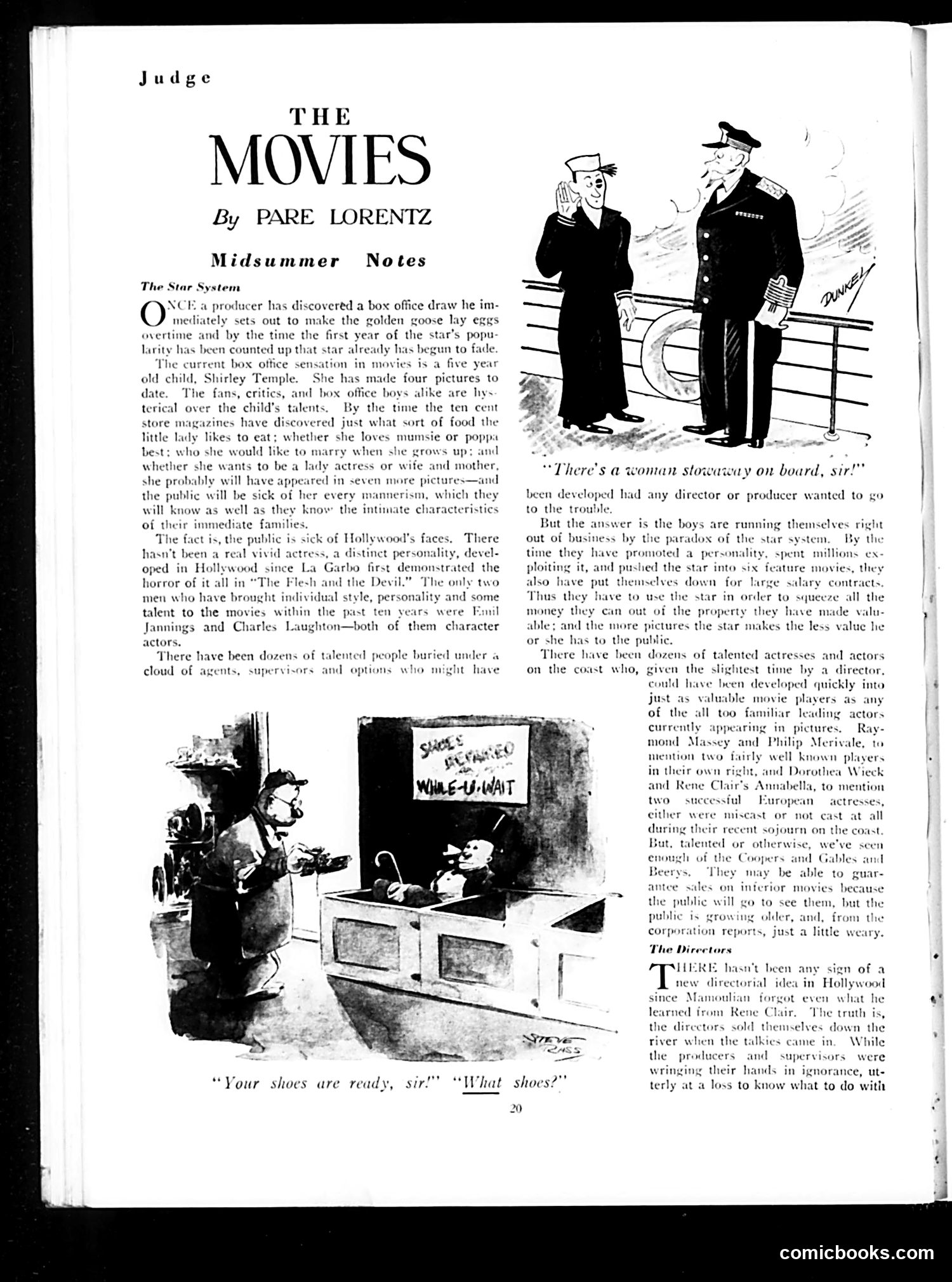
"The Movies" by Pare Lorentz - Judge Magazine This is a satirical essay about Hollywood's "star system," not primarily a political cartoon. The two cartoon illustrations support the critique. The Main Argument: Lorentz argues that studios exploit child star Shirley Temple (the "five year old child" mentioned) by overproducing her films until the public grows sick of her. The system creates a paradox: studios spend millions promoting stars, then must extract maximum profits by making endless pictures, which destroys the star's box-office appeal. The Cartoons: - Top illustration shows naval officers; the caption "There's a woman stowaway on board, sir!" likely mocks overused movie plots - Bottom illustration shows a film set with "While-U-Wait" sign, satirizing rushed, assembly-line movie production The Point: Lorentz criticizes how the studio system mechanically churns out content, burying talented performers under contracts while relying on overexposed stars, ultimately exhausting audience interest and wasting talent.
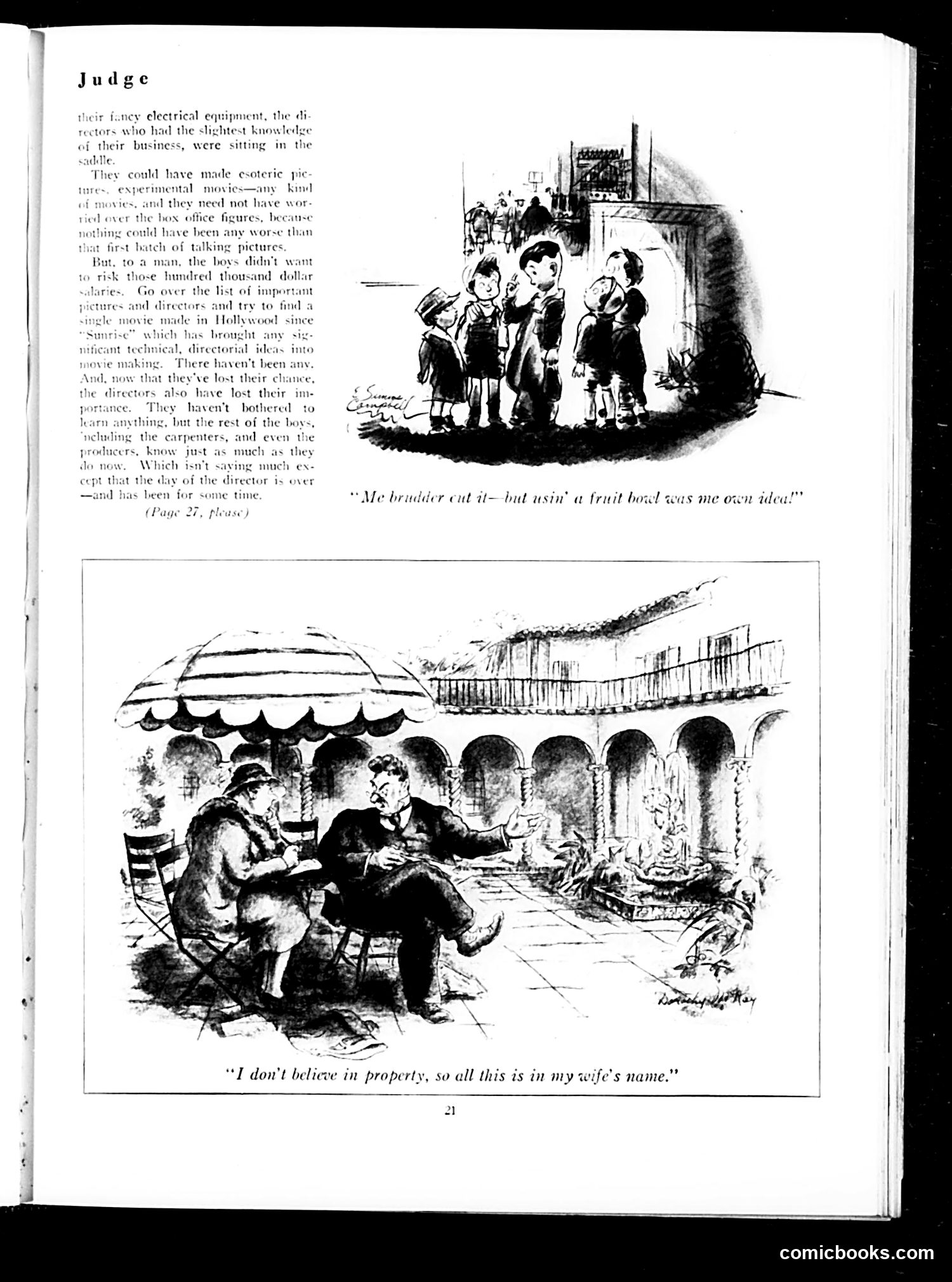
Judge Magazine Cartoon Analysis This page critiques the early sound film era's creative decline. The text laments that Hollywood directors lost their artistic authority and financial justification once "talking pictures" arrived—they could no longer hide poor box-office performance behind technical experimentation. The passage argues directors squandered their influence and now possess no more expertise than carpenters or producers. The two cartoons illustrate social commentary unrelated to film: Top cartoon: Street children discuss petty crime, with one explaining he used a fruit bowl as a weapon—satirizing juvenile delinquency and working-class desperation. Bottom cartoon: A man claims all property belongs to his wife to avoid taxes or creditors while maintaining socialist rhetoric ("I don't believe in property")—mocking wealthy hypocrites who espouse radical ideology while protecting their assets through legal technicalities. This reflects 1920s-era debates about socialism and wealth inequality.
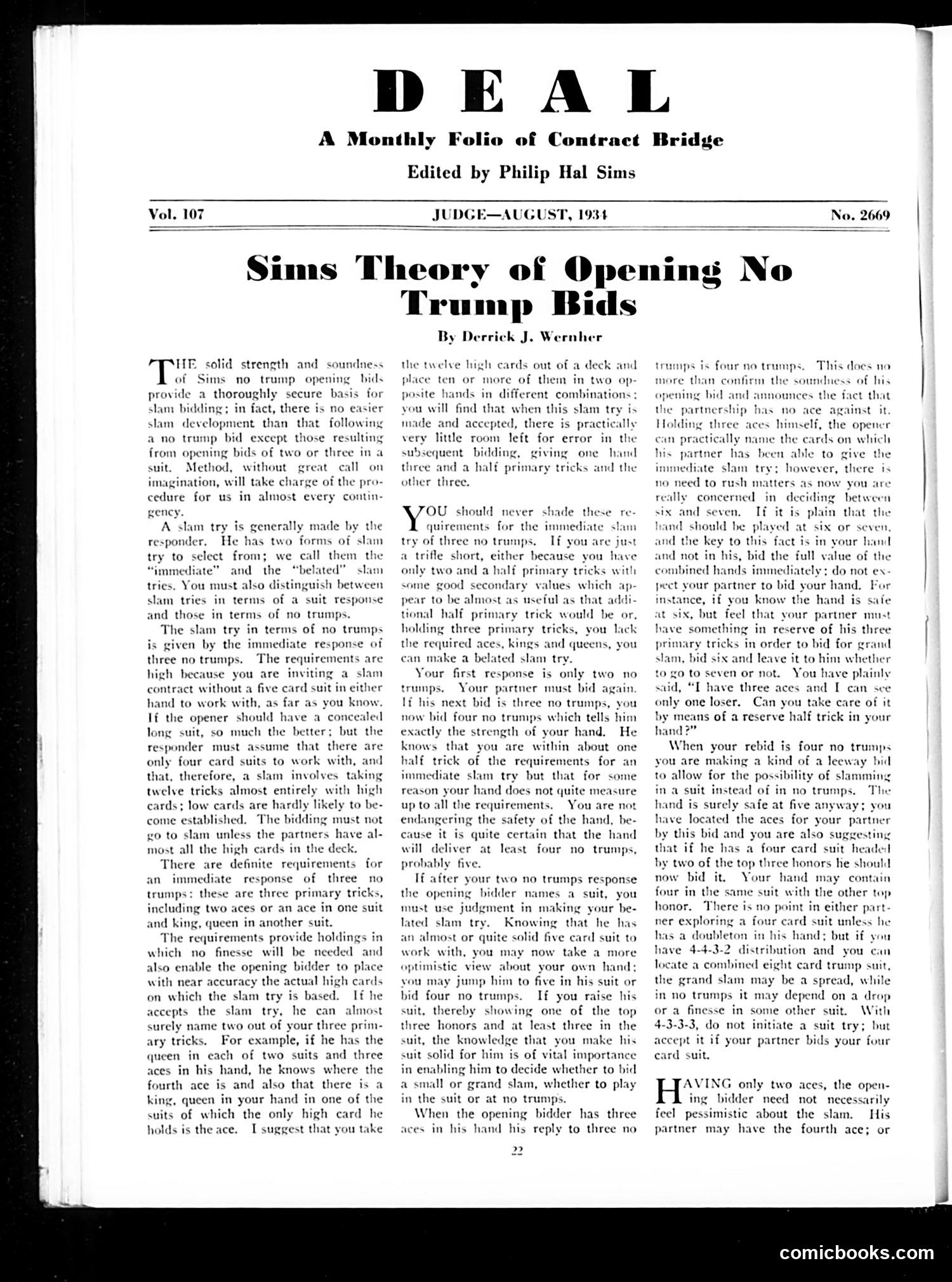
Content Analysis This page is not a political cartoon but rather instructional content about contract bridge, a card game. The article, "Sims Theory of Opening No Trump Bids" by Derrick J. Wernher, explains bidding strategy in bridge—specifically how to respond to "no trump" opening bids when attempting a "slam" (winning all or nearly all tricks). DEAL was a monthly instructional magazine about contract bridge, edited by Philip Hal Sims, a prominent bridge theorist. This appears to be Vol. 107 from August 1934. The "satire" here is not political—it's the dry, methodical humor of bridge instruction itself: the precise, almost obsessive categorization of bidding scenarios and hand requirements. The elaborate rules about "immediate" versus "belated" slam tries, primary tricks, and card placement reflect bridge's reputation as an intellectually demanding game requiring both mathematical calculation and psychological insight. There are no political figures or social commentary—this is purely a games magazine.
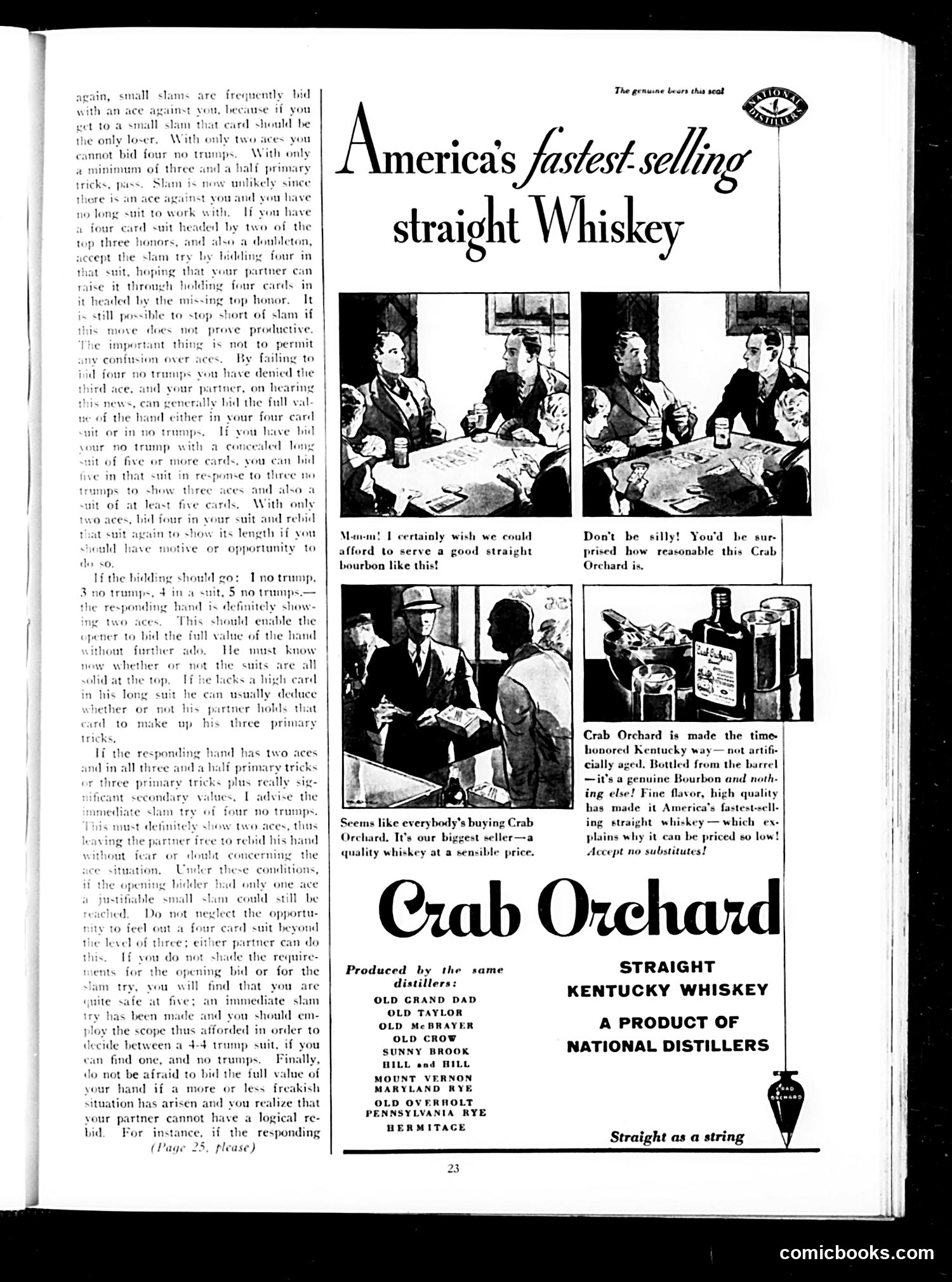
Analysis of This Judge Magazine Page This page is primarily a whiskey advertisement, not political satire. It features Crab Orchard bourbon whiskey, marketed as "America's fastest-selling straight whiskey." The upper portion contains bridge card-game strategy text (unrelated to the ad). The advertisement itself uses four black-and-white photographs showing men in suits around a card table, discussing the whiskey in casual conversation. The captions present a sales pitch: one man wishes they could "afford to serve a good straight bourbon like this," while another counters that Crab Orchard is actually "reasonable" in price. The ad emphasizes the product's authenticity ("genuine Bourbon") and value proposition, listing other brands made by National Distillers (the parent company). The tagline "Straight as a string" plays on the whiskey's purity claim. There is no political cartoon or satire on this page—it's a straightforward mid-century commercial advertisement designed to appeal to middle-class consumers through relatable domestic scenarios.
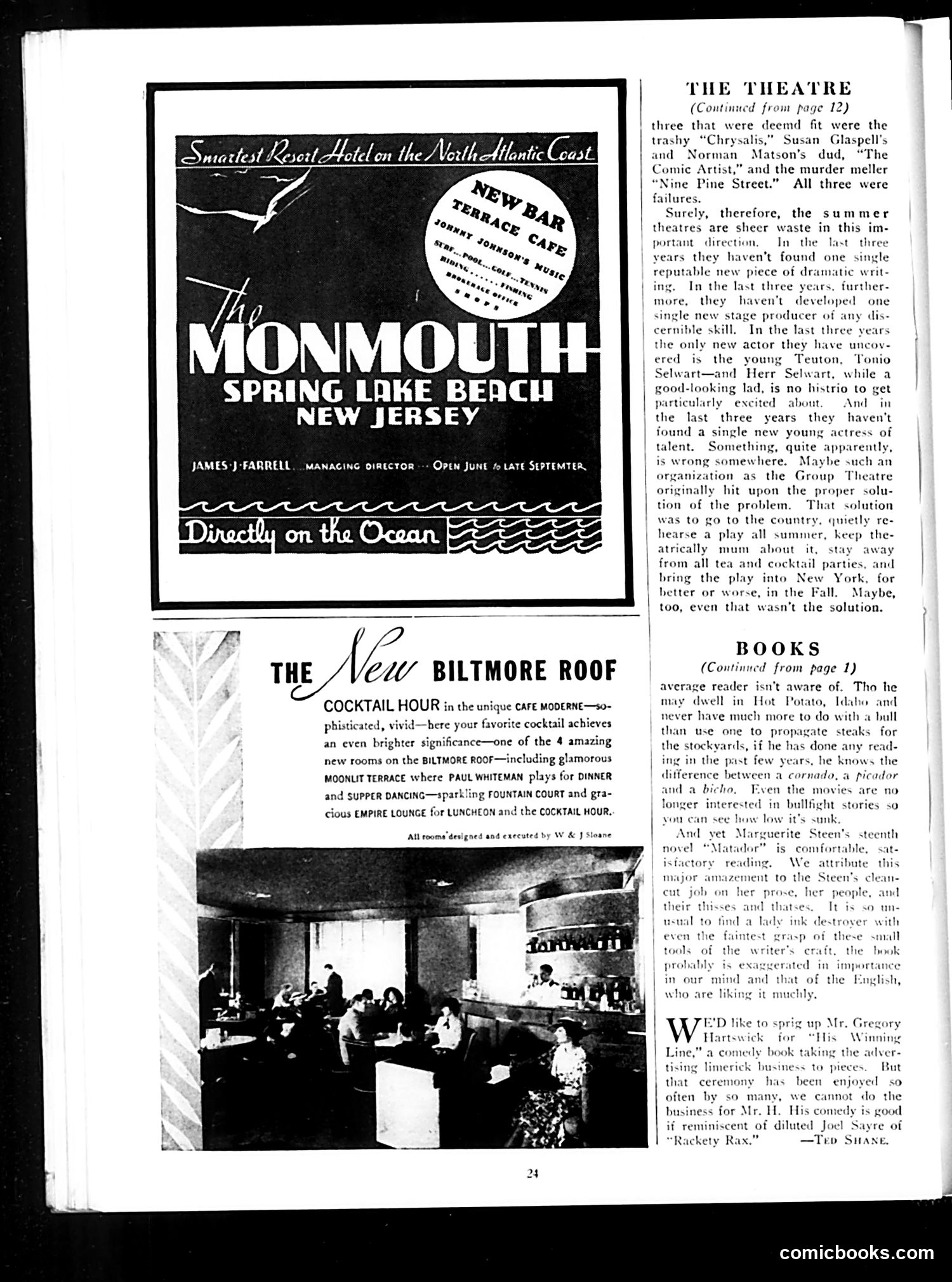
Analysis of Judge Magazine Page This page is primarily advertising and book reviews, not political satire. The main content consists of: 1. Advertisements: The Monmouth resort hotel in New Jersey and the Biltmore Roof nightclub in New York, both targeting affluent leisure travelers. 2. Theatre Column: A critical review discussing summer theatres' failure to discover new dramatic talent, playwrights, or producers in recent years. The critic specifically mentions failed productions like "Chrysalis" and "The Comic Artist," and notes that only one new actor—Tonio Selwart—emerged, with no new young actresses discovered. 3. Book Reviews: Brief assessments of recent novels, including Marguerite Steen's "Matador" and Gregory Hartswick's "His Winning Line," written in the magazine's typical witty, dismissive tone. The page reflects 1920s-30s elite culture, advertising luxury destinations and discussing highbrow theatrical and literary pursuits for Judge's sophisticated readership. No political cartoons or caricatures appear on this page.
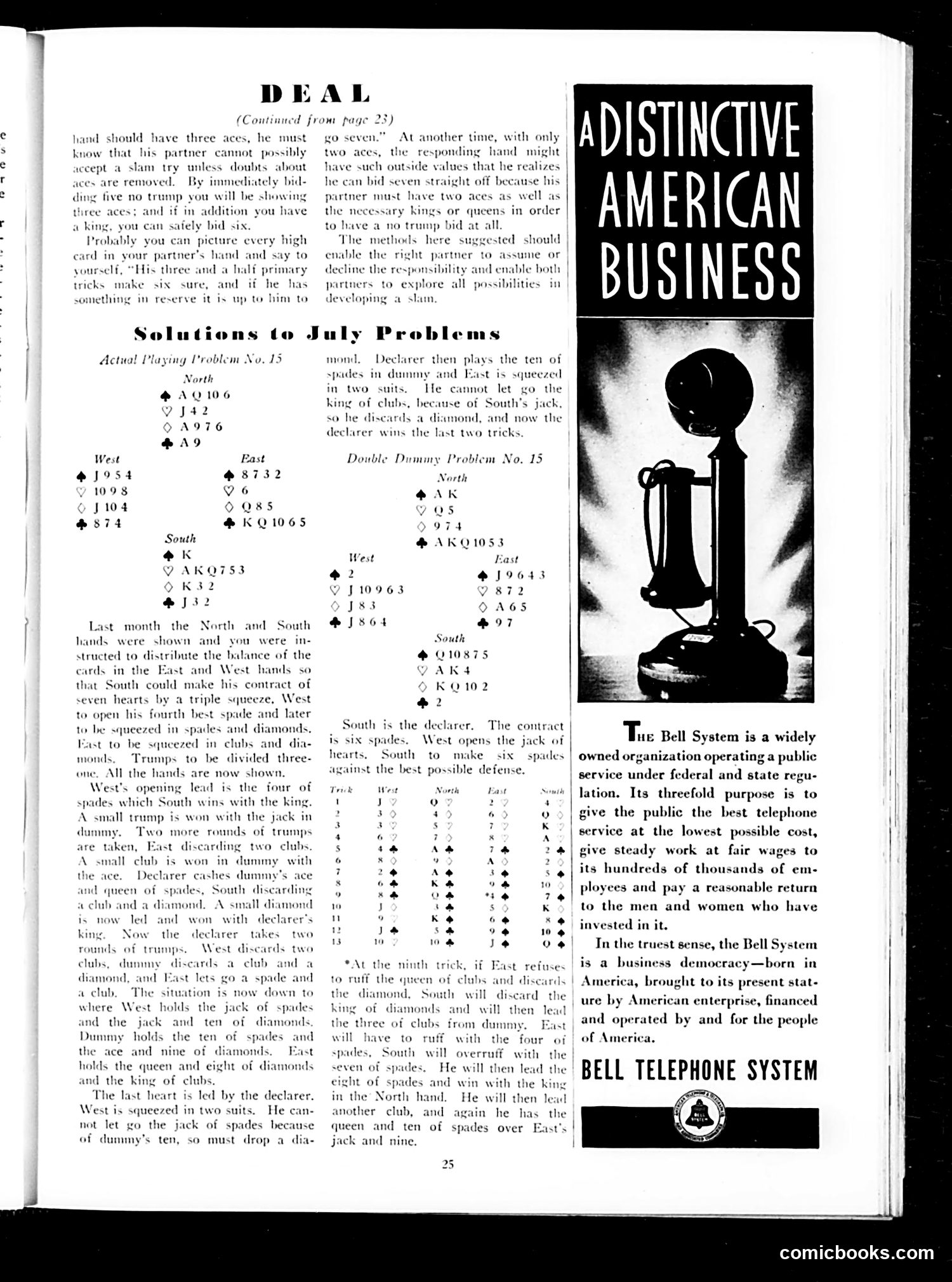
Analysis of Judge Magazine Page 25 This page is primarily bridge (card game) instruction and strategy, not political satire. The left two-thirds contains technical bridge problems with hand diagrams and solutions—typical instructional content Judge regularly featured for readers. The notable element is the right-side advertisement for the Bell Telephone System. The ad features a stark black silhouette illustration of an old-style telephone and includes corporate messaging about the Bell System as "a business democracy—born in America, brought to its present stature by American enterprise, financed and operated by and for the people of America." This represents corporate public relations during an era when large monopolies faced scrutiny. The "business democracy" framing was designed to counter criticism of Bell's dominant market position by emphasizing worker wages, public service, and broad stock ownership. The dramatic, heroic visual styling was typical 1920s-30s corporate propaganda. The juxtaposition—bridge strategy alongside Bell's self-promotion—reflects Judge's mixed content: instruction, puzzles, and paid advertising funding the publication.
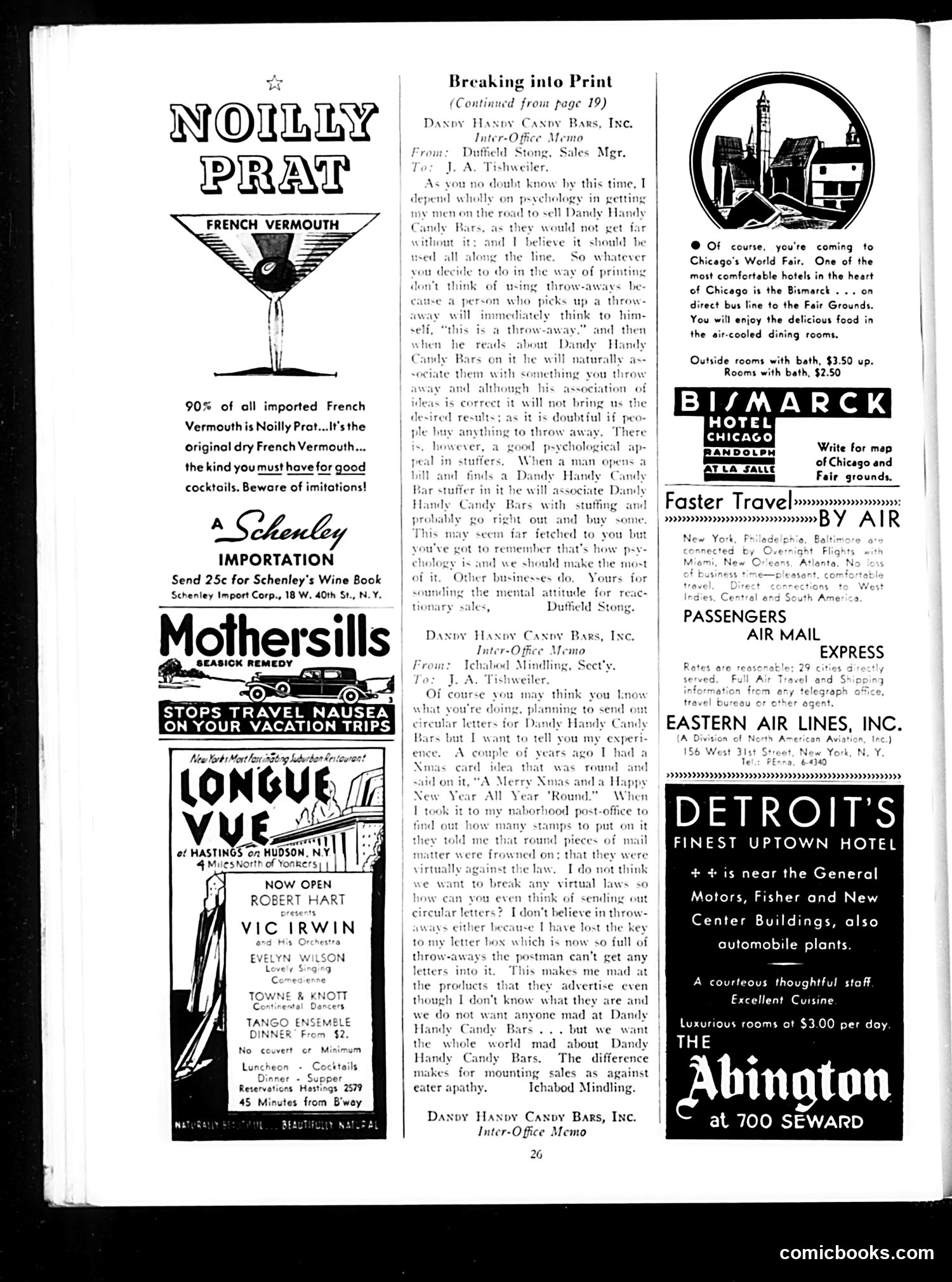
Page Analysis: Judge Magazine Advertisement and Business Memos This page is primarily advertising and business correspondence, not satire or political commentary. The content consists of: 1. Advertisements for various products and services: Noilly Prat French Vermouth, Mothersills (travel nausea remedy), a nightclub called Longue Vue, the Bismarck Hotel in Chicago, Eastern Air Lines, and the Abington Hotel in Detroit. 2. "Breaking into Print" — a series of inter-office memos from the Dandy Handy Candy Bars company discussing marketing strategy, particularly about using candy bars as promotional "stuffers" in direct mail. The debate centers on whether throw-away promotional items effectively build brand association or waste money. There is no political cartoon or satire on this page. The "Longue Vue" box advertises a nightclub featuring entertainers (Robert Hart, Vic Irwin, Evelyn Wilson, and others) with dinner and dancing. The page represents typical 1930s-era advertising and business communication—straightforward marketing pitches with no editorial commentary.
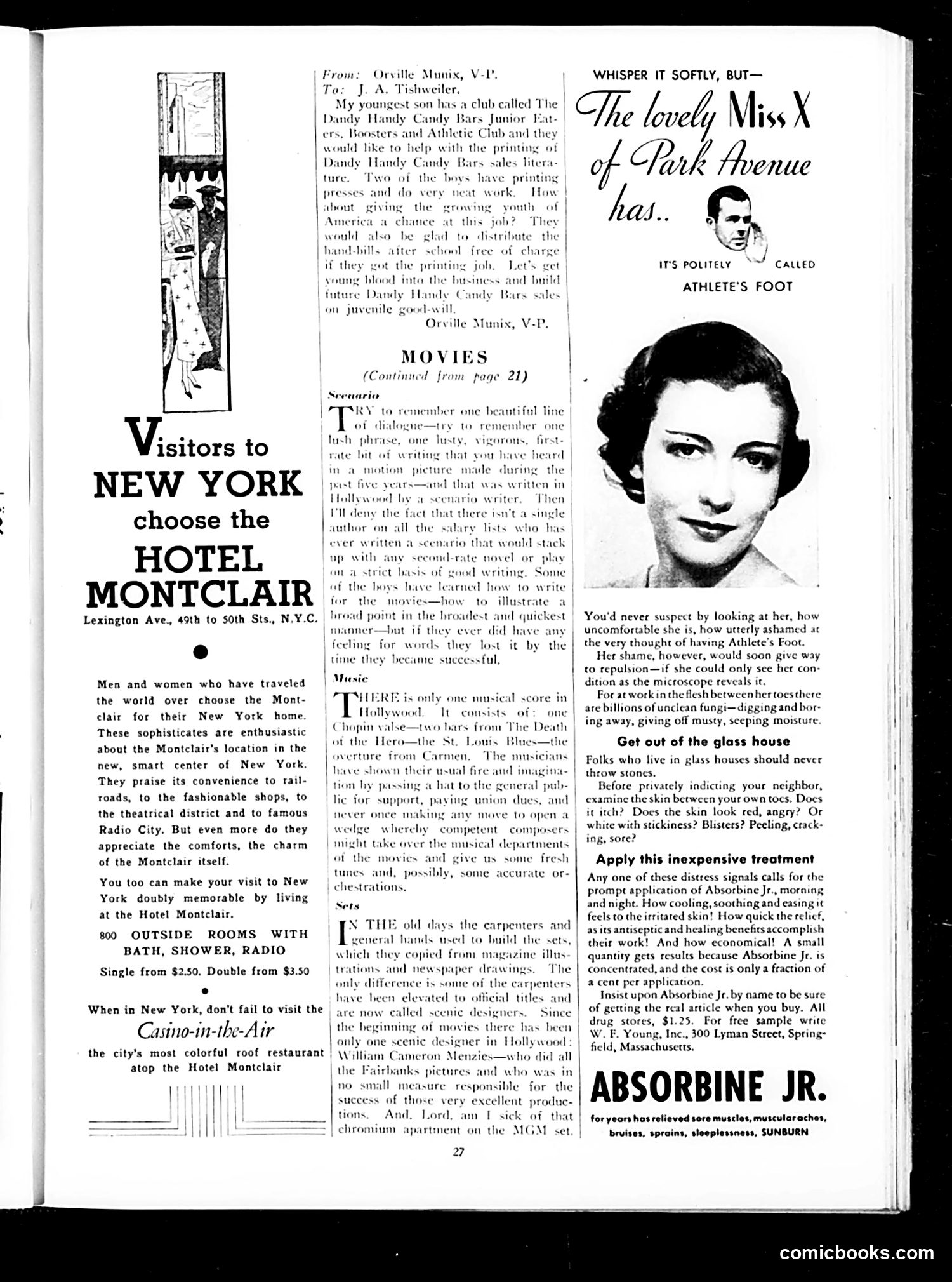
Analysis of Page 27, Judge Magazine This page is primarily advertising and editorial content, not political satire. The main elements are: Advertisements: - Hotel Montclair (luxury NYC lodging) - Absorbine Jr. (medicinal product for "Athlete's Foot") Editorial Content: A letter to the editor from Orville Munix proposing that a youth club ("Dandy Handy Candy Bars Junior") help with printing sales literature—a suggestion to give young people business experience. A column critiquing Hollywood's creative output: the author argues that screenwriters produce derivative work, film composers recycle the same musical bars, and only William Cameron Menzies stands out as an original scenic designer. No political cartoon appears on this page. The Absorbine Jr. ad uses humor (the embarrassment of athlete's foot) but isn't satirical commentary. The page reflects 1930s-era concerns about youth employment and entertainment industry standardization.
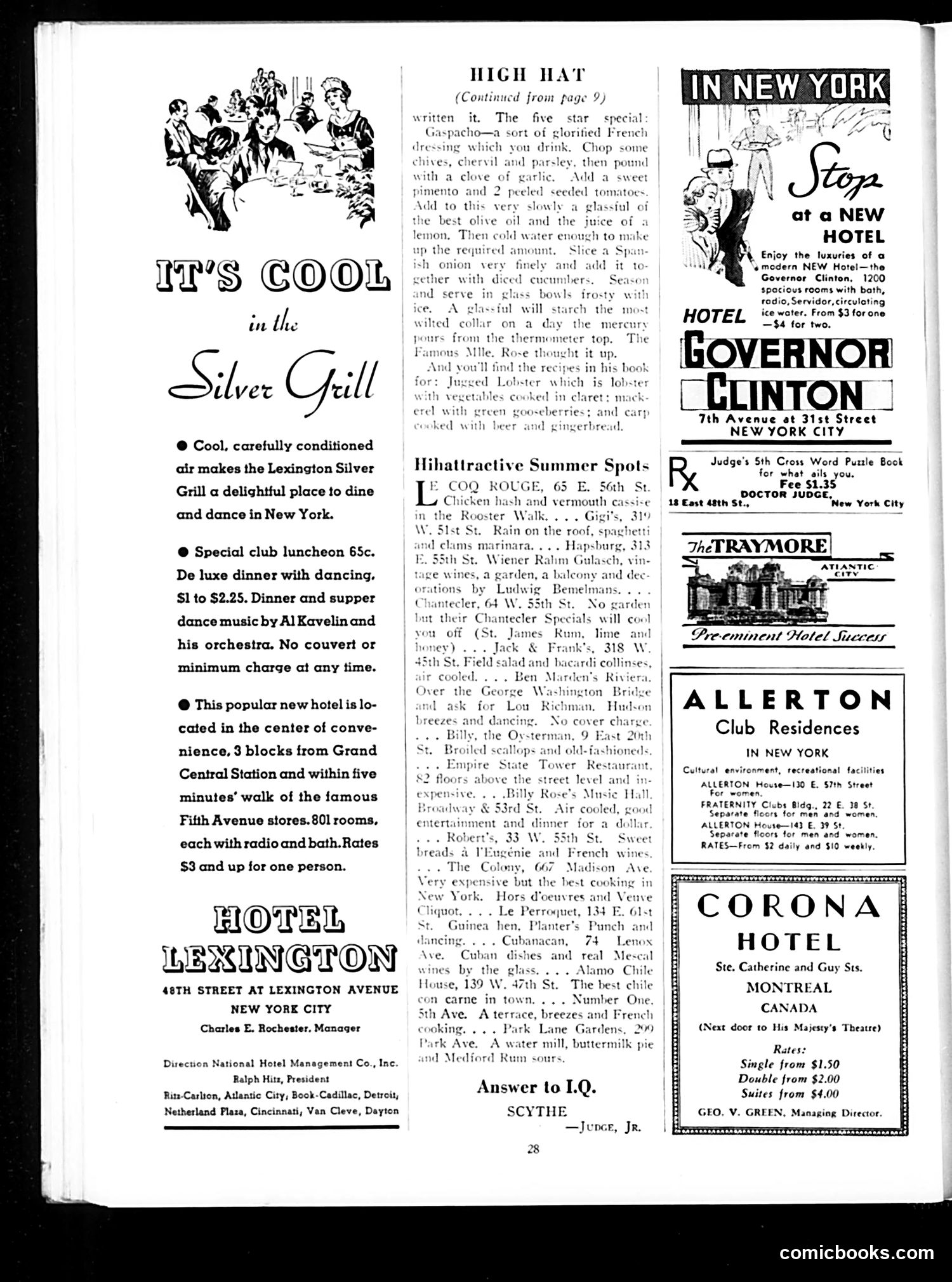
Analysis of Judge Magazine Page 28 This page is primarily advertising, not political satire. The dominant content includes hotel and restaurant advertisements for New York establishments (Hotel Lexington, Governor Clinton, Allerton Club Residences, Corona Hotel in Montreal). The only editorial content is a small illustration at top left showing what appears to be a social gathering or dinner scene with multiple figures, accompanying text titled "It's Cool" promoting the Lexington Silver Grill's air conditioning and dining amenities. Below that is a continued article titled "High Hat" (from page 9) discussing Spanish cuisine and upscale New York restaurants—appearing to be lifestyle/food editorial rather than political commentary. At bottom is a brief "Answer to I.Q." with the answer "SCYTHE" credited to "Judge, Jr.," likely referencing a previous puzzle. No clear political cartoons or satirical commentary are visible on this page. It functions as a leisure/lifestyle and advertising section of the magazine rather than satirical content.
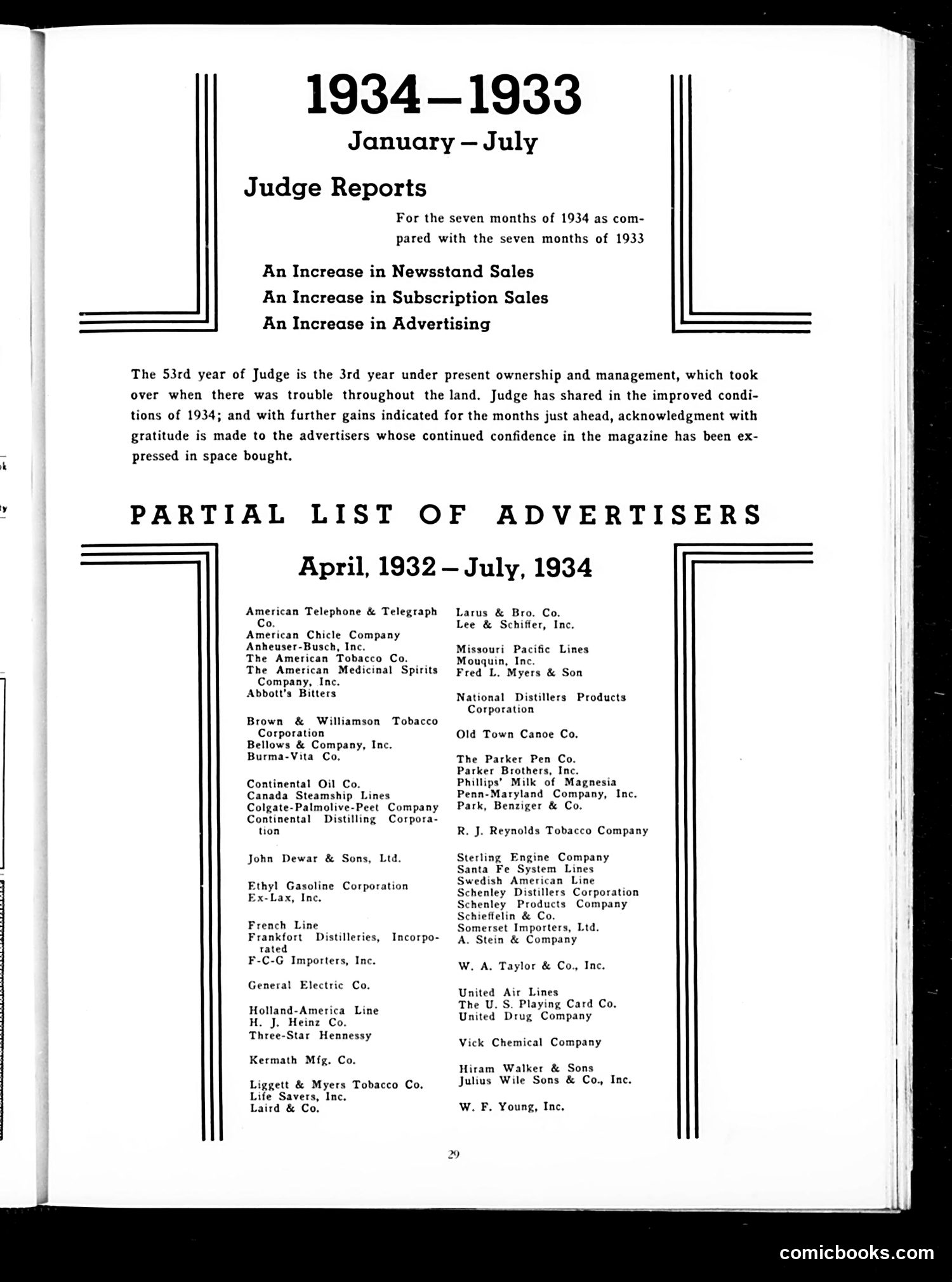
Judge Magazine Business Report (1934-1933) This is a business/editorial page, not a cartoon. It reports that Judge magazine—in its 53rd year overall and 3rd under new ownership—achieved increases in newsstand sales, subscriptions, and advertising during the first seven months of 1934 compared to 1933. The text credits this growth to improved economic conditions (the takeover occurred "when there was trouble throughout the land"—referencing the Depression) and thanks advertisers for their continued confidence. The page then lists major advertisers from April 1932 to July 1934, dominated by alcohol brands (Anheuser-Busch, distilleries, liquor importers), tobacco companies, and consumer goods. This reflects Judge's target audience: affluent, urban readers. The alcohol prevalence is notable given Prohibition's repeal in December 1933—newly legal liquor companies rushed to advertise.
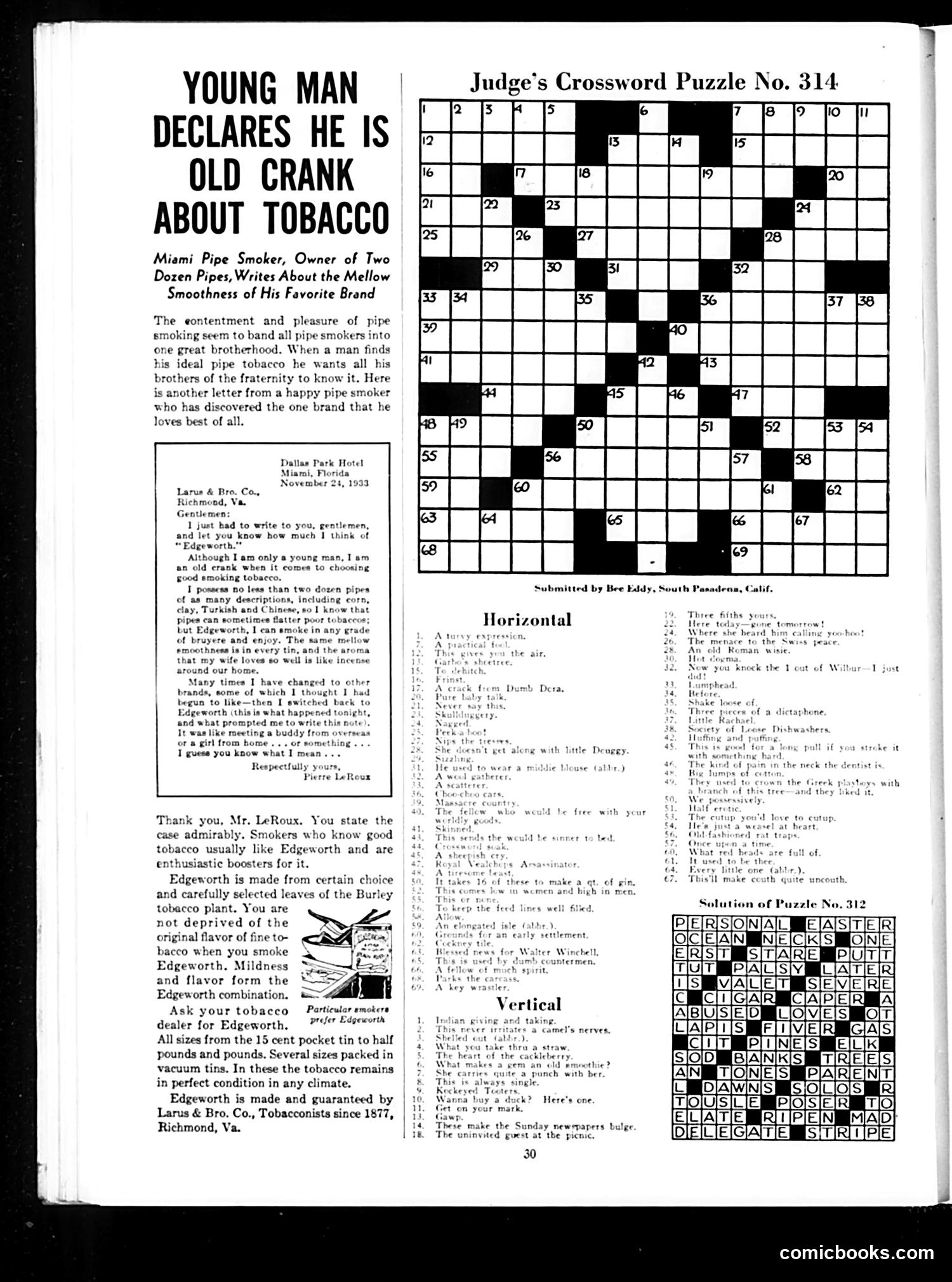
Judge Magazine Page Analysis This page is primarily advertising disguised as editorial content—a common practice in early 20th-century magazines. There is no political cartoon here. The main content features a testimonial letter from "Pierre LeRoux," a Miami pipe smoker, praising Edgeworth tobacco. LeRoux claims to be a young man who is nonetheless an "old crank" about tobacco quality, owns two dozen pipes, and enthusiastically endorses Edgeworth's "mellow smoothness." The satire is gentle: the humor lies in the contrast between LeRoux's youth and his curmudgeonly pickiness about tobacco—a trait typically associated with older men. The letter functions as paid endorsement advertising, presented as authentic consumer praise to build brand credibility. The page also includes a crossword puzzle and puzzle solution, standard Judge magazine filler content. This is essentially a tobacco advertisement using the editorial format to seem more authentic and trustworthy to readers.
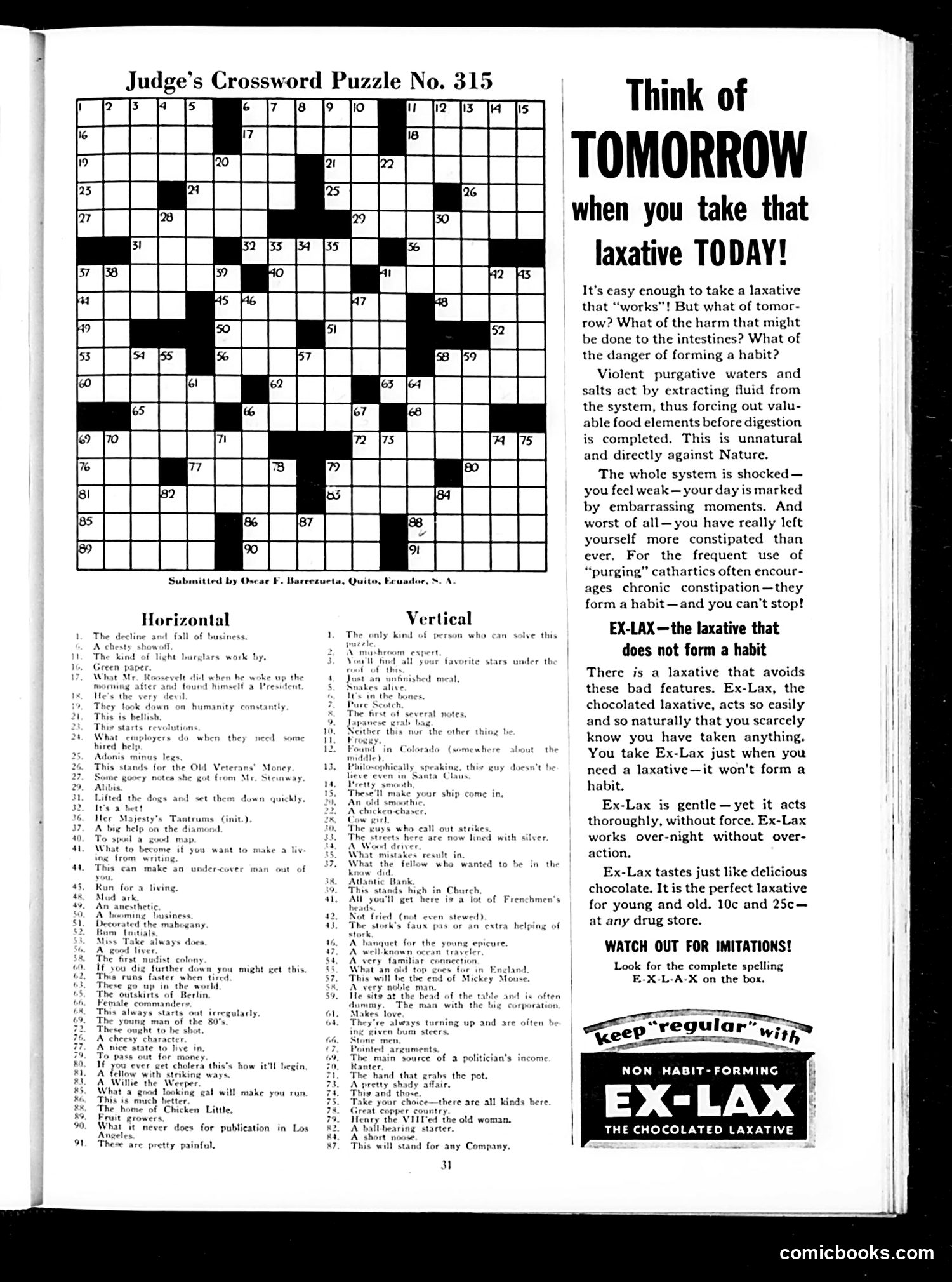
Judge Magazine Page Analysis This page contains Judge's Crossword Puzzle No. 315 alongside a full-page Ex-Lax laxative advertisement—not a political cartoon. The ad employs fear-based marketing common in early-20th-century patent medicine advertising. It warns readers that harsh laxatives cause dependency and leave users "more constipated than ever," positioning Ex-Lax as the superior alternative by claiming it's gentle, non-habit-forming, and acts "naturally" overnight. The advertisement reflects contemporary anxieties about bowel regularity—a preoccupation of the era—while exploiting existing concerns about habit-forming drugs. The emphasis on Ex-Lax being "chocolated" suggests marketing to families, including children. The crossword puzzle occupies the left side with standard wordplay clues typical of Judge's content. There is no political satire on this particular page; it represents Judge functioning as both a humor magazine and advertising vehicle.
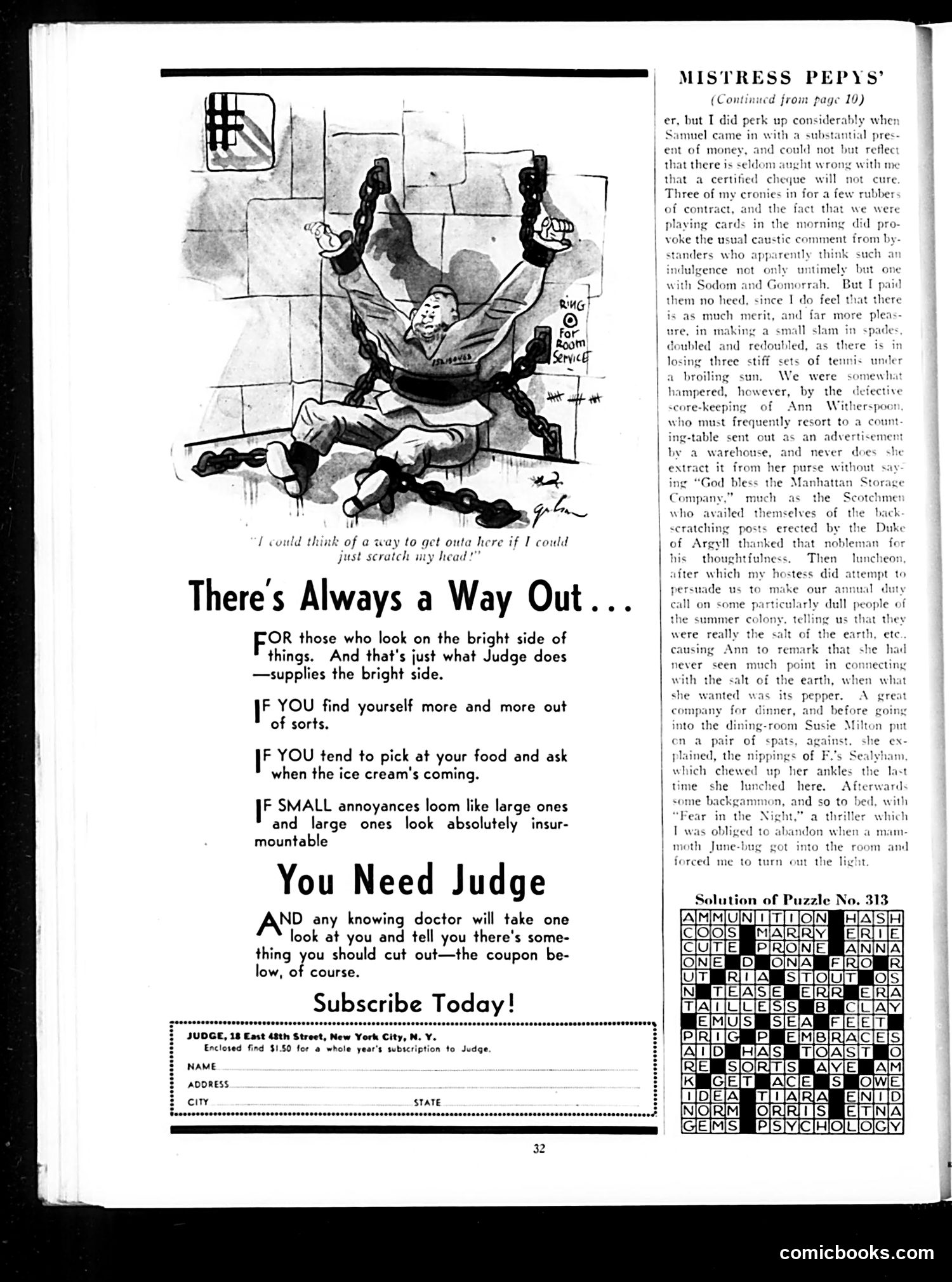
Explanation for Modern Readers This page contains two distinct elements: a serialized humor column ("Mistress Pepys") and an advertisement disguised as editorial content. The Column: "Mistress Pepys" appears to be a comedic diary piece mimicking Samuel Pepys's famous 17th-century diary, but set in contemporary (1920s-30s) society. It recounts mundane social troubles—card games, summer colony visits, domestic annoyances—written in faux-historical mock-serious style for humorous effect. The Advertisement: The large "There's Always a Way Out" section is a subscription pitch for *Judge* magazine itself, dressed up as helpful life advice. It lists common modern irritations (pickiness, pessimism, stress) and suggests that reading *Judge*'s satirical content provides mental relief. The doctor-recommendation angle was a common advertising trope of the era, implying reading *Judge* was therapeutically beneficial—a self-promotional joke typical of the magazine's house ads. The cartoon above illustrates someone literally trapped in cramped quarters, supporting the "way out" theme.
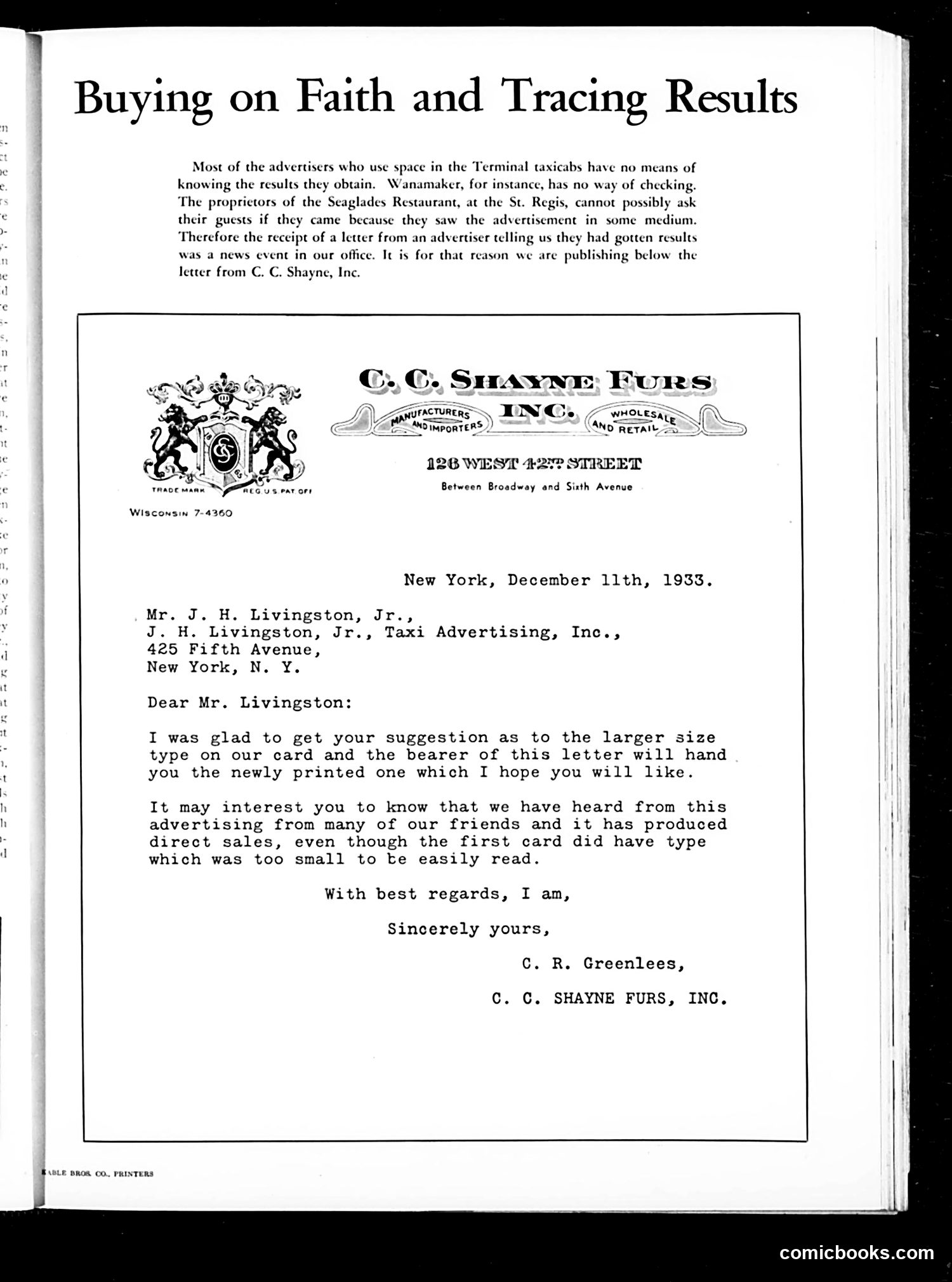
"Buying on Faith and Tracing Results" This is a trade advertisement piece, not a political cartoon. It appears in Judge magazine's advertising section and serves as a case study in advertising effectiveness. The article describes a problem: most advertisers in taxicab terminals cannot measure whether their ads actually generate sales. The editors present C.C. Shayne Furs' letter as notable evidence that taxicab advertising *does* work—the company received direct sales inquiries after placing an ad, even acknowledging the first version had type too small to read easily. The satire is gentle: the headline "Buying on Faith" captures the irony that advertisers typically invest money without concrete proof of returns. By publishing Shayne's letter confirming actual results, Judge's editors are essentially promoting their own taxicab advertising service while poking fun at the advertising industry's general inability to justify spending. It's self-interested marketing disguised as journalism.
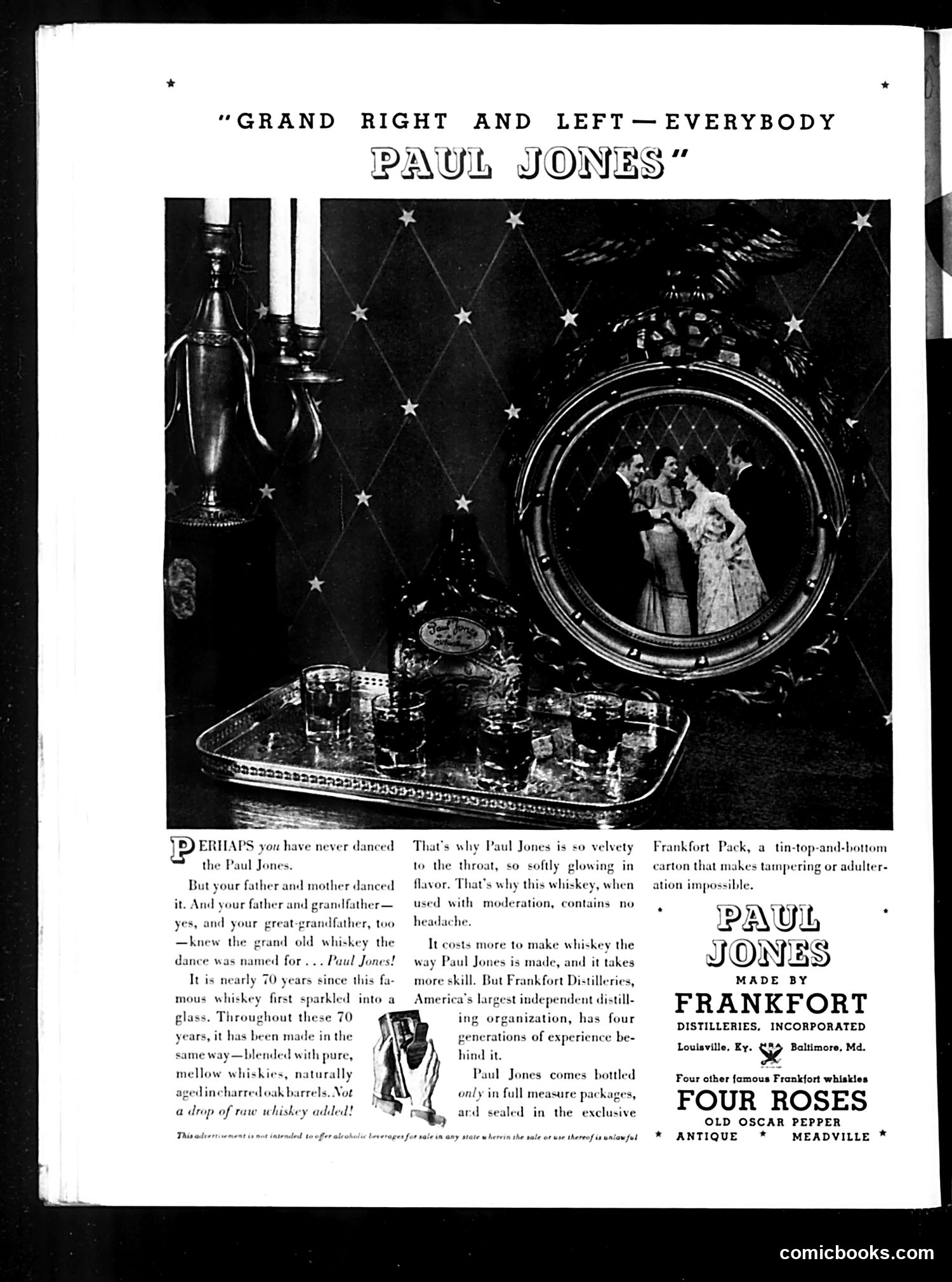
Analysis This is primarily an advertisement, not political satire. It promotes Paul Jones whiskey, made by Frankfort Distilleries. The page uses a nostalgic appeal: "Grand Right and Left—Everybody" references a traditional square-dance call, suggesting that drinking Paul Jones whiskey is as time-honored and universally accepted as folk dancing. The text claims the product has been made for nearly 70 years in "the same way—blended with pure, mellow whiskies." The visual shows an ornate bar setup with bottles and a circular mirror or porthole framing what appears to be dancing couples—reinforcing the "dance" metaphor and the product's association with social enjoyment and tradition. The advertisement emphasizes quality ("costs more to make"), safety ("contains no headache"), and exclusivity (sealed packaging to prevent tampering). For modern readers, this is notable as a pre-Prohibition or Prohibition-era ad normalizing alcohol consumption by linking it to wholesome American traditions.