judge
Judge — September 1934
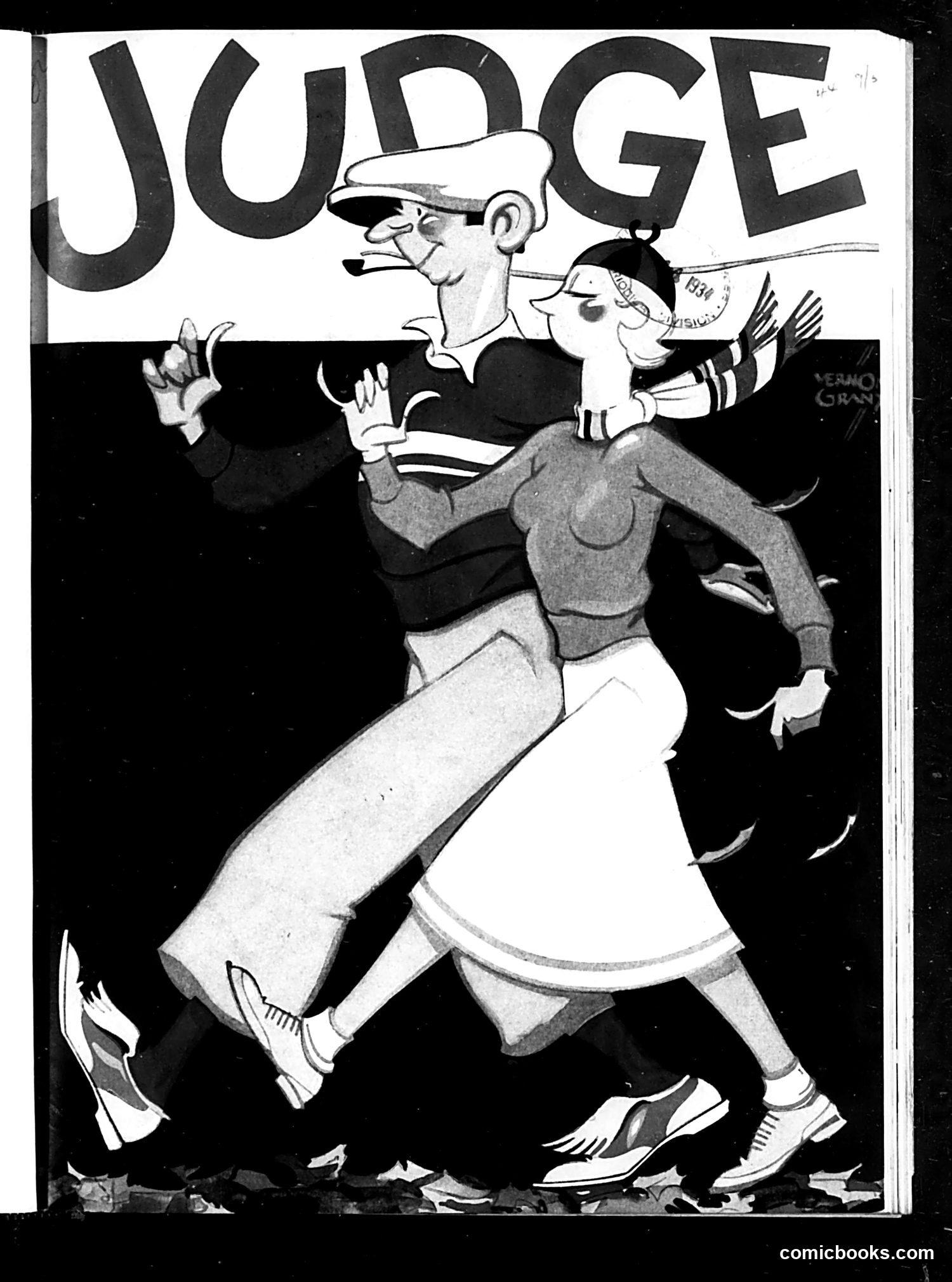
Judge Magazine Cartoon Analysis This appears to be a cover from *Judge* magazine featuring a caricatured couple dancing. The large word "JUDGE" dominates the top, establishing this as the magazine's masthead or cover. The cartoon depicts a man in a cap and woman in athletic/sailor-style clothing dancing together energetically. The exaggerated style and dynamic poses suggest satire about modern social behavior—likely commentary on 1920s-1930s dancing, courtship, or changing social mores. Without additional visible text identifying specific figures or dated context, I cannot definitively state whether these represent particular political figures or reference a specific event. The jovial, physical humor suggests the satire targets contemporary social trends rather than serious political matters. The artistic style is consistent with early 20th-century American comic illustration.
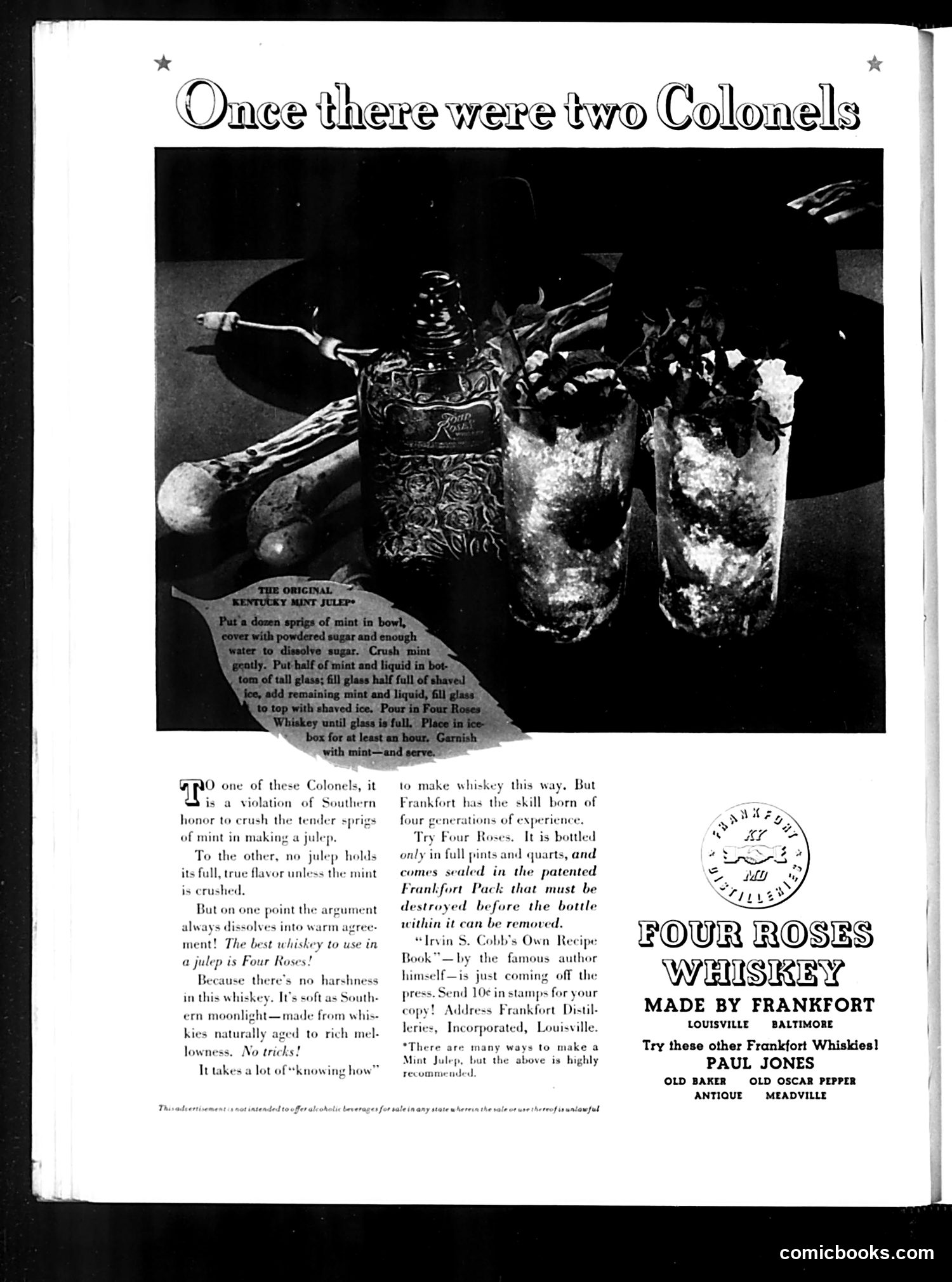
Analysis This page is primarily advertising, not political satire. It features a full-page ad for Four Roses Whiskey made by Frankfort Distilleries in Louisville and Baltimore. The "two Colonels" reference in the headline appears to be a marketing device rather than political commentary—likely referring to the brand's association with Southern gentility and bourbon tradition (the "Colonel" being a social rank evoked by Kentucky whiskey culture). The page includes a recipe for "The Original Kentucky Mint Julep" and emphasizes the whiskey's quality and proper preparation methods. There's also text about obtaining a recipe book by H.S. Cobb. Additional Frankfort whiskey brands are advertised: Paul Jones, Old Baker, Old Oscar Pepper, Antique, and Meadville. This is primarily a consumer advertisement rather than editorial satire.
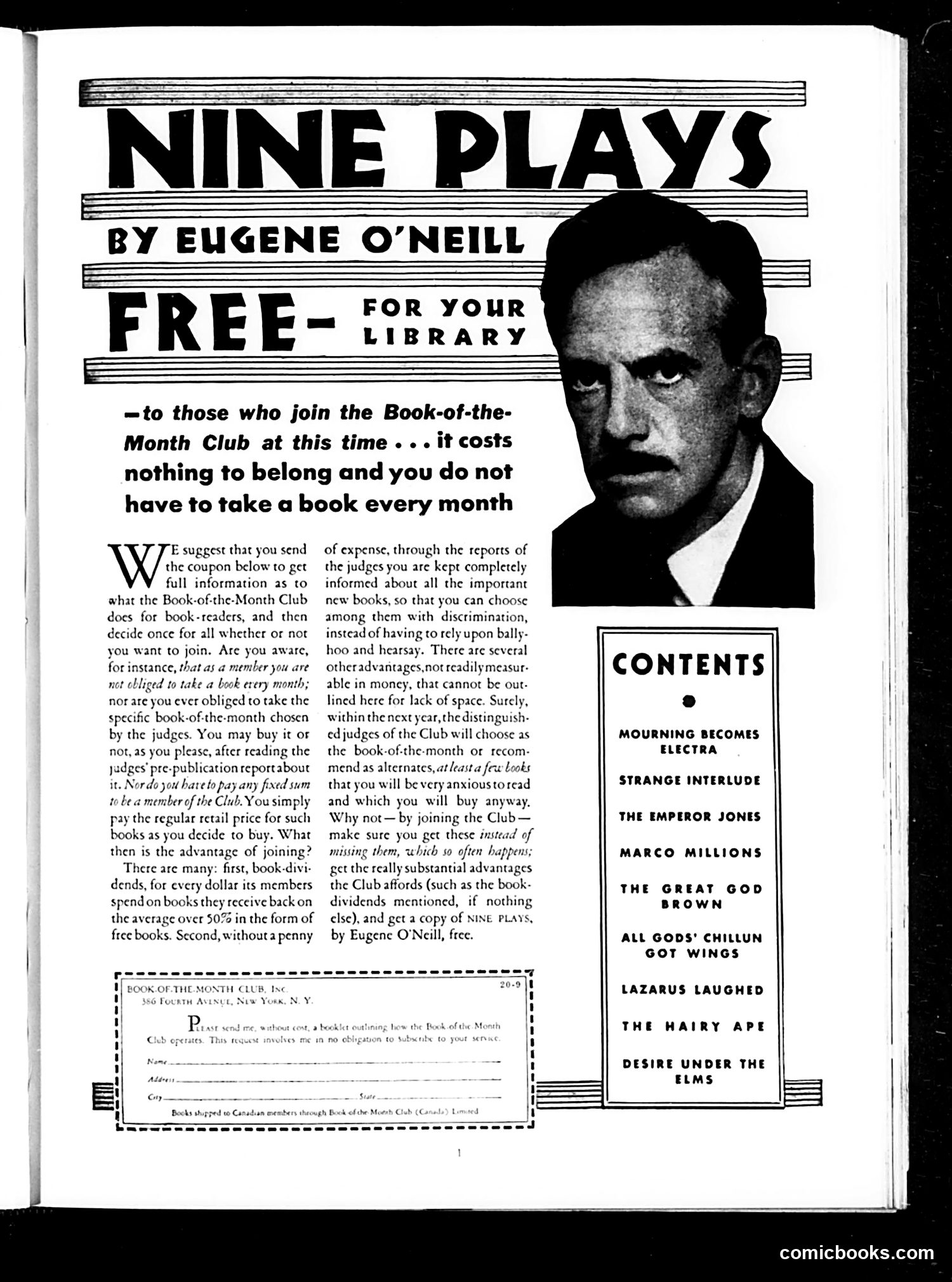
Analysis This page is primarily advertising, not satire or editorial content. It promotes a Book-of-the-Month Club membership offering nine plays by Eugene O'Neill as a free gift. The portrait shows Eugene O'Neill, the celebrated American dramatist. O'Neill was a prestigious literary figure in the 1920s-1930s, so featuring him lent prestige to the club's offer. The "Contents" box lists the nine plays included, such as *Mourning Becomes Electra* and *The Great Good Brown*. The pitch emphasizes membership benefits: free books, no obligation to purchase monthly selections, and access to curated literary choices through expert judges. The coupon at bottom allows readers to request club information. This is straightforward commercial promotion, not satirical commentary on contemporary politics or society.
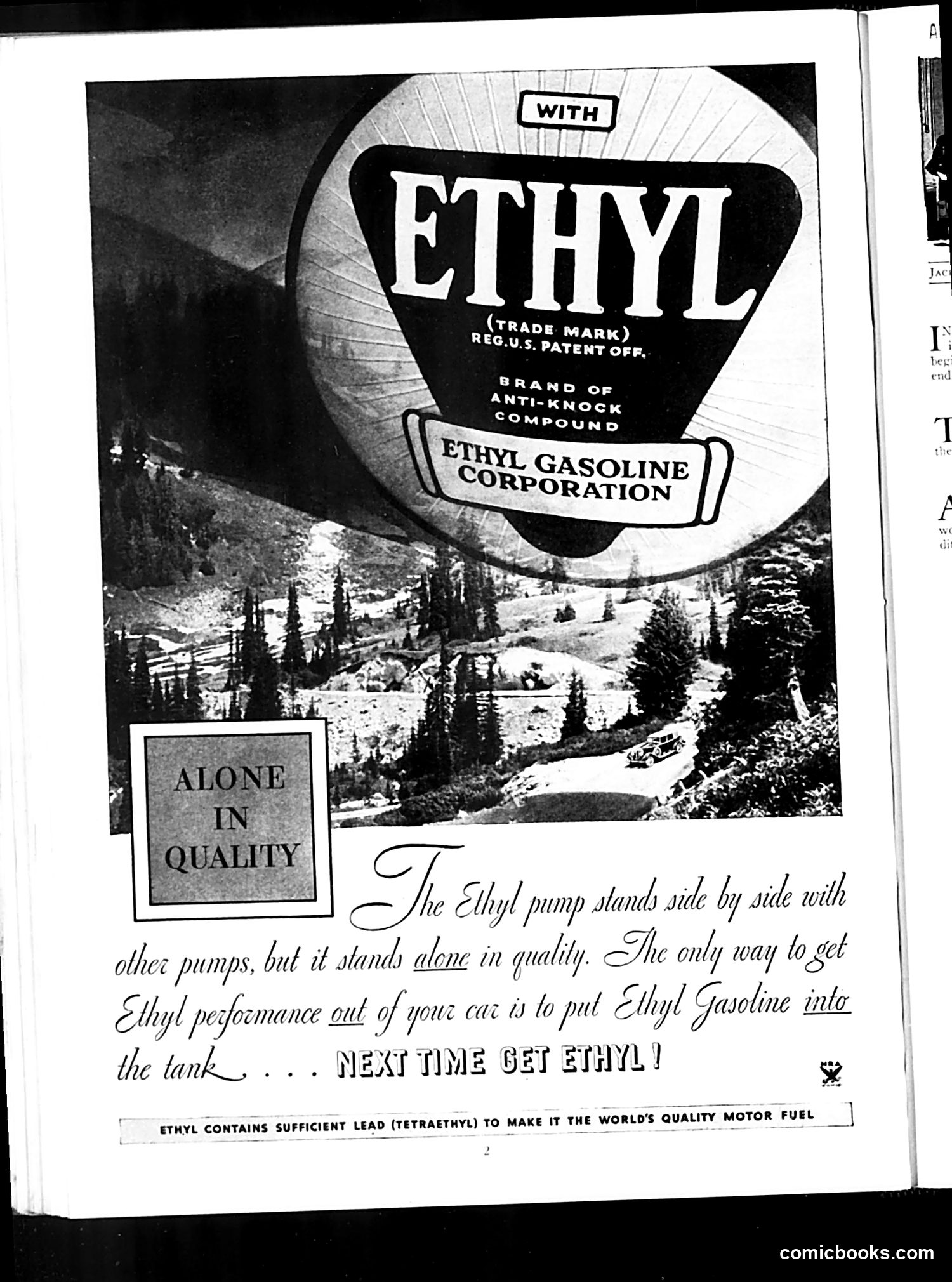
Ethyl Gasoline Advertisement This is a product advertisement, not political satire. The Ethyl Gasoline Corporation is promoting their branded fuel additive (tetraethyl lead) as superior to competitors. The ad's tagline "Alone in Quality" claims Ethyl stands apart despite competing pumps existing "side by side." The copy urges drivers to use Ethyl gasoline to achieve better car performance. Historical context for modern readers: This advertisement openly highlights lead (tetraethyl) as a desirable ingredient—what we now know is a toxic neurotoxin. This reflects early-20th-century ignorance about lead's dangers. Lead additives were eventually banned from gasoline in most countries due to severe public health impacts. The ad represents an era when harmful products were marketed without safety warnings.
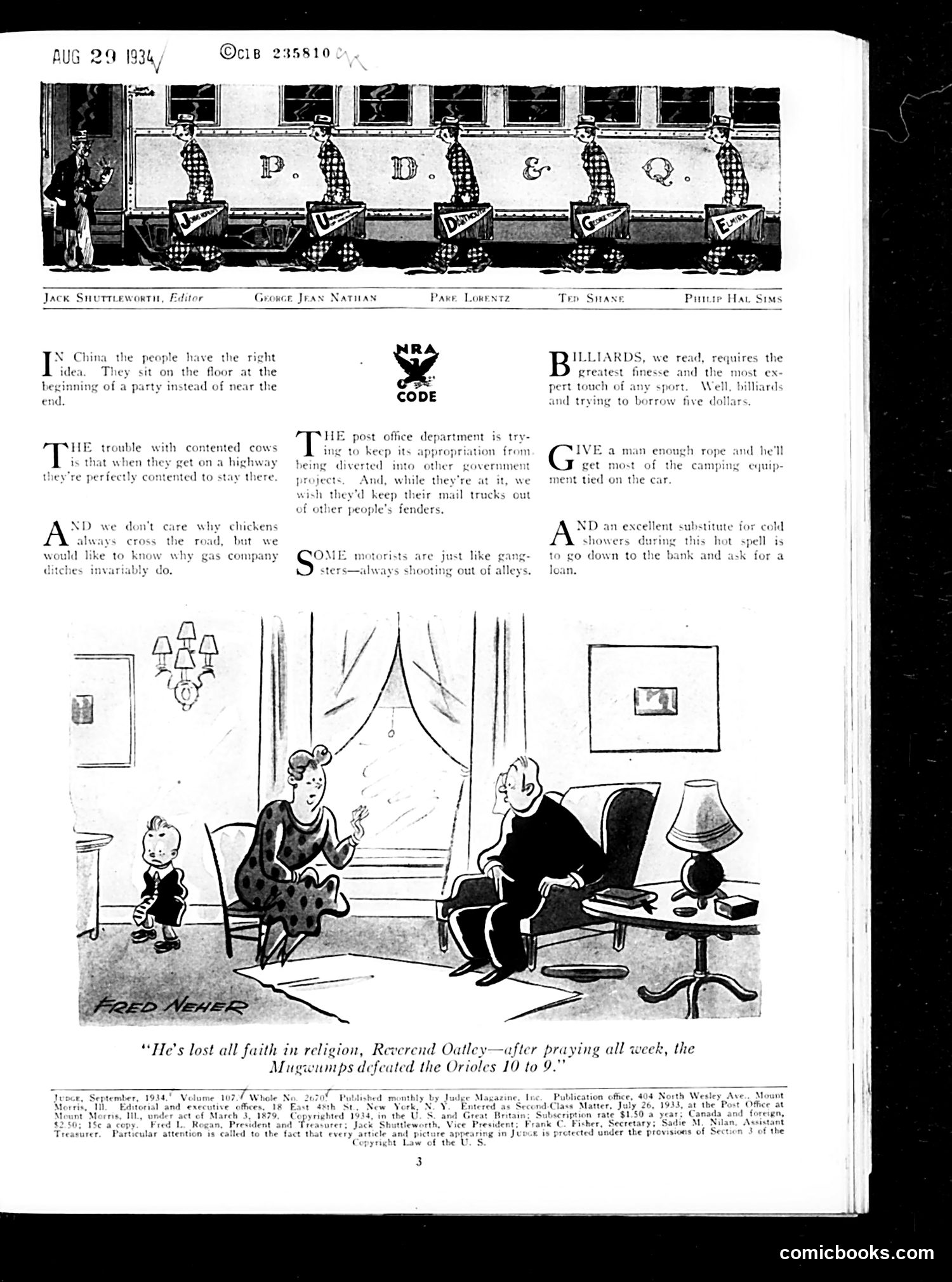
Judge Magazine Page Analysis (August 29, 1934) The main cartoon by Fred Neher depicts a domestic scene where a man tells a woman: "He's lost all faith in religion, Reverend Oatley—after praying all week, the Mugwumps defeated the Orioles 10 to 9." This satirizes how sports outcomes can shake people's faith more than religious practice. The joke turns on the absurdity of prioritizing baseball results over spiritual conviction—the man prayed all week yet the Mugwumps (likely a local or semi-professional team) lost to the Orioles, apparently devastating his faith. The surrounding text contains unrelated quips about contentment, post office trucks, chickens crossing roads, motorists, billiards, and cold showers—typical Judge magazine filler humor for the era.
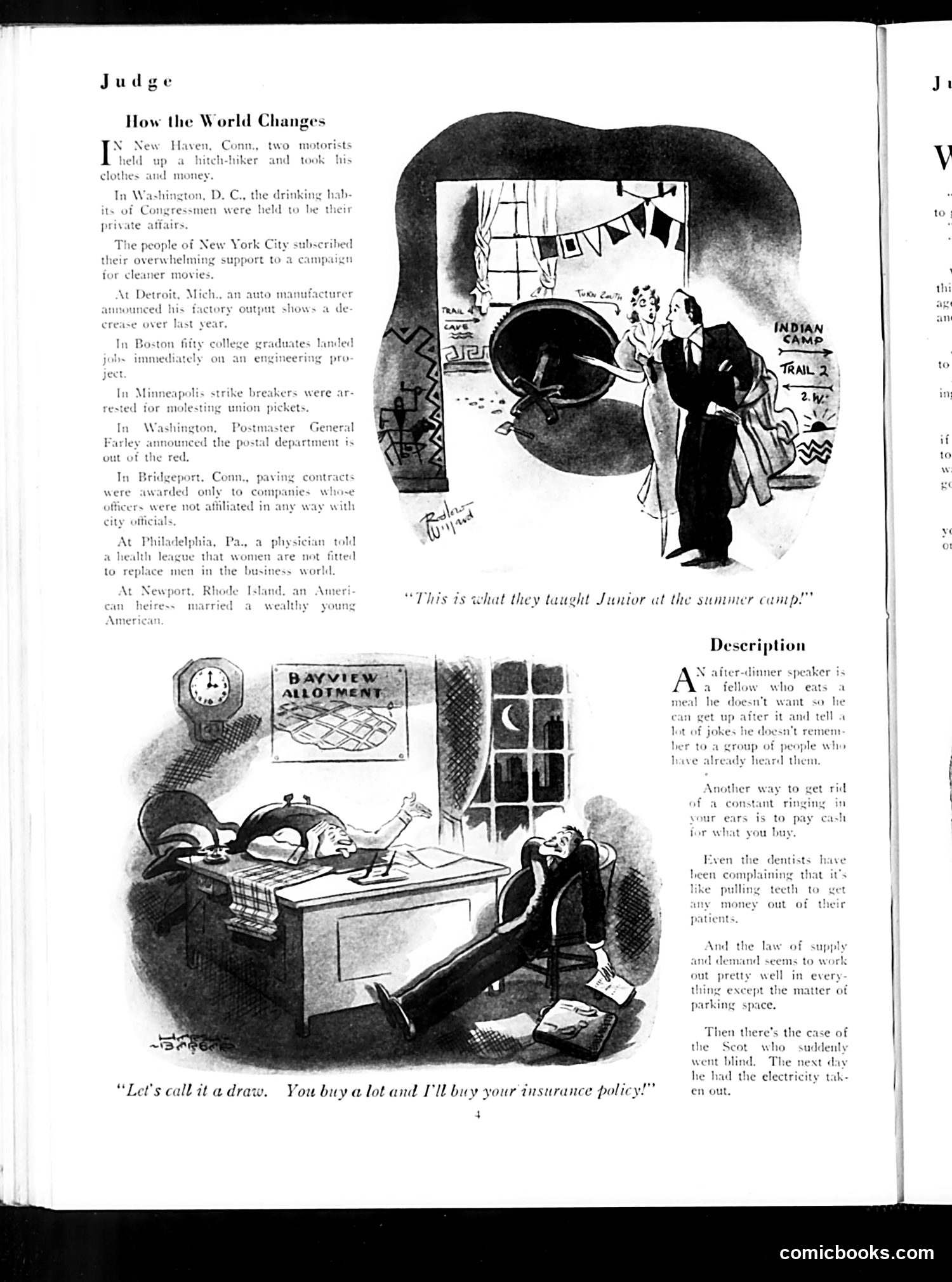
Analysis of Judge Magazine Page Top Cartoon: Shows a man at a summer camp looking at what appears to be Native American imagery ("Indian Camp" and "Trail" visible). The caption "This is what they taught Junior at the summer camp" satirizes the educational content of children's camps, likely mocking either overly romanticized depictions of Native Americans or questioning what children actually learn at such institutions. Bottom Cartoon: Depicts two men at a desk labeled "Bayview Allotment" with one's feet up. The caption "Let's call it a draw. You buy a lot and I'll buy your insurance policy!" suggests satire about real estate dealings and insurance schemes, implying collusion or dubious business practices between developers and insurance agents during this period.
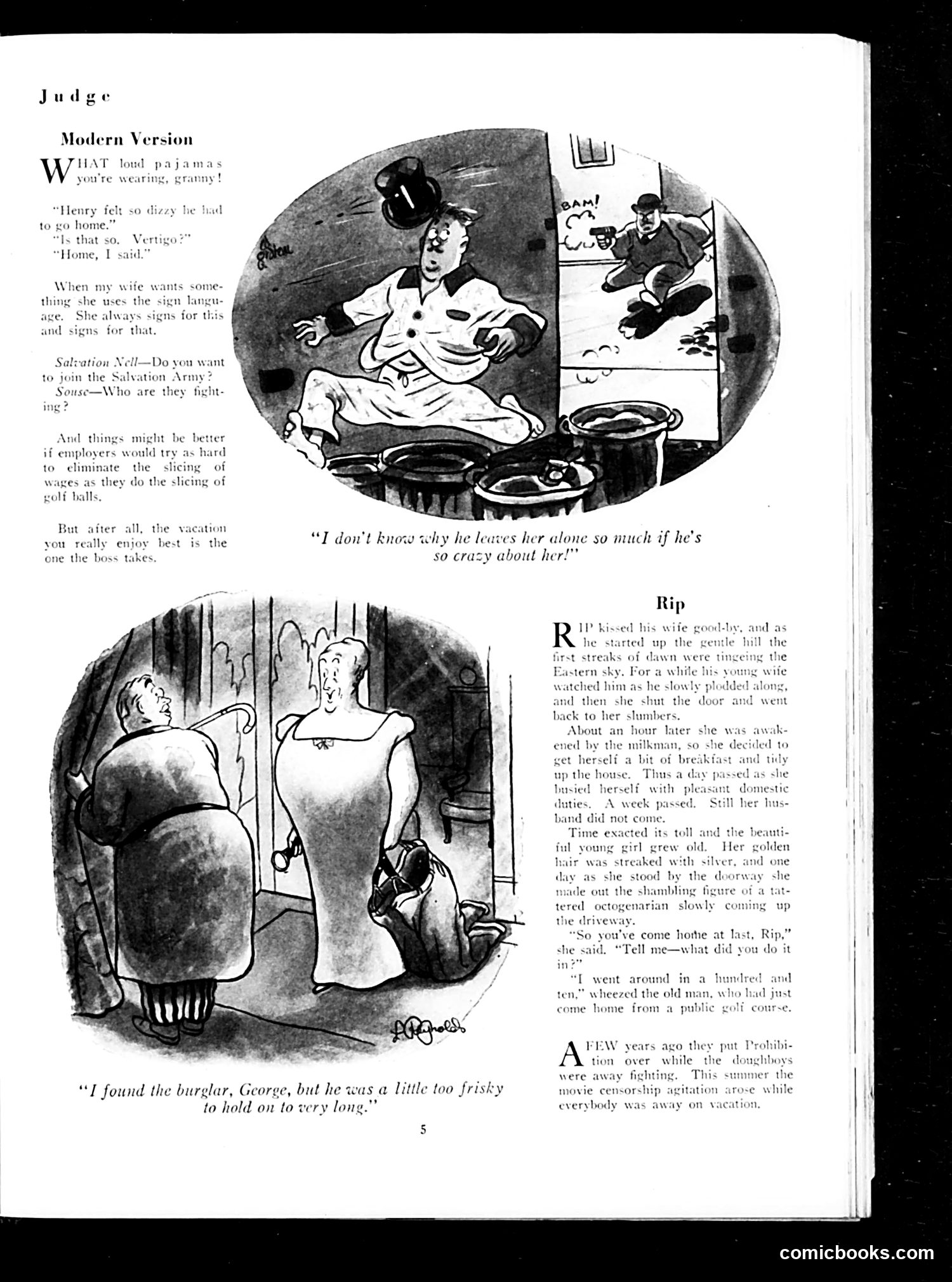
Analysis of Judge Magazine Page This page contains two satirical pieces from Judge magazine (known for humor and social commentary): "Modern Version" (top): Mocks marital dynamics and workplace culture. The joke criticizes how wives cite "signs of lunacy" for husbands' behavior, while husbands tolerate bosses' unreasonable demands. The cartoon shows a dizzy wife, suggesting gender stereotypes about female irrationality. "Rip" (bottom): A longer story about a man's infidelity. The narrative follows a husband who leaves his wife, years pass, and he returns as an aged man. The woman has aged gracefully while he's become unrecognizable. The setup appears to play on the classic "Rip Van Winkle" tale of lost time, but inverts it as moral commentary on abandonment. Both pieces reflect early 20th-century attitudes toward marriage, gender roles, and morality.
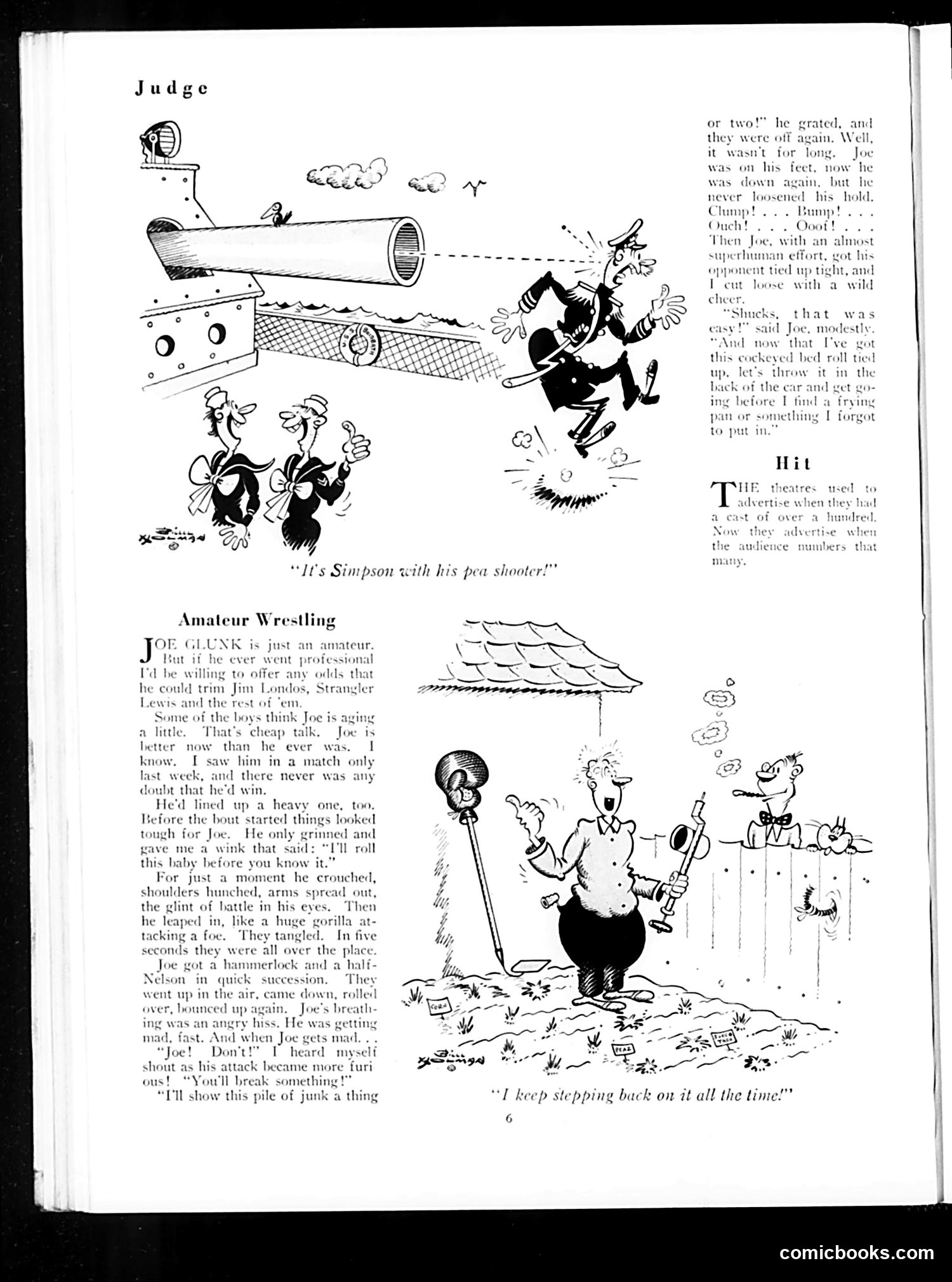
Analysis of Judge Magazine Page This page contains three unrelated humor pieces: "It's Simpson with his pea shooter!" depicts a character (Simpson) operating what appears to be a military cannon or large weapon, with the implication of using it as a trivial pea shooter—satirizing someone's absurdly excessive response to a minor problem. "Judge" is a brief editorial note about theatrical advertising practices, commenting that theaters now advertise audience size rather than cast size, suggesting commercialism has shifted focus to attendance numbers over star power. "Amateur Wrestling" humorously recounts a backyard wrestling match between Joe Glunk and opponents, emphasizing Joe's surprising strength despite aging. The narrative mock-seriously documents his violent wrestling style, culminating in the caption "I keep stepping back on it all the time!"—likely referencing collateral damage from the fight.
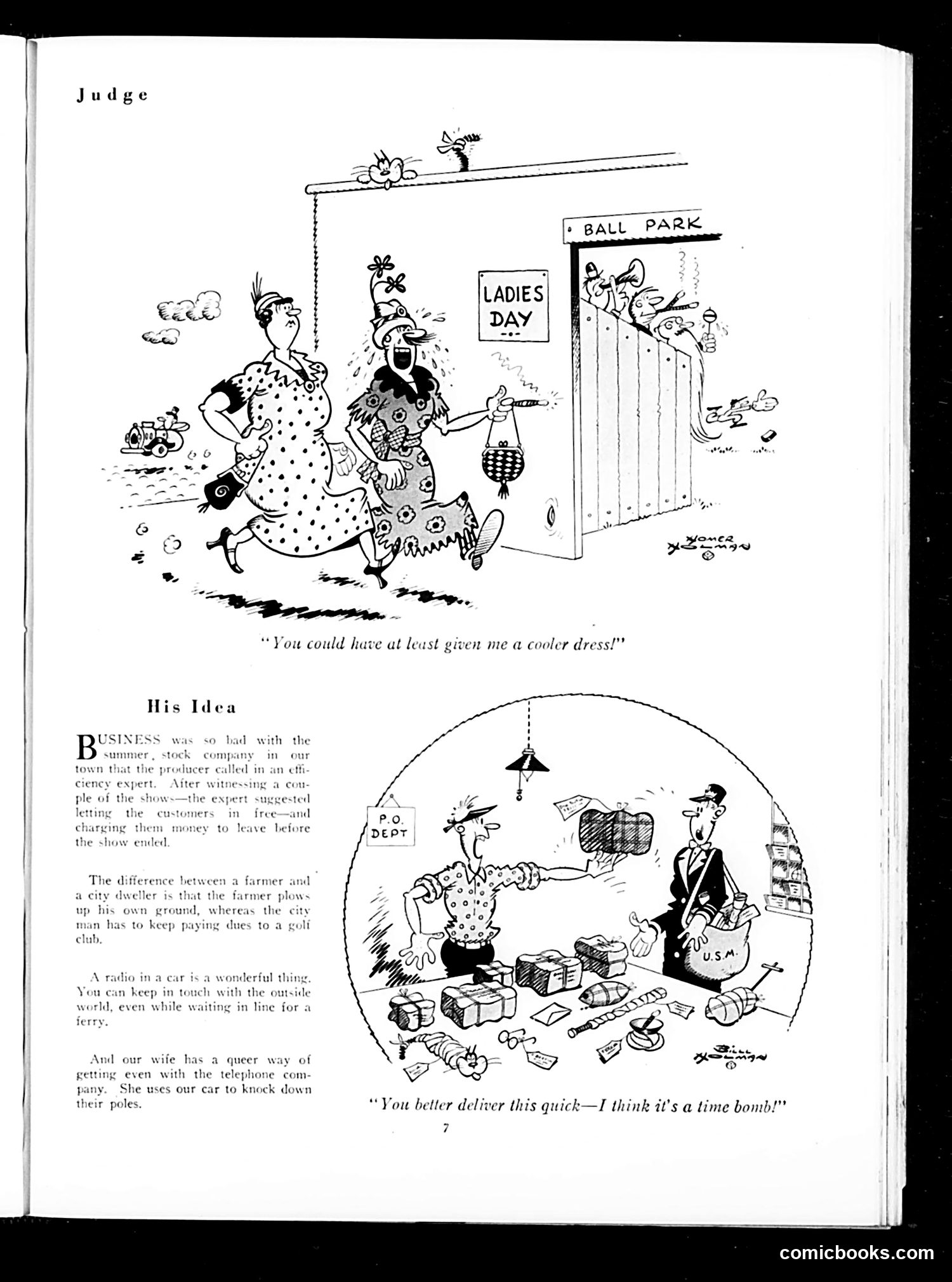
Explanation for Modern Readers This page from *Judge* magazine contains two cartoons satirizing early 20th-century domestic life and gender roles. Top cartoon ("Ladies Day"): A woman complains to her husband at a baseball game that he didn't buy her a nice dress for the outing. The satire targets wives' materialism and the expectation that husbands finance their appearance for social occasions. Bottom cartoon ("His Idea"): A postal worker delivers a package to a businessman, warning it might be a "time bomb." The accompanying text jokes about the differences between farmers and city dwellers, and includes a quip about wives using cars to "knock down" telephone company poles—suggesting reckless or vengeful behavior. The satire mocks both domestic tensions and the absurdity of wives' supposed retaliatory tactics against service companies. Both cartoons reflect period stereotypes about nagging wives, henpecked husbands, and women as frivolous consumers—humor rooted in traditional gender dynamics now widely recognized as sexist.
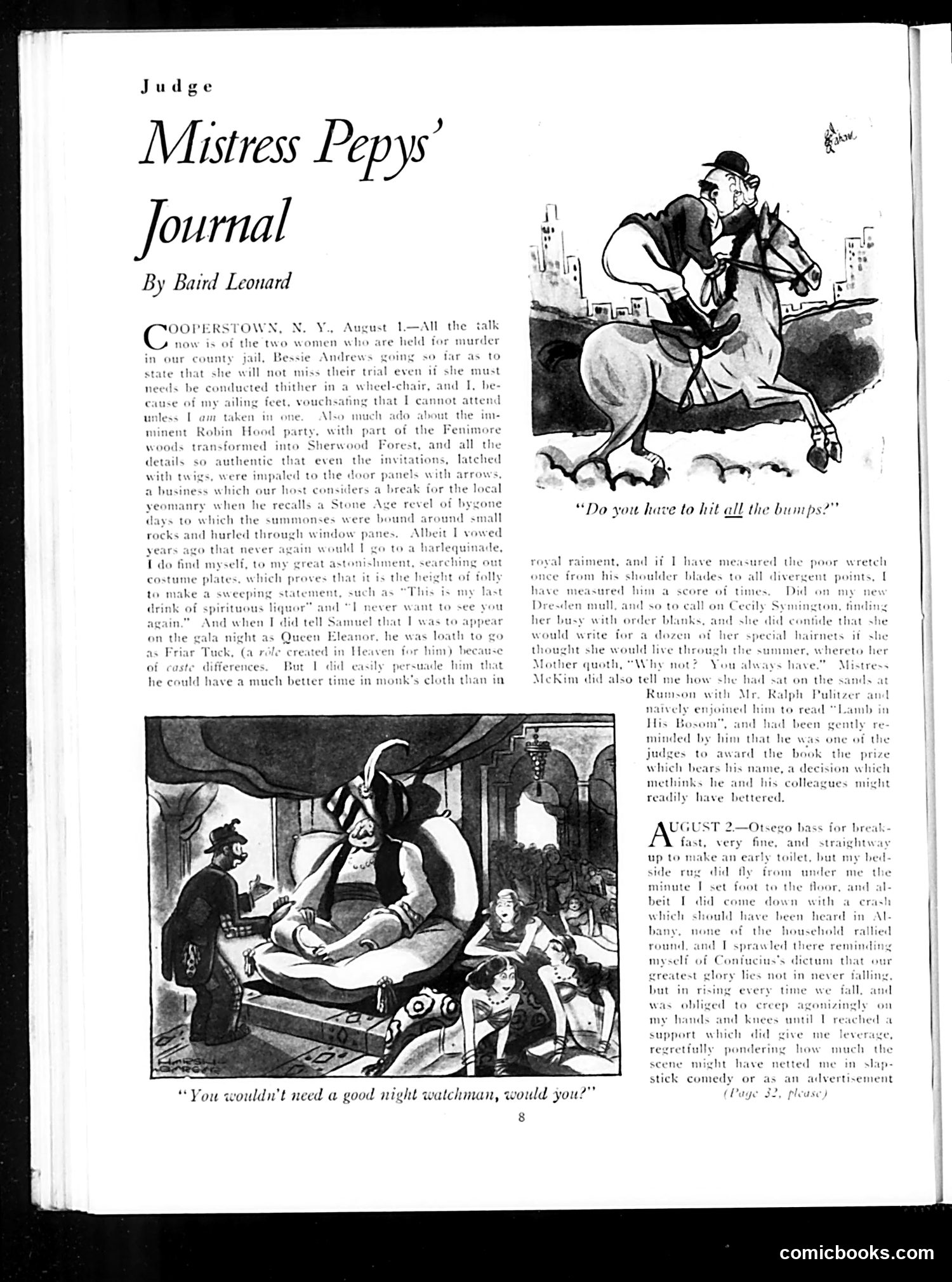
Judge Magazine: "Mistress Pepys' Journal" (August 1933) This is a humorous diary column by Baird Leonard mimicking Samuel Pepys's famous 17th-century diary. The narrator—a society woman with gout—recounts absurd summer experiences in upstate New York. The two cartoons illustrate incidents from her account: the top shows her on horseback asking "Do you have to hit *all* the bumps?"—referring to a painful ride. The lower cartoon depicts what appears to be a chaotic domestic scene with the caption "You wouldn't need a good night watchman, would you?"—likely mocking servant incompetence or household disorder. The satire targets upper-class pretension: the narrator affects Pepys's literary voice while complaining about trivial ailments (ailing feet, a fall), references Robin Hood pageants and literary prizes, and namedrops society figures like Ralph Pulitzer. The juxtaposition of high literary aspirations with slapstick physical comedy creates the humor—she's ridiculous precisely because she takes her minor mishaps so seriously.
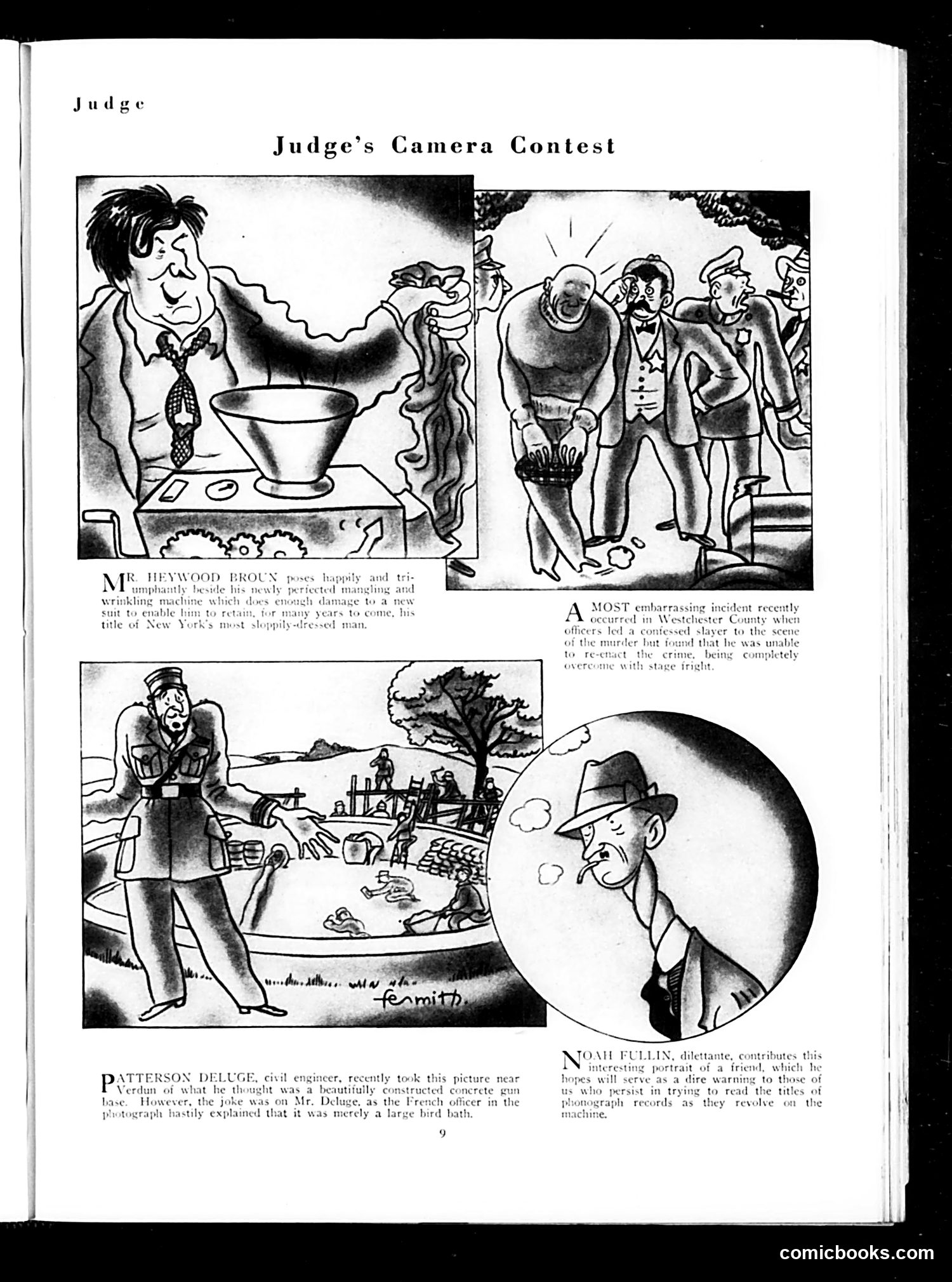
Judge's Camera Contest This page presents satirical cartoons mocking people who submit photos to a magazine camera contest, likely Judge's own competition. The top left cartoon ridicules Mr. Heywood Broux, who supposedly submitted a photo of his "newly perfected mangling and wrinkling machine"—a mundane domestic device he mistakenly believed worthy of publication. The upper right shows officers with a confessed slayer who was "unable to re-enact the crime" due to stage fright—mocking both criminal absurdity and theatrical pretense. The bottom cartoons feature Patterson Deluge, a civil engineer who photographed what he thought was a "beautifully constructed concrete gun base," only to have a French officer explain it was actually a large bird bath—humor derived from oblivious misidentification and professional embarrassment.
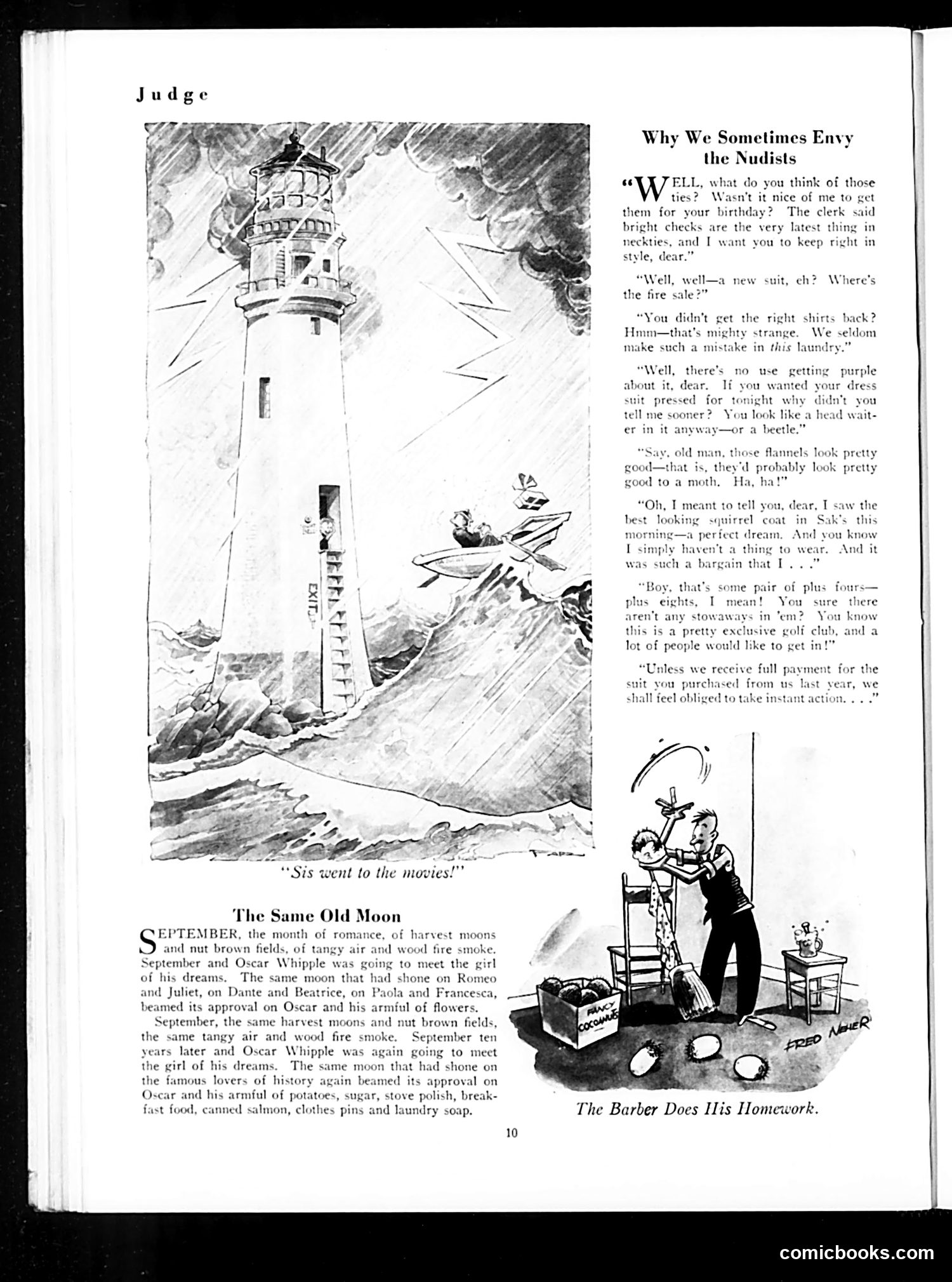
Analysis of Judge Magazine Page This page contains two distinct satirical pieces: "Why We Sometimes Envy the Nudists" (right) mocks the burdens of clothing fashion and social expectations. A husband and wife bicker about his wardrobe choices—new ties, suits, and golf attire—while creditors threaten legal action over unpaid bills. The satire suggests that constant pressure to maintain fashionable appearance and keep up with social status (exclusive golf clubs, designer purchases) creates financial strain and marital discord. Nudists, by contrast, avoid these expenses and social performance entirely. "The Same Old Moon" (center/left) uses romantic irony. Young Oscar Whipple courts his dream girl under September's moon with flowers; ten years later, the same moon shines on him carrying potatoes, stove polish, and laundry soap instead—marriage has replaced romance with domestic drudgery. The illustration shows a lighthouse and couple, emphasizing how time transforms idealistic courtship into prosaic household management. Both pieces satirize early 20th-century marriage and consumer culture's demands.
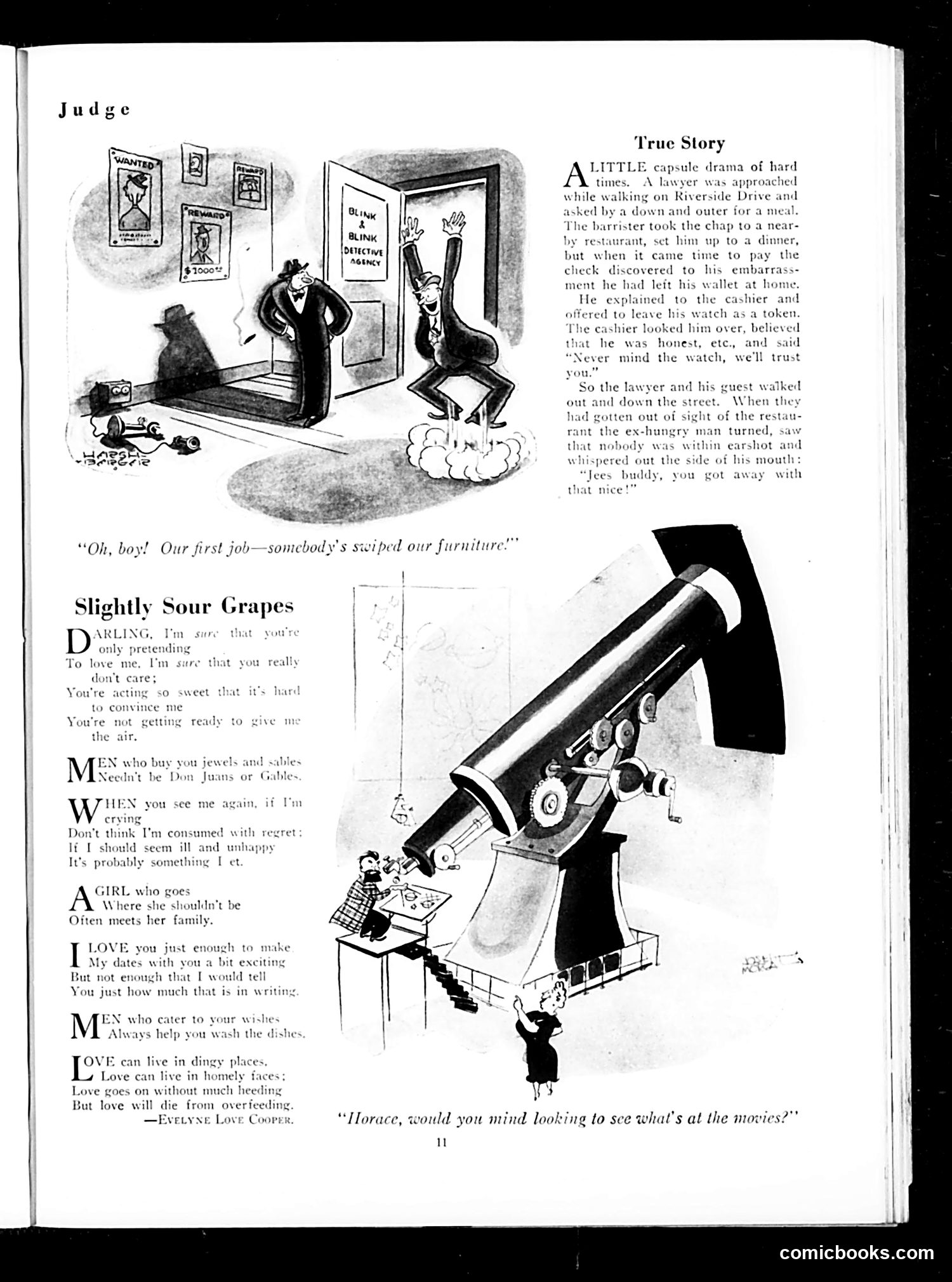
Analysis of Judge Magazine Page Top Cartoon ("True Story"): This depicts a lawyer's embarrassment when caught without his wallet at a restaurant. After a kind cashier allows him to leave his watch as collateral, the lawyer and his down-and-out guest walk away. The punchline—the guest whispers that the lawyer "got away with" the nice deed—suggests the guest believes they've cheated the restaurant. The satire mocks either the guest's ingratitude or cynicism about charity in "hard times" (likely referencing the Great Depression era). Middle Section ("Slightly Sour Grapes"): A poem of romantic complaints, presented as witty observations about love and relationships. The verses humorously address unfaithful suitors ("Men who buy you jewels"), disloyal partners, and women who behave inappropriately. The tone is bittersweet—feigning indifference while clearly bothered. Credited to "Evelyne Love Cooper." Bottom Cartoon: Shows a couple at what appears to be an astronomical observatory or telescope. The woman asks her husband if he'll check what's at the movies—a domestic joke suggesting her priorities over stargazing.
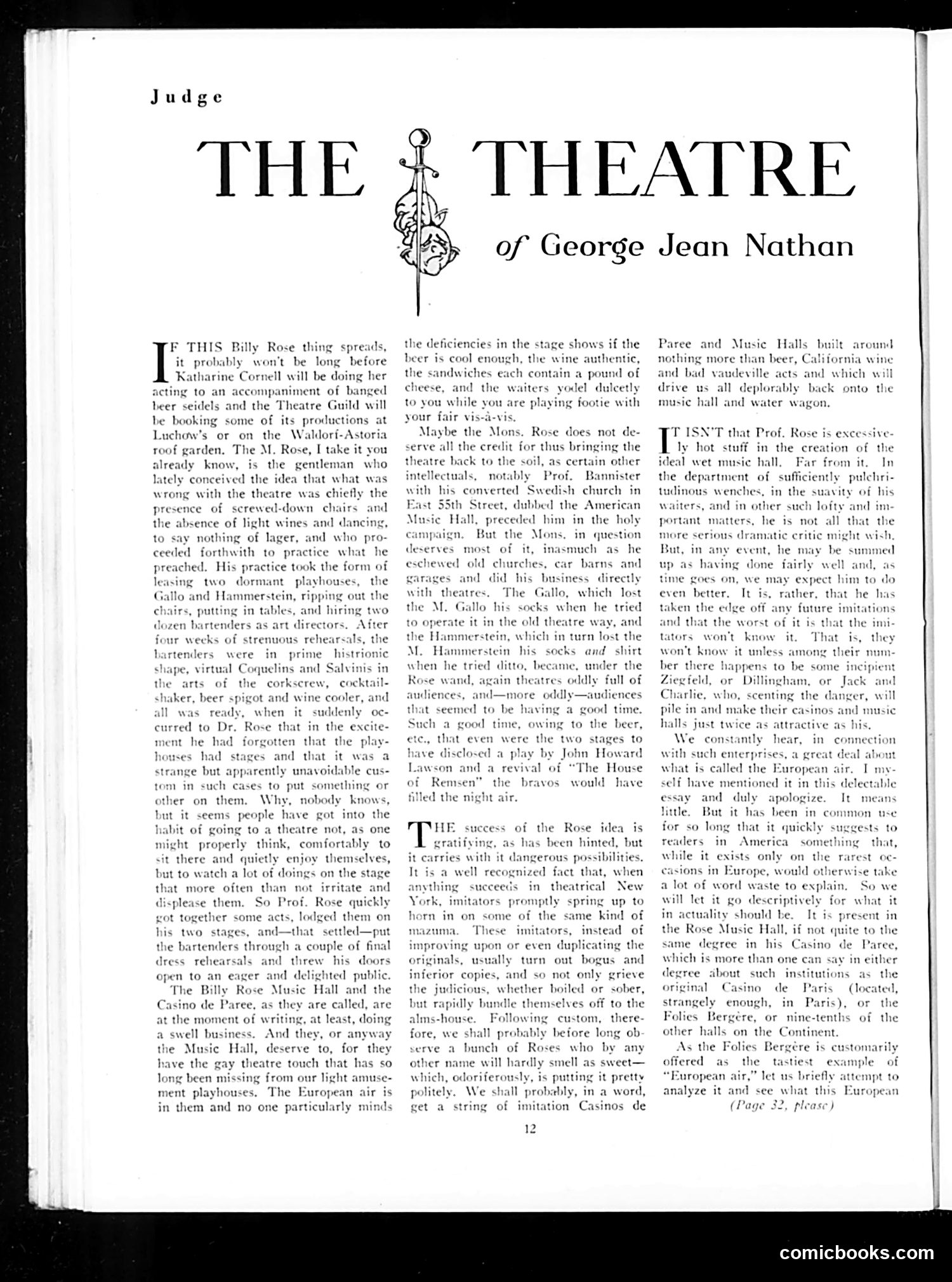
"The Theatre of George Jean Nathan" — Judge Magazine This page is primarily a theatrical essay by critic George Jean Nathan about impresario Billy Rose's innovative entertainment concept, not a cartoon. Nathan discusses Rose's idea of converting defunct playhouses (the Gallo and Hammerstein theaters) into beer halls with entertainment—essentially combining German-style beer gardens with theatre. The satire targets the theatrical establishment's resistance to this populist hybrid. Nathan mockingly suggests that if Rose succeeds, even Katharine Cornell and the prestigious Theatre Guild will soon be performing in beer halls. He pokes fun at the "European" sophistication Rose borrowed from existing establishments like the Folies Bergère in Paris, while defending Rose's originality against inevitable cheap imitations that would soon appear. The piece is essentially *highbrow* cultural criticism dressed in humorous language—Nathan uses exaggeration and irony to debate what constitutes legitimate theatre versus mere entertainment, a recurring debate in 1920s-30s American culture.
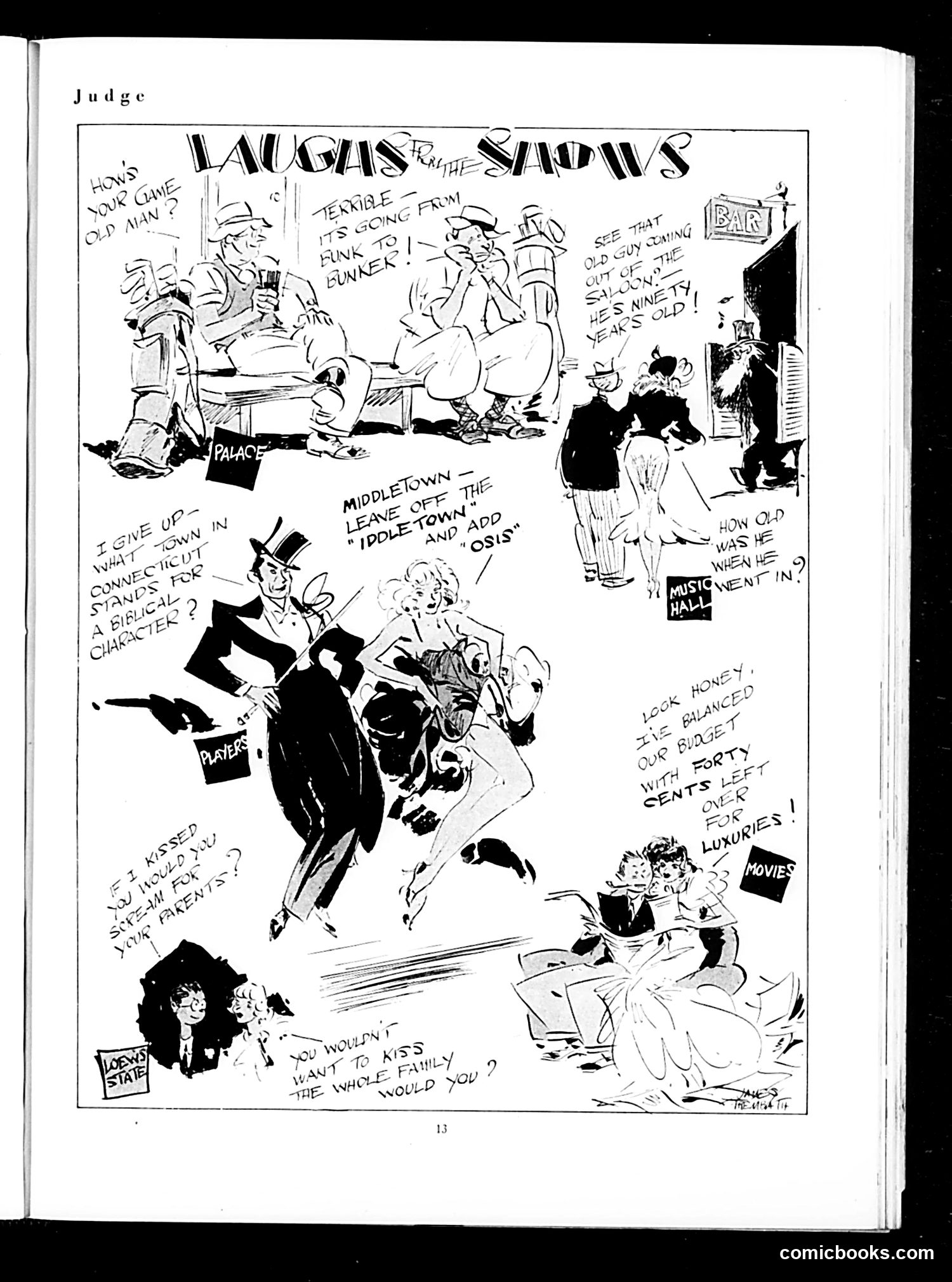
"Laughs at the Sad News" This satirical cartoon mocks wealthy, aging society figures experiencing financial decline during hard economic times. The central figure appears to be an elderly man in formal dress, labeled "Players" and "Palace," suggesting theater/entertainment industry wealth. The humor targets the contrast between their former luxurious lifestyles (referenced through dialogue about "old maids," "music hall," and "luxury movies") and present circumstances. Various vignettes show them struggling with reduced circumstances—one man asks about "Middletown," another about an "idle town" where fortunes dwindled. The satire suggests these privileged characters remain oblivious or in denial about their changed status, still referencing past pleasures while their world crumbles. The overall theme ridicules upper-class complacency and disconnection from economic reality, a likely commentary on post-WWI or 1920s economic upheaval affecting even wealthy Americans.
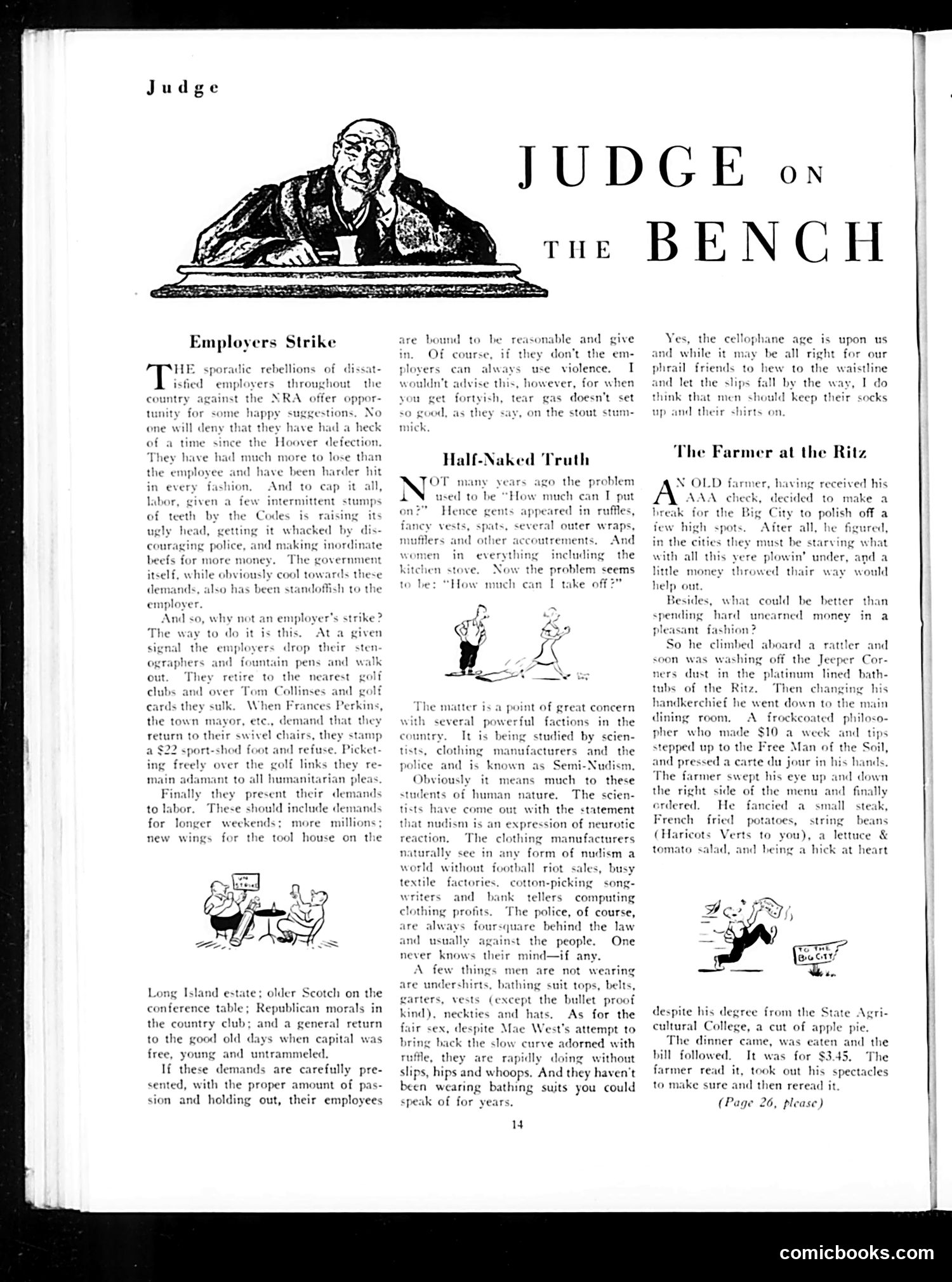
"Judge on the Bench" - Political Satire Analysis This page contains three satirical pieces critiquing 1930s labor disputes and social trends: "Employers Strike" mocks the NRA (National Recovery Administration) by inverting labor rhetoric—suggesting employers should strike against workers' demands for better conditions. The satire suggests employers' complaints are petty compared to workers' genuine grievances. "Half-Naked Truth" ridicules the "Semi-Nudism" movement (appears to reference 1930s fashion trends toward less restrictive clothing). The piece sarcastically suggests this reflects "neurotic reaction" while noting manufacturers profit from reduced fabric use—exposing hypocrisy between claimed ideology and business interest. "The Farmer at the Ritz" lampoons rural recipients of AAA agricultural subsidies (New Deal programs), depicting an unsophisticated farmer awkwardly spending government money at an expensive hotel. The joke targets both the farmer's naïveté and implied waste of relief funds. All three pieces reflect Judge's skepticism toward New Deal programs and emerging social changes during the Depression era.
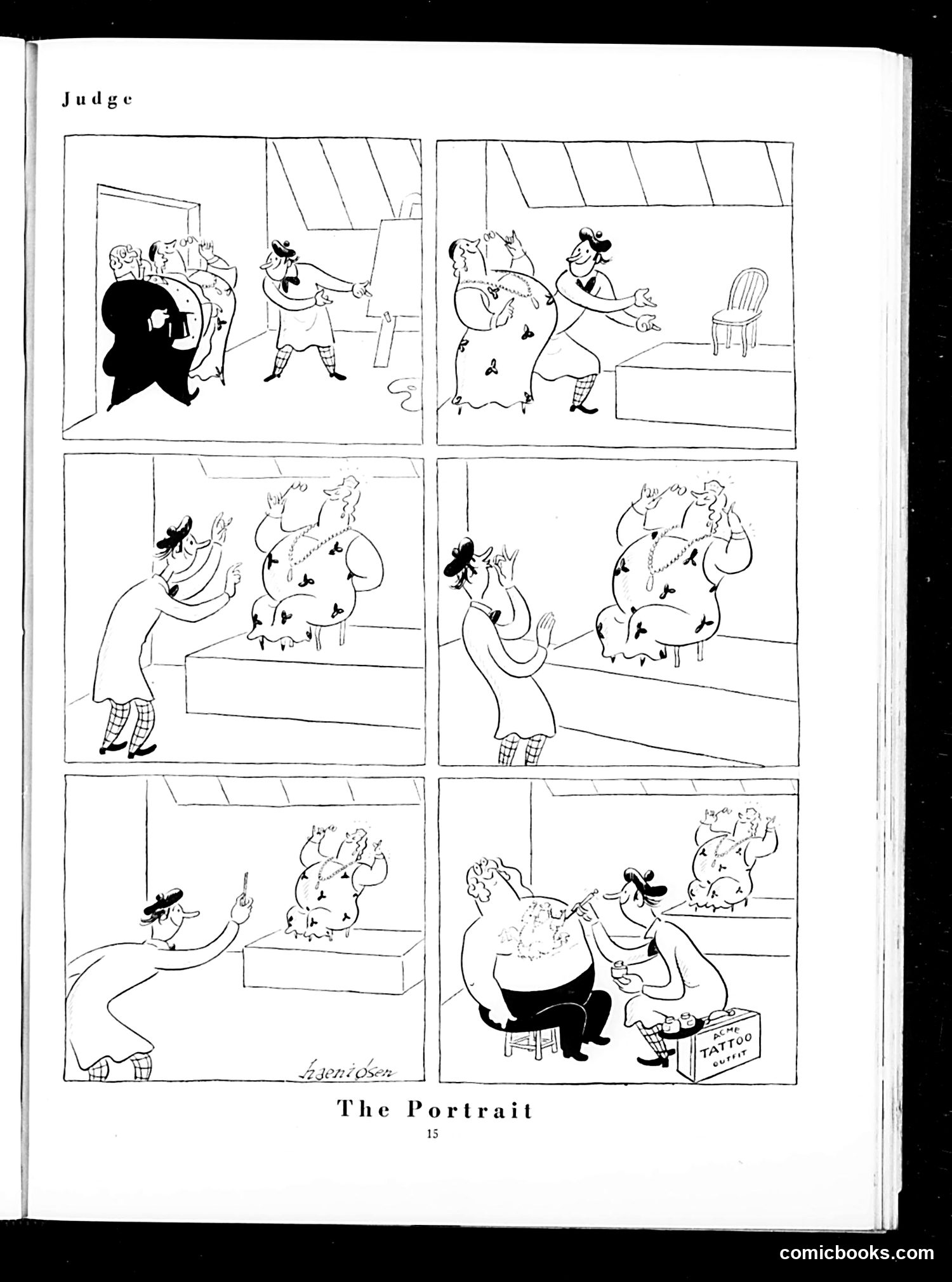
"The Portrait" — Judge Magazine Comic This six-panel comic strip satirizes the judicial system's treatment of criminals. A heavily shadowed figure (likely representing Crime or a criminal) enters a courtroom where judges preside. The subsequent panels show the judges progressively tattooing or marking the criminal's body—a visual metaphor for the justice system's documented punishment. The final panel reveals the punchline: a tattoo artist applies markings while the criminal sits in a chair labeled "TATTOO," suggesting the judges' sentences are as superficial and ineffective as decorative tattoos rather than genuine rehabilitation or deterrence. The satire critiques how the legal system merely "marks" criminals without truly reforming them, implying judicial punishment is cosmetic rather than substantive. The comic's dark humor underscores frustration with criminal justice ineffectiveness.
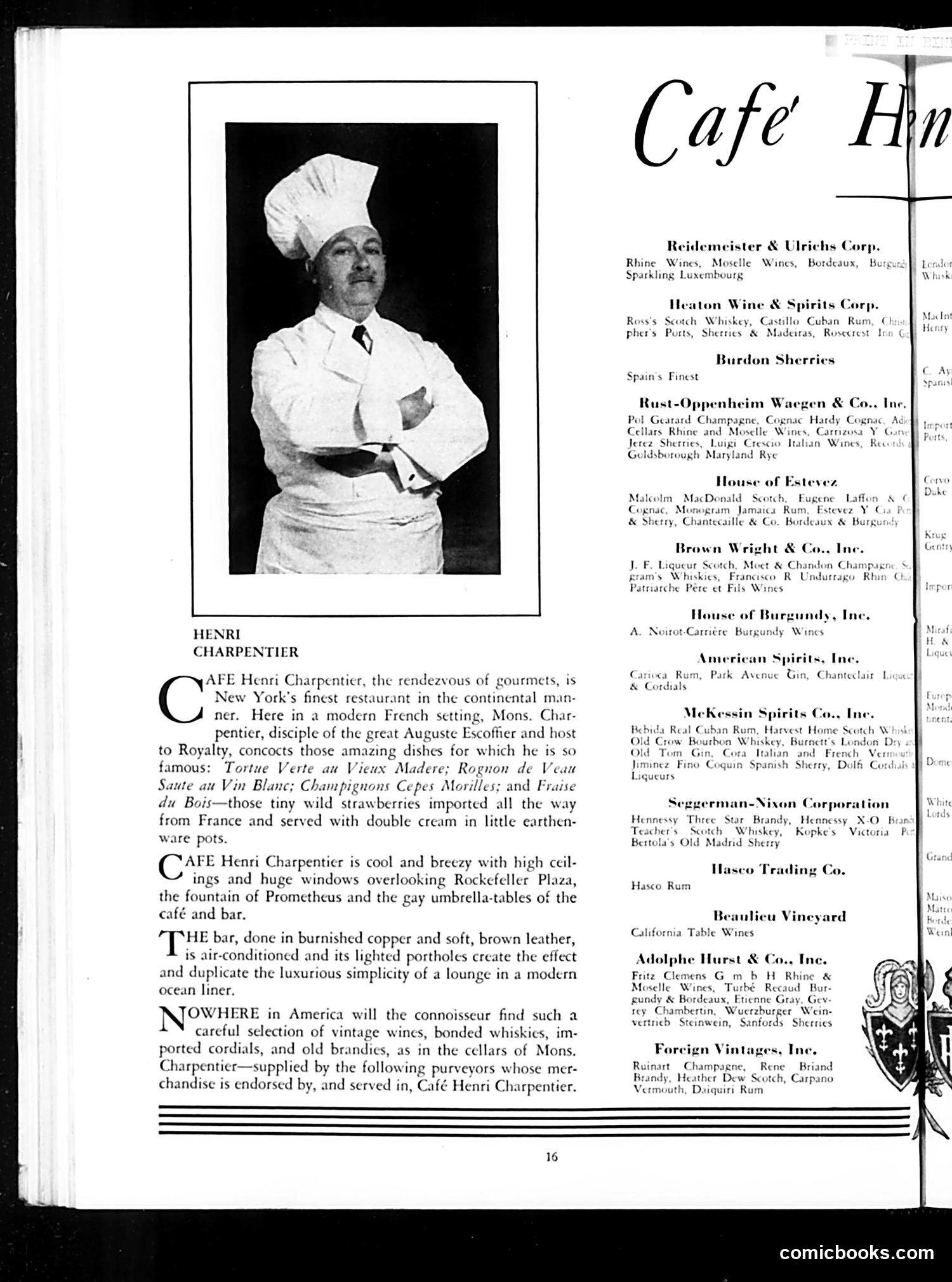
Content Analysis: Café Henri Charpentier Advertisement This page is primarily a restaurant advertisement, not a political cartoon. It features a photograph of Henri Charpentier, a French chef, wearing chef's whites and a tall chef's hat, positioned as the proprietor of an upscale New York restaurant. The text promotes Café Henri Charpentier as "New York's finest restaurant in the continental manner," emphasizing French haute cuisine (named dishes like Tortue Verte, Rognon de Veau), luxurious décor overlooking Rockefeller Plaza, and air-conditioned modern amenities. The bulk of the page comprises endorsements from wine and spirits purveyors—liquor suppliers whose products are served at the establishment. This represents Prohibition-era advertising strategy: despite alcohol being illegal, luxury establishments advertised specific branded liquors openly, suggesting they operated as speakeasies or that Prohibition enforcement was selective for upscale venues. The prestigious endorsements attempt to legitimize the operation through association with fine dining and imported goods.
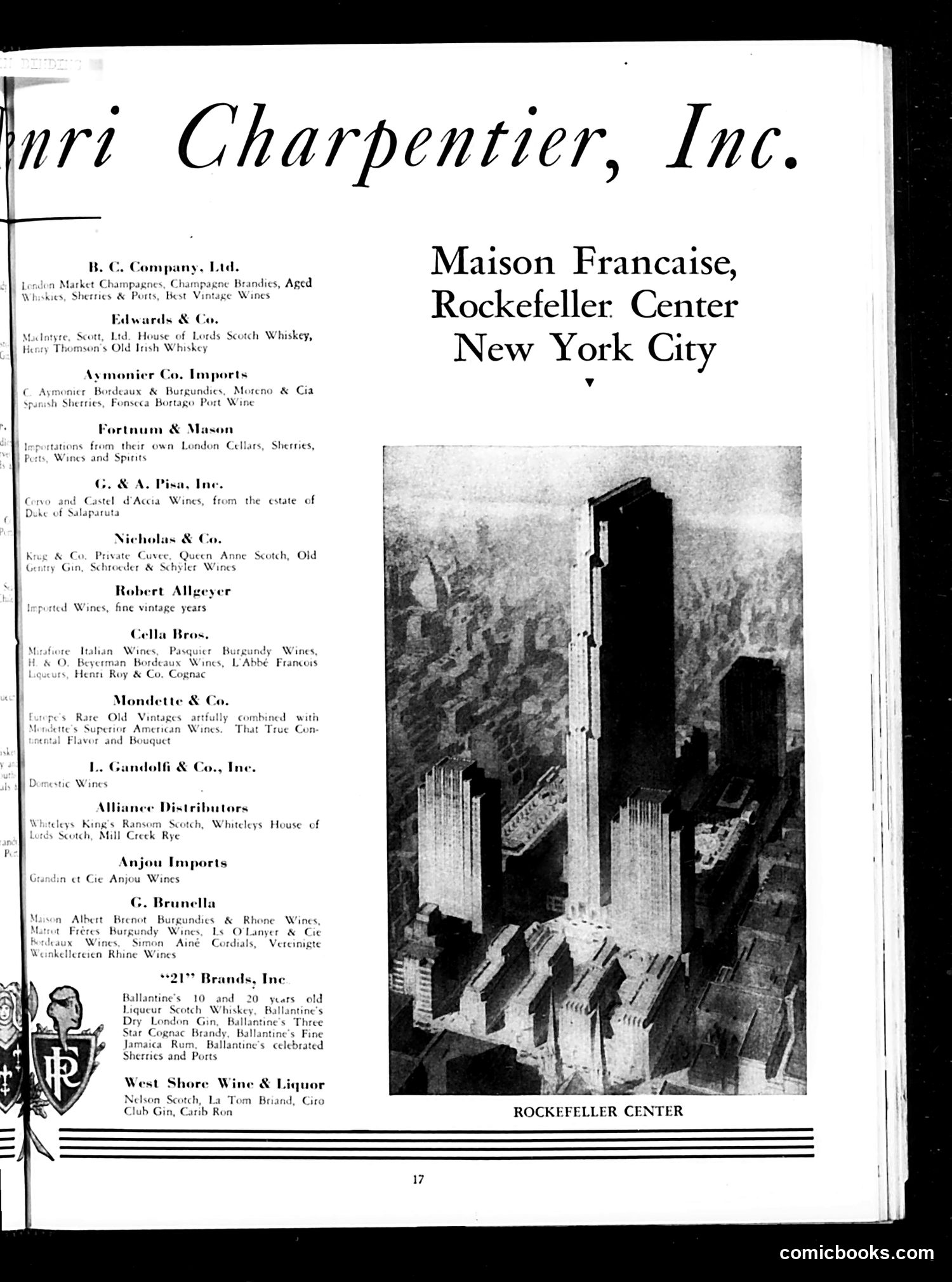
What This Page Shows This is not a cartoon or satirical content—it's a business advertisement page from Judge magazine featuring Henri Charpentier, Inc., a wine and liquor importer located at Rockefeller Center in New York City. The page lists dozens of wine and spirits suppliers the company represents, including Scotch whiskeys, French burgundies, sherries, ports, cognacs, and other premium alcoholic beverages from European producers. The photograph shows the Rockefeller Center building complex in Manhattan. This appears to be from the pre-Prohibition or post-Repeal era when such alcohol advertising was legally permitted in American publications. The page demonstrates the luxury import business thriving in 1920s-30s New York, catering to wealthy consumers seeking fine European wines and spirits.
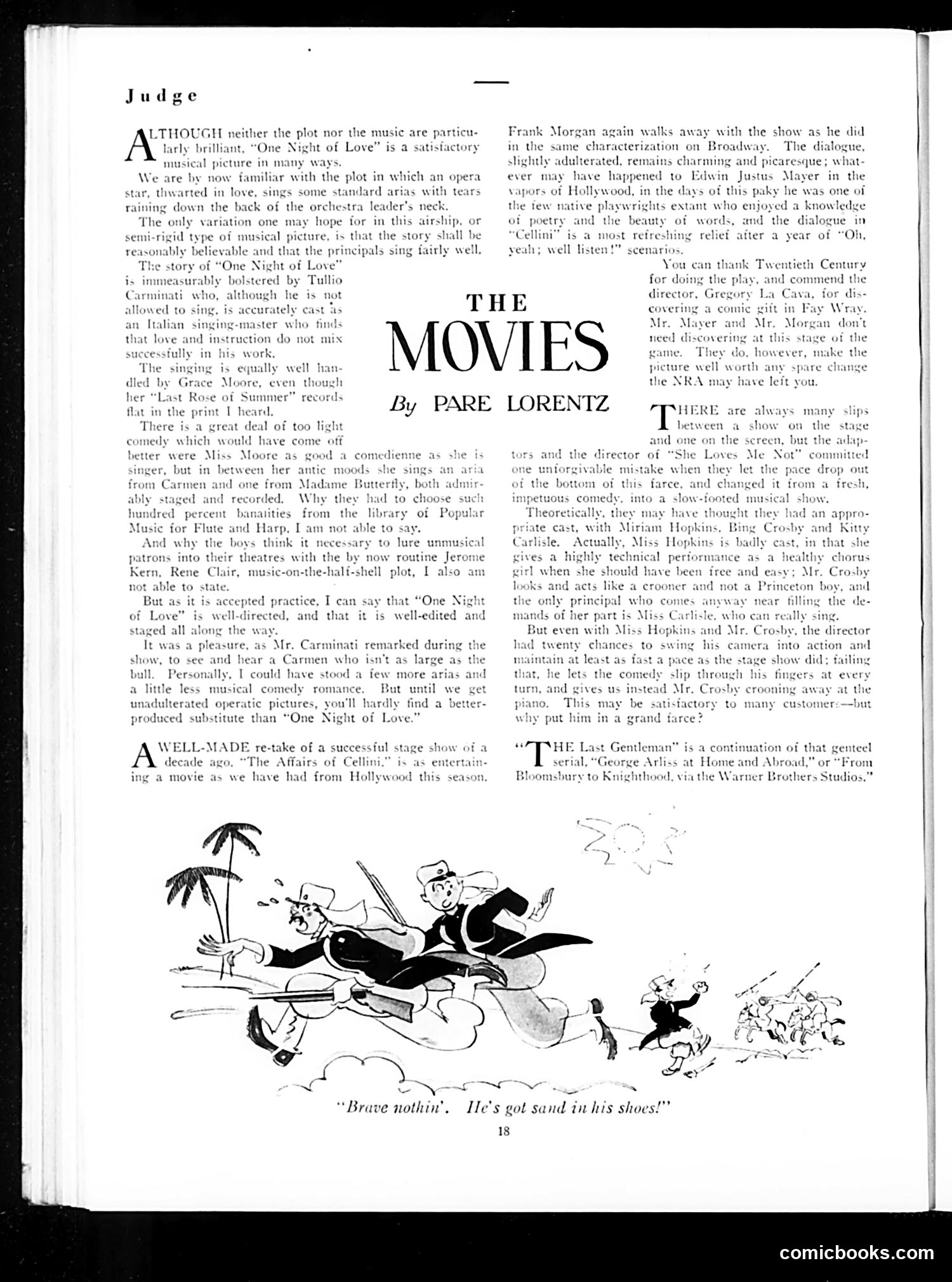
Analysis of Judge Magazine Page This page from Judge magazine contains two sections: a theater review column titled "Judge" and a film criticism piece called "The Movies" by Pare Lorentz. The cartoon illustration at the bottom depicts two men in formal attire flying through the air on what appears to be a torpedo or projectile, with palm trees and other figures below. The caption reads "Brave nothin'. He's got sand in his shoes!" This appears to be a visual gag—likely satirizing either a specific film plot or Hollywood absurdity, though the exact reference is unclear without additional context. The text reviews discuss operatic films, particularly "One Night of Love," critiquing their formulaic plots and questionable casting choices. The critics praise Frank Morgan's performance and note that even well-made operatic pictures remain fundamentally limited as entertainment. The overall tone is typical Judge satire: mocking Hollywood's pretensions while acknowledging occasional quality performances.
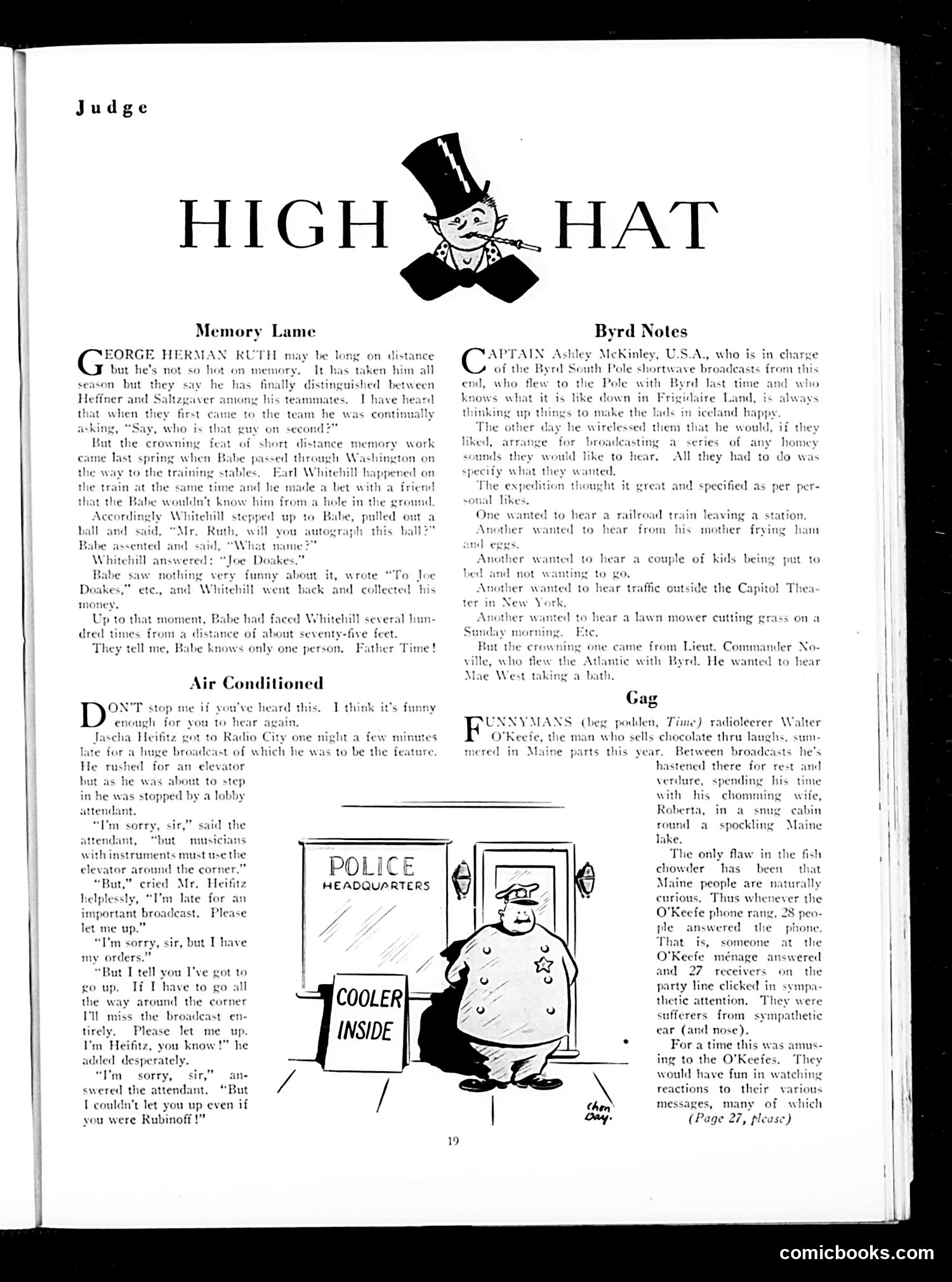
Judge Magazine Page Analysis This page contains three humor pieces satirizing 1920s-30s American culture: "Memory Lame" mocks baseball star Babe Ruth's alleged poor memory. The anecdote describes a pitcher (Whitey Whitehall) tricking Ruth into signing a blank check by claiming it's an autograph, exploiting Ruth's inability to remember faces or details. "Air Conditioned" jokes about Radio City bureaucracy. Violinist Jascha Heifitz, a famous musician, is denied elevator access by a lobby attendant enforcing rules. When Heifitz desperately invokes his own celebrity, the attendant dismisses him by saying he wouldn't make exceptions "even if you were Rubinoff"—referencing violinist David Rubinoff, suggesting Heifitz isn't as important as he thinks. "Byrd Notes" and "Gag" discuss polar explorer Richard Byrd's radio broadcasts and a Maine radio operator's party-line mishaps, where 28 people picked up his phone line simultaneously. The cartoon shows a police officer with an air-conditioned interior, illustrating the "Air Conditioned" joke about modern building amenities.
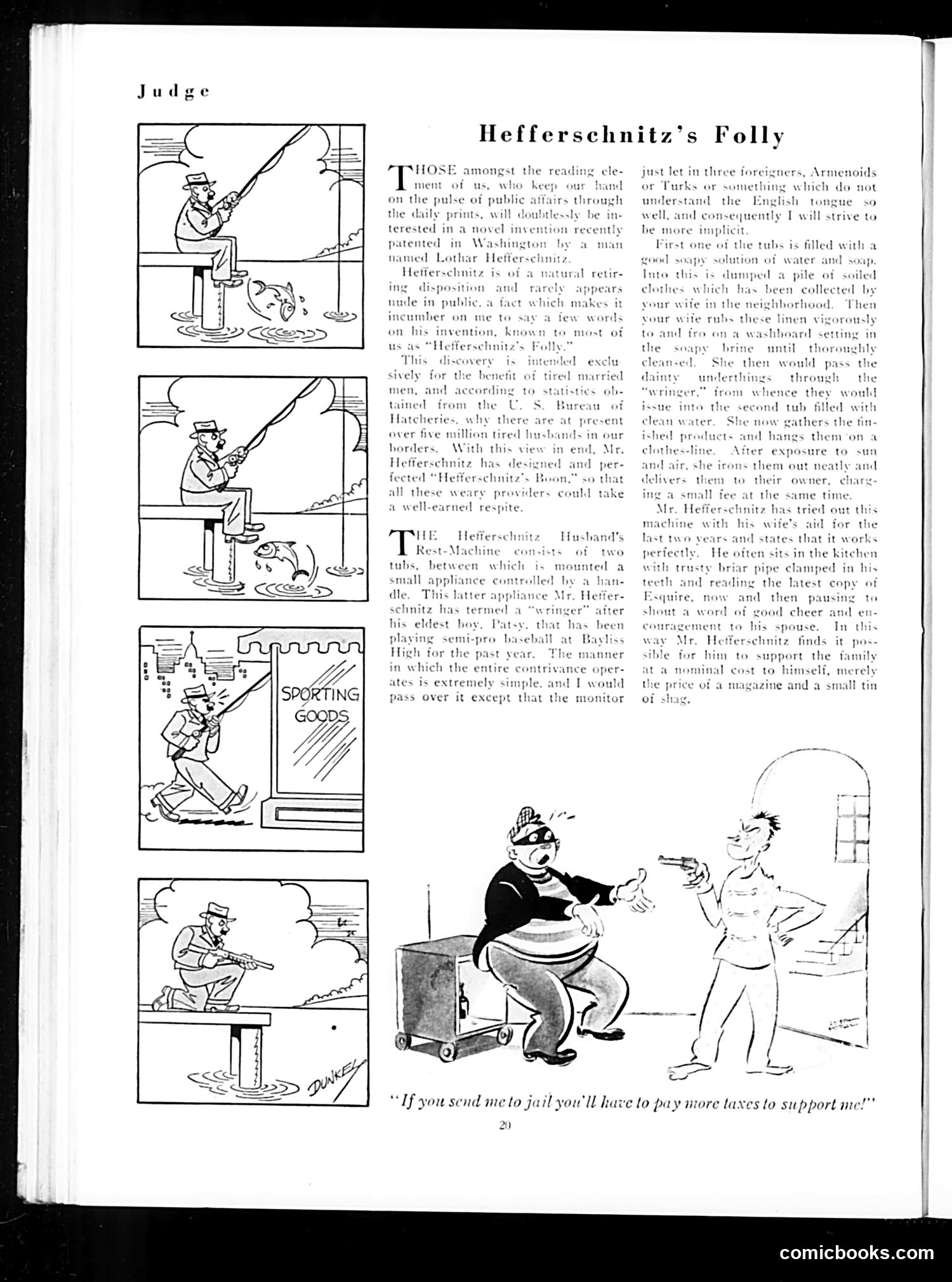
Hefferschnitz's Folly This article describes Lothar Hefferschnitz's invention: an automated laundry machine for washing clothes. The satirical point targets both the inventor's impractical design and the broader absurdity of "labor-saving" devices. The cartoon depicts Hefferschnitz demonstrating his contraption—a two-tub system with water, soap, and mechanical components—claiming it solves domestic drudgery for wives. The humor lies in the obvious failure: the machine apparently sprays water everywhere, creating more mess than solution. The bottom cartoon shows a man with a large tub telling someone: "If you send me to jail you'll have to pay more taxes to support me!"—likely referencing how incarceration costs the public. The satire critiques both overconfident inventors peddling dubious "modern" solutions and the naive faith in mechanical fixes for household labor, which would remain women's work regardless. It's commentary on failed innovation and gender roles in the early 20th century.
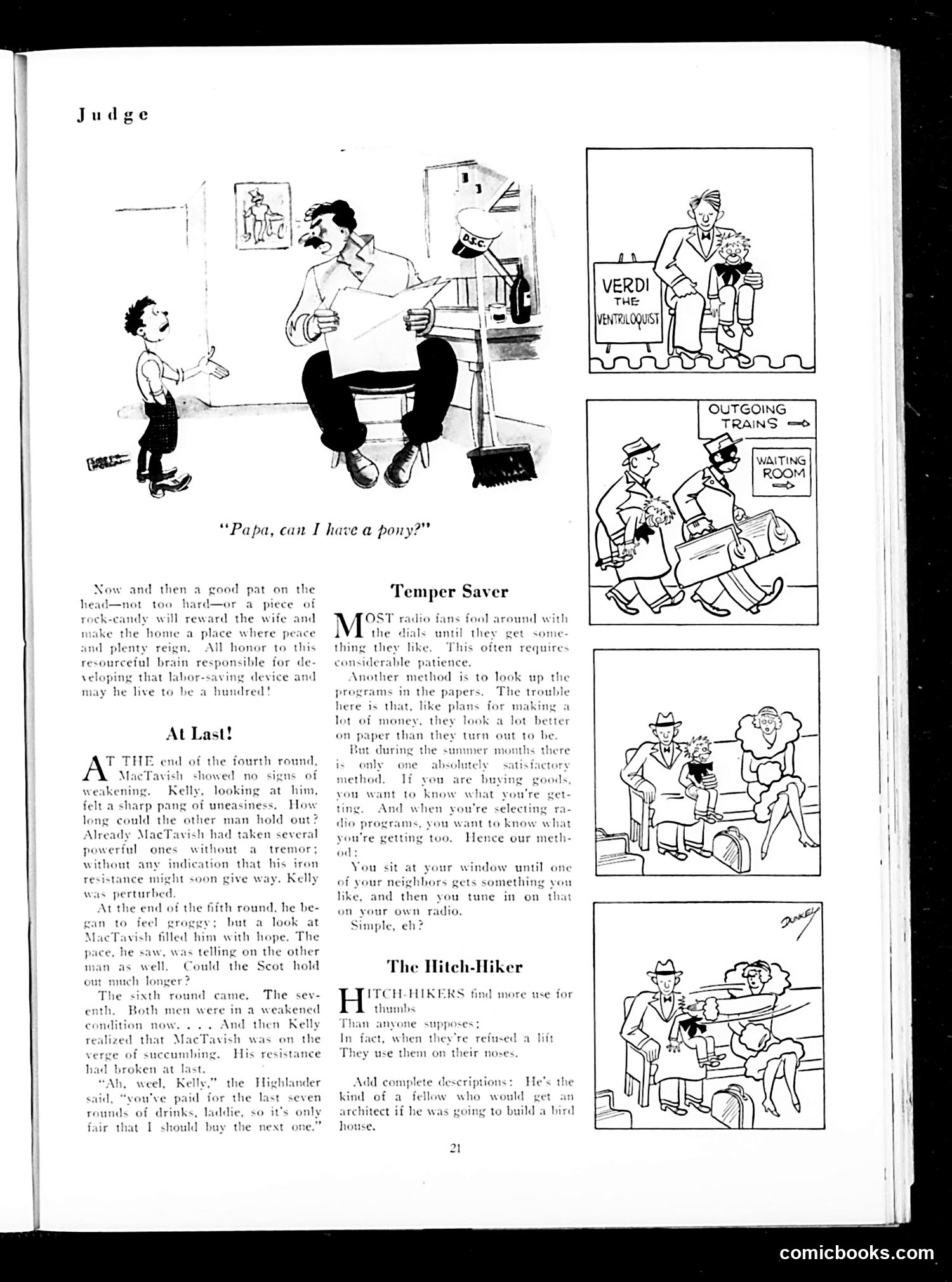
Explanation for Modern Readers This Judge magazine page contains three humor pieces: "Papa, can I have a pony?" depicts a father figure (appearing to be a judge or authority figure based on the page header) being pestered by a child while trying to work. The joke plays on parental exasperation. "At Last!" describes a boxing match between two men—MacTavish (Scottish, indicated by dialect) and Kelly. After rounds of fighting, MacTavish concedes defeat, but the twist is humorous: he's simply run out of money to buy drinks, not been physically beaten. It satirizes working-class male culture of the era, where buying rounds of drinks was a social obligation. "Temper Saver" and "The Hitch-Hiker" are brief advice pieces about radio listening habits and hitchhiker behavior respectively—light social commentary on modern conveniences and contemporary etiquette. The cartoons mock everyday frustrations and class-specific social customs of the early-to-mid 20th century.
Content Analysis This page contains bridge instruction, not a cartoon. It's from *Judge* magazine's "DEAL" section—a monthly column on contract bridge (the card game) edited by Philip Hal Sims. The article, "Sims Theory of Opening No Trump Bids" by Derrick J. Wernher, explains advanced bridge bidding strategy. It discusses when players should make "slam tries" (bids attempting to reach high-scoring contracts) after an opening "no trump" bid, and what hand strength these bids indicate to one's partner. No satire or political commentary is present. This is a straightforward instructional piece for bridge players—*Judge* magazine, while known for satire, also published hobby and games content. The OCR text is heavily degraded, making specific details difficult to parse, but the purpose is educational rather than comedic.
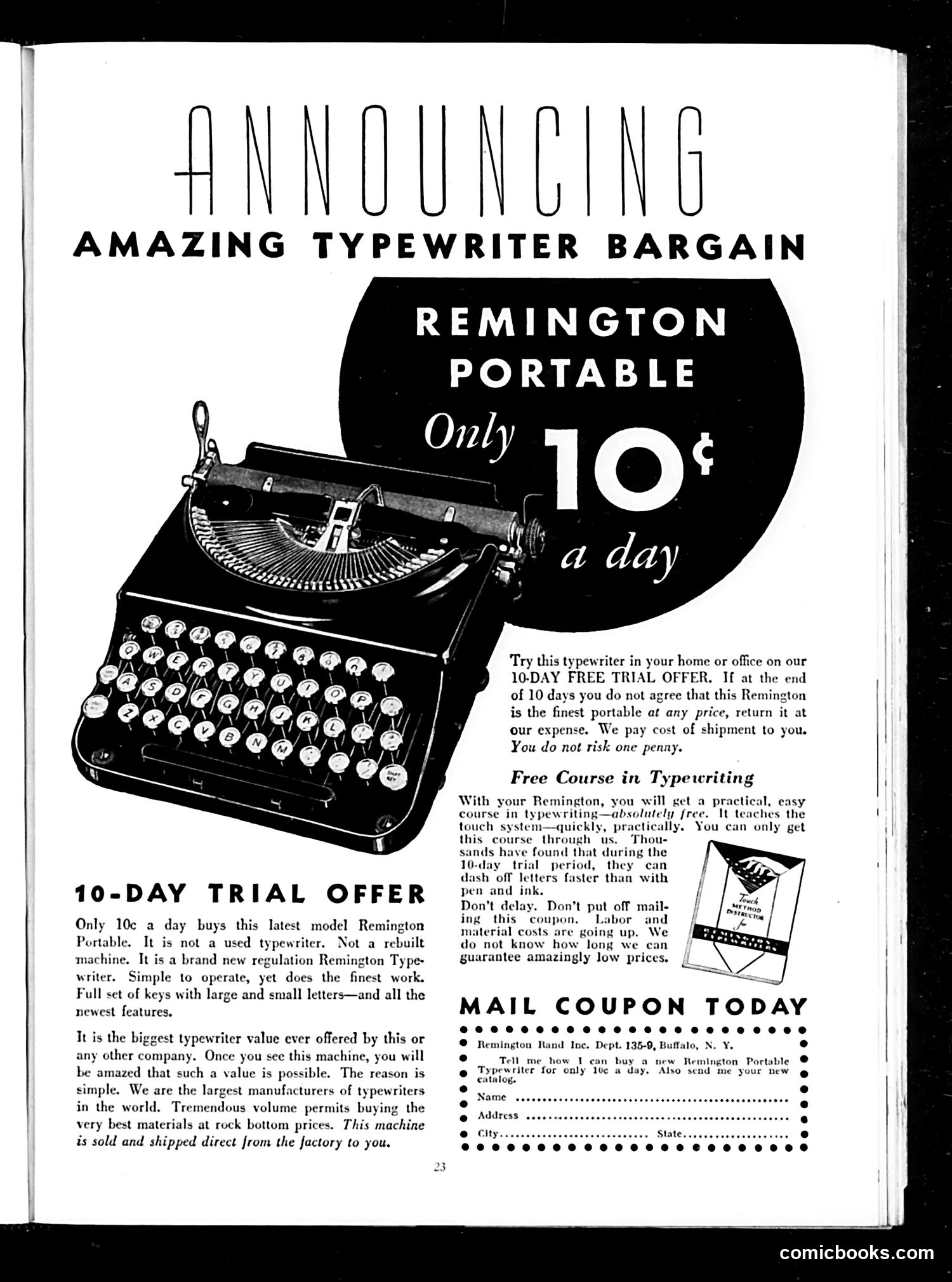
Analysis for Modern Readers This is not a cartoon or satire—it's a straightforward advertisement from Judge magazine for a Remington portable typewriter. The page announces a 10-cent-per-day rental trial offer for a new (not used or rebuilt) typewriter, emphasizing it as unprecedented value. The sales pitch stresses Remington's manufacturing scale allows rock-bottom pricing, and includes a free typewriting course with the trial. The urgency language ("Don't delay. Don't put off mailing this coupon") and warning that "labor and material costs are going up" suggests this ad ran during economic inflation, likely the post-WWI period when Judge published. The 10-day free trial with "you do not risk one penny" was a marketing innovation for the era. This represents the typewriter's role as essential office/writing equipment before computers existed—a major consumer purchase that warranted extensive promotional copy in a major publication.
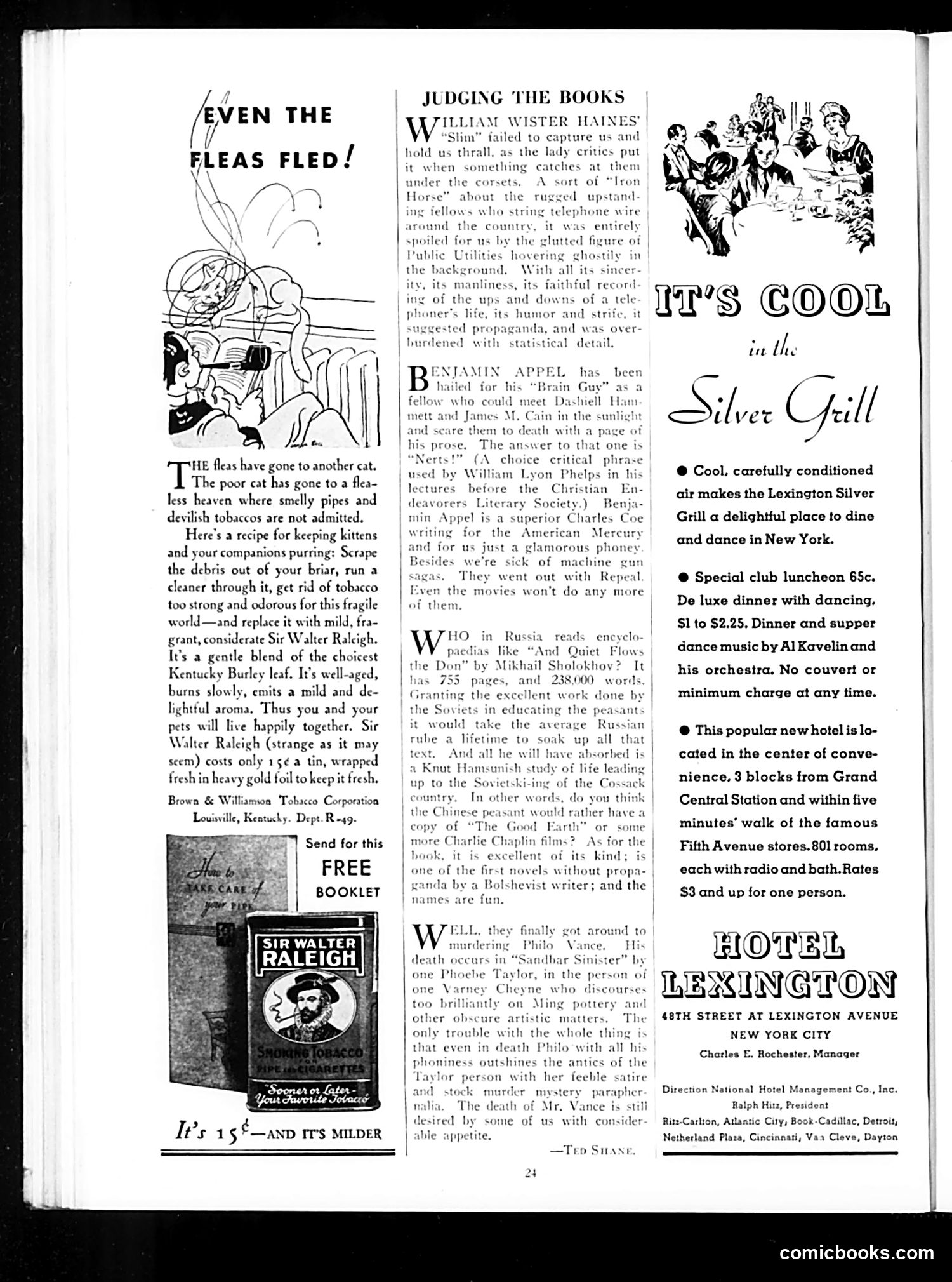
Explanation of Judge Page Content This page primarily contains book reviews and advertisements rather than political cartoons. The main satirical content is a left-side cartoon mocking the ineffectiveness of a cat flea treatment, with accompanying humorous text promoting Sir Walter Raleigh tobacco as a gentler alternative for pet owners. The "Judging the Books" section reviews recent novels, including criticism of William Wister Haines' "Slim" (about telephone company workers), Benjamin Appel's "Brain Guy," and commentary on Russian literature. The reviews employ satirical praise and dismissal—mocking overly earnest or sentimental writing while praising sharper social observation. The page's bulk consists of advertisements: a tobacco company promotion, a booklet offer, and prominent advertising for the Hotel Lexington in New York City. The humor relies on period-specific references—readers would recognize the authors and literary trends being critiqued, and understand why machine-gun narratives and Bolshevik writers warranted satirical mention during this era.
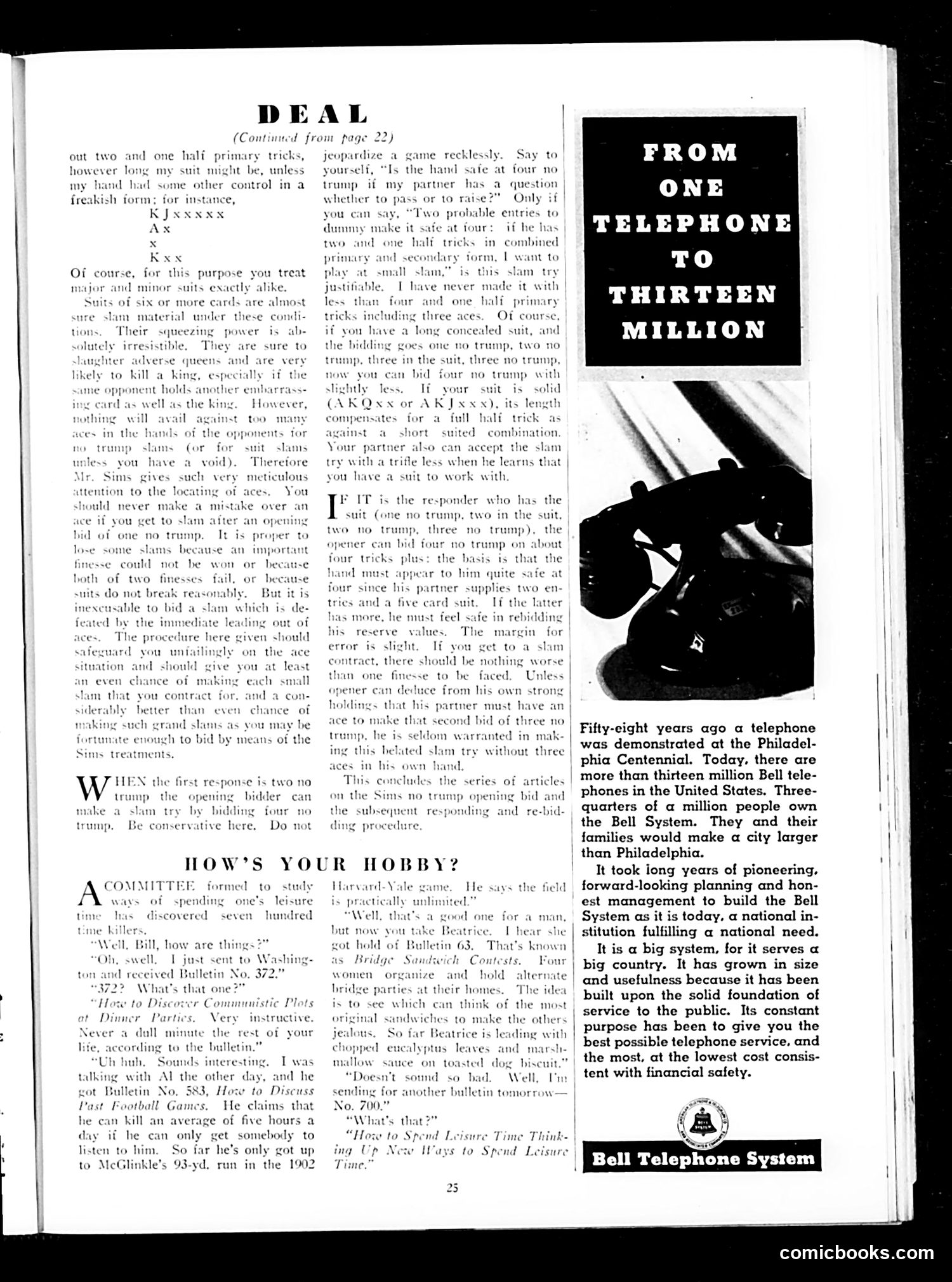
Analysis of Judge Magazine Page This page contains two distinct elements: bridge strategy content and a Bell Telephone System advertisement. The left columns discuss contract bridge bidding tactics—specifically when to attempt "slam" (high-point) contracts. The text explains to readers how to evaluate hand strength safely. The right side features a Bell System advertisement with a photograph of hands using a telephone. The ad celebrates the telephone's growth: fifty-eight years prior (around 1877), it was demonstrated at the Philadelphia Centennial; now thirteen million Bell phones exist in America, owned by three-quarters of a million people—enough to populate a city larger than Philadelphia. The advertisement's rhetoric emphasizes progress and monopoly legitimacy: the Bell System grew through "pioneering, forward-looking planning and honest management," serving the nation as a "national institution fulfilling a national need." This framing—positioning monopoly as public service—was typical corporate messaging of the early 20th century, subtly defending against antitrust concerns by emphasizing universal benefit. The juxtaposition of leisure-time content (bridge) with infrastructure advertisement reflects how *Judge* balanced entertainment with corporate sponsorship.
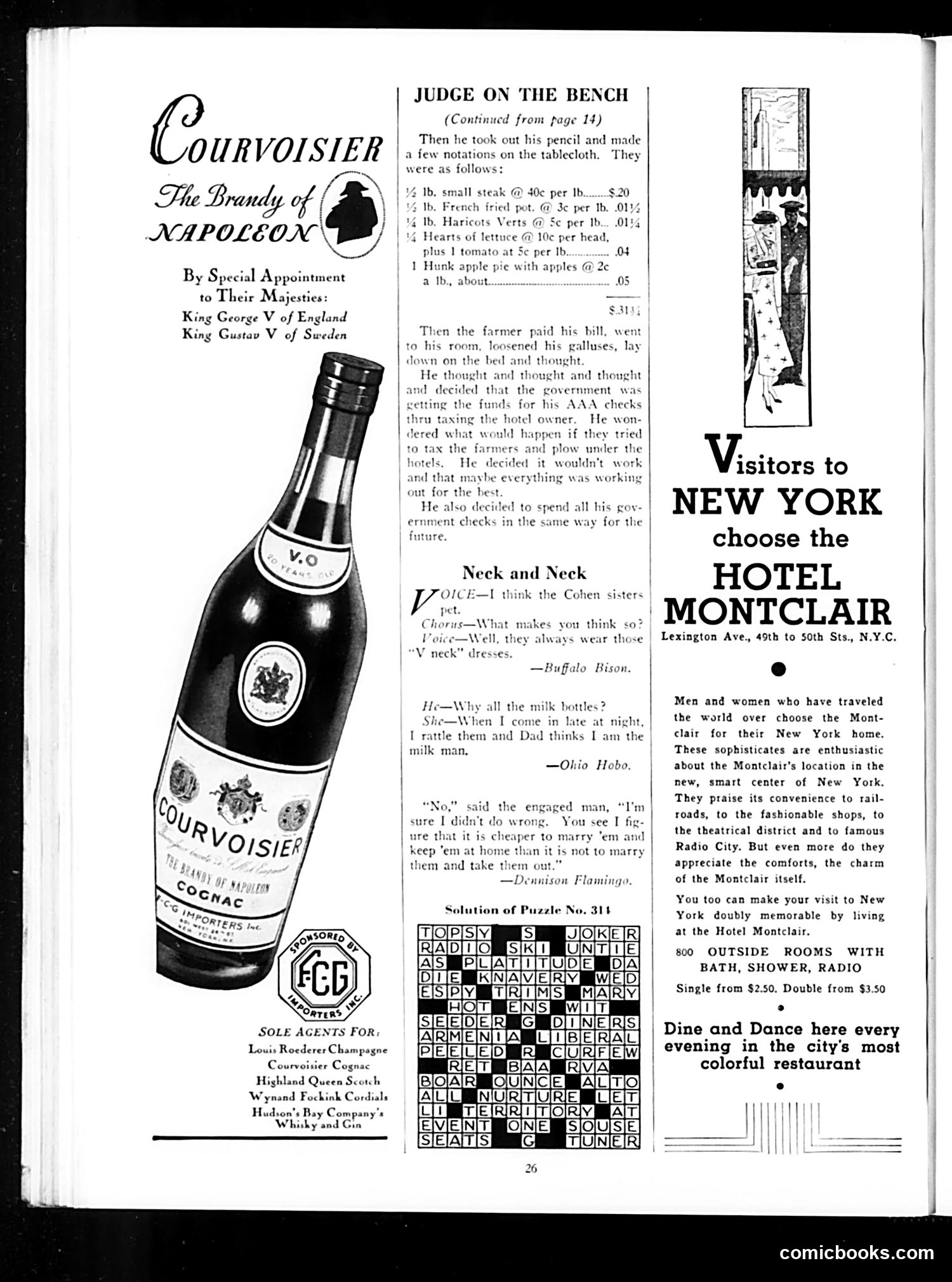
Analysis of Judge Magazine Page This page mixes editorial content with advertising. The main cartoon (continued from previous page) satirizes New Deal agricultural policy, specifically the AAA (Agricultural Adjustment Administration). A farmer calculates his restaurant bill, then worries that government AAA subsidy checks are being funded through taxes on hotel owners—creating a circular economic absurdity where one businessman's relief comes from taxing another's livelihood. The satire mocks the perceived inefficiency and interconnected unintended consequences of Depression-era government programs. The "Neck and Neck" jokes are standard period humor about gender relations and domesticity (Cohen sisters in "V-neck" dresses; milk bottles as domestic references). The bulk of the page comprises period advertising: Courvoisier cognac (branded as "Napoleon's brandy," appealing to sophistication); Hotel Montclair (targeting wealthy travelers); and liquor distributors. This reflects Judge's target audience: educated, affluent readers who'd appreciate both political satire and luxury goods marketing.
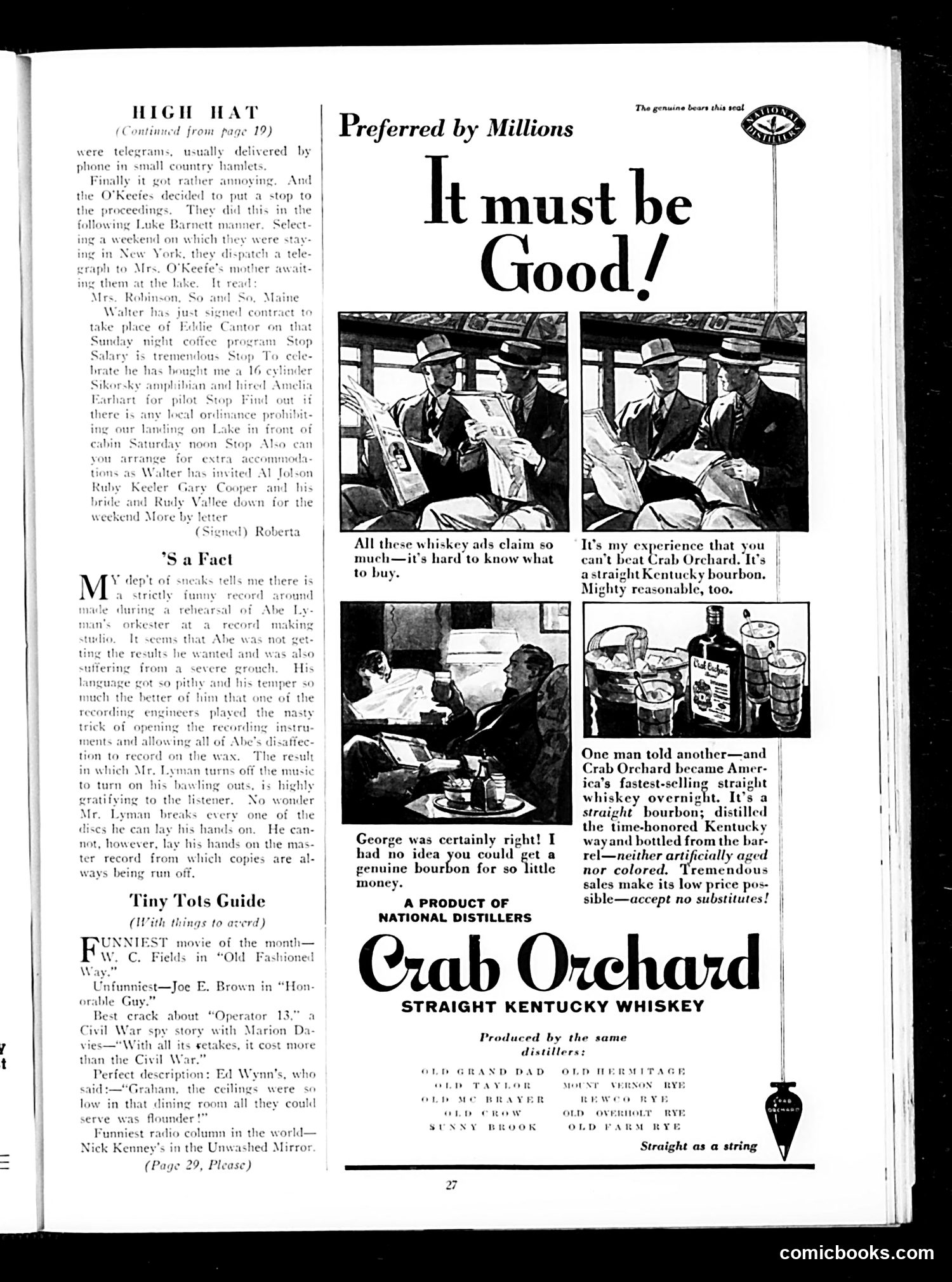
This page is primarily advertising, not editorial satire. The dominant content is a large Crab Orchard whiskey advertisement featuring testimonial-style photos of men discussing bourbon quality. The ad's humor is mild and commercial: it presents a conversational scene where one man recommends Crab Orchard to another, claiming it's "America's fastest-selling straight whiskey overnight" despite its low price. The appeal is to value and authenticity—the product is "straight bourbon" without artificial aging or coloring. The left column contains reprinted entertainment gossip and a "Tiny Tots Guide" to films and radio. References include W.C. Fields, Joe E. Brown, and Nick Kenney's radio column—period entertainment content for Judge readers. Context for modern readers: This represents Prohibition-era advertising (likely 1930s), when whiskey ads emphasized legitimate production credentials and quality assurance, playing on consumer skepticism about spirits' authenticity during that regulatory period.
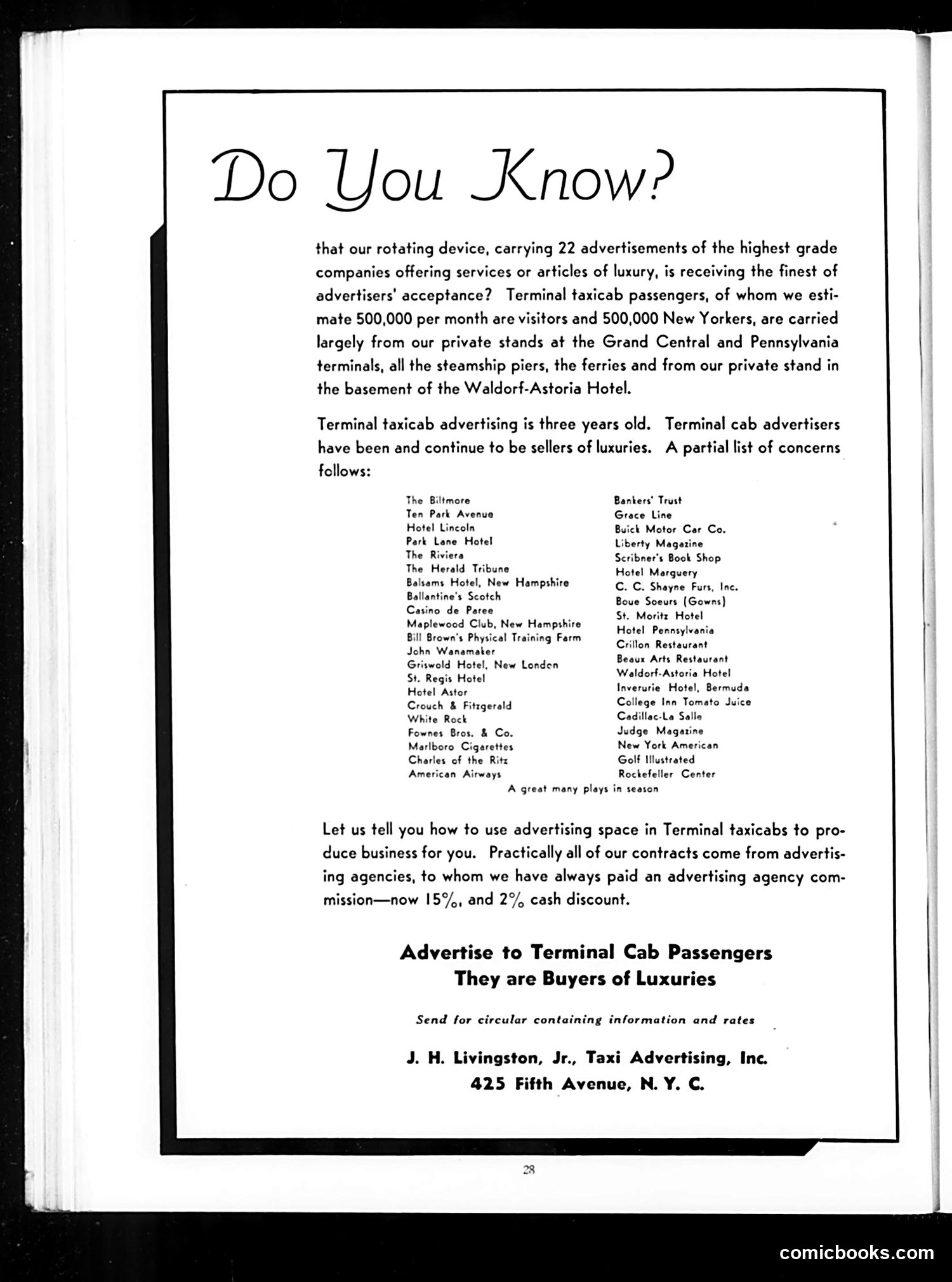
Analysis This is not a cartoon or satire, but rather a straight advertisement placed in Judge magazine. It promotes taxi advertising through J. H. Livingston, Jr.'s company, which places rotating ads inside New York City taxicabs. The pitch targets potential luxury-brand advertisers: the company claims an estimated 1 million monthly passengers (half tourists, half New Yorkers) ride from premium locations like Grand Central, Pennsylvania Station, the Waldorf-Astoria, and steamship piers. The ad lists impressive clients—hotels, airlines, department stores, scotch, furs, cigarette brands—to demonstrate the prestige of the medium and its audience as "buyers of luxuries." The sales incentive mentions standard advertising agency commissions (15%) plus a 2% cash discount. For modern readers: this represents an early form of captive-audience advertising—the idea that commuters trapped in vehicles are ideal marketing targets for luxury goods.
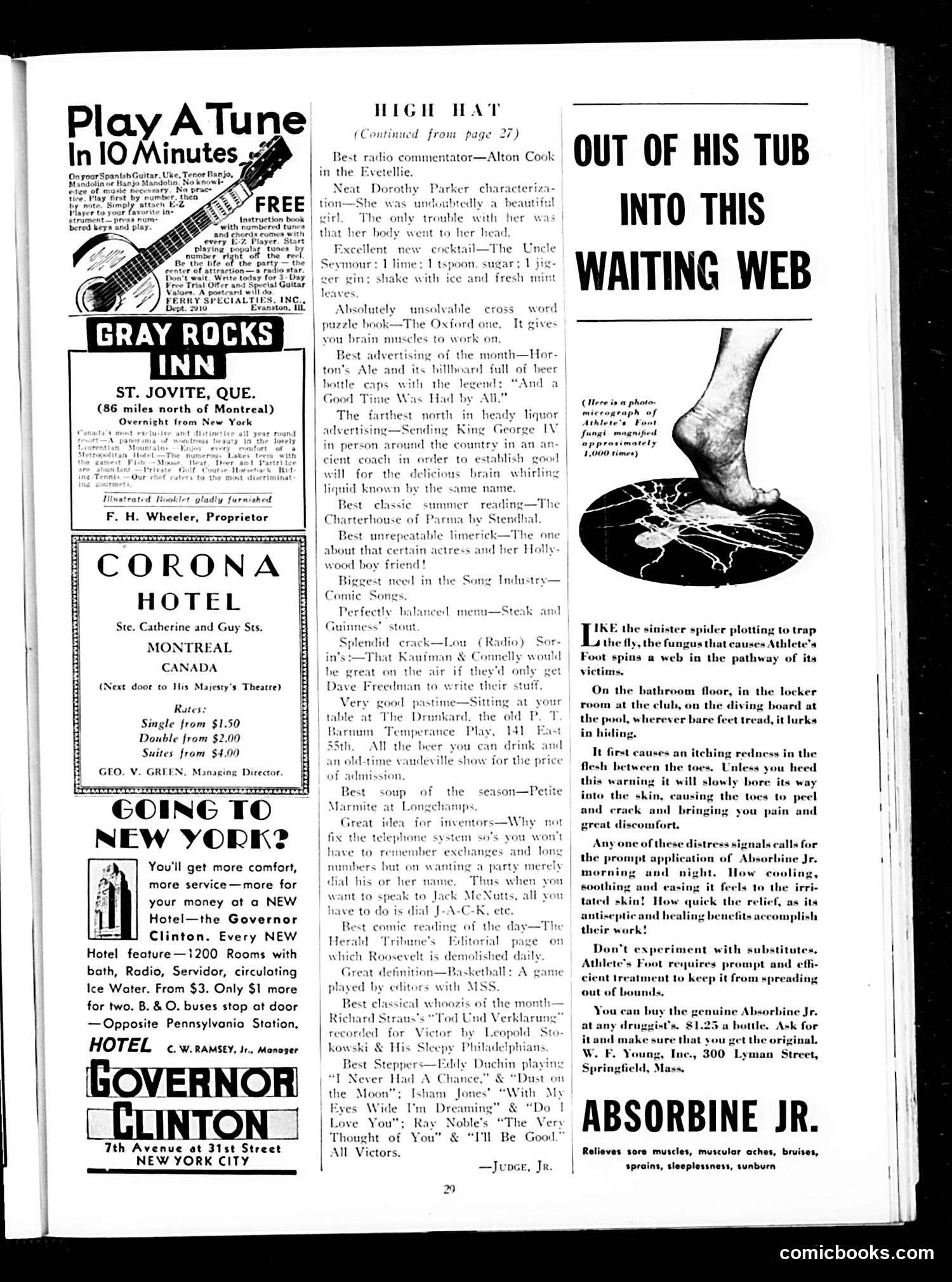
Analysis of Judge Magazine Page Content This page is primarily advertising and entertainment listings rather than political satire. The dominant content includes hotel advertisements (Gray Rocks Inn, Corona Hotel, Governor Clinton) and a "High Hat" column of entertainment reviews and recommendations. The only substantive editorial content is a cartoon and article about Athlete's Foot fungus, illustrated with a magnified photograph (1,000x magnification). The piece uses spider/web metaphor—comparing the fungus to "the sinister spider plotting to trap the fly"—to humorously warn readers about this common affliction. The article describes where the fungus lurks (bathroom floors, pool areas, locker rooms) and recommends "Absorbine Jr." as treatment. This is essentially product advertising disguised as health information—a common magazine practice of the era. The satirical element is minimal; the humor derives from the exaggerated microscopic imagery and the dramatic language applied to a mundane foot problem.
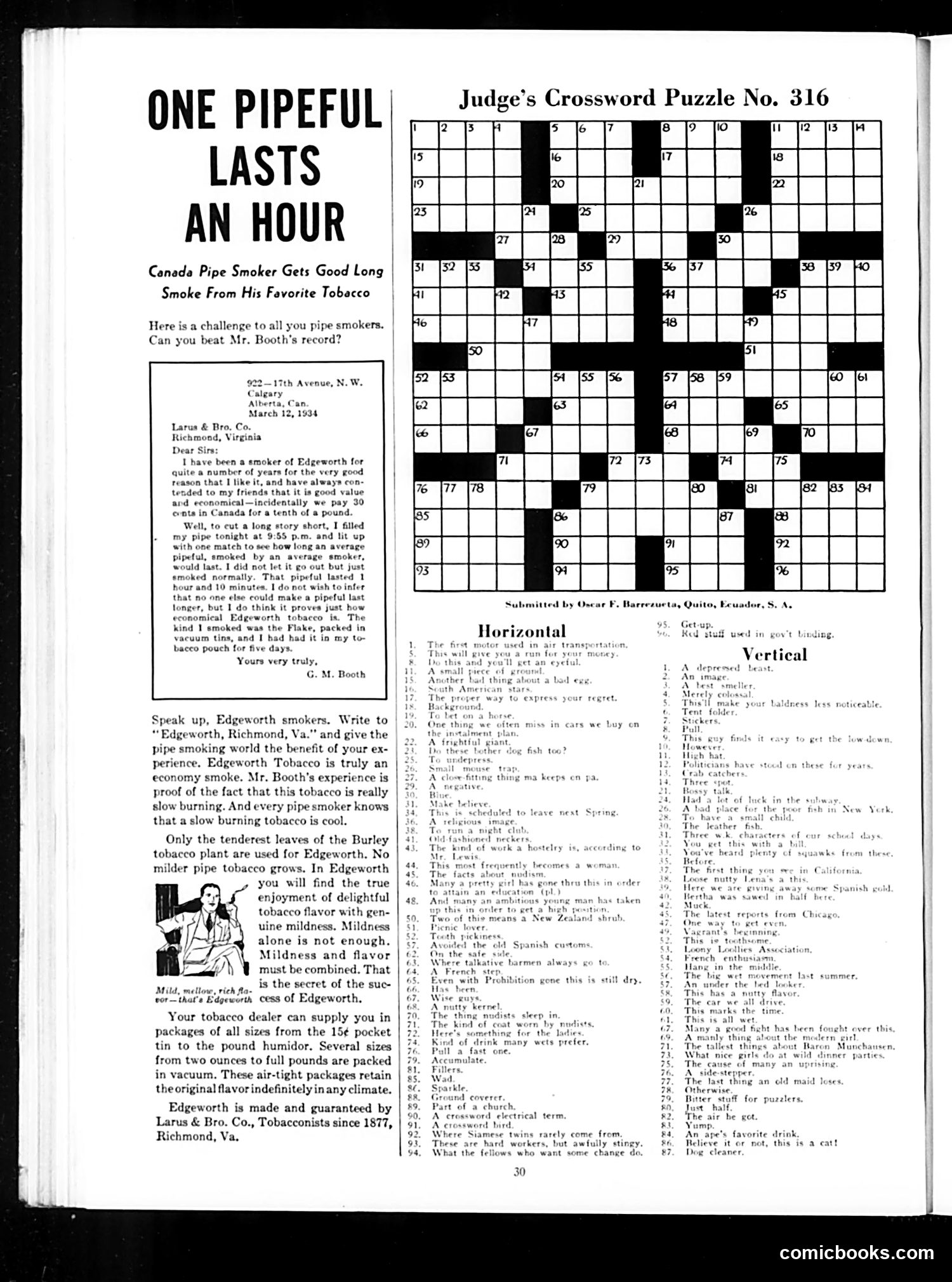
"One Pipeful Lasts an Hour" — Edgeworth Tobacco Advertisement This page is primarily a tobacco advertisement, not satire. It presents a letter from a Canadian pipe smoker named G.M. Booth claiming he smoked one pipeful of Edgeworth tobacco for over an hour—framed as a consumer testimonial to prove the product's economy and slow-burning quality. The "challenge" invites other smokers to submit their own smoking-duration records, turning product claims into a competitive appeal. Below is a crossword puzzle (unrelated to the ad), likely typical filler content in Judge magazine. The advertisement emphasizes Edgeworth's affordability, mildness, and flavor—key selling points during the 1934 Depression era when "economy" was a major consumer concern. The appeal to Canadian customers and the vacuum-sealed packaging details suggest marketing to a North American audience. This represents straightforward commercial promotion rather than editorial commentary or humor.
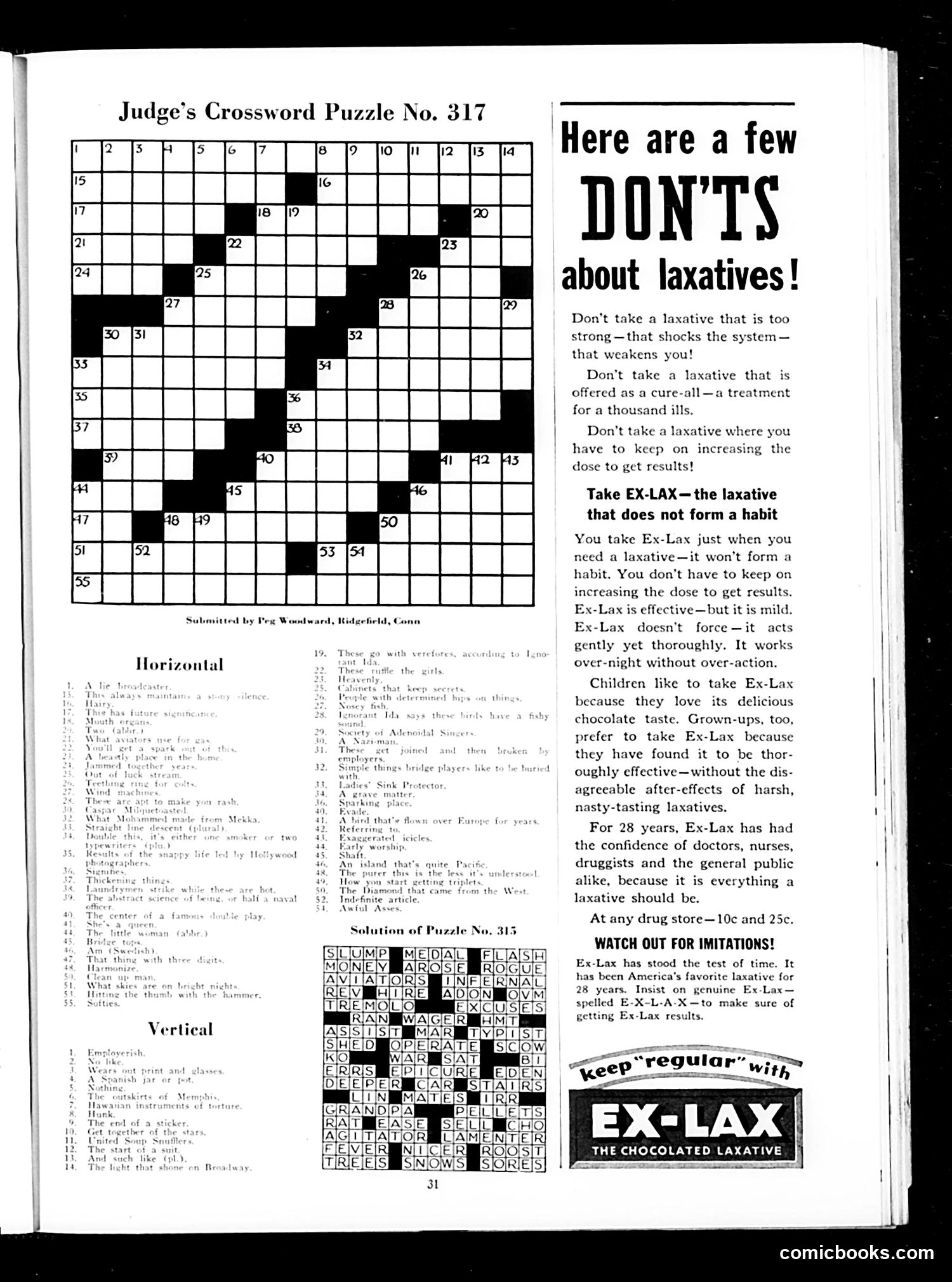
Analysis This page is primarily advertising, not satire. It contains Judge magazine's crossword puzzle (#317) alongside a full-page advertisement for Ex-Lax laxative. The "DON'Ts about laxatives" section is marketing copy, not satire. It uses comparative advertising to position Ex-Lax favorably against competitors by warning against harsh laxatives that are "too strong," form habits through dose-escalation, or claim to cure multiple ailments. The ad emphasizes Ex-Lax's supposed gentleness, non-habit-forming properties, overnight effectiveness, and chocolate flavor (to appeal to children). The "WATCH OUT FOR IMITATIONS" warning at bottom protects brand loyalty. This reflects early-20th-century patent medicine marketing, where laxatives were heavily advertised directly to consumers. The appeal to medical authority ("doctors, nurses, druggists") and the claim of "28 years" of consumer trust were typical persuasion tactics of the era. There is no discernible political cartoon or satirical commentary on this page.
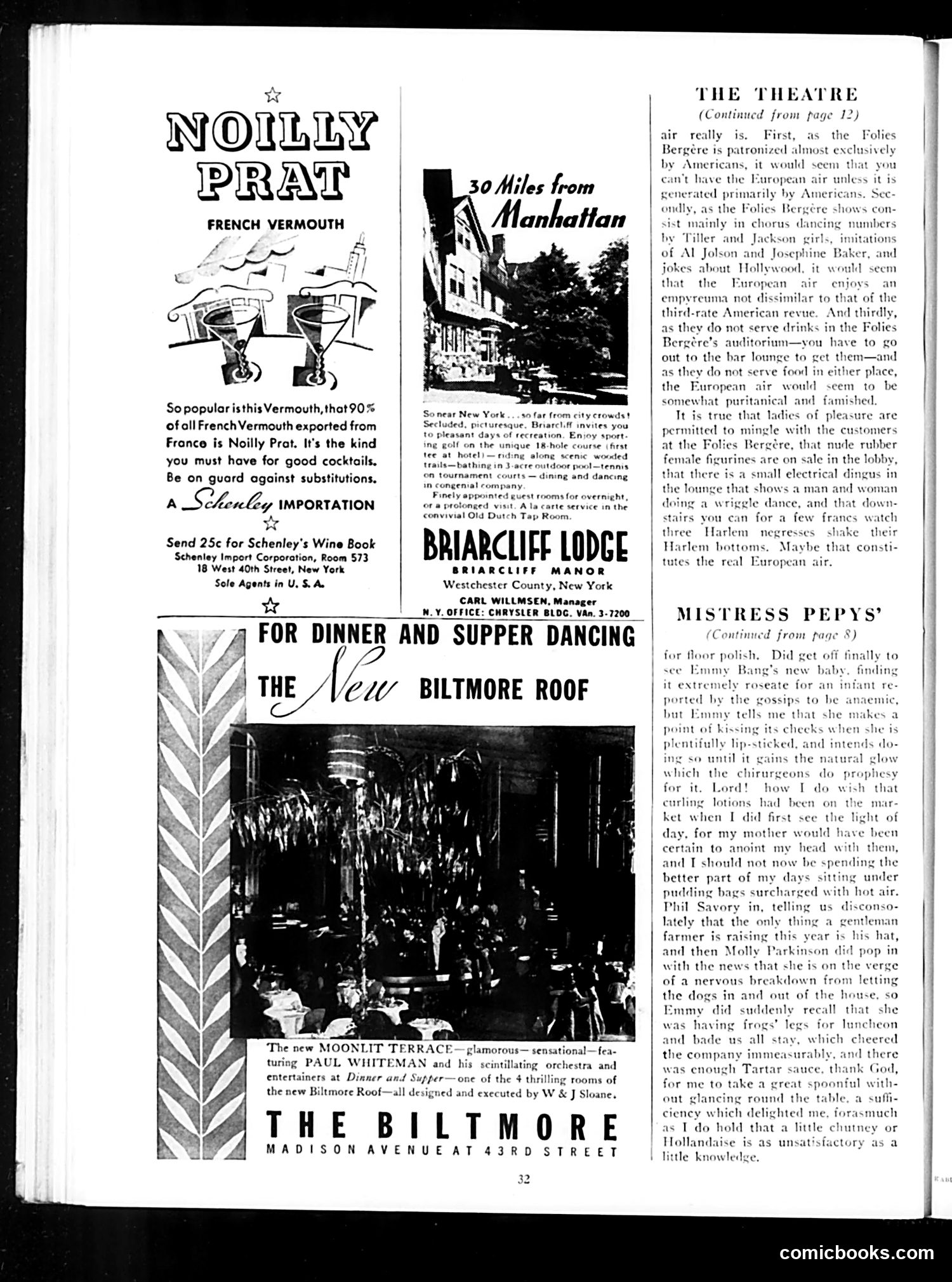
Analysis for Modern Readers This page is primarily advertising and entertainment listings from Judge magazine, not satirical political content. The top features ads for Noilly Prat French Vermouth (emphasizing its popularity and warning against substitutes) and the Briarcliff Lodge resort in Westchester County, New York—typical 1920s leisure destination marketing. The main visual is a large advertisement for the Biltmore Roof, a NYC nightclub featuring Paul Whiteman's orchestra, promoting it as a venue for "dinner and supper dancing." The text columns contain theatrical reviews and gossip columns ("Mistress Pepys"), discussing European cabarets and society personalities—not political satire. The "Mistress Pepys" column uses affected, rambling prose about celebrity babies and dinner companions in a gossipy, entertainment-focused style typical of the era's society pages. This represents Judge's shift toward lifestyle and entertainment content rather than its traditional satirical focus.
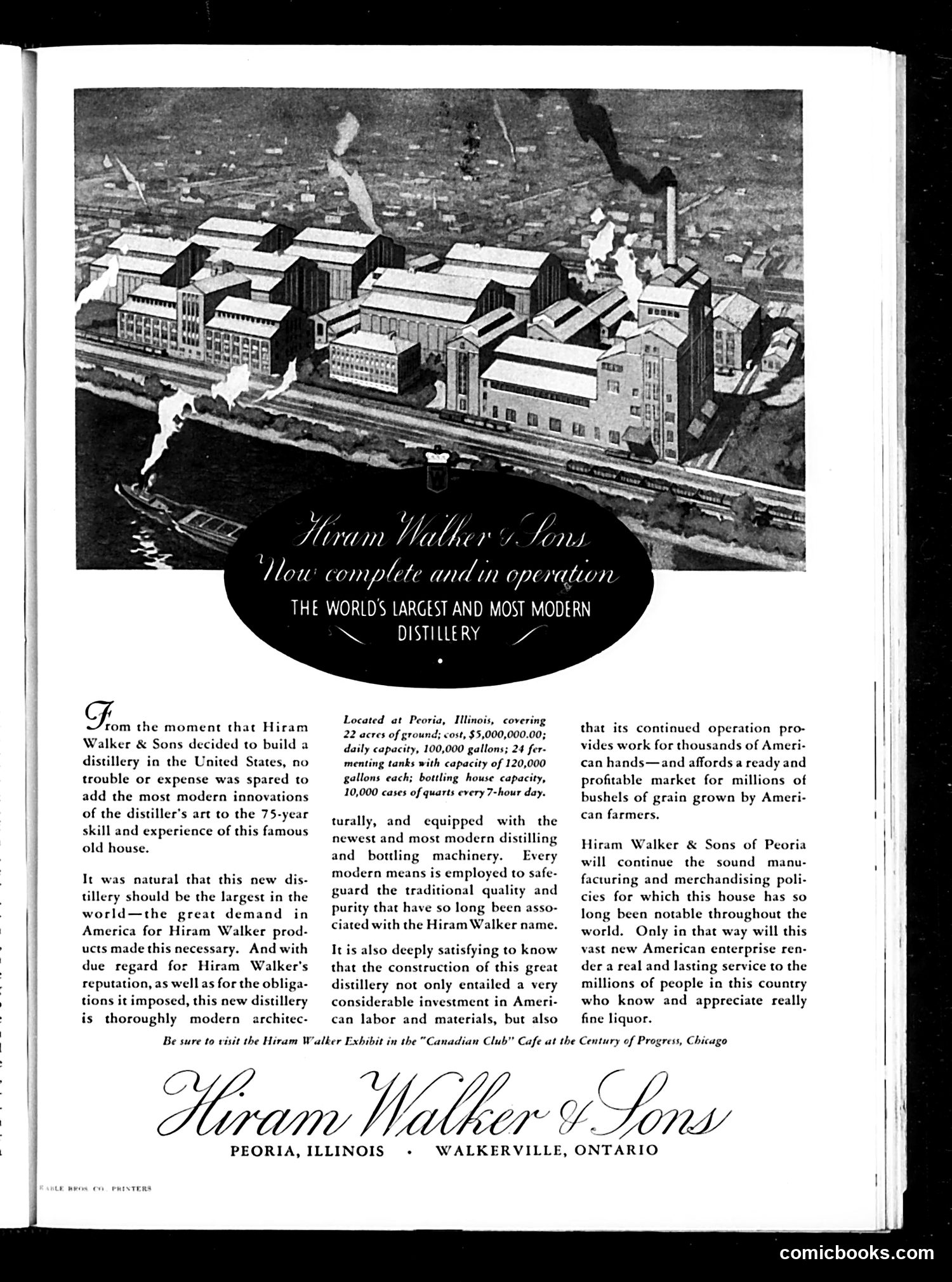
Analysis This is not a cartoon or satire—it's a full-page advertisement for Hiram Walker & Sons distillery, newly built in Peoria, Illinois. The image shows an aerial photograph of the massive industrial complex. The ad emphasizes that this is "the world's largest and most modern distillery," constructed at great expense ($5,000,000) with state-of-the-art machinery and capacity (100,000 gallons daily). The text uses nationalist and economic appeals typical of 1930s advertising: the facility employs American workers, uses American materials, and provides markets for American farmers. It positions the company as a responsible corporate citizen invested in American prosperity. This appears in *Judge* magazine likely during or shortly before Prohibition's repeal (1933), when distilleries could legally resume operations. The ad celebrates American industrial achievement and the return of legitimate liquor production after the dry years.
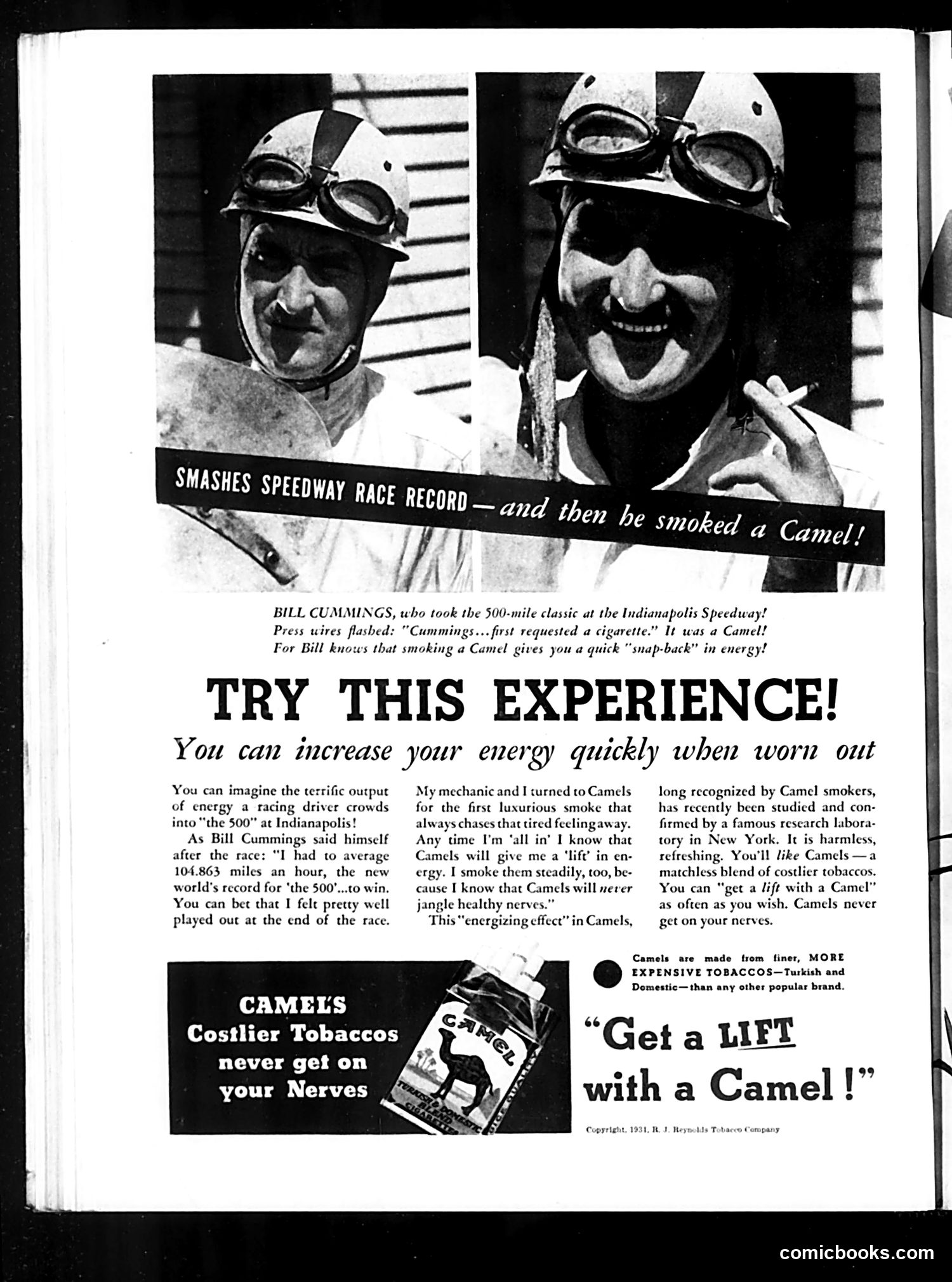
Analysis This is a cigarette advertisement, not satire or political commentary. It features Bill Cummings, who won the 1931 Indianapolis 500-mile race, endorsing Camel cigarettes. The ad claims that smoking Camels provides a quick "snap-back" in energy—useful when exhausted. It presents Cummings' supposed testimony that after averaging 104.863 mph to win, he felt "played out" until smoking Camels restored his energy. The modern reader should understand: this advertisement makes health claims (increased energy, "never get on your nerves") that would be illegal today. The ad also cites a vague "famous research laboratory in New York" to lend false scientific credibility. For contemporary consumers unfamiliar with pre-1960s advertising, this represents the era before tobacco health warnings and advertising restrictions—when cigarette companies could openly claim medicinal/energizing benefits without evidence.