judge
Judge — October 1934
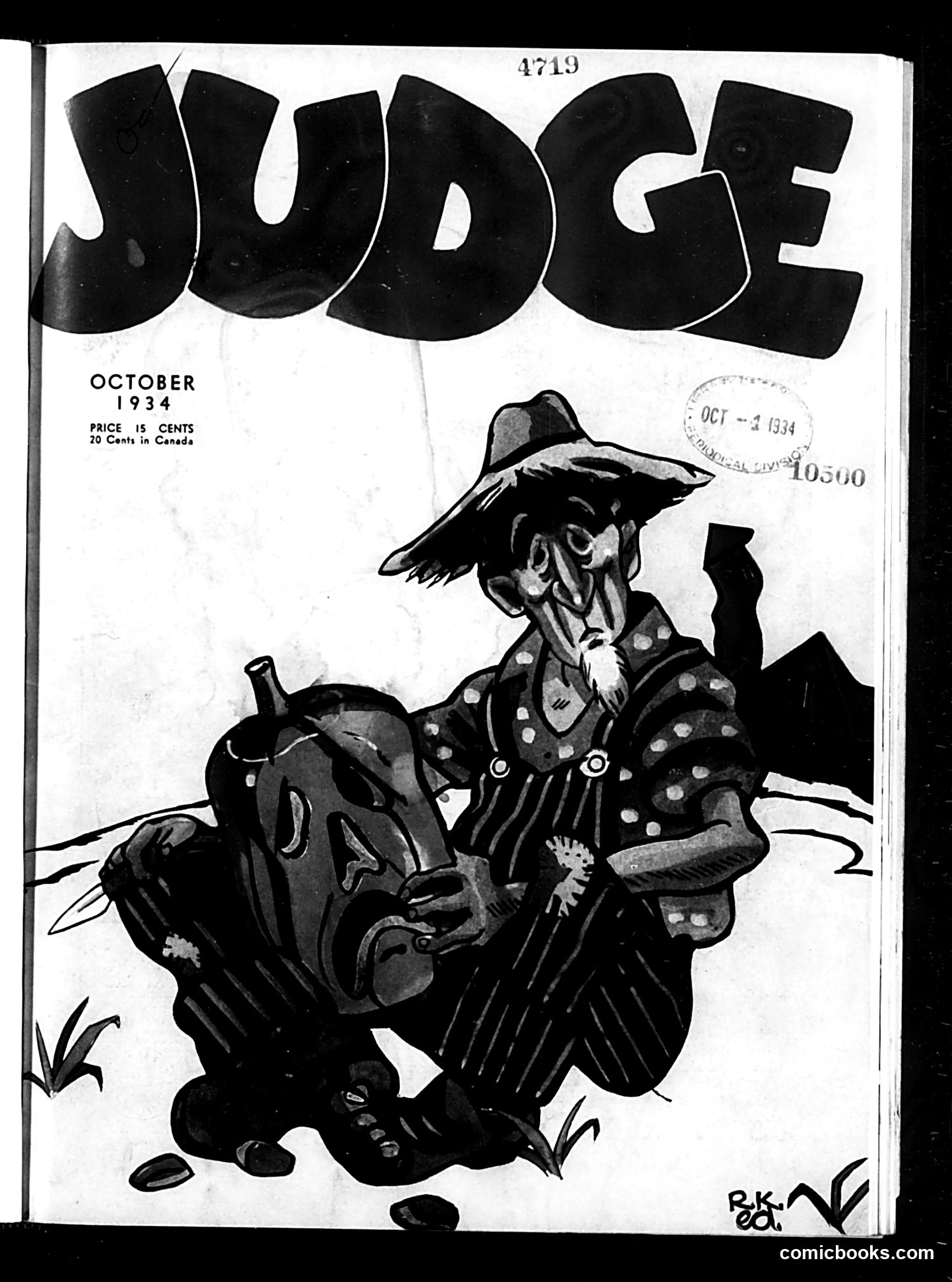
Judge Magazine, October 1934 This is the cover of Judge, a satirical magazine priced at 20 cents (10 cents in Canada). The large cartoon depicts a disheveled, caricatured figure dressed as a vagrant or hobo, carrying a bindle (bundle on a stick). The exaggerated facial features and shabby appearance suggest social commentary during the Great Depression era. The figure's clothing—striped jacket with polka dots, worn hat, and tattered appearance—represents economic hardship and unemployment that characterized 1934 America. The "JUDGE" masthead above appears as bold typography. The cartoonist's signature appears in the lower right corner. Without additional context on the page's interior content, the specific political target remains unclear, though the satire likely addresses Depression-era economic conditions or a contemporary political figure associated with poverty or failed policies.
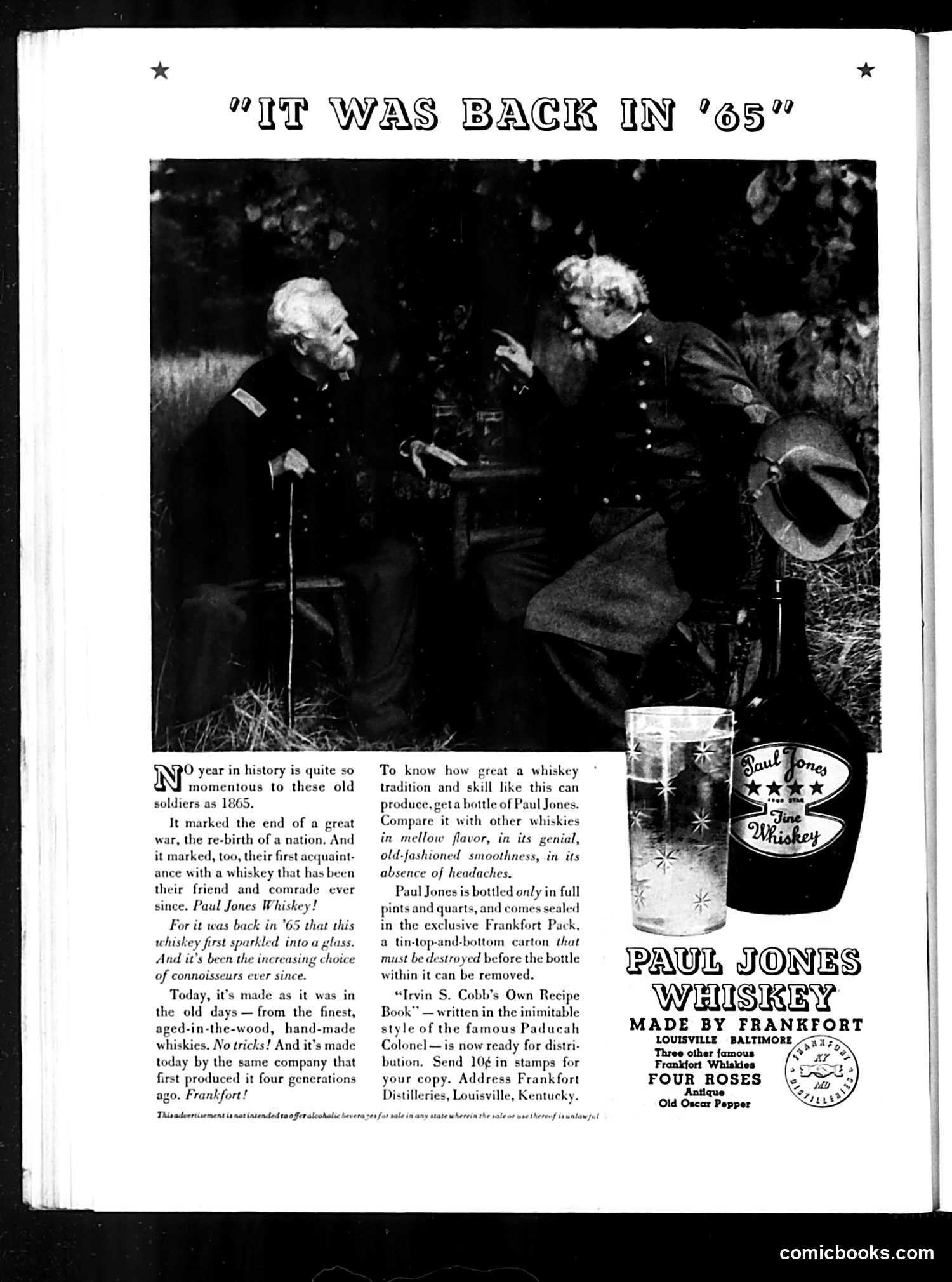
Analysis This page is primarily a whiskey advertisement for Paul Jones Whiskey, not political satire. The heading "It Was Back in '65" references 1865—the end of the Civil War—to create nostalgic marketing. The black-and-white photograph shows two elderly men in military uniforms, apparently Civil War veterans, sharing a drink. The advertisement uses this emotional imagery to suggest the whiskey has been a trusted companion through American history since that pivotal year. The text emphasizes the product's traditional production methods ("made as it was in the old days") and positions it as a premium choice. The ad includes competitive claims about flavor and smoothness, along with purchasing information directing readers to Frankfort Distilleries in Louisville, Kentucky. This represents early 20th-century advertising strategy: leveraging patriotic sentiment and historical nostalgia to sell consumer products.
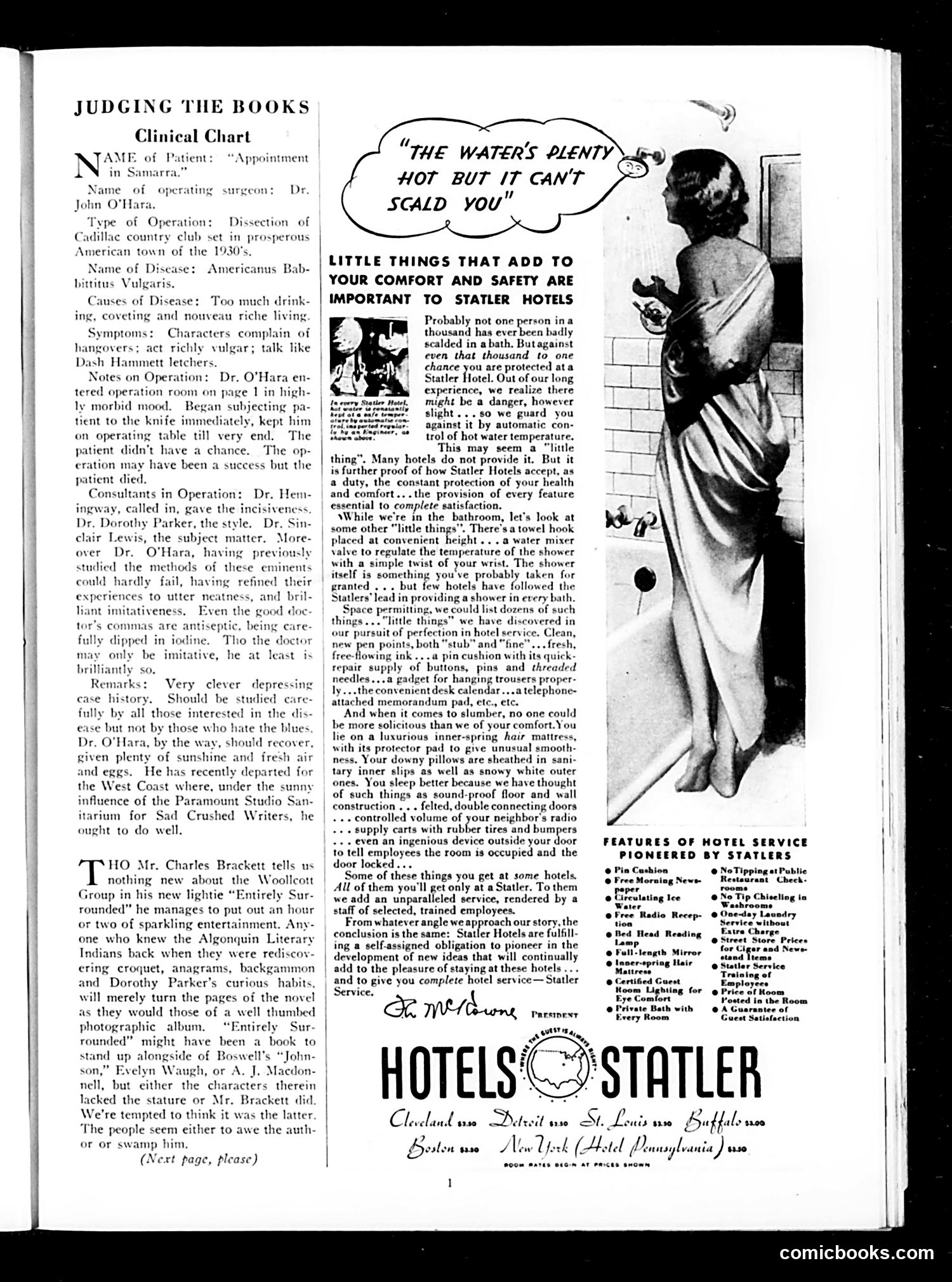
Analysis This page is primarily a Statler Hotels advertisement, not political satire. The main content features a woman in a bathrobe next to bathroom fixtures, promoting hotel amenities like temperature-controlled water and various comfort features. The top left contains "Judging the Books," a book review section discussing a clinical case study about an appendectomy at a country club. The review critiques the work's depiction of doctors and medical procedures, suggesting the author's characterizations lack authenticity. The cartoon speech bubble ("The water's plenty hot but it can't scald you") reinforces the advertisement's safety message about Statler Hotels' modern temperature controls—a practical innovation positioning the chain as offering superior accommodations with contemporary conveniences.
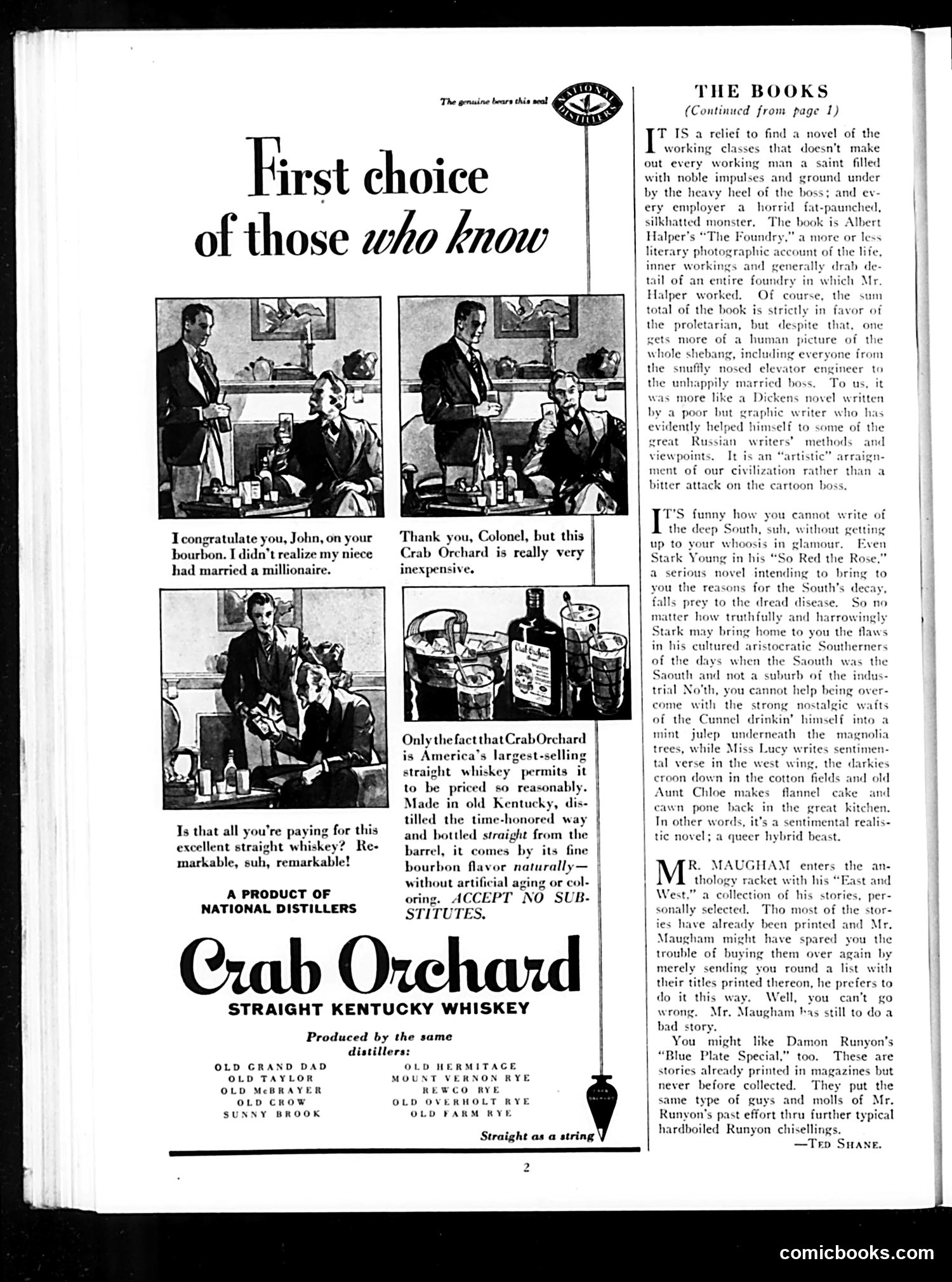
Analysis This page is primarily a Crab Orchard whiskey advertisement rather than political satire. The comic panels show wealthy men in formal dress congratulating each other on business deals—one mentions marrying a millionaire's niece, another praises the whiskey's affordability despite its quality. The humor relies on class-based satire: the advertisement depicts the wealthy elite casually discussing money while drinking premium bourbon, implying that even America's richest find this whiskey appropriately priced. The joke targets both upper-class pretension and marketing to the affluent. The right column reviews books but contains no identifiable political figures or current events. The page appears designed to sell liquor to Judge's educated, affluent readership through gentle mockery of their own social circle.
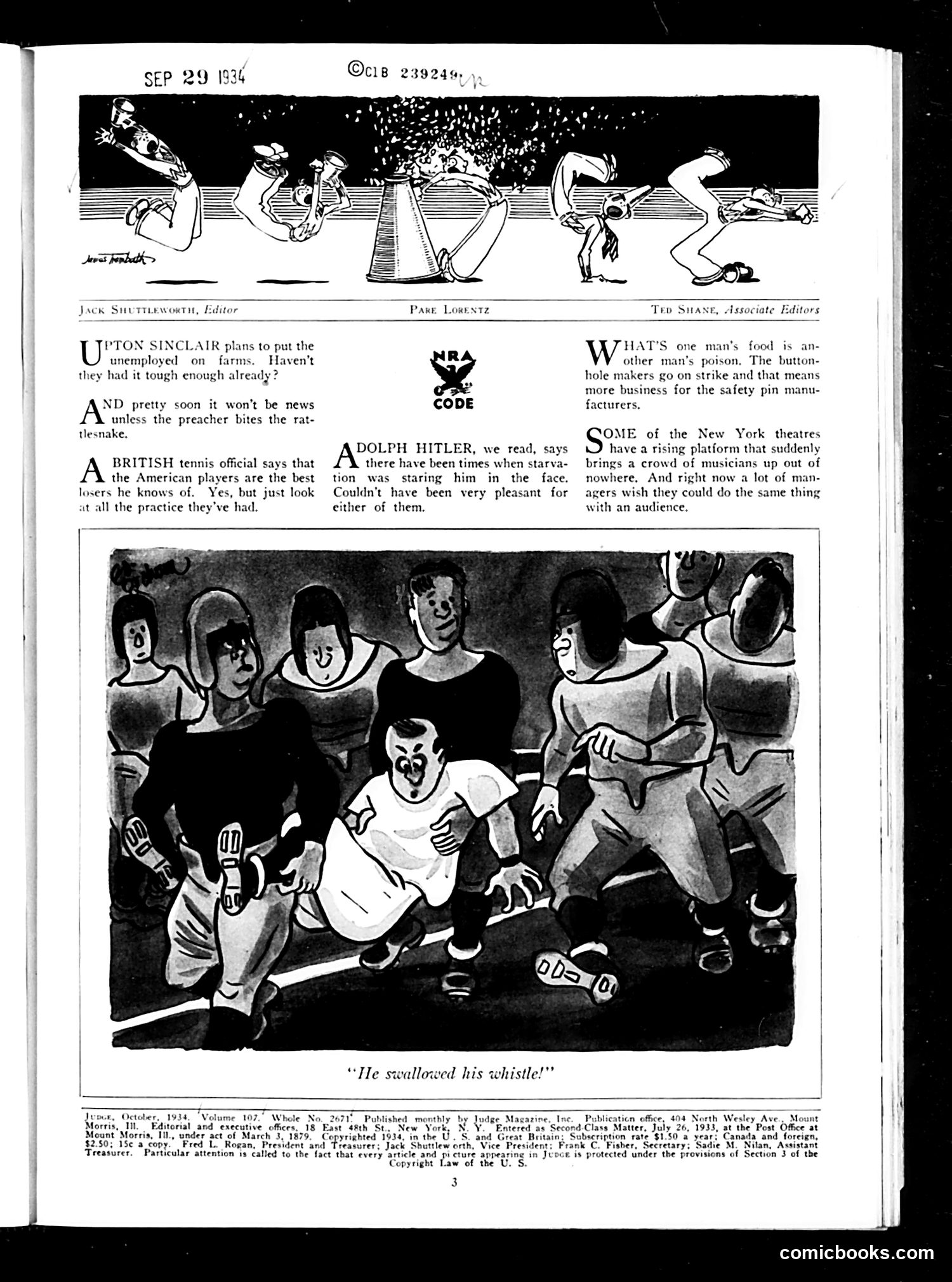
Analysis of Judge Magazine Page (September 29, 1934) Main Cartoon: The large illustration depicts "He swallowed his whistle!" — showing a central figure (appearing to be a Nazi, identifiable by the swastika armband) surrounded by what look like referees or officials in striped uniforms. The satire appears to criticize Adolf Hitler, whom the text explicitly mentions: "ADOLPH HITLER, we read, says there have been times when starvation was staring him in the face. Couldn't have been very pleasant for either of them." The whistle-swallowing joke suggests Hitler has silenced himself or lost control—likely mocking his authoritarian suppression of dissent or his own contradictory statements about hardship. Context: This is early Depression-era American satire targeting Nazi leadership through dark humor about power and control, before U.S. entry into WWII.
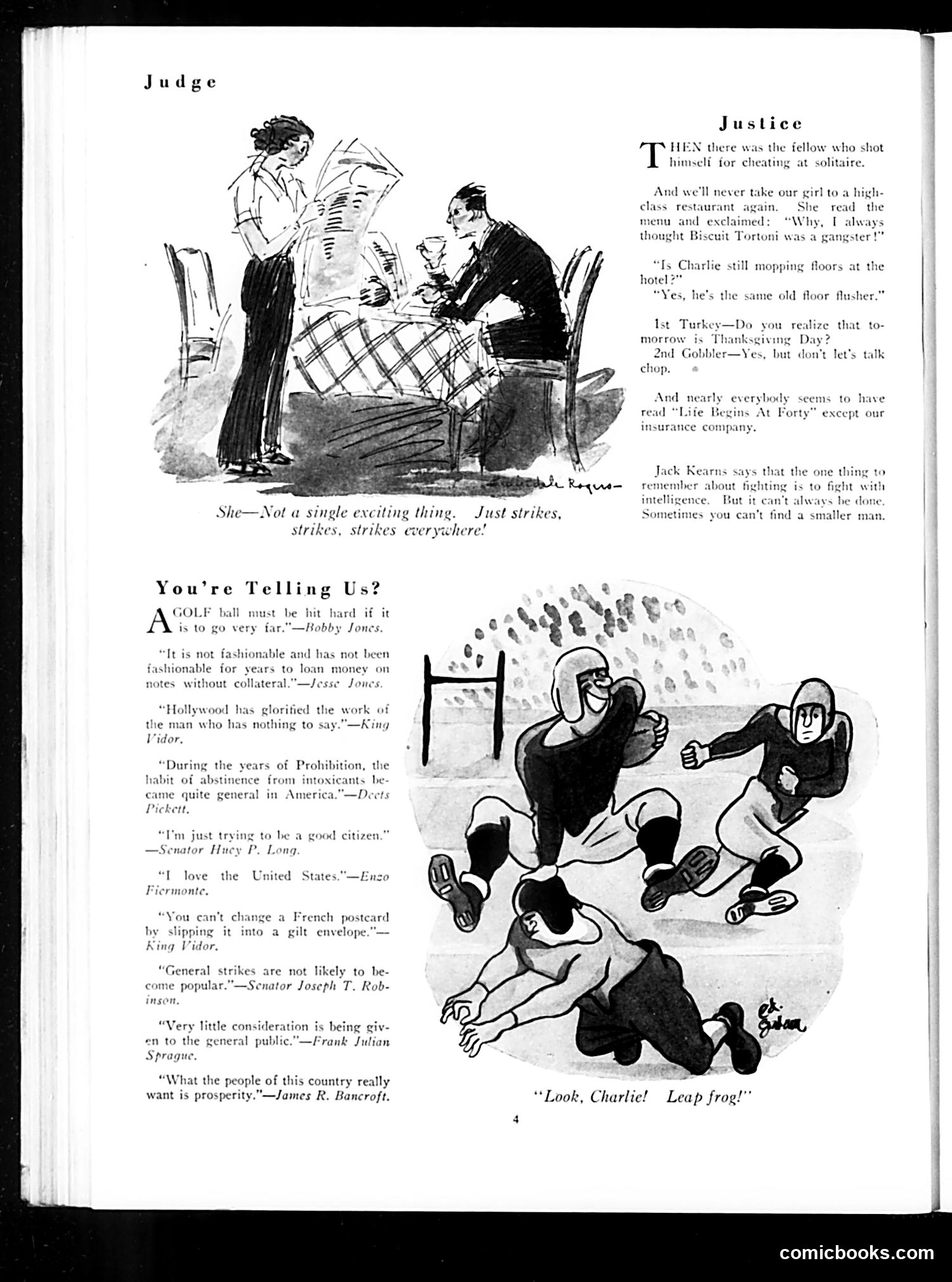
Analysis The top cartoon depicts a restaurant scene satirizing class pretension. A woman complains that she'll never return to a "high-class restaurant" after discovering the famous "Biscuit Tortoni" dessert was made by a gangster—mocking how easily diners are fooled by fancy presentation regardless of disreputable origins. The lower section, "You're Telling Us?", compiles brief satirical quotes from public figures (Bobby Jones, King Victor, Senator Long, etc.) about various social issues—strikes, prohibition's failure, citizenship, and prosperity. These appear to mock politicians' empty platitudes. The cartoon "Look, Charlie! Leap frog!" shows children playing, likely satirizing something contemporary, though the specific reference is unclear without additional context. Overall, the page critiques American pretension, political hypocrisy, and social contradictions of the era.
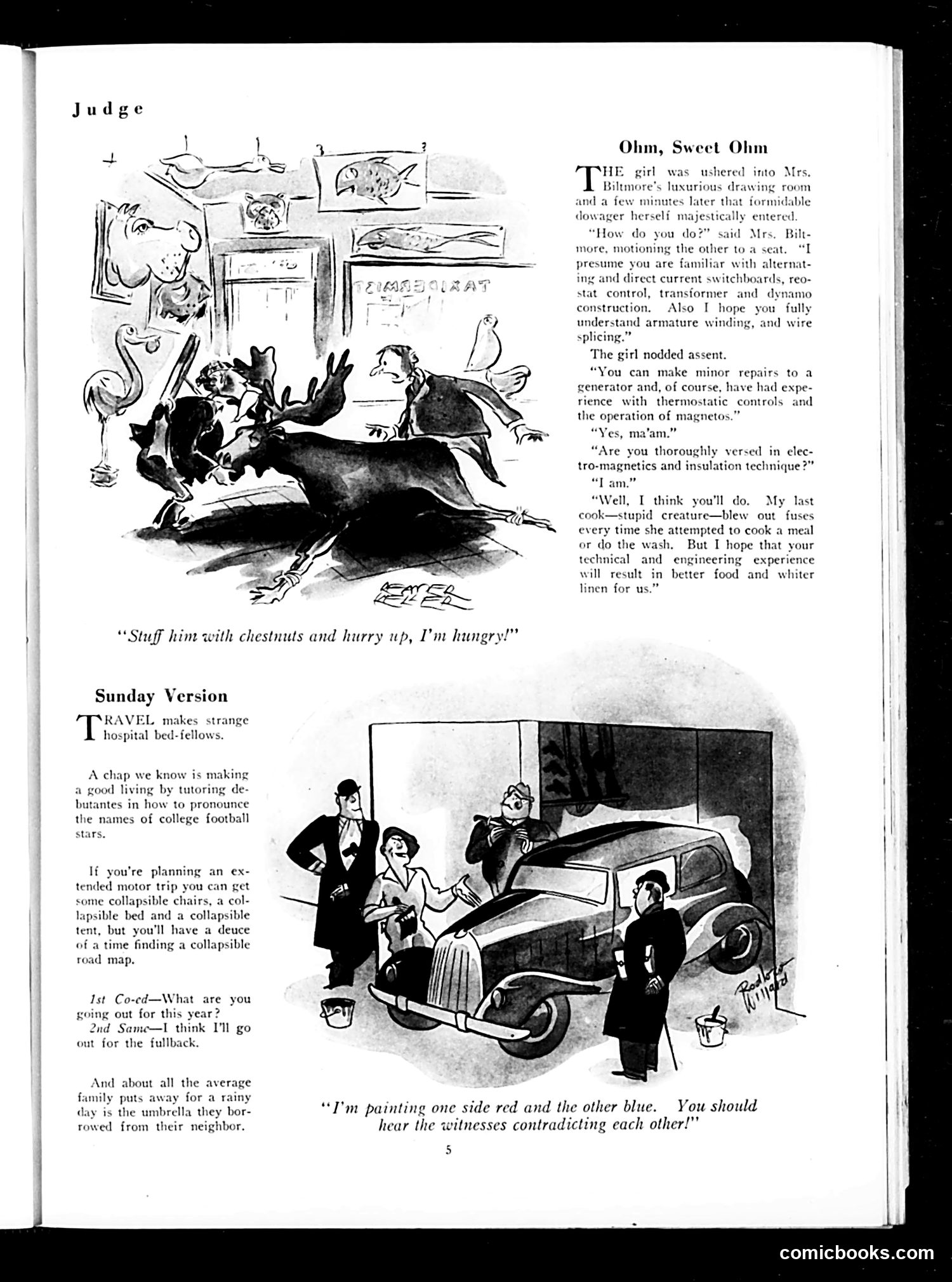
"Judge" Page Analysis Top cartoon ("Ohm, Sweet Ohm"): A girl applying for a domestic position is interviewed by Mrs. Biltmore. The employer quizzes her on electrical knowledge—switchboards, current control, transformers, dynamos, armature winding, electromagnets, and insulation. The joke satirizes how modern electrical appliances have complicated household management. Mrs. Biltmore sarcastically hopes this "technical and engineering experience" will produce better cooking and cleaner linens than her previous cook, who "blew out fuses." The humor mocks both the expanding complexity of domestic technology and the absurd over-qualification now seemingly required for housework. Bottom cartoon ("Sunday Version"): Men discussing road trips mention collapsible furniture and maps, then joke about painting a car half-red, half-blue to create "witnesses contradicting each other"—likely referencing insurance fraud or accident liability disputes.
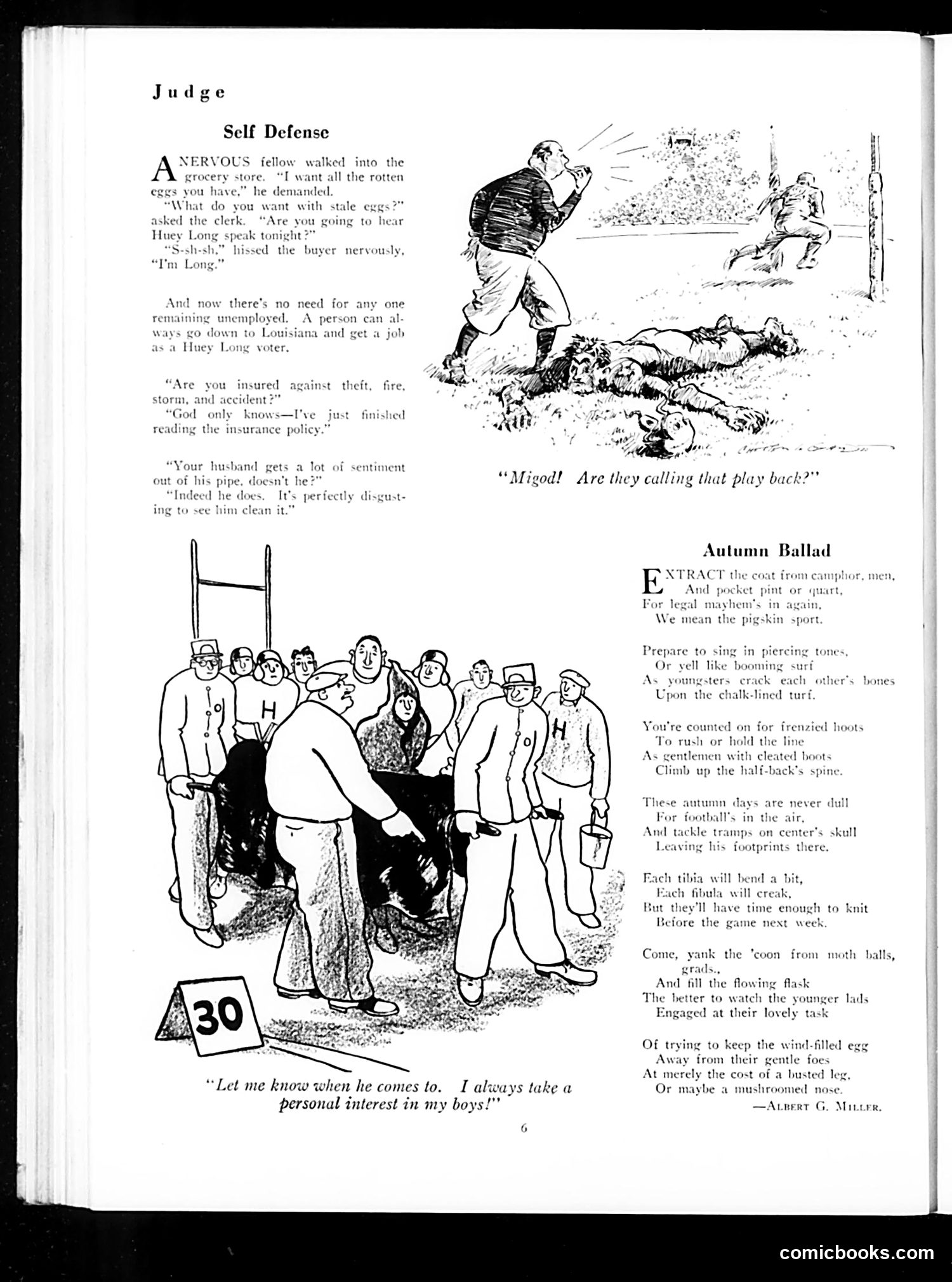
Analysis of Judge Magazine Page "Self Defense" cartoon (top): A man throws eggs at someone fleeing. The dialogue references "Huey Long" and "rotten eggs you have," suggesting satire of Louisiana politics during the Depression era. The joke appears to be about corrupt politicians (likely Long, a controversial Louisiana figure) deserving public mockery. Football cartoon (bottom): Shows a coach surrounded by players marked with "H" (likely representing a specific school). The caption "Let me know when he comes to. I always take a personal interest in my boys!" satirizes coaching brutality—the implication being the coach has knocked a player unconscious and considers this normal or acceptable. "Autumn Ballad" (right): A humorous poem about football season's violence, celebrating injuries with dark comedy typical of 1920s-30s sports satire.
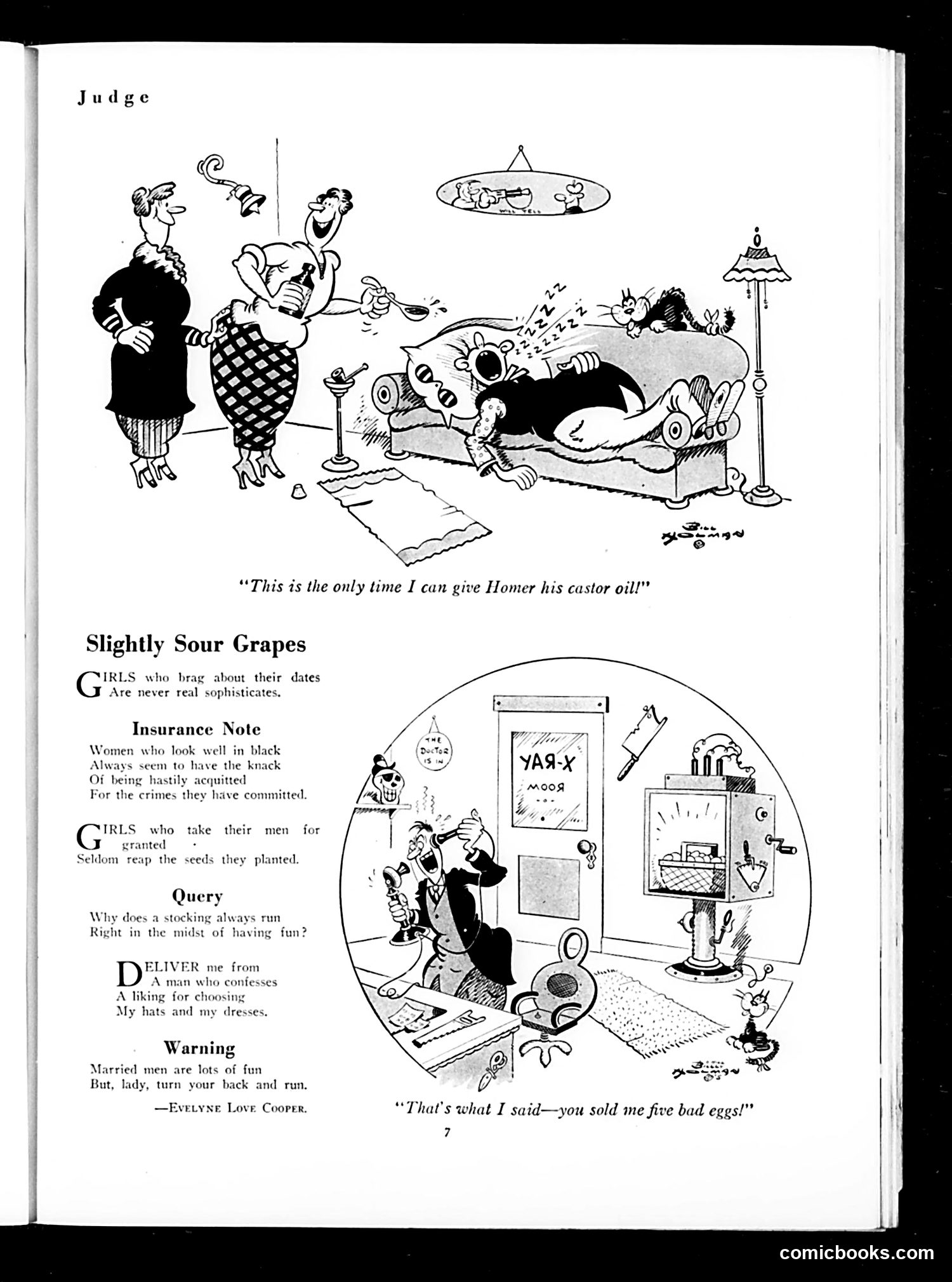
Judge Magazine Page Analysis This page contains two unrelated cartoons and several humorous verse snippets targeting women's social behavior. The top cartoon depicts a domestic scene where a woman forces castor oil (a common laxative) on a man named Homer, apparently during a medical emergency or illness. The joke plays on the double meaning: she can only give him this unpleasant medicine under the guise of medical necessity. The bottom cartoon shows a woman at a general store complaining to the proprietor about bad eggs, with various store items visible. The humor suggests a domestic dispute or marital tension over household purchases. The surrounding verses mock women stereotypically: those who brag about dates, women in black appearing suspiciously acquitted of crimes, girls taking men for granted, and warnings against controlling men and married men generally. This reflects early 20th-century satirical humor targeting gender dynamics and domestic life, with somewhat misogynistic undertones typical of the era's entertainment publications.
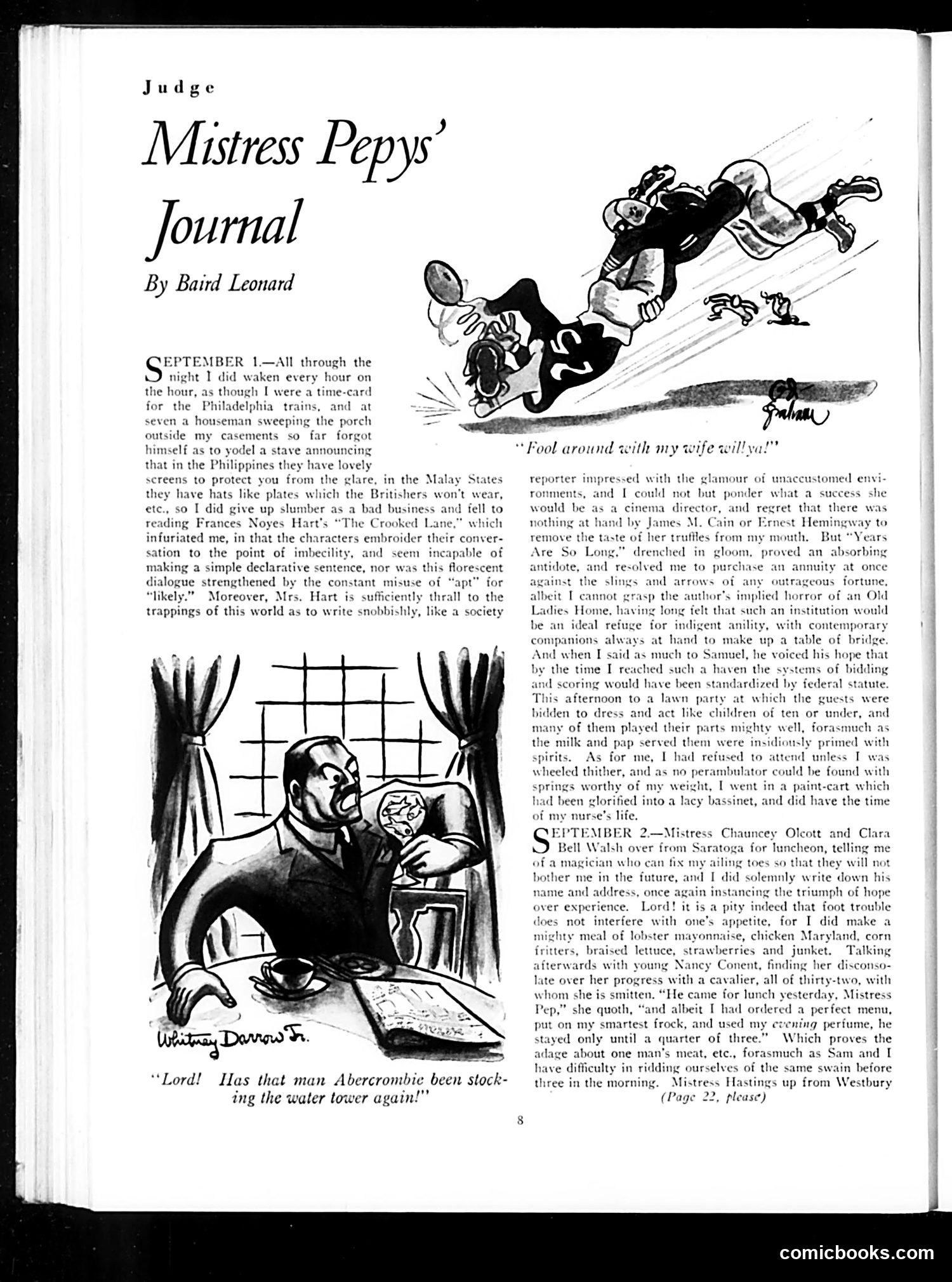
Analysis of "Mistress Pepys' Journal" This is a humor column mimicking Samuel Pepys' 17th-century diary style, applying it to contemporary 1920s socialite concerns. The satire targets upper-class affectation and trivial preoccupations. The cartoons illustrate two complaints: a man desperately fleeing down stairs (captioned about "fooling around with my wife"), and a houseman at a water tower—both depicting domestic chaos and servants' misbehavior. The text mock-seriously chronicles absurd social problems: a housekeeper yodeling at dawn, critiques of an author's flowery prose, attendance at a children's costume party where adults dress as ten-year-olds, and romantic difficulties. The narrator complains about foot troubles and trivial social failures with exaggerated gravity. The satire's point: Judge ridicules wealthy society's self-importance while obsessing over petty matters—bad books, servants' antics, and romantic snubs—treated with the grandiose tone of historical significance. The faux-Pepys format heightens this mockery, suggesting modern socialites' concerns are unworthy of such elaborate documentation.
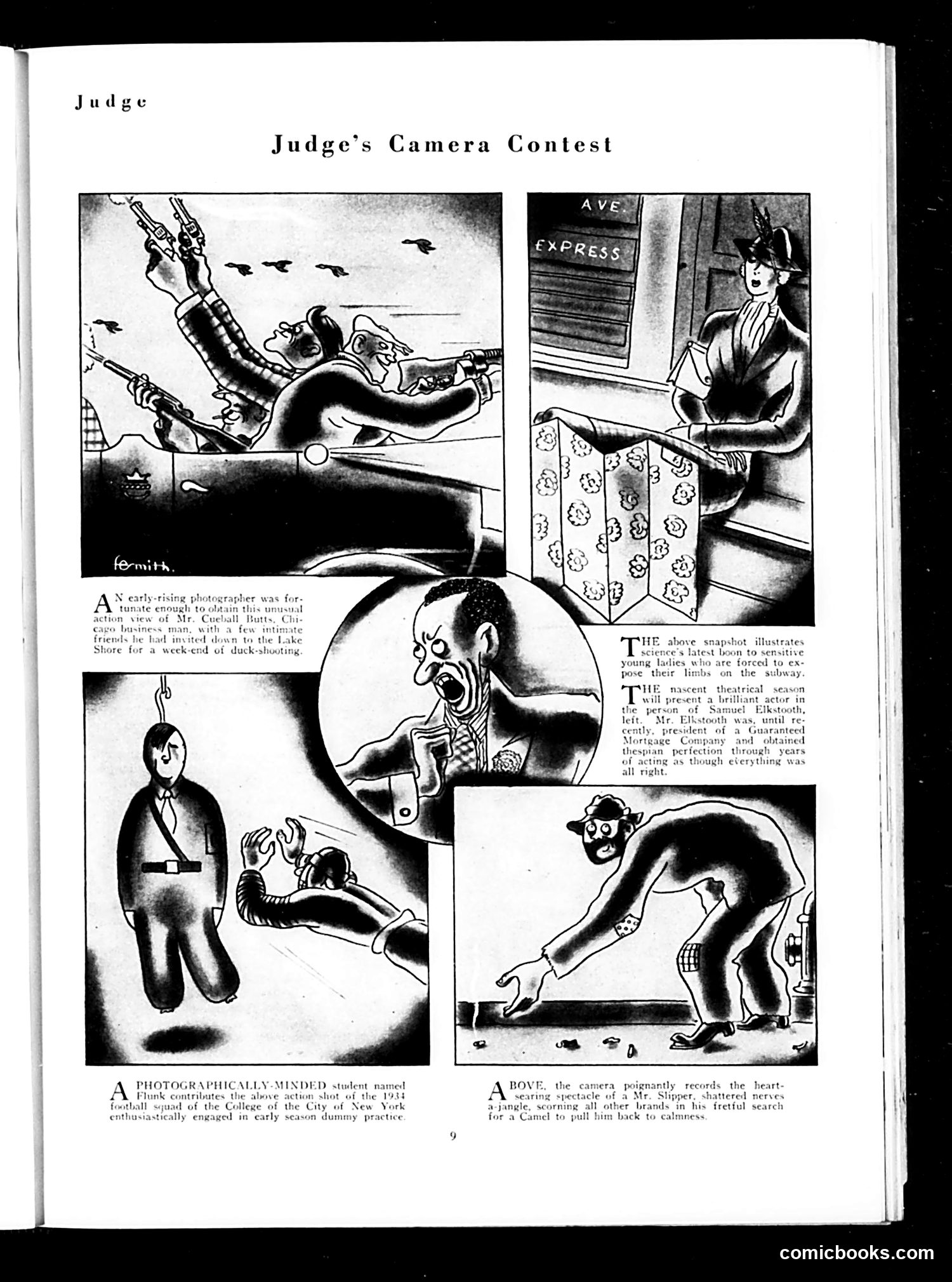
Judge's Camera Contest This page showcases humorous photographs submitted to a camera contest. The cartoons depict exaggerated, comedic scenes meant to be absurd: - Top left: A photographer attempting an action shot of football practice, capturing players in awkward, contorted poses - Top right: A woman posed unnaturally on a windowsill for a "science" photograph about sensitive young ladies - Bottom left: A man suspended by a rope in an bizarre pose - Bottom right: A man in an exaggerated crouching position The satire mocks both amateur photographers' attempts at capturing "artistic" images and the subjects' willingness to pose ridiculously. The joke relies on the contrast between the photographers' pretensions and the undignified, silly results—poking fun at 1930s photography enthusiasts and their often-absurd compositions.
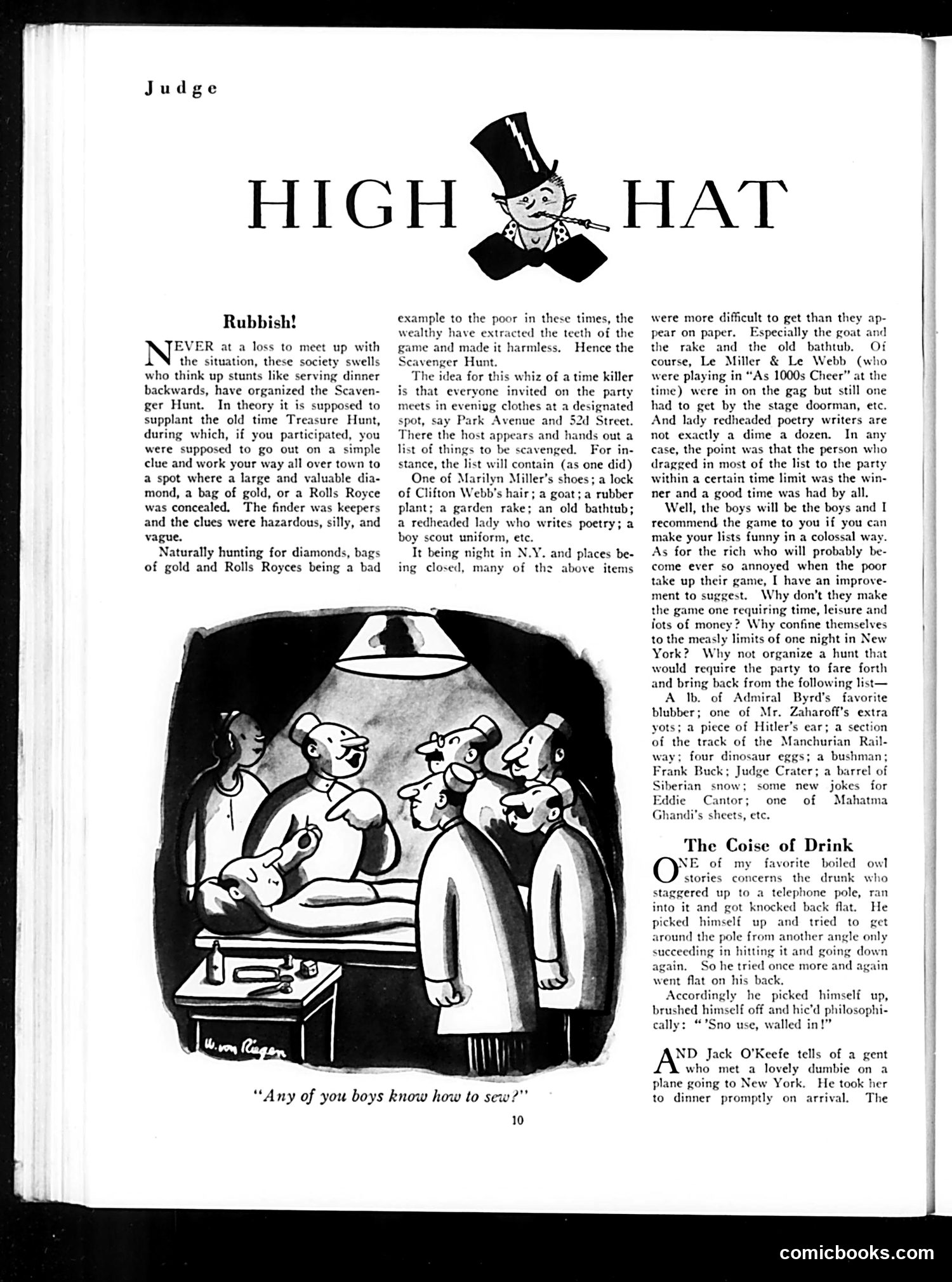
"High Hat" and "The Coise of Drink" - Judge Magazine This page satirizes wealthy society's attempts to appear socially conscious. The Scavenger Hunt article mocks the rich for sanitizing the traditional "Treasure Hunt" (which rewarded finding valuable items like diamonds or Rolls Royces) into a harmless game collecting mundane objects—shoes from Broadway star Marilyn Miller, a goat, a bathtub. The judge argues this "ruins" the game's appeal to the poor during economic hardship, then sarcastically suggests the wealthy organize a *truly* expensive hunt requiring months and vast sums, referencing contemporary figures like Admiral Byrd, Judge Crater (a famous missing person), and Hitler. The cartoon illustrates the scavenger hunt's chaos: well-dressed participants scramble indoors gathering absurd items while asking "Any of you boys know how to sew?" Below, "The Coise of Drink" tells a slapstick joke about a drunk repeatedly colliding with a telephone pole before concluding he's "walled in"—typical period drinking humor. Both pieces reflect Judge's satirical criticism of upper-class frivolity and excessive drinking culture.
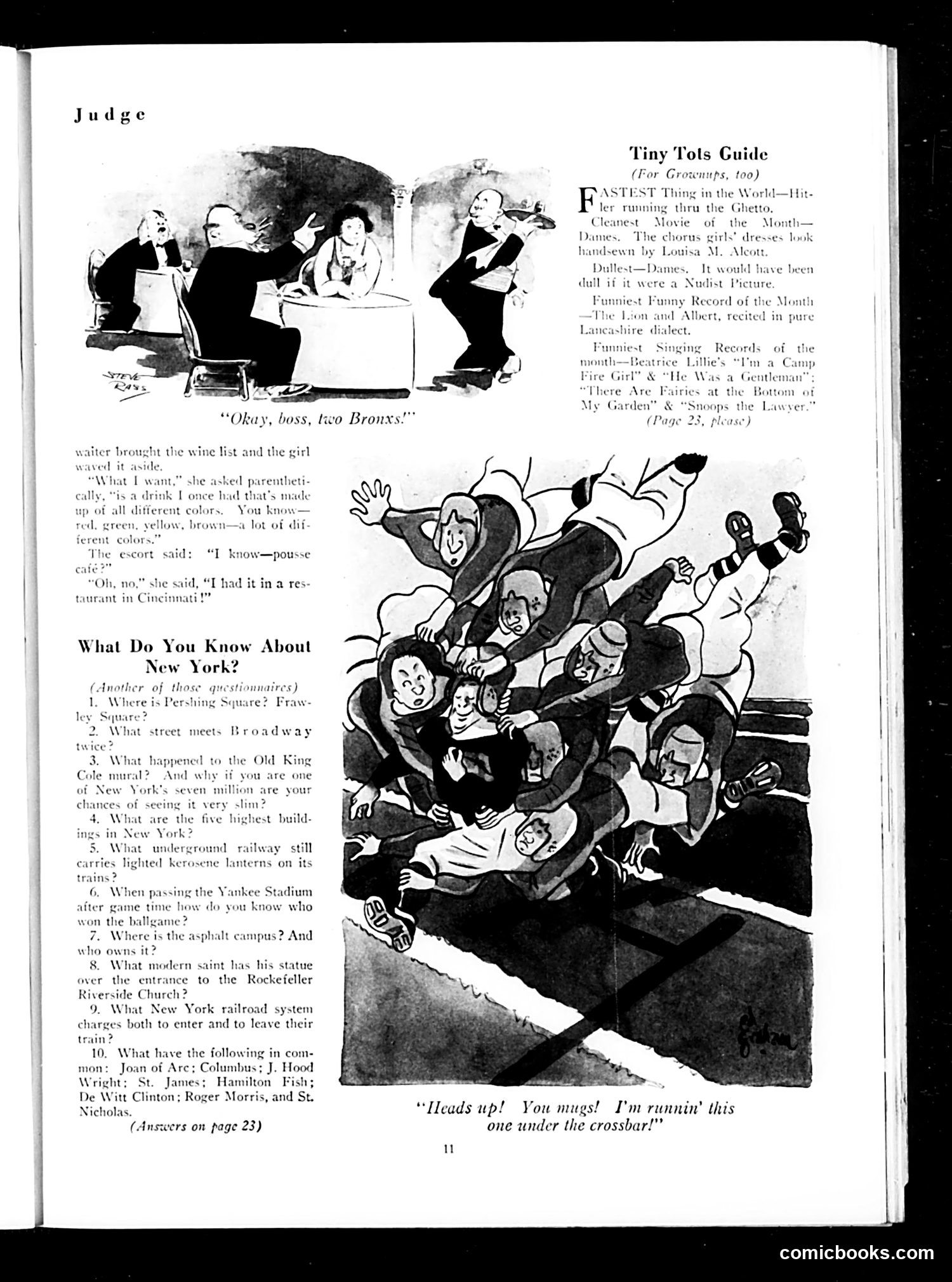
Analysis of Judge Magazine Page This page contains multiple sections typical of Judge's satirical format: Top Cartoon ("Okay, boss, two Bronxs!"): Shows a waiter serving clients at what appears to be a restaurant. The joke satirizes pretentious diners ordering obscure drinks—the woman asks for a cocktail "made up of all different colors" (green, yellow, brown), then reveals she had it once "in a restaurant in Cincinnati," mocking both her lack of sophistication and Midwestern tourist culture. "Tiny Tots Guide" Section: A humorous column for adults includes a Nazi reference ("Hitler running thru the Ghetto")—this appears to be wartime-era satire, likely from the 1940s given the crude joke about Nazi brutality. "What Do You Know About New York?": A trivia quiz mocking New Yorkers' (lack of) knowledge about their own city—questions about obscure landmarks, the Yankee Stadium, and historical figures. It's gentle satire about urban provincialism. Bottom Cartoon: Depicts children playing a rough contact sport, with one shouting about running "under the crossbar"—likely satirizing dangerous children's games. The page exemplifies Judge's mix of social commentary, urban humor, and era-specific references.
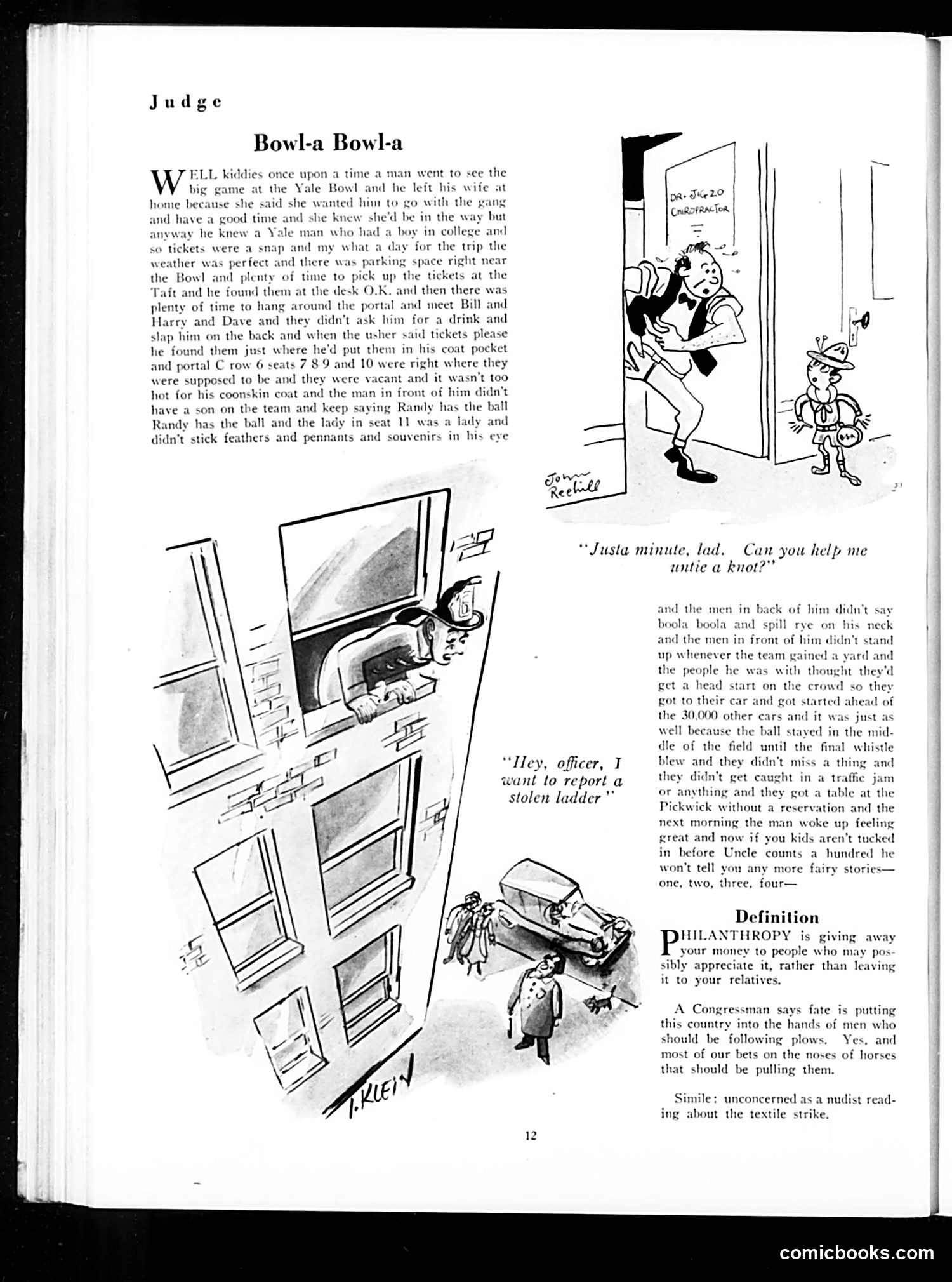
"Bowl-a Bowl-a": A Satirical Fantasy This humorous story describes an idealized Yale Bowl football game experience—a complete inversion of reality. The narrative catalogs every possible annoyance at sporting events: parking hassles, ticket confusion, drunk rowdy fans, obstructed views, excessive heat, aggressive vendors, traffic jams, and restaurant unavailability. By presenting this as a fairy tale ("Once upon a time...a man went"), the satire mocks how *impossibly* perfect everything goes—suggesting that such a smoothly pleasant outing is pure fantasy, as unlikely as a children's bedtime story. The illustration of a man reporting a "stolen ladder" reinforces the absurdist humor. The accompanying "Definition" section provides typical Judge-style cynical commentary on philanthropy and political incompetence, unrelated to the main cartoon. The joke: attending a major sporting event with *zero* complications is so improbable it deserves the framing device of fiction.
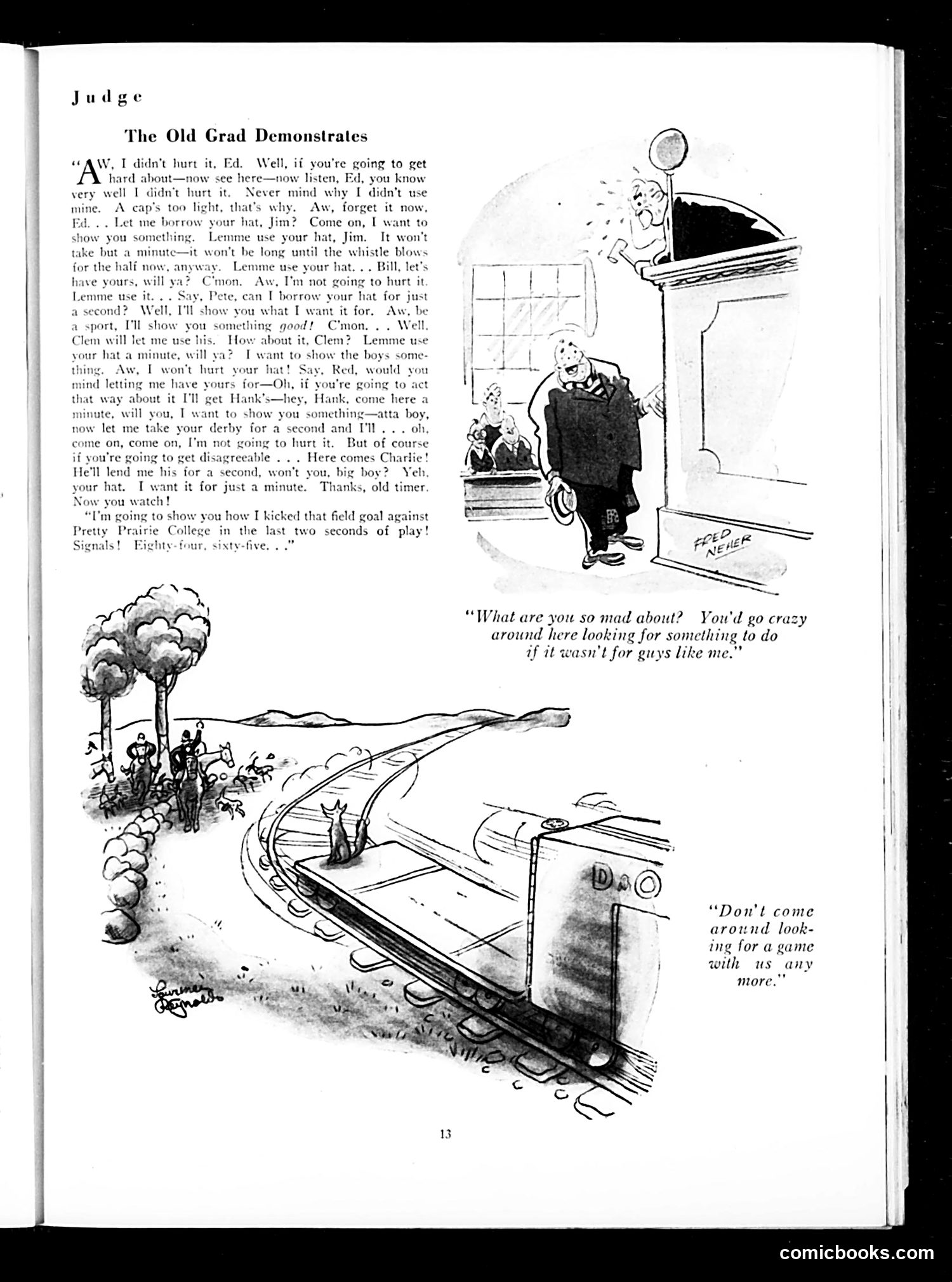
"The Old Grad Demonstrates" This two-panel cartoon satirizes an annoying type of college alumnus who returns to campus and monopolizes everyone's attention with self-aggrandizing stories. Upper panel: An older graduate repeatedly borrows hats from various students (Ed, Jim, Bill, Pete, Clem, Red, Hank, Charlie) under the guise of demonstrating a famous football play—a field goal he kicked against "Pretty Prairie College" in the final seconds. His pestering, cajoling manner ("I won't hurt it," "don't be disagreeable") shows how he wears down their resistance through social pressure. Lower panel: The punchline: current students, exasperated by his presence and his boasting, tell him bluntly to stop visiting. His response—"You'd go crazy around here looking for something to do if it wasn't for guys like me"—reveals his self-importance: he genuinely believes entertaining them with his old stories is a privilege they should appreciate. The satire targets alumni nostalgia, self-centeredness, and the way older generations often burden younger ones with unwanted reminiscence.
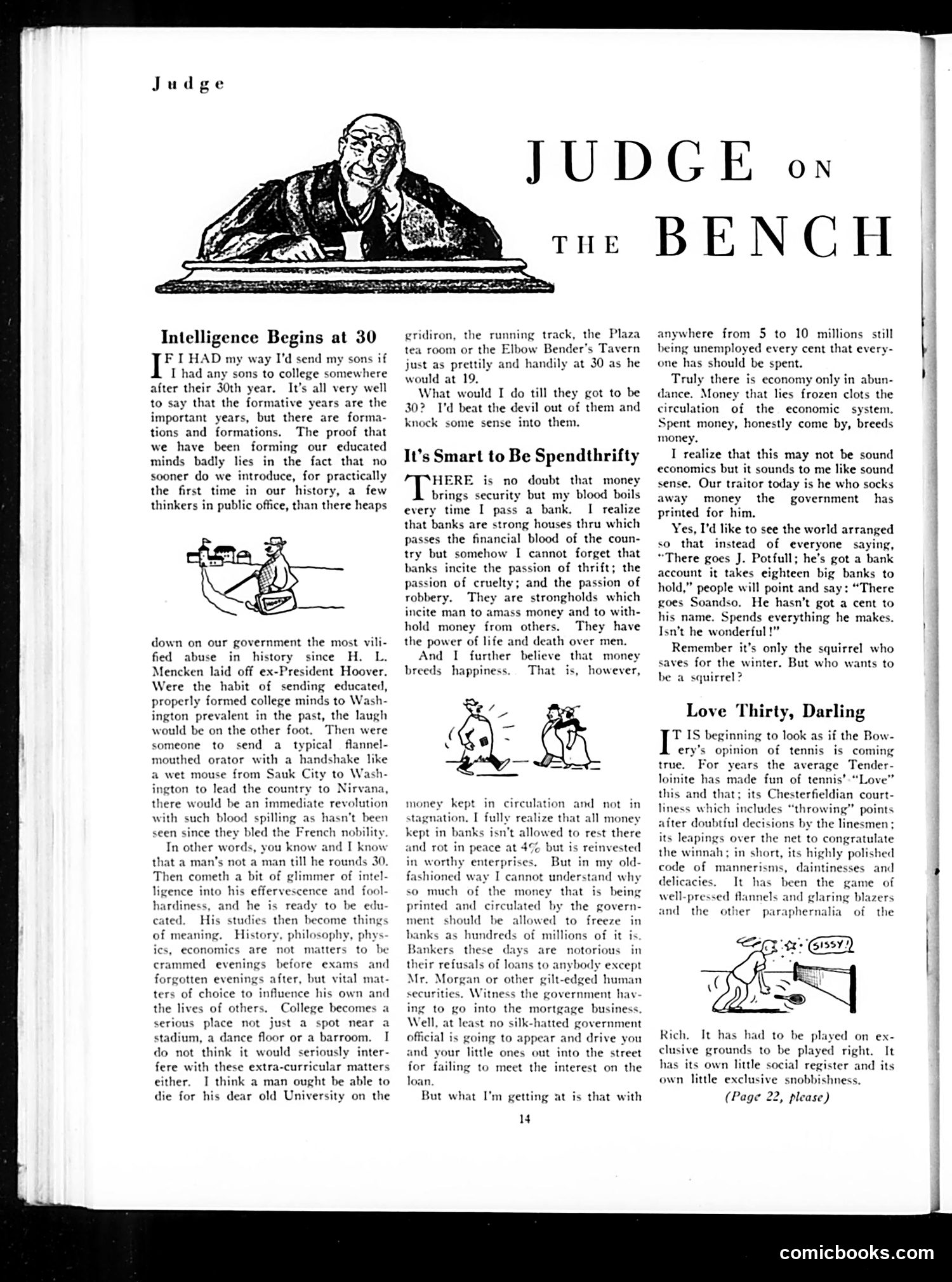
"Judge on the Bench" - Political Commentary, circa 1930s This page contains two satirical essays by Judge magazine's unnamed columnist (styled as a judge dispensing wisdom). "Intelligence Begins at 30" argues that college education should occur *after* age 30, not before, when minds are mature enough to absorb serious subjects. The piece mocks both traditional education (wasted on youth distracted by sports and drinking) and the recent introduction of "thinkers" into government (likely referring to FDR's "Brain Trust"), which has provoked vicious public backlash—suggesting Americans aren't ready for educated leadership. "It's Smart to Be Spendthrifty" paradoxically advocates *spending* money rather than saving it. The author criticizes banks for hoarding capital and restricting loans (except to the wealthy like J.P. Morgan), which strangles economic circulation. He praises the government's mortgage programs as preferable to private banking. The Depression-era point: money must circulate to stimulate recovery; frozen savings paralyze the economy. Both essays reflect 1930s debates over education, banking reform, and Keynesian economics during the New Deal era.
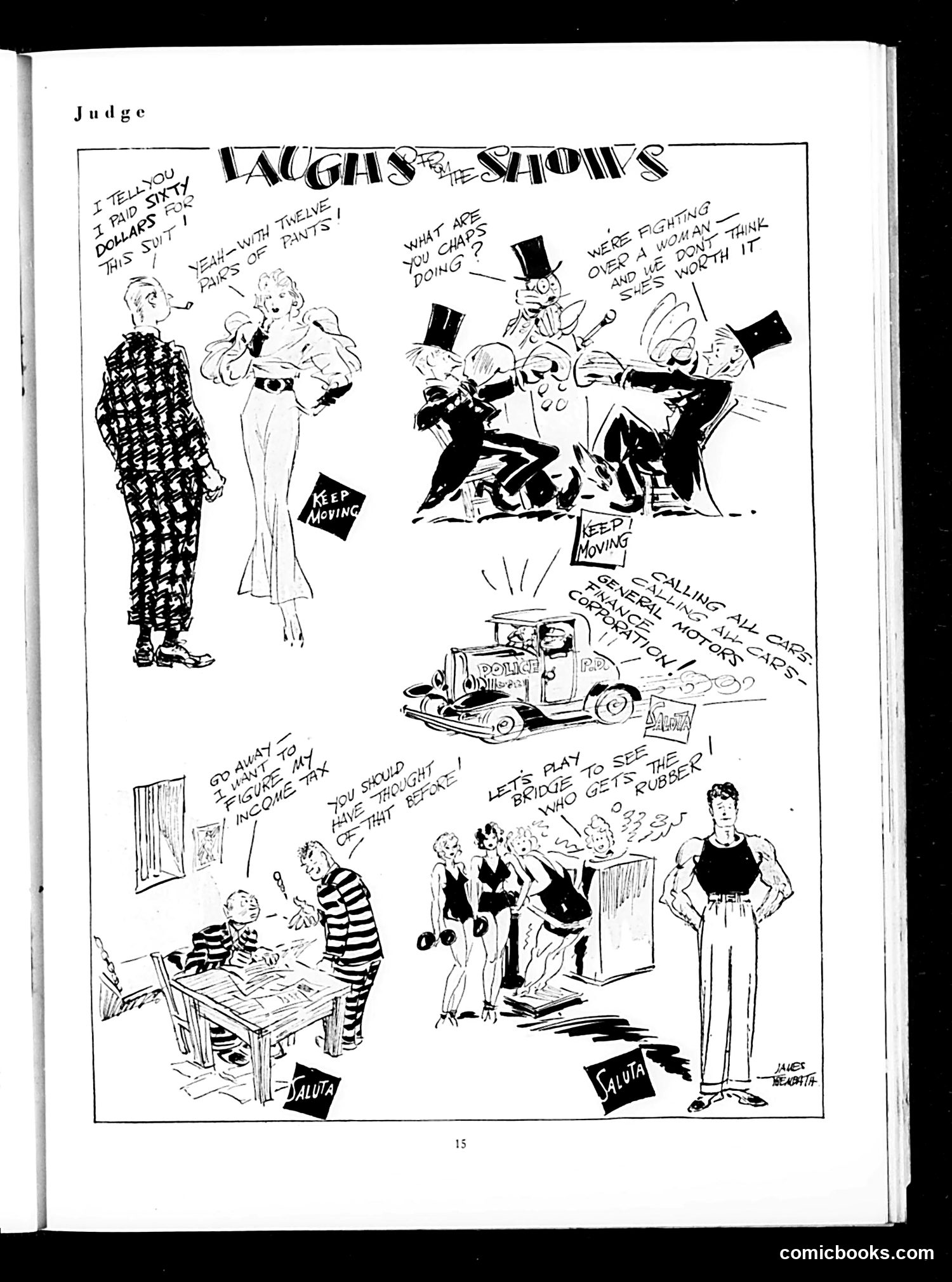
"Laughs and Shows" This appears to be a humor page from *Judge* magazine featuring multiple unrelated comedic vignettes about social situations and relationships. The sketches depict various scenarios: a man in a patterned suit discussing financial matters with a woman; men in top hats engaged in physical altercations; a car scene; people in what appears to be a prison or institutional setting (suggested by striped clothing); and a final scene with multiple figures. The humor relies on visual gags and dialogue about everyday social awkwardness—financial disputes, romantic complications, legal troubles, and interpersonal conflicts. Without clearer dates or specific captions visible, the exact satirical targets remain unclear, though the general themes address common early-20th-century concerns: money troubles, relationship drama, and potential criminal entanglements. The style is characteristic of *Judge's* lighthearted social commentary.
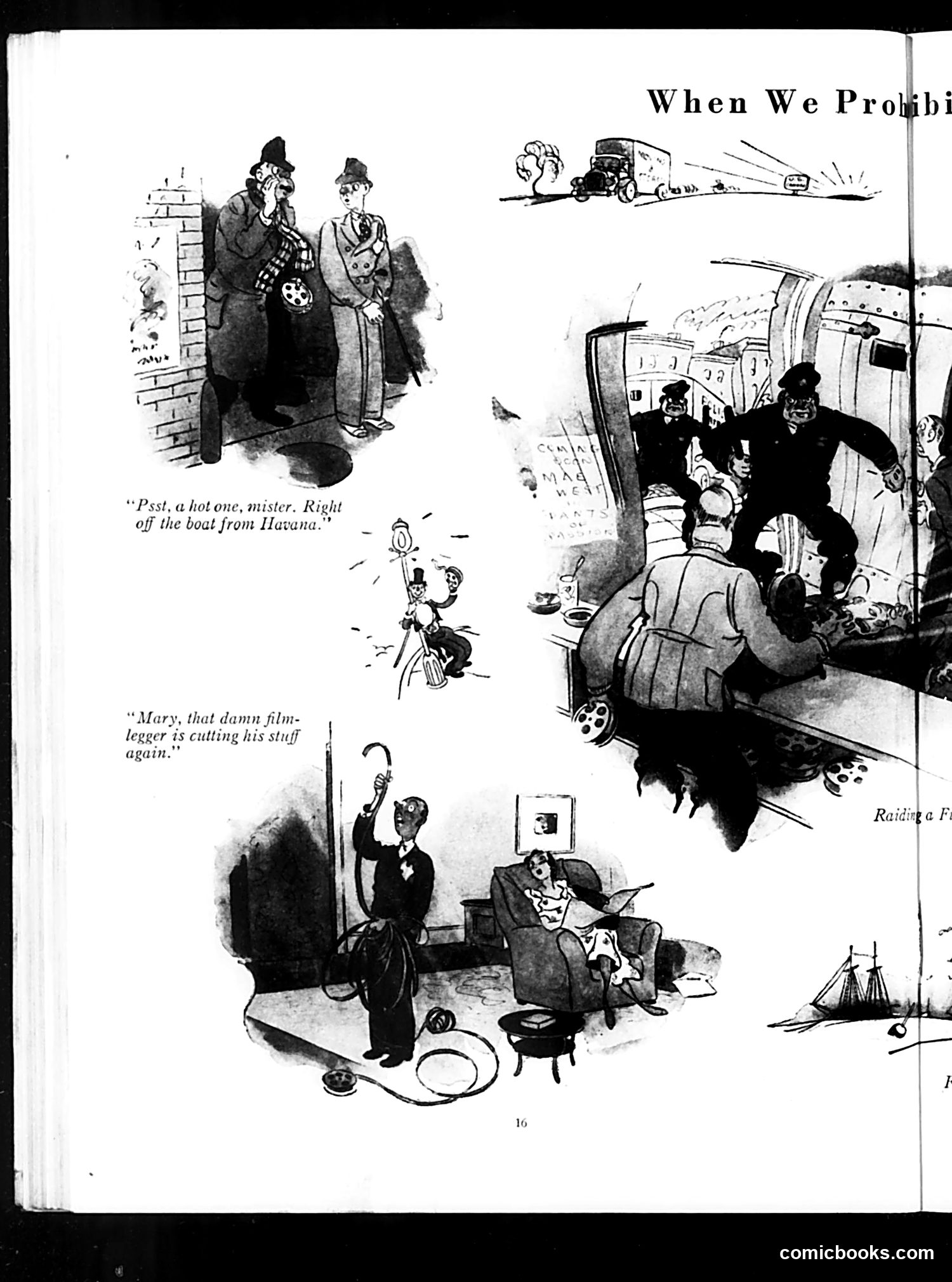
Prohibition-Era Satire This Judge magazine page satirizes American Prohibition (1920-1933) through multiple scenes of illegal alcohol smuggling and distribution. The top dialogue references contraband "hot" liquor arriving by boat from Havana, Cuba—a major source of bootleg rum. The middle scene shows a frustrated character complaining about a "film-legger" diluting alcohol ("cutting his stuff"), a common practice among bootleggers who stretched limited supplies for profit. The right panel depicts what appears to be a raid on an illegal operation, with authorities confronting smugglers. The overall message mocks how Prohibition created thriving black markets, organized crime, and widespread law-breaking across American society—suggesting the policy was unenforceable and counterproductive rather than morally reformative.
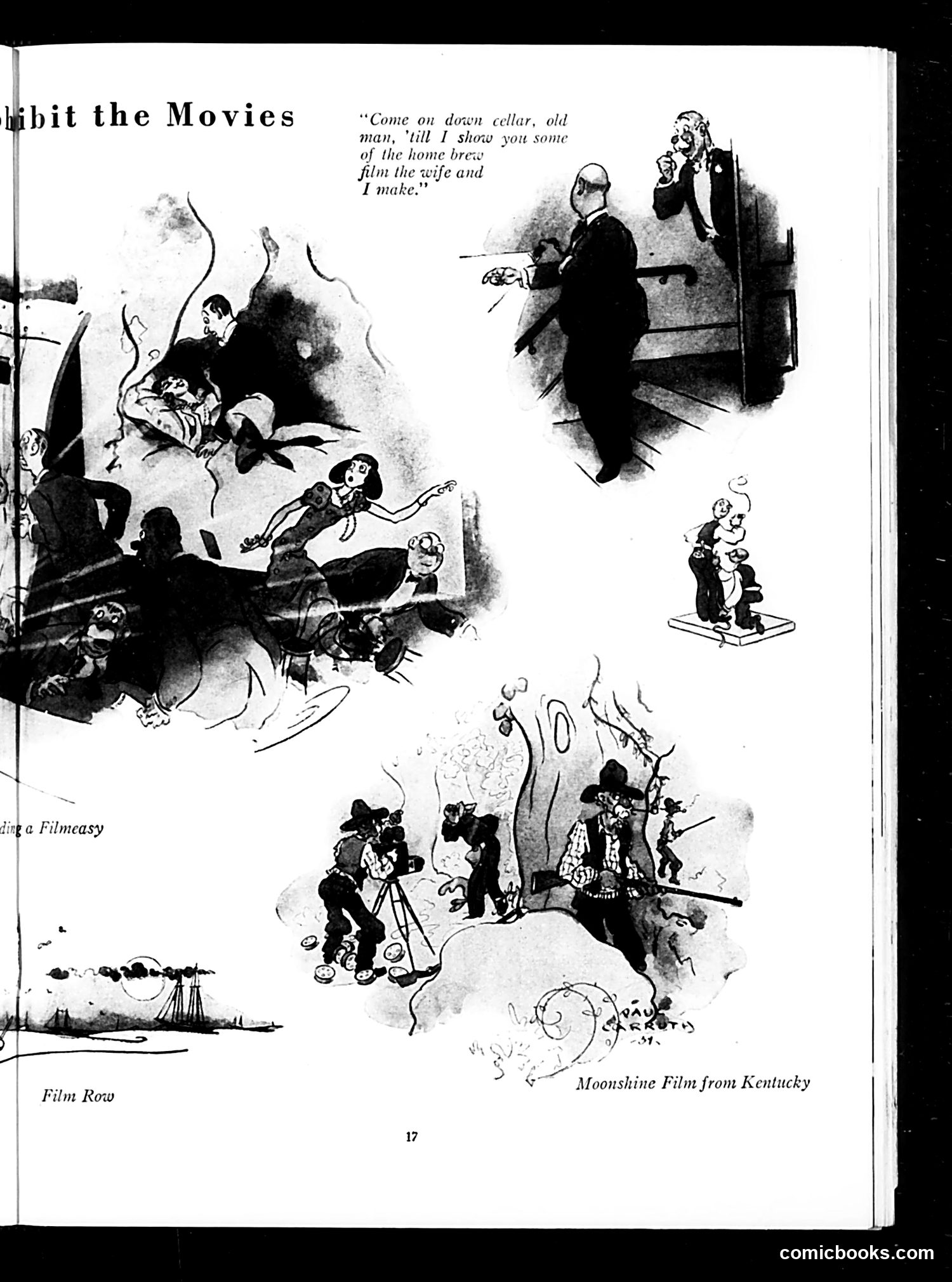
"Kibit the Movies" - Prohibition-Era Satire This page satirizes early 1920s filmmaking and Prohibition. The top cartoon shows a man inviting someone to his cellar to view "home brew film the wife and I make"—a double entendre mocking both amateur filmmaking and illegal alcohol production (home brew being bootleg liquor made during Prohibition). The accompanying sketches depict various film scenarios: "Film Row" (the movie industry), amateur cinematography, and "Moonshine Film from Kentucky"—conflating the criminal whiskey trade with film production. The satire suggests that just as people illegally made liquor at home, they were also making amateur films, while the legitimate film industry ("Film Row") operated openly. The humor depends on readers understanding Prohibition's prevalence and the era's rapid growth of both cinema and bootlegging.
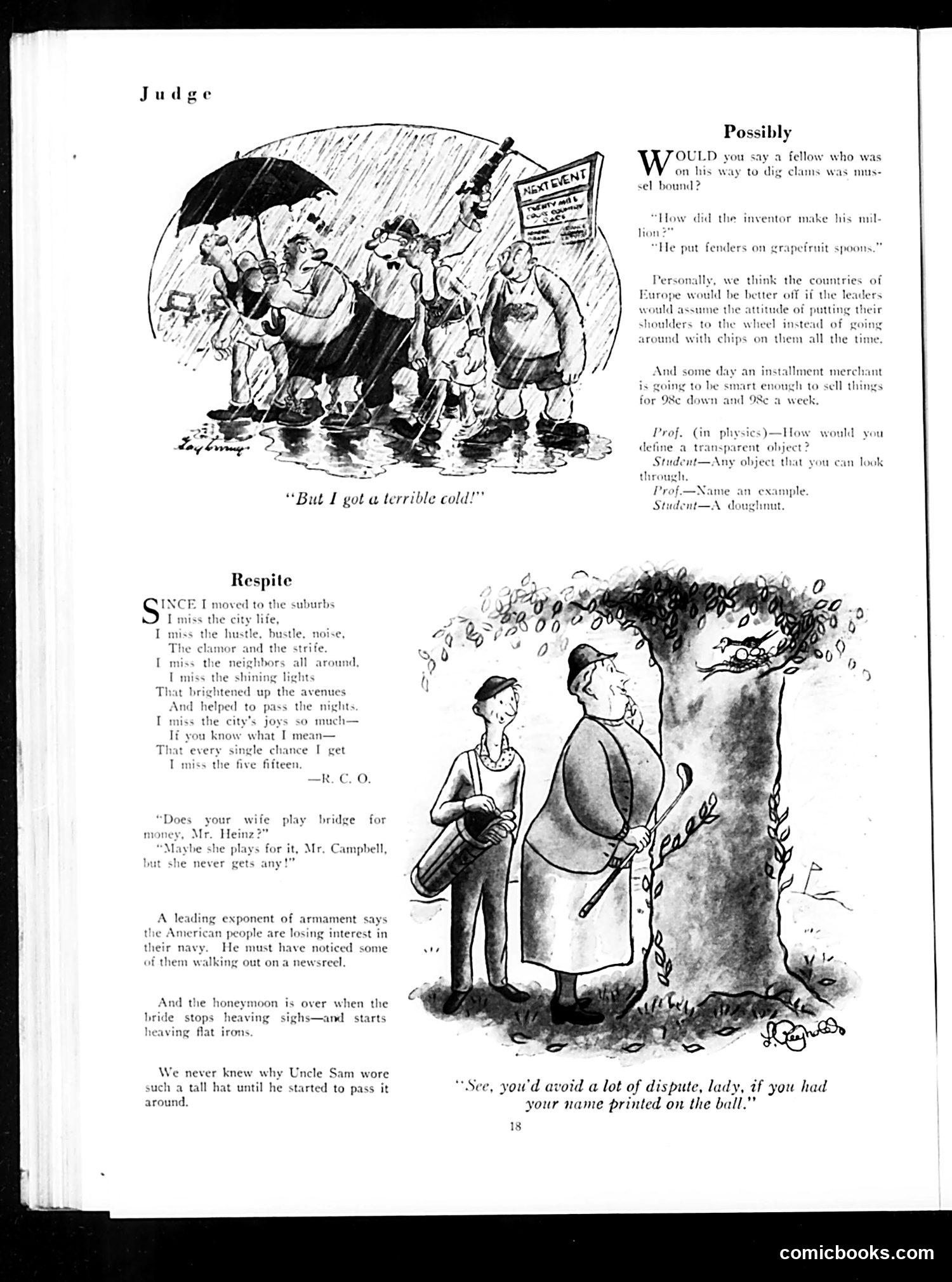
Judge Magazine Page Analysis This page contains multiple brief satirical jokes typical of early 20th-century American humor magazines. Top cartoon: Shows people caught in rain with an umbrella, one saying "But I got a terrible cold!" The satire mocks the futility of precautions—they're already soaked despite attempting shelter. Middle cartoon: A man and woman stand by a tree; he holds a club labeled "See, you'd avoid a lot of dispute, lady, if you had your name printed on the ball." This jokes about golf balls (and possibly domestic property disputes), suggesting marking personal belongings to prevent confusion or arguments. Text jokes include: - Criticizing wealthy industrialists for frivolous wealth-making (grapefruit spoon fenders) - Commentary on installment buying culture - A physics professor joke about "transparent objects" answered with "doughnuts" (visible through holes) - A poem about missing city life despite moving to suburbs The page reflects 1920s concerns: consumerism, suburban migration nostalgia, and marital humor. The overall tone is light domestic and social satire rather than political commentary.
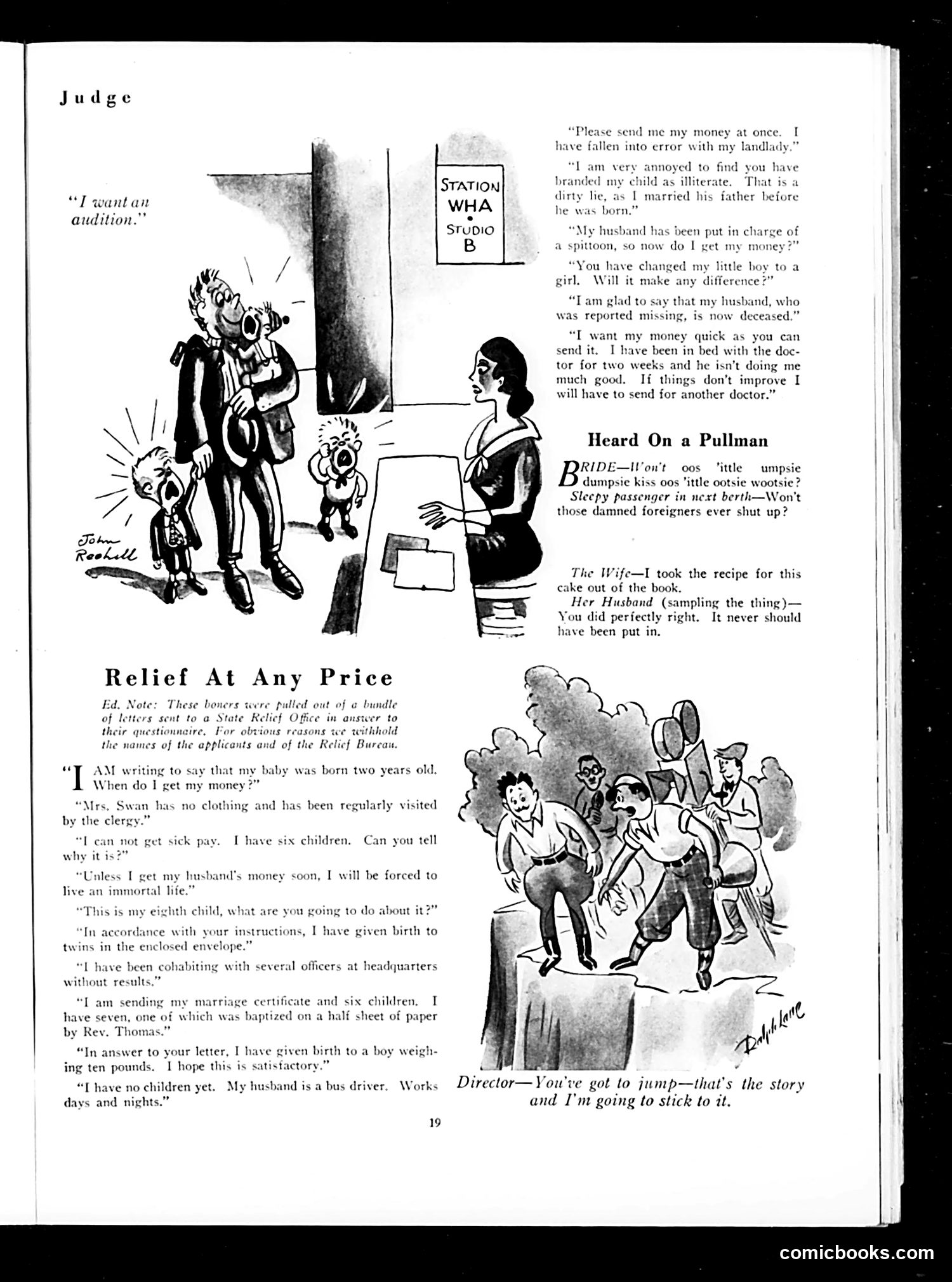
Judge Magazine Page Analysis This page satirizes the bureaucratic incompetence and absurdity of a government relief bureau responding to applications for financial assistance. The top cartoon shows a judge demanding "an audition" from applicants seeking relief—mocking how officials treat desperate petitioners like entertainers rather than people in genuine need. The main section, "Relief At Any Price," presents actual (anonymized) quotes from relief applications, likely from the Depression era. The humor derives from applicants' grammatical errors, logical contradictions, and the bizarre situations they describe: babies "born two years old," twins sent "in an enclosed envelope," and claims of cohabitation "without results." These expose both the desperation of applicants and the system's failure to help them meaningfully. "Heard on a Pullman" mocks wealthy train passengers and their disdain for foreigners speaking their native language. The final cartoon depicts a film director insisting on a false narrative, suggesting institutional dishonesty. Overall, the page critiques relief bureaucracy as simultaneously incompetent and indifferent to human suffering.
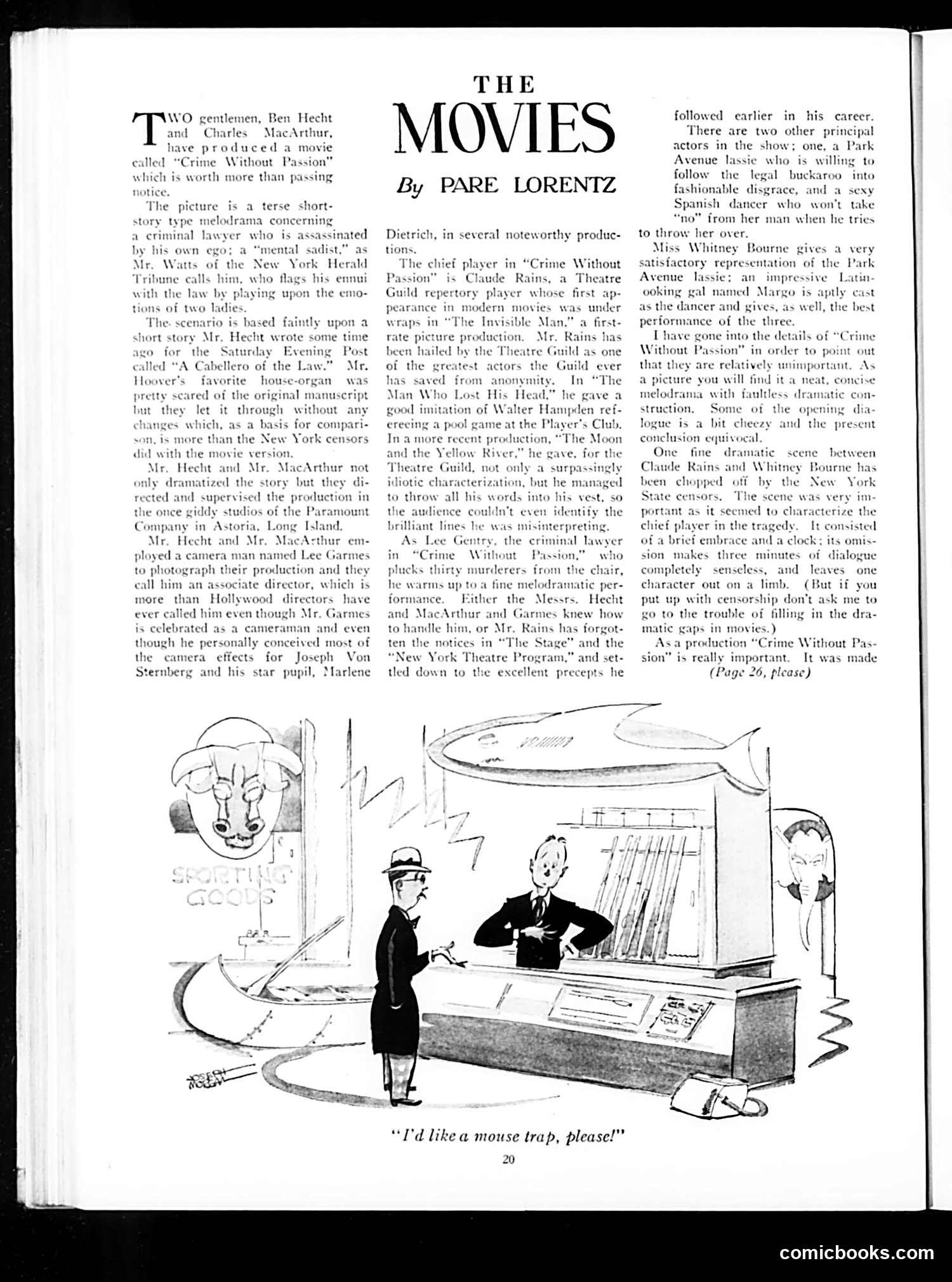
"The Movies" by Pare Lorentz — Judge Magazine This is a film review column discussing "Crime Without Passion," a 1934 movie produced by Ben Hecht and Charles MacArthur. The text praises the film's dramatic tension and performances, particularly Claude Rains as a criminal lawyer. The cartoon below illustrates a joke about censorship: a woman at a desk asks a man for "a mousetrap, please!" — but the visual suggests she's actually at some kind of official counter, likely representing the New York State censors. Lorentz's review emphasizes that censors cut a crucial dramatic scene between characters Rains and Bourne, leaving the plot confusing and emotionally disconnected. The "mousetrap" gag satirizes how censorship removes key plot elements ("traps"), leaving viewers confused about what's happening. This reflects the era's strict film censorship, which Lorentz clearly resents as artistically damaging.
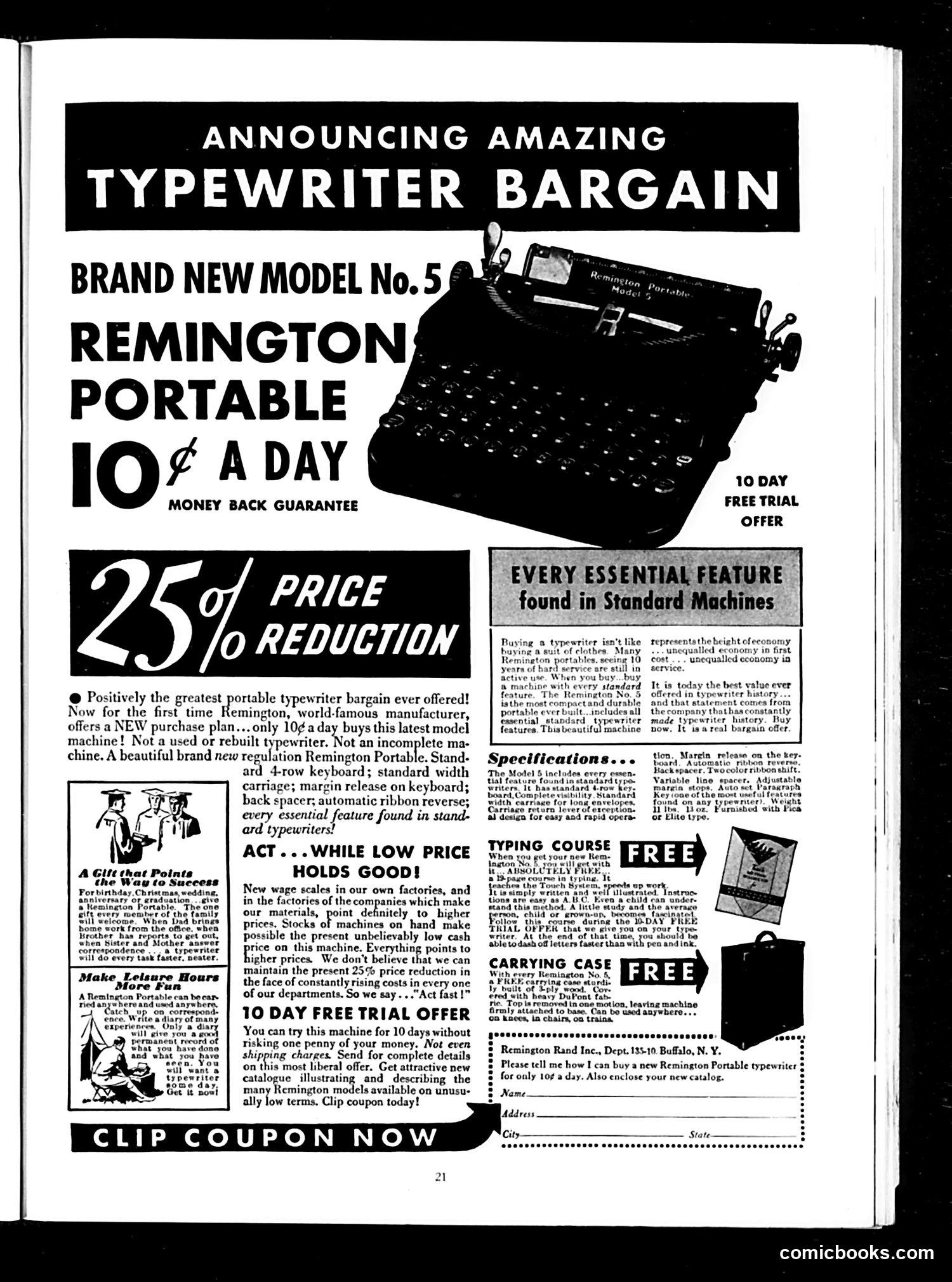
Analysis for Modern Readers This is a full-page advertisement, not a political cartoon. It announces Remington's Model No. 5 portable typewriter with aggressive marketing claims typical of 1920s-30s consumer advertising. Key selling points highlighted: - 25% price reduction - Only 10¢ daily payment plan - 10-day free trial with money-back guarantee - Includes free carrying case - Emphasizes it's brand-new, not used/rebuilt The satire/humor lies in the exaggerated desperation: the company admits rising labor and material costs threaten profits, urging readers to "Act fast!" before prices rise. The sidebars present typewriter ownership as a status gift suitable for every life occasion (birthdays, weddings, graduations). For modern context: This reflects Depression-era sales tactics—breaking expensive purchases into tiny daily payments to seem affordable, emphasizing "act now before prices rise" urgency, and marketing a practical tool as a lifestyle/gift item. The portable typewriter represented technology and prestige similar to how smartphones function today.
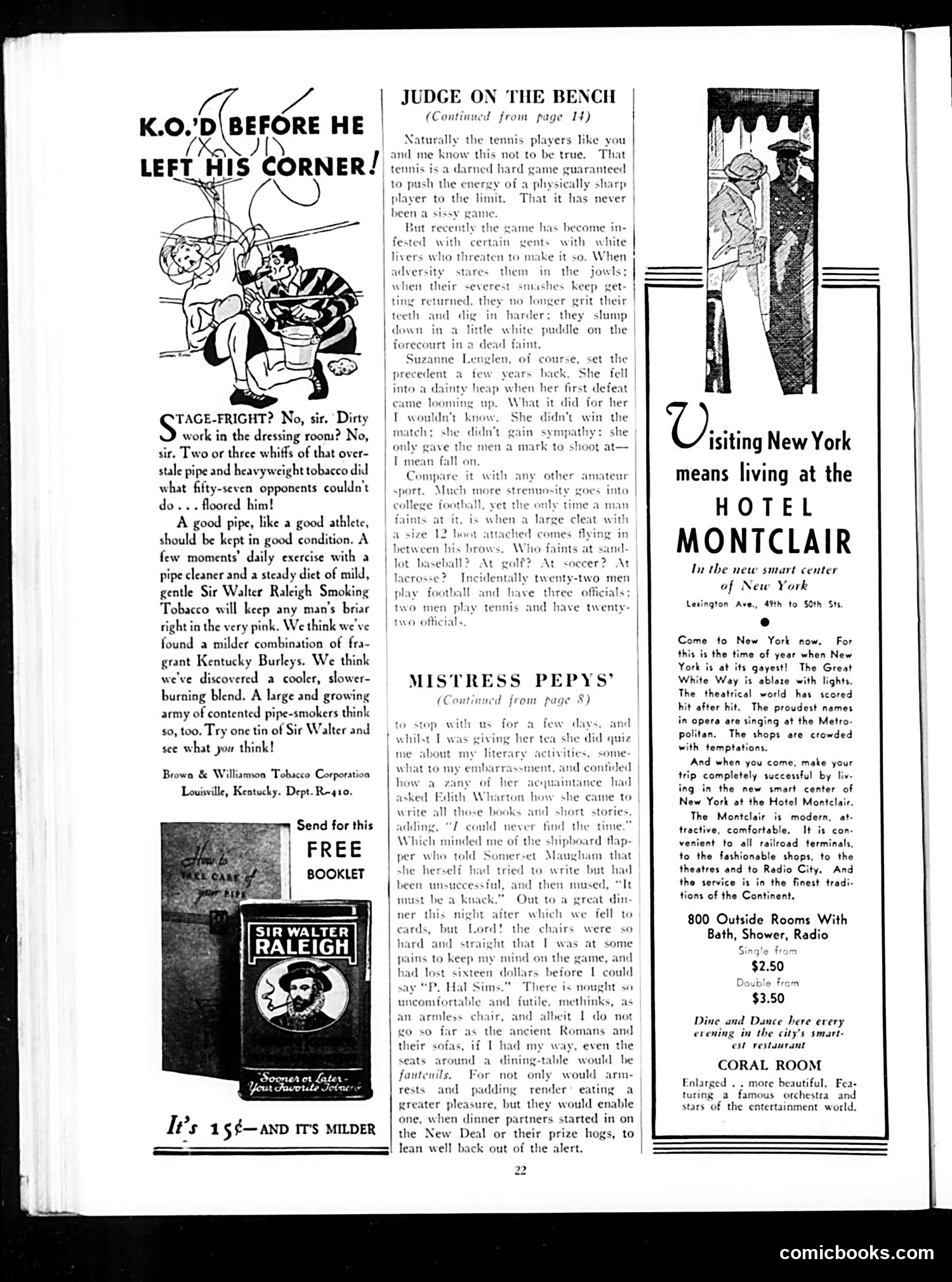
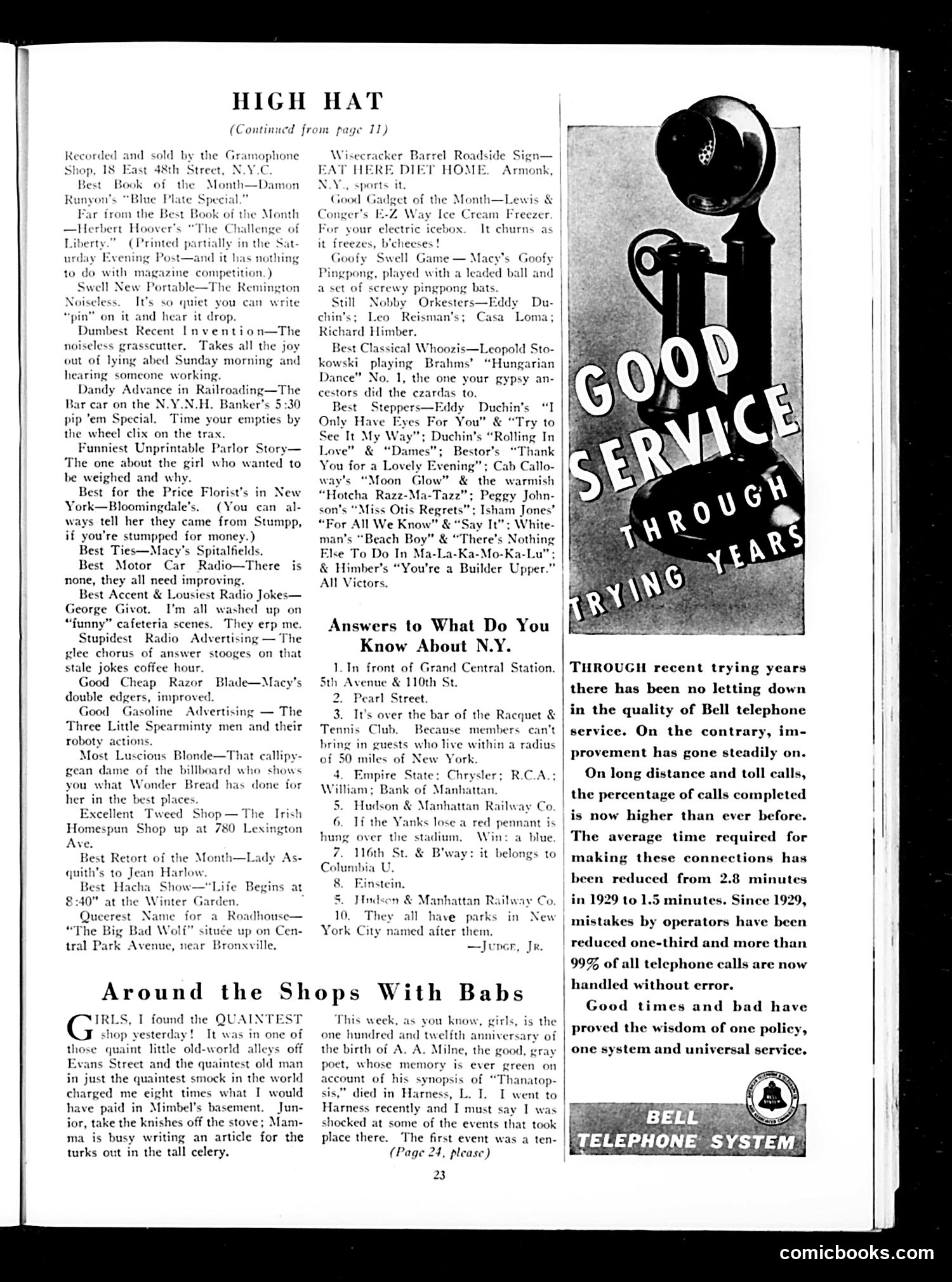
Explanation for Modern Readers This page contains mostly consumer advice and humor columns, not political satire. The main content is "High Hat," a lighthearted recommendation column listing the best products, services, and entertainers in 1930s New York—from razors to radio programs to dance orchestras. The Bell Telephone advertisement (right side) is corporate messaging boasting about improved service reliability: fewer operator errors, faster call completion, and higher success rates. This reflects 1930s pride in technological progress and corporate efficiency. The "Around the Shops with Babs" column is gossip-style social commentary about New York shopping, using exaggerated, affected language typical of society-page writing that Judge frequently mocked. No clear political satire appears here. This is essentially a consumer-culture magazine page—advertising, product reviews, and entertainment recommendations—that represents how Judge filled space between satirical pieces, reflecting Depression-era urban life and emerging consumer culture.
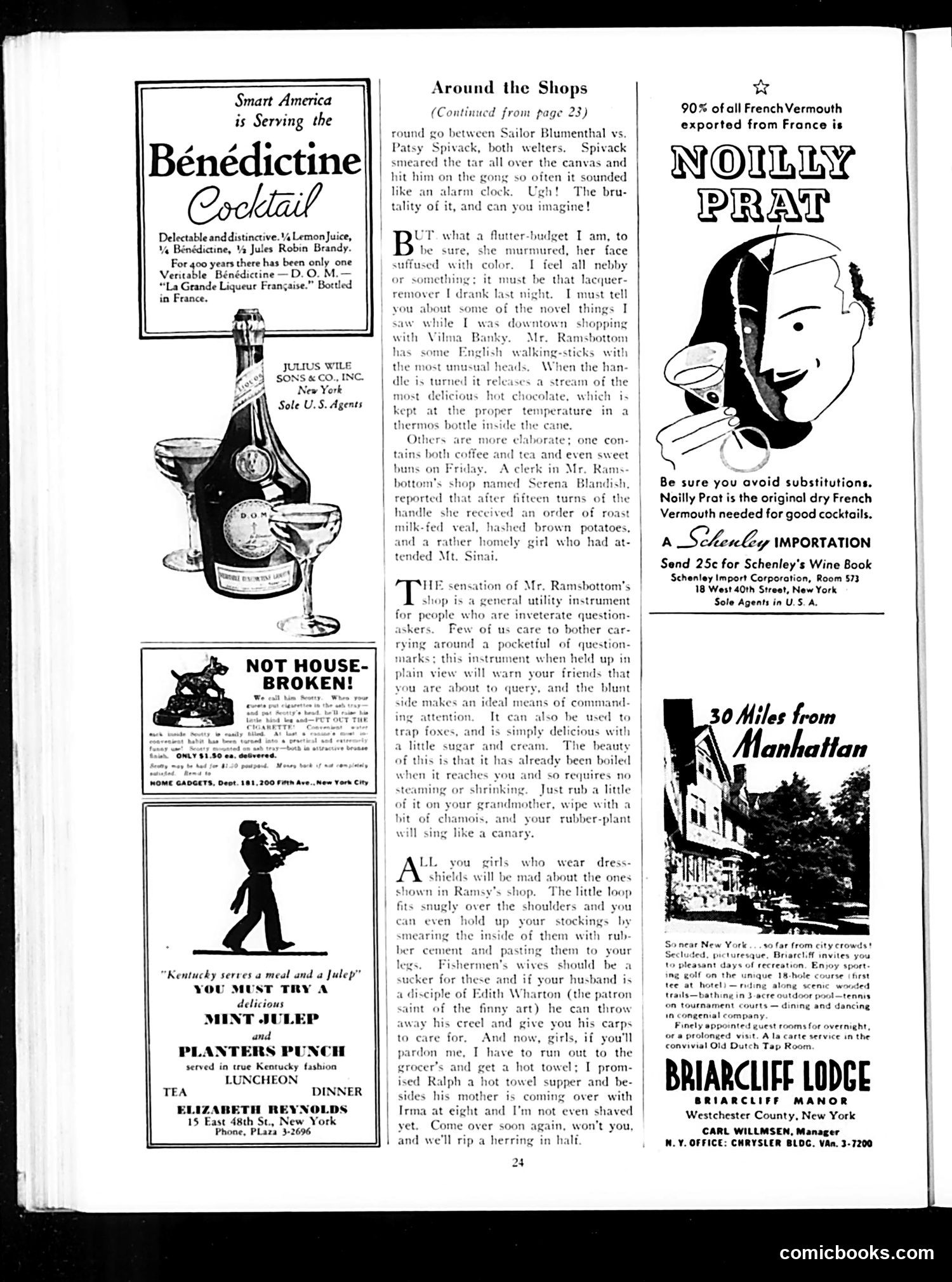
Analysis for Modern Readers This page is primarily advertising for liqueurs, restaurants, and a lodge, typical of Judge magazine's revenue model. The main editorial content is "Around the Shops," a gossip column about New York shopping and social life. It mentions a boxing match between "Sailor Blumenthal" and "Patsy Spivack" (welterweights), describing brutal fighting. The column then rambles through anecdotes about novelty items in shops—hot chocolate dispensers, dress shields, fishing-related merchandise—written in a breathless, gossipy female voice. The tone is lighthearted mockery of trivial consumer culture and women's preoccupations. The humor relies on casual references to products and minor figures (shop clerks, fishermen's wives) that were apparently recognizable to Judge's contemporary readers but are now obscure. The satire targets materialism and frivolous shopping rather than major political figures. The advertisements themselves—for French liqueurs, Kentucky mint juleps, and upscale lodging—reflect 1920s-30s consumer culture and leisure activities.
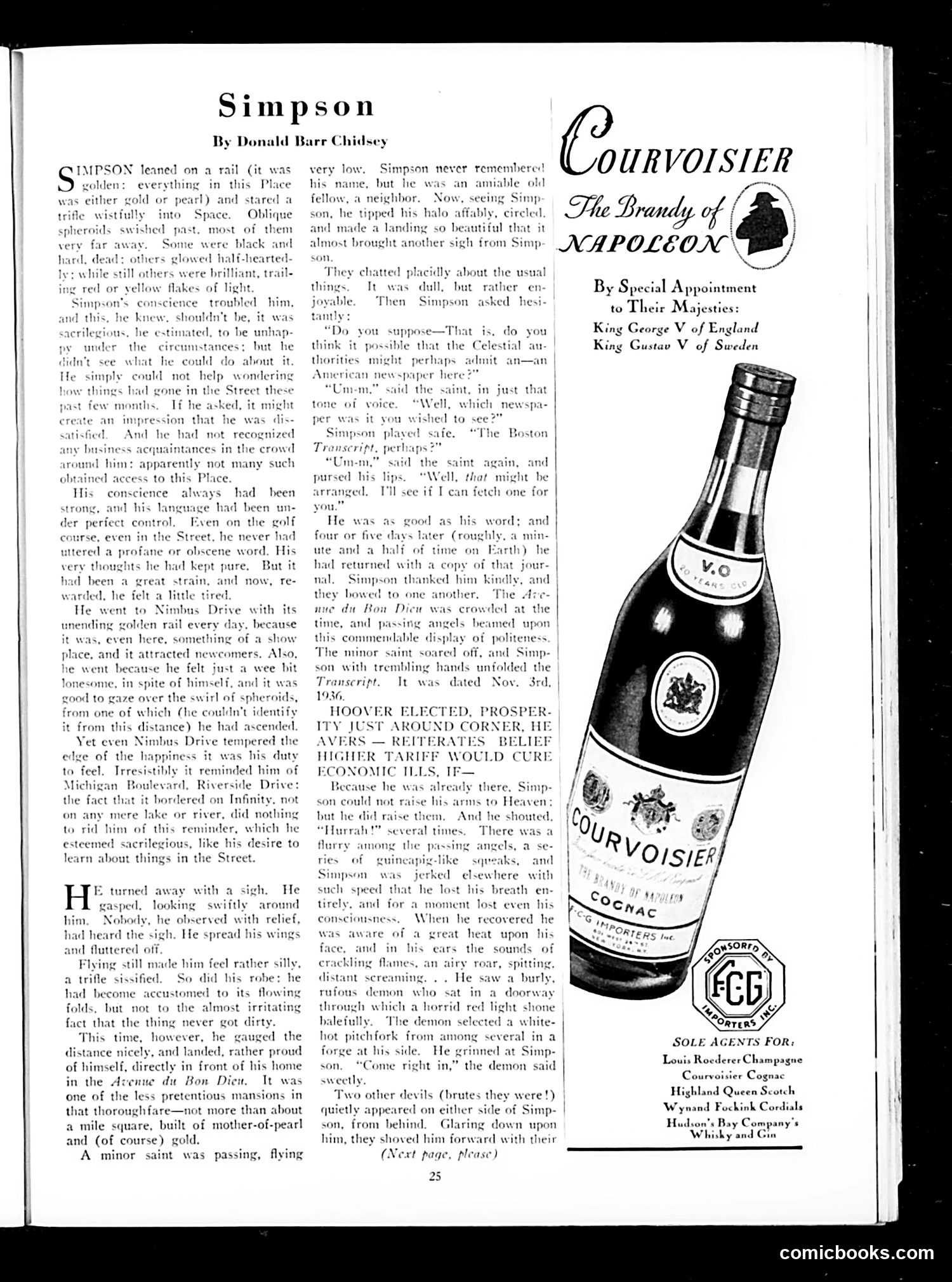
Simpson by Donald Barr Chidsey This page contains a short story (not a political cartoon) about Simpson, a virtuous minor saint living on Earth who encounters various celestial and infernal characters. The narrative is whimsical religious satire. The story's humor derives from Simpson's naive goodness contrasting with his mundane urban surroundings (Michigan Boulevard, Nimbus Drive). A key satirical moment occurs when Simpson receives a newspaper dated November 3rd, 1936—likely referencing Hoover's 1928 election and the subsequent economic depression. The headline about "HOOVER ELECTED, PROSPERITY JUST AROUND CORNER" and "HIGHER TARIFF WOULD CURE ECONOMIC ILLS" mocks Hoover's failed economic promises and outdated faith in tariff solutions during the Depression era. The story concludes with supernatural drama as demons emerge to torment Simpson, mixing religious allegory with comedy. The Courvoisier cognac advertisement is unrelated commercial content.
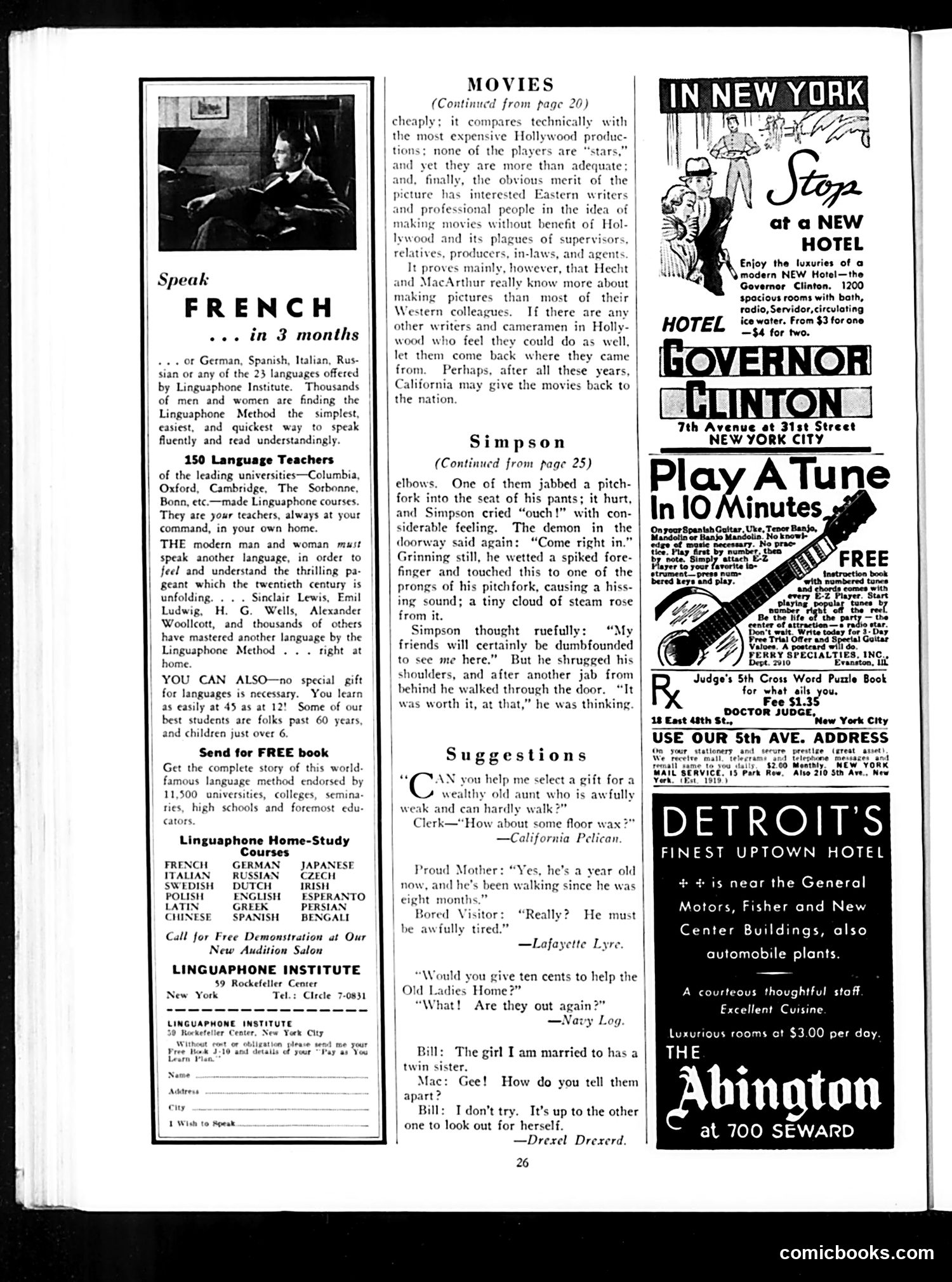
Analysis of This Judge Magazine Page This page is primarily advertising and humor columns rather than political satire. The visible content includes: Left side: A Linguaphone language-learning advertisement emphasizing that modern people "must speak another language" to understand the "twentieth century." It quotes prominent figures (Sinclair Lewis, H.G. Wells, Alexander Woollcott) as endorsements—a common advertising tactic of the era. Center: Movie and humor columns discussing independent filmmaking by Hecht and MacArthur, plus the "Simpson" serialized story (apparently involving demonic figures). A "Suggestions" humor section with light jokes about gift-giving and twins. Right side: New York hotel and service advertisements (Governor Clinton Hotel, Detroit's Arlington Hotel). Historical context: This reflects 1920s concerns about American cultural sophistication and the growing leisure economy. The language school pitch assumes readers aspire to worldliness; hotel ads target business travelers and tourists. There is no identifiable political cartoon on this page—it's primarily commercial and entertainment content typical of Judge magazine during this period.
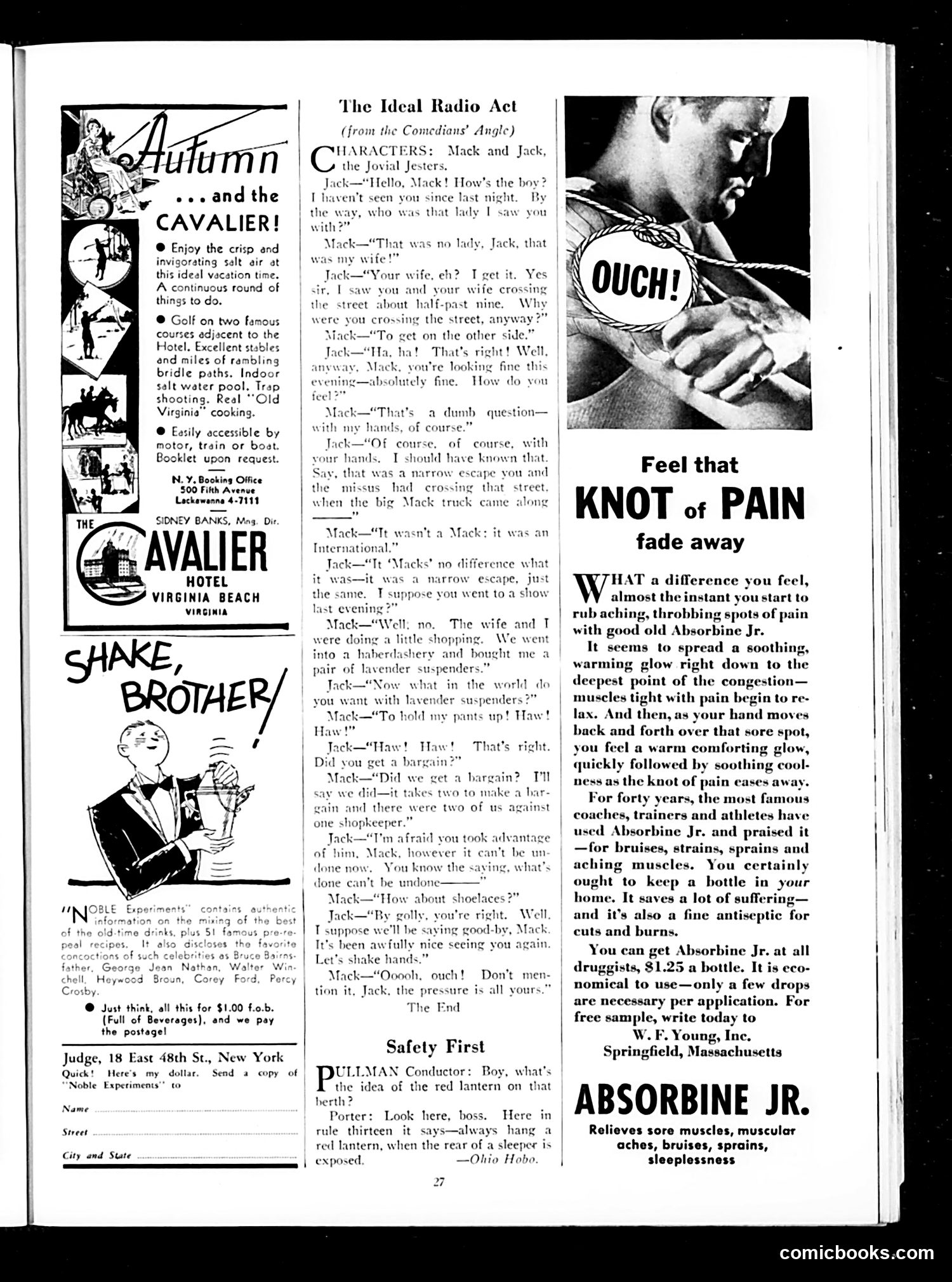
Judge Magazine Page Analysis This page contains advertisements and comedy sketches typical of Judge magazine's satirical format. "The Ideal Radio Act" is a vaudeville-style dialogue between comedians Mack and Jack. The humor relies on rapid-fire wordplay and non-sequiturs—a wife mistaken for "a lady," a truck that "wasn't a Mack," lavender suspenders for holding up pants. The sketch satirizes the conventions of radio comedy and vaudeville banter, where puns and absurdist logic drive the humor rather than coherent storytelling. Other content includes a hotel advertisement for the Cavalier in Virginia Beach; a brief "Safety First" joke about railroad procedures; and a full-page Absorbine Jr. advertisement featuring a photograph of someone with a "knot of pain," promoting the liniment as a cure for bruises and sore muscles. The page reflects early radio-era comedy and period advertising practices, with the medical advertisement using dramatic testimonials common to early 20th-century patent medicine marketing.
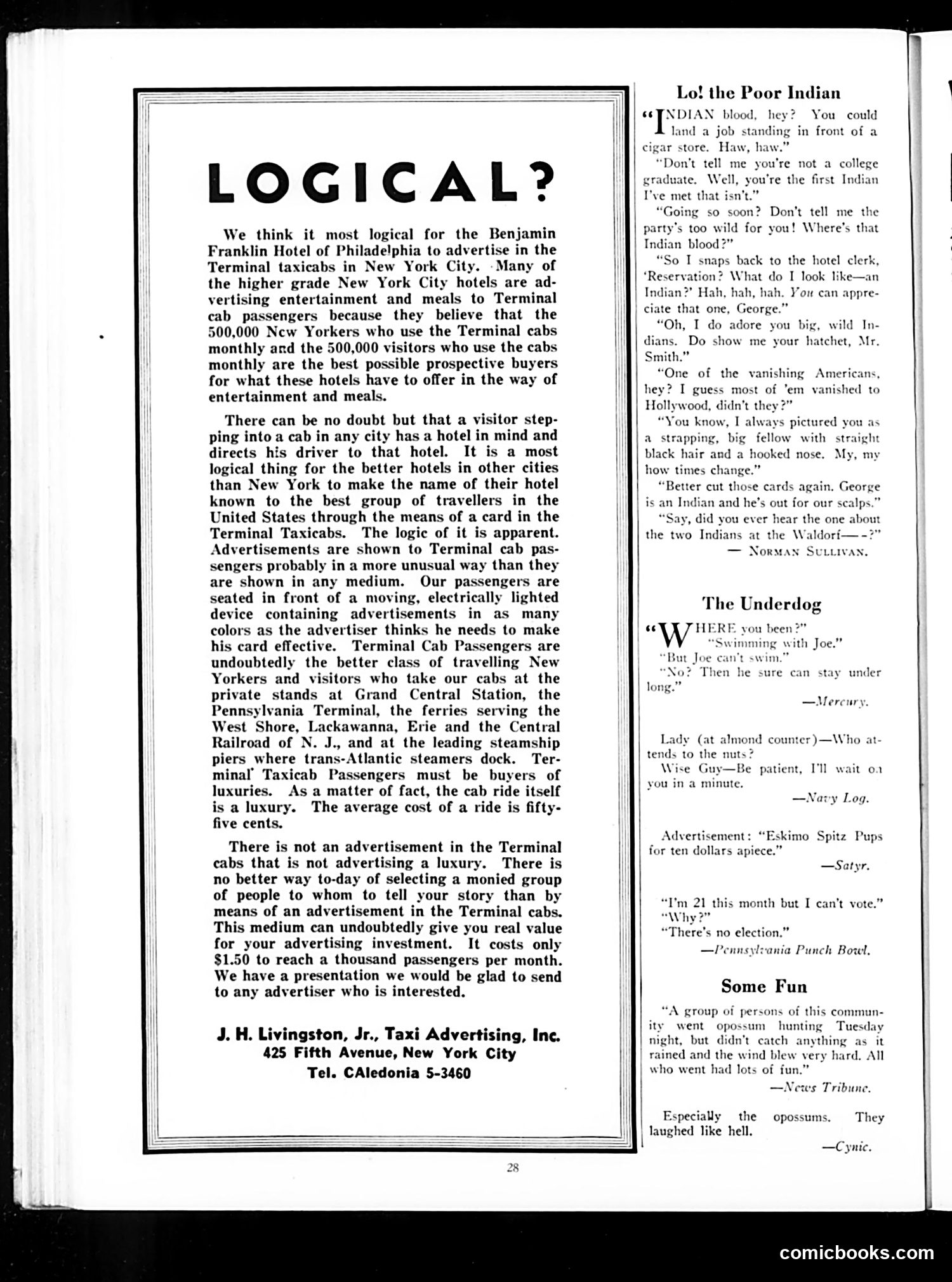
Analysis of Judge Magazine Page Content This page primarily contains advertising and humor sections rather than political cartoons. The main content is a taxi advertising pitch for Terminal Taxicabs in New York City, arguing it's "logical" for hotels (like Philadelphia's Benjamin Franklin Hotel) to advertise in cabs, since cab passengers represent wealthy travelers—ideal customers for luxury goods and services. The right side features several brief humorous anecdotes: - "Lo! the Poor Indian" satirizes stereotypical attitudes toward Native Americans—depicting condescending remarks about "Indian blood," expectations about hatchets and scalps, and references to "vanishing Americans" supposedly gone to Hollywood. The satire appears to mock these clichéd prejudices rather than endorse them. - "The Underdog" and other short jokes are generic period humor about swimming, voting eligibility, and miscellaneous situations. The page reflects 1920s-era advertising strategies and casual ethnic stereotyping typical of mainstream publications at that time.
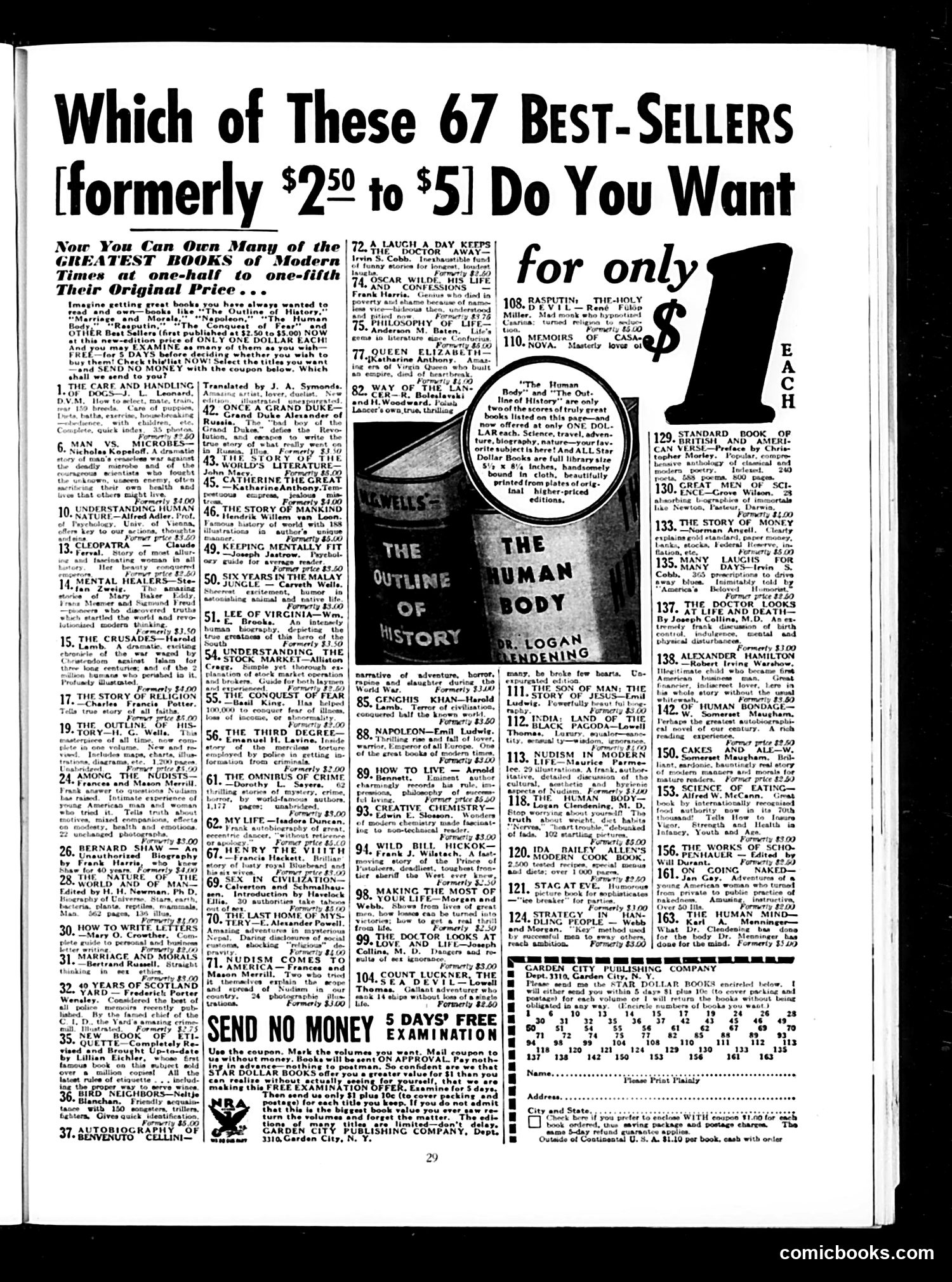
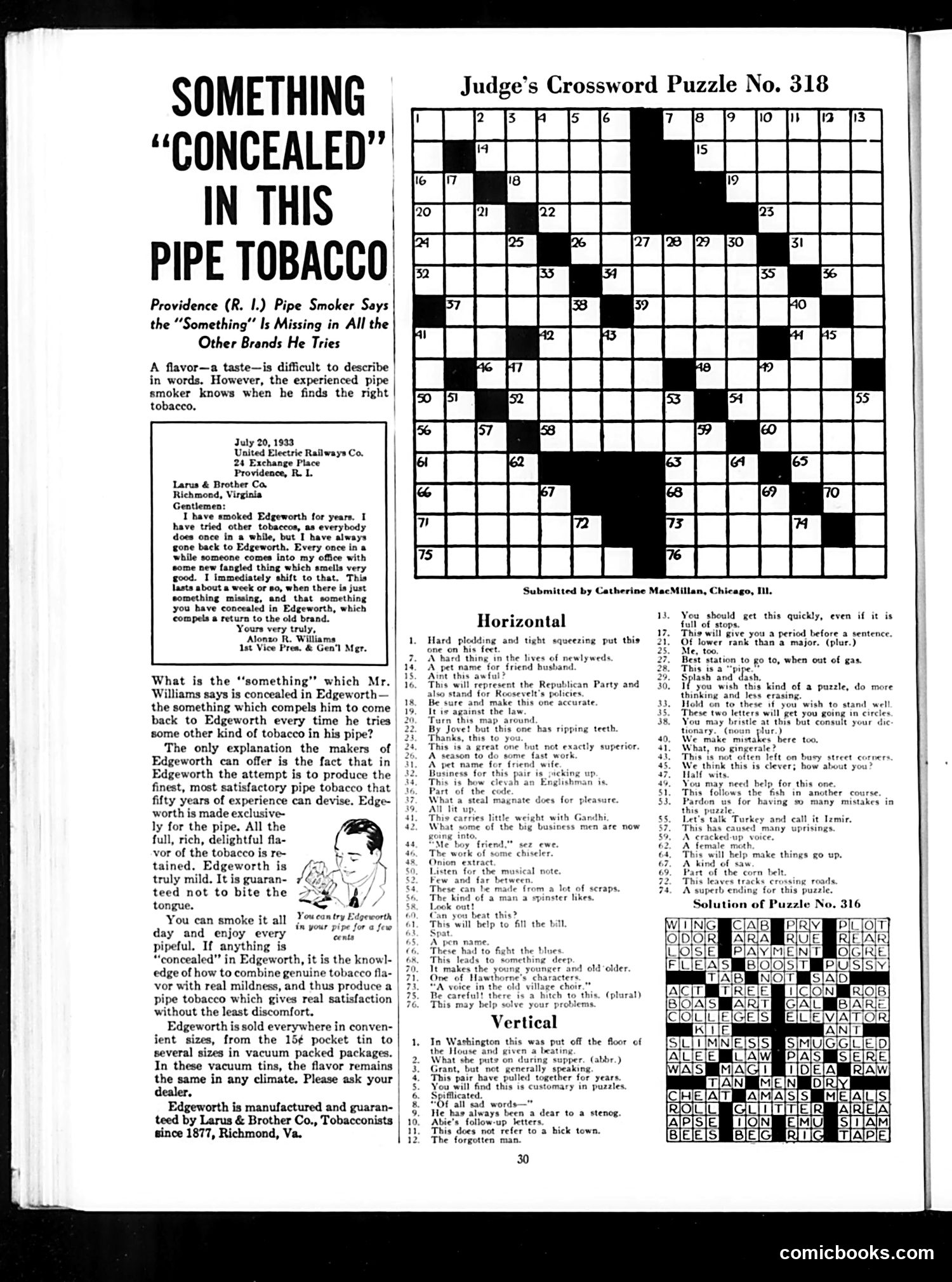
Analysis for Modern Readers This page is primarily advertising, not satire. It features a testimonial advertisement for Edgeworth pipe tobacco from 1933, presenting a letter from a Providence businessman claiming the brand has an indefinable "something"—superior flavor and mildness—that keeps him returning despite trying competitors. The ad plays on the psychological appeal of brand loyalty and mystery ("concealed something"), suggesting Edgeworth's 50 years of experience produces quality competitors cannot match. The language emphasizes gentlemanly sophistication appropriate to pipe smoking culture of the era. The page also includes Judge magazine's crossword puzzle (#318), which was standard magazine content. The crossword clues are period-specific references (Roosevelt, "the forgotten man") dating it to early 1930s Depression-era America. No political cartoon or satirical commentary about tobacco exists here—it's straightforward vintage advertising and puzzle entertainment typical of Judge's commercial content.
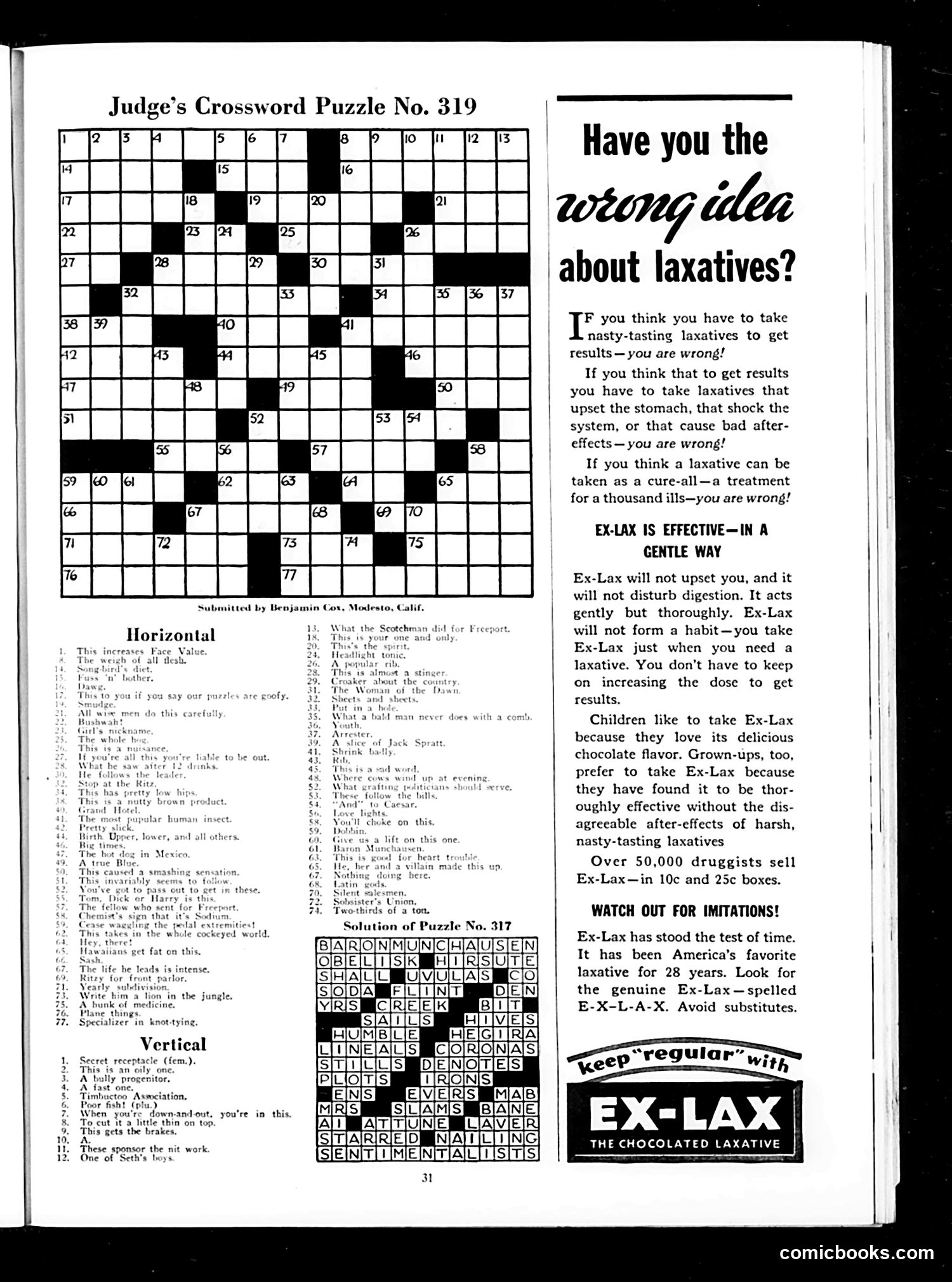
Judge Magazine Page Analysis This page is primarily advertising, not satire. It features Judge's crossword puzzle (No. 319) alongside a substantial advertisement for Ex-Lax laxative. The ad uses a rhetorical device common to 1920s-30s marketing: the "correcting misconceptions" approach. It addresses three supposed false beliefs about laxatives—that effective ones must taste bad, upset the stomach, or be habit-forming—then counters each with claims about Ex-Lax's gentleness. Notably, the ad emphasizes Ex-Lax's chocolate flavor to appeal to children and adults alike, and warns against imitations, suggesting competitive market pressures. The phrase "Ex-Lax has stood the test of time. It has been America's favorite laxative for 28 years" attempts to establish brand authority and longevity. This represents typical early-20th-century magazine advertising: earnest product promotion using psychological persuasion rather than humor or satire. The crossword puzzle serves as editorial content to accompany the advertisement.
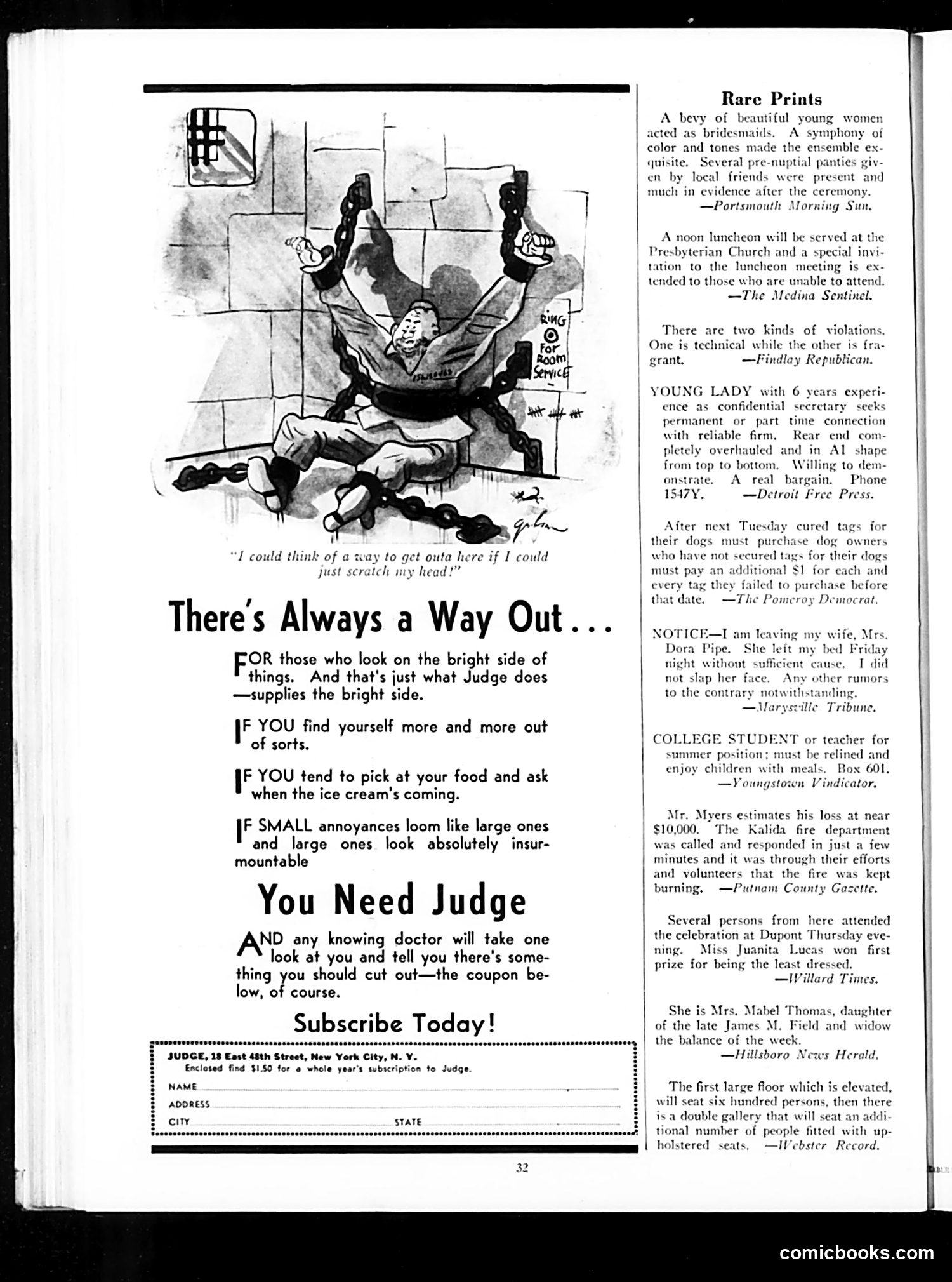
Explanation for Modern Readers This page contains a Judge magazine subscription advertisement with an accompanying cartoon and a "Rare Prints" section of humorous newspaper typos. The Main Cartoon & Ad: The illustration shows a man trapped in stocks or a pillory, claiming he could escape "if I could just scratch my head." The ad uses this as a metaphor: just as the man needs help to escape, modern readers experiencing irritability, poor appetite, and mood swings need Judge magazine's "bright side" humor as a remedy. The copy sarcastically suggests that cutting out the coupon—like cutting out life's annoyances—will improve one's disposition. This reflects early 20th-century thinking that humor and optimism were remedies for psychological malaise. The "Rare Prints" Section: This collects genuine newspaper typos and awkward phrasings from actual publications, finding humor in unintended double meanings (a secretary's "rear end completely overhauled," a woman winning a prize for "being the least dressed"). This was common satirical fodder for Judge.
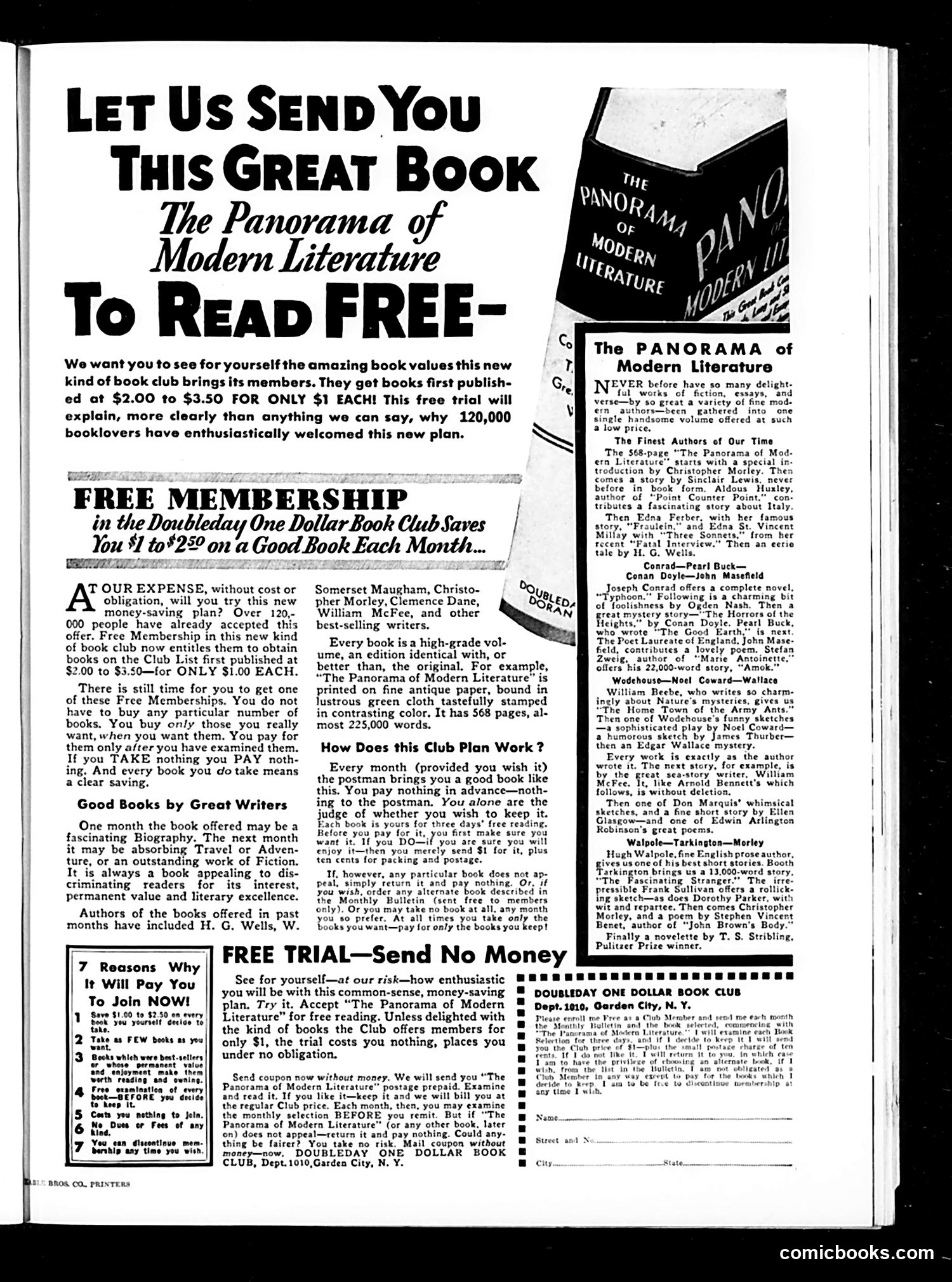
Analysis of Judge Magazine Advertisement Page This is primarily a book club advertisement, not a political cartoon. The page promotes the Doubleday One Dollar Book Club's free trial membership offer, featuring "The Panorama of Modern Literature." The appeal targets Depression-era readers with economic messaging: books normally priced $2.00-$3.50 available for $1.00 each—a significant saving. The advertisement emphasizes risk-free trial (examine books three days free before paying), no obligation, and membership at "our expense." The text lists prominent contemporary authors included in the anthology: H.G. Wells, Somerset Maugham, Christopher Morley, Sinclair Lewis, Aldous Huxley, Edna Ferber, Edna St. Vincent Millay, Joseph Conrad, and Pearl Buck—establishing literary credibility. The "7 Reasons Why It Will Pay You to Join Now" sidebar reinforces value propositions. This represents typical 1920s-30s direct-mail marketing targeting educated middle-class readers seeking affordable quality literature. No political satire is present here.
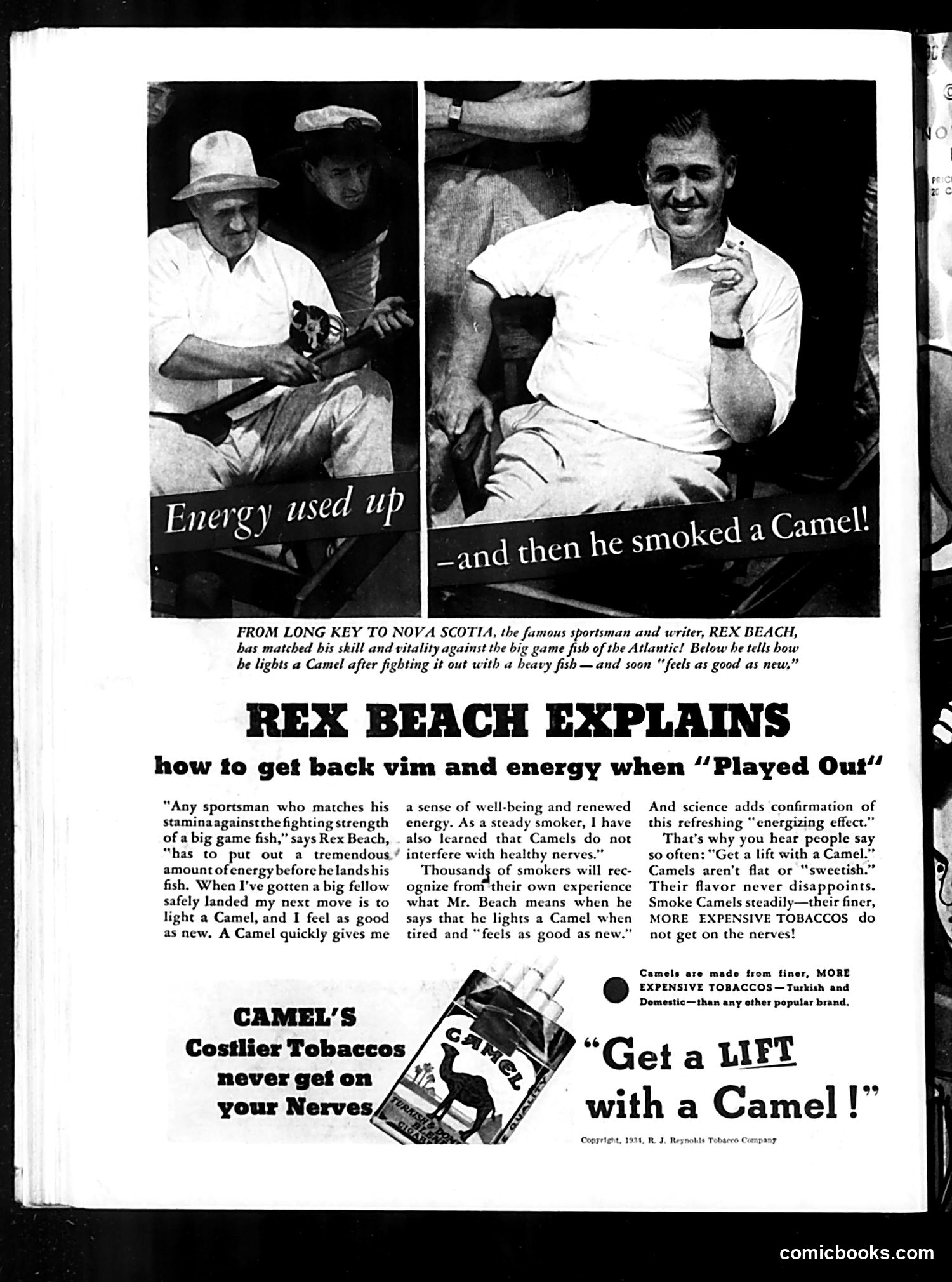
Advertisement, Not Satire This is a cigarette advertisement, not satire or political cartoon. It features Rex Beach, an actual famous sportsman and writer of the 1920s, endorsing Camel cigarettes. The ad claims smoking restores energy after physical exertion—Beach describes lighting a Camel after landing a large game fish, saying he "feels as good as new." The pitch relies on pseudoscientific claims that Camel's "expensive tobaccos" provide an "energizing effect" without harming nerves. This reflects early 20th-century tobacco marketing before health dangers were publicly acknowledged. The ad uses celebrity endorsement and pseudo-medical language ("science adds confirmation") to sell cigarettes as a health and energy product. Modern readers should recognize this as misleading health claims now illegal in advertising.