judge
Judge — November 1934
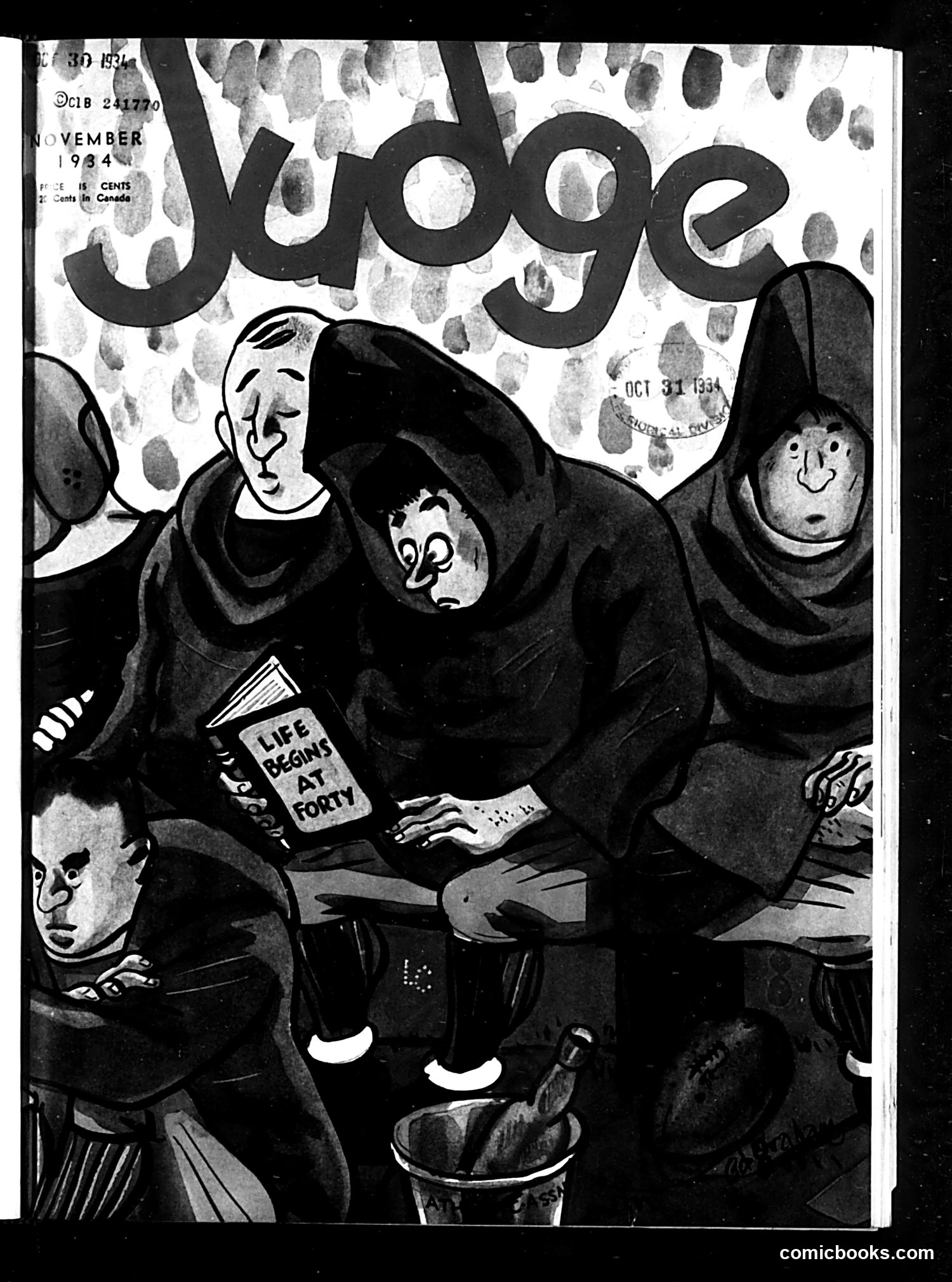
Judge Magazine Cover - November 1934 This satirical cover depicts four caricatured figures representing different age groups or life stages. The central figure holds a book titled "LIFE BEGINS AT FORTY," suggesting the magazine's theme addresses aging and life milestones. The exaggerated facial expressions and physical caricatures are typical of 1930s satirical art, though the specific identities of these figures remain unclear from the image alone. The spotted background and theatrical styling suggest this is commentary on social attitudes about aging and youthfulness during the Depression era. The "$0.15" price and "November 1934" date confirm this is from Judge's satirical commentary period. The overall tone appears to mock contemporary attitudes about getting older—a recurring theme in American humor magazines of this era.
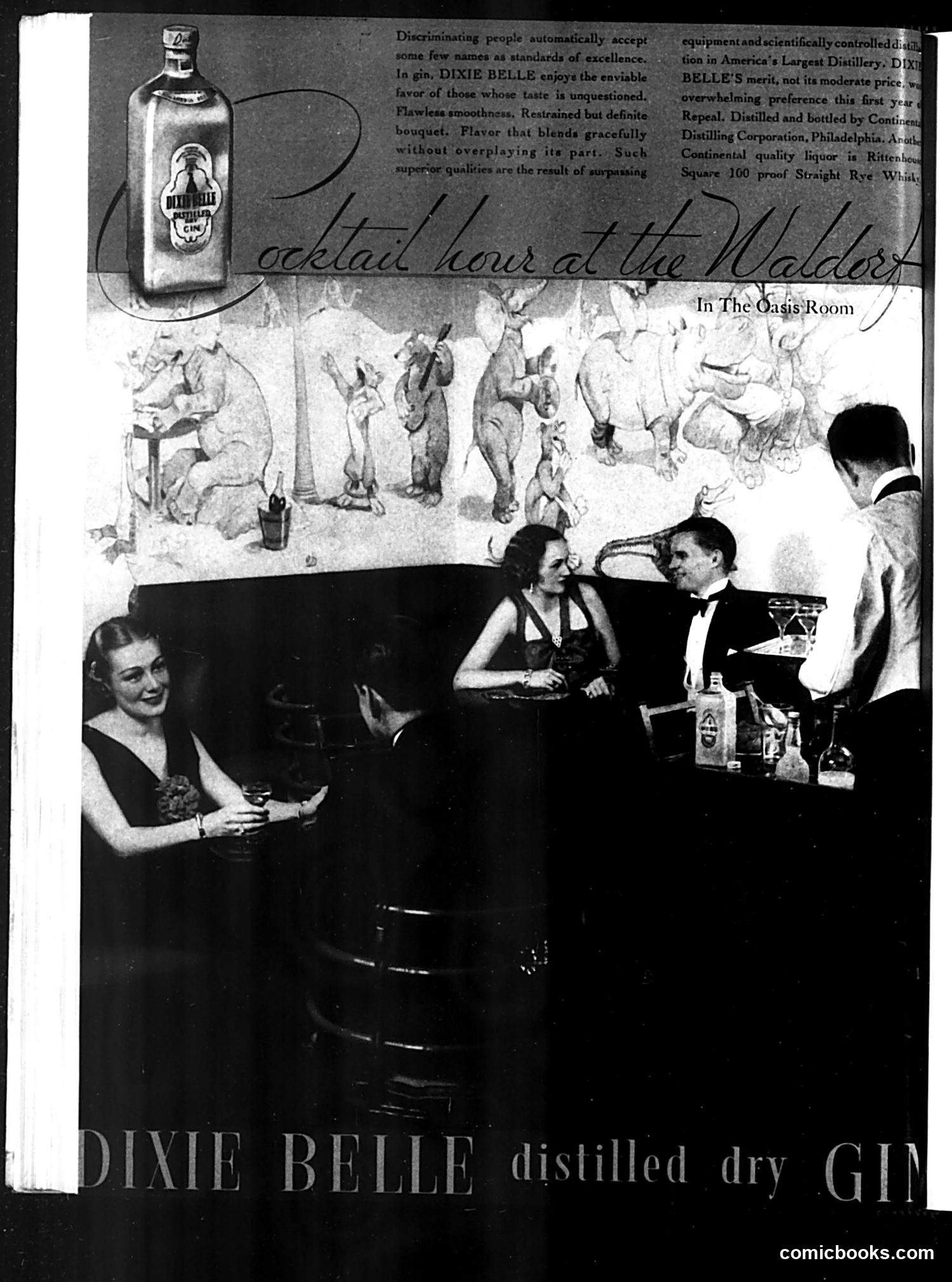
Analysis This page is primarily advertising, not political satire. It promotes Dixie Belle distilled dry gin through two integrated elements: The top features promotional text praising the product's "flawless smoothness" and "restrained but definite bouquet," emphasizing its quality and moderate price. The bottom photograph shows an upscale social scene labeled "Cocktail hour at the Waldorf / In The Oasis Room"—depicting well-dressed patrons enjoying drinks at this prestigious Manhattan hotel. This aspirational imagery links the gin brand to sophistication and elite leisure. The decorative mural above depicts classical/mythological figures, reinforcing the product's association with refinement. This represents typical Prohibition-era advertising (likely 1920s-1930s), when alcohol marketing relied on lifestyle imagery and coded language rather than direct promotion, given legal restrictions on liquor advertising.
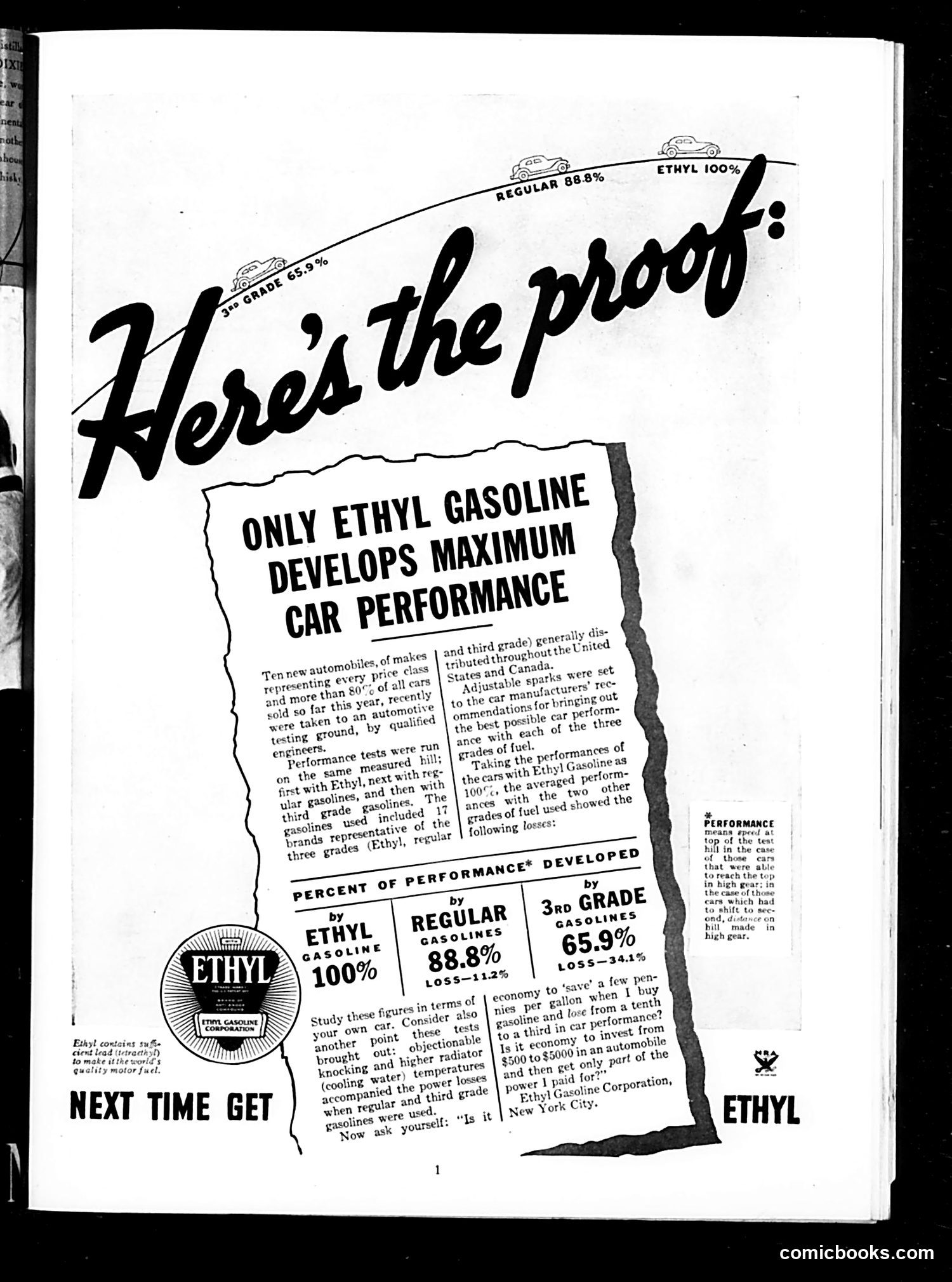
Analysis This is primarily advertising content, not satire. It's a paid advertisement for Ethyl Gasoline, promoting a fuel additive product. The ad claims that Ethyl Gasoline produces superior car performance compared to regular gasoline and third-grade gasoline. It presents a performance comparison showing Ethyl achieving 100% development versus Regular's 88.8% and third-grade's 65.9%. The "proof" consists of test results from ten automobile manufacturers comparing fuel performance metrics like hill-climbing ability and knocking resistance. The visual shows cars climbing an inclined line, illustrating the performance hierarchy. The circular Ethyl logo and repeated branding ("NEXT TIME GET ETHYL") reinforce the sales message. This reflects early-to-mid 20th-century automotive marketing when leaded gasoline additives were promoted as performance enhancers without health warnings.
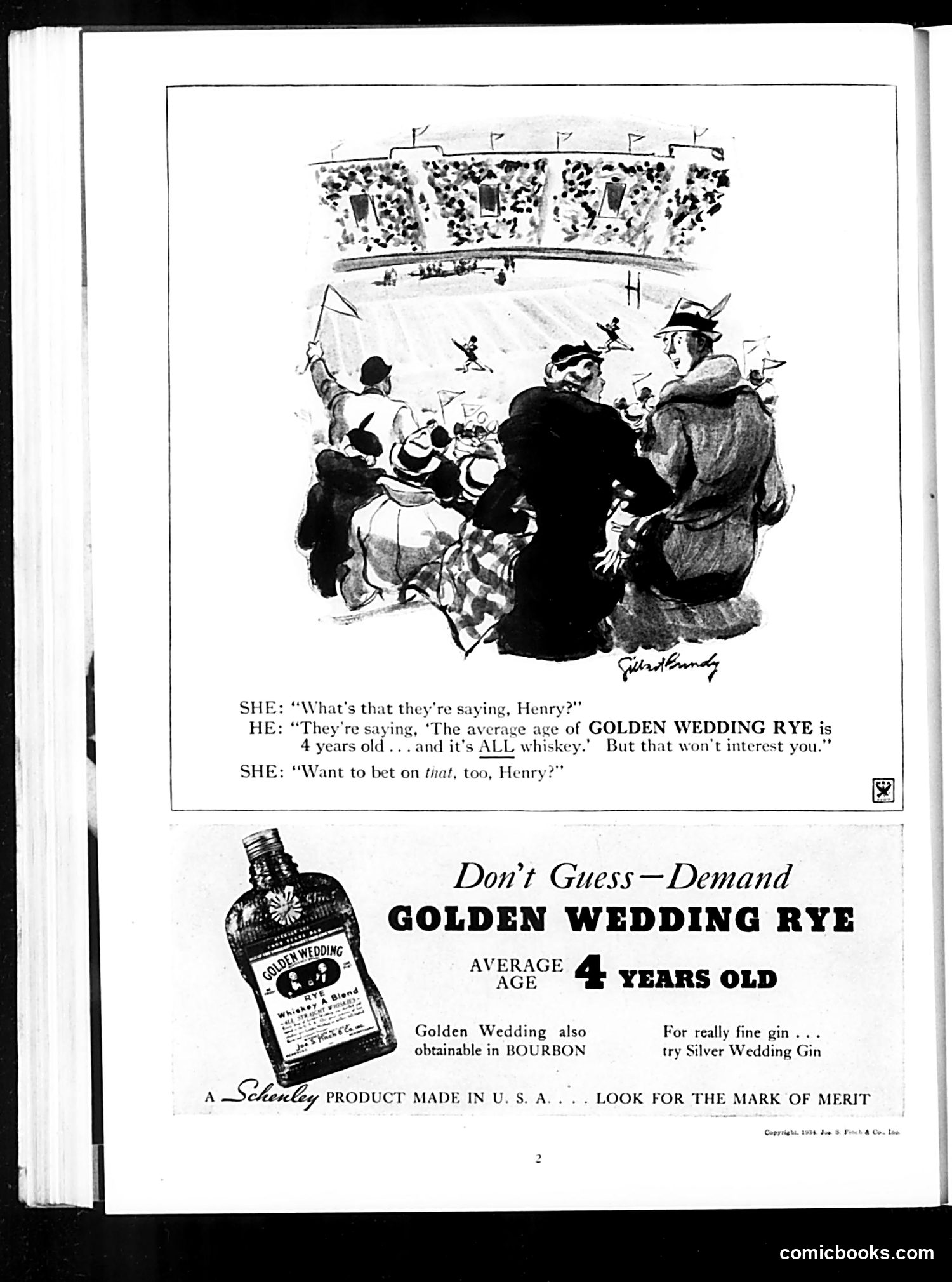
Golden Wedding Rye Advertisement This page is primarily a whiskey advertisement for Golden Wedding Rye, a Schenley product made in the USA. The cartoon above depicts a couple at what appears to be a sporting event (likely a baseball game, given the stadium setting). The husband dismisses his wife's question about spectators' conversation, claiming they're discussing whiskey age and that "it's ALL whiskey"—implying he finds the topic uninteresting. When she asks if he wants to bet on the whiskey claim, his response suggests he's preoccupied or indifferent. The ad's message—"Don't Guess—Demand"—emphasizes that consumers should specifically request Golden Wedding Rye by name rather than accepting unknown alternatives. This reflects early 20th-century advertising strategy promoting brand loyalty and product specificity during Prohibition's aftermath.
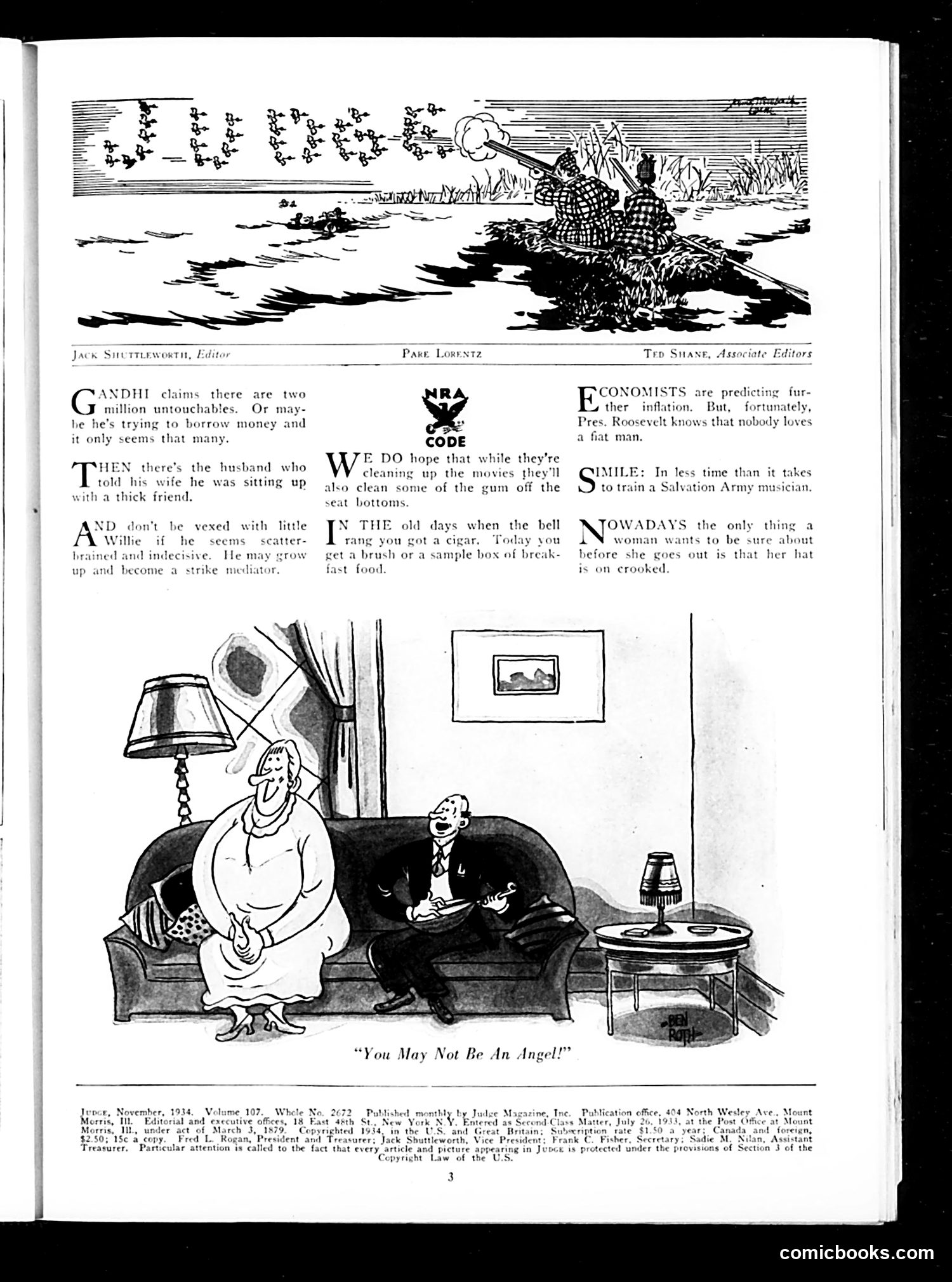
Analysis of Judge Magazine Page (November 1914) Top Illustration: A satirical scene showing two figures by a waterside with "GOOD" written on a barrel, likely referencing NRA (National Recovery Administration) codes or industrial regulation—though the exact context is unclear without fuller dating certainty. Main Cartoon ("You May Not Be An Angel!"): A domestic scene showing a woman on a sofa with a man, captioned with the title. The joke appears to satirize courtship or marriage dynamics, suggesting infidelity or impropriety—a common Judge magazine theme mocking middle-class morality. Text Snippets: Brief satirical quips about Gandhi's finances, marriage troubles, movie censorship, and women's concerns about crooked hats—typical period humor targeting political figures, social conventions, and everyday anxieties. This reflects 1914 American popular culture and social commentary.
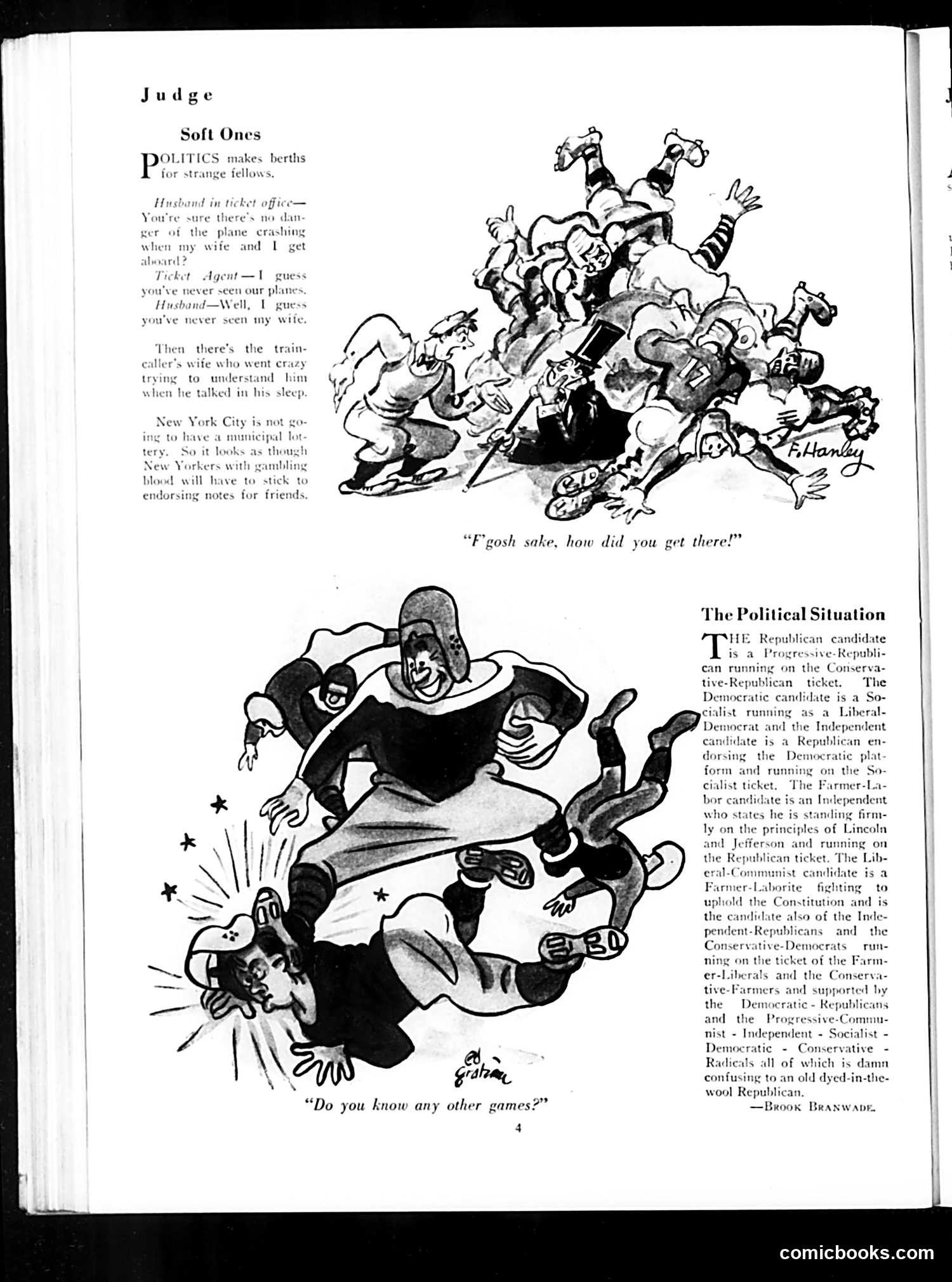
Judge Magazine Page Analysis This page contains two satirical cartoons mocking American politics, likely from the early 20th century. "Soft Ones" (top): A chaotic pile of politicians tumbles together, captioned "F'gosh sake, how did you get there!" The accompanying text jokes about politics creating "strange fellows" and references New York City's upcoming municipal lottery, suggesting politicians will resort to endorsing questionable ventures. "The Political Situation" (bottom): Shows a figure juggling multiple heads/candidates representing various political parties and platforms—Progressive Republican, Conservative Republican, Liberal Democrat, Socialist, Farmer-Labor, etc. The caption "Do you know any other games?" satirizes the confusing proliferation of political tickets and candidates, mocking how many competing ideologies and parties make American politics bewilderingly complex.
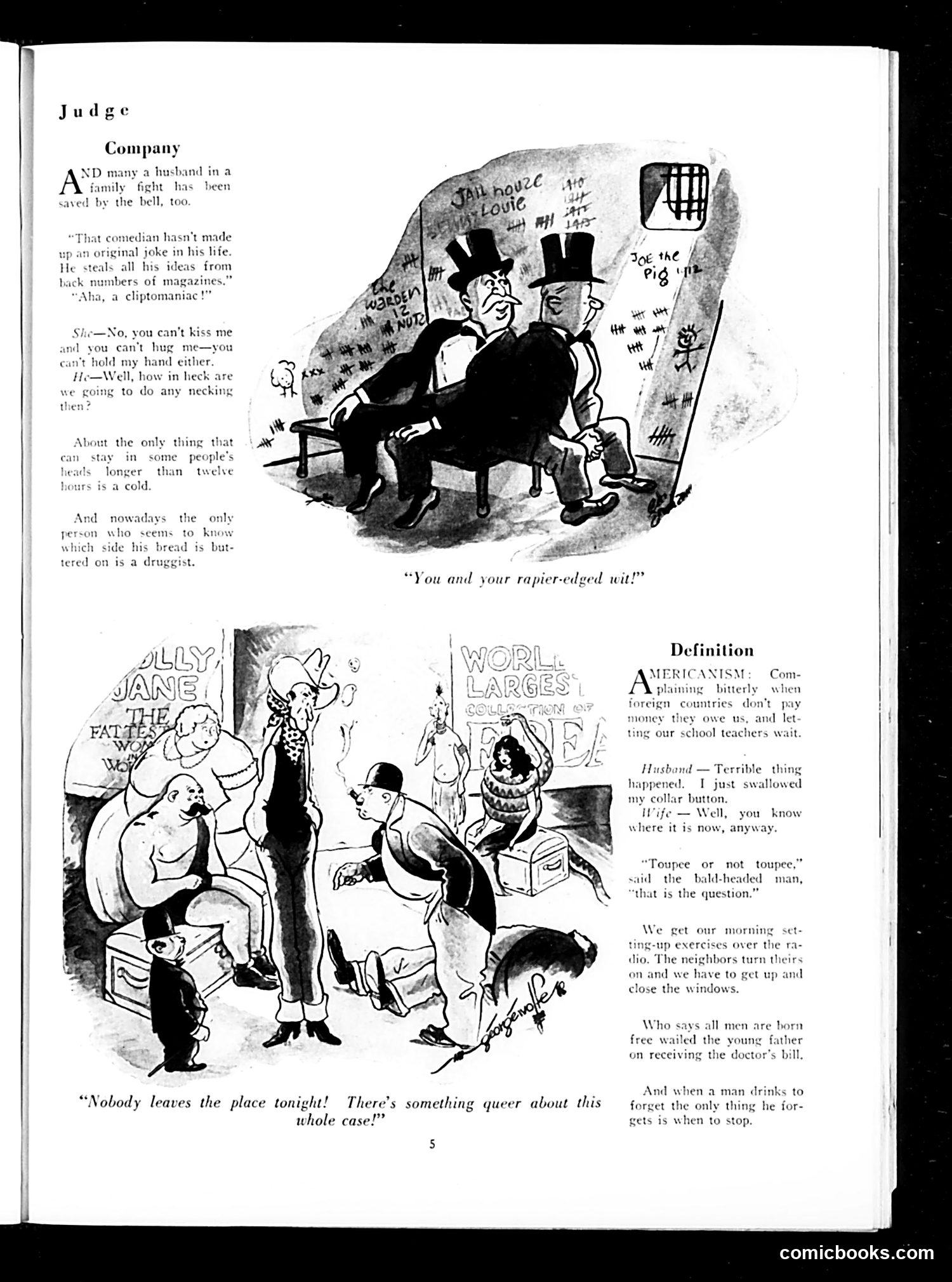
Analysis of Judge Magazine Page This page contains two distinct satirical pieces from Judge magazine (early 20th century). Top cartoon ("You and your rapier-edged wit!"): Two well-dressed men in a prison cell discuss comedy. The satire targets joke-stealing in the entertainment industry—one accuses the other of plagiarizing magazine jokes rather than creating original material. The cell setting suggests this intellectual theft is a serious transgression worthy of imprisonment. Bottom cartoon and "Definition" section: The chaotic scene mocks contemporary social anxieties. The "Definition" defines Americanism sarcastically as complaining when foreigners don't pay debts while Americans dodge school-teacher salaries. The accompanying vignettes satirize domestic absurdities—radio noise complaints, doctor's bills, and drinking problems—suggesting American life is fundamentally chaotic and hypocritical despite claims of superiority.
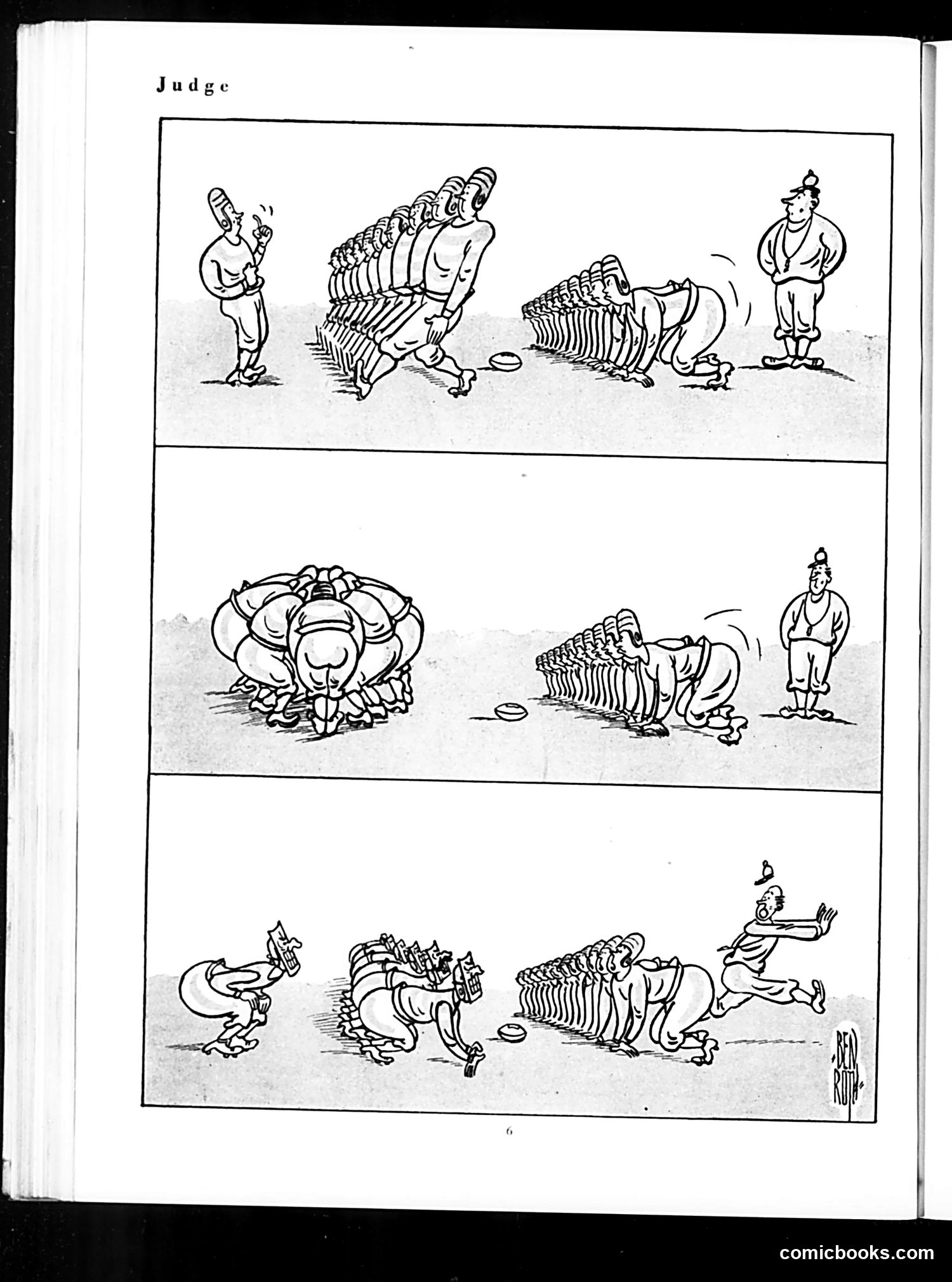
Judge Magazine: "Judge" Cartoon Analysis This three-panel satirical cartoon depicts a judge presiding over what appears to be a jury or group of seated figures. The progression shows: 1. Top panel: A judge stands while multiple figures sit in rows 2. Middle panel: The seated group has transformed into a large, bulbous mass 3. Bottom panel: Chaos ensues with figures scattering in different directions The satire likely mocks the judicial process—possibly commenting on jury incompetence, judicial corruption, or the unpredictability of courtroom proceedings. The transformation of organized jurors into a chaotic blob suggests how quickly order dissolves or how the justice system becomes unwieldy. Without additional context or visible text identifying specific figures, the exact political target remains unclear, but it's characteristic of Judge's commentary on institutional dysfunction.
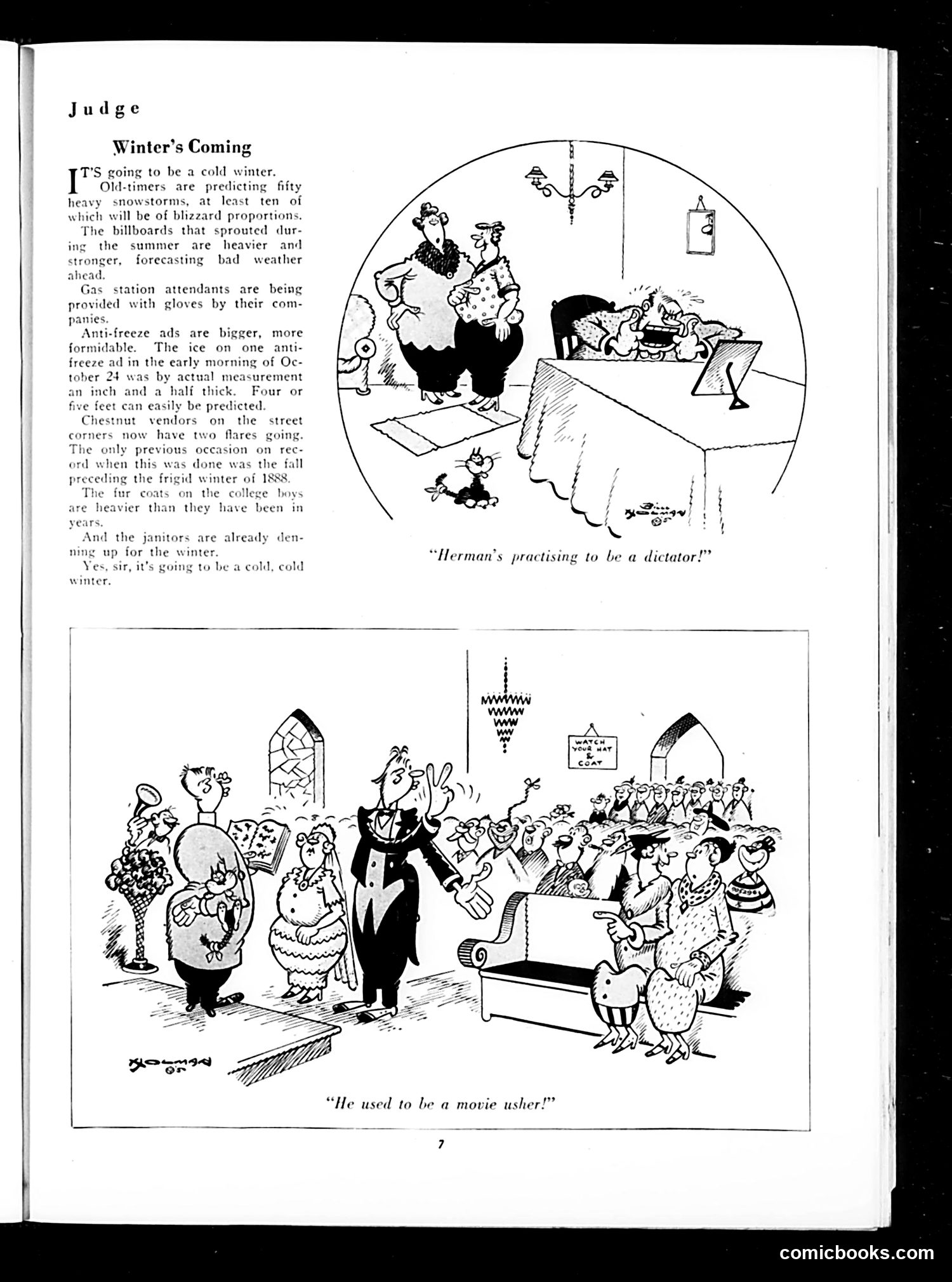
Judge Magazine Page Analysis This page contains two satirical cartoons about winter preparation and social commentary. Top cartoon: Shows a domestic scene where "Herman's practising to be a dictator!" depicts a man gesturing authoritatively while his wife and child appear submissive—satirizing how ordinary men adopt domineering behavior, likely reflecting 1920s-30s anxieties about authoritarian movements gaining popularity. Bottom cartoon: "He used to be a movie usher!" shows a formally-dressed man addressing a crowd of common people, suggesting someone of humble origins (a theater usher) has risen to public prominence or authority. This appears to mock social climbers or self-made figures claiming undeserved status. The accompanying text humorously predicts an exceptionally cold winter based on dubious evidence: billboard durability, anti-freeze advertising size, and vendor preparations. The satire mocks people who claim predictive knowledge from flimsy indicators—a timeless human tendency toward false certainty.
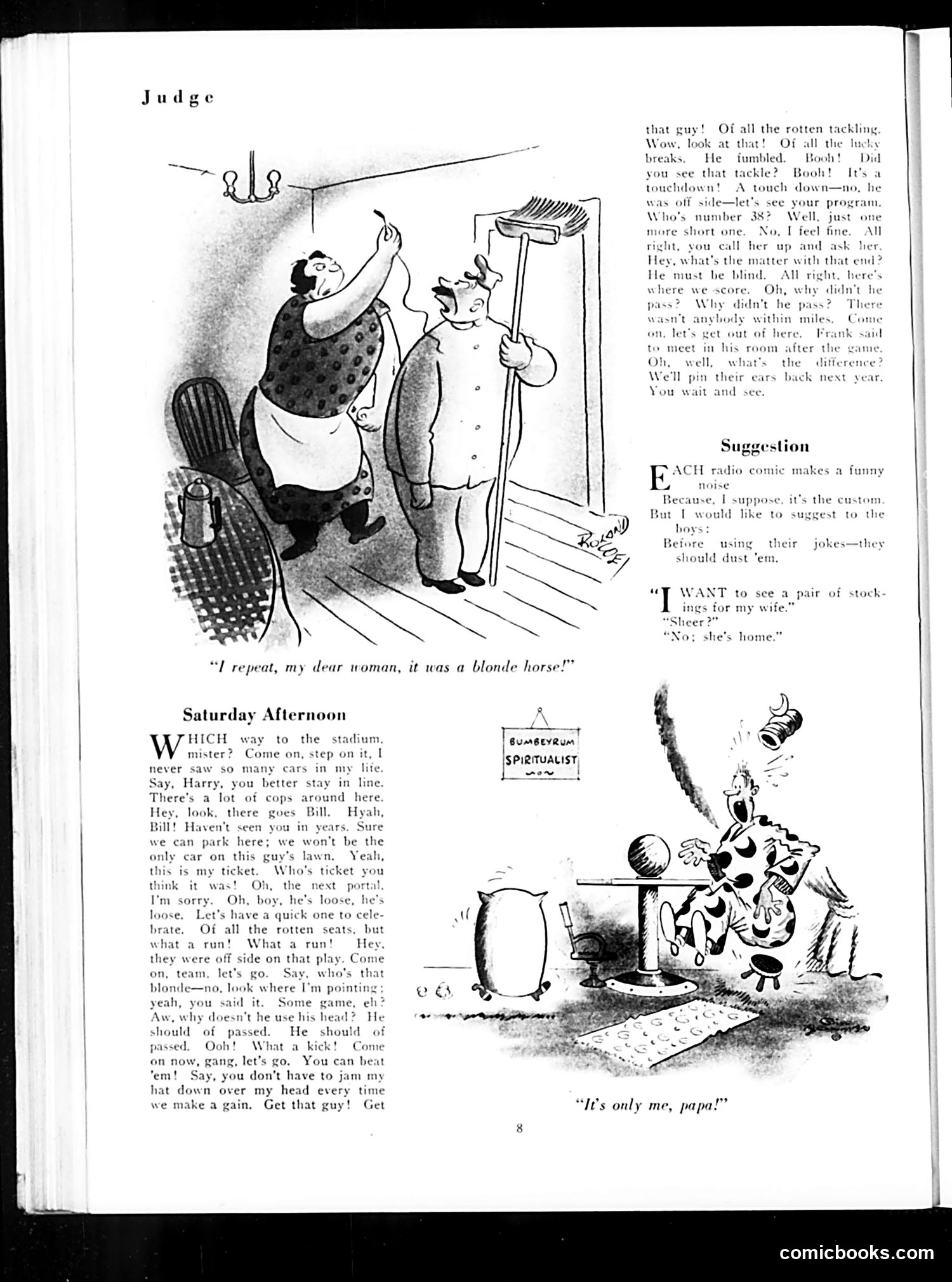
Explanation for Modern Readers This page from *Judge* magazine contains three separate satirical pieces about American leisure and entertainment: "Judge" (top cartoon): A woman at what appears to be a sporting event disputes with a man about what horse she saw, insisting it was "a blonde horse." The satire mocks domestic arguments and the confusion of spectators at crowded public events. "Saturday Afternoon": A long monologue capturing the chaotic experience of attending a football game—traffic jams, parking violations, ticket confusion, loud fans, and constant shouting complaints about plays, tackles, and fumbles. It satirizes the rowdy, intoxicated fan culture and aggressive behavior at stadium events. "Suggestion" and "stockings" jokes: Brief radio-comedy satire suggesting comedians should "dust" their old jokes before using them; followed by a domestic joke about a husband wanting to buy stockings (implying an affair), but the wife says they're home—a mild double entendre. Overall, the page mocks working-class leisure activities, drinking culture, marital discord, and tired entertainment formulas of the era.
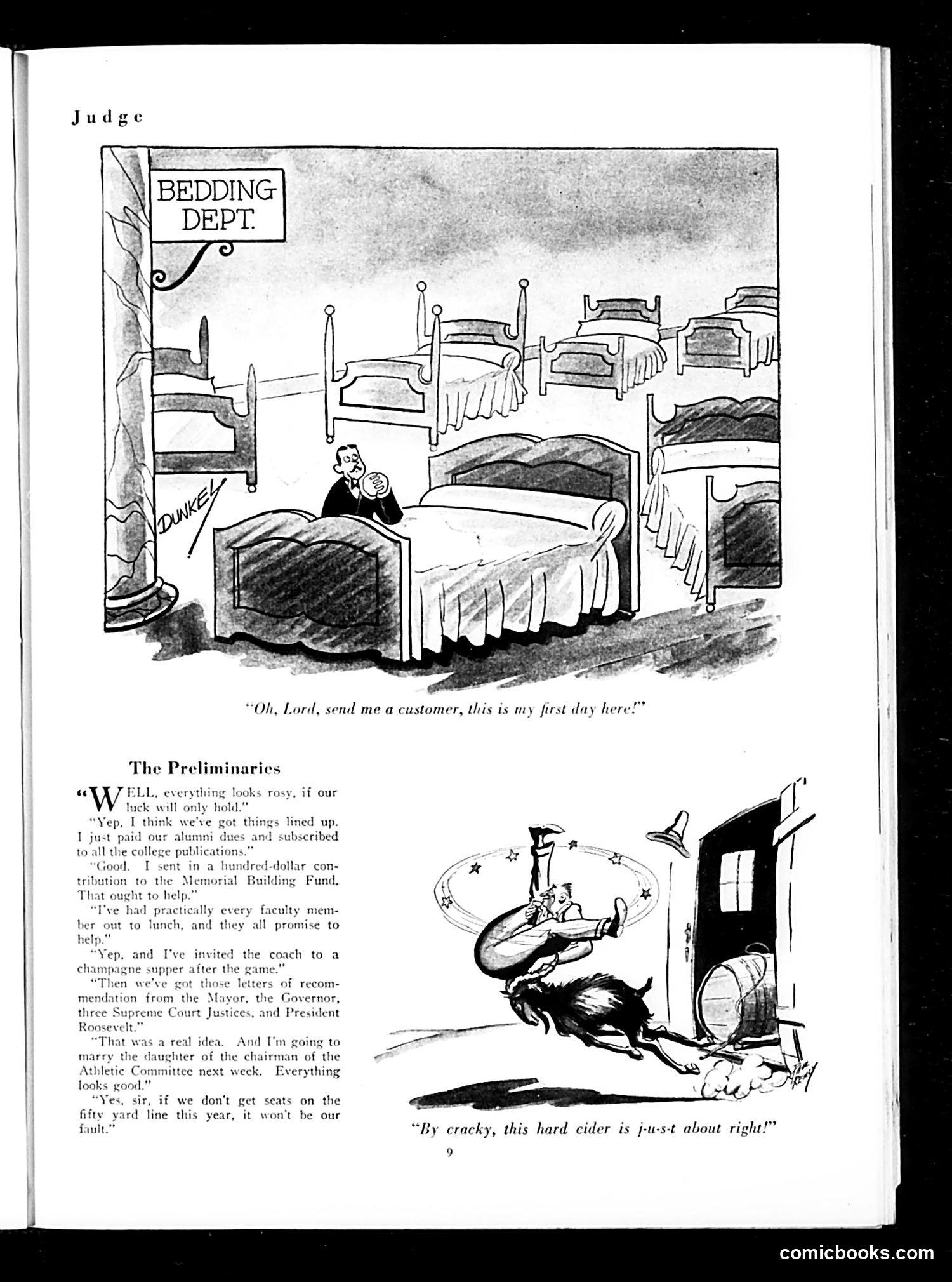
Analysis of Judge Magazine Page The top cartoon satirizes a struggling bedding department employee's first day, praying desperately for customers—a straightforward joke about retail anxiety. "The Preliminaries" is more significant: it mocks college fundraising excess. Two figures discuss securing a football stadium's fifty-yard-line seats through inflated means: alumni donations, faculty pledges, invitations to coaches, and notably, letters of recommendation from the Mayor, Governor, three Supreme Court Justices, and President Roosevelt. The satire targets how colleges leverage prominent political figures' names and prestige to advance athletic programs. The final cartoon shows someone enjoying hard cider, appearing intoxicated—likely commenting on Prohibition-era hypocrisy (hard cider production/consumption during the alcohol ban). The overall theme critiques how American institutions, particularly universities, mobilize political connections and resources disproportionately for athletics rather than academics.
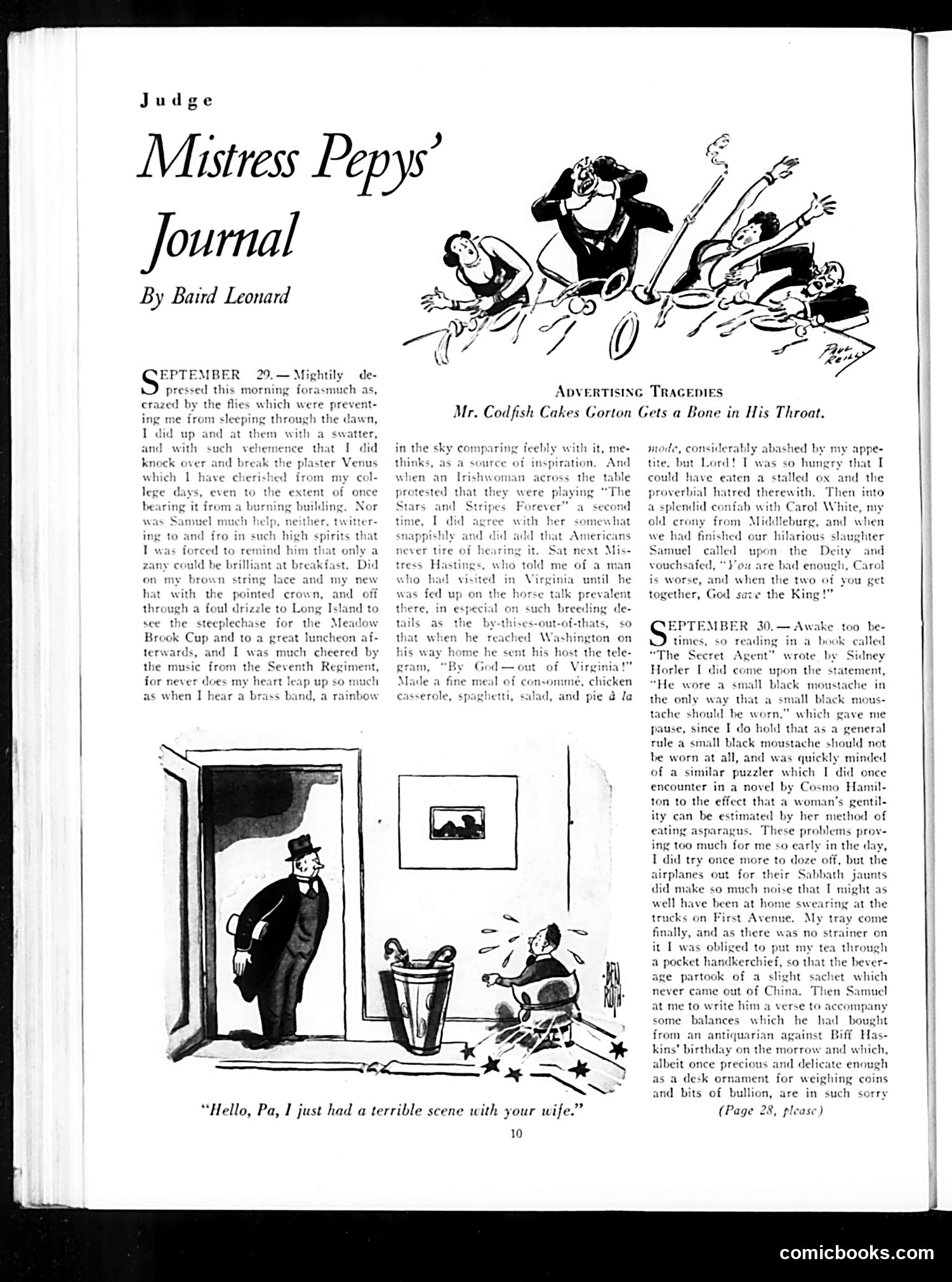
Judge Magazine: "Mistress Pepys' Journal" (Page 10) This page presents a humorous diary column mimicking Samuel Pepys' famous 17th-century diary, but set in what appears to be the 1920s-30s. The column satirizes upper-class social life through trivial complaints and name-dropping. The main cartoon shows a man entering a room saying "Hello, Pa, I just had a terrible scene with your wife"—a domestic joke about marital discord, illustrated with slapstick visual chaos (overturned furniture, scattered objects). The text entries record mundane social events (steeplechase racing, lunch parties) mixed with petty grievances (flies preventing sleep, airplane noise). There's a section titled "Advertising Tragedies" mentioning "Mr. Codfish Cakes Gorton" getting a bone in his throat—likely mocking commercial product names and advertising claims. The satire targets pretentious, leisured society people who treat insignificant problems as major dramas while referencing popular novels and social status. The Pepys framing device elevates trivial modern gossip to mock historical importance.
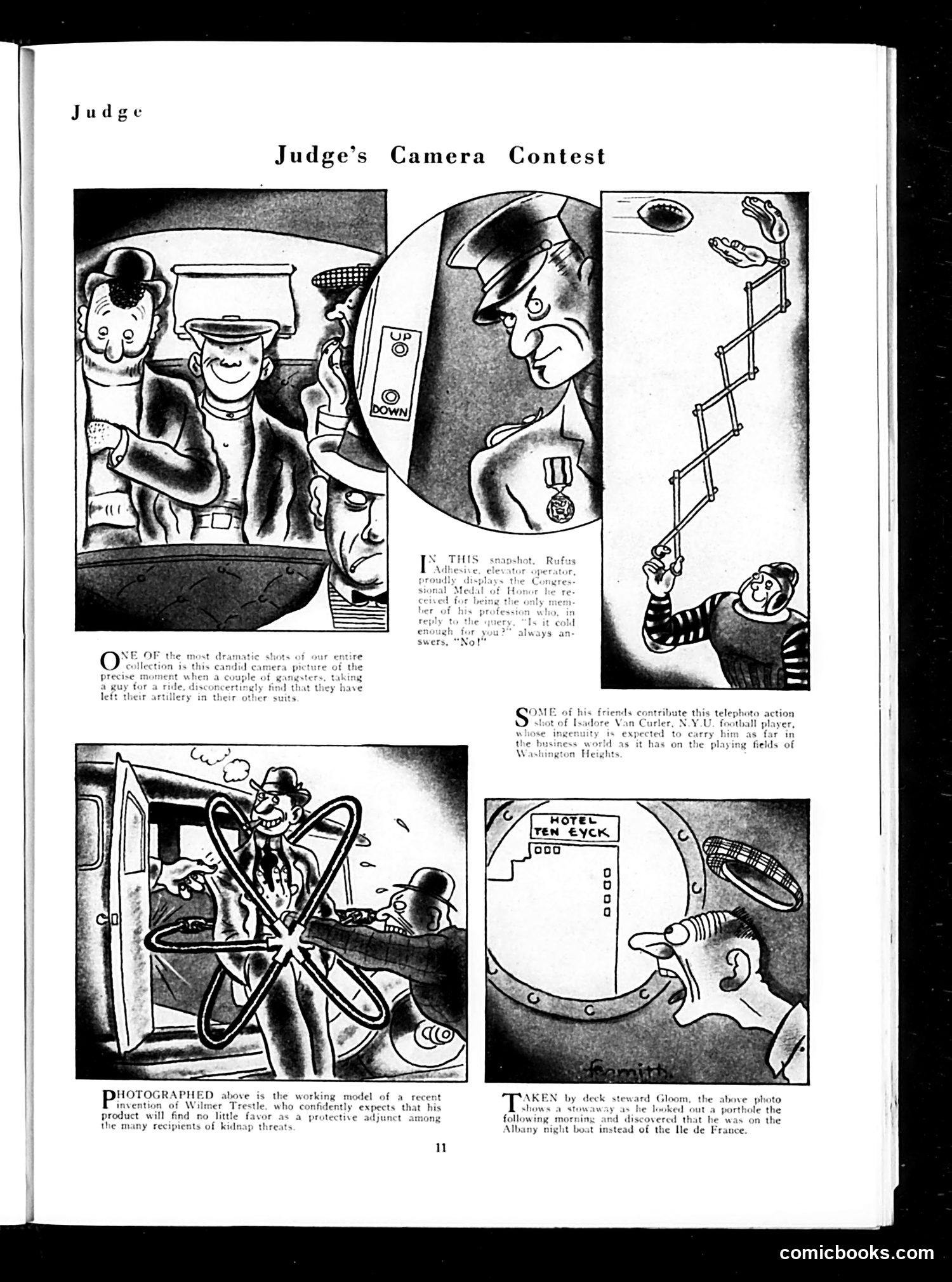
Judge's Camera Contest This page showcases four cartoon panels from Judge magazine's "Camera Contest," featuring humorous photographs with satirical captions. The cartoons mock various situations: 1. Top left: Gangsters in an elevator—satirizing organized crime and violence. 2. Top right: A military officer with a Medal of Honor, captioned about an "arthritis elevator operator"—likely mocking military pretension or questionable medal recipients. 3. Bottom left: A Willmer Textile invention involving a protective adjunct for "kidney threats"—appears to be absurdist humor about dubious patent inventions. 4. Bottom right: A hotel desk scenario involving deck steward Gloom and a mix-up at the "Ile de France" (a ship)—poking fun at travel mishaps and service industry confusion. The overall theme satirizes American life, military culture, commercial inventions, and modern travel through exaggerated, comedic scenarios.
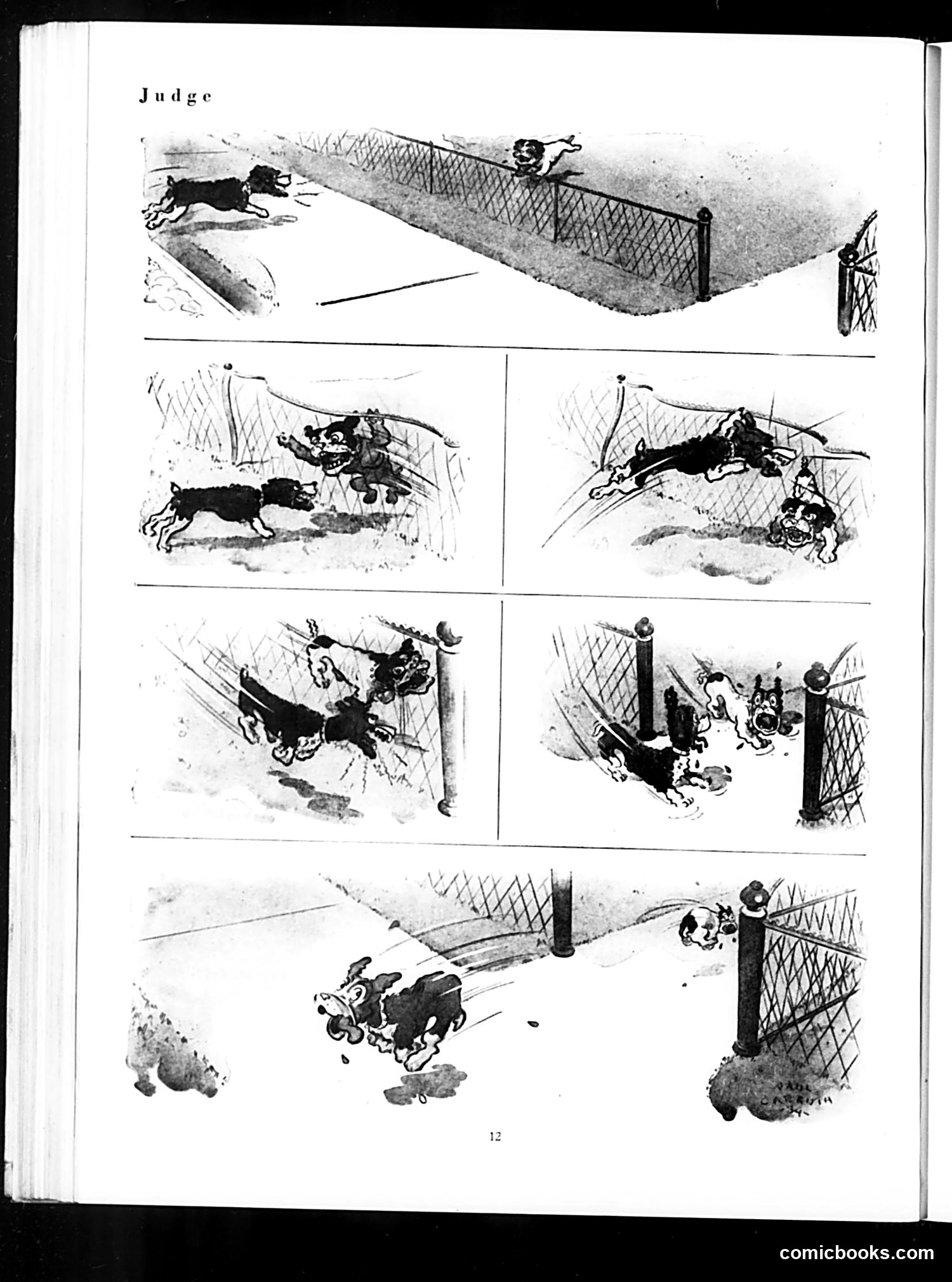
"Judge" Page Analysis This page titled "Judge" depicts a comic sequence showing a dog jumping over a fence while being chased by what appear to be caricatured human figures. The narrative progresses through multiple panels showing escalating chaos—the dog leaps the fence, the pursuers tumble and collide with each other, and the final panel shows multiple figures in disarray near the fence posts. Without additional context or visible text identifying specific political figures or current events, the exact satirical target remains unclear. However, the sequence appears to mock incompetence or bumbling authority figures chasing an elusive target. The style suggests early-to-mid 20th century American satire, typical of *Judge* magazine's political commentary through physical comedy and caricature.
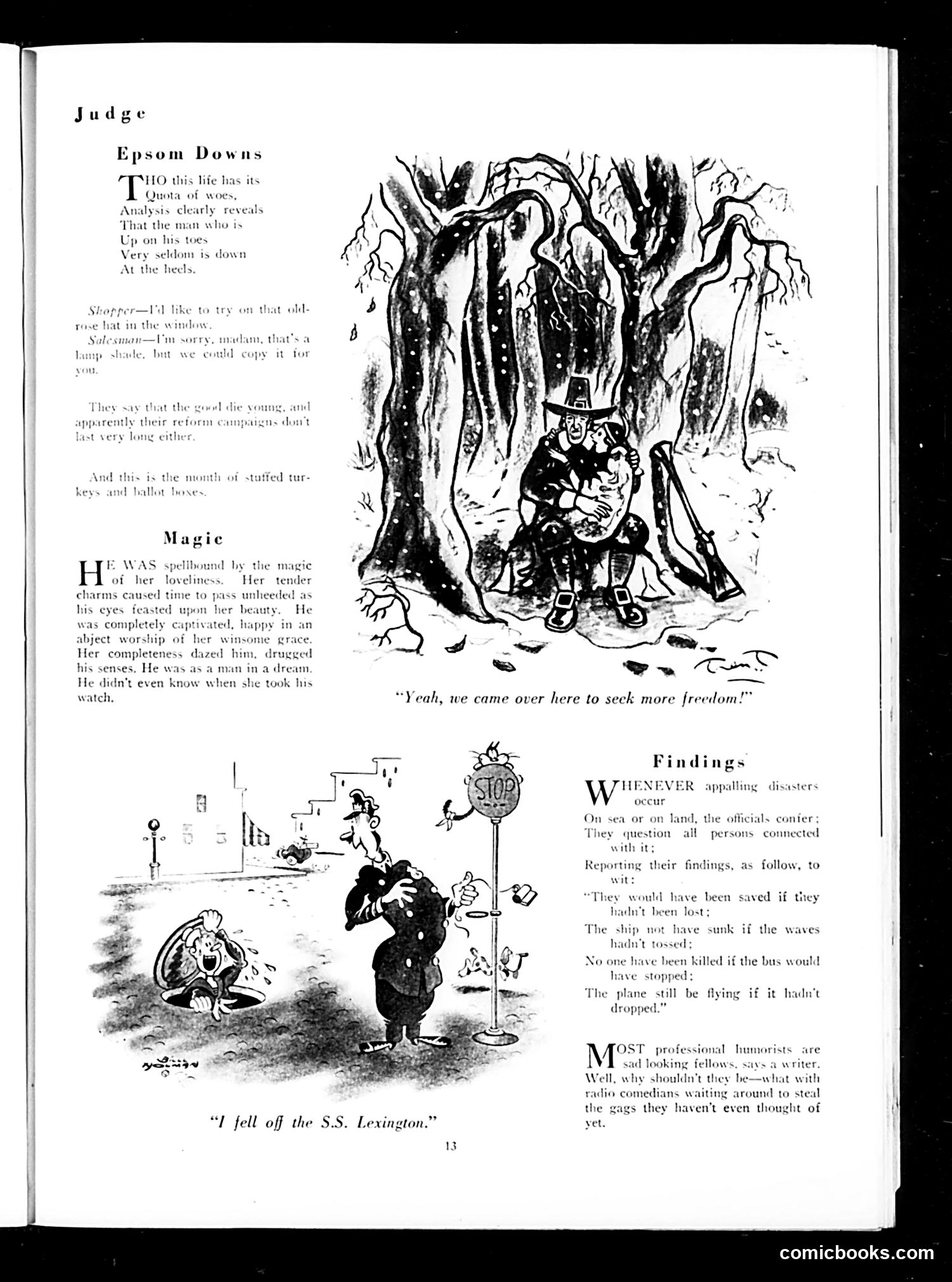
Judge Magazine Page Analysis This page contains three satirical pieces from Judge magazine: "Epsom Downs" (top): A poem mocking reform movements, suggesting that moral crusades achieve little lasting change. "Magic" (middle): A cartoon about a man so captivated by a woman's beauty that he's oblivious to being robbed—she steals his watch while he's entranced. The satire targets naive male susceptibility to female charm. "Findings" (bottom): The main satire here mocks official inquiry reports into disasters. It ridicules the circular, blame-shifting logic of investigations: "They would have been saved if they hadn't been lost" and "The plane still be flying if it hadn't dropped." This satirizes how officials produce meaningless tautologies rather than genuine accountability—a critique of bureaucratic evasion and the absurdity of official investigations that state the obvious while avoiding real responsibility.
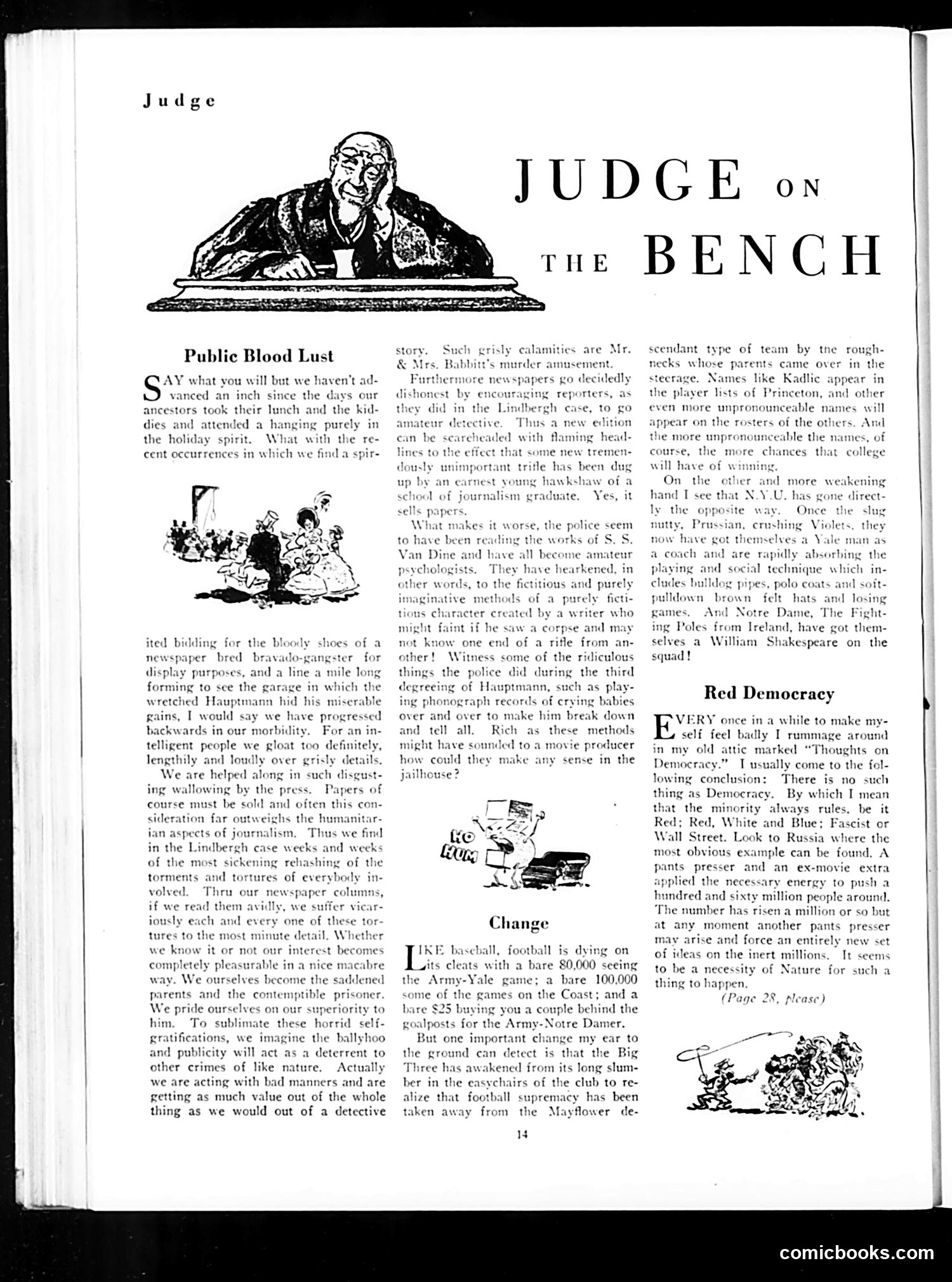
"Judge on the Bench" — Page Analysis This editorial page from Judge magazine contains three satirical columns attacking sensationalism, college sports corruption, and political hypocrisy. "Public Blood Lust" criticizes Americans' morbid fascination with the Hauptmann case (the 1932 Lindbergh kidnapping trial). The author argues that newspaper coverage and public eagerness to witness gruesome details reveals we haven't advanced morally since public hangings—we're merely more hypocritical about it. "Change" mocks Ivy League football's declining attendance while exposing what the author sees as the real problem: elite colleges now recruit working-class players with foreign surnames ("Kadlic," "Poles from Ireland") instead of maintaining their traditional aristocratic rosters. The satirical point: these schools' "weakness" stems from admitting students outside their social class. "Red Democracy" sarcastically argues that democracy is a myth—power always rests with minorities (whether communist Russia, fascists, or Wall Street). It uses a "pants presser" metaphor suggesting that even revolutionary upheaval merely replaces one ruling class with another. The illustrations are editorial cartoons supporting these critiques of institutional and social hypocrisy.
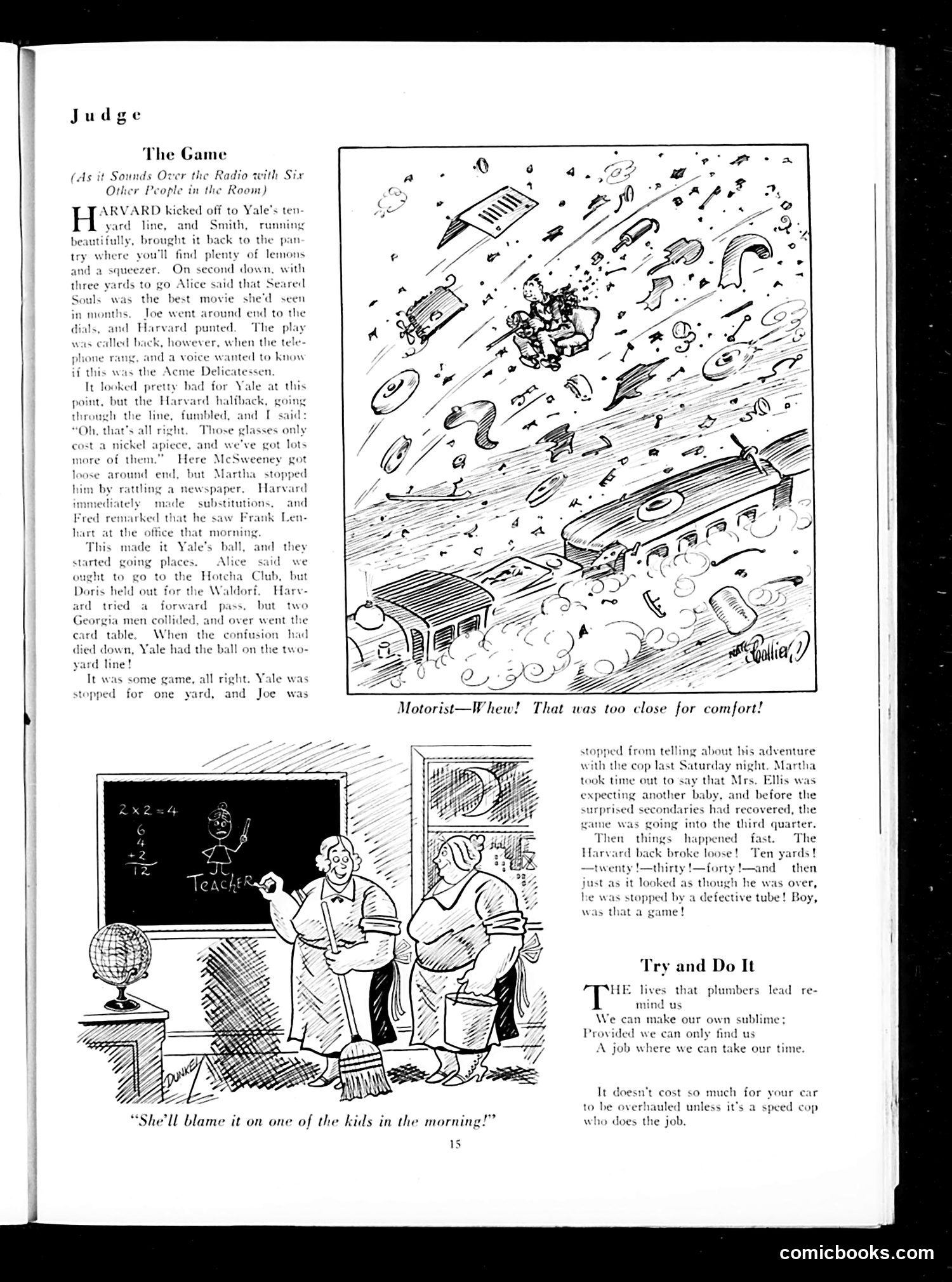
Explanation for Modern Readers This page contains two distinct pieces of satire from *Judge* magazine. "The Game" is a humorous account of a Harvard-Yale football game that's constantly interrupted by mundane social gossip and distractions. The joke is that the narrator cannot focus on the exciting play-by-play because people keep inserting irrelevant chatter about movies, babies, nightclub preferences, and police encounters. The chaotic illustration reinforces this—vehicles and objects fly everywhere in confusion. The satire mocks how even major social events become secondary to petty social conversation. "Try and Do It" is a brief satirical poem about plumbers' leisurely work habits. It suggests that plumbers live enviably easy lives by taking their time on jobs, and implies this is why car maintenance is expensive—you're paying for a tradesman who works at his own unhurried pace. The accompanying classroom cartoon shows a teacher blaming unruly students for disruption, with the caption suggesting the wife will blame the children for some household mishap. The satire targets both working-class time-wasting and domestic blame-shifting.
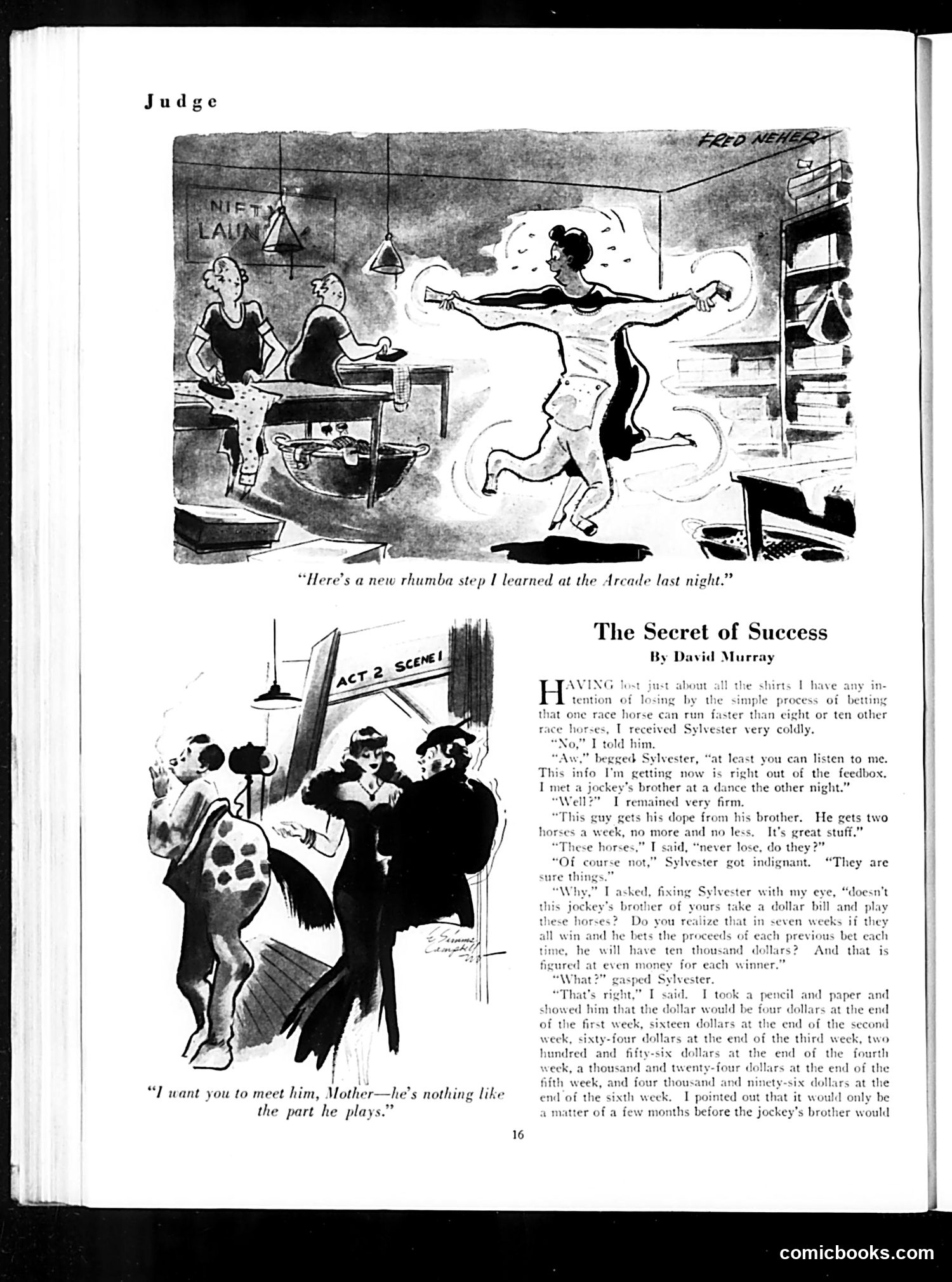
Analysis The top cartoon shows a woman dancing energetically at what appears to be a laundry ("NIFT LAUN[DRY]"), demonstrating a new dance step she learned at the Arcadia. This is a straightforward joke about popular dance crazes—a common entertainment reference in the early 20th century. The lower section is an illustrated story titled "The Secret of Success" by David Murray. It depicts a conversation between the narrator and someone named Sylvester about horse racing betting. Sylvester tries to convince the narrator to bet on racehorses using a mathematical scheme: a jockey's brother supposedly provides winning tips, and if one bets the winnings from each race on the next race, exponential growth would yield ten thousand dollars in weeks. The story appears to be satirizing get-rich-quick schemes and gambling addiction. The narrator uses pencil and paper to demonstrate how the doubling strategy works mathematically, but the implicit moral seems to be that such schemes are inherently unsound despite their mathematical appeal—likely emphasizing that gambling cannot reliably produce wealth.
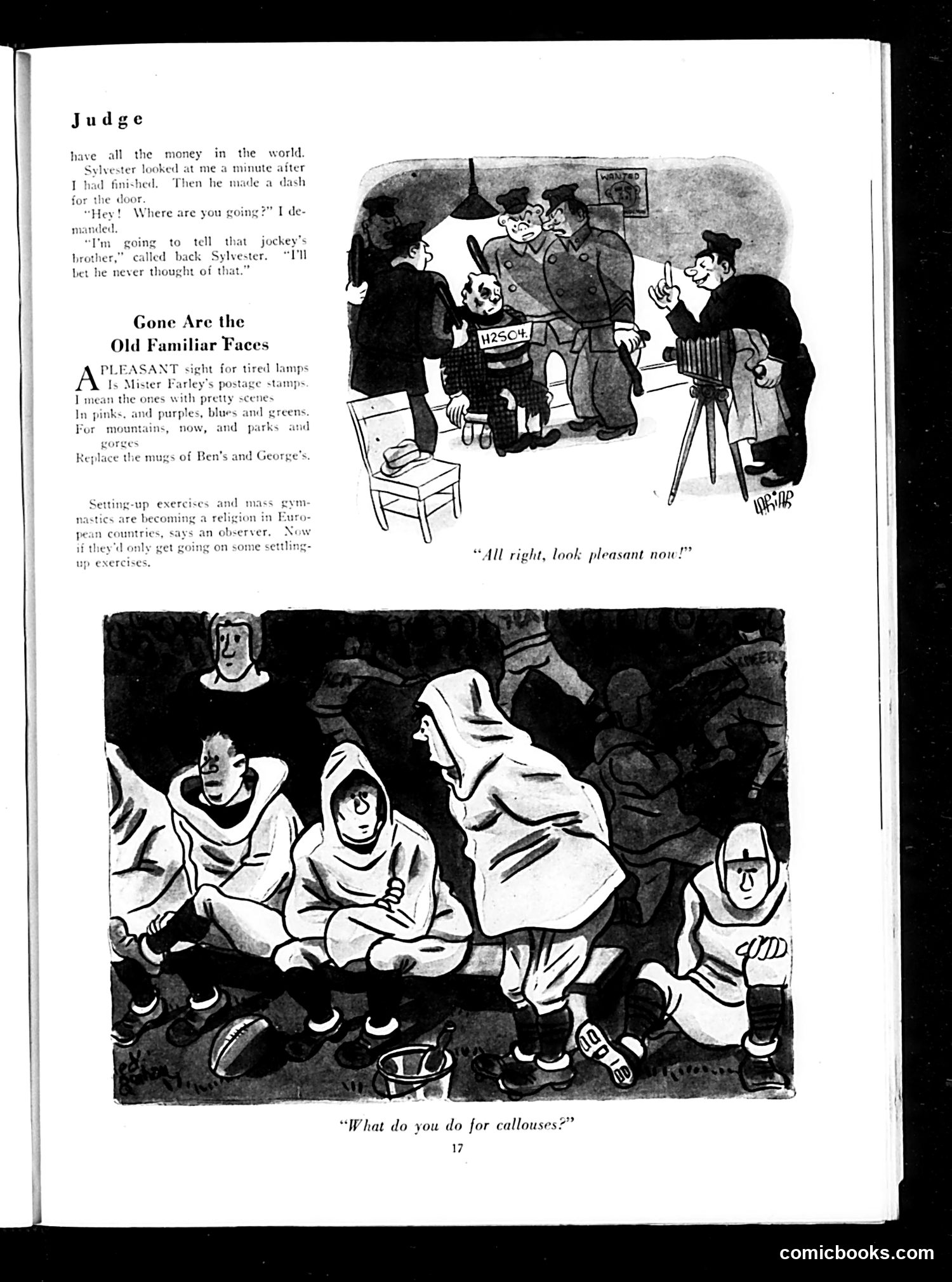
Analysis for Modern Readers This page contains two satirical cartoons from *Judge* magazine commenting on early 20th-century social trends. Top cartoon ("All right, look pleasant now!"): A photographer directs subjects during a portrait session, likely satirizing the awkwardness of early photography and the photographer's directive to appear pleasant—a common phrase of the era. Bottom cartoon ("What do you do for callouses?"): Shows people in casual athletic wear sitting together. The satire targets the growing European fitness and gymnasium movement. The text notes that setting-up exercises are "becoming a religion in European countries," and mocks this trend by having someone ask about callouses—suggesting the rigorous physical training has practical, unglamorous side effects. "Gone Are the Old Familiar Faces": This section laments the replacement of familiar scenic postcards (with "pretty scenes in pinks, and purples, blues and greens") with exercise-related imagery—reflecting anxiety about modernization replacing traditional leisure aesthetics. The overall tone is gently mocking toward continental European fitness culture.
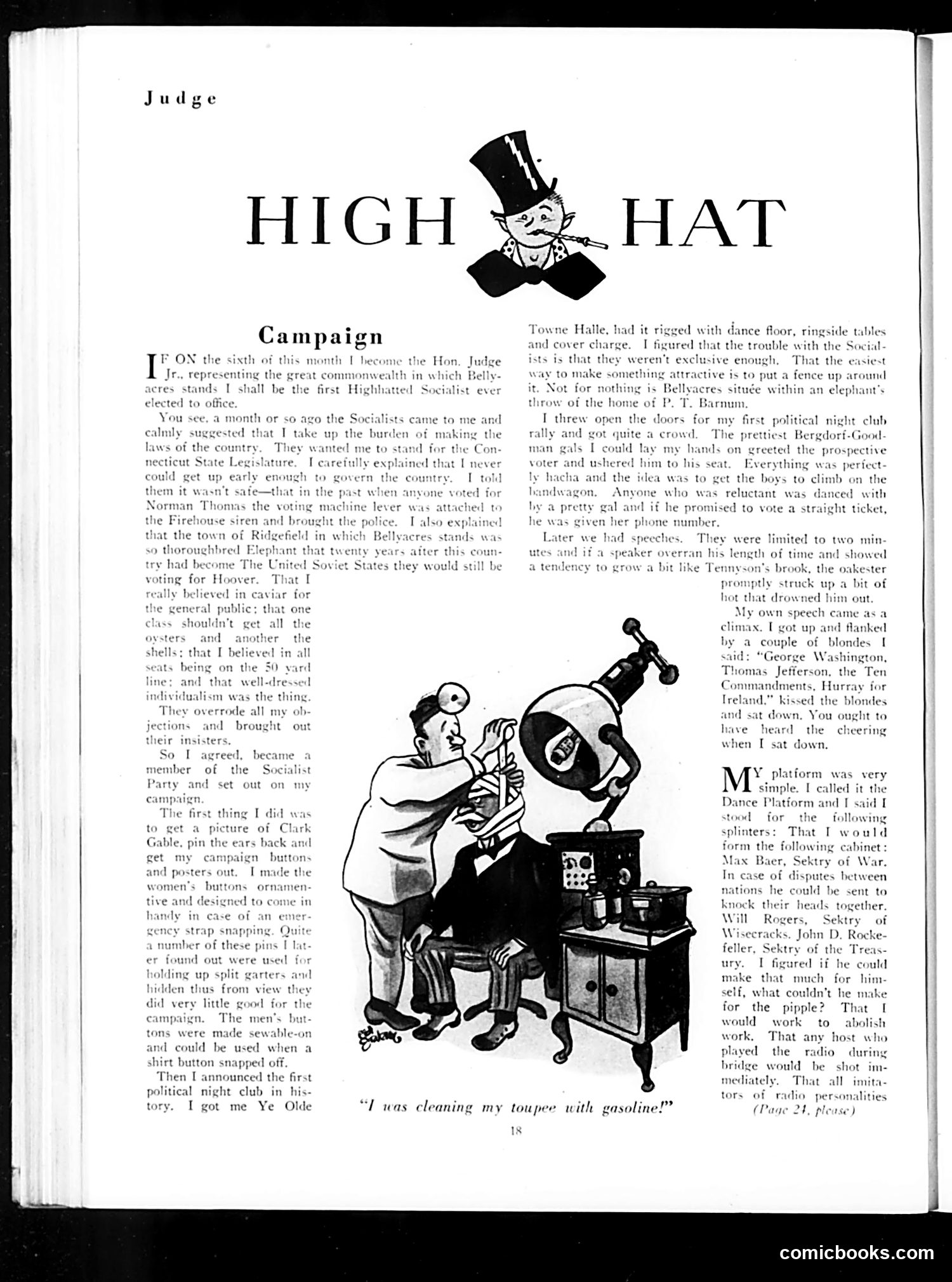
Judge Magazine Satire: "High Hat" Campaign This page satirizes American political campaigns, particularly their superficiality and entertainment value. The narrator—apparently running as a Socialist candidate—describes launching a "political night club" as his campaign strategy. The central cartoon shows a man cleaning a toupee with gasoline, illustrating the absurdity of the campaign's focus on appearance over substance. The satire targets: - Campaign tactics: Using spectacle (dance floors, attractive hostesses, ringside tables) rather than genuine policy - Voter manipulation: Trading votes for entertainment and attention - Political platforms: The candidate's absurd "cabinet" (boxer Max Baer as Secretary of War) and ridiculous promises (shooting radio announcers) - Class politics: References to wealthy enclaves like Ridgefield and Bergdorf Goodman contrast with "Socialist" ideology The joke suggests that 1920s-30s American politics had devolved into showmanship where candidates won votes through entertainment rather than serious governance. The toupee-cleaning gag emphasizes how superficial such campaigns had become.
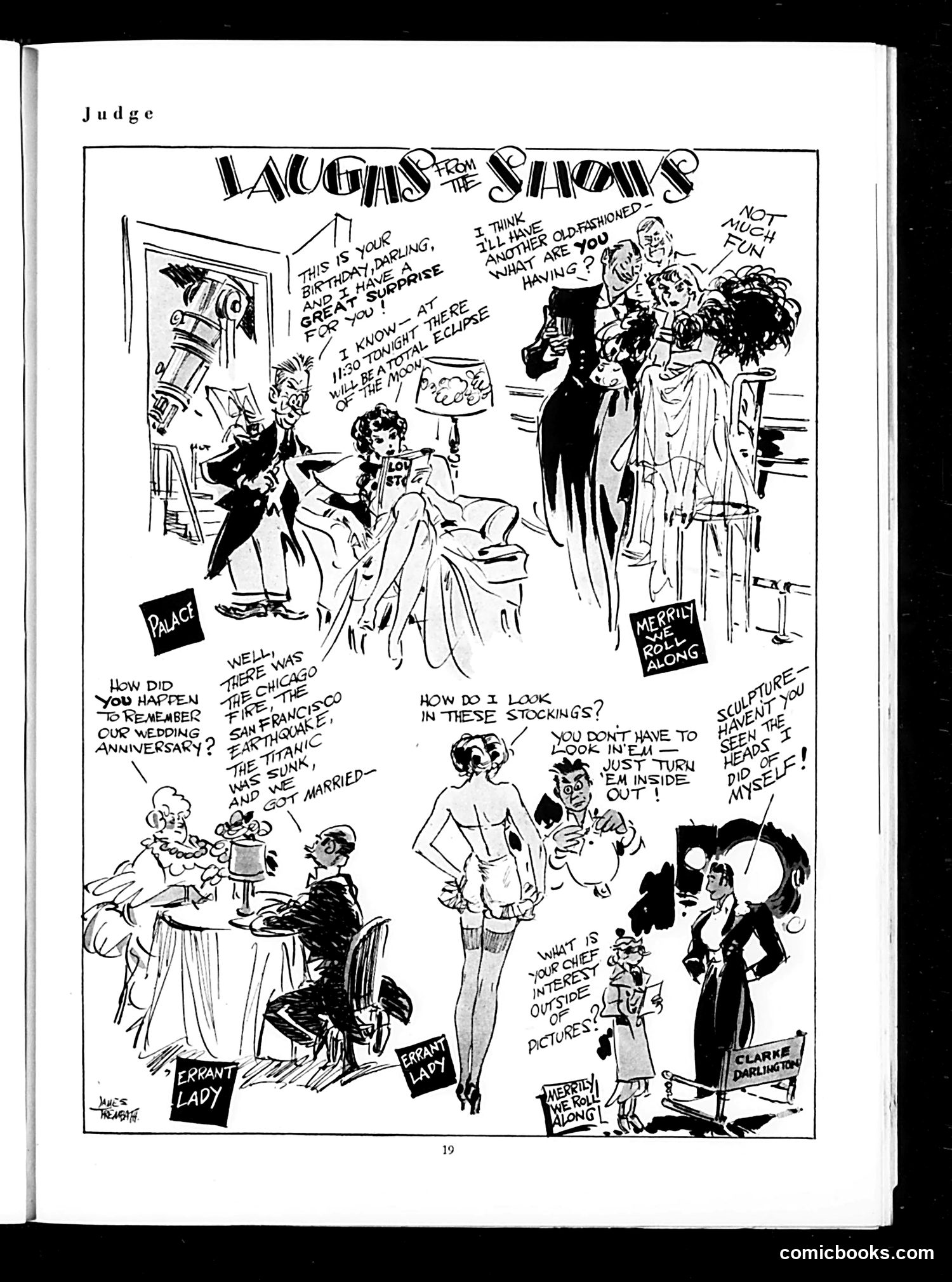
"Laughs and Shadows" - Judge Magazine Cartoon This page satirizes high-society pretense through multiple vignettes of wealthy women at social events. The central joke mocks the gap between refined appearances and actual behavior. Key scenes include: - "Errant Lady" (lower left): An older woman recalls her chaotic wedding anniversary amid fires and earthquakes, contrasting her dignified present self - Upper scenes: Well-dressed women at what appears to be a formal gathering, discussing fashion and social status - "Merritt's Roll Along" and other labels: References to society women performing their expected roles The satire targets the artificiality of upper-class women's social performances—their insistence on propriety and correct appearance despite messy, undignified lives behind closed doors. The "stockings" dialogue suggests vanity about fashion details while ignoring larger character flaws. This reflects early-20th-century satirical tradition of exposing the hypocrisy of the wealthy elite and their obsession with maintaining social appearances.
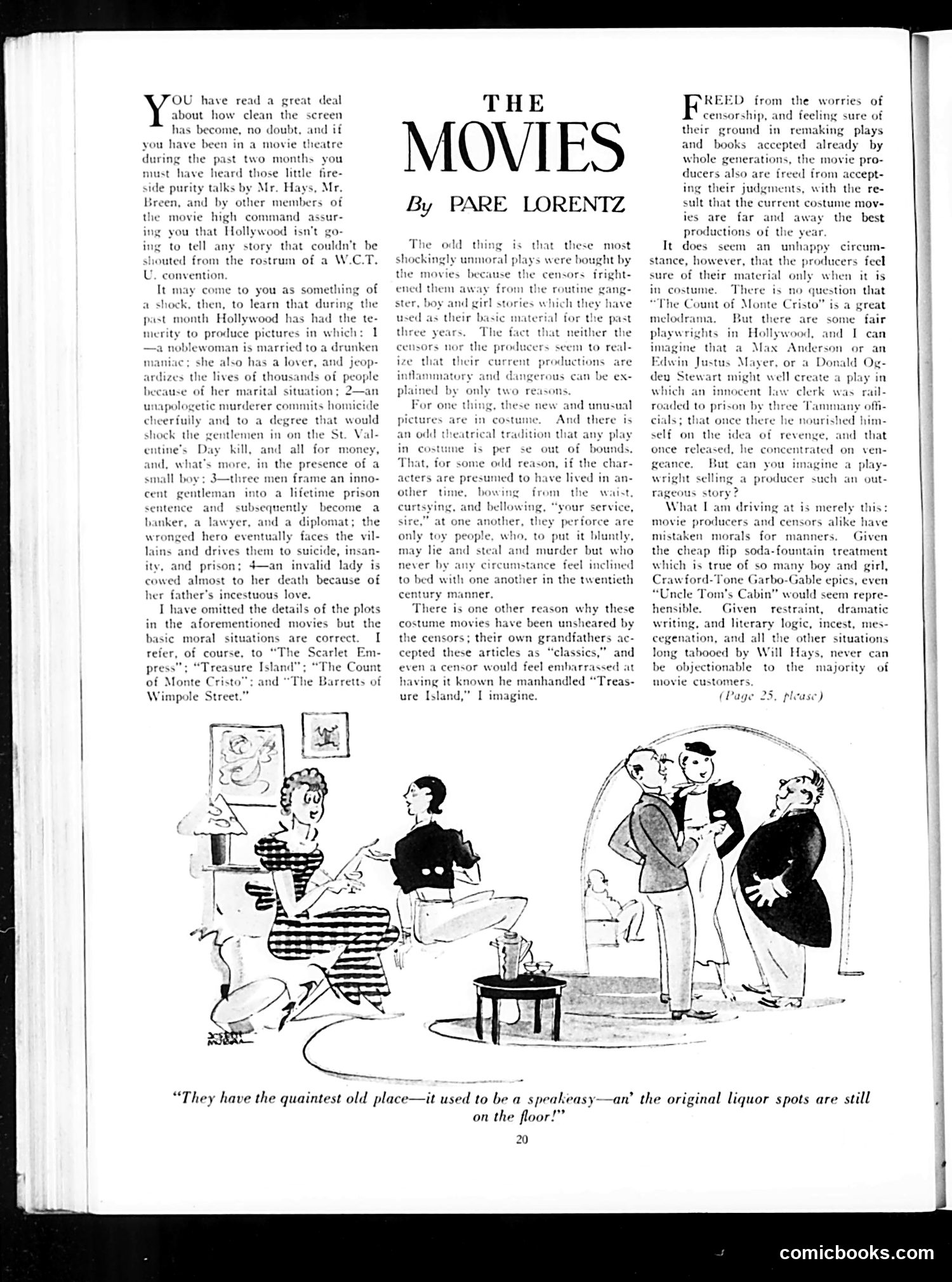
Analysis of "The Movies" by Pare Lorentz This article critiques Hollywood's censorship practices under the Motion Picture Production Code (enforced by Will Hays and Joseph Breen, mentioned by name). Lorentz exposes a hypocritical loophole: producers avoid censorship by adapting classic literature set in costume/historical periods—works like "Treasure Island," "The Count of Monte Cristo," and "The Barretts of Wimpole Street"—which contain morally questionable content (infidelity, murder, incest, suicide) that would be banned in contemporary settings. The cartoon below illustrates this: characters discuss a speakeasy location, evoking Prohibition-era moral panic the censors theoretically police. Lorentz argues censors permit such material because it's "classical" and because period settings supposedly distance audiences from real-world implications. He laments that genuinely talented contemporary playwrights cannot tell modern stories with identical moral complexity—only historical ones escape scrutiny. The satire targets censorship's arbitrary, illogical enforcement.
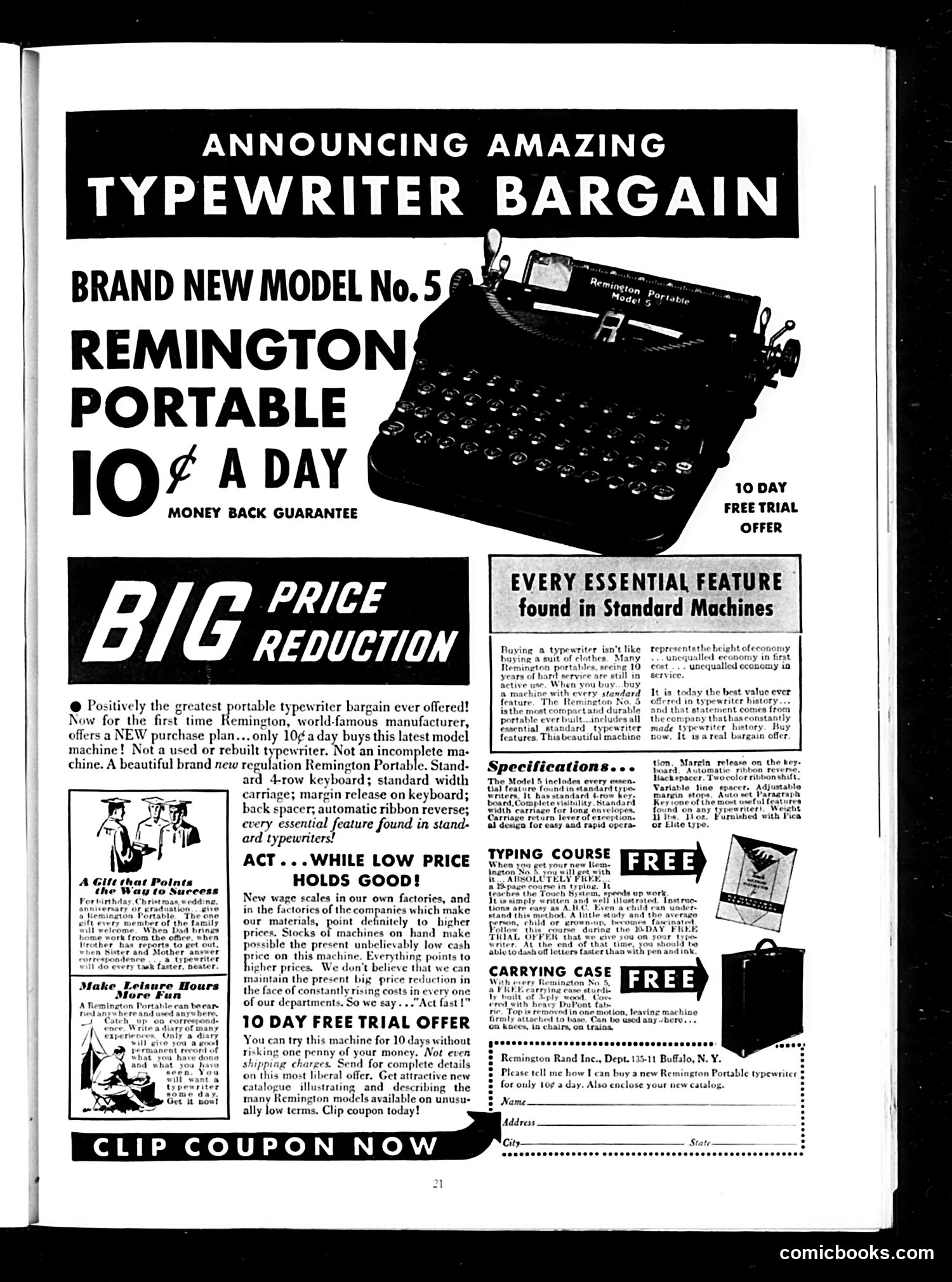
Analysis This is not a cartoon or satire—it's a straightforward advertisement for the Remington Portable typewriter, occupying most of the page. The ad promotes an unusually aggressive sales pitch for 1920s-1930s consumers: a "10¢ a day" purchase plan (roughly $1.50 in modern dollars) for a brand-new typewriter, with a 10-day free trial and money-back guarantee. The marketing emphasizes this is a "bargain" and "the greatest...ever offered." The ad includes illustrations of the typewriter and small cartoon vignettes showing typewriter owners (including a couple and a woman at leisure) to suggest the product appeals to personal, business, and household use. The text stresses "every essential feature found in Standard Machines"—reassuring buyers they're not getting an inferior model despite the low price. The urgency ("Act fast!") stems from the claim that rising manufacturing costs will soon force prices higher, so this deal won't last. This was a common sales tactic in the era. Judge magazine was saturated with advertisements like this; this page represents commercial content rather than editorial satire.
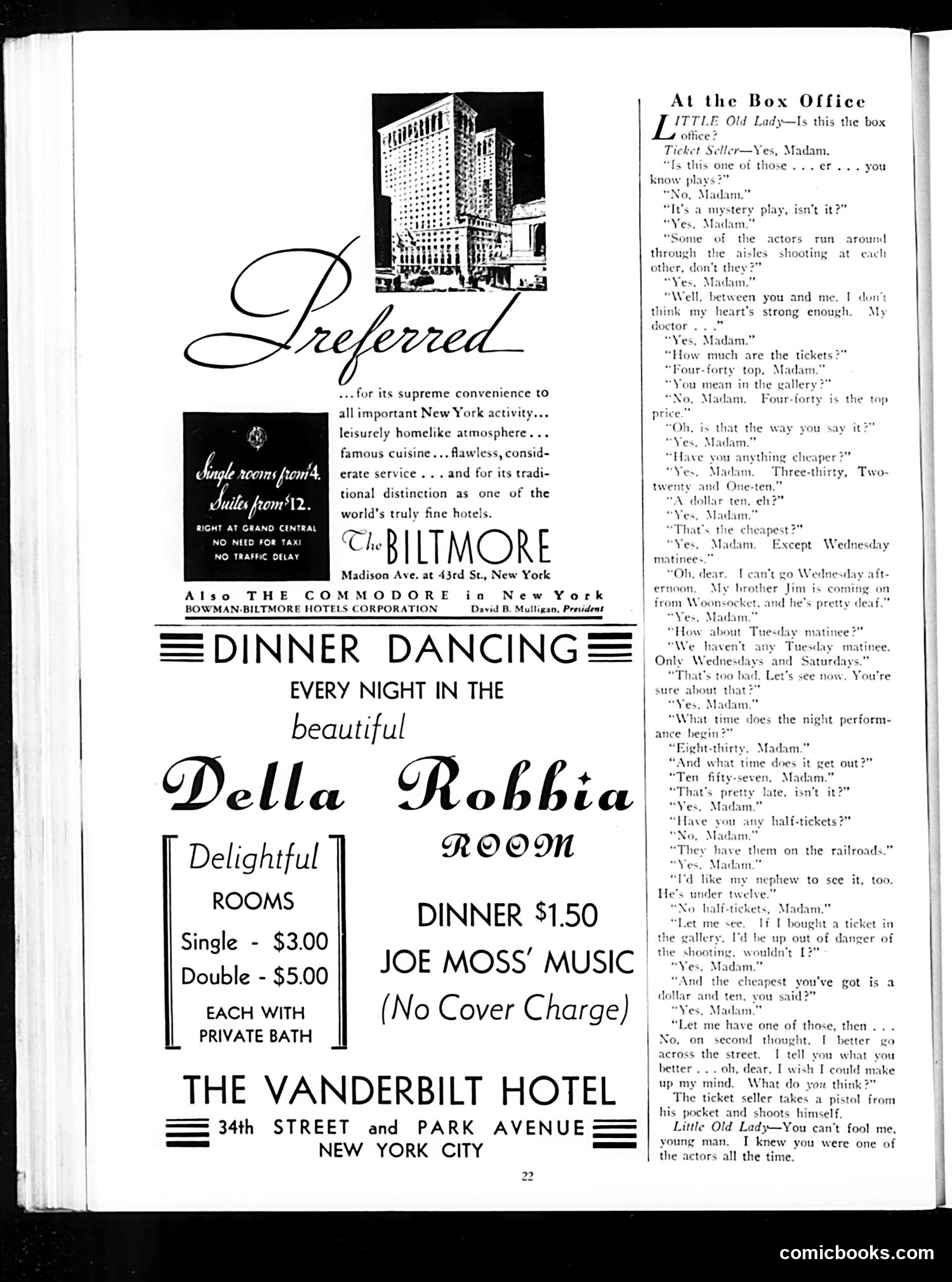
Analysis for Modern Readers This page is primarily advertising for New York hotels and theaters, with a humorous dialogue comic strip titled "At the Box Office." The comic depicts an elderly woman buying theater tickets from an increasingly exasperated ticket seller. She asks repetitive, anxious questions: about the play's content (actors shooting each other), ticket prices, matinee availability, and cheaper options. The humor escalates when the seller, driven to desperation by her endless indecision, shoots himself with a pistol from his pocket. The final punchline reveals the joke's point: the old woman assumes he's an actor performing—she "knew you were one of the actors all the time." This suggests the ticket seller's suicide was so theatrical and exaggerated that it seemed like stage performance rather than genuine despair. The satire gently mocks both the neurotic, penny-pinching theater patron and the absurdity of service-industry frustration taken to darkly comedic extremes—a common Judge magazine comedic style combining social observation with morbid humor.
Explanation for Modern Readers This page is primarily a book review column ("Judging the Books") with an unrelated Bell Telephone System advertisement. The reviews discuss contemporary 1920s authors: Peter Fleming's travel writing, Ruth Suckow's Midwestern fiction, Evelyn Waugh's satirical novels, and P.G. Wodehouse's comedies. The tone is witty and insider-ish—the critic praises Fleming's charm, mocks Waugh for repeatedly trying and failing to replicate his early success, and jokes that even if detective-fiction character Philo Vance became more human, nothing could make the stories readable. The Bell ad (right side) is the notable element: it's a corporate statement defending AT&T's monopoly on telephone service, claiming the company's "fair dealing" and responsibility justify its dominance and justifies continuing service "at the lowest cost." This appears designed to counter Depression-era criticism of telephone monopolies. The page contains no political cartoon—only advertisement and book criticism typical of Judge magazine's satirical but literary-focused content.
Analysis of Judge Magazine Page This page is primarily advertising and entertainment listings, not political satire. The left side features a Courvoisier cognac advertisement emphasizing prestige—noting royal patronage from King George V of England and King Gustav V of Sweden, appealing to wealthy consumers during Prohibition-era America (when liquor was legally banned but still consumed by the affluent). The center column, "Tiny Tot's Guide," is a humorous consumer recommendations section mocking trends and entertainments of the era. It reviews recent films, songs, books, and gadgets with tongue-in-cheek commentary—for instance, dismissing a movie as "Worst Movie Since the Ice Age" and sarcastically noting a racing guide "neglects to do is tell how to beat them." The right side advertises the Hotel Montclair, a luxury Manhattan hotel targeting wealthy tourists, emphasizing its proximity to Broadway theaters, shops, and Radio City. No political cartoons appear on this page. The content reflects 1920s-30s consumer culture and entertainment preferences among Judge magazine's affluent readership.
Analysis of Judge Magazine Page 25 This page is primarily advertising with some editorial content about movies. The main cartoons/satirical content are minimal: "Not House-Broken!" (left side): A small cartoon attacking real-estate agents or property dealers, suggesting they operate without ethical restraint. The exact target is unclear from the visible text, but it appears to critique deceptive business practices common in the era. "American Plan" joke (bottom): A brief dialogue satirizing poor hotel service—a guest complains about terrible service and can't reach management by phone. This reflects common complaints about American hotels in this period. The page is dominated by period advertisements for luxury goods (Noilly Prat vermouth, Bénédictine liqueur, the Governor Clinton Hotel in NYC, the Abington Hotel in Detroit) typical of Judge's wealthy readership. There's also a music instruction advertisement ("Play A Tune In 10 Minutes"). The movie review section discusses film productions without clear satirical intent, functioning as entertainment criticism rather than political commentary.
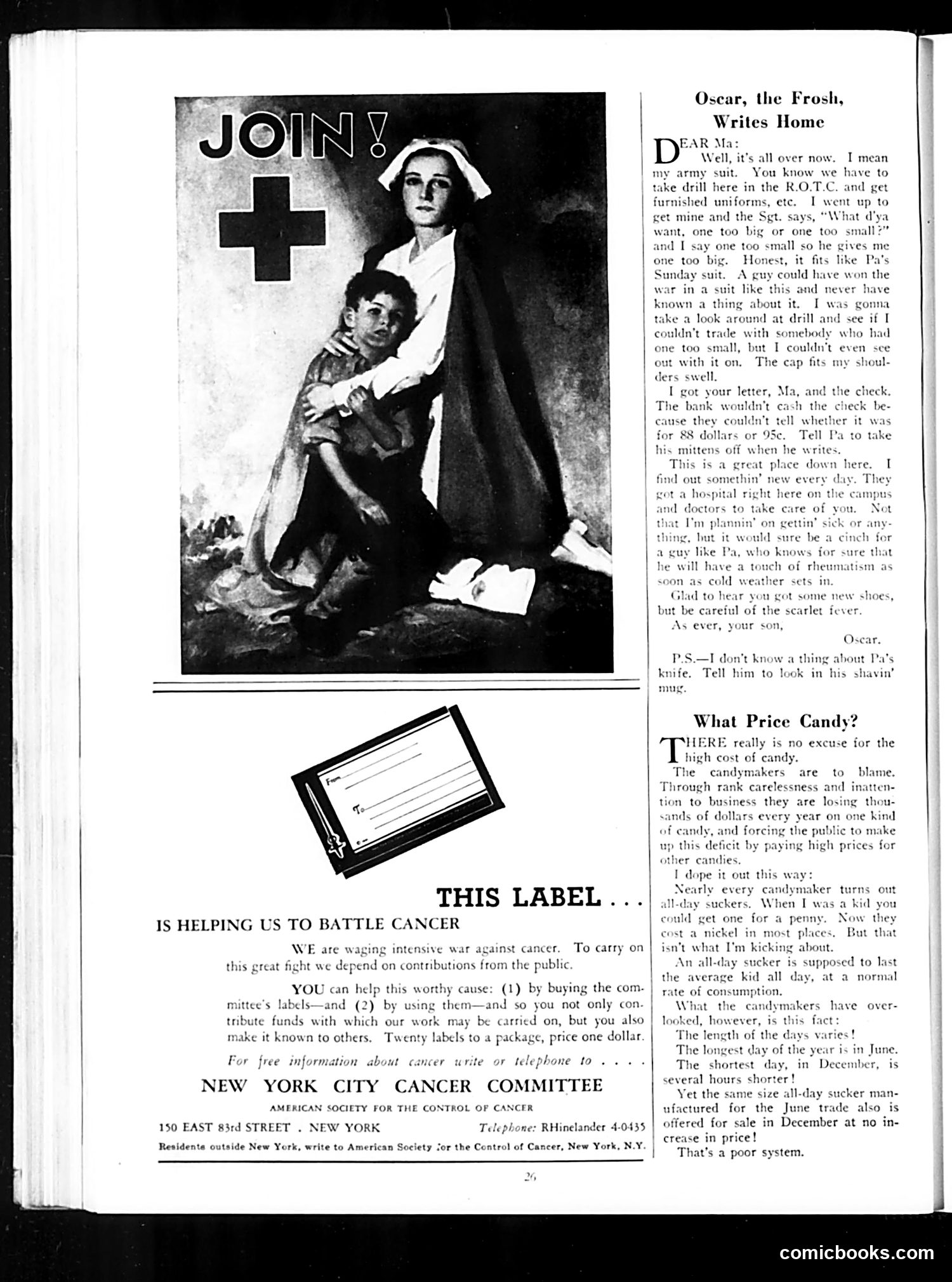
What This Page Contains This Judge magazine page mixes public service advertising with humor columns. Top Left: A Red Cross recruitment poster showing a nurse with a child and a large cross, urging readers to "JOIN" the fight against cancer through the New York City Cancer Committee. It's a straightforward WWI-era PSA asking citizens to buy labeled packages (twenty labels = one dollar donation) to fund cancer research. Right Column: "Oscar, the Frosh, Writes Home" is a humorous letter from a college ROTC student complaining about ill-fitting military uniforms—his suit is either too big or too small, and his cap doesn't fit his shoulders. It's gentle, relatable domestic comedy about military life. Bottom Section: "What Price Candy?" satirizes candy manufacturers for maintaining high prices year-round despite seasonal variations. The writer notes that all-day suckers made for June's long days are sold unchanged in December (when days are shorter), yet prices don't drop. The satire attacks business inefficiency and consumer overcharging.
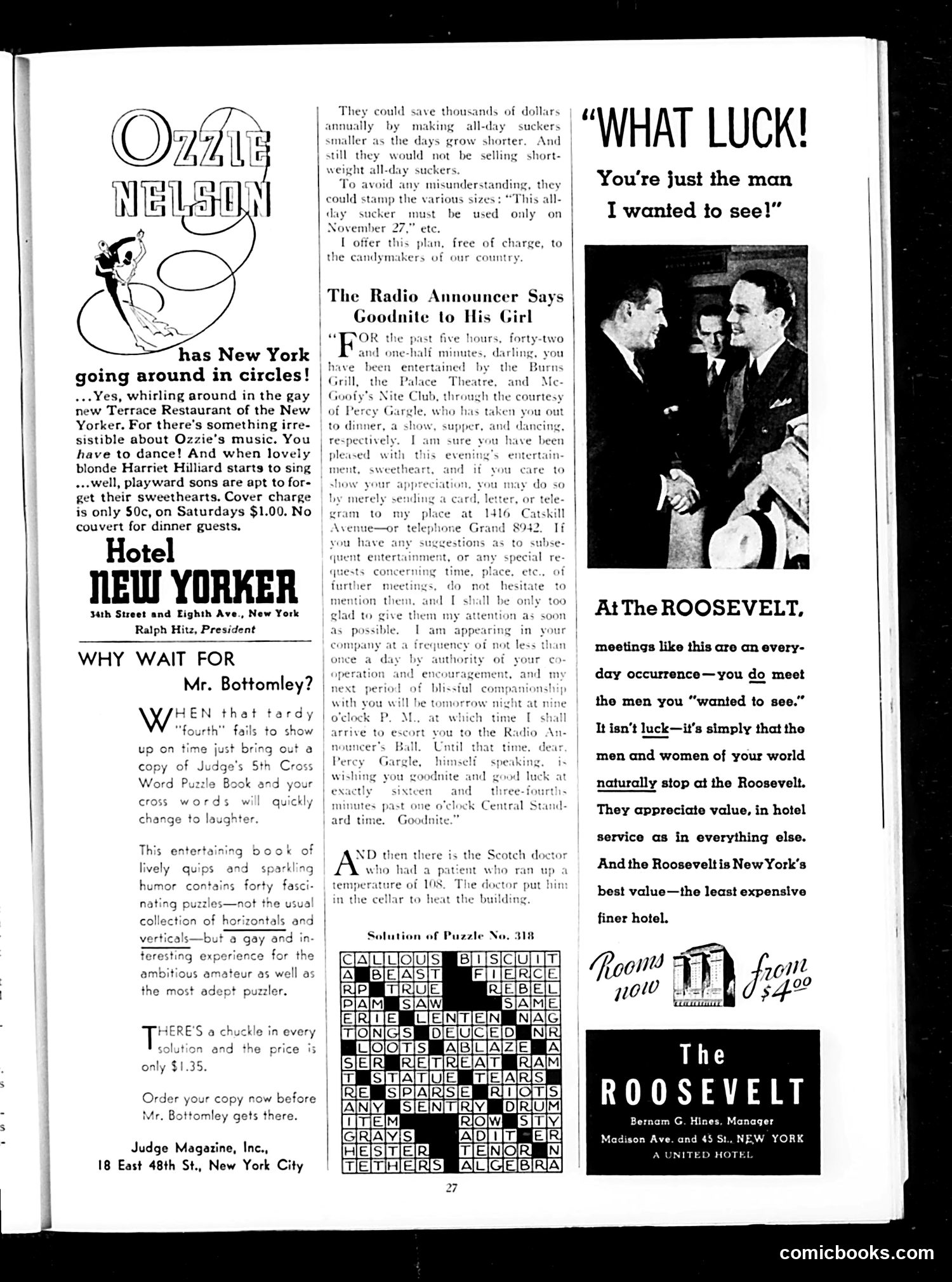
Analysis of Judge Magazine Page This page is primarily advertising rather than political satire. It contains: 1. Ozzie Nelson cartoon/ad (top left): A playful illustration promoting the Terrace Restaurant at the Hotel New Yorker, where bandleader Ozzie Nelson and singer Harriet Hilliard performed. The joke is that Nelson's music is so irresistible that male patrons forget their sweethearts while dancing. 2. "Radio Announcer Says Goodnight" (center): A humorous anecdote about a radio personality's elaborate goodnight message to his date, highlighting the verbose style of 1930s-40s radio personalities. 3. Crossword puzzle and Judge's puzzle book ad (lower left): Standard magazine filler. 4. Roosevelt Hotel ad (right): Shows three men in business attire, emphasizing the hotel as a place where important meetings naturally occur—suggesting it's where influential people stay. The page reflects 1930s-40s New York entertainment and hospitality culture, with no significant political commentary visible.
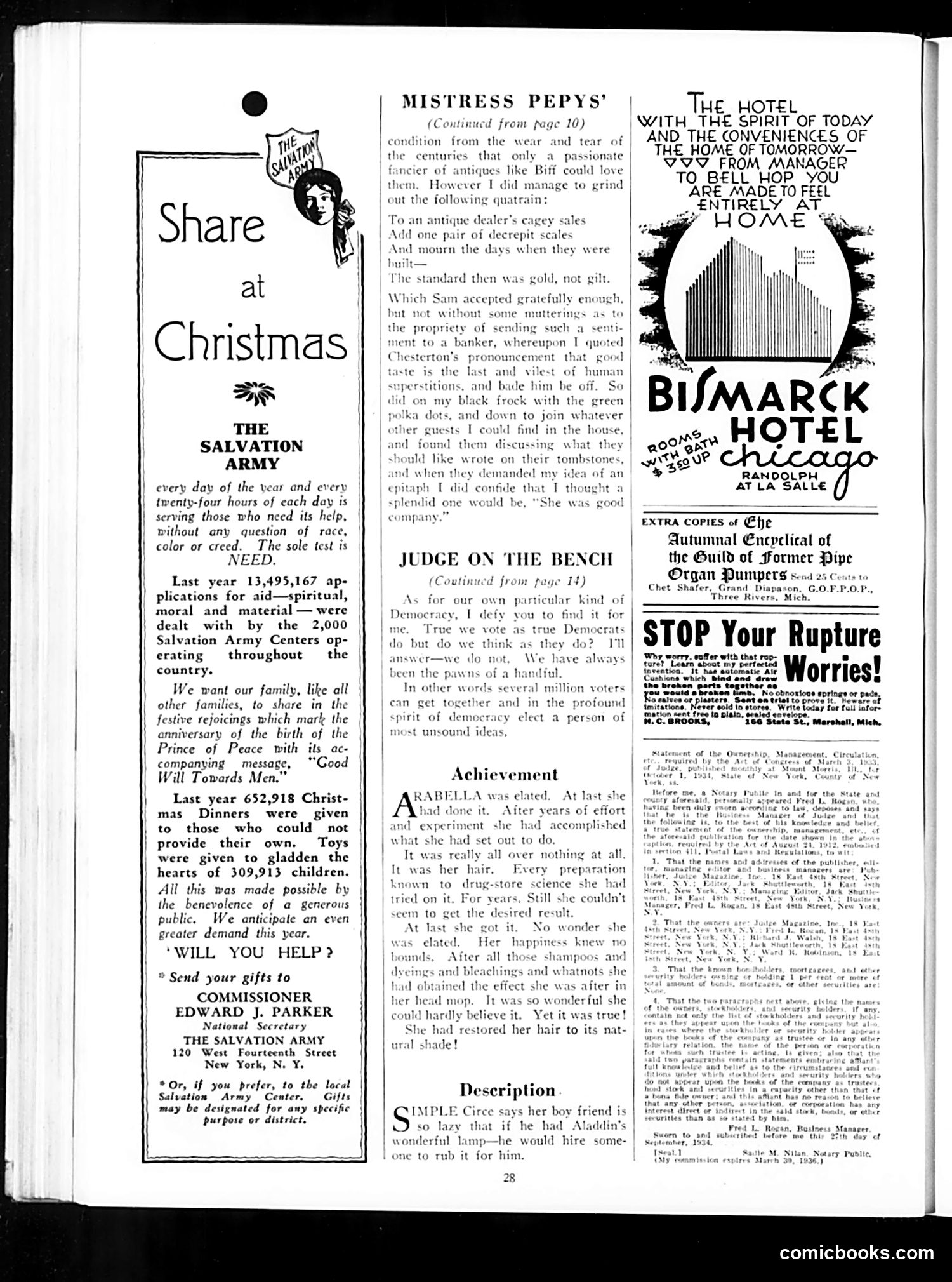
Judge Magazine Page Analysis This page is primarily advertising and public service content rather than political satire. The left column features a Salvation Army fundraising appeal for Christmas aid, presenting statistics: 13.5 million applications for help last year, 652,918 Christmas dinners distributed, toys for 309,913 children. It solicits donations from readers to expand this charitable work. The right side advertises the Bismarck Hotel in Chicago and includes classified ads (rupture treatment, notary services). The center contains two serialized fiction pieces: "Mistress Pepys'" (continuing from earlier), discussing antique scales and banking; and "Judge on the Bench," a discourse on democracy and voting that appears to argue for informed electorate participation. Below is a brief story titled "Achievement" about a woman named Arabella who finally achieves her goal of restoring her hair's natural appearance after years of effort. No political cartoons or satirical commentary appears on this page. It's a typical Judge magazine issue mixing light fiction, social commentary, and period advertising.
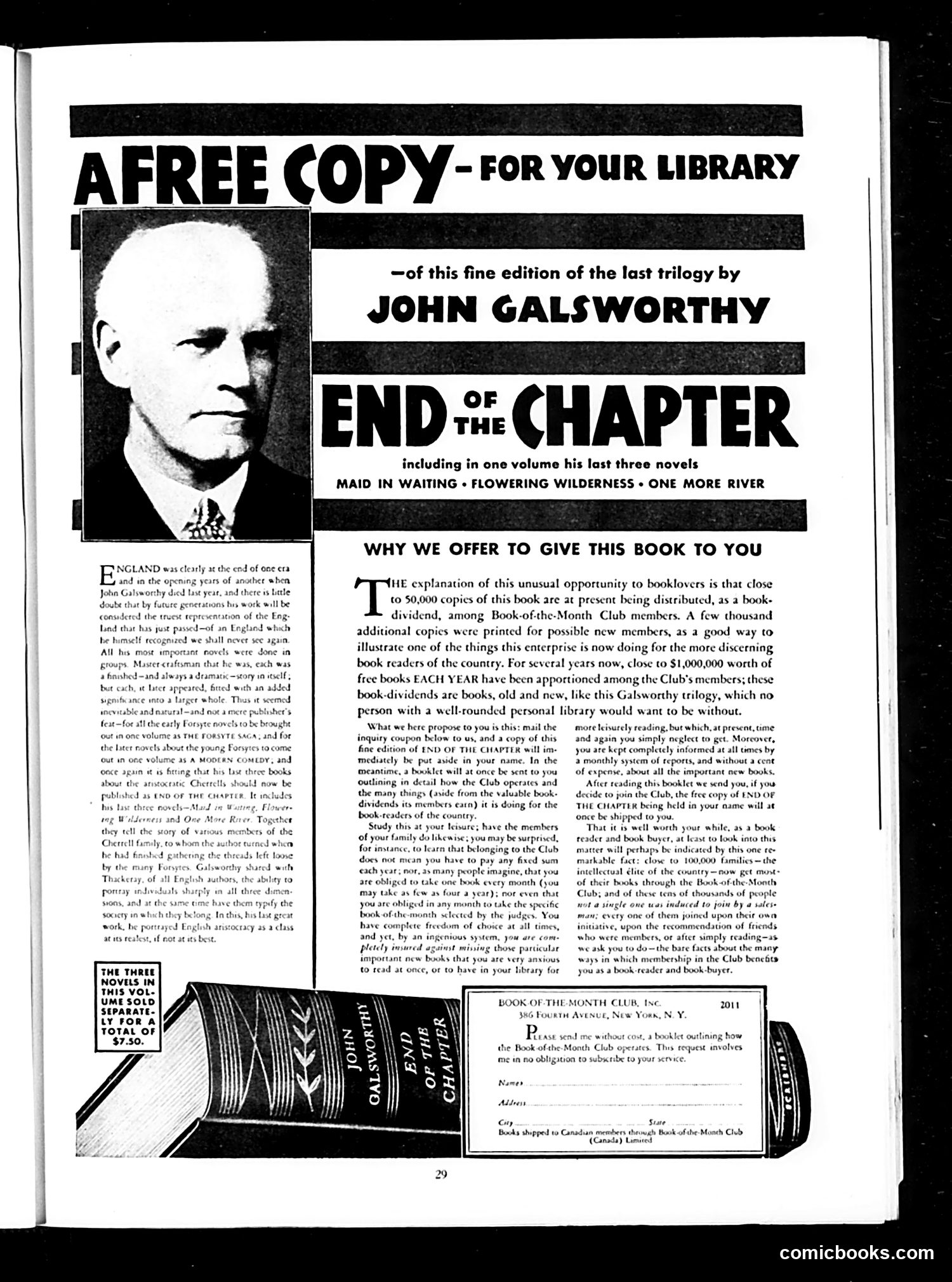
Analysis of This Page This page is primarily advertising, not satire or political commentary. It's a promotional piece for the Book-of-the-Month Club offering a free copy of John Galsworthy's *End of the Chapter* trilogy. The portrait shows John Galsworthy, the English novelist (1867-1933), who had recently died. The text eulogizes him as capturing a vanished era of English society, particularly the upper classes depicted in his *Forsyte Saga* works. The advertisement exploits Galsworthy's prestige to promote the Book-of-the-Month Club's membership model. It emphasizes the club's benefits—free book dividends worth ~$1 million annually, flexibility in selections, and informed reading guidance—targeting "discerning book readers" and the "intellectual élite." There is no satire visible here. This appears in *Judge* magazine simply as a paid advertisement using a prestigious author's legacy to market a subscription service to educated, affluent readers during the club's expansion era.
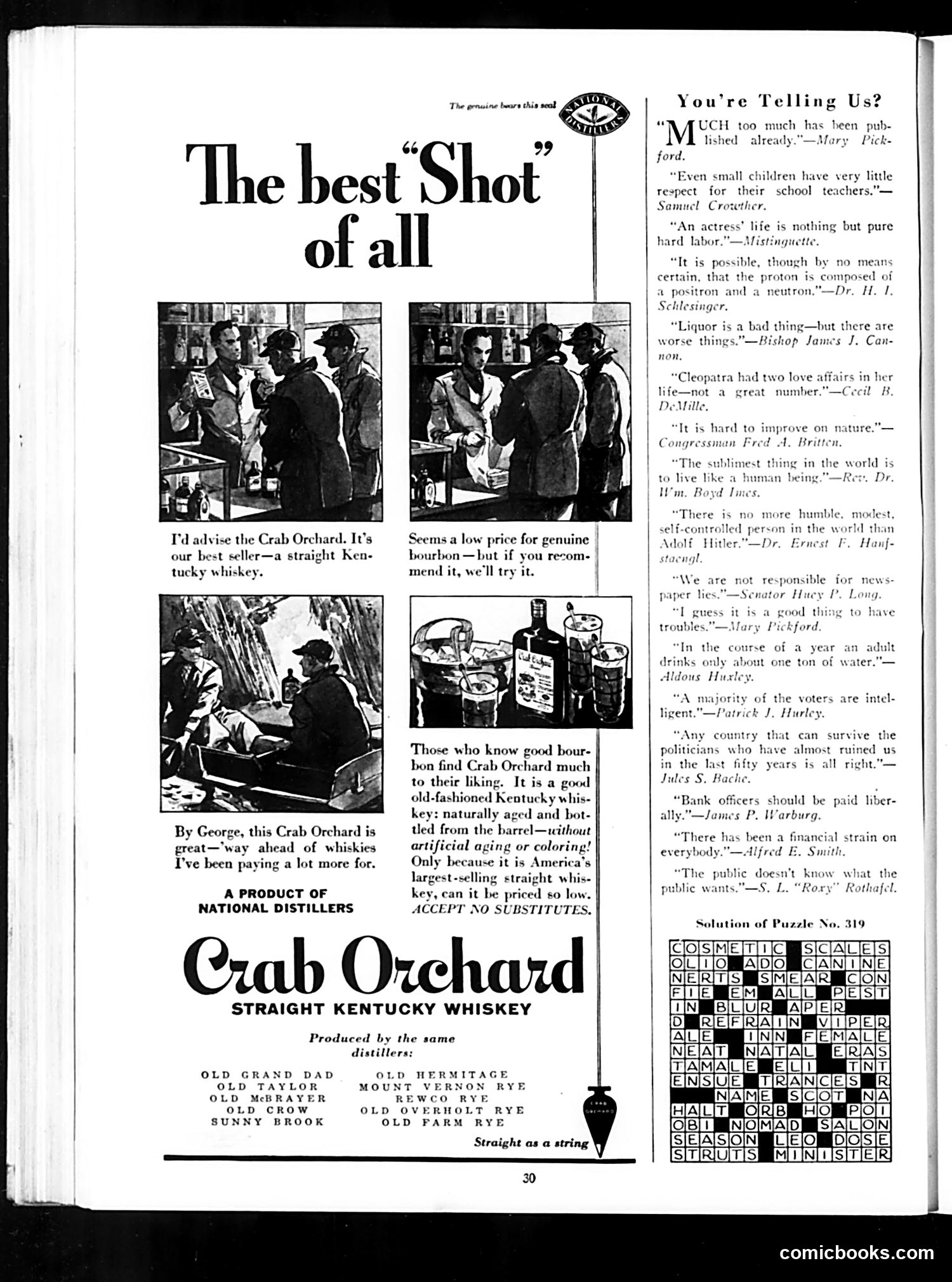
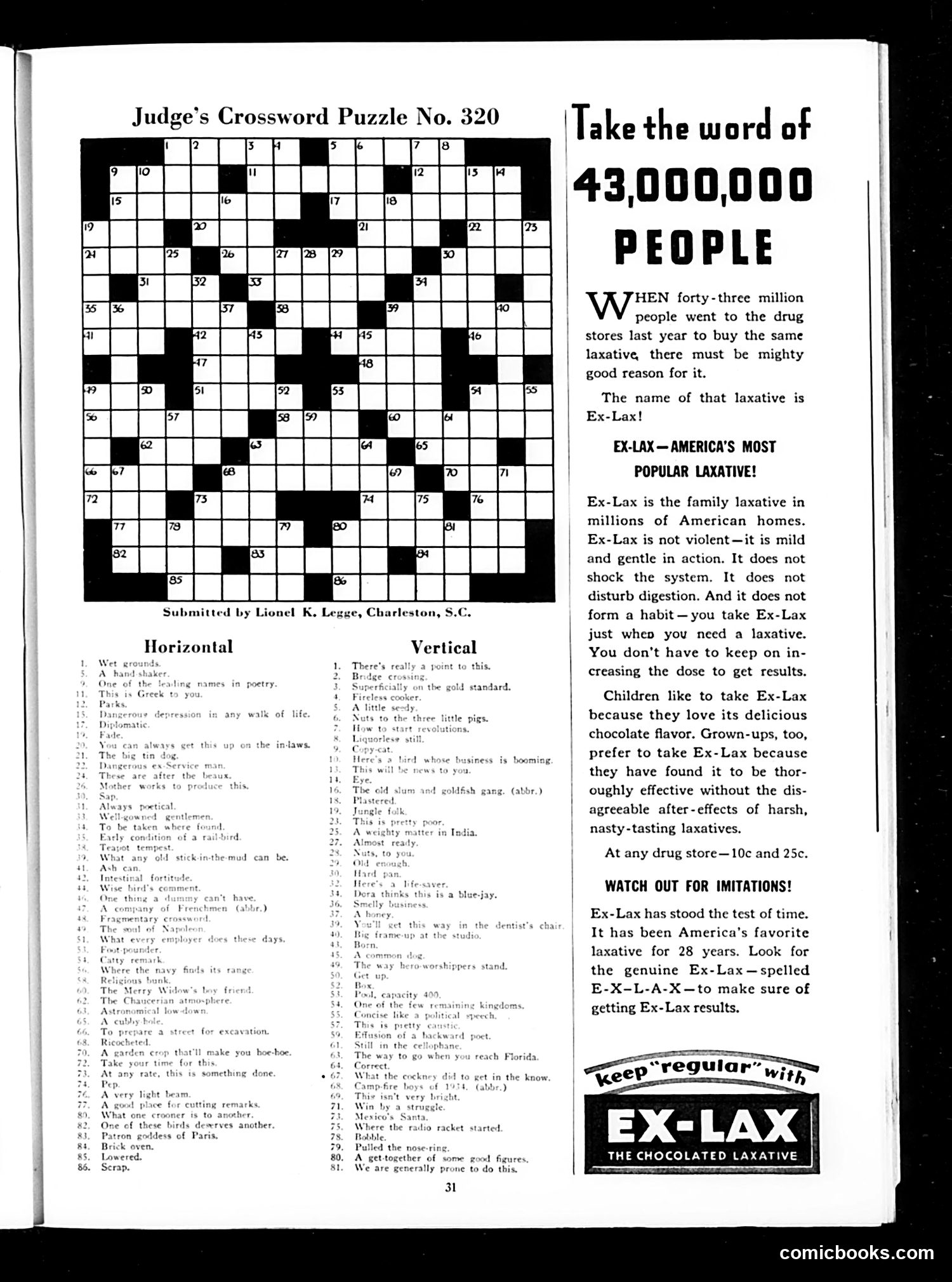
Judge Magazine Page Analysis This page is primarily an advertisement for Ex-Lax laxative disguised as editorial content. The crossword puzzle serves as a vehicle for the ad. The ad's central claim is that 43 million people bought Ex-Lax last year, appealing to social proof—if millions use it, it must be good. The messaging emphasizes Ex-Lax's purported gentleness compared to harsher laxatives of the era, its chocolate flavor (to appeal to children), and its non-habit-forming properties. The "WATCH OUT FOR IMITATIONS" warning reflects early-twentieth-century pharmaceutical competition and the prevalence of patent medicine knockoffs. By embedding advertising within Judge's typical puzzle format, the publication blurs editorial and commercial content—a practice common in vintage magazines. The ad doesn't constitute satire itself but rather represents how Judge monetized its pages through advertiser sponsorship. The page reflects an era when laxative use was a normalized, openly discussed health concern worthy of mass-market advertising.
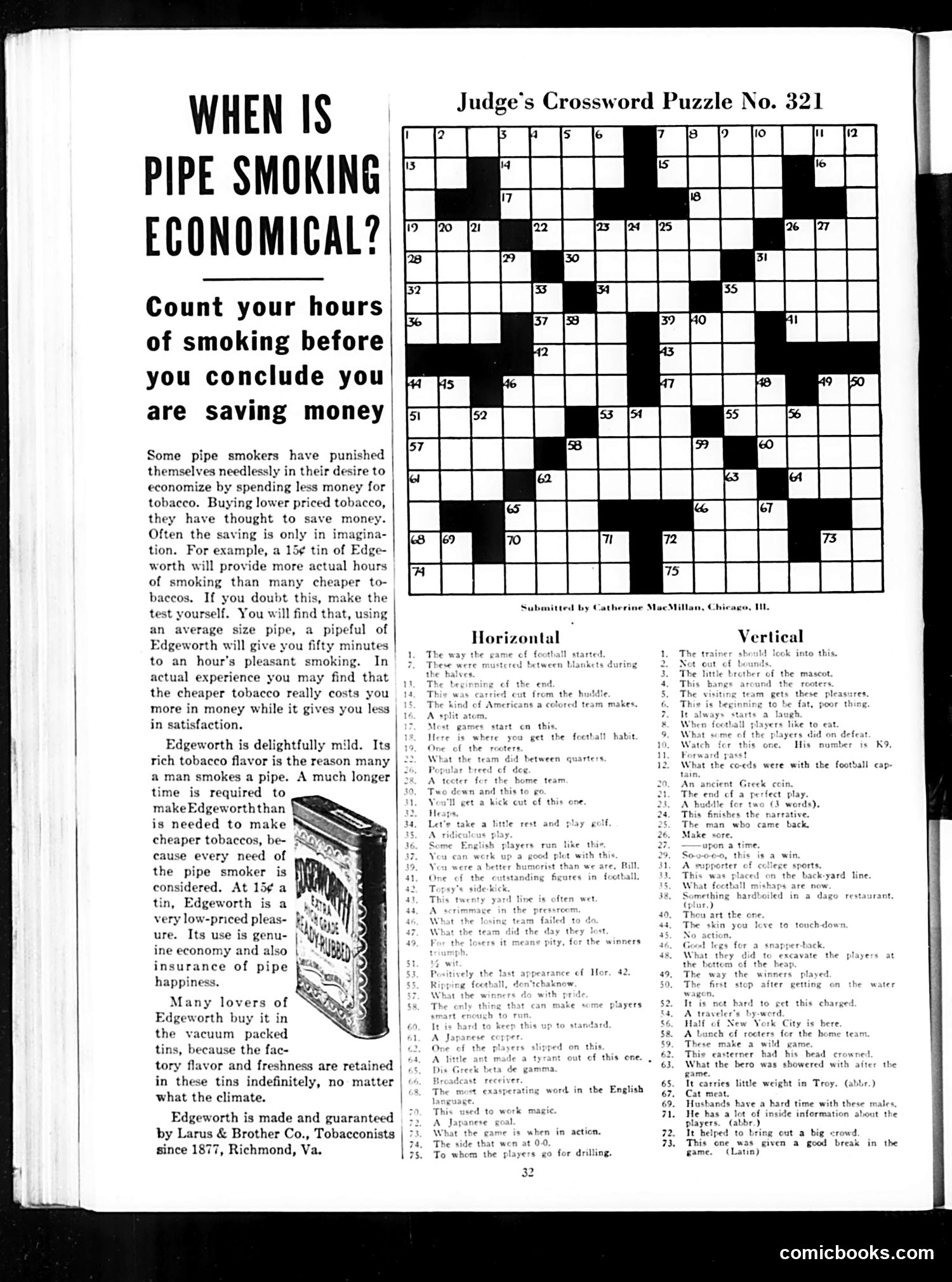
Analysis This page is primarily advertising, not satire or political commentary. The left side features a full-page advertisement for Edgeworth pipe tobacco, arguing that while the product costs only 15¢ a tin, it actually provides better value than cheaper alternatives because it delivers 50 minutes to an hour of smoking per pipeful, making it genuinely economical. The headline "WHEN IS PIPE SMOKING ECONOMICAL?" frames the pitch: buying inferior tobacco to save money is false economy. Edgeworth's manufacturing process and quality justify the price. The right side is a crossword puzzle (No. 321) with football-themed clues, unrelated to the tobacco advertisement. This represents typical early 20th-century *Judge* content: commercial messaging alongside entertainment. There is no political satire or caricature visible—simply a straightforward product advertisement using the magazine as a marketing vehicle.
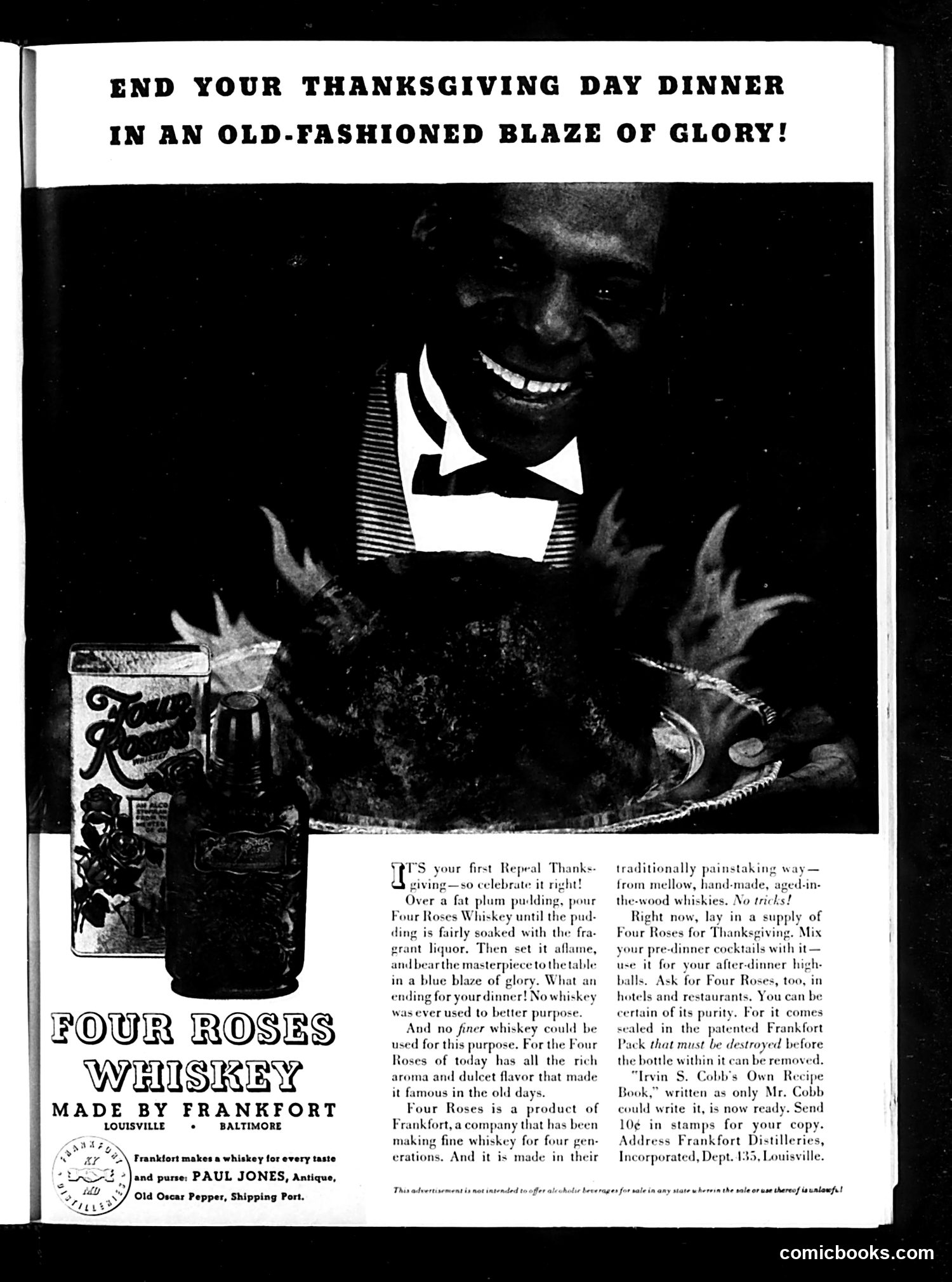
Four Roses Whiskey Advertisement This is a full-page advertisement, not political satire. It promotes Four Roses Whiskey for Thanksgiving dinner celebrations during Prohibition's end (likely early 1930s, when alcohol sales resumed). The image shows a man in blackface—a deeply racist performance tradition—grinning while setting a flaming pudding ablaze. This imagery was considered entertaining advertising at the time, reflecting the casual racism embedded in early 20th-century American marketing. The text urges readers to "end your Thanksgiving dinner in an old-fashioned blaze of glory" by pouring whiskey on pudding and igniting it tableside. The ad emphasizes Four Roses' quality and purity, positioning alcohol as a respectable post-dinner luxury after years of legal prohibition. Modern readers should understand: this reflects both the historical racism of mainstream advertising and society's sudden reintegration of alcohol into "polite" celebration following Prohibition's repeal.
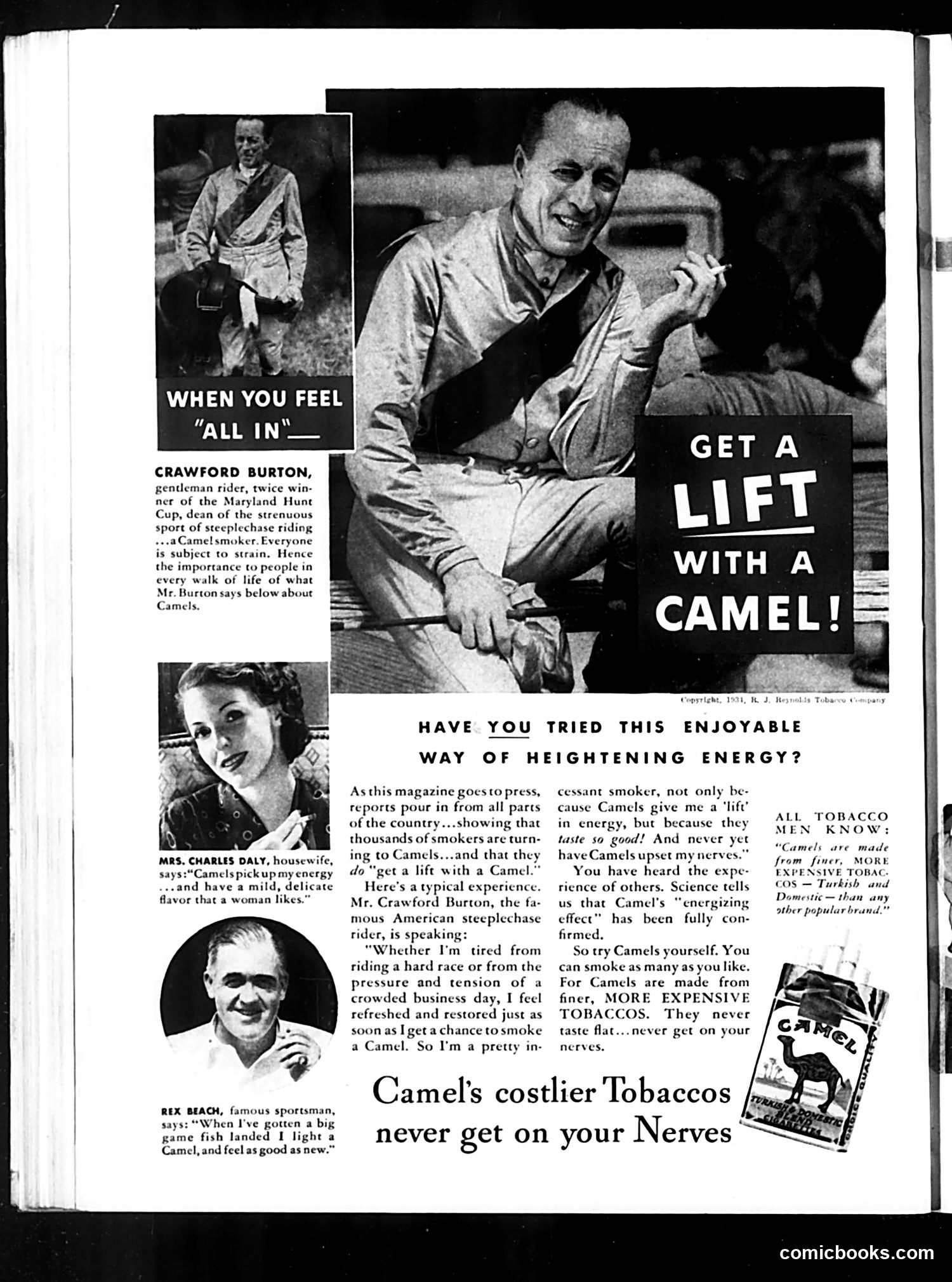
What This Page Actually Is This is not a cartoon or satire—it's a cigarette advertisement disguised as editorial content. Judge magazine published this as what modern readers would call native advertising. The page features testimonials from real public figures (Crawford Burton, a steeplechase rider; Rex Beach, a sportsman; Mrs. Charles Daly, a housewife) claiming Camels provide an energy "lift" and calm nerves. This was a common advertising strategy of the era—celebrity endorsements presented as genuine experiences. The satire would be lost on modern readers because we now know cigarettes don't provide real energy and cause serious health problems. The ad's core claim—that smoking relieves fatigue and tension—was standard marketing in the 1920s-30s, before tobacco's dangers were widely acknowledged. What appears to be earnest lifestyle advice was actually misleading health propaganda.