judge
Judge — December 1934
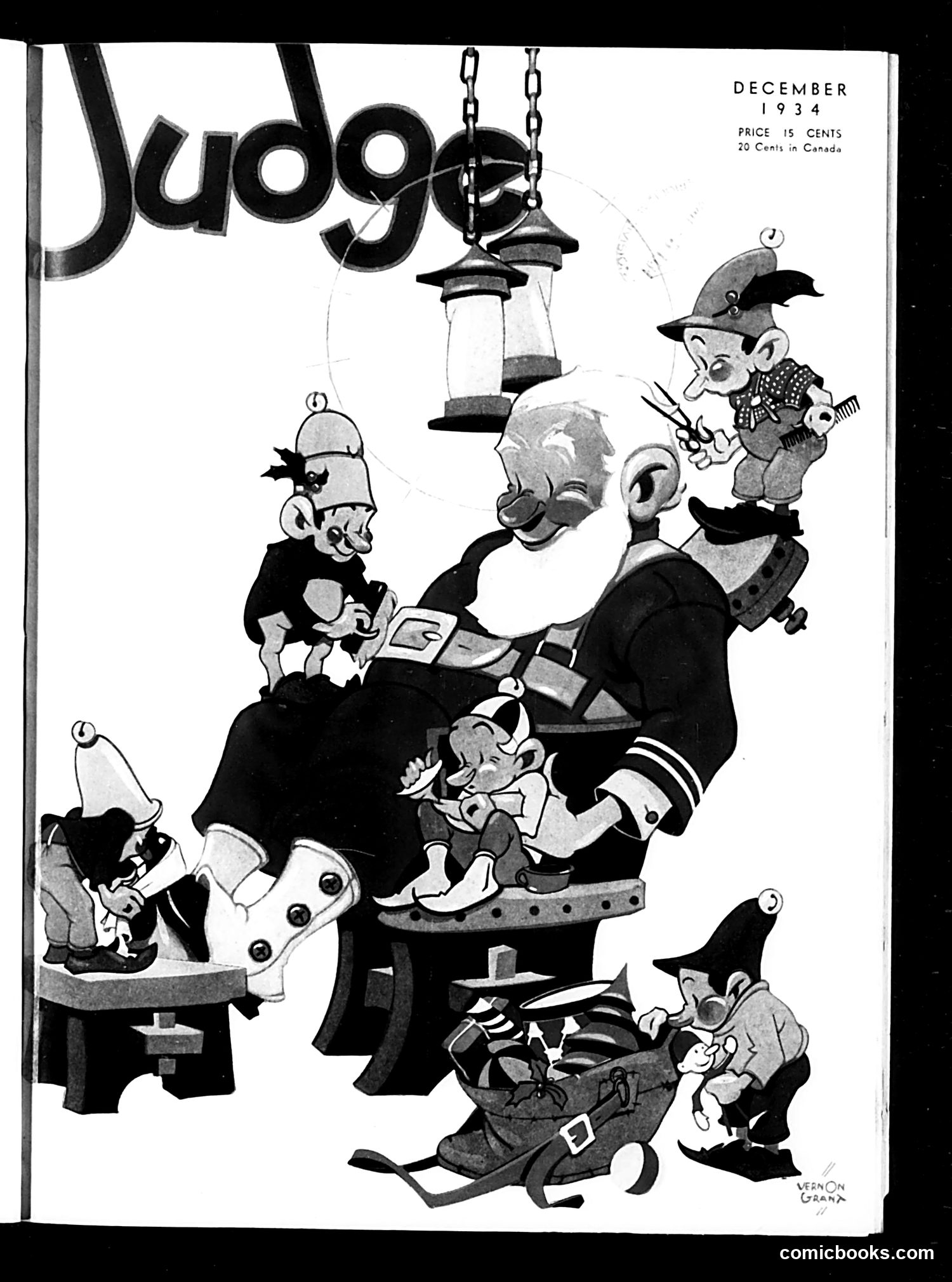
Judge Magazine, December 1934 This satirical cover depicts a central bald figure—likely representing a politician or public figure of 1934—surrounded by small gnome-like characters wearing pointed hats, possibly representing elves, imps, or mischievous spirits. The figure appears to be reading or reviewing documents while the smaller characters cavort around him, some hanging from chains above, others operating him like a puppet or toy. The satire likely critiques either political manipulation during the Great Depression or suggests that a particular public figure is being controlled by unseen forces or special interests. The playful yet pointed imagery—treating the central figure as somewhat ridiculous or out of control—was typical of *Judge*'s political commentary from this era. Without clearer identifying marks, the specific target remains unclear.
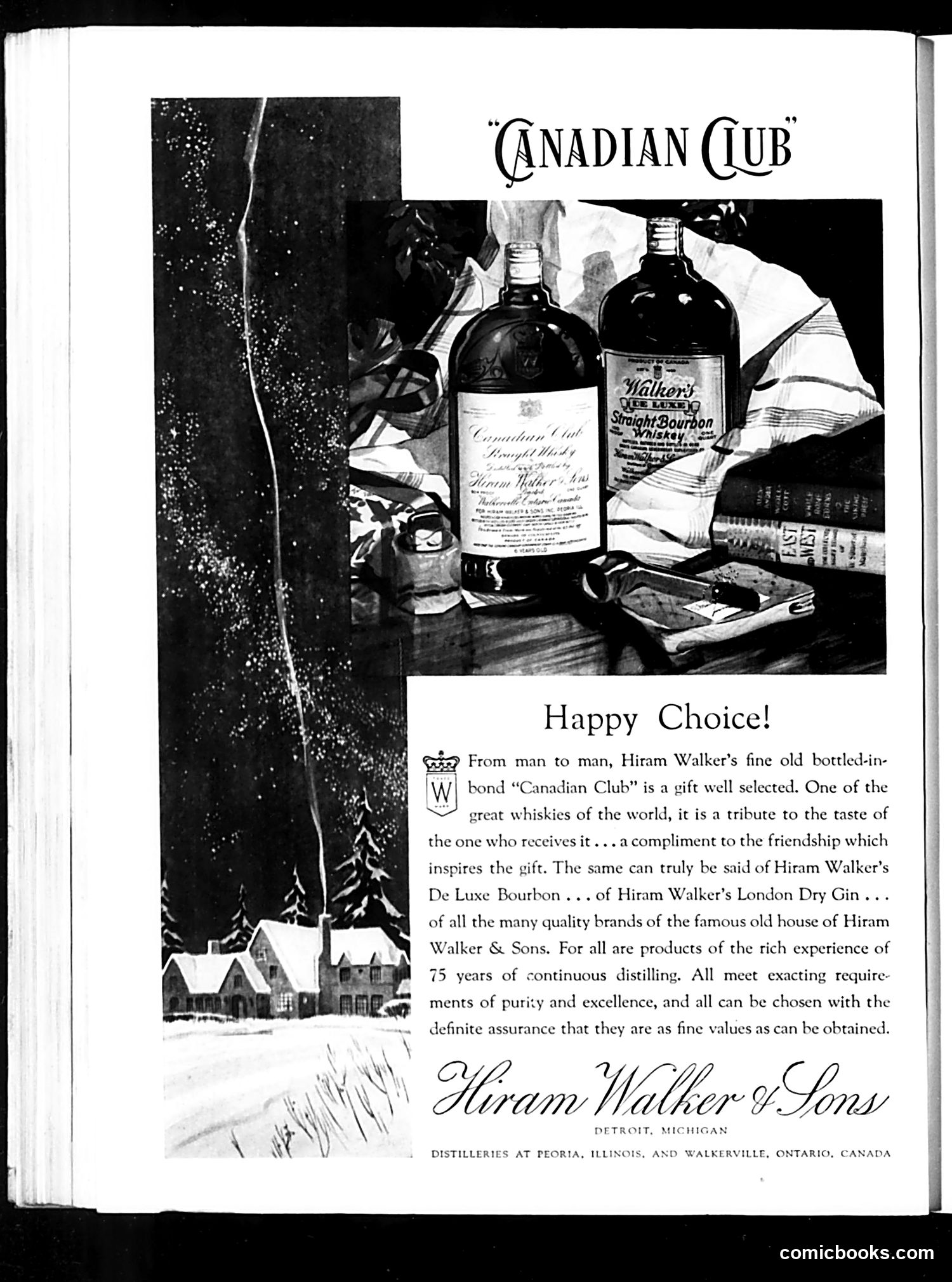
Analysis This page is primarily an advertisement, not a political cartoon. It promotes "Canadian Club" whiskey by Hiram Walker & Sons, a Detroit-based distillery with operations in Canada. The ad uses the tagline "Happy Choice!" and appeals to gift-giving between men, positioning the whiskey as a mark of friendship and refined taste. It references the company's "75 years of continuous distilling" and mentions their other products (De Luxe Bourbon, London Dry Gin). The left side shows a snowy winter scene, likely evoking Canadian imagery to reinforce the "Canadian Club" branding. The composition emphasizes luxury and social sophistication rather than satire or political commentary. This reflects 1920s-era advertising before Prohibition enforcement became strict.
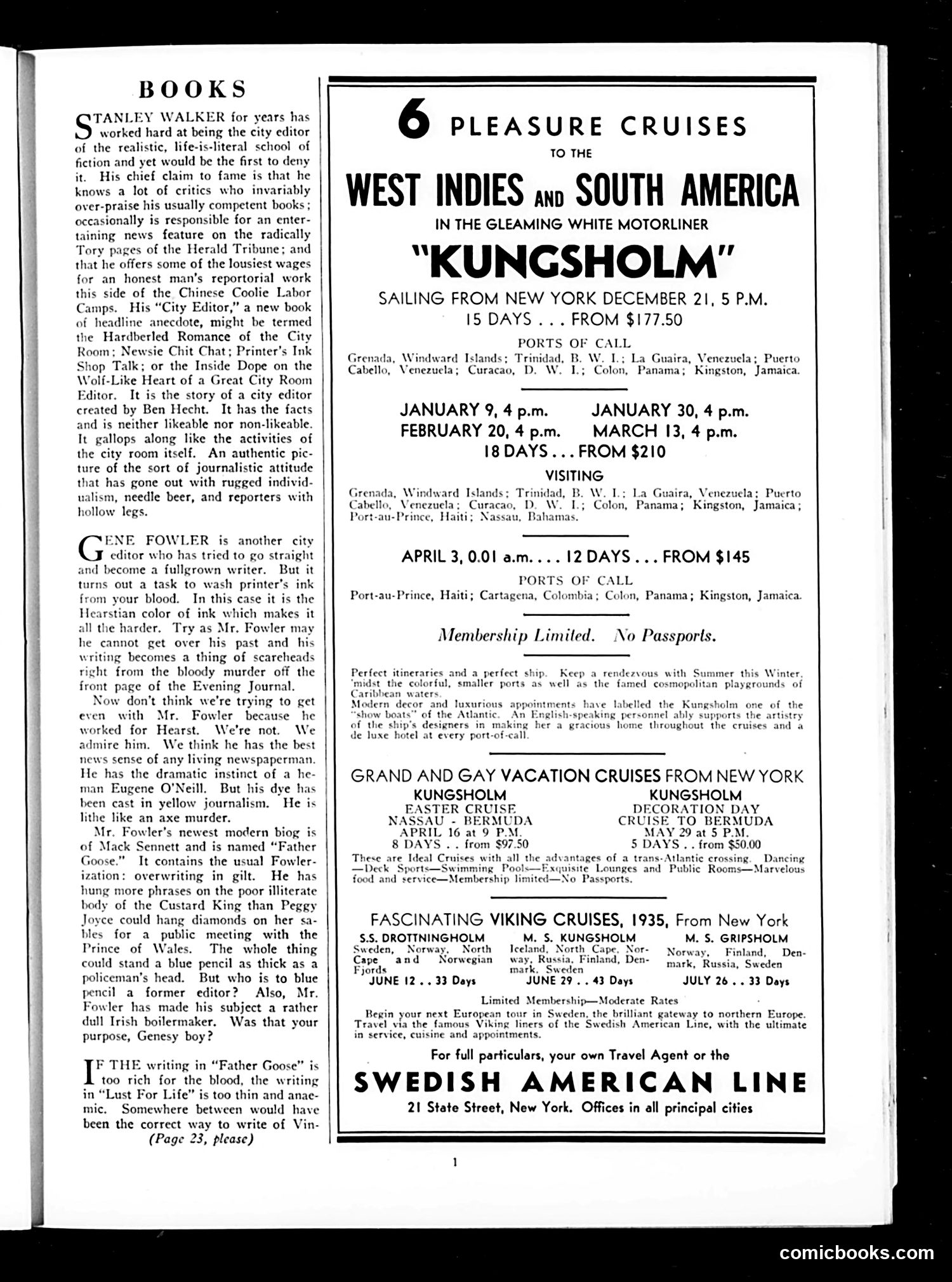
Analysis This page is primarily advertising, not satirical content. The left column contains a "BOOKS" section with brief reviews of works by Stanley Walker and Gene Fowler—both journalists and writers of the era. The reviews discuss their literary merit and writing style in a straightforward manner. The bulk of the page features cruise advertisements from the Swedish American Line, promoting luxury voyages to the West Indies, South America, and Scandinavia. These ads emphasize the ships' elegance, amenities, and itineraries. There is no political cartoon or satire evident on this page. It appears to be a standard magazine layout mixing book reviews with commercial advertising, typical of Judge magazine's format during this period.
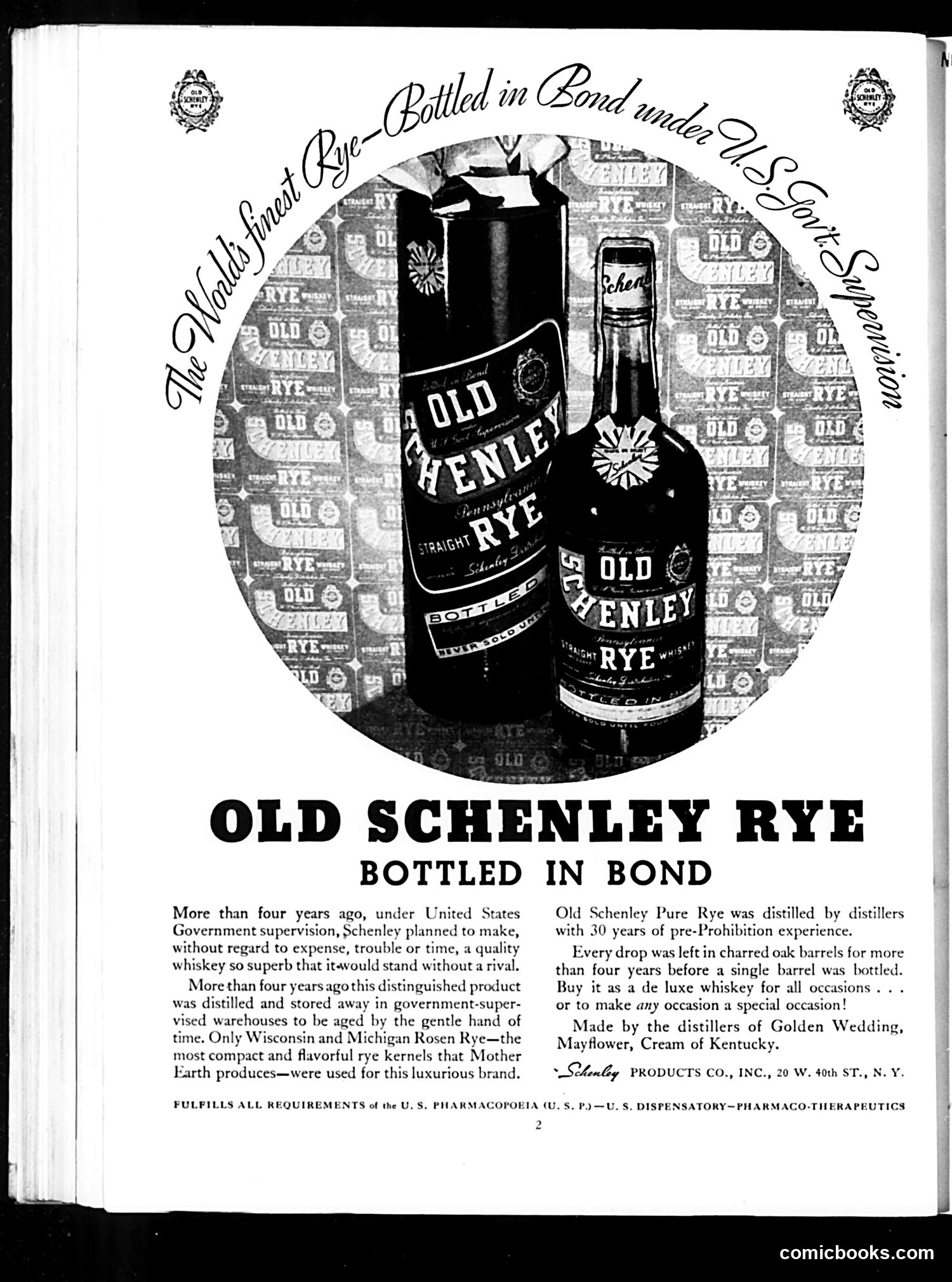
Analysis This page is primarily an advertisement, not satire or political commentary. It promotes Old Schenley Rye whiskey, emphasizing that it was "bottled in bond" under U.S. Government supervision and aged over four years. The ad highlights that the whiskey was distilled before Prohibition (which lasted 1920-1933), stored in government-supervised warehouses, and made from Wisconsin and Michigan rye. The copy promises quality and luxury. The circular image shows two bottles against a patterned background of repeated labels. This appears in Judge likely because the magazine accepted advertising. Post-Prohibition whiskey ads like this were common in the 1930s as the industry re-established itself. There is no satirical content—it's straightforward commercial promotion.
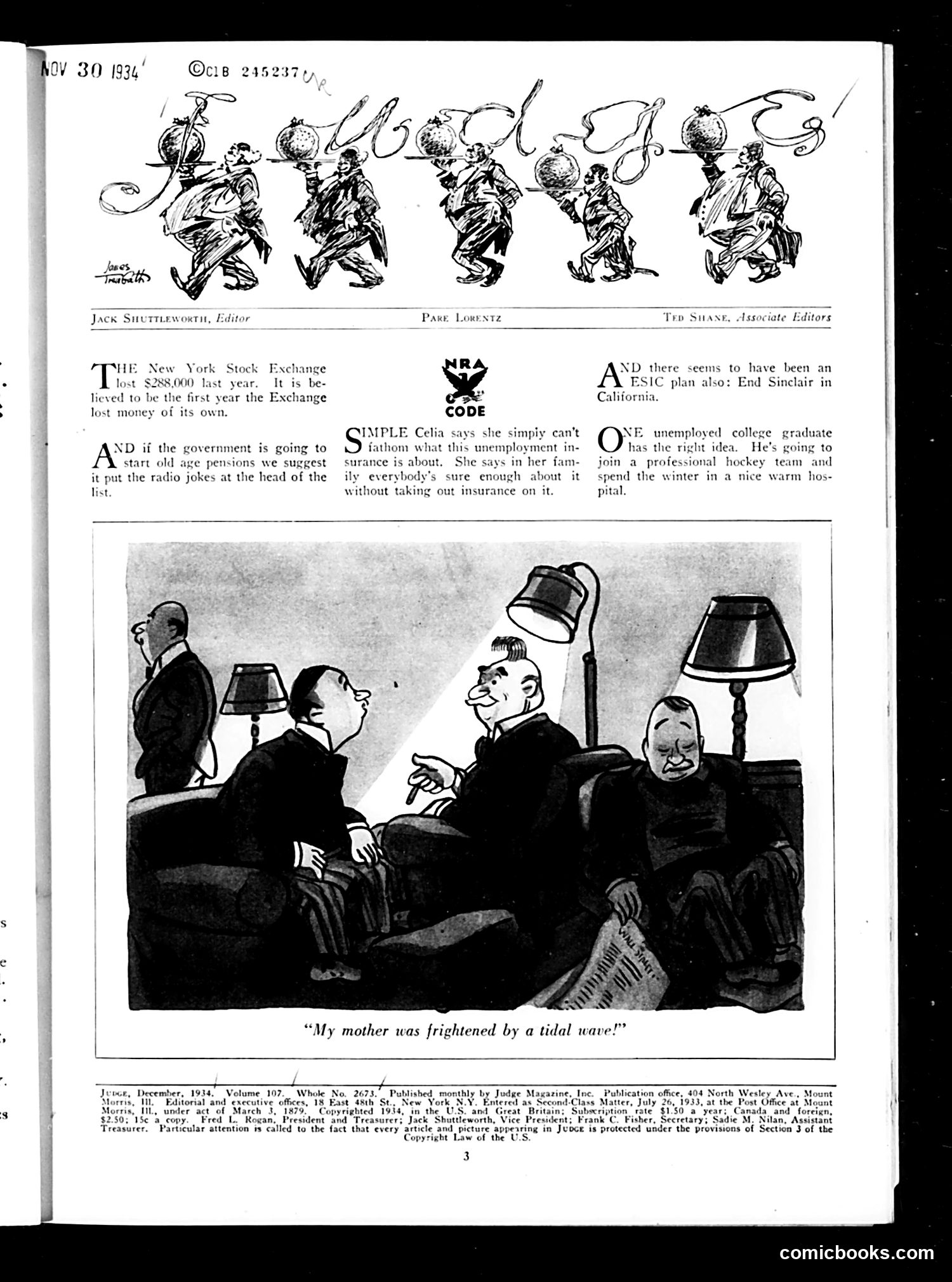
Analysis of Judge Magazine Page (Nov. 30, 1934) Main Cartoon Caption: "My mother was frightened by a tidal wave!" This single-panel cartoon depicts four men in a living room, with one woman. The joke appears to be a dark humor piece about inheritance or family dynamics—the woman's exaggerated facial expression suggests she's reacting dramatically to the men's conversation, possibly about her mother-in-law's misfortune. The caption implies the woman is using the "tidal wave" as an explanation for her mother's condition or appearance, a euphemistic cover story. Text Content: Brief satirical items reference the 1934 stock market losses, unemployment insurance debates, and a college graduate joining a professional hockey team as a way to survive winter—typical Depression-era commentary on economic hardship and creative survival strategies.
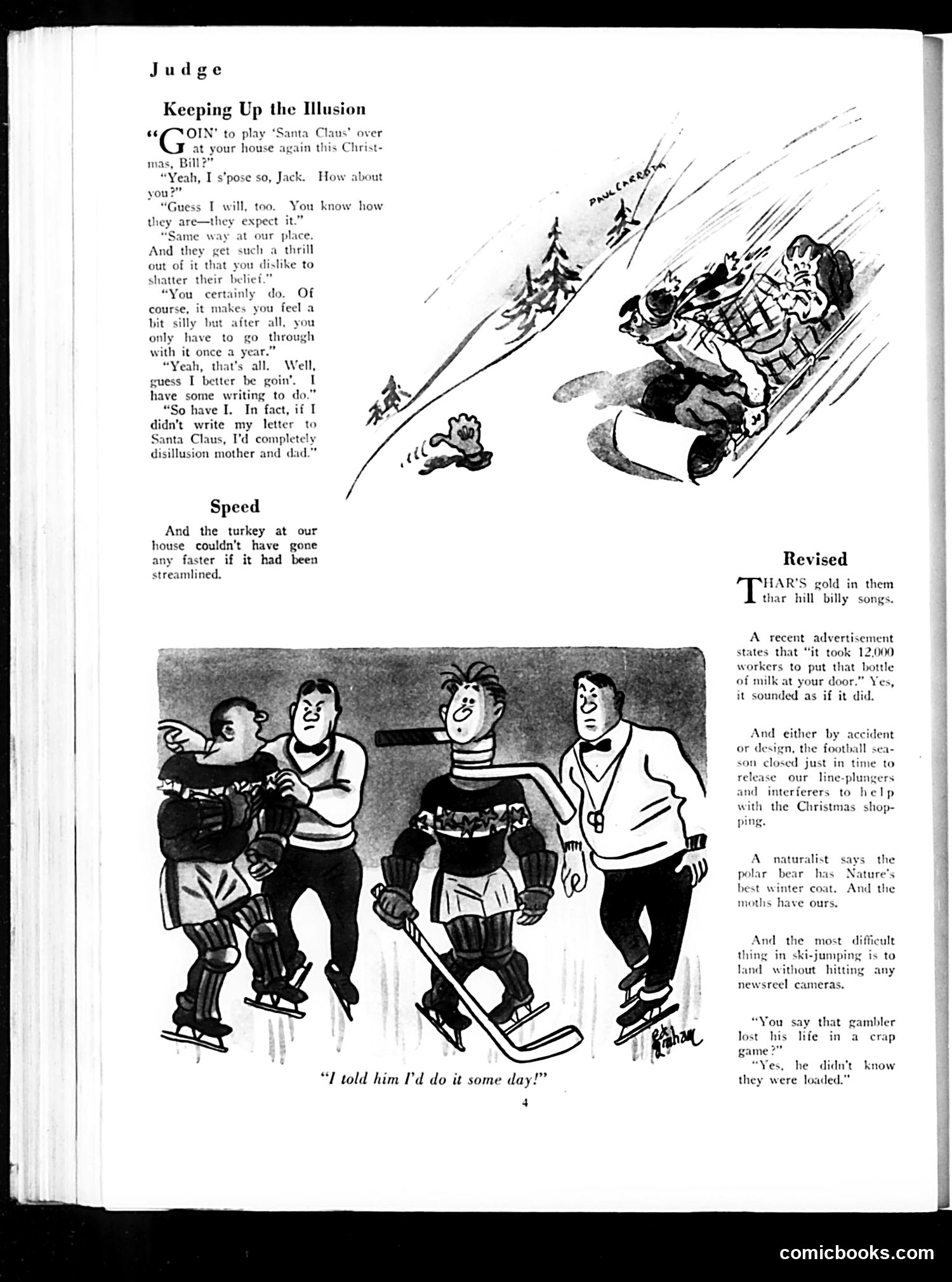
Analysis of Judge Magazine Page This page contains three humor sections typical of early-20th-century satirical magazines: "Keeping Up the Illusion" jokes about parents pretending Santa Claus visits their home for Christmas, with one father admitting he never actually wrote to Santa—essentially admitting the whole enterprise is a parental fabrication to maintain childhood wonder. "Speed" is a brief quip about a turkey that couldn't have moved faster if streamlined (a contemporary design concept). "Revised" collects short one-liners mocking advertising claims, consumer culture, and modern life—including a milk bottle delivery claim and observations about polar bears' winter coats versus moth biology. The skating cartoon illustrates the "Speed" section, showing people ice skating enthusiastically. These are gentle, family-oriented humor pieces typical of Judge's editorial content between advertisements.
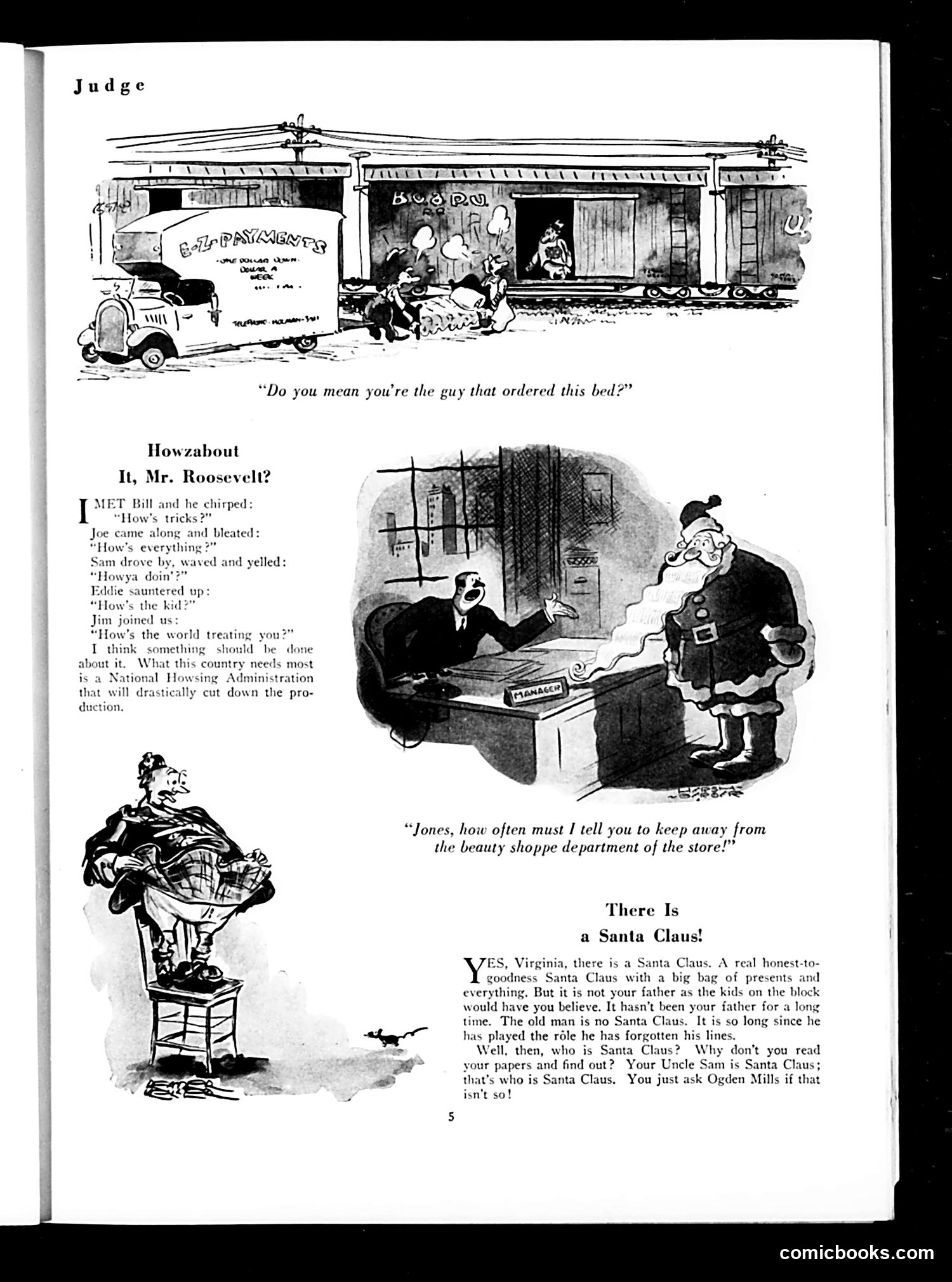
Analysis of Judge Magazine Page This page contains three separate items: 1. Top cartoon: A man is confronted at a railroad car about ordering an expensive bed. The satire targets Depression-era consumer excess and questionable spending priorities. 2. "Howzabout It, Mr. Roosevelt?": A political cartoon depicting someone (likely FDR, given the text reference) at a desk being asked about economic conditions by various acquaintances. The speaker advocates for a National Housing Administration to address the housing crisis—suggesting this page predates or coincides with New Deal housing programs of the 1930s. 3. "There Is a Santa Claus!": A lighthearted editorial explaining that Uncle Sam represents Santa Claus, promoting patriotic goodwill during economic hardship. The page reflects Depression-era concerns about housing, spending, and national recovery.
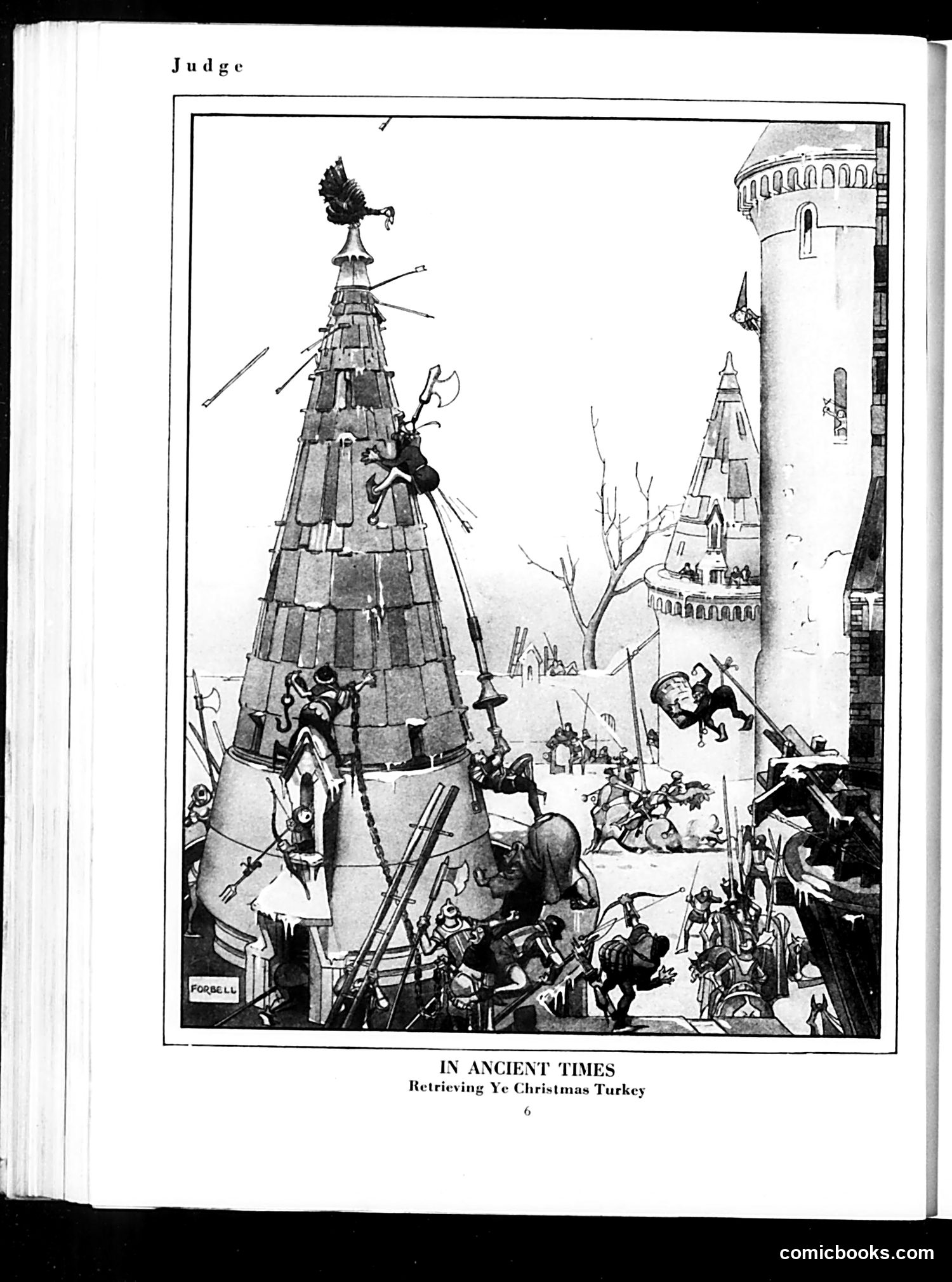
Analysis of "In Ancient Times: Retrieving Ye Christmas Turkey" This satirical illustration depicts a chaotic medieval siege scene where soldiers are attacking a tall conical structure topped with what appears to be a turkey. The title's reference to "Ye Christmas Turkey" suggests this is a humorous commentary on the difficulty or absurdity of acquiring holiday dinner provisions. The cartoon likely satirizes either: - The challenge of obtaining Christmas dinner (perhaps during scarcity or high prices) - Commercial competition around holiday shopping/preparation - Bureaucratic or social obstacles to simple holiday traditions The "ancient times" framing adds comedic exaggeration—treating turkey procurement as if it requires military conquest. The artist's signature appears to read "Formell" (unclear). Without additional historical context about Judge magazine's publication date, the specific contemporary reference remains uncertain.
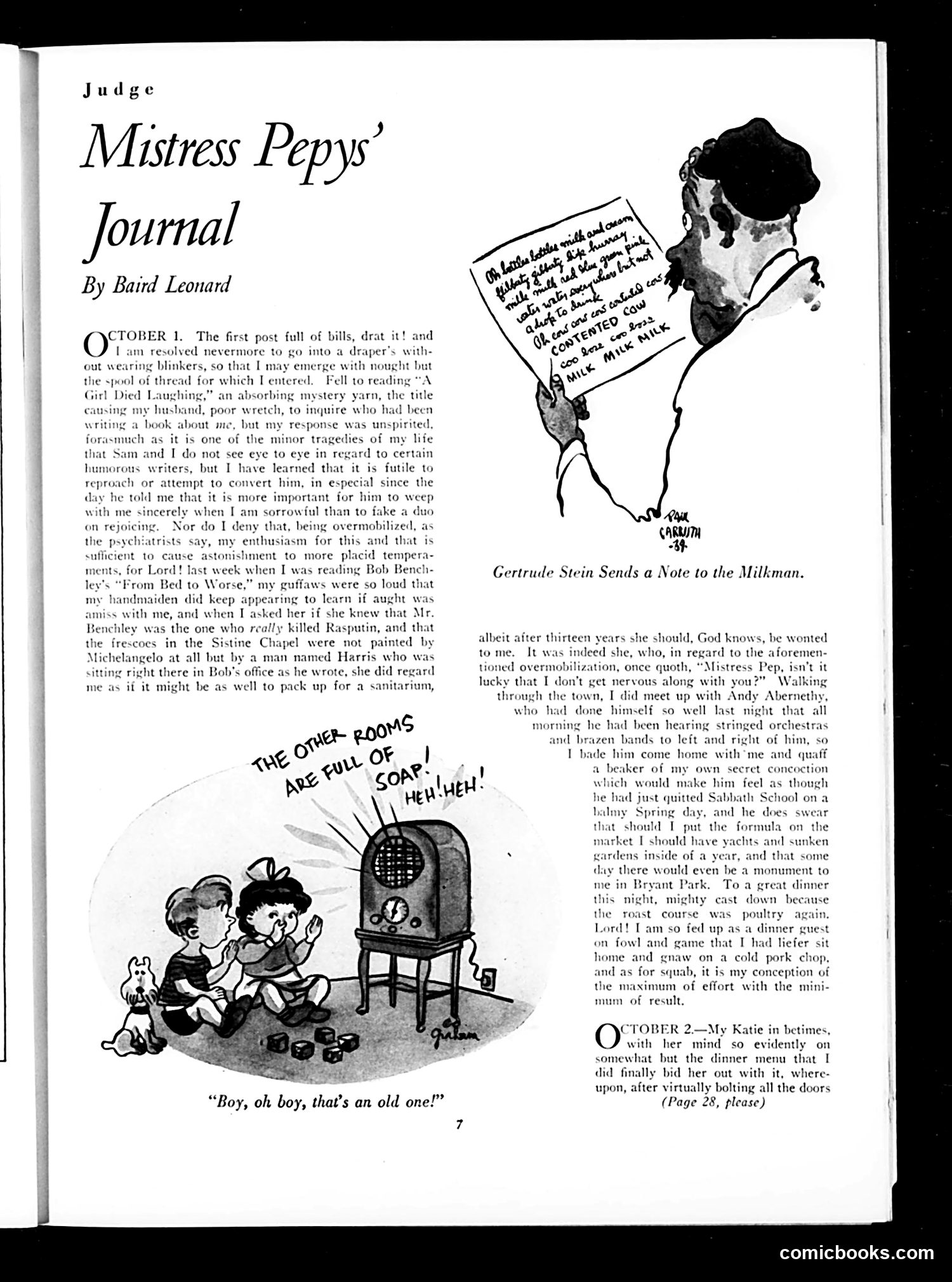
Explaining "Mistress Pepys' Journal" to Modern Readers This is a humorous column mimicking Samuel Pepys' famous 17th-century diary, but set in the 1930s-40s. The narrator is a society wife complaining about everyday domestic annoyances: bills, husband's lack of appreciation for her reading, servants' gossip, and dinner party frustrations. The two cartoons illustrate specific complaints: the top shows a woman sending a note to "the milkman" (suggesting domestic logistics or possibly flirtation); the bottom depicts children listening to radio drama, captioning "The other rooms are full of soap! Heh! Heh!" — mocking radio soap operas' ubiquity and melodrama. The humor relies on contrasting dignified historical pastiche (Pepys-style diary language) with petty modern grievances. References to mystery novels and Rasputin indicate 1930s-40s popular culture. The satire gently mocks middle-class housewives' preoccupations while maintaining affectionate mockery of the narrator's own pretension.
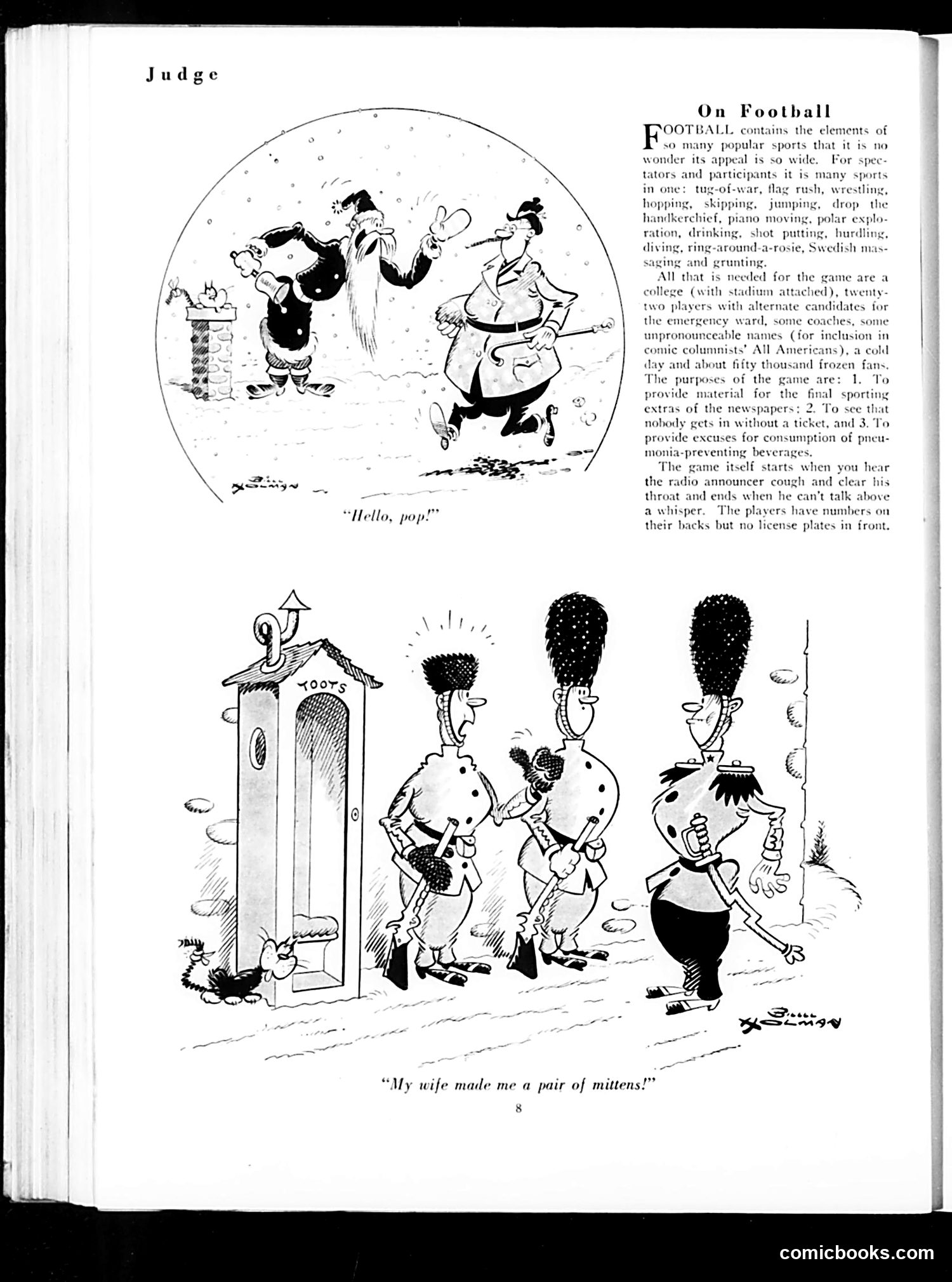
Explanation for Modern Readers This page contains two cartoons satirizing American football culture. Top cartoon ("Hello, pop!"): Shows what appears to be a father figure greeting someone at a football stadium. The satire targets the social chaos of game day—the text notes football combines "tug-of-war, flag rush, wrestling, drinking, shot putting" and other activities, suggesting the sport is an excuse for general mayhem and excess rather than organized athletics. Bottom cartoon ("My wife made me a pair of mittens!"): Three men with enormous, absurd mittens stand outside a "Toots" establishment. The joke plays on the cold weather at football games and perhaps mock-sympathetic excuses men use to justify leaving home or spending money during the season—blaming their wives for inadequate winter gear. Both cartoons mock football's appeal as primarily social rather than athletic, emphasizing spectator drinking, the cold conditions endured, and the sport as a male escape from domestic life. The satirical tone suggests Judge viewed football culture as ridiculous excess.
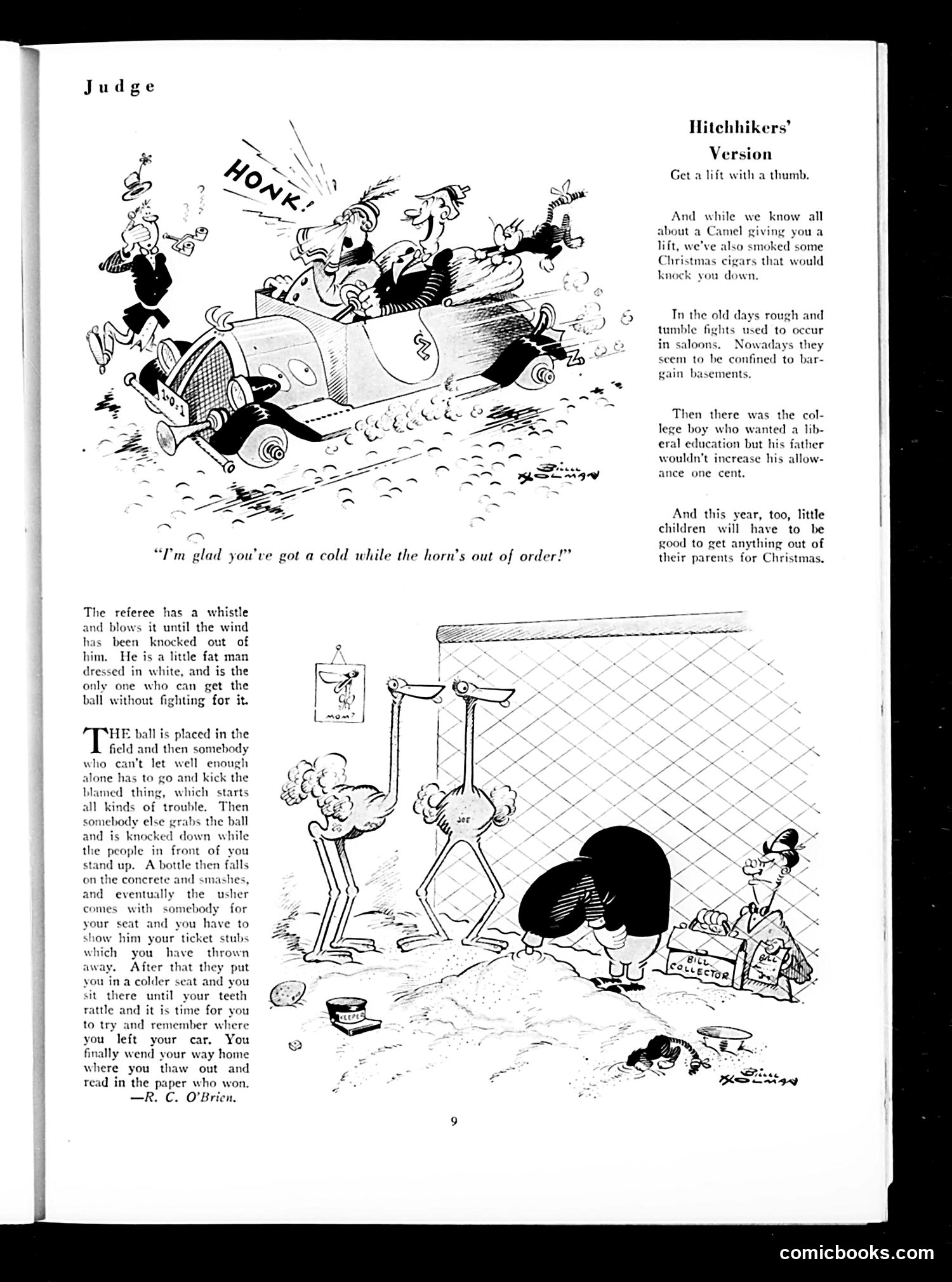
Judge Magazine Page Explanation This page contains humorous satirical commentary on 1920s-30s American life. The top cartoon depicts hitchhikers piled into an overloaded car, joking about the era's new hitchhiking culture and casual transportation. The right column offers brief social observations: commercialized Christmas, college affordability, saloon violence confined to department store sales, and consumer culture. The Camel cigarette reference suggests Judge's advertising clients. The lower section, attributed to R.C. O'Brien, satirizes football spectating—the chaos, violence, referee authority, rowdy crowds, and uncomfortable conditions that make attending games miserable. The detailed complaint about thrown-away ticket stubs and freezing seats reflects working-class frustrations with entertainment accessibility. The middle cartoon shows people attempting to play volleyball, illustrating recreational games of the period. Overall, the page mocks contemporary American consumer culture, sports enthusiasm, and modern inconveniences through light satire.
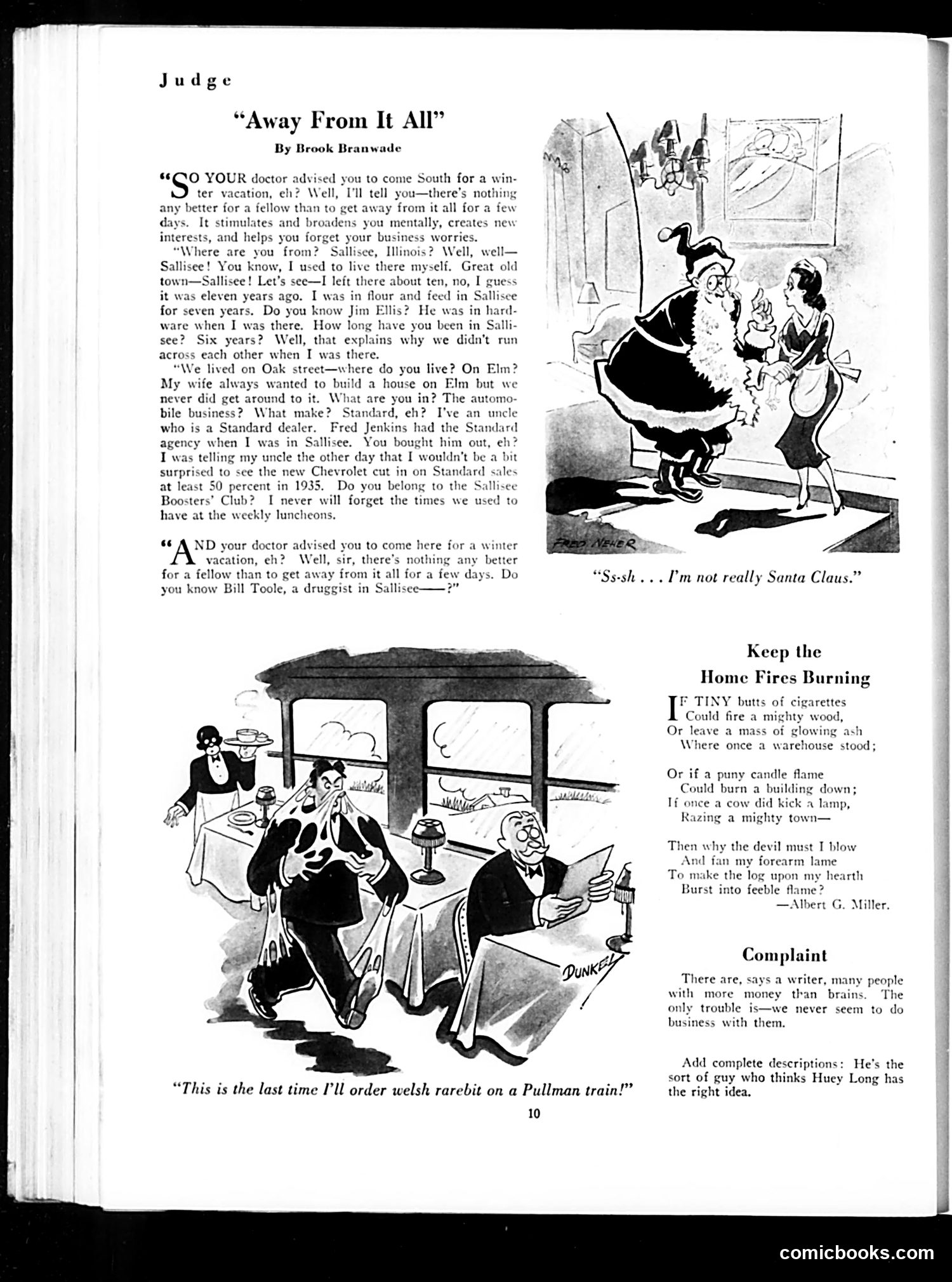
Analysis of Judge Page Content The page features "Away From It All" by Brook Branwade, a satirical piece about vacation advice. The humor contrasts two scenarios where a doctor recommends escaping to the South or away on vacation. The top cartoon shows Santa Claus meeting a woman, with the caption "S-s-sh... I'm not really Santa Claus"—likely mocking commercialized Christmas and fake department-store Santas. The lower cartoon depicts dining-car passengers, captioned "This is the last time I'll order welsh rarebit on a Pullman train!"—presumably joking about indigestion or poor train food quality. The text satirizes small-town life and business obsessions, suggesting that even vacations can't truly escape from familiar people and concerns. The inclusion of a fire-safety poem adds an unrelated public-service element typical of period magazines.
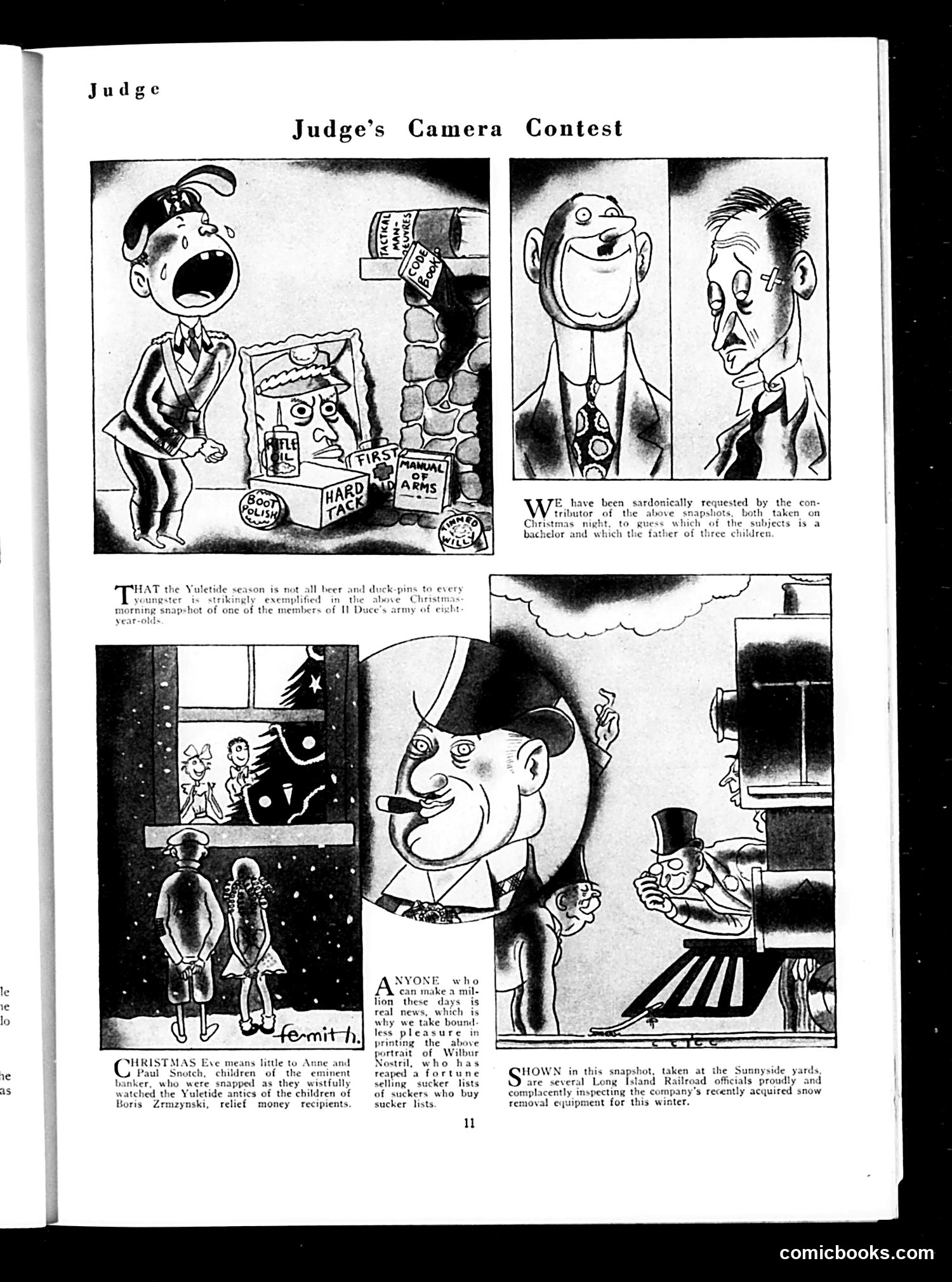
Judge's Camera Contest Explanation This page presents a satirical "camera contest" featuring caricatured photographs with commentary. The cartoons mock various social situations: 1. Top left: A man distressed over Christmas gifts—labeled items like "Hard Tack" and "Polish"—satirizing Depression-era poverty and meager holiday expectations. 2. Top right: Two head portraits appearing to judge or evaluate something, with text referencing a "bachelor" and "father of three children." 3. Bottom left: Children of relief recipients enjoying Yuletide entertainment, sardonically contrasting holiday cheer with economic hardship. 4. Bottom right: Railroad officials inspecting newly acquired snow-removal equipment, likely mocking bureaucratic pride in mundane infrastructure. The overall satire targets Depression-era economic struggles, relief programs, and the gap between official optimism and citizens' actual conditions. The "camera contest" framing allows Judge to present these snapshots of American life with biting social commentary.
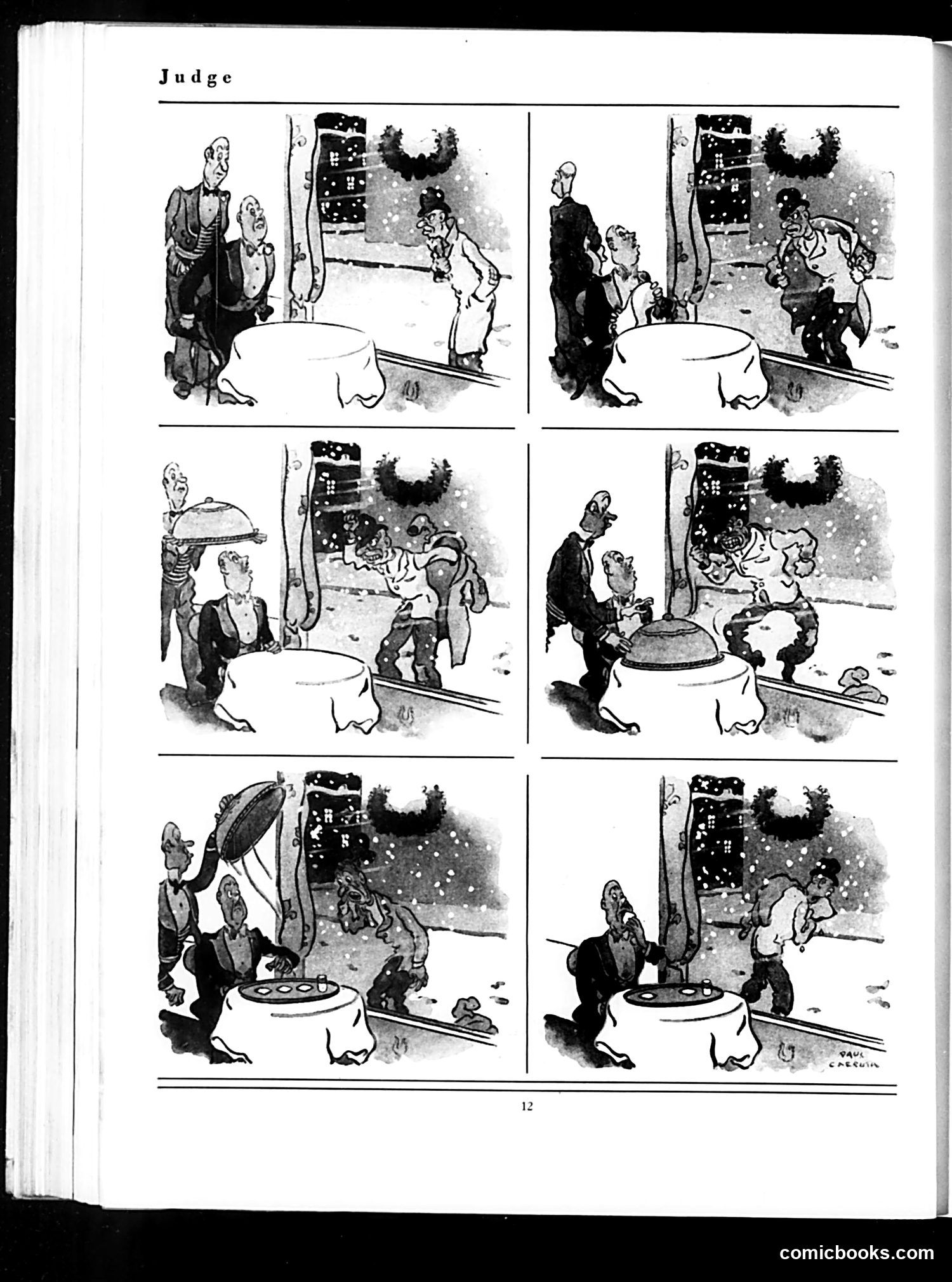
Judge Magazine Cartoon Analysis This six-panel satirical comic titled "Judge" depicts a formal dinner scene with a distinguished older gentleman (likely a judge, given the title) and a woman at a table. The narrative appears to show the judge becoming progressively more animated and undignified as the meal proceeds. The satire seems to target the contrast between judicial authority and decorum versus the judge's loss of composure, possibly over food or wine. Each panel escalates the comedic chaos—from formal posturing to increasingly ridiculous behavior. Without additional context or visible text identifying the specific judge or historical event, the broader point appears to be mocking the pretensions of authority figures who abandon dignity when distracted by appetites or pleasures. The cartoon plays on expectations of judicial restraint.
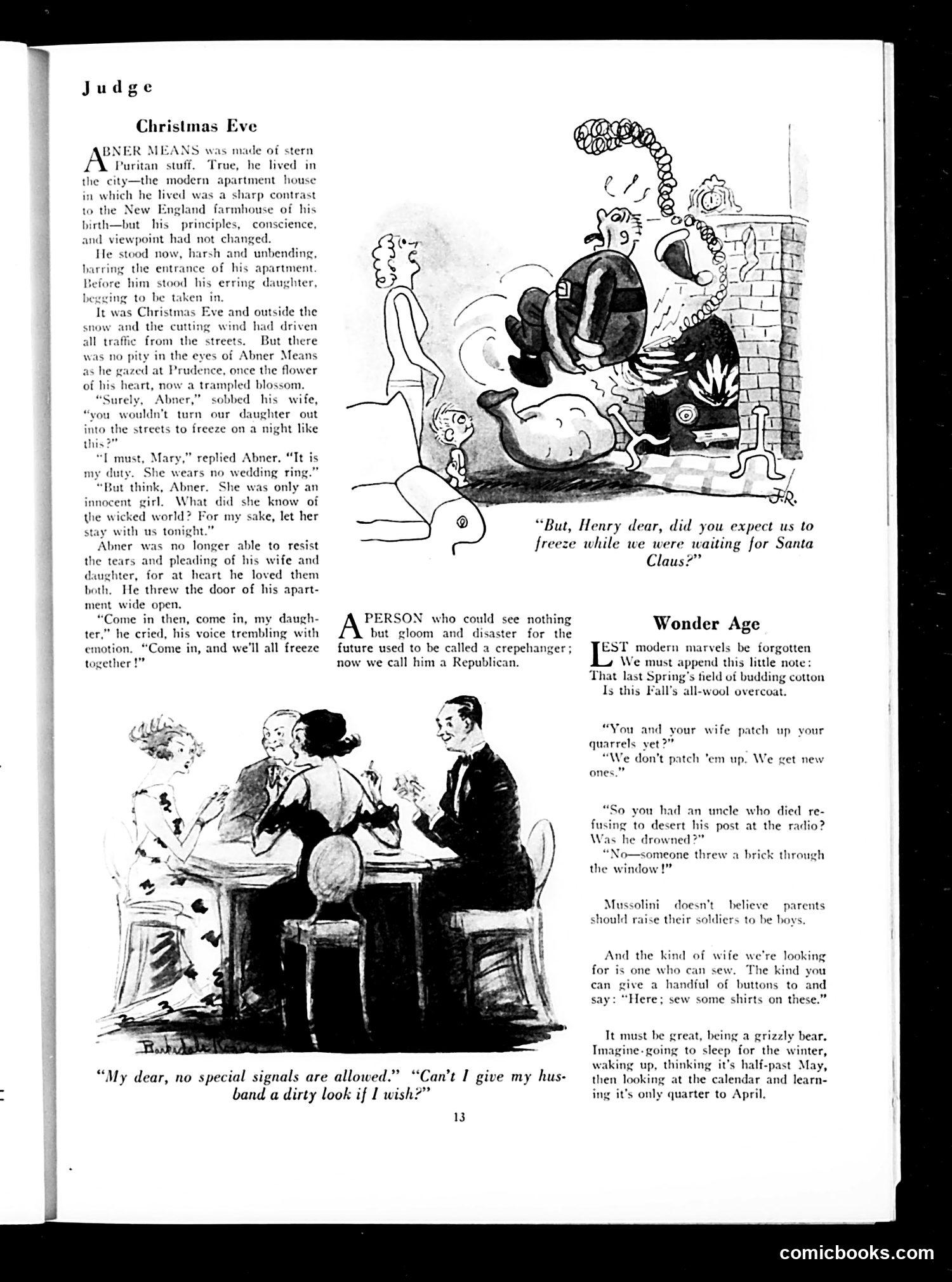
Analysis for Modern Readers "Christmas Eve" (left): A morality tale satirizing rigid Puritanism. Abner Means, a stern old-fashioned man, initially refuses to let his unmarried pregnant daughter Prudence into his home on Christmas Eve, despite the freezing weather. His wife pleads for mercy. He relents, allowing them all inside—where they'll freeze together because he won't pay for heat. The satire targets inflexible moral judgment: Abner chooses principle over compassion, creating absurd suffering for everyone. Political jab (center): A one-liner equating pessimists with Republicans—suggesting the GOP was seen as doom-saying during this period (likely 1920s-30s). "Wonder Age" (right): Miscellaneous witticisms mocking modern life: synthetic fabrics, disposable marriage conflicts, and Mussolini's militarism. The bear joke is purely absurdist humor unrelated to politics.
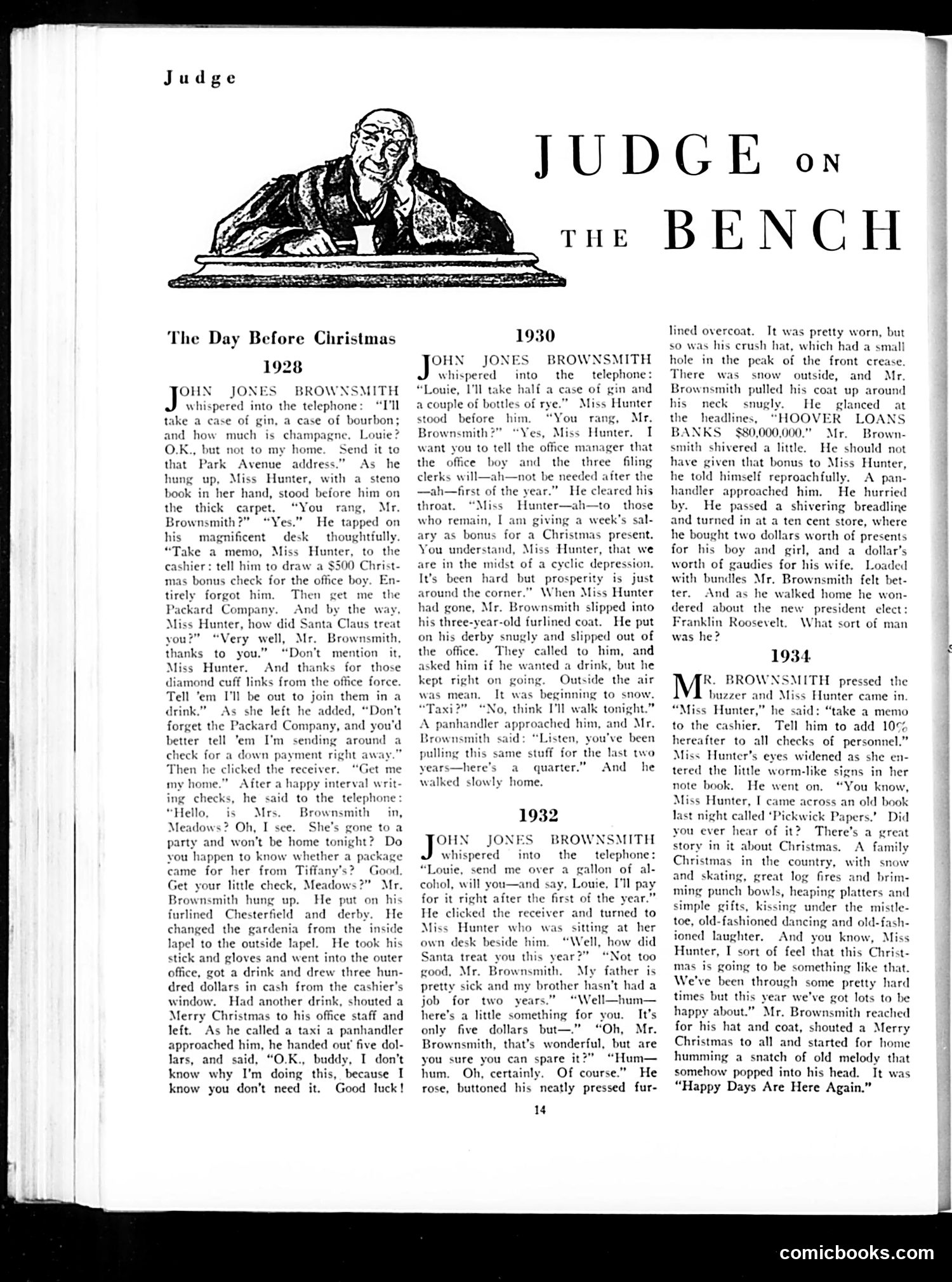
Judge Magazine: "Judge on the Bench" (1928-1932) This page presents three vignettes about "John Jones Brownsmith," a wealthy businessman, during successive Christmas seasons. The satire traces the Depression's impact on executive generosity and morality. 1928: Brownsmith lavishly gives bonuses, drinks, and charity—buying a panhandler's gratitude for five dollars while spending freely on alcohol and luxury goods. 1930: Economic crisis emerges. He fires office staff ("not be needed after...first of the year"), reduces his own spending (three-year-old coat, no drinks offered), and patronizes Miss Hunter with meager "cyclic depression" explanations while claiming "prosperity is just around the corner." 1932: Deepening despair. He borrows money, offers Miss Hunter only five dollars while she mentions her father's illness and brother's unemployment, and awkwardly tries justifying his own financial constraints. The cartoon satirizes how economic collapse exposed the hypocrisy of wealthy men—their Christmas charity proved temporary and self-serving, evaporating when their own comfort was threatened. The repetition emphasizes the Depression's relentless squeeze on both rich and poor.
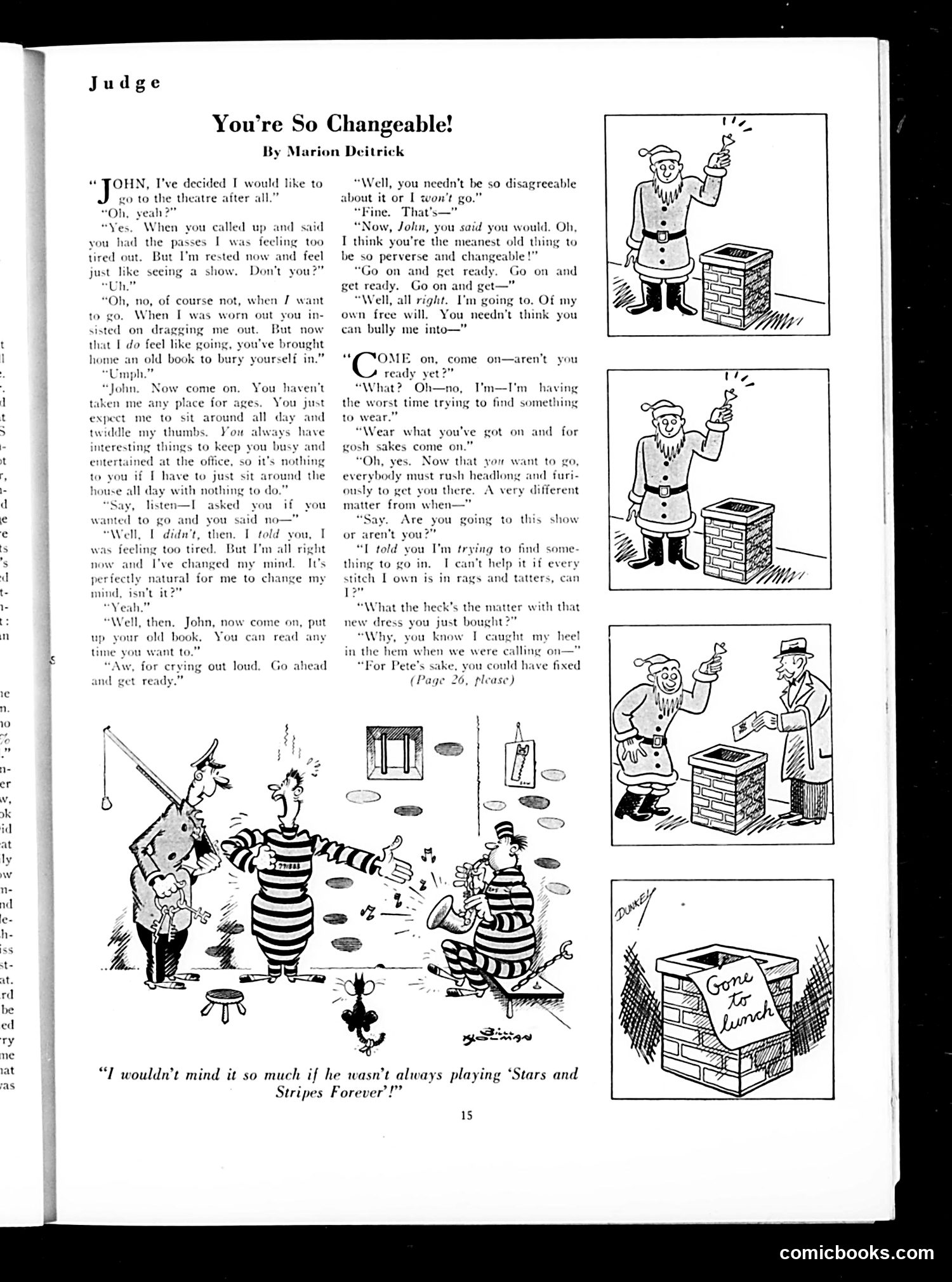
"You're So Changeable!" Analysis This domestic comedy by Marion Deitrick satirizes the stereotype of women as indecisive and contradictory. The joke centers on a wife who initially refuses her husband's invitation to the theater (claiming exhaustion), then changes her mind and wants to go—only to accuse him of being "perverse and changeable" when he expresses frustration at her reversal. The husband's exasperation and the wife's inability to recognize her own inconsistency drive the humor. The cartoon plays on mid-20th-century gender stereotypes portraying women as emotionally volatile and illogical, while men are portrayed as long-suffering and rational. The additional comic strip at bottom depicts circus performers, seemingly unrelated to the main narrative, suggesting this is a miscellaneous page from Judge magazine's humor section.
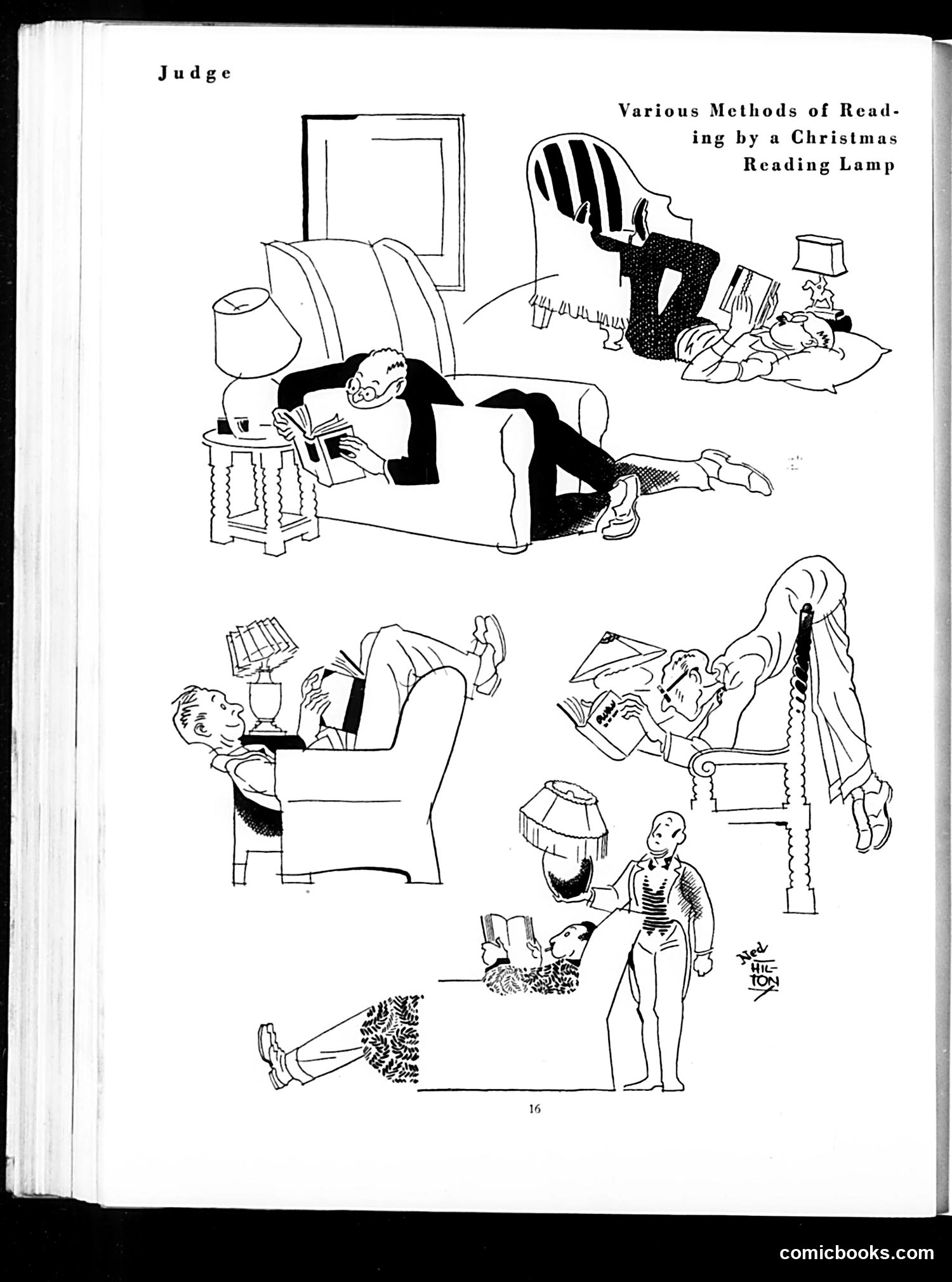
"Various Methods of Reading by a Christmas Reading Lamp" This Judge page presents humorous illustrations of creative—and increasingly absurd—postures people adopt while reading under a Christmas lamp. The cartoons satirize the impracticality of reading by inadequate or awkwardly-positioned lighting. Each vignette shows readers contorting themselves in exaggerated ways: lying on couches, hanging from chairs, sprawling on floors, and adopting impossible angles to position themselves relative to the light source. The humor derives from the escalating physical comedy—what begins as merely awkward becomes increasingly ridiculous and undignified. The satire targets both the limitations of Christmas novelty lamps as functional reading lights and the absurd lengths people will go to accommodate poor design rather than simply seeking better lighting solutions. It's a gentle jab at consumer behavior and domestic comfort.
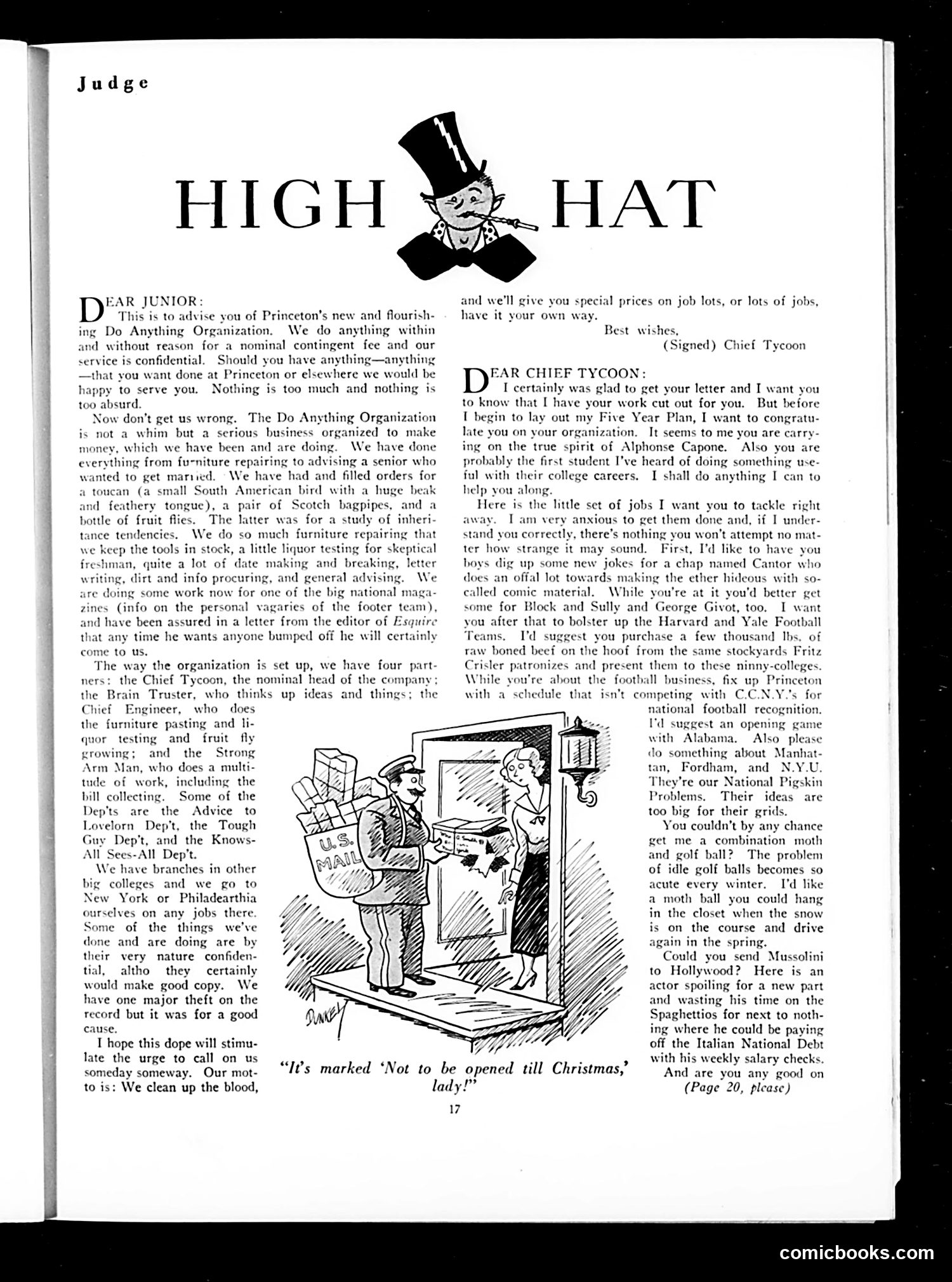
"High Hat" - Judge Magazine Satire This page satirizes Princeton University's "Do Anything Organization," a student enterprise claiming to undertake any task—legitimate or otherwise—for a fee. The left column presents the organization's pitch; the right shows a reply from "Chief Tycoon" assigning increasingly absurd jobs. The satire targets several things: student entrepreneurship during the Jazz Age, the organization's amoral willingness to do anything for money (it explicitly compares itself to Al Capone's criminal enterprise), and the naive ambitions of college students. The cartoon shows two figures with a locked box marked "Not to be opened till Christmas"—a visual joke about keeping secrets or deferred gratification. The assigned tasks mock entertainment and sports: procuring jokes for comedian Eddie Cantor, "bolstering" Harvard and Yale football teams, and fixing Princeton's athletic competitiveness. The satire suggests students believe they can solve any problem through mercenary effort, no matter how impossible or foolish.
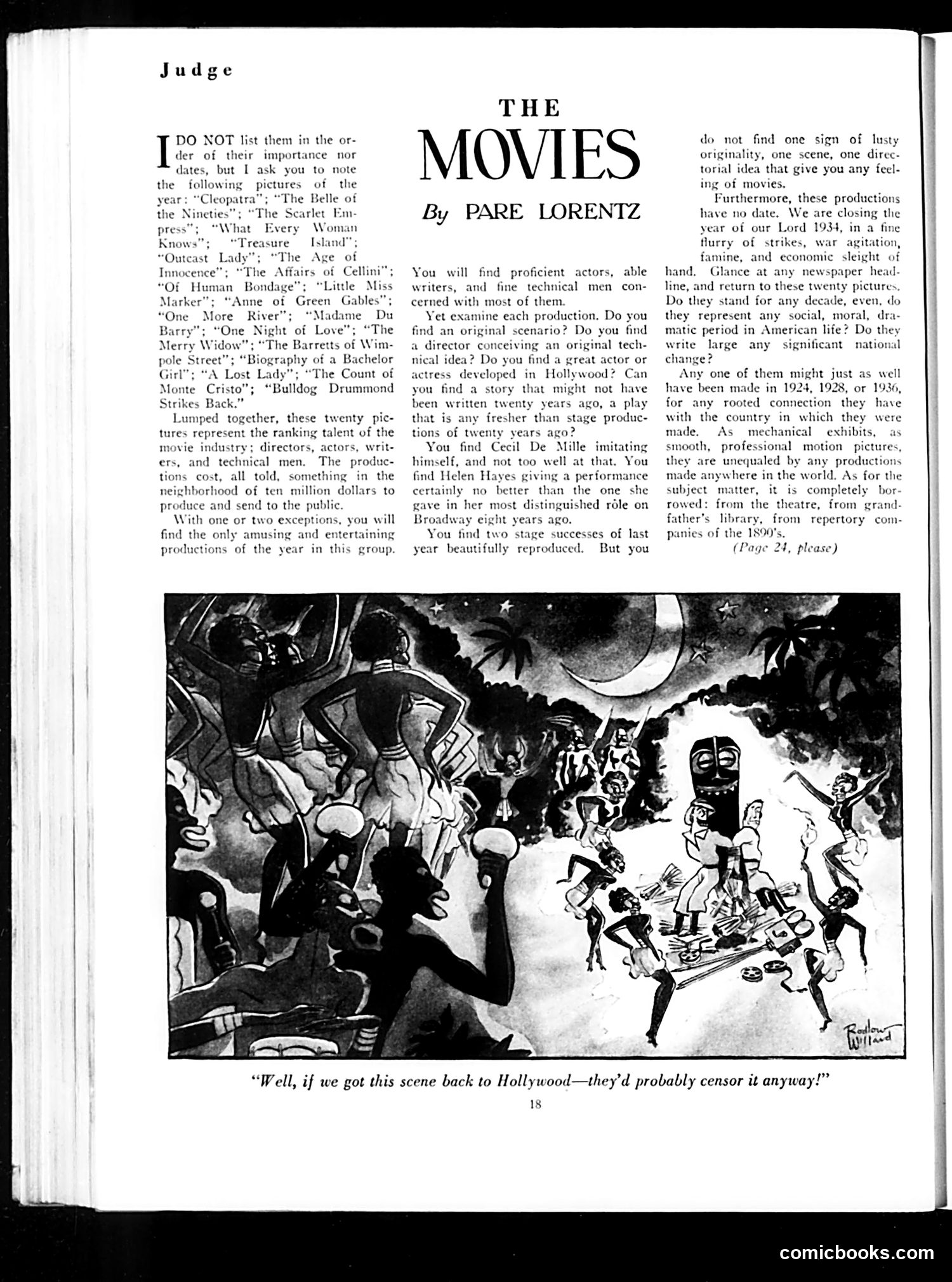
Judge Magazine: "The Movies" Critique (1934) This is a film criticism essay by Pare Lorentz attacking Hollywood's creative bankruptcy in 1934. The article lists twenty major film productions of the year, then argues they represent enormous financial investment ($10 million total) with minimal artistic merit or originality. Lorentz's complaint: these films feature competent technicians and actors but lack genuine innovation. He specifically names Cecil B. DeMille and Helen Hayes as examples of talent merely repeating past successes rather than creating anything fresh. The films, he argues, have no connection to contemporary social issues—strikes, war, famine, economic crisis—despite being made during turbulent times. They're derivative, borrowing stories from 1890s theater rather than reflecting modern American life. The cartoon's caption satirizes Hollywood censorship: depicting an alien/fantastical scene, the joke suggests even outlandish, imaginative content gets suppressed—reinforcing Lorentz's point about creative timidity and restriction in the industry.
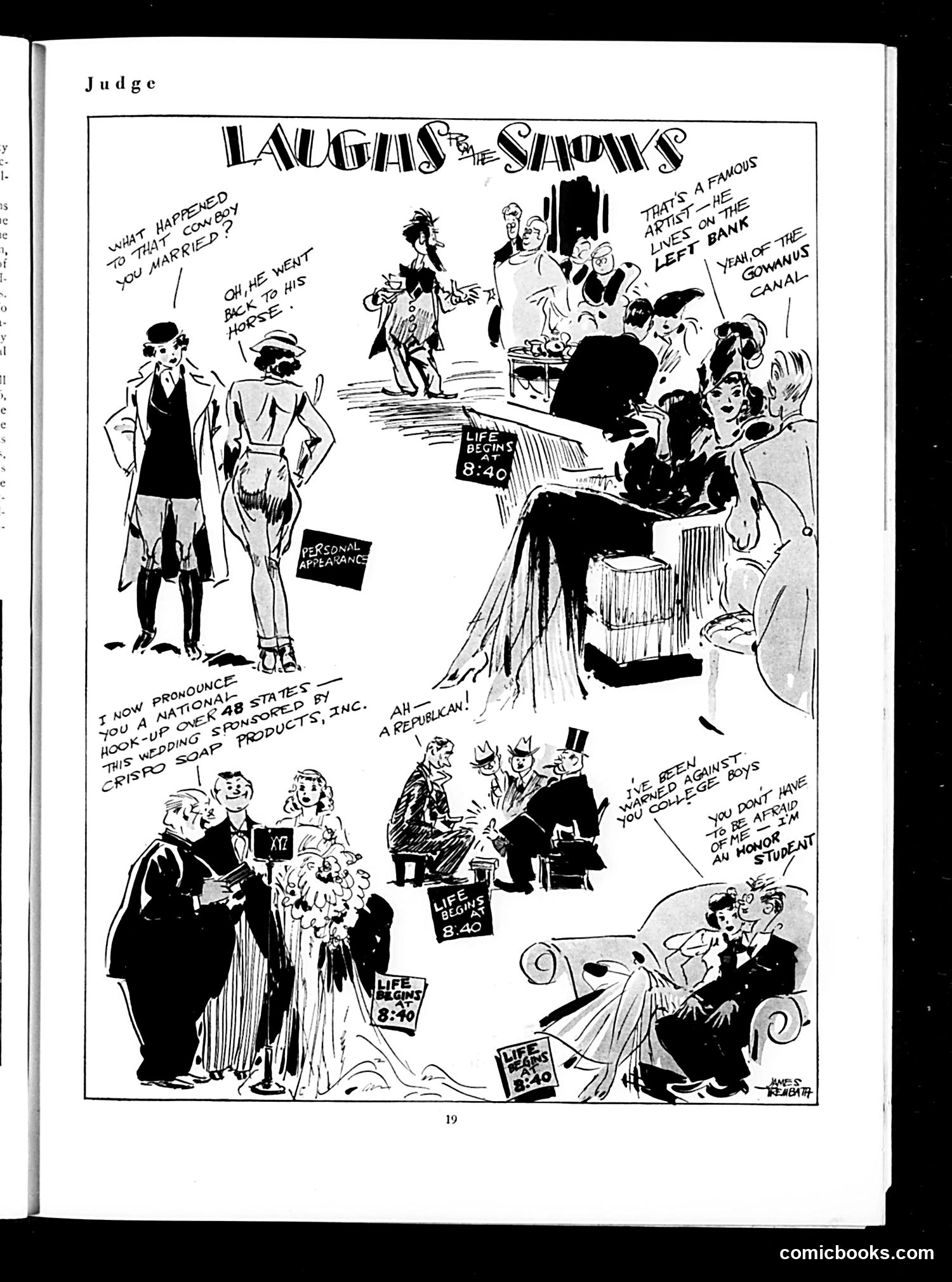
"Laughs and Shocks" - Political Cartoon Analysis This satirical cartoon depicts a formal event (possibly a wedding or society gathering) interrupted by political chaos. The central joke involves a "famous artist" who "left the bank" and is now associated with the "Gowanus Canal"—a notoriously polluted waterway in Brooklyn. The cartoon satirizes high society's pretensions while mocking a scandal involving corruption or financial misconduct. References to "Crisco Soap Products Inc." and "Republican" suggest commentary on commercialism and politics. The "Personal Appearance" labels and "Life Begins at 8:40" (likely referencing a popular film) indicate this targets celebrity culture and public spectacle. The overall message critiques how scandal infiltrates polite society, with the polluted canal metaphor suggesting moral corruption beneath wealthy facades.
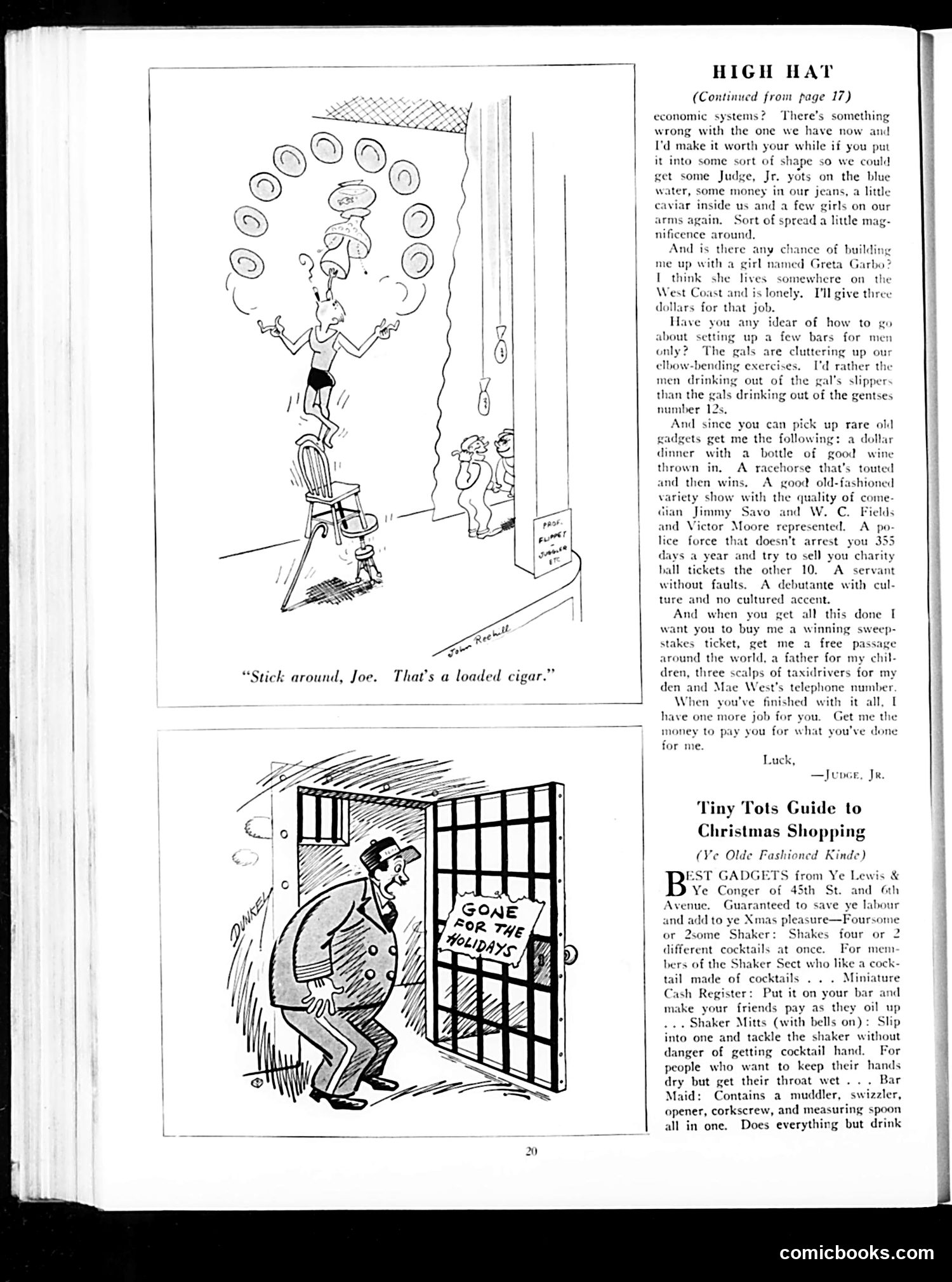
Analysis of Judge Magazine Page 20 This page contains two distinct cartoons plus advertising copy, all reflecting 1920s social attitudes. Top cartoon: Shows a man juggling while standing on a chair, surrounded by seated figures. The caption "Stick around, Joe. That's a loaded cigar" suggests the humor involves either a trick cigar or the man's precarious balancing act—likely commentary on Prohibition-era speakeasies or illicit alcohol consumption disguised as innocent activity. Bottom cartoon: Depicts a man sneaking out a door marked "Gone for the Holidays," suggesting he's abandoning his post or responsibilities. Text section ("High Hat"): A wealthy man's rambling monologue listing absurd requests—Greta Garbo, corrupt police, perfect servants—satirizing the entitled rich who believe money solves all problems. References W.C. Fields, Jimmy Savo, and Victor Moore (contemporary comedians). "Tiny Tots Guide" section: Satirizes wealthy Christmas shopping through fake "gadgets" mocking cocktail culture during Prohibition—shakers, muddlers, and novelty bar tools—poking fun at speakeasy culture and the absurdity of elaborate drinking apparatus. Overall: 1920s satire of Prohibition hypocrisy, wealth, and consumer excess.
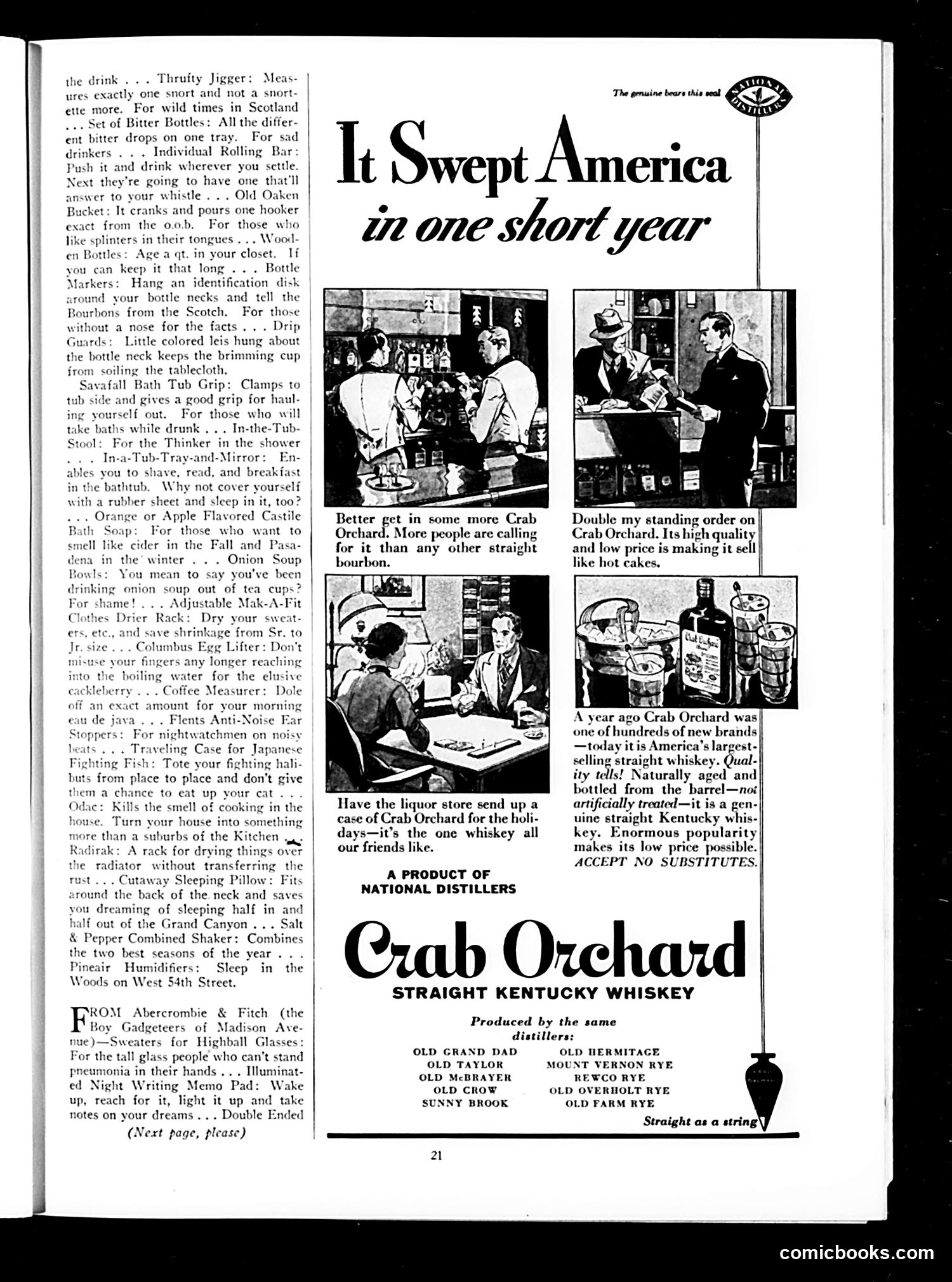
Analysis of Judge Magazine Page This page is primarily advertising, not satirical content. The dominant feature is a full-page advertisement for Crab Orchard Straight Kentucky Whiskey, a product of National Distillers. The ad uses photographs of men in business/social settings consuming whiskey, with testimonial-style captions claiming the brand swept America in one year and is now "America's largest-selling straight whiskey." It emphasizes natural aging and quality to justify low pricing. The left column contains humorous gift ideas (likely from a previous article), satirizing impractical consumer gadgets—bathtub accessories, novelty bottle holders, ridiculous kitchen tools. This reflects 1930s consumer culture and gadget obsession. The page's context is Prohibition's repeal (1933): alcohol advertising had just become legal again after 14 years. This ad capitalizes on that moment, presenting whiskey consumption as normal, sophisticated behavior among respectable businessmen.
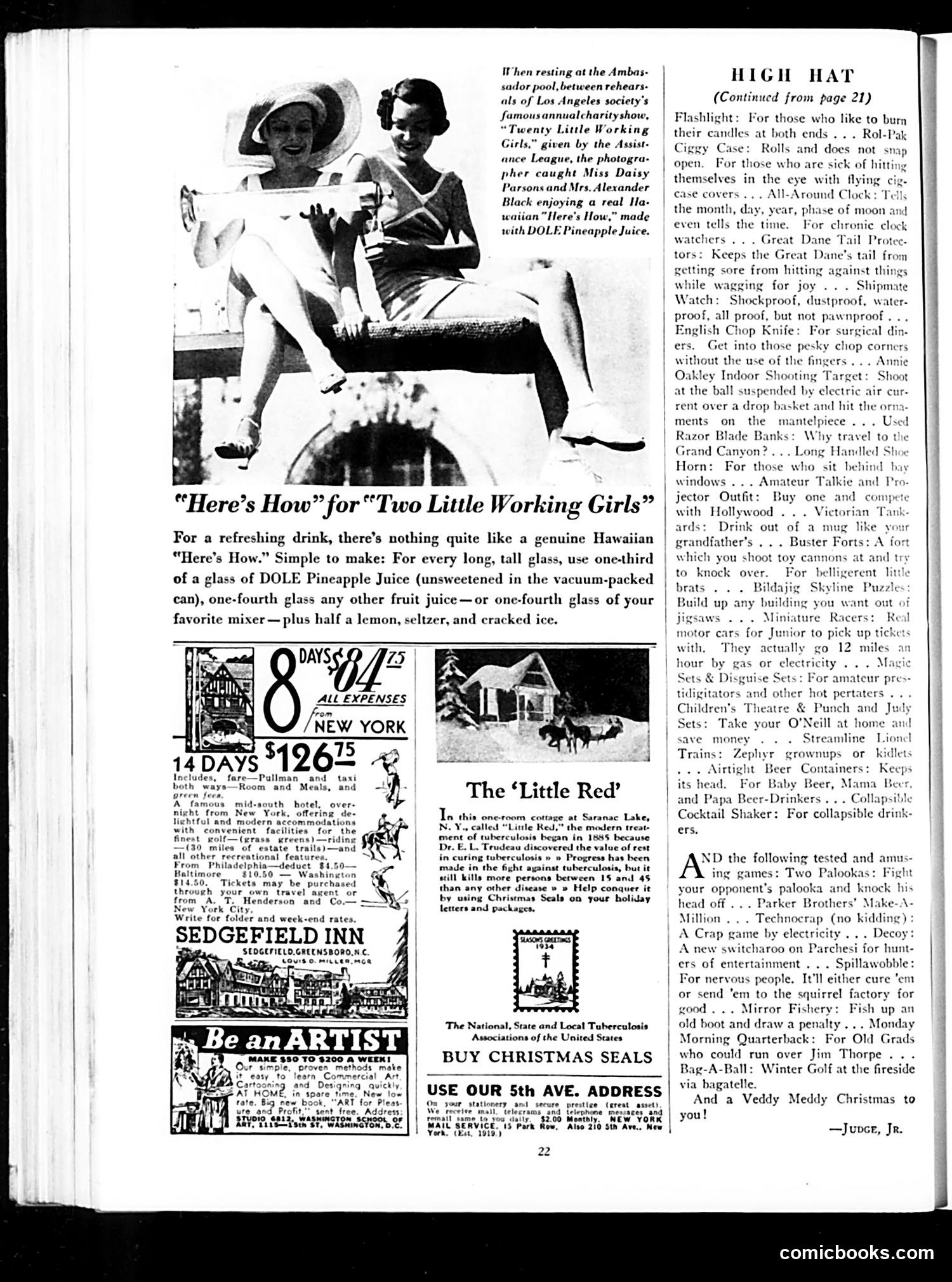
Explanation for Modern Readers This page is primarily advertising and gift suggestions from Judge magazine, not political satire. The top photo shows two socialites at the Ambassador Hotel pool enjoying a Hawaiian cocktail made with DOLE pineapple juice—a product advertisement disguised as celebrity lifestyle content. The caption references "Twenty Little Working Girls," an Assistance League charity show, positioning the drink as aspirational leisure. Below are various advertisements: travel packages, art school courses, and Christmas gift ideas ranging from practical (flashlights, watches) to frivolous (toy cannons, cocktail shakers). The "Little Red" section promotes Christmas Seals for tuberculosis awareness—a genuine public health campaign. The satire is subtle: the "High Hat" column on the right mockingly suggests absurdly luxurious or impractical gifts for wealthy people, gently poking fun at consumer excess and the affectations of the wealthy during what appears to be the 1920s-30s era. The tone is lighthearted rather than cutting.
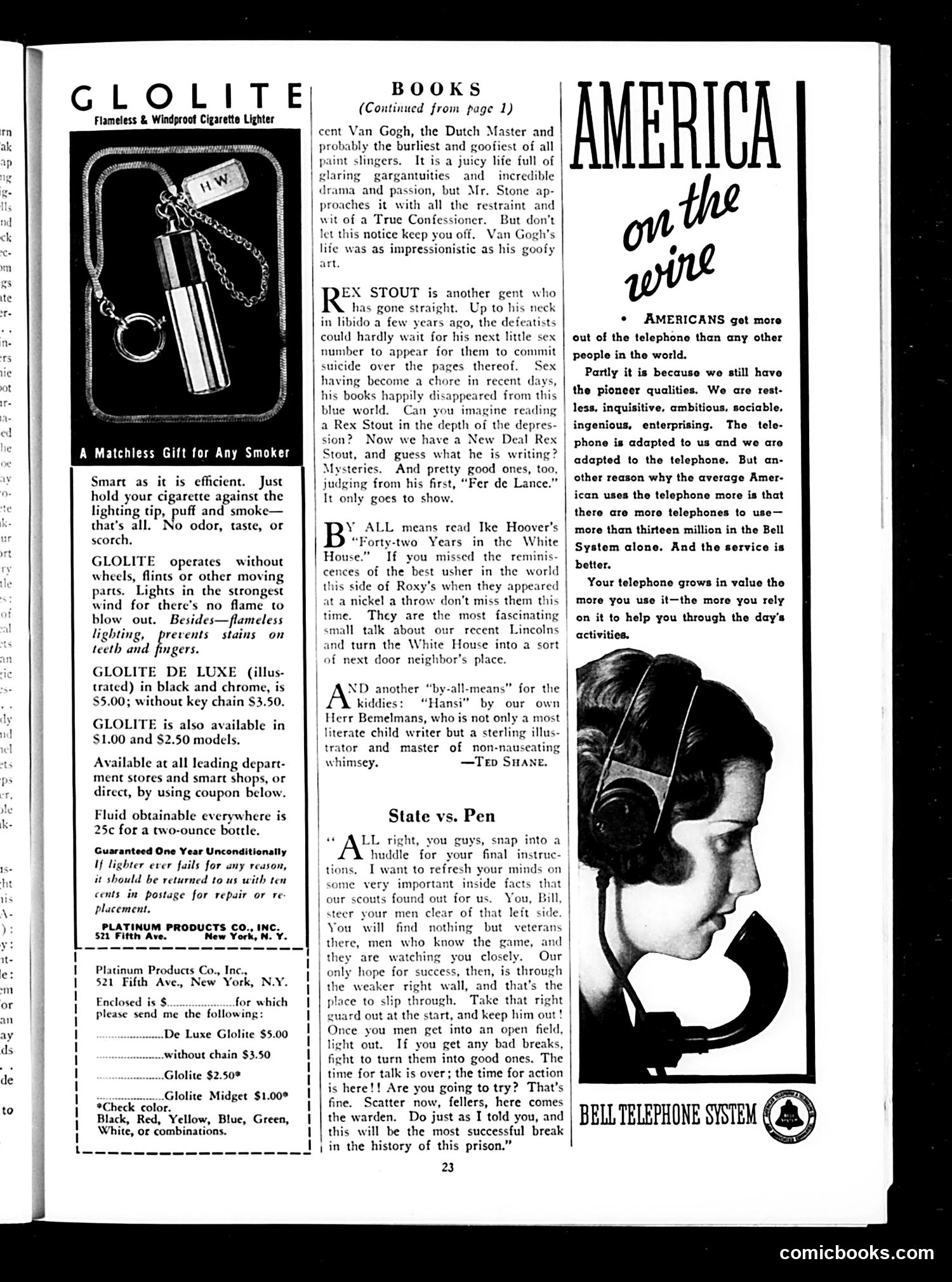
Explanation for Modern Readers This page is primarily advertising and book reviews, not political satire. Left side: Advertisement for Glolite, a flameless cigarette lighter—a consumer product marketed as a gift for smokers. The pitch emphasizes its safety and convenience features. Center: Book reviews by "Ted Shane" discussing recent publications, including works on Van Gogh, Rex Stout's detective novels (shifting from sex-themed to mystery plots), and children's literature. Right side: Bell Telephone System advertisement featuring a profile illustration of a woman using a telephone headset, accompanied by text asserting Americans use telephones more than any other people globally—attributing this to American "pioneer qualities" and suggesting increased telephone use increases its value. "State vs. Pen": A short fictional piece (appears to be prison-related dialogue) about a coach's pep talk to players, using sports strategy metaphors. The page reflects 1930s-era consumer culture and advertising strategies, with no apparent political cartoon or satire.
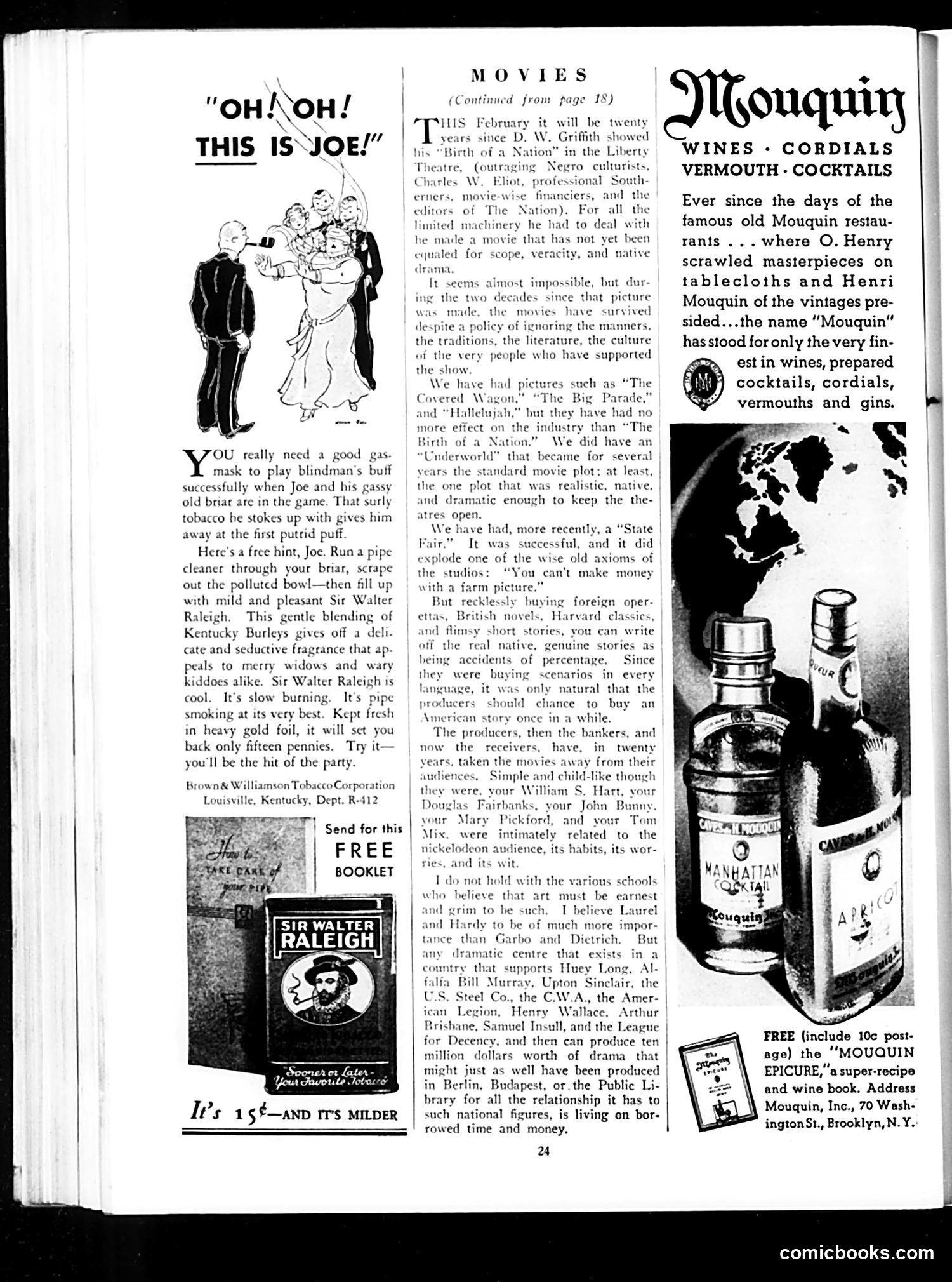
Analysis for Modern Readers This page contains two distinct elements: The Cartoon The small illustration at top left shows a blindfolded man being presented to others with the exclamation "Oh! Oh! This is Joe!" The joke relies on a practical prank: Joe's pipe tobacco is so foul-smelling that it gives away his location in a game of blindman's bluff, defeating the purpose. The Advertisement The cartoon is actually a tobacco advertisement for Sir Walter Raleigh pipe tobacco, using humor to mock a competitor's product (implied to be Joe's unpleasant brand). It promises Sir Walter Raleigh is mild, pleasant, and socially acceptable—appealing to "merry widows and wary kiddies." The accompanying text discusses early cinema and Native American representation, which appears unrelated to this page's primary content. The Mouquin wine advertisement on the right is a separate, unrelated ad. Context: This reflects early 1930s advertising tactics using social embarrassment and genteel lifestyle appeals to sell consumer products, when tobacco advertising was unregulated.
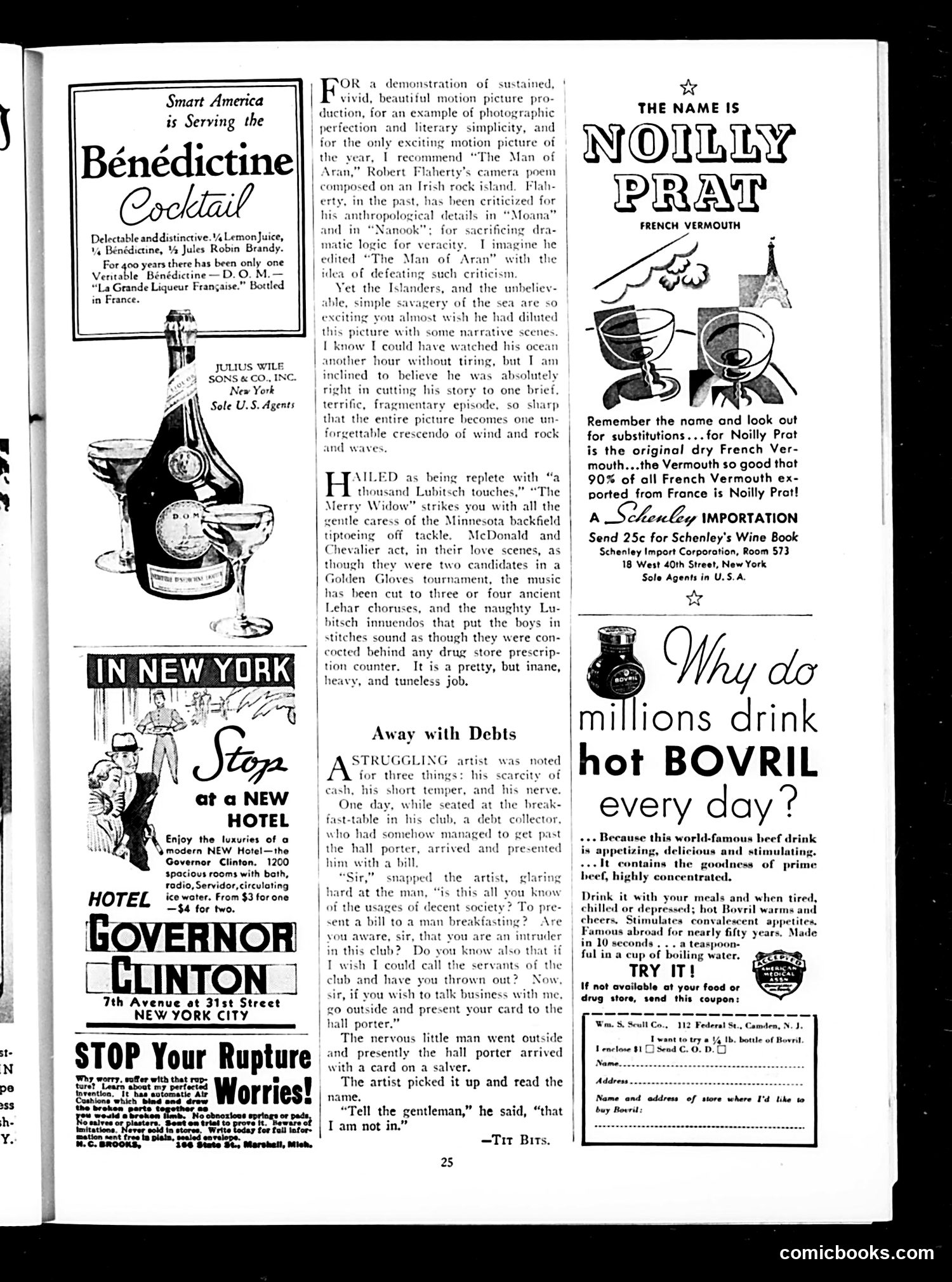
Page Analysis: Judge Magazine Advertisement and Content Page This is primarily an advertising and content page from Judge magazine, mixing editorial and commercial material typical of 1930s periodicals. Main Content: A film review discusses Robert Flaherty's documentary "The Man of Aran" and Ernst Lubitsch's "The Merry Widow," praising the former's aesthetic integrity while criticizing the latter as overly sanitized and lacking charm. The Cartoon/Anecdote ("Away with Debts"): A brief satirical story depicts an arrogant artist who humbles a debt collector by implying the collector is socially beneath club standards, then refuses to see him when approached formally. The joke mocks artistic pretension and inverts typical power dynamics—the debtor lectures the creditor about propriety. Advertising: Multiple product ads dominate the page: Bénédictine cocktail, Hotel Governor Clinton, Noilly Prat vermouth, and Bovril beef drink. These represent luxury goods and services marketed to Judge's affluent readership during the Great Depression era. The page reflects Judge's target audience: educated, upper-middle-class Americans interested in arts criticism and consumer goods.
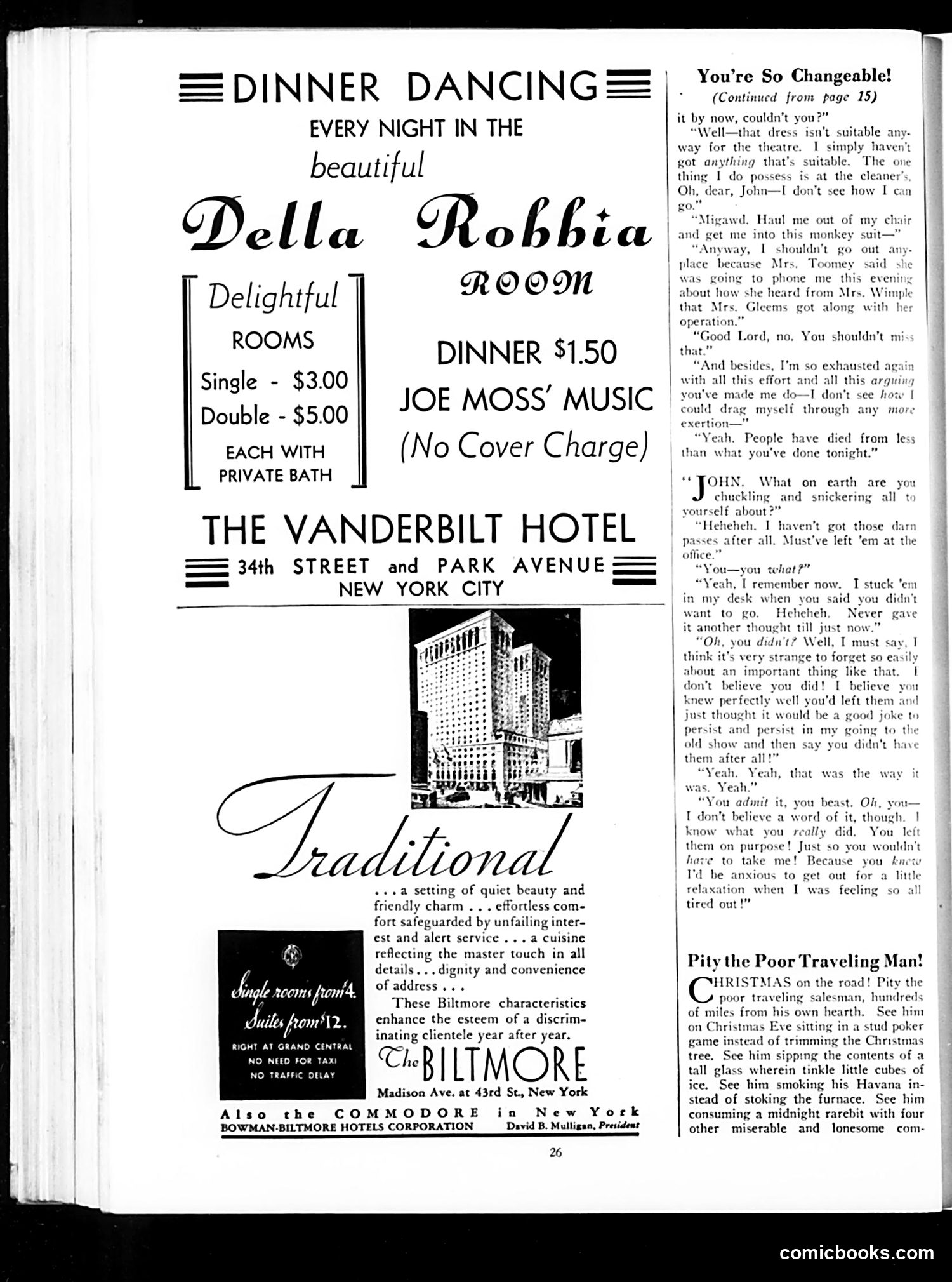
Analysis: Judge Magazine Page 26 This page is primarily advertising, not political satire. It features hotel and restaurant advertisements for Manhattan establishments (The Vanderbilt Hotel, The Biltmore) promoting dinner-dancing, rooms, and dining services—typical luxury hospitality marketing from what appears to be the 1920s-30s era. The right column contains a domestic comedy sketch titled "You're So Changeable!" depicting a married couple arguing about evening plans. The wife accuses the husband of deliberately hiding theater passes to manipulate her into staying home, illustrating marital miscommunication and nagging—a common source of humor in period magazines. At the bottom, "Pity the Poor Traveling Man" is a sentimental piece contrasting the lonely Christmas Eve of a traveling salesman (playing poker, drinking, smoking alone) with the domestic warmth he's missing at home—reflecting early-20th-century attitudes about male work obligations versus family duty. The page reflects period entertainment venues, gender dynamics, and class consciousness rather than political commentary.
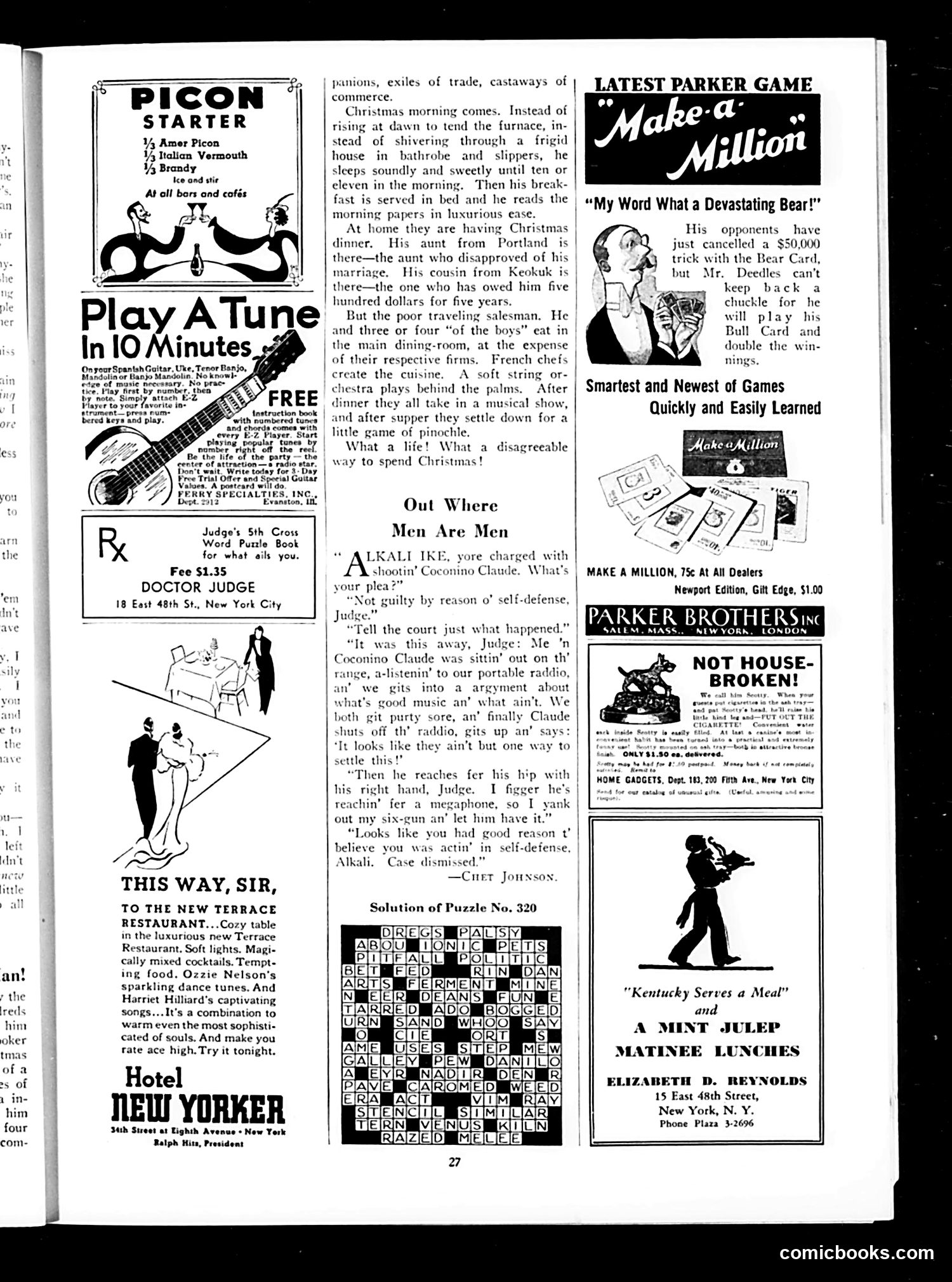
Analysis for Modern Readers This page is primarily advertising and puzzles from Judge magazine, with one substantive cartoon/story. The main content is a humorous short story titled "Out Where Men Are Men" by Chet Johnson. It's a Western parody featuring a character named Alkali Ike and "Coconino Claude" in a absurdist scenario: they argue over music on a portable radio, escalate to drawing guns, and Alkali shoots Claude in self-defense—over *radio preferences*. The judge dismisses the case, treating frontier gun violence as acceptable dispute resolution. The satire mocks: - Rural/frontier masculinity as comically violent and hair-triggered - Radio culture (then-modern technology) intruding incongruously into Wild West settings - Casual lethal violence normalized in masculine spaces The rest of the page consists of advertisements (cocktails, restaurants, games, musical instruction) and a crossword puzzle solution—typical magazine filler of the era.
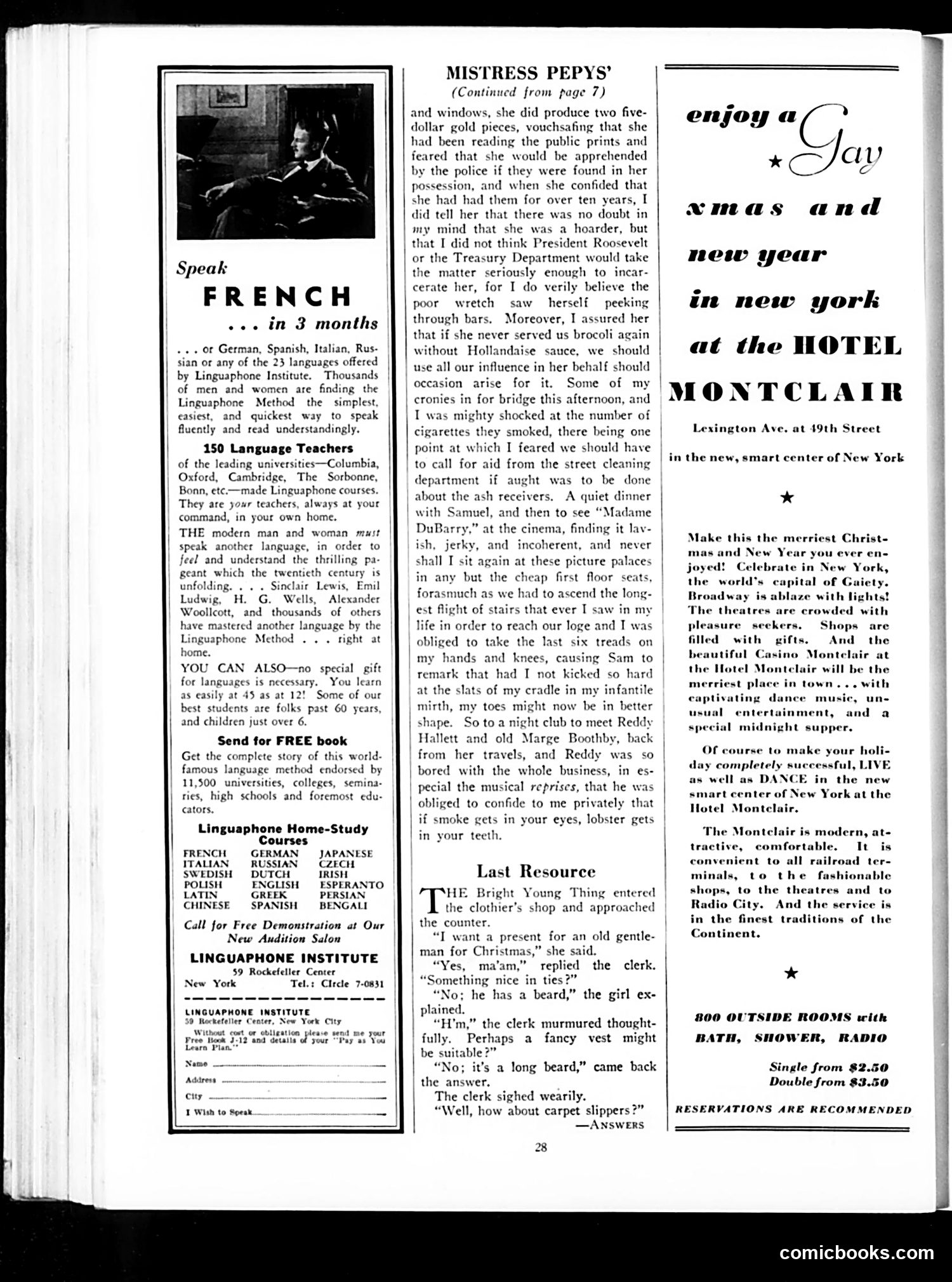
Analysis of This Judge Magazine Page This page is primarily advertising and serialized fiction, not political satire. The main content is a continuation of "Mistress Pepys'" — a humorous diary-style column mimicking Samuel Pepys' famous 17th-century diary. The narrator describes mundane 1920s-30s social life: encountering a woman hoarding gold coins (possibly referencing Depression-era anxiety), attending a night club, seeing a film, and complaining about cigarette smoke and lobster getting in teeth at restaurants. The satire is mild social commentary rather than political: it gently mocks upper-class behavior, excessive smoking, inferior cinema, and restaurant experiences. References to "President Roosevelt" and "Treasury Department" suggest concern about currency hoarding—topical anxiety but not sharp partisan critique. The bulk of the page features Linguaphone Institute advertising for language-learning courses, promising fluency in three months through their method. The content reflects 1920s-30s affluent leisure culture and consumer advertising, not hard political satire.
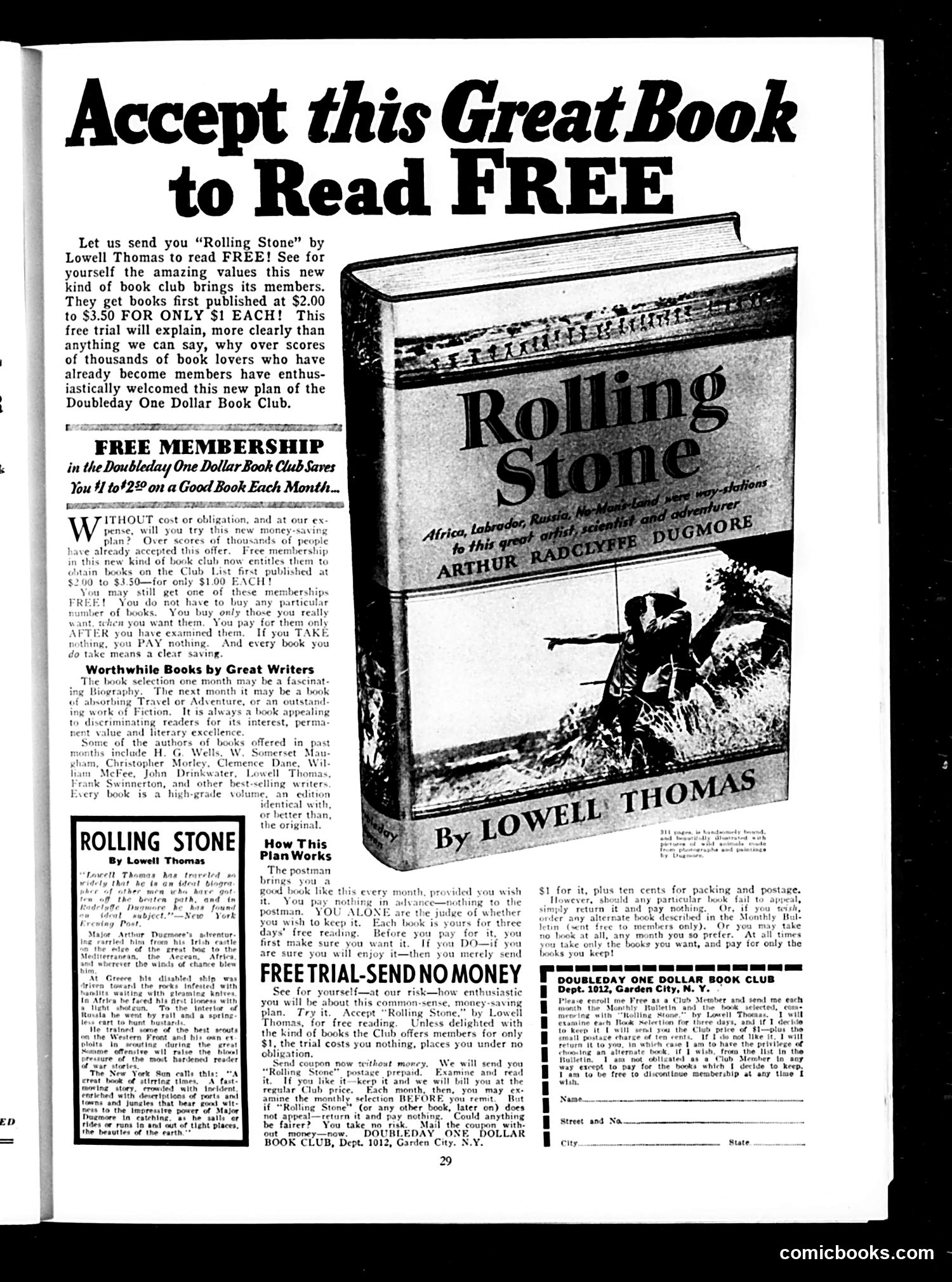
Advertisement, Not Satire This page is primarily a book club advertisement, not political satire or commentary. It promotes the Doubleday One Dollar Book Club's offer of a free copy of "Rolling Stone" by Lowell Thomas to new members. The pitch emphasizes the club's value proposition: members receive newly published books (normally $2-3.50) for only $1 each, with a free trial period and no obligation to purchase. The advertisement stresses consumer benefits—examining books before paying, returning unwanted selections, and guaranteed savings. "Rolling Stone" was a legitimate travel narrative by the well-known broadcaster and adventurer Lowell Thomas, featuring accounts of exotic locations. The book cover image shows dramatic imagery consistent with adventure/travel literature marketing of the era. This represents straightforward Depression-era consumer marketing emphasizing affordability and risk-free purchasing—common strategies when discretionary spending was constrained.
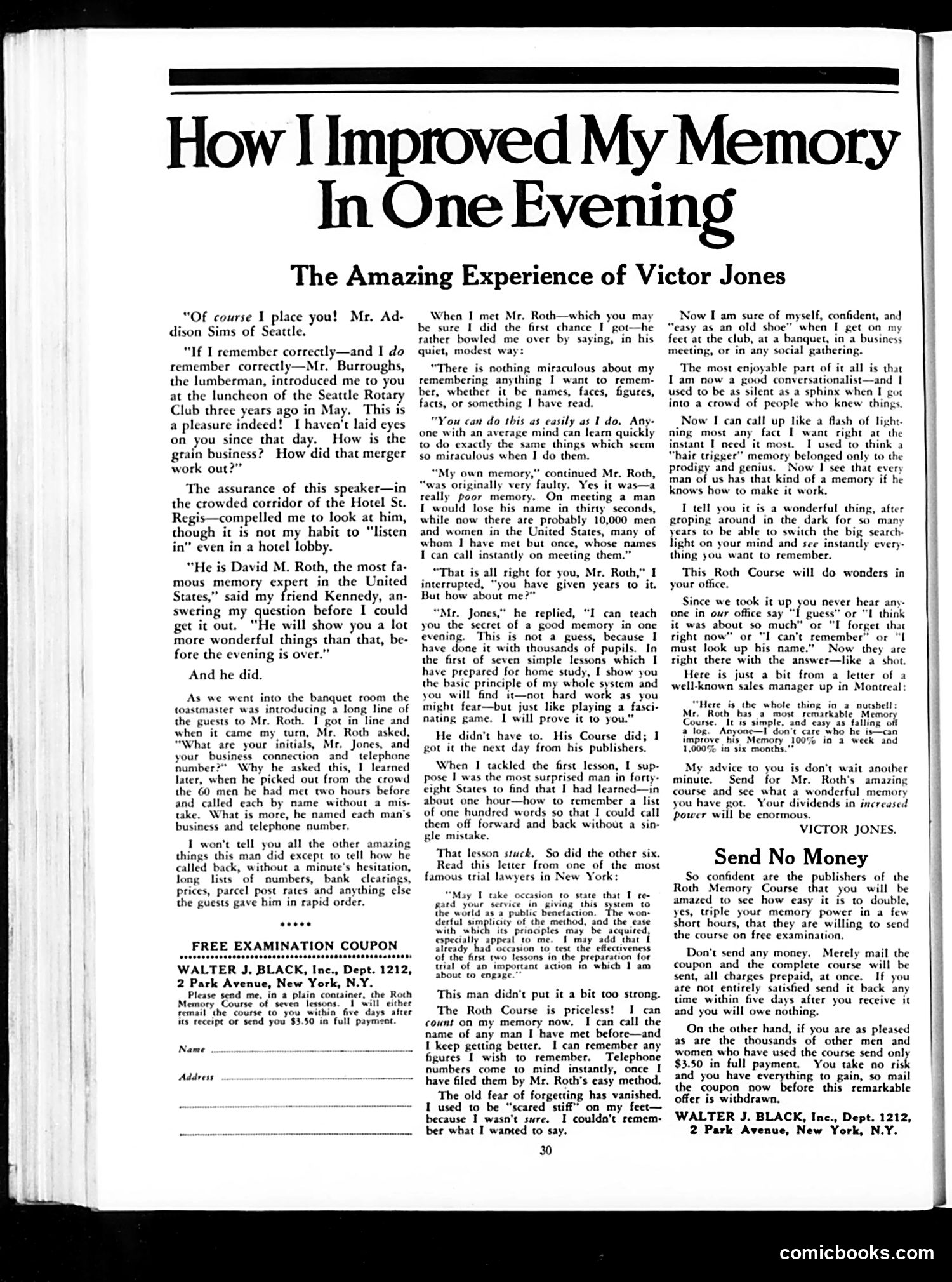
What This Page Means This is not a cartoon or satire, but rather a testimonial advertisement for the "Roth Memory Course," disguised as editorial content in Judge magazine. The page features a first-person account by "Victor Jones" describing how memory expert David M. Roth amazed guests at a banquet by remembering their names, businesses, and phone numbers after meeting them briefly. The narrative builds credibility by including specific details and dialogue, then pivots to Roth's claim that *anyone* can learn his memory system in one evening through a seven-lesson home study course. The "FREE EXAMINATION COUPON" at the bottom reveals the true purpose: soliciting mail orders for the course. This was a common advertising format of the era—presenting product testimonials as magazine articles to appear more credible than traditional ads. For modern readers, this represents early native advertising: promotional content designed to look like genuine editorial material.
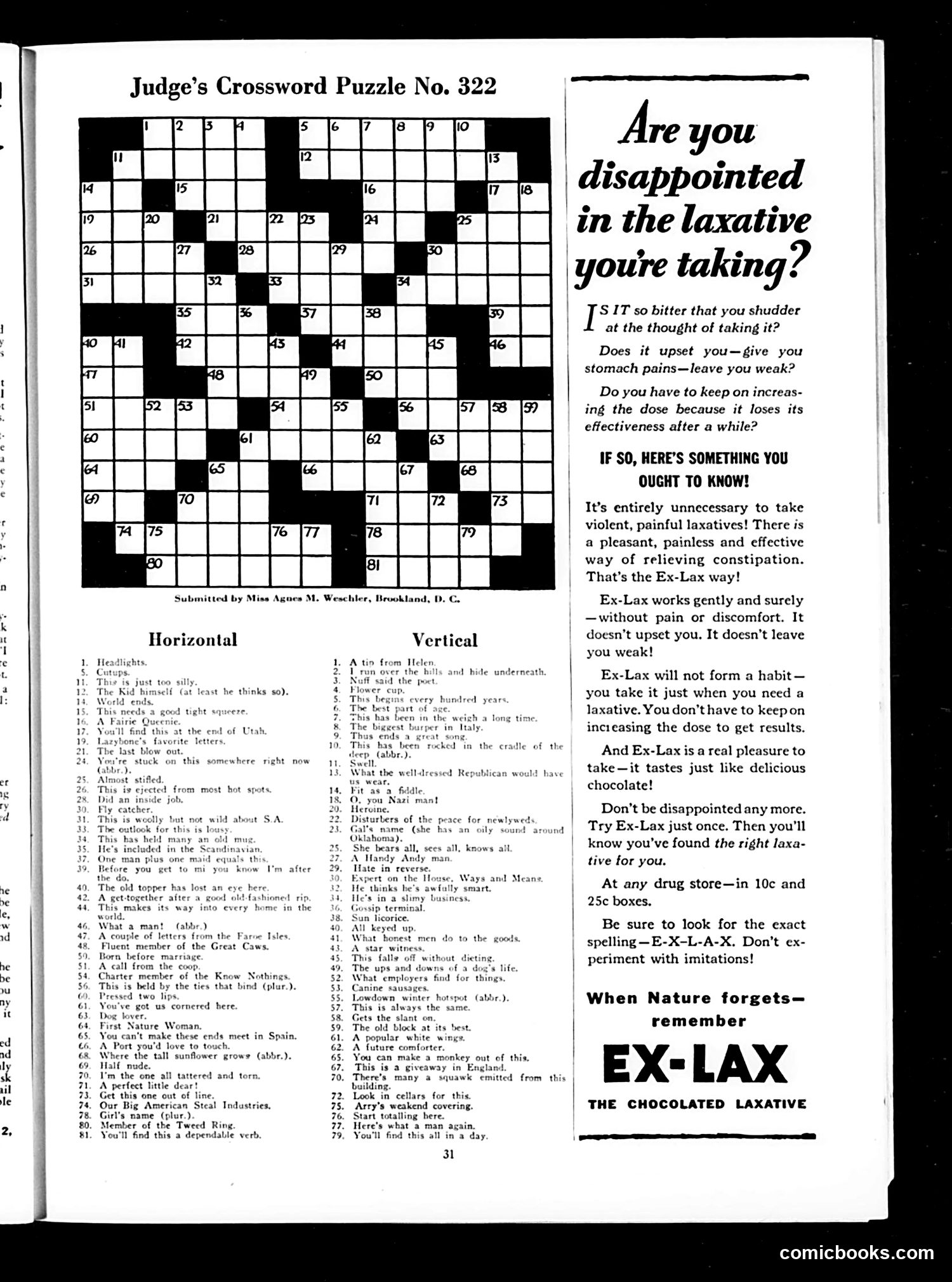
Judge Magazine Page No. 322 Analysis This page contains a crossword puzzle and a full-page advertisement for Ex-Lax laxative. The Advertisement's Social Commentary: The ad addresses a common consumer complaint of the era—that existing laxatives were harsh, bitter, and required increasing doses. Rather than satirizing politicians or social figures, this advertisement targets consumer anxiety about bodily functions and ineffective remedies. The ad's rhetorical strategy appeals to modern sensibilities by promising a "pleasant, painless" alternative to "violent, painful laxatives," suggesting consumers shouldn't suffer needlessly. The emphasis that Ex-Lax "doesn't form a habit" and "tastes just like delicious chocolate" positions it as a rational, superior choice. Historical Context: This represents Judge's reliance on advertising revenue and how commercial messaging infiltrated satirical publications. The laxative industry was heavily advertised in early-20th-century American media, reflecting both genuine digestive concerns and aggressive marketing capitalizing on bodily embarrassment. The page demonstrates that even satirical magazines blended editorial content with straightforward product promotion.
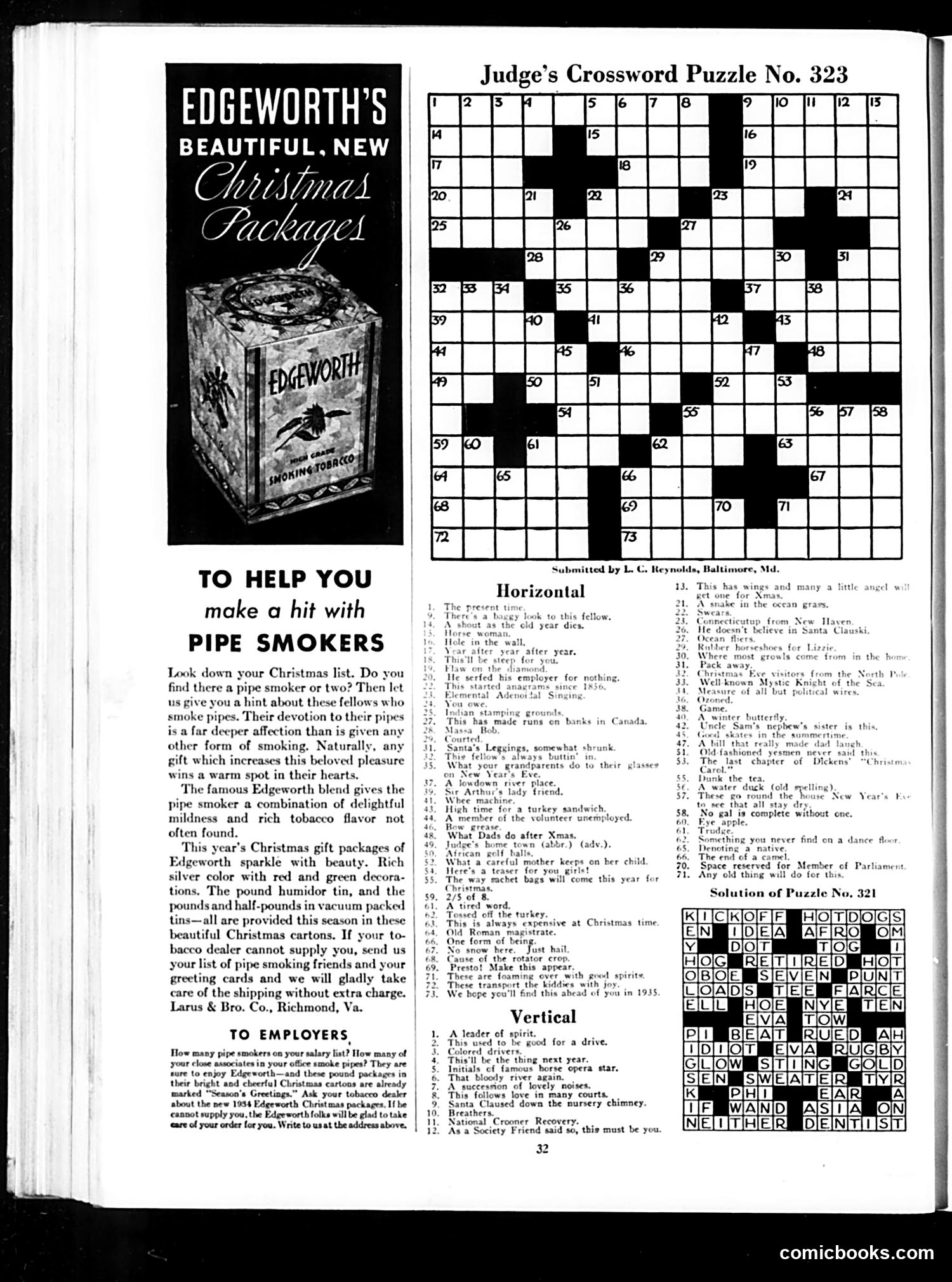
Judge Magazine Page Analysis This page is primarily an advertisement, not a political cartoon. It promotes Edgeworth pipe tobacco as a Christmas gift, featuring a full-page ad with an illustration of the product's decorative packaging. The layout includes a crossword puzzle (unrelated to the ad) and marketing copy directed at both individual consumers and employers. The advertising pitch emphasizes that pipe smoking represents a "deeper affection" than other tobacco forms, making Edgeworth an ideal gift choice. The ad highlights the product's "beautiful Christmas cartons" in "rich silver color with red and green decorations" and mentions 1934 as the current year. There's also a corporate angle: employers are encouraged to purchase Edgeworth for their pipe-smoking staff as gifts. The satire or social commentary, if any, is subtle—the implicit message that executives should reward loyal employees with premium tobacco reflects 1930s business culture and smoking's then-universal social acceptance among professional men.
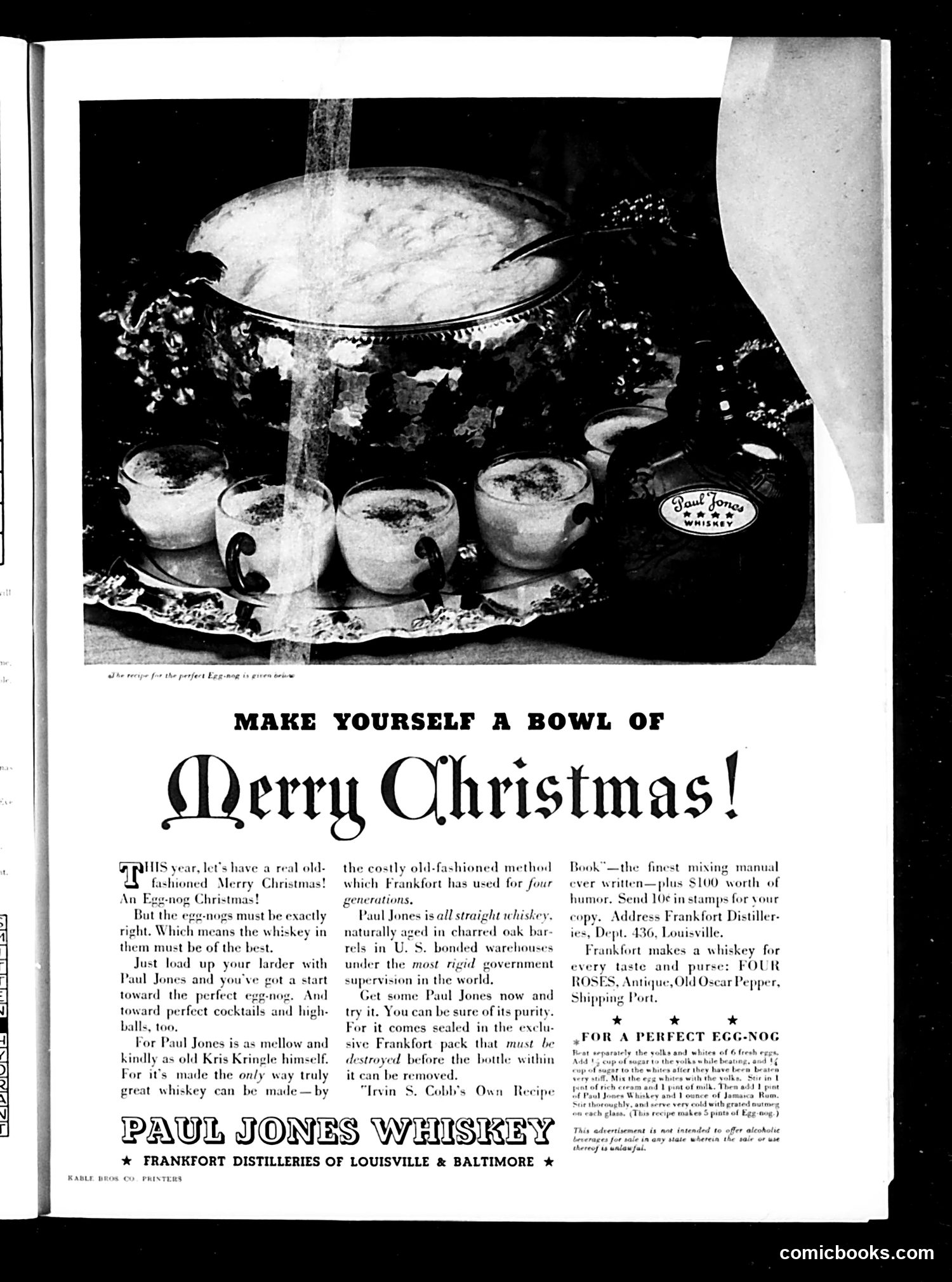
Analysis This is primarily a whiskey advertisement, not a political cartoon. It appeared in *Judge* magazine, likely during the Prohibition era or just before it (the ad's emphasis on purity and government oversight suggests early 20th century). The ad uses a nostalgic "old-fashioned Christmas" appeal to sell Paul Jones whiskey by positioning it as an essential ingredient for holiday egg-nog and cocktails. The image shows an elaborate punch bowl with cups, presented as a festive centerpiece. Key selling points highlighted: - The whiskey's "old-fashioned method" of production - Government supervision and purity (likely a response to concerns about bootleg liquor) - Brand prestige through association with writer Irvin S. Cobb - Premium positioning ("FOUR ROSES," "Old Oscar Pepper") The satire here is gentle—mocking the formality of "perfect" holiday drinking rather than targeting any political figure. The Kris Kringle comparison adds whimsy. This represents pre-Prohibition American consumer culture where whiskey advertising was mainstream in major publications.
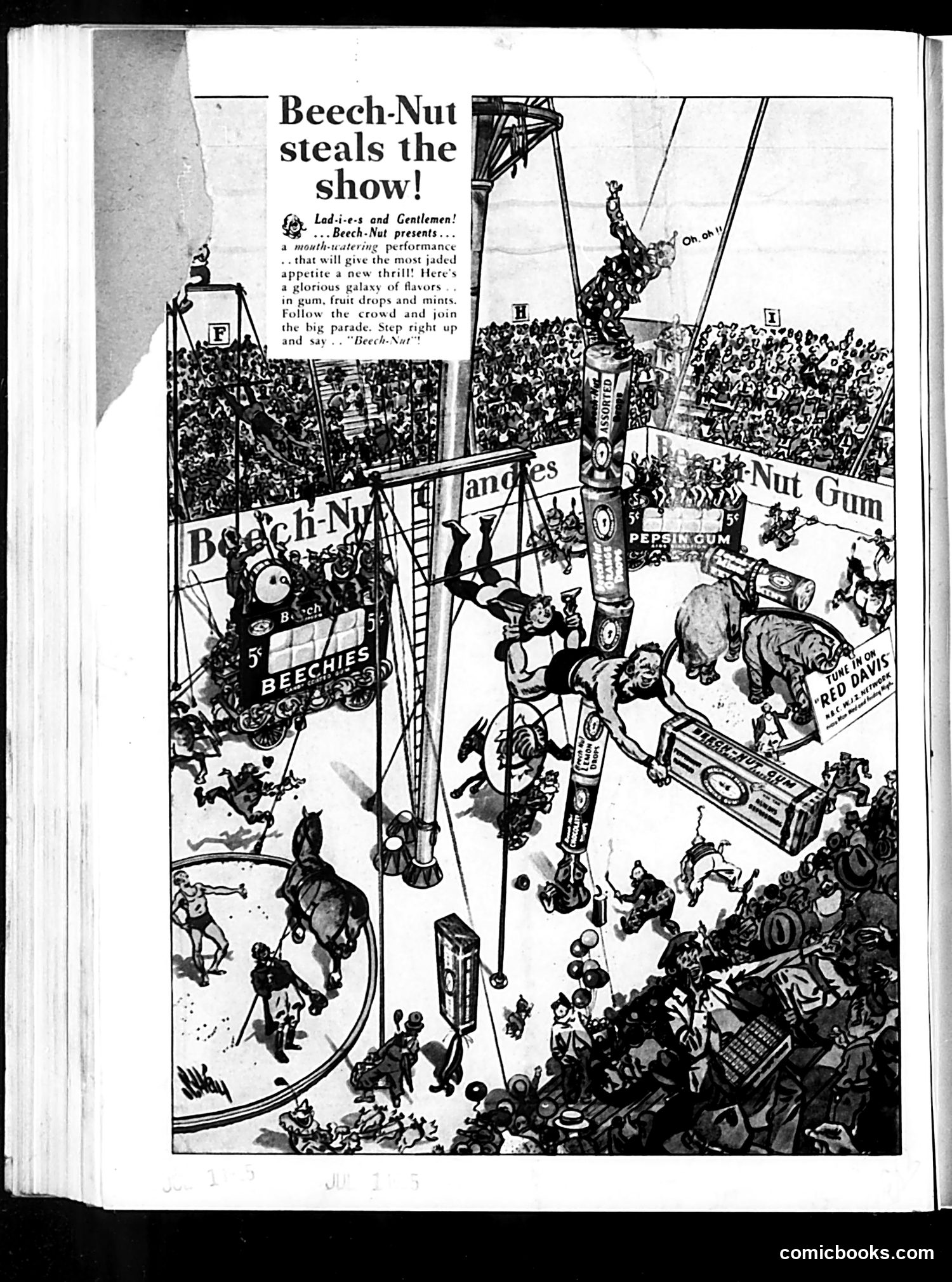
Analysis This is primarily a Beech-Nut candy advertisement disguised as editorial content, not political satire. The page depicts a carnival or circus scene with crowds, acrobats, and performers to promote Beech-Nut gum, fruit drops, and mints as the main attraction ("steals the show"). The illustration uses circus imagery—trapeze artists, crowds, a carousel-like structure—to create excitement and spectacle around the candy brand. Other products visible (Pepsik Gum, Red Davis) appear as secondary carnival elements. This represents early 20th-century advertising strategy: using elaborate, entertaining illustrations and showman's language ("Ladies and Gentlemen," "Step right up") to make mundane consumer products seem thrilling and desirable to readers. The "parade" and crowd dynamics suggest mass appeal and social conformity as selling points.

I can see this is a blank or nearly blank page from what appears to be a Judge magazine issue, based on the "comicbooks.com" watermark visible at the bottom. The page itself contains no discernible cartoon, illustration, text content, or satirical material that I can analyze. Without visible content—whether political cartoons, advertisements, articles, or other material typically found in Judge—I cannot identify any figures, caricatures, political/social references, or satirical points. This appears to be either a blank page, a scanning error, or an endsheet from the publication. To provide meaningful historical analysis, I would need a page with actual visible content.