judge
Judge — January 1935
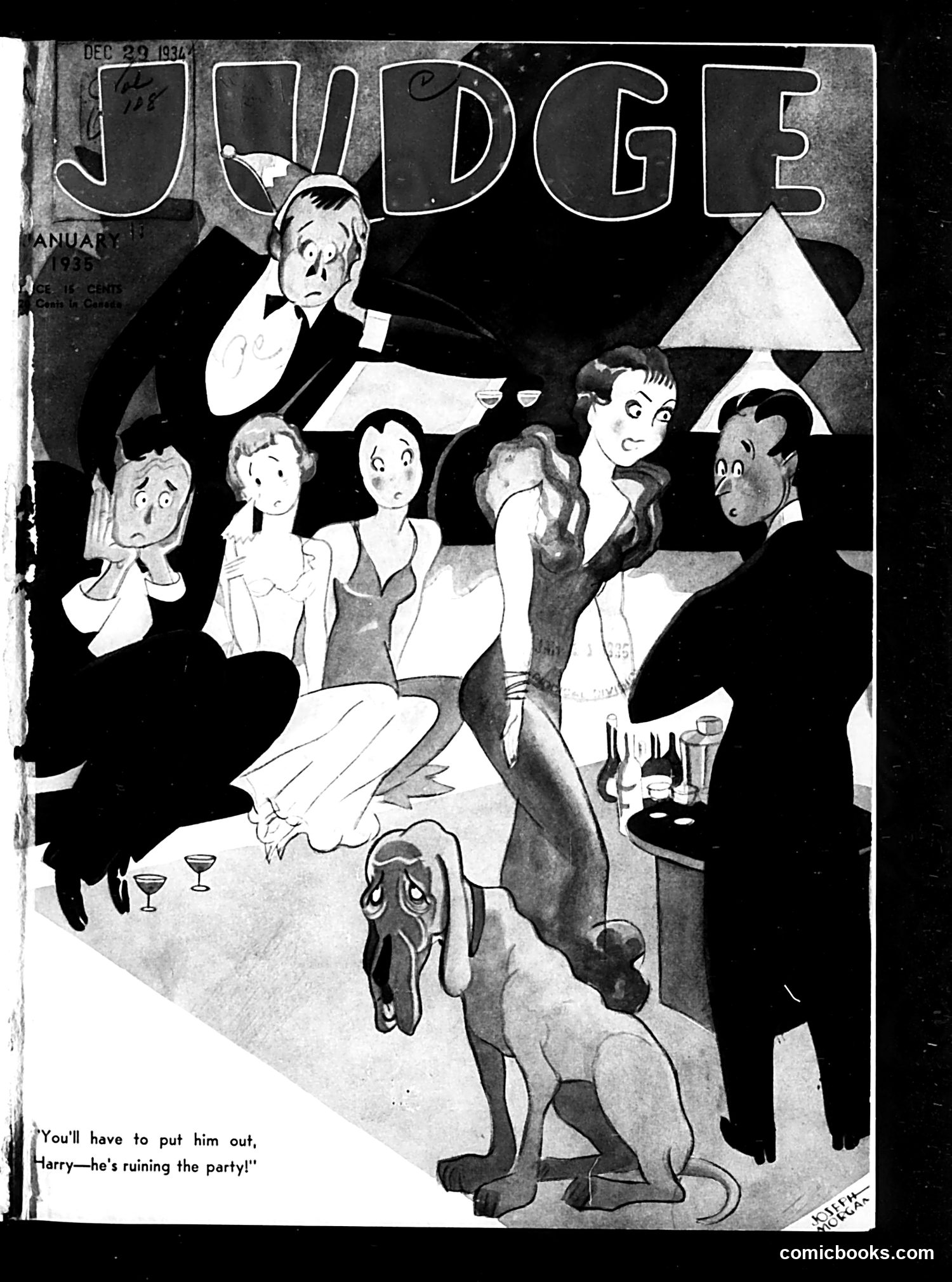
Analysis This is a *Judge* magazine cover from January 1935 depicting a sophisticated party scene disrupted by a misbehaving dog. The caption reads: "You'll have to put him out, Harry—he's ruining the party!" The satire appears to be social commentary on an unwanted guest or disruptive element at an upper-class gathering. The well-dressed partygoers and formal setting suggest the target is likely a political or social figure of 1935 whose presence was considered undesirable or embarrassing to polite society. Without additional context identifying who "Harry" or the dog represent specifically, the precise political reference remains unclear. However, the joke's structure—an uncouth interloper destroying decorum—was common satirical fodder in 1930s American magazines.
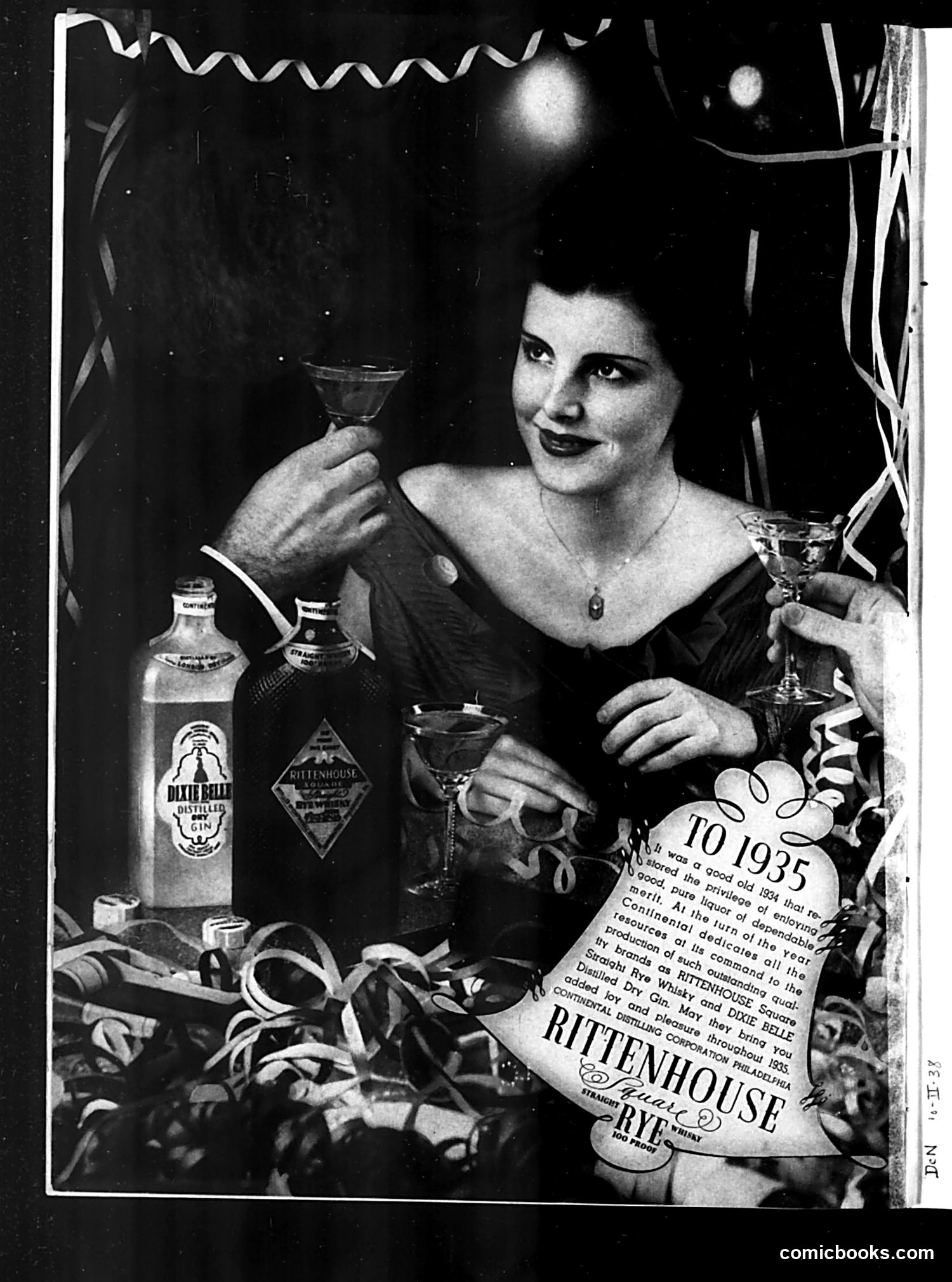
Analysis This appears to be a liquor advertisement, not political satire. The page promotes Rittenhouse Rye whiskey, dated "TO 1935," featuring an elegantly dressed woman holding cocktail glasses surrounded by bottles of spirits (Dixie Hill and Rittenhouse brands visible). The text references Rittenhouse's history since 1824 and describes the whiskey's qualities. The decorative elements—ribbons, cocktail glasses, and festive styling—suggest this ran during the Prohibition repeal era (alcohol became legal again in 1933). The advertisement targets affluent consumers, portraying sophisticated social drinking as aspirational. Rather than satire, this reflects post-Prohibition marketing normalizing alcohol consumption in upscale social settings.
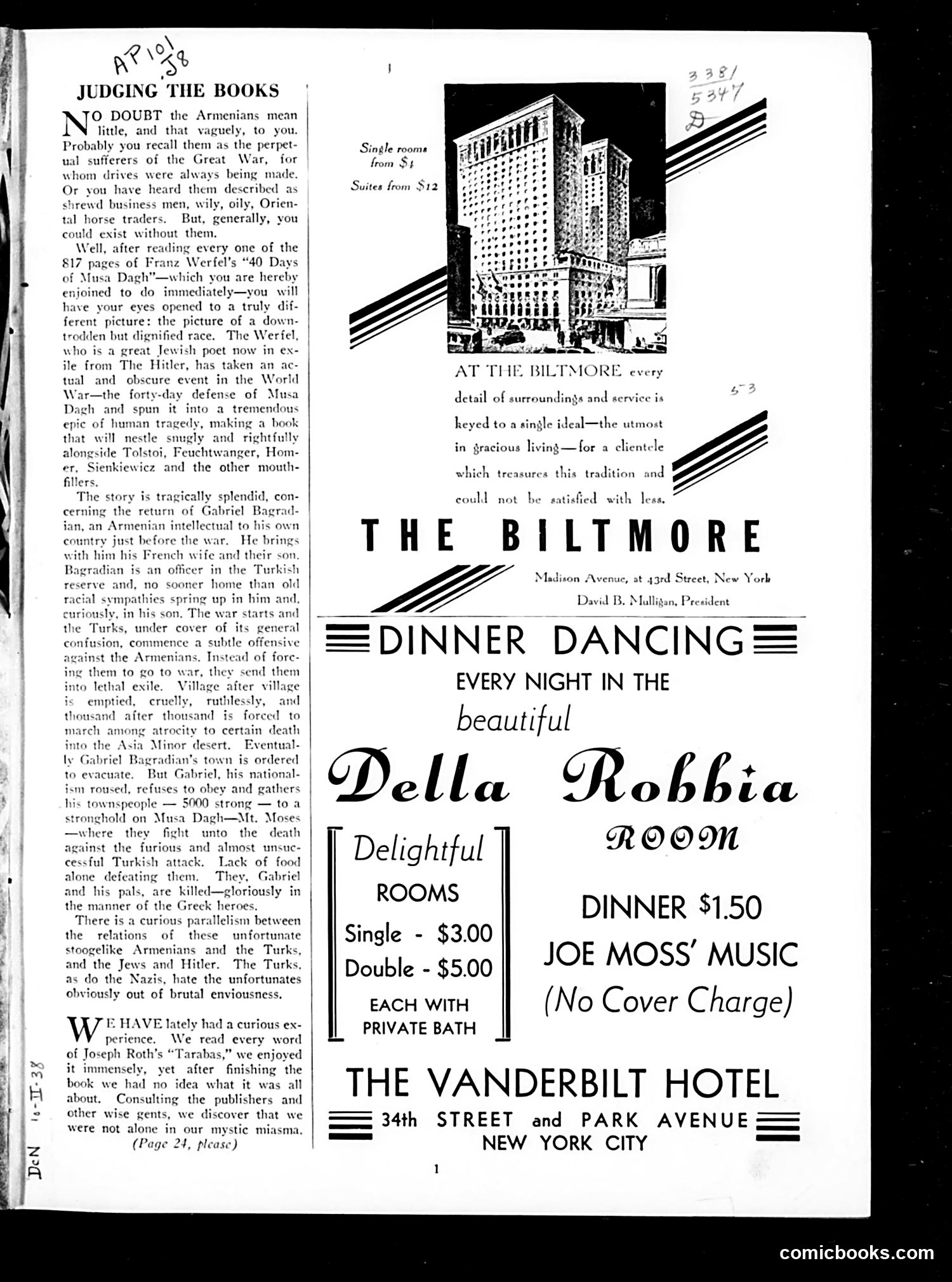
Analysis This page is primarily advertising, not satire or political commentary. The left column contains a book review titled "JUDGING THE BOOKS" discussing Franz Werfel's "40 Days of Musa Dagh," a novel about Armenian suffering during WWI and conflict with Turks. The right side features hotel and restaurant advertisements for The Biltmore and The Vanderbilt Hotel in New York City, promoting amenities like dining, dancing in the "Della Robbia Room," and room rates ($3-$5 for single/double rooms). There is no political cartoon visible on this page. The only illustration is an architectural drawing of The Biltmore building. The content mixes literary criticism with period hospitality advertising typical of Judge magazine's revenue model.
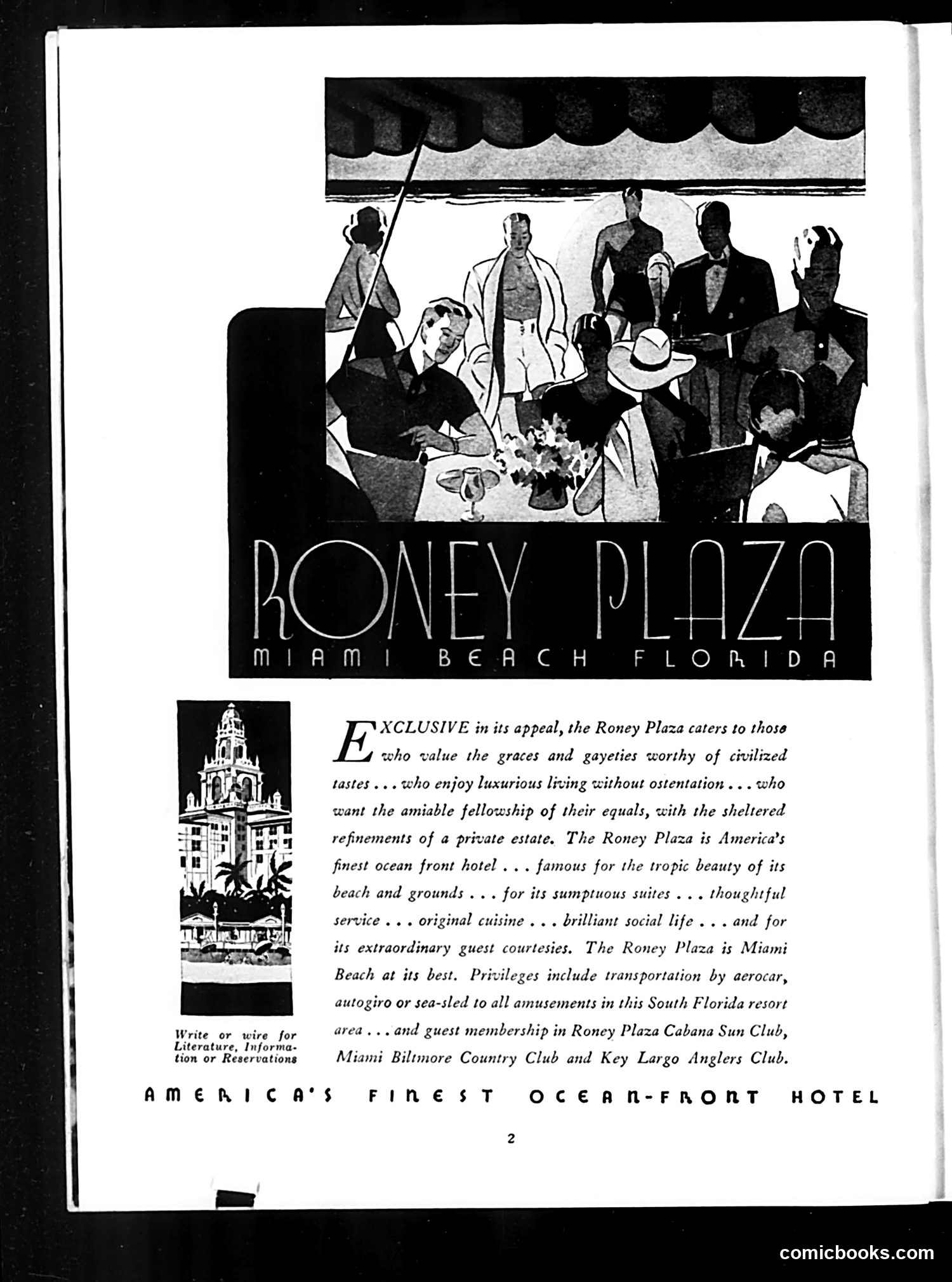
Analysis This page is primarily advertising, not satire or editorial content. It's a full-page advertisement for the Roney Plaza Hotel in Miami Beach, Florida, presented as an upscale resort destination. The illustration depicts well-dressed people socializing under a striped awning—representing the hotel's exclusive clientele and leisure atmosphere. The accompanying text emphasizes luxury amenities: ocean views, suites, fine dining, social activities, and guest privileges at country clubs. The ad positions the Roney Plaza as "America's finest ocean-front hotel," appealing to wealthy patrons seeking refined vacation experiences. This reflects the 1920s-1930s Florida real estate boom and Miami Beach's emergence as a prestigious destination for the affluent. No political satire or caricature is present—this is straightforward luxury marketing.
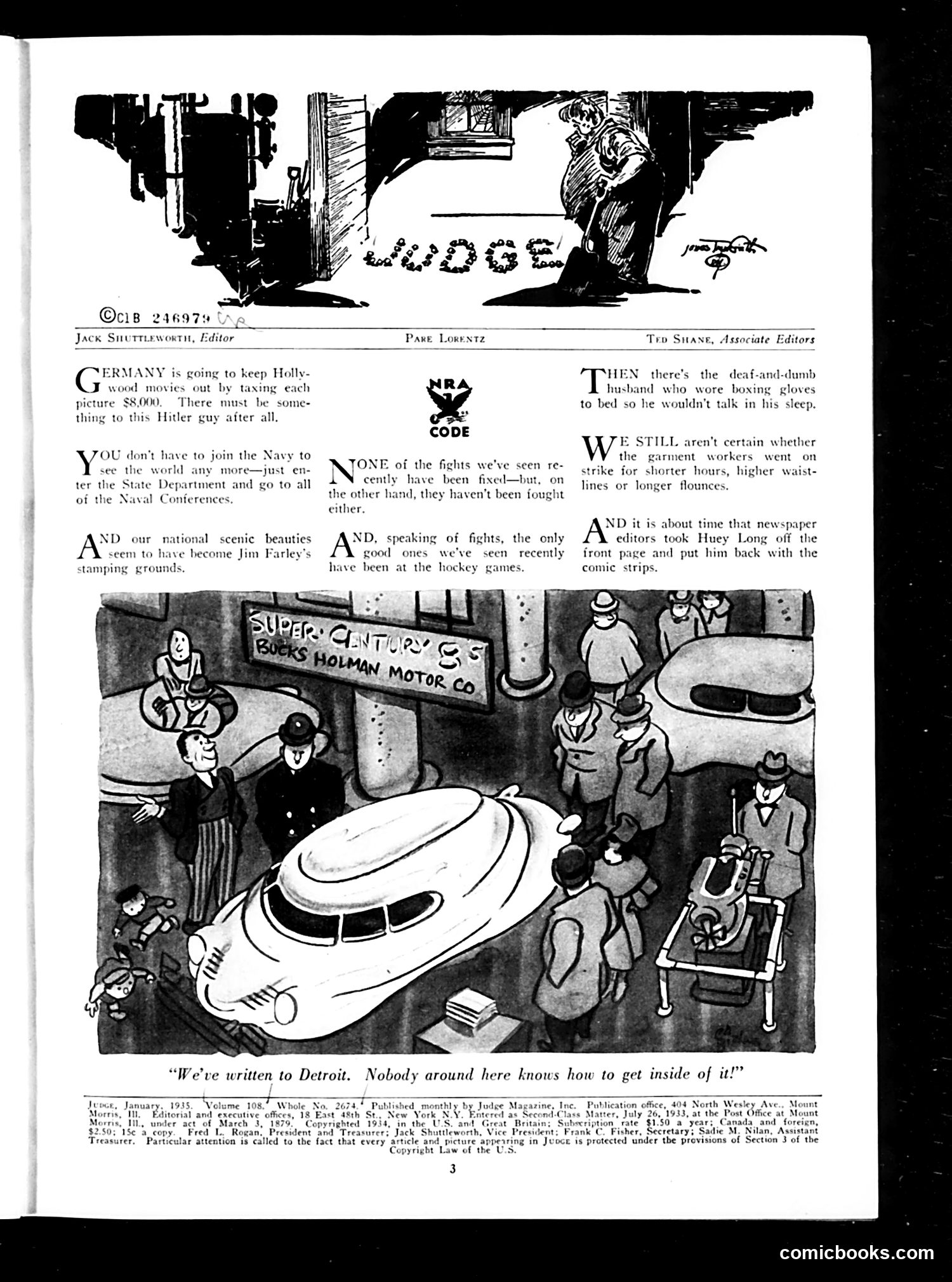
Judge Magazine Political Satire Page Analysis This 1935 Judge page contains editorial commentary on contemporary issues. The opening paragraph references Germany keeping Hollywood pictures under $8,000 budgets—likely commenting on Nazi economic controls on film. The main cartoon depicts a futuristic, UFO-like vehicle on a Detroit street, captioned "We've written to Detroit. Nobody around here knows how to get inside of it!" This satirizes advanced automotive design becoming so complex that ordinary mechanics cannot repair vehicles. The Bucks-Holman Motor Co. sign visible in the scene appears to reference actual automotive companies, making this a jab at Detroit's automotive industry for over-engineering consumer vehicles. Other brief editorial items discuss naval conferences, hockey fights, and newspaper comic strips, typical of Judge's humorous social commentary.
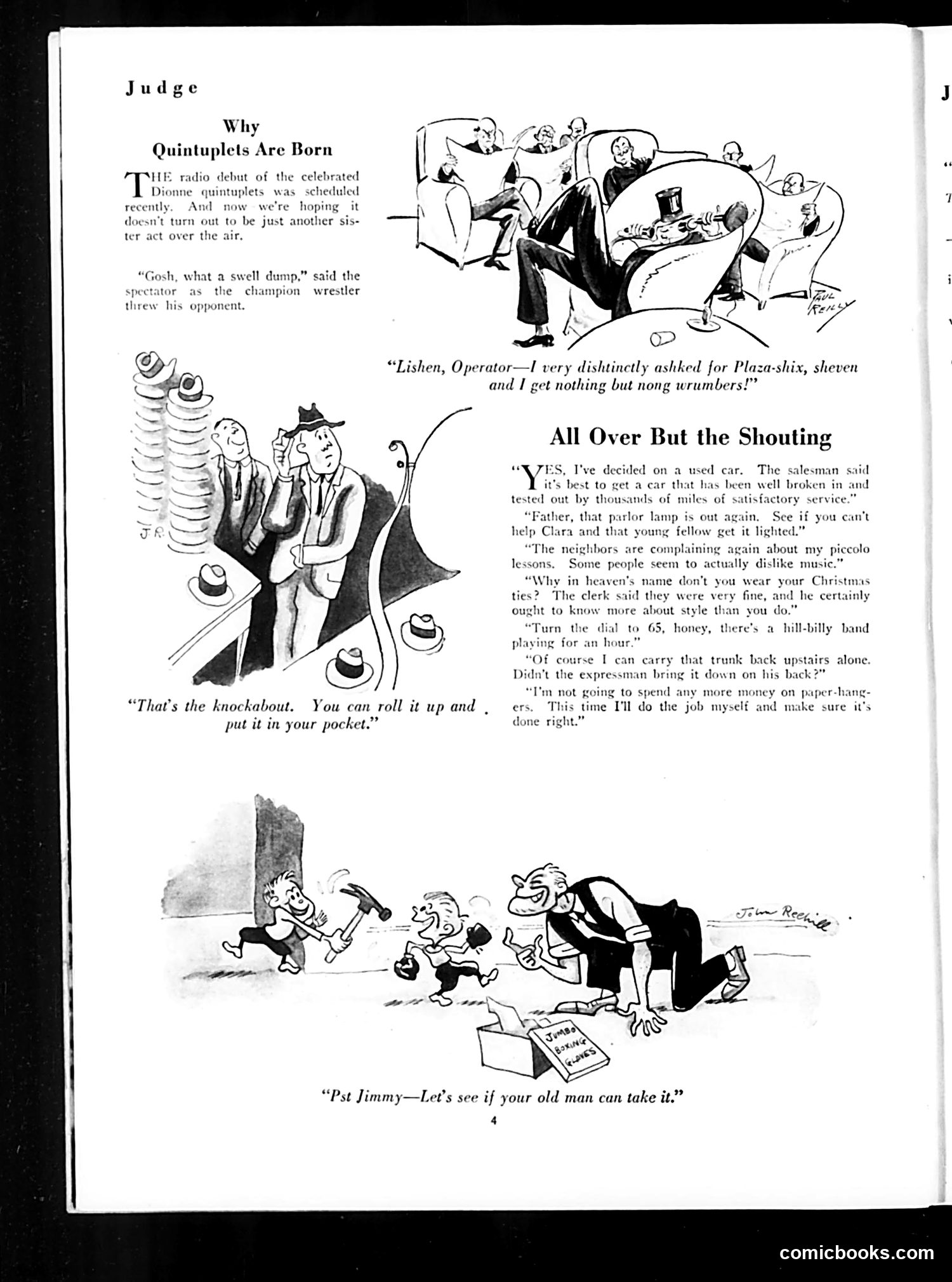
Analysis of Judge Page 4 This page contains three separate humorous sketches satirizing domestic life and consumer culture, likely from the 1920s-30s based on the style. "Why Quintuplets Are Born" mocks radio entertainment's overwhelming presence in homes—a judge/authority figure literally drowns in radio broadcasts while overwhelmed citizens listen helplessly. "All Over But the Shouting" satirizes married life: a husband complains about constant domestic problems (broken furniture, neighbor complaints, piano lessons, car maintenance) while claiming he'll "do the job myself" to save money—a common empty promise. "Pst Jimmy" shows children convincing their friend to hit their father with a hammer, apparently testing parental toughness. It's crude slapstick humor typical of the era's comic sensibility. All three target anxieties about modern domesticity, advertising saturation, and family dysfunction.
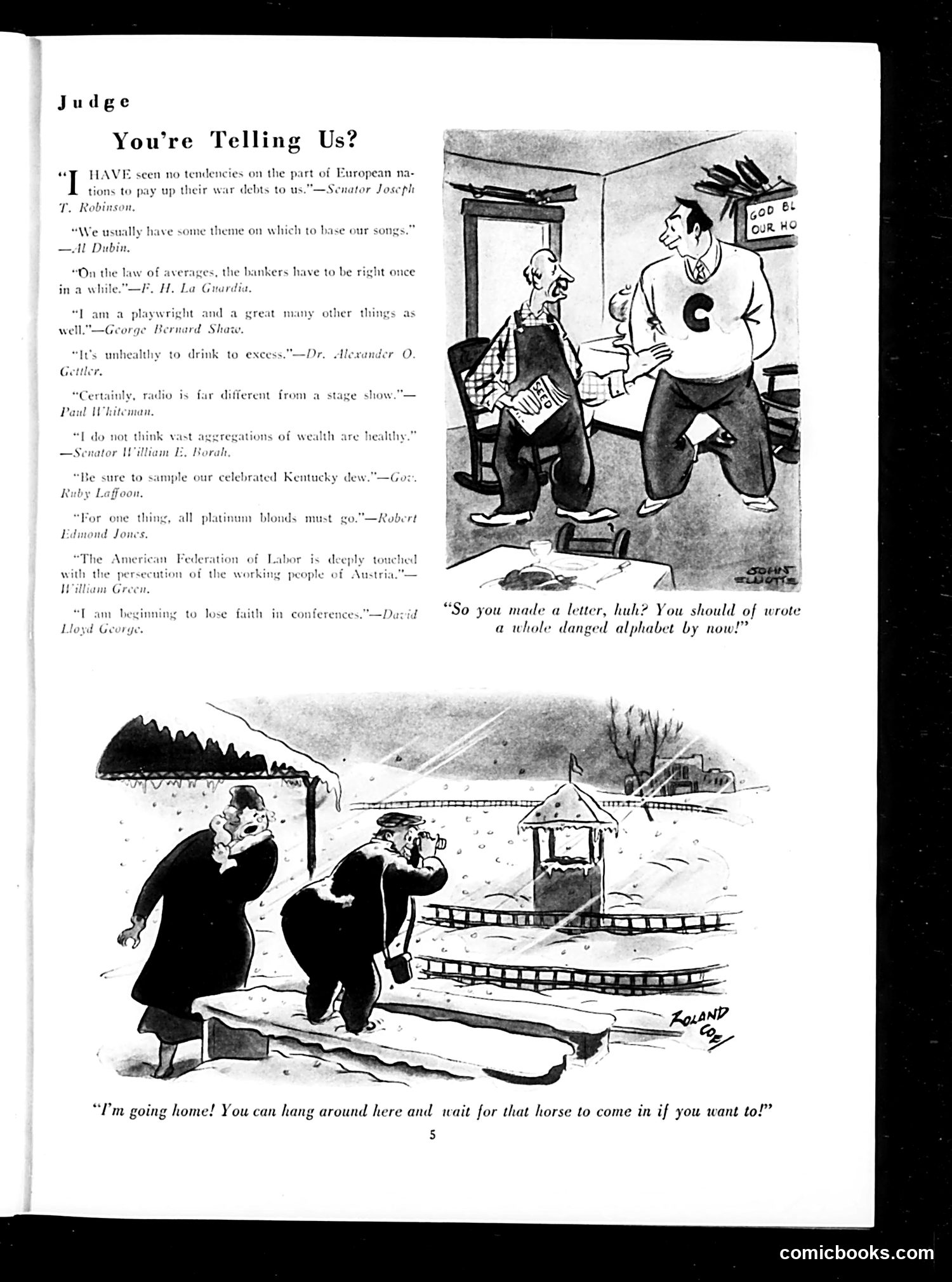
Analysis of Judge Page This page contains two cartoons satirizing contemporary figures and situations. Top cartoon: Shows a man wearing a "C" (likely representing a sports team or organization) confronted by someone holding what appears to be a letter. The caption jokes that writing one letter should have led to writing "a whole danged alphabet by now"—likely satirizing prolific correspondence or complaints from a public figure. Bottom cartoon: Two men in winter clothing discuss a horse. One says he's leaving and the other can "wait for that horse to come in if you want to"—a common idiom meaning waiting for something unlikely or impossible to happen. This appears to be general satirical humor about futile waiting rather than specific political commentary. The page also includes various unrelated quotes from political figures and celebrities at the top.
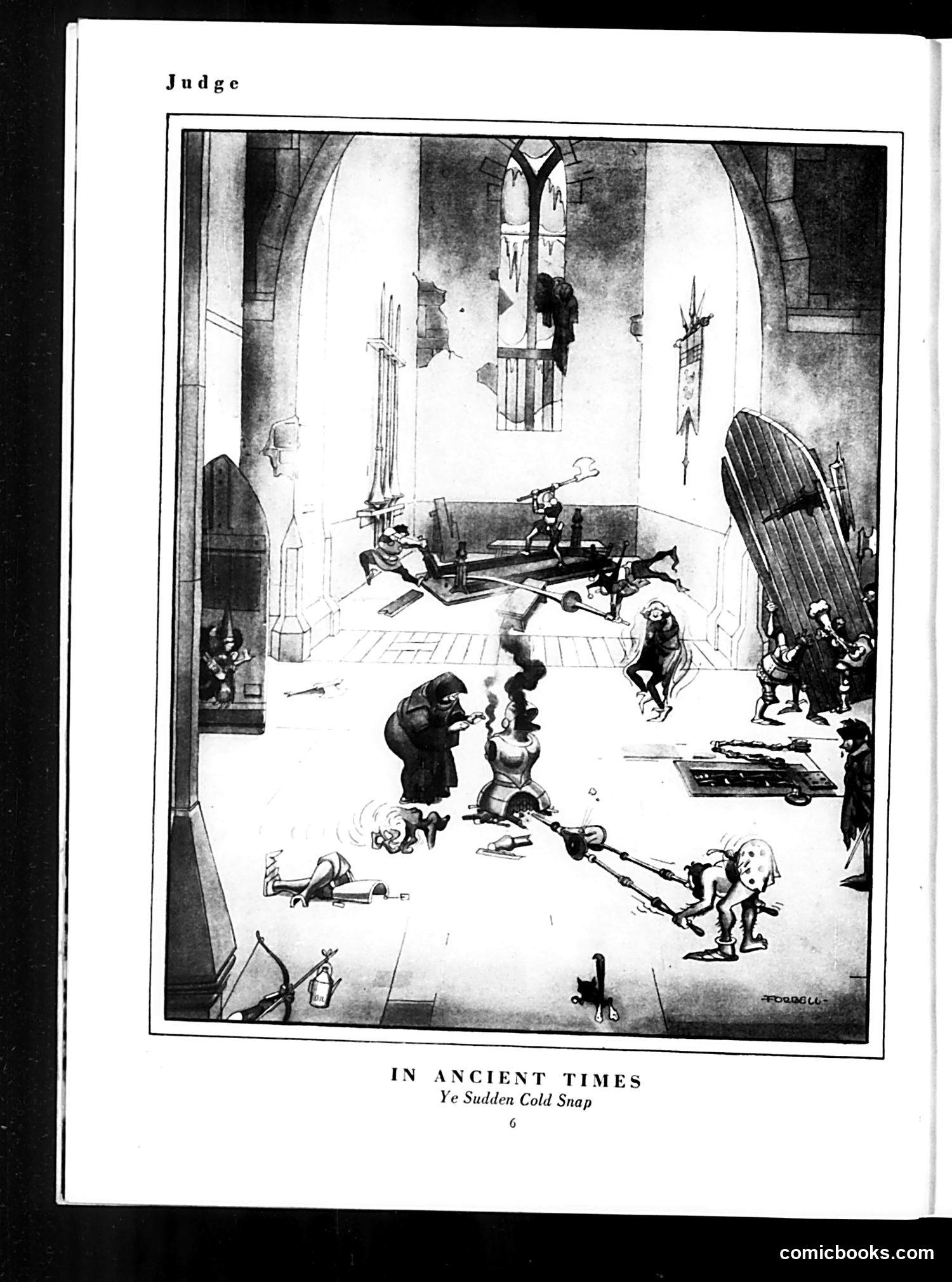
"In Ancient Times: Ye Sudden Cold Snap" This Judge cartoon satirizes judicial proceedings as chaotic circus. The title suggests a humorous comparison between ancient courtroom justice and modern disorder. The scene depicts a cathedral-like courtroom where a judge presides over bedlam: figures are sprawled on the floor, children appear to be playing or fighting, various people gesture wildly, and the proceedings seem completely uncontrolled. The satire targets the incompetence or circus-like nature of contemporary courts—suggesting that American judicial systems, despite claims of orderly tradition, have devolved into undignified chaos. The "sudden cold snap" subtitle may reference an excuse offered for this disorder, mocking how external factors are blamed for systemic failures. The overall message critiques the dignity and functionality of the legal system.
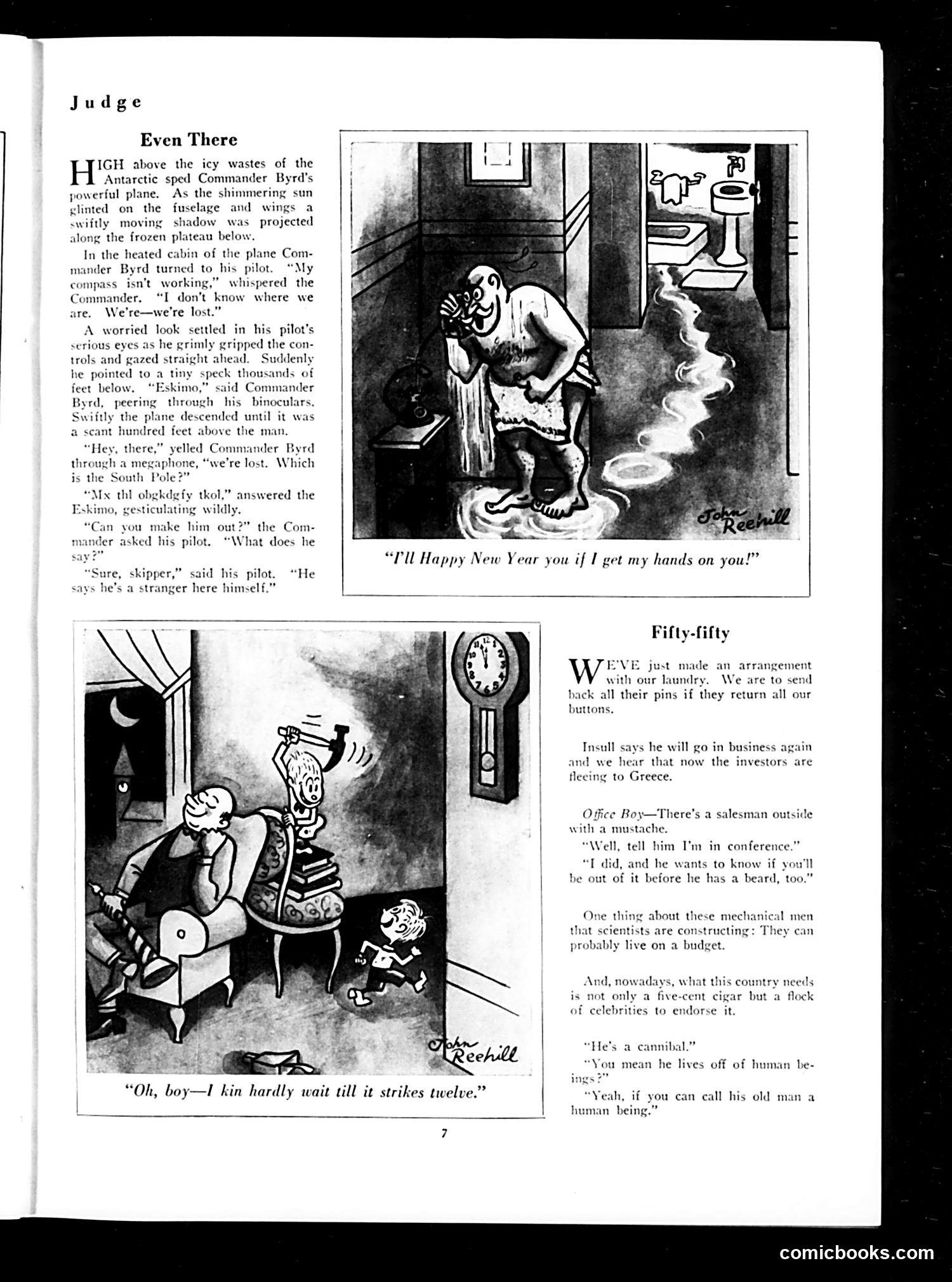
Explanation for Modern Readers "Even There" satirizes Commander Byrd's famous Antarctic expedition (circa 1928-1929). The joke: Byrd's plane is lost despite advanced navigation, so they spot a man on the frozen wasteland below. When asked to identify him, the pilot says he's "a stranger here himself"—absurd humor playing on the idea that *anyone* lost in Antarctica would be equally useless for directions. The satire mocks either Byrd's expedition competence or the era's faith in technology to solve practical problems. "Fifty-Fifty" is a humor column with unrelated brief jokes about laundry exchanges, investor Samuel Insull's business troubles, office encounters, and social commentary. One quip mocks mechanical men scientists are supposedly building, suggesting they'd be cheap to maintain. Another implies celebrities endorsing products is what the country actually needs—satirizing 1920s celebrity endorsement culture. The cartoons use exaggerated expressions and slapstick drawing styles typical of Judge's comedic approach.
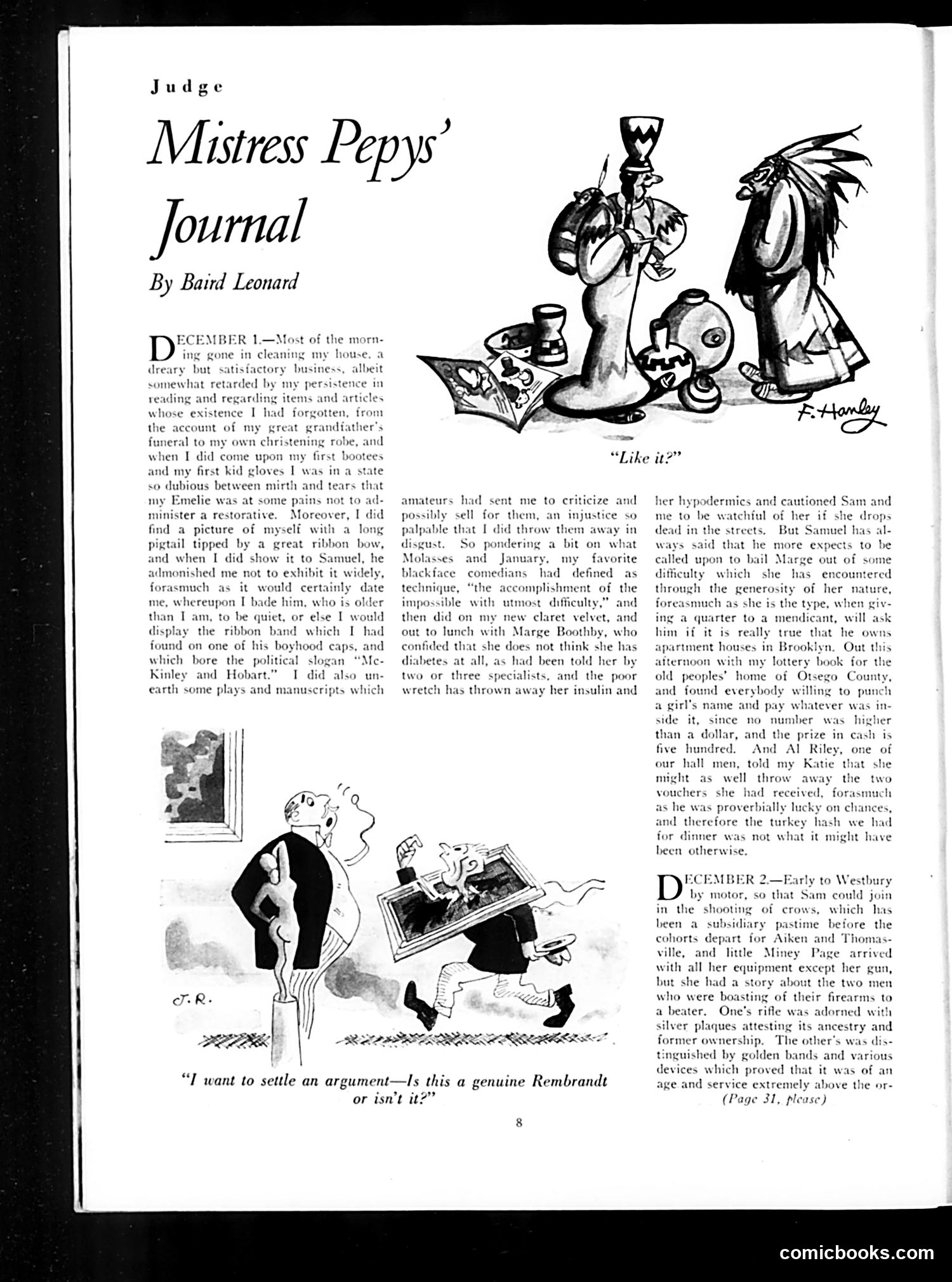
"Mistress Pepys' Journal" — Judge Magazine Satire This is a humorous parody of Samuel Pepys' famous 17th-century diary, reimagined as written by his wife in the early 20th century. The joke rests on anachronism: Pepys' "Mistress" documents mundane modern life (December 1920s-era) using the ornate, detailed diary style of the historical original. The cartoons illustrate absurd domestic scenarios: the lower cartoon shows a man asking about authenticating a "Rembrandt" painting—likely satirizing 1920s wealthy Americans' pretentious collecting habits and gullibility regarding art forgeries. The text mentions period-specific details: lotteries, Brooklyn apartment houses, shooting crows, and references to contemporary figures like McKinley and Hobart (1890s political slogan). The satire targets upper-class women's gossipy preoccupations, servants' antics, and nouveau-riche pretensions. The overarching humor mocks both historical pomposity and modern snobbery through the deliberate clash of old literary form with contemporary trivia.
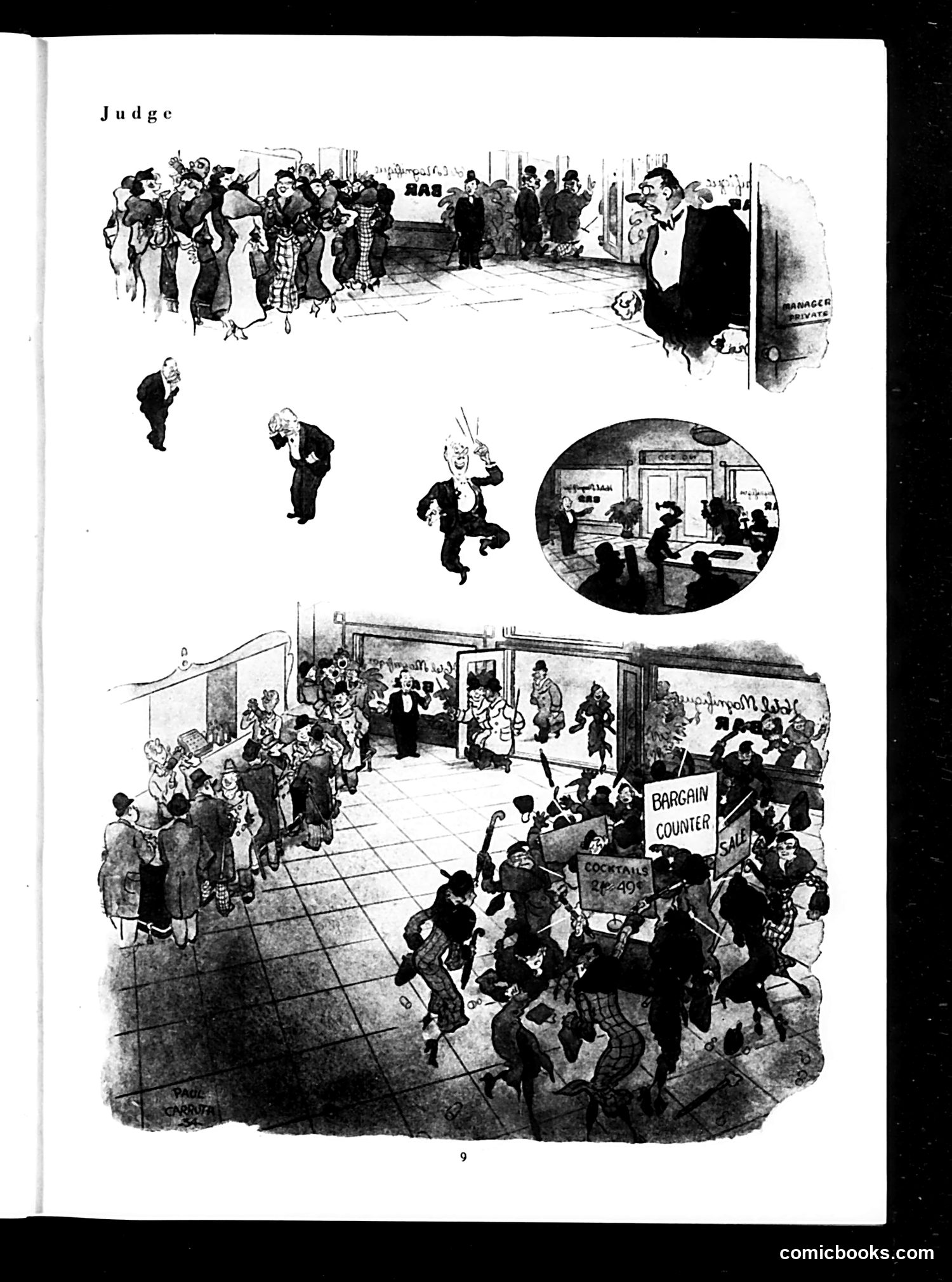
Analysis of "Judge" Page This page contains multiple cartoon panels satirizing the American legal system and courtroom procedures. The title "Judge" suggests the central theme. The top panel depicts a crowded courthouse scene with numerous figures, while middle panels show individual judges in various animated poses—appearing flustered, gesturing wildly—suggesting judicial incompetence or theater. The bottom panel shows what appears to be a busy department store or public venue with a "Bargain Counter" sign visible, with crowds of people and signage for "Sales" and "Cocktails." This juxtaposes commercial chaos with the legal system above. The overall satire appears to mock the dignity and seriousness of courts by depicting judges as theatrical performers and legal proceedings as disorderly spectacles comparable to commercial retail chaos.
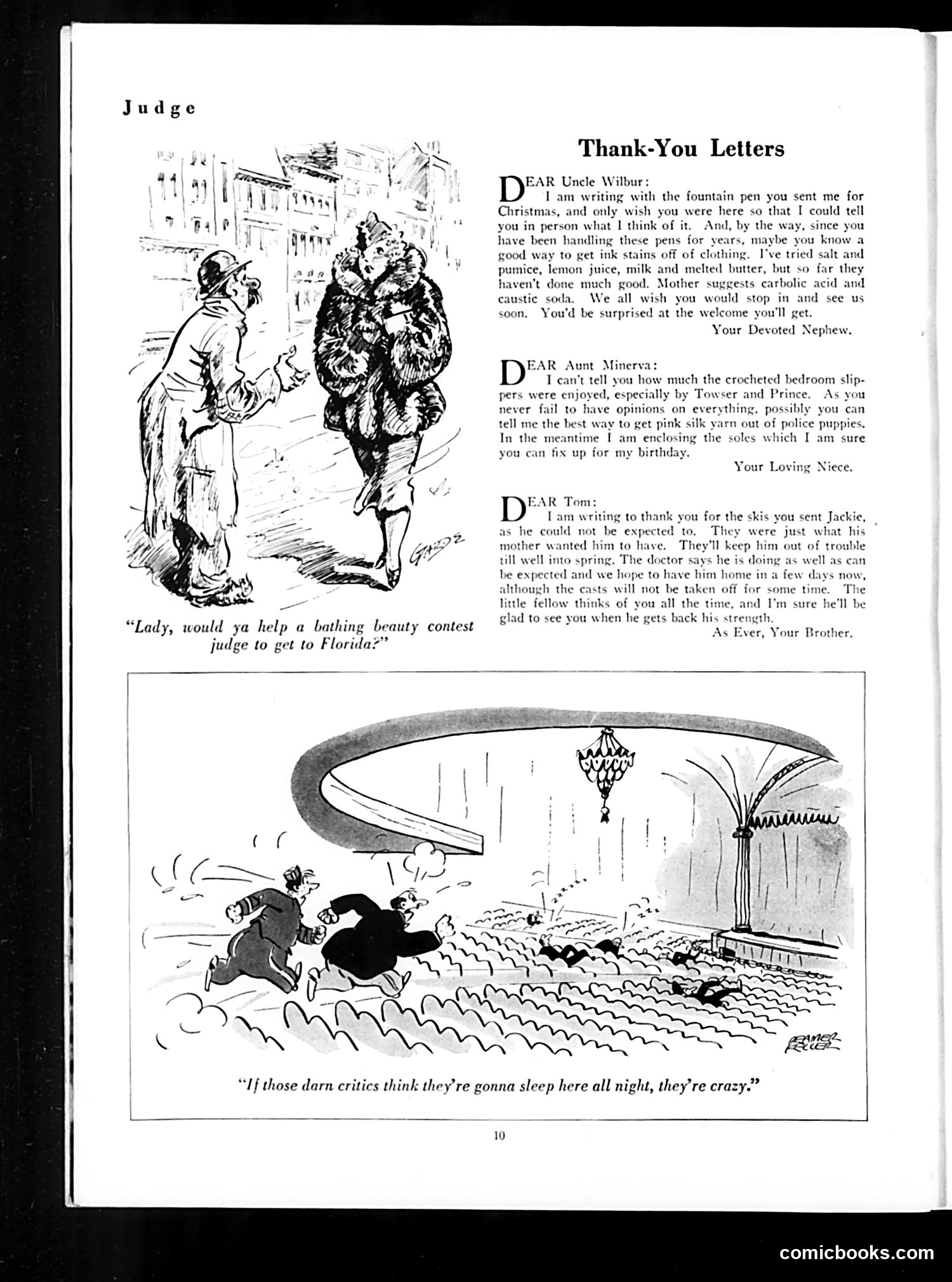
Judge Magazine Page Analysis This page combines humor with satirical social commentary typical of early 20th-century Judge magazine. Top Cartoon: A man asks a woman to help a "bathing beauty contest judge" reach Florida. The joke satirizes the absurdity of using beauty pageants as a pretext for leisure travel—the man essentially wants free transportation by invoking the glamorous but frivolous world of bathing beauty contests (popular entertainment of the era). "Thank-You Letters" Section: These are humorous parody thank-you notes where recipients comically complain about the gifts received. Each letter subverts gratitude conventions—a fountain pen causes ink stains; bedroom slippers are eaten by dogs; skis result in a broken leg. The satire mocks both insincere thank-you letter etiquette and poor gift-giving judgment, suggesting that many people give impractical or problematic presents while pretending generosity. Bottom Cartoon: Critics sleeping in theater balconies—satirizing theater critics' practice of viewing shows while lying down, suggesting laziness or poor judgment in their reviewing.
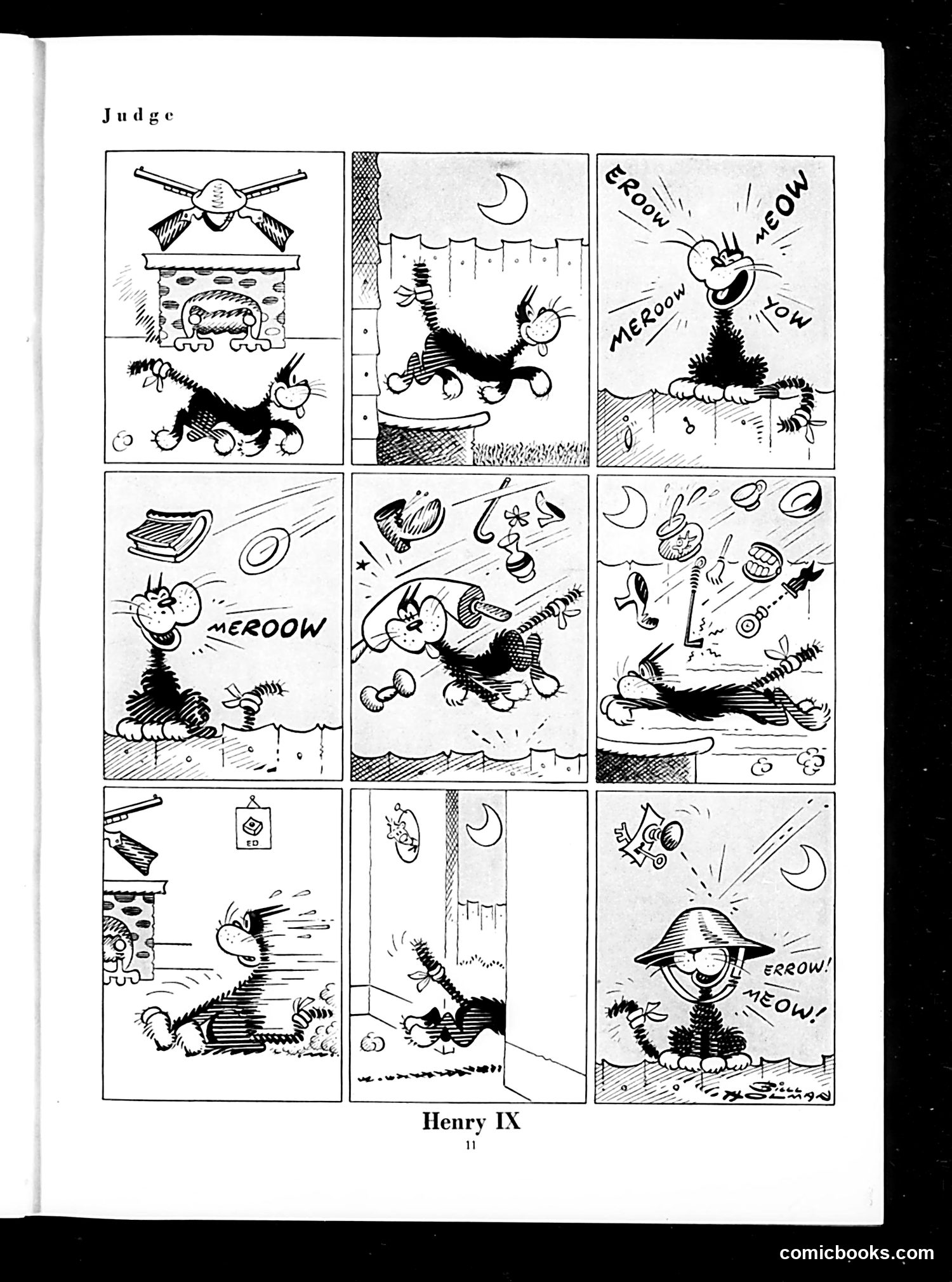
Judge Magazine - "Henry IX" Comic Strip This is a nine-panel comic strip titled "Henry IX," featuring a mischievous black cat causing nighttime chaos. The cat repeatedly disturbs a sleeping household: knocking over items, fighting, creating noise ("MEOW," "GROW," "ERROW"), and generally terrorizing the residents and their possessions. The satire appears to mock domestic annoyances rather than specific political figures—despite the regal title "Henry IX" (evoking English kings), this is simply wordplay on "Henry the Cat," a common pet name. The joke targets the universal frustration of dealing with unruly cats at night, making it relatable household humor rather than political commentary.
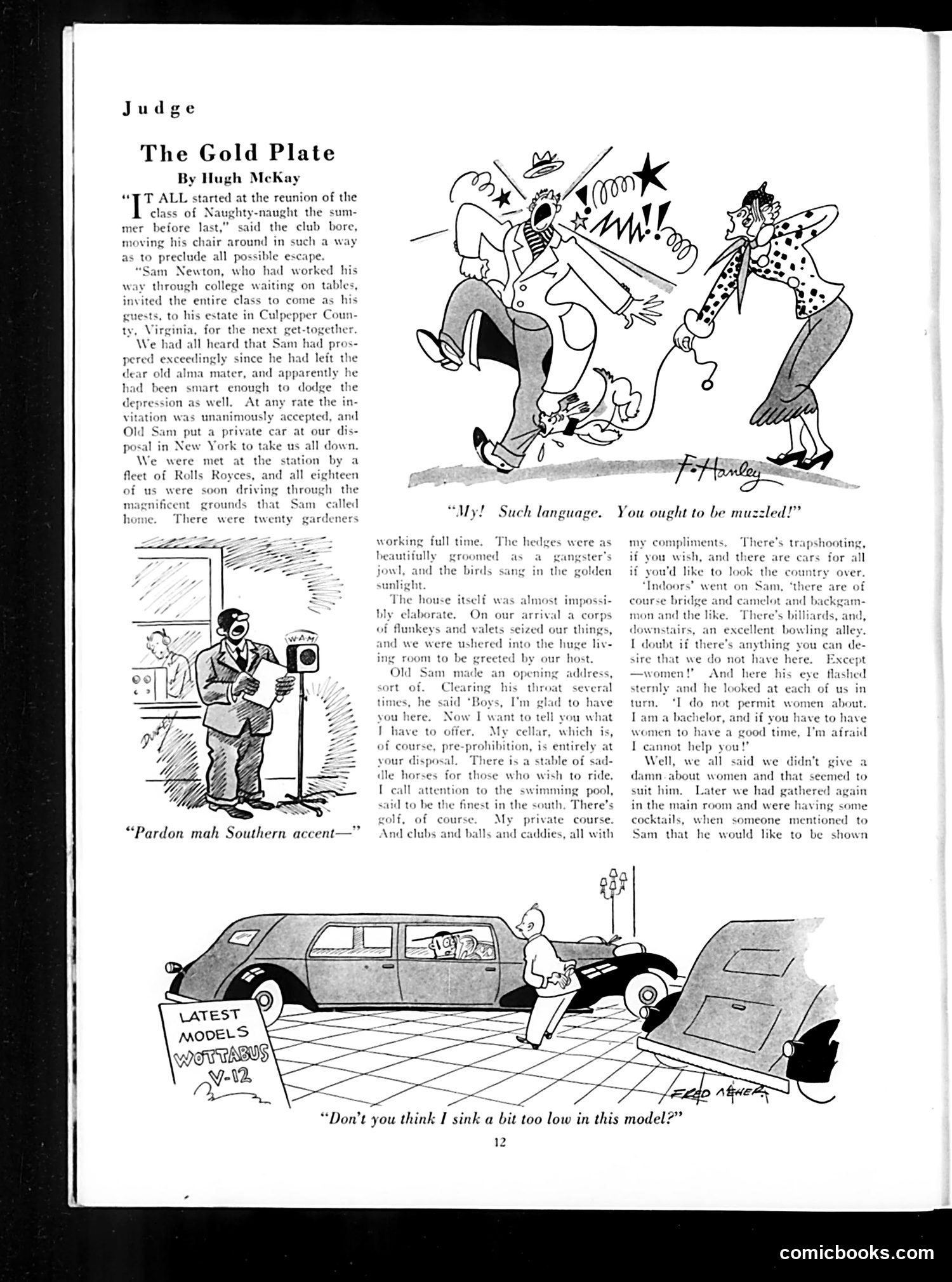
"The Gold Plate" - Judge Magazine Satire This story satirizes the nouveau riche—specifically a self-made man named "Old Sam Newton" who has prospered (apparently during Prohibition, given his pre-Prohibition cellar) and now ostentatiously displays his wealth to his college classmates at a grand Virginia estate. The satire targets his: - Excessive materialism: Rolls-Royces, elaborate grounds, twenty gardeners, every possible luxury amenity - Social pretension: His nervous, boastful hosting and constant enumeration of possessions - Misogyny: His explicit exclusion of women from the gathering, dismissing them as incompatible with a "good time" The cartoon illustrations mock his vulgar excess and discomfort around refined society (note "Pardon mah Southern accent"). The bottom cartoon about the car model humorously suggests even his automobile choices betray insecurity about status. The humor derives from old-money readers' contempt for wealthy upstarts who loudly flaunt their riches rather than displaying quiet elegance—a common Judge theme during the Jazz Age.
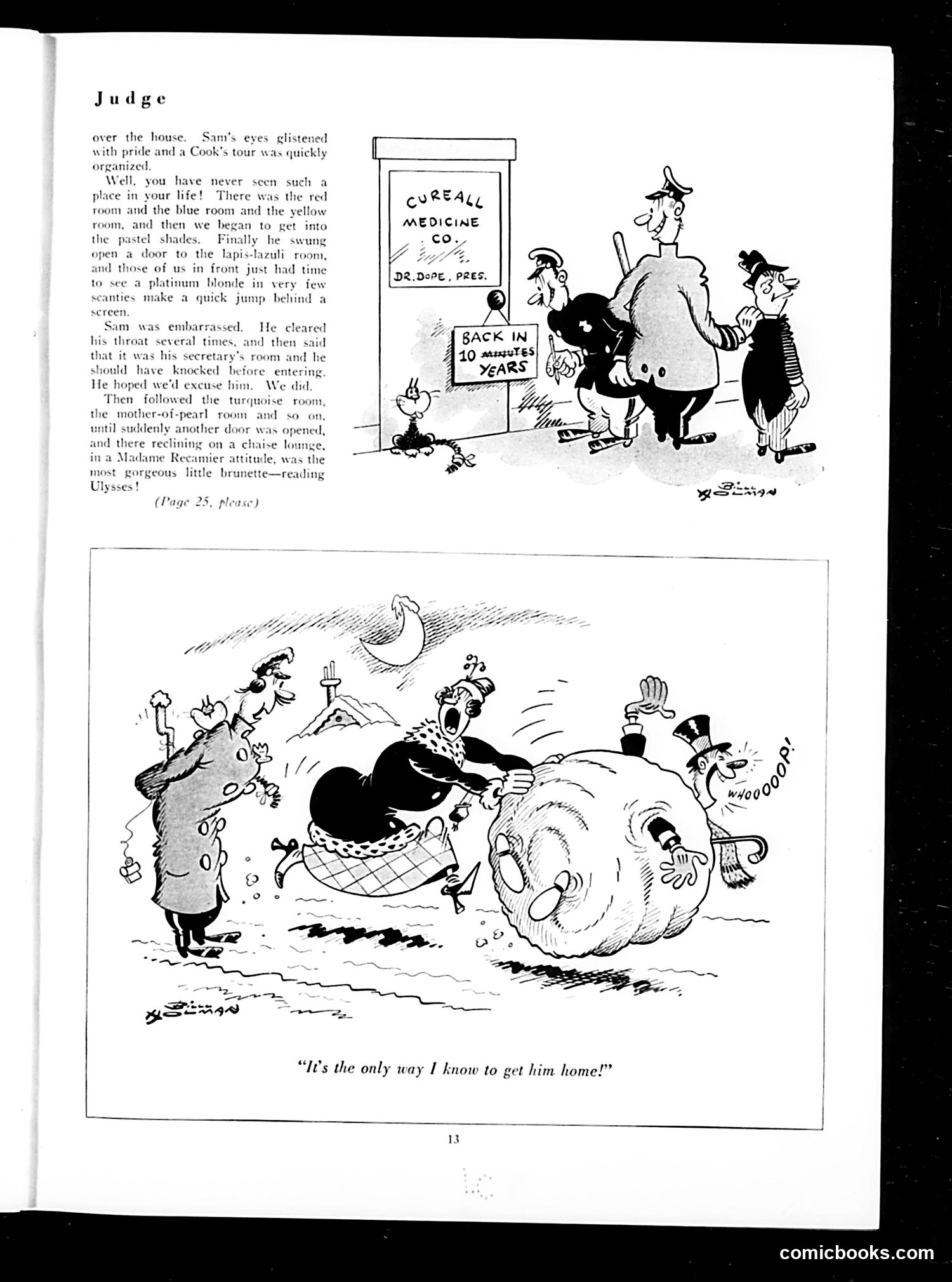
Judge Magazine Cartoon Analysis This page contains two cartoons satirizing early 20th-century American society and pretension. The first cartoon mocks wealthy homeowners displaying ostentatious interiors with color-coordinated rooms ("lapis-lazuli room," "mother-of-pearl room"). The humor centers on a host's embarrassment when guests glimpse a scantily-clad woman in what he claims is his secretary's room—implying an affair or improper arrangement. The second cartoon, captioned "It's the only way I know to get him home!," depicts a woman using exaggerated methods (rolling him in a large wheel, possibly) to transport an intoxicated man. This satirizes excessive drinking and domestic situations common to the era. Both cartoons employ caricature and physical comedy typical of Judge's satirical approach, targeting upper-class affectation and social misbehavior of the period.
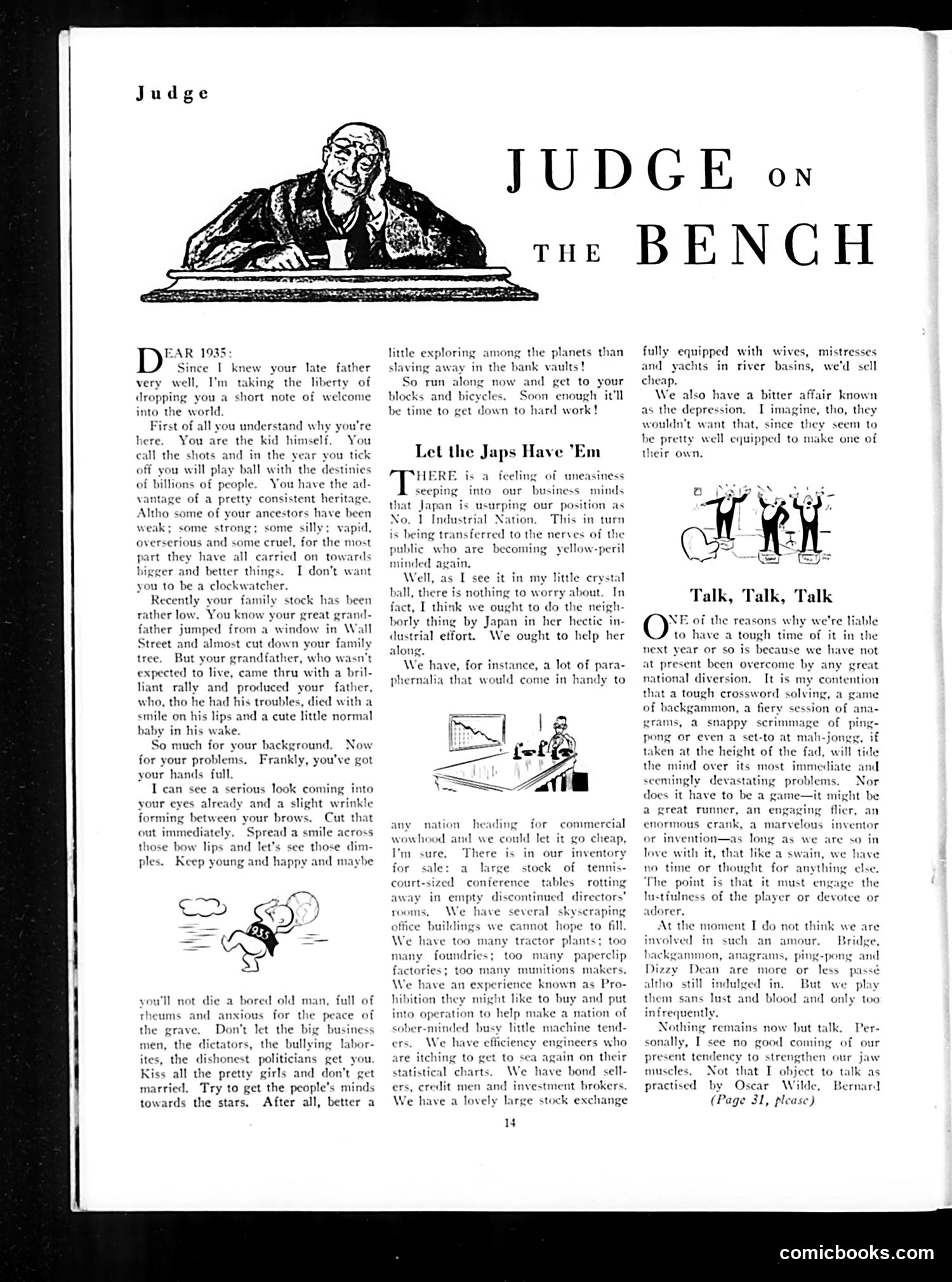
"Judge on the Bench" - Analysis This 1935 *Judge* magazine page contains a satirical "letter to a newborn heir" and commentary on American economic anxieties. The Main Cartoon: A judge (representing an elder statesman or the voice of authority) addresses a newborn child, offering cynical life advice about navigating Depression-era America. He warns against becoming a "clockwatcher" and encourages ambition, but the tone is deeply pessimistic—advising the child to avoid "big business men, dictators, bullying laborites, and dishonest politicians." "Let the Japs Have 'Em" Section: This satirizes American anxieties about Japanese industrial competition and the "Yellow Peril" stereotype. The author proposes sarcastically "selling" surplus American goods—defunct office furniture, failed Prohibition experience, and the Depression itself—to Japan as a way to handicap their economy and maintain American industrial dominance. The Satire: Both pieces mock 1935 America's pessimism, economic stagnation, international anxieties, and the perceived moral bankruptcy of institutions. The humor relies on cynicism and resigned acceptance of systemic corruption.
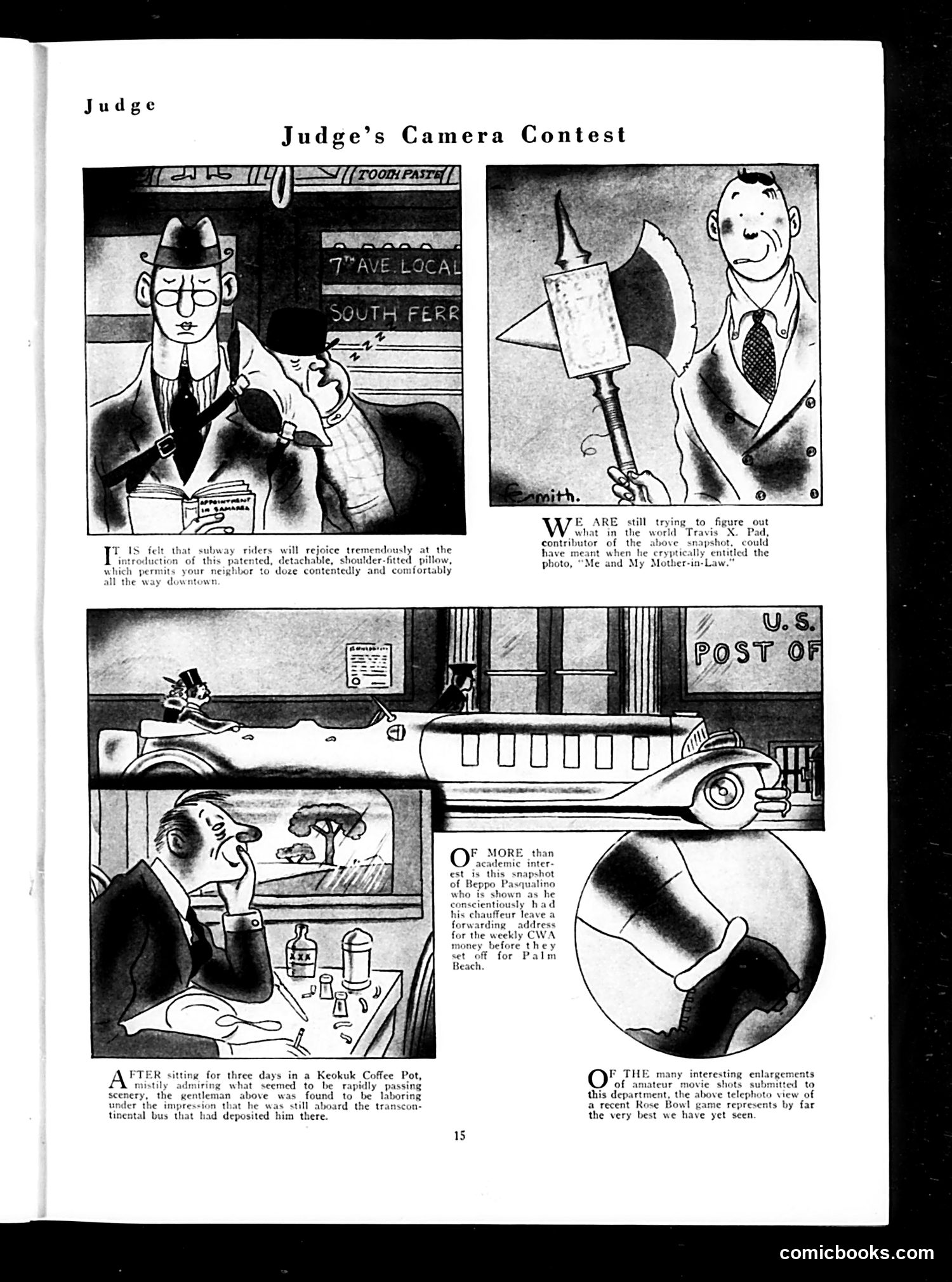
Judge's Camera Contest This page showcases humorous amateur photographs submitted to Judge magazine's contest. The satirical point lies in the juxtaposition of mundane, everyday moments presented as if they were significant subjects worthy of photography. The top left shows a subway rider with a new "detachable, shoulder-fitted pillow" — mocking both commuter discomfort and trivial consumer inventions. The top right features a man with a surveying tool, captioned with uncertainty about whether it depicts "Me and My Mother-in-Law" — likely a visual pun referencing the famous ambiguous optical illusion popular in that era. The lower panels mock obsessive hobbyists: one man sitting in a Kekuk Coffee Pot for three days believing he was on a transcontinental train, and another showing a chauffeur's photograph documenting his weekly CWA (likely Civilian Works Administration) address before heading to Palm Beach. The humor targets both amateur photographers taking mundane subjects too seriously and middle-class eccentricities of the period.
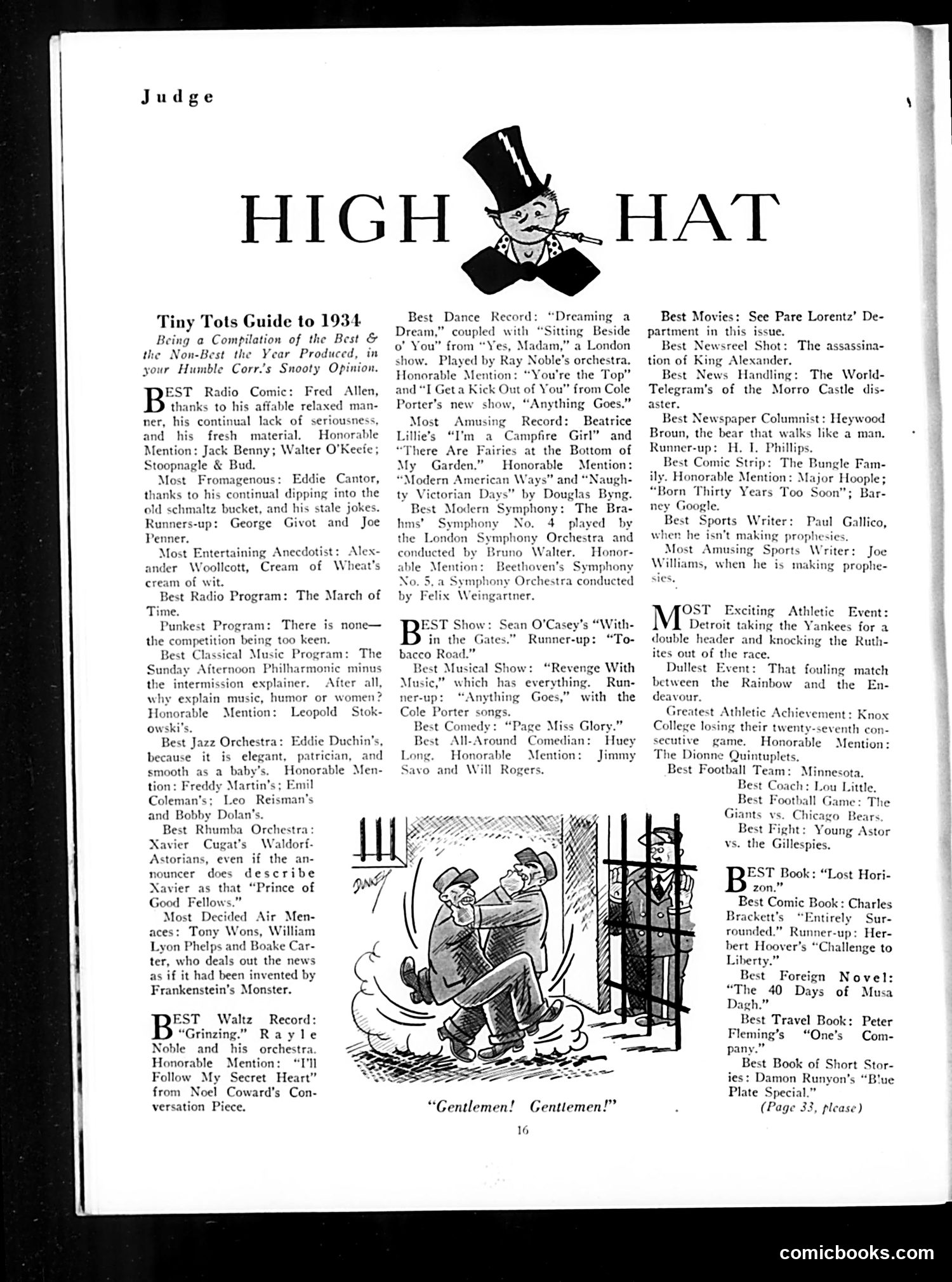
"High Hat" - Judge Magazine's 1934 Year-End Awards This page presents Judge's satirical "Tiny Tots Guide to 1934"—mock awards for the year's best entertainment, sports, and public figures. The central cartoon shows two men fighting in exaggerated slapstick style ("Gentlemen! Gentlemen!"), exemplifying the comedic tone. The awards mock 1934 culture: Fred Allen wins "Best Radio Comic," Eddie Cantor is "Most Fromageous" (cheese-iest), and notably, Huey Long is named "Best All-Around Comedian," a sharp political jab at the populist Louisiana senator and his "Share Our Wealth" movement. This is bitter satire—treating a serious political figure as entertainment/buffoonery. Other entries target celebrities like Stoopnagle & Bud (deemed inferior), and praise serious programs like "The March of Time" radio show. The page balances genuine admiration (Xavier Cugat, Eddie Duchin) with contemptuous dismissal, typifying Judge's elitist, sophisticated humor aimed at educated readers skeptical of both mass entertainment and populist politics.
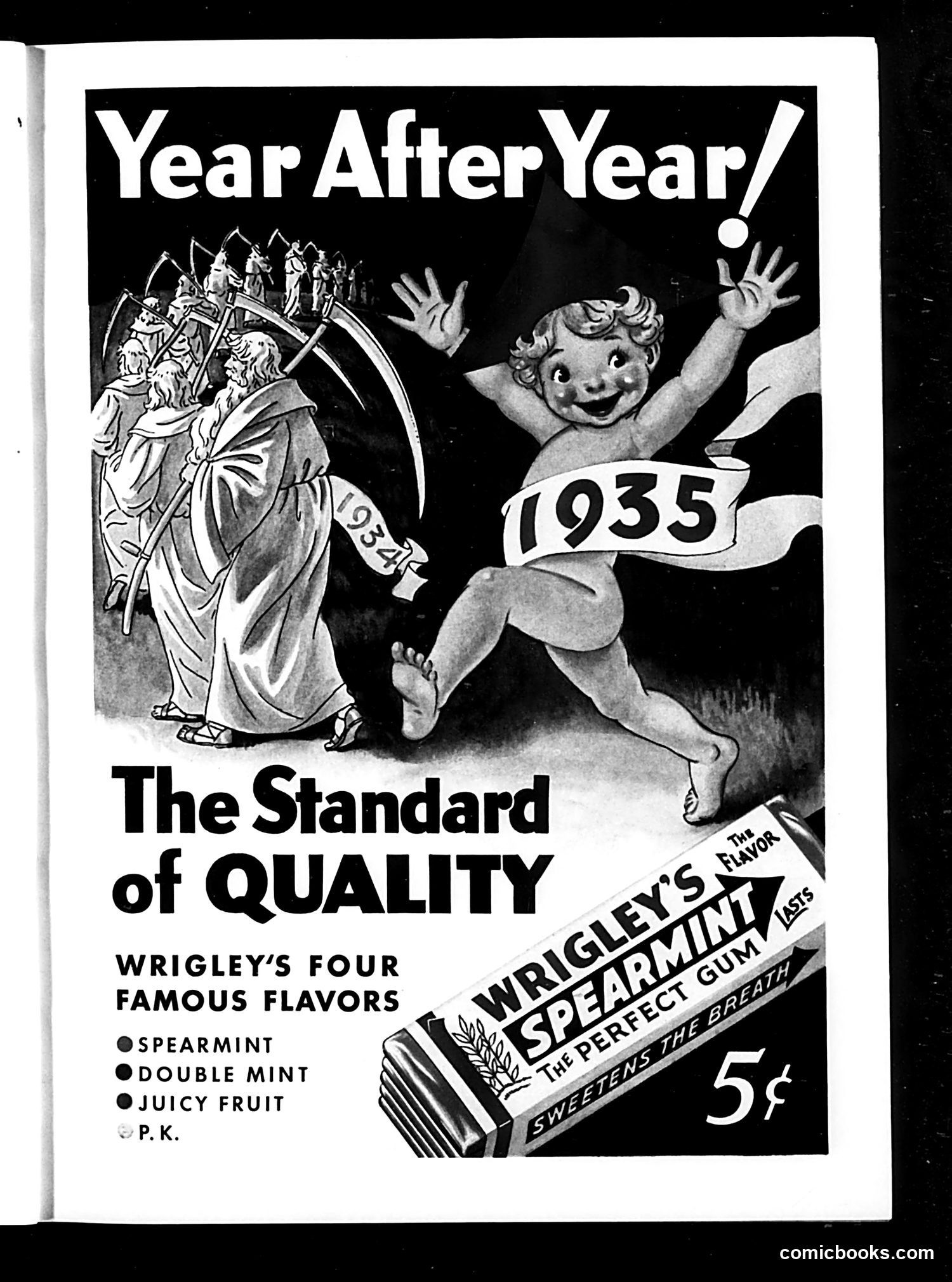
This is an advertisement for Wrigley's chewing gum, not political satire. The page shows a cherub figure bursting through a banner marked "1935," celebrating the passage of time with the headline "Year After Year!" On the left, a robed figure (likely Father Time or Death, based on the scythe marking "1934") contrasts with the youthful cherub on the right, symbolizing renewal and optimism entering the new year. The ad emphasizes consistency and reliability: Wrigley's gum has maintained "The Standard of QUALITY" across its "four famous flavors" (Spearmint, Double Mint, Juicy Fruit, and P.K.) despite changing times. At 5¢, the product promises enduring value and "sweetens the breath" as depicted on the gum package shown.
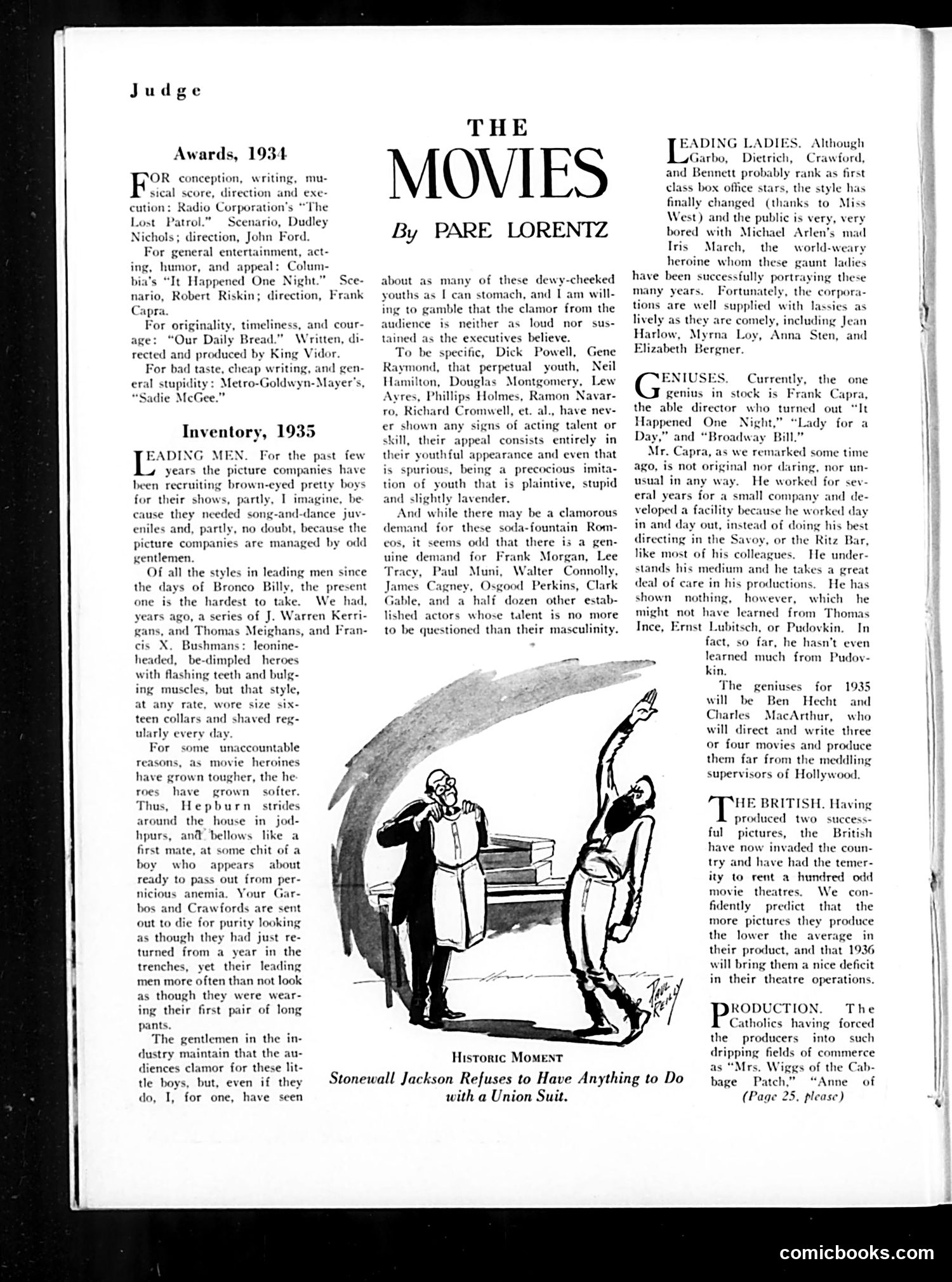
Understanding This Judge Magazine Page (1935) This page from Judge magazine contains film criticism by Pare Lorentz, not primarily political satire. The single cartoon at bottom is a Civil War joke: "Stonewall Jackson Refuses to Have Anything to Do with a Union Suit"—a pun on "union suits" (old-fashioned long underwear), not the labor organization. The main content critiques 1930s Hollywood casting trends. Lorentz attacks studios for hiring soft, boyish male leads (Dick Powell, Gene Raymond, Lew Ayres) lacking genuine talent, despite strong actresses like Greta Garbo and Joan Crawford carrying films. He praises Frank Capra's directing and notes that Mae West has finally changed tired female stereotypes. The Awards section (top left) bestows backhanded praise—"Our Daily Bread" gets points for "originality, timeliness, and courage," while "Sadie McGee" wins for "bad taste, cheap writing, and general stupidity." This reflects 1930s cultural anxieties about masculinity and entertainment standards, not active political commentary.
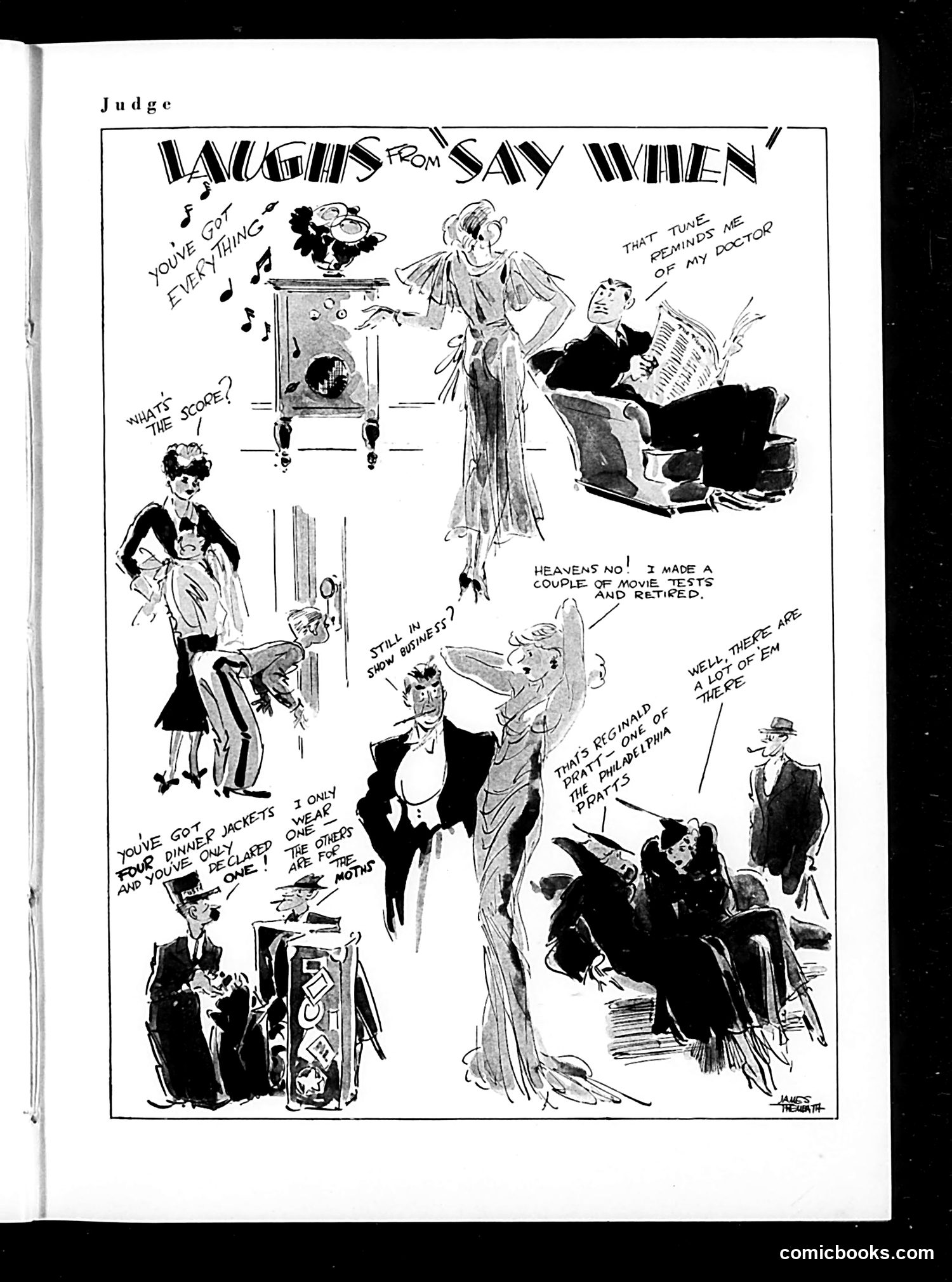
"Laughs from Say When" This Judge magazine cartoon page collects several comic vignettes satirizing early 20th-century social life. The sketches mock various domestic and social scenarios: a woman conducting an orchestra of household objects, a man reviewing sheet music of questionable taste, someone bragging about movie test retirements, references to dinner jackets and formal wear etiquette, and a character named "Reginald" apparently involved in a scandal concerning "Petticoatia." The overall theme appears to be satirizing pretension, social climbing, and romantic/marital complications among the urban middle and upper classes. The fragmented nature—with multiple unrelated gags—was typical of Judge's format. Without clearer context or dates visible, the specific scandals referenced remain unclear, though the humor targets contemporary fashionable society's affectations and gossip.
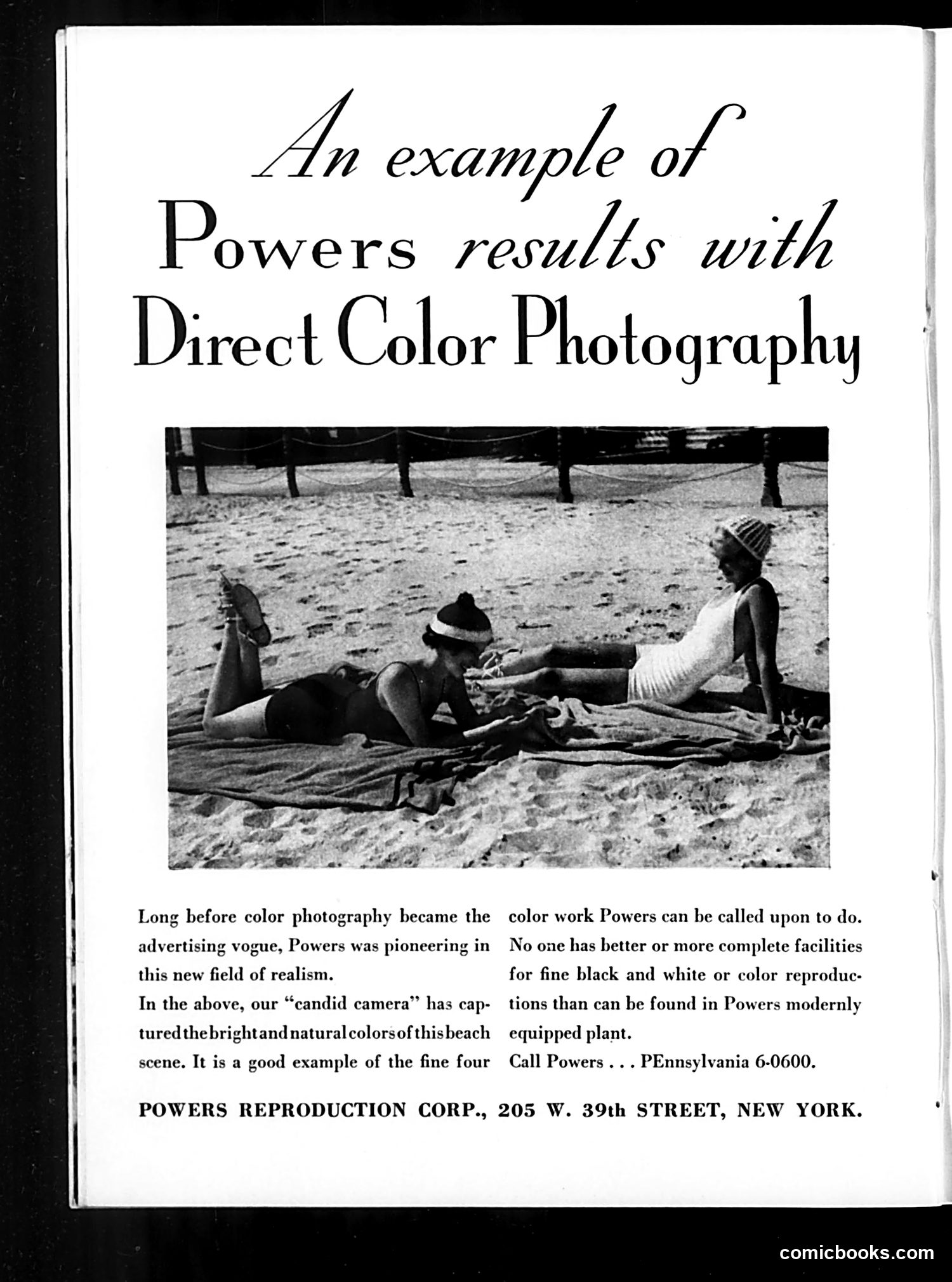
Advertisement, Not Satire This is a full-page advertisement for Powers Reproduction Corp., a printing/photography company based in New York. It's not political satire or a cartoon. The image shows three people on a beach in what appears to be a candid, naturalistic photograph. The ad uses this beach scene to showcase Powers' capabilities in color photography and reproduction—specifically their "direct color photography" process. The text emphasizes that Powers pioneered color photography before it became standard in advertising, and boasts about their modern facilities for both black-and-white and color reproductions. The ad positions them as leaders in this emerging photographic technology. This represents early advertising for commercial printing services, highlighting technological innovation in color reproduction circa the mid-20th century.
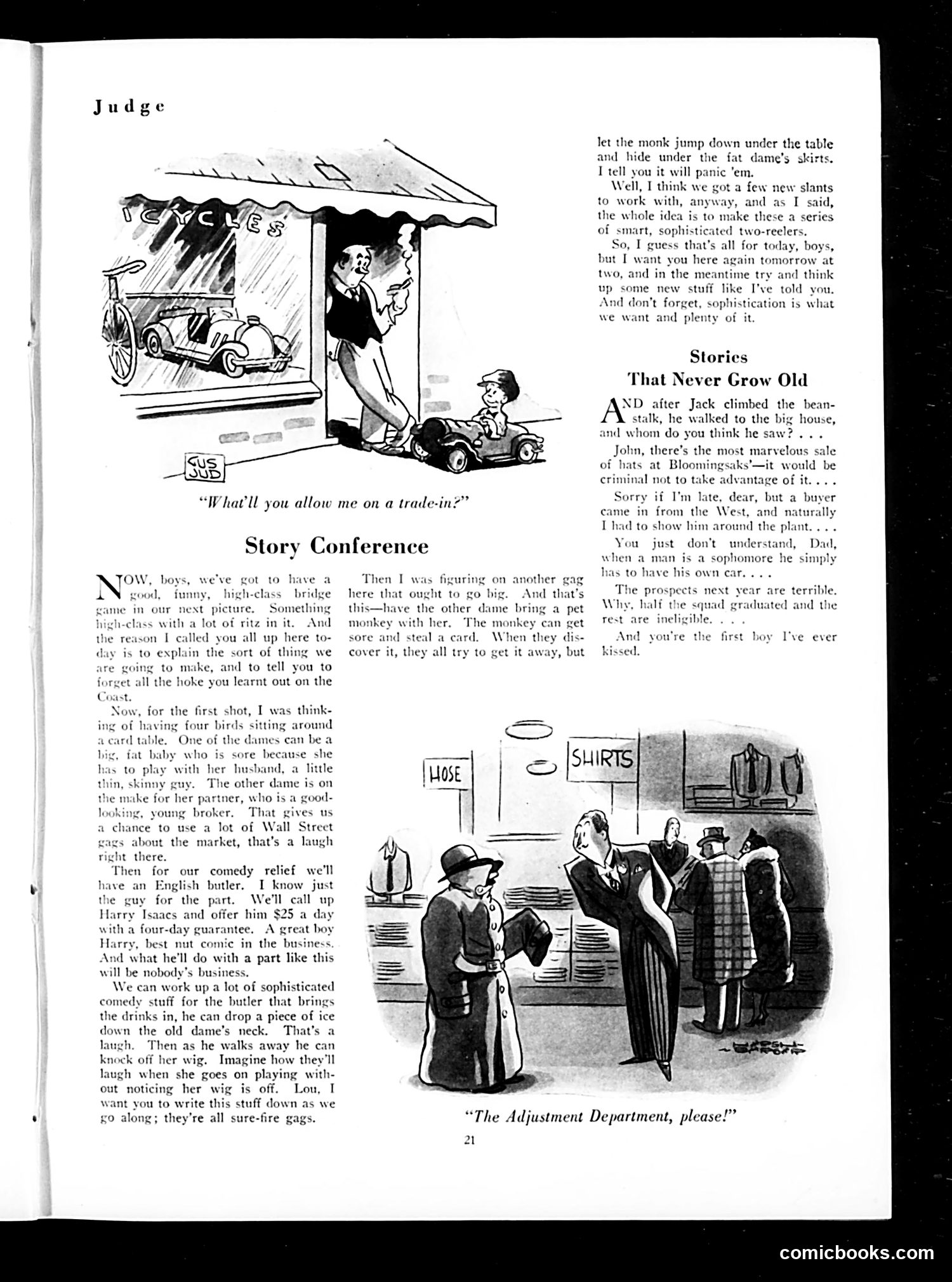
Judge Magazine Page Analysis This page presents two pieces of early 20th-century entertainment content: Top cartoon ("What'll you allow me on a trade-in?"): A car salesman pitches a used vehicle to a customer. The joke satirizes aggressive automotive sales tactics—the dealer is essentially trying to convince the buyer their old car has no value while pushing an upgrade. "Story Conference" section: A film producer briefs writers on developing a series of short comedies ("two-reelers"—films about 20 minutes long). He proposes scenarios involving romantic entanglements, slapstick with a monkey, and a comedic butler character. The satire targets Hollywood's formula approach: relying on stock characters, physical comedy (ice down a dress, knocking off wigs), and Wall Street references to seem "sophisticated." The producer emphasizes repetition and sure-fire gags over originality. Bottom cartoon: A woman in a department store seeks "The Adjustment Department"—likely a returns or complaint desk—suggesting consumer frustration with retail establishments. The page satirizes both commercial sales culture and formulaic entertainment production.
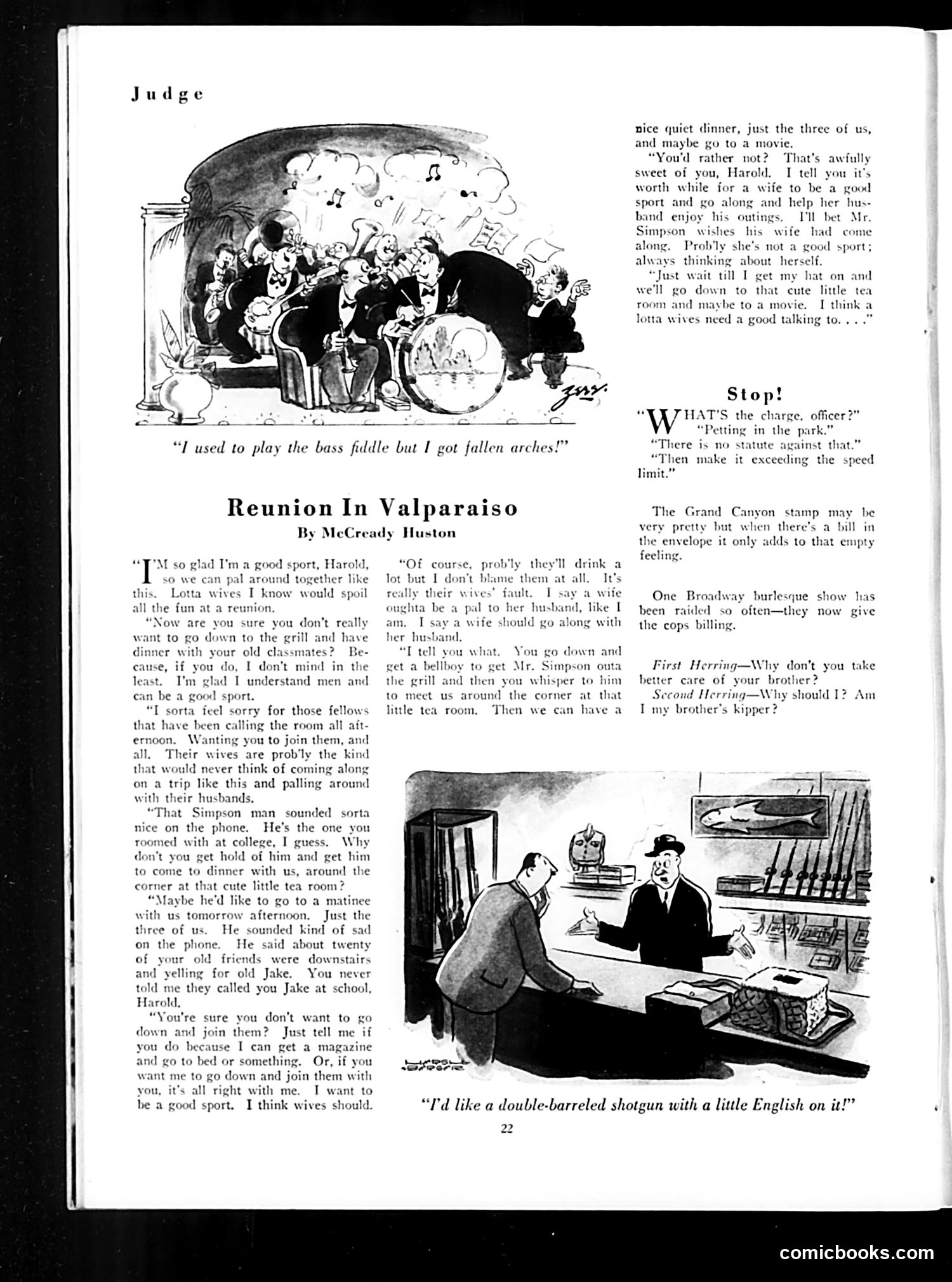
Analysis: "Reunion in Valparaiso" This story satirizes a particular type of 1920s wife—one who claims to be a "good sport" while actually controlling her husband through performative martyrdom. The wife in the narrative repeatedly insists she doesn't mind her husband attending his college reunion without her, yet she clearly does mind. She manufactures an alternative plan (tea room, movie with a sad classmate) that keeps him under her supervision while maintaining plausible deniability about her neediness. Her constant self-praise ("I'm a good sport," "I think wives should") exposes the opposite—her resentment and manipulation. The satire targets wives who weaponize obligingness: by claiming not to care, they make their husbands feel guilty for wanting independence. She even pitches Simpson's absent wife as a cautionary tale of a "selfish" woman, implying her own presence is actually generous. The accompanying jokes mock similar marital dynamics—a woman comparing her brother unfavorably to herself, and another about exceeding speed limits—suggesting broader Gen-X frustration with spousal control.
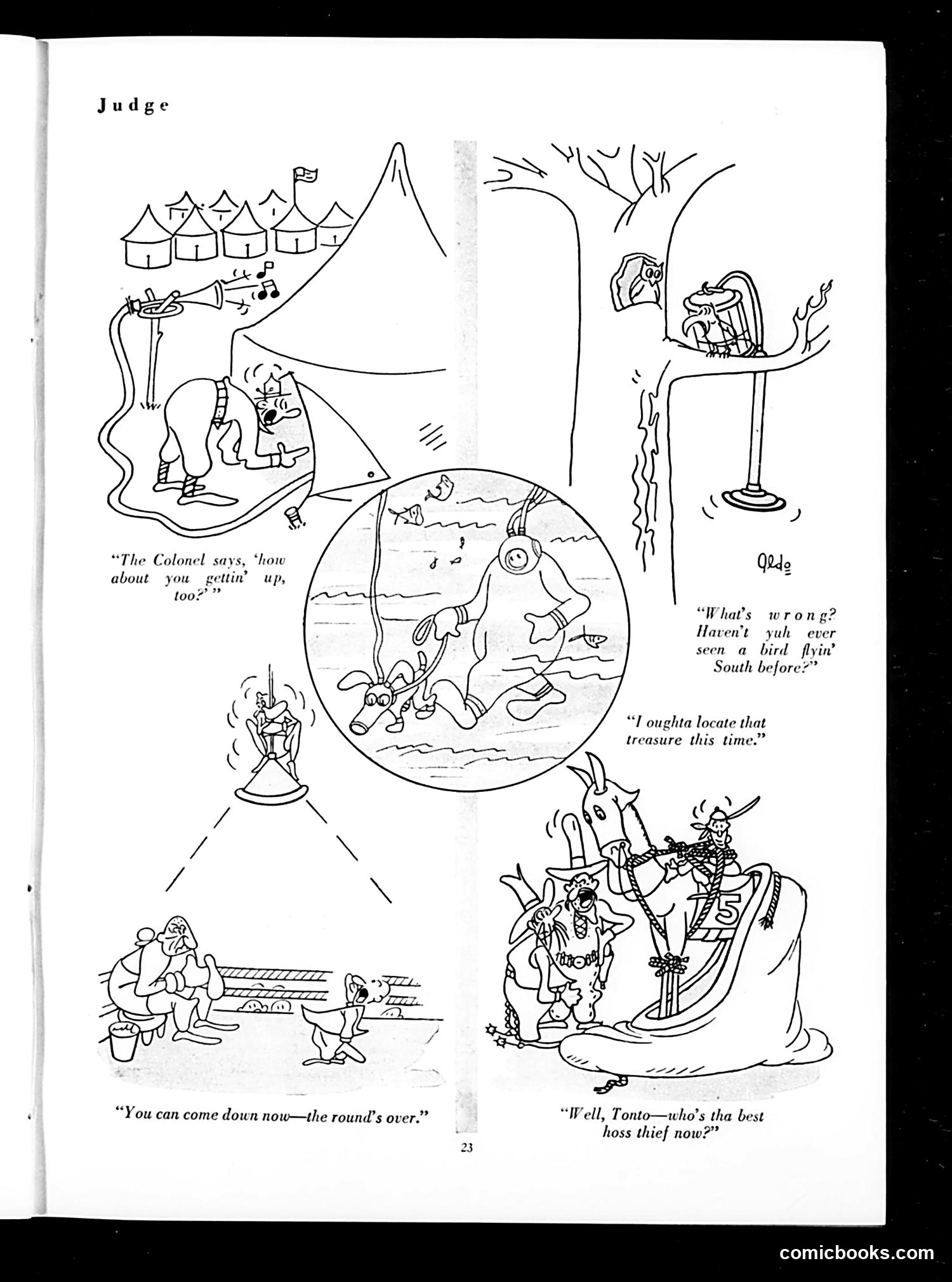
Judge Magazine Cartoon Analysis This page contains six separate comic vignettes satirizing various subjects. The cartoons appear to mock: 1. Military/class hierarchy: A colonel ordering someone up, likely satirizing military discipline. 2. Southern migration: A reference to birds flying south, possibly commenting on population movements or seasonal patterns. 3. Treasure hunting: A figure searching for treasure, appearing to satirize get-rich-quick schemes or prospecting. 4. Boxing/sports: References to "the round's over," suggesting boxing match satire. 5. Western/frontier themes: A "Tonto" reference (the Lone Ranger's companion) in a dialogue about horse thieving, likely satirizing either actual frontier crime or romanticized Wild West narratives. The cartoons use exaggerated character drawings typical of Judge's satirical style, though without additional context or publication date, the specific historical references remain partially unclear.
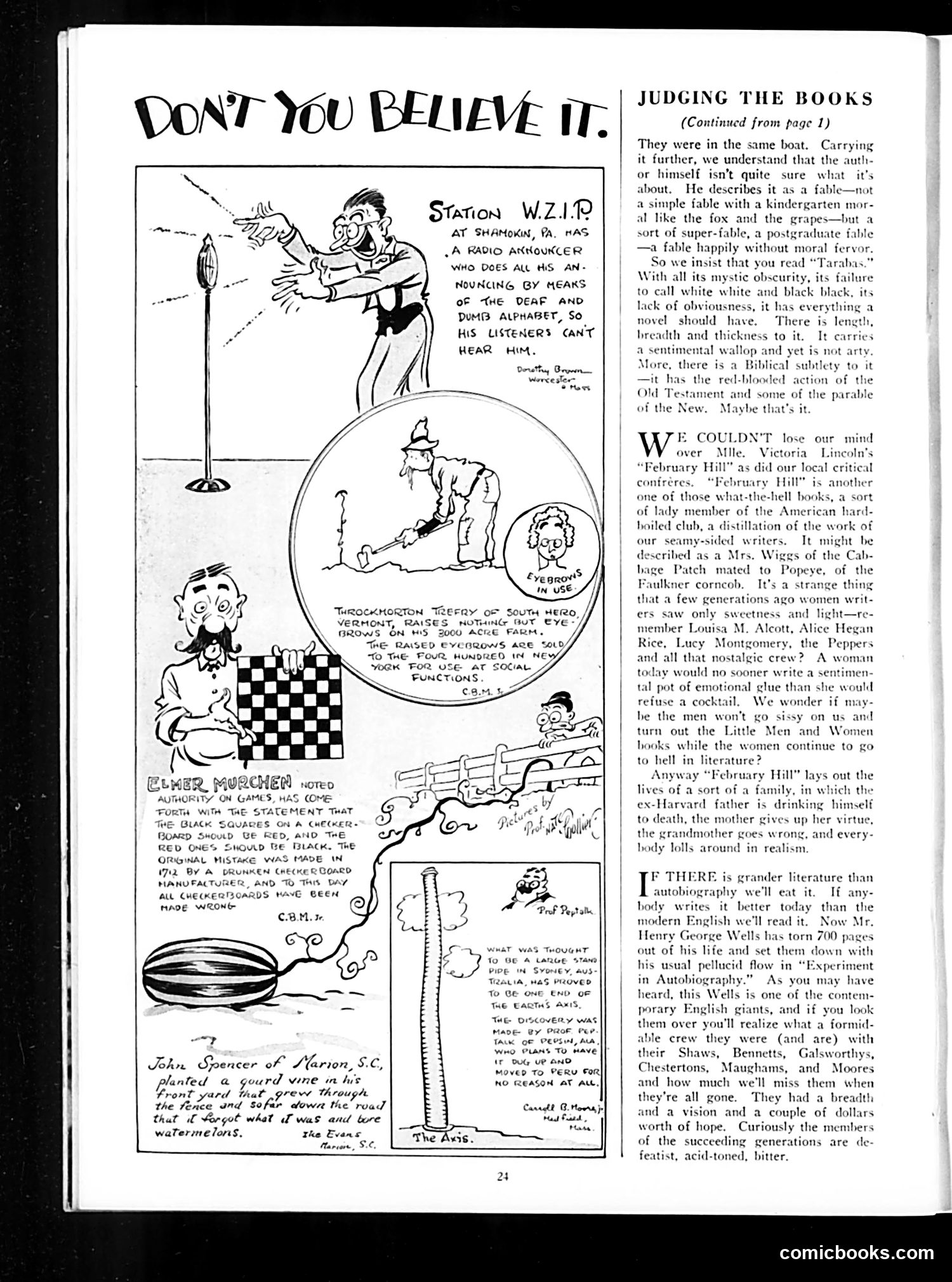
"Don't You Believe It" - Judge Magazine Satirical Shorts This page presents "Don't You Believe It," Judge's recurring feature of absurd tall tales mocking gullible readers. Each anecdote ridicules either human foolishness or journalistic credulity: The cartoons satirize: - A radio announcer (Station W.Z.I.P., Shamokin, PA) who announces using deaf-and-dumb sign language to listeners who obviously cannot see him—pure illogical incompetence - Elmer Murchen claiming checkerboard colors were reversed since 1770—nonsensical "authority" - A Vermont farmer whose eyebrows became fashionable for NYC society functions—absurd vanity - A "professor" discovering a pipe in Australia is Earth's axis, planning to dig it up and move it nowhere—ridiculous pseudo-science The point: These mock both the people spreading ridiculous claims and readers credulous enough to believe them. The feature satirizes 1920s-30s American gullibility, misinformation, and the pretense of "expertise" on trivial matters. The crude, cartoonish drawings emphasize the jokes' ridiculousness.
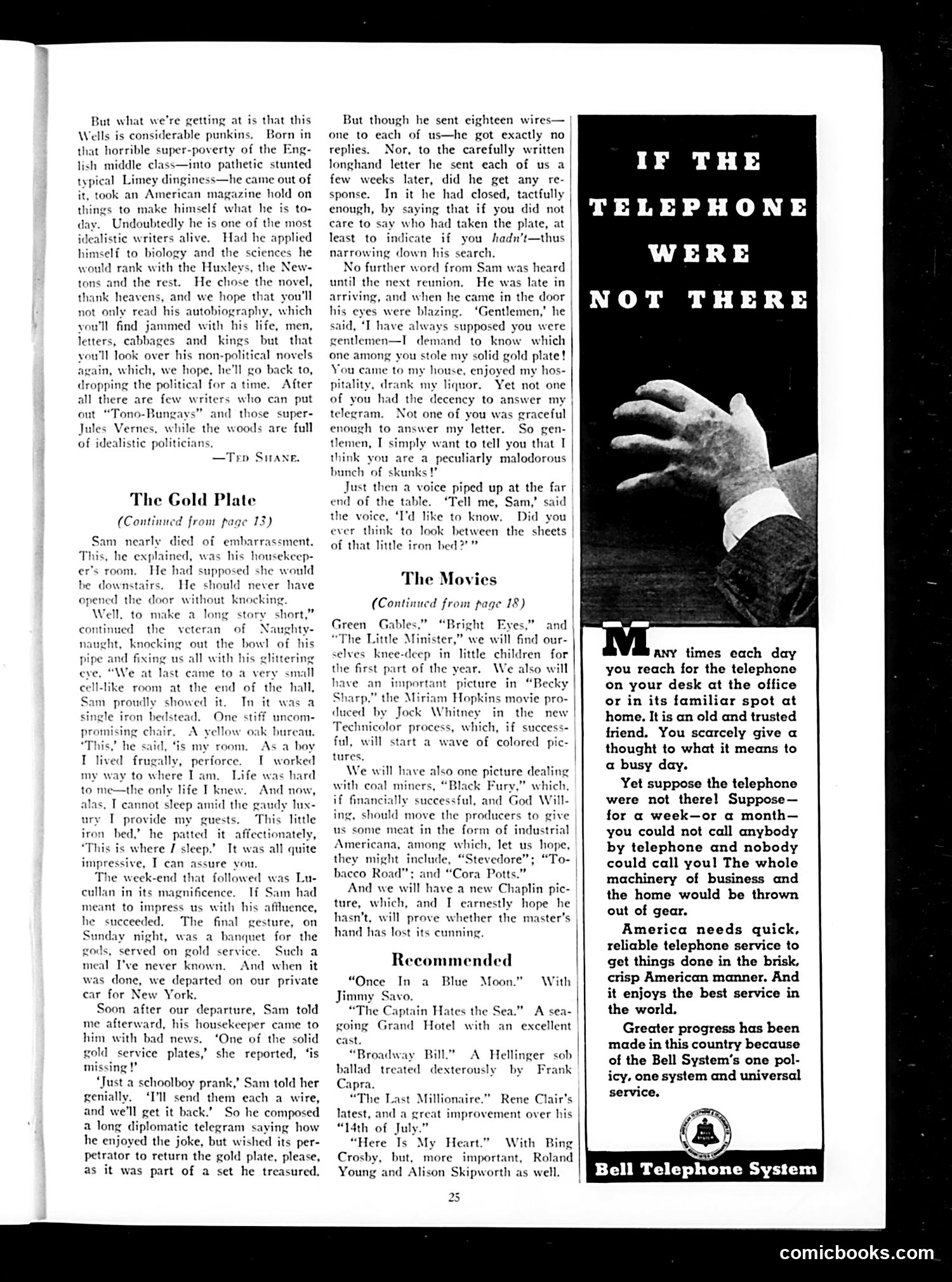
Analysis of Judge Magazine Page This page contains two distinct sections: Left side: A literary essay by Ted Shane praising H.G. Wells as an idealistic writer who escaped English middle-class poverty through talent. Shane argues Wells should abandon political novels and return to science fiction ("Tono-Bungays"), where few writers match his vision. Center/Right: "The Gold Plate," a serialized short story about a wealthy man (Sam) who hosts guests and loses a gold plate. After sending unanswered telegrams and letters demanding its return, Sam confronts his guests at a reunion, calling them "skunks" for their silence. The punchline (cut off) involves someone suggesting Sam check "between the sheets"—implying the plate was never stolen, mocking Sam's accusatory behavior and his guests' collective silence about the obvious. Right side: A Bell Telephone System advertisement arguing that reliable telephone service is essential to American business and home life. The satire targets both social pretension (Sam's ostentatious gold service) and the failures of communication and courtesy among supposedly civilized men.
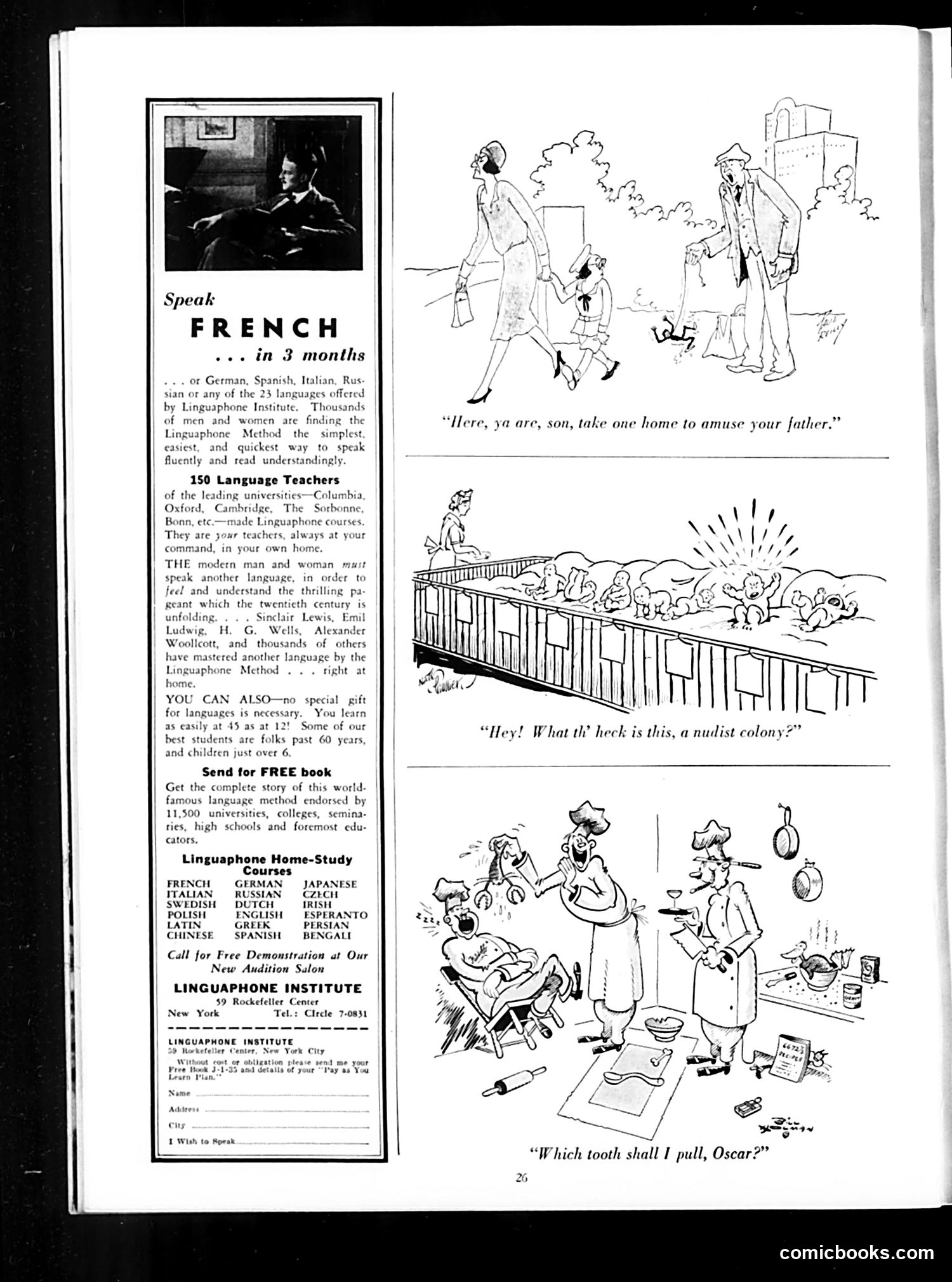
Analysis This page is primarily advertising for the Linguaphone Institute's language-learning courses, not political satire. The left side contains a full advertisement promoting their method to learn French (or 23 other languages) in three months, endorsed by famous figures like Sinclair Lewis and H.G. Wells. The right side features three humorous cartoon vignettes illustrating everyday situations—likely meant to show practical contexts where language skills matter: a parent taking a child somewhere, children playing in a pen, and someone at a dentist. The captions use colloquial dialogue to demonstrate conversational French or everyday speech patterns. There is no political content or satire on this page. The cartoons are simple domestic humor meant to entertain readers while reinforcing the advertisement's message that language learning is practical and useful for modern life. The page functions as a hybrid advertising/entertainment spread typical of Judge magazine's commercial content.
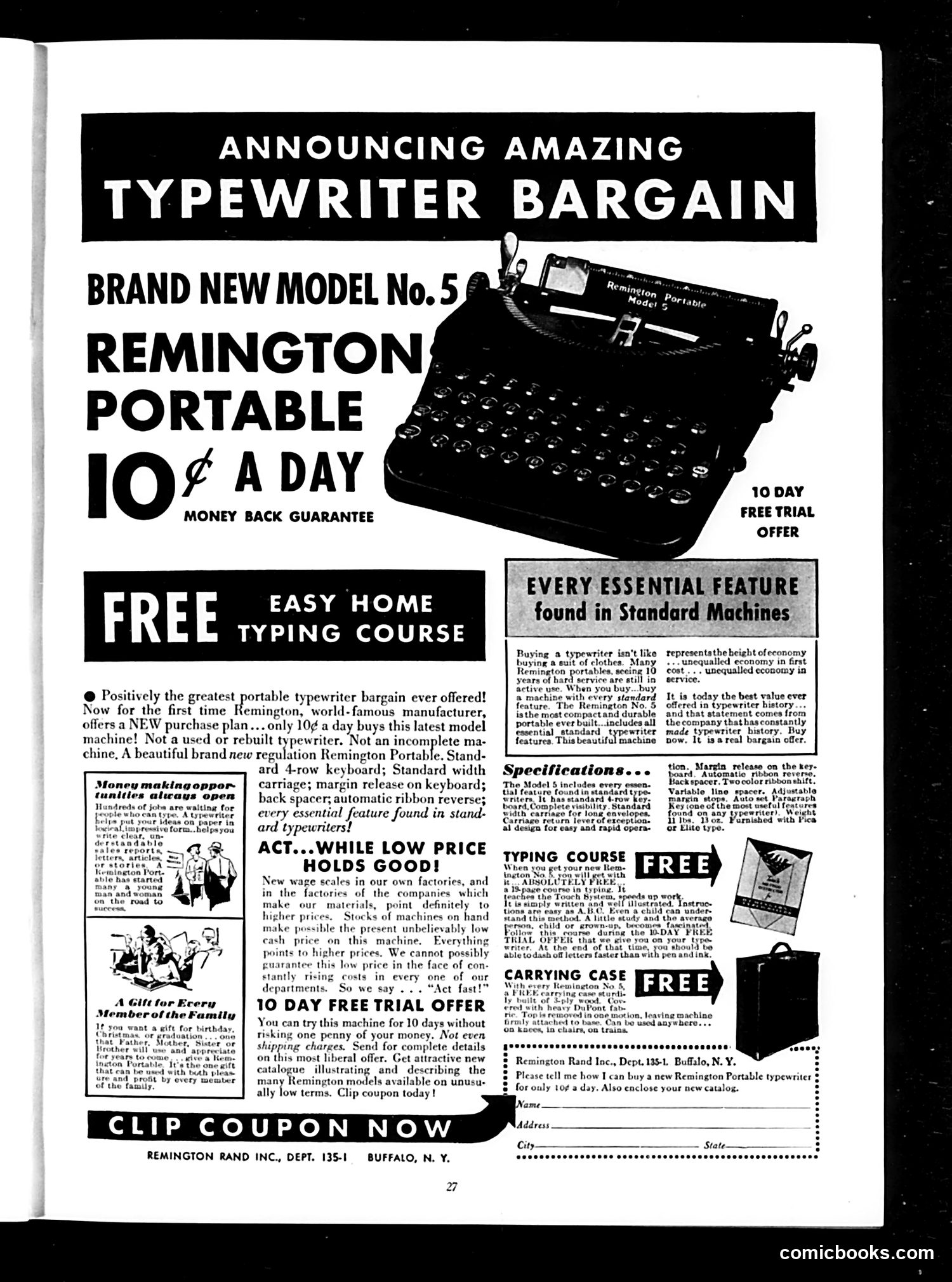
Advertisement Analysis This page is primarily a Remington typewriter advertisement, not political satire or editorial cartooning. It announces the Remington Portable Model No. 5, marketed as an affordable purchase option at "10¢ a day" with a money-back guarantee. The small illustrative vignettes (showing families and workers) are commercial art promoting the typewriter as a practical gift and income opportunity—reflecting early 20th-century messaging that typing skills offered employment prospects. The appeal emphasizes affordability during what the ad suggests is a period of rising costs ("new wage scales...point definitely to higher prices"), creating urgency to purchase before prices increase. The free 10-day trial and included typing course frame this as accessible to ordinary families. This reflects the era's optimism about office work and technology as paths to economic improvement. There is no political satire or caricature present—it is straightforward commercial advertising typical of Judge magazine's revenue model.
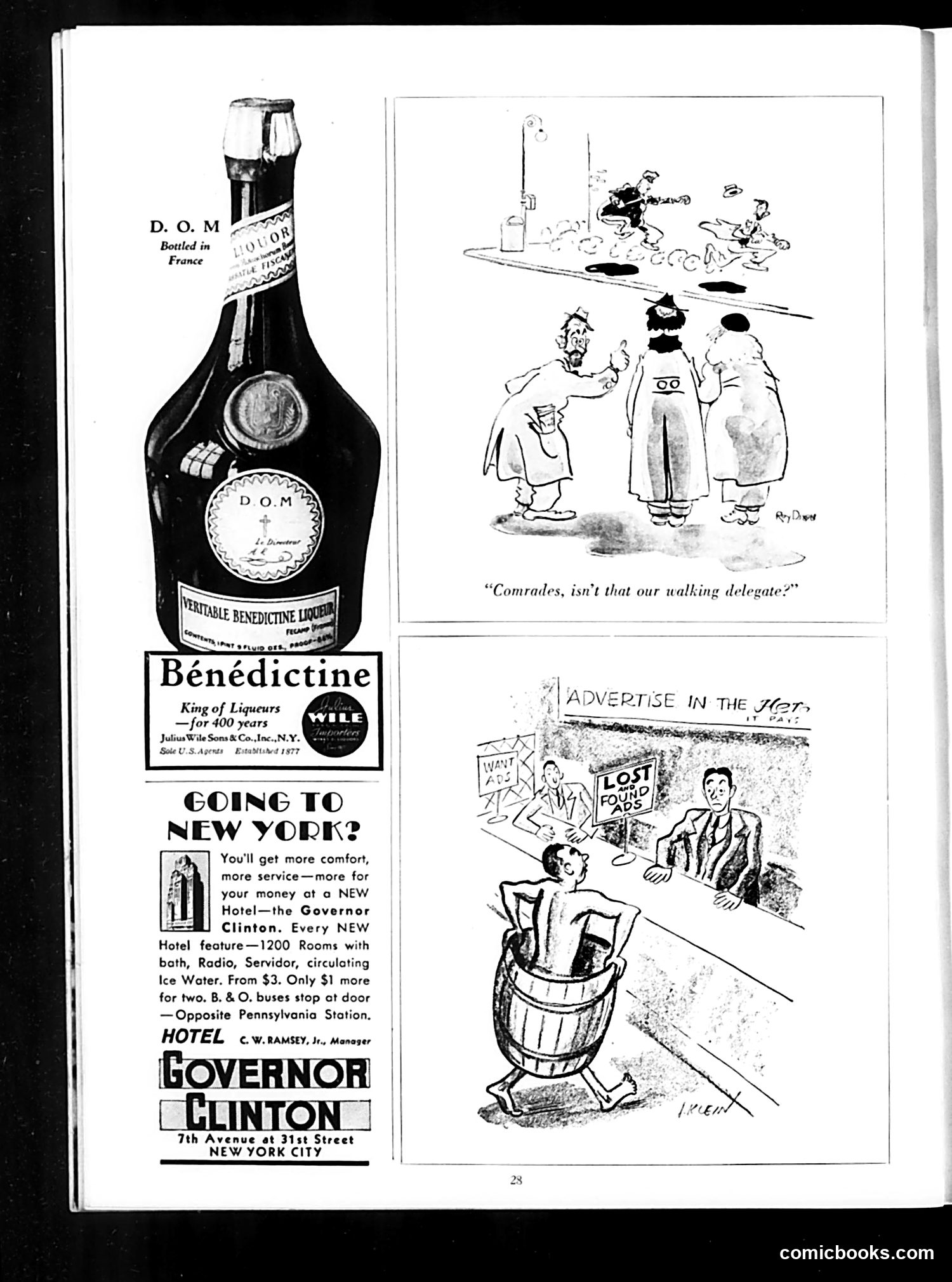
Explanation for Modern Readers This page contains two separate advertisements and one cartoon. The top cartoon shows children playing, with one asking "Comrades, isn't that our walking delegate?"—a joke about labor union terminology. The children are mimicking adult union behavior, suggesting satire about organized labor organizing even children. The left side advertises Bénédictine liqueur (a French digestif) and the Governor Clinton Hotel in New York, both targeting travelers. The bottom cartoon titled "Advertise in the Hers" shows a man trapped in a barrel marked "Lost Fond" (likely "Lost and Found"), appearing to be an advertisement itself. The joke appears to reference classified ads or advertising effectiveness—though the exact reference is unclear from the image alone. Overall, this is a typical Judge magazine page mixing commercial advertisements with satirical commentary on contemporary American life and labor issues.
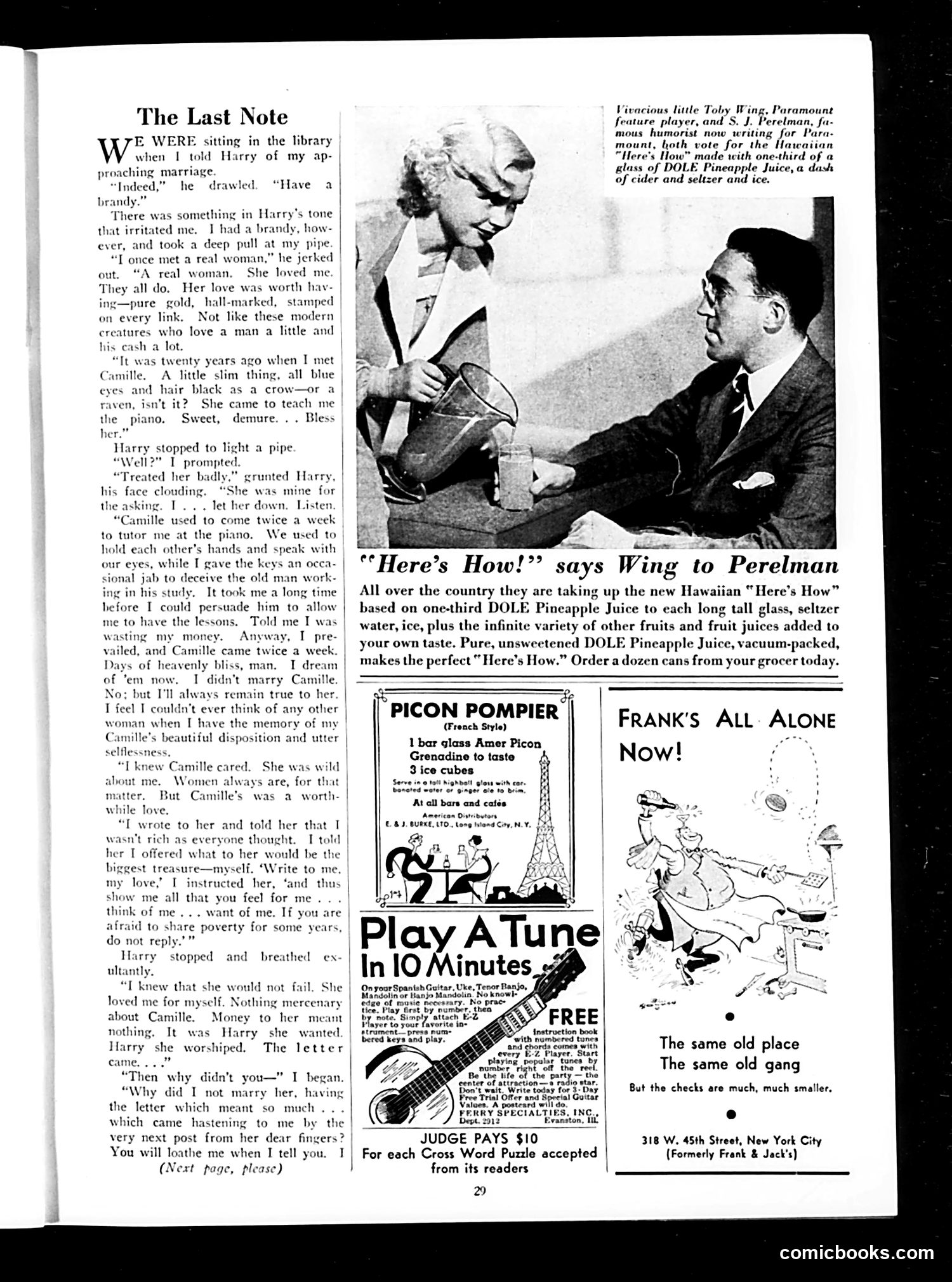
"The Last Note" — Judge Magazine Page Analysis This page combines a sentimental short story with period advertising. The Story: "The Last Note" is a romantic flashback narrative. A man named Harry recounts rejecting a woman named Camille twenty years prior. She was his piano teacher—poor but virtuous and genuinely in love with him. When he tested her character by confessing his lack of wealth, she responded with a passionate letter professing love for "Harry himself." Yet he "let her down" and never married her, though he remains "true to her" in memory. The story is clearly a morality tale about choosing material comfort over authentic love—a common theme in early 20th-century popular literature celebrating "real" feminine devotion over modern mercenary values. The Advertisements include: - A DOLE Pineapple Juice ad featuring Paramount actress Toby Wing and humorist S.J. Perelman - A "Play A Tune in 10 Minutes" music instruction offer - Frank's restaurant ("The same old place... but checks are much smaller")—likely referencing Depression-era economic decline The page reflects 1930s nostalgia for simpler romantic ideals.
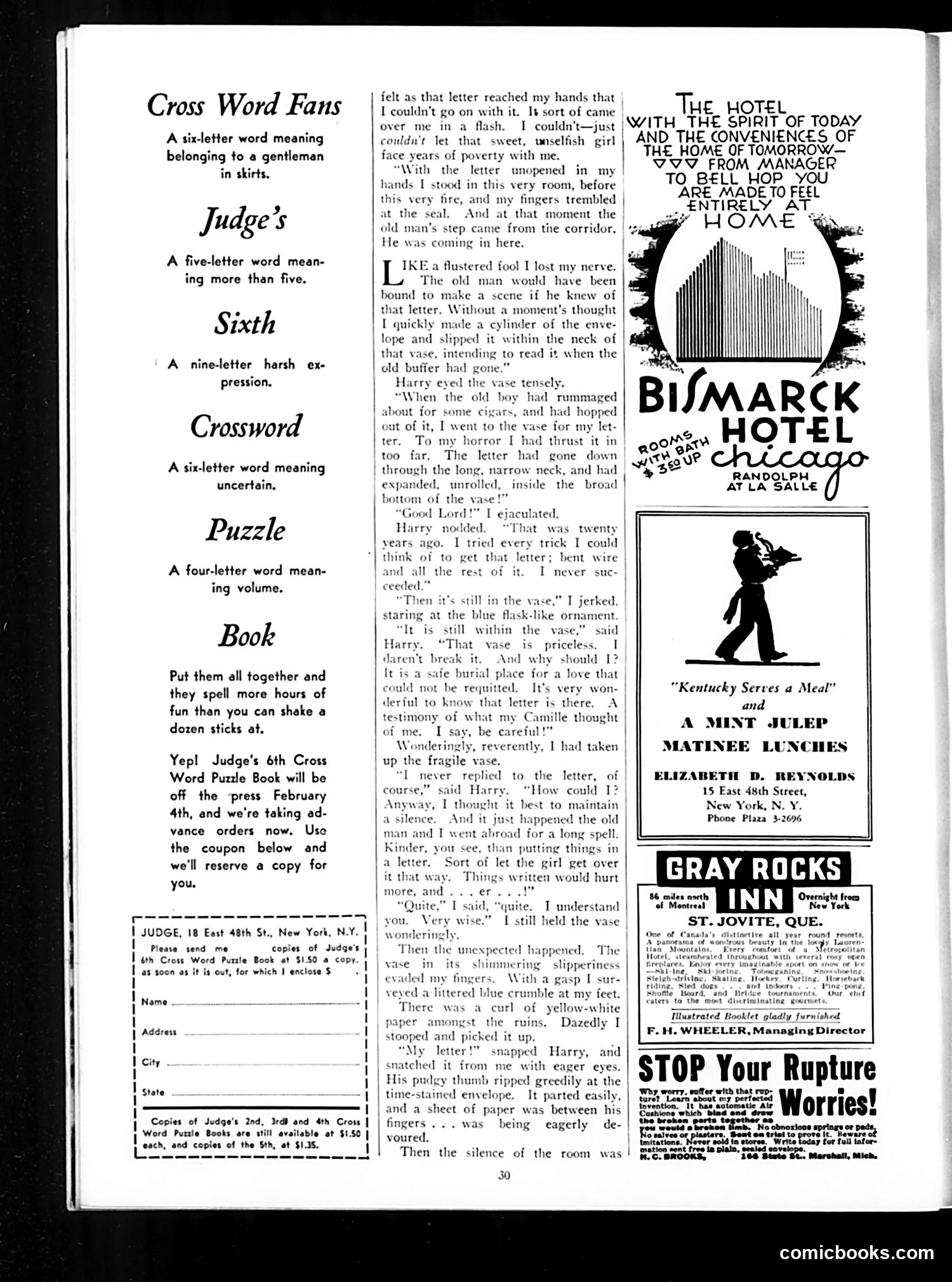
Judge Magazine Page Analysis This page is primarily advertising and promotional content for Judge magazine's sixth crossword puzzle book, launching February 4th. The crossword clues on the left are self-referential jokes about Judge itself—answers spell out praise for the publication. The long prose narrative in the center appears to be serialized fiction, likely a romantic melodrama popular in early 20th-century magazines. It describes a man unable to mail a love letter to an unselfish woman due to poverty; he hides it in a vase. Twenty years later, the vase breaks, revealing the letter. This type of sentimental, emotionally-charged narrative was standard magazine filler content. The right side contains advertisements: the Bismarck Hotel in Chicago, Elizabeth D. Reynolds' luncheon service, Gray Rocks Inn, and a rupture/hernia treatment device. These ads reflect typical concerns and services of the 1920s-30s era. Overall, this is a standard magazine layout mixing promotional content, serialized fiction, and commercial advertising—not editorial satire.
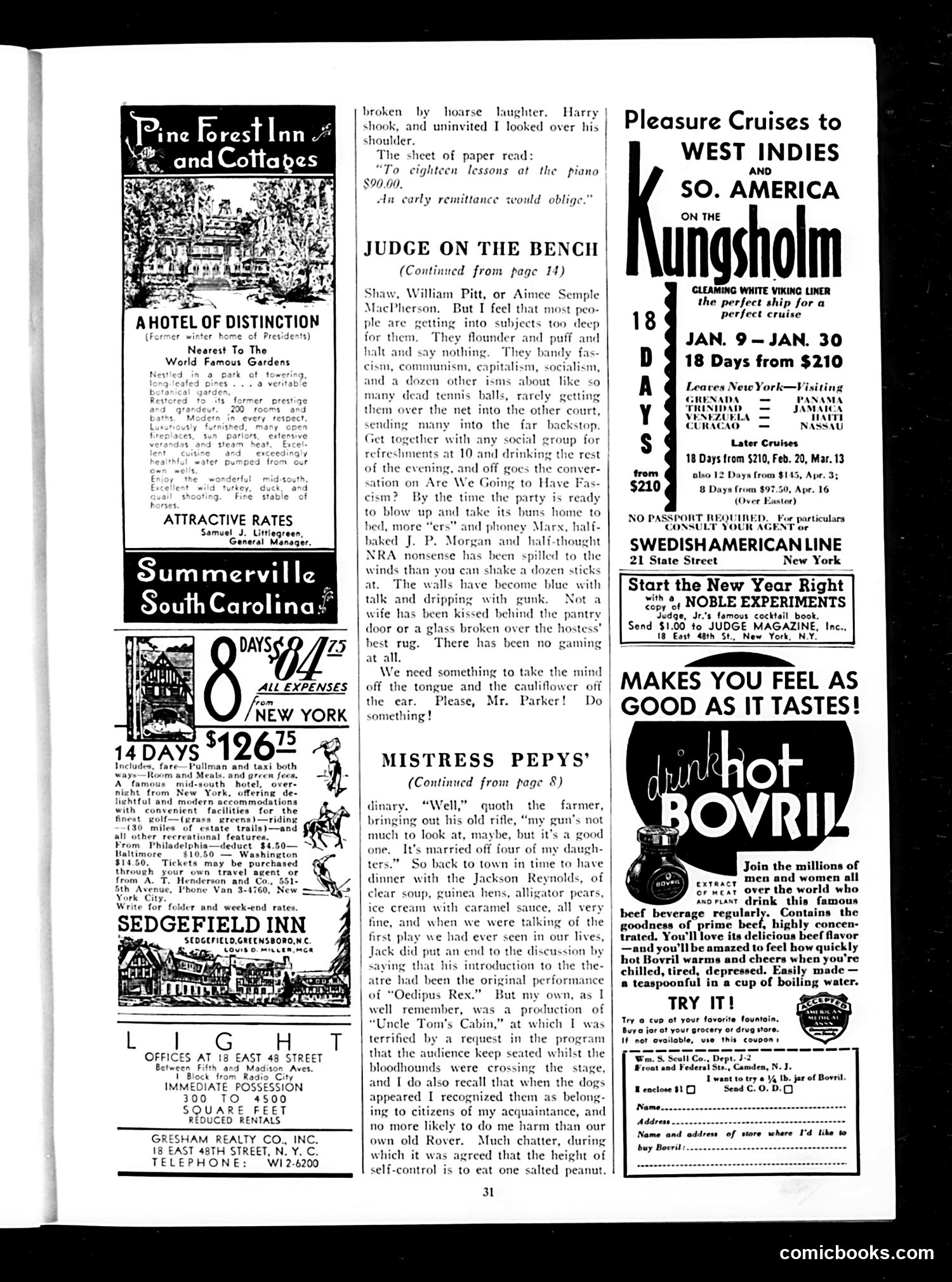
Page Analysis: Judge Magazine Advertisement & Editorial Content This page is primarily advertisements and serialized fiction, not political cartoons. The notable content includes: "Judge on the Bench" (continued article): A satirical commentary on dinner party conversation. The writer mocks guests who discuss serious topics—socialism, communism, capitalism, the NRA—without depth, merely bandying about "dead tennis balls" of ideas without genuine engagement. The satire critiques superficial intellectualism among the social set. "Mistress Pepys's" (continued serialized humor): Light social commentary on theatrical history and nostalgia, using anecdotes about witnessing old plays and recognizing dogs onstage. The bulk of the page comprises travel and real estate advertisements (cruise lines, hotels, rental offices) typical of Judge's revenue model in this era. No political figures are caricatured. The satire targets abstract social behavior—pretentious dinner conversation and shallow debate among the upper classes—rather than specific political targets or events.
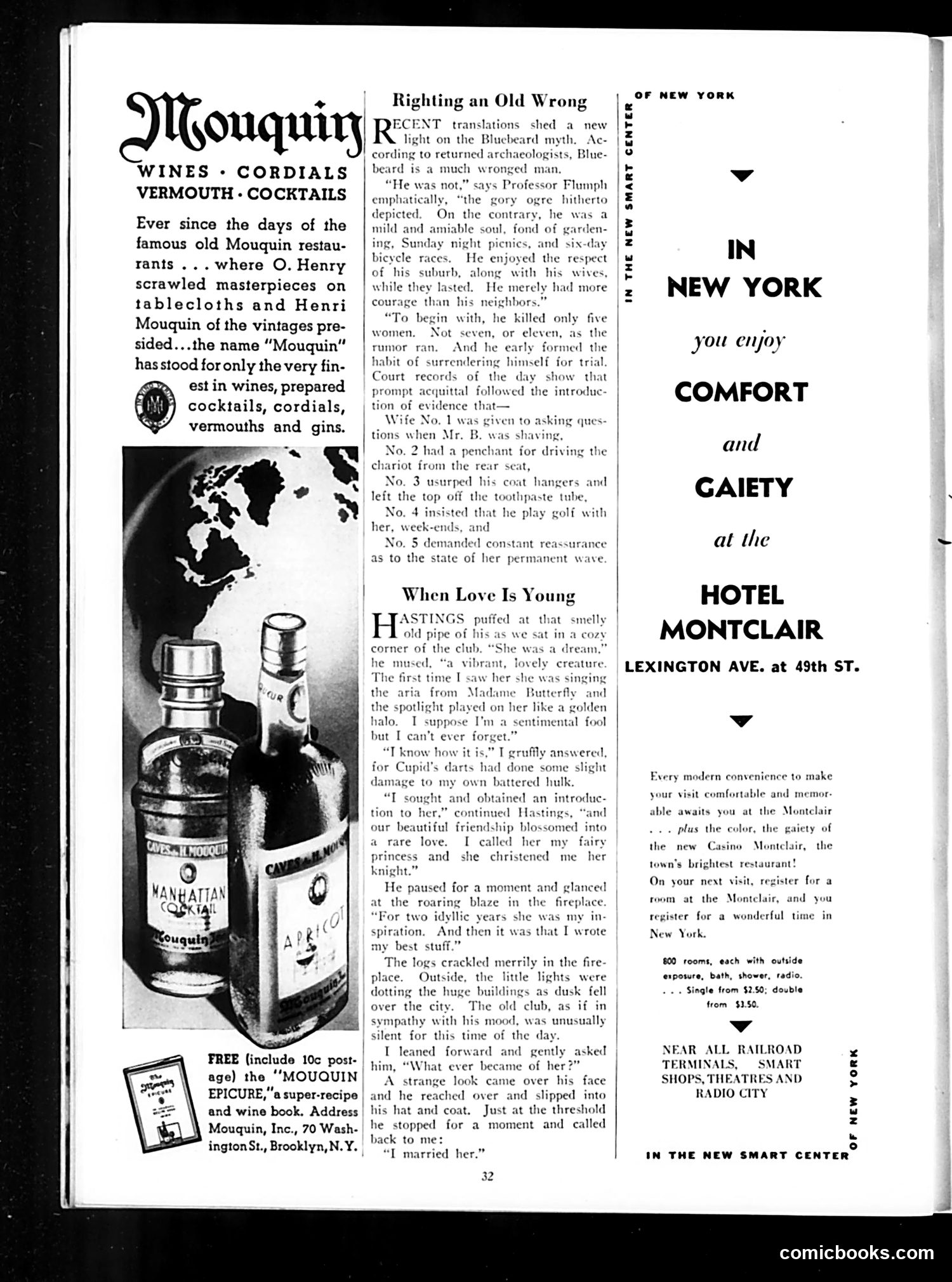
Content Analysis This page is primarily advertising for Mouquin wines/cordials and the Hotel Montclair, with two brief satirical pieces interspersed. "Righting an Old Wrong" is a tongue-in-cheek reframing of the Bluebeard legend. Rather than a serial killer, the article presents Bluebeard as a wronged man whose wives were merely annoying—one asked too many questions while shaving, another left the toothpaste uncapped. The satire mocks both the Bluebeard myth and contemporary marital friction, suggesting his murders were justified complaints about domestic irritants. It's a misogynistic joke about nagging wives. "When Love Is Young" is a sentimental anecdote about a man who met a woman at a club, called her his "fairy princess," and wrote "his best stuff" about her—only to end by marrying her, implied as a disappointing conclusion to the romance. Both pieces are light, cynical humor typical of Judge magazine's style, with no specific political content—just observations on relationships and mythology filtered through period attitudes toward women.
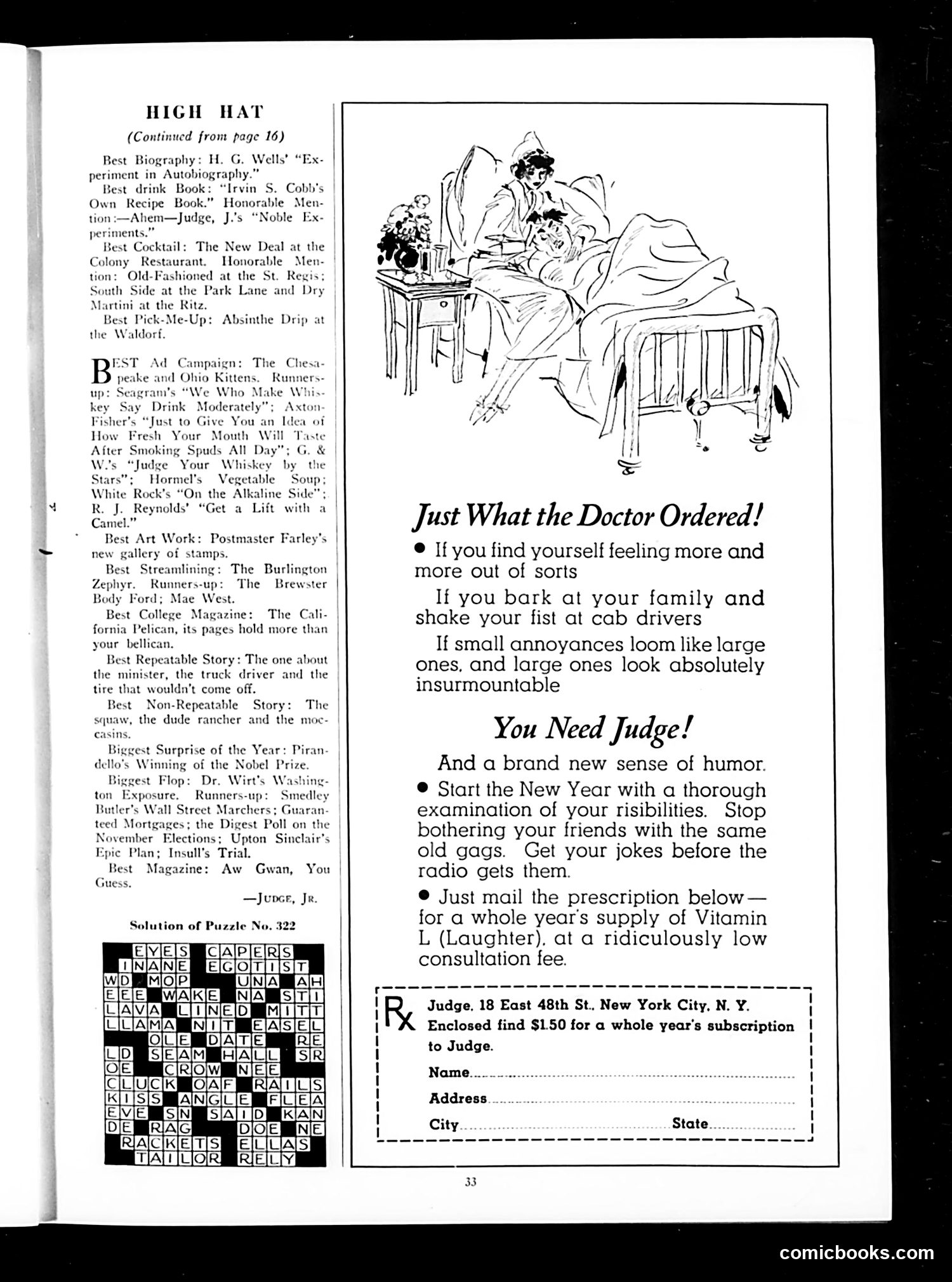
Analysis of This Judge Magazine Page This is primarily a subscription advertisement disguised as satirical medical advice. The illustration shows a patient in bed being treated by a doctor—a visual metaphor for Judge magazine as a cure. The ad employs 1930s humor to pitch subscriptions by framing emotional irritability and social exhaustion as medical conditions requiring "treatment." It references contemporary anxieties: feeling "out of sorts," family tension, and cab driver road rage—relatable Depression-era frustrations. The prescription's punchline offers "Vitamin L (Laughter)" as remedy, positioning Judge as necessary mental medicine. The "$1.50 for a whole year's subscription" pitch follows, making the satirical diagnosis a sales tool. The "HIGH HAT" column above lists award winners in contemporary culture (H.G. Wells, cocktails, cars, magazines), reflecting Judge's role documenting 1930s American life and leisure—affluent perspectives typical of the era's satirical magazines.
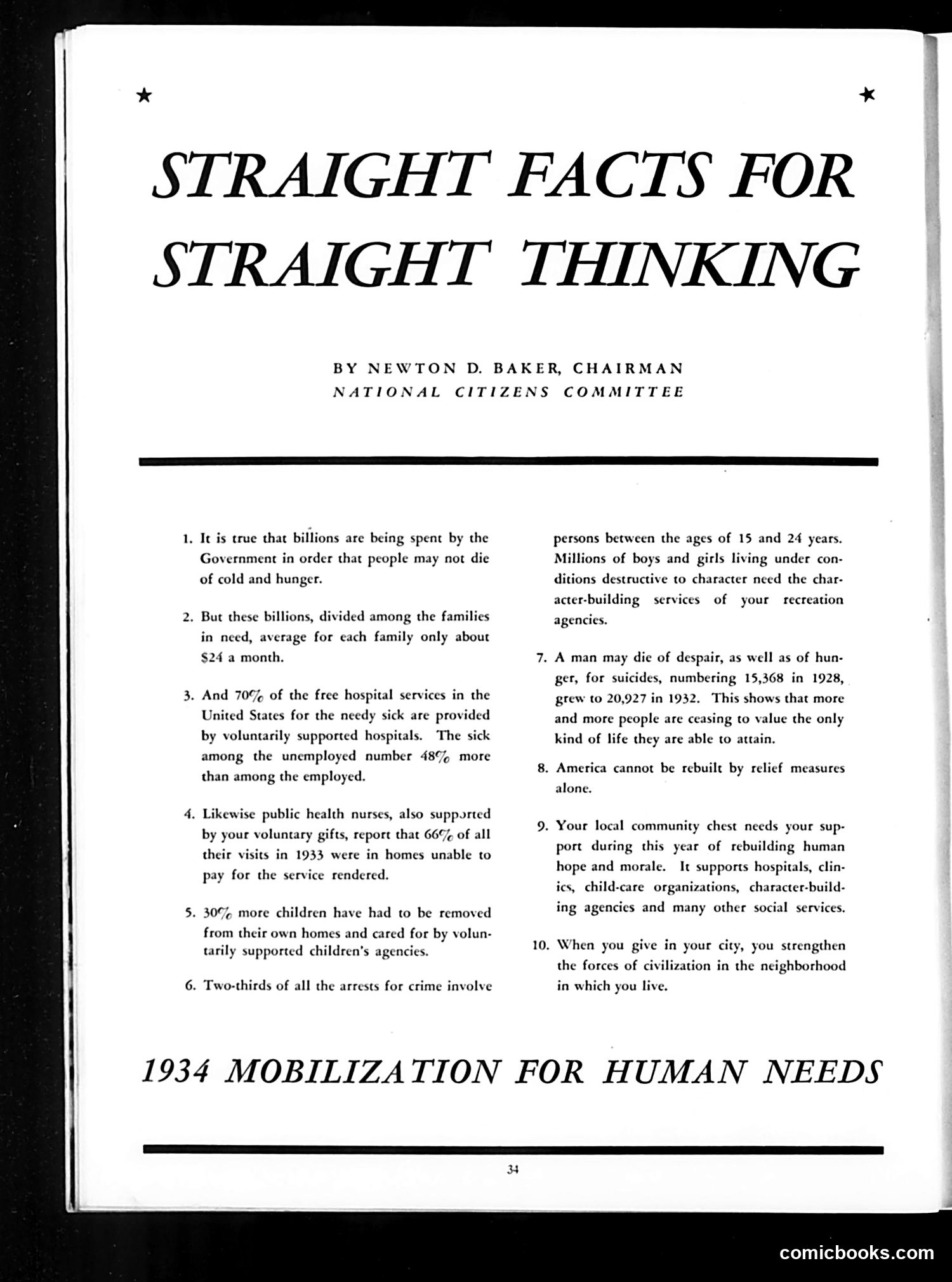
Analysis This isn't a cartoon but rather a propaganda piece from 1934, during the Great Depression. Newton D. Baker (former Secretary of War) argues that while government relief spending exists, it's inadequate—averaging only $24 monthly per family. The text emphasizes that private charitable organizations (hospitals, health nurses, children's agencies, recreation centers) are shouldering the burden, with statistics showing increased need: more unemployed sick people, children removed from homes, youth crime, and rising suicides (15,368 in 1928 to 20,927 by 1932). The message promotes Community Chest fundraising—urging local charitable giving as the solution. The underlying argument: government relief alone cannot rebuild America; private voluntary charity is essential to restore "human hope and morale." This reflects Depression-era debates about whether federal or private relief should address mass poverty—positioned here as a call for increased private donations rather than expanded government programs.
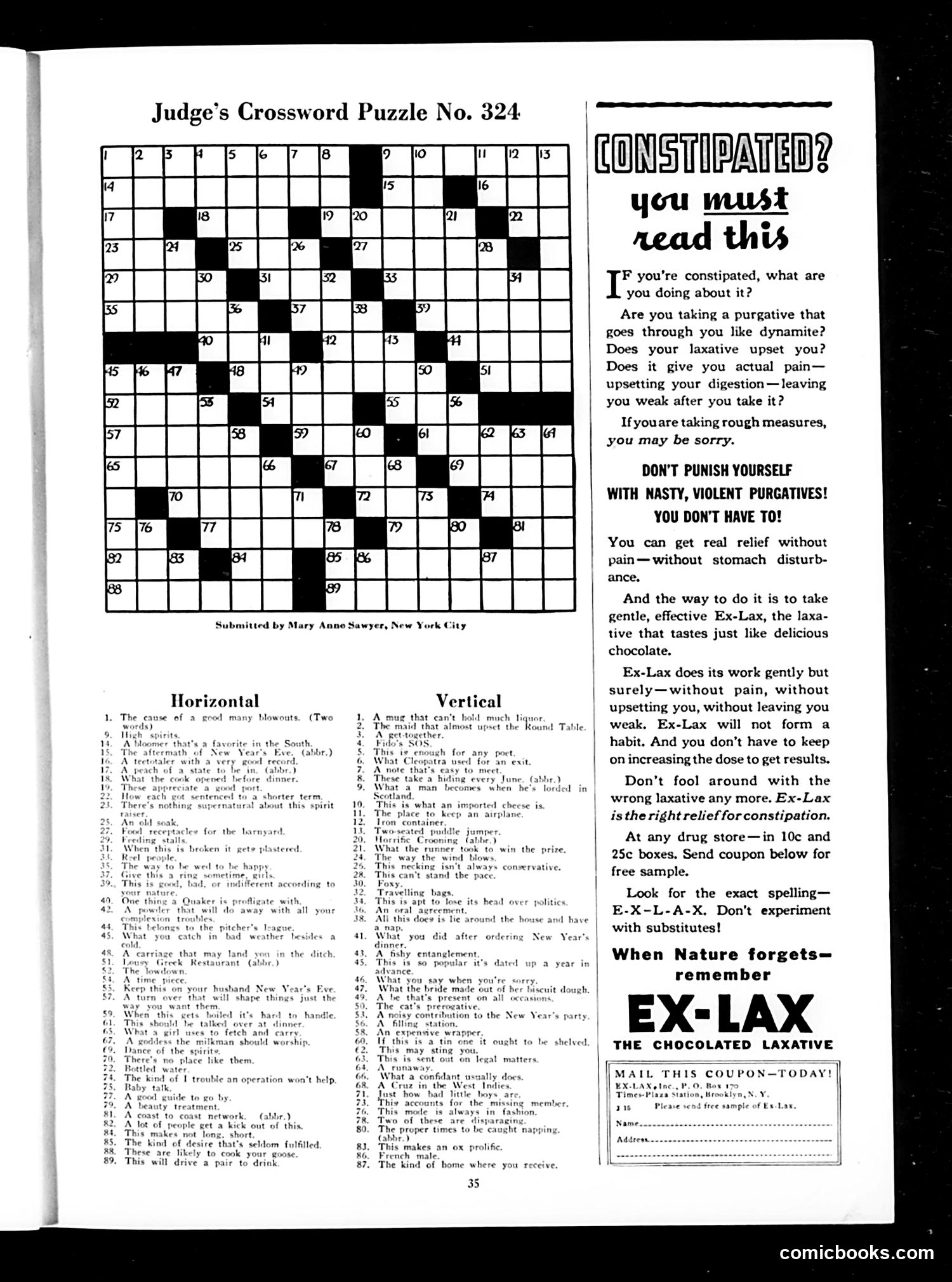
Judge Magazine Page No. 324 Analysis This page contains Judge's Crossword Puzzle No. 324 alongside a full-page advertisement for Ex-Lax laxative. The crossword itself appears standard for the era, with clues referencing New Year's Eve celebrations and social activities ("ordered New Year's," "dated up a year"). The humor is mild wordplay typical of 1920s-30s puzzle magazines. However, the dominant content is the Ex-Lax ad, which uses direct messaging to shame readers into buying the product. The ad explicitly warns against "nasty, violent purgatives" while promoting Ex-Lax as a "gentle" chocolate-flavored alternative. This represents typical advertising strategy of the period: create anxiety about a bodily function, then position the product as relief. The juxtaposition is notable—Judge paired entertainment with aggressive health advertising, reflecting how magazines monetized reader concerns about digestive health, a common anxiety topic in early 20th-century consumer marketing.
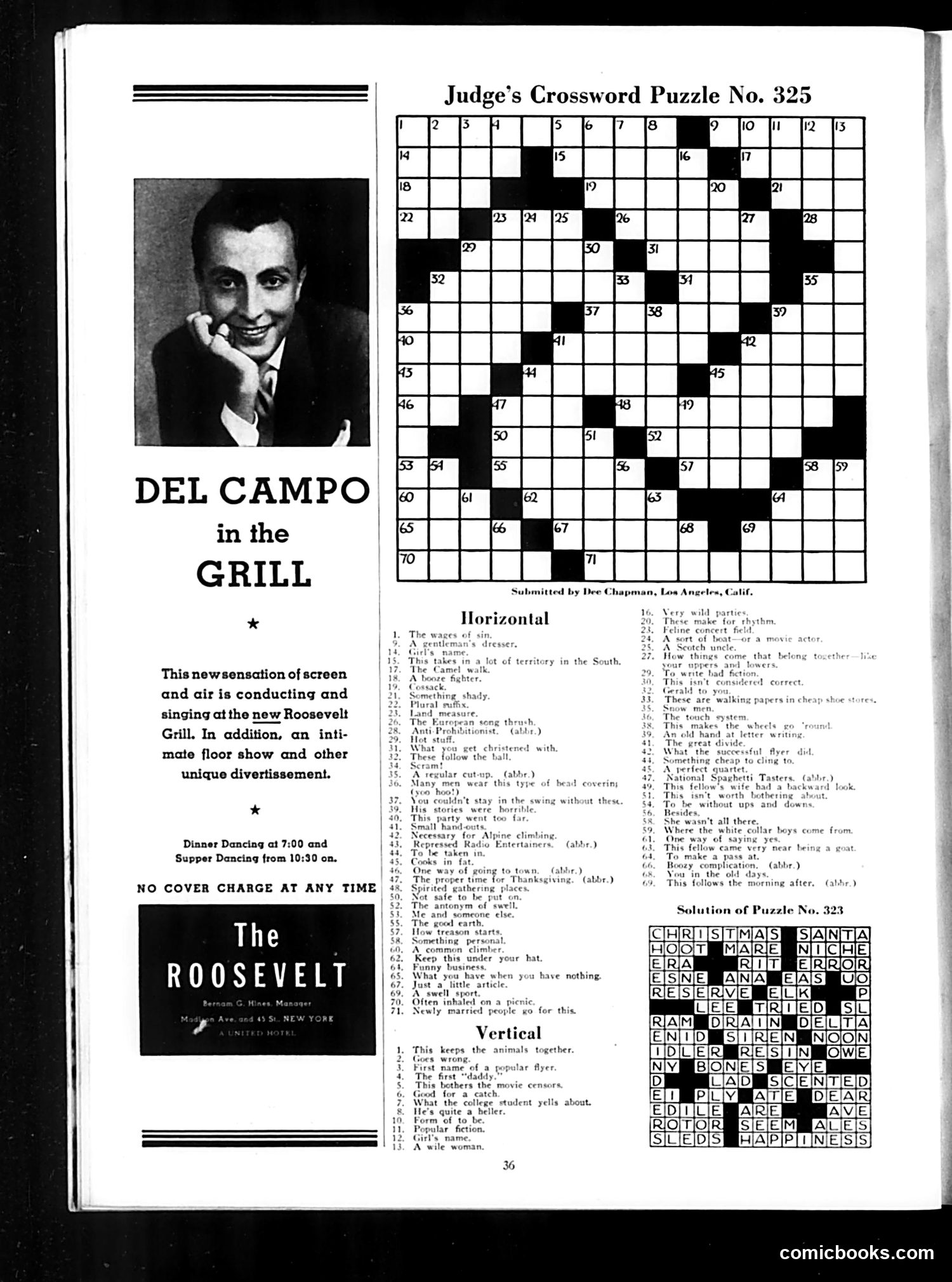
Analysis of Judge Page No. 325 This page is primarily advertising, not satire or political commentary. The left side features a photograph and promotional text for Del Campo, described as "a newsensation of screen and air" now conducting and singing at the newly opened Roosevelt Grill in New York City. The ad emphasizes entertainment amenities: dinner dancing at 7:00 PM, supper dancing from 10:30 PM onward, with "no cover charge." The right side contains Judge's Crossword Puzzle No. 325 with horizontal and vertical clues, plus the solution to the previous puzzle (No. 323). At the bottom is a separate advertisement for The Roosevelt hotel/restaurant itself. Del Campo appears to have been a performer of some note in the 1930s-40s era, though the specific nature of his fame is unclear from this page alone. The Roosevelt Grill was capitalizing on his popularity to attract dinner-and-dancing clientele during the Depression or wartime era when such entertainment venues were popular leisure destinations.
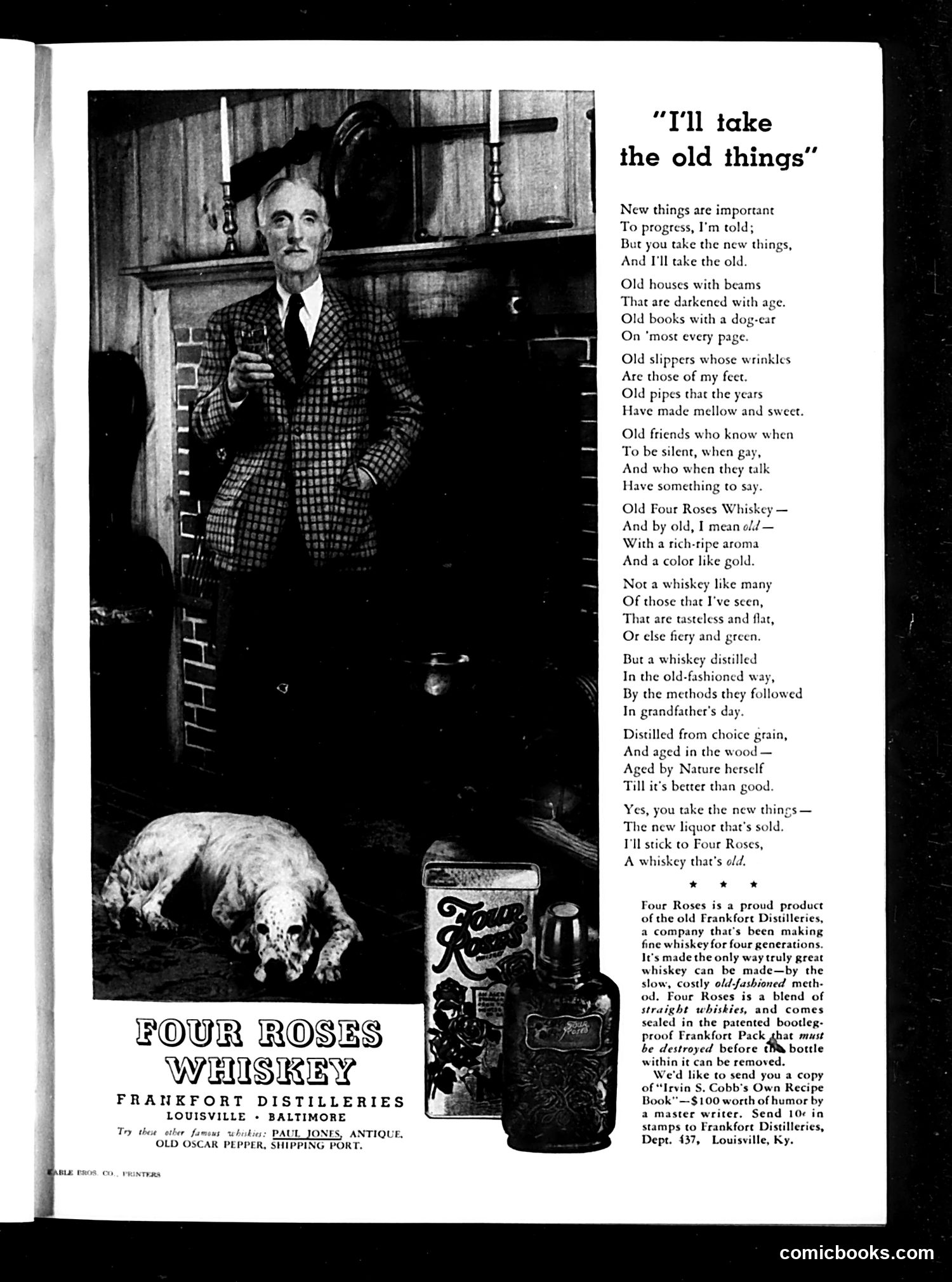
Four Roses Whiskey Advertisement This is a full-page advertisement, not satire. It presents an elderly gentleman (photograph, not caricature) endorsing Four Roses whiskey through a poem titled "I'll take the old things." The ad's rhetorical strategy contrasts old with new: old houses, books, pipes, and friends possess character and value that modern equivalents lack. The whiskey is positioned as similarly superior—distilled the "old-fashioned way" versus new liquors that are "tasteless and flat, / Or else fiery and green." The appeal is fundamentally nostalgic conservatism: progress is acknowledged ("New things are important / To progress, I'm told") but dismissed in favor of proven tradition. This marketing tapped into post-Prohibition sentiment (the ad references bootleg-proof packaging) by associating the brand with stability and craftsmanship versus cheaper mass-produced competitors. The accompanying copy emphasizes four generations of production and slow, costly methods—positioning premium pricing as evidence of quality rather than excess.
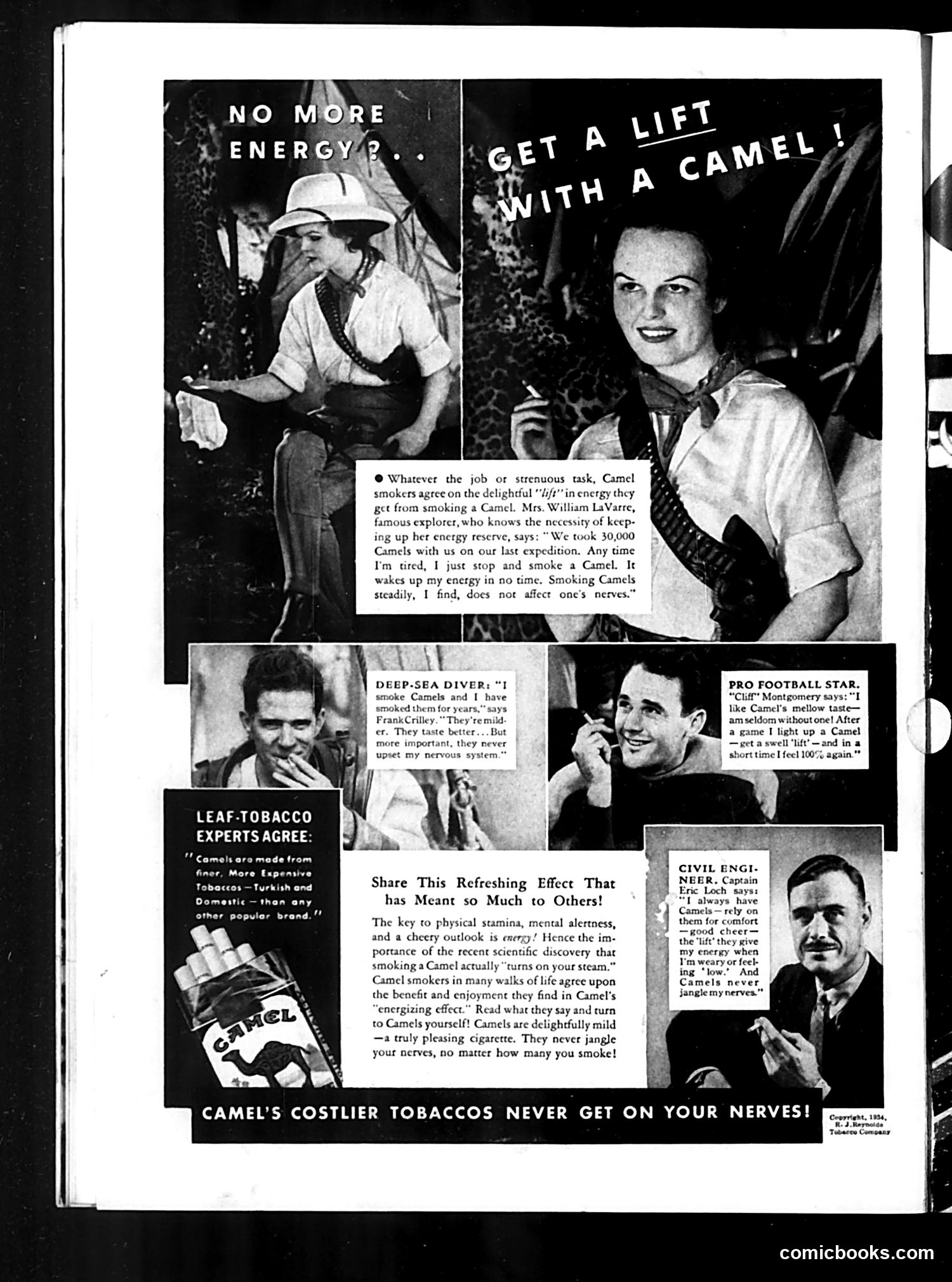
Analysis: Camel Cigarette Advertisement This is not satire or political commentary—it's a straightforward cigarette advertisement disguised as testimonial journalism. Judge magazine has devoted this entire page to promoting Camel cigarettes through endorsements from various professionals: an explorer (Mrs. William LaVarre), a deep-sea diver (Frank Crilley), a football player (Cliff Montgomery), and a civil engineer. The ad's central claim—that Camel's "costlier tobaccos" provide an energizing "lift" without affecting nerves—represents the marketing strategies of 1930s-50s tobacco advertising. The testimonials exploit these figures' credibility to suggest smoking aids physical stamina and mental alertness during demanding work. By modern standards, this is medically fraudulent advertising: cigarettes don't provide genuine energy or improve performance. The page exemplifies how tobacco companies once openly marketed cigarettes as health-enhancing products before such claims were regulated or understood as harmful.