judge
Judge — February 1935
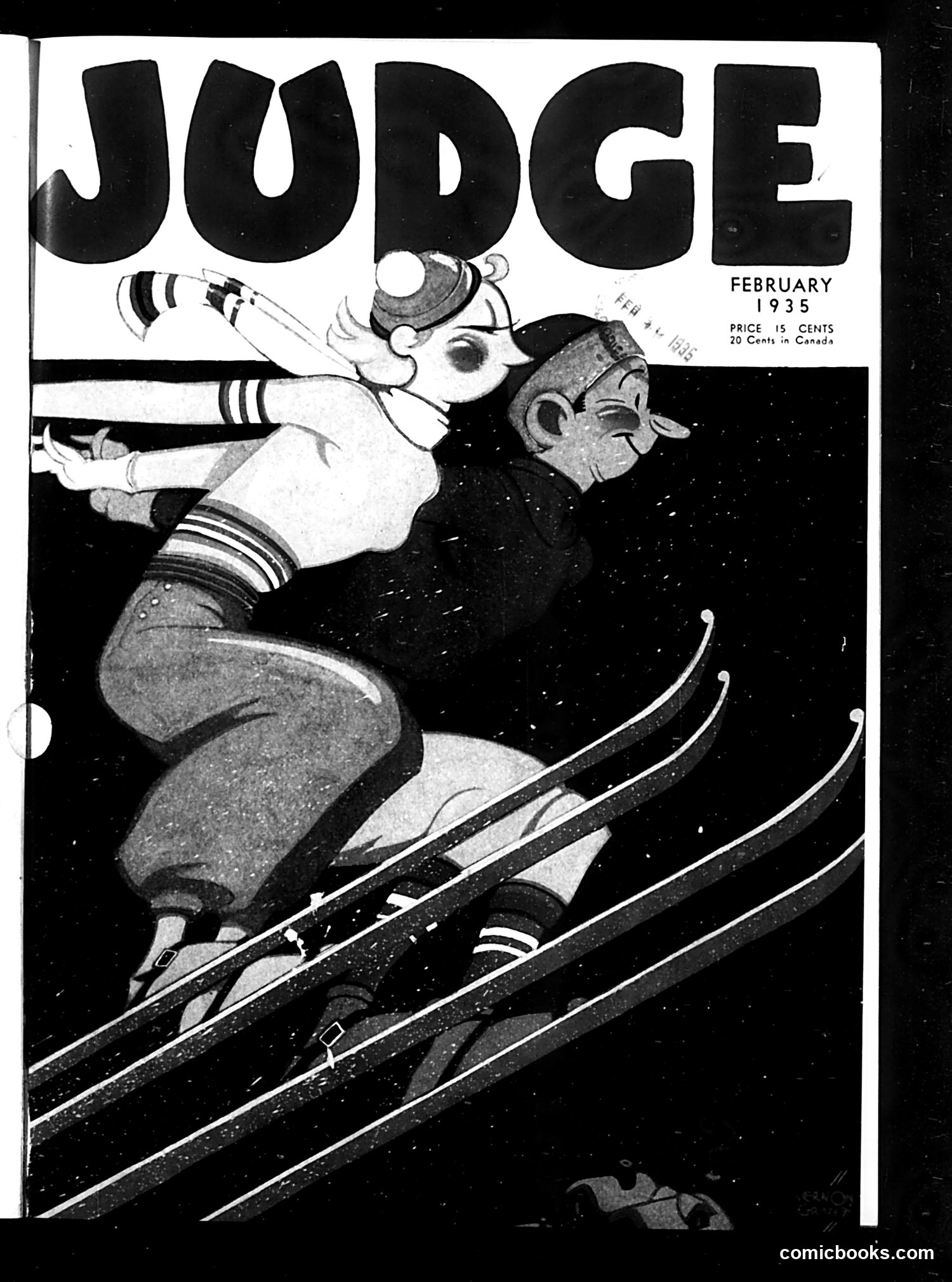
Analysis This is the February 1935 cover of Judge magazine. The illustration depicts a cartoonish couple skiing downhill, with the woman in front (appearing voluptuous and carefree) and a man behind her (rendered with exaggerated facial features). Without additional OCR text from the interior or clearer context, the specific satire is difficult to identify with certainty. However, the cover likely comments on 1930s social attitudes — possibly mocking contemporary leisure activities, gender relations, or fashion during the Depression era. The woman's stylized appearance and the man's pursuit suggest commentary on courtship, leisure culture, or perhaps economic behavior during this period. The exaggerated caricature style was typical of Judge's satirical approach to American social commentary.
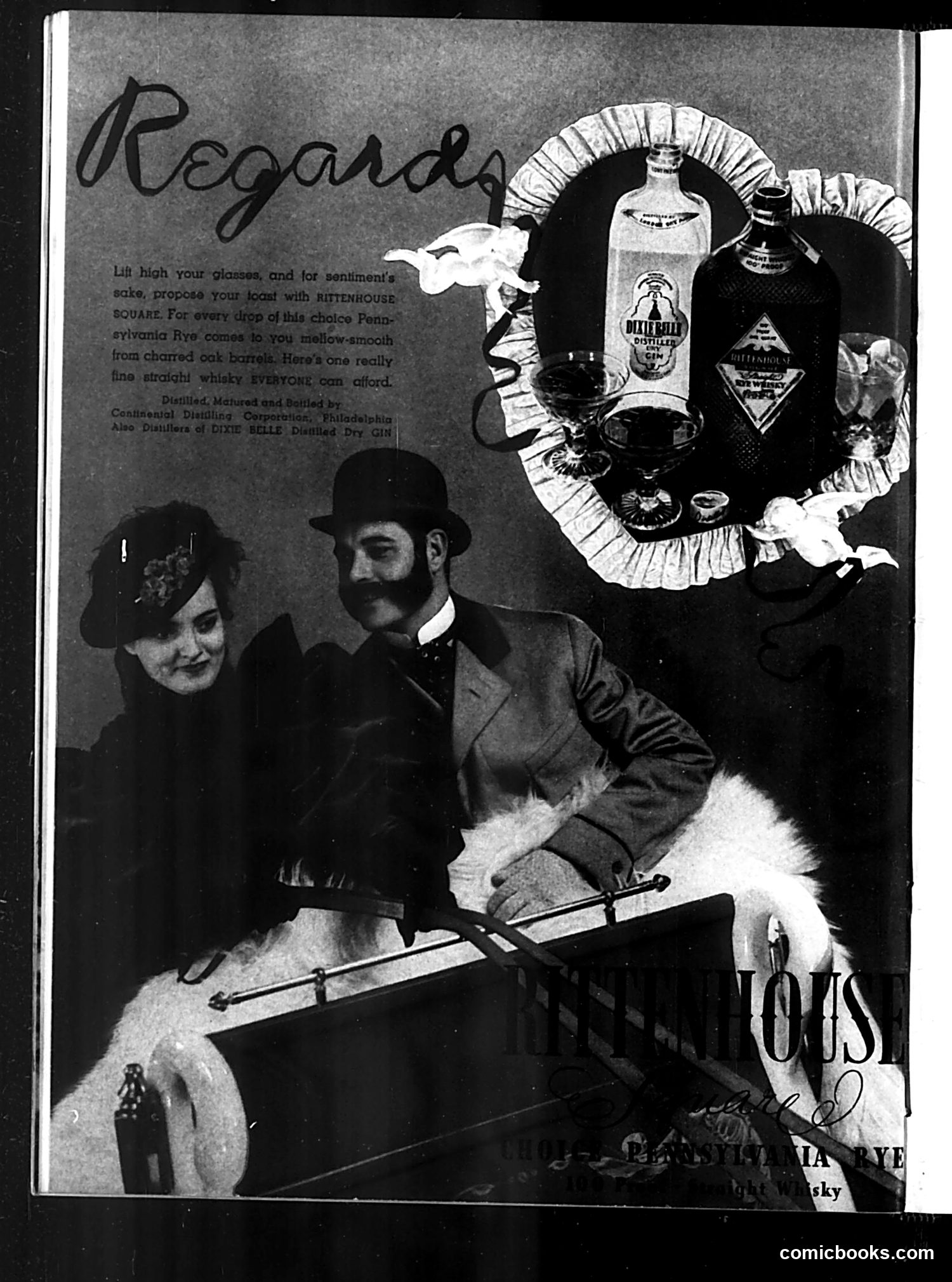
Regord Advertisement Analysis This appears to be a liquor advertisement for "Regord" Pennsylvania Rye whiskey from Judge magazine. The ad uses humor typical of the Prohibition era (though the specific date is unclear from this image alone). The text invites readers to "lift high your glasses" and "propose your local with Rittenhouse Square"—likely referencing a Philadelphia location. It emphasizes the whiskey's smooth quality and that "EVERY one can afford" it. The image shows three elegantly dressed figures in formal attire examining bottles displayed in an ornate presentation. The satire appears to target the contradiction between Prohibition laws and continued alcohol consumption among the wealthy—presenting premium whiskey as an aspirational product despite legal restrictions.
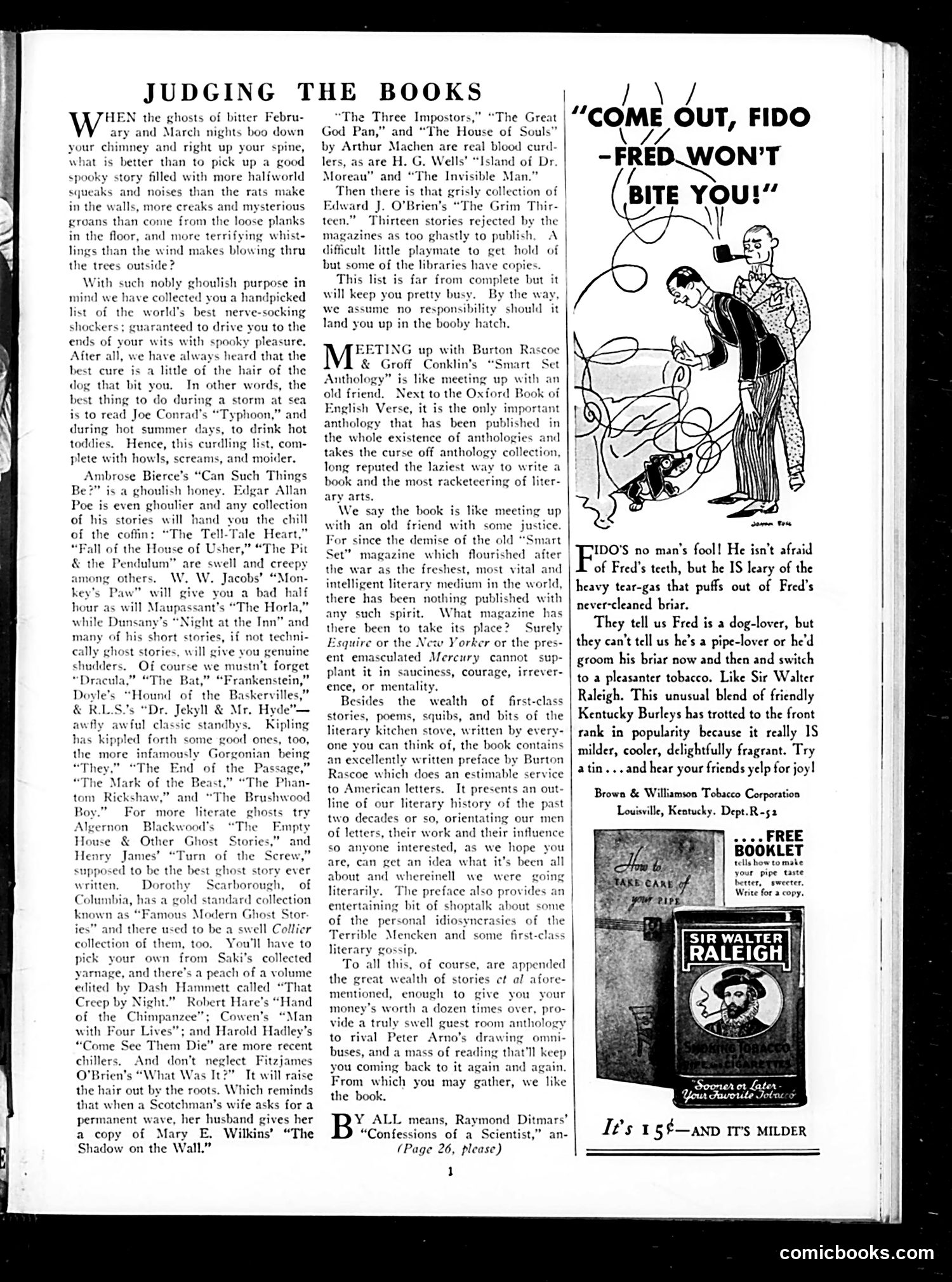
"Come Out, Fido—Fred Won't Bite You!" This cartoon satirizes Fred, likely a public figure of the era, as someone so untrustworthy or menacing that even a dog fears him. The joke plays on social anxiety: the man must coax his own dog outdoors by reassuring it that "Fred" won't harm it, suggesting Fred has such a notorious reputation for aggression, deception, or untrustworthiness that he's become proverbial shorthand for danger. The accompanying text promotes Sir Walter Raleigh tobacco, emphasizing its reliability and popularity as a counterpoint—a product readers *can* trust, unlike the mysterious "Fred." Without additional context about who Fred specifically was in 1920s public discourse, the exact reference remains unclear, but the satire clearly mocks someone whose reputation was so poor it became a cultural byword for danger.
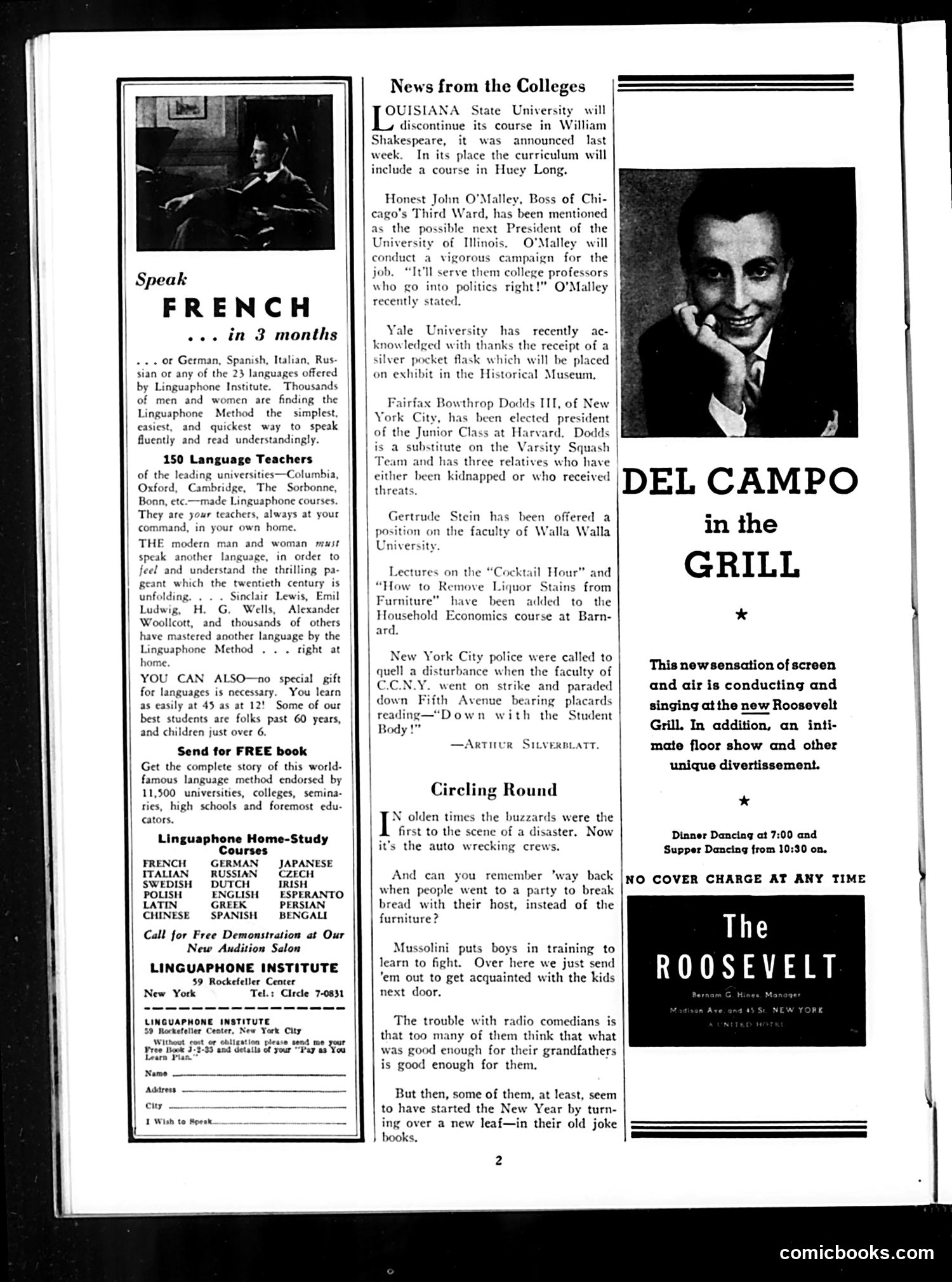
Analysis of Judge Magazine Page 2 This page is primarily advertising and college news rather than political satire. The left side features a Linguaphone Institute advertisement promising to teach French "in 3 months" through their language method, with a photograph of an instructor. The ad emphasizes accessibility for home study. The right side contains "News from the Colleges" reporting campus developments: Louisiana State discontinuing Shakespeare courses, John O'Malley's potential presidency at University of Illinois, and Yale receiving a silver flask donation. Below is "Circling Round," a humor column with gentle jokes about auto wrecking crews, radio comedians, and New Year's resolutions—mild social commentary rather than sharp political satire. The Roosevelt Grill advertisement occupies the bottom right, promoting dining and dancing with no cover charge.
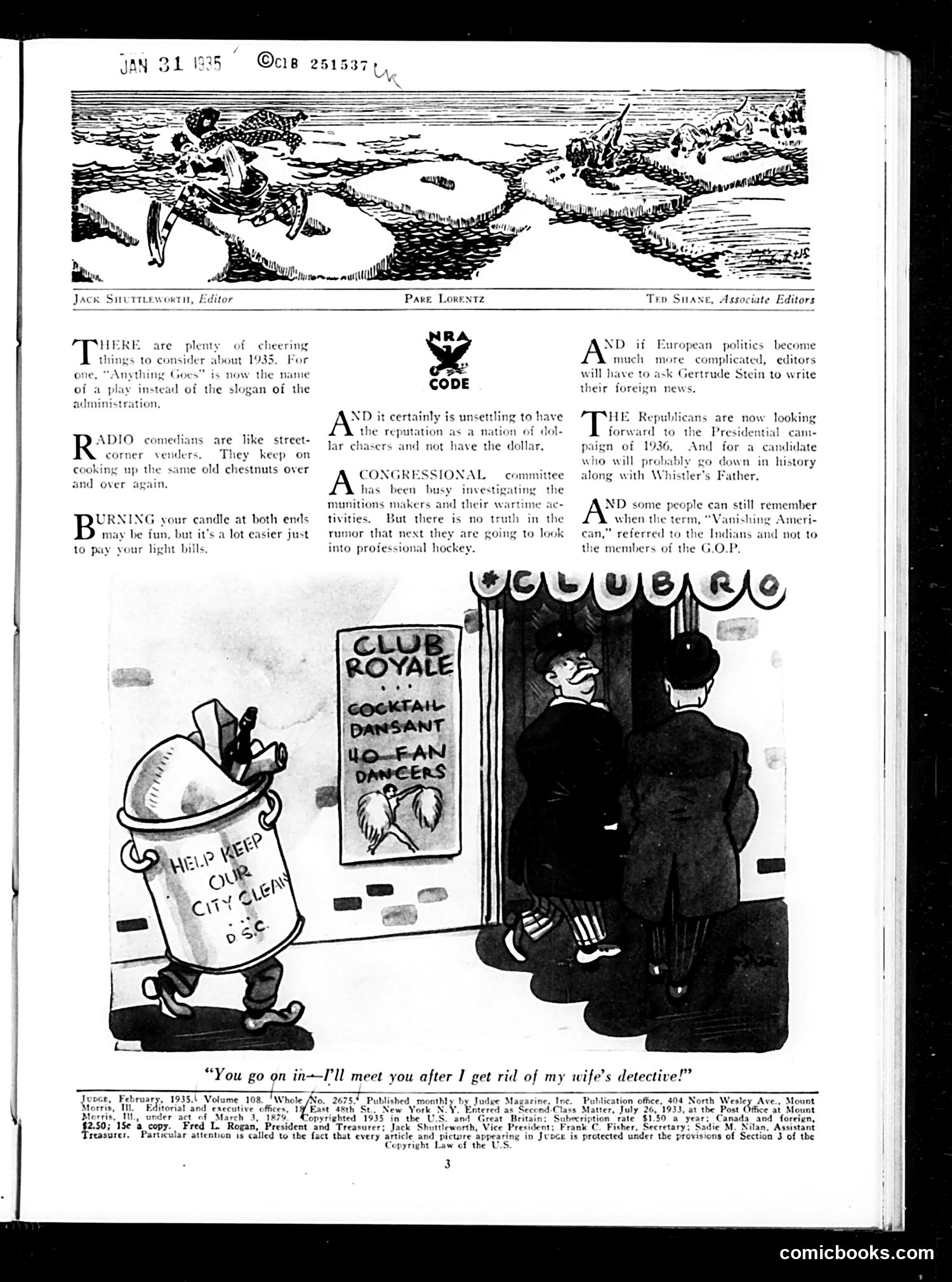
Analysis of Judge Magazine Page (January 31, 1935) The main cartoon depicts a man at a nightclub entrance (Club Royale) telling his companion: "You go in—I'll meet you after I get rid of my wife's detective!" This satirizes 1930s marital infidelity anxieties, where wealthy men frequented speakeasies and nightclubs despite Prohibition. The "wife's detective" references the common practice of hiring private investigators to catch unfaithful spouses—a significant issue during Depression-era social upheaval. The accompanying editorial snippets reference 1935 politics: NRA (National Recovery Administration) debates, European political instability, and the upcoming 1936 Presidential campaign. The trash can labeled "Help Keep Our City Clean, D.S.C." appears to mock municipal or political corruption, a recurring Judge theme.
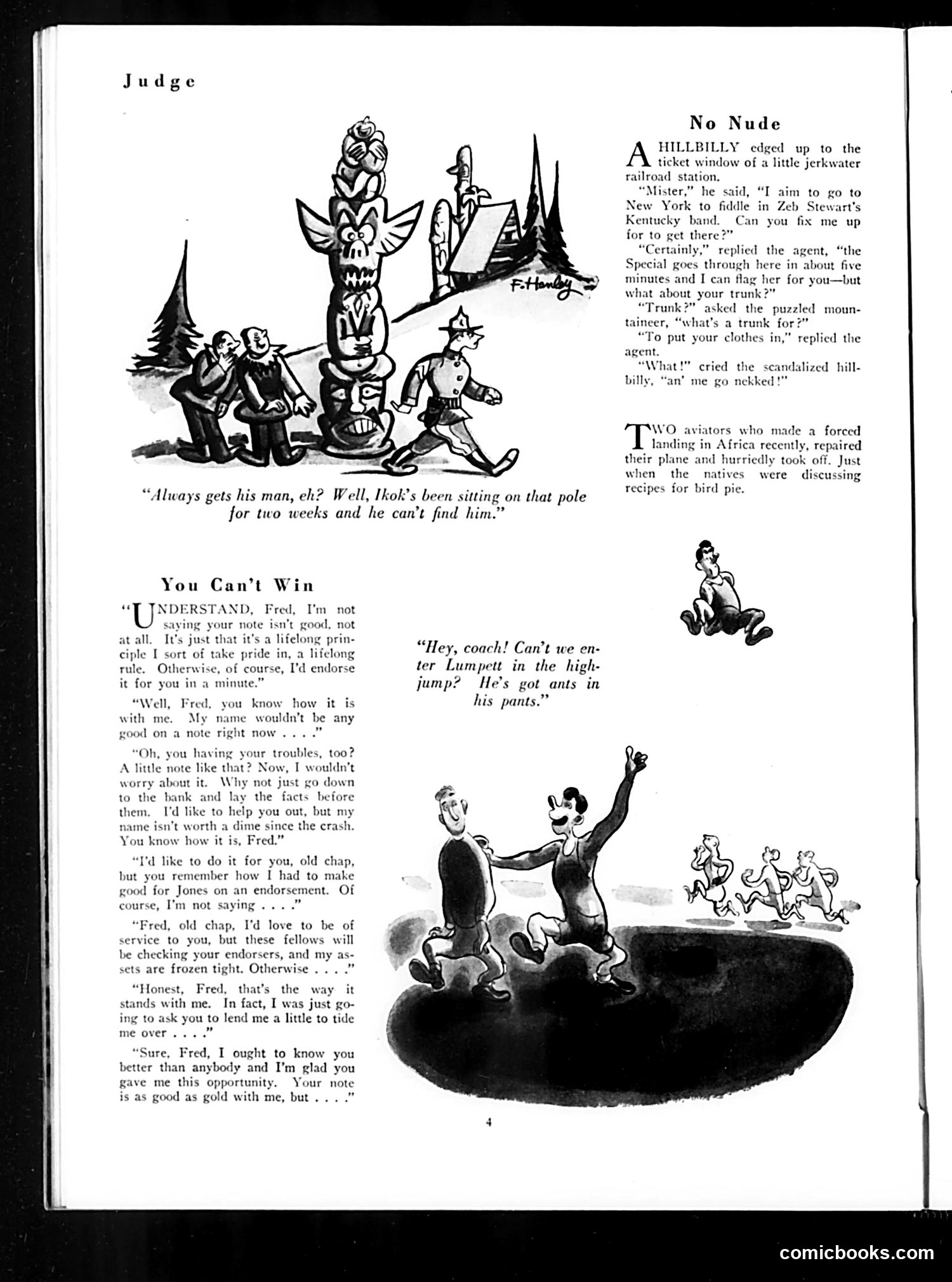
Analysis of Judge Magazine Page This page contains three separate humorous pieces: 1. "Always gets his man" (top): A totem pole of stacked figures illustrates the caption about someone sitting on a pole for two weeks. The joke appears to reference a classic detective or authority figure unable to locate someone despite their reputation for success. 2. "No Nude" (right): A hillbilly character negotiates train travel, asking about a "trunk." The agent's misunderstanding of rural dialect for comic effect was a common stereotype humor trope of this era. 3. "You Can't Win" (left): Two men discuss a financial note and endorsement. The satire concerns financial obligations and reputation—suggesting one's name carries no value in securing loans during economic hardship. All three pieces use wordplay and character misunderstandings typical of early 20th-century American comic magazines.
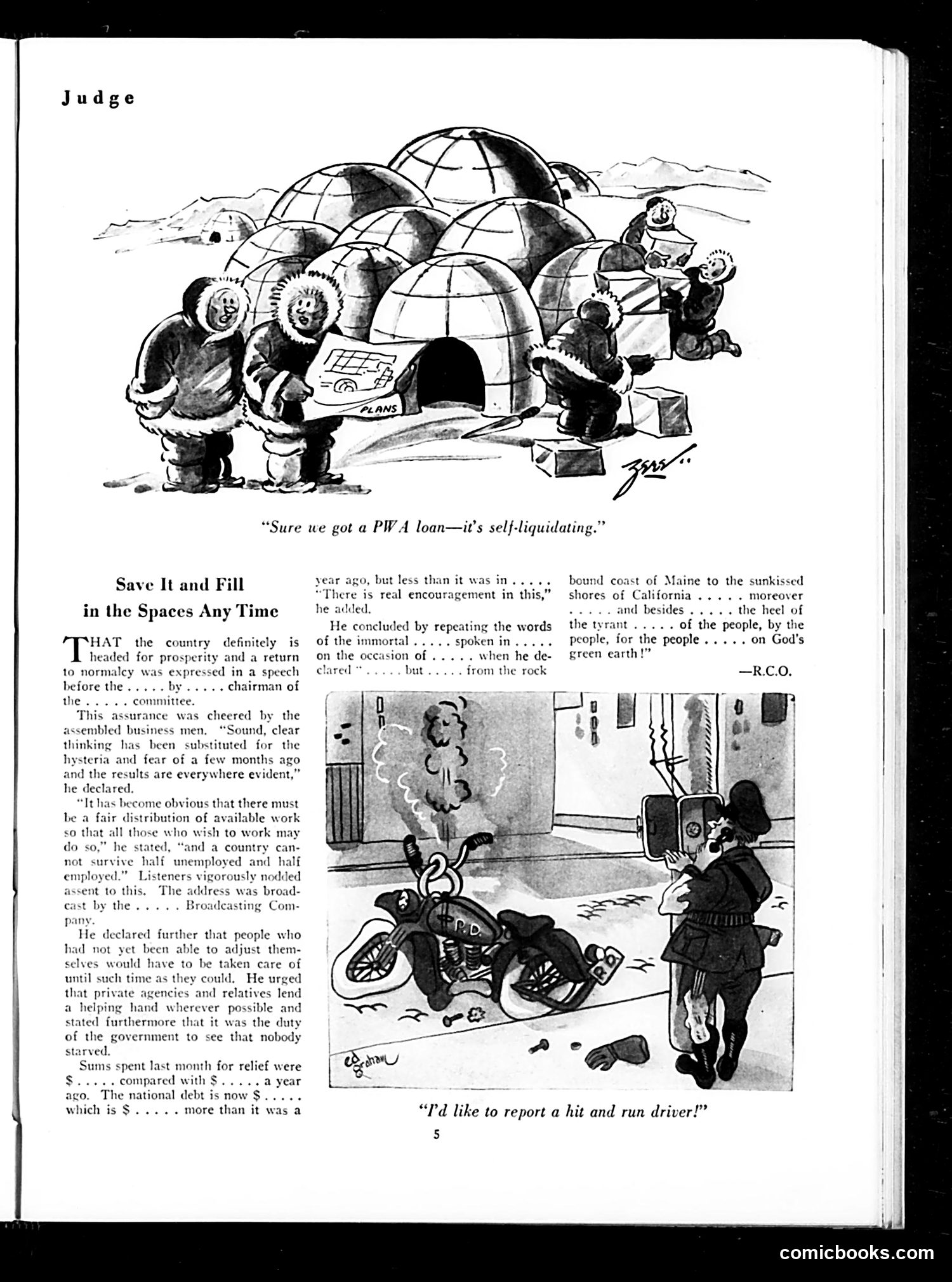
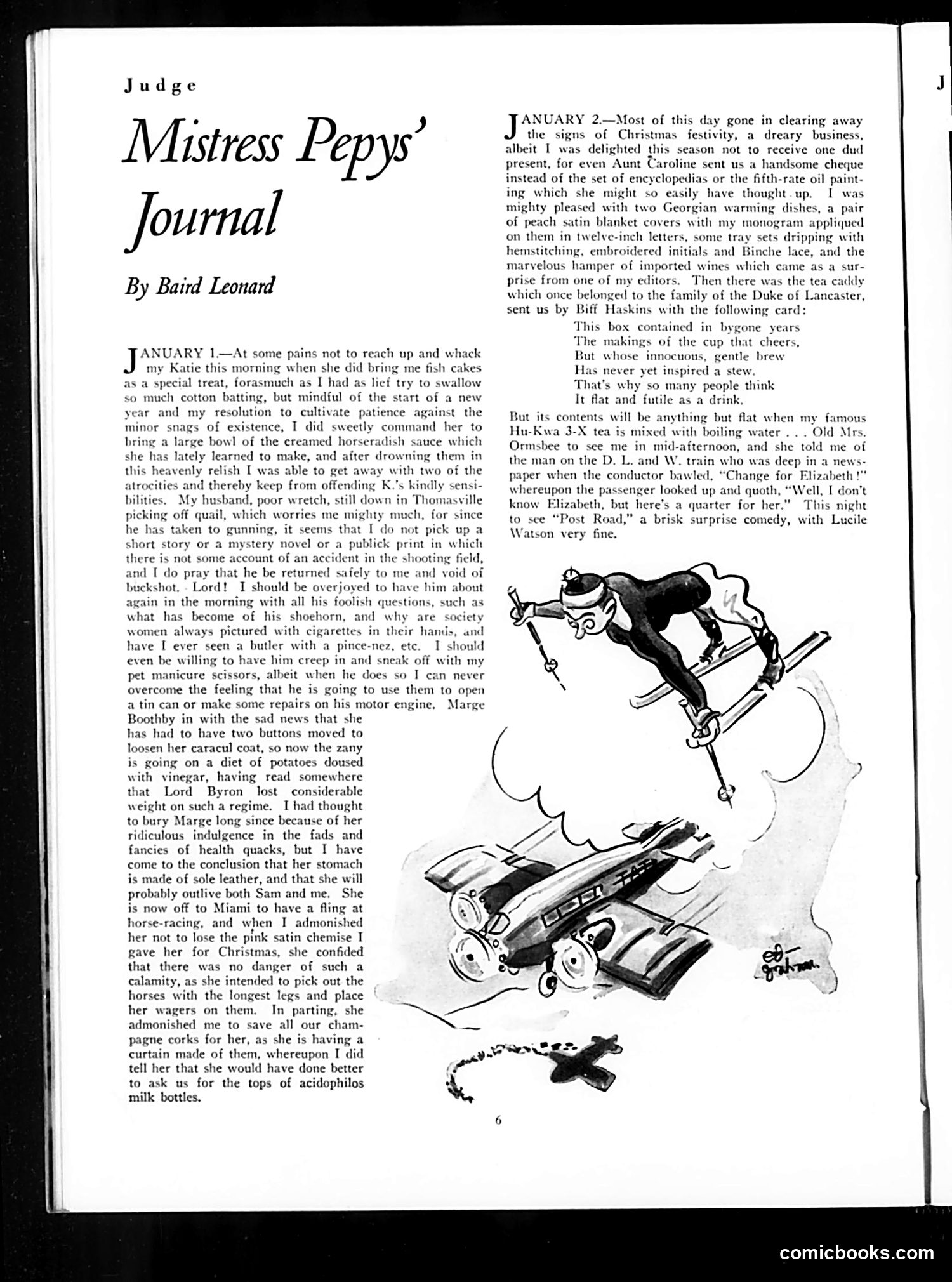
Analysis of "Mistress Pepys' Journal" This is a humorous column by Baird Leonard purporting to be the diary of a society woman ("Mistress Pepys"), written as satire of Samuel Pepys's famous historical diary. The January 1-2 entries mock upper-class concerns: complaints about a husband's hunting mishaps, servants' dietary issues (a diet of vinegared potatoes, apparently causing weight loss), and trivial social matters. The illustration shows a figure engaged in winter sports—likely skiing or sledding—humorously depicting the leisure activities of the wealthy. The satire targets the pretensions and self-absorbed preoccupations of the social elite, suggesting their "important" concerns (fashion, servants, horses, champagne corks) are fundamentally frivolous. The column's framing as a "diary" allows commentary on contemporary high-society life through humorous domestic anecdotes.
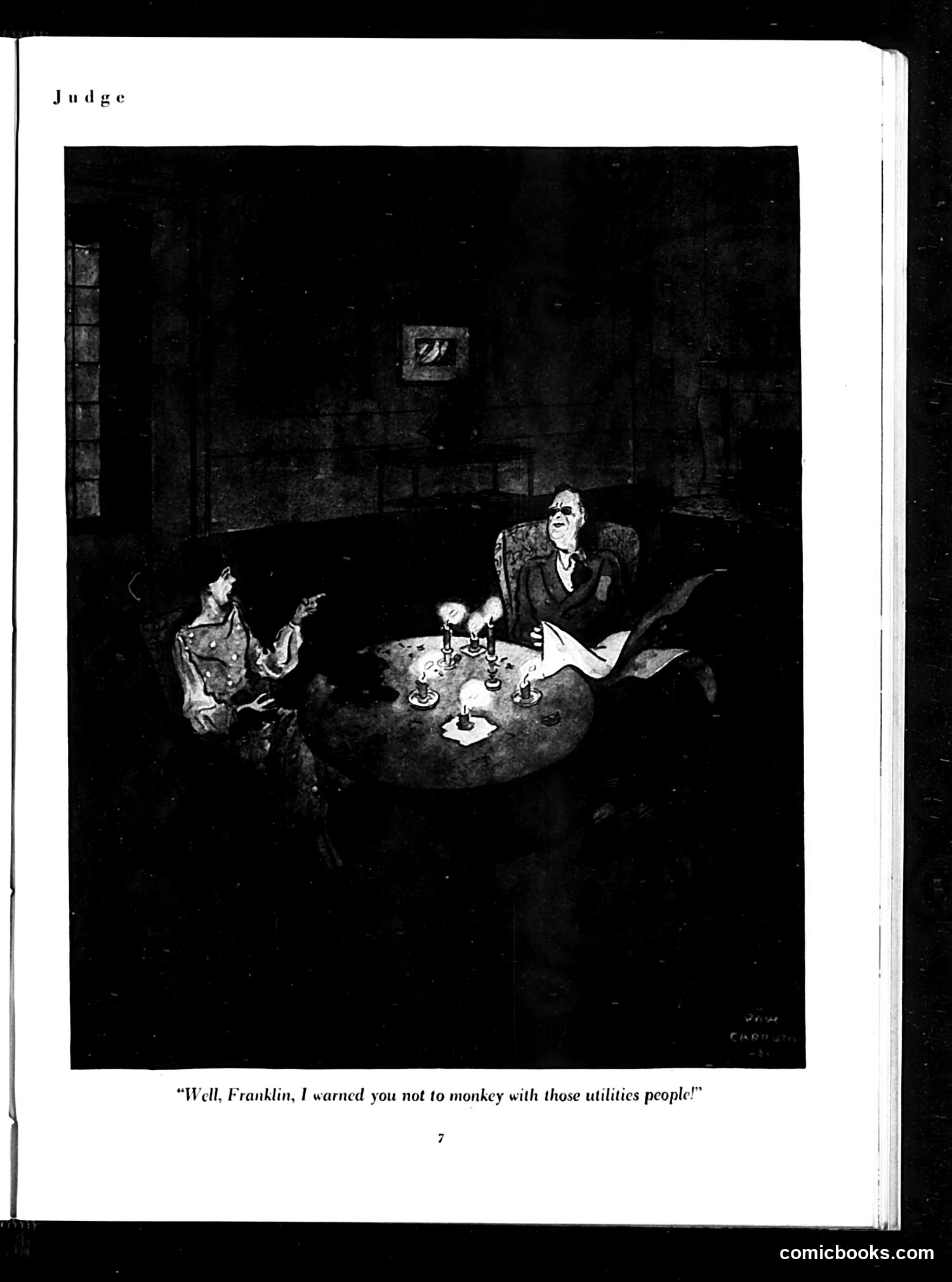
Judge Magazine Cartoon Analysis This cartoon depicts two men at a dining table in what appears to be a formal interior setting. The older man on the right, wearing glasses and holding papers, addresses a younger man on the left with the caption: "Well, Franklin, I warned you not to monkey with those utilities people!" The satire targets Franklin (likely a character name rather than a specific historical figure, though the context suggests early-to-mid 20th century), who has apparently interfered with utility company operations despite warnings. The "utilities people" reference suggests conflict between a businessman or politician and powerful utility monopolies—a common Progressive Era concern about corporate power and regulation. The cartoon mocks Franklin's naiveté or recklessness in challenging entrenched corporate interests, suggesting such defiance carries serious consequences.
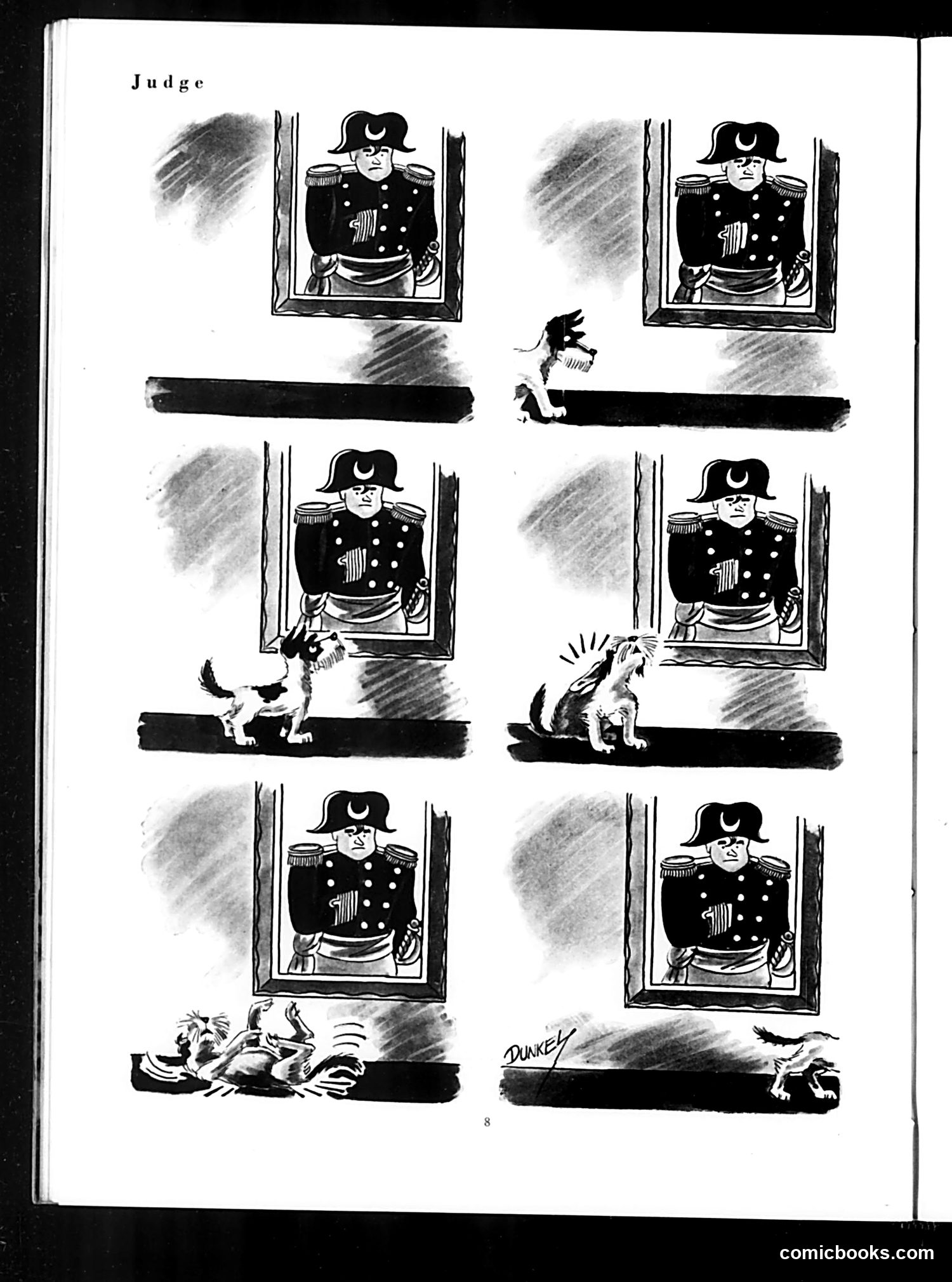
"Judge" Cartoon Analysis: "Judge" This six-panel satirical cartoon depicts a stern military officer (wearing a Napoleon-style bicorne hat and ornate uniform) observing various animals' behavior from a window. The sequence shows: a small figure, a dog, a cat, multiple animals, and finally what appears to be a donkey. The animals' escalating misbehavior—jumping, fighting, or acting out—contrasts with the officer's stern, unchanging expression throughout. The satire appears to target military authority and discipline: the "Judge" figure represents inflexible, rigid command that observes chaos without intervention or visible response. The cartoon likely mocks either a specific military figure's passive leadership style or broader critiques of authoritarian command structures during an era when Judge magazine frequently satirized politics and power. Without clearer text or date context, the specific political reference remains unclear.
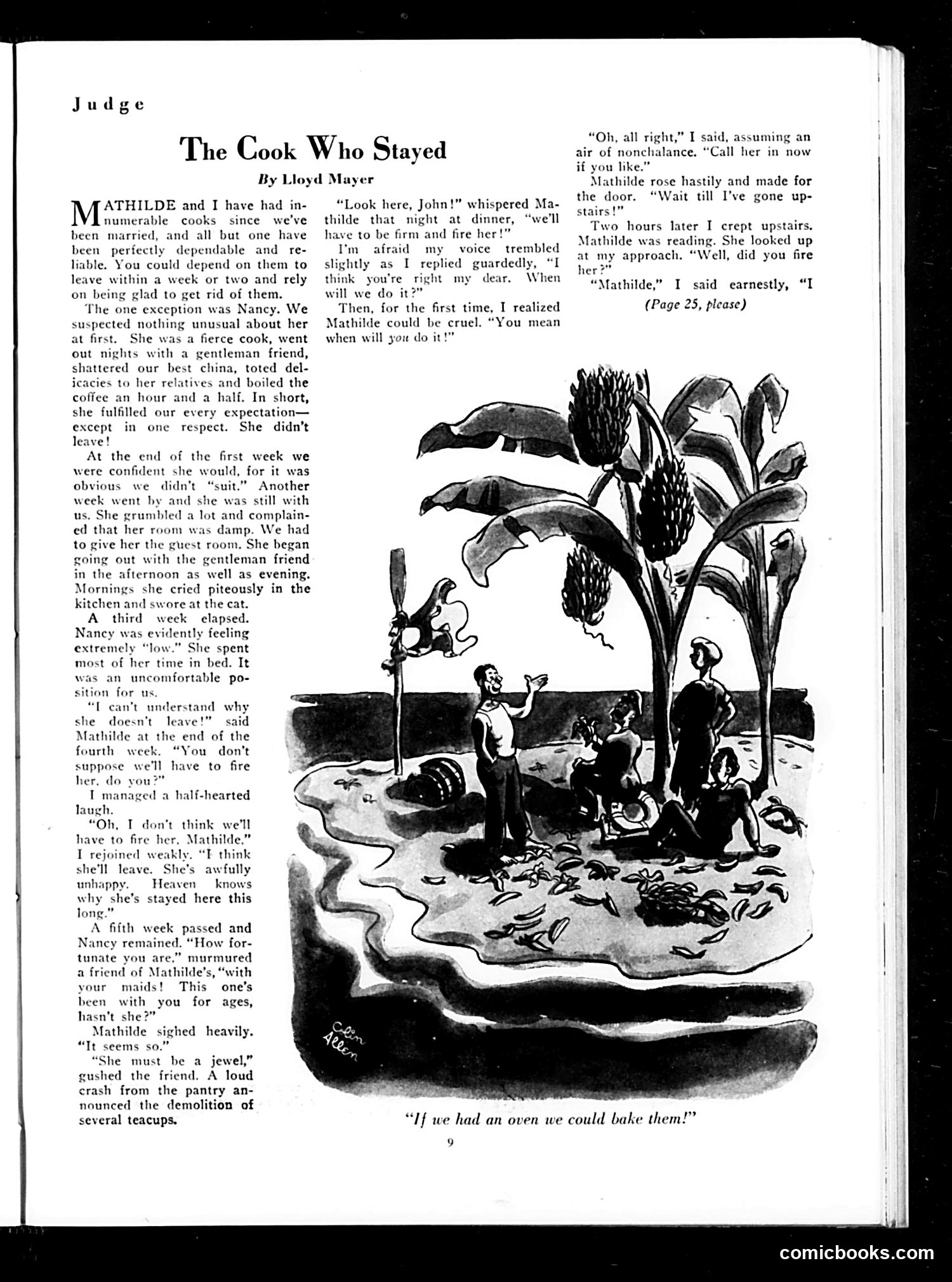
"The Cook Who Stayed" - Explained for Modern Readers This is a humorous short story (not a political cartoon) satirizing the employment relationship between middle-class households and domestic workers in early 20th-century America. The joke centers on a reversal of expectations: employers could routinely dismiss unsatisfactory household staff, yet Nancy—who exhibits all the problematic behaviors they expect (breaks dishes, cries, neglects duties, takes excessive time off)—inexplicably *refuses to leave*. The narrator and his wife Mathilde expect her departure but find themselves unable to fire her, becoming increasingly uncomfortable as weeks pass. The satire mocks both employer squeamishness about confrontation and the power dynamics of domestic service. By the story's end (indicated by "Page 25, please"), the narrative suggests the employer has failed even to attempt firing her. The accompanying illustration shows people beneath a large cornstalk with the caption "If we had an oven we could bake them!"—likely relating to a subplot about food scarcity or agricultural hardship mentioned in the text.
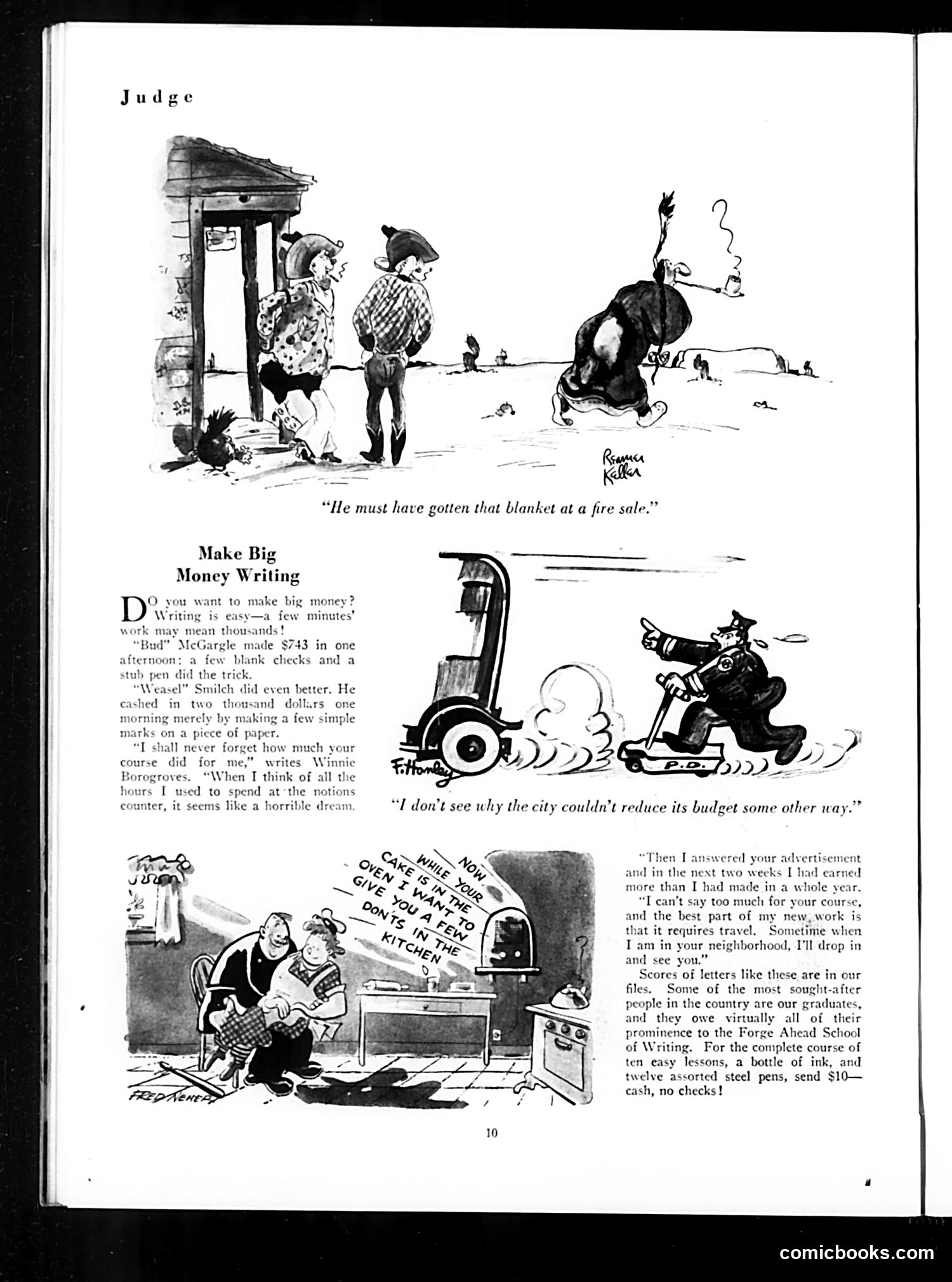
Judge Magazine Satire: "Make Big Money Writing" This page satirizes mail-order writing courses—a common scam of the early 20th century. The advertisements promise quick riches through simple writing work, featuring testimonials from supposed graduates ("Bud" McGargle, "Weasel" Smilch, Winnie Brogroves) who claim extraordinary earnings from minimal effort. The satire is evident in the absurd specifics: McGargle made $743 "one afternoon" from blank checks; Smilch earned thousands by "making a few simple marks." The course itself costs only $10 and includes "a bottle of ink, and twelve assorted steel pens." The accompanying cartoons mock both the scheme's implausibility and those desperate enough to pursue it. The bottom cartoon shows a couple in poverty, the wife pointing to a stove with a sign about writing—darkly suggesting they're starving while awaiting promised riches. The target is twofold: predatory correspondence schools exploiting economic anxiety, and gullible people seeking easy wealth without real work.
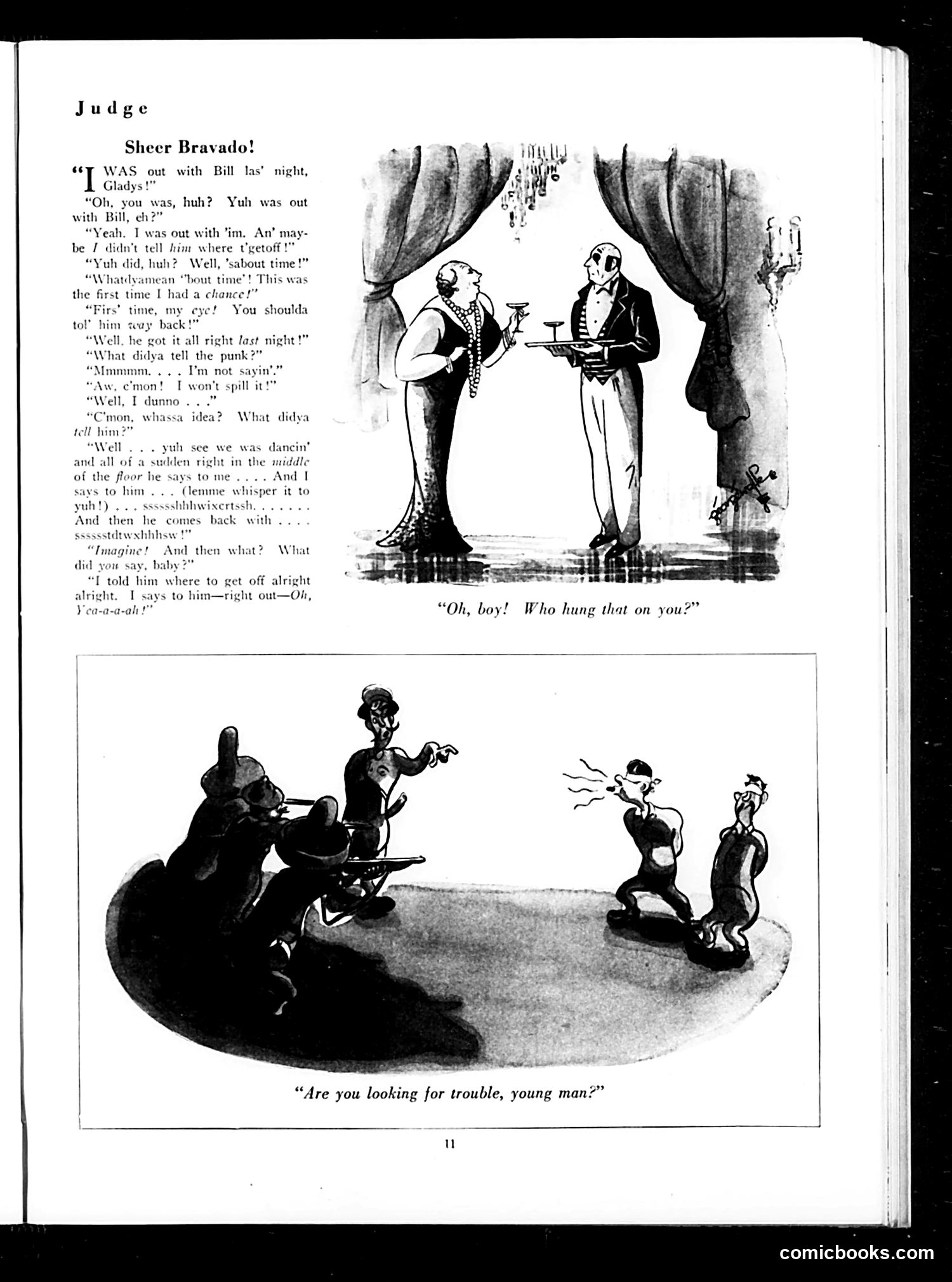
Judge Magazine Cartoon Analysis This page contains two satirical cartoons about romantic and social confrontations. The top cartoon depicts a flapper-era couple at an elegant party. The woman boasts to her friend "Gladys" about telling off her date "Bill" after he made an unwanted advance on the dance floor. The dialogue mimics working-class speech patterns of the 1920s. The satire targets both the woman's exaggerated bravado about rejecting male advances and the man's presumptuous behavior—she claims to have told him off forcefully, yet her vague, giggling account suggests she may be embellishing. The bottom cartoon shows what appears to be a confrontation between men, with the caption "Are you looking for trouble, young man?" This likely depicts the consequence of the woman's story—perhaps the rejected suitor or an angry friend/relative challenging the protagonist, suggesting the woman's "brave" rebuff has escalated into actual conflict. Both cartoons mock period attitudes about dating, masculine pride, and female independence through exaggerated dialogue and situation.
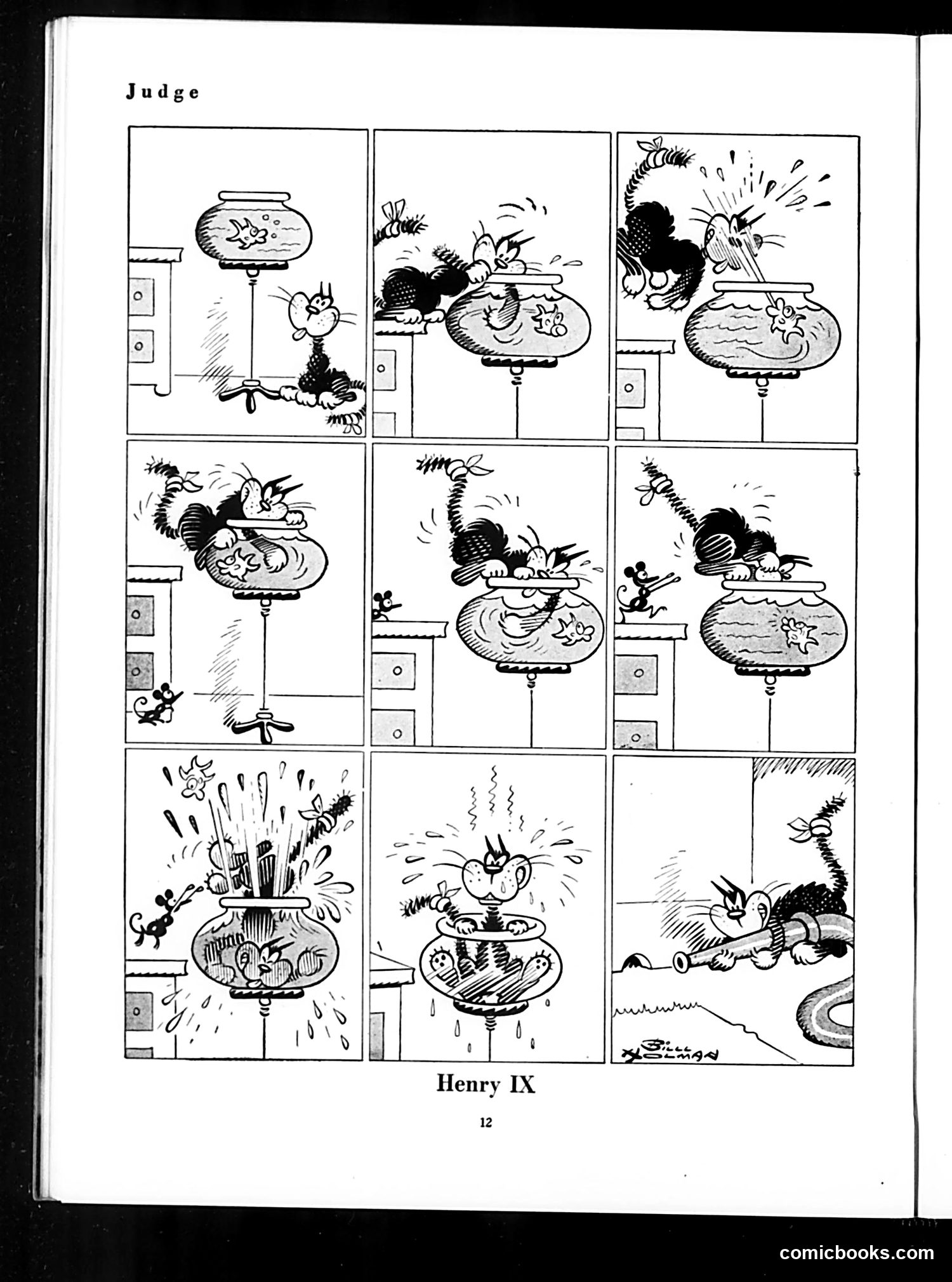
This comic strip, titled "Henry IX," depicts a hairy creature repeatedly interacting with a fishbowl containing fish. The sequence shows escalating chaos: the creature peers into the bowl, creates splashing disturbances, causes explosions of water and contents, and finally appears to have destroyed or overturned it entirely, ending with the creature lying exhausted. The satire likely critiques someone or something persistently disrupting an established system or order—the fishbowl representing stability that gets progressively destabilized through aggressive interference. Without additional context identifying "Henry IX," the specific political target remains unclear, though the title's royal reference suggests this mocks a particular public figure or political leader of the era. The repetitive, destructive pattern emphasizes the subject's chaotic impact.
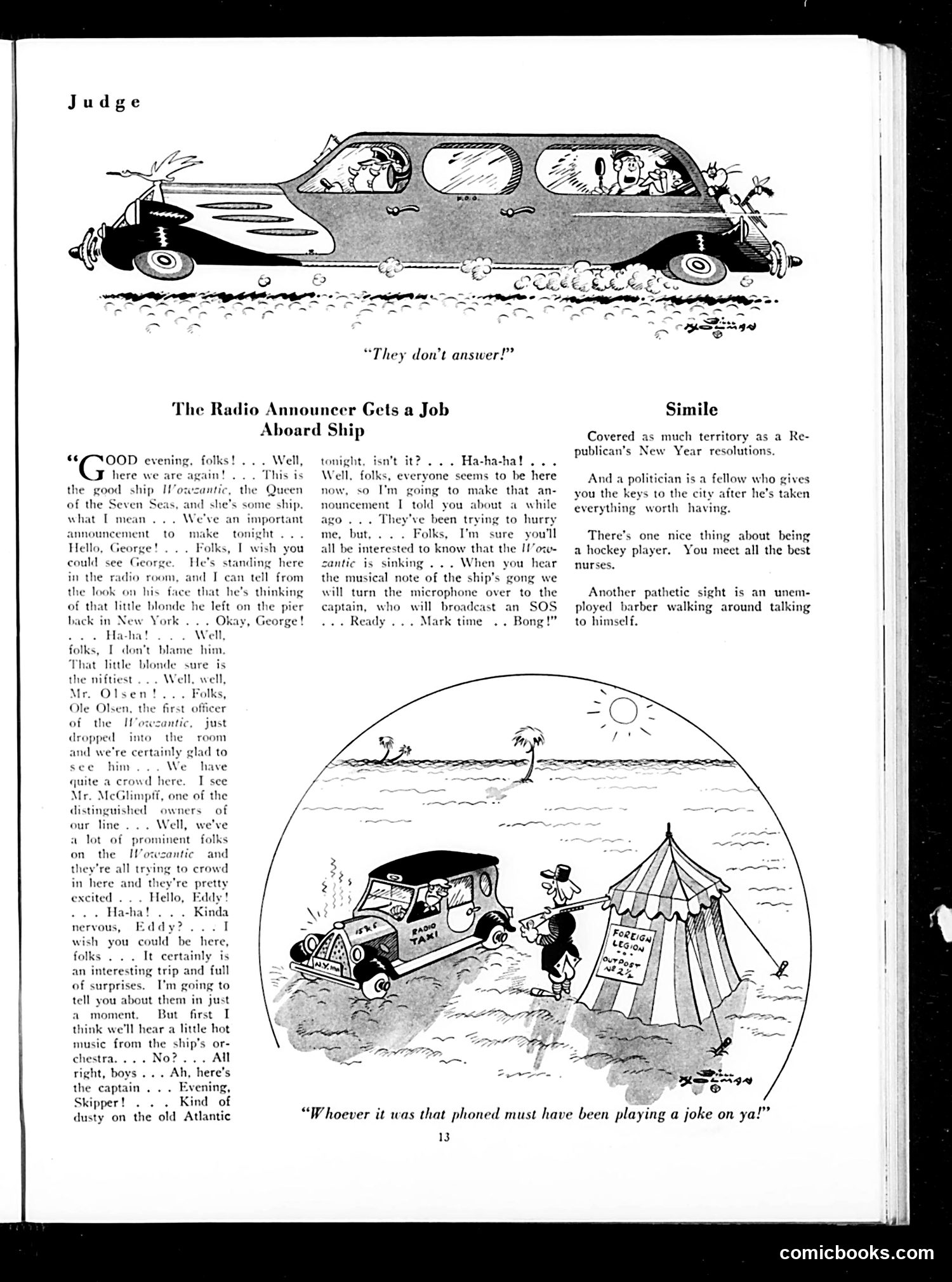
Analysis for Modern Readers This page contains two separate pieces of humor from Judge magazine. Top cartoon: A stretched limousine with passengers inside appears to be sinking or stuck, captioned "They don't answer!" The joke satirizes radio announcers of the era—specifically their tendency to provide constant, breathless commentary on mundane events. The visual suggests the announcer's chatter continues even as disaster unfolds. "The Radio Announcer Gets a Job Aboard Ship": This satirizes the rapid-fire, overly dramatic style of 1920s-30s radio announcers. The announcer delivers an entire monologue of non-stop commentary, gossip, and observations before casually announcing the ship (the "Titanic" reference via "Hozanic") is sinking—treating catastrophe as just another item in his patter. The joke mocks both the announcer's superficial chattiness and the era's obsession with live radio broadcasting. Right column "Simile": Brief one-liner jokes about politicians and unemployment, typical filler content for the magazine. The satire targets the novelty and annoyance of constant radio commentary as a new mass-media phenomenon.
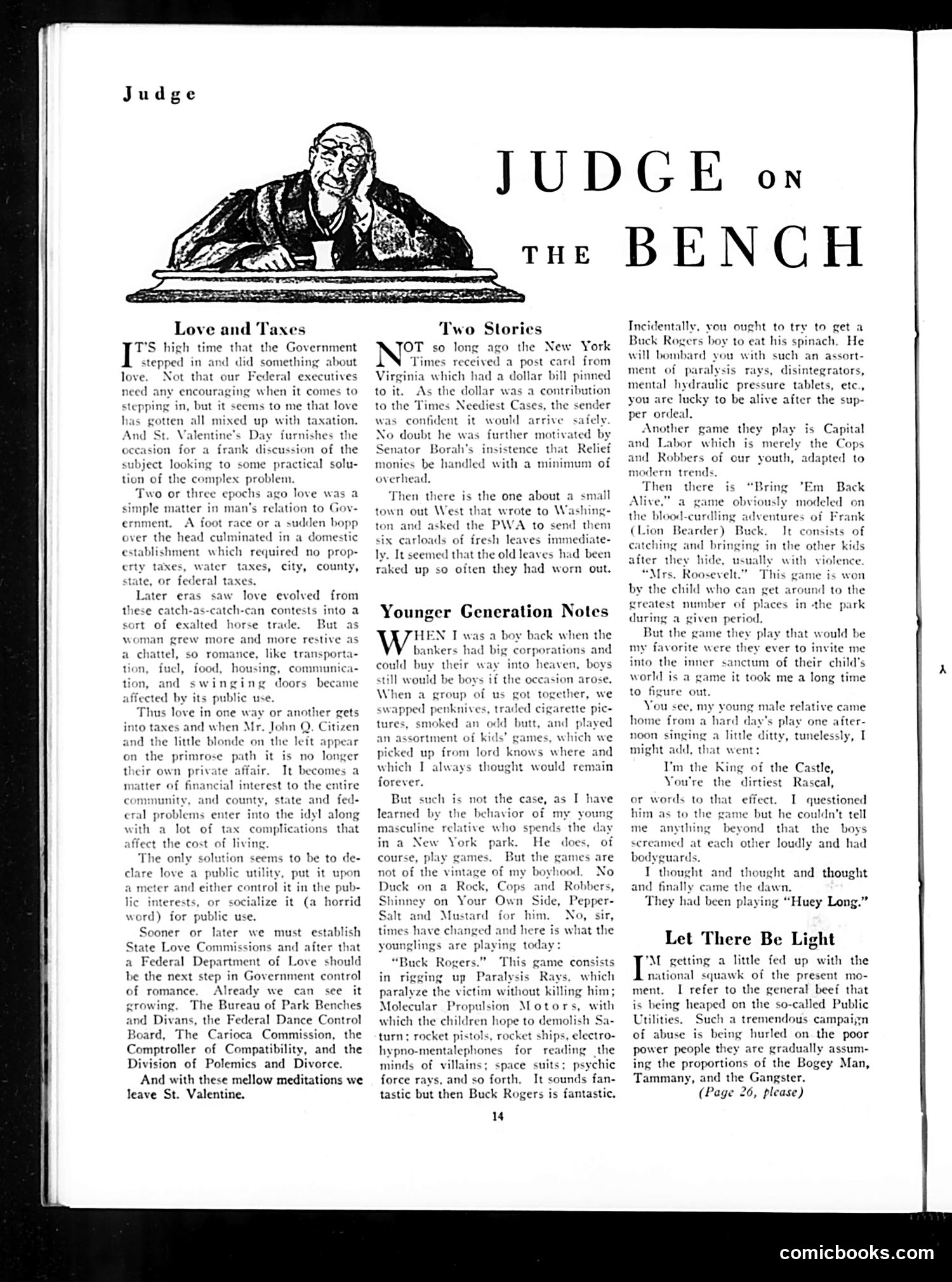
"Judge on the Bench" Analysis This page contains two satirical pieces. The main article, "Love and Taxes," mocks government overreach by proposing absurd bureaucratic solutions to romance. The author sardonically suggests establishing a "Federal Department of Love" and fictional agencies like the "Bureau of Park Benches," the "Comptroller of Compatibility," and the "Division of Polemics and Divorce"—satirizing how American government increasingly regulates private life through taxation and control. The "Two Stories" section ridicules New Deal relief programs (likely PWA—Public Works Administration). One anecdote mocks bureaucratic inefficiency by describing a small town requesting "six carloads of fresh leaves" from the government because they'd worn out old ones through raking—implying government aid programs are frivolous and wasteful. The "Younger Generation Notes" contrasts children's games, lamenting that modern kids play science-fiction games like "Buck Rogers" with fantastical weapons rather than simpler pastimes of previous generations—a common conservative critique of modern culture.
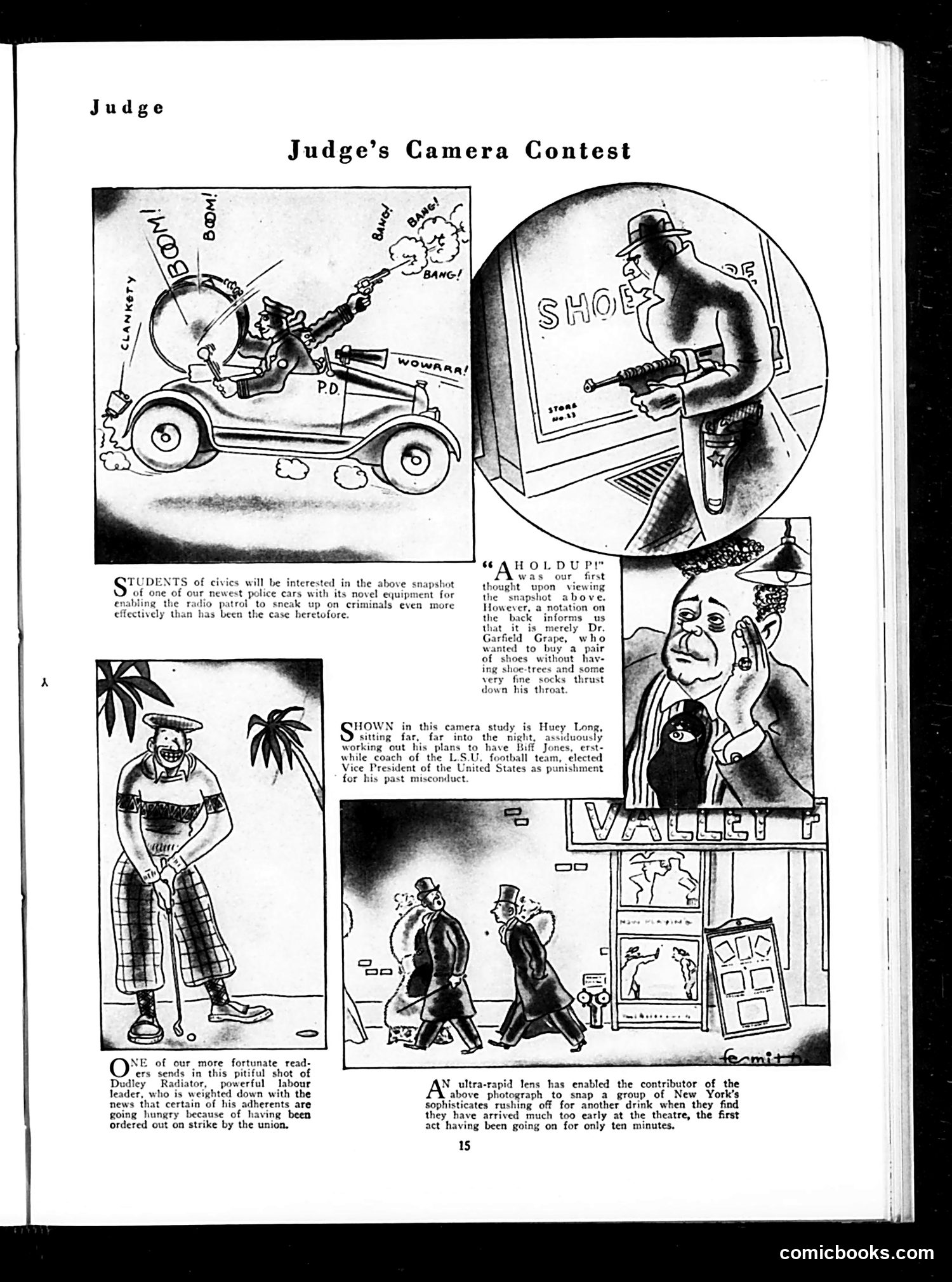
Judge's Camera Contest Analysis This page presents a satirical "camera contest" featuring four political cartoons mocking 1920s-30s American figures: 1. Police car innovation: Satirizes new radio patrol technology for law enforcement. 2. "A Holdup!": Mocks an unnamed doctor (Dr. Garfield) being aggressively sold shoes and socks—social satire on high-pressure salesmanship. 3. Huey Long: Caricatures the Louisiana politician scheming to make LSU football coach Biff Jones vice president as "punishment" for misconduct—likely referencing Long's actual political ambitions and LSU connections. 4. Dudley Radiator: Depicts a labor leader burdened by news that striking workers he ordered are going hungry—satirizing labor union leadership and strike consequences. 5. Theater-goers: Mocks New York sophisticates rushing to bars, arriving before the show starts. The cartoons employ exaggerated caricature to ridicule political figures, labor disputes, and social pretension typical of Judge's satirical approach.
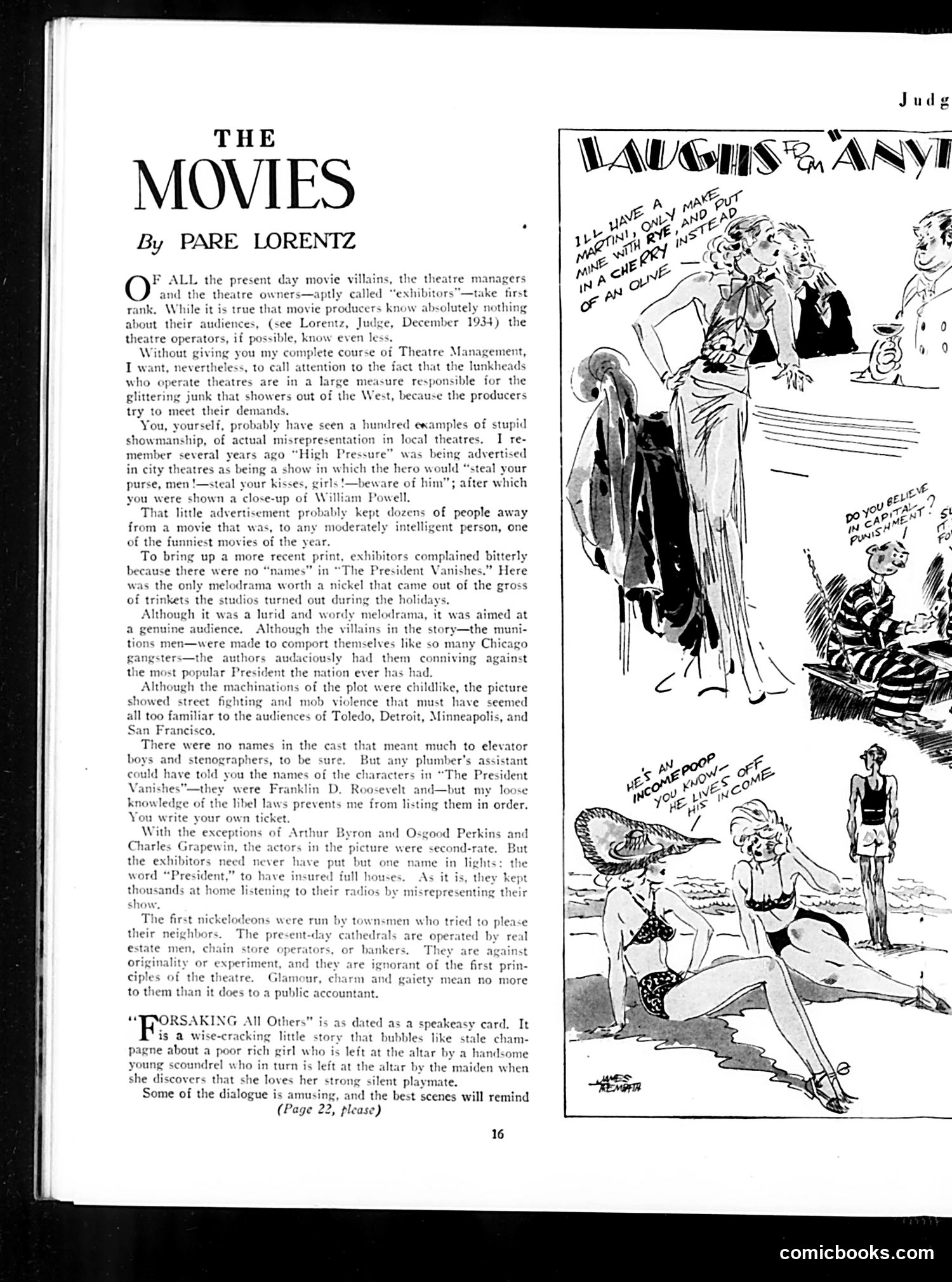
"The Movies" by Pare Lorentz — Judge, December 1934 This article critiques the movie industry's exploitative marketing and poor taste. Lorentz attacks theatre managers and producers for deceptive advertising—citing "High Pressure," which was promoted with crude taglines ("steal your purse, men!") despite being a quality comedy starring William Powell. He particularly attacks the recent film "The President Vanishes," a melodrama depicting Chicago-style gangsters conspiring against President Franklin D. Roosevelt. Though the cast contained no major stars (only "Franklin D. Roosevelt" mattered), Lorentz argues the film irresponsibly portrayed mob violence and street fighting—imagery uncomfortably familiar to Depression-era audiences in Toledo, Detroit, and Minneapolis amid real labor unrest. The accompanying cartoons mock theatrical pretension and romance clichés. Lorentz's core complaint: the movie industry prioritizes sensational marketing and mob spectacle over genuine entertainment value or social responsibility.
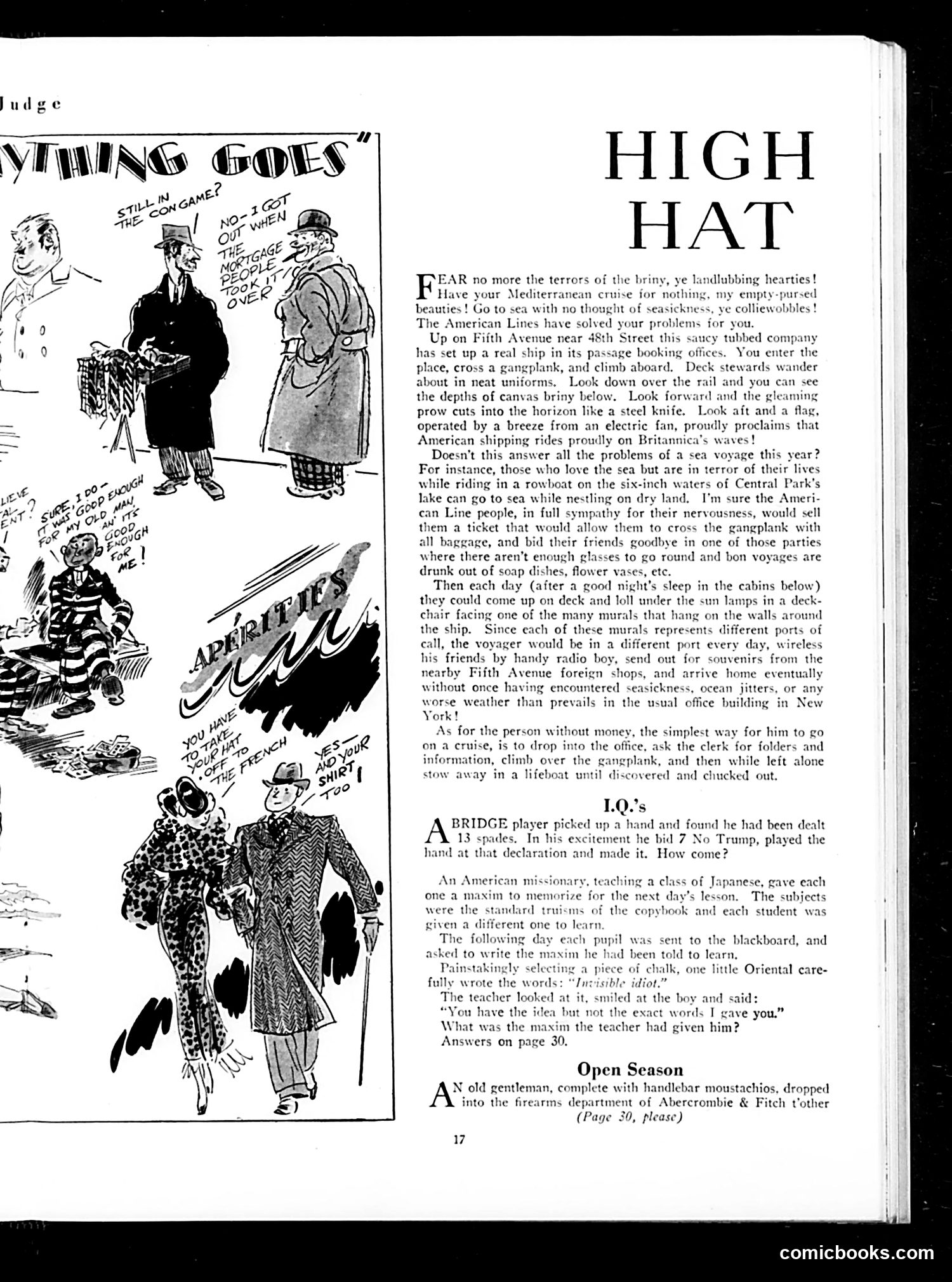
Analysis of "High Hat" Page from Judge Magazine Main Cartoon: "Viming Goes" The left side satirizes American shipping companies' marketing schemes. The cartoon mocks a Fifth Avenue travel office that has installed an actual ship interior (gangplank, deck, canvas, electric fan-operated flag) to simulate ocean voyages for landlubbers—particularly nervous New Yorkers afraid of seasickness. The Satire Judge ridicules this as absurd luxury tourism for the timid: people can experience "sea travel" without leaving Manhattan, sleep in fake cabins, visit different "ports" via painted murals, and use Fifth Avenue shops for souvenirs. The joke extends to broke tourists who could simply stow away in a lifeboat and get "discovered and chucked out." Right Page Content The "High Hat" section contains three humor pieces: a Bridge card paradox, a Japanese student's mistranslation of an English maxim ("invisible idiot" instead of the intended phrase), and a brief item about a gentleman entering a firearms department. These reflect typical Judge content—puzzles, teaching anecdotes, and satirical social commentary targeting 1920s-era urban pretension and travel culture.
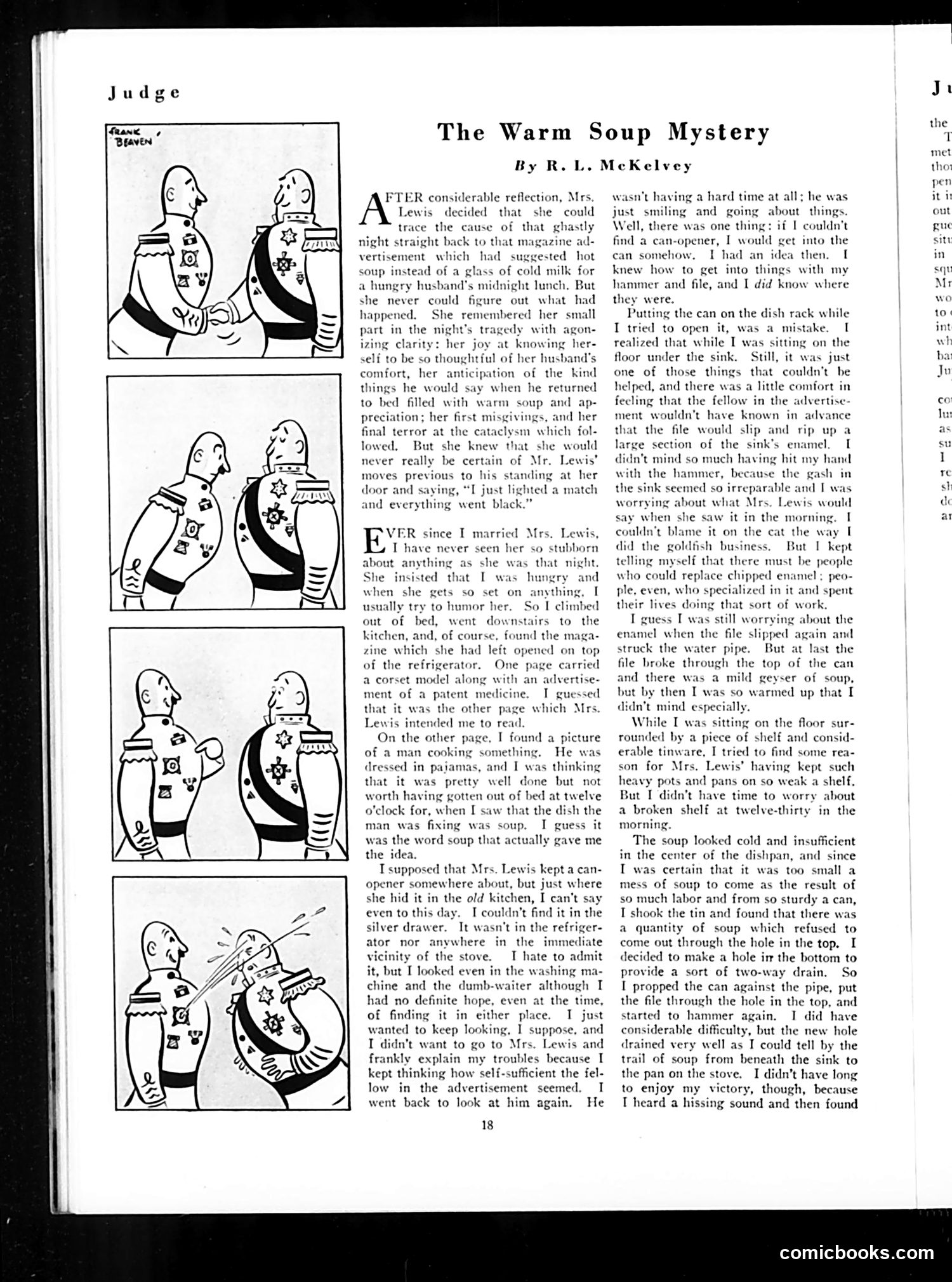
"The Warm Soup Mystery" Explanation This is a humorous domestic comedy, not political satire. The story concerns a husband who, following a magazine advertisement's suggestion, makes warm soup for his hungry wife at midnight instead of cold milk. The ensuing disaster—him trying to open a soup can without a can-opener, damaging the kitchen sink, injuring himself—becomes increasingly farcical. The cartoon panels show the couple's interaction and his growing mishaps. The satire targets consumer advertising culture: the slick magazine image of a man effortlessly preparing food contrasts sharply with the husband's actual incompetence and the domestic chaos that follows. The joke is that following advertised "solutions" to domestic problems creates worse problems than the original issue. It mocks both advertising's false promises and husbands' pride in refusing to ask for help.
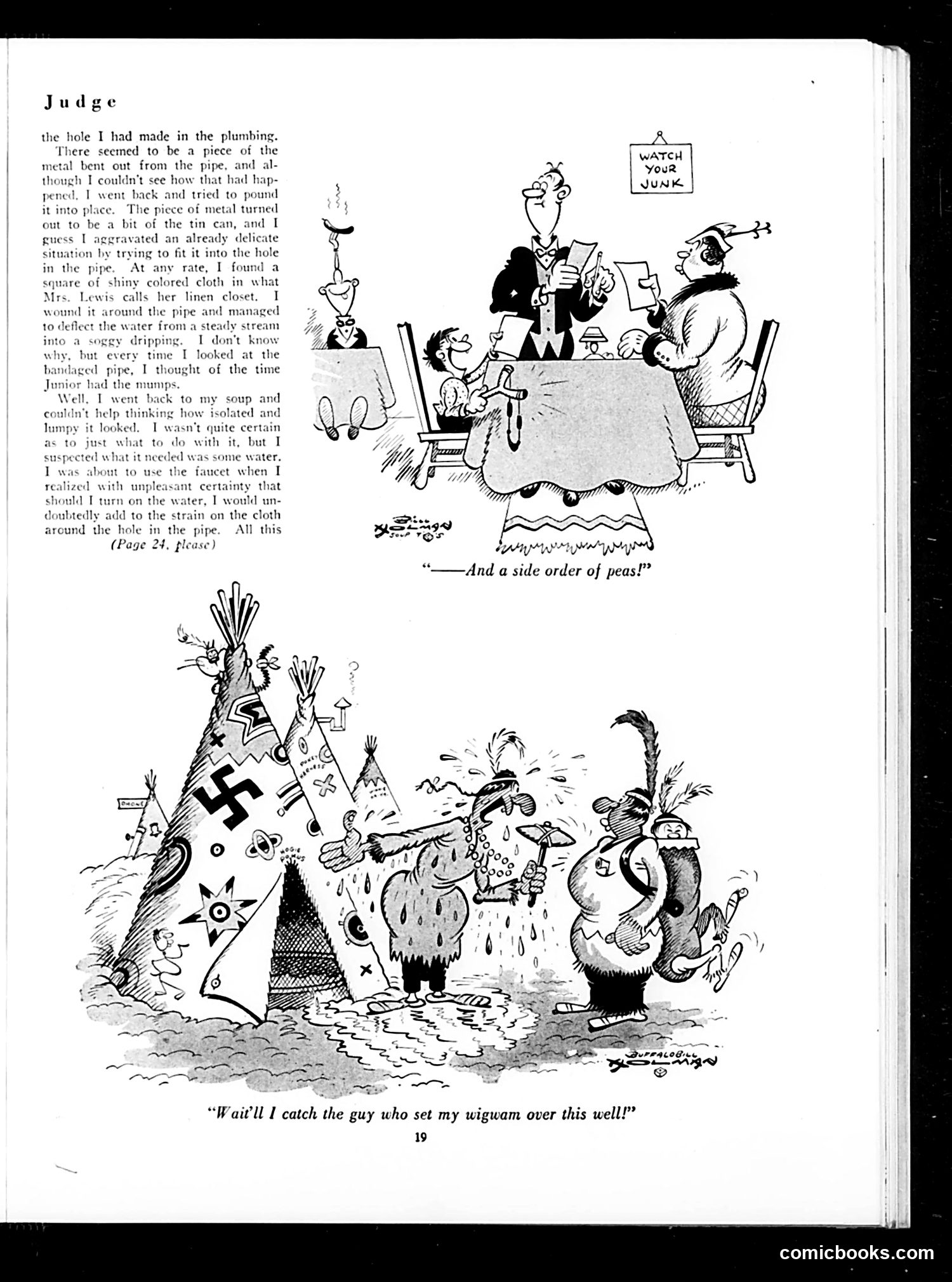
Political Cartoon Analysis: Judge Magazine, Page 19 This page contains two unrelated cartoons satirizing different subjects. Top cartoon: A domestic humor scene showing a waiter at a restaurant. The judge's accompanying text describes amateur plumbing mishaps—attempting to fix a pipe with inadequate tools and materials (a tin can, cloth from a linen closet). The cartoon caption "And a side order of peas?" suggests the waiter is taking an absurd order, likely mocking restaurant service or customer behavior. Bottom cartoon: A satirical political cartoon featuring a Native American figure and a Nazi-decorated tepee with swastikas visible on it. The caption "Wait'll I catch the guy who set my wigwam over this well!" appears to be Cold War-era political commentary, though the exact target and date remain unclear. The Nazi imagery suggests anti-fascist sentiment, but the specific reference or event being mocked cannot be determined from the visible content alone. Both cartoons employ caricature and exaggeration typical of Judge magazine's satirical style.
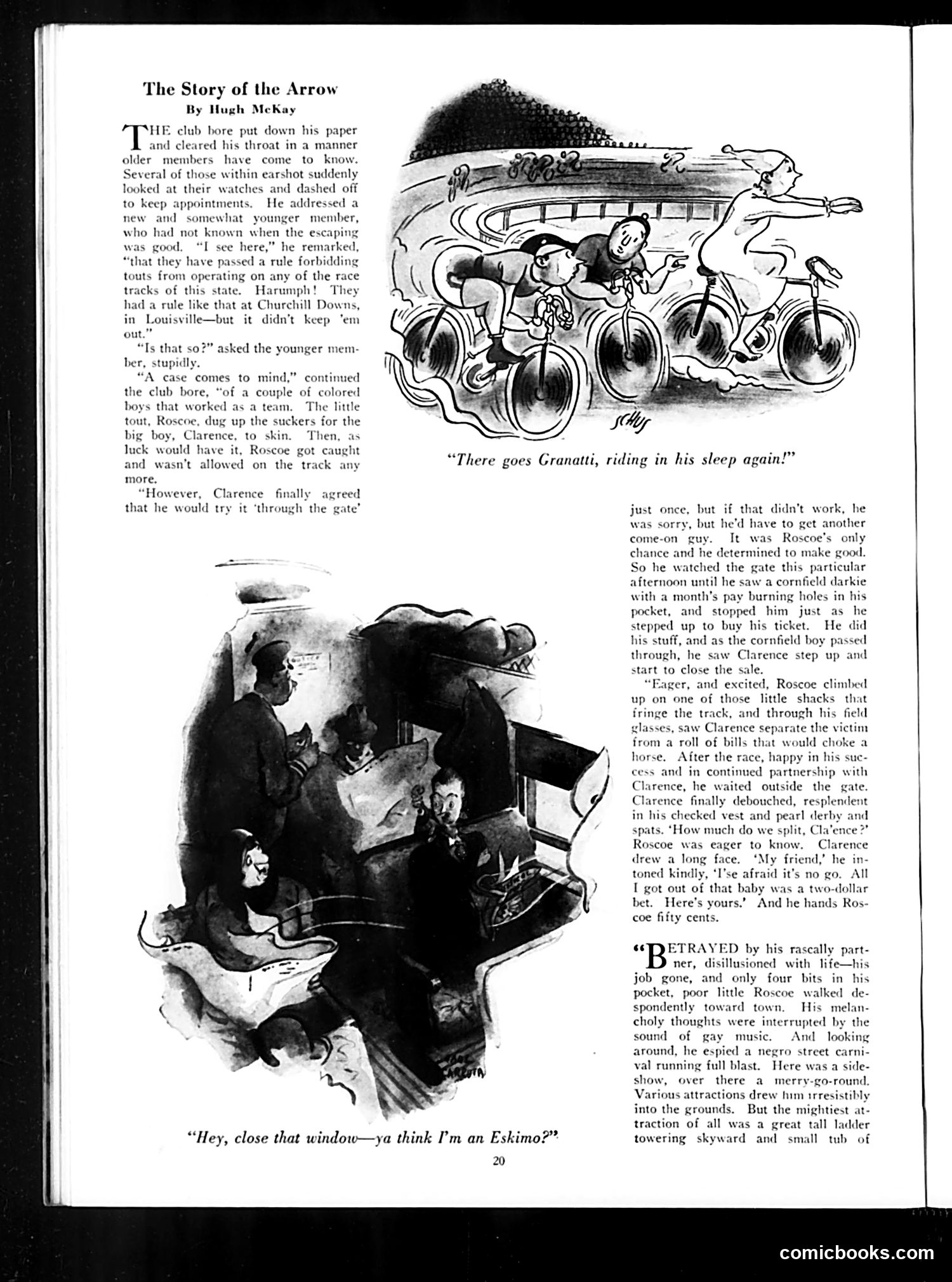
"The Story of the Arrow" - Judge Magazine Analysis This is a short story with illustrations, not a political cartoon. It's a morality tale about con artists at racetracks, specifically targeting Black workers. The narrative follows two Black "touts" (hustlers)—Roscoe and Clarence—who swindle rural Black laborers at Churchill Downs racetrack by persuading them to place bets they can't afford. When caught, Roscoe attempts legitimacy by steering victims "through the gate" to Clarence, who completes the swindle. After successfully conning a victim with a month's wages, Clarence betrays Roscoe, giving him only fifty cents of their split. The story uses racial stereotypes common to early 20th-century Judge: dialect speech, caricatured illustrations, and the implicit message that Black people are inherently dishonest or vulnerable to exploitation. The "cornfield darkie" phrase reflects the era's casual racism. The tale serves as entertainment mocking both the con artists and their victims.
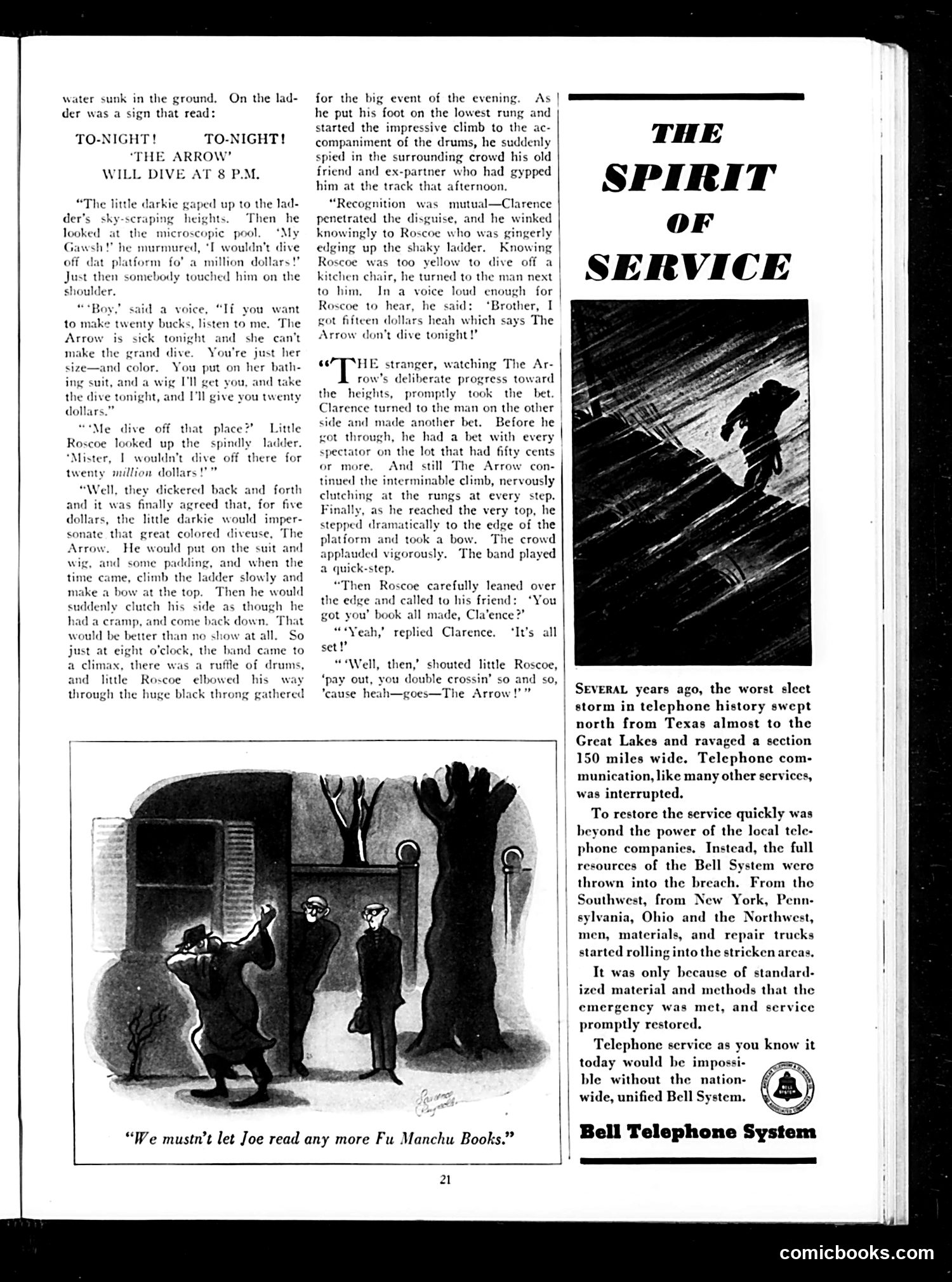
Analysis of Judge Magazine Page This page contains a racist story-joke typical of early 20th-century American humor magazines. The narrative describes a Black man named "Little Roscoe" hired for $5 to impersonate "The Arrow," a famous (apparently real) female diver, by wearing a bathing suit and wig. His friend Clarence recognizes him and bets money that "The Arrow" won't dive. The punchline relies on Roscoe's reputation as a coward—when he reaches the platform, he calls down for Clarence to pay out his bets, then jumps, having unexpectedly followed through. The joke exploits period racial stereotypes: dialect spelling ("Gawsh," "dat"), the characterization of a Black man as dishonest and fearful, and the premise that he could impersonate a woman of any race. The cartoon at bottom shows men forbidding someone to read "Fu Manchu Books"—likely a reference to contemporary anxieties about Asian villainy in popular fiction. The opposite page features a Bell Telephone System advertisement, unrelated to the story.
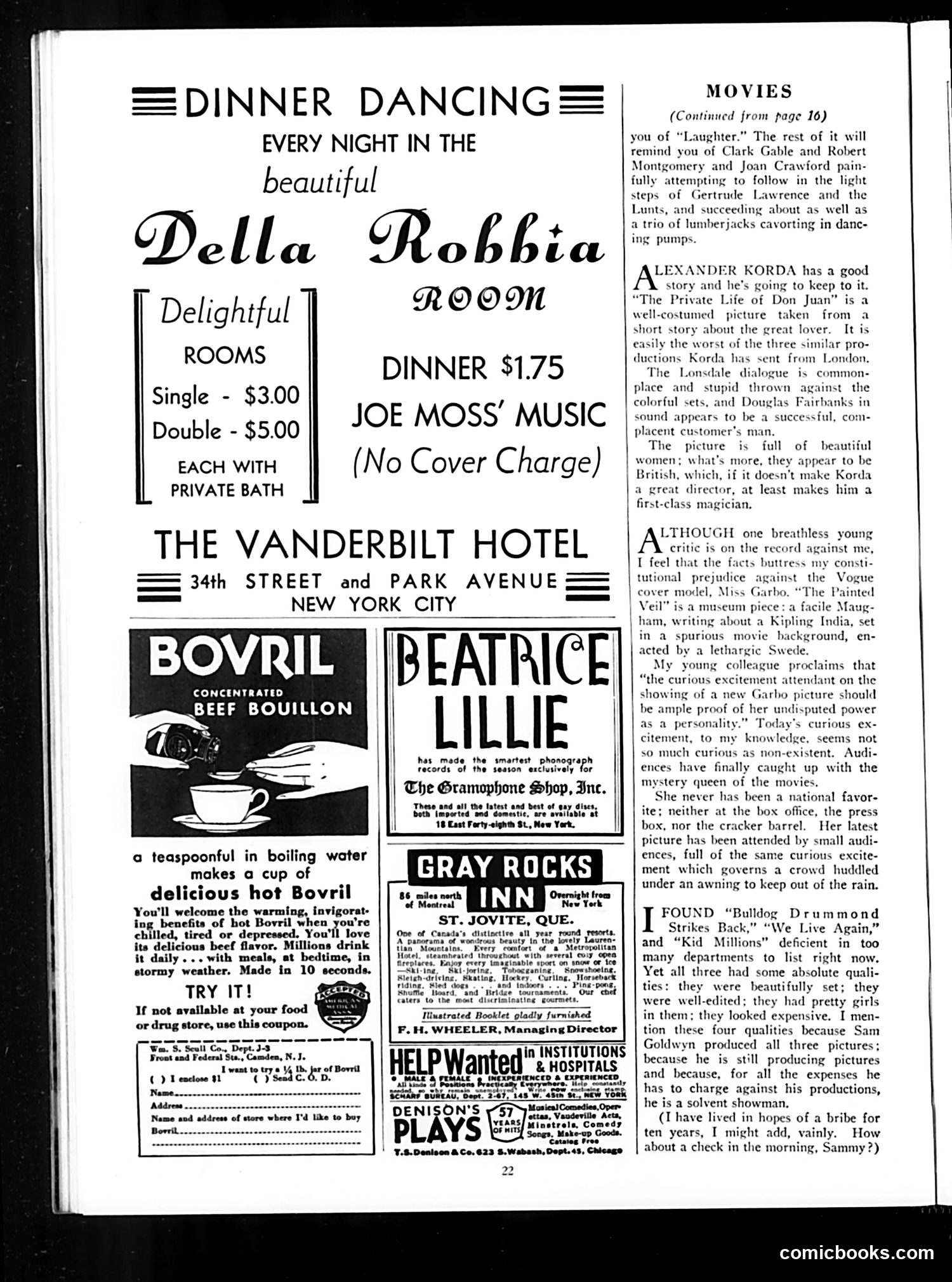
Page Analysis: Judge Magazine Advertisement and Film Criticism This page is primarily advertisements and paid content, not satirical cartoons. The top half features hotel and product ads (Della Robbia Room, Bovril beef bouillon, Beatrice Lillie records, Gray Rocks Inn). The substantive content is a film criticism column (continued from page 16) reviewing recent movies. The critic dismisses "Laughter" as derivative of better theatrical comedies, harshly critiques Alexander Korda's "The Private Life of Don Juan" despite its costumes and attractive actresses, and—most notably—attacks the mystique of Greta Garbo, claiming her new picture draws small audiences and that her status as a "mystery queen" has collapsed because audiences have finally "caught up with" her. The critic dismisses a younger colleague's enthusiasm for Garbo as outdated reverence. This reflects 1930s Hollywood discourse and changing attitudes toward silent-film stars in the sound era.
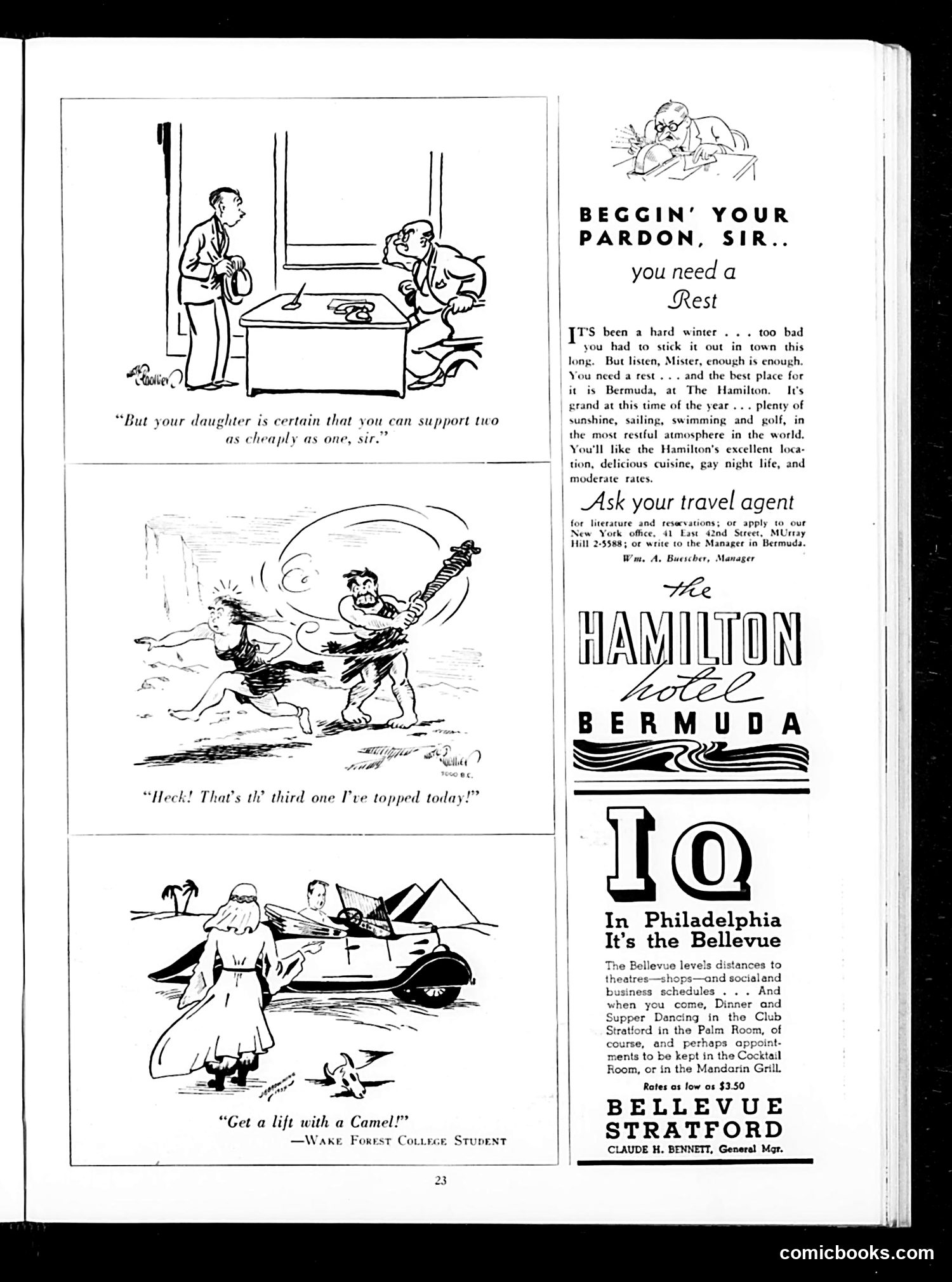
Explanation for Modern Readers This page contains three unrelated cartoons and two hotel advertisements. The cartoons use humor about economic hardship and leisure: 1. Top cartoon: A father is told he can "support two [daughters] as cheaply as one"—satirizing the Depression-era economic anxiety about marriage costs and daughters' expenses. 2. Middle cartoon: A man at the beach has hit someone three times with a golf ball, playing on physical comedy and the dangers of crowded vacation spots. 3. Bottom cartoon: Features a cigarette product placement ("Get a lift with a Camel!"), typical of mid-20th-century advertising disguised as humor. The advertisements promote luxury hotels (The Hamilton in Bermuda, the Bellevue Stratford in Philadelphia), targeting wealthy readers who could afford winter escapes—highlighting the class divide during economically difficult times. The juxtaposition suggests *Judge* readers were affluent despite national hardship.
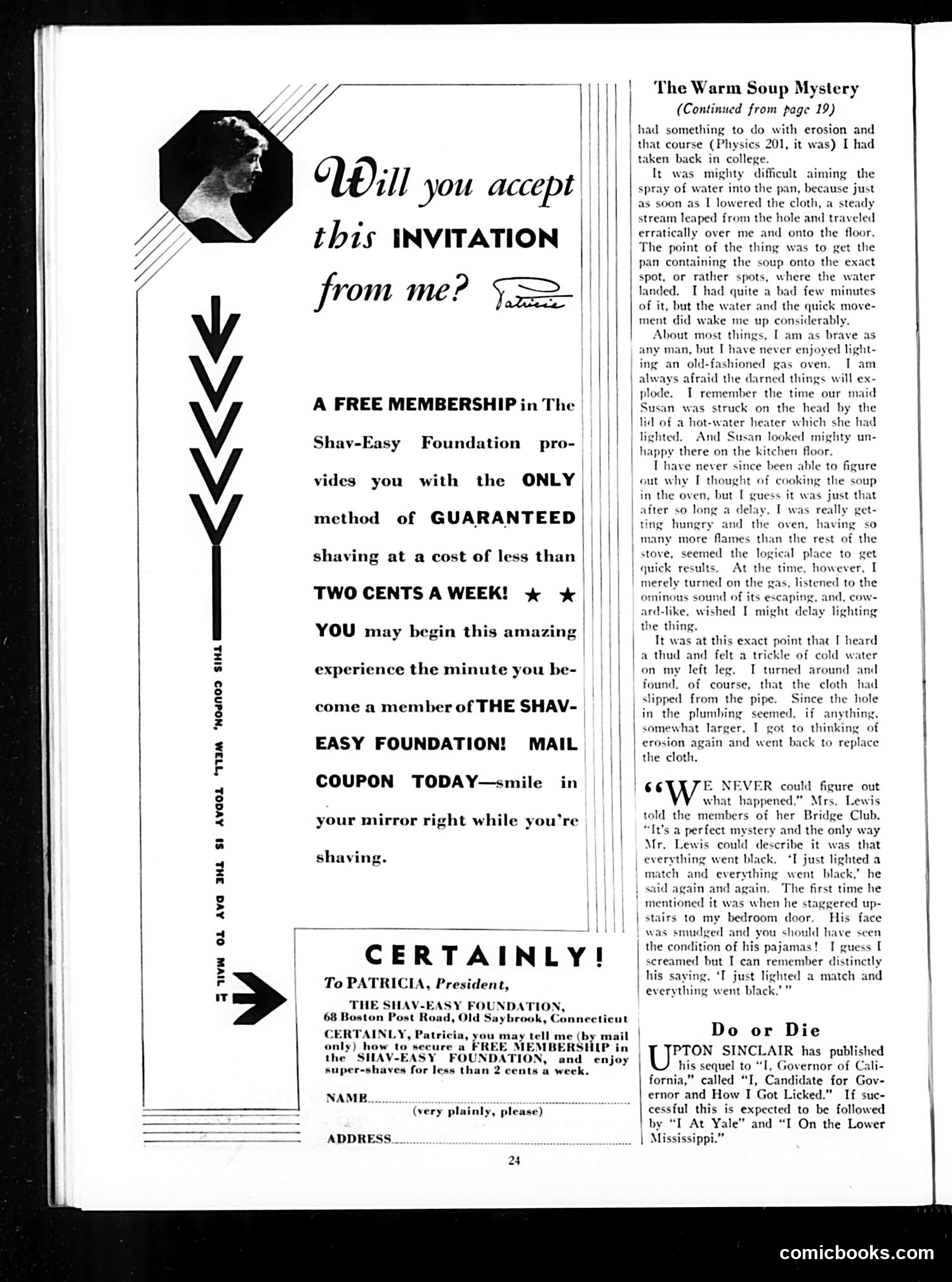
Analysis for Modern Readers This page contains a vintage advertisement disguised as satirical content. The "Shav-Easy Foundation" is a fictional shaving product pitched through a mock-formal invitation coupon. The satire appears to mock overly elaborate marketing schemes of the era—promising absurdly cheap shaving ("two cents a week") through a fake "foundation" membership, using formal letterhead and an earnest tone to sell what's essentially a regular consumer product. The right side features "The Warm Soup Mystery," a humorous short story about domestic mishaps (water leaking from plumbing while cooking soup), and a separate item about Upton Sinclair's autobiography sequel, treating his political career as a comedic "Do or Die" narrative. The overall page mixes commercial advertising with light humor and literary commentary—typical of *Judge* magazine's format blending satire, fiction, and ads for educated middle-class readers.
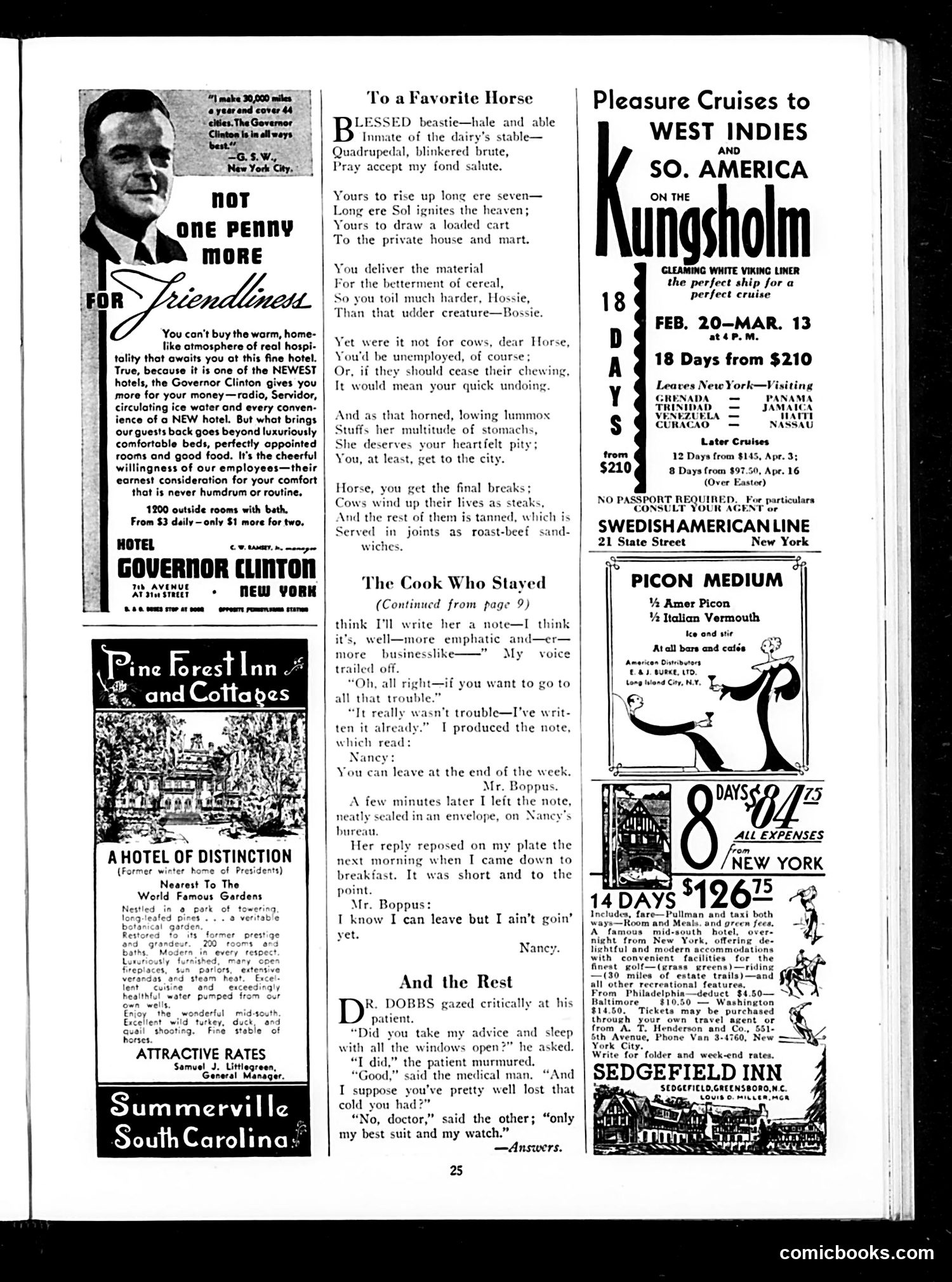
Page 25 of Judge Magazine: Analysis This page is primarily advertising with modest editorial content interspersed. The main items of note: "To a Favorite Horse" is a lighthearted poem contrasting horses favorably with cows. The satire is gentle: horses at least "get to the city" while cows end up as steaks and roast-beef sandwiches. It's an affectionate mock-heroic tribute. "The Cook Who Stayed" (continued from page 9) depicts an employer trying to fire his cook, Nancy, via formal note. She refuses to leave, replying "I ain't goin' yet"—a humorous insubordination joke playing on working-class defiance. "And the Rest" is a brief medical joke where a patient loses his suit and watch after sleeping with windows open, missing the doctor's actual point. The remainder is travel and hotel advertising: Governor Clinton Hotel (New York), Pine Forest Inn (South Carolina), Kungsholm cruise ship, and other leisure destinations—typical 1920s-30s travel promotions aimed at affluent readers.
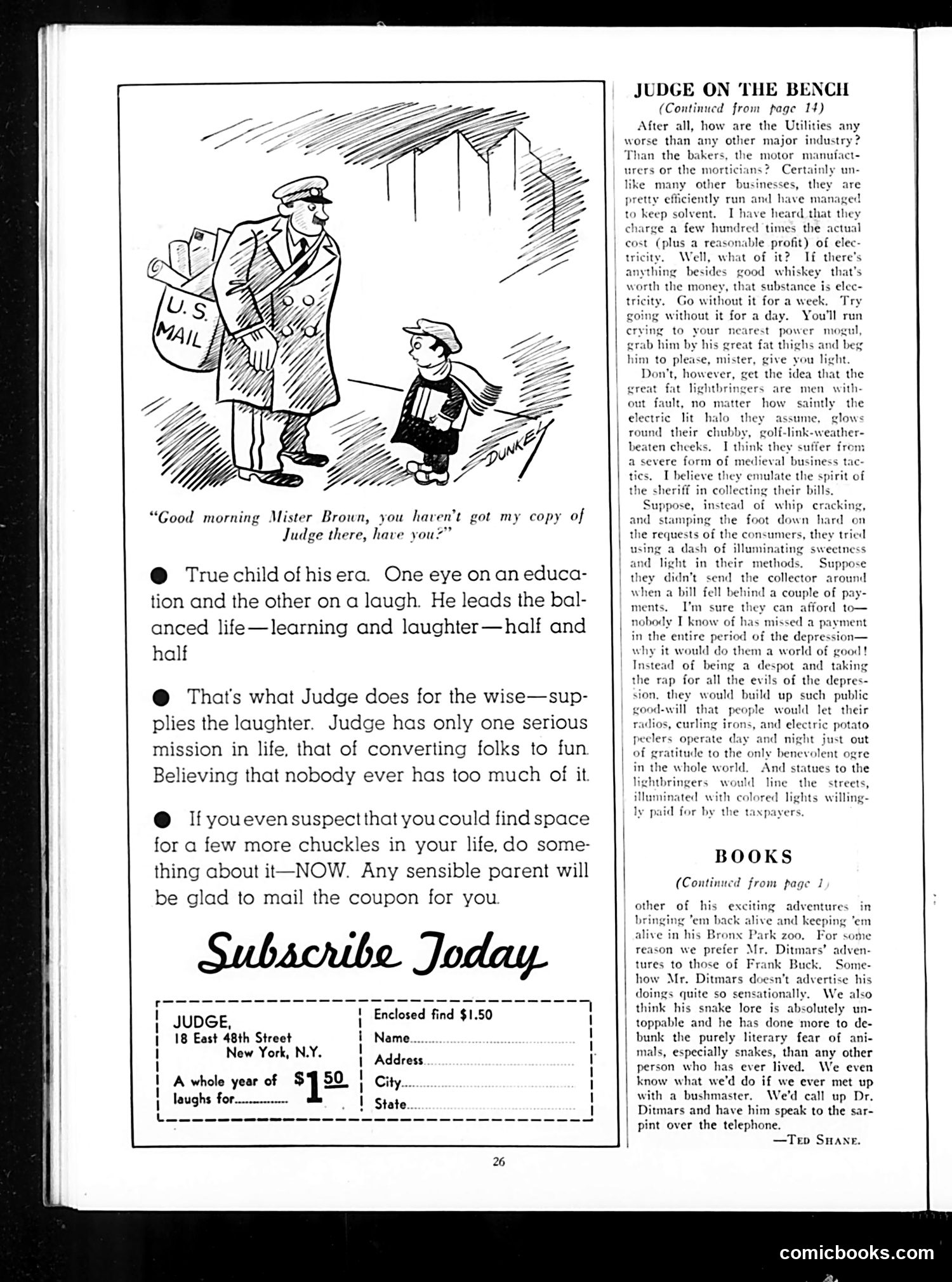
Judge Magazine Cartoon Analysis The cartoon depicts a postal worker (marked "U.S. MAIL") delivering to a man labeled "Mister Brown," who asks if the carrier has Brown's copy of *Judge* magazine. The joke plays on mail delivery delays—Brown hasn't received his subscription yet. The surrounding text is a subscription advertisement for *Judge*, a satirical humor magazine. It promotes the publication as balancing education with comedy, claiming *Judge* converts people "to fun" and supplies laughter for "the wise." The ad encourages parents to subscribe at $1.50 yearly. The cartoon's humor derives from a self-referential premise: a subscriber is so eager for his copy of a humor magazine that he's literally asking the mailman about it—suggesting *Judge's* content is valuable enough to anticipate. This serves the advertisement's persuasive purpose by implying the magazine is desirable and worth subscribing to immediately.
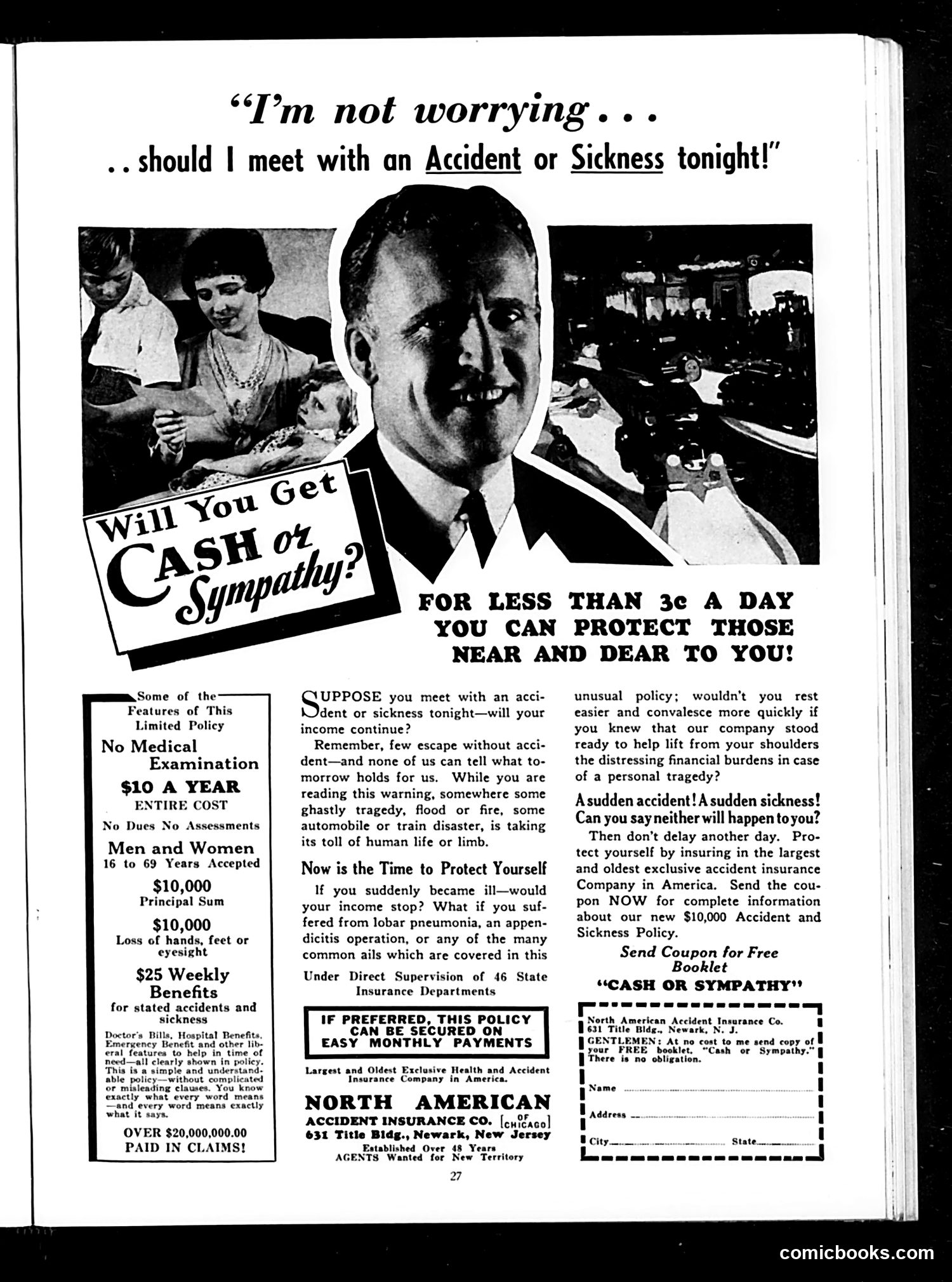
Analysis for Modern Readers This is not a cartoon but a full-page advertisement for accident and sickness insurance from the North American Accident Insurance Company, circa early-to-mid 20th century. The ad uses fear-based marketing typical of that era: the headline poses an anxious question about meeting with "Accident or Sickness tonight." The smiling man's photo suggests reassurance—he's protected and therefore carefree. The pitch exploits common anxieties: sudden illness or injury could stop your income, leaving dependents struggling. For "less than 3c a day," the company promises $10,000 in coverage with no medical exam required. The language ("ghastly tragedy," "flood or fire") and the booklet title "Cash or Sympathy" frame the choice starkly—financial protection versus relying on others' goodwill during hardship. This reflects an era before widespread employer-provided or government health insurance, when individual policies were a primary safety net for working families.
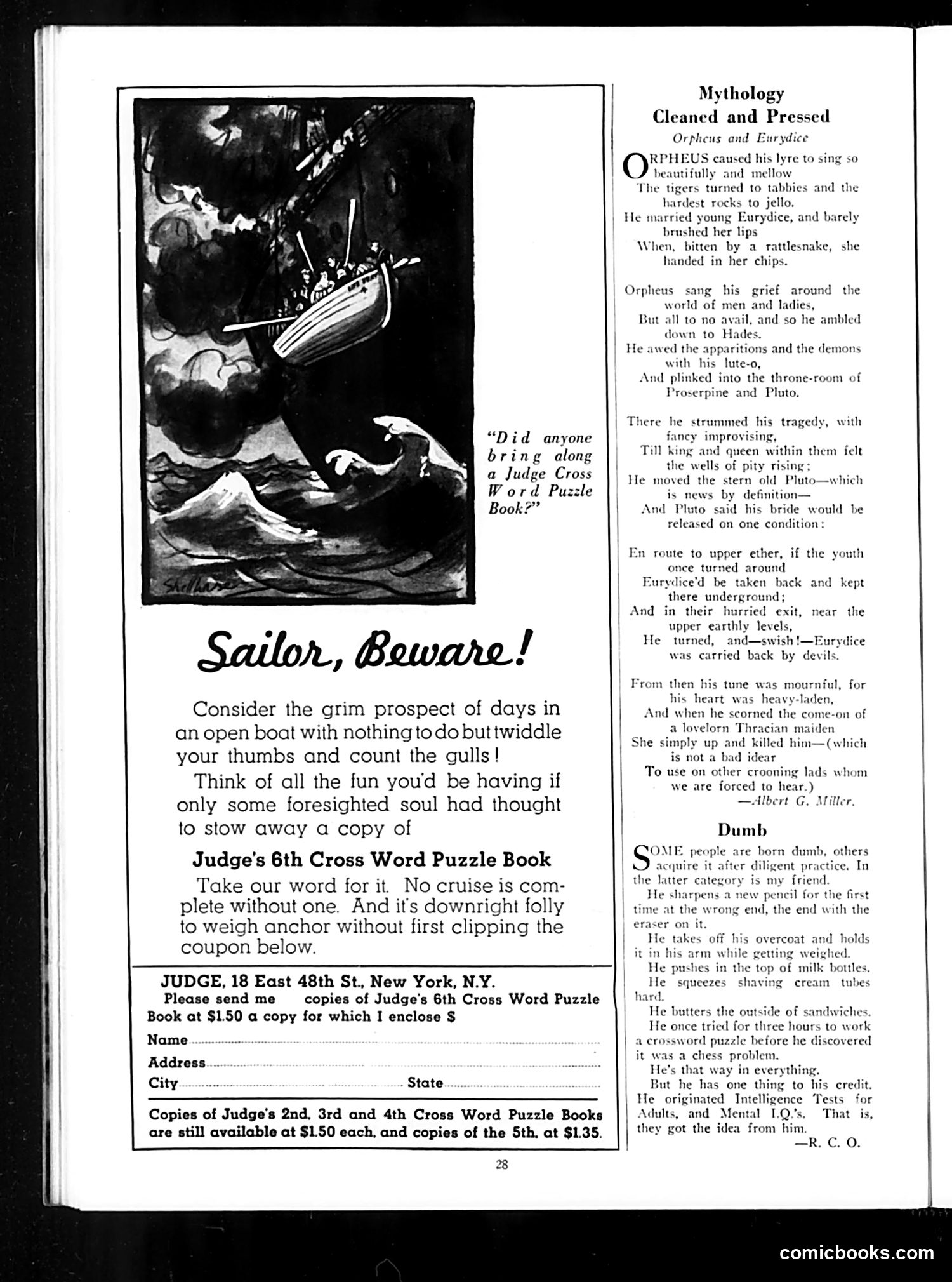
Judge Magazine Page Analysis This page contains two distinct elements: an advertisement and humorous poetry. The Advertisement ("Sailor, Beware!") promotes Judge's 6th Cross Word Puzzle Book by satirizing the tedium of sea travel. The accompanying illustration depicts a sailor in an open boat, apparently idle and bored. The ad argues that without a crossword puzzle book, a sailor faces unbearable monotony—"days in an open boat with nothing to do but twiddle your thumbs and count the gulls." It's a humorous appeal to purchase the puzzle book as essential shipboard entertainment. "Mythology Cleaned and Pressed" is comedic verse retelling the Orpheus and Eurydice myth in modern, colloquial language. The humor derives from bathos—deflating classical tragedy with casual diction ("handed in her chips," "ambled down to Hades"). The poem modernizes the myth while maintaining its narrative arc, presenting ancient gods and demons in a contemporary voice that makes the serious story absurdly funny. Both pieces exemplify Judge's satirical approach: mocking boredom, consumerism, and pretension through humor.
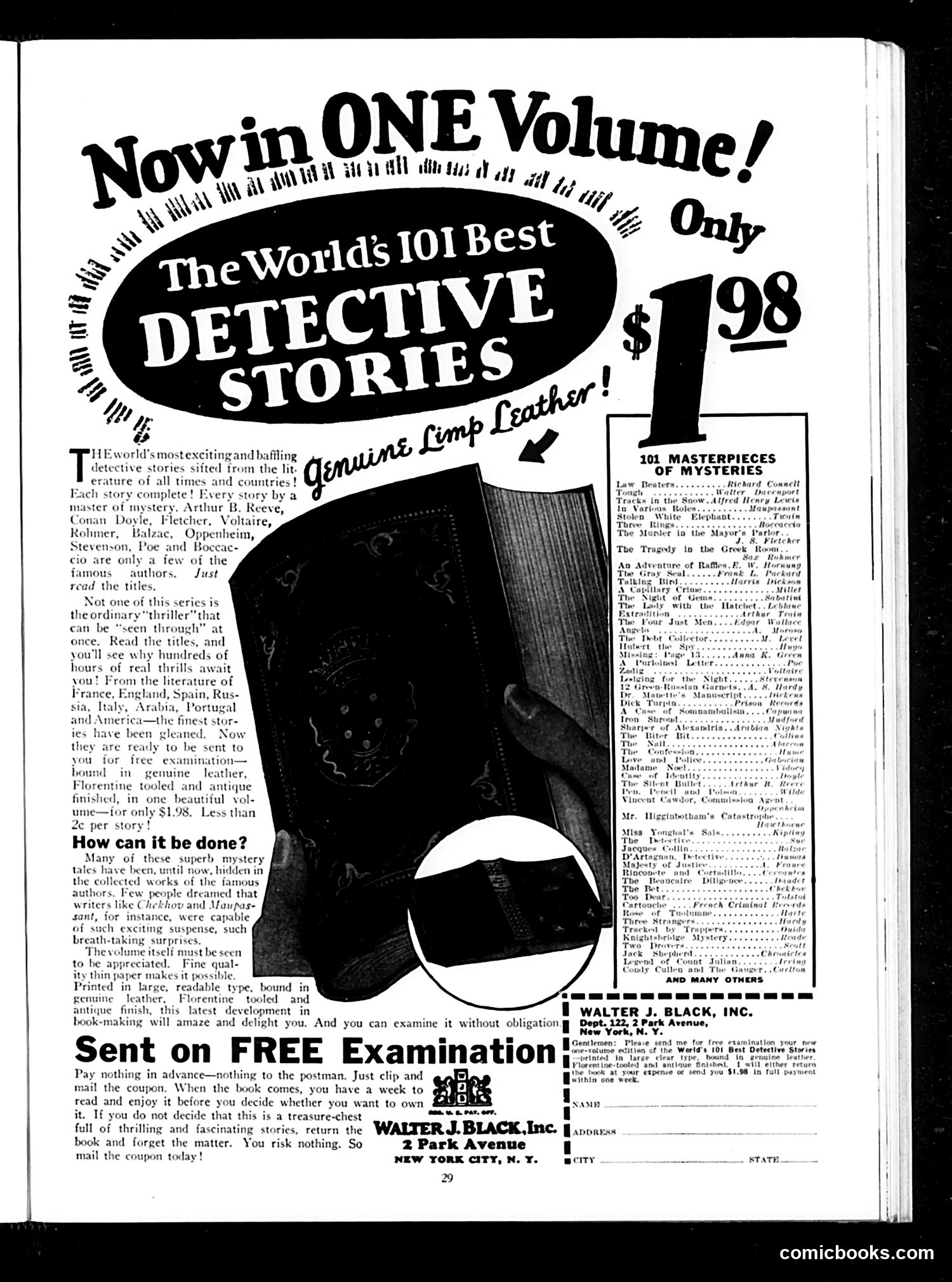
Analysis This page is purely advertising, not satirical content. It's a full-page promotional advertisement for Walter J. Black, Inc., a book publisher. The ad promotes a compilation called *The World's 101 Best Detective Stories*, priced at $1.98, bound in genuine leather with Florentine tooling. The pitch emphasizes value—claiming over 100 complete stories by famous authors (Conan Doyle, Poe, Balzac, etc.) at roughly 2 cents per story. The marketing strategy is typical of early-to-mid 20th century mail-order book clubs: emphasize luxury presentation (leather binding, fine paper, large print), list prestigious author names, and use a "free examination" offer with no upfront payment—the buyer had one week to return it risk-free. There is no cartoon or satirical commentary on this page. It's simply a commercial advertisement placed in *Judge* magazine, which like most periodicals of the era, relied heavily on advertising revenue.
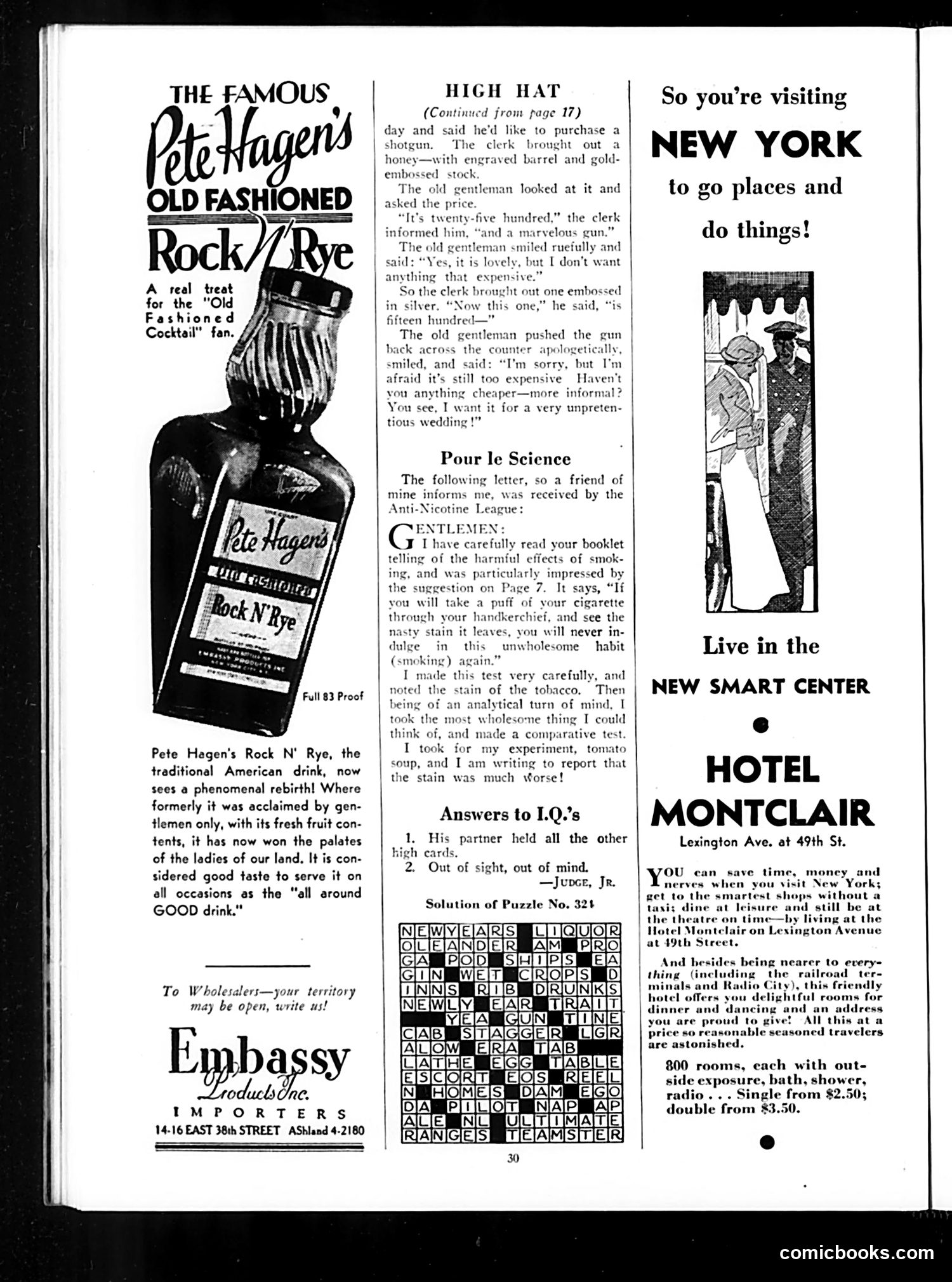
Judge Magazine Page Analysis This page from *Judge* contains primarily advertisements and filler content rather than political satire. The main items are: 1. Pete Hagen's Rock N' Rye liquor ad — promoting a traditional American whiskey cocktail ingredient, emphasizing its appeal to both gentlemen and ladies as a quality "all around GOOD drink." 2. "High Hat" story excerpt — a humorous anecdote about an elderly gentleman shopping for an expensive shotgun, ultimately seeking something cheaper for a wedding. 3. "Pour le Science" letter — satire mocking anti-smoking propaganda. A correspondent reports testing the anti-smoking league's claim that cigarette smoke stains handkerchiefs by comparing it to tomato soup—finding the soup stains *worse*, thereby absurdly "disproving" smoking's harm through deliberately bad logic. 4. Hotel Montclair advertisement — standard tourism/lodging promotion for New York. 5. Various classified advertisements and a crossword puzzle. The page reflects mid-20th-century magazine filler: light humor, product promotion, and practical reader content rather than substantive political commentary.
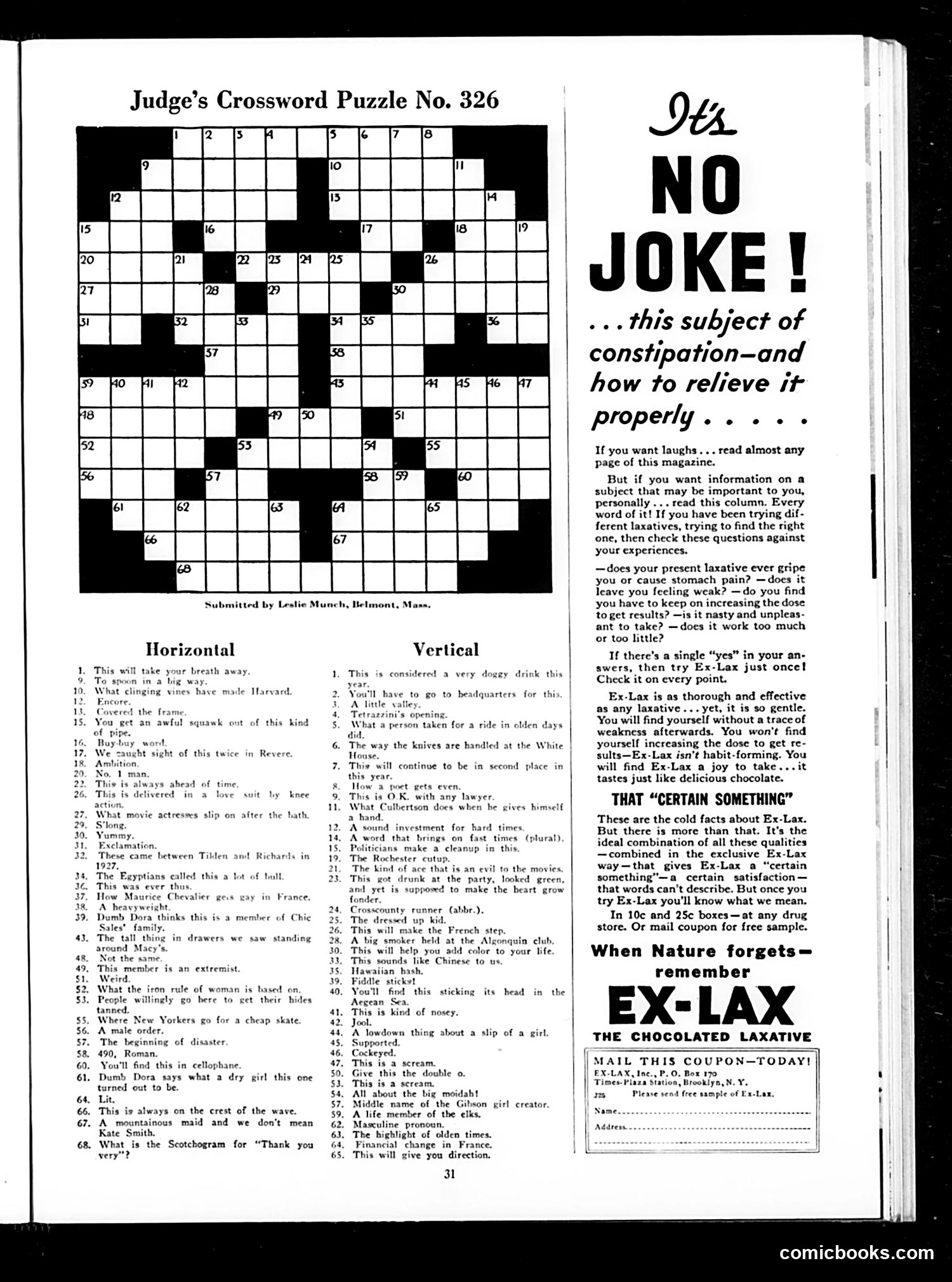
Explanation for Modern Readers This page contains Judge magazine's crossword puzzle No. 326 and an advertisement for Ex-Lax laxative. The crossword itself is a standard puzzle with topical clues referencing 1920s-30s popular culture—mentions of Maurice Chevalier, "Dumb Dora" (a recurring comic character), and contemporary slang ("S'long," "Yumm"). The significant content is the Ex-Lax ad, which uses a "no joke" framing to discuss constipation—a subject treated as socially delicate enough to require earnest reassurance. The ad questions readers about their current laxative's effectiveness (does it cause cramping? weakness? require increasing doses?) before pitching Ex-Lax as a gentle alternative "that tastes just like delicious chocolate." This reflects early-20th-century advertising strategy: treating bathroom health as a serious medical matter while using magazines like Judge (known for humor and satire) to reach middle-class audiences. The juxtaposition of lighthearted crossword puzzles with frank medicinal claims was typical of that era's advertising approach.
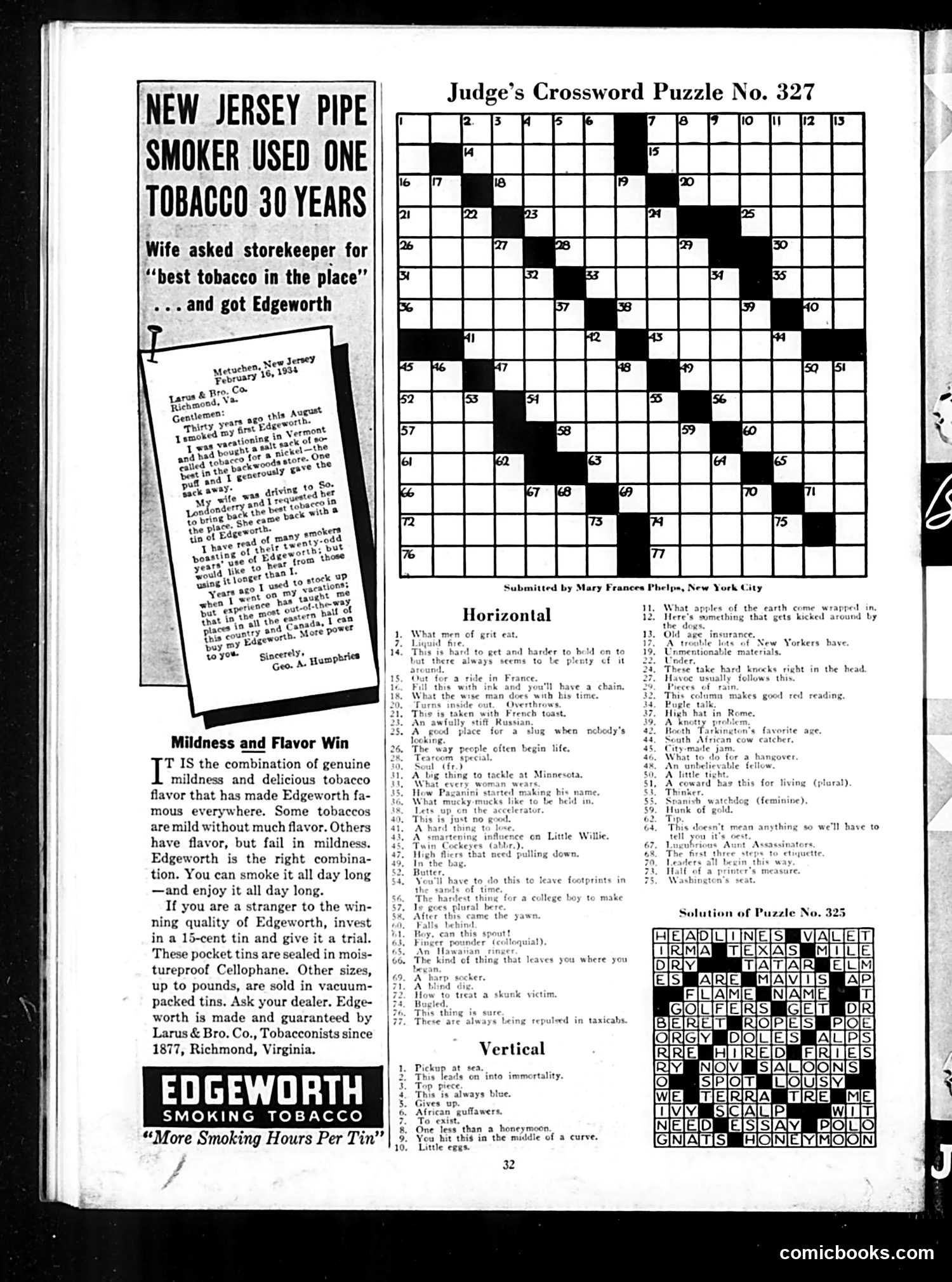
Judge Magazine Page Analysis This page is primarily an advertisement for Edgeworth smoking tobacco, disguised as editorial content and a crossword puzzle. The "cartoon" is a testimonial letter from a New Jersey pipe smoker claiming 30 years of loyalty to Edgeworth tobacco. His wife supposedly asked a storekeeper for "the best tobacco in the place" and received Edgeworth—presented as validation of the product's quality. The advertising copy emphasizes Edgeworth's supposed balance of "mildness and flavor," positioning it against competitors that lack one or the other. The text encourages trial purchase of the 15-cent tin. The crossword puzzle and accompanying letter are integrated advertising: they occupy space while promoting the brand name repeatedly. The phrase "More Smoking Hours Per Tin" at the bottom is the product's selling slogan. This represents early 20th-century magazine advertising strategy: blending promotional content seamlessly with editorial material to appear less like advertisement and more like genuine editorial endorsement.
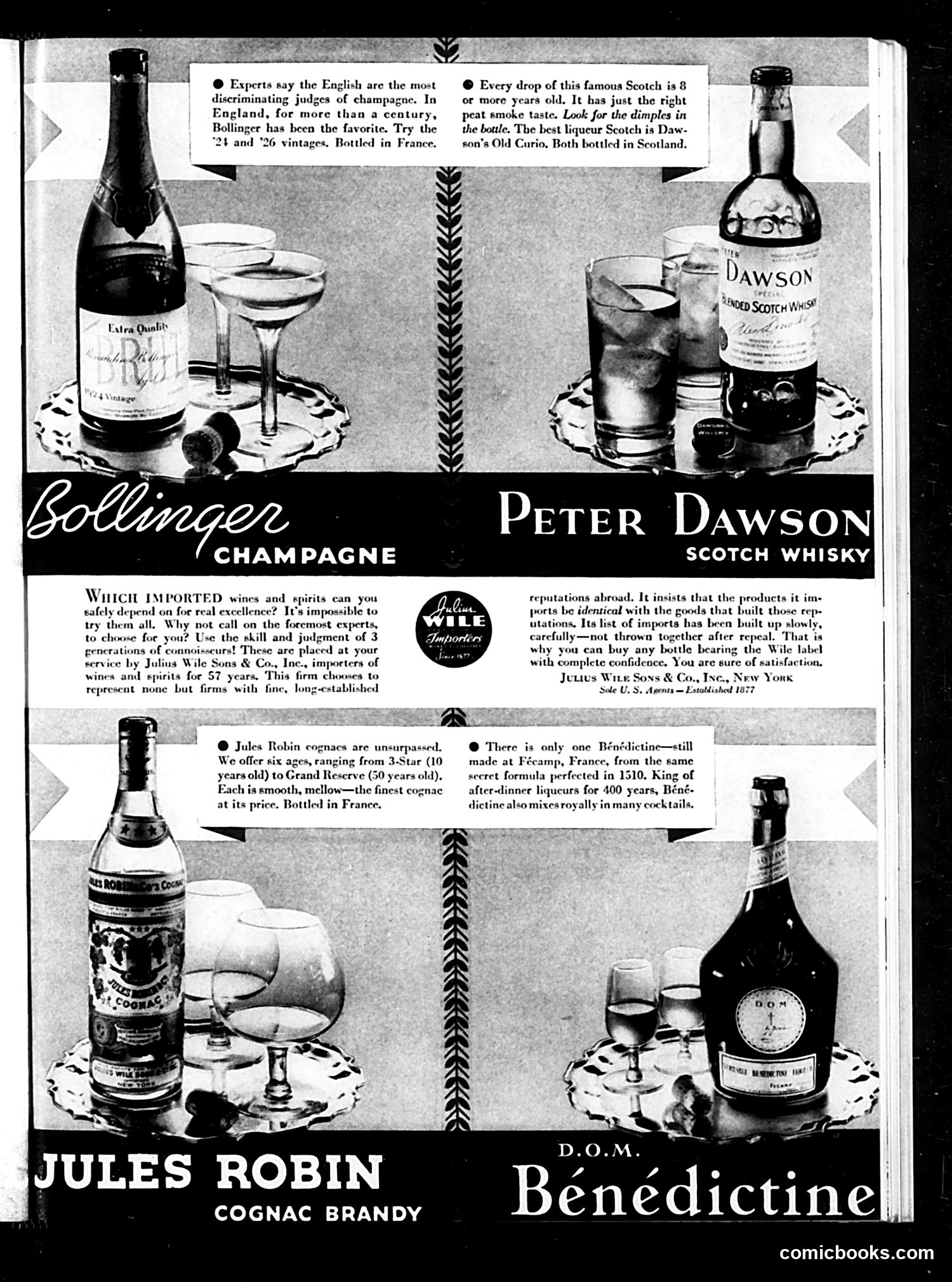
Analysis This is purely an advertisement page, not a cartoon or satire. It features four luxury alcohol brands—Bollinger Champagne, Peter Dawson Scotch Whisky, Jules Robin Cognac, and D.O.M. Bénédictine—presented by Julius Wile Sons & Co., Inc., a major importer. The page appeals to American readers by emphasizing European prestige and heritage. Each product highlights its age, origin, and expert endorsement: Bollinger as favored by English connoisseurs for over a century; Peter Dawson as properly aged Scottish whisky; Jules Robin as superior cognac available in multiple ages; and Bénédictine as an exclusive French liqueur made continuously since 1510. The advertising strategy targets upscale consumers seeking authentic, established imported goods—typical marketing for the post-Prohibition era when American consumers could legally purchase such products again.
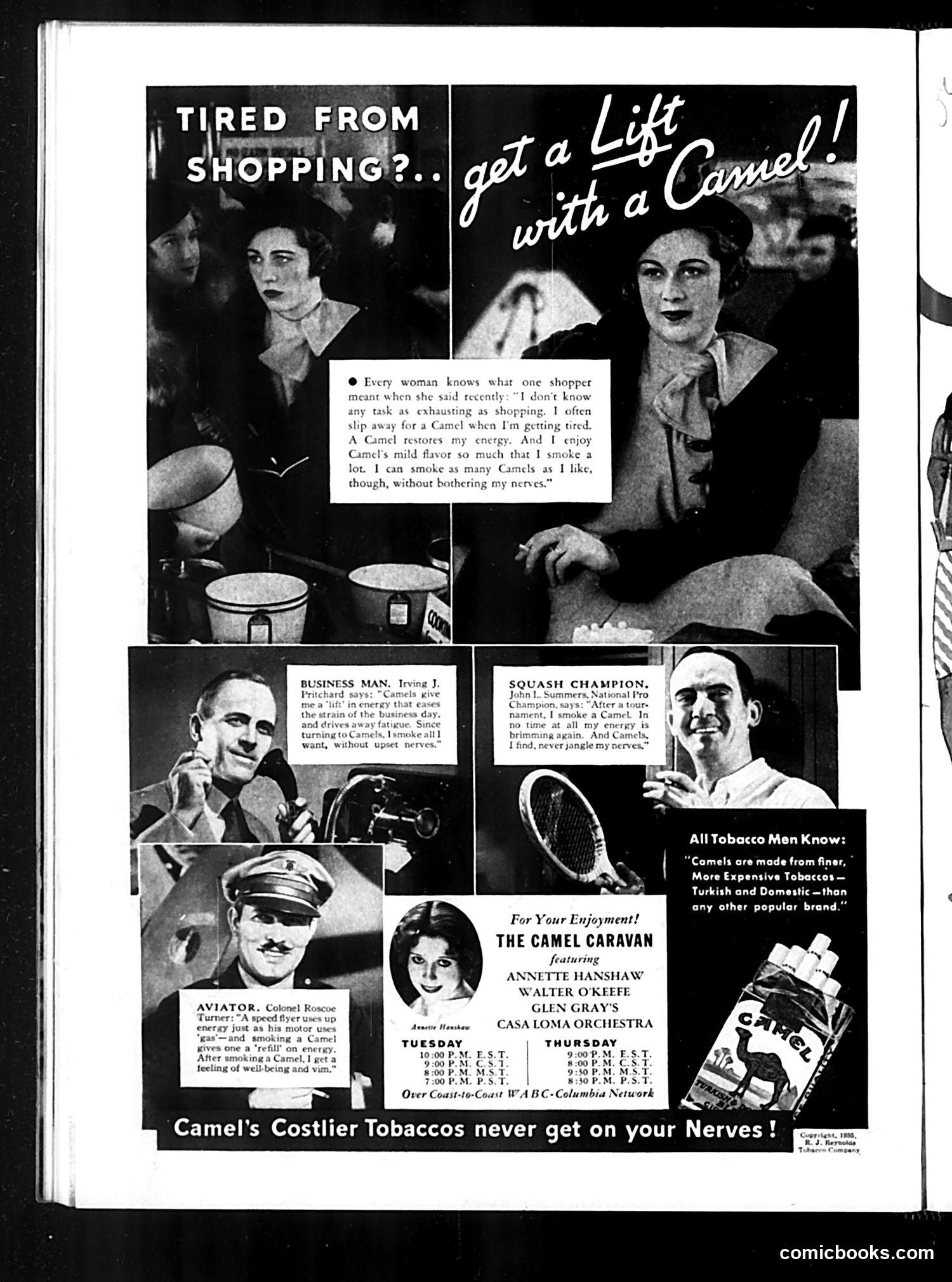
Analysis This is a cigarette advertisement, not satire. The page promotes Camel cigarettes by featuring testimonials from various professionals claiming the product relieves fatigue without "getting on your nerves." The figures shown are: - Annette Hanshaw (singer, visible in circular portrait) - Walter O'Keefe (entertainer) - Glen Gray's Casa Loma Orchestra (dance band) - A business man, aviator, and squash champion (unnamed individuals representing different professions) Each testimonial claims Camels restore energy during demanding work—shopping, flying, athletics, etc.—while maintaining calm nerves. This exploits the era's (pre-1960s) lack of public awareness about nicotine's addictive and health-damaging properties. The ad's tagline, "Camel's Costlier Tobaccos never get on your Nerves," falsely implies cigarettes soothe rather than stimulate. The page also promotes "The Camel Caravan," a radio variety show featuring these entertainers, broadcast over the ABC-Columbia Network.