judge
Judge — March 1935
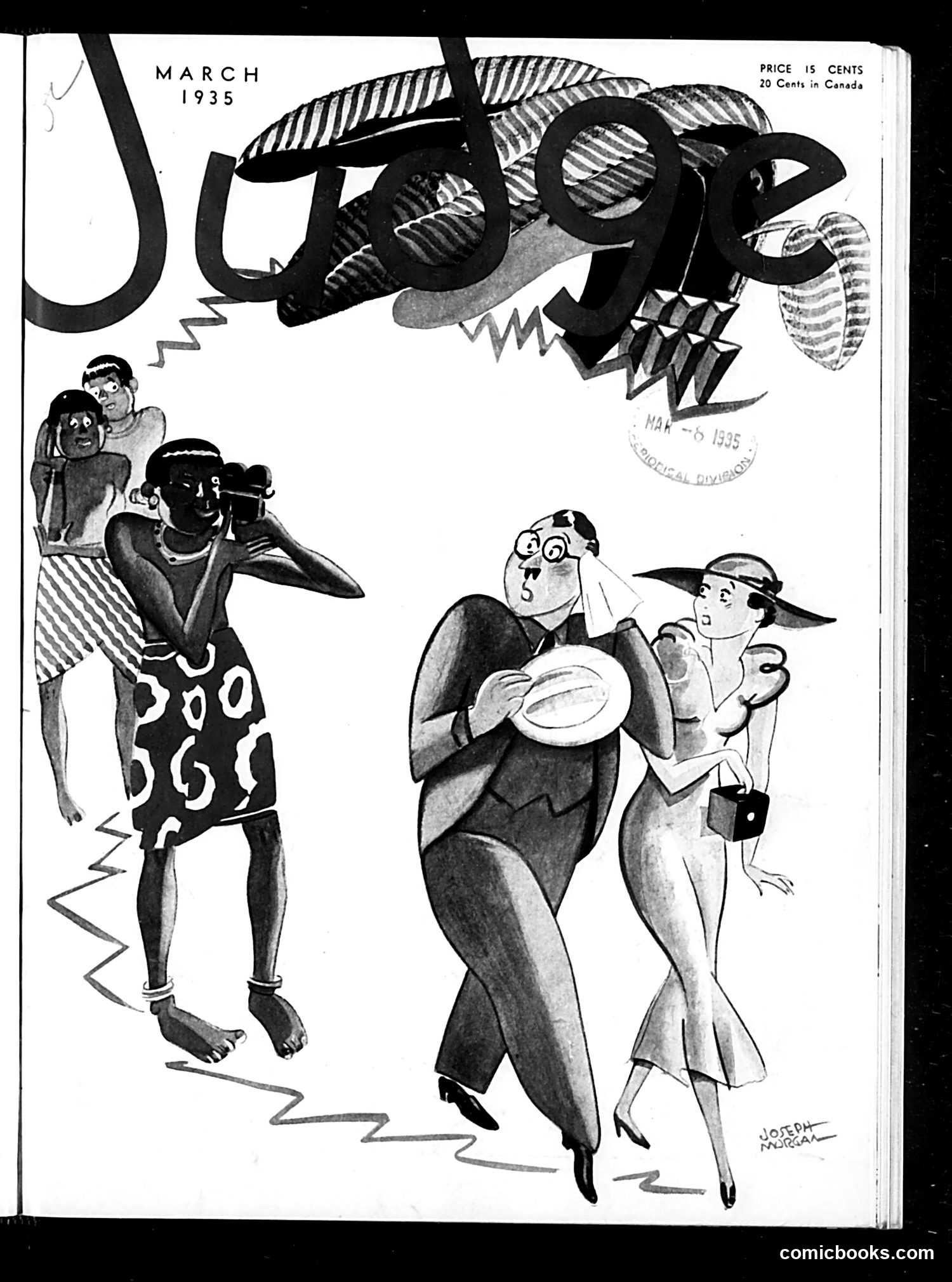
March 1935 Judge Magazine Analysis This satirical cover depicts fear of economic consequences during the Great Depression era. The large threatening figure at top—labeled "1939"—represents anxieties about the future, specifically what might happen four years ahead. The lightning bolts and aggressive pose suggest impending disaster or conflict. Below, three figures react with alarm: people of different social classes and ethnicities appear panicked, fleeing or cowering from the looming "1939." One figure wears tropical/colonial dress, another fashionable 1930s attire. The satire critiques contemporary anxieties about economic recession, potential war, or social upheaval. By personifying a future year as a menacing monster, Judge mocks both the apocalyptic predictions circulating during the Depression and the public's susceptibility to such fears. The diverse figures suggest these anxieties crossed all social boundaries.
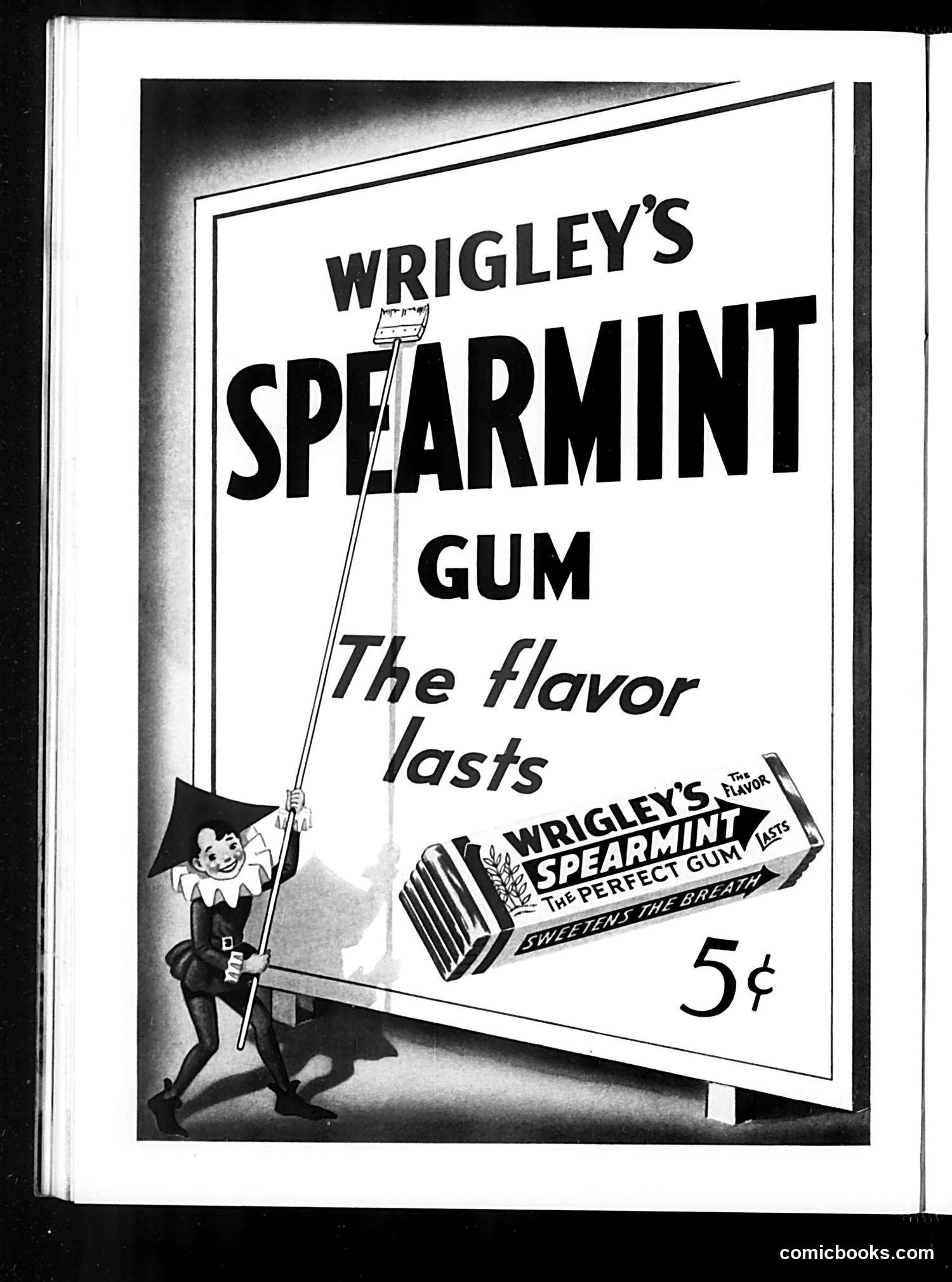
Wrigley's Spearmint Gum Advertisement This is a straightforward product advertisement, not political satire. It promotes Wrigley's Spearmint gum with the marketing slogan "The flavor lasts" and highlights the tagline "The Perfect Gum" and "Sweetens the Breath." The ad features a whimsical elf or jester-like mascot character pulling down a large billboard displaying the product. This playful imagery was typical advertising design of the early-to-mid 20th century, using cartoon characters to make products memorable and appealing. The price point of 5¢ reflects the product's affordability during that era. There is no political commentary or satire evident on this page—it's purely commercial advertising designed to drive consumer purchases through humor and brand recognition.
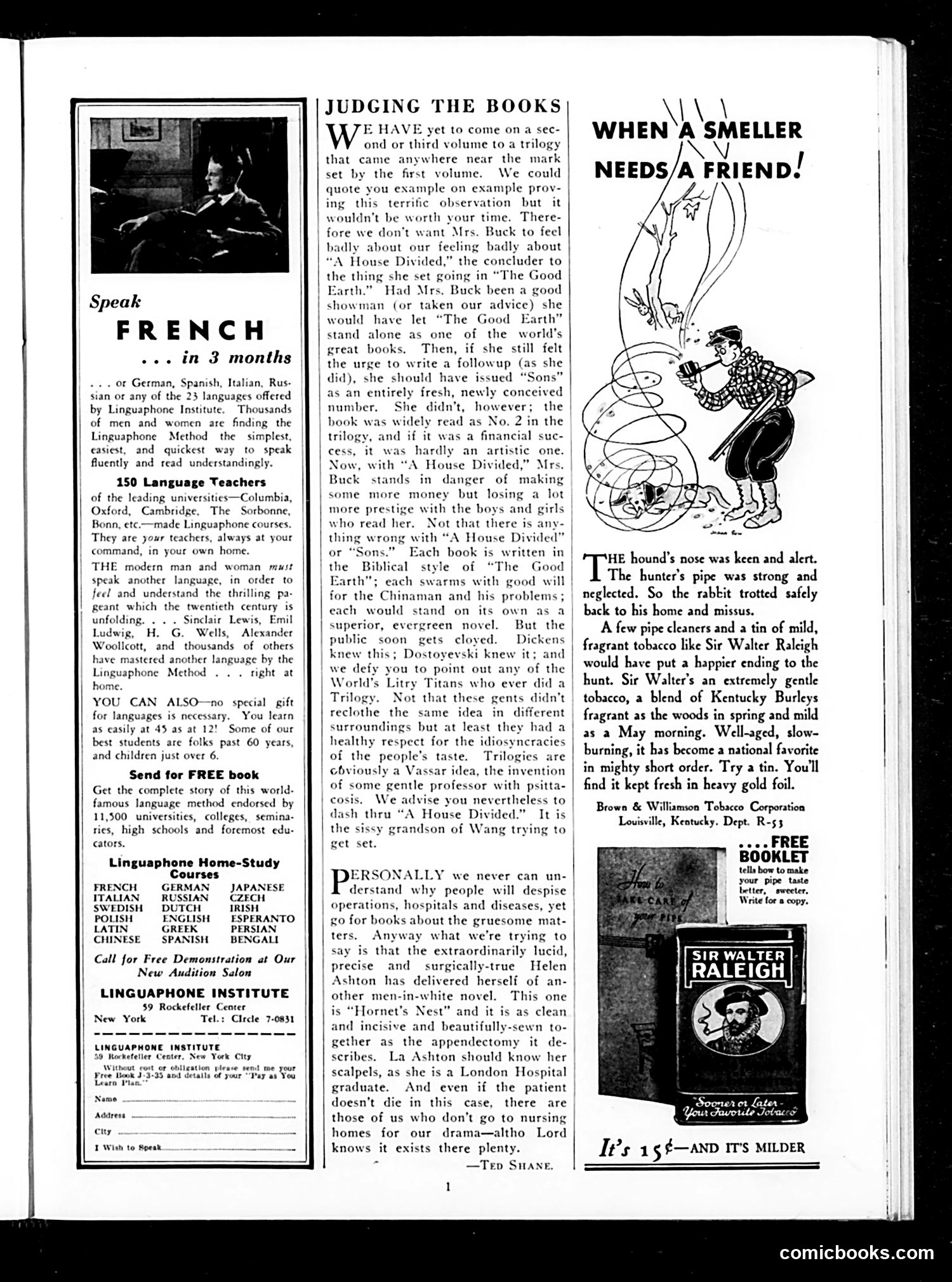
"When a Smeller Needs a Friend" Cartoon This cartoon depicts a hunter with a hound dog that has apparently picked up a scent. The joke plays on the double meaning of "smeller" — both the dog's nose and a person with bad body odor. The setup shows the hunter helping his dog follow a trail, but the accompanying text suggests the real humor concerns a person with poor hygiene or unpleasant odor needing companionship despite this flaw. The cartoon is paired with a Sir Walter Raleigh tobacco advertisement below, emphasizing the product as a genteel, pleasant-smelling alternative — implicitly contrasting refined tobacco aroma with the "smeller" problem referenced above. The humor relies on 1920s-era sensibilities about cleanliness and social acceptability.
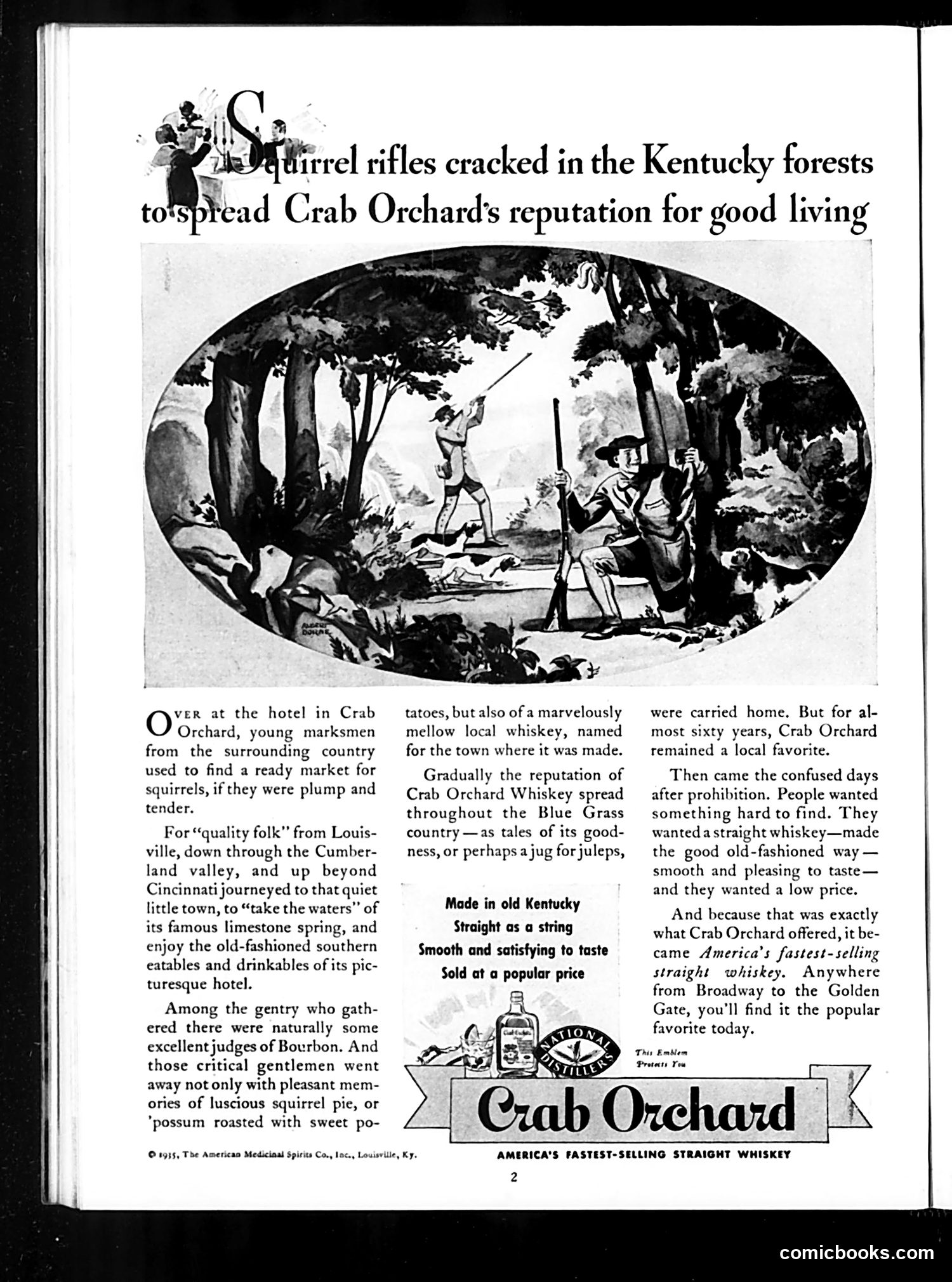
Analysis This page is primarily an advertisement, not political satire. It promotes Crab Orchard Whiskey by framing the product within American frontier mythology. The illustrated oval scene depicts colonial-era or frontier hunters in a Kentucky forest—likely meant to evoke authenticity and tradition rather than satirize specific figures. The text constructs a narrative: Crab Orchard hotel became famous for whiskey; Prohibition made spirits scarce; consumers then sought Crab Orchard's "old-fashioned" smooth whiskey as a legal alternative. The "fastest-selling straight whiskey" claim positions the product as satisfying post-Prohibition demand. The reference to "quality folk" from Louisville to Cincinnati journeying to the spring establishes prestige through association with gentry and connoisseurs. This is vintage advertising exploiting nostalgia and Prohibition-era scarcity, not political commentary.
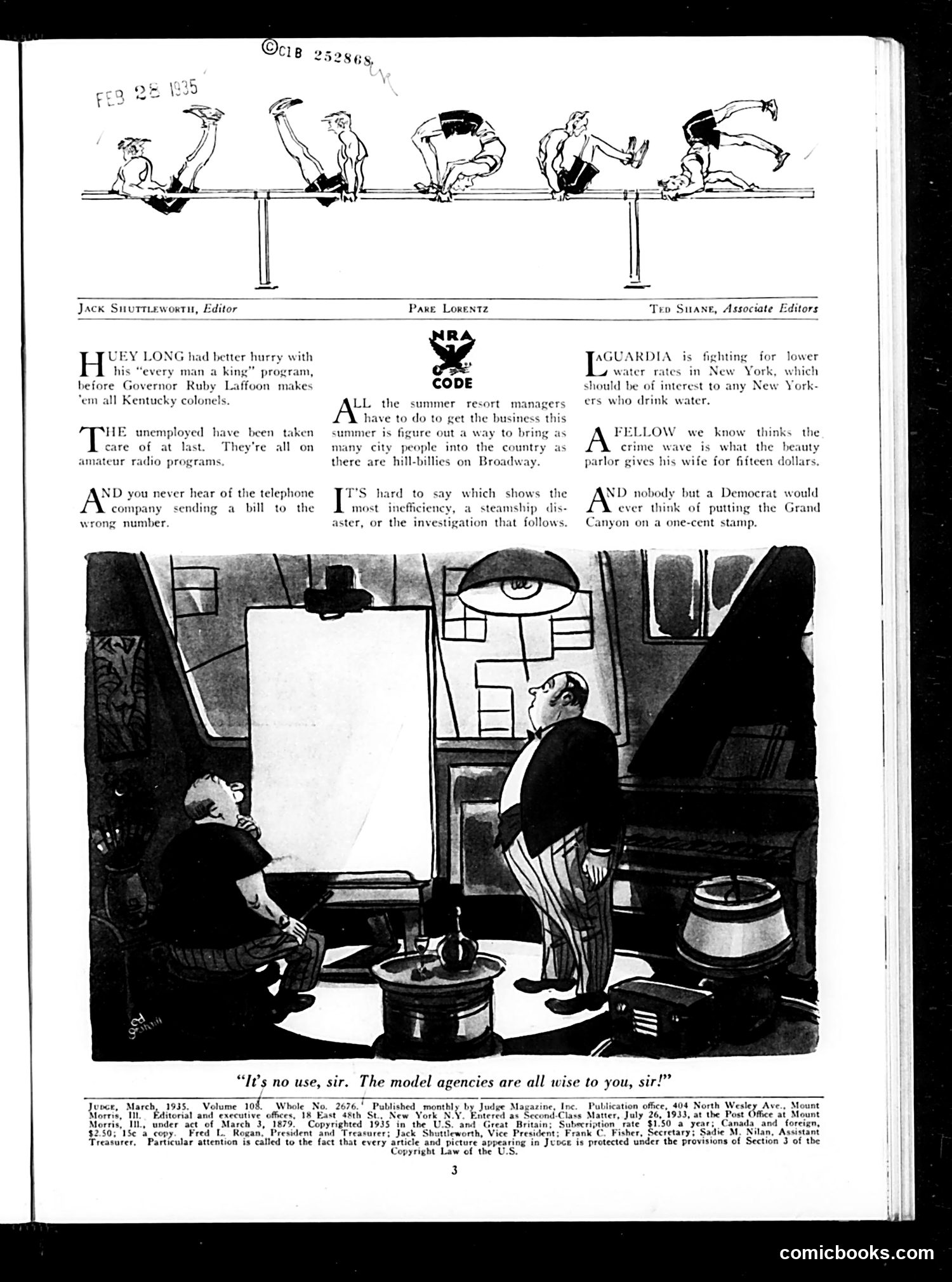
Analysis of Judge Magazine Page (March 1935) Main Cartoon: A man approaches a modeling agency office, where the receptionist tells him: "It's no use, sir. The model agencies are all wise to you, sir!" The joke appears to satirize unsuccessful or persistently rejected job-seekers during the Great Depression era. The man's repeated attempts to find work through modeling agencies are futile because agencies have learned to recognize and reject him. Sidebar Editorial Items: Brief commentary on various 1935 topics including Huey Long's "every man a king" program, unemployment relief programs, summer resort business revival, and Grand Canyon preservation efforts. The overall page reflects Depression-era anxieties about employment and social welfare issues contemporary to March 1935.
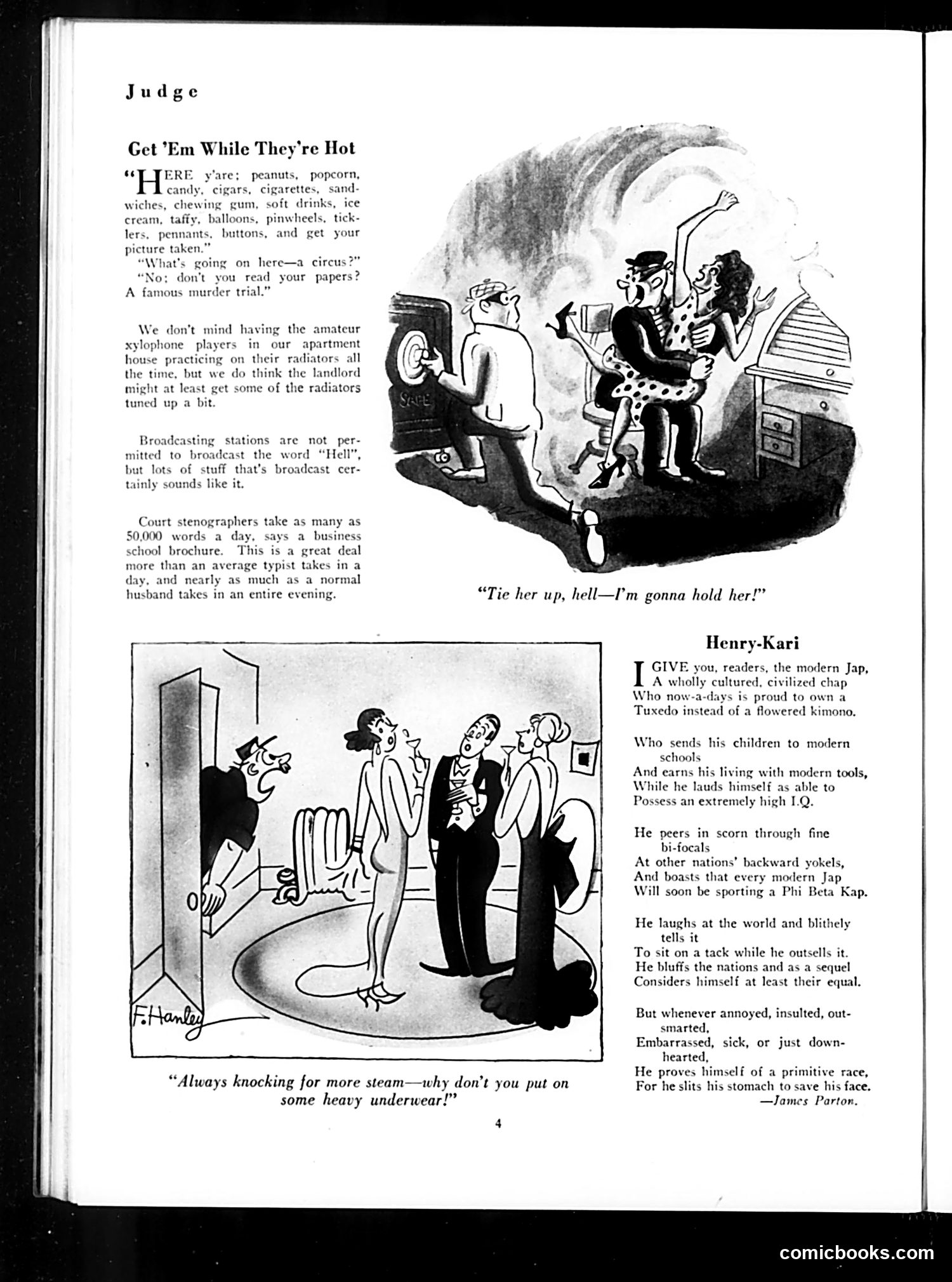
Page Analysis: Judge Magazine Top Cartoon ("Get 'Em While They're Hot"): Depicts a circus-like scene with a barker selling concessions (peanuts, popcorn, candy). The joke satirizes urban apartment living—neighbors complaining about amateur xylophone practice and radiators, while advertising/broadcasting stations avoiding saying "Hell" but broadcasting other crude content. The satire critiques selective moral standards and urban noise pollution. Bottom Cartoon ("Always knocking for more steam"): Shows a man in a bathtub surrounded by fully-clothed guests. The caption jokes about someone constantly demanding more steam/hot water while underdressed. This appears to be domestic humor about household complaints and comfort expectations. "Henry-Kari" Poem: A satirical character portrait of a modern Japanese man adopting Western customs (tuxedo instead of kimono, attending modern schools) while remaining superficially arrogant about Japanese superiority. The satire mocks pretentious cultural hypocrisy.
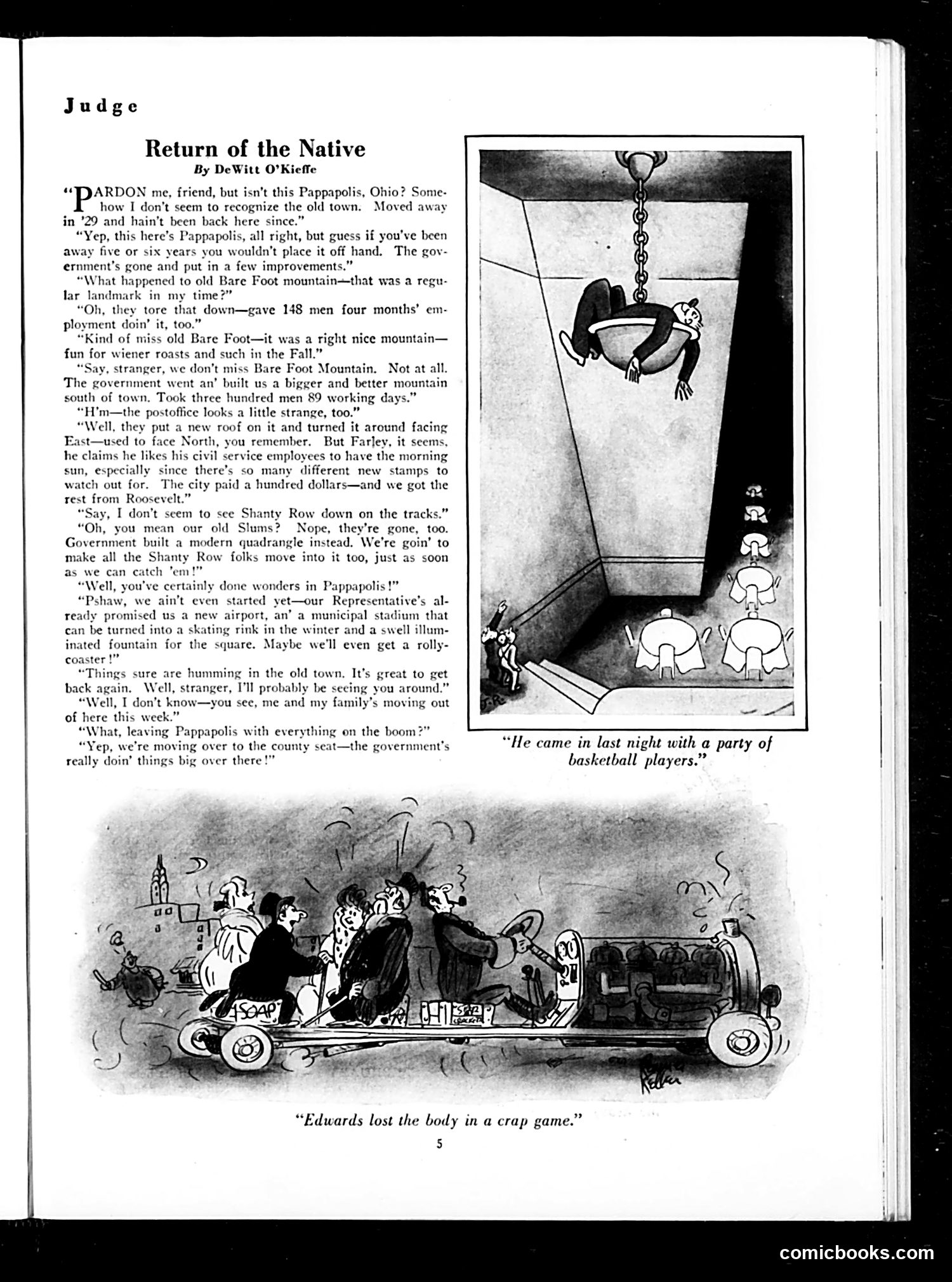
"Return of the Native" by DeWitt O'Kieffe This satirical piece mocks the changes in Pappapolis, Ohio after someone left and returned five or six years later. The dialogue humorously contrasts what was lost (old landmarks like Bare Foot Mountain, demolished for government projects) with what was gained (new government buildings, a reoriented post office, promised but unbuilt airport and stadium). The cartoon critiques government inefficiency and over-development—tearing down natural/historic landmarks to build bureaucratic infrastructure that yields minimal practical benefit. The final cartoon captioning "Edwards lost the body in a crap game" suggests the absurdity and moral decay accompanying these "improvements." The satire targets early 20th-century American municipal development and government waste disguised as progress.
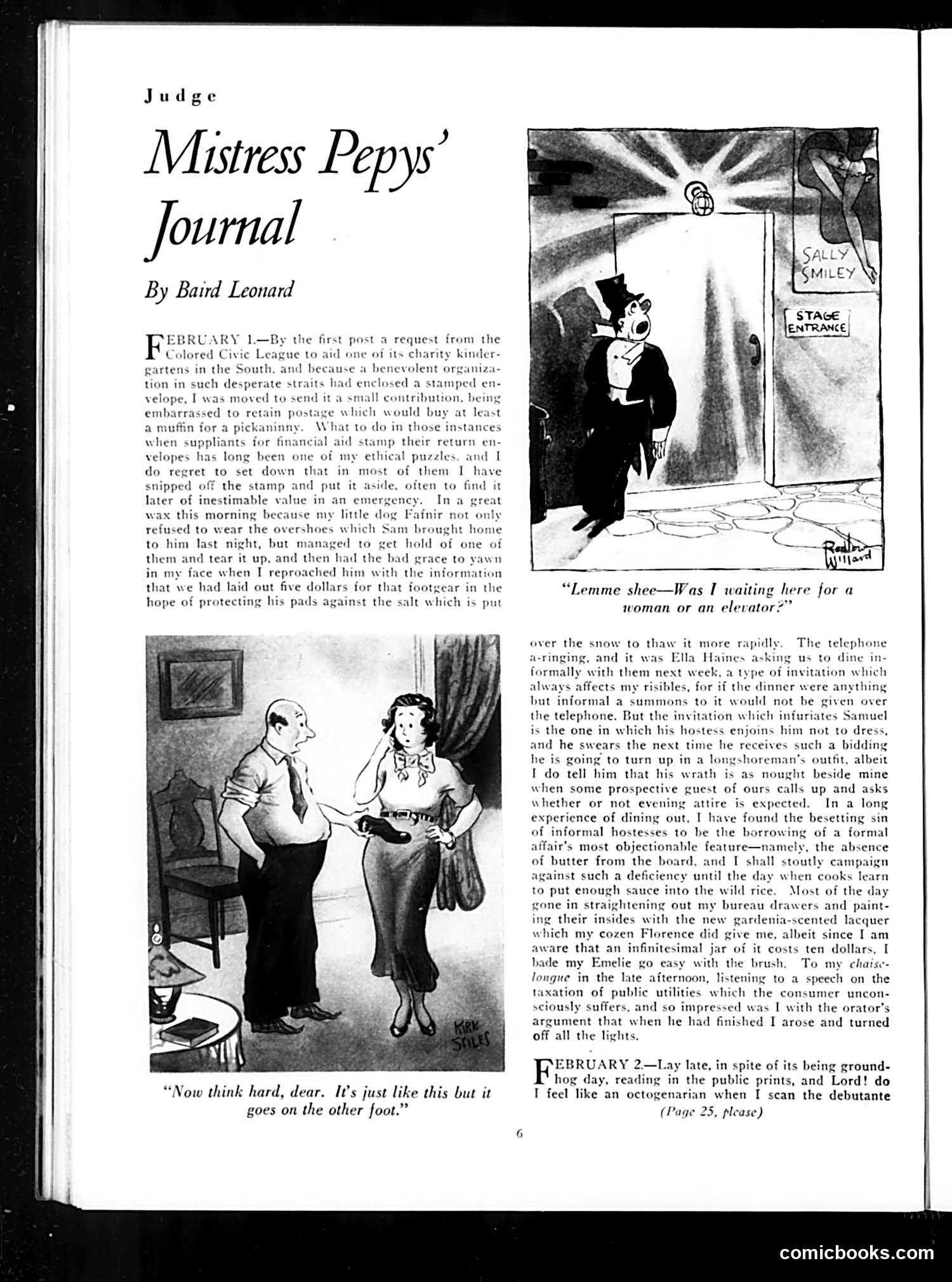
Judge Magazine: "Mistress Pepys' Journal" This is a satirical column by Baird Leonard mimicking Samuel Pepys' famous diary, but written from a female perspective observing high society. The two cartoons illustrate humorous domestic situations: Top cartoon: A man in formal attire appears confused entering what seems to be a theater or building, with the caption suggesting he's uncertain whether he's waiting for a woman or an elevator—poking fun at gender roles and modern confusion. Bottom cartoon: Shows a woman instructing a man on proper etiquette, captioned "Now think hard, dear. It's just like this but it goes on the other foot"—likely depicting instruction on proper formal dress or dance steps, mocking husbands' incompetence at social graces. The column satirizes upper-class social expectations, gender dynamics, and domestic life in the early 20th century.
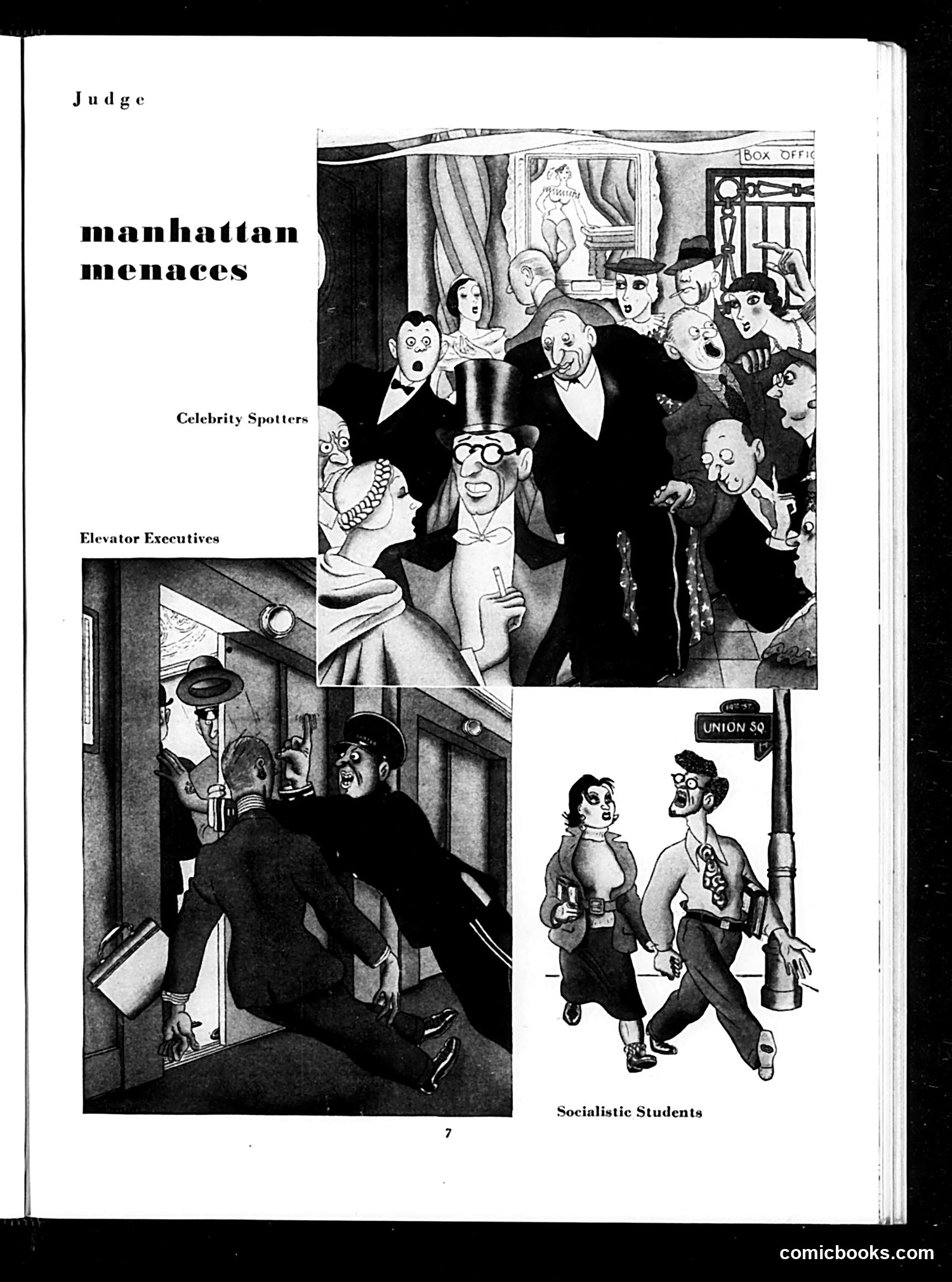
Analysis of Judge Magazine Page 7 This page contains three satirical cartoon sections titled "manhattan menaces": "Celebrity Spotters" (top): Depicts exaggerated caricatures of well-dressed theatergoers with shocked expressions, suggesting mockery of society people who frequent theaters and public venues while being overly dramatic or pretentious. "Elevator Executives" (left): Shows businessmen in an elevator, apparently portraying urban office workers in cramped or awkward situations—likely satirizing the absurdities of daily commuter life in Manhattan's growing business culture. "Socialistic Students" (bottom right): Features young people at Union Square, a known gathering place for political radicals and leftist activists in 1920s-30s New York, caricatured with exaggerated features in a derisive manner typical of anti-communist satire of the era. The overall theme mocks various Manhattan social types and perceived threats to traditional society.
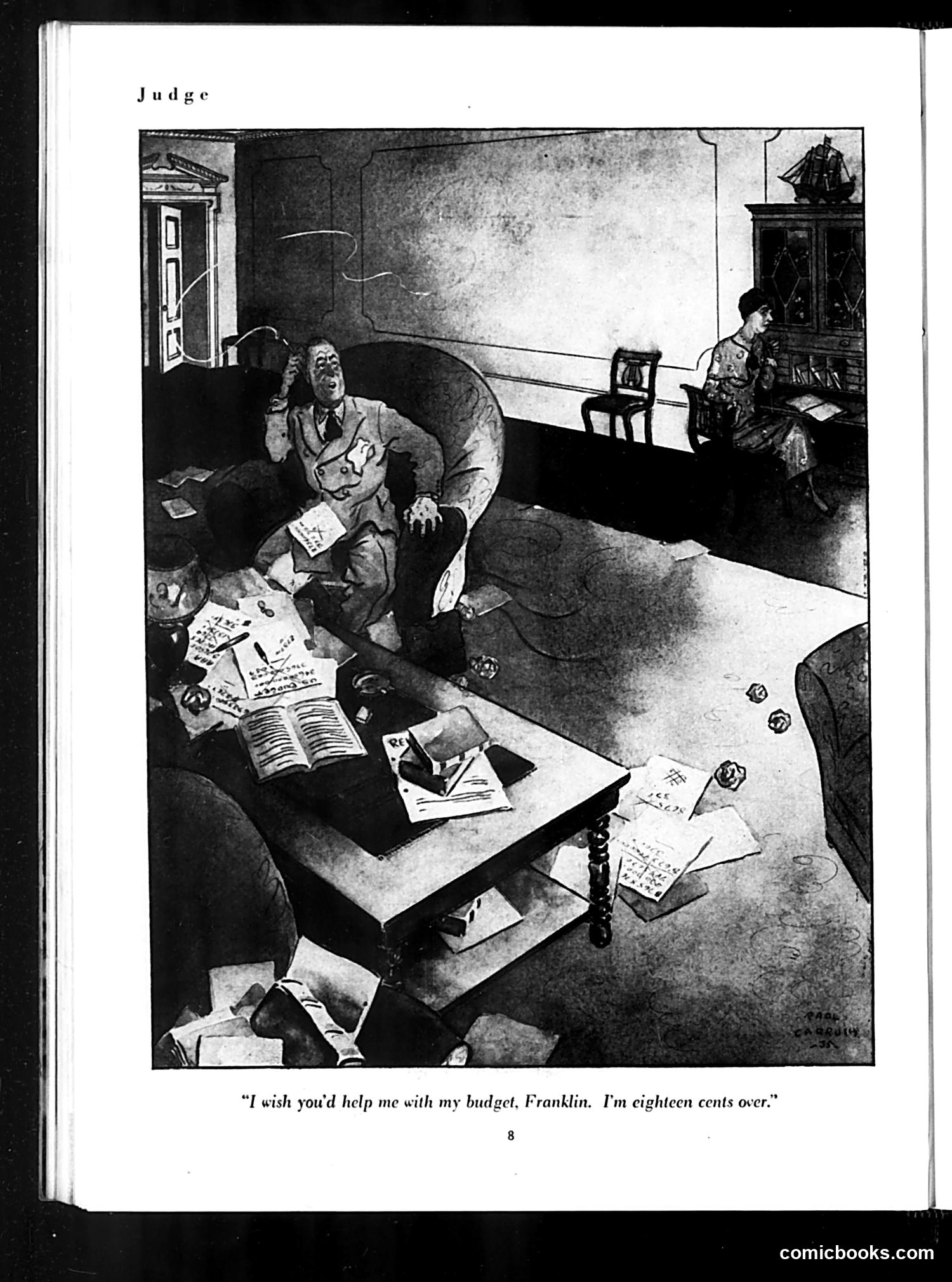
"Judge" Cartoon Analysis This single-panel cartoon satirizes household financial struggles, likely from the early-to-mid 20th century. A woman sits surrounded by scattered bills, ledgers, and accounting papers, appearing overwhelmed by her budgeting efforts. She asks "Franklin" (presumably her husband, shown standing on the right) to help her with her household budget—she's overspent by just eighteen cents. The satire targets the tension between meticulous household management and marital dynamics. The woman's desperate plea over a trivial overage suggests the impossible standards women faced in managing domestic finances precisely, while husbands often remained uninvolved or dismissive of such work. The modest amount (eighteen cents) amplifies the absurdity of her distress, highlighting how women bore responsibility for financial propriety in matters both significant and trivial.
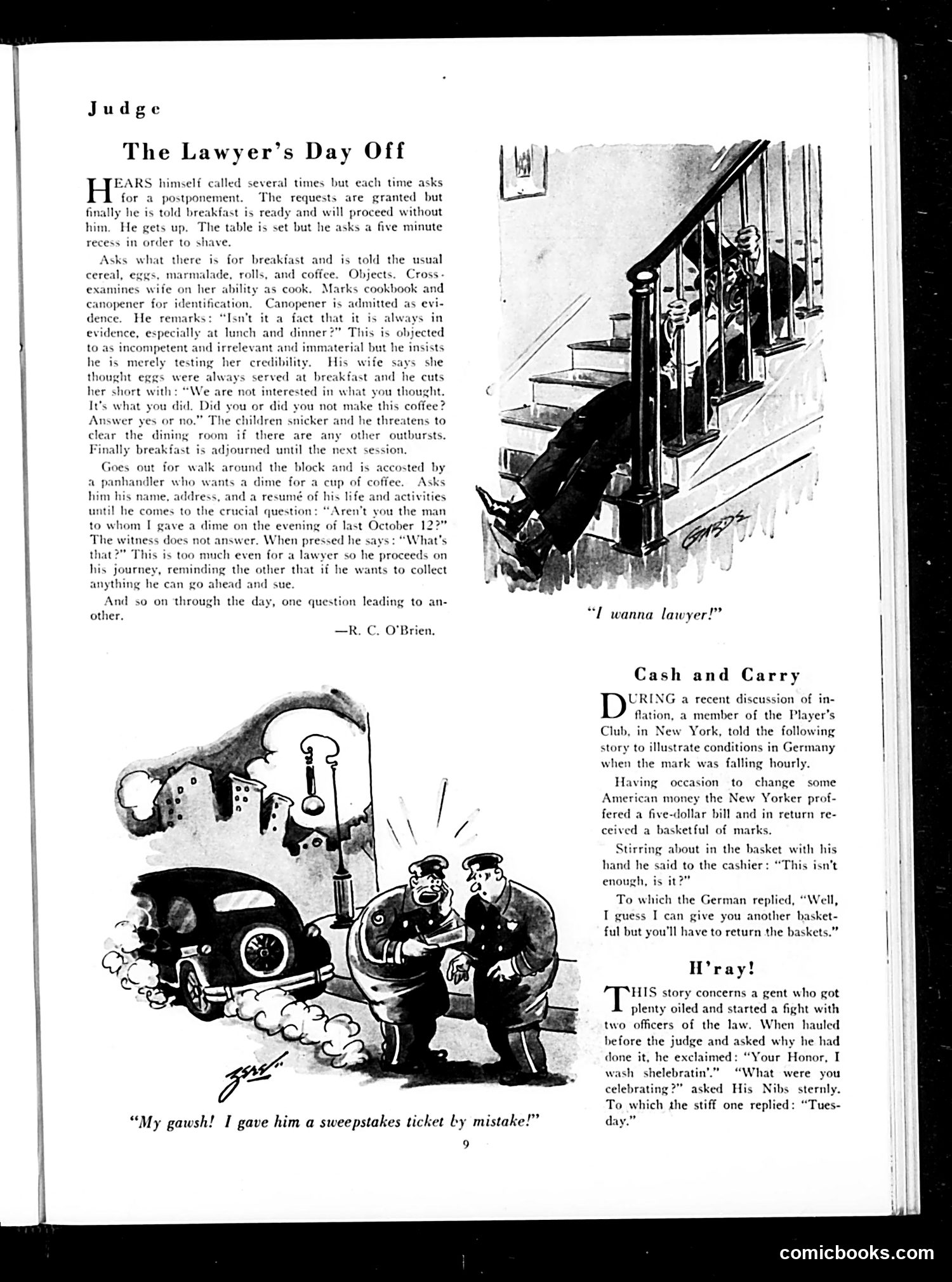
Judge Magazine Page Analysis This page contains three humorous pieces satirizing American life circa the 1920s: "The Lawyer's Day Off" mocks obsessive legal minds. A lawyer treats his entire day—breakfast, casual encounters—as courtroom cross-examinations, objecting to his wife's cooking, interrogating a panhandler about a past dime, and treating simple conversations as evidentiary proceedings. The satire targets how certain professionals cannot separate their work mentality from domestic life. "Cash and Carry" references hyperinflation in post-WWI Germany, where currency became so worthless that exchanging five American dollars yields a full basket of marks. The joke's dark humor lies in the cashier's quip that the customer must return the baskets—the container is worth more than the money inside. "H'ray!" presents a drunk man who assaults police officers, then tells the judge he was "celebrating Tuesday"—absurd justification suggesting he gets drunk every day for no particular reason. All three pieces exemplify Judge's satirical approach to professional pretension, economic chaos, and human folly.
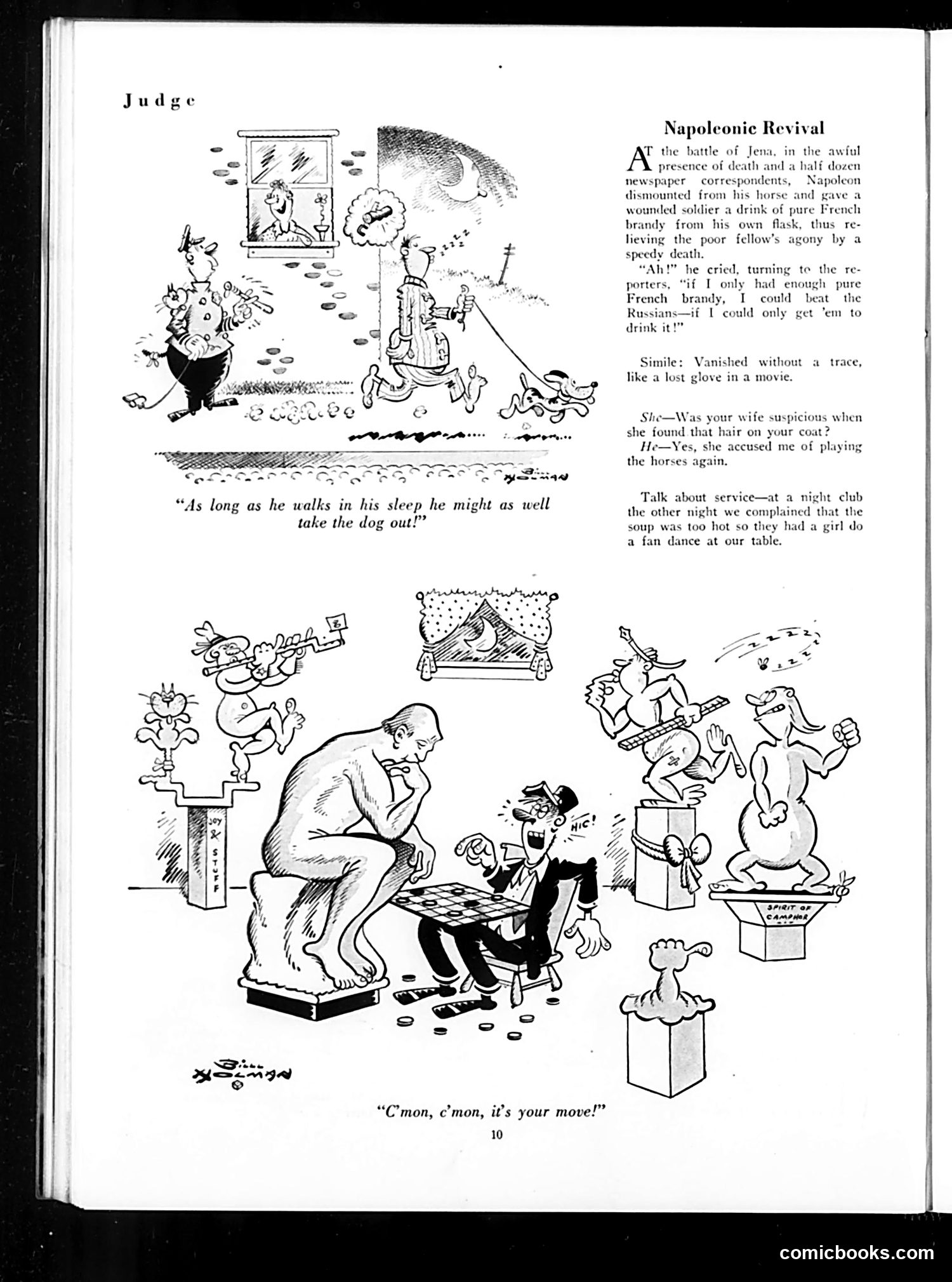
Explanation for Modern Readers This *Judge* magazine page contains three separate humor pieces: 1. Top cartoon: A sleepwalker inadvertently walks the dog while asleep—the joke being he's useful even unconscious. 2. "Napoleonic Revival" article: A satirical anecdote mocking Napoleon's military failures. It claims he gave brandy to a wounded soldier at the Battle of Jena, then suggests his defeat of the Russians would require getting them drunk on French brandy—absurdist humor suggesting Napoleon's legendary abilities were exaggerated or that alcohol could explain military outcomes. 3. Bottom cartoon: A man caught with another woman's hair on his coat tries to blame it on horses; his wife predictably doesn't believe him. The page represents typical early-20th-century *Judge* content: light domestic comedy, military/historical satire, and sophisticated wordplay aimed at educated readers. The "Napoleonic Revival" reference appears to allude to contemporary discussions of Napoleon's legacy, though the specific historical moment remains unclear without publication date context.
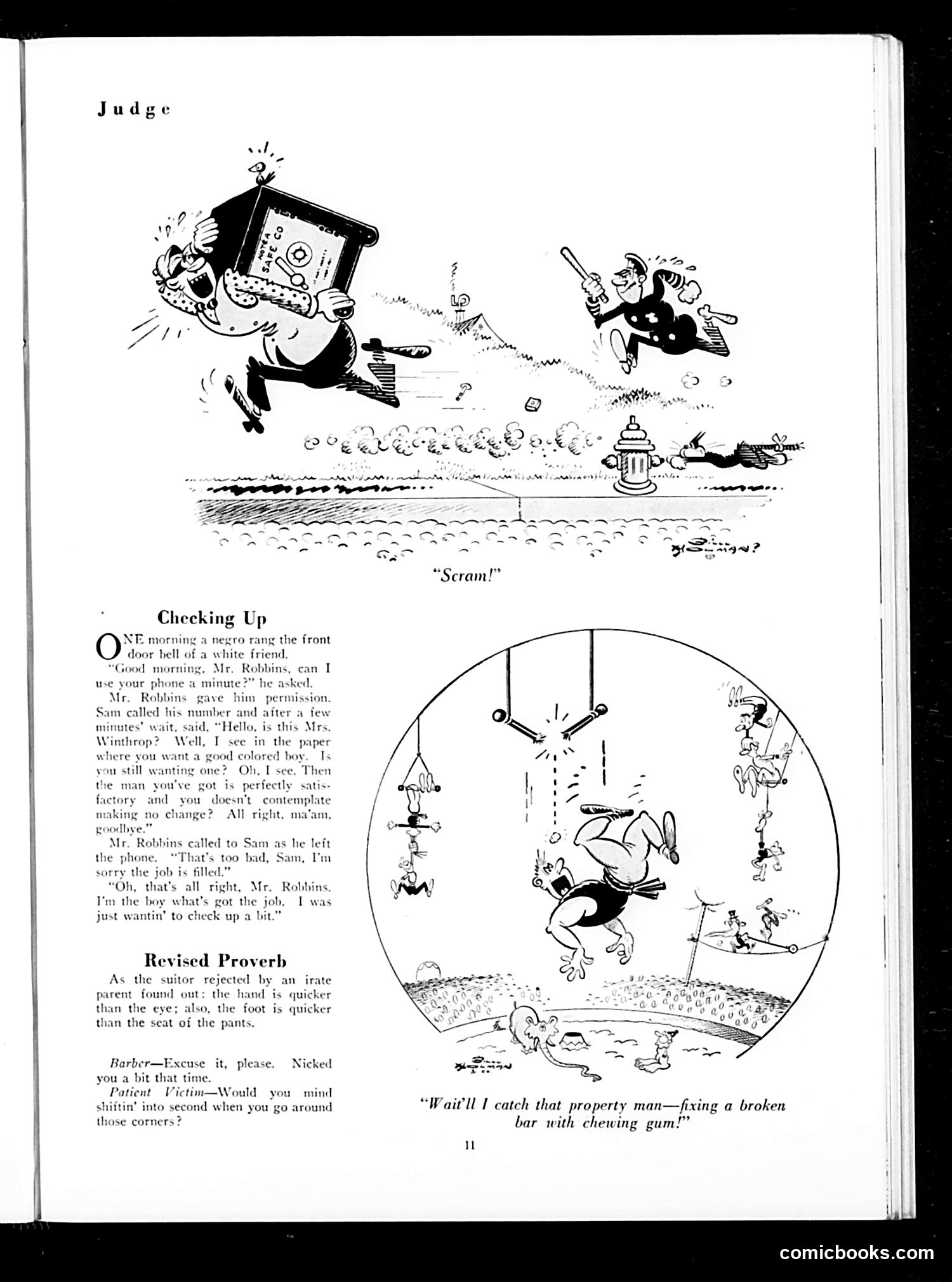
"Checking Up" - Judge Magazine Satire The top cartoon depicts a judge being chased by a man with a club, labeled "Scram!" — satirizing judicial authority being undermined or fleeing from consequence. The main text story, "Checking Up," uses racist dialect humor typical of early-20th-century American comedy. A Black man named Sam borrows a white man's phone to call about a job opening for "a good colored boy." When told the position is filled, Sam reveals he was actually *checking* — he already has that job and was verifying the employer's satisfaction. The "joke" plays on the era's stereotype of Black workers as dishonest or duplicitous. "Revised Proverb" offers crude humor about a suitor being physically ejected by an angry father — the hand (hitting) and foot (kicking) being faster than the eye. The circular cartoon shows chaos around a clock with various figures, captioned about "catching that property man—fixing a broken bar with chewing gum!" — likely backstage theater satire about cheap repairs. All content reflects early-20th-century vaudeville-influenced humor standards.
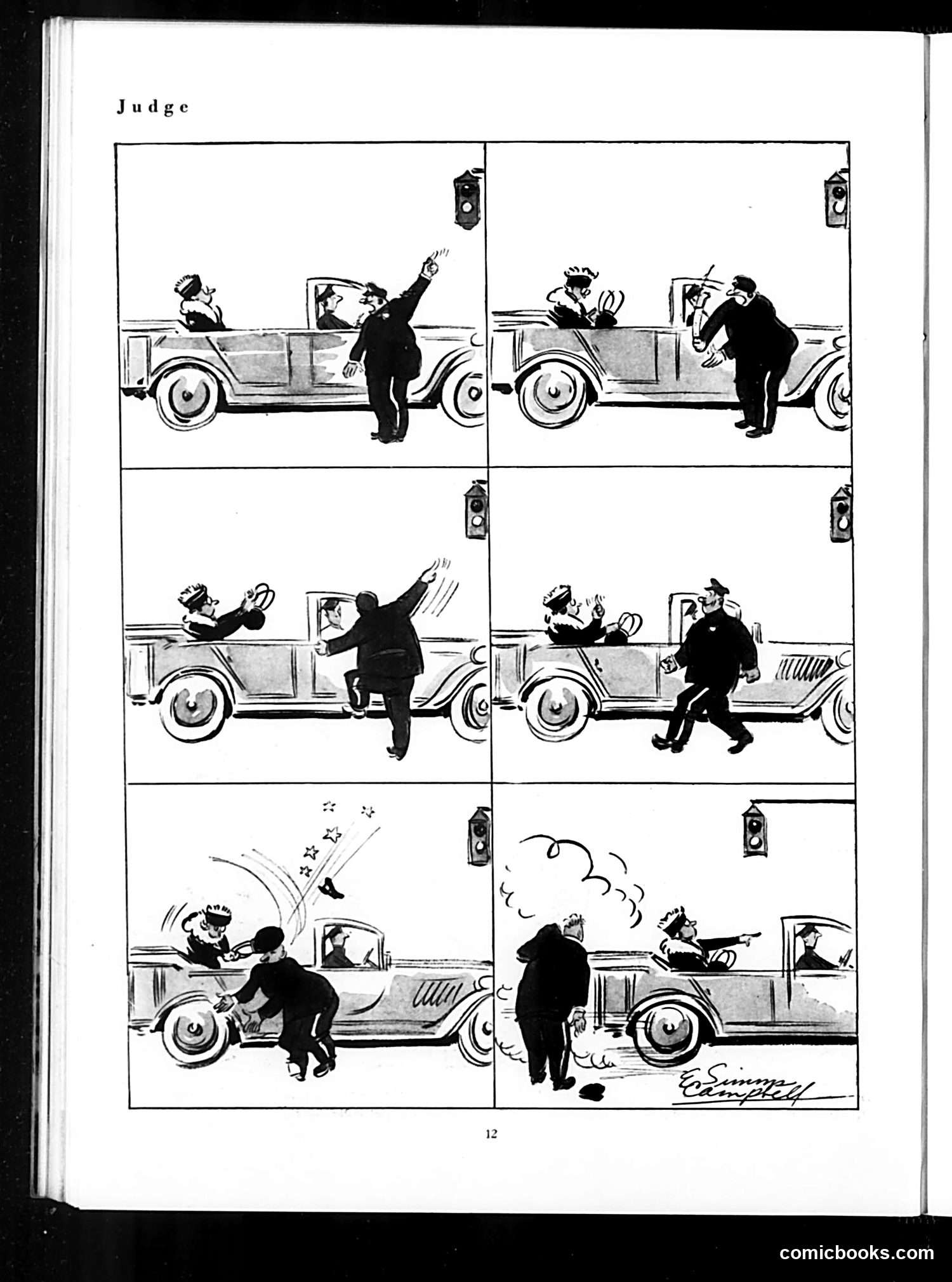
Judge Page 12: "Judge" (Traffic Court Comic) This six-panel comic depicts a traffic court scene where a judge issues citations to motorists. The humor follows a classic escalation pattern: early panels show the judge calmly citing drivers for minor violations (signaling, speeding). As panels progress, the confrontations become increasingly physical and absurd—drivers and judge engage in fights, with one panel showing explosive violence. The final panel shows complete chaos with a wrecked car. The satire mocks both traffic enforcement and driver behavior during the automobile era. It suggests that traffic court is futile theater where citations provoke confrontation rather than compliance, and that both judges and drivers behave irrationally. The artist's signature appears at bottom right, though it's difficult to read clearly.
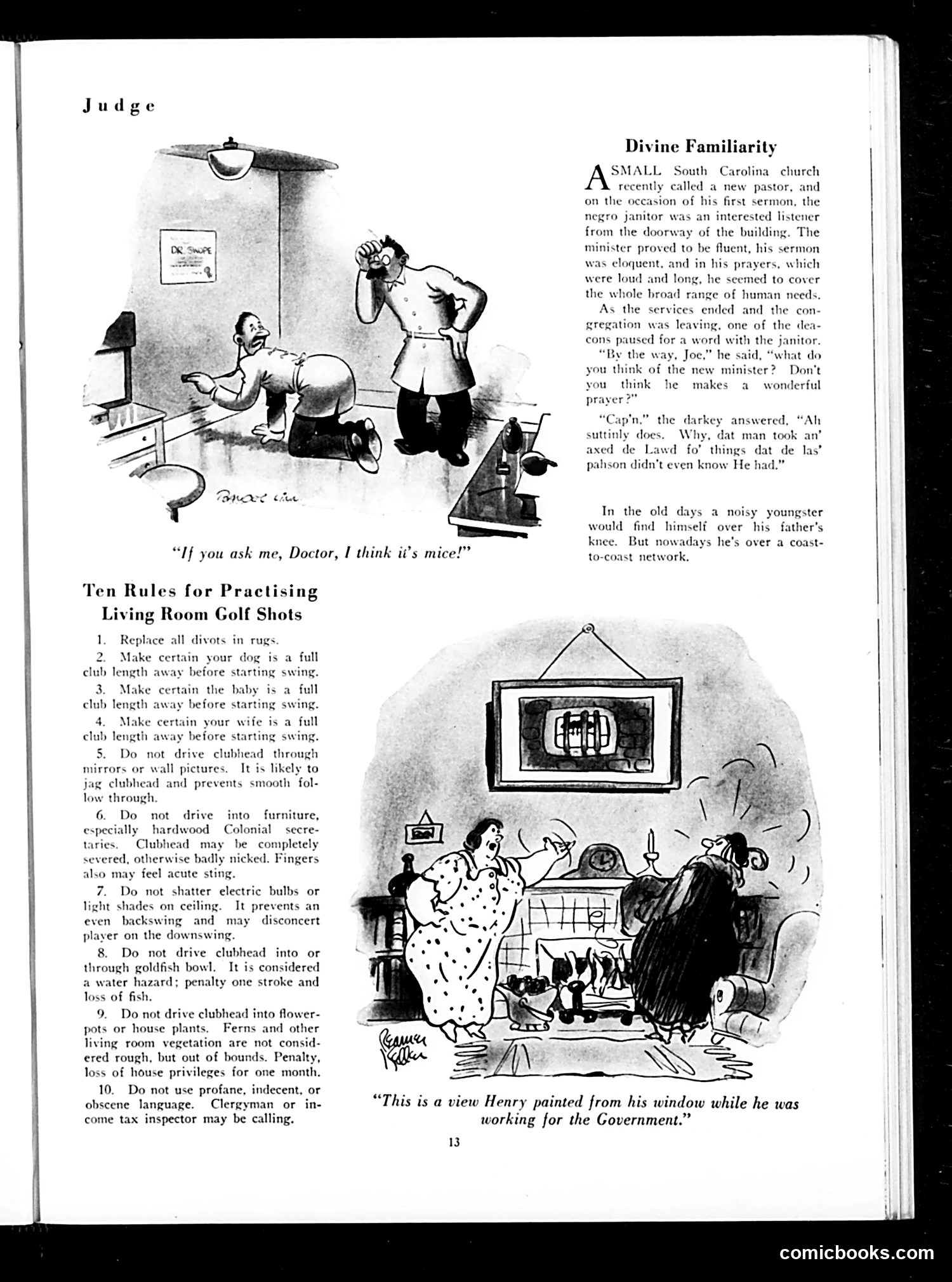
Judge Magazine Page Analysis This page contains three separate humorous pieces typical of 1920s-30s American satire: "Divine Familiarity" mocks racial stereotypes through dialect humor. A Black church janitor comments on the new minister's prayers, saying the pastor asked God for things "dat de las' pahson didn't even know He had"—implying the new minister is presumptuous or overly familiar with God. The joke relies on period racial caricature and stereotyped speech patterns. "Ten Rules for Practising Living Room Golf Shots" satirizes the fad of indoor miniature golf during the Depression era. The "rules" humorously warn golfers not to hit dogs, babies, wives, furniture, or goldfish—absurd situations that highlight how impractical this hobby was for cramped homes. The bottom cartoon shows a woman watching a man paint, captioned about a "view Henry painted from his window while he was working for the Government"—likely satirizing government employees' productivity or satirizing a specific public figure named Henry (unclear without more context). All three pieces target contemporary leisure activities and social behaviors with exaggerated consequences for comedic effect.
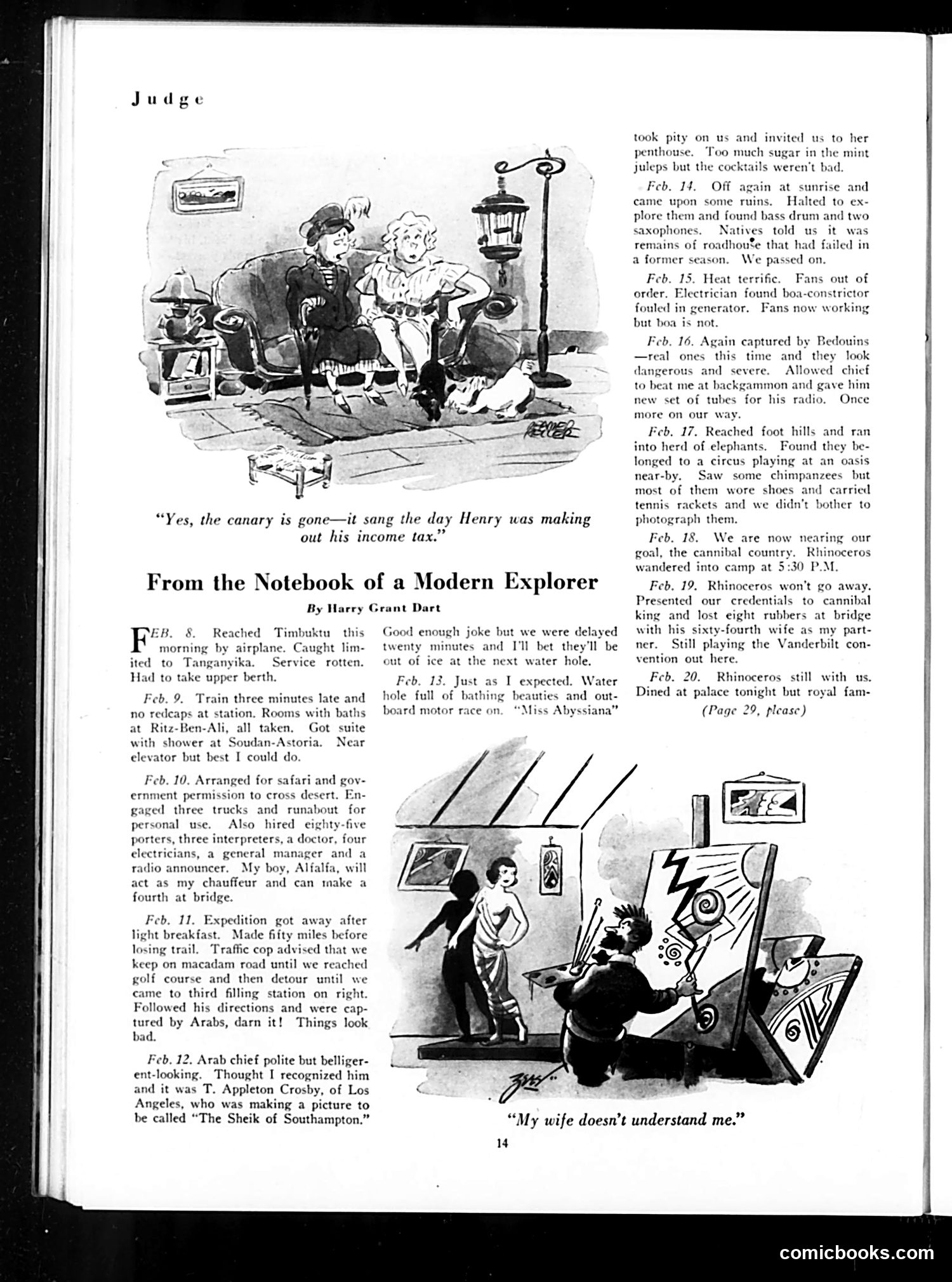
Explanation for Modern Readers This page contains two satirical pieces mocking 1920s American excess and pretension. Top Cartoon: A couple argues about income taxes. The husband claims "the canary is gone—it sang the day Henry was making out his income tax," implying he killed it rather than face tax season. This jokes about Americans' frustration with newly implemented income taxes (formalized in 1913). "Modern Explorer" Narrative: A wealthy American's diary parodies adventure travel writing. The "explorer" encounters absurd contradictions: African hotels named "Ritz-Ben-Ali" and "Soudan-Astoria," Arabs who are actually Hollywood actors ("T. Appleton Crosby"), and circus animals in the desert. The satire mocks how Americans of wealth could encounter American commercialism and entertainment *anywhere*, even while supposedly roughing it in remote Africa. The second cartoon shows a man's wife baffled by his elaborate architectural/engineering plans, likely satirizing masculine obsession with impractical schemes.
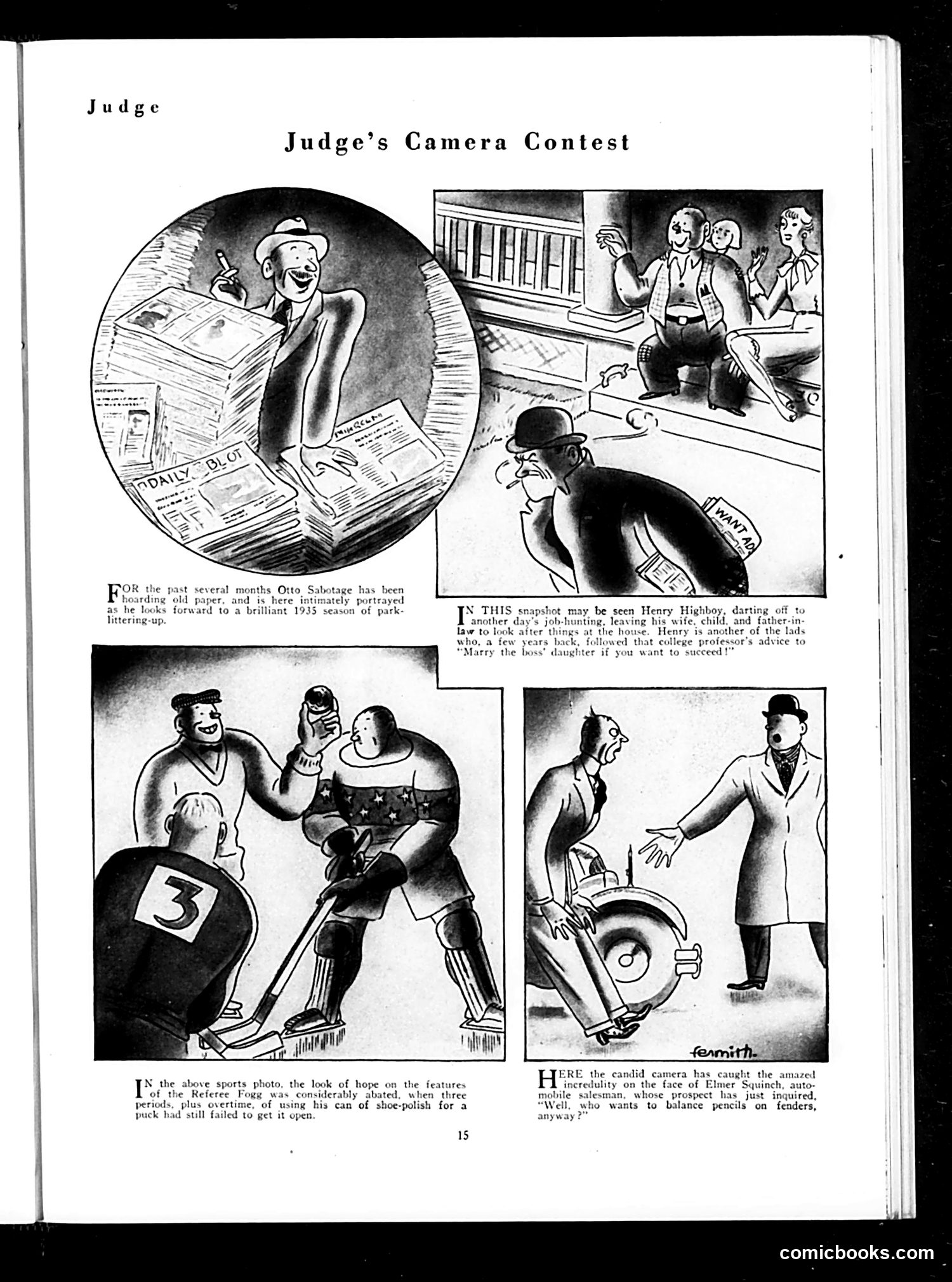
Judge's Camera Contest: A Humorous Photo Essay This page presents a comedic photo-caption contest featuring candid photographs with satirical commentary. The top circular image shows Otto Sabotage with newspapers, illustrating his habit of hoarding old papers and cluttering spaces. The subsequent panels depict various scenes: Henry Highboy abandoning his family for job-hunting; a referee named Fogg hopeful during an overtime sports match; and what appears to be workplace scenes involving shoe-polish and balancing pencils on fenders. The humor relies on capturing awkward, surprising moments—the "candid camera" format that catches people in undignified or absurd situations. The satirical edge targets working-class anxieties (job instability, marrying the boss's daughter for advancement) and male behavior patterns typical of early-to-mid 20th-century American comedy. The exact identities of most figures remain unclear from the text, though they appear to be fictional characters created for comedic effect rather than specific public figures.
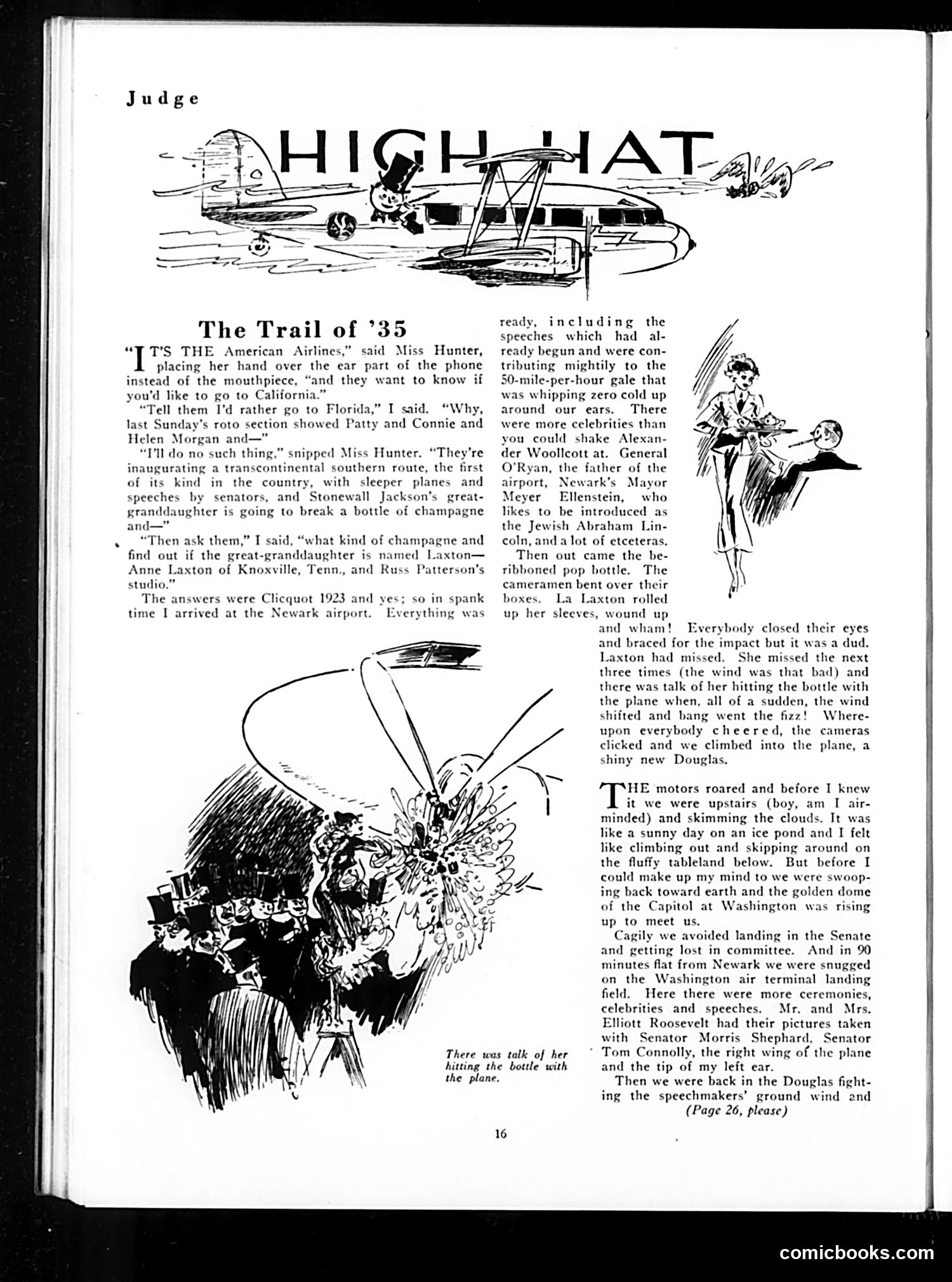
"The Trail of '35" - Judge Magazine Satire This is a humorous travel narrative about American Airlines' inaugural transcontinental southern route in 1935. The author satirizes the excessive ceremonialism surrounding modern air travel. The main joke targets the proliferation of celebrities and dignitaries at the christening ceremony in Newark—so many that the author quips there are "more celebrities than you could shake Alexander Woollcott at" (Woollcott was a famous theater critic known for celebrity circles). Key figures mentioned include General O'Ryan (airport founder), Newark Mayor Meyer Ellenstein (humorously introduced as "the Jewish Abraham Lincoln"), and most notably "La Laxton"—Anne Laxton, whose job is to break a champagne bottle on the plane. She repeatedly fails due to high winds, nearly hitting the aircraft itself instead. The satire continues with the Washington landing, where Elliott Roosevelt and senators Morris Sheppard and Tom Connolly pose for photographs, reducing statesmen to mere backdrop props. The piece mockingly celebrates aviation's new importance while deflating the self-importance of ceremonial participants.
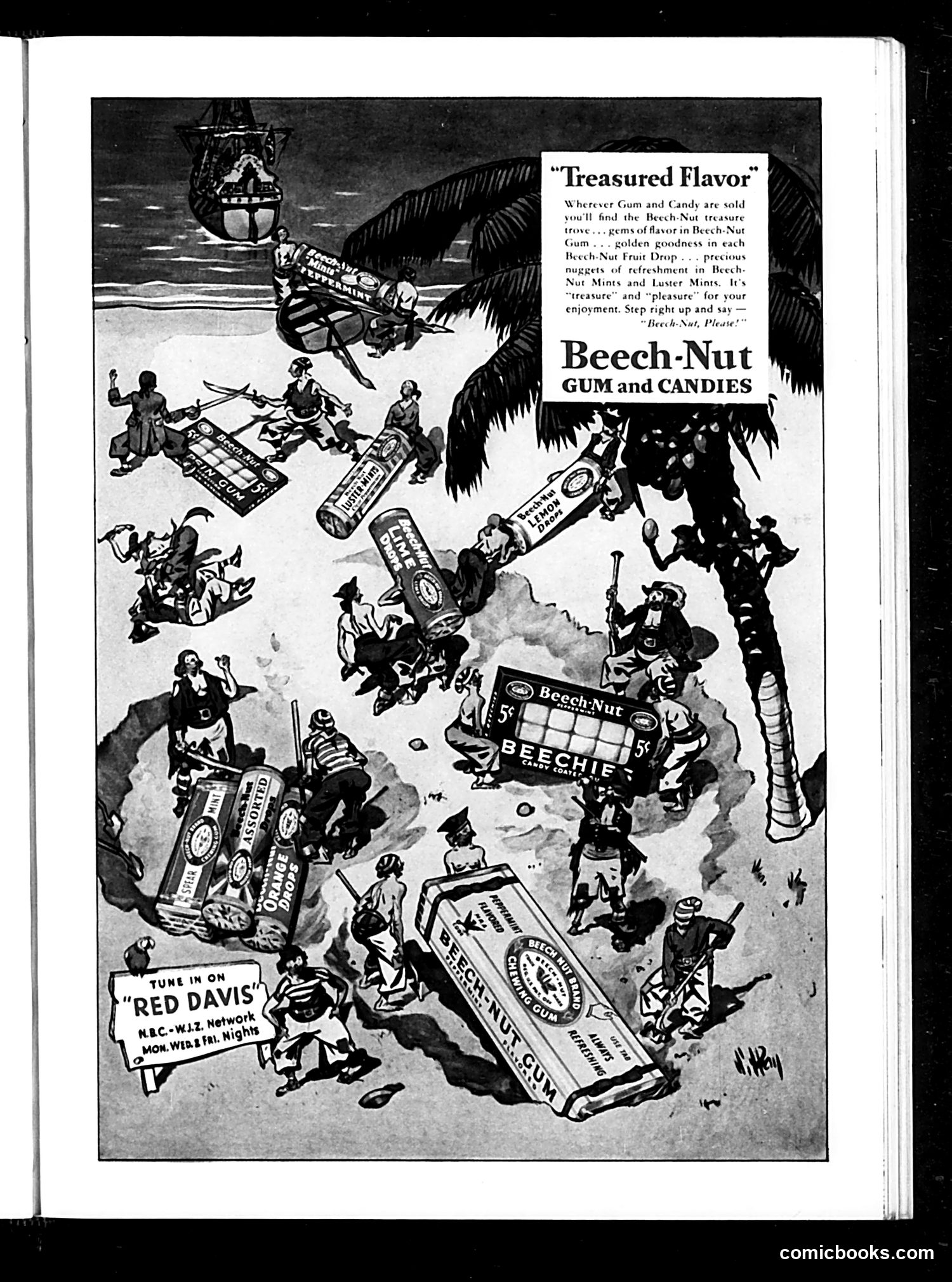
Analysis This is primarily a product advertisement, not political satire. It advertises Beech-Nut gum and candies using a whimsical illustration of people discovering treasure—with oversized Beech-Nut product packages depicted as treasure scattered across a stylized landscape. The humor is lighthearted commercial messaging: the candy/gum are presented as "treasures" worth seeking. The phrase "Treasured Flavor" plays on the treasure hunt imagery. A small notice promotes "Red Davis," apparently a radio program on NBC Network (Mon/Wed/Fri nights)—likely a sponsored show using Beech-Nut as a tie-in advertiser. The vintage illustration style and art deco design suggest early-to-mid 20th century. There is no political commentary or social satire present—this is straightforward consumer advertising from Judge magazine's advertising pages.
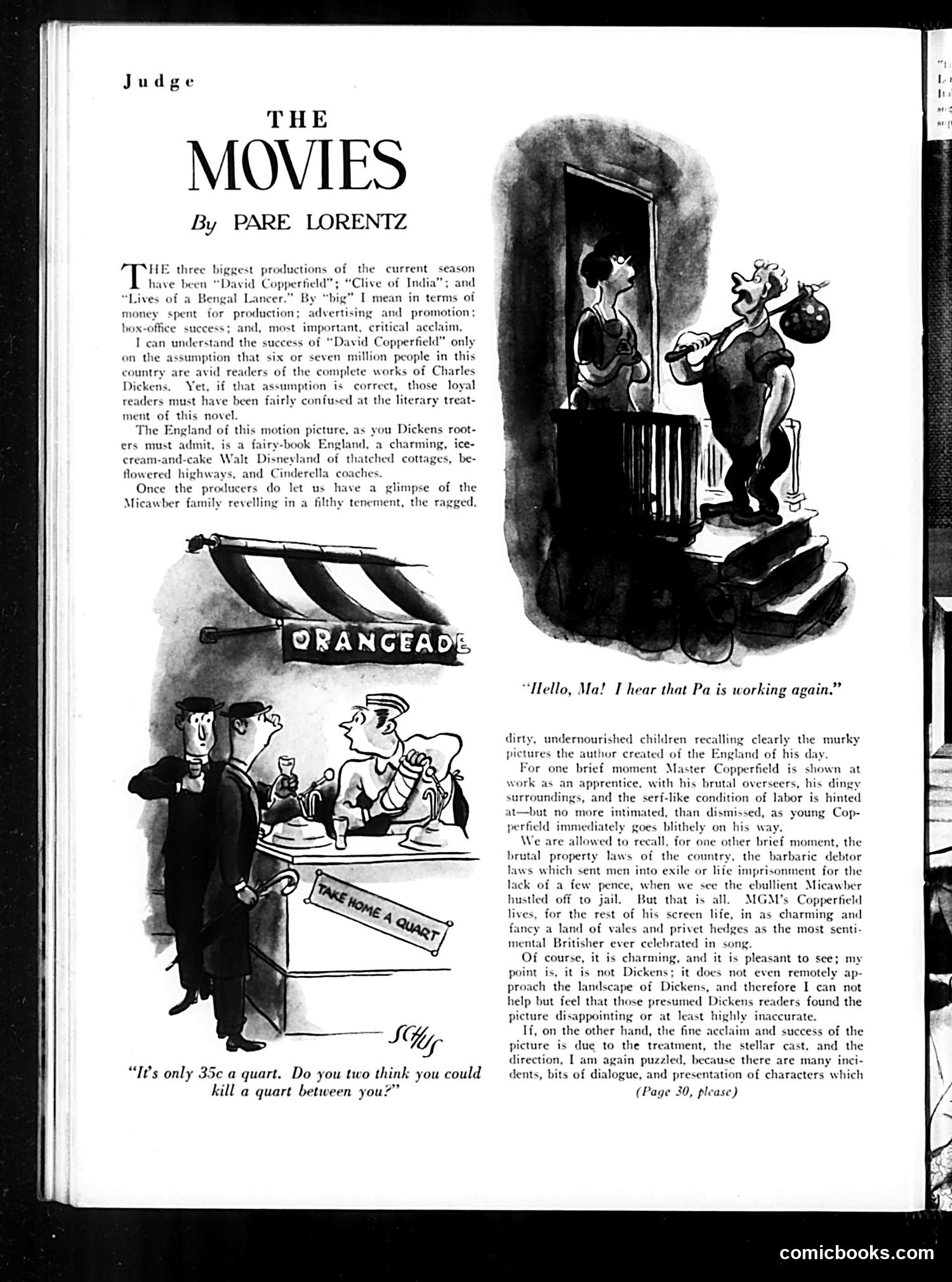
Judge Magazine Film Critique Analysis This page reviews MGM's *David Copperfield* film adaptation, with cartoon illustrations satirizing both the movie and contemporary social issues. The Main Critique: Critic Pare Lorentz argues the film sanitizes Dickens's social commentary. While the novel depicted Victorian England's brutal poverty, child labor, and debtor prisons, the movie presents a romanticized "fairy-book England" of thatched cottages and flowered highways—a "Walt Disneyland" version that dismisses darker realities within moments. The Cartoons: The lower cartoon jokes about poverty and liquor rationing ("35¢ a quart"), likely referencing Depression-era economics. The upper cartoon's caption ("Hello, Ma! I hear that Pa is working again") also suggests economic hardship—the novelty of employment during tough times. The Satire: Lorentz suggests MGM prioritized box-office appeal and sentiment over literary faithfulness, watering down Dickens's critique of class inequality. The cartoons underscore the irony: authentic Dickens exposed such deprivation, yet the film avoids it.
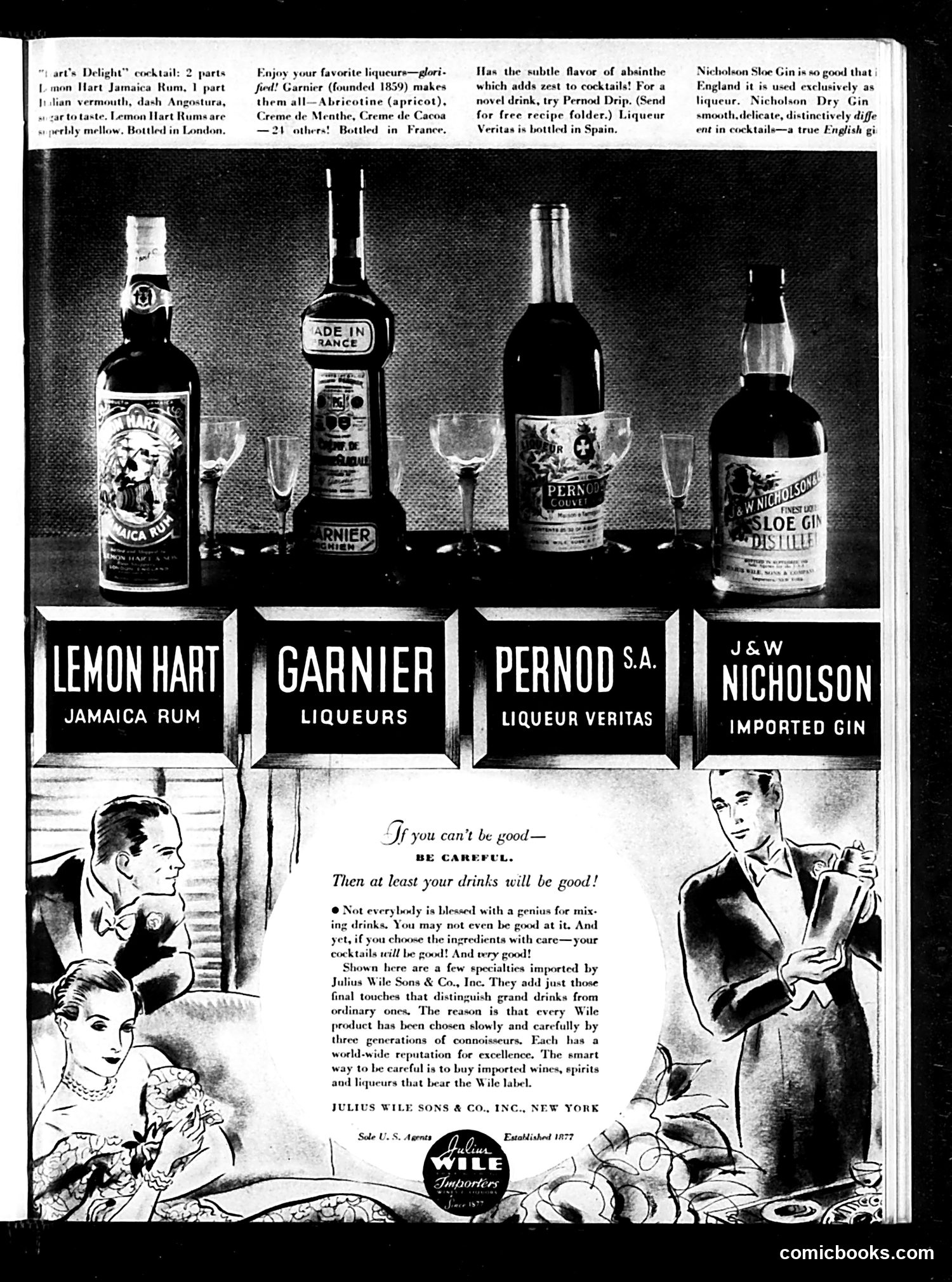
Analysis of Judge Magazine Advertisement Page This is primarily a liquor advertisement rather than political satire. It promotes imported spirits from Julius Wile Sons & Co., Inc., showcasing four brands: Lemon Hart Jamaica Rum, Garnier Liqueurs, Pernod Liqueur Veritas, and J&W Nicholson Imported Gin. The page's humor relies on a moral paradox typical of Prohibition-era advertising (the text references suggest pre-1920): the tagline "If you can't be good—BE CAREFUL. Then at least your drinks will be good!" This plays on middle-class anxiety about moral behavior while simultaneously encouraging alcohol consumption. The illustrations of well-dressed men and women suggest sophistication and respectability. The advertisement argues that imported products carry three generations of "connoisseur" approval, positioning premium liquor as a marker of taste and social status. The satire is gentle—mocking neither politics nor individuals, but rather consumer pretension and the contradiction between Prohibition sentiment and actual drinking culture.
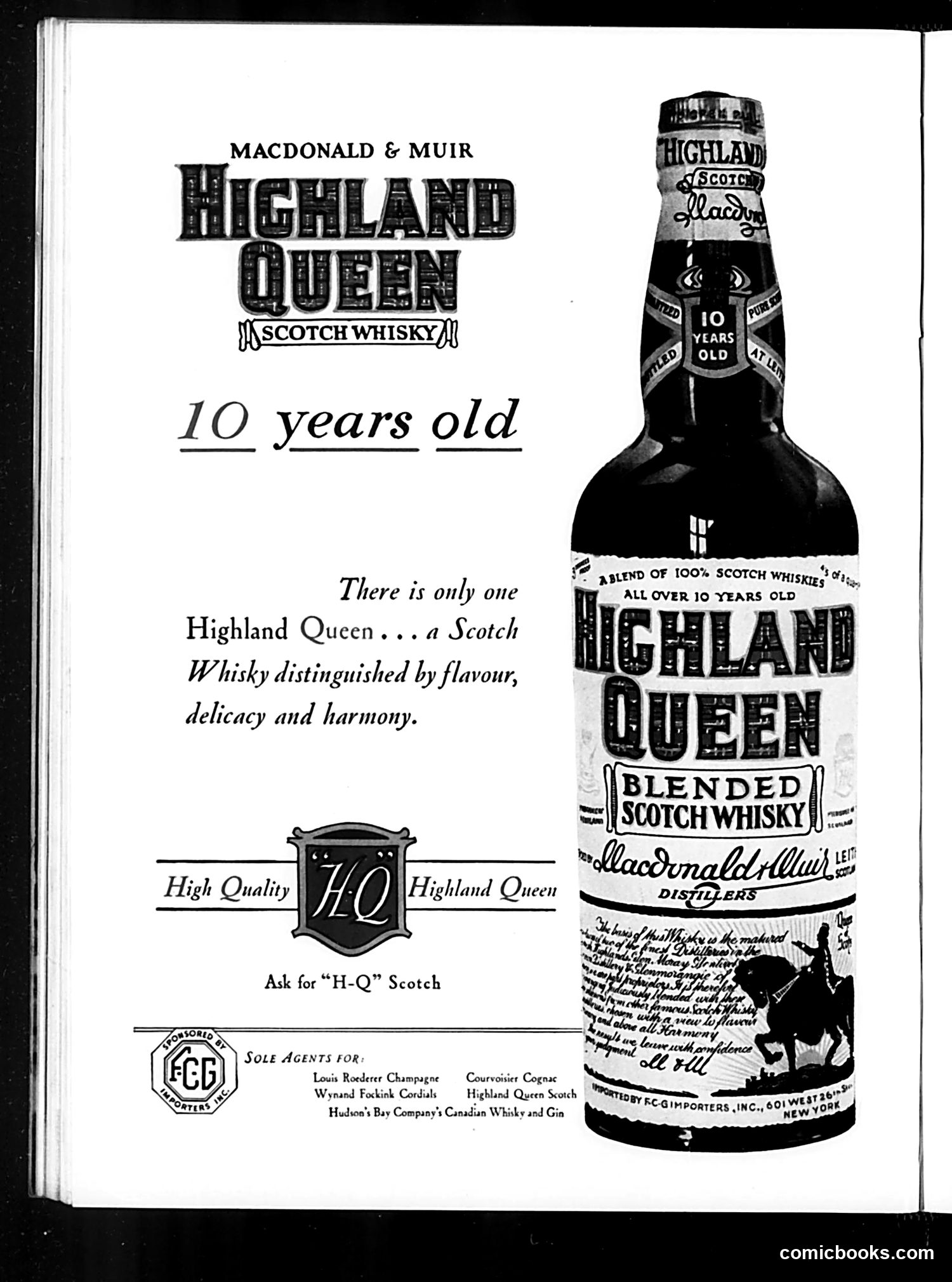
Highland Queen Scotch Whisky Advertisement This is a straight advertisement, not satire or political commentary. It promotes Highland Queen Scotch Whisky (10 years old), manufactured by Macdonald & Muir and distributed by F.C.B Importers in New York. The ad emphasizes the whisky's quality through claims of "flavour, delicacy and harmony." The bottle image dominates the right side, featuring decorative Highland imagery (a kilted figure on horseback). A shield bearing "H-Q" reinforces the brand acronym. The bottom lists sole agents for premium spirits (Louis Roederer Champagne, Courvoisier Cognac, etc.), positioning Highland Queen within an upscale product portfolio. This represents typical Judge magazine content: premium liquor advertising aimed at affluent readers, appearing during the period before or after Prohibition's effects on the spirits industry. No satire is evident—this is commercial promotion.
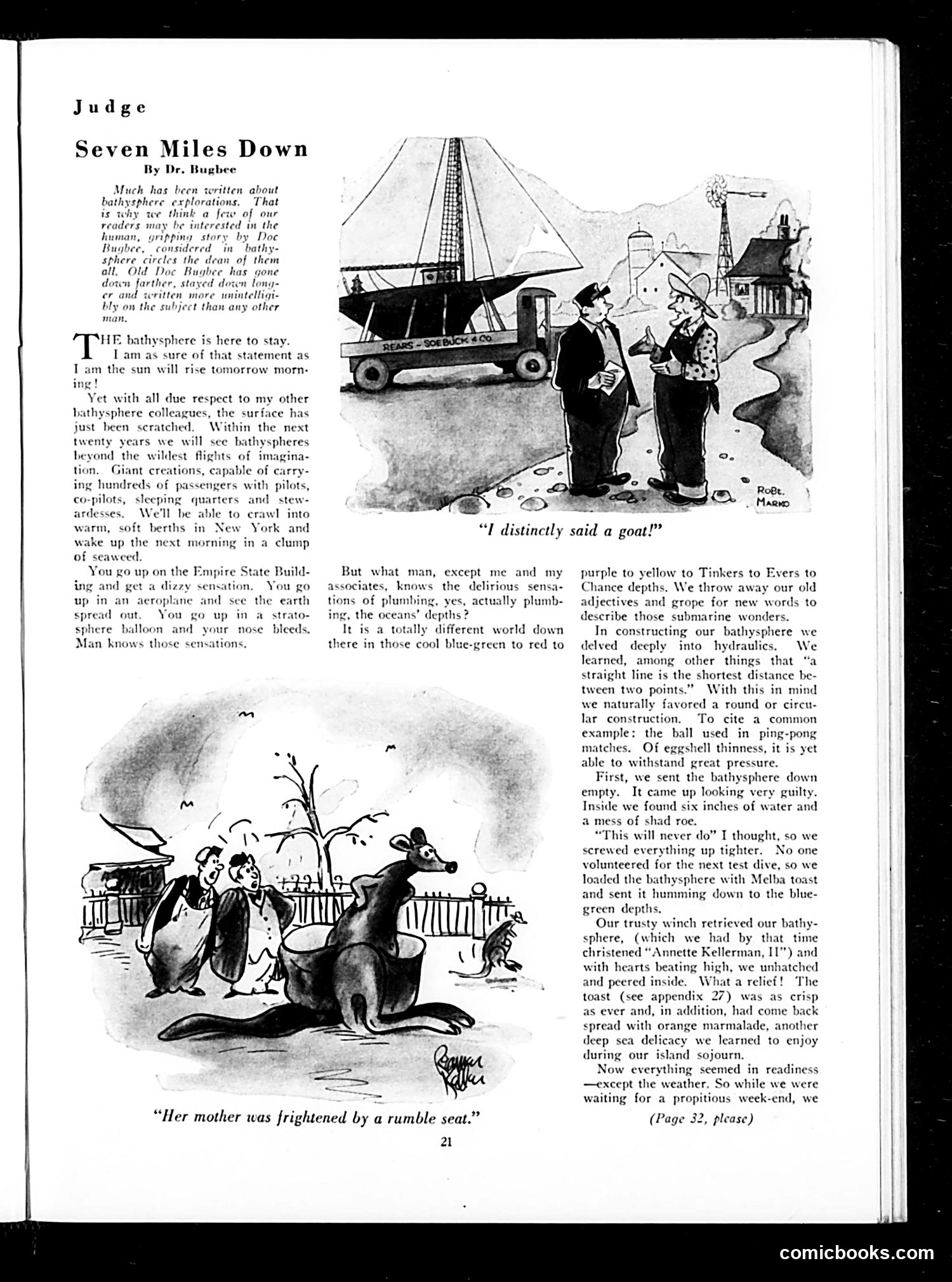
"Seven Miles Down" - Judge Magazine Satire This is a humorous fictional account by "Dr. Bugbee" about bathysphere (deep-sea exploration vessel) development. The satire mocks both scientific pretension and the era's fascination with new technologies. The jokes: - The cartoons illustrate absurd mishaps: one shows a man claiming he "distinctly said a goat!" (suggesting miscommunication during underwater operations), the other depicts social embarrassment from a "rumble seat" (a retractable car seat). - Bugbee's overwrought self-importance ("stayed down longer...than any other man") contrasts with comical failures: the empty bathysphere returning "looking very guilty," containing only water and fish roe. - The logic is deliberately ridiculous (choosing circular design because ping-pong balls are round and durable). - The final detail—toast returning with orange marmalade from the "deep sea"—is pure absurdist humor. The satire targets both scientific ego and 1920s-30s optimism about technology solving all problems, presented through slapstick mishaps rather than serious critique.
Explanation for Modern Readers This Judge magazine page contains two satirical pieces: "The Old Sinclair Oil" discusses Upton Sinclair (the muckraking author and California political figure) now performing in vaudeville. The author applauds this as connecting liberal ideas to working-class audiences who wouldn't read intellectual journals. The satire targets snobbish progressives disconnected from ordinary people. "Heil, Morgan!" darkly satirizes fears of American Fascism circulating among wealthy elites. The piece mockingly suggests J.P. Morgan (the powerful banker) as a potential dictator, arguing his business competence might prevent economic chaos. The "Heil" reference invokes Hitler's Germany. The satire exposes anxieties about both Fascism and wealthy industrialists' power during this economically unstable era—likely the 1930s Great Depression period when such fears were genuine. Both pieces use irony to critique American political and social divisions.
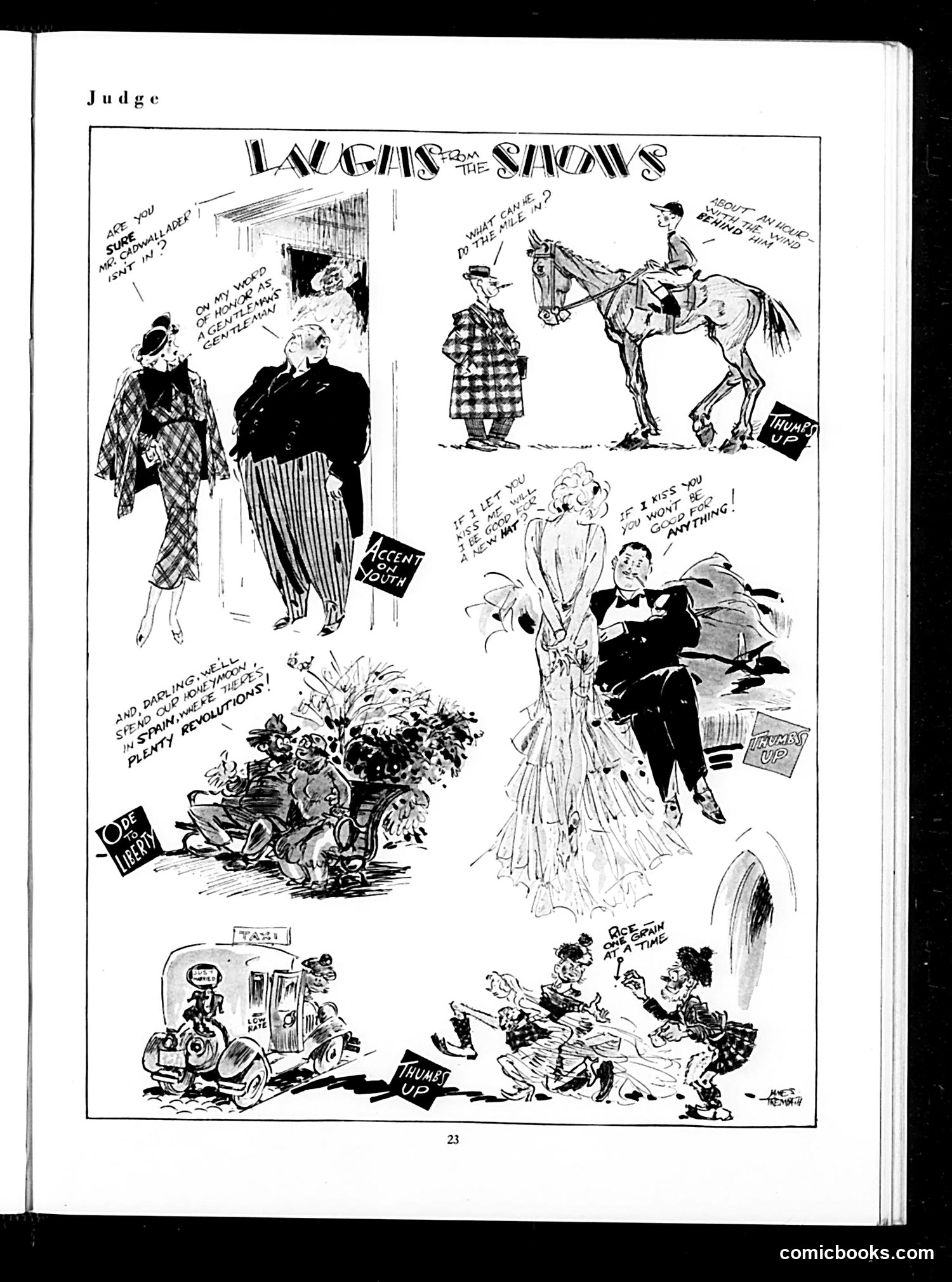
"Laughs at the Shows" This Judge magazine page presents a satirical cartoon commentary on theatrical and entertainment society. The sketches mock various show-business scenarios: fashionable theatergoers in elaborate dress, a horseback rider (possibly referencing equestrian performances or society events), a bride and groom scene suggesting romantic comedies, a taxi depicting urban theater-district life, and chaotic crowd scenes at the bottom. The "Thumb's Up" labels suggest Judge is reviewing or rating these entertainment spectacles. The satire likely targets the pretensions and absurdities of early 20th-century theater culture—the exaggerated fashion, romantic melodrama, and urban chaos surrounding popular entertainment. The overall tone mocks both performers and audiences as ridiculous characters worthy of ridicule themselves.
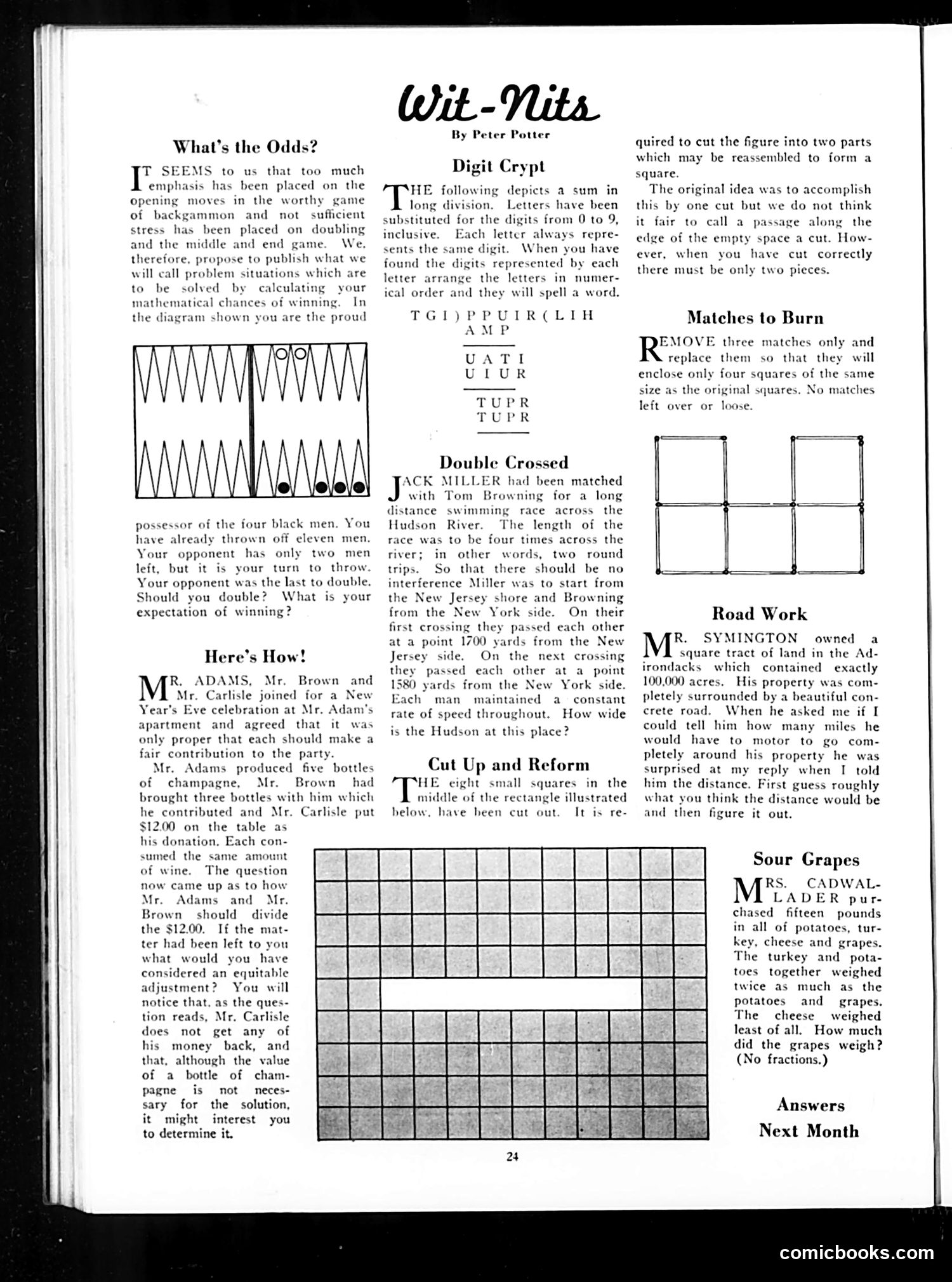
Wit-Nits: A Puzzle Page Analysis This is a puzzle and problem-solving page from Judge magazine, not political satire. It contains recreational mathematics and logic problems typical of early 20th-century publications: Content includes: - A backgammon probability problem - A champagne-bottle cost-sharing puzzle (three men split wine; how should two divide the cash contribution?) - A cryptarithmetic puzzle (letters substituting digits in long division) - A swimming race problem (calculating Hudson River width from crossing points) - A geometric cutting puzzle - A matchstick puzzle - A property/distance calculation problem - A weights puzzle (potatoes, turkey, cheese, grapes) These are brain-teasers designed to entertain educated readers. The author, Peter Potter, presents mathematical riddles requiring careful reasoning—popular leisure content for Judge's audience. No political commentary or social satire appears on this page; it's purely recreational intellectual content.
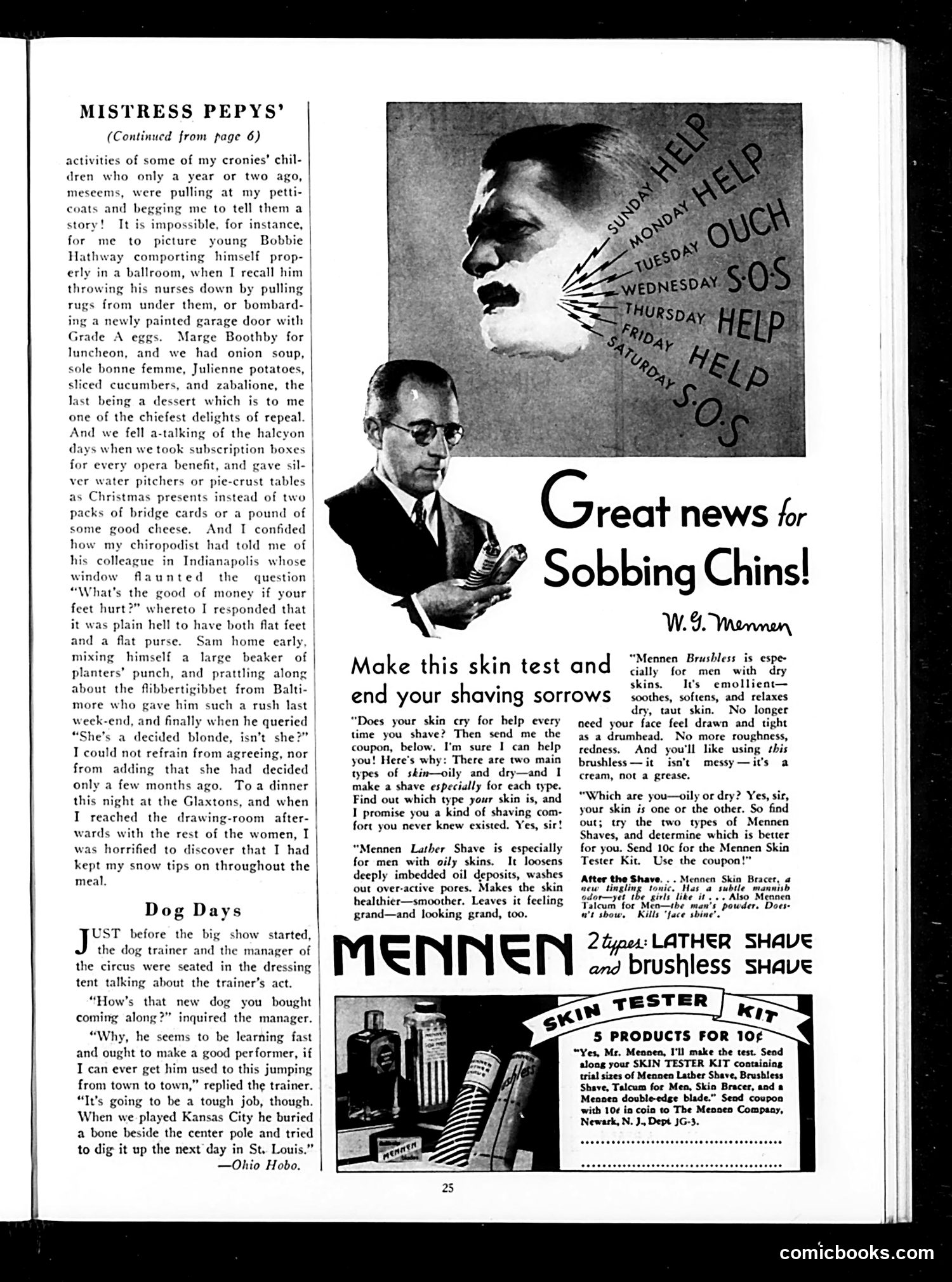
Page Content Analysis This page consists of two distinct elements: "Mistress Pepys'" Column: A lighthearted diary-style essay by a society woman reflecting on social changes—children growing up too quickly, nostalgic memories of opera benefits and formal gift-giving, and humorous domestic anecdotes (keeping snow-tipped shoes on during dinner, marital chitchat). The tone is satirical of upper-class pretension and Post-Repeal social habits. "Dog Days" Anecdote: A brief humorous story about a circus dog trainer whose newly purchased dog disrupts performances by burying and attempting to retrieve bones in different cities. Advertisement: The majority of the page features a Mennen shaving products ad targeting men with oily or dry skin types, offering a free "Skin Tester Kit" for 10¢. The ad uses a scientific-sounding pitch about customized shaving solutions. This appears to be primarily a advertising-heavy magazine page with lighter satirical content, typical of Judge magazine's format mixing humor with commercial sponsorship.
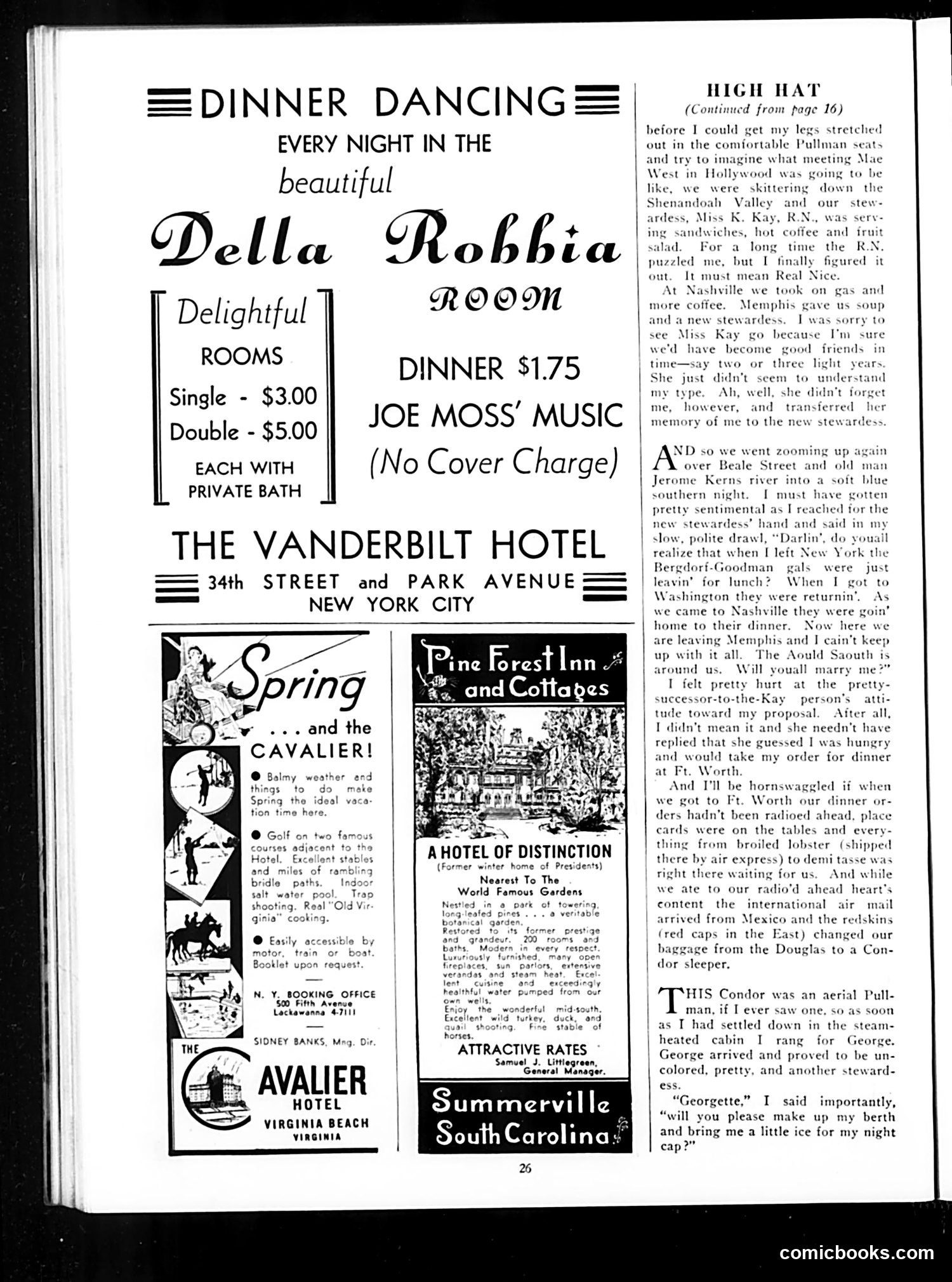
What This Page Contains This page is primarily advertising and travel writing, not political satire. It features hotel and vacation resort advertisements (The Vanderbilt Hotel in New York, the Cavalier Hotel in Virginia, Pine Forest Inn in South Carolina, and others) promoting spring travel destinations with amenities like golf, dancing, and dining. The right column continues a first-person narrative titled "High Hat" about air travel. The author describes a flight journey, commenting on stewardesses, regional meals, and the luxurious service aboard what appears to be a Condor aircraft. The tone is humorous and mildly self-deprecating—the narrator makes an awkward romantic jest to a stewardess and notes the elaborate meal service. There is no political cartoon on this page. The content reflects 1930s-era leisure travel and hospitality advertising aimed at affluent readers.
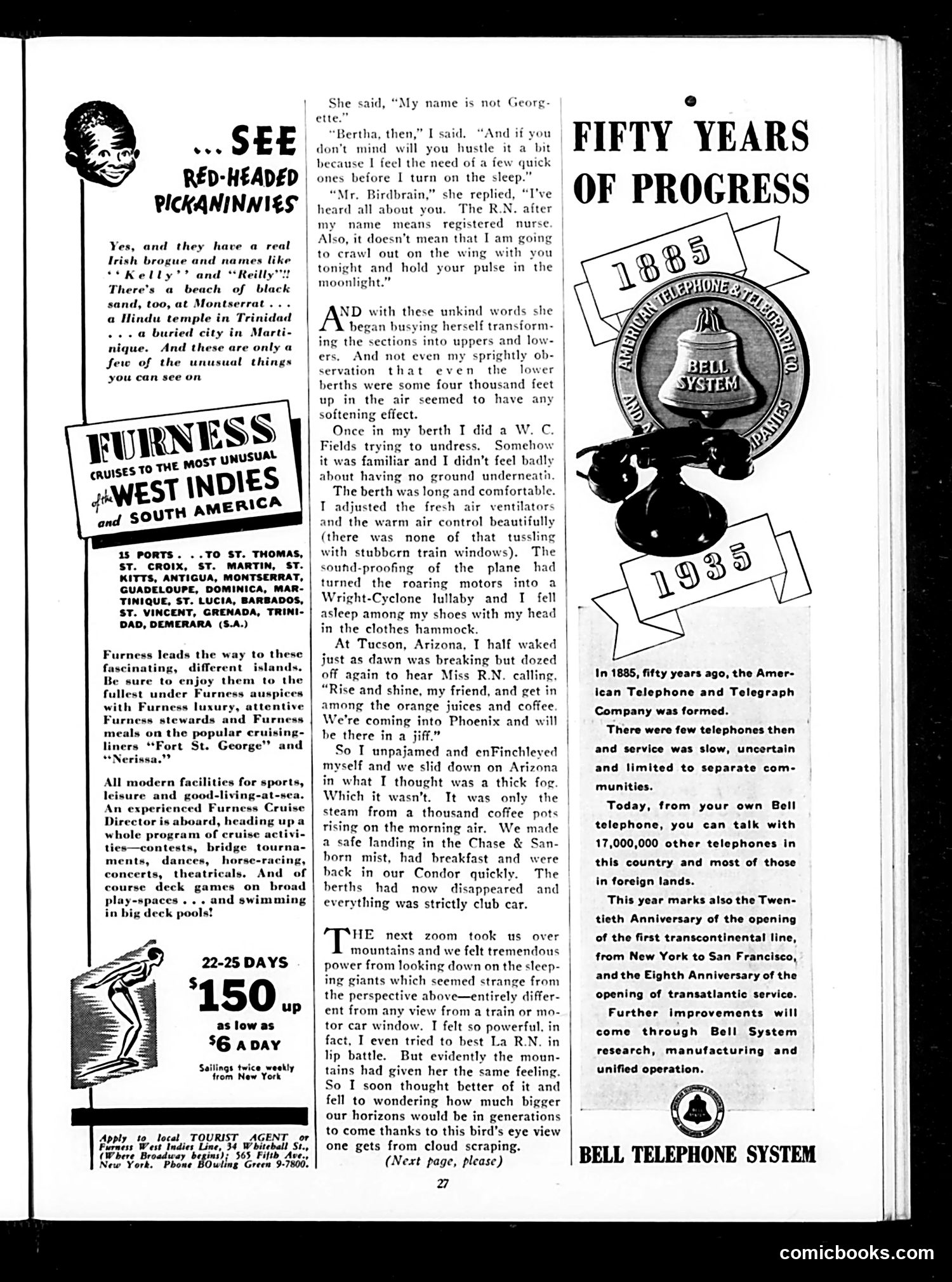
Analysis for Modern Readers This page contains two distinct elements: a cruise-line advertisement (left) and a humorous short story (right). The Furness Cruise ad exploits offensive 1935 racial stereotypes, marketing Caribbean tourism by emphasizing "exotic" attractions like "red-headed pickaninnies" (a deeply racist term for Black children). This reflects the era's casual dehumanization in advertising. The story excerpt depicts a male passenger flirting with a female airline nurse during an early commercial flight. The humor relies on dated gender dynamics—the man's clumsy advances ("W.C. Fields trying to undress"), the nurse's professional rebuff, and the narrator's bewilderment. References like "Finchleyed" (likely an obscure contemporary reference) are now unclear. The Bell Telephone ad celebrates 50 years of telephone progress (1885-1935), promoting expanded service capabilities—a period piece showing how revolutionary long-distance calling was considered. The content reflects 1930s attitudes: casual racism in marketing, gendered workplace dynamics, and wonder at emerging technologies we now take for granted.
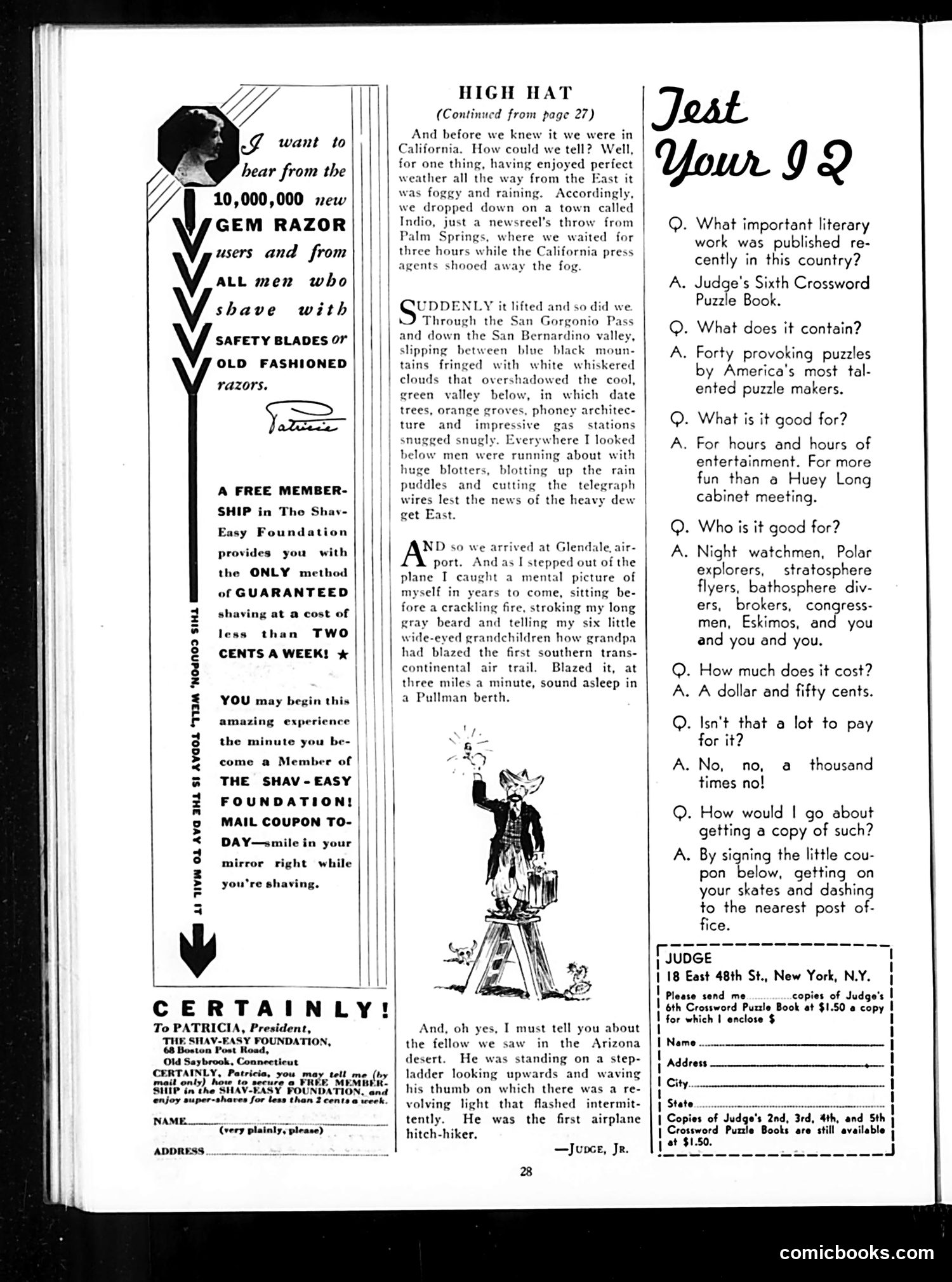
Analysis for Modern Readers This page contains two main elements: a razor advertisement and a travel humor column. The ad promotes the "Shav-Easy Foundation," offering cheap shaving (under 2 cents weekly) to 10 million new safety razor users—typical early 20th-century consumer marketing using membership schemes. The "High Hat" column by Judge Jr. humorously describes a cross-country airplane trip to California. The satire targets: 1. California boosterism: Press agents literally "shooing away" fog to hide bad weather—mocking California's exaggerated promotional tactics 2. Aviation novelty: The "airplane hitch-hiker" with a revolving thumb light is absurdist humor about the era's fascination with flying as spectacle 3. Pretentious travel narratives: The narrator imagines himself as an explorer of a "continental air trail," satirizing grandiose accounts of early aviation The right column advertises Judge's crossword puzzle book with mock-serious Q&A, targeting insomniacs and politicians—period humor about puzzle addiction. The overall tone: affectionate mockery of 1930s American consumer culture and aviation enthusiasm.
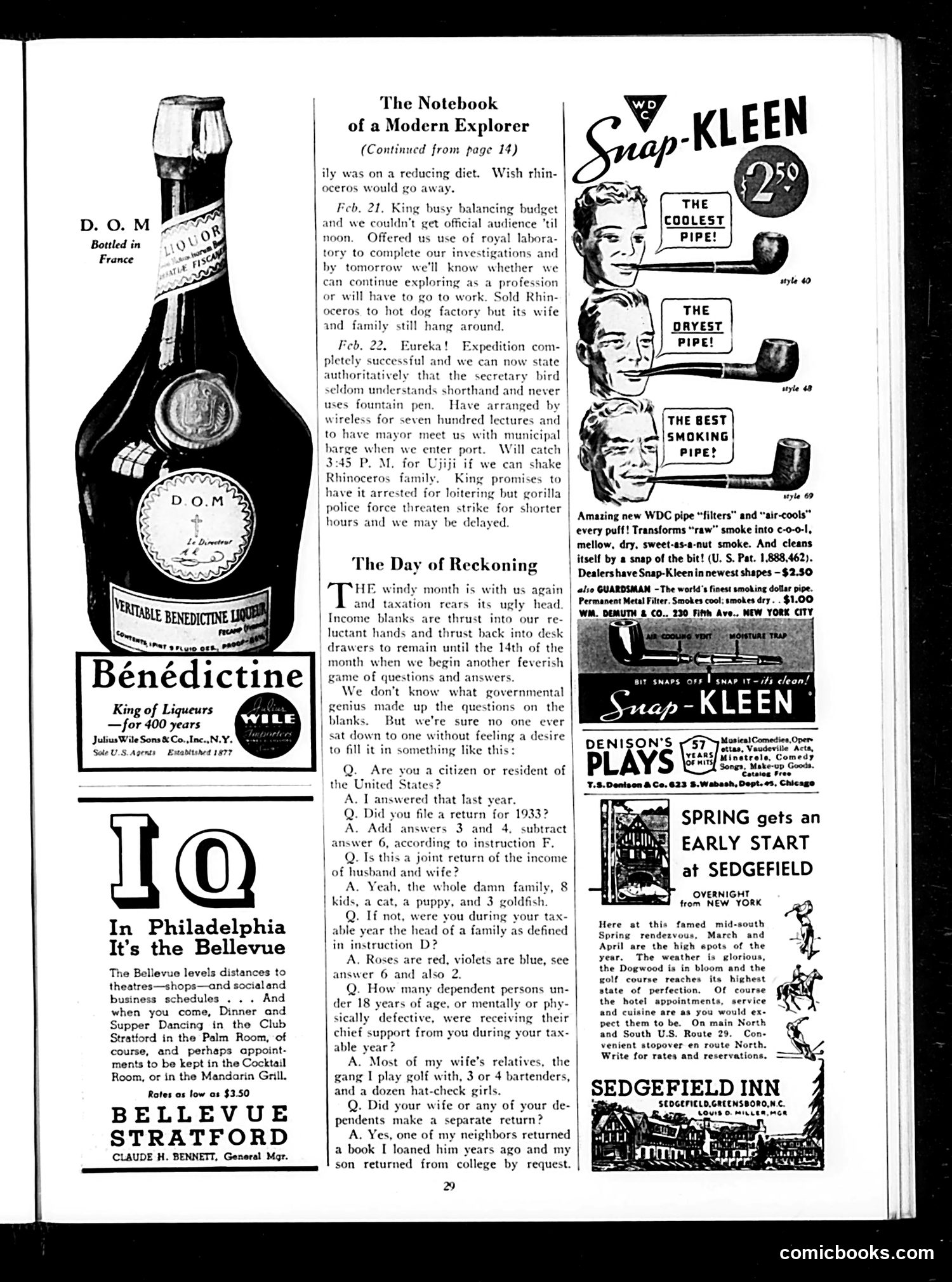
"The Day of Reckoning" - Tax Season Satire This page's main satire is "The Notebook of a Modern Explorer," a humorous column framing income tax filing as an absurd expedition. The joke plays on 1930s taxpayers' frustration with complicated tax forms and intrusive questions. The satirical Q&A section mocks the government's tax questionnaire by having an exasperated taxpayer give deliberately evasive, nonsensical, or literal answers. For example, asked "Are you head of a family?" he responds with poetry; asked about dependents, he lists relatives, golfing buddies, bartenders, and hat-check girls—satirizing how vague and impossible the definitions are. The humor reflects genuine 1930s resentment toward the expanding federal tax apparatus and its Byzantine requirements, presenting tax compliance as an incomprehensible bureaucratic nightmare rather than a civic duty. The "explorer" framing suggests taxpayers are lost in wilderness, not completing a straightforward civic obligation. The surrounding advertisements for liqueur, hotels, and pipes are standard magazine filler unrelated to the satire.
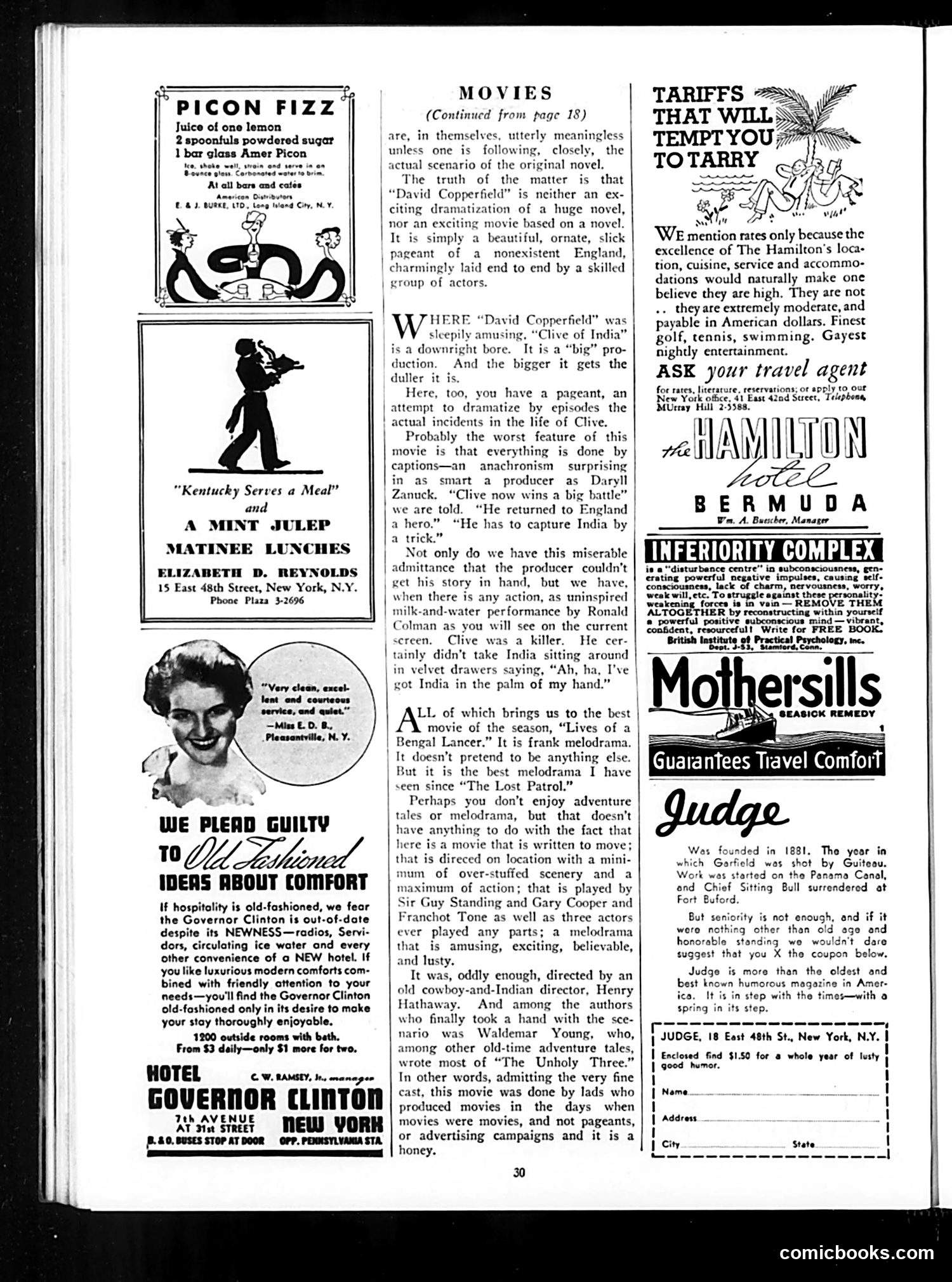
Judge Magazine Film Review Page This page contains film reviews and advertisements from Judge magazine (a satirical publication). The movie reviews critique recent Hollywood productions: "David Copperfield" and "Clive of India" are criticized as overly ornate, visually beautiful but narratively empty pageants that rely too heavily on captions and fail to dramatize their source material effectively. The reviewer particularly mocks Ronald Colman's uninspired performance in "Clive," questioning the absurdity of depicting a military conqueror passively lounging in velvet drawers. "Lives of a Bengal Lancer" is praised as the season's best film—a genuine melodrama that doesn't pretend to be anything else. It succeeds through location shooting, action, strong casting (Gary Cooper, Franchot Tone), and old-school directorial sensibilities from Henry Hathaway and writers like Waldemar Young. The satire criticizes 1930s Hollywood's trend toward expensive, prettified "pageants" divorced from narrative substance, while celebrating straightforward adventure filmmaking that prioritizes action and entertainment over artistic pretension. The advertisements are for hotels and travel services.
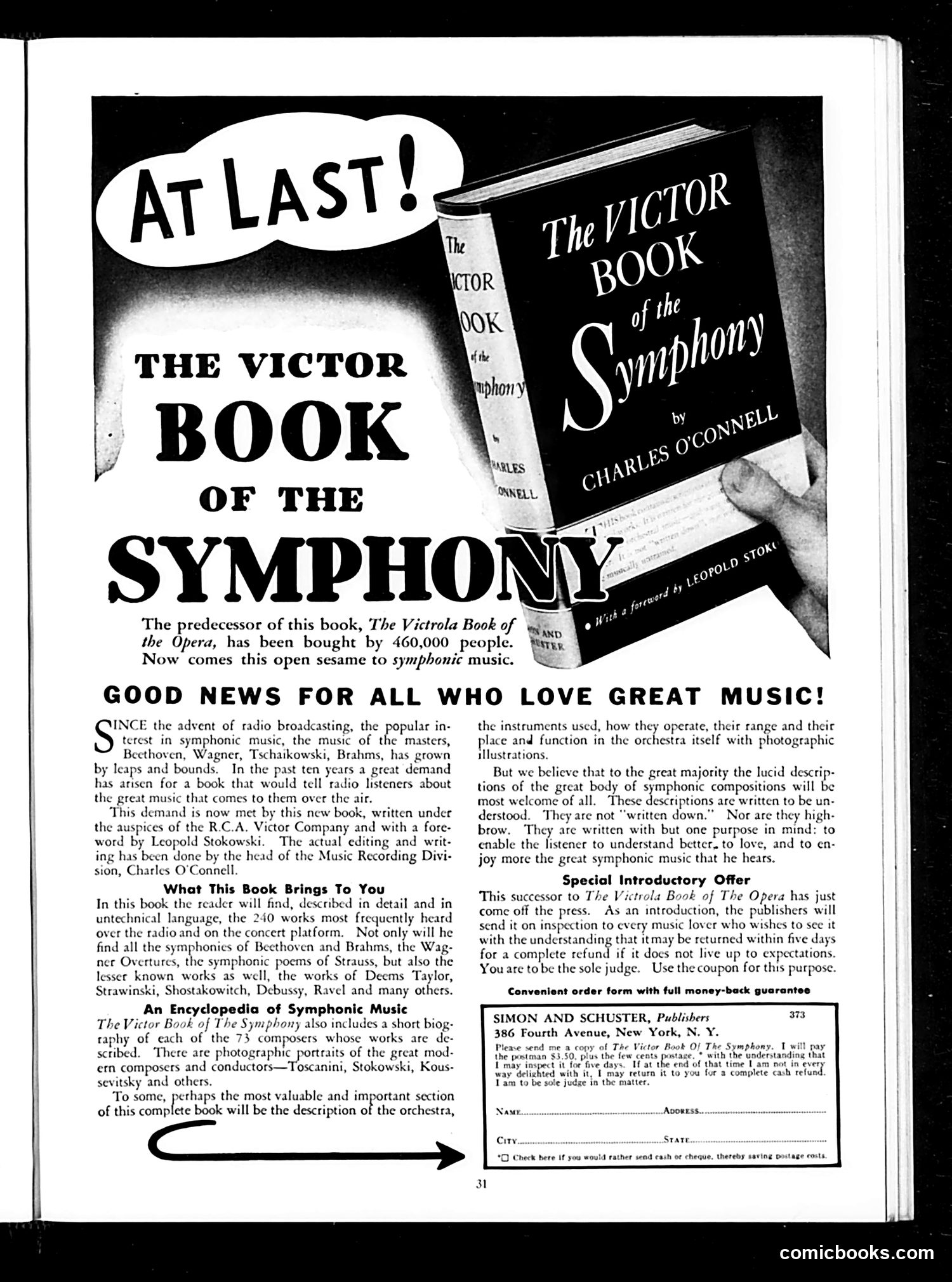
Analysis of Judge Magazine Advertisement Page This is primarily a book advertisement, not a cartoon or satirical piece. The page promotes *The Victor Book of the Symphony*, published by Simon and Schuster in partnership with RCA Victor. The opening phrase "AT LAST!" and the visual of a pointing hand create marketing urgency, positioning this as a long-awaited guide to classical music for radio listeners. The context is 1930s-era democratization of culture: Radio broadcasting made symphonic music newly accessible to ordinary Americans beyond concert halls. This book promises to educate listeners about works by Beethoven, Wagner, Brahms, and contemporary composers like Stravinsky and Shostakovich. The ad emphasizes the book's accessibility—descriptions are "untechnical" and "not written down," making elite art form approachable to the masses. Leopold Stokowski, a famous conductor of the era, provides endorsement. The only potential satire is implicit: the notion that Americans needed *instruction* to appreciate classical music—a gentle jab at popular culture's distance from high art. Otherwise, this is straightforward advertising targeting radio listeners newly interested in symphonic music.
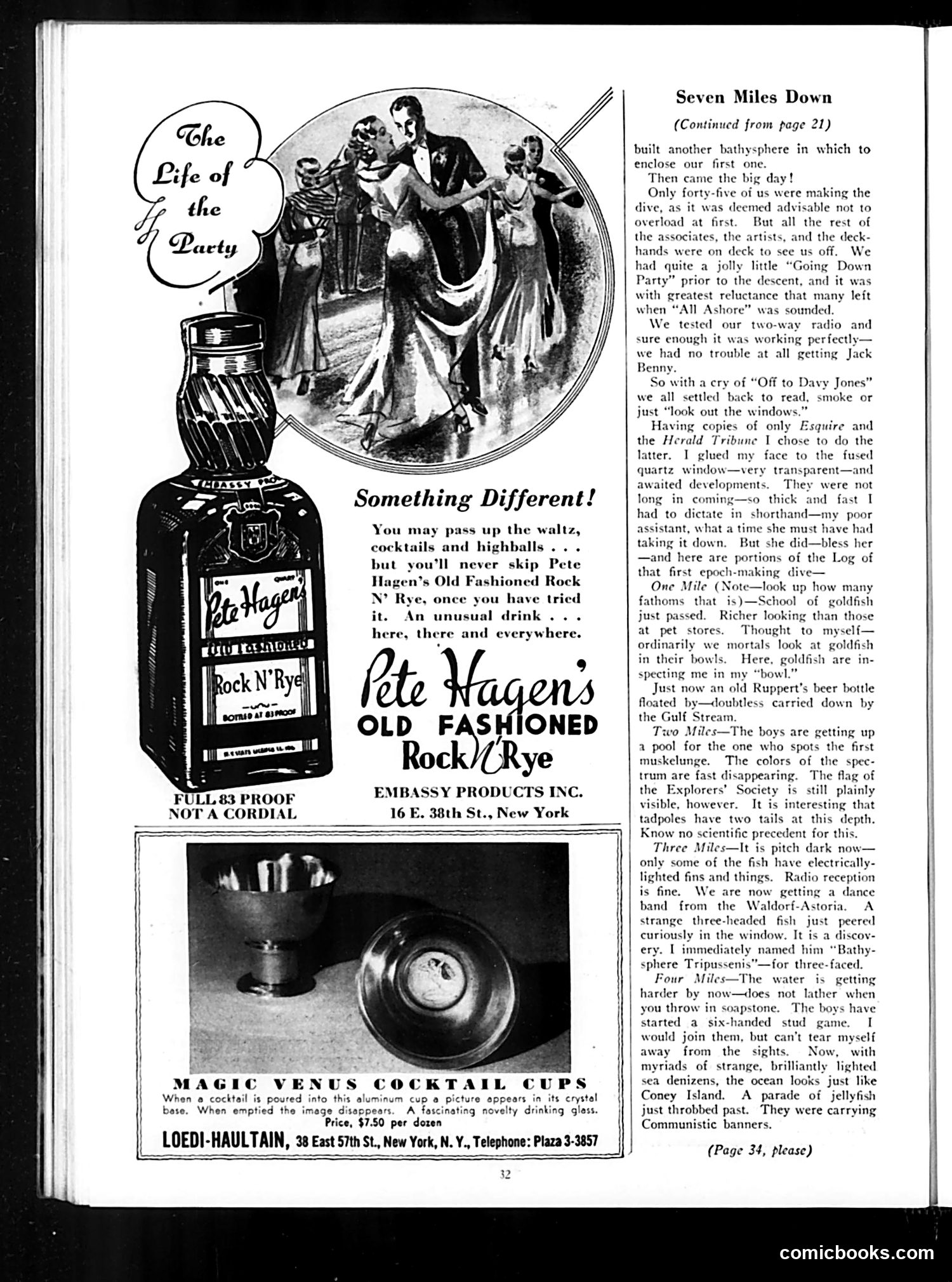
Analysis of This Judge Magazine Page This page combines a serialized adventure narrative with period advertisements. The main content is "Seven Miles Down," a humorous first-person account of a deep-sea bathysphere dive. The narrator describes descending in a submersible vessel, cataloging increasingly absurd observations: schools of goldfish, a beer bottle in the Gulf Stream, fish with "electrically-lighted fins," and ultimately jellyfish "carrying Communistic banners." The satire appears gentle—poking fun at the excitement of early deep-sea exploration while maintaining comic absurdity (radio reception from the Waldorf-Astoria at extreme depth). The reference to "Communistic banners" on jellyfish likely reflects 1930s-era American anticommunist sentiment, though the context suggests it's joking hyperbole rather than serious political commentary. The advertisements for Pete Hagen's Rock 'N' Rye whiskey and Magic Venus cocktail cups represent typical Judge-era commercial content, targeting affluent readers during Prohibition's repeal era.
Analysis for Modern Readers This page is not a political cartoon, but rather a self-help advertisement disguised as a testimonial article. It appears in *Judge* magazine, likely from the early 20th century. The content describes a "memory feat" allegedly demonstrated by someone named Macdonald at a dinner party—memorizing long sequences of numbers and cards perfectly. The narrator claims learning this technique improved his professional performance, conversational ability, and ultimately earned him a salary raise. This is classic advertorial content: a pseudo-editorial article promoting the "Walter J. Black, Inc." memory course (see the coupon at bottom). The narrative structure—skeptical observer → amazed witness → successful practitioner → career advancement—is designed to make memory training seem transformative and achievable. For modern readers, this reflects early-20th-century anxieties about professional competitiveness and the booming self-improvement industry, packaged as an inspirational success story rather than explicit advertising.
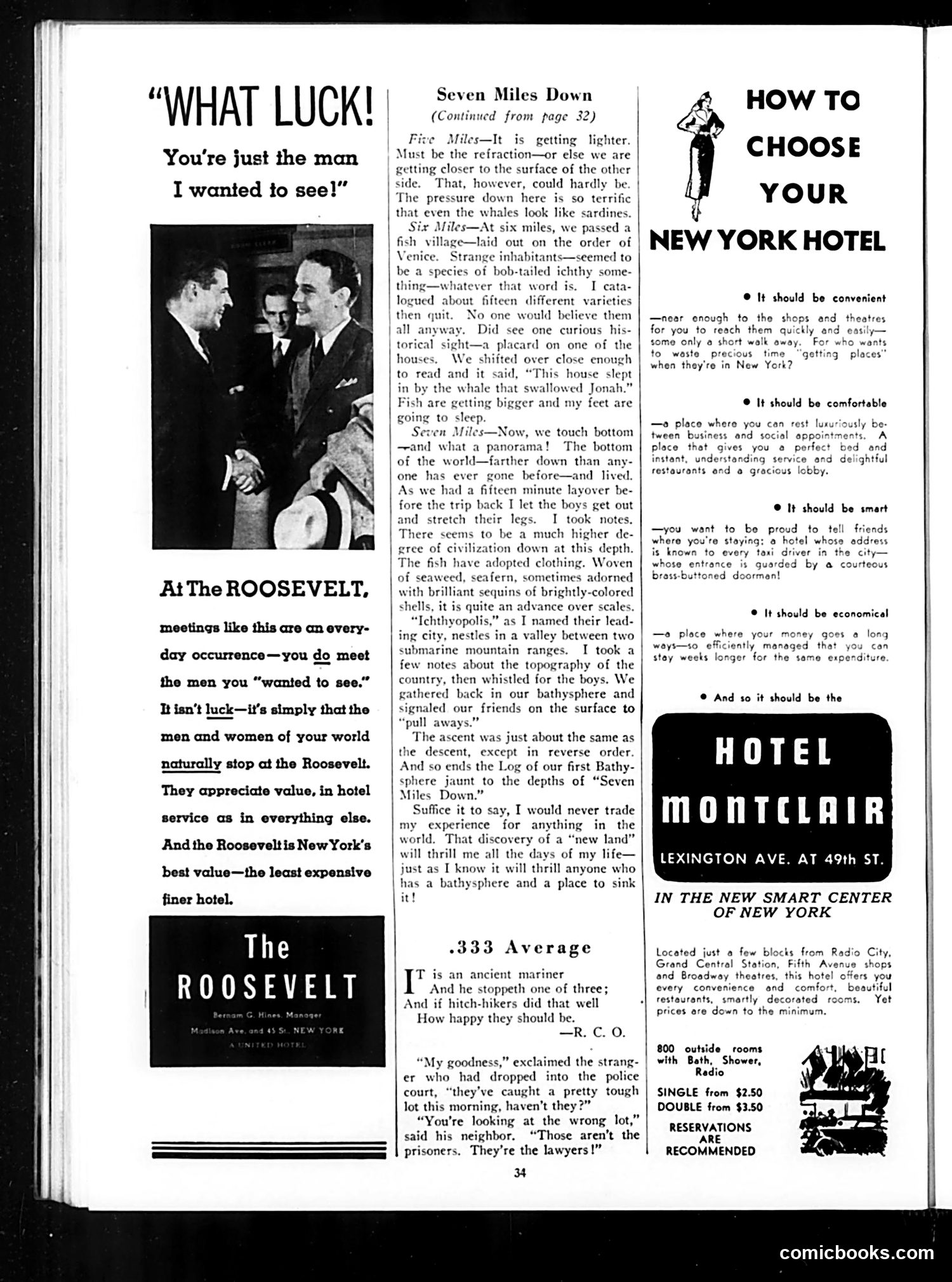
Analysis for Modern Readers This page combines hotel advertising with satirical fiction and humor typical of *Judge* magazine. Left side: An advertisement for the Roosevelt Hotel uses social commentary as marketing. The cartoon depicts three men meeting by chance—the copy claims this "isn't luck" but rather that sophisticated New Yorkers naturally congregate at this hotel because it offers "value." It's aspirational advertising targeting business professionals. Center: "Seven Miles Down" is a fantastical fiction piece describing an imaginary deep-sea bathysphere expedition. The narrator encounters fish wearing seaweed clothes and an underwater city called "Ichthyopolis"—pure imaginative satire with no clear political target, just entertainment. Bottom joke: A visitor to police court mistakes lawyers for prisoners—a common era joke mocking lawyers as morally suspect. Right side: Another Roosevelt Hotel ad emphasizing location, comfort, and economy for Manhattan visitors. The page is primarily advertising with filler content—the fiction and jokes serve to make ads more engaging rather than convey political satire.
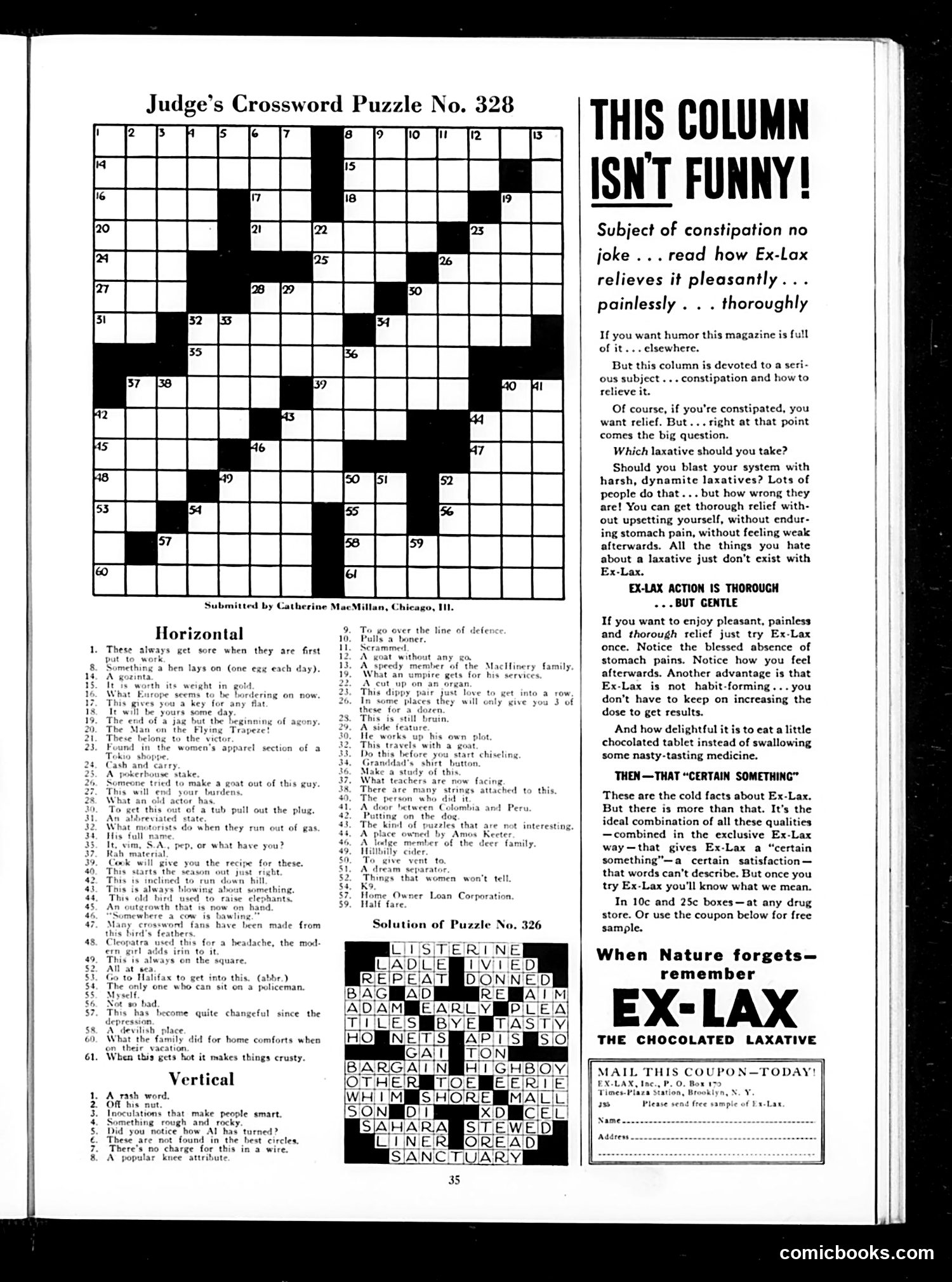
Ex-Lax Advertisement Disguised as Editorial Content This page presents a crossword puzzle alongside what appears to be serious editorial commentary about constipation and laxatives. However, the entire "column" is actually advertising for Ex-Lax, a chocolate laxative product. The satire works by acknowledging Judge magazine's reputation for humor, then claiming this column is exempt because it addresses the "serious subject" of constipation. The text then pivots to promoting Ex-Lax as superior to harsh laxatives—emphasizing it's "gentle," "thorough," "not habit-forming," and chocolated (making it palatable rather than a "nasty-tasting medicine"). This is vintage pharmaceutical advertising designed to appear editorial rather than promotional. The self-aware opening ("This column isn't funny!") creates false credibility while the rest of the page is pure marketing copy praising the product's virtues. The crossword puzzle itself appears unrelated—standard magazine filler content—making the page primarily an advertisement masquerading as magazine content.
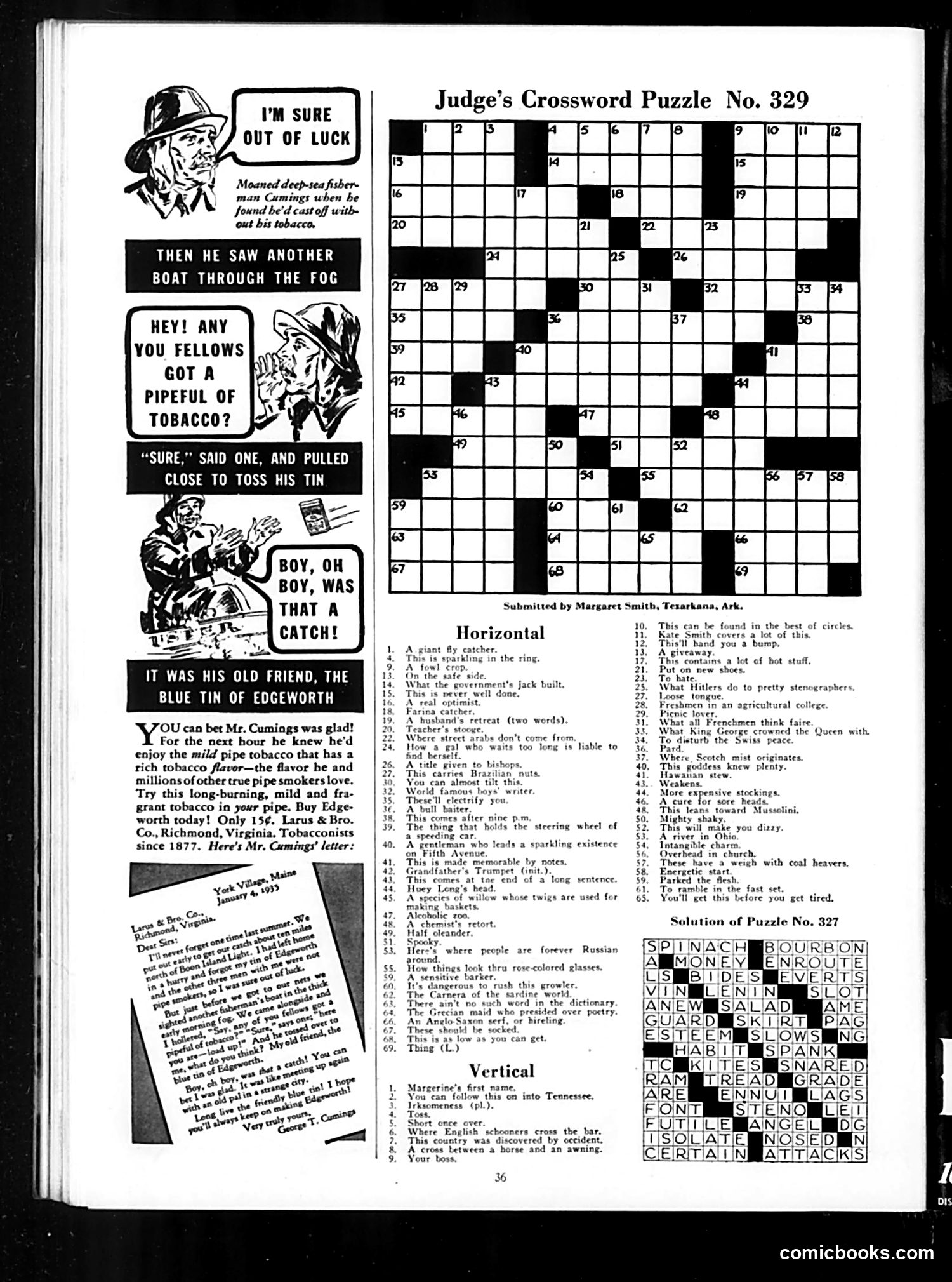
Judge Magazine Page Analysis This page contains a tobacco advertisement disguised as a narrative comic strip, promoting Edgeworth pipe tobacco. The story depicts a deep-sea fisherman (Cumings) who forgets his tobacco, then spots another boat through fog. He calls out asking for tobacco, and the other boat provides a tin of Edgeworth brand—presented as a fortunate reunion with "his old friend." The implication is that Edgeworth is a reliable, familiar product. The advertisement emphasizes the tobacco's qualities: "mild," "fragrant," and "long-burning," positioning it as the preferred choice for "true pipe smokers." The price (15¢) and manufacturer (Larus & Bro., Richmond, Virginia, established 1877) are provided. A reader letter from "Mr. Cumings" supposedly validates the product's quality, adding testimonial authenticity. This represents early 20th-century advertising strategy: embedding product promotion within entertainment content to make marketing less obtrusive and more engaging than straightforward ads.
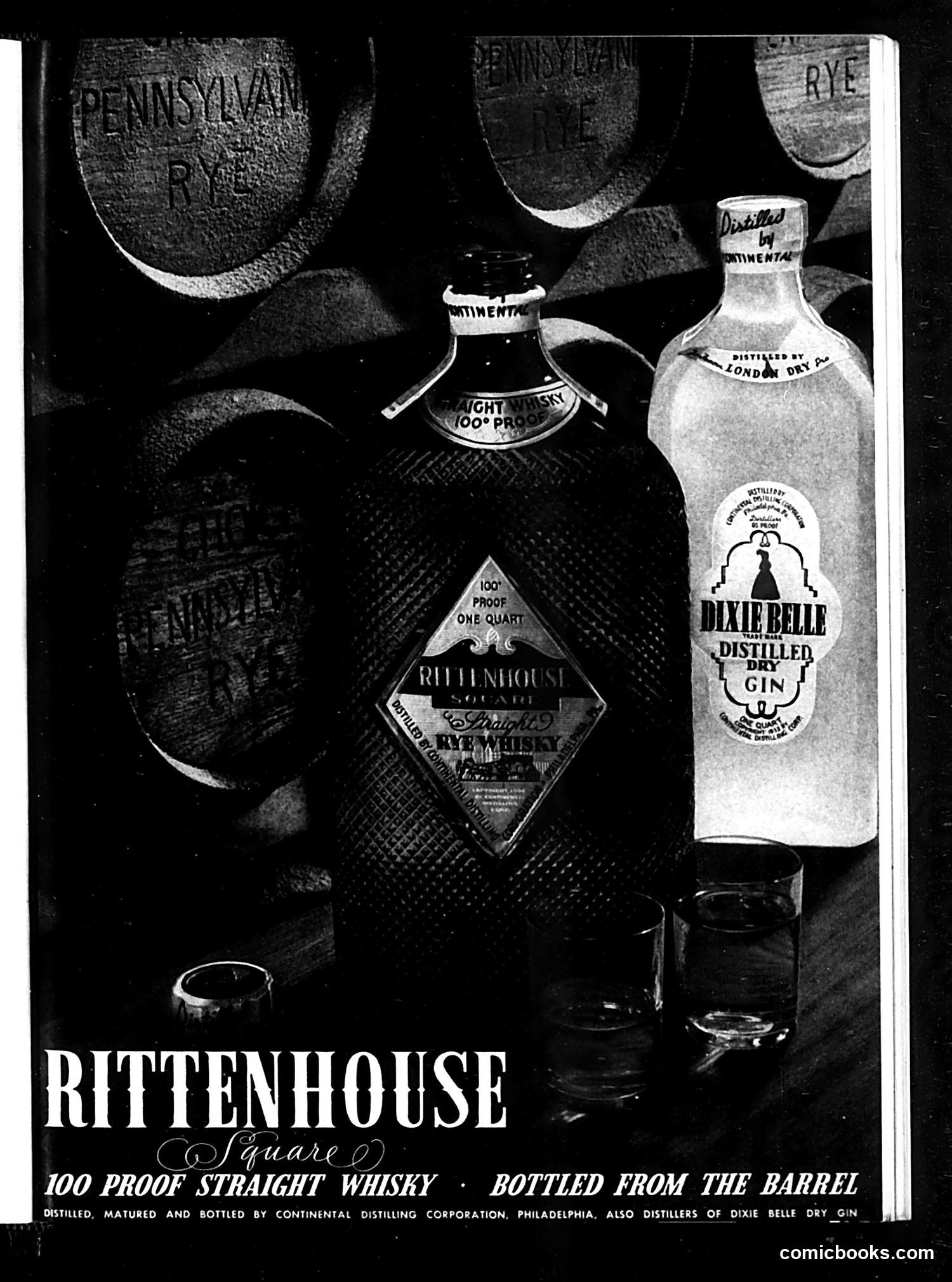
This page is primarily a full-page advertisement, not a political cartoon. It promotes Rittenhouse Square whiskey (100 proof, straight whiskey "bottled from the barrel") and Dixie Belle dry gin, both produced by Continental Distilling Corporation in Philadelphia. The ad features product bottles and barrels arranged in an artistic composition. There is no apparent satire or political commentary—this is straightforward alcohol advertising from an era (likely Prohibition-era or post-Repeal) when such ads appeared in Judge magazine. The only notable element is the visual styling typical of vintage advertising design, but the content itself makes no satirical point about political figures or social issues.
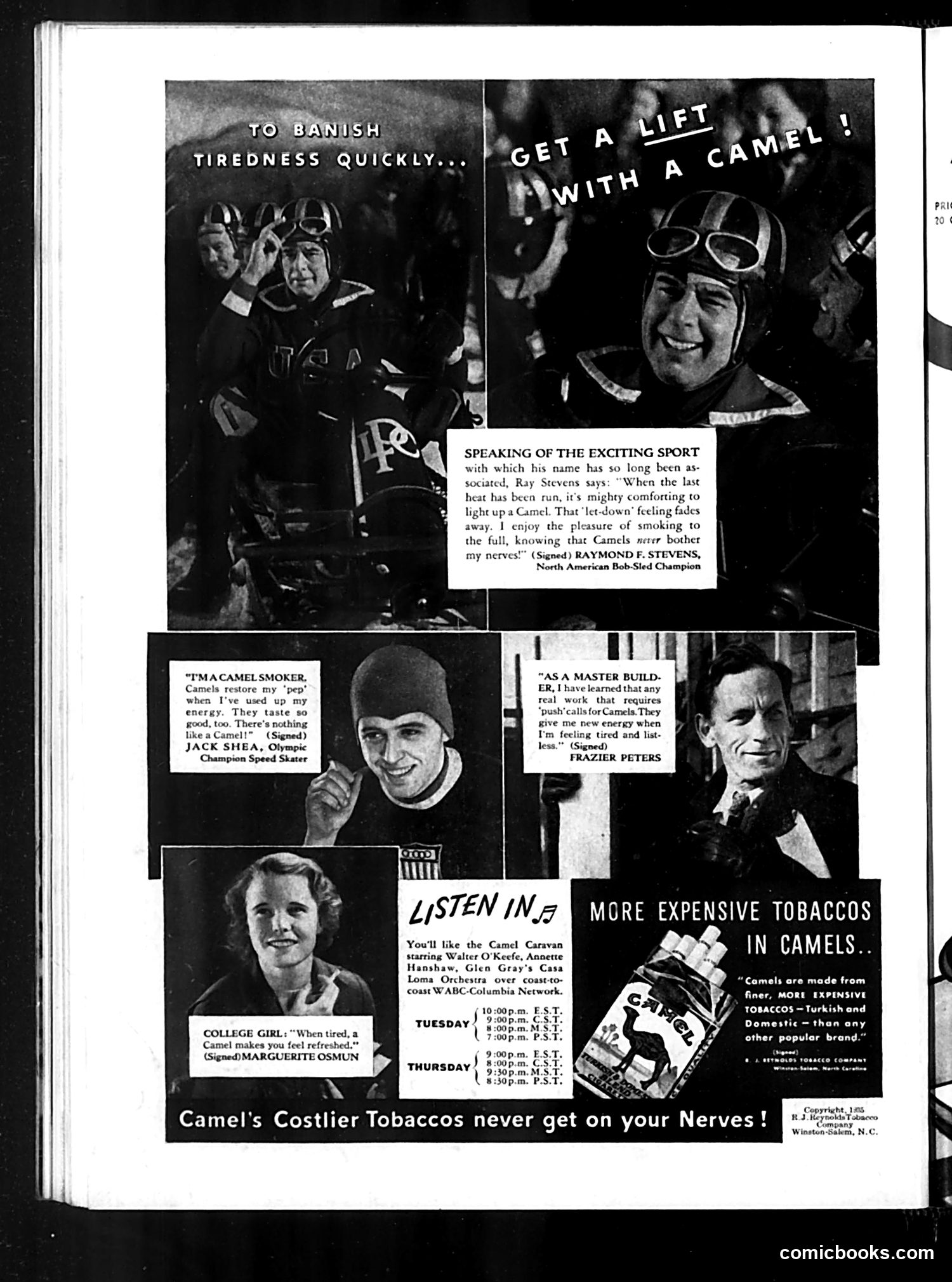
Camel Cigarette Advertisement (Not Satire) This is a cigarette advertisement, not political satire—it appears Judge magazine accepted paid advertising. The page promotes Camel cigarettes through endorsements from celebrity athletes and entertainers: bob-sled champion Raymond Stevens, speed skater Jack Shea, and others. The advertisement's pitch is that Camels provide energy and calm nerves without negative effects. Each testimonial claims smoking Camels restores vitality after exertion or fatigue. The bottom emphasizes Camels use "finer, MORE EXPENSIVE TOBACCOS" than competitors. There is no cartoon or satire here—this is straightforward commercial messaging exploiting celebrity endorsements, a common advertising practice of the era. The phrase "never get on your Nerves" was Camel's actual marketing slogan, ironically promoting a nicotine product as calming.