judge
Judge — April 1935
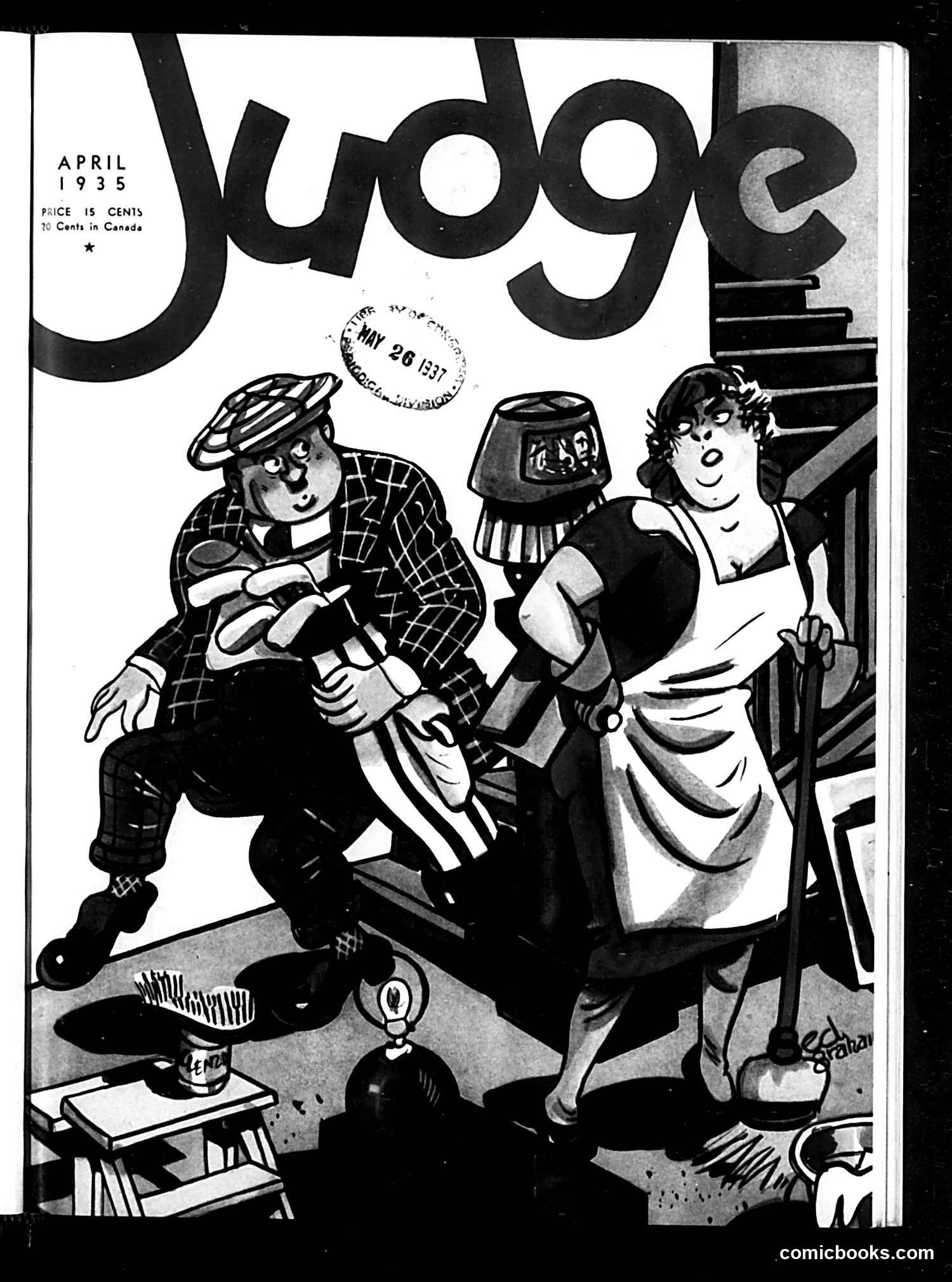
Judge Magazine, April 1935 This cover illustration depicts a domestic comedy scene typical of 1930s humor. A man in plaid clothing and a flat cap carries a baby while a woman in an apron gestures animatedly beside him. A figure in the middle wears what appears to be formal attire with a distinctive hat. The scene suggests domestic chaos or confusion around childcare—a common satirical subject. The humor likely plays on gender roles and domestic responsibilities during the Depression era, when such "role reversal" scenarios (men handling childcare) were considered comedic. The exaggerated expressions and physical comedy typical of Judge's style indicate lighthearted family-oriented humor rather than pointed political satire. Without clearer text identifying specific figures or events, the exact satirical target remains unclear, though it reflects period attitudes toward domestic life.
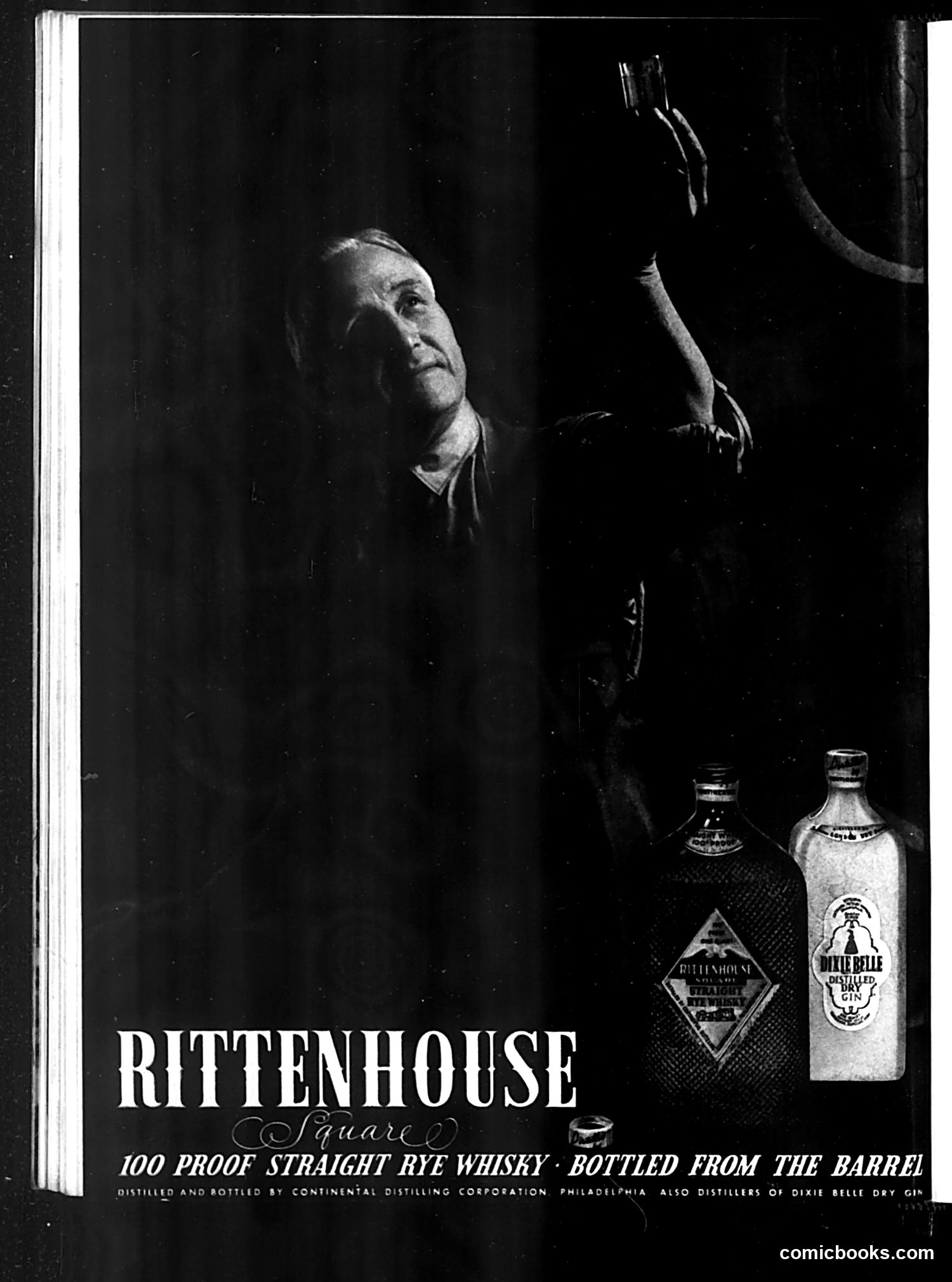
Analysis This page is primarily a liquor advertisement for Rittenhouse Square rye whiskey, not political satire. The image shows a man in formal attire examining bottles of the product against a dark background. The text emphasizes "100 PROOF STRAIGHT RYE WHISKEY · BOTTLED FROM THE BARREL," with production credited to Continental Distilling Corporation in Philadelphia. The advertisement appears designed to convey sophistication and quality through the formal presentation and careful product display. There is no discernible political cartoon or social satire on this page—it's a straightforward commercial promotion, likely from the pre-Prohibition or early post-Prohibition era based on the styling and the prominent display of whiskey bottles.
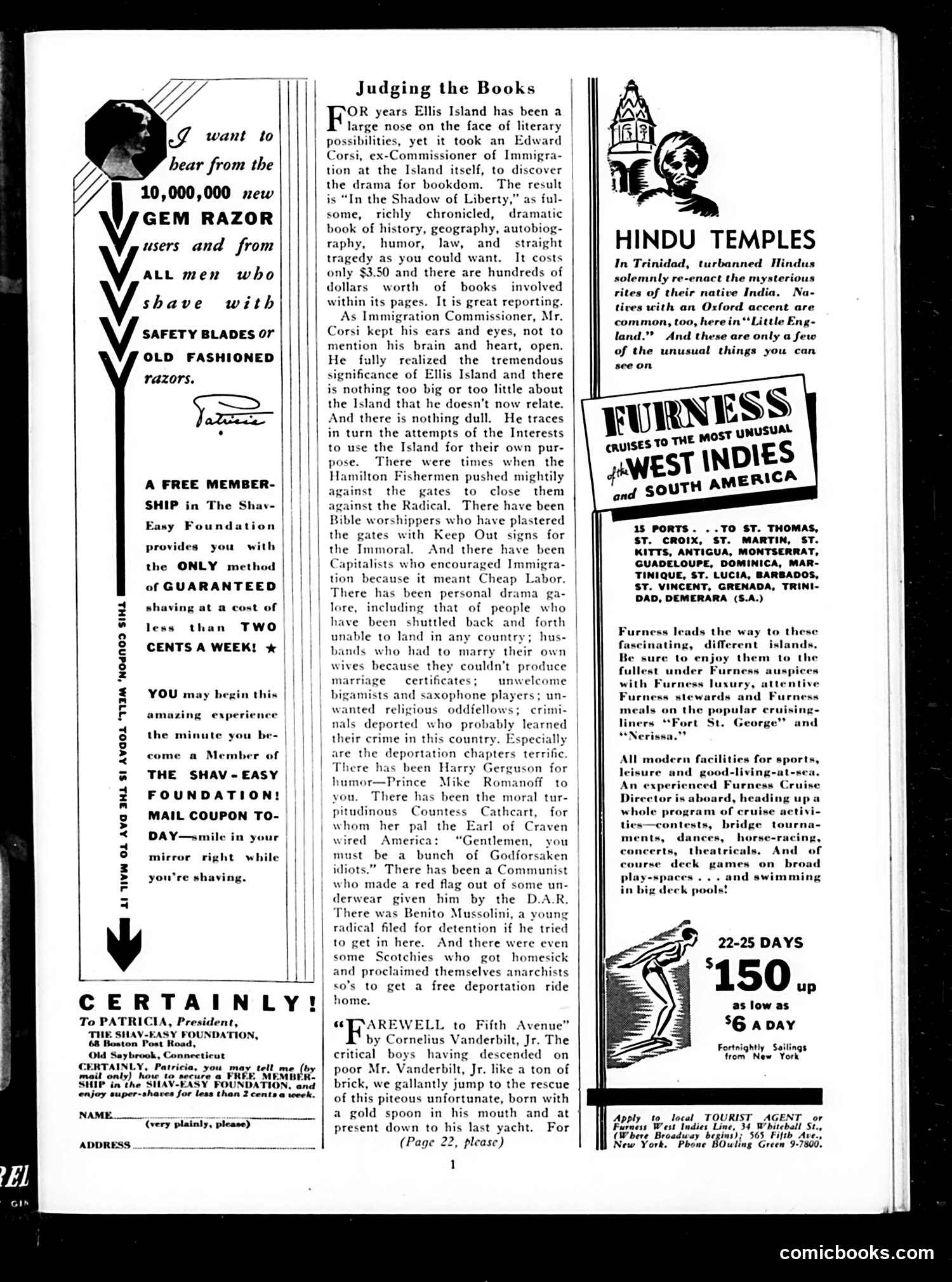
Analysis of Judge Magazine Page This page is primarily advertising and travel content rather than political satire. The left side features a Gem Razor advertisement targeting men, emphasizing safety blades and cost savings, plus a Shaw-Easy Foundation membership offer promising cheap shaving at under two cents weekly. The center contains a book review titled "Judging the Books" discussing Edward Corsi's work *In the Shadow of Liberty*, which examines Ellis Island's immigration history. The review mentions dramatic deportation cases and various notable figures involved with immigration policy. The right side advertises Furness cruise lines to the West Indies and Caribbean, and Hindu Temples in Trinidad—essentially tourism promotions. There is no evident political cartoon or satire on this page. It represents typical 1920s-30s magazine content mixing editorial commentary with commercial advertising.
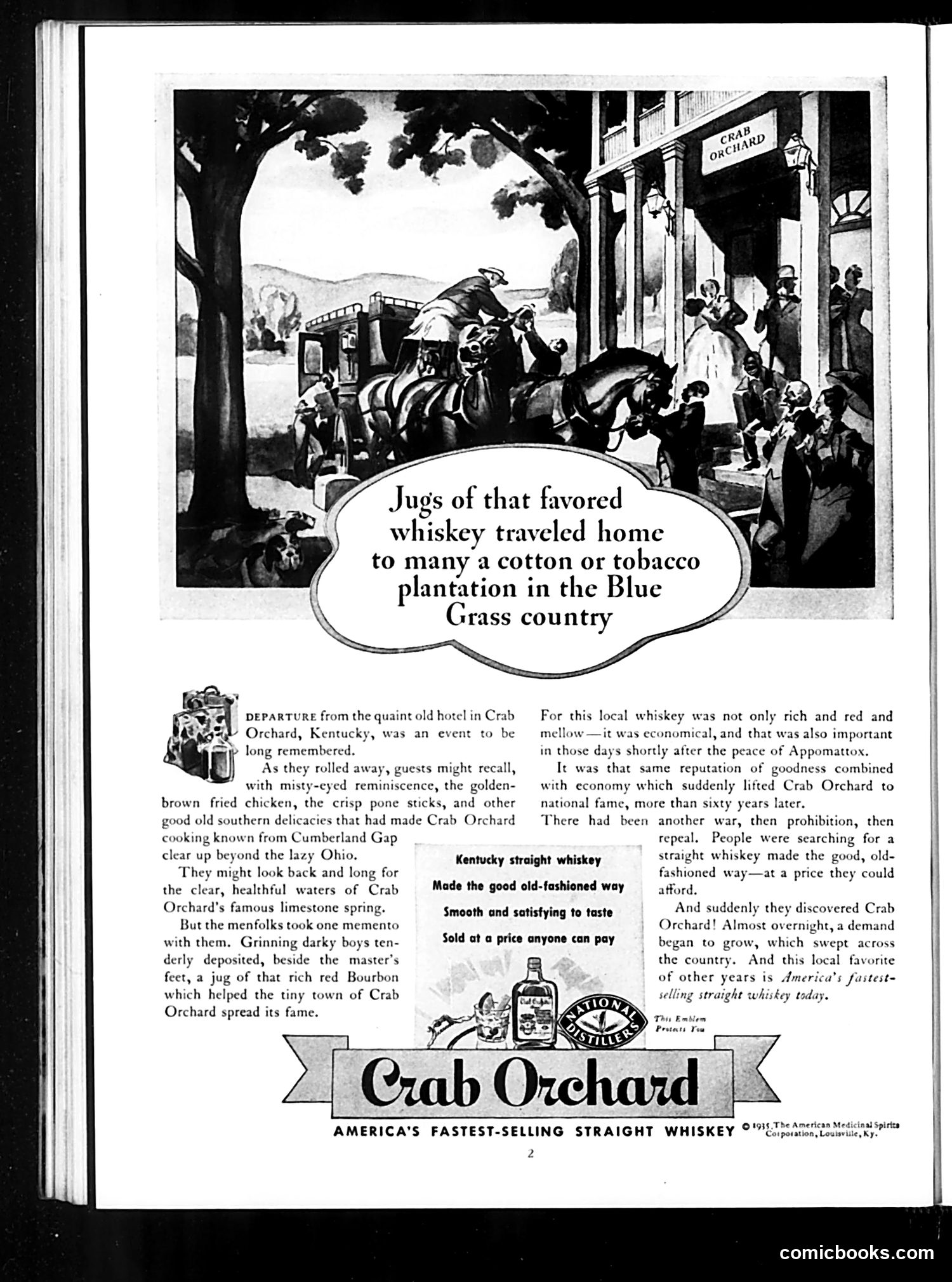
Analysis of Crab Orchard Whiskey Advertisement This page is primarily a whiskey advertisement rather than political satire. It depicts a stagecoach departure from "Crab Orchard" hotel in Kentucky, showing the whiskey's historical distribution to plantations in the Blue Grass region. The advertisement plays on nostalgia and regional pride, emphasizing that Crab Orchard whiskey was economical yet high-quality—important during Prohibition's repeal (the text references "prohibition, then repeal"). The ad claims it became "America's fastest-selling straight whiskey" after this sudden rediscovery. There is no apparent political cartoon or satire here—this is straightforward vintage advertising using historical imagery and storytelling to market the product to post-Prohibition consumers seeking affordable, authentically American whiskey.
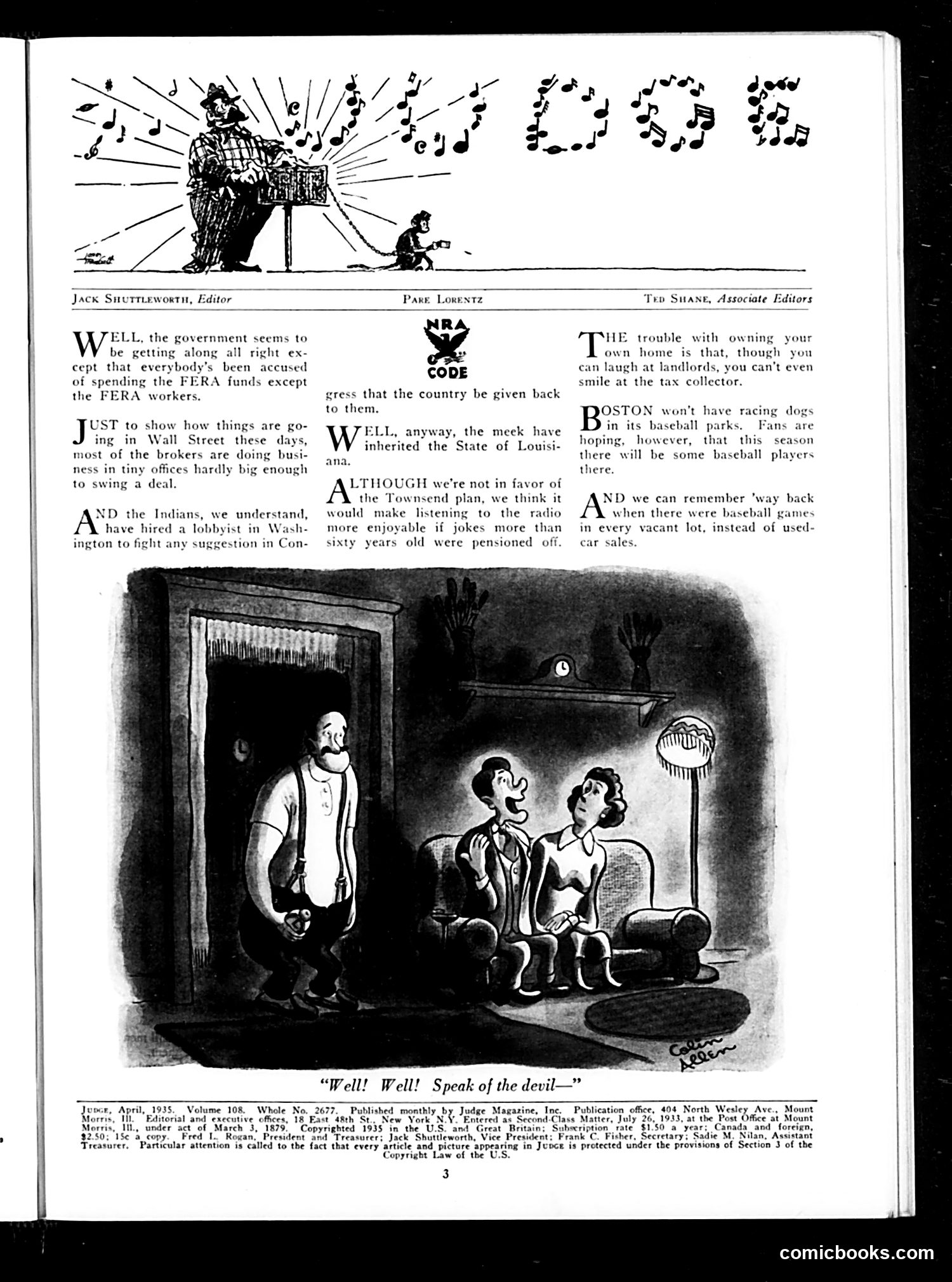
Analysis of Judge Magazine Page (April 1935) The main cartoon depicts a couple sitting on a couch while a man enters through a doorway, with the caption "Well! Well! Speak of the devil—" The editorial commentary addresses New Deal politics, specifically: - Government spending on FERA (Federal Emergency Relief Administration) workers - Wall Street brokers conducting business in small offices - The Indians' lobbying in Congress - The Louisiana State inheritance situation (likely referencing Huey Long's political machine) - Proposed radio tax legislation - Boston's restrictions on racing dogs in baseball parks - The replacement of used-car lots with baseball games The satirical tone criticizes New Deal spending and government expansion during the Depression era. The cartoon itself appears to be a domestic humor piece unrelated to the editorial commentary, suggesting this is a typical Judge magazine layout mixing political commentary with general jokes.
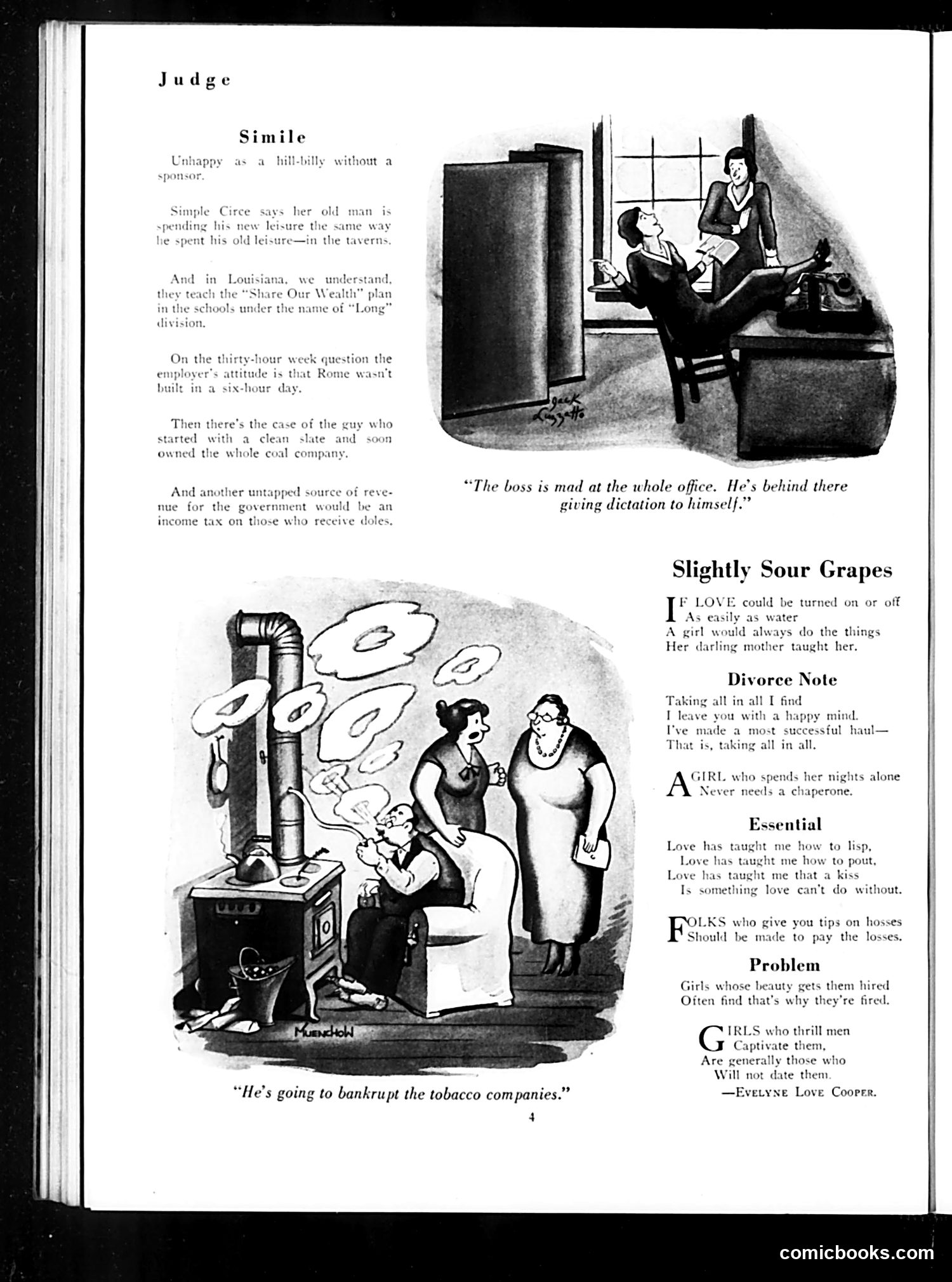
Analysis of Judge Magazine Page This page contains social commentary and humor typical of early-20th-century American magazines. The top cartoon depicts an office scene where a boss gives dictation while appearing to hide behind furniture—satirizing workplace hierarchy and managerial pretense. The lower cartoon shows a woman near a stove with the caption "He's going to bankrupt the tobacco companies," likely referencing anxieties about women's economic power or changing consumer habits. The right column contains short satirical poems and observations on relationships, divorce, and gender dynamics—common Judge magazine fare mocking contemporary social attitudes. References to "doles," "income tax," and "thirty-hour weeks" suggest labor and economic debates of the era, though specific political events remain unclear without additional historical context.
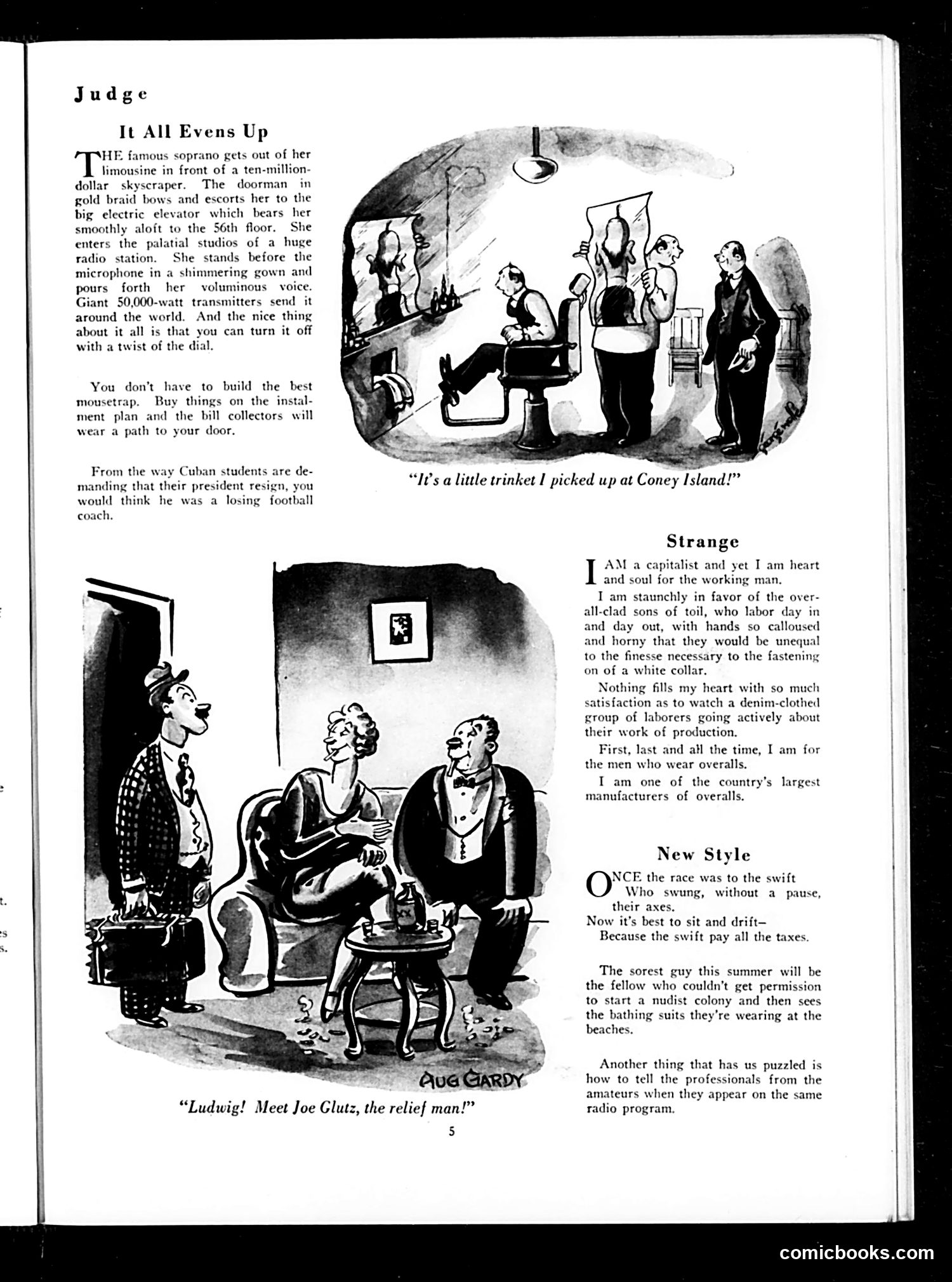
Analysis of Judge Magazine Page Top Cartoon ("It's a little trinket I picked up at Coney Island!"): A soprano performs in a radio station studio while men operate equipment. The joke mocks the trivial nature of radio entertainment—the singer implies her vocal performance is no more significant than a cheap souvenir trinket from Coney Island amusement park. It satirizes the gap between highbrow opera and lowbrow mass media broadcasting. Bottom Cartoon ("Ludwig! Meet Joe Glutz, the relief man!"): Two formally-dressed men meet a working-class figure. The satire likely references New Deal relief programs, mocking the social awkwardness of introducing unemployed workers ("relief men") into formal settings, or critiquing class divisions during Depression-era employment initiatives. Right Column Essays: Brief satirical pieces on capitalism, labor, and summer fashion trends.
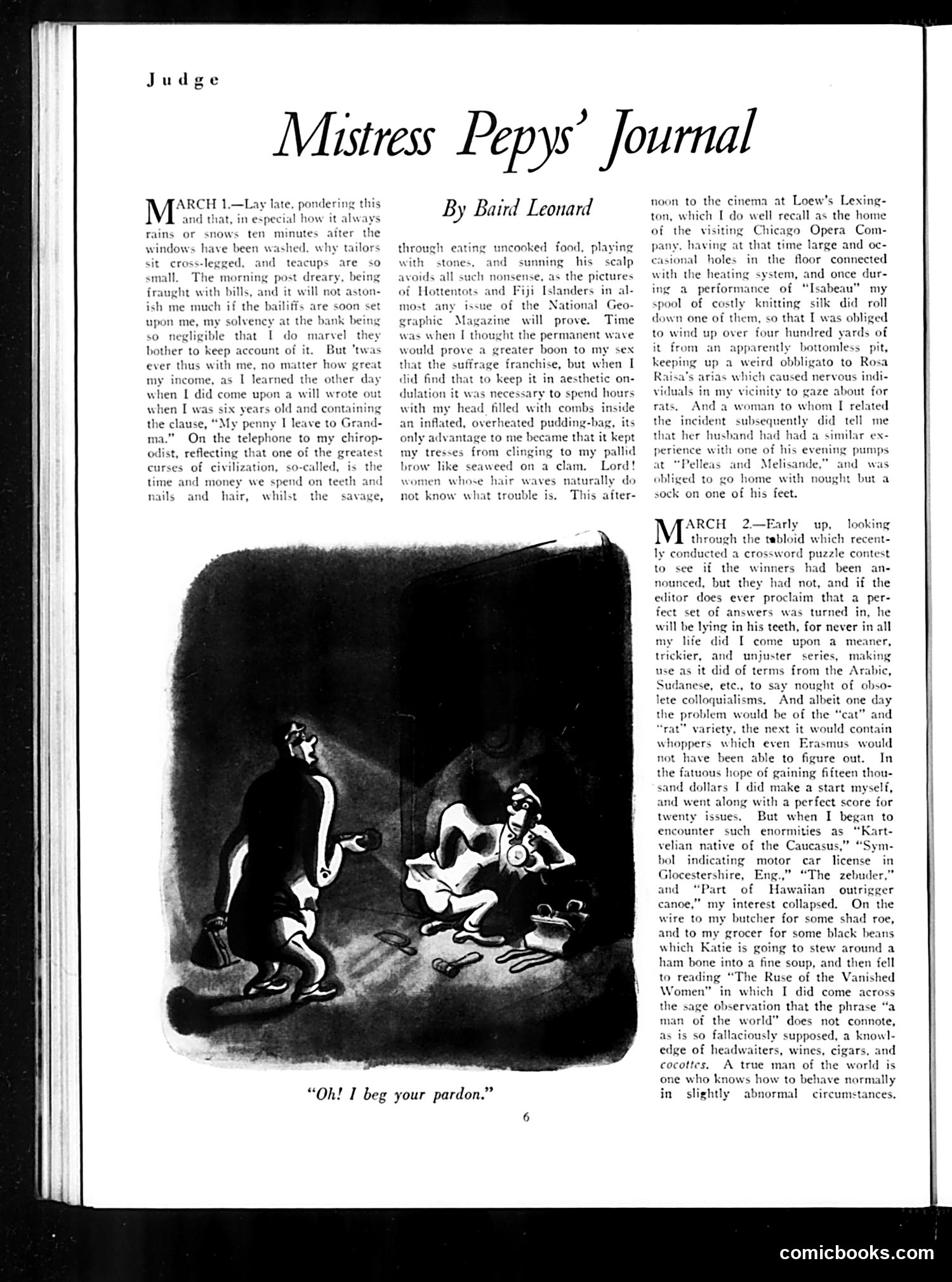
"Mistress Pepys' Journal" by Baird Leonard This is a humorous column mimicking Samuel Pepys' famous 17th-century diary, but written from a woman's perspective. The illustration shows a woman encountering what appears to be a snake or serpent in a dark interior space, with the caption "Oh! I beg your pardon." The column's entries describe mundane domestic frustrations: poorly timed rain, maintaining appearance through beauty treatments, and the absurdity of crossword puzzle contests with no announced winners. The author humorously catalogs life's petty annoyances and social obligations—visiting the opera, entertaining guests, dealing with beauty salon incompetence. The satire targets the tedium of upper-class women's lives, social pretension, and the gap between expected genteel behavior and actual experience. The snake encounter likely represents an unexpected disruption to polite society.
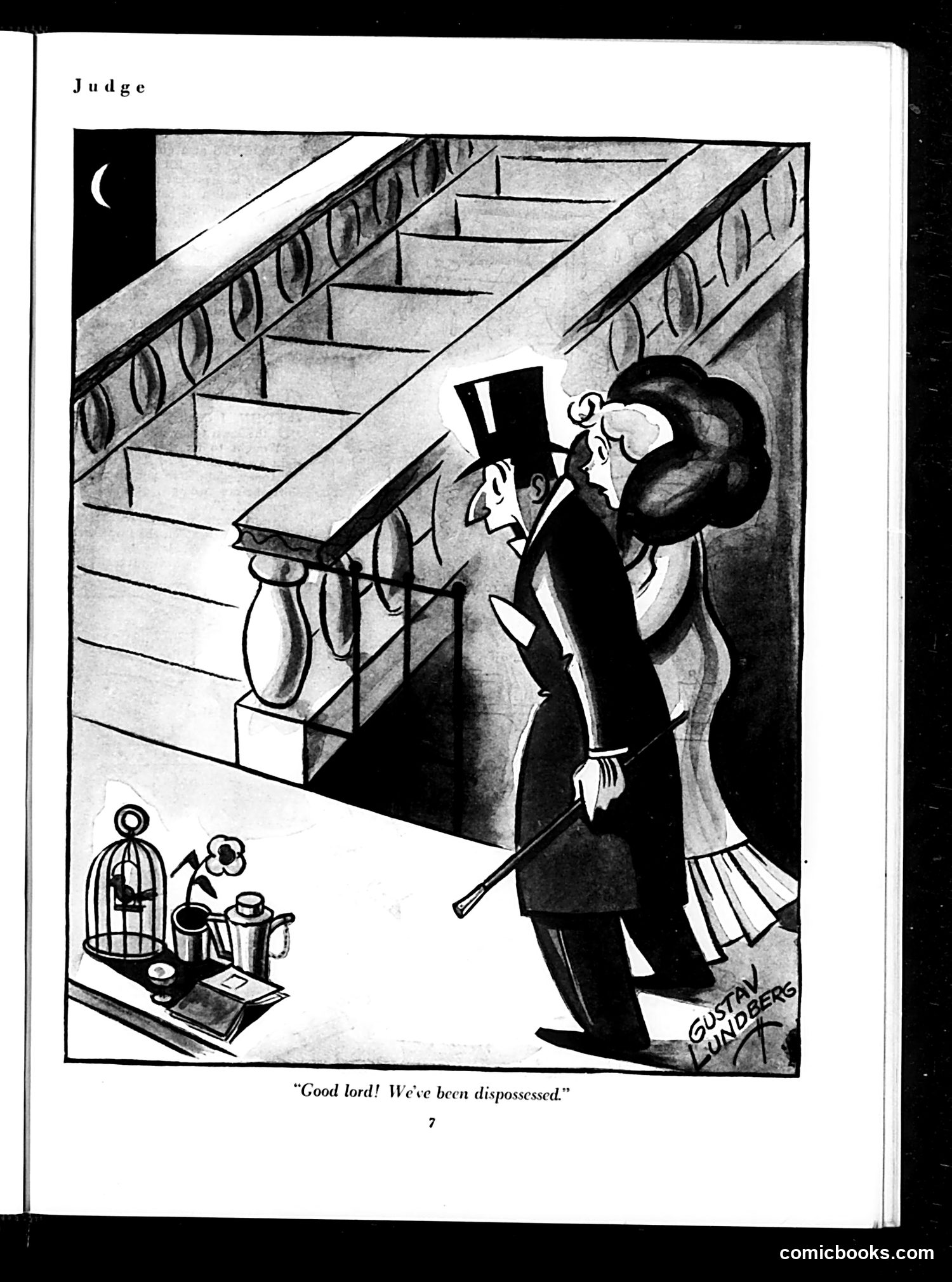
Analysis of "Judge" Cartoon: "Good lord! We've been dispossessed." This single-panel cartoon depicts a well-dressed gentleman in a top hat and a woman being evicted from an elegant staircase. The couple stands before grand interior architecture while a birdcage, teapot, and other modest household items sit abandoned below—suggesting they've lost their home and possessions. The caption's exclamation indicates shock at their sudden dispossession. This likely satirizes the economic hardships of the early 20th century, possibly referencing tenant evictions during economic downturns or housing crises affecting middle and upper-class families. The contrast between their formal attire and their predicament underscores the indignity of falling from prosperity—a common Judge magazine theme critiquing economic instability and social upheaval during this period.
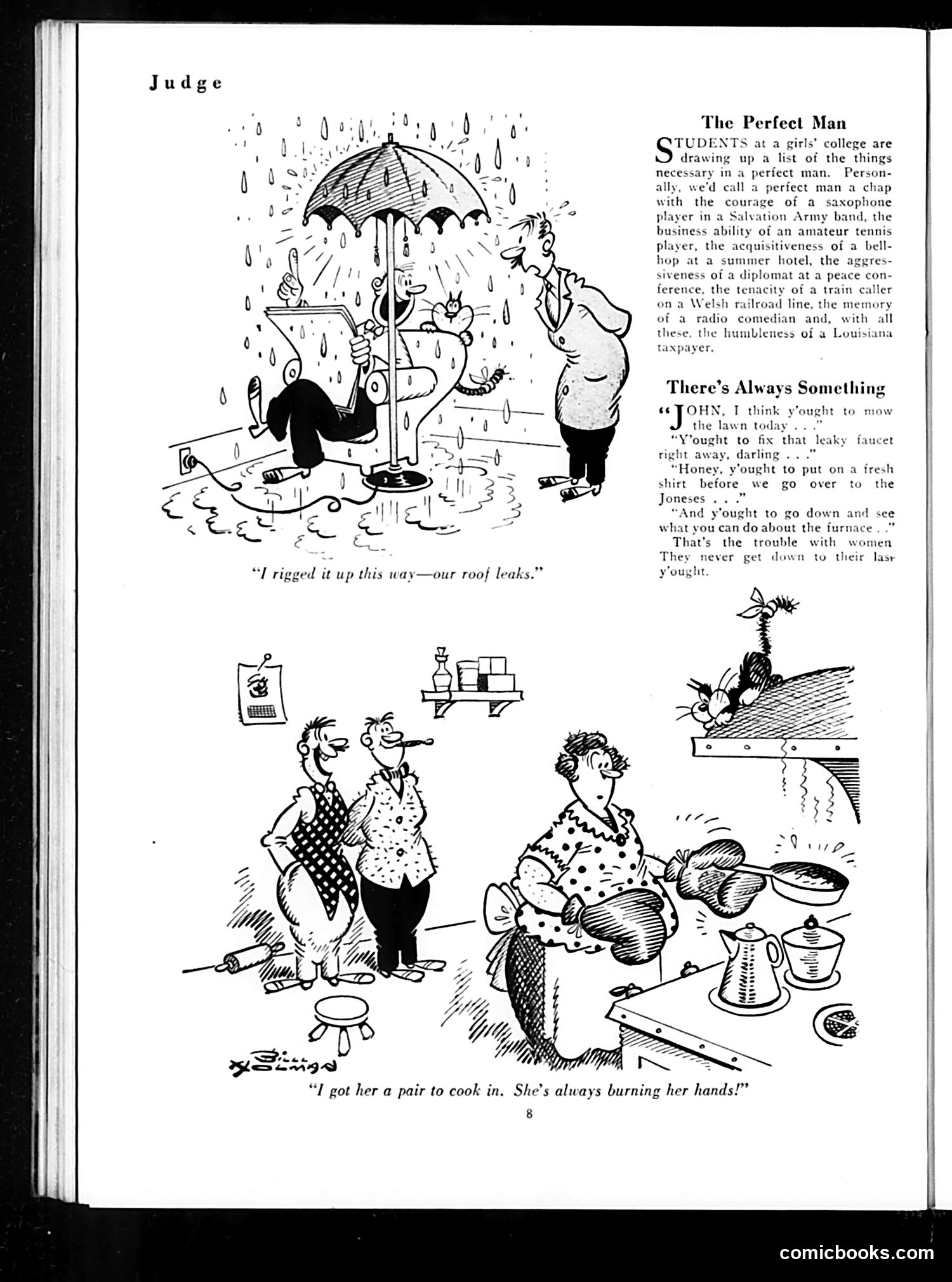
Analysis for Modern Readers This page contains two distinct satirical pieces from *Judge* magazine: "The Perfect Man" (top): A humorous essay mocking the impossibility of the "perfect man." It sarcastically lists contradictory qualities—combining the courage of a saxophonist in a Salvation Army band with the business sense of an amateur tennis player—suggesting no such man exists. This satirizes both idealistic women and unrealistic standards. "There's Always Something" (bottom): Two cartoons illustrating nagging spouses. One shows a man incompetently fixing a roof while his wife criticizes; another shows a woman constantly giving her husband tasks ("mow the lawn," "fix the faucet," "wear a clean shirt," "check the furnace"). The caption "That's the trouble with women—they never get down to their last y'ought" jokes that women are perpetually demanding. Both pieces reflect early-to-mid 20th-century gender stereotypes: the impossibility of pleasing wives and the endless nature of domestic complaints. The humor relies on portraying women as perpetually dissatisfied and men as perpetually inadequate—domestically and otherwise.
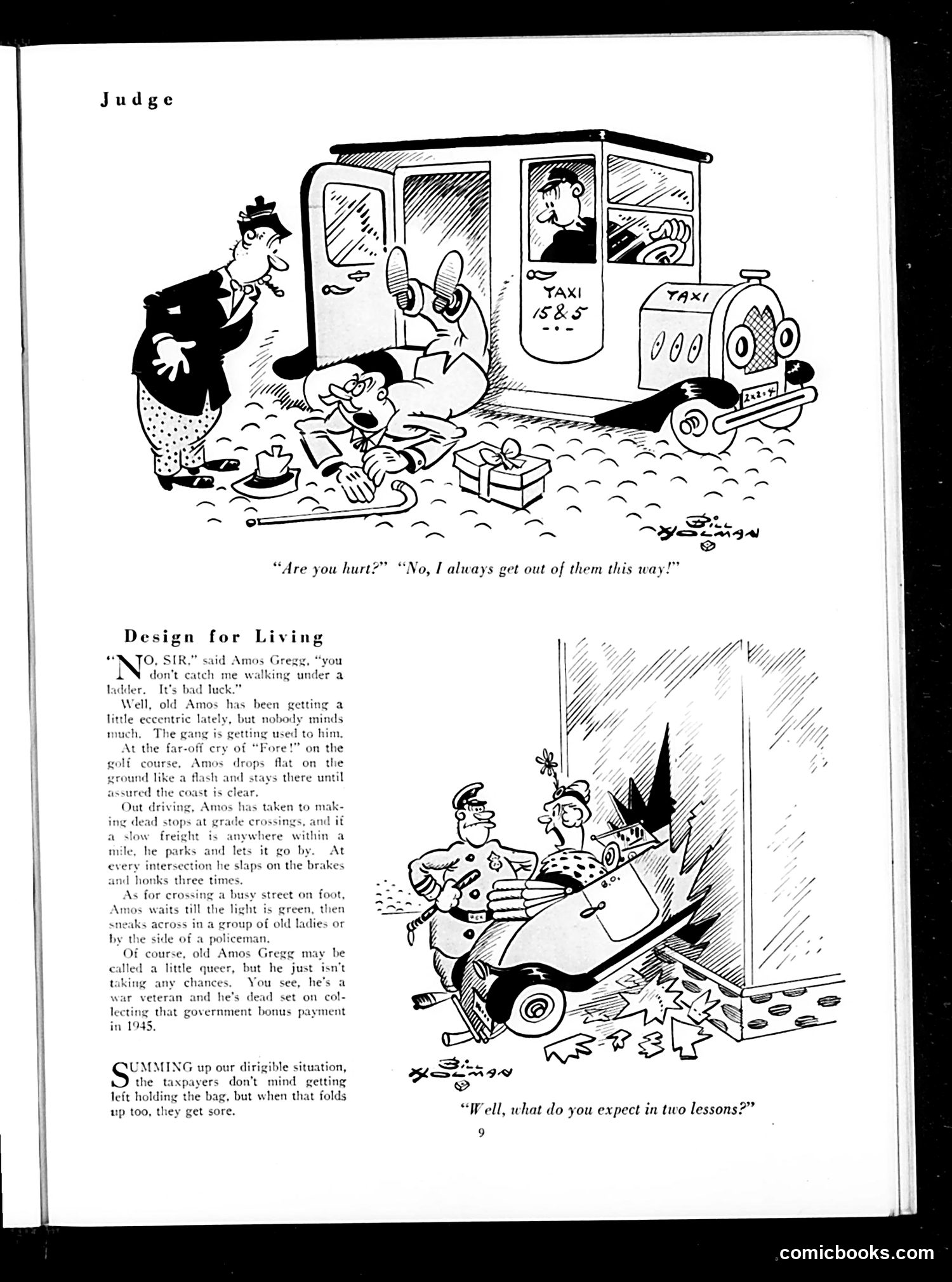
Political Satire Analysis: Judge Magazine Page This page contains two cartoons satirizing 1920s American social issues: Top cartoon ("Judge"): A judge observes a taxi driver emerging unscathed from a collision with debris scattered everywhere. The driver boasts he "always gets out of them this way"—satirizing reckless driving and the judicial system's apparent inability to enforce traffic safety or hold dangerous drivers accountable. Bottom cartoon ("Design for Living"): An elderly war veteran named Amos Gregg, awaiting a promised government bonus payment (referenced as due in 1945), has adopted increasingly eccentric safety habits—making dead stops at intersections, waiting for traffic lights, sneaking past groups of elderly women. The caption "What do you expect in two lessons?" suggests he's learning driving safety too late. The satire targets post-WWI veterans' delayed compensation and Americans' generally poor driving habits during the automobile era. It reflects contemporary frustration with both government promises to veterans and the new dangers automobiles posed to public safety.
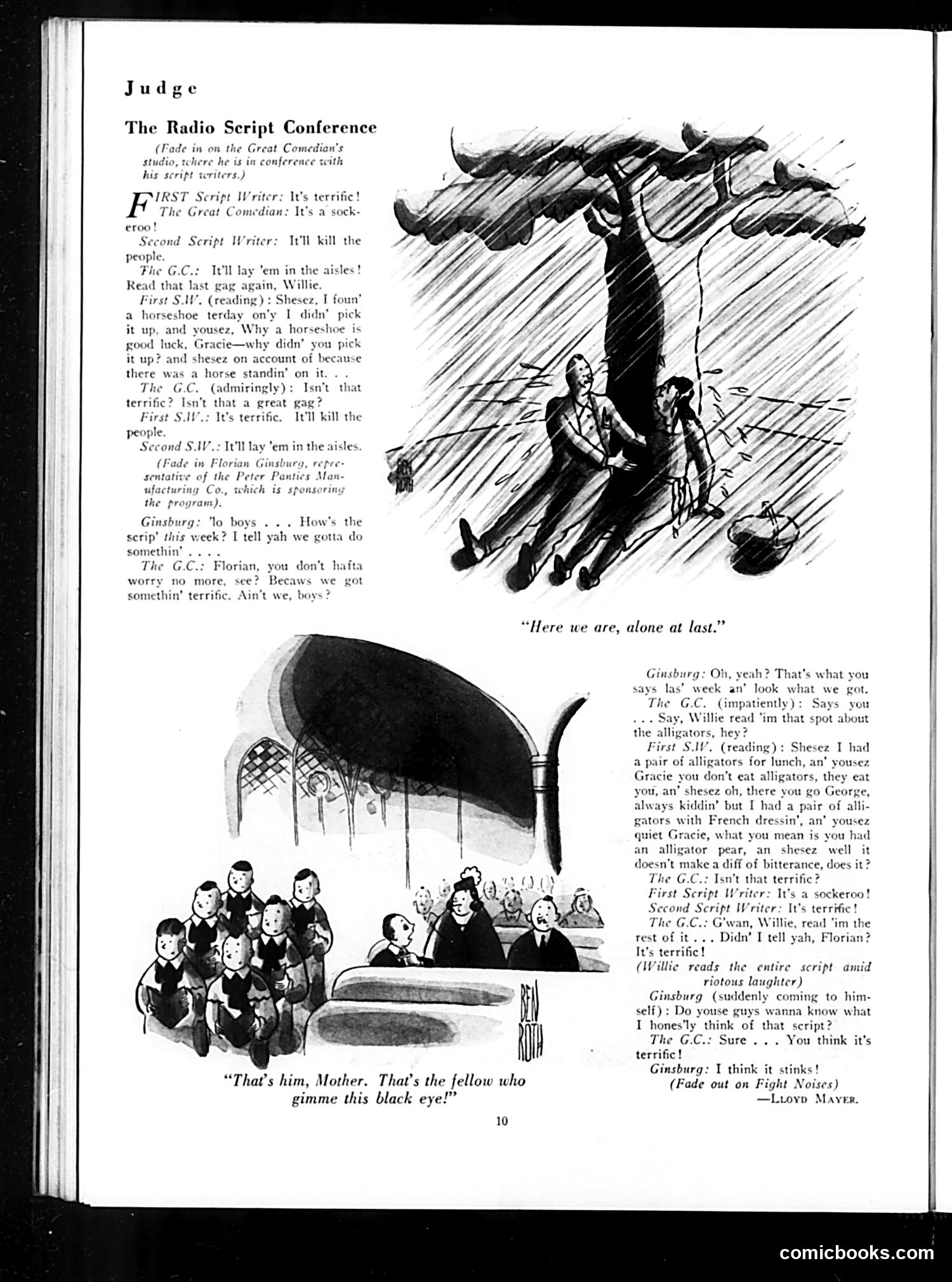
"The Radio Script Conference" This Judge satire mocks radio comedy writers' creative process. The scene depicts a "Great Comedian" (likely a caricature of a famous radio star like George Burns) conferencing with script writers and producer Florian Ginsburg about joke material. The humor targets the absurdity of radio comedy: writers recycle tired gags (a horseshoe joke, an alligator/alligator pear pun) that they excitedly call "terrific" and claim will "kill the people" and "lay 'em in the aisles." Everyone praises mediocre material with exaggerated enthusiasm until Ginsburg finally admits: "I think it stinks!" The satire critiques the radio industry's self-deception—how showbiz people convince themselves that obvious dreck is genius through groupthink and yes-men behavior. The final caption by "Lloyd Mayer" (a jab at Louis B. Mayer, Hollywood executive) adds that such terrible scripts deserve a "black eye."
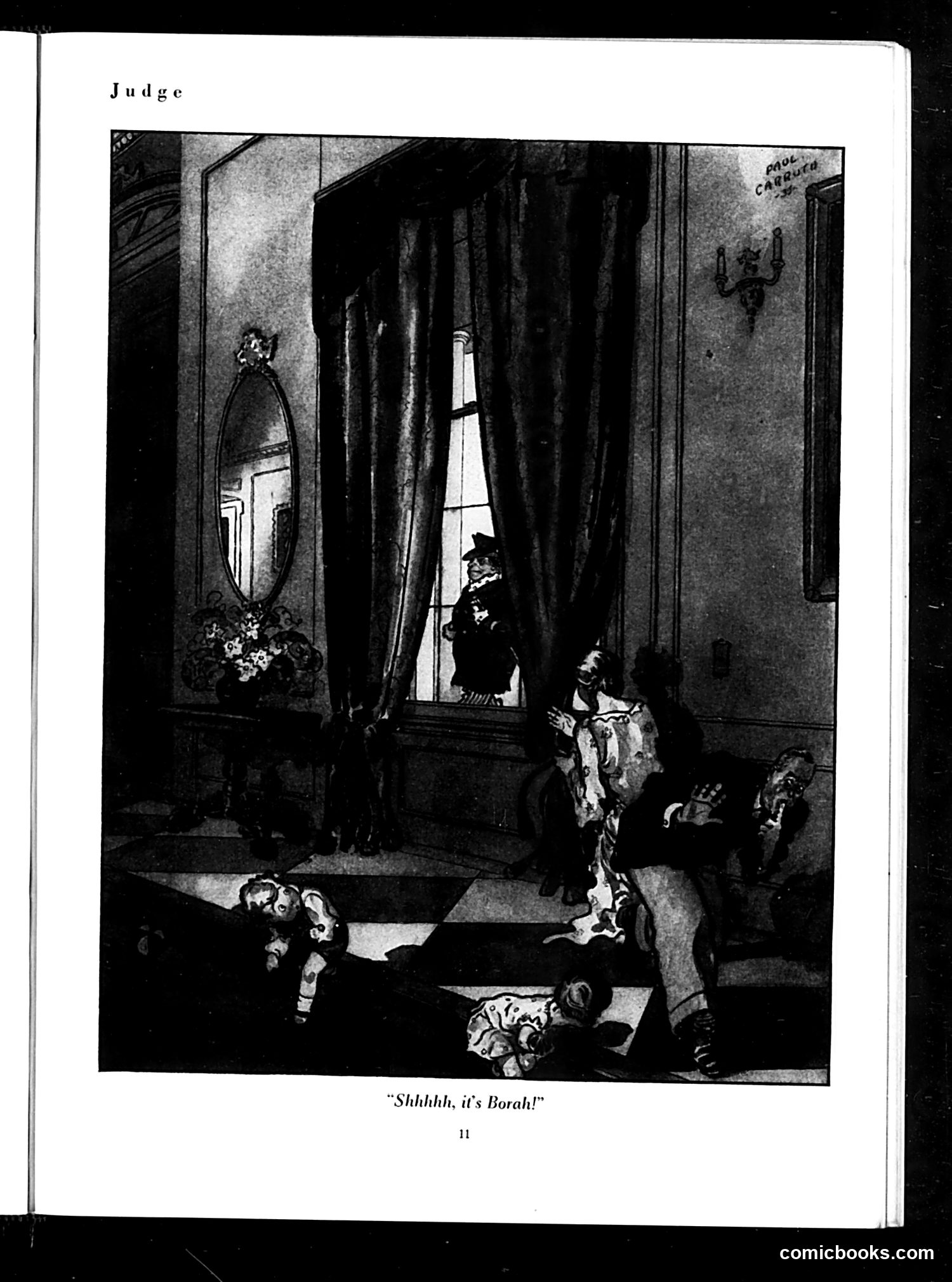
Judge Magazine Page Analysis This page from Judge magazine features a single cartoon titled "Shhhh, it's Borah!" (page 11). The image depicts an elegant interior with a woman at a window and figures in period dress. The caption suggests the cartoon references someone named Borah—likely Senator William E. Borah, a prominent early-20th-century political figure known for his isolationist stance and outspoken nature. The satire appears to play on Borah's reputation, with the "shhhh" suggesting irony about someone known for being loud or vocal being told to be quiet. The elegant domestic setting and formal dress suggest the cartoon may be commenting on a political or social scandal, though without additional context, the specific satirical point remains unclear.
Judge Magazine Commentary: "Horse Sense" and Social Critique This page from Judge presents two satirical essays attacking American priorities and attitudes. "Horse Sense" mocks horse-racing obsession. The piece notes that Americans devote extraordinary intellectual effort—studying genealogy, psychology, mathematics, meteorology—entirely to predicting race outcomes, yet rarely succeed and often die poor. The satire's bite comes from suggesting this same dedication applied to marriage would improve domestic life far more productively. The author wonders sarcastically whether understanding a wife as thoroughly as a horse would create happiness or merely confirm she'll "run like a favorite"—escape. "Let's Worry About Our Great-Grandchildren" ridicules economic anxiety about future generations' debt while present-day workers struggle with immediate rent. The satire targets "Old Guard economists" (likely referring to Depression-era anxieties) for fretting over hypothetical future toll charges on bridges "not yet built"—criticizing worry about distant, speculative problems while ignoring current poverty. Both essays employ Judge's characteristic sardonic tone, using exaggeration to expose American absurdities: misplaced intellectual energy and disconnected elite concerns.
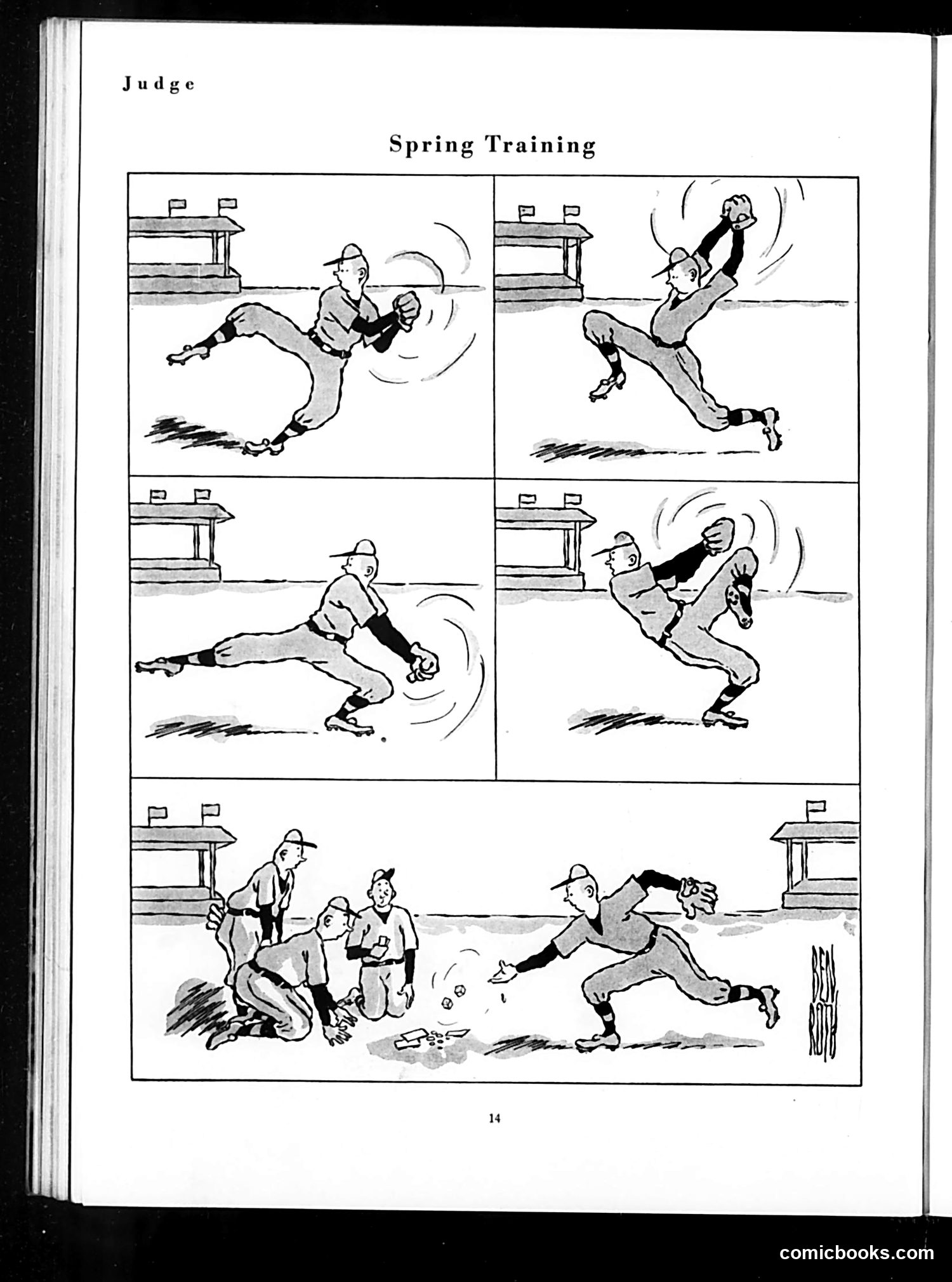
Spring Training for Baseball Judges This instructional cartoon illustrates fielding techniques for baseball umpires (judges), using humor to teach proper positioning and movement. The six panels show an umpire demonstrating various defensive moves—diving, jumping, stretching, and crouching—necessary for making accurate calls on the field. The satire plays on the double meaning of "judge": both baseball umpires and legal judges must be agile, attentive, and positioned correctly to render proper decisions. By depicting an umpire performing athletic "spring training," Judge magazine suggests that legal judges should be equally prepared and physically/mentally flexible in their judicial work. The cartoon appears designed as both entertainment and gentle commentary on judicial preparation and vigilance.
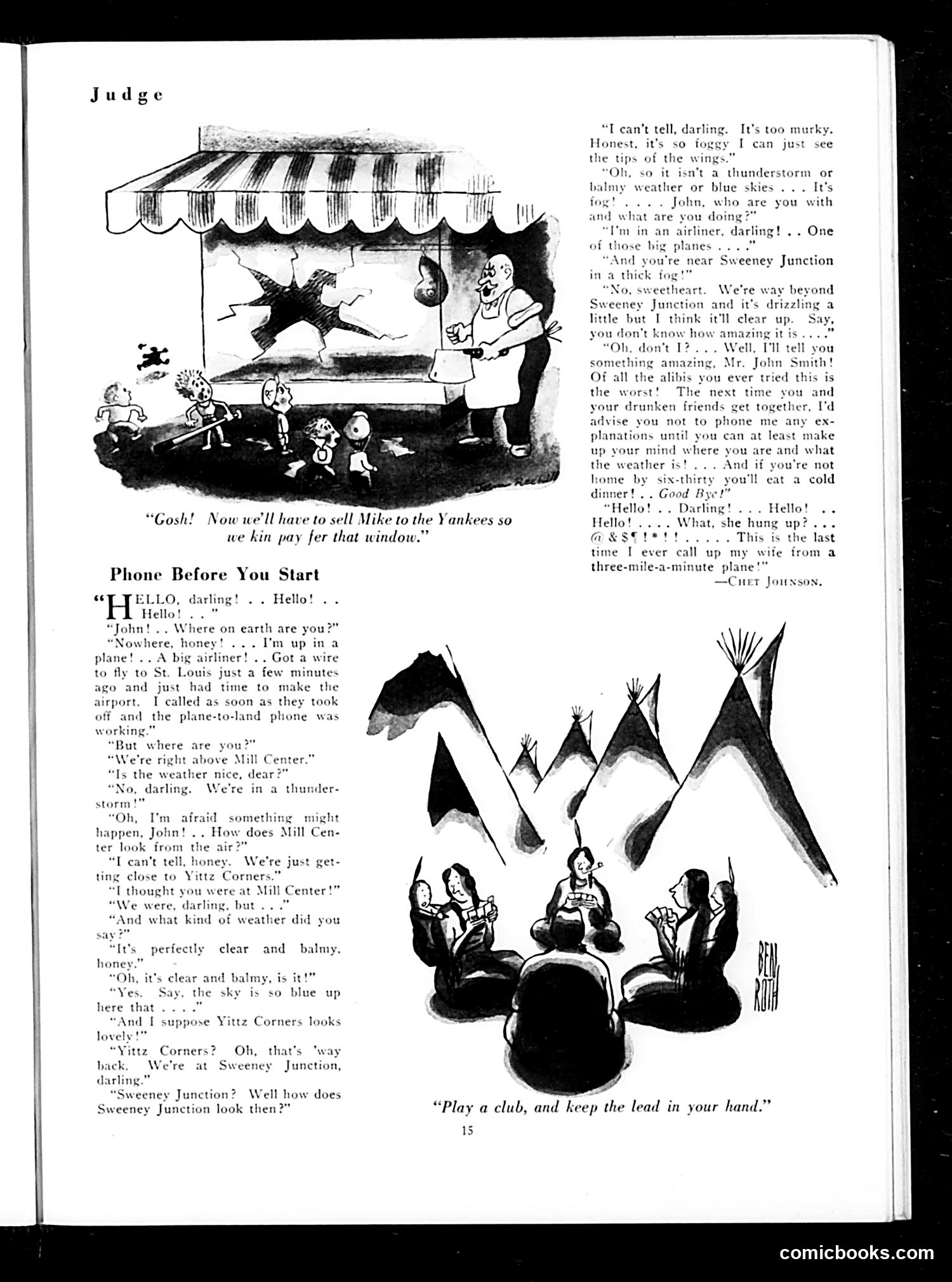
Judge Magazine Cartoon Analysis This is a satirical take on the novelty of airplane-to-ground telephone service, a new technology of the era (likely 1930s). The joke mocks both the unreliability of early aviation communication and marital dynamics. A husband calls his wife from an airliner, but his story keeps shifting—he claims to be at different locations (Mill Center, Yittz Corners, Sweeney Junction) with contradictory weather reports (thunderstorm, then clear skies, then fog). The wife, exasperated, concludes he's lying—possibly making excuses for being drunk with friends rather than actually flying. She delivers a withering ultimatum about his alibis being "the worst" and threatens he won't get dinner if he's late. The satire targets both the unreliable new technology and the stereotype of husbands inventing elaborate excuses. The final line, where he curses never calling again, completes the domestic comedy.
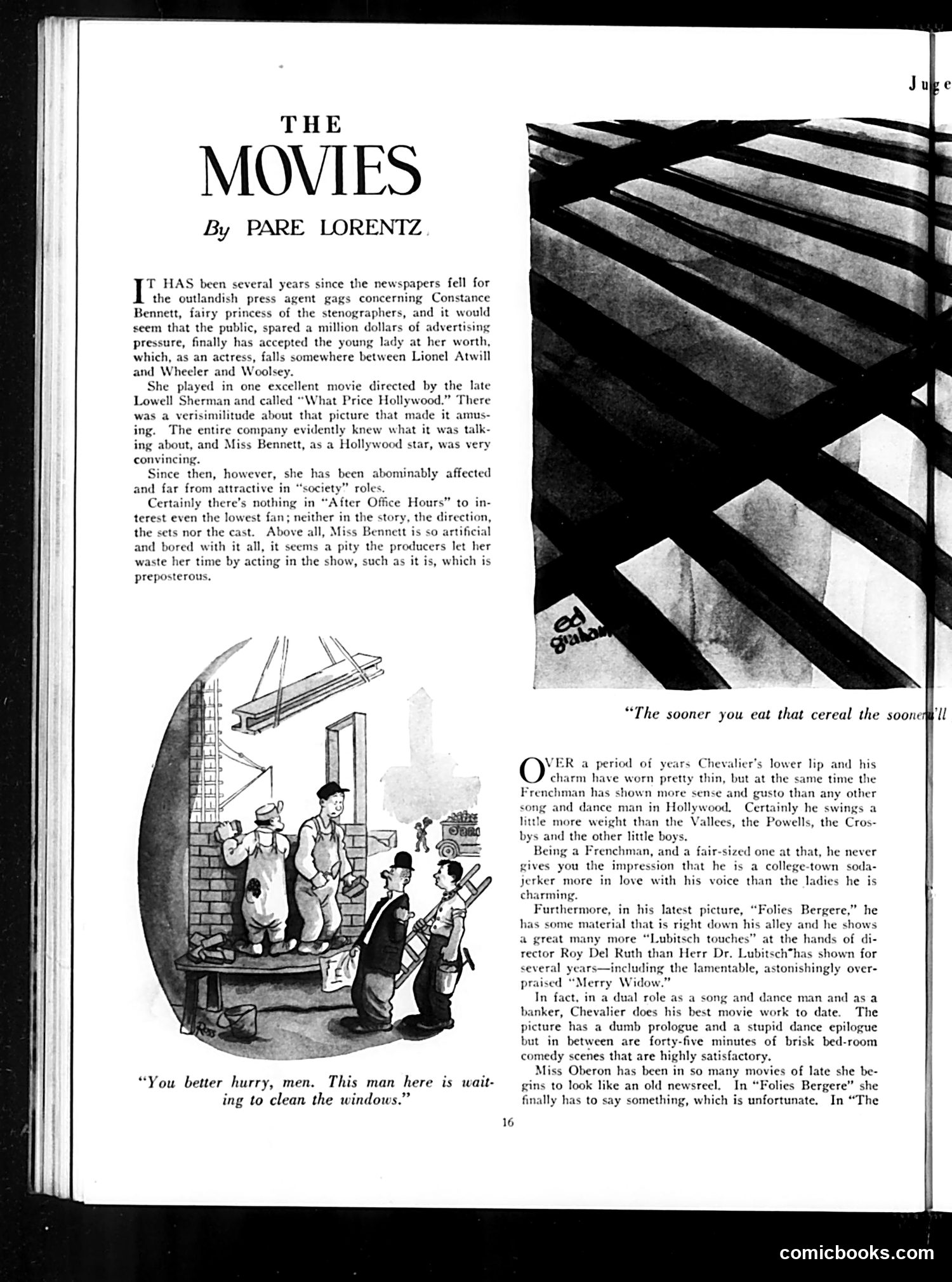
Analysis This is a film criticism column by Pare Lorentz reviewing contemporary movies. The page contains one cartoon showing workers being told to hurry cleaning windows because "this man here is waiting"—likely a visual joke about impatient film crews or studio inefficiency, though the exact reference is unclear. The text critiques actress Constance Bennett, claiming her early film "What Price Hollywood" was excellent but her subsequent "society" roles in "After Office Hours" are boring and artificial. Lorentz praises French performer Maurice Chevalier for his substantive presence compared to other "song and dance men" like Vallée and Powell. He favorably reviews Chevalier's dual role in "Folies Bergere" for its comedic middle section, though criticizes its prologue and epilogue. The column dismisses actress Merle Oberon as overexposed in recent films. The humor relies on insider Hollywood knowledge and specific film references from approximately the 1930s.
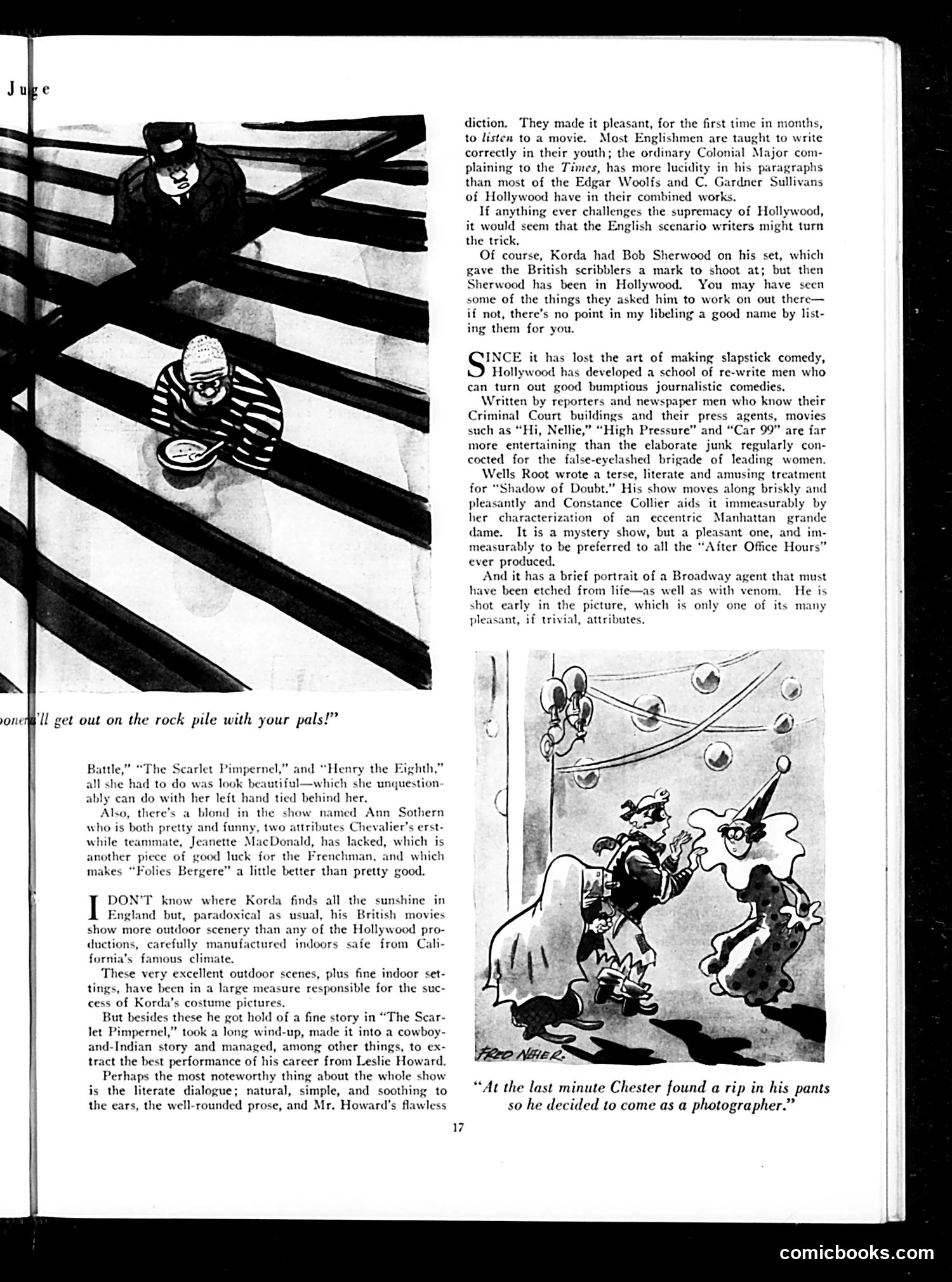
Judge Magazine Content Analysis This page reviews several films, comparing British and Hollywood productions. The main critique contrasts English screenwriters' literary sophistication with Hollywood's formulaic approaches. The text praises British director Korda's "The Scarlet Pimpernel" (adapted from the famous adventure novel) for its intelligent dialogue and Leslie Howard's performance, noting that English-educated writers produce more articulate work than their American counterparts. It dismisses elaborate "leading lady" vehicles as inferior to newer journalistic comedies written by reporters. The bottom cartoon (credited to what appears to be "Rod Nutter") is a single-panel joke: a man named Chester discovered a rip in his pants at the last moment, so he decided to attend an event as a "photographer" instead—implying photographers carry cameras that would conveniently conceal the damage. It's a simple visual gag about social embarrassment and improvisation.
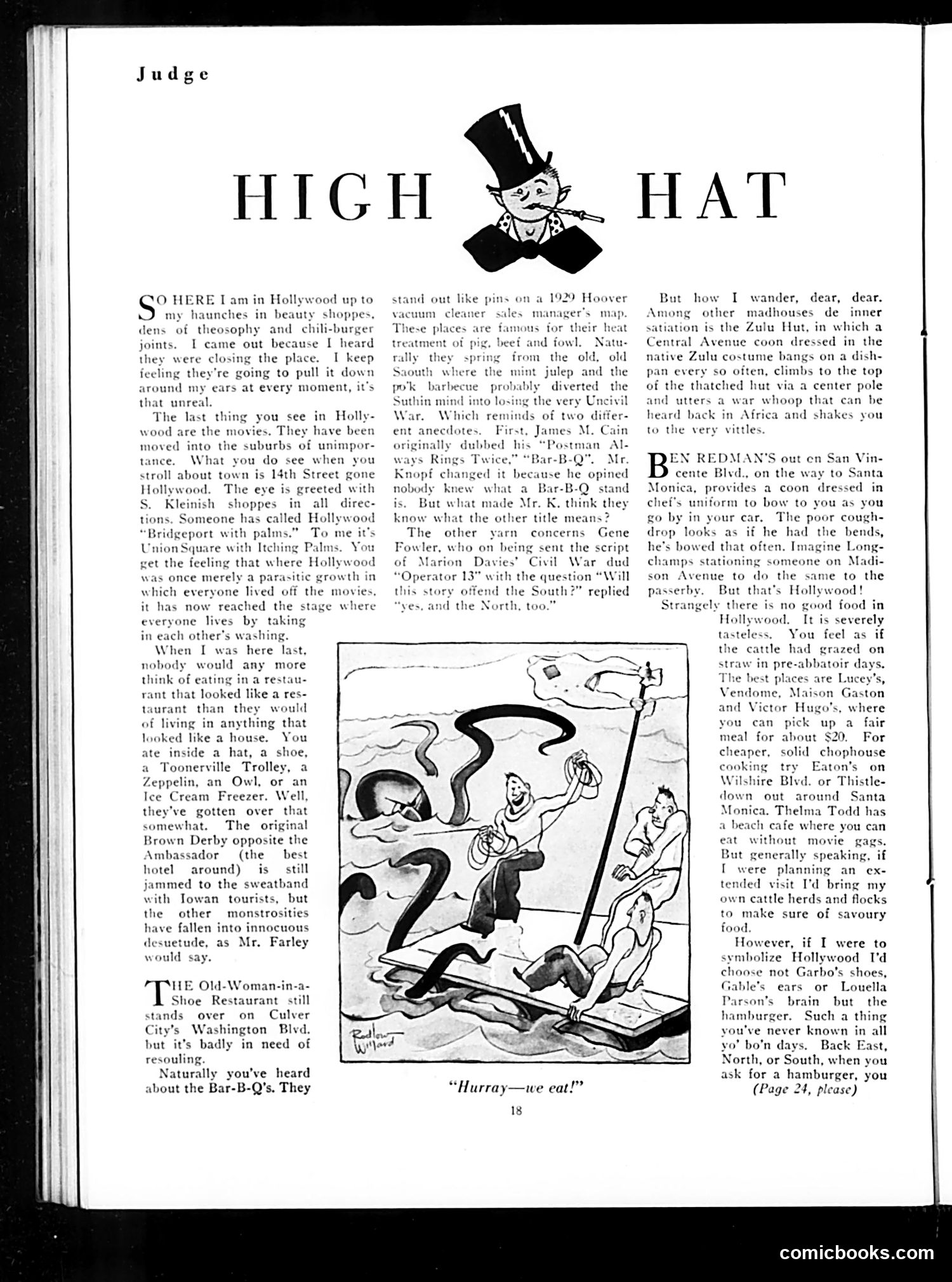
"High Hat" - Judge Magazine Commentary on 1920s Hollywood This is a humorous essay by a visiting journalist describing Hollywood's shallow materialism and pretension. The author catalogs the town's affectations: themed restaurants (Old-Woman-in-a-Shoe, Zulu Hut, Ben Redman's) that mock authenticity, and phony "artistic" dining establishments where diners sit in novelty structures rather than normal restaurants. The accompanying cartoon shows people skiing down a giant question mark, illustrating the absurdity and confusion of Hollywood culture. The author references film industry figures like James M. Cain and Gene Fowler, critiquing how movie titles become incomprehensible (the "Bar-B-Q" naming dispute). The piece's satire targets Hollywood's pretentiousness—residents who've abandoned genuine culture for manufactured exoticism and surface-level glamour. The author concludes Hollywood's essence is best symbolized by the mediocre hamburger: all hollow performance, no substance. The tone is sharply critical of entertainment-industry vanity disguised as sophistication.
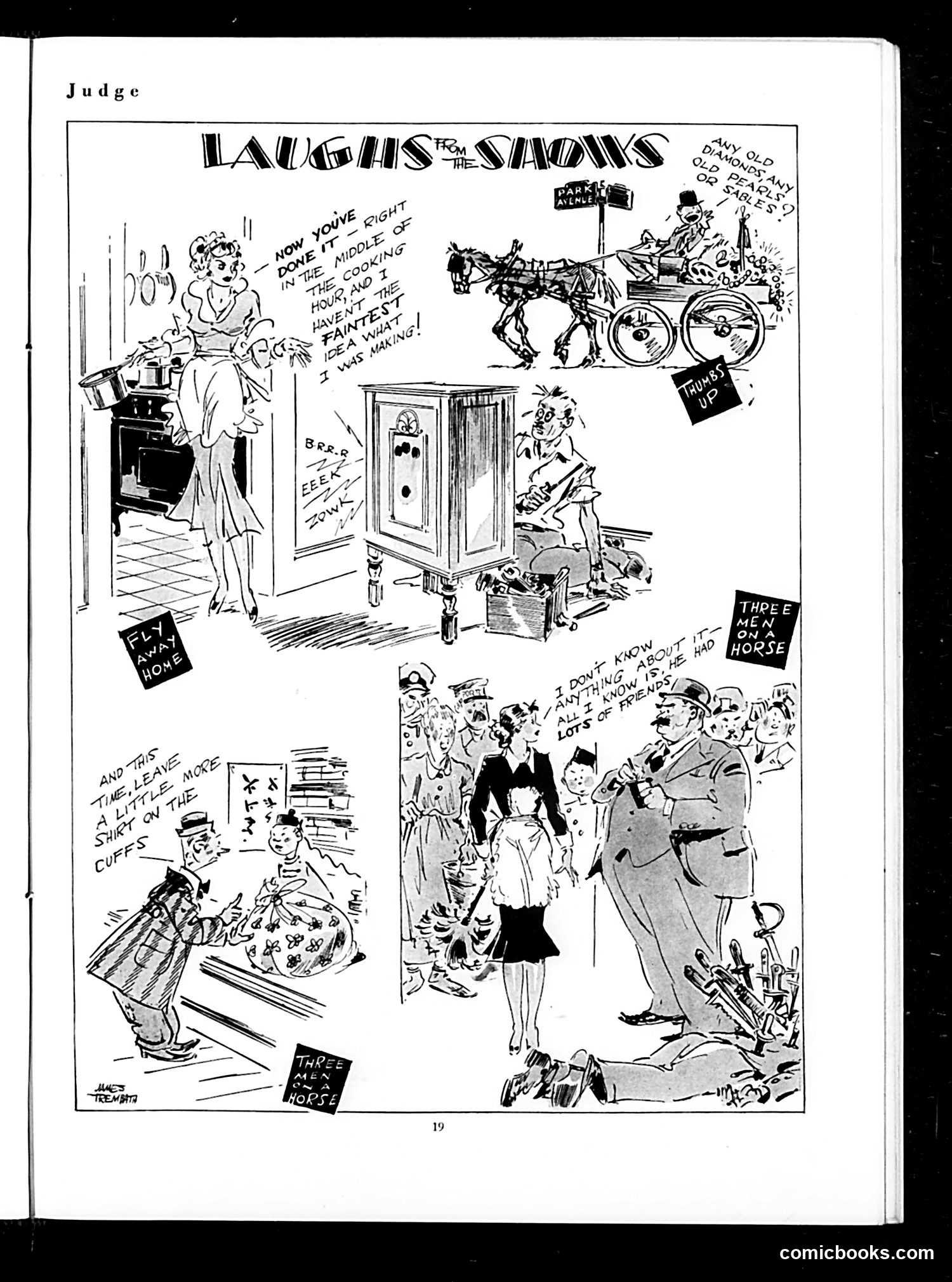
"Laughs from the Shadows" - Judge Magazine Cartoon Page This page presents several interconnected gags satirizing domestic life and social pretensions, likely from the early-to-mid 20th century based on the art style. The recurring joke "THREE MEN ON A HORSE" appears multiple times, suggesting a popular reference (possibly theatrical or literary). Individual panels mock: - A woman overwhelmed by household tasks and laundry - A mysterious cabinet or closet (possibly suggesting infidelity or hidden scandal) - Children's misbehavior and parental exasperation - A woman proudly displaying her children to what appears to be an aristocratic or wealthy observer The humor targets typical middle-class domestic chaos, marital tensions, and the gap between social aspirations and messy reality. The repeated "THREE MEN ON A HORSE" tagline suggests a punchline framework connecting otherwise separate vignettes about everyday life's absurdities.
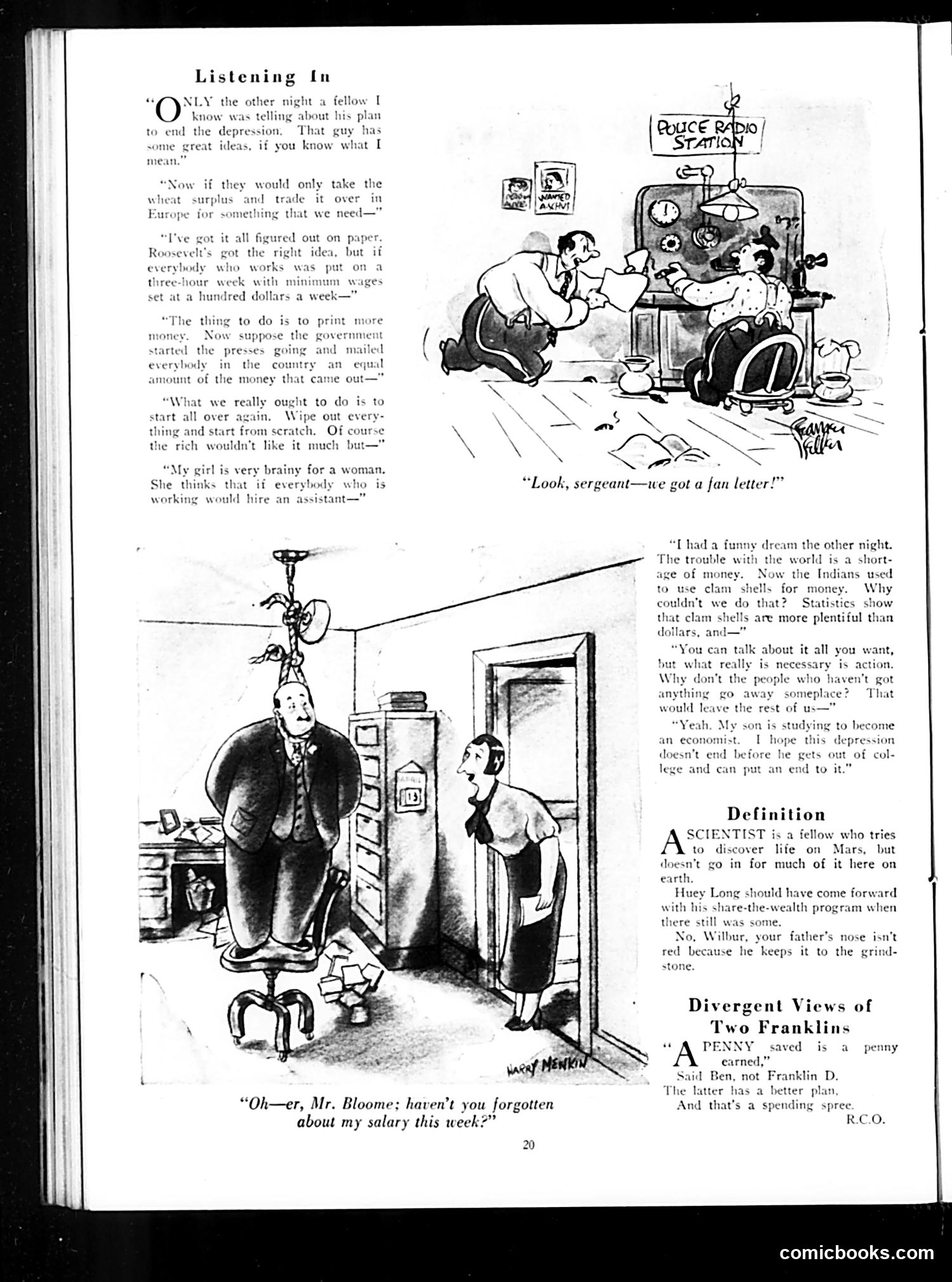
Analysis of Judge Magazine Page This page satirizes Depression-era economic debates through multiple cartoons and quips. Top cartoon: A police radio station receives a fan letter—likely mocking ordinary citizens proposing grandiose depression remedies to authorities, suggesting public desperation and armchair economics. "Listening In" section: Satirizes various amateur economic theories circulating during the Depression: printing more money, wealth redistribution, starting over from scratch, using clam shells as currency, and hiring the unemployed. The tone ridicules these naive proposals. Bottom cartoon: Mr. Bloome, apparently a boss, is confronted about an employee's unpaid salary—dark humor about widespread wage theft during economic hardship. "Divergent Views of Two Franklins": Contrasts Benjamin Franklin's maxim "a penny saved is a penny earned" with Franklin D. Roosevelt's spending-based recovery programs (likely New Deal initiatives). The joke critiques FDR's approach as contrary to traditional financial wisdom, reflecting contemporary conservative opposition to his policies. The page reflects 1930s debates between traditional fiscal conservatism and New Deal interventionism.
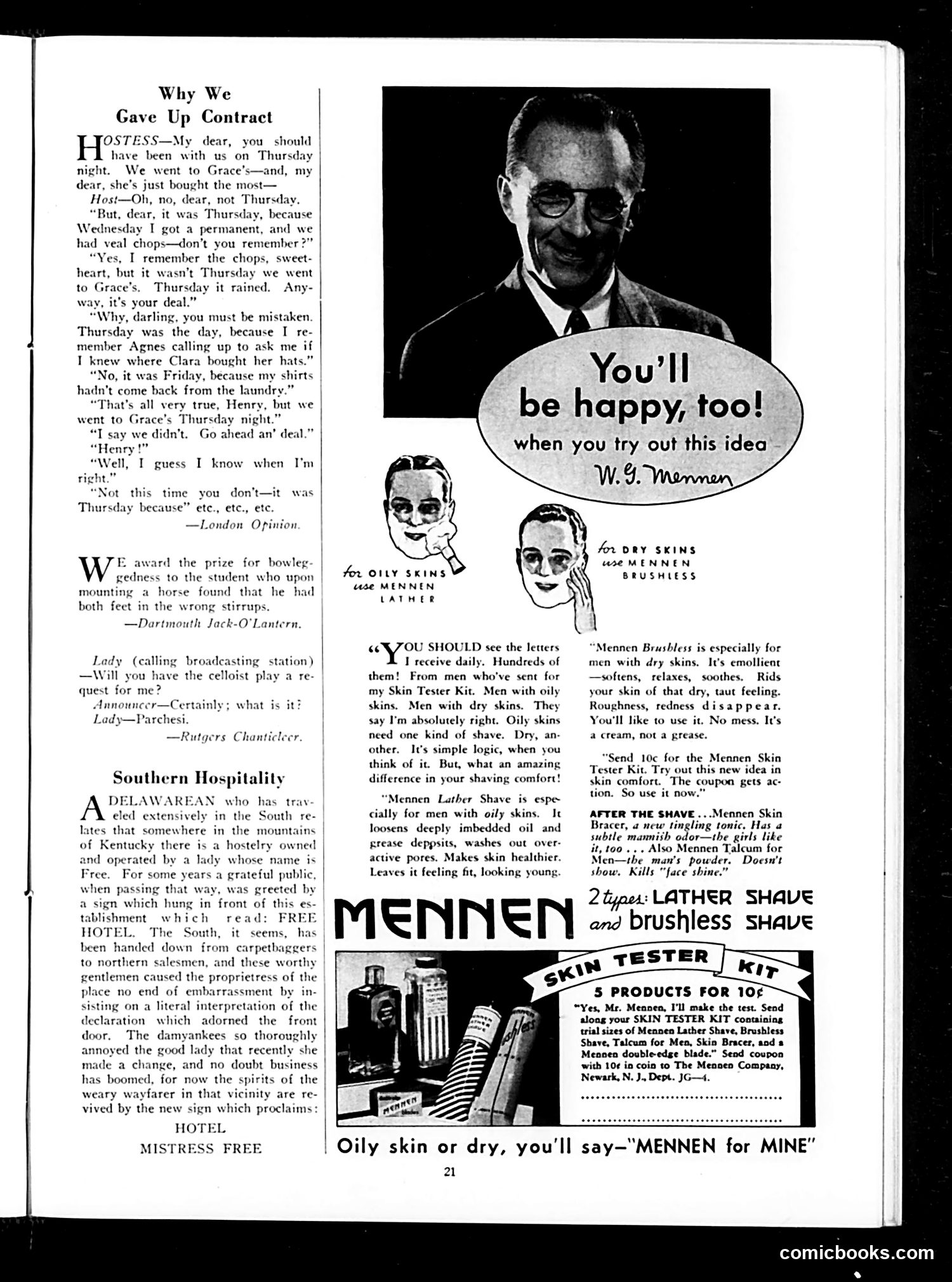
Analysis of Judge Magazine Page This page combines humor pieces with advertising. The main content includes: "Why We Gave Up Contract": A marital dispute joke where a husband and wife argue about what day they attended dinner at a friend's house. Each misremembers the date based on unrelated events (her permanent wave, veal chops, his laundry). The humor lies in the absurdity of their contradictory "evidence" and the couple's deteriorating ability to agree on facts—ending their card game partnership. This reflects period anxieties about marriage and domestic disagreement. "Southern Hospitality": A brief anecdote mocking Northern carpetbaggers (post-Civil War Northerners who exploited the South). A Kentucky hotel owner's "FREE HOTEL" sign attracted opportunistic travelers until she changed it, suggesting Northerners lacked Southern gentility and took hospitality literally rather than as genuine courtesy. Mennen Shaving Products Advertisement: The dominant right portion is a commercial for men's grooming products, featuring testimonials claiming different shave formulas suit oily versus dry skin types.
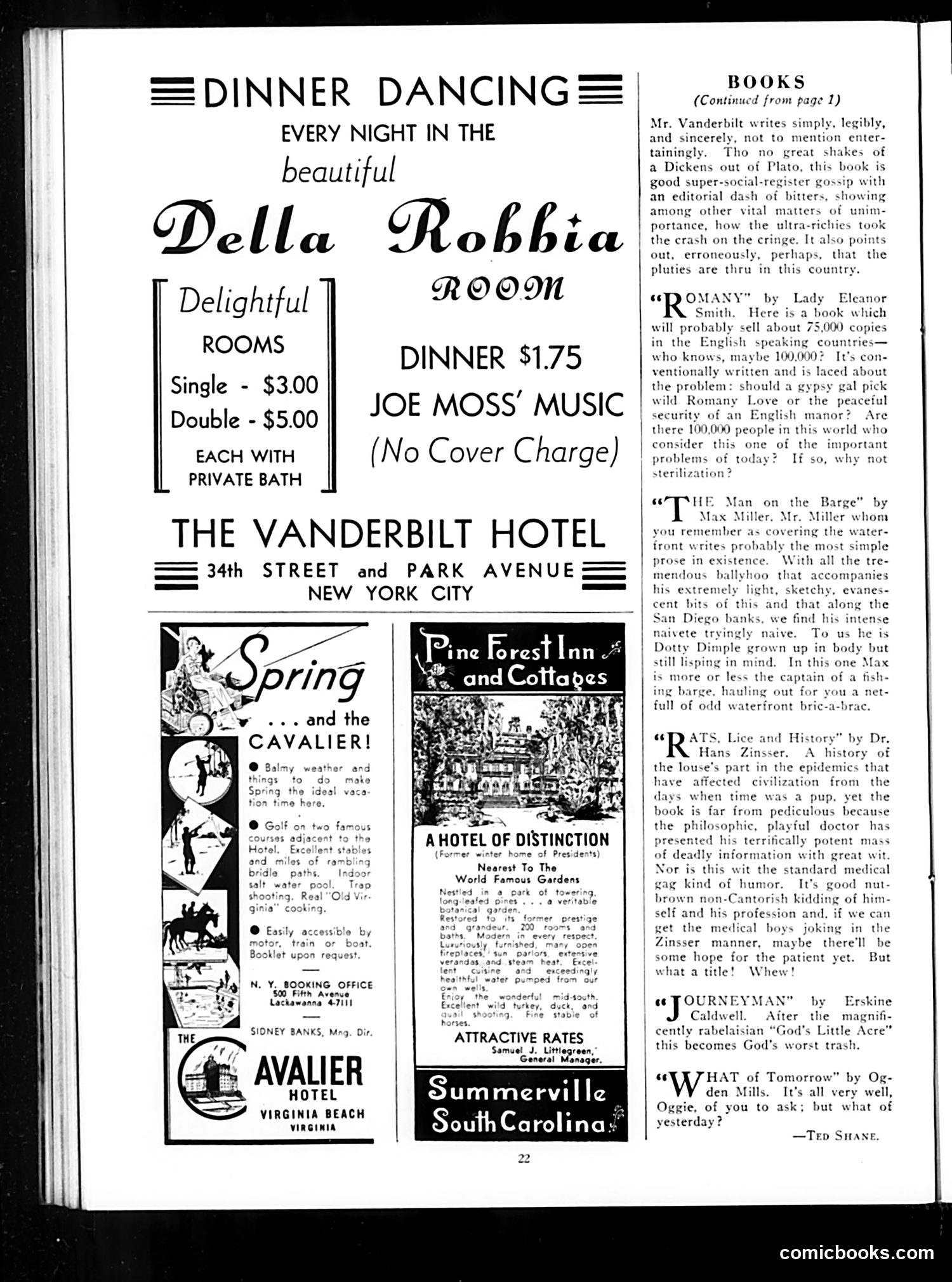
This page is primarily advertising and book reviews, not political satire. The left side features hotel and resort advertisements (The Vanderbilt Hotel in NYC, The Cavalier in Virginia Beach, Pine Forest Inn in South Carolina, and Summerville South Carolina). These showcase 1920s-30s leisure travel marketing. The right side contains book reviews by what appears to be Ted Shane (the byline visible at bottom). Reviews discuss contemporary novels including works by Lady Eleanor Smith ("Romany"), Max Miller ("The Man on the Barge"), Dr. Hans Zinsser ("Rats, Lice and History"), Erskine Caldwell ("Journeyman"), and Ogden Mills ("What of Tomorrow"). The reviews are humorous criticism—Shane uses witty, sometimes caustic commentary about each book's merit or lack thereof. For instance, he dismisses Caldwell's work as "God's worst trash" following his earlier success. This is a typical magazine page mixing commercial advertising with literary commentary, not political cartooning.
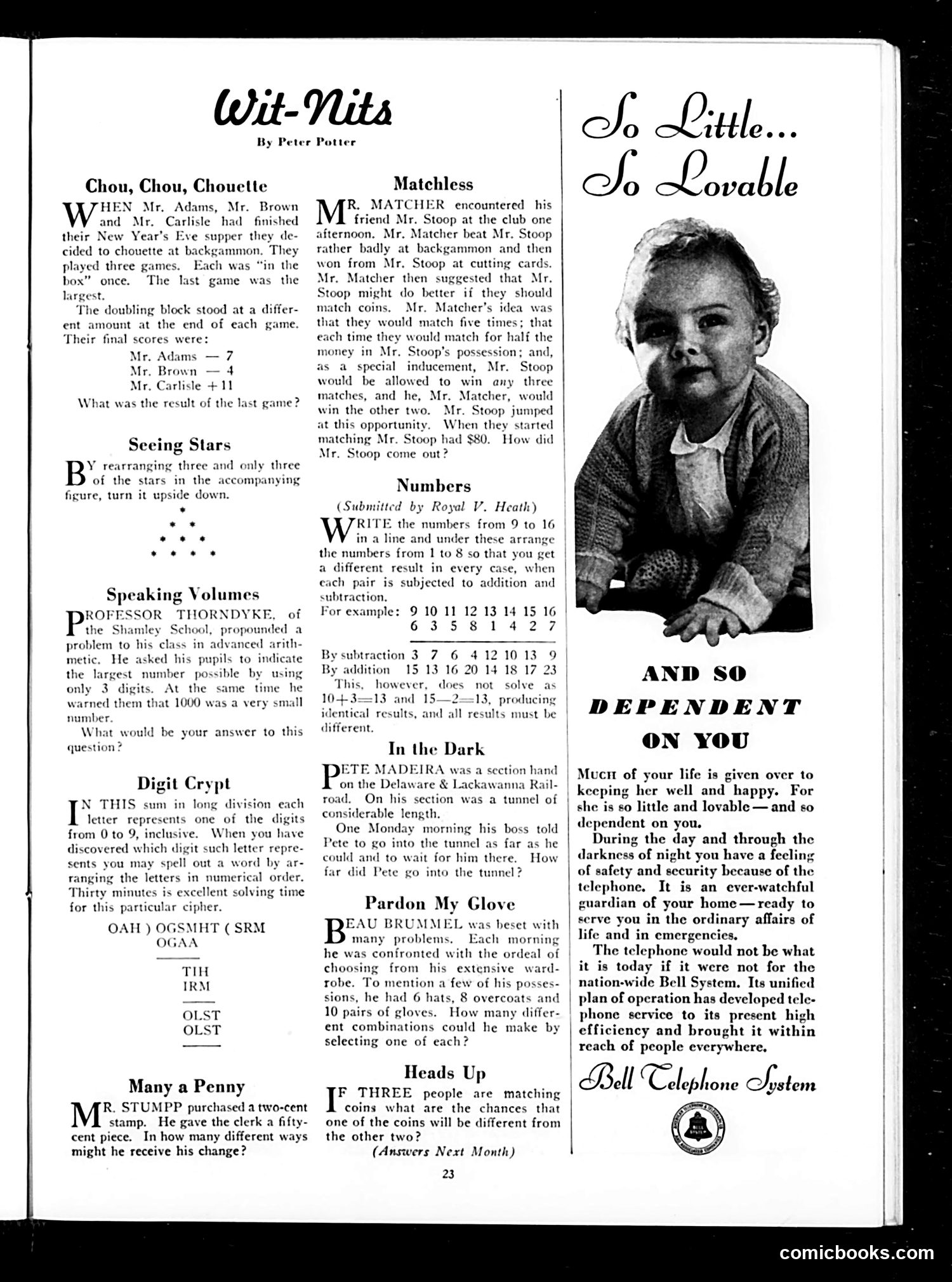
Explanation for Modern Readers This is a puzzle and humor page from *Judge* magazine, not a political cartoon. The content consists entirely of recreational math puzzles and wordplay riddles typical of early 20th-century magazines. The "wit-nits" column presents brain-teasers: card game scoring problems, star-rearrangement puzzles, cipher decryption, coin-matching probability, and combinatorics (hat/glove selection). These are lighthearted intellectual exercises for readers. The page also includes a Bell Telephone System advertisement featuring a photograph of a woman with text emphasizing the telephone's role as a "guardian" of the home during emergencies—reflecting early telephone marketing that positioned the technology as essential domestic safety equipment. No political satire, caricature, or social commentary appears on this page. It's simply recreational content and advertising.
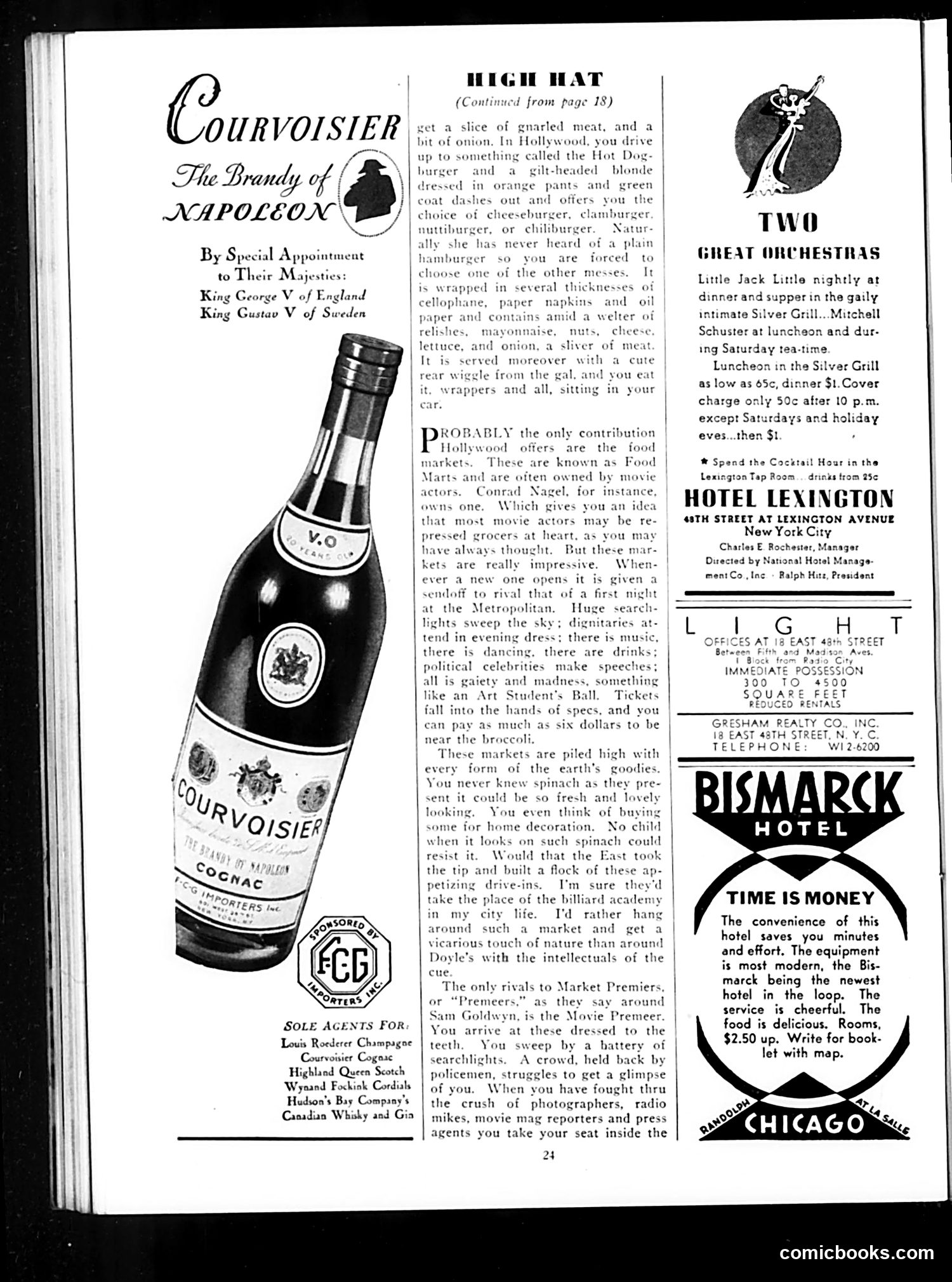
Analysis of Judge Magazine Page This page is primarily advertising, not satire or political commentary. It features luxury brand advertisements typical of Judge magazine's upscale readership circa 1920s-1930s. The main content is a Courvoisier Cognac advertisement (left side), emphasizing the brandy's prestige through royal appointments to King Gustav V of Sweden and listing exclusive liquor distributors. The right side contains a continuation of an article titled "HIGH HAT" (from page 18) mocking Hollywood culture and food trends—specifically hot dog stands and "Food Marts" (likely early drive-ins), which the author treats with amused condescension. The piece satirizes movie actors pretending to be grocers and the social pretension surrounding movie premieres. Below are hotel and restaurant advertisements (Hotel Lexington, Bismarck Hotel, Light Lofts) targeting affluent urban readers. The satire is social/cultural rather than political: Judge ridicules nouveau-riche Hollywood ostentation while its advertisements simultaneously market luxury goods to the same wealthy audience—a typical Judge editorial contradiction.
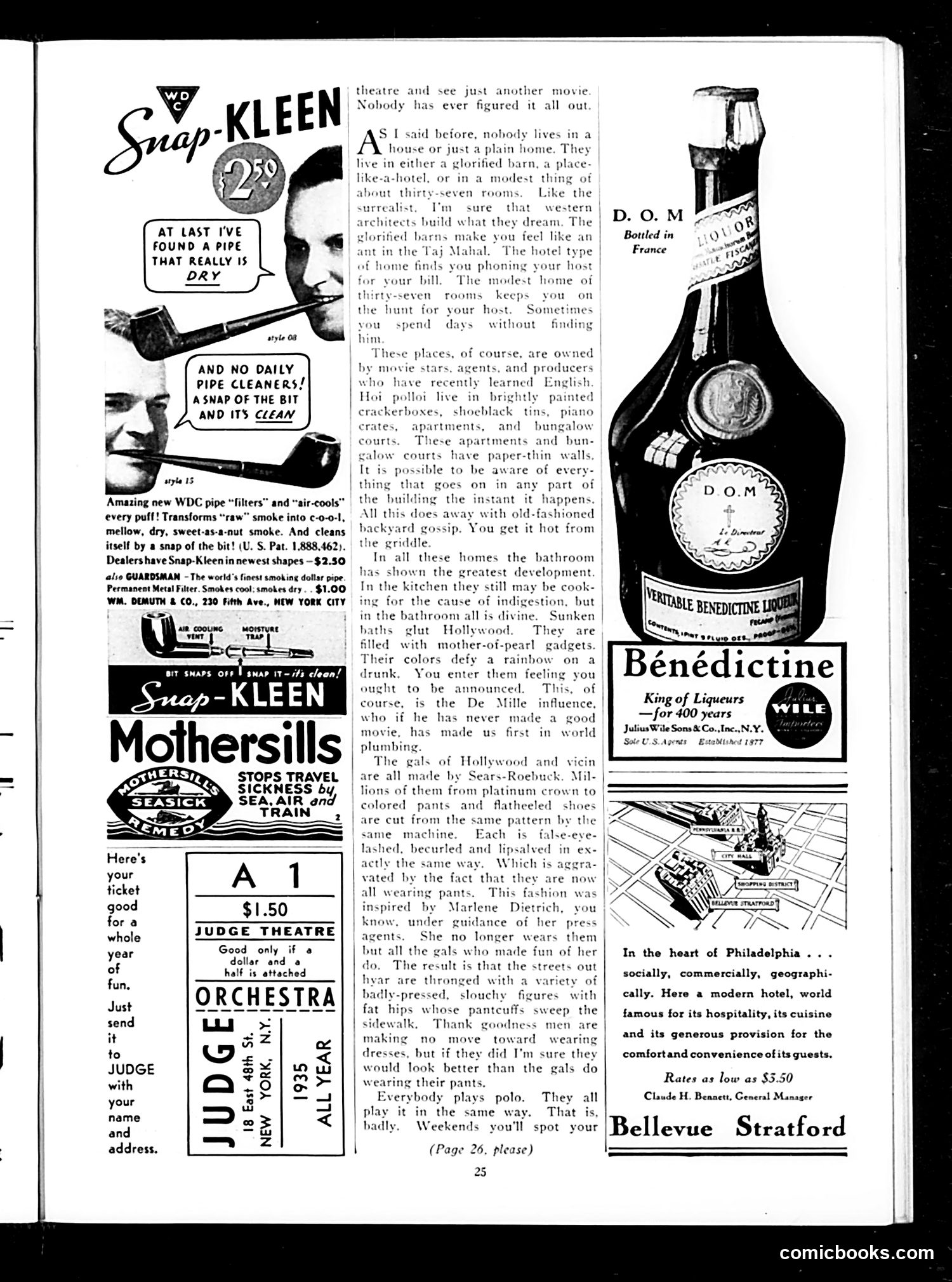
Judge Magazine Page Analysis This page mixes advertisements with social satire about Hollywood culture. The Snap-Kleen pipe ads (top left) tout a new smoking pipe with built-in filters—a practical consumer product pitched as solving the annoying problem of constant pipe cleaning. The main satirical article (center column) mocks Hollywood's architectural and lifestyle absurdities. The unnamed author observes that movie industry figures—stars, agents, producers—don't live in normal homes but in ostentatious fantasies: glorified barns, hotel-like structures, or "modest" thirty-seven-room compounds. The satire targets their bathroom excess (sunken tubs with mother-of-pearl), particularly the influence of Cecil B. DeMille's lavish aesthetic on plumbing design. Most pointedly, the piece ridicules how Marlene Dietrich's fashion trend of wearing men's pants has spread among Hollywood women, creating streets "thronged" with poorly-dressed actresses in unflattering pantcuffs. The author suggests the trend looks better on its originator than on followers. The remaining ads (Bénédictine liqueur, Bellevue Stratford hotel, Judge Theatre ticket) are period marketing.
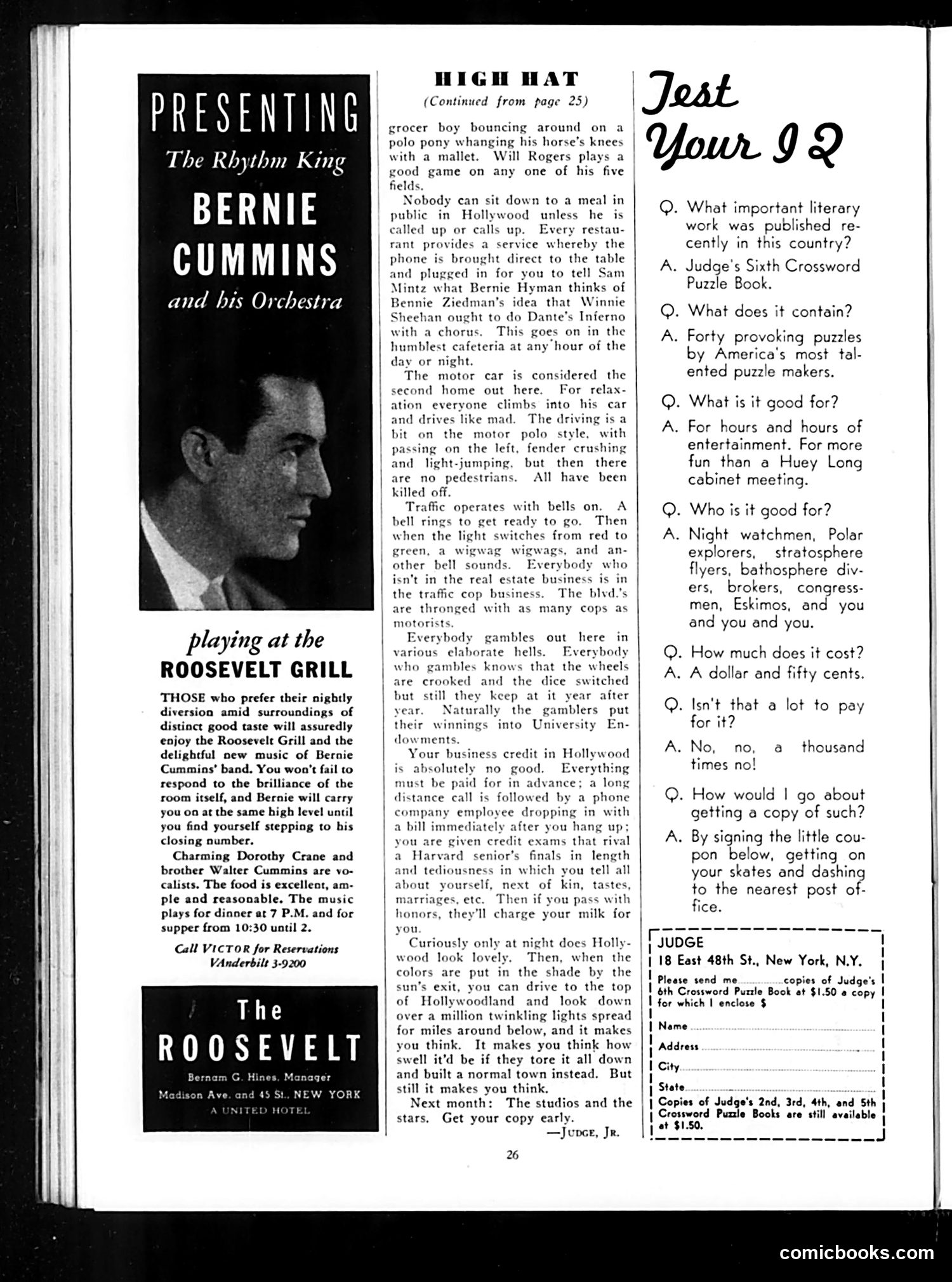
"High Hat" - A Satire of 1920s Hollywood Culture This page satirizes the pretensions and absurdities of Hollywood society circa the 1920s-30s. The main article mocks the leisure activities and social customs of film industry figures: polo games played by celebrities like Will Rogers, the obsession with telephone accessibility during meals, reckless driving styled after "motor polo," and widespread gambling with rigged wheels and switched dice—yet winnings mysteriously donated to universities for respectability. The satire targets Hollywood's complete lack of business credit, requiring cash advances even for phone calls, and its peculiar inversion where the town looks beautiful only at night under artificial lights, masking its daytime ordinariness. The Bernie Cummins orchestra advertisement and "Test Your IQ" puzzle book ad are secondary commercial content. The satire's bite comes from exposing Hollywood as a bubble of artificial sophistication hiding moral and financial recklessness beneath glamorous surfaces.
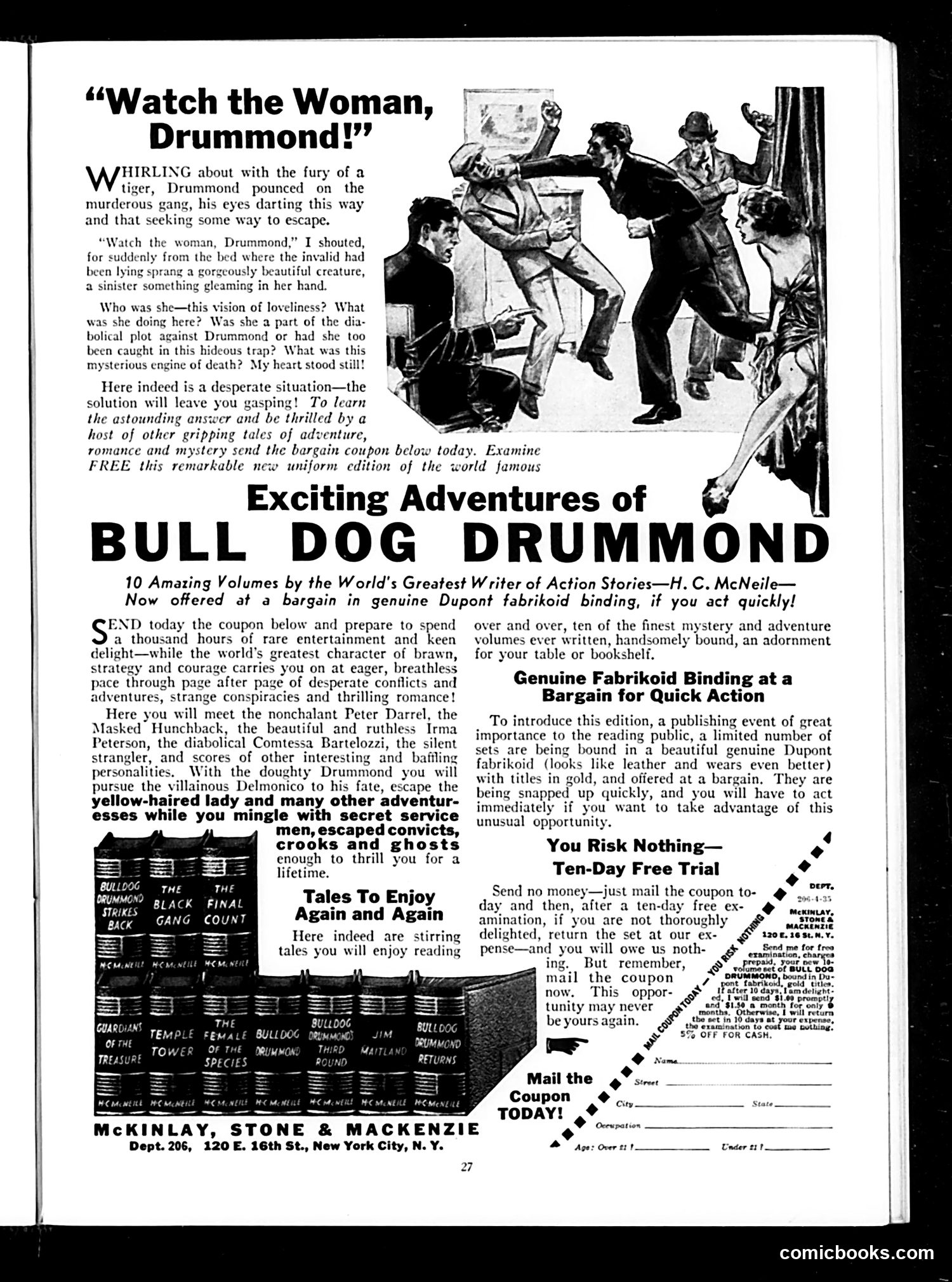
Analysis for Modern Readers This is primarily advertising, not political satire. It promotes the "Bull Dog Drummond" adventure book series by H.C. McNeile—a popular pulp fiction character of the 1920s-30s known for action and mystery plots. The narrative snippet at top ("Watch the Woman, Drummond!") dramatizes a typical plot: Drummond confronts a criminal gang when a mysterious beautiful woman emerges from a sickbed wielding an unknown weapon. The teaser asks: Is she villain or victim? This melodramatic setup—with themes of betrayal, conspiracy, and beautiful dangerous women—was standard pulp fiction fare. The ad emphasizes the 10-volume set's appeal through character names (the Masked Hunchback, Irma Peterson) and plot elements (secret service, escaped convicts, ghosts). The "genuine Dupont fabrikoid binding" and gold lettering position it as an affordable luxury item for the home library. The ten-day free trial and coupon were typical mail-order sales tactics of the era. No satire is evident—this is straightforward period advertising.
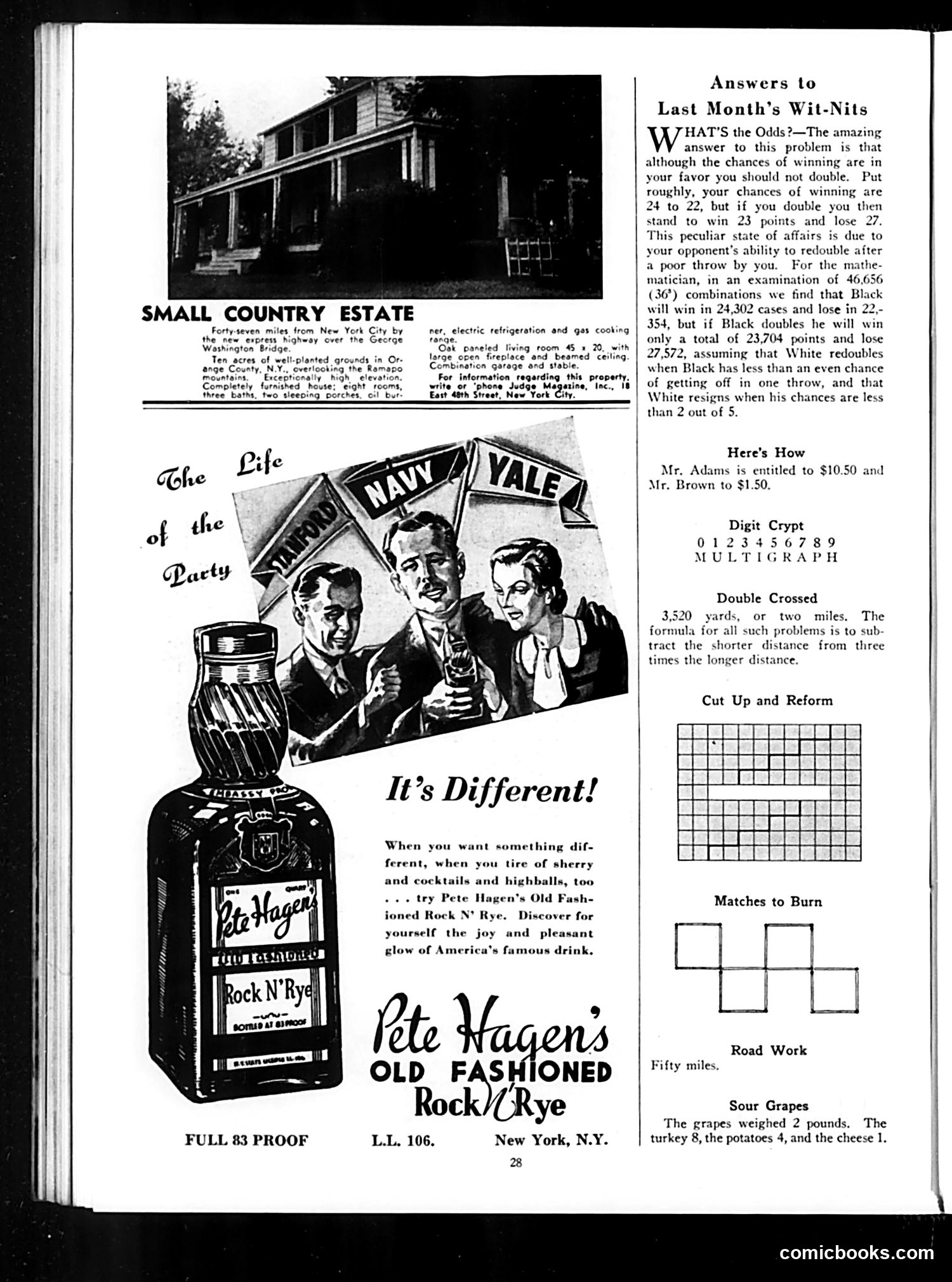
Judge Magazine Page Analysis This page is primarily advertising and puzzle content rather than political satire. The dominant feature is a full-page advertisement for Pete Hagen's Old Fashioned Rock N' Rye whiskey, featuring three men in military uniforms (Navy and Yale insignia visible) toasting with the product. The ad's appeal to returning servicemen suggests this is from the post-World War II era. The page also contains: - A real estate listing for a country estate near New York - "Answers to Last Month's Wit-Nits"—a puzzle and games section featuring mathematical problems (backgammon strategy), word puzzles ("Digit Crypt"), and logic problems The whiskey advertisement's military imagery reflects how advertisers targeted veterans in the 1940s, positioning alcohol consumption as part of civilian leisure and celebration. The "It's Different!" tagline emphasizes the product's distinctiveness in a competitive market.
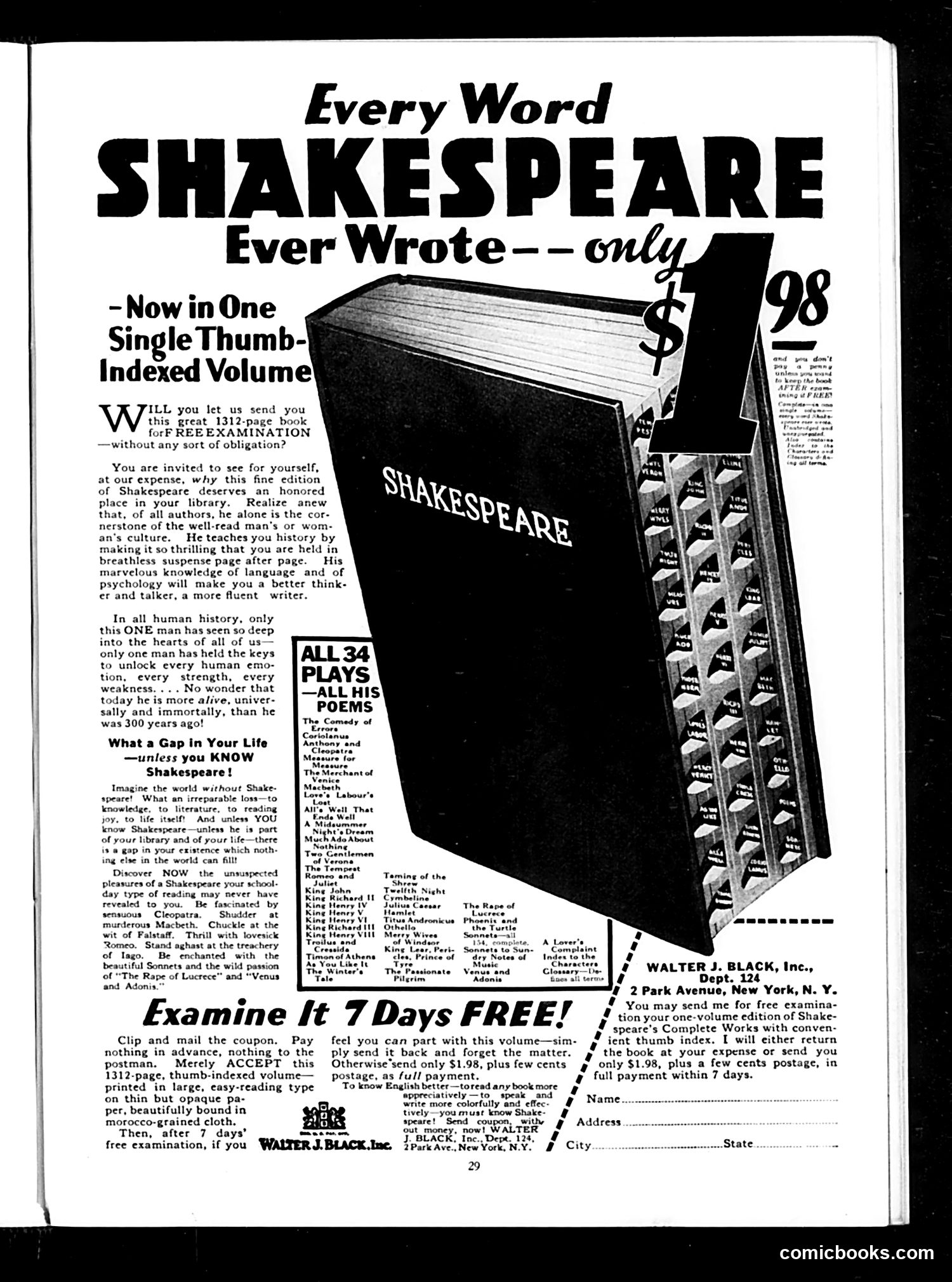
Advertisement, Not Satire This page is a book advertisement, not a political cartoon. It's a promotional piece from Walter J. Black, Inc., selling a complete Shakespeare anthology—all 34 plays and poems in a single thumb-indexed volume—for $1.98 (advertised as a "free examination" offer with payment on approval). The rhetoric is typical early-20th-century marketing: Shakespeare is positioned as essential cultural literacy for the educated person. The copy uses grandiose language ("cornerstone of well-read man's or woman's culture") and appeals to self-improvement and social aspiration—common themes in Judge magazine advertising. The dramatic imagery of the massive book is meant to impress potential buyers with the volume's comprehensiveness and value. There is no satire here; this is a straightforward sales pitch exploiting cultural reverence for Shakespeare to move merchandise.
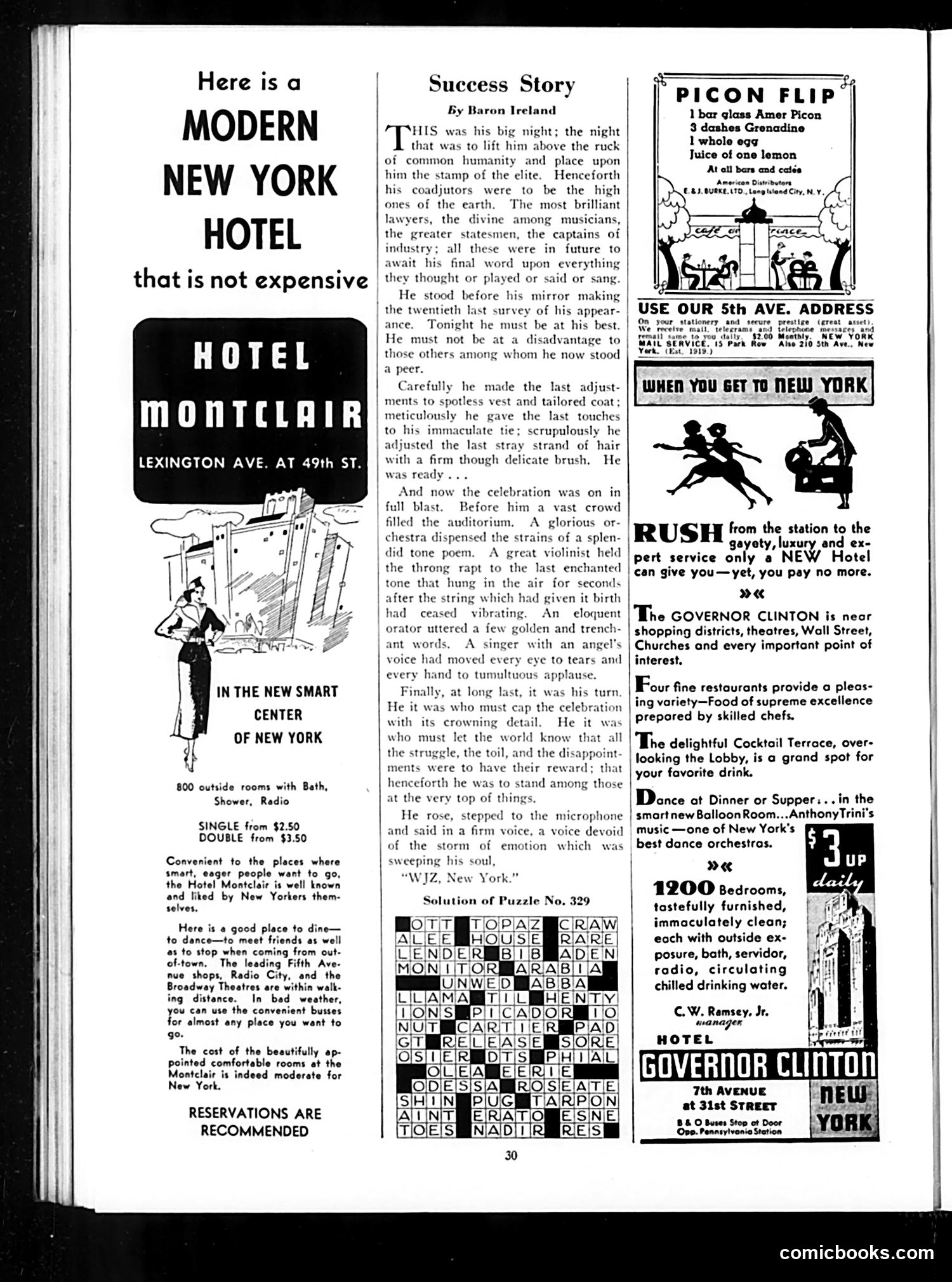
Analysis This page is primarily advertising for New York hotels (Hotel Montclair and Governor Clinton), interspersed with magazine content. The "Success Story" by Baron Ireland is a satirical short story mocking social ambition. A man meticulously prepares for what he believes will be his triumphant moment—standing before an important crowd, positioned to deliver some momentous pronouncement. The buildup is grandiose: brilliant lawyers, statesmen, and captains of industry await "his final word." The punchline reveals the satire: after all this buildup about his elevation to elite status, he steps to the microphone and announces merely "WIZ, New York"—apparently a solution to the crossword puzzle published on the same page (Puzzle No. 329). The joke mocks social pretension and self-importance. The protagonist's elaborate self-preparation and inflated sense of his moment's significance are deflated by the mundane reality: he's simply giving a crossword answer. It satirizes people who overestimate their importance or mistake trivial accomplishments for genuine achievement. The remaining content comprises hotel advertisements and a cocktail recipe—typical magazine filler of the period.
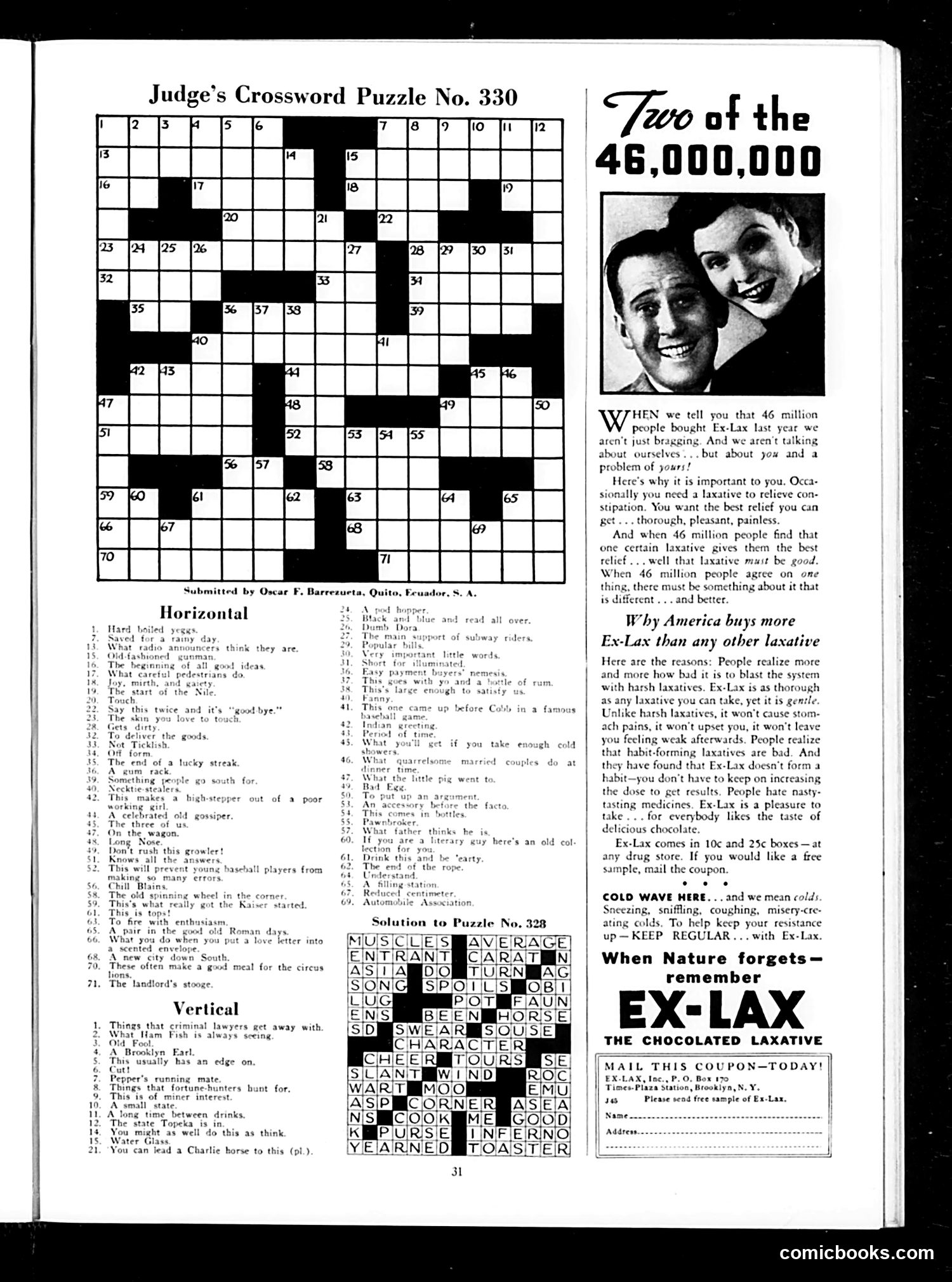
Judge Magazine Page Analysis This page is primarily advertising, not political satire. It features Judge's crossword puzzle (No. 330) with a solution to puzzle No. 328, but the dominant content is a full-page advertisement for Ex-Lax laxative. The ad employs a common mid-20th-century marketing strategy: citing massive consumer adoption (46 million people) as proof of product superiority. It emphasizes Ex-Lax's advantages over "harsh laxatives"—claiming it provides thorough relief without stomach pain, weakness, or habit-formation. The small photograph shows an attractive couple smiling, a typical advertising tactic of the era to associate the product with health, happiness, and social desirability. The heading "When Nature forgets—remember EX-LAX" uses mild humor to normalize discussing constipation, a taboo subject at the time. This represents typical Judge magazine content from its later period: crossword puzzles and paid advertisements occupying substantial page space alongside any satirical material.
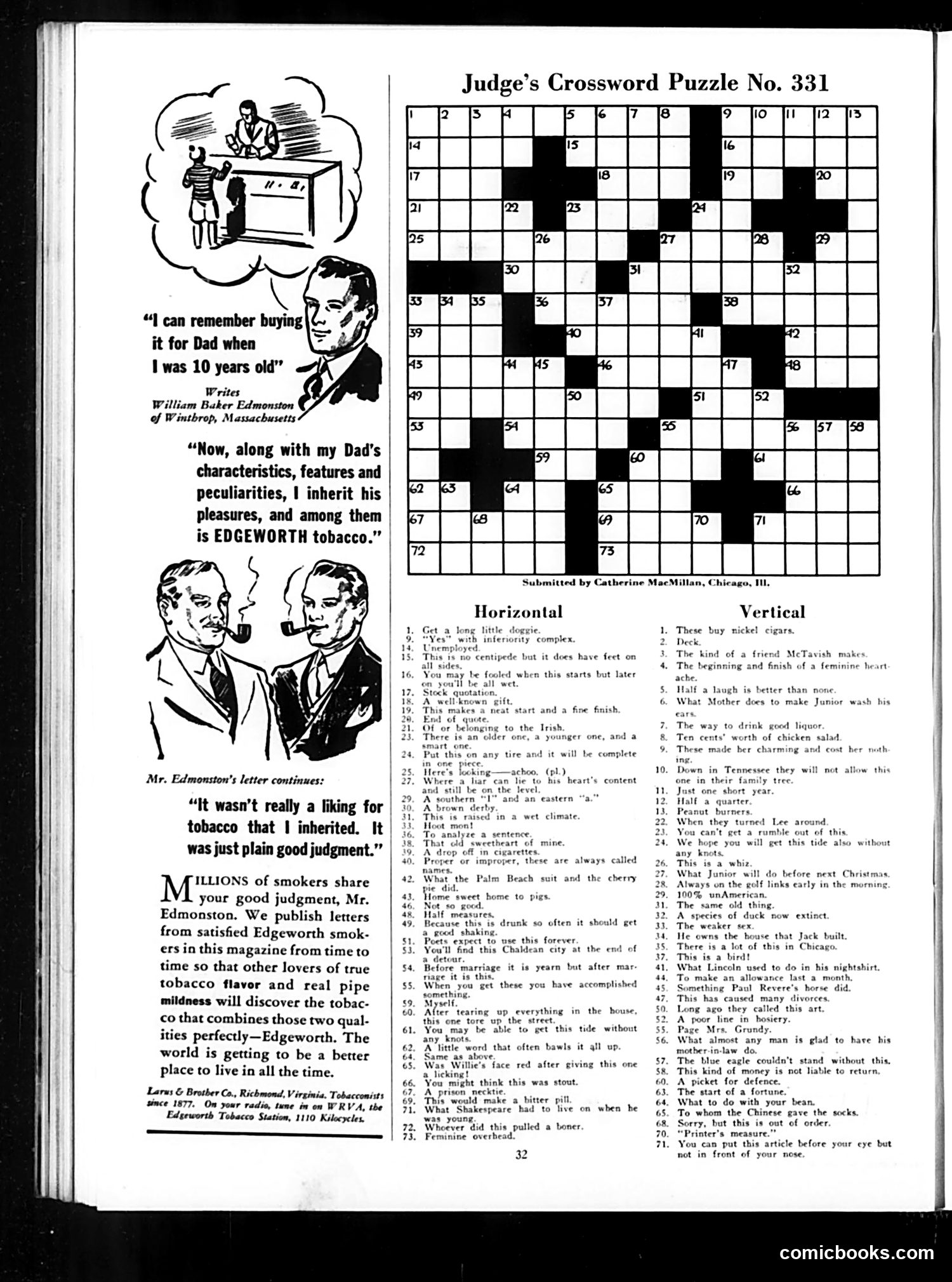
Judge Magazine Page Analysis This page combines a tobacco advertisement with a crossword puzzle. The central content is an Edgeworth tobacco ad featuring testimonial letters from satisfied smokers, presented as editorial content rather than obvious advertising—a common practice in early 20th-century magazines. The letter from William Baker Edmonston of Massachusetts uses a sentimental hook: he inherited his father's appreciation for Edgeworth tobacco, framing smoking as wholesome family tradition and "good judgment." This appeals to masculine identity and generational continuity. The crossword puzzle is unrelated editorial content, a popular feature of the era. The puzzle's clues are typical period humor—wordplay, riddles, and cultural references. The satire/point: The ad's juxtaposition with family sentiment sanitizes tobacco consumption, presenting it as refined and respectable rather than addressing health concerns that were beginning to emerge in the 1920s-30s. The "good judgment" framing is ironic given modern understanding of tobacco's dangers.
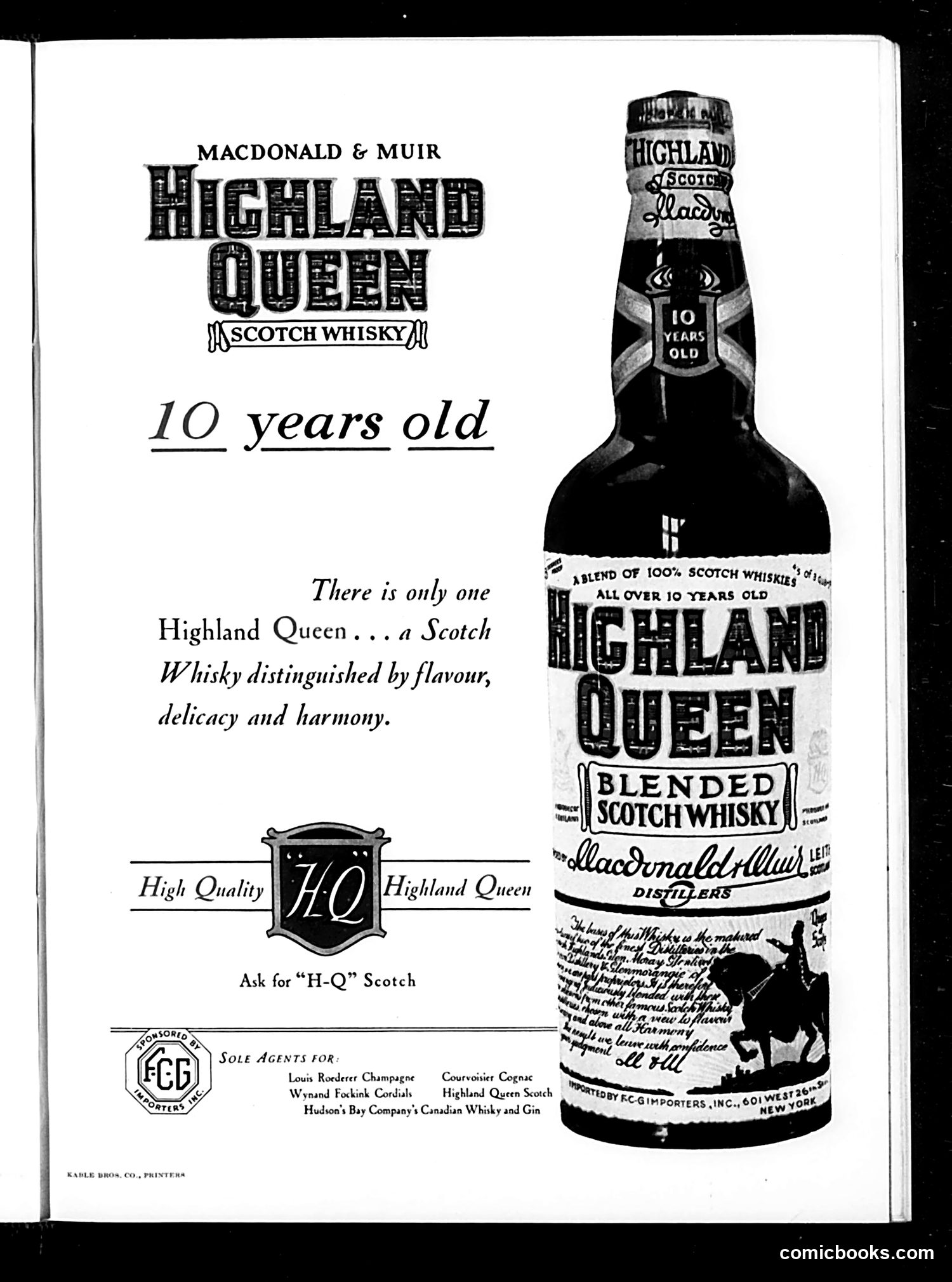
Highland Queen Scotch Whisky Advertisement This is a full-page advertisement, not political satire. It promotes Highland Queen blended Scotch whisky, aged 10 years, by MacDonald & Muir distillers. The ad emphasizes the product's quality through descriptive language ("flavour, delicacy and harmony") and features a large bottle image. It includes an "H-Q" quality seal and lists the distributor (F.C.G. Importers, Inc. in New York) and sole agents for various liquor brands. The page reflects pre-Prohibition or post-Repeal era advertising (likely 1920s-1930s based on Judge magazine's run). No political cartoon or satire is present—this is straightforward commercial marketing designed to establish brand prestige by associating Highland Queen with other premium imported beverages like Champagne and Cognac.
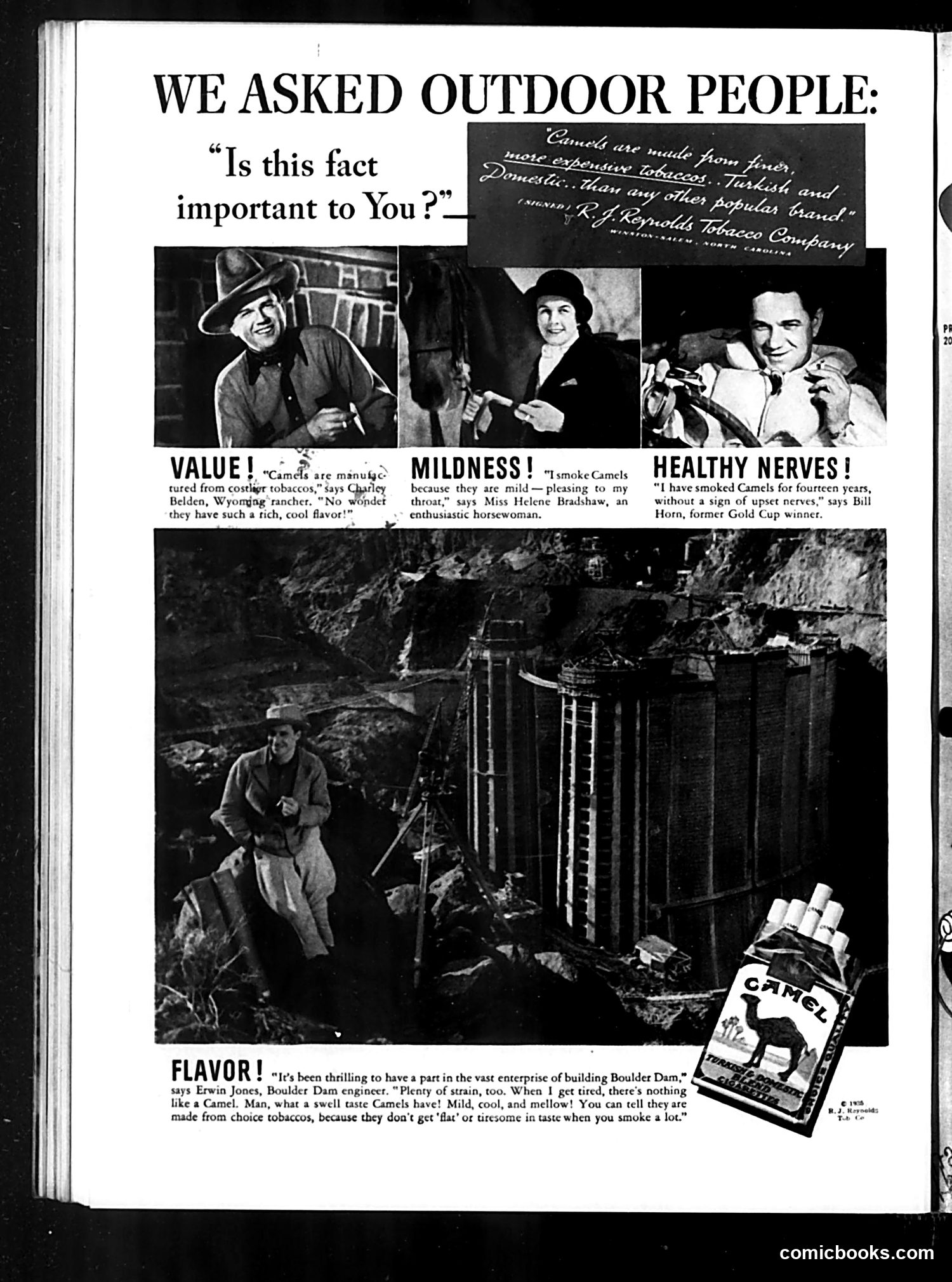
Camel Cigarette Advertisement (Vintage) This is a Camel cigarette advertisement, not satire—it's a genuine promotional page using testimonial advertising. The format features "outdoor people" (a rancher, horsewoman, and Boulder Dam engineer) endorsing Camels based on claimed benefits: rich flavor, mildness, and nerve-steadiness. The ad exploits the era's credibility in expert testimony and occupational authority. The Boulder Dam reference dates this to the 1930s construction project. Each testimonial conflates cigarette use with positive traits—the engineer associates Camels with managing job stress, the horsewoman with throat comfort. For modern readers: This represents pre-regulation tobacco marketing when health claims were unsubstantiated and unrestricted. The "healthy nerves" and strain-relief claims would be flagged as false advertising today. The ad exemplifies how cigarettes were marketed as beneficial lifestyle products to working-class and professional audiences before surgeon general warnings existed.