judge
Judge — June 1935
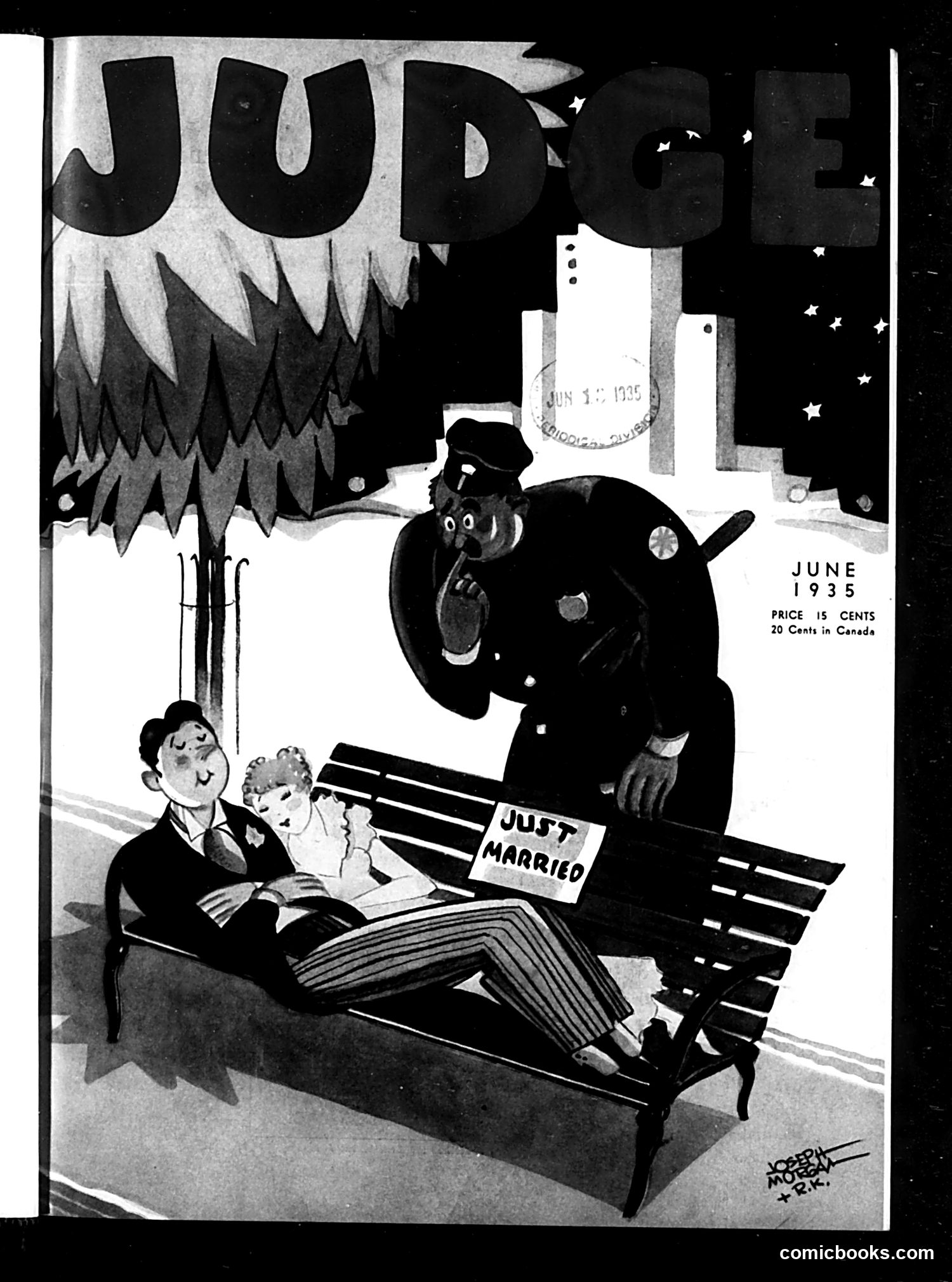
Judge Magazine Cover, June 1935 This cover depicts a menacing figure in a top hat and long coat—appearing to represent a stereotypical villain or threat—looming over a newlywed couple sitting on a bench marked "JUST MARRIED." The couple looks frightened as they try to enjoy their honeymoon. The satire likely comments on how contemporary anxieties or social threats were undermining domestic happiness. Given the June 1935 date, this could reference economic instability from the Great Depression, crime, or other period concerns that seemed to cast a shadow over American family life. The exaggerated, menacing figure and the innocent couple's fear create a commentary on how external forces threatened basic American contentment. The specific threat isn't entirely clear from the image alone, but the juxtaposition is unmistakably darkly comedic.
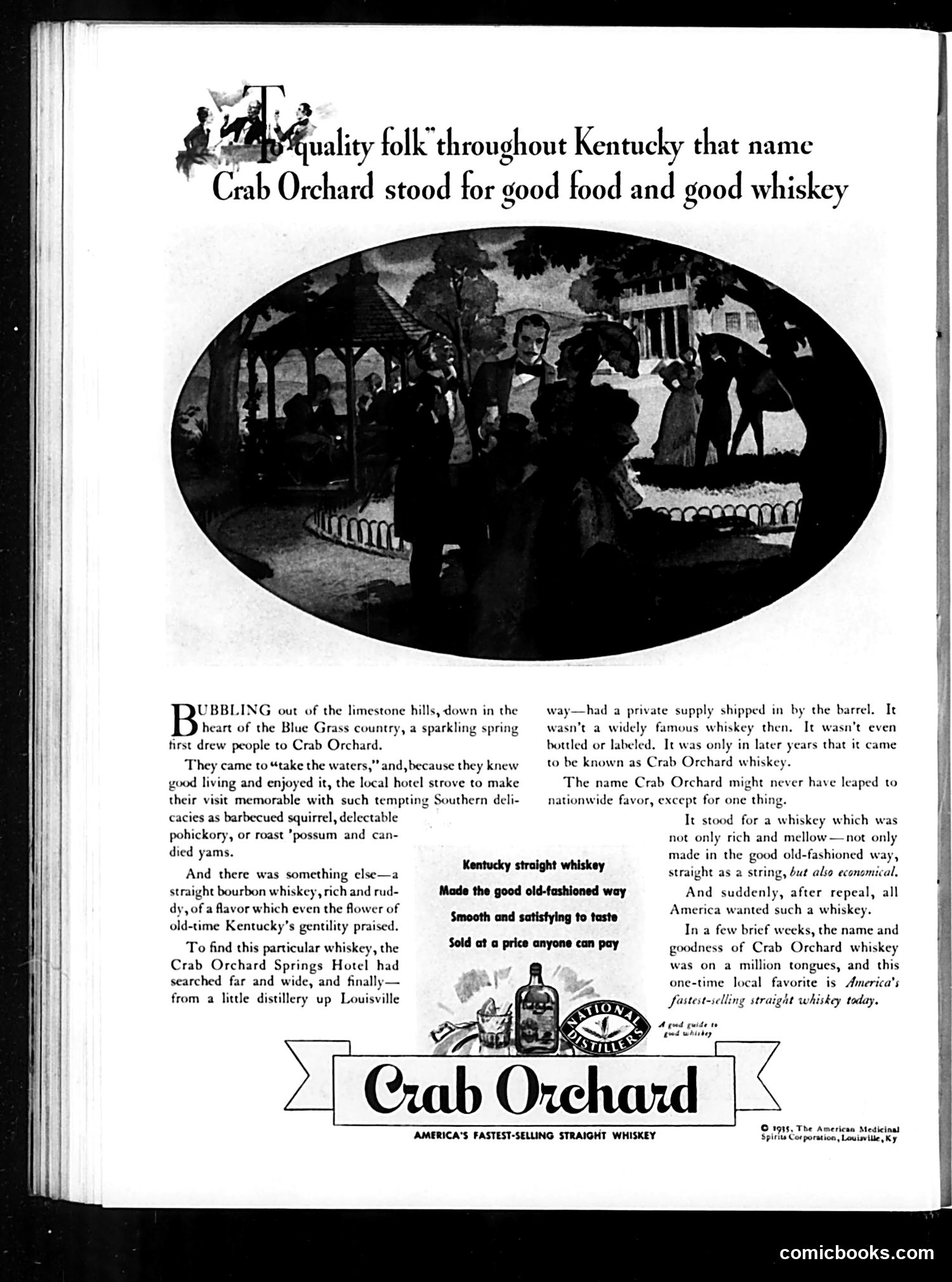
Analysis This is primarily a Crab Orchard whiskey advertisement rather than political satire. The page combines advertising copy with what appears to be a romanticized illustration of a Kentucky spring resort scene from the late 19th or early 20th century. The ad employs period marketing rhetoric, claiming Crab Orchard whiskey was "America's fastest-selling straight whiskey" and describing its origins from a Louisville distillery. The narrative emphasizes Kentucky's "good old-fashioned way" of whiskey-making and the product's supposed economic accessibility ("at a price anyone can pay"). The oval illustration depicts well-dressed visitors at what was evidently an actual resort location in Kentucky's Blue Grass region. This represents nostalgic Americana marketing common to Judge magazine's advertising content.
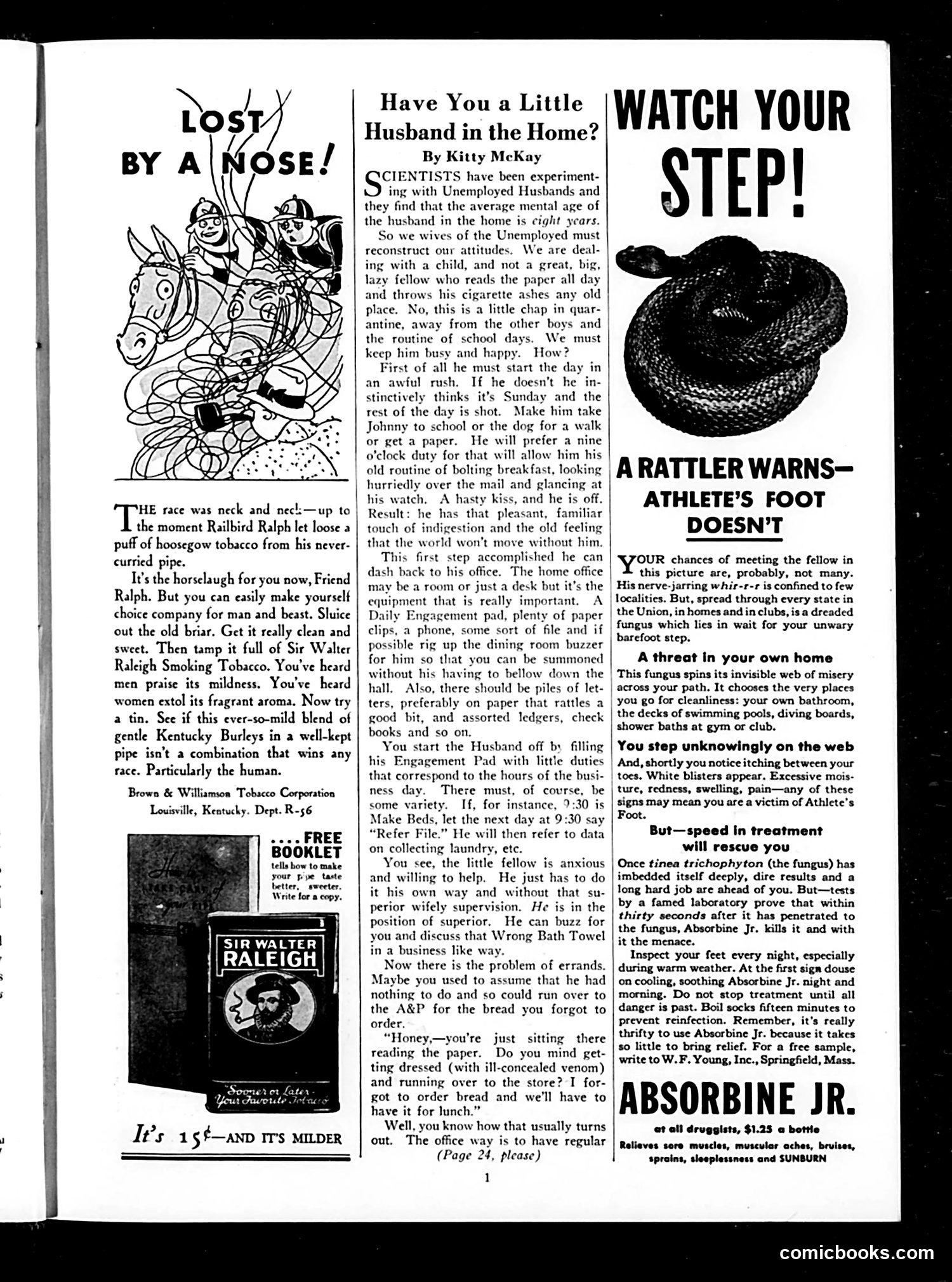
Analysis of Judge Magazine Page This page combines satirical cartoons with period advertisements. "Lost by a Nose" (left): A humorous cartoon about losing a horse race, featuring two jockeys. The satire targets gambling and racetrack culture, common leisure pursuits of the era. Sir Walter Raleigh tobacco is advertised below, positioning smoking as a gentleman's consolation for losses. "Have You a Little Husband in the Home?" (center): By Kitty McKay, this satirizes wives managing unemployed husbands during what appears to be Depression-era unemployment. The advice—keeping idle husbands busy with errands and tasks—reflects period gender roles and anxieties about male idleness and economic instability. "Watch Your Step!" (right): A public health warning about athlete's foot fungus, promoting Absorbine Jr. treatment. This reflects early 20th-century concerns about contagious foot conditions in gyms and communal bathing facilities. The page mixes social commentary with consumer advertising typical of Judge's format.
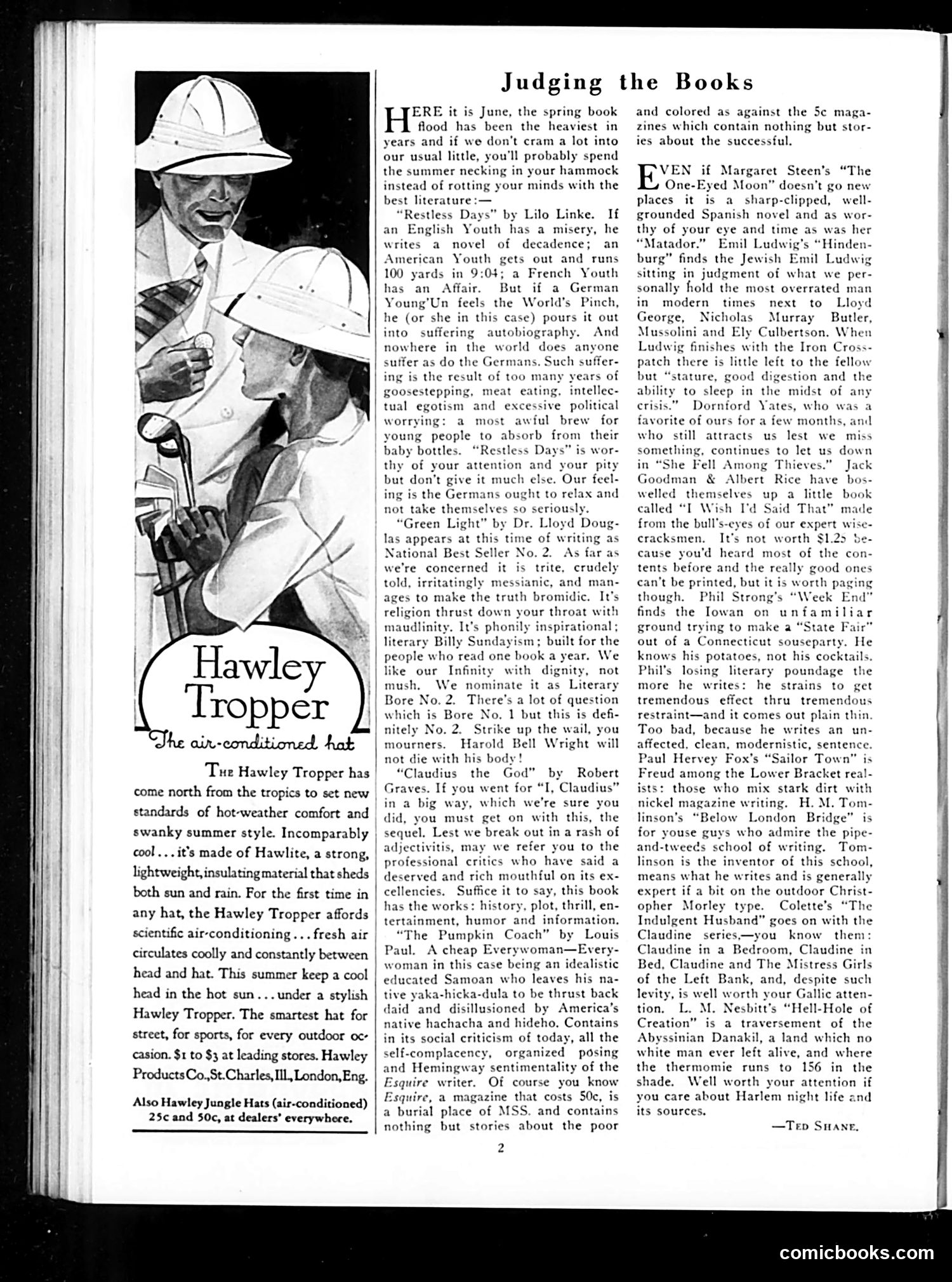
Analysis of "Judging the Books" Page This page is primarily a book review column rather than political satire. The left side features an advertisement for the Hawley Tropper hat, showing a man in colonial/tropical dress examining the product. The bulk of the page comprises literary reviews by Ted Shane. The reviews discuss contemporary novels including works by Lilo Linke, Dr. Lloyd Douglas, Robert Graves, and Louis Paul, critiquing their literary merit and social commentary. Shane evaluates these books' quality, themes, and relevance to readers. The only potential satirical element is the implicit critique of certain authors' pretentiousness or social messaging within the book reviews themselves—a common feature of Judge's cultural commentary. However, this page functions primarily as consumer guidance for readers seeking summer reading recommendations.
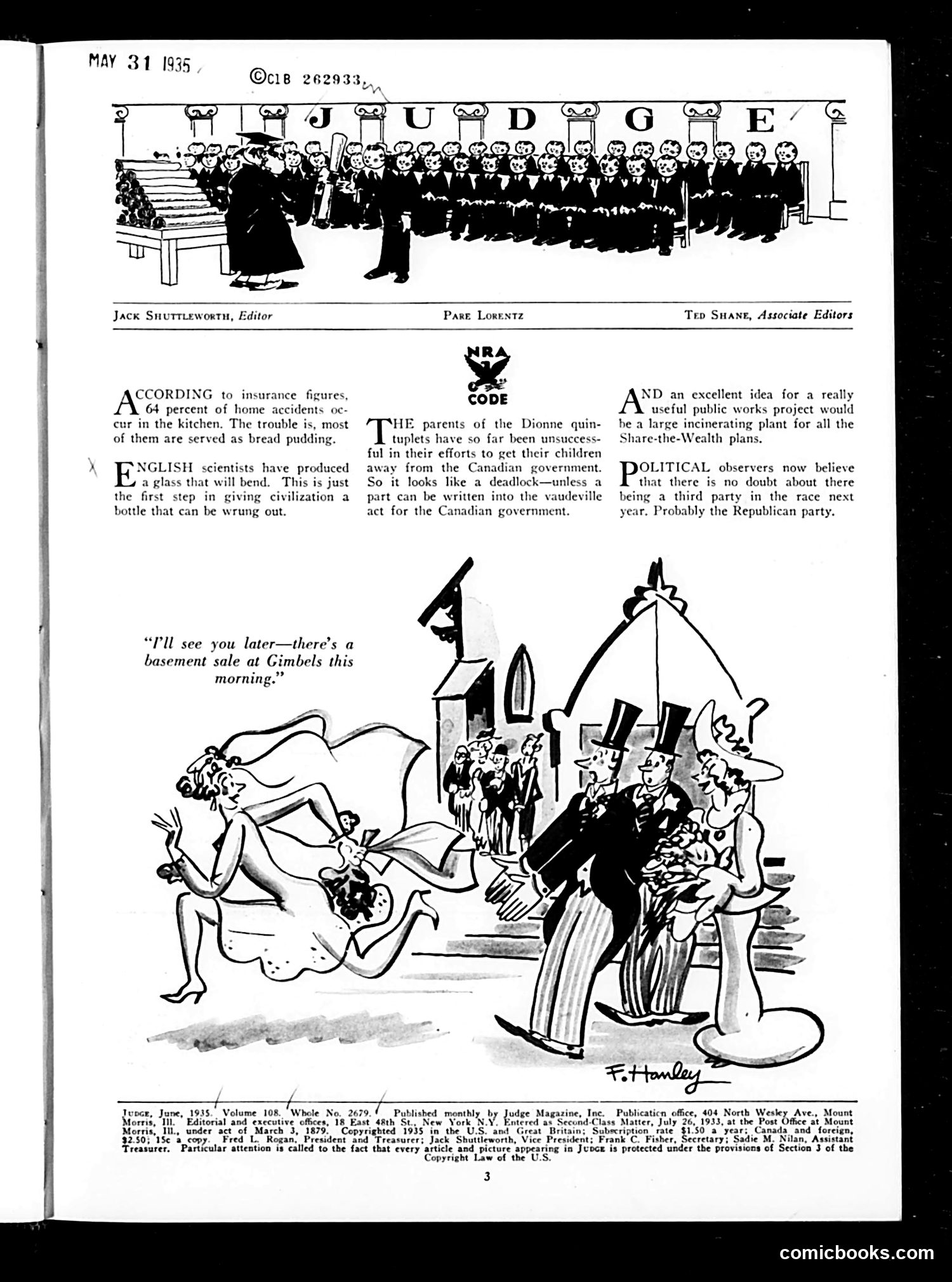
Analysis of Judge Magazine Page, May 31, 1935 The main cartoon depicts a wedding scene with a bride fleeing the church while well-dressed guests (wearing top hats) remain inside. The caption reads: "I'll see you later—there's a basement sale at Gimbels this morning." The satire: This mocks the priorities of American shoppers during the Great Depression, suggesting that even a wedding ceremony cannot compete with the allure of a department store sale. The bride abandoning her own wedding for a basement bargain satirizes both the desperation of Depression-era consumers and the commercial culture that exploits their financial struggles. The contrast between the formal, solemn wedding and the frivolous shopping motivation creates the humor. It's social commentary on how economic hardship had warped values and consumer behavior.
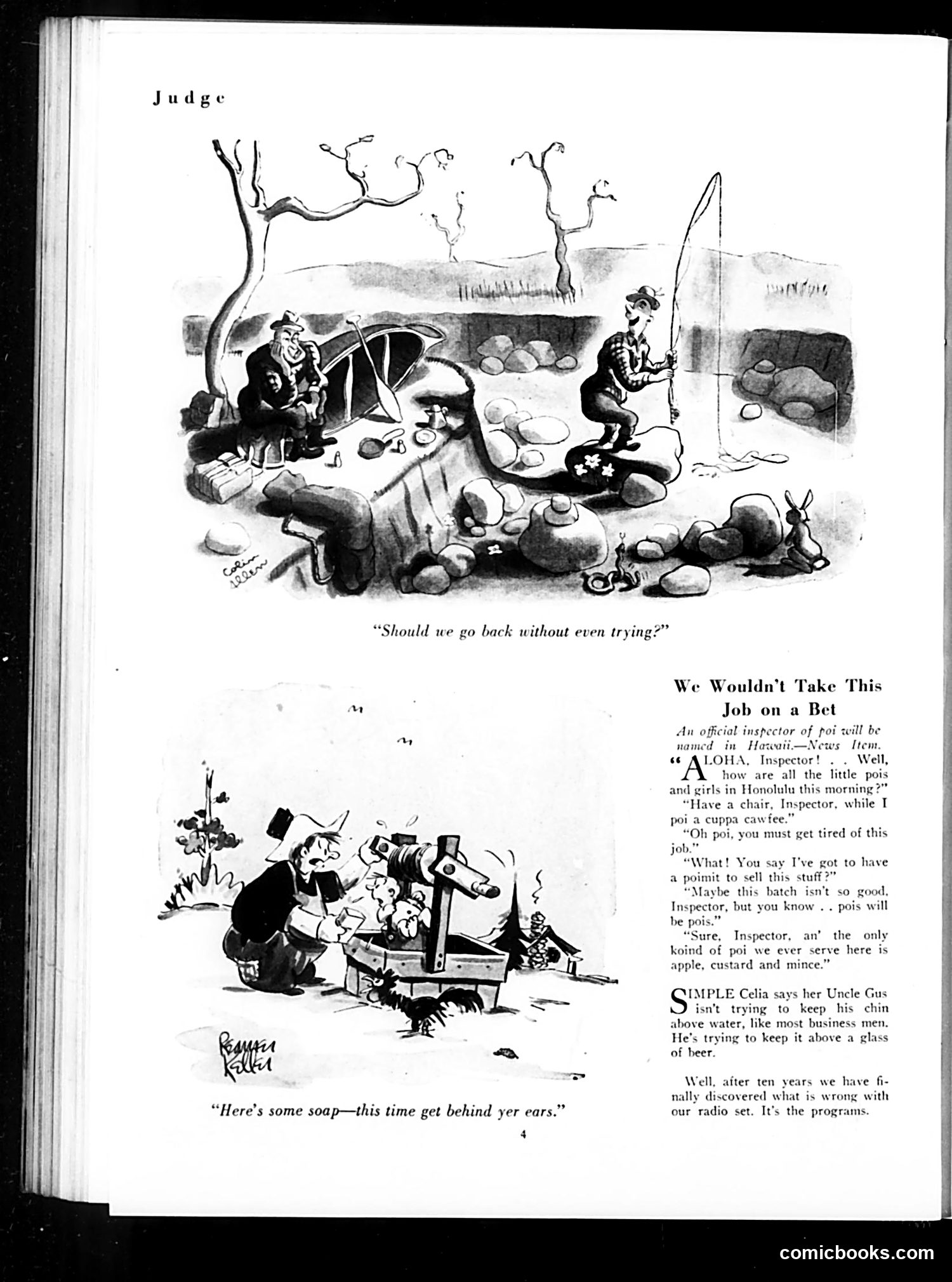
Analysis of Judge Magazine Page Top Cartoon ("Judge"): Shows prospectors or miners in a barren landscape debating "Should we go back without even trying?" This satirizes get-rich-quick schemes or failed ventures—likely referencing gold rushes, oil booms, or similar speculative enterprises popular in early 20th-century America. The joke mocks the hesitation to admit defeat. Bottom Cartoon & Article ("We Wouldn't Take This Job on a Bet"): Satirizes Hawaii's newly appointed pot inspector position. The humor targets bureaucratic absurdity—creating an official government role to inspect Hawaiian poi (a staple food). The accompanying dialogue mocks the inspector's discovery that locals only serve apple, custard, and mince pies, undermining the entire job's premise. This critiques unnecessary government positions and cultural misunderstanding of Hawaiian cuisine.
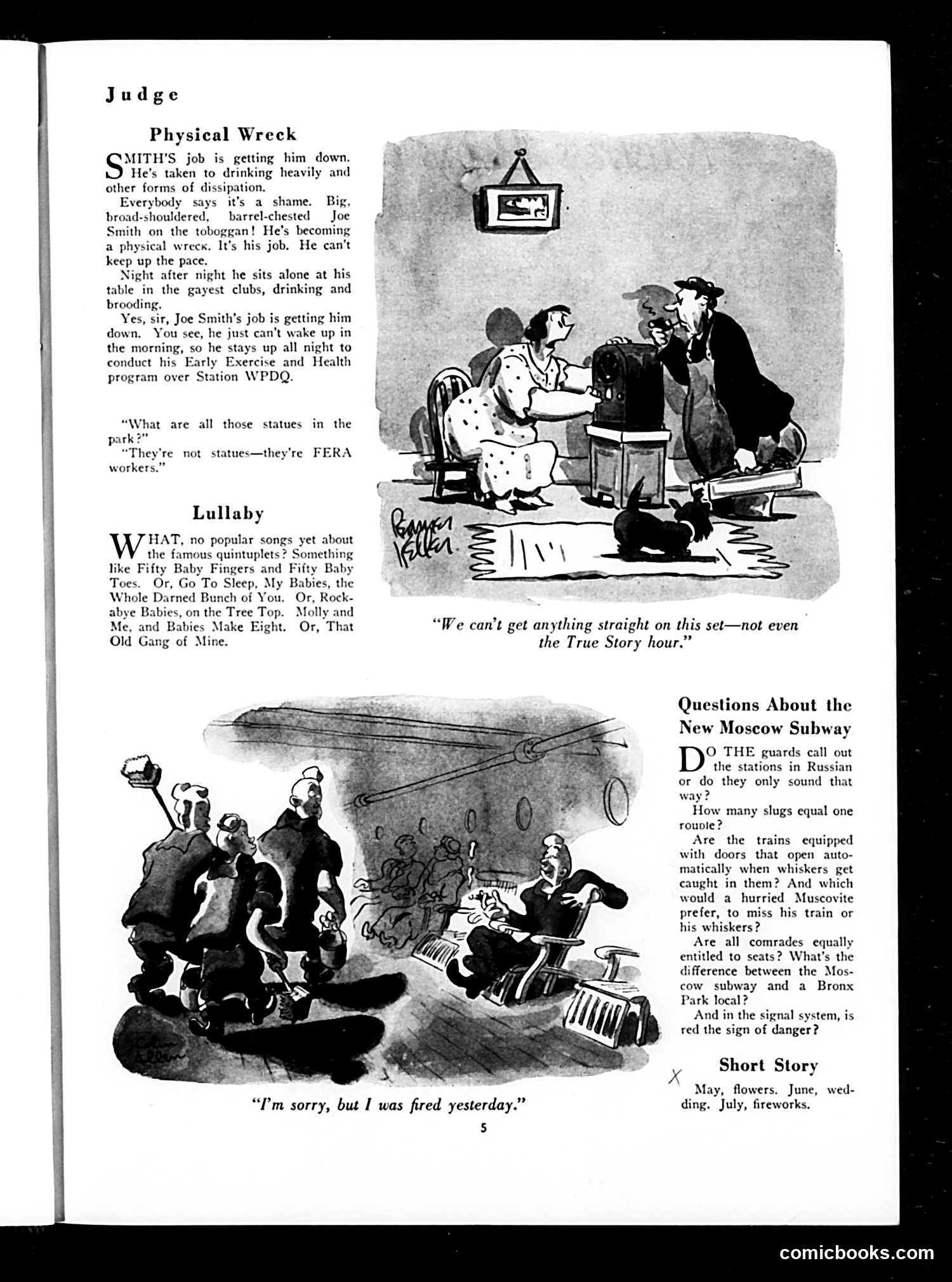
Judge Magazine Page Analysis This page contains three separate satirical pieces: 1. "Physical Wreck": Mocks Joe Smith, a robust man becoming a "physical wreck" due to heavy drinking and nightlife, unable to maintain an early morning health/exercise radio program on Station WPDQ. The cartoon shows him disheveled among club-goers. 2. "Lullaby": Notes the absence of popular nursery-rhyme songs, listing famous ones like "Fifty Baby Fingers" and "Molly and Me"—this appears to be light social commentary on cultural trends. 3. "Questions About the New Moscow Subway": Satirizes Soviet infrastructure through absurdist questions about Russian trains, suggesting Western skepticism about Soviet technological claims during the Cold War era. The cartoons reflect 1930s-40s American attitudes toward alcohol, radio culture, and anti-Soviet sentiment.
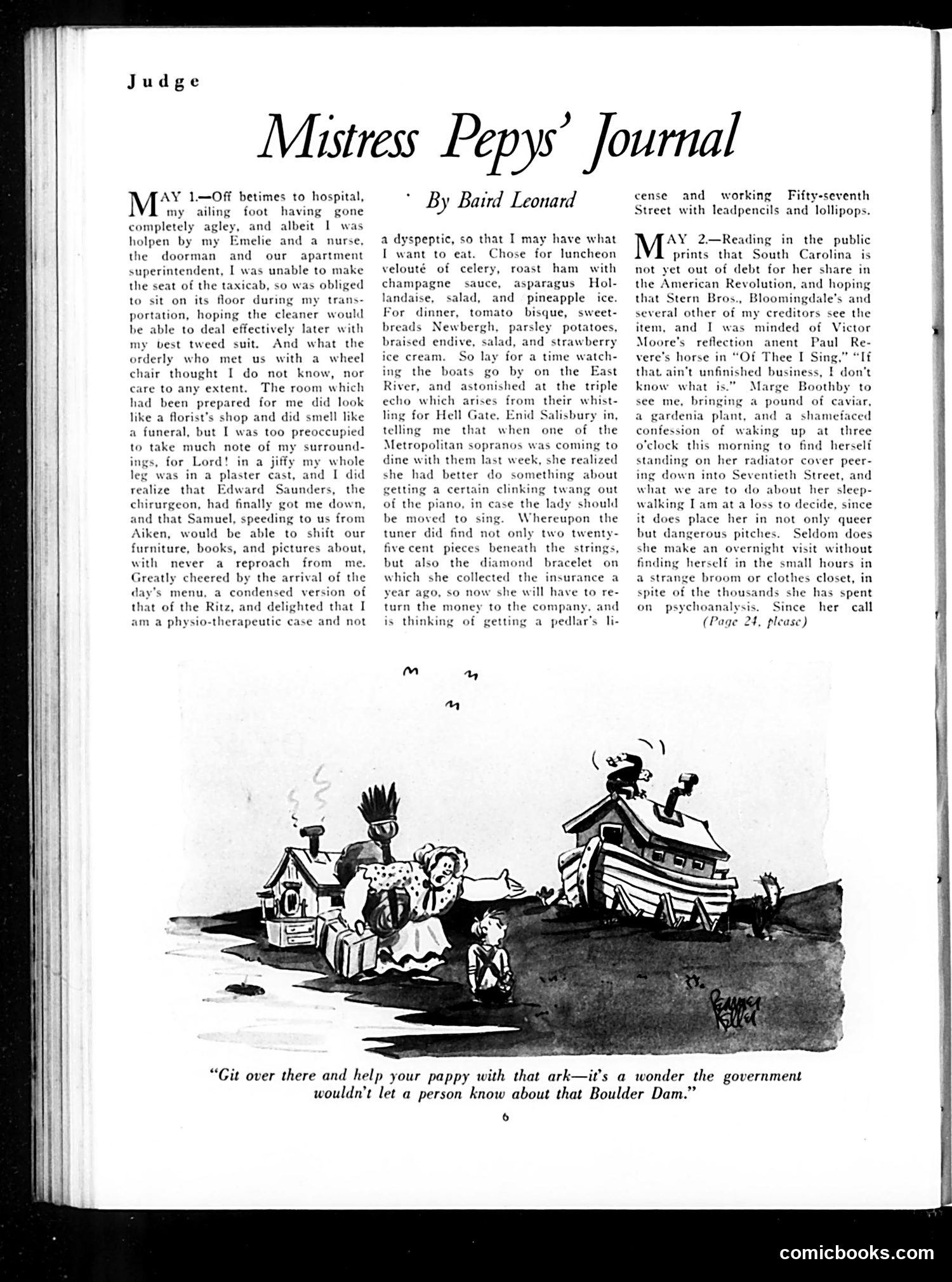
Mistress Pepys' Journal - Judge Magazine This is a humorous column by Baird Leonard, written as a parody of Samuel Pepys' famous historical diary. The May entries recount mundane domestic complaints (a sick foot, dyspepsia, household repairs) mixed with social observations about South Carolina's Revolutionary history and contemporary New York society gossip. The cartoon below satirizes government secrecy about the Boulder Dam (now Hoover Dam). A family struggles with a damaged ark during what appears to be a flood, while a child suggests asking "pappy" for help with the ark, then sarcastically notes "it's a wonder the government wouldn't let a person know about that Boulder Dam." The joke mocks official information control—citizens are kept ignorant about a major public works project affecting water management and flood risk.
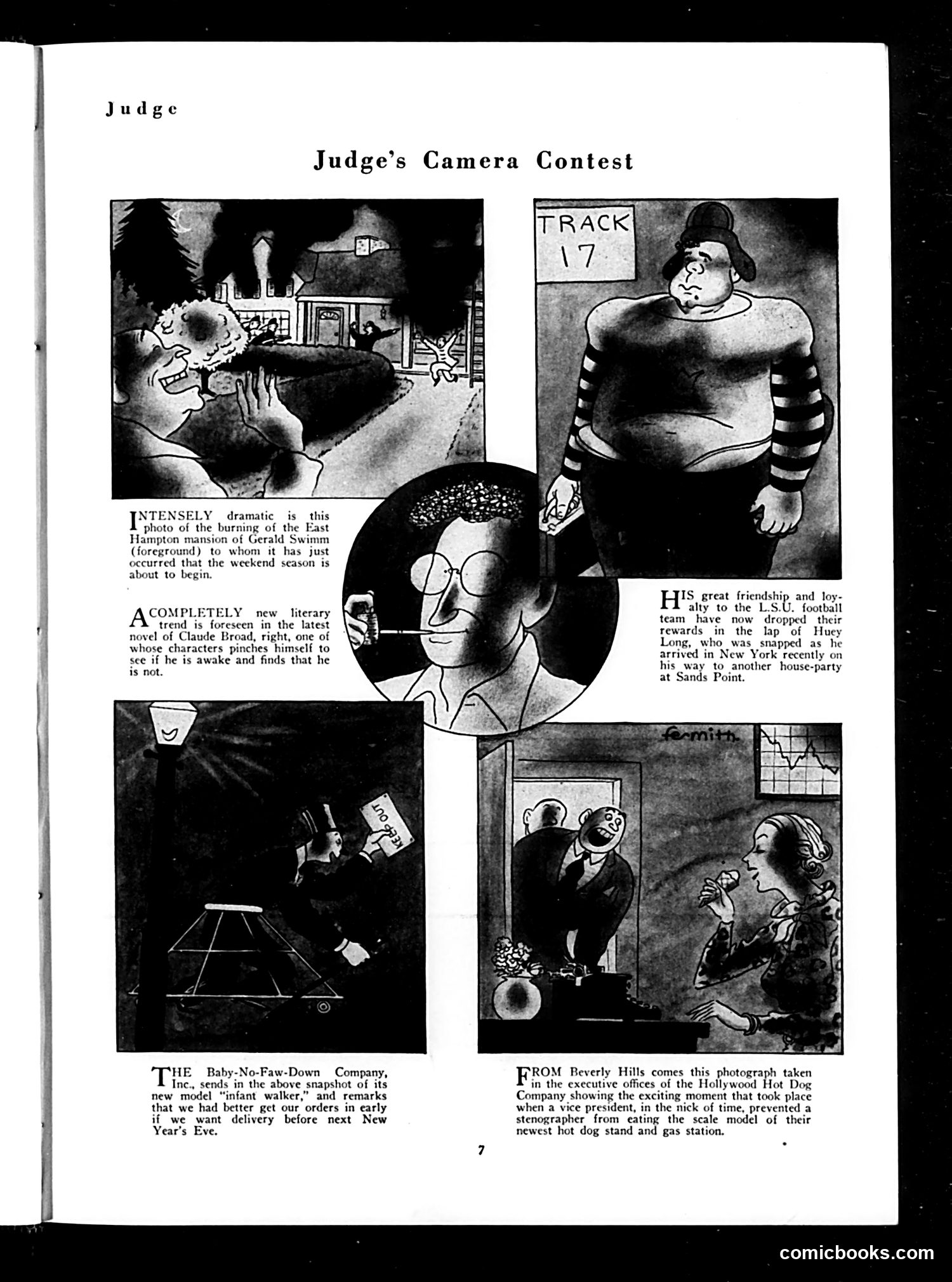
Judge's Camera Contest - Page Analysis This page presents four humorous photographs submitted to *Judge* magazine's photo contest. Each caption provides satirical commentary: 1. Top left: "Intensely dramatic" burning of the East Hampton mansion of Gerald Swimm, captioned as occurring during the upcoming weekend season—satirizing dramatic social-season events. 2. Top right: A heavyset man labeled "Track 17," with text mocking a new literary trend where characters pinch themselves to verify wakefulness—likely referencing surrealism or experimental fiction. 3. Bottom left: The Baby-No-Paw-Down Company's "infant walker," satirizing advertising claims about product delivery deadlines before New Year's. 4. Bottom right: A Hollywood Hot Dog Company executive photograph capturing a "stenographer from eating the scale model" of their new hot dog stand—mocking corporate mishaps and product photography. The humor derives from absurd scenarios presented as genuine news photography.
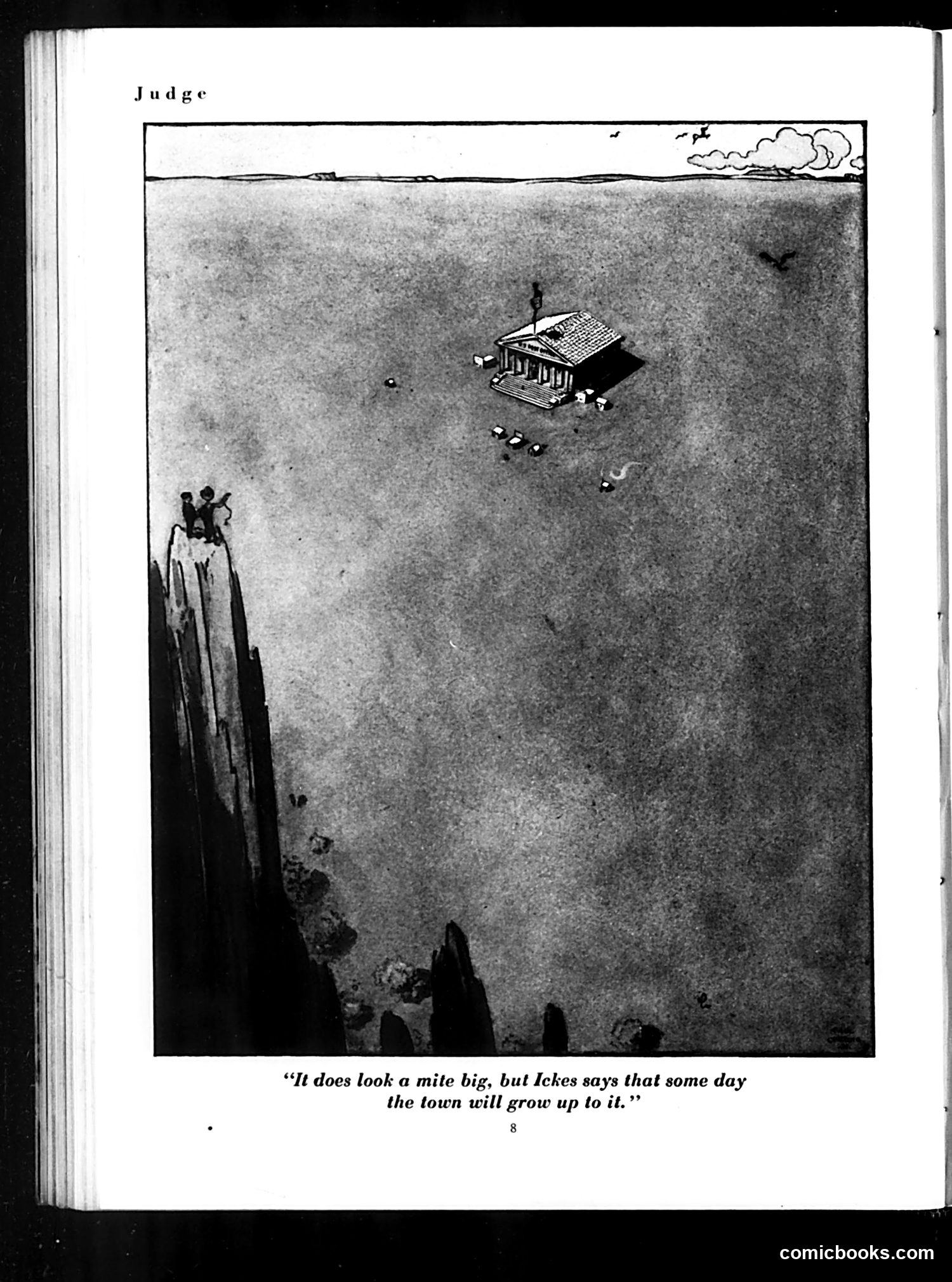
Analysis This cartoon depicts a tiny town dwarfed by an enormous public building in an empty landscape. The caption references "Ickes," likely Harold L. Ickes, Secretary of the Interior under Franklin D. Roosevelt, who oversaw New Deal public works projects. The satire mocks government spending on infrastructure in small towns—constructing a building vastly out of proportion to the community's current size, betting on future growth that may never materialize. The cartoon critiques the optimism (or wastefulness) of New Deal planners who funded ambitious projects in rural America, assuming population growth would justify the investment. The joke is that the modest town will supposedly "grow up to" match the enormous structure—though the visual absurdity suggests this is unlikely.
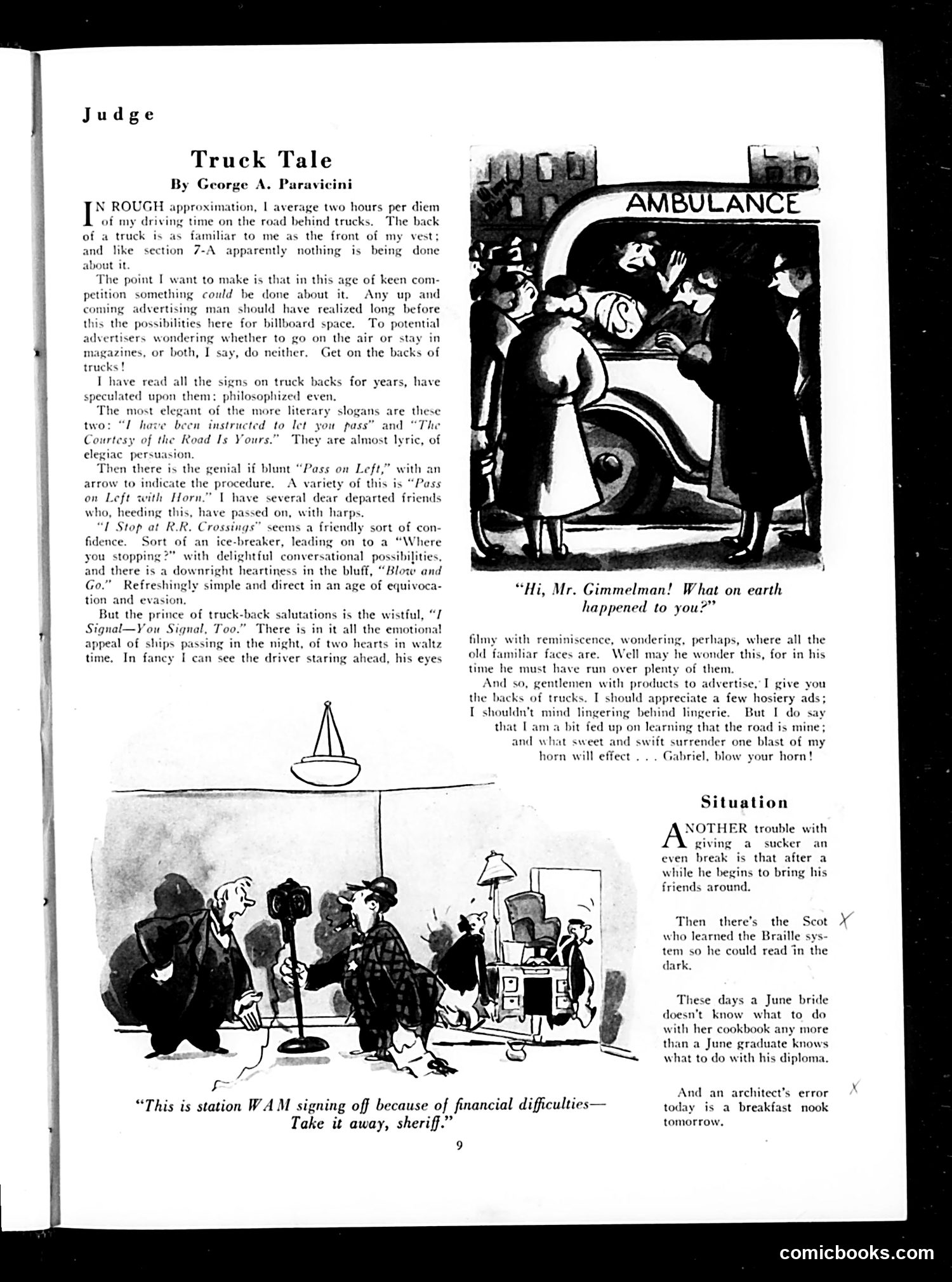
"Truck Tale" Page Explanation This Judge magazine page contains a humorous essay by George A. Paravicini about advertising opportunities on truck backs, paired with unrelated joke cartoons below. Main Essay: Paravicini argues that truck rear panels—which drivers read constantly—represent untapped billboard advertising space. He catalogues actual truck-back slogans he's observed, ranging from polite ("I have been instructed to let you pass") to darkly comedic (he notes friends who followed "Pass on Left with Horn" instructions have "passed on, with harps"—a joke about fatal accidents). His pitch to advertisers: trucks are better than radio or magazine ads. Bottom Cartoons: The first shows a radio station "WAM signing off because of financial difficulties"—Depression-era commentary on struggling media. The second features disconnected one-liners about modern life absurdities: a sucker bringing friends, a Scotsman learning Braille for dark reading, June brides confused by cookbooks, and architects' errors becoming architectural features. The humor relies on observational comedy and wordplay typical of 1920s-30s satirical magazines.
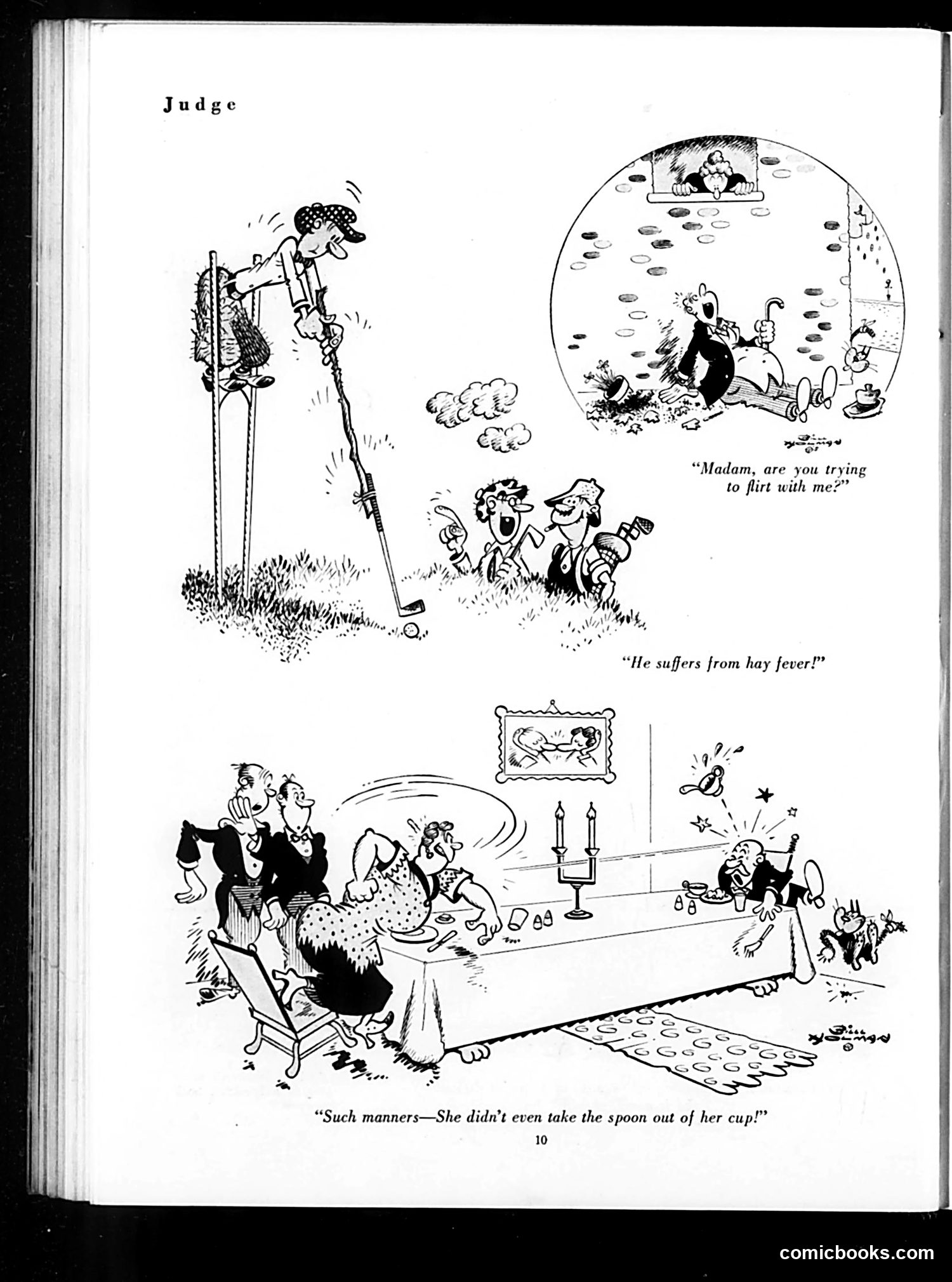
Judge Magazine Page Analysis This page contains three separate comic cartoons satirizing social behavior and etiquette violations. The top-left shows a man on a pole being pestered by others below, with the caption "He suffers from hay fever!"—a visual pun on the man's elevated, sneezing position. The top-right depicts a seaside scene where a woman asks a man, "Madam, are you trying to flirt with me?"—likely mocking awkward social interactions. The bottom cartoon, the most detailed, shows a formal dinner scene with the caption "Such manners—She didn't even take the spoon out of her cup!" This satirizes crude table manners and lack of refinement, a common Judge theme mocking lower-class or newly wealthy individuals who violated Victorian etiquette standards. The chaotic dinner scene emphasizes the rudeness being criticized.
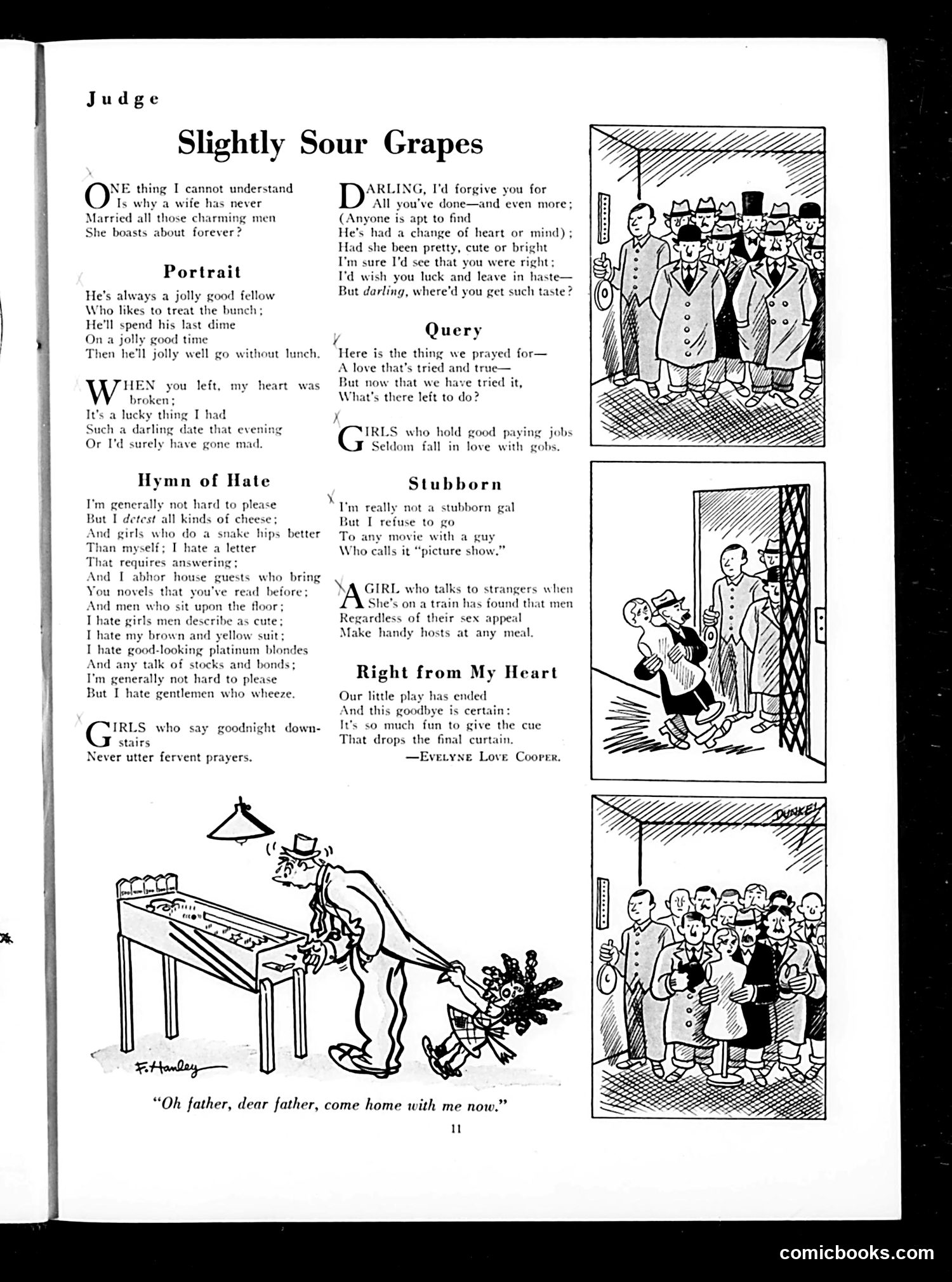
Analysis of Judge Magazine Page This page from Judge presents satirical commentary on gender relations and social behavior, typical of 1920s-30s American humor magazines. Main Content: The page consists primarily of witty verse and observations about women's behavior and romantic relationships. "Slightly Sour Grapes" frames the collection—satirizing women who brag about past suitors while never actually marrying them. Key Satirical Points: - Women's contradictions in love and dating preferences - Male behavior at social gatherings (spendthrifts, bores, poor manners) - Women's pickiness about trivial matters (calling movies "picture shows") - The hypocrisy of women criticizing men's tastes while making poor romantic choices themselves The Cartoons: The illustrations show domestic and social scenes. One depicts a man at a piano with a child, captioned "Oh father, dear father, come home with me now"—likely referencing the temperance-era song about alcoholic fathers, used here ironically for comic effect. Overall Tone: Gentle, judgmental humor targeting both sexes' romantic follies, reflecting Jazz Age attitudes toward dating and marriage.
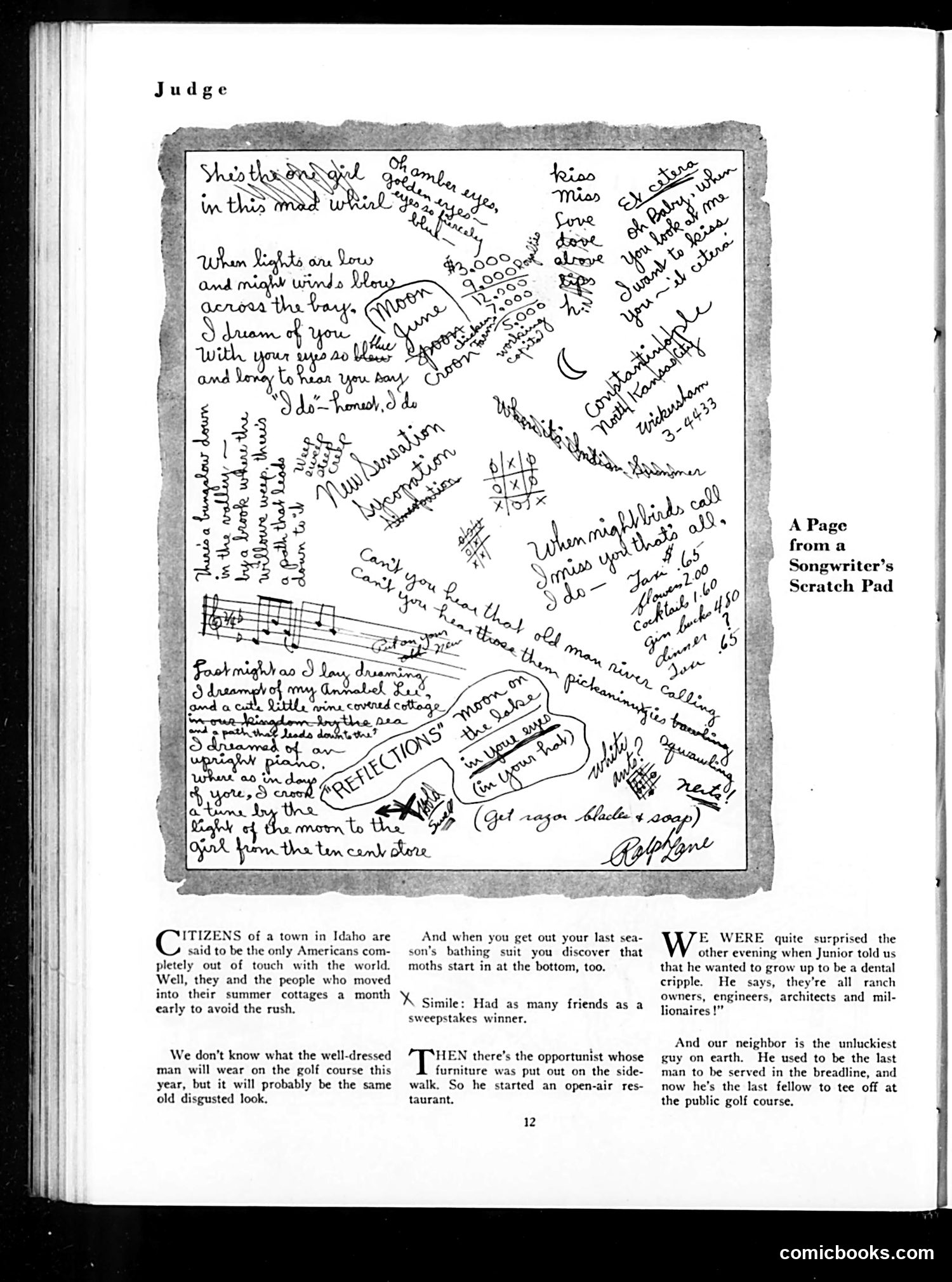
Judge Magazine Satire Analysis This page contains humorous social commentary rather than political cartoons. The content includes: The songwriter's scratch pad (center) shows creative working notes—lyrics, musical notation, and crossed-out phrases—illustrating the messy creative process. The written jokes mock American middle-class anxieties of the era: - Idaho isolation: Rural Americans completely disconnected from current events - Summer cottage rush: The newly wealthy fleeing cities early, revealing social pretension - Golf course fashion: Satirizing male vanity and perpetual discontent - Bathing suit decay: Mundane domestic disappointments (moth damage) - The opportunist: Someone profiting from economic hardship by converting sidewalk furniture into a restaurant—likely referencing Depression-era improvisation The "dental cripple" joke appears to mock aspiration, suggesting wealth-seeking youth admire dentists as millionaires. The overall tone is gentle, observational satire targeting American consumer culture, social climbing, and the gap between pretense and reality—typical Judge magazine content from the interwar or early Depression period.
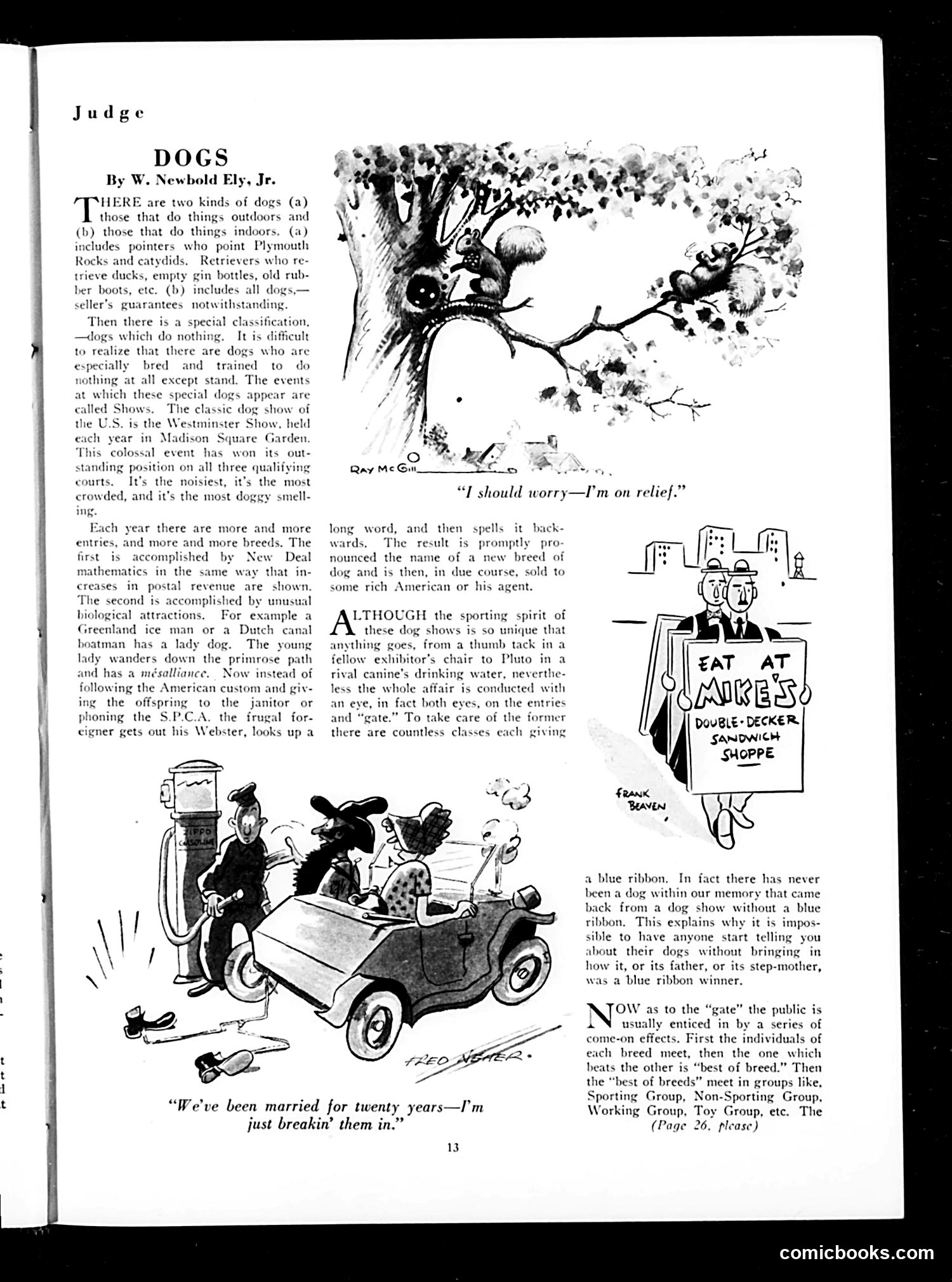
"Dogs" by W. Newbold Ely, Jr. — Judge Magazine This article satirizes dog shows, particularly the prestigious Westminster Show at Madison Square Garden. The author mocks several aspects: The proliferation of breeds: New Deal-era mathematics supposedly inflate both entries and breeds. Immigrants create fake "new breeds" by looking up long words in Webster's dictionary, spelling them backwards, and selling the results to wealthy Americans—a jab at both foreign immigrants and gullible rich dog owners. The cartoons' humor: - Top illustration: A dog "on relief" (Depression-era unemployment assistance)—social commentary on hard times - Bottom: A couple with a car labeled "we've been married 20 years—just breakin' them in"—comparing marital wear to vehicle deterioration The satire's point: Dog shows are absurd, corrupt (exhibitors sabotage rivals), yet universally award blue ribbons regardless of merit. Everyone claims their dog has blue-ribbon ancestry. It's elitist vanity wrapped in sporting pretense.
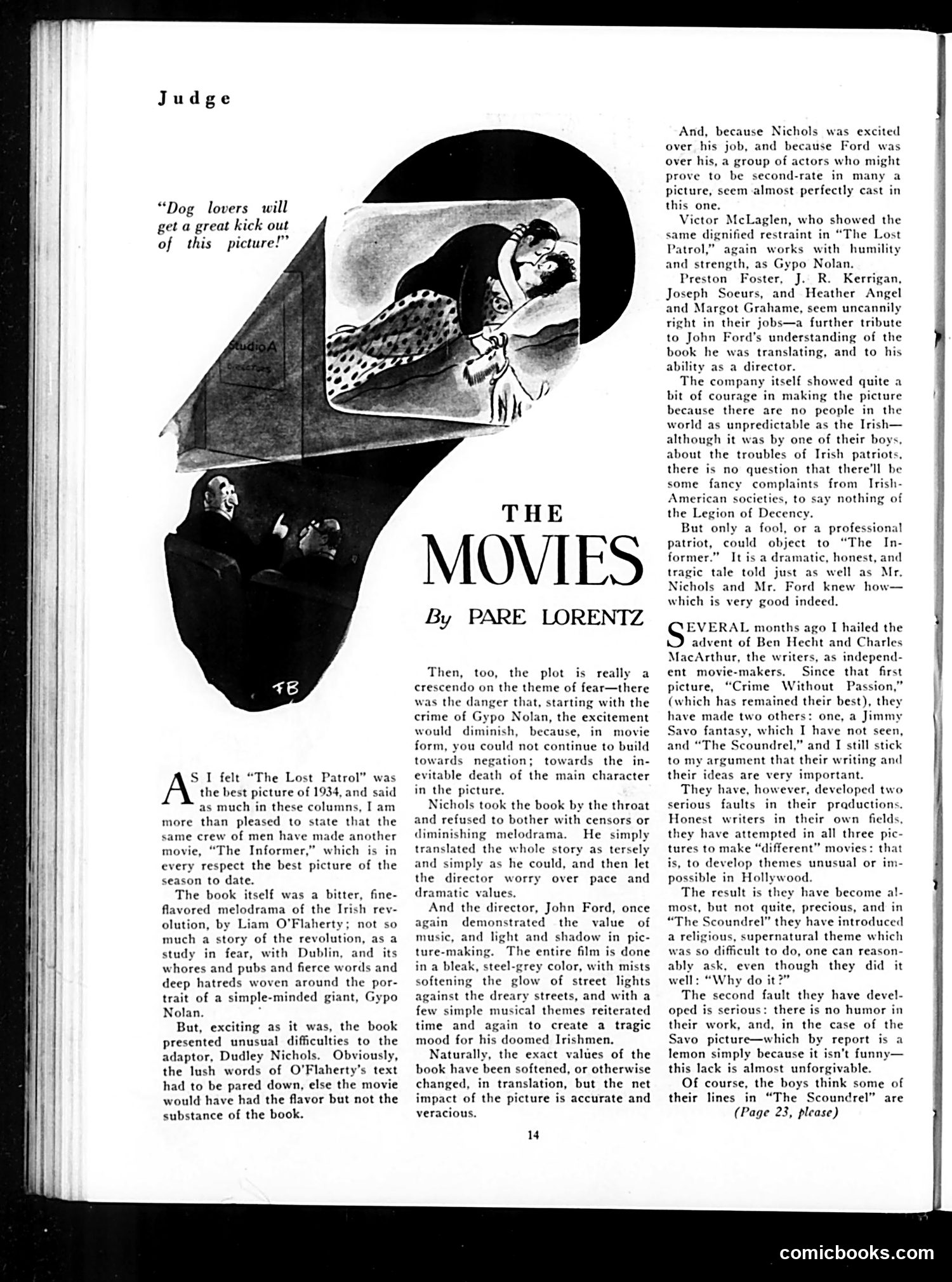
Judge Magazine Film Review Analysis This page is film critic Pare Lorentz's review of "The Informer" (1935), directed by John Ford and starring Victor McLaglen. The cartoon illustration depicts a dog watching the film—the quote "Dog lovers will get a great kick out of this picture!" is a lighthearted joke, likely referencing either the film's emotional intensity or McLaglen's rugged appearance. The review discusses how screenwriter Dudley Nichols adapted Liam O'Flaherty's Irish revolutionary novel for cinema. Lorentz praises Ford's visual direction, cinematography, and the cast's performances. He notes the film boldly dramatizes Irish patriotic themes despite predictable objections from Irish-American organizations and the Legion of Decency (the Catholic censorship body). The page also briefly mentions independent filmmakers Ben Hecht and Charles MacArthur's productions. The context reflects 1930s Hollywood's navigation of censorship and ethnic sensitivity regarding Irish-American content.
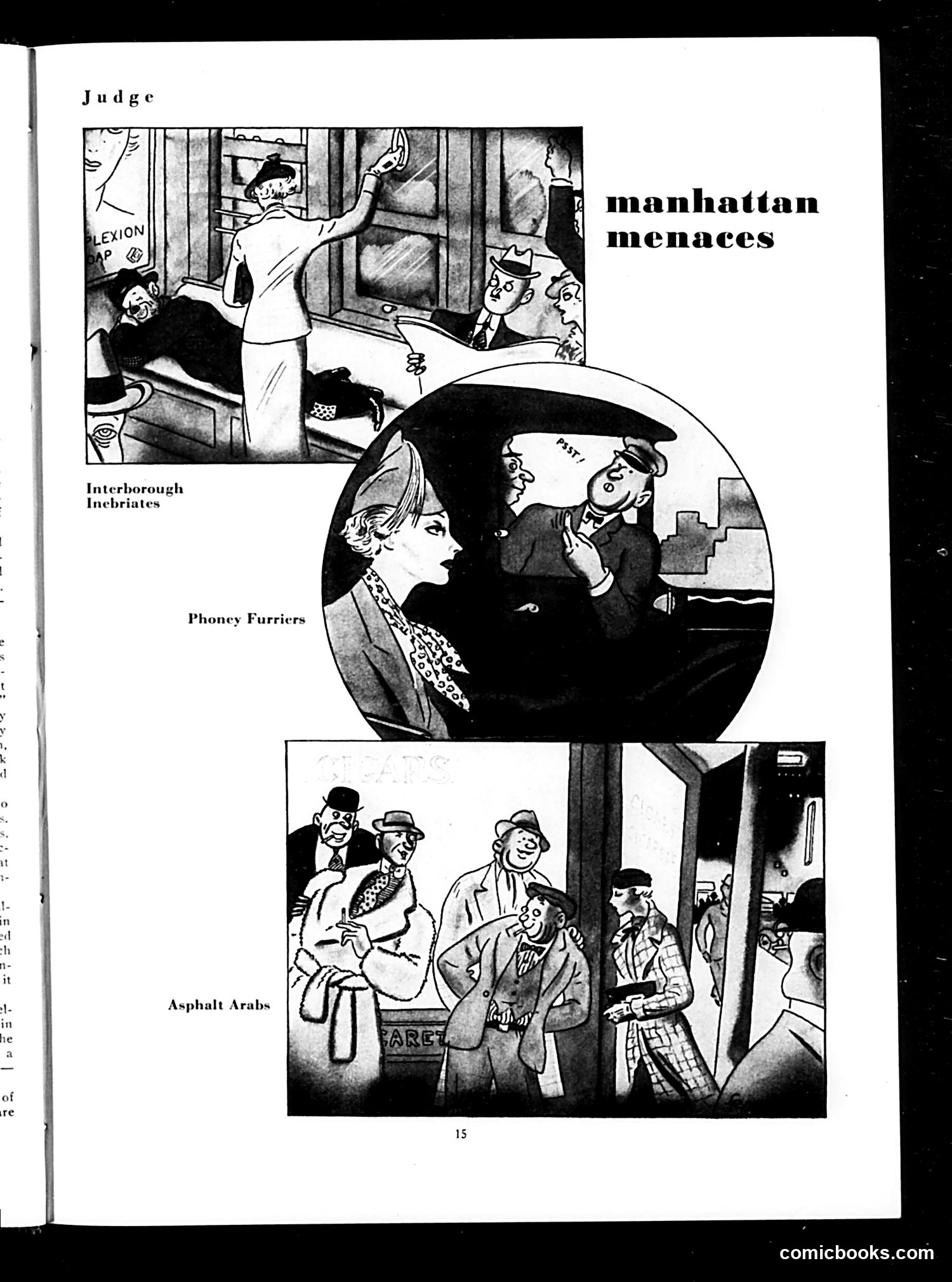
Judge Magazine: "Manhattan Menaces" This page from Judge presents three satirical cartoons mocking urban social problems. "Interborough Inebriatess" appears to lampoon drunk women, while "Phoney Furriers" depicts what seems to be a scam involving counterfeit fur coats—a common fraud targeting wealthy Manhattan customers. "Asphalt Arabs" shows street children or homeless youths, likely immigrant youth causing petty crimes or disruptions. The collective title "Manhattan Menaces" frames these as contemporary urban threats. The cartoons use exaggerated caricature and class-based humor typical of Judge's satirical approach, targeting either criminal elements or marginalized groups portrayed as social problems. The specific reference to "Interborough" suggests early 20th-century New York concerns about transportation-linked urban issues. Without a publication date visible, the exact historical context remains unclear.
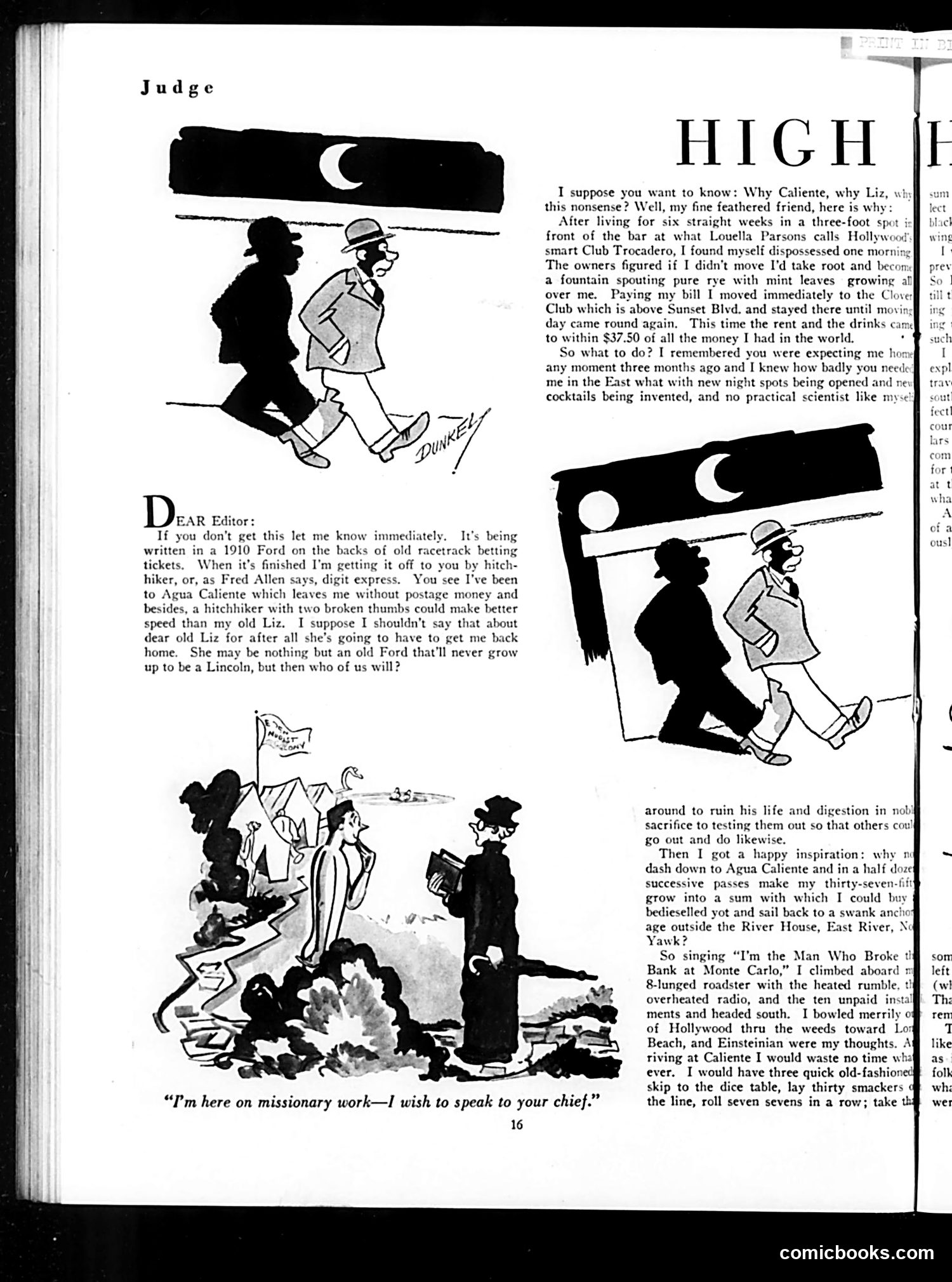
Explanation for Modern Readers This is a humorous letter to *Judge* magazine's editor, written as if scrawled on a 1910 Ford traveling to Agua Caliente (a Mexican gambling resort). The writer claims poverty after overstaying at Hollywood nightclubs—specifically the Trocadero and Clover Club—and has decided to gamble in Mexico to raise money for passage home. The satire targets: - Hollywood excess: References to gossip columnist Louella Parsons and the extravagant bar scene of the era - The writer's delusion: Absurdly confident he'll roll "seven sevens in a row" to multiply his meager funds - The broken-down jalopy: His old Ford "Liz" is unreliable but must get him home The cartoons show a traveler with suitcases—possibly hitchhiking or fleeing. The bottom cartoon's caption ("I'm here on missionary work—I wish to speak to your chief") suggests arrival at an exotic location, likely poking fun at casual imperialism. The humor relies on self-deprecating desperation and get-rich-quick fantasy.
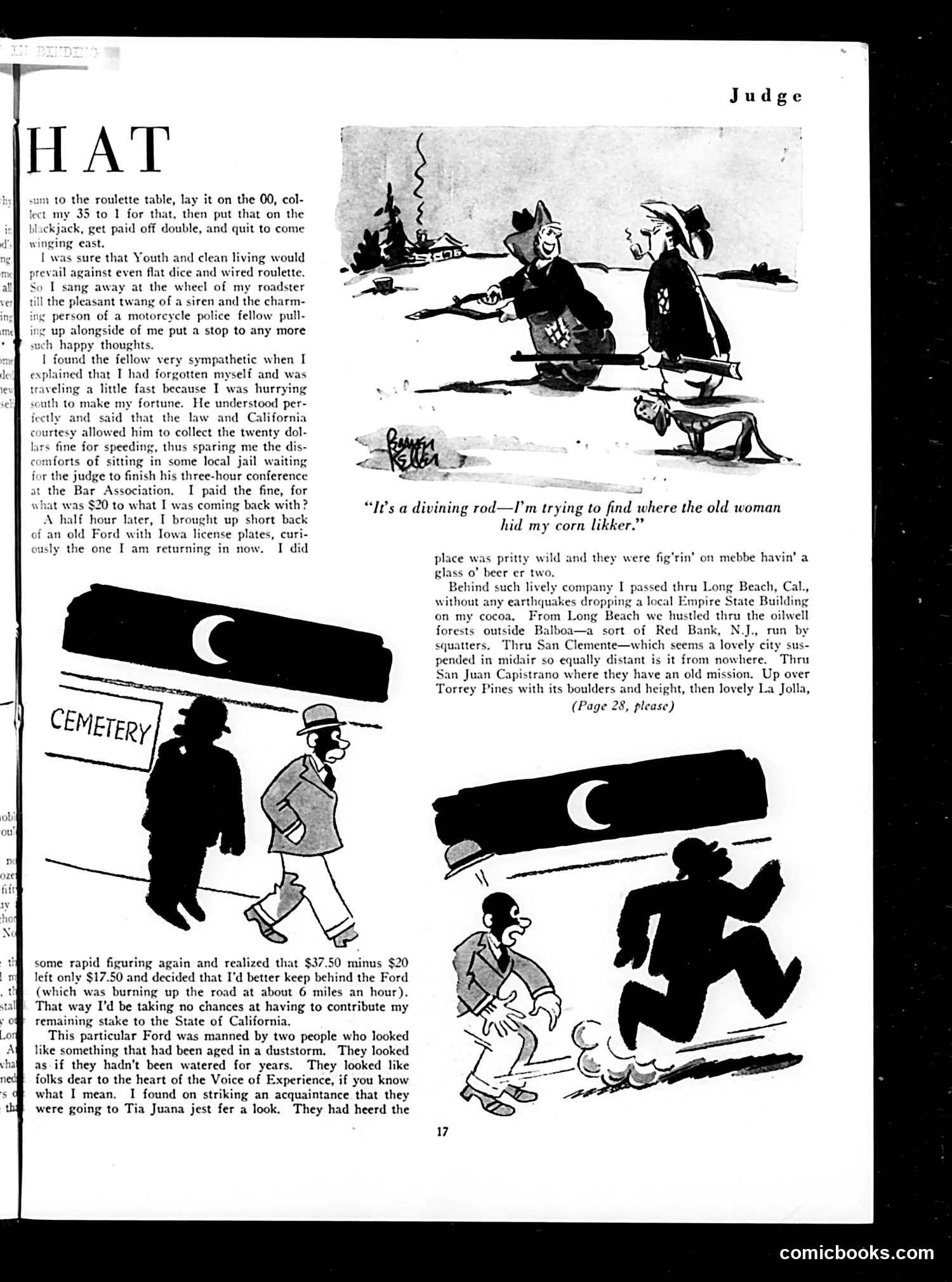
"Judge" Magazine Page Analysis This page satirizes prohibition-era America through a traveler's misadventures. The main text describes a motorist speeding south to California, stopped by a corrupt cop who extracts a $20 bribe disguised as a speeding fine—a jab at police graft. The top cartoon shows two rural figures with a divining rod, with one seeking "corn likker" (moonshine whiskey), satirizing prohibition enforcement and backwoods bootlegging. The bottom cartoon depicts a man fleeing from a shadowy figure under a crescent moon, likely referencing prohibition agents or the law catching bootleggers. The narrative's final detail—elderly "dustbowl" types heading to Tijuana "jest fer a look"—suggests they're actually smuggling alcohol across the Mexican border, a common prohibition-era activity. The overall message mocks corruption, failed prohibition enforcement, and working-class desperation during this period.
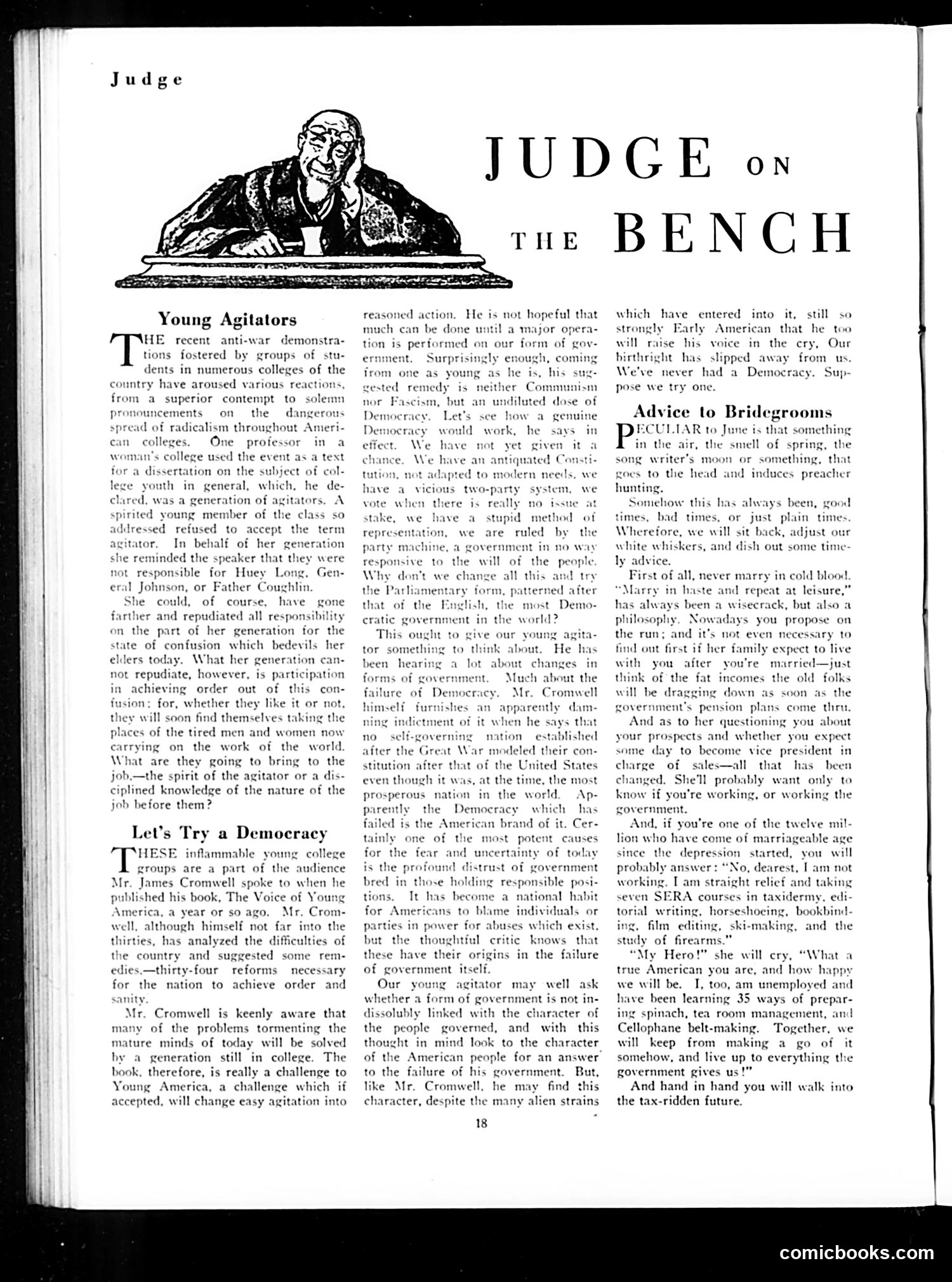
"Judge on the Bench" - Explaining the Satire This page from Judge magazine (likely 1930s, given references to Huey Long, General Johnson, and Father Coughlin) satirizes college students' anti-war activism and political radicalism. The Setup: A judge figure presides over commentary on "Young Agitators"—college students protesting and demonstrating against war. The first column mocks students for calling themselves "agitators" while refusing responsibility for political demagogues like Huey Long, General Johnson, and Father Coughlin (real figures of that era). The Satire's Point: Judge argues these young protesters are hypocritical—they criticize the current system as agitators but won't acknowledge they've inherited disorder from their elders' failures. The magazine suggests they should either become disciplined problem-solvers or accept they'll eventually inherit society's chaos. The Second Column reviews James Cromwell's book *The Voice of Young America*, which proposes abandoning America's two-party system for a British-style parliamentary democracy. Judge treats this seriously but skeptically—questioning whether college radicals can meaningfully reform government. The overall tone: patronizing skepticism toward youthful idealism.
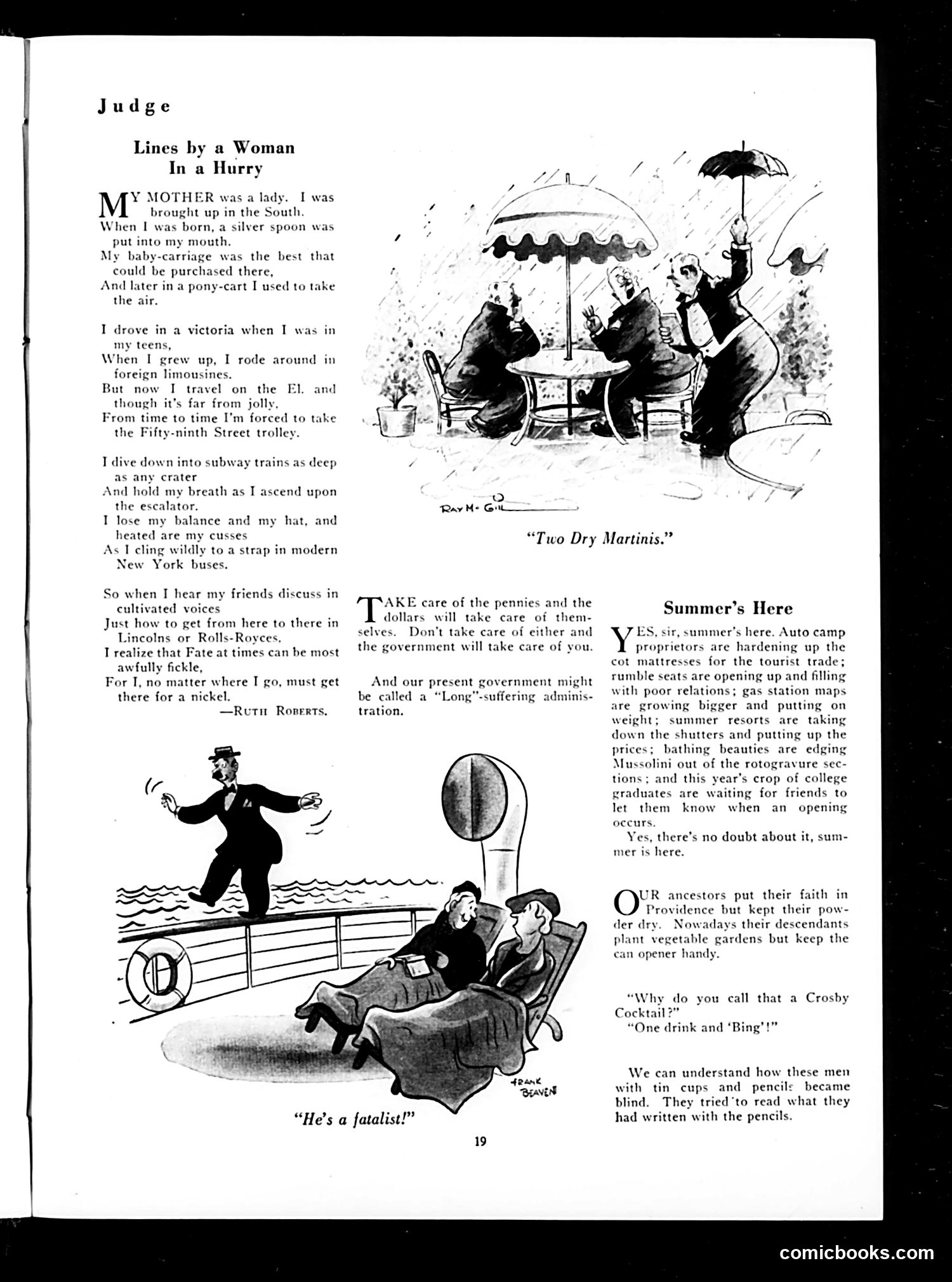
Judge Magazine Page Analysis This page contains three satirical pieces reflecting 1920s-30s social commentary: "Lines by a Woman in a Hurry" (by Ruth Roberts): A poem lamenting downward social mobility. The speaker, raised in Southern gentility with silver spoons and carriages, now rides the subway and trolley for nickels—a sharp critique of economic hardship affecting the middle/upper classes during the Depression era. "Two Dry Martinis" cartoon: Shows wealthy figures under an umbrella during rain, illustrating the quip about government care. The joke plays on the phrase "Long-suffering"—likely referencing Huey Long's political movement or similar long-term government intervention. "Summer's Here": Light seasonal satire about auto camps, tourist trade, and college graduates seeking employment—reflecting Depression-era anxiety about jobs and changing leisure habits. "Crosby Cocktail" joke: A pun on entertainer Bing Crosby's name ("Bing"), suggesting one drink makes you say "Bing!" The overall theme: economic displacement and government intervention affecting traditionally comfortable Americans.
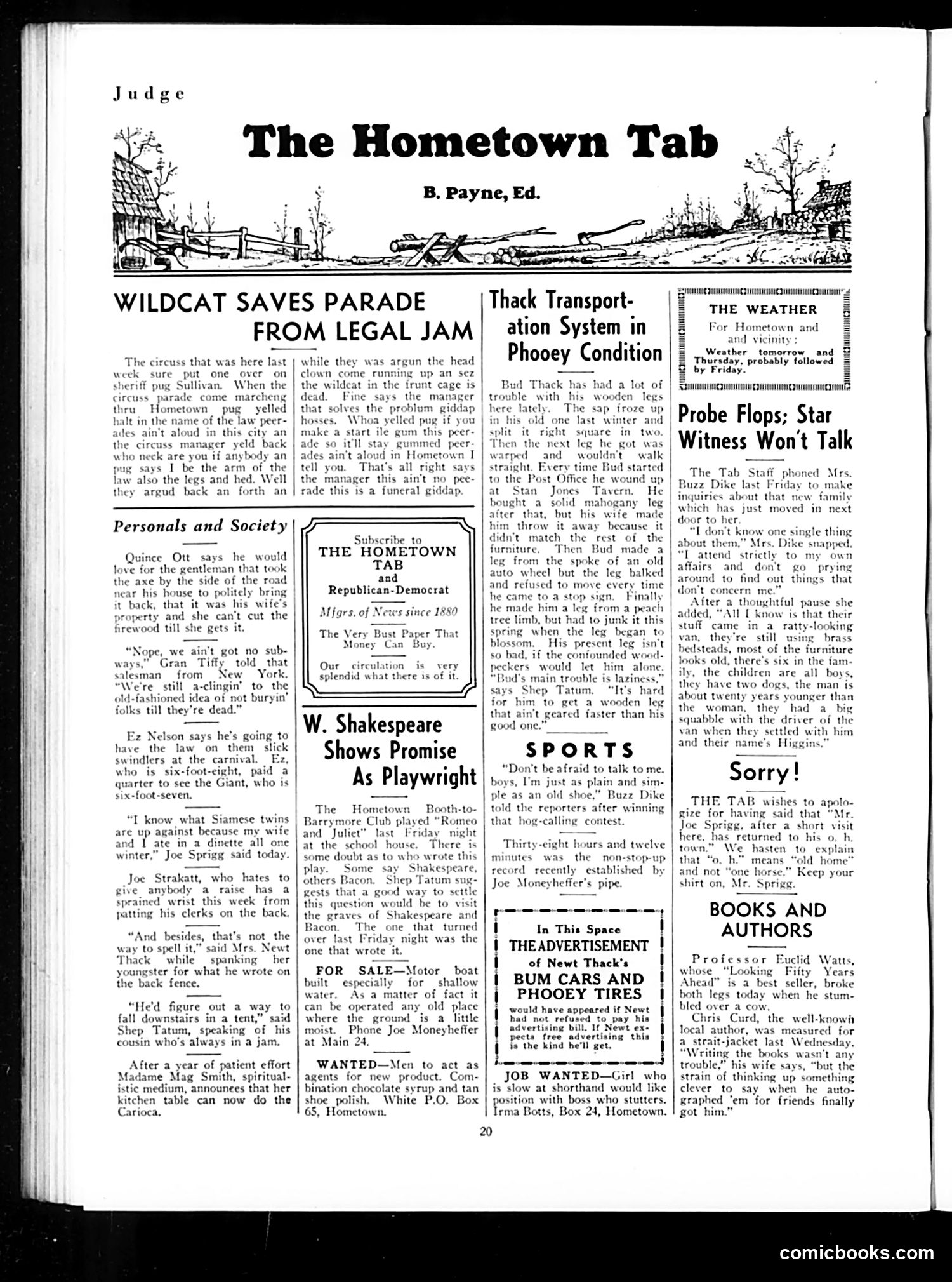
"The Hometown Tab" - Judge Magazine Analysis This is a humor column from Judge featuring small-town satirical sketches with no specific political content. The page showcases various humorous local anecdotes: Main Content: - "Wildcat Saves Parade from Legal Jam" mocks small-town bureaucracy: a circus parade gets halted for legal violations, but a wildcat disruption accidentally solves the problem by turning it into a "funeral" (thus legally permissible). - "W. Shakespeare Shows Promise" is light literary satire: townspeople debate who wrote "Romeo and Juliet," suggesting Shakespeare's authenticity could be proven by checking whose grave was disturbed—a joke on small-town logic. - Various "Personals and Society" items poke fun at everyday absurdities: a man paying to see a "giant" shorter than himself, exaggerated marital complaints, and Bud Thack's comically dysfunctional wooden legs. The satire targets rural American naiveté, bumbling local government, and domestic mishaps rather than national politics. The tone is gentle, folksy humor typical of 1920s-30s Judge magazine.
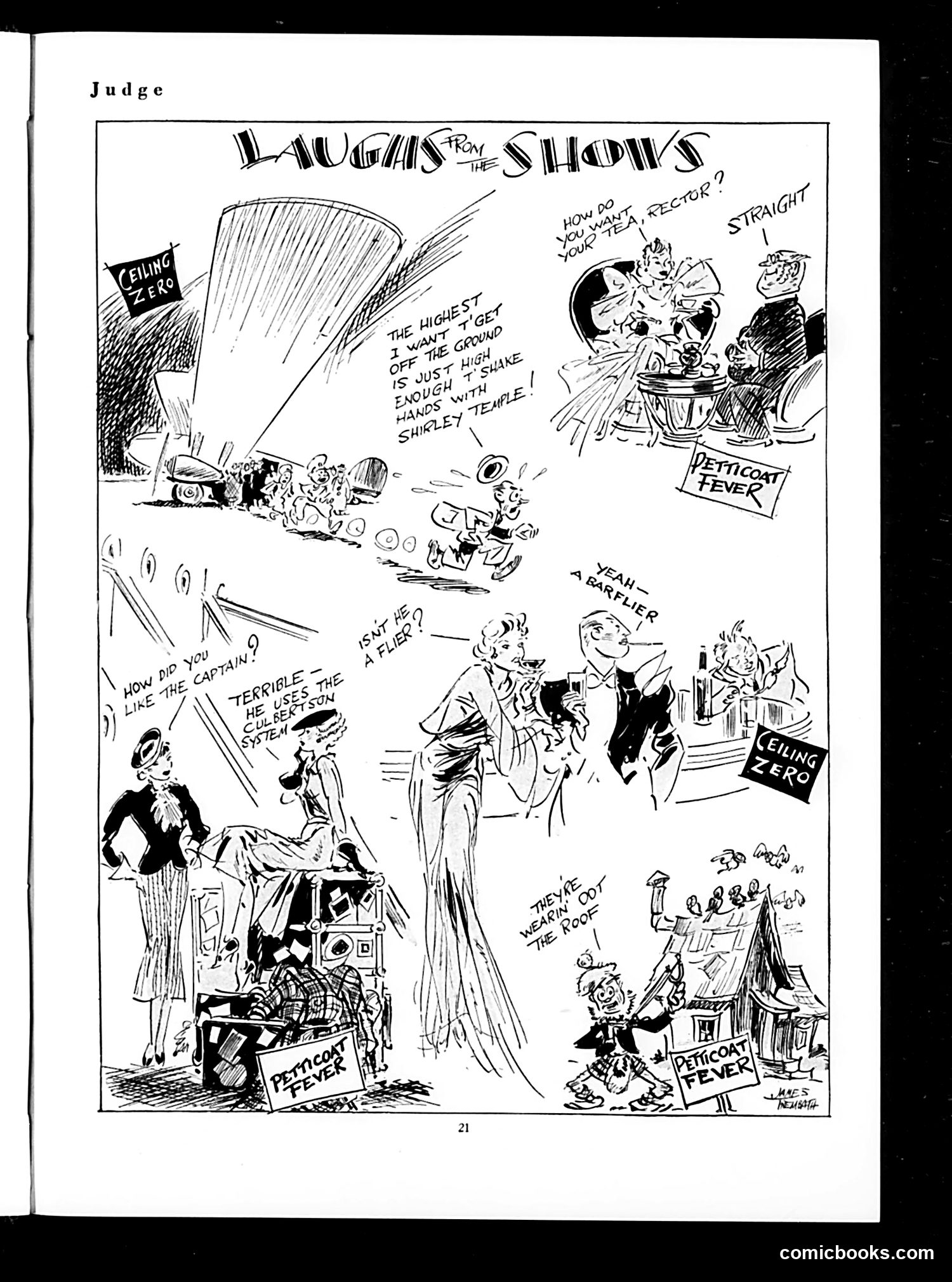
"Laughs from the Shows" This is a satirical comics page mocking theatrical productions of the era. The cartoons depict various stage performers and scenarios with labels like "Petticoat Fever" and "Detroit Fever," appearing to reference popular Broadway shows. The humor targets theatrical ambitions and pretension—characters discuss ceiling heights, stage directions, and performance challenges in exaggerated ways. One panel shows someone asking "How did you like the Captain?" with response "Terrible! He kept the Sergeant on the same perch!" suggesting absurd plot devices or casting choices. The "Ceiling Zero" references (visible in corner labels) likely allude to an actual production. Overall, the page satirizes stage production anxieties, overcrowded performance spaces ("they were on the roof"), and the gap between theatrical ambitions and practical reality.
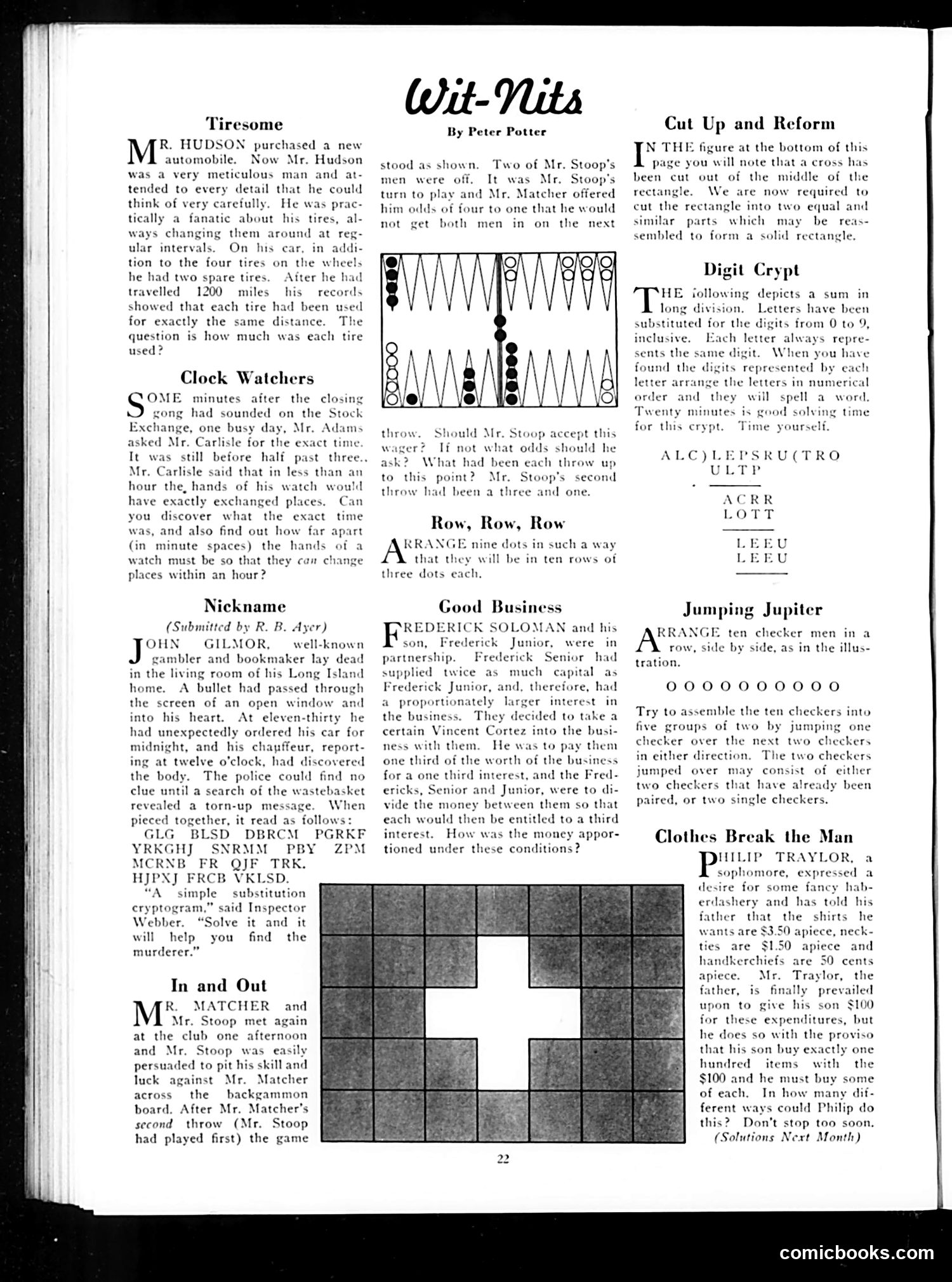
Wit-Nits: A Page of Brain Teasers from Judge Magazine This page presents a collection of recreational puzzles and mathematical riddles rather than political satire. "Wit-Nits," credited to Peter Potter, contains seven distinct puzzles for readers: 1. Tiresome - A math problem about tire wear across distances 2. Clock Watchers - A puzzle about watch hands exchanging positions 3. Nickname - A substitution cipher (cryptogram) involving a murder mystery 4. In and Out - A backgammon probability/strategy problem 5. Row, Row, Row - A geometric arrangement challenge 6. Good Business - A partnership math problem 7. Additional puzzles on digit substitution and geometric cutting The content reflects Judge's sophisticated, educated readership interested in logic puzzles and brain teasers—typical intellectual entertainment for early 20th-century publications. These aren't satirical cartoons but rather mind-bending challenges meant to entertain and test readers' problem-solving abilities.
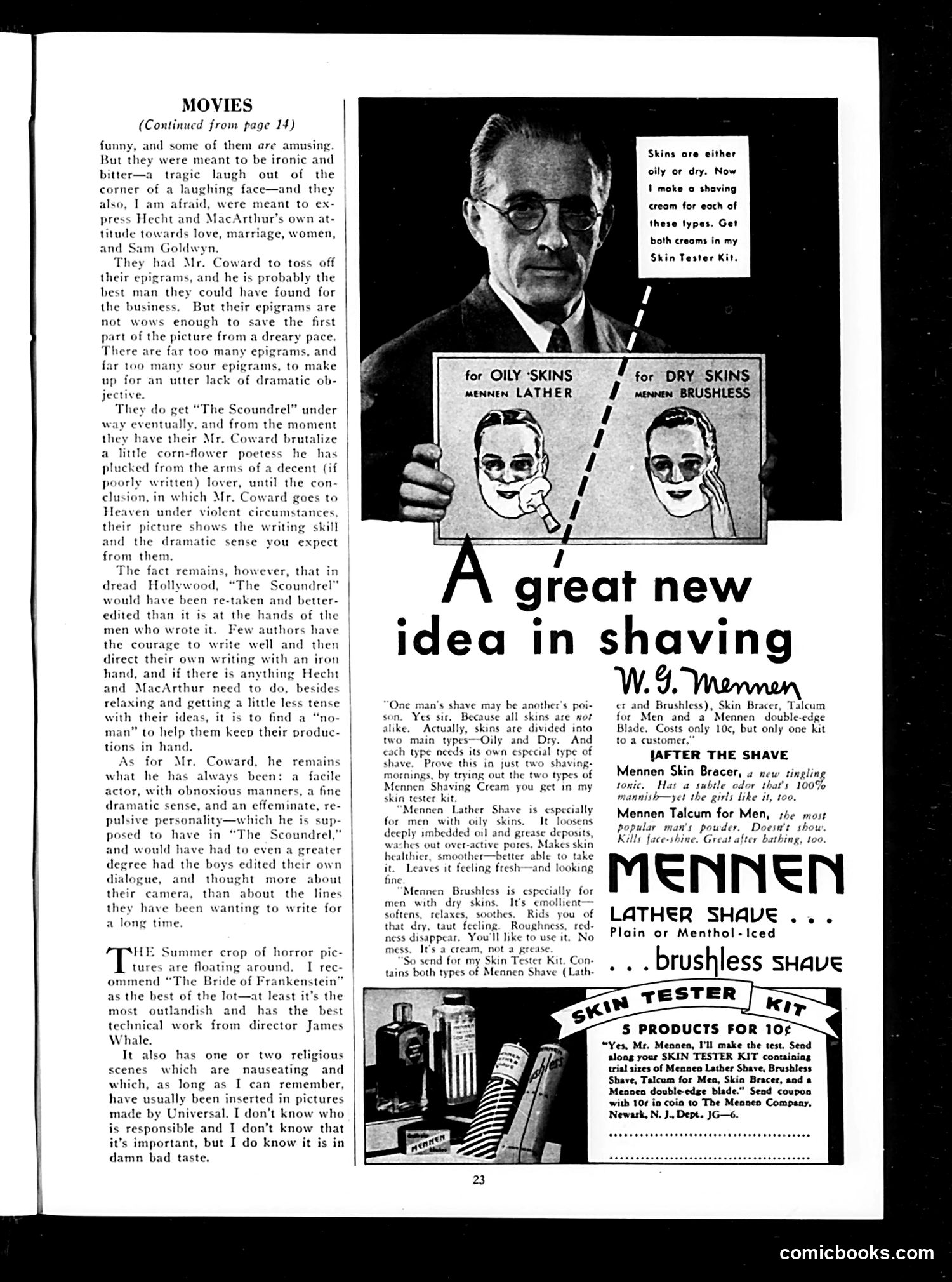
Judge Magazine Page Analysis This page is primarily an advertisement disguised as editorial content, not a political cartoon. The left column contains movie criticism (continued from a previous page), discussing films including "The Scoundrel" starring Noël Coward and "Bride of Frankenstein." The reviewer criticizes Coward's "effeminate, repulsive personality" and condemns religious scenes in horror films as "damn bad taste." The right side features a large Mennen shaving cream advertisement presenting a man (identified as W.O. Mennen) promoting different shaving products for oily versus dry skin types. The ad includes illustrated diagrams and product details, emphasizing the "Skin Tester Kit" containing samples. There is no political satire on this page. The content reflects 1930s advertising conventions and period film criticism, with no cartoon or caricature of public figures. The page demonstrates how Judge magazine blended entertainment coverage with advertising revenue.
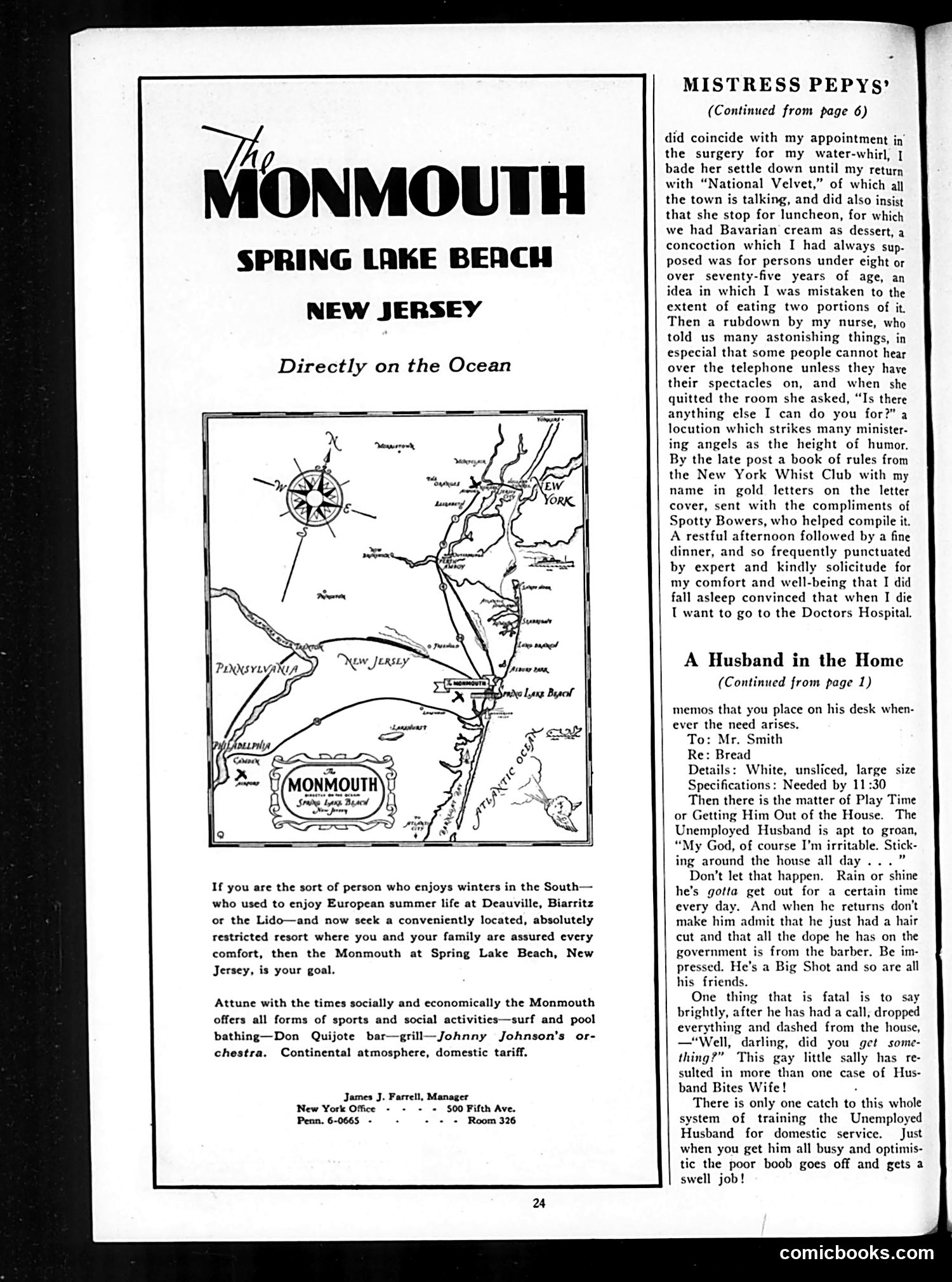
Judge Magazine Page Analysis This page contains two separate pieces: a resort advertisement and satirical columns—no political cartoon. The Advertisement promotes the Monmouth resort in Spring Lake Beach, New Jersey as an exclusive destination for wealthy Americans accustomed to European leisure travel (referencing Deauville and Biarritz). The phrase "absolutely restricted resort" is coded language for excluding Jewish guests—a common practice at 1920s-30s American resorts. The Columns are humorous domestic satire. "Mistress Pepys'" is a gossip column mimicking Samuel Pepys' diary style, describing a woman's leisurely day (spa treatments, movies, lunch). "A Husband in the Home" satirizes managing an unemployed husband during the Depression—treating him like a child needing structured activities and confidence-boosting, with the ironic twist that once trained for domesticity, he gets an actual job and leaves. Both pieces reflect Depression-era anxieties about leisure, employment, and gender roles among the middle/upper classes.
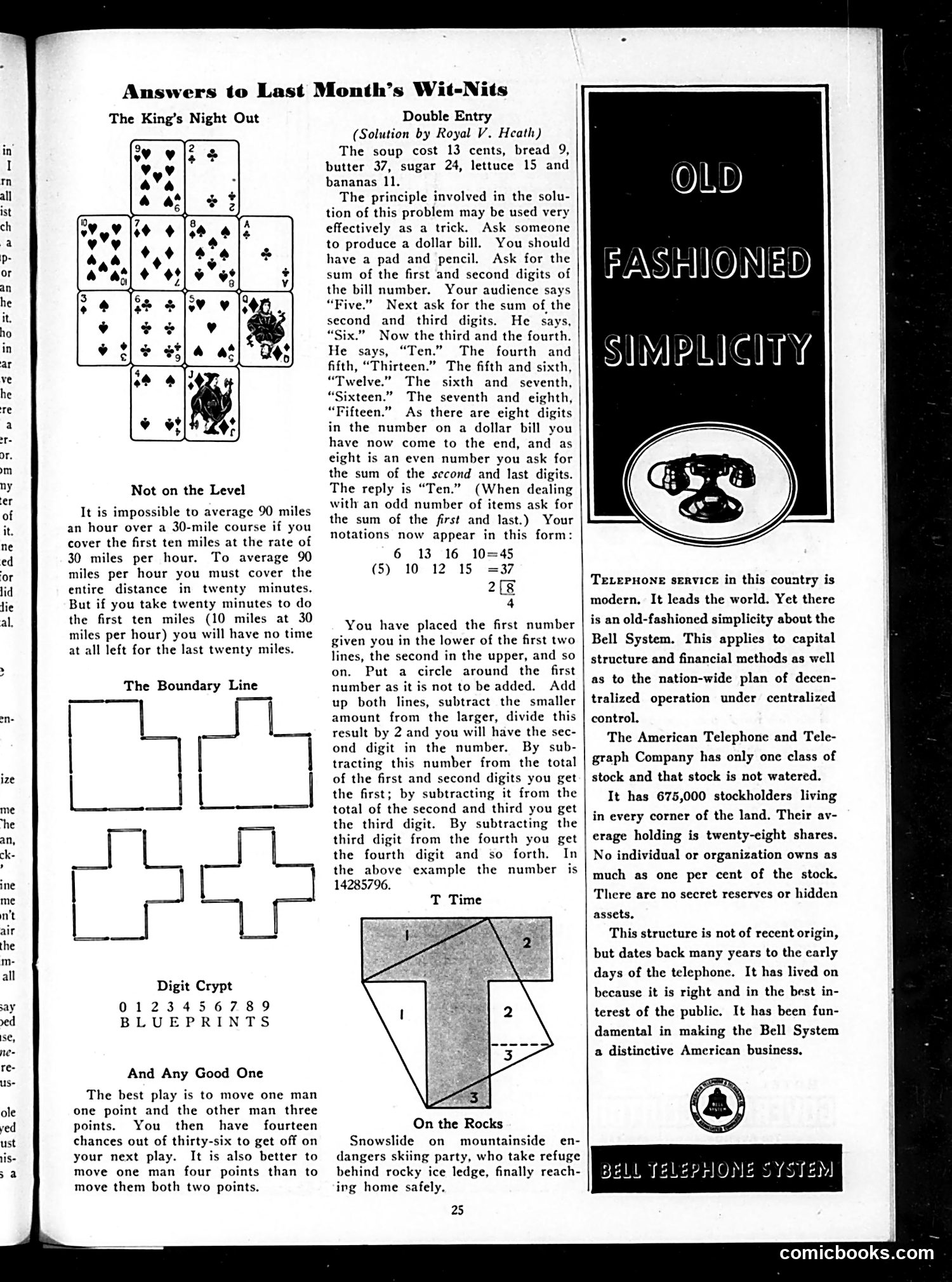
Analysis of This Judge Magazine Page This page contains puzzle solutions and an advertisement for Bell Telephone System, not political satire. The "Answers to Last Month's Wit-Nits" section presents mathematical and logic puzzles—card tricks, distance-averaging problems, and number games—typical of Judge's recreational content. The substantial right-side advertisement promotes AT&T's corporate structure as virtuous American capitalism. It emphasizes the company's "old-fashioned simplicity": 675,000 small stockholders with average holdings of 28 shares, no individual owning over one percent, and transparent financials with "no secret reserves." Historical context: This appears to be a defensive corporate advertisement from an era when telephone monopolies faced scrutiny. AT&T is countering potential criticism about concentrated corporate power by presenting itself as democratically held and accountable—a remarkably modern PR strategy. The rhetoric about "centralized operation under decentralized control" attempts to reconcile monopoly with American ideals of distributed ownership and fair dealing. No specific date is visible, but the print style and content suggest early-to-mid 20th century.
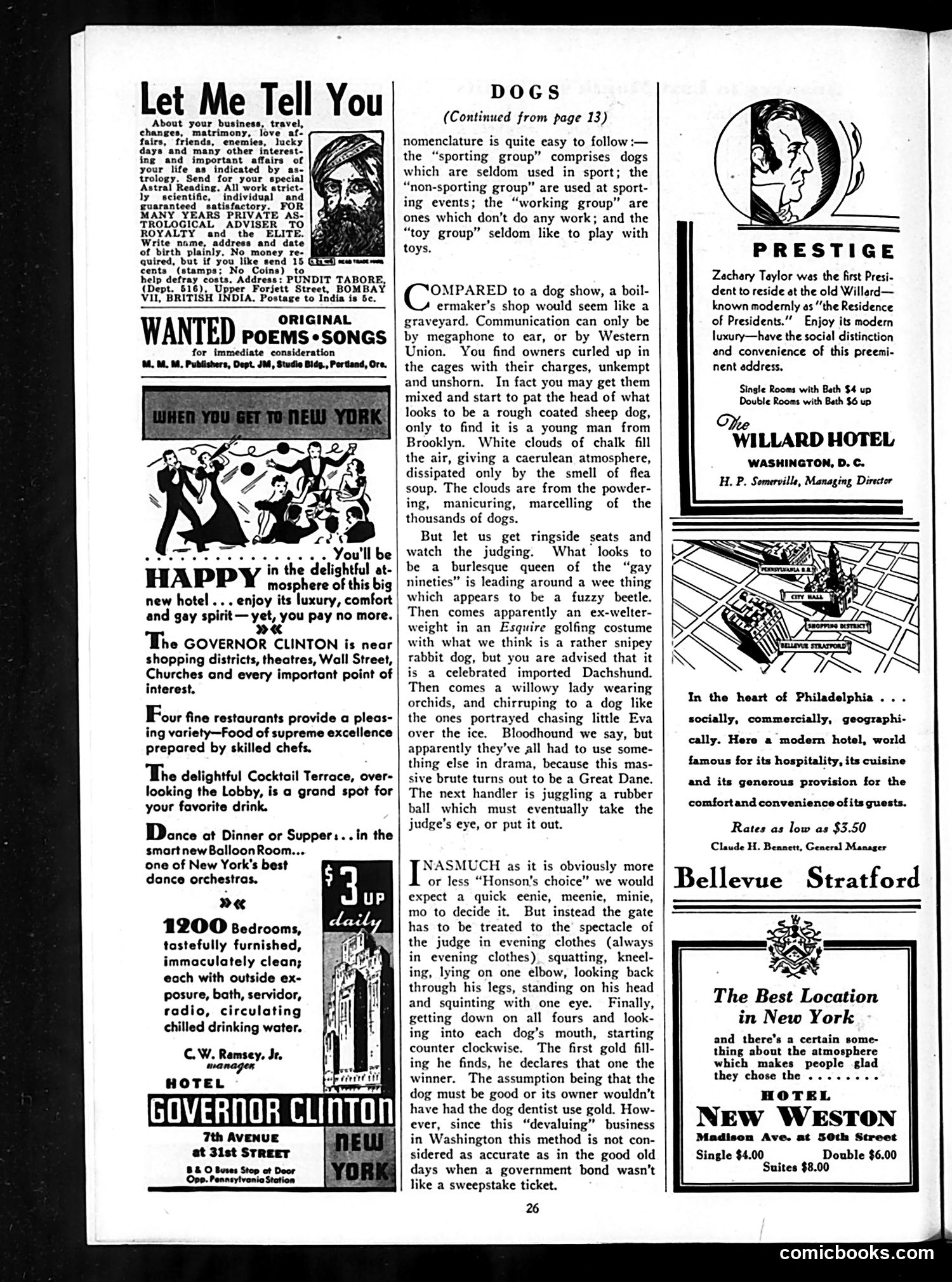
Explanation for Modern Readers This page is primarily advertisements and service listings for New York hotels (Governor Clinton, Willard Hotel, Bellevue Stratford, New Weston), interspersed with a continuation of an article about dog shows. The dog show article (center column) is satirical commentary mocking the pretentiousness and absurdity of competitive dog showing. The author humorously describes: - The chaotic atmosphere (chalk dust, flea treatments) - Eccentrically dressed handlers who are difficult to distinguish from their dogs - Judges performing ridiculous physical contortions (lying on elbows, standing on heads, crawling on all fours) to examine dogs - The absurd final judgment criterion: the judge awards the prize based on finding the first gold filling in a dog's teeth—a complete non-sequitur suggesting the entire judging process is arbitrary nonsense. The satire targets the elitism and irrationality of dog show culture, portraying it as theater rather than legitimate competition. The final joke—judging by dental work—undercuts any pretense of objective evaluation.
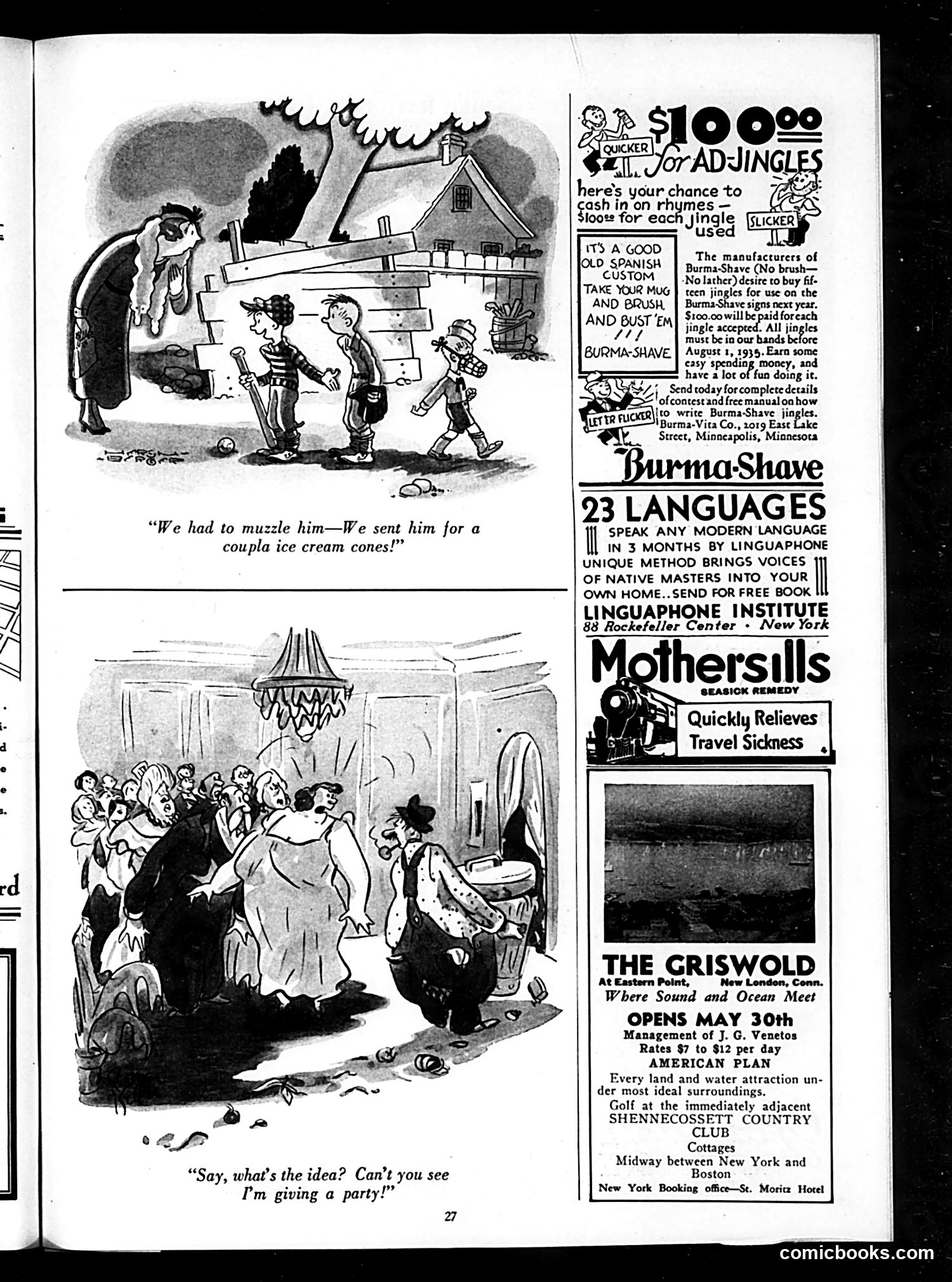
Judge Magazine Page Analysis This page contains two unrelated cartoon jokes and several advertisements typical of 1919 Judge magazine content. Top cartoon: A man has apparently muzzled a dog and sent it for ice cream cones, resulting in a mess. The humor derives from the absurdity of expecting a muzzled dog to retrieve and carry food successfully—slapstick comedy about poor problem-solving. Bottom cartoon: At a formal party, a man gestures toward a toilet, apparently suggesting it as entertainment for guests. The joke plays on the contrast between refined social settings and crude bathroom humor—typical of Judge's irreverent style. Advertisements dominate the right side, promoting Burma-Shave shaving cream (seeking jingle submissions), language instruction, travel sickness remedy, and resort destinations. These reflect 1919 consumer products and services. The page exemplifies Judge's mix of visual humor and commercial content aimed at educated, middle-class American readers.
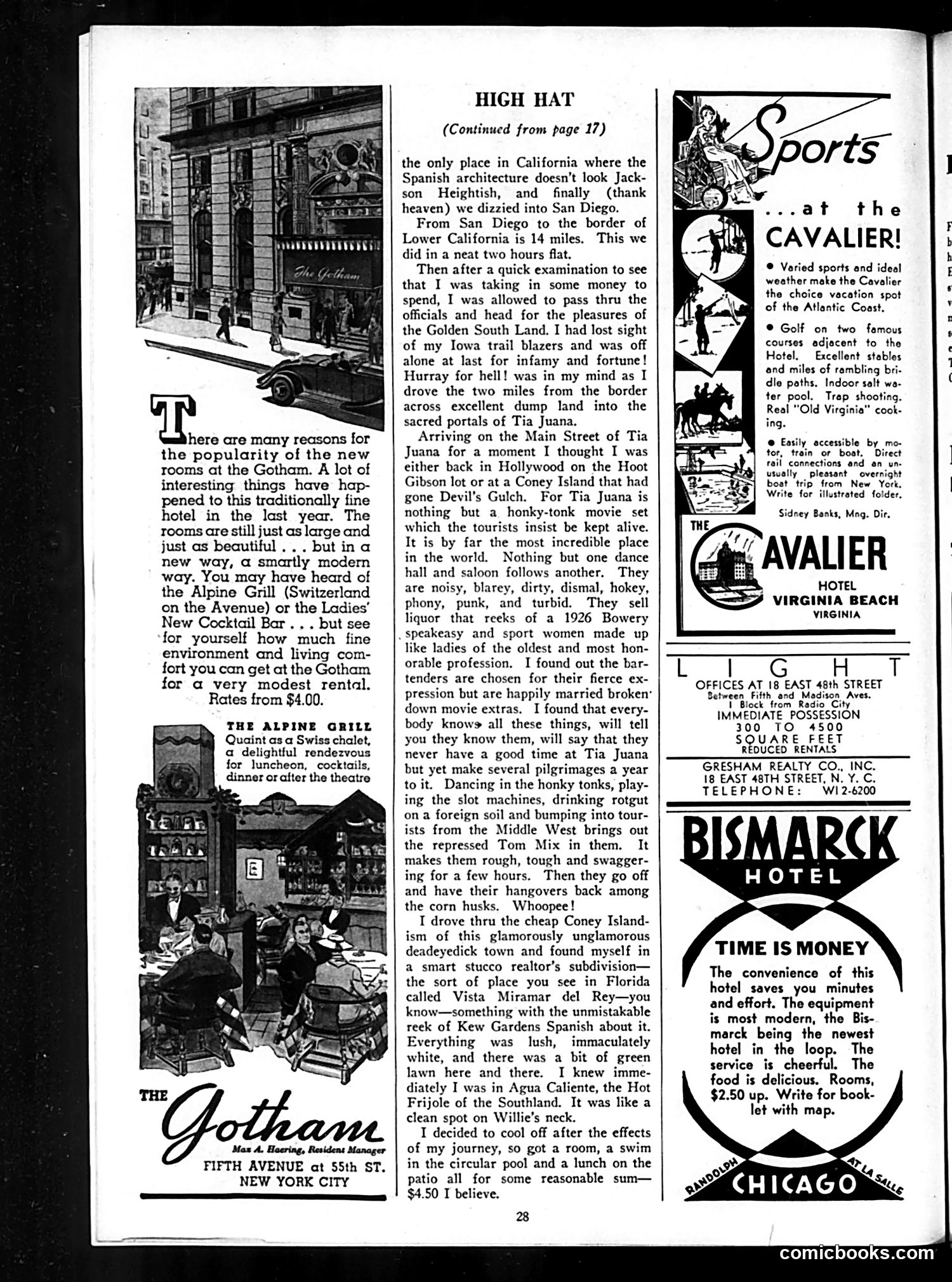
"High Hat" Travel Essay This page features a travel essay (continued from page 17) describing a journey to Tijuana, Mexico and Agua Caliente. The author humorously critiques Tijuana as an artificial "honky-tonk movie set" maintained solely for tourists—a place of dance halls, saloons, and "sport women" (prostitutes) designed to let middle-class American visitors, particularly "tourists from the Middle West," temporarily shed their repressed personas and behave recklessly before returning home with hangovers. The piece satirizes both the phoniness of the tourist destination and the hypocrisy of visitors who claim never to enjoy themselves there yet return repeatedly. The tone is satirical, mocking the manufactured nature of the experience while acknowledging its appeal to Americans seeking transgressive thrills on foreign soil during Prohibition era. The page includes hotel advertisements, a typical feature in *Judge* magazine.
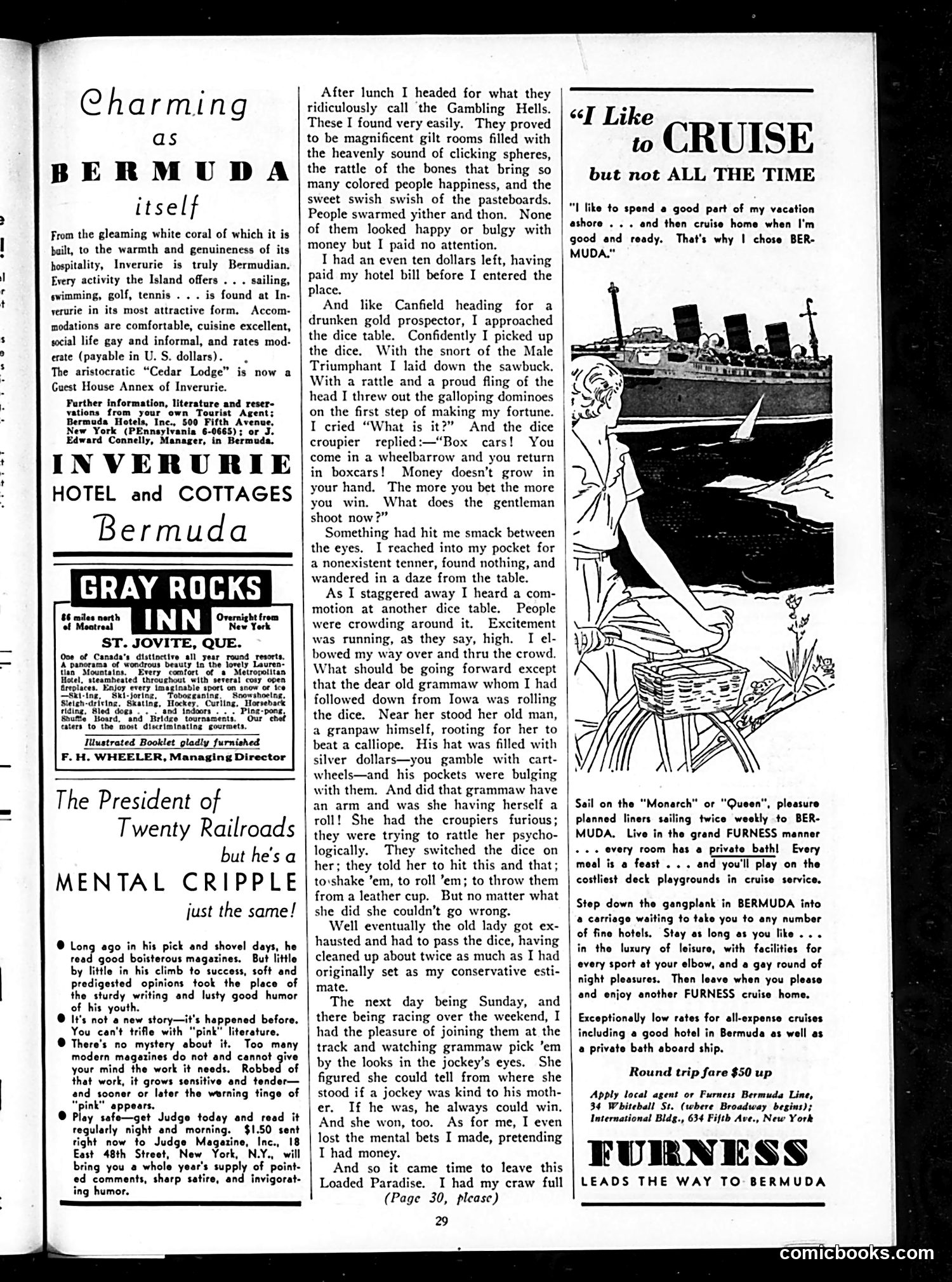
Explanation for Modern Readers This page is primarily advertisements and travel marketing for Bermuda and Canadian resorts, interspersed with a serialized humorous travel narrative. The main content is a story about the author's gambling experience in Bermuda. The narrative describes visiting "gambling hells" (casinos), losing ten dollars at a dice table, then witnessing an elderly grandmother from Iowa unexpectedly win at craps, filling her hat with silver dollars while her grandfather cheers her on. The sidebar advertisement "The President of Twenty Railroads but he's a MENTAL CRIPPLE just the same!" argues that even successful men become intellectually soft without reading challenging magazines like *Judge*—implying that modern publications coddle readers with "predigested opinions" rather than stimulating thought. It's a self-promotional pitch framed as social criticism about mental decline through passive consumption. The overall page reflects early-to-mid 20th century leisure culture and magazine advertising conventions.
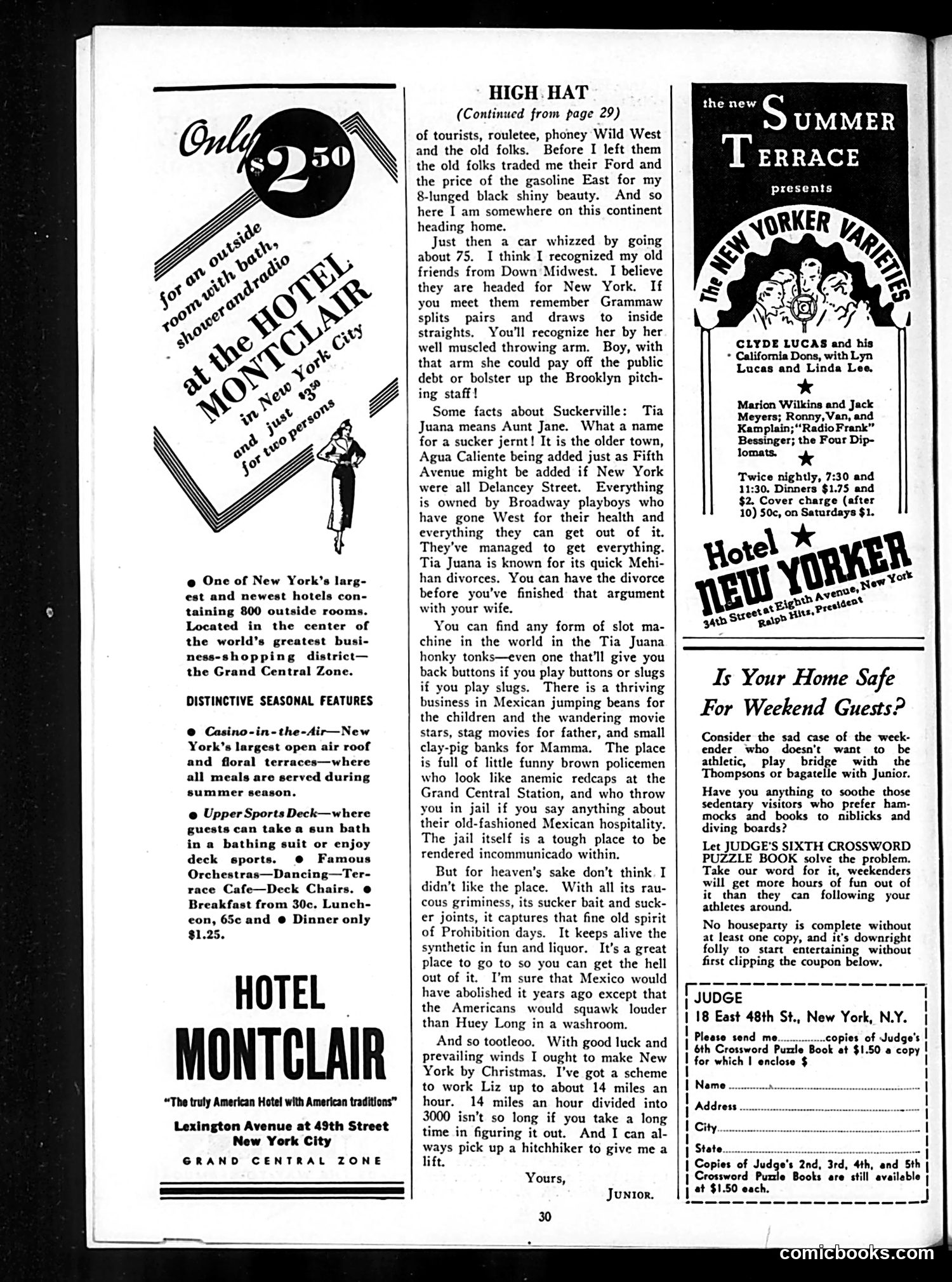
Explanation for Modern Readers This page is primarily advertising and light humor rather than political satire. The main content is "High Hat," a humorous travel essay by "Junior" mocking American tourists visiting Mexican border towns (Tijuana and Agua Caliente). The satire targets: - Wealthy Americans drawn to these vice destinations during Prohibition for gambling, divorces, and illegal liquor - Corrupt Mexican hospitality and police who exploit visitors - Wealthy Broadway playboys who own the establishments The essay's tone is cynical about Prohibition-era excess and American cultural arrogance abroad. The page also contains hotel advertisements (Montclair Hotel, Hotel New Yorker, Summer Terrace) and a crossword puzzle promotion—typical magazine filler. The sidebar joke "Is Your Home Safe For Weekend Guests?" humorously warns against rowdy visitors. There are no identifiable political cartoons or specific caricatured figures. This reflects Judge magazine's shift toward lifestyle humor and advertising rather than pointed political commentary.
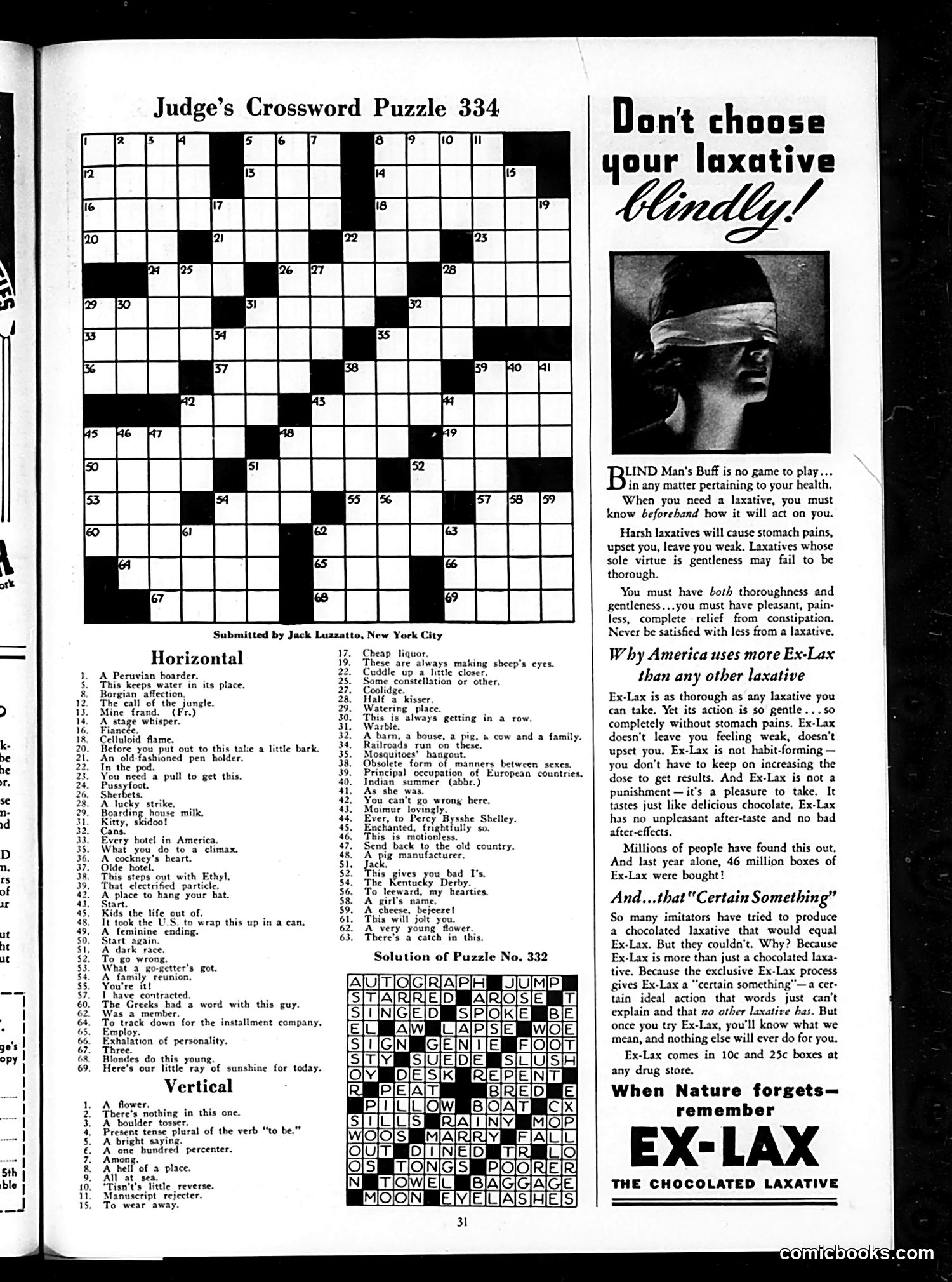
Judge Magazine Page Analysis This page combines a crossword puzzle with a full-page advertisement for Ex-Lax laxative. The puzzle itself contains no political satire—it's a standard word puzzle with clues referencing contemporary 1920s-30s culture (references to Coolidge, the Kentucky Derby, Ethyl gasoline). The advertisement's visual element shows a blindfolded figure, playing on the phrase "Blind Man's Buff" to argue consumers shouldn't "choose your laxative blindly." The ad emphasizes that Ex-Lax offers both gentleness *and* effectiveness—addressing consumer anxiety about harsh laxatives that caused stomach pain and weakness. The marketing strategy is notable: Ex-Lax positions itself as superior to competitors by claiming a proprietary "certain something" that imitators cannot replicate. The ad boasts 46 million boxes sold annually, suggesting market dominance. This represents typical early 20th-century patent medicine marketing, where laxatives were heavily advertised and widely used remedies.
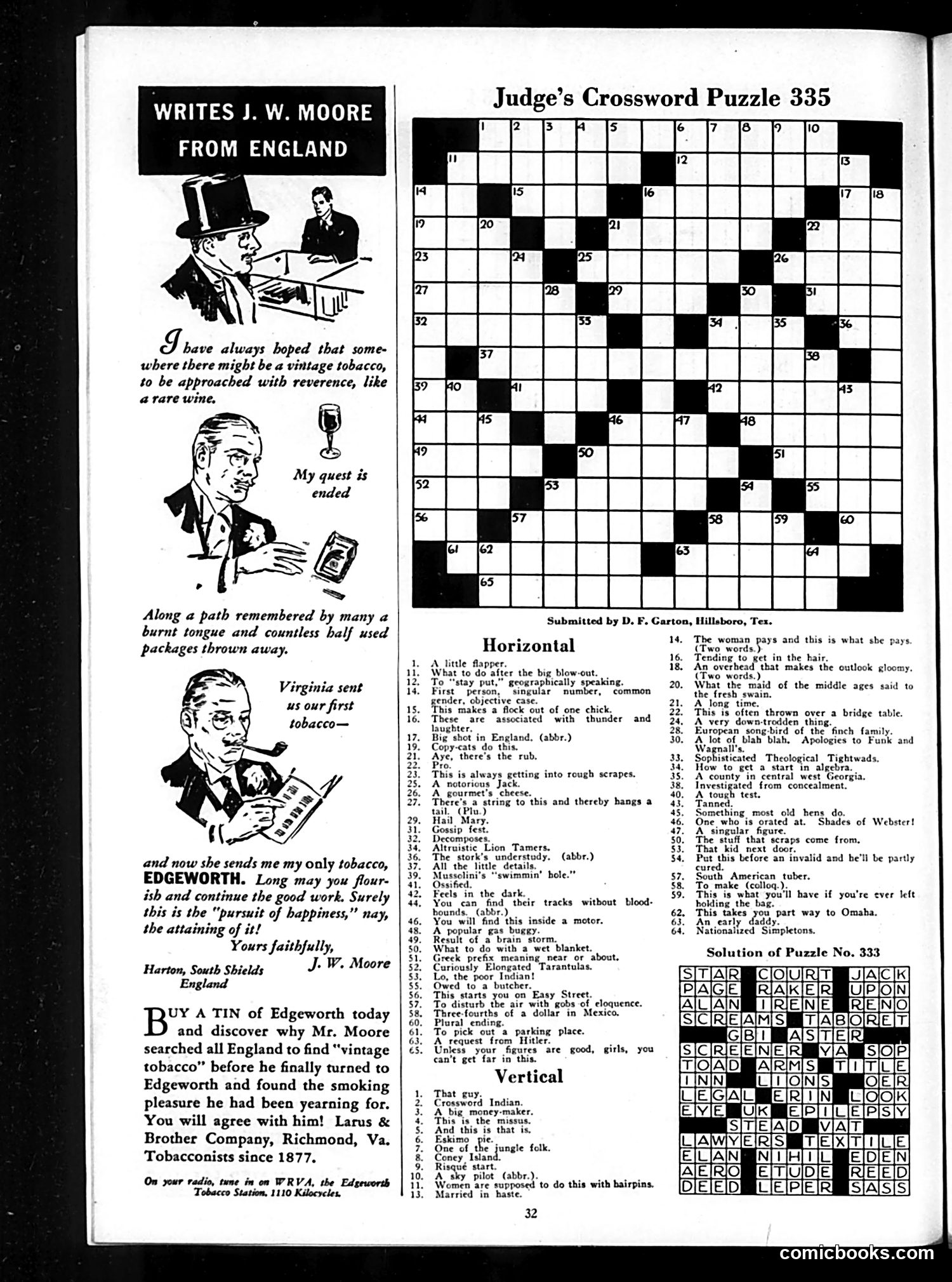
Judge Magazine Page Analysis This page combines advertising with a crossword puzzle—typical Judge magazine content from the early-to-mid 20th century. The top section features testimonial advertising for Edgeworth tobacco, presented as a letter from "J.W. Moore" in England. Moore describes his quest for "vintage tobacco" approached "with reverence, like a rare wine," eventually settling on Edgeworth as superior to all English options. The copy uses genteel language to position the product as refined and discerning—marketing tobacco as an aspirational luxury good. The accompanying illustrations show a distinguished gentleman smoking, reinforcing this upscale image. Below is Judge's Crossword Puzzle 335, a standard puzzle feature with horizontal and vertical clues. The clues reflect 1930s-40s vernacular and cultural references (flappers, Hitler requests, "gas buggy" for automobiles), typical of the era's humor and social commentary embedded even in puzzle content. The page represents Judge's dual function: entertaining readers while serving advertisers—here, promoting Edgeworth tobacco to the magazine's educated, middle-to-upper-class audience.
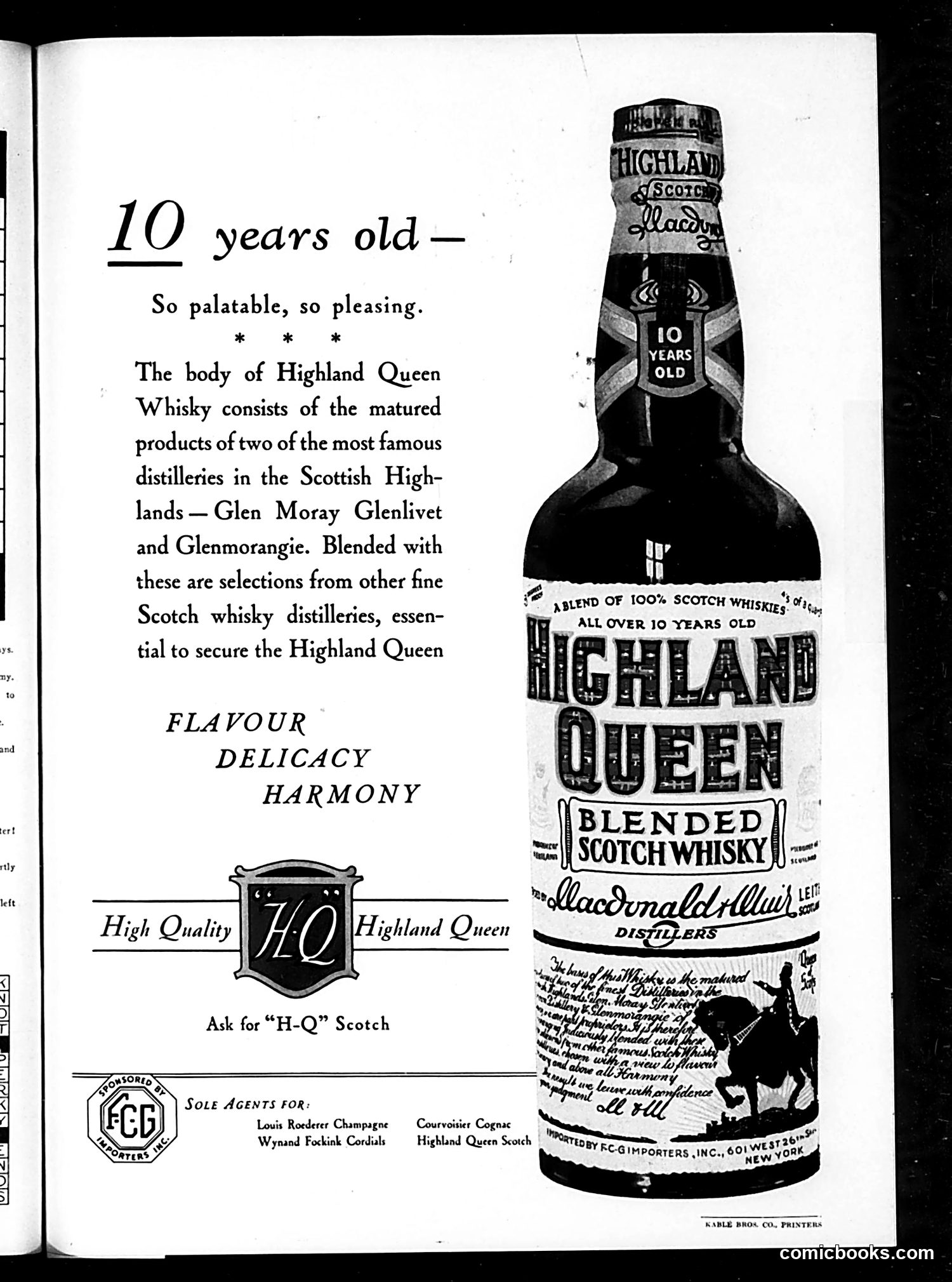
Highland Queen Whisky Advertisement This is a full-page advertisement, not political satire or a cartoon. It promotes Highland Queen Blended Scotch Whisky, emphasizing that the 10-year-old product offers "flavour, delicacy, harmony." The ad details the whisky's composition: a blend of products from Glen Moray Glenlivet and Glenmorangie distilleries, mixed with selections from other Scottish distilleries. The page includes the brand's "HQ" logo shield and lists the importer (F.C.G Importers, Inc., New York) and sole agents for various luxury spirits. A silhouette of a Scottish Highland figure appears on the bottle label. This represents typical mid-20th-century advertising in *Judge* magazine—straightforward product promotion using appeals to quality, heritage, and refinement rather than humor or political commentary.
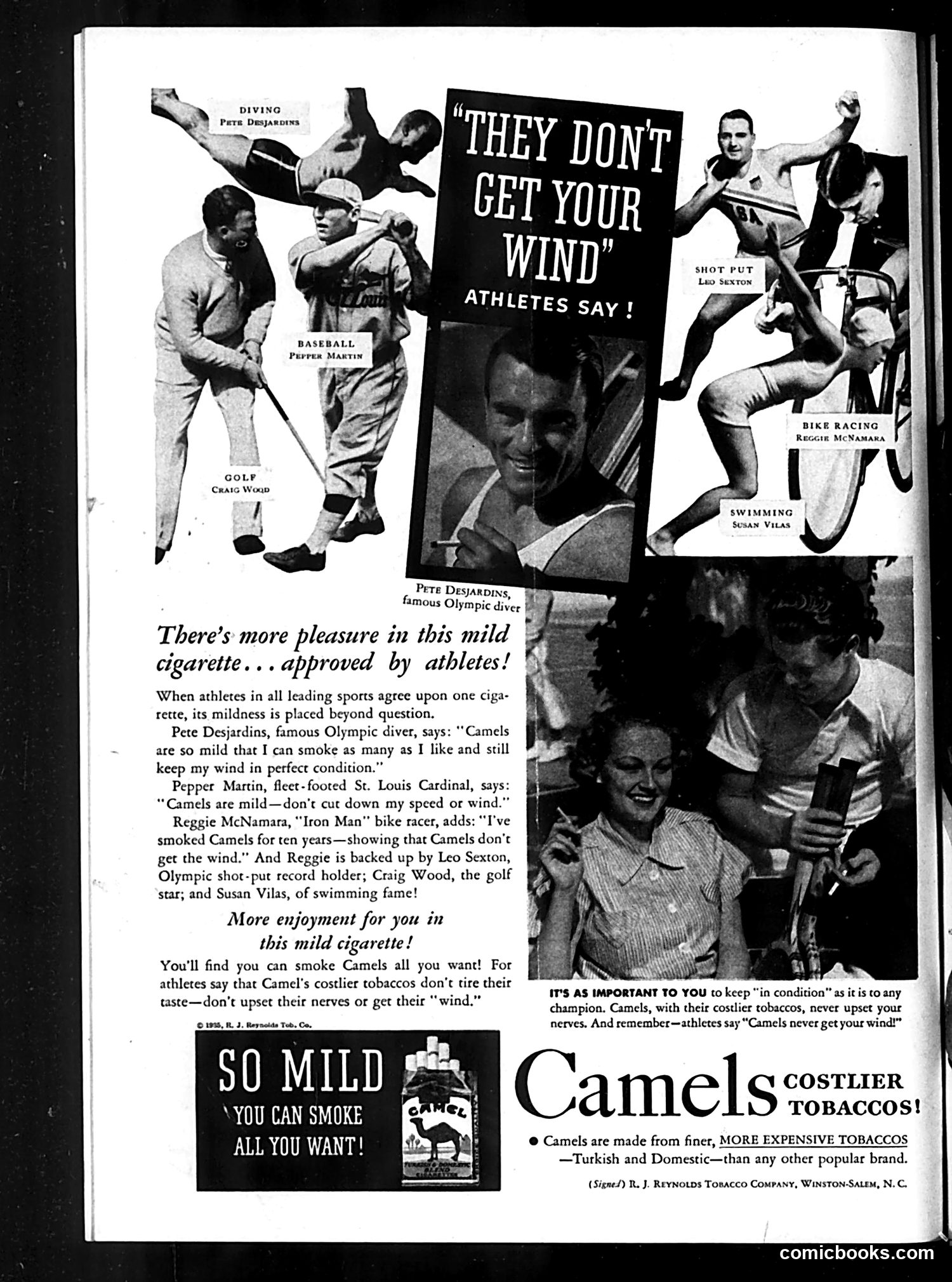
Analysis: Camel Cigarette Advertisement, circa 1935 This is a cigarette advertisement, not political satire. It features endorsements from named athletes across multiple sports—Olympic diver Pete Desjardins, baseball player Pepper Martin, bike racer Reggie McNamara, shot-putter Leo Sexton, golfer Craig Wood, and swimmer Susan Vilas—claiming Camel cigarettes are so mild they don't affect athletic performance or "wind." The advertisement's central claim: Camels' "costlier tobaccos" allow athletes to smoke freely without fatigue. This exploits the era's lack of understanding about smoking's health effects. By associating cigarettes with peak physical condition and famous athletes, the campaign legitimizes smoking as compatible with athletic excellence. The phrase "They don't get your wind" is the slogan—a pun suggesting Camels won't impair breathing capacity. Modern readers would recognize this as deeply misleading health marketing that would be illegal today.
I can see this is a heavily darkened page from *Judge* magazine with repeated circular emblems or seals arranged in a pattern across a black background. The page appears to show watermarks or a decorative pattern rather than traditional cartoon artwork. The OCR text provides minimal content—only a website URL ("comicbooks.com") visible at the bottom right. Without clearer visibility of the actual imagery or accompanying text, I cannot reliably identify specific figures, political references, or the intended satire. The page quality and darkness make it impossible to discern details that would allow accurate historical interpretation. To properly analyze this *Judge* page's political or social commentary, a higher-quality or clearer image would be necessary.