judge
Judge — July 1935
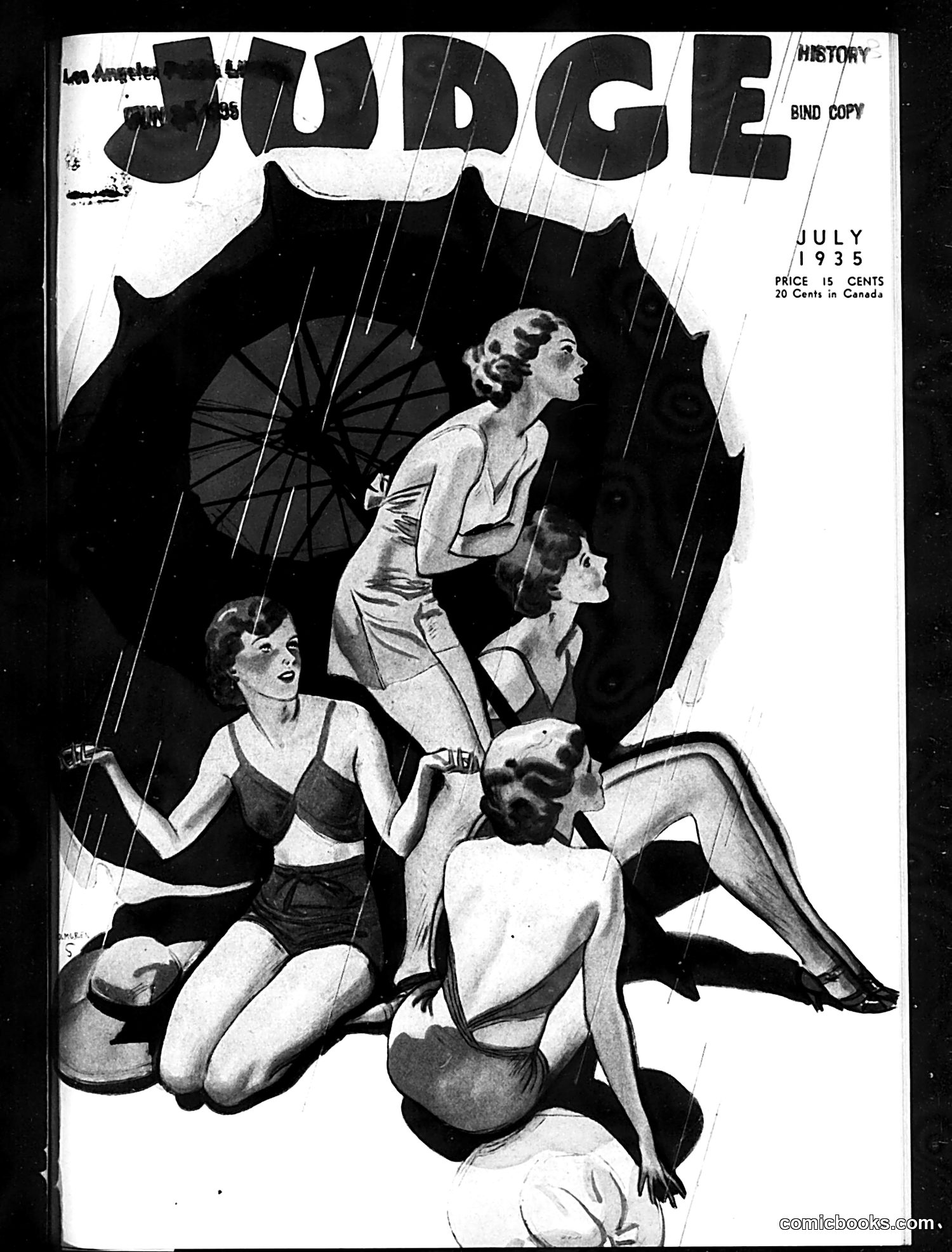
Judge Magazine Cover, July 1935 This cover depicts four women in swimwear huddled beneath an umbrella during a rainstorm—a straightforward seasonal joke rather than political satire. The "Judge" masthead and "Bind Copy" marking indicate this is a library archive copy. The illustration plays on a common 1930s theme: women seeking shelter together, their swimwear ironically unsuitable for rain. The humor is gentle and domestic rather than satirical—typical of Judge's lighter summer content. The price notation (15 cents, 20 cents in Canada) and July 1935 date place this squarely in the Depression era, when such magazines offered affordable leisure reading. No specific political figures or events appear referenced on this cover.
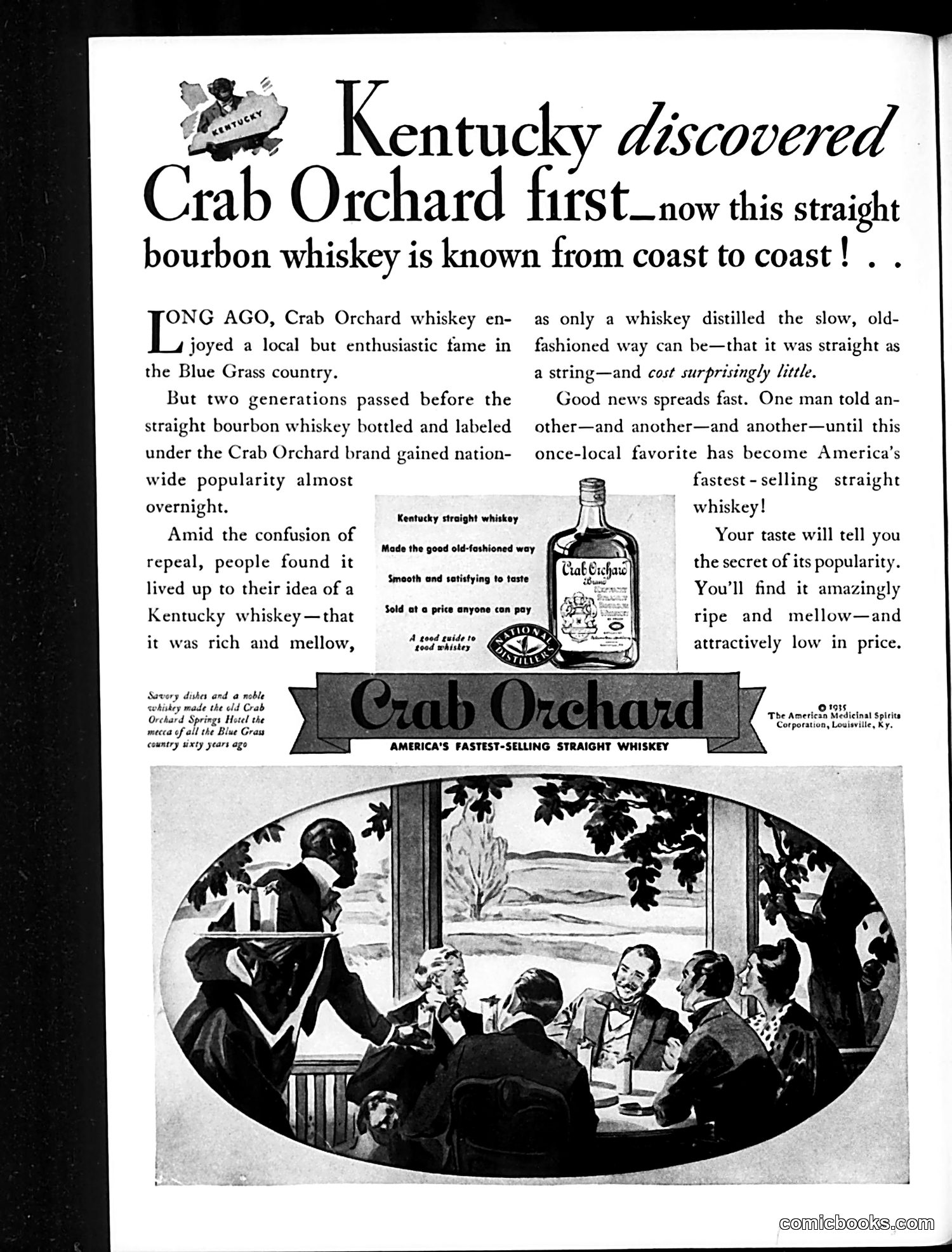
Crab Orchard Whiskey Advertisement This is a straightforward product advertisement, not satire or political commentary. The page promotes Crab Orchard bourbon whiskey, claiming it was "Kentucky discovered" and has become "America's fastest-selling straight whiskey." The ad narrative describes how the whiskey gained local popularity in Kentucky's Blue Grass region, then gradually achieved national distribution. It emphasizes the product's qualities: "rich and mellow," distilled the "old-fashioned way," "straight as a string," and notably affordable. The accompanying illustration shows well-dressed men in what appears to be a social setting, suggesting the whiskey's appeal to respectable society. The overall message is aspirational marketing—positioning Crab Orchard as a quality product accessible to ordinary consumers during a period when bourbon whiskey was regaining commercial viability.
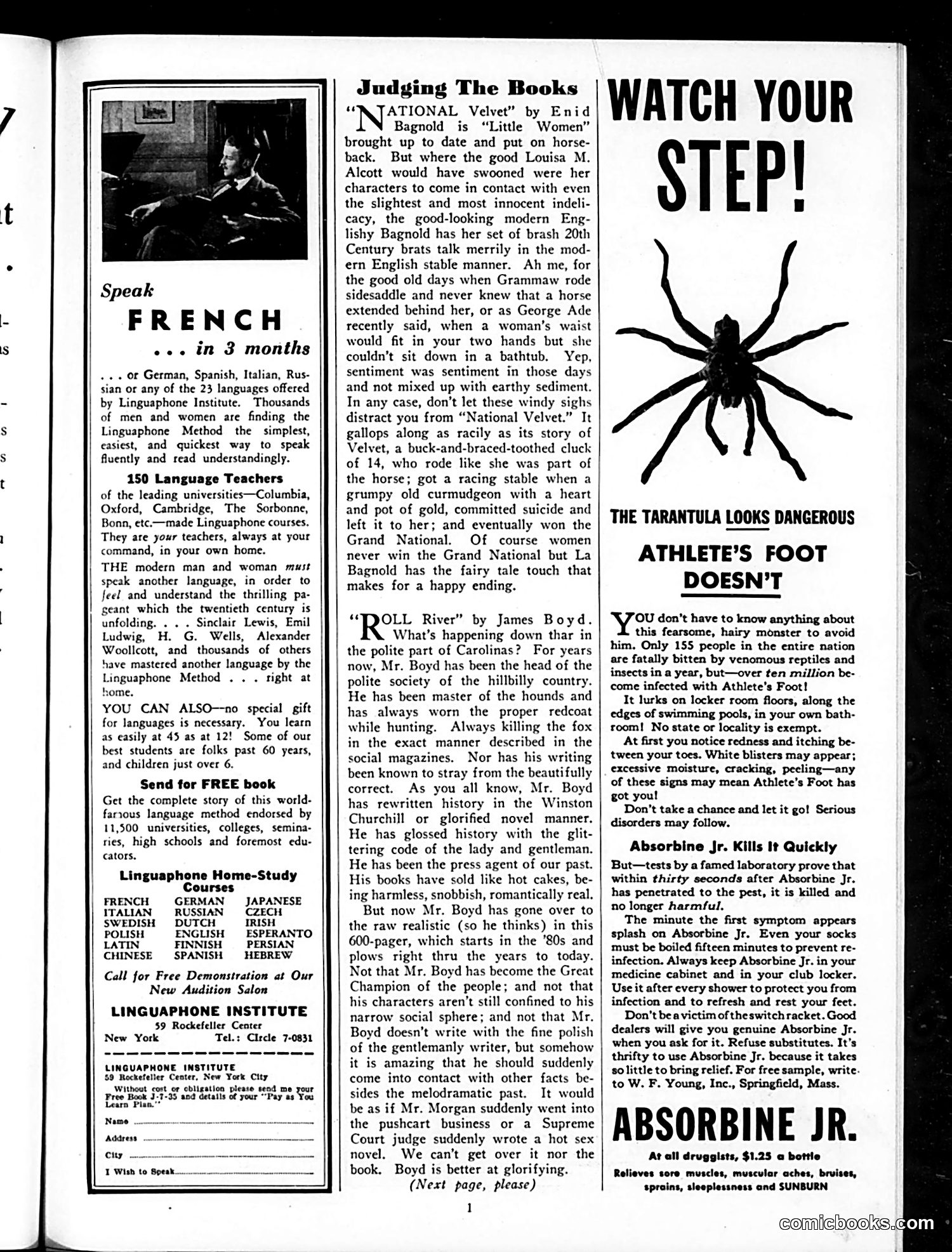
Analysis of Judge Magazine Page This page is primarily advertising and book reviews rather than political satire. The main content includes: 1. "Speak French in 3 Months" - A Linguaphone Institute language course advertisement promoting their home-study method, endorsed by universities and prominent figures. 2. "Judging the Books" - A literary review column critiquing novels including "National Velvet" by Enid Bagnold and "Roll River" by James Boyd. The reviewer dismisses these works as sentimentally written, preferring Boyd's earlier realistic style. 3. "Watch Your Step!" and "Athlete's Foot Doesn't" - Health/medical advertisements warning about tarantulas and promoting Absorbine Jr., a patent medicine claiming to treat athlete's foot. The page contains no discernible political cartoons or social satire—it's a typical magazine layout mixing advertisements with consumer product recommendations.
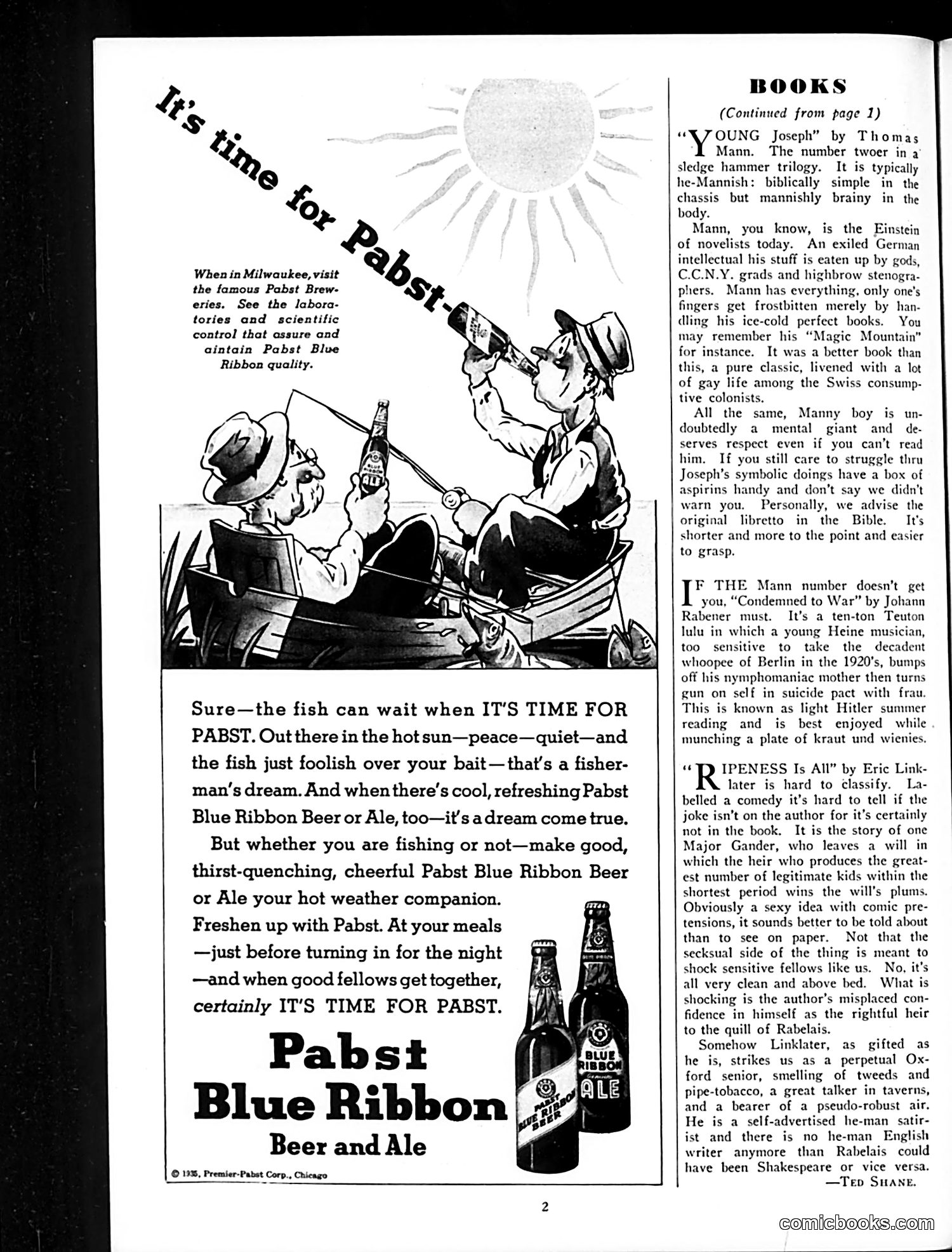
Page Analysis This page is primarily a Pabst Blue Ribbon Beer advertisement rather than political satire. The left side features an illustration of two men fishing, with copy promoting Pabst beer as an ideal companion for outdoor recreation and hot weather. The right side contains book reviews by Ted Shane, discussing works including "Young Joseph" by Thomas Mann and "Ripeness Is All" by Eric Linklater. Shane's commentary is witty and gossipy rather than serious literary criticism—he characterizes Mann as a genius but notes his writing can be difficult, and mocks Linklater's novel as a somewhat salacious comedy about inheritance disputes. The page represents Judge magazine's mix of advertising and entertainment content rather than political commentary.
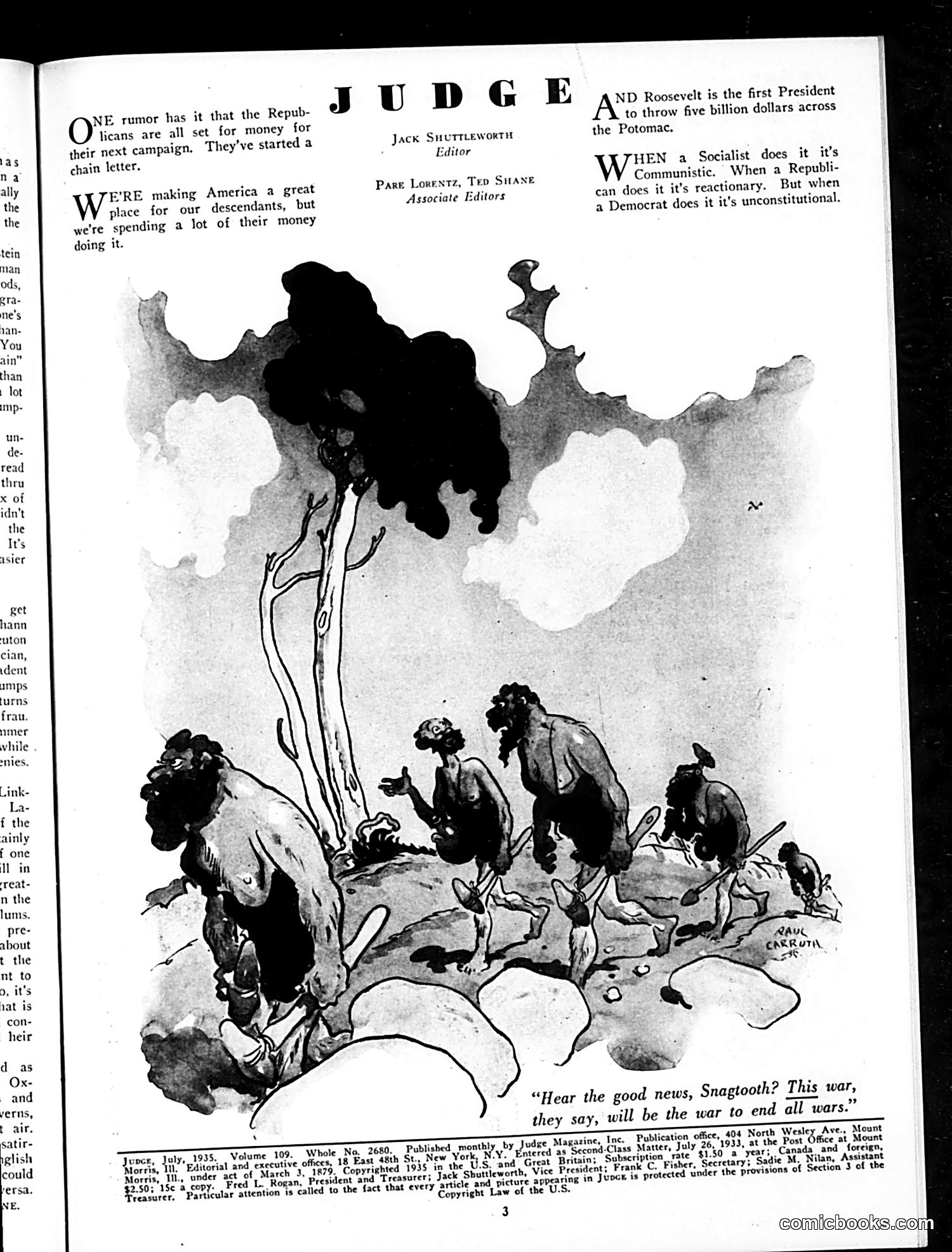
Explanation for Modern Readers This July 1935 *Judge* magazine page satirizes Republican campaign strategy. The left column's "chain letter" joke mocks Republicans planning their next campaign while supposedly building America for descendants—yet "spending a lot of their money doing it." The main cartoon depicts figures (likely Republican politicians or campaign operatives) gathered around a dead or dying tree labeled "Snagtooth," discussing war. The caption reads: "Hear the good news, Snagtooth? This war, they say, will be the war to end all wars"—a bitter reference to World War I's false promise of being "the war to end all wars." The satire suggests Republicans profit from or exploit war rhetoric while claiming patriotic motives. The barren landscape reinforces the cartoon's pessimistic message about political opportunism.
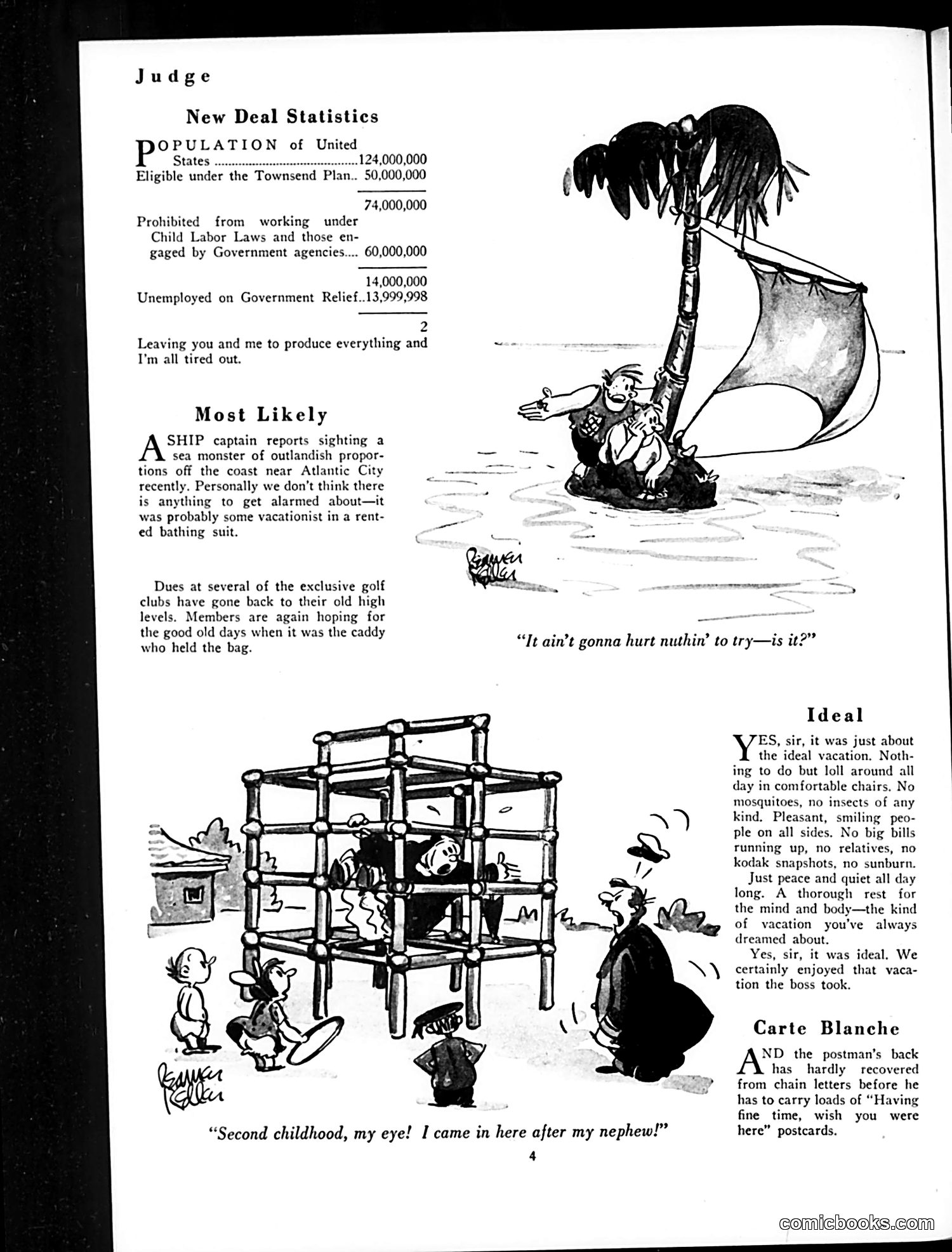
Analysis of Judge Magazine Page This page satirizes New Deal policies through statistics and cartoons. The top section mocks the Townsend Plan (a 1930s pension proposal) by listing those excluded from benefits, ending with "Leaving you and me to produce everything and I'm all tired out"—criticizing the tax burden on workers. The upper cartoon shows a man under a dead palm tree (symbolizing economic collapse) saying "It ain't gonna hurt nuthin' to try," likely mocking optimistic rhetoric about untested government programs. The lower cartoon depicts a playpen labeled "Second childhood," satirizing New Deal agencies as childlike or regressive. The "Ideal" and "Carte Blanche" sections offer additional satirical commentary on vacation expectations and postcard correspondence, reflecting broader conservative skepticism toward Depression-era government intervention.
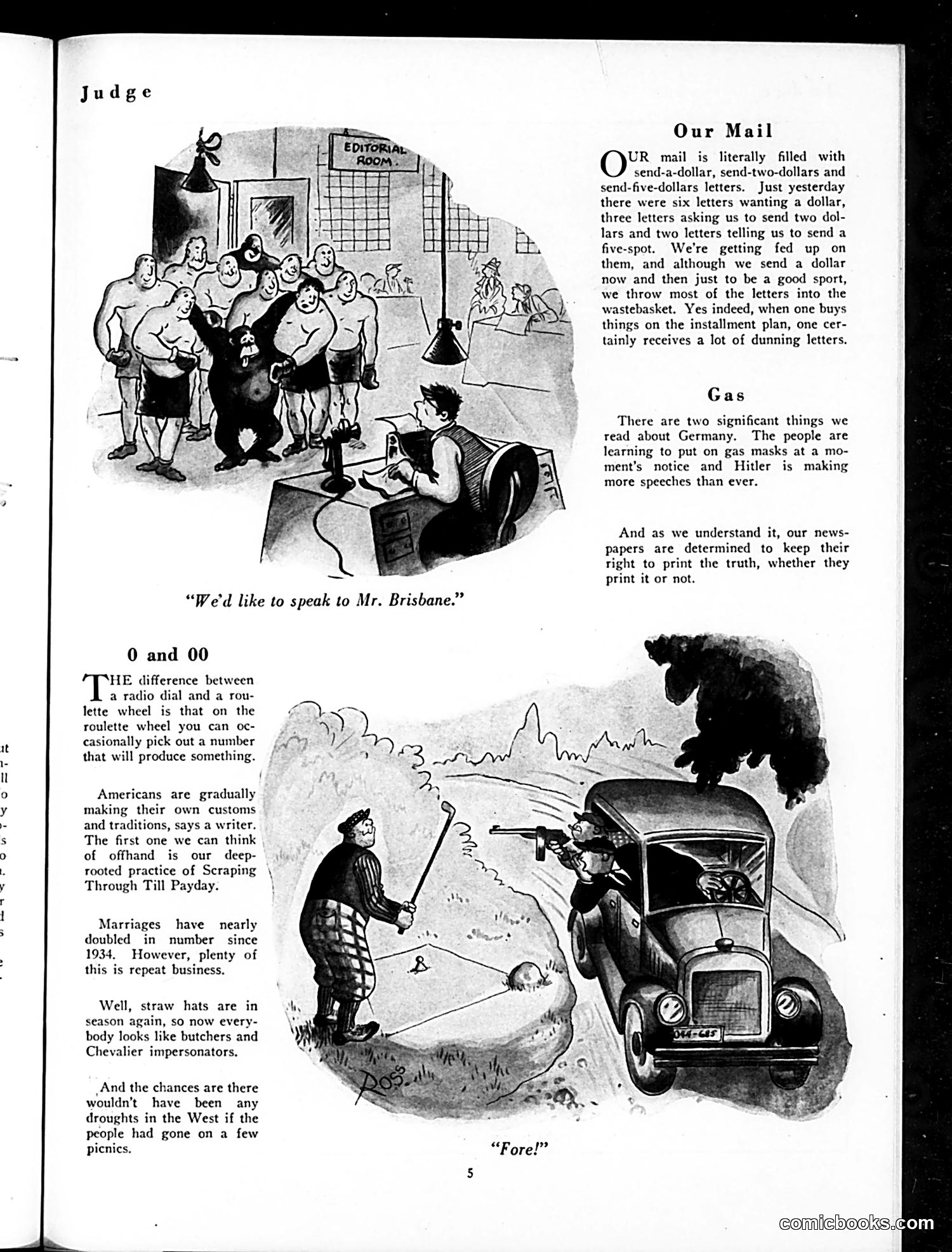
Analysis of Judge Magazine Page This page contains three separate satirical pieces: 1. "We'd like to speak to Mr. Brisbane" – The cartoon shows people crowding an editorial room, apparently wanting to contact a specific editor (likely Arthur Brisbane, a famous newspaper editor of the era). The satire likely comments on public demand for editorial access or influence. 2. "O and OO" – A brief piece joking about roulette wheels versus radio dials, then discusses Americans creating new customs like "Scraping Through Till Payday" and mentions increased marriages and straw hats being in season. 3. "Fore!" – A cartoon showing a golfer hitting toward a car on a road, with a bear emerging from the vehicle. This appears to satirize the collision of recreational activities (golf) with modern transportation and wildlife encounters. The overall tone is light, observational humor about American life and customs.
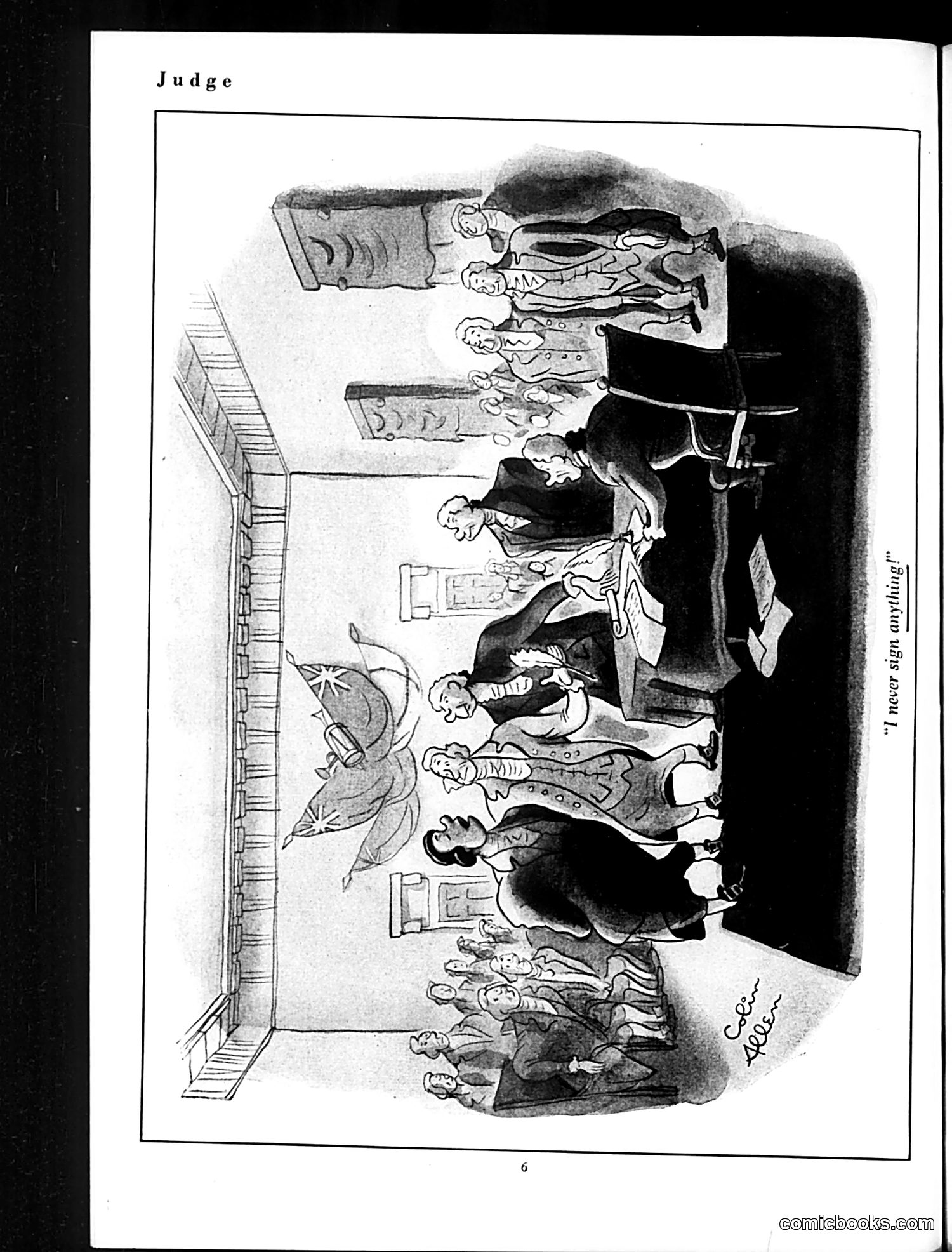
"Judge" Cartoon Analysis: "I never sign anything" This political cartoon depicts a courtroom scene where a tall figure in a top hat and dark coat stands before a judge's bench, surrounded by numerous smaller figures (likely petitioners or plaintiffs). The caption "'I never sign anything'" suggests the central figure refuses to execute documents or take responsibility for decisions. The cartoon likely satirizes a political or public figure known for avoiding accountability or signing agreements. The crowded courtroom full of people waiting before this obstinate character emphasizes the consequences of such refusal—many are left unserved or waiting for action. Without the publication date visible, the specific target remains unclear, but the satire critiques governmental or institutional negligence through deliberate non-cooperation.
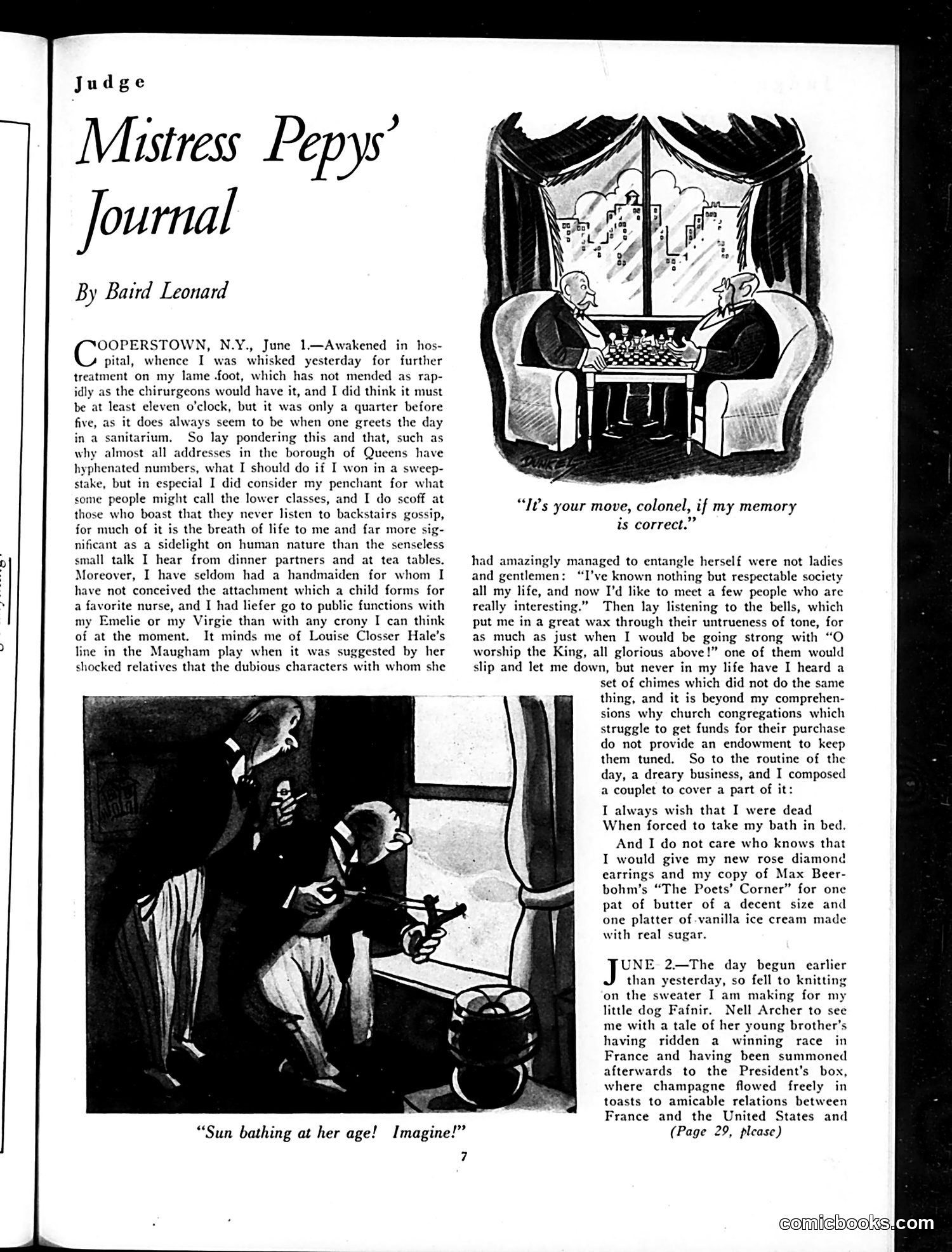
Analysis of "Mistress Pepys' Journal" Page from Judge Magazine This is a satirical column by Baird Leonard mimicking Samuel Pepys' famous 17th-century diary format, but written from a woman's perspective about contemporary 1920s life. The two illustrations show genteel domestic scenes—one depicting two figures playing chess, another showing a woman in a bathtub (captioned "Sun bathing at her age! Imagine!"). The satire targets upper-class women's leisure activities and social pretensions. The column complains about church bells, gossip, servants, and minor domestic annoyances in elaborate, self-important language. The humor lies in applying Pepys' grandiose historical diary style to trivial modern female concerns—satirizing both the affectation of educated women and their narrow domestic worlds.
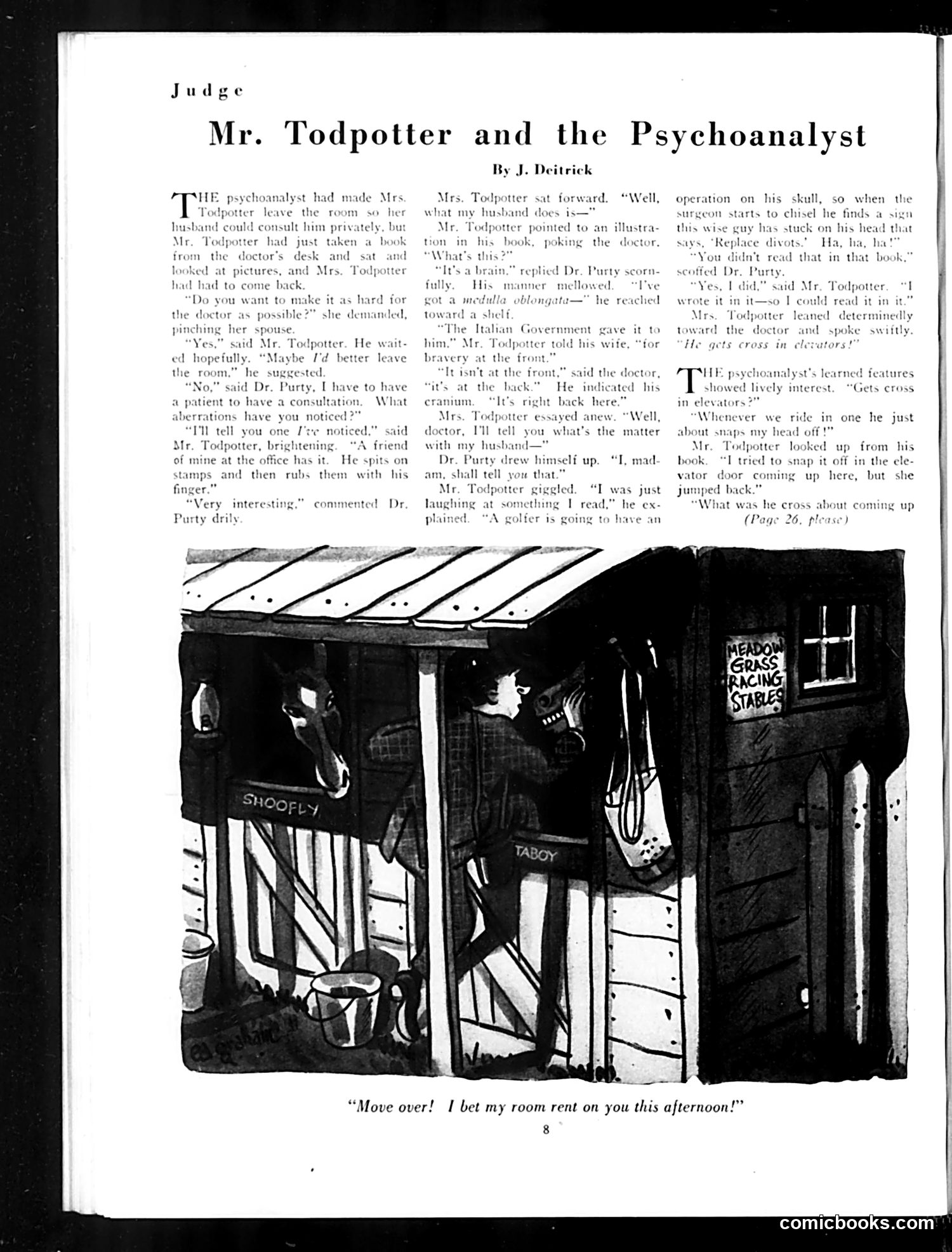
Mr. Todpotter and the Psychoanalyst This is a humorous short story with accompanying illustration satirizing early psychoanalysis trends. Mr. Todpotter consults Dr. Purty, a psychoanalyst, about his wife's complaints—particularly that he's stubborn and won't listen to her. The joke plays on psychoanalytic pretension: Dr. Purty makes absurd observations (claiming Todpotter has a "golf divot" stuck in his skull) while Todpotter misunderstands or deflates the analysis with literal-minded comments. The illustration shows Todpotter in a stable with horses labeled "Shoofly" and "Taboy," captioned with him threatening to rent out the psychoanalyst's room—suggesting the analysis is worthless and he'd rather make money. The satire mocks both psychoanalysis as a pseudo-scientific fad and Todpotter as an uncooperative, obtuse patient resistant to self-examination.
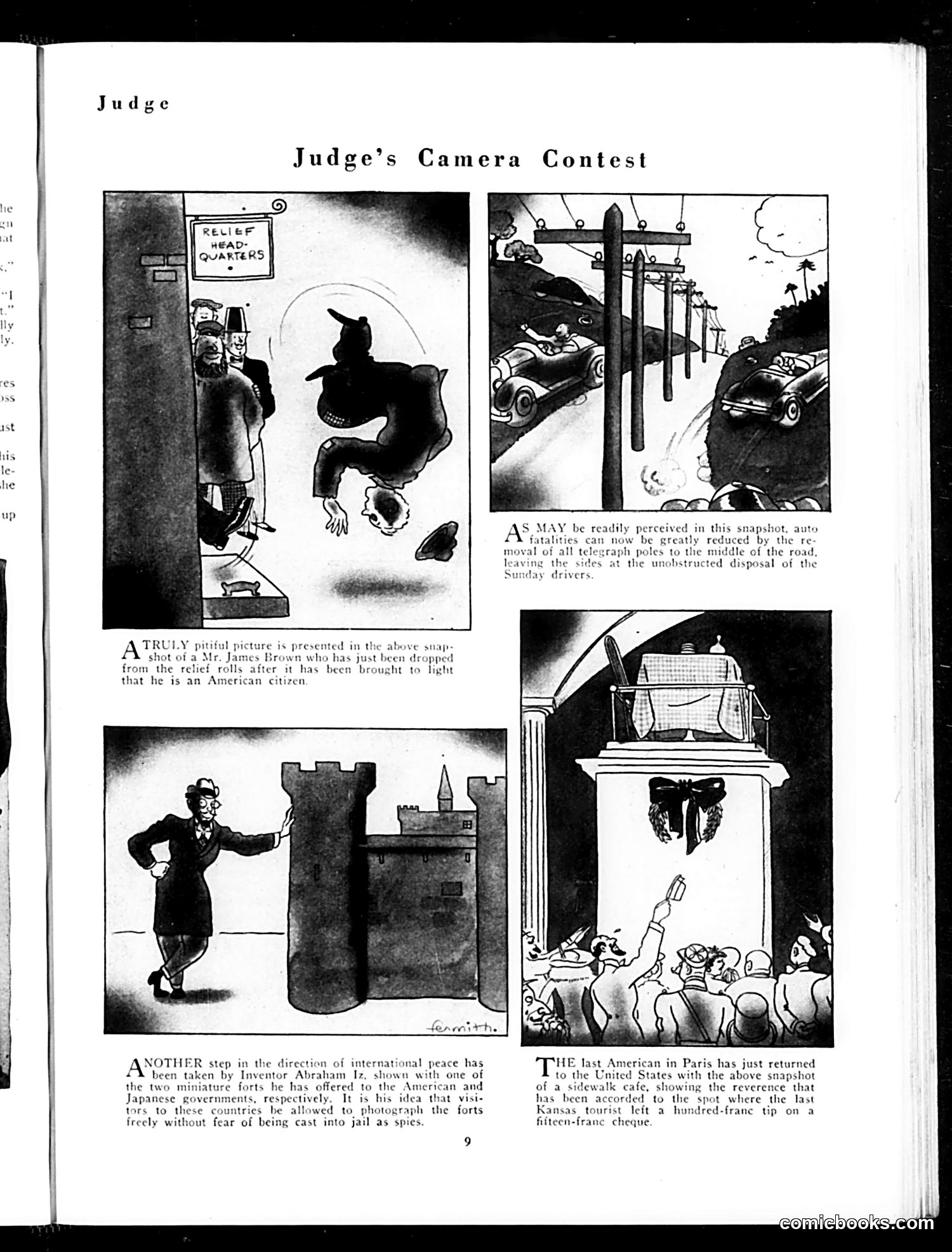
Judge's Camera Contest This page presents four cartoon submissions satirizing contemporary social and political issues: 1. Top left: A man ("Mr. James Brown") is shown being dropped from relief rolls after authorities discovered he's an American citizen—satirizing the irony that relief assistance was sometimes denied to citizens while potentially extended to non-citizens. 2. Top right: A cartoon about removing telegraph poles from roadsides to reduce automobile fatalities among "Sunday drivers," suggesting reckless motorists were a growing public hazard. 3. Bottom left: "Inventor Abraham Iz" proposes allowing tourists to photograph foreign military fortifications freely—a satirical jab at international paranoia about espionage and the absurdity of treating photographers as potential spies. 4. Bottom right: Appears to reference a Kansas tourist's generous tip left at a sidewalk café, possibly mocking American tourists abroad or cultural misunderstandings. These are entries in Judge's photographic/cartoon contest, presenting visual satire on citizenship policy, road safety, international relations, and tourism.
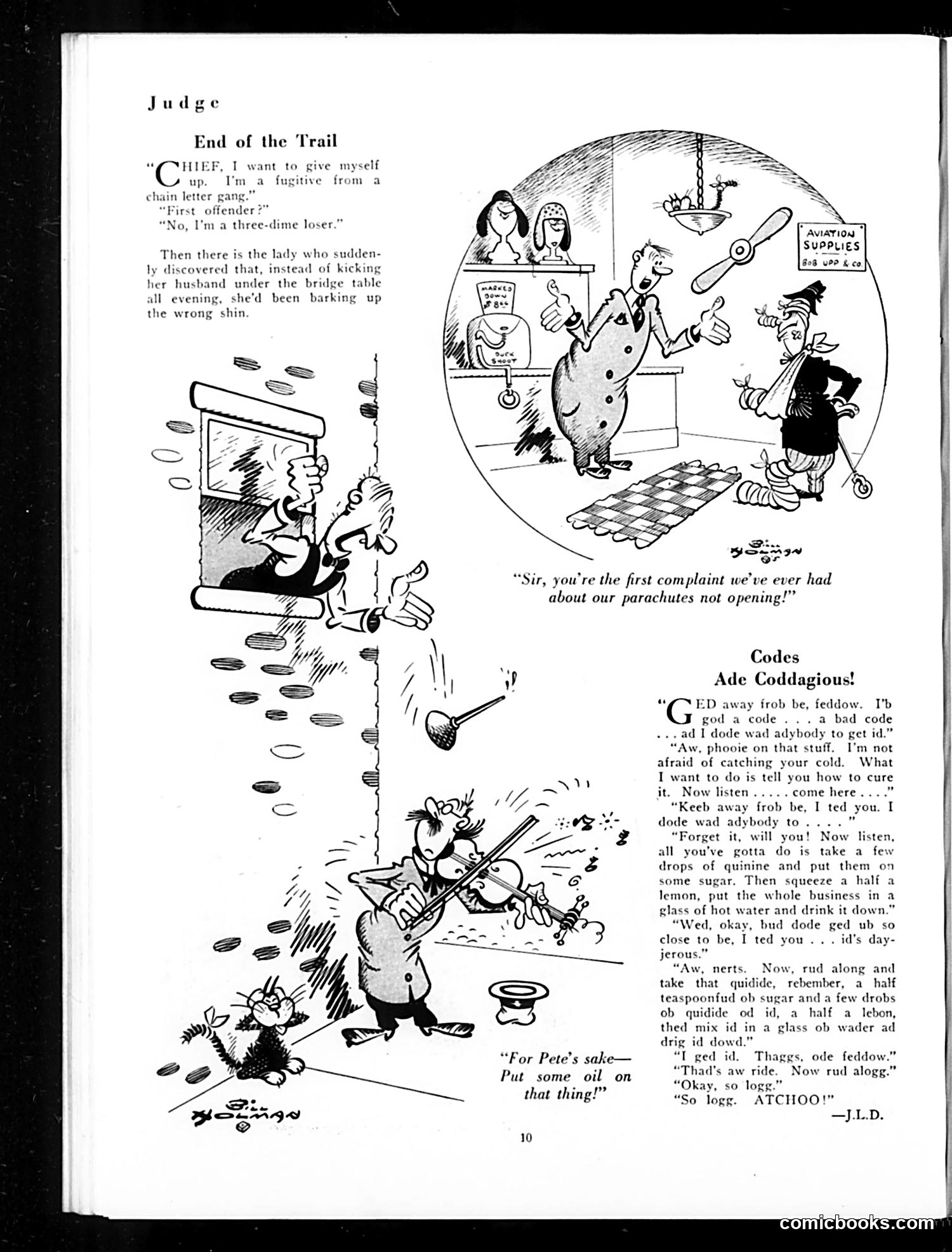
Explanation for Modern Readers This Judge magazine page contains three separate humor pieces: "End of the Trail" (top left): A criminal surrenders to police, claiming to be "a three-dime loser"—a cheap criminal. The joke relies on dated slang about petty crime. The Bridge Table Joke (middle left): A woman discovers she's been kicking the wrong person under the table all evening at cards—a domestic humor gag about marital distraction. "Codes Ade Coddagious!" (right): Two men with heavy colds communicate through nasal-congested dialect ("frob be" for "from me"). One insists on giving cold remedies while the other desperately wants distance. The humor comes from the exaggerated phonetic spelling representing congested speech, and the irony that unwanted medical advice persists despite contagion concerns. "Aviation Supplies" cartoon (top right): A customer complains about defective parachutes—dark humor about early aviation safety failures. The page reflects early 20th-century American humor styles emphasizing wordplay, physical comedy, and domestic situations.
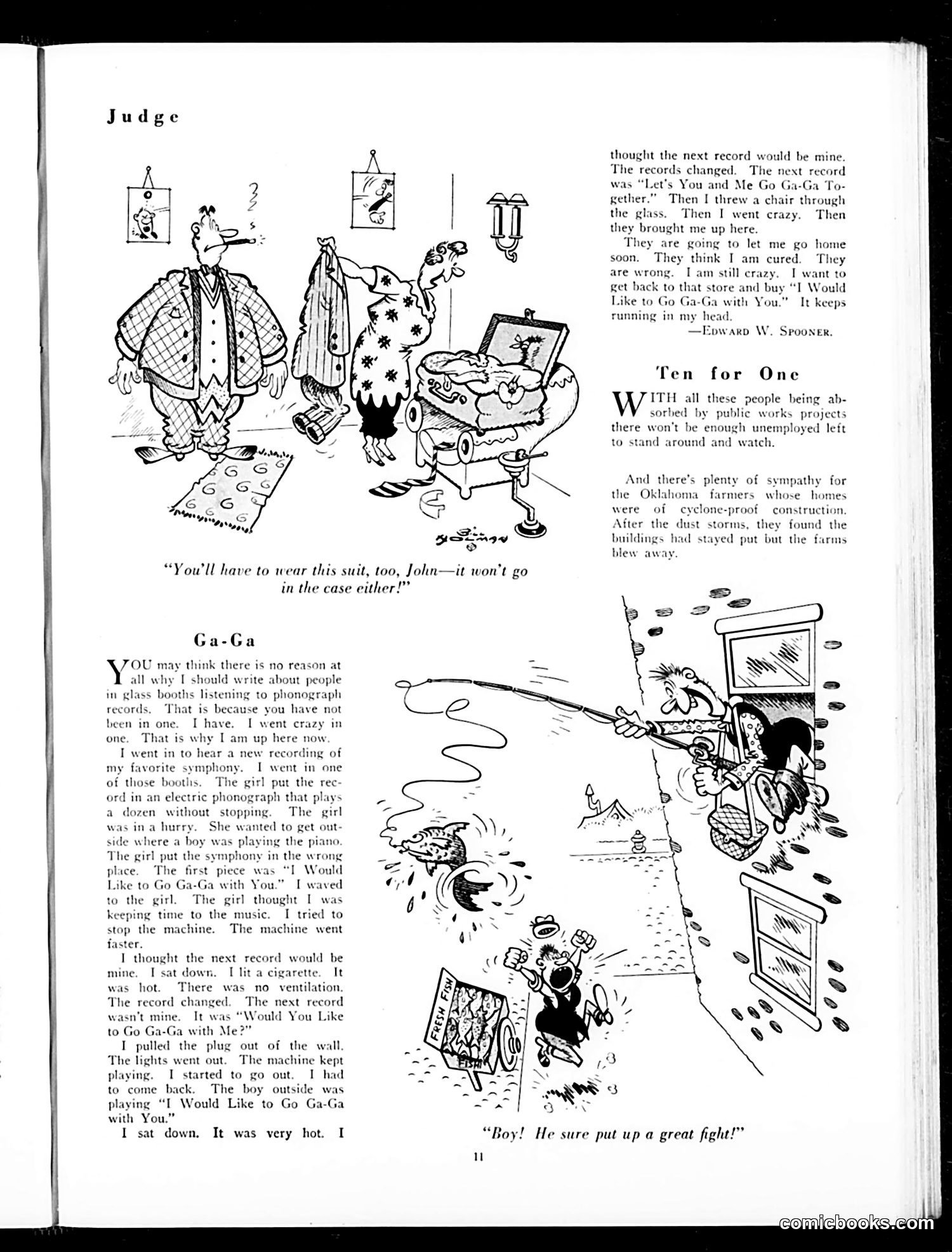
Judge Magazine Page Analysis This page contains two satirical pieces about 1930s popular culture obsessions. "Ga-Ga" (main story): A man describes going insane in a phonograph booth after hearing the novelty song "I Would Like to Go Ga-Ga with You" repeatedly. He's now institutionalized, unable to escape the earworm. The satire mocks the era's novelty song crazes and their seemingly hypnotic effect on the public—the song was so pervasive and catchy it literally drove someone mad. The irony is that staff think he's "cured" when he's still obsessed. "Ten for One" (brief pieces): Two separate jokes—one about public works projects eliminating unemployment (leaving no idle spectators), and another about Oklahoma dust storms, where poorly-anchored farms blew away while solid buildings remained. This references the real Dust Bowl crisis of the 1930s, satirizing government relief efforts' limitations. Top cartoon: Shows a judge pronouncing sentence, with a visual gag about a suit not fitting in a suitcase—unclear specific reference but appears to mock legal proceedings.
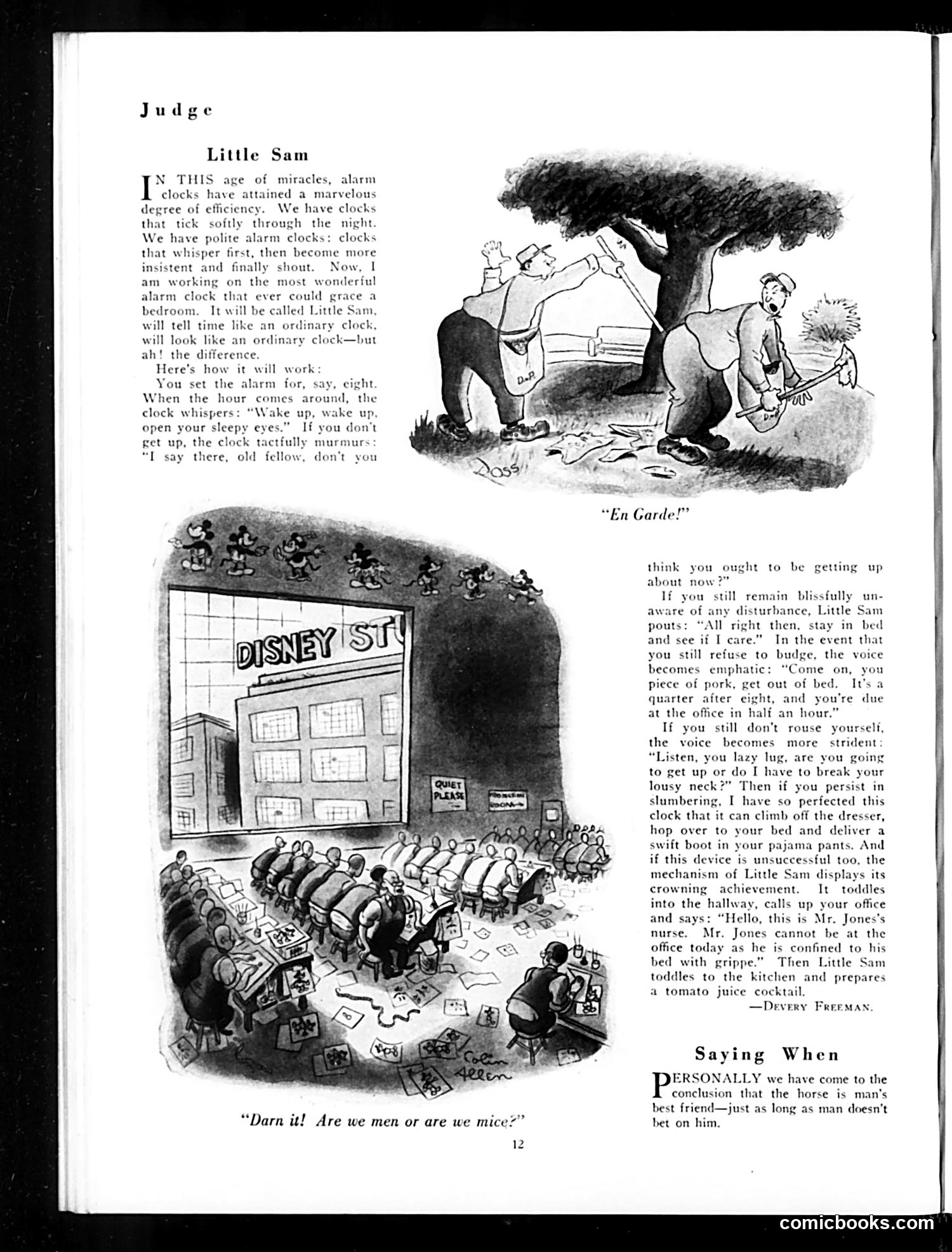
"Little Sam" - Judge Magazine Satire This page presents a humorous invention essay by Devery Freeman satirizing both modern alarm clock technology and lazy workers. The Main Cartoon: "Little Sam" is a fictional alarm clock that escalates from polite whispers to increasingly insulting demands, eventually physically removing the sleeper from bed and calling their office with excuses. The satire targets two things: (1) the era's fascination with mechanical "progress" and efficiency, presenting an absurdly over-engineered solution to oversleeping, and (2) workplace culture where chronic lateness is a real problem requiring extreme measures. The Secondary Cartoon shows a crowded "Disney Studio" office scene, likely satirizing the chaotic, overcrowded conditions of animation production. "Saying When" is a brief joke about horse racing—that horses are only "man's best friend" until gambling enters the equation, mocking betting culture's capacity to corrupt relationships. The humor relies on exaggeration of technological "solutions" to human behavioral problems, a common Judge editorial stance.
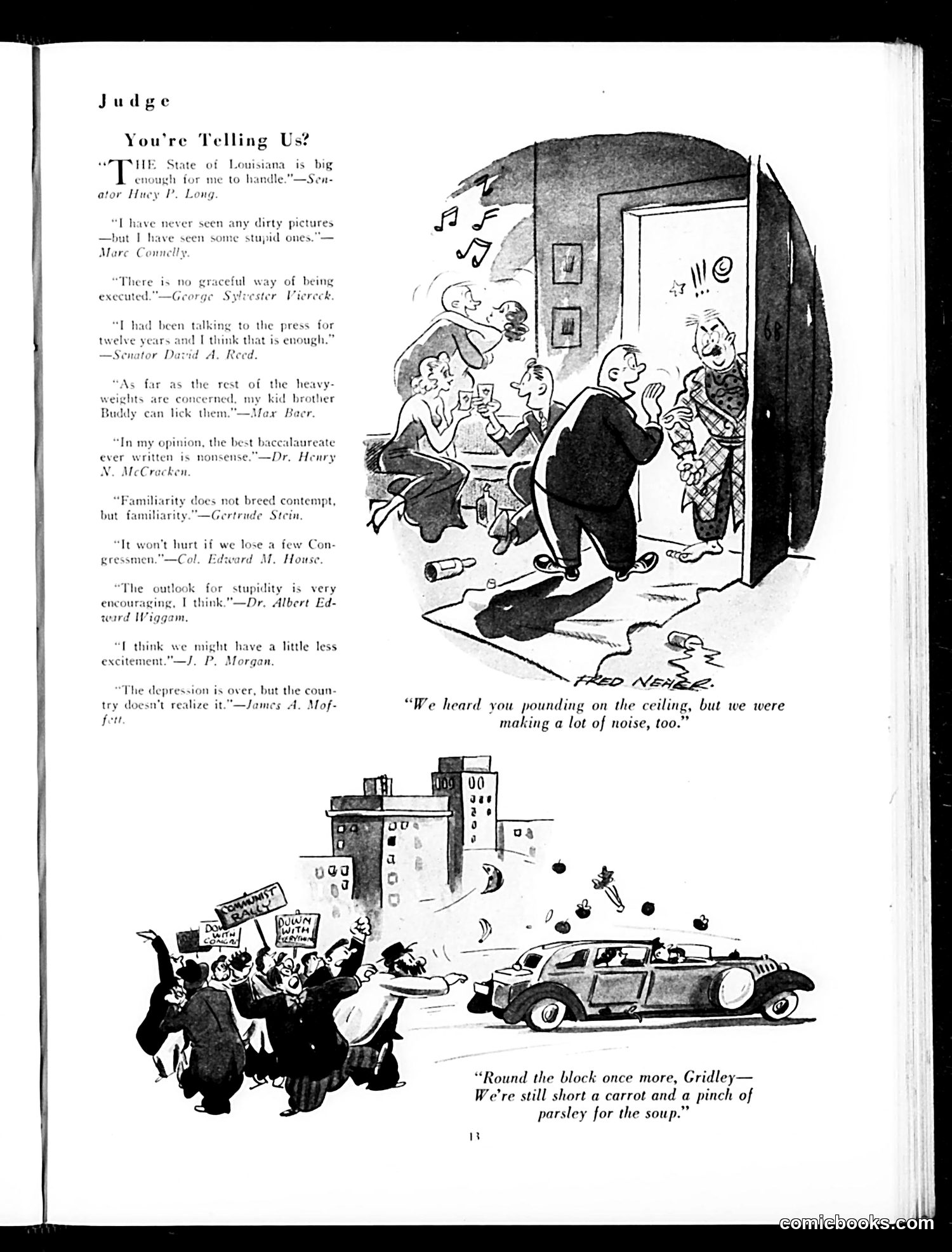
Judge Magazine Satire Page Analysis This page from Judge magazine satirizes prominent public figures of the 1930s through absurd, contradictory quotes. The top section collects statements from Senator Huey P. Long, Marc Connelly, George Sylvester Viereck, boxer Max Baer, Dr. Henry McCracken, Gertrude Stein, Col. Edward M. House, and others—each quote designed to expose foolishness or arrogance. The upper cartoon depicts a noisy apartment party where residents claim innocent activities while chaos erupts above them—satire on evasion and denial. The lower cartoon shows a car being pelted with objects by an angry crowd, with the caption referencing a soup shortage. This likely references Depression-era hardship and public frustration, possibly alluding to breadlines or rationing, while the driver orders more "laps around the block"—mocking indifference to widespread suffering. Both cartoons mock those in power who ignore or deny serious social problems during the economically devastating 1930s.
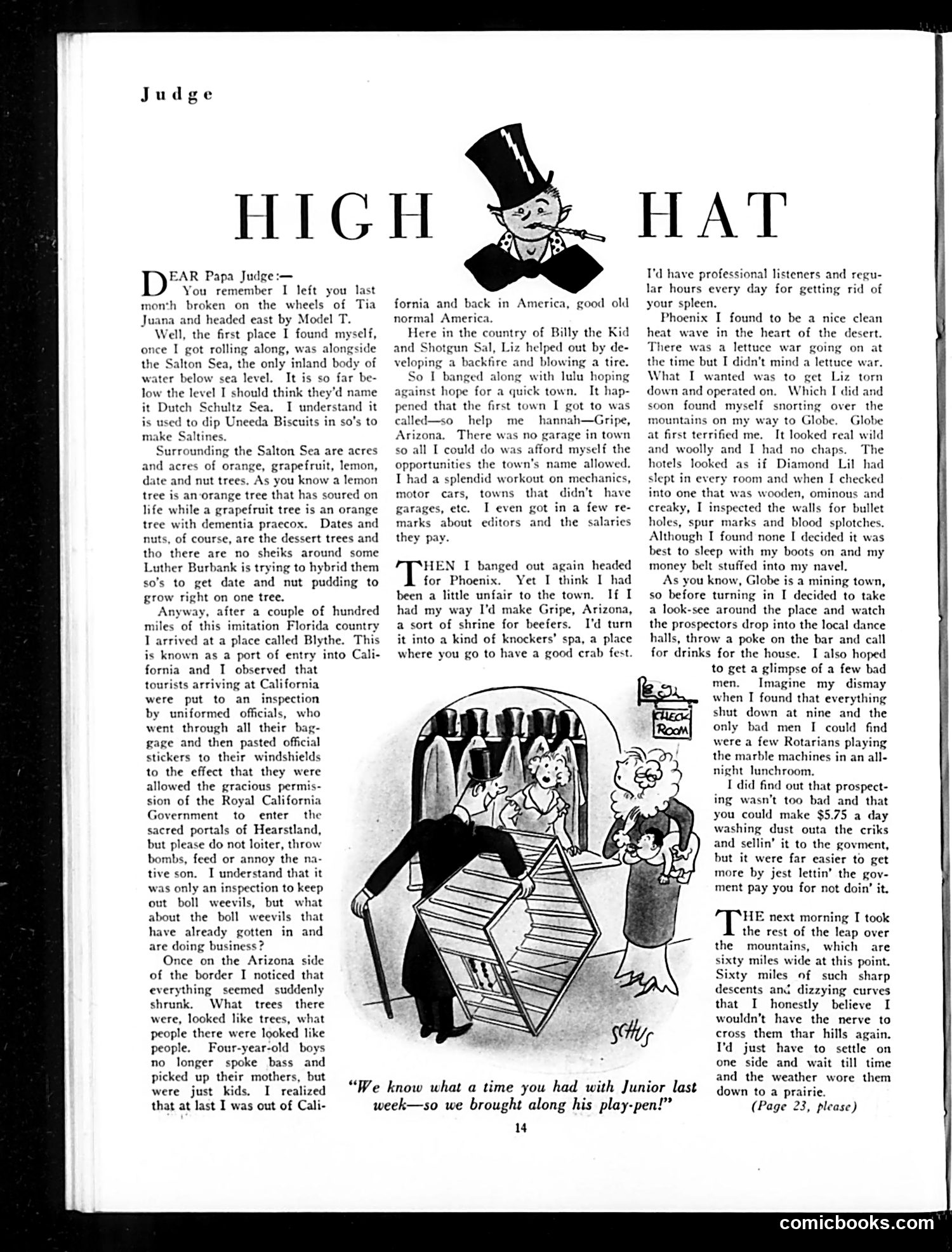
"High Hat" - Judge Magazine Satire This is a humorous travel column disguised as a letter to "Papa Judge," mocking American regional stereotypes. The author describes driving from California through Arizona, employing exaggerated contrasts. The satire targets California's pretentiousness: tourists are inspected at the border like the state is royalty ("Royal California Government"), absurd agricultural hybridization is attempted, and people seem unnaturally large. The author sarcastically praises the Salton Sea region with puns ("Dutch Schultz Sea," "Saltines"). The embedded cartoon depicts a woman forcing her husband into a play-pen, captioning how they've brought "Junior's" restraint after his wild behavior—likely satirizing overly-indulgent parenting or domestic control. By contrast, Arizona represents "good old normal America" where people actually look human-sized. Towns like "Gripe" exemplify small-town dysfunction, yet the author half-seriously proposes it become a "knockers' spa" for complaints. The overall joke: California's artificiality versus Arizona's authentic (if rough) Americana.
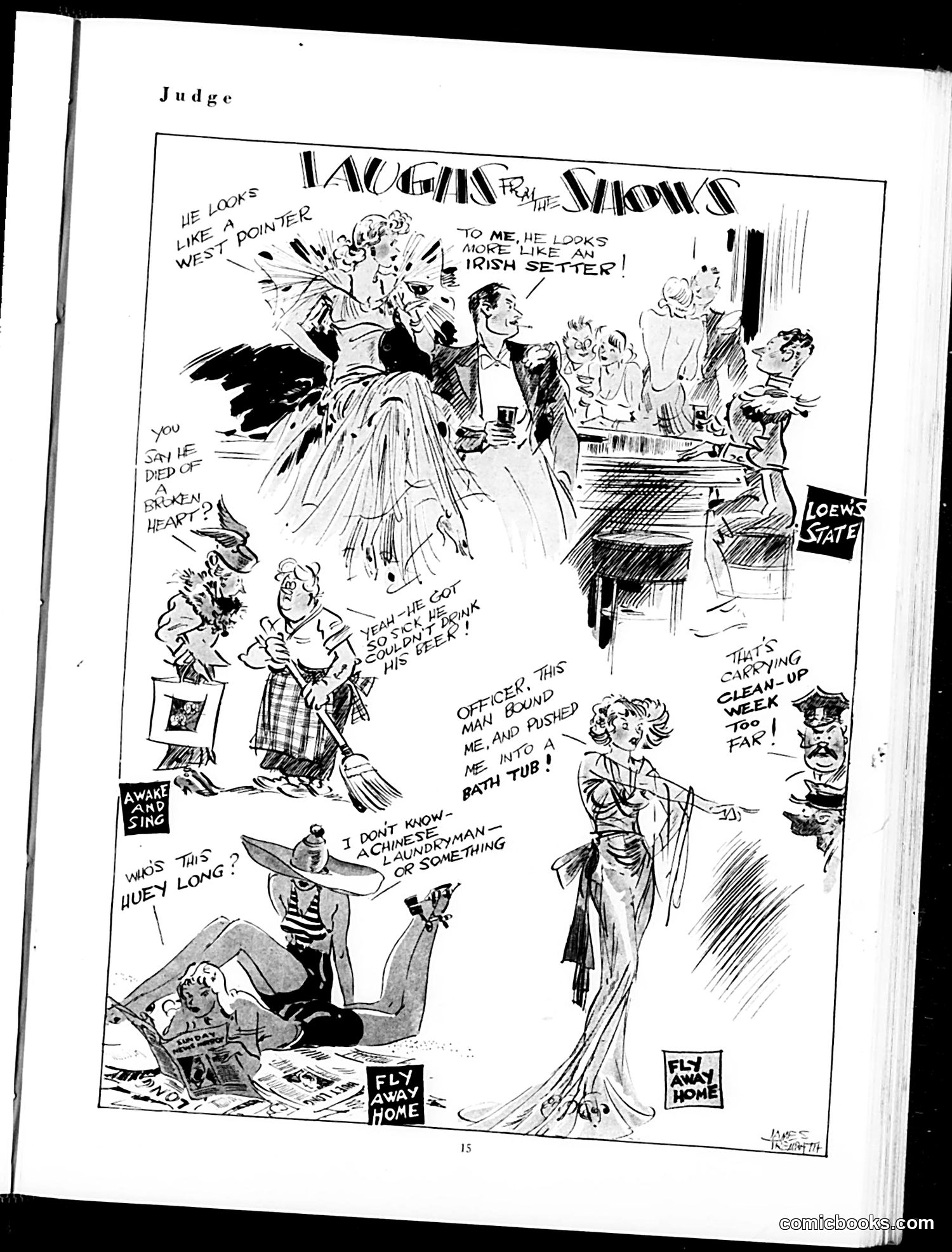
"Laughs at the Shows" This Judge page presents satirical commentary on theatrical performances and society figures. The central winged figure appears to be a theatrical critic or judge observing various actors and performers. One character is described as resembling "a west pointer" while another looks "like an Irish setter" — ethnic and class-based stereotyping typical of early 20th-century American humor. The scattered vignettes mock different theatrical types and audience members. References to "Huey Long" and various character sketches suggest commentary on popular entertainment and contemporary politics. Labels like "Awake and Sing," "Fly Away Home," and "Clean-Up Week for Fair!" reference actual plays or theatrical productions of the period. The overall satire targets theatrical pretension, audience behavior, and possibly political figures who courted public attention through performance or spectacle.
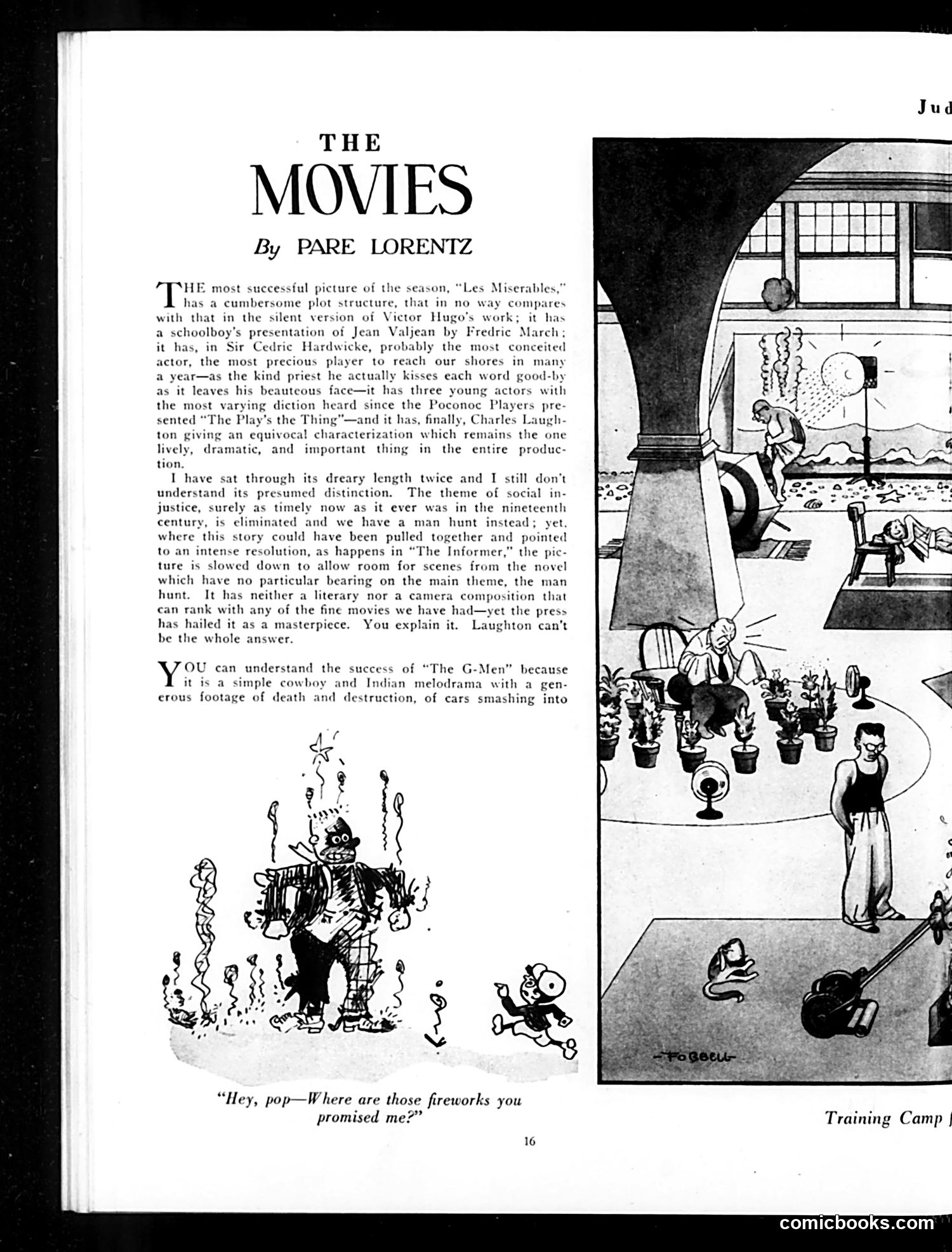
Analysis of Judge Magazine Movie Review Page This page features film critic Pare Lorentz reviewing contemporary movies, likely from the mid-1930s. The main text critiques "Les Misérables," a recent sound adaptation of Victor Hugo's novel starring Fredric March and Charles Laughton. Lorentz argues the film is overrated despite critical acclaim—it abandons the novel's social-justice themes for a simple manhunt plot and features hammy performances, particularly from "conceited actor" Sir Cedric Hardwicke. The accompanying cartoons satirize popular entertainment's appeal. The left cartoon mocks overhyped action films, while the right illustration labeled "Training Camp" shows civilians in domestic settings, likely critiquing how movies sensationalize mundane life or present unrealistic scenarios. Lorentz's contrasting praise for "The G-Men" (a gangster film with spectacular destruction sequences) illustrates his point: audiences prefer simple thrills over meaningful storytelling, explaining why mediocre prestige pictures succeed commercially.
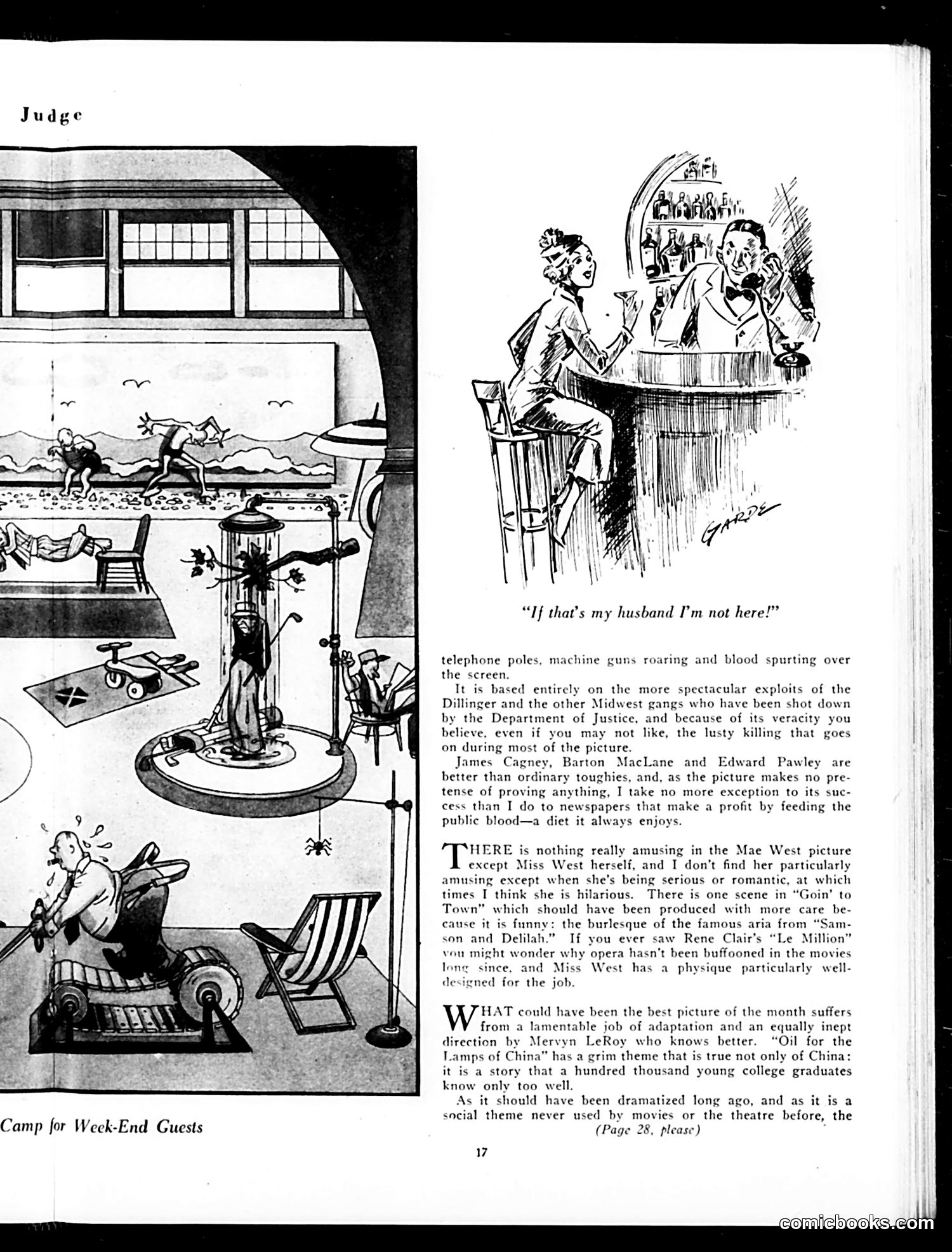
Analysis of Judge Magazine Page This page contains film reviews by a drama critic evaluating recent Hollywood movies. The left cartoon, titled "Camp for Week-End Guests," depicts an absurdist domestic scene—a woman lounging indoors while chaotic activity (swimming, recreation equipment, household chaos) swirls around her in cramped quarters, illustrating the satirical point about entertaining weekend visitors in tight spaces. The reviews discuss gangster films starring James Cagney (based on real Midwest gang exploits like Dillinger), Mae West comedies, and a drama called "Oil for the Lamps of China." The critic praises the gangster film's authenticity while criticizing Mae West's picture and the adaptation of "Oil for the Lamps of China," which addresses the plight of young college graduates—a timely social concern during the Depression era. The caption "If that's my husband I'm not here!" reflects typical 1930s domestic humor about marital avoidance.
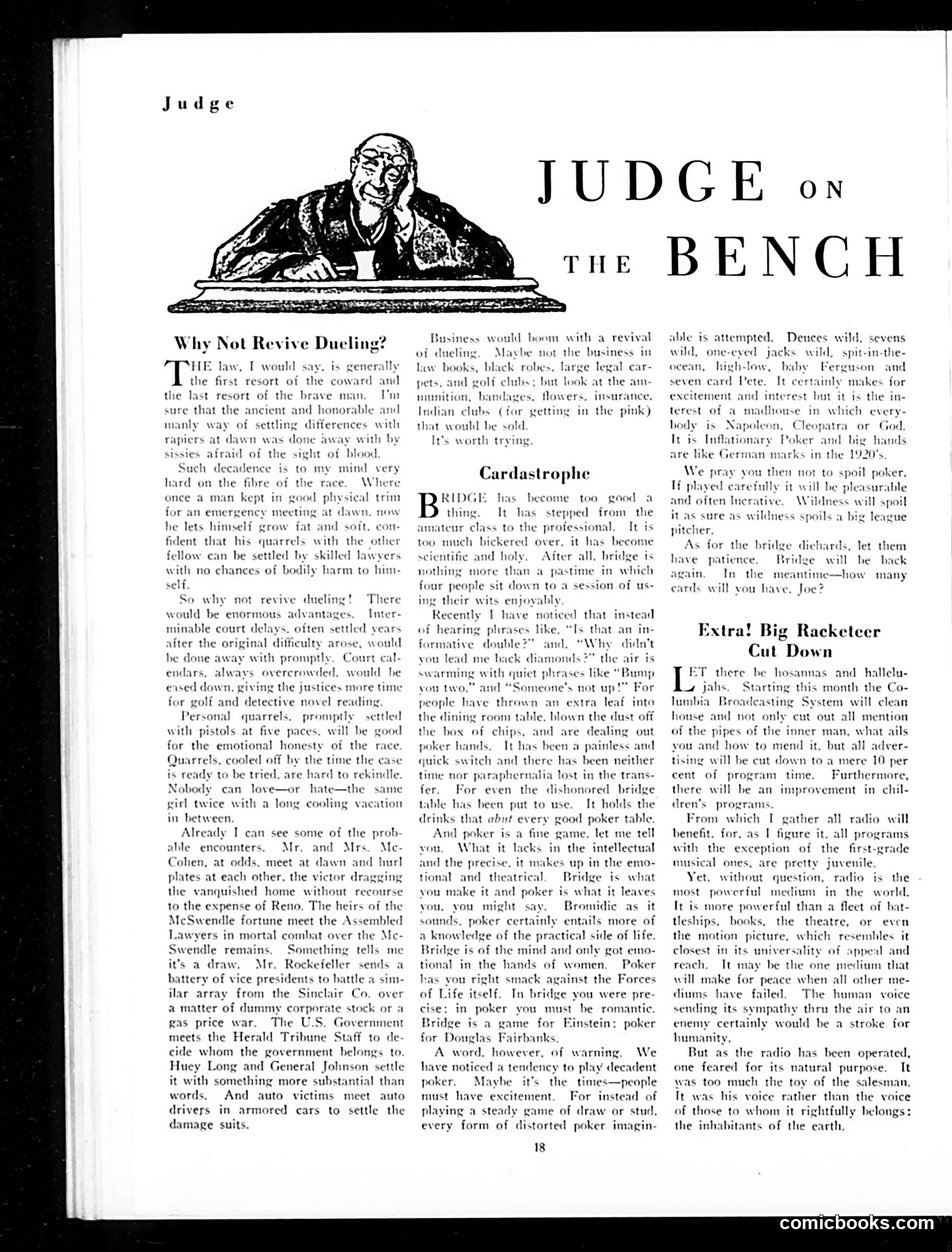
"Judge on the Bench" - A Satirical Page This page from *Judge* magazine contains two opinion pieces satirizing American society in the early 20th century. "Why Not Revive Dueling" mockingly proposes reviving duels to settle disputes instead of costly litigation. The author argues dueling would eliminate court delays, reduce lawyer fees, and save time—then catalogs absurd scenarios: wealthy businessmen like Rockefeller fighting corporate rivals with pistols, auto accident victims in "armored cars," and government officials dueling newspaper staff. The satire targets the bloated legal system, endless delays, and frivolous lawsuits plaguing American courts. "Cardastrophe" criticizes how bridge—the fashionable card game—has become overly competitive and rule-obsessed, losing its recreational appeal. The author contrasts bridge's intellectual tedium with poker's romantic spontaneity, ultimately praising poker as superior because it demands practical knowledge and emotional engagement. Both pieces use exaggeration and comparison to critique contemporary American institutions: the first attacks legal inefficiency and corporate disputes; the second mocks upper-class pretensions and the displacement of genuine entertainment by obsessive formality.
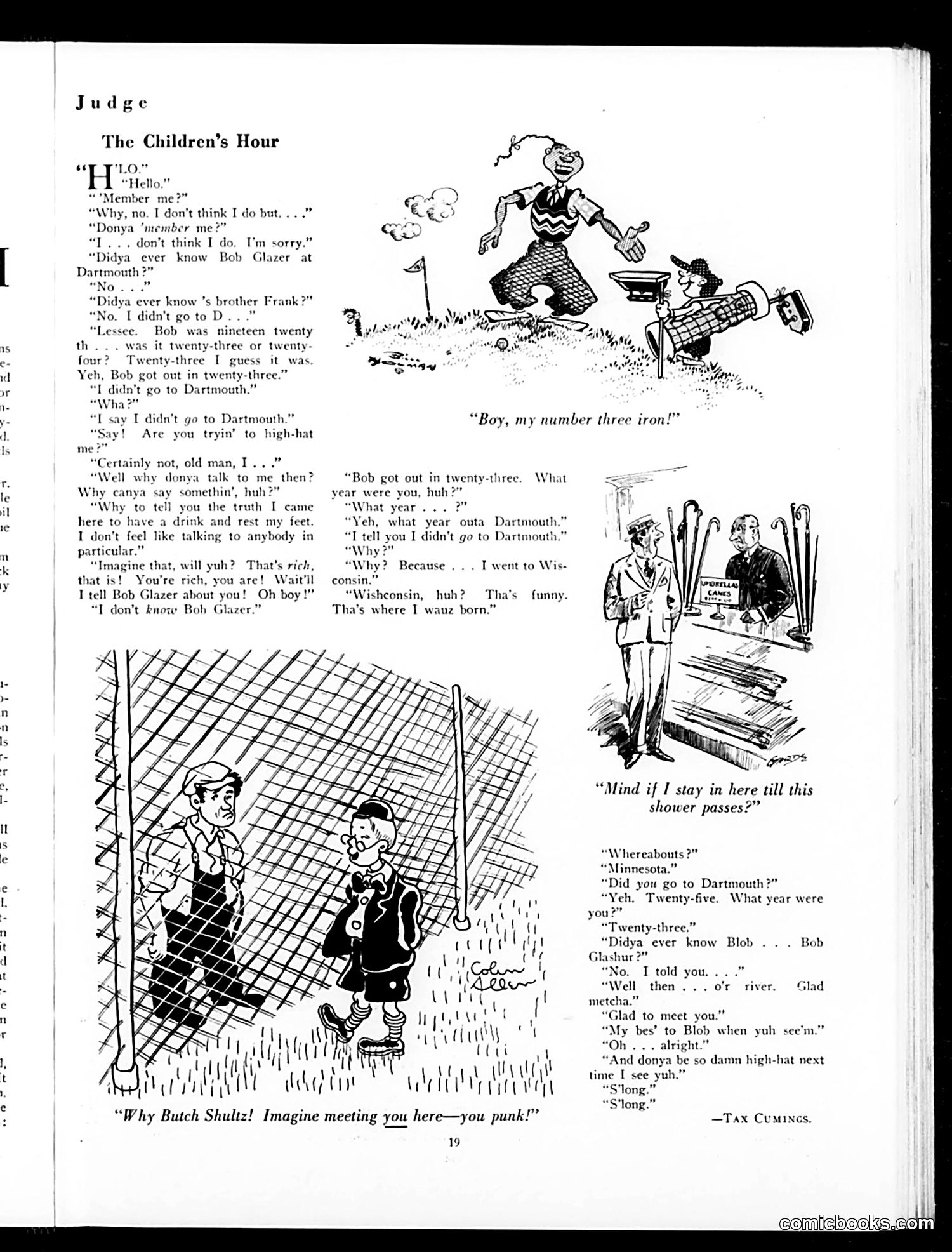
"The Children's Hour" - Judge Magazine Cartoon Analysis This page satirizes the aggressive, intrusive networking behavior of working-class men, likely from the 1920s-30s based on references to Dartmouth College attendance in "twenty-three" and "twenty-five." The humor centers on a man trying to force friendship on a stranger by name-dropping mutual acquaintances ("Bob Glazer," "Frank") and college connections. When the stranger politely declines conversation, the pushy character interprets this as "high-hatting" (class snobbishness) and becomes defensive and insulting. The title "The Children's Hour" ironically suggests innocent children's behavior, but depicts grown men behaving childishly—needy, combative, and socially tone-deaf. The cartoon mocks both the aggressive networking impulse and the anxiety about social status that drives it. The punchline shows the same character later encountering someone else with identical behavior: "Why Butch Shultz! Imagine meeting you here—you punk!"—suggesting this is a widespread, cyclical problem of masculine insecurity disguised as friendliness.
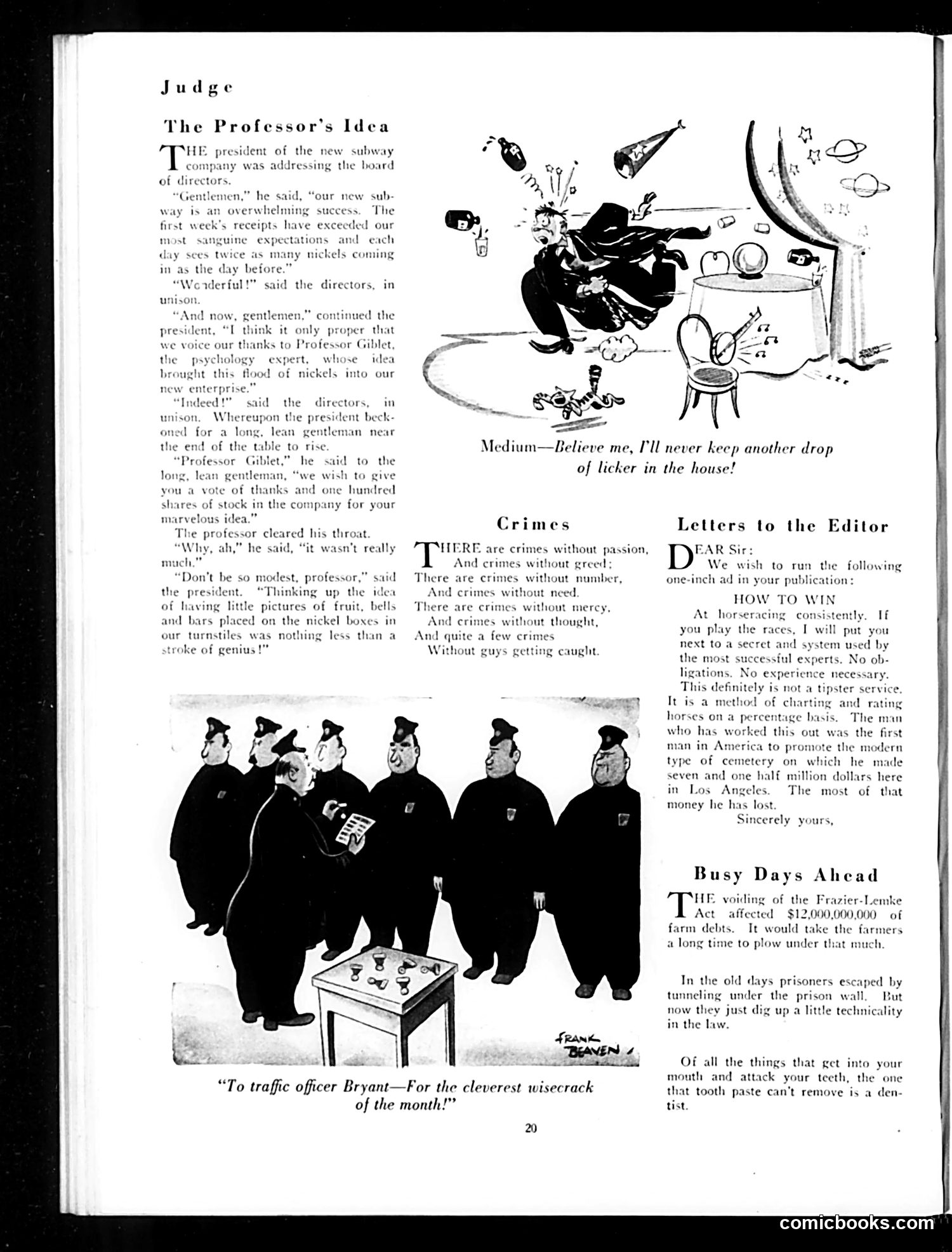
"The Professor's Idea" This cartoon satirizes corporate greed and financial manipulation during the early subway era (likely 1900s-1920s). A subway company president credits a "Professor Giblet" with the "genius" idea of placing fruit, bell, and bar imagery on nickel collection boxes—essentially disguising them as gambling/slot machines to trick riders into depositing extra coins. The directors celebrate this deceptive scheme, which generates twice the expected revenue. The satire mocks both the company's willingness to exploit passengers through psychological manipulation and the absurdity of calling such trickery "genius." It's a commentary on corporate dishonesty and the penny-pinching schemes companies used during the early transit boom to maximize profits at the public's expense.
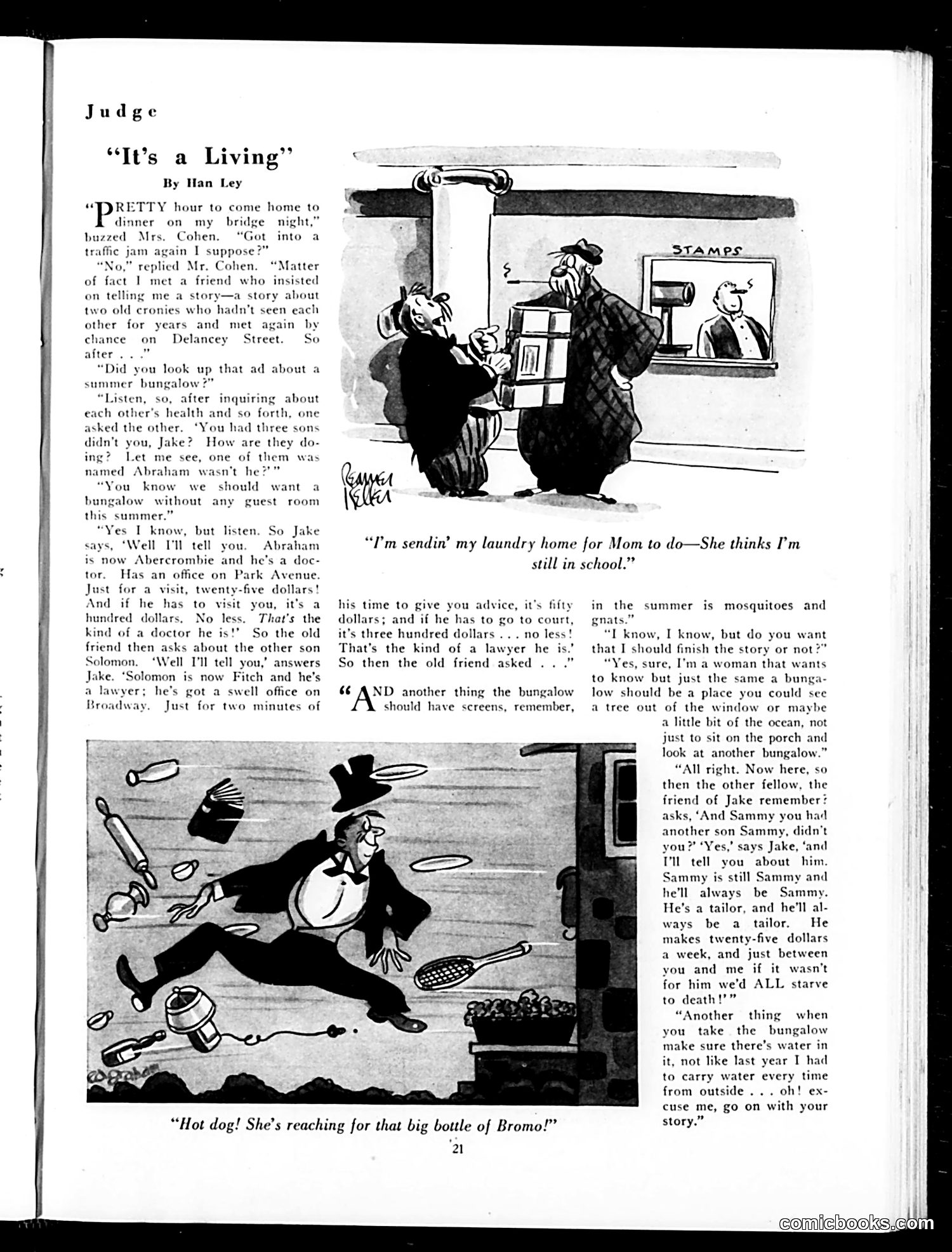
Analysis for Modern Readers This page contains two separate comic pieces from *Judge* magazine: "It's a Living" (main story): A Yiddish-inflected anecdote about Jewish immigrants on New York's Lower East Side (Delancey Street). An old friend asks Jake about his three sons. Two have "Americanized" their names and achieved professional success—Abraham became "Dr. Abercrombie" (charging $25-$300 per visit) and Solomon became "Lawyer Fitch" (Broadway office, expensive fees). The punchline: Sammy remains "Sammy the tailor," earning only $25/week, yet supports the entire family. The satire satirizes immigrant aspirations and the irony that manual laborers, despite low wages, often subsidize wealthier relatives. Top cartoon: Shows someone mailing laundry home from school, telling his mother he's still studying—implying he's actually working or shirking studies. Bottom cartoon: A comedic domestic scene of someone juggling household items while reaching for Bromo (an antacid), illustrating domestic chaos. The content reflects early-20th-century American attitudes toward Jewish immigrants and working-class life.
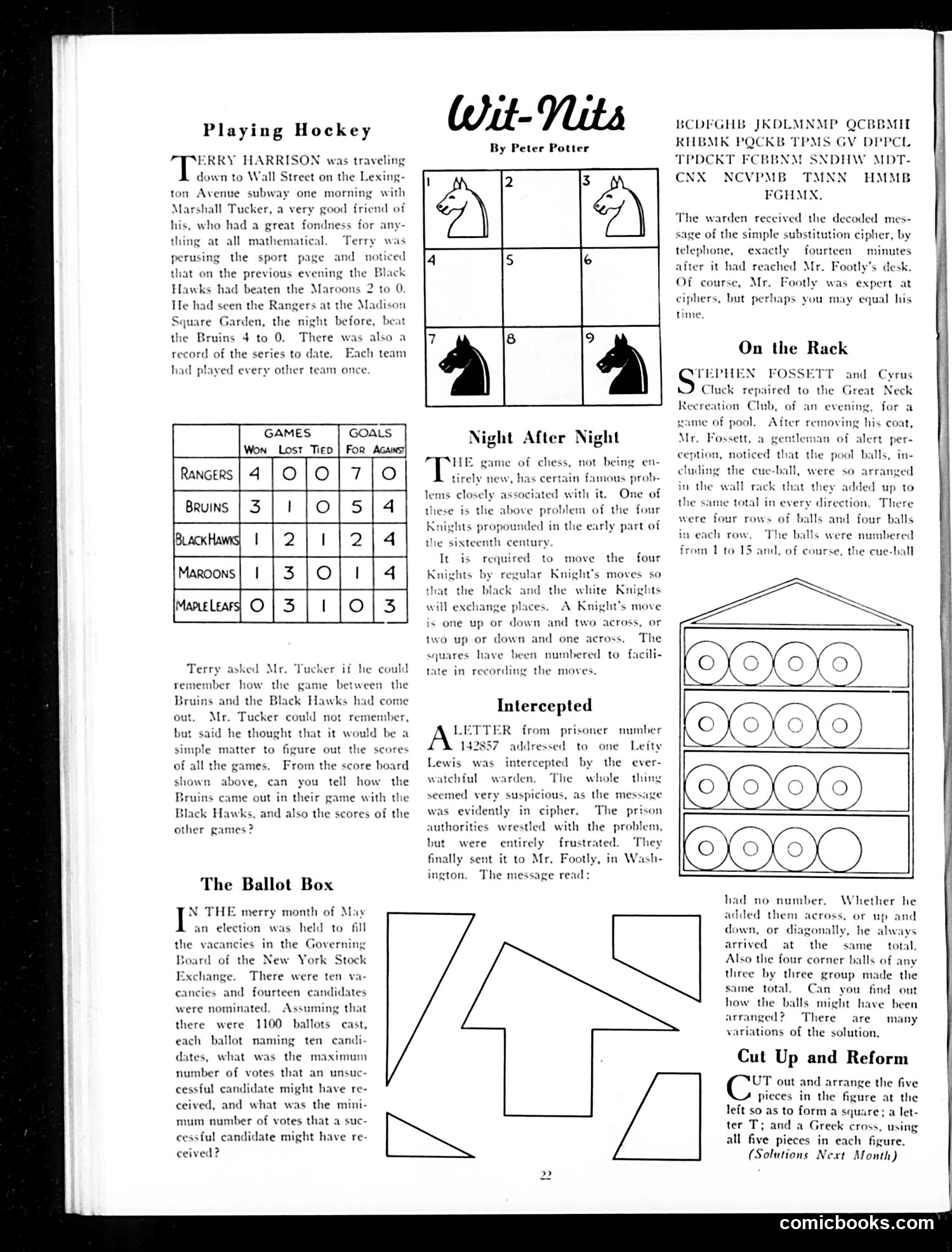
Analysis of Judge Magazine Page This page contains recreational puzzle content rather than political satire. It includes five distinct mathematical and logical puzzles: 1. "Playing Hockey": A logic puzzle about sports scores, where readers must deduce game outcomes between Rangers, Bruins, Black Hawks, and Maroons based on a partial scoreboard. 2. "The Ballot Box": A mathematical problem about New York Stock Exchange elections, asking for maximum/minimum votes possible under specific conditions. 3. "Night After Night": A chess puzzle about moving four knights on a board. 4. "Intercepted": A cipher-breaking challenge—readers must decode a substitution cipher message allegedly from a prisoner. 5. "On the Rack" and "Cut Up and Reform": Geometric/spatial arrangement puzzles involving billiard balls and puzzle pieces. These puzzles represent Judge magazine's recreational content aimed at educated readers interested in intellectual challenges—common magazine features of this era. There is no political commentary or social satire on this particular page.
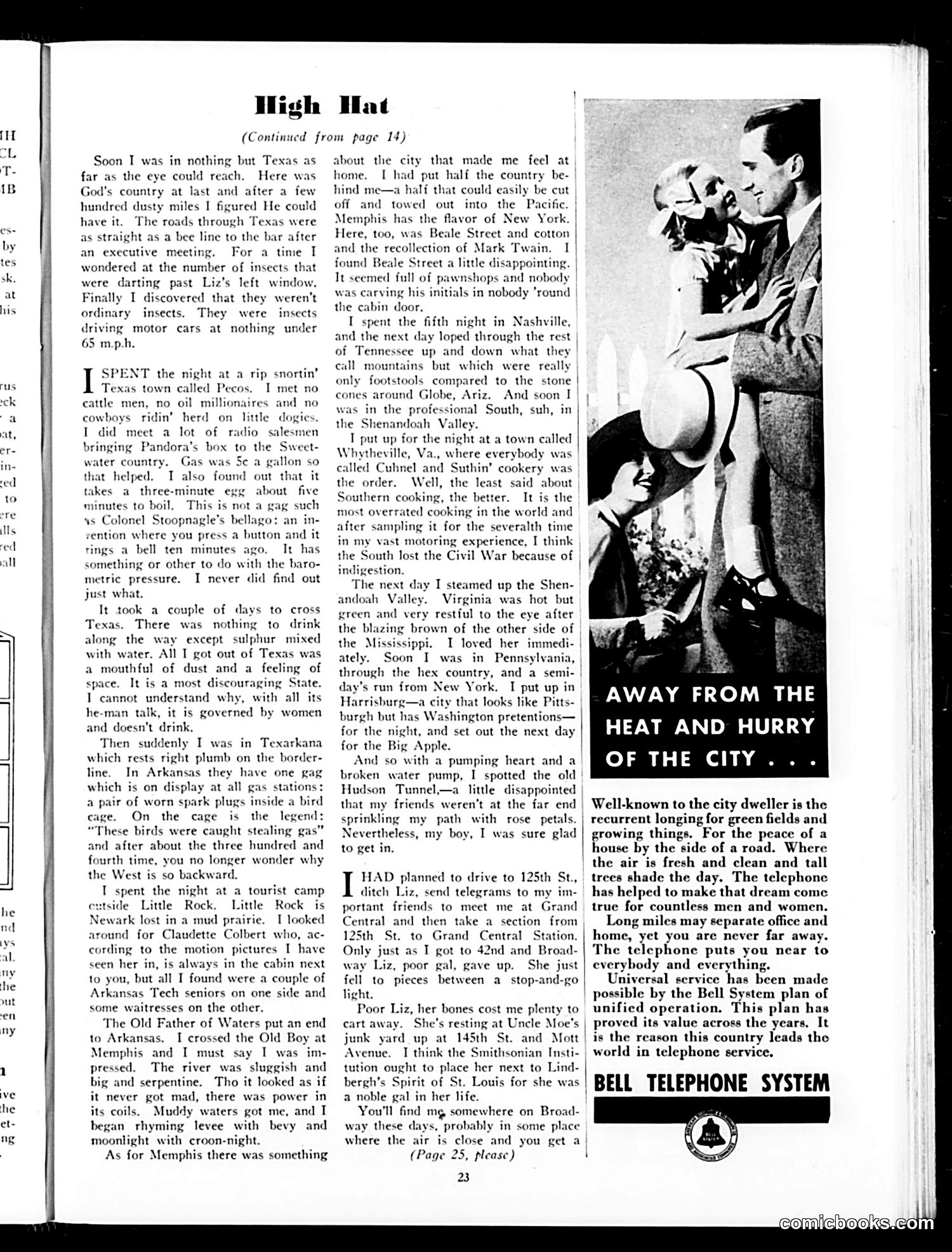
Analysis of This Judge Magazine Page This page is primarily text-based editorial content, not a political cartoon. It's a humorous travel narrative titled "High Hat" (continued from page 14), describing a cross-country automobile journey. The author satirizes American regional stereotypes: Texas is monotonously flat and dusty; its drivers recklessly speed at 65+ mph; the state is "discouraging" and oddly governed by women despite its masculine reputation. Arkansas features a worn-out joke about stolen spark plugs. Memphis has charm reminiscent of New York, with historic Beale Street disappointing the author. Southern cooking receives particular mockery—the author jokingly suggests the South lost the Civil War due to indigestion. The advertisement for Bell Telephone System appears alongside, promoting long-distance service to urban professionals yearning for countryside peace. The tone is light, cynical, and somewhat condescending toward regional America, typical of 1920s-30s urban magazine humor aimed at sophisticated East Coast readers.
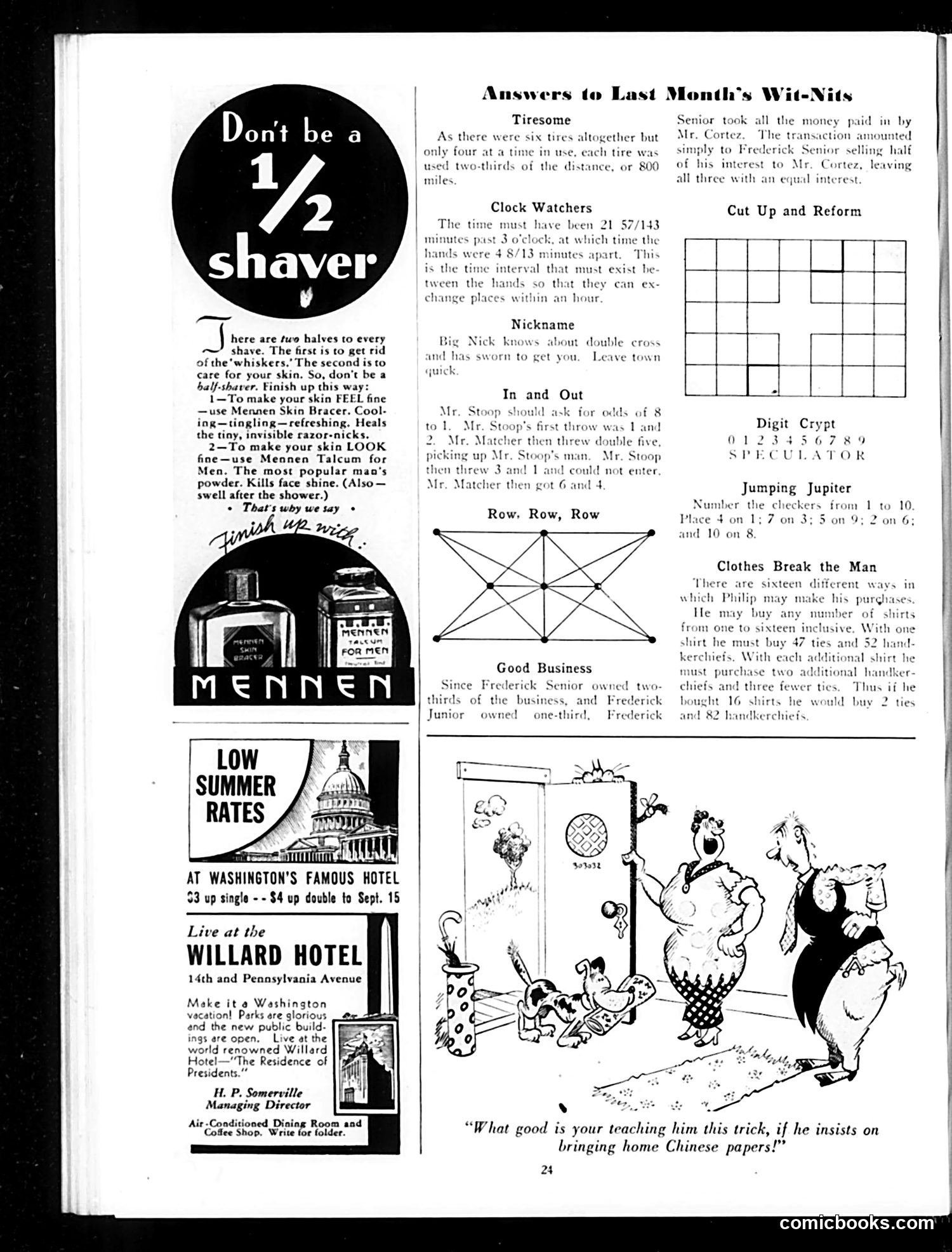
Analysis of This Judge Magazine Page This is primarily a Mennen grooming products advertisement disguised as editorial content, alongside puzzle features and hotel advertising—typical of 1920s-30s magazine layout. The Main Satire: The large cartoon at bottom depicts a man performing tricks for children while juggling household items. The caption mocks teaching a child "this trick, if he insists on bringing home Chinese papers"—a reference to the stereotype of Chinese people as laundry workers. The joke trades on era-typical racist assumptions: the man appears to be performing acrobatics/circus acts, suggesting frivolous entertainment, while the caption implies the child is somehow learning irresponsible behavior from "Chinese" (laundry) contexts. Context Lost Today: This reflects early 20th-century anti-Chinese prejudice and casual racist stereotyping common in mainstream American publications. The "Chinese papers" reference is unclear but likely references either laundering garments or laundering money. The page otherwise contains brain-teaser puzzles ("Digit Crypt," "Jumping Jupiter") and solutions to previous puzzles—standard Judge magazine filler content.
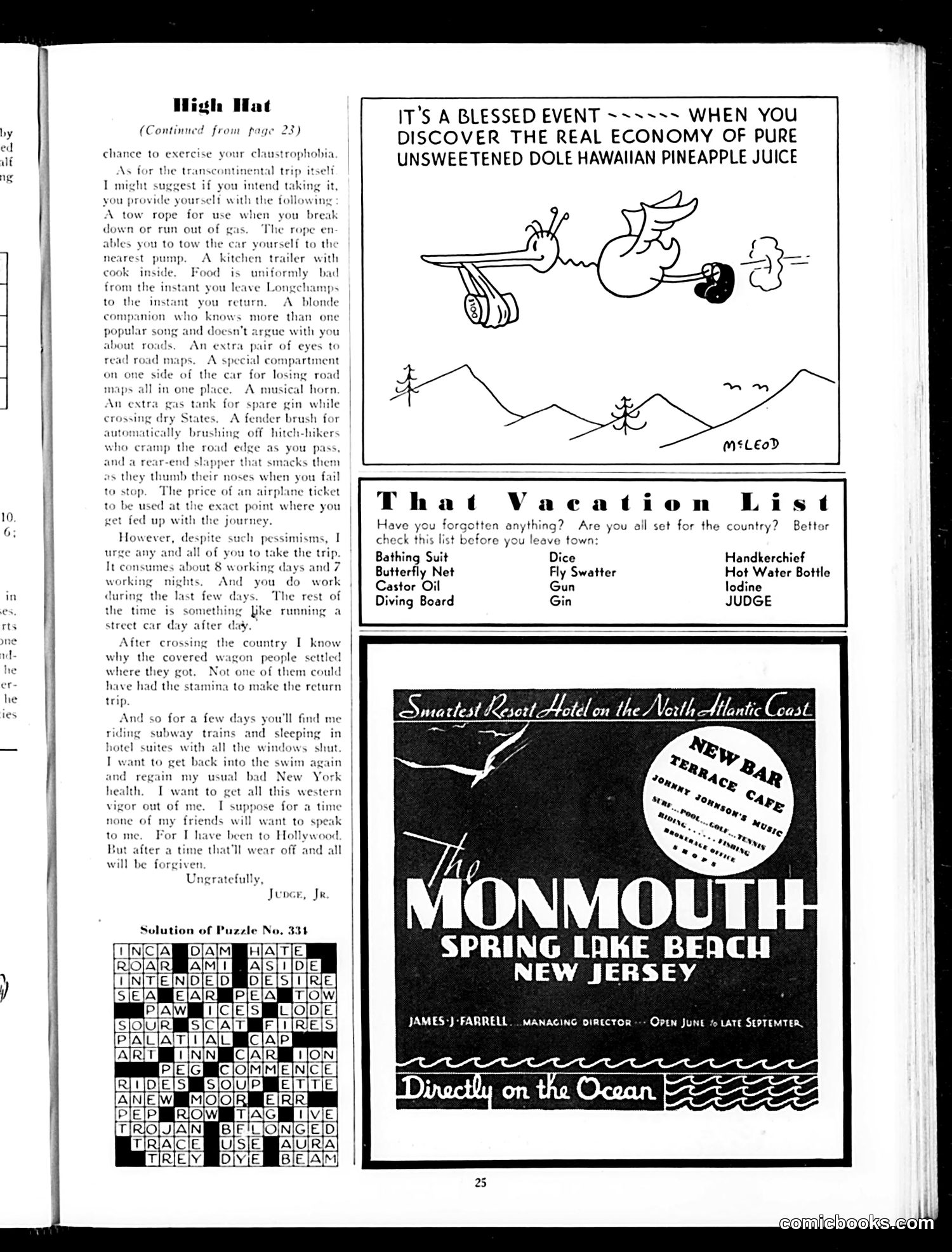
Analysis of Judge Magazine Page This page contains primarily advertising and filler content rather than political satire. The main cartoon advertises Dole Hawaiian Pineapple Juice, depicting a humorous scene of a car breaking down during a transcontinental trip, with absurdist product messaging. It's a simple commercial advertisement using comic illustrations. Below is a practical checklist titled "That Vacation List"—a tongue-in-cheek packing guide mixing legitimate items (bathing suit, handkerchief) with nonsensical ones (butterfly net, gin, judge). This appears to be light humor rather than political commentary. The lower advertisement promotes the Monmouth Hotel in Spring Lake Beach, New Jersey, marketed as "Smartest Resort Hotel on the North Atlantic Coast," with emphasis on its oceanfront location and New Year's Eve dining. The page also includes a crossword puzzle solution, standard editorial filler. This is largely a commercial page from an entertainment/lifestyle magazine, typical of 1920s-30s Judge content, mixing advertising with light humor rather than political satire.
Analysis: "Mr. Todpotter" This is a satirical story (not a political cartoon) mocking psychoanalysis, which was fashionable and controversial in 1920s America following Freud's theories. The satire: Mr. Todpotter inexplicably argues violently in elevators but stops the moment he exits. His wife insists he needs psychoanalysis. Dr. Purty, the psychiatrist, confidently diagnoses an unconscious "frustration" from a past elevator incident—which turns out to be childhood trauma involving a dumbwaiter and a girl he couldn't kiss. The joke: Psychoanalysis is portrayed as pseudoscientific nonsense. Dr. Purty extracts a trivial, absurd "root cause," charges $500 (substantial money then), and offers vague advice ("stay out of draughts") while admitting confusion. The doctor profits regardless of actual help provided. This mocks how early psychoanalysis relied on speculative interpretation of unconscious desires and childhood incidents to explain bizarre behavior—often with dubious results.
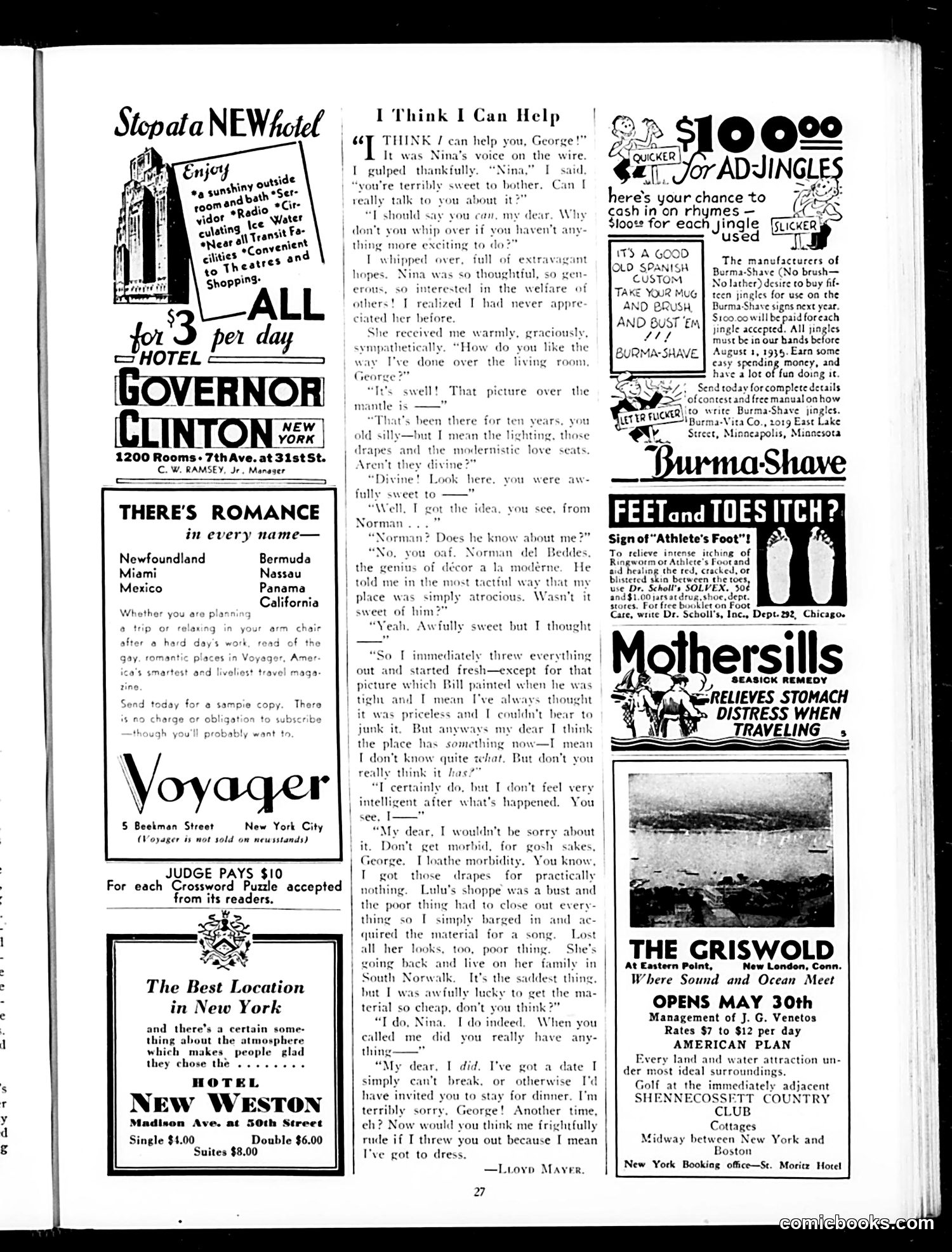
Judge Magazine Page Analysis This page is primarily advertisements and light fiction, not political satire. The main content is a short story titled "I Think I Can Help," written by Lloyd Mayer, depicting a domestic scene where a woman named Nina calls her friend George, ostensibly to help with his troubles, but actually to show off her newly redecorated living room before rushing off to another appointment. The satire here is social, not political: it gently mocks the vapid, self-absorbed society woman of the 1930s—someone who claims to help others but is actually self-centered, name-drops designers (Norman del Geddes), brags about bargain hunting, and dismisses others' problems to discuss her own accomplishments and schedule. The rest of the page consists of hotel, travel, and patent medicine advertisements typical of the era (Burma-Shave, Mothersills, "Athlete's Foot" remedy), plus a crossword puzzle contest offering.
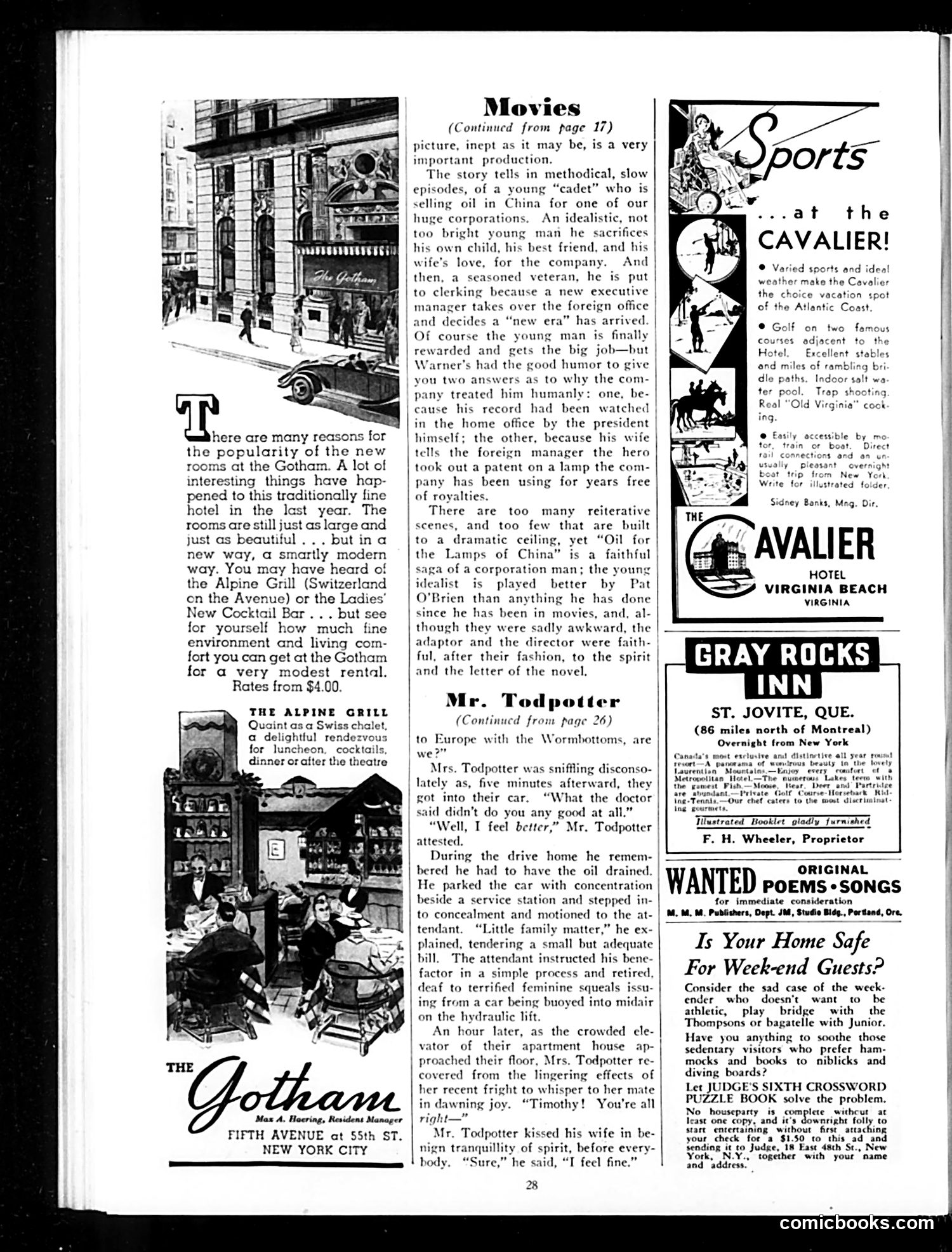
This page is primarily advertising and magazine content, not political satire. The main elements are: The Advertisements: - The Gotham Hotel (NYC) promoting modernized rooms with new dining and bar facilities - The Cavalier Hotel (Virginia Beach) highlighting sports amenities - Gray Rocks Inn (Quebec) advertising overnight accommodations - "Wanted: Original Poems" for publication consideration - A consumer safety tip about home security for weekend guests The Editorial Content: Two continuing stories appear: a film review of "Oil for the Lamps of China" discussing its corporate themes, and an excerpt from "Mr. Todpotter" describing a domestic anecdote about a car oil change that frightens his wife. This page contains no obvious political cartoons or satirical commentary. It reflects typical 1930s magazine content mixing light entertainment, travel promotion, and practical advice for middle-class readers.
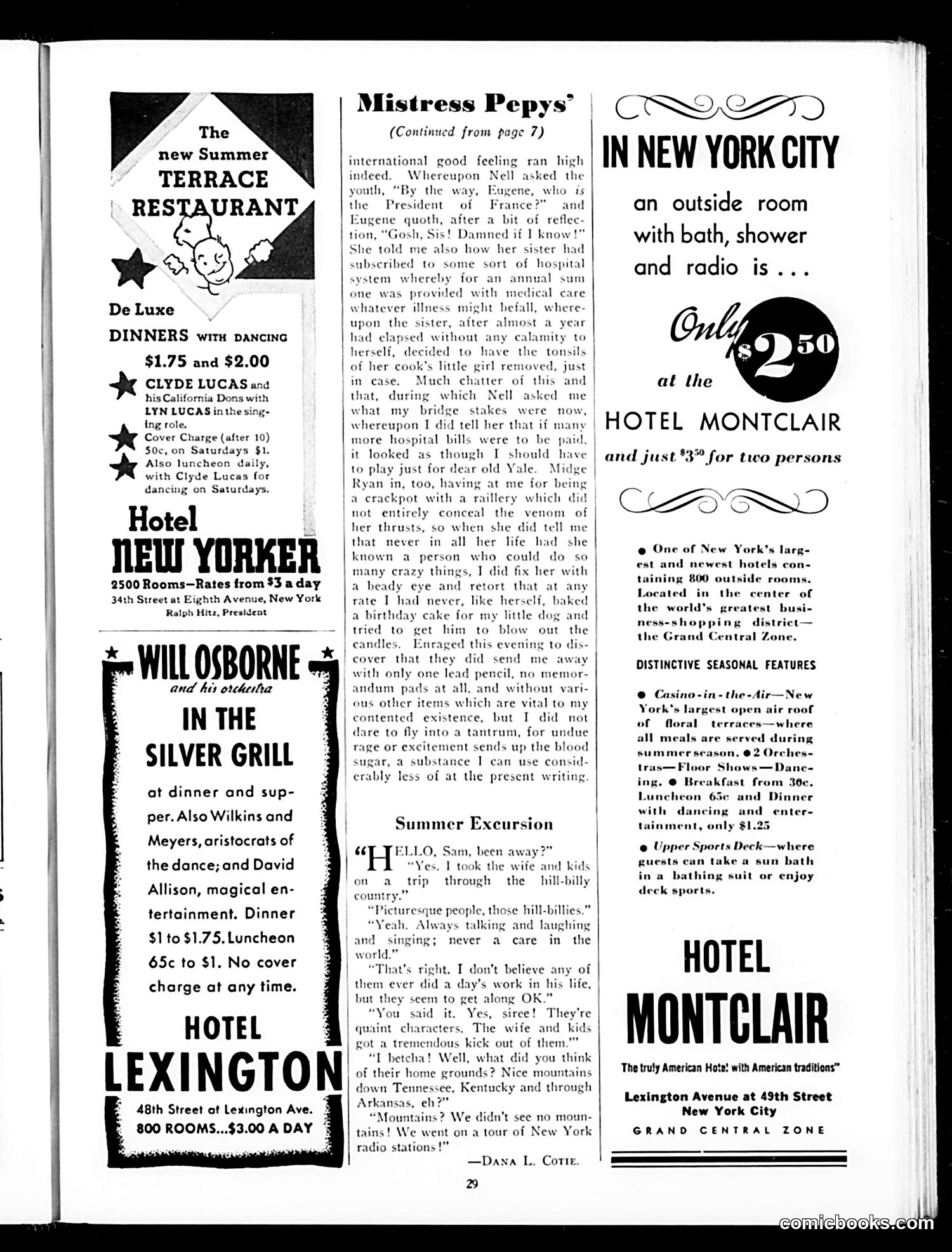
Analysis for Modern Readers This page is primarily advertising, showcasing New York City hotels and restaurants from what appears to be the 1930s. The ads emphasize affordable luxury—rooms for $3/day, dinners for $1-$2—reflecting Depression-era pricing designed to attract middle-class tourists. The content includes a serialized column called "Mistress Pepys'" (a playful reference to Samuel Pepys's famous diary) featuring gossip and social observations, and a humor piece titled "Summer Excursion" about tourists visiting the American South. The "Summer Excursion" joke satirizes urban sophistication: a couple takes a trip through Tennessee, Kentucky, and Arkansas expecting to see mountains and "picturesque" rural life, but instead only tour New York radio stations—a gentle mockery of how some city dwellers misunderstand or stereotype rural America, while also highlighting the era's fascination with radio technology. The page reflects 1930s priorities: affordable travel, hotel amenities, and middle-class aspirations.
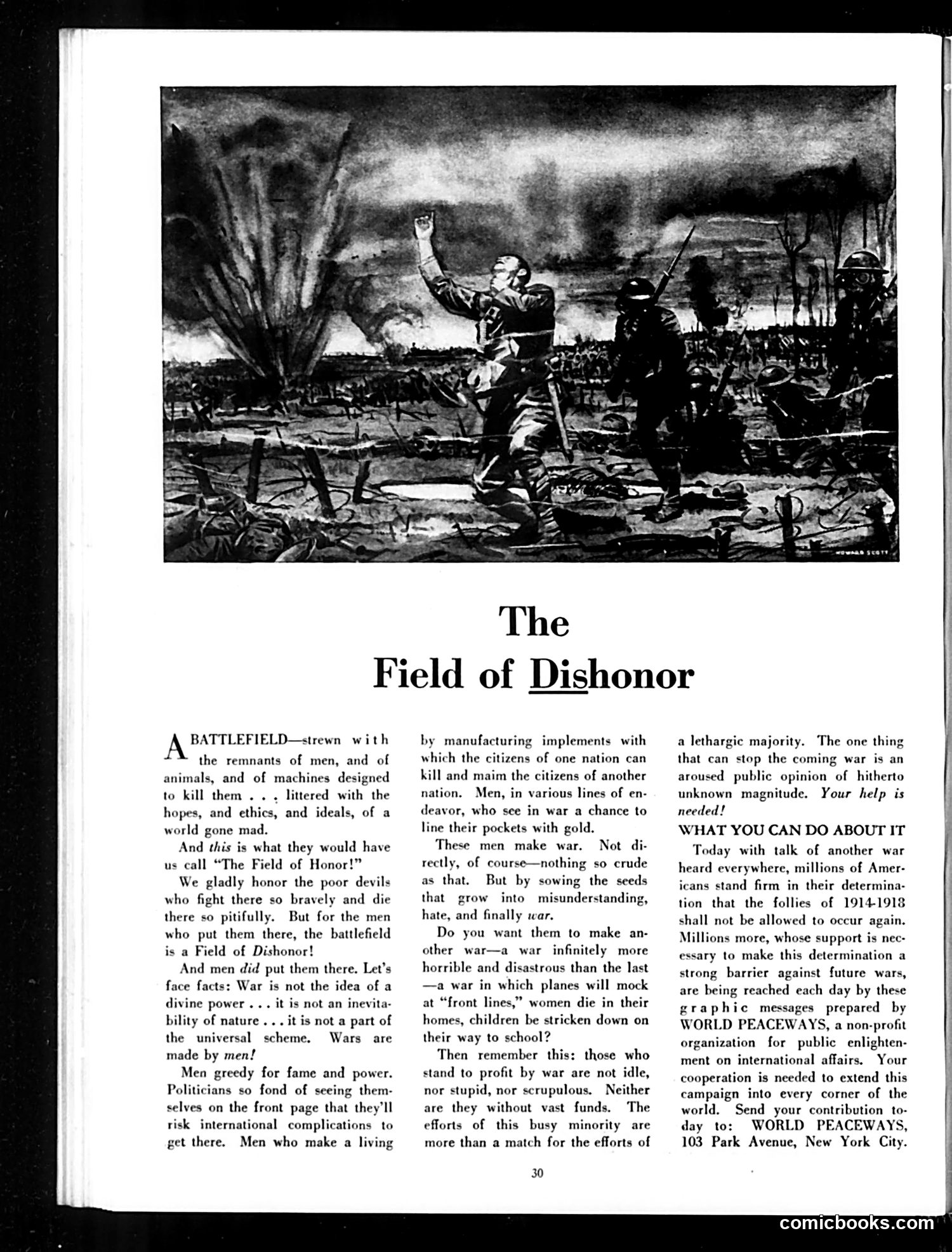
"The Field of Dishonor" - Judge Magazine Analysis This is an anti-war editorial (not a satirical cartoon) from the interwar period, likely 1930s. The dramatic battlefield illustration shows soldiers amid destruction and explosions. The piece argues that wars aren't natural or inevitable—they're deliberately created by greedy men: politicians seeking publicity, weapons manufacturers, and profiteers. The title ironically calls battlefields "Fields of Dishonor" because the shame belongs to those who *start* wars, not the soldiers who fight them. The text references the "follies of 1914-1918" (WWI), warning Americans against repeating that mistake as another war threatens. It's a direct appeal for readers to support World Peaceways, a real pacifist organization, arguing that only aroused public opinion can prevent future wars against well-funded war profiteers. This reflects genuine 1930s American isolationism and peace activism before WWII.
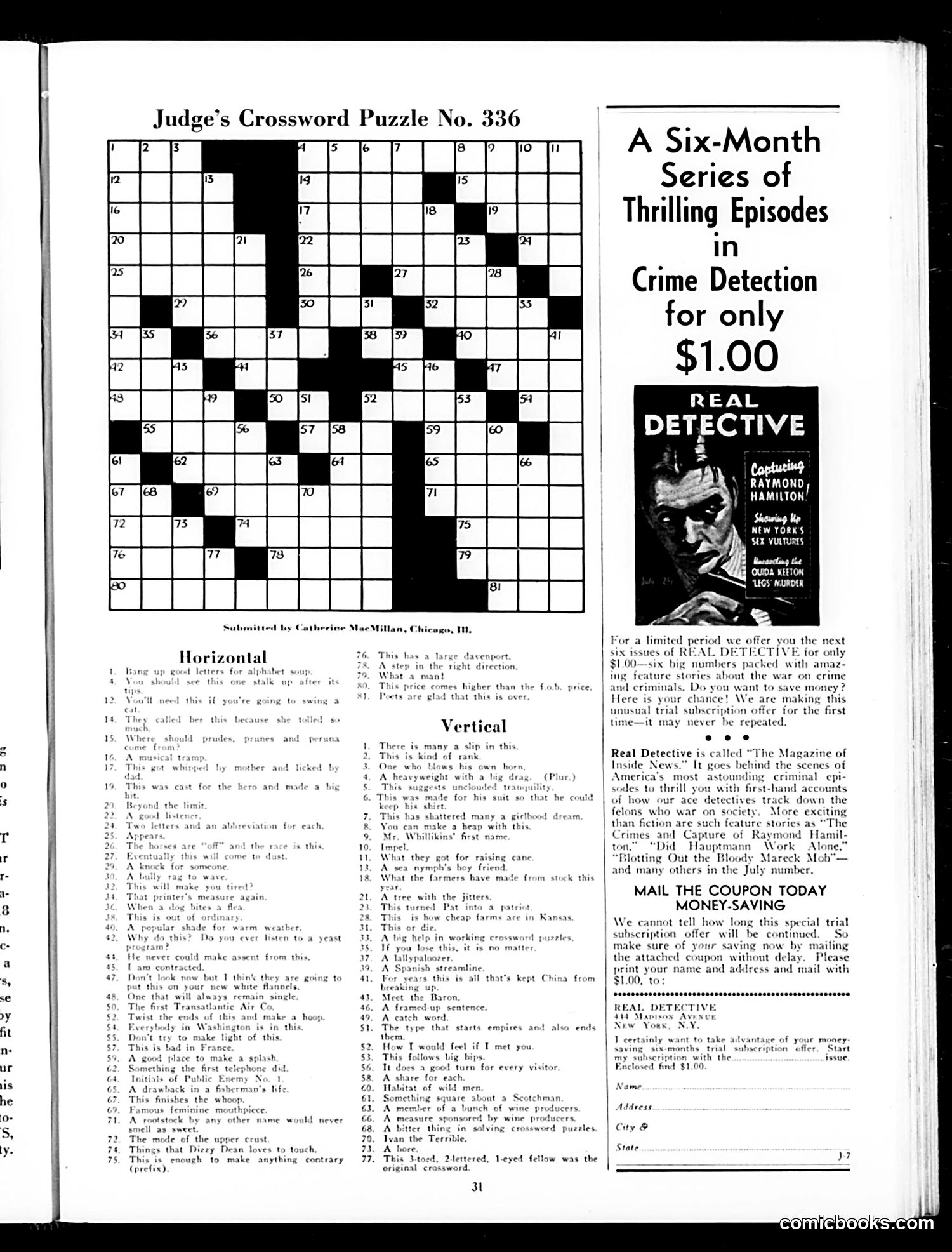
Analysis of Judge Magazine Page 336 This page is primarily a crossword puzzle and advertising, not a political cartoon. The main content is "Judge's Crossword Puzzle No. 336," submitted by Catherine MacMillan of Chicago—a standard feature in the magazine. The significant non-puzzle element is an advertisement for "Real Detective" magazine (lower right). The ad promises six months of crime detection stories for only $1.00—a trial subscription offer. It highlights sensational true-crime content, featuring "Raymond Hamilton" and promoting stories with titles like "The Captured Raymond Hamilton" and "Floating Out in Marked Mob." The ad targets readers seeking thrilling accounts of real criminal cases, promising inside access to detective work. The emphasis on crime-fighting and criminal manhunts reflects 1930s popular interest in gangster narratives during Prohibition and the Depression era. There is no political satire visible on this page—it represents typical Judge content: puzzles and period advertisements alongside editorial matter.
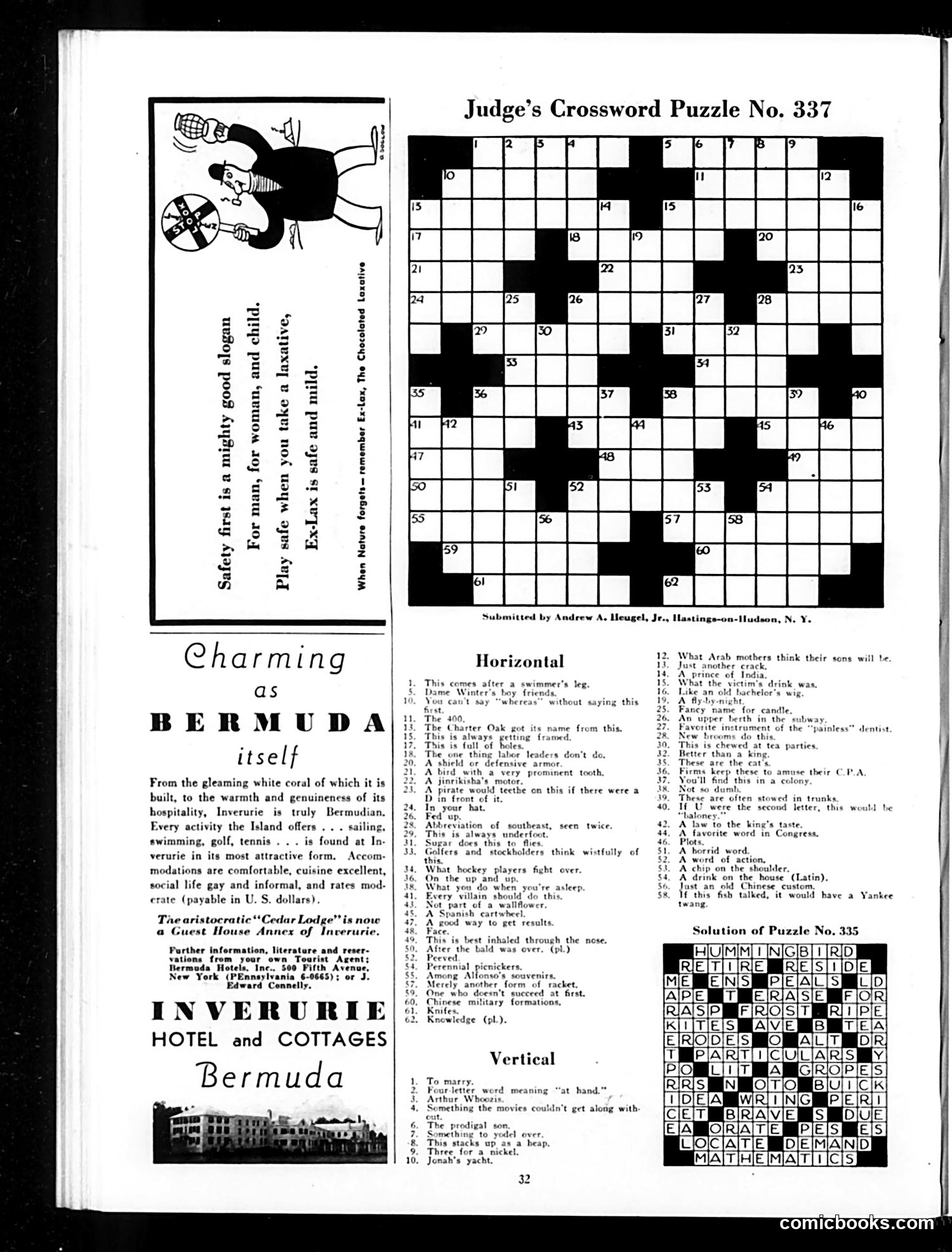
Judge Magazine Page Analysis This page is primarily advertising and a crossword puzzle, not political satire. The main content includes: - A crossword puzzle (No. 337) with clues about everyday objects and phrases - Tourism advertisements for Bermuda's Inverurie Hotel and Cottages, emphasizing its charm and hospitality - An Ex-Lax laxative advertisement promoting the product as safe and gentle The small cartoon in the upper left appears to be a generic humorous illustration (a figure with a spinning wheel or similar device), but it's not clearly identifiable as satirizing a specific political figure or event. The page reflects early-to-mid 20th century magazine content: leisure travel promotion, digestive health products marketed directly to consumers, and word puzzles as common entertainment. Nothing on this page appears to contain pointed political commentary or topical satire—it's standard commercial magazine filler.
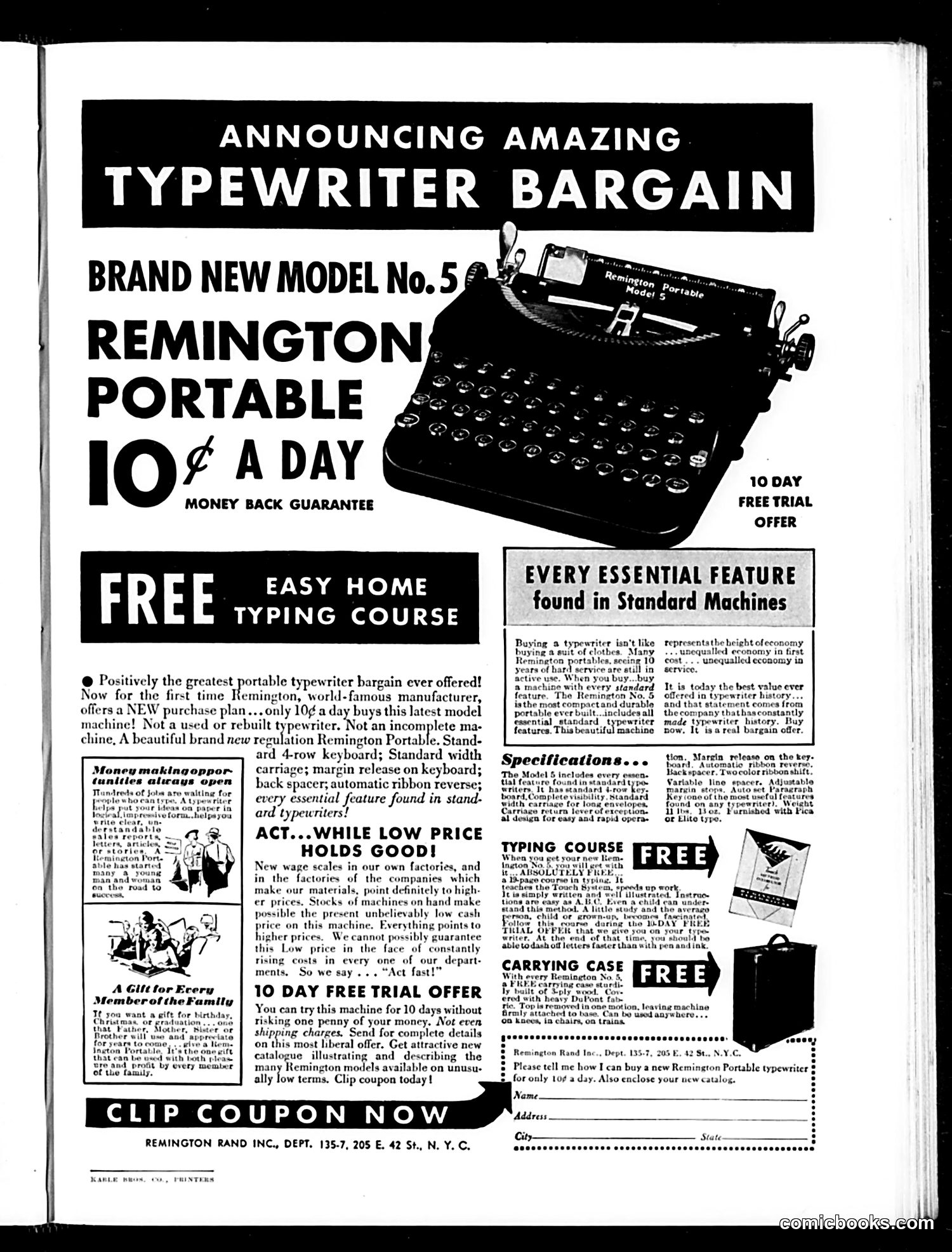
Analysis for Modern Readers This is not a cartoon or satire — it's a straightforward advertisement for the Remington Portable typewriter, placed in *Judge* magazine. The page announces a promotional offer: purchasing a brand-new Remington Model No. 5 for only 10¢ per day, with a 10-day free trial and money-back guarantee. The ad emphasizes it's a complete, standard machine (not used or refurbished), includes a free typing course and carrying case, and highlights features like a 4-row keyboard and automatic ribbon reverse. The sales pitch exploits economic anxiety: wages and material costs are rising, so prices will soon increase — "Act fast!" Multiple small illustrations show the typewriter's appeal to different family members and potential users. This represents 1930s-40s consumer marketing: installment purchasing plans, free trials, and urgency-based sales tactics were novel and noteworthy enough to warrant prominent magazine advertising.
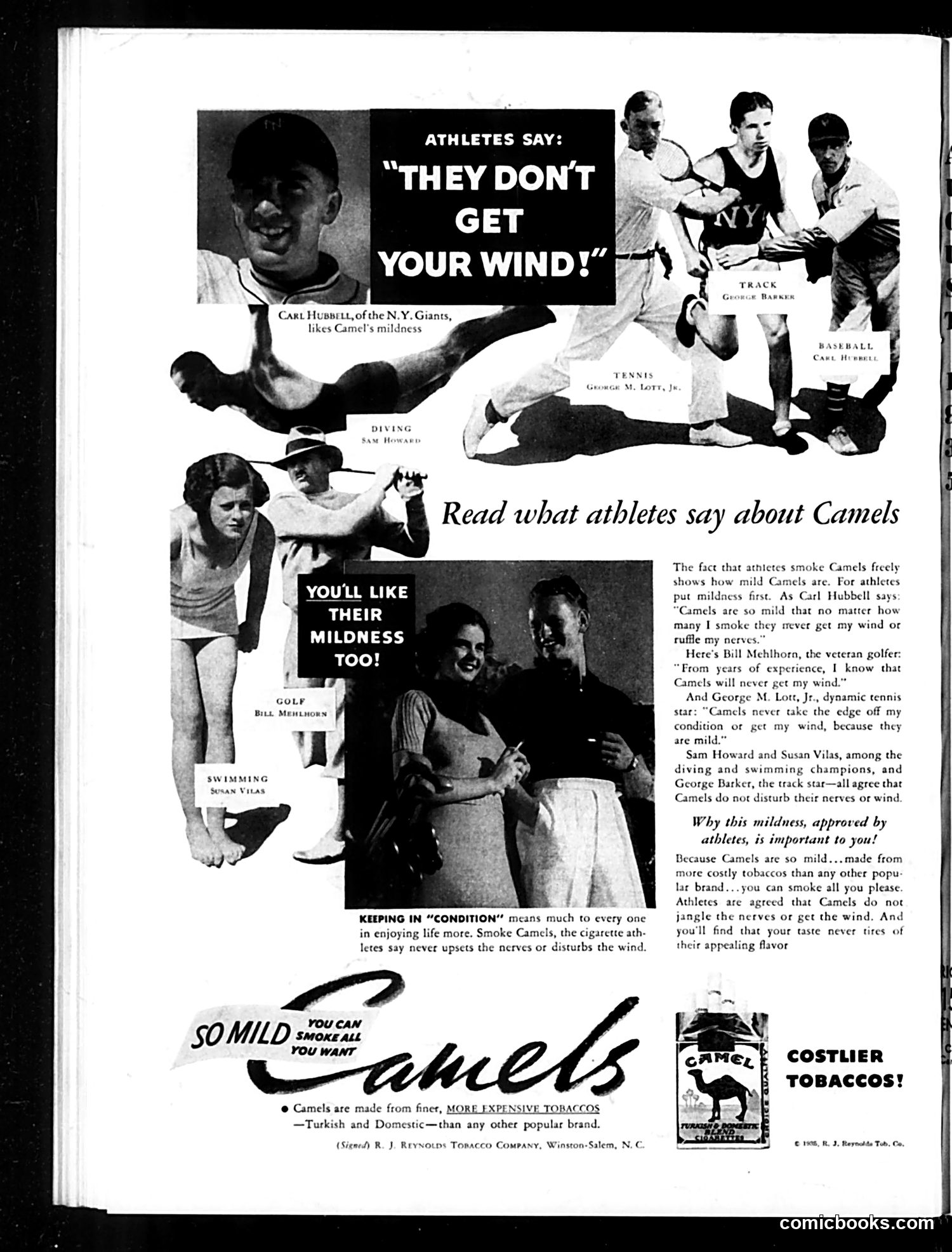
Camel Cigarette Advertisement (Judge Magazine) This is a cigarette advertisement, not satire—it's a genuine Camel marketing campaign featuring testimonials from named athletes (Carl Hubbell of the NY Giants, golfer Bill Mehlhorn, tennis player George M. Lott Jr., and swimmers/divers). The ad's central claim: Camels are so "mild" they won't harm athletic performance—they won't "get your wind" (impair breathing) or "ruffle nerves." This was a common mid-20th-century marketing strategy: linking cigarettes to health and athletic prowess by having famous sports figures endorse them. The page emphasizes Camels use "more expensive tobaccos," positioning the brand as superior. By today's standards, this is deeply ironic—we now know cigarettes damage athletic performance and health generally. But in this era, such advertising was standard and legal, exploiting public trust in athletes to sell a harmful product.