judge
Judge — August 1935
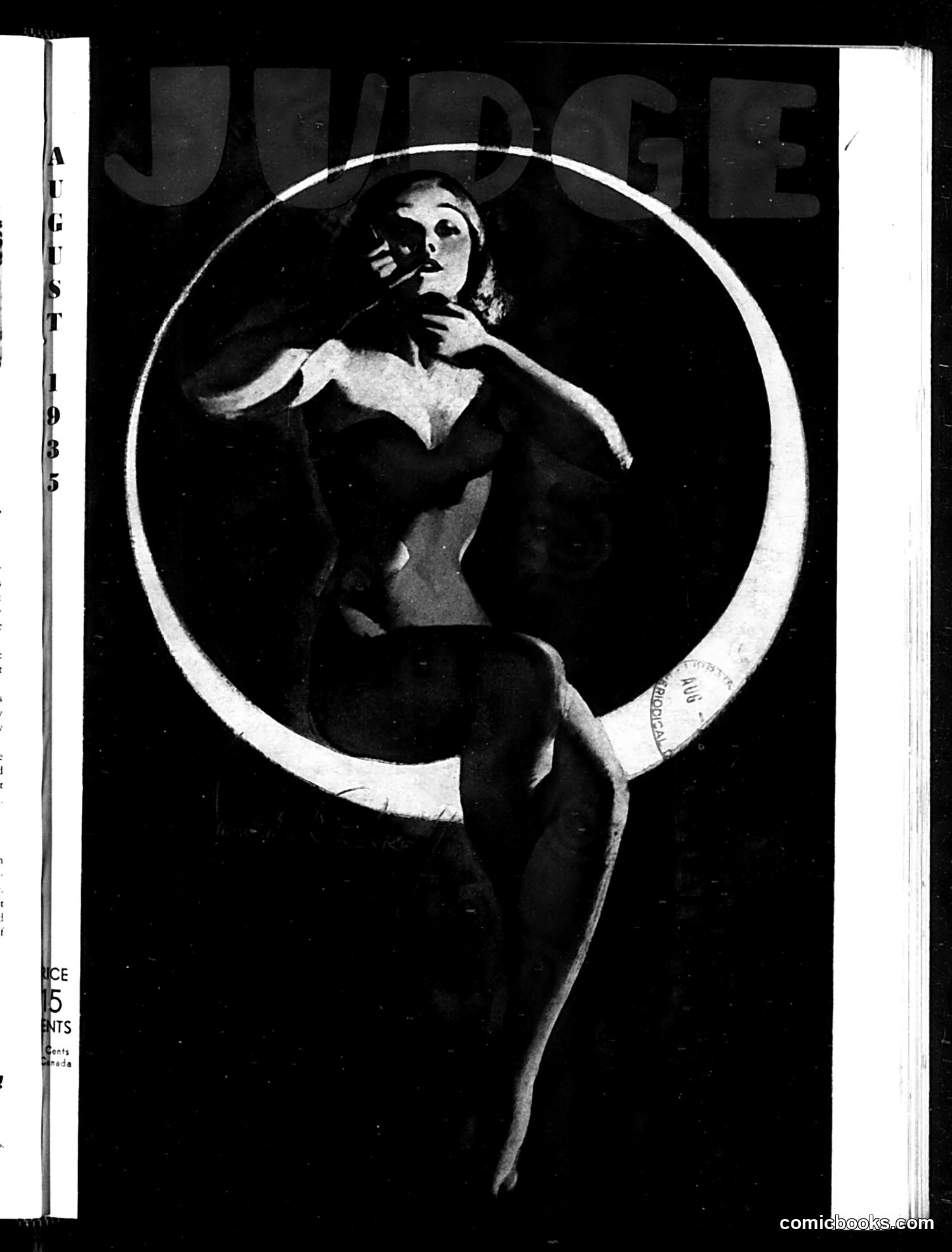
Judge Magazine Cover Analysis This appears to be a Judge magazine cover featuring an Art Deco-style illustration of a woman in an elegant pose within a circular frame. The word "JUDGE" is visible at the top of the page. Without additional OCR text or clear identifying captions visible in the image, I cannot definitively explain the specific satirical content or political/social references this cover addresses. The artistic style suggests this is from the 1920s-1930s era, when Judge was known for commentary on contemporary American culture, politics, and social issues. To accurately identify the figures being caricatured and explain the satirical point, I would need clearer text or additional context about the publication date and article titles.
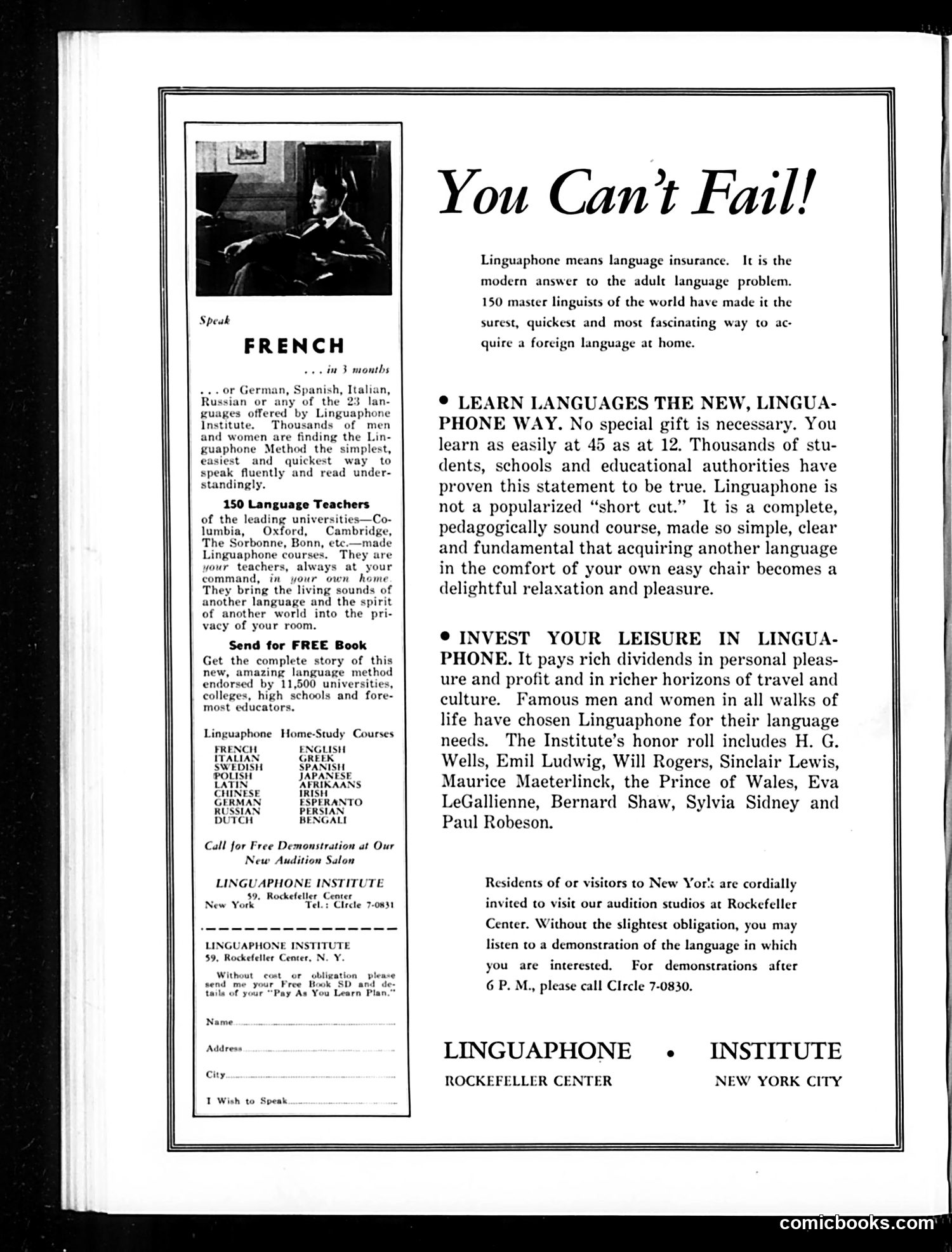
Analysis This page is primarily an advertisement for Linguaphone Institute, a language-learning correspondence course, rather than satirical content. The top-left shows a photograph of a man speaking French, labeled "Speak FRENCH... in 3 months." The ad's humor is implicit rather than explicit: it promises remarkably rapid language acquisition ("as easily at 45 as at 12") and claims famous figures including H.G. Wells, Emil Ludwig, and Paul Robeson used the method. The "You Can't Fail!" headline uses hyperbolic confidence typical of mid-20th-century advertising. There is no political satire or caricature present. This appears to be a straightforward (if somewhat exaggerated) commercial pitch placed within Judge magazine, reflecting the publication's reliance on advertising revenue alongside editorial content.
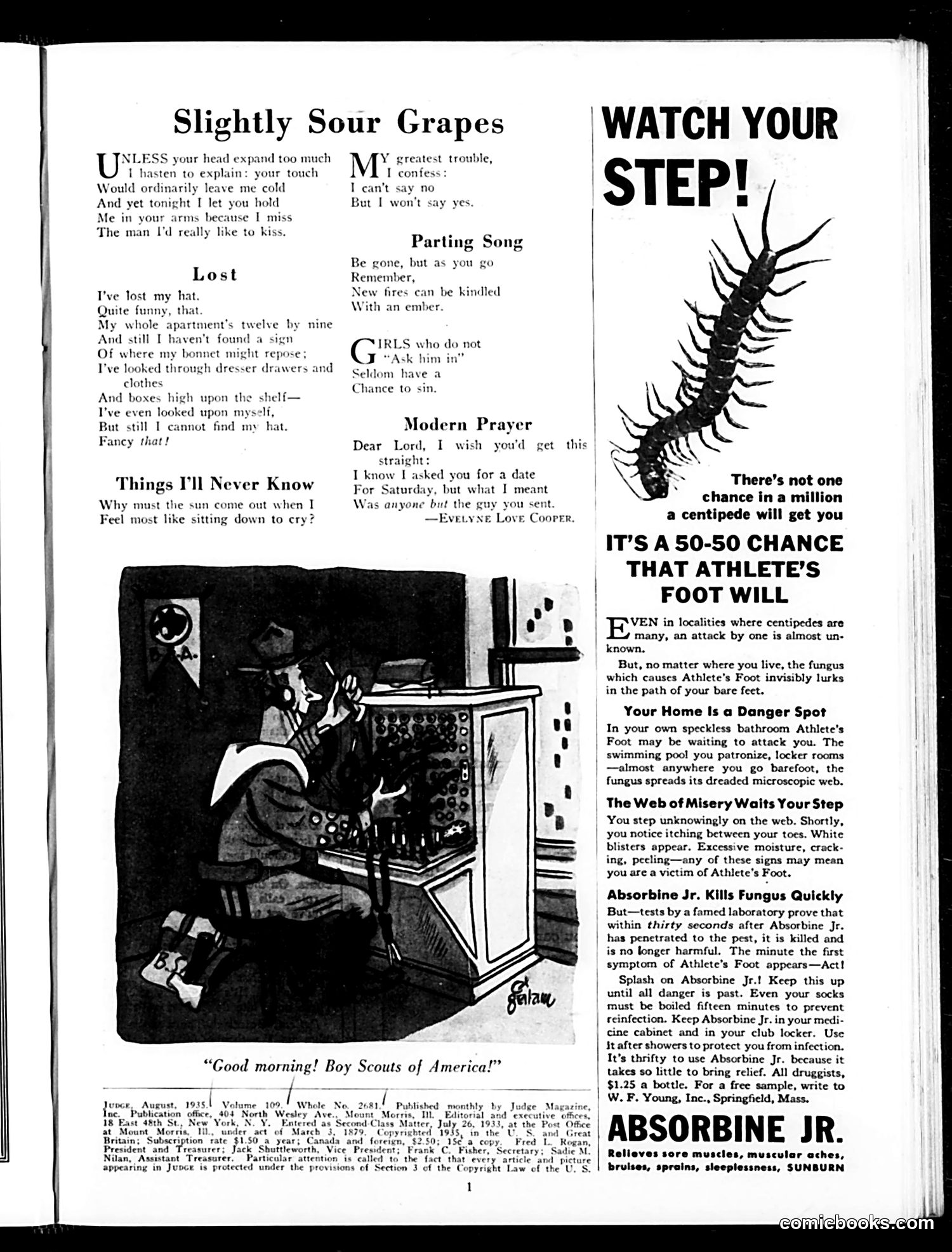
Judge Magazine Page Analysis This page combines poetry and advertising. The left side features light verse on romantic disappointment and loss, typical of Judge's humor. The main cartoon (captioned "Good morning! Boy Scouts of America!") depicts a person at a radio, likely satirizing early 1930s domestic life and the popularity of radio broadcasts. The right side is dominated by an advertisement for Absorbine Jr., a topical medicine. The "WATCH YOUR STEP!" heading and centipede image are marketing devices warning readers about athlete's foot fungus. This reflects genuine health concerns of the era before modern antifungal treatments. The ad emphasizes the product's speed and effectiveness, typical of period medical advertising that often made bold claims. The placement alongside family-oriented content suggests the product's mainstream consumer appeal.
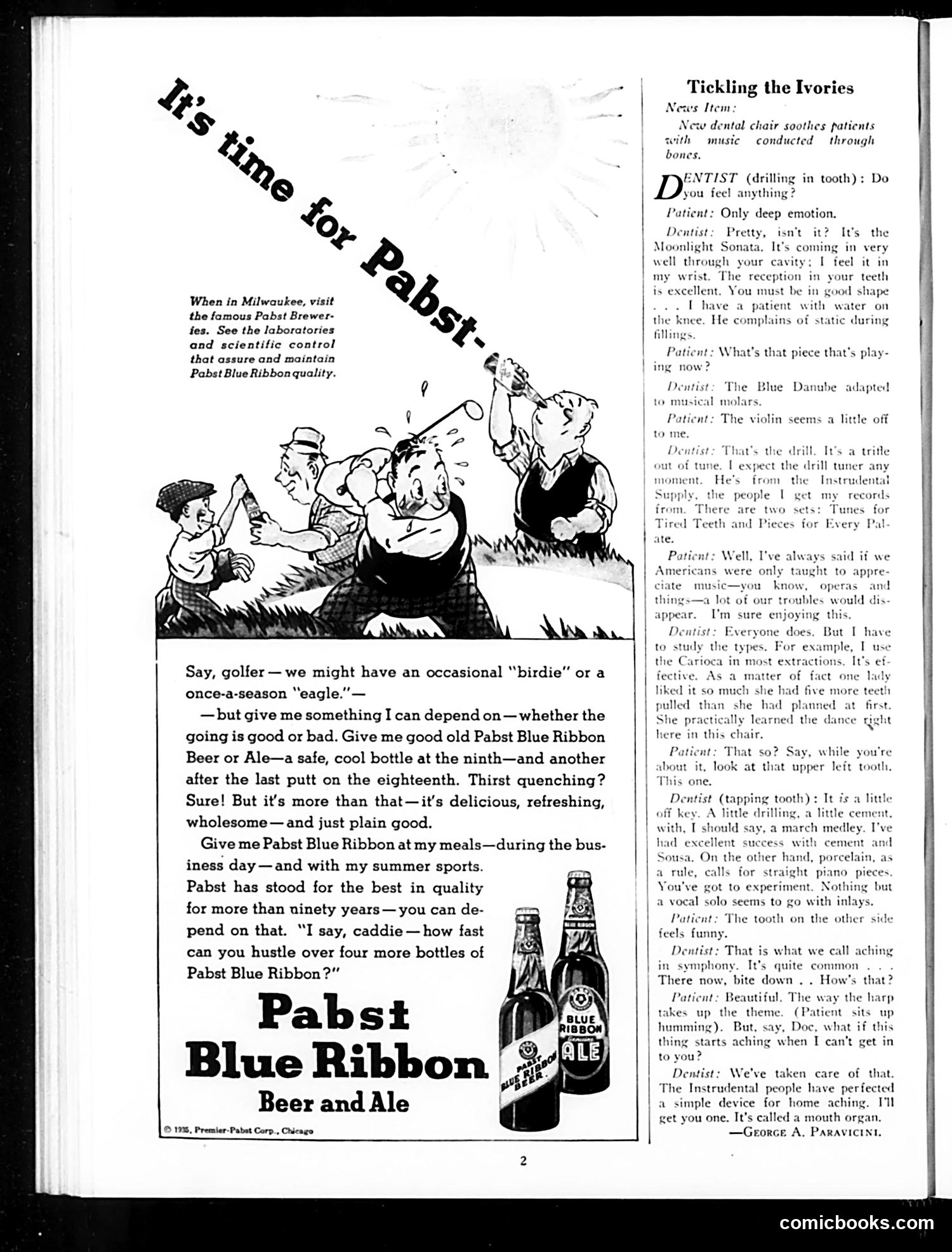
Analysis This page is primarily advertising, not political satire. The left side features a full Pabst Blue Ribbon Beer and Ale advertisement with a cartoon showing golfers. The ad uses humor to pitch beer as a reliable beverage for leisure activities and meals, with the tagline emphasizing Pabst's "ninety years" of dependability. The right side contains "Tickling the Ivories," a humorous dialogue between a dentist and patient. The dentist plays classical music (Moonlight Sonata, Blue Danube) through a drill vibrating the patient's teeth, creating an absurd musical experience. The humor derives from the unexpected juxtaposition of dental work and high culture—turning painful procedure into inadvertent concert performance. This is light comedy, not political commentary.
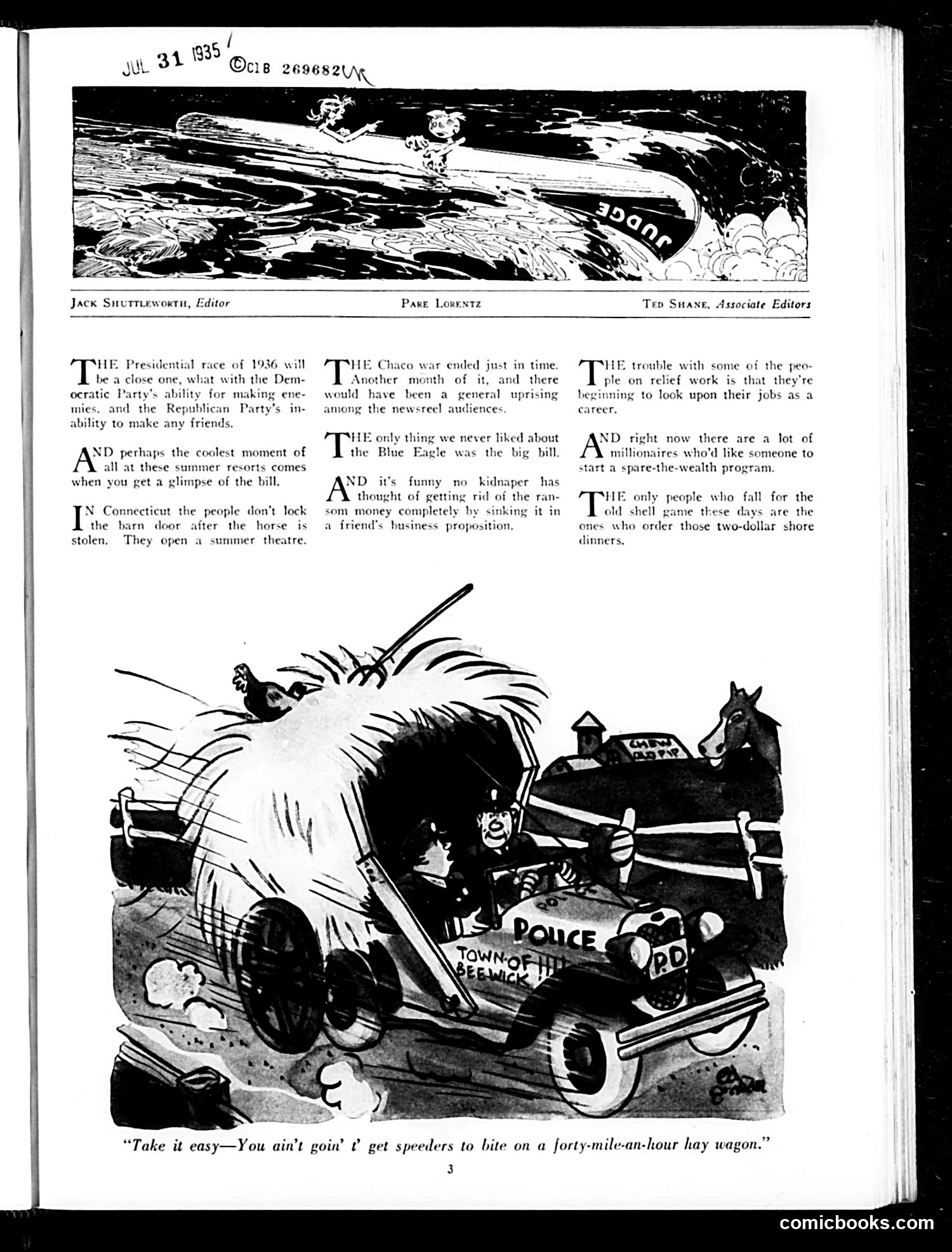
Analysis of Judge Magazine Page (July 31, 1935) The main cartoon depicts a police officer in a tiny car being struck by an enormous hay wagon. The caption reads: "Take it easy—You ain't goin' t' get speeders to bite on a forty-mile-an-hour hay wagon." This is rural satire: a small-town policeman attempts to enforce speed limits using a comically oversized farm implement as bait, assuming speeding drivers will be attracted to (and chase) it. The joke mocks ineffective small-town policing tactics and rural law enforcement's limitations. The editorial text above discusses the 1936 Presidential race, the Chaco War's conclusion, the "Blue Eagle" (NRA symbol), and economic complaints about millionaires and relief workers—typical Depression-era political commentary. The overall page reflects 1930s American concerns about politics, economics, and rural life.
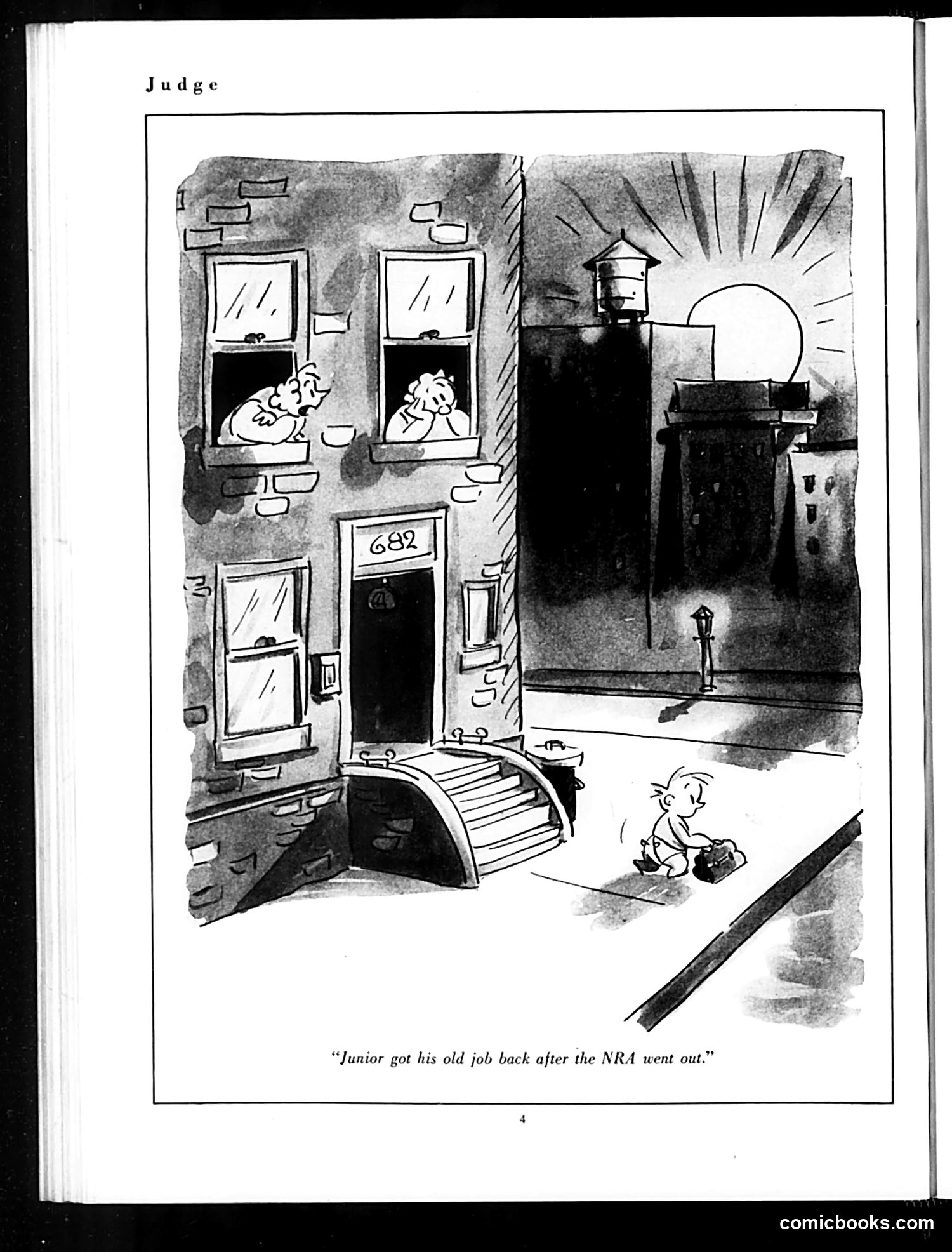
Analysis of Judge Cartoon Page This cartoon satirizes economic conditions following the National Recovery Administration (NRA), a New Deal program (1933-1935). The caption reads: "Junior got his old job back after the NRA went out." The image shows a tenement building with residents in windows overlooking a street scene. A small child carries a toolbox or lunch pail, apparently returning to child labor work. The satire critiques the NRA's collapse by suggesting that without its protections, vulnerable workers—specifically children—were forced back into exploitative labor conditions. The cartoon reflects contemporary anxieties about the Depression era and debates over New Deal effectiveness. It uses dark humor to highlight social consequences of losing Depression-era worker protections, particularly the vulnerability of child laborers.
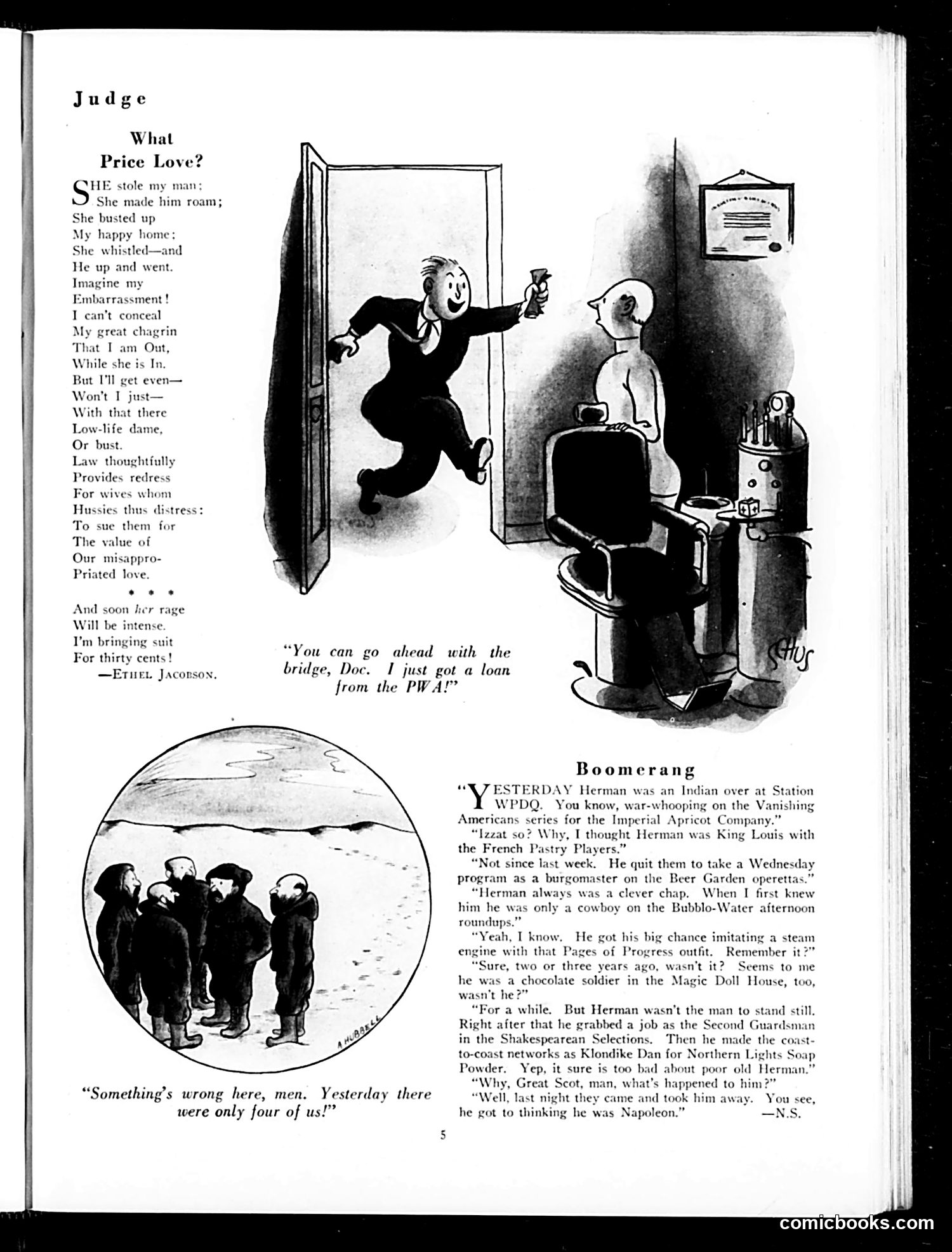
Analysis of Judge Magazine Page 5 Top Cartoon ("What Price Love?"): A woman has left her husband, causing him distress. The poem by Ethel Jacobson suggests a husband's frustration with his wife's infidelity and her subsequent demands—likely for alimony or settlement. The cartoon shows a man at a doctor's office receiving the news that his wife left him, while he ruefully discusses finances. The satire targets both the wife's apparent indiscretion and contemporary divorce proceedings that financially disadvantaged men. Bottom Section ("Boomerang"): This anecdote describes Herman, an Indian performer at a radio station (WPDO) who worked in various entertainment capacities—from Shakespearean productions to soap powder advertisements. The humor stems from his repeated career boomerangs: each ambitious attempt (steam engine imitation, etc.) failed, always returning him to lesser positions, like "thinking he was Napoleon." The satire mocks both the entertainment industry's fickleness and performers' delusions of grandeur.
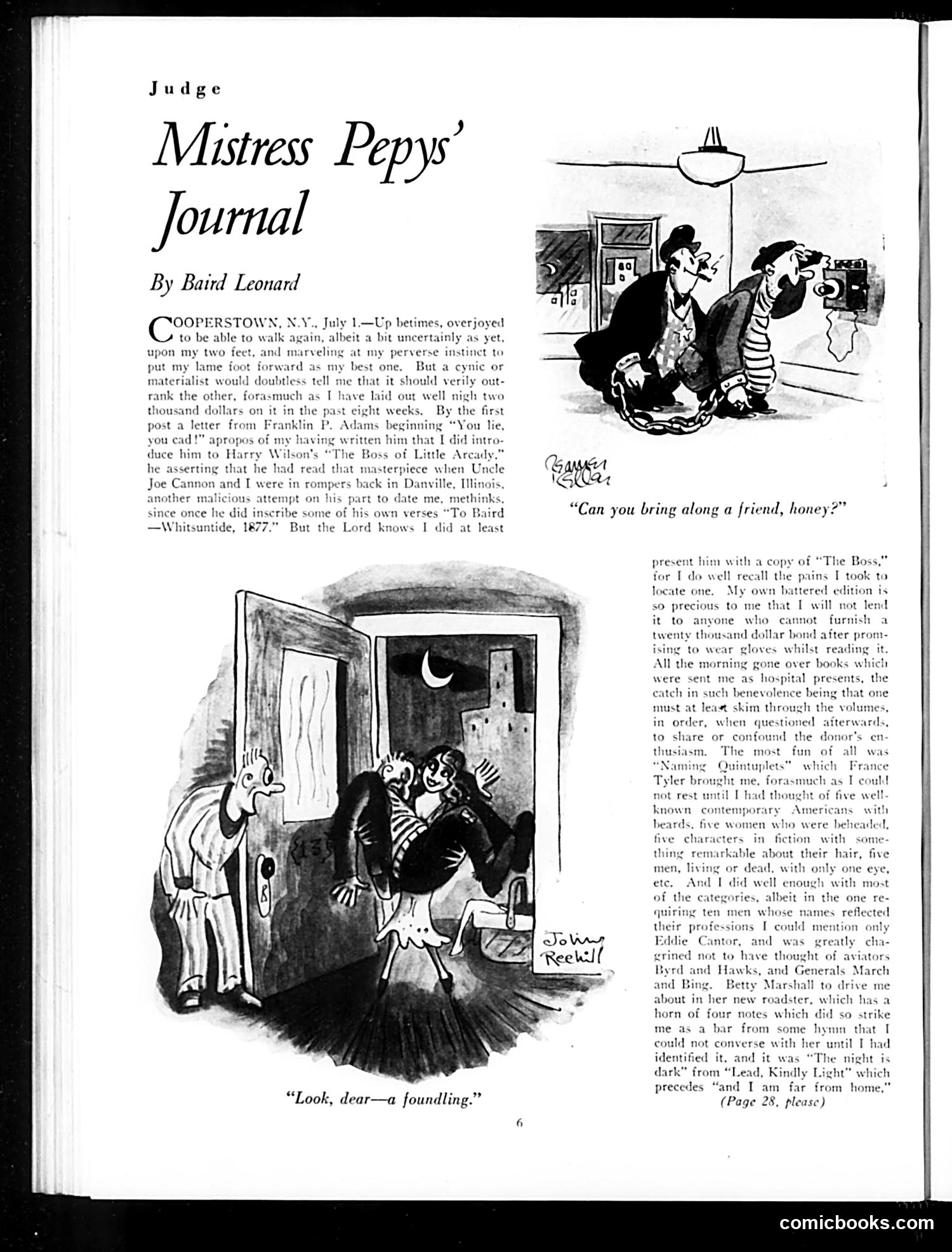
Analysis of Judge Magazine Page This page contains "Mistress Pepys' Journal" by Baird Leonard, a humorous column referencing Samuel Pepys' famous historical diary. The two cartoons illustrate anecdotes from the author's life. The upper cartoon shows a cameraman asking "Can you bring along a friend, honey?"—likely satirizing Hollywood's casual attitude toward romantic relationships. The lower cartoon depicts someone at a doorway exclaiming "Look, dear—a foundling," suggesting a comedic domestic scenario. The text discusses the author's efforts to locate a copy of Harry Wilson's "The Boss of Little Arcady" and various literary mishaps. References to contemporary figures like Betty Marshall and her automobile suggest 1920s-era social commentary, though the exact satirical targets remain unclear without fuller context.
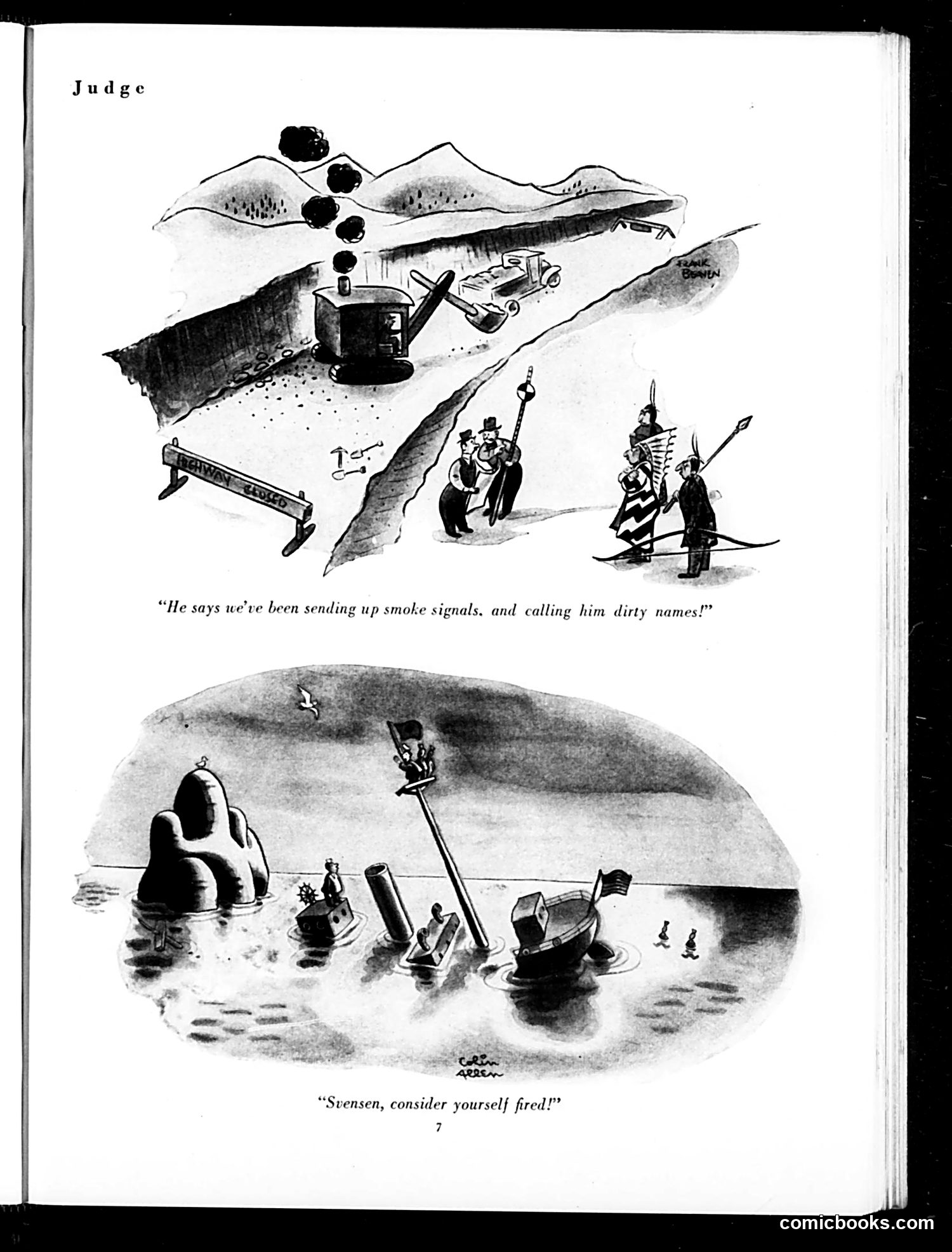
Analysis of Judge Page This page contains two political cartoons satirizing a military or naval figure (likely a commanding officer or admiral) named Svensen. Top cartoon: Military personnel on land accuse Svensen of sending "smoke signals" and calling him "dirty names." The figure appears to be a high-ranking officer (suggested by the formal dress and authority position). Bottom cartoon: Svensen, apparently in a naval/submarine setting with various military vessels and fortifications visible, receives a dismissal order: "Svensen, consider yourself fired!" The satire appears to criticize Svensen's conduct—either unprofessional behavior (the "dirty names"), incompetence, or poor communication ("smoke signals"). The cartoon uses his firing as the punchline, suggesting he's being held accountable for his failures. The exact historical context remains unclear without additional dating information.
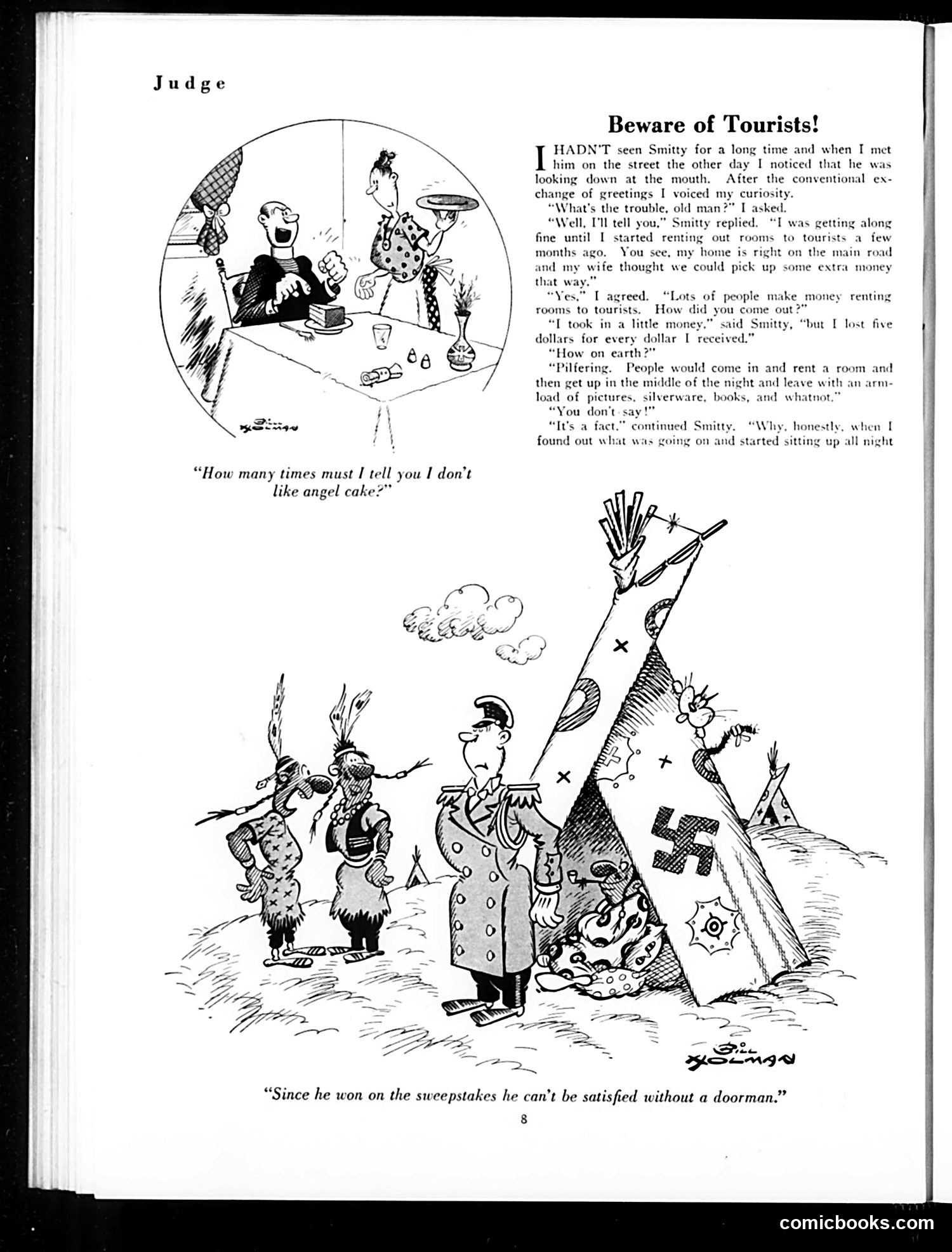
"Beware of Tourists!" — Judge Magazine Satire This page contains two separate satirical cartoons mocking social anxieties of the era. Top cartoon: A domestic dispute where a husband repeatedly complains about angel cake, illustrating marital frustration over trivial matters. Main story & bottom cartoon: A cautionary tale about renting rooms to tourists. "Smitty" describes how his home-rental scheme backfired: tourists systematically stole his possessions—pictures, silverware, books—leaving him financially ruined despite charging fees. The story warns middle-class homeowners against this money-making scheme. Bottom cartoon's secondary joke: A nouveau-riche sweepstakes winner has become so pretentious after winning that he now demands a doorman, mocking social climbing and the corrupting effects of sudden wealth. The satire targets both the dishonesty of travelers and the false assumptions of ordinary people trying to profit from hospitality. The page reflects anxieties about tourism, theft, and changing social class mobility in early 20th-century America.
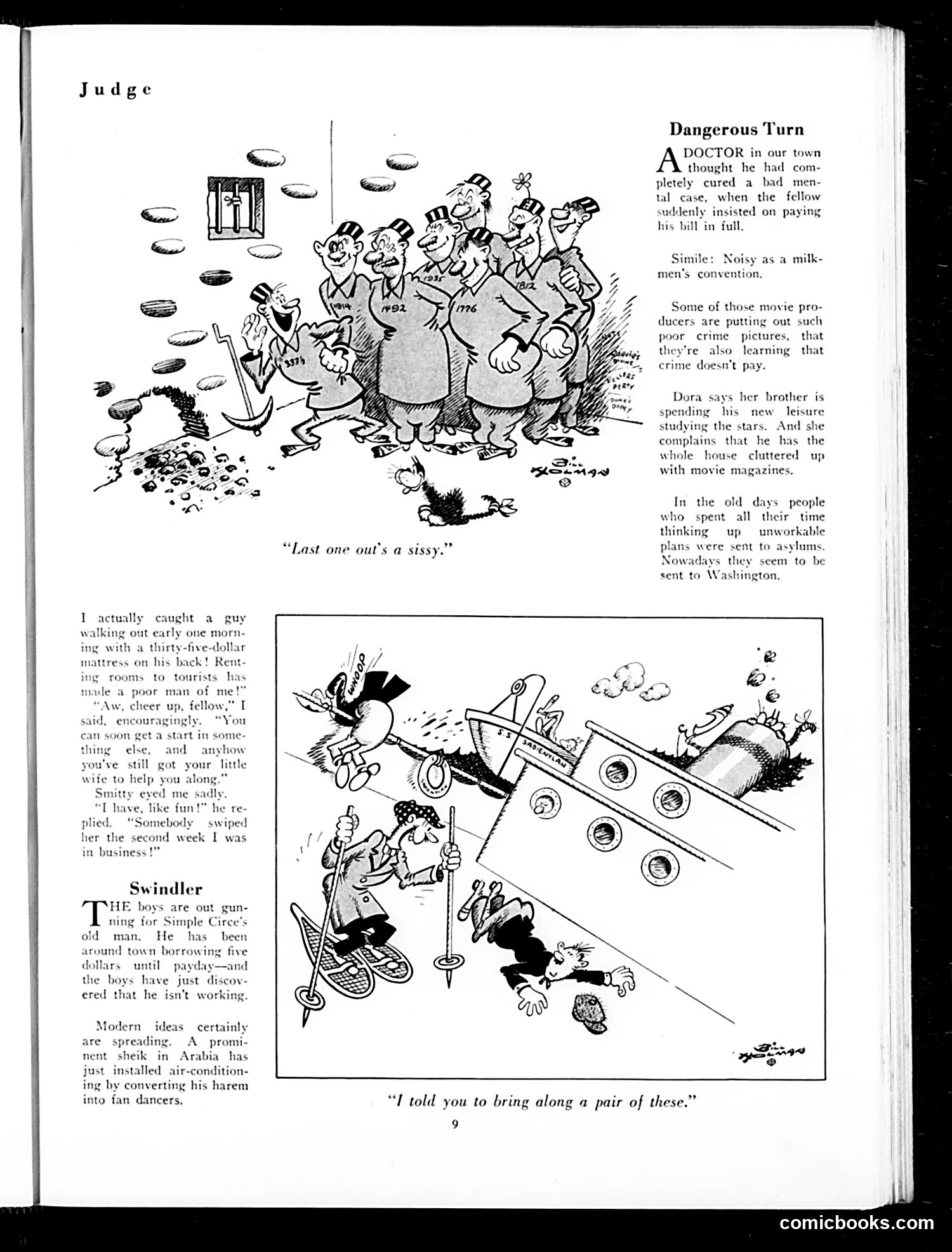
Judge Magazine Page Analysis This page contains several short satirical pieces typical of Judge's humor: "Dangerous Turn" mocks a psychiatric patient who, after being "cured," insists on paying his doctor's bill in full—suggesting his mental illness has worsened. The satire implies that financially responsible behavior is itself a sign of insanity. "Swindler" describes con artists targeting rental-room landlords, playing on post-WWI economic anxieties about urban crime and financial vulnerability. The bottom cartoon caption "I told you to bring along a pair of these" (showing what appears to be skis or similar equipment for an airplane) satirizes modern recreational trends. Other brief items joke about movie producers making poor crime films, a woman's brother spending leisure time with movie magazines, and—in a jab at Washington—comparing ineffectual politicians to historically institutionalized dreamers. The humor reflects 1920s-era concerns: urban crime, changing social mores, and skepticism toward both Hollywood and government.
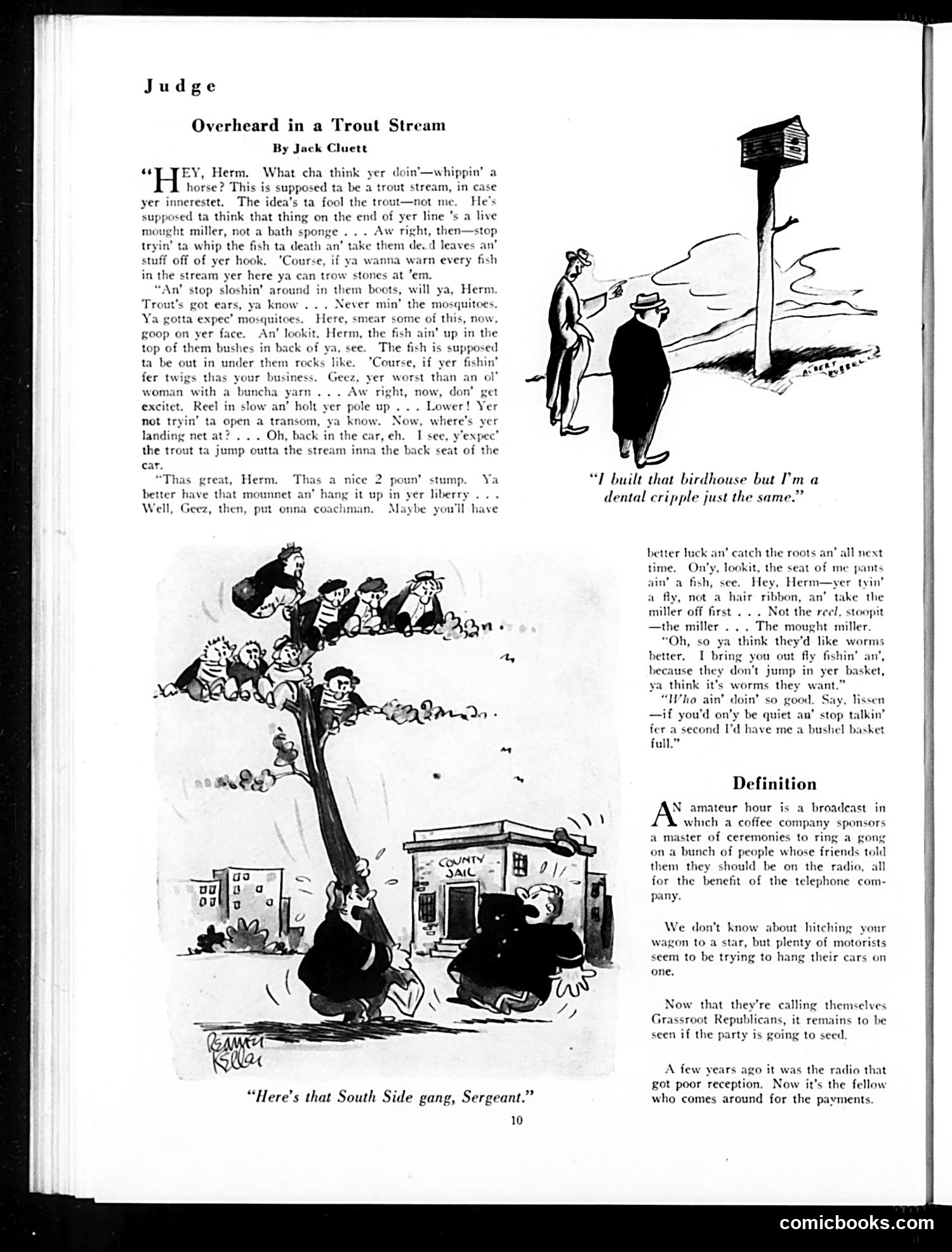
"Overheard in a Trout Stream" - Explanation for Modern Readers This humorous story by Jack Cluett depicts an experienced fisherman (Herm) patiently instructing an incompetent novice on fly-fishing technique. The novice repeatedly makes amateur mistakes: using a bath sponge instead of a proper lure, thrashing about loudly, standing in the water splashing, tangling his line in tree branches and the car seat, and confusing a hair ribbon with fishing equipment. The satire targets the arrogance of rank beginners who ignore expert advice. The exasperated instructor's running commentary—delivered in working-class dialect—humorously catalogs each blunder while the novice insists on trying obviously wrong approaches (like using worms instead of flies). The accompanying cartoons and brief "Definition" section offer unrelated social commentary on radio amateur hours and other contemporary topics, typical of Judge magazine's mixed-content format.
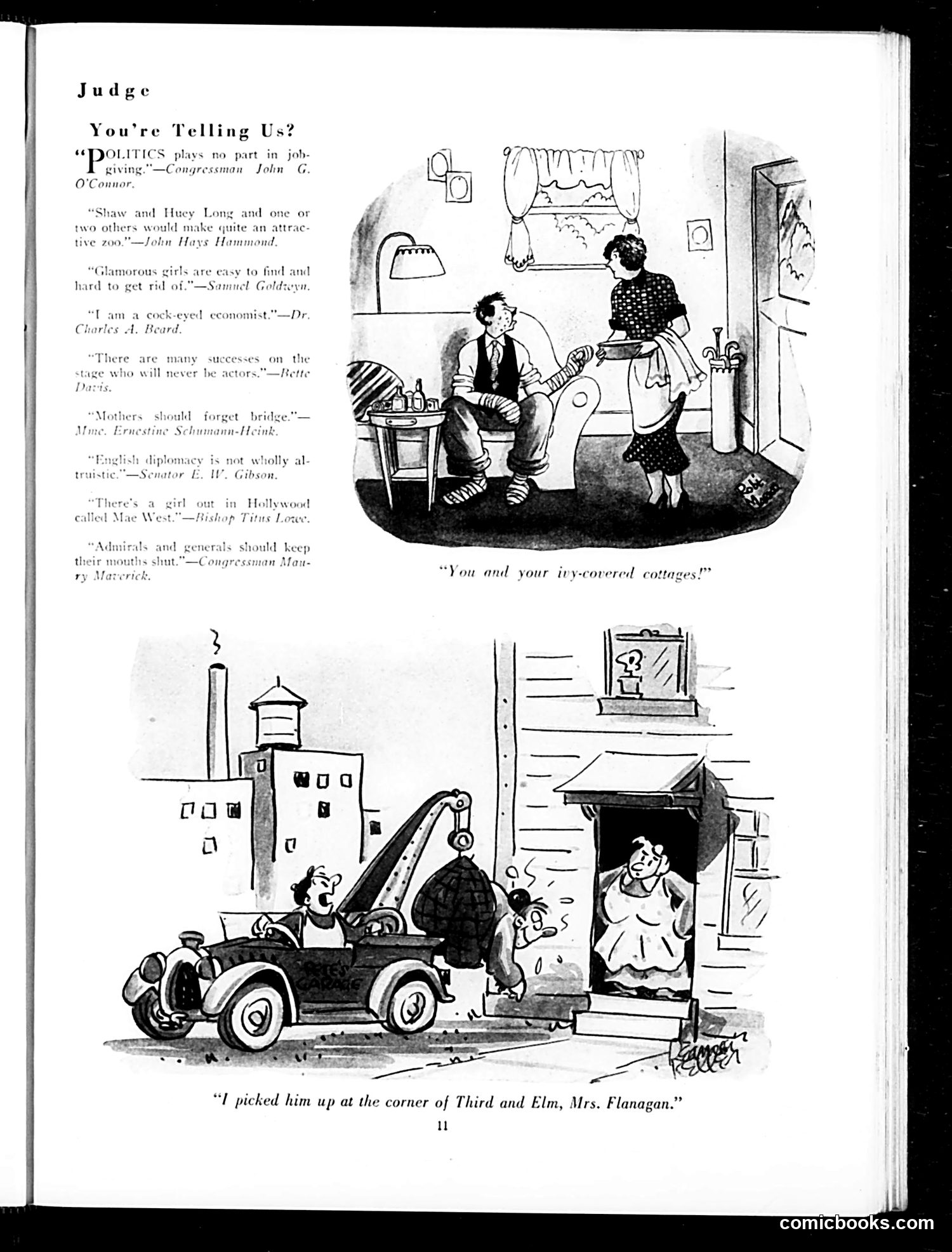
Analysis This page from *Judge* magazine contains two cartoons satirizing different subjects: Top cartoon: Shows a domestic scene where a woman confronts a man about "ivy-covered cottages," likely mocking either romantic idealism or housing/real estate aspirations during the era. Bottom cartoon: Depicts a car accident or incident at "Third and Elm," with Mrs. Flanagan apparently picking up an injured person. The humor appears to derive from the casual or darkly comedic nature of the situation. The page's header, "You're Telling Us?", frames these as ironic commentary on various quotations from politicians and public figures above, suggesting hypocrisy between their stated principles (politics not affecting job-giving, diplomatic conduct, etc.) and reality. Without specific historical context about the people quoted or current events referenced, the exact satirical targets remain somewhat unclear, though the general theme concerns the gap between public statements and actual behavior.
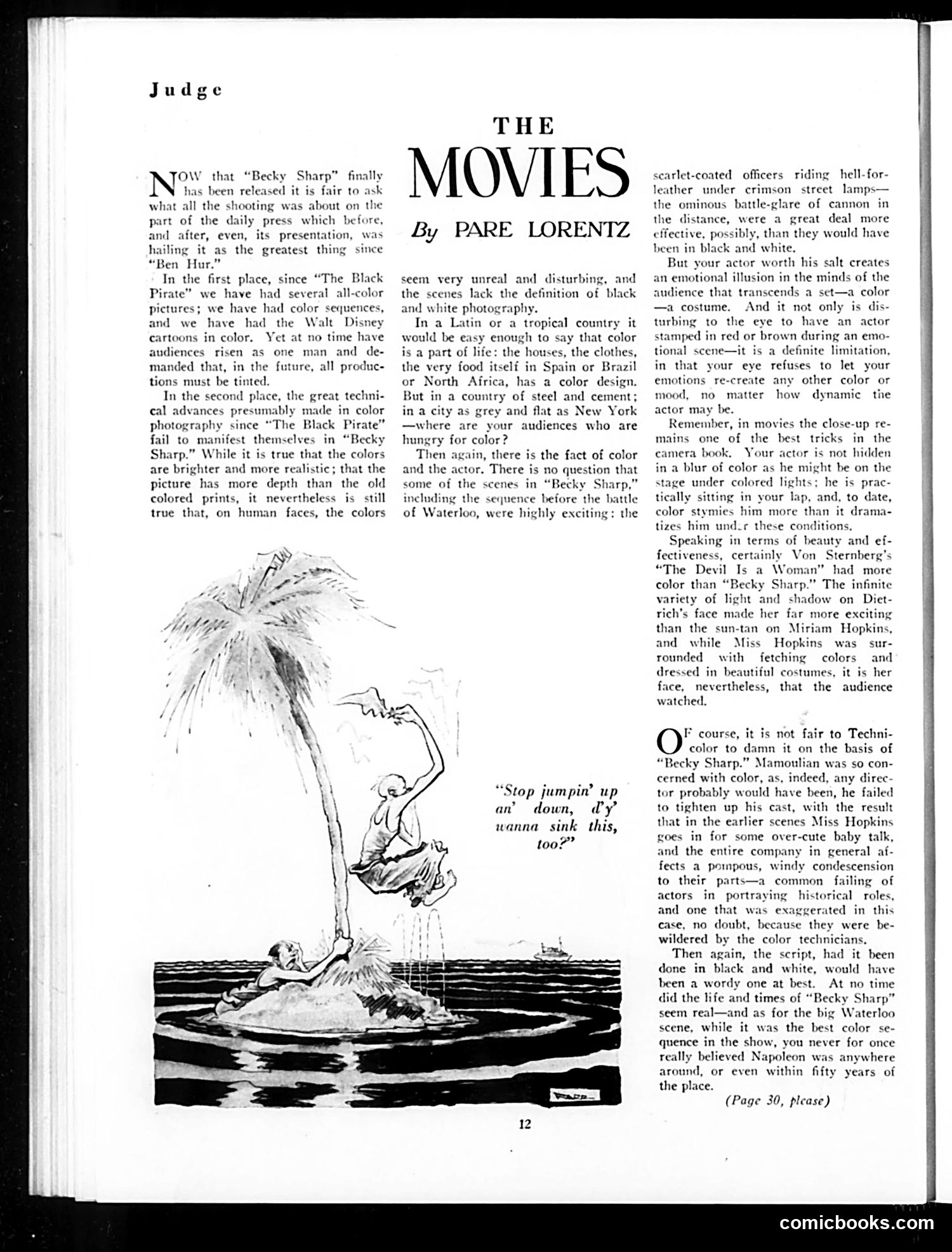
"The Movies" by Pare Lorentz — Judge Magazine Film Critique This is a film review essay critiquing "Becky Sharp," apparently the first major color feature film (likely 1935). The cartoon illustrates the review's central complaint through the dialogue: "Stop jumpin' up and down, d'y wanna sink this, too?"—suggesting an actor's exaggerated performance amid dramatic action. Lorentz argues that while color cinematography is technically impressive, it undermines acting effectiveness. He contends that close-ups—cinema's best technique—suffer when actors are locked into unrealistic skin tones. He compares unfavorably to Marlene Dietrich's nuanced performance in "The Devil Is a Woman," where lighting subtlety mattered more than vivid color. The critic also blames director Rouben Mamoulian for prioritizing color over tightening the cast's performances, resulting in "over-cute baby talk" and pompous historical acting. Lorentz suggests the color technology itself confused and bewildered the actors, ultimately limiting rather than enhancing their work.
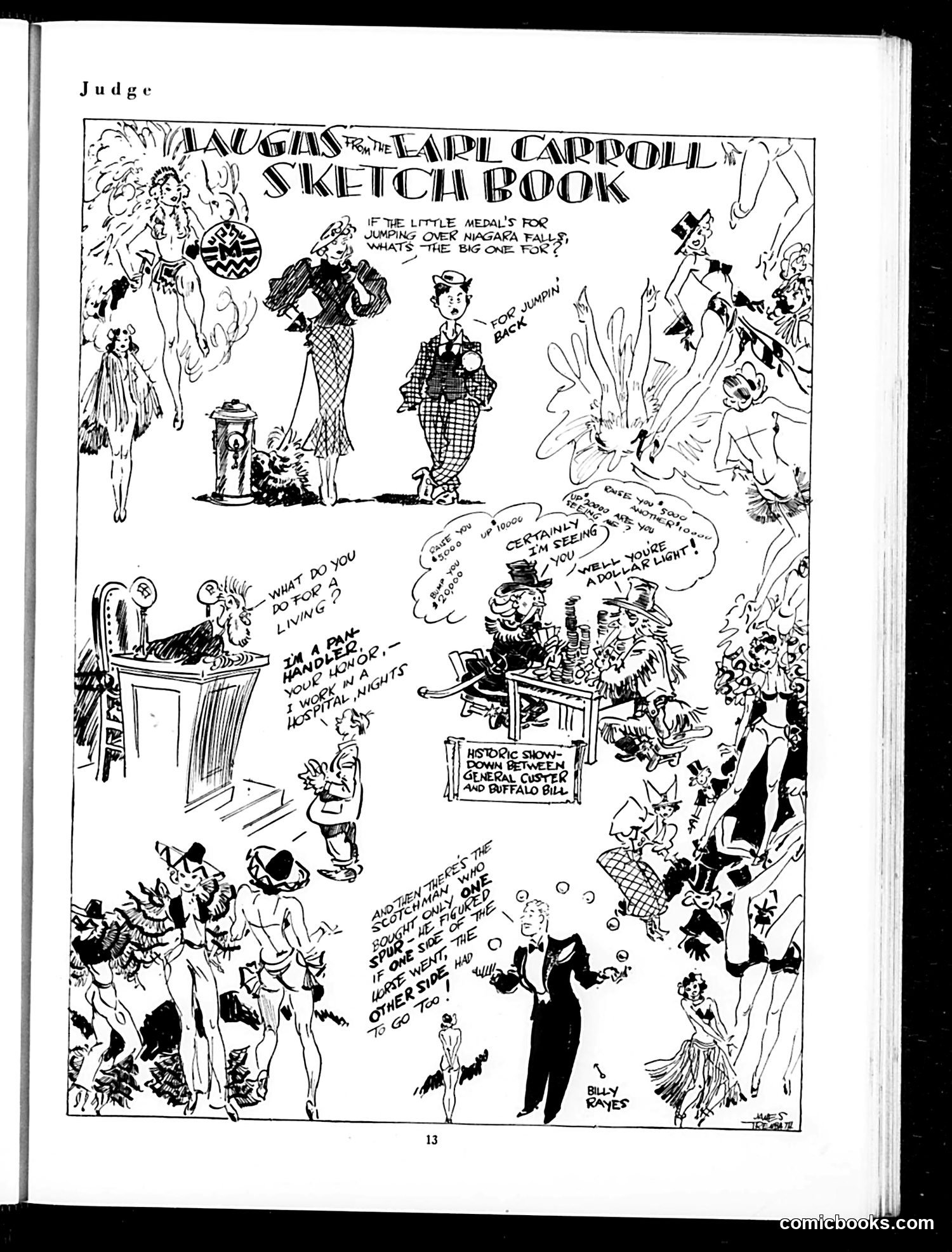
"Judge" Sketch Book: Political Satire Analysis This page from Judge's sketch book by Earl Carroll presents various vignettes satirizing American life and politics. The cartoons appear to reference: Visible elements: - A figure asking "What do you do for a living?" answered by "I'm a real honest-to-goodness hospital nights" — likely mocking someone's dubious profession - References to "General Custer and Buffalo Bill" — appearing to satirize Wild West mythology or frontier figures - Multiple scenes of social activity with women in fashionable dress, suggesting commentary on 1920s social life - One caption mentions competing "between General Custer and Buffalo Bill," unclear without fuller context The sketches use exaggerated character types typical of Judge magazine's satirical approach to social pretension, career ambition, and American popular culture. The exact political references are difficult to verify from the fragmented OCR text and without publication date confirmation.
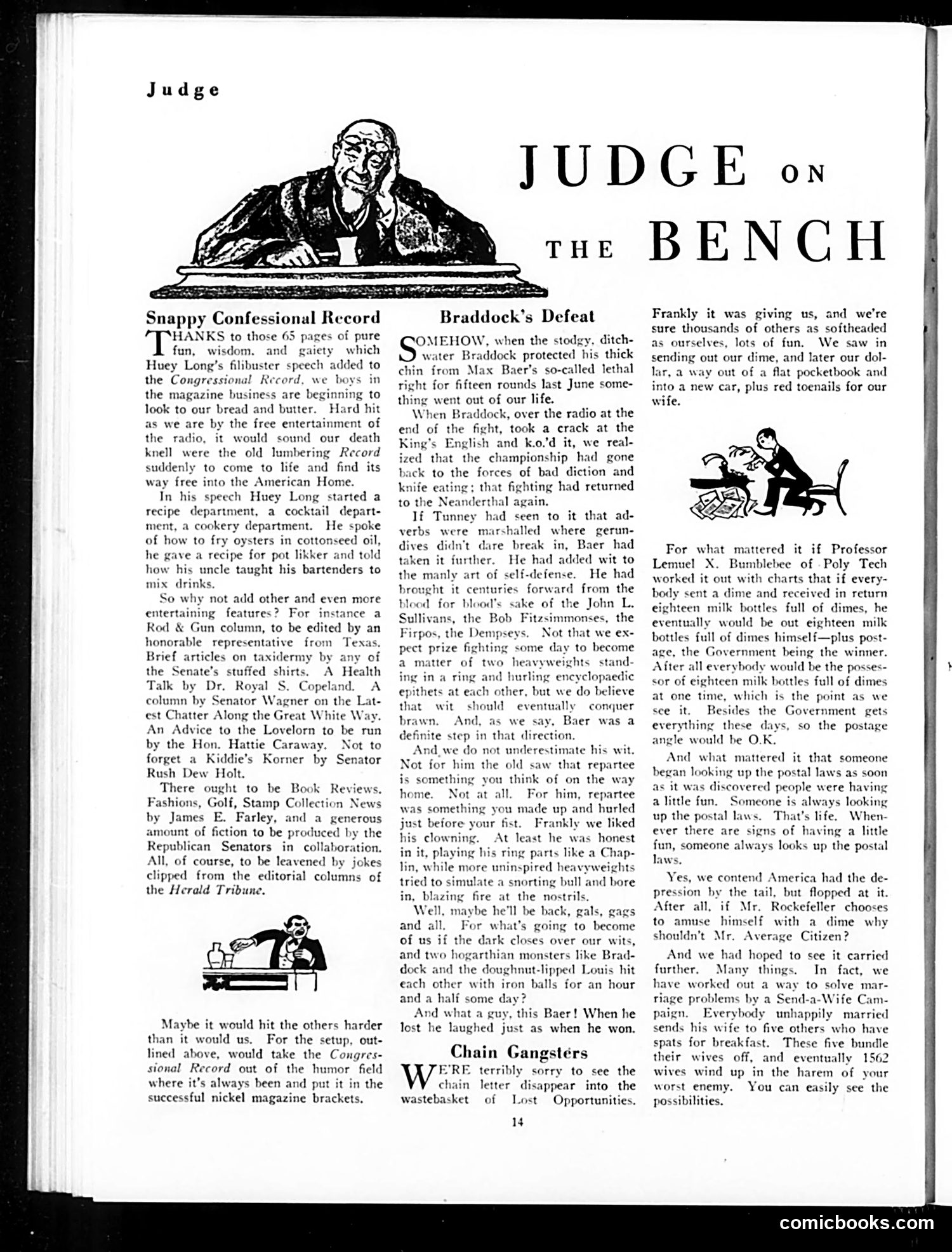
"Judge on the Bench" - Analysis This page satirizes 1930s American politics and celebrity culture through two main pieces: "Snappy Confessional Record" mocks Senator Huey Long's famous 1935 filibuster—a 65-page Congressional Record speech where Long digressed into recipes and domestic advice. The satire suggests the Congressional Record has become entertainment, proposing absurdly that other senators (Senator Wagner, Hattie Caraway, James Farley) should contribute columns. It's a joke about Congress's declining dignity and the public's appetite for trivial entertainment. "Braddock's Defeat" mourns boxer Max Baer's loss of the heavyweight title to James Braddock in June 1935. The piece praises Baer's wit and showmanship—he clowned and made jokes while fighting—contrasting him with the plodding, inarticulate Braddock. The satire laments that entertainment and cleverness have left boxing, replaced by brutish thuggishness. Both pieces reflect Judge's conservative, elite perspective: nostalgia for sophistication and dismay at mass culture's coarsening effect.
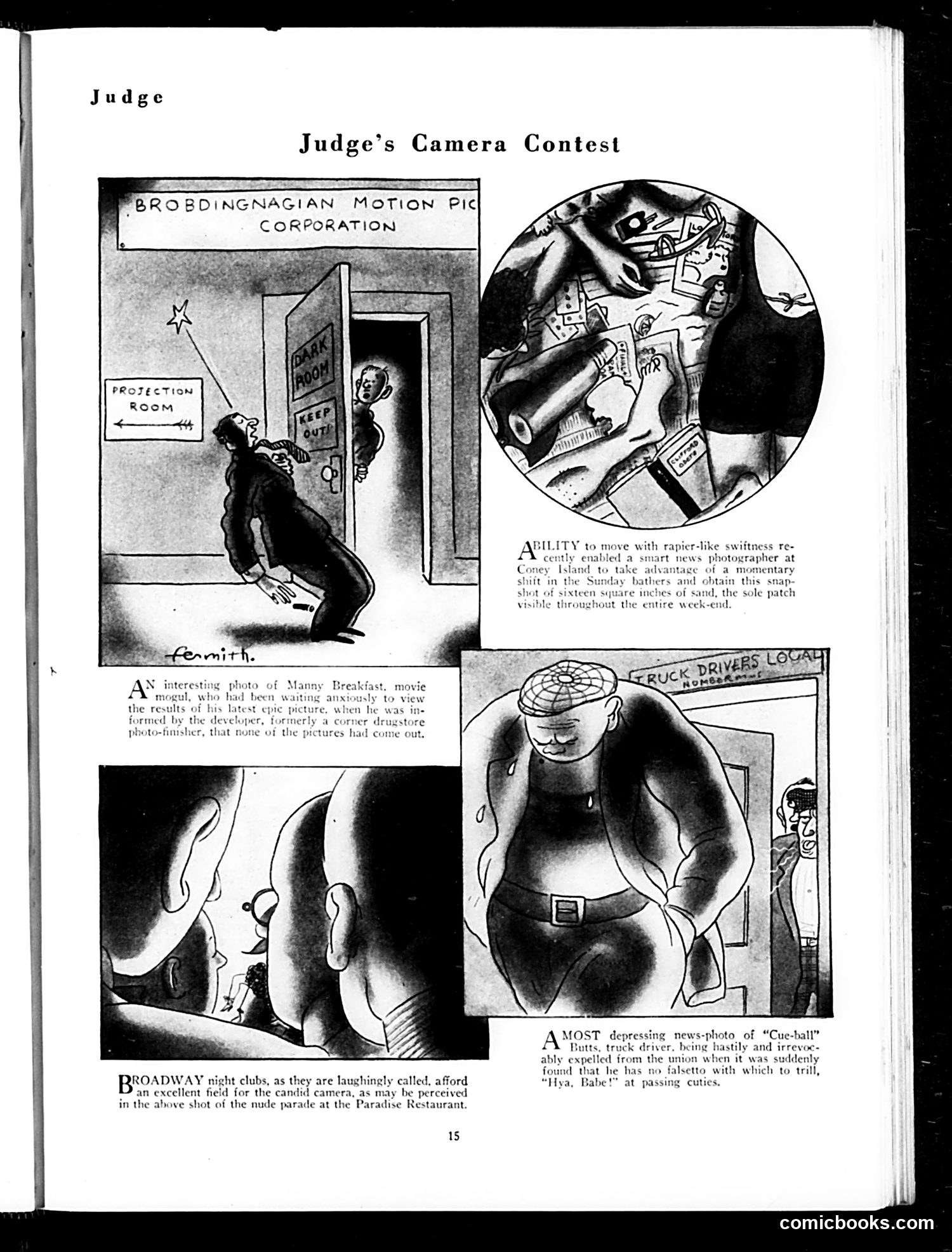
Judge's Camera Contest This page showcases humorous photographs submitted to Judge magazine's camera contest, framed as satirical movie scenes. The top left shows a man reacting in exaggerated shock at a projection room door—satirizing dramatic movie reactions. The circular image depicts hands examining a map, mocking the "ability to move with rapier-like swiftness" supposedly demonstrated at Coney Island. The bottom section features photographs of Broadway nightlife and truck drivers, presented as comedy subject matter. The captions mock the mundane reality: a truck driver's lack of "falsetto" charm makes him unsuitable for Hollywood's standards. The satire targets both cinema's melodramatic pretensions and everyday people's absurd aspirations to stardom—typical Judge magazine fare mocking both entertainment industry excess and ordinary Americans' dreams.
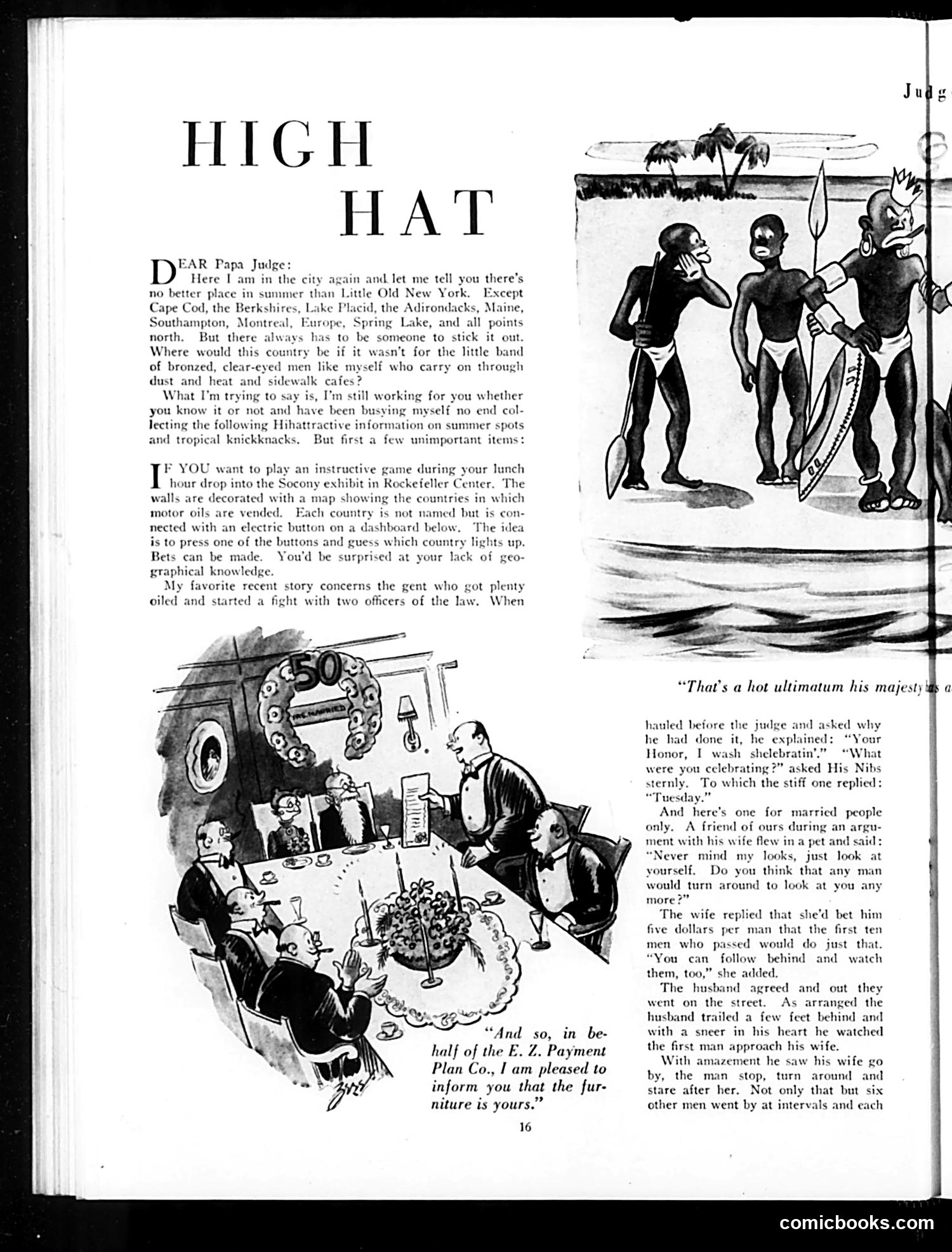
HIGH HAT - Page Analysis This page from *Judge* magazine contains two cartoons satirizing American social pretension and behavior. The main cartoon (lower left) depicts a wealthy businessman at an elaborate dinner party, surrounded by servants and opulent furnishings. The caption mocks the nouveau riche's ostentatious display: "And so, in behalf of the E.Z. Payment Plan Co., I am pleased to inform you that the furniture is yours." The satire targets Americans buying luxury goods on credit while pretending to wealth they haven't yet earned—a critique of consumer culture and financial aspiration. The column "High Hat" contains humorous anecdotes, including one about a drunk man arrested for fighting police who, when asked what he was celebrating, replies "Tuesday"—mocking working-class drunkenness. Another story about a married couple's bet satirizes the husband's insecurity about his wife's attractiveness, with her confidently predicting men will stare at her. The top right illustration shows what appears to be a tropical beach scene with caricatured figures, likely referencing summer vacation destinations mentioned in the text (Cape Cod, the Adirondacks, etc.). The overall tone mocks American class anxiety, materialism, and domestic relations.
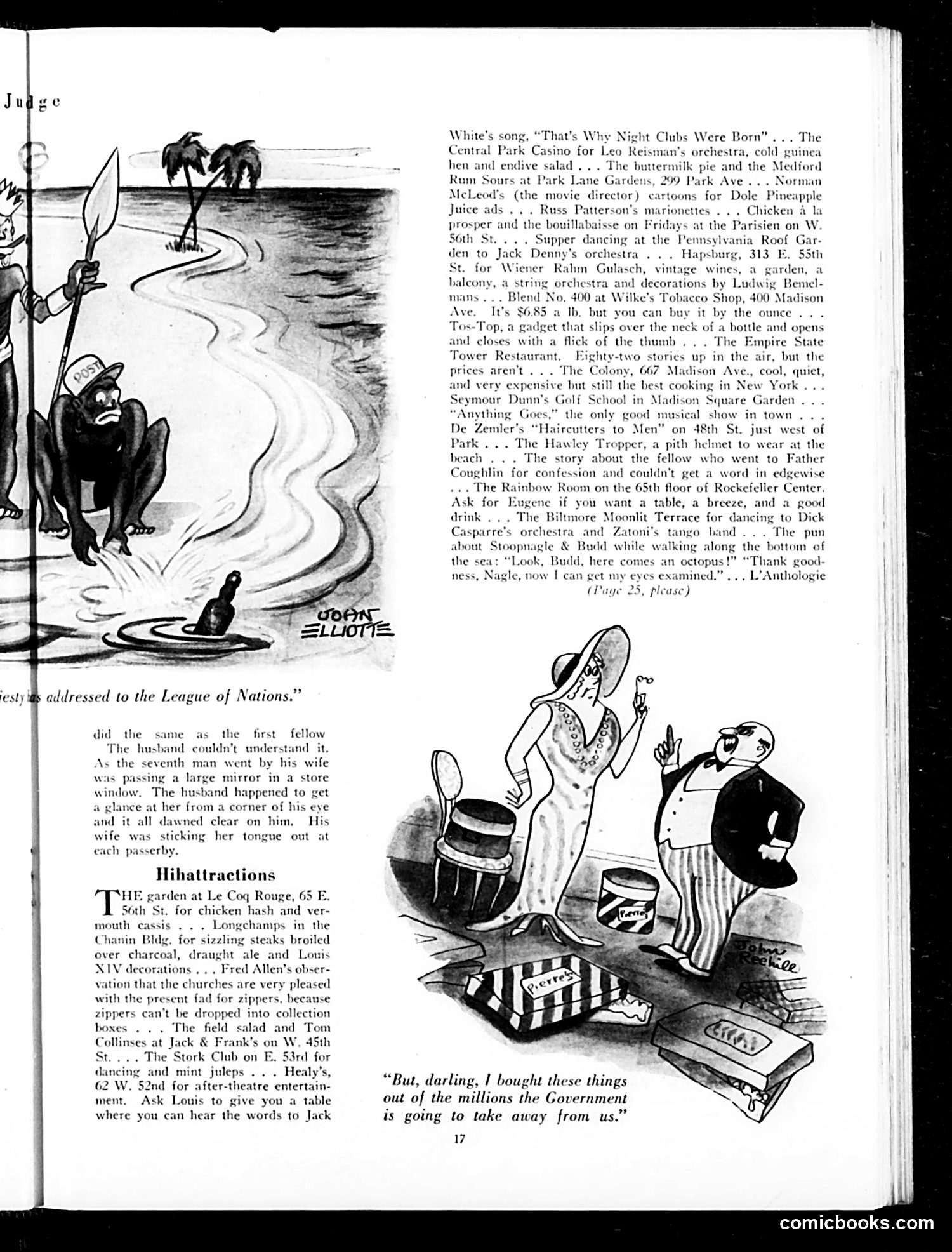
Judge Magazine Page Analysis This page mixes lighthearted social commentary with restaurant/nightlife recommendations typical of Judge's satirical coverage of 1930s New York society. The Main Cartoon (bottom right): depicts a wealthy woman showing off luxury purchases to her husband, who protests that she's spending "millions the Government is going to take away from us." This references Depression-era taxation and wealth redistribution concerns—likely alluding to Roosevelt's New Deal policies and increased taxes on the wealthy. The satire mocks wealthy Americans' anxiety about losing their fortunes to government programs. The Hihattractions Section: Lists upscale Manhattan venues (nightclubs, restaurants, theaters) with prices and entertainment—a running feature mocking the excess of the wealthy during economic hardship. References include the Central Park Casino, the Colony, and the Rainbow Room at Rockefeller Center. The Opening Anecdote: A husband discovers his wife making faces at passersby in a mirror—simple slapstick humor about vanity and marital discord, unrelated to the political content. The page's overall tone: satirizing Depression-era wealthy New Yorkers' frivolous spending and political anxieties.
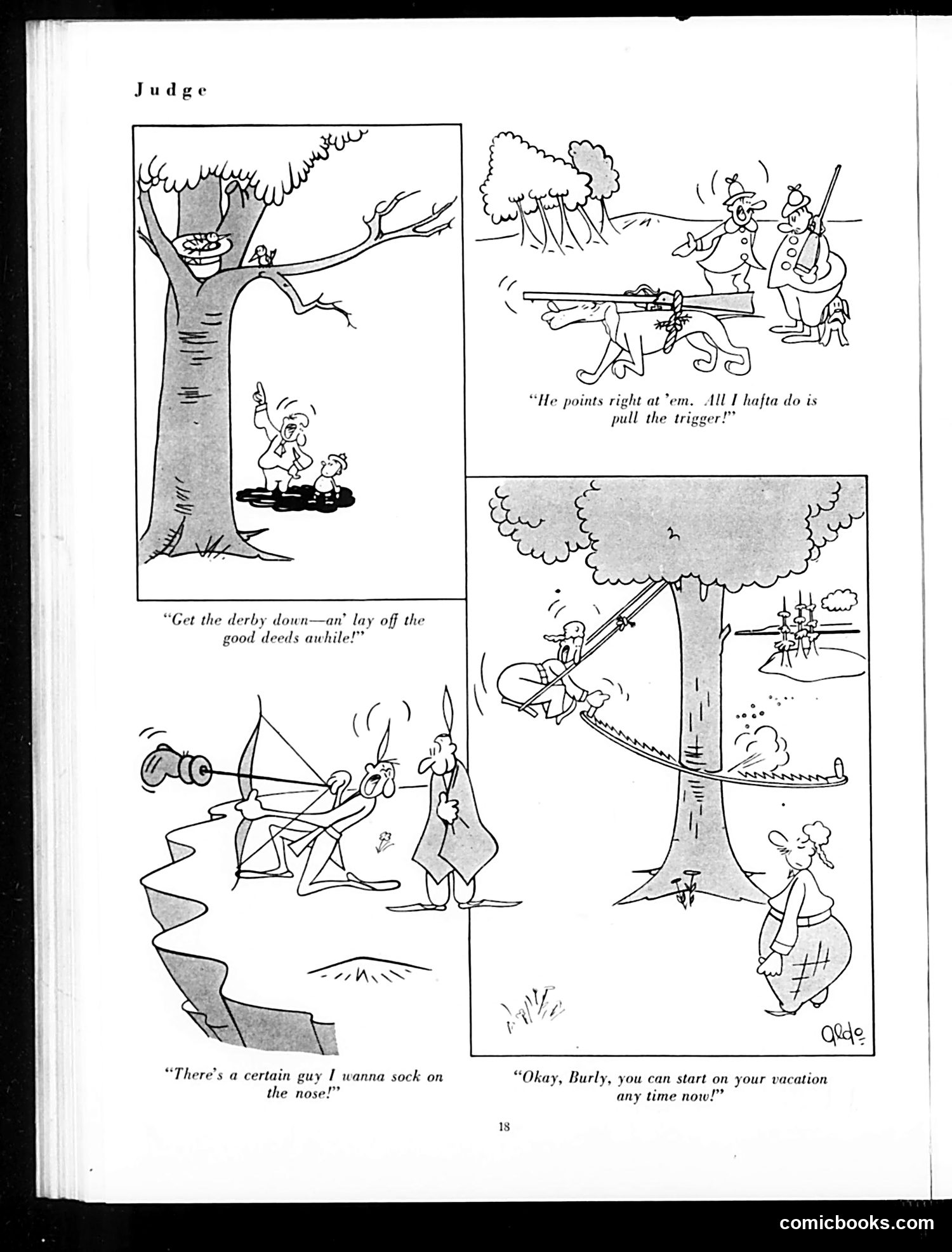
Judge Page Analysis This page contains four separate cartoon vignettes titled "Judge," each depicting humorous scenarios involving conflict or aggression: 1. Top left: A figure in a tree instructs someone below to "get the derby down" while avoiding "good deeds"—suggesting a comedic take on moral compromise. 2. Top right: Hunters with a cannon aim at a target, with one saying the other just needs to "pull the trigger"—physical comedy through exaggeration. 3. Bottom left: Insects in a trench with a cannon, one saying he wants to "sock" someone on the nose—anthropomorphic animal humor mocking human conflict. 4. Bottom right: A tree-based scene where "Burly" is told he can "start your vacation any time now"—implying removal or dismissal through comedic circumstances. The cartoons employ slapstick humor and visual gags typical of early 20th-century Judge magazine satire, with no apparent specific political reference visible.
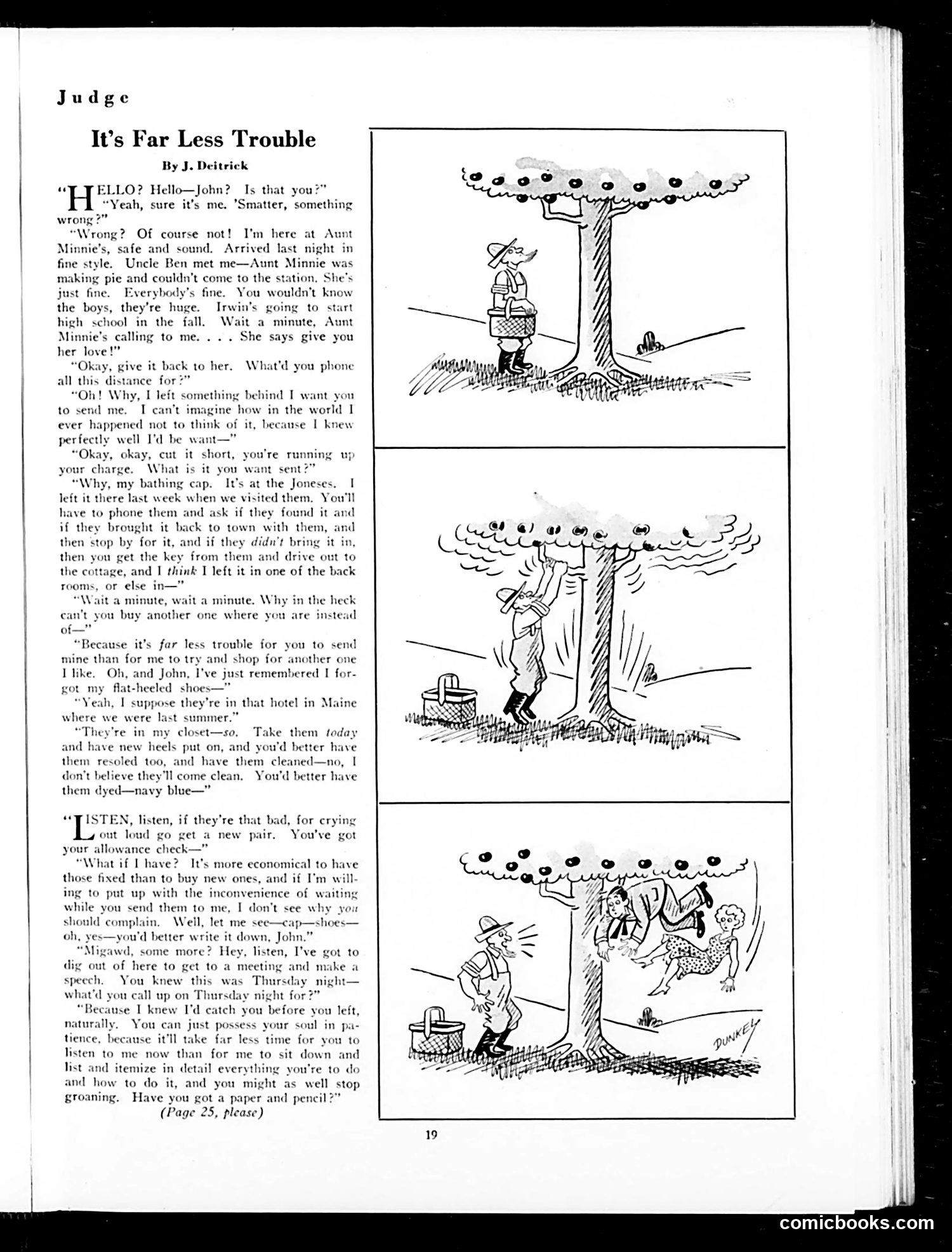
Analysis of "It's Far Less Trouble" This humorous domestic sketch satirizes the self-centered expectations of wives toward their husbands. A woman calls her husband John while he's at work to request he retrieve her forgotten bathing cap from the Joneses' house, then adds demands for shoe repairs and other errands—all while he's late for an important Thursday night meeting. The joke centers on her justification: it's "far less trouble" for *him* to handle everything than for *her* to shop or manage tasks herself. She dismisses his practical objections (buying a new cap) and his time constraints with circular logic about inconvenience and economy, ultimately insisting he write down her growing list while she keeps him on the phone. The cartoon illustrates a familiar early-20th-century marital dynamic: wives exploiting husbands' compliance by reframing male labor as female convenience. The satire targets both her unreasonable demands and his apparent helplessness to refuse.
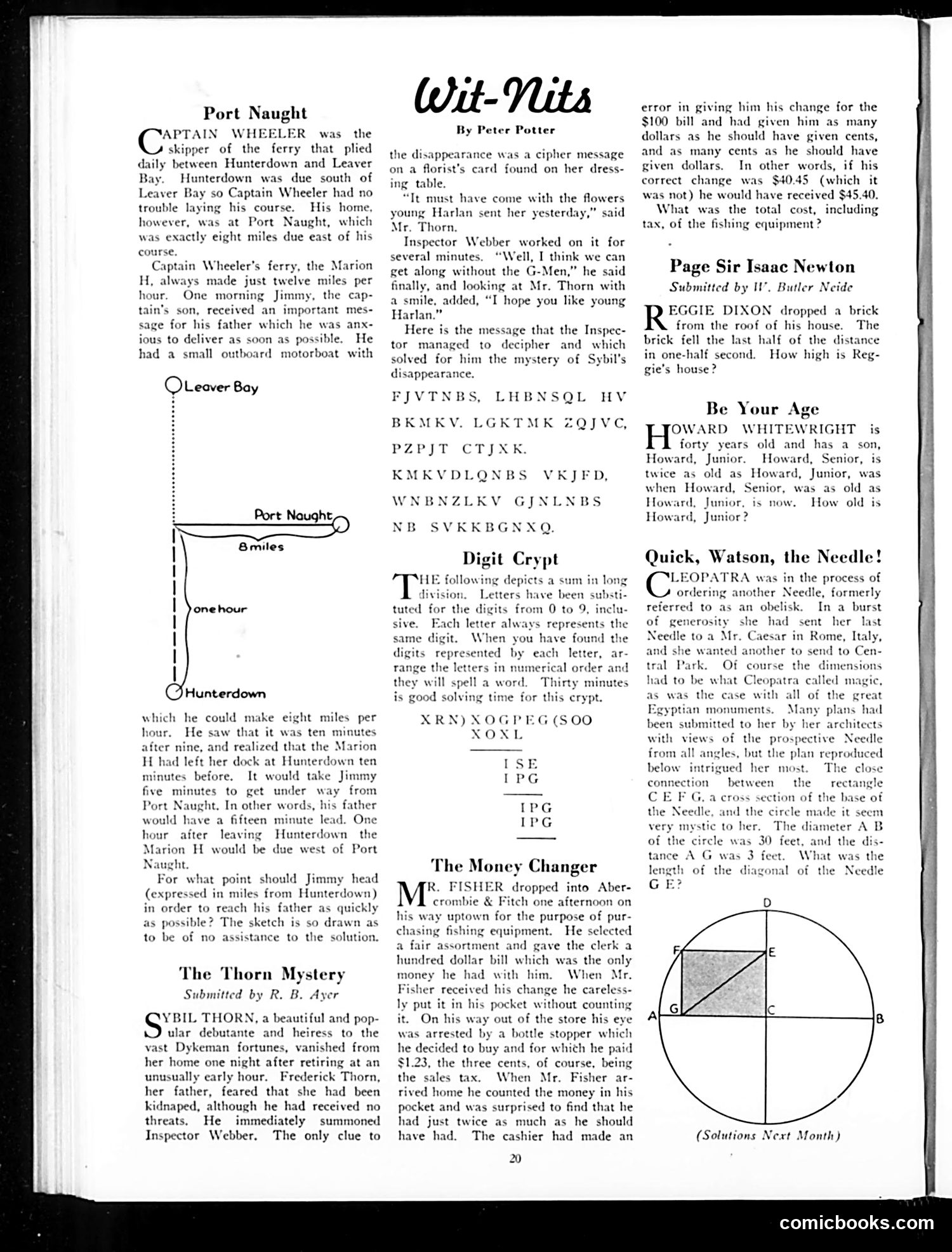
Analysis of Judge Magazine Page Content This page from *Judge* contains puzzle and mystery content rather than political satire—typical of the magazine's entertainment sections. "Port Naught" is a mathematical puzzle about navigation: a ferry captain's son must intercept his father's boat using geometry and speed calculations. Readers solve where to aim given specific speeds and timing constraints. "The Thorn Mystery" is a cipher puzzle: a debutante vanishes, leaving an encoded message on a florist's card. Inspector Webber decodes it to reveal she eloped with "young Harlan"—the joke being the "G-Men" (FBI) aren't needed when simple codebreaking solves the case. "Digit Crypt" and "The Money Changer" are additional mathematical/logic puzzles for reader engagement. These puzzles were standard *Judge* content—the magazine mixed satire with brain-teasers to entertain educated readers. There are no political figures or social commentary visible here; this is purely recreational problem-solving for early 20th-century magazine audiences.
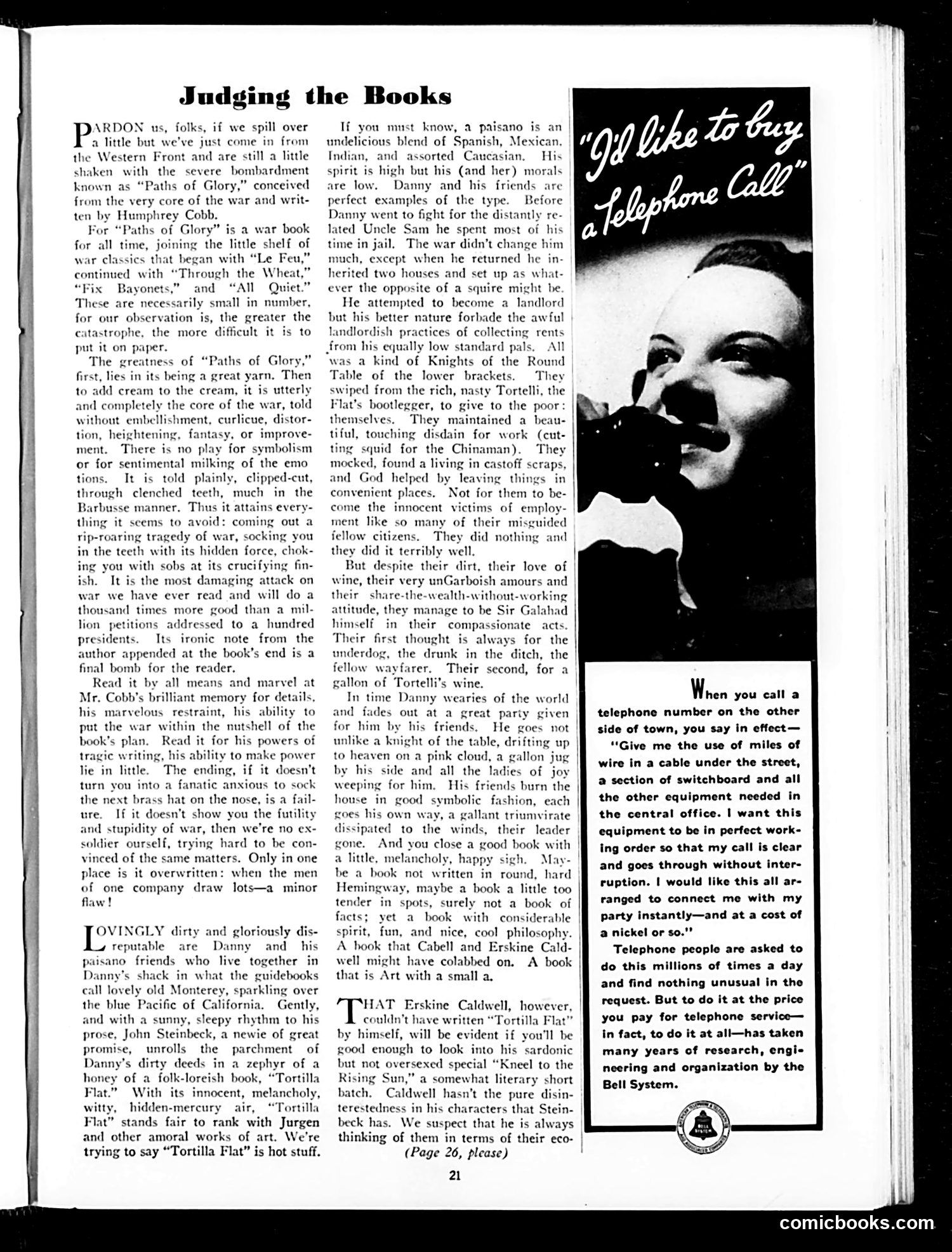
Explaining This Judge Magazine Page to Modern Readers This page reviews two literary works: Humphrey Cobb's "Paths of Glory" and John Steinbeck's "Tortilla Flat." "Paths of Glory" is praised as a groundbreaking anti-war novel—ranked alongside other WWI classics like "All Quiet on the Western Front." The reviewer argues it's the most devastating critique of war's futility ever written, so powerful it would accomplish more than "a million petitions" to stop war. "Tortilla Flat" reviews Steinbeck's debut novel about poor Monterey residents (paisanos—a mix of Spanish, Mexican, and Indian heritage). The reviewer celebrates their amoral charm: they're lovable rogues who inherit property but lack landlord ruthlessness, steal from the wealthy to help themselves, and live by honor rather than conventional morality. The advertisement (right) explains long-distance telephone technology—wires under streets connecting calls without local operator involvement—promoting the Bell System's infrastructure. Both book reviews typify Judge's highbrow literary criticism, treating serious fiction as important social commentary.
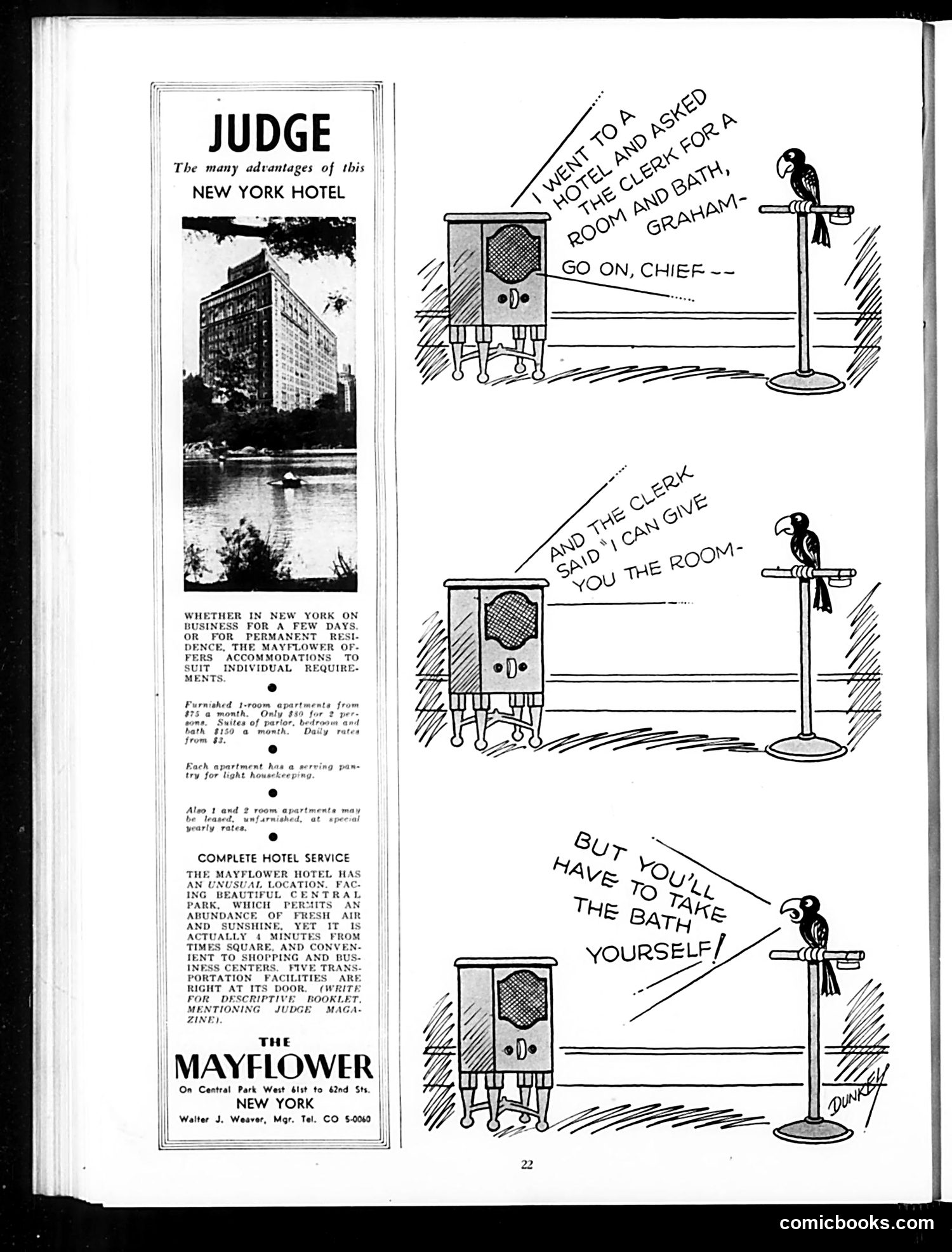
Judge Magazine Page Analysis This page is primarily hotel advertising for the Mayflower Hotel in New York City, with a humorous cartoon strip on the right side. The comic strip depicts a guest arriving at the hotel clerk's desk, requesting "a room and a bath" for a guest named Graham. The clerk responds that while the room is available, the guest must take the bath themselves—a joke playing on the double meaning of "bath" (the bathroom fixture versus the act of bathing). The parrot perched on the pole comments on each exchange, delivering the punchline: "BUT YOU'LL HAVE TO TAKE THE BATH YOURSELF!" The satire: This mocks overly accommodating hotel service by suggesting the hotel will provide everything *except* performing personal hygiene for guests. It's gentle humor advertising the hotel's amenities while poking fun at the era's expectation of luxury service. The page appears undated but bears Judge magazine's characteristic early 20th-century style and satirical tone.
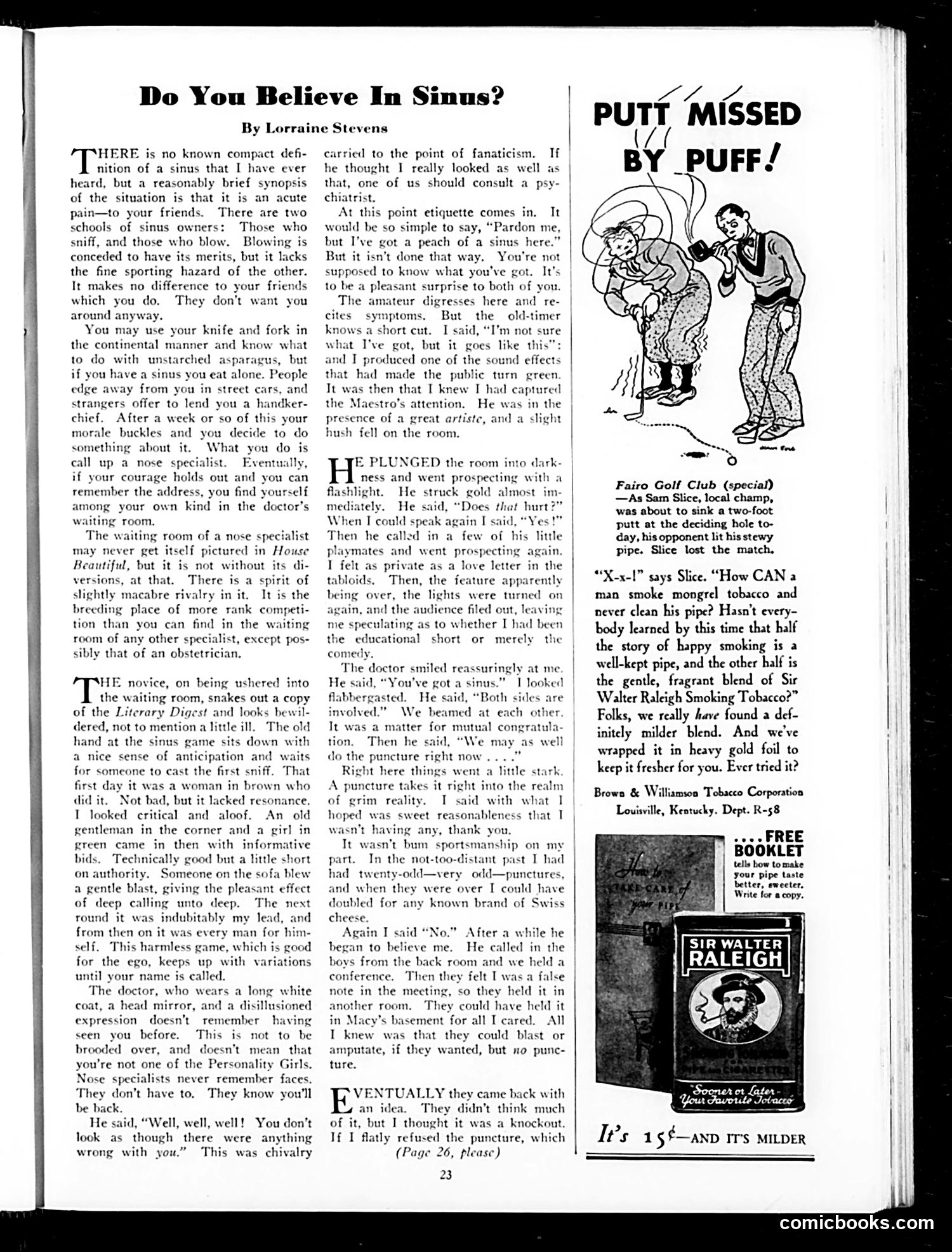
"Do You Believe In Sinus?" - Explanation for Modern Readers This is a humorous essay by Lorraine Stevens satirizing the social awkwardness and competitive absurdity surrounding sinus infections in the 1920s-30s era. The Satire: Stevens mocks how sinus sufferers become social pariahs—people avoid them on streetcars, strangers offer handkerchiefs. She ridicules the "waiting room culture" of nose specialists, where patients compete in an unspoken contest of who can produce the most impressive sniffles and snorts, treating their afflictions like performances. Key Joke: The doctor claims she "doesn't look as though there were anything wrong," yet she's supposed to politely hide her symptoms rather than simply stating she has a sinus problem. The doctor's "discovery" of the sinus via flashlight and calling in colleagues to witness it is treated as theatrical drama rather than actual medicine. The Point: This satirizes both the medical profession's pretensions and society's prudish embarrassment about bodily functions—treating a common ailment as something shameful that must be coyly concealed. The cartoon and advertisements on the page are separate content advertising tobacco and golf clubs.
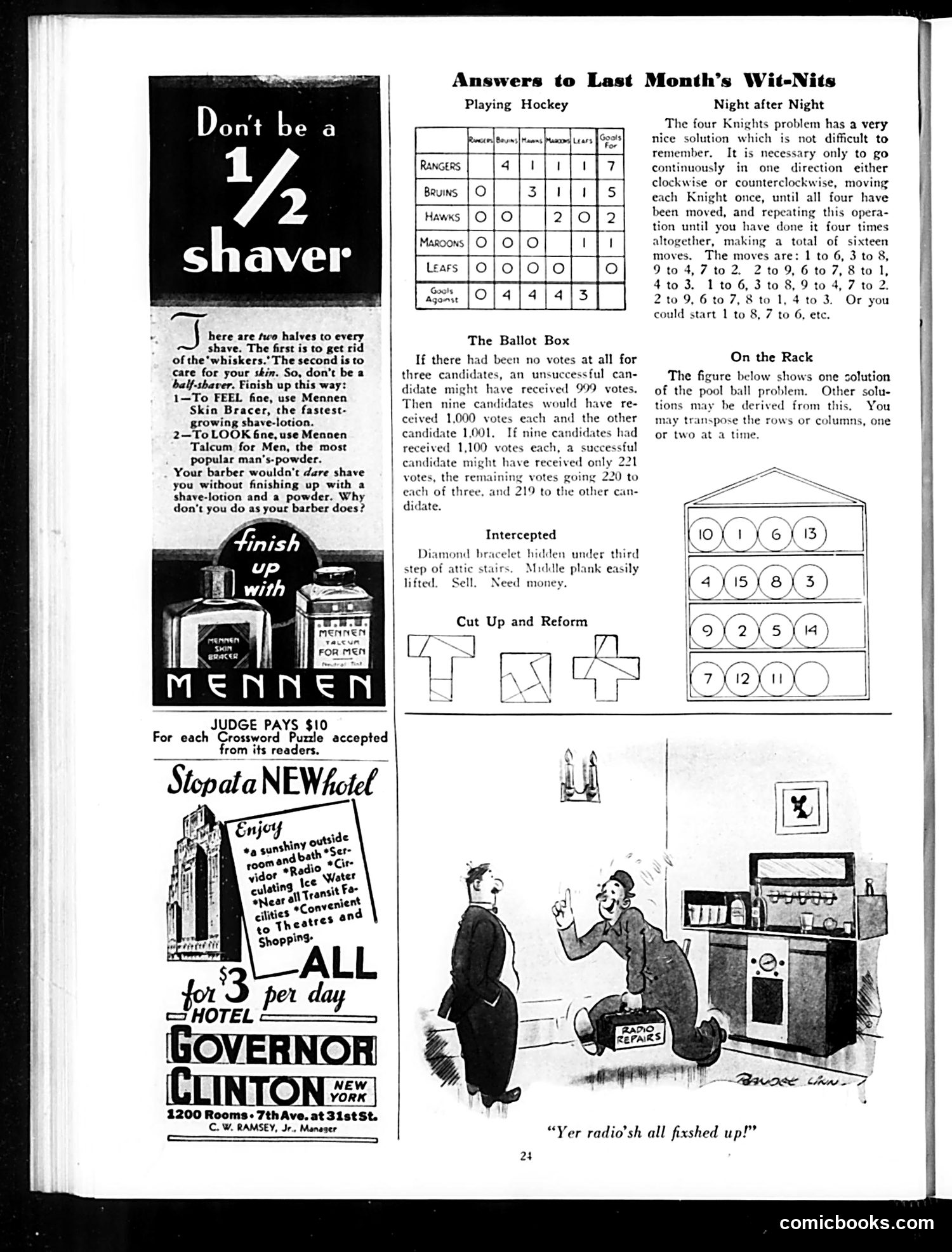
Judge Magazine Page Analysis This page is primarily advertising and puzzle solutions rather than political satire. The main content includes: 1. Mennen grooming product ads promoting aftershave and talcum powder for men—typical early-20th-century masculine marketing emphasizing proper grooming habits. 2. Hotel advertisement for the Governor Clinton in New York, offering budget accommodation ($3/day). 3. Puzzle solutions from the previous month's "Wit-Nits" section, including chess knight problems, ballot-box mathematics puzzles, and pool ball arrangements. 4. A cartoon showing a radio repairman telling a customer "Yer radio'sh all fixshed up!"—a simple domestic humor joke playing on the repairman's apparent drunkenness or slurred speech, commenting on the radio repair trade of that era. The page reflects *Judge*'s format as a humor and entertainment magazine blending jokes, puzzles, and advertisements aimed at middle-class readers.
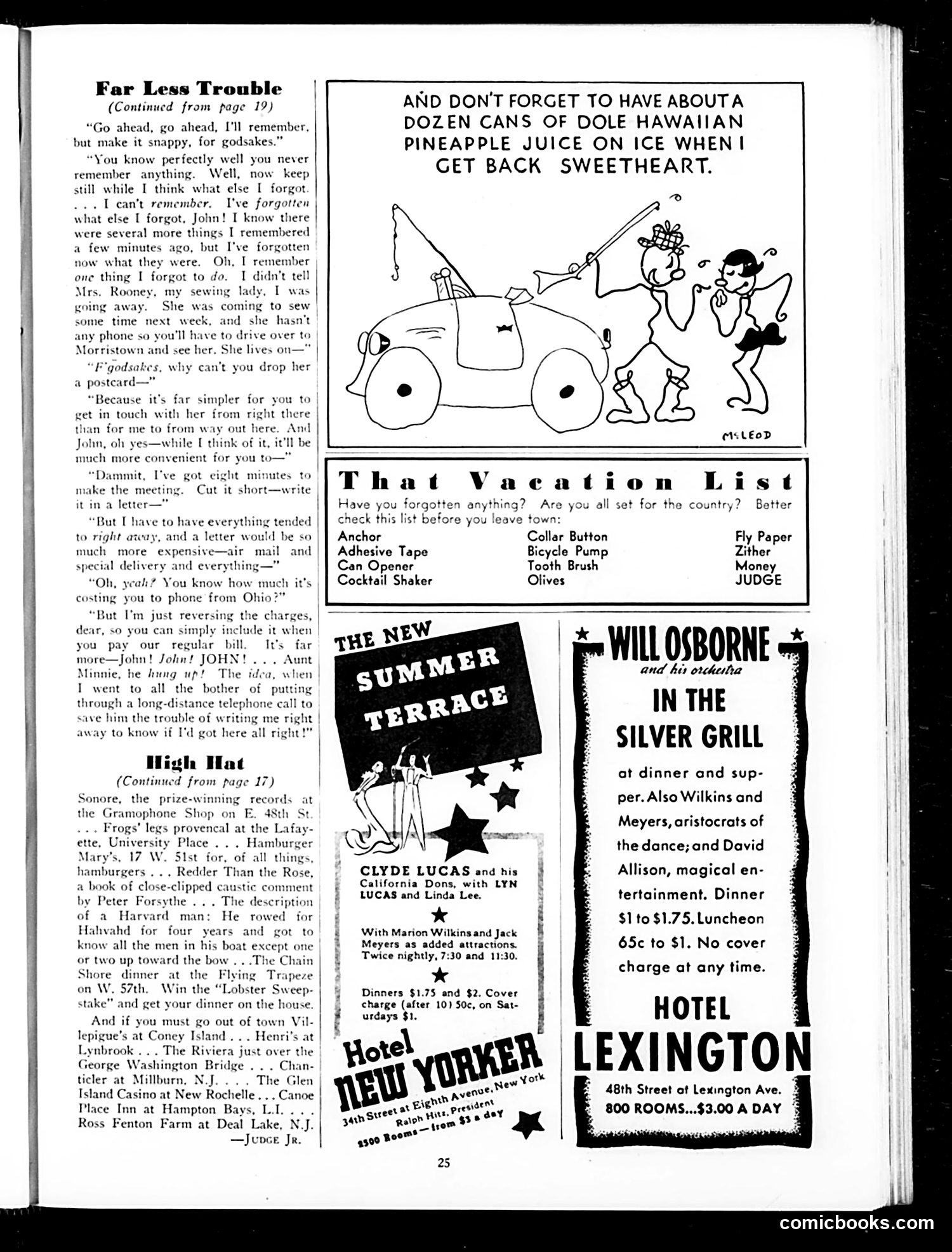
Analysis of Judge Magazine Page 25 This page contains satirical humor pieces alongside period advertisements. The main cartoon shows a departing husband being reminded by his wife to stock pineapple juice while away—a visual gag about absent-minded travelers and domestic nagging. The text pieces mock marital dynamics and pretentious social climbing. "Far Less Trouble" satirizes wives' forgetfulness and their tendency to burden husbands with errands via long-distance phone calls—costly in this pre-digital era, making the wife's casual disregard for expense ridiculous. "High Hat" appears to mock New Yorkers' self-conscious name-dropping of expensive restaurants and leisure activities as status markers. "That Vacation List" humorously catalogs items travelers forget, including surprisingly mundane items like "Money" and "Judge" (the magazine itself—self-promotion). The advertisements promote 1920s-30s entertainment venues (hotels, orchestras, dinner clubs), reflecting the magazine's affluent urban readership. The humor assumes familiarity with middle-to-upper-class anxieties: marital friction, travel logistics, and social performance.
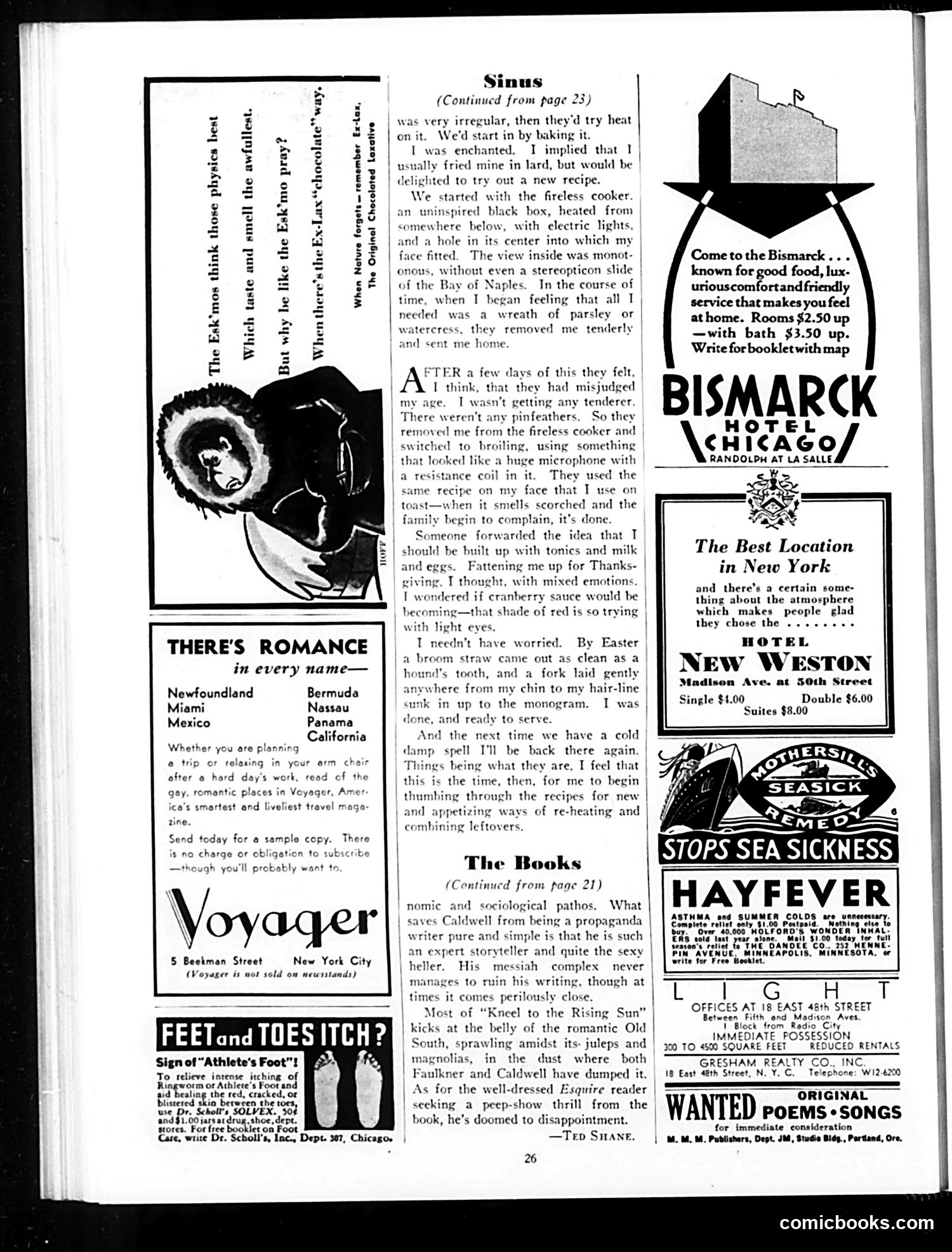
Understanding This Judge Magazine Page This page is primarily advertising and miscellaneous content rather than political satire. The visible cartoon—a man's face emerging from a box-like device—illustrates the accompanying humorous essay "Sinus" about unconventional medical treatments for sinus problems. The essay satirizes folk remedies and quack medical practices from this era. The narrator describes absurd treatments: a "fireless cooker" (essentially a heated box you put your face in) and a microphone-like broiling device, all administered by well-meaning but misguided practitioners who then try fattening him up with tonics and milk for Thanksgiving. The satire mocks both the bizarre remedies themselves and the medical establishment's casual, often ineffective approaches to treating chronic conditions like sinusitis—a relatable complaint for modern readers. The remainder of the page contains standard period advertising for hotels, travel magazines, and medicinal products (Ex-Lax, athlete's foot remedies), typical of Judge's revenue model.
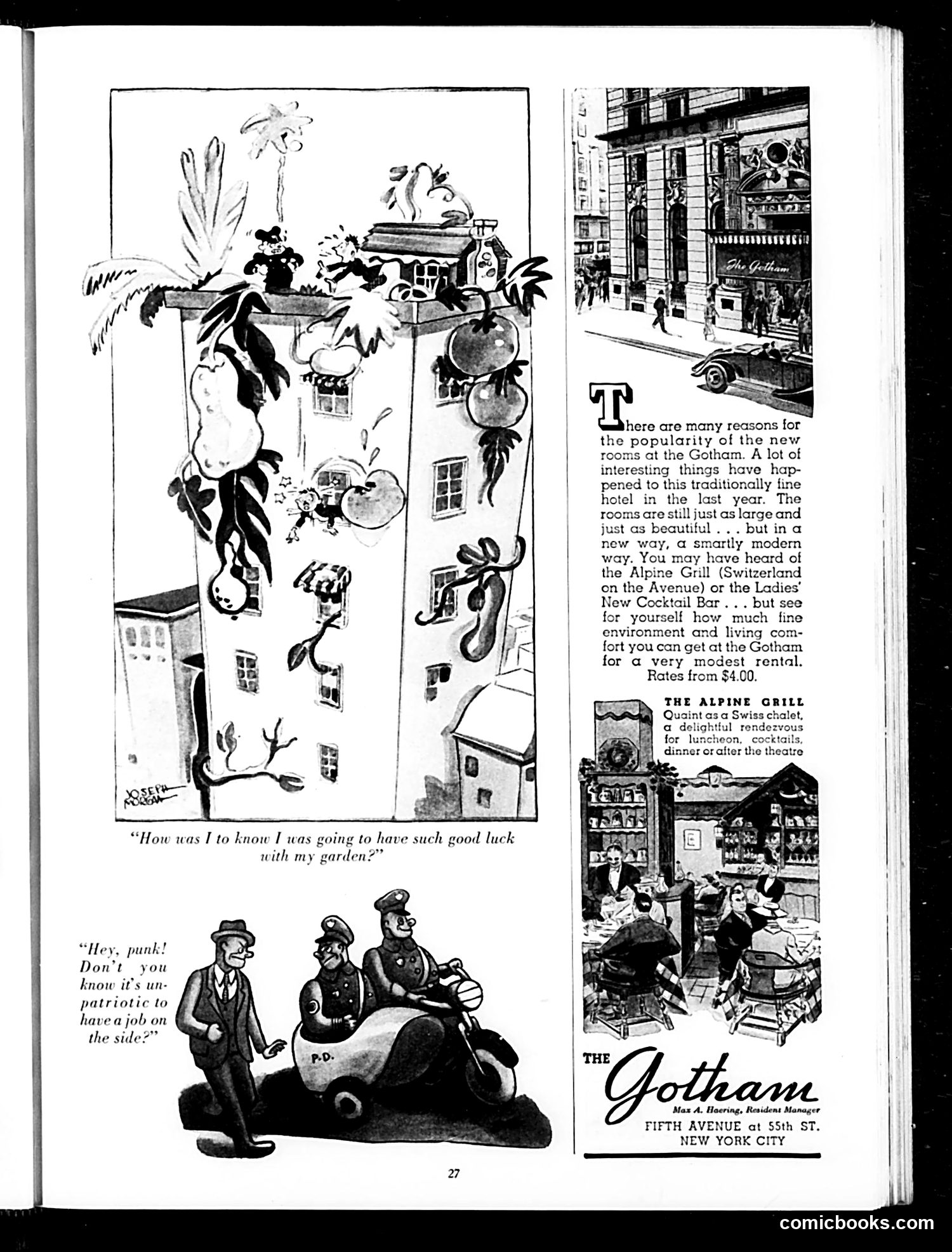
Analysis of Judge Magazine Page This page is primarily advertising for the Gotham Hotel (Fifth Avenue at 55th Street, NYC), featuring modernized rooms and dining venues like the Alpine Grill and Ladies' New Cocktail Bar, with rates starting at $4.00. The cartoons are secondary satirical content: 1. Top cartoon: A man's garden grows absurdly tall produce on a building facade—visual joke about unexpected good fortune. 2. Bottom cartoon: Appears to reference post-WWI economic anxiety. A man is confronted by police ("Hey, punk!") for having a side job, which they call "unpatriotic." This likely satirizes the economic squeeze on working men after World War I, when holding multiple jobs was necessary but socially stigmatized. The phrase "unpatriotic" suggests tension between economic survival and civic expectations—perhaps mocking the contradiction of calling survival jobs unpatriotic while workers struggled financially. The exact historical context remains unclear without the publication date.
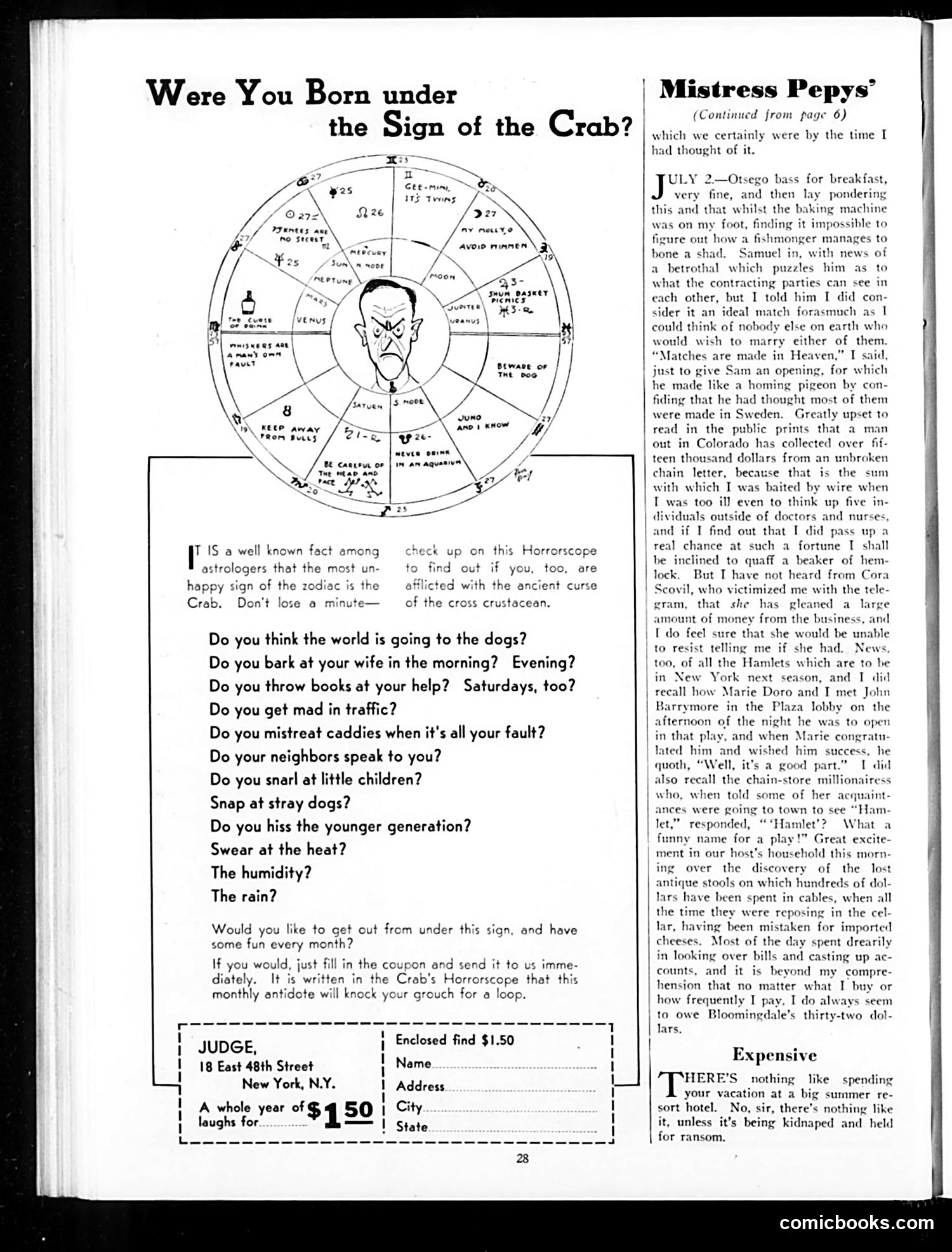
"Were You Born Under the Sign of the Crab?" This Judge magazine page contains a humorous astrology parody. The cartoon presents a zodiac wheel labeled "Horrorscope," centering on the Crab as the zodiac's most unfortunate sign. Below runs a satirical list of personality traits associated with being born under this sign—all negative behaviors: barking at your wife, throwing books at servants, getting mad in traffic, snarling at children, hissing at youth, swearing at weather. The joke lampoons both astrology's validity and the perpetually grumpy, irritable person. By claiming the Crab sign causes such unpleasant temperament, Judge offers readers a humorous "diagnosis" for their bad behavior while simultaneously mocking the notion that birth signs determine personality. The accompanying text is unrelated—a gossipy society column ("Mistress Pepys") and an advertisement for yearly subscriptions at $1.50.
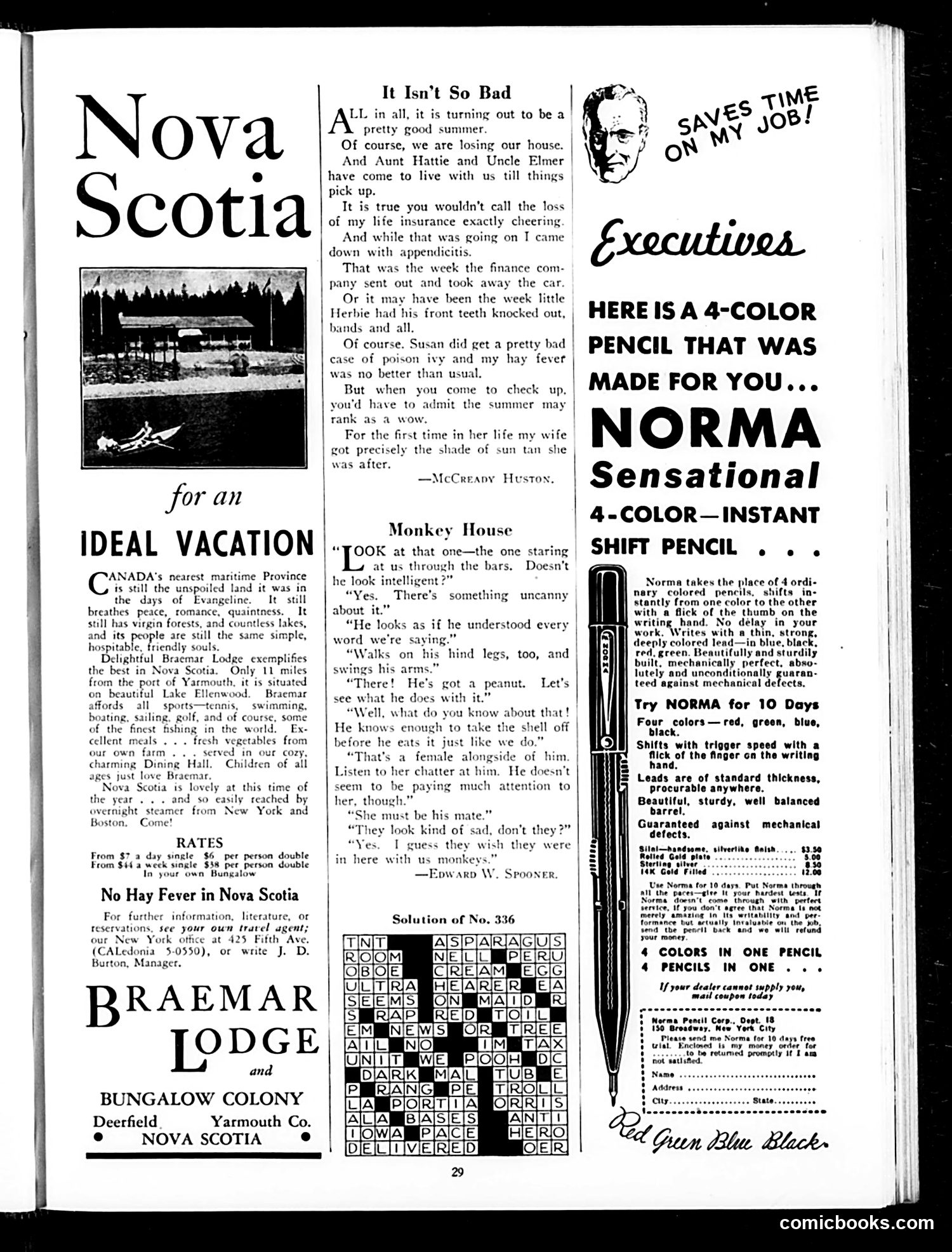
"It Isn't So Bad" - Depression-Era Humor This page contains two pieces of satirical humor from Judge magazine, likely from the 1930s (Depression era): "It Isn't So Bad" (attributed to McCready Huston): A husband catalogs accumulated disasters—losing his house, life insurance, appendicitis, repossessed car, his son's broken teeth, his daughter's poison ivy, his own hay fever—yet concludes the summer "may rank as a wow" because his wife finally achieved her desired suntan. The satire mocks Depression-era stoicism: how Americans minimized catastrophic financial and personal losses with dark humor and found meaning in trivial compensations. "Monkey House" (by Edward W. Spooner): Observers watch monkeys behind bars, noting their intelligence and human-like behaviors (opening peanut shells, maternal attention). The monkeys appear "sad" and wish they were together. The satire likely critiques anthropomorphic sentimentality—how people project human emotion onto animals while remaining indifferent to actual human suffering during hard times. Both pieces use humor to process widespread anxiety about loss, confinement, and displacement during economic crisis.
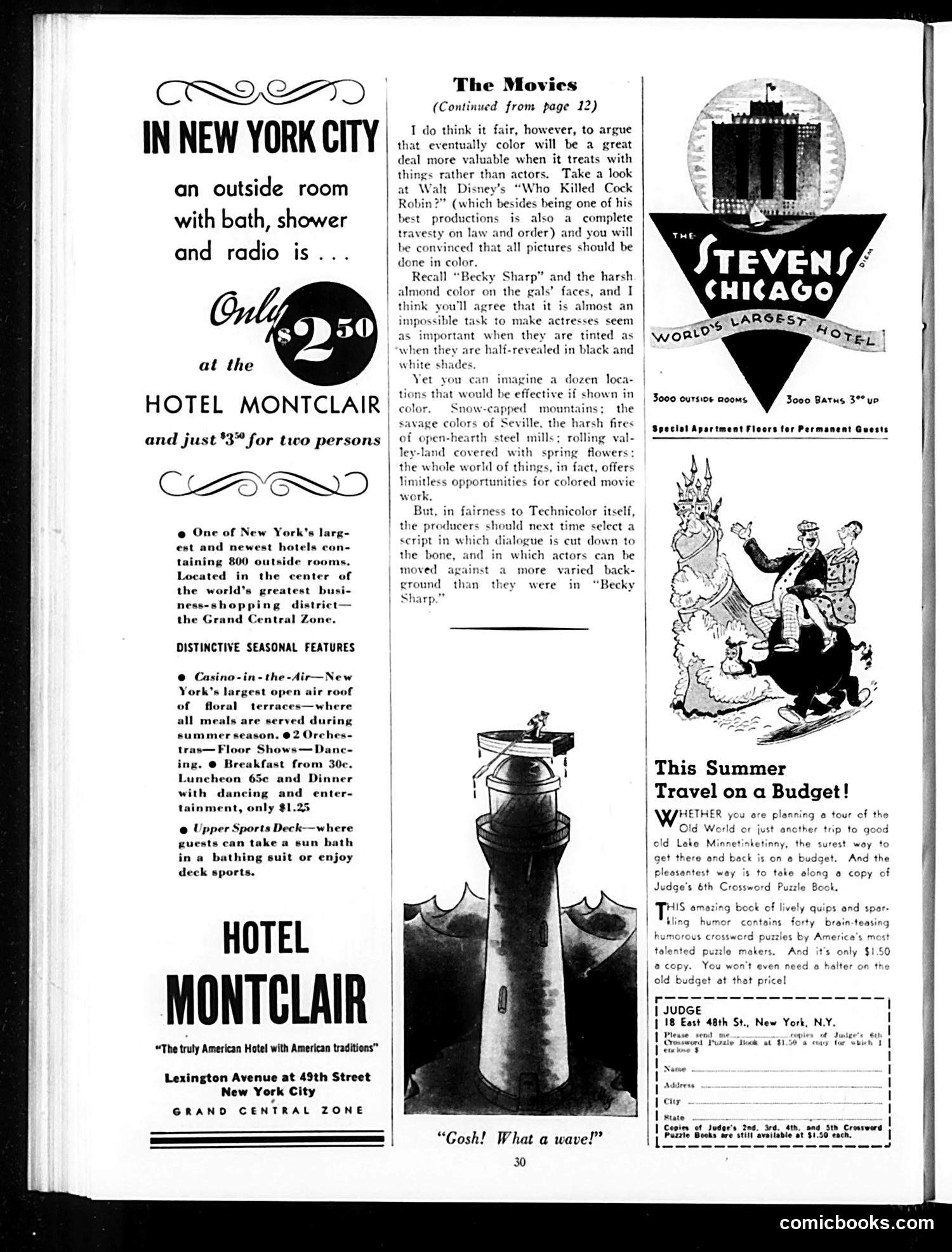
Page Analysis: Judge Magazine This page is primarily advertising and entertainment content rather than political satire. Left side: Hotel Montclair advertisement promoting budget accommodations ($2.50 for an outside room, $3 for two persons) in New York's Grand Central Zone, highlighting amenities like a rooftop "Casino-in-the-Air" and entertainment. Center: A film criticism column continuing from page 12, discussing Technicolor's potential. The critic argues color film works better for landscapes and objects than for actors' faces, citing "Becky Sharp" (1935) as having unflattering skin tones. He praises Walt Disney's "Who Killed Cock Robin?" while criticizing its dialogue-heavy script—a practical technical note rather than satire. Right side: Advertisement for Judge's 6th Crossword Puzzle Book ($1.50), marketed as entertainment for budget-conscious summer travelers. The lighthouse illustration ("Gosh! What a wave!") is decorative filler. Overall, this is a commercial magazine page blending hotel promotion, film industry discussion, and puzzle book marketing—typical Judge content from the mid-1930s.
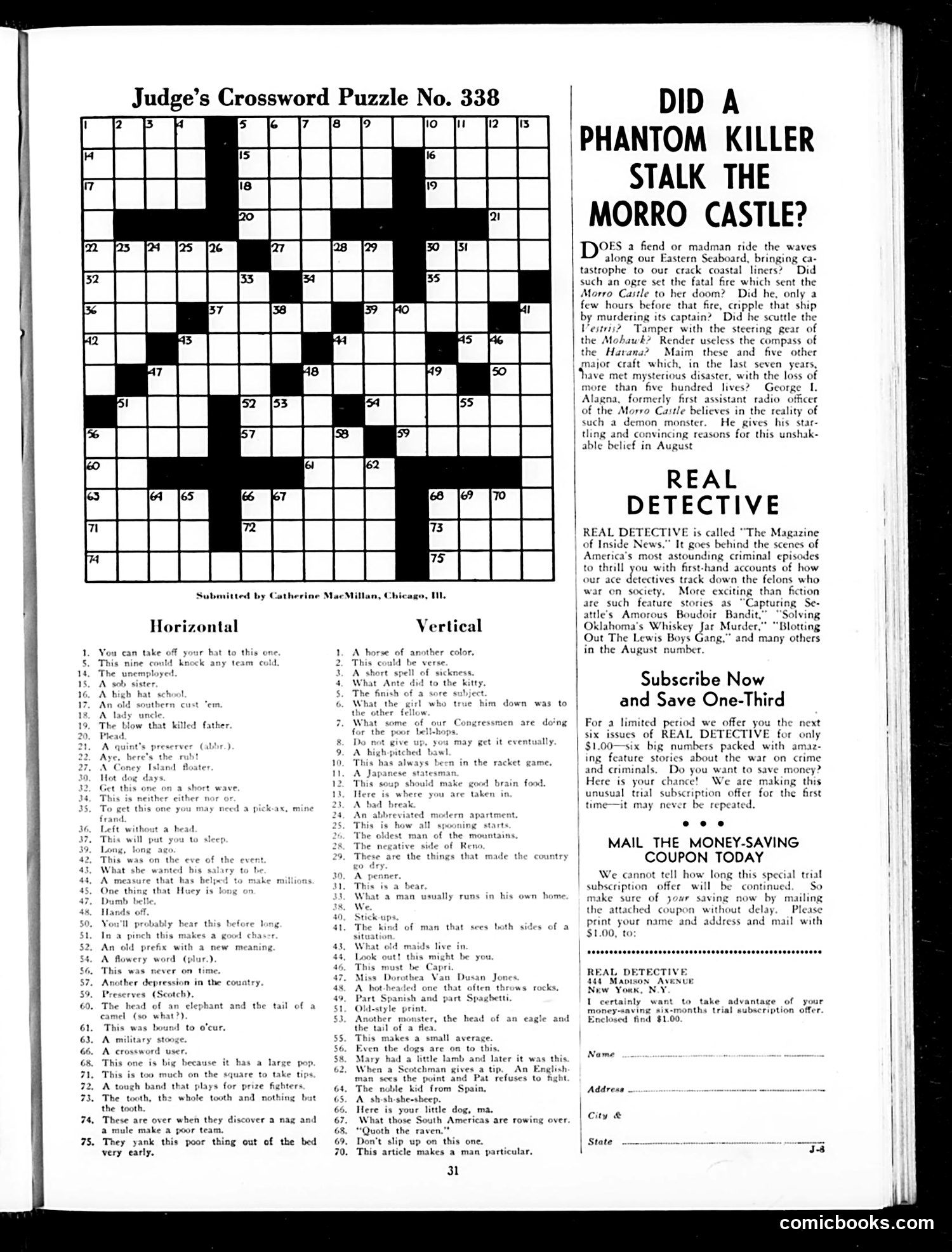
Judge Magazine Page Analysis This page is primarily a crossword puzzle (No. 338) with advertising content, not a political cartoon. The main article is a sensational true-crime preview for Real Detective magazine, promoting an August feature about the Morro Castle disaster—a 1934 ocean liner fire that killed over 130 people. The article speculates whether a "phantom killer" deliberately sabotaged this ship and others (Vestris, Mohawk, Havana), claiming a former radio officer believes a serial maritime saboteur exists. The accompanying advertisement encourages readers to subscribe to Real Detective magazine at a discount, promising thrilling detective stories about crime and criminals. The tone emphasizes sensationalism over accuracy—typical of 1930s true-crime magazines that blended fact with speculation. The crossword puzzle itself contains clues unrelated to the maritime mystery above it, serving as filler content. Context: This reflects Depression-era fascination with both real crimes and tabloid speculation, before modern media skepticism about conspiracy theories.
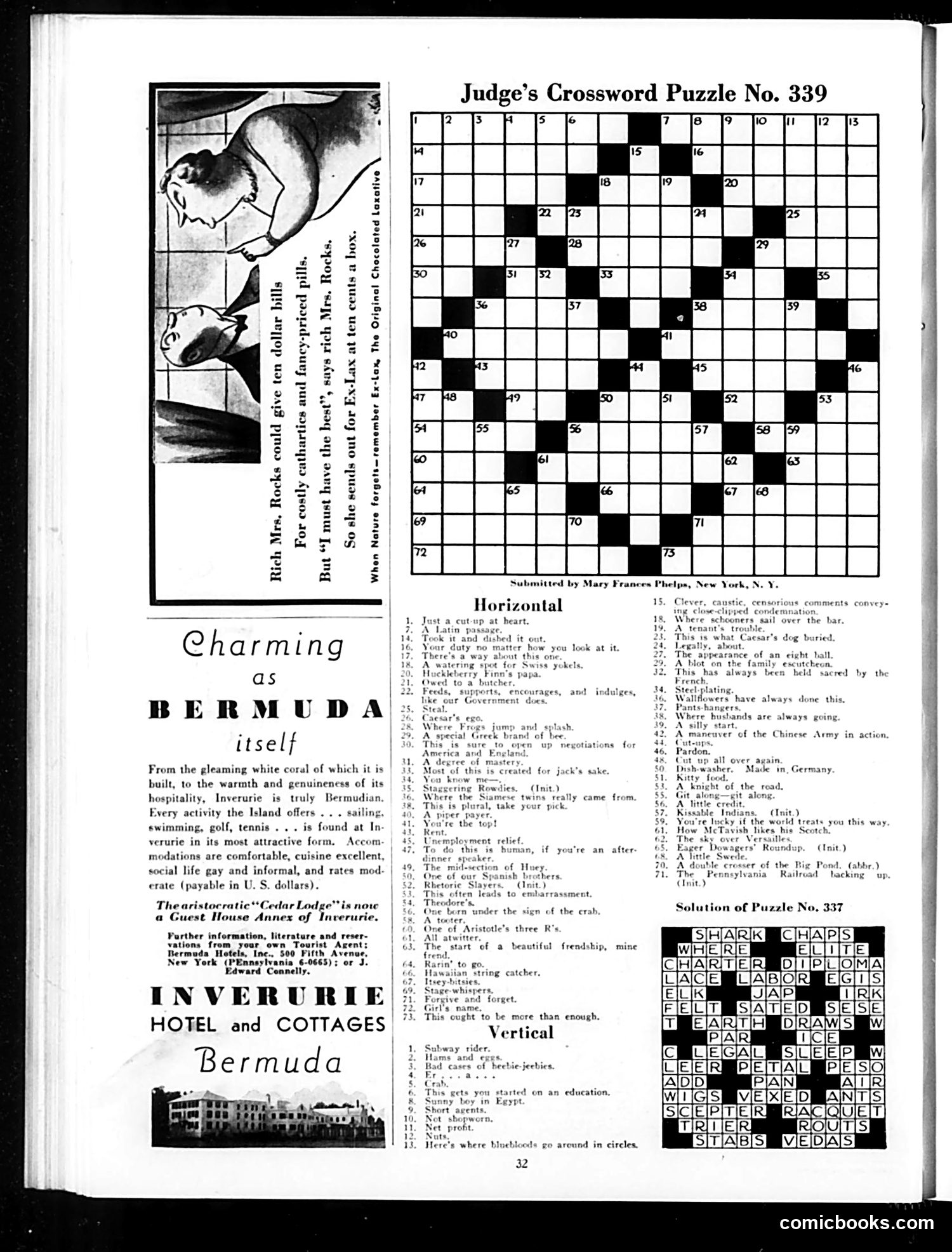
Judge Magazine Page Analysis This page is primarily advertising and puzzle content, not political satire. The dominant feature is Judge's Crossword Puzzle No. 339—a standard crossword with clues and grid. Below it appears the solution to Puzzle No. 337. The advertisements promote Bermuda tourism (Inverurie Hotel and Cottages, Cedar Lodge) and Ex-Lax laxative. The Ex-Lax ad includes a brief humorous scenario: "Rich Mrs. Rocks could give ten dollar pills / For costly cathartics and fancy-priced pills / But 'I must have the best'—so she sends out for Ex-Lax at ten cents a box." The joke mocks wealthy pretension—a rich woman chooses an inexpensive, reliable product over expensive alternatives, deflating class-based assumptions about quality. The cartoon accompanying the Ex-Lax ad (upper left) appears to show figures in a bathroom context, supporting the product pitch. This is primarily a games-and-leisure page rather than satirical content, typical of Judge's mid-century format mixing puzzles, travel ads, and light consumer humor.
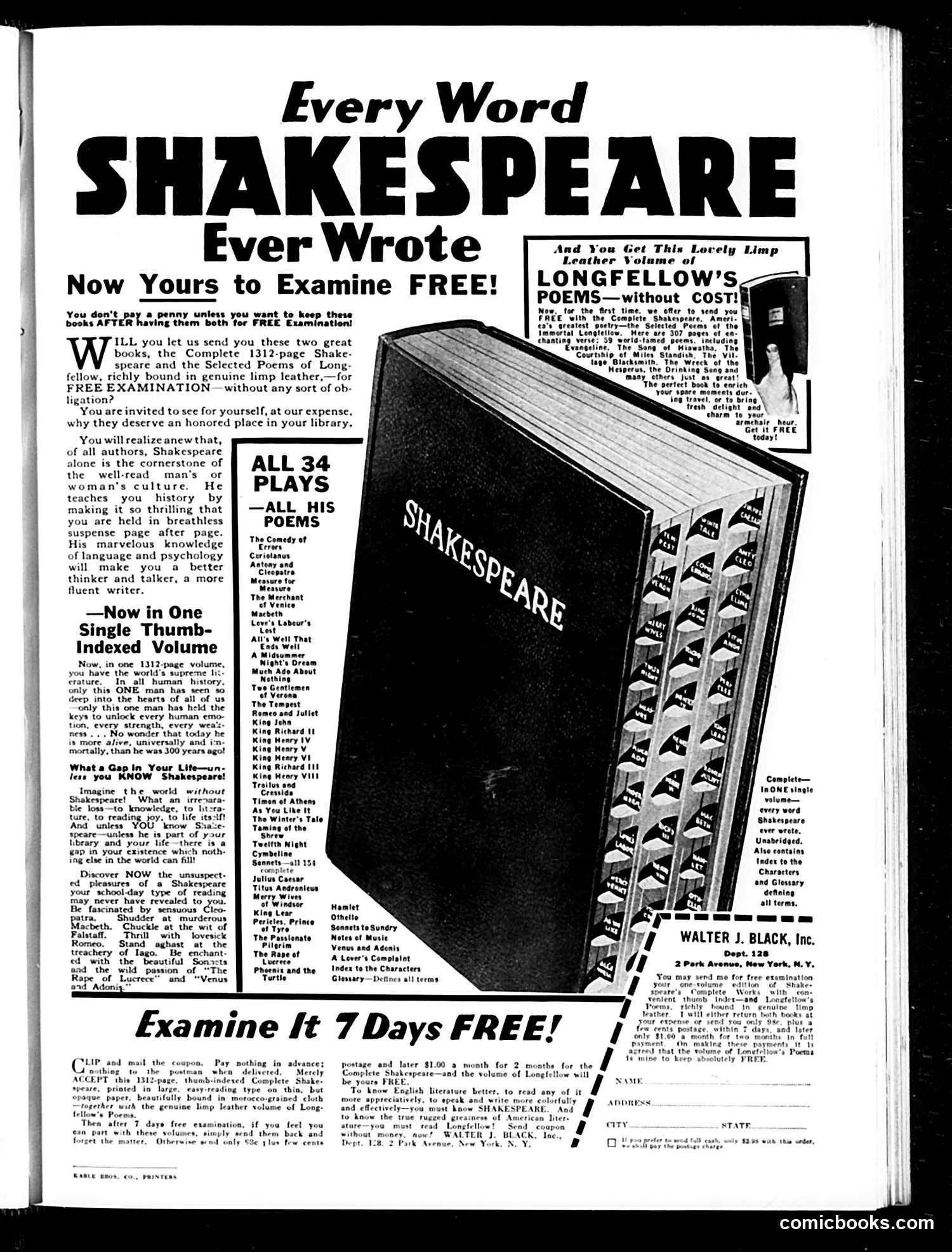
Advertisement, Not Cartoon This page is primarily a book advertisement, not political satire or editorial cartooning. It promotes a mail-order offer from Walter J. Black, Inc. for a complete Shakespeare collection (34 plays, all poems) and Longfellow's selected poems in leather-bound volumes. The appeal targets early-to-mid 20th century readers by positioning Shakespeare as essential to cultural literacy and self-improvement—a common marketing strategy of the era. The "7 Days FREE" examination and installment payment ($1.00 monthly) made classic literature accessible to middle-class consumers. The ad emphasizes that owning Shakespeare represents intellectual sophistication and reveals "every human emotion" and "every strength, every weakness." This reflects period attitudes equating literary possession with social status and personal development, rather than engaging in political critique or social satire typical of Judge magazine's editorial content.
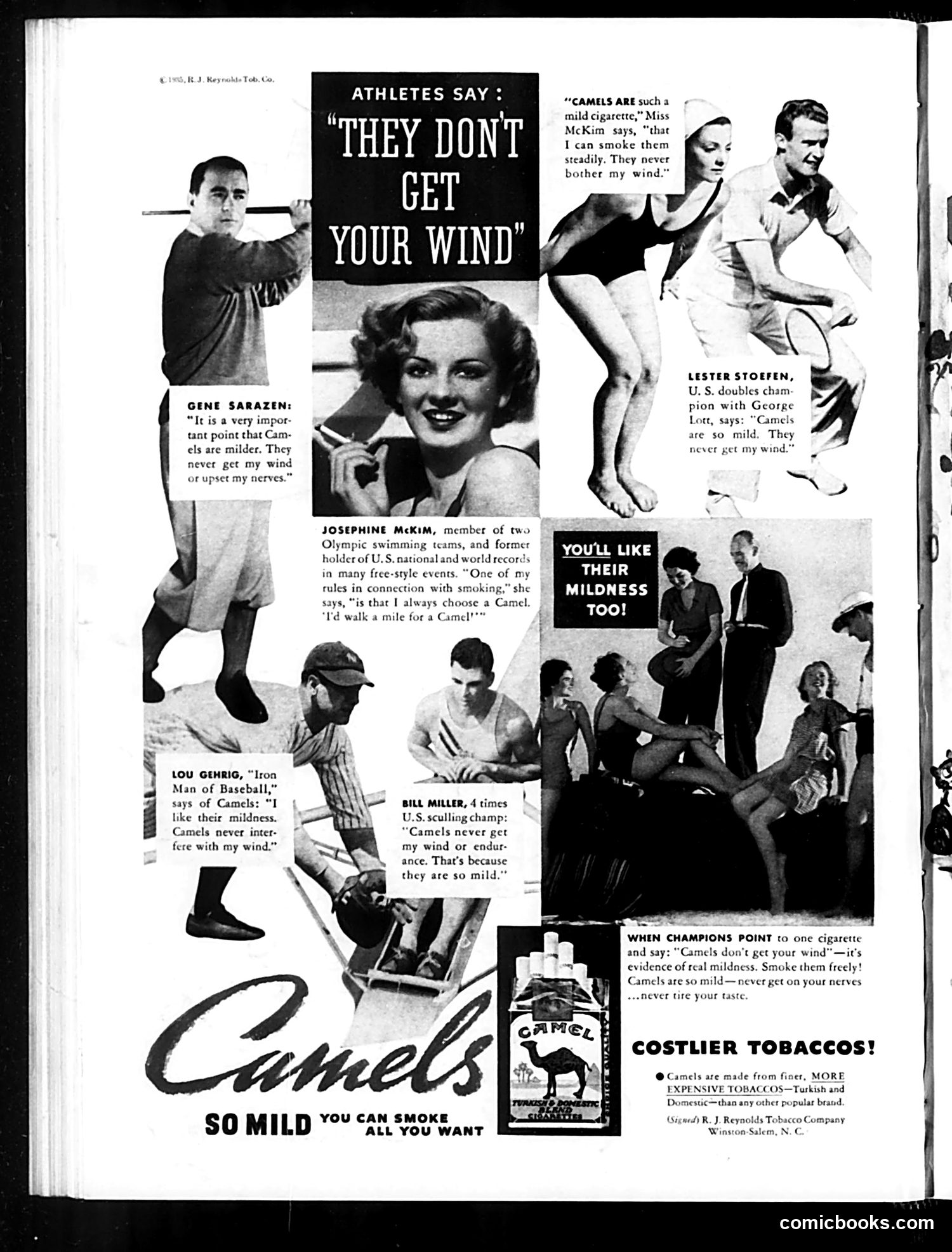
Analysis This is not a cartoon or satire—it's a cigarette advertisement disguised as editorial content. The page features testimonials from famous 1930s athletes (Gene Sarazen, golfer; Lou Gehrig, baseball; Josephine McKim, Olympic swimmer; Lester Stoefen, tennis; Bill Miller, rowing) endorsing Camel cigarettes. The repeated claim—"Camels don't get your wind"—was marketing genius targeting athletes by suggesting smoking wouldn't harm athletic performance. This exploited the era's widespread ignorance about smoking's health effects. For modern readers, this is jarring propaganda: cigarettes marketed to elite athletes as performance-compatible, using celebrity endorsement to legitimize a deadly product. It exemplifies pre-regulation advertising practices now illegal in most countries. The "costlier tobaccos" claim emphasizes quality while completely omitting any health considerations.