judge
Judge — October 1935
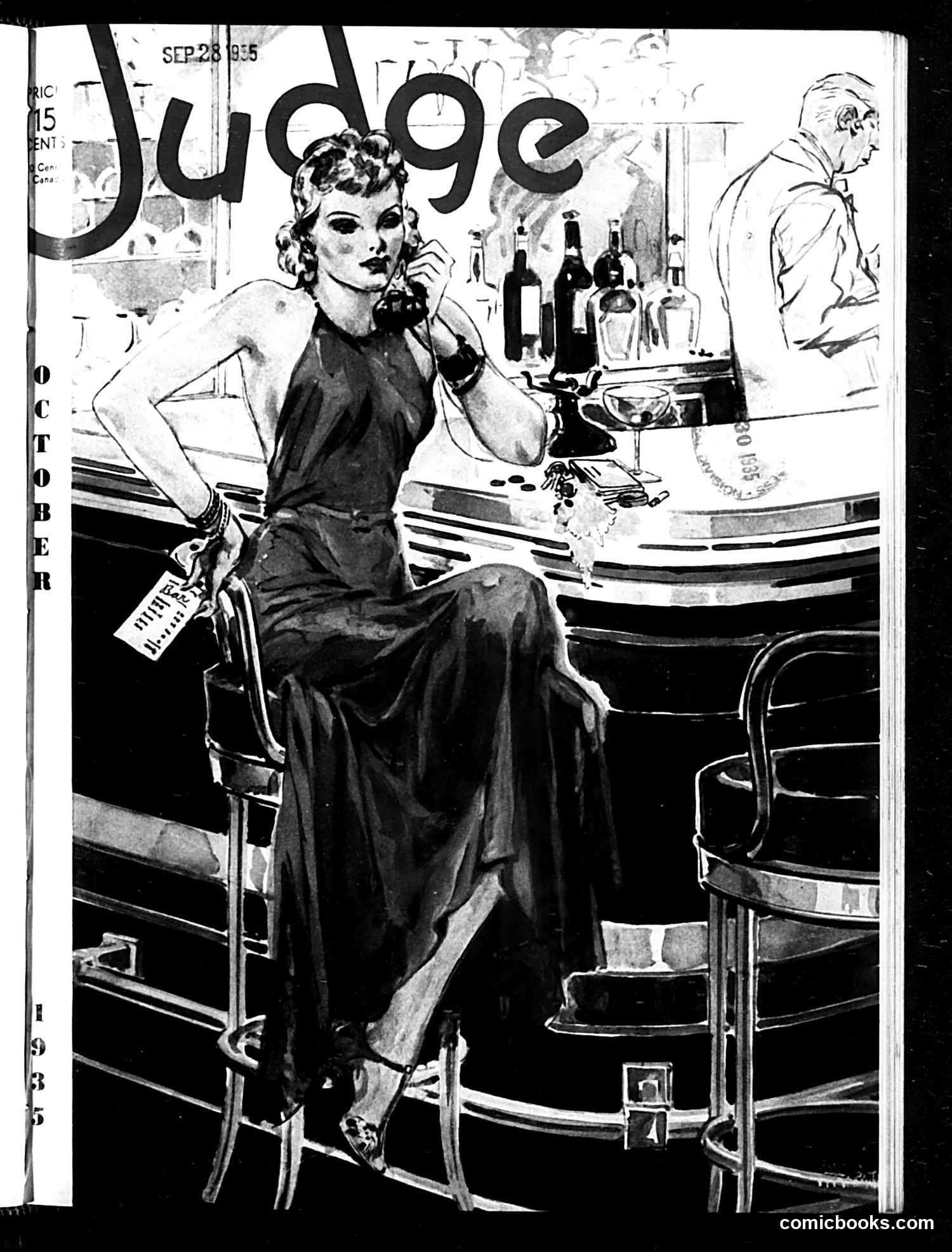
Judge Magazine Page Analysis This appears to be a cover or advertisement page from Judge magazine (dated SEP 28, 1935). The illustration depicts a glamorous woman in an elegant black evening gown, seated at what appears to be a bar or nightclub setting. She's posed sophisticatedly, holding a telephone handset, with bottles of alcohol visible in the background and a cocktail glass nearby. The large "Judge" masthead dominates the top. The imagery emphasizes luxury, sophistication, and leisure—typical subject matter for Judge's satirical commentary on American high society and consumer culture during the 1930s. However, without additional visible text or context, the specific satirical point or social commentary this illustration makes remains unclear from the image alone.
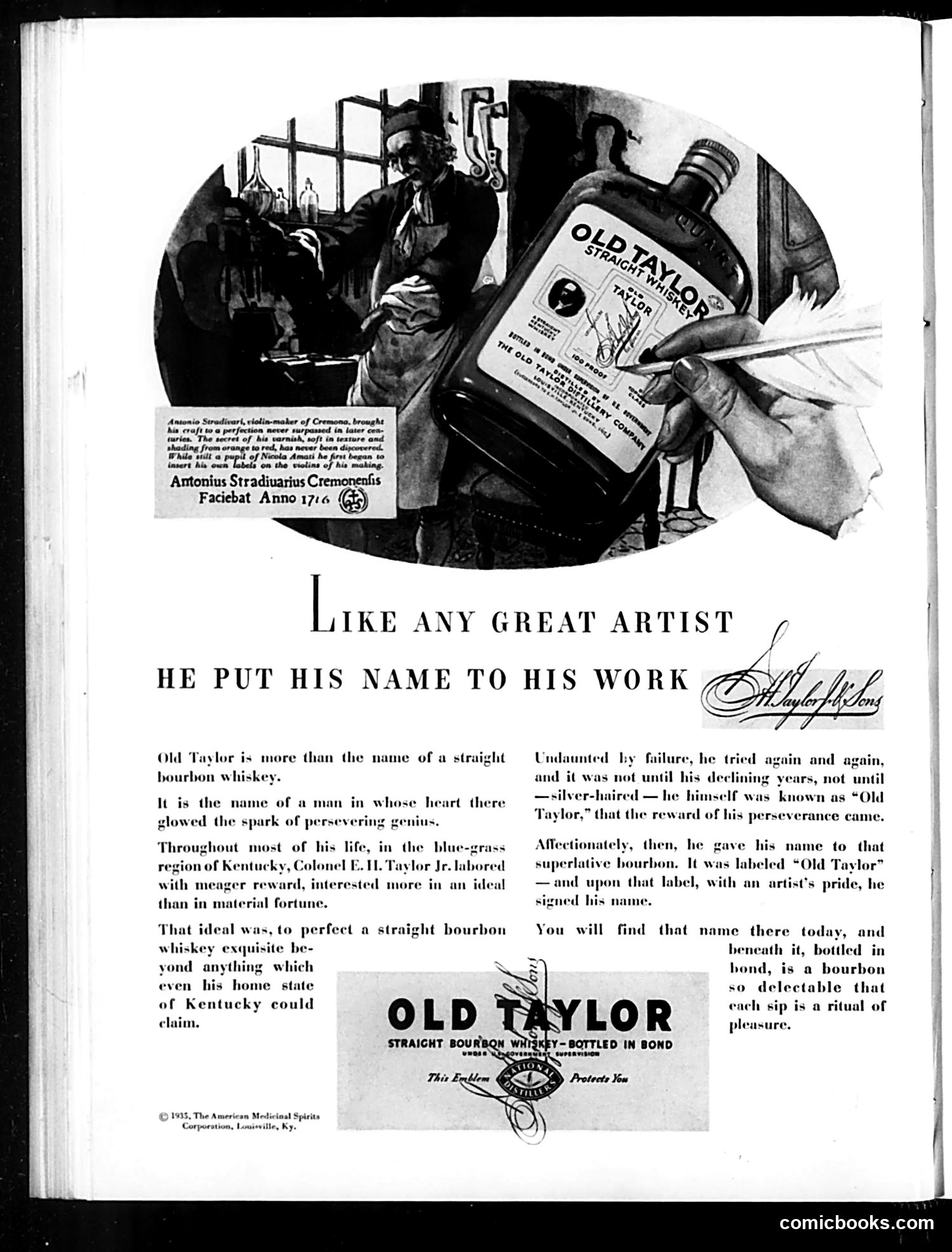
Analysis This is primarily advertising disguised as editorial content—a promotional piece for Old Taylor bourbon whiskey from 1935 (per copyright notice). The top illustration references a historical figure: Colonel E.H. Taylor Jr., a 19th-century Kentucky distiller who perfected bourbon whiskey production. The ad presents him as a dedicated craftsman ("like any great artist") who eventually branded his whiskey with his own name as a mark of pride. The narrative suggests Taylor's persistence through failure ultimately earned him recognition—his signature on the bottle became a guarantee of quality. The romantic framing of the entrepreneur as "artist" was typical 1930s advertising strategy. This is not satire: it's hagiographic brand mythology, using historical legitimacy to market the product during Prohibition's aftermath.
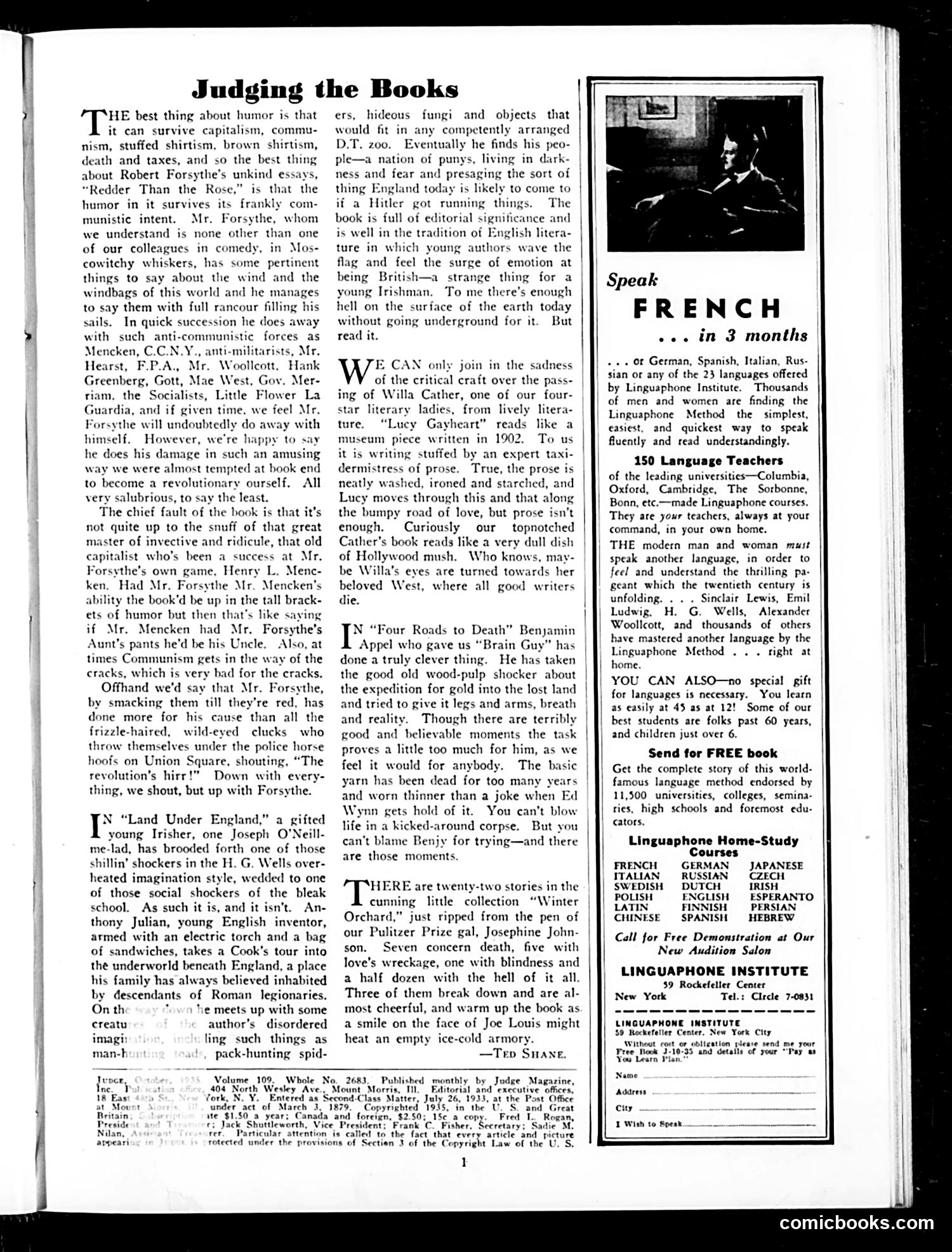
Analysis of Judge Magazine Page This page is primarily text-based book reviews rather than political cartoons. The main content is "Judging the Books," a column reviewing contemporary literature. The reviews critique several works, including Robert Forsythe's essays and Willa Cather's "Lucy Gayheart." The critic praises humor and social commentary in some works while faulting others for being insufficiently satirical or revolutionary. The right side features a Linguaphone Institute advertisement for language instruction, unrelated to satire. There is one photograph of what appears to be a man in formal dress, but no clear political caricature or cartoon is visible on this page. This issue prioritizes literary criticism and commercial advertising over the satirical illustrations Judge magazine was known for.
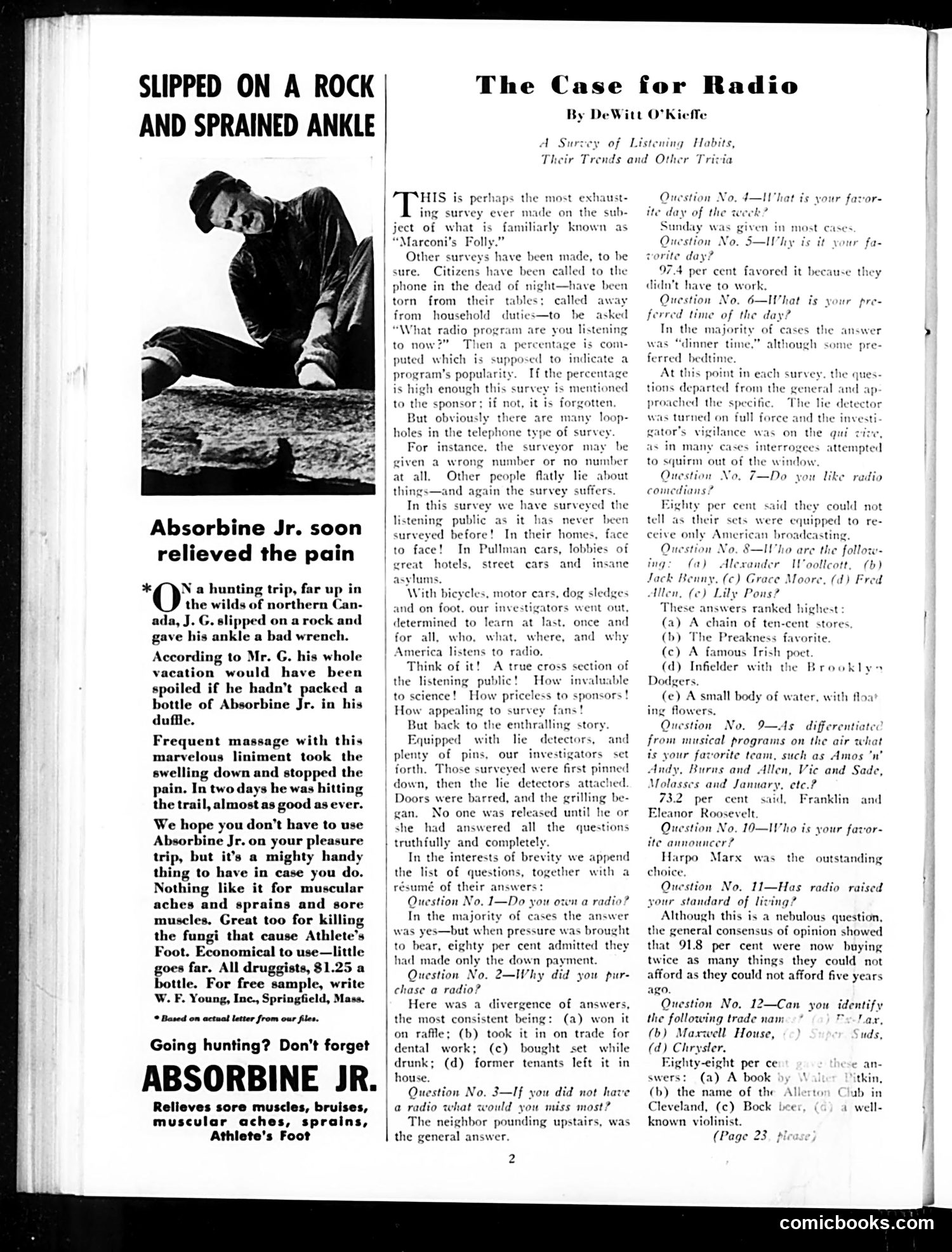
Page Analysis This page contains primarily advertising and editorial content, not political satire or cartoon commentary. The left side features an Absorbine Jr. liniment advertisement with a photograph of an injured man on a hunting trip. The ad humorously suggests the product relieved his sprained ankle, making his vacation successful. The right side presents "The Case for Radio" by DeWitt O'Kieffe — an editorial survey of American radio listening habits. It reports survey findings about when people listen, their favorite programs, and whether radio has improved their standard of living. Questions reference popular entertainers like Jack Benny and Grace Moore, indicating this is from radio's golden age (likely 1930s-1940s). This page reflects early mass media research and product marketing of the era.
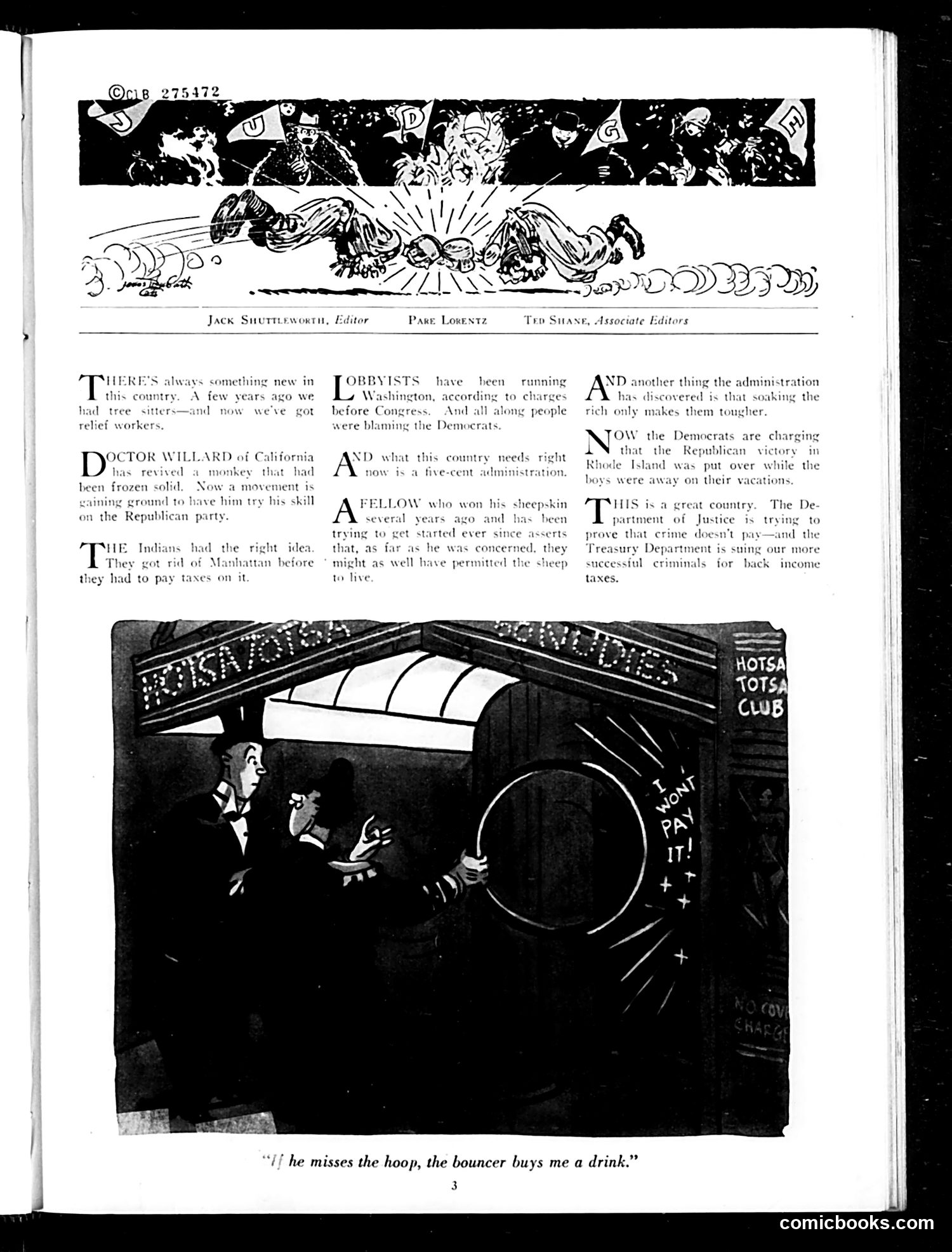
Political Commentary and Cartoon Analysis This Judge magazine page contains brief political quips and a single cartoon. The text criticizes both parties: Democrats are blamed for past relief spending; Republicans are attacked for a "five-cent administration" (likely referencing low wages or minimal government support). The main cartoon depicts a man at a "Hotsa Totsa Club" playing a ring-toss game where he must pay if he misses ("if he misses the hoop, the bouncer buys me a drink"). This appears to be social satire about working-class entertainment venues and gambling/game schemes—possibly mocking either the absurdity of such "games" or commenting on economic hardship where even simple amusements involve financial risk or tricks. The specific historical context remains unclear without additional dating information.
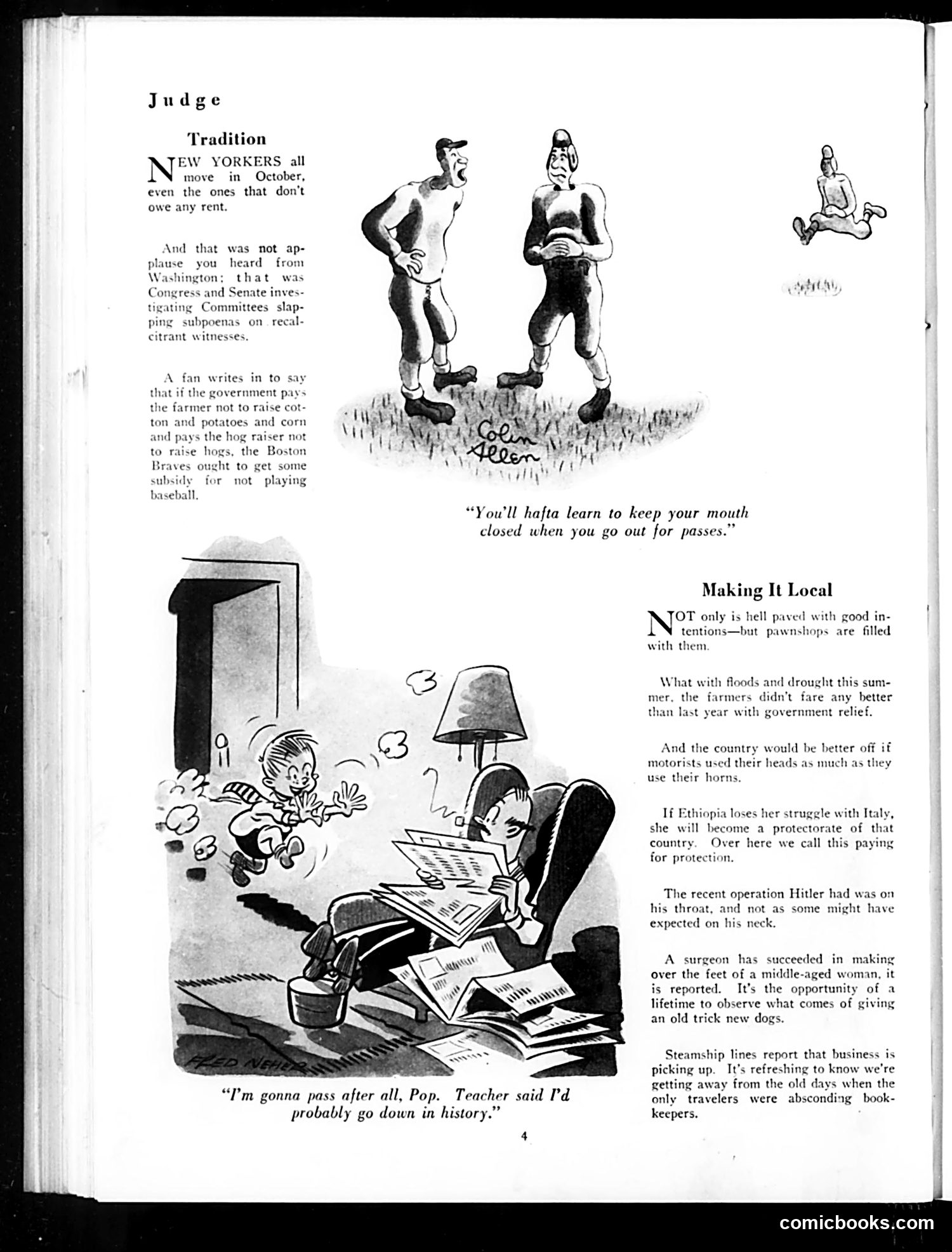
Analysis of Judge Magazine Page This page contains satirical commentary on 1930s American issues. The "Tradition" section mocks New Yorkers' October moving practices and references Congressional investigations into "recalcitrant witnesses"—likely referencing contemporary political scandals. The top cartoon shows two runners with the caption about keeping one's mouth closed during "passes," apparently satirizing athletes or public figures who speak indiscreetly. The lower cartoon depicts a child reading newspapers while money falls, with the caption about "going down in history." This appears to satirize youth fascination with current events during an era of significant news (possibly referencing Hitler's rise, as mentioned in the text). "Making It Local" section offers general commentary on government relief, farming struggles, motorists, and international affairs like Italian-Ethiopian tensions—typical Judge satirical observations on contemporary problems.
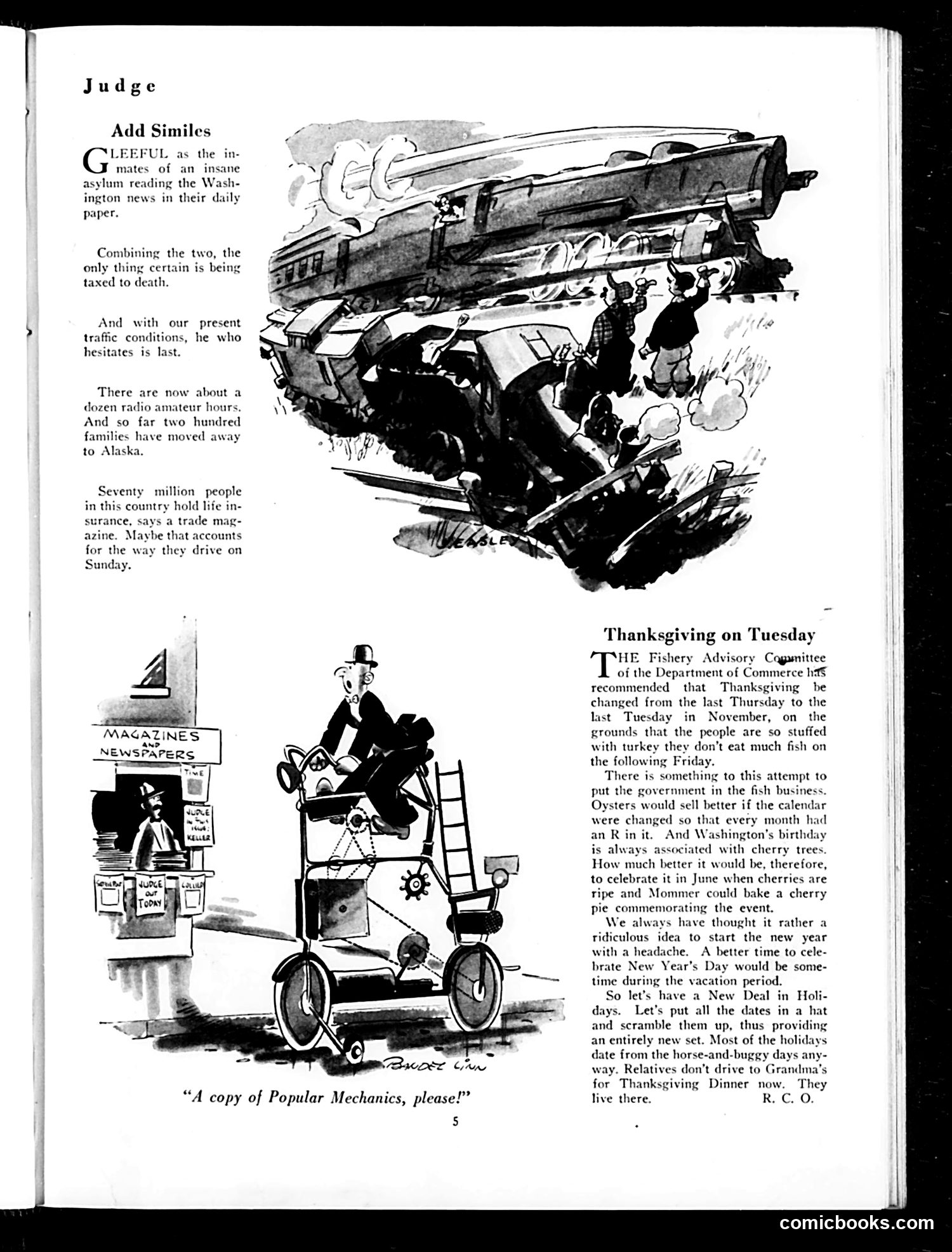
Page Analysis: Judge Magazine Top Section ("Add Similes"): Dark humor about Washington, D.C. traffic fatalities. The judge compares "inmates of an insane asylum" reading Washington news to people dying in traffic accidents—suggesting Washington's politics are as chaotic as deadly streets. References "present traffic conditions" and quips that hesitating drivers are "taxed to death." Bottom Section ("Thanksgiving on Tuesday"): Satirizes a Fishery Advisory Committee proposal to move Thanksgiving from Thursday to Tuesday. The author mocks this bureaucratic overreach, suggesting government meddling in traditional holidays is absurd. The accompanying cartoon shows a man precariously balanced on a wheeled contraption, captioned "A copy of Popular Mechanics, please!"—suggesting government schemes are as unstable as DIY contraptions.
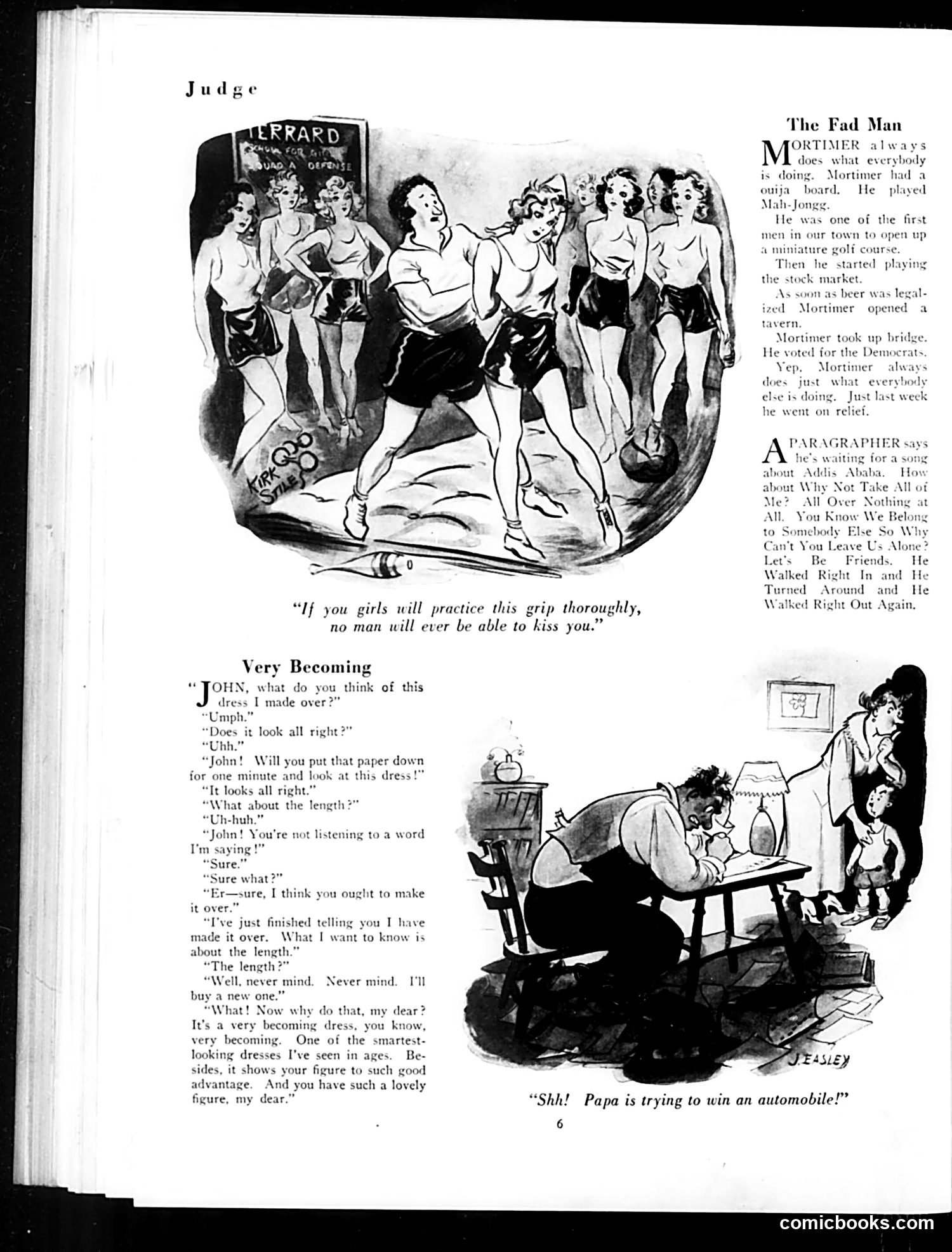
Analysis of Judge Magazine Page This page contains two separate satirical pieces from Judge magazine: "The Fad Man" (top right): Mocks a character named Mortimer who constantly follows trends—opening a miniature golf course, playing stock market, opening a tavern, taking up bridge, and going on relief. The satire targets wealthy people who thoughtlessly chase whatever fad everyone else is doing, regardless of consequences. "Very Becoming" (bottom): Shows a husband ignoring his wife's attempts to get his opinion on her new dress. The joke satirizes marital indifference—he's so disinterested he won't even look at it, while she desperately seeks his approval. The bottom cartoon depicts children interrupting, playing on domestic chaos. Both pieces use humor to critique contemporary social behavior and relationships.
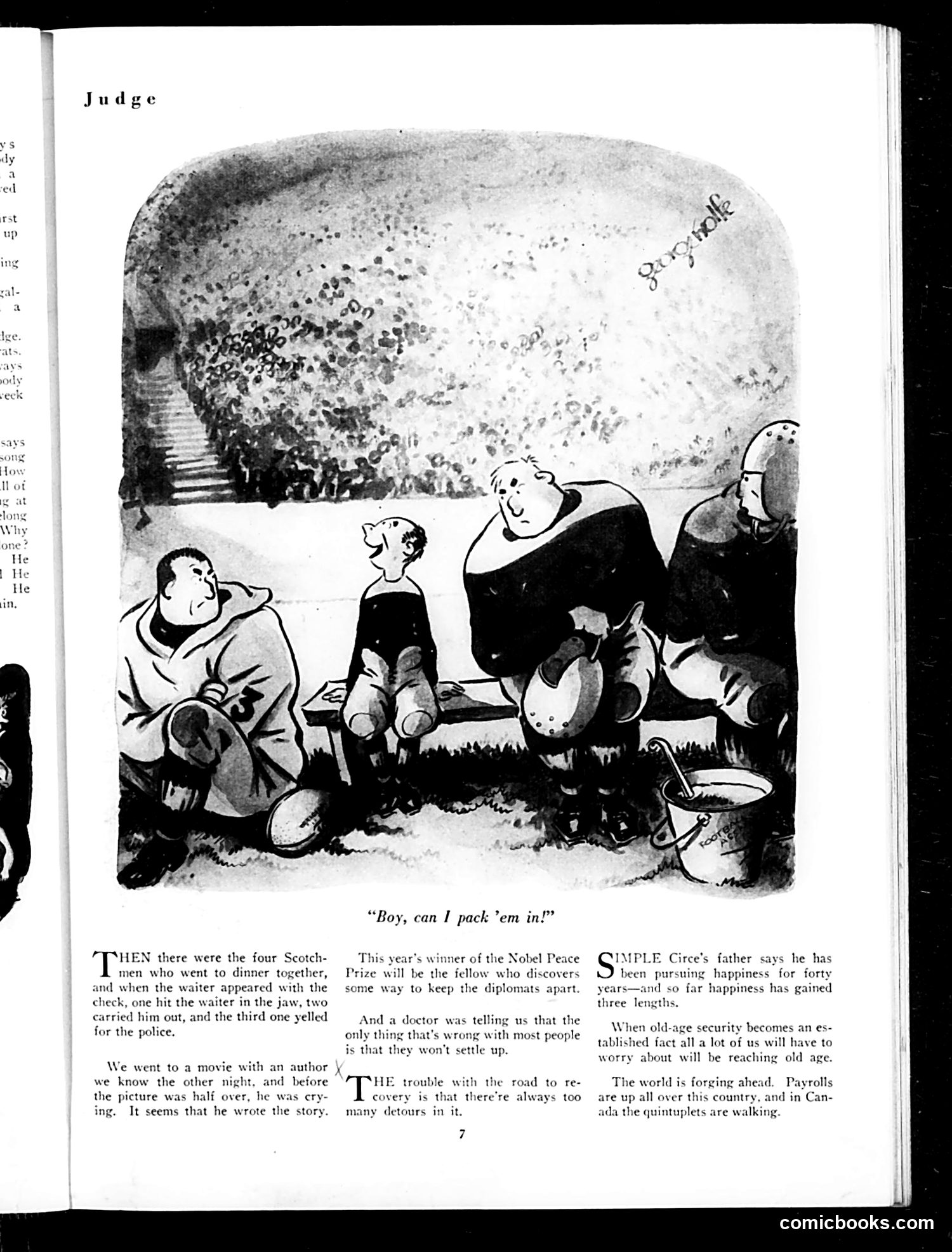
"Judge" Page Analysis The main cartoon titled "Boy, can I pack 'em in?" depicts what appears to be a massive stadium or arena filled with spectators in the background, with four figures in the foreground appearing to be packing something (possibly people or objects) into a container. The accompanying text references four Scotchmen going to dinner, a Nobel Peace Prize winner, and various social commentary about diplomacy, road recovery detours, security in old age, and payroll issues. The satire appears to target early-20th-century concerns: diplomatic ineffectiveness, infrastructure problems, economic anxieties about aging, and labor/wage issues. However, without knowing the specific publication date or identifying the particular Nobel Prize reference, the precise political figures or events being mocked remain unclear from this page alone.
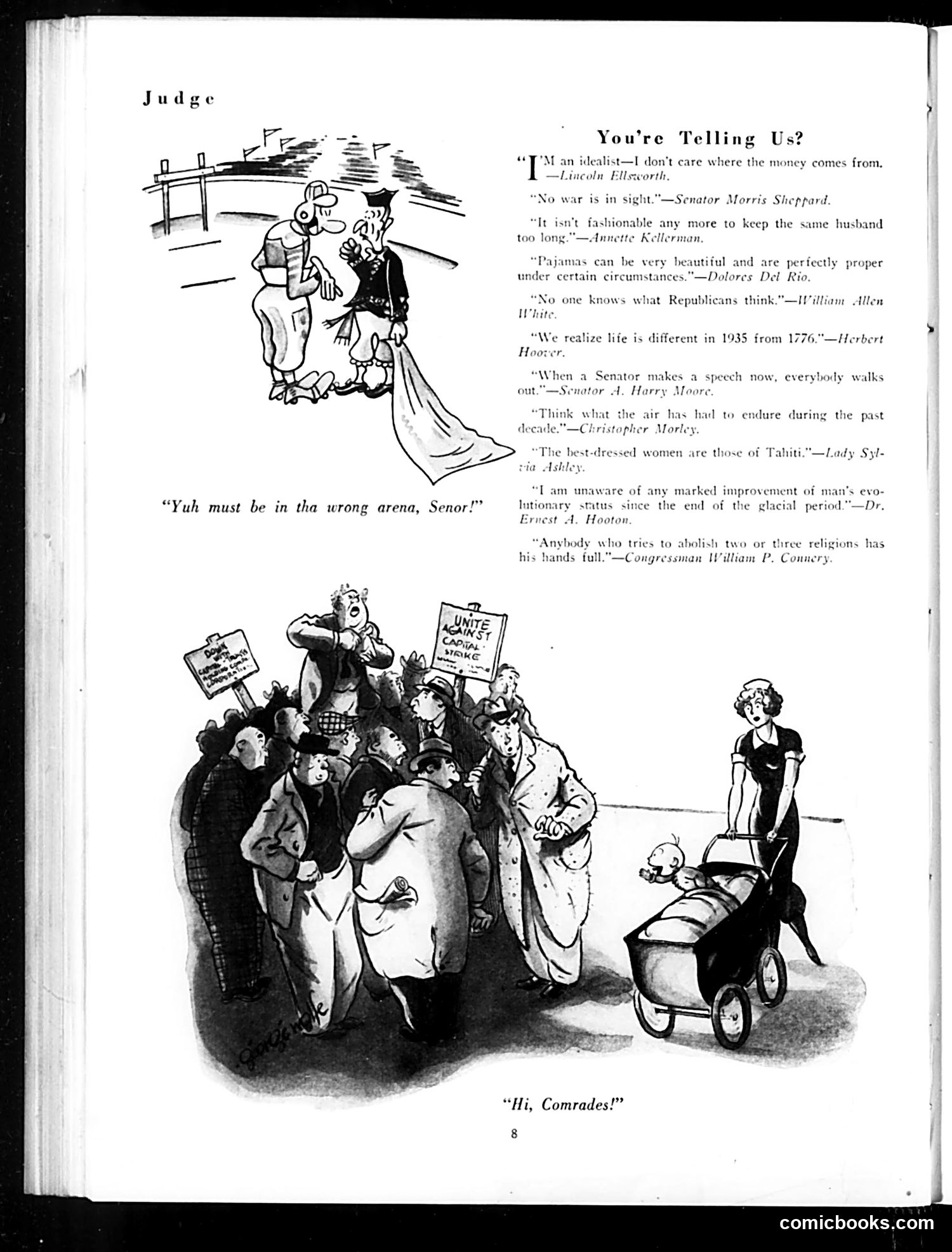
Political Commentary in Judge Magazine This page satirizes 1930s American society through quotations and two cartoons. Top cartoon: A judge confronts a man in what appears to be a courtroom, with the caption "Yuh must be in tha wrong arena, Senor!"—likely mocking legal proceedings or misplaced idealism. Bottom cartoon: Titled "Hi, Comrades!" shows a woman with a baby carriage approaching a crowd of agitated men holding protest signs about strikes and unions. The satire appears to target communist or radical labor activism, presenting the organized protesters as threats to ordinary citizens. The quotations mock contemporary political figures and social trends—Senator Sheppard's optimism about peace, Hoover's historical revisionism, senators being ignored, and critiques of religious and evolutionary debates. The collection suggests Judge viewed 1930s progressivism, labor organizing, and political rhetoric with skepticism and humor, framing radical movements as dangerous to everyday American life.
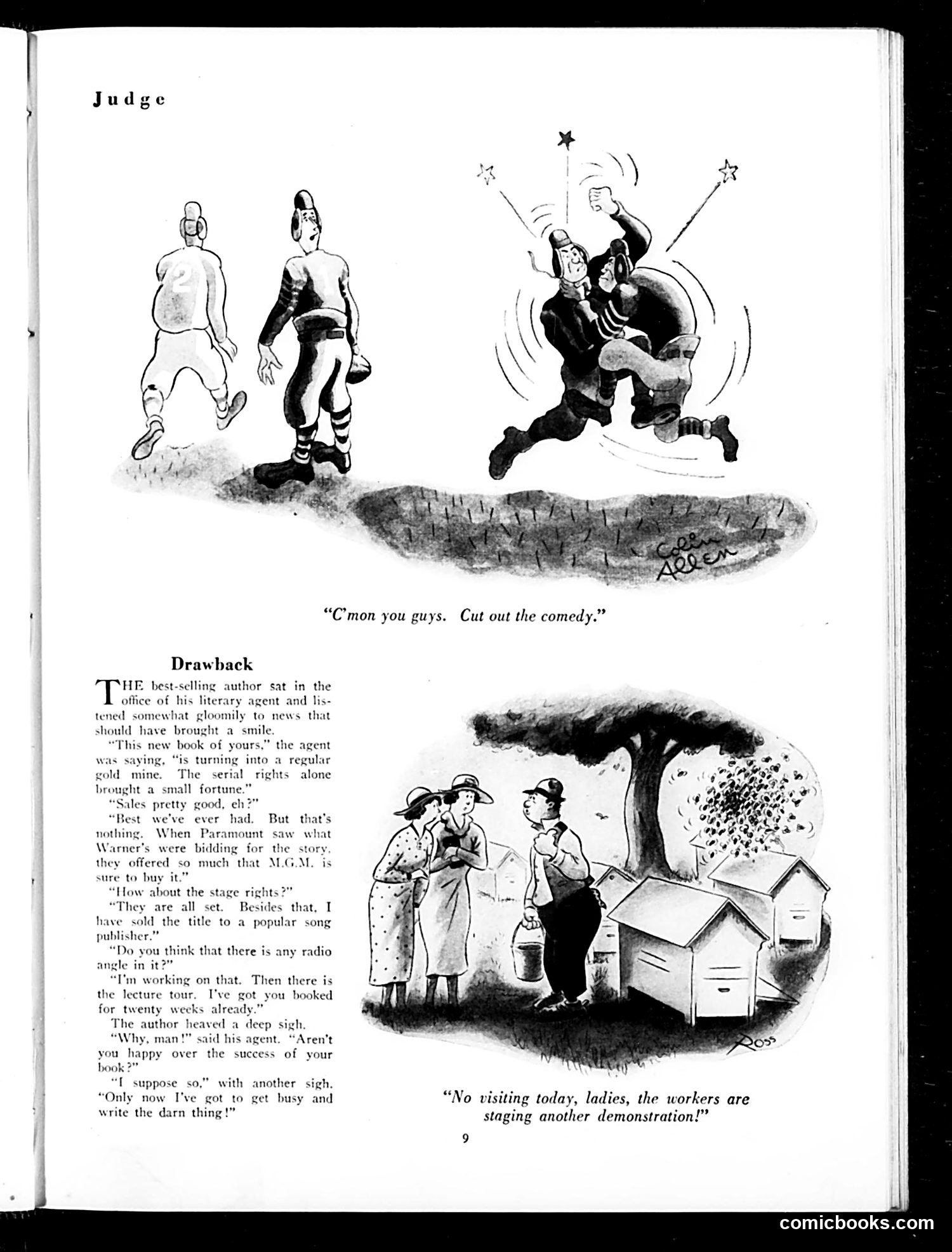
"Drawback" - Judge Magazine Cartoon The Setup: A best-selling author's literary agent excitedly reports massive financial success—serial rights, film deals from Paramount and Warner Bros., MGM bidding, stage rights, song publishing rights, and a twenty-week lecture tour. The Joke: The author responds with sighs of despair. When asked if he's happy about his book's success, he replies: "Only now I've got to get busy and write the darn thing!" The Satire: This mocks the commercialization of literature and Hollywood's appetite for stories. The author has profited enormously from *the idea* of a book—through adaptations and ancillary rights—before actually writing it. The irony is that commercial success has created an obligation to produce the actual work, which he clearly finds tedious. It's a commentary on how publishing and entertainment industries monetize intellectual property while the creative labor itself becomes an unwelcome burden. The top cartoon appears unrelated—a sports scene with the caption "C'mon you guys. Cut out the comedy."
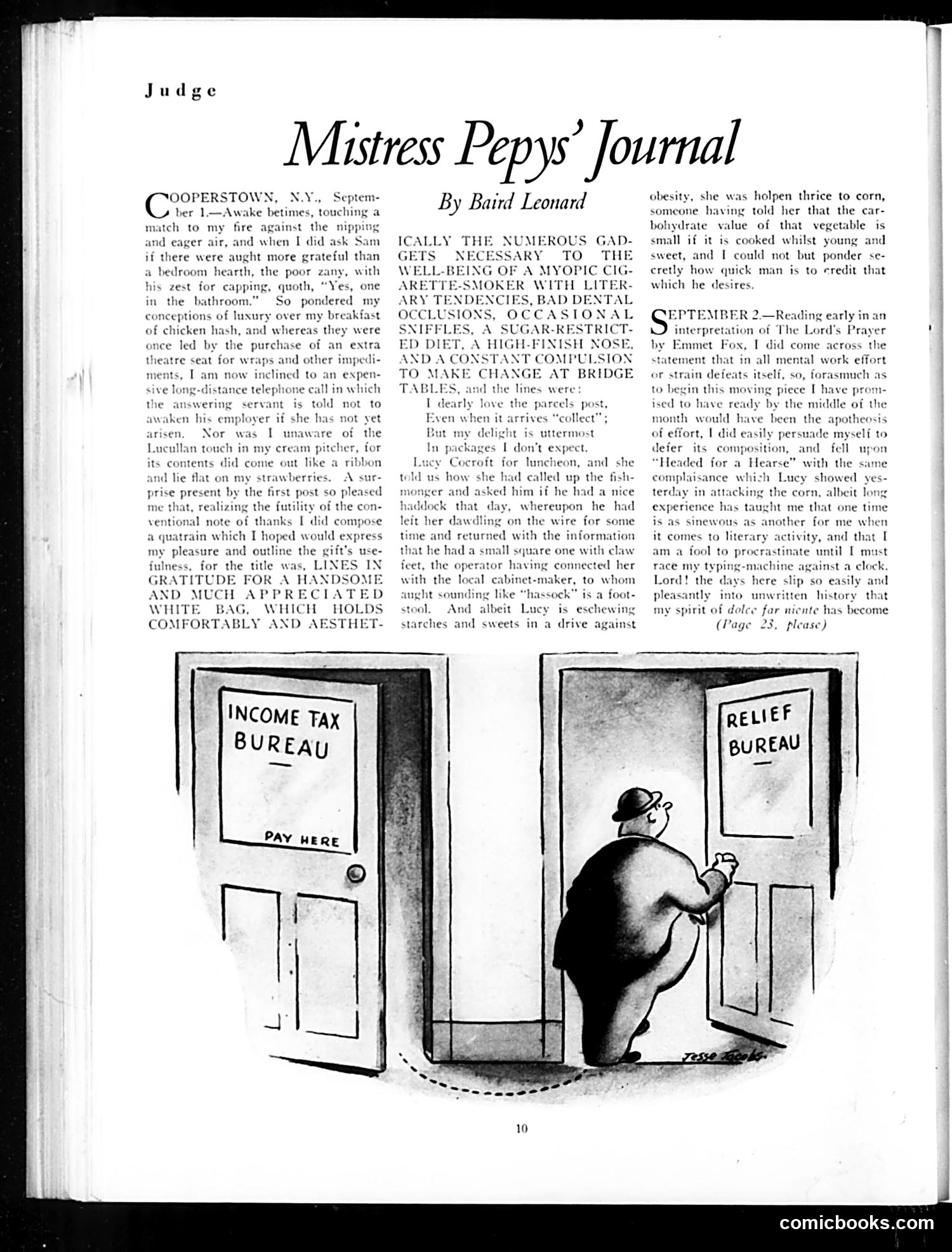
Explanation for Modern Readers This page contains two elements: a literary column called "Mistress Pepys' Journal" (a parody of Samuel Pepys' famous 17th-century diary, written in faux-archaic style) and a political cartoon below. The Cartoon: A heavyset man, appearing distressed or indecisive, stands between two doors labeled "Income Tax Bureau" (marked "Pay Here") and "Relief Bureau." The figure seems caught between paying taxes and seeking government assistance—likely representing the economic anxiety of ordinary citizens during the Great Depression era. The satire mocks the impossible position of struggling Americans: being simultaneously squeezed for taxes while needing government relief aid. The Journal: This gossipy, chatty column uses mock-Pepysian language to humorously chronicle domestic life and social observations, including references to modern conveniences (telephones, typing machines) juxtaposed against archaic phrasing—creating comedy through anachronism. The page satirizes both economic hardship and the pretensions of literary sophistication.
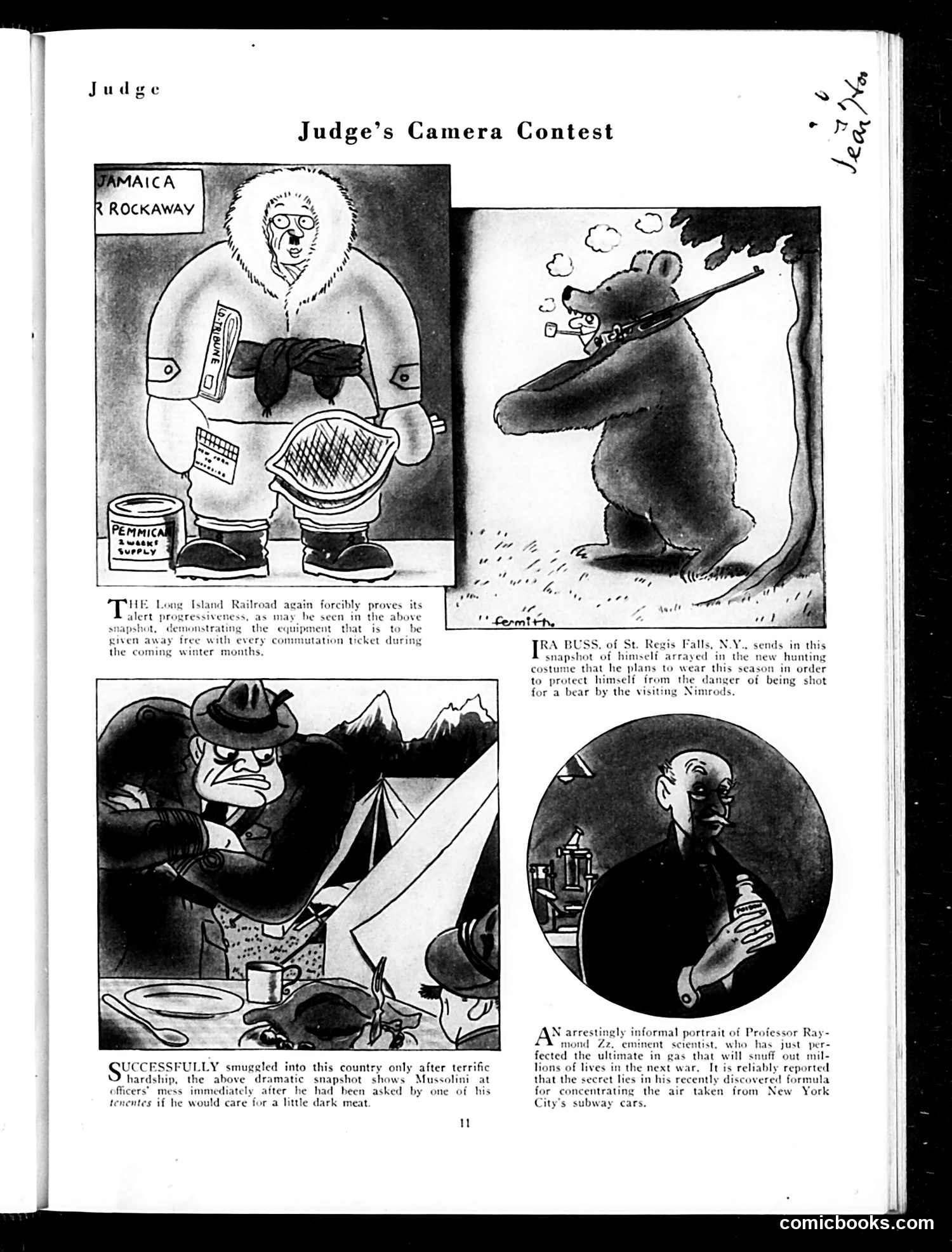
Judge Magazine "Camera Contest" Page Analysis This page presents satirical "camera contest" submissions mocking contemporary figures and events: Top left: A "Jamaica Rockaway" commuter with photography equipment—satirizing the Long Island Railroad's promotional giveaways. Top right: A hunter armed against bears, submitted by "Ira Buss"—a straightforward hunting joke. Bottom left: Depicts Mussolini at "mess" (dining), smuggled into the country "after terrific hardship"—mocking both Mussolini's fascist regime and contemporary concerns about foreign smuggling/espionage during the pre-WWII era. Bottom right: A portrait of "Professor Raymond Z.," a scientist who's perfected a deadly gas weapon for the coming war, with the joke that his formula uses air from NYC subway cars—dark satire about chemical weapons development and urban pollution circa the 1930s. The overall theme ridicules contemporary anxieties: militarism, fascism, weapons development, and industrial-age life.
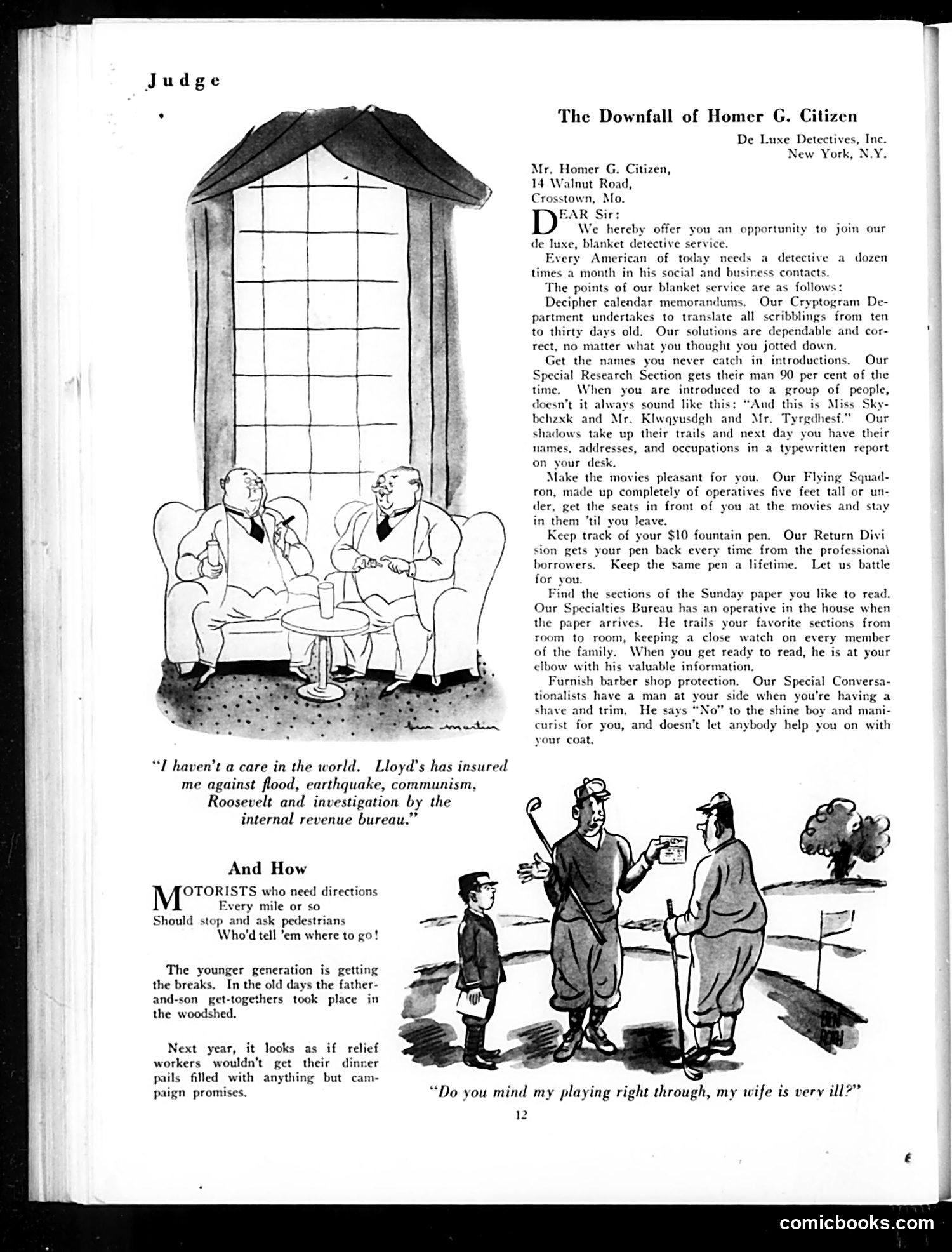
Analysis of Judge Magazine Page This page contains two distinct satirical pieces: "The Downfall of Homer G. Citizen" features a mock advertisement for "De Luxe Detectives, Inc." The satire mocks pretentious detective services that promise to solve everyday social problems—translating cryptic comments, tracking people's backgrounds, securing movie seats, and retrieving fountain pens. The cartoon shows two men in chairs, with the caption joking about Lloyd's insurance covering "flood, earthquake, communism, Roosevelt and investigation by the internal revenue bureau"—satirizing both the absurdity of detective services and contemporary anxieties about government oversight and Roosevelt-era policies. "Motorists Who Need Directions" humorously depicts a motorist asking for directions, with the caption "Do you mind my playing right through, my wife is very ill?"—mocking how drivers interrupt strangers to ask for help while making excuses. Both pieces target American social pretension and modern anxieties of the era.
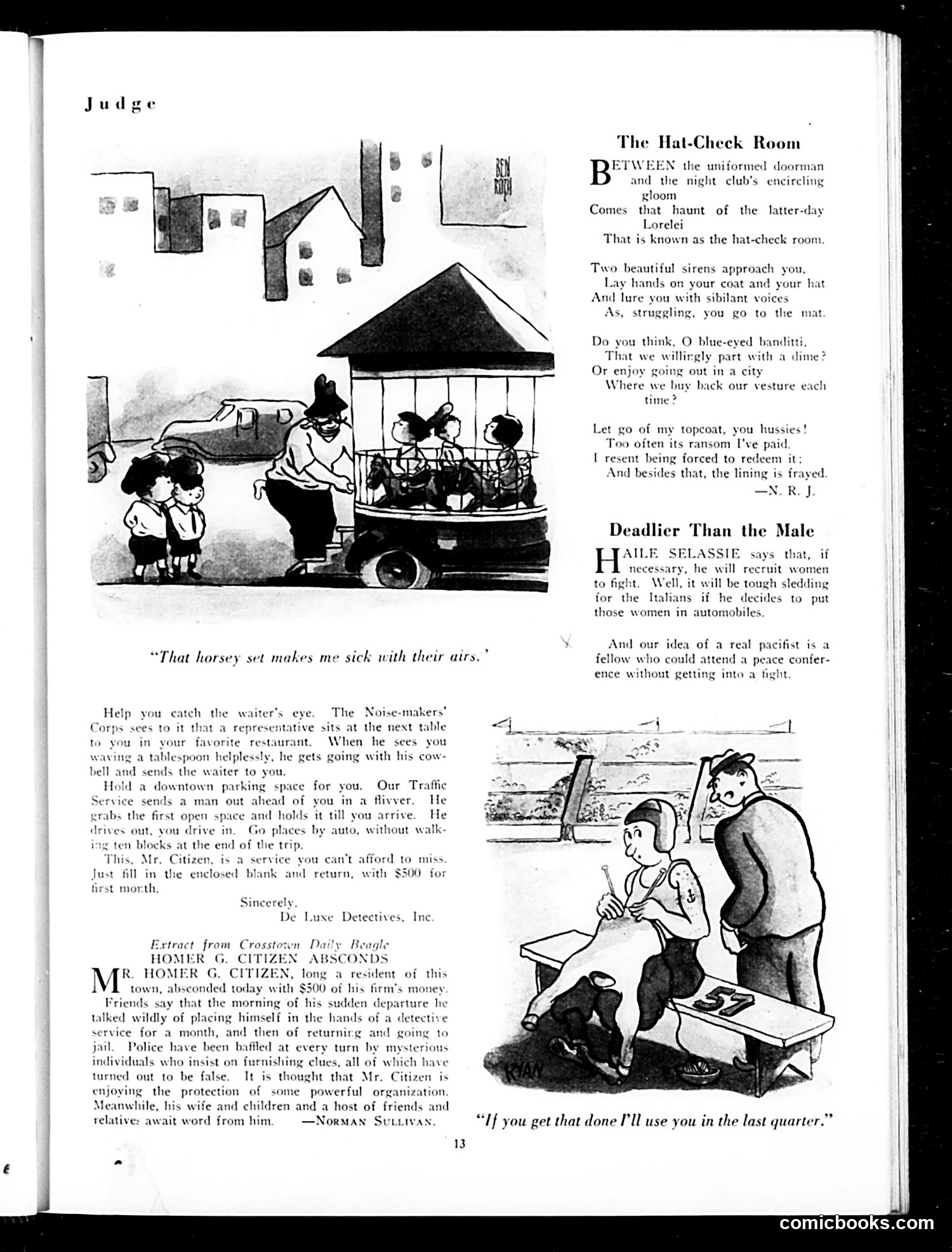
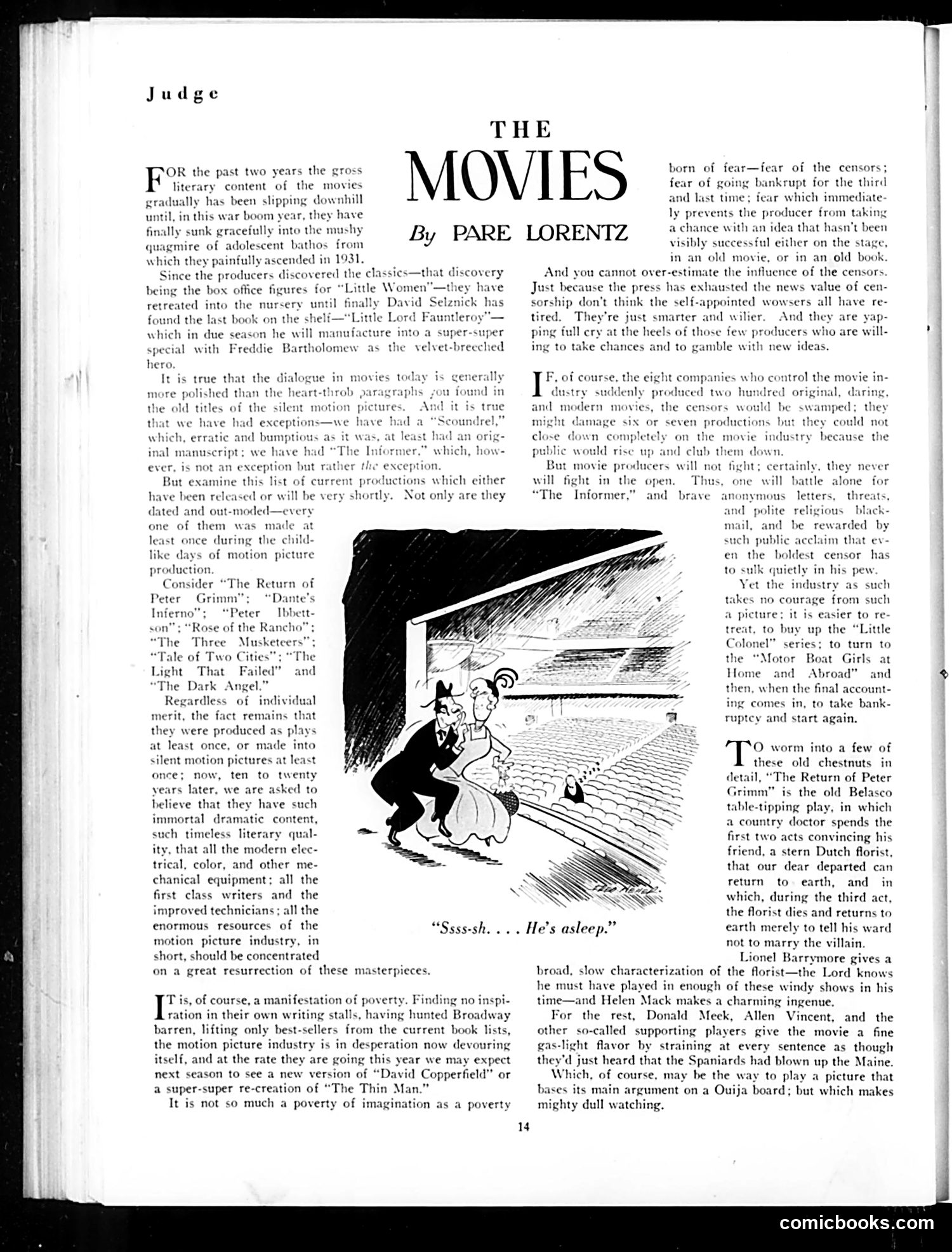
Analysis of Judge Magazine Article on Hollywood's Creative Decline This article by Pare Lorentz critiques 1930s Hollywood's creative bankruptcy. The accompanying cartoon—showing a figure tiptoeing past a sleeping person—illustrates the industry's cautious timidity. Lorentz argues that studios, terrified of censors and financial ruin, have abandoned original stories. Instead, they endlessly remake classic literature and earlier silent films ("Little Women," "Peter Grimm," "The Three Musketeers," etc.), betting on proven material rather than risking new ideas. He identifies eight major studios controlling the industry, producing formulaic adaptations while claiming artistic merit through superior technology and cast. The critique centers on fear-driven decision-making: producers won't gamble on original screenplays because censorship boards, bankruptcy fears, and conservative audiences punish experimentation. Lorentz sarcastically notes that even when censors relax enforcement, studios remain paralyzed by habit, preferring safe retreads. The "poverty" plaguing Hollywood isn't financial but imaginative—a self-imposed creative paralysis masquerading as sophisticated adaptation of "timeless" classics.
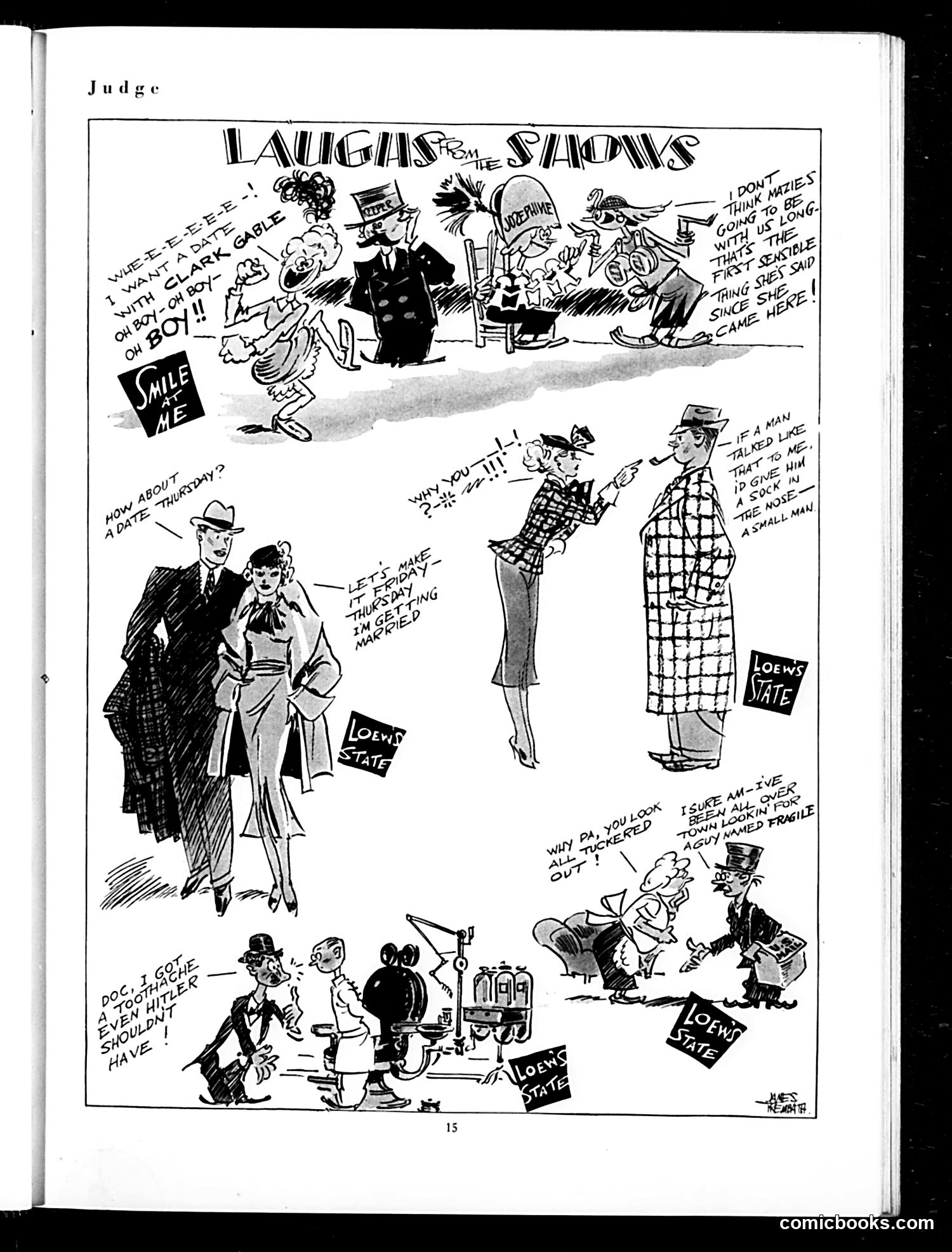
"Laughs and Shadows" - Judge Magazine Cartoon Page This page contains multiple comic scenarios labeled "Loews State," apparently satirizing a theater chain or entertainment venue. The cartoons depict various social situations with dated gender and class humor typical of early-to-mid 20th century American satirical magazines. Key scenes include: a couple on a date ("Let's make it Thursday—I'm getting married"), a man reacting negatively to a woman's appearance, and exchanges about theater etiquette. One panel references a "seven-footer" and social awkwardness. The repeated "Loews State" branding suggests these are commissioned gags promoting or poking fun at the theater chain. The overall tone employs slapstick humor and stereotypes about courtship, appearance, and social propriety rather than political satire. The specific cultural references and dating norms depicted would require period context to fully appreciate.
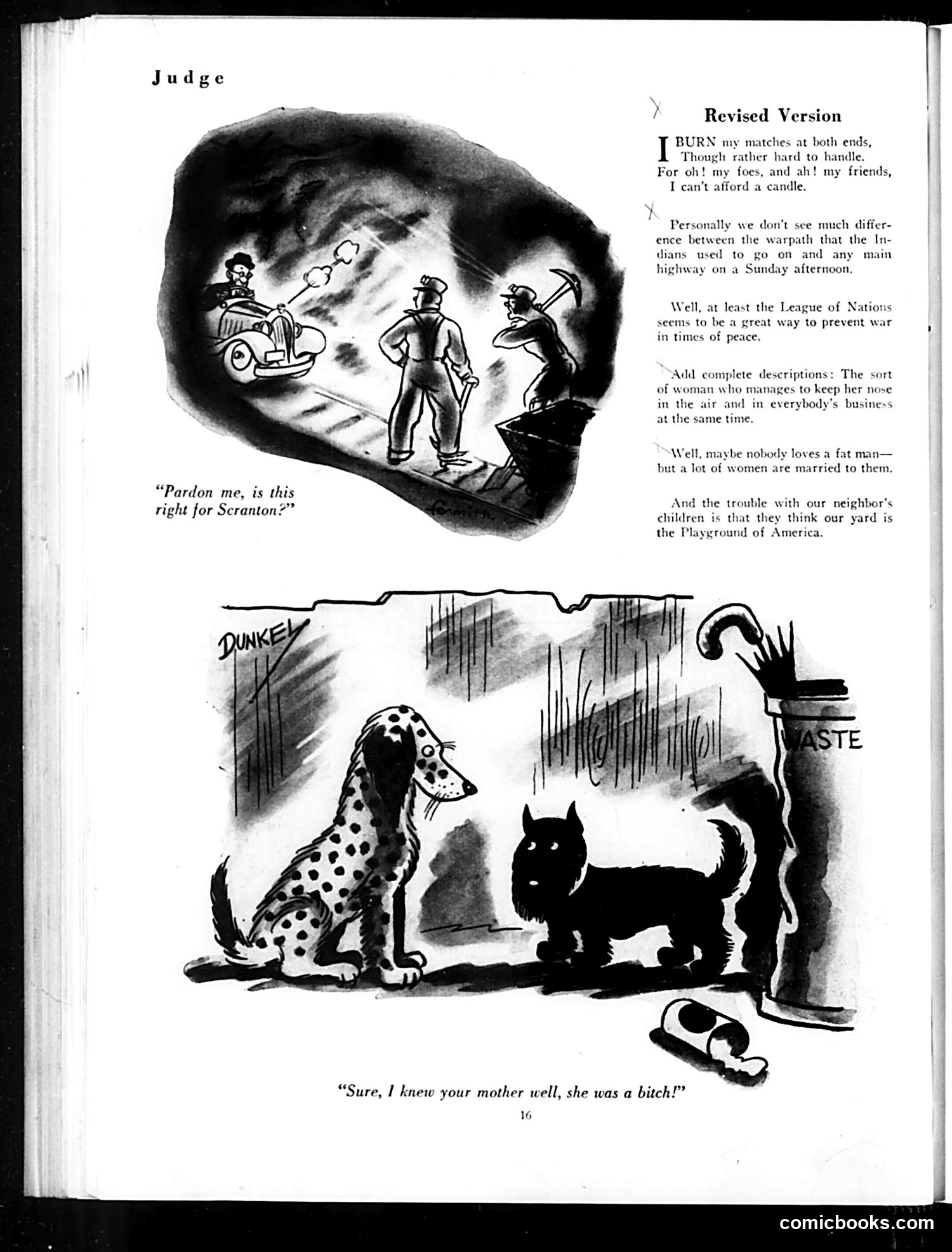
Analysis of Judge Magazine Page This page contains two separate cartoons satirizing American social attitudes. Top cartoon: A driver asks directions to "Scranton" while a woman in formal dress directs traffic. The satire appears to mock either confused travelers or possibly misplaced confidence about destinations—though the specific Scranton reference is unclear without additional context. Bottom cartoon: Two dogs meet in an alley labeled "DUNKEL" and "ASTE" (possibly street names). One insults the other's mother, calling her "a bitch"—a crude pun playing on the literal meaning (female dog) and the vulgar insult. The humor relies on this double meaning. The accompanying text includes various social commentary snippets mocking frivolous concerns, women's behavior, the League of Nations, and suburban life. The overall tone reflects 1920s-era satirical humor targeting middle-class American pretensions and social conventions.
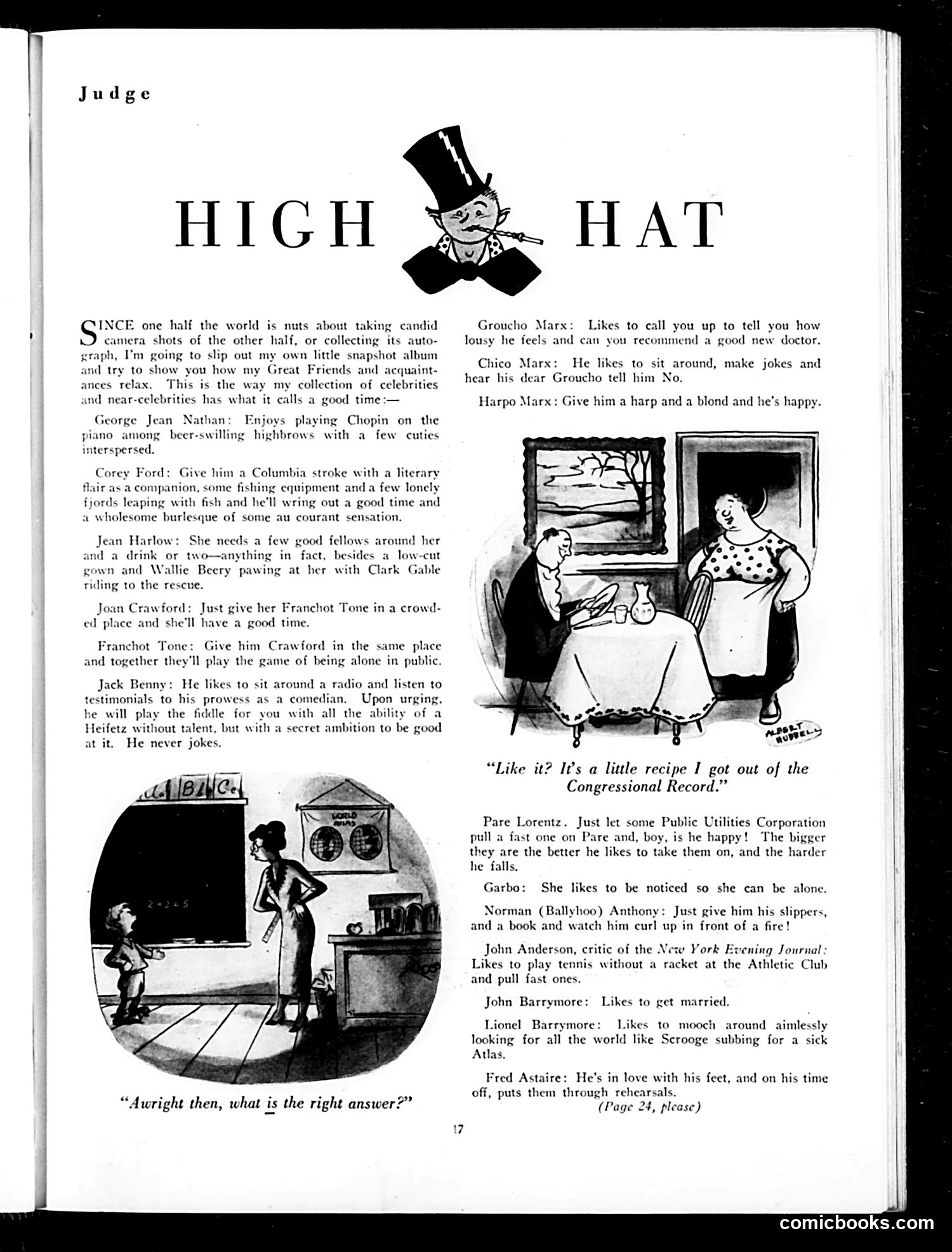
"High Hat" – Judge Magazine Celebrity Satire This page satirizes Hollywood and entertainment celebrities of the 1930s through humorous character sketches. The author catalogs how various famous figures relax, using exaggerated stereotypes to mock their public personas. The jokes rely on contrasts between their professional images and rumored private behavior: Jean Harlow needs male company and alcohol (not movie roles); Jack Benny obsesses over praise but can't actually play violin well; the Marx Brothers are reduced to crude caricatures (Groucho complains, Harpo chases women, Chico just says "no"); Fred Astaire is dance-obsessed even off-duty. The cartoons accompanying the text show domestic scenes—one features a woman at a radio, another shows a woman teaching a child, illustrating the contrast between Hollywood glamour and ordinary life. The satire targets celebrities' self-importance and peculiar habits, a common Judge magazine theme mocking entertainment industry excess during the Depression era.
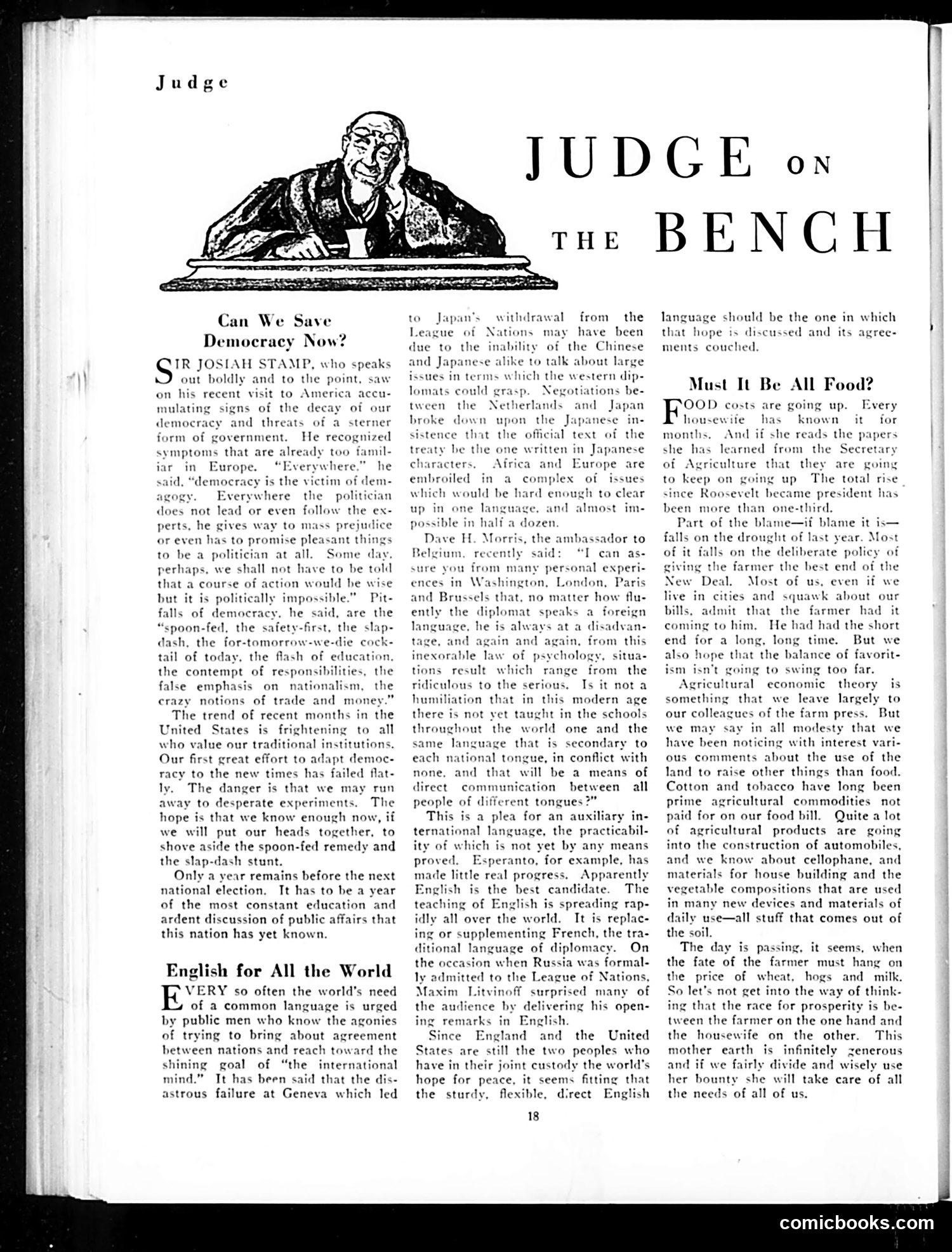
Judge Magazine: "Judge on the Bench" Analysis This page contains opinion pieces rather than traditional cartoons. The illustration shows a judge—representing editorial authority—presiding over commentary on contemporary issues. "Can We Save Democracy Now?" references Sir Josiah Stamp's concerns about democratic decay in America, citing symptoms already visible in Europe: politicians ignoring experts, emphasis on short-term solutions ("spoon-fed," "safety-first"), and nationalistic fervor. The piece warns that with only a year before the next election, Americans must engage in serious public discussion to avoid "desperate experiments." "English for All the World" advocates for English as an international auxiliary language to prevent diplomatic failures like those at Geneva (likely the League of Nations negotiations). The author cites examples where language barriers caused misunderstandings between nations. While mentioning Esperanto's failure, the piece argues English's natural spread makes it the best candidate for facilitating international communication and peace. Both pieces express 1920s-30s concerns about democratic institutions and global cooperation during an unstable interwar period.
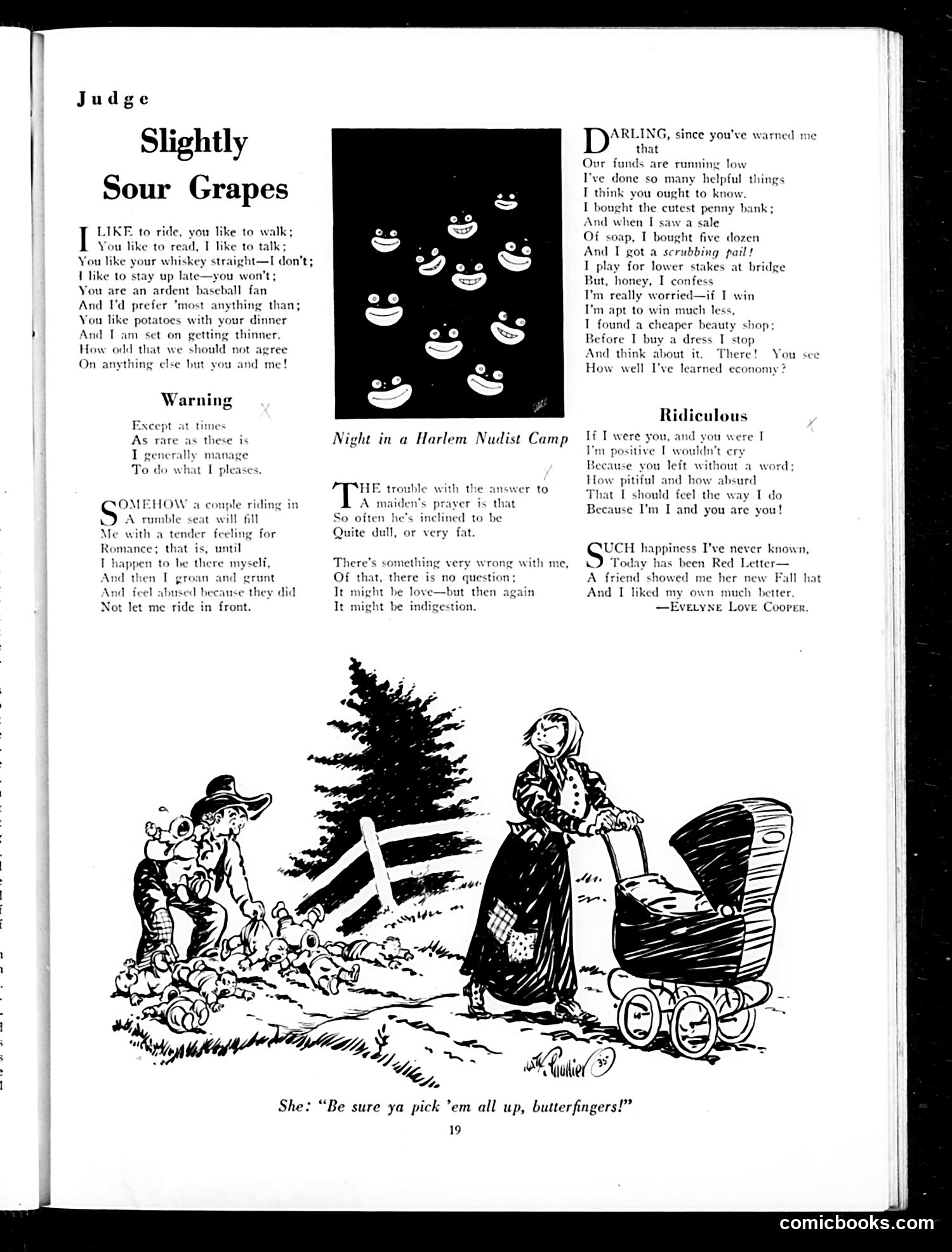
Judge Magazine Page Analysis This page contains several humorous poems and illustrations satirizing domestic life and gender relations in early 20th-century America. "Slightly Sour Grapes" mocks couples' incompatibilities—differing tastes in whiskey, bedtime, baseball, and food—suggesting the absurdity of expecting perfect agreement in relationships. "Warning" humorously presents a woman's frustration at being relegated to the rumble seat while riding with a man, then speculates neurotic reasons for her irritation (love? indigestion?). The central illustration depicts a working-class family scene: a man with children and a woman with a baby carriage, with the caption "Be sure ya pick 'em all up, butterfingers!"—poking fun at parental chaos and incompetence. "Ridiculous" and the final poem mock romantic jealousy and petty competitiveness between partners, satirizing women's vanity (preferring one's own possessions/appearance to others') and emotional neediness. Overall, the page presents satirical commentary on marriage dynamics, women's spending habits, and domestic friction—typical Judge magazine fare mocking middle-class American life.
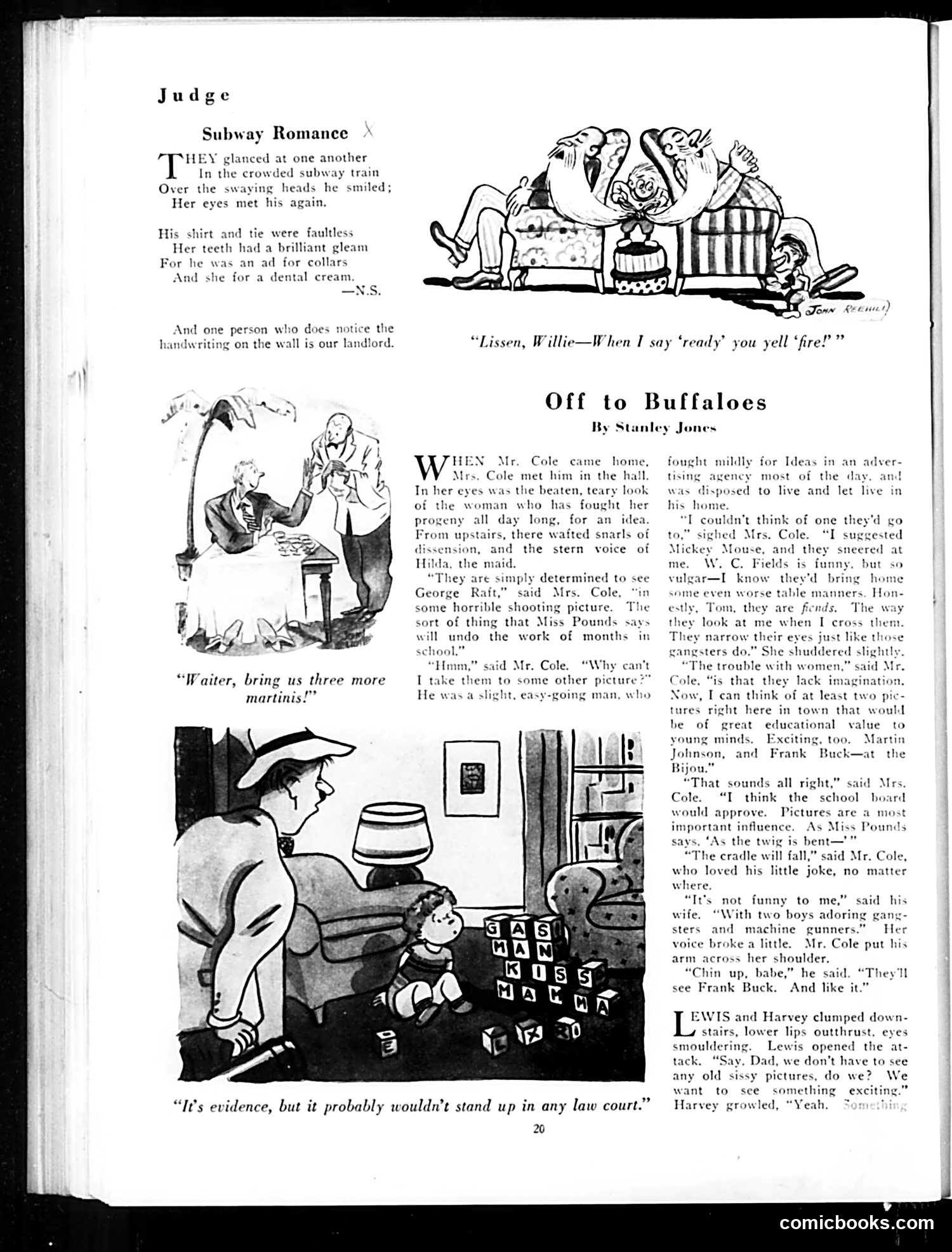
"Subway Romance" and "Off to Buffaloes" "Subway Romance" (top): A brief satirical poem mocking urban courtship. Two strangers exchange glances on a crowded subway train. The joke plays on superficial attraction—he notices her dental aesthetics; she notices his grooming—while a landlord observes graffiti on the wall, representing society's underclass. The humor targets both romantic idealization and class consciousness in modern city life. "Off to Buffaloes" (main story with illustrations): Mr. and Mrs. Cole debate taking their sons to see Wild West pictures versus educational alternatives. The father defends exciting entertainment (mentioning "Frank Buck" and gangster content), while the mother worries about negative influences on young minds. The story satirizes parental anxieties about mass media's moral effects on children—a persistent debate in the 1920s-30s about cinema's social impact.
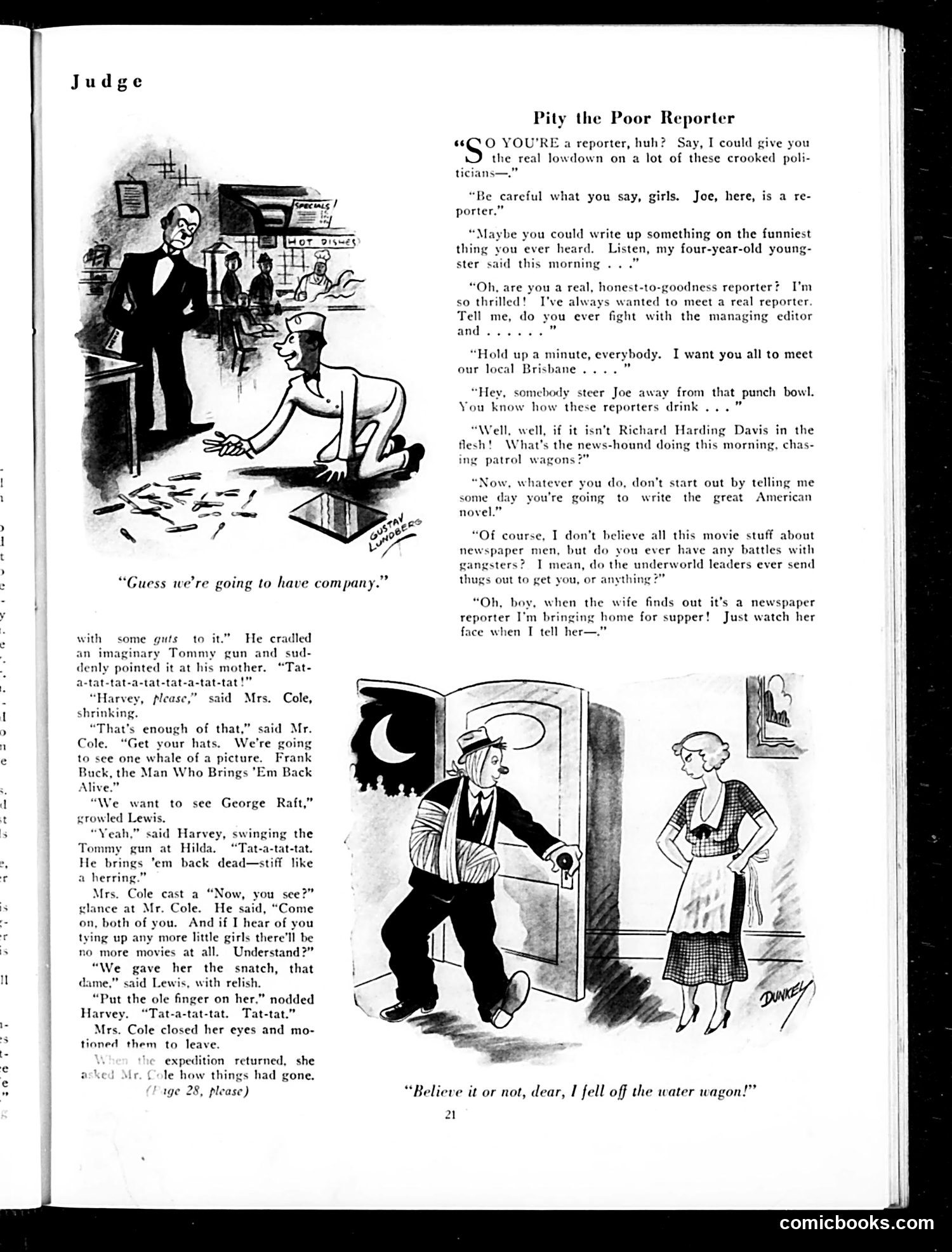
Pity the Poor Reporter This satirical piece mocks how ordinary people treat reporters. The humor stems from the gap between how reporters are portrayed in popular culture versus reality. The cartoon shows a judge (authority figure) warning a reporter about indiscreet comments. The accompanying dialogue illustrates clichéd reactions: people assume reporters are glamorous adventurers who fight gangsters and manage editors (likely referencing sensationalized newspaper fiction). Characters make tired jokes about reporters' drinking habits and ask them to write "the great American novel." The satire targets two audiences: it mocks the public's romantic misconceptions about journalism (influenced by movies and pulp fiction), and it subtly criticizes reporters for playing into this image. References to "Brisbane" and "Richard Harding Davis" suggest famous journalists known for dramatic storytelling. The bottom dialogue about the wife's reaction and "falling off the water wagon" (drinking) reinforces period stereotypes about reporters as hard-drinking, unreliable characters—suggesting the profession's actual reputation contradicted the public's idealized view.
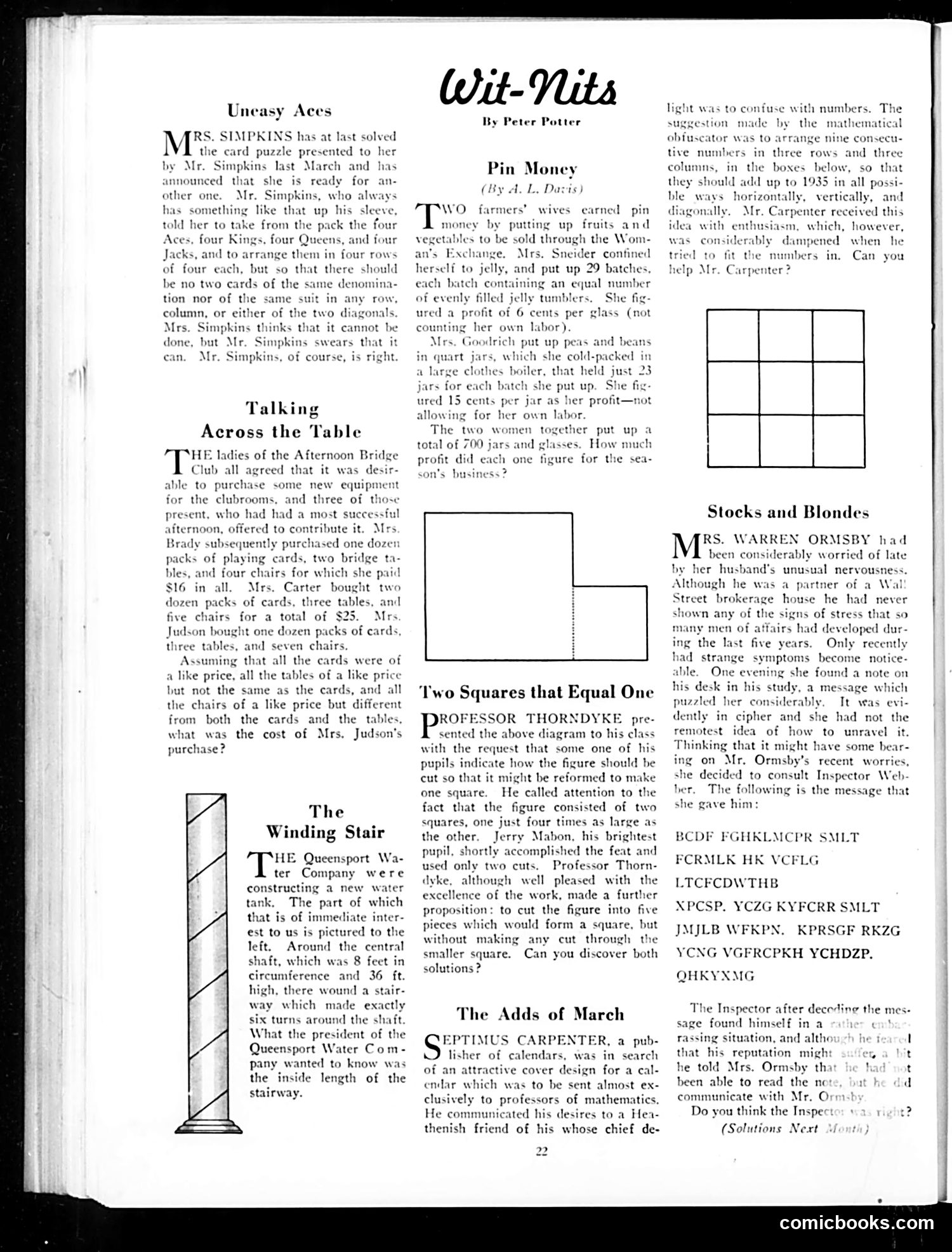
"Wit-Nits" Page Analysis This page from Judge magazine presents a collection of mathematical puzzles and domestic humor pieces rather than political satire. The content includes: "Pin Money" — A practical arithmetic problem about two farmers' wives preserving fruits and vegetables for sale, calculating their profits. This reflects early 20th-century domestic economy where women earned household income through food preservation. "Talking Across the Table" — A bridge club economics puzzle involving card game equipment purchases, reflecting the popularity of bridge among middle-class women. "The Winding Stair" — A geometry problem about calculating stairway length around a water tank. "Two Squares that Equal One" — A geometric dissection puzzle for mathematics students. "The Adds of March" — References a calendar publisher seeking an attractive design for mathematics professors, featuring an encoded message in cipher. These pieces appeal to Judge's educated, numerically-inclined readership rather than delivering social or political commentary. The humor derives from mathematical challenges and genteel domestic scenarios of the era.
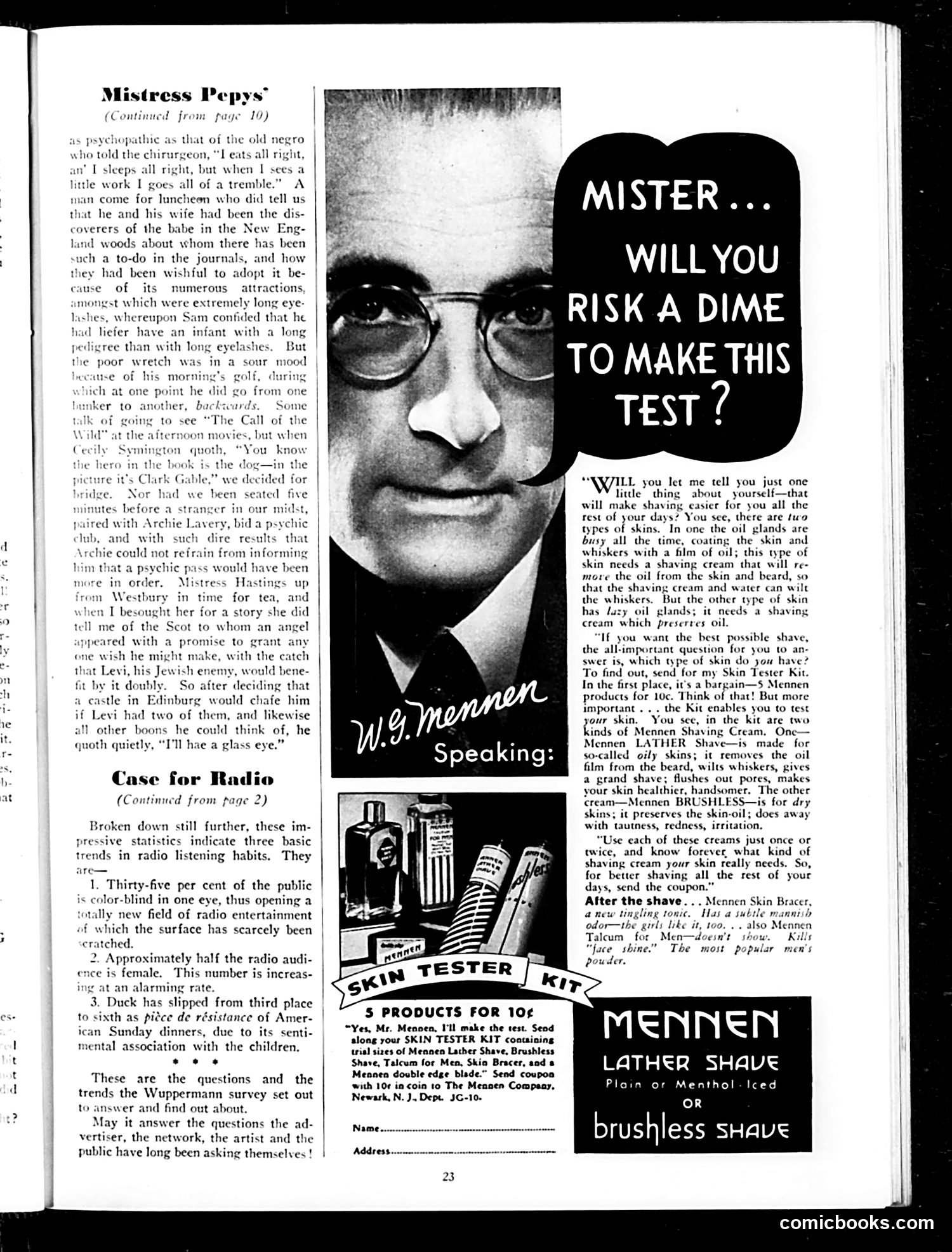
Analysis of This Judge Magazine Page This page contains an advertisement for Mennen shaving products disguised as editorial content—a common advertising technique in early 20th-century magazines. The "Advertisement" Section: W.S. Mennen (likely the company founder or spokesperson) appears in a photo offering a "Skin Tester Kit" for 10 cents. The pitch identifies two skin types—oily and dry—and claims the kit enables readers to determine which they have, allowing them to select the appropriate Mennen shaving cream: "Lather Shave" (for oily skin) or "Brushless Shave" (for dry skin). The Satire: The headline's question—"WILL YOU RISK A DIME?"—is humorous overstatement; the "risk" is minimal. The advertisement represents the era's emerging consumer marketing strategy: targeting men's insecurities about appearance and grooming while offering "scientific" self-diagnosis through a product test. Context: This reflects 1930s-40s marketing that positioned grooming products as solutions to personal problems, appealing to male vanity while maintaining a reassuringly practical tone.
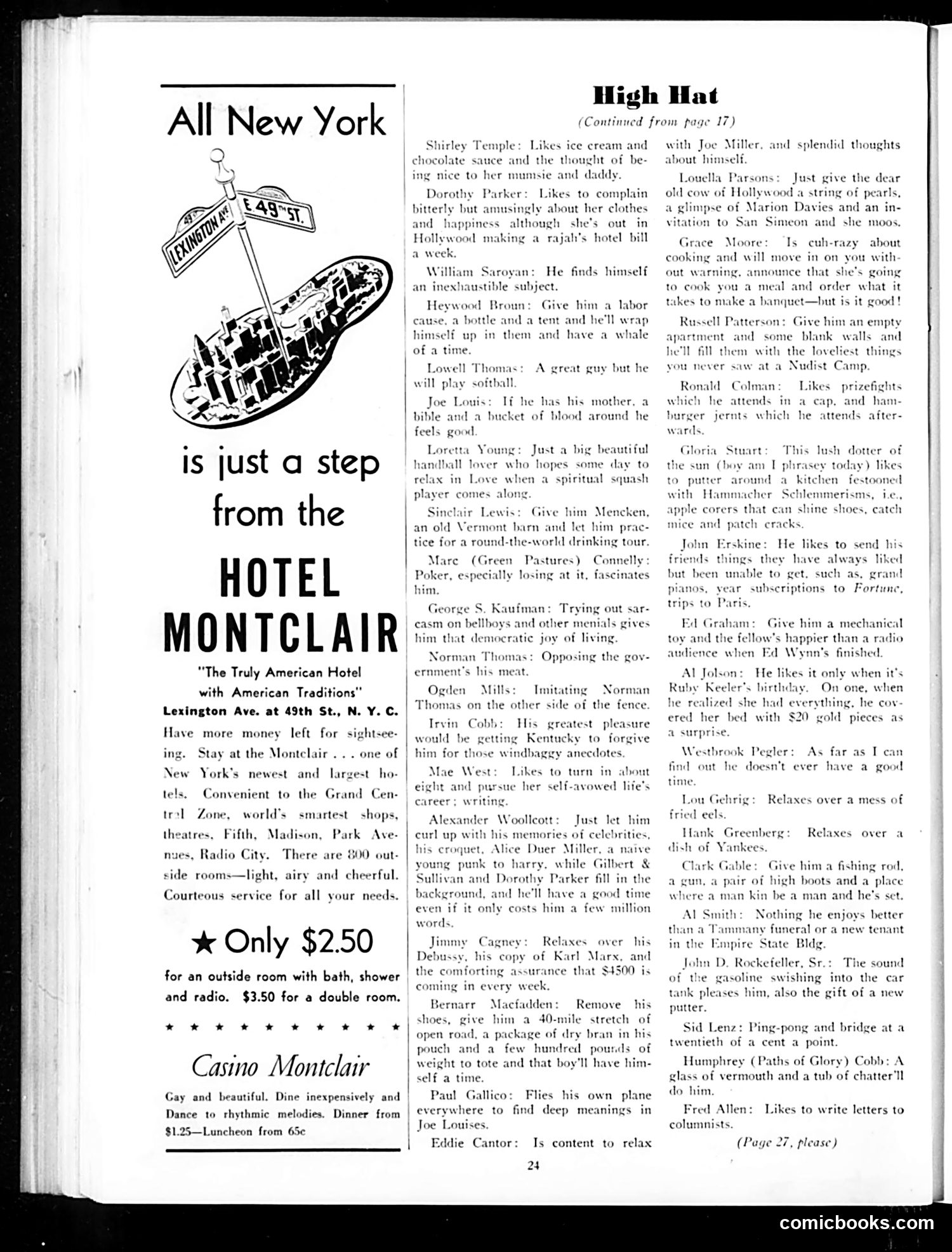
Analysis for Modern Readers This page is primarily advertising for the Hotel Montclair (with a Casino), featuring a stylized cartoon of Manhattan's skyline and street grid. The hotel ad emphasizes affordability ($2.50 for rooms) and proximity to attractions like Radio City and Grand Central. The right column contains a gossip-style feature called "High Hat" (continued from page 17), offering satirical one-liners about famous 1930s celebrities and public figures—including Dorothy Parker, Mae West, George S. Kaufman, and others. Each entry humorously summarizes what would make that person happy (e.g., "Mae West: Likes to turn in about eight and pursue her self-avowed life's career"). The satire: The humor relies on readers' familiarity with these celebrities' public personas and reputations. It's gentle mockery—caricaturing their known habits, interests, or vanities rather than attacking them. The piece reflects *Judge* magazine's audience: educated New Yorkers who followed entertainment gossip and celebrity culture. No complex political commentary appears here; it's primarily social satire targeting high society and show business.
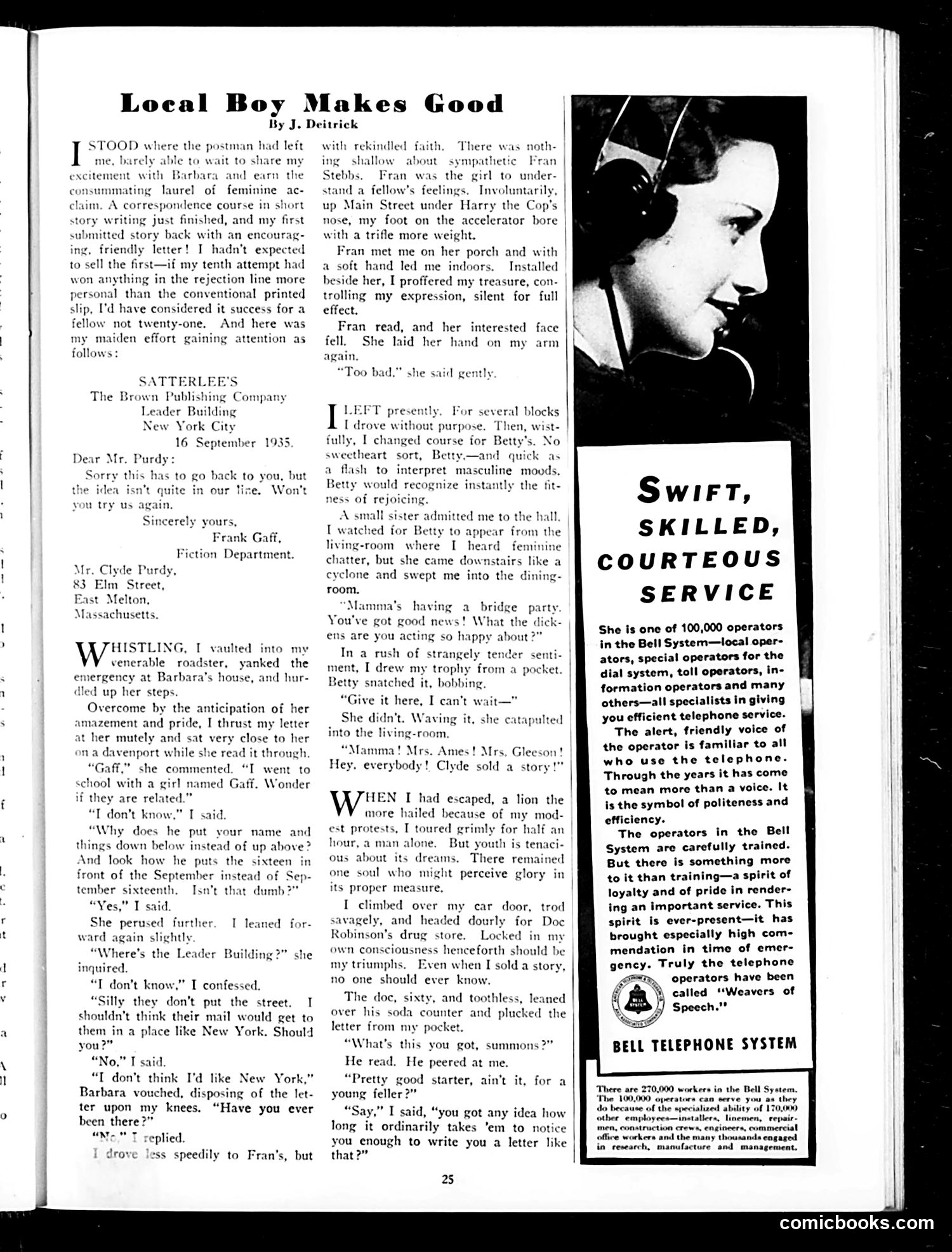
"Local Boy Makes Good" - Judge Magazine Story This is a short fiction piece, not a political cartoon. The story follows a young writer named Clyde Purdy who receives his first acceptance letter from a publisher. The Plot's Social Commentary: The satire lies in Purdy's emotional journey. After receiving validation from the publishing company, he eagerly shares the news with three women in his life—Barbara (apparently a romantic interest), Fran (a sympathetic friend), and Betty (an excitable acquaintance). Each reacts differently: Barbara finds fault with the letter's formatting, Fran expresses gentle disappointment, and Betty loudly announces his success to her mother's bridge party. The Point: The story satirizes how validation-seeking can be undermined by others' indifference or thoughtlessness. Purdy's initial pride crumbles through casual criticism and unwanted public attention, ending with him resolving to keep future successes secret. The accompanying Bell Telephone System advertisement highlights female operators' professionalism—an ironic juxtaposition with the story's themes about communication and human connection.
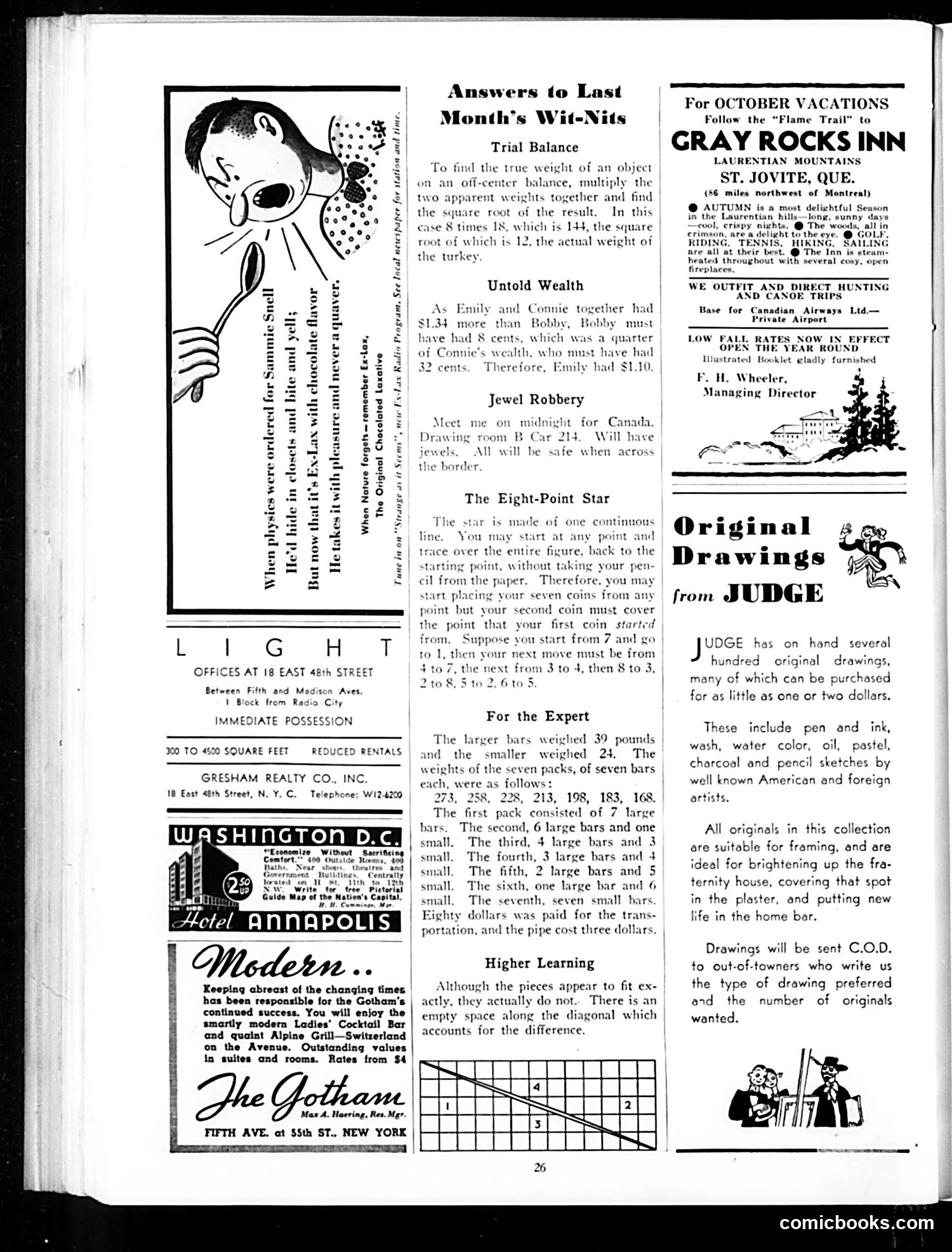
Judge Magazine Page Analysis This page is primarily advertisements and puzzle solutions, not editorial satire. The layout includes: Left column: Real estate and hotel ads (Gresham Realty, Hotel Annapolis, The Gotham) Center: Solutions to previous month's reader puzzles ("Wit-Nits")—mathematical and logic problems involving trial balance, coin placement, and weight calculations. These were popular puzzle features in 1920s-30s magazines. Right column: Tourism and merchandise advertising (Gray Rocks Inn in Quebec, Judge's original drawings for sale) The small cartoon illustration (top left) appears to be decorative—a whimsical figure—but lacks clear political or satirical content visible in this reproduction. This is a typical magazine interior page from Judge's later period, when it balanced humor content with substantial advertising revenue. There is no identifiable political commentary or satire to explain for modern readers on this particular page.
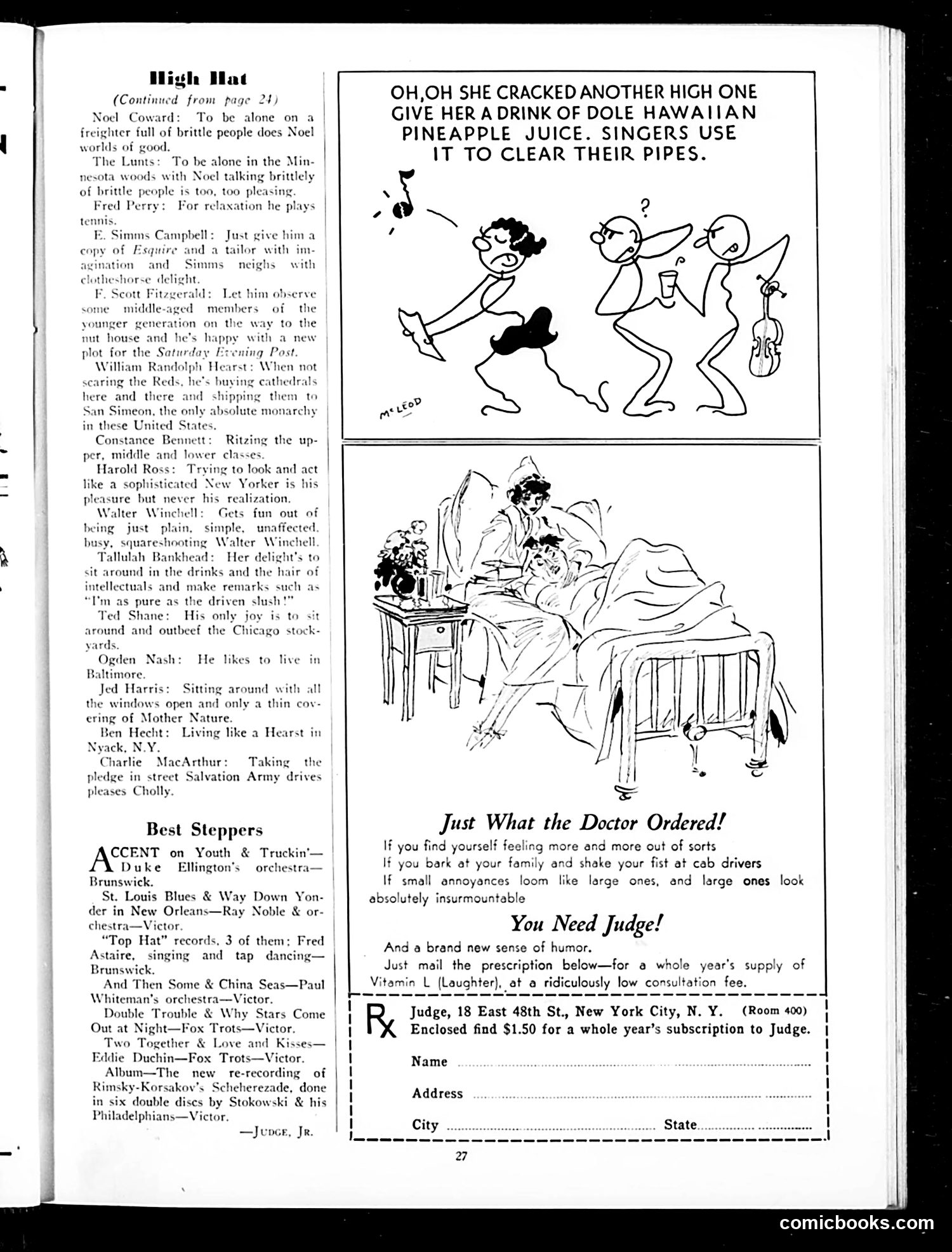
Judge Magazine Page Analysis This page from *Judge* magazine combines celebrity gossip with advertising and humor. "High Hat" Section (left): A satirical column mocking famous entertainers' leisure activities and personalities—Noel Coward's brittleness, Fred Perry's tennis obsession, Tallulah Bankhead's affected sophistication, and others. The humor relies on readers' familiarity with 1930s celebrities and their public personas. Top Cartoon: A crude gag about female singers using Dole Hawaiian pineapple juice to "clear their pipes"—a double entendre playing on both vocal health and prohibition-era drinking. The cartoon objectifies women performers. Bottom Cartoon: Labeled "Just What the Doctor Ordered," it advertises *Judge* magazine itself as a humorous cure for modern irritability and stress—a self-promotional pitch disguised as medical advice, offering "Vitamin L (Laughter)" for $1.50 annually. "Best Steppers" Section: Lists popular dance records and orchestras of the era (Duke Ellington, Fred Astaire), reflecting the magazine's entertainment focus during the swing music era. The page exemplifies 1930s satirical magazine content: celebrity mockery, musical trends, and self-promotion through humor.
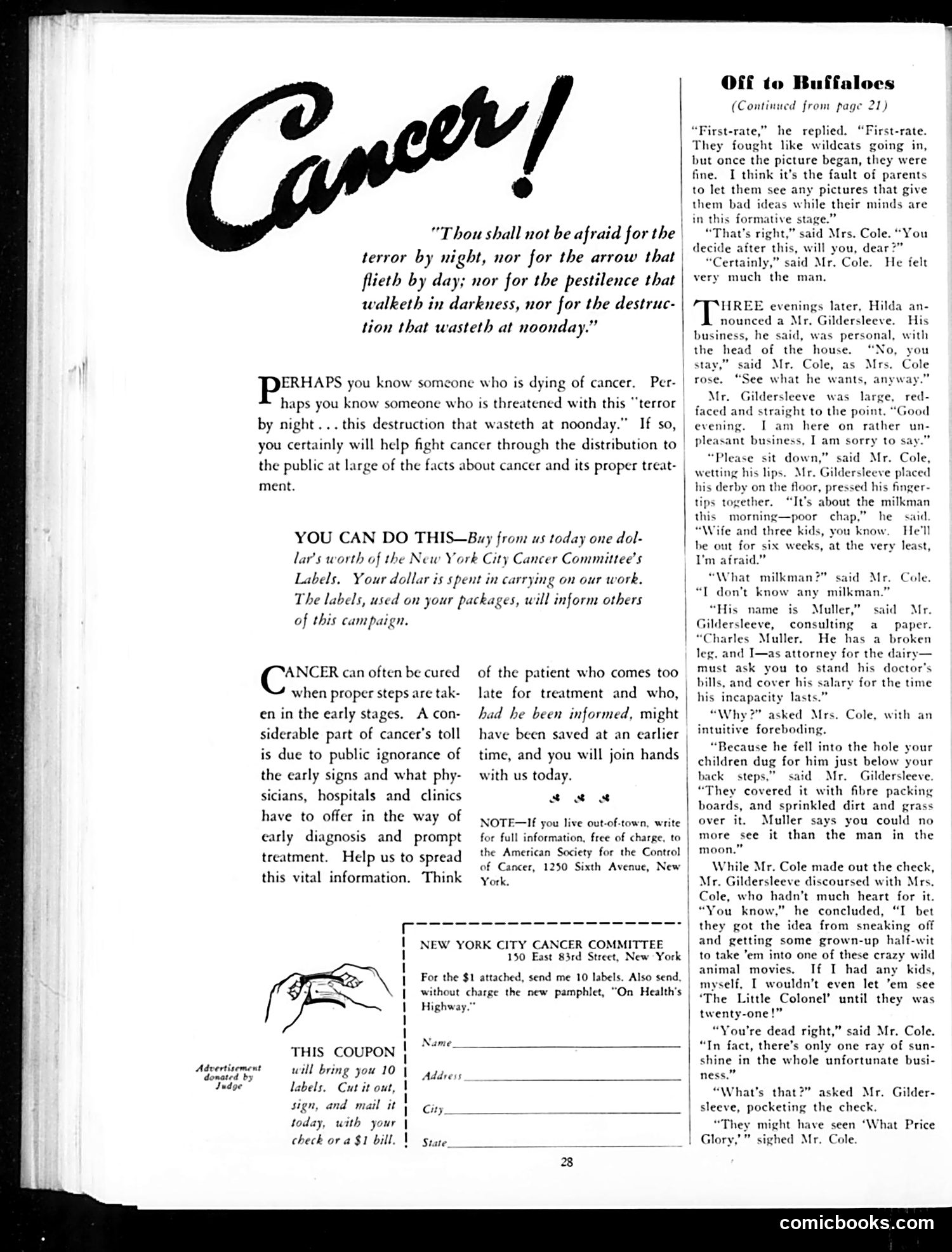
Analysis for Modern Readers This Judge magazine page contains two distinct elements: a public service advertisement for cancer awareness and a satirical narrative about consequences and responsibility. The Cancer Ad: The New York City Cancer Committee appeals for $1 donations to fund educational labels about early cancer detection. It frames cancer as preventable through public information—a progressive medical message for the era. The Satirical Story ("Off to Buffaloes"): The narrative mocks Mr. Cole's self-righteous moralizing. He lectures Mrs. Cole about protecting children's minds from "bad" movies, yet his own children negligently dig an unmarked pit that injures the family's milkman. When a lawyer arrives demanding compensation, Cole must pay—his hypocrisy exposed. The satire suggests that moral lecturing about others' behavior rings hollow when one's own carelessness causes real harm. The juxtaposition critiques sanctimonious parenting and social posturing.
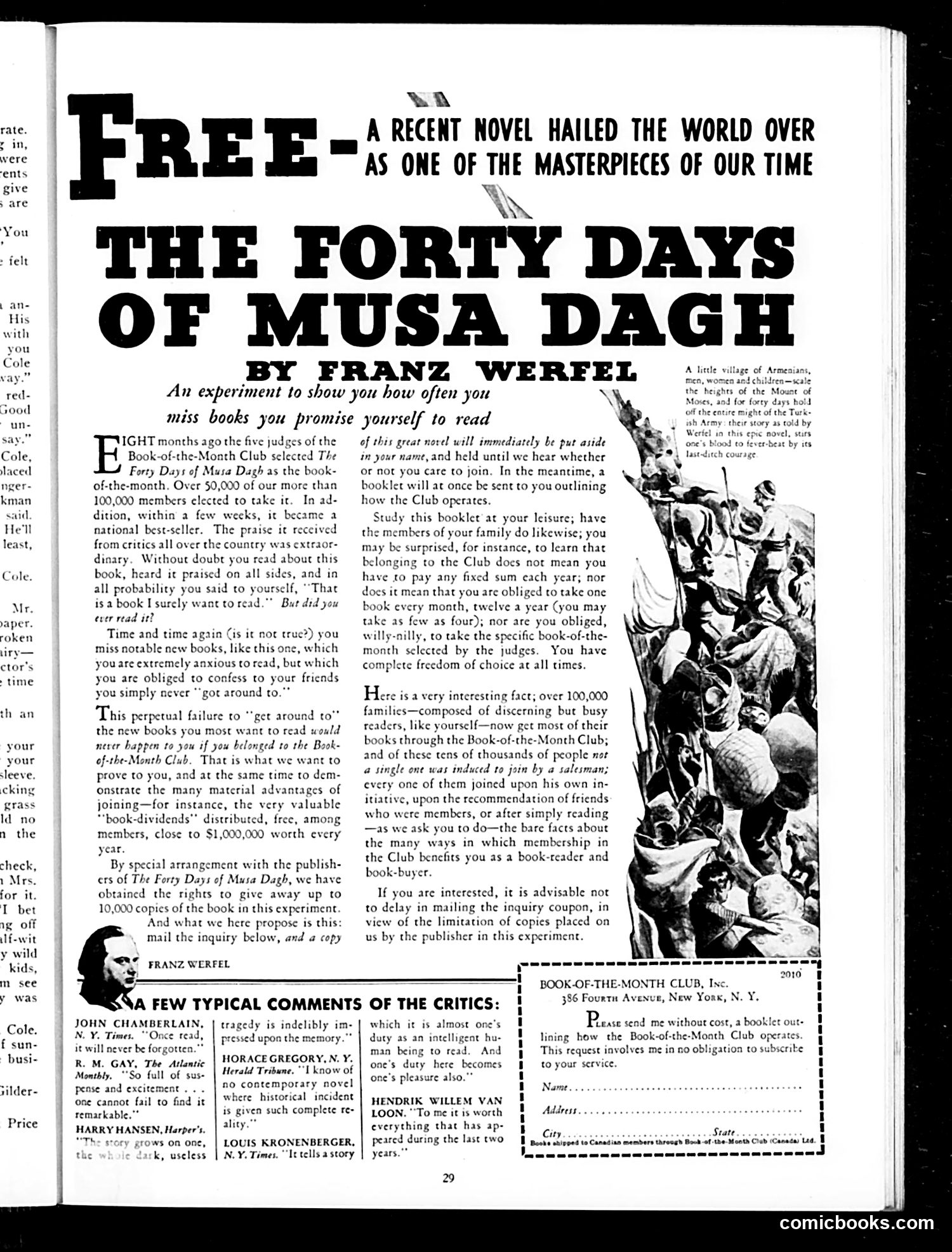
Analysis of Judge Magazine Page This is primarily advertising, not satire or political commentary. The page promotes the Book-of-the-Month Club's free distribution of Franz Werfel's *The Forty Days of Musa Dagh*, a novel about Armenian resistance during the Turkish genocide. The illustrated figure on the right appears to be a soldier or resistance fighter from the novel's subject matter—depicting the historical Armenian struggle referenced in Werfel's work. The "experiment" described uses psychology on readers: the Club acknowledges people habitually fail to read books they promise themselves to finish, then positions membership as a solution. Critical blurbs from reviewers like John Chamberlain and Louis Kronenberger provide credibility. The satire, if present, is subtle and self-directed: the Club essentially admits its own members' weakness while selling the cure. For modern readers, the most historically significant element is that this 1935 advertisement promotes a novel addressing the Armenian Genocide—an atrocity many contemporaries ignored or denied.
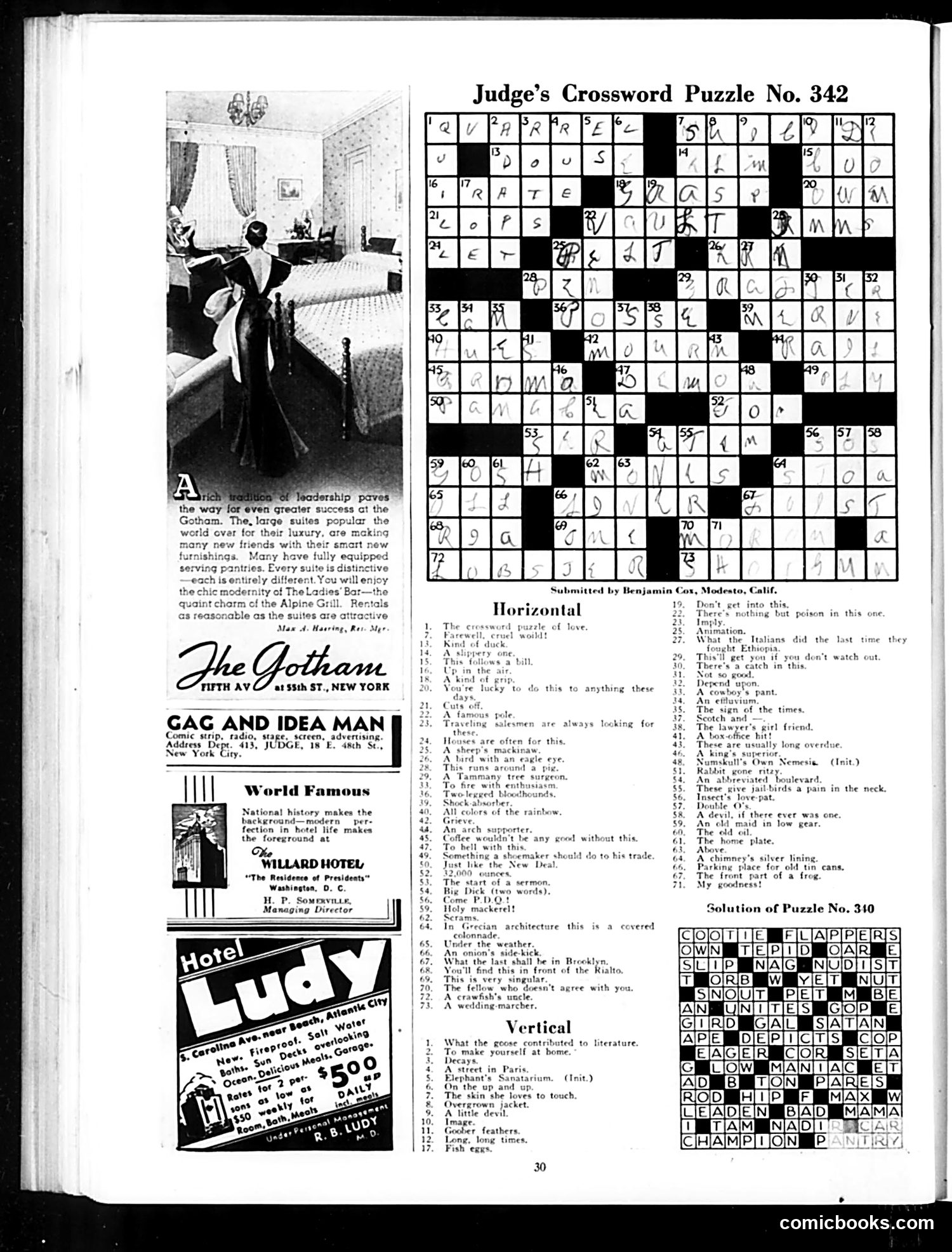
Judge Magazine Page Analysis This page is primarily advertising and puzzle content rather than political satire. It features: Main Content: - Judge's Crossword Puzzle No. 342 with clues (horizontal and vertical) - Solution to the previous puzzle (No. 340) - A bedroom illustration at top left (appears to accompany an article about "The Ladies' Bar") Advertisements: - "The Gotham" hotel in Fifth Avenue, New York - "Gag and Idea Man" - a services listing for comic strip and advertising writers - "The Willard Hotel" in Washington D.C. - "Hotel Ludy" in Atlantic City The page reflects 1930s-era leisure culture and hospitality marketing. There is no identifiable political cartoon or social satire visible—it's a standard magazine interior page mixing puzzles, hotel advertisements, and business listings typical of the period.
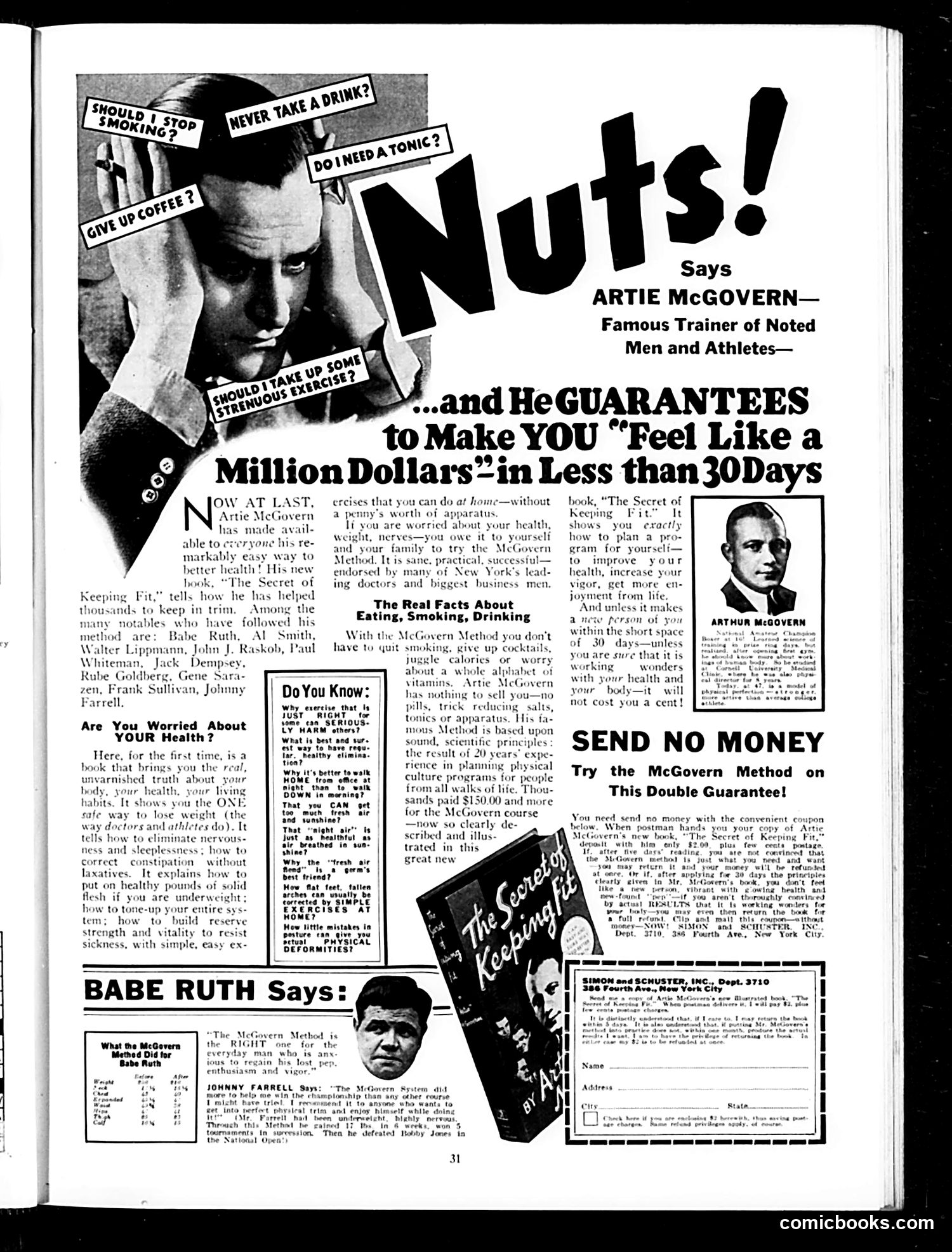
"The Secret of Keeping Fit" Advertisement Analysis This page is primarily a health/fitness advertisement, not satire. It promotes Arthur McGovern's book and training method, endorsed by celebrity testimonials. Key figures shown: - Artie McGovern: A famous physical trainer claiming to help prominent men achieve better health - Babe Ruth: Baseball legend pictured endorsing the method - Johnny Farrell: Golfer providing a testimonial about improved athletic performance The pitch: McGovern promises readers will "feel like a million dollars in less than 30 days" through his exercise system—no dieting, no quitting smoking/drinking required. He claims to have trained New York's leading doctors and businessmen. Social context: This reflects 1920s-30s confidence in self-improvement through fitness and celebrity endorsement marketing. The "no money" guarantee and mail-order coupon represent direct-response advertising common to the era. What's notable today: The casual attitude toward smoking and drinking, combined with promises of dramatic health transformation, would violate modern advertising standards.
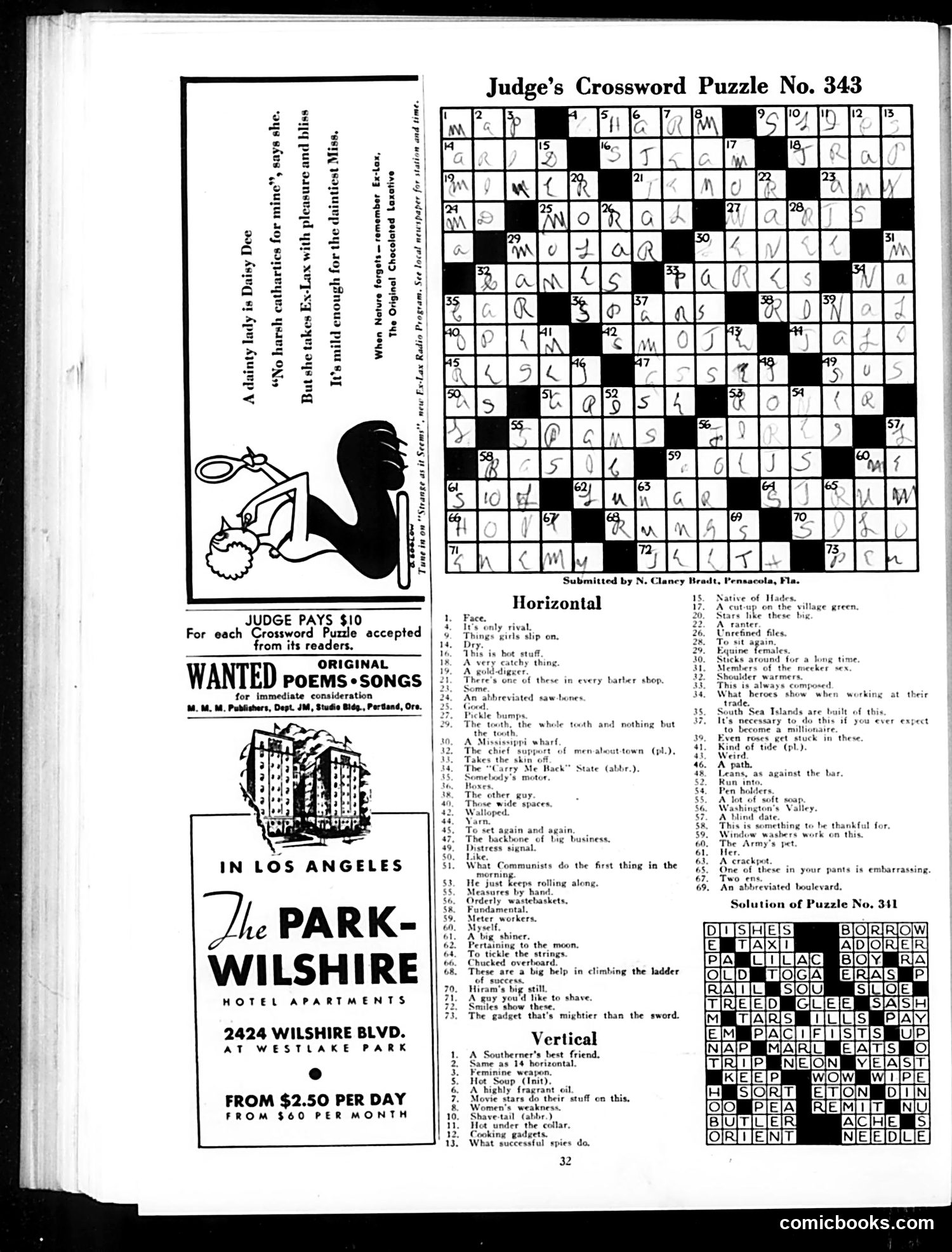
Judge Magazine Page Analysis This page is primarily advertising and puzzle content rather than political satire. The main elements are: Ex-Lax Advertisement: Features a cartoon of a refined woman ("Daisy Dee") promoting Ex-Lax laxative chocolate. The humor relies on the genteel presentation of a delicate product—the ad emphasizes its mild, pleasant nature ("dainty lady," "pleasure and bliss") to market a digestive aid. This reflects early 20th-century advertising's approach to previously taboo bodily functions through euphemism and femininity. Crossword Puzzle: Judge's puzzle competition offering $10 per accepted puzzle—typical of the magazine's reader-engagement strategy. Hotel Advertisement: Standard commercial real estate ad for the Park-Wilshire apartments in Los Angeles. The page demonstrates how Judge combined satirical commentary with mainstream advertising and entertainment, reflecting the magazine's hybrid nature as both humor publication and commercial vehicle.
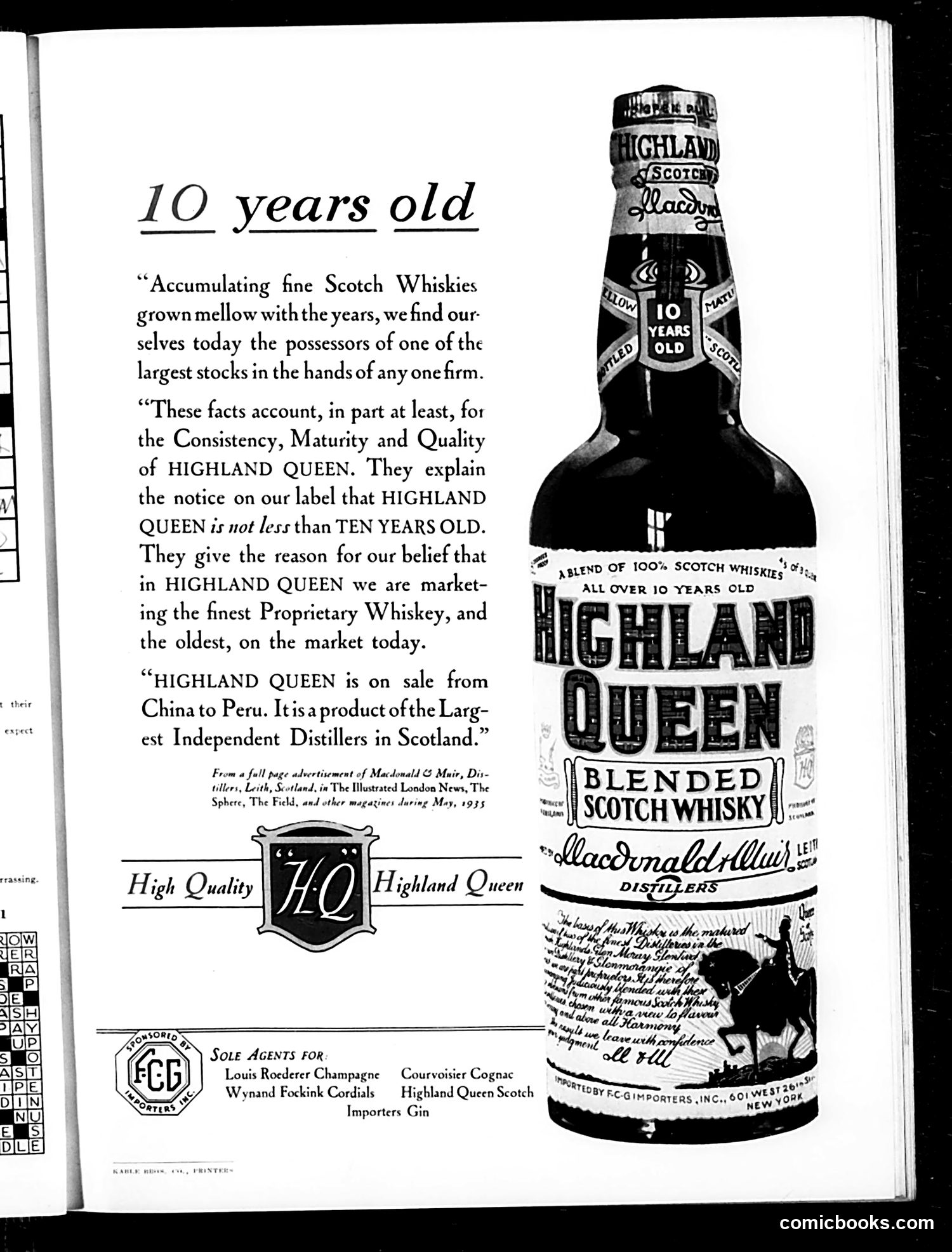
Highland Queen Scotch Whisky Advertisement This is primarily a product advertisement, not political satire. It appears in *Judge*, a satirical magazine, but functions as a paid advertisement for Highland Queen Scotch Whisky. The ad emphasizes the whisky's age (10 years minimum) and quality through claims of "Consistency, Maturity and Quality." It highlights the distiller's large stock as proof of product superiority and boasts global distribution "from China to Peru." The accompanying bottle illustration shows the product label prominently. The text notes Highland Queen is "a product of the Largest Independent Distillers in Scotland"—likely emphasizing Scottish authenticity during Prohibition's aftermath when Scotch imports were valuable. The bottom lists sole agents for various premium spirits (champagne, cognac, cordials), suggesting this advertiser represents high-end imported beverages. No political figures or satirical commentary are evident on this page.
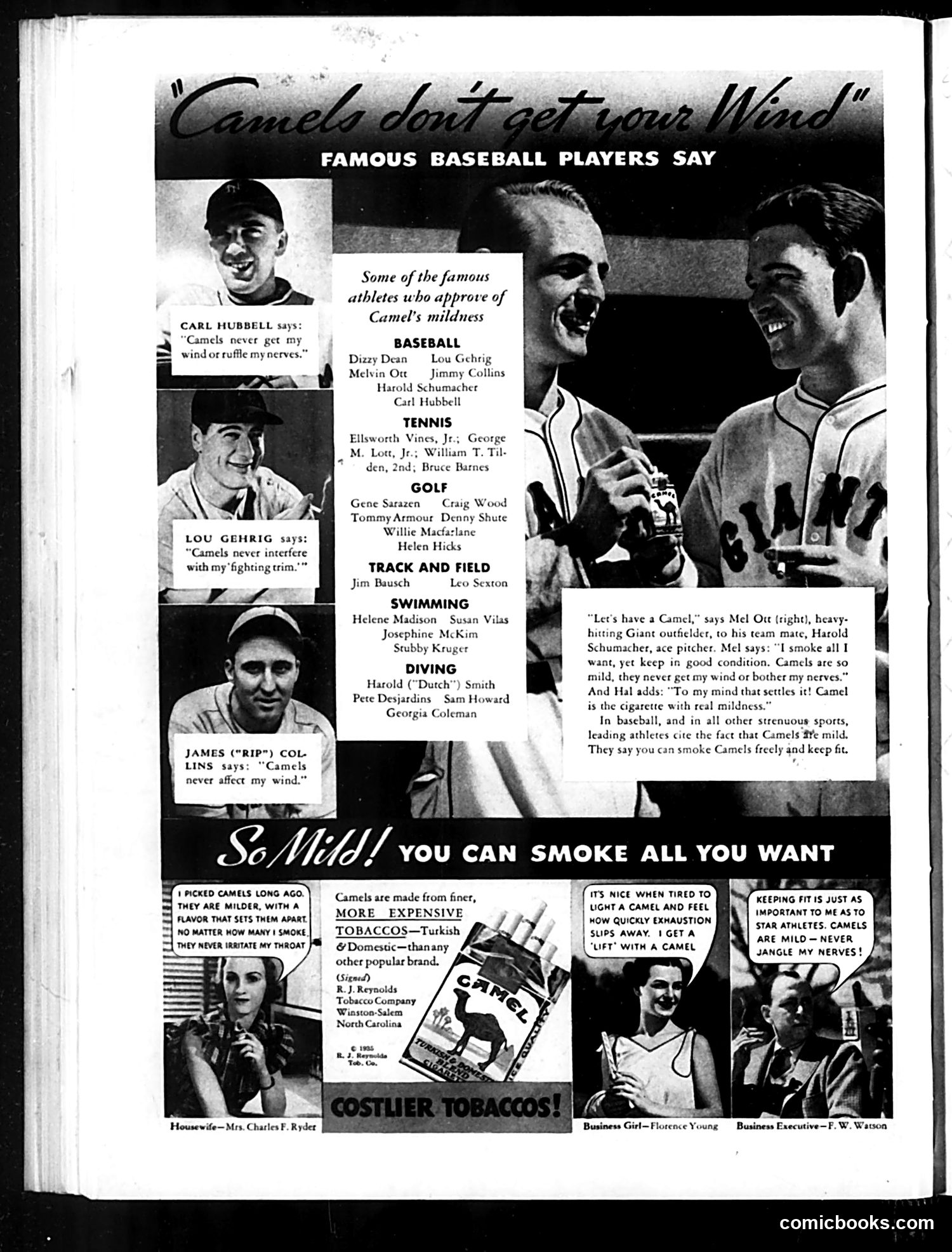
Analysis This is a cigarette advertisement masquerading as editorial content, featuring endorsements from famous 1930s athletes across multiple sports (baseball players Carl Hubbell and Lou Gehrig are prominently quoted). The advertisement's central claim is that Camel cigarettes are "mild" and won't affect athletic performance—athletes can smoke freely without harming their "wind" (lung capacity), nerves, or physical conditioning. The ad lists dozens of real athletes from baseball, tennis, golf, swimming, and diving who supposedly approve of Camels' mildness. Why this would perplex modern readers: Today we know cigarette smoking damages athletic performance and health. The ad exploits 1930s ignorance about nicotine's effects to create false credibility through celebrity endorsement. The testimonials claim smoking actually *helps* fitness and stamina—a claim that would be illegal in modern advertising. This represents pre-regulation tobacco marketing at its most deceptive, using prestigious athlete names to normalize smoking as compatible with peak physical performance.