judge
Judge — November 1935
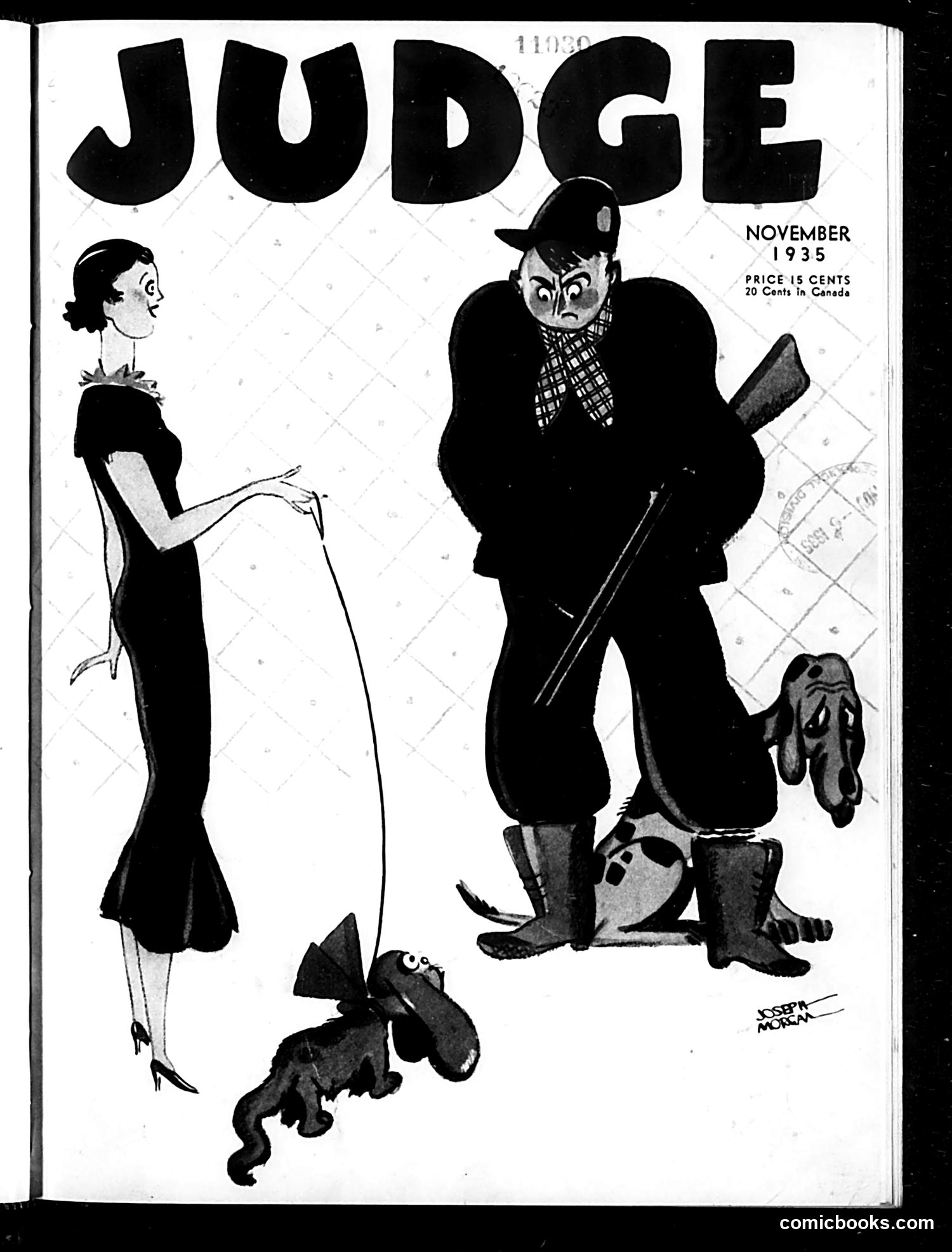
Judge Magazine Cover - November 1935 This cover depicts a satirical scene about marital conflict and domestic life during the Depression era. A woman in an elegant dress holds a leash attached to a dachshund, while an angry man in a coat and cap swings an axe or club, appearing to chase the dog away. The exaggerated, menacing expression on the man's face and his aggressive posture suggest marital discord—likely satirizing domestic disputes over trivial matters. The humor plays on the contrast between the woman's composed elegance and the man's violent reaction to the pet. This reflects 1930s anxieties about home life and gender dynamics. The dachshund serves as the comedic focal point—whether the joke concerns the dog itself or uses it as a metaphor for broader marital tensions remains the cover's satirical ambiguity.
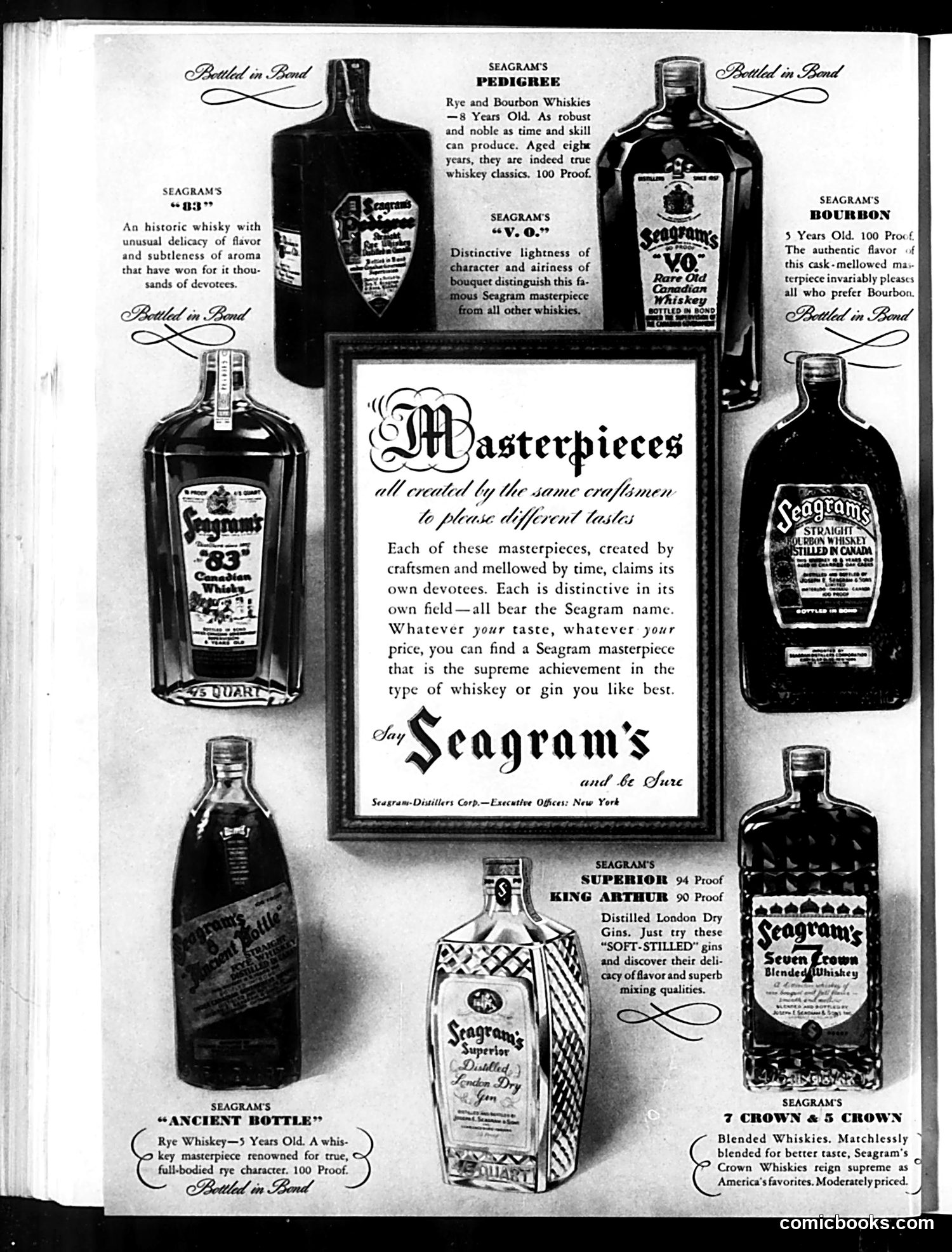
Analysis This page is not a cartoon or satirical content—it's a full-page advertisement for Seagram's whiskeys and gins, circa Prohibition era (based on "Bottled in Bond" labeling language). The ad showcases seven different Seagram's products arranged around a central text block titled "Masterpieces." Each bottle features descriptive copy about its characteristics (proof, age, taste profile). The advertisement emphasizes product variety, claiming Seagram's offers options "to please different tastes" regardless of price point or preference. There is no political satire here. This is purely commercial advertising promoting Seagram's brand dominance in the spirits market, using Victorian-style typography and professional product photography typical of 1920s-1930s magazine advertising.
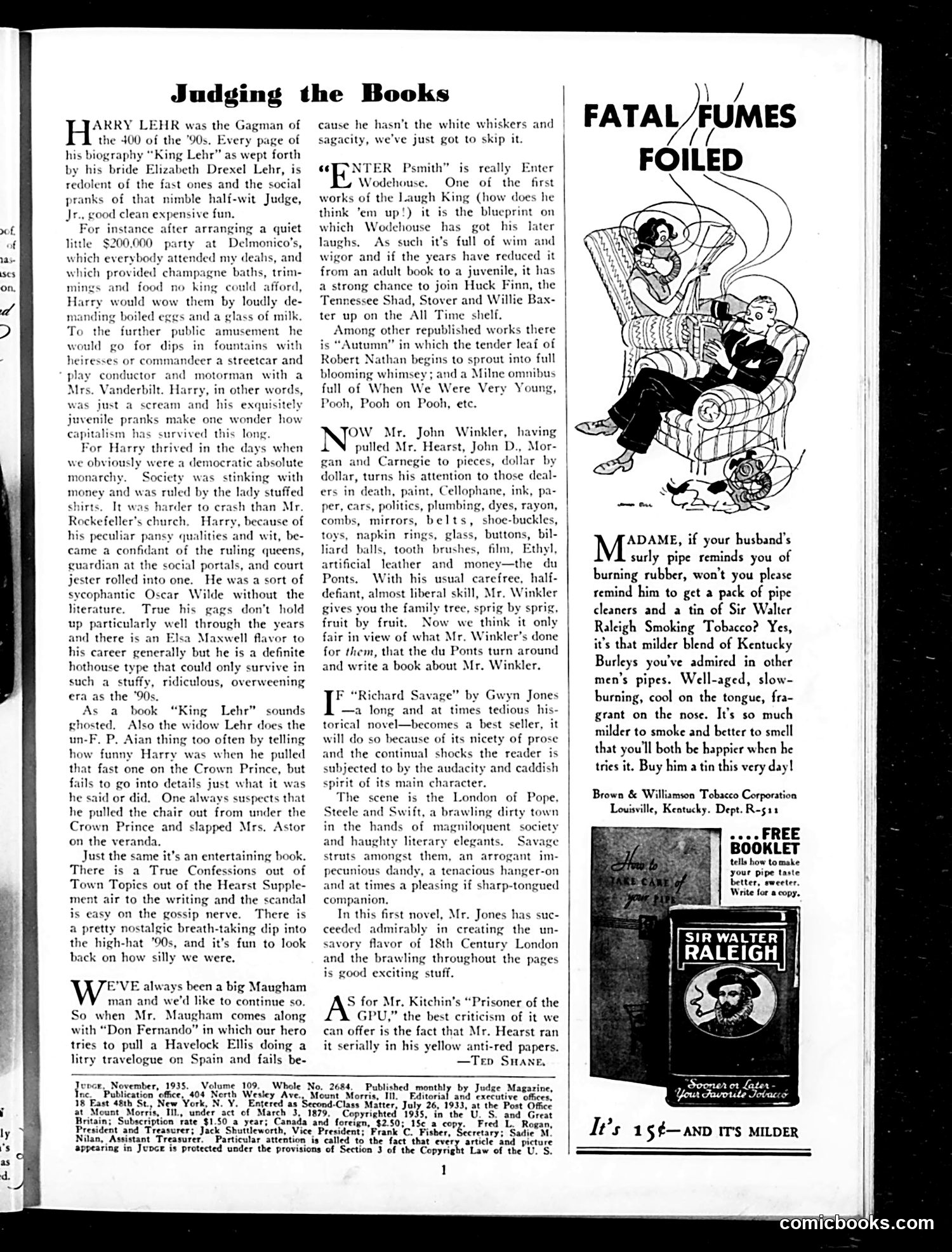
"Fatal Fumes Foiled" This cartoon satirizes concerns about indoor air quality and smoking. The illustration shows a woman and child nearly overcome by smoke billowing from a pipe, presumably the husband's. The visual pun in the title plays on "fatal fumes" being "foiled"—defeated—by the advertisement below. The page is primarily an advertisement for Sir Walter Raleigh pipe tobacco, positioned to suggest the product prevents the domestic hazard depicted above. The ad's tagline promises the tobacco is "milder" and "cool on the tongue," implying it produces less noxious smoke than other brands. This reflects 1920s-era advertising that acknowledged smoking's unpleasant effects on household members while promoting "milder" alternatives as a solution rather than questioning smoking itself.
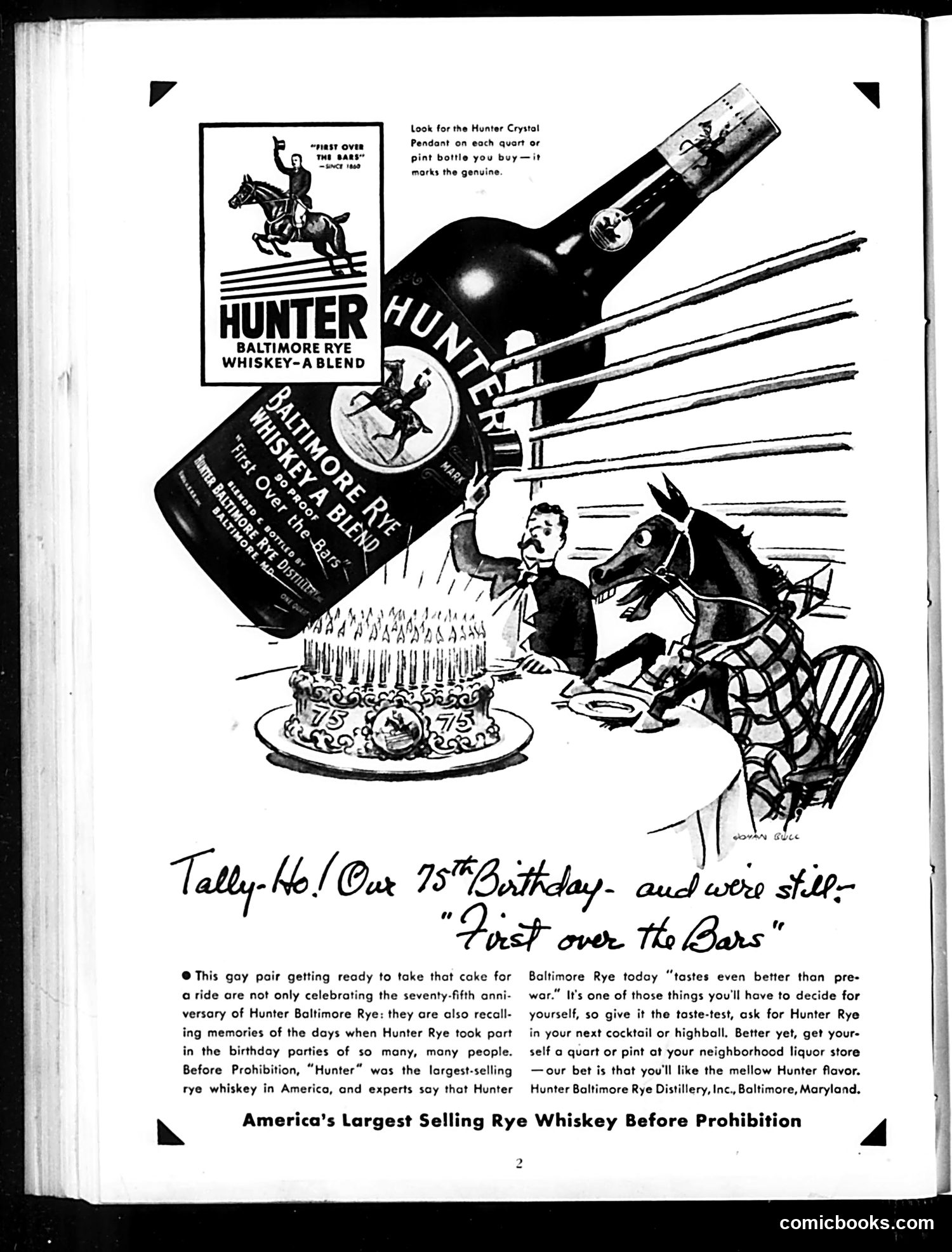
Analysis This page is primarily a whiskey advertisement for Hunter Baltimore Rye, not political satire. The cartoon depicts two men preparing to transport a large cake, with an oversized bottle of Hunter Rye looming above them. The caption reads "Tally-Ho! Our 75th Birthday and we're still 'First over the Bars.'" The humor references Hunter Rye's status as "America's Largest Selling Rye Whiskey Before Prohibition." The "first over the bars" phrase likely plays on equestrian imagery (the brand's logo features a horse and rider) while also alluding to the whiskey's popularity. The authentication note at top about the "Hunter Crystal Pendant" suggests this advertisement emphasized product authenticity during Prohibition's era, when counterfeit spirits were common concerns for consumers.
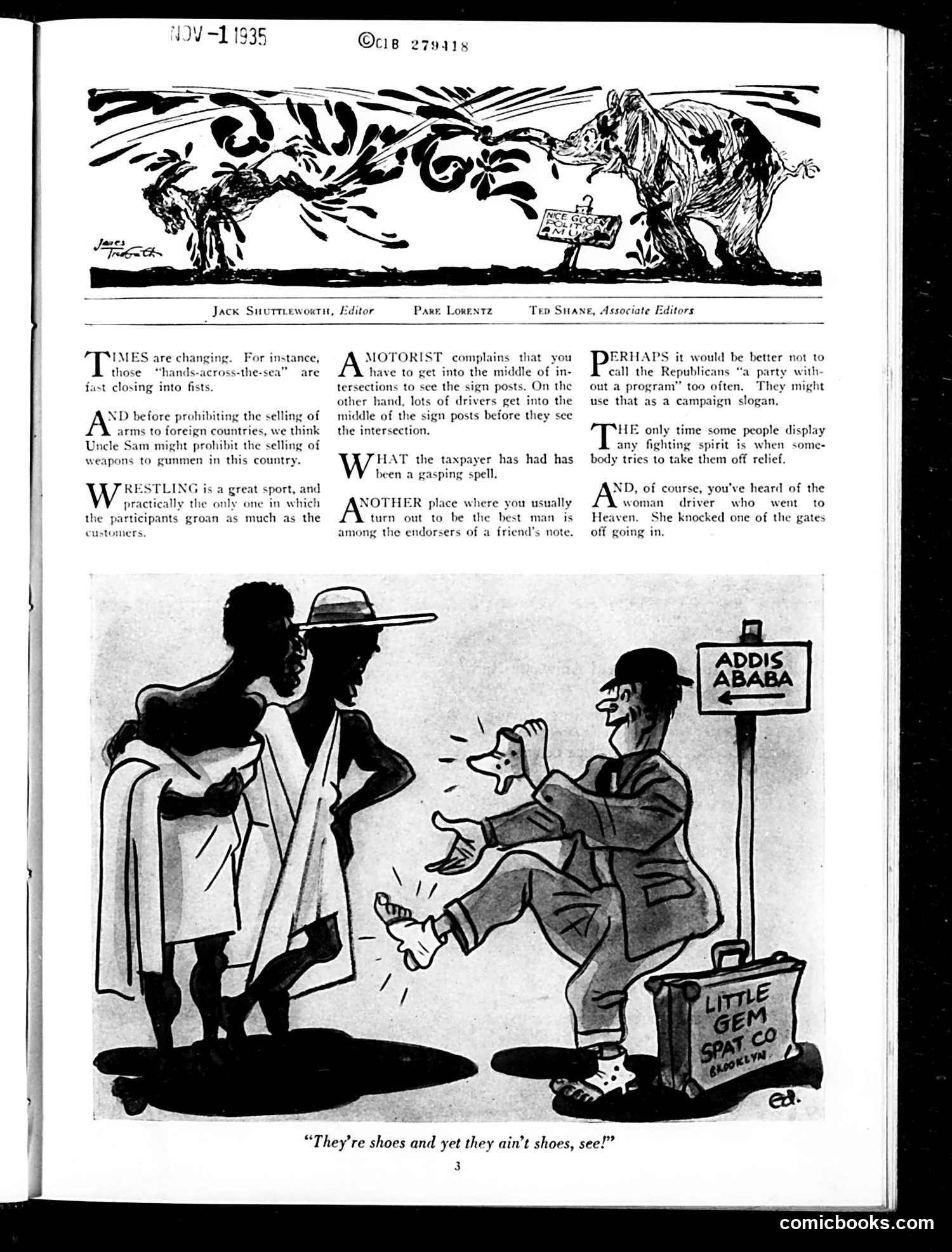
Political Cartoon Analysis (Judge Magazine, November 1, 1935) The main cartoon depicts a street vendor ("Little Gem Spot Co" from Brooklyn) selling shoes in Addis Ababa, with the caption "They're shoes and yet they ain't shoes, see!" This appears to reference Italy's 1935 invasion of Ethiopia (then called Abyssinia). The vendor's absurd logic—claiming shoes are "not shoes"—likely satirizes diplomatic doublespeak around the invasion: nations condemned Italy while continuing to trade with it, creating contradictory positions. The shoe-seller represents American hypocrisy or equivocation regarding international sanctions against fascist aggression. The surrounding editorial snippets touch on timely issues: highway safety, arms sales to foreign powers, and wrestling as American sport.
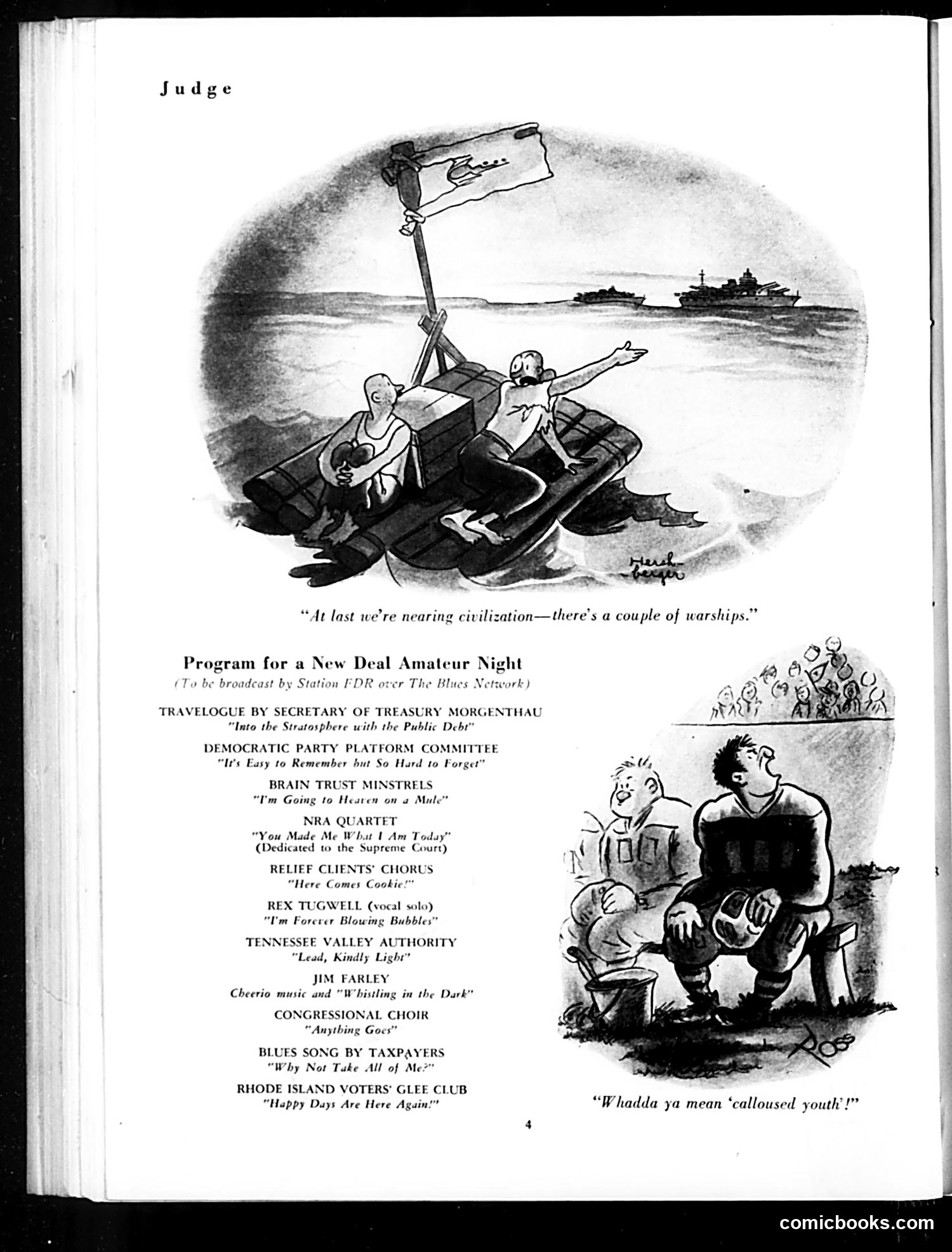
Analysis of Judge Magazine Page The top cartoon titled "Judge" depicts two figures on a raft displaying a flag, with warships visible in the background. The caption reads: "At last we're nearing civilization—there's a couple of warships." This appears to satirize American militarism and naval power as markers of "civilization," likely commenting on 1930s-40s naval expansion or war preparedness. The lower cartoon shows a man and woman in what appears to be a domestic scene, captioned "If hadda ya mean 'calloused youth'!" This seems to mock working-class speech patterns or social commentary about youth. The page primarily lists a "Program for a New Deal Amateur Night" broadcast, featuring various performers and musical acts with satirical song titles—content clearly mocking New Deal programs and Democratic politics of the Roosevelt era.
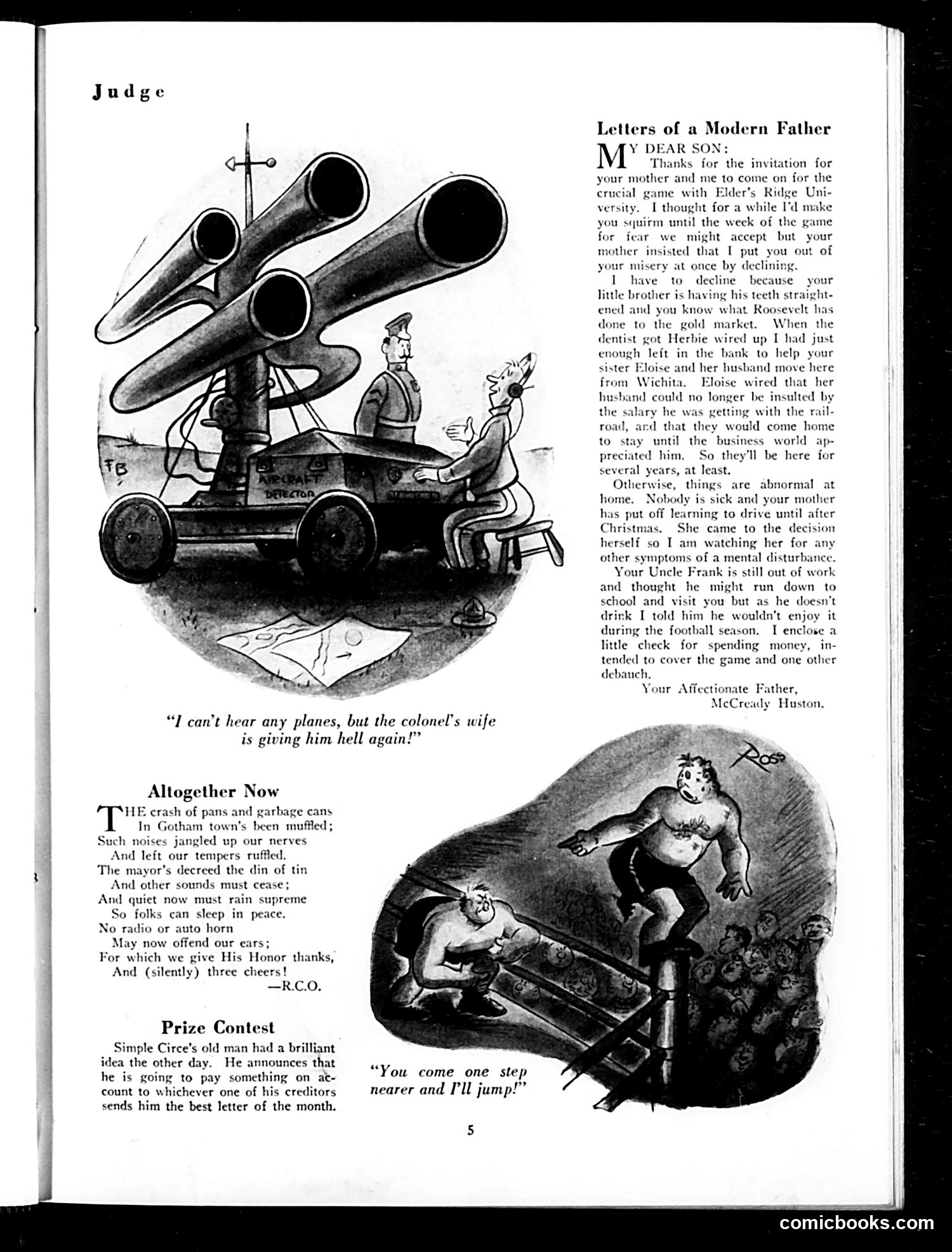
Analysis of Judge Magazine Page The top cartoon titled "Judge" depicts a military aircraft with oversized guns mounted above a car labeled "INSPECTOR," with a small civilian figure looking alarmed. The caption reads: "I can't hear any planes, but the colonel's wife is giving him hell again!" This satirizes domestic friction during what appears to be a WWI-era military inspection or exercise. The joke contrasts the potential threat of enemy aircraft with the more immediate "threat" of a colonel's nagging wife—suggesting that military men fear spousal complaints more than actual combat dangers. The page also contains "Letters of a Modern Father" and other humorous content typical of Judge magazine's satirical commentary on American domestic and social life. The publication critiqued contemporary social anxieties through domestic scenarios and military humor.
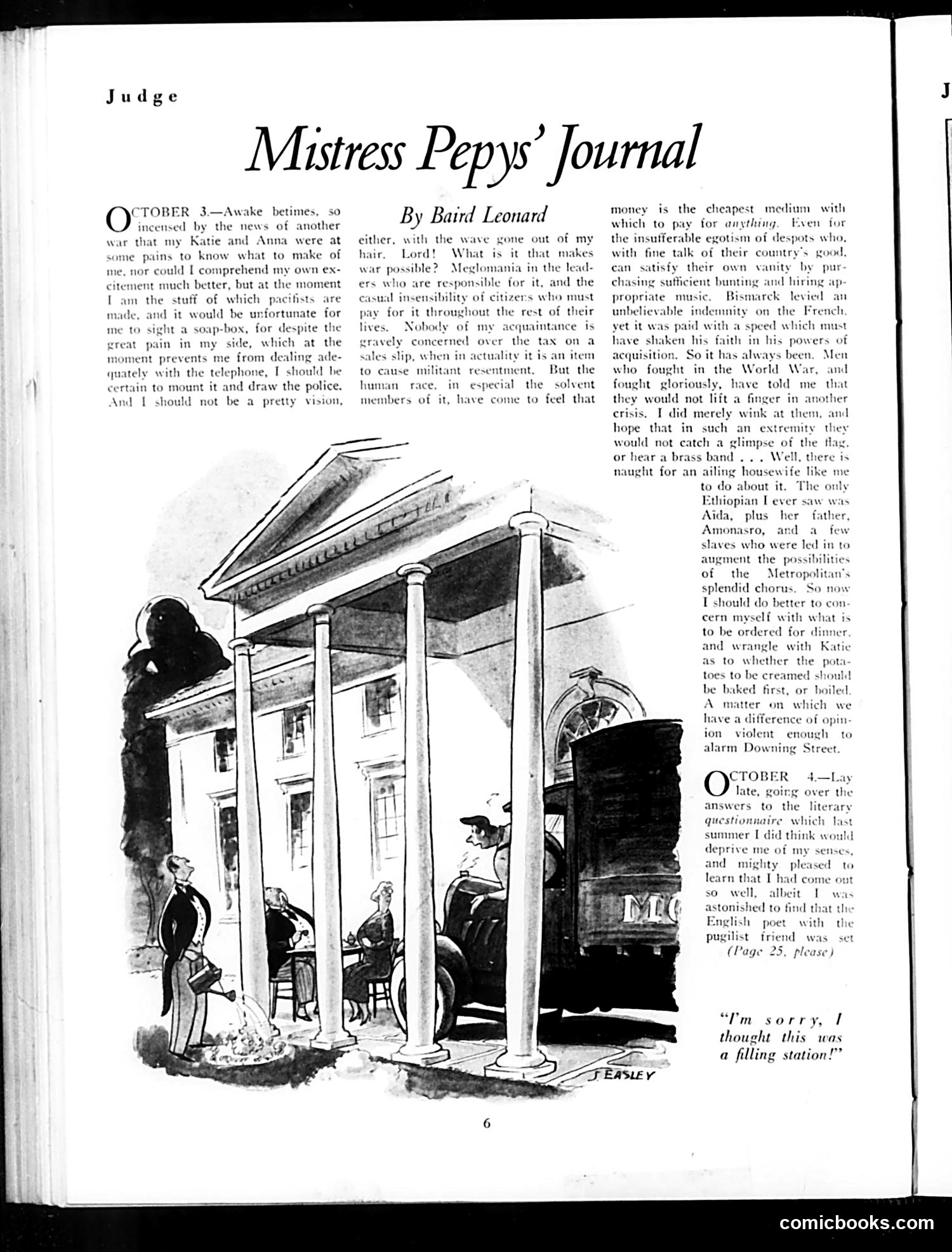
"Mistress Pepys' Journal" by Baird Leonard This is a fictional satirical column mimicking Samuel Pepys' famous 17th-century diary. The October 3rd entry humorously complains about post-WWI social problems: tax complaints on yachts causing "militant resentment," widespread strikes, and general public discontent. The writer sarcastically hopes such crises won't reach Ethiopia or disrupt the Metropolitan Opera's chorus. The accompanying cartoon depicts a car arriving at what appears to be a gas station, with the caption "I'm sorry, I thought this was a filling station!" The joke plays on 1920s labor unrest—the uniformed figures and formal setting suggest the vehicle has mistakenly pulled up to some official or governmental building instead of a commercial gas pump, satirizing the period's confusion and disruption caused by strikes and social upheaval.
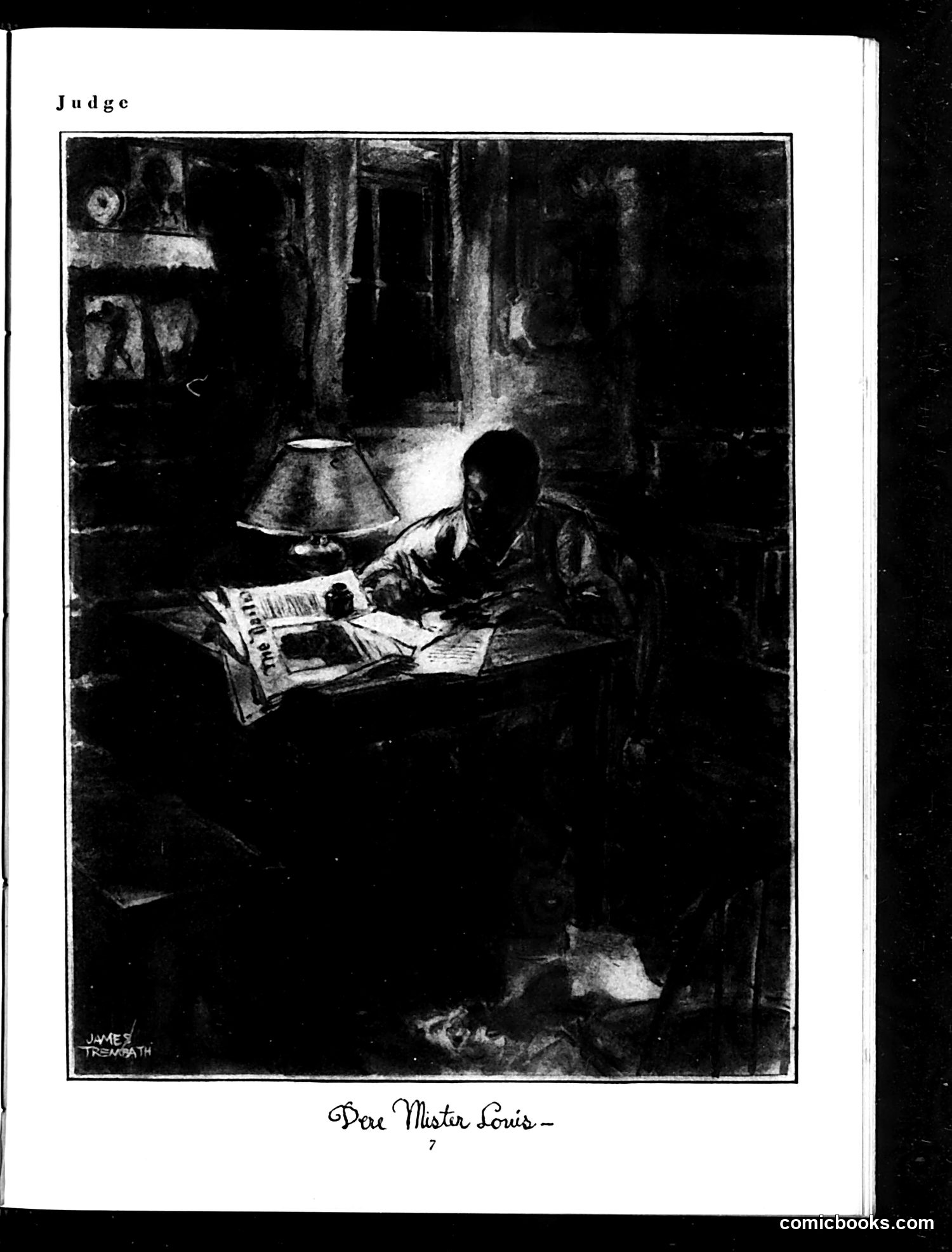
Analysis of "Judge" Page - "Dear Mister Lewis" This page contains a single illustration titled "Dear Mister Lewis," showing a figure reading newspapers by lamplight in what appears to be a modest, cluttered interior space. The cartoon likely satirizes a contemporary political or public figure named Lewis through correspondence or public commentary. The reader's focused attention on newspapers suggests the satire concerns media coverage, public opinion, or news-driven events involving this Lewis figure. Without additional context about the specific date or Lewis in question, the precise political reference remains unclear. However, the intimate domestic setting combined with newspaper reading suggests commentary on how average citizens were consuming and reacting to news about someone named Lewis—possibly a politician, businessman, or public personality of the era.
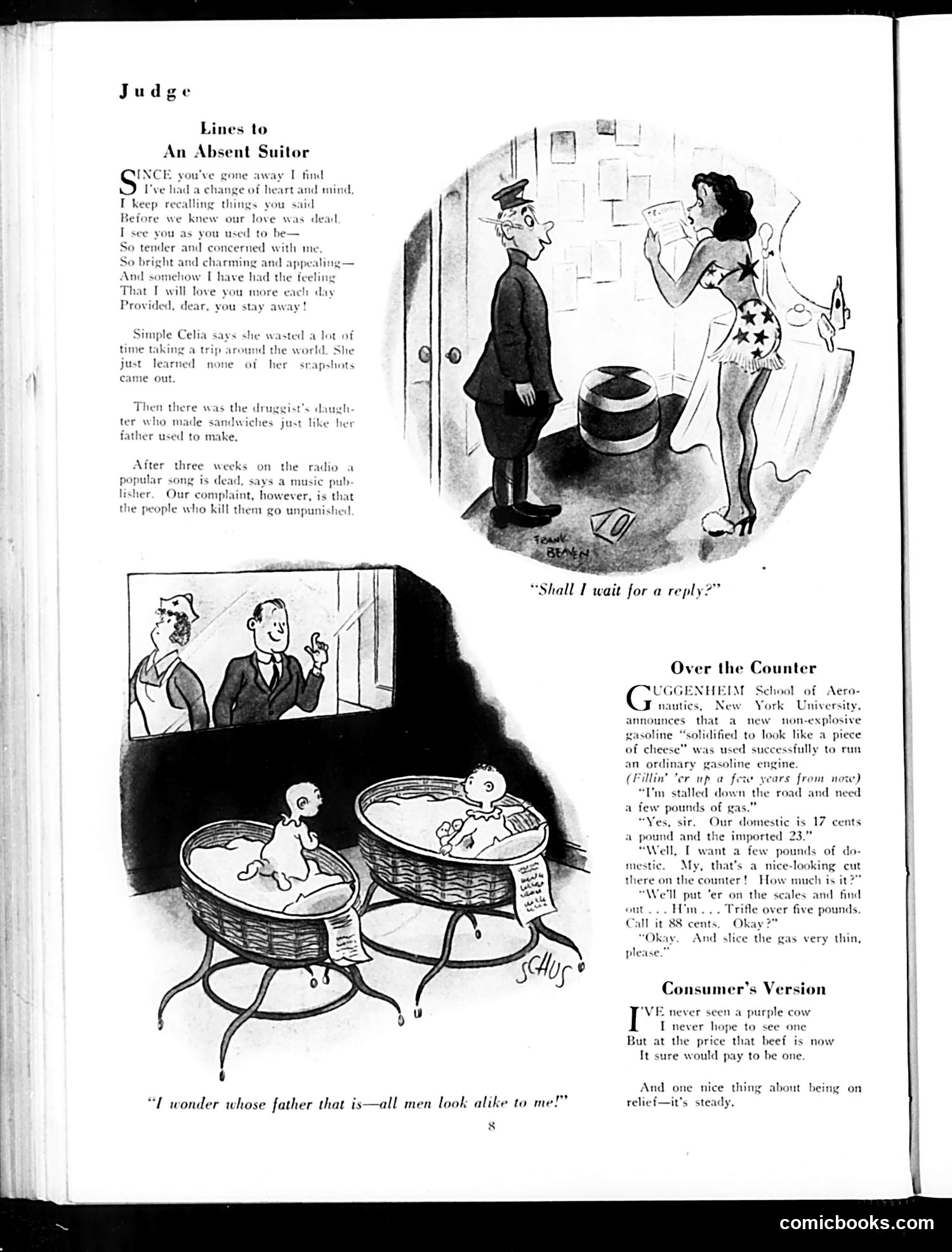
Judge Magazine Page Analysis This page contains three satirical pieces reflecting post-WWI American concerns: "Lines to An Absent Suitor" mocks romantic sentimentality—a woman declares eternal love *provided* her suitor stays away, a joke about absence making the heart grow fonder taken to absurd conclusion. "Over the Counter" satirizes wartime/postwar scarcity and rationing. It imagines a future where gasoline is "solidified" to resemble cheese and sold like food at a butcher counter by weight. The humor lies in treating fuel as a commodity one purchases and slices like meat—a commentary on resource shortages and the absurdity of rationing. "Consumer's Version" is a dark joke about inflation and beef prices. Playing on the famous nonsense poem "I Never Saw a Purple Cow," it suggests prices have risen so steeply that becoming a cow would be economically advantageous. The final line about relief being "steady" implies economic hardship is chronic. All three pieces reflect post-war economic anxiety: inflation, scarcity, and rationing concerns dominating American life.
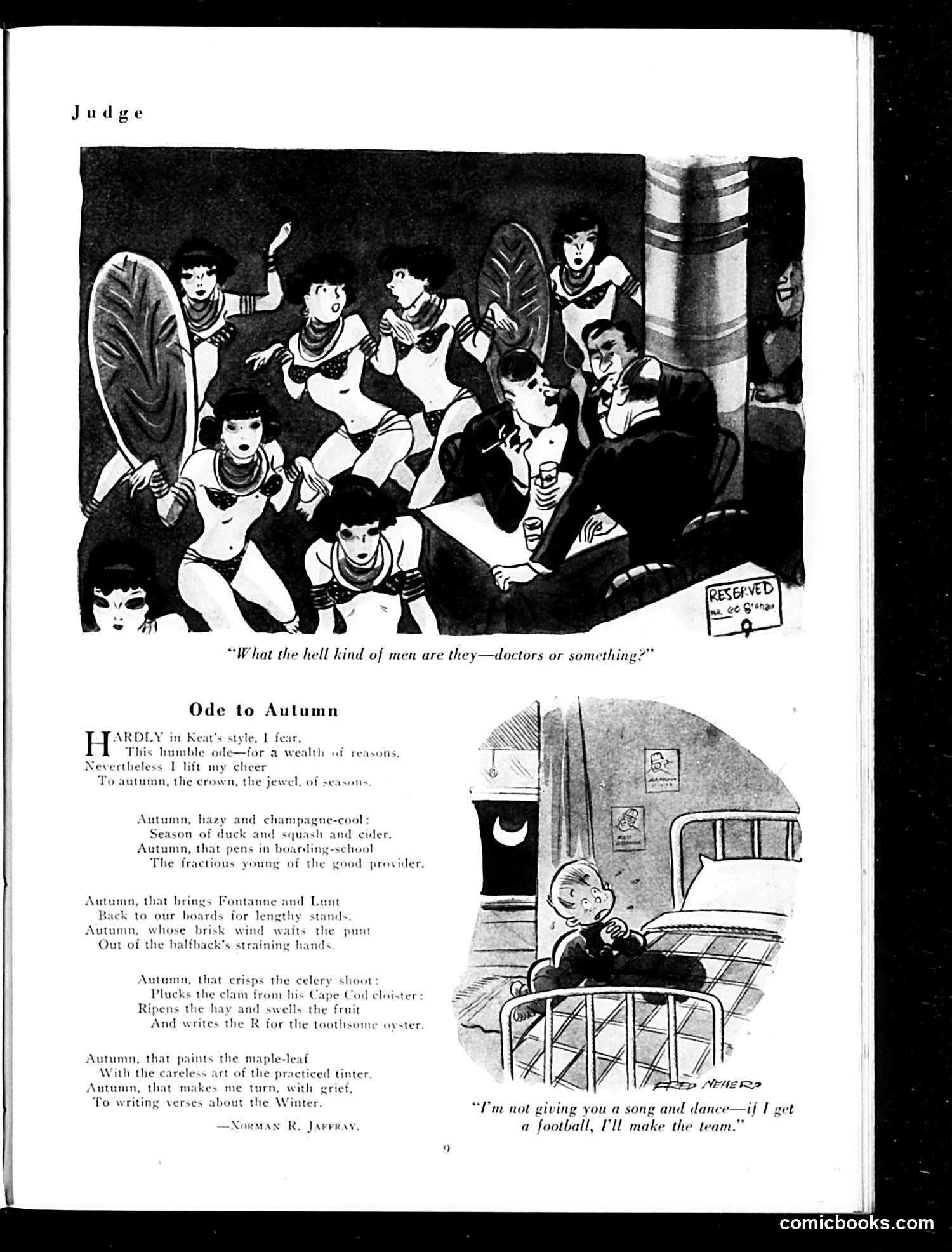
Analysis of Judge Magazine Page The top cartoon depicts a group of scantily-clad women (appearing to be chorus girls or performers) confronting two men in formal attire. The joke—"What the hell kind of men are they—doctors or something?"—suggests the men are either unusually reserved or perhaps there for medical/professional rather than social reasons, playing on the contrast between the women's obvious attempt at seduction and the men's apparent indifference. This is typical Jazz Age satire about changing social mores and gender dynamics. Below is "Ode to Autumn," a poem by Norman R. Jaffray celebrating the season—referencing football, oysters, and maple leaves. The accompanying cartoon shows a child in bed saying he won't perform songs and dances unless given a football, making the team. This reflects 1920s-30s American priorities: athletics and competitive success over entertainment or obedience. The page satirizes both romantic/social pretense and youthful materialism/ambition.
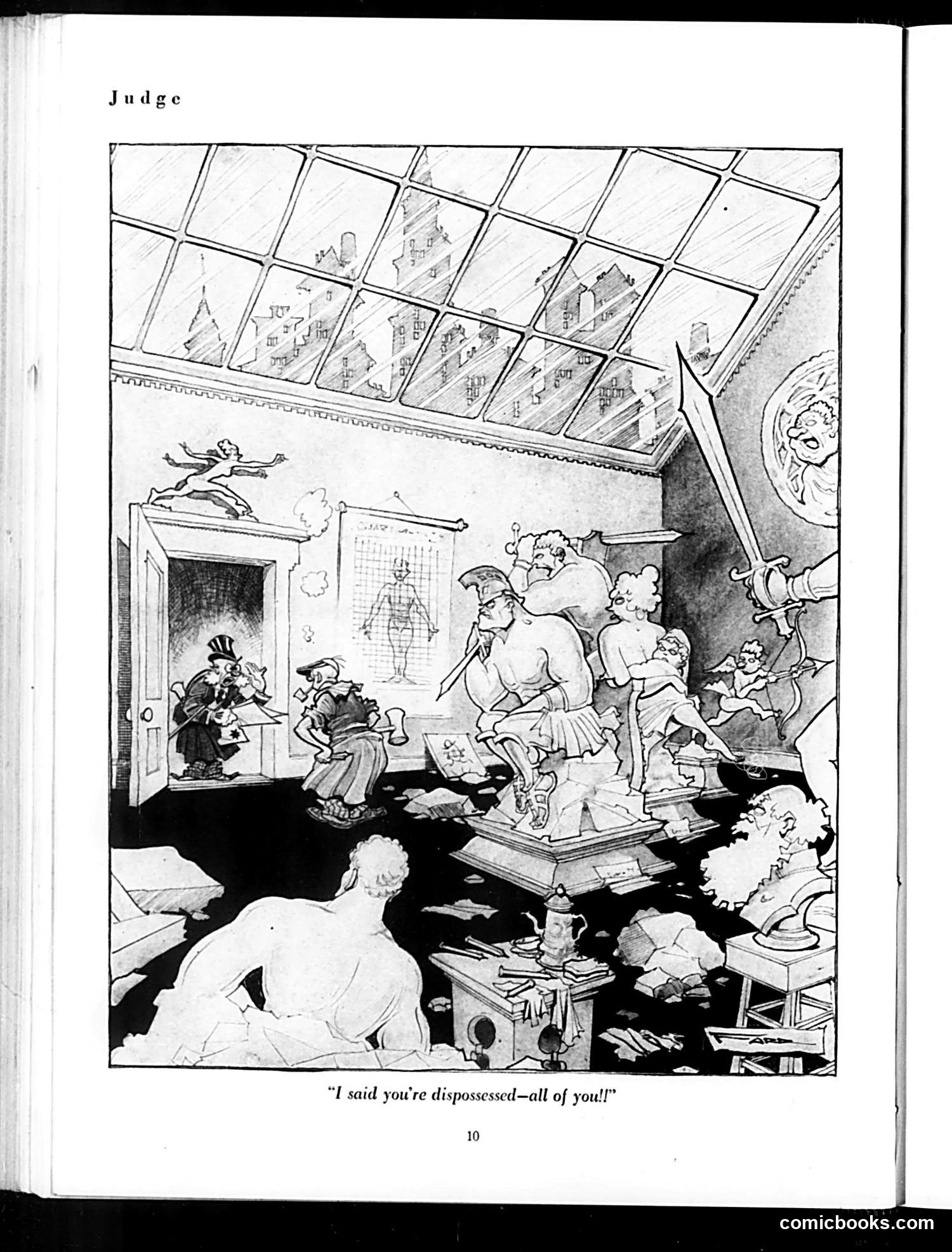
Analysis This appears to be a single-panel cartoon from *Judge* magazine satirizing a courtroom or legal proceeding. A judge (visible at left in the doorway) declares to a group of figures that they are "dispossessed"—legally evicted or stripped of property ownership. The scene shows what appear to be wealthy or middle-class people reacting with shock and distress to this pronouncement. The ornate setting with its glass ceiling and decorative elements suggests either a courtroom or an aristocratic interior being repurposed as one. Without additional context or visible dates, the specific historical reference is unclear. This likely satirizes either Depression-era evictions, a particular legal case, or commentary on wealth redistribution. The humor derives from the apparent social status of those being dispossessed, suggesting ironic commentary on economic upheaval or legal consequences for the privileged.
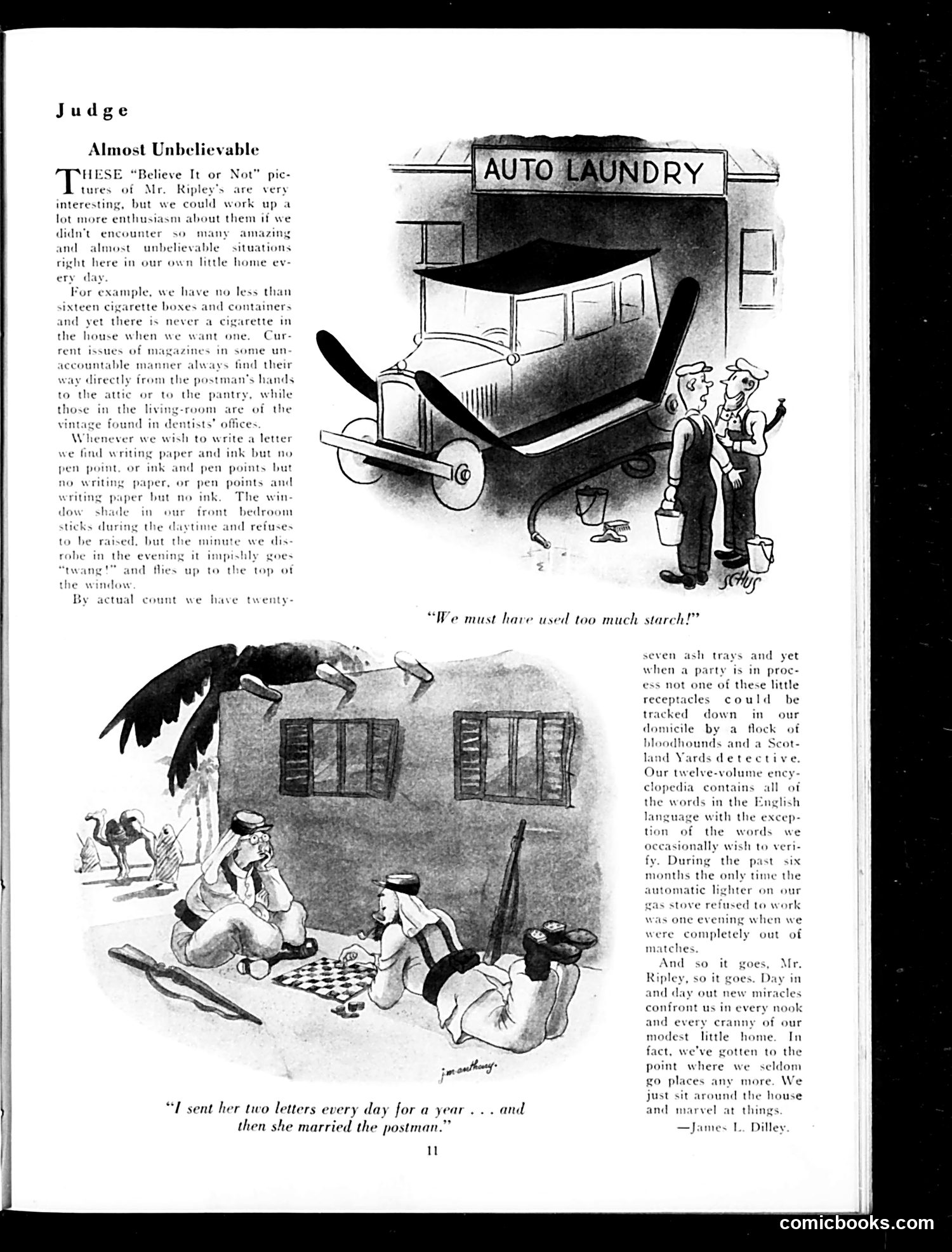
Analysis This page satirizes the mundane absurdities of domestic life by parodying Robert Ripley's popular "Believe It or Not!" feature (which documented genuine oddities). The article, attributed to James L. Dilley, humorously catalogs everyday household frustrations that are paradoxically "unbelievable": - Sixteen cigarette boxes but never a cigarette available - Magazines mysteriously migrating to attics - Writing supplies that never coexist (paper without ink, pen points without paper) - A stuck window that mysteriously unsticks at night - Seven ash trays that vanish when needed - An encyclopedia missing only the words you want - A lighter that fails only when matches are unavailable The accompanying cartoons illustrate these complaints: one shows an auto laundry mishap, another depicts two men with what appears to be scattered belongings. The closing joke—"I sent her two letters every day for a year... and then she married the postman"—extends the theme: absurd domestic persistence leads to unexpected consequences. The satire targets the gap between remarkable "oddities" and relatable, frustrating daily life—suggesting ordinary homes contain their own inexplicable chaos.
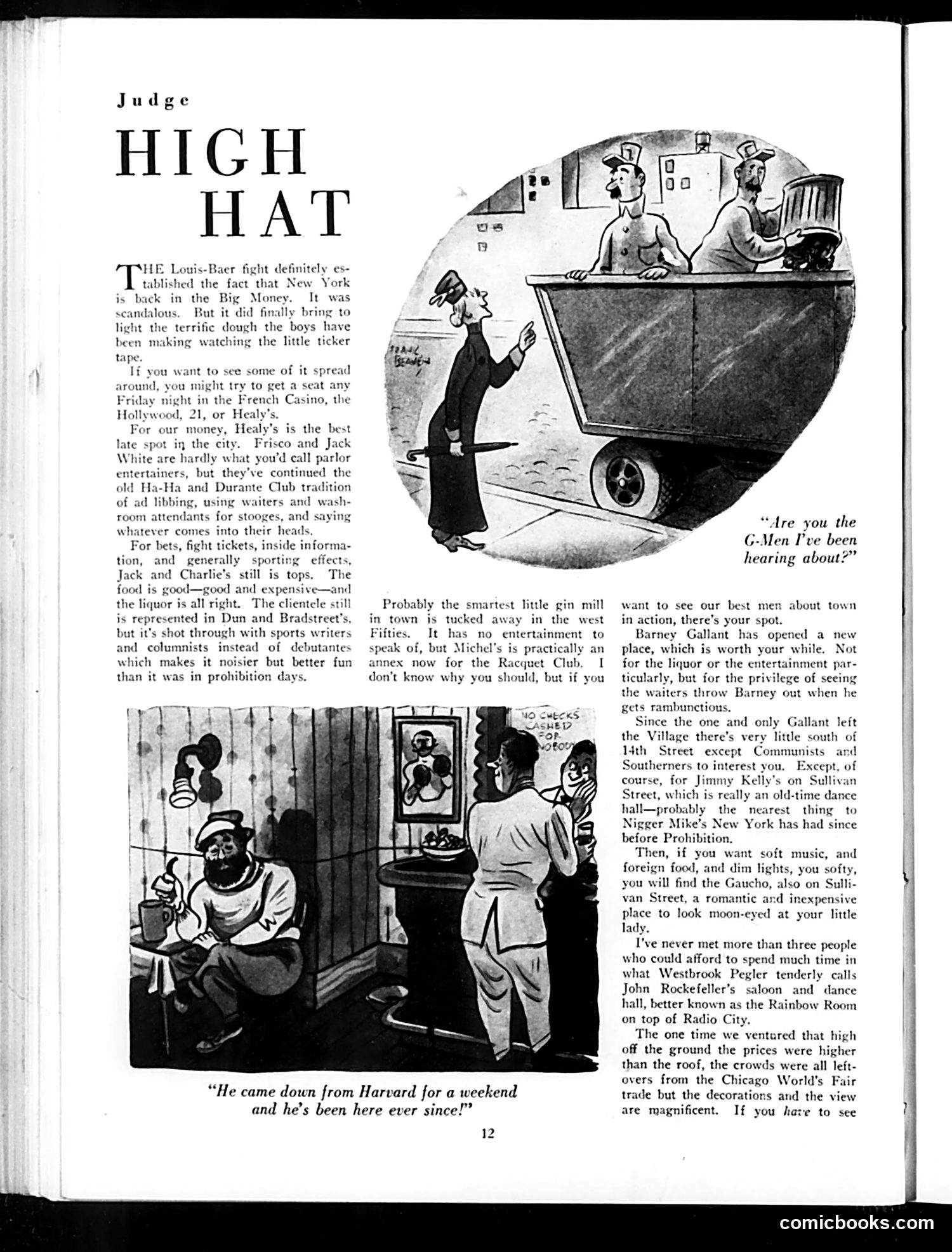
"High Hat" - Judge Magazine Speakeasy Guide This article satirizes New York's wealthy elite during Prohibition, using the Louis-Baer boxing match as a hook to discuss where the rich spend their newfound wealth at illegal speakeasies and nightclubs. The cartoons depict: 1. Top circle: G-Men (FBI agents) raiding an underground bar, with the caption "Are you the G-Men I've been hearing about?" — mocking the federal crackdown on illegal alcohol. 2. Bottom panel: A Harvard student who "came down for a weekend and he's been here ever since" — satirizing young wealthy men's addiction to speakeasy culture. The article then recommends various Manhattan speakeasies (Healy's, Michel's, Jimmy Kelly's, the Gaucho) with insider details about entertainment and clientele. The tone is both admiring and gently mocking of the conspicuous consumption and lawbreaking among the wealthy during Prohibition's enforcement years.
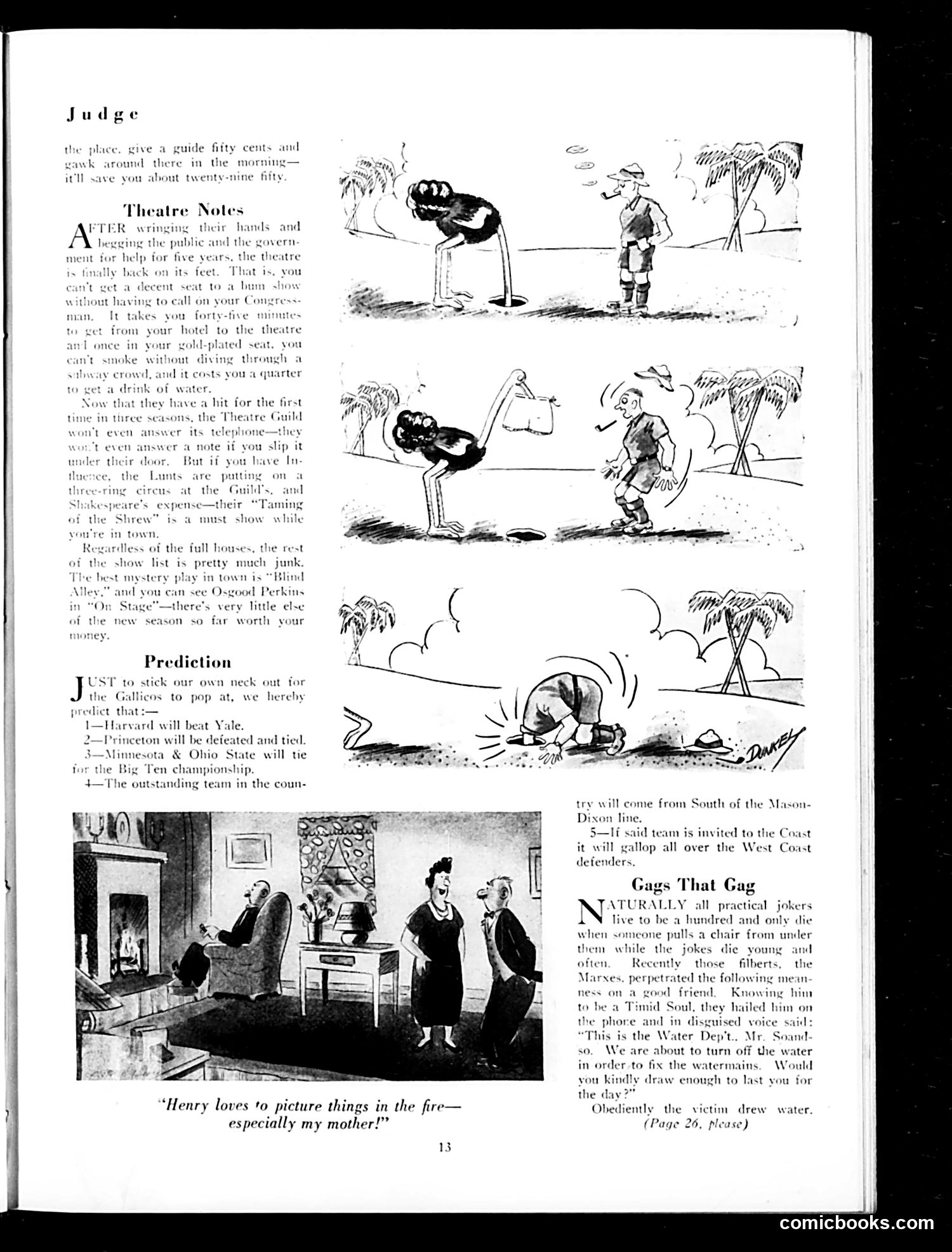
Judge Magazine Page Analysis This page contains three distinct sections from an American satirical magazine: Theatre Notes: Critiques New York theatre conditions—expensive seats, long commutes, inability to smoke or drink, poor service from the Theatre Guild. The writer sarcastically notes that despite finally having a hit show (likely referencing the Lunts in Shakespeare), most theatre offerings remain "junk." References "Blind Alley" and Ogden Perkins performances as the season's only worthwhile productions. Prediction: Sports predictions for the coming season, notably forecasting that the outstanding football team will come from "South of the Mason-Dixon line"—a significant statement about regional athletic dominance during this era. Gags That Gag: A humorous anecdote about the Marx Brothers pranking a timid friend by impersonating the Water Department on the telephone, claiming they'd shut off water for repairs and requesting he draw enough water to last the day. The victim complies, unaware of the hoax. The three-panel cartoon above depicts someone at a beach being progressively buried by sand, culminating in disaster.
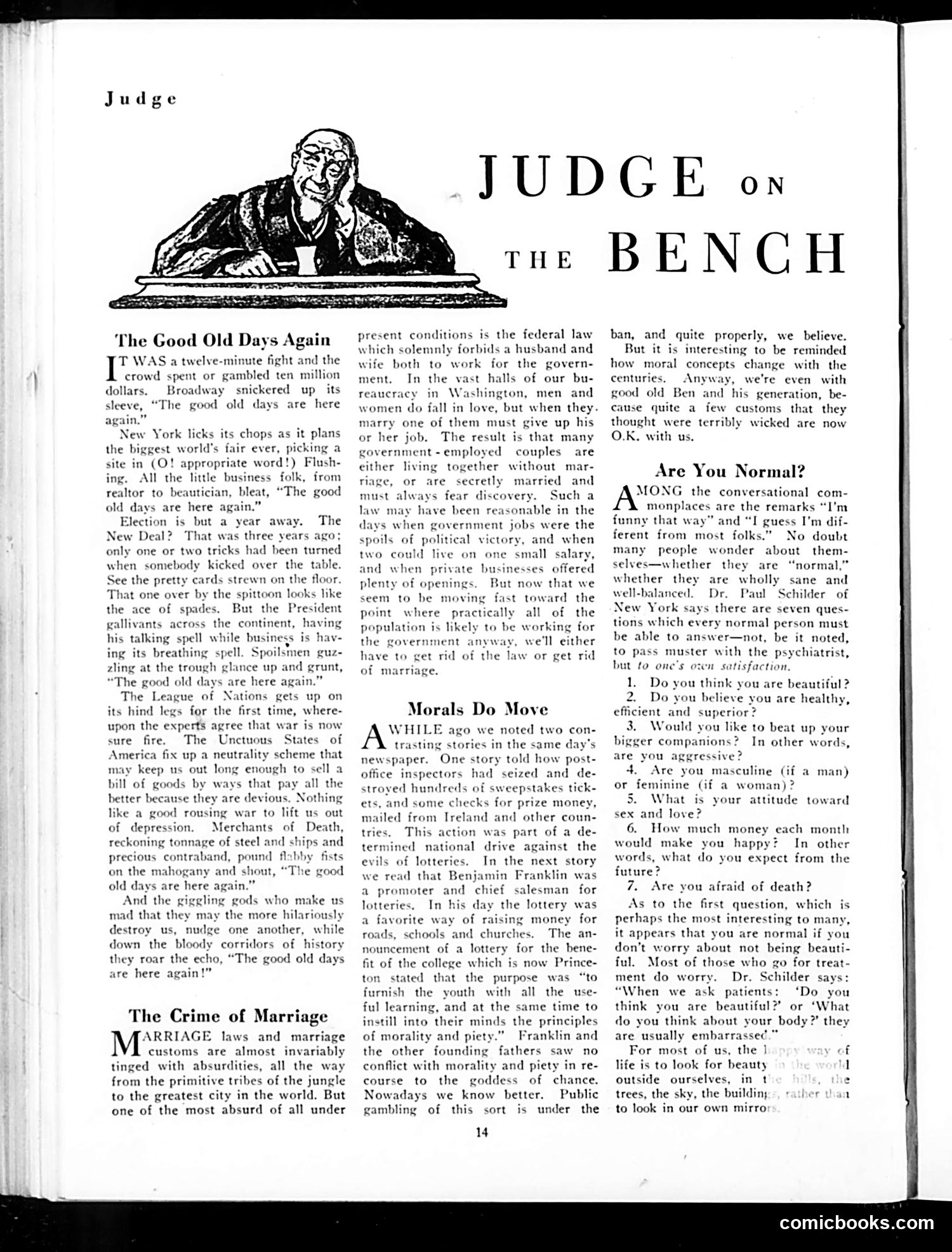
Judge Magazine: "Judge on the Bench" Page Analysis This page satirizes American nostalgia and hypocrisy in the 1930s. The main editorial, "The Good Old Days Again," mocks widespread yearning for pre-Depression prosperity. It references the 1933-1935 New Deal's failure to fully recover the economy, upcoming 1936 elections, and war profiteering ("Merchants of Death") while critics romanticize earlier times. "The Crime of Marriage" attacks a federal law prohibiting both spouses from working government jobs—absurd in an era of near-total government employment. "Morals Do Move" highlights contradiction: the postal service destroys lottery tickets as immoral while Benjamin Franklin—a Founding Father—promoted lotteries for educational institutions like Princeton, claiming moral purpose. The piece implies American morality shifts conveniently with economic interest. The illustration shows a contemplative judge, suggesting judicial reflection on these social contradictions.
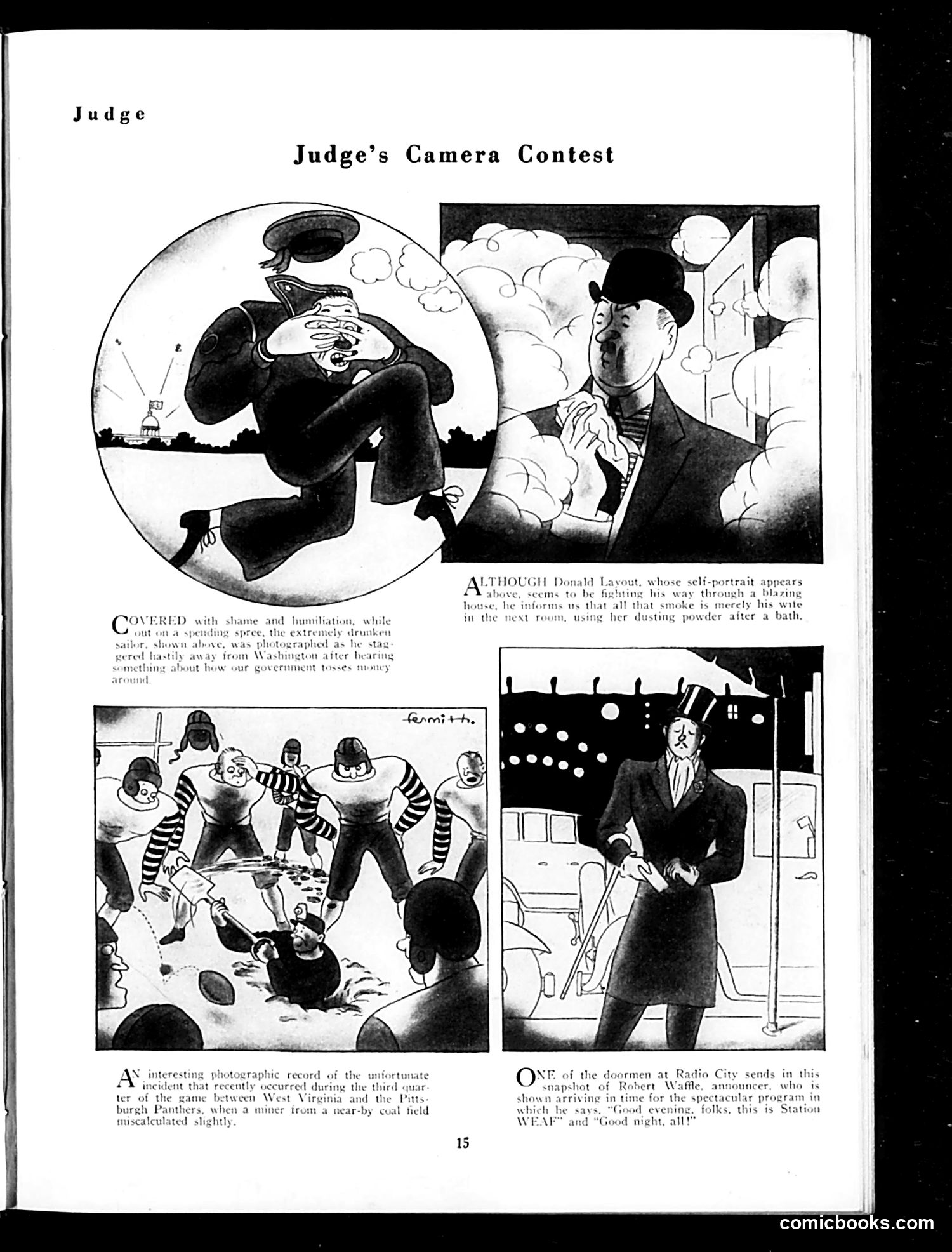
Judge's Camera Contest This page showcases humorous amateur photographs submitted to Judge magazine's contest. The four images appear to be comedic "candid camera" moments: 1. Top left: A man photographed himself with a camera while his house burns—the caption jokes that the smoke is actually his wife using "dusting powder" in the next room. 2. Bottom left: An incident from a West Virginia vs. Pittsburgh Panthers football game where a miner from a nearby coal field miscalculated and collided with players. 3. Top right: A man emerging from a blazing house, reinforcing the wife/dusting powder joke. 4. Bottom right: A doorman at Radio City (Robert Waffle, apparently) arriving late to his evening shift, with the caption referencing WEAF radio station's sign-off phrase. The contest celebrates ordinary people's awkward, funny moments captured on film—representing the amateur photography humor genre popular in early-to-mid 20th century publications.
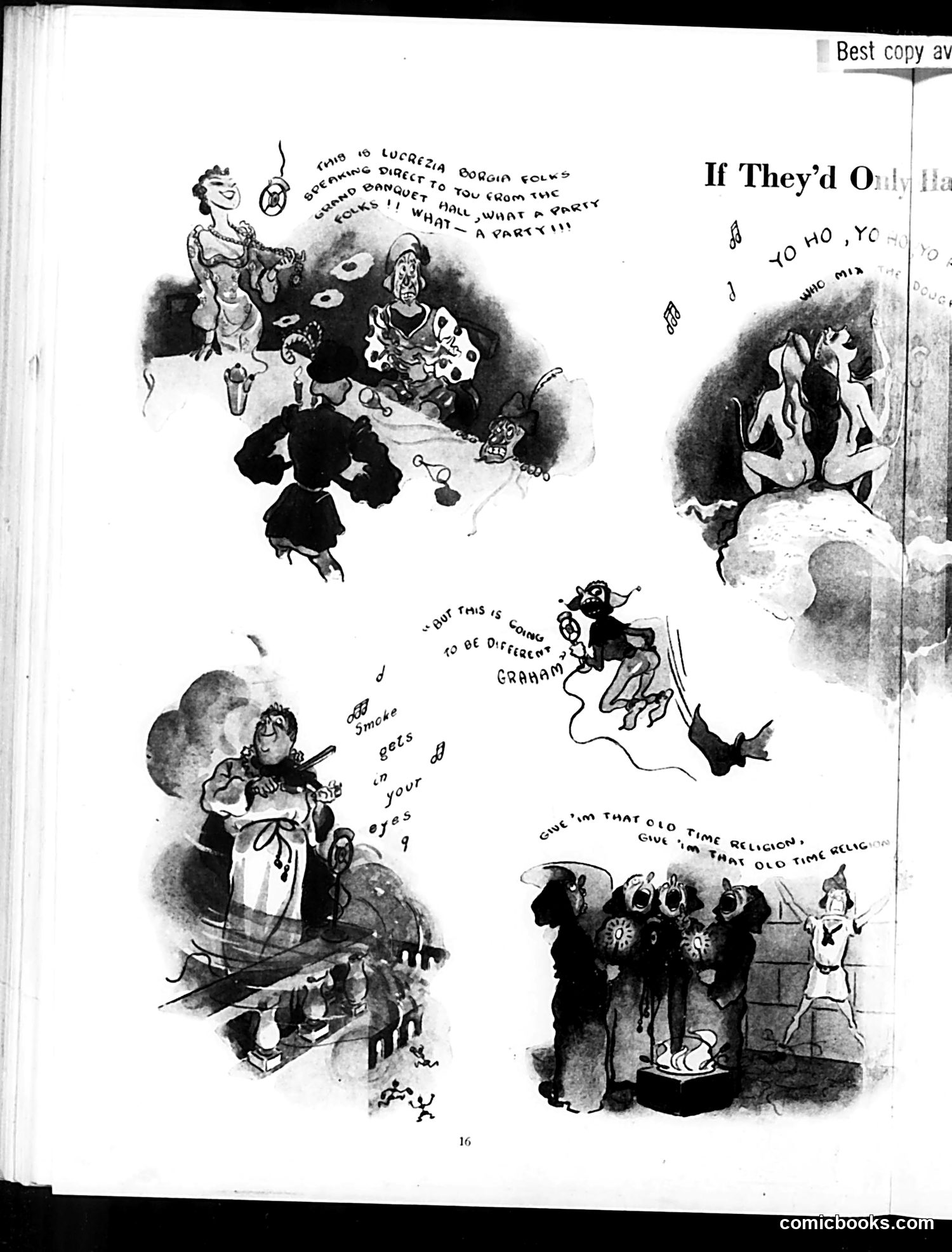
"If They'd Only Had..." - Judge Magazine Cartoon This appears to be a satirical cartoon series titled "If They'd Only Had..." that uses counterfactual humor to critique historical figures or events. The page shows multiple vignettes depicting alternative scenarios—what might have happened if certain historical or contemporary figures had possessed different resources or knowledge. The cartoons seem to mock political or social figures by imagining absurd outcomes if they'd made different choices. References include what appears to be religious iconography ("old time religion") and party scenes, suggesting satire of both social pretension and possibly political hypocrisy. However, the OCR text is severely corrupted and illegible, making it impossible to identify specific figures, dates, or the precise satirical targets with confidence. Without clearer text or additional context about Judge magazine's publication date, the exact political/social references remain unclear.
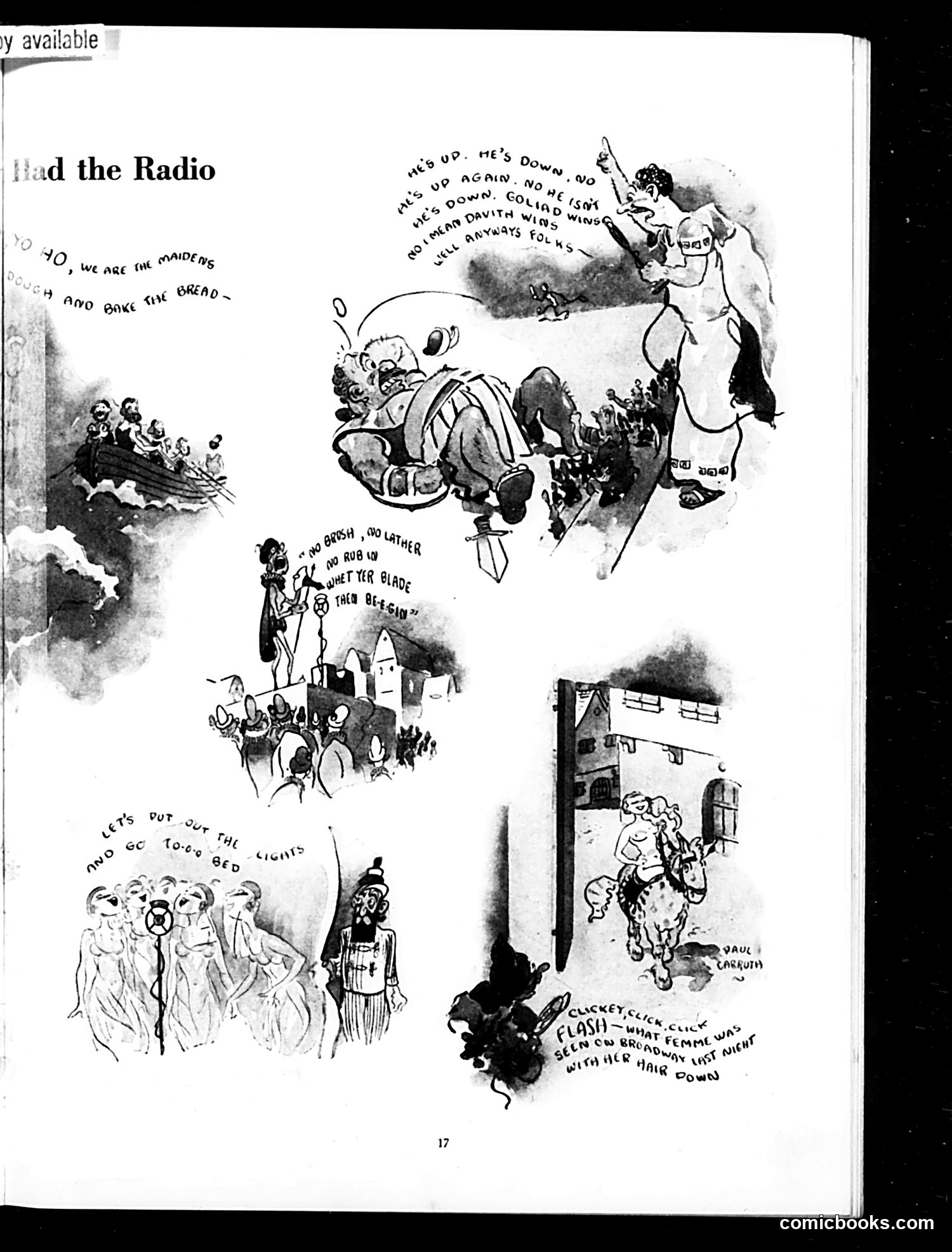
"Had the Radio" This page from *Judge* magazine satirizes early radio broadcasting and its cultural impact. The cartoon depicts various scenes of radio mania: performers broadcasting cooking instructions ("We are the maidens / and bake the bread"), people obsessively tuning in ("He's up, he's down, no he's not"), and audiences responding to radio advertisements and entertainment with exaggerated enthusiasm. The satire targets the novelty and invasiveness of radio in American homes—a relatively new technology that dominated domestic life and public behavior. The chaotic scenes mock how people became absorbed by radio content, following broadcasts religiously and acting out dramatic radio moments. The humor lies in portraying radio as an almost hypnotic force reshaping daily routines and social behavior, suggesting both fascination and anxiety about this emerging mass medium's influence on American culture.
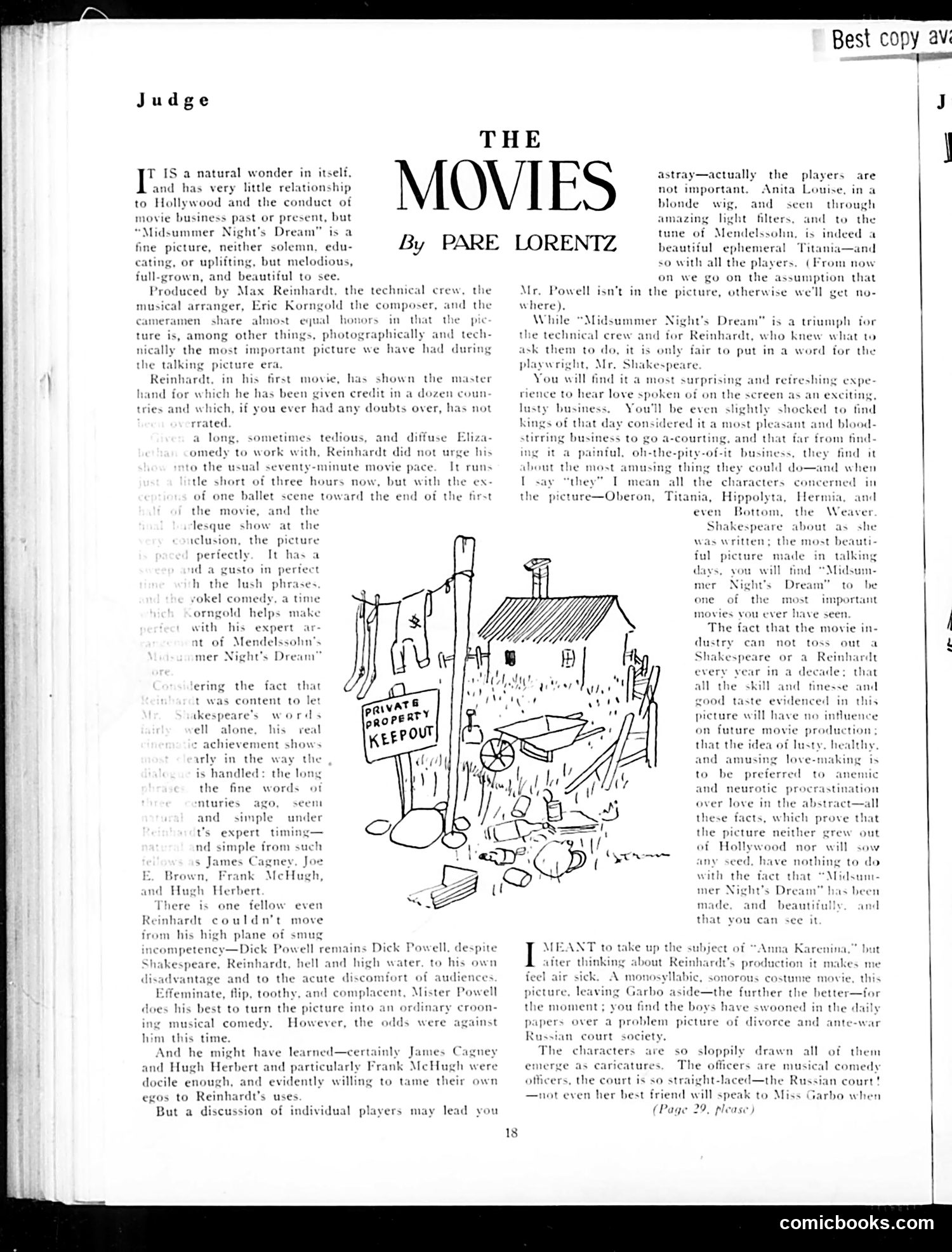
"The Movies" - Judge Magazine Review of *A Midsummer Night's Dream* This is a theater review by Pare Lorentz praising Max Reinhardt's film adaptation of Shakespeare's *A Midsummer Night's Dream*. The cartoon depicts a cluttered, chaotic film set—the "Private Property Keep Out" sign and scattered equipment humorously illustrate the complex technical production involved. Lorentz praises Reinhardt's directorial mastery and the technical crew (composer Korngold, cinematography), calling it "the most important picture we have had during the talking picture era." He critiques Dick Powell for breaking the Shakespearean mood with his comedic, "toothy" persona, but praises other cast members (James Cagney, Frank McHugh, Hugh Herbert) for restraint. The review celebrates that Shakespeare's romantic language and courtship scenes—considered proper entertainment in the Elizabethan era—are presented seriously rather than as crude comedy. Lorentz argues this refined approach, combined with technical excellence, makes it a significant achievement Hollywood shouldn't take for granted.
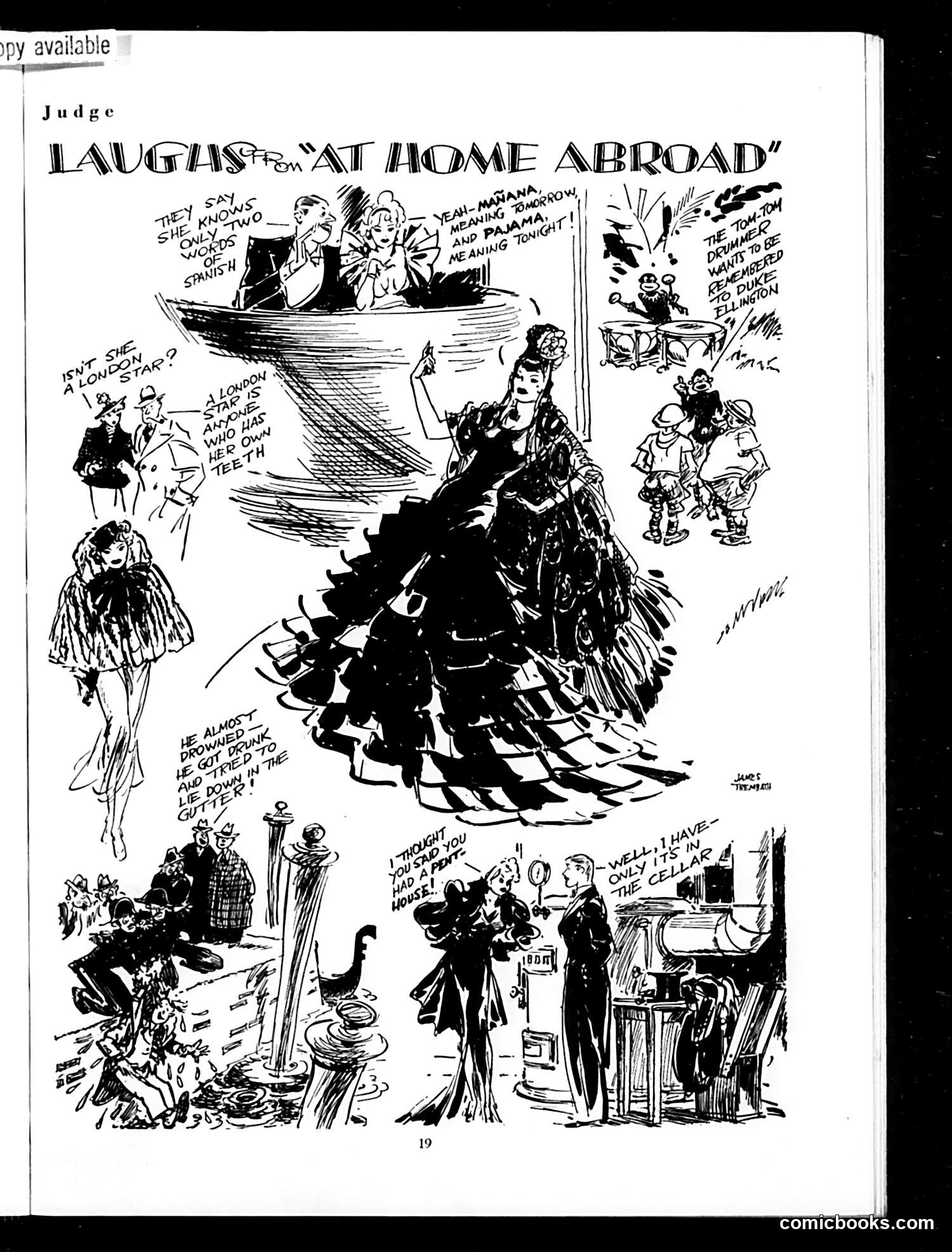
This Judge magazine page presents a satirical cartoon titled "Laughs at Home Abroad." The central figure appears to be a glamorous woman in an elaborate dress, surrounded by various comic vignettes depicting social situations. The scattered dialogue bubbles reference domestic and international scenarios—mentions of "London," "two jobs," "paradise," and housing conditions suggest commentary on post-war economic hardship and changing social circumstances, particularly regarding women's roles and economic independence. The cartoon likely satirizes the contrast between aspirational lifestyles abroad versus domestic American realities, possibly from the 1920s era based on the artistic style. The multiple scenes show different characters in various predicaments—men in suits, children, and other figures—suggesting broader social commentary on class, immigration, or post-WWI adjustments. Without clearer OCR text, the specific satirical targets remain partially unclear, though the overall theme addresses economic disparity and social displacement.
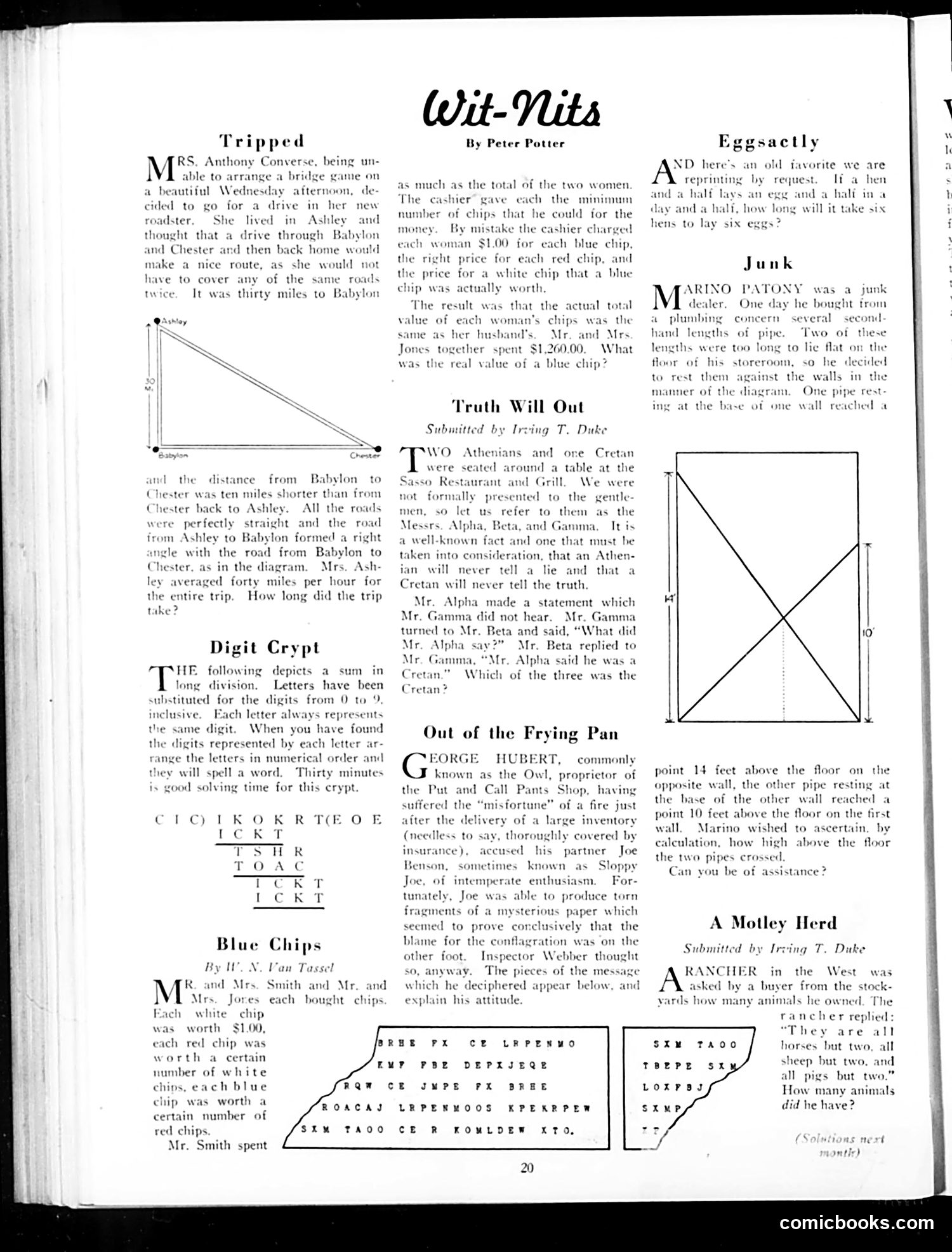
Wit-Nits: Judge Magazine Puzzle Page This page from *Judge* magazine contains several mathematical and logical puzzles typical of the publication's "Wit-Nits" column. The content is not political satire but rather recreational brain-teasers for readers: 1. "Tripped" — A geometry problem about calculating a car trip's duration through three towns (Babylon, Chester, Ashley). 2. "Digit Crypt" — A cryptarithmetic puzzle where letters substitute for digits in a long-division problem. 3. "Blue Chips" — A logic puzzle involving three couples buying poker chips at different values. 4. "Truth Will Out" — A classic logic riddle playing on the stereotype that Athenians always tell truth while Cretans always lie. 5. "Out of the Frying Pan" — A decipher puzzle about a fire at a pants shop, with garbled text to decode. 6. "Eggsactly" and "Junk" — Additional word problems. These represent typical *Judge* magazine content aimed at educated readers seeking intellectual amusement rather than political commentary.
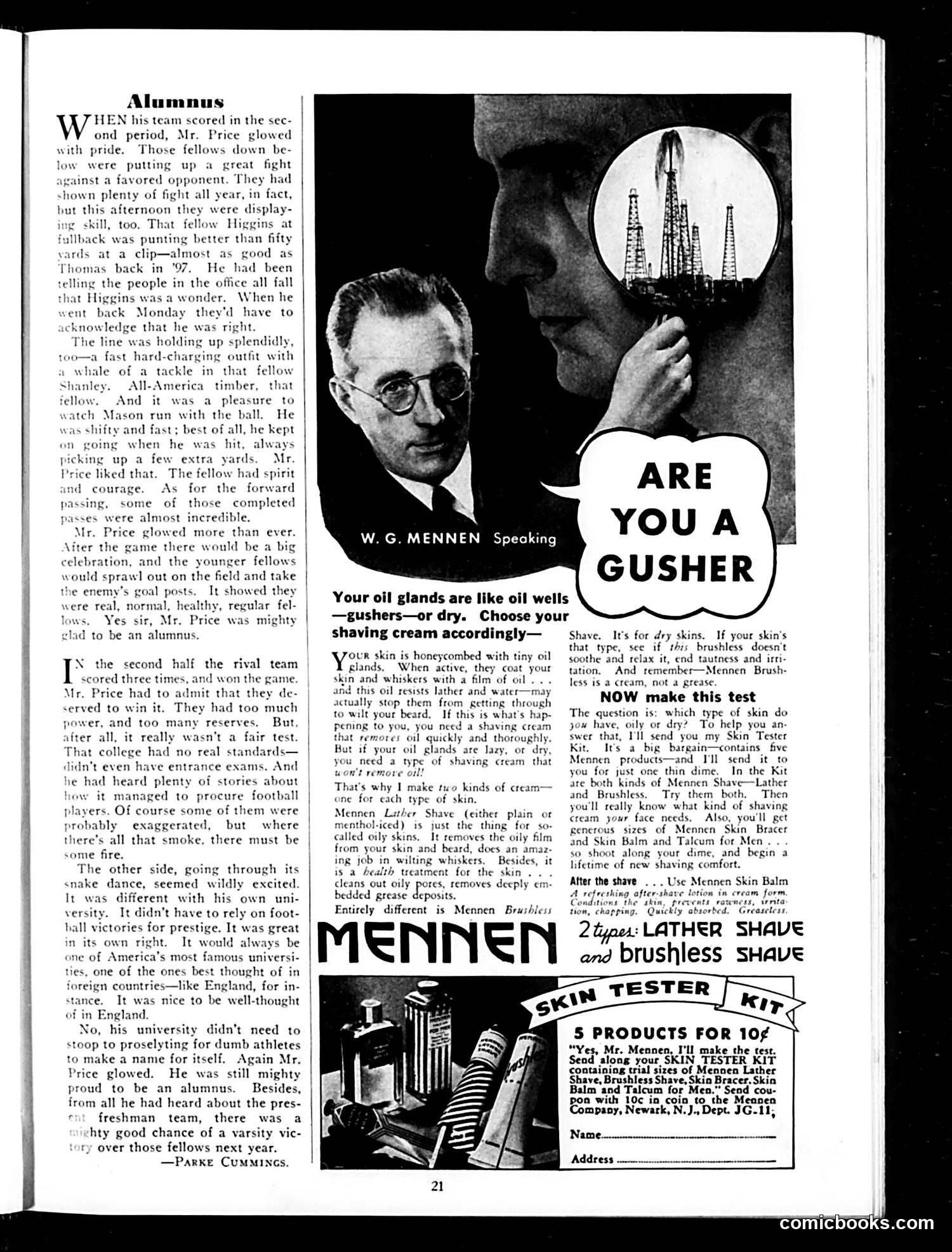
Page 21: "Alumnus" Story and Mennen Advertisement The main content is a satirical short story by Parke Cummings about Mr. Price, a university alumnus attending his school's football game. Price initially glows with pride watching his team's skilled performance, but when the rival team wins decisively, his attitude shifts. He rationalizes the loss by dismissing the competing school's standards, claiming it recruits "dumb athletes" through improper means, while insisting his own prestigious university has no need for such tactics—yet he's still "mighty proud" and optimistic about next year. The satire targets alumni who maintain inflated pride in their institutions regardless of competitive reality, excusing their teams' failures while denigrating rivals as academically inferior. It's commentary on selective reasoning and institutional tribalism. The page also features a Mennen shaving products advertisement, unrelated to the story, with W.G. Mennen explaining different skin types and corresponding shaving cream products, including a mail-in skin tester offer.
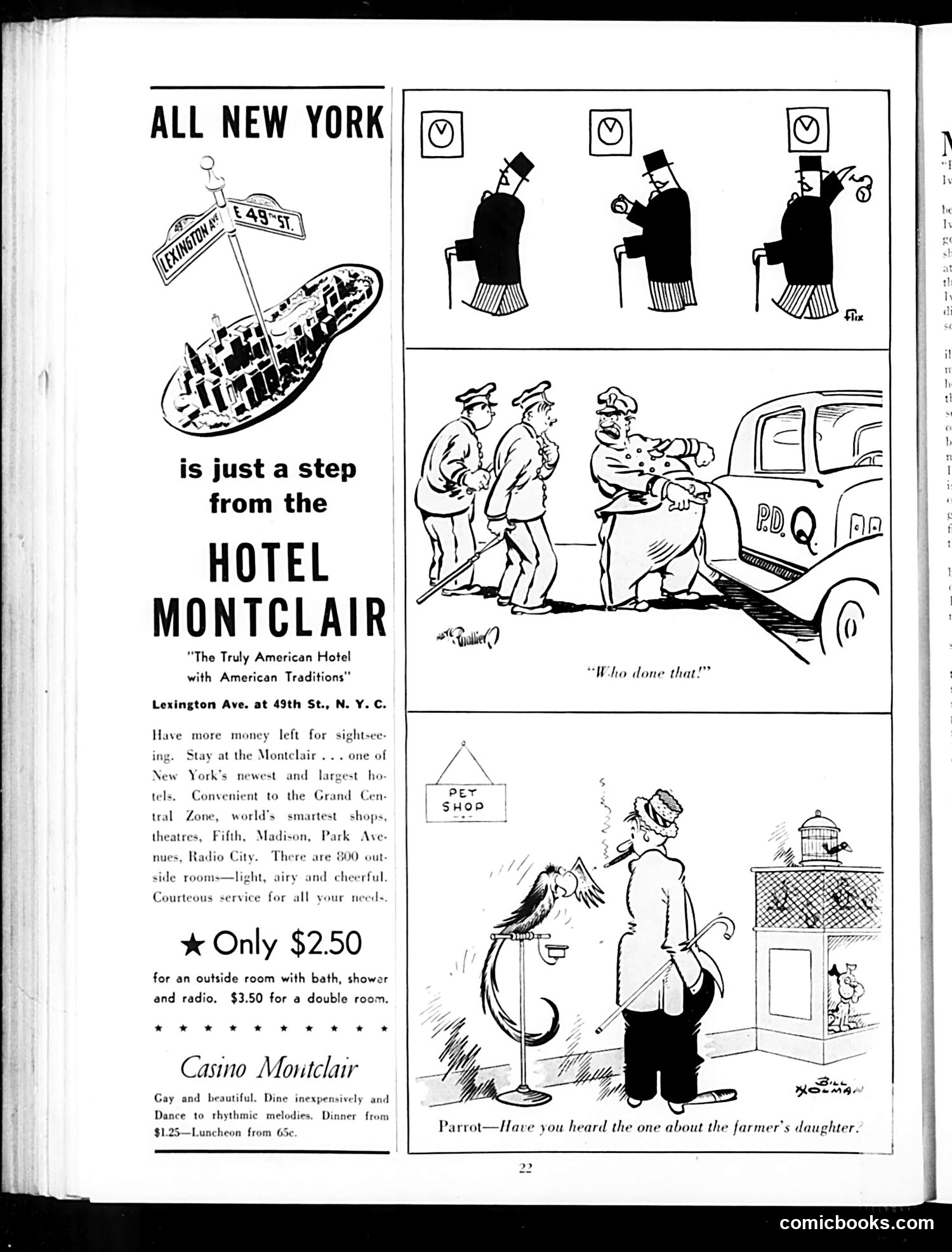
Analysis of Judge Magazine Page This page is primarily advertising for the Hotel Montclair in New York City, with accompanying humorous cartoons. The top cartoon shows three men in formal dress checking clocks—likely satirizing the hotel's punctuality or the precise schedules of wealthy guests. The middle cartoon depicts police ("P.D.Q." on the car) interrogating what appears to be a street character, with the caption "Who done that?"—a typical crime-scene joke format common to the era. The bottom cartoon shows a woman with a parrot at a pet shop, with the parrot saying "Have you heard the one about the farmer's daughter"—referencing the classic risqué joke setup popular in the 1920s-30s. These aren't political cartoons but rather light social humor typical of Judge magazine's comedic content, used to entertain readers alongside hotel and restaurant advertisements promoting affordable ($2.50) lodging and dining in Manhattan.
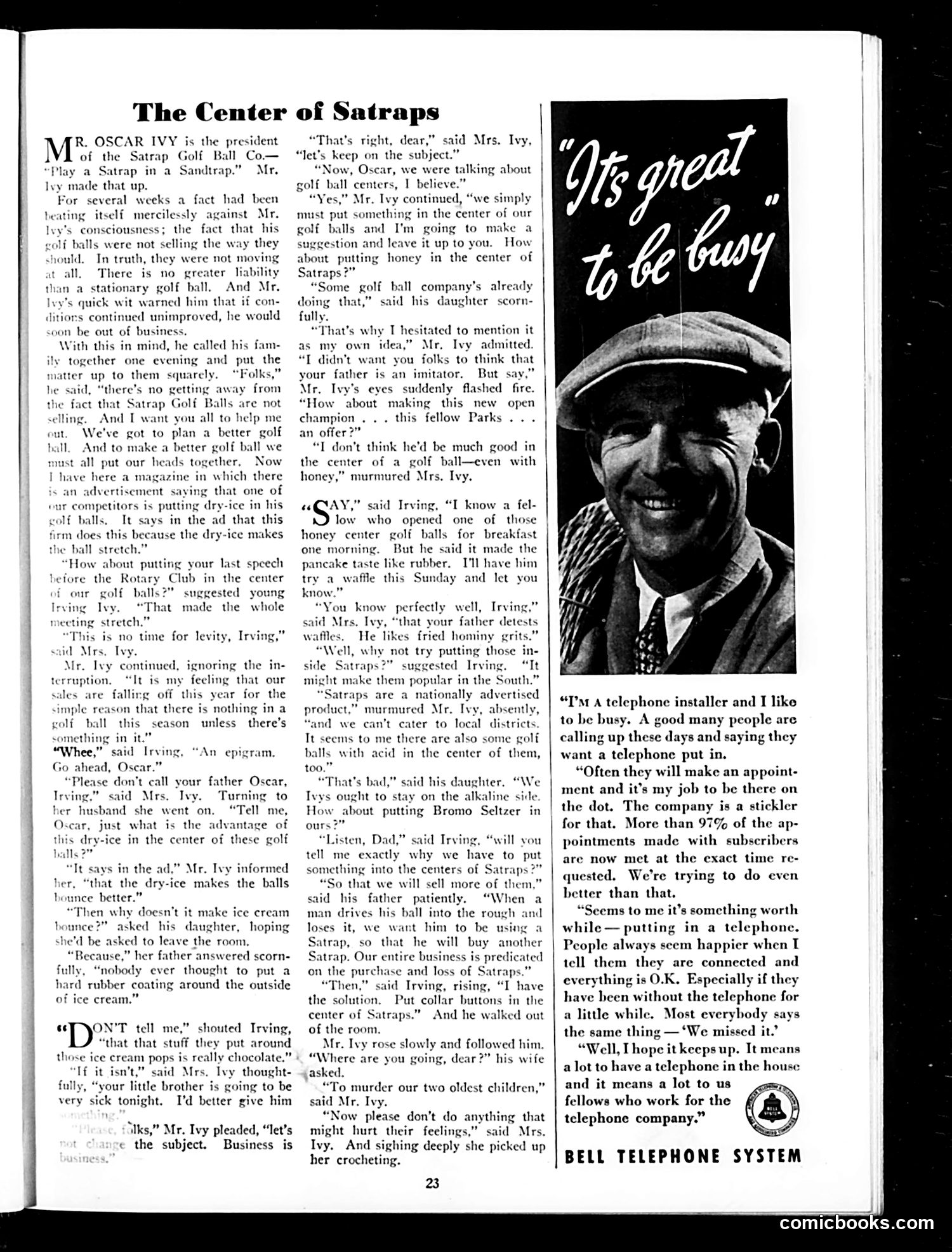
"The Center of Satraps" Analysis This is a humorous short story about Mr. Oscar Ivy, president of the Satrap Golf Ball Company, whose golf balls aren't selling. Facing business failure, he calls a family meeting to brainstorm a competitive advantage. The satire targets early 20th-century American business desperation and absurd product differentiation. Competitors are allegedly putting dry-ice in golf balls to make them "stretch"; Ivy proposes increasingly ridiculous solutions—honey, then Bromo Seltzer, then fried hominy grits—in the center of golf balls. His family members respond with deadpan logic, pointing out these ideas either plagiarize competitors or make no sense. The joke mocks how businessmen chase gimmicks rather than actual quality improvement. The accompanying Bell Telephone System advertisement (right side) creates ironic contrast—a reliable, practical service positioned against Ivy's absurd product schemes. The story gently satirizes the era's marketing mentality: that novelty and pseudo-scientific claims (dry-ice! honey centers!) trump genuine product merit.
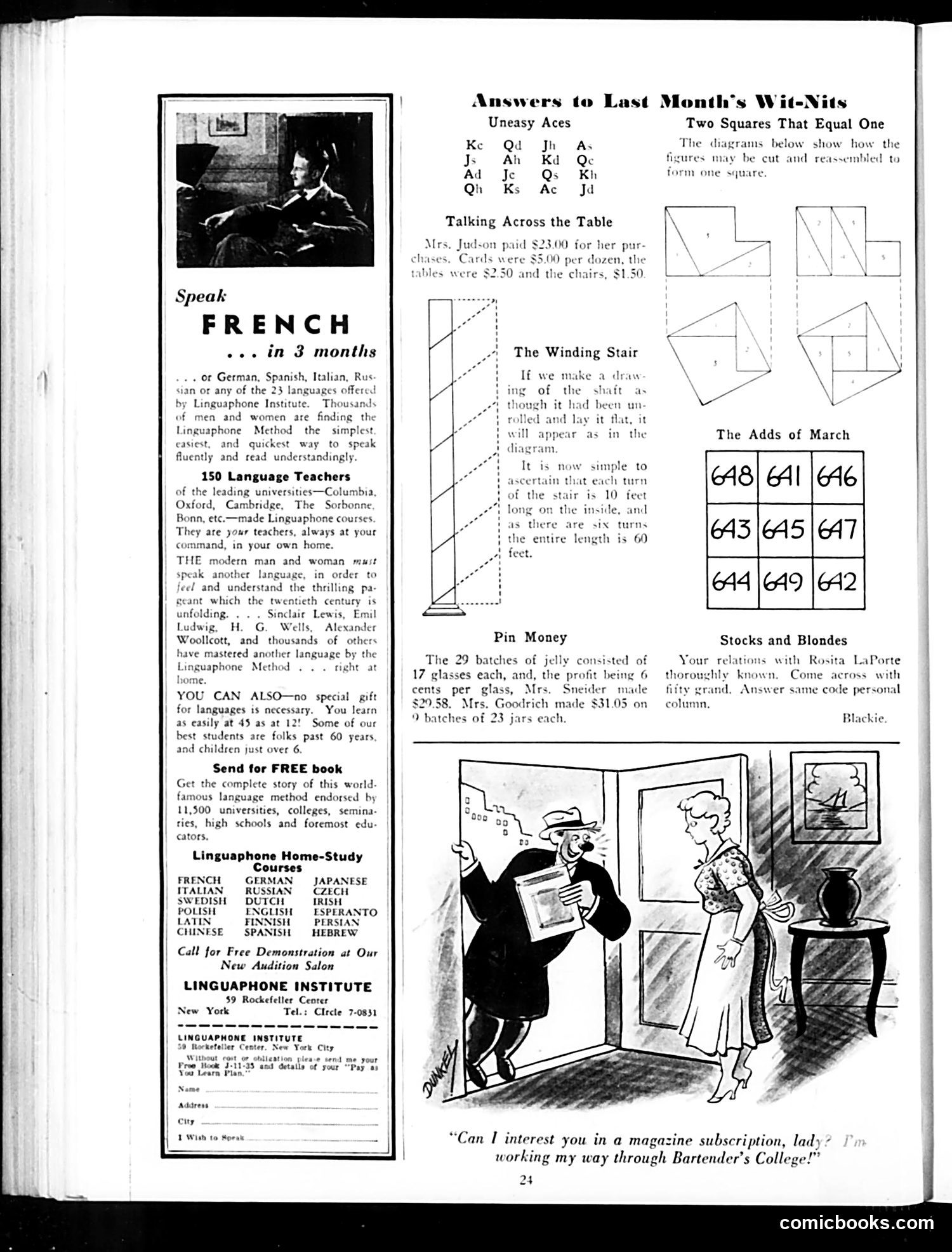
Analysis of Judge Magazine Page Content This page is primarily advertising and puzzles, not political satire. The dominant content is a Linguaphone Institute advertisement promoting language instruction through their correspondence method—claiming you can learn French, German, Spanish, or 20+ other languages in three months using their recordings and home-study courses. The single cartoon at bottom shows a door-to-door salesman pitching magazine subscriptions to a woman, with the caption revealing he's supposedly funding his education at "Bartender's College." The joke is mild: the contradiction between a salesman's claimed ambitions and his humble current work. This reflects 1930s-era humor about economic hardship and working-class self-improvement—common during the Depression era. The page also contains mathematical puzzles ("Uneasy Aces," "Two Squares That Equal One") typical of Judge's miscellaneous puzzle content. No political figures or sophisticated satire are present here.
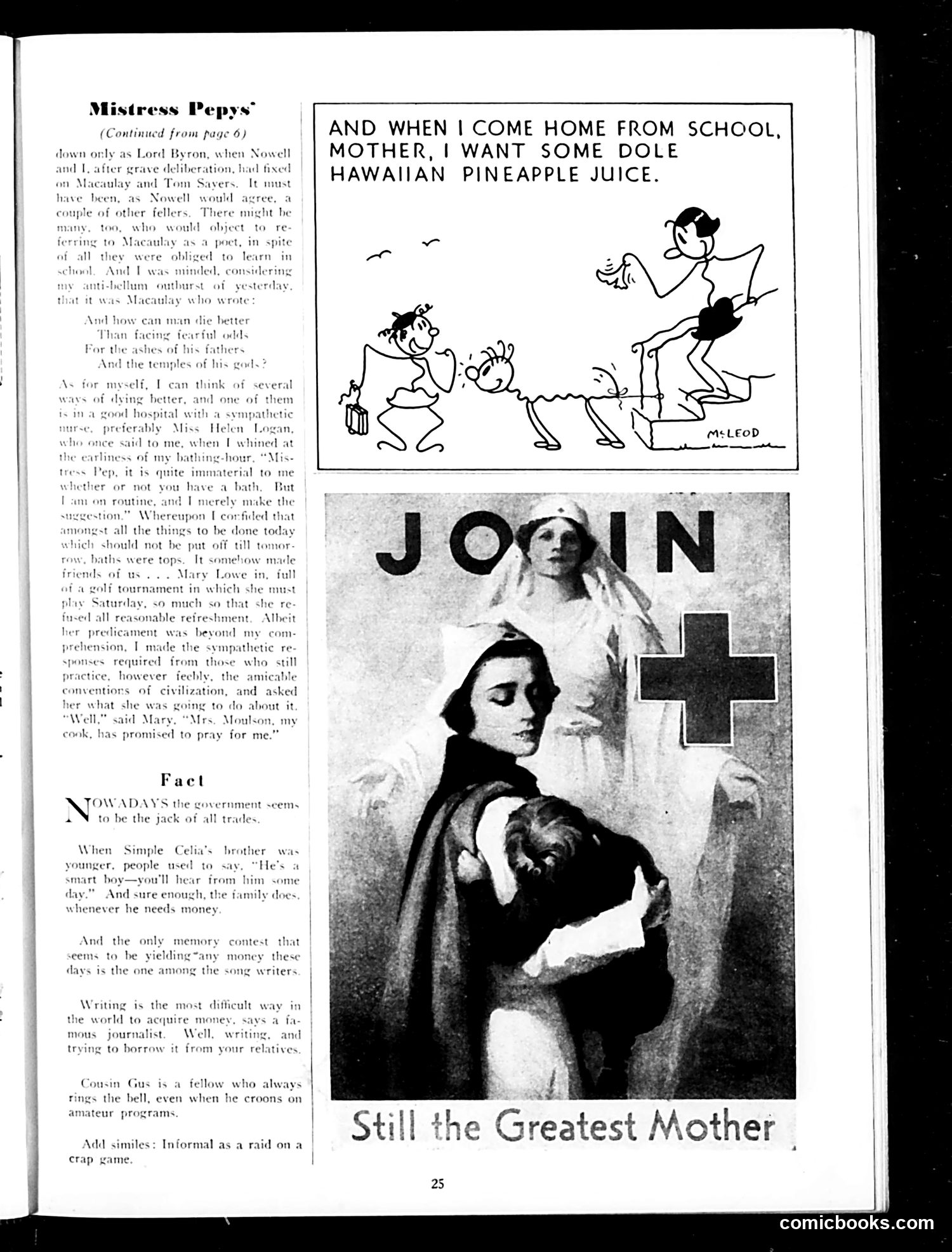
Analysis of Judge Magazine Page The top cartoon by McLeod depicts a child demanding "Dole Hawaiian Pineapple Juice" from their mother—a humorous jab at consumerism and children's brand awareness. The joke relies on the child's entitled, specific product demand rather than simply asking for juice. The lower image advertises a film titled "Still the Greatest Mother," showing a woman with a child and a religious cross. This appears to be a sentimental melodrama advertisement common to the era, promoting maternal virtue as an idealized theme. The text column "Fact" contains light satirical observations about modern life: government inefficiency, money-making difficulties (especially for songwriters), and humorous character sketches. The tone is gently cynical rather than biting—typical of Judge's middle-class-directed humor mocking small absurdities of contemporary society rather than targeting specific political figures or movements.
Analysis of Judge Magazine Page This page is primarily advertising and public service announcements rather than political satire. The notable content includes: "Be a Good Neighbor" PSA (left column): A 1935 mobilization campaign encouraging Americans to support community institutions—hospitals, orphanages, homes for the aged—through the Community Chest. It frames neighborly charity as an "American tradition," invoking Depression-era mutual aid while appealing to civic responsibility. Entertainment/Culture Section: Brief commentary on movies and theater, including references to the Marx Brothers (implied through a anecdote about their comedic chaos) and discussions of war-themed entertainment. Hotel/Restaurant Advertisements: The Governor Clinton Hotel advertises modern amenities ("under Knott Management"), reflecting 1930s urban luxury marketing. The page lacks sharp political cartoons; instead, it represents mainstream American magazine content from the mid-1930s—mixing commercial advertising with gentle civic messaging during the New Deal era.
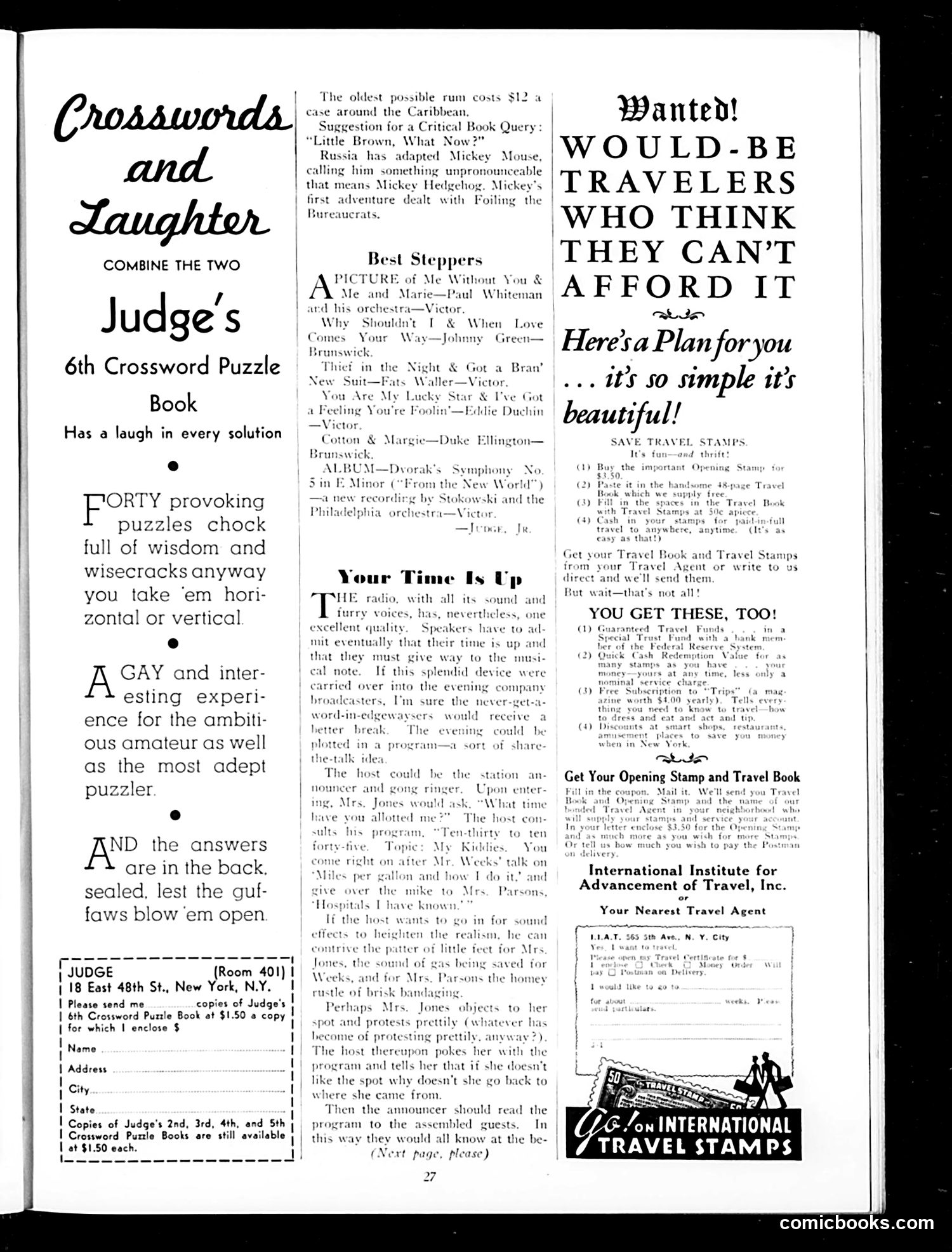
Judge Magazine Page Analysis This page is primarily advertising and promotional content, not political satire. It contains: 1. Judge's 6th Crossword Puzzle Book advertisement — promoting a crossword puzzle collection with humorous clues and sealed answers to prevent cheating. 2. Multiple entertainment listings — references to popular 1930s-40s music recordings and radio performers (Paul Whiteman, Fats Waller, Duke Ellington, Johnny Green), representing "Best Steppers" (popular songs/recordings of the era). 3. "Your Time Is Up" editorial commentary — a brief satirical piece about radio announcers losing relevance as evening programming expands, with a joke about a radio host telling a persistent caller to go back where she came from. 4. Travel promotion advertisements — for travel stamps and the International Institute for Advancement of Travel, aimed at budget-conscious travelers. The page reflects typical Judge magazine content: light humor, entertainment promotion, and consumer advertising from the mid-20th century.
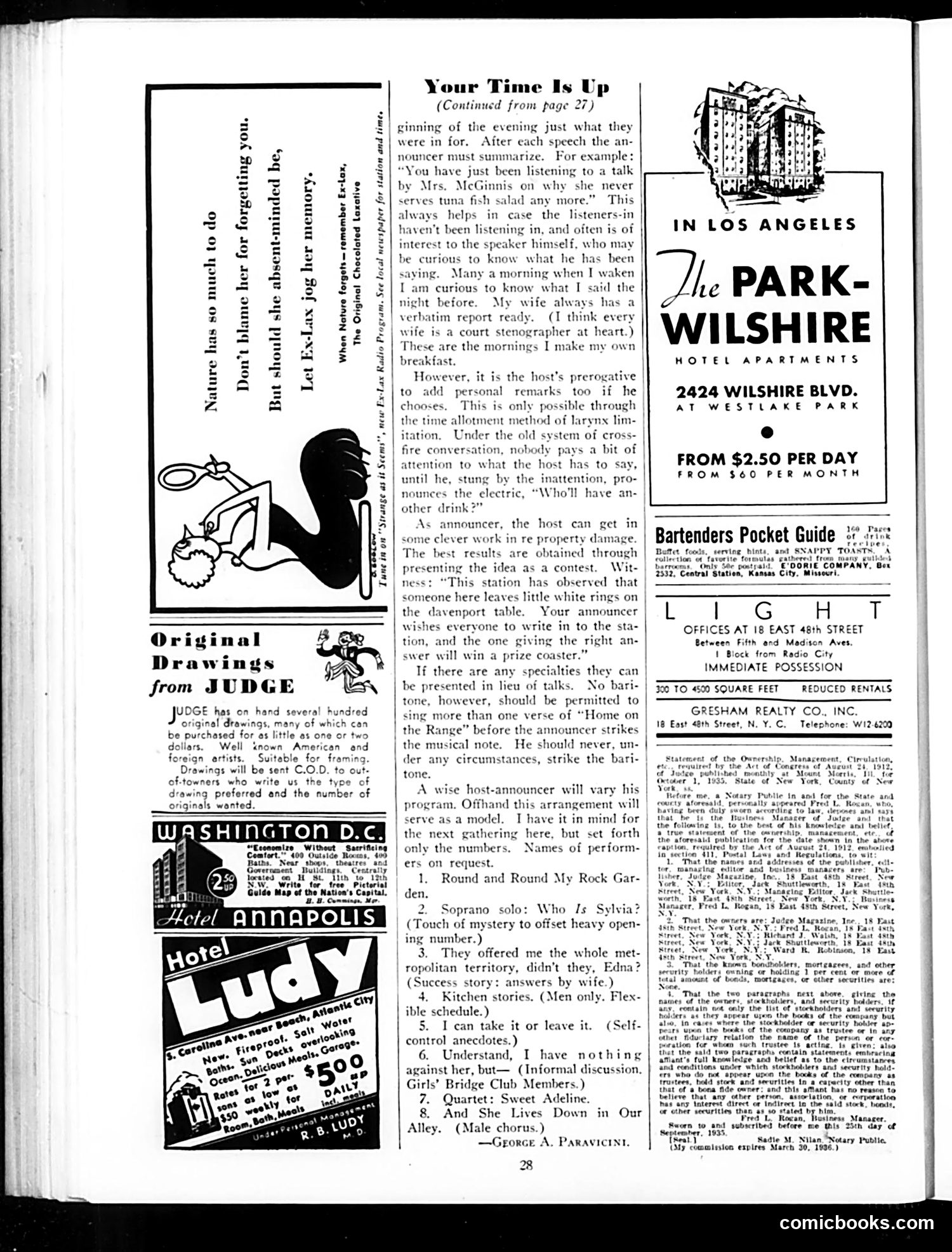
"Your Time Is Up" - Radio Broadcast Etiquette Satire This page from *Judge* satirizes the emerging phenomenon of home radio entertainment in what appears to be the 1930s. The main article (continued from page 27) mocks the "host-announcer" trend—when private citizens held informal radio broadcasts from their homes, treating guests as an captive audience. The satire targets the absurdity of these amateur broadcasters: they force lengthy speeches on trapped listeners, must summarize each talk, and monopolize conversation through a fake "electric" intercom system so guests cannot interrupt. The author ridicules the narcissism involved, noting wives must transcribe husbands' midnight ramblings. The proposed "program" (numbered 1-8) deepens the mockery—suggesting ridiculous amateur acts like soprano solos, kitchen stories, and forced quartet singing. The accompanying cartoon (left) appears to show a figure at a microphone—likely representing this obnoxious home broadcaster phenomenon. The page also includes period advertisements for real estate and hotels, typical of *Judge*'s commercial content.
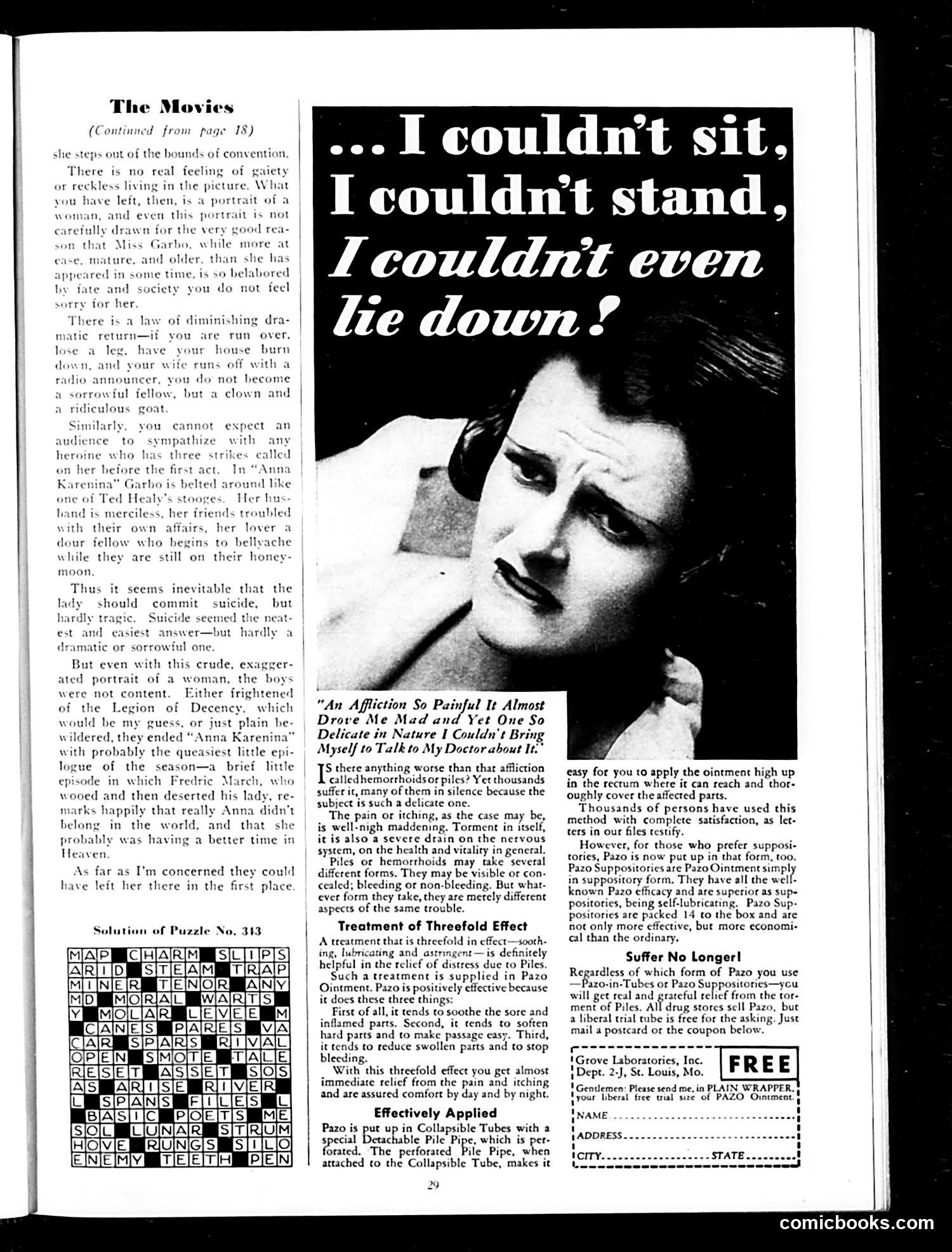
Analysis for Modern Readers This page contains two distinct elements: Left side: Film criticism discussing "Anna Karenina," likely the 1935 Greta Garbo adaptation. The reviewer criticizes the film's ending as unsatisfyingly sanitized—the studio apparently added an awkward epilogue where the male lead (Fredric March) expresses relief about the protagonist's suicide, treating it as comedic rather than tragic. The critic argues this undermines the drama and suggests either the Legion of Decency (Catholic censorship board) or studio timidity caused this compromised conclusion. Right side: A full-page advertisement for Pazo Ointment, a hemorrhoid treatment. The dramatic quote ("I couldn't sit, I couldn't stand, I couldn't even lie down!") humorously illustrates the product's purpose. The ad emphasizes the "delicate" nature of discussing the condition while promising a three-part remedy: soothing, lubricating, and astringent effects. The juxtaposition is purely coincidental—typical magazine layout mixing editorial and advertising content.
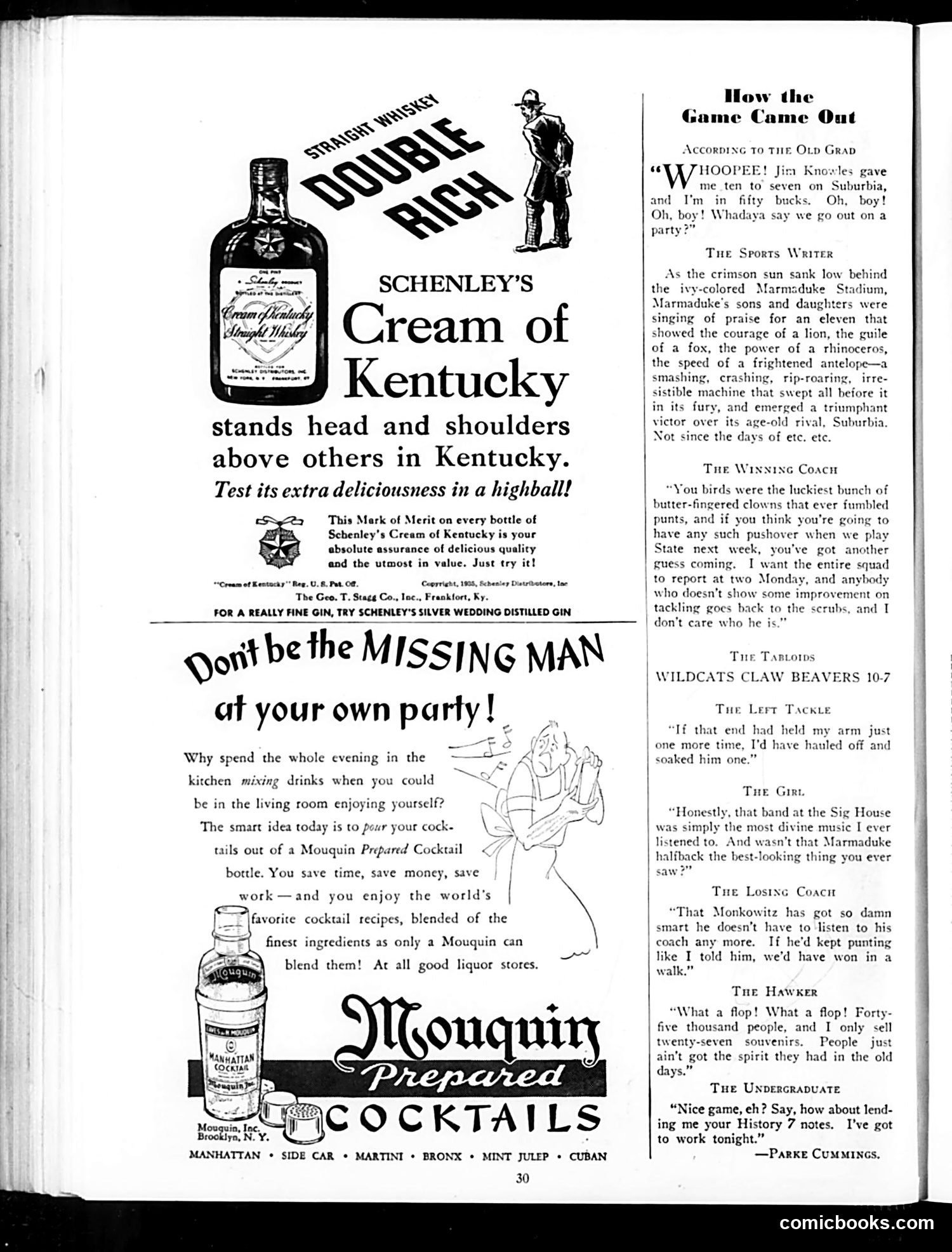
Judge Magazine Page Analysis This page contains two distinct sections: alcohol advertisements and sports satire commentary. The ads promote Schenley's whiskey and Mouquin prepared cocktails, using era-typical marketing pitches about convenience and quality—notably, the Mouquin ad targets hosts who want to avoid kitchen work by serving pre-made cocktails at parties. The right column, titled "How the Game Came Out," satirizes college football culture through multiple brief monologues from stock characters: an optimistic bettor, a flowery sports reporter, a winning coach berating his players, a losing coach making excuses, a girl focused on the band rather than the game, a disappointed souvenir vendor, and a student more concerned with borrowing notes than the match itself. The satire targets both the inflated rhetoric surrounding college athletics and the various ways spectators—some genuinely invested, others self-interested or distracted—experience the game. This reflects Judge's tradition of mocking American institutions through everyday types and exaggerated dialogue.
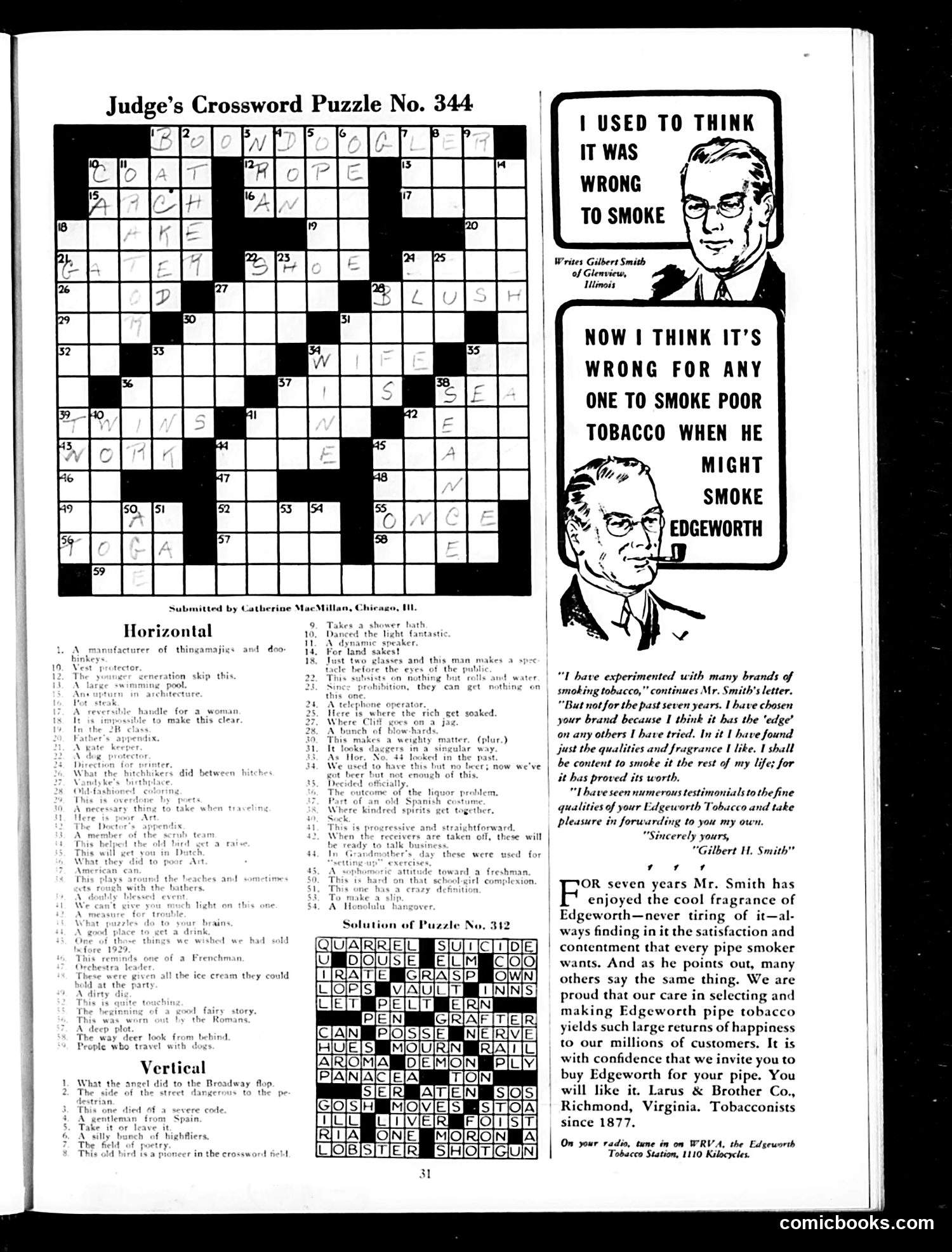
Judge Magazine Page Analysis This page combines a crossword puzzle with tobacco advertising disguised as reader testimonial. The right side features two illustrated men endorsing Edgeworth pipe tobacco. The top figure (Gilbert Smith of Glenview, Illinois) presents a humorous "conversion narrative": he once thought smoking was wrong, but now believes it's wrong to smoke *poor* tobacco—implying quality tobacco (Edgeworth) is actually virtuous. The lower testimonial expands this messaging, claiming Smith has used Edgeworth exclusively for seven years and found it superior to all competitors. The ad positions the product as bringing "satisfaction and contentment" while emphasizing the company's established reputation (since 1877). This is straightforward Depression-era advertising—using a seemingly sincere customer endorsement to market luxury goods. The "wrong tobacco" framing is a gentle joke attempting to make premium tobacco consumption seem reasonable and discerning rather than indulgent.
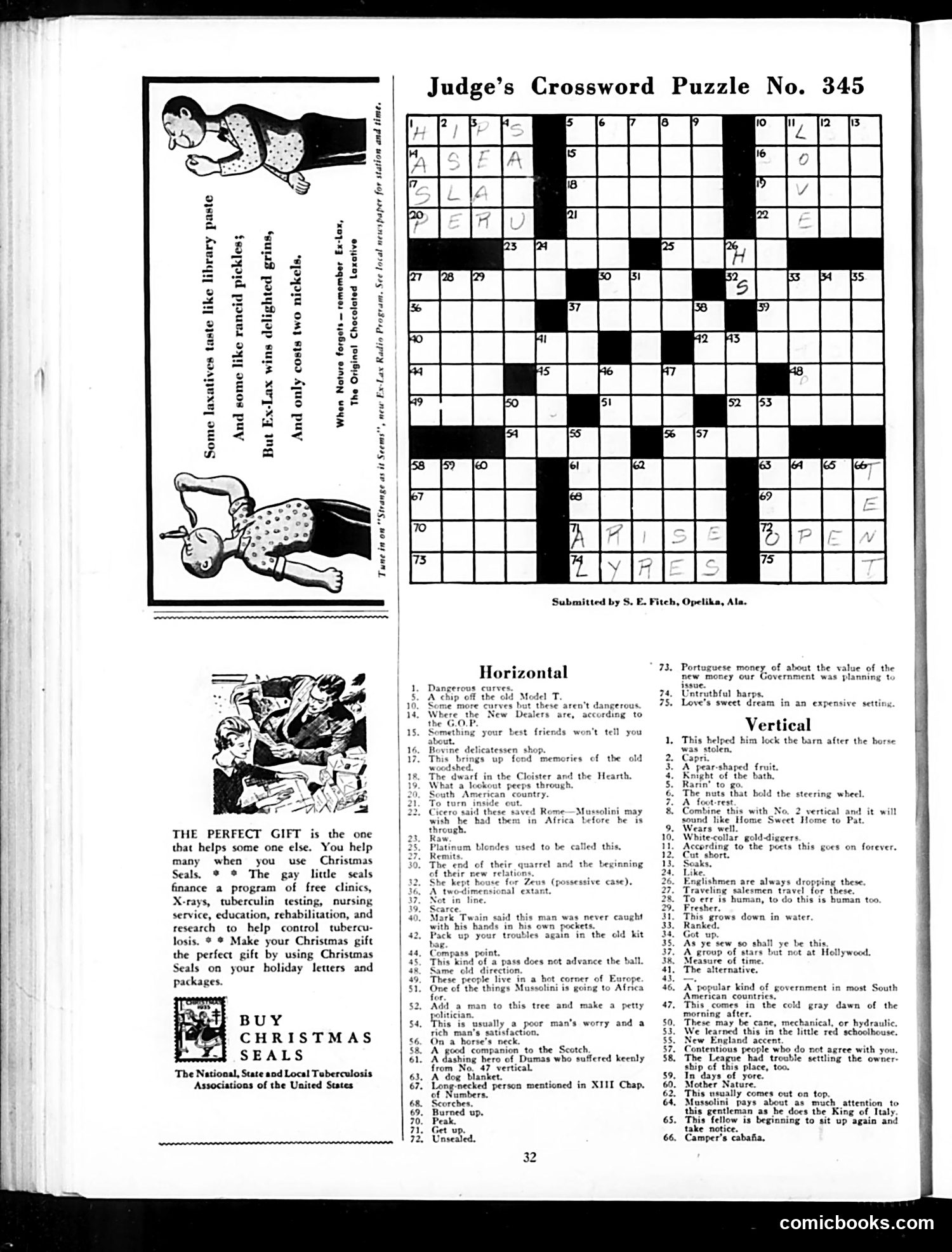
Judge Magazine Crossword Puzzle No. 345 (circa 1930s) This page is primarily a crossword puzzle with advertisements, not political satire. The puzzle itself contains oblique references to contemporary events and figures of its era. Notable clue references include: - "Where the New Deal are" (clue 14)—referring to Franklin D. Roosevelt's New Deal programs - Mussolini references (clues 51-52, 61)—reflecting 1930s anxieties about Italian fascism and African expansion - Mark Twain joke (clue 40)—a classical literary reference The surrounding advertisements promote Christmas Seals for tuberculosis prevention and Ex-Lax laxative, typical Depression-era commercial content. The cartoon illustrations at left appear humorous but lack clear political content—mostly depicting people in domestic situations. The overall page reflects Judge magazine's blend of word puzzles, light humor, and advertising targeting middle-class readers during the New Deal era.
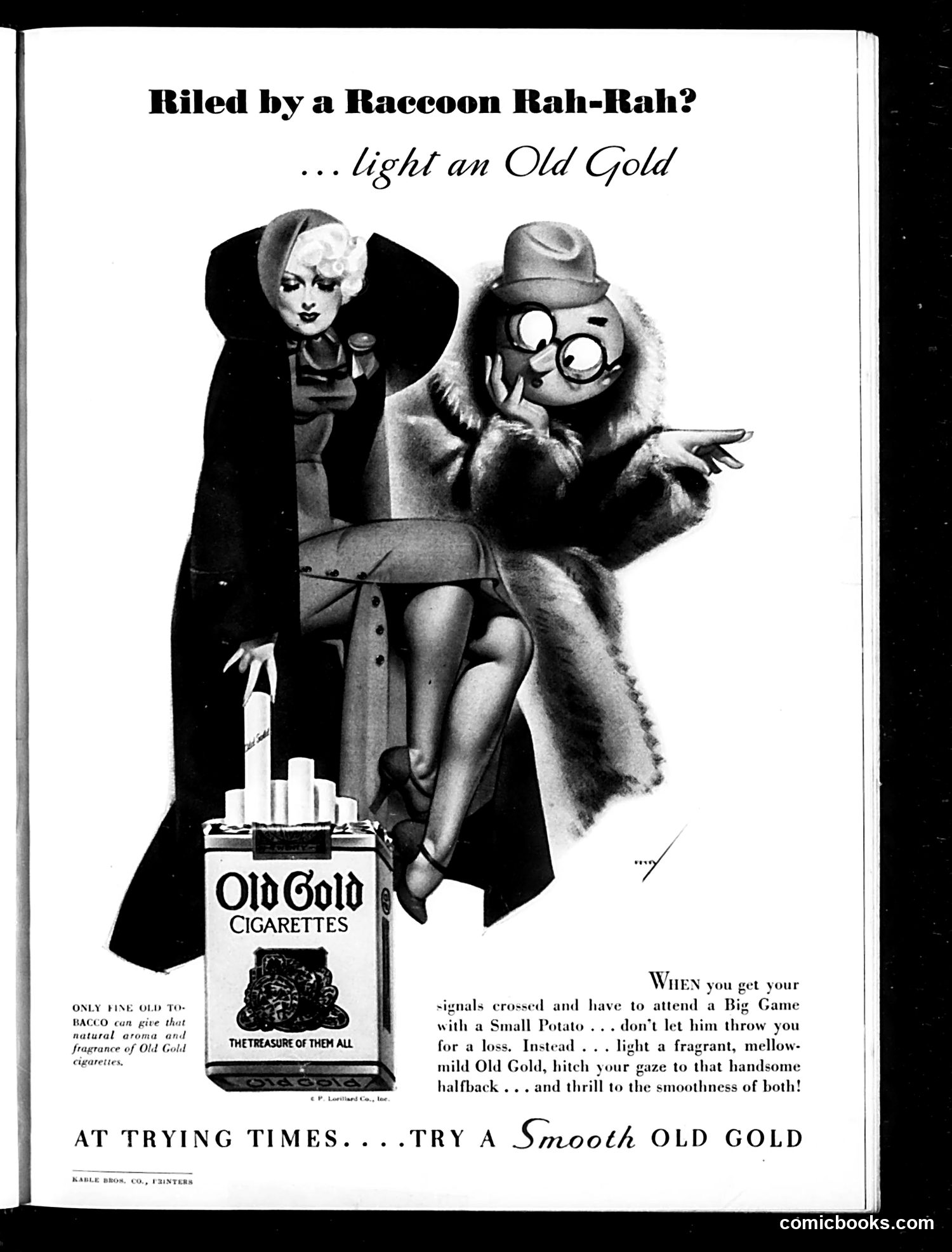
Old Gold Cigarettes Advertisement This is primarily a cigarette advertisement, not political satire. The "cartoon" is a playful ad for Old Gold cigarettes featuring a stylized raccoon character in a hat and glasses alongside a glamorous woman. The joke plays on the phrase "Raccoon Rah-Rah"—a pun referencing college football enthusiasm ("rah-rah"). The scenario: when you're stressed at a football game (attending a "Big Game with a Small Potato"—a disappointing team), don't lose your composure. Instead, smoke Old Gold cigarettes and enjoy watching the "handsome halfback" play. This reflects mid-20th-century advertising norms when smoking was socially acceptable and marketed as a sophisticated stress-relief. The raccoon mascot appears whimsical rather than satirical. The overall message: Old Gold cigarettes help you stay calm and enjoy leisure activities with style.
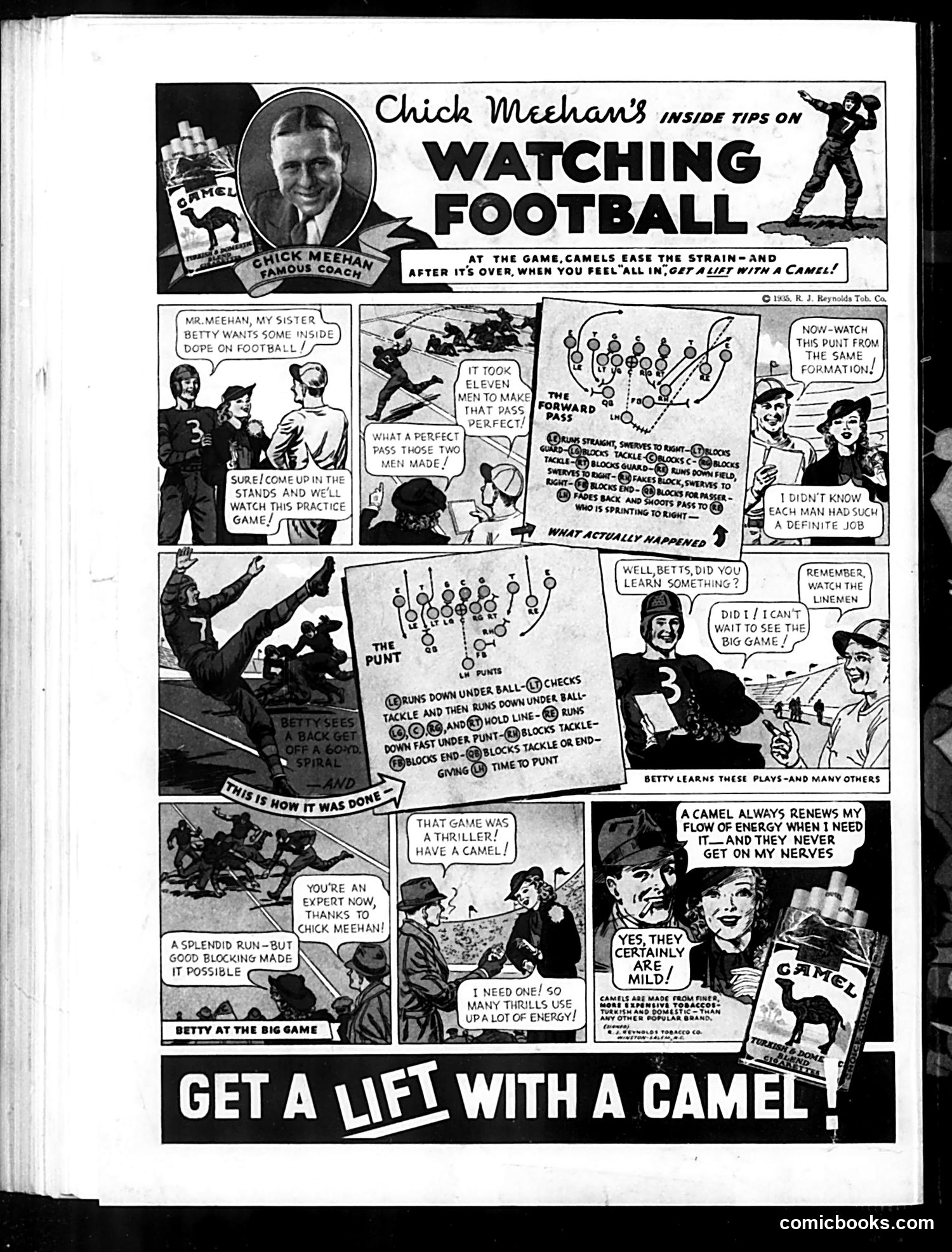
Chick Meehan's Football Tips: A Camel Cigarette Advertisement This is a Camel cigarette advertisement disguised as instructional content. Chick Meehan was a prominent football coach (likely Yale or similar era), lending credibility to the piece. The comic follows Betty learning football strategy from Meehan at a game. It depicts play diagrams and blocking techniques to appear educational. However, the actual purpose emerges in the final panels: characters praise Camels for providing "energy" during the game's excitement and afterward when "all in" (exhausted). The tagline "Get a Lift with a Camel" conflates cigarette smoking with physical stamina and recovery—a now-infamous advertising claim. This represents aggressive early-20th-century tobacco marketing that exploited sports enthusiasm and targeted women (Betty as protagonist) by framing smoking as sophisticated and health-enhancing. The page exemplifies how advertisements infiltrated entertainment media while disguising commercial intent as genuine advice.