judge
Judge — December 1935
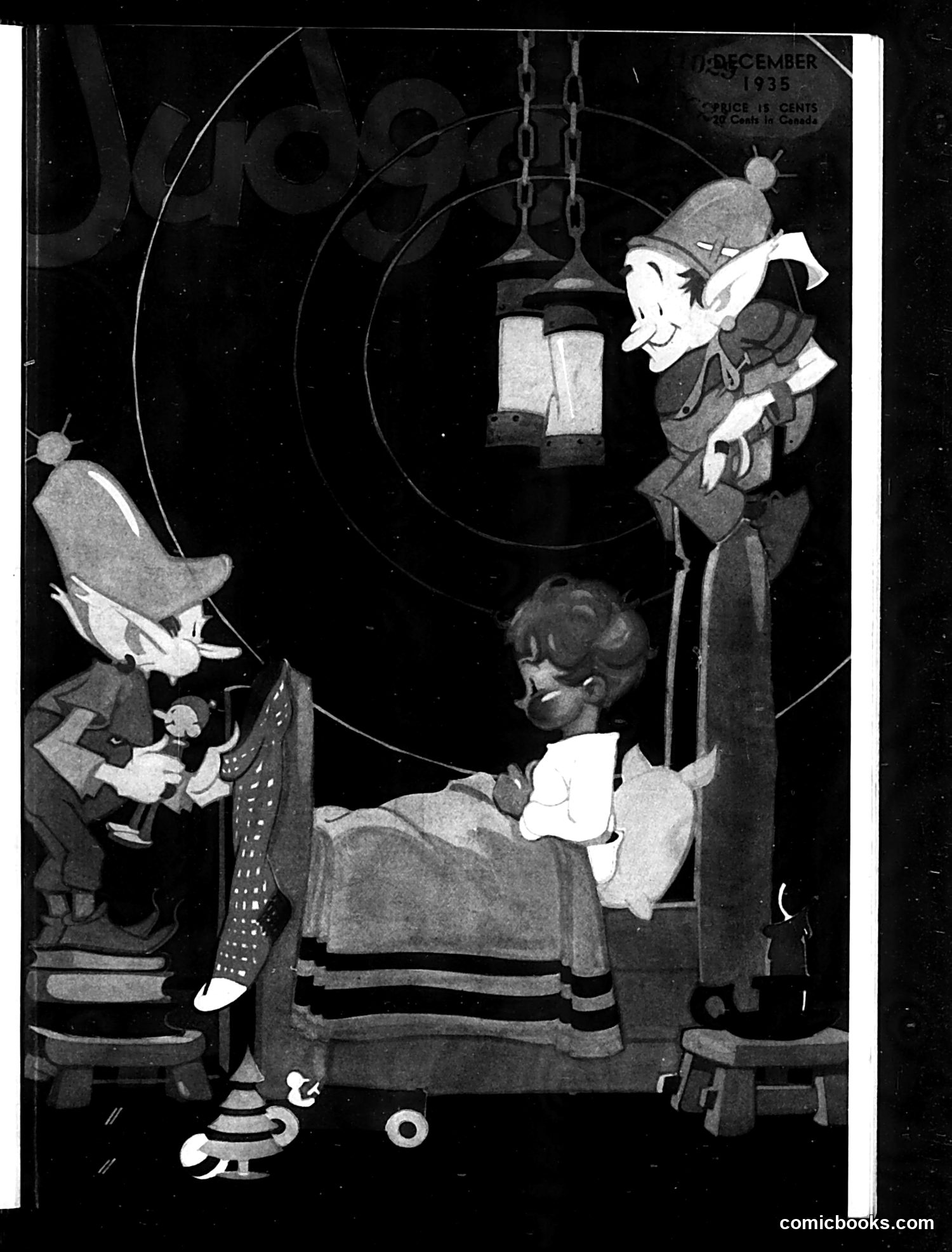
Analysis This December 1935 *Judge* page appears to show an animated cartoon scene rather than a political cartoon. The image depicts stylized characters in what looks like an interior setting with hanging lamps and exaggerated period clothing. Without clearer OCR text or visible captions identifying specific figures or the narrative, I cannot confidently determine the satirical point or social reference intended. The art style suggests early-to-mid 1930s commercial illustration or animation advertising, but the specific subject matter—whether political satire, social commentary, or entertainment advertisement—remains unclear from the image alone. To properly explain this page's meaning to a modern reader would require legible captions or text identifying the characters and situation being satirized.
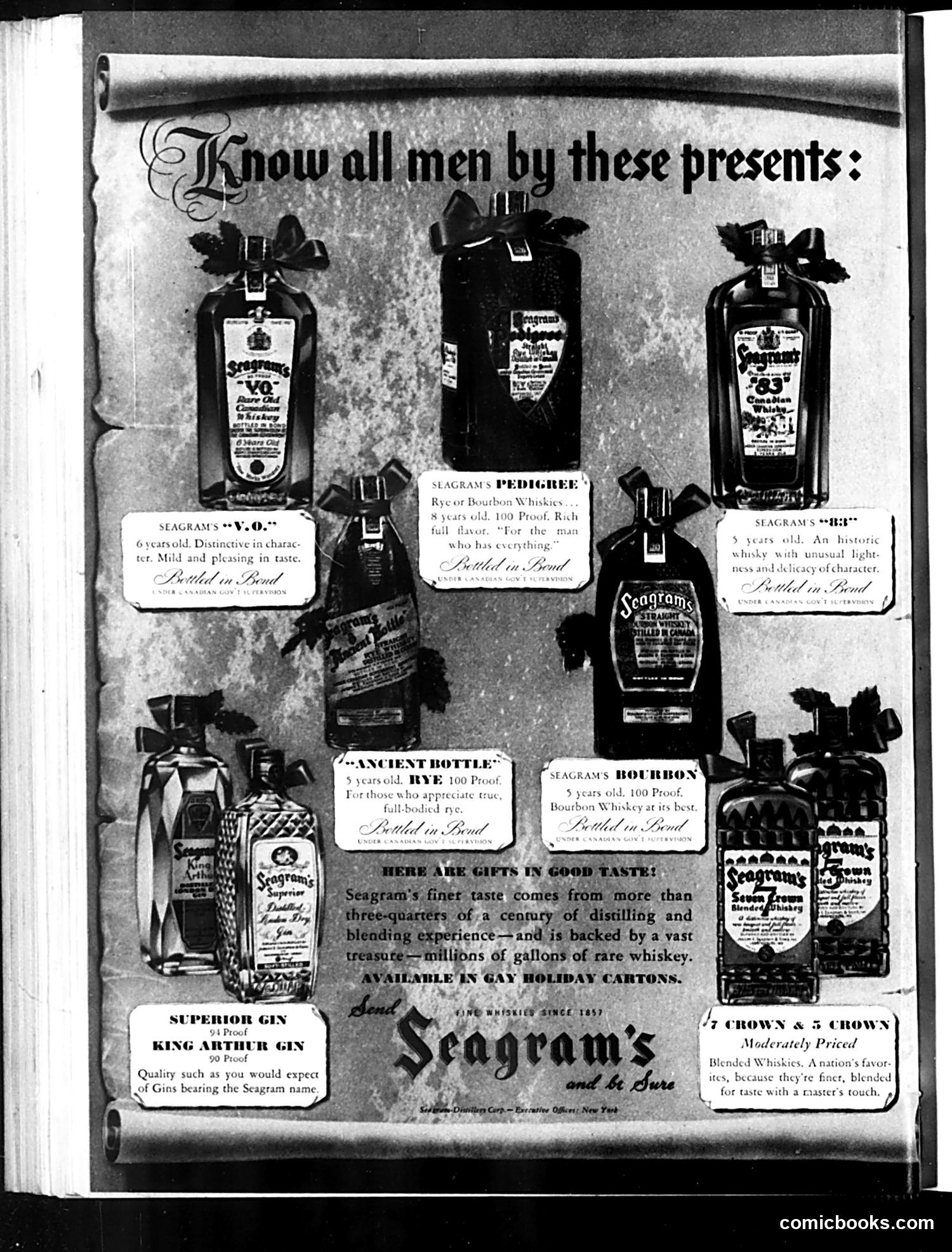
Seagram's Whiskey Advertisement This is primarily a commercial advertisement, not political satire. It showcases Seagram's distilled spirits—various whiskeys and gins—presented as gift options for men, with the opening line "Know all men by these presents" mimicking legal/formal language for humorous effect. The ad features five products: V.O., Pedigree, B, Ancient Bottle, Bourbon, plus Superior Gin and King Arthur Gin. Each includes brief descriptions emphasizing quality and taste. The phrase "Here are gifts in good taste" plays on the double meaning of "taste"—both flavor and refinement. The layout and styling reflect 1920s-30s advertising aesthetics, though the specific publication date is unclear from this image alone. This represents typical Judge magazine advertising rather than editorial satire.
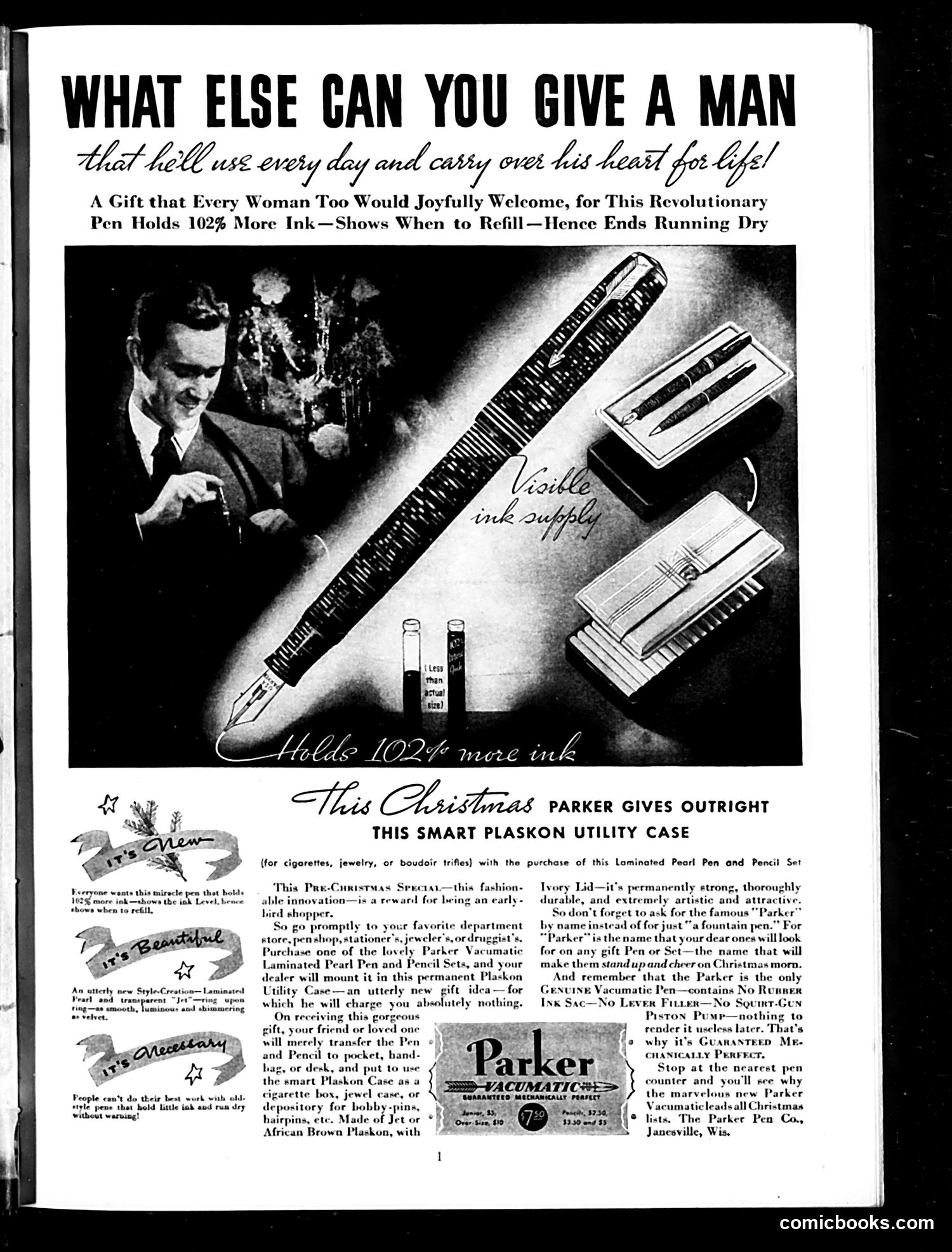
Analysis This page is primarily advertising, not satire or political commentary. It promotes Parker fountain pens and pen sets as Christmas gifts. The content consists of: 1. Main advertisement: A Parker pen with "visible ink supply" that "holds 102% more ink," marketed as a practical gift for men 2. Gift packaging options: Three decorative "utility cases" with ribbons labeled "New," "Beautiful," and "Necessary" 3. Product details: Emphasis on the pen's reliability and the smart Plaskon utility case for storing pens, cigarettes, or jewelry The only figurative element is a photograph of a man writing—used generically to show the product in use. There is no political cartoon, caricature, or social satire on this page. It's a straightforward mid-century commercial advertisement typical of Judge magazine's revenue model.
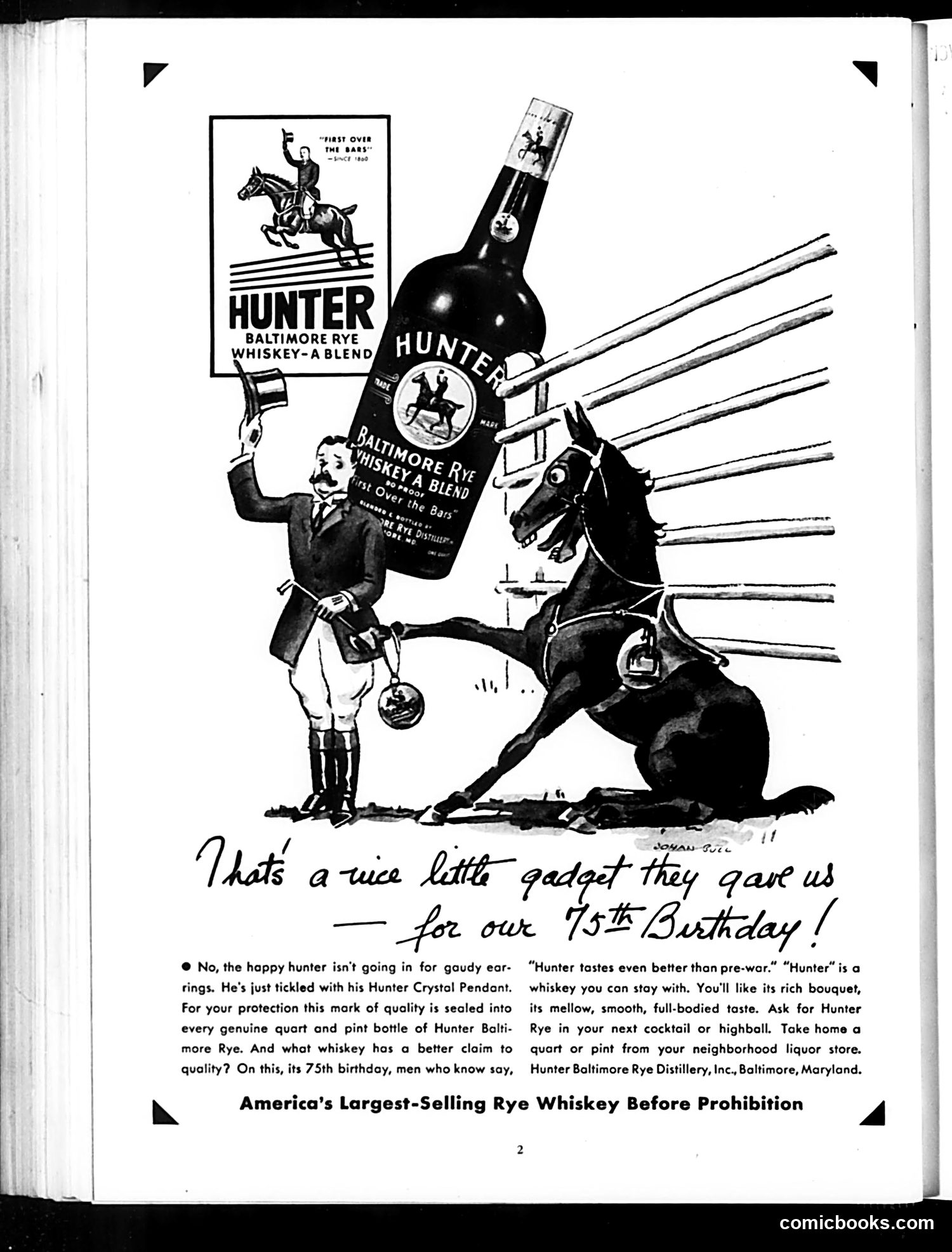
Hunter Rye Whiskey Advertisement This is primarily a whiskey advertisement rather than political satire. It celebrates Hunter Baltimore Rye Whiskey's 75th birthday, depicting a well-dressed hunter on horseback holding an enormous bottle as a "gadget" or prize. The humor is straightforward product advertising: the exaggerated bottle size and the hunter's delighted reaction make the whiskey seem desirable and celebratory. The accompanying text emphasizes that Hunter is "America's Largest-Selling Rye Whiskey Before Prohibition"—a significant historical detail, as this appears from the Prohibition era when such advertising was becoming restricted or nostalgic. The "Crystal Pendant" mentioned is a quality mark sealed into bottles. This is essentially vintage marketing hyperbole rather than social commentary.
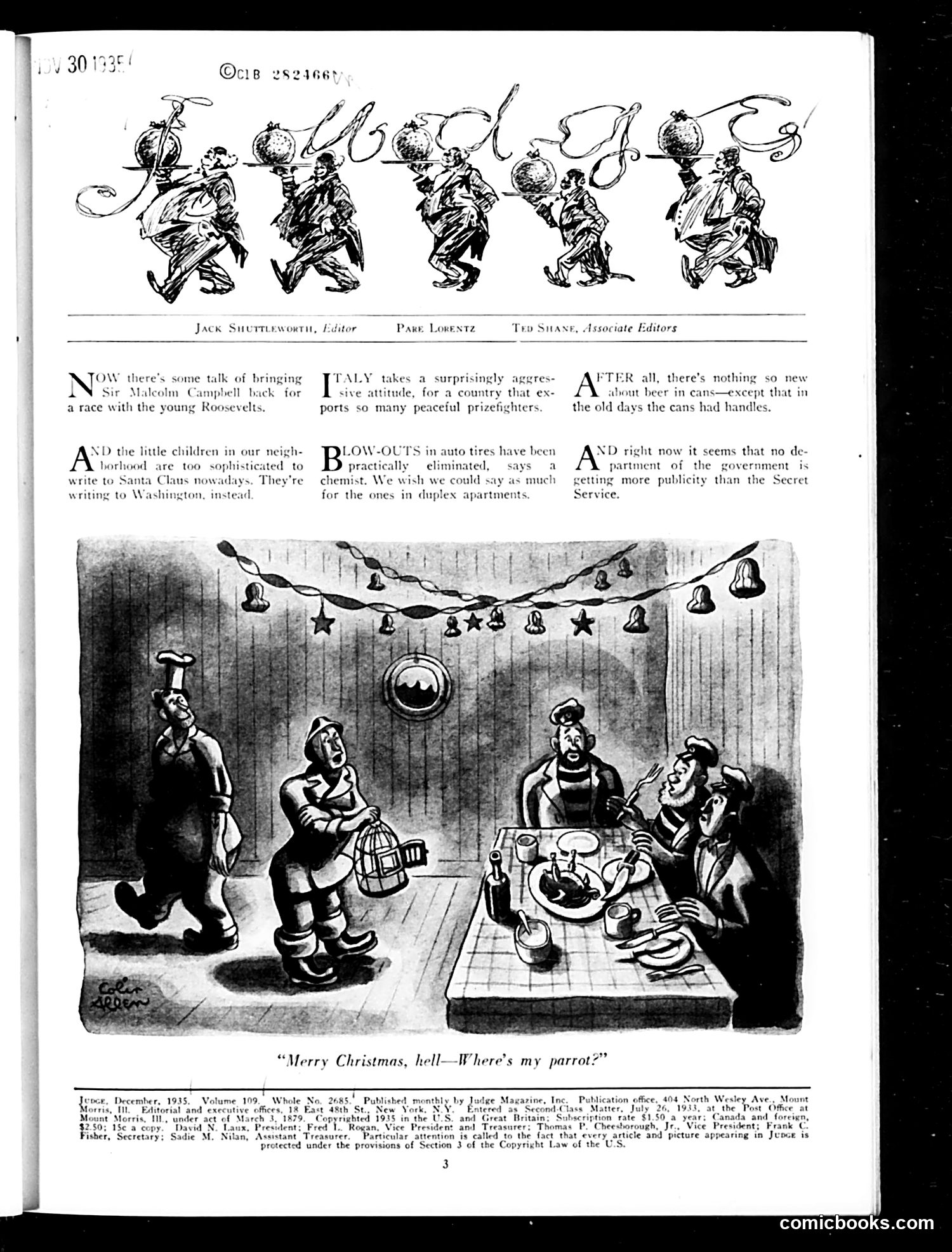
Explanation of This Judge Magazine Page (December 1915) Top Section: Decorative header with five dancing figures juggling globes, illustrating the magazine's satirical tone. Text Snippets: Brief commentary on contemporary issues: Malcolm Campbell racing "young Roosevelts," children writing to Washington instead of Santa Claus, auto tire blow-outs in apartments, and government departments receiving more publicity than the Secret Service. Main Cartoon: Titled "Merry Christmas, hell—Where's my parrot?" depicts a working-class Christmas dinner scene. A man arriving home appears frustrated or angry, while others (wife, children) are seated at a modest table. The domestic discord suggests economic hardship during wartime—the man's complaint about a missing parrot implies unmet expectations or broken promises, likely satirizing class struggles or unfulfilled holiday hopes during WWI (the issue date is December 1915).
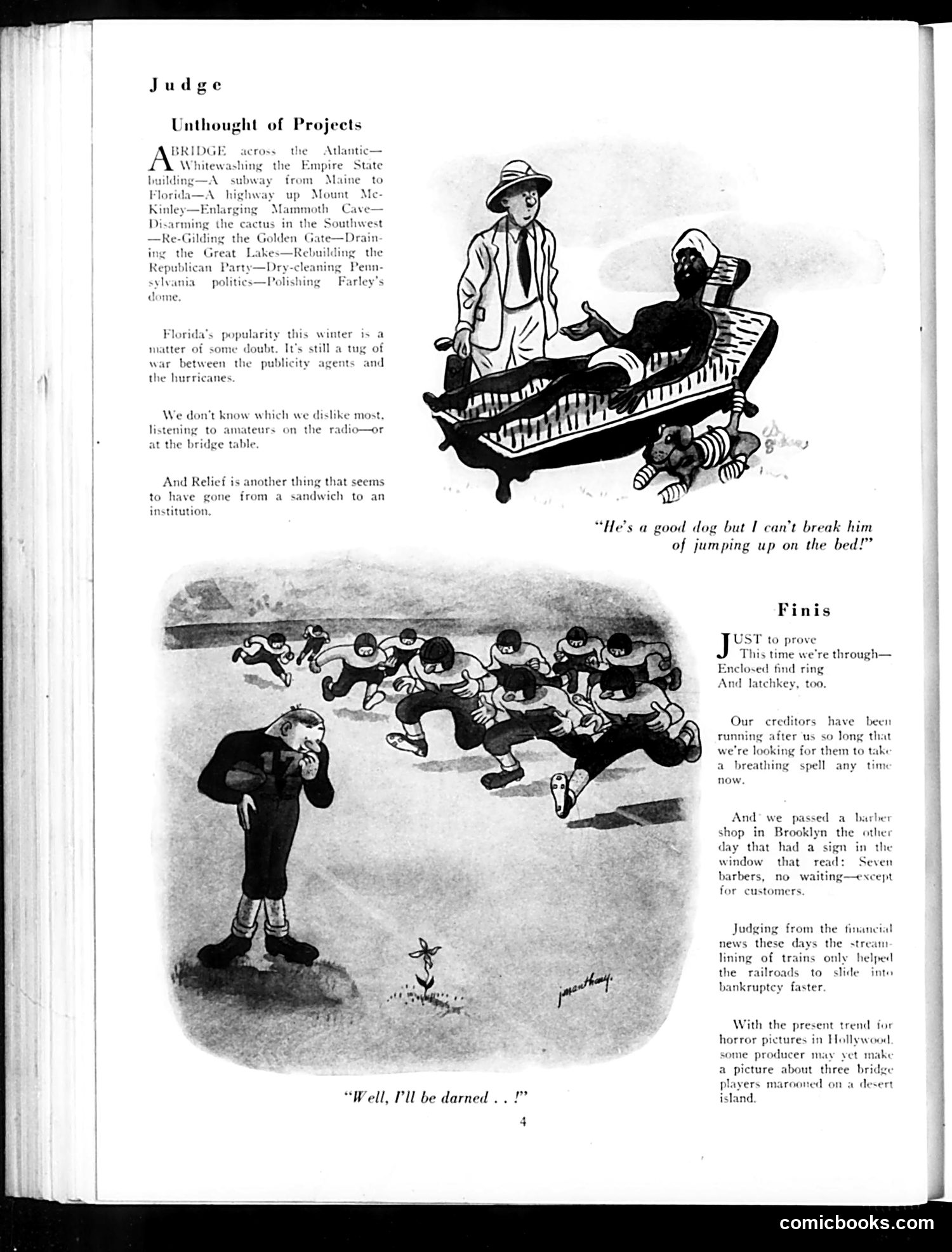
Analysis of Judge Page This page contains two distinct sections: "Unthought of Projects" (top) lists absurd infrastructure proposals—transcontinental subways, bridges, cave enlargements—satirizing grandiose public works schemes. The accompanying cartoon shows a man in a suit gesturing at a recumbent figure on a bed, with the caption "He's a good dog but I can't break him of jumping up on the bed!" This appears to critique frivolous spending or impractical projects. "Finis" (bottom) presents a cartoon of a man shouting at fleeing figures, captioned "Well, I'll be darned...!" The accompanying text humorously references creditors, bankruptcy, and economic hardship—suggesting this satirizes financial desperation or debt collection, likely referencing Depression-era economic struggles. Both sections use humor to comment on practical problems: wasteful spending and financial crisis.
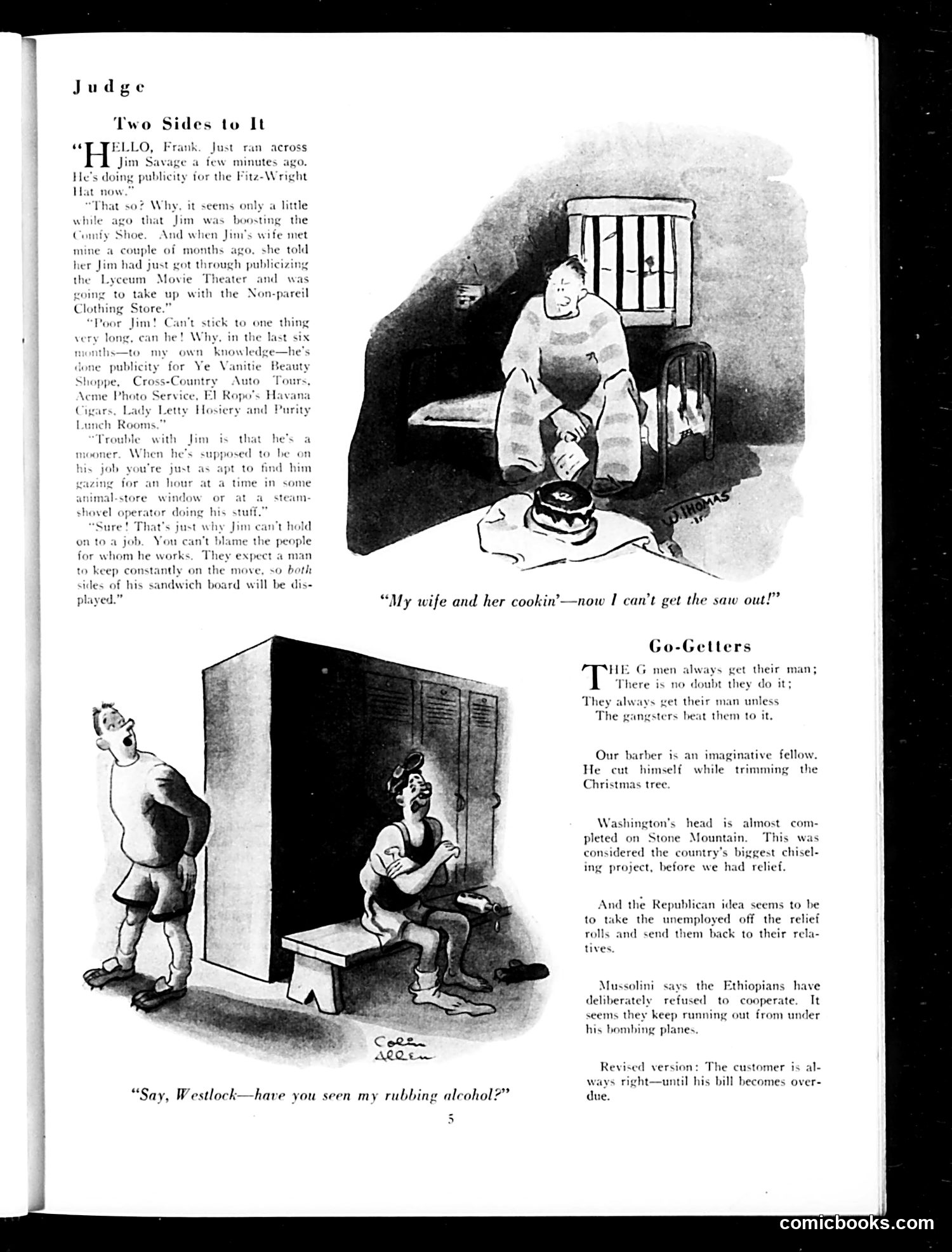
Explanation for Modern Readers This Judge magazine page contains two satirical sections: "Two Sides to It" depicts a man imprisoned for looking at store windows during his job—commentary on employers demanding constant productivity. The joke: both sides (employer and employee) claim the other is unreasonable, but the man loses. "Go-Getters" is a series of brief satirical quips mocking ambitious business tactics and political figures. References include: - A barber's imaginative boasting - Washington's Stone Mountain monument project - Republican criticism of Depression-era relief programs - Mussolini's bombing of Ethiopia The cartoon below shows someone asking about "rubbing alcohol"—likely a Prohibition-era joke about concealing alcohol consumption. The satire targets corporate exploitation, political absurdity, and Depression-era economic policies through dark humor typical of 1930s Judge magazine.
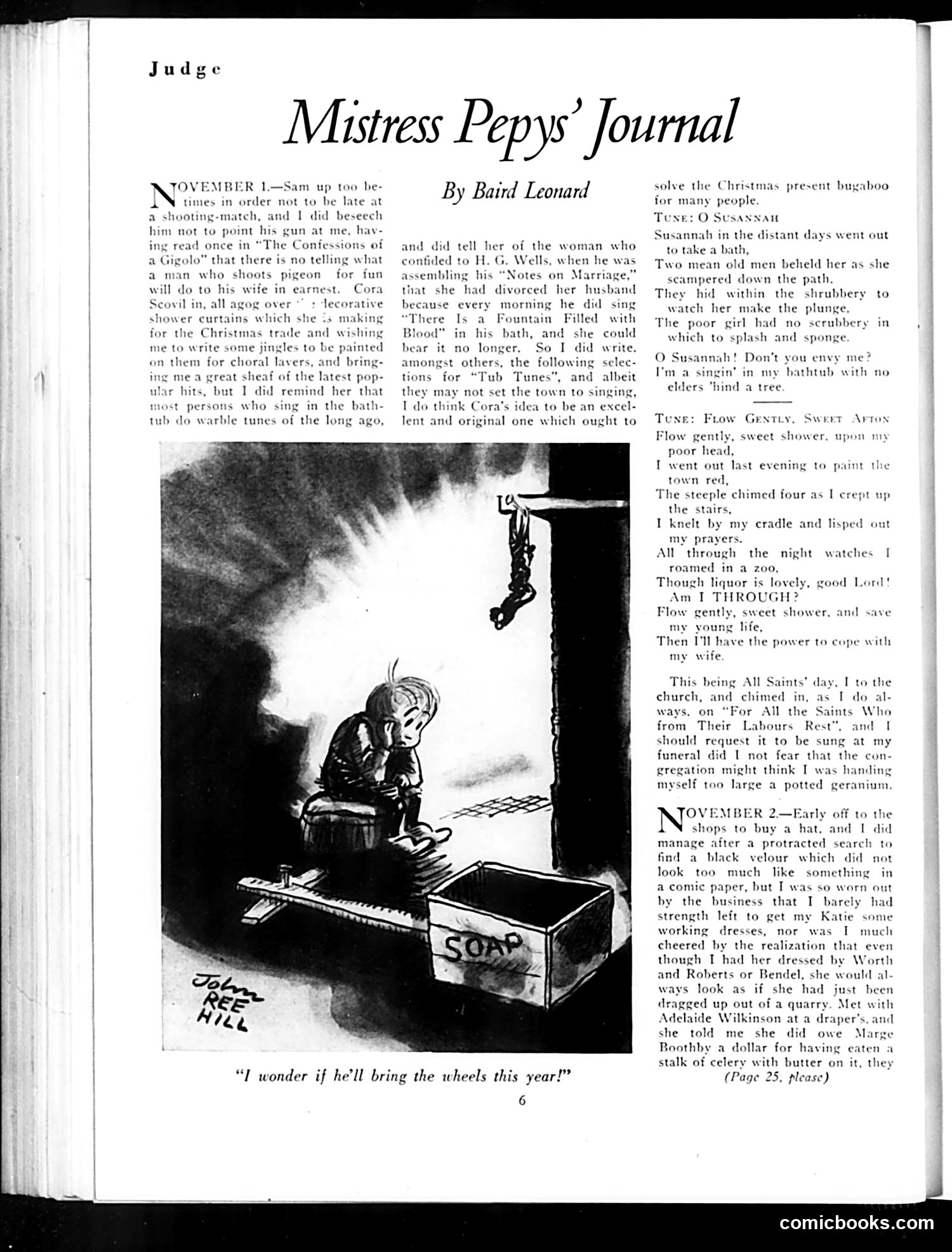
Mistress Pepys' Journal - Analysis This page presents a humorous column by Baird Leonard titled "Mistress Pepys' Journal," styled after the famous diary of Samuel Pepys. The accompanying illustration by John Held Hill depicts a woman at a washboard with a soap box, captioned "I wonder if he'll bring the wheels this year?" The satire targets domestic life and marital dynamics. The cartoon jokes about a wife doing laundry—arduous manual work—while wondering if her husband will provide "wheels" (likely referring to a washing machine or labor-saving device) as a Christmas gift. This reflects early 20th-century anxieties about household drudgery and the gap between wives' domestic expectations and husbands' gift-giving priorities, mocking both the woman's hopeful resignation and the husband's presumed stinginess.
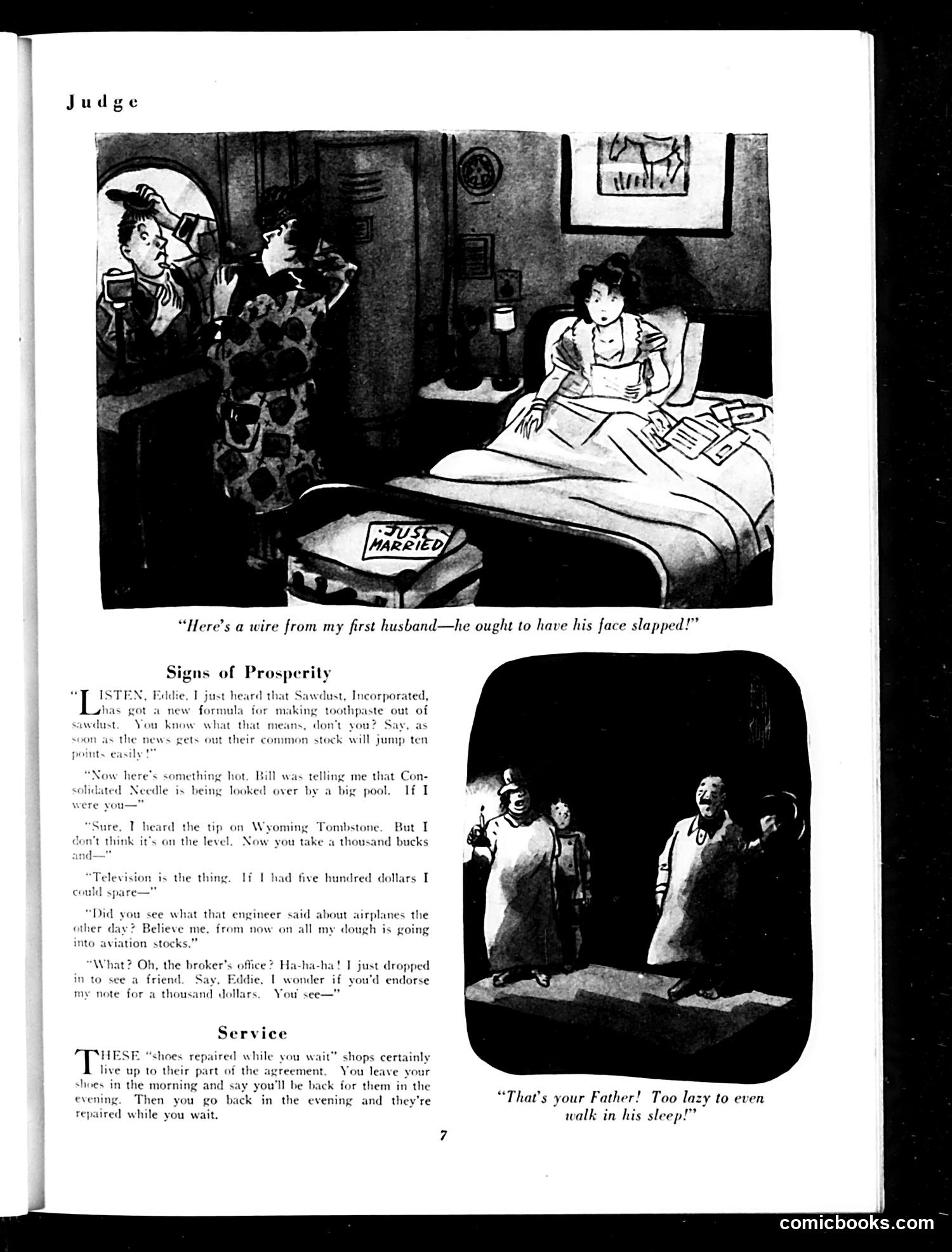
Analysis of Judge Page 7 This page contains two unrelated satirical sketches typical of Judge magazine's humor format. The top cartoon, titled "Judge," depicts a domestic dispute where a woman in bed receives a wire from her first husband demanding his face be slapped. The satire likely targets messy divorce situations and remarriage complications of the era. The bottom section, "Signs of Prosperity" and "Service," features conversational snippets about stock tips, toothpaste formulas, and airplane investments—satirizing the speculative fever and get-rich-quick schemes of the 1920s economic boom. The final sketch about shoe repair shops mocks overpromising service businesses. The humor relies on everyday domestic and commercial frustrations recognizable to contemporary readers, rather than specific political figures or events.
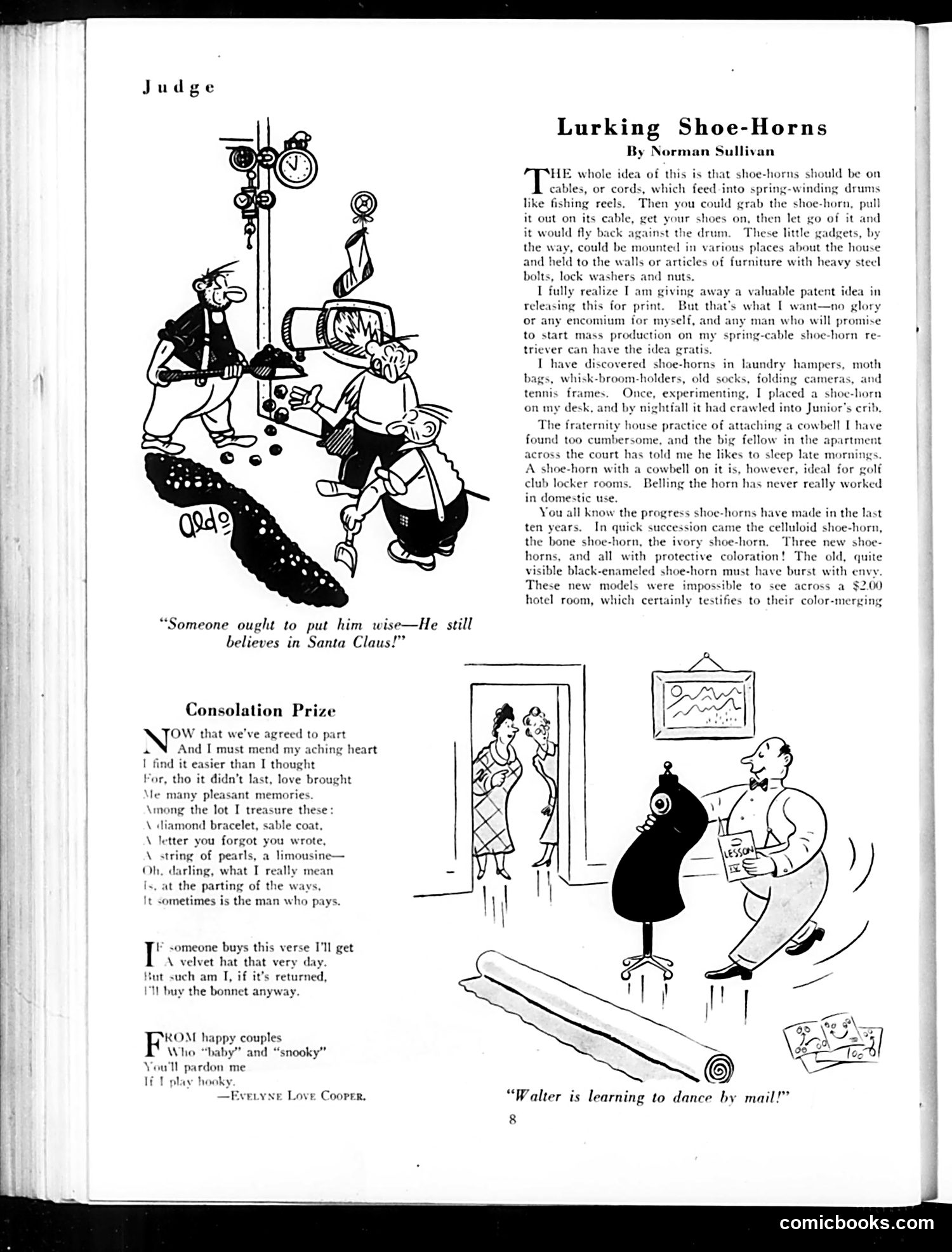
Judge Magazine Page Analysis Top Cartoon: A man surrounded by scattered items (appearing to be gifts or valuables) is criticized for naively believing in Santa Claus—likely satirizing a gullible or foolish person, possibly a public figure or type. The caption suggests someone needs to "wise him up." "Consolation Prize" Poem: Satirizes mercenary attitudes in romance. A woman catalogs material gains from a failed relationship—diamond bracelets, sable coats, pearls, limousines—before revealing the real point: "at the parting of the ways, it sometimes is the man who pays." The satire mocks both gold-digging and the transactional nature of relationships. "Lurking Shoe-Horns" Article: A humorous invention pitch by Norman Sullivan proposing spring-loaded, cable-retracted shoe-horns mounted throughout homes like fishing reels. Sullivan describes discovering shoe-horns everywhere (laundry hampers, fraternity houses) and proposes an elaborate mechanical solution to a minor inconvenience—satirizing over-engineered "solutions" to everyday problems. Bottom Cartoon: Shows a man excitedly receiving dancing lessons by mail, captioned "Walter is learning to dance by mail!"—mocking mail-order instruction schemes.
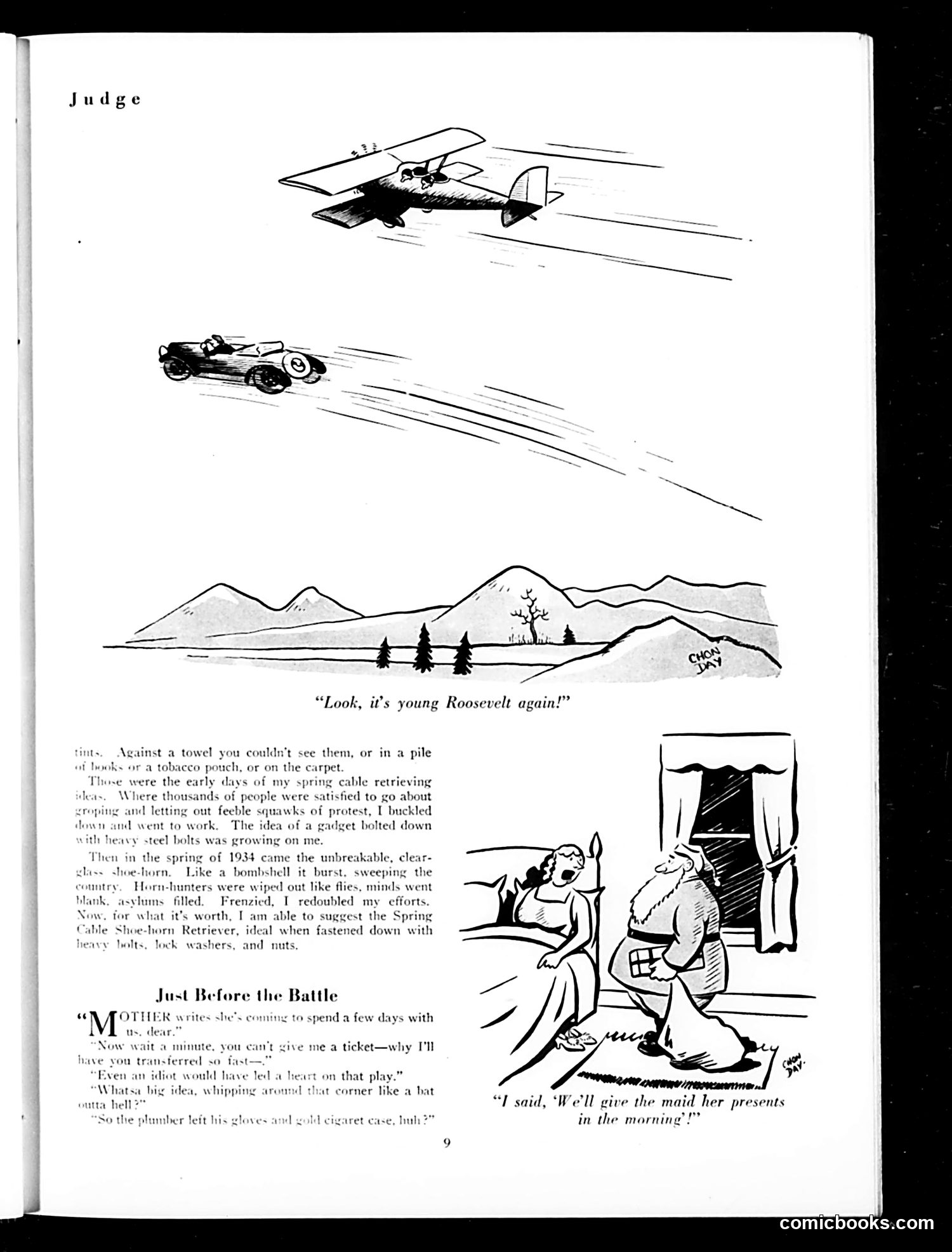
Analysis of This Judge Magazine Page The top cartoon shows an airplane and racing car with the caption "Look, it's young Roosevelt again!"—a satirical reference to Franklin D. Roosevelt's energetic, action-oriented presidency. The joke compares FDR's aggressive "New Deal" policies to rapid modes of transportation, suggesting he's constantly moving forward with new initiatives. The lower section, titled "Just Before the Battle," is a domestic humor comic about a husband trying to avoid giving his mother-in-law a ticket to a show. When she arrives for a visit, he attempts excuses ("you can't give me a ticket"), leading to a humorous exchange with the punchline about giving "the maid her presents in the morning"—implying he's bribing staff to appease the unwanted guest. The page mixes political commentary (Roosevelt satire) with traditional domestic comedy, typical of Judge's blend of topical and timeless humor.
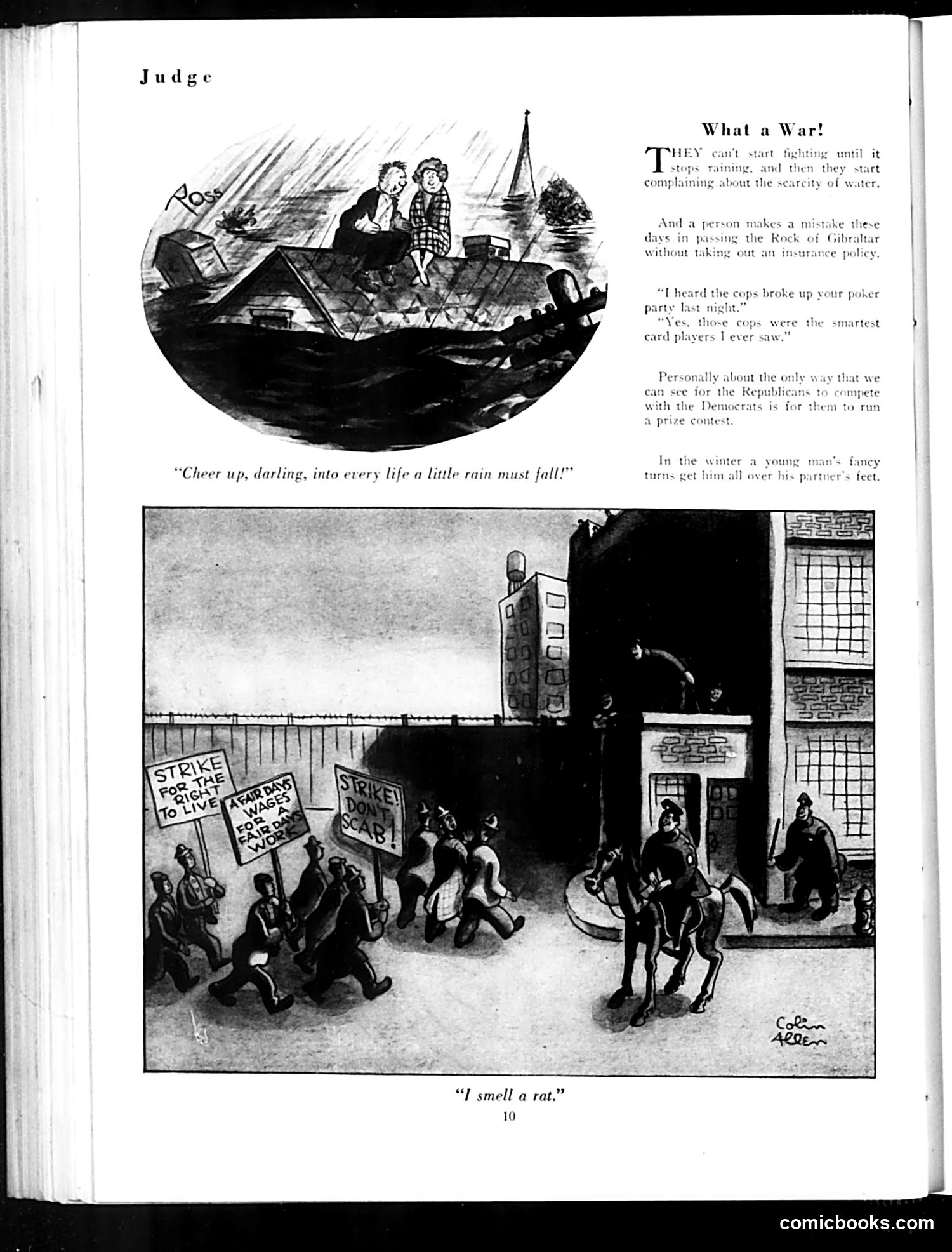
Analysis This Judge magazine page contains two cartoons satirizing early 20th-century American politics and labor unrest. The top cartoon depicts a couple in a boat during rain, with the caption "Cheer up, darling, into every life a little rain must fall!" — likely commenting on economic hardship or political turbulence of the era. The bottom cartoon shows a labor strike scene with picketers holding signs reading "STRIKE FOR HIGHER WAGES" confronting what appears to be police or authorities at a building. The caption "I smell a rat" suggests suspicion of government collusion or betrayal — possibly implying authorities siding with employers against strikers. The text discusses Republicans and Democrats competing, card-playing cops, and romantic entanglements, using these as metaphors for political deception and social disorder during this period of labor conflict.
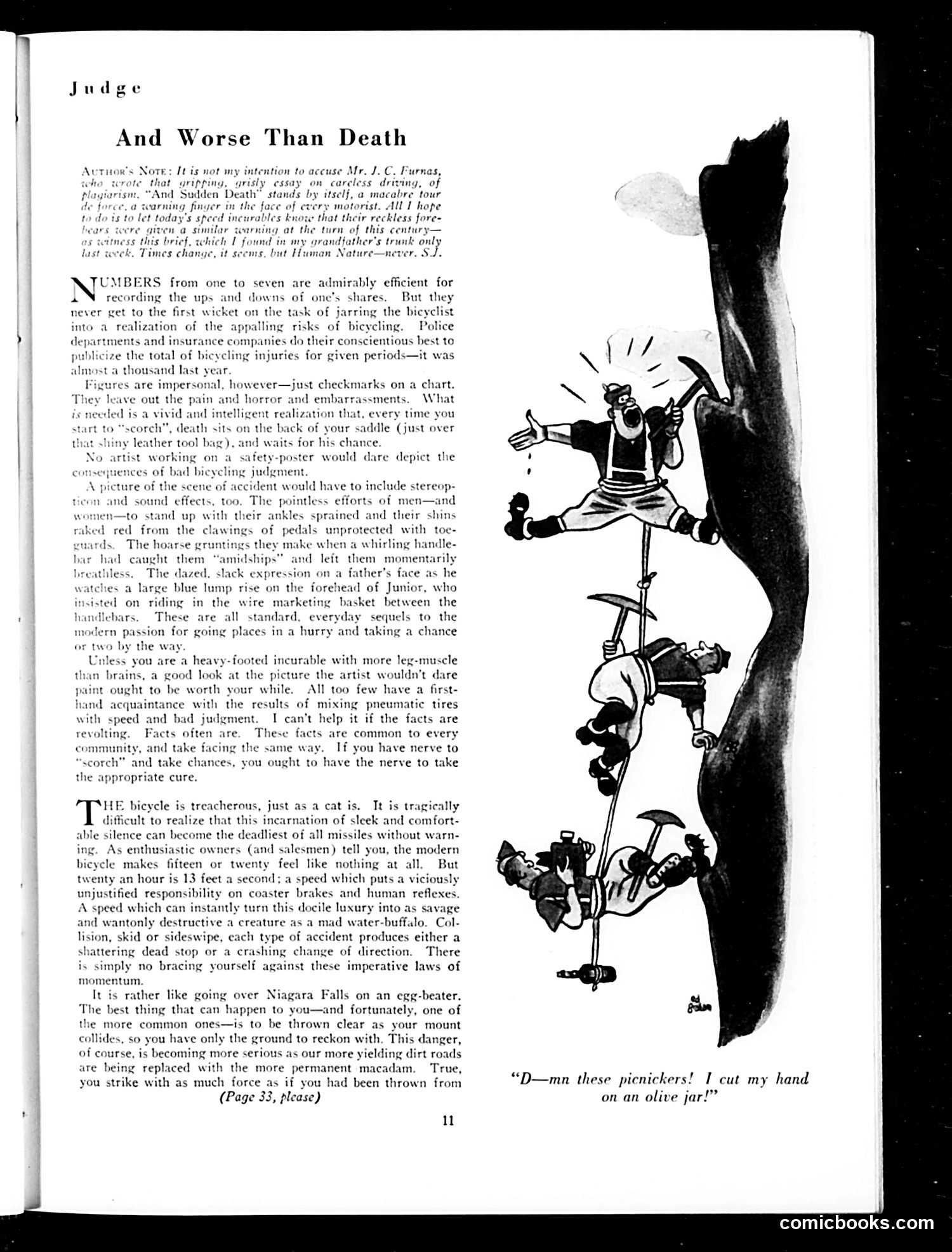
"And Worse Than Death" - Judge Magazine Bicycle Safety Article This is a safety-awareness article with editorial cartoon criticizing reckless bicycle riding. The author references J.C. Furnas's essay "And Sudden Death" (about dangerous driving), noting that similar warnings about bicycle hazards existed decades earlier—found in the author's grandfather's trunk. The cartoon depicts a cyclist performing dangerous stunts ("scorching"—speeding recklessly)—shown tumbling and crashing around a tree. The satire's point: Statistics about bicycle injuries are boring and impersonal, but vivid depictions of actual accident consequences—broken bones, bruised children, shocked parents—effectively communicate danger. The author argues that if cyclists have the nerve to ride recklessly, they should have the nerve to face realistic consequences. Modern bicycles, traveling 13 feet per second, transform from "docile luxury" into "savage" machines in collisions—unpredictable as Niagara Falls on an "egg-beater." The caption quote ("D—mn these picnickers!") captures the frustration of a crash victim.
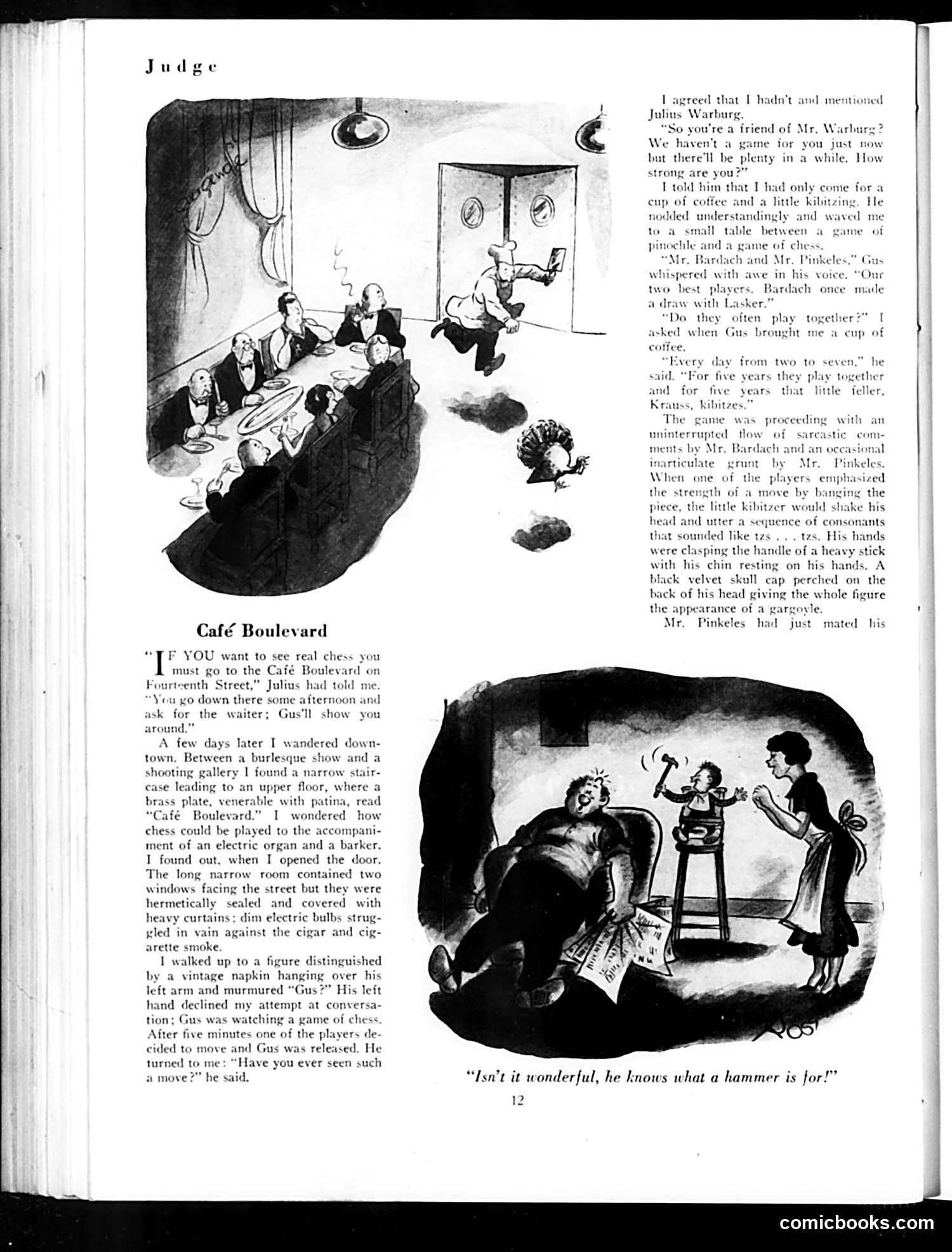
Café Boulevard Cartoon Analysis This page depicts the narrator's visit to an underground chess club on Fourteenth Street in what appears to be New York City. The humor centers on the contrast between chess's reputation as a refined intellectual pursuit and the seedy, cramped location—sandwiched between a burlesque show and shooting gallery with sealed windows and heavy cigar smoke. The satire targets chess culture itself: the intensely serious players (Bardach and Pinkeles, apparently well-known locally), the reverent "kibitzers" (onlookers who comment), and the waiter Gus who treats the games as sacred events. The cartoon shows a kibitzer making exaggerated reactions to moves. The final cartoon's caption—"Isn't it wonderful, he knows what a hammer is for!"—likely mocks the pretentious chess world by contrasting it with working-class practicality, though the specific reference is unclear without additional context. The satire gently ridicules urban chess enthusiasm as obsessive yet oddly provincial.
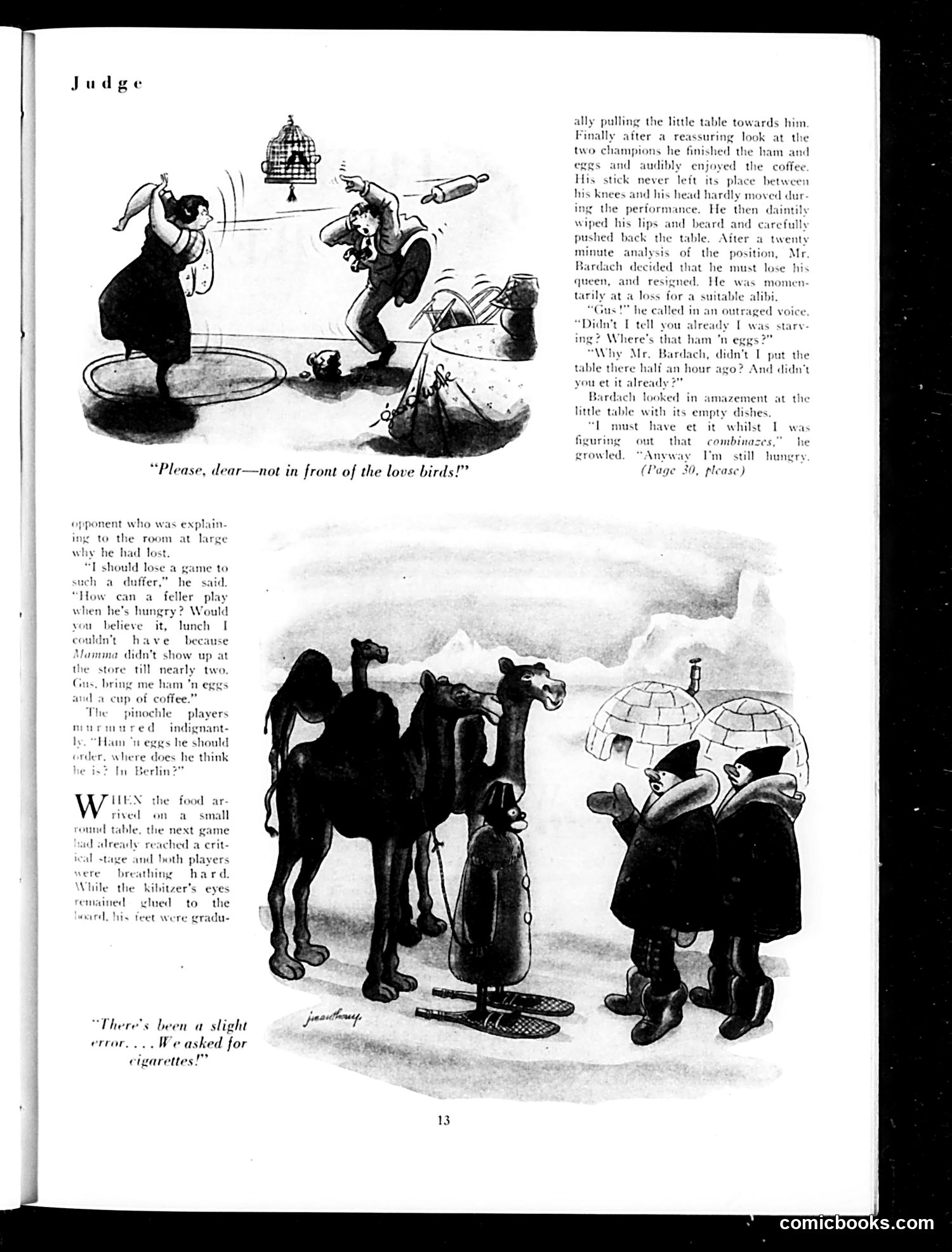
Judge Magazine Cartoon Analysis This page satirizes competitive chess players and their excuses for losing. The top cartoon shows a chess match interrupted by a woman asking a man not to make moves "in front of the love birds"—likely referring to decorative objects or the woman's presence as a distraction. The main story involves Mr. Bardach, a chess player who loses a game and blames his loss on hunger and poor conditions. A kibitzer (spectator) watches intently while Bardach eats ham, eggs, and coffee during play, his chess stick never leaving his lap. After losing, Bardach resigns and blames his defeat on distraction—claiming he ate a small table while "figuring out that combination," then admits he's still hungry. The joke targets chess players' tendency to make absurd excuses rather than accept defeat, and humorously literalizes the distraction excuse by having Bardach unconsciously consume furniture while playing. The bottom cartoon about cigarettes remains unclear without additional context.
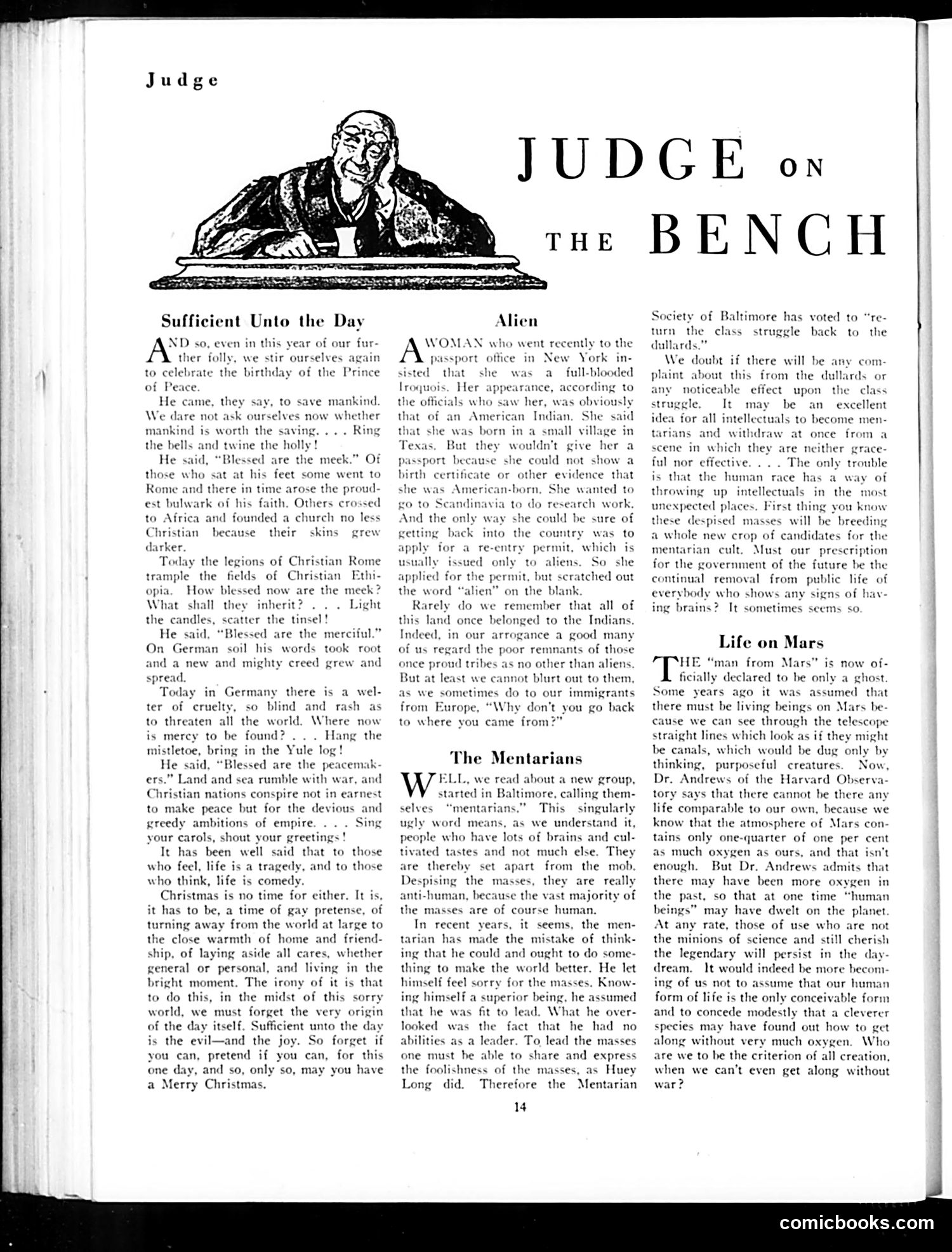
Judge Magazine Page Analysis This page from Judge satirizes several contemporary issues through three pieces: "Sufficient Unto the Day" (left): A Christmas editorial criticizing Christian hypocrisy. It contrasts Christ's teachings (blessed are the meek, merciful, peacemakers) with Christian nations' actual behavior—colonial conquest in Africa and Ethiopia, German militarism and cruelty, and war-mongering by Christian powers. The satire is bitter: we celebrate Christmas while ignoring these contradictions. "Alien" (top right): Mocks American prejudice against Native Americans. An Iroquois woman seeking a passport couldn't prove her American birth, so officials treated her as an "alien." The satire highlights the irony: indigenous peoples are denied citizenship status in their own homeland, yet immigrants are told to "go back where you came from." "The Mentarians" (bottom right): Satirizes intellectual elites in Baltimore who believe their superior intelligence qualifies them to lead the masses—despite having no actual leadership abilities. The critique suggests such intellectuals are out of touch and self-deluded. The overall tone is Christmas-season social criticism targeting hypocrisy, prejudice, and intellectual arrogance.
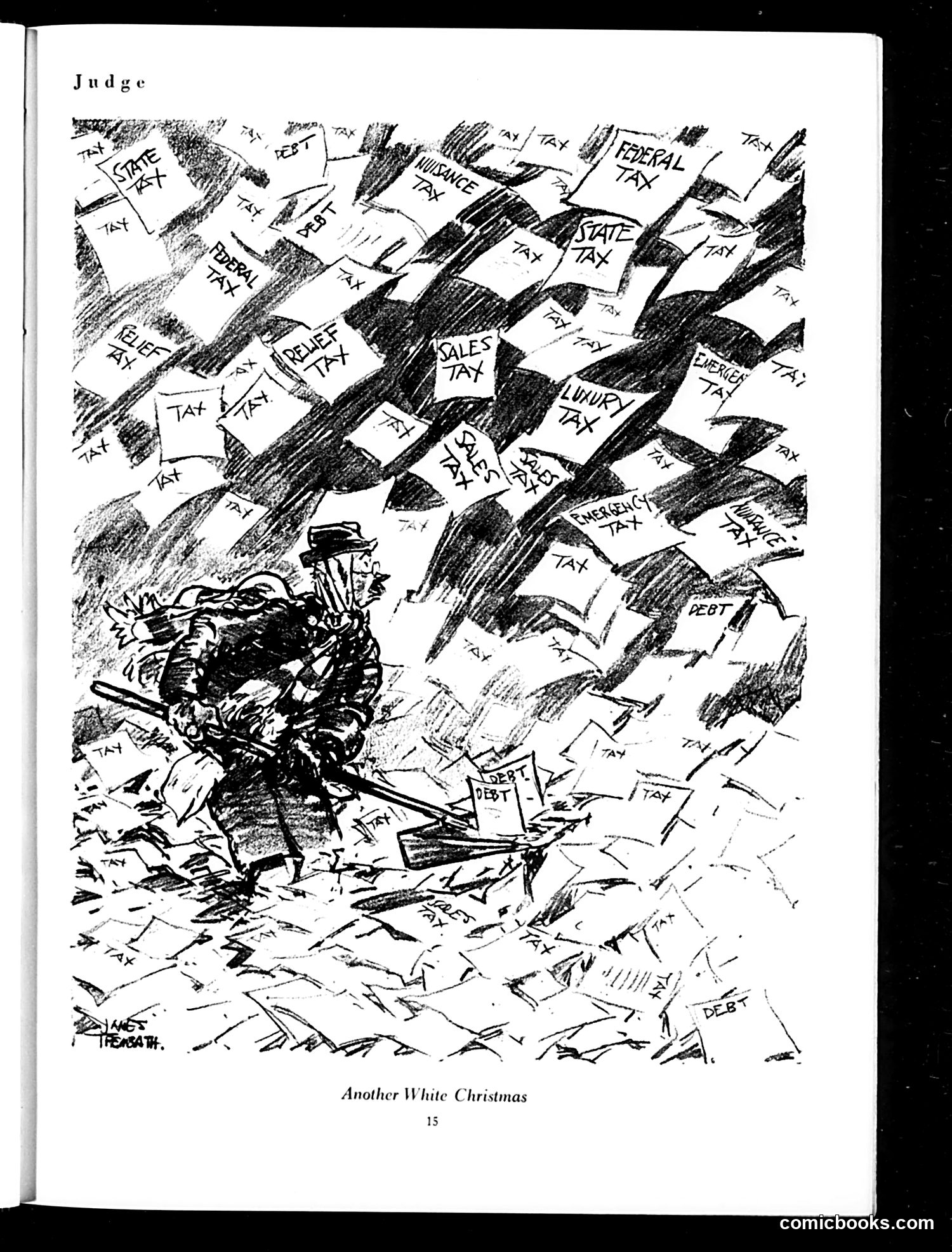
Analysis: "Another White Christmas" This political cartoon depicts Uncle Sam (identifiable by his distinctive hat and clothing) buried under an avalanche of papers labeled with various taxes and debts: "STATE TAX," "FEDERAL TAX," "SALES TAX," "LUXURY TAX," "DEBT," "INSURANCE TAX," "RELIEF TAX," and others. The satire critiques the overwhelming burden of taxation and government debt on Americans. The title "Another White Christmas" ironically suggests a bleak holiday season, with "white" likely referring to the white papers/bills burying the figure rather than snow. The cartoon reflects economic anxieties, probably from the Depression or post-WWII era, satirizing how multiple layers of taxation and financial obligations bury the average American (represented by Uncle Sam as the nation itself).
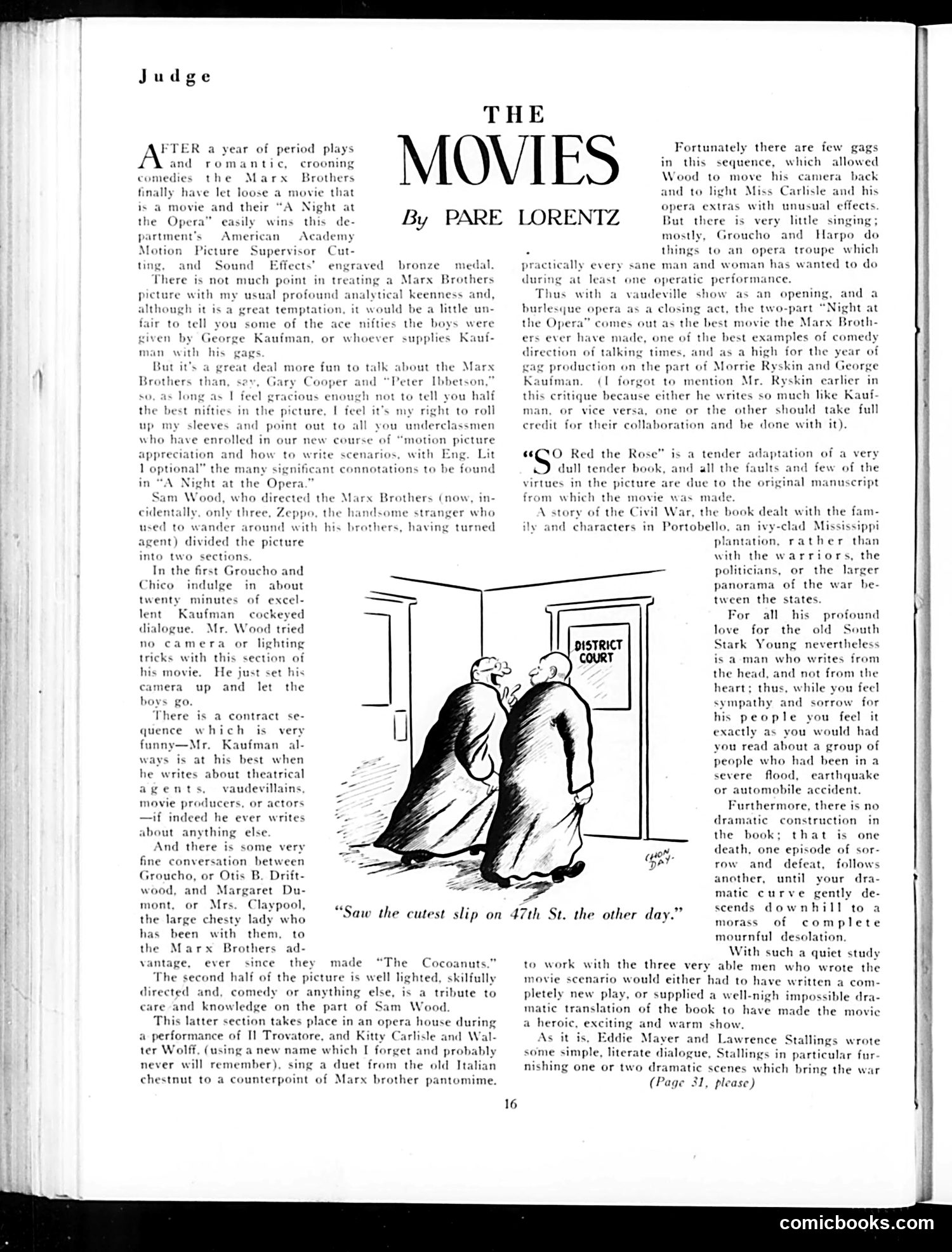
Judge Magazine Article on "The Movies" This is a film review column by Pare Lorentz discussing recent movies, primarily focused on the Marx Brothers' "A Night at the Opera." The main cartoon shows two men in suits outside a "District Court," with the caption "Saw the cutest slip on 47th St. the other day"—a double-entendre joke playing on "slip" (a woman's undergarment) versus a legal/court-related mishap. The article's focus: Lorentz praises "A Night at the Opera," crediting George Kaufman's script and director Sam Wood's skill. The review highlights how the Marx Brothers' anarchic comedy—particularly their interference with an opera performance of *Il Trovatore*—represents the film's strength. Lorentz notes this is one of their best films, combining vaudeville humor with operatic satire. Historical context: The Marx Brothers were major comedy stars of the 1930s known for absurdist, rapid-fire humor that often disrupted formal settings. This review captures their appeal to satirical publications like *Judge*.
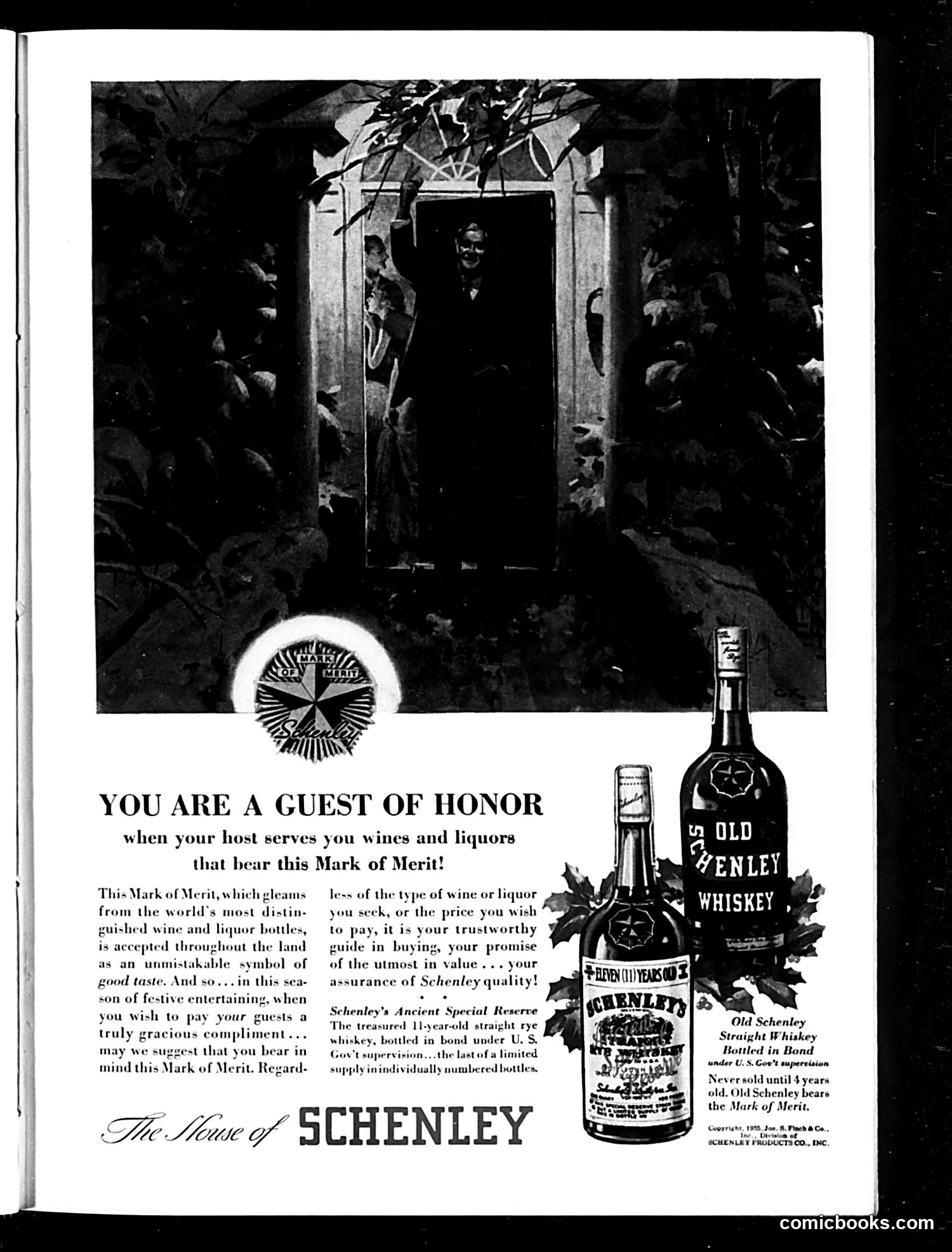
This is primarily a liquor advertisement, not political satire. It appears in Judge magazine promoting Schenley whiskey and wines. The "Mark of Merit" is Schenley's branding device—a circular seal shown prominently. The advertisement's central conceit frames serving Schenley products as a sign of being a gracious, tasteful host. The photograph shows a formally dressed man at a doorway, apparently welcoming guests, reinforcing the hospitality angle. The ad emphasizes quality assurance and value across price points, positioning Schenley as a reliable choice. The "Old Schenley" whiskey is highlighted as aged four years in government bond—a selling point suggesting legitimacy and proper aging. Context for modern readers: This predates (or relates to) Prohibition's effects. The emphasis on "government supervision" and proper bottling suggests post-Prohibition era marketing, when regulated alcohol needed to appear legitimate and trustworthy to consumers reestablishing the practice. This is commercial content, not editorial commentary or satire.
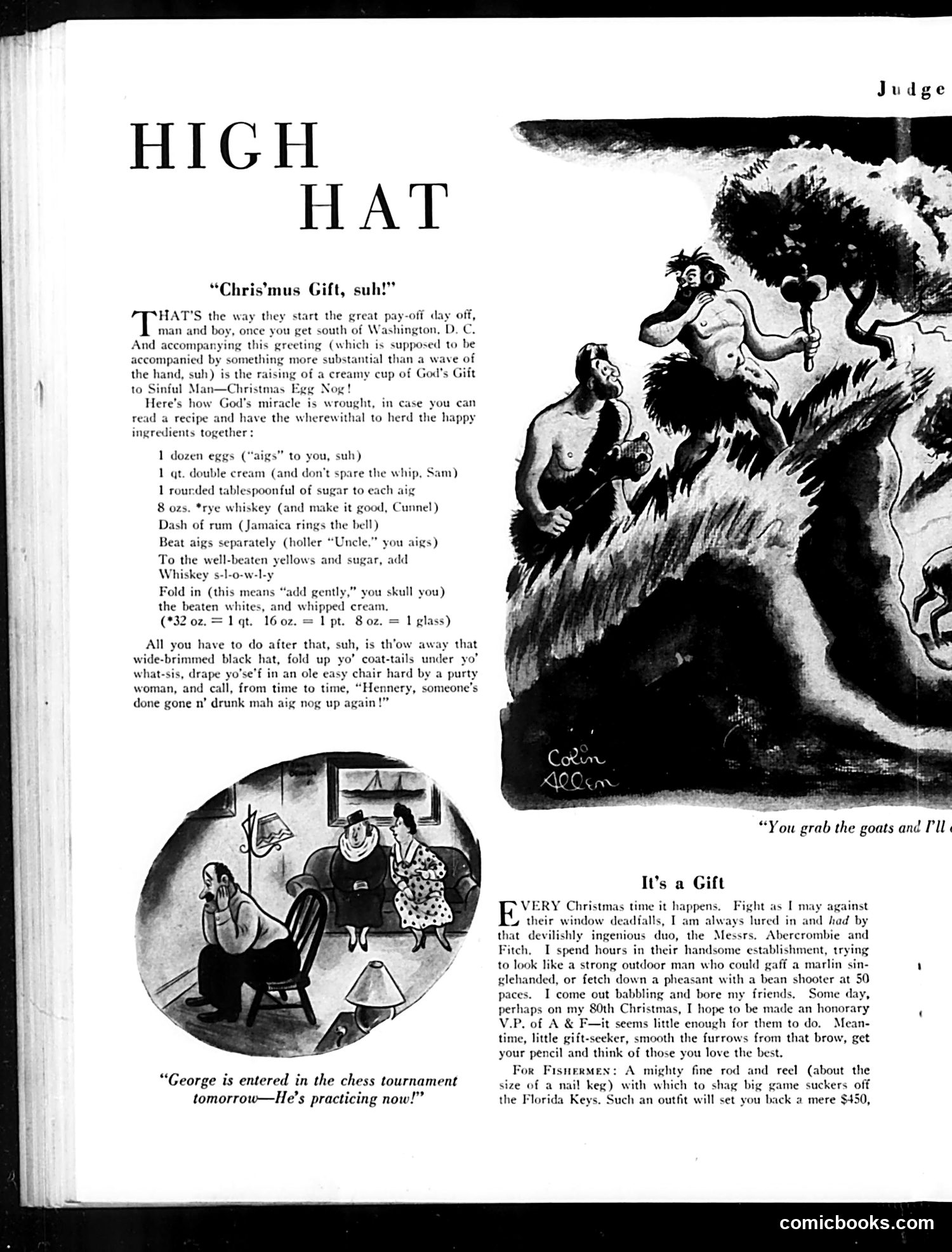
"High Hat" - Judge Magazine Commentary This page satirizes Christmas gift-giving customs in the American South through racial and class stereotypes typical of early 20th-century humor. The main cartoon mocks Southern plantation culture: a Black servant ("suh") greets white employers with "Christmas Gift," a Southern tradition where the first person to say it received a small gift. The accompanying eggnog recipe, written in exaggerated dialect, perpetuates stereotypes about Southern African Americans. The secondary cartoon depicts a chess-playing scene with the caption "George is entered in the chess tournament tomorrow—He's practicing now," likely a visual joke about class or intellectual pretension. The "It's a Gift" section advertises luxury goods from Abercrombie & Fitch, satirizing wealthy consumers who fantasy-shop for expensive outdoor equipment ($450 fishing rods) they'll never actually use. The overall tone is condescending toward both rural Southern culture and urban pretension—characteristic of Judge's satirical approach to American society.
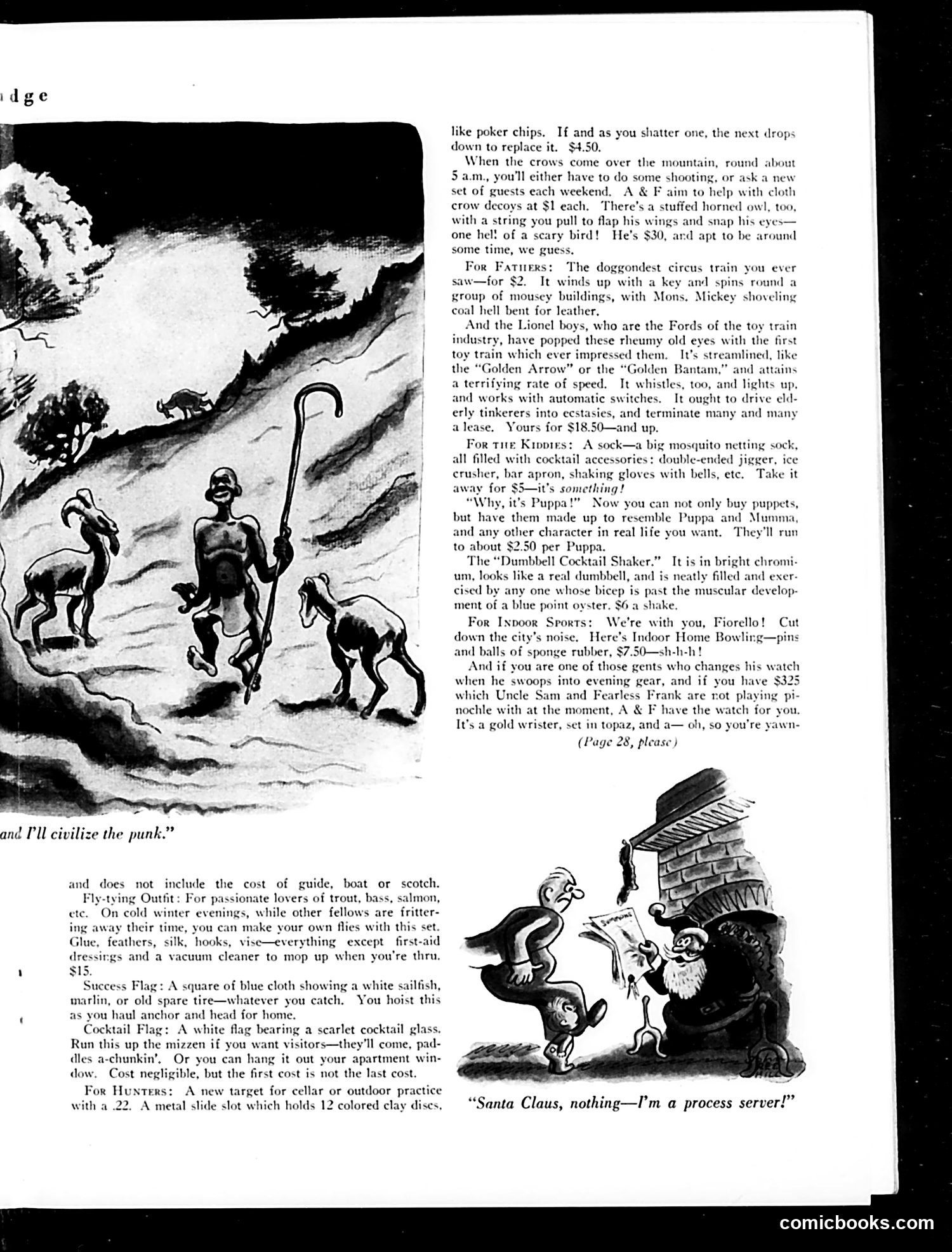
Judge Magazine Gift Guide Satire This page is a gift guide satirizing consumer products for different leisure activities—hunting, fishing, toy trains, cocktail accessories, indoor bowling, and sports watches. The humor targets affluent readers with absurdly specific or overpriced novelties: a $30 stuffed owl to scare away crows, a $2 wind-up circus train, a $325 gold watch, a dumbbell-shaped cocktail shaker, and sponge-rubber bowling equipment. The bottom cartoon mocks the commercialization of Christmas: a figure labeled "Santa Claus" is actually a "process server" (debt collector), satirizing how holiday shopping has become financially burdensome and legally complex rather than genuinely festive. This reflects 1920s-30s anxiety about consumer culture overtaking traditional celebration.
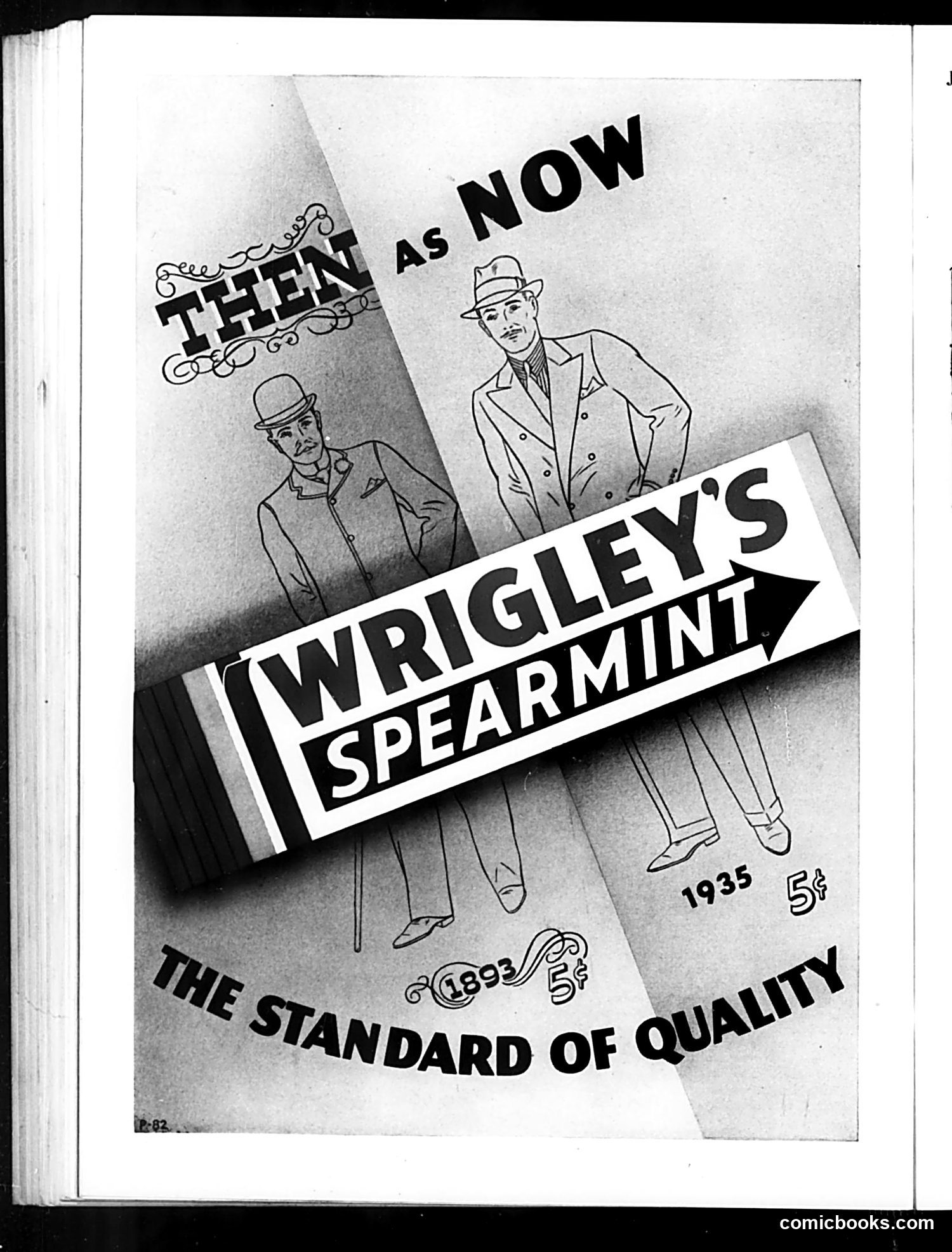
This is a 1935 advertisement for Wrigley's Spearmint gum. The ad shows two well-dressed men in suits and fedoras from different eras—one labeled "1893" and one labeled "1935"—flanking a large package of Spearmint gum. The headline "THEN AS NOW" emphasizes the product's long-standing presence in the market. The tagline "THE STANDARD OF QUALITY" reinforces claims of consistent excellence across generations. This is straightforward product advertising rather than political satire, using temporal comparison to suggest Wrigley's Spearmint has maintained its reputation and quality over four decades, making it a reliable, established consumer choice during the Depression era.
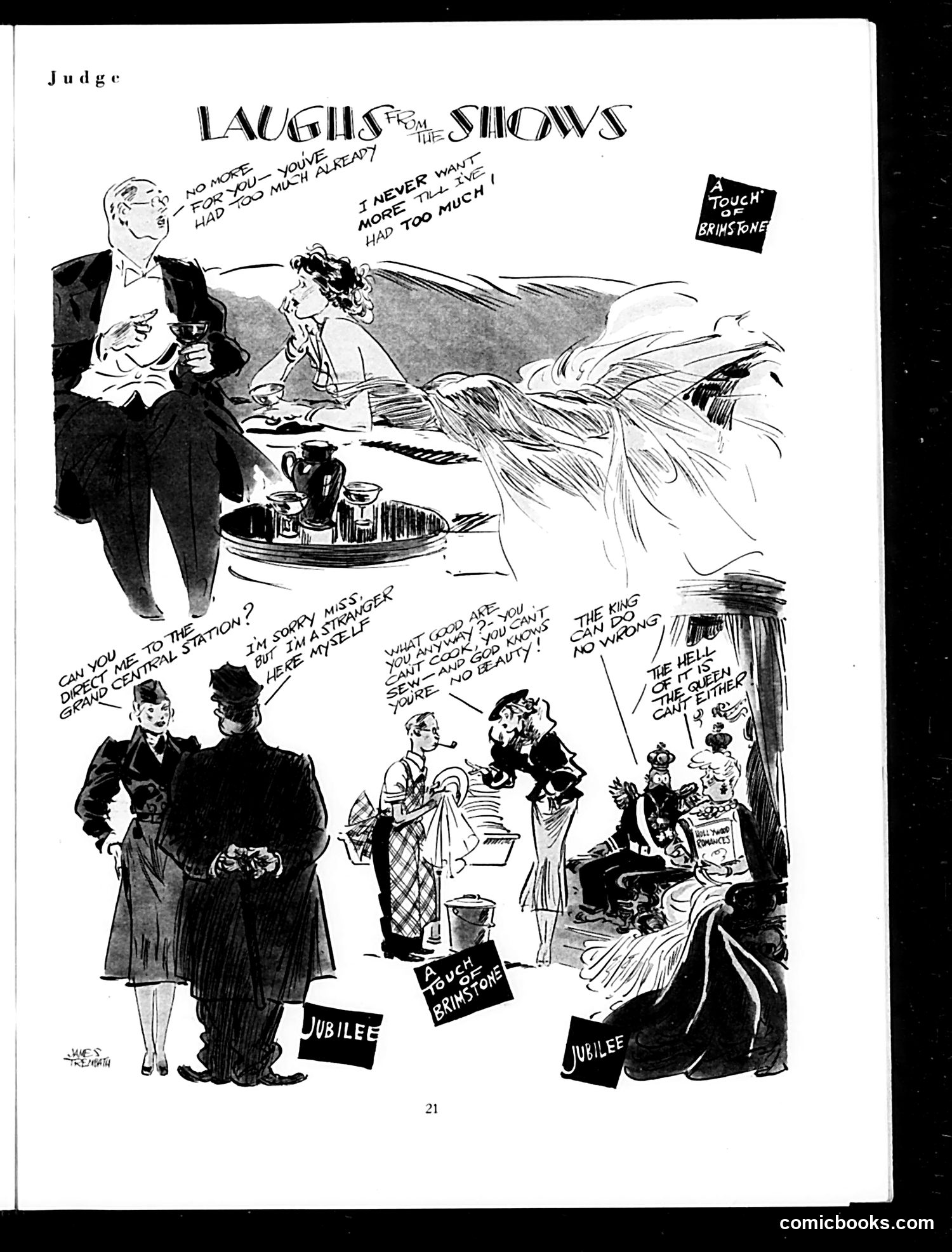
This satirical cartoon depicts various social scenes labeled "Laughs from the Shows." The primary joke centers on theatrical entertainment and its effects on audiences and society. The top panel shows an elegantly dressed couple at what appears to be a show or performance, with dialogue about wanting "more" entertainment despite having "had too much." Below are multiple vignettes labeled "Jubilee" and "A Touch of Brimstone," showing different social reactions to theatrical productions. The scenes satirize how stage shows influence behavior and morality—suggesting theatrical entertainment creates excessive excitement or moral concerns among attendees. The overall commentary appears to critique both the escapist appetite for entertainment and anxieties about theater's corrupting influence on audiences, a recurring concern in early-to-mid 20th century America. The specific productions referenced ("Jubilee," "A Touch of Brimstone") were likely contemporary Broadway or theatrical shows Judge's readers would recognize.
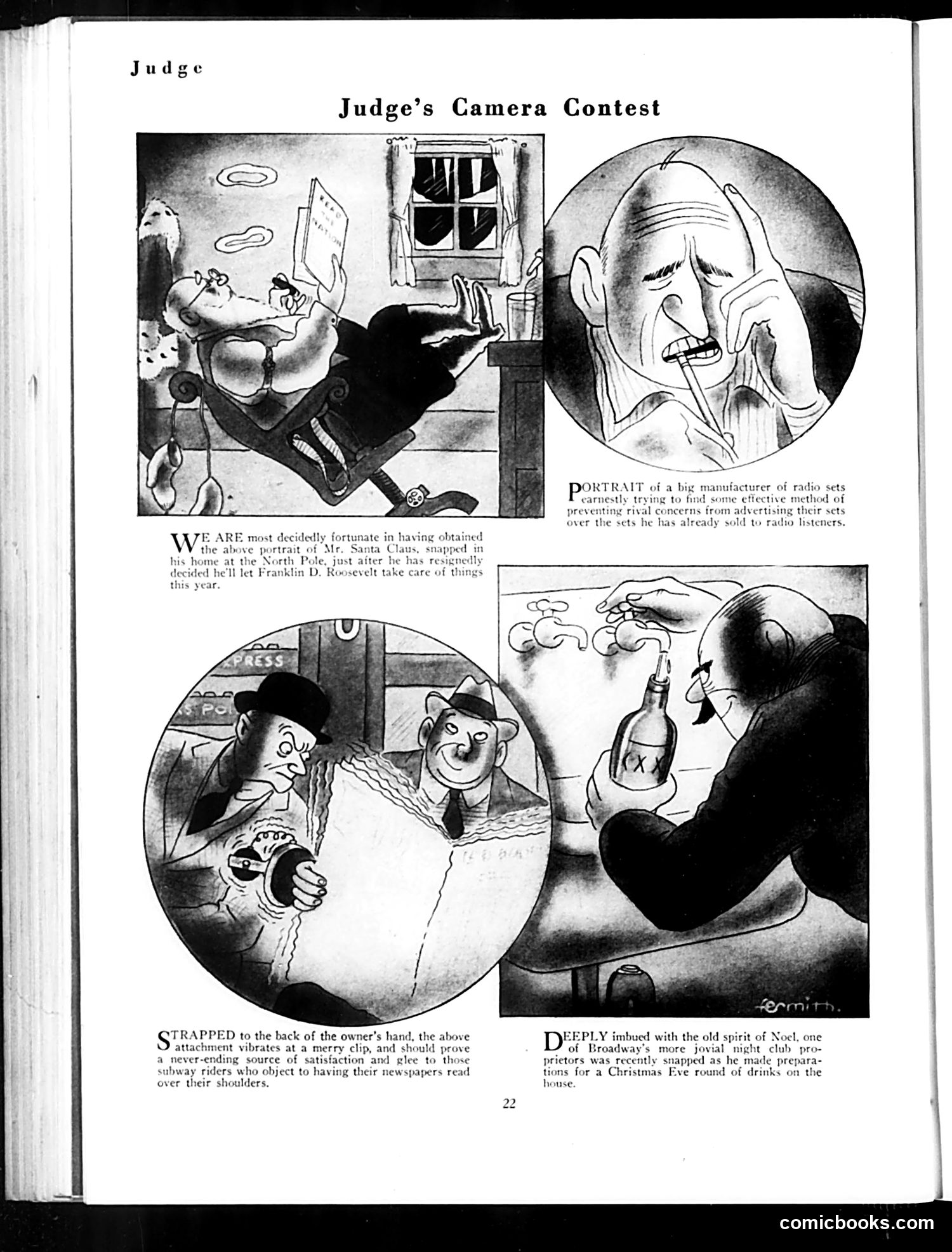
Judge's Camera Contest Explained This is a humorous feature showcasing cartoon submissions for a "Judge's Camera Contest." The page presents satirical drawings depicting various urban annoyances and social situations circa the 1930s-40s. The cartoons mock everyday frustrations: a radio manufacturer desperately seeking advertising methods; an irritated commuter bothered by someone reading over his shoulder on the subway; and a nightclub proprietor preparing Christmas drinks. The humor relies on exaggerated character caricatures and physical comedy typical of the era's cartooning style. The text mentions Franklin D. Roosevelt taking care of matters, suggesting a New Deal-era timeframe. The "contest" format invited readers to submit camera-based cartoon ideas—visual gags about people caught in awkward social situations. This represents Judge magazine's satirical approach to American urban life and social conventions of the period.
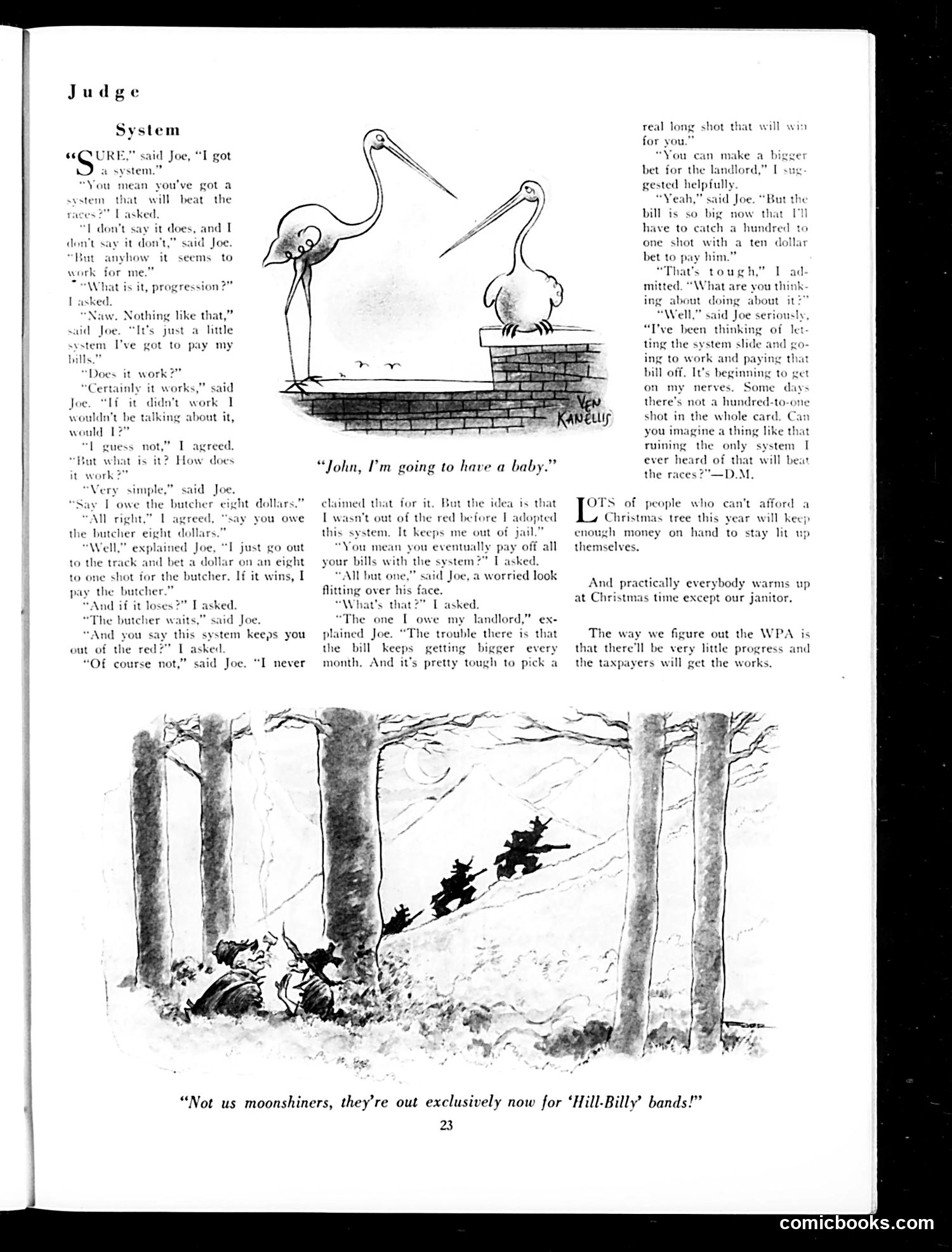
"Judge" Magazine Satire: "The System" This page satirizes Depression-era financial desperation through Joe's absurd betting "system." Joe explains he owes money to his butcher and landlord but has devised a scheme: he bets on horse races to pay his debts. When asked if it works, he admits it doesn't reduce his debt—it merely keeps him out of jail temporarily. The joke's dark humor lies in Joe's circular logic: his "system" is fundamentally broken, yet he's trapped depending on it. The bottom cartoon references WPA (Works Progress Administration), a New Deal program, mocking its inefficiency while noting it provides little progress but "taxpayers will get the works." The cartoons together satirize how ordinary Americans during the Great Depression adopted desperate, illogical strategies just to survive—betting, government programs—none offering real solutions. The storks cartoon signals birth amid economic hardship.
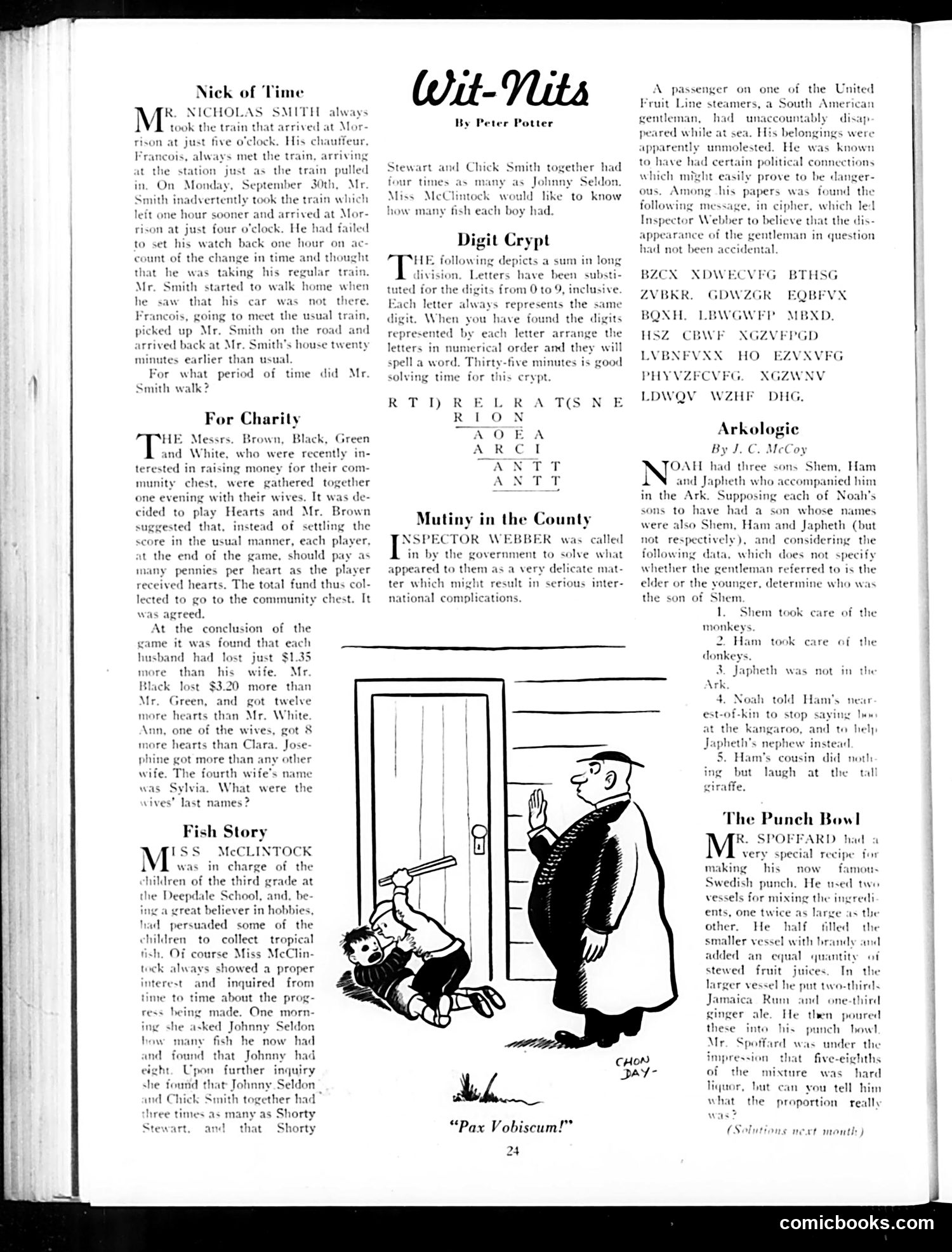
Analysis of Judge Magazine Page This page contains several humor puzzles and short stories typical of Judge magazine's "wit-nits" section—recreational brain-teasers for readers. The main cartoon ("Pax Vobiscum!") depicts a man in formal dress greeting someone at a doorway, labeled with the Latin phrase meaning "peace be with you." The caption's irony suggests the greeting is insincere or the situation is tense. The text stories include logic puzzles: - "Nick of Time": a math problem about a man's walk - "For Charity": a card game accounting puzzle - "Fish Story": a collecting problem - "Digit Crypt": a substitution cipher - "Mutiny in the County": a mystery about a suspicious passenger - "Arkologic": a logic puzzle about Noah's sons Context for modern readers: These represent pre-digital entertainment—puzzle magazines were popular pastimes. The content is apolitical; Judge here functions as light puzzle/humor publication rather than satirical commentary. The Latin phrase in the cartoon may reference diplomatic tensions of the era, but without more context, the specific reference is unclear.
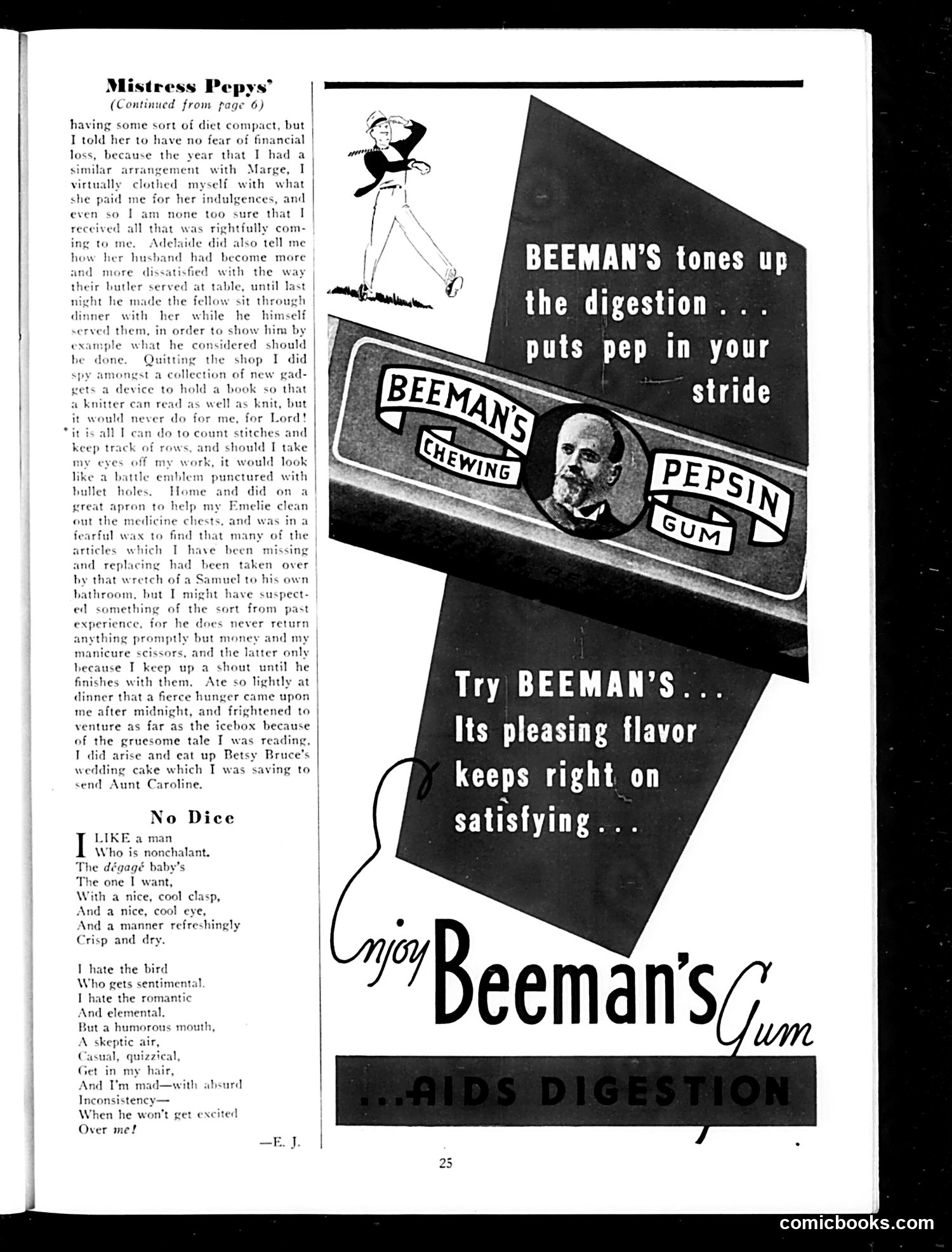
Analysis of Judge Magazine Page This page contains two distinct elements: a serialized humor column and an advertisement. "Mistress Pepys" is a satirical domestic advice column (continued from an earlier page) written in the voice of a gossipy household worker or servant. It mocks upper-class domestic life through anecdotes about employers' marital troubles, infidelity arrangements, and petty household disputes. The humor derives from the servant's frank commentary on her employers' failings and financial arrangements. "No Dice" is a short poem satirizing romantic preferences—mocking men who are overly sentimental or "elemental" while praising detached, "nonchalant" suitors. It's light social satire about dating preferences. The Beeman's Gum advertisement occupies the right half, promoting chewing gum as an digestive aid that provides energy ("pep"). This reflects early 20th-century advertising claims about gum's health benefits—a common pitch before such medical claims became regulated. The ad features a product shot and illustrations of satisfied users. No specific political references or identifiable caricatures appear on this page; it's primarily domestic satire and commercial advertising.
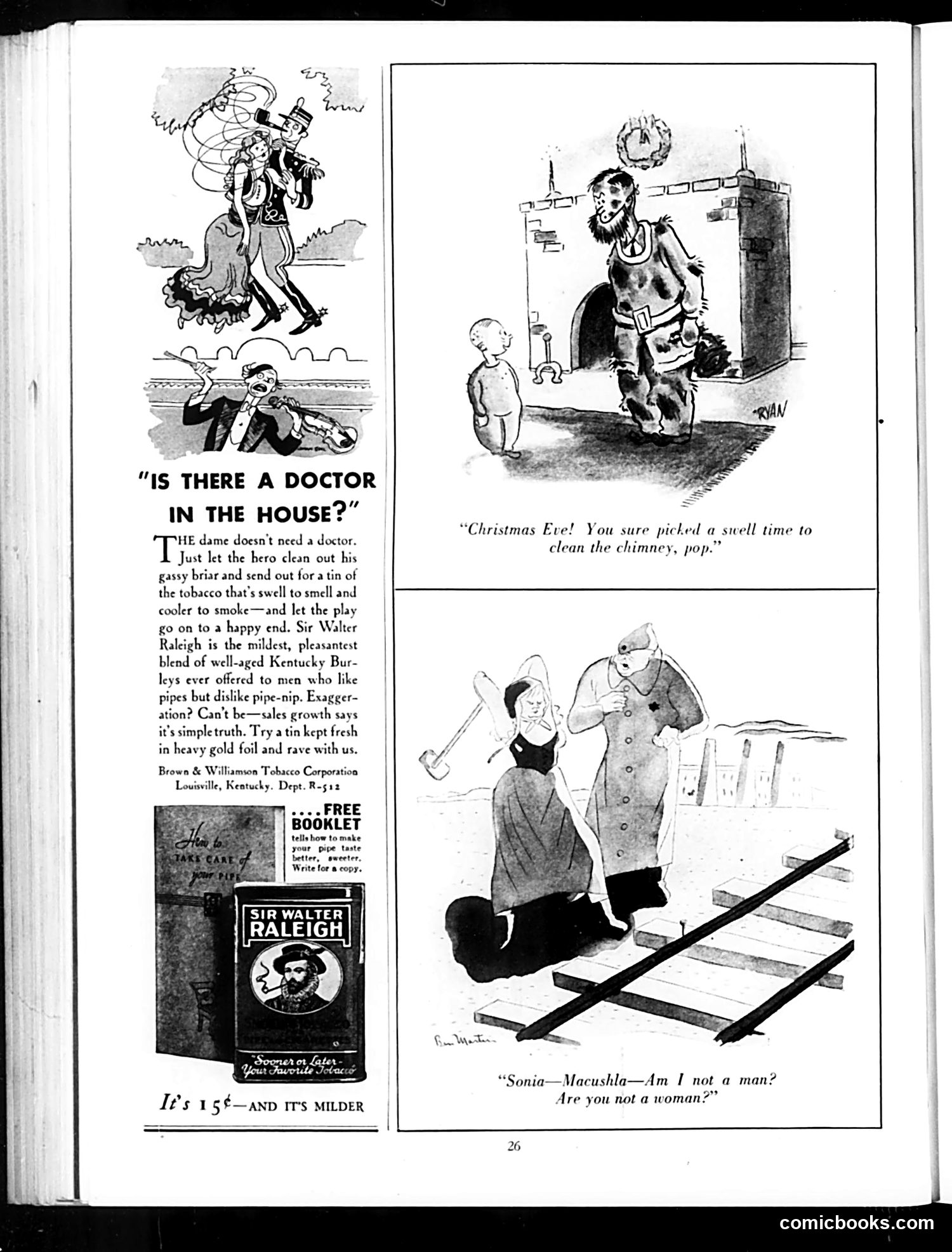
Page Analysis: Judge Magazine Advertisement and Comics This page primarily advertises Sir Walter Raleigh pipe tobacco through a theatrical setup. The left side shows an advertisement claiming the tobacco solves a dramatic crisis—a actress needs medical help during a stage performance, but instead the hero simply smokes Sir Walter Raleigh and the play continues happily. The copy appeals to pipe smokers who dislike harsh tobacco ("pipe-nip"), emphasizing this brand's mildness and Kentucky origin. The right side contains two unrelated comic panels: one showing a chimney sweep on Christmas Eve (captioned about poor timing for the job), and another depicting what appears to be a domestic scene with exaggerated ethnic dialogue ("Macushla"—an Irish term—and questions about masculinity and femininity). The page reflects early-to-mid 20th century advertising conventions mixing product promotion with entertainment content. The ethnic humor in the lower cartoon reflects period attitudes now considered offensive.
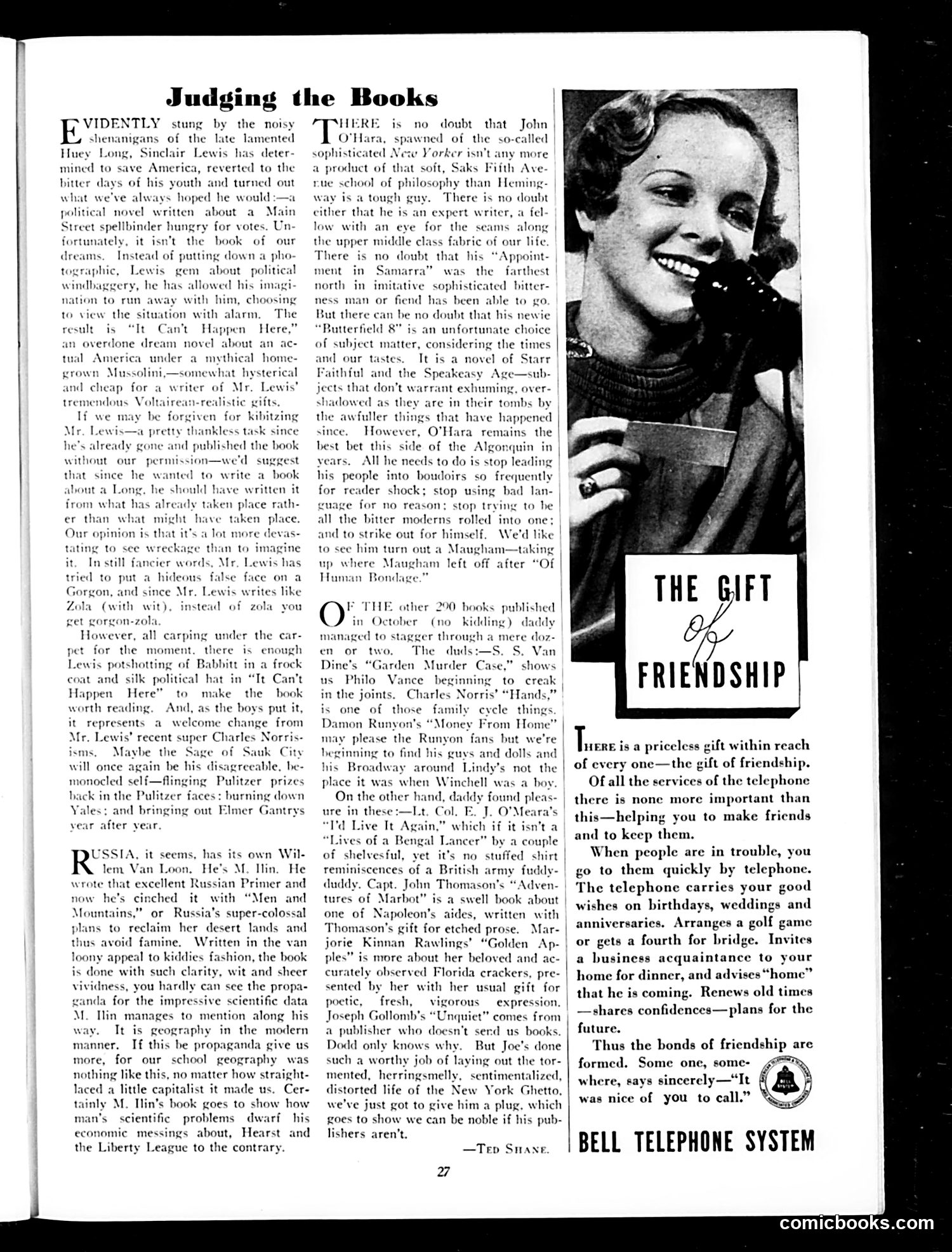
"Judging the Books" - Judge Magazine Book Review This page contains literary criticism by Ted Shane reviewing recent novels, with an accompanying Bell Telephone advertisement. Main Reviews: 1. Sinclair Lewis's "It Can't Happen Here" - The critic acknowledges Lewis's satirical talent but argues he made an error: rather than write a fictional dystopia about an American fascist dictator (inspired by Huey Long's real political movements), Lewis should have simply documented actual events already occurring in America. The satire criticizes Lewis for retreating into imaginative worst-case scenarios when reality itself was sufficiently alarming. 2. John O'Hara's "Butterfield 8" - Praised as technically excellent writing about upper-middle-class life, but faulted for poor subject matter: rehashing the Starr Faithful scandal and Prohibition-era decadence when contemporary times demanded weightier themes. 3. M. Ilin's "Men and Mountains" - Soviet geography book praised for making scientific education engaging without obvious propaganda. The advertisement promotes friendship as the telephone's greatest service.
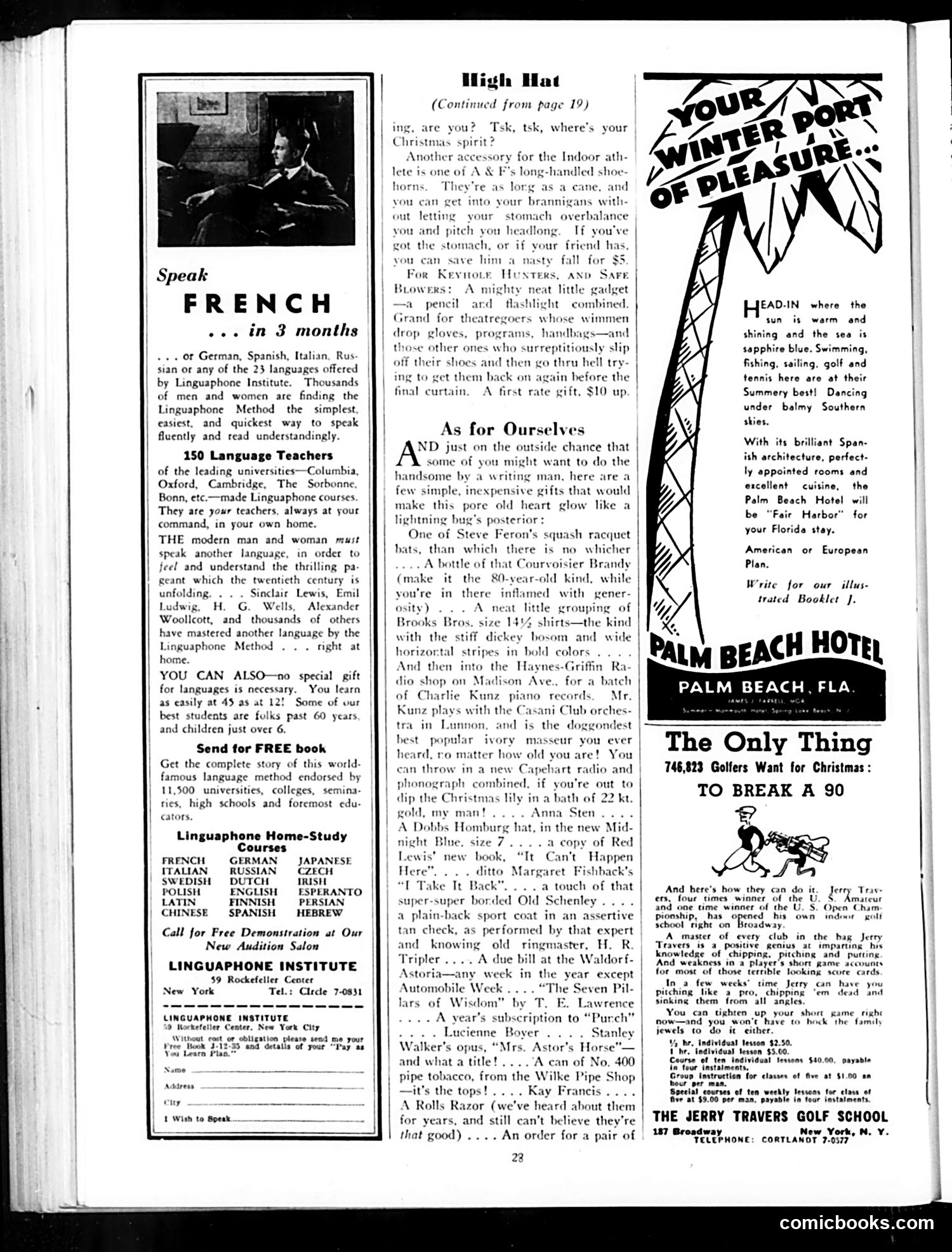
Analysis of This Judge Magazine Page This page is primarily advertising, not political satire. The dominant content consists of language-learning advertisements (Linguaphone Institute) and gift recommendations for Christmas shopping. The small "High Hat" column (continued from page 19) offers humorous gift suggestions for men, written in a sophisticated, tongue-in-cheek style typical of 1930s-40s Judge magazine. It mocks wealthy male readers by recommending expensive items: imported brandy, custom shirts from Brooks Brothers, Charlie Kunz piano records, and high-end radios—all presented with winking irony about indulging oneself or impressing others. The satirical target is affluent male consumer culture and Christmas commercialism among the upper class, not political figures or events. The tone suggests readers should recognize the absurdity of these lavish gift choices while also wanting them. No specific historical figures or political references are identifiable on this page.
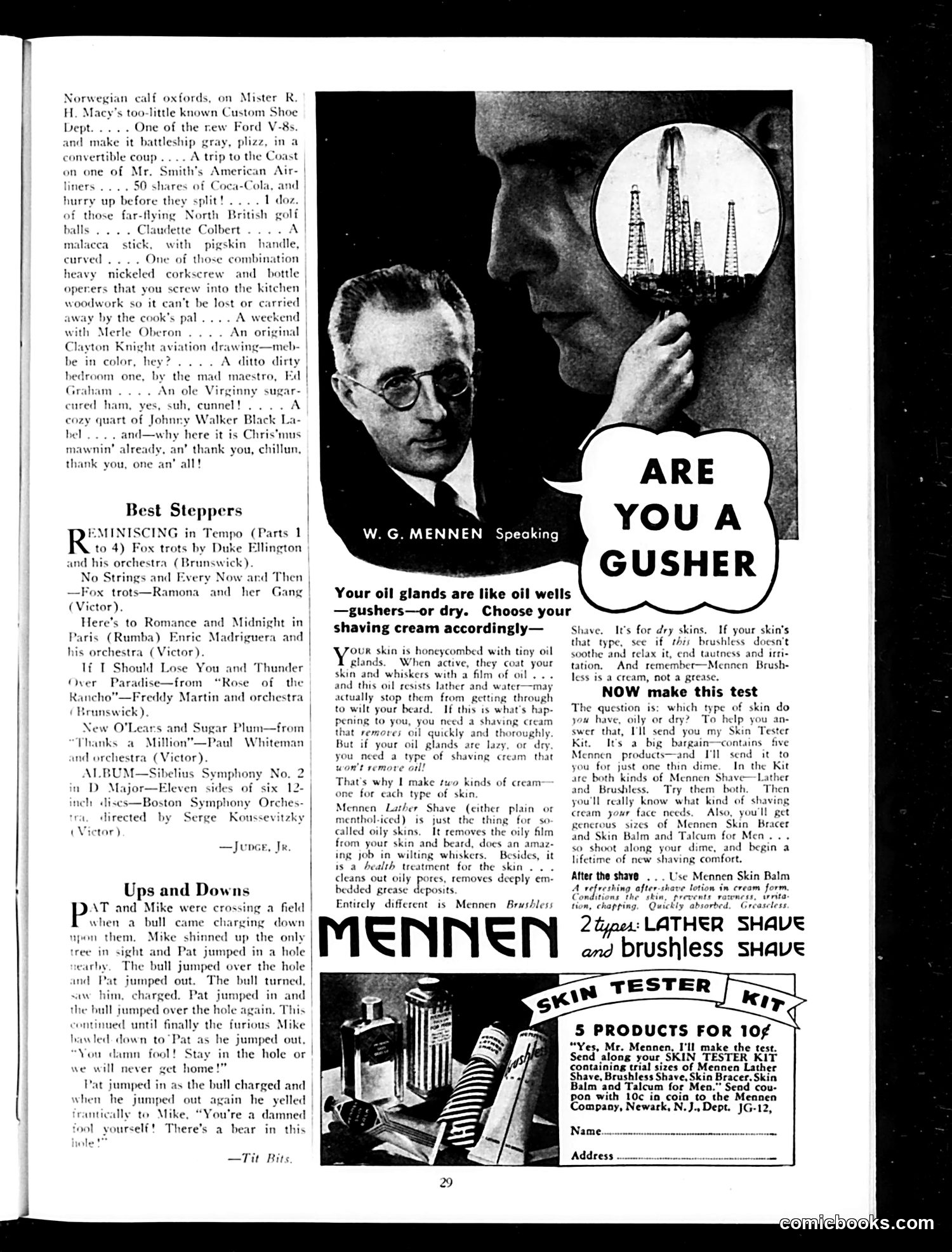
A 1930s Judge Magazine Page: Advertising and Humor This page is primarily a Mennen shaving products advertisement featuring W.G. Mennen himself speaking directly to readers about skin types. The ad uses pseudo-scientific language ("oil glands are like oil wells—gushers—or dry") to market different shaving creams for oily versus dry skin, offering a "Skin Tester Kit" for ten cents. The page also contains typical Judge magazine content: brief humorous anecdotes ("Best Steppers," "Ups and Downs"), entertainment recommendations (Duke Ellington records, Claudette Colbert films), and a joking wish-list of luxury goods (Ford V-8s, Coca-Cola stock, cocktails). The satire is gentle—mocking consumer desire and pretentious gift-wanting during what appears to be the Depression era, while the Mennen ad exemplifies period marketing's appeal to vanity and pseudo-scientific product claims.
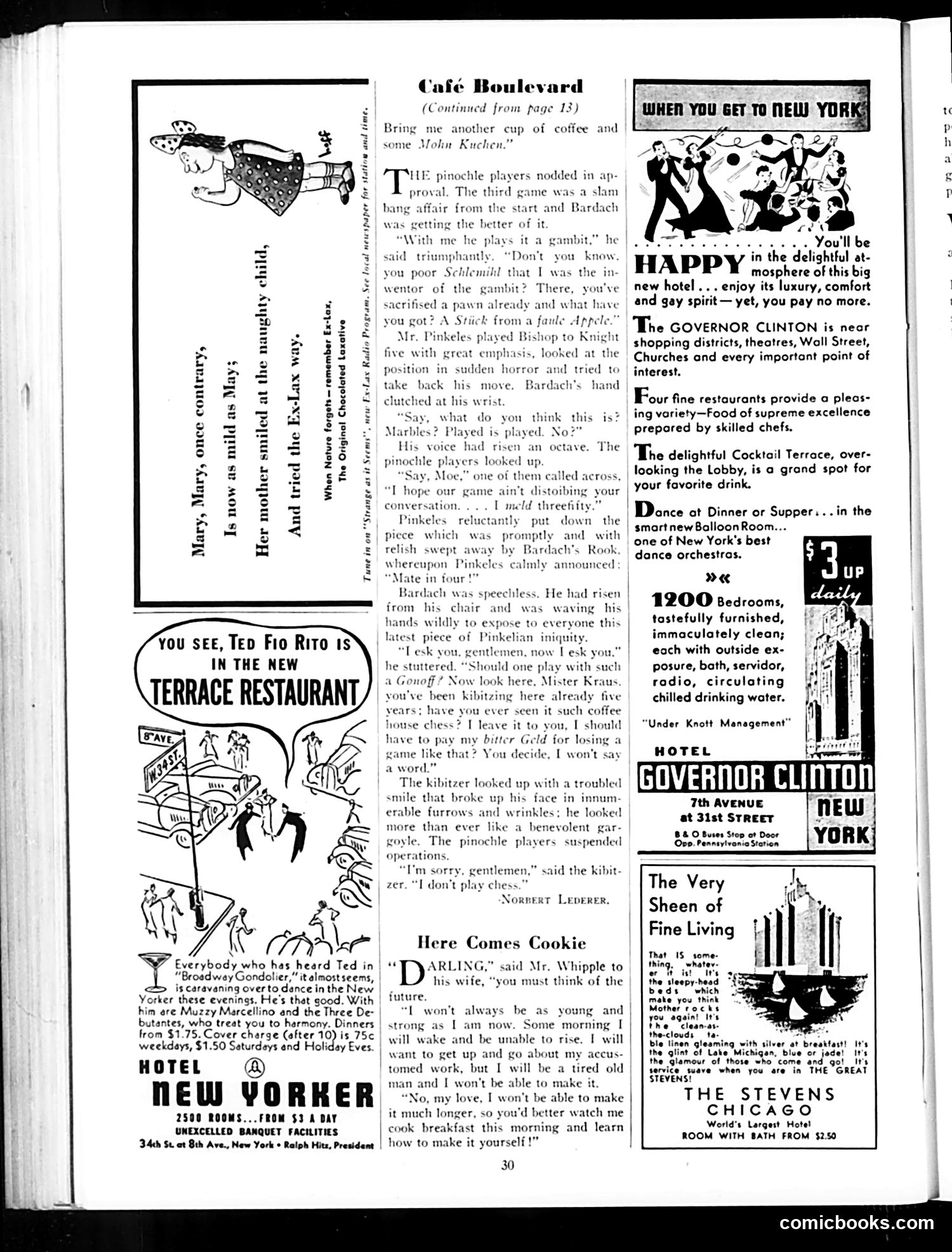
Explanation for Modern Readers This page contains two main story excerpts and extensive hotel/restaurant advertising typical of 1920s Judge magazine. "Café Boulevard" depicts a pinochle card game where player Bardach catches opponent Pinkeles cheating ("a Gonoff"—Yiddish for thief). The satire portrays Yiddish-speaking Jewish immigrants arguing loudly in a coffee house, with stereotypical characterizations: the indignant loser, the weary kibitzer (observer), and ethnic dialect humor. The piece relies on ethnic caricature standard to period American humor. "Here Comes Cookie" shows Mr. Whipple instructing his wife to learn cooking, framing domestic work as preparation for his inevitable decline—mild domestic satire about aging and gender roles. The advertisements dominate: Ted Fio Rito's orchestra at the Terrace Restaurant, the Hotel New Yorker, Governor Clinton Hotel, and Stevens Chicago hotel. These reflect the magazine's audience: urban, affluent, leisure-focused readers in major cities. The page overall represents 1920s consumer culture advertising mixed with period ethnic humor now considered offensive.
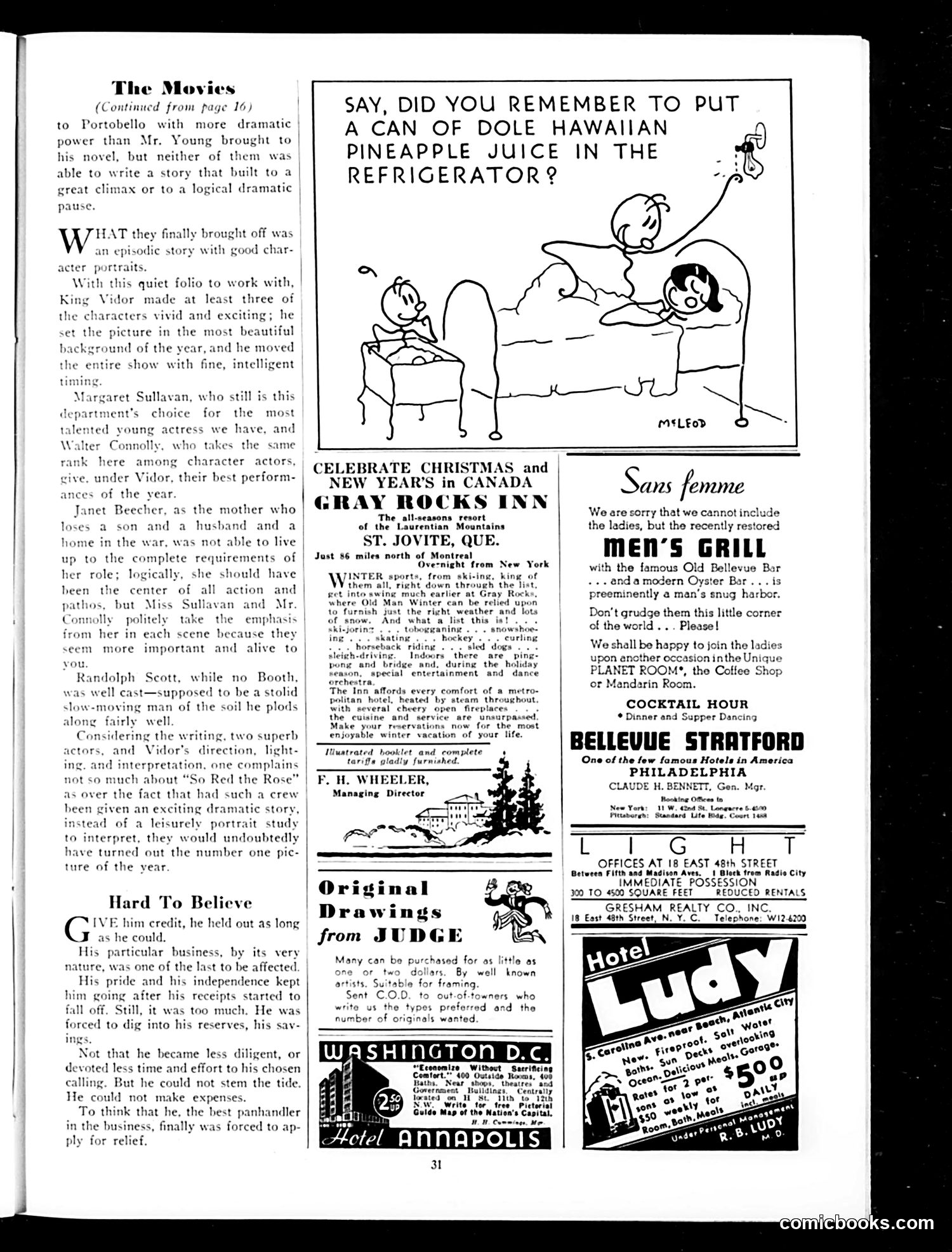
Analysis of Judge Magazine Page This page mixes film criticism with period advertising. The main cartoon (top) is a simple domestic gag: a wife asks her husband if he remembered to buy Dole Hawaiian pineapple juice for the refrigerator—a straightforward advertisement disguised as humor, typical of Judge's sponsored content. The text discusses 1930s Hollywood filmmaking, critiquing directors' ability to craft dramatic narratives. It names actresses Margaret Sullavan and Janet Beecher, and discusses King Vidor's direction. The bottom section, titled "Hard To Believe," appears to be satirical commentary on economic hardship during what was likely the Great Depression—a successful businessman ("the best panhandler in the business") reduced to applying for relief, forced to deplete his savings despite his pride and diligence. The remaining content is hotel and restaurant advertising typical of the era, emphasizing winter sports, fine dining, and all-male spaces like the "Men's Grill."
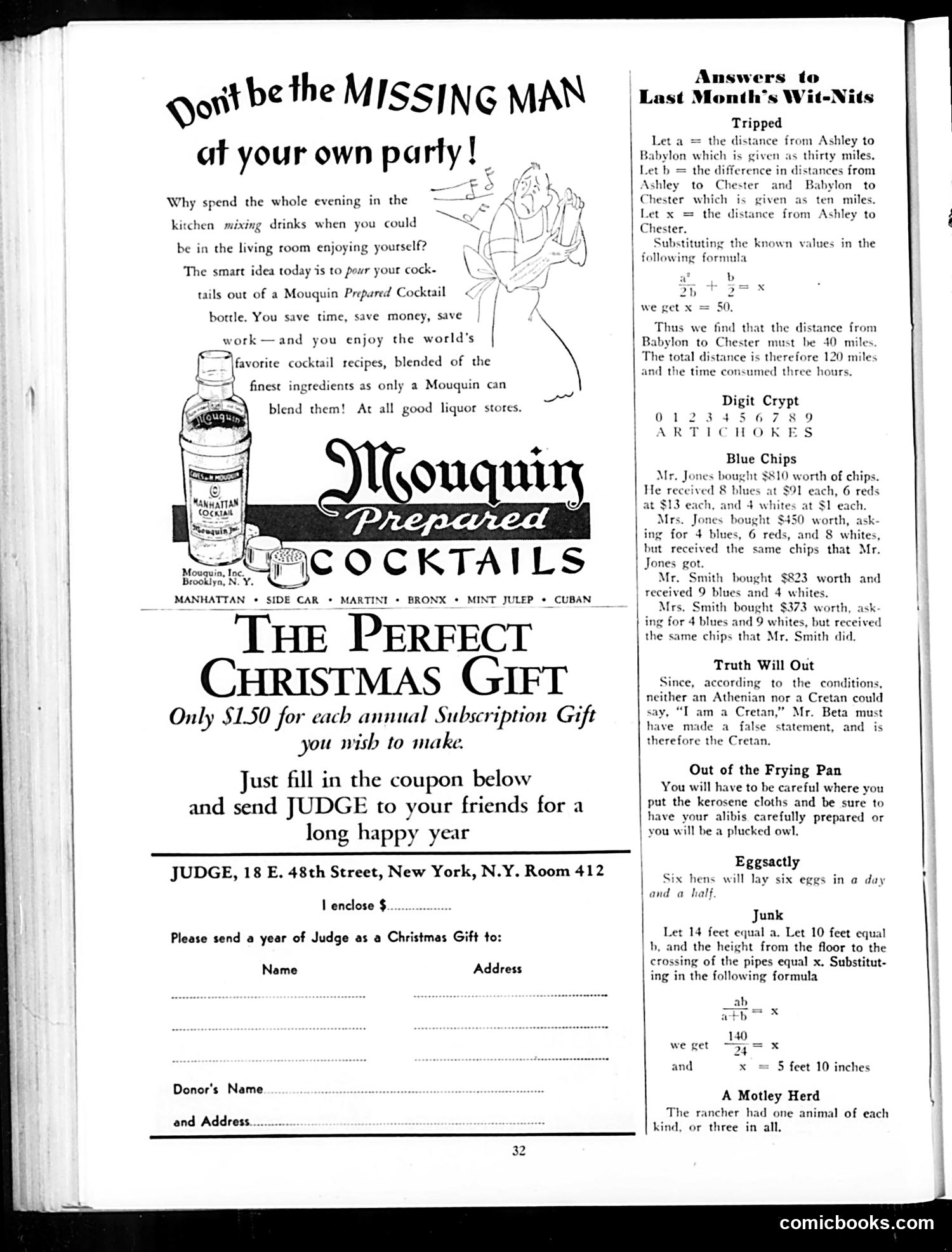
Judge Magazine Page Analysis This page is primarily advertising and puzzle solutions, not satire or political cartooning. The main content includes: 1. Mouquin Prepared Cocktails advertisement (left): Promotes pre-made cocktails to save time at parties, playing on the convenience culture of the era. The "Missing Man" headline jokes that hosts who spend time mixing drinks are absent from their own parties. 2. Judge magazine subscription gift offer (center): Promotes the publication itself as a Christmas gift at $1.50/year. 3. Puzzle solutions (right): The bulk of the page consists of answers to mathematical and logic puzzles from the previous month's issue—problems like distance calculations, cryptograms, and logic riddles. There is no political satire or social commentary evident on this page. It represents typical magazine filler content from the era: advertisements, promotional material, and reader engagement through puzzles. The tone is light and commercial rather than satirical.
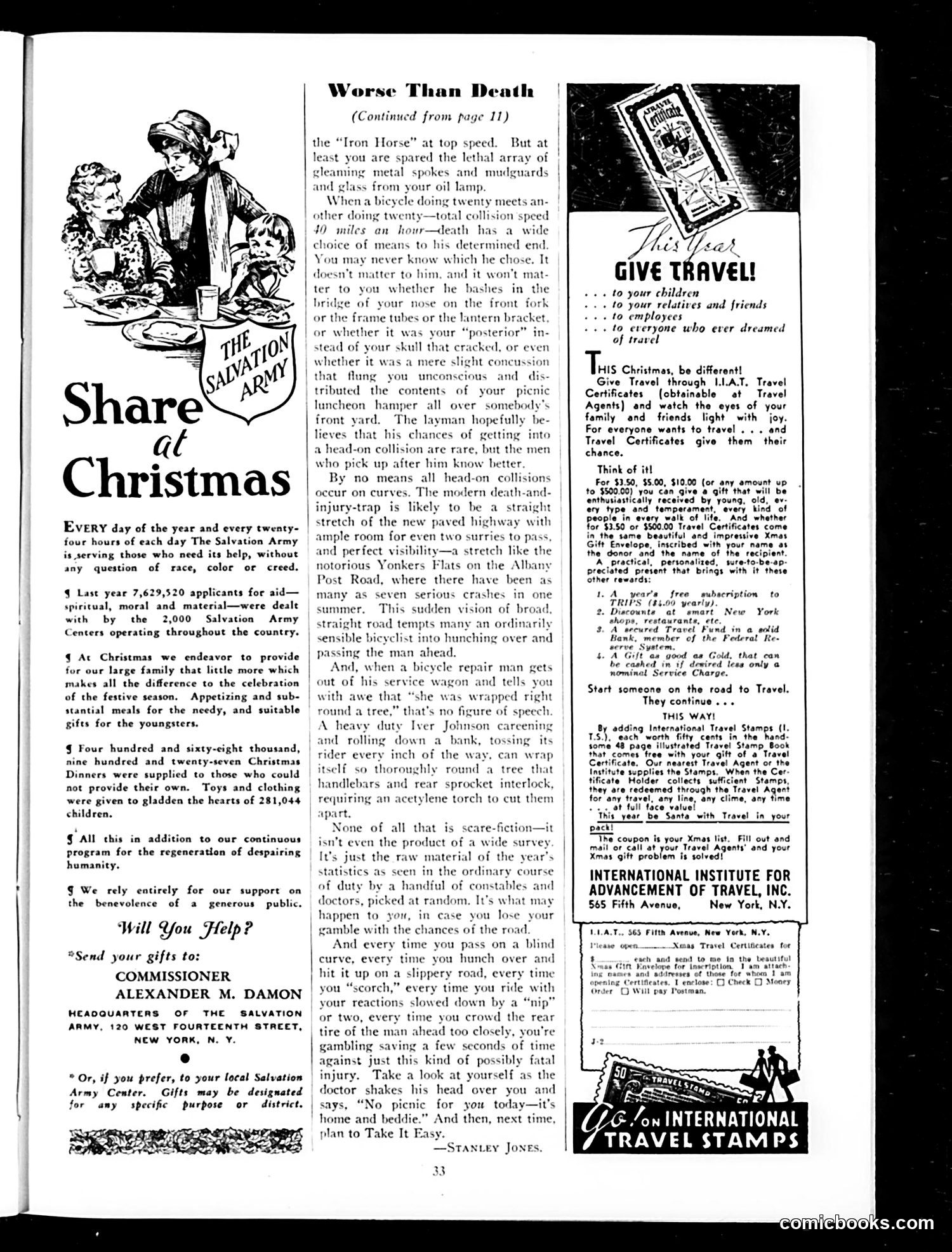
"Worse Than Death": A Traffic Safety Cautionary Tale This page combines a Salvation Army charitable appeal with a continuation of an article warning about bicycle safety dangers. The main content is a graphic cautionary piece about fatal bicycle accidents—specifically head-on collisions between cyclists on newly paved roads. The author (Stanley Jones) argues that modern highways, paradoxically, encourage reckless riding because their smooth, straight stretches and clear visibility tempt cyclists to speed and pass dangerously. He catalogs gruesome collision scenarios: bicycles wrapped around trees, spokes and glass becoming lethal projectiles, riders thrown violently. The satire targets not cyclists themselves but rather the false security modern infrastructure creates. Jones uses vivid, almost darkly humorous descriptions (an Iver Johnson bicycle careening down a bank) to shock readers into recognizing that death awaits the overconfident rider. The Salvation Army material on the left is unrelated editorial content—a fundraising appeal for Christmas aid to the poor, noting their 1920s work serving over 7.6 million people annually.
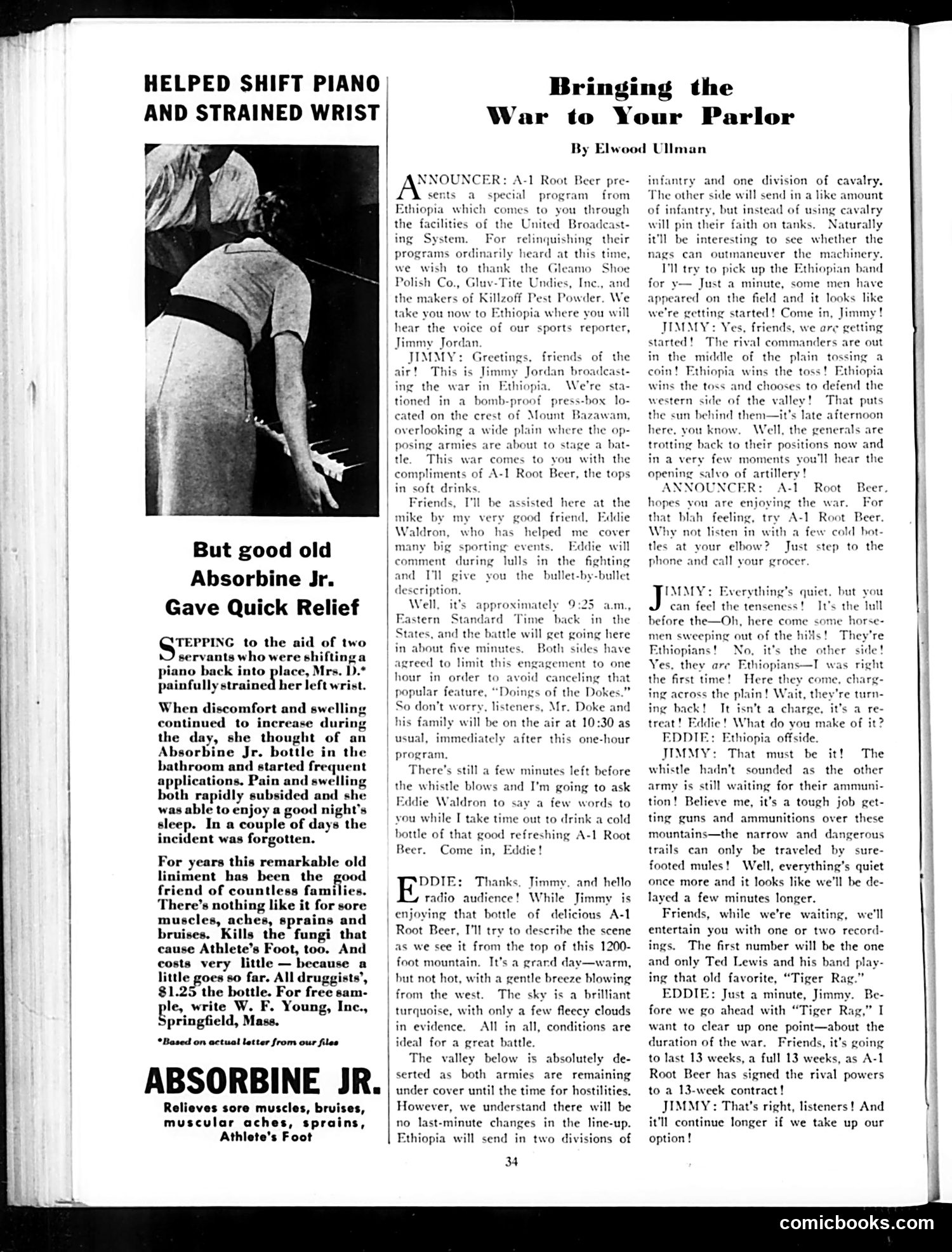
Analysis for Modern Readers This page contains two distinct pieces: Left side: An advertisement for Absorbine Jr. liniment, presenting a customer testimonial about a woman who strained her wrist moving a piano and found relief through the product. This is straightforward advertising typical of the era. Right side: A satirical radio drama script mocking American commercialism during wartime. The piece depicts a "war correspondent" broadcasting live from Ethiopia (likely referencing the 1935-36 Italian invasion) as though it were a sporting event, complete with product placements for A-1 Root Beer, shoe polish, and pest powder. The satire lies in treating actual military combat as entertainment punctuated by commercial breaks and sponsored by consumer goods—absurdly trivializing warfare for domestic radio audiences and profit. The humor exposes how American media commodifies distant conflicts into parlor entertainment while advertisers exploit patriotic interest for sales.
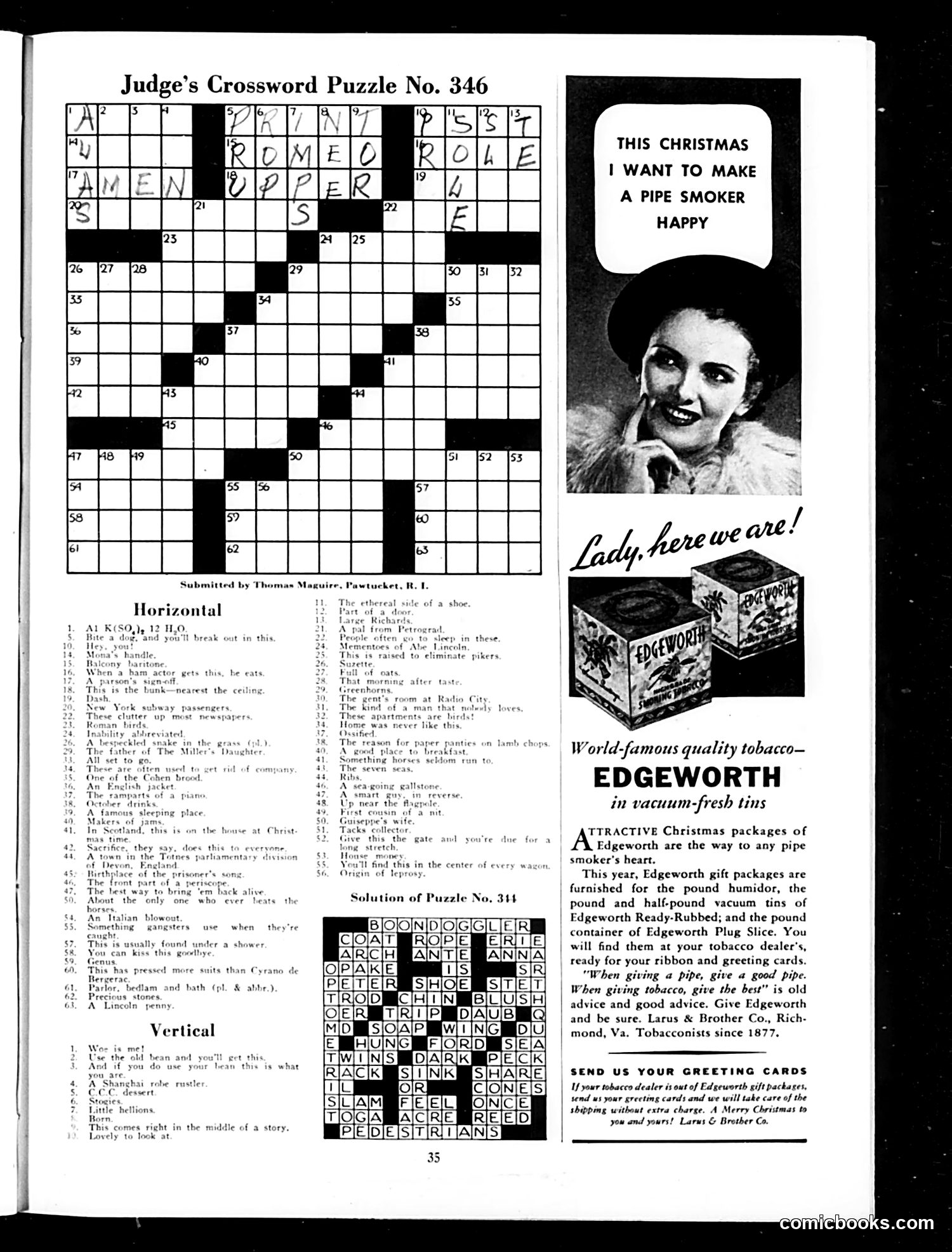
Analysis of Judge Magazine Page No. 346 This page is primarily advertising and puzzle content rather than political satire. The dominant element is a full-page Edgeworth tobacco advertisement featuring a smiling woman with the tagline "This Christmas I want to make a pipe smoker happy." The ad reflects 1920s-30s gender dynamics and consumer culture: it depicts an idealized woman whose Christmas pleasure centers on pleasing male smokers through purchasing premium tobacco. The phrase "Lady, here we are!" suggests an eagerness-to-please dynamic. The crossword puzzle (No. 346) occupies the upper left, with a solution grid shown for the previous puzzle (No. 311). Historical context: This represents typical interwar American magazine advertising that normalized both tobacco use and gendered consumer roles—women as gift-givers ensuring men's comfort through branded luxury goods. The Edgeworth brand positioning emphasizes quality and status ("world-famous quality tobacco"). The page contains no political cartoon or satire—it's a standard magazine spread mixing puzzles and commercial promotion.
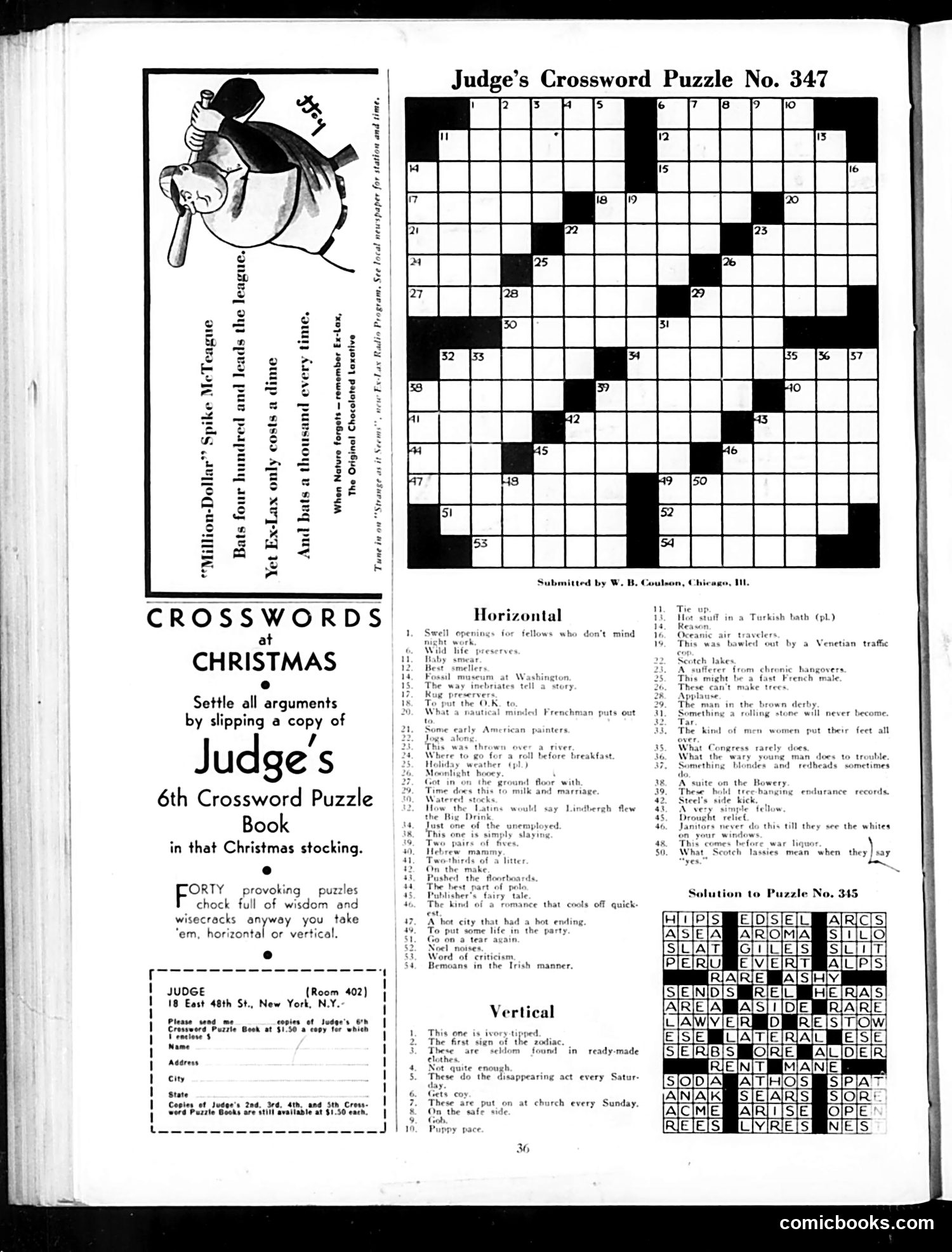
Explanation for Modern Readers This page is primarily advertising and promotional content rather than political satire. The main cartoon at top left depicts "Million-Dollar Spike McTeague," a baseball player endorsing Ex-Lax laxative. The joke is a pun: he "bats four hundred" (a baseball statistic) and "bats a thousand every time" (meaning perfect success)—referring to the product's digestive effectiveness. The phrase "When Nature forgets—remember Ex-Lax" plays on the product as a remedy for constipation. The bulk of the page promotes Judge's 6th Crossword Puzzle Book as a Christmas gift, emphasizing it solves arguments and works "horizontal or vertical." A crossword puzzle (No. 347) with its solution is displayed as a sample. There is no political satire on this page—it's essentially a vintage magazine's self-promotion and commercial advertising, typical of 1930s-era publications mixing editorial content with sponsored material.
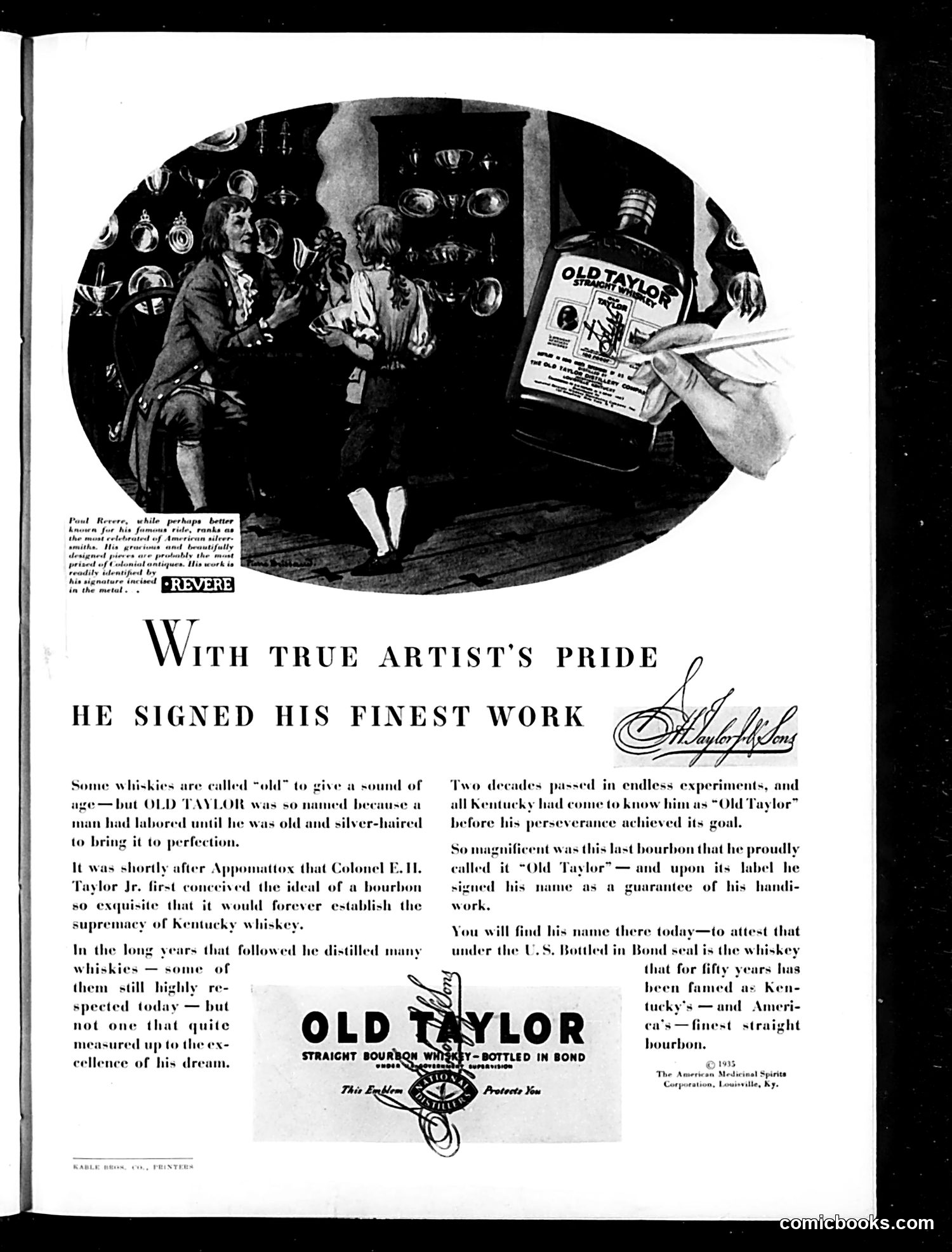
Old Taylor Bourbon Advertisement This is a full-page advertisement for Old Taylor whiskey, not political satire. It presents a romanticized origin story of Colonel E.H. Taylor Jr., who allegedly perfected bourbon whiskey after the Civil War ("shortly after Appomattox"). The ad claims Taylor spent decades experimenting before creating his signature "Old Taylor" bourbon, which he proudly signed as a personal guarantee of quality. The narrative emphasizes patience, craftsmanship, and American pride in Kentucky whiskey as a superior product. The oval illustration depicts a scene of wealth and connoisseurship—figures admiring fine silver and decorative objects—suggesting that Old Taylor represents refined American taste and achievement. This type of advertising was common in *Judge* magazine, which mixed satire with premium product placements targeting wealthy readers.
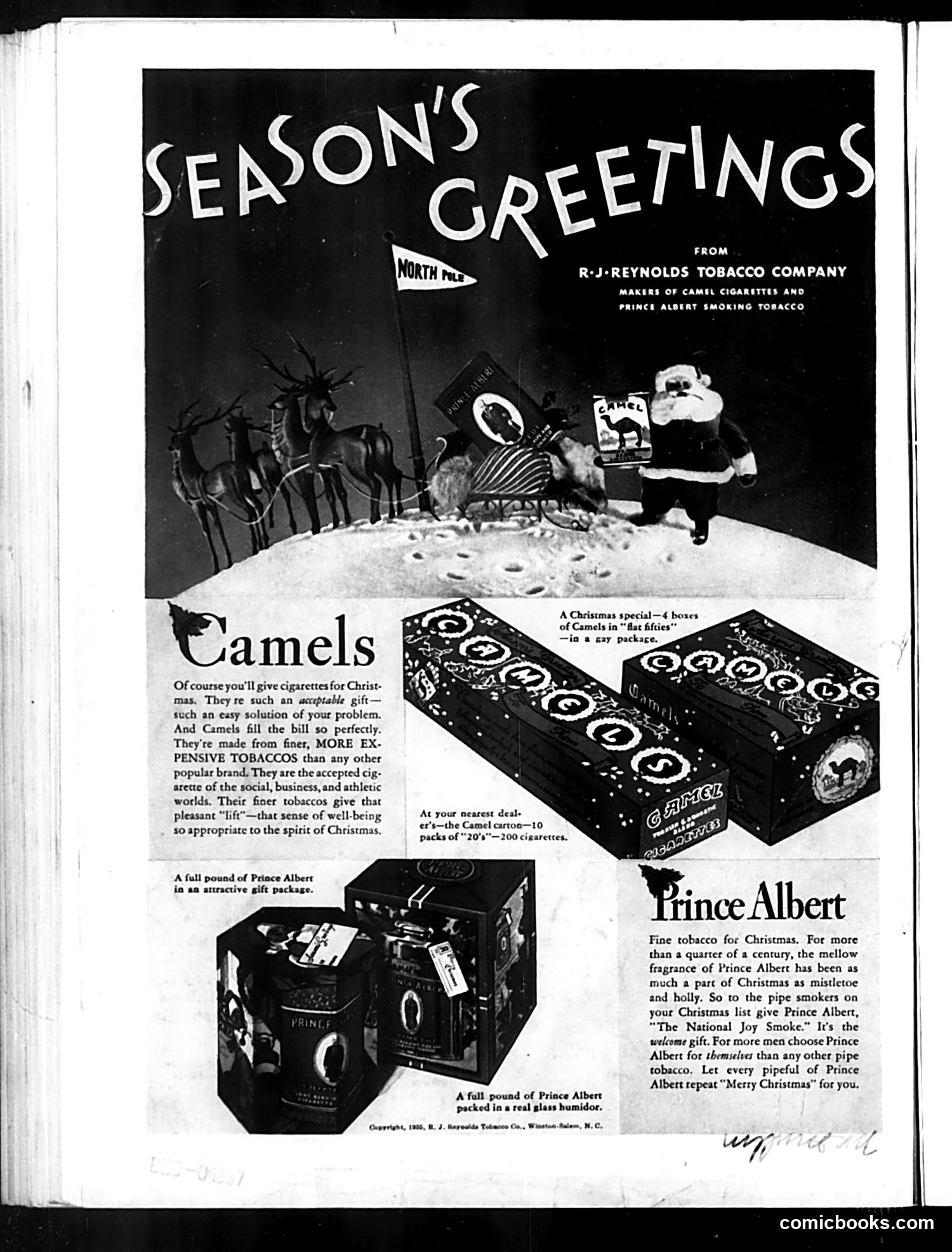
Season's Greetings Advertisement Analysis This is a tobacco company advertisement, not political satire. The R.J. Reynolds Tobacco Company uses a whimsical North Pole scene—Santa's workshop with reindeer and gift boxes—to market Camel cigarettes and Prince Albert smoking tobacco as Christmas gifts. The ad targets two audiences: cigarette smokers (Camels, positioned as "acceptable" gifts for social and business contexts) and pipe smokers (Prince Albert, called "The National Joy Smoke"). The messaging normalizes tobacco as appropriate holiday presents, emphasizing quality ingredients and social prestige. Notable for modern readers: this reflects an era when tobacco advertising was entirely legal and unregulated, with companies freely marketing cigarettes as thoughtful gifts without health warnings. The festive imagery and emphasis on gift-giving made smoking seem wholesome and celebratory—a marketing strategy impossible today.

I can see this is a page from *Judge* magazine with a watermark visible at the bottom (comicbooks.com), but the page itself appears to be blank or nearly entirely white with no visible cartoon imagery, illustrations, or readable text content that I can discern. Without visible cartoon imagery or legible text to analyze, I cannot identify specific figures, political references, or satirical points. To provide the historical and political context you've requested, I would need a page where the cartoon and text are actually visible in the image. If you have a clearer version of this page, I'd be happy to analyze it according to your guidelines.