judge
Judge — January 1936
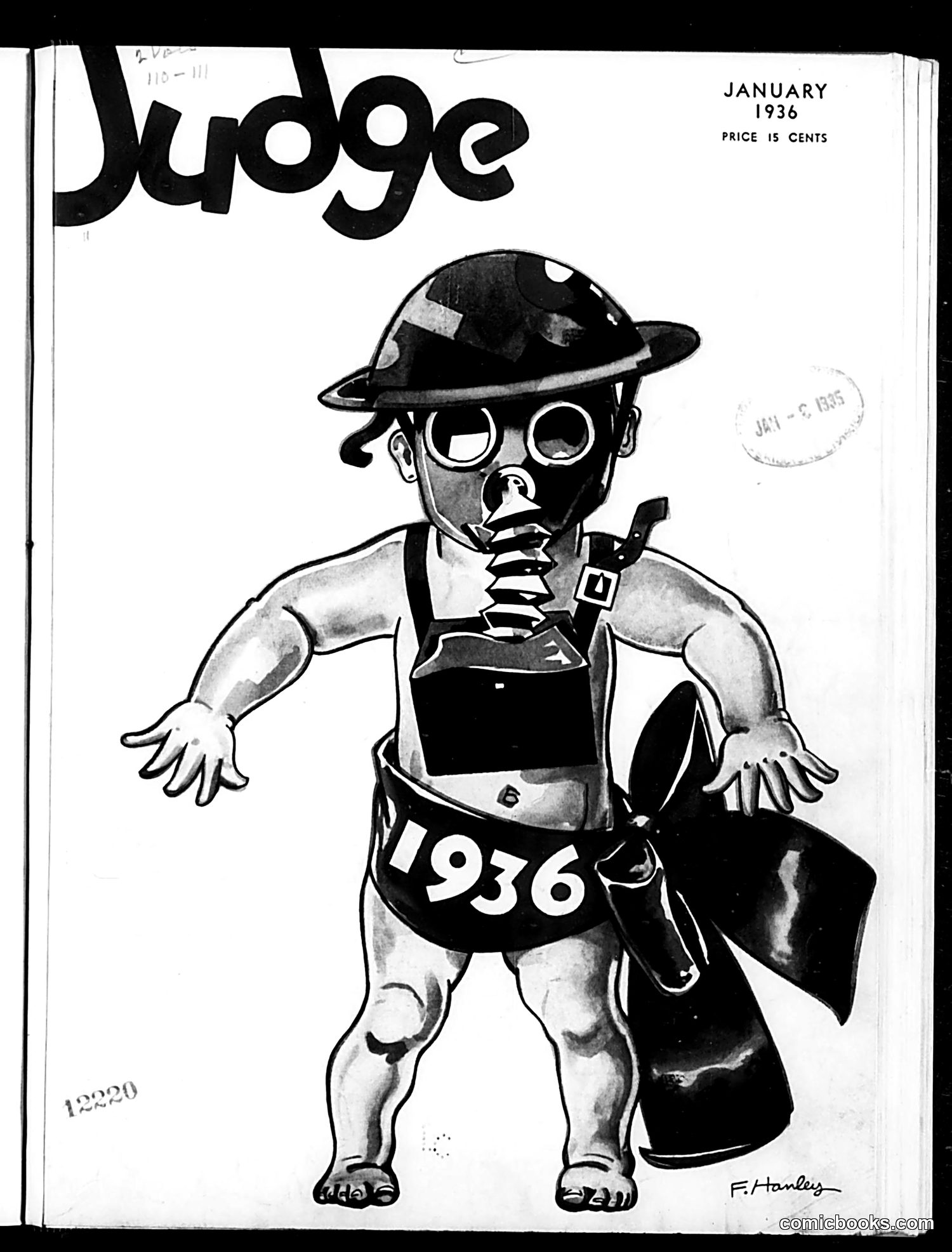
Analysis of Judge Magazine Cover, January 1936 This cover depicts a caricatured figure wearing a gas mask and military helmet, carrying a rifle and flag marked "1936." The character represents the year 1936 itself, portrayed as a soldier or combatant. The satire likely references the growing militarization and international tensions of 1936—a pivotal year featuring the Spanish Civil War, Hitler's rearmament, and increasing fascist aggression globally. By depicting "1936" as an armed, gas-masked figure, Judge's cartoonist warns readers that the coming year will be defined by military conflict and chemical warfare threats. The ominous presentation suggests pessimism about the decade's trajectory toward World War II, presenting 1936 as dangerous and foreboding rather than hopeful.
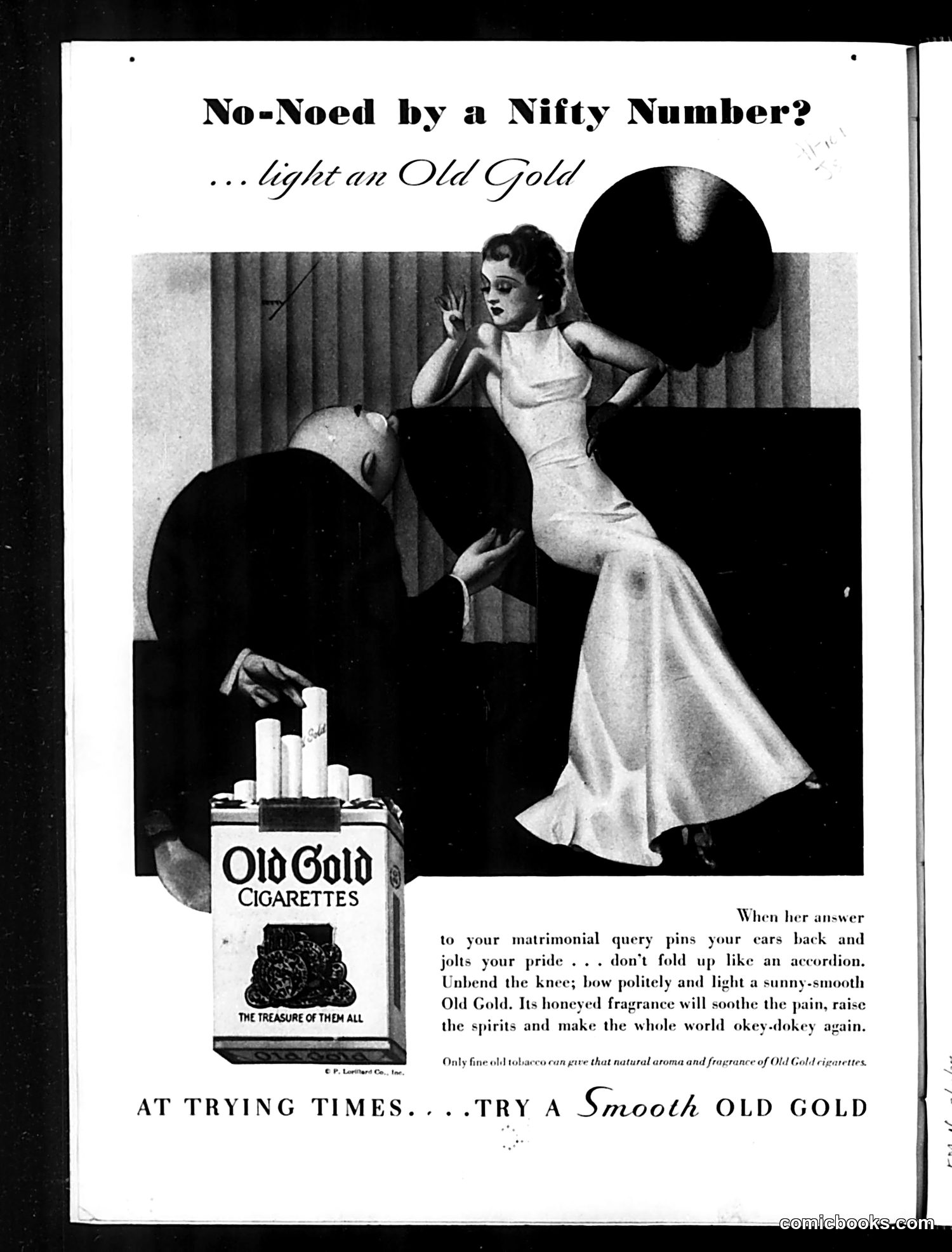
Analysis This is a cigarette advertisement rather than satirical content. It depicts a domestic scene where a man appears dejected after receiving a negative response to a marriage proposal, while a woman stands confidently nearby. The ad's headline, "No-Noed by a Nifty Number?" suggests she has rejected him. The advertisement's humor relies on outdated gender dynamics: it recommends that the rejected man "light an Old Gold" cigarette to cope with romantic rejection. The copy claims the cigarette's "honeyed fragrance will soothe the pain" and "make the whole world okey-dokey again." This reflects early-to-mid 20th century marketing that used cigarettes as emotional comfort products and perpetuated stereotypes about masculinity and romantic disappointment. The casual trivialization of rejection would be considered tone-deaf by modern standards.
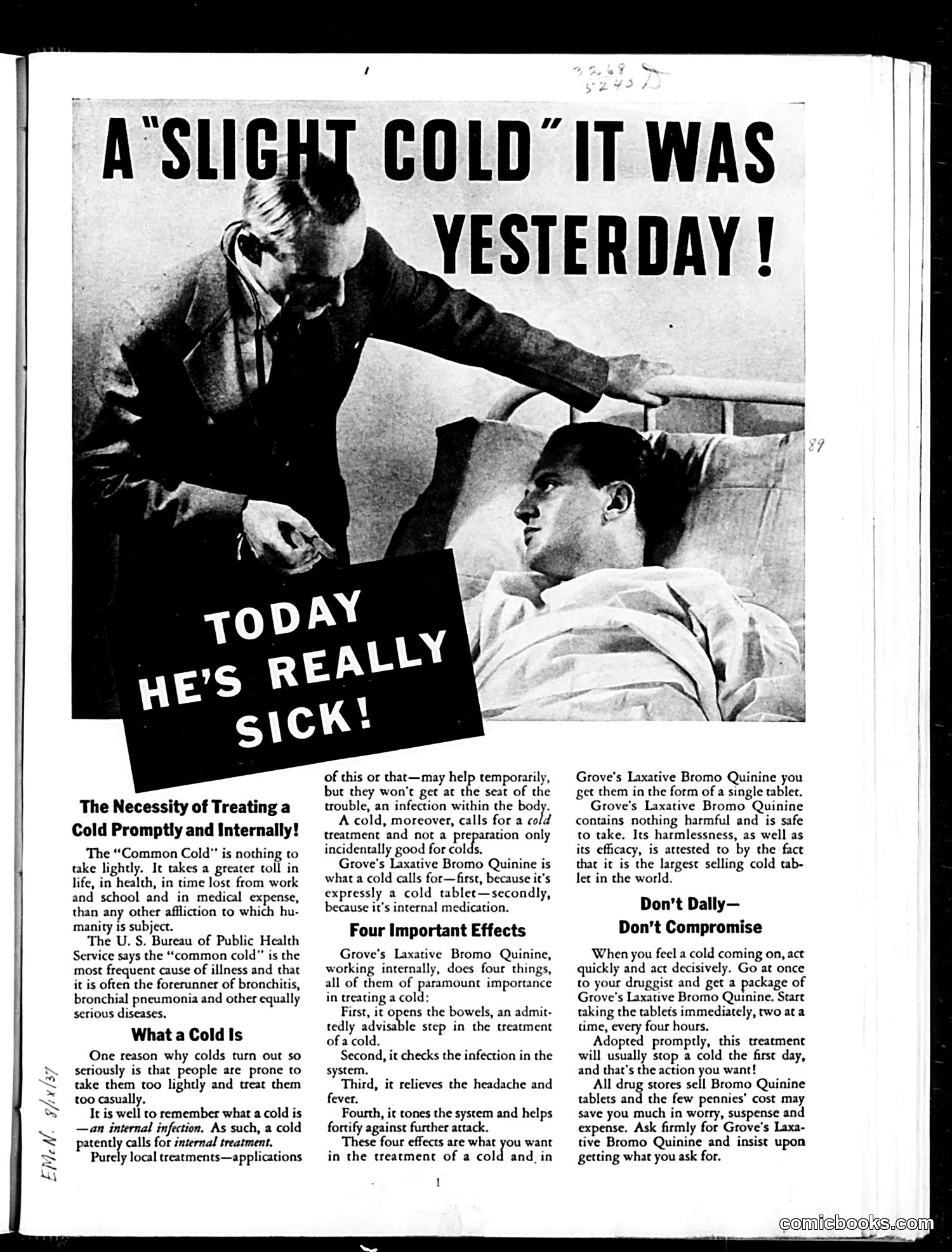
Advertisement, Not Satire This page is primarily a pharmaceutical advertisement for Grove's Laxative Bromo Quinine cold tablets, not political satire. The image shows a doctor examining a sick patient in bed, with the headline playing on the common excuse "a slight cold it was yesterday"—implying the patient's condition has worsened. The advertisement argues that colds require internal medical treatment, not just local remedies. Grove's product claims four benefits: opening bowels, checking infection, relieving headache/fever, and "toning the system." The "Don't Dally—Don't Compromise" section urges immediate treatment with their tablets to prevent a cold from developing fully. This reflects early 20th-century medicine marketing, when such products made broad health claims now considered dubious or illegal.
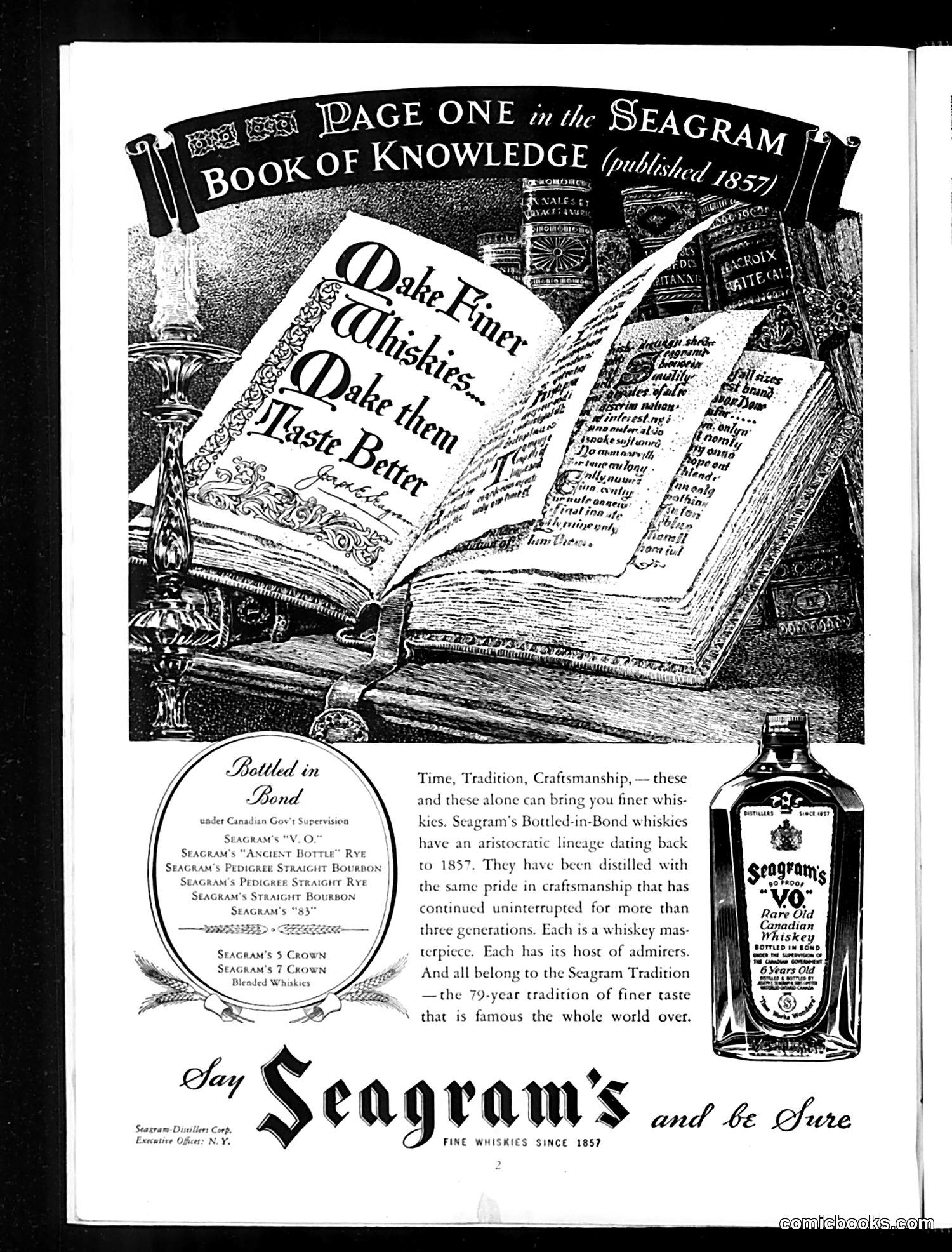
Analysis This page is primarily an advertisement, not satirical content. It promotes Seagram's whisky, specifically their "Bottled-in-Bond" varieties. The ad uses a scholarly theme—featuring an open "Book of Knowledge" from 1857—to establish brand heritage and legitimacy. The text emphasizes that Seagram's whiskeys have maintained "aristocratic lineage dating back to 1857" through "Time, Tradition, Craftsmanship" and "79-year tradition of finer taste." The circular inset lists specific Seagram's products: V.O., Ancient Bottle Rye, Pedigree Straight Bourbon, and Crown Blended Whiskies. A bottle image appears on the right. The tagline "Say Seagram's and be Sure" reinforces brand trust and quality. This represents typical early-20th-century advertising strategy: linking products to established tradition and authority to appeal to consumers.
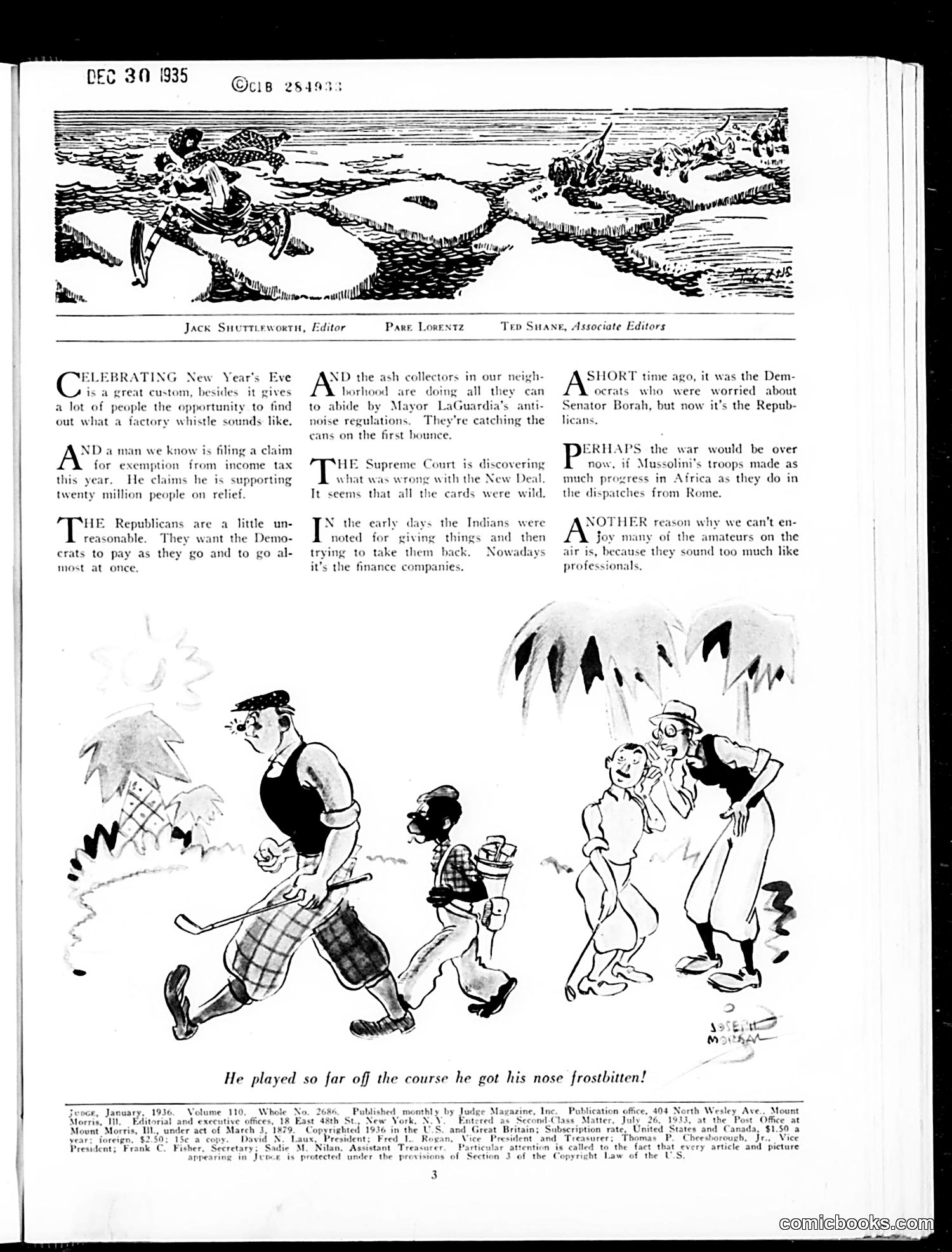
Judge Magazine Commentary, December 30, 1935 This page contains brief political commentary rather than narrative cartoons. The editorial snippets critique: 1. New Year's Eve noise ordinances — mocking Mayor LaGuardia's anti-noise regulations and ash collectors enforcing them in neighborhoods. 2. Tax exemptions — a man claiming relief while supporting "twenty million people" through taxes. 3. Republican criticism of Democrats — attacking Democratic policies as unreasonable. 4. Supreme Court vs. New Deal — commenting on the Court "discovering what was wrong with the New Deal." 5. Native American stereotyping — a dated reference to Indians "giving things and then trying to take them back," apparently about finance companies. 6. Amateur radio commentary — dismissing amateur radio operators as unprofessional. The bottom cartoon shows someone frostbitten after playing golf too far off-course—a simple winter sport joke unrelated to the political commentary above.
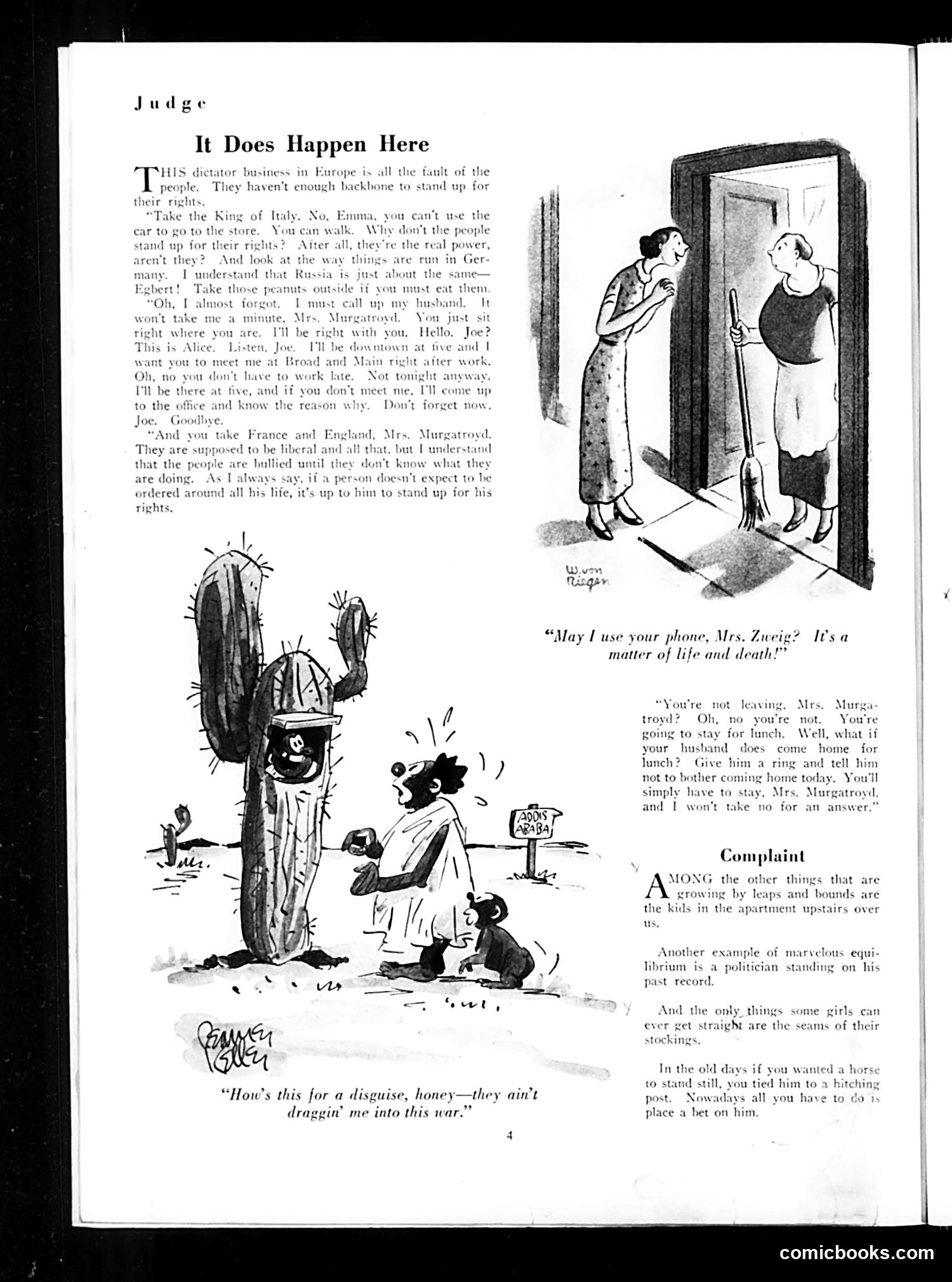
Analysis of Judge Magazine Page This page satirizes European authoritarianism through a monologue by "Judge," criticizing dictators' suppression of citizens' rights. References to "the King of Italy," "Russia," and "Germany" suggest commentary on fascist and communist regimes of the 1920s-30s era. The top cartoon shows a woman urgently demanding phone access for a "matter of life and death"—satirizing how totalitarian regimes control even basic communications. The bottom cartoon depicts a desert scene with a cactus (likely symbolizing an inhospitable environment or Mexico), mocking disguises as ineffective ("they ain't draggin' me into this war"). The "Complaint" section critiques social decay: unruly apartment children, politicians' dishonesty, and women's limited opportunities. The page reflects American anxiety about both foreign tyranny and domestic social problems during the interwar period.
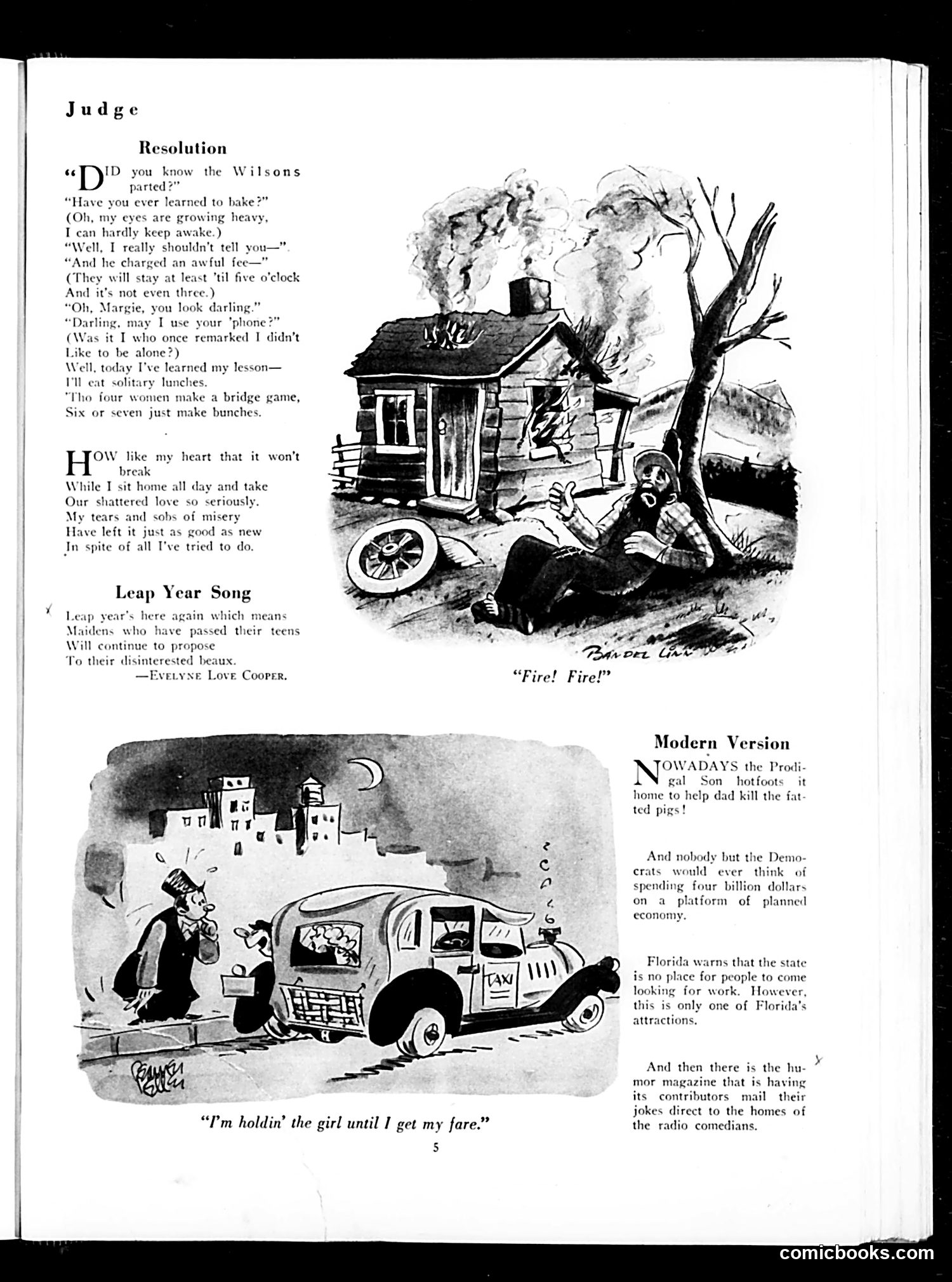
Page Analysis: Judge Magazine, Page 5 This page contains three unrelated pieces: a poem titled "Resolution" about marital strain, a "Leap Year Song" referencing the tradition that women propose to men in leap years, and a "Modern Version" section with two cartoons. The top cartoon shows a man and woman by a burning cottage with an overturned car wheel, captioned "Fire! Fire!"—likely depicting domestic disaster, literal or metaphorical. The lower cartoon depicts a taxi driver with a woman inside, captioned "I'm holdin' the girl until I get my fare"—a play on words conflating romantic "holding" with the driver's demand for payment. The accompanying text makes political jabs at Democrats' spending and Florida's economic struggles, plus a comment about humor magazine contributors selling jokes to radio comedians.
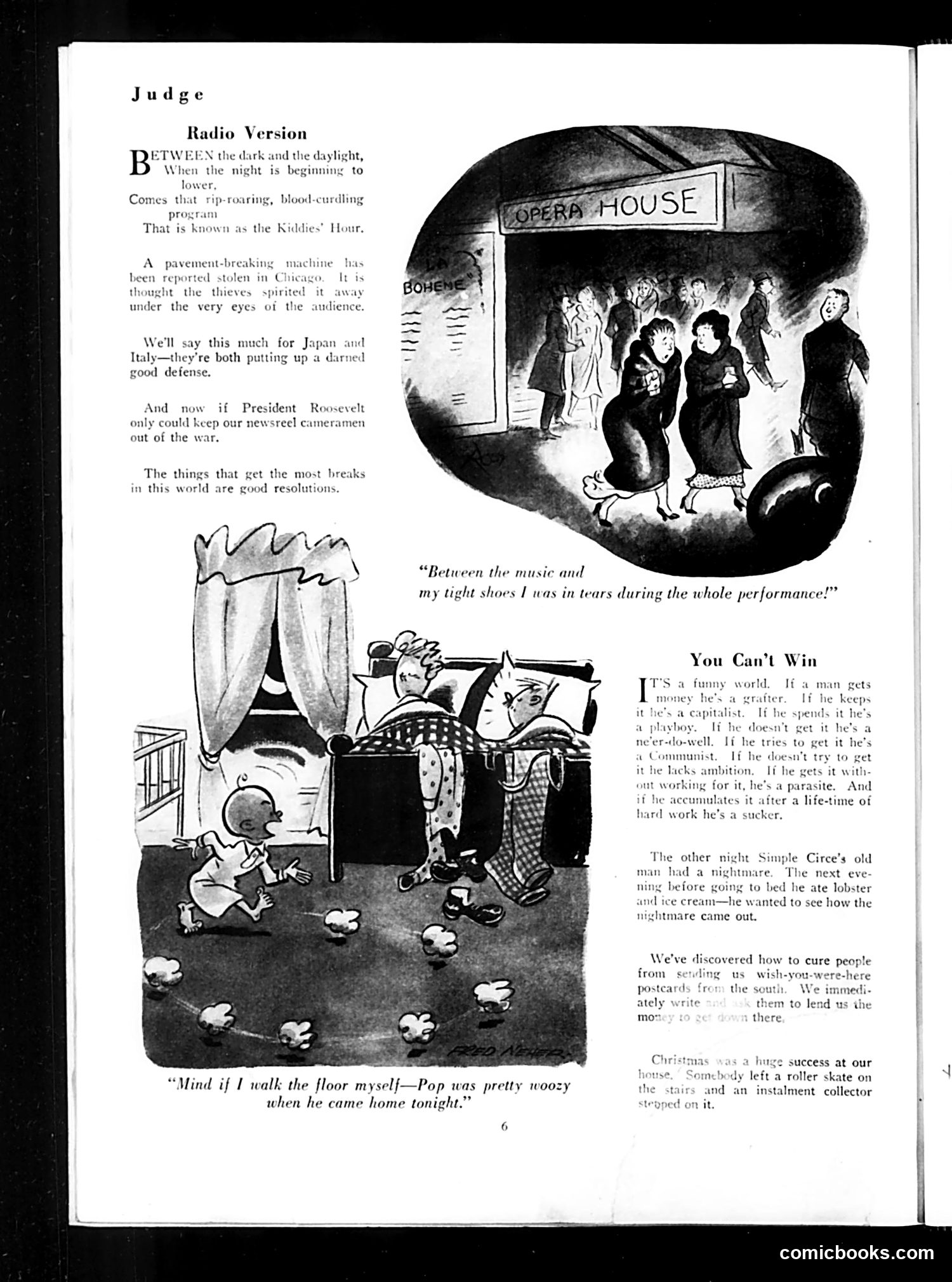
Analysis of Judge Magazine Page This page contains two satirical pieces: "Radio Version" (top left) appears to critique sensationalist children's programming ("Kiddies' Hour") featuring lurid content. References include a stolen pavement-breaking machine in Chicago and mentions of President Roosevelt, suggesting commentary on crime reporting and political news coverage bleeding into youth entertainment. "You Can't Win" (right) is a cynical essay mocking American social mobility—arguing that regardless of financial choices (spending, saving, ambition, passivity), a man is labeled negatively. The tone suggests Depression-era frustration with contradictory societal expectations. Bottom cartoon depicts a messy bedroom scene with the caption about someone's intoxicated father ("Pop"), using domestic chaos for comedic effect about adult drunkenness. The page satirizes media sensationalism, economic despair, and social hypocrisy typical of mid-20th-century Judge magazine.
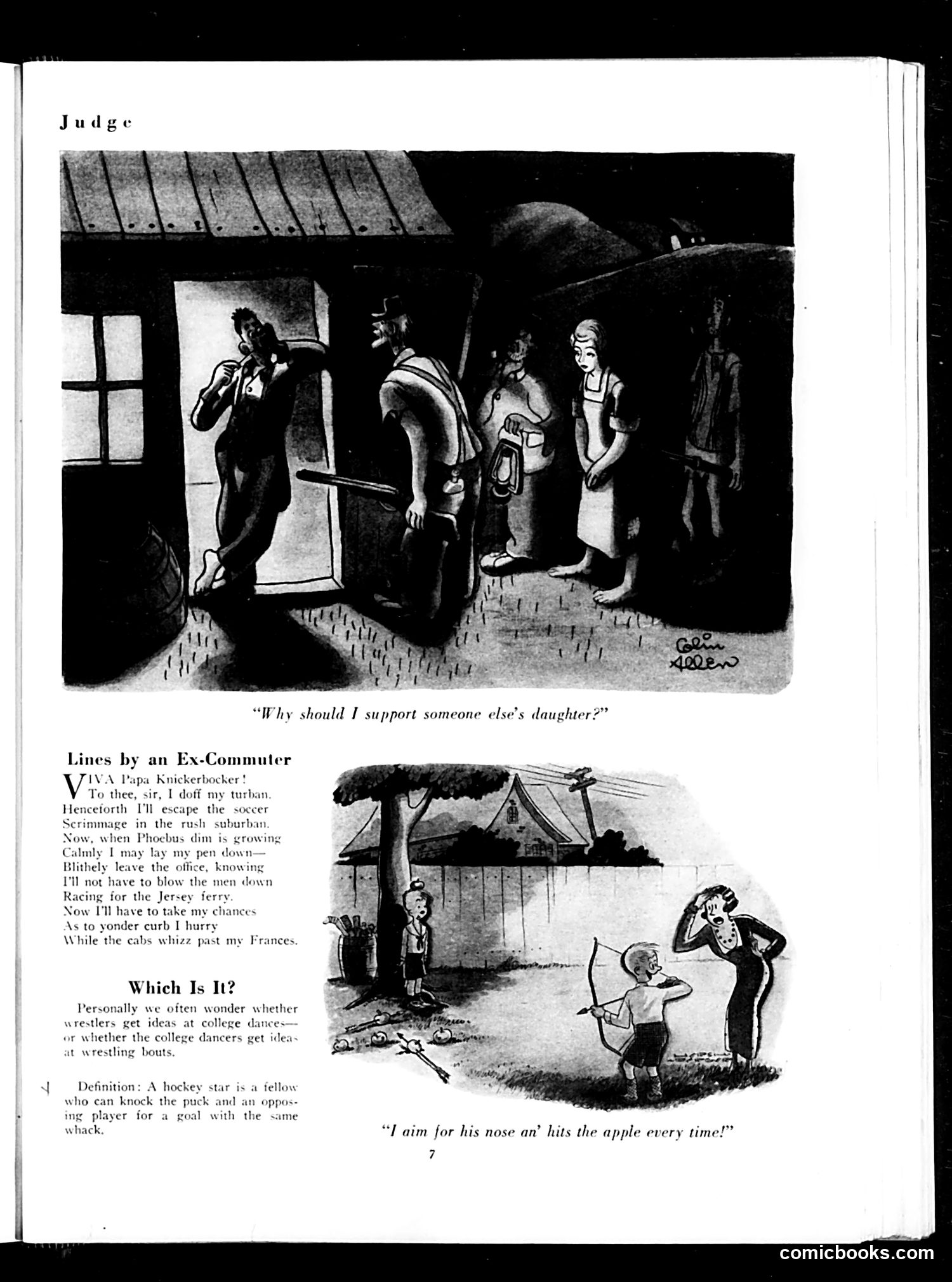
Judge Page 7 Analysis This page contains three unrelated satirical pieces: 1. Top cartoon "Why should I support someone else's daughter?" depicts what appears to be a legal or marital dispute, likely satirizing men's financial obligations in alimony or child support cases—a common Judge topic of the era. 2. "Lines by an Ex-Commuter" is a humorous poem mocking the suburban commuter lifestyle, celebrating escape from city congestion and office work via train to the Jersey shore. 3. "Which Is It?" poses a rhetorical question about college life while defining a "hockey star" as someone skilled at violence. The lower cartoon shows a child playing roughly, satirizing either college athletics' brutality or childhood games mimicking adult sports culture. The page reflects early-to-mid 20th century anxieties about commuting, masculinity, and sports.
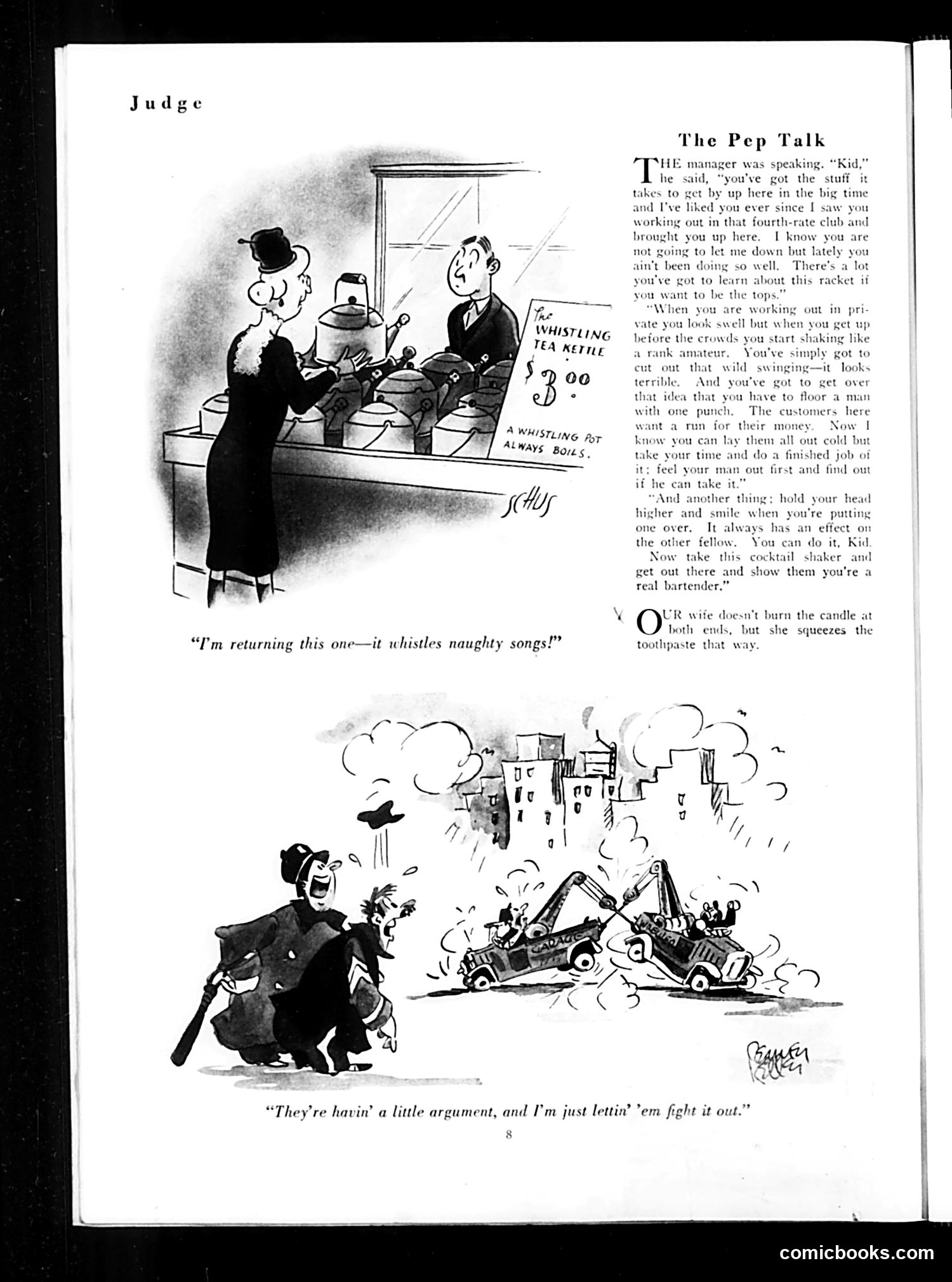
Explanation for Modern Readers This page contains two cartoons satirizing early 20th-century American life. Top cartoon ("I'm returning this one—it whistles naughty songs!"): A customer returns a whistling tea kettle because it emits inappropriate sounds. The humor lies in the kettle's "naughty" whistling being treated as scandalous—reflecting period attitudes about propriety. "The Pep Talk": A boxing manager (or possibly a nightclub manager) lectures a young fighter/bartender named "Kid" about professional conduct. The advice mixes boxing and bartending metaphors—the manager warns against wild swinging, emphasizes showmanship ("smile when you're putting one over"), and advises proper technique over raw aggression. This satirizes the performative nature of both professions and the gap between street-level and professional behavior. Bottom cartoon ("They're havin' a little argument"): Construction workers "argue" while their equipment fights it out, with the boss passively watching—a visual pun on workplace conflict. The overall tone mocks working-class ambition and the "rules" of various trades.
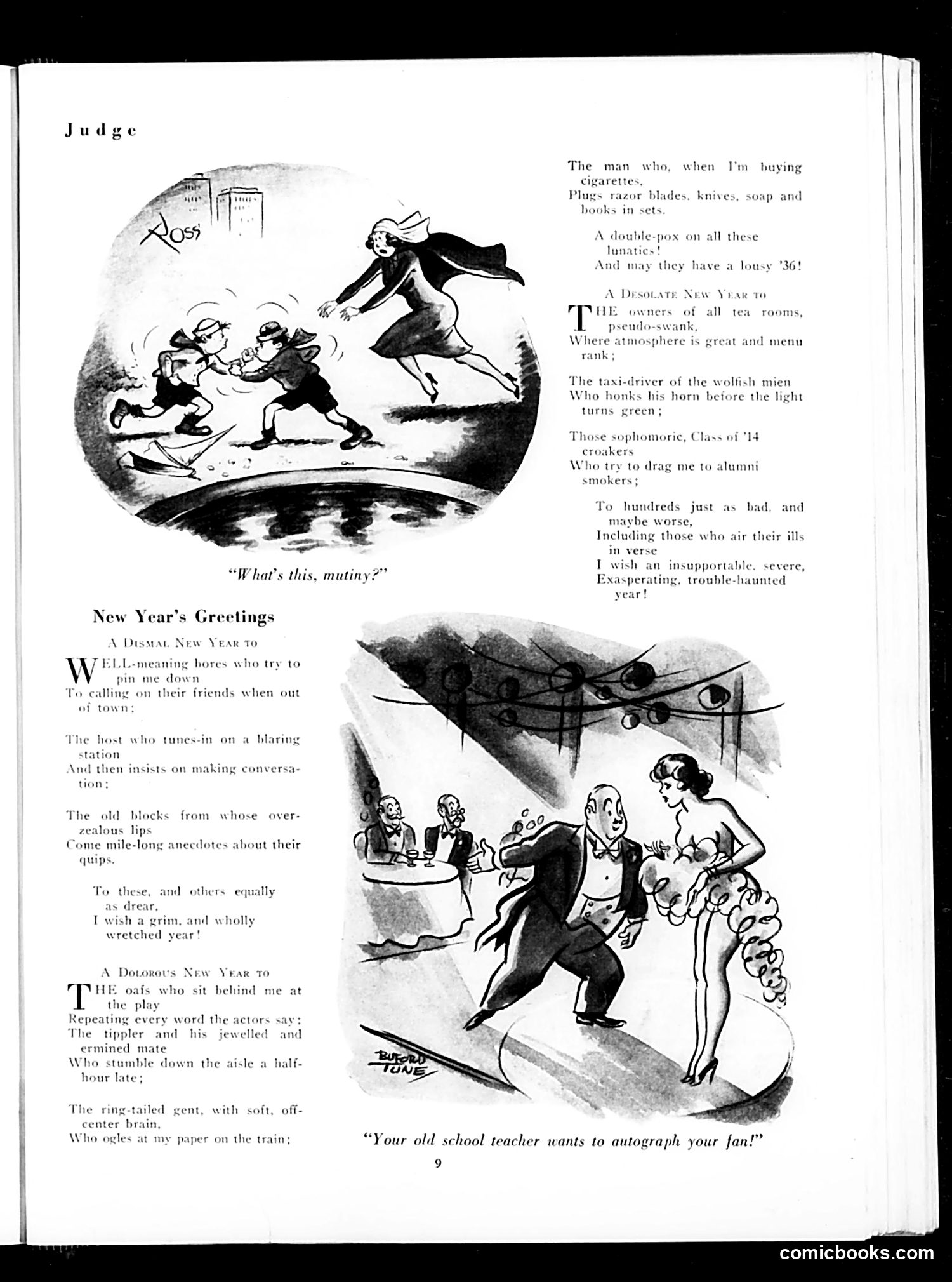
New Year's Greetings, Judge Magazine This is a humorous New Year's editorial from Judge magazine offering mock curses on various annoying social types. The page contains two cartoons illustrating specific grievances. The top cartoon ("What's this, mutiny?") depicts a judge figure confronting two fighting men, likely satirizing workplace or social conflict. The bottom cartoon shows a waiter or servant juggling plates while managing demanding customers at what appears to be a restaurant or nightclub, captioned about an old school teacher wanting an autograph. The accompanying verse catalogs irritating people the author wishes a miserable year: boring conversationalists, loud theater patrons, cigarette salesmen, tea room owners, taxi drivers, and Class of 1914 alumni who pressure people into attending smokers. The satire targets pretentious social behavior, aggressive salesmanship, and the general annoyances of urban life—issues apparently as vexing to 1920s readers as today.
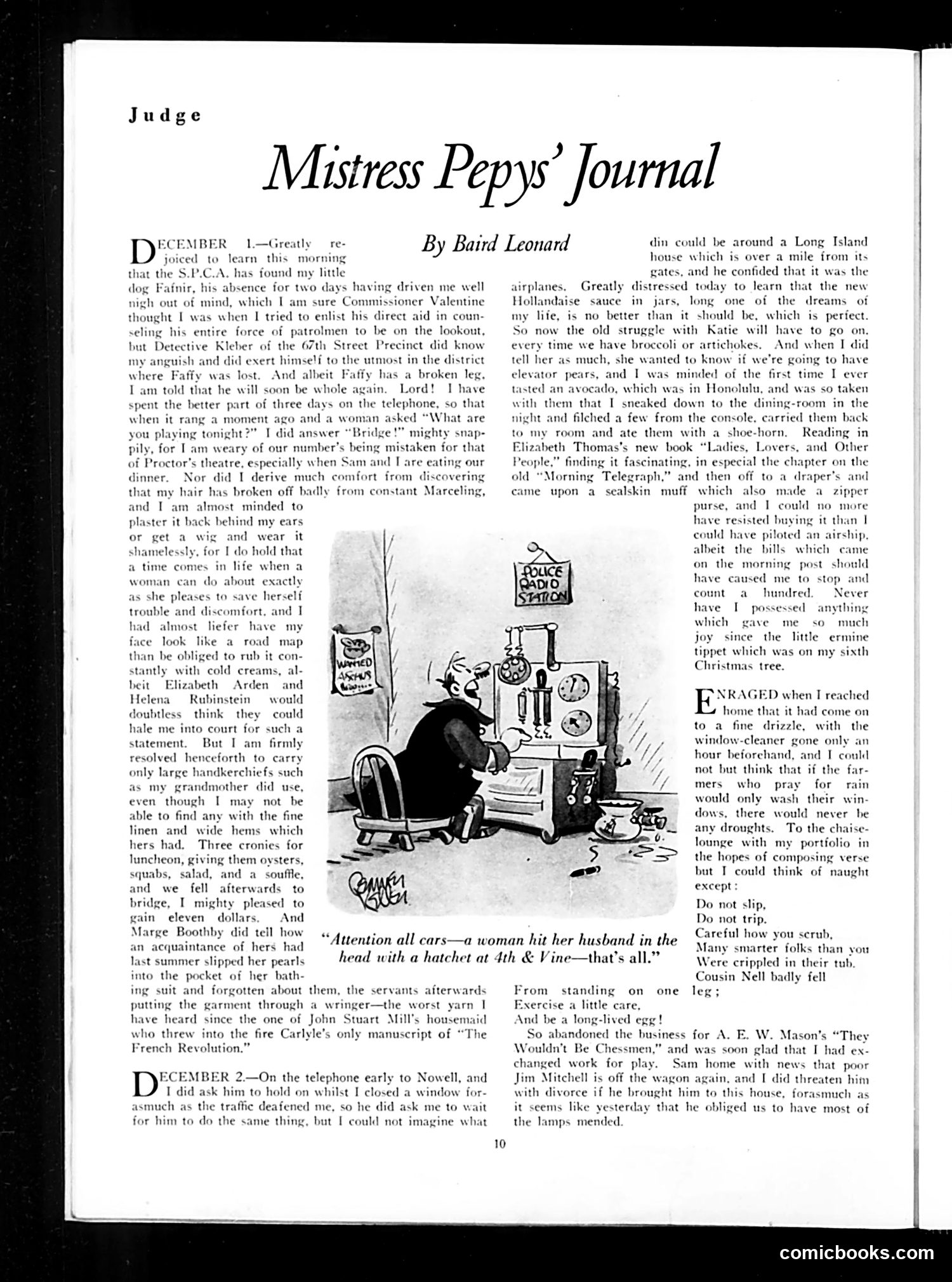
"Mistress Pepys' Journal" - Judge Magazine This is a satirical society column by Baird Leonard, parodying the diary format of Samuel Pepys. The main cartoon illustrates a humorous police dispatch: "Attention all cars—a woman hit her husband in the head with a hatchet at 4th & Vine—that's all." The joke targets domestic violence as casual urban crime. The matter-of-fact police radio tone treating spousal assault as routine traffic is the satire—suggesting such incidents were commonplace enough to warrant deadpan dispatcher language. The column itself mocks wealthy Manhattan society women through breathless, trivial gossip: lost dogs, haircare troubles, bridge games, and culinary complaints about Hollandaise sauce. References to beauty experts (Elizabeth Arden, Helena Rubinstein) and luxury foods (oysters, avocados, pearls) establish the satirical target: privileged, materialistic socialites obsessed with appearance and consumption while oblivious to actual world concerns.
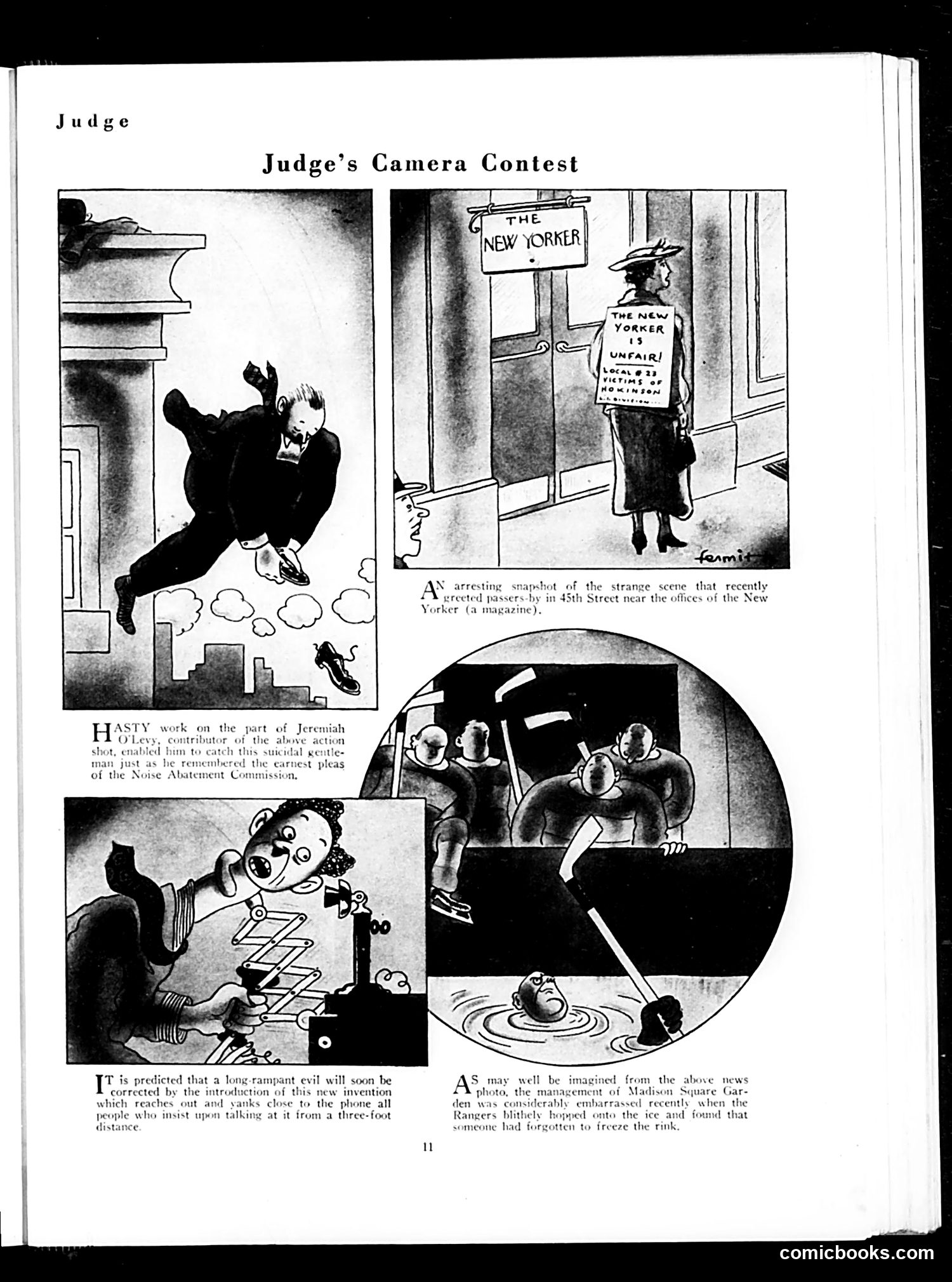
Judge's Camera Contest This page showcases humorous photographs submitted to Judge magazine's camera contest, presented as satirical commentary on urban life and modern inconveniences. The top cartoon depicts someone protesting outside The New Yorker magazine's offices, complaining the publication is "unfair"—likely a jab at Judge's rival publication. The left cartoons mock emerging technology: one shows a man using an early telephone, illustrating frustration with people talking loudly in public spaces at three-foot distance (a common complaint about early phone users). Another depicts a similarly absurd contraption, suggesting new inventions create as many problems as they solve. The bottom circular photograph humorously documents an incident at Madison Square Garden's ice rink where Rangers hockey players arrived to find the rink hadn't been frozen—someone forgot their responsibility. Overall, the page satirizes modern urban irritations, technological growing pains, and everyday incompetence through visual humor typical of Judge's social commentary.
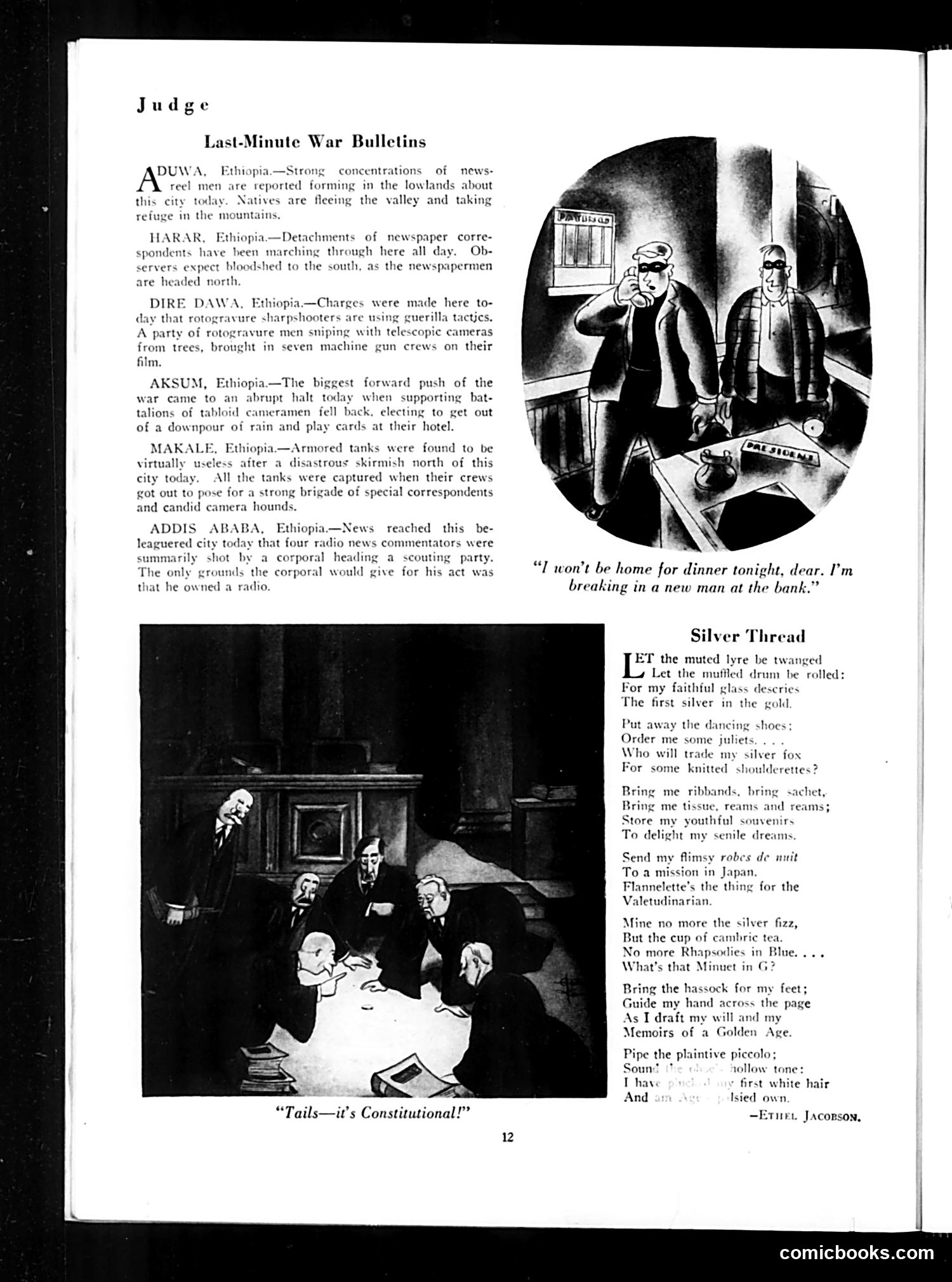
"Last-Minute War Bulletins" — Judge Magazine Satire This page satirizes American newspaper and radio coverage of the Italian invasion of Ethiopia (1935-1936). The "war bulletins" mock war correspondents, photographers, and commentators by treating them as the actual combatants rather than observers. Key satirical points: - Journalists operating like military units ("battalions of tabloid cameramen," "rotogravure sharpshooters") - Their incompetence and self-interest (cameramen abandoning positions during rain to play cards) - Radio commentators depicted as so worthless a soldier shoots one "summarily" The joke is that American media coverage was sensationalized, competitive, and focused more on getting dramatic footage than reporting actual events. The bottom cartoon about "breaking in a new man at the bank" appears unrelated—likely commenting on employment practices. "Silver Thread" is a sentimental poem about aging, unconnected to the satire above.
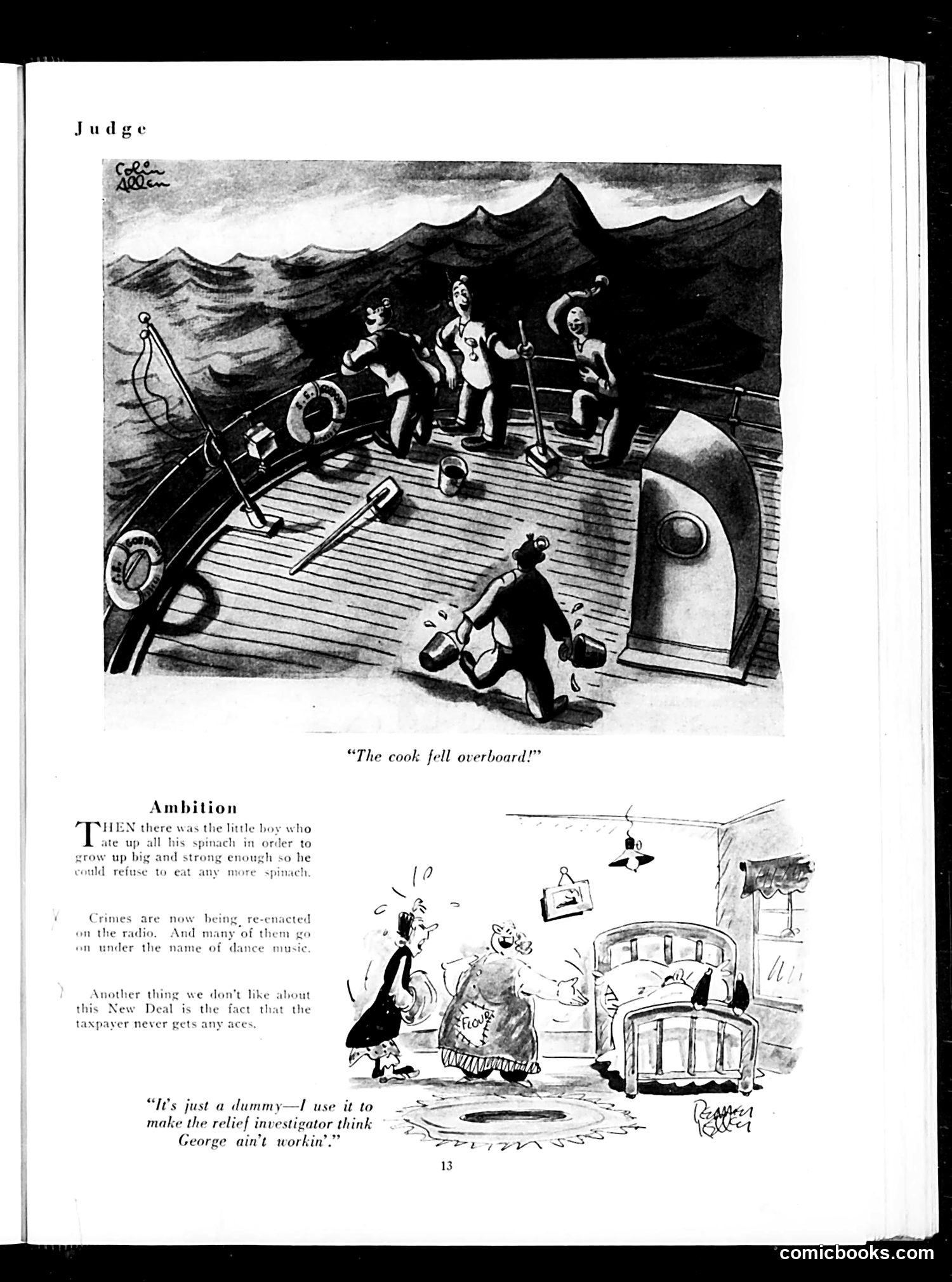
Political Satire Analysis The top cartoon depicts a ship's crew, with the caption "The cook fell overboard!" - likely satirizing a maritime disaster or political upheaval. The bottom section, titled "Ambition," contains three separate satirical jabs: 1. A reference to the spinach-eating boy (Popeye reference), mocking naive self-improvement myths. 2. A criticism of the New Deal programs, suggesting taxpayers never benefit while the government expanded relief spending. 3. A cartoon showing someone with a dummy, joking that relief investigators can't tell if people are actually working—mocking the perceived ineffectiveness or fraud within New Deal welfare programs. The overall theme criticizes Franklin D. Roosevelt's New Deal policies as wasteful government spending that doesn't genuinely help working taxpayers, reflecting conservative opposition to 1930s economic programs.
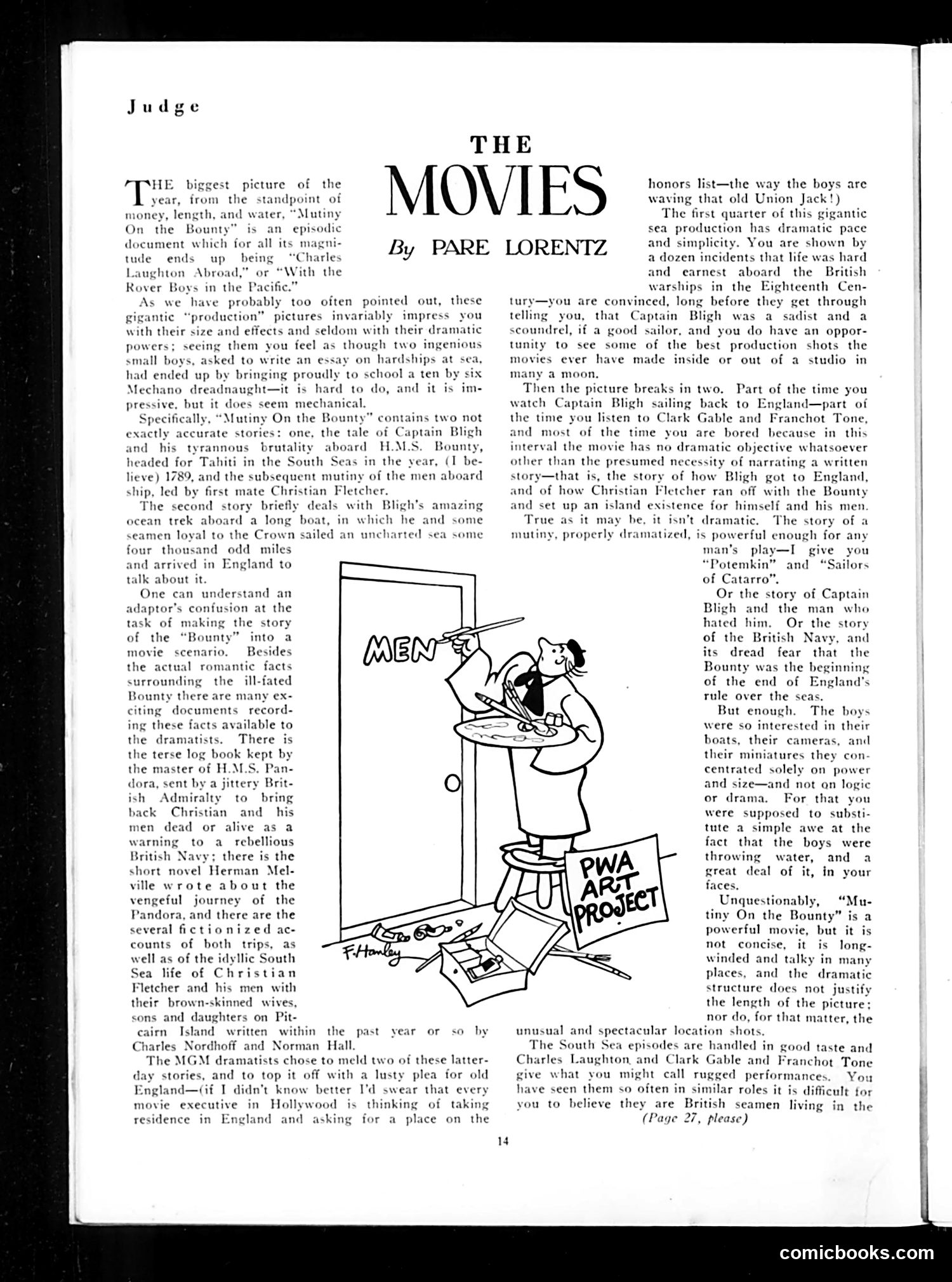
Analysis of Judge Magazine Page This is a film review by Pare Lorentz of *Mutiny on the Bounty*, likely from the 1935 MGM production starring Charles Laughton and Clark Gable. The accompanying cartoon—labeled "PWA Project"—satirizes the film's scale and spectacle. A figure stands atop enormous stacks of props and sets, fishing casually while surrounded by miniature ships and equipment. The joke: Hollywood's tendency to prioritize expensive "production values" over dramatic substance. Lorentz explicitly criticizes this in his text, comparing such films to a child building an impressive toy dreadnought instead of writing a proper essay—impressive engineering but hollow storytelling. The review attacks the film's episodic structure and argues that despite available source material (historical logs, Herman Melville's *Pandora*, other accounts), MGM created a muddled narrative serving "a lusty plea for old England" (satirizing Hollywood executives' apparent Anglophilia). The satire mocks both the industry's bloated production methods and their patriotic posturing.
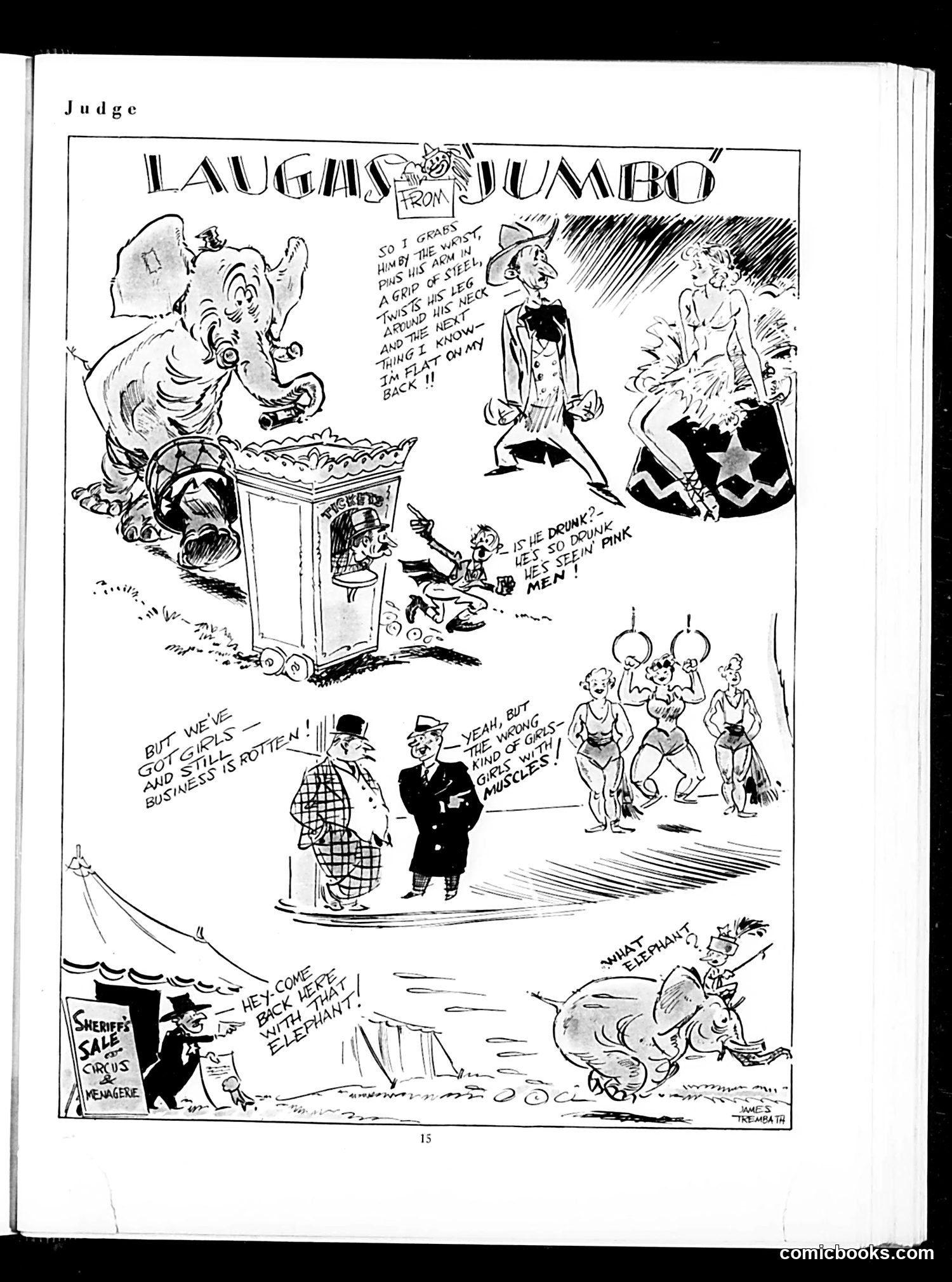
"Laughs from Jumbo" This is a satirical cartoon panel about circus life and performers. The central figure is an enormous elephant ("Jumbo," a famous circus attraction of the era), depicted causing chaos at what appears to be a circus or carnival setting. The jokes play on: - Physical comedy: The elephant's size creating havoc—people scattered, tents damaged - Circus performers: References to acrobats, strongmen, and showgirls - Business troubles: One panel shows a "Sheriff's Sale" sign, suggesting financial ruin from the elephant's destructive presence - Social commentary: Mocking the circus industry's attempts to profit despite constant disasters The repeated exclamations ("IS HE DRUNK?") emphasize the elephant's unpredictable, destructive nature as both comedic and problematic for circus operators trying to maintain a profitable business while managing this massive, dangerous animal.
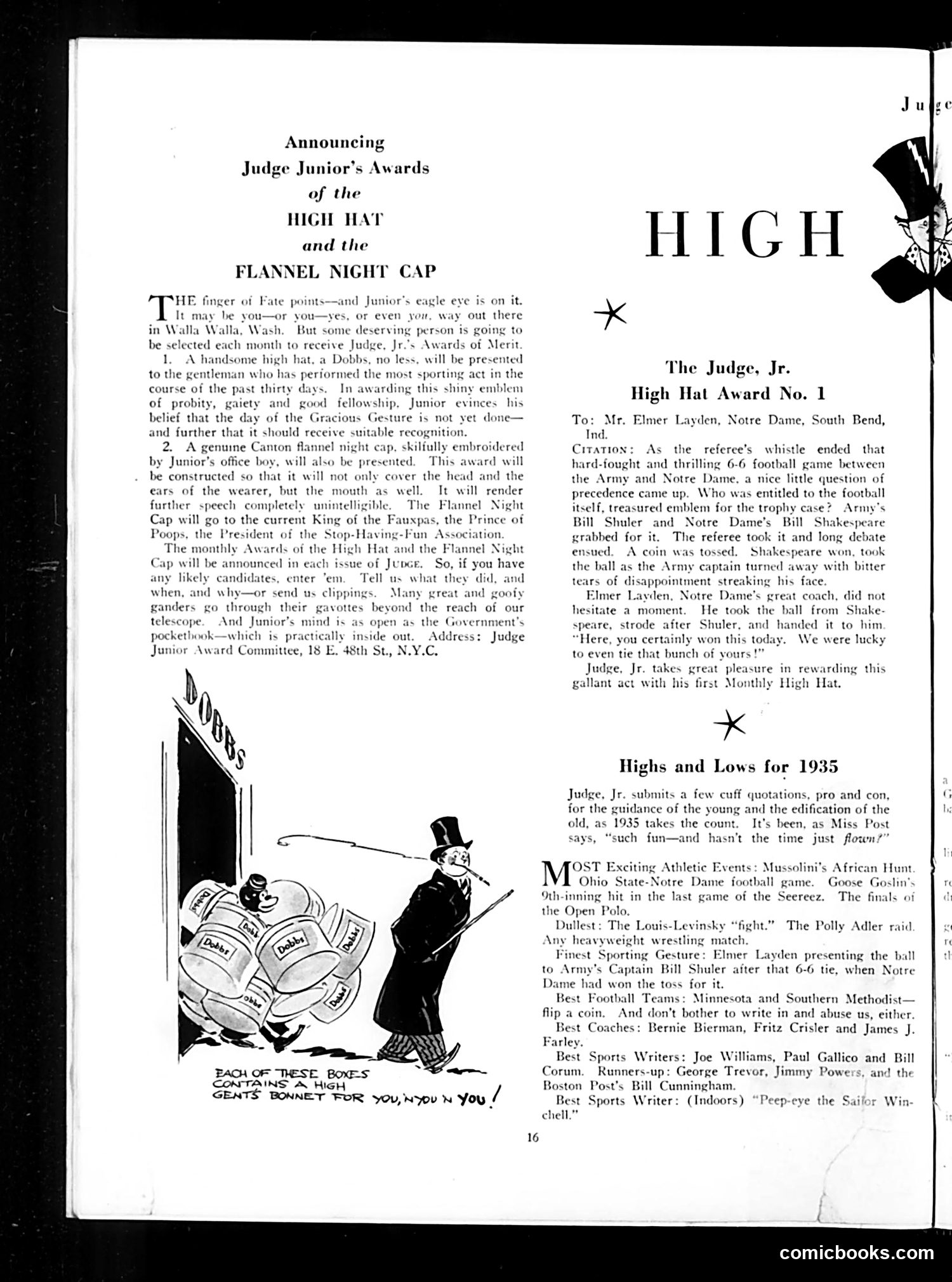
Judge Magazine: "High Hat Award" (1935) This page announces Judge Jr.'s monthly awards celebrating sportsmanship. The first recipient is Elmer Layden, Notre Dame's football coach. The citation describes a 1935 Army-Notre Dame football game that ended 6-6. After the game, both teams' captains (Bill Shuler of Army and Bill Shakespeare of Notre Dame) disputed who deserved the game ball. A coin toss awarded it to Notre Dame, but Layden—seeing Army's captain's disappointment—took the ball and handed it to Shuler instead, saying "You certainly won this today." The satire: The magazine celebrates this gesture as "the finest sporting gesture" of the year, mocking the rarity of genuine sportsmanship and graciousness in competitive athletics. The elaborate "High Hat Award" (a fancy Dobbs hat) and "Flannel Night Cap" (for the year's worst offender) are tongue-in-cheek commentary on how noteworthy basic decency has become. The cartoon shows Judge Jr. as a figure dispensing these symbolic awards to deserving sportspeople.
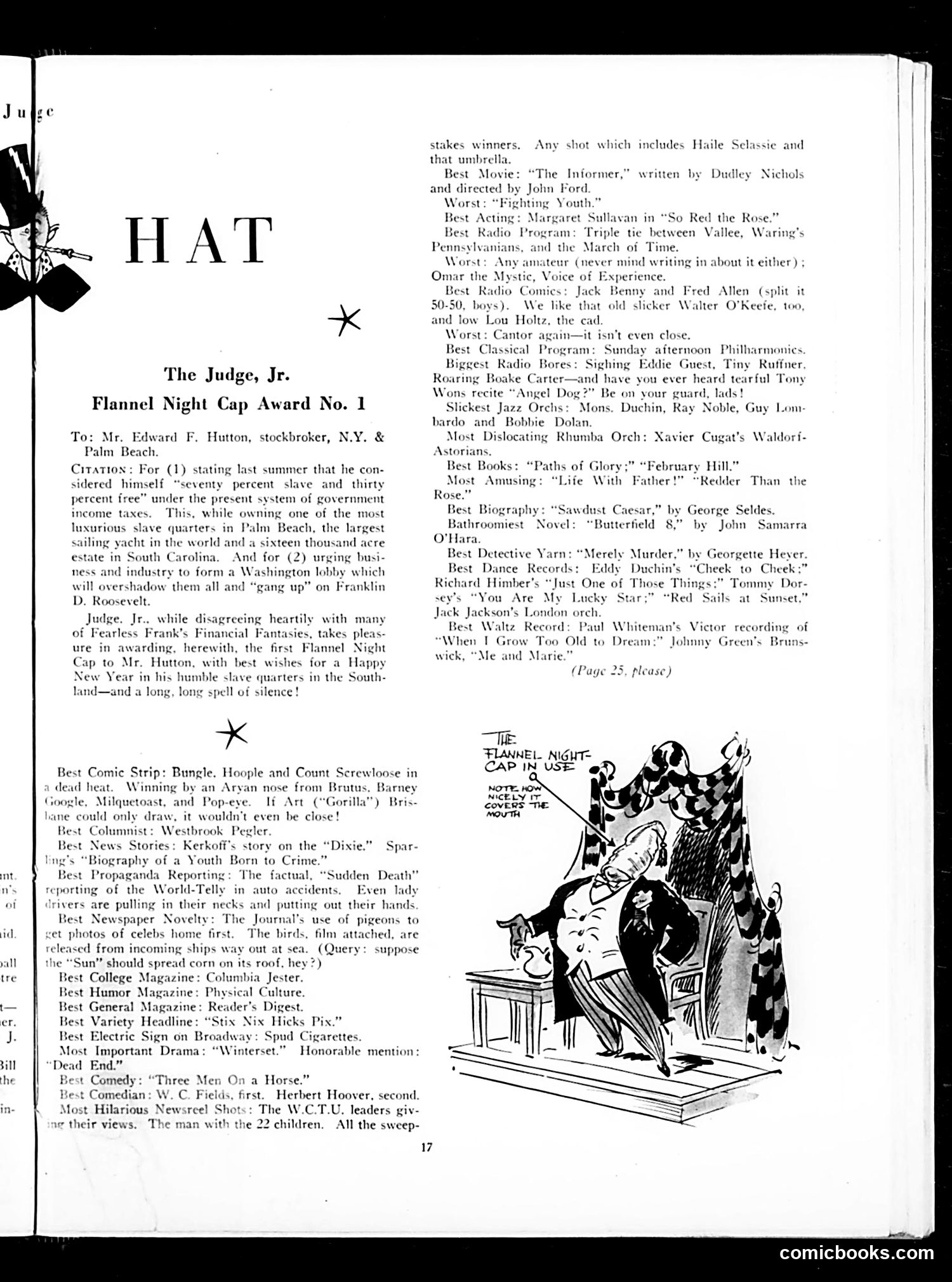
"Flannel Night Cap Award" Cartoon Explanation This is a satirical award given by *Judge* magazine to Edward F. Hutton, a wealthy New York stockbroker and Palm Beach resident. The satire targets Hutton's hypocrisy regarding taxes and government. The joke: Hutton claimed to feel "seventy percent slave" under the income tax system—while simultaneously owning luxurious properties (Palm Beach estate, large yacht, South Carolina plantation) and urging business to form a lobby to "gang up" against Franklin D. Roosevelt's policies. The magazine mocks him for complaining about taxation while living as a wealthy man of leisure. The "Flannel Night Cap" award is sarcastic—suggesting Hutton should retire to his "humble slave quarters" and maintain "silence." This references Depression-era tensions over wealth inequality and FDR's progressive tax policies, which the wealthy opposed. The cartoon ridicules wealthy tax protesters as out-of-touch hypocrites.
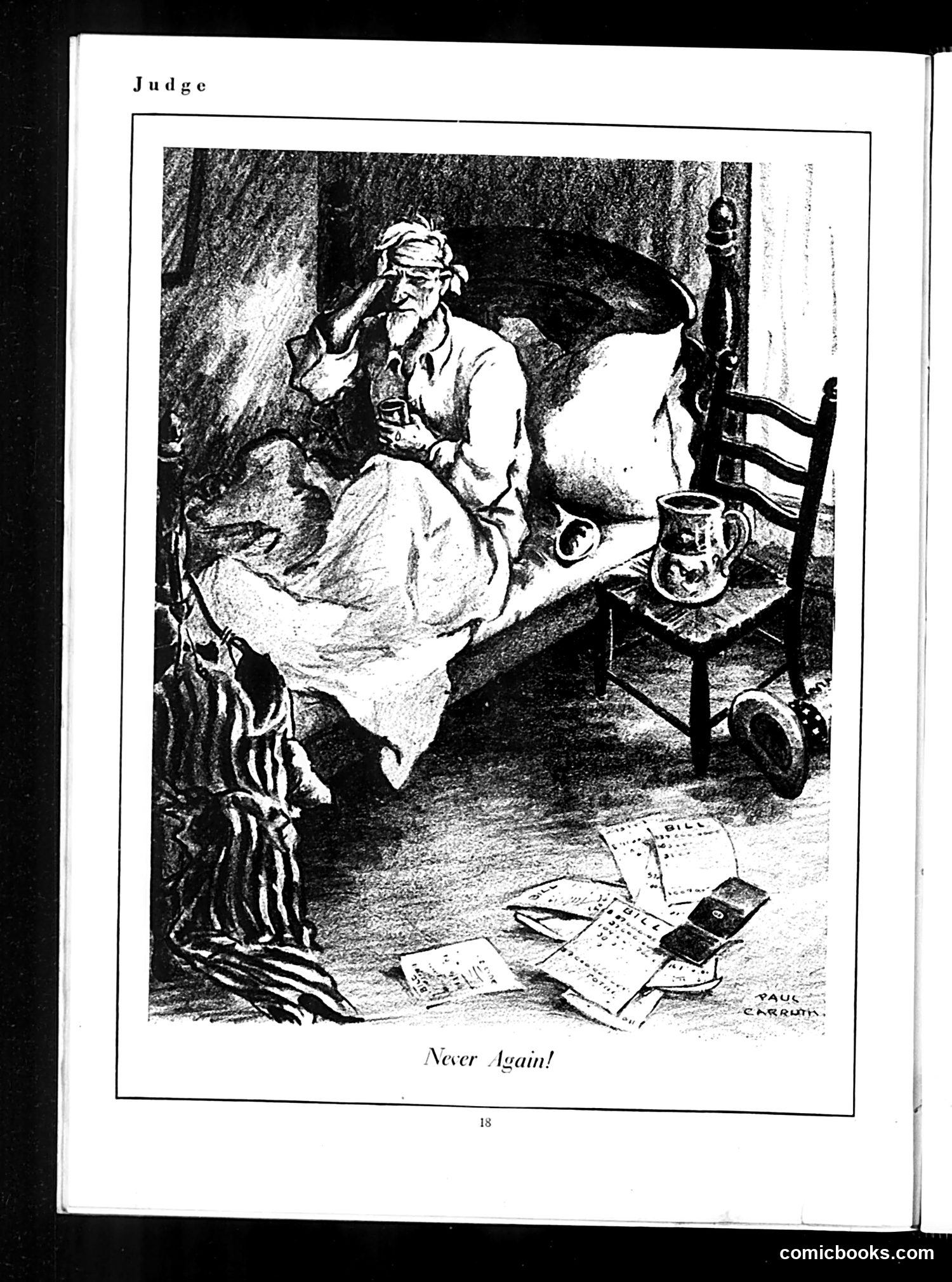
"Never Again!" - A Judge Cartoon This political cartoon depicts a disheveled man sitting amid scattered bills and financial documents, his head in his hand in a posture of despair or regret. The caption "Never Again!" suggests he's sworn off some costly behavior—likely gambling, based on the visible papers suggesting debts or betting slips strewn across the floor. The cartoon satirizes the common human tendency to make rash financial decisions, then vow never to repeat them. The man's worn appearance and cluttered surroundings emphasize the consequences of his choices. This reflects Judge magazine's frequent commentary on personal finance, vice, and the follies of everyday Americans during the early-to-mid twentieth century. The artist's signature reads "Paul Carruth."
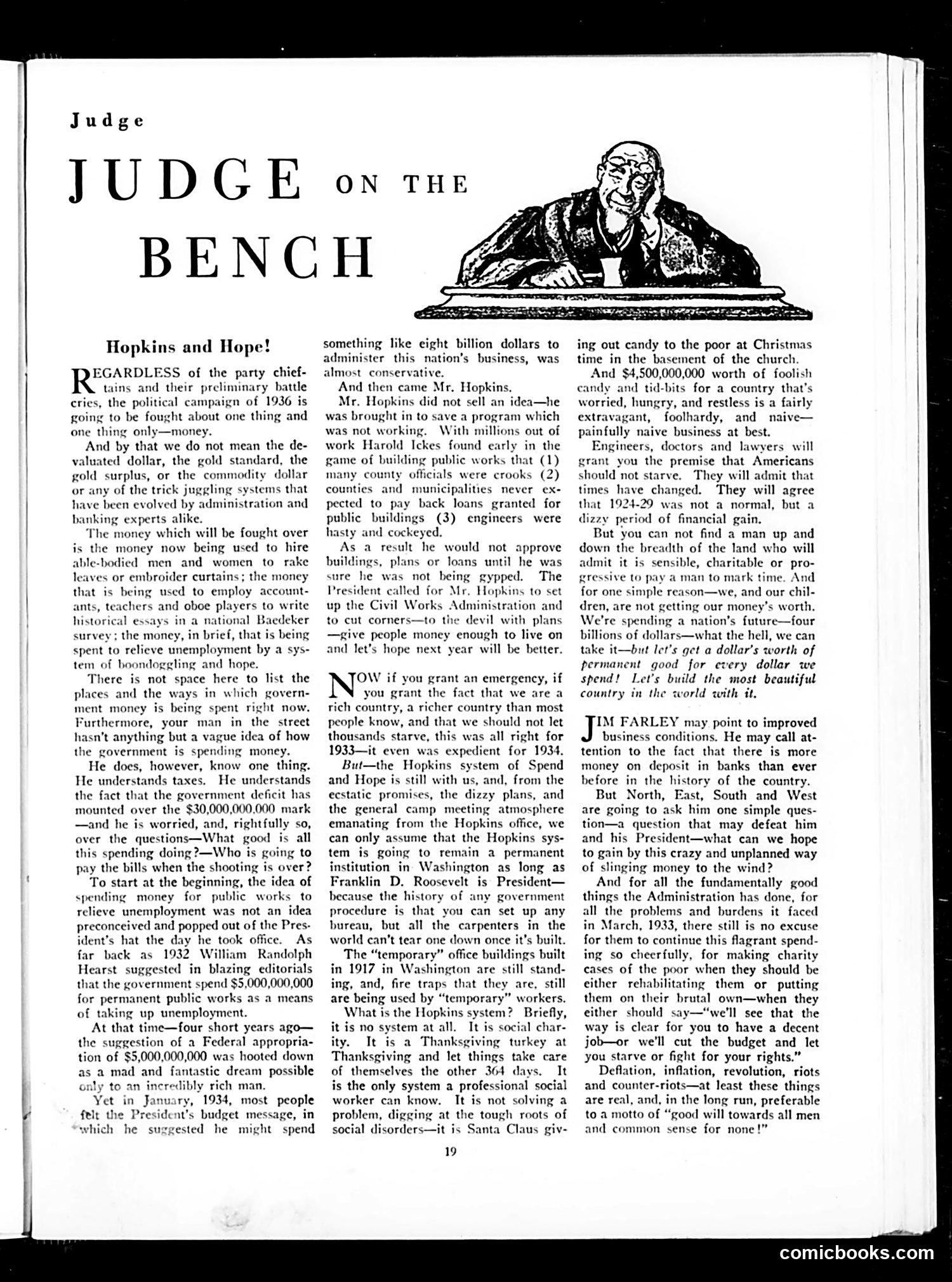
"Judge on the Bench": Hopkins and Hope (1936) This editorial attacks the Roosevelt administration's emergency spending programs, particularly those run by Harry Hopkins, head of the Civil Works Administration. The piece criticizes what it calls the "Hopkins system of Spend and Hope"—temporary relief programs created to combat Depression unemployment. The satire's central argument: while emergency spending was arguably justified in 1933-34, by 1936 these programs have become permanent bureaucratic fixtures that waste taxpayer money on "boondoggling" (make-work projects like "raking leaves or embroidering curtains"). The text contrasts Harold Ickes (who demanded oversight) with Hopkins (who distributed funds quickly without safeguards). Judge worries these temporary wartime-era buildings and agencies will never be dismantled—a prescient observation about government expansion. The 1936 election, the piece predicts, will be fought entirely over government spending and deficits ($30+ billion), not party ideology. The tone is conservative fiscal criticism masquerading as pragmatic concern.
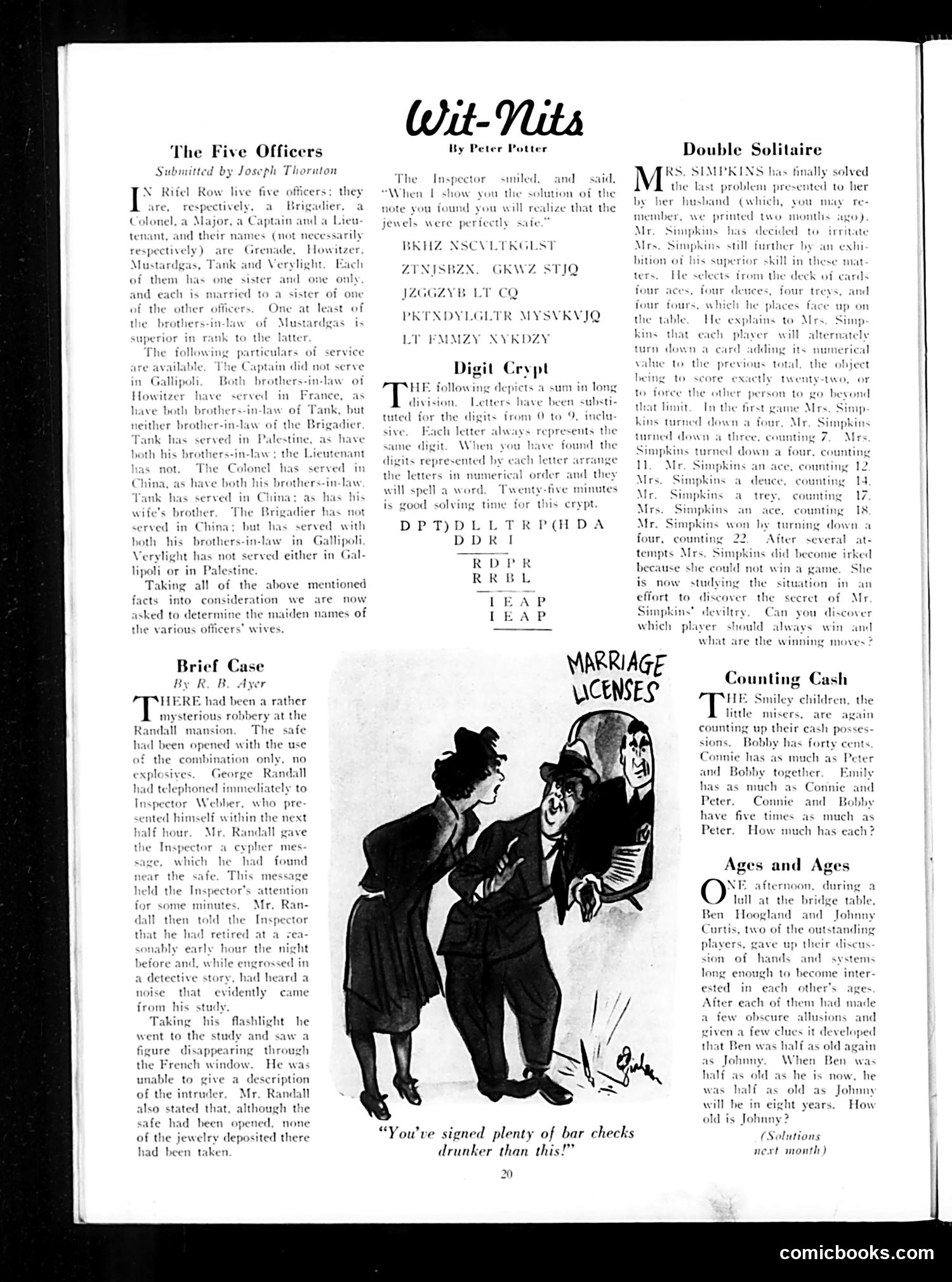
Wit-Nits Page Analysis This page from *Judge* magazine contains several standalone logic puzzles and humorous fiction pieces typical of the era: "The Five Officers" is a logic puzzle where readers must deduce five officers' maiden names based on service records and family relationships—a word game requiring careful deduction. "Brief Case" is a short mystery story where Inspector Weldon deciphers a coded message left at a robbery scene, revealing the thief's identity. The cipher represents a practical puzzle for readers to solve. "Digit Crypt" is another cryptarithmetic puzzle where letters substitute for digits in a division problem. The "Marriage Licenses" cartoon depicts a couple at what appears to be a marriage registration office, with a humorous caption about the husband signing bar checks while drunk—satirizing marital financial dynamics and male drinking culture of the era. "Double Solitaire," "Counting Cash," and "Ages and Ages" are mathematical word problems testing readers' logic skills. The page reflects *Judge's* appeal to educated readers who enjoyed intellectual puzzles alongside social satire about everyday life.
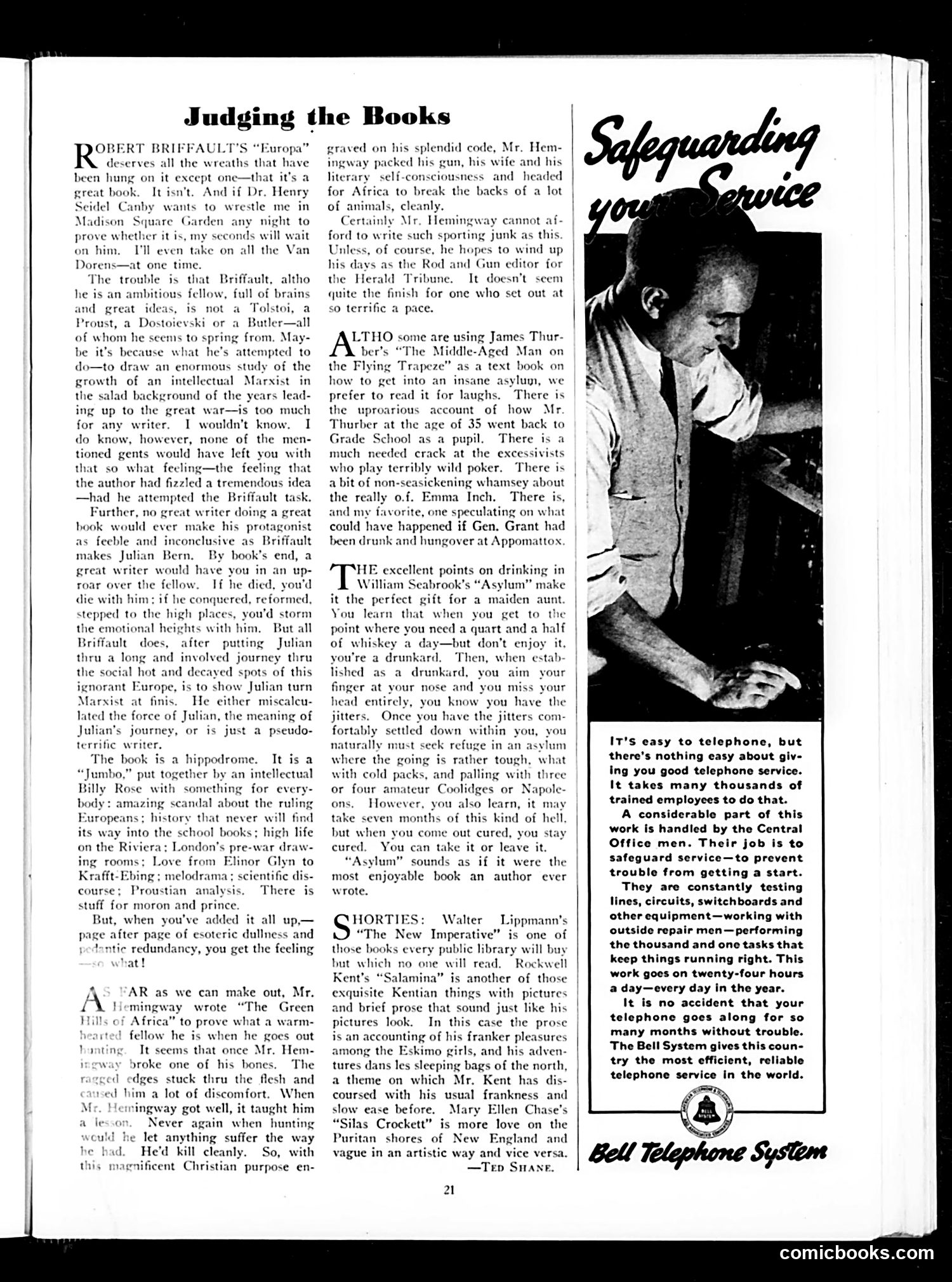
"Judging the Books" - Judge Magazine Book Review Page This is a book review column, not a political cartoon. The page critiques three contemporary literary works: 1. Robert Briffault's "Europa" — criticized as ambitious but ultimately disappointing, with a weak protagonist (Julian Bern) and excessive, redundant prose despite interesting content about post-WWI European society. 2. Hemingway's "The Green Hills of Africa" — mocked as self-indulgent vanity writing. The reviewer sarcastically notes Hemingway frames big-game hunting as moral (killing animals "cleanly"), and warns this lightweight "sporting junk" will damage his literary reputation if he continues. 3. James Thurber's "The Middle-Aged Man on the Flying Trapeze" — praised as genuinely funny satire, including absurdist humor about an adult returning to grade school and social commentary on excessive poker playing. The right page contains a Bell Telephone System advertisement emphasizing operators' reliability in maintaining telephone service infrastructure year-round. The satire targets literary pretension and self-importance among famous writers of the era.
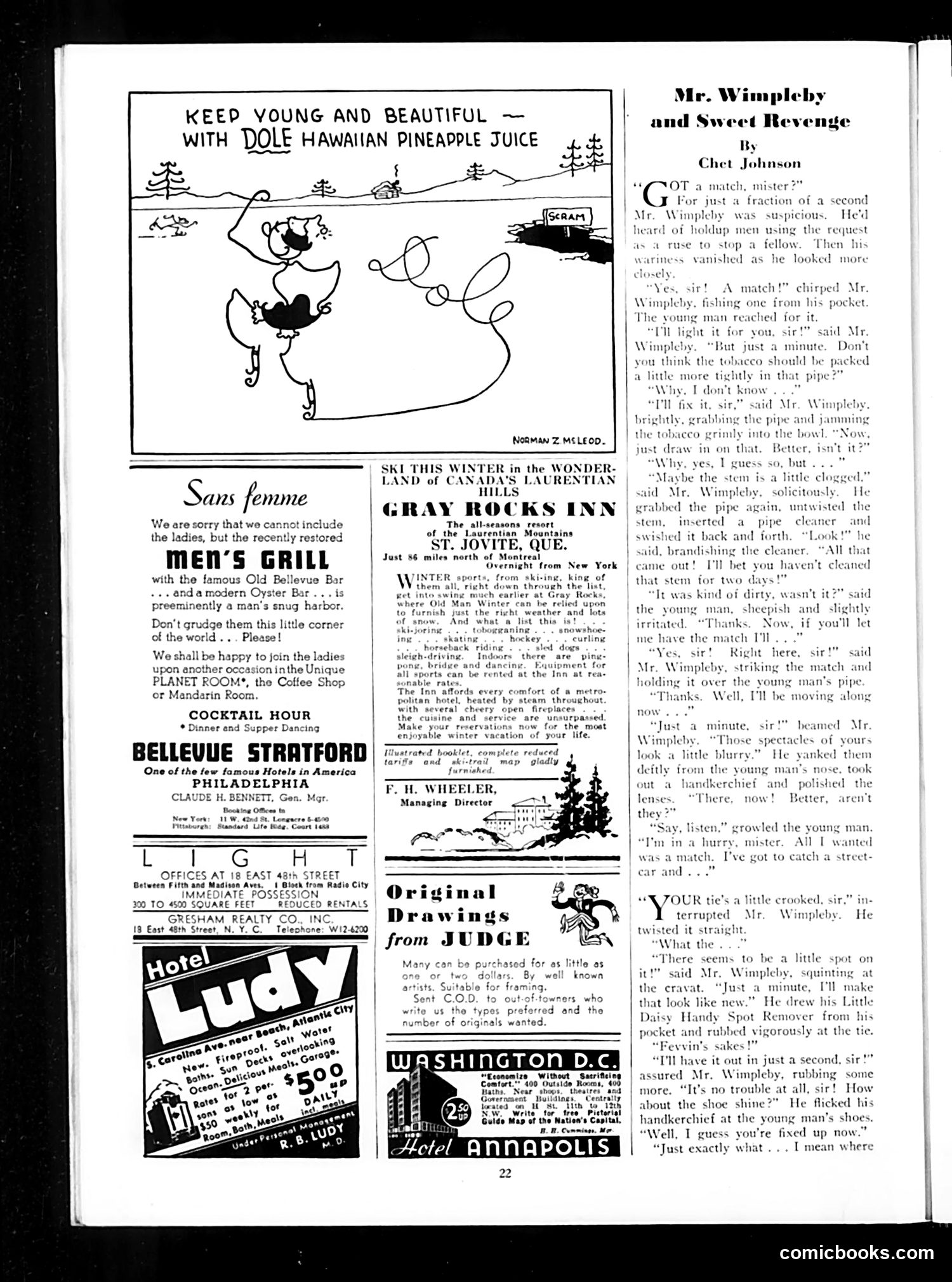
"Mr. Wimpleby and Sweet Revenge" - Judge Magazine This is a humorous short story illustrated with a comic strip, not a political cartoon. The narrative depicts Mr. Wimpleby, an officious older gentleman, repeatedly interrupting a young man trying to catch a streetcar by "helpfully" correcting his appearance—cleaning his pipe stem, straightening his tie, removing a spot from his cravat, and shining his shoes. The joke is a play on the phrase "I mean where" at the end, suggesting the young man was actually trying to ask directions rather than genuinely needing Wimpleby's fastidious assistance. The satire gently mocks the busybody personality type—the well-meaning but intrusive person who cannot resist "improving" others, oblivious to their actual needs or time constraints. It's a character study of social obtrusiveness wrapped in slapstick humor typical of Judge's light comic fare.
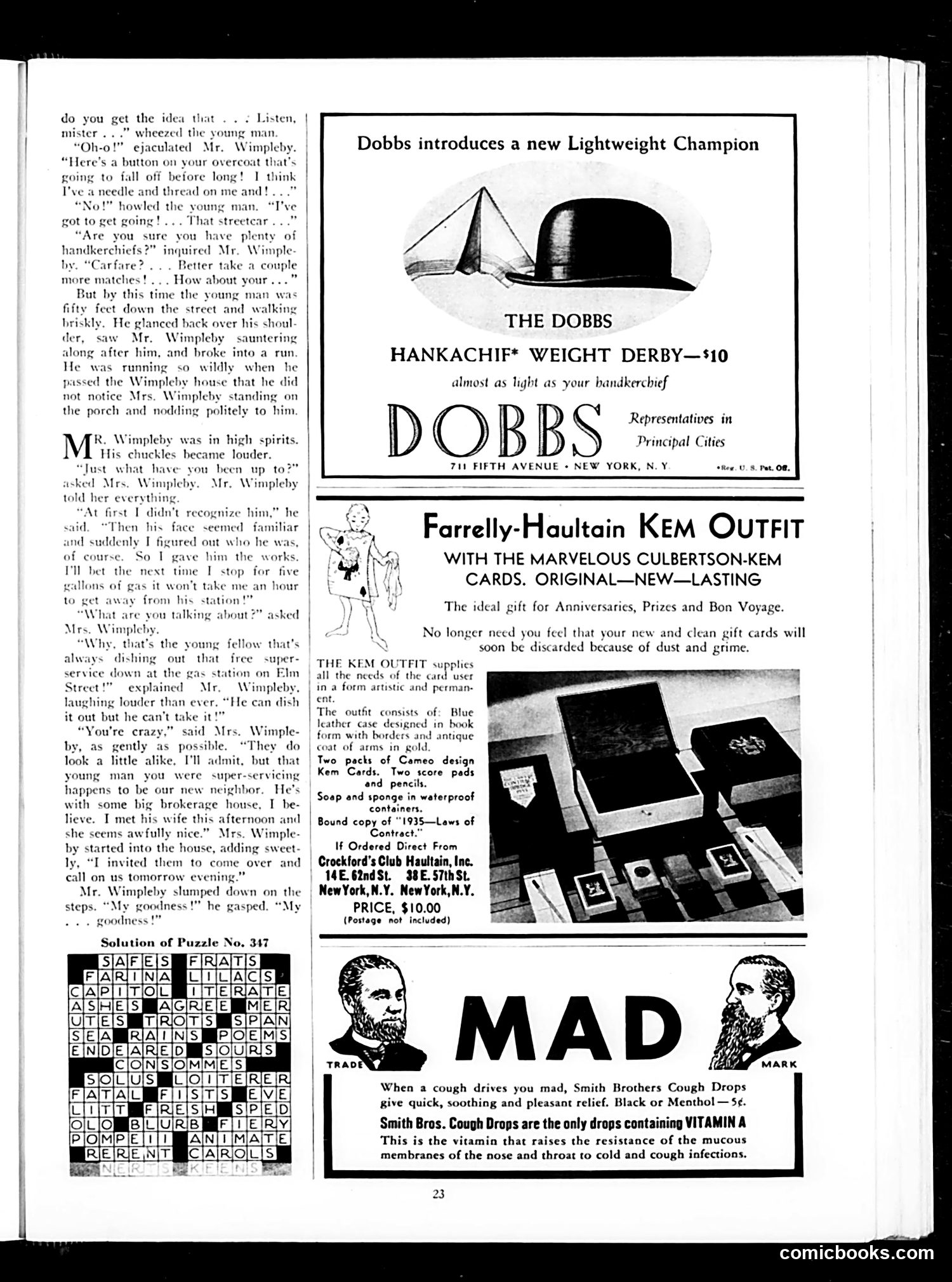
Analysis of Judge Magazine Page Content This page contains a humorous story and several advertisements rather than political cartoons. The Main Story: "Mr. Wimpleby" depicts a gas station attendant who is known for overly solicitous service ("dishing it out"). When Wimpleby encounters this young man on the street, he ironically returns the excessive helpfulness—offering to sew buttons, asking about handkerchiefs and matches—causing the man to flee in embarrassment. The joke's twist: the fleeing man is actually Wimpleby's new neighbor and a respectable broker, not the gas attendant. Wimpleby has mortified himself by confusing the two and now must face the neighbor socially. The Satire: This gently mocks American service culture—the expectation of obsequious attention—by showing its awkwardness when reversed on someone outside that context. Advertisements occupy the lower half: Dobbs hats, a Kem card game outfit, and Smith Brothers Cough Drops (notably featuring a Vitamin A claim, reflecting 1930s health marketing).
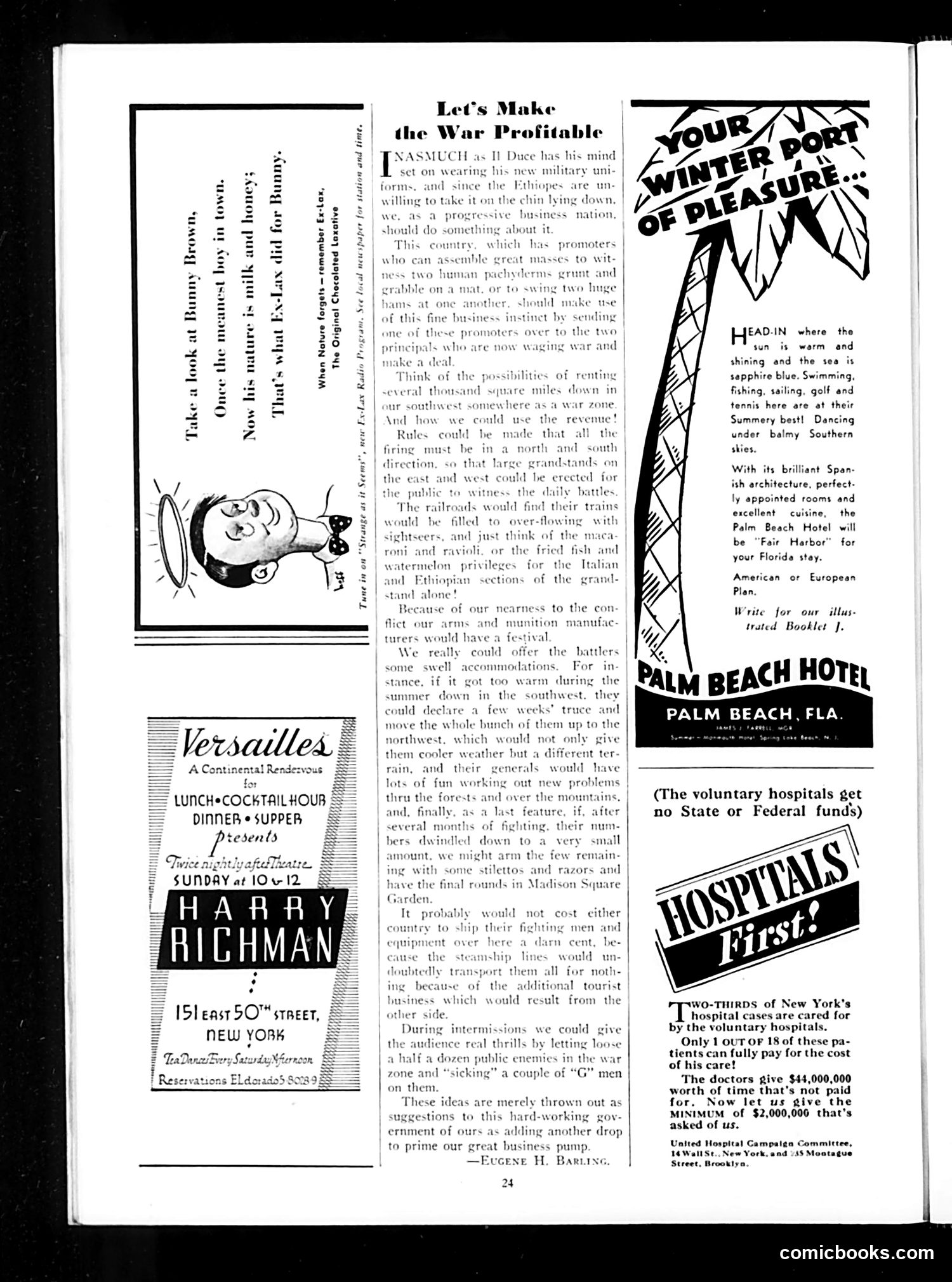
Analysis of "Let's Make the War Profitable" This is a satirical article by Eugene H. Barling proposing absurd ways to profit from World War I. The central joke targets American business opportunism during wartime. The Satire: Barling sarcastically suggests the U.S. could monetize the war by: - Renting southern territory as a "war zone" to showcase battles to paying spectators - Using railroads to transport sightseers to witness fighting - Offering "G" men (government soldiers) to audiences - Concluding with a final battle in Madison Square Garden The Point: This mocks how American businesses and promoters were eagerly seeking profit from the war effort, treating human conflict as entertainment or commercial opportunity. The escalating absurdity—culminating in a Madison Square Garden finale—emphasizes the grotesque nature of such profiteering. The accompanying cartoon (left) shows a grinning figure, likely representing a war profiteer or business promoter rubbing hands together, visually reinforcing the satirical critique of commercial greed exploiting wartime tragedy.
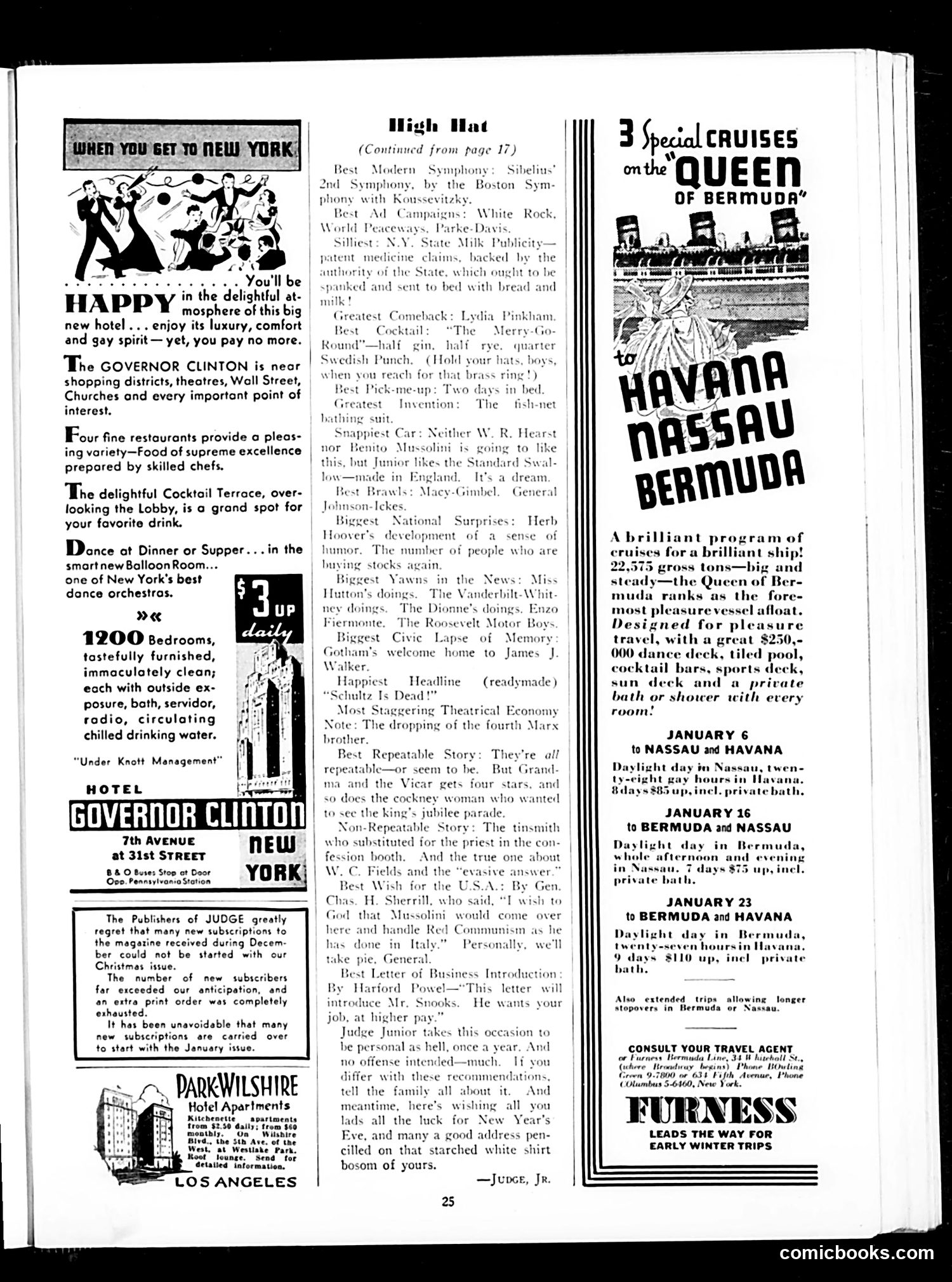
"High Hat" Column Commentary This page is primarily advertising for New York hotels (Governor Clinton, Park Wilshire) and cruise ship vacations on the Queen of Bermuda, with the main editorial content being a "High Hat" gossip/humor column (continued from page 17). The column itself is a satirical roundup of 1930s American news and culture, listing "best" and "worst" moments in categories like symphony, cocktails, comebacks, and theatrical economy. References include: - Lydia Pinkham (patent medicine company making a comeback) - W.R. Hearst and Mussolini (mentioned in a joke about communism) - Marx Brothers (fourth brother dropping out) - Barbara Hutton and Vanderbilt-Whitney social doings (celebrity gossip) - Dionne quintuplets (famous 1930s novelty) - W.C. Fields (comedian) The humor is typical 1930s society-page satire—mocking wealthy socialites, criticizing patent medicines, and making oblique political jokes. The column's author signs as "Judge, Jr."
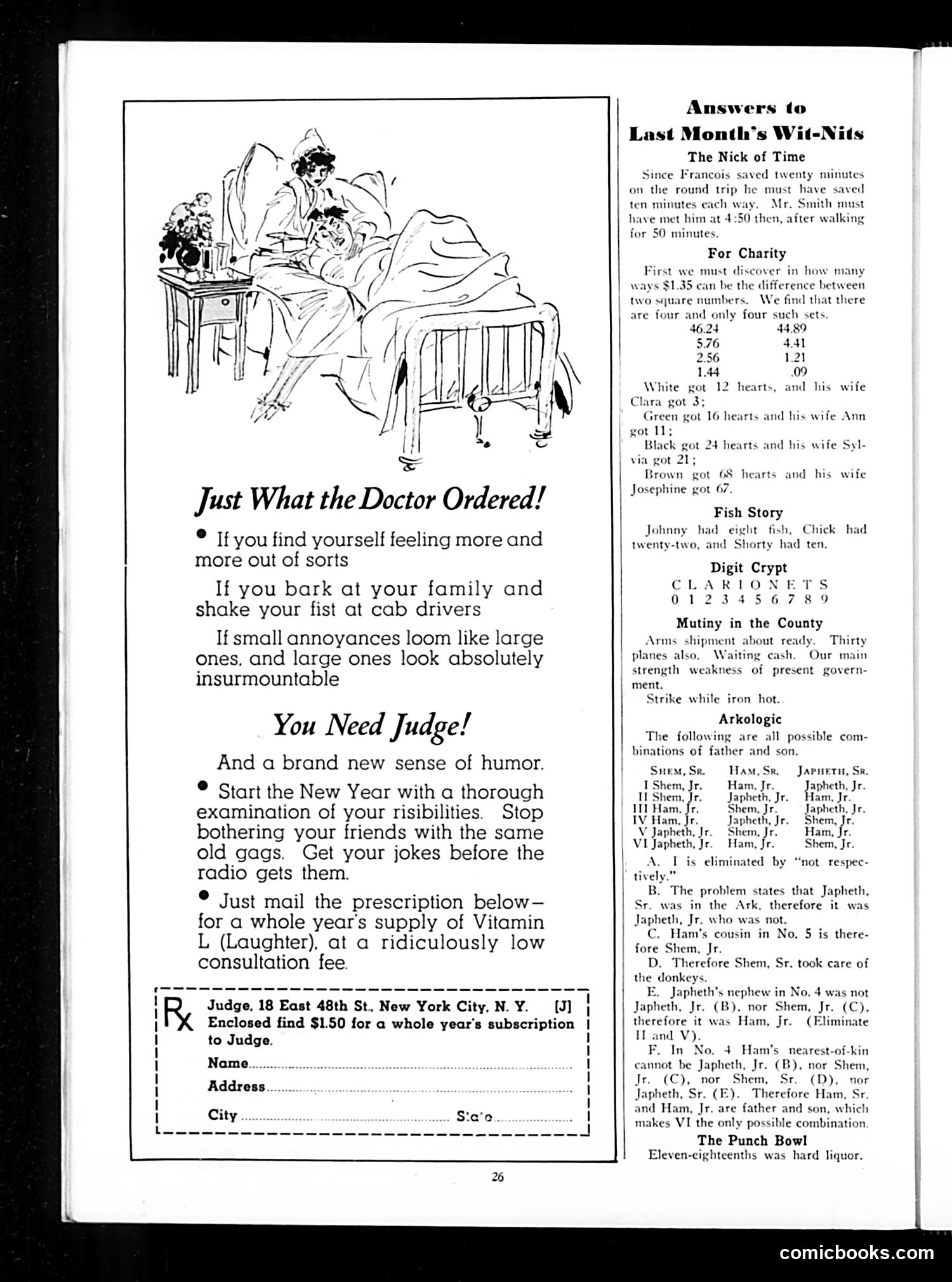
Judge Magazine Page Analysis This page comprises puzzle answers and self-promotional advertising for Judge magazine rather than political satire. The left side features a humorous advertisement positioning Judge as a cure for modern irritability—a relatable appeal to readers feeling "out of sorts," snapping at family, or letting small annoyances overwhelm them. The solution: subscribe to Judge for "a brand new sense of humor" and fresh jokes "before the radio gets them" (suggesting radio comedians were recycling material). The right side presents answers to previous month's puzzles: mathematical problems ("The Nick of Time," "For Charity"), logic puzzles (the "Arkologic" puzzle about Noah's sons), word games ("Digit Crypt"), and riddles ("Fish Story"). The cartoon shows a relaxed domestic scene, reinforcing the magazine's pitch: Judge provides comedic relief from modern stress. The overall message is aspirational—subscribe to stay ahead of joke-telling trends and maintain your sense of humor during uncertain times (likely the 1930s-40s, given the references to radio and the tone).
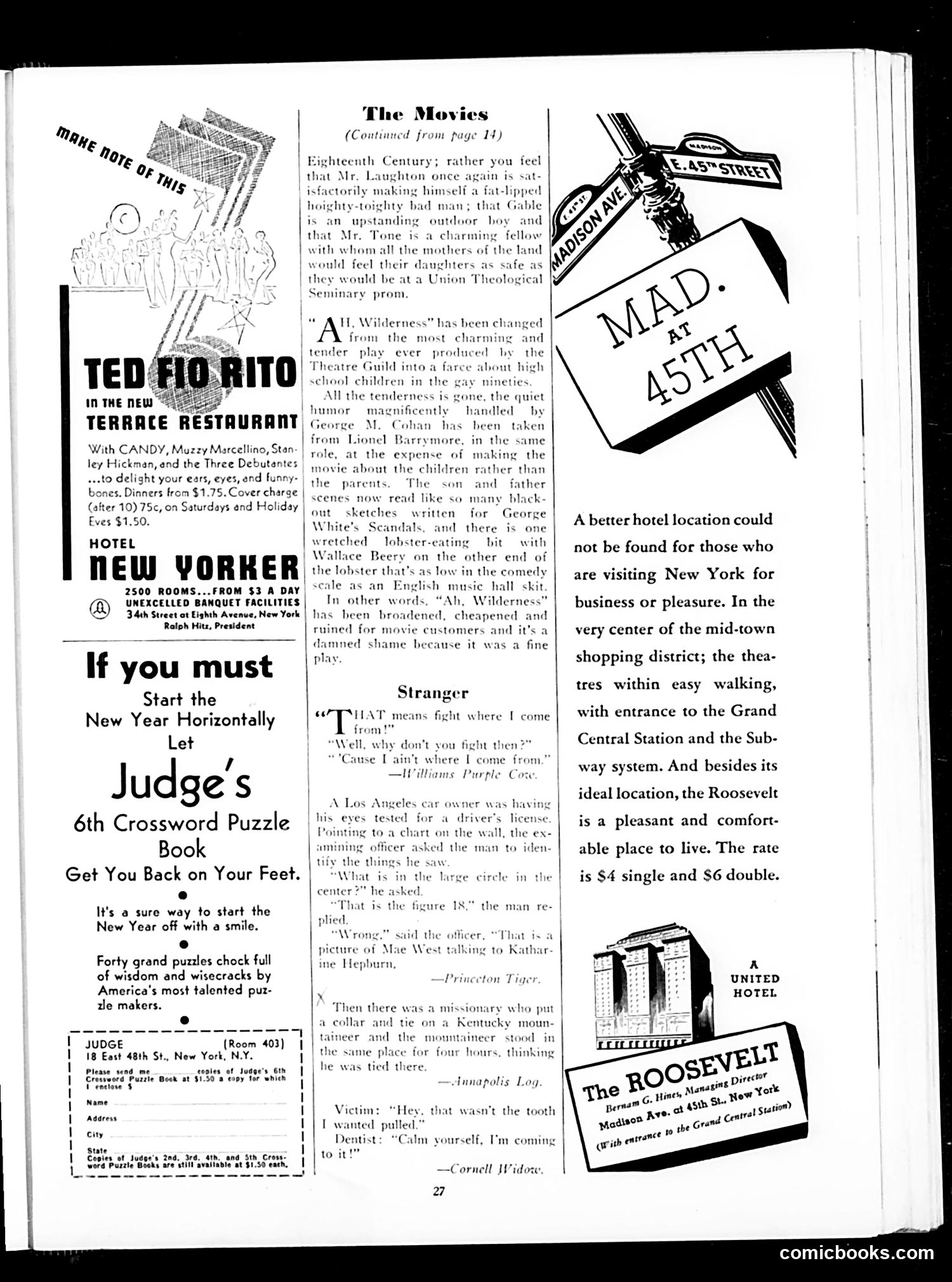
Judge Magazine Page Analysis This page combines entertainment reviews with advertisements and humor typical of 1920s-30s Judge magazine. The Movie Reviews critique recent film adaptations. The discussion of "Ah, Wilderness!" laments that the Theatre Guild's tender stage play has been "broadened, cheapened and ruined for movie customers"—a common complaint about Hollywood's adaptation practices. References to actors like Charles Laughton, Clark Gable, and Lionel Barrymore anchor specific films being discussed. The "Stranger" jokes are brief anecdotes poking fun at regional dialects and misunderstandings (Kentucky mountaineers, Los Angeles drivers), typical of period humor relying on stereotypes. The advertisements promote New York establishments: Ted Fiorello's restaurant, the Hotel New Yorker, and the Roosevelt Hotel, emphasizing affordable rates and central Manhattan locations—appealing to business travelers and tourists. Judge's crossword puzzle book is advertised as New Year entertainment, marketed as helping readers "get back on your feet" after holiday excess. The page reflects 1930s urban sophistication mixed with accessible popular entertainment and gentle social satire.
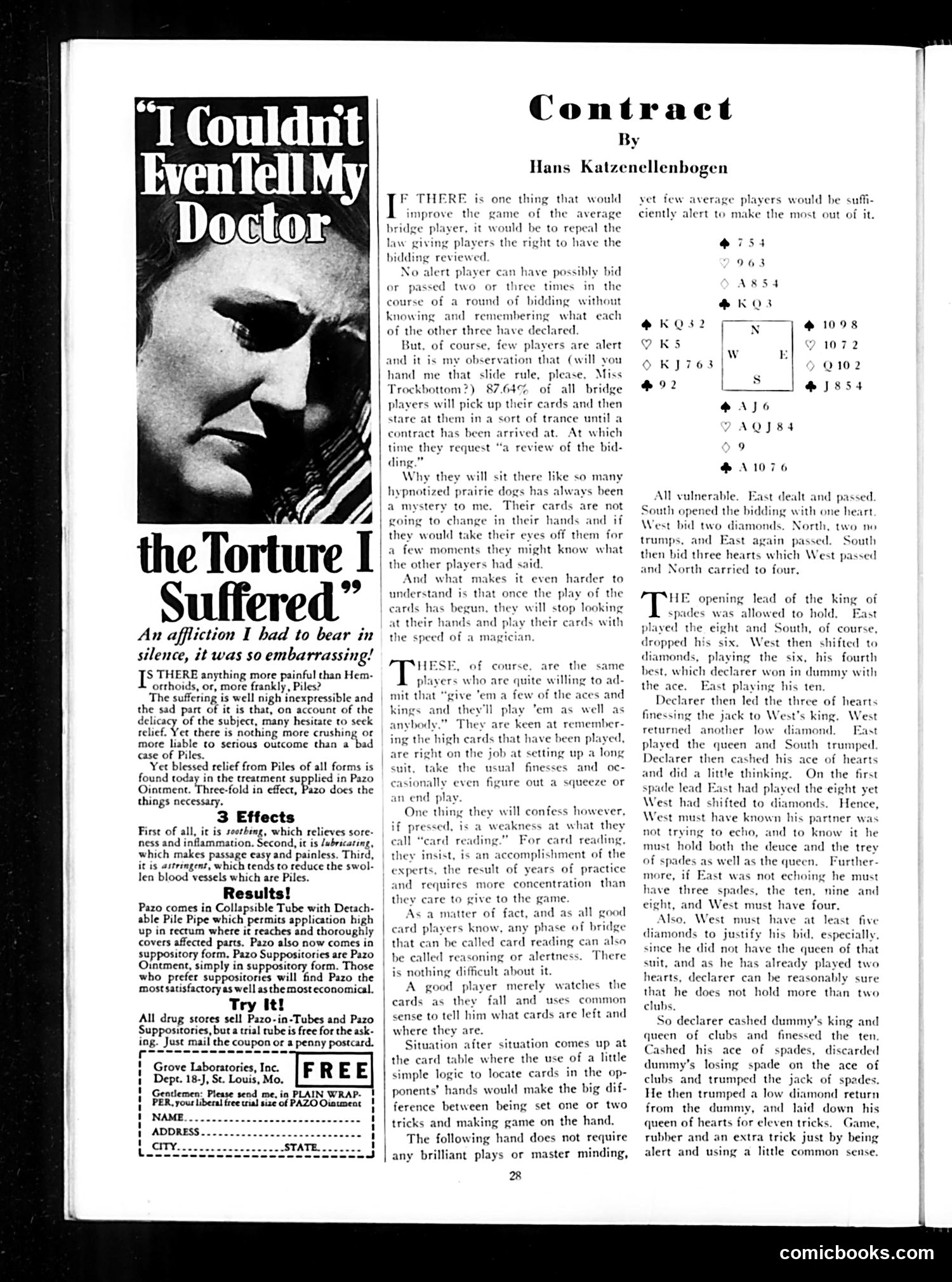
Analysis for Modern Readers This page contains two unrelated items: Left side: A medical advertisement for Pazo Ointment, a hemorrhoid treatment. The dramatic headline "I Couldn't Even Tell My Doctor the Torture I Suffered" exploits embarrassment around discussing a taboo medical condition. The ad emphasizes privacy ("plain wrapper") and relief from an undiscussable ailment. This reflects mid-20th-century attitudes treating bodily functions as shameful topics unsuitable for polite conversation. Right side: A bridge (card game) instructional article by Hans Katzenellenbogen titled "Contract." It critiques average bridge players' inattentiveness and poor "card reading" (deducing opponents' hands from play). The author humorously notes players stare blankly during bidding and suggests most lack the concentration for serious play. This is technical gaming advice dressed in social commentary about player competence. The juxtaposition is jarring but typical of vintage magazine layouts mixing advertisements with editorial content.
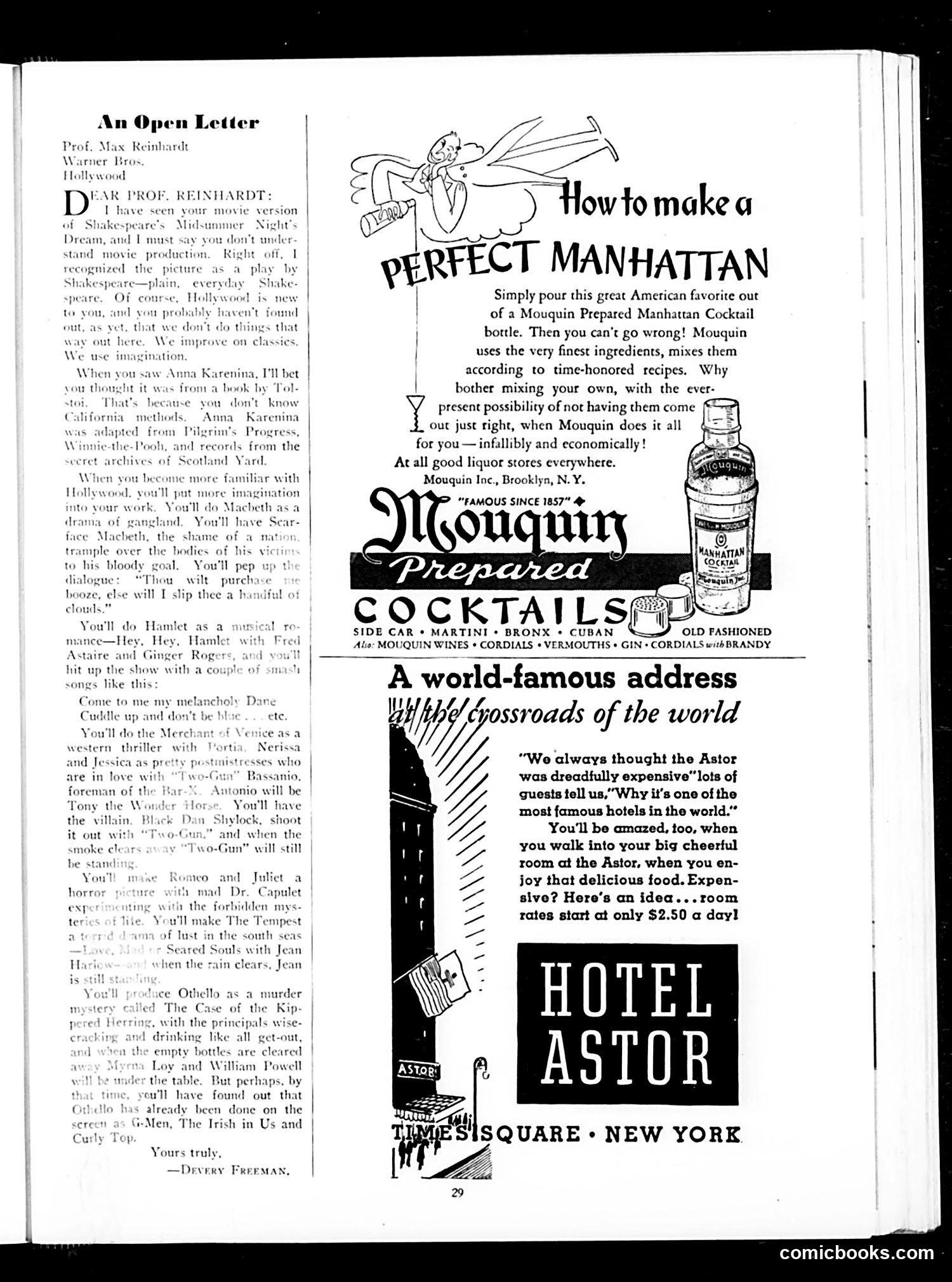
Analysis This page contains two distinct elements: a satirical open letter and advertisements. The Letter (Left): Devery Freeman writes mockingly to Max Reinhardt, the famous theater director who worked for Warner Bros. Freeman catalogs Hollywood's tendency to adapt classics—*A Midsummer Night's Dream*, *Anna Karenina*—then sarcastically "suggests" Reinhardt should film various Shakespeare plays, each time proposing absurd recasting and lowbrow rewrites. For example, he proposes doing *Hamlet* as a murder mystery with comedic songs, or *Romeo and Juliet* as a South Seas adventure. The satire targets Hollywood's habit of cheapening literary classics through sensational plots, musical numbers, and star-driven casting for commercial appeal rather than artistic integrity. The Advertisements: The right side features period liquor and hotel ads (Mouquin cocktails, Hotel Astor), typical magazine filler content unrelated to the editorial satire. The humor relies on readers recognizing the tension between serious drama and Hollywood's commercial sensibilities.
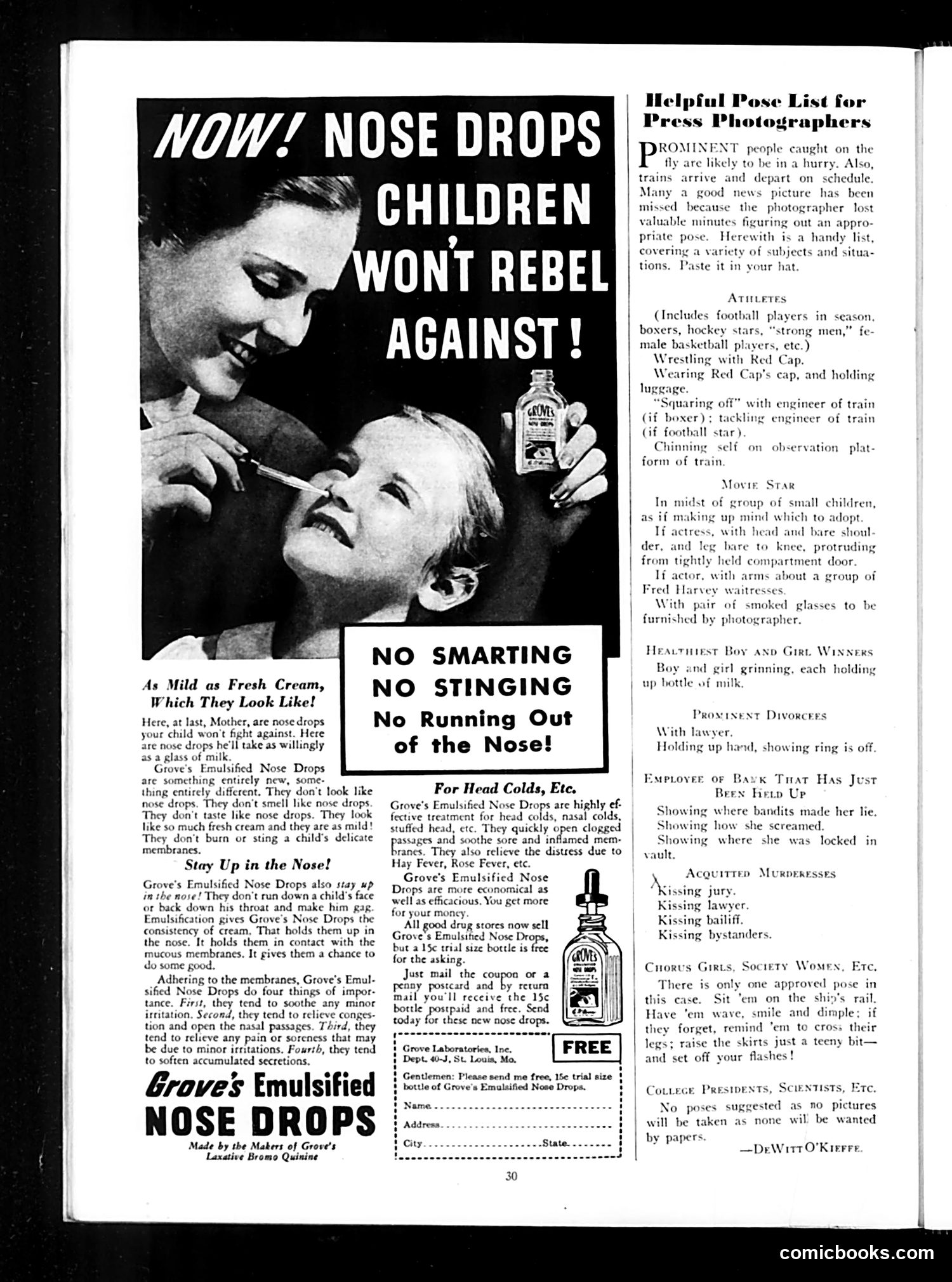
Analysis for Modern Readers This page contains two unrelated pieces: a full-page advertisement for Grove's Emulsified Nose Drops (left) and a practical guide for press photographers (right). The nose drops ad uses satire by claiming children "won't rebel" against this product—the headline ironically acknowledges that getting children to take medicine is normally a battle. The ad's humor lies in its exaggerated promises that these drops are so mild and cream-like that children will accept them willingly, without the typical resistance parents face. The photographer's guide is practical advice for journalists covering newsworthy people and events. It suggests specific, dramatic poses for different subject types (athletes, movie stars, divorces, bank robbery victims, etc.)—essentially a formula for creating compelling newspaper photographs. The satire is subtle: the guide assumes photographers can stage or direct "candid" shots, reflecting early 20th-century journalism's looser standards around authenticity. Together, these pieces reflect 1920s-30s American media culture: patent medicine marketing and the emerging profession of press photography.
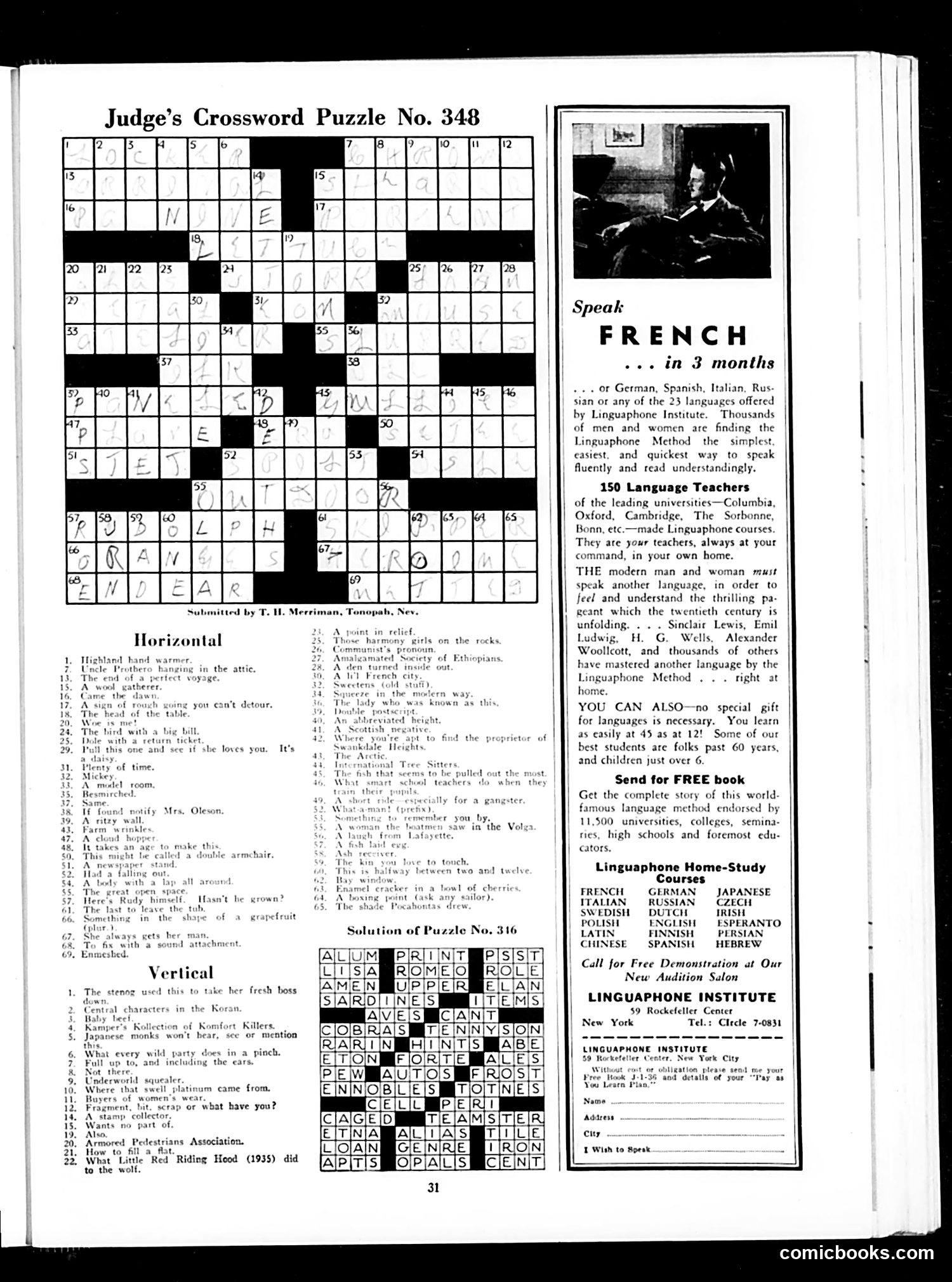
Judge Magazine Page Analysis This page is primarily advertising and puzzles, not satirical content. The dominant feature is a full-page advertisement for the Linguaphone Institute, promoting language instruction courses (French, German, Italian, Russian, etc.) through home-study methods. The ad emphasizes modernity and accessibility—claiming anyone can learn languages "as easily at 45 as at 12," endorsing the method through celebrity names (Sinclair Lewis, H.G. Wells, Alexander Woollcott), and highlighting that 150 university professors endorse it. The page also contains Judge's Crossword Puzzle No. 348 with horizontal and vertical clues, and a small photograph showing what appears to be a dramatic scene, likely related to puzzle content. There is no political cartoon or satire visible on this page. The content reflects Judge magazine's business model of combining entertainment (puzzles) with advertising, particularly targeting educated, middle-class readers interested in self-improvement during the interwar period.
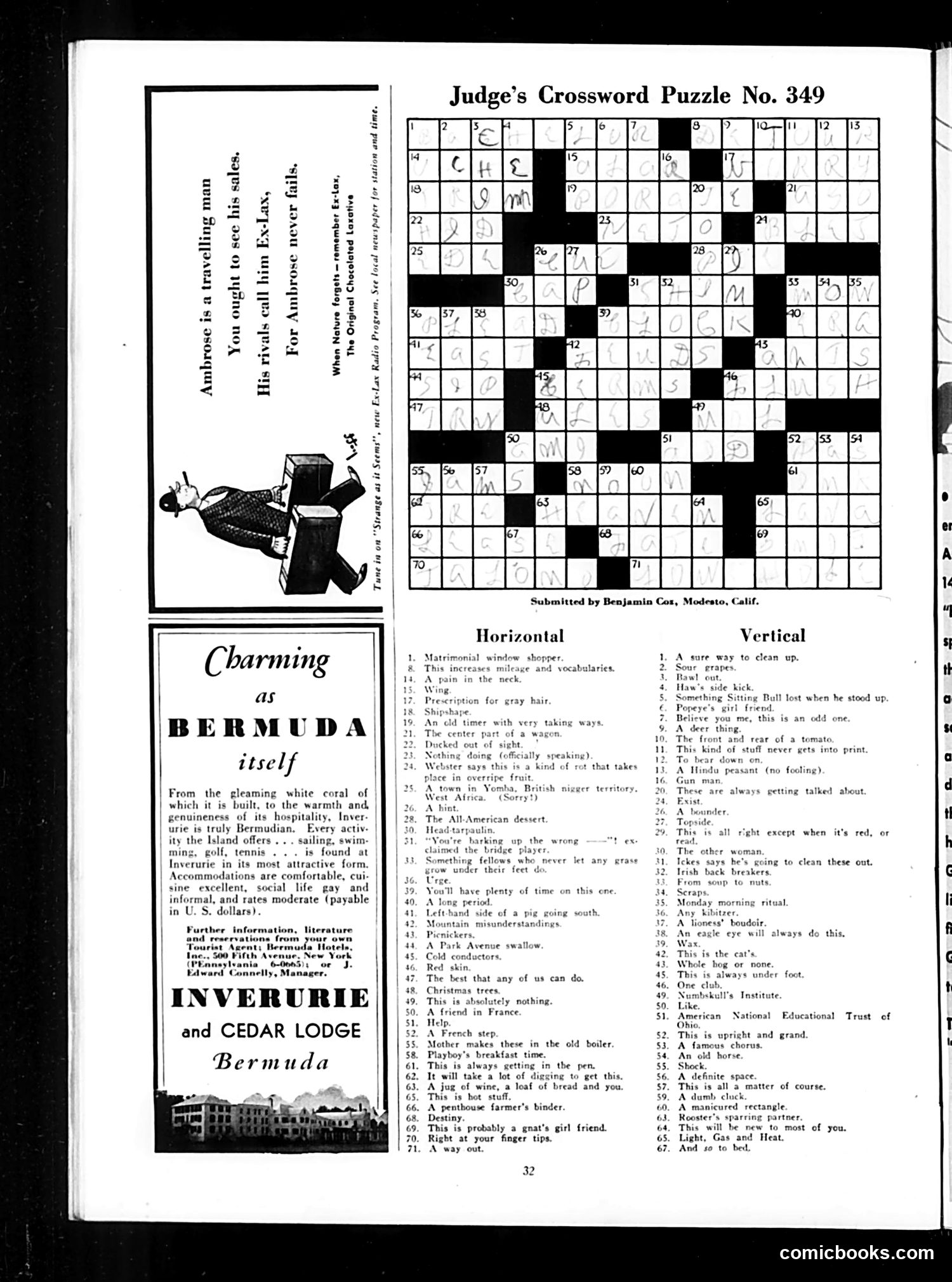
Judge Magazine Page Analysis This page is primarily advertising and a crossword puzzle, not political satire. The main content includes: 1. Ex-Lax advertisement - promoting a chocolate laxative with the slogan "When Nature forgets — remember Ex-Lax." References a character named Ambrose, described as "a travelling man." 2. Bermuda tourism ads - promoting Inverurie and Cedar Lodge hotels in Bermuda, emphasizing hospitality and moderate rates. 3. Judge's Crossword Puzzle No. 349 - a standard crossword submitted by Benjamin Cox of Modesto, California, with clues and a small cartoon illustration of a man in period dress (appears to be early 20th-century attire). The page contains no evident political commentary or satirical targets. It represents typical magazine content of its era—entertainment and commercial advertising interspersed together. The crossword's clues reference everyday 1930s-1940s American life and mild wordplay rather than topical satire.
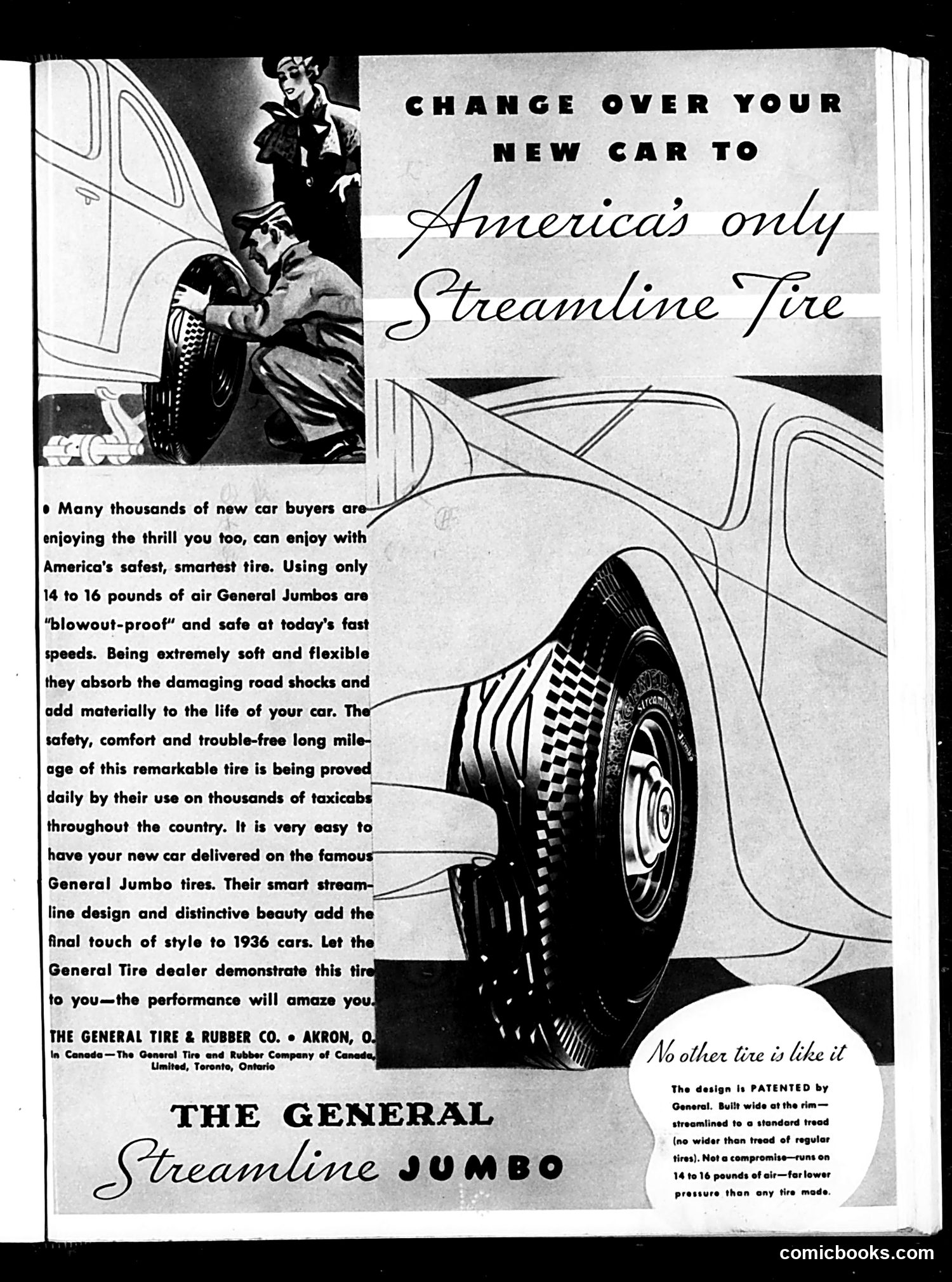
Analysis This is a full-page advertisement, not satire or political cartoon. It promotes General Jumbo tires for 1936 automobiles. The page features an illustration of a stylishly-dressed couple (likely representing aspirational 1930s consumers) examining a car tire, alongside detailed product copy. The advertisement emphasizes the tire's safety features—specifically its "blowout-proof" design using 14-16 pounds of air pressure, its soft construction to absorb road shocks, and its streamlined aesthetic that adds "style to 1936 cars." The copy notes the tires' proven reliability through use on taxicabs nationwide. The General Tire & Rubber Company (based in Akron, Ohio) positions this as "America's only Streamline Tire," claiming patent protection for its wide-rim, streamlined design. There is no satirical content here—it's straightforward vintage automotive marketing.
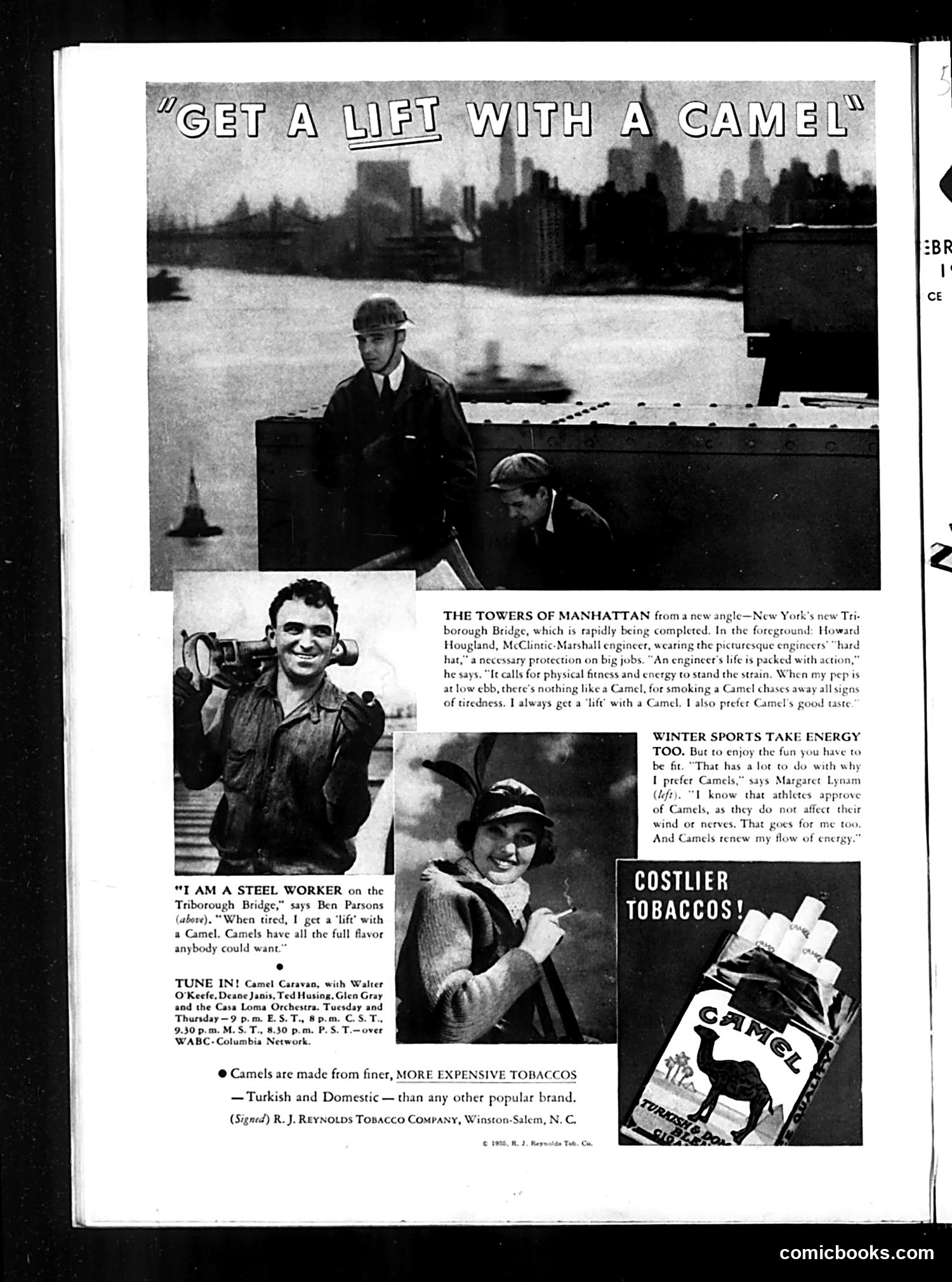
Analysis for Modern Readers This is a cigarette advertisement, not satire or political commentary. The page promotes Camel cigarettes by featuring workers on New York's Triborough Bridge construction project (then under completion). The ad uses testimonials from real workers—an engineer, steel worker, and athlete—claiming Camel cigarettes provide an energy "lift" and don't affect athletic performance or "wind or nerves." This reflects 1930s marketing that positioned cigarettes as beneficial to health and stamina, claims later proven false. The phrase "Get a Lift with a Camel" was Camel's actual advertising slogan. The "Camel Caravan" radio show mentioned was a sponsored entertainment program. Modern context: This represents pre-health-warning advertising when tobacco companies made unsubstantiated health claims and targeted workers and athletes. Such advertising is now illegal in most Western countries.