judge
Judge — February 1936
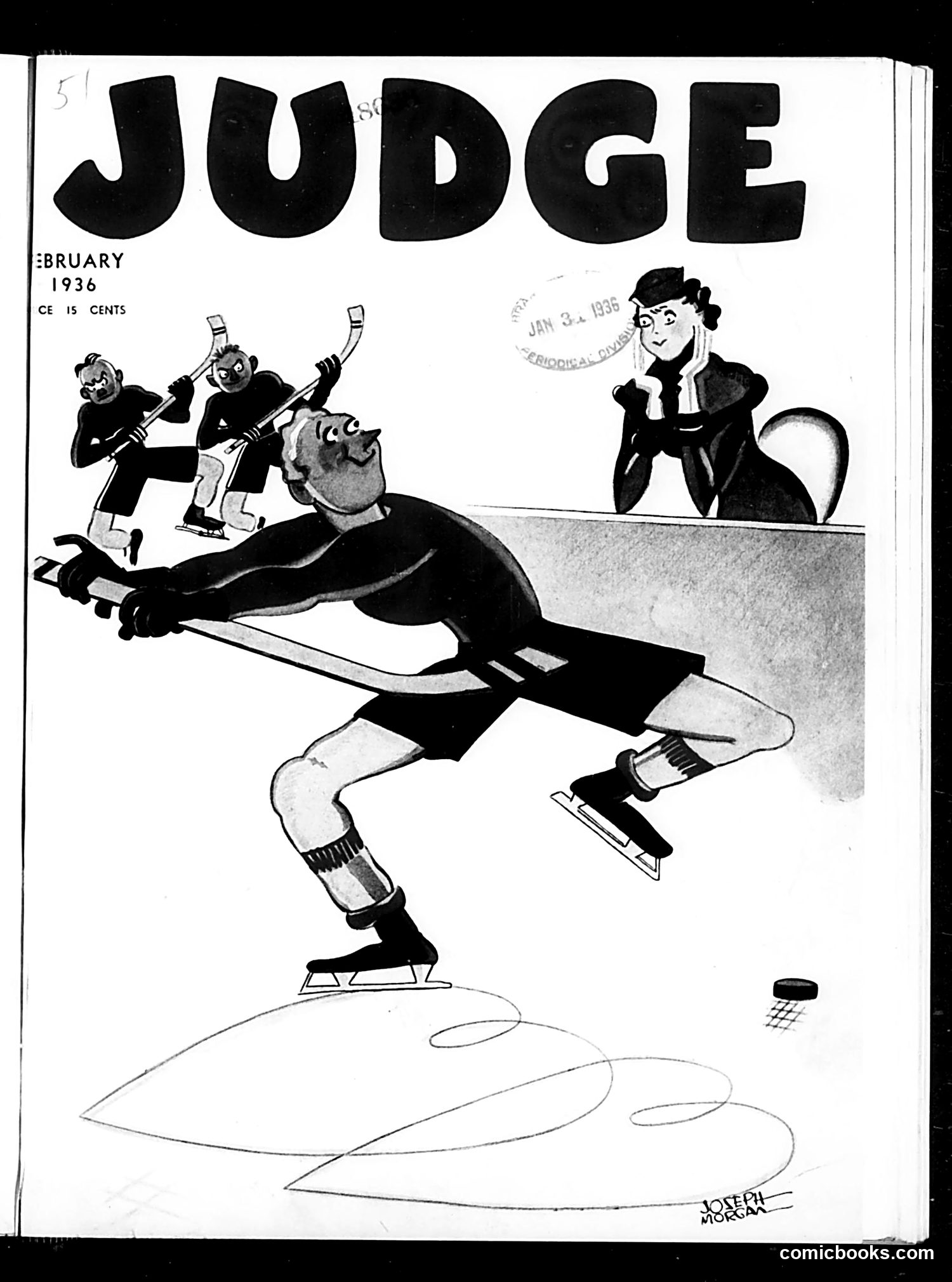
Judge Magazine Cover, February 1936 This cover depicts an ice hockey scene with satirical commentary. A player performs an exaggerated athletic maneuver on ice skates while two smaller figures with hockey sticks pursue him in the background. A woman observes from behind a barrier. The specific political or social reference is unclear from the image alone. However, given Judge magazine's satirical nature and the 1936 date, this likely comments on contemporary sports, politics, or social behavior. The exaggerated physical comedy and the woman's reaction suggest the humor derives from the absurdity of the main figure's dynamic pose rather than a specific identifiable person or event. Without additional context about 1936 news events or Judge's editorial focus that month, the precise satirical target remains uncertain.
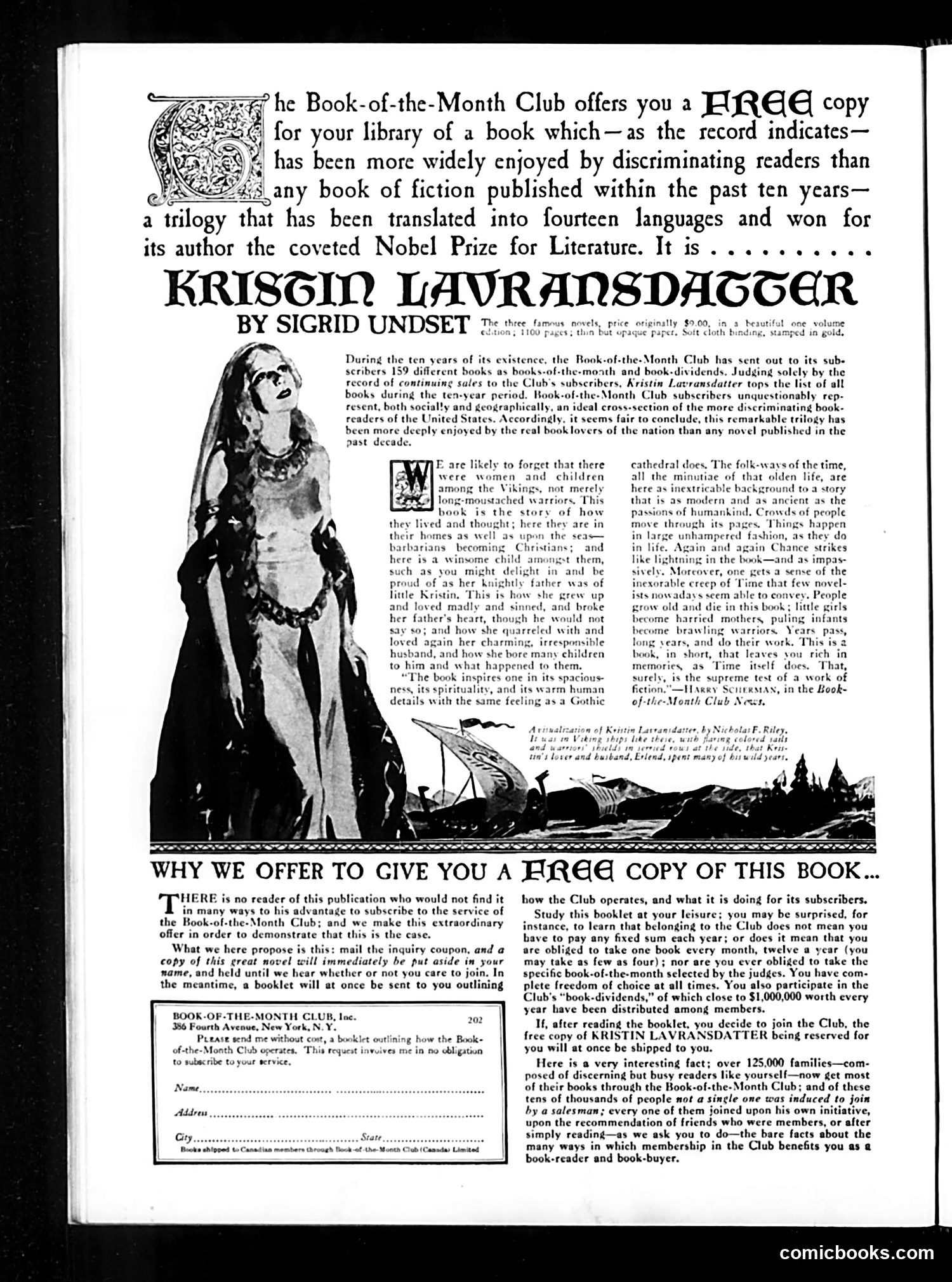
Analysis This page is primarily advertising, not satirical content. It promotes the Book-of-the-Month Club's offer of a free copy of *Kristin Lavransdatter* by Sigrid Undset, a Norwegian novel that had won the Nobel Prize for Literature and been translated into fourteen languages. The illustration shows a woman in medieval Norse dress, reflecting the novel's Viking-era setting. The text emphasizes the book's popularity among "discriminating readers" over the past decade and highlights the Club's role in distributing quality literature to subscribers nationwide. The bottom section contains membership information and a reply coupon. This is a straightforward commercial promotion rather than political satire—typical Judge magazine content that subsidized the publication through paid advertising.
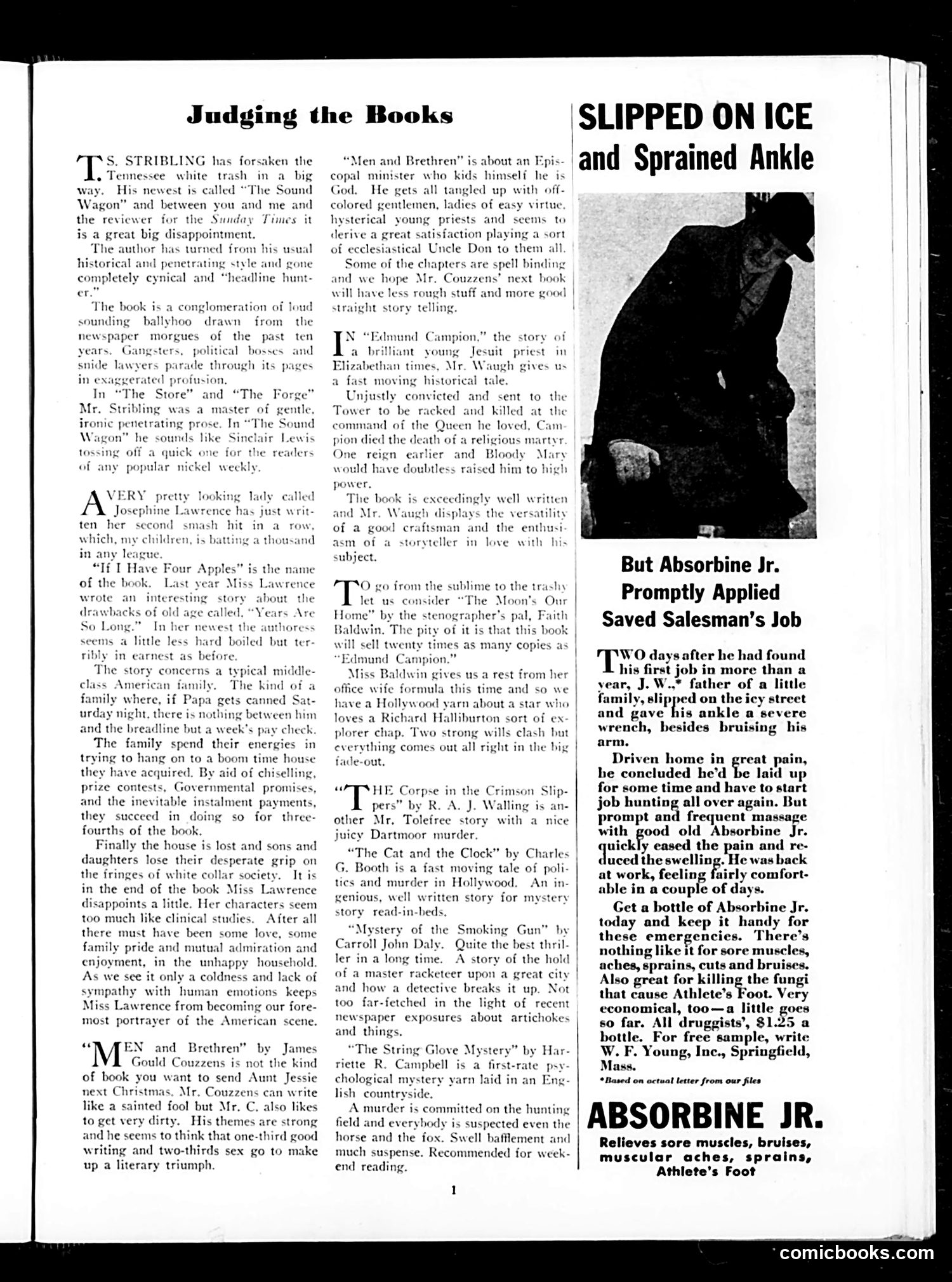
Page Analysis This page is primarily a book review section titled "Judging the Books," with advertising occupying the right column. The left side reviews several novels, including works by T.S. Stribling, James Gould Couzens, and Josephine Lawrence. The reviews are literary criticism rather than satire. The right side features a paid advertisement for "Absorbine Jr.," a liniment product. The accompanying illustration shows a man in apparent pain, with text describing how the product helped a salesman recover from a workplace ankle injury. The ad emphasizes the product's pain-relief properties for "sore muscles, aches, sprains, athlete's foot." This is not political satire but rather a standard magazine layout combining editorial content with commercial advertising—typical of Judge magazine's revenue model.
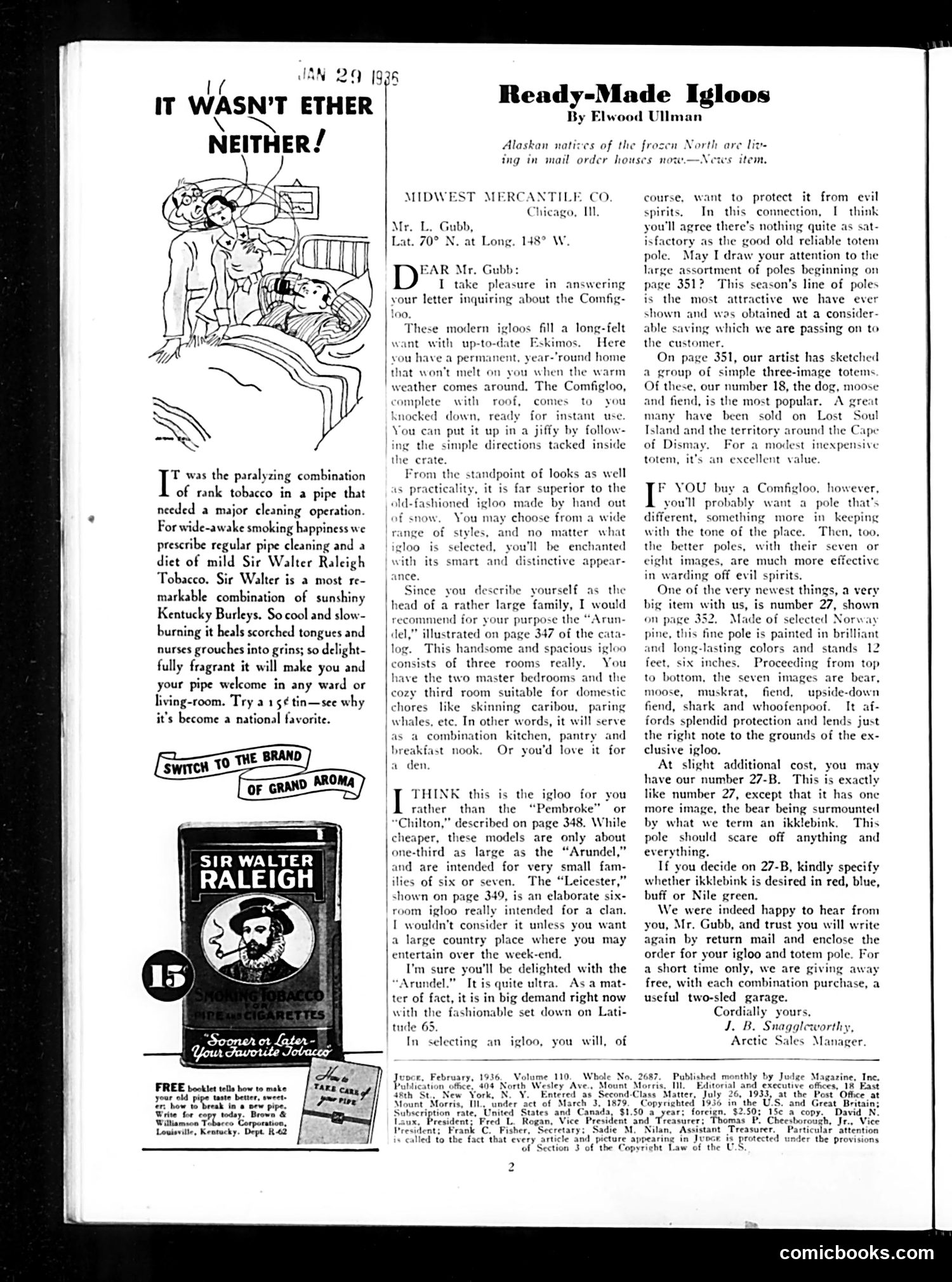
Analysis of Judge Magazine Page (June 29, 1935) The page contains primarily advertising and a mail-order catalog section. The prominent cartoon "It Wasn't Either—Neither!" depicts a domestic scene where a couple argues over household items, with one figure pointing accusingly. The satire appears to mock marital disputes over trivial matters—a common Judge theme of the era. The main editorial content is Elwood Ullman's "Ready-Made Igloos," responding to a reader inquiry about mail-order igloo kits. This is clearly satirical, presenting prefabricated igloos as modern consumer goods. The humor mocks both mail-order culture and urban Americans' fascination with exotic goods. The Sir Walter Raleigh cigarette advertisement occupies substantial space, typical of 1930s publications.
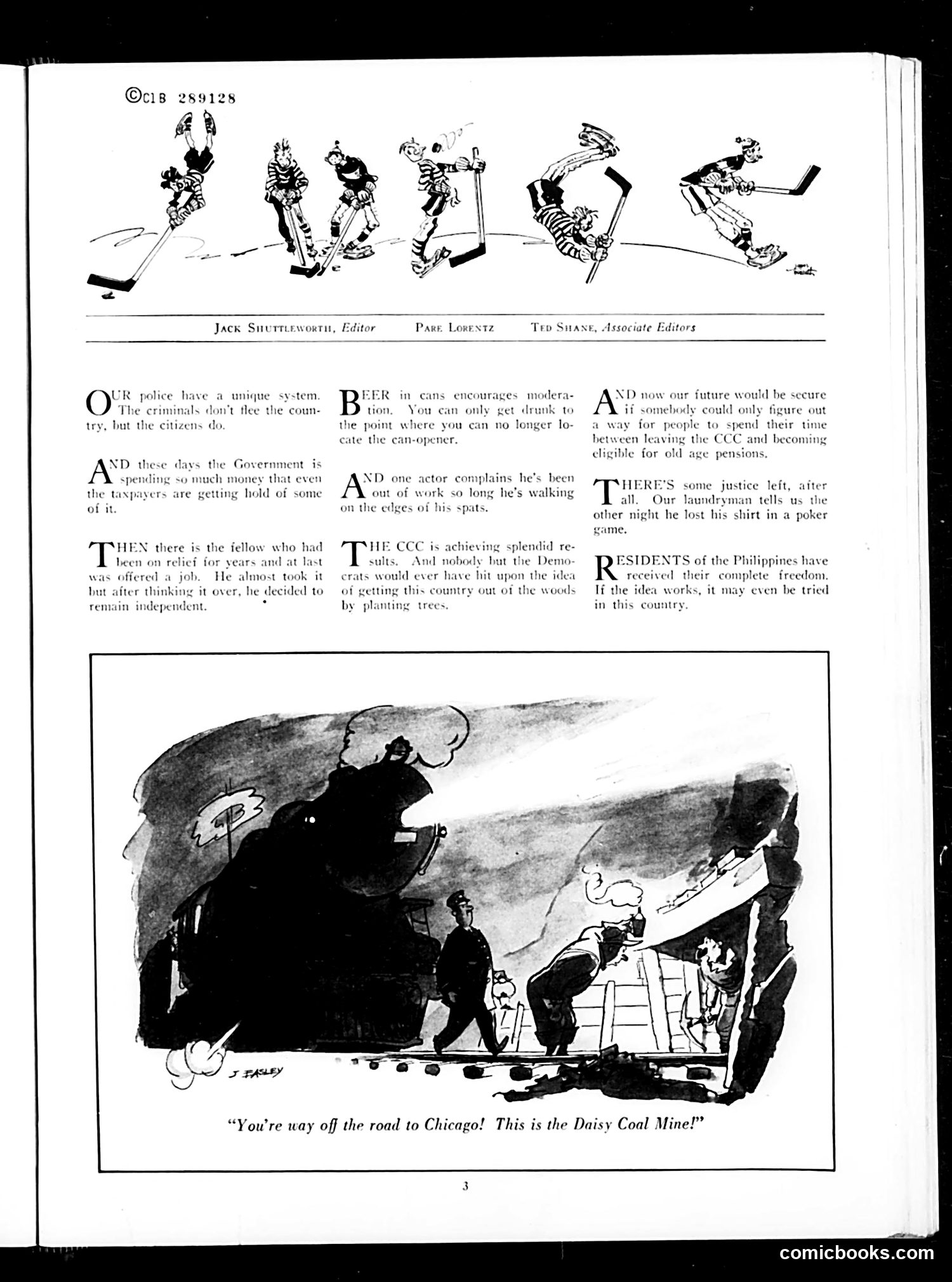
Analysis of Judge Magazine Page This page contains satirical commentary on American governance and social issues, likely from the 1930s (based on the CCC reference and relief-era context). The top cartoon strip depicts hockey-playing figures, appearing to satirize government inefficiency or political maneuvering. The prose commentary criticizes: - Police systems and enforcement - Government spending during relief programs - A man rejecting relief work to remain independent - The CCC (Civilian Conservation Corps) achievements - Democratic political failures The main cartoon depicts a coal mine, with the caption "You're way off the road to Chicago! This is the Daisy Coal Mine!" This appears to satirize someone lost or misguided—possibly criticizing a politician or policy direction, using the mine as a metaphor for being in dangerous/wrong territory. Overall, the page reflects Depression-era critiques of New Deal programs and government effectiveness.
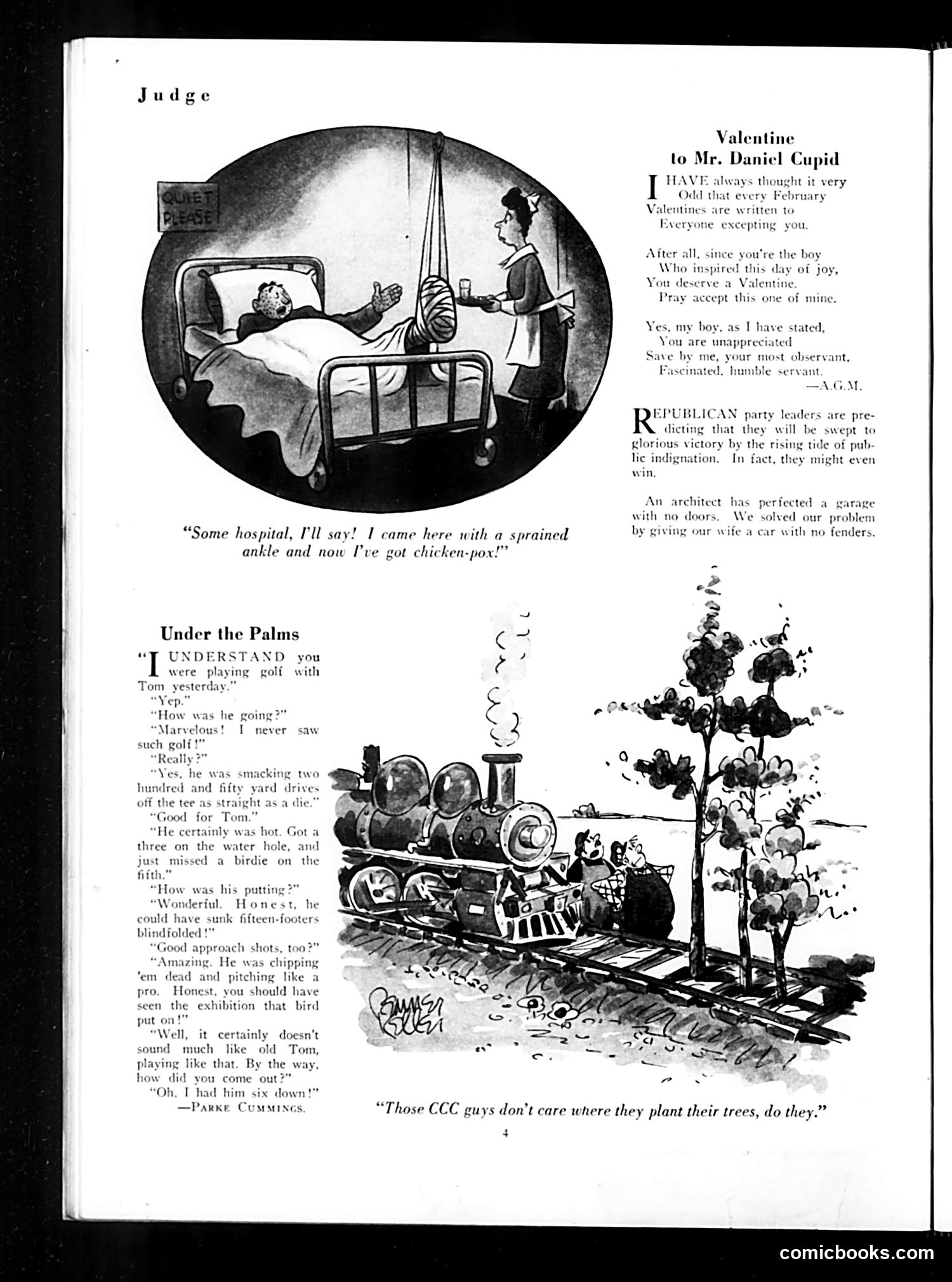
Analysis of Judge Magazine Page Top Cartoon ("Judge"): A hospital scene where a patient in traction claims he came in with a sprained ankle but now has "chicken-pox." This is straightforward slapstick humor about hospital misadventures—no political content. "Valentine to Mr. Daniel Cupid": A poem mocking someone (unclear who specifically) for never receiving valentines, sarcastically suggesting he "deserves" one. The tone is insulting rather than affectionate. "Under the Palms": A golf anecdote attributed to "PARKE CUMMINGS" where someone named Tom hit impressively long drives. The final caption about "CCC guys" references the Civilian Conservation Corps, suggesting Depression-era New Deal criticism—the joke being they plant trees carelessly. All content appears humorous/satirical rather than hard-hitting political commentary.
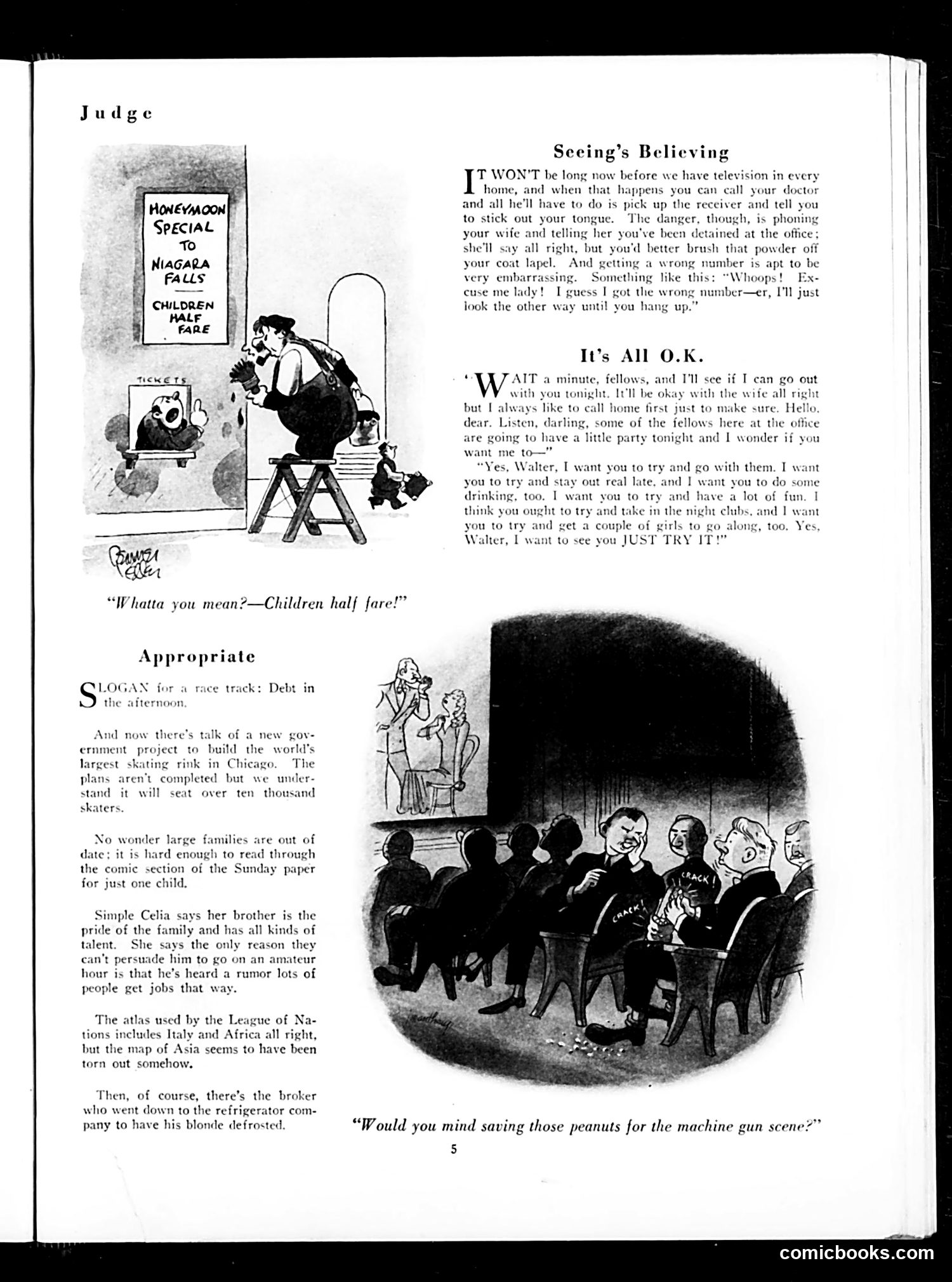
Page Analysis: Judge Magazine, Page 5 Top Cartoon ("Whatta you mean?—Children half fare!"): A man on a ladder posts a sign advertising "Honeymoon Special to Niagara Falls—Children Half Fare." He's being confronted by what appears to be an angry ticket agent or inspector. The joke satirizes absurd travel advertising—offering reduced fares for children on honeymoon trips is nonsensical, since newlyweds typically travel alone. The humor targets both misleading promotional language and the confusion it creates. Lower Section: Contains short humor items ("Judge" column) about everyday absurdities: a government skating rink project in Chicago, family dynamics, and administrative incompetence (a broker visiting a refrigerator company to have his blonde "defrosted"). Bottom Cartoon: Shows theater-goers asking someone to save peanuts for a "machine gun scene"—satirizing both audience behavior during films and the violence depicted in contemporary movies.
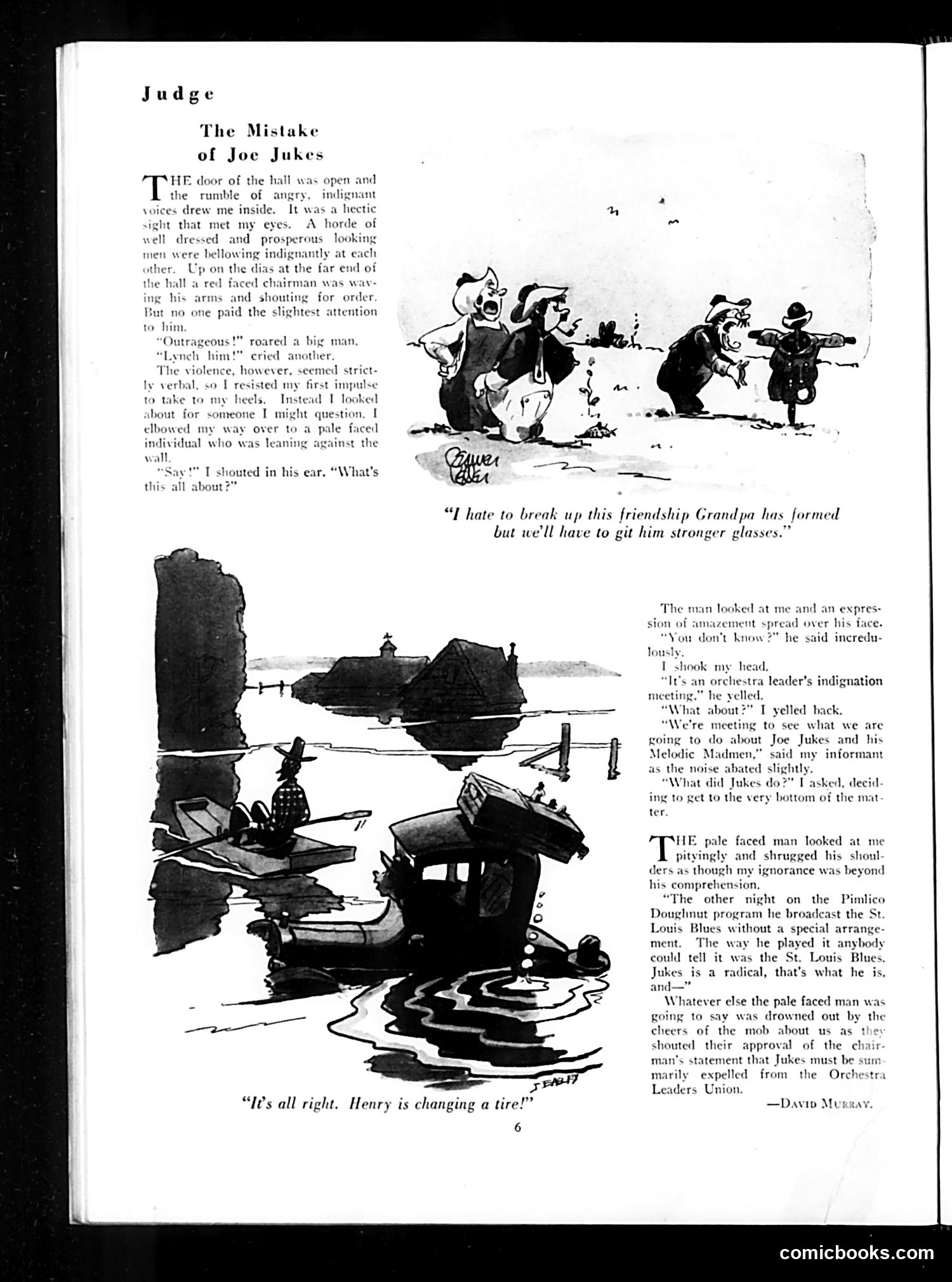
Analysis of "The Mistake of Joe Jukes" This story by David Murray satirizes Joe Jukes, a jazz musician who apparently broadcasted the "St. Louis Blues" on the Pimlico radio program without authorization. The narrative mocks an Orchestra Leaders Union meeting where angry members confront the narrator about Jukes's transgression. The cartoon illustrations depict the chaotic confrontation—men arguing and gesticulating in an auditorium. The satire targets both jazz music (viewed skeptically by establishment figures) and labor union politics of the era. Jukes is portrayed as a "radical" for playing unauthorized music on radio, suggesting tensions between musicians' unions and emerging broadcast technology. The joke hinges on treating an informal musical performance as a serious contractual violation warranting organizational action.
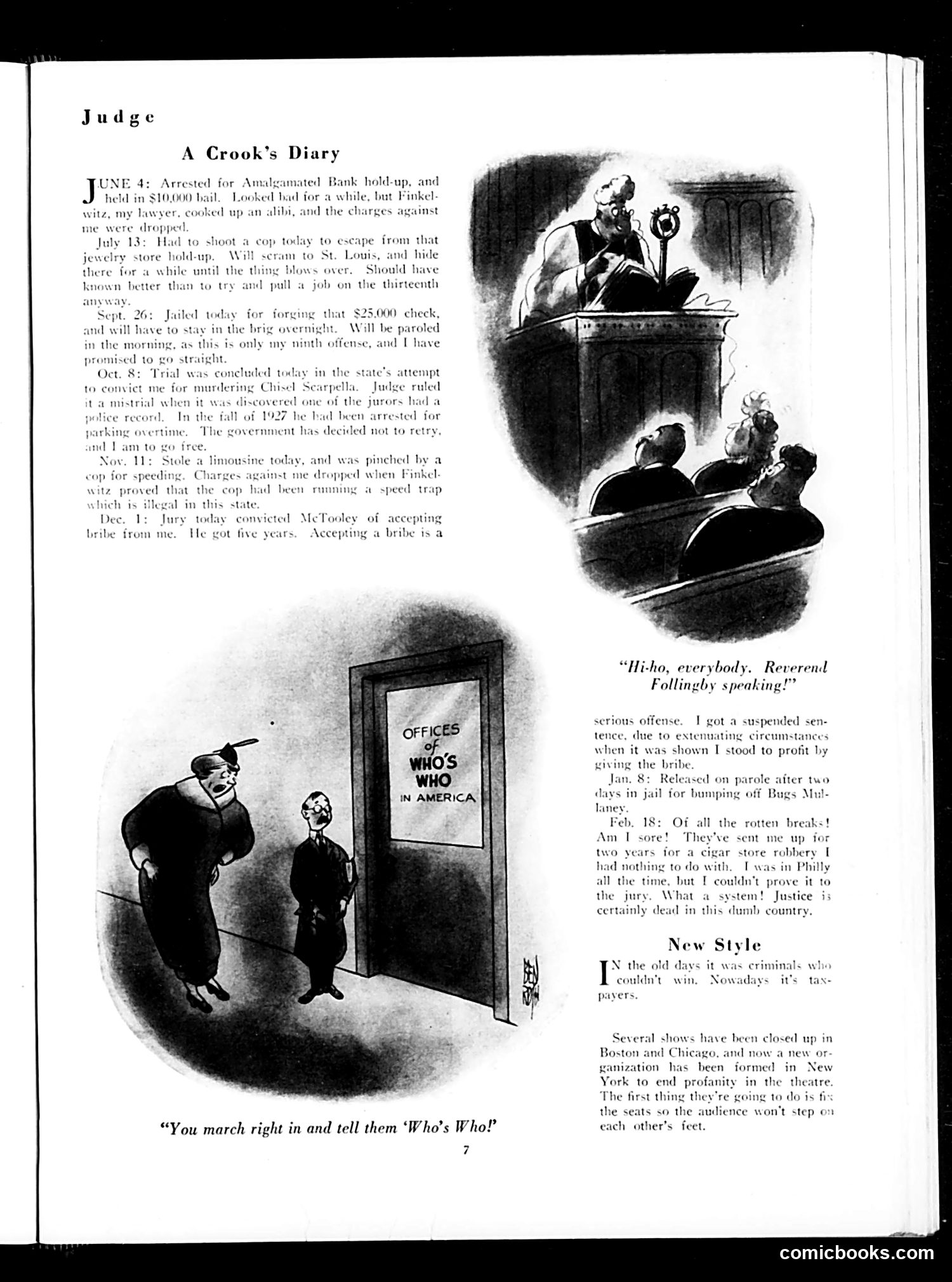
"A Crook's Diary" - Judge Magazine Satire This page satirizes American criminal justice through a fictional criminal's diary entries (June through February). The diarist boasts of evading consequences for bank robbery, attempted murder, forgery, and bribery—each crime dismissed, reduced, or unpunished through legal technicalities, lawyer intervention, or corrupt officials. The two cartoons reinforce this critique: one shows a man entering an office labeled "Offices of Who's Who in America," satirizing how criminals achieve social respectability; the other depicts a courtroom scene with the caption "Hillo, everybody. Reverend Follinsby speaking!"—mocking the absurdity of judicial proceedings. The satire's central point: the American legal system protects wealthy criminals while justice remains illusory. The "New Style" section at bottom suggests organized crime now operates like legitimate business.
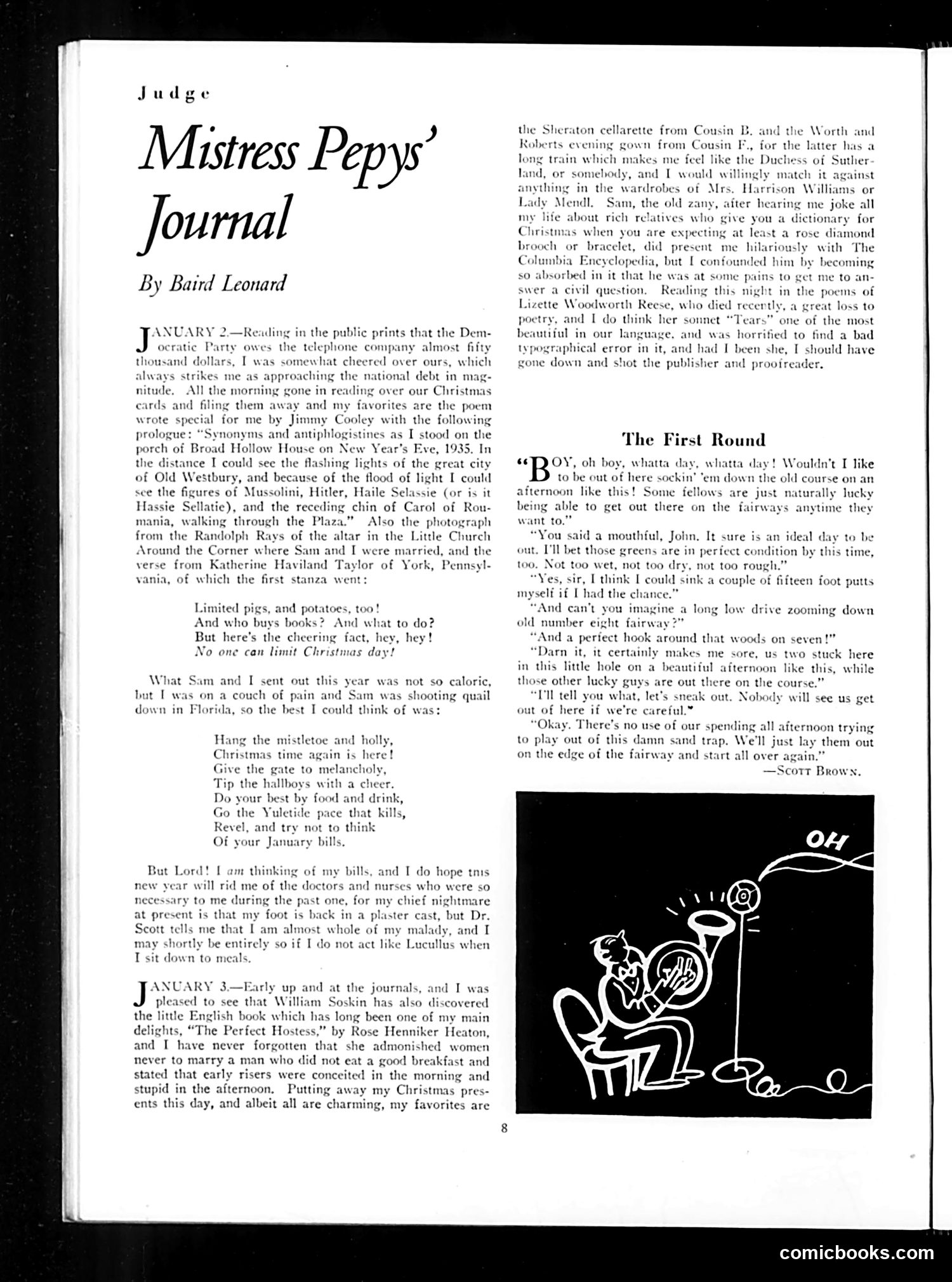
"Mistress Pepys' Journal" - Analysis This is a society gossip column mimicking Samuel Pepys' famous diary, written by Baird Leonard for *Judge* magazine. The January 1936 entries humorously chronicle upper-class complaints and observations. The content satirizes wealthy leisure-class anxieties: unpaid bills, medical ailments (the author's foot cast), Christmas gift-giving etiquette, and social hierarchies. References to "rich relatives who give you a dictionary" mock miserly gift-giving among the wealthy. The small cartoon shows golfers frustrated by weather, linking to "The First Round"—a dialogue where men discuss being stuck golfing on a poor day, longing to escape to better courses. The satire targets the genteel boredom and petty concerns of the leisure class during Depression-era America. The Pepys parody format allows *Judge* to mock society's self-absorption through mock-serious documentation of trivial domestic drama.
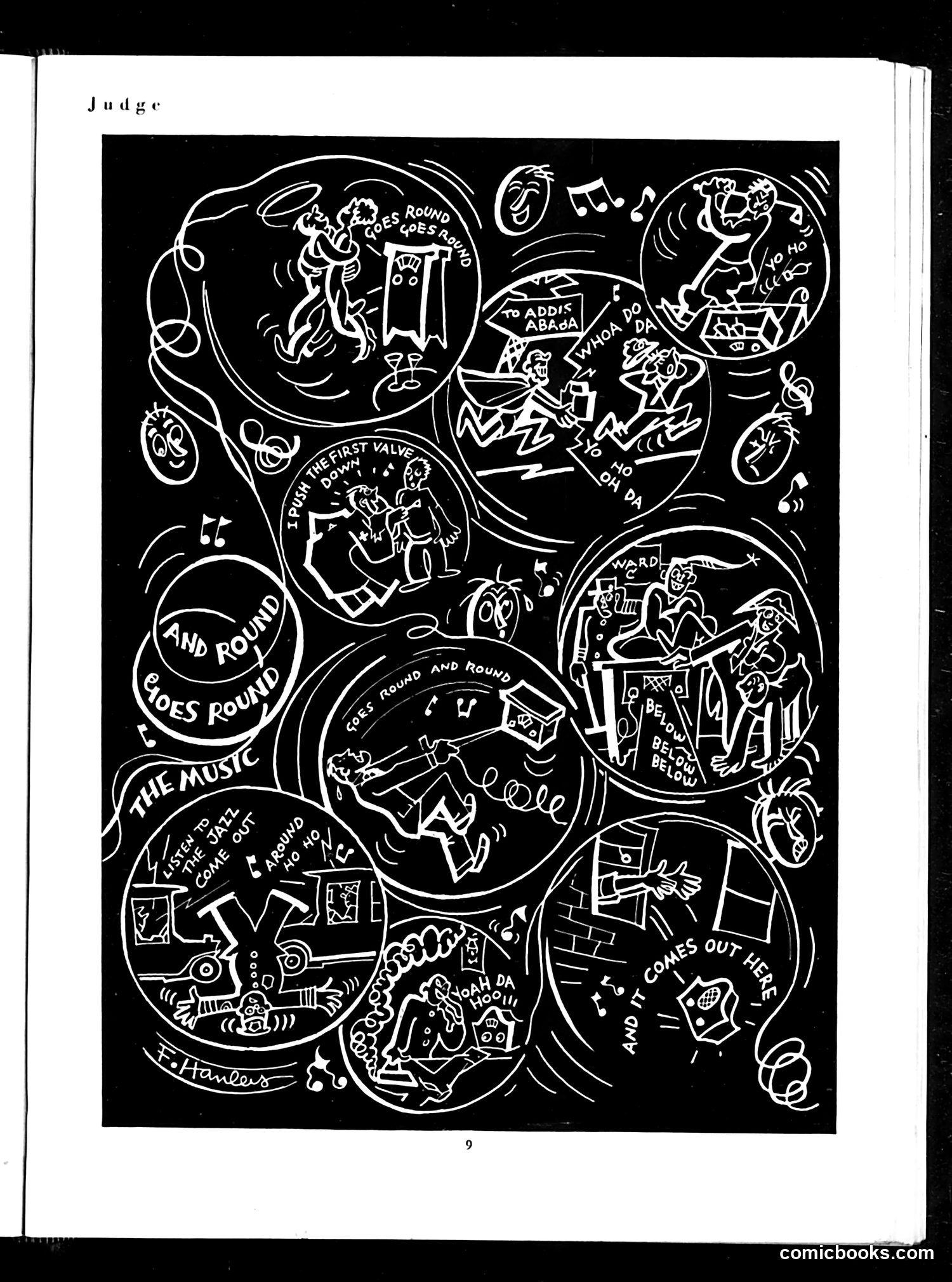
"Judge" Page Analysis This is a whimsical, circular-panel cartoon about music and entertainment. The central theme appears to be "the music goes round and round," referencing what was likely a popular song or phrase of the era. Multiple overlapping circular vignettes show characters dancing, performing, and enjoying various musical activities—including what appears to be nightclub or vaudeville scenes. Text fragments visible include "GOES ROUND AND ROUND," "AND ROUND," "TO ADDIS ABABA," "WORD," and "COMES OUT HERE," suggesting a playful narrative about music's circulation through society. The cartoon's humor seems to derive from the universal appeal and cyclical nature of popular music and entertainment culture. The artist's signature appears to be "Handels" or similar. The satirical intent isn't overtly political—rather, it's social commentary on the pervasiveness of popular music in American life.
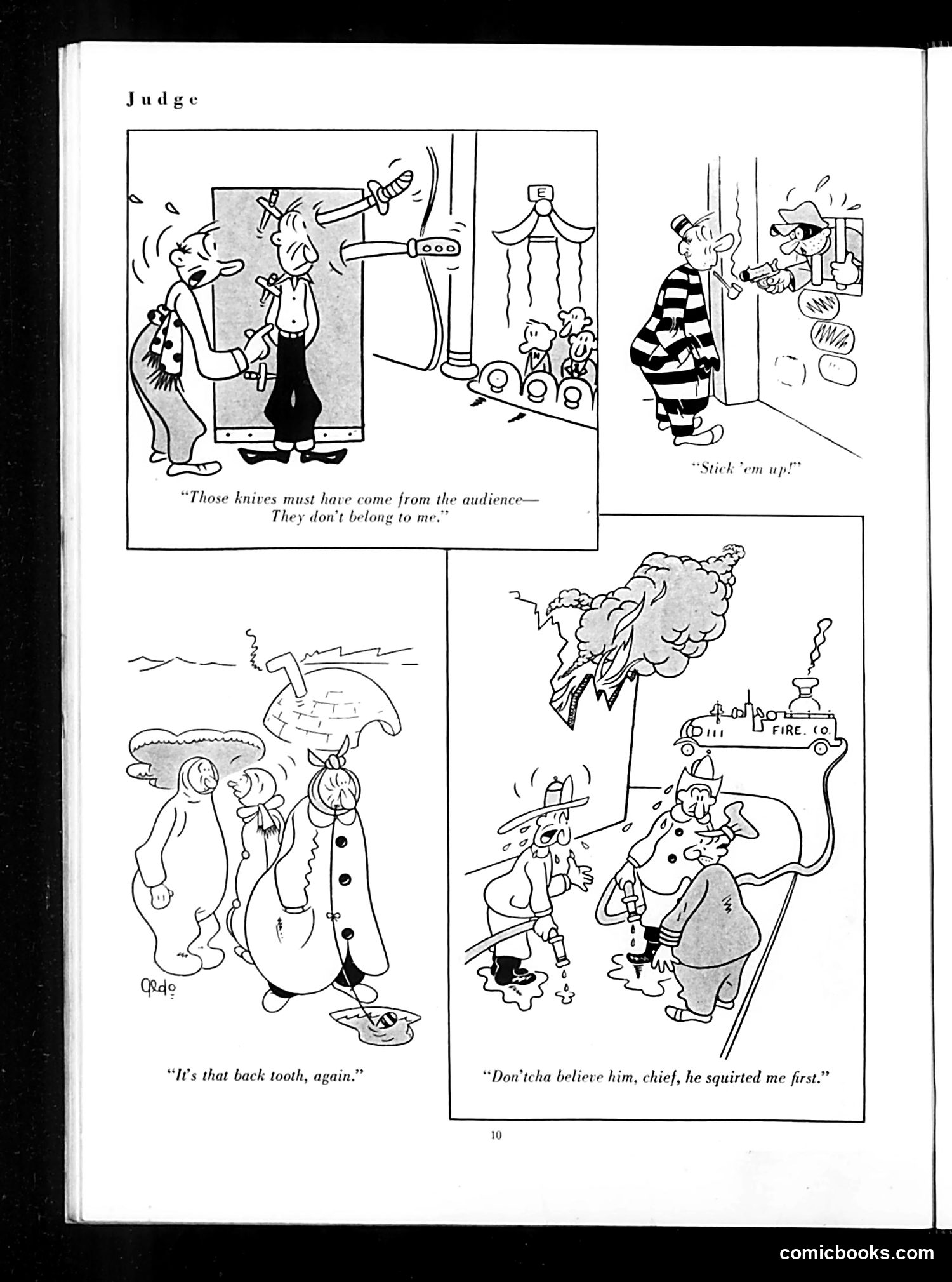
Judge Magazine Comic Page Analysis This page contains four unrelated gag cartoons typical of Judge magazine's satirical humor: 1. Top left: A knife-throwing act gone wrong—the performer claims flying knives came from the audience rather than his act, deflecting blame. 2. Top right: "Stick 'em up!"—appears to be a robbery or holdout scenario with comedic exaggeration. 3. Bottom left: "It's that back tooth, again"—depicts what appears to be a dental or medical complaint, likely about a problematic tooth causing repeated issues. 4. Bottom right: "Don'tcha believe him, chief, he squirted me first"—shows a fire truck scene where someone disputes another's account, suggesting a dispute over who was at fault in an incident. The cartoons use visual exaggeration and physical comedy typical of early-to-mid 20th century American humor. Without publication date information, the specific topical references remain unclear.
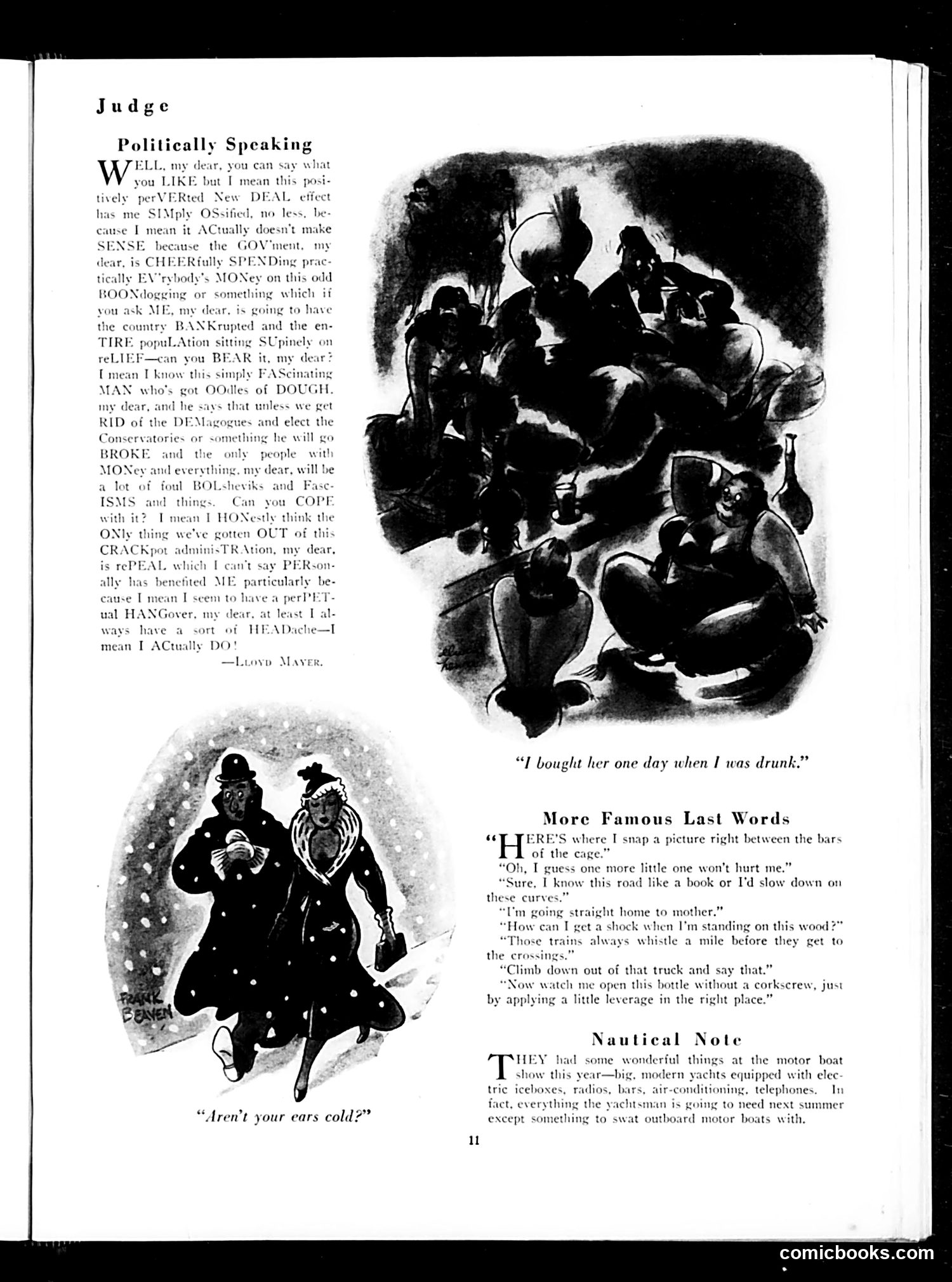
"Politically Speaking" - Judge Magazine Satire This page satirizes 1930s New Deal criticism through exaggerated dialogue. The "Politically Speaking" section mocks wealthy complainers who oppose FDR's economic programs as wasteful "boondoggling" that will bankrupt the country, while simultaneously admitting their own wealth and hangovers. The speaker's affected accent (emphasized capitals) ridicules the pretentious upper-class gripe session. The cartoon illustrations show two winter scenes with elegantly dressed figures—likely representing the same complaining wealthy class, humorously captioned ("Aren't your ears cold?"). "More Famous Last Words" presents ironic final statements before disaster (reckless driving, electrocution, etc.)—dark humor deflating overconfidence. The "Nautical Note" jokes that modern yachts have every luxury except a device to combat motorboat wake, suggesting wealthy leisure pursuits are absurdly over-equipped. Overall, Judge lampoons wealthy New Deal opponents as hypocritical complainers disconnected from ordinary hardship.
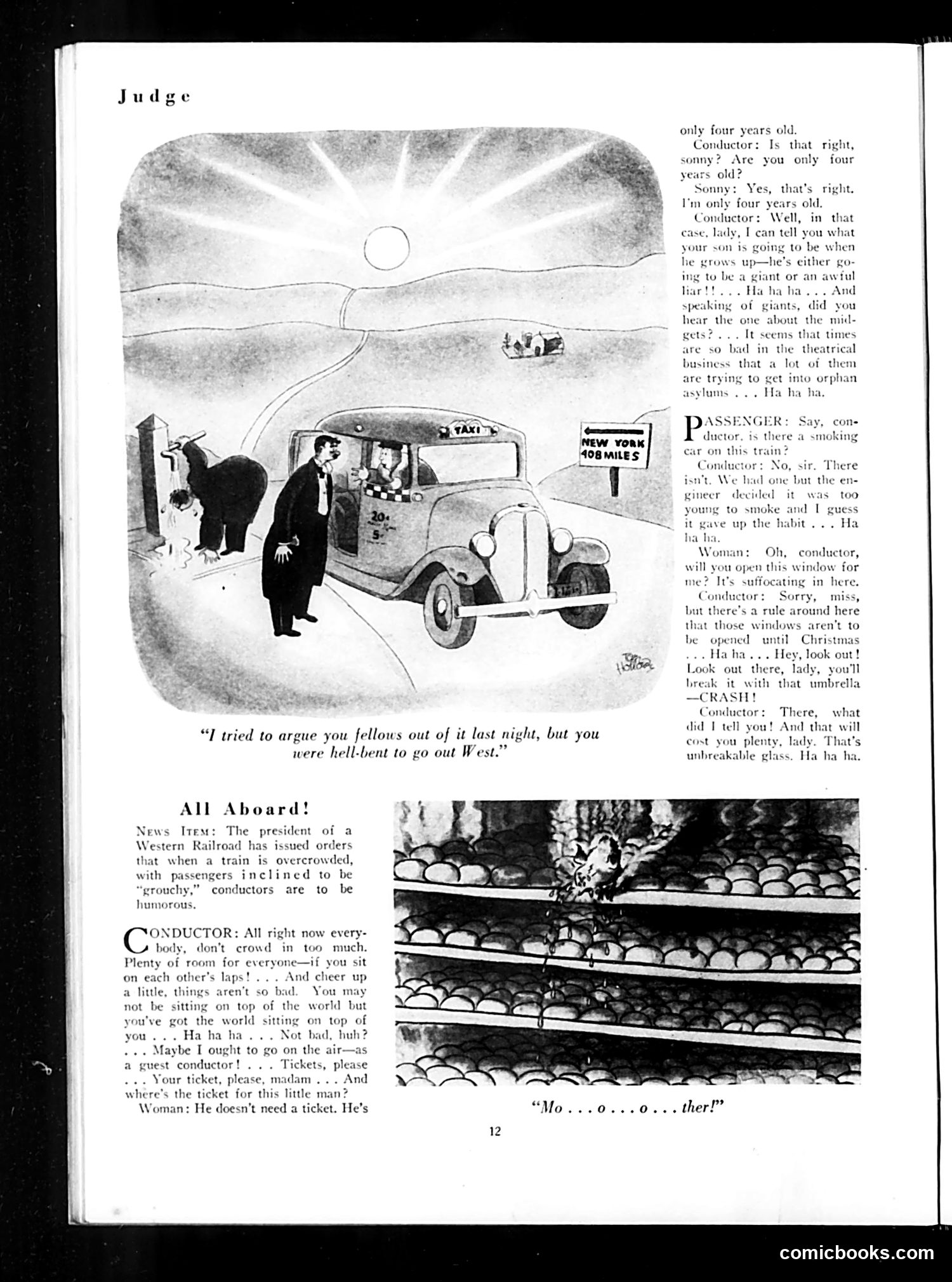
Judge Magazine Satire Analysis This page contains two related railroad humor pieces satirizing overcrowding and conductor behavior during what appears to be the Depression era (suggested by references to economic hardship in the theatrical business). The Main Cartoon shows a taxi driver arguing with a conductor about passengers heading "West"—likely referencing the desperation migration westward during economic hard times. "All Aboard!" Section mocks a railroad president's order instructing conductors to use humor to manage angry, overcrowded passengers. The humor is deliberately groan-worthy (jokes about midgets in orphan asylums, unbreakable glass windows, a child not needing a ticket because he's the conductor's illegitimate son). The Satire's Point: The joke is that management expects conductors to defuse passenger complaints through forced joviality rather than actually improving conditions. The conductor's terrible jokes and dismissive attitude toward legitimate grievances (broken umbrellas, suffocation, overcrowding) expose how corporations prioritize cost-cutting over passenger welfare—using humor as a manipulative tool rather than solving real problems.
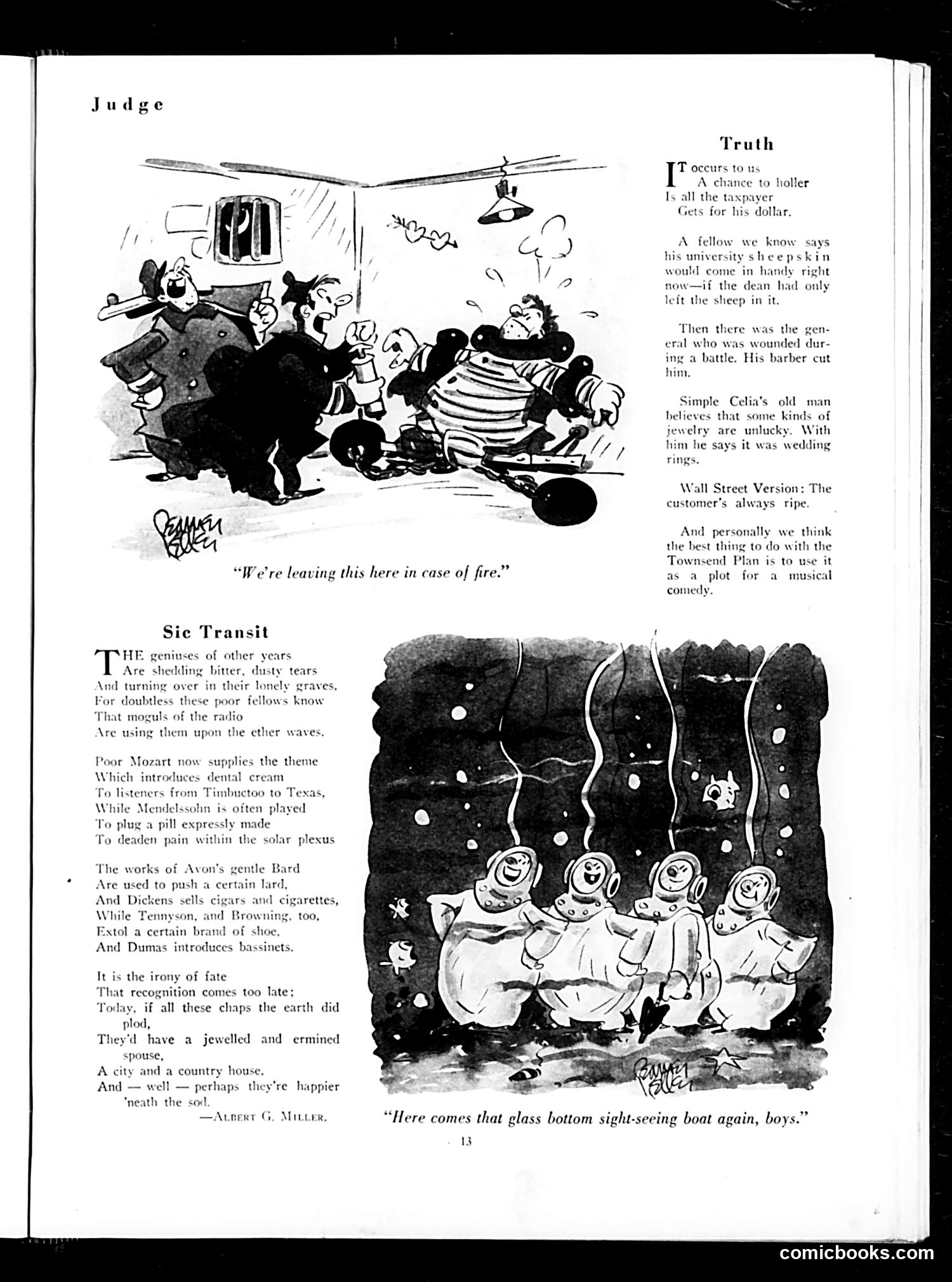
Judge Magazine Page Analysis This page contains two satirical pieces mocking early 20th-century American culture. "Judge" (top cartoon): Shows chaotic scene with a helicopter and people scrambling with belongings. The caption "We're leaving this here in case of fire" satirizes poor emergency preparedness or absurd priorities—leaving valuables behind during evacuation. "Sic Transit" (poem + bottom cartoon): The Latin title means "thus passes away." The poem laments that great historical artists (Mozart, Mendelssohn, Shakespeare, Tennyson, Dumas) are now exploited by commercial radio and advertising—their works reduced to jingles for dental cream, pills, and shoe polish. The accompanying underwater cartoon shows tourists in a glass-bottom boat, likely continuing this theme of commercialization and diminished cultural dignity. The satire criticizes how radio advertising and mass media exploit classical literature and music for profit, and how modern commercialism has trivialized artistic legacy.
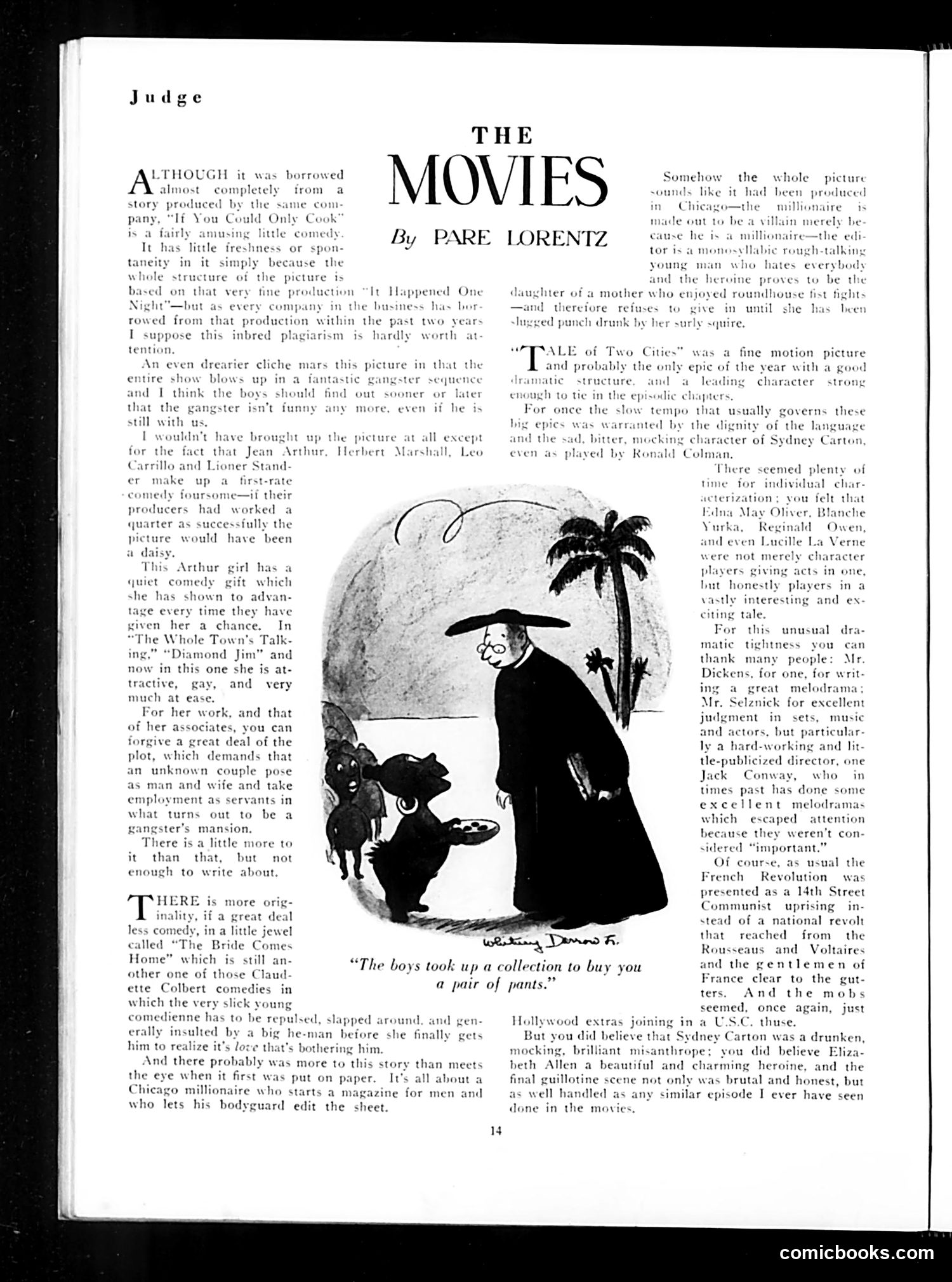
Judge Magazine Movie Review Analysis This page reviews several 1920s-30s films. The central cartoon depicts a Chinese character in traditional dress with a dog, captioned "The boys took up a collection to buy you a pair of pants"—likely satirizing either an orientalist film plot or Hollywood's stereotypical portrayal of Asian characters. The review text critiques multiple movies: one borrowed from "It Happened One Night," featuring Jean Arthur; "The Bride Comes Home" with Claudette Colbert; and "A Tale of Two Cities." The author praises the actors and direction while mocking plot contrivances—particularly a clichéd scene where an unknown couple must pose as servants in a gangster's mansion. Notably, the review dismisses the French Revolution portrayal as merely depicting a "14th Street Communist uprising" rather than authentic historical drama, suggesting contemporary anxieties about communist imagery in Hollywood films. The tone throughout is witty and slightly condescending toward both the industry and audiences.
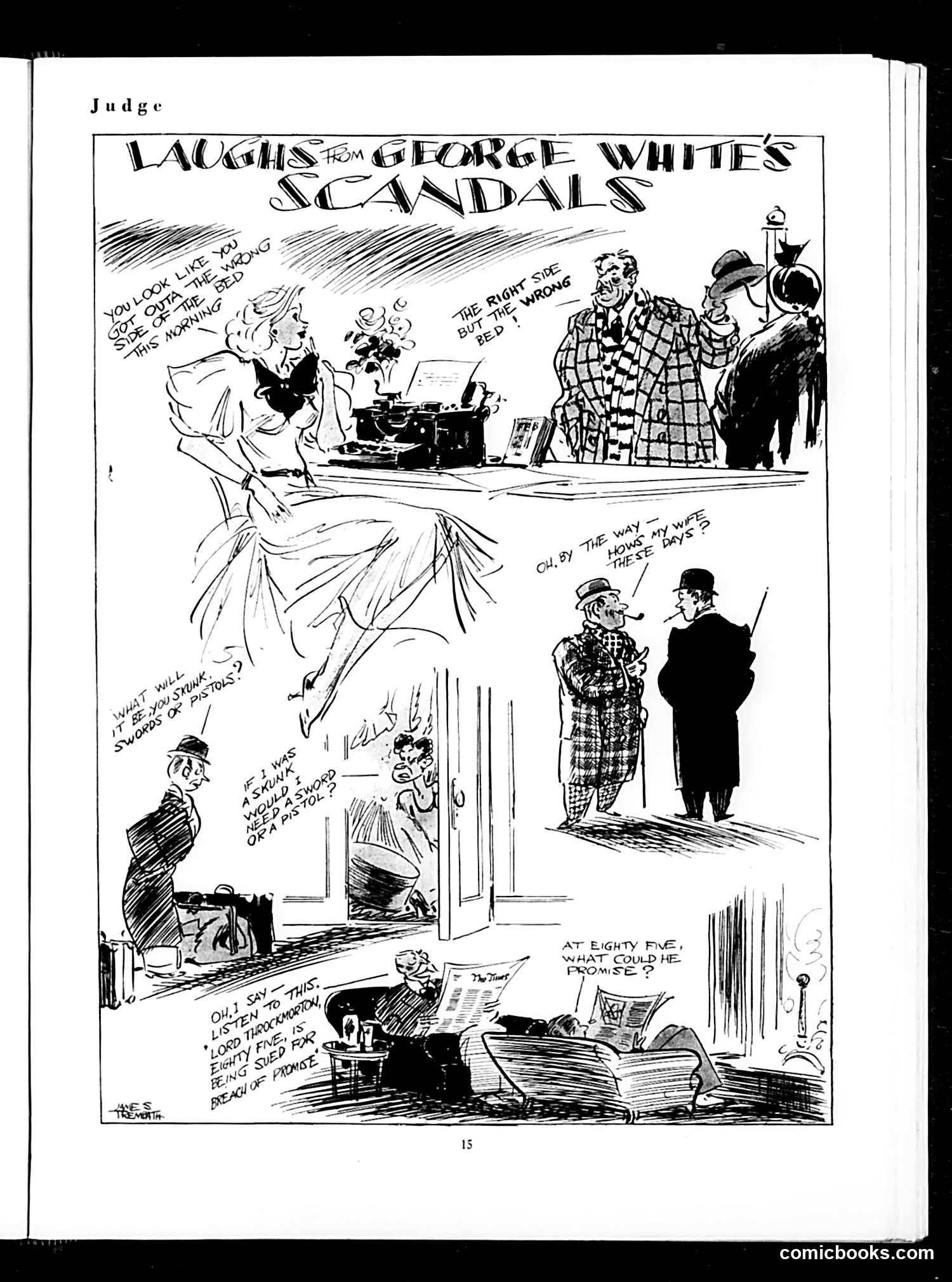
"Laughs from George White's Scandals" This page satirizes George White's Scandals, a popular Broadway revue series known for elaborate musical numbers and chorus girls. The cartoon mocks the show's reputation for sexual scandal and impropriety. The top panel shows a woman at a typewriter confronting men about "the right side" being "wrong" and "red"—likely alluding to both moral controversy and possible Communist associations (a common 1920s-30s accusation against theatrical productions). Lower panels feature dialogue about infidelity ("What will she do if she finds out about this?"), judicial concerns ("At eighty-five, what could he promise?"), and suggest the show courted controversy through risqué content and affairs. The satire targets both theatrical excess and the moral panic surrounding entertainment of the era.
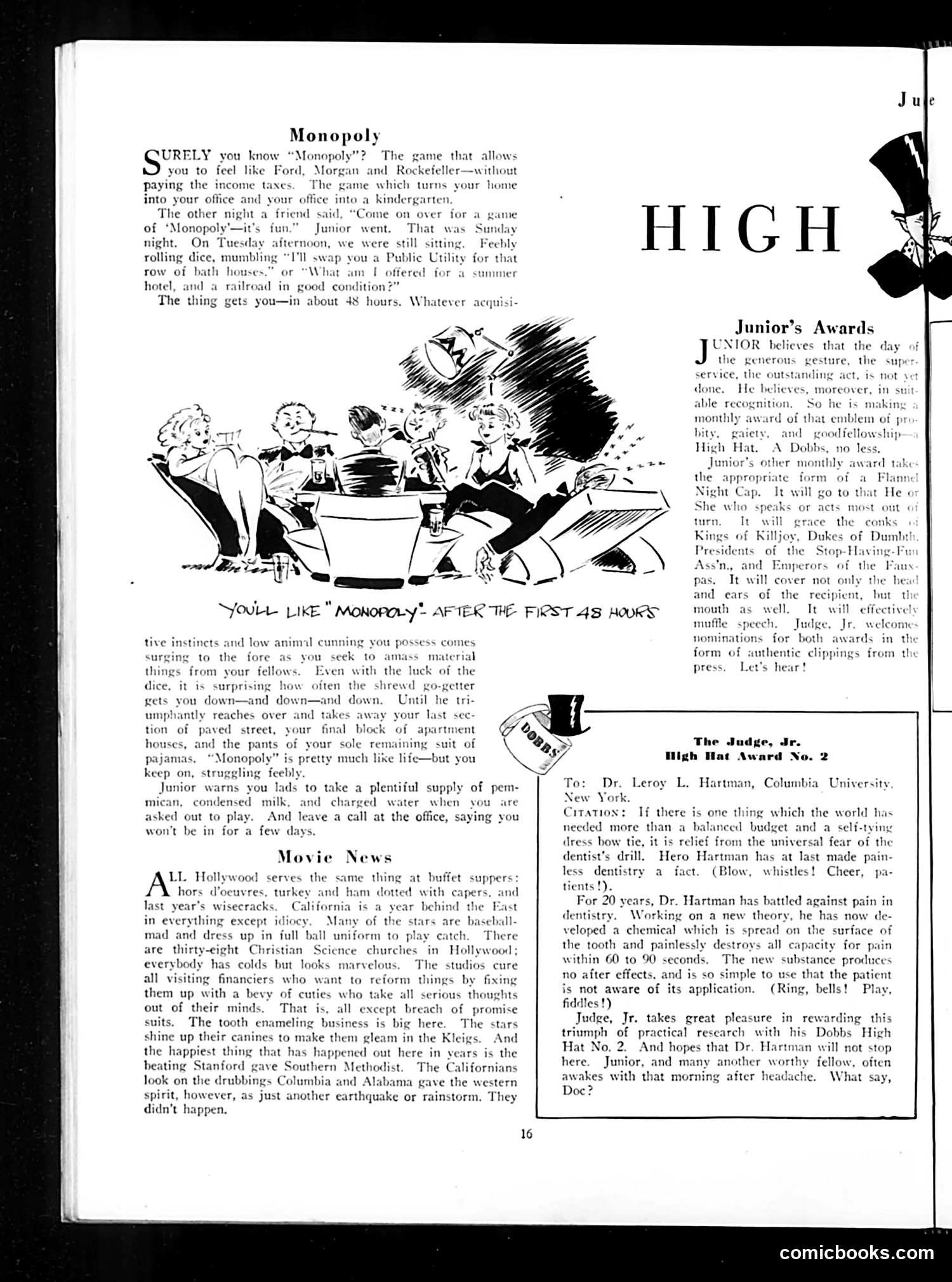
Explaining This Judge Magazine Page The Monopoly Satire: The cartoon depicts people absorbed in the board game "Monopoly," which had recently become a cultural phenomenon. The joke is that the game perfectly mirrors real-life capitalism—allowing players to feel like wealthy industrialists (Ford, Morgan, Rockefeller) without actual tax obligations. The satire mocks how the game's competitive, acquisitive nature mirrors cutthroat capitalism, with players becoming ruthlessly scheming over hours. It's commentary on American materialism and the appeal of fantasizing about wealth accumulation. Movie News Section: A gossipy, satirical column about Hollywood's superficiality—stars playing baseball in uniforms, the prevalence of Christian Science churches, cosmetic dentistry obsession ("tooth enameling"), and studio manipulation of financiers through romantic distraction. It's lighthearted mockery of Hollywood excess and phoniness. Judge Jr. Award: A humorous award honoring Dr. Leroy L. Hartman for developing painless dentistry—a genuine scientific achievement presented with mock-grandiose ceremony typical of Judge's satirical style.
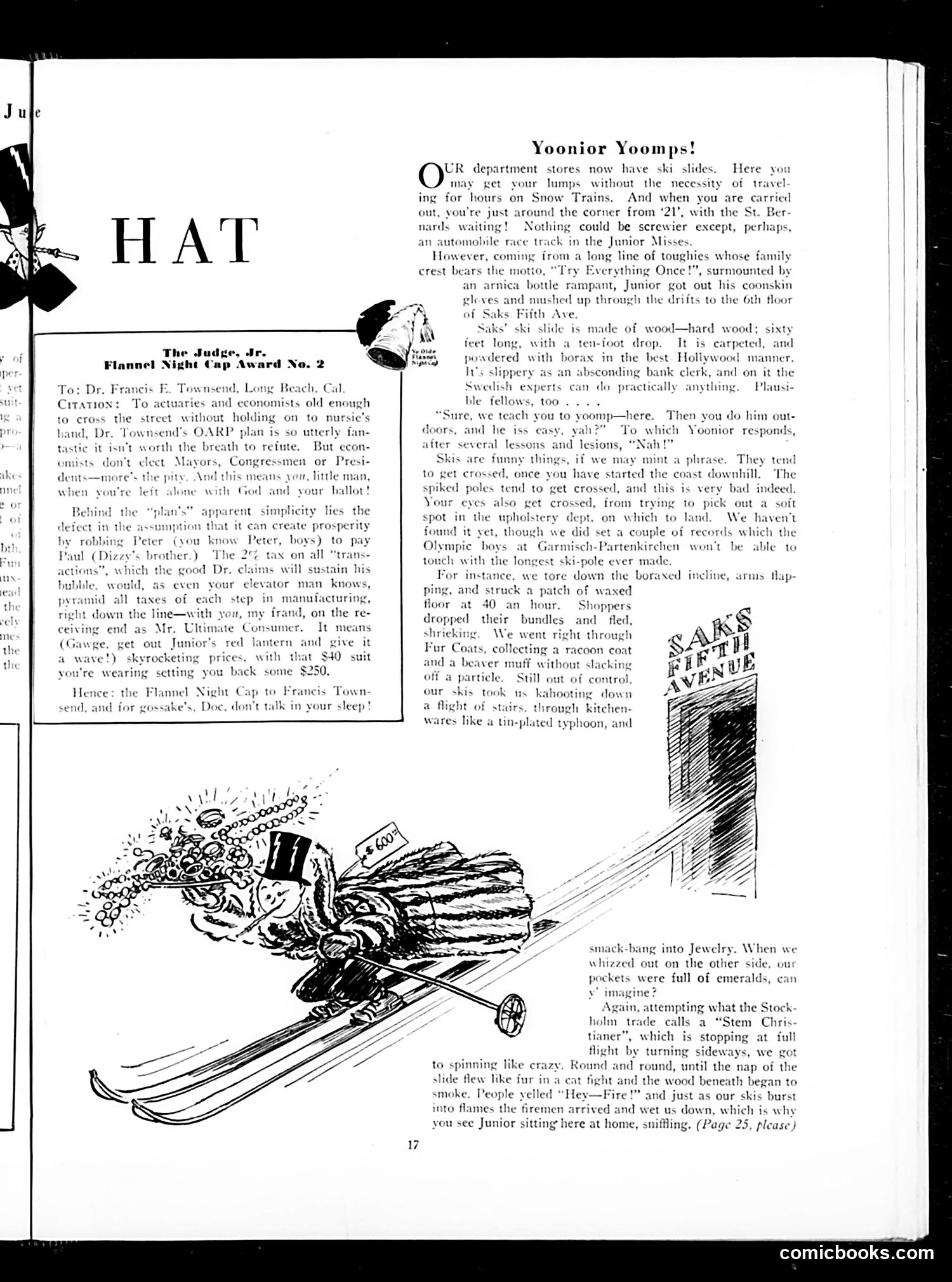
Judge Magazine Page Analysis This page contains two satirical pieces from Judge, a humor magazine: "The Flannel Night Cap Award" mocks Dr. Francis Townsend's Old Age Revolving Pensions (OARP) plan—a 1930s proposal to give seniors monthly payments funded by a national sales tax. The satirist argues the scheme is economically absurd, claiming the cascading taxes would ultimately burden ordinary consumers like "Mr. Ultimate Consumer." The "award" is a backhanded insult, suggesting Townsend deserves a dunce cap. "Yoonior Yoomps!" describes a humorous incident where a young socialite ("Junior") attempts to ski down a 60-foot wooden slide at Saks Fifth Avenue department store. The exaggerated account follows her chaotic descent through the store—collecting furs, smashing into jewelry, causing a fire—ultimately landing her at home injured. The piece parodies both department store novelties and the wealthy's casual recklessness. Both pieces employ Judge's typical 1930s style: satirizing social institutions and poking fun at upper-class frivolousness.
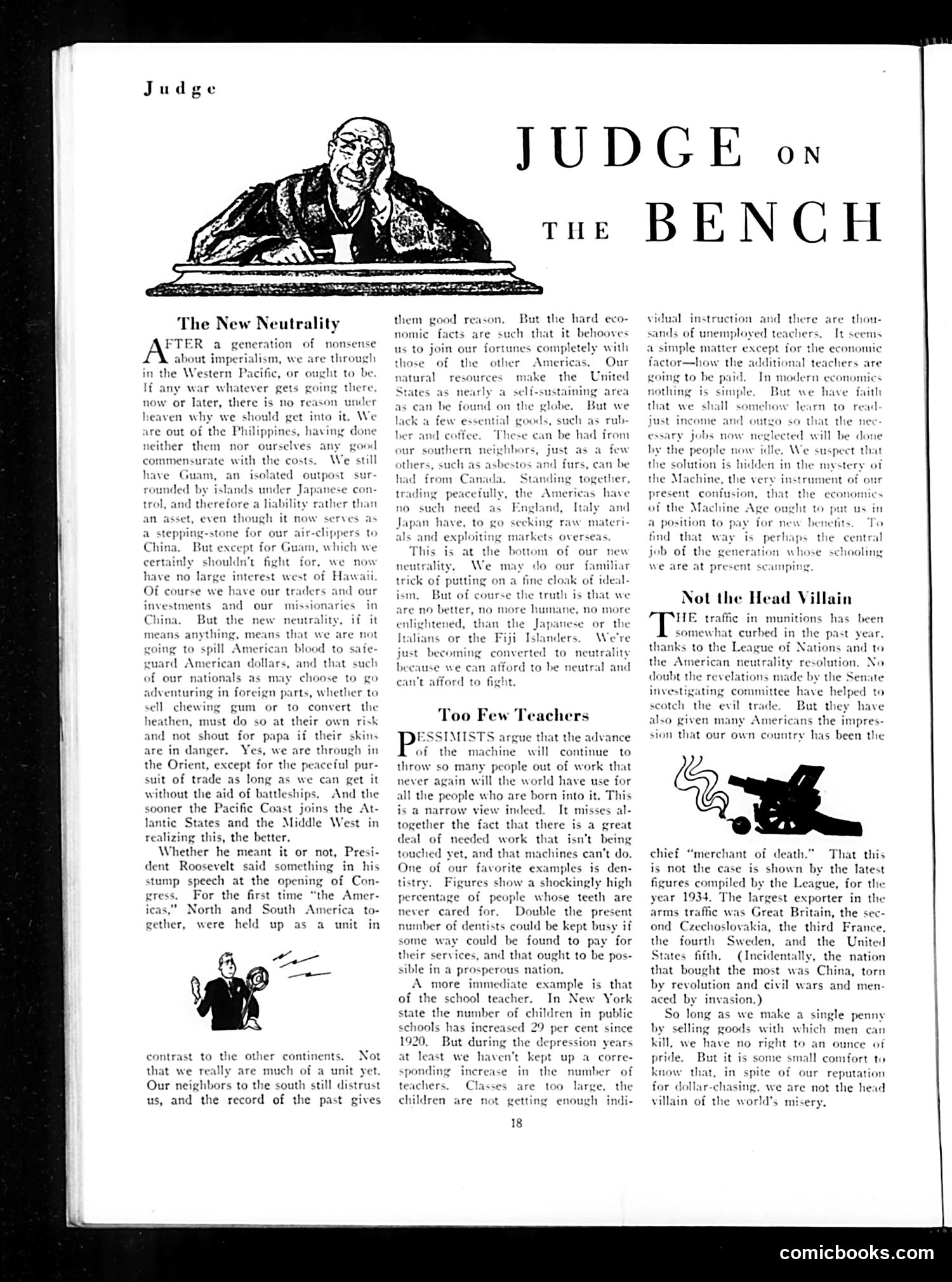
"Judge on the Bench" - Political Commentary, 1934 This page contains two editorial pieces by Judge magazine's unnamed "Judge" columnist (a common format for the publication). "The New Neutrality" argues for American isolationism and non-intervention in foreign affairs, particularly regarding the Pacific and Asia. The columnist advocates withdrawing from the Philippines and avoiding military entanglement, while maintaining peaceful trade. Notably, he frames the Americas (North and South) as a self-sustaining economic unit that should unite against other continents—a reference to Franklin Roosevelt's recent "Good Neighbor Policy" rhetoric. "Too Few Teachers" addresses Depression-era unemployment by arguing machines won't cause permanent joblessness because essential work remains undone. The example given: dental care and teacher shortages. New York state saw 29% enrollment growth since 1920 but failed to hire proportionally more teachers, leaving classes too large and children under-served. The small illustration shows a concerned figure being struck by something (likely representing economic disruption), supporting the "Too Few Teachers" argument about displaced workers and unmet needs. The cartoon's point: machines create problems they can't solve; society must redirect labor toward genuine needs.
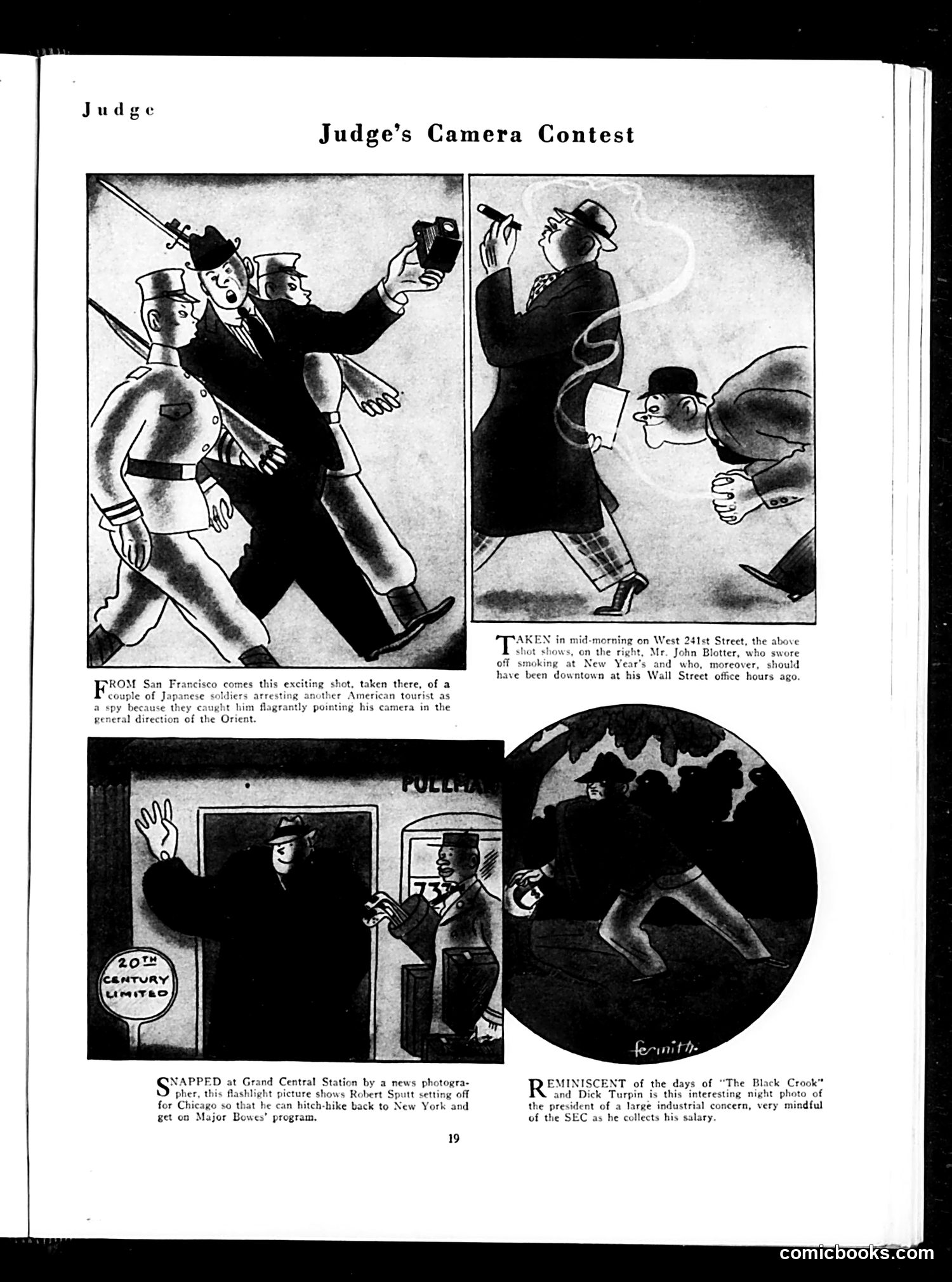
Judge's Camera Contest Explanation This page from *Judge* magazine presents a humorous "camera contest" featuring four candid photographs with satirical captions. The format mocks candid street photography by pairing real or staged photos with ridiculous narrative explanations. The cartoons target contemporary social behaviors and concerns: 1. Top left: Japanese soldiers catching an American tourist photographing them—satirizing wartime espionage anxieties and cultural stereotypes about the "Orient." 2. Top right: "Mr. John Blotter" breaking his New Year's resolution to quit smoking while skipping work—mocking common resolutions and workplace commitment. 3. Bottom left: Robert Spott hitchhiking to get on "Major Bowes' program" (a popular radio show)—joking about Depression-era desperation and entertainment-seeking. 4. Bottom right: An industrial executive collecting his salary "mindful of the SEC"—referring to the Securities and Exchange Commission, satirizing corporate greed and regulatory evasion during the New Deal era. The humor relies on viewers recognizing contemporary references and social anxieties of the period.
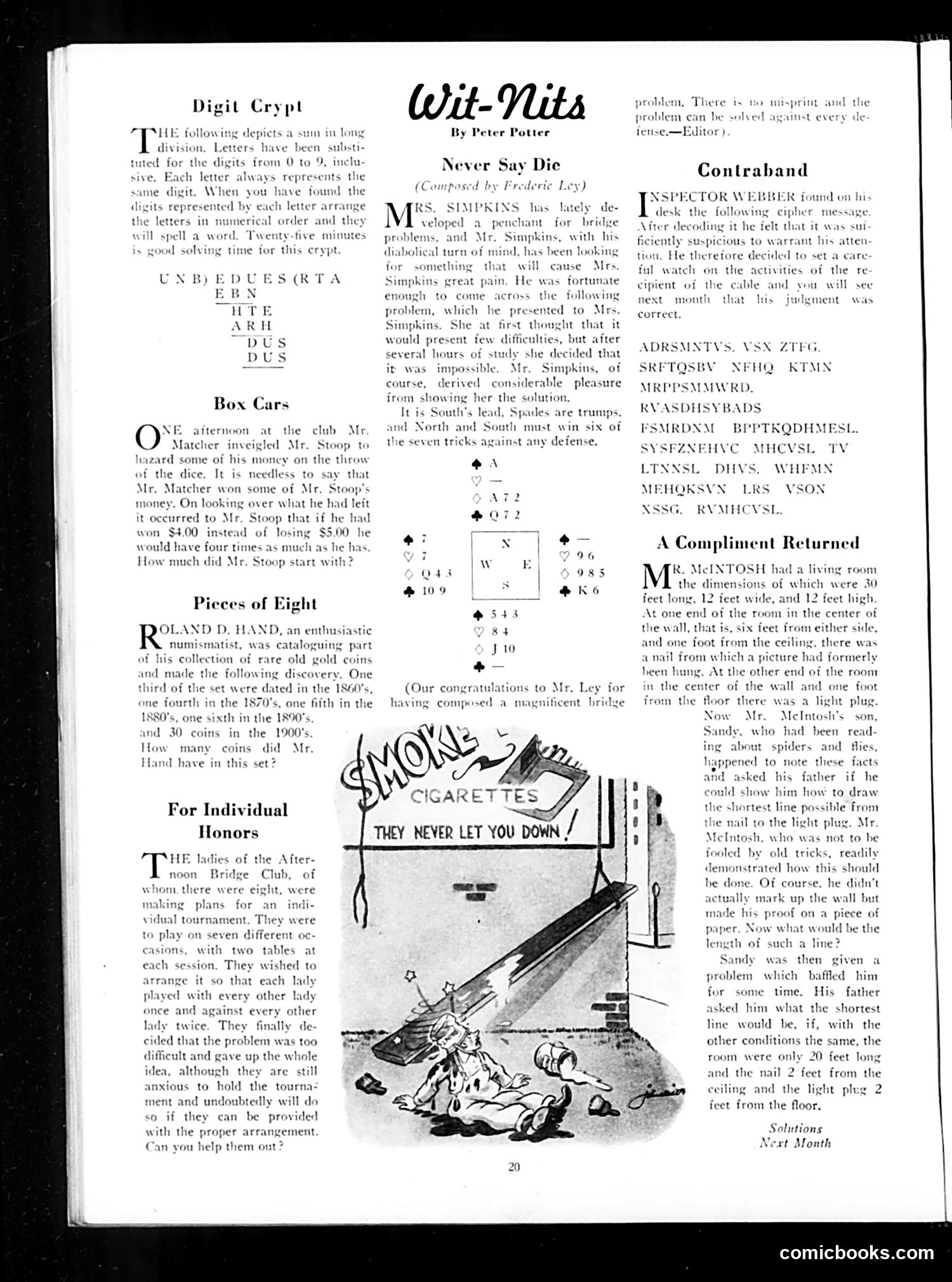
Analysis of Judge Magazine Page Content This page presents recreational puzzles and riddles rather than political satire. The content includes: 1. "Digit Crypt" — a cryptarithmetic puzzle disguised as long division 2. "Box Cars" — a probability/logic puzzle about dice gambling 3. "Pieces of Eight" — a numismatic counting problem 4. "For Individual Honors" — a scheduling puzzle for a bridge tournament 5. "Never Say Die" — a bridge card game problem 6. "Contraband" — a simple cipher puzzle featuring Inspector Webber 7. "A Compliment Returned" — a geometry problem about finding the shortest line in a room The cartoons (particularly the "Smoke Cigarettes" illustration) appear to be generic advertisements or filler. This is primarily a puzzle and games page, typical of Judge magazine's entertainment content, aimed at readers seeking intellectual challenges rather than political commentary.
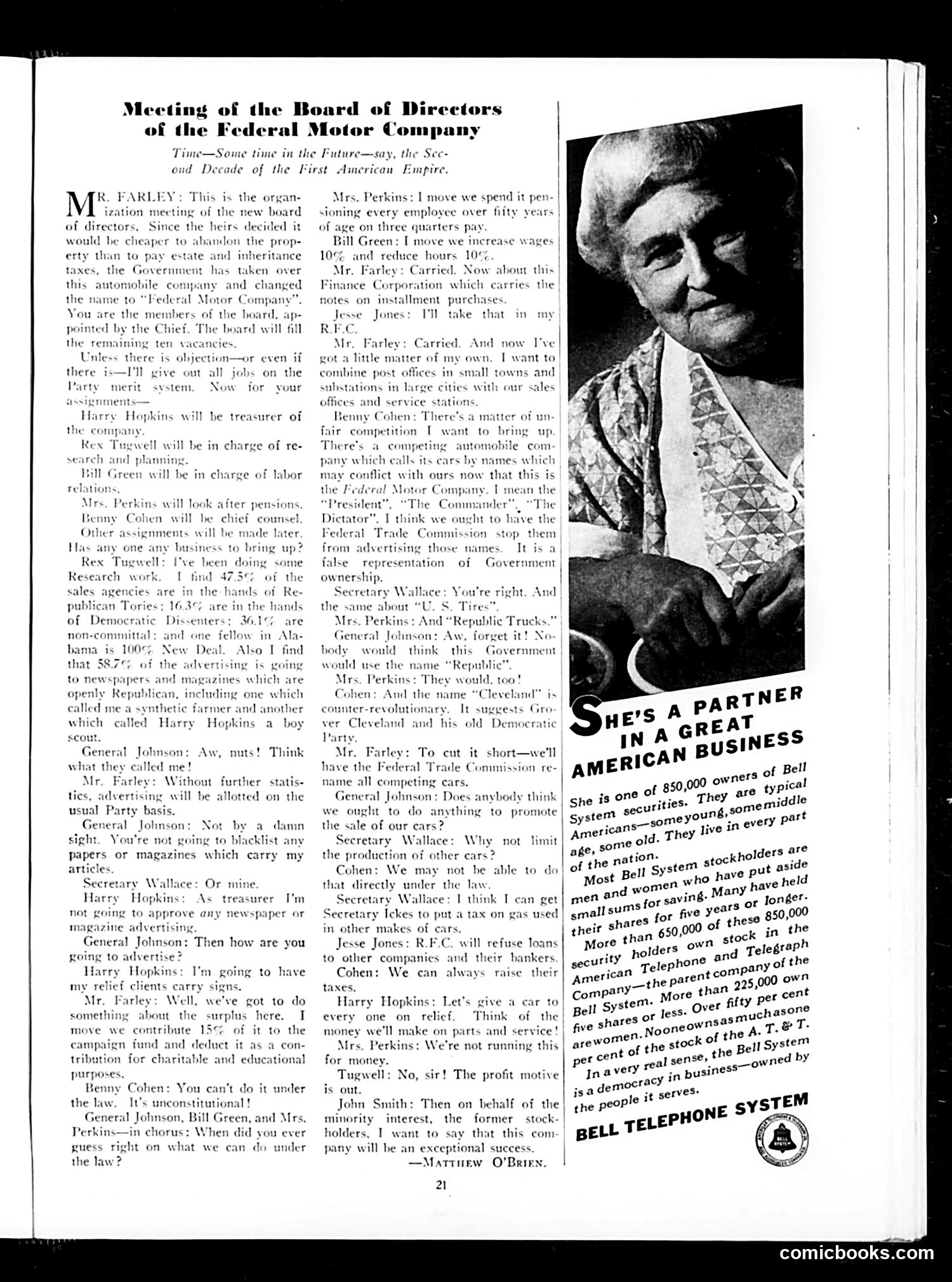
Political Satire of New Deal Leadership This 1930s Judge cartoon satirizes President Franklin D. Roosevelt's cabinet by imagining them as directors of a nationalized "Federal Motor Company" in an authoritarian future America ("the First American Empire"). The figures include recognizable New Deal officials: James Farley (postmaster general), Frances Perkins (labor secretary), Harry Hopkins (relief administrator), Rex Tugwell (agricultural planner), and others. The satire mocks their interventionist policies—price controls, production limits, tax manipulation, and centralized planning—portraying them as economically irrational and authoritarian. The joke targets Republican criticisms that New Deal programs represented creeping socialism or fascism. References to suppressing competitors' advertising and controlling production satirize what conservatives saw as dangerous government overreach. The final line about eliminating profit motive drives home the cartoon's message: these policies would destroy capitalism itself. The accompanying Bell Telephone advertisement serves as ironic contrast, celebrating private enterprise and individual stockholders—the system Judge's editors believed the New Deal threatened.
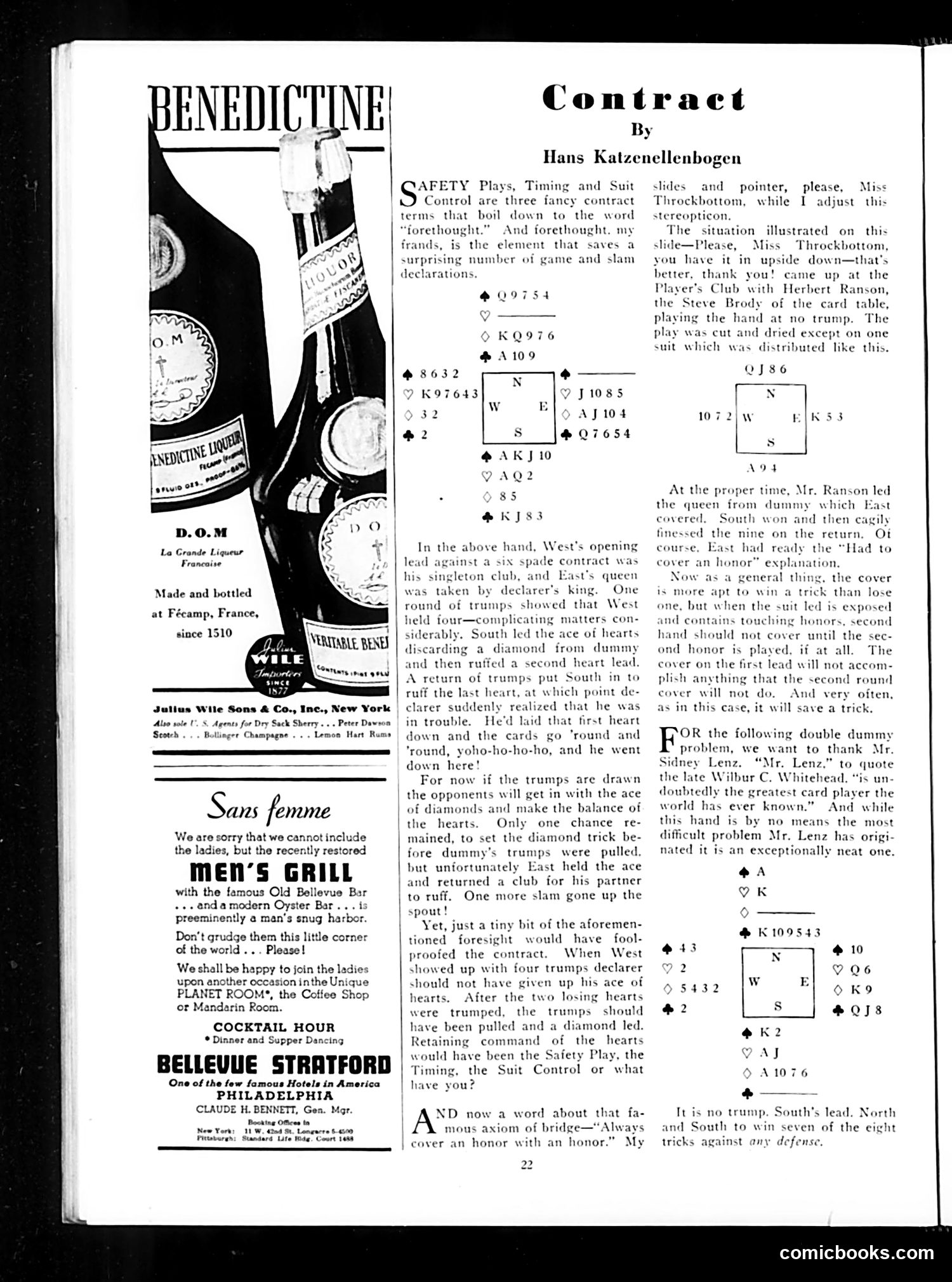
"Contract" Bridge Column Analysis This page features a bridge instructional article by Hans Katzenellenbogen, not a political cartoon. The left side contains liquor advertisements (Benedictine, the Bellevue Stratford hotel's men's grill), while the right side presents two bridge hands with explanatory text. The content teaches bridge strategy principles—"Safety Plays, Timing and Suit Control"—through actual card hands. The first hand illustrates how premature play ("forethought") lost a slam contract. The second demonstrates the principle "cover an honor with an honor," using an anecdote about a player named Ranson at the Players Club who cleverly avoided this trap. This is essentially a bridge column explaining proper card-playing technique to readers, not satire or political commentary.
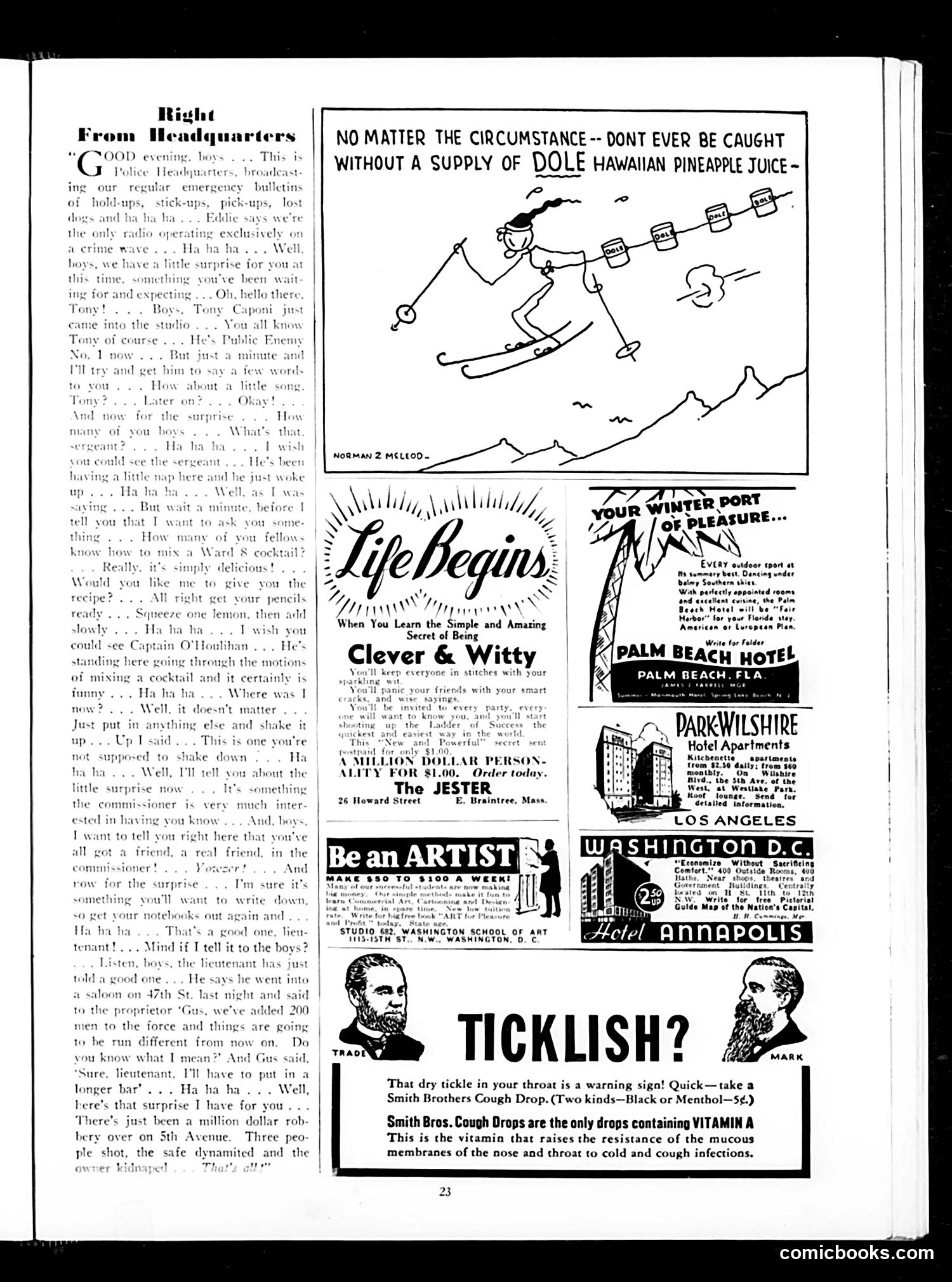
Judge Magazine Page Analysis This page is primarily advertising and filler content rather than political satire. The dominant element is a Dole Hawaiian Pineapple juice advertisement cartoon showing a skier navigating obstacles while carrying boxes of the product—a humorous endorsement suggesting the juice is essential travel gear. The upper left contains "Right From Headquarters," an informal column mimicking police radio broadcasts, featuring casual banter about a million-dollar robbery on 5th Avenue. This appears to be light entertainment commentary rather than satire. The remainder consists of commercial advertisements: "Life Begins" (a correspondence course on wit), "Be an Artist" (art instruction), "Park Wilshire" (Los Angeles apartments), "Palm Beach Hotel," "Hotel Annapolis" (Washington D.C.), and "Smith Bros. Cough Drops" featuring a Vitamin A health claim. There is no discernible political satire or caricature on this page. It represents typical mid-century magazine filler: advertising mixed with lifestyle content.
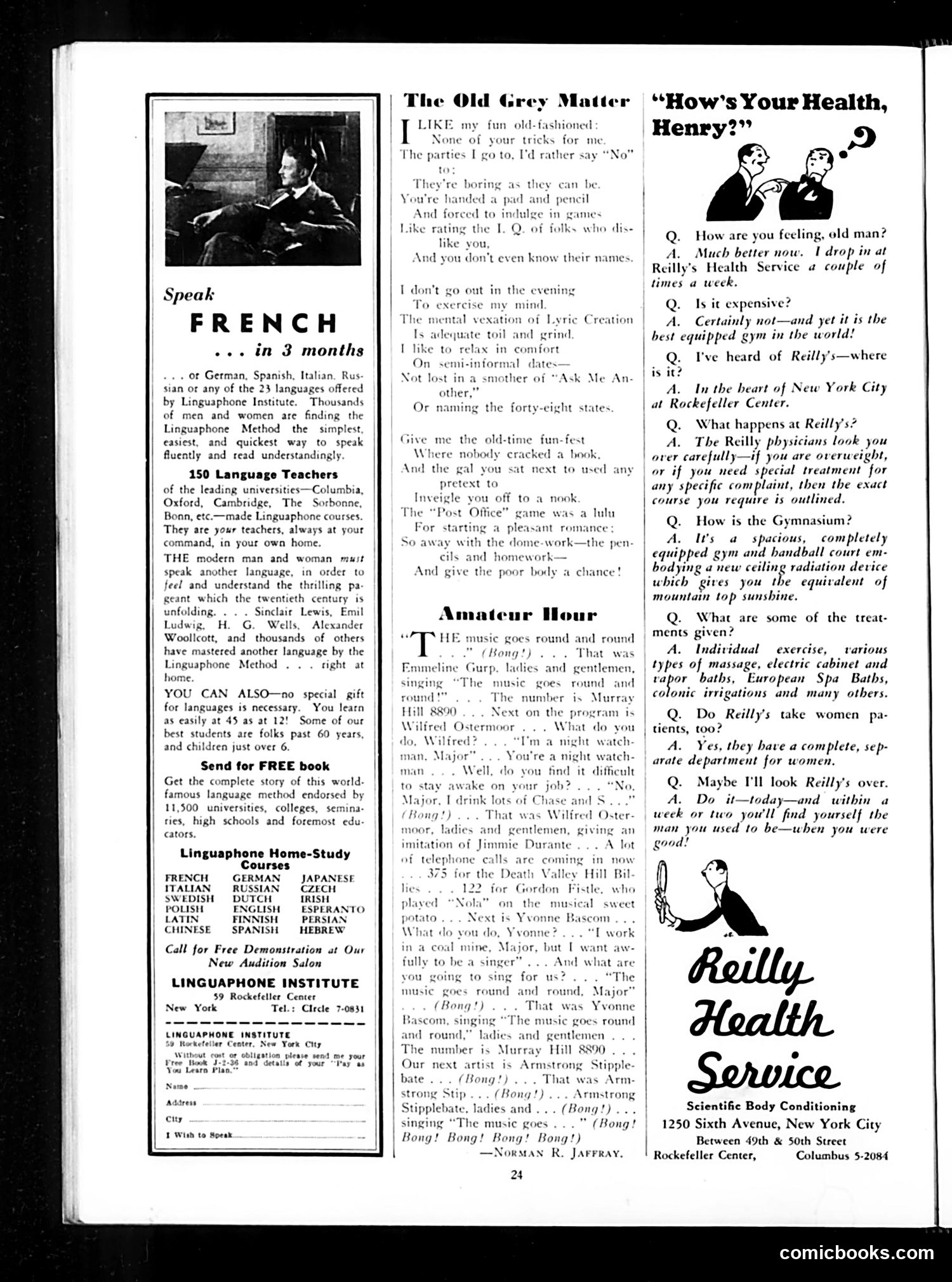
"The Old Grey Matter" and Reilly's Health Service This page combines light satire with advertising. "The Old Grey Matter" is a humorous poem mocking modern social life. The speaker rejects contemporary entertainments—parties requiring forced socializing, games testing obscure knowledge (IQ ratings of disliked acquaintances), evening outings meant to stimulate the mind. Instead, he prefers old-fashioned relaxation at home. "Amateur Hour" satirizes a radio talent show (appears to be "The Music Goes 'Round and Around," a popular song). The recurring phrase mocks repetitive entertainment as callers phone in with varying acts—night watchmen, coal miners, singers—all performing the same tune. The humor lies in the mundane, amateur quality of radio entertainment and the formulaic nature of such programs. The Reilly's Health Service advertisement uses a Q&A format to promote their gym at Rockefeller Center, emphasizing it's inexpensive despite being well-equipped. Together, these elements reflect 1930s-40s American leisure culture: radio entertainment, health consciousness, and affordable recreation.
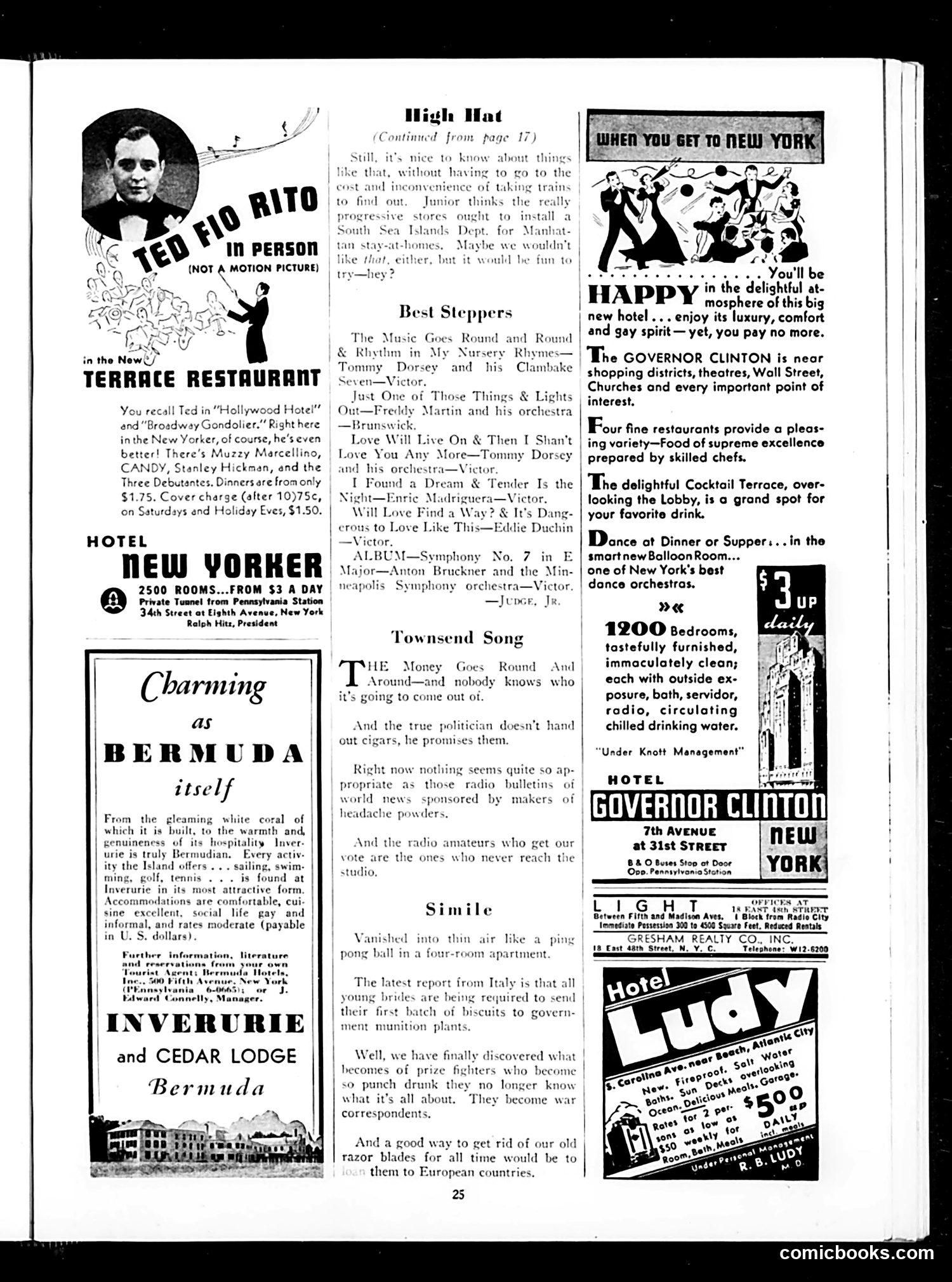
Political and Social Commentary in Judge Magazine Page This page from Judge magazine (appears to be 1930s) contains satirical commentary mixed with advertisements. The main satirical content includes: "High Hat" column (continued): Social commentary mocking modern conveniences and politics. It satirizes: - Radio advertising ("bulletins of world news sponsored by makers of headache powders") - Politicians who promise rather than deliver ("the true politician doesn't hand out cigars, he promises them") - Radio amateurs who never reach the studio "Townsend Song": Unclear reference, but mocks money circulation and political promises. "Simile" and subsequent items: Satirize prize fighters becoming "punch drunk" and unable to function, and suggest selling old razor blades to "European countries" (likely a dark reference to international conflict). The page is primarily advertisements for NYC hotels (New Yorker, Governor Clinton, Lady Hotel) and Bermuda resorts, with minimal cartoon imagery—mainly Ted Fio Rito's headshot promoting the Terrace Restaurant. The satire targets 1930s consumer culture, politics, and media.
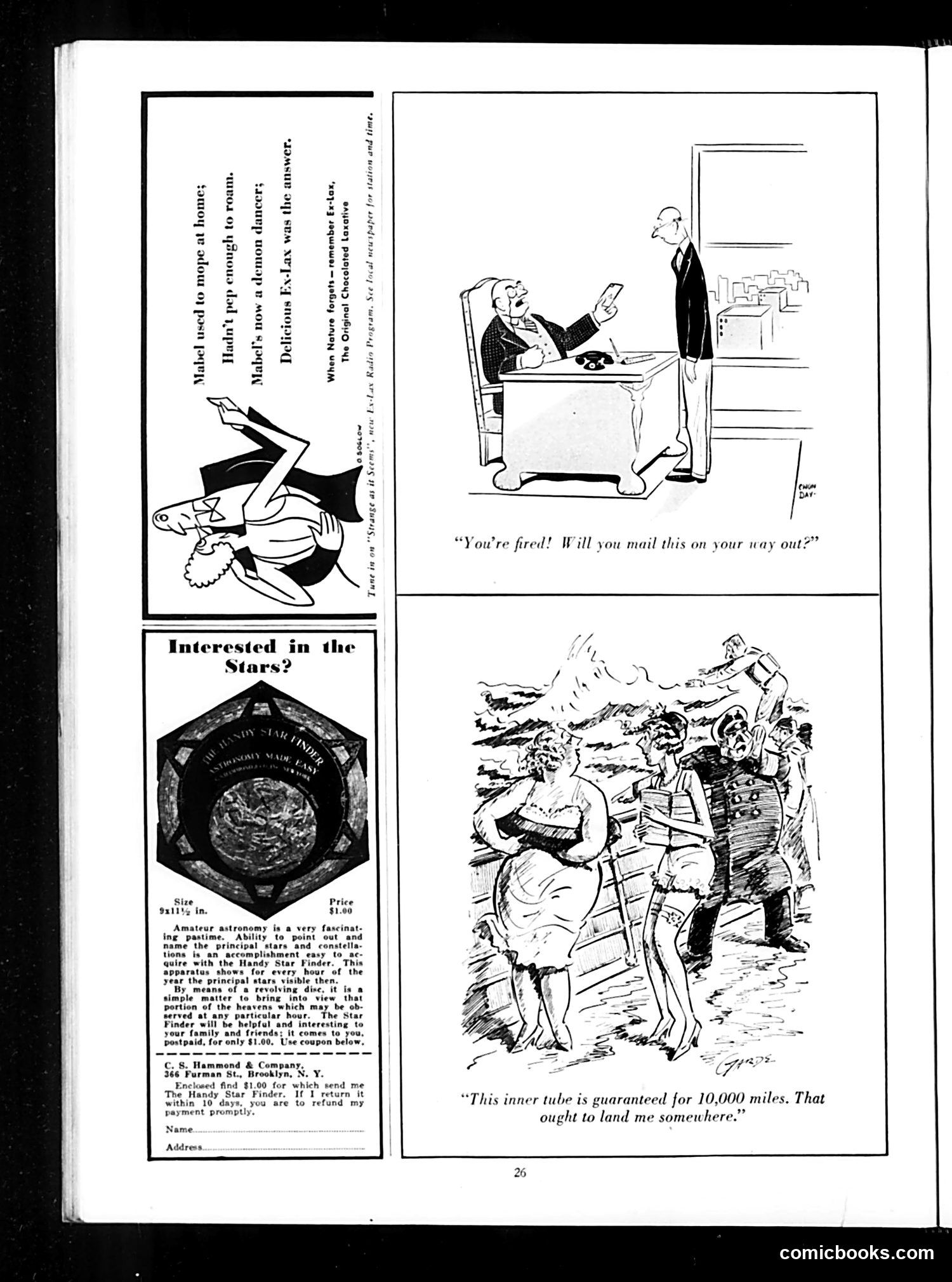
Judge Magazine Page Analysis This page contains three distinct elements: Top cartoon: An office firing scene where a dismissed employee is asked to mail his termination letter on his way out—a darkly humorous take on bureaucratic indifference during job loss. Bottom cartoon: A man on a desert island with a bicycle inner tube, optimistically believing its 10,000-mile guarantee will somehow transport him to safety. This is absurdist humor mocking product advertising claims—the guarantee is meaningless in this context, satirizing how companies make exaggerated promises. Left side: An advertisement for "The Handy Star Finder," a simple astronomy tool, positioned as educational entertainment for families. The page reflects Depression-era or interwar humor: workplace anxiety (the firing), consumer skepticism about advertising (the inner tube joke), and the promotion of affordable home entertainment. The tone is lighthearted cynicism about modern life's disappointments.
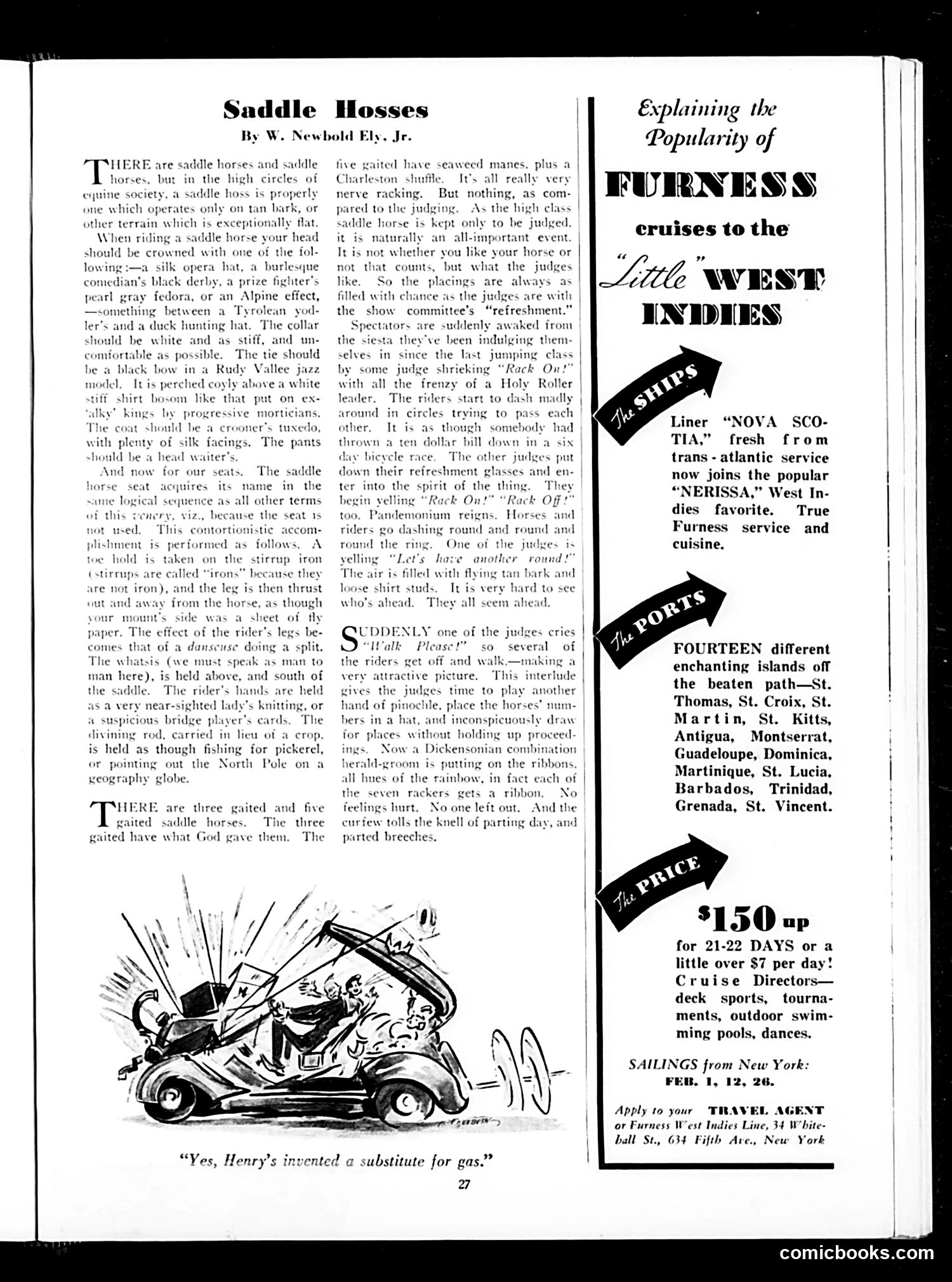
"Saddle Hosses" - Judge Magazine Satire This humorous article by W. Newbold Ely Jr. satirizes the pretentious world of high-society equestrian culture, specifically saddle horse showing. The author mocks the elaborate, rigid etiquette surrounding saddle horse riding and judging. The satire targets: 1. Absurd dress codes - The contradictory requirement for formal top hats paired with a stiff white collar and Rudy Vallee-style jazz bow tie, creating ridiculous visual effect. 2. Ridiculous posture - Riders must position their hands like "a suspicious bridge player's cards" or divining rods, legs splayed unnaturally, suggesting the whole practice defies natural comfort. 3. Chaotic judging spectacle - When judges cry "Rack On!", horses and riders dash madly in circles, creating pandemonium that mirrors a "six-day bicycle race," after which judges incongruously play pinochle and draw ribbons from hats. The accompanying cartoon shows a vehicle labeled "Henry's invented a substitute for gas," likely satirizing mechanization versus traditional pursuits. The page juxtaposes this satire against a cruise ship advertisement, highlighting period-appropriate entertainment contrast.
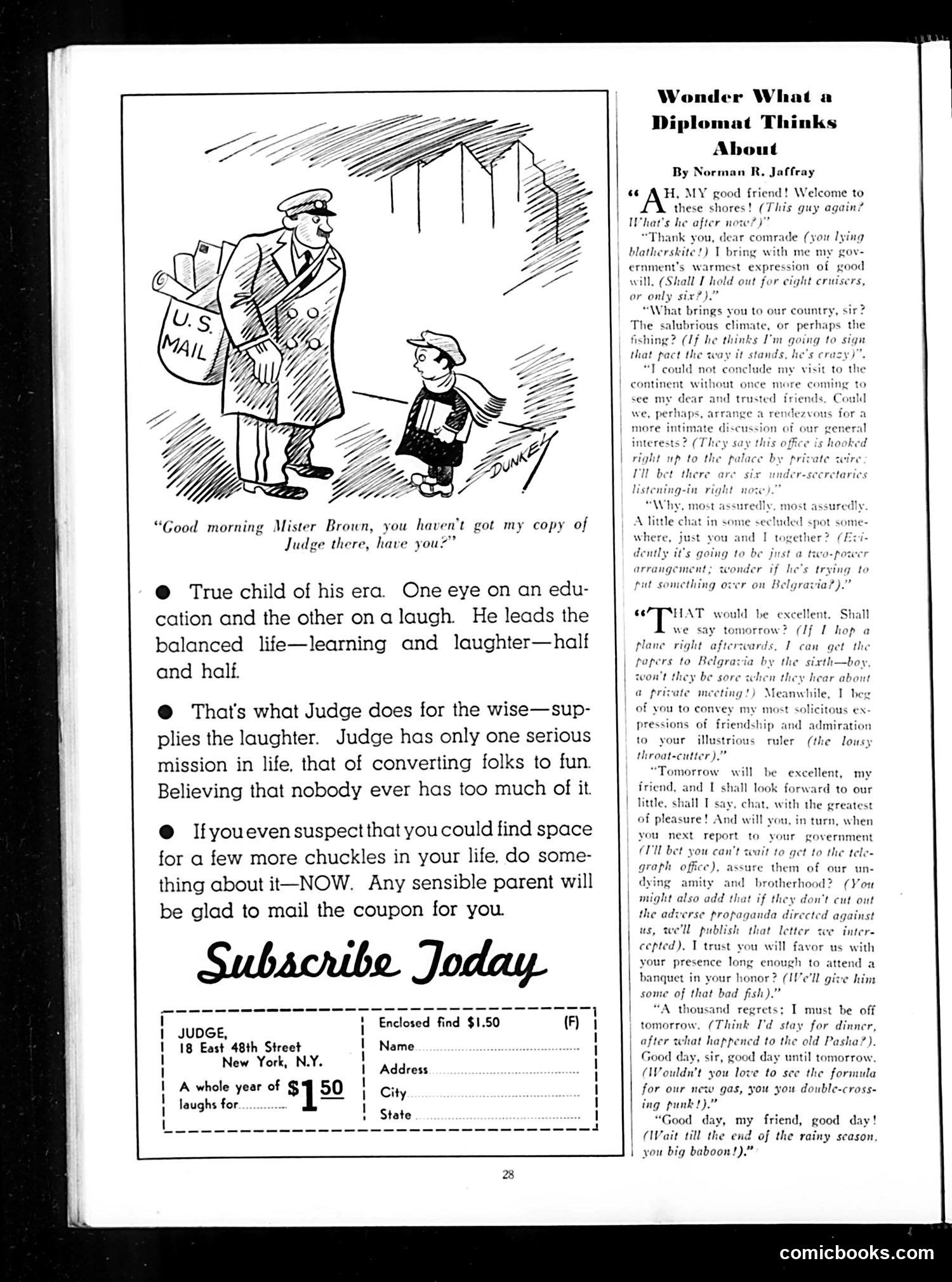
Analysis of Judge Magazine Page This page combines subscription advertising with satirical diplomatic humor. The Cartoon: A mailman delivers Judge magazine to a small boy, with the caption "Good morning Mister Brown, you haven't got my copy of Judge there, have you?" The image satirizes how eagerly people anticipate Judge's arrival. The Advertisement: Promotes a year-long Judge subscription for $1.50, emphasizing the magazine's dual mission of education and humor—described as the "balanced life" for readers seeking intellectual content alongside comedy. The Satirical Article: "Wonder What a Diplomat Thinks About" (by Norman R. Jaffray) presents a farcical diplomatic meeting between two foreign officials. Through their obsequiously flattering dialogue, laced with parenthetical asides revealing their actual cynical thoughts (mentioning cruisers, propaganda, and espionage), it mocks diplomatic hypocrisy—the gap between public courtesy and private national self-interest during international negotiations. The humor targets the absurd pretense of diplomatic protocol.
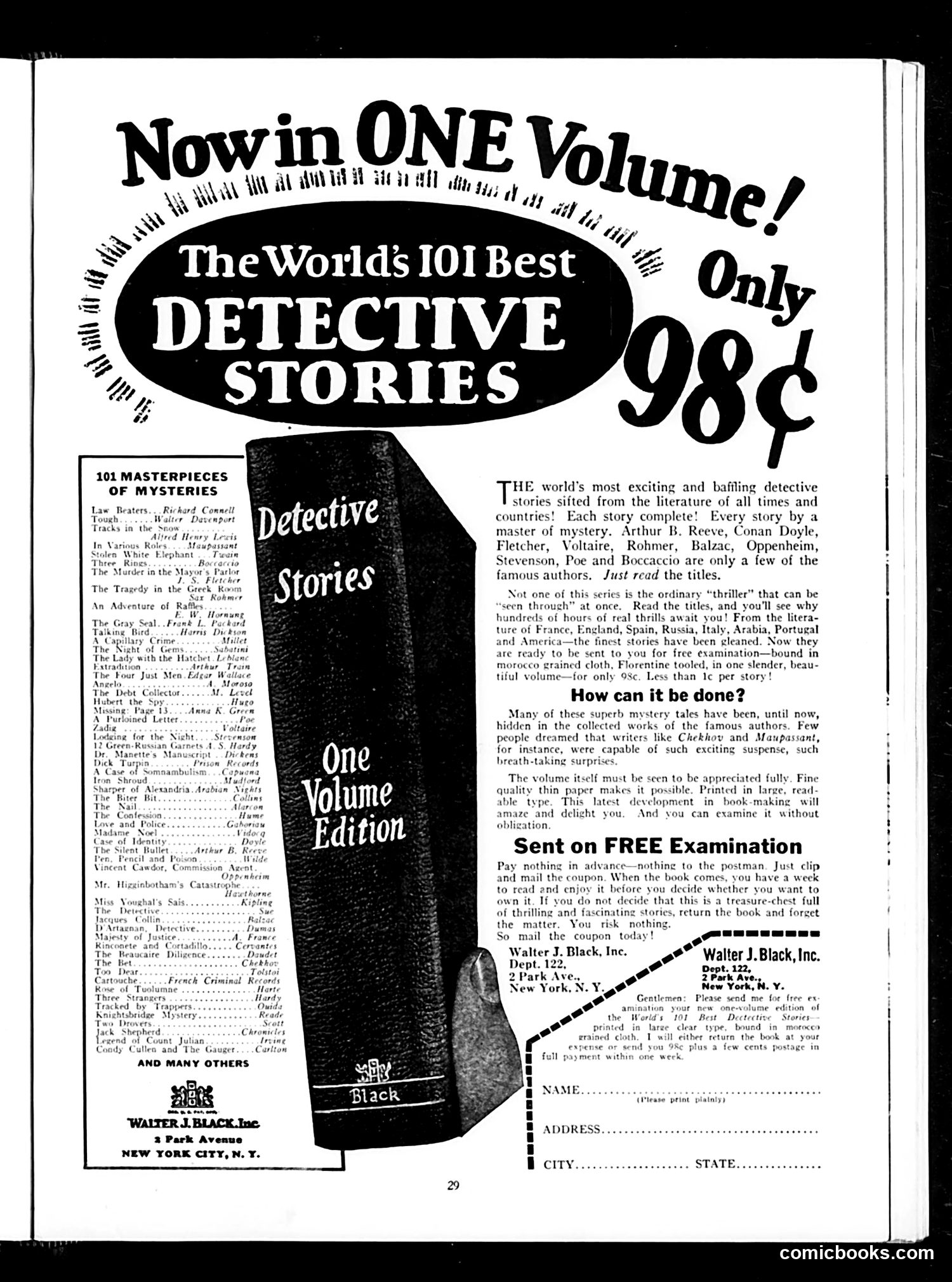
Analysis: Detective Stories Advertisement This page is not a cartoon or satirical content—it's a straightforward advertisement for a book collection published by Walter J. Black, Inc. The ad promotes "The World's 101 Best Detective Stories" in a single volume, priced at 98¢. It emphasizes value by listing famous authors (Conan Doyle, Poe, Voltaire, Rohmer, etc.) and highlighting the book's elegant production: Morocco-grained cloth binding, Florentine tooling, and fine thin paper with large readable type. The marketing hook is the "free examination" offer—customers could request the book, examine it for a week, and return it if unsatisfied, paying only postage if rejected. The ad appeared in *Judge* magazine (a humor/satire publication) but this particular page functions as straightforward commercial advertising rather than editorial satire or cartooning.
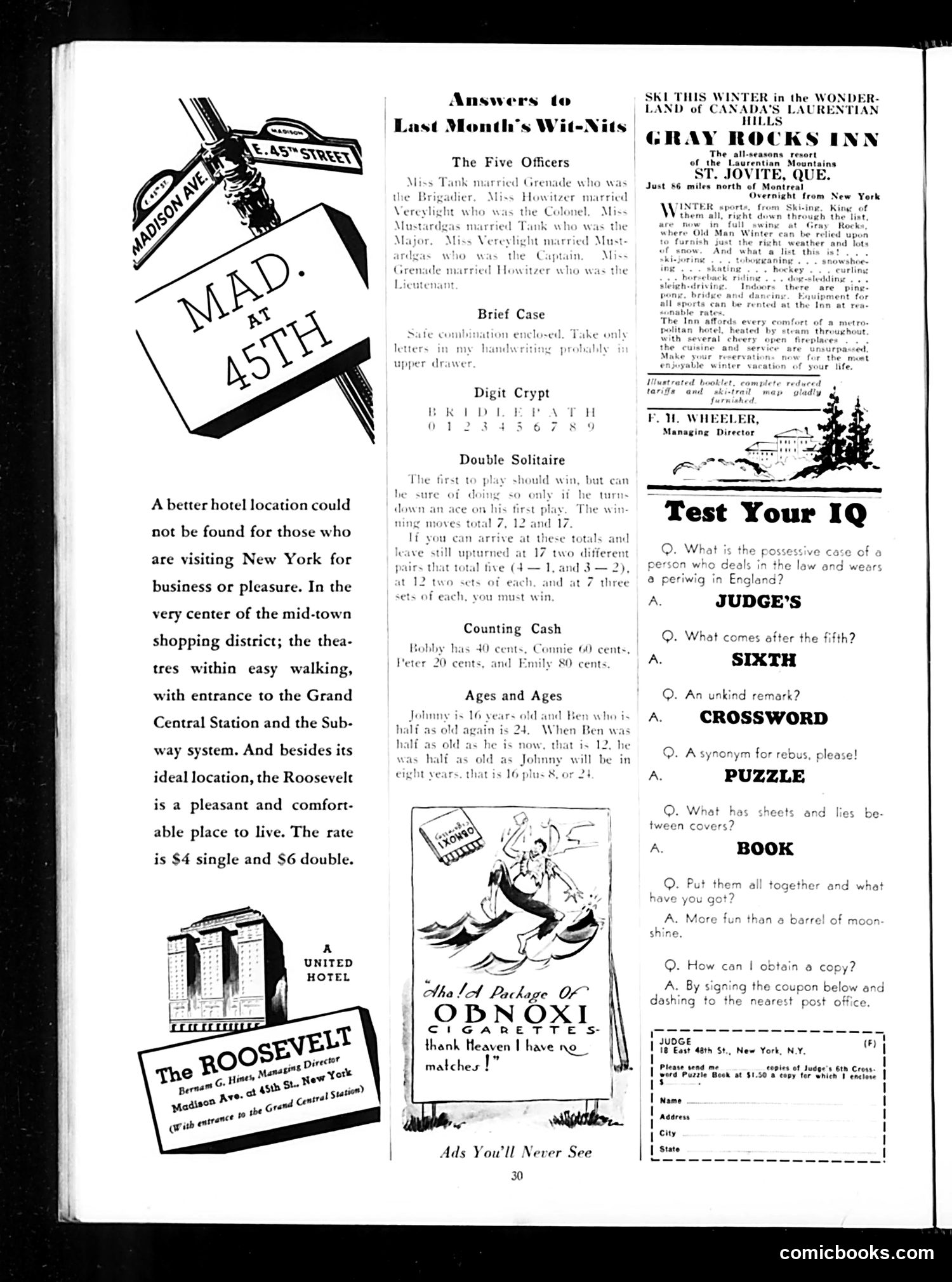
Analysis of Judge Magazine Page This page is primarily advertising and puzzle content rather than political satire. The main elements are: Advertisements: - The Roosevelt Hotel (mid-town Manhattan, $4-$6 rates) and Gray Rocks Inn (Canadian ski resort) dominate the layout - These appear as straightforward travel/hospitality ads typical of the era Content: - "Answers to Last Month's Wit-Nits" — solutions to previous riddles/brain teasers - "Test Your IQ" — a simple Q&A game with puns (e.g., "What comes after fifth? SIXTH") - A cartoon of a man struggling with Odnoxi cigarettes, joking about having no matches Historical Context: The casual cigarette advertising and tone reflect mid-20th century magazine conventions before health warnings. The page reflects Judge's shift toward lighter entertainment and commercial content rather than the sharp political commentary the magazine was historically known for. This appears to be a relatively mundane issue page rather than one featuring significant satire.
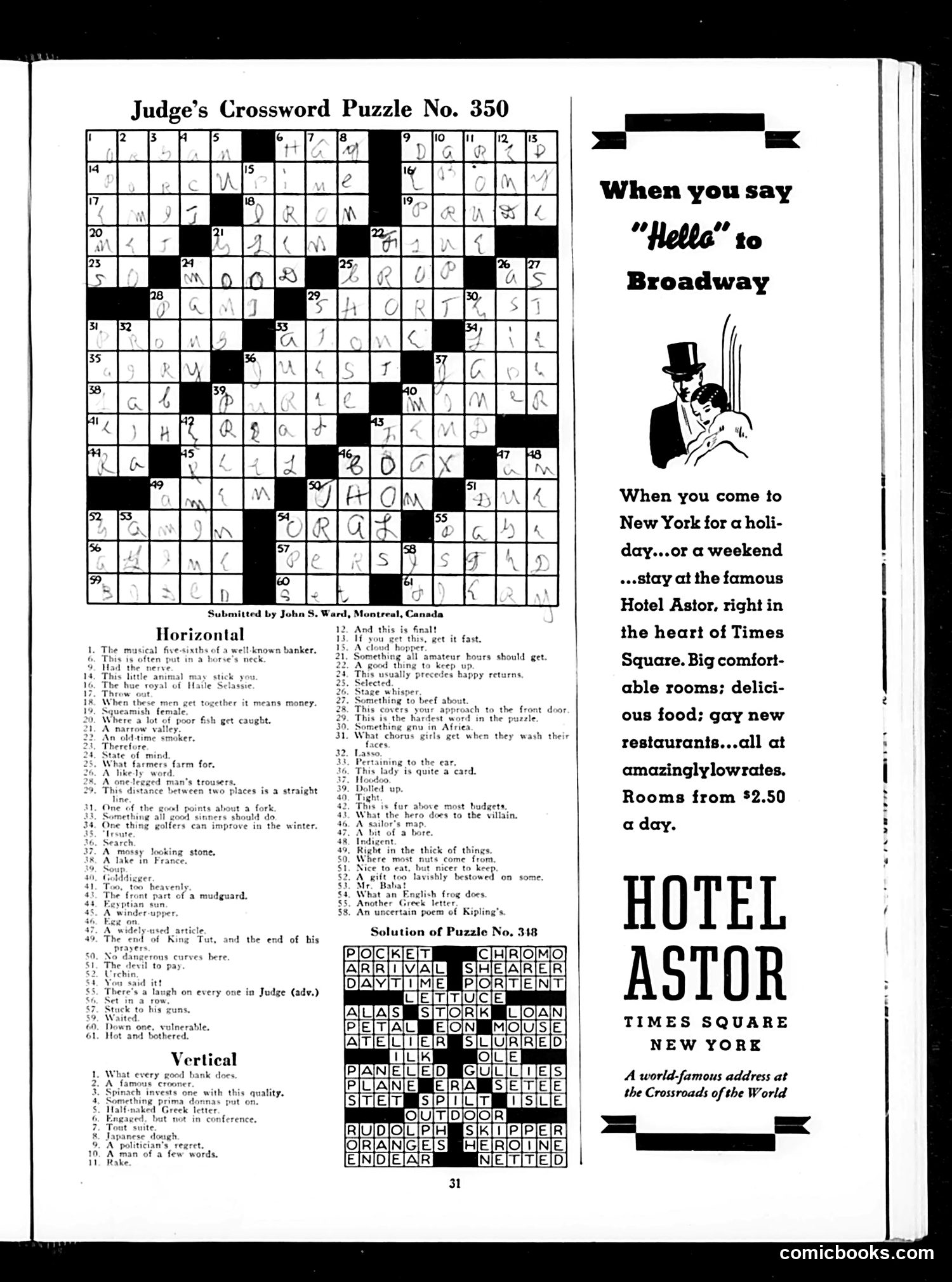
Analysis of Judge Magazine Page No. 350 This page is primarily a crossword puzzle with advertisement, not political satire. The main content consists of: 1. Judge's Crossword Puzzle No. 350 — a standard word puzzle with horizontal and vertical clues submitted by John S. Ward of Montreal. 2. Hotel Astor Advertisement — The dominant visual element shows a well-dressed man in a top hat greeting a woman, accompanying text advertising the Hotel Astor in Times Square, New York. The ad emphasizes affordability ("rooms from $2.50 a day") and location "at the heart of Times Square." 3. Solution to Puzzle No. 348 — A completed crossword shown as reference. There is no political cartoon or satire visible on this page. The "Hello to Broadway" headline and illustration are purely promotional, positioning the Hotel Astor as the destination for visitors seeking New York entertainment and accommodation. This represents typical Judge magazine filler content from the early 20th century era.
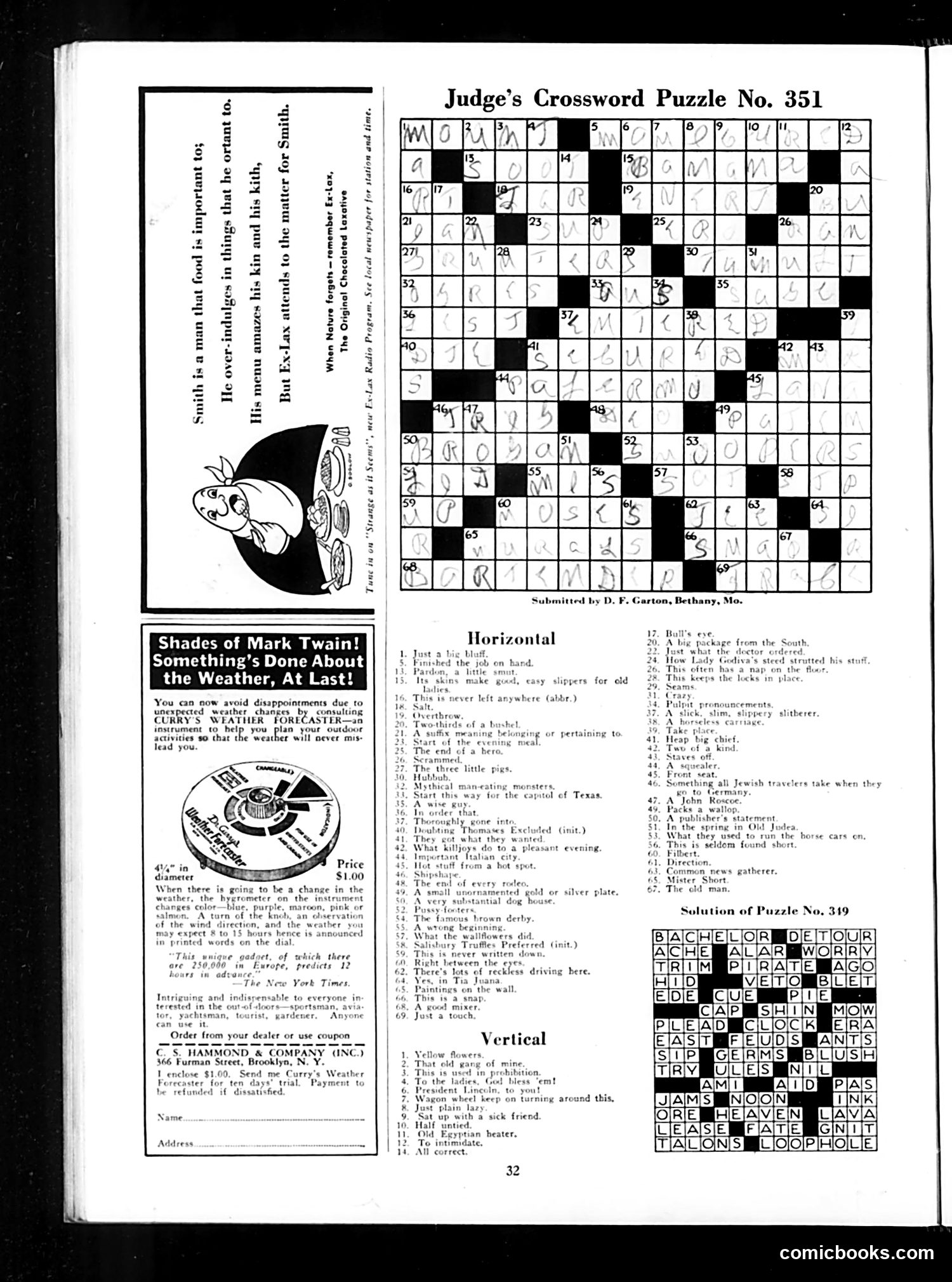
Analysis of Judge Magazine Page This page primarily contains advertisements and puzzle content rather than editorial cartoons with political satire. The main elements are: 1. Ex-Lax Advertisement (top left): Features a cartoon of an overweight man named "Smith" who overindulges in food. The ad uses humor to promote Ex-Lax laxative, with a Mark Twain reference suggesting the situation is comically exaggerated. This reflects early 20th-century advertising's comfort with bodily humor. 2. Curry's Weather Forecaster Ad (center left): Advertises a $1.00weather prediction instrument, presenting it humorously as finally solving the problem of unexpected weather—a lighthearted jab at weather unpredictability. 3. Crossword Puzzle and Solution (right side): Standard puzzle content with no apparent satirical intent. The page demonstrates Judge's mix of advertising revenue and entertainment content rather than sustained political commentary. Any satire is mild and product-focused rather than addressing social or political issues.

Analysis: Postal Life Insurance Advertisement This page is primarily a life insurance advertisement, not political satire. It promotes Postal Life Insurance's "$10 a year" budget policy to working-class readers. The image shows a man and woman (appears to be a couple) examining documents together, illustrating the "protect your loved ones" messaging. The advertisement emphasizes affordability and stability—selling points during economically uncertain times. Key claims highlighted: - Extremely low annual premium ($10/year, marketed as "less than 3¢ a day") - No premium increases over the policy's lifetime - Cash value accumulation (e.g., $650 by age 21) - Full payout at maturity exceeding total premiums paid The contrast with "Modified" whole life insurance suggests competition in the insurance market. While not explicitly satirical, the ad's aggressive marketing tone and emphasis on "never any increase" suggests concerns about premium hikes were common consumer complaints of the era. The accompanying coupon solicits customer information for further details.
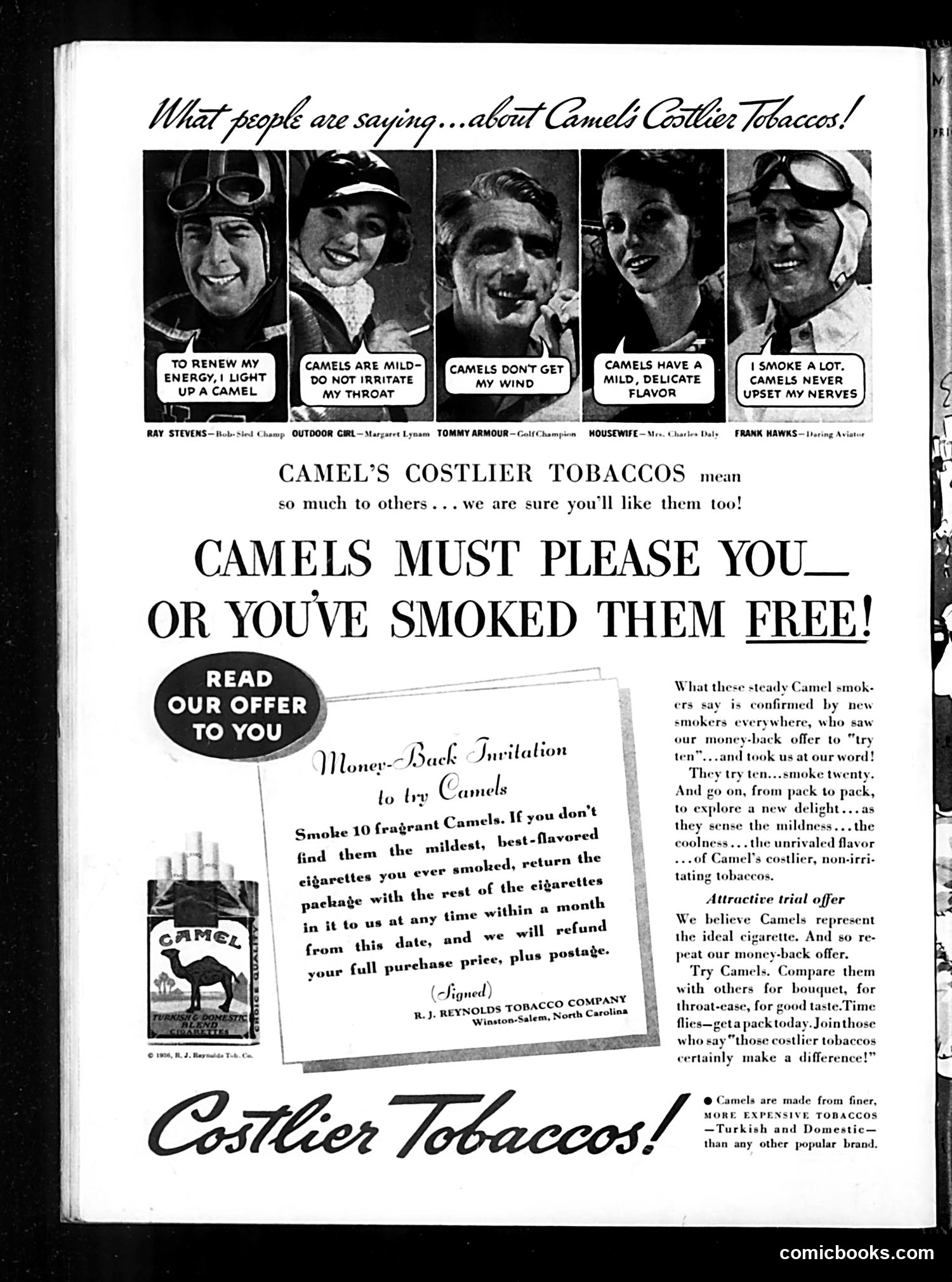
Camel Cigarettes Advertisement This is primarily a cigarette advertisement, not editorial satire. The page features testimonials from five named celebrities (a racing driver, golfer, aviator, and others) endorsing Camel cigarettes' mildness and flavor. The central appeal is a money-back guarantee: smoke 10 Camels; if unsatisfied, return the pack for a full refund plus postage. This was a common marketing tactic of the era. The ad emphasizes Camel's "costlier tobaccos" (Turkish and domestic blends) and claims they won't irritate throats or nerves—positioning premium price as quality assurance. The repeated testimonials about mildness reflect Depression-era advertising strategy: using recognizable figures to build consumer trust in a product's specific claims. This represents typical 1930s cigarette marketing before health concerns became public knowledge.