judge
Judge — March 1936
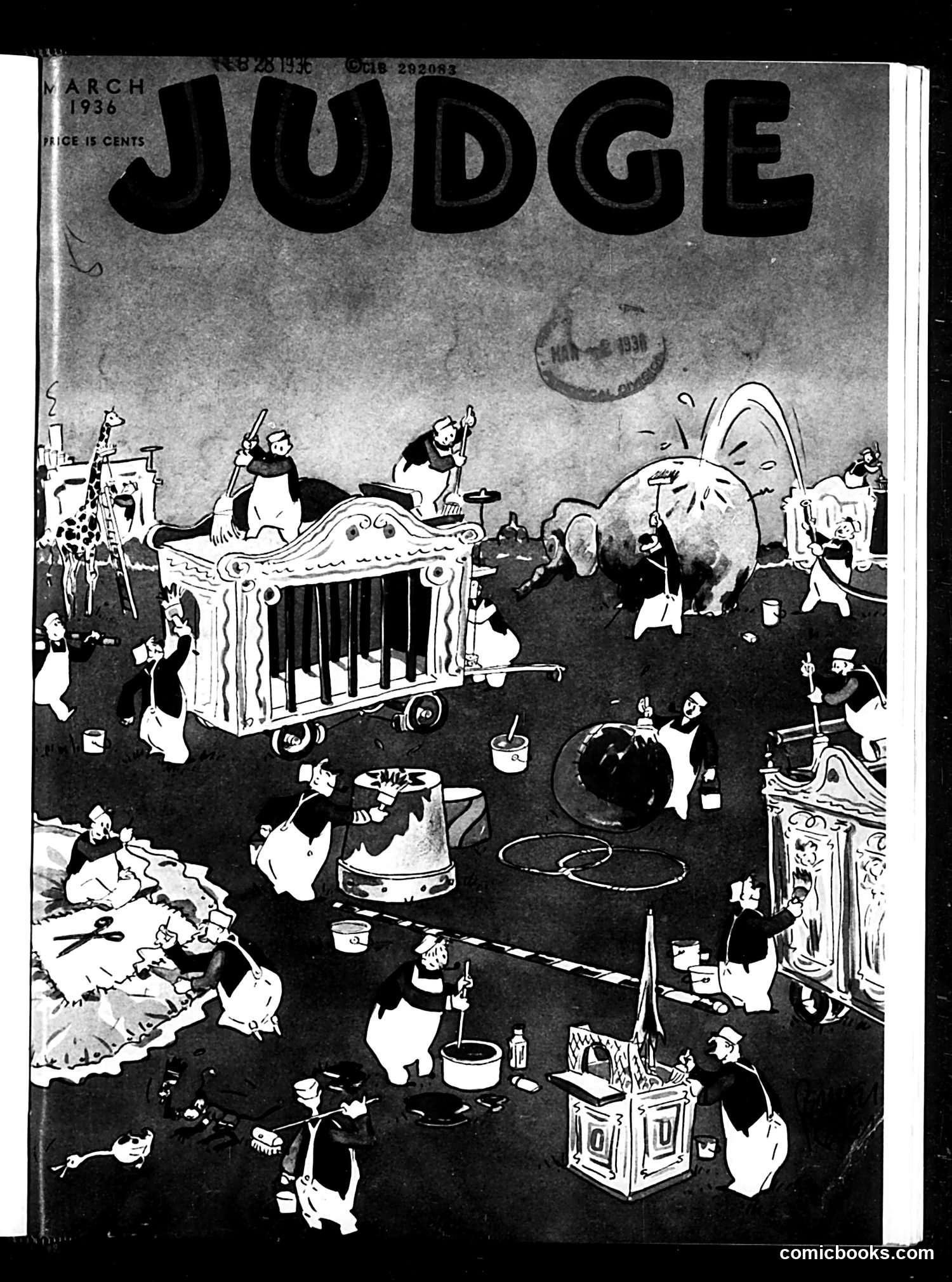
Analysis of Judge Magazine Cover, March 1936 This satirical cover depicts a chaotic nursery scene, likely commenting on New Deal government programs of the 1930s. The elaborate baby carriage at center, surrounded by numerous caretakers and implements, appears to represent a government agency or bureaucratic program being overly complicated and inefficiently managed. The multiple figures attending to the single baby suggest excessive government spending, redundant staffing, or bureaucratic waste—common conservative criticisms of FDR's Depression-era initiatives. The various toys and paraphernalia scattered about reinforce themes of governmental excess and mismanagement. The title "JUDGE" and March 1936 date confirm this is from the magazine's satirical commentary period, when it frequently criticized New Deal policies as wasteful or poorly conceived.
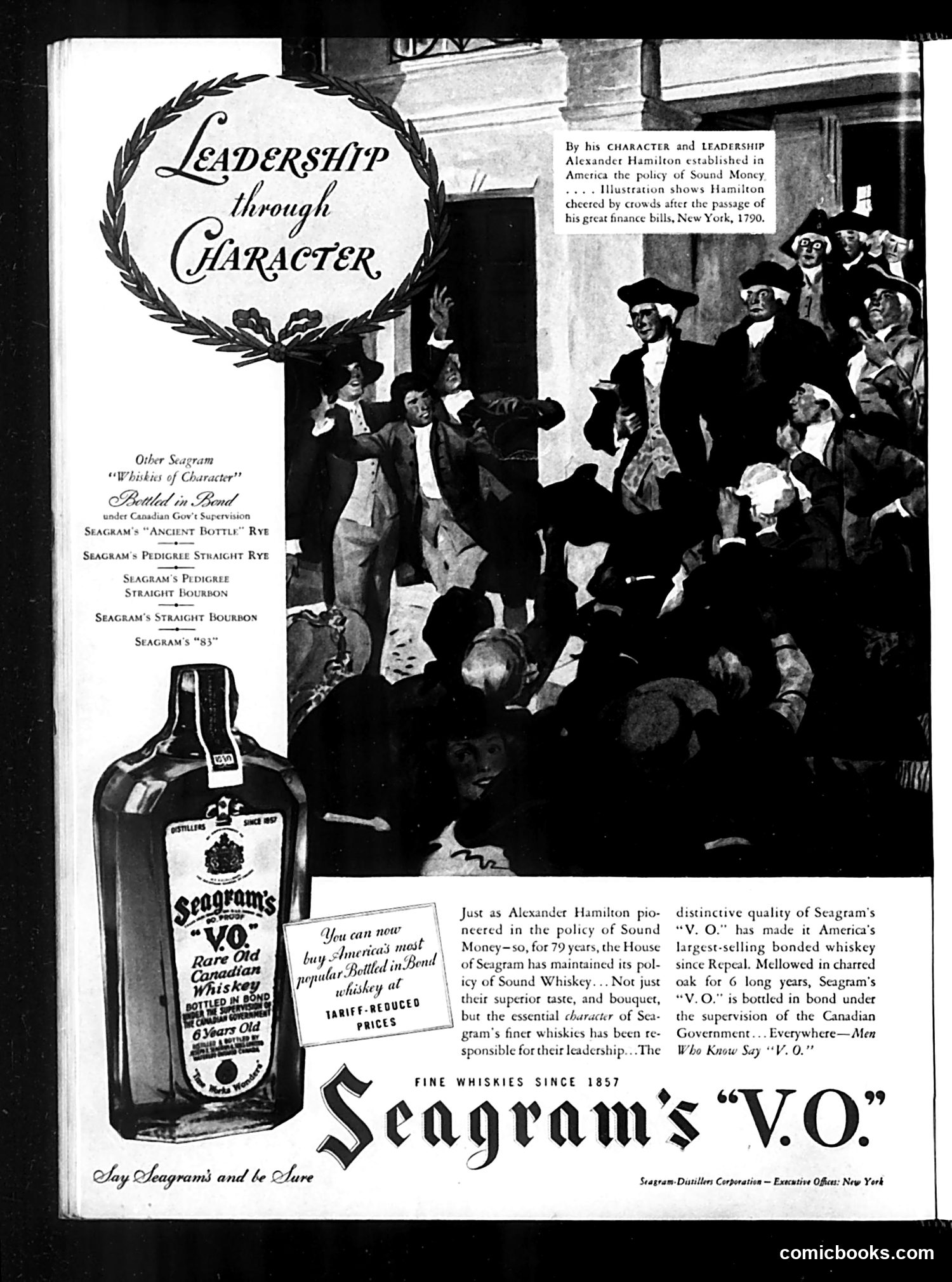
Analysis This page is primarily advertising for Seagram's V.O. whiskey, not political satire. The ad uses a historical theme rather than contemporary politics. The left side shows "Leadership through Character," featuring an illustration of Alexander Hamilton being cheered by crowds after passage of his 1790 finance bills in New York. The ad connects Hamilton's character-driven leadership to Seagram's whiskey's reputation and longevity since 1857. The text explicitly compares Hamilton's "policy of Sound Money" to Seagram's maintenance of quality standards in whiskey production over 76 years. It's a brand-building strategy: associating the product with American historical leadership and stability. The page is essentially a sophisticated commercial disguised as historical commentary, typical of Judge's advertising approach during the Prohibition-era repeal period.
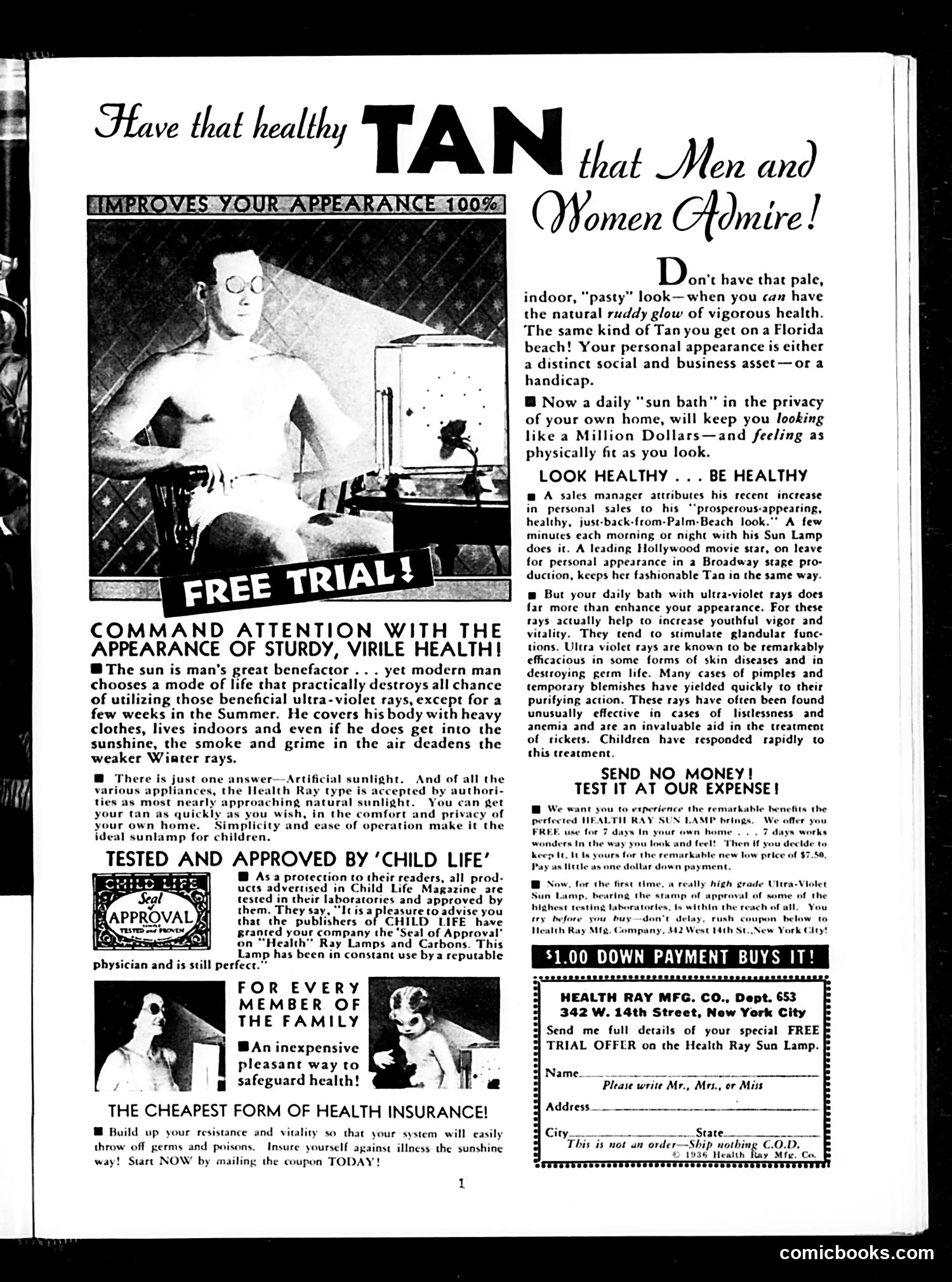
Analysis This page is primarily advertising, not satire or political commentary. It promotes a "Health Ray Sun Lamp" — an artificial ultraviolet light device marketed for home use to create a suntan indoors. The ad targets both men and women, claiming tanned skin signals "vigorous health" and improves appearance and social standing. It emphasizes convenience (no beach trip needed) and health benefits, citing UV rays' purported ability to fight rickets and increase "youthful vigor." There's a testimonial from a Hollywood movie extra and a "Child Life Seal of Approval" endorsement. The imagery shows a shirtless man using the lamp. This reflects 1930s-40s health fads promoting artificial tanning before the dangers of UV exposure were widely understood. The $1 down payment offer targets working-class buyers.
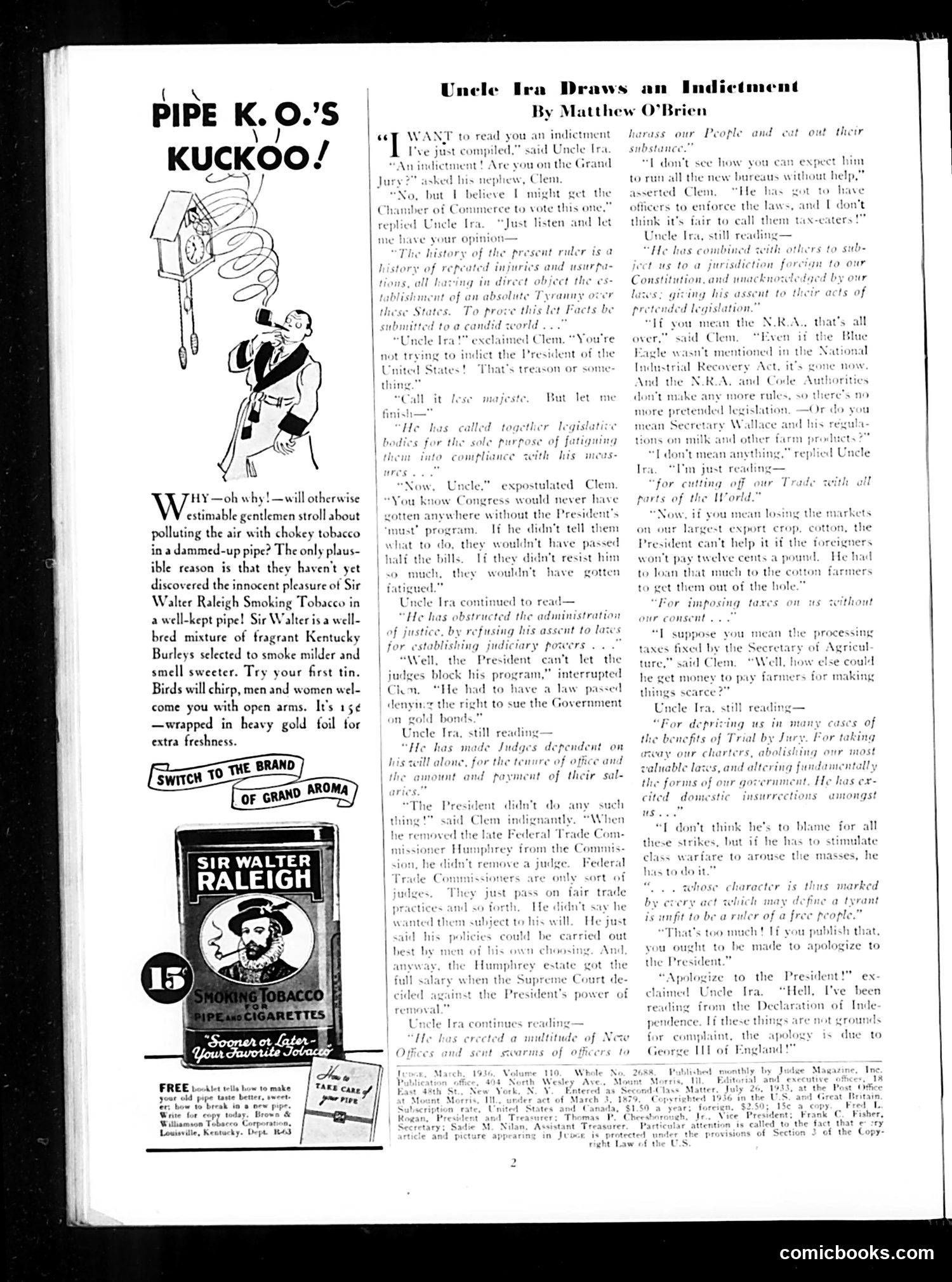
Political Satire Analysis This Judge magazine page contains two distinct elements: Left side: A Sir Walter Raleigh pipe advertisement with a humorous caption mocking the popularity of milder tobacco products among gentlemen. Right side: "Uncle Ira Draws an Indictment" by Matthew O'Brien satirizes President Franklin D. Roosevelt's New Deal policies. Uncle Ira (appearing to represent an older conservative) reads complaints about various Roosevelt administration programs—the N.R.A., judicial reform, trade restrictions, and executive power expansion. The satire presents these policies as governmental overreach and tyranny. The article criticizes Roosevelt for bypassing Congress, removing checks on executive power, and implementing legislation without proper constitutional procedure. This reflects conservative opposition to FDR's 1930s New Deal expansion.
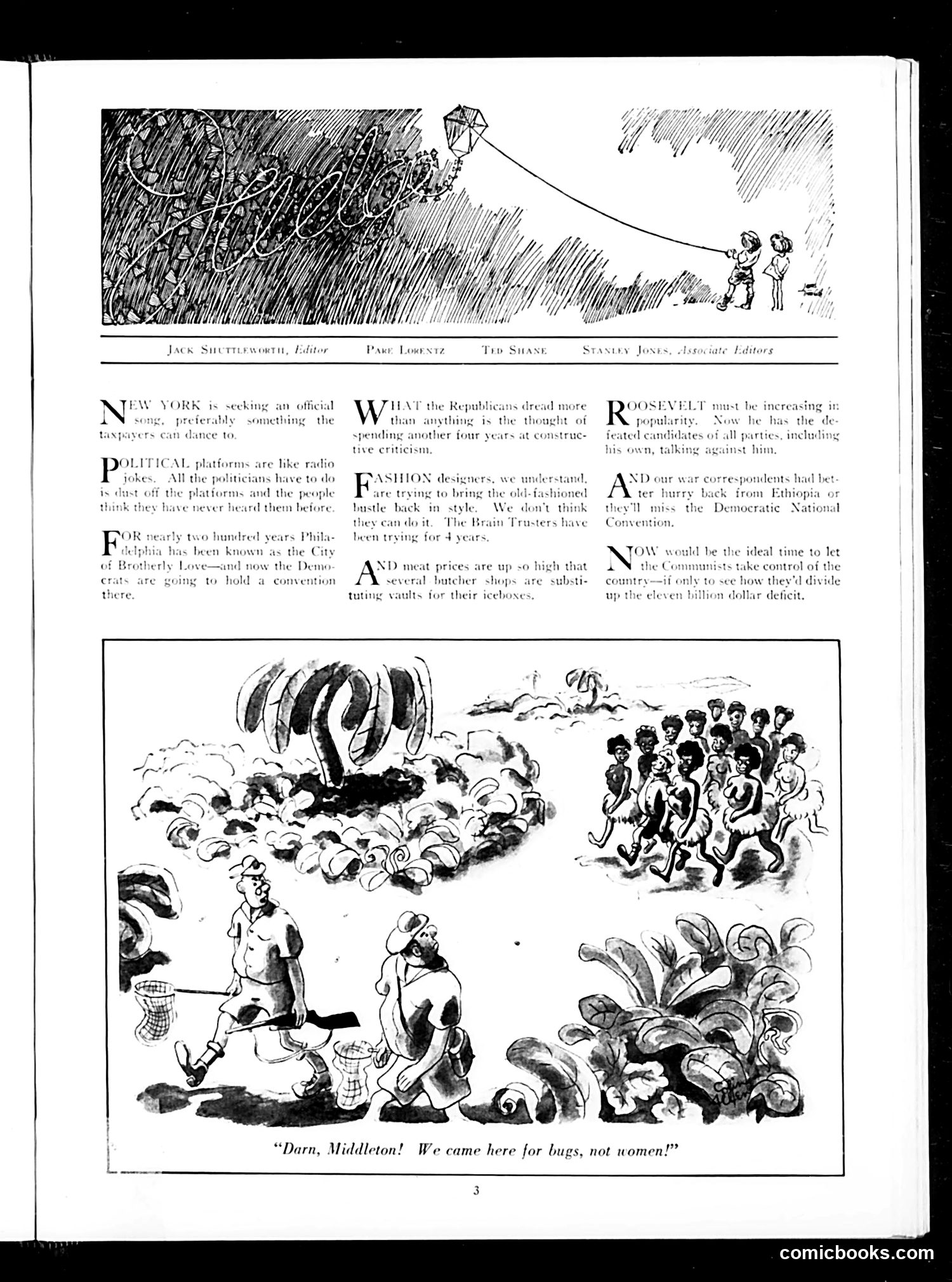
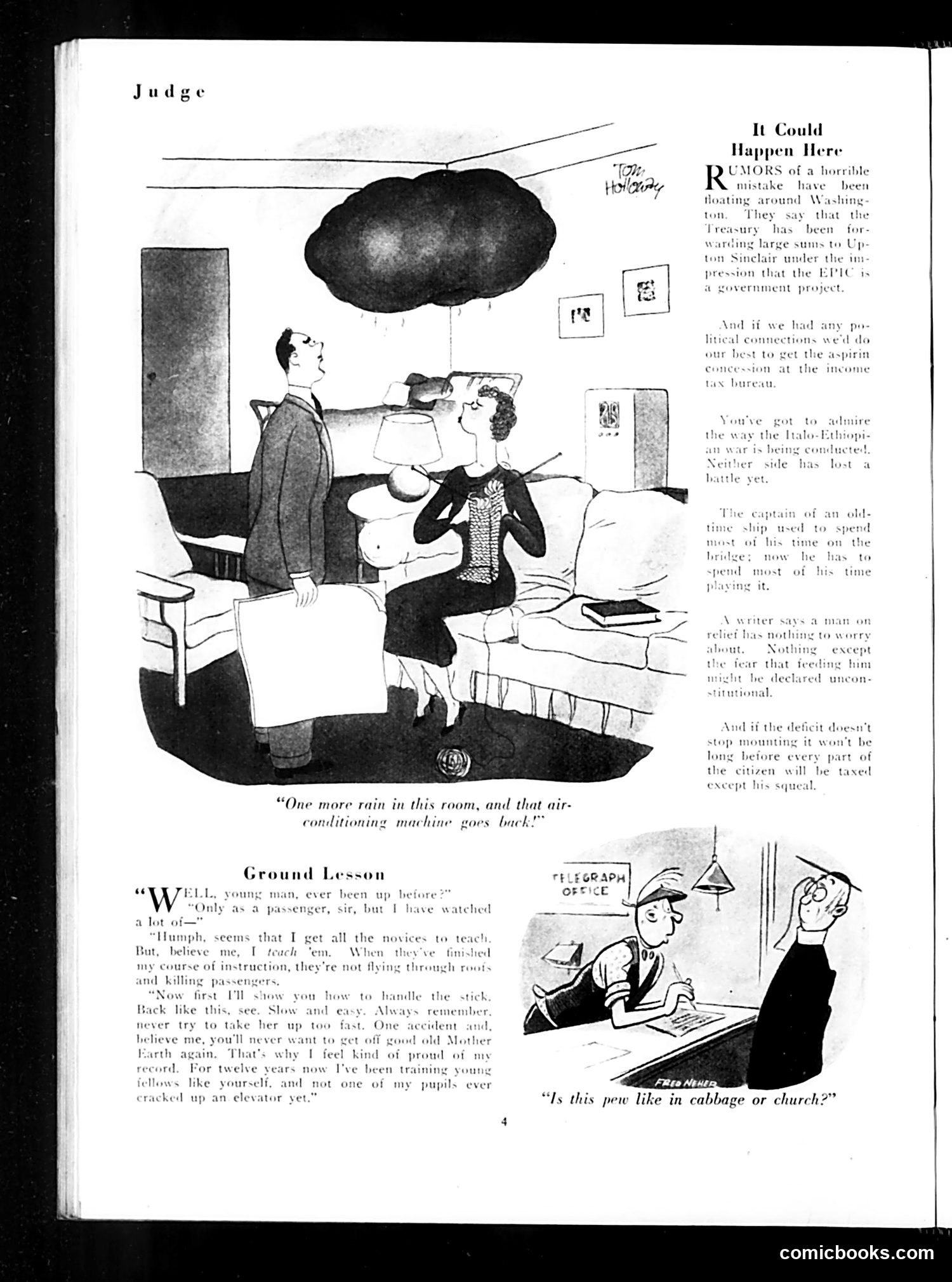
"Judge" Magazine Page Analysis Top Cartoon ("It Could Happen Here"): Depicts two men in an office with a large dark cloud overhead labeled "Treasury." The satire suggests rumors that the Treasury Department has been forwarding large sums to Upton Sinclair under the impression the WPA (Works Progress Administration) is a government project. The joke implies this would be a "horrible mistake"—mocking either government incompetence or suspicion of socialist sympathies. The scattered dollar bills suggest frivolous spending. Bottom Section ("Ground Lesson"): Shows an elevator operator instructing a young trainee on safety procedures, boasting of his twelve-year perfect safety record. The humor derives from his condescending, overly casual attitude toward dangerous work—suggesting complacency despite claimed expertise. Both pieces use humor to critique government inefficiency and workplace overconfidence.
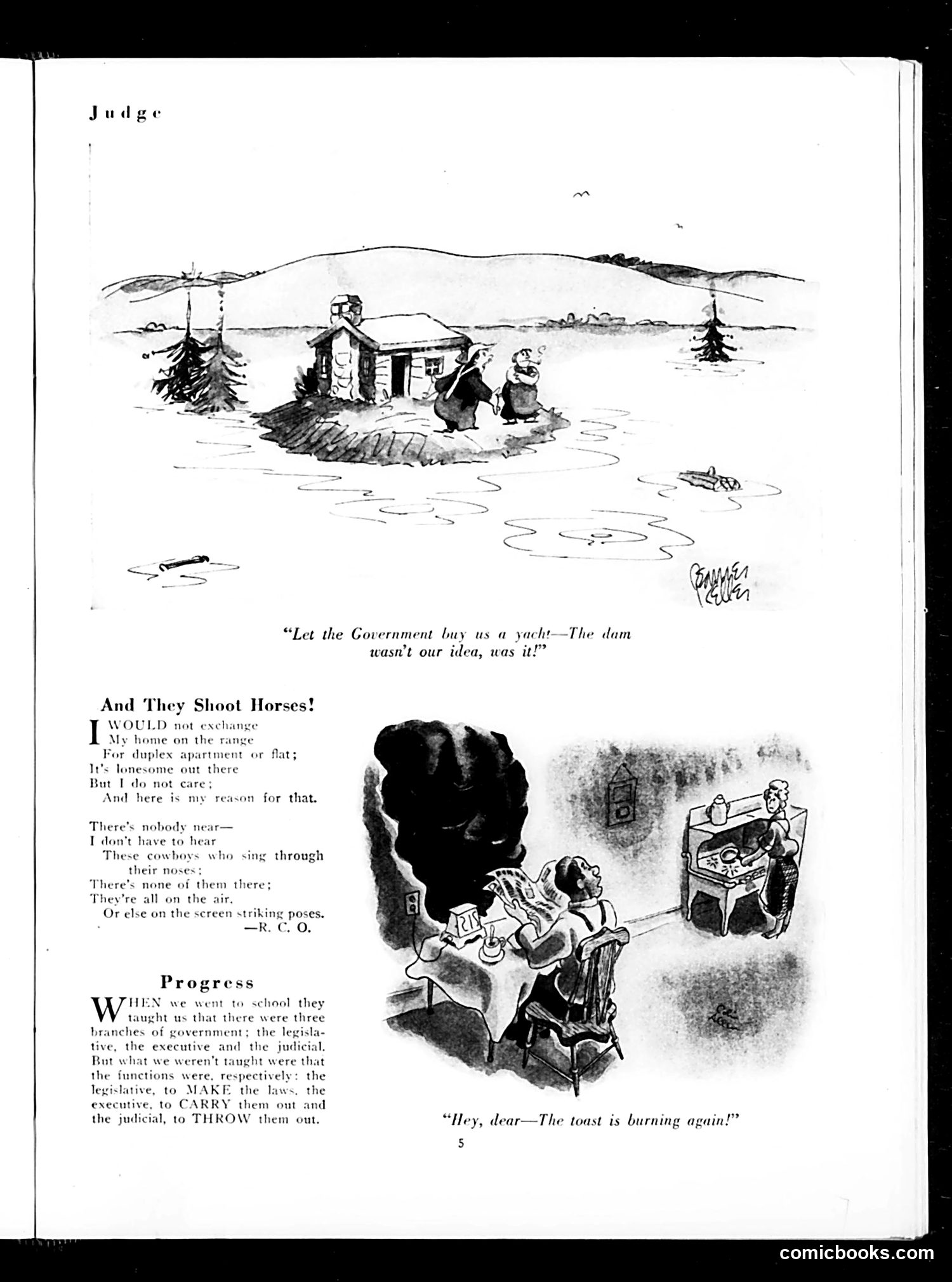
Analysis of Judge Magazine Page Top Cartoon ("Judge"): Shows people in a flooded shack requesting government purchase them a yacht, claiming "the dam wasn't our idea." This satirizes citizens seeking lavish government assistance or bailouts, mocking entitlement attitudes toward public spending. "And They Shoot Horses!" Section: A poem (attributed R.C.O.) criticizes the prevalence of cowboy singers on radio and in movies, complaining about their ubiquity and artificial "striking poses." The accompanying cartoon shows a frustrated listener at a radio while musicians perform elsewhere—satirizing the dominance of cowboy entertainment in 1930s popular culture. "Progress" Section: Explains the three government branches' theoretical functions (legislative makes laws, executive carries them out, judicial enforces them), likely ironically commenting on governmental dysfunction.
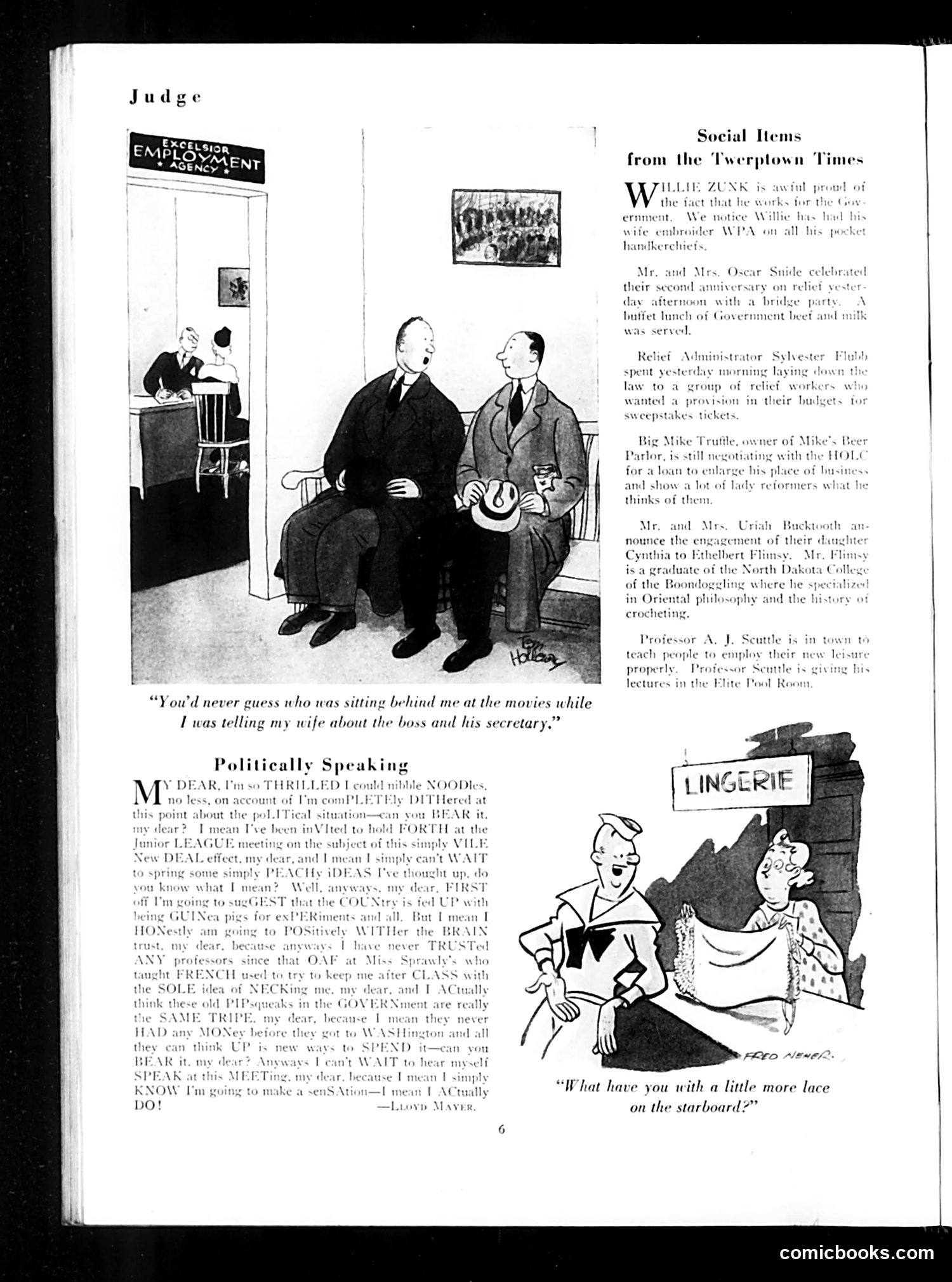
Judge Magazine Page Analysis This page contains two separate satirical pieces: Top Cartoon: A man sits between two figures at a movie theater, telling his wife about workplace gossip regarding "the boss and his secretary." The humor relies on the classic trope of an oblivious husband loudly discussing office affairs in public while appearing unaware of his own indiscretion or social awkwardness. "Politically Speaking" Column: A rambling letter using excessive capitalization and fragmented thoughts to satirize political discourse. The writer complains about political situations while employing deliberately chaotic reasoning—misspellings, contradictory arguments, and stream-of-consciousness style mock incoherent political debate and discourse of the era. Bottom Cartoon: A lingerie shop scene where a man requests "a little more lace on the starboard"—using nautical terminology humorously when discussing women's undergarments.
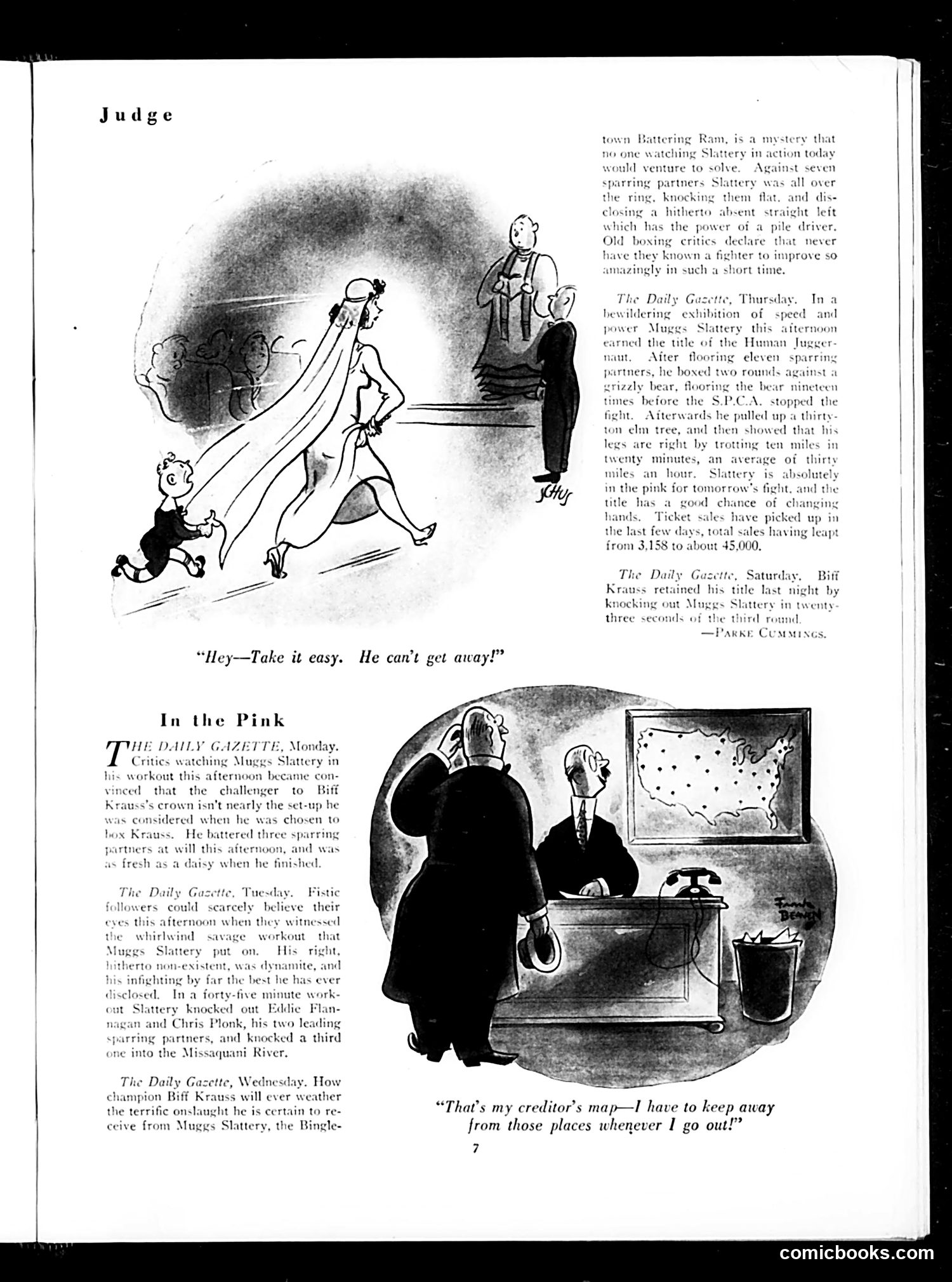
Content Analysis: Judge Magazine Page This page satirizes boxing and prize-fighting culture through two cartoons. The top illustration, captioned "Hey—Take it easy. He can't get away!," depicts a boxer (likely Muggs Slattery, referenced in the text) being restrained during a bout—mocking the violence and chaotic nature of professional boxing. The bottom cartoon, "In the Pink," shows a man studying a map marked with creditor locations, a visual pun on the phrase "in the pink" (meaning healthy/well). The joke satirizes debt and financial anxiety—the man must literally map out locations to avoid his creditors. The text entries from "The Daily Gazette" provide context about boxing matches and Slattery's fights, but the satire targets both the brutality of boxing entertainment and the broader anxieties of financial hardship among ordinary people.
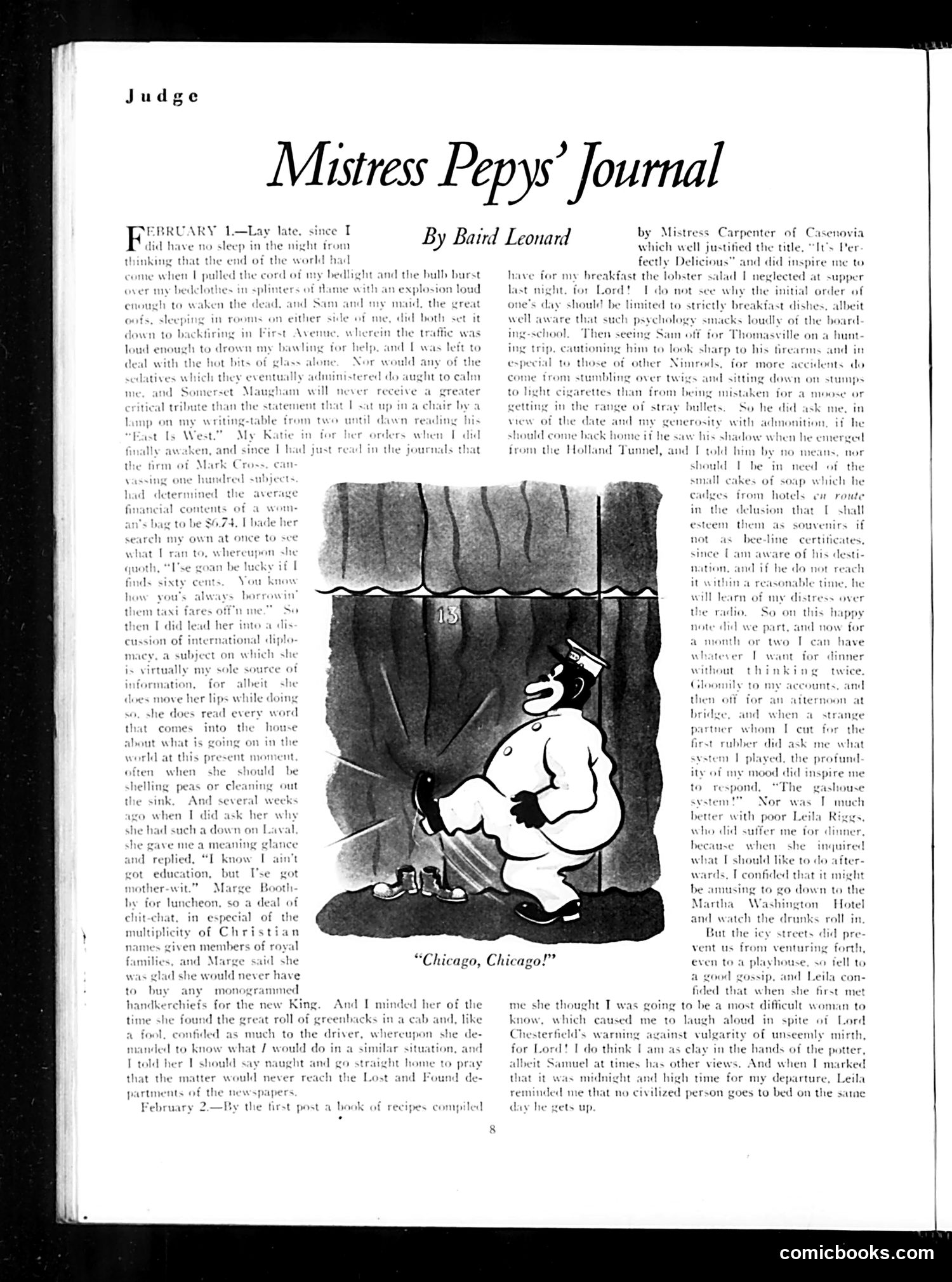
"Mistress Pepys' Journal" - Analysis This is a humorous diary column by Baird Leonard, styled as entries from a female society figure (identified as "Mistress Carpenter of Casenovia"). The column mimics Samuel Pepys' famous 17th-century diary, applying that literary conceit to contemporary high-society gossip. The cartoon depicts the diarist in a domestic scene. The humor derives from her breathless accounts of trivial social matters—breakfast disputes, cab rides with servants, visits to friends like "poor Leila Riggs"—treated with mock-serious importance. The satire targets the self-important pretensions of wealthy women whose days revolve around minor social dramas and hotel gossip. References to "Martha Washington Hotel" and casual complaints about servants' behavior reflect period class attitudes. The "Chicago, Chicago!" caption suggests urban sophistication. This is essentially satirizing the vapid concerns and gossipy nature of society women through pseudo-literary parody—transforming mundane domestic occurrences into faux-historical "journal entries."
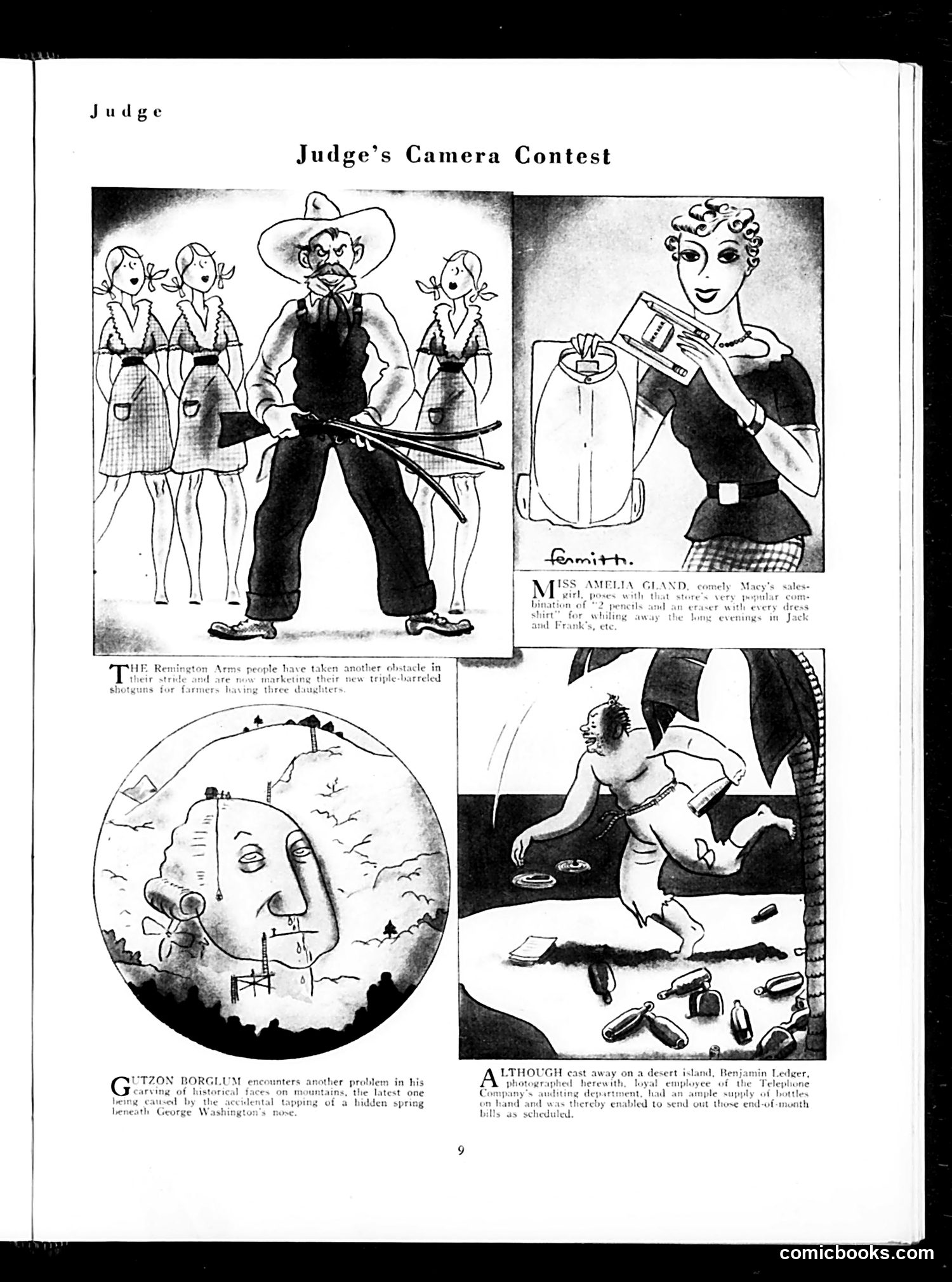
Judge's Camera Contest This page showcases humorous photo submissions to a contest. The top cartoon depicts a cowboy judge selecting between entries—a satirical jab at the Remington Arms company's marketing of triple-barreled shotguns to farmers with three daughters. The other entries shown are absurdist gags: one features a woman with beauty products, another shows someone's problem with hidden springs (likely referencing Gutzon Borglum, the sculptor, with a visual pun on Mount Rushmore/George Washington), and a third depicts someone stranded on a desert island with Telephone Company bottles—suggesting commentary on corporate reach or dependency. The humor relies on visual wordplay and contemporary consumer culture references typical of early 20th-century satirical magazines.
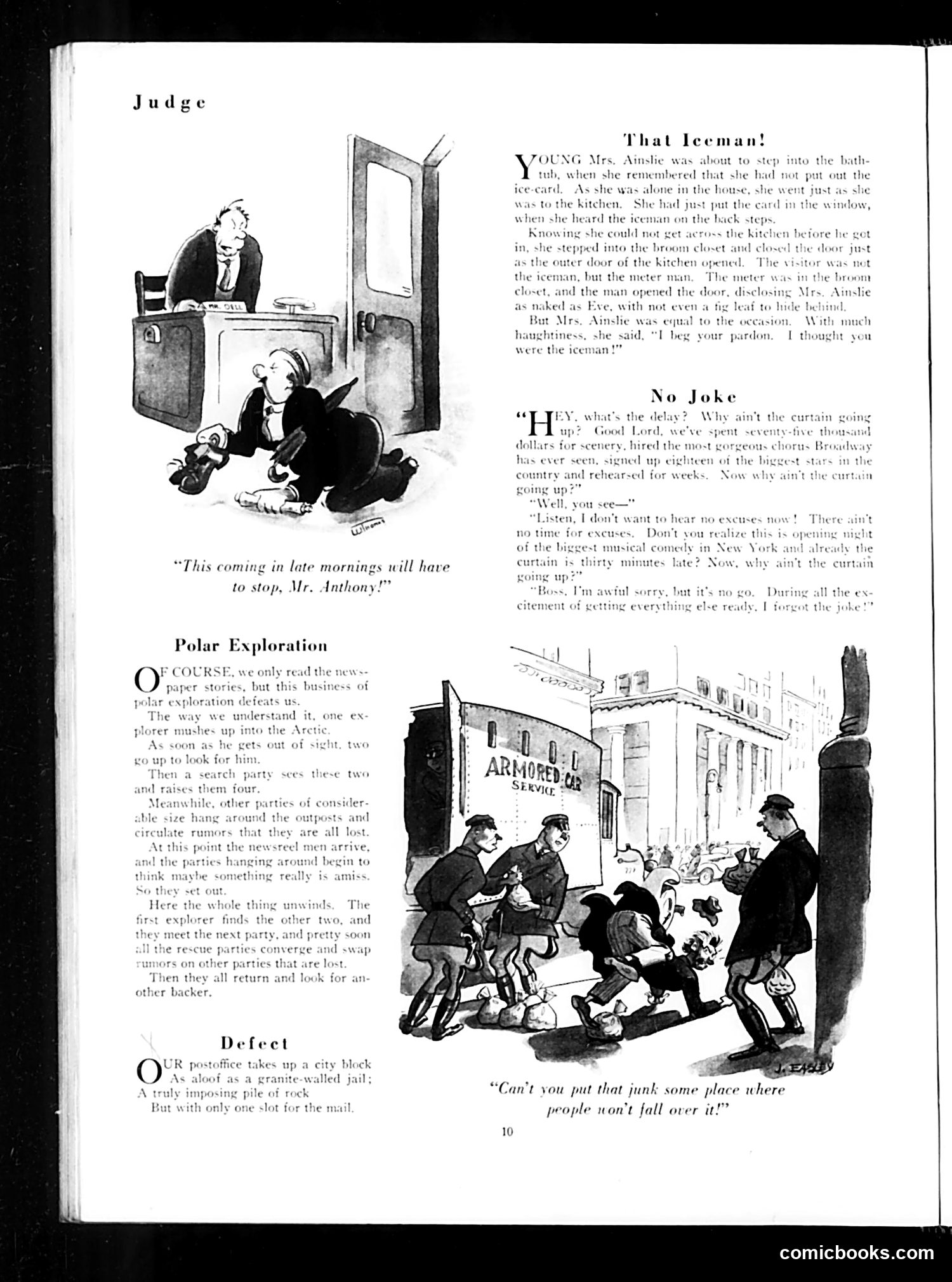
Judge Magazine Page Analysis This page contains three separate humorous pieces: "That Iceman!" (top): A domestic comedy about a young wife caught off-guard by the iceman's arrival while she's bathing. She frantically tries to hide, having forgotten to put out the ice-card (a sign requesting ice delivery). The joke plays on Victorian propriety—the embarrassment of an unexpected male visitor encountering a woman in dishabille. The cartoon shows her scrambling while a judge sits above, seemingly presiding over domestic mishaps. "No Joke" (right): Theater/show business satire about a Broadway musical's opening night. A producer complains the curtain won't rise, citing the enormous cost and effort invested. The joke mocks theatrical chaos and last-minute disasters undermining expensive productions. "Polar Exploration" and "Defect": Brief satirical poems about Arctic expeditions and municipal infrastructure (a post office building), using mock-serious language to deflate their importance. The page exemplifies *Judge*'s early 20th-century style: domestic comedy, theatrical satire, and lighthearted social observation with pen-and-ink illustrations.
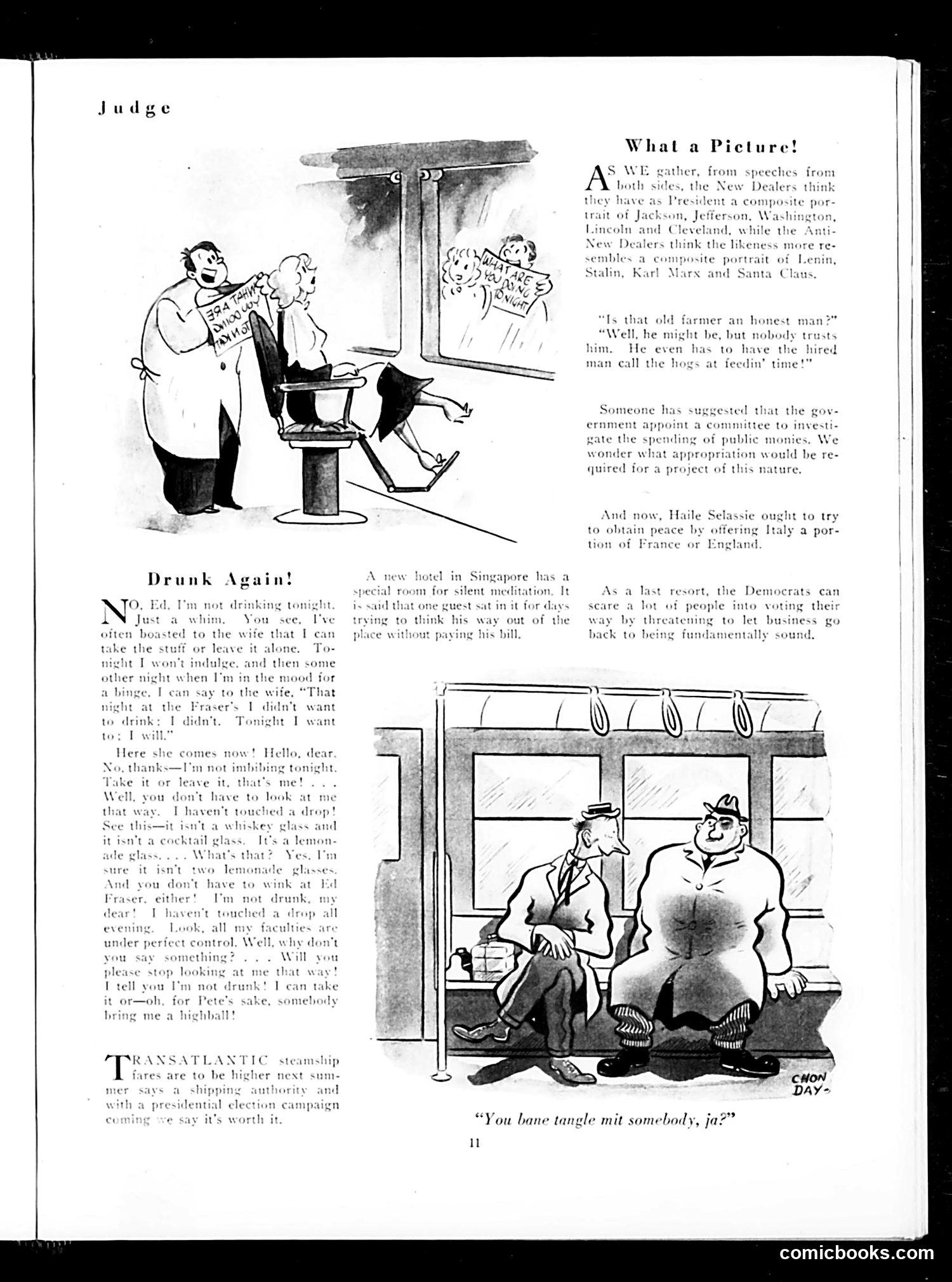
Analysis of Judge Magazine Page This page contains three distinct satirical pieces: "What a Picture!" compares New Deal and Anti-New Deal politicians to composite portraits of historical figures (Jackson, Jefferson, Washington, Lincoln, Cleveland vs. Lenin, Stalin, Marx, Santa Claus). The satire mocks both political sides' self-aggrandizement while equating New Dealers with communist leaders—a common conservative attack during the 1930s. "Drunk Again!" satirizes a man unconvincingly denying intoxication to his wife through increasingly absurd excuses and self-contradictory statements. The humor derives from his obvious inebriation despite desperate protestations. The bottom cartoon shows two men on what appears to be a ship, with dialogue "You bane tangle mit somebody, ja?" The caption references transatlantic steamship fares increasing—likely connecting to maritime labor disputes or shipping industry issues of the era. The page reflects 1930s American political anxieties: New Deal skepticism, Prohibition-era drinking culture, and international commercial concerns.
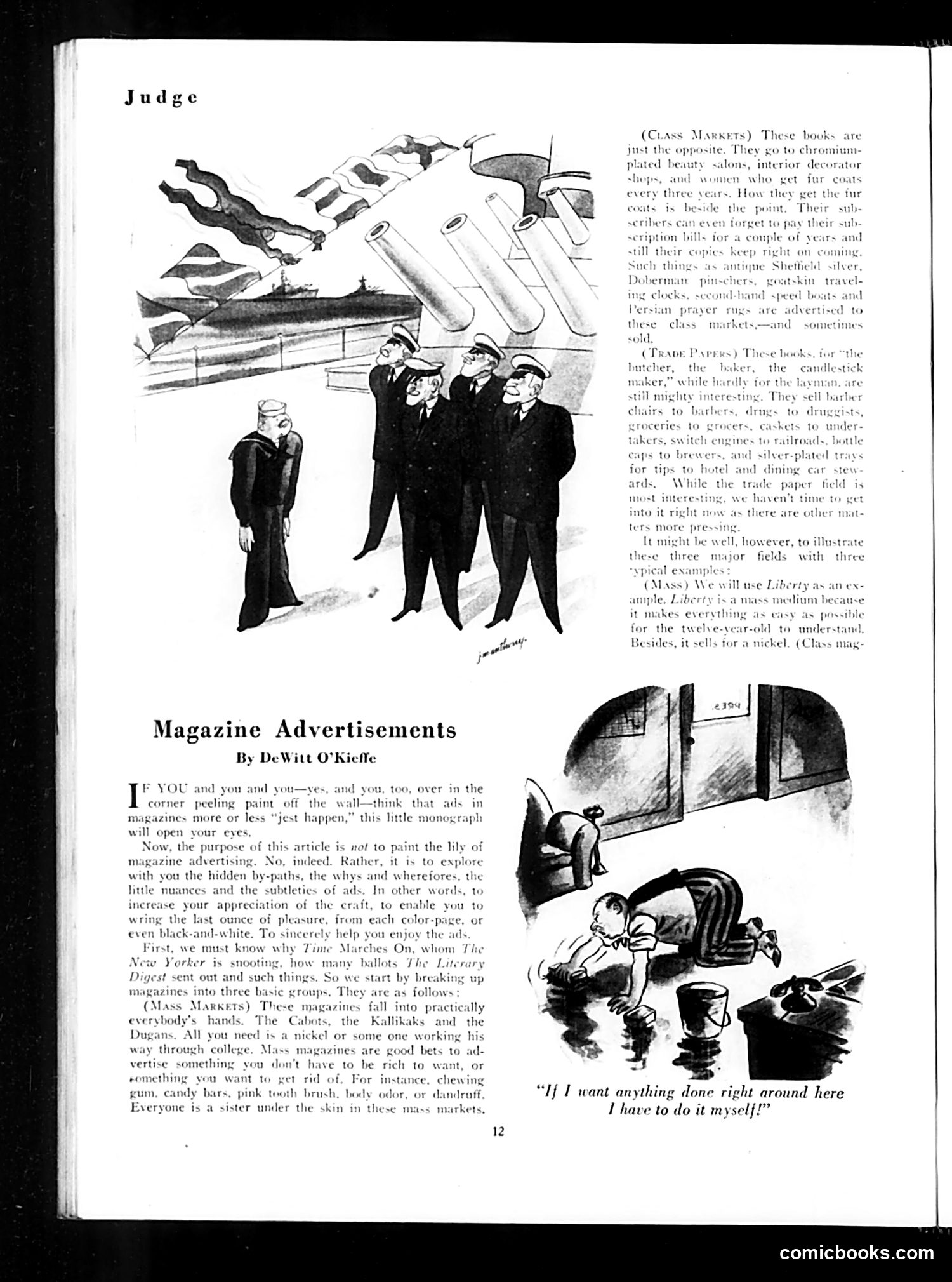
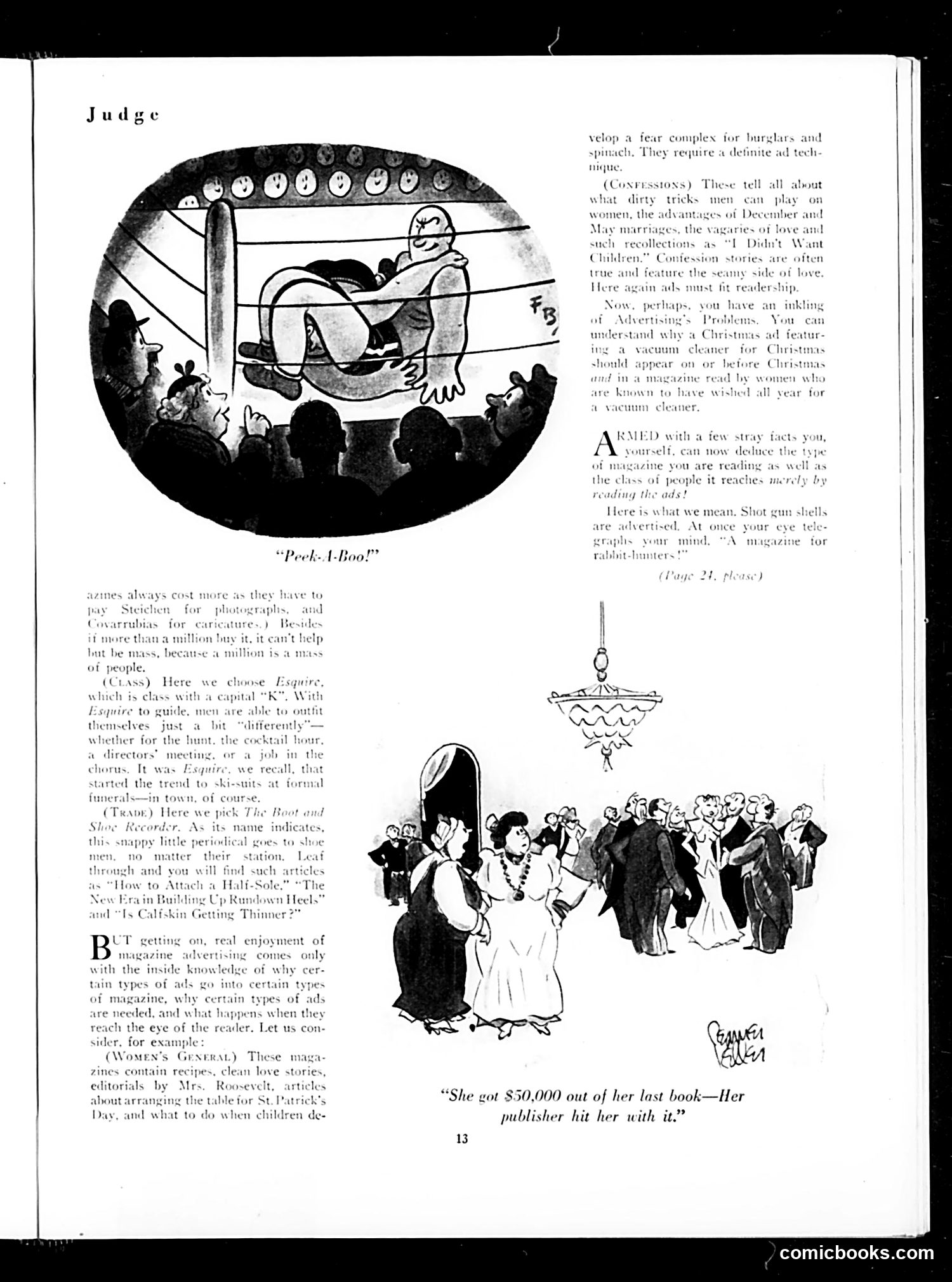
Magazine Advertisements Analysis This page is primarily text about advertising strategy rather than political satire. Author DeWitt O'Kieffe explains how magazine advertisements work by categorizing publications into three types: mass-market magazines (selling everyday products like chewing gum and toothbrushes to broad audiences), class magazines (targeting affluent readers with luxury goods like fur coats), and trade papers (selling specialized products to specific professions—butchers, grocers, etc.). The two illustrations are humorous examples of advertising's reach: the top cartoon shows men observing falling products/advertisements from above, while the bottom shows a frustrated figure saying "If I want anything done right around here I have to do it myself!"—likely illustrating how advertising pervasively surrounds consumers. The article uses *Liberty* magazine as a specific example of a class publication. This is marketing analysis, not political commentary.
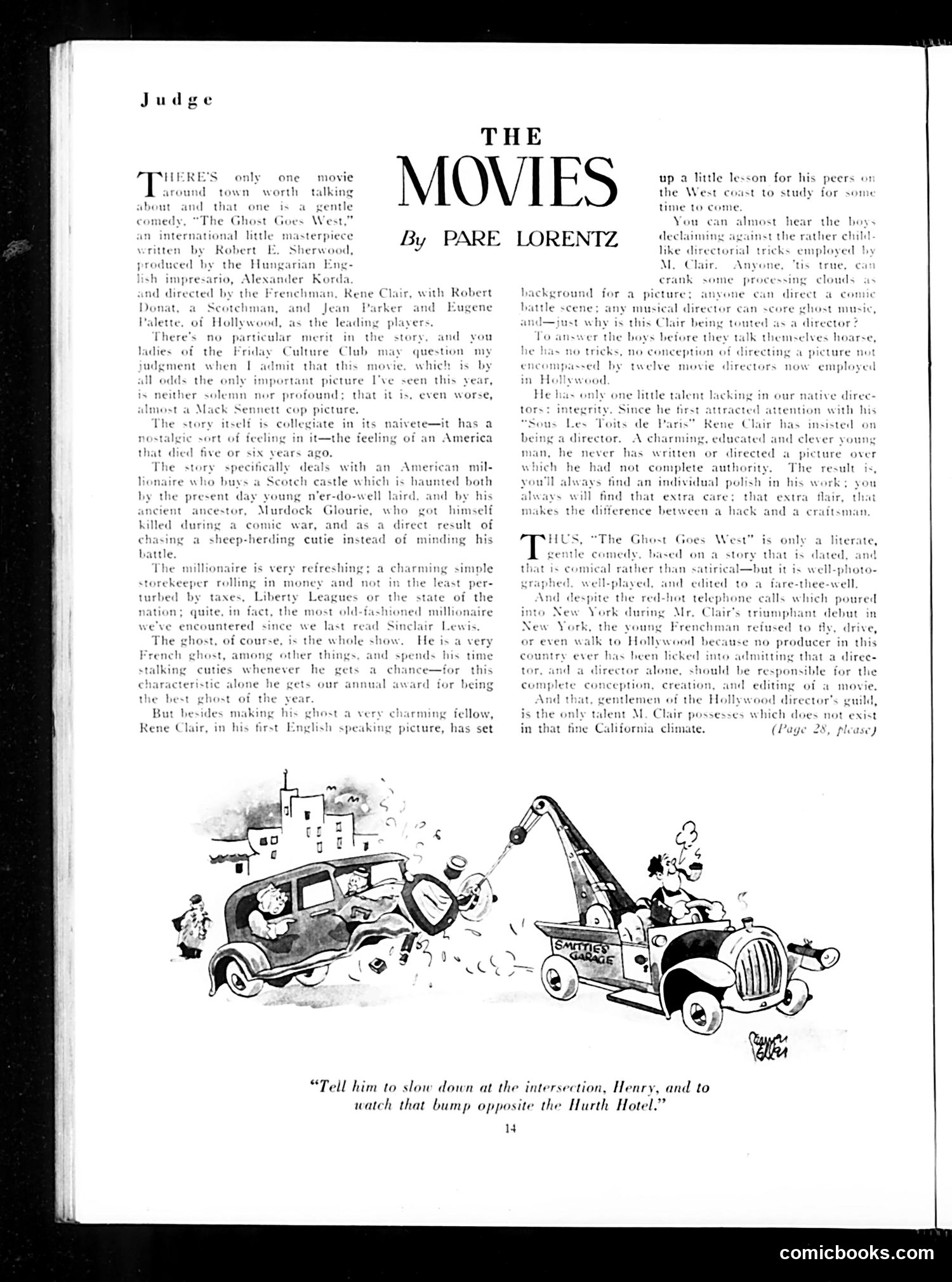
Analysis of Judge Magazine Page This page reviews "The Ghost Goes West," a film directed by French filmmaker René Clair—his first English-language picture. Critic Pare Lorentz praises it as the only worthwhile movie in town, though he tempers this with backhanded compliments about Clair's directorial limitations. The cartoon illustrates the review's theme: a comedic car-crash scenario showing mechanical mishap rather than deliberate artistry. The joke caption—instructing someone to watch for a bump by a specific hotel—mirrors Lorentz's point that Clair relies on simple, obvious physical comedy rather than sophisticated filmmaking technique. Lorentz's critique suggests Clair lacks the "polish" of true craftsmen; he compensates with charm and naiveté rather than technical mastery. The review notes Clair was reluctant to work in Hollywood, establishing him as an outsider to the American studio system—a recurring concern in 1930s film criticism about European directors adapting to American commercial cinema.
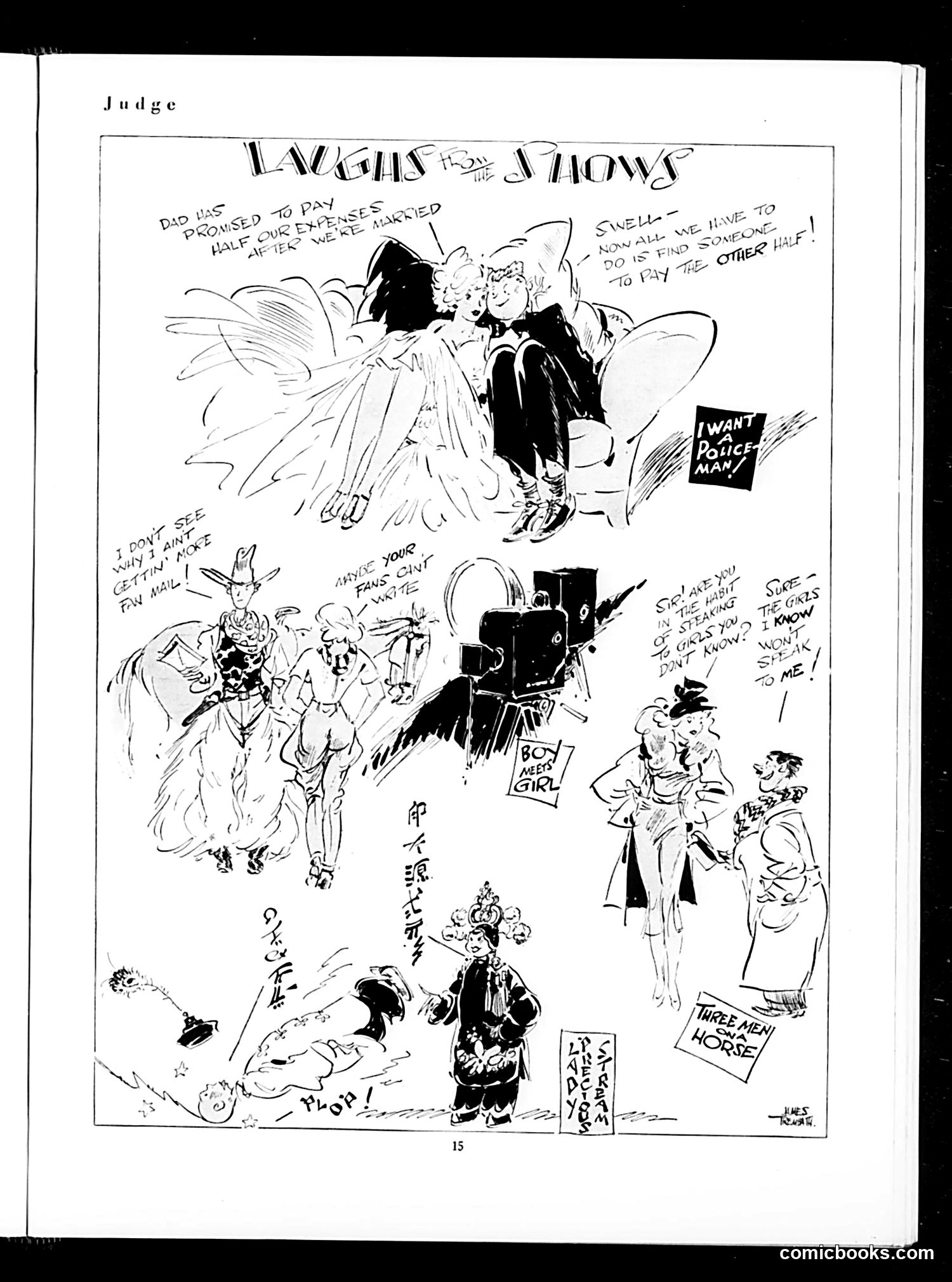
Judge Cartoon Analysis: "Laughs From the Shows" This satirical cartoon collection mocks theatrical productions and their associated social complications. The central scene shows a bride and groom at an altar with a clergyman, while one figure declares "Dad has promised to pay half our expenses after we're married" and another responds about finding "someone to pay the other half"—satirizing financial dependency in marriages and the expectation that fathers subsidize newlyweds. Other vignettes mock theatrical types: a police officer summoned to a show, a "three men horse" act, and various performers and socialites. The overall theme critiques the theatrical world's financial precariousness, social pretension, and the blurred lines between performance and real life that audiences of early-20th-century Judge magazine would have recognized.
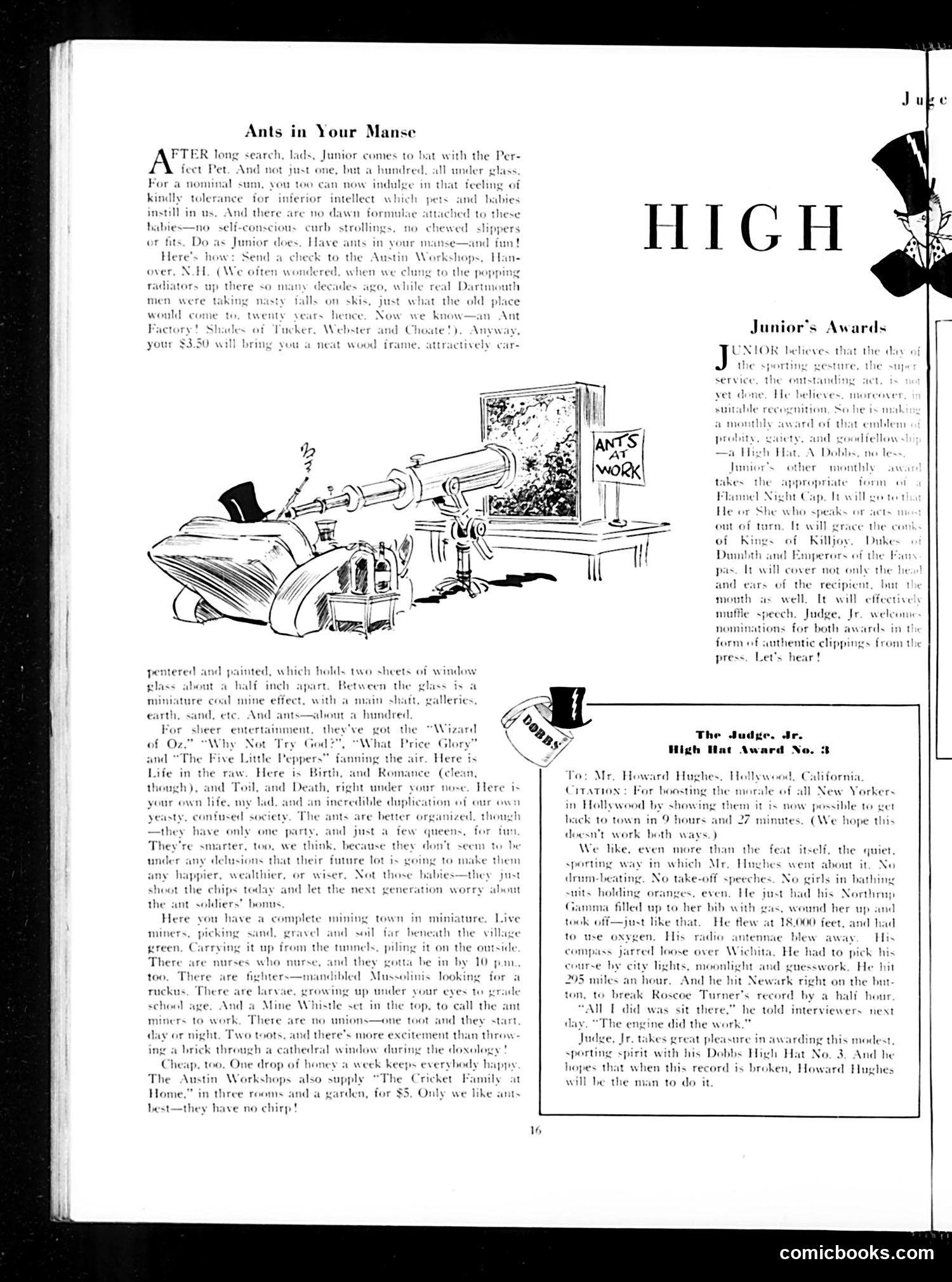
Judge Magazine Page Analysis This page contains two distinct pieces of satirical content: "Ants in Your Manse" (left): A humorous advertisement promoting an ant farm as an educational toy for wealthy children. The satire mocks upper-class parenting by suggesting ants teach better life lessons than human society—they're organized, industrious, and lack the pretensions of "yeasty, confused society." The joke targets how privileged families (referencing Dartmouth and Choate schools) might prefer teaching their children through insects rather than actual discipline. "Junior's Awards" (right): Documents a "High Hat Award No. 3" given to aviator Howard Hughes for flying from Los Angeles to Newark in under 10 hours. The satire praises Hughes's modest, no-nonsense approach—he simply flew the plane without speeches or fanfare—contrasting with typical celebrity grandstanding. Judge Jr. awards a Dobbs hat for such "sporting spirit" and quiet achievement, suggesting Hughes's restraint makes his feat more admirable than the record itself. Both pieces satirize contemporary American values through praise of efficiency and understated accomplishment.
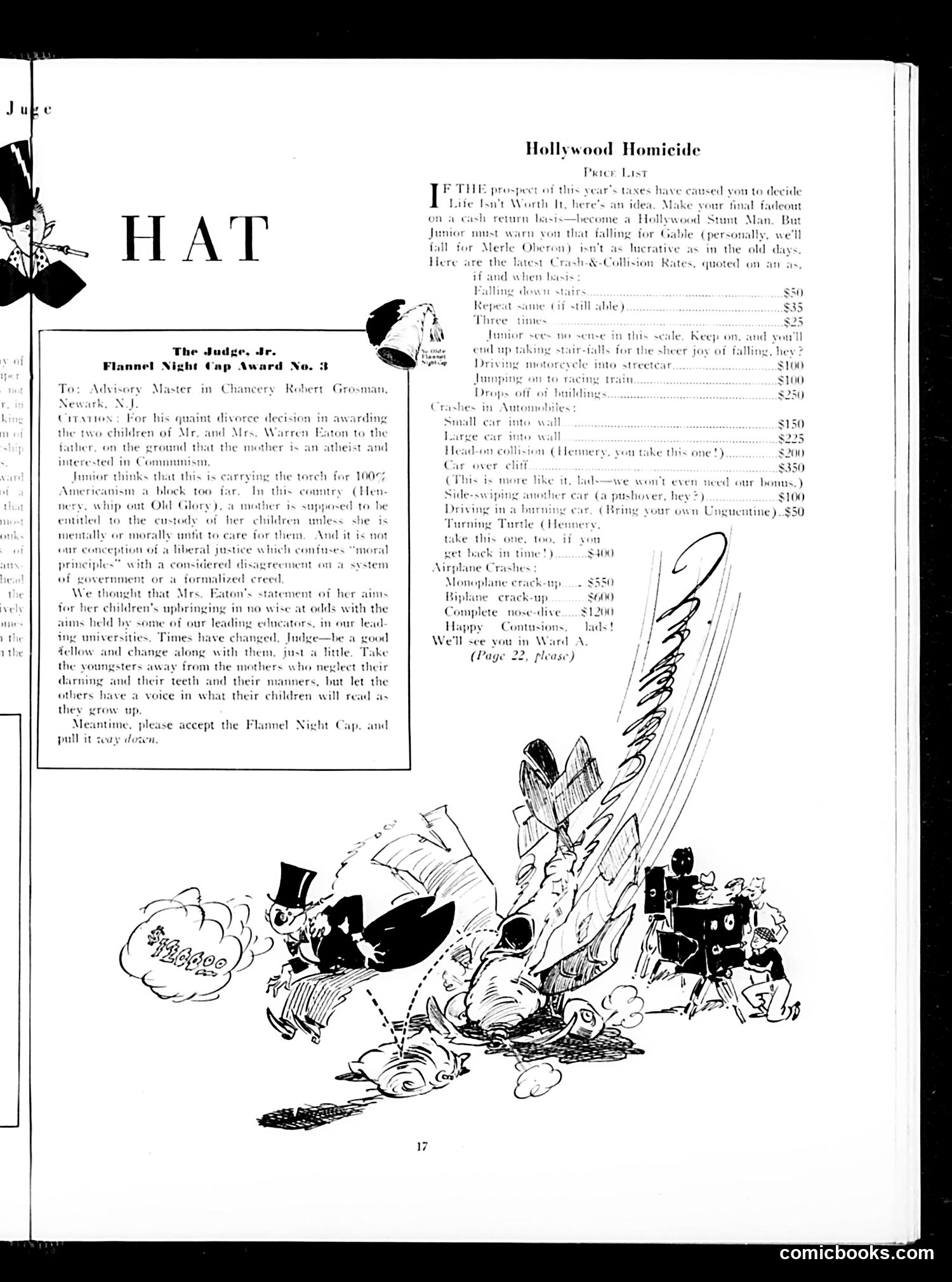
Explanation for Modern Readers This page contains two unrelated satirical pieces from *Judge* magazine: "HAT" / "The Judge, Jr. Flannel Night Cap Award": A sarcastic award criticizing a divorce court decision by Judge Robert Grosman. The judge awarded custody of children to their father based on the mother's supposed communist sympathies, rather than evaluating actual parental fitness. *Judge* sarcastically suggests the decision confuses political disagreement with moral unfitness, and awards the judge a "Flannel Night Cap"—a humiliating prize implying foolishness. "Hollywood Homicide Price List": A dark comedy riffing on Depression-era desperation. It sardonically suggests readers become Hollywood stunt performers as a tax-avoidance scheme, then lists the escalating "crash rates" paid for increasingly dangerous stunts (falling down stairs, car crashes, plane crashes). The satire mocks both Hollywood's exploitation of expendable stunt workers and the economic desperation driving people to accept deadly jobs. The cartoon below depicts a catastrophic stunt accident, reinforcing the danger joke.
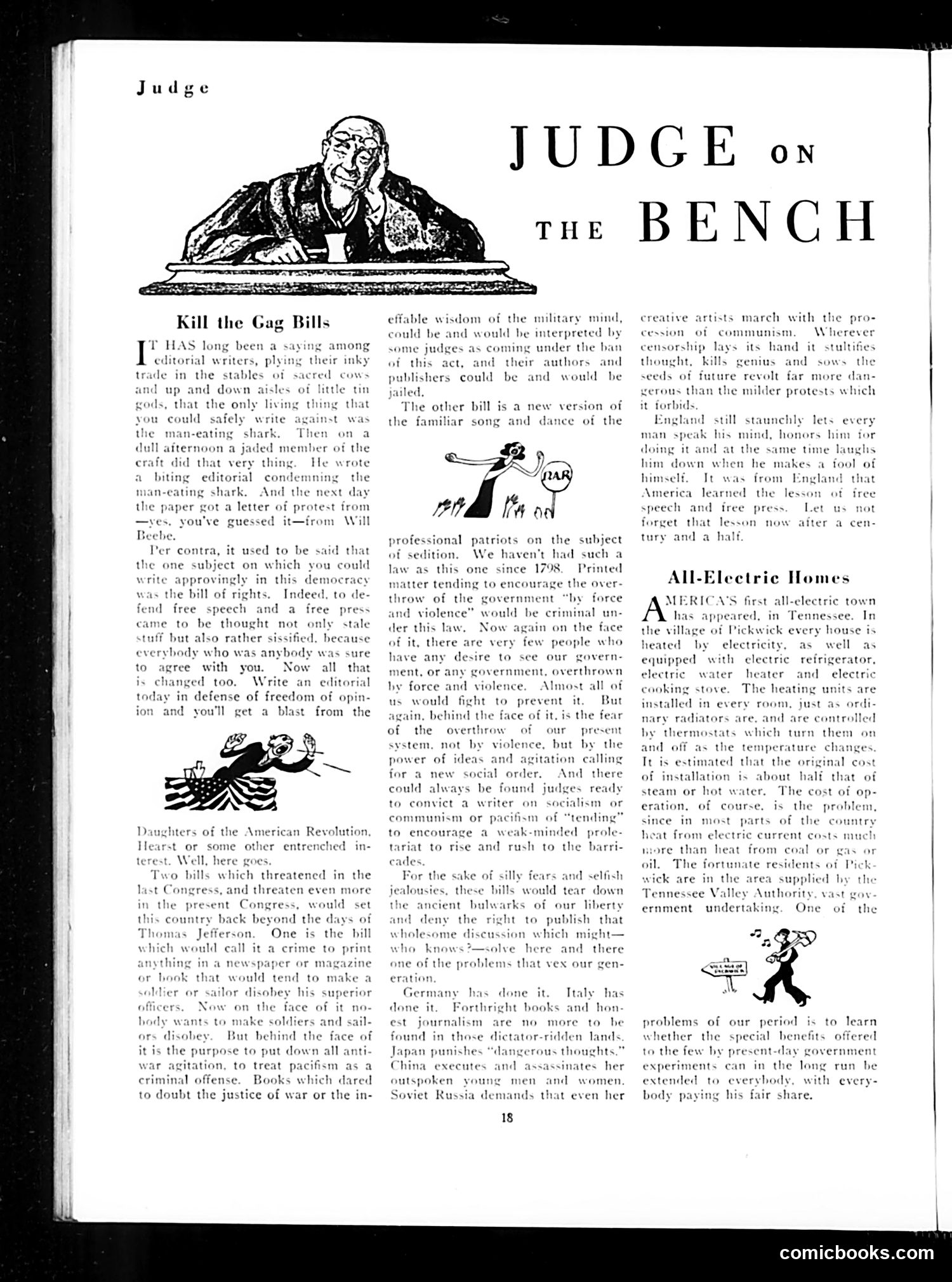
Judge Magazine: "Kill the Gag Bills" This editorial cartoon/article attacks two proposed Congressional bills that would criminalize anti-war speech and pacifism. The piece argues these "gag bills" threaten fundamental American freedoms of speech and press—rights the author claims shouldn't require defense but apparently do. The satire targets "professional patriots" who support such legislation out of fear, not principle. The author draws comparisons to fascist and communist regimes (Germany, Italy, Japan, Soviet Russia) that suppress dissent and "dangerous thoughts," warning America risks similar tyranny if it abandons free speech protections. The repeated theme: judges might interpret such vague laws to prosecute socialists, pacifists, or anyone questioning government authority—not through actual violence but through words alone. The piece invokes the Daughters of the American Revolution and references to Thomas Jefferson to emphasize these bills betray founding principles established "a century and a half" prior.
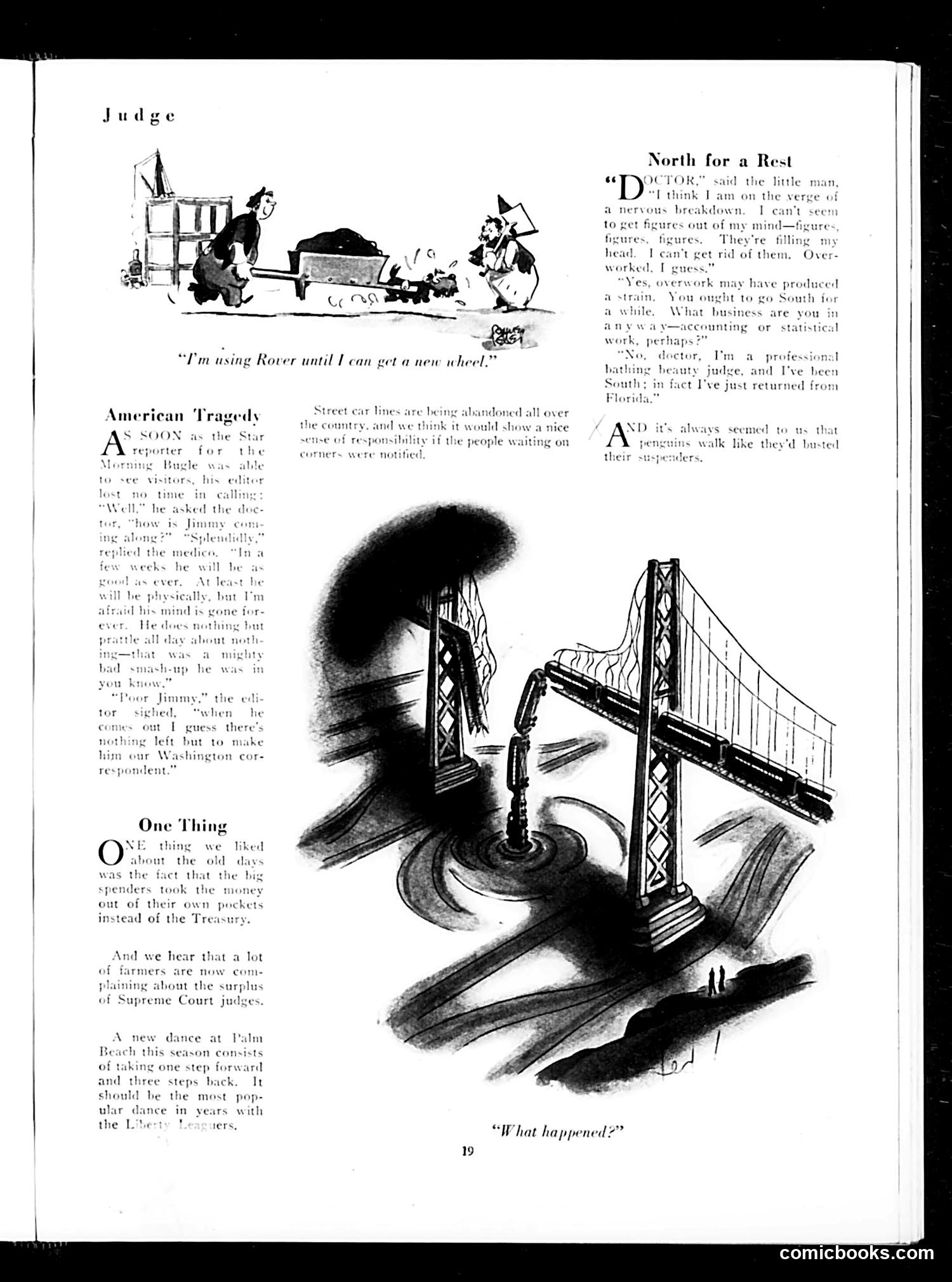
Analysis of Judge Magazine Page This page contains three satirical pieces reflecting early 20th-century American concerns: "American Tragedy" mocks a newspaper reporter visiting a doctor about nervous exhaustion from overwork. The joke plays on the irony that while he complains of mental fatigue and figures "tiling his head," the doctor notes he'll recover—yet the reporter's own mind seems preoccupied with trivial office politics rather than genuine illness. "One Thing" sarcastically praises the old days when "lag spenders took money out of their own pockets instead of the Treasury"—a dig at government waste and the growing surplus of federal funds. It also jabs at farmers complaining about Supreme Court judges, likely referencing agricultural disputes. "North for a Rest" shows a doctor recommending a Southern vacation to an overworked patient. The irony: the patient is a "professional batting beauty judge" recently returned from Florida, suggesting leisure-class frivolity disguised as medical necessity. The bridge illustration captioned "What happened?" remains unclear without additional context, but likely comments on infrastructure or progress.
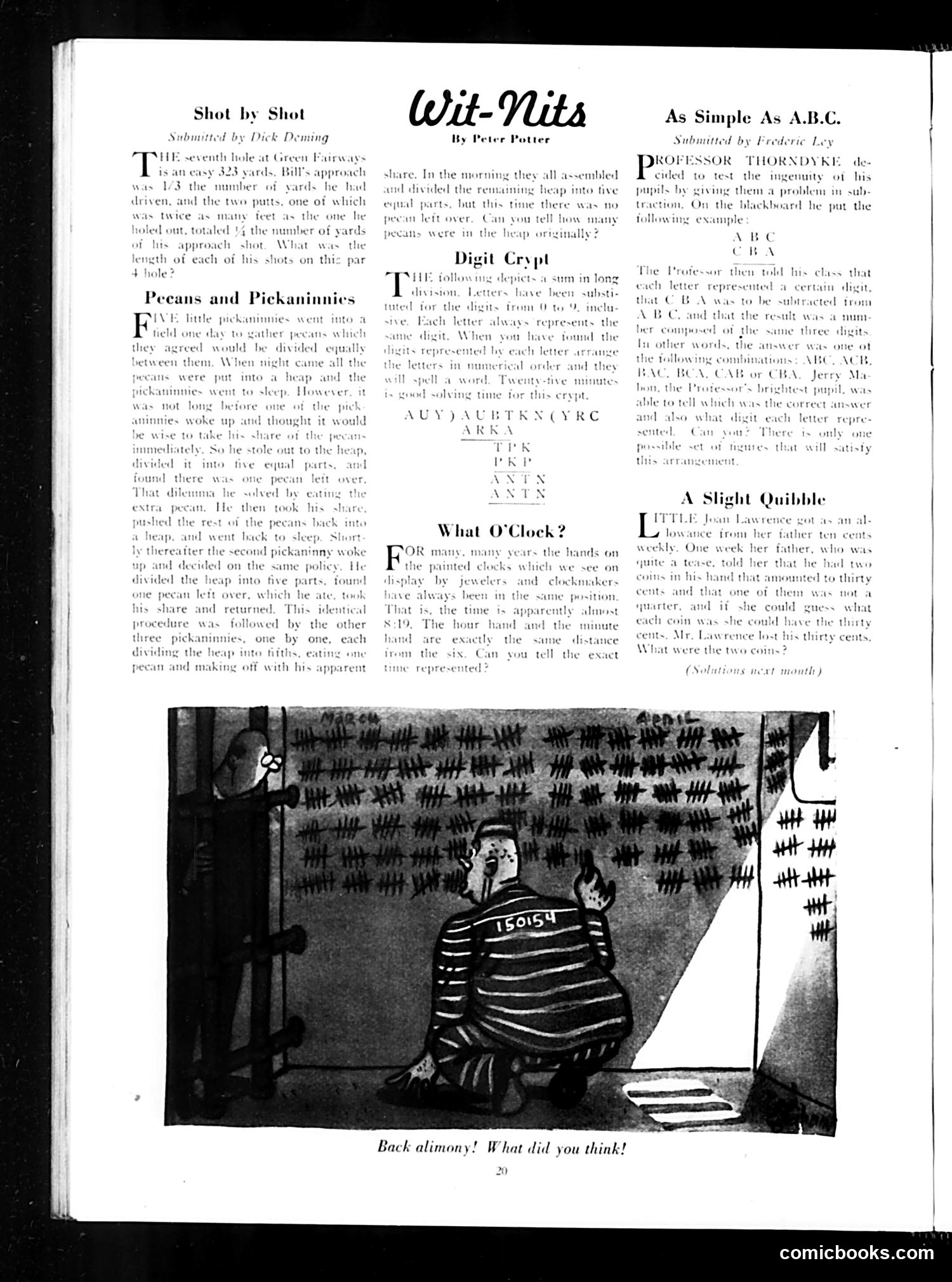
"Wit-Nits" Page Analysis This page from *Judge* contains three puzzle columns and one cartoon. The main illustration—captioned "Back alimony! What did you think!"—shows a prisoner in striped clothing (numbered 150154) counting tally marks on a wall, with another figure observing from a doorway. The joke appears to satirize prison life: the prisoner is meticulously tracking time served, while the caption's reference to "alimony" suggests he's imprisoned for failing to pay spousal support—a common legal entanglement of the era. The humor lies in the absurdity of the situation and the prisoner's obsessive record-keeping. The three accompanying text puzzles—"Pecans and Pickaninnies," "Digit Crypt," "What O'Clock?," and "A Slight Quibble"—are recreational math and logic problems typical of *Judge*'s educational entertainment content for readers.
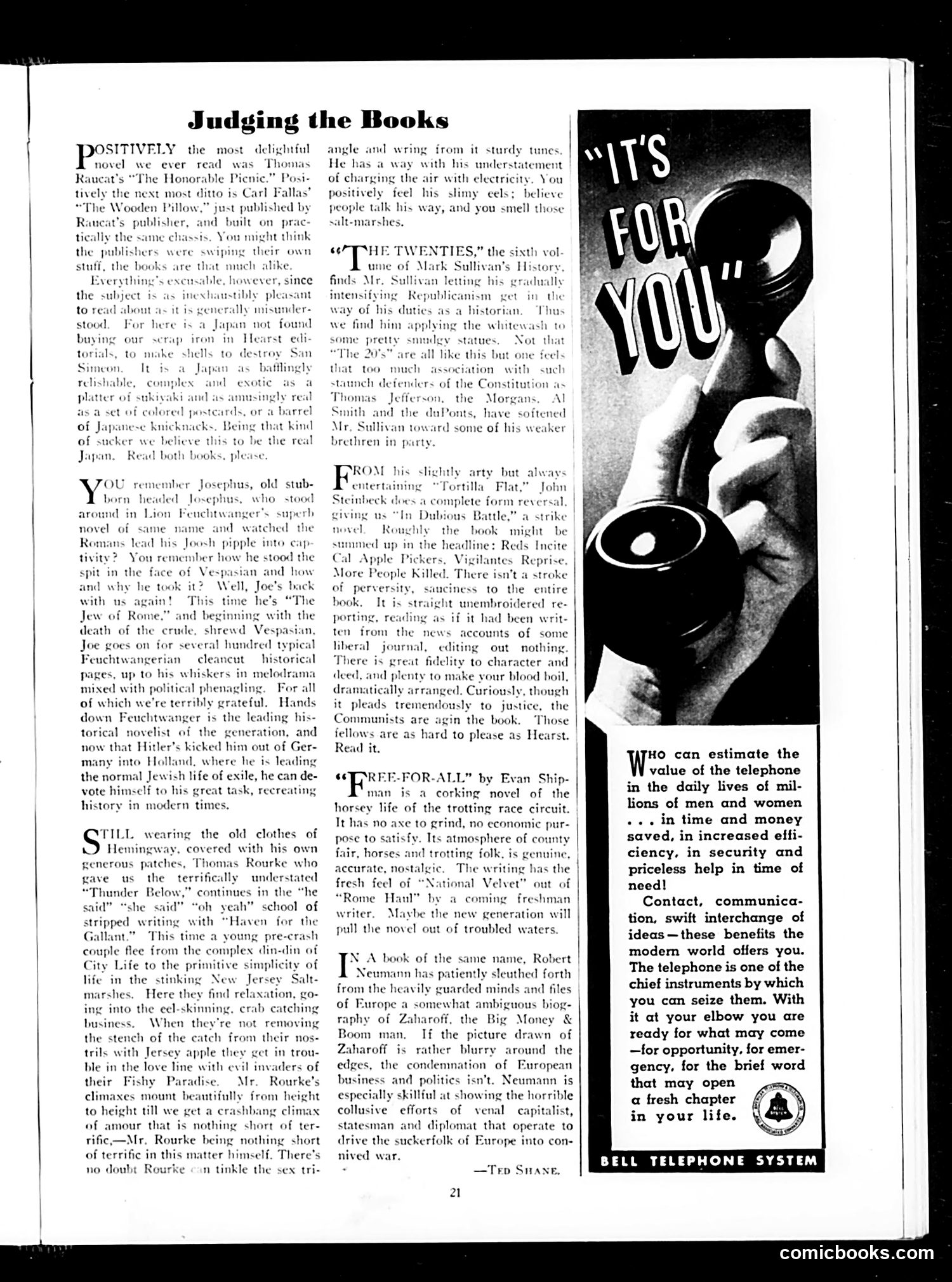
"Judging the Books" - Judge Magazine Book Reviews This page contains literary reviews rather than political cartoons. The critic (Ted Shane) discusses contemporary novels, mixing praise with gentle satire about publishers' similar output. Key points: The reviewer notes that two Japanese novels—Raucat's "The Honorable Picnic" and Fallas's "The Wooden Pillow"—are suspiciously alike, suggesting publishers may be recycling similar material. He praises Feuchtwanger as a leading historical novelist, noting Hitler's expulsion of him from Germany actually benefits literature. He reviews Hemingway-influenced works and critiques Mark Sullivan's "The Twenties," a history of the 1920s, suggesting Sullivan's Republican bias increasingly colors his supposedly objective historical account—he whitewashes Republican figures while criticizing Democrats like Al Smith and the duPonts. The adjacent advertisement for Bell Telephone System is unrelated corporate messaging.
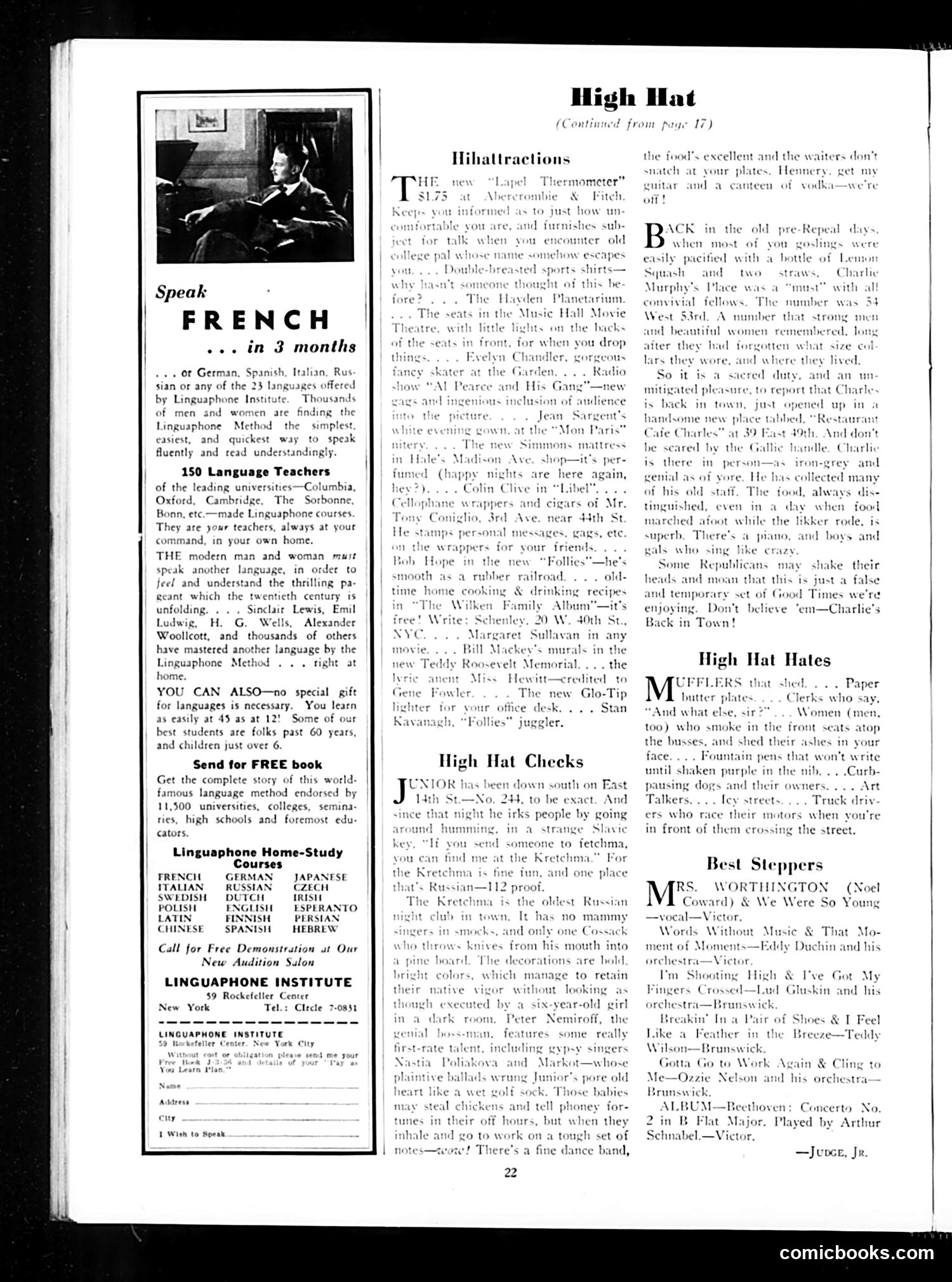
Explanation for Modern Readers This page is primarily advertising and entertainment gossip, not political satire. The dominant content is a Linguaphone Institute language-learning advertisement promoting their correspondence courses in French, German, and other languages. The smaller sections—"High Hat Attractions," "High Hat Cheeks," "High Hat Hates," and "Best Steppers"—are typical Judge magazine lifestyle commentary targeting wealthy New York readers of the 1930s-40s. They reference: - Nightclubs and restaurants (Charlie Murphy's Place, the Kretchma—a Russian nightclub) - Social complaints: mufflers that shed, impolite clerks, smokers on buses, fountain pens that don't work, dogs in the street - Entertainment recommendations: Broadway shows, records, orchestras The "High Hat Hates" section mocks the pretensions and minor annoyances of the upper class. There's nostalgia for pre-Prohibition drinking ("old pre-Repeal days"). Overall, this reflects Judge's focus on sophisticated urban humor for affluent readers, not political commentary.
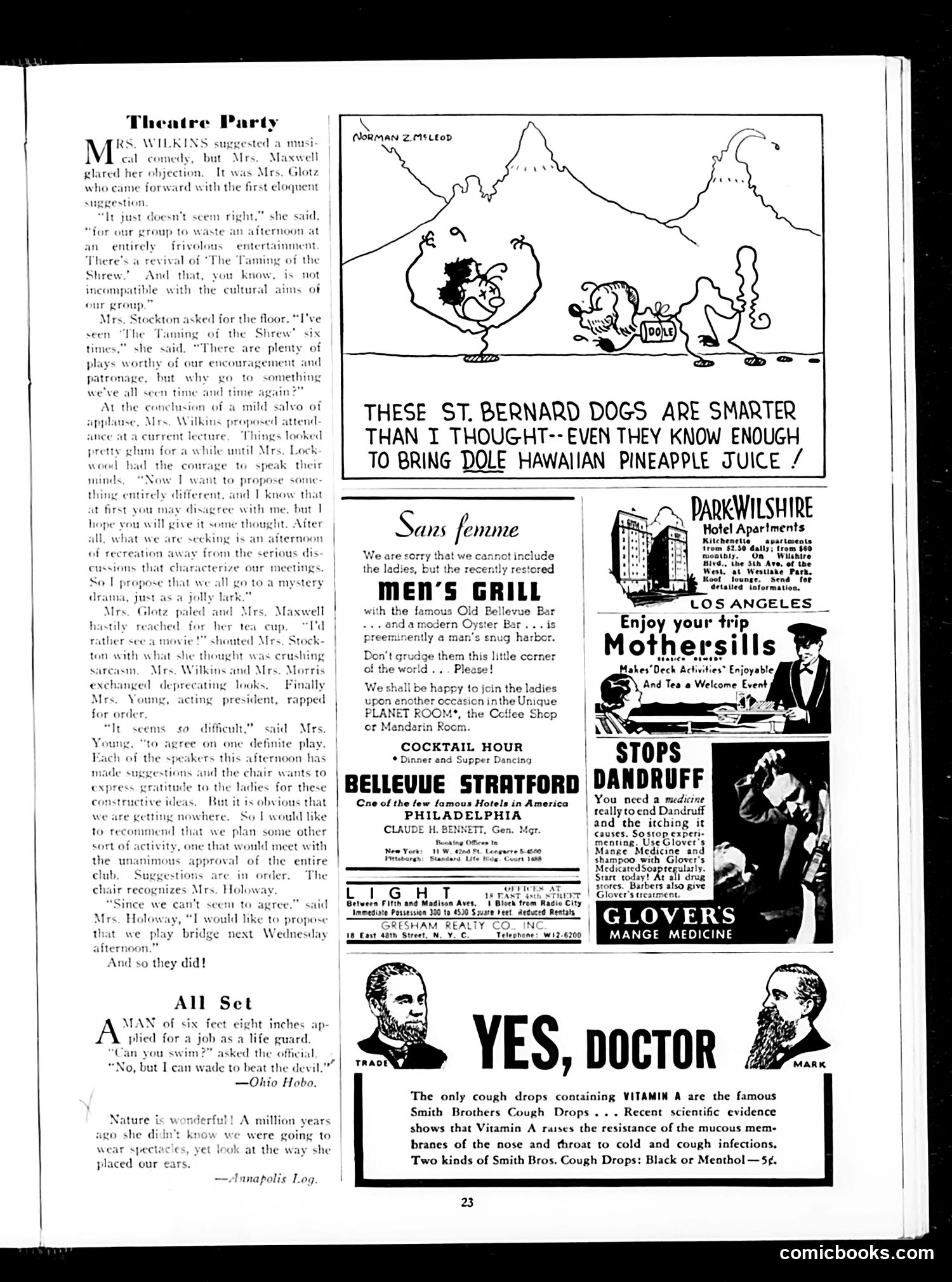
Judge Magazine Page Analysis This page from *Judge* (a satirical magazine) mixes editorial content with advertising. The main feature, "Theatre Party," satirizes women's social clubs of the era—specifically their tendency toward tedious cultural pretension masquerading as sophistication. Mrs. Wilkins, Mrs. Maxwell, and others debate attending a frivolous musical comedy versus *The Taming of the Shrew*, with one member noting they've already seen it six times. The satire lies in their self-important rationalization of what is essentially boring, repetitive activity as culturally purposeful. The St. Bernard dogs cartoon makes a joke about product advertising—the dogs supposedly have enough sense to bring Dole Hawaiian Pineapple Juice, a contemporary commercial product. The page is otherwise dominated by period advertisements: hotels, restaurants (Men's Grill, Bellevue Stratford), patent medicines (Clover's Mange Medicine, Smith Bros. Cough Drops), and travel services. These ads reveal contemporary consumer culture and health product marketing practices of the time.
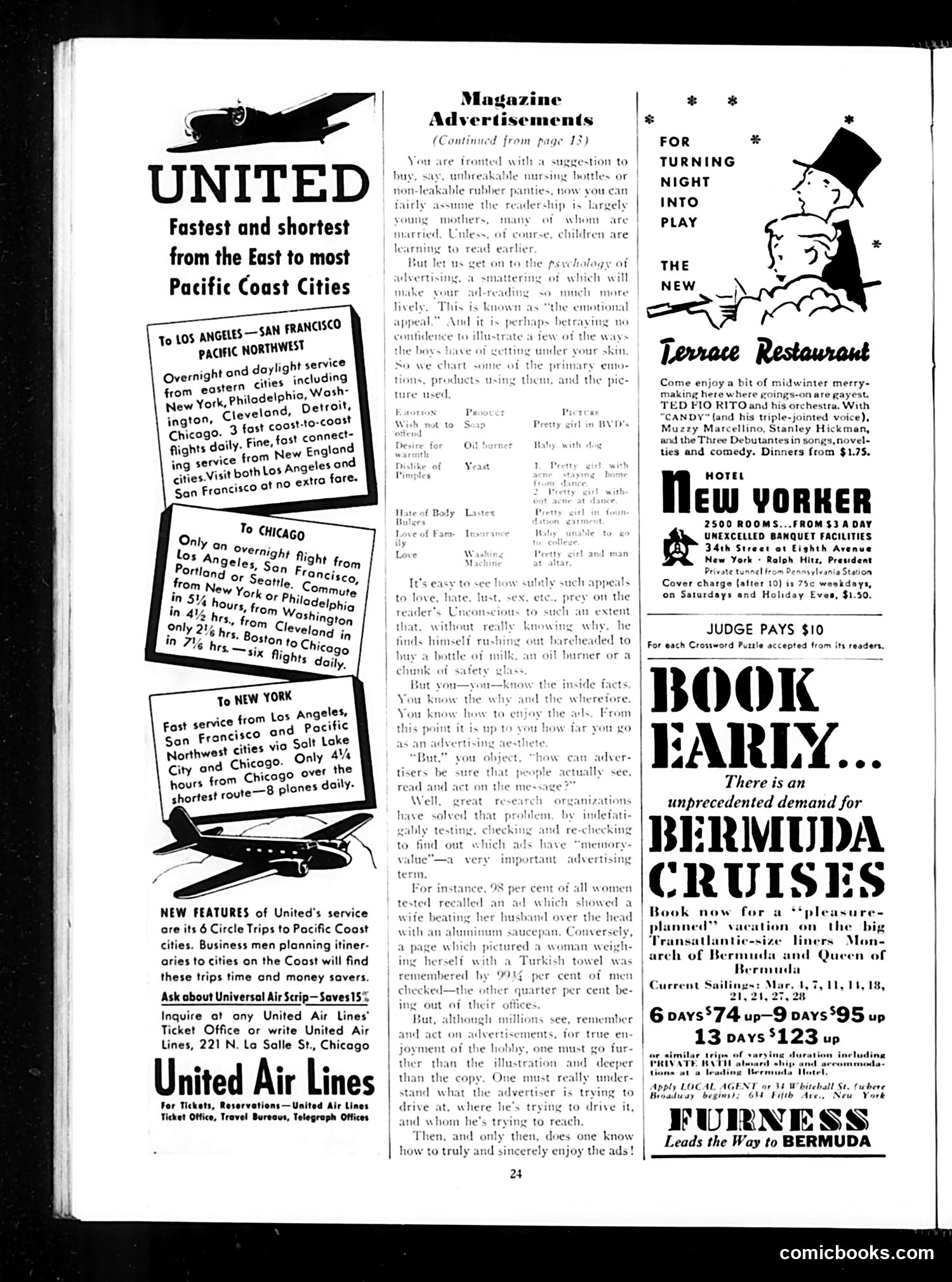
Analysis of Judge Magazine Page 24 This page is primarily advertising content with minimal editorial/satirical material. The left side features United Air Lines advertisements promoting their fastest service to Pacific and West Coast cities—emphasizing speed ("fastest and shortest") and convenience through new "Circle Trips." The center column contains the tail end of an article (continued from page 13) discussing psychology in advertising. It explains how advertisements work on consumers' emotions and unconscious desires, using examples like nursing bottles and insurance products. The text notes that research shows people remember ads emotionally rather than rationally, and argues readers must understand *what* advertisers are trying to make them feel and *why* to truly appreciate advertising. The right side features restaurant, hotel, and travel advertisements: the Terrace Restaurant (with Ted Fio Rito's orchestra), Hotel New Yorker, Bermuda Cruises, and Furness shipping line. No identifiable political figures or satire appears on this page. It represents typical 1930s-40s magazine content blending editorial discussion of consumer culture with commercial advertisements.
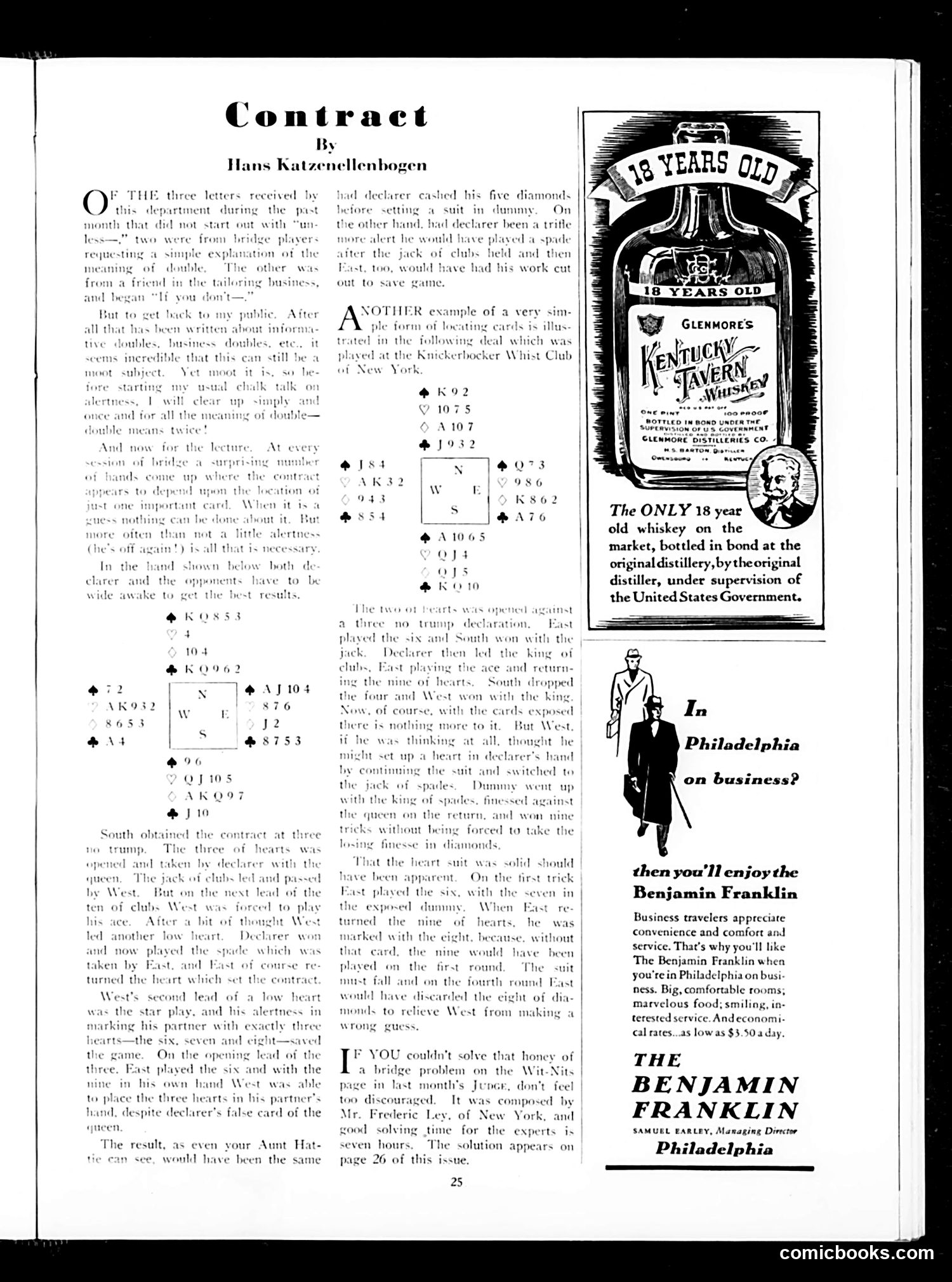
Content Analysis This page primarily contains a bridge instruction article by Hans Katzenellenbogen titled "Contract," explaining card-playing strategy and tactics through dealt hands and example games. The text is technical in nature, aimed at bridge enthusiasts. The page includes two advertisements: 1. Glenmore's Kentucky Tavern Whiskey — promoting "18 years old" whiskey bottled in bond under U.S. Government supervision, a significant claim during Prohibition era (dates unclear from image alone, but the government-supervised bottling reference suggests post-Prohibition). 2. The Benjamin Franklin Hotel in Philadelphia — a business hotel advertisement emphasizing comfort, service, and economical rates ($3.50/day) for traveling businessmen. There are no political cartoons or satirical illustrations on this page. The small illustration of a businessman is merely a hotel advertisement graphic. This appears to be a regular editorial/advertising page from *Judge* magazine focused on leisure activities and travel services.
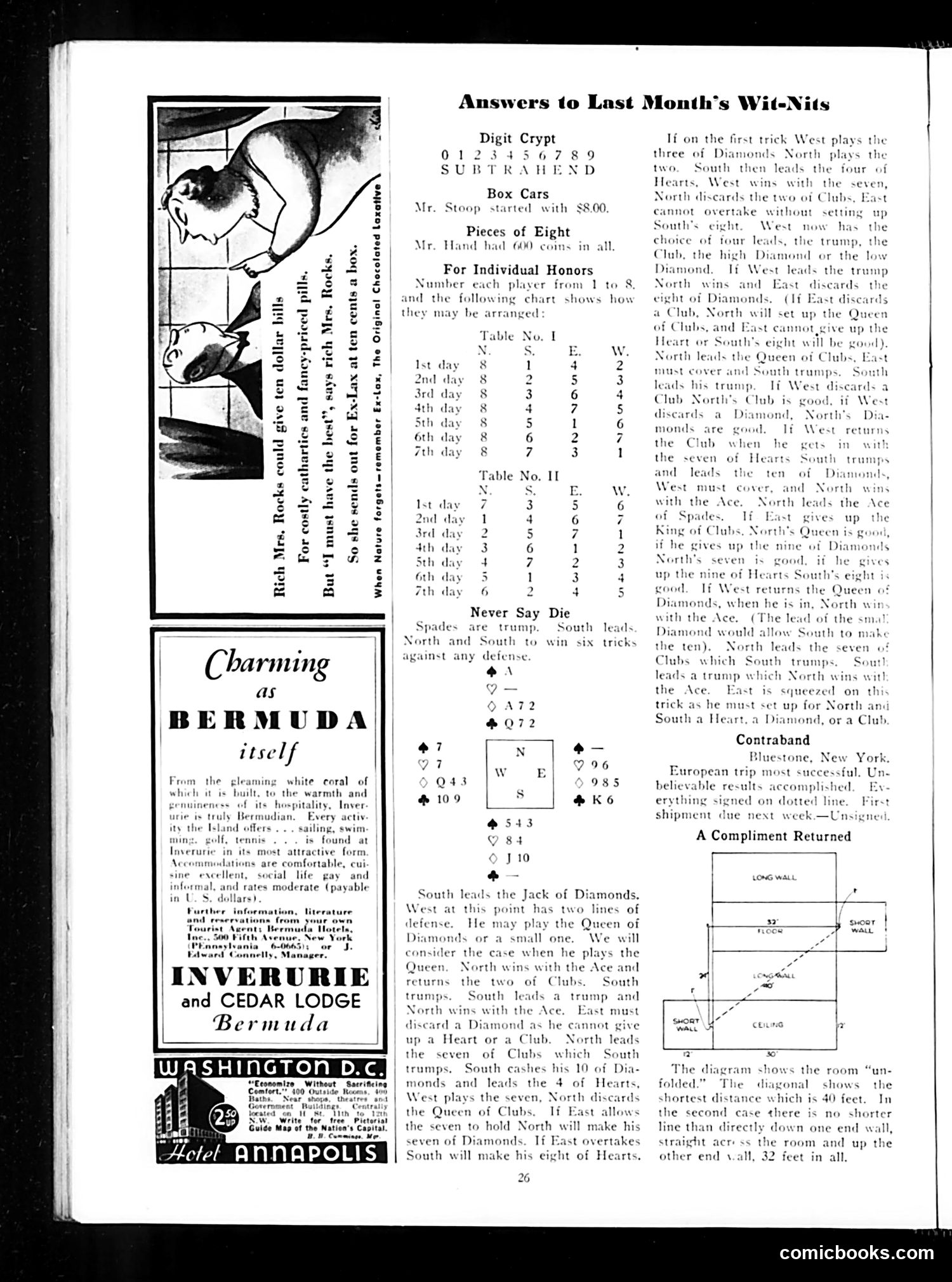
Analysis of This Judge Magazine Page This page is primarily not satirical content but rather a collection of puzzle solutions, advertisements, and bridge strategy. The main elements are: 1. "Answers to Last Month's Wit-Nits" — Solutions to mathematical puzzles (Digit Crypt, Box Cars, Pieces of Eight) 2. Bridge card game strategy — Detailed instructions for card players on optimal play, numbered tables showing player arrangements 3. Advertisements — Including promotions for Bermuda tourism ("Inverurie and Cedar Lodge"), the Hotel Annapolis in Washington D.C., and a brief mention of a European trip shipment 4. A geometric diagram — Showing room measurements, likely a puzzle solution The page reflects Judge's mid-20th century format as a general-interest magazine combining humor, games, and advertising rather than purely political satire. The "Never Say Die" section appears to be a recurring bridge puzzle feature for readers interested in card games—a popular leisure activity of the era.
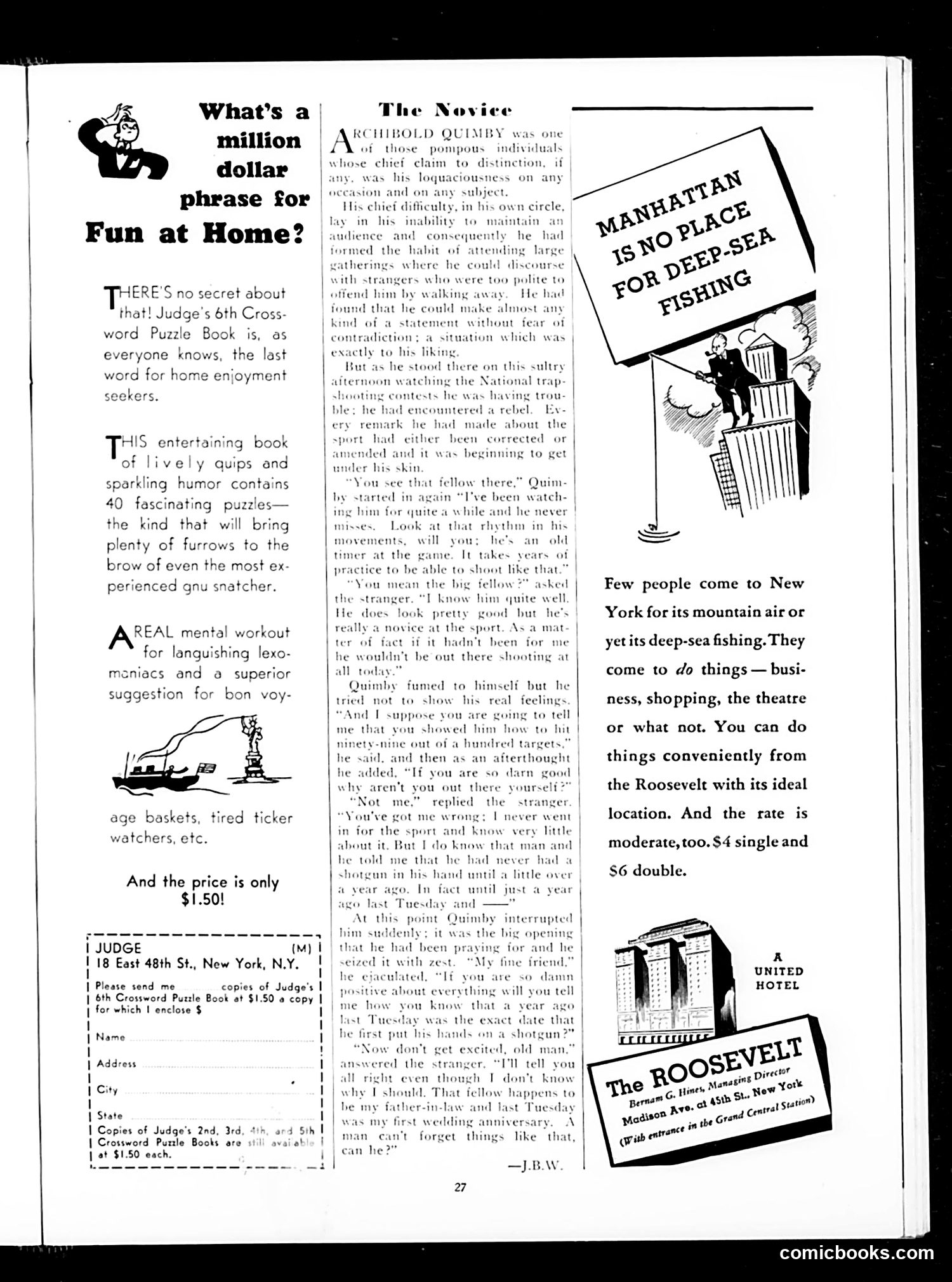
Explanation for Modern Readers This page contains two distinct elements: an advertisement for Judge magazine's crossword puzzle book (left side) and a short satirical story titled "The Novice" (center/right). "The Novice" Story: The narrative mocks Archibold Quimby, a pompous character known for being loquacious and unable to maintain an audience. At a trap-shooting contest, Quimby encounters a skilled shooter and condescendingly assumes the man is an amateur. Through conversation, Quimby reveals he actually *taught* this "novice" to shoot—and crucially, the man is his father-in-law, whom Quimby hasn't seen in a year. The humor derives from Quimby's predictable arrogance being punctured by the revelation that he's been insulting someone close to him while bragging about his own importance. The advertisements promote Judge's puzzle books as affordable home entertainment ($1.50) and advertise the Roosevelt Hotel in Manhattan as a moderately-priced lodging option ($4–$6). The satire targets social pretension and the dangers of unchecked verbosity.
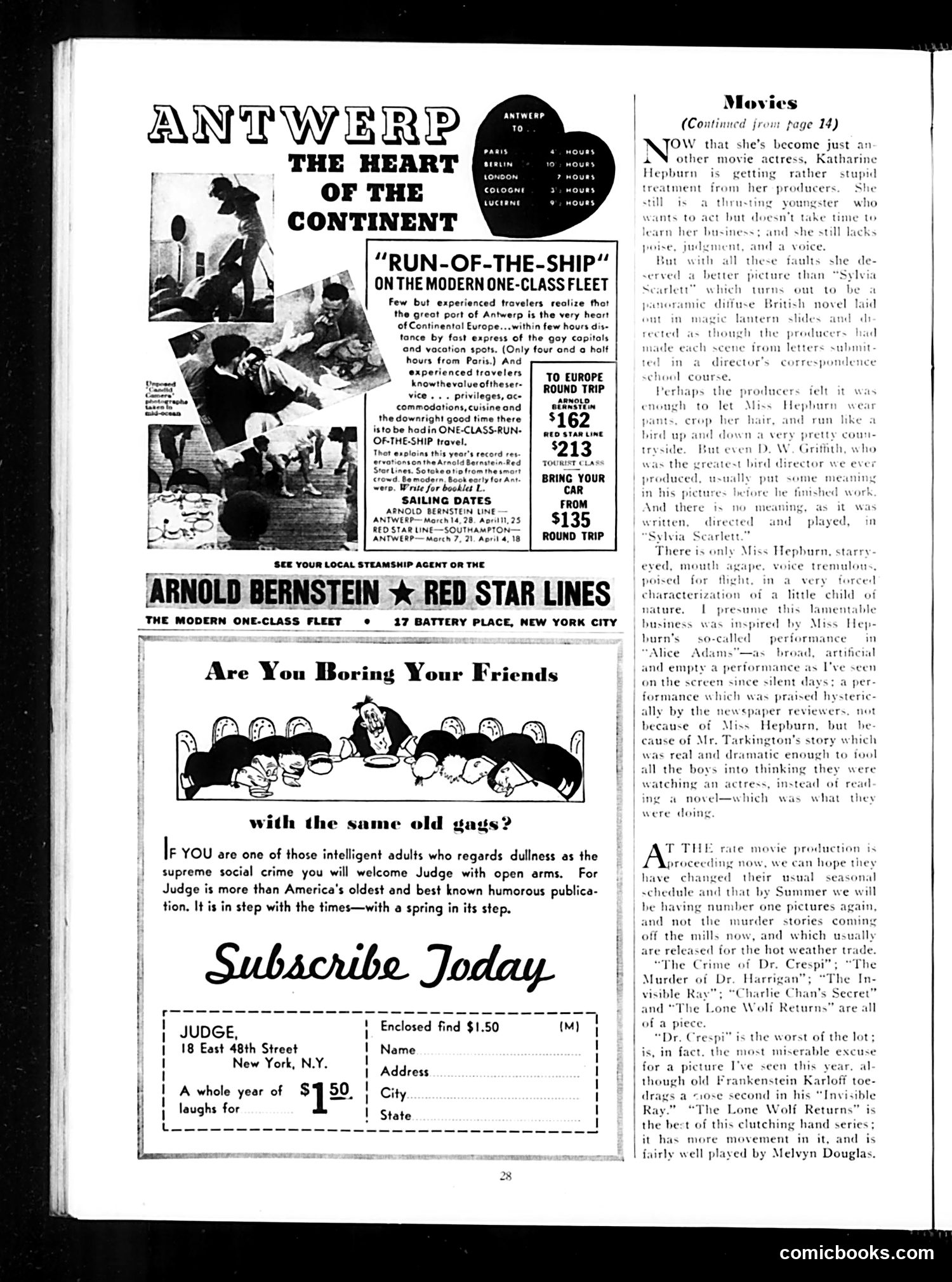
Judge Magazine Page Analysis This page contains advertising and film criticism rather than political satire. The main content criticizes actress Katharine Hepburn's performance in what appears to be a recent film (likely "Alice Adams," mentioned in the text). The critic argues Hepburn is a poor actress who succeeds only because the story itself is strong—audiences mistake good writing for good acting. The review is scathing: her performance is described as "artificial and empty," her voice "tremulous" and forced, her mouth agape in an unconvincing "little child" characterization. The critic credits director D.W. Griffith and writer Booth Tarkington's material, not Hepburn, for the film's success. The page also advertises Arnold Bernstein and Red Star Lines steamship travel to Europe and promotes a Judge magazine subscription. The cartoon "Are You Boring Your Friends" humorously pitches Judge as a remedy for social dullness.
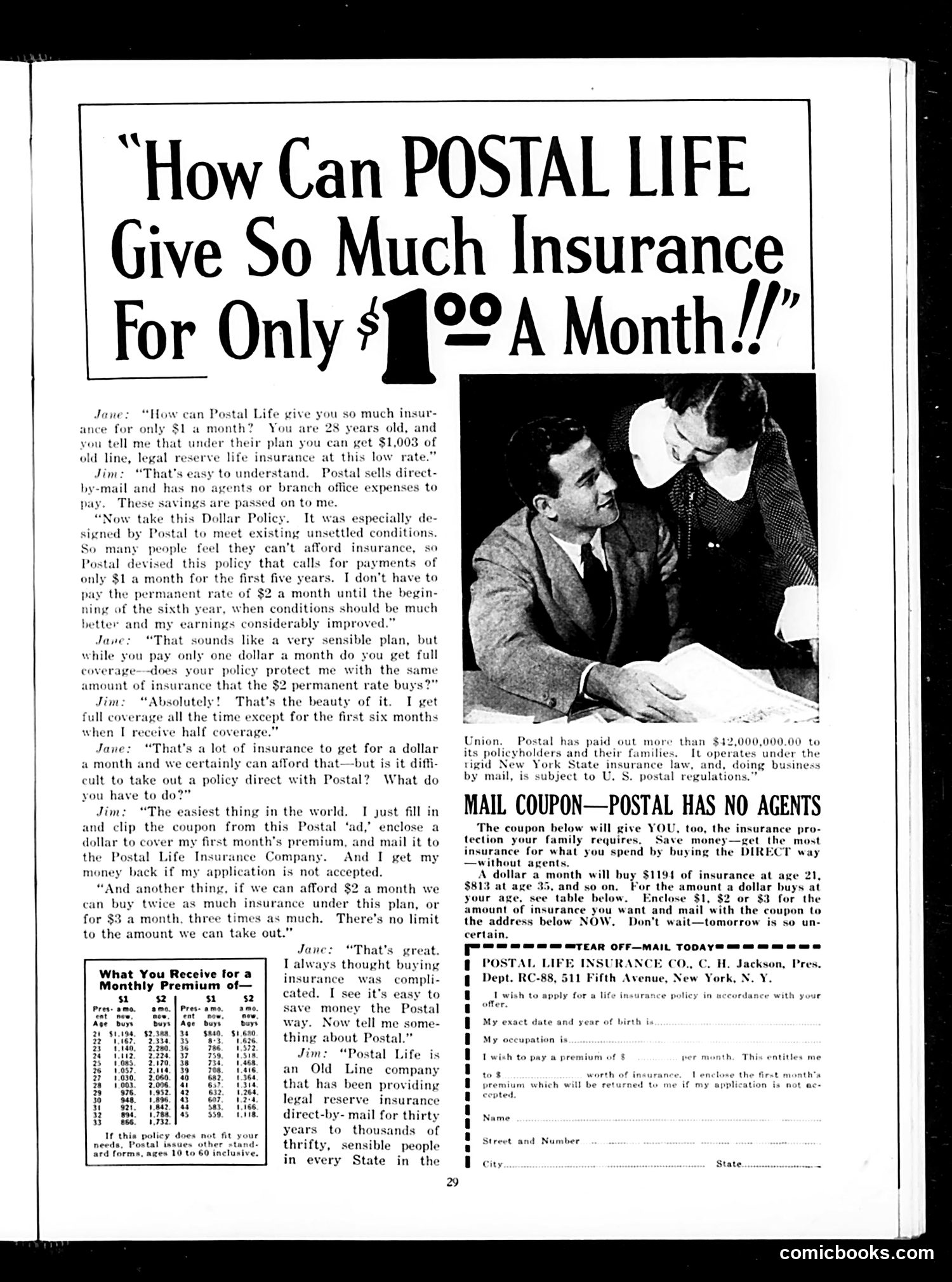
Analysis of "Postal Life Insurance" Advertisement This is primarily a direct-mail insurance advertisement, not a political cartoon. It presents a dialogue between "Jane" and "Jim" explaining Postal Life Insurance's business model. The key appeal targets Depression-era concerns: affordable life insurance ($1/month initially, rising to $2) for working people who "feel they can't afford insurance." Postal Life marketed itself as an "Old Line company" (suggesting legitimacy and stability) operating for thirty years, emphasizing it avoids agent commissions by selling "direct-by-mail." The pitch exploits economic anxiety—offering full coverage despite low initial premiums, with a money-back guarantee if the application is rejected. The included coupon encourages immediate response ("tomorrow is so uncertain"). This reflects 1930s-era direct-marketing tactics and the proliferation of mail-order financial services targeting middle and working-class Americans seeking affordable security during economic hardship. The testimonial format (Jim explaining to Jane) was standard advertising persuasion technique of the period.
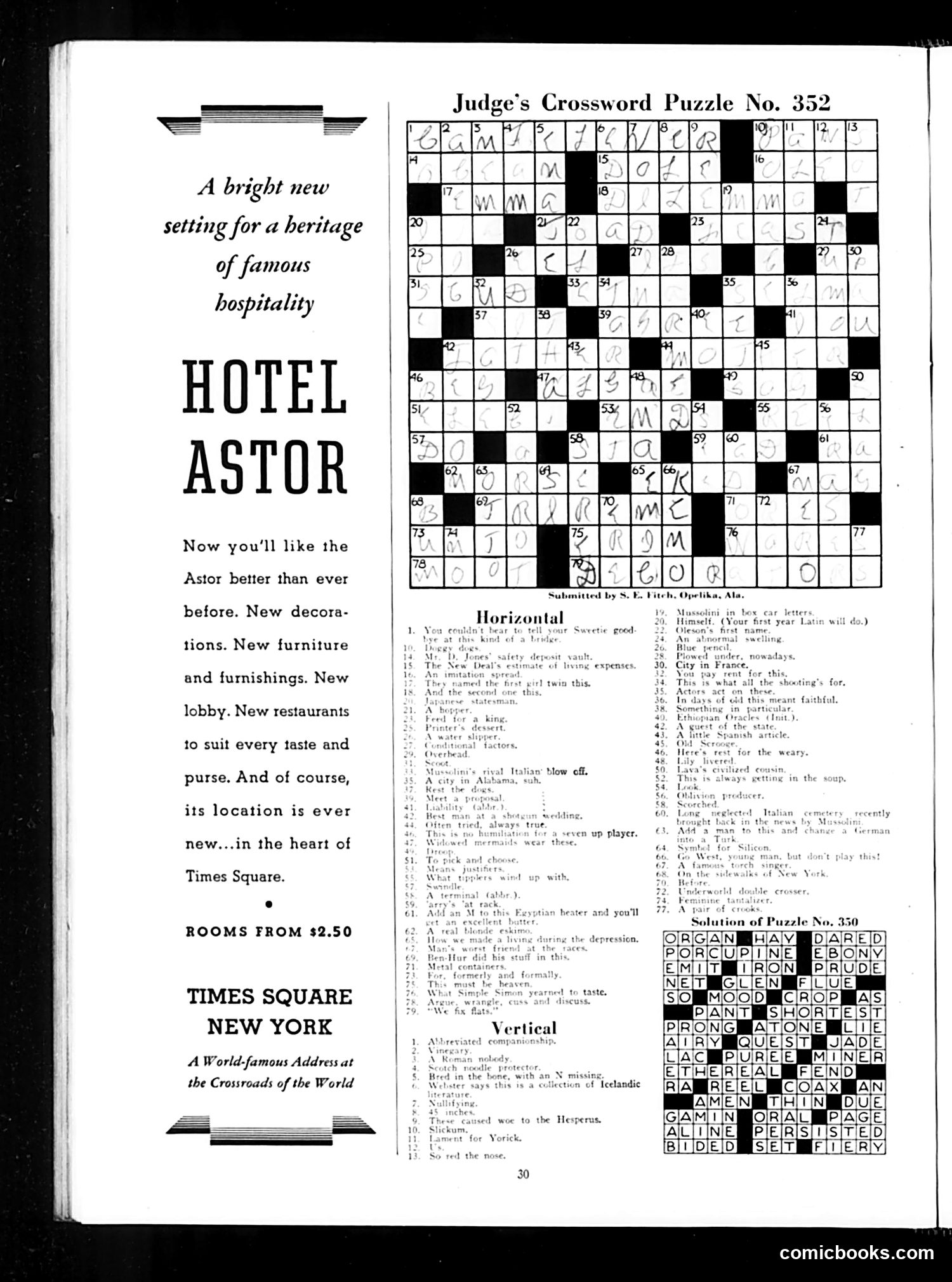
Hotel Astor Advertisement This page is primarily a full-page advertisement for the Hotel Astor in Times Square, New York. It is not a cartoon or satirical content. The ad promotes a newly renovated hotel, emphasizing modernized amenities (new decorations, furniture, restaurants) and an attractive room rate of $2.50. The tagline "A bright new setting for a heritage of famous hospitality" suggests the hotel is a longstanding establishment being updated for contemporary travelers. The "World-famous Address at the Crossroads of the World" references Times Square's status as a major commercial and cultural hub in 1920s-30s New York. The right side contains an unrelated crossword puzzle (Judge's Crossword Puzzle No. 352) with a solution key below it. This represents typical magazine advertising of the era—straightforward promotional content rather than satirical commentary.
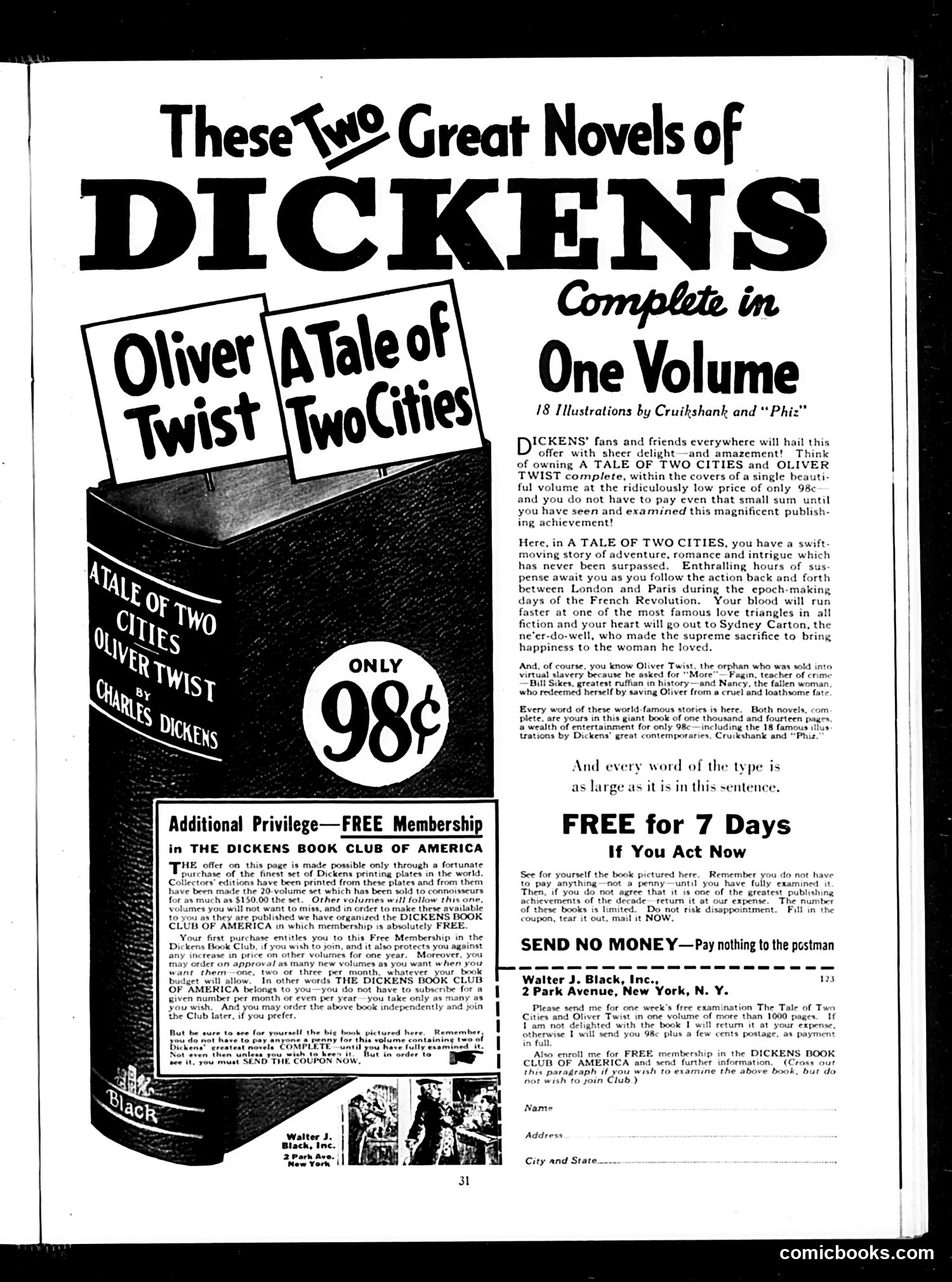
This is a Book Advertisement, Not Political Satire This page is primarily a commercial advertisement for a two-novel Dickens collection, not political satire or a cartoon. It appears in *Judge* magazine likely because *Judge* published advertisements alongside editorial content. The ad promotes *A Tale of Two Cities* and *Oliver Twist* bound in a single volume for 98 cents, published by Walter J. Black, Inc. The marketing hook emphasizes getting two "great novels" cheaply while offering a "free" seven-day examination period and membership in "The Dickens Book Club of America." The only visual element is a stylized book cover showing the two titles stacked. The fine print reveals the business model: the publisher claims to own valuable Dickens printing plates, enabling this low price, while the book club membership locks customers into future purchases. This represents 1930s-era direct-mail marketing tactics—the "free trial" approach was novel then, designed to overcome consumer reluctance to purchase unseen.
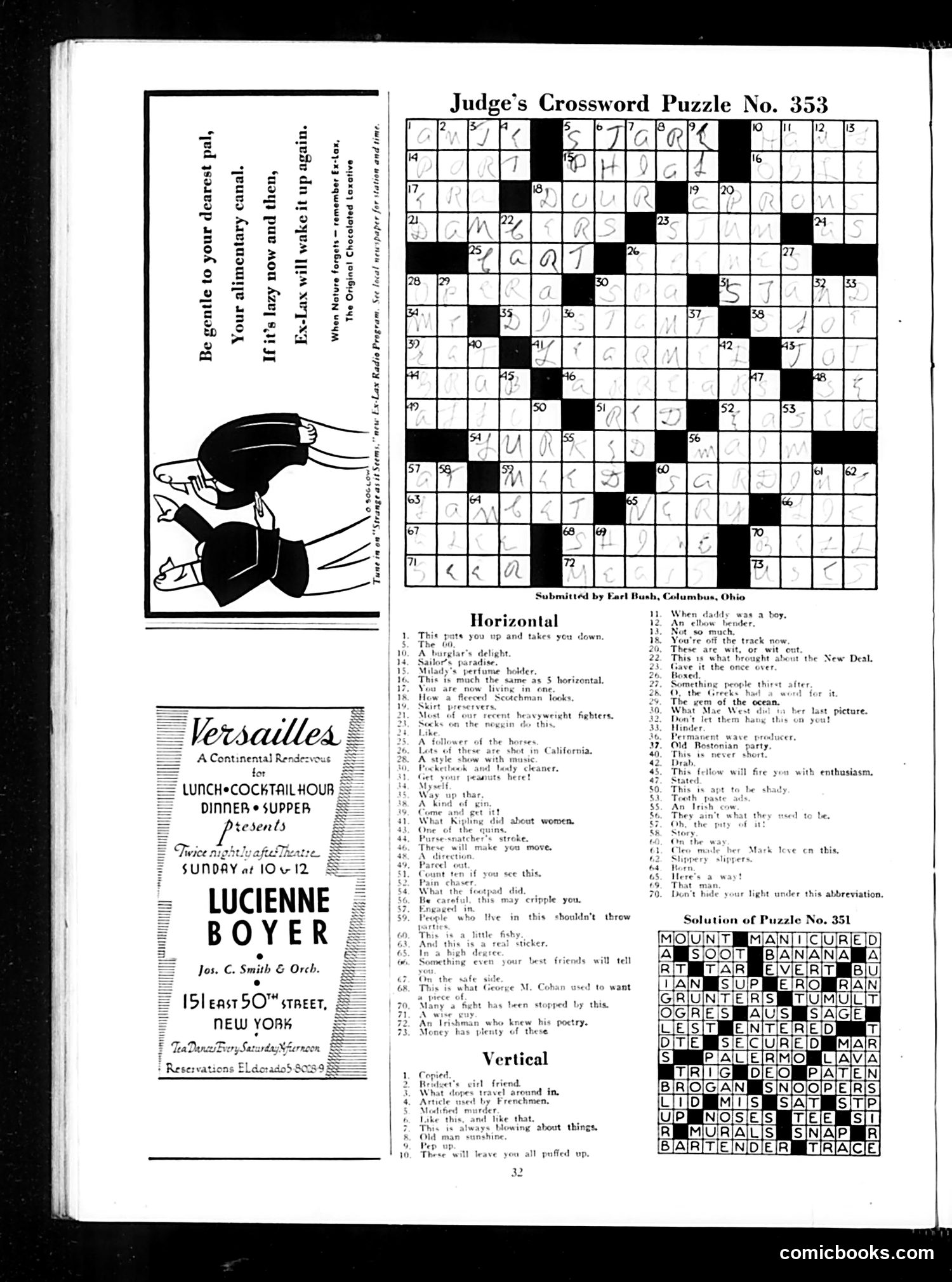
Judge Magazine Page Analysis This page is primarily a crossword puzzle (No. 353) with accompanying clues and a solution to the previous puzzle. The small cartoon illustration shows a figure in profile, appearing to be related to the puzzle's theme or as a generic Judge mascot. The content is largely advertising-driven, featuring a prominent ad for Lucienne Boyer, a French cabaret singer performing at a Manhattan venue (151 East 50th Street), with orchestra accompaniment by Jos. C. Smith. Below that is an ad for Versailles, described as "A Continental Rendezvous" offering lunch, cocktails, dinner, and supper. There is also an Ex-Lax advertisement embedded in the puzzle clues themselves—a laxative product marketed with the phrase "Be gentle to your dearest pal, / Your alimentary canal." The page reflects 1930s-era consumer culture, with entertainment venues and patent medicines being primary advertisers in the magazine. The crossword serves as filler content around these ads.
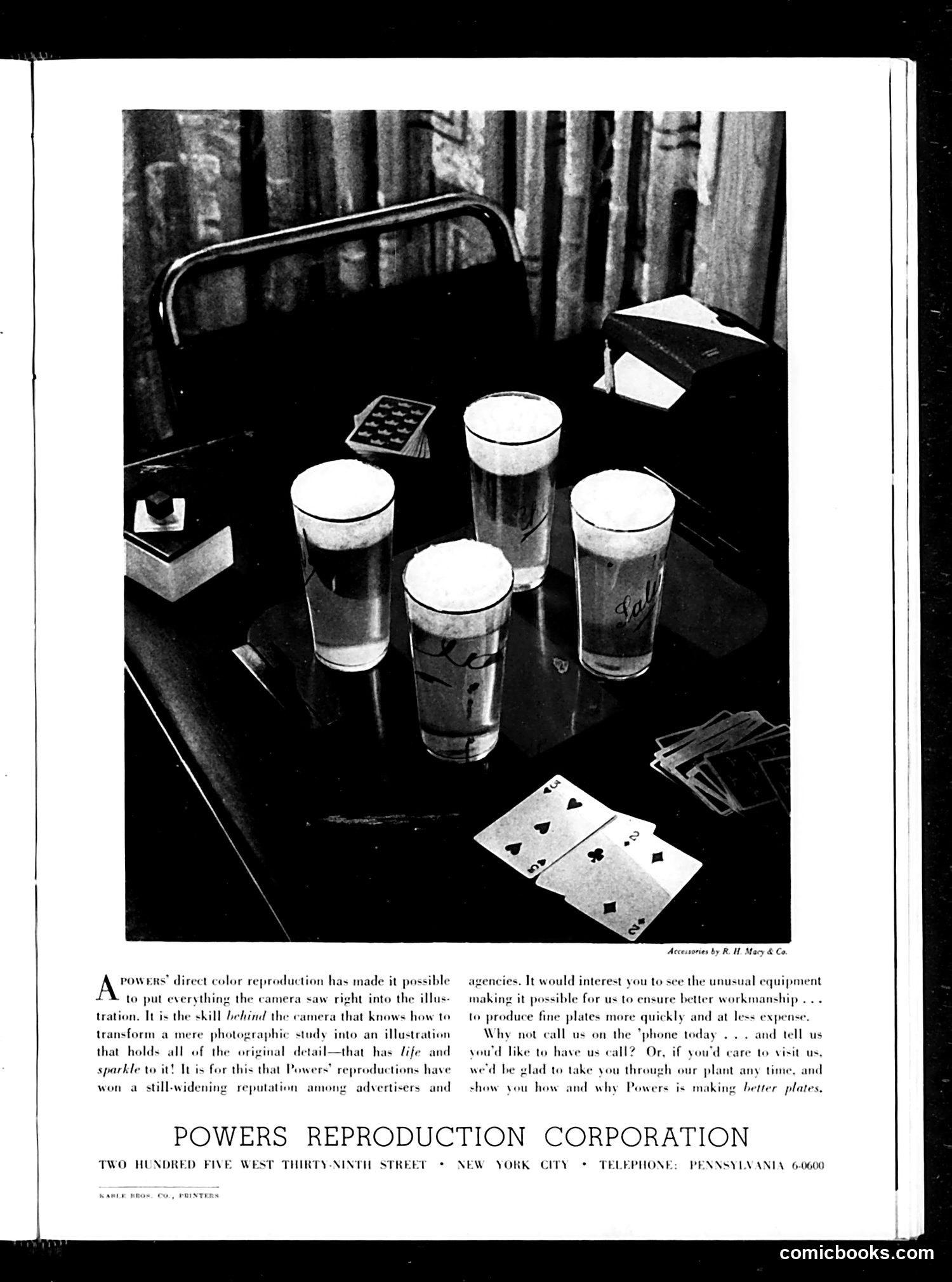
Advertisement Analysis This is not a political cartoon or satirical content—it's a full-page advertisement for the Powers Reproduction Corporation, a commercial printing/color reproduction company based in New York City. The image shows a styled still-life photograph: four beer glasses with foam heads arranged on a dark table, playing cards scattered nearby, and various items suggesting a casual social setting. This appears designed to showcase the company's technical capability in direct color reproduction—transforming photographs into high-quality printed illustrations while preserving fine detail and "sparkle." The text emphasizes their skill in converting photographic studies into artwork for advertising agencies, inviting potential clients to tour their plant and see their equipment. It's a straightforward trade advertisement emphasizing technical prowess and craftsmanship in the pre-digital printing industry, likely from the mid-20th century based on style and typography.
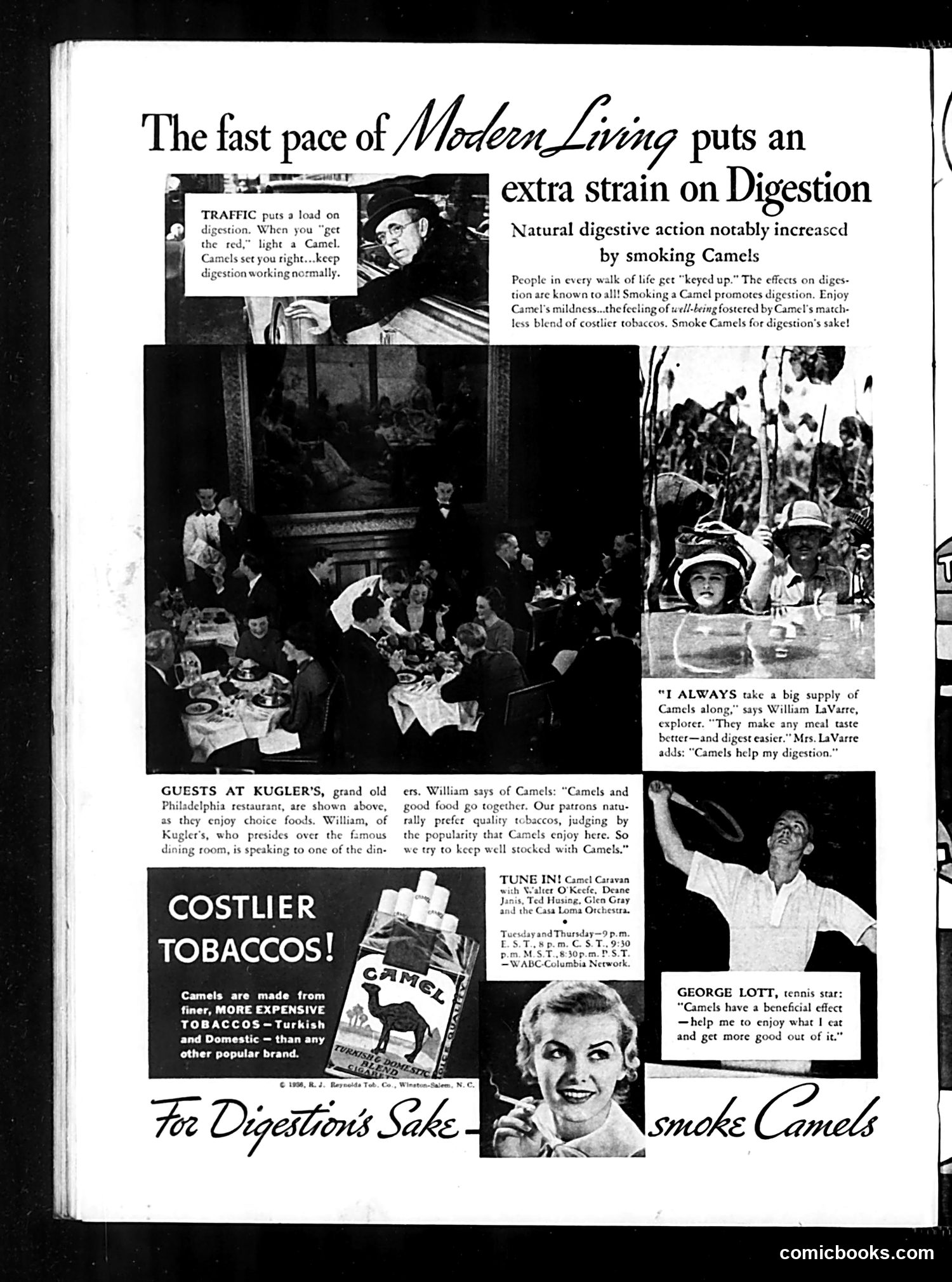
A Camel Cigarette Advertisement Disguised as Health Advice This is primarily a Camel cigarette advertisement, not satire. The page presents smoking as a digestive aid during modern life's stresses—traffic congestion, fast-paced living—claiming Camels promote digestion and well-being. The "endorsements" feature named individuals (explorer William LaVarre, tennis star George Lott, and William of Kugler's restaurant in Philadelphia) vouching that Camels aid digestion and enhance meals. A radio program plug ("Tune In! Camel Caravan") provides additional promotion. Modern context: This reflects pre-FDA era advertising (likely 1930s) when tobacco companies made unsubstantiated health claims. The suggestion that cigarettes *aid* digestion rather than harm health would be shocking today. The ad exploits anxiety about modern life's pace to position smoking as a therapeutic solution—a marketing strategy now recognized as predatory and false.