judge
Judge — April 1936
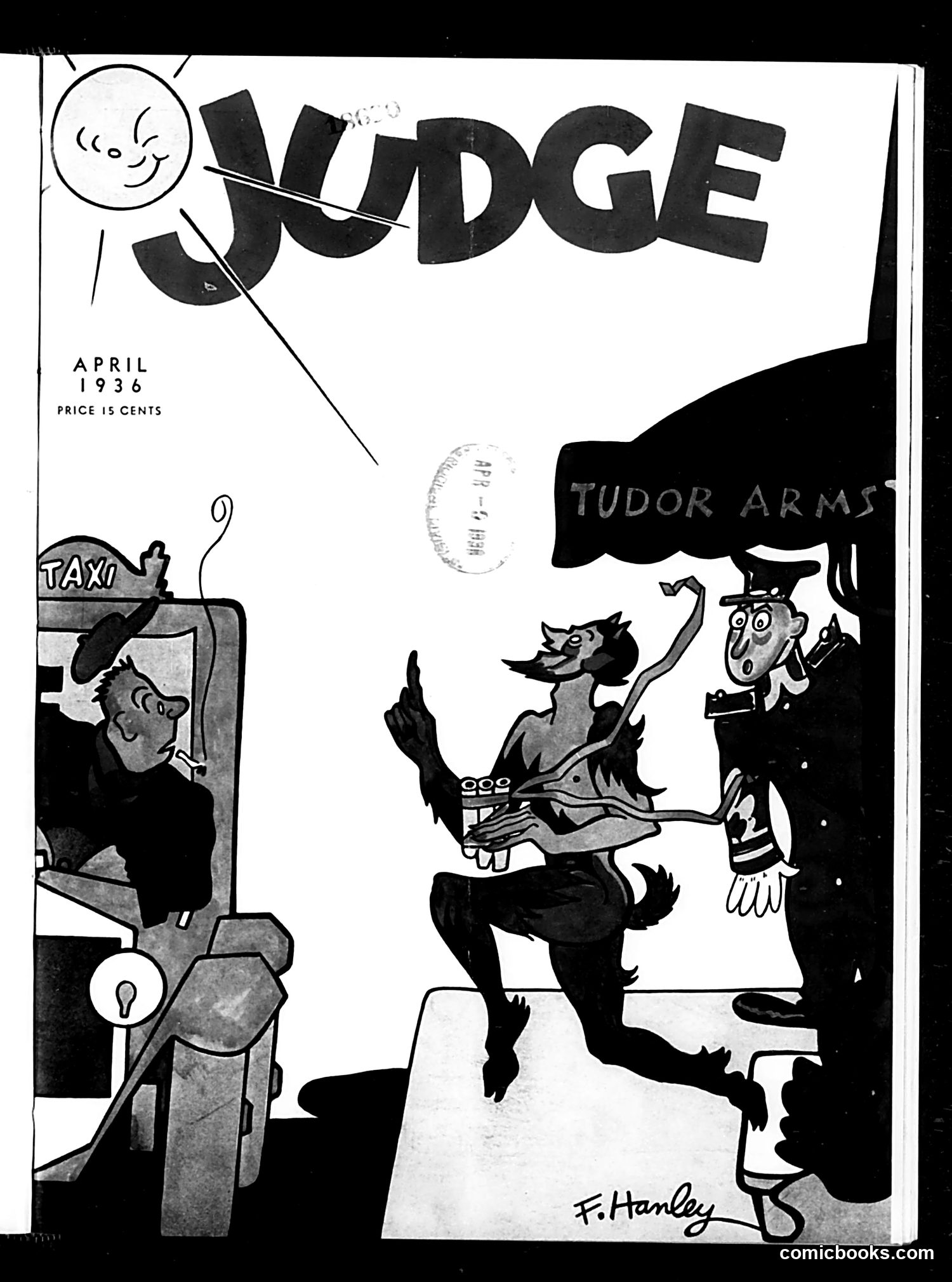
Judge Magazine Cover, April 1936 This cover satirizes the entertainment scene at the Tudor Arms, likely a New York nightclub. The central figure is a female performer dancing provocatively with what appears to be a musical instrument, while a well-dressed man (possibly a club owner or patron) gestures enthusiastically from the right. A taxi driver on the left observes the scene, suggesting the contrast between ordinary working people and the nightlife elite. The satire targets the glamorous nightclub culture of 1930s America—the excess, performances, and social mixing of the era. The "Judge" magazine's humor typically mocked current social trends and entertainment venues. The crude caricature style was standard for the period's satirical commentary on urban nightlife and celebrity culture.
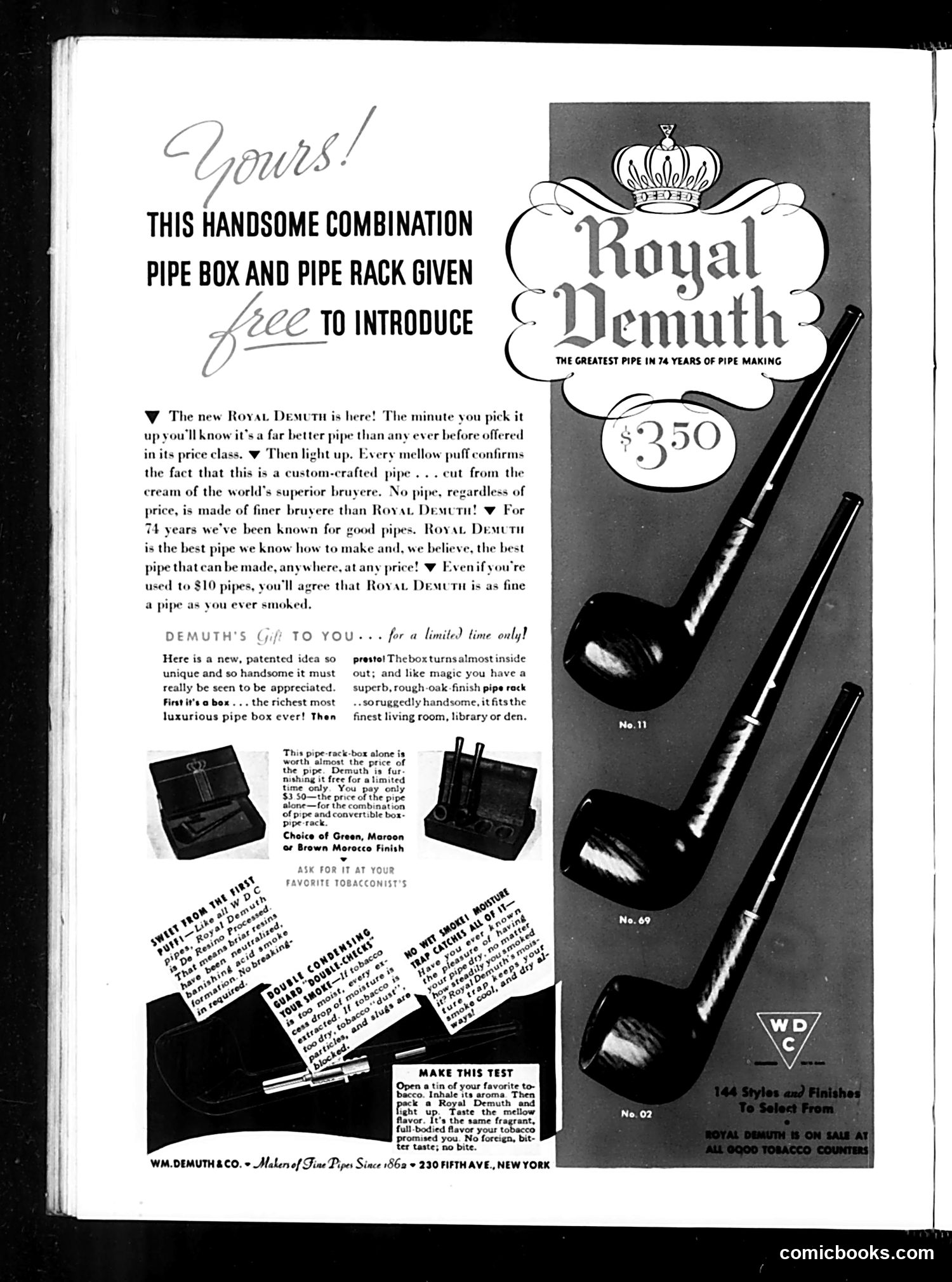
Analysis This page is primarily an advertisement, not satire or political commentary. The left side advertises a "Royal Demuth" pipe ($3.50) being offered free with a pipe box and rack purchase. The ad emphasizes the pipe's quality, claiming 74 years of pipe-making expertise and superior bruyere wood construction. The right side shows three pipe models (No. 11, No. 49, No. 02) with various finishes available. The bottom includes a "Make This Test" section encouraging readers to compare the Royal Demuth pipe's tobacco flavor against competitors. This is straightforward product marketing, not political satire. Judge magazine included paid advertisements alongside its satirical content. No political figures or social commentary are present—just a tobacco pipe company leveraging magazine space to promote their product to readers.
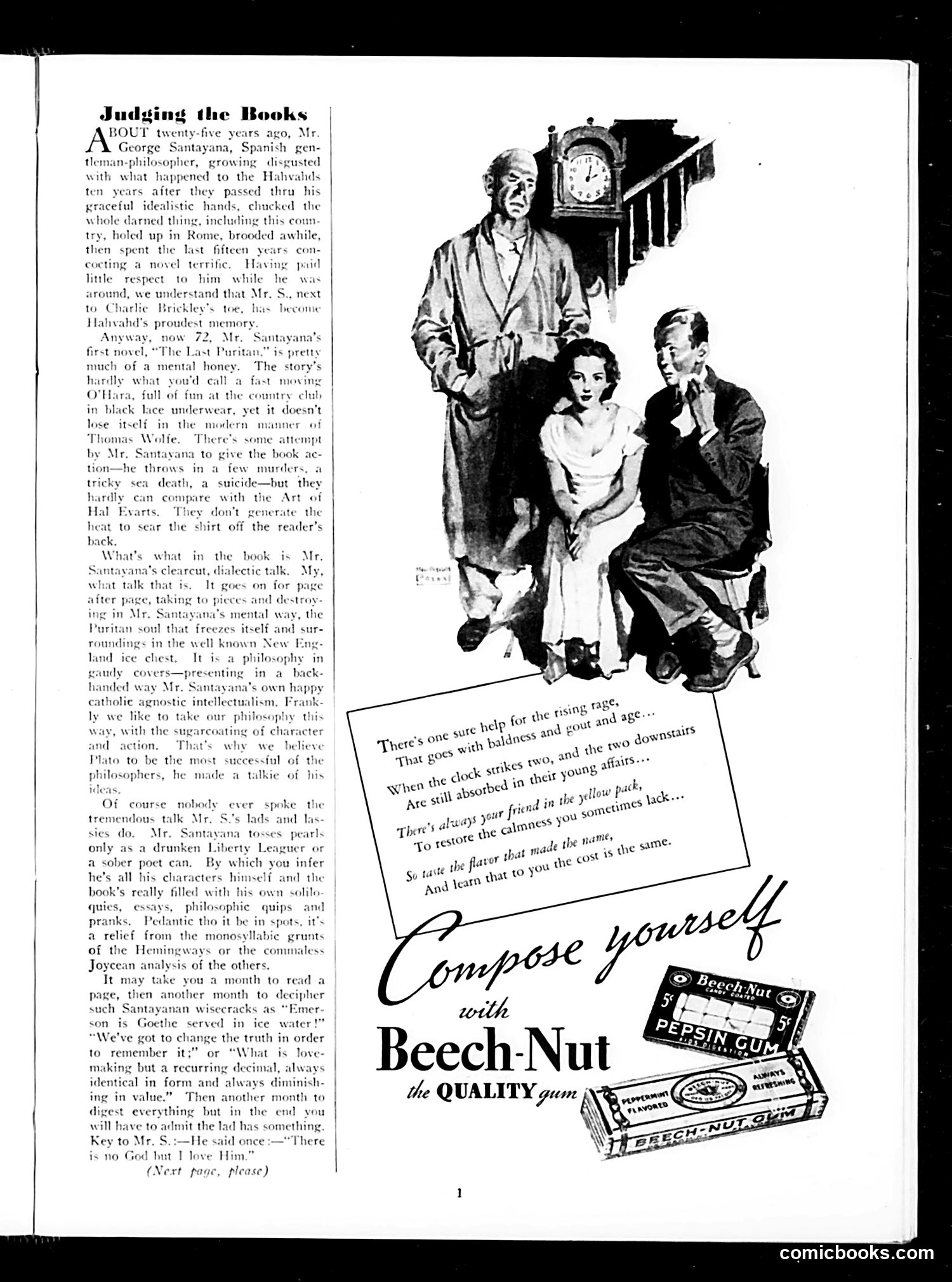
"Judging the Books" - Judge Magazine Book Review This page contains a book review of George Santayana's novel "The Last Puritan," alongside a Beech-Nut gum advertisement. The reviewer critiques Santayana's work as a "mental honey"—superficially pleasant but lacking substance. The review dismisses the plot as derivative (comparing it unfavorably to Hal Eaarts' work) and mocks the author's philosophical digressions throughout the narrative. The satirical point appears to target Santayana's pretentious intellectualism and his tendency to interrupt fictional storytelling with abstract philosophy. The reviewer suggests the book would bore general readers despite Santayana's reputation as a serious thinker. The advertisement uses this critique as an ironic juxtaposition—suggesting Beech-Nut gum provides more genuine comfort than Santayana's intellectual musings.
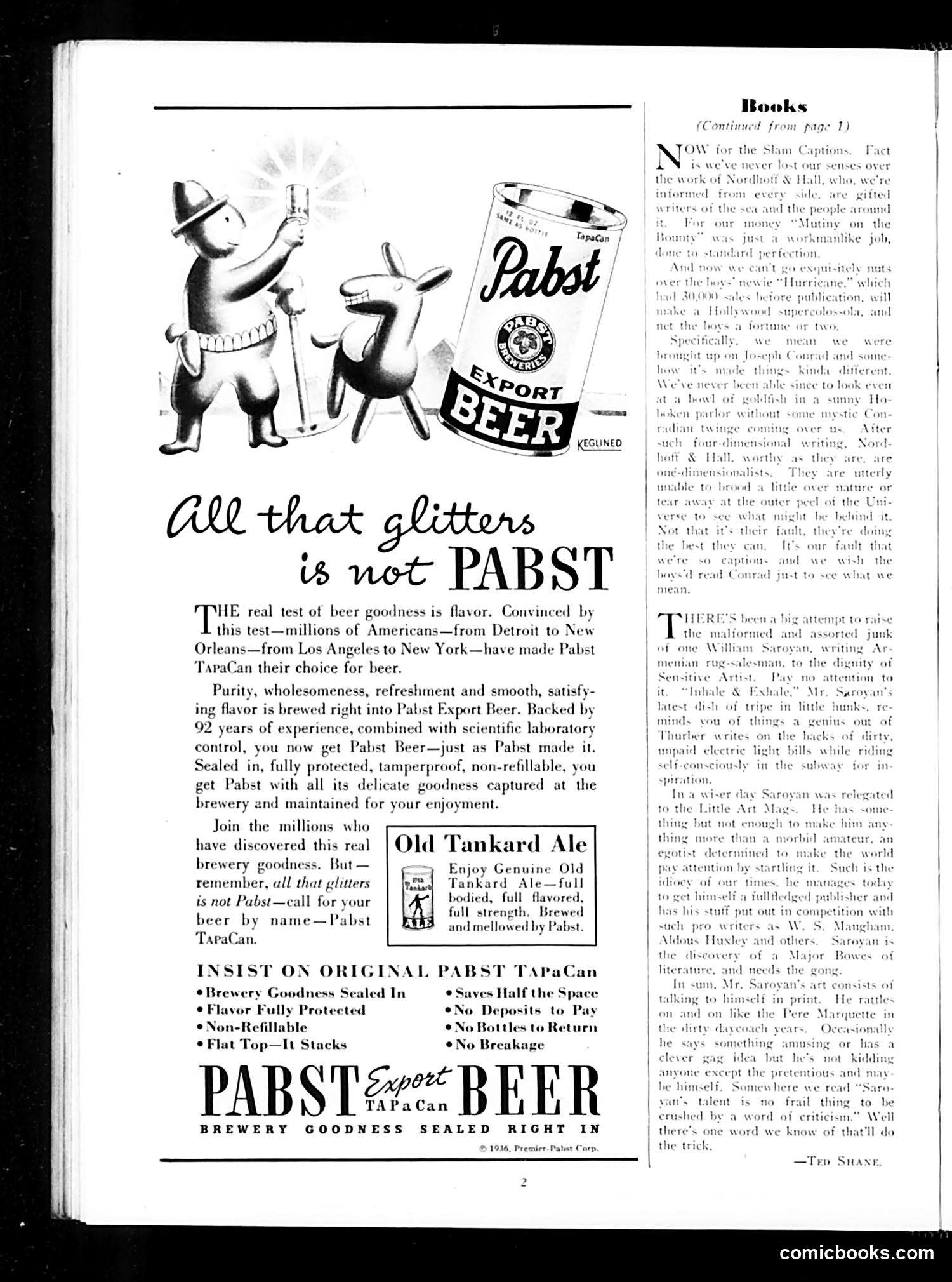
Analysis This page is primarily advertising, not political satire. The left side features a large Pabst Export Beer advertisement with cartoon characters (anthropomorphic figures in formal dress) promoting the beer's quality and the TaPaCan container format. The right side contains book reviews, including commentary on works by William Saroyan and discussion of various literary figures. One review critiques Saroyan's writing style, suggesting his attempts at avant-garde art fall short. No political cartoons appear on this page. The only visual satire is the humorous mascot characters in the beer ad, which use whimsy to market the product rather than comment on current events or politics. This is a commercial page embedded within Judge magazine's editorial content.
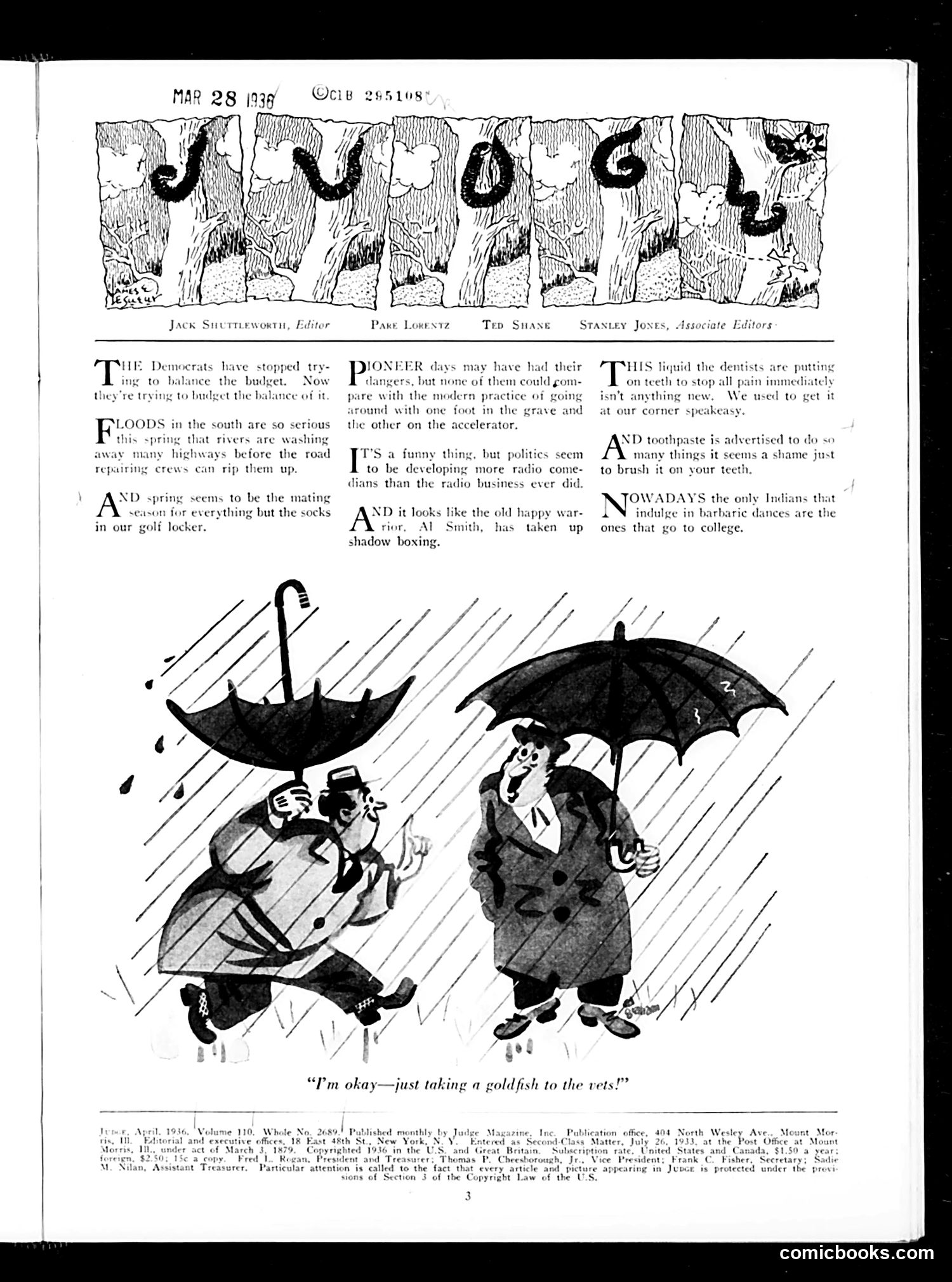
Analysis of Judge Magazine Page (March 28, 1936) The main cartoon depicts two figures in heavy rain: a thin man on the left holding an umbrella (appearing to be a politician or public figure) and a larger, well-dressed man on the right with a substantial umbrella. The caption reads: "I'm okay—just taking a goldfish to the vets!" This appears to be social commentary on economic disparity during the Great Depression. The contrast between the poorly-equipped thin figure (likely representing an ordinary citizen struggling in hard times) and the well-off figure casually taking a goldfish to a veterinarian satirizes wealth inequality—while common people suffer serious hardships, the wealthy maintain frivolous luxuries. The editorial commentary above references political budget debates and Depression-era flooding, supporting this economic critique.
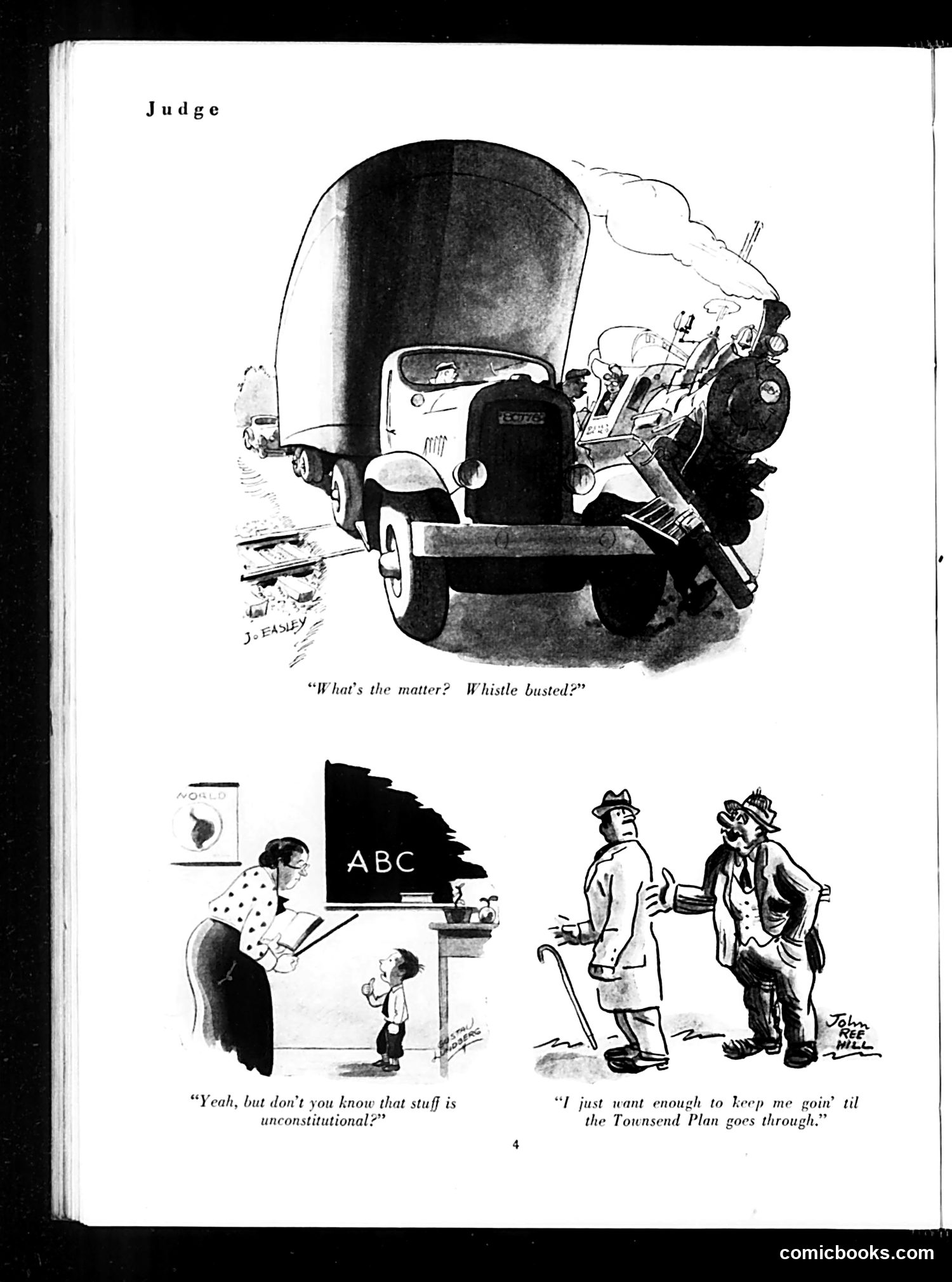
Judge Magazine Cartoon Analysis This page contains three satirical cartoons about traffic safety and constitutional law, circa early-to-mid 20th century. The top cartoon depicts a massive truck colliding with a small car, with the caption "What's the matter? Whistle busted?" - mocking inadequate safety warnings. The bottom-left cartoon shows a woman teaching a child the ABC's, with the caption about "unconstitutional stuff" - likely satirizing debates over educational content or censorship. The bottom-right cartoon references "the Townsend Plan," a Depression-era social security proposal, with a man hoping to "keep me goin' til the Townsend Plan goes through" - mocking reliance on this controversial relief program. The overall theme appears to be critiquing contemporary safety failures, constitutional debates, and economic desperation of the era.
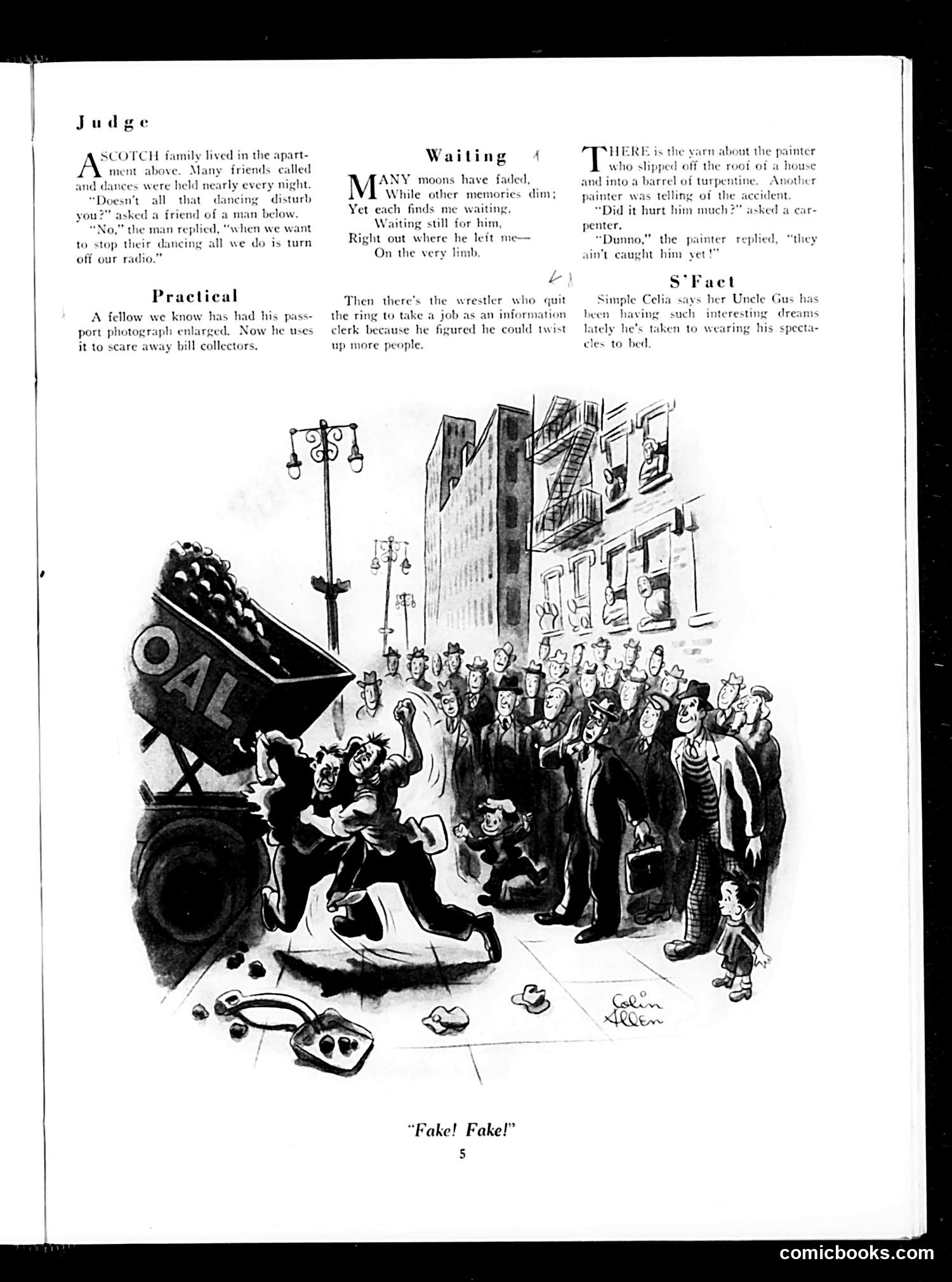
"Fake! Fake!" - Judge Magazine Cartoon Analysis This cartoon depicts a street vendor operating a trash-collection apparatus labeled "GAIL" while a crowd of well-dressed onlookers watches. A figure lies on the ground beneath the device, seemingly caught in its mechanism. The cartoon's title "Fake! Fake!" suggests this is satirizing fraudulent or deceptive practices. The "GAIL" device appears to reference a specific scam or confidence scheme of the era—possibly involving waste collection or some street-level swindle targeting urban crowds. The cartoonist (signed by what appears to be Cesare Maccari or similar) is mocking public gullibility and the prevalence of street frauds in early 20th-century American cities. The well-dressed observers' reactions suggest they're either complicit, foolish, or outraged witnesses to the deception. Without additional context about the specific "GAIL" reference, the precise scandal remains unclear.
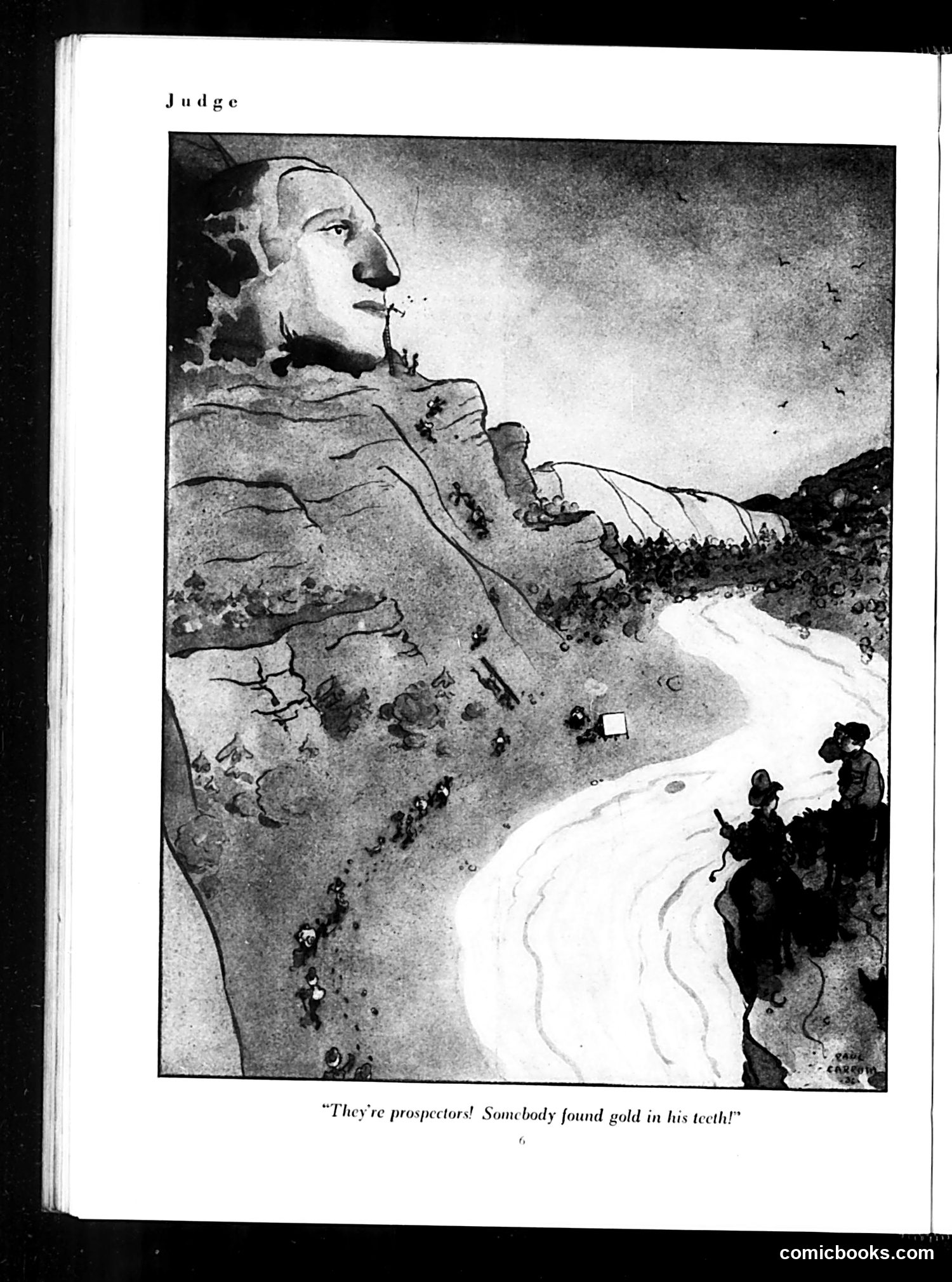
Analysis of Judge Magazine Page This page shows a satirical cartoon titled "They're prospectors! Somebody found gold in his teeth!" The image depicts an enormous male figure (rendered as a caricatured head and shoulders) with a cigarette, overlooking a snowy landscape. Small human figures stand in the foreground, apparently prospectors examining the giant's face. The joke plays on the term "prospectors"—miners searching for gold—by literalizing it: they've discovered gold in the giant figure's teeth. This is visual wordplay typical of Judge's humor style. The cartoon likely satirizes either a specific public figure (the caricatured features suggest a named person, though identification isn't clear from the image alone) or comments more broadly on commercialism, greed, or human nature. Without dating information visible on the page, the exact historical context remains unclear.
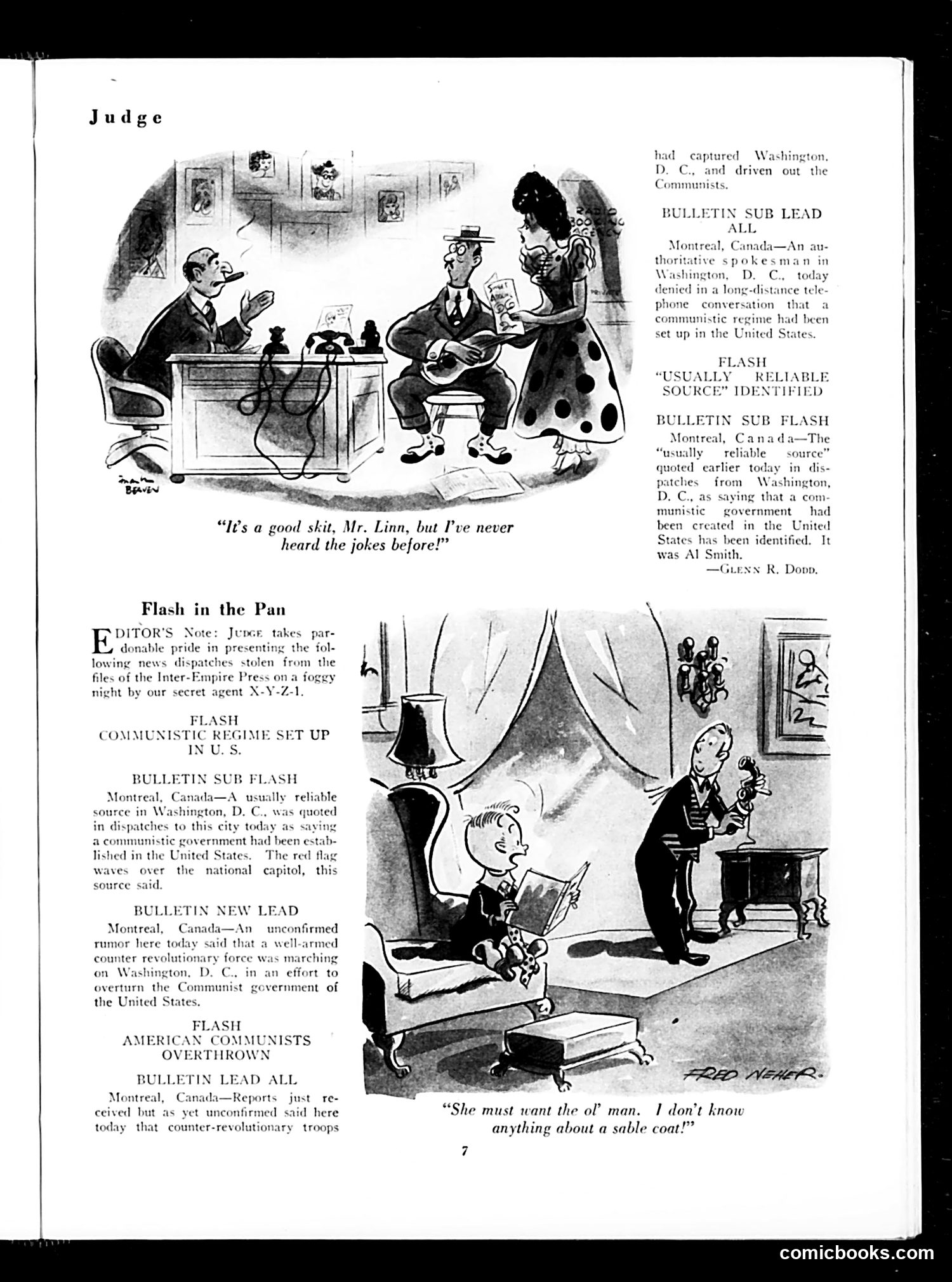
Historical Context for Modern Readers This page from *Judge* magazine contains Cold War-era anti-communist satire, likely from the early 1950s. The cartoons mock communist propaganda and infiltration fears prevalent in post-WWII America. Top cartoon: A judge listens skeptically to a performer (labeled "Mr. Linn") playing guitar with communist-themed jokes, suggesting communist propagandists were disguising ideology as entertainment. Bottom cartoon: A child asks an adult about a "sable coat," implying communist infiltrators used material temptations to recruit Americans—a common McCarthy-era anxiety about communist seduction of citizens. The accompanying "bulletins" satirize exaggerated anti-communist warnings circulating at the time, mocking both the communist threat narrative *and* the sometimes-hysterical American response to it. The magazine presents these as absurdist news dispatches to highlight their questionable credibility.
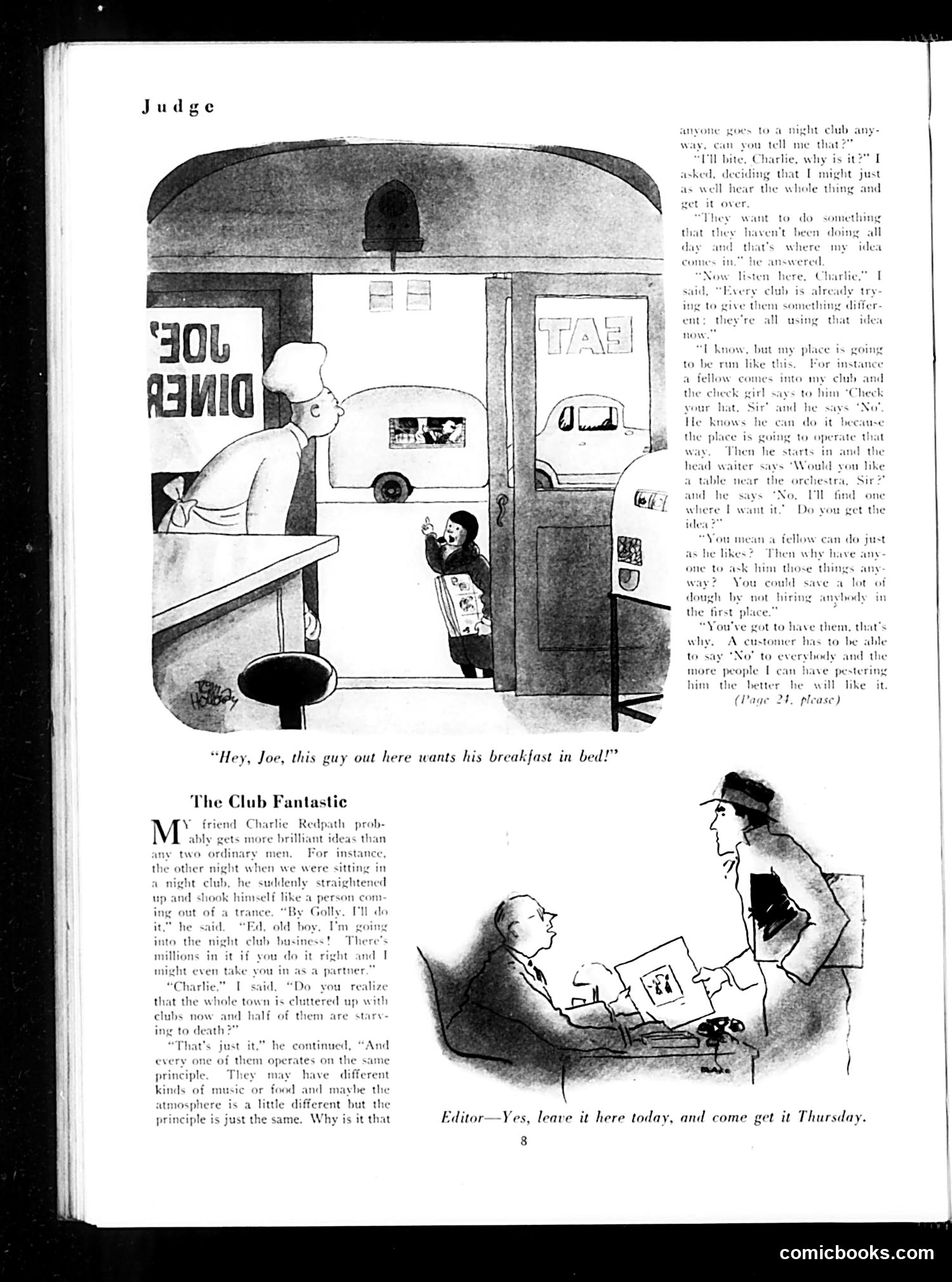
"The Club Fantastic" — Judge Magazine Satire This page satirizes the nightclub boom of the 1920s-30s, a period when clubs proliferated rapidly despite Prohibition. The cartoon depicts a shabby nightclub operating the same way as upscale competitors—offering elaborate service rituals (hat checking, table seating near orchestras, breakfast in bed) to make patrons feel important. The satirical point: Charlie Redpath proposes opening a nightclub based on this simple principle—that customers enjoy *feeling catered to* and special, regardless of actual quality. The humor mocks both: 1. Club owners: operating identical, gimmicky establishments 2. Patrons: believing themselves unique when receiving identical treatment 3. The service economy: reducing hospitality to theatrical gestures The dialogue emphasizes this absurdity: why hire staff just to say "no" to customers? Because customers *enjoy being pestered* by attentive service. The editor's caption ("leave it here today, come get it Thursday") adds dry commentary on editorial deadlines, typical of Judge's format.
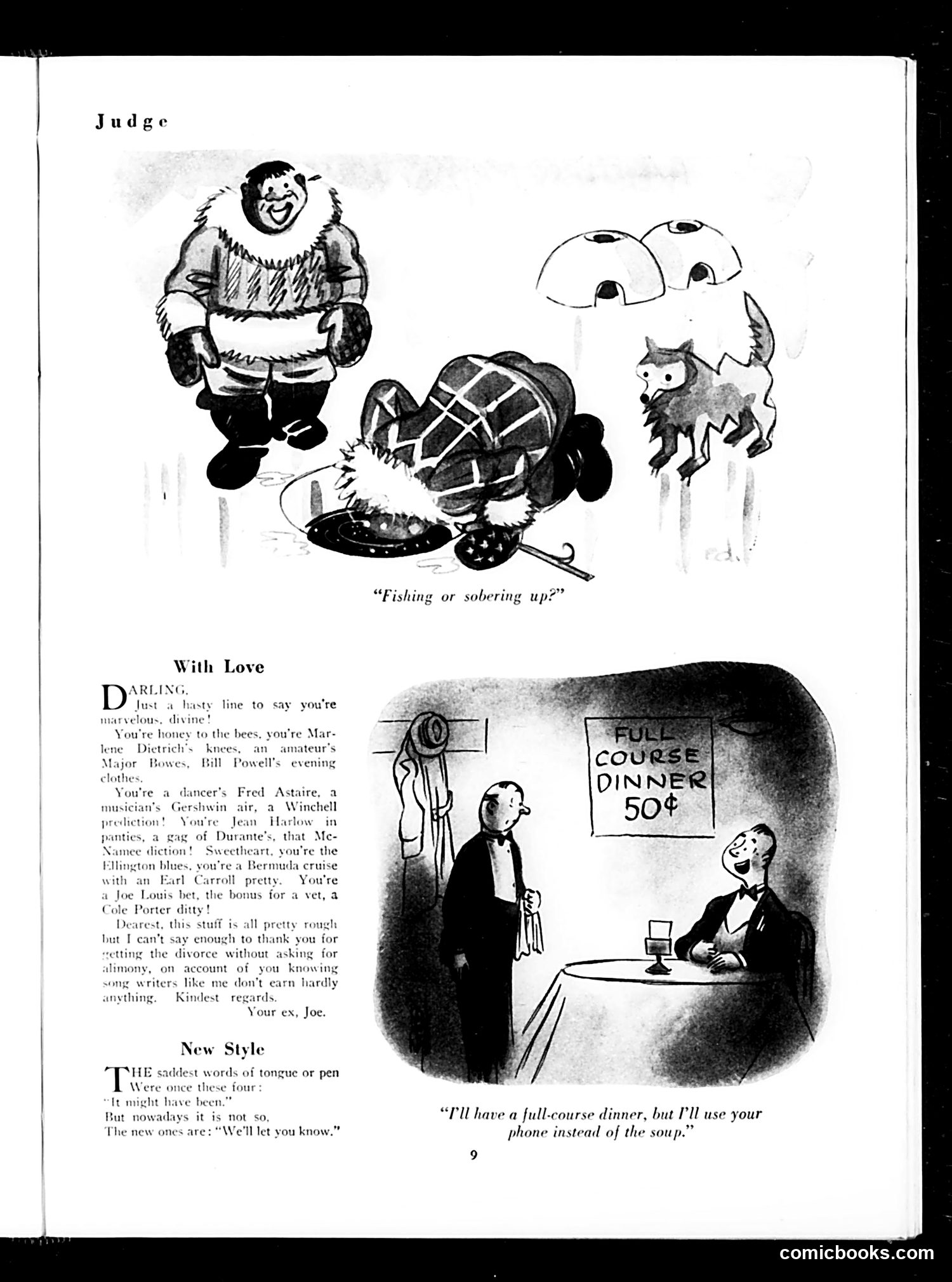
Judge Magazine Page Analysis This page contains three distinct satirical pieces from what appears to be the 1930s-40s era: "With Love" is a divorce announcement disguised as flattery. A man named Joe thanks his ex-wife for divorcing him without demanding alimony, then compliments her by comparing her to contemporary celebrities (Marlene Dietrich, Fred Astaire, Jean Harlow, Joe Louis). The satire mocks both the hollow flattery men use and the economic desperation of songwriters who "don't earn hardly anything." "Judge" cartoon shows a figure examining someone's catch, asking "Fishing or sobering up?"—satirizing Prohibition-era concerns about alcohol and rehabilitation. "New Style" contrasts old expressions of regret ("It might have been") with modern corporate non-committal language ("We'll let you know"), mocking 1930s-40s business culture's evasiveness. The restaurant cartoon jokes about a man ordering an expensive dinner but requesting to use someone's phone instead of eating soup—suggesting financial desperation masked by false bravado.
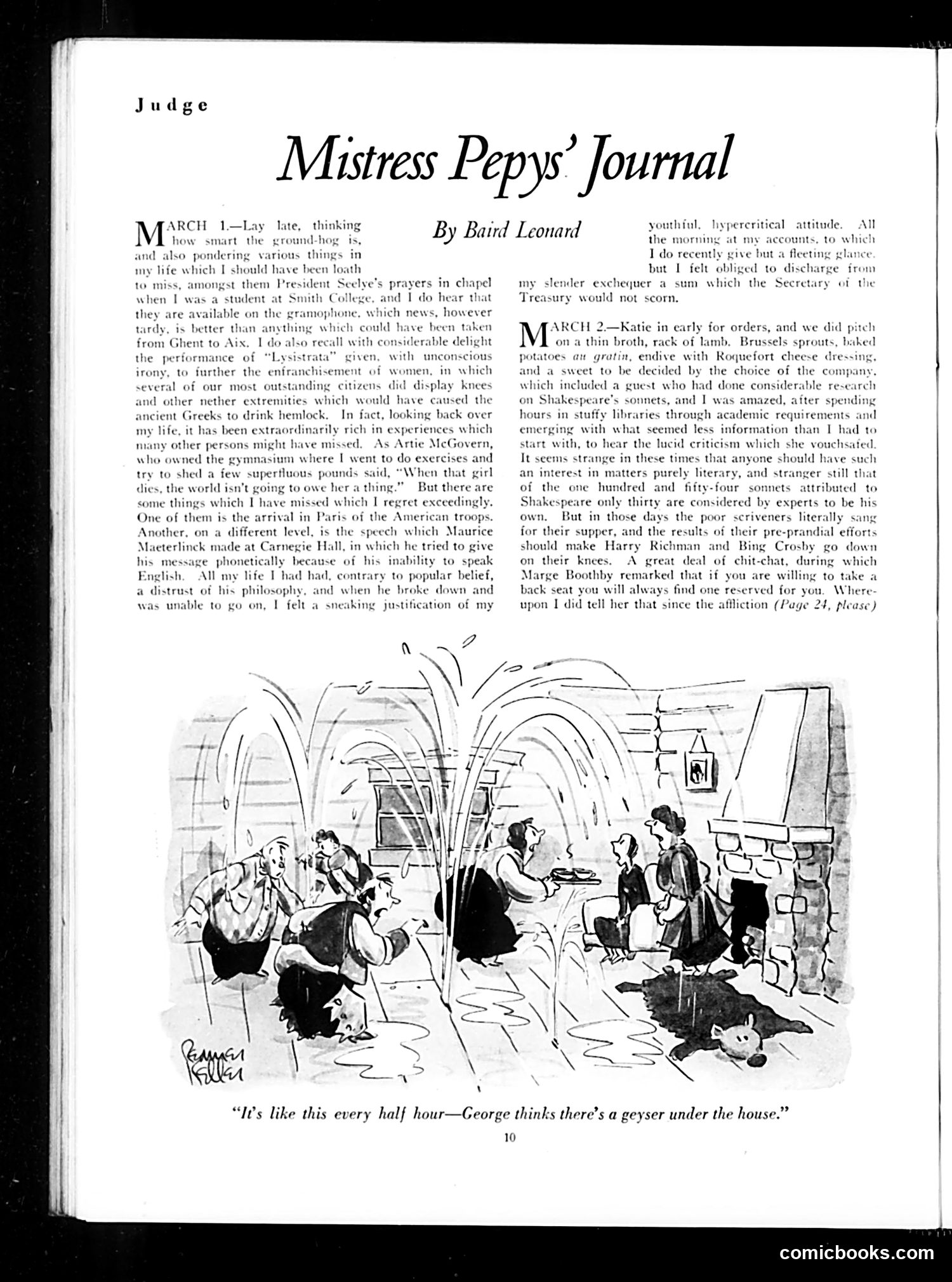
"Mistress Pepys' Journal" — Explanation for Modern Readers This is a humor column by Baird Leonard mimicking Samuel Pepys's famous 17th-century diary, but set in contemporary (1920s-30s) times. The narrator is a society woman commenting wryly on cultural life—attending dinners, discussing Shakespeare's sonnets, managing household accounts. The accompanying cartoon shows a domestic interior with what appears to be a flooded or geyser-damaged room, with multiple well-dressed figures observing the chaos. The caption jokes: "It's like this every half hour—George thinks there's a geyser under the house." The humor works on two levels: the column's literary pretension (imitating Pepys while discussing modern trivialities) and the cartoon's domestic absurdity—a husband's bizarre explanation for recurring household disasters. The satire gently mocks both uppercrust social pretension and marital dynamics, likely resonating with Judge magazine's educated, urban readership of that era.
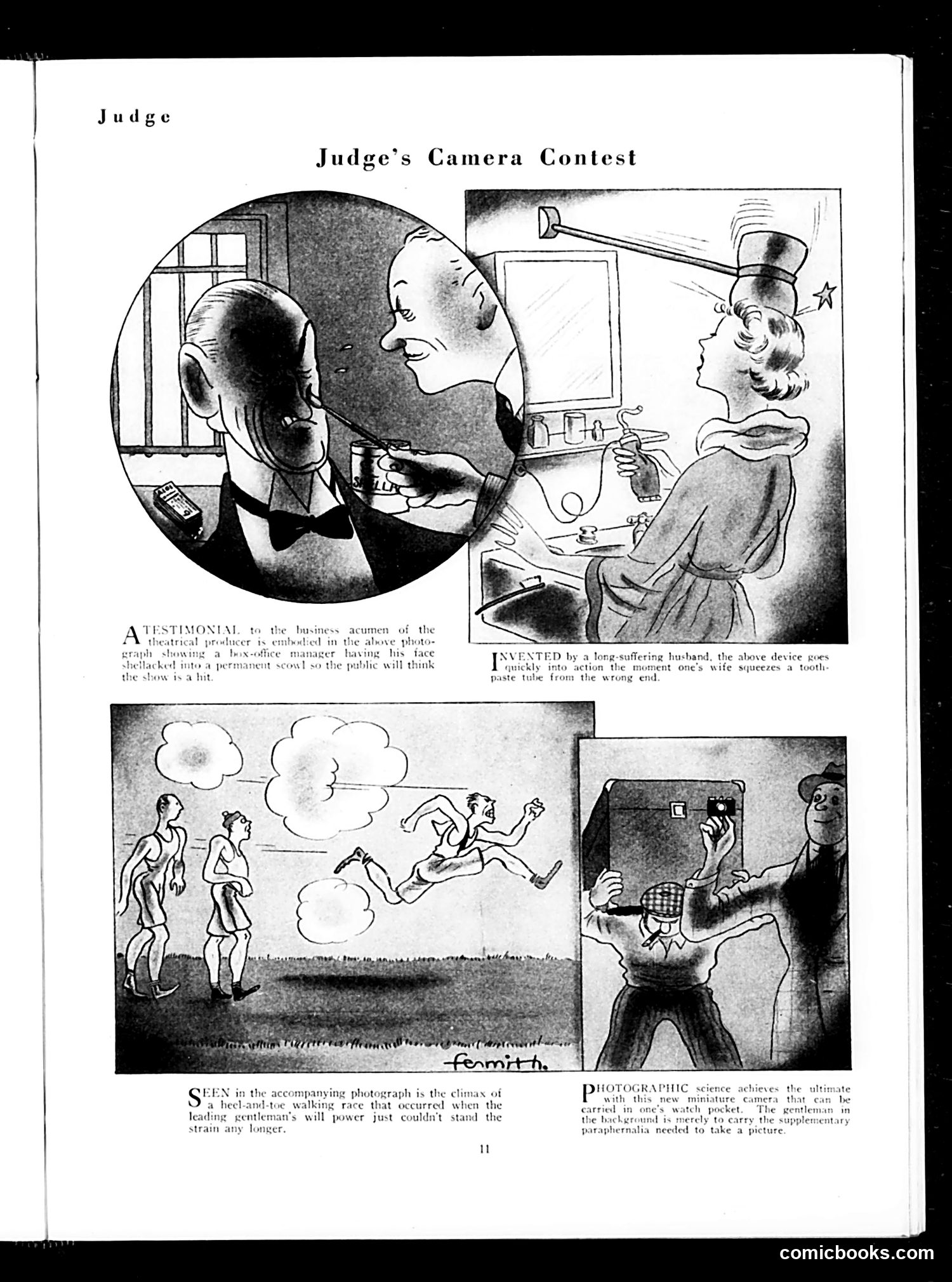
Judge's Camera Contest - Explanation for Modern Readers This page presents humorous invented gadgets submitted to a "Judge's Camera Contest." The cartoons mock domestic life and gender relations through exaggerated inventions: 1. Top left: A fake testimonial where a box-office manager's face is "blackened into a permanent scowl" to appear stern—satirizing artificial business personas. 2. Top right: A device where a husband invented a way to squeeze toothpaste from the "wrong end"—mocking marital conflict over mundane household tasks. 3. Bottom left: A "heel-and-toe walking race" where gentlemen lose self-control—poking fun at masculine restraint and physical exertion. 4. Bottom right: A miniature pocket camera for "photographic science"—gently satirizing early camera technology and surveillance. The overall theme ridicules both new technology and domestic squabbles, reflecting early 20th-century American anxieties about modernity, marriage, and masculine authority.
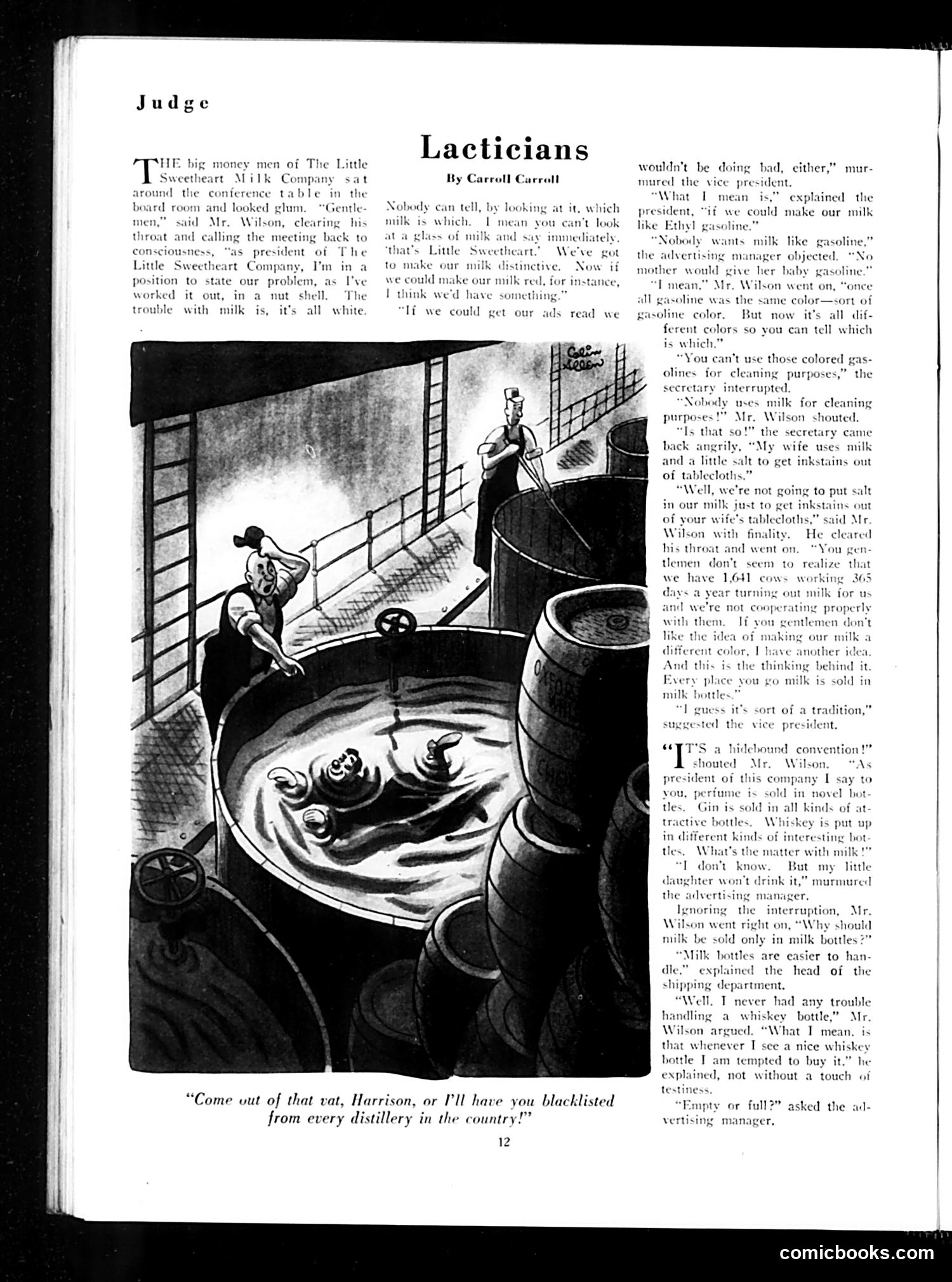
"Lacticians" Satire Explanation This story satirizes corporate marketing absurdity during the early-to-mid 20th century. Mr. Wilson, president of Little Sweetheart Milk Company, proposes making their milk distinctive by coloring it like gasoline—so consumers can instantly identify their brand. The satire mocks several targets: corporate executives who ignore practical objections, advertising's superficial solutions to real problems, and the gap between business logic and consumer reality. When staff reasonably object that colored milk is unmarketable, Wilson dismisses concerns and proposes selling milk in fancy bottles like whiskey or perfume instead—missing the point that milk's actual value lies in being milk, not its packaging. The cartoon (showing workers in a vat) visually reinforces the absurdity. The humor relies on recognizing that this "thinking" is ridiculous—yet such disconnects between executive vision and practical sense were common enough to warrant satirical treatment in Judge magazine.
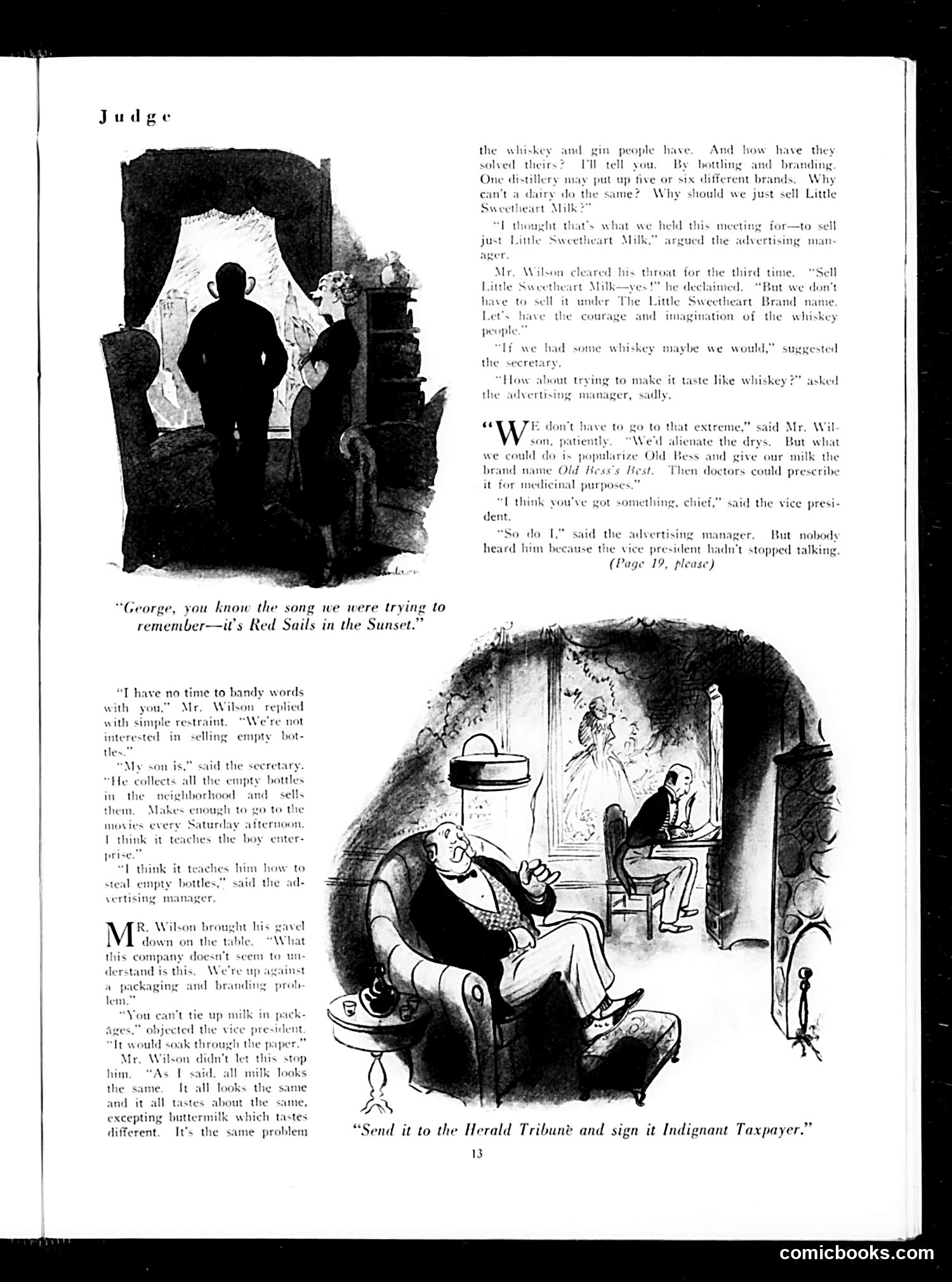
Analysis This is a satirical business meeting scene from Judge magazine mocking marketing and advertising strategy, likely from the Prohibition era (based on whiskey references). The Setup: Mr. Wilson, apparently a company executive, chairs a meeting about selling "Little Sweetheart Milk." He argues the dairy industry should adopt the branding strategies of whiskey and gin companies—creating multiple brand names and packaging to differentiate identical products. The Satire: Wilson proposes renaming their milk "Old Hess's Best" and marketing it for "medicinal purposes" (a common Prohibition-era workaround for selling alcohol). The joke is that he's suggesting milk companies use the exact deceptive tactics whiskey makers employed to circumvent alcohol laws. The Point: Judge ridicules both corporate marketing (selling essentially identical products under different names as if they're different) and the obvious hypocrisy of Prohibition enforcement—the transparent pretense that "medicinal" whiskey was anything but regular liquor. The bottom cartoon caption suggests sending complaints to newspapers, typical of the era's reader engagement style.
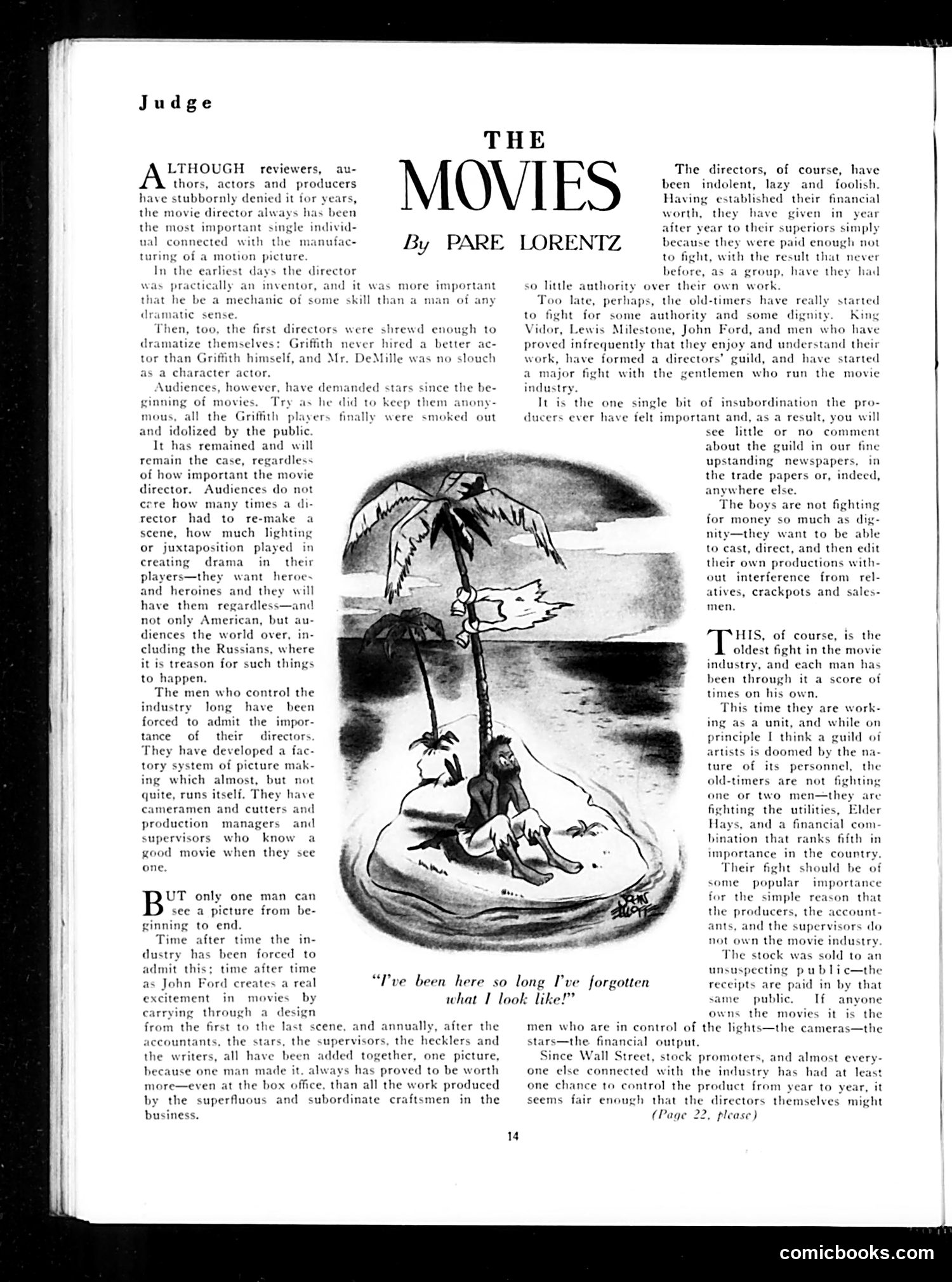
"The Movies" by Pare Lorentz - Judge Magazine This article argues that film directors—not stars or producers—are the creative force behind cinema's success. The accompanying cartoon shows a disheveled, aged figure under a palm tree with the caption "I've been here so long I've forgotten what I look like!"—likely representing a forgotten or marginalized director. Lorentz praises early directors like Griffith and DeMille, then celebrates contemporary directors (Vidor, Ford, Milestone) who've formed a Directors Guild to fight studio producers for creative control. This is framed as labor activism: directors want authority over casting, directing, and editing without interference from producers' relatives and salesmen. The satire targets how producers—who control finances—have exploited directors' talent while keeping them anonymous and underpaid. Lorentz notes the press ignores the guild's fight because producers control trade papers. This reflects 1930s-40s industry power struggles over creative versus commercial authority.
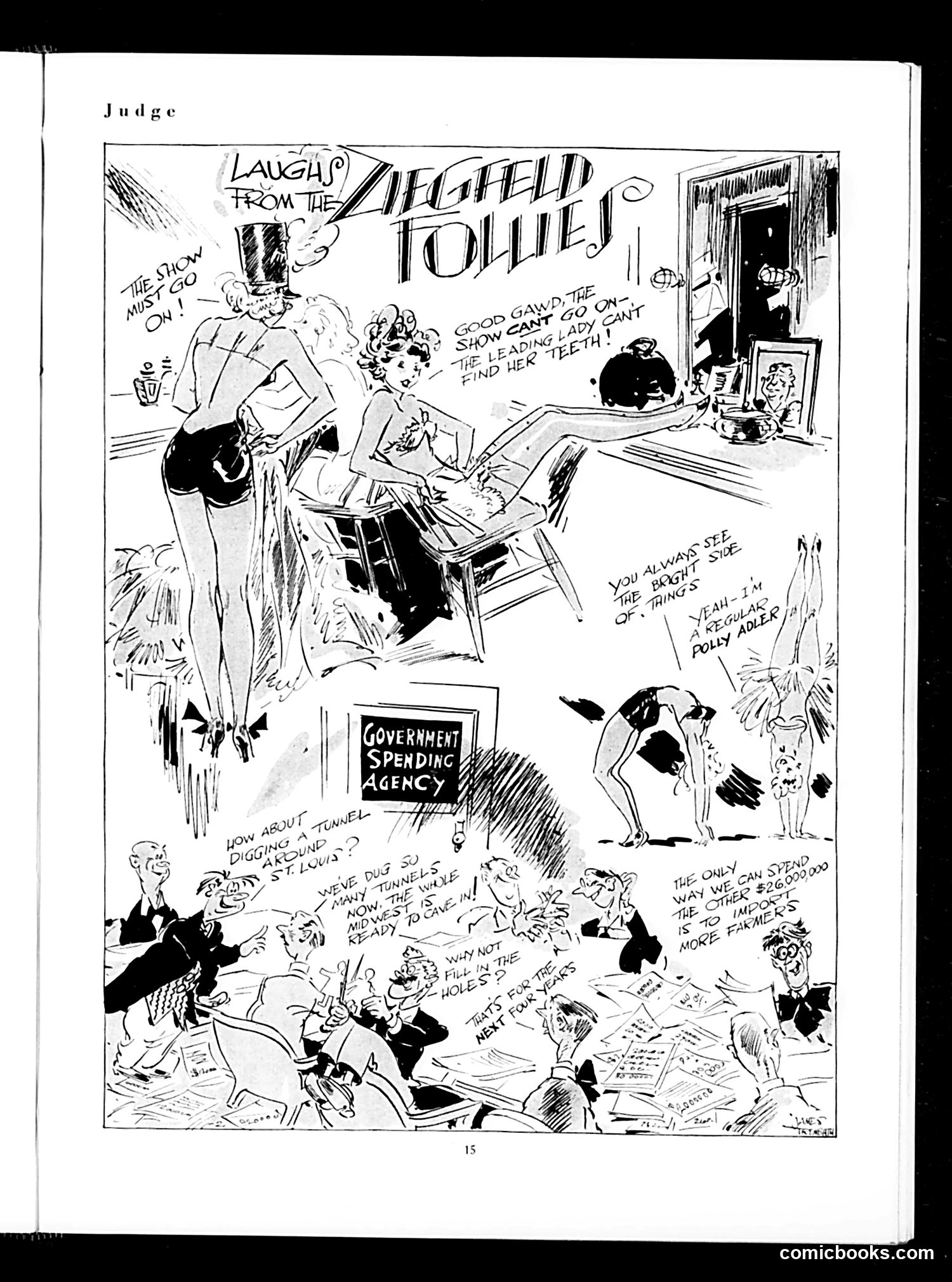
"Laughs from the Ziegfeld Follies" This cartoon satirizes the contrast between high-end entertainment and government waste. The central figure appears to be a showgirl from the Ziegfeld Follies (a famous Broadway revue known for elaborate productions and attractive performers), depicted in glamorous costume. The joke juxtaposes this spectacle with a "Government Spending Agency" below, where bureaucrats argue about wasteful spending—digging tunnels, discussing expenditures, and debating allocations. The satire suggests that while Americans enjoy luxury entertainment, government agencies squander money through inefficiency and poor planning. The cartoon criticizes government bureaucracy and spending habits, implying that officials' incompetence rivals theatrical absurdity, though one costs taxpayers far more.
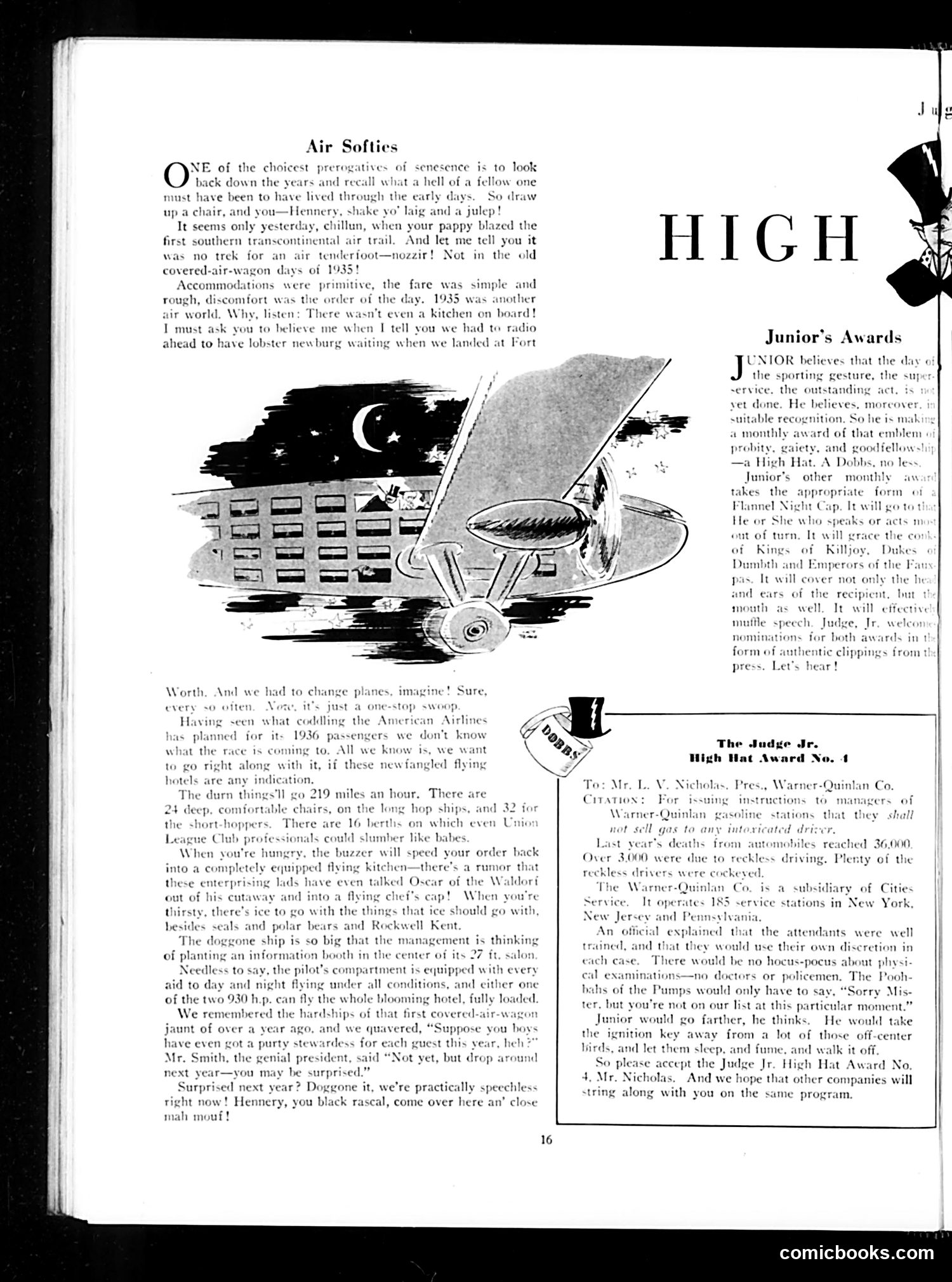
Air Softies & Junior's Awards This page from Judge magazine combines nostalgic humor with a corporate award announcement. "Air Softies" is a humorous essay nostalgically mocking early commercial aviation (specifically referencing 1935). The narrator, speaking in exaggerated Southern dialect, recalls primitive flying conditions—no kitchen aboard, discomfort as standard, the need to radio ahead for food. The joke targets modern travelers who complain, contrasting their "soft" experience with supposedly tougher ancestors. The illustration shows an early passenger plane beside a building at night, reinforcing the primitive era being described. "Junior's Awards" announces Judge magazine's monthly recognition program. This particular award (#4) goes to L.V. Nicholas of Warner-Quinlan Co., praising their gasoline station managers for instructing attendants to check reckless drivers for intoxication rather than simply refusing service. The award humorously suggests giving such drivers sleep and time to recover rather than judgment. It's a light corporate commendation emphasizing safety consciousness during what appears to be the 1930s.
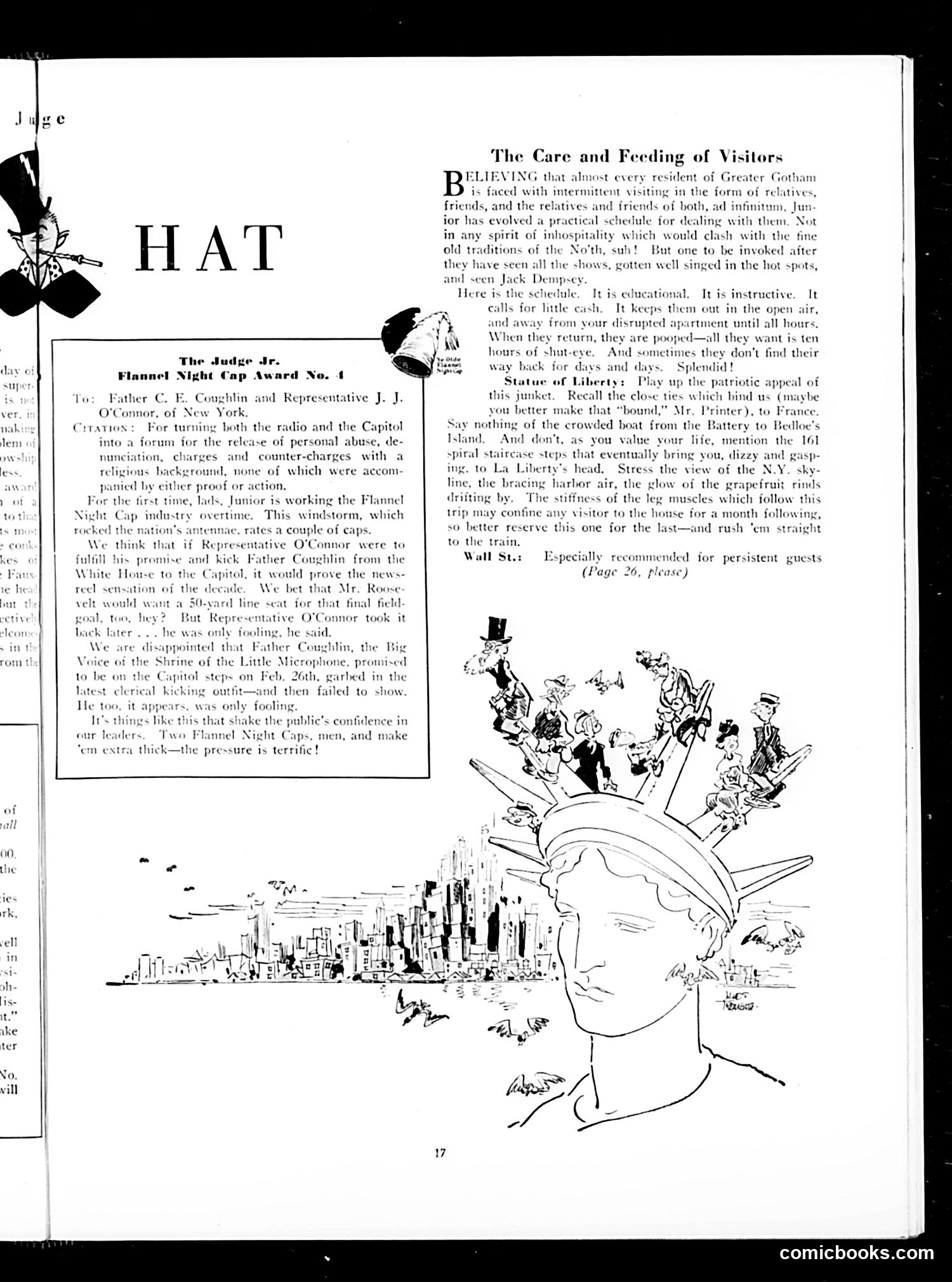
Judge Magazine Page Analysis This page contains two satirical pieces from Judge magazine's "Junior" section, targeting public figures of the era. "Flannel Night Cap Award No. 1" mocks Father C.E. Coughlin and Representative J.J. O'Connor of New York for abusing radio and the Capitol as platforms for personal attacks without evidence. The "Flannel Night Cap" is a dismissive award for foolishness. The piece ridicules Coughlin's promise to speak on Capitol steps on February 26th in "latest clerical kicking outfit"—then failing to appear. The satire suggests both men are bluffing demagogues undermining public trust in leaders. "The Care and Feeding of Visitors" is lighter satirical advice for Greater Gotham residents managing visiting relatives. It humorously recommends exhausting guests through sightseeing (shows, Jack Dempsey fights, Statue of Liberty) and boat trips, keeping them in "open air" away from one's apartment. The cartoonish illustration shows well-dressed people packed into Lady Liberty's head. The page reflects 1920s-30s concerns about radio-enabled demagoguery and the social obligation of hosting relatives.
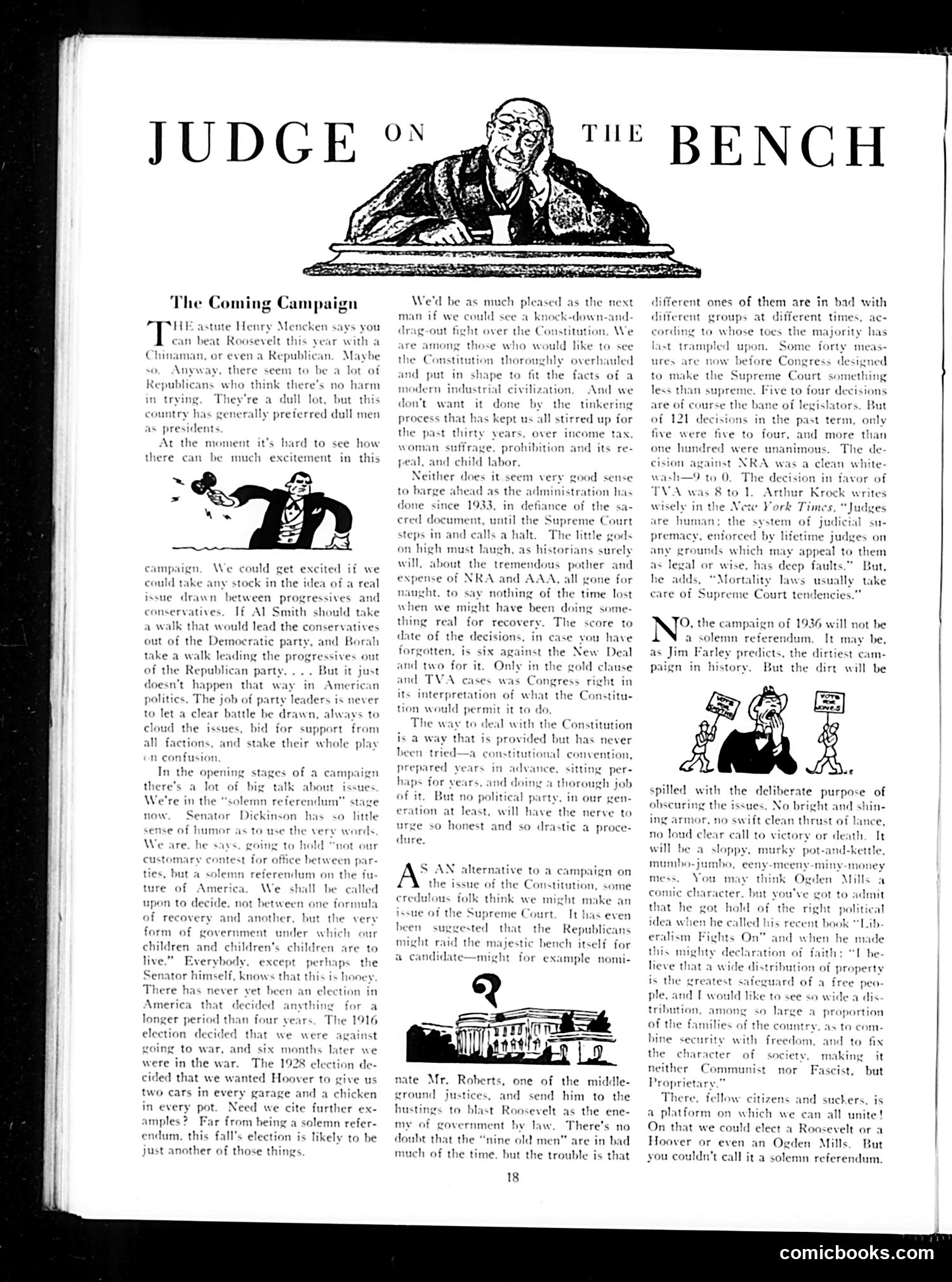
Judge Magazine Political Satire Analysis This 1936 article mocks the upcoming presidential campaign as hollow political theater. The author argues that American elections never genuinely decide major issues—citing examples like 1916 (claiming to oppose war, then entering it) and 1928 (promising prosperity before the Depression). The satire targets Senator Dickinson's grandiose claim that the election represents a "solemn referendum" on the form of government itself. The author dismisses this as typical political rhetoric that obscures rather than clarifies real choices between progressives and conservatives. The piece critiques both parties for avoiding honest debate, particularly regarding the Constitution and the Supreme Court's recent anti-New Deal decisions. The cartoon shows politicians (likely representing party leaders) as buffoons engaged in theatrical posturing rather than substantive governance—suggesting 1936 politics were fundamentally cynical pantomimes indistinguishable from "just another of those things."
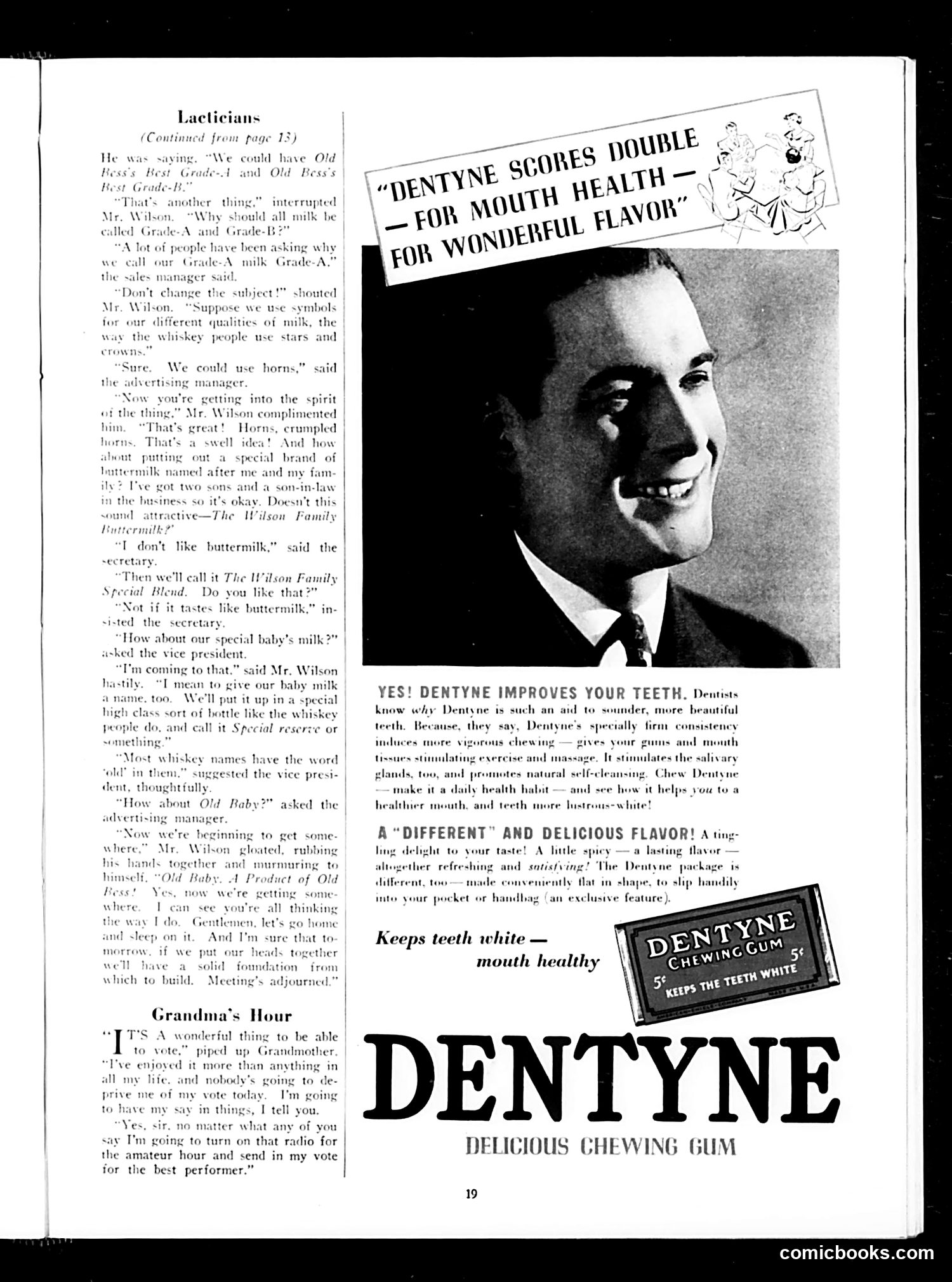
Explanation for Modern Readers This page contains two distinct elements: "Lacticians" (left side): A humorous story about a businessman named Mr. Wilson proposing marketing schemes for milk products. The satire mocks corporate branding and advertising: Wilson suggests using symbols (like whiskey's stars/crowns) to distinguish milk grades, then proposes naming products after his family ("Wilson Family Buttermilk," "The Wilson Family Special Blend," "Old Baby"). The joke targets the absurdity of commodifying family names for profit and the pretentiousness of luxury branding for ordinary products. "Grandma's Hour" (bottom left): A brief anecdote about an elderly woman voting for the first time, planning to watch an amateur radio hour and vote for the "best performer." This appears to be lighthearted commentary on newly-enfranchised voters (likely referencing women's suffrage), suggesting some voters treat voting like entertainment. Right side: A full-page Dentyne chewing gum advertisement — not satire. This is straightforward product marketing claiming dental health benefits.
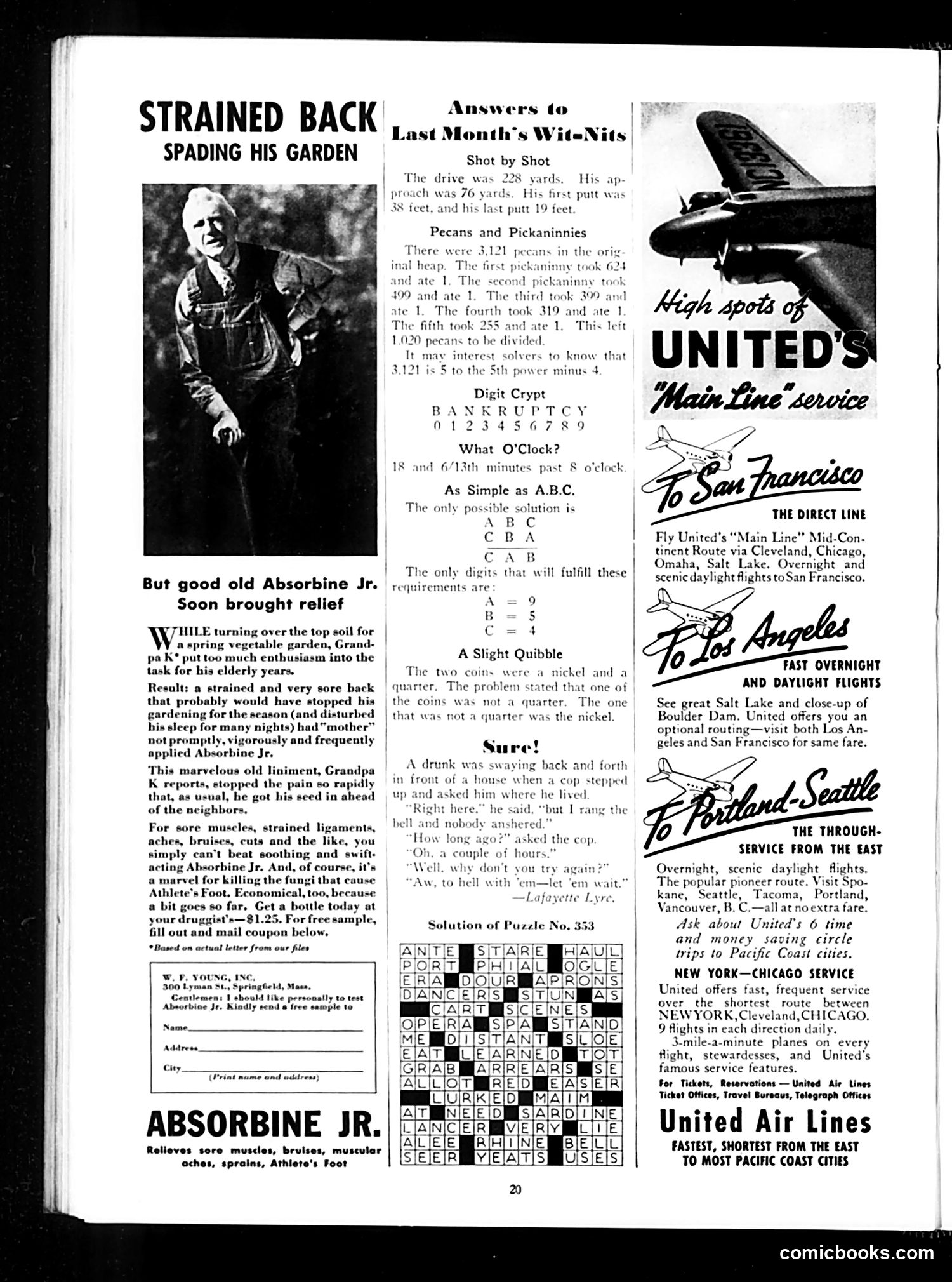
Judge Magazine Page Analysis This page is primarily advertising, not satirical content. The main feature is a full-page advertisement for Absorbine Jr., a liniment product marketed for sore muscles and athlete's foot. The ad shows an elderly man ("Grandpa K") who strained his back while gardening—the "joke" being that the product provided such rapid relief he could complete his spring planting ahead of neighbors. The remainder of the page contains: - Puzzle solutions from the previous month's issue (math problems, word games, a crossword) - Multiple airline advertisements for United Air Lines, promoting routes to San Francisco, Los Angeles, Portland, Seattle, and Chicago The content reflects 1940s-era magazine conventions: readers solved puzzles for entertainment, and full-page pharmaceutical and transportation ads were standard revenue. There is no political satire visible on this particular page—it's a straightforward commercial publication mixed with reader engagement features.
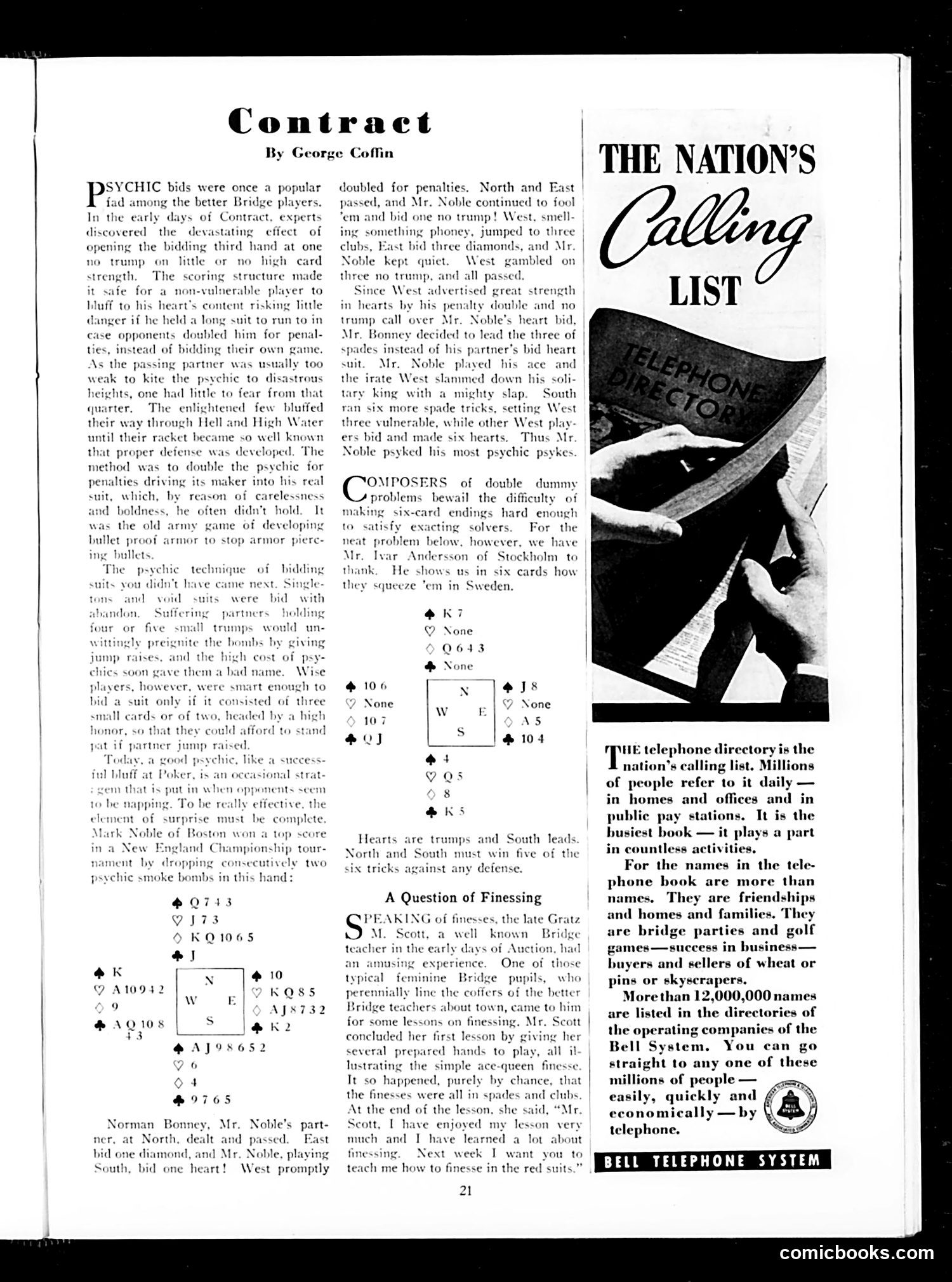
Analysis of This Judge Magazine Page This page contains bridge instruction and strategy, not political satire. It's primarily educational content about contract bridge—a card game popular among educated elites in the early 20th century. "Contract" by George Coffin discusses "psychic bidding"—deliberately misleading bids to confuse opponents. The article uses a real tournament example where player Mark Noble of Boston won by using this deceptive tactic successfully. "A Question of Finessing" recounts an anecdote about bridge teacher Gratz M. Scott instructing a pupil on finessing techniques (strategic card plays). The joke is mild: after a lesson on finessing in spades and clubs, the student asks to learn finessing "in the red suits"—seemingly missing that red suits (hearts and diamonds) were already covered. The right side contains a Bell Telephone System advertisement promoting telephone directories as essential business tools—unsatirized corporate messaging. This page reflects bridge's status as sophisticated entertainment for the affluent during this era, rather than containing political commentary or social satire.
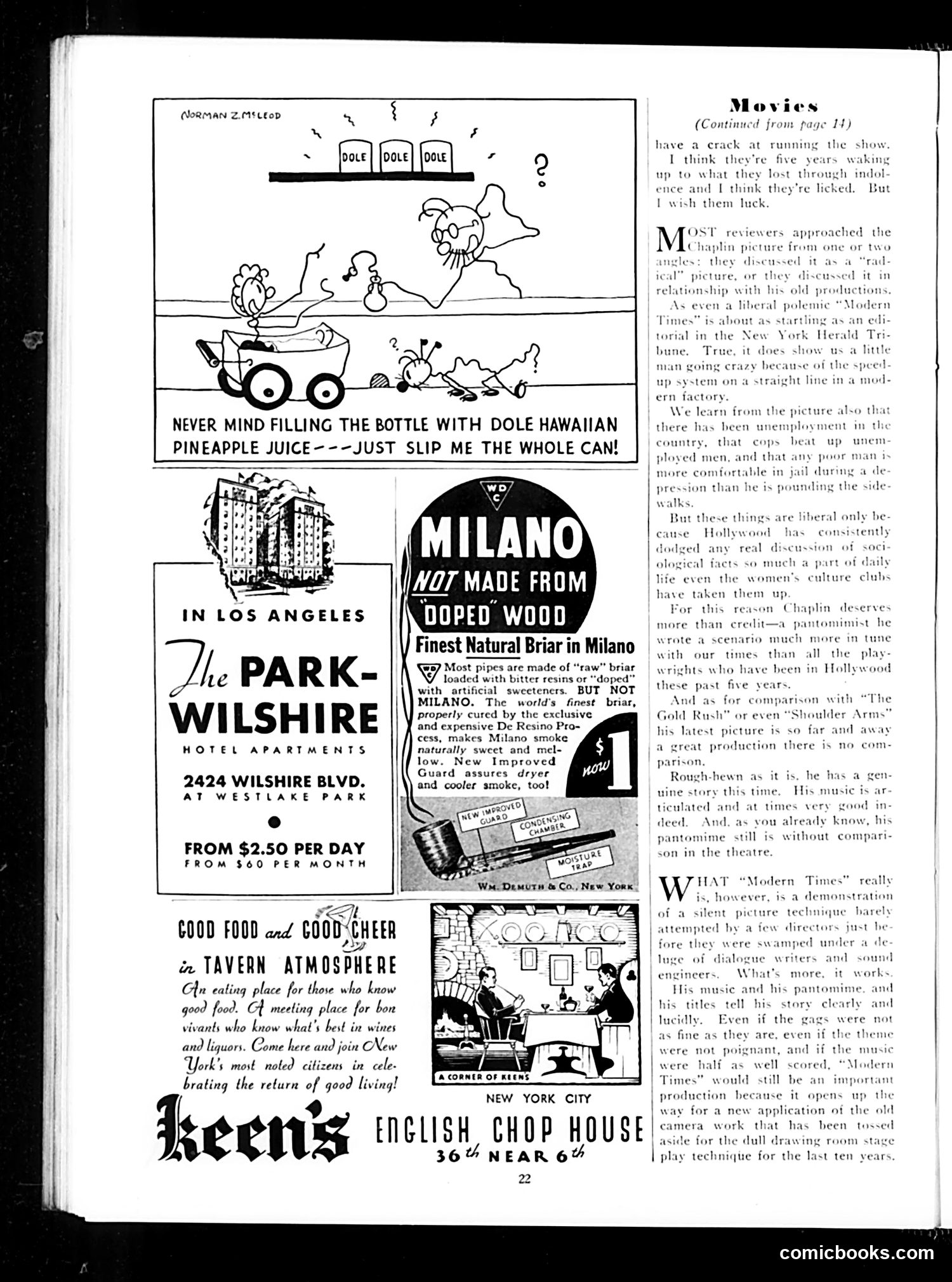
Analysis of This Judge Magazine Page This page contains primarily advertisements with a small movie review section at top. The main cartoon depicts a factory worker being driven mad by the monotonous assembly line—likely referencing Charlie Chaplin's *Modern Times* (1936). The joke caption about "Dole Hawaiian Pineapple" satirizes how workers are treated as mechanically as products on a conveyor belt. The text reviews *Modern Times*, praising Chaplin for addressing contemporary social issues—unemployment, police brutality against the poor, and industrial dehumanization—that Hollywood typically avoided. The reviewer notes this "pantomimist" deserves credit for tackling subjects more directly than established screenwriters, and argues the film's camera work demonstrates innovative technique beyond mere dialogue-driven drama. The remaining content is advertising: hotel apartments, a briars pipe company (Milano), and restaurants (Keen's, English Chop House). These ads are typical of Judge magazine's commercial content during the Depression era.
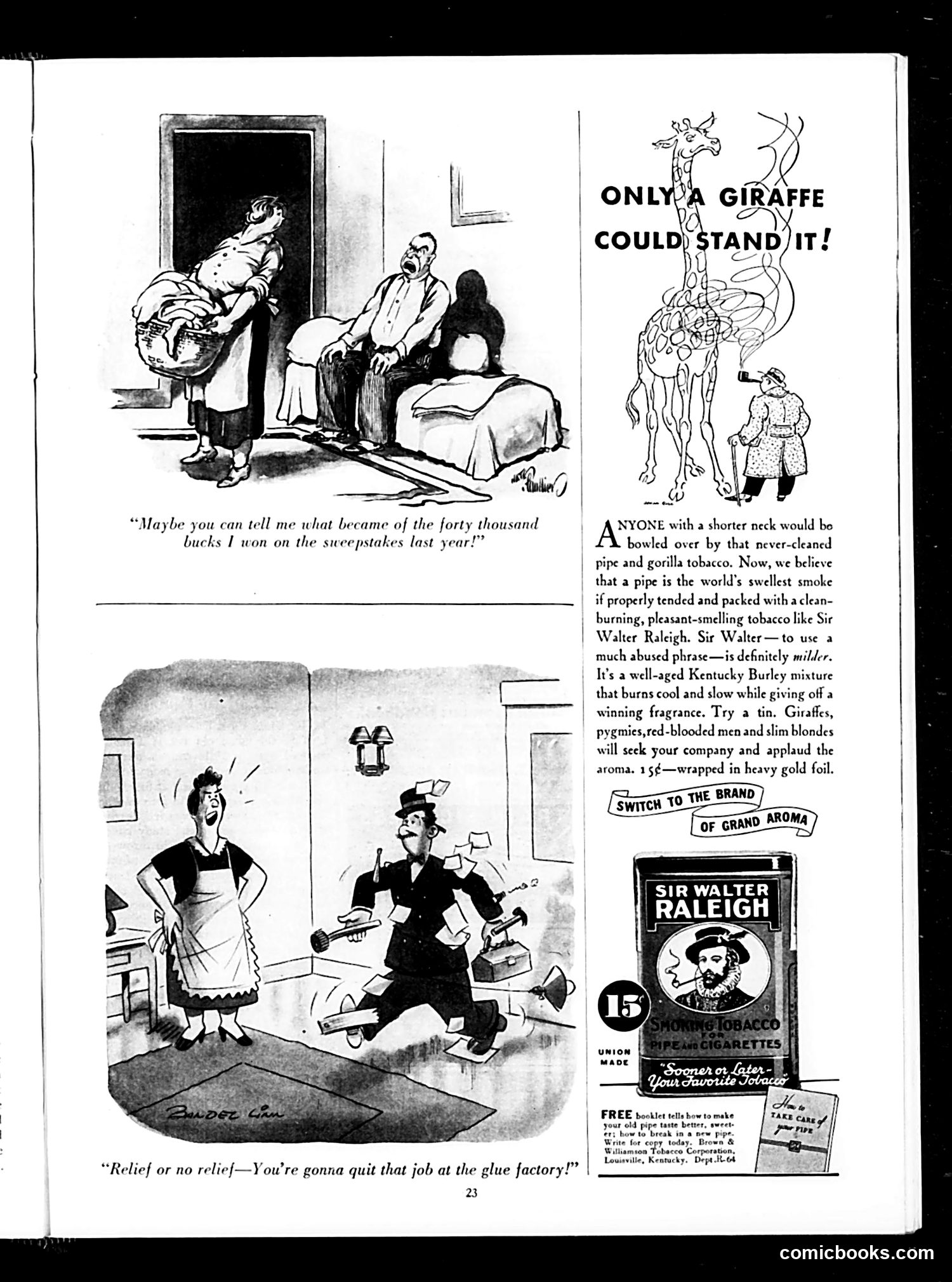
Explanation for Modern Readers This page contains two unrelated items: a cartoon joke and a tobacco advertisement. The Cartoon: A man questions his wife about missing lottery winnings ("forty thousand bucks"), suggesting she may have spent his gambling profits. The humor relies on stereotypical marital conflict over finances and implied poor money management by spouses. The Advertisement: Sir Walter Raleigh pipe tobacco is promoted with absurdist humor—claiming that only a giraffe could tolerate the "never-cleaned pipe and gorilla tobacco" of competitors. The ad then pivots to praising Sir Walter Raleigh as "milder" and "cleaner-burning," using exaggerated claims that smoking it will attract "giraffes, pygmies, red-blooded men and slim blondes." The ad exemplifies early 20th-century tobacco marketing: making health claims (now illegal), using ethnic caricatures casually, and promising social/romantic appeal through product choice. The giraffe joke is nonsensical wordplay typical of period advertising humor.
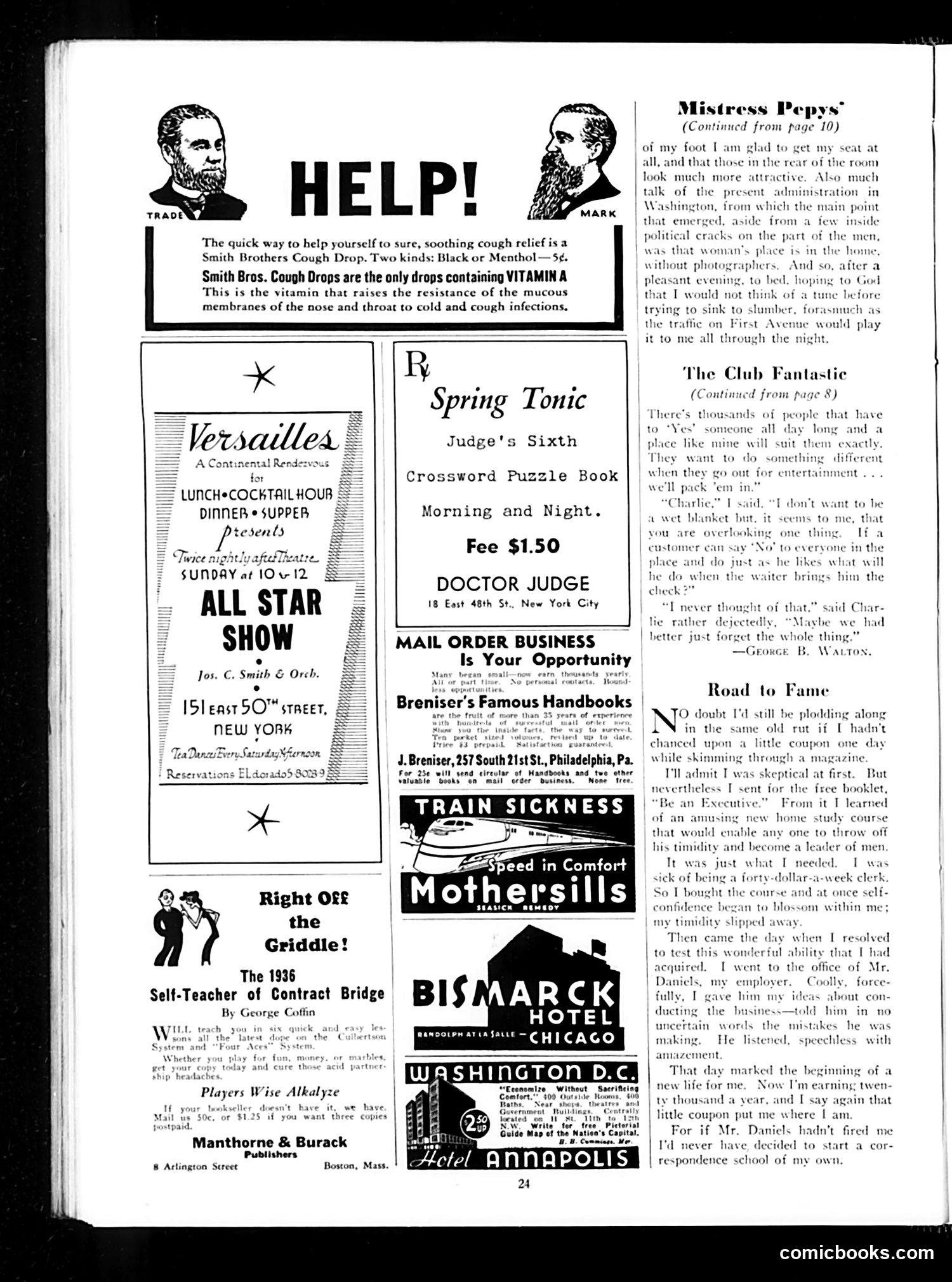
Judge Magazine Page Analysis This page is primarily advertising and serialized fiction, not political satire. The visible content includes: "Mistress Pepys" and "The Club Fantastic" — serialized humor stories (continued from earlier pages) about social observations, featuring dialogue about restaurant etiquette and personal ambitions. "Road to Fame" — a success story about a timid clerk who gains confidence through a correspondence course, enabling him to start his own business. Advertisements dominate: Smith Brothers Cough Drops (emphasizing "Vitamin A"), a crossword puzzle book, hotels (Bismarck Chicago, Hotel Annapolis), Mothersills (for train sickness), and a bridge instruction book. The page reflects 1930s consumer culture — promoting self-improvement through mail-order courses and commercial products as paths to success and social respectability. The serialized stories use light social humor rather than sharp satire. No clear political cartoons or caricatures are present on this page.
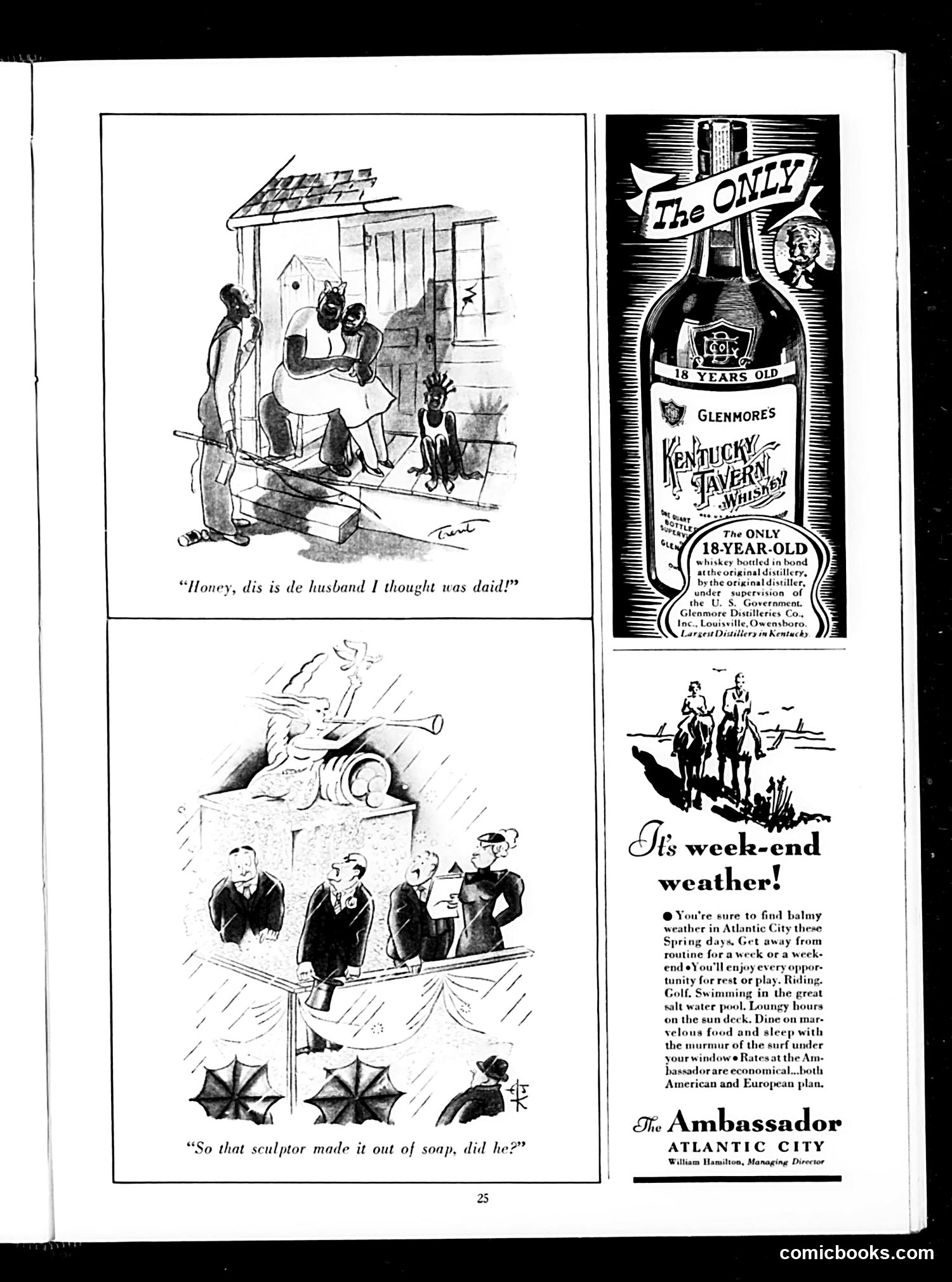
Page Analysis This page contains two cartoon jokes and advertisements. Top cartoon: A wife tells her husband "Honey, dis is de husband I thought was daid!" referencing someone thought to be dead who has reappeared—likely a Depression-era joke about unemployment or disappearance. Bottom cartoon: Shows men beneath a falling sculpture with caption "So that sculptor made it out of soap, did he?"—a dark humor joke suggesting the sculpture collapsed or dissolved, possibly satirizing art pretension or poor craftsmanship. Advertisements: The page features a Glenmore's Kentucky Tavern whiskey ad (18-year-old) and an Atlantic City hotel ("The Ambassador") promoting weekend leisure activities. These ads reflect 1920s-30s consumer culture. The cartoons use dialect humor and visual gags typical of Judge magazine's satirical style, while the advertisements show the publication's commercial focus during this era.
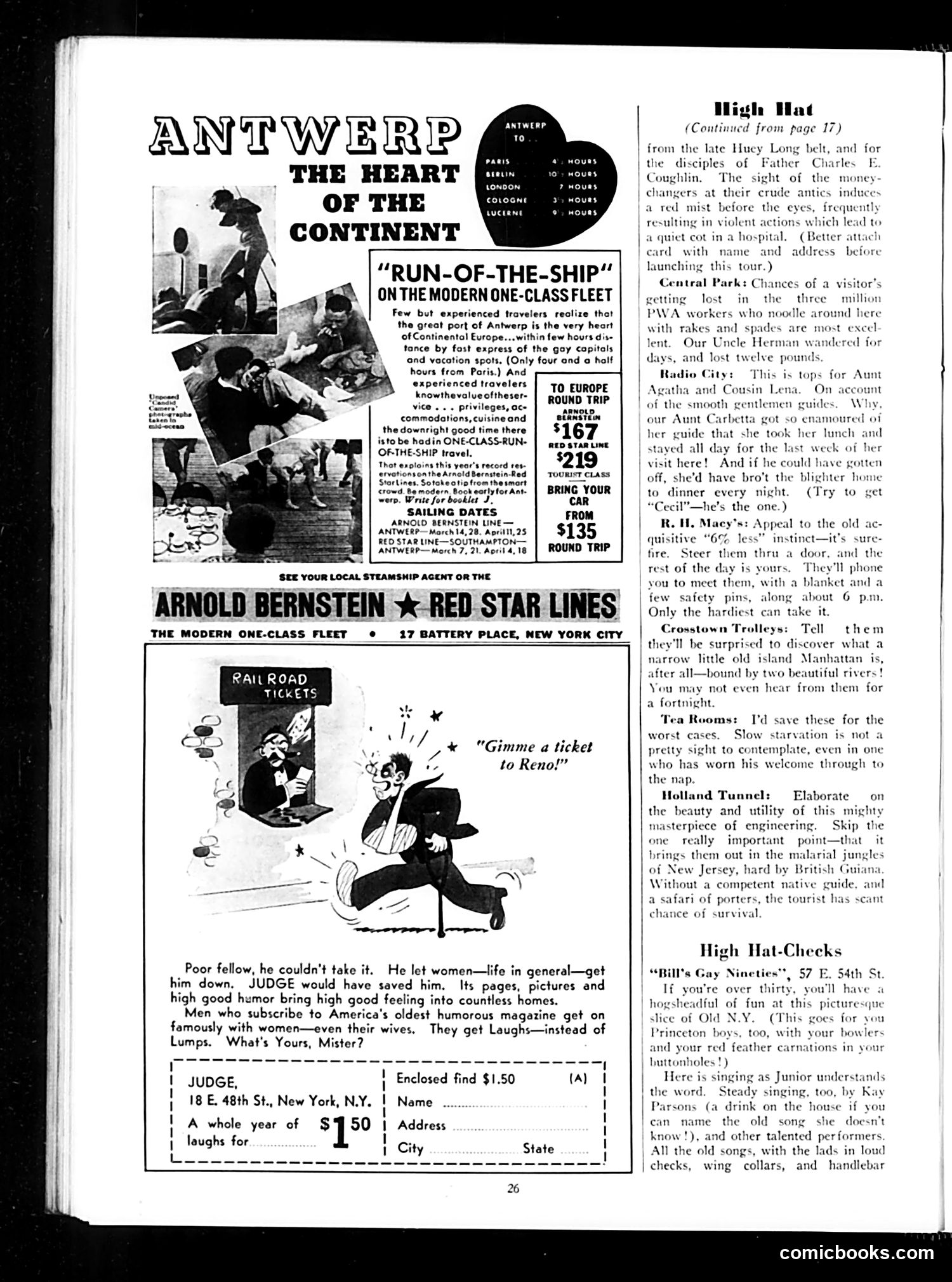
Analysis of This Judge Magazine Page This page primarily features travel advertising for the Arnold Bernstein Red Star Lines, promoting European steamship travel to Antwerp and other continental ports, with competitive pricing ($135-$219 for round trips). The cartoon (center-left) satirizes divorce culture. A man frantically shouts "Gimme a ticket to Reno!"—referencing Nevada's then-famous divorce destination, where one could obtain quick divorces. The joke: he's fleeing marriage/women due to life's pressures. The accompanying text claims Judge magazine subscriptions help men "get on famously with women—even their wives" and provide "Laughs—instead of Lumps," sarcastically suggesting humor prevents domestic conflict. The right column offers tourist recommendations with humorous commentary on New York City attractions (Central Park, Radio City, Macy's, etc.), mostly light social observation about visitors getting lost or distracted. Context for modern readers: "Reno divorce" was a familiar cultural reference to quick, consequence-free marriage dissolution; the cartoon treats marital escape as comedic rather than serious.
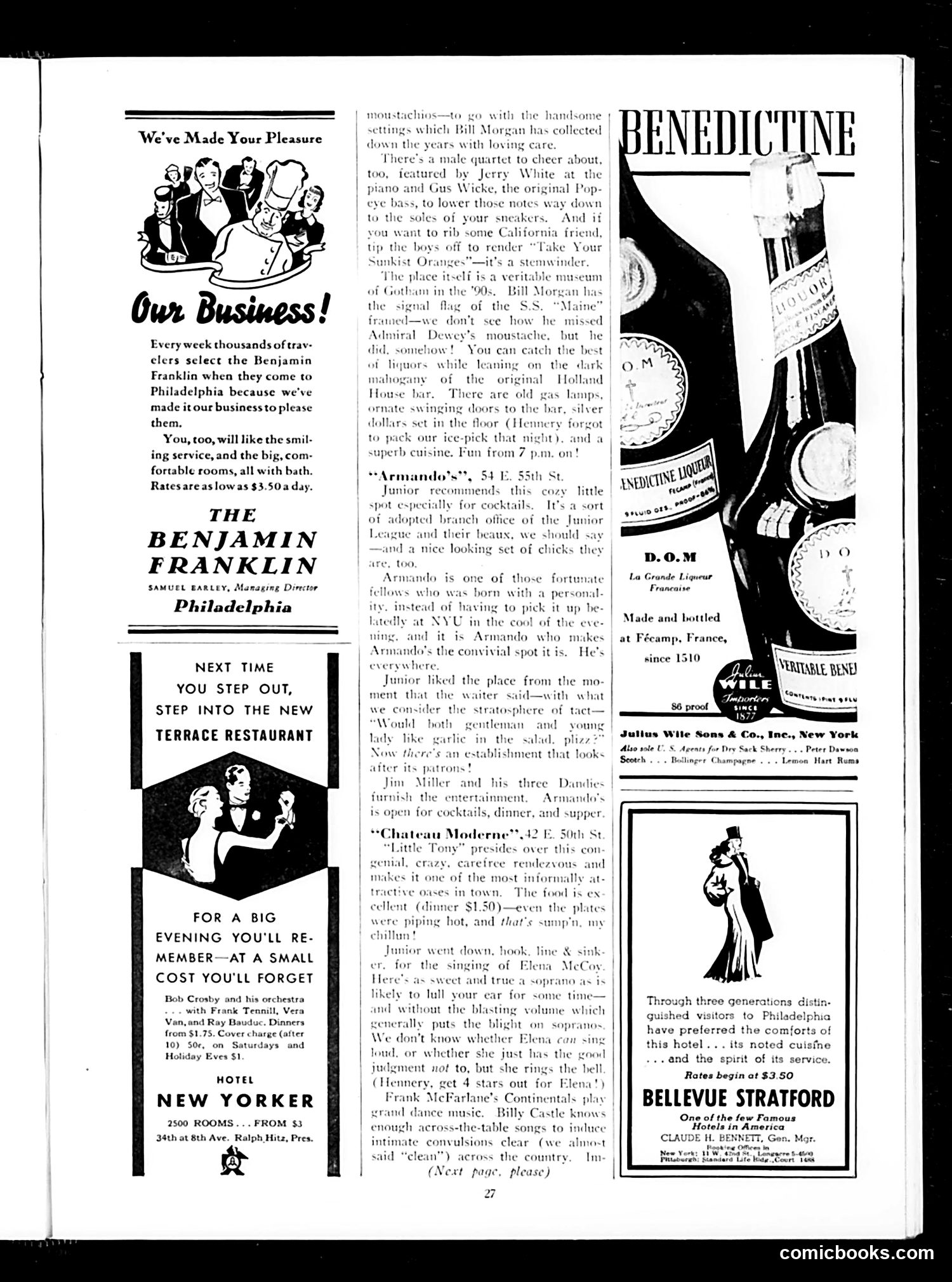
Analysis for Modern Readers This page is primarily advertising, not political satire. It features hotel and restaurant ads from 1930s Philadelphia and New York, plus a liqueur advertisement. The content reflects Depression-era marketing: hotels emphasize affordability ("rates as low as $3.50"), entertainment value, and comfort to attract travelers during economic hardship. References like "Bob Crosby and his orchestra" and mentions of cocktails, dinner shows, and dancing indicate nightlife was a key selling point for leisure travel. The scattered editorial text discusses Philadelphia restaurants (Armando's, Chateau Moderne) in a gossipy, approving tone—typical of Judge's lifestyle coverage. There's no apparent political message or satirical commentary visible on this page. The small illustration of a well-dressed couple dancing is generic promotional imagery, not commentary on contemporary politics or society. This is essentially a commercial magazine page with period-specific entertainment and hospitality marketing.
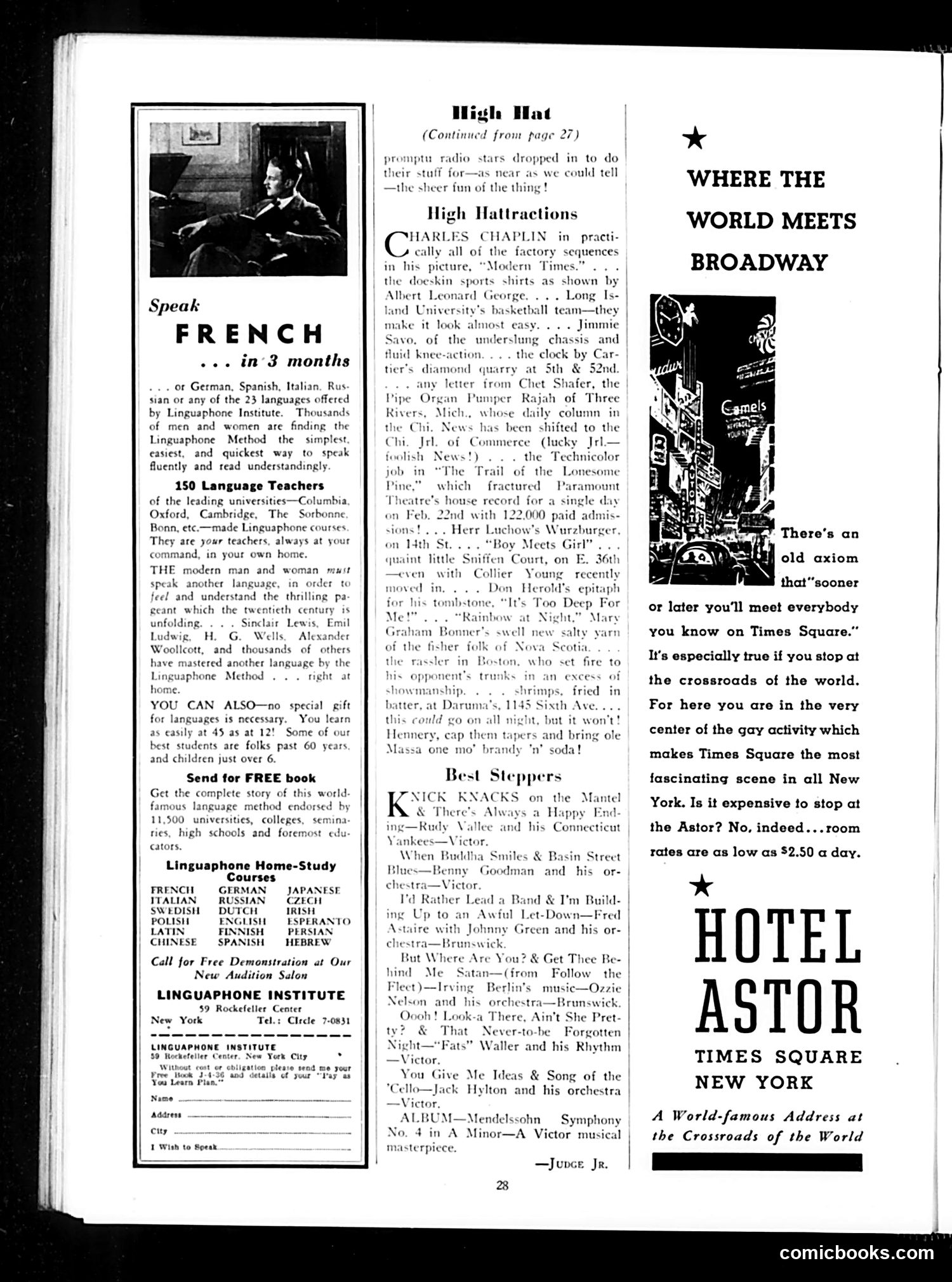
Judge Magazine Page Analysis This page is primarily advertising and entertainment listings rather than political satire. The left column advertises the Linguaphone Institute's language courses, emphasizing that modern people must speak foreign languages—a practical concern for the 1930s era. The copy cites famous figures (Sinclair Lewis, H.G. Wells) as endorsers. The center contains "High Hat Attractions," a gossip-style column about entertainment industry figures and their activities—references to Charlie Chaplin's *Modern Times*, various Broadway shows, and musicians. The right side features the Hotel Astor advertisement, a prominent Times Square establishment, using the slogan "Where the World Meets Broadway" and claiming low rates ($2.50/day). This appears aimed at tourists and business travelers. There are no political cartoons visible—the page represents typical mid-1930s magazine content: commercial advertising, entertainment gossip, and hotel promotion targeting middle-class readers seeking cultural sophistication and entertainment information.
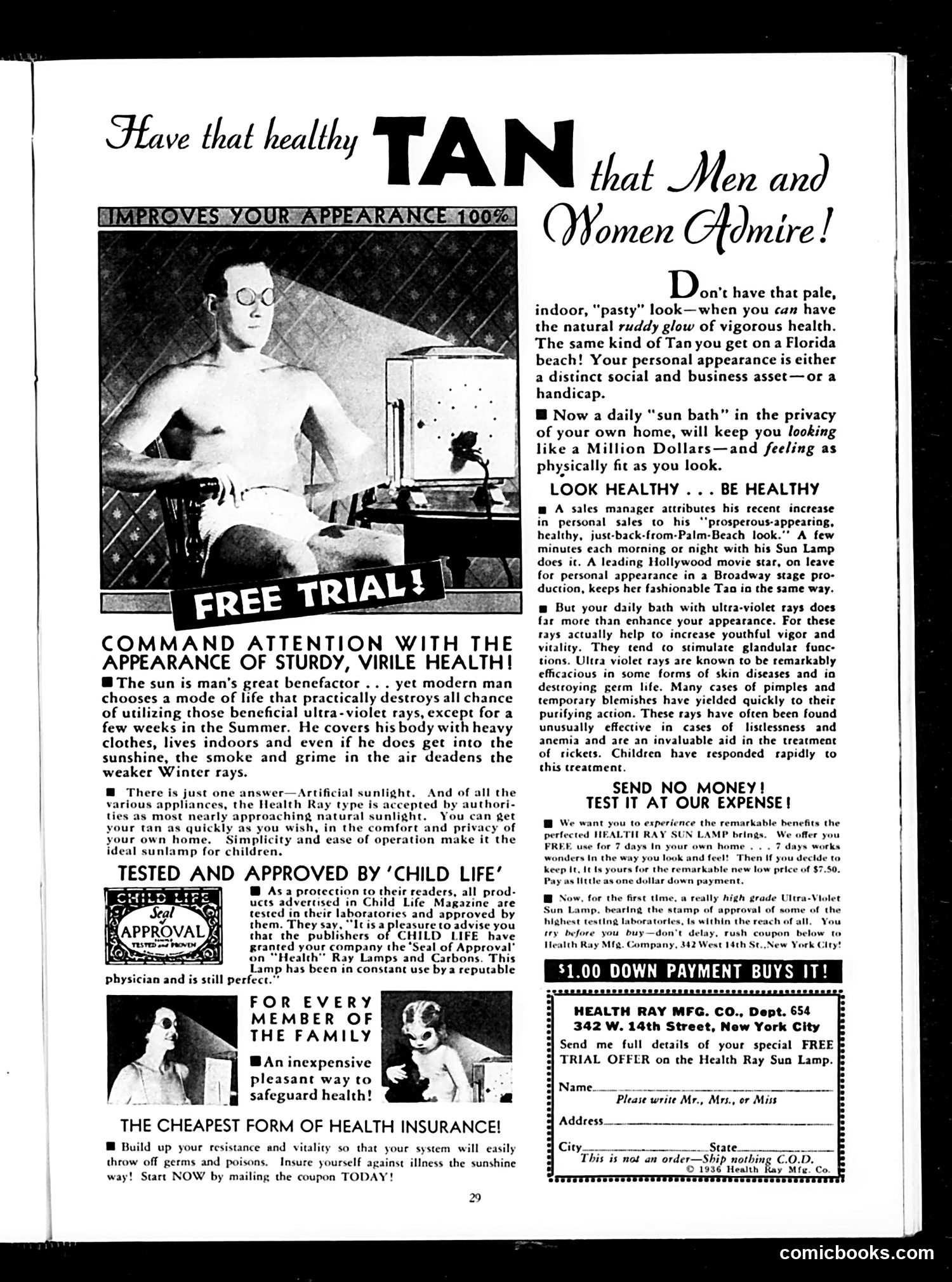
Analysis of Health Ray Sun Lamp Advertisement This page is primarily a product advertisement, not political satire. It promotes the "Health Ray" artificial sunlamp, marketed as essential for personal appearance and health. The Appeal: The ad exploits early 20th-century beauty standards and health anxieties. It claims that indoor, modern life leaves people pale and unhealthy-looking—a social and business liability. A tan signals vitality, success, and attractiveness to "men and women." Key Claims: - Artificial UV rays replicate Florida beach tans in home privacy - Sales managers and Hollywood stars use them for competitive advantage - Health benefits include treating rickets, anemia, skin diseases, and boosting vitality - Child Life Magazine's approval adds credibility Social Context: The ad reflects 1920s-30s preoccupation with appearance as class marker and wellness obsession. The phrase "cheapest form of health insurance" reframes cosmetic vanity as preventive medicine—a common marketing tactic then. The ad targets insecurity about looking insufficiently healthy and successful in competitive modern society.
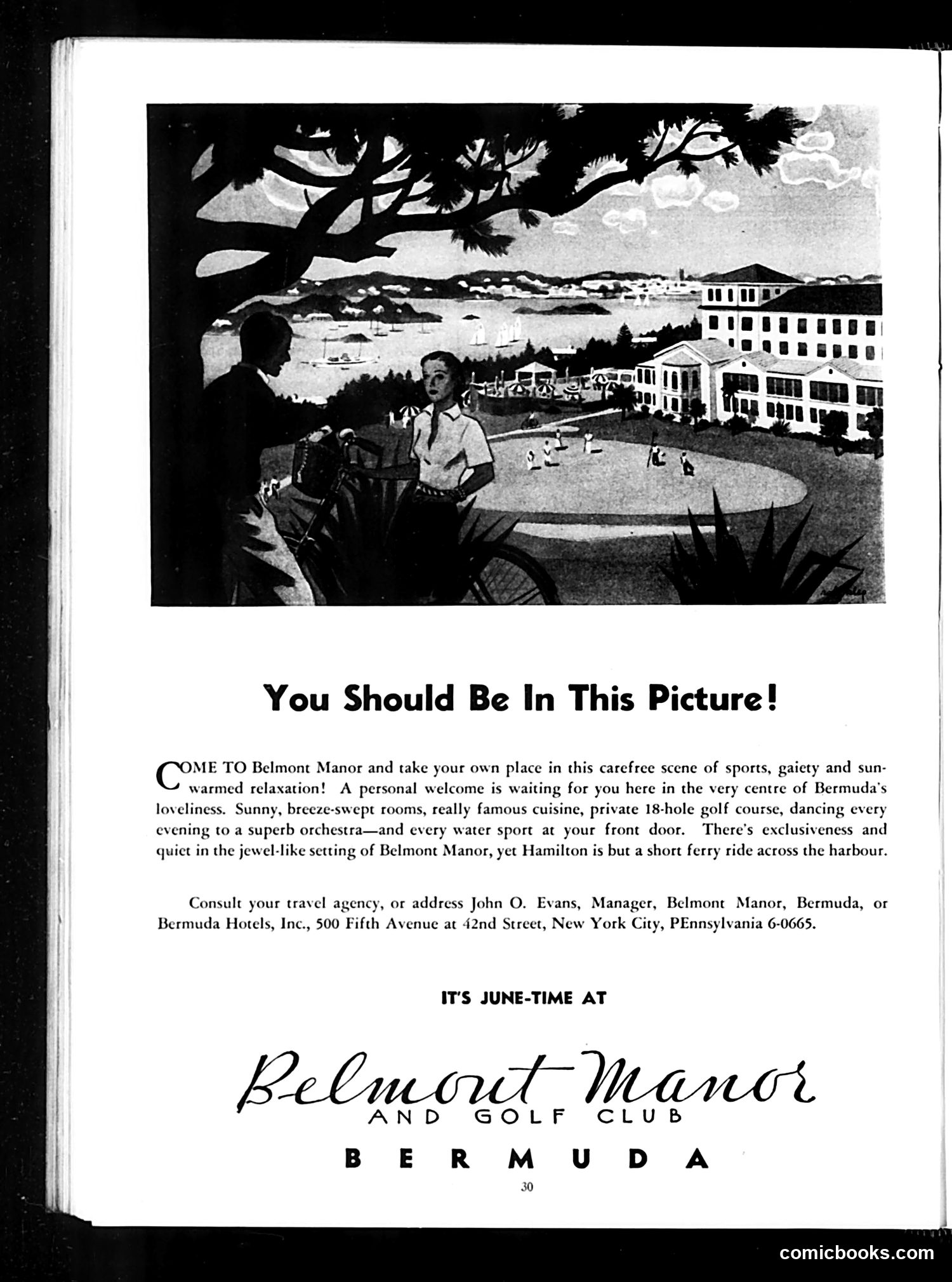
Analysis This is not a cartoon or satirical content—it's a full-page advertisement for Belmont Manor and Golf Club in Bermuda, appearing in *Judge* magazine. The ad uses an illustration showing two well-dressed people relaxing on a terrace overlooking Bermuda's harbor, with colonial-style buildings and water sports visible. The headline "You Should Be In This Picture!" is a direct appeal to affluent readers to vacation at this exclusive resort. The copy emphasizes luxury amenities: private golf course, fine dining, dancing, water sports, and social exclusivity—all pitched as accessible yet prestigious (Hamilton is "but a short ferry ride away"). Contact information directs inquiries to the manager or the New York booking office. This represents typical mid-century advertising in upscale magazines, targeting wealthy Americans planning summer travel. There is no political satire here—merely aspirational leisure marketing.
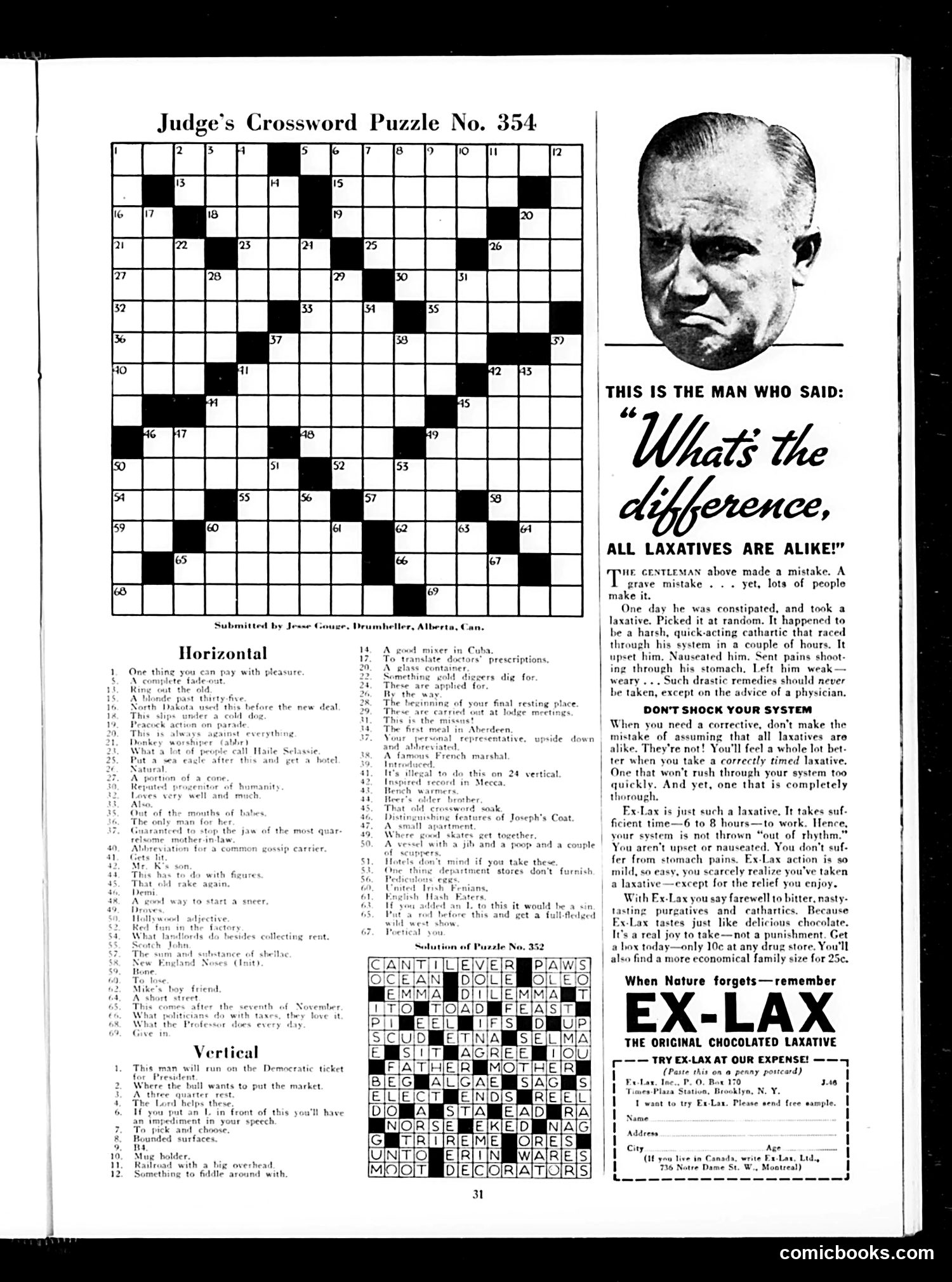
Judge Magazine Page Analysis This page combines a crossword puzzle with a satirical advertisement for Ex-Lax laxative. The main "cartoon" is the advertisement featuring a stern-faced man presented as someone who made a foolish claim: "All laxatives are alike!" The Satire: The ad mocks this unnamed gentleman's ignorance by explaining that laxatives vary significantly in strength and speed. The joke targets people who assume all remedies are interchangeable, leading them to suffer harsh side effects from poorly-chosen products. The Point: This is actually a sophisticated advertisement disguised as satire—it uses humor to educate consumers about product differentiation. By ridiculing the "all laxatives are alike" position, Ex-Lax positions itself as the superior, gentler option (taking 6-8 hours versus harsh quick-acting alternatives). Context: This reflects early 20th-century advertising strategy: using Judge's satirical platform to reach educated readers with humorous product messaging. The crossword puzzle on the same page suggests this was a mid-to-late 1920s issue, when such puzzles were extremely popular.
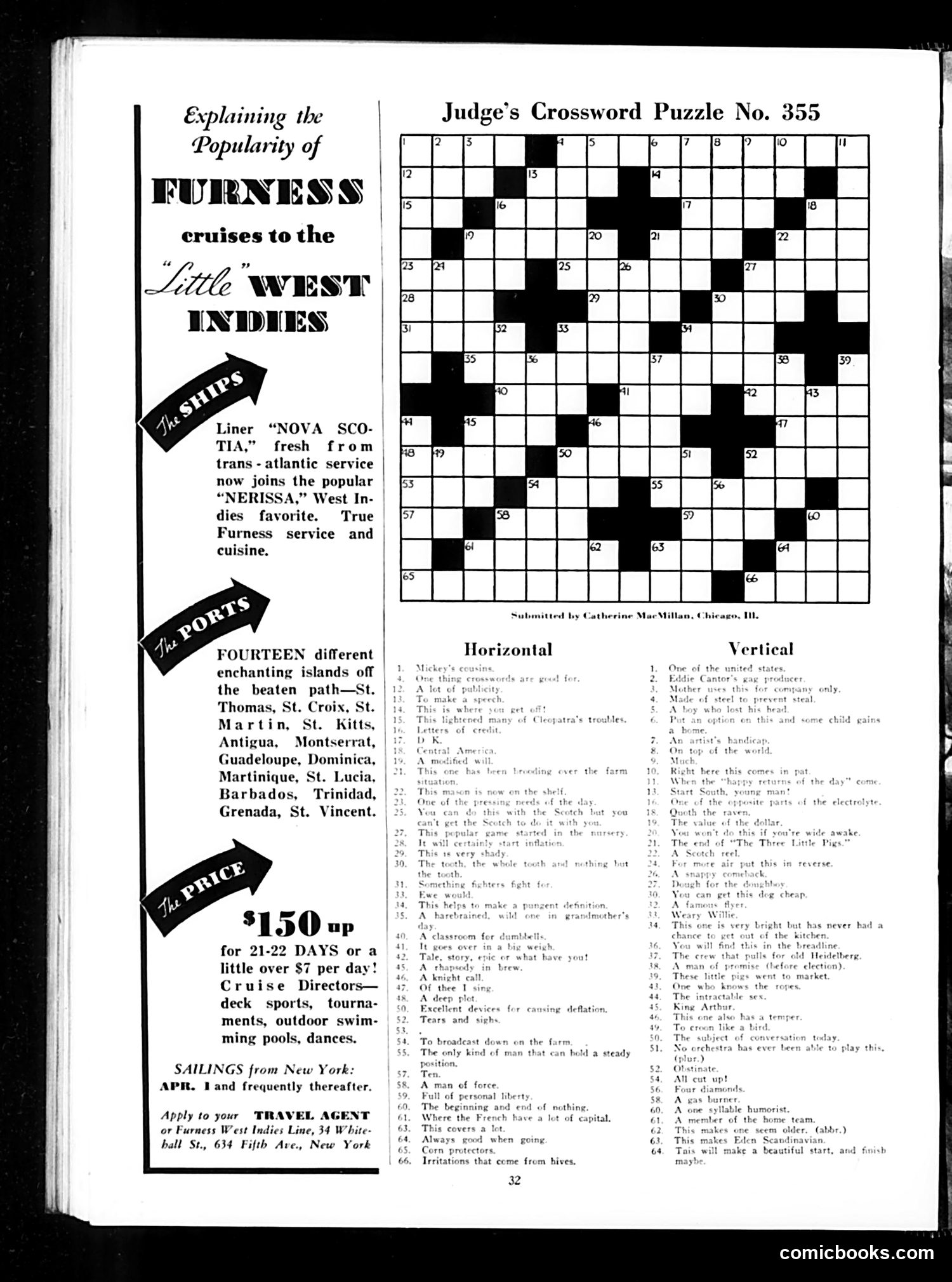
This page is primarily advertising, not political satire. It contains a crossword puzzle and a travel advertisement for Furness Line cruise ships. The main content promotes Caribbean cruises to the "Little West Indies"—fourteen islands including St. Thomas, Barbados, and Trinidad. The liner *Nova Scotia* is advertised as newly available for these voyages, joining the *Nerissa*. The pitch emphasizes luxury and leisure: cruise directors, deck sports, swimming pools, and dances for $7+ per day over 21-22 days. The crossword puzzle itself appears to be filler content typical of Judge magazine. There is no visible political cartoon or satire on this page—it's straightforward travel marketing positioned alongside recreational puzzle content, representing early-20th-century leisure tourism advertising for affluent American readers.
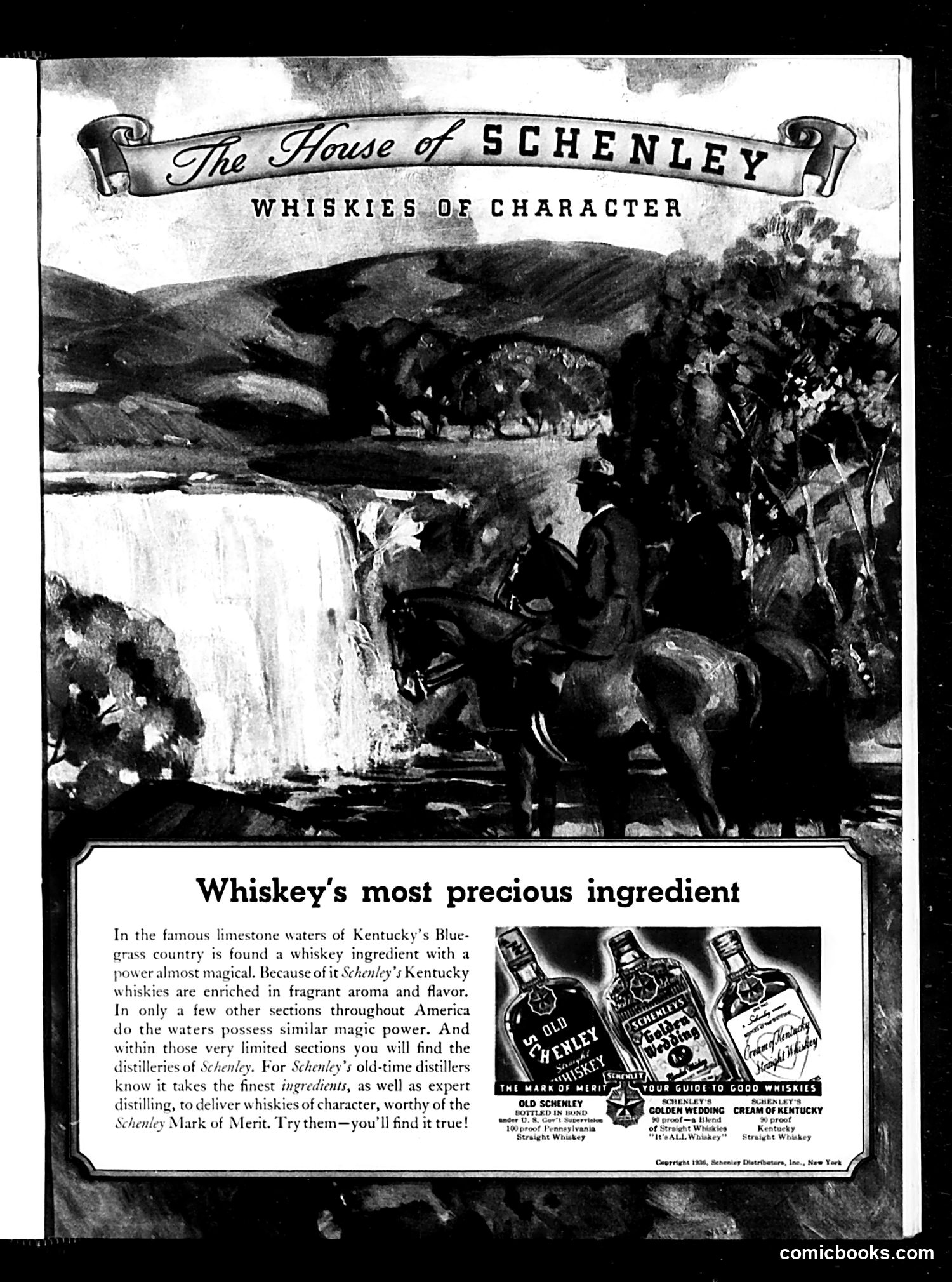
What This Page Actually Is This is not a political cartoon or satire — it's a whiskey advertisement for Schenley distilleries, likely from the 1930s-40s based on the styling. The page promotes Schenley's Kentucky whiskeys by emphasizing that their special ingredient is limestone-filtered water from Kentucky's Bluegrass region, which the ad claims gives the whiskey its superior flavor and aroma. The romantic landscape illustration (showing a riverside scene with horses and figures) evokes the Kentucky countryside to reinforce authenticity and tradition. The bottom section showcases three Schenley whiskey brands: "Old Schenley," "Golden Wedding," and "Cream of Kentucky," each presented with product bottles and marketing copy about their quality. This is straightforward commercial advertising with no satirical content — it ran in *Judge* magazine simply as paid advertising space, which was common in satirical publications.
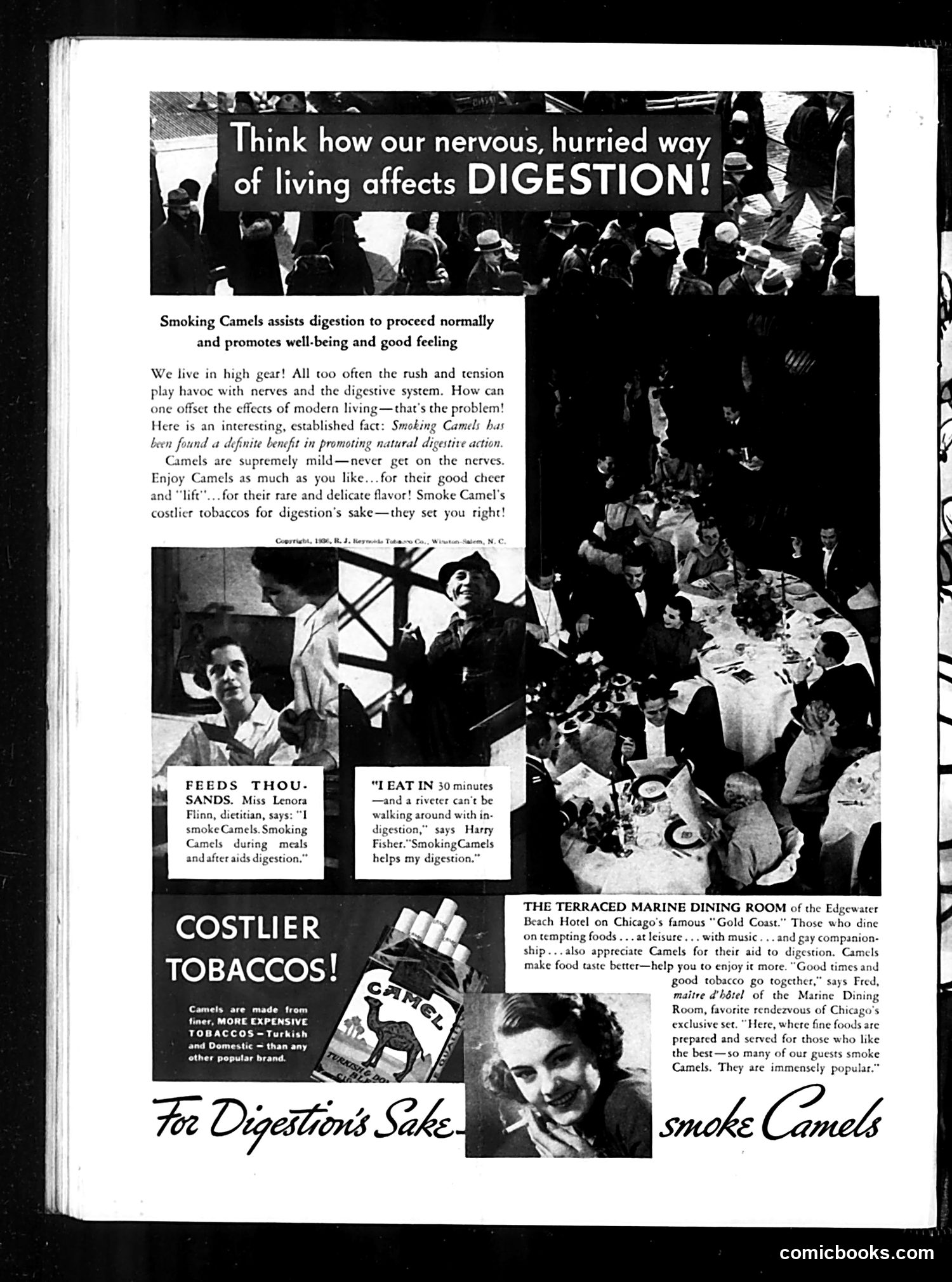
Camel Cigarette Advertisement (Judge Magazine) This is a cigarette advertisement, not satire—Judge magazine ran paid ads alongside editorial content. The page promotes Camel cigarettes by claiming they aid digestion and counteract modern stress. The ad targets a 1930s anxious public ("nervous, hurried way of living") by presenting smoking as a health solution. It features testimonials from working people—a dietitian, a factory riveter, and a hotel maître d'—all endorsing Camels for digestive relief. The irony for modern readers is the brazen medical claim (now obviously false) presented as "established fact." The layout mimics journalistic authority with photographs and expert quotes, lending credibility to what is purely marketing. The tagline "For Digestion's Sake" directly frames smoking as therapeutic rather than recreational—a common advertising strategy before tobacco health risks were publicly acknowledged.