judge
Judge — May 1936
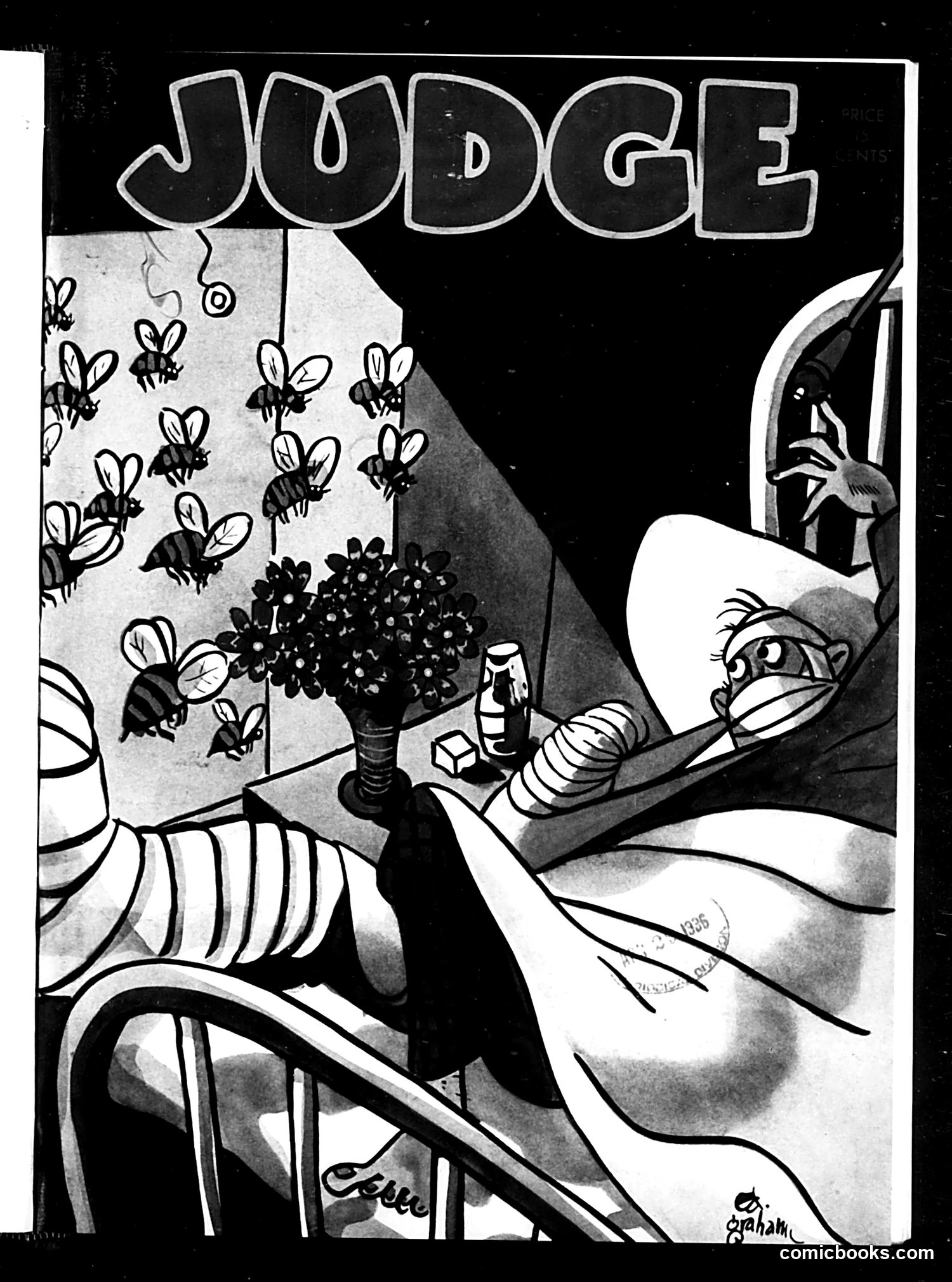
Judge Magazine - Satire Analysis This appears to be a Judge magazine cover featuring a medical or scientific theme. The illustration shows a bandaged figure in bed holding flowers, surrounded by detailed drawings of bees on the left side. The figure appears to be a patient, possibly recovering from an illness or injury. The satire likely concerns a contemporary medical or public health situation, though without clearer contextual text or visible dates, the specific reference is unclear. The juxtaposition of bees, flowers, and a bedridden patient might satirize folk remedies, beekeeping trends, or perhaps a contemporary health scare or treatment. The artistic style and composition suggest early-to-mid 20th century publication. More specific historical context would be needed to identify the precise political or social commentary intended.
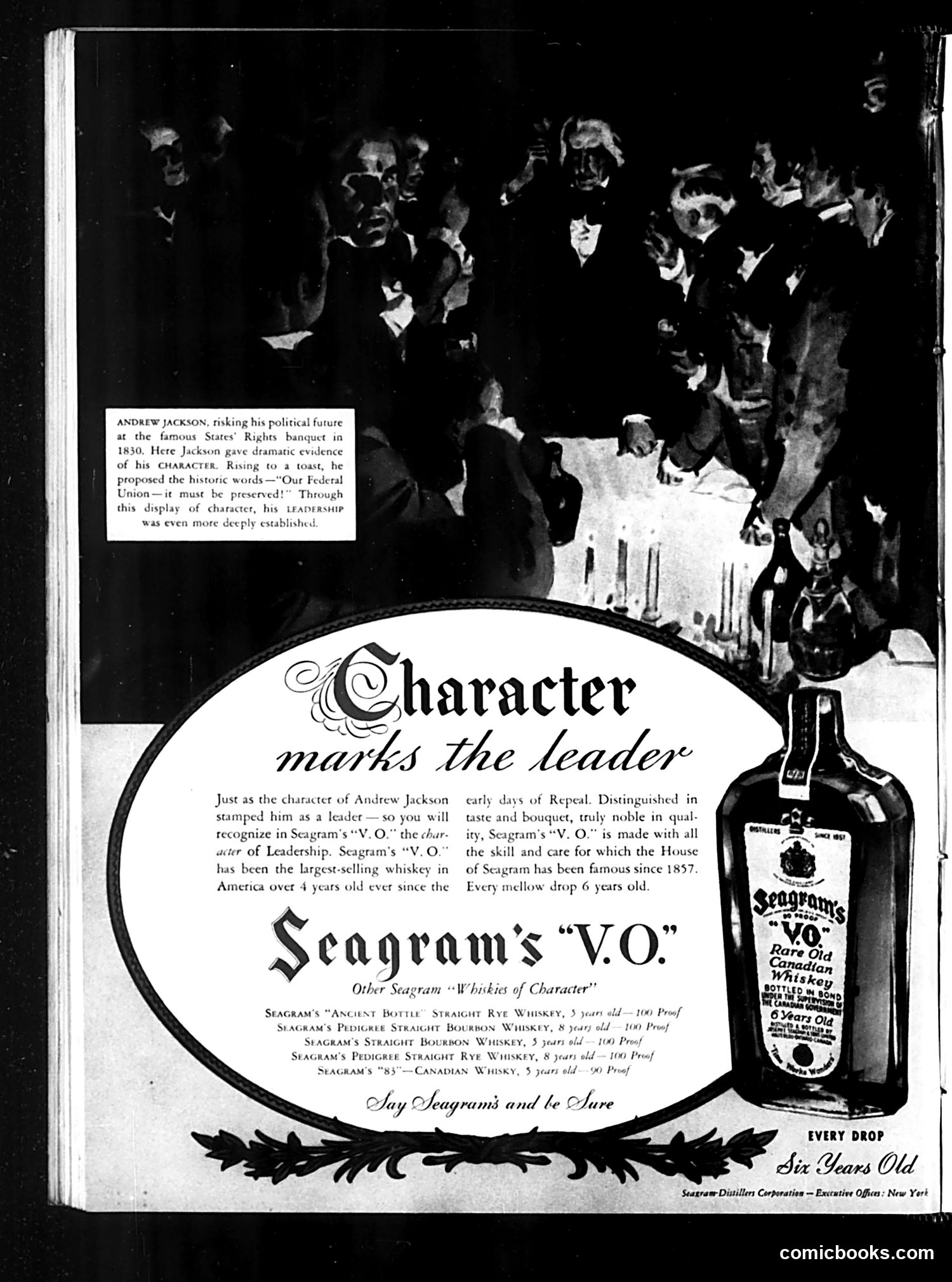
Analysis This page is primarily a Seagram's whiskey advertisement rather than political satire. The ad uses a historical reference to Andrew Jackson to promote its "V.O." brand whiskey as a marker of character and leadership. The upper photograph depicts Jackson at an 1830 States' Rights banquet, where he allegedly made a defiant toast defending the Federal Union—a moment the ad claims demonstrated his strong character. The advertisement then draws a parallel: just as Jackson's character made him a leader, Seagram's V.O. whiskey supposedly reflects distinguished taste and noble quality. The phrase "Character marks the leader" is the central sales pitch, linking Jackson's historical reputation for principled leadership with the whiskey brand's claimed superiority. This is commercial messaging dressed in patriotic rhetoric rather than satire.
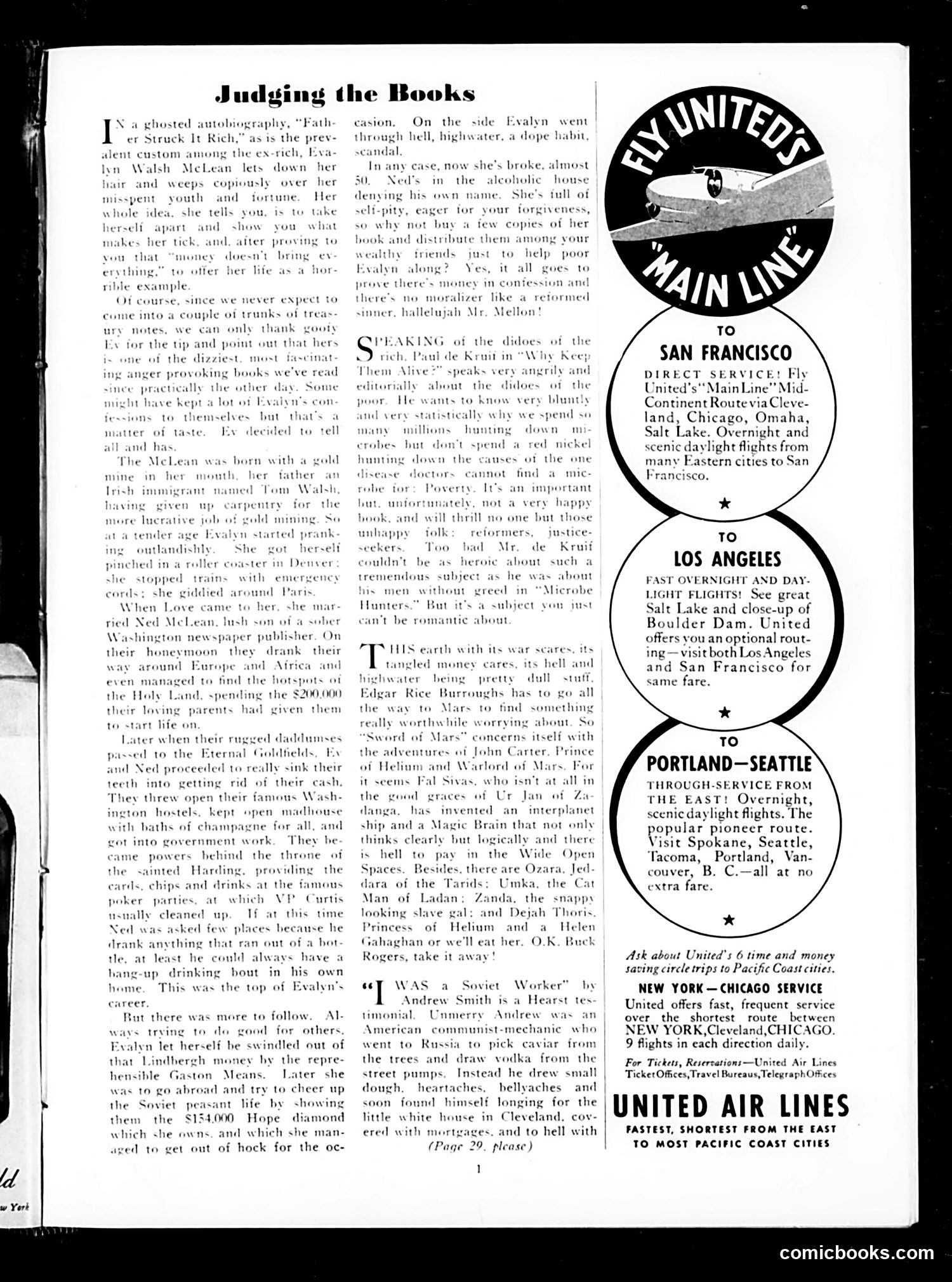
Analysis of "Judging the Books" Page This page is primarily a book review column discussing recent publications, with substantial airline advertising on the right side. The review critiques several books, including Evalyn Walsh McLean's autobiography "Father Struck It Rich" (about her wealthy, scandal-prone life), Paul de Kruif's "Why Keep Them Alive?" (about public health), and Edgar Rice Burroughs' "Sword of Mars" (science fiction). The reviewer uses pointed satire to mock McLean's self-serving narrative and de Kruif's social commentary about disease and poverty. The advertising showcases United Air Lines' domestic routes (San Francisco, Los Angeles, Portland-Seattle, New York-Chicago), emphasizing speed and convenience for travelers. No political cartoons appear on this page—it's primarily editorial content and commercial advertisement typical of 1930s magazine layout.
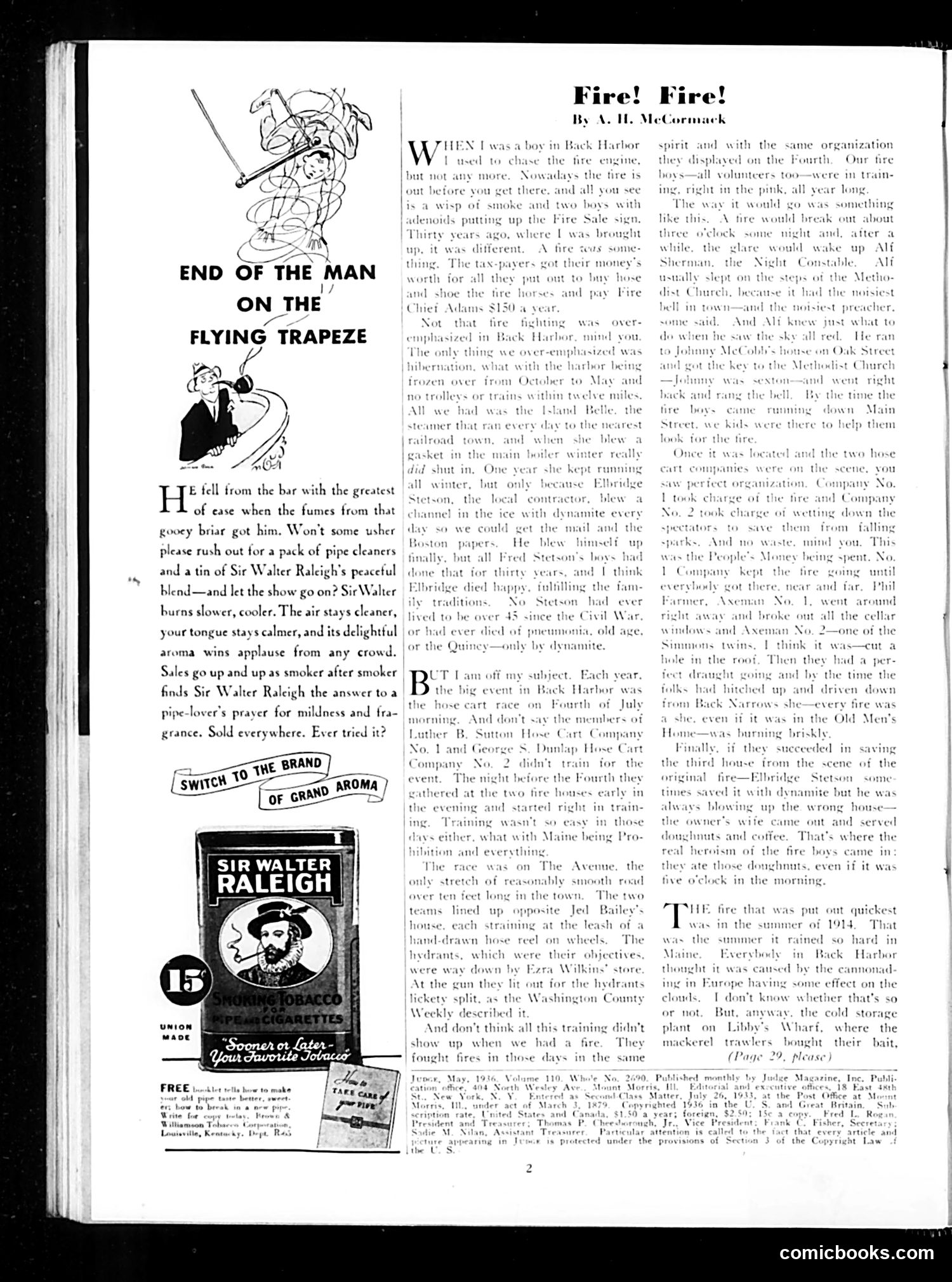
Analysis of Judge Magazine Page This page is primarily a humorous article titled "Fire! Fire!" by A.H. McCormack, nostalgically recounting firefighting in Back Harbor (a fictional town). The piece contrasts volunteer firefighting of the author's youth with modern commercial fire departments, emphasizing how the old system was chaotic but spirited—featuring volunteer competition, dramatic horse-drawn equipment, and dramatic rescues. The cartoons are incidental: a small illustration of a trapeze performer ("End of the Man on the Flying Trapeze") and advertisements, including a Sir Walter Raleigh tobacco ad (15 cents) below. There's no political satire here—this is sentimental Americana humor about obsolete firefighting methods, appealing to readers nostalgic for pre-modern small-town life. The tone is entertainment and nostalgia rather than commentary.
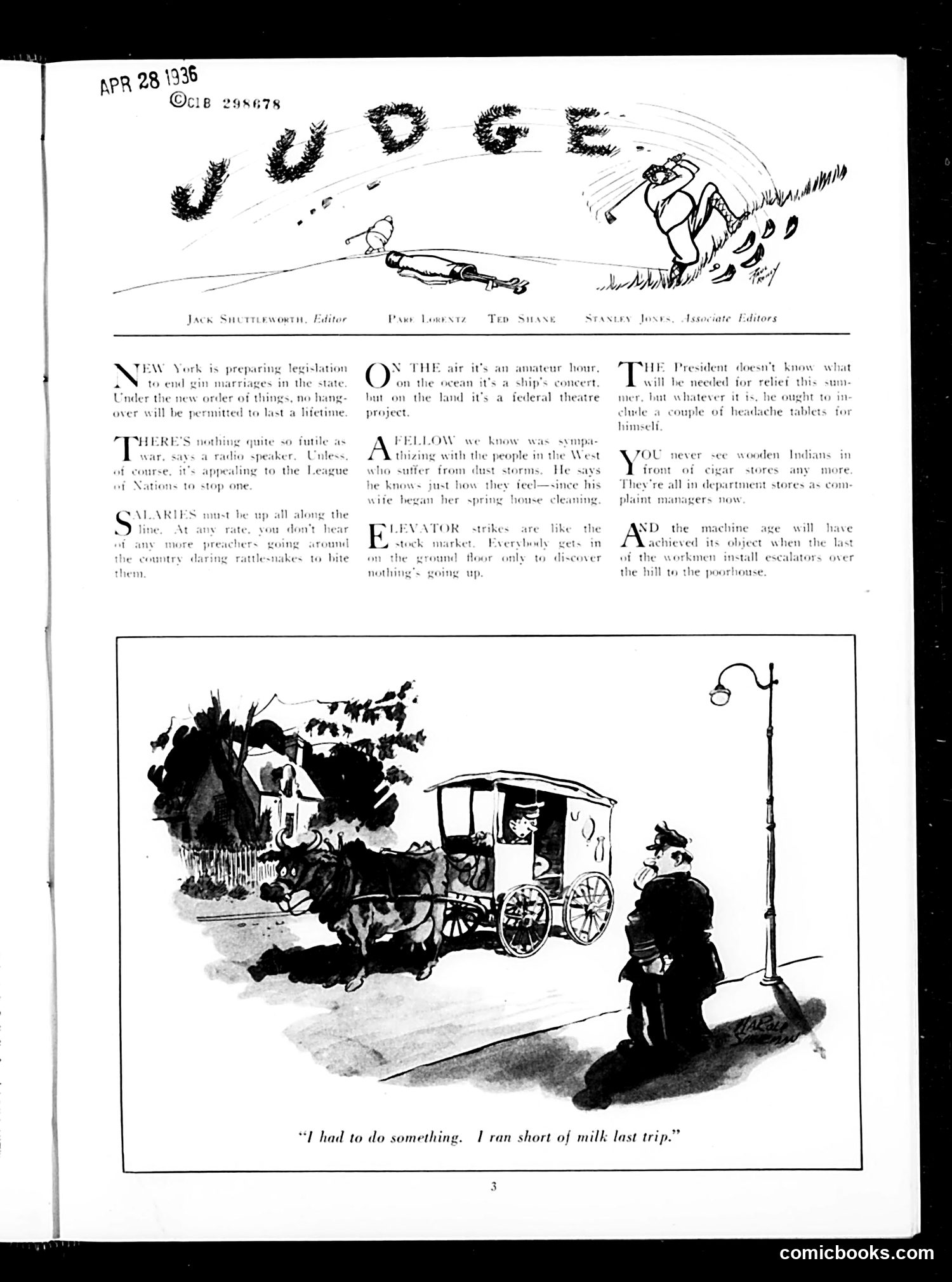
Judge Magazine Page Analysis (April 28, 1936) This page contains several brief satirical commentaries on contemporary issues: - Marriage legislation: New York is preparing laws to end marriages deemed unsuitable; the joke is that under new restrictions, no one will be permitted to marry. - Radio/League of Nations: A radio speaker notes nothing stops wars unless nations join the League to enforce peace. - Salaries and preachers: Commentary that salary increases don't help the country when preachers spread discord. - Stock market: References everyday investors discovering nothing gains on ground floors—a depression-era joke about market collapse. - Wooden Indians: A quip that you won't find wooden Indians in cigar stores anymore; they're all in department stores as complaint managers. The cartoon shows a gypsy fortune teller's caravan with a man saying he "ran short of milk" on "last trip"—likely a humorous domestic situation, though context is unclear.
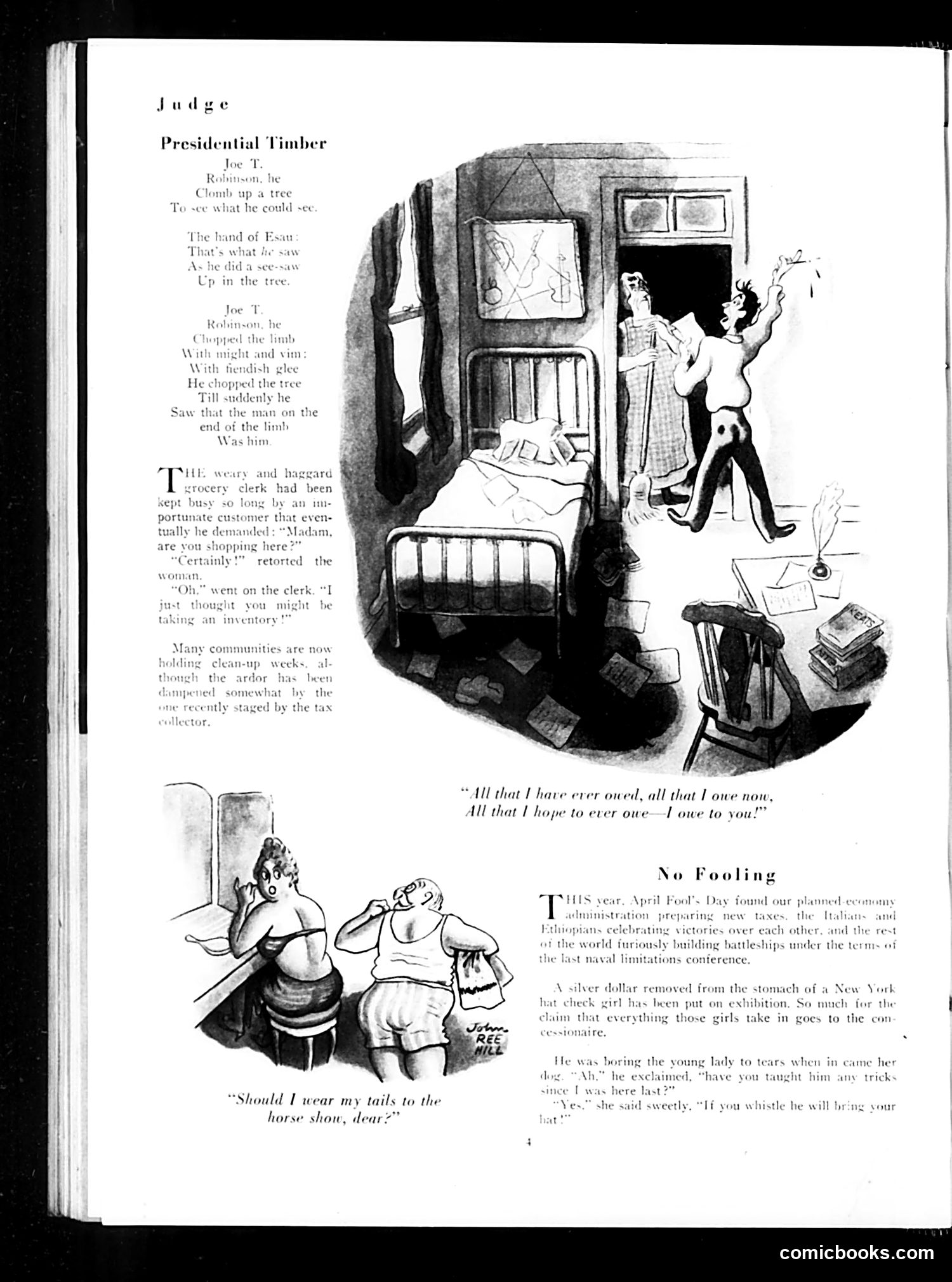
Analysis of Judge Magazine Page "Presidential Timber" (top cartoon): This poem and illustration satirize someone named Robinson who climbed a tree to see what he could see, then chopped it down, killing a man in the process. The satire appears to mock someone's political ambitions ("presidential timber") despite causing harm—suggesting unfit leadership credentials. "No Fooling" (bottom section): This piece mocks April Fools' Day 1921 by referencing then-current events: the planned economy, naval conferences, and a bizarre news item about a silver dollar removed from a New York woman's stomach. The smaller cartoon at bottom contains a domestic joke about wearing "tails to the horse show." The page blends political satire with period humor and oddities.
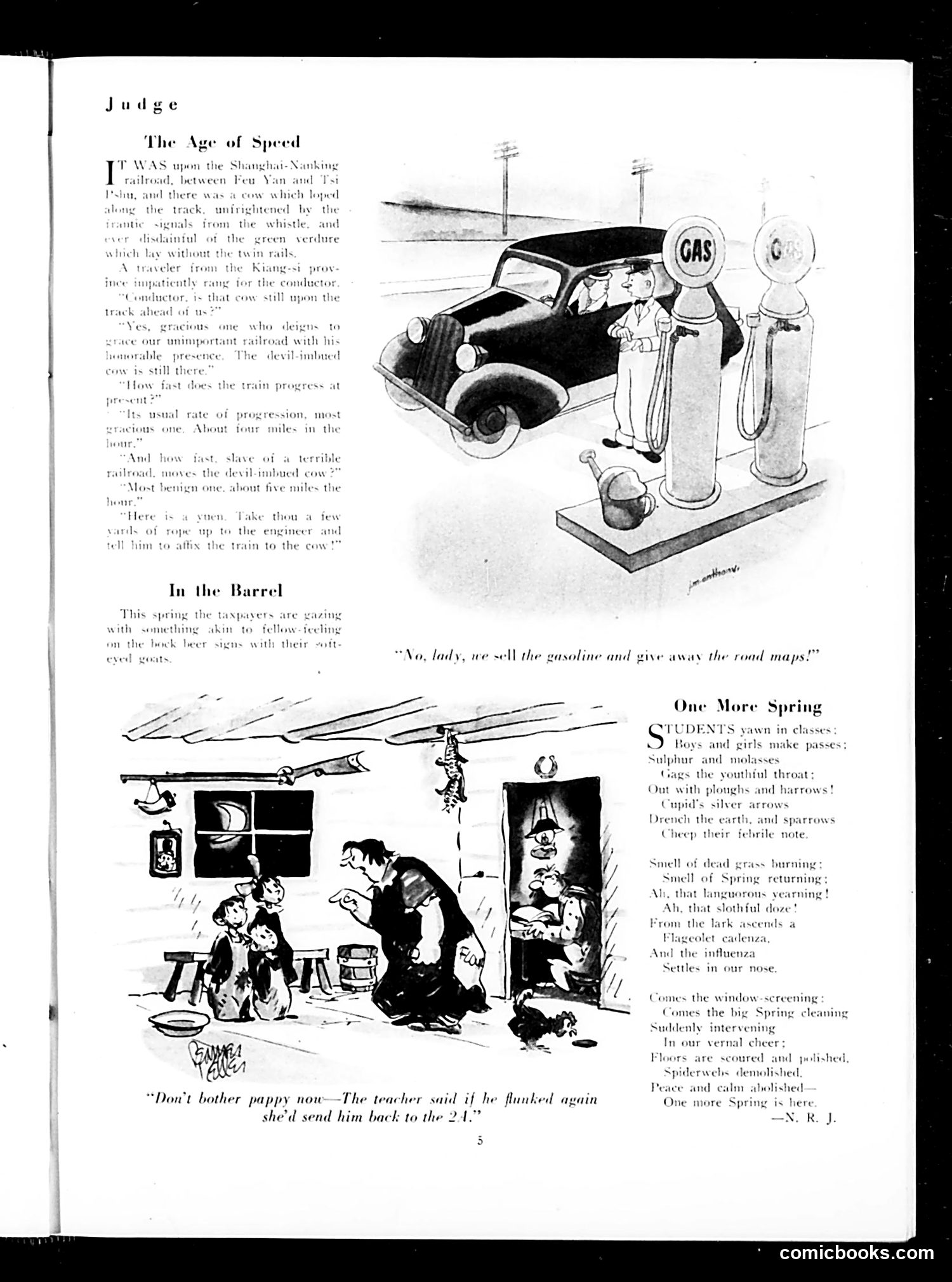
Analysis of Judge Magazine Page "The Age of Speed" section satirizes early automobile culture. The top cartoon shows a car at a gas station where the attendant quips, "No, lady, we sell gasoline and give away the road maps"—mocking how automobiles were still novel enough that drivers needed maps, and suggesting gas stations were becoming ubiquitous service centers. "In the Barrel" references a drinking establishment during Prohibition-era America, though details are unclear. "One More Spring" is a poem celebrating spring's arrival, with seasonal imagery about students, nature, and spring cleaning. The page reflects early 20th-century American anxieties about rapid motorization, changing consumer culture, and the novelty of automotive infrastructure—topics very familiar to Judge's urban readership.
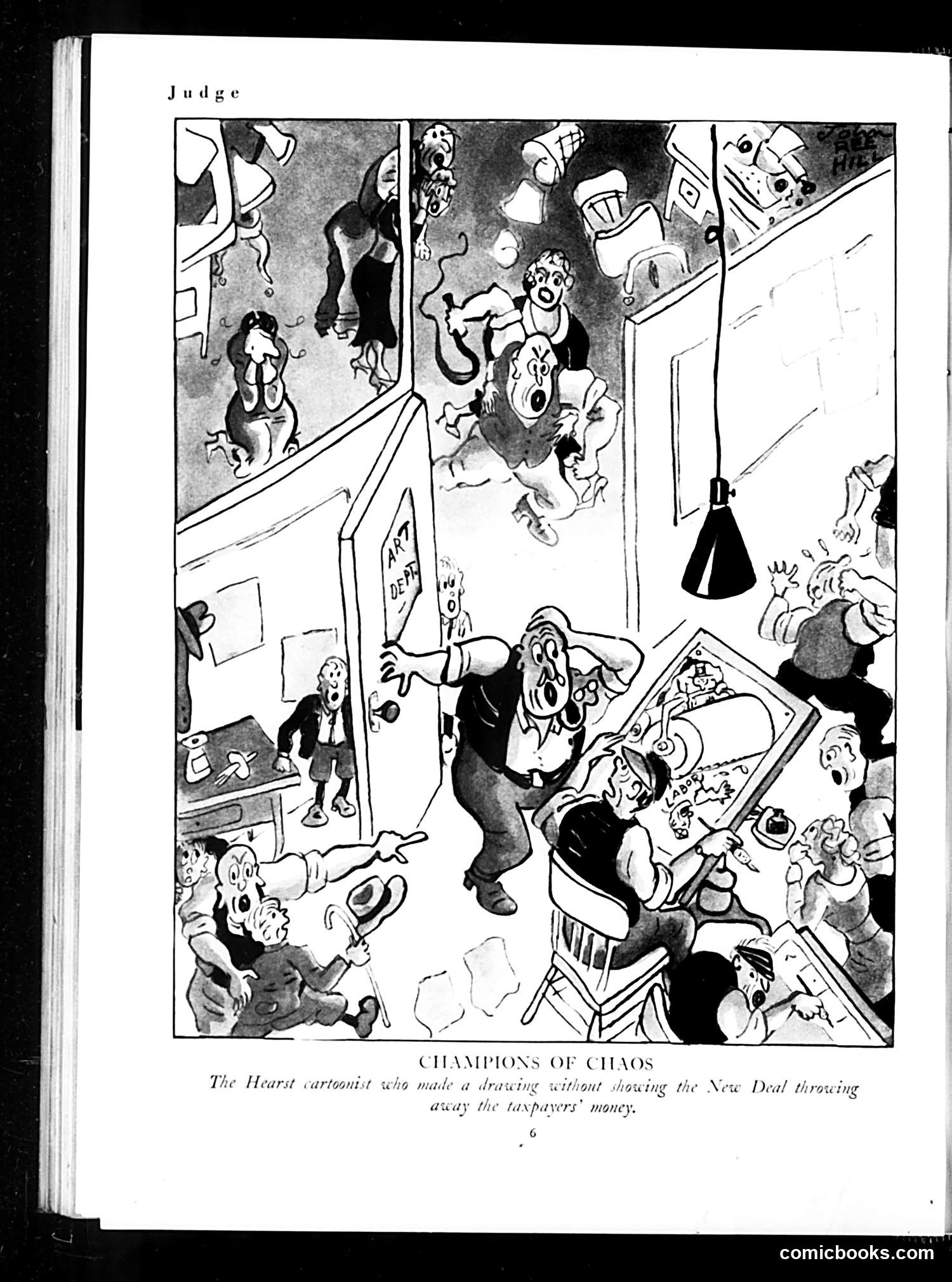
"Champions of Chaos" - Judge Magazine Cartoon This political cartoon satirizes opponents of Franklin D. Roosevelt's New Deal programs. The chaotic courtroom scene depicts various figures—likely business leaders, politicians, and critics—as disruptive "champions of chaos" literally throwing money around and causing mayhem while a judge (representing authority/law) presides overhead. The caption explains the cartoon targets "the Hearst cartoonist who made a drawing without showing the New Deal throwing away the taxpayers' money"—suggesting this is a response to criticism from William Randolph Hearst's media empire, which opposed New Deal spending. The satire reverses the usual critique: instead of the New Deal wasting money, its *opponents* are portrayed as the real chaos agents, undermining stability and fiscal responsibility through their opposition and obstruction.
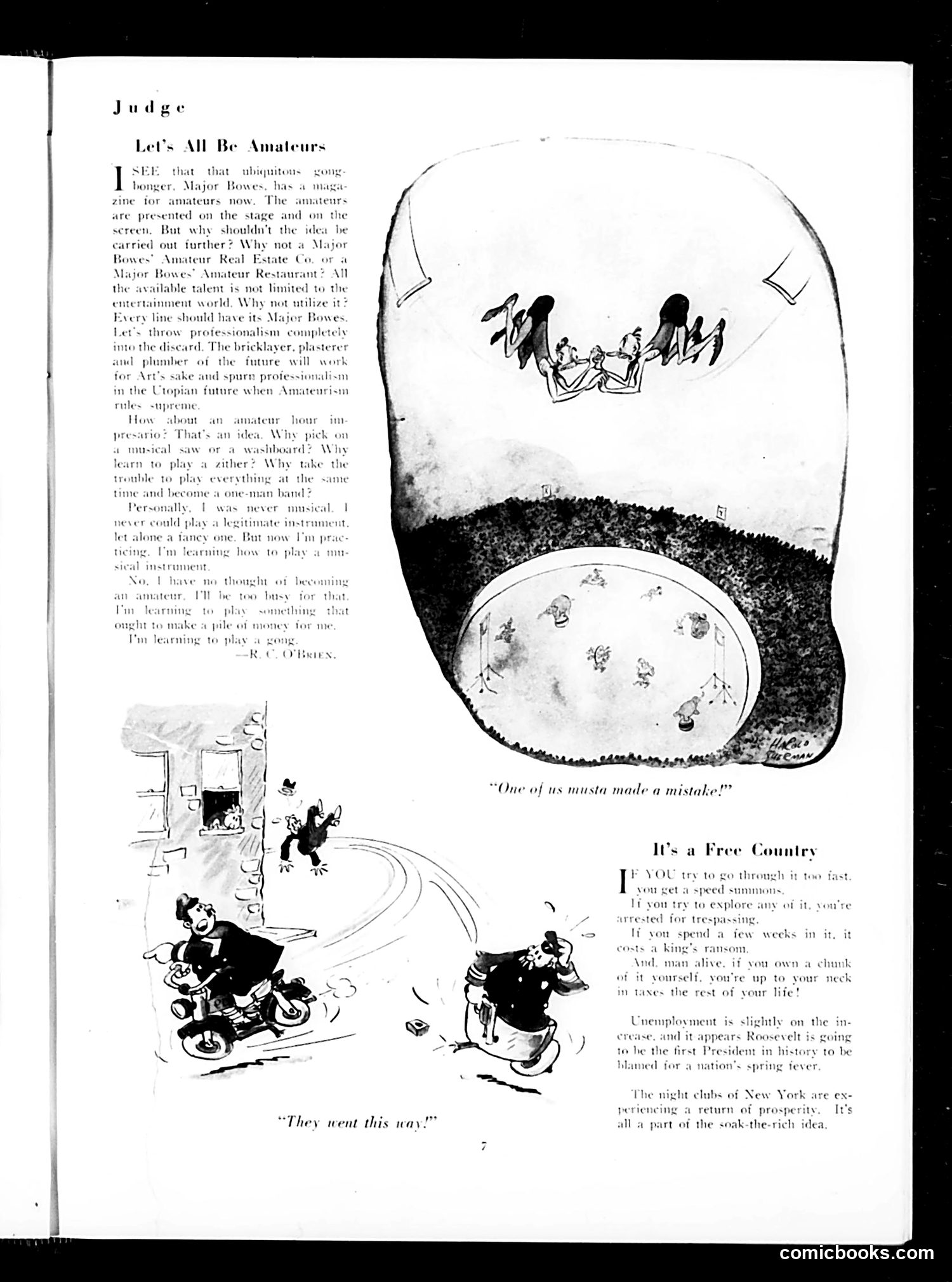
Analysis of Judge Page This page contains two satirical pieces about American amateur culture and freedoms, circa early-to-mid 20th century. "Let's All Be Amateurs" argues that Major Bowes' Amateur Hour (a radio talent show) should expand into other fields—real estate, restaurants—to democratize opportunity. The author humorously suggests amateurs bungling every profession, noting this represents an "Utopian future when Amateurism reigns supreme." "It's a Free Country" satirizes the costs and constraints of American freedom. The cartoon shows people caught in speed traps and arrested for trespassing, while the text ironically notes unemployment rising under Roosevelt and New York nightclubs profiting from wealth inequality—all "part of the soak-the-rich idea." The satire critiques how proclaimed freedoms come with hidden expenses and restrictions for ordinary citizens.
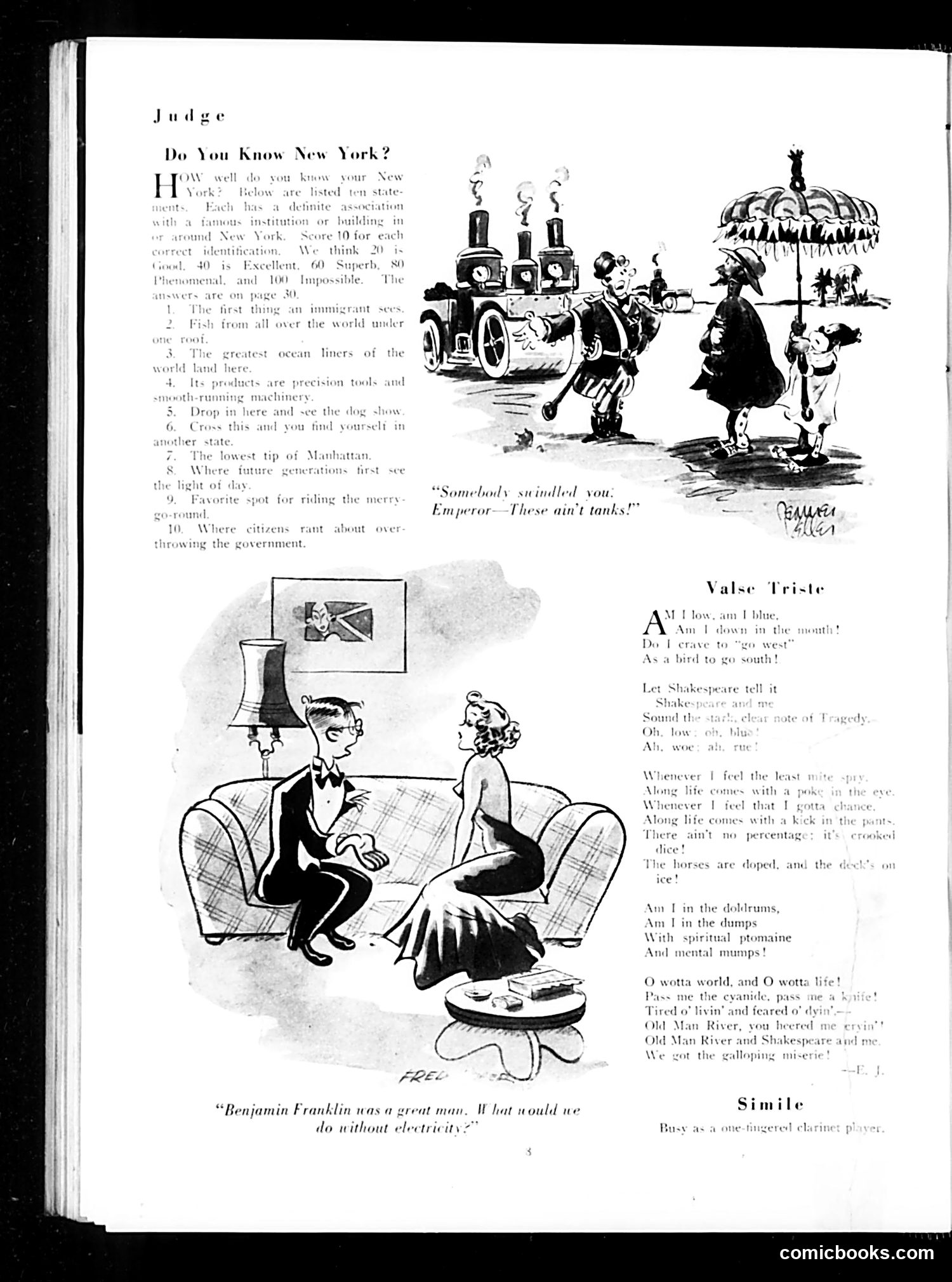
Judge Magazine Page Analysis This page contains three distinct satirical pieces: "Do You Know New York?" (top): A quiz testing readers' knowledge of NYC landmarks and institutions, presented as a lighthearted challenge. The accompanying cartoon shows a character claiming someone "swindled" him with fake "tanks"—likely satirizing either WWI military deception or consumer fraud of the era. "Valse Triste" (right): A melancholic poem/verse lamenting life's disappointments, referencing Shakespeare and "Old Man River" (likely Showboat imagery). It's self-pitying humor about being "in the doldrums" and "dumps." Bottom cartoon: A couple on a couch discussing Benjamin Franklin and electricity—satirizing how people credit historical figures with modern conveniences they didn't create, poking fun at fuzzy historical thinking. The page blends topical humor, literary parody, and domestic comedy typical of Judge's satirical approach to American life and culture during this period (appears early 20th century based on style).
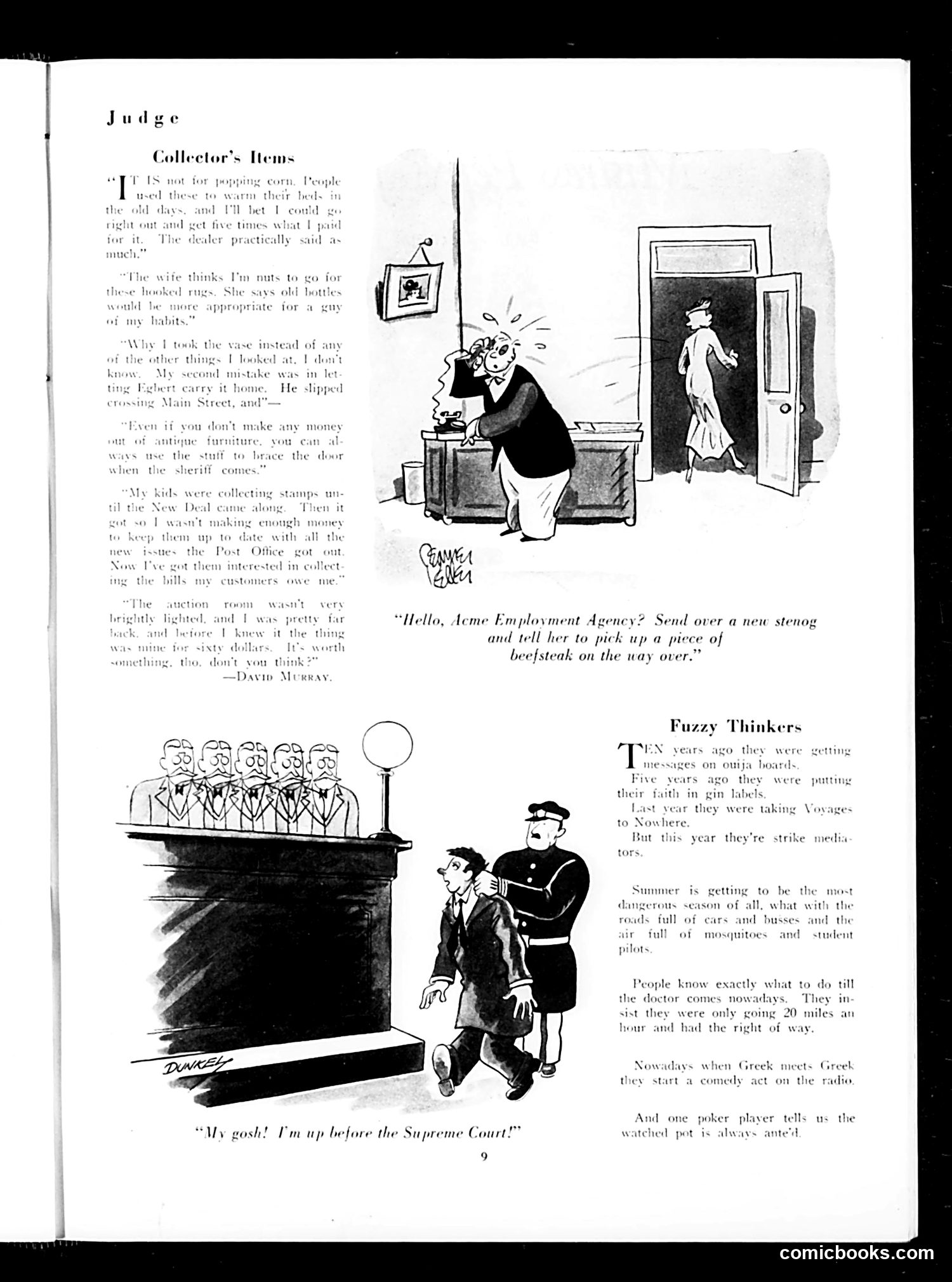
Analysis of Judge Magazine Page This page contains two satirical cartoons reflecting 1920s-30s American social concerns. Top cartoon: A man frantically calls an employment agency requesting a stenographer, instructing her to "pick up a piece of beefsteak on the way over." The satire mocks the casual treatment of office workers—reducing a professional employee to an errand-runner, suggesting workplace gender dynamics where female stenographers (secretaries) were expected to perform personal tasks for male bosses. Bottom cartoon: Five identical men sit as judges above a small figure before them, captioned "My gosh! I'm up before the Supreme Court!" The joke satirizes either the intimidating power of the Supreme Court or (less clearly) concerns about judicial consistency or conformity. "Fuzzy Thinkers" column: Brief commentary on changing social fads—ouija boards, gin labels (Prohibition-era), spiritualism—mocking how people uncritically embrace trends. It also jokes about summer dangers (cars, mosquitoes) and modern excuses for traffic violations. The overall tone reflects period anxieties about workplace exploitation, legal authority, and modern gullibility.
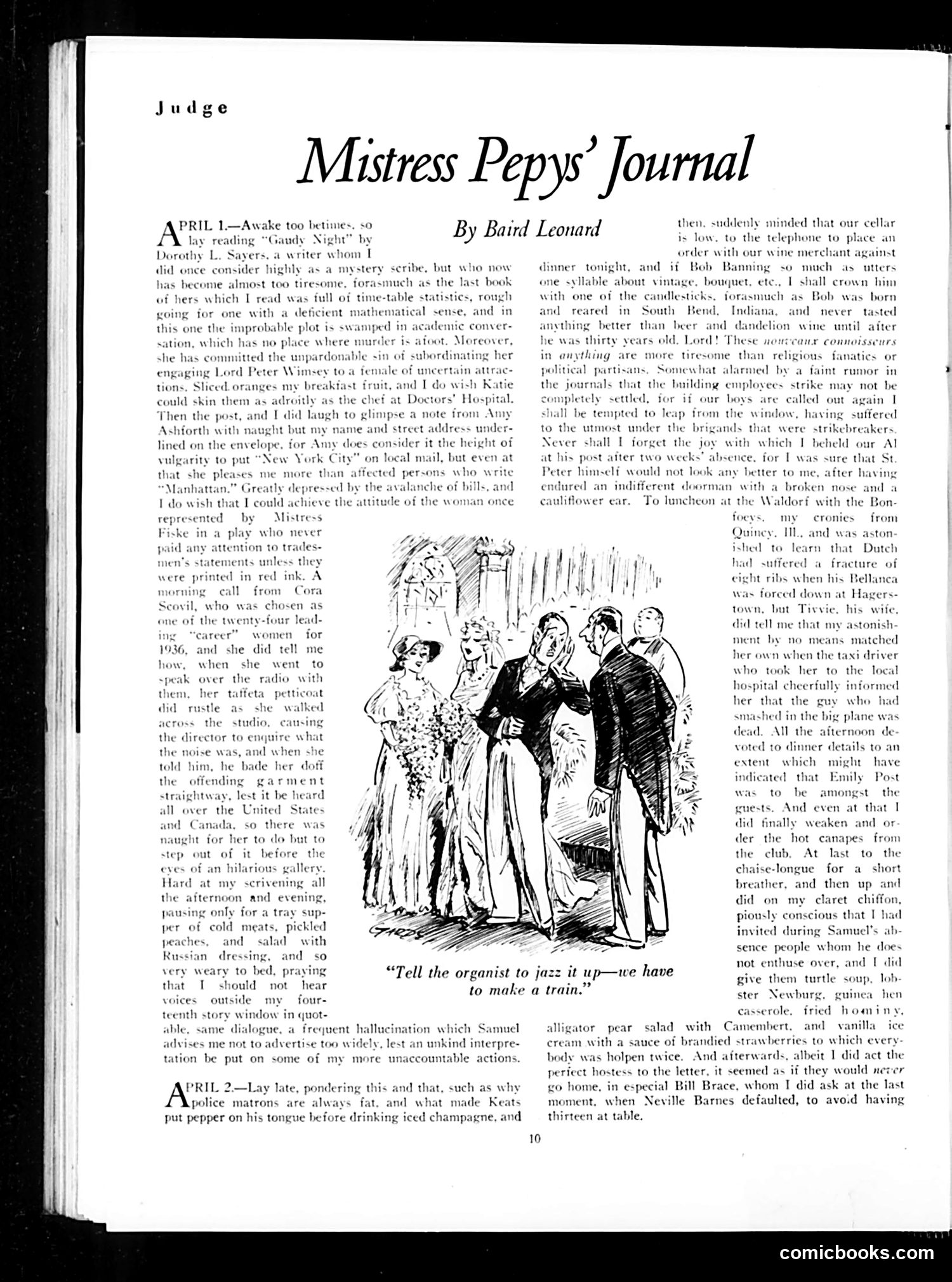
Mistress Pepys' Journal: A Satirical Parody This page parodies Samuel Pepys' famous 17th-century diary, reimagined as "Mistress Pepys" by writer Baird Leonard. The humor derives from applying Pepys' detailed, gossipy personal observations to 1930s high-society life. The cartoon depicts a fashionable woman at a social gathering, with the caption: "Tell the organist to jazz it up—we have to make a train." The satire mocks several 1930s concerns: the pretensions of wealthy women obsessed with fine wines and proper etiquette; anxieties about labor strikes and strikebreakers; references to aviation disasters (the "Bellanea" crash); and the social upheaval of the era. The diary format allows commentary on trivial domestic complaints alongside serious contemporary events, creating comedy through incongruous juxtaposition of the mundane and significant. The overall joke: applying historical literary sophistication to contemporary American shallow society.
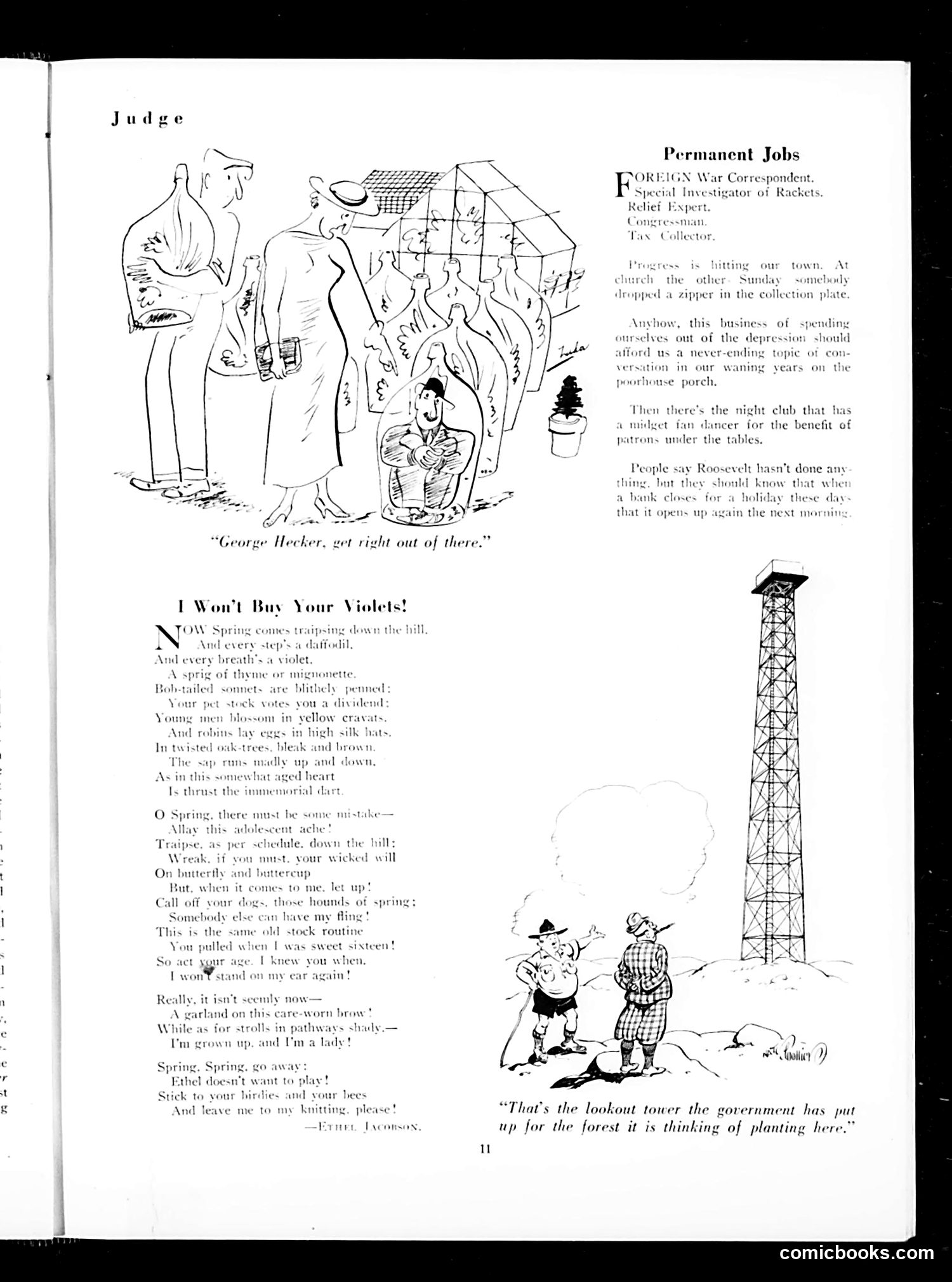
Analysis of Judge Magazine Page Top Cartoon ("Judge"): A stern judge presides over a crowded courtroom where citizens appear crammed inside like sardines—some literally stacked in what looks like a filing cabinet or safe. The caption "George Hecker, get right out of there" suggests someone is absurdly squeezed into an impossible space. This likely satirizes overcrowded courts or the chaotic legal system during the Depression era. "Permanent Jobs" Section: A sardonic commentary on New Deal employment programs. The listed "permanent jobs" (Foreign War Correspondent, Relief Expert, etc.) mock how temporary Depression-era positions were being justified as permanent solutions. The text mocks frivolous spending and Roosevelt's programs as mere distractions from real economic problems. "I Won't Buy Your Violets!": A poem rejecting Spring's traditional romantic imagery. The speaker, claiming to be an adult ("I'm grown up, and I'm a lady"), dismisses sentimental springtime clichés as outdated "stock routine." This reflects 1930s disillusionment with nostalgic sentimentality. Bottom Cartoon: Two figures view a government lookout tower, joking it's actually for "planting" a forest—implying skepticism about government conservation efforts.
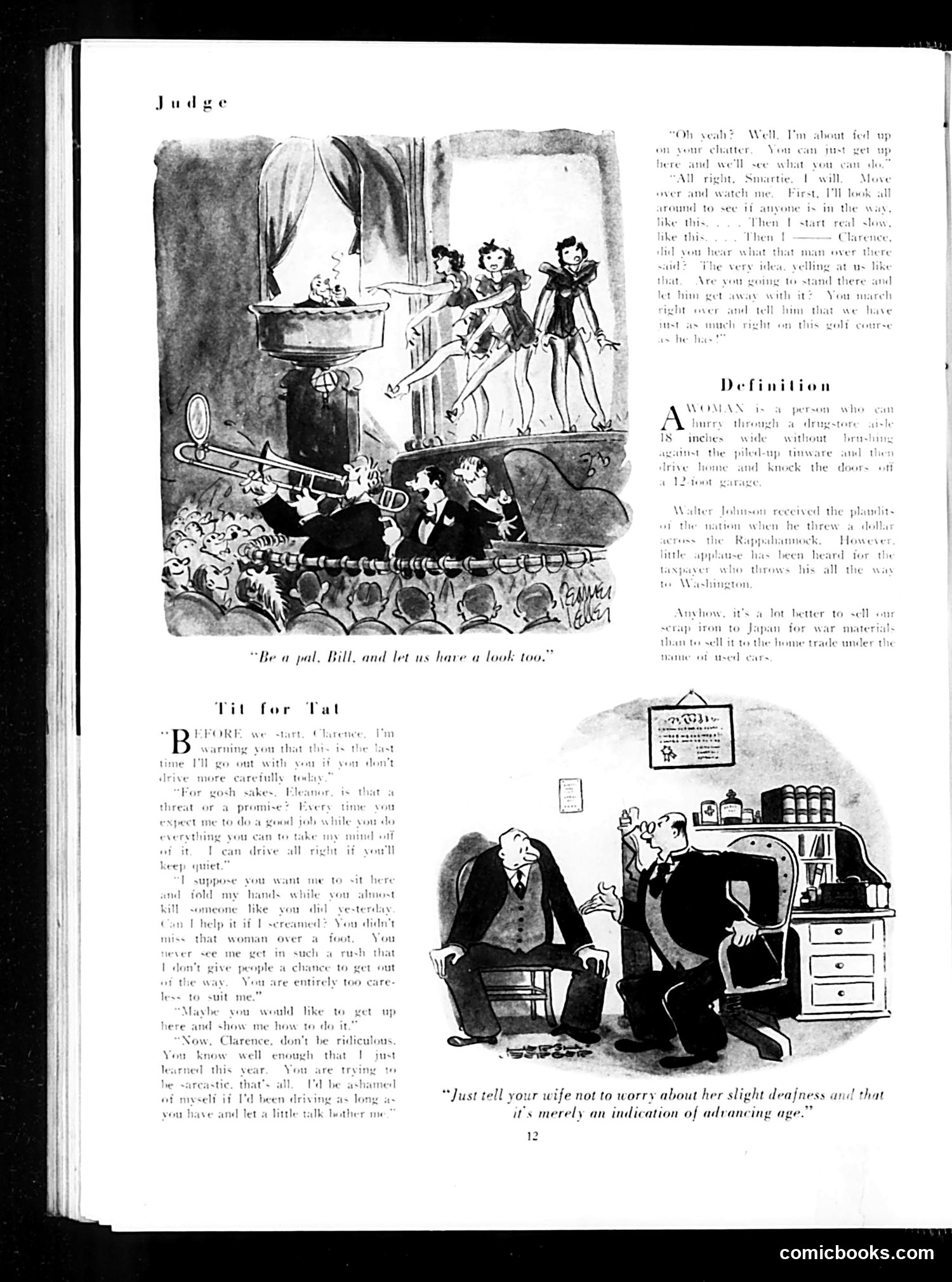
Analysis of Judge Magazine Page This page contains two satirical pieces typical of Judge's humor: "Tit for Tat" (lower section): Shows a domestic argument between a husband and wife about driving. The husband warns his wife she's a poor driver; she retorts by listing his faults as a chauffeur. The joke plays on gender dynamics and marital bickering—a common theme as automobile ownership became widespread in the early 20th century. The final caption about "slight deafness" being "merely an indication of advancing age" suggests the wife is aging, a dig at female vanity. Top cartoon ("Be a pal, Bill"): Depicts what appears to be a theater or performance scene with audience members below and figures on a balcony above. The dialogue suggests someone is disrupting the show, and others are pressuring a man named Bill to confront the disruptor. The "Definition" section offers humorous definitions of a "Woman" as someone who can navigate tight spaces and sell scrap iron. The overall tone reflects period attitudes toward women, driving, and domestic life—presented as mild satirical humor for Judge's readership.
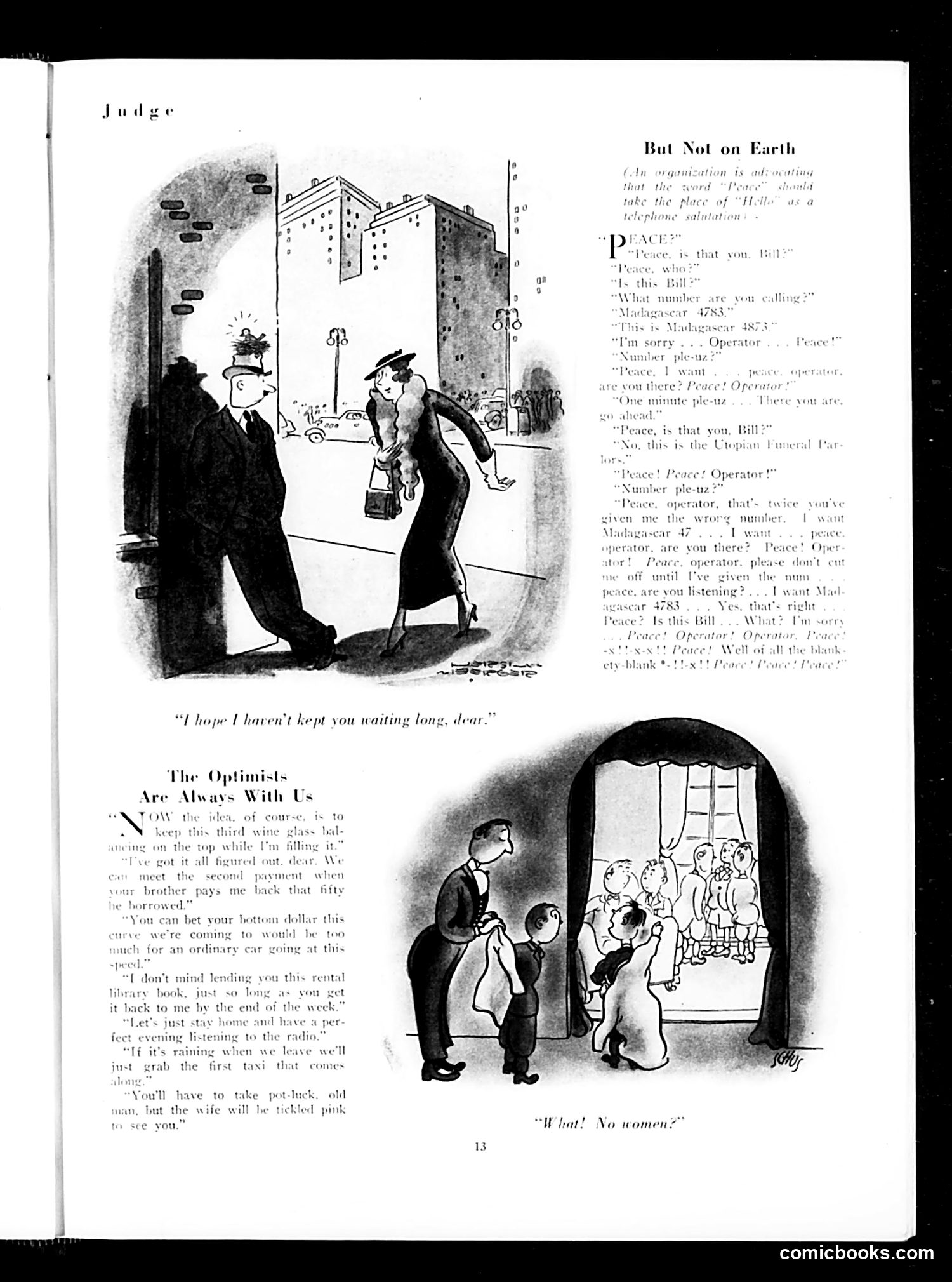
Judge Magazine Page Analysis This page contains two satirical cartoons from Judge magazine (American humor publication). Top cartoon "But Not on Earth": A telephone operator struggles to connect a caller seeking "Peace" to the right number. The humor satirizes post-WWI difficulty finding peace—callers keep reaching wrong numbers (Madagascar, etc.). The "Utopian Funeral Parlors" reference suggests peace is dead or only exists in fantasy. The satire critiques the failure of peace efforts following World War I, implying genuine peace remains elusive in reality despite international hopes. Bottom cartoon "The Optimists Are Always With Us": Shows men making absurdly optimistic financial and social plans—lending money expecting repayment that may never come, borrowing library books they might not return, grabbing whatever taxi appears. The final panel's "What! No women?" joke implies even optimists have limits. This satirizes people who maintain unrealistic hope despite obvious obstacles, a common human folly. Both cartoons use humor to critique post-war disillusionment and human nature.
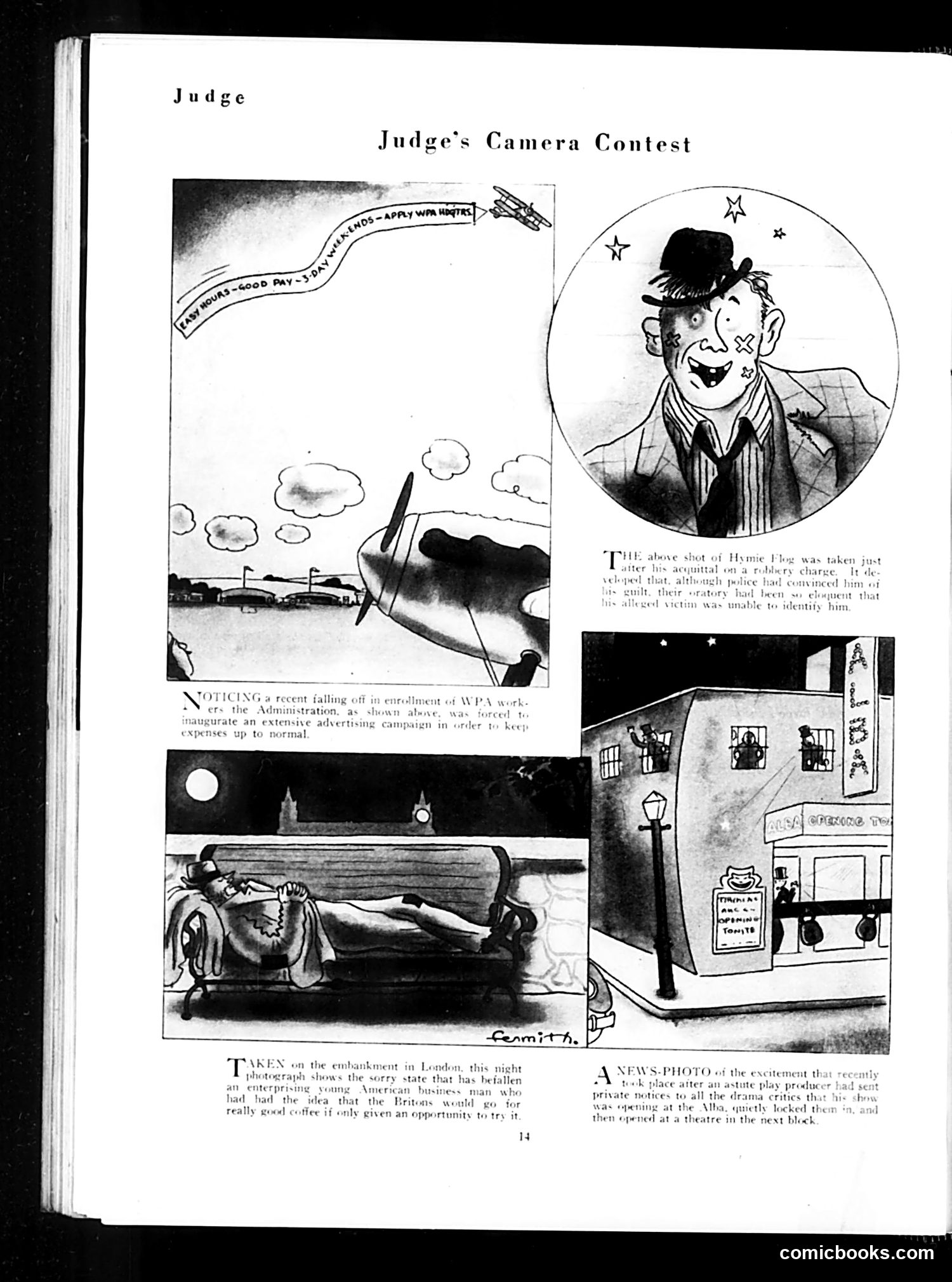
Judge's Camera Contest This page presents a humor feature showcasing four cartoon scenarios submitted to Judge magazine's photography contest. The cartoons mock various situations: 1. Top left: A WPA worker notices an airplane overhead while operating heavy equipment, reflecting Depression-era satire about government work programs. 2. Top right: A caricatured man with an "X" over his eye—apparently a robbery suspect whose poor description made identification impossible, poking fun at eyewitness reliability. 3. Bottom left: A sailor reclining on a couch with a telescope, likely satirizing leisure time or idle military life. 4. Bottom right: A street scene showing what appears to be theater drama or public excitement, referencing private notices sent to drama critics. The overall feature satirizes contemporary American life through observational humor typical of Judge's satirical approach.
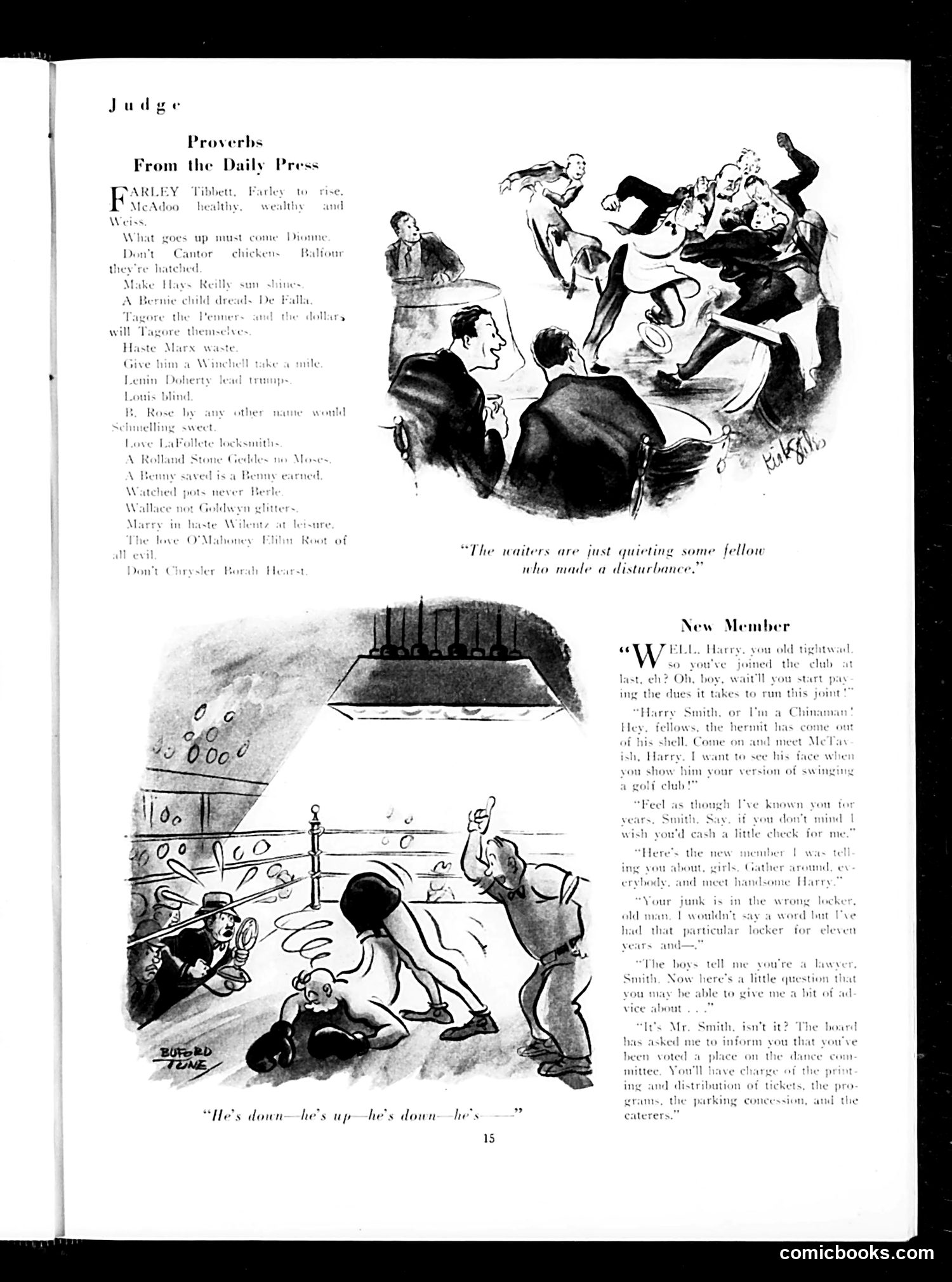
Analysis of Judge Magazine Page This page contains two distinct cartoons satirizing social club dynamics and American society circa the 1920s-30s. Top cartoon: Shows well-dressed men at what appears to be a nightclub or restaurant, with the caption "The waiters are just quieting some fellow who made a disturbance." This satirizes the era's speakeasy culture and class-based treatment—wealthy patrons are protected from seeing lower-class disruptions. Bottom cartoon ("New Member"): Depicts Harry Smith joining an exclusive club. The text humorously reveals the club's obligations: paying substantial dues, serving on committees managing dance events, tickets, parking, and catering. The satire targets the hidden costs and responsibilities of club membership—members discover they're expected to do the actual work running the organization, not simply enjoy leisure. The page's heading "Proverbs from the Daily Press" lists newspaper clichés about various public figures (McAdoo, Weiss, Cantor, etc.), mocking predictable journalism. Overall, the satire critiques both speakeasy culture and the pretense of exclusive social clubs.
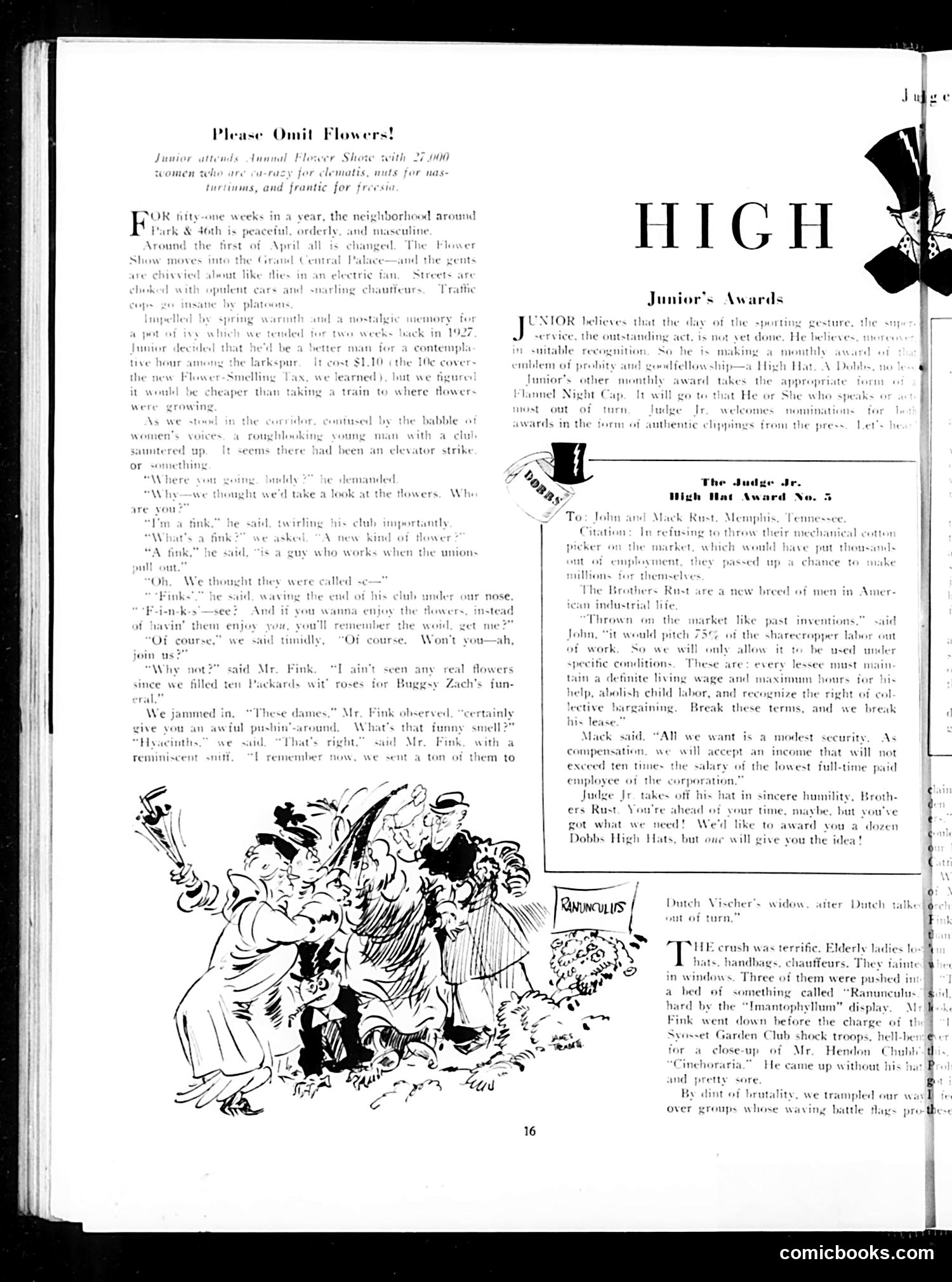
"Please Omit Flowers!" - Judge Magazine Cartoon Analysis This page satirizes the absurdity of New York's annual Flower Show (held at Grand Central Palace with 27,000 exhibits). The left cartoon depicts a cynical exchange where characters discuss "finks"—strikebreakers or hired thugs—as a novel type of "flower." The joke plays on labor unrest: a rough young man explains he's a "fink," and when asked what that means, he quips that they're a "new kind of flower" that unions "pull out." The satire mocks both the pretentious flower show (where wealthy women obsess over rare blooms) and labor strife. The implication: just as people casually discuss and discard flowers, society treats workers and strikebreakers as disposable commodities. The cartoon ridicules the disconnect between the genteel upper-class event and the brutal economic realities of workers trying to survive—framed through irreverent, darkly comic wordplay.
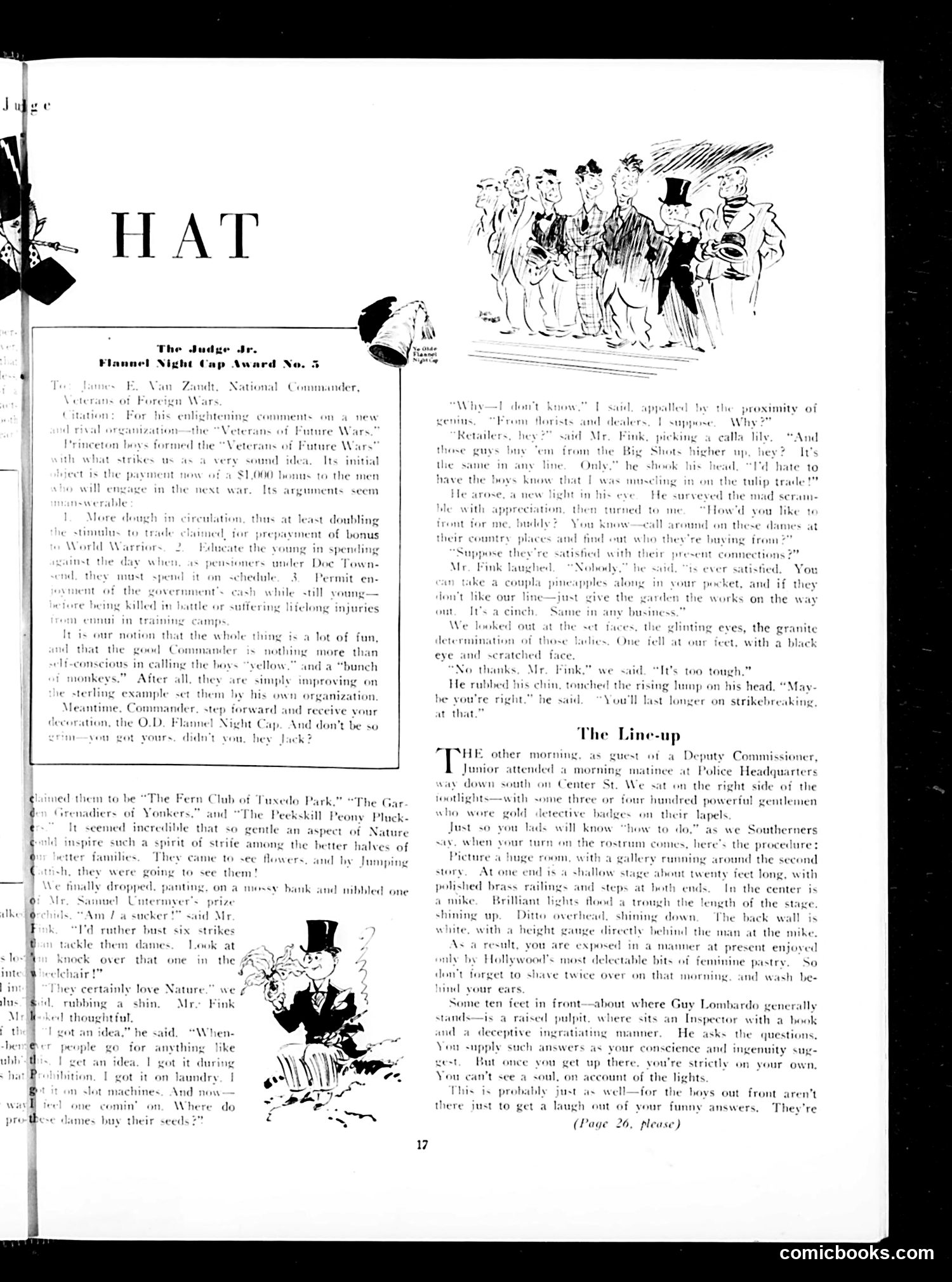
Analysis of Judge Magazine Page This page contains two satirical pieces from Judge magazine: "The Flannel Night Cap Award No. 5" mocks the "Veterans of Future Wars" organization—apparently a real group advocating bonus payments to servicemen. The satire ridicules their self-serious militarism by awarding them a "flannel night cap," suggesting they're more concerned with comfortable domesticity than actual warfare. The "Commander" character embodies this contradiction. "The Line-up" describes a police recruitment demonstration at headquarters, where prospective officers are inspected like products. The satire critiques the superficiality of the selection process: candidates are judged primarily on appearance under theatrical lighting ("exposed in a manner...enjoyed only by Hollywood's most delectable bits of feminine pastry"), with actual competence secondary. The final note that recruits must answer questions "strictly on your own" without backup suggests they're unprepared for real police work. Both pieces satirize institutional pretension and the gap between official appearances and actual capability—characteristic Judge humor targeting American institutions and social climbing.
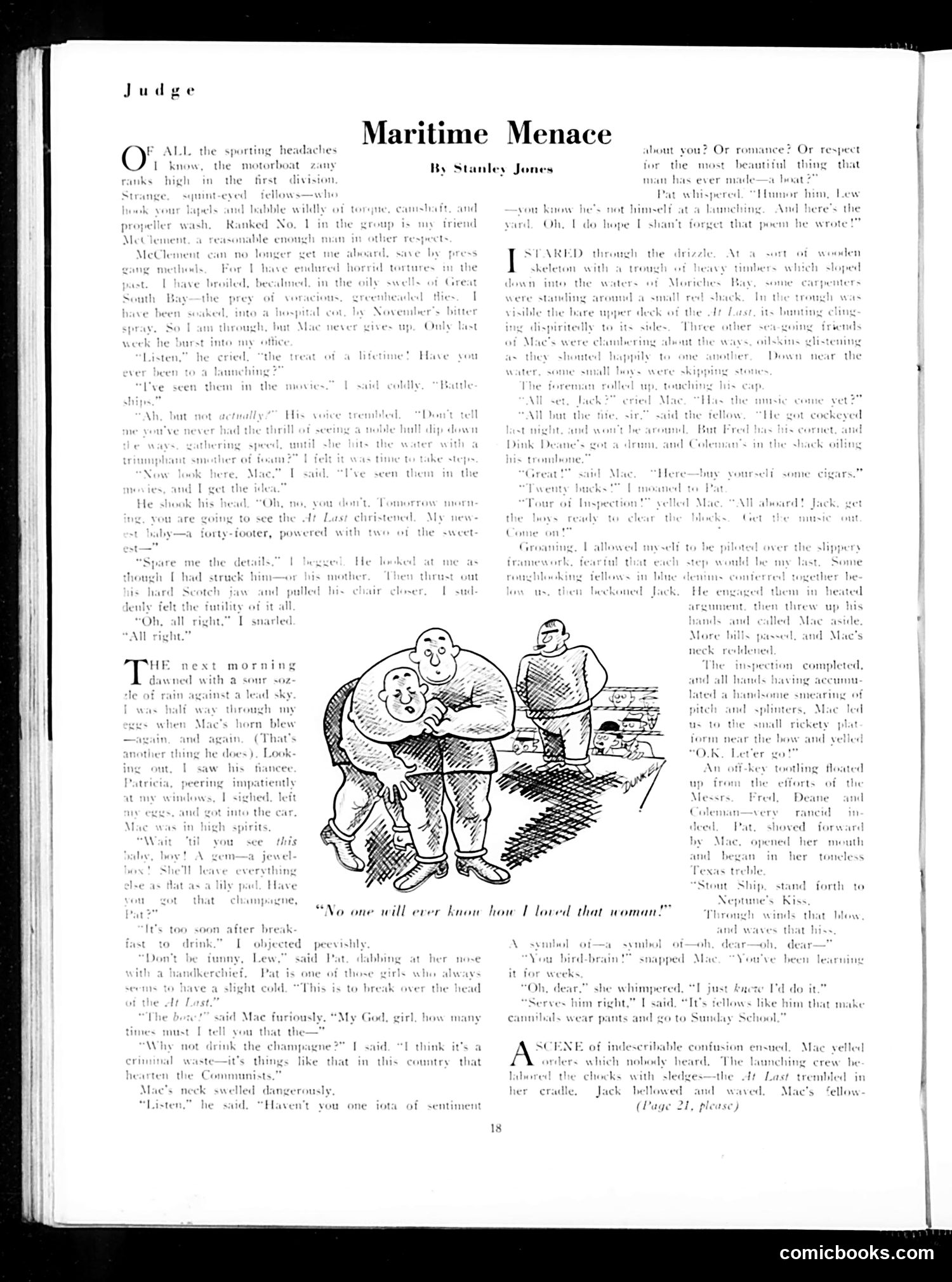
Maritime Menace This is a short story illustration by Stanley Jones from Judge magazine. The narrative follows a naval officer (the narrator) and his friend Mac, a sailor, discussing the temptations and dangers of port life. The central cartoon depicts Mac with what appears to be a woman, illustrating the story's theme: sailors encountering romantic entanglements during shore leave. The joke plays on the tension between naval duty and personal desires—Mac is warned about various distractions (drinking, women, gambling) that threaten military discipline. The satire targets the "maritime menace" of sailors being corrupted by shore vices, a common moralizing concern in early 20th-century American culture. The woman represents the traditional "temptress" figure that supposedly lured servicemen away from proper conduct. Judge uses humor to critique both sailor behavior and the broader social anxieties about military morality during this era.
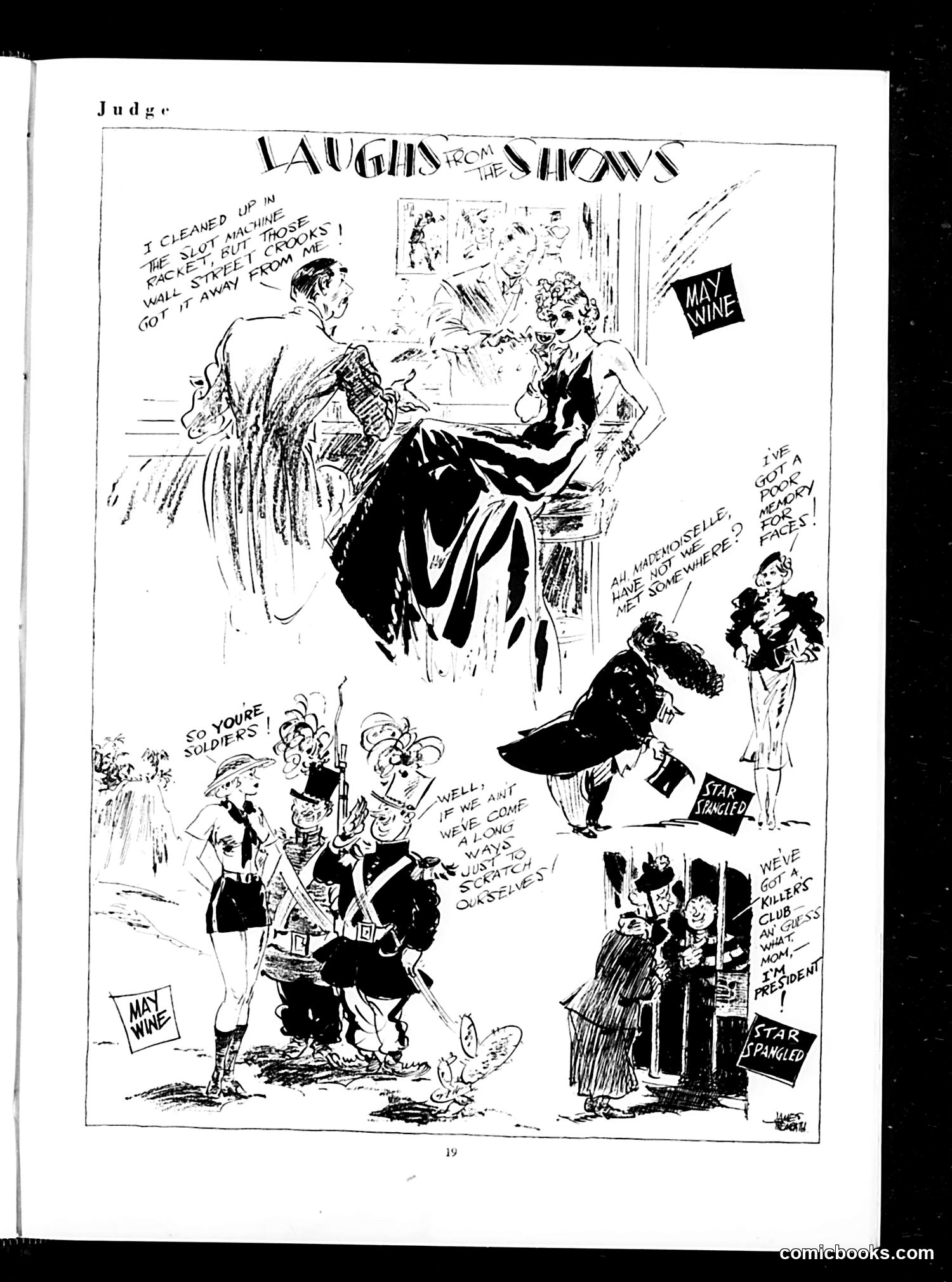
"Laughs from the Shows" This is a theatrical satire page featuring multiple vignettes mocking Broadway productions and performers of the era. The central figure is a woman in an elegant dress, likely representing a leading lady or star performer, surrounded by smaller scenes depicting various shows and their absurdities. The visible jokes reference show titles like "May Wine" and "Star Spangled," with soldiers and military references scattered throughout. There are complaints about "noise," "scratches," and shows that "ain't come along ways" yet. The satire targets theatrical pretension, dramatic overacting, and the gap between critical acclaim and actual quality in contemporary stage productions. The cartoon mocks both performers and audiences, suggesting the shows lack substance despite their promotion.
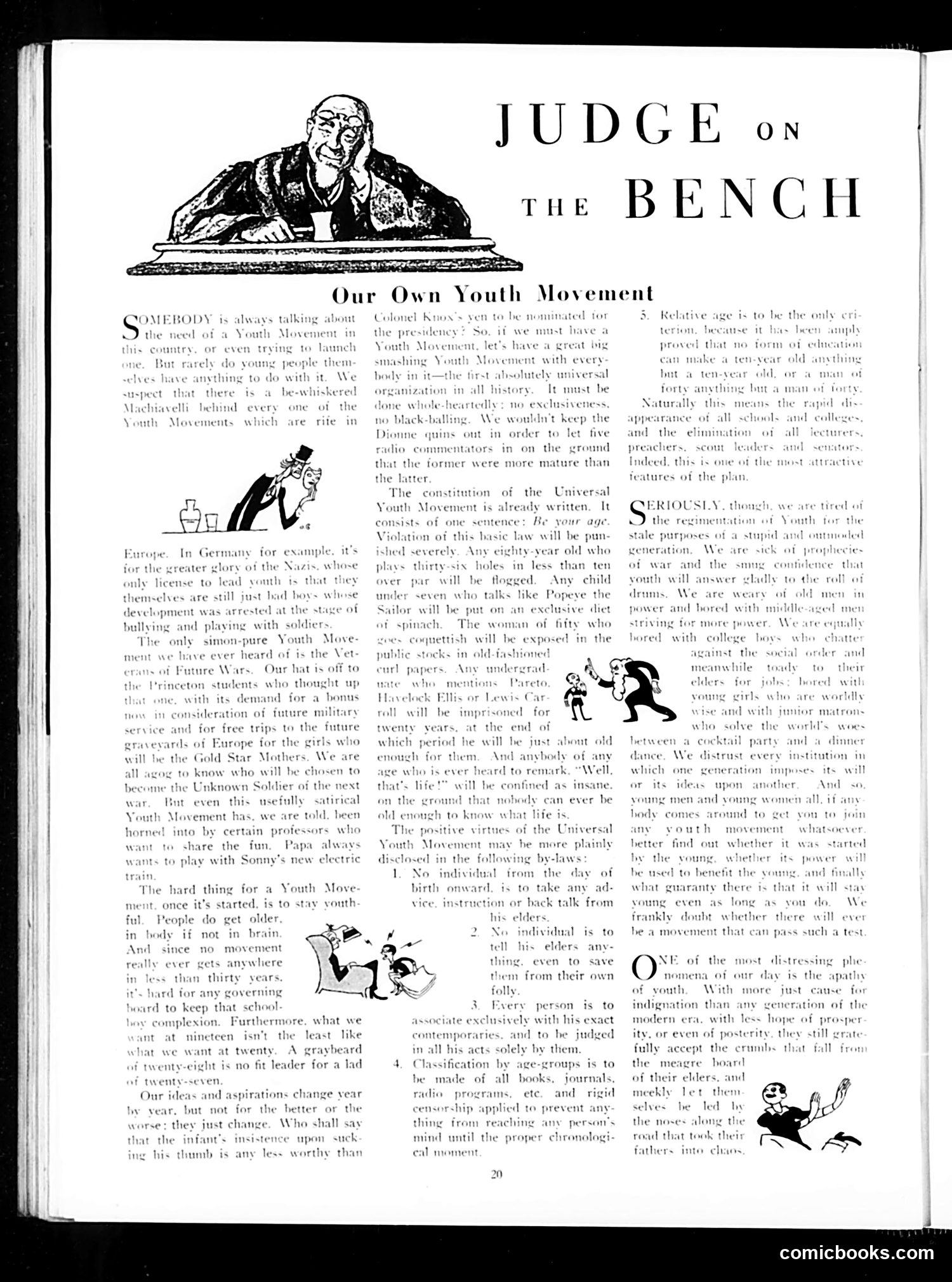
Judge Magazine: "Our Own Youth Movement" This article satirizes proposals for a regimented, government-controlled "Universal Youth Movement"—likely referencing fascist youth organizations of 1930s Europe (the text explicitly mentions Nazi Germany). The cartoon illustrations show adults attempting to control and organize youth in rigid, militaristic fashion. The judge figure at the top presides over this discussion. The satire's point: The author argues such movements are inherently contradictory and undesirable. Young people naturally change their views; attempting to impose uniform ideology, prevent independent thought, segregate youth by age-group, and censor their minds is both futile and dangerous. The piece mocks the notion that regimented youth organizations represent progress, arguing instead they reflect authoritarian control. The text presents numbered "principles" of such movements as absurdities—claiming children shouldn't accept advice from elders, that peer judgment alone matters, and that censorship prevents "reaching any person's mind." This is anti-totalitarian satire warning American readers against adopting foreign authoritarian models.
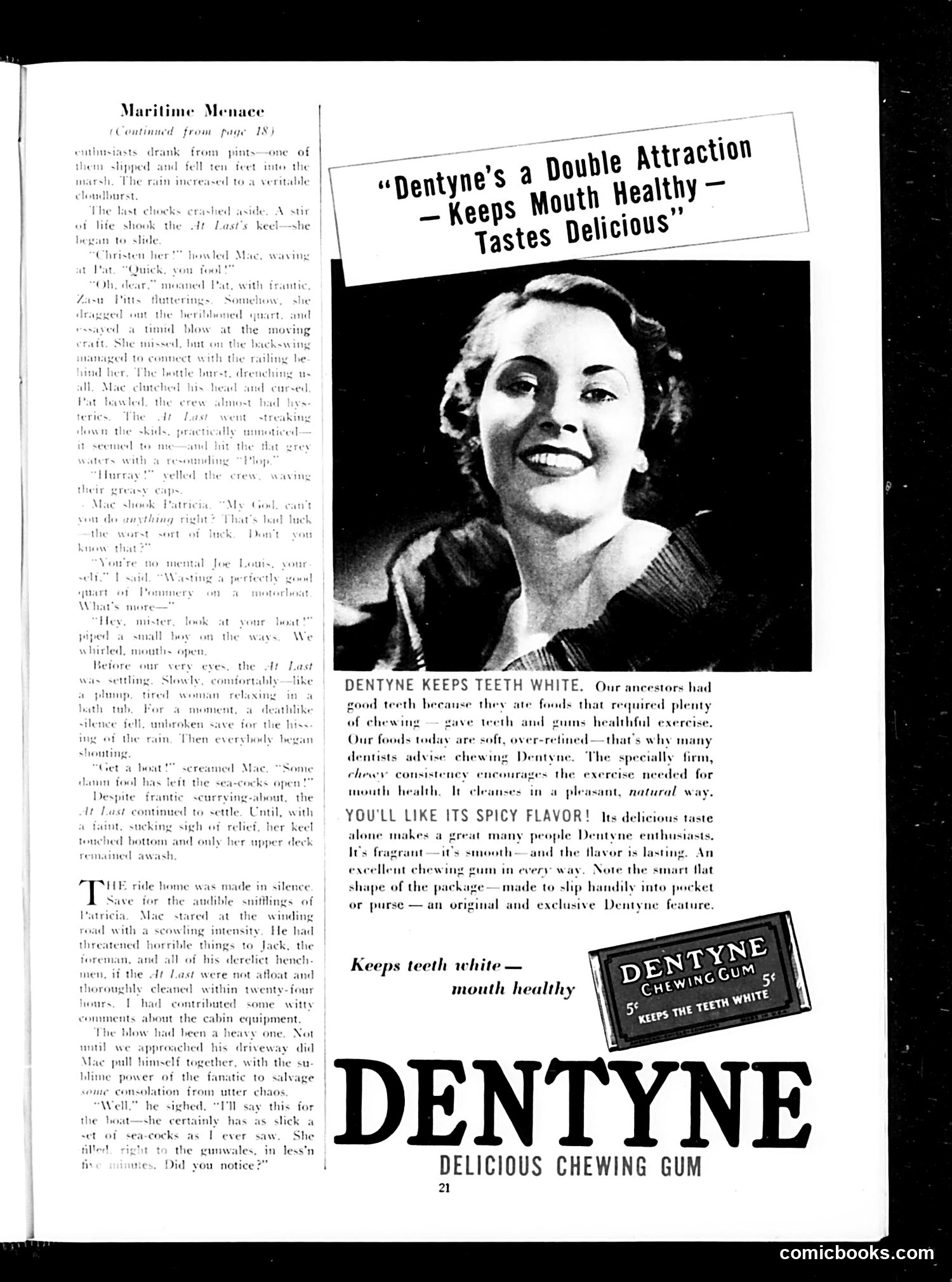
Analysis This page is primarily a full-page advertisement for Dentyne chewing gum, not a political cartoon or satirical content. The ad features a smiling woman's photograph and marketing copy claiming Dentyne keeps teeth white and maintains mouth health. The pitch emphasizes the gum's "spicy flavor," firm texture that encourages chewing, and convenient flat packaging designed to fit in pockets or purses. The only narrative content visible is the continuation of a story titled "Maritime Menace" (visible in the column on the left), which appears to be an adventure or drama involving characters named Mac and Patricia aboard a boat—unrelated to the advertisement. Context for modern readers: This represents how Judge magazine monetized itself through advertising, inserting full commercial pages alongside editorial content. The ad's health claims about dental benefits reflect early 20th-century marketing before strict FDA regulations on medical claims.
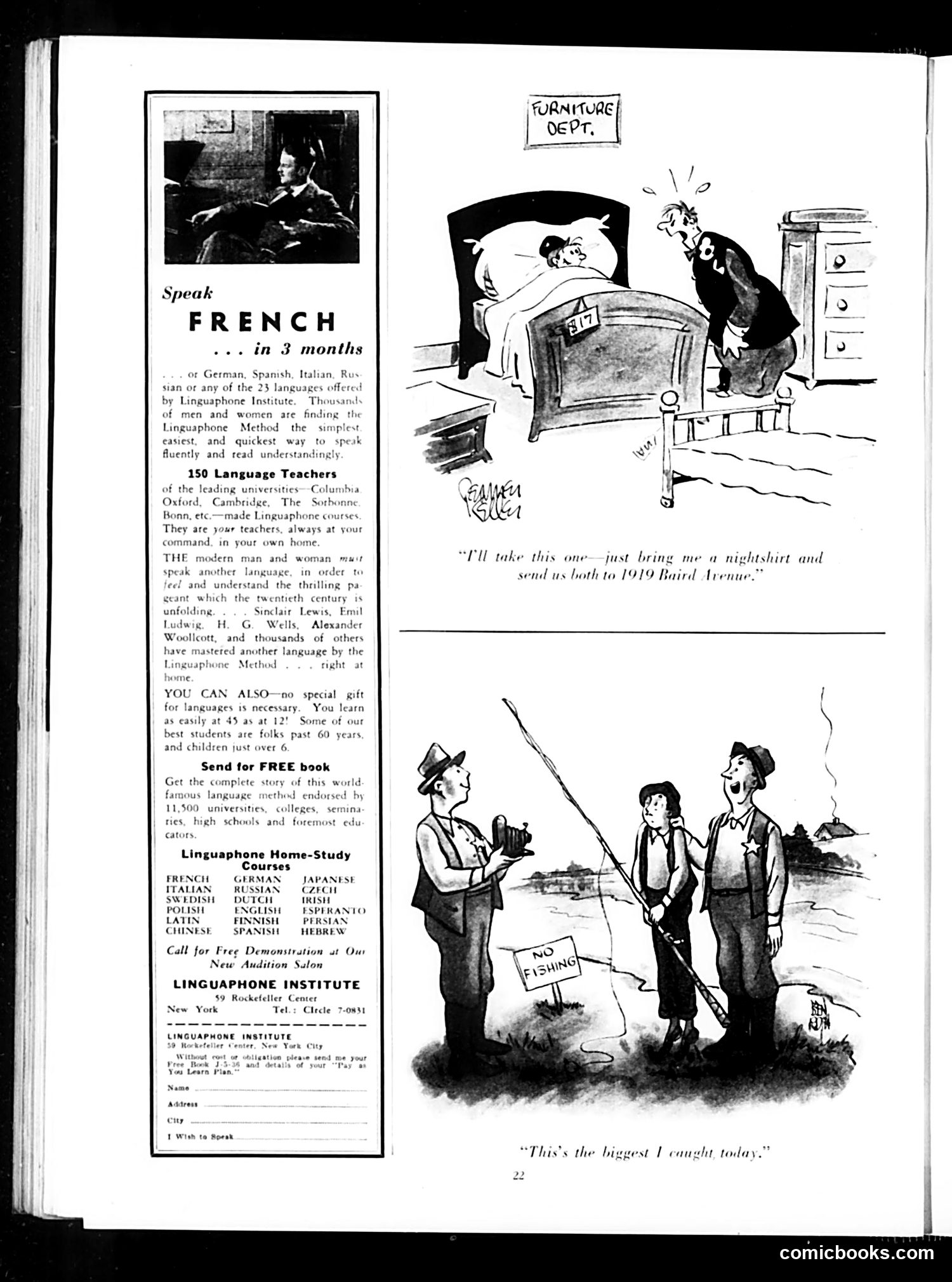
Analysis of Judge Magazine Page Content Type: This page mixes advertising with two cartoons. The Advertisements: The left side advertises Linguaphone Institute's language-learning courses, claiming one can "speak French in 3 months" and endorsing the method through famous names like H.G. Wells and Sinclair Lewis. The Cartoons: Both are domestic humor scenarios: 1. Top cartoon: A furniture salesman shows a bed to a disheveled customer. The customer's quip about sending "both" to an address suggests he's so worn out he wants to return himself along with the bed—joke being he's as exhausted as worn furniture. 2. Bottom cartoon: Three men fishing at a "No Fishing" sign. One says "This's the biggest I caught today," referring to something unseen (likely a reprimand or citation), playing on the double meaning of "catch." Both cartoons exemplify Judge's typical early 20th-century style: mild domestic comedy with visual gags, lacking sharp political bite but relying on wordplay and everyday situations for humor.
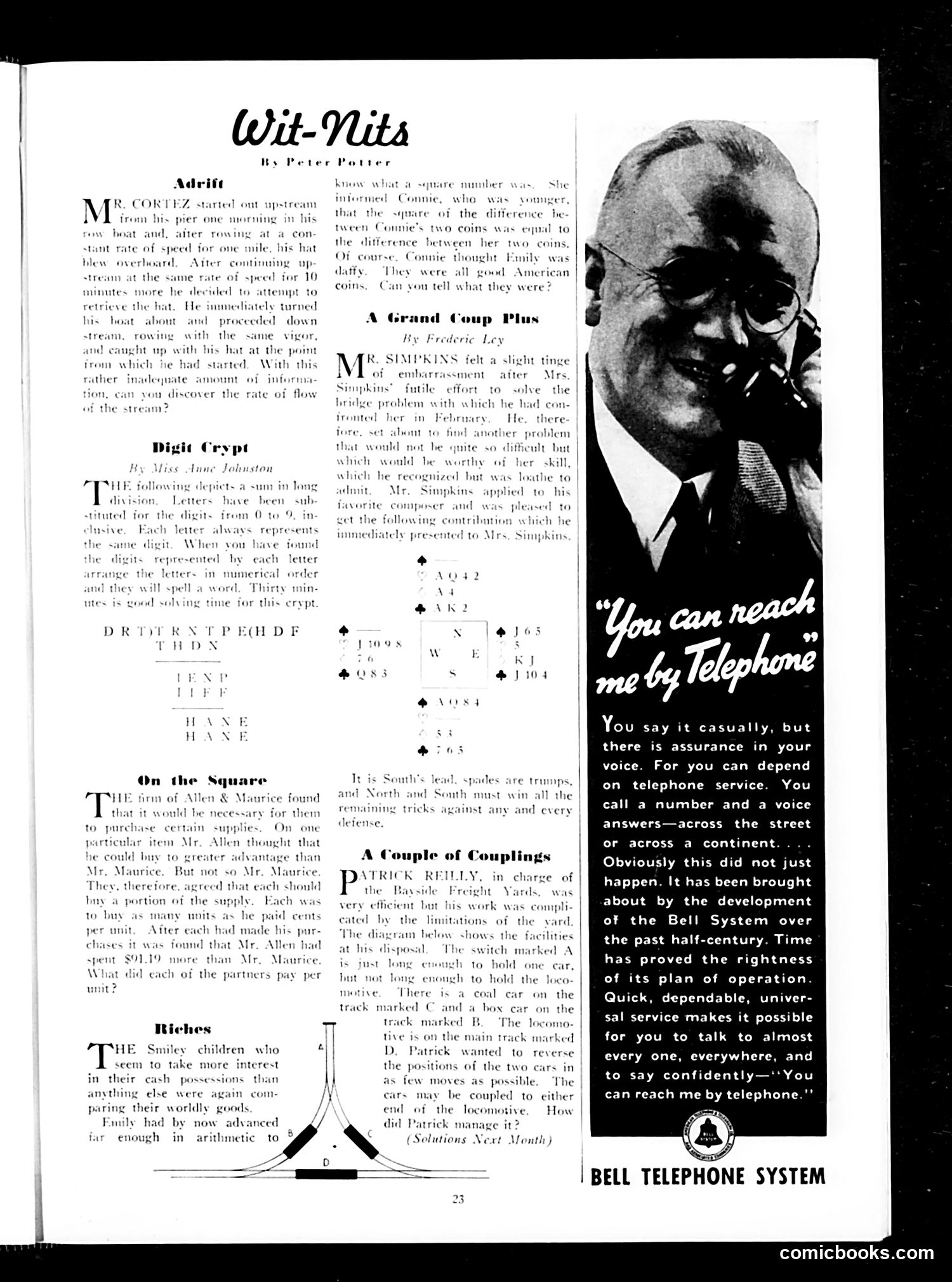
"Wit-Nits" Page Analysis This is a puzzle and humor page from *Judge* magazine featuring several recreational brain-teasers rather than political satire. Content: - "Adrift" and "High Crypt": Mathematical word puzzles where readers solve riddles (a boat drifting downstream, cryptograms) - "On the Square" and "A Couple of Couplings": Logic puzzles involving railroad yard mechanics and purchasing calculations - "Riches": A children's arithmetic problem These represent the "Wit-Nits" column—light intellectual entertainment for readers. The puzzles appeal to middle-class audiences enjoying recreational mathematics and wordplay. The Bell Telephone Advertisement (right side) is unrelated to the puzzles, promoting telephone reliability with a man's photograph and messaging about dependable cross-country service. No political content: This page contains no satire, caricature, or social commentary—it's purely puzzle/entertainment content typical of *Judge*'s lighter offerings alongside its satirical material.
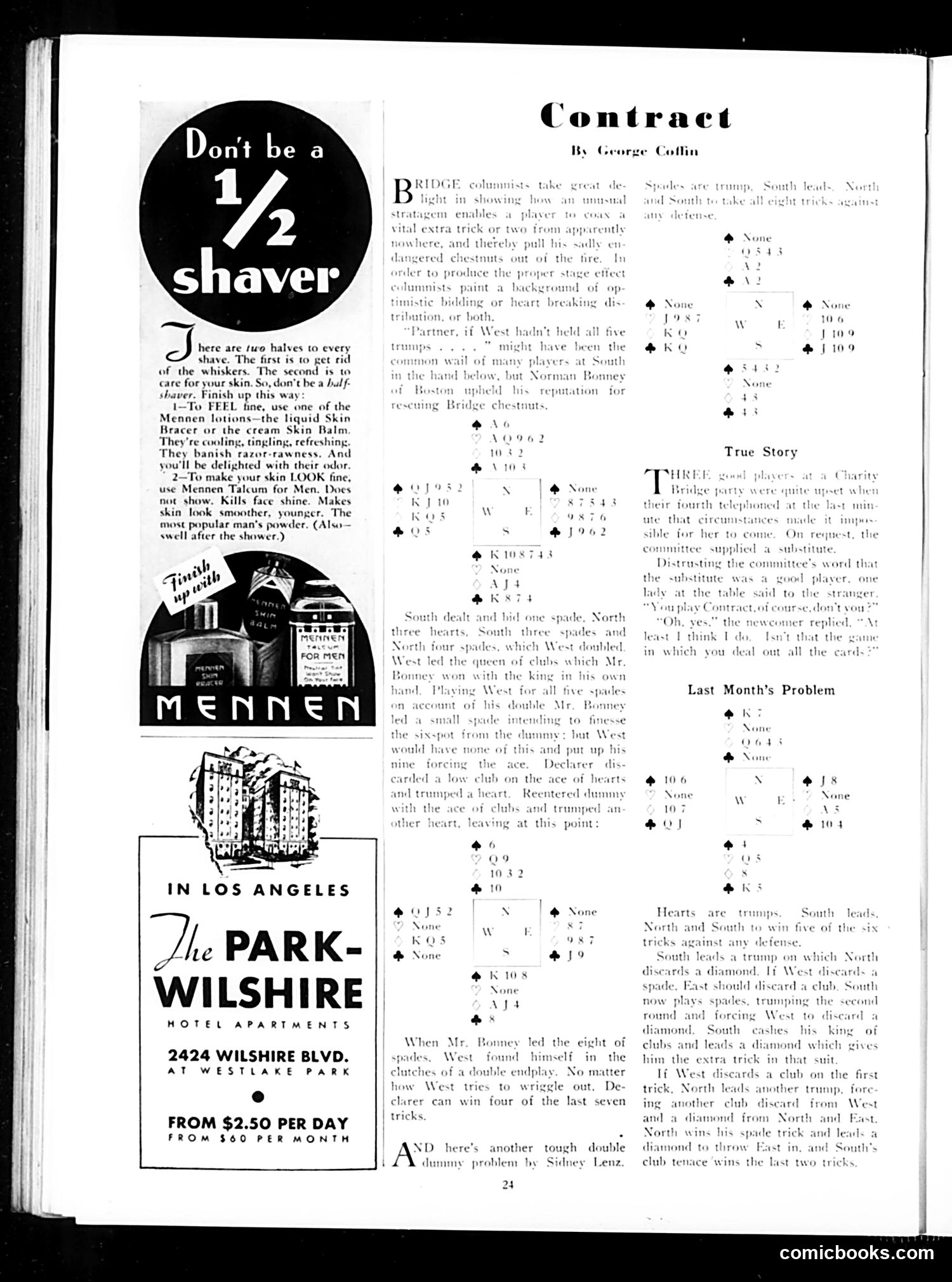
Analysis of Judge Magazine Page Content This page is primarily advertising and bridge instructional content, not political satire. The main advertisement is a Mennen grooming products ad ("Don't be a 1/2 shaver"), which humorously presents a two-step shaving routine: removing whiskers, then caring for skin with Mennen lotions and talcum powder. The ad uses the metaphor of being a "half shaver" to shame men into completing proper grooming. Below that is a Park-Wilshire Hotel Apartments advertisement in Los Angeles, offering rooms from $2.50 per day. The remainder of the page contains bridge game analysis by George Coffin and Sidney Lenz—featuring card diagrams and discussions of contract bridge strategy, including sections titled "Contract," "True Story," and "Last Month's Problem." There is no political cartoon or satire on this page. It represents typical Judge magazine content from its later years: a mix of advertisements, instructional game features, and light humor rather than social commentary.
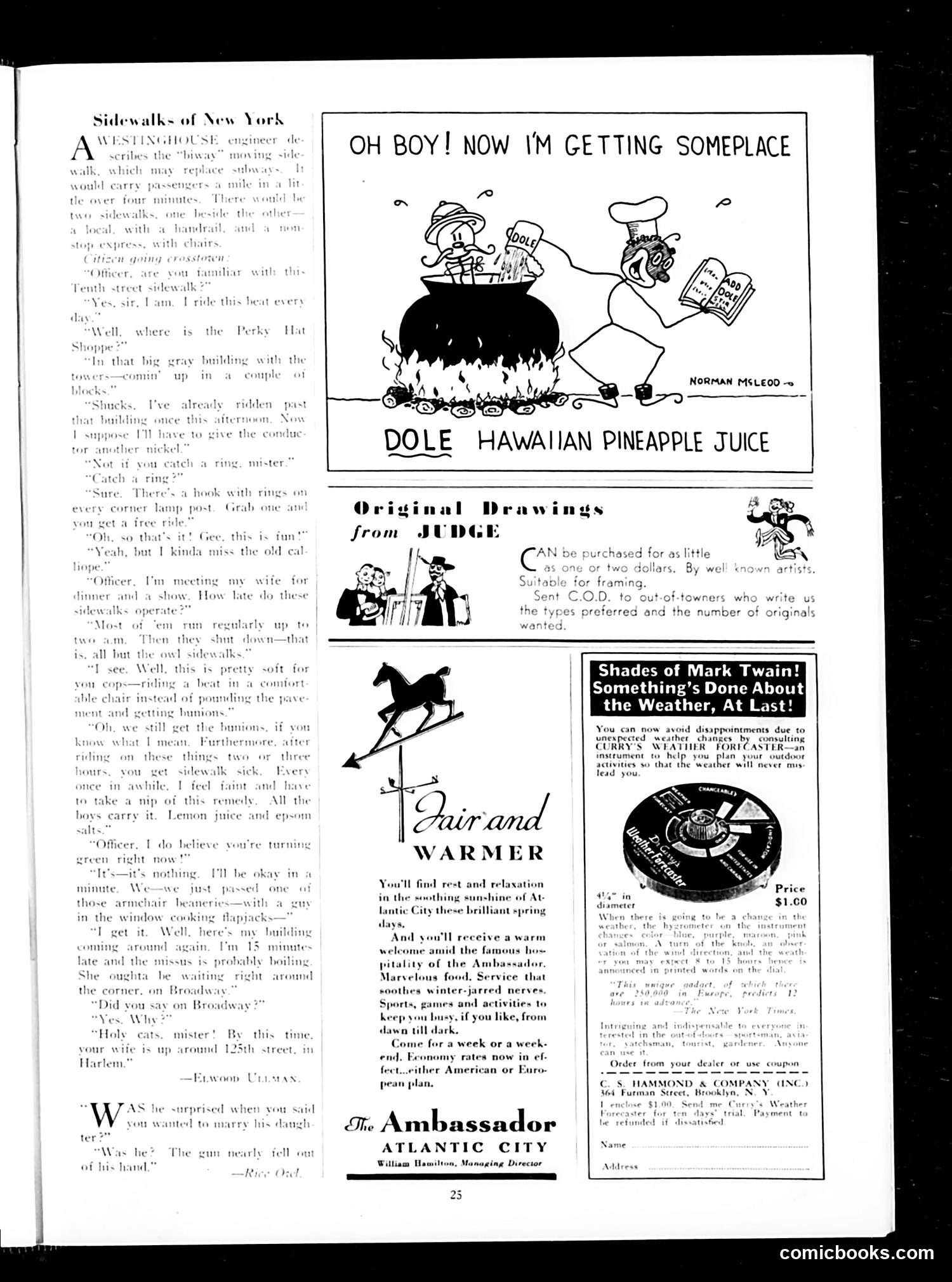
Judge Magazine Page Analysis This page contains primarily advertisements and filler content rather than substantive political satire. The main cartoon, credited to Norman McLeod, depicts figures in a cauldron with the caption "OH BOY! NOW I'M GETTING SOMEPLACE" and advertises Dole Hawaiian Pineapple Juice. It's a simple product advertisement using whimsical imagery—the joke appears to be people "cooking" in pineapple juice, suggesting they're enjoying the product. The remaining content consists of: - A brief anecdote about New York sidewalks (titled "Sidewalks of New York") - An advertisement for original drawings "from Judge" - Multiple product advertisements: a Fair and Warmer hotel promotion in Atlantic City, a Curry's Weather Forecaster tool, and The Ambassador hotel in Atlantic City The page is primarily commercial in nature, with advertisements occupying most space. There is no apparent political commentary or social satire visible—it's a typical magazine page from the era mixing light editorial content with paid advertisements.
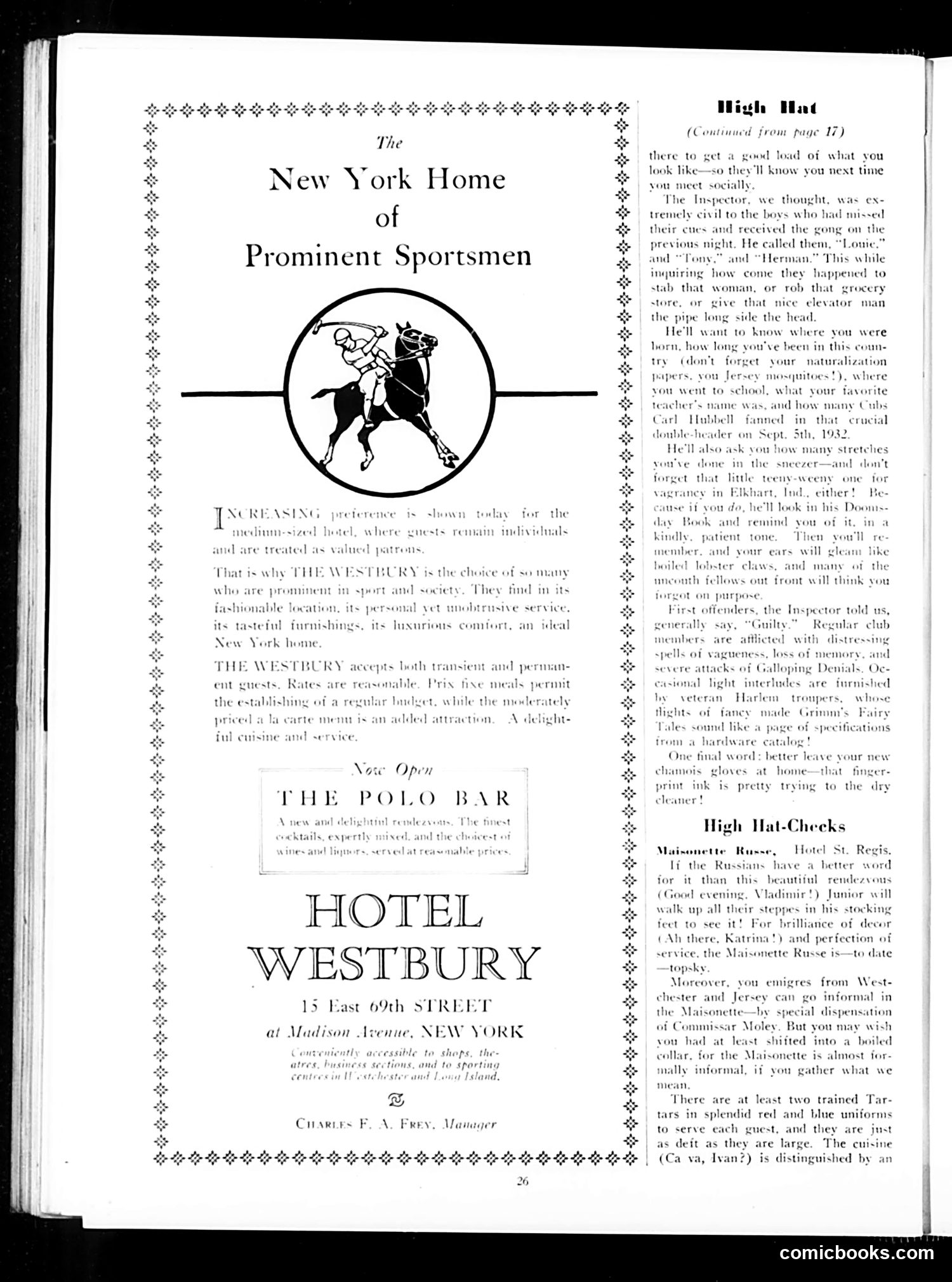
High Hat Satire: Judge Magazine's Social Commentary This page from Judge magazine satirizes New York's elite social world through two complementary pieces. The left side advertises the Hotel Westbury, positioning it as the fashionable choice for "prominent sportsmen" seeking exclusive service and comfort. The right column ("High Hat," continued from page 17) mocks the pretensions of this same elite class. It describes how a hotel inspector interrogates guests about their backgrounds, names, and knowledge of mundane details—exposing how the wealthy are scrutinized and expected to perform their status. The references to Carl Hubbell (a 1932 baseball star) and warnings about chamois gloves suggest anxious social climbing. The "Maisonette Russe" section further ridicules pretentious New Yorkers who affect Continental sophistication—using French names and Russian servants ("Tartars") to appear cosmopolitan, while remaining essentially provincial outsiders ("emigres from Westchester and Jersey"). The satire targets social insecurity masked by luxury consumption.
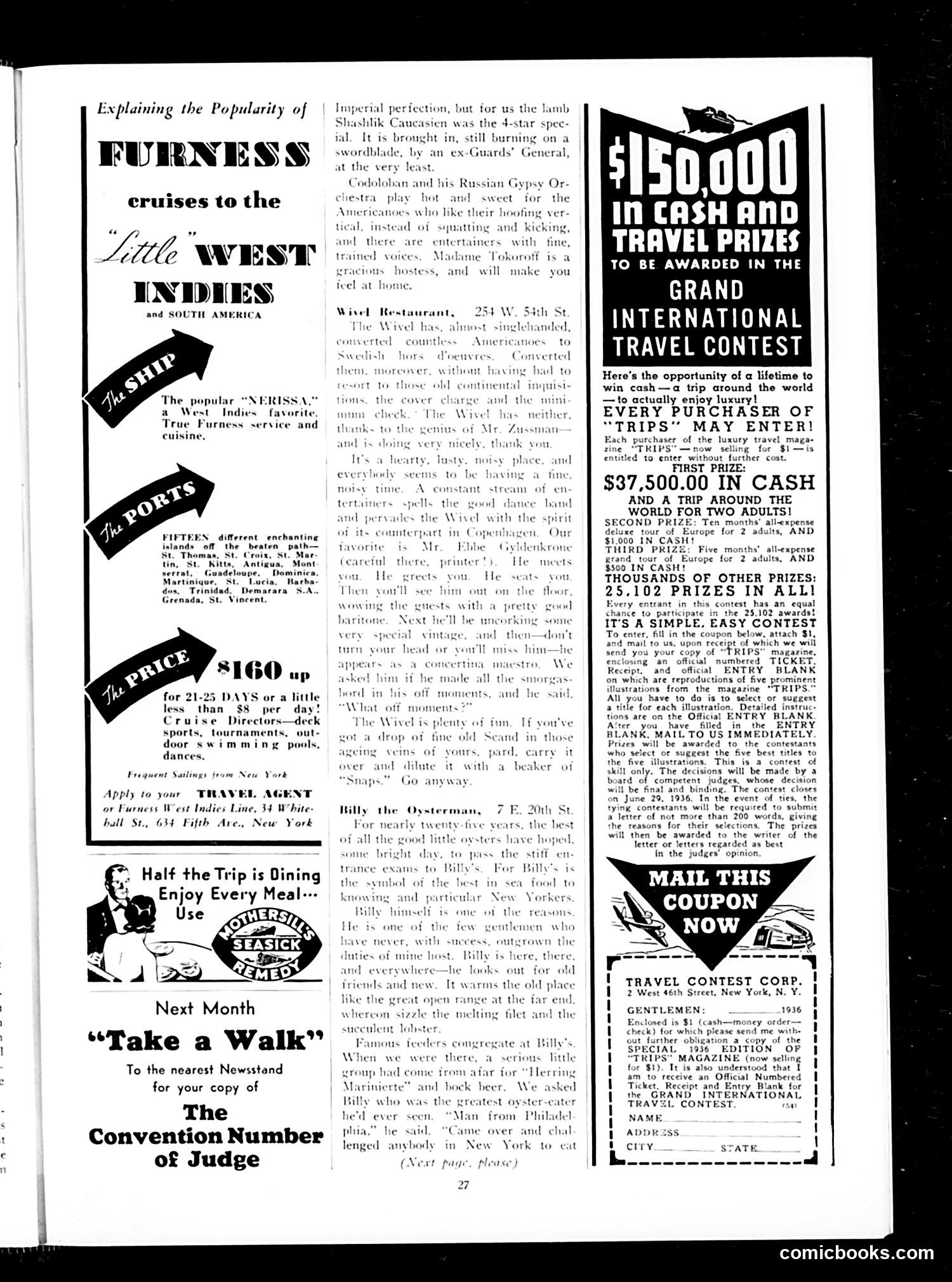
Page Content Analysis This page is primarily advertising and promotional material rather than political satire or editorial cartoons. Main Content: - Left side: Advertisements for Furness cruise lines to the West Indies and South America, promoting luxury travel packages starting at $160 for 21-25 days - Center: Restaurant reviews (appearing to be from Judge magazine) describing upscale New York dining establishments—the Wivel Restaurant, Billy the Oysterman oyster bar—with emphasis on exotic cuisine and entertainment - Right side: A large advertisement for the "Grand International Travel Contest" offering $150,000 in cash and prizes, including a $37,500 first prize of cash plus a world trip for two Historical Context for Modern Readers: This reflects 1930s luxury travel marketing aimed at wealthy Americans. The exotic restaurant descriptions and cruise advertisements showcase the era's fascination with international cuisine and leisure travel. The contest promotion uses common period advertising tactics: large prize announcements and easy entry mechanisms to build excitement. The page demonstrates Judge magazine's dual function as satirical publication and upscale advertising vehicle targeting affluent readers.
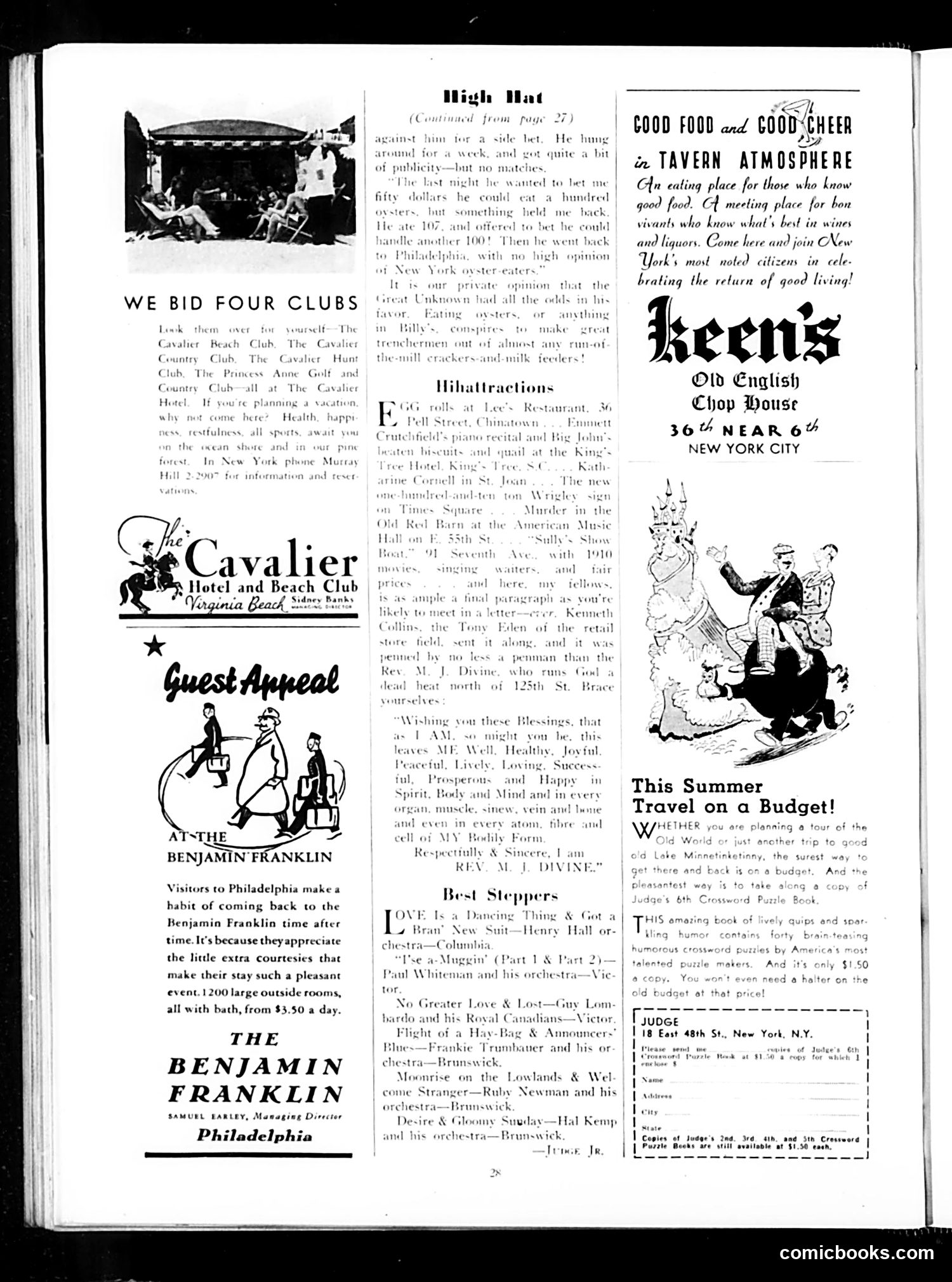
Judge Magazine Page Analysis This page is primarily advertising, not political satire. It features promotions for: - Four country clubs (Cavalier Beach Club, Cavalier Country Club, etc.) targeted at leisure travelers - The Benjamin Franklin Hotel in Philadelphia, emphasizing comfort and value ($3.50/day) - Keen's Old English Chop House in New York, marketing upscale dining - Travel budget guides and a crossword puzzle contest The small illustrations are decorative rather than satirical—including a "Guest Appeal" figure near Ben Franklin imagery and whimsical drawings accompanying the chop house ad. The only substantive text section discusses popular entertainment attractions (dance halls, orchestras, shows), not political commentary. The page reflects 1920s-30s leisure advertising aimed at affluent readers, with no apparent satirical intent or political messaging visible.
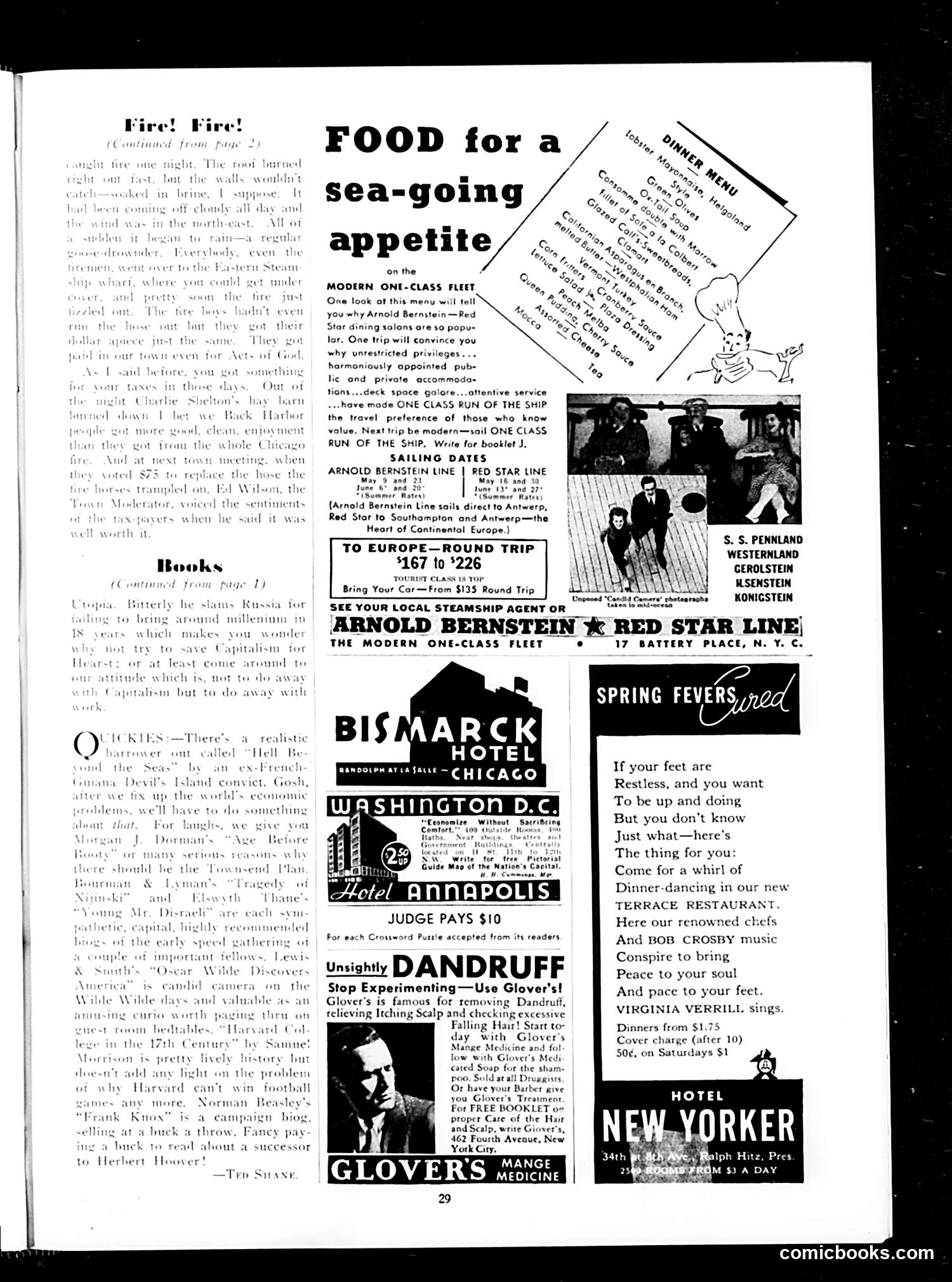
Judge Magazine Page Analysis This page is primarily advertising and travel promotion, not political satire. The dominant content features: Main Advertisement: Arnold Bernstein and Red Star shipping lines promoting transatlantic passage to Europe. The "dinner menu" illustration humorously suggests that the quality of ship dining alone justifies booking passage—a common marketing approach for luxury travel in this era. Secondary Ads include: - Hotel promotions (Bismarck Hotel Chicago, Hotel Annapolis, Hotel New Yorker) - A "Spring Fevers" nightclub advertisement featuring dinner-dancing and performer Virginia Verrill - Glover's Dandruff Medicine - A crossword puzzle contest Context for modern readers: This appears to be from the 1930s-40s, when transatlantic steamship travel was a major leisure activity for Americans. The ads emphasize "one-class" modern fleet amenities—a selling point suggesting democratic, egalitarian travel without rigid class divisions (contrasting older ocean liner hierarchies). The page contains minimal editorial content—only book reviews visible in the left margin.
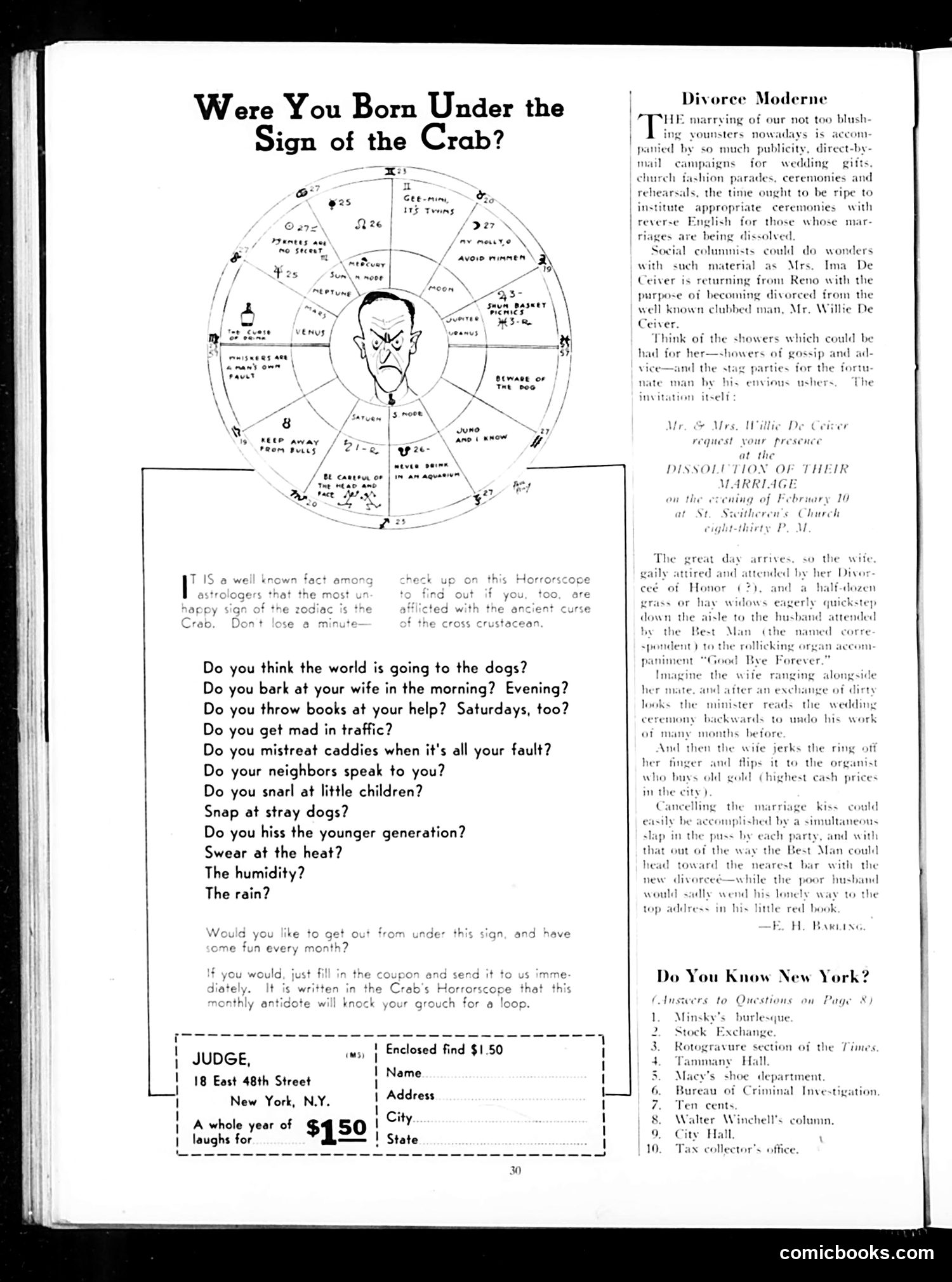
"Were You Born Under the Sign of the Crab?" This page satirizes two contemporary social trends. The left side features an astrological "horroscope" caricature mocking the popular belief in zodiac signs, listing exaggerated personality flaws (irritability, aggression, bad temper) supposedly linked to being born under Cancer. The accompanying questionnaire humorously catalogs modern male bad behavior—yelling at wives, throwing books at servants, road rage—implying American men are inherently crabby. The right column satirizes modern divorce culture and its public spectacle. It mocks the wealthy socialite "Mrs. Ima De Ceiver" returning from Reno (then the divorce capital) and jokes about elaborate "dissolution of marriage" ceremonies with invitations and wedding parties. The satire targets how newspapers sensationalize divorces and how divorce has become treated as a fashionable social event rather than a private matter.
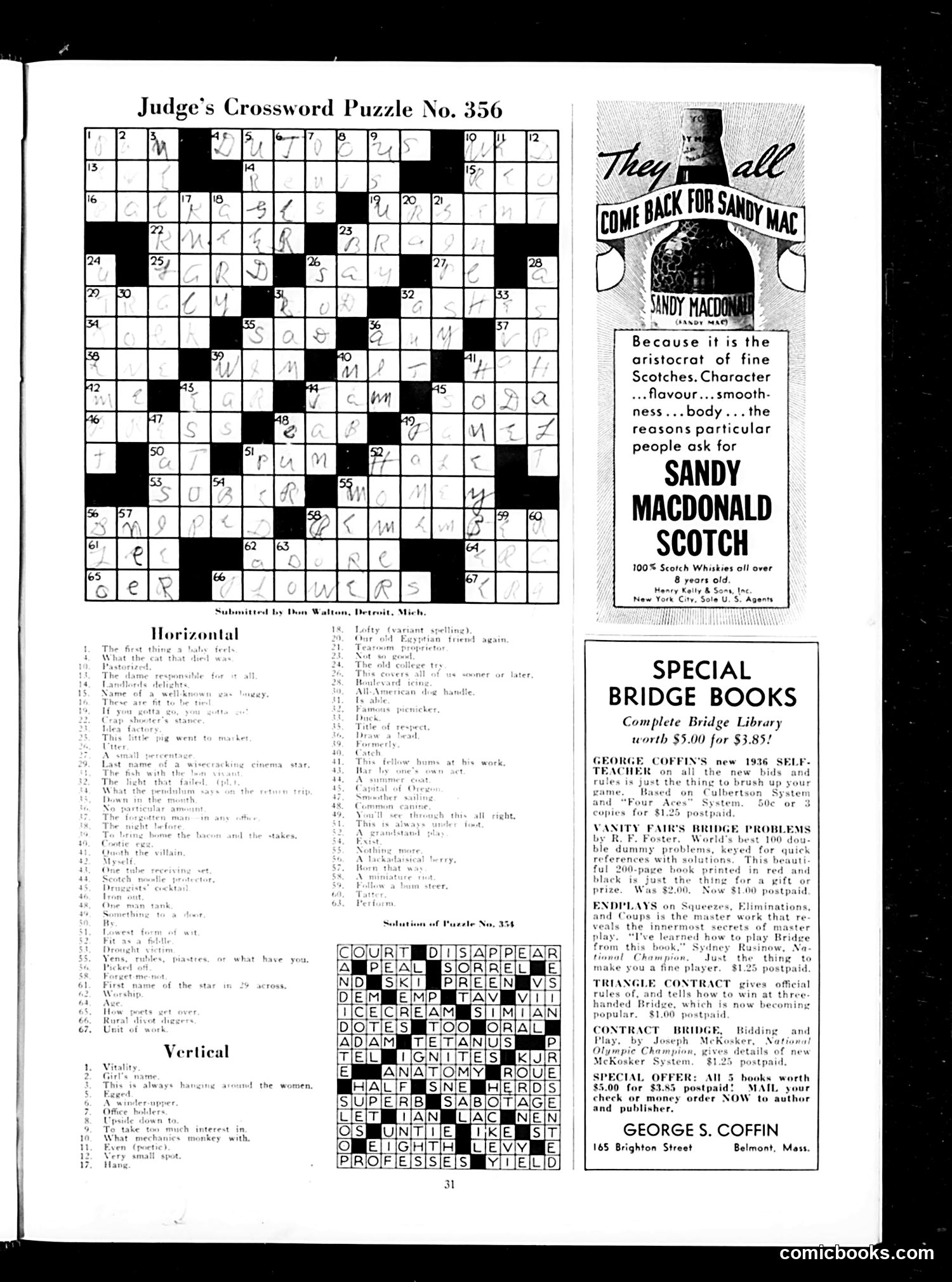
Judge's Crossword Puzzle Page No. 356 This page is primarily a crossword puzzle with accompanying advertisements—not political satire. The main content is Judge's Crossword Puzzle No. 356, featuring a standard grid with horizontal and vertical clues. The advertising features: 1. Sandy Macdonald Scotch — a liquor advertisement emphasizing the whisky as the "aristocrat of fine Scotches," highlighting its smoothness, flavor, and body. This reflects the post-Prohibition era (likely 1930s based on style) when American advertisers actively promoted spirits. 2. Bridge game books by George S. Coffin—advertisements for instructional bridge card game literature, offered as a discounted library collection. The page reflects typical Judge magazine content from this period: puzzles and advertisements rather than editorial cartoons. The Sandy Macdonald ad's emphasis on aristocratic refinement is notable for Depression-era marketing that appeals to aspirational consumers.
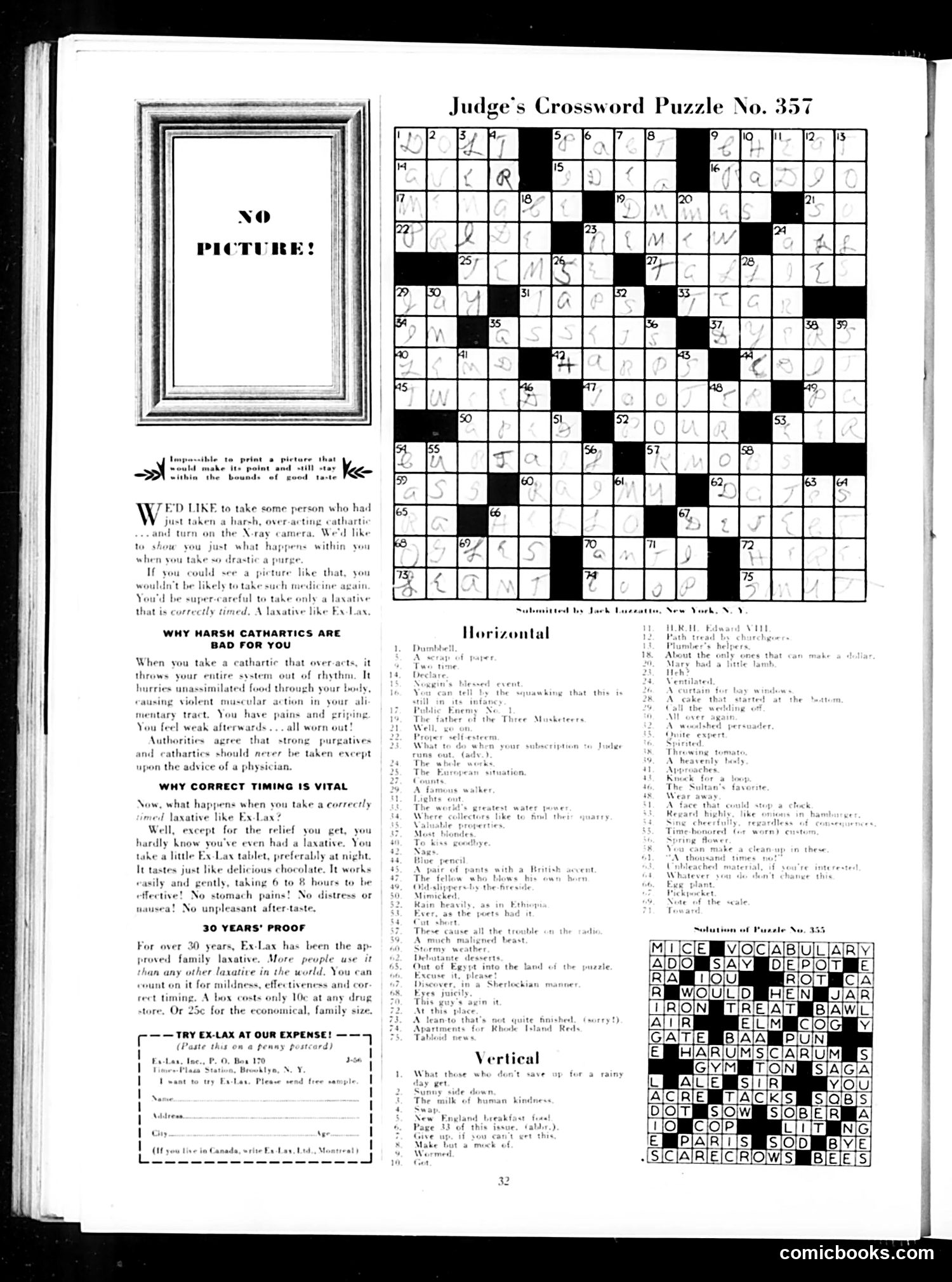
Judge Magazine Page Analysis This page is primarily advertising and puzzles, not satire or political commentary. The dominant content is a commercial advertisement for Ex-Lax, a chocolate laxative product. The ad uses pseudo-medical claims to market the product, contrasting "harsh cathartics" (strong laxatives) with Ex-Lax's allegedly gentler, "correctly timed" action. It emphasizes 30 years of family use and offers a free sample. The page also features Judge's Crossword Puzzle No. 357 and its solution, along with standard puzzle clues. There is no political cartoon visible. The "No Picture" placeholder on the left appears to be where an illustration would normally appear in this magazine issue. The content reflects early-to-mid 20th-century advertising practices, when laxative products were heavily marketed with dubious medical claims in mainstream publications.
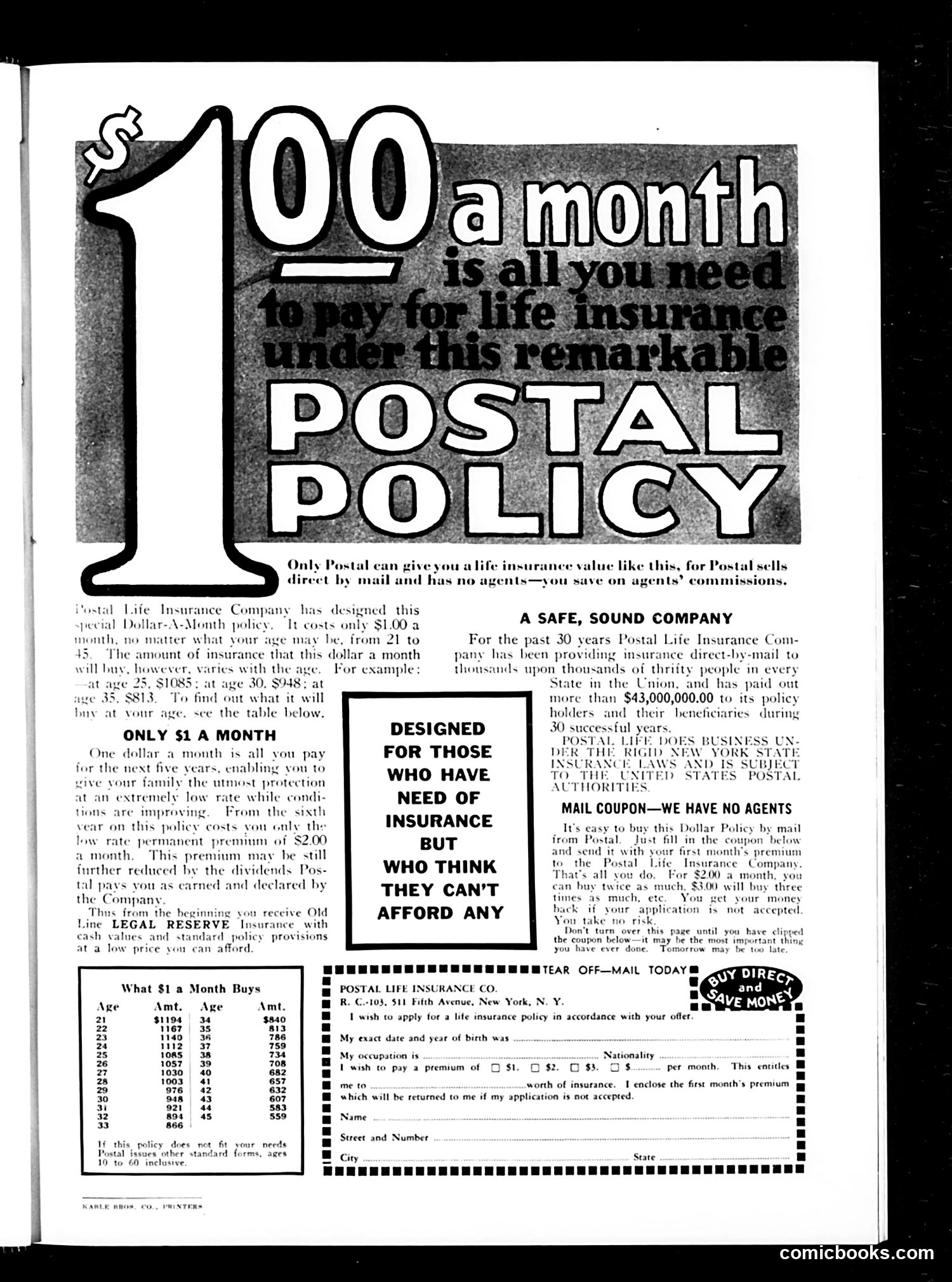
Analysis: Postal Life Insurance Advertisement This is primarily a direct-mail insurance advertisement, not satirical content. The Postal Life Insurance Company promotes a "$1 a month" life insurance policy targeting working-class Americans who "think they can't afford" insurance. The pitch emphasizes affordability and convenience—no agents, direct-by-mail purchase, reducing commissions. A table shows what $1 monthly buys at different ages (ranging from $1,196 at age 21 to $866 at age 33). The company claims legitimacy through longevity ("30 successful years") and substantial payouts ($43 million). The tear-off coupon at bottom facilitates direct response. Historical context: This appears designed for early-to-mid 20th century audiences during an era when life insurance was becoming accessible to ordinary wage-earners, though many still viewed it as unaffordable. The ad's informal tone and emphasis on simplicity suggest targeting less-educated, lower-income readers. The "no agents" angle appeals to those suspicious of salesmen or wanting to avoid embarrassment.
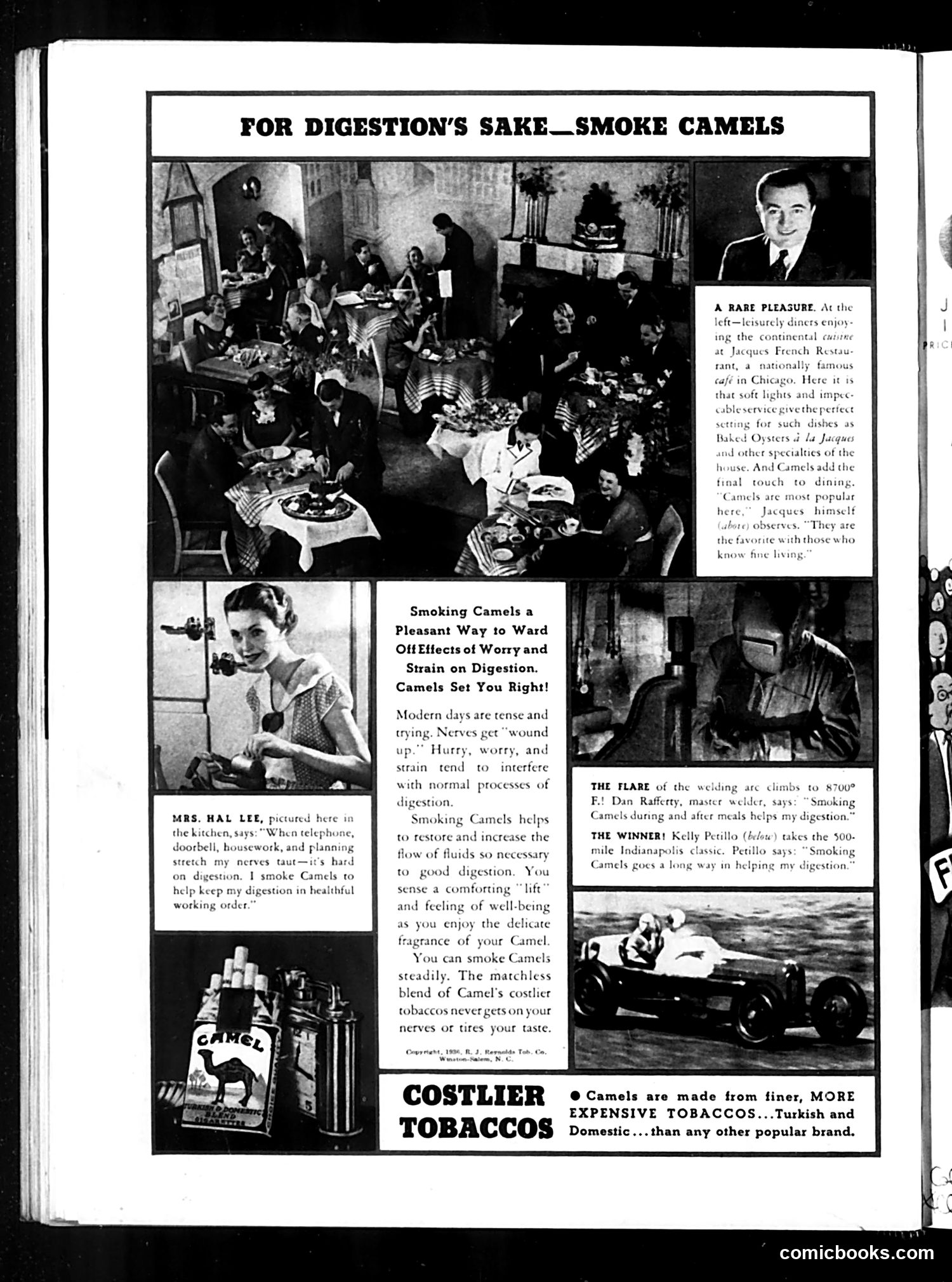
Camel Cigarette Advertisement, Judge Magazine This is a cigarette advertisement, not satirical content. It's a 1930s-era Camel promotion using a common advertising strategy of that era: linking smoking to health and digestion. The page features testimonials from ordinary people (a housewife, a restaurant owner, a welder, a race car driver) claiming cigarettes aid digestion and relieve stress from "modern" life's tensions. The central claim—repeated throughout—is that Camels help with digestion and counteract "worry and strain." This reflects pre-1950s medical misconceptions when tobacco's serious health risks weren't widely acknowledged by advertisers or regulators. The "costlier tobaccos" tagline emphasizes premium quality to justify the brand's price. The sophisticated dining and professional success imagery associates Camel smoking with refined living and achievement—a standard luxury-brand technique. Today, this would be instantly recognizable as misleading health claims and aggressive nicotine marketing.