judge
Judge — June 1936
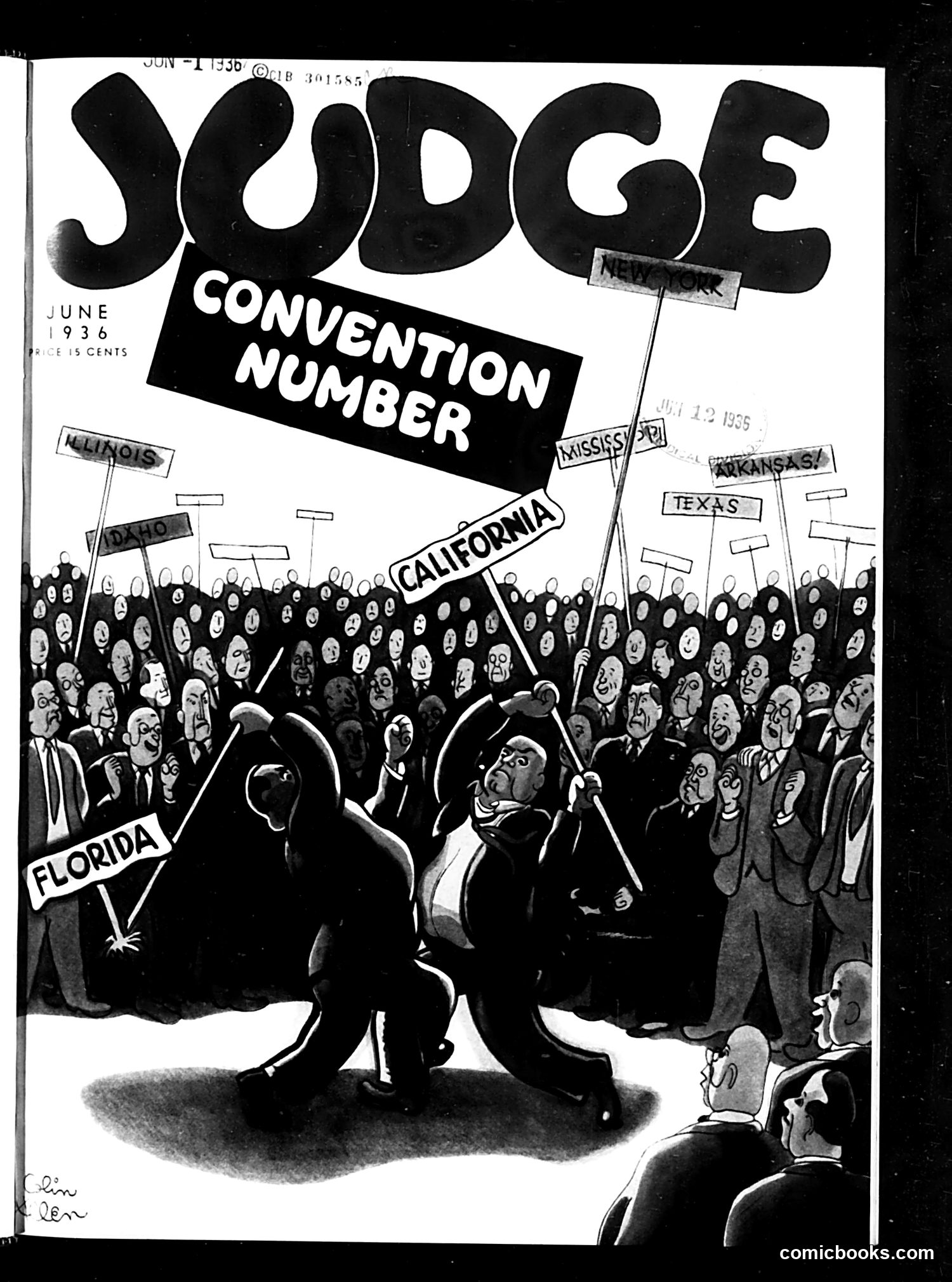
Political Cartoon Analysis: "Judge" Magazine, June 1936 This satirical cartoon depicts the 1936 Democratic National Convention as a massive gathering where state delegations (labeled California, Texas, Arkansas, Mississippi, Illinois, Idaho, Florida) hold signs competing for attention. The large "JUDGE" masthead dominates as "Convention Number." The cartoon satirizes the competitive scramble among states for political influence and convention delegates. The caricatured crowd and raised signs suggest chaos and self-interested jockeying typical of nominating conventions. Two prominent hooded figures in the center appear designed to represent competing factions or political forces vying for control. The satire critiques how state interests clash during convention proceedings, portraying the democratic process as a somewhat unseemly competition rather than orderly deliberation. The exaggerated expressions and crowded composition emphasize the pandemonium of convention politics.
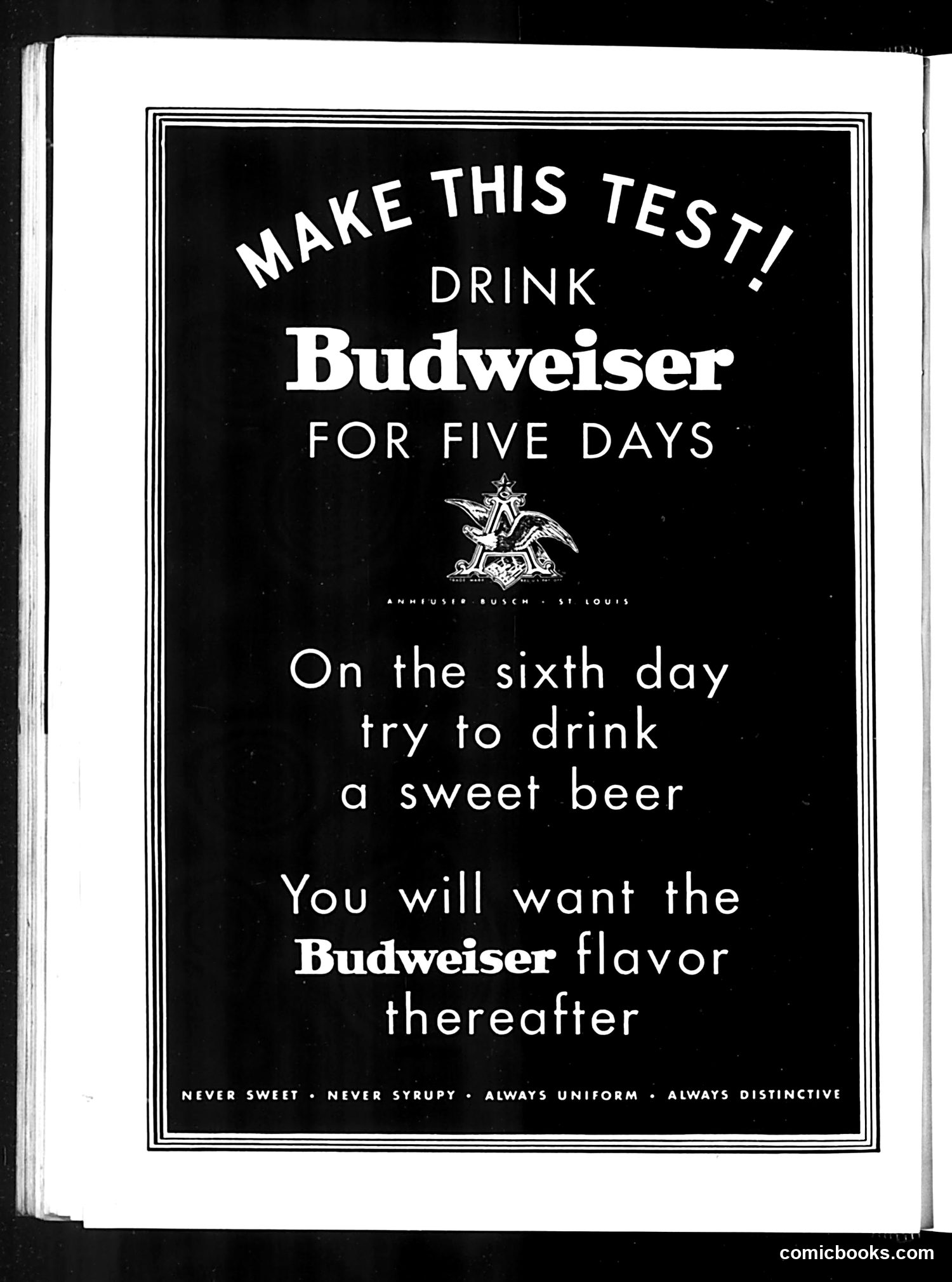
Analysis This page is not a cartoon or satirical content — it's a straightforward advertisement for Budweiser beer. There are no political figures, caricatures, or satire to analyze. The ad uses a humorous hook: it challenges readers to drink Budweiser exclusively for five days as a "test," then predicts that on the sixth day, if they try a sweeter beer, they'll prefer Budweiser's flavor again. The tagline emphasizes consistency: "Never sweet, never syrupy, always uniform, always distinctive." This is simply a vintage beer advertisement leveraging psychology and brand loyalty messaging rather than commentary on current events or social issues typical of Judge magazine's satirical content.
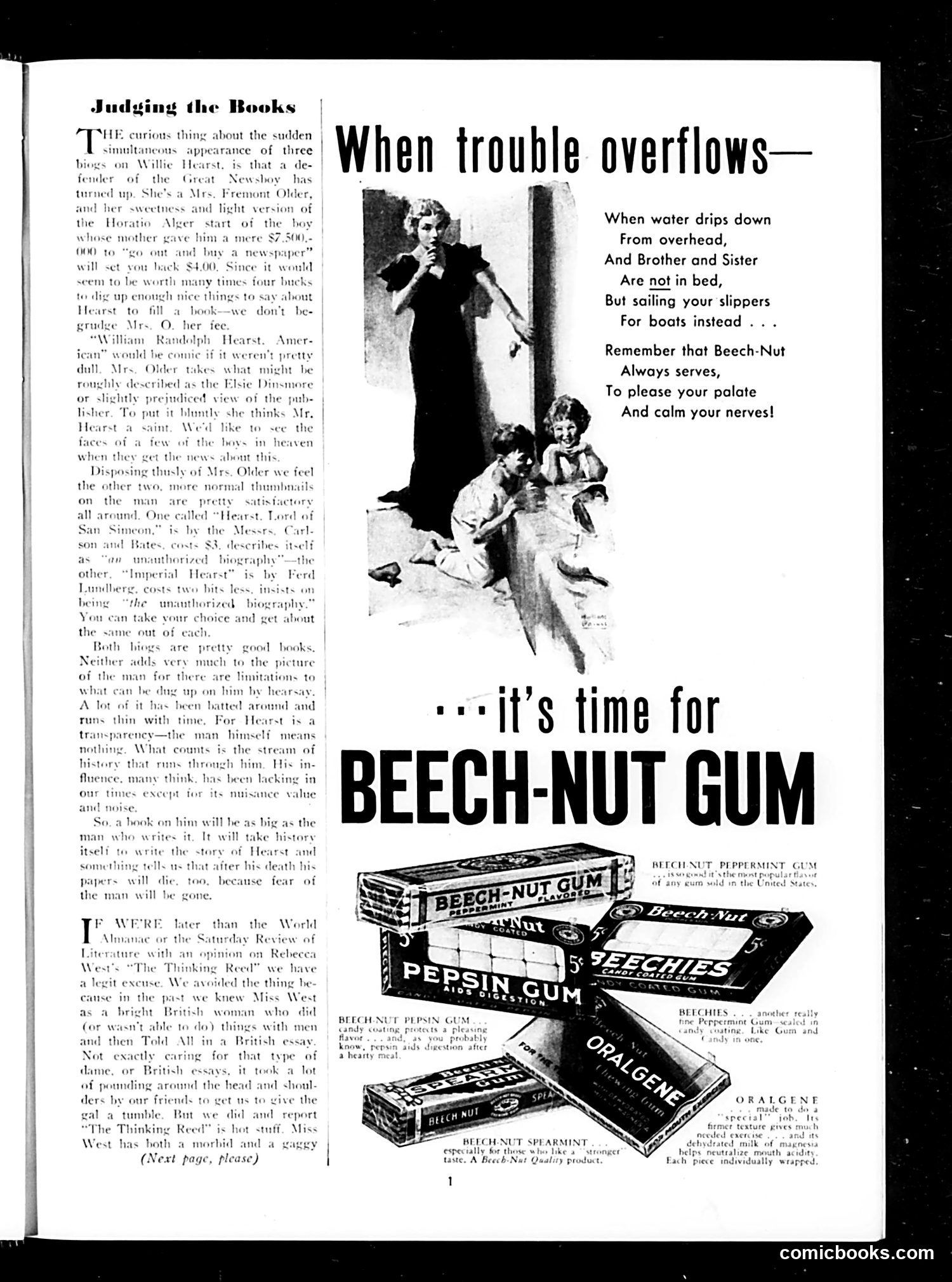
Analysis This page is primarily a Beech-Nut Gum advertisement rather than political satire. The main content features a humorous domestic scene depicting children causing water damage ("When trouble overflows") as a setup to advertise the product as a palate-pleaser and nerve-calmer. The left column contains "Judging the Books," a brief book review section discussing three recent publications, including biographies of William Randolph Hearst. This appears to be standard magazine content rather than satire—the reviewer discusses their merits straightforwardly. The advertisement and review occupy roughly equal space, with the ad being the page's dominant visual element. There is no identifiable political cartoon or satirical commentary on this particular page.
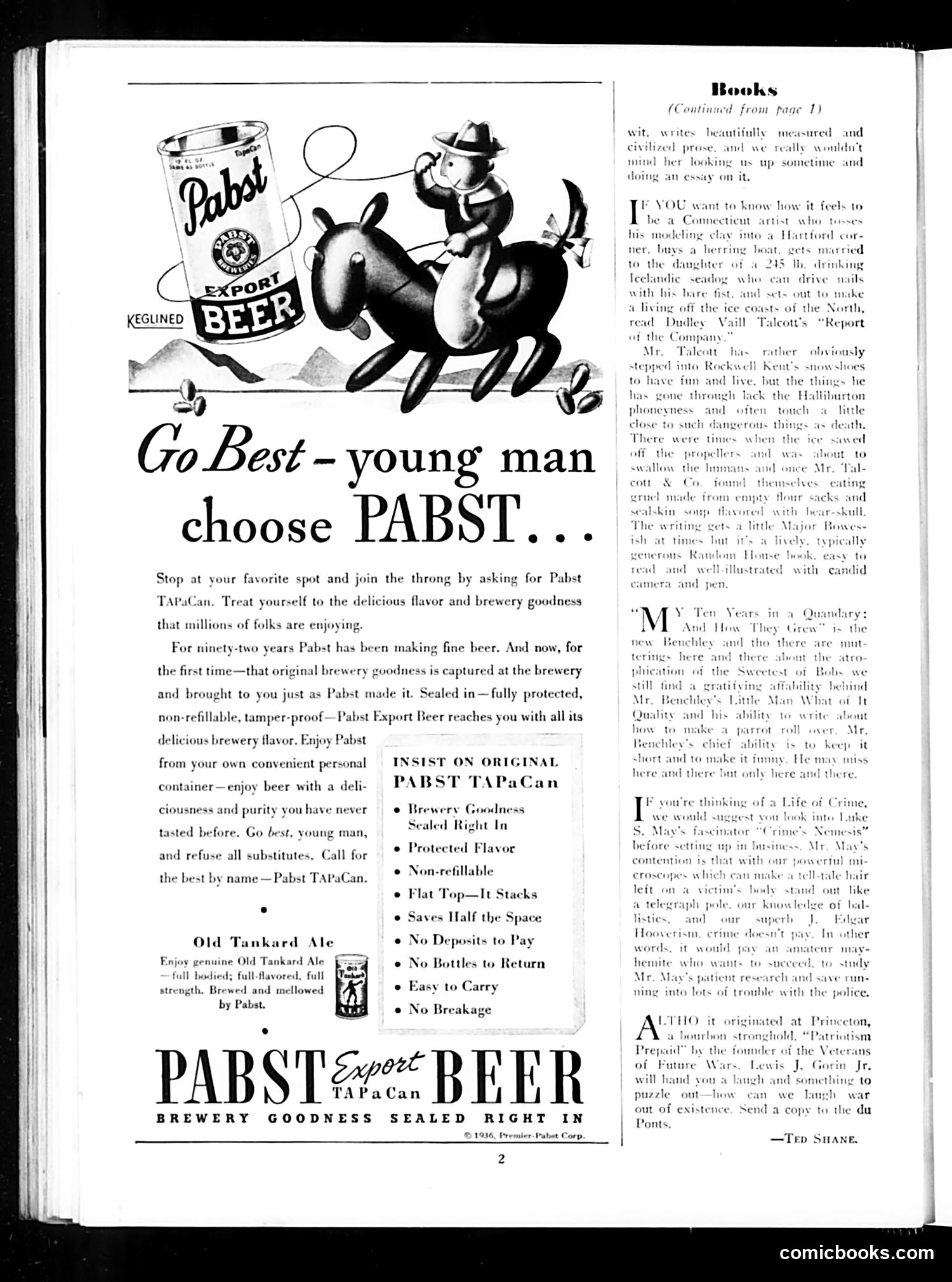
Analysis of Pabst Beer Advertisement Page This page is primarily advertising, not satirical content. The dominant feature is a full-page Pabst Export Beer advertisement from around 1936 (per copyright mark). The cartoon element shows a stylized man in a hat riding a bucking bull or similar animal, with a Pabst beer can, illustrating the slogan "Go Best—young man choose PABST." This appears designed to appeal to masculine vigor and leisure. The right column contains book reviews unrelated to the advertisement. The ad itself emphasizes Pabst's 92-year brewing history and the novelty of their new "TAPaCan" container—highlighting convenience features like portability and no bottle returns. This represents straightforward commercial advertising rather than political satire typical of Judge magazine's editorial content.
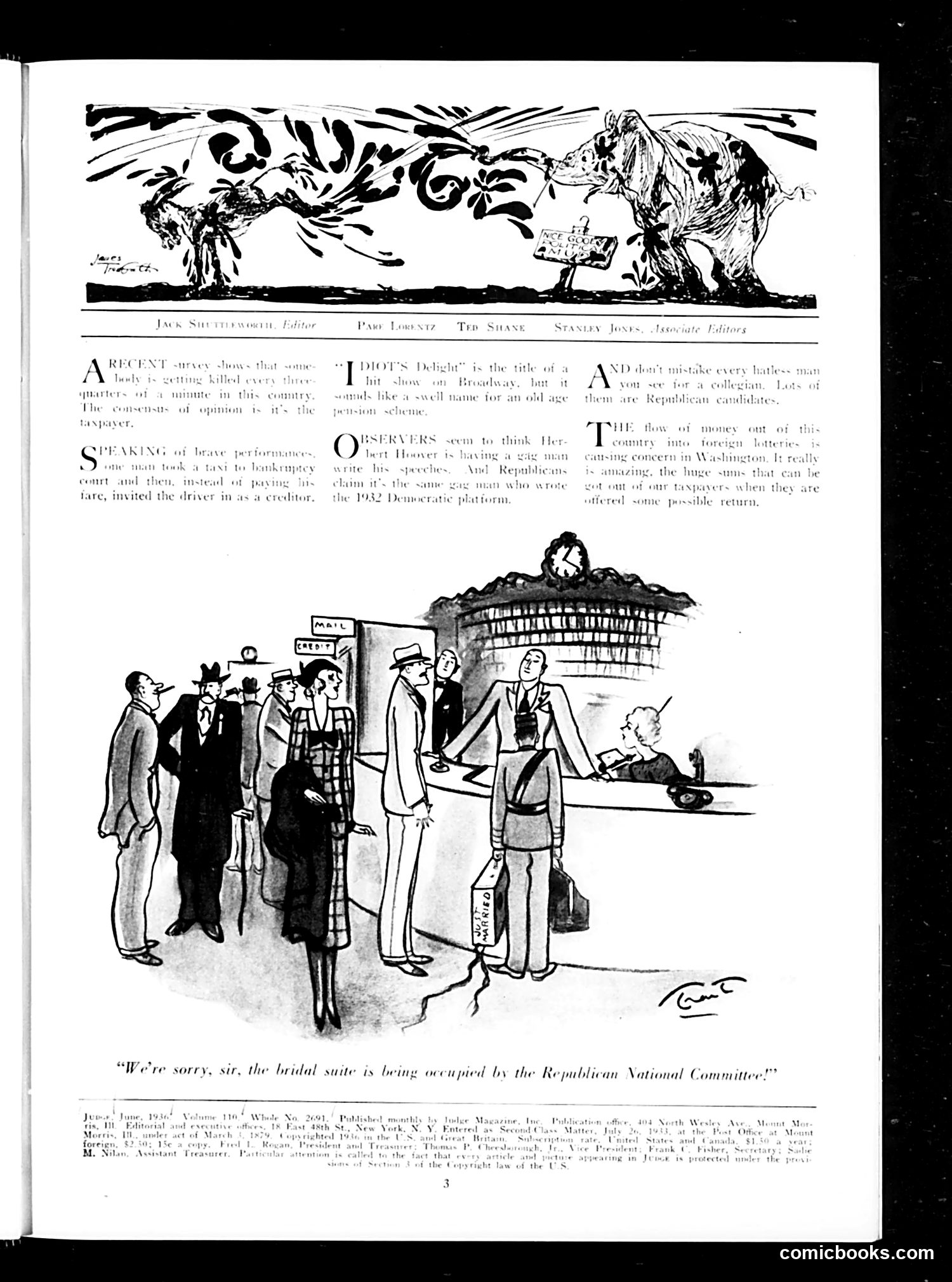
Political Cartoon Analysis This Judge magazine page contains editorial commentary and a political cartoon satirizing the 1932 presidential race. The main cartoon depicts people at what appears to be a government building (likely the White House) with the caption: "We're sorry, sir, the bridal suite is being occupied by the Republican National Committee." The satire targets Republicans, suggesting they've "occupied" the White House like newlyweds in a hotel suite—implying they're overstaying their welcome during the Great Depression. The editorial text references Herbert Hoover's "gag man" speeches and Republicans' platform, contrasting Democratic candidates as relief to voters' concerns. The cartoon mocks Republican incumbency and their perceived failure to address the economic crisis, suggesting it's time for them to vacate office.
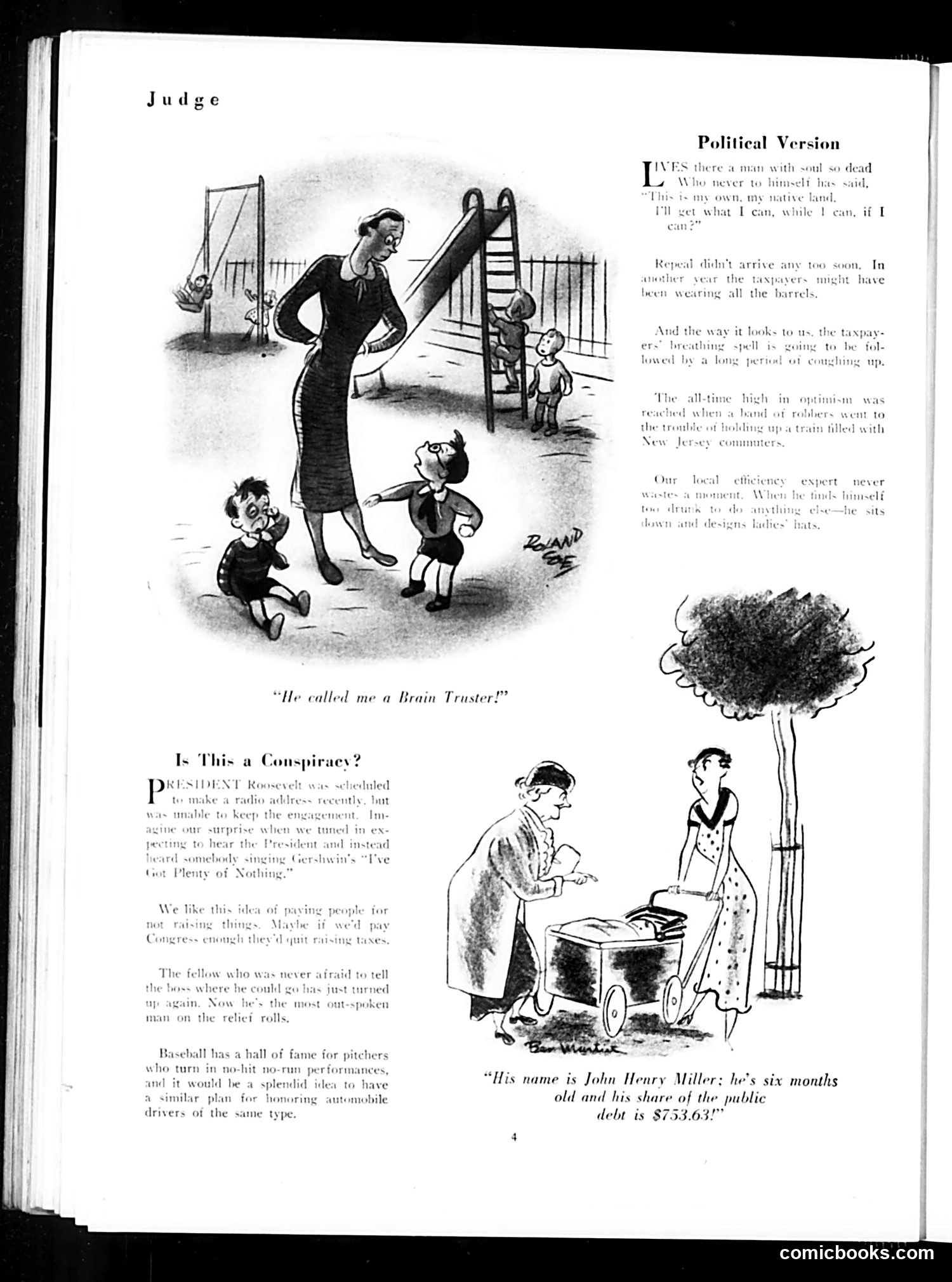
Analysis of Judge Magazine Page This page contains two political cartoons satirizing American governance and public debt. Top cartoon ("He called me a Brain Truster!"): A woman supervises children on a playground. The "Brain Truster" reference likely alludes to FDR's "Brain Trust"—his informal advisory group during the New Deal. The satire suggests these advisors were childish or incompetent. Bottom cartoon ("Is This a Conspiracy?"): A couple with a baby carriage labeled with a debt figure ($753.63) represents the national debt burden passed to infants. The text mocks President Roosevelt's radio address excuse that he was "unable to keep the engagement," satirizing government evasion of accountability for rising public debt. Both cartoons critique New Deal policies and government spending through domestic metaphors.
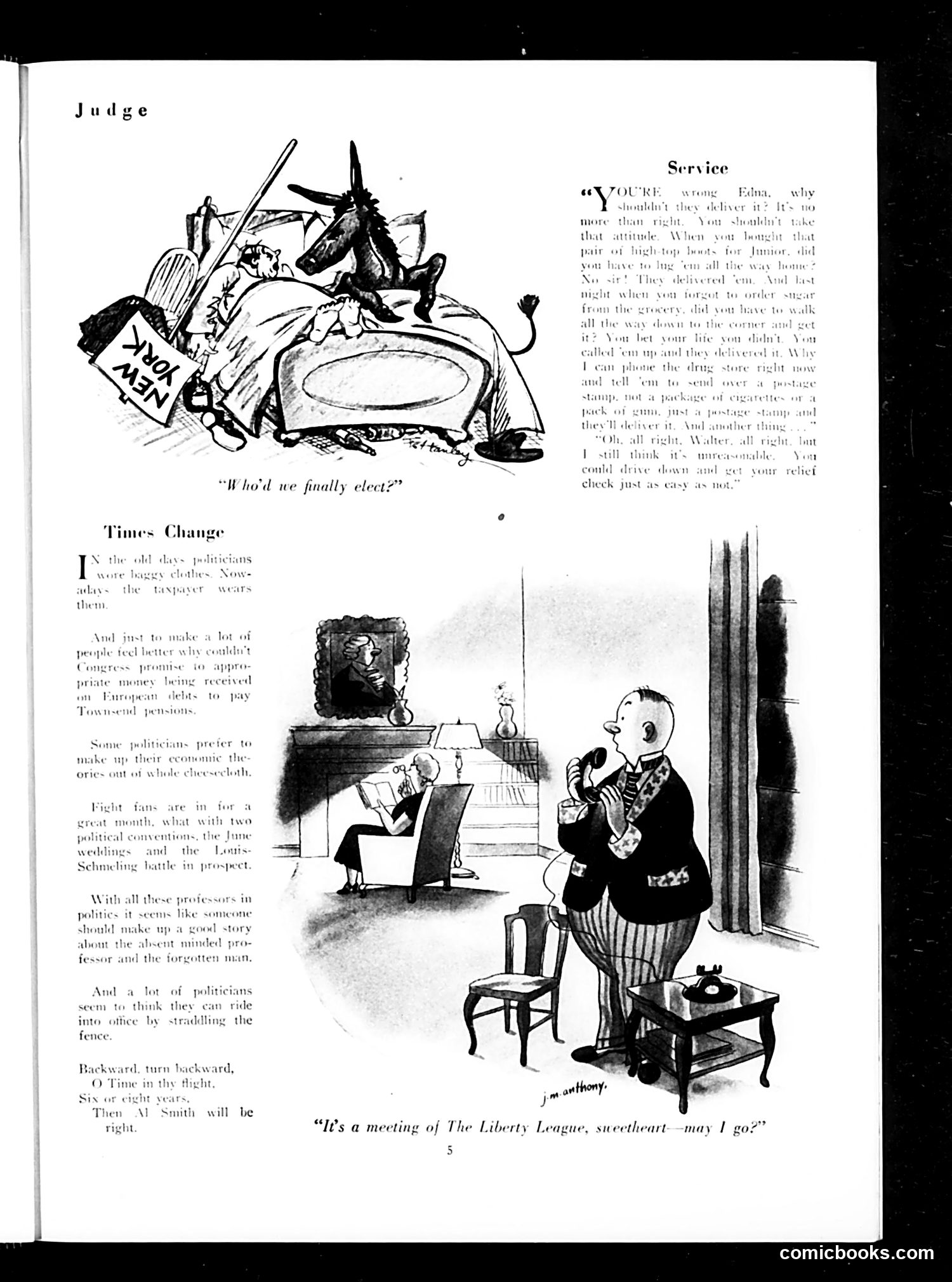
Political Satire Analysis "Judge" Magazine Page - Political Commentary The top cartoon "Who'd we finally elect?" mocks judicial indecision through a cluttered, chaotic image labeled "Jack Men"—likely referencing multiple judicial candidates or conflicting political positions. The lower section, "Times Change," satirizes politicians' inconsistency and self-serving economics. The text criticizes politicians wearing "baggy clothes" (appearing poor) while taxpayers support them, and notes politicians invent economic theories to justify receiving "Townsend pensions" (likely referencing a Depression-era pension plan). The second cartoon shows a man being asked about attending "a meeting of The Liberty League"—this references the anti-New Deal organization that opposed FDR's policies. The satire suggests politicians shift positions opportunistically. Context: This appears Depression-era, critiquing New Deal-era political hypocrisy and changing allegiances.
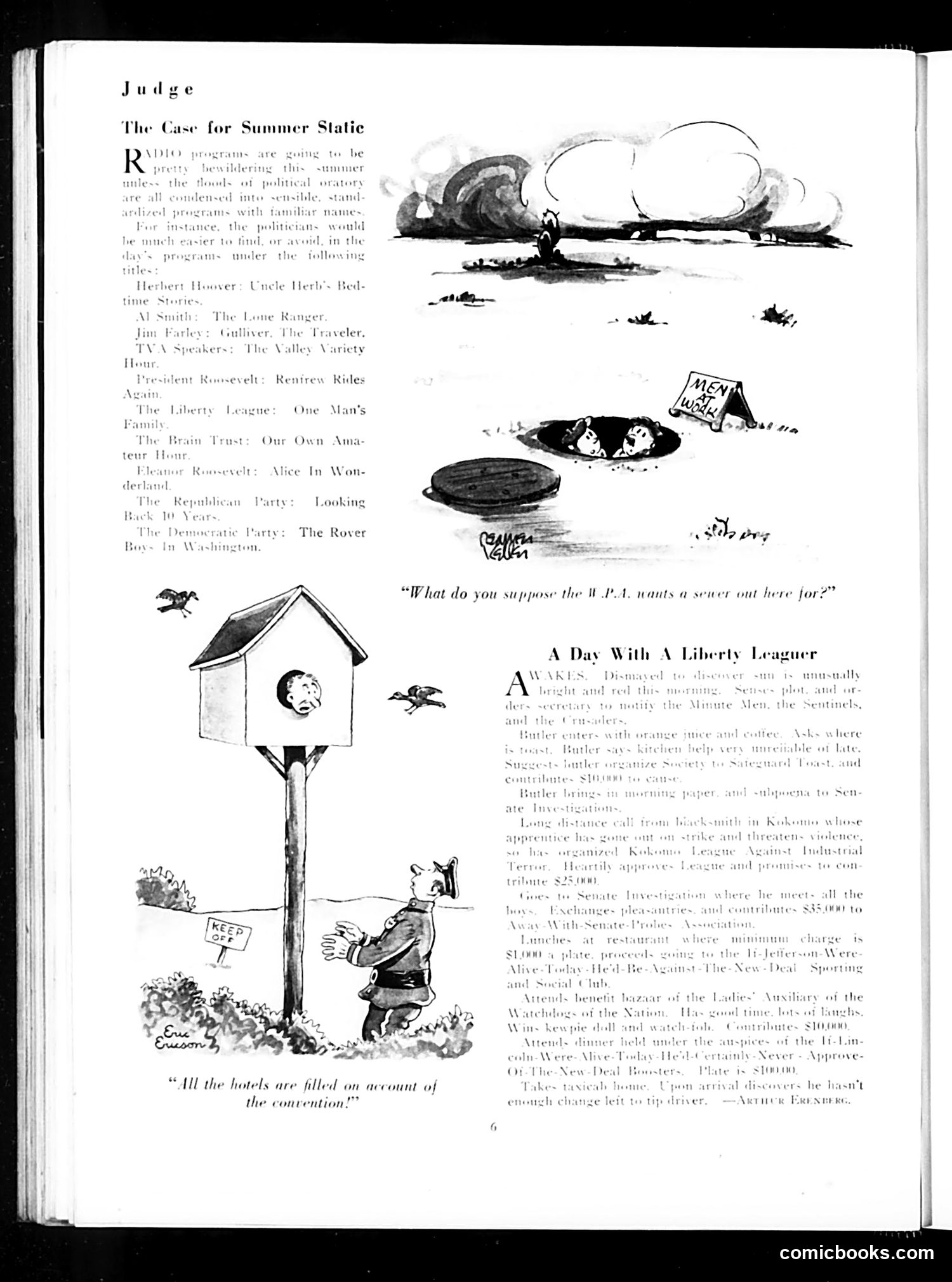
Analysis of Judge Magazine Page This page contains two separate cartoons satirizing American summer politics and civic activities. The upper cartoon mocks the W.P.A. (Works Progress Administration), a New Deal employment program. It shows UFO-like objects descending, labeled "What do you suppose the W.P.A. wants a sewer out here for?" — suggesting absurdity in the program's infrastructure projects. The lower cartoon depicts a birdhouse with a keeper shooing away someone, captioned "All the hotels are filled on account of the convention?" — satirizing the crowding and chaos of a political convention (likely the 1932 or 1936 Democratic/Republican conventions). The accompanying article "A Day With A Liberty Leaguer" describes someone's activist schedule, suggesting mockery of anti-New Deal organization members and their social activities during the Roosevelt era.
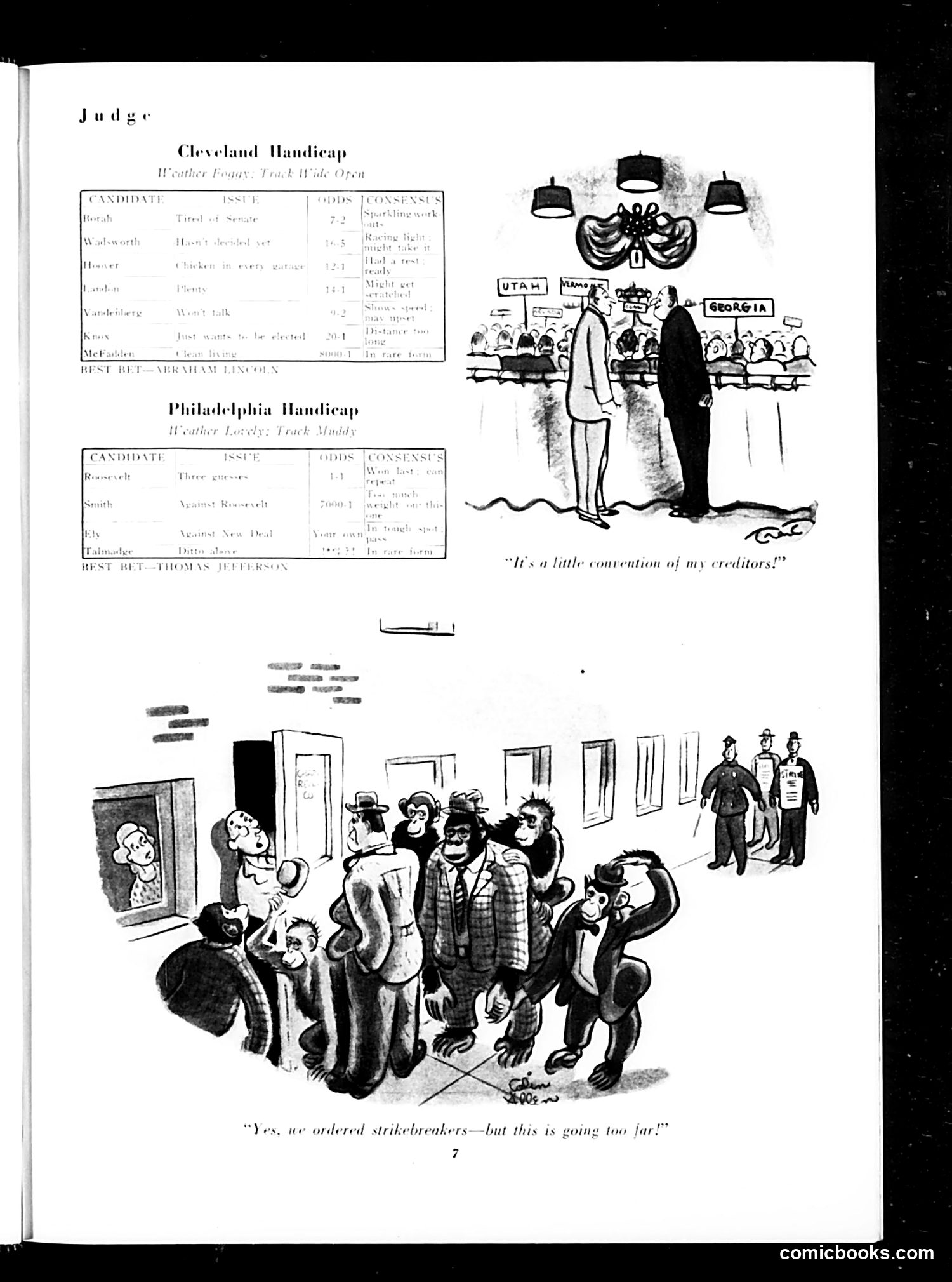
Judge Magazine Page Analysis This page contains two horse-racing handicap predictions (Cleveland and Philadelphia races) with betting odds and best-bet recommendations, followed by two cartoons. The top cartoon shows two well-dressed men observing a convention crowd labeled with state names (Utah, Georgia visible), captioned "It's a little convention of my creditors!" — satirizing someone who owes money to people across the country. The bottom cartoon depicts men who appear to be primates or caricatured as ape-like figures in what looks like a hallway or office, with the caption "Yes, we ordered strikebreakers—but this is going too far!" This likely satirizes labor disputes of the era, mocking employers' recruitment of replacement workers by suggesting they've hired unsuitable (and ape-like) individuals, reflecting period prejudices and class anxieties about labor conflict.
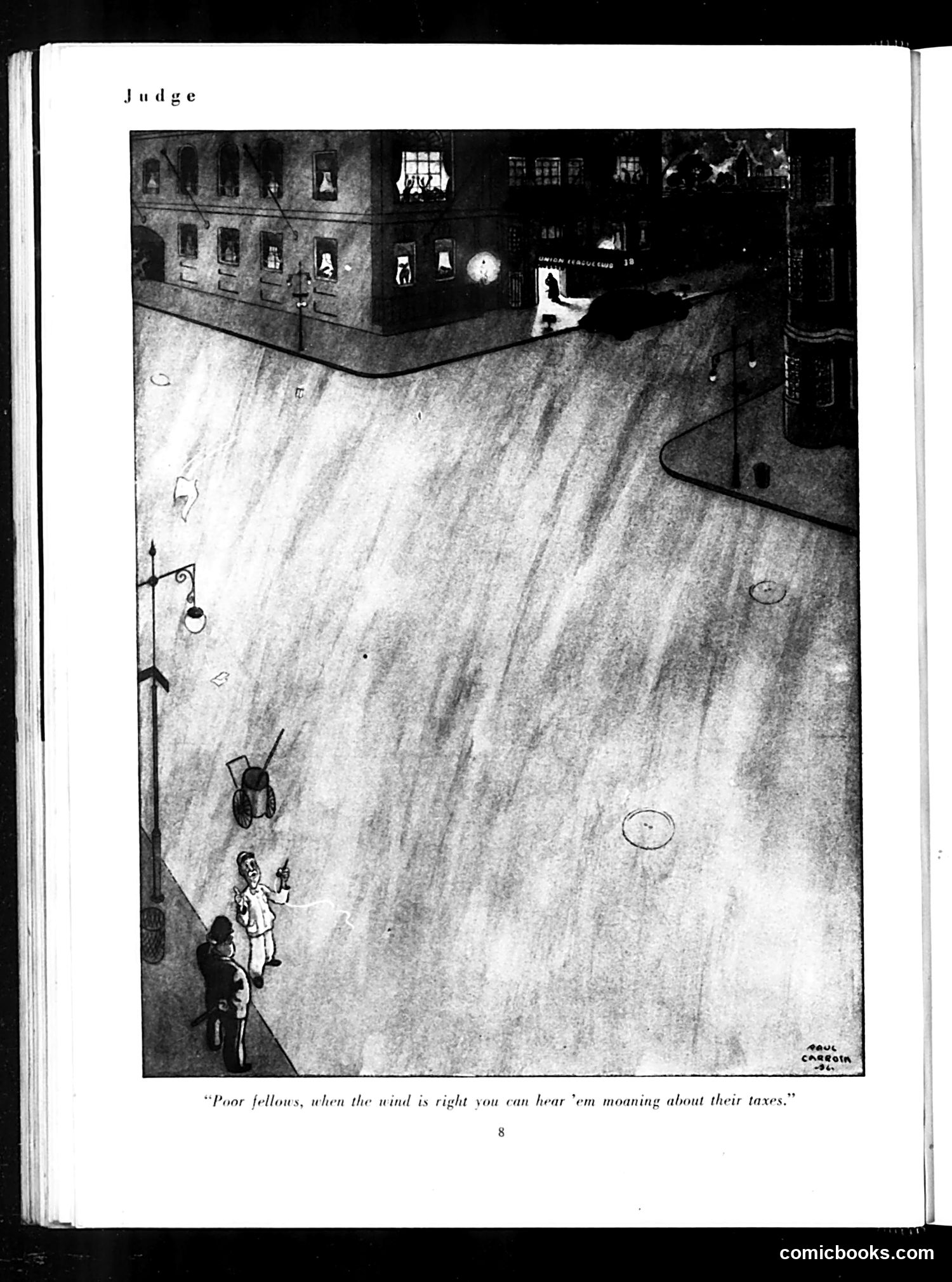
Judge Magazine Cartoon Analysis This cartoon depicts an aerial view of a town square where a judge observes common people below. The judge, positioned high above in a building, comments that when wind conditions are right, one can hear citizens complaining about their taxes. The satire mocks the disconnect between authority figures (judges/the wealthy elite) and ordinary citizens struggling with tax burdens. The elevated perspective literally illustrates how judges and the powerful are removed from—and dismissive of—ordinary people's financial hardships. The judge's tone is detached and somewhat contemptuous, treating taxpayers' legitimate grievances as mere ambient noise rather than serious concerns. This reflects early 20th-century American anxieties about taxation and class inequality, satirizing judicial indifference to working-class struggles.
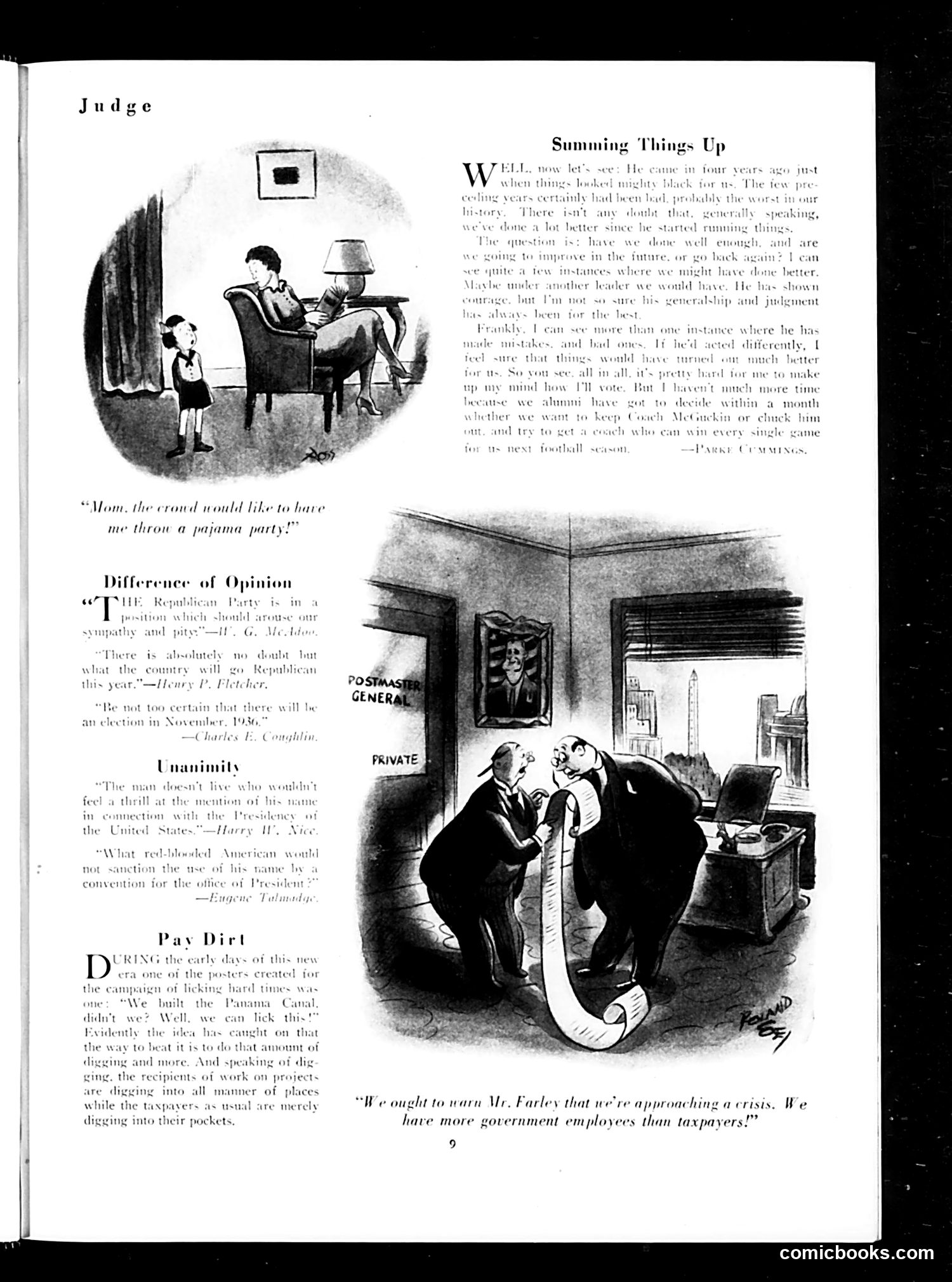
Judge Magazine Political Commentary Page This page from Judge magazine contains several editorial sections critiquing American politics and leadership circa the 1930s. "Summing Things Up" appears to be a column assessing a political leader's four-year tenure, weighing accomplishments against failures and uncertainties about future direction. "Difference of Opinion" quotes Republican and other political figures debating the party's prospects, including a reference to Charles E. Coughlin, the controversial radio priest-politician of that era. The main cartoon depicts a postmaster and another official unrolling an enormous scroll of government paperwork, with the caption warning that government employees now outnumber taxpayers—a satirical jab at New Deal employment expansion under Franklin D. Roosevelt. The "Pay Dirt" section reinforces this theme, criticizing public works projects that benefit workers while ordinary citizens merely "dig into their pockets" through taxation. The overall message: Judge criticized the Roosevelt administration's growing federal workforce as fiscally unsustainable.
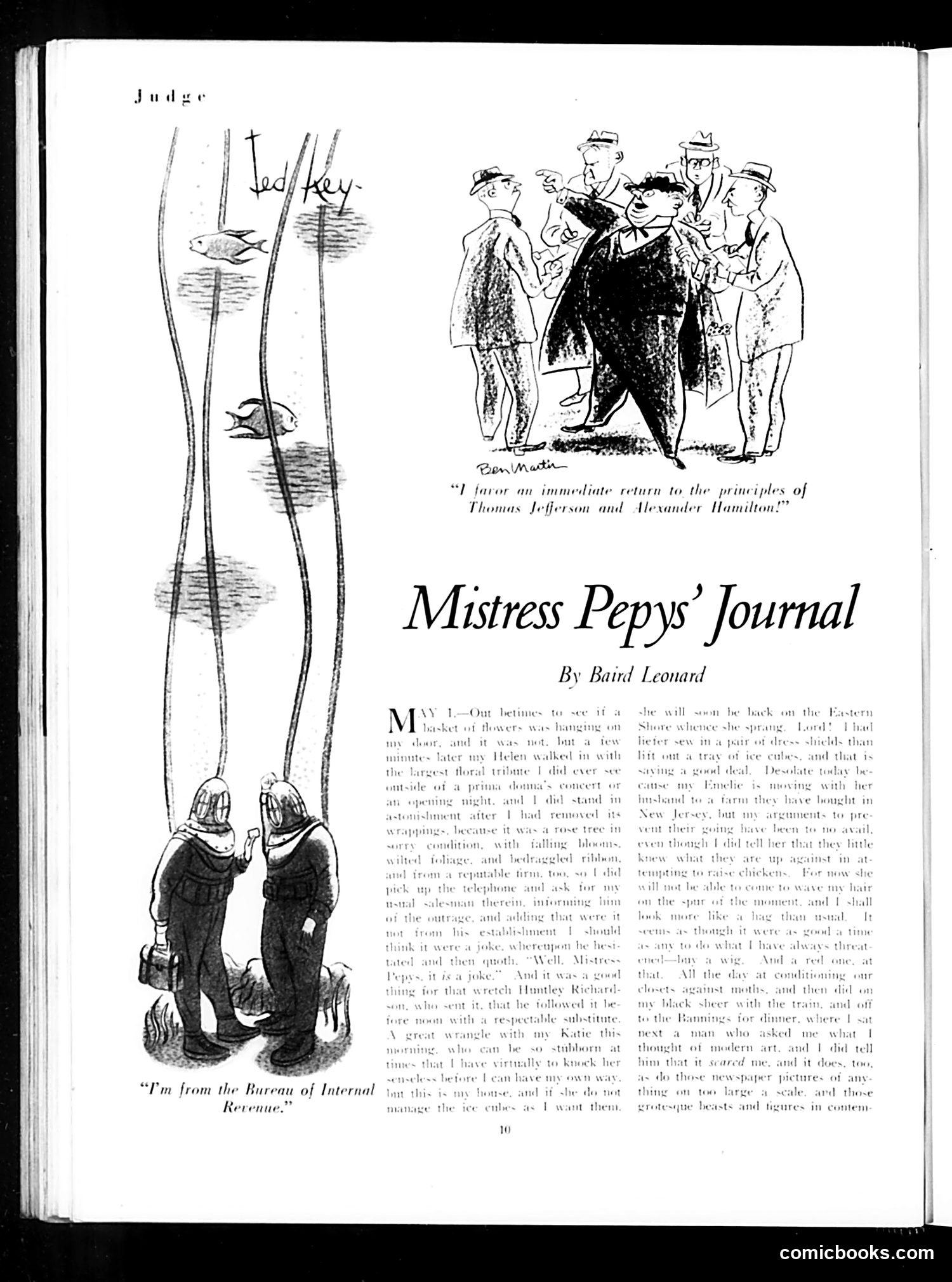
Political Content Analysis This page contains two satirical cartoons. The top cartoon depicts a rotund politician surrounded by men in suits, declaring he favors returning to "the principles of Thomas Jefferson and Alexander Hamilton"—a hollow political platitude. The satire targets politicians who invoke founding fathers' principles insincerely. The bottom cartoon shows a person identifying themselves as "from the Bureau of Internal Revenue," illustrated with exaggerated, menacing appearance. This mocks tax collectors, portraying them as feared, intrusive government agents—a common satirical target reflecting public anxiety about taxation and government overreach. The accompanying "Mistress Pepys' Journal" is a humorous domestic narrative (appearing to be comedic fiction rather than political satire) about household management and marital disputes. The overall page exemplifies *Judge* magazine's blend of political commentary and genteel humor for early 20th-century audiences.
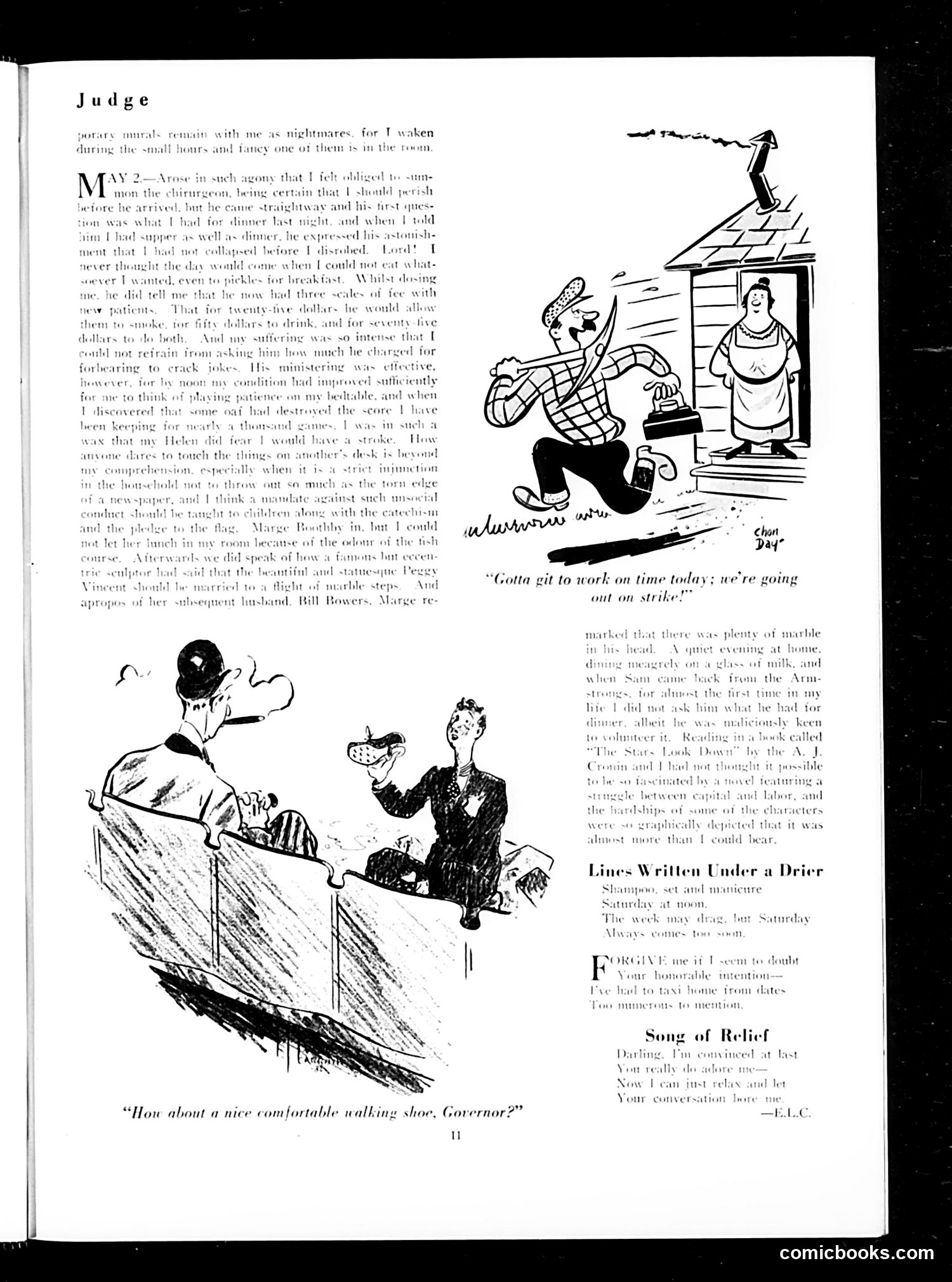
Judge Magazine Page Analysis This page from *Judge* contains two cartoons satirizing early 20th-century social issues: Top cartoon: A man frantically leaves for work while his wife mentions a strike. The satire targets labor unrest—likely the frequent strikes of that era—showing domestic disruption from industrial conflict. Bottom cartoon: Captioned "How about a nice comfortable walking shoe, Governor?" depicts a shoe salesman pitching to what appears to be a political figure. This likely mocks either a governor's policies or—more probable—satirizes the commercialization of politics, with a humble shoe vendor addressing someone in power, suggesting either class disconnect or the absurdity of ordinary commerce intersecting with political authority. The accompanying text discusses a doctor's visit focused on meal expenses and marital anxiety, typical *Judge* content mixing domestic humor with social commentary on professional overcharging and class anxieties of the period.
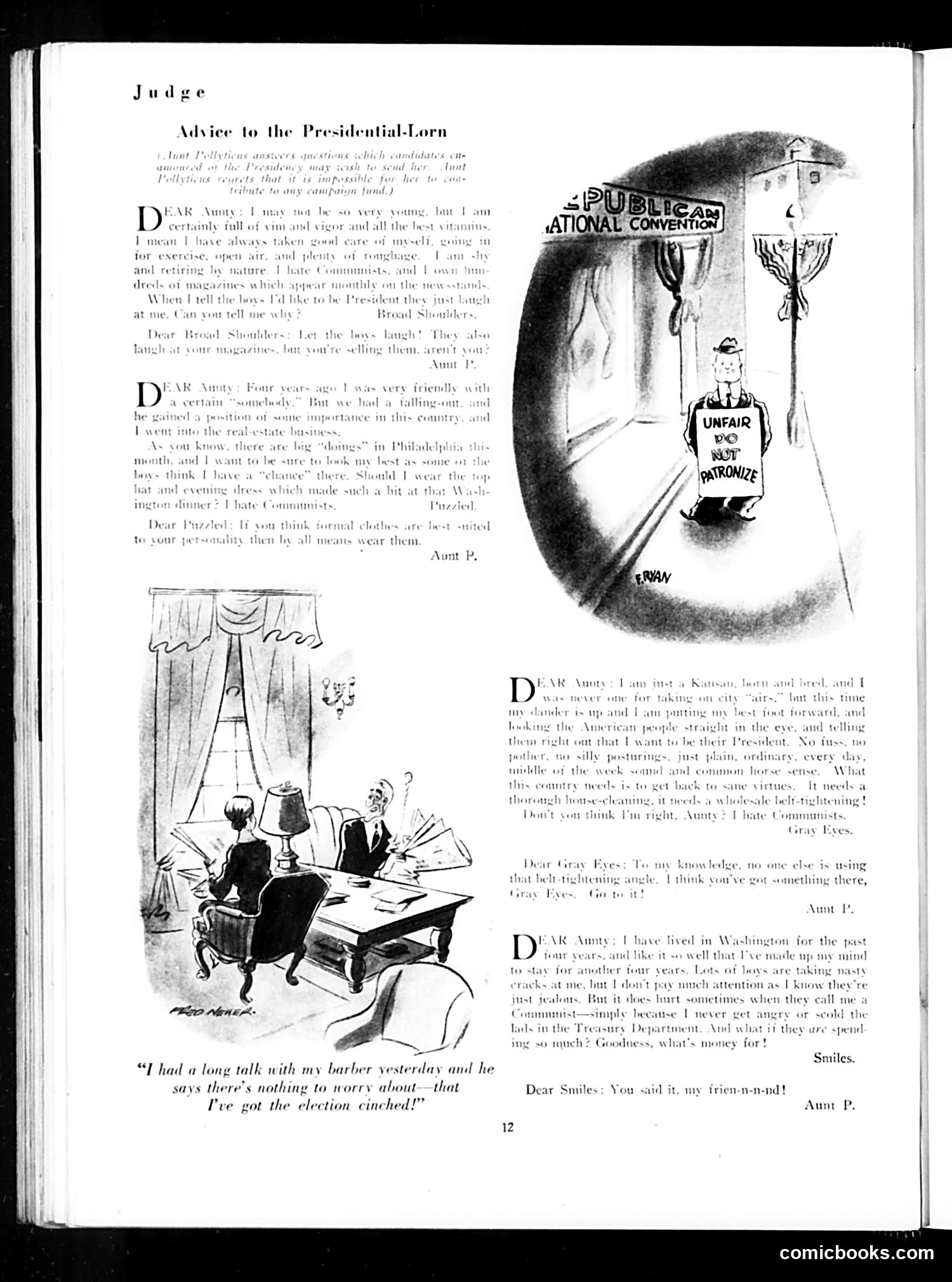
Political Satire from Judge Magazine This page satirizes 1920s Republican politics through advice-column letters to "Aunty." The main cartoon depicts a candidate being lowered into the Republican National Convention like bait into a trap, labeled "Unfair to Patronize"—mocking the party's patronage system and backroom dealings. The letters mock various political figures and attitudes: someone seeking the presidency despite lack of qualifications; a candidate dismissing communist accusations while defending wasteful spending ("what's money for?"); another claiming election victory based on a barber's reassurance. The final cartoon shows a political dinner scene, with the caption "I've got the election cinched!"—suggesting overconfidence and insider deal-making. The satire targets Republican complacency, patronage corruption, and the disconnect between politicians' self-confidence and actual competence during the post-WWI era.
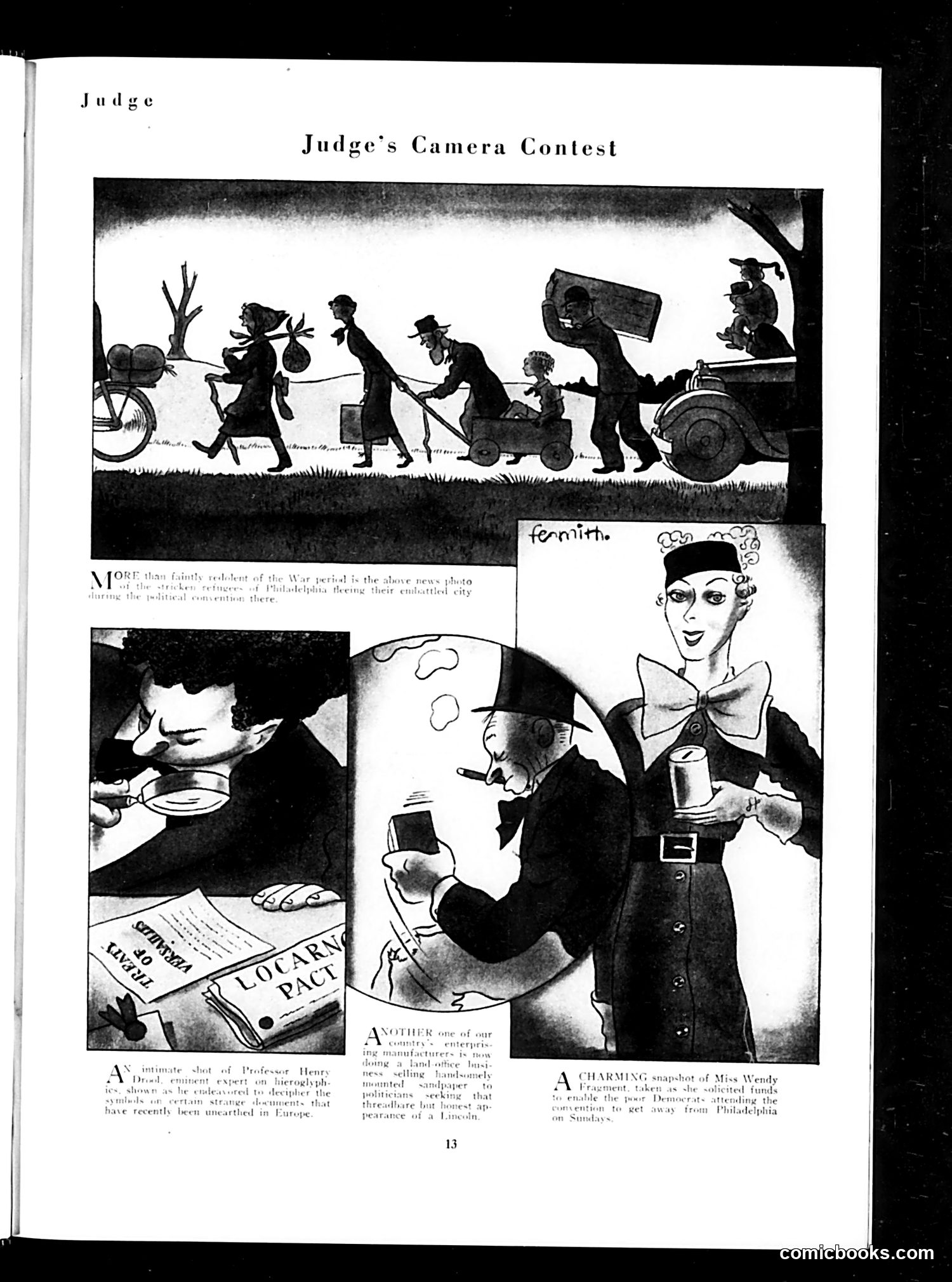
Judge's Camera Contest This page showcases entries in Judge magazine's photography contest. The top silhouette depicts chaotic war-period activity in Philadelphia during a political convention—figures struggle with various objects and transportation, satirizing the disorder of the event. Below are three submitted photographs. The left shows an intimate domestic scene of someone eating. The middle features a quirky character (appears to be a caricatured man) holding what looks like a camera or viewing device, labeled as representing "country's enterprising manufacturers" and political candidates seeking honest approval. The right shows "Miss Wendy," described as a charming Democratic convention attendee trying to escape the Philadelphia event on Sundays. The satire targets political convention chaos and amateur photography submissions.
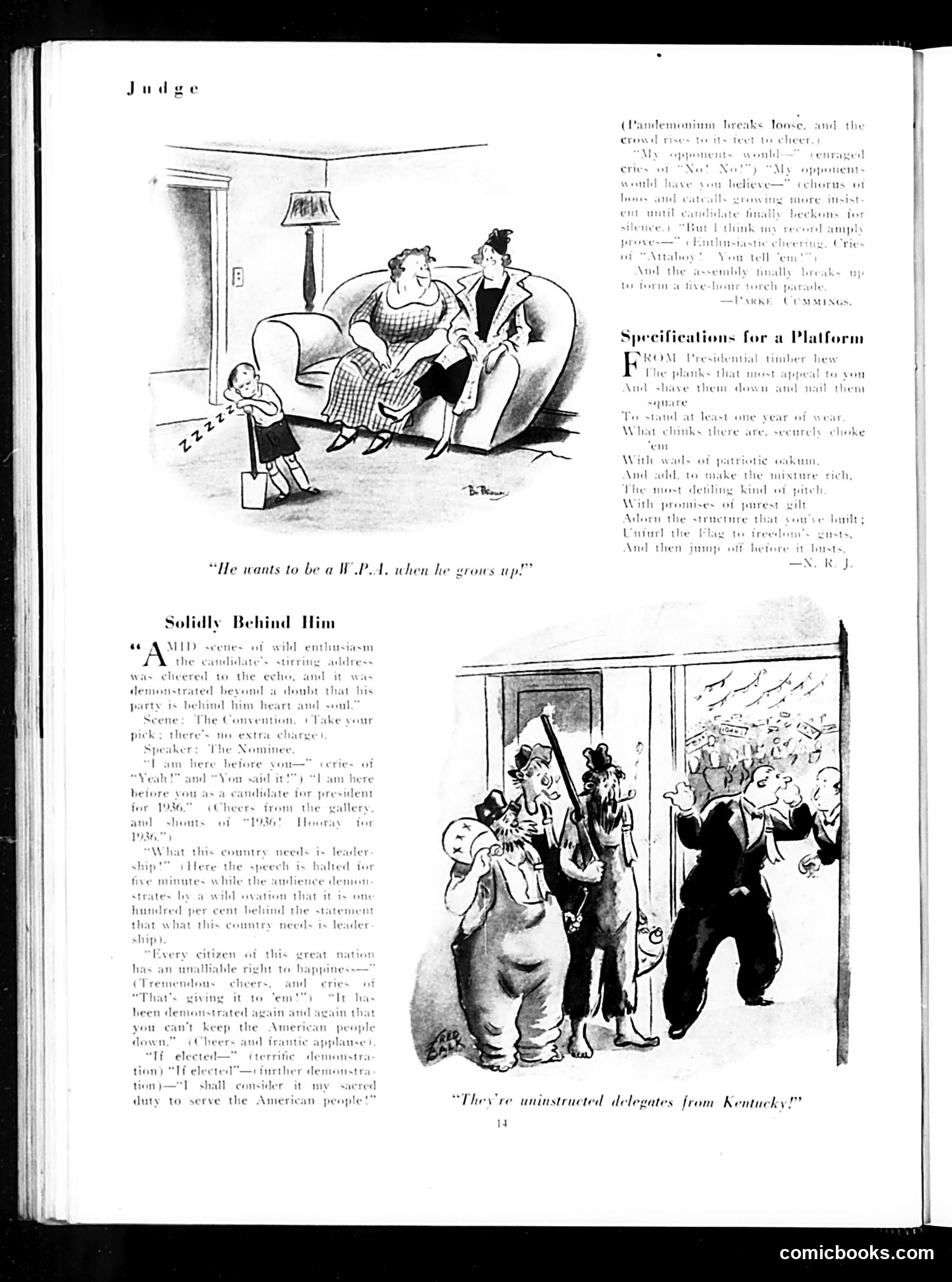
Political Cartoons from Judge Magazine The top cartoon satirizes a child's political ambition, with the caption "He wants to be a W.P.A. when he grows up!"—mocking the Works Progress Administration, FDR's New Deal employment program. The joke suggests the child views WPA work as a career goal rather than emergency relief. The bottom cartoon, titled "Solidly Behind Him," depicts a political convention scene with the caption "They're uninstructed delegates from Kentucky!" It satirizes party unity rhetoric during what appears to be a 1936 presidential campaign (based on visible "1936" references in the text). The cartoon mocks the contrast between politicians' claims of unified support and the actual disorganization or lack of genuine commitment among delegates. The elephant figure likely represents Republican opposition to the Democratic establishment.
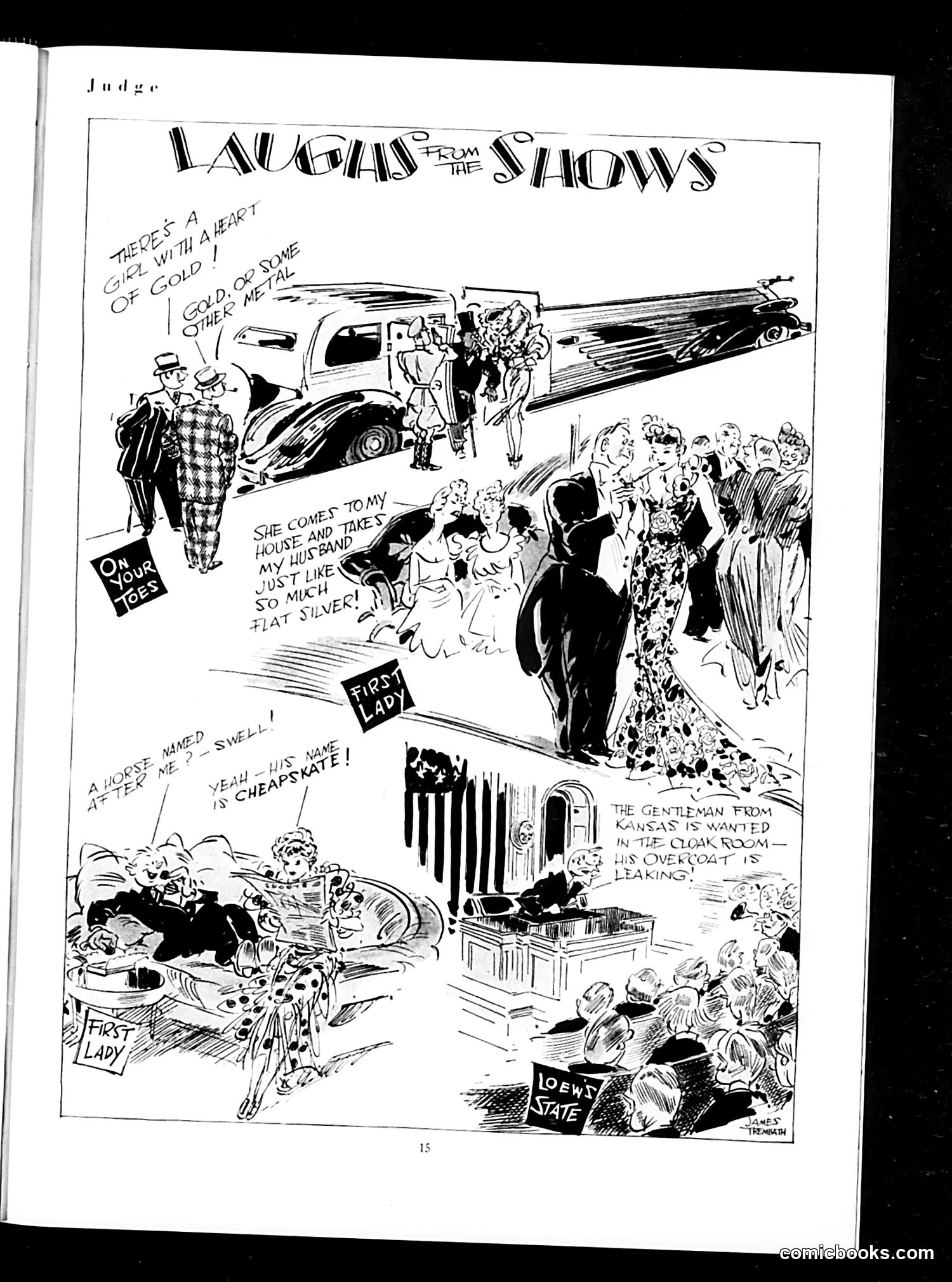
"Laughs from the Shows" This is a satirical cartoon mocking theatrical/show business scandals, likely from the 1920s-30s based on the art style and automobile shown. The cartoon depicts several overlapping scenarios involving wealthy socialites and performers at what appears to be a fashionable event. Key jokes include: - A man with a "heart of gold" arriving in an ostentatious car - A woman labeled "First Lady" - References to infidelity ("She came to my house and I just like that silver!") - A scandal involving a "gentleman from Kansas" with a "leaking" overcoat in the cloakroom - A "Loews State" theater reference The satire targets the hypocrisy and moral scandals within high society and entertainment circles—the contrast between public respectability and private misbehavior. The "First Lady" label suggests this may reference actual society figures or political connections, though specific identities aren't clear from the image alone.
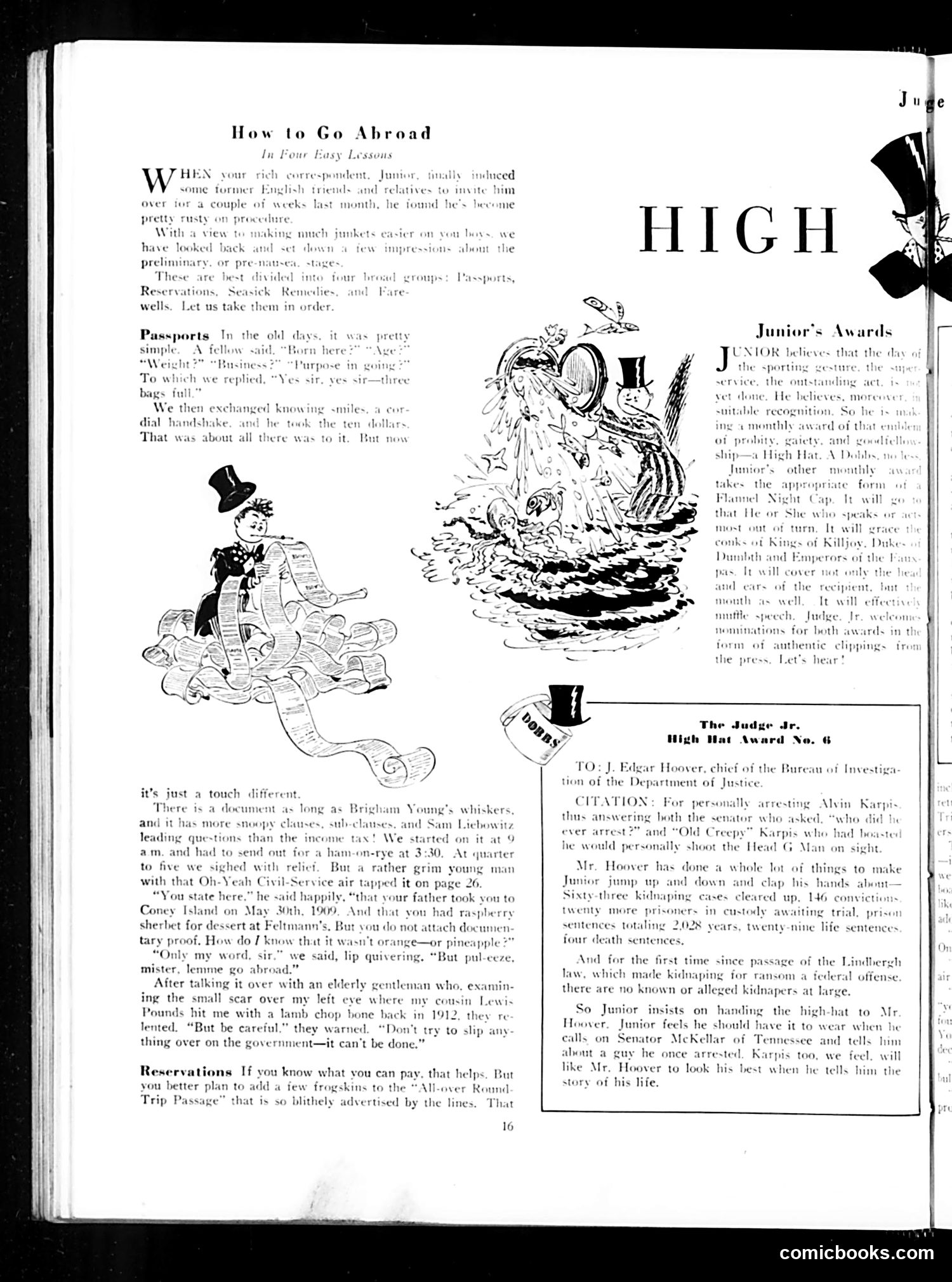
"Junior's Awards" - Judge Magazine Satire This page celebrates J. Edgar Hoover's FBI achievements through a mock award system. The "High Hat Award No. 6" is presented to Hoover for capturing criminal Alvin Karpis and solving major cases. The satire works on two levels: The article humorously describes Hoover's relentless pursuit of criminals, contrasting his serious federal work against Junior's tongue-in-cheek "awards" for noteworthy public figures. References include Senator McKellar questioning Hoover about arrests, and praise for clearing kidnapping cases following the Lindbergh law. The left cartoon mocks passport and travel bureaucracy—a man drowning in paperwork illustrates the absurd complexity of international travel documentation for ordinary citizens. The overall joke: while Junior awards "High Hats" to society's notable figures, Hoover's actual crime-fighting achievements (clearing 63 kidnapping cases, securing lengthy sentences) represent genuine public service worthy of recognition—a gentle satire elevating law enforcement's real work above society gossip.
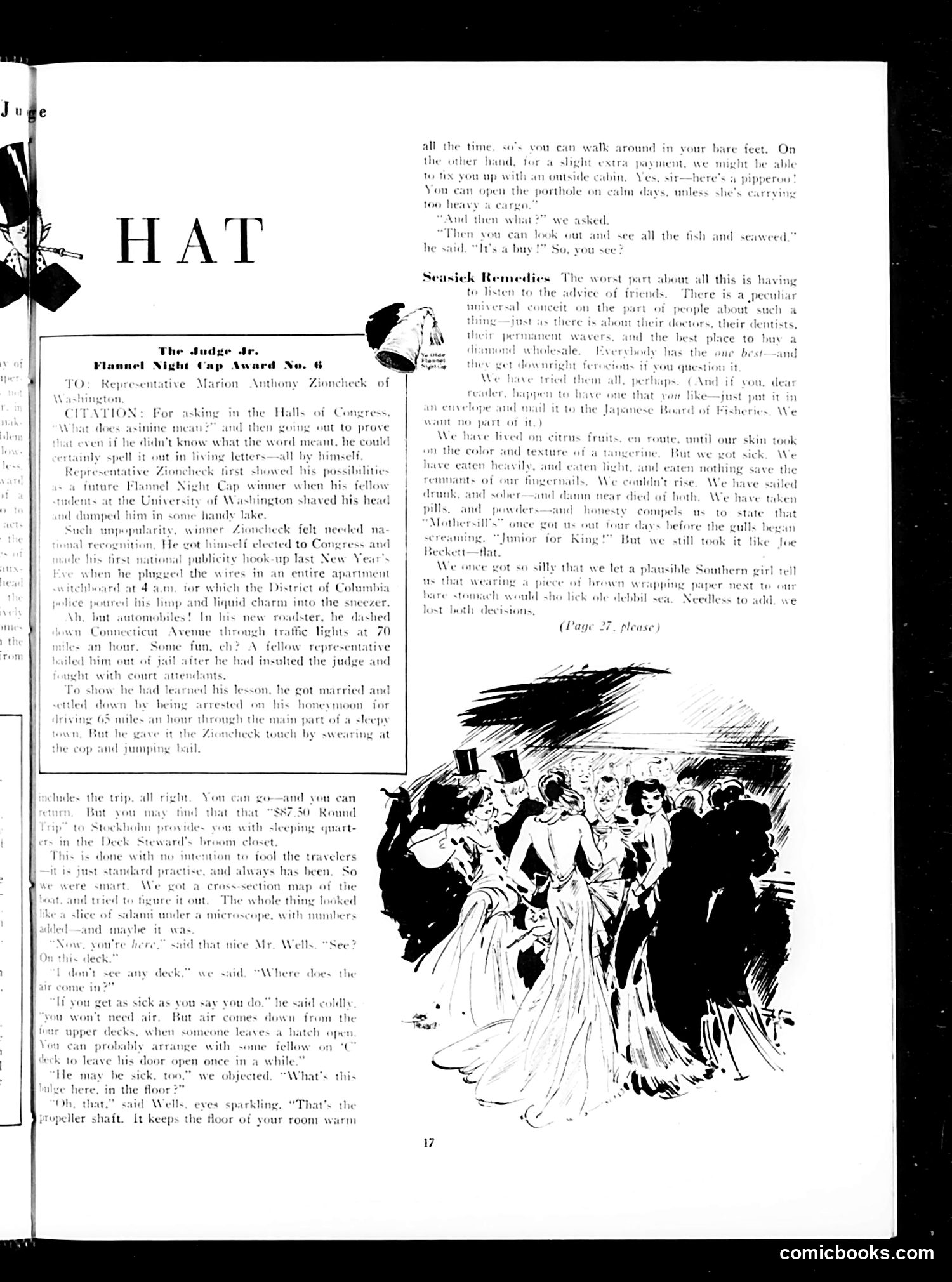
Explanation for Modern Readers This page contains two separate Judge magazine features. The main item is "The Judge Jr. Flannel Night Cap Award No. 6," satirizing Representative Marion Anthony Zioncheck of Washington. The citation mocks Zioncheck for asking what "asinine" means in Congress, then spelling it out—apparently his only demonstrated competence. The text recounts his public antics: getting arrested on his honeymoon, speeding recklessly, and insulting a judge. The award implies he's an embarrassing, incompetent legislator. Below is an unrelated humorous piece about seasickness remedies during ocean travel, featuring practical (if dubious) maritime advice. The Zioncheck feature exemplifies Judge's typical political satire: ridiculing politicians through exaggerated accounts of their foolish behavior to delegitimize them in readers' eyes.
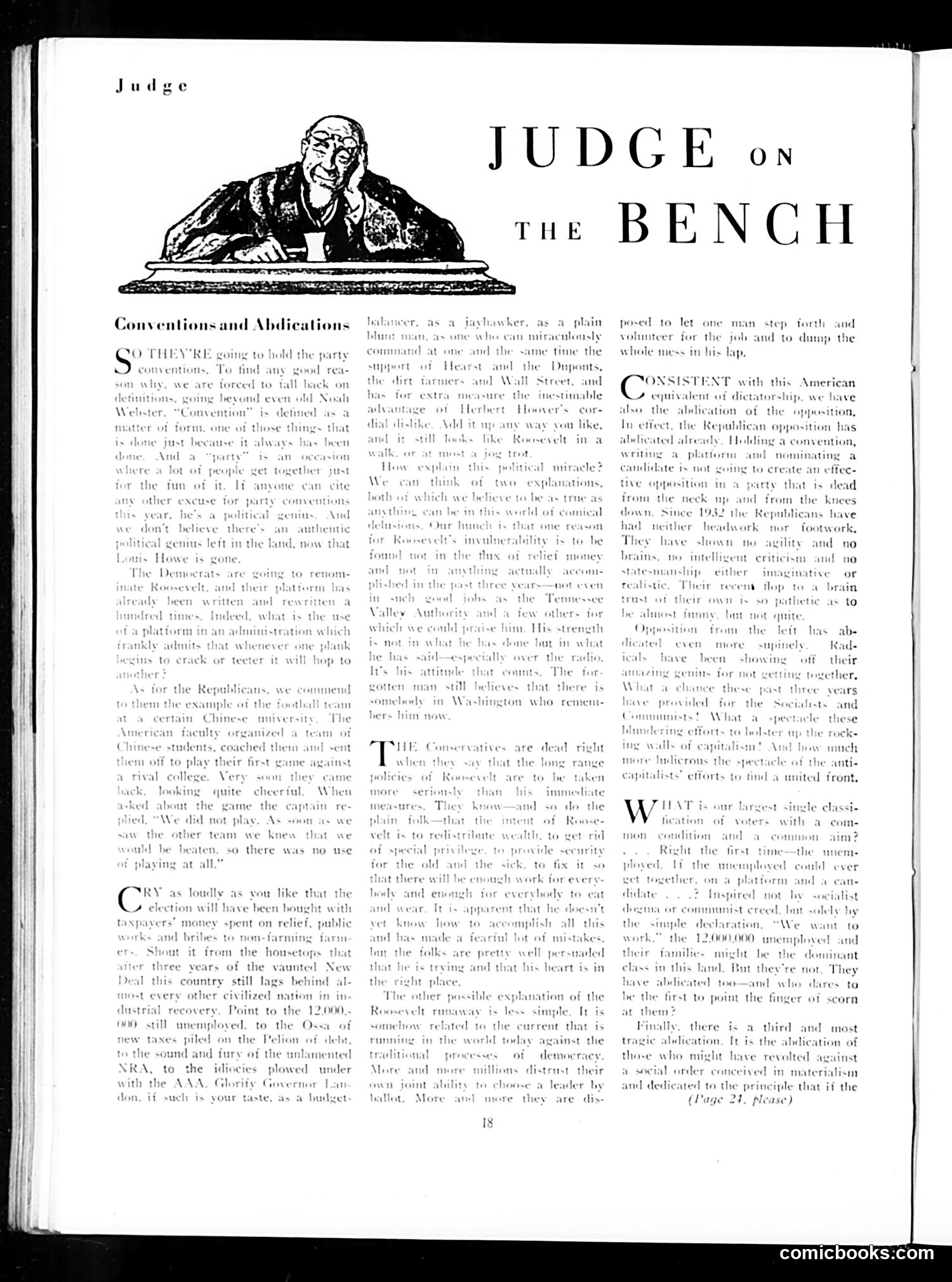
Judge Magazine: "Judge on the Bench" This page from Judge magazine (circa early 1930s) features political commentary titled "Judge on the Bench," with an illustration of a stern judge presiding. The text discusses 1930s political conventions and the Roosevelt administration, referencing: - Herbert Hoover's failed policies and the economic crisis - Republican platform weaknesses and the party's inability to offer genuine alternatives - New Deal programs (NRA, AAA) criticized as ineffective government overreach - The $12 million spent on relief as insufficient for addressing unemployment The satire argues that despite criticisms from both left and right, the Republicans have offered no viable opposition since 1932. The piece mocks the "American equivalent of dictatorship" (Roosevelt's executive power) while simultaneously attacking Republican impotence. The judge illustration symbolizes the magazine's role as arbiter of political judgment, critiquing all sides of the debate while suggesting that traditional democratic processes are failing to address the Depression effectively.
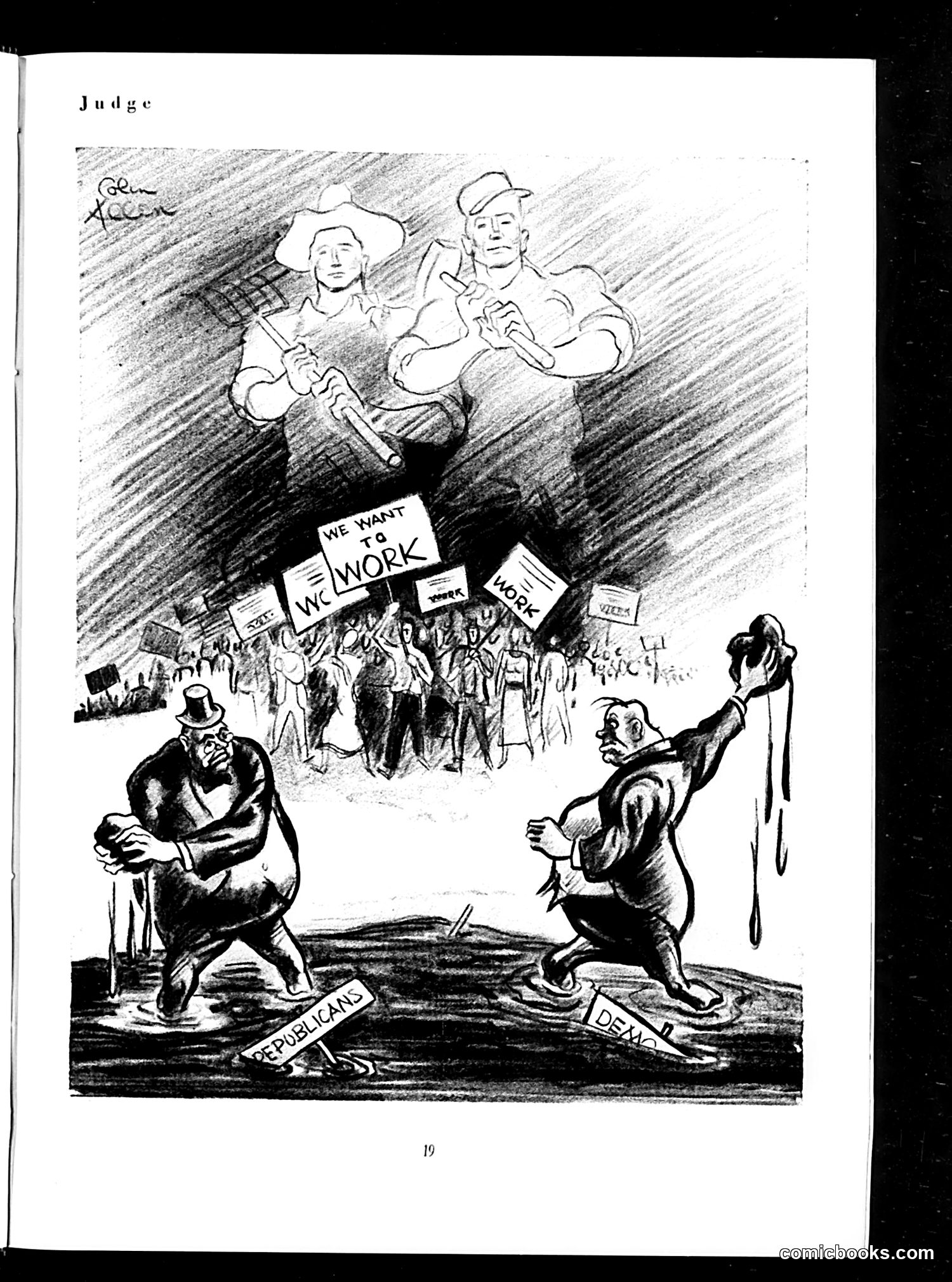
Political Cartoon Analysis This Judge magazine cartoon depicts a labor dispute, likely from the early 20th century. Two caricatured figures labeled "Republicans" and "Democrats" are shown as judges or authority figures holding rope above a crowd of workers holding signs reading "WE WANT TO WORK." The workers below appear to be unemployed laborers seeking employment. The satire suggests that both political parties are manipulating or controlling the working class's desperation for jobs, literally holding the means of employment above their heads like a puppet show. The cartoon criticizes how Republicans and Democrats exploit worker vulnerability during economic hardship, using employment as leverage rather than genuinely addressing unemployment. This reflects Progressive Era anxieties about political corruption and labor conditions.
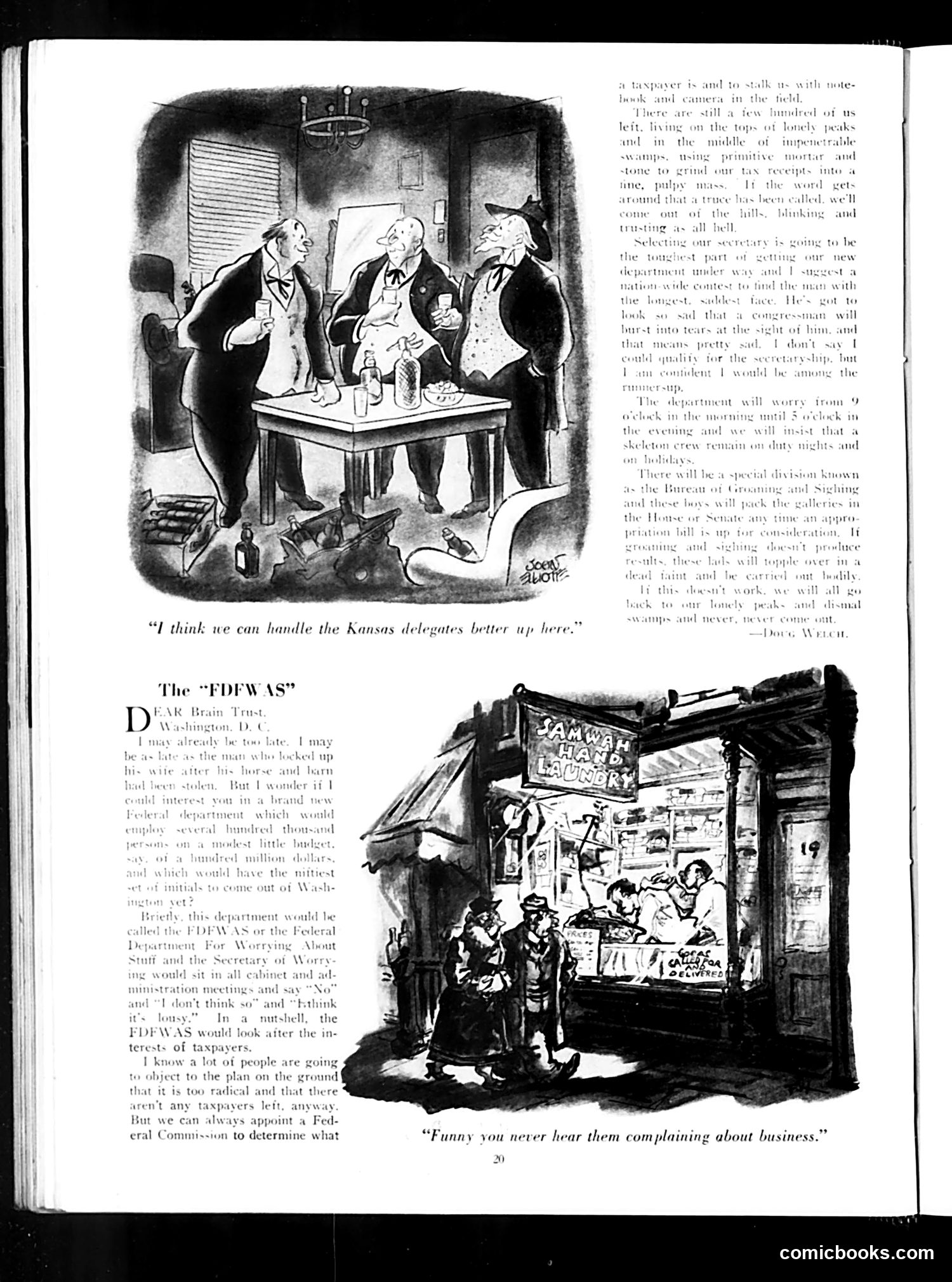
Political Satire from Judge Magazine The top cartoon depicts three men in an office discussing "Kansas delegates," likely referring to political maneuvering at a Democratic or Republican convention. The joke suggests they can manipulate these delegates more easily in a backroom setting ("up here") than openly. The lower section introduces the "FDFWAS" (Federal Department For Worrying About Stuff), a satirical proposal mocking New Deal bureaucracy. The writer suggests creating another federal agency to handle taxpayer concerns—a jab at FDR's proliferating alphabet agencies. The accompanying street-scene cartoon shows people complaining to government officials, with the caption "Funny you never hear them complaining about business," suggesting citizens accept business failures but blame government for problems. Both pieces critique government expansion and New Deal administration, typical Judge magazine fare from the 1930s-40s.
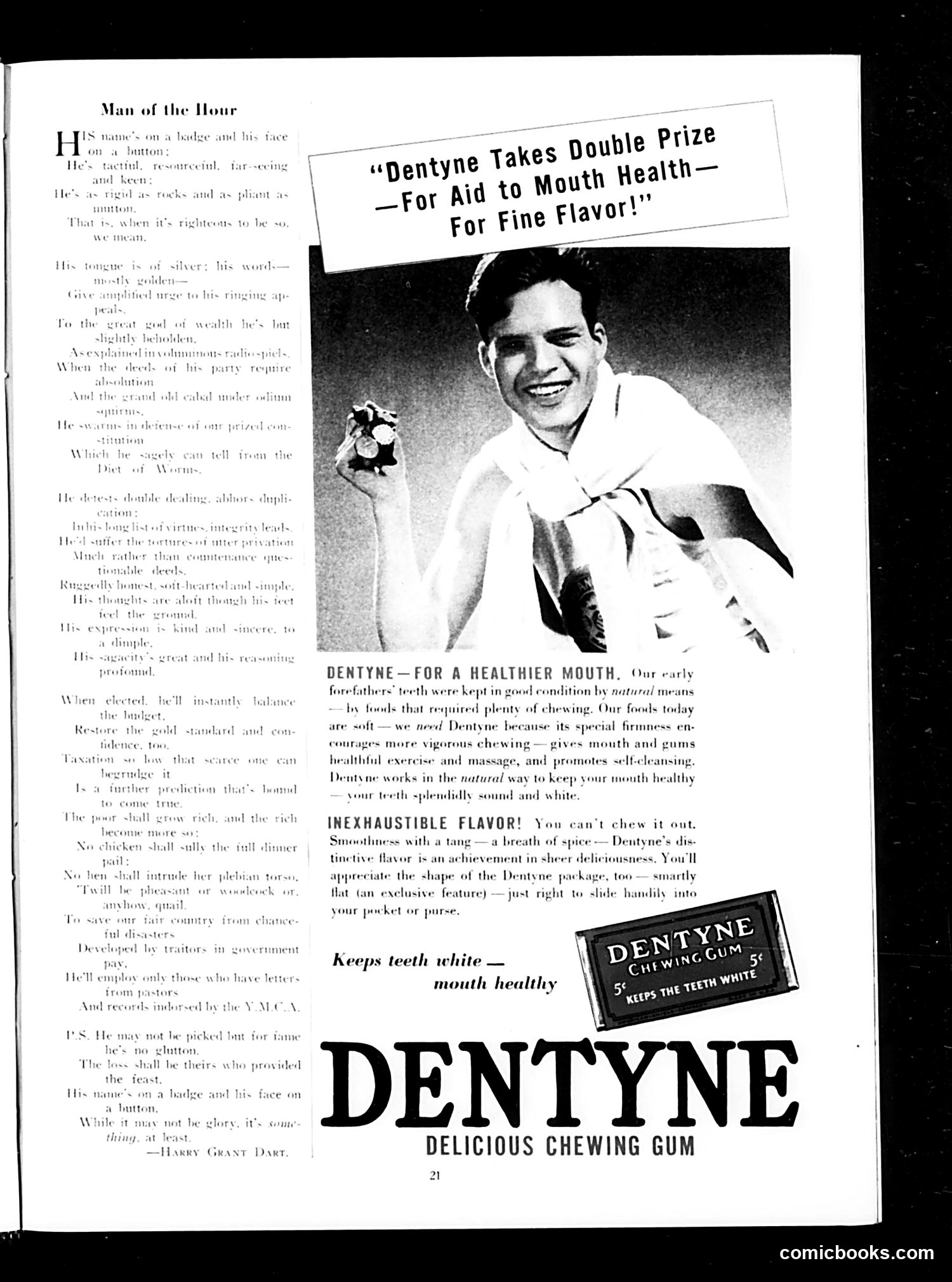
Dentyne Chewing Gum Advertisement This is primarily a Dentyne chewing gum advertisement, not political satire. The page features a smiling man holding a package of Dentyne gum as the "Man of the Hour." The ad makes health claims typical of early 20th-century marketing: that chewing gum provides "vigorous chewing" that exercises gums and promotes oral hygiene. It emphasizes the gum's flavor ("inexhaustible," "you can't chew it out") and convenient pocket-sized packaging. The accompanying poem on the left appears to be generic verse about an ideal man—describing virtues like truthfulness, integrity, and sound judgment—likely meant as aspirational copy to associate these qualities with the product. This represents the era when chewing gum manufacturers made direct health claims (later restricted by regulation), and when advertisement in magazines like *Judge* blended product promotion with literary or poetic content.
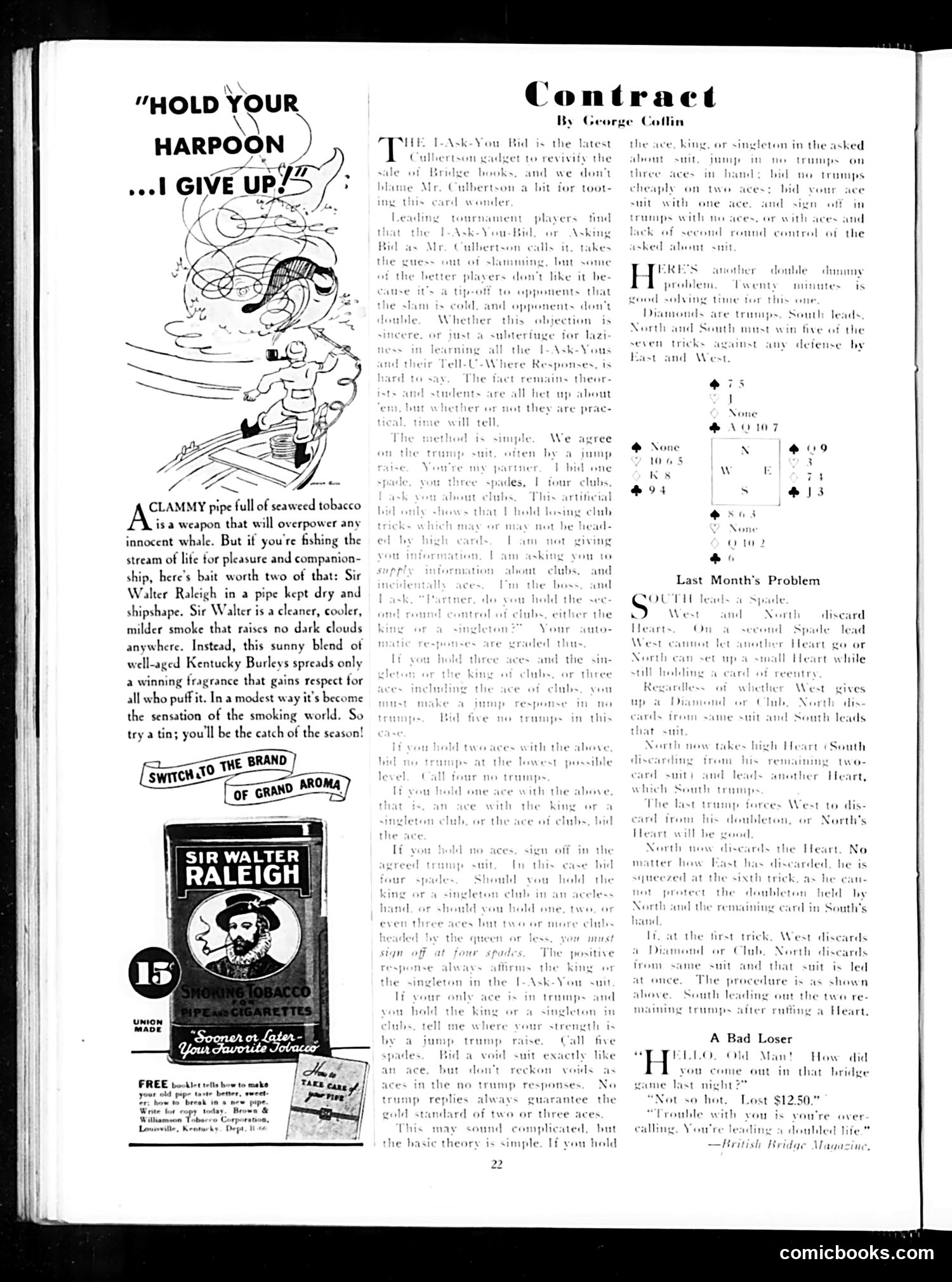
Analysis of Judge Magazine Page This page contains two distinct elements: Left side: A tobacco advertisement for Sir Walter Raleigh pipe tobacco, using a whimsical cartoon of a man wrestling a harpoon-wielding figure (likely representing the product's competitive appeal). The ad claims the tobacco is mild, clean-burning, and prestigious—a typical early 20th-century cigarette marketing pitch emphasizing refinement and social status. Right side: A bridge contract column by George Collin teaching card game strategy, followed by a short comic titled "A Bad Loser"—a brief joke about a man who lost money ($12.50) at bridge and blames his partner rather than accepting responsibility. The "harpoon" reference is unclear—possibly suggesting the product "captures" smokers, or referencing Sir Walter Raleigh's exploration/adventure associations. The page reflects Judge magazine's typical mix of advertising, instructional content, and light humor aimed at affluent readers interested in leisure activities like smoking and card games.
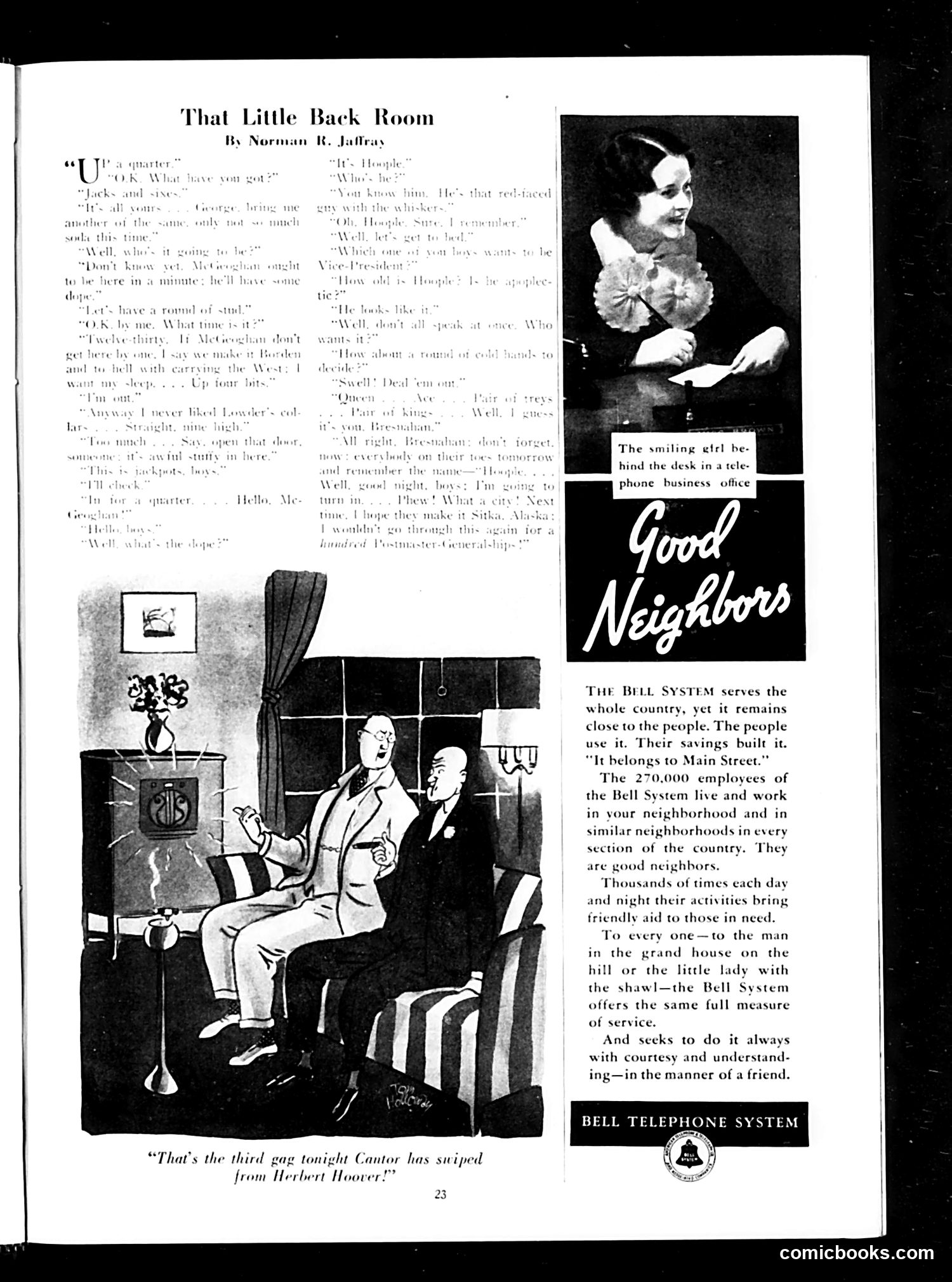
Analysis The Main Cartoon: The left-side illustration depicts two men in an office or living room, with one exclaiming that comedian Eddie Cantor has stolen a third joke tonight "from Herbert Hoover." This is a topical gag referencing Hoover's public reputation during his presidency (1929-1933) for being humorless and dignified. The joke's irony is that Hoover—known as stiff and serious—apparently has become such a notable source of quips that comedians are mining his statements for material. It's satirizing both Hoover's public persona and the era's popular entertainment culture. The Advertisement: The right side features a "Good Neighbors" advertisement for the Bell Telephone System, emphasizing that its 270,000 employees serve all Americans equally—"the man in the grand house on the hill or the little lady with the shawl." This reflects 1930s corporate messaging presenting large institutions as community-minded and accessible to ordinary people, countering Depression-era skepticism of big business. Context: The page mixes entertainment satire with corporate advertising typical of Judge magazine's format.
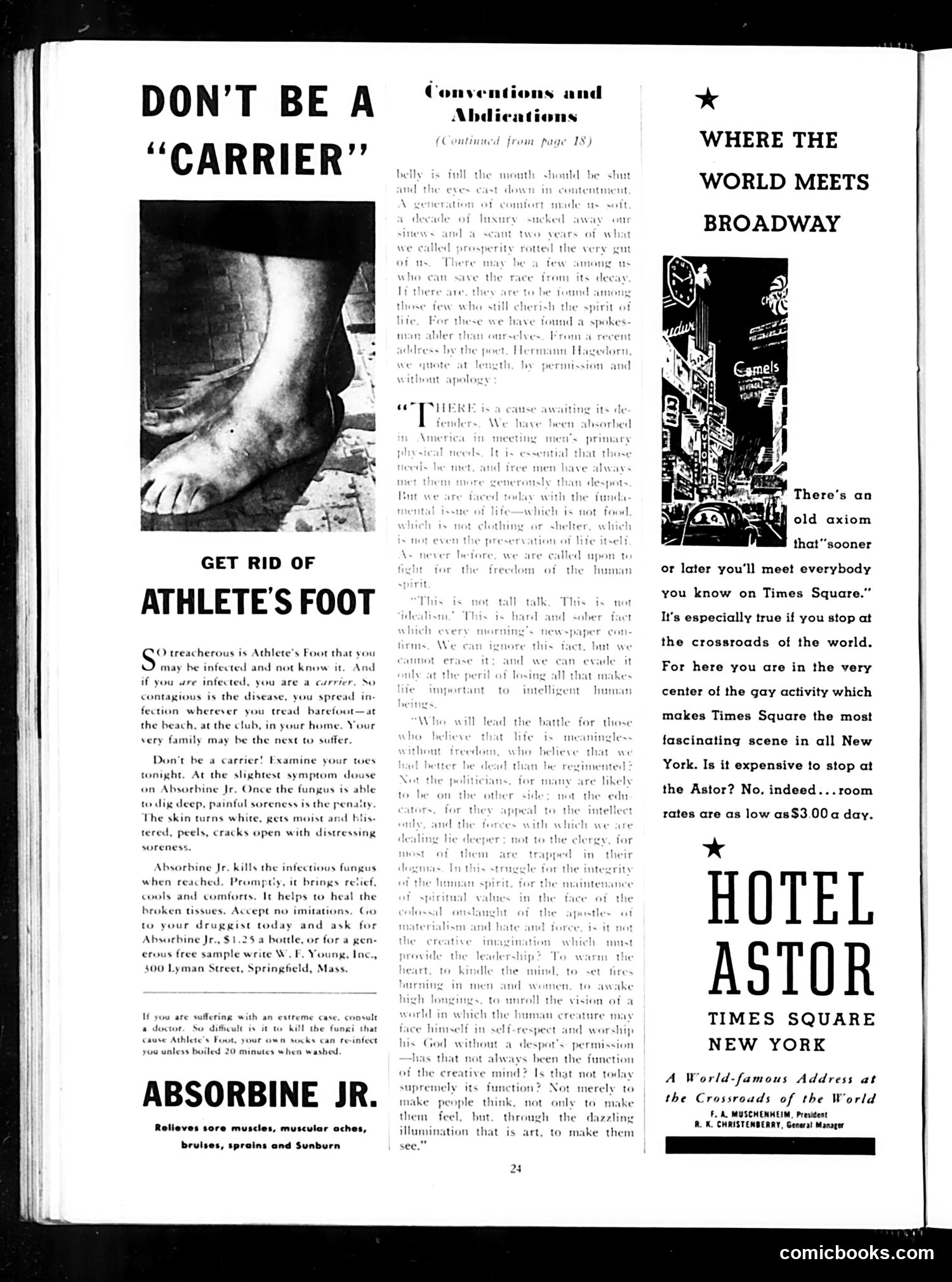
Analysis of Judge Magazine Page This page is primarily advertising, not political satire. It contains three advertisements: 1. "Don't Be a Carrier" (left): A public health advertisement for Absorbine Jr., a patent medicine treatment for athlete's foot. The ad uses disease-transmission rhetoric common in early-20th-century advertising, warning that infected individuals become "carriers" spreading fungus to family and friends. The graphic shows an infected foot. 2. Hotel Astor advertisement (right): Promotes the Times Square hotel, emphasizing its location at the "crossroads of the world" and noting affordable rates ($3.00/day). 3. "Conventions and Abdications" (center): A philosophical essay fragment (continued from page 18) discussing human freedom and creative purpose, unrelated to the advertisements. The page demonstrates how Judge mixed satirical content with commercial advertising. The athlete's foot ad notably employs fear-based marketing language popular in that era, conflating disease carriers with moral or social irresponsibility.
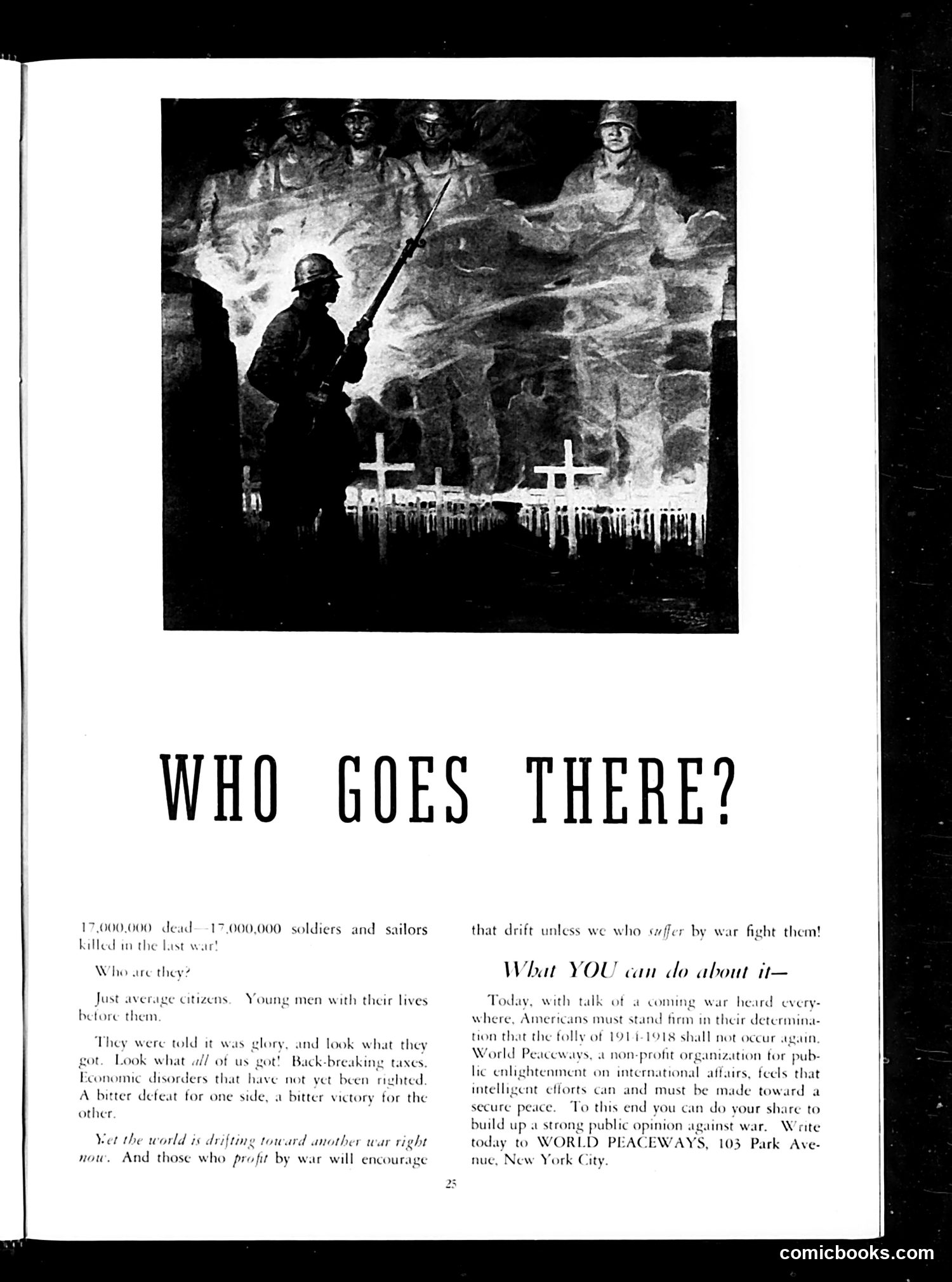
Analysis This is anti-war propaganda, likely from the 1930s, warning against repeating World War I's devastation. The image shows a soldier standing before crosses in a cemetery, with ghostly figures of the war dead appearing above—a visual representation of the 17 million casualties mentioned in the text. The satire targets war profiteers: those who benefit financially from conflict while ordinary citizens suffer the human and economic costs (back-breaking taxes, economic disorder). The piece argues the world is "drifting" toward another war unless ordinary people actively oppose it. The call-to-action promotes World Peaceways, a pacifist organization, urging readers to write and build public opinion against war. The underlying message: average citizens—not politicians or arms dealers—bear the real burden of war, making them responsible for preventing the next one. This reflects pre-WWII American isolationism and peace activism.
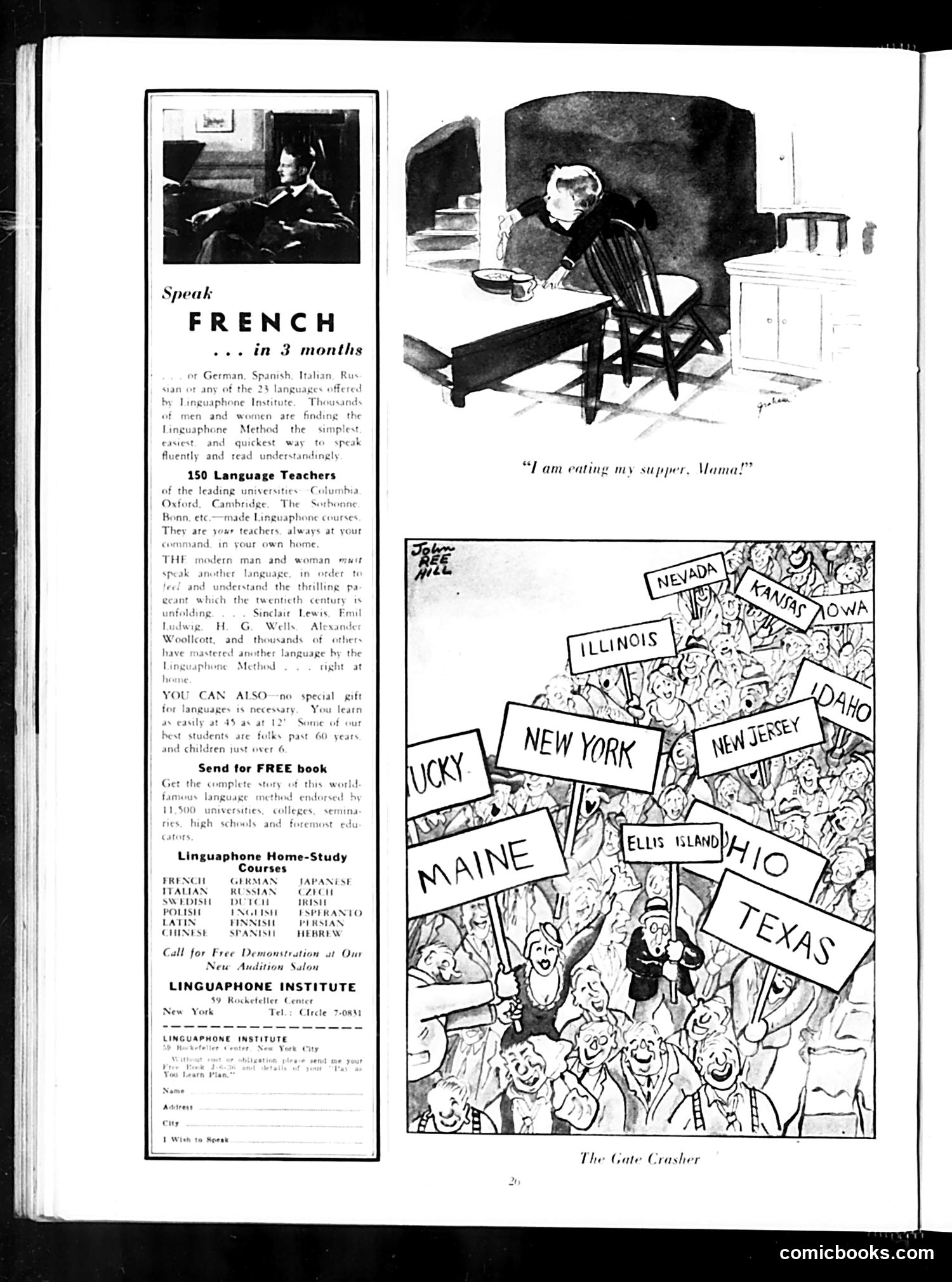
"The Gate Crasher" Cartoon Explanation This page is primarily a Linguaphone Institute advertisement for language courses, occupying the left two-thirds. The cartoon on the right, titled "The Gate Crasher," depicts a satirical scene of uninvited attendees forcing their way into what appears to be an exclusive gathering. The illustration shows a large crowd of cartoon figures pushing through barriers labeled with various U.S. states (New York, Texas, Maine, Illinois, etc.), suggesting people from across America attempting to crash an exclusive event or venue—possibly referencing social anxiety about "gatekeeping" in high society or elite clubs during this era. The accompanying caption reads: "I am eating my supper, Mama!"—suggesting the crashers are brazenly consuming food/resources at the exclusive event without invitation, emphasizing their audacious intrusion. The satire targets social pretension and exclusivity, mocking both the gate-crashers' boldness and implicitly the snobbishness of those attempting to restrict access.
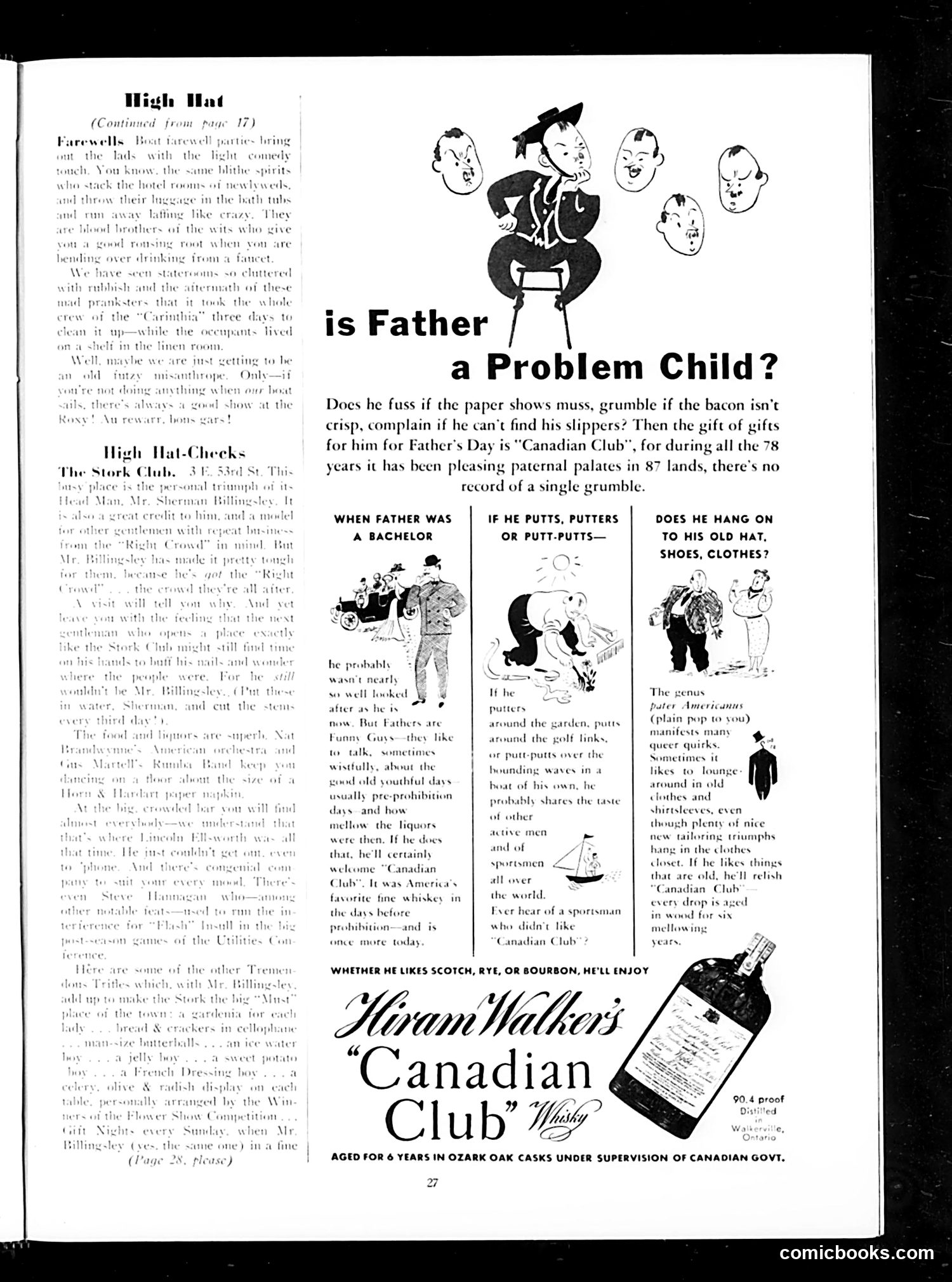
Analysis for Modern Readers This page is primarily a Father's Day advertisement for Canadian Club whisky disguised as humorous content. The central cartoon asks "Is Father a Problem Child?" — a rhetorical setup suggesting that fathers are fussy, difficult men whose complaints (about newspapers, bacon, lost slippers) can be solved with whisky as a gift. The three illustrated scenarios stereotype the "typical father": the bachelor who misses pre-Prohibition drinking days, the golfer obsessed with his game, and the sentimental man clinging to old clothes. Each panel implies these fathers would be satisfied by Canadian Club whisky. The advertisement capitalizes on post-Prohibition nostalgia (Prohibition ended in 1933; the magazine references it as recent history). It also exploits gender stereotypes, portraying fathers as childish, complaint-prone men whose behavior requires alcohol as remedy or reward. The "High Hat" column references appear to discuss Manhattan's social scene (Stork Club, 53rd Street), suggesting this targets an urbane, affluent readership.
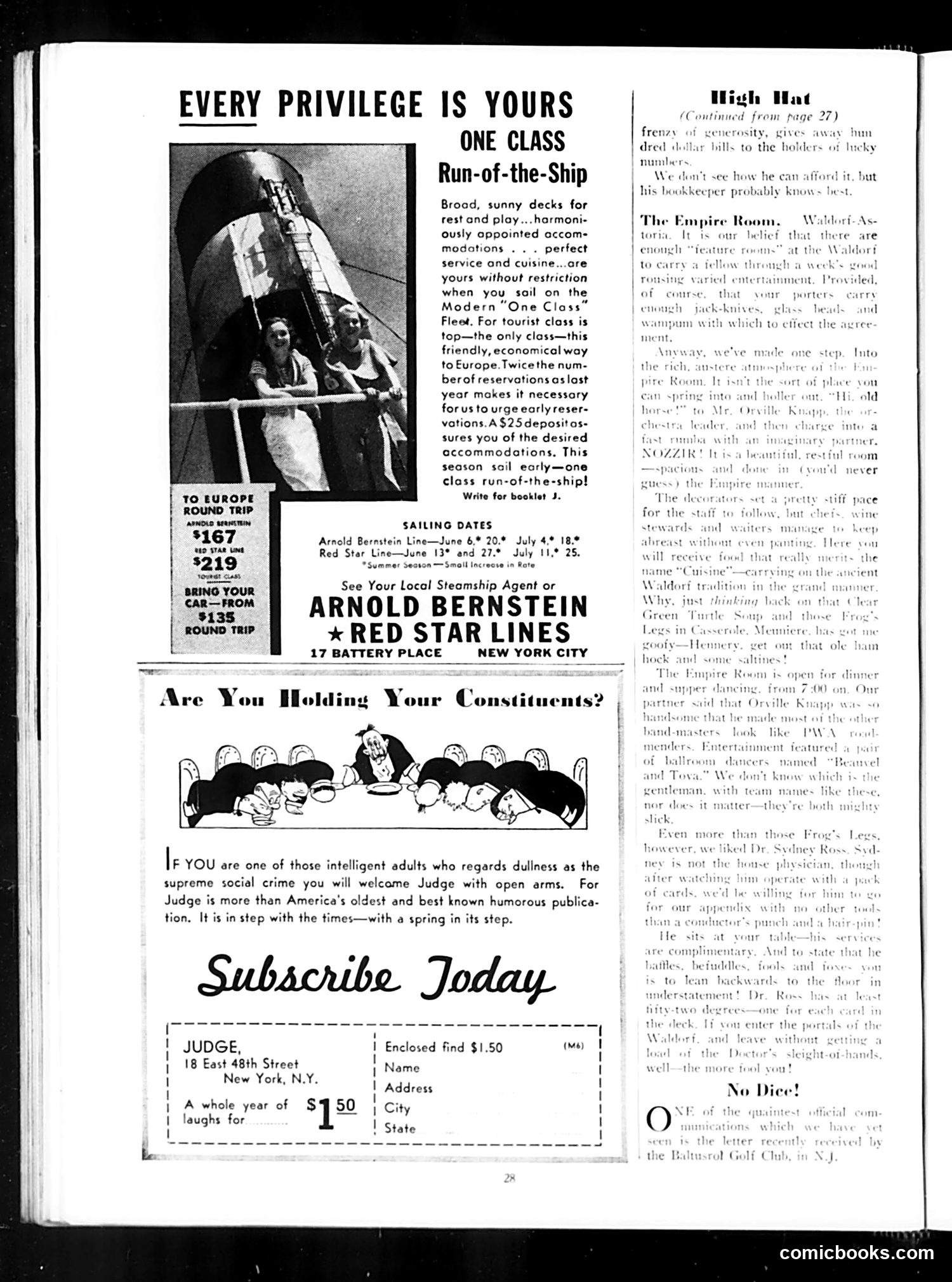
Judge Magazine Page Analysis This page is primarily advertising, featuring cruise line promotions (Arnold Bernstein and Red Star Lines) for European travel packages, with prices ranging from $135-$219 for round trips. The text emphasizes the appeal of "one class" tourist travel as modern, economical, and democratic. The cartoon "Are You Holding Your Constituents?" depicts a line of identical men in bowler hats, likely satirizing political patronage and corruption. The accompanying text suggests Judge's editorial stance: the magazine positions itself as for "intelligent adults" who reject "dullness as the supreme social crime"—a dig at machine politics and uninspired governance. The page also includes brief restaurant reviews of New York establishments (Empire Room, Waldorf-Astoria), maintaining Judge's focus on urban sophistication and leisure culture. Context: This reflects 1930s anxieties about economic accessibility, the rise of consumer tourism, and criticism of political "machines" that controlled constituencies through patronage networks.
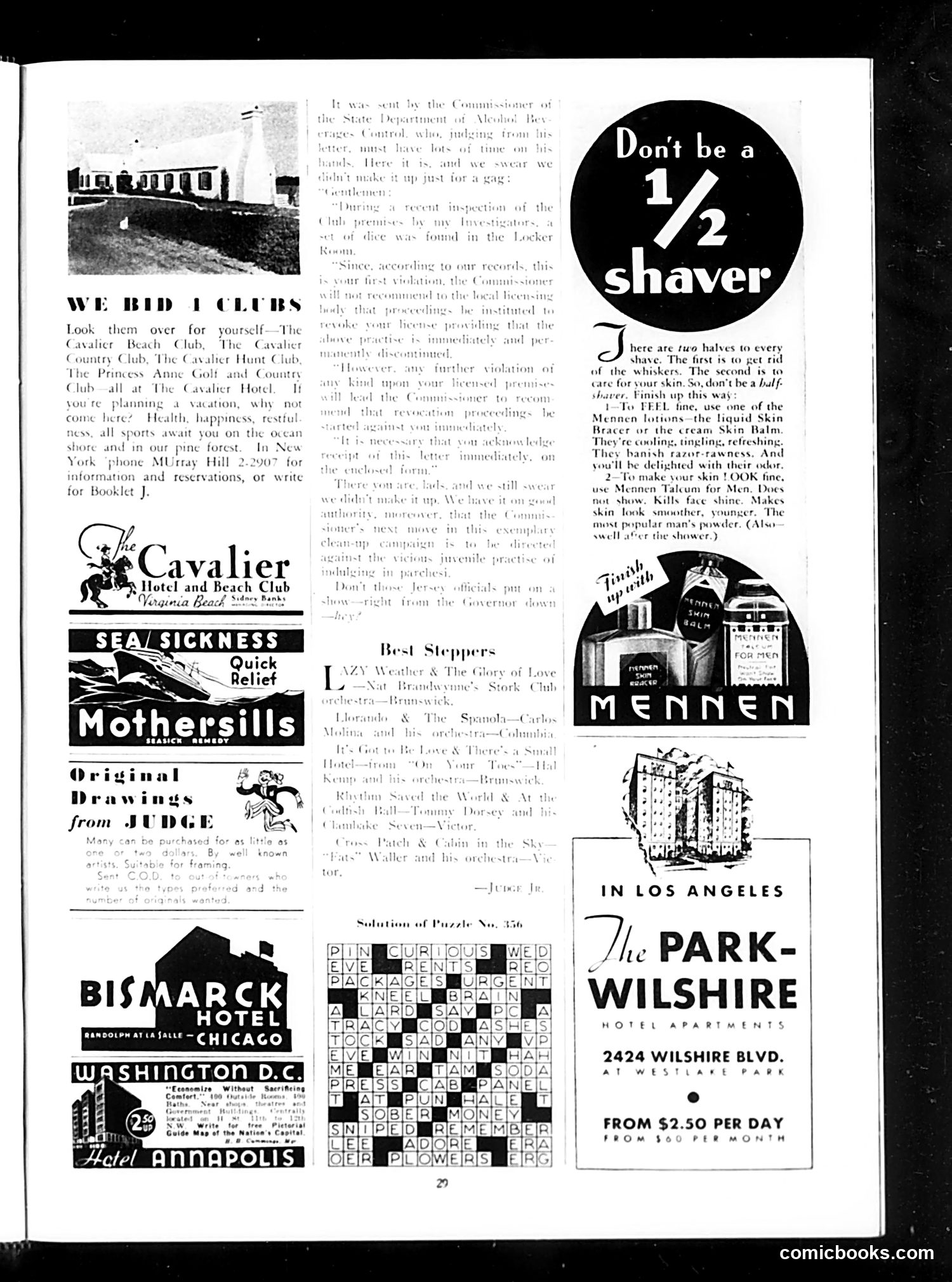
Analysis of Judge Magazine Page This page is primarily advertising, not political satire. It contains multiple hotel and product advertisements typical of 1930s-era magazines. The main content includes: - Hotel promotions for beach clubs and resort destinations (Cavalier Beach Club, Princess Anne Country Club) - Mennen grooming products advertisement featuring the phrase "Don't be a ½ shaver"—a humorous appeal to men to complete their grooming routine by using aftershave lotion and talcum powder, not just razors - Hotel listings for the Bismarck (Chicago), Annapolis (Washington D.C.), and Park-Wilshire (Los Angeles) - A crossword puzzle solution The Mennen ad's joke is straightforward consumer marketing: shaving is only half the grooming task; proper skincare completes it. There is no political content or social satire visible on this page—it reflects Depression-era advertising targeting middle-class male consumers.
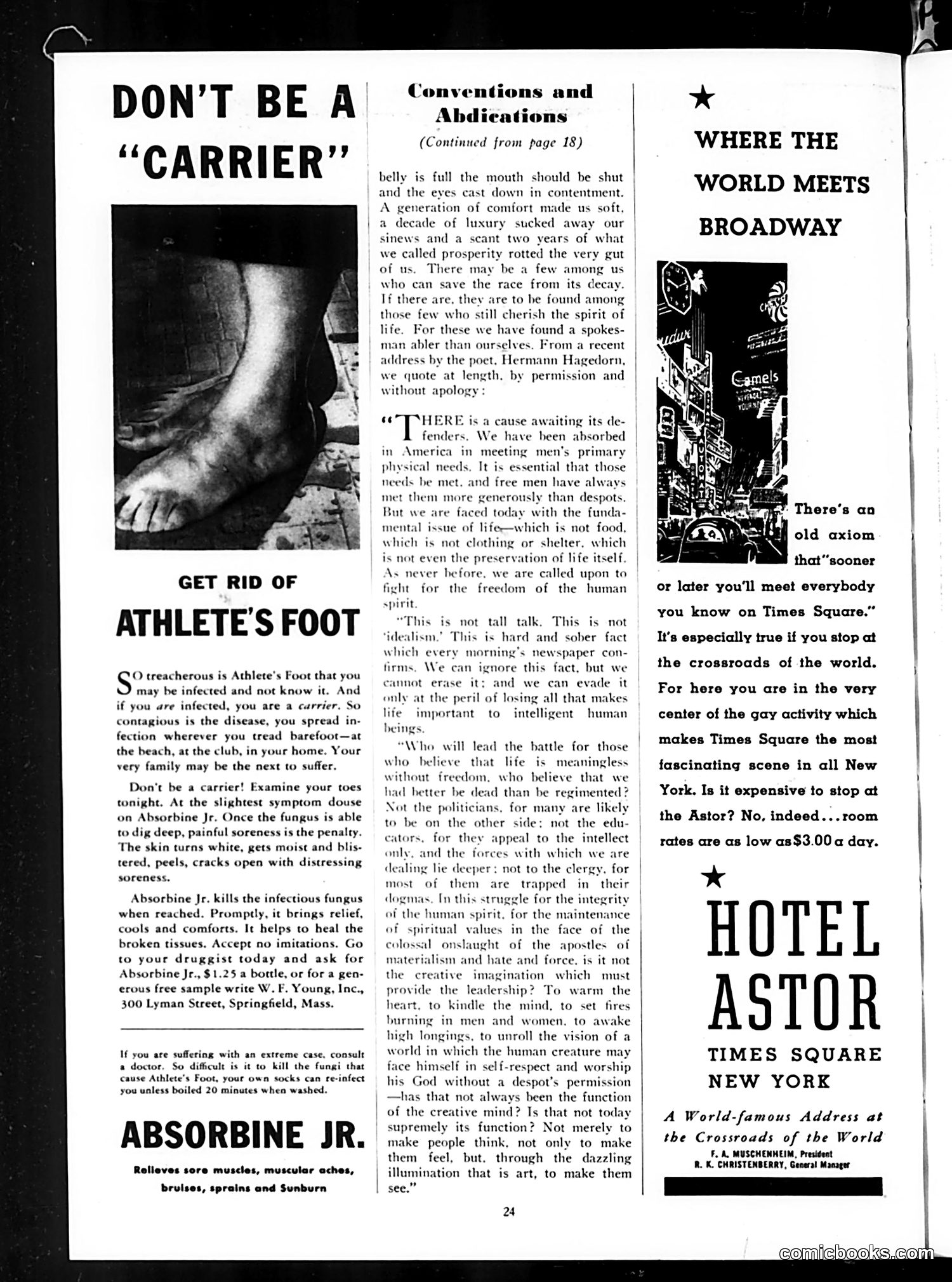
Page Analysis This page contains primarily medical advertising (Absorbine Jr. for athlete's foot) rather than political satire. The left side features a dramatic photograph of an infected foot with text warning readers they may unknowingly be "carriers" of fungus spreading disease to family. The center column reprints an excerpt from poet Hermann Hagedorn's speech lamenting post-prosperity American moral decline. Hagedorn argues that material comfort has weakened the nation's spirit and calls for creative leaders (artists, intellectuals) to inspire freedom and human dignity—not politicians or clergy, whom he distrusts as either complicit or ineffective. The right side advertises the Hotel Astor in Times Square, emphasizing its central location at "the crossroads of the world" and affordable rates ($3/day). This appears to be a general-interest magazine page mixing ads with cultural commentary—the Hagedorn excerpt represents Judge's editorial voice about American values during an unspecified period of concern about national character.
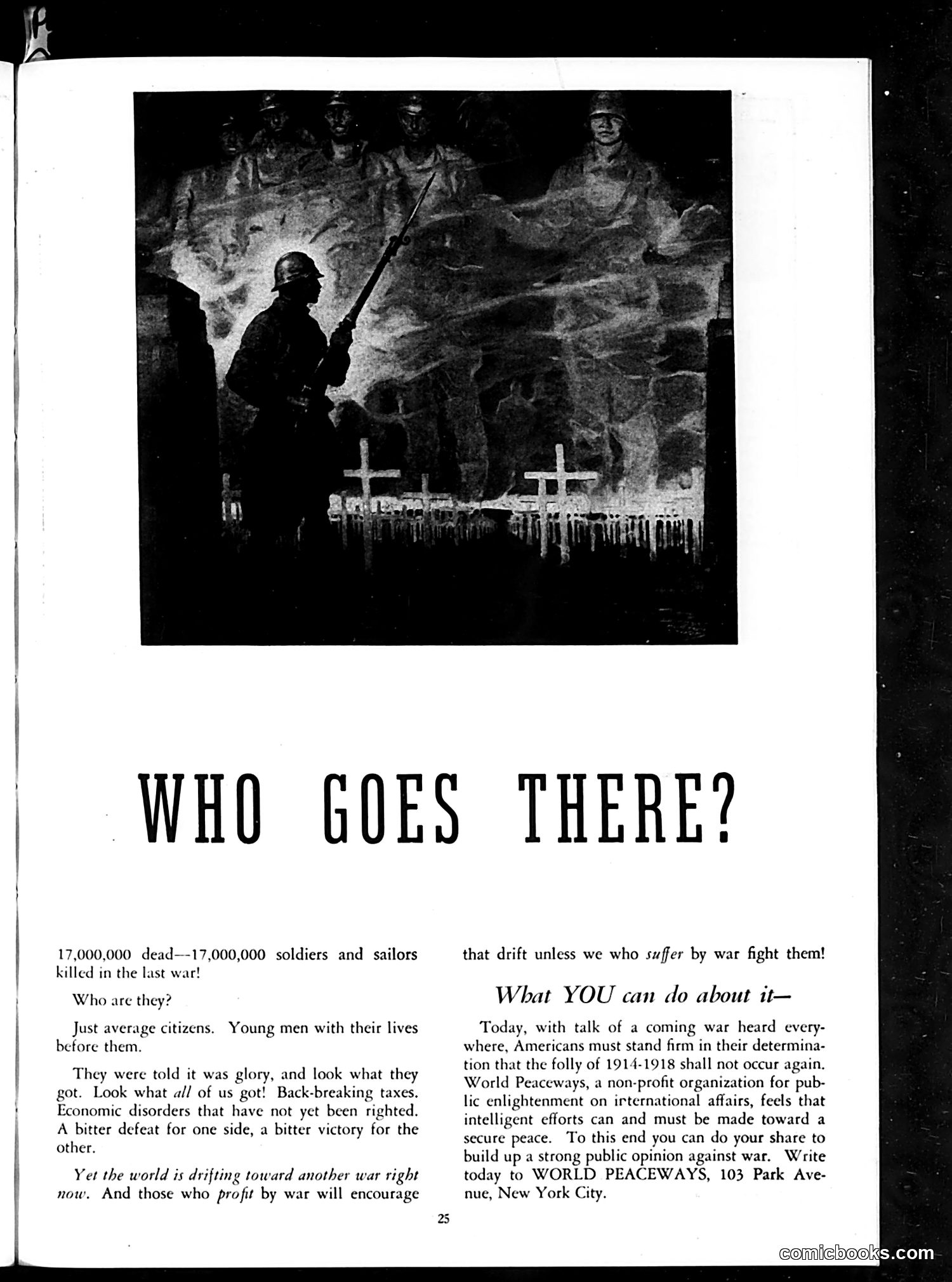
Analysis This is anti-war propaganda from the interwar period (likely 1920s-1930s). The dramatic image shows silhouetted soldiers at a cemetery with crosses, evoking World War I's massive casualties—the text cites 17 million dead. The message is a pacifist warning: WWI devastated ordinary citizens who were sold "glory" but received only taxes, economic hardship, and pyrrhic victory. The satire targets war profiteers—those who benefit financially from conflict while ordinary people suffer the consequences. The call-to-action urges readers to oppose drift toward another war by supporting "World Peaceways," a peace advocacy organization. This reflects genuine 1920s-30s anxiety about repeating the recent catastrophe and skepticism toward military-industrial interests. The cartoon's power lies in its stark contrast: silhouetted living soldiers over the graves of the dead, visually asking: who will fill those crosses next?
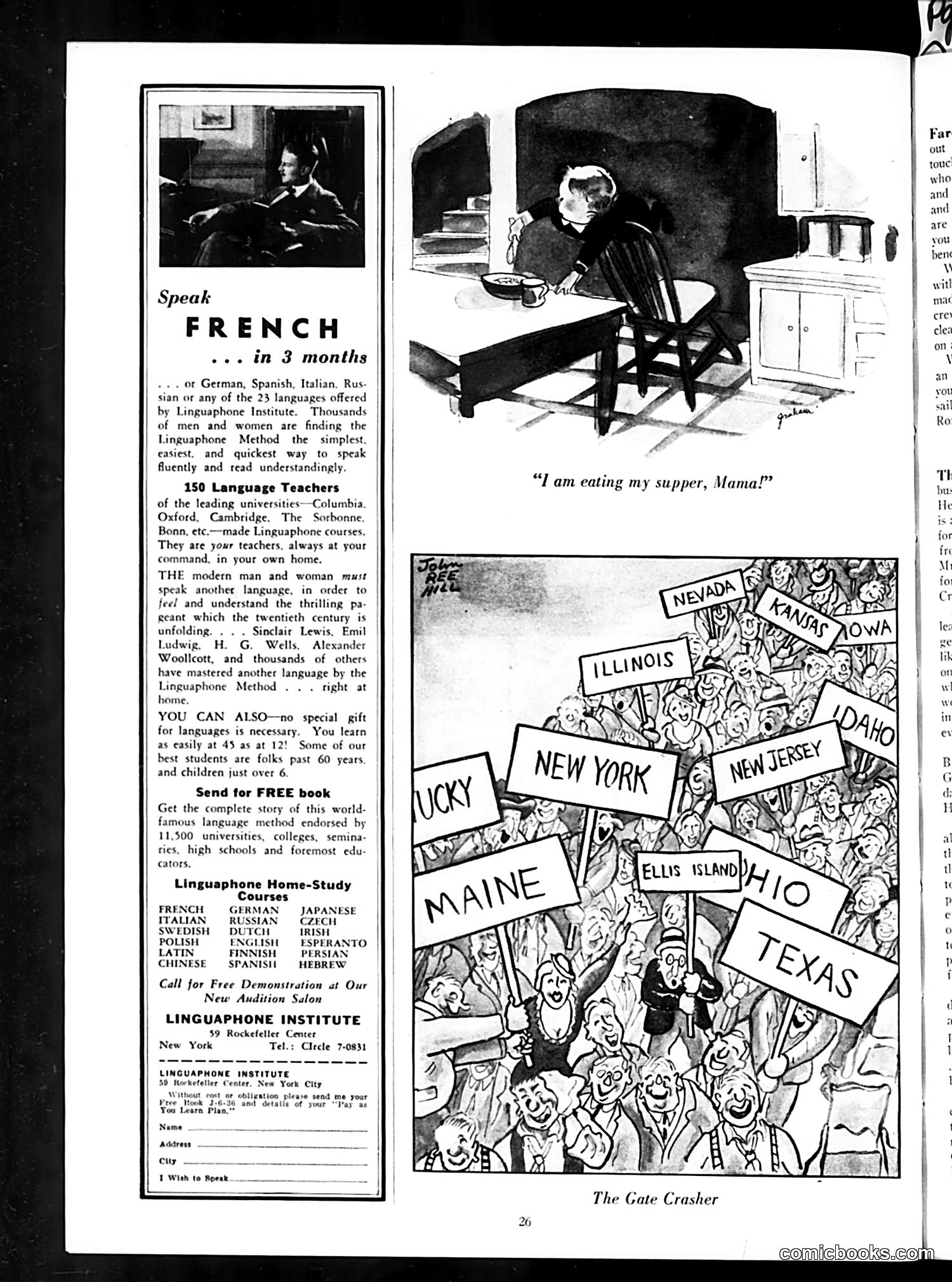
Analysis for Modern Readers This page contains a language-learning advertisement (Linguaphone Institute) and an unrelated cartoon titled "The Gate Crasher." The ad promotes rapid foreign language instruction, claiming students can learn French or 22 other languages in three months using recorded lessons at home. It appeals to 1930s modernism by citing famous intellectuals (Sinclair Lewis, H.G. Wells) as endorsers and arguing that educated twentieth-century people "must" speak multiple languages. The cartoon (right side) depicts a crowded gathering of people labeled with U.S. state names—New York, Texas, Illinois, Nevada, Maine, etc.—apparently "gate crashing" an event. The caption reads "I am eating my supper, Mama!" suggesting uninvited guests helping themselves to food. The satire likely mocks either mass migration between states, social climbing, or unwelcome intruders at exclusive gatherings, though without clearer context, the specific target remains unclear. The style and States-as-characters approach suggests commentary on American regional or social behavior.
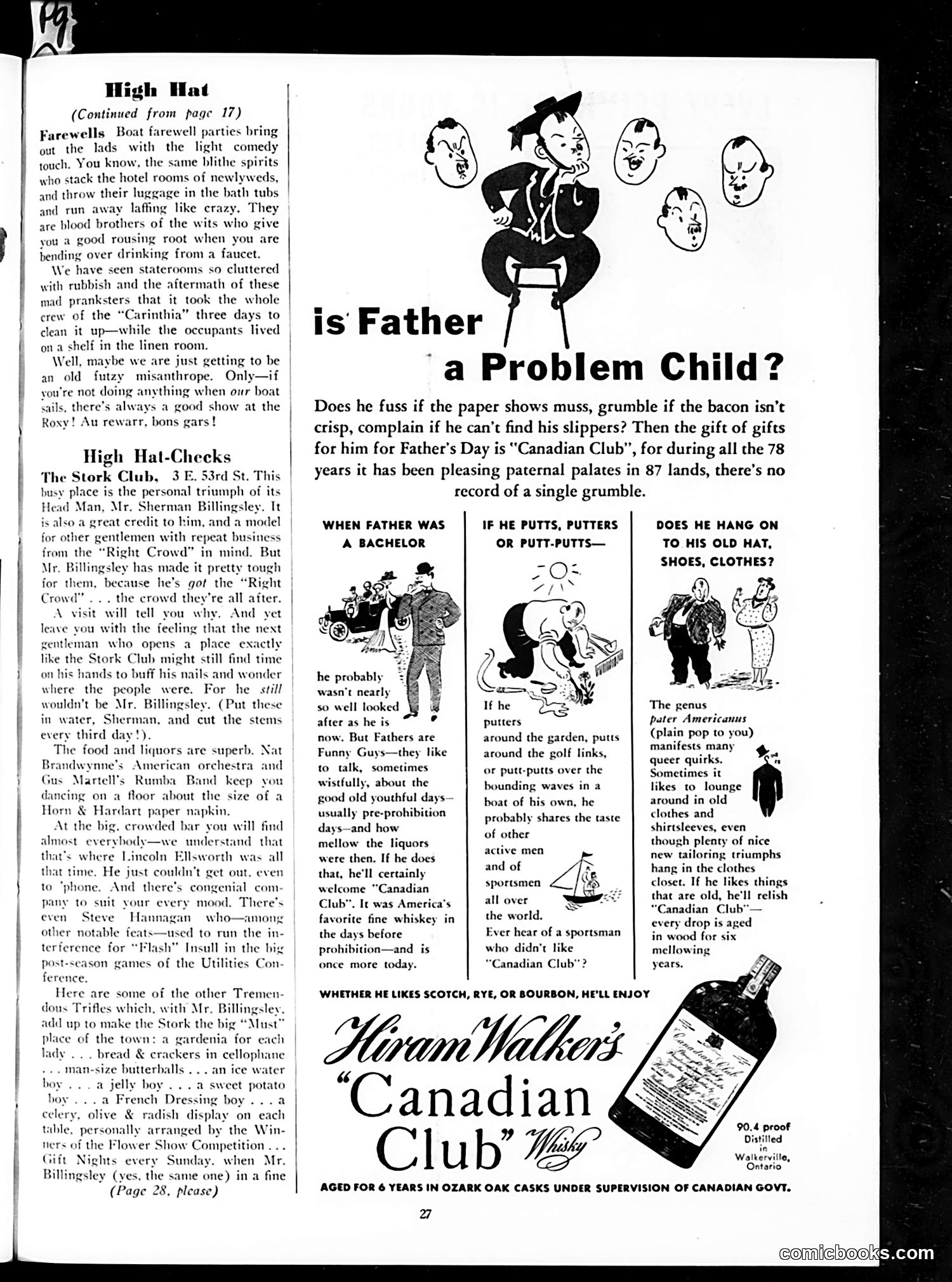
Analysis for Modern Readers This page contains a Father's Day advertisement for Canadian Club whiskey disguised as social commentary. The satirical "cartoon" uses exaggerated character sketches of different father types to market the product. The main joke: fathers are chronically grumpy complainers (fussing about newspapers, bacon, slippers) who never change their habits or appearance—they cling to old clothes and shoes. The pitch is that Canadian Club whiskey, aged six years and pleasing fathers for 78 years across 87 countries, is the perfect gift because even the most difficult, curmudgeonly father "has never grumbled" about it. The illustrated "types" (bachelor days, golfers, fashion-indifferent men) are generic period stereotypes meant to be relatable to 1930s-40s readers. The satire is gentle: fathers are presented as predictably stubborn, but this stubbornness is framed as charming rather than critical. The advertisement co-opts Judge magazine's satirical voice to sell liquor by flattering male readers' self-image as unchanging, pleasure-resistant characters.
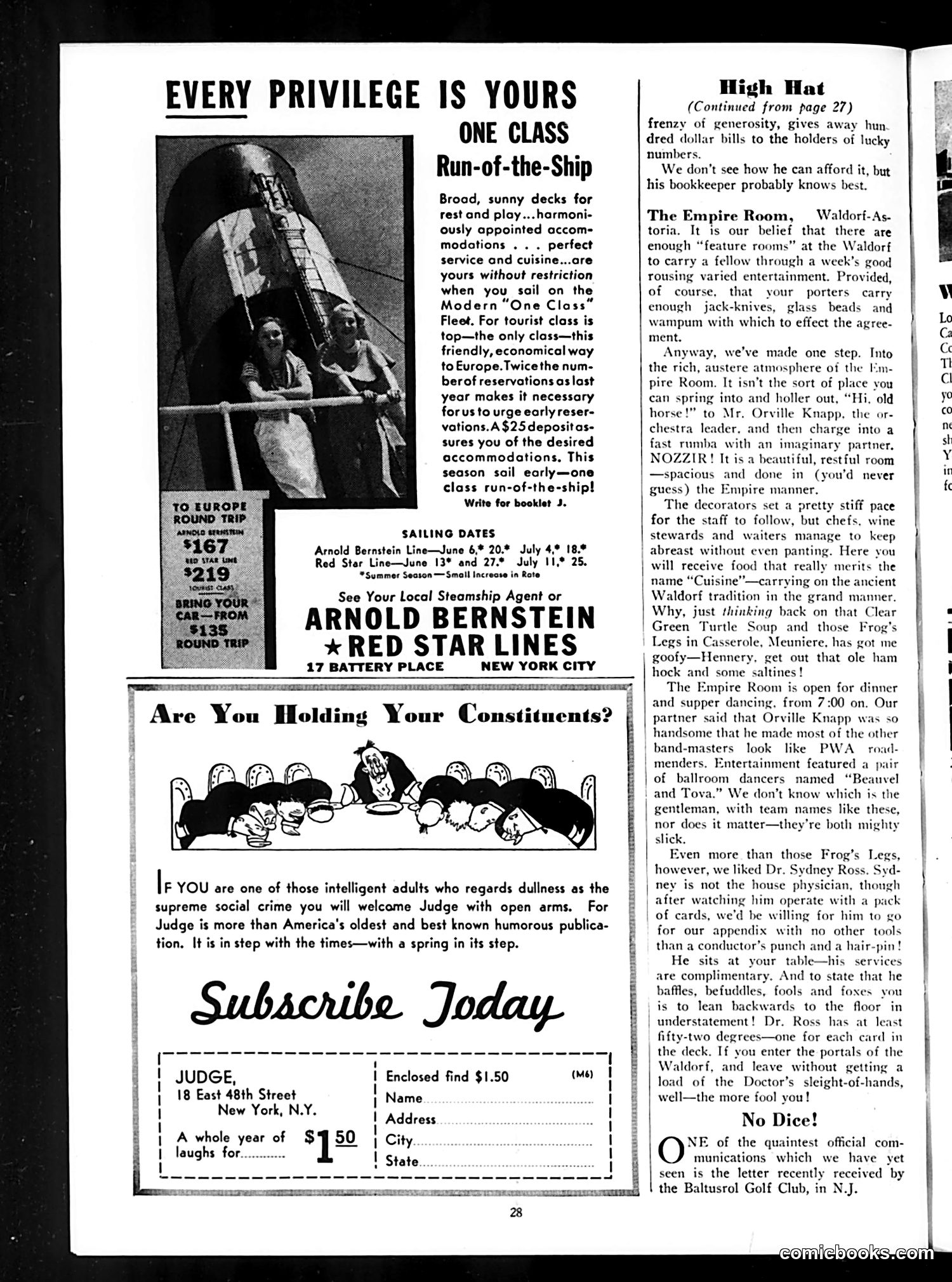
Analysis of Judge Magazine Page Content This page primarily consists of advertisements and subscription promotions rather than satirical cartoons requiring historical interpretation. The main content includes: 1. Arnold Bernstein/Red Star Lines cruise ship ad — promoting "one class" transatlantic travel, emphasizing democratized luxury for middle-class tourists 2. Judge magazine self-promotion — subscribing for $1.50/year, marketed as America's "oldest and best known humorous publication" with contemporary relevance 3. "High Hat" column (continued from previous page) — lifestyle commentary on upscale Manhattan venues like the Waldorf-Astoria's Empire Room, describing entertainment, food, and a magician named Dr. Sydney Ross The single cartoon shown ("Are You Holding Your Constituents?") depicts figures at a dining table but lacks sufficient context visible here for detailed interpretation. The page reflects 1930s consumer culture and aspirational entertainment journalism rather than pointed political satire.
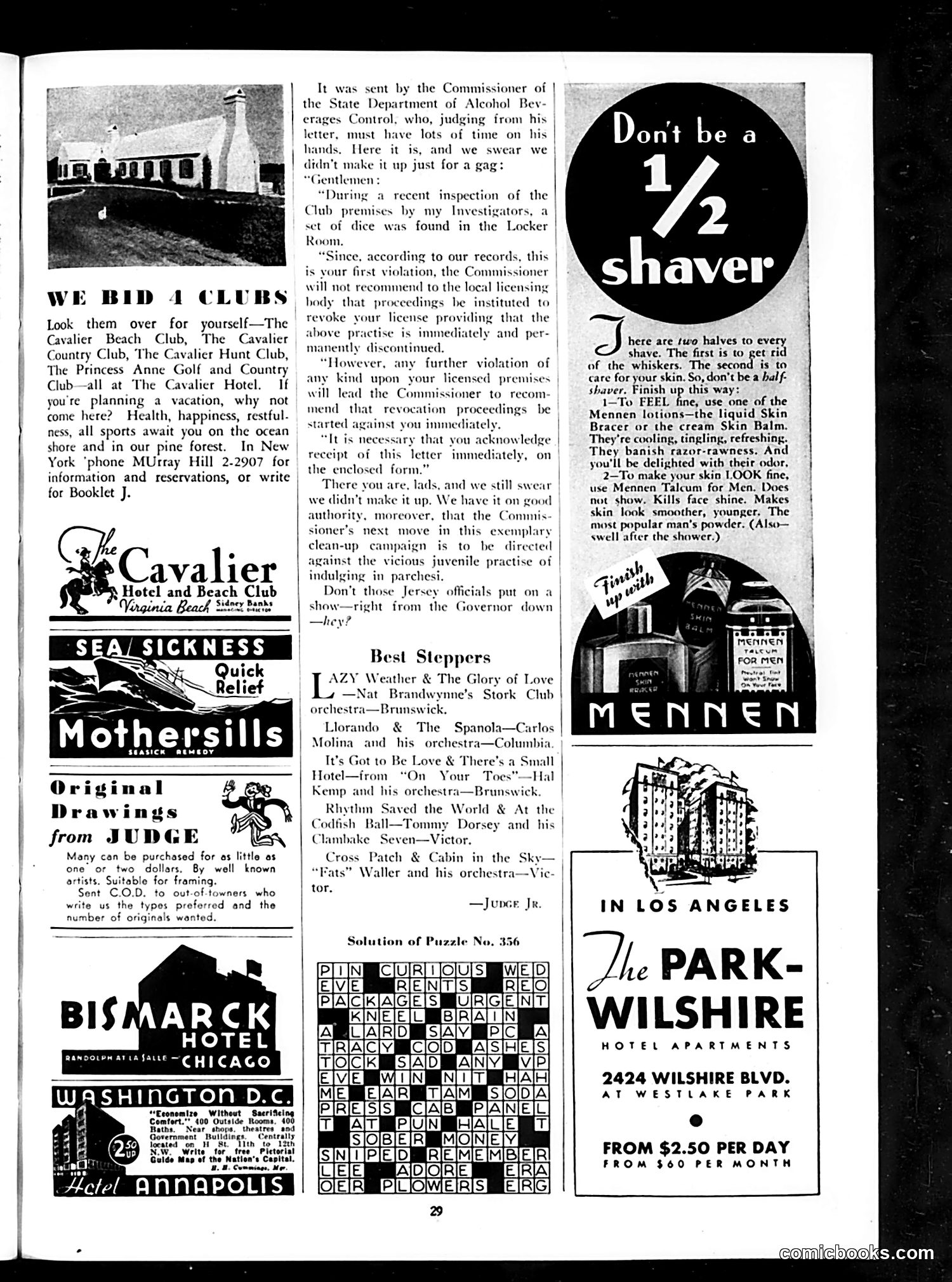
Judge Magazine Page Analysis This page is primarily advertising and entertainment listings, with one satirical letter as the main content. The satire centers on a humorous letter from a New Jersey alcohol beverage regulator threatening a club over finding dice in the locker room—treating a minor gambling violation with absurdly bureaucratic seriousness. The joke mocks overzealous government officials conducting petty crackdowns during Prohibition era enforcement, with the Commissioner threatening license revocation for dice while the author sarcastically notes the official's next target will be "parchesi" (a children's board game). The letter's pompous, verbose tone amplifies the satire. The rest of the page comprises: - Advertisements for the Cavalier Hotel resort (Virginia Beach) - Mothersills seasickness remedy ad - Hotel advertisements (Bismarck, Annapolis, Park-Wilshire) - A Mennen shaving products ad with grooming advice - "Best Steppers" (orchestra/band listings) - A crossword puzzle solution - Original Judge cartoon drawings for sale No specific political figures are caricatured; the satire targets bureaucratic overreach generally.
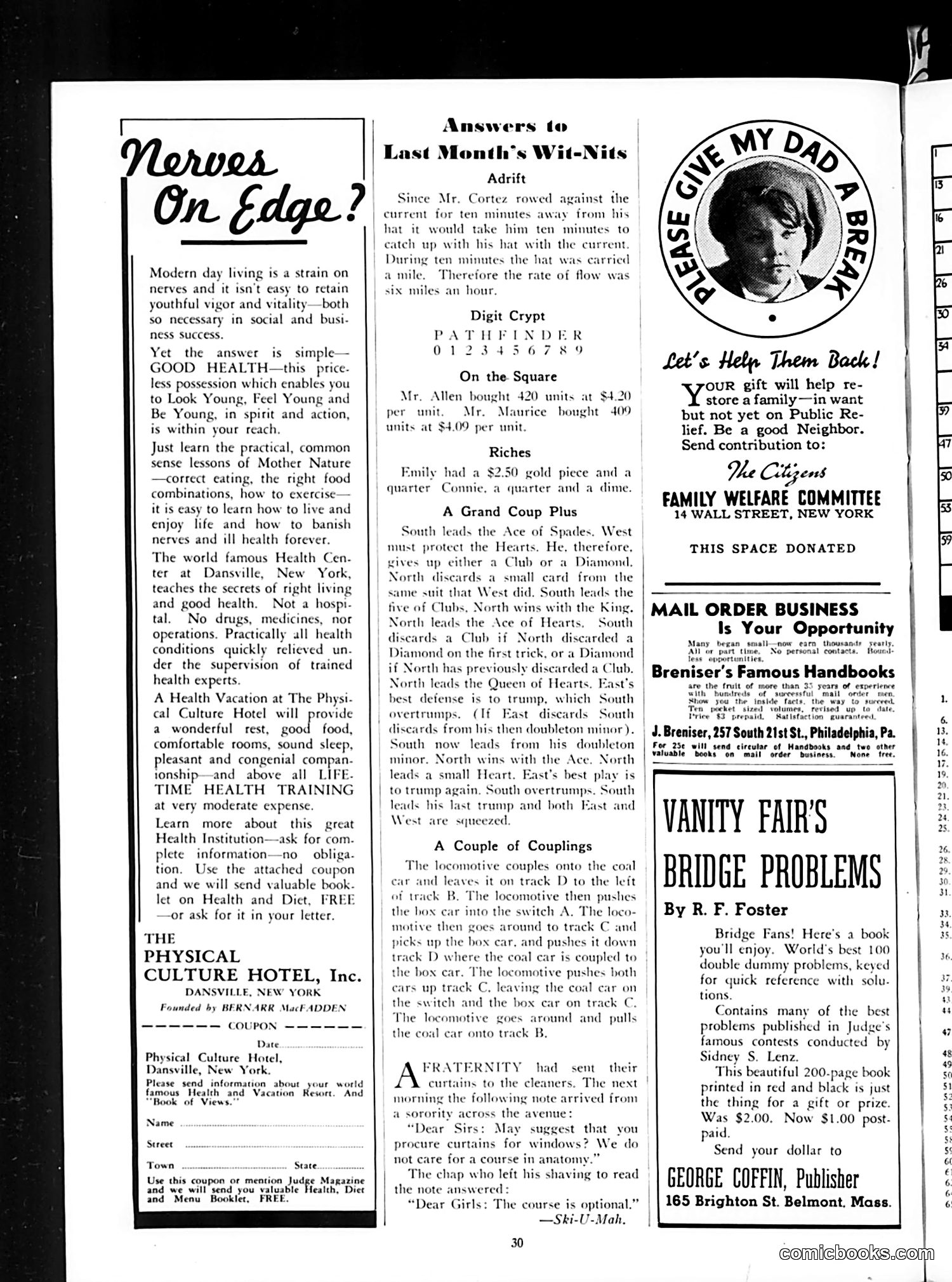
A Public Health Advertisement Masquerading as Magazine Content This page is primarily advertising for the Physical Culture Hotel in Dansville, New York—a health resort promising rejuvenation through proper diet and exercise rather than medicine or surgery. The large "Nerves On Edge?" section pitches the hotel as a cure for modern stress-related fatigue, claiming to teach "Mother Nature" principles of living. The page includes answer keys to puzzle-games (mathematics and bridge problems), typical of puzzle magazines of this era. There's also a charitable appeal box asking readers to support the Family Welfare Committee, and advertisements for mail-order handbooks and bridge problem books. The one cartoon element appears to be the "Fraternity" joke at bottom, a brief humorous anecdote about sorority curtains being sent to cleaners—typical light social humor. Overall, this is a magazine page blending editorial content, advertisements, and mild humor typical of early-20th-century Judge magazine.
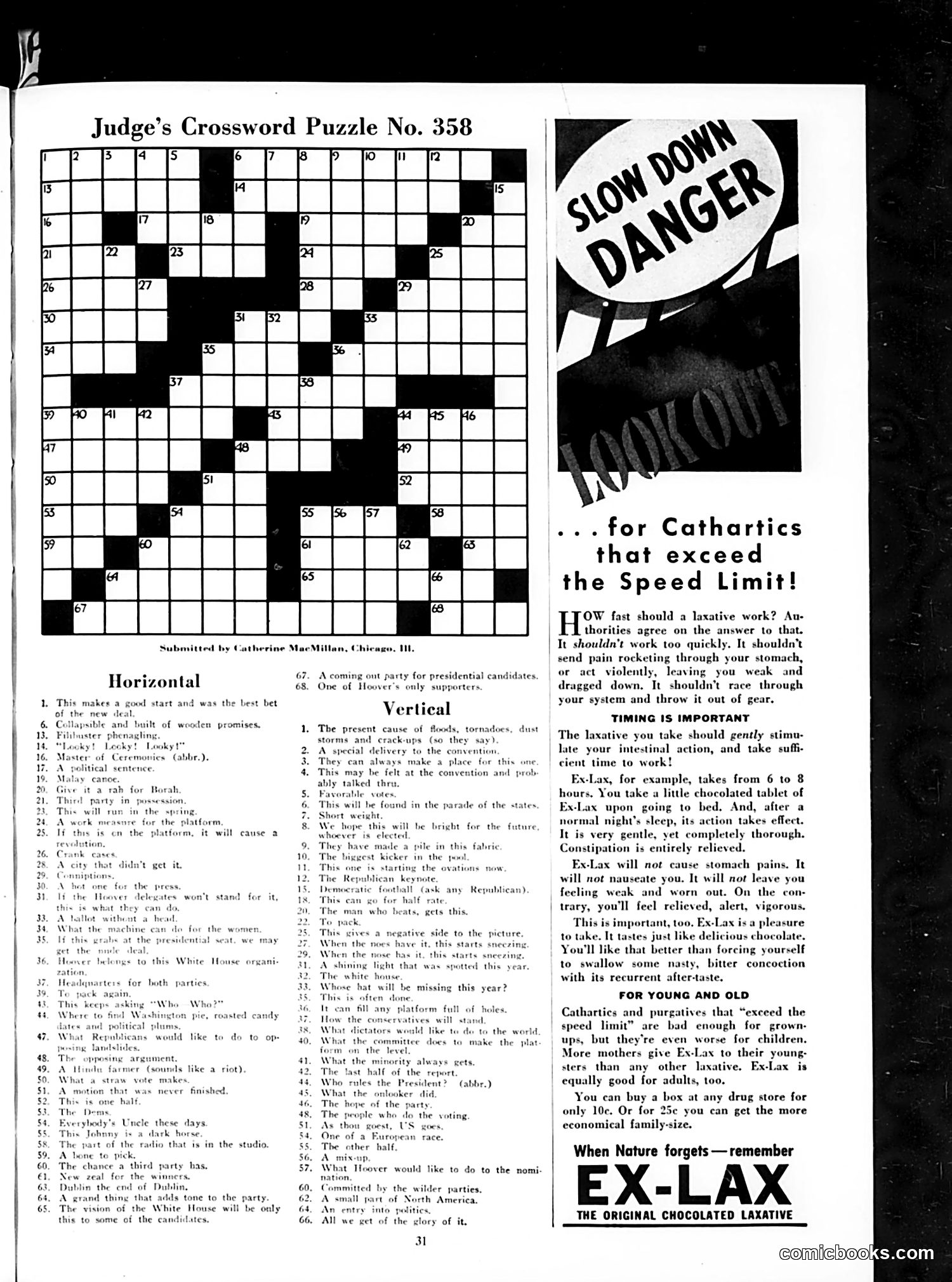
Judge Magazine Crossword & Advertisement Analysis This page contains a crossword puzzle (No. 358) with political clues referencing the 1928 presidential election, submitted by Catherine MacMillan of Chicago. The clues reference Hoover, presidential candidates, party platforms, conventions, and political machinery of that era. However, the page is primarily an advertisement for Ex-Lax laxative. The ad uses a "Slow Down Danger" warning graphic to argue that fast-acting laxatives are problematic—they cause pain, weakness, and digestive disruption. Ex-Lax, by contrast, works gently over 6-8 hours. The advertisement emphasizes safety for children and positions Ex-Lax as the superior choice, available at drugstores for 10¢ or 25¢ for family size. The juxtaposition of political content with a laxative ad is typical of Judge magazine's satirical format, mixing news commentary with commercial messaging.
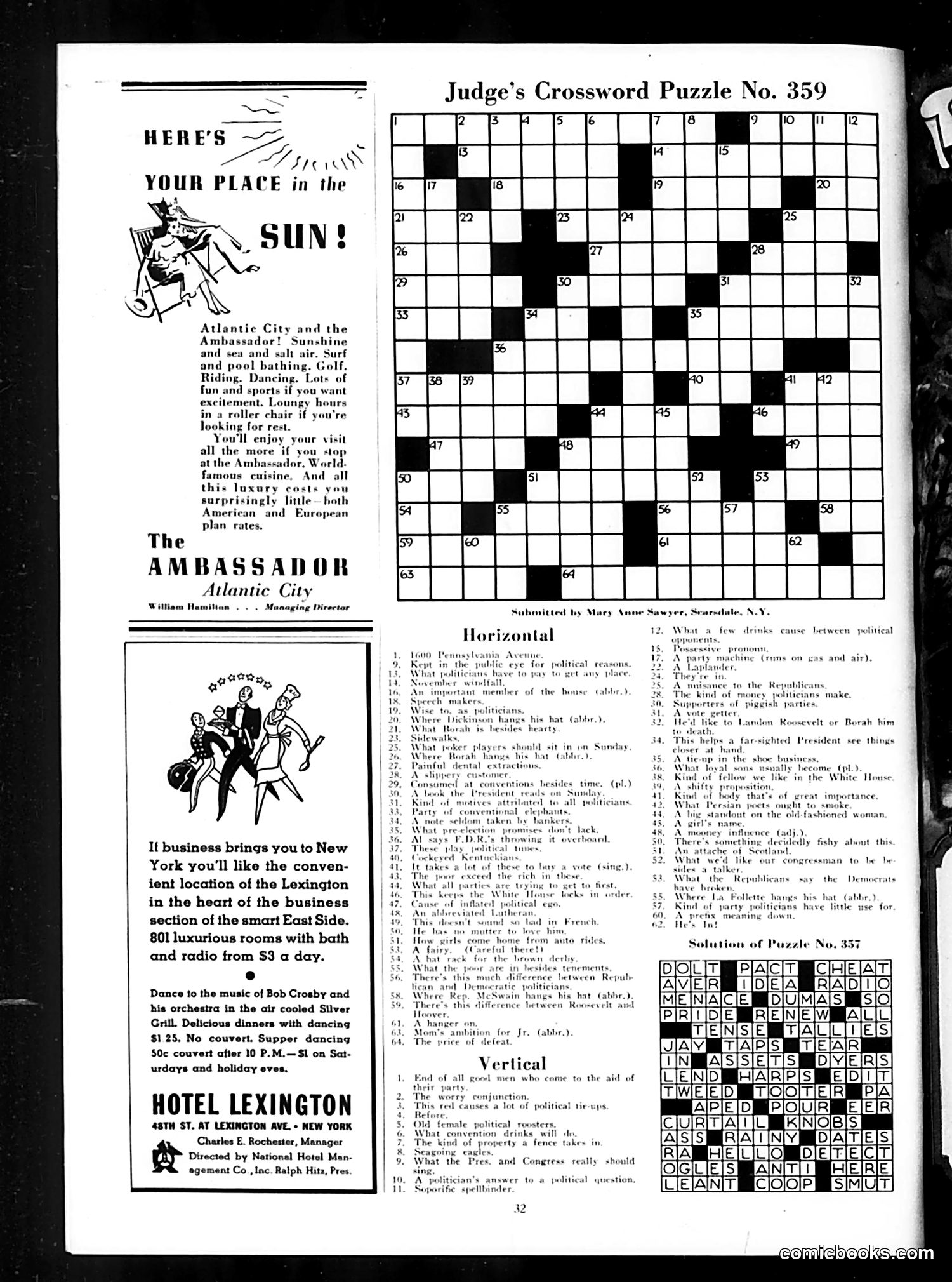
Analysis of Judge Magazine Page No. 359 This page is primarily advertising and a crossword puzzle, not satirical content. The advertisements promote hotels (The Ambassador in Atlantic City, Hotel Lexington in New York) and entertainment venues, typical of Judge's commercial pages from this era. The crossword puzzle itself contains political references in its clues—the OCR text mentions Roosevelt, Republicans, and "politicians" generically—but these are standard puzzle fodder rather than pointed satire. The small illustration showing dancing figures at top-left appears to be decorative advertising copy for the hotels' entertainment venues and dining options. Context for modern readers: This page reflects pre-WWII American leisure culture and the magazine's dual function as satirical commentary *and* commercial vehicle. The political references in the puzzle hint at contemporary partisan divisions, but without seeing the full puzzle solution, specific satirical targets remain unclear.
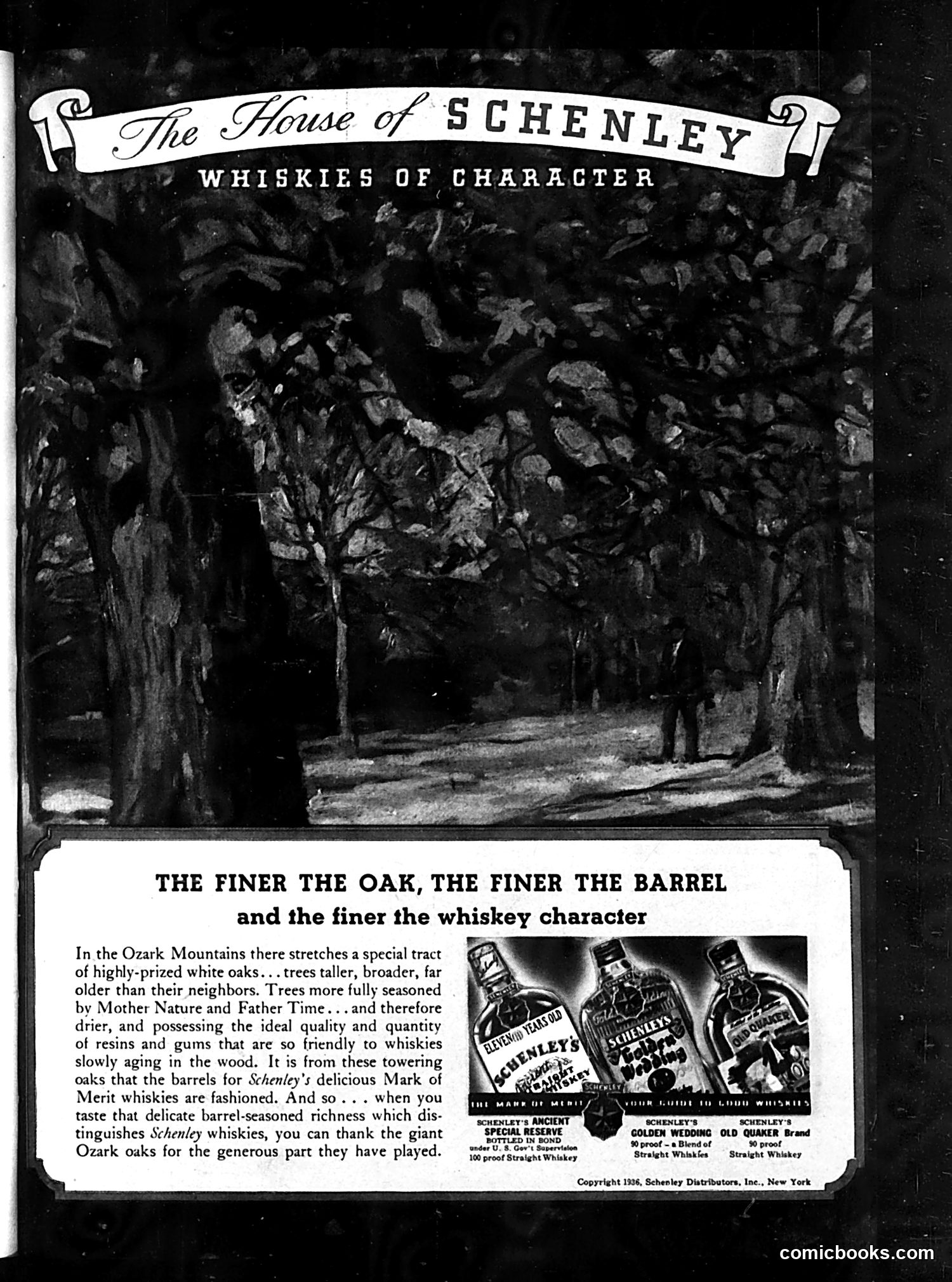
This is an Advertisement, Not Political Satire This page is a product advertisement for Schenley whiskey, not a political cartoon or satirical content. It appears in *Judge* magazine but serves as paid promotional material rather than editorial commentary. The ad promotes Schenley's "Mark of Merit" whiskey line by emphasizing the quality of Ozark oak barrels used in production. The text uses romantic, pseudo-scientific language about "Mother Nature and Father Time" seasoning trees to suggest superior craftsmanship and natural quality. Three whiskey bottle labels are displayed: Schenley's Special Reserve, Golden Wedding, and Old Quaker brands, all marketed as straight whiskeys. Historical context: This appears to be from the 1930s-40s, when whiskey advertising was common in magazines. The emphasis on barrel-aging and oak quality reflects legitimate production differences, though the flowery marketing language was typical of mid-century advertising.
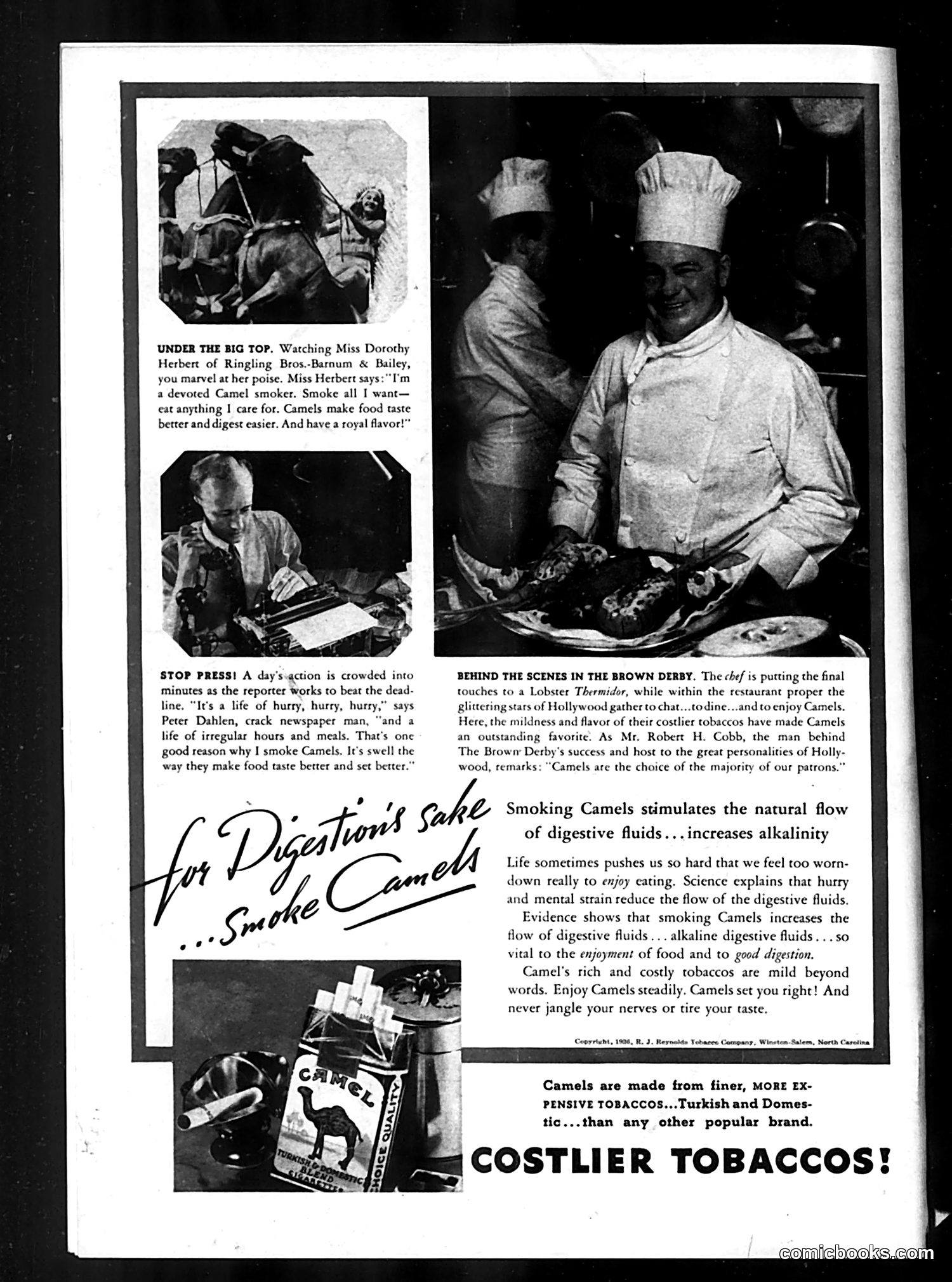
Analysis This page is primarily advertising, not satire. It's a Camel cigarette advertisement disguised as editorial content from Judge magazine. The "cartoons" are actually three lifestyle vignettes featuring celebrities endorsing Camels: a circus performer (Dorothy Herbert), a newspaper reporter (Peter Dahlen), and the owner of the Brown Derby restaurant in Hollywood (Robert H. Cobb). Each testifies that smoking Camels aids digestion and allows them to work through demanding schedules. The advertisement's central claim—that smoking stimulates digestive fluids and improves digestion—represents a now-discredited health pitch common in early 20th-century tobacco marketing. The ad exploits period anxieties about modern life's stress ("hurry, hurry, hurry") to position cigarettes as a wellness solution. This reflects pre-FDA regulation advertising practices, when tobacco companies could make unsubstantiated health claims. Modern readers should recognize this as misleading marketing that predates consumer protection laws.

I can see this is a heavily degraded black and white page, likely from Judge magazine, but the image quality is too poor for me to reliably identify specific cartoon content, figures, or caricatures. While I can make out what appears to be multiple illustrated faces or heads arranged on the page, the details are too obscured by age, darkness, and image degradation for me to accurately describe the political or social references, identify who the figures represent, or explain the satirical intent. To provide accurate historical context as requested, I would need a clearer, higher-contrast version of this page. I apologize that I cannot fulfill your request with this particular image.