judge
Judge — July 1936
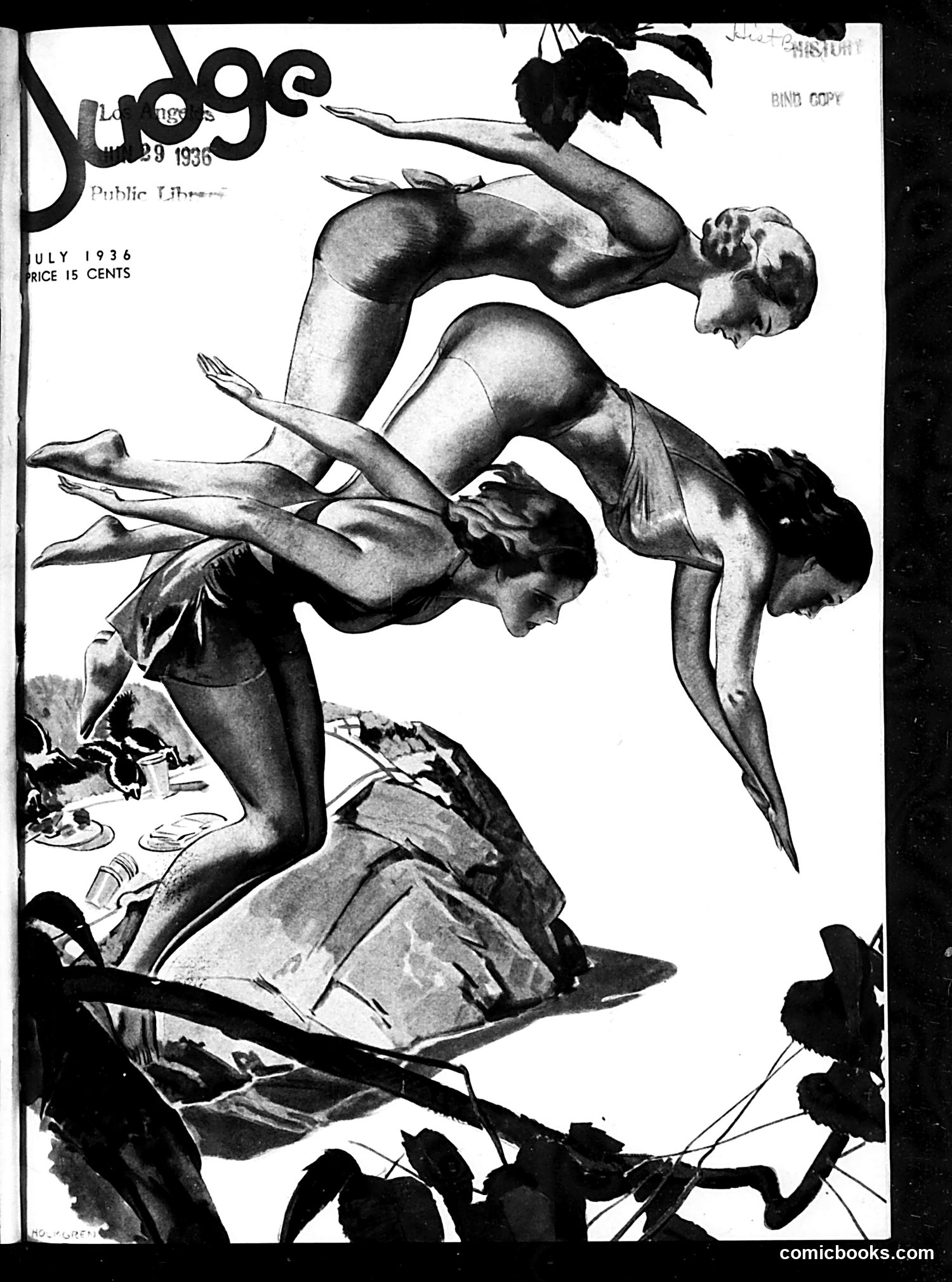
Judge Magazine, July 1936 This page appears to be primarily advertising or cover art rather than political satire. The image shows three figures in a tropical or beach setting with stylized poses among foliage and what appears to be beach gear. Without clear identifying text or captions visible in the image, I cannot definitively identify the specific figures or determine what social/political commentary, if any, this represents. The art style is consistent with 1930s illustration, and the tropical setting suggests either vacation/leisure themes or possibly a commentary on escapism during the Depression era. The "PRICE IS CENTS" notation and July 1936 dating are visible, but additional context from surrounding page content would be needed for accurate interpretation of any satirical intent.
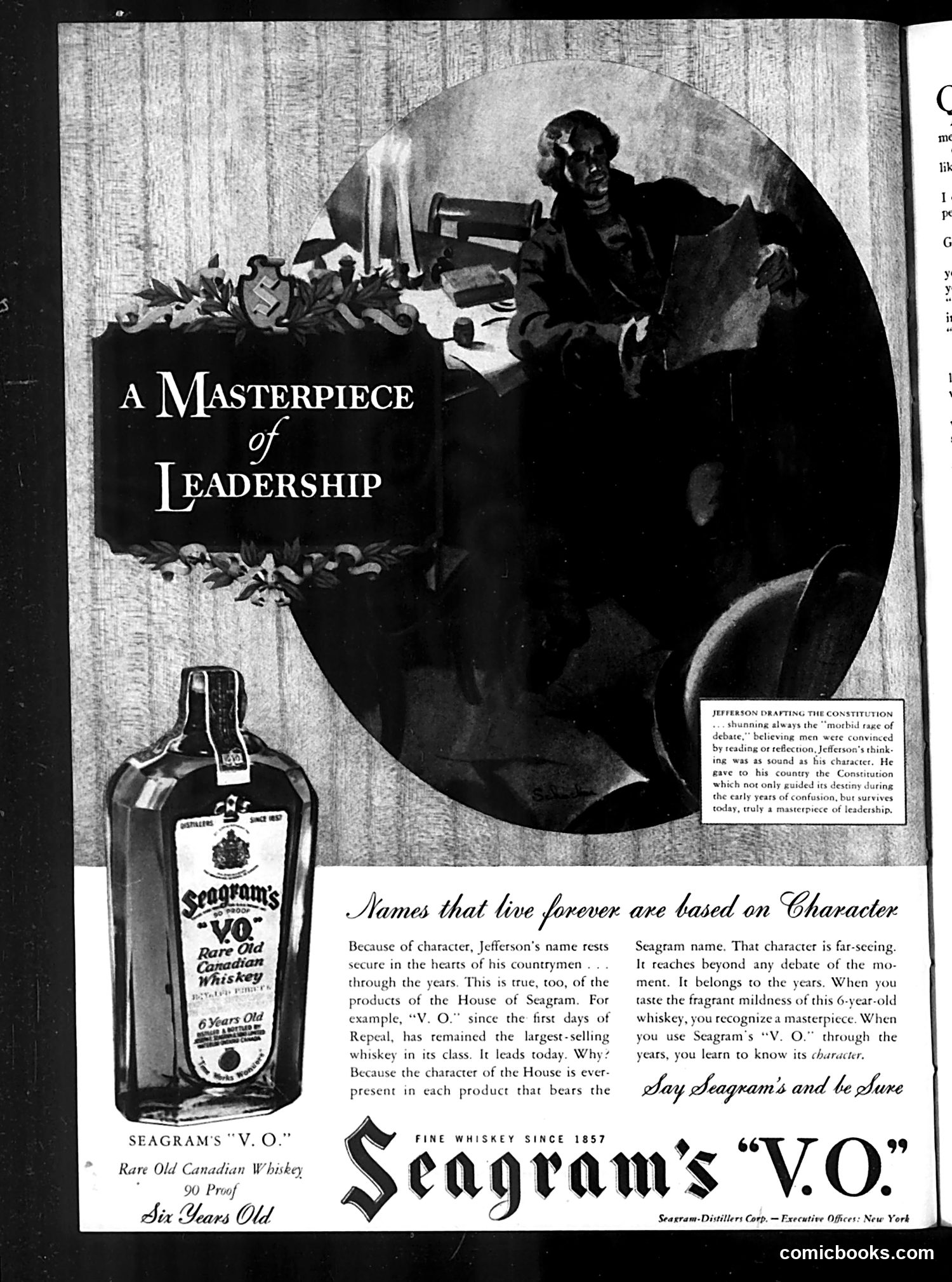
Analysis This page is primarily a Seagram's whiskey advertisement, not satire or political commentary. The top illustration labeled "A Masterpiece of Leadership" appears to reference Thomas Jefferson drafting the Constitution, used metaphorically to associate Seagram's whiskey with American founding ideals and careful craftsmanship. The accompanying text claims that Jefferson's character—like Seagram's "V.O." whiskey—endures through time because of inherent quality. The ad argues that both Jefferson's reputation and Seagram's whiskey brand survive because of their fundamental "character." This is advertising rhetoric using historical gravitas to sell liquor. There is no actual political cartoon or satire present—it's purely commercial messaging leveraging American historical imagery to suggest the product embodies principled excellence.
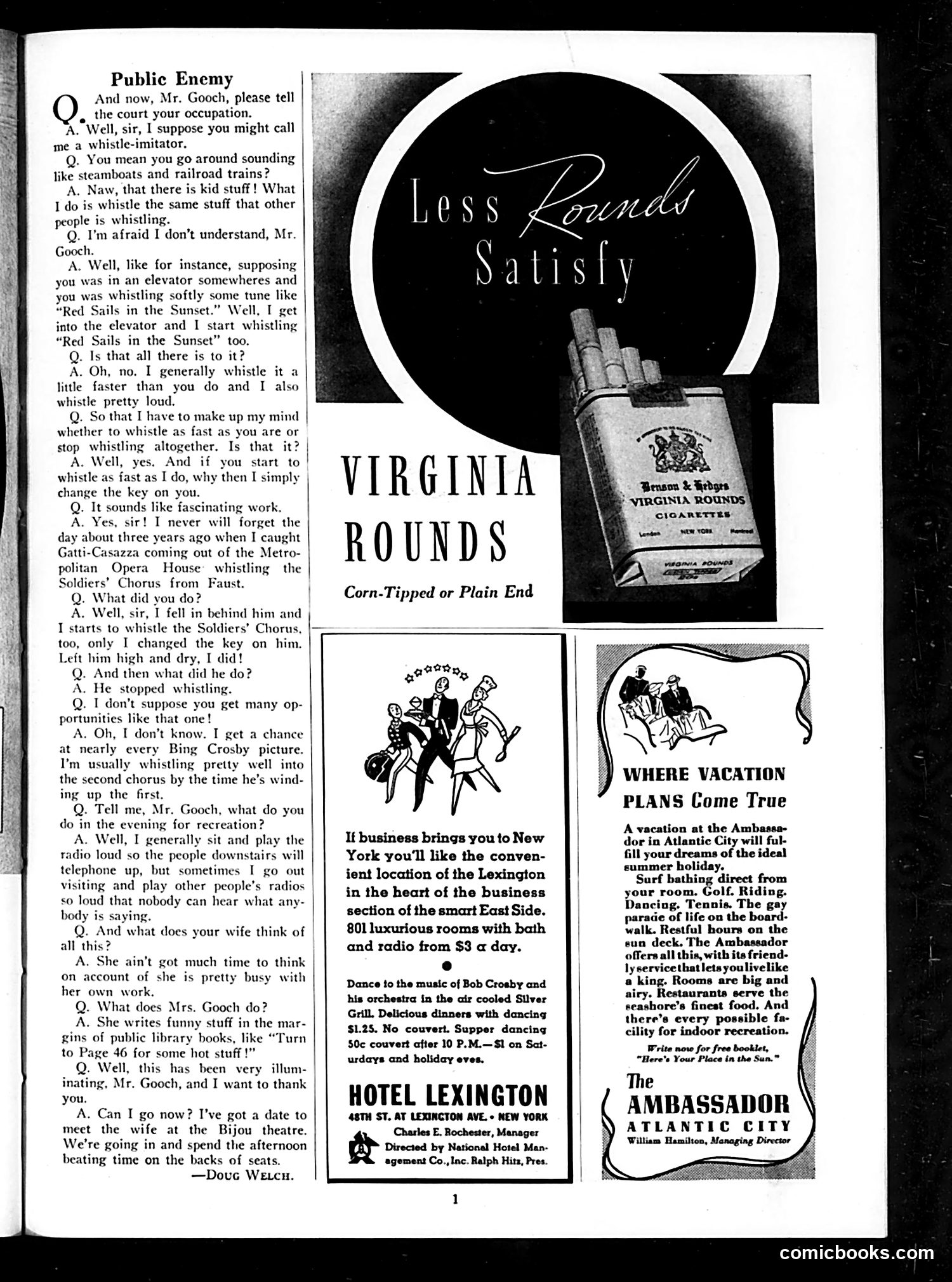
Page Analysis This page is primarily advertising with minimal editorial content. The left column contains a humorous Q&A interview with "Mr. Gooch," a "whistle-imitator" who recreates sounds of steamboats and trains by whistling. The interviewer asks about his techniques and modest career opportunities. The satire is gentle: Gooch represents a vaudeville-era novelty performer with a peculiar, niche talent. The humor derives from treating his whistling act with mock-seriousness through formal courtroom-style questioning. The page features three advertisements: Virginia Rounds cigarettes (with "Less Rounds Satisfy" slogan), Hotel Lexington in New York, and The Ambassador hotel in Atlantic City. These dominate the page's content, indicating this is primarily a commercial rather than editorial issue.
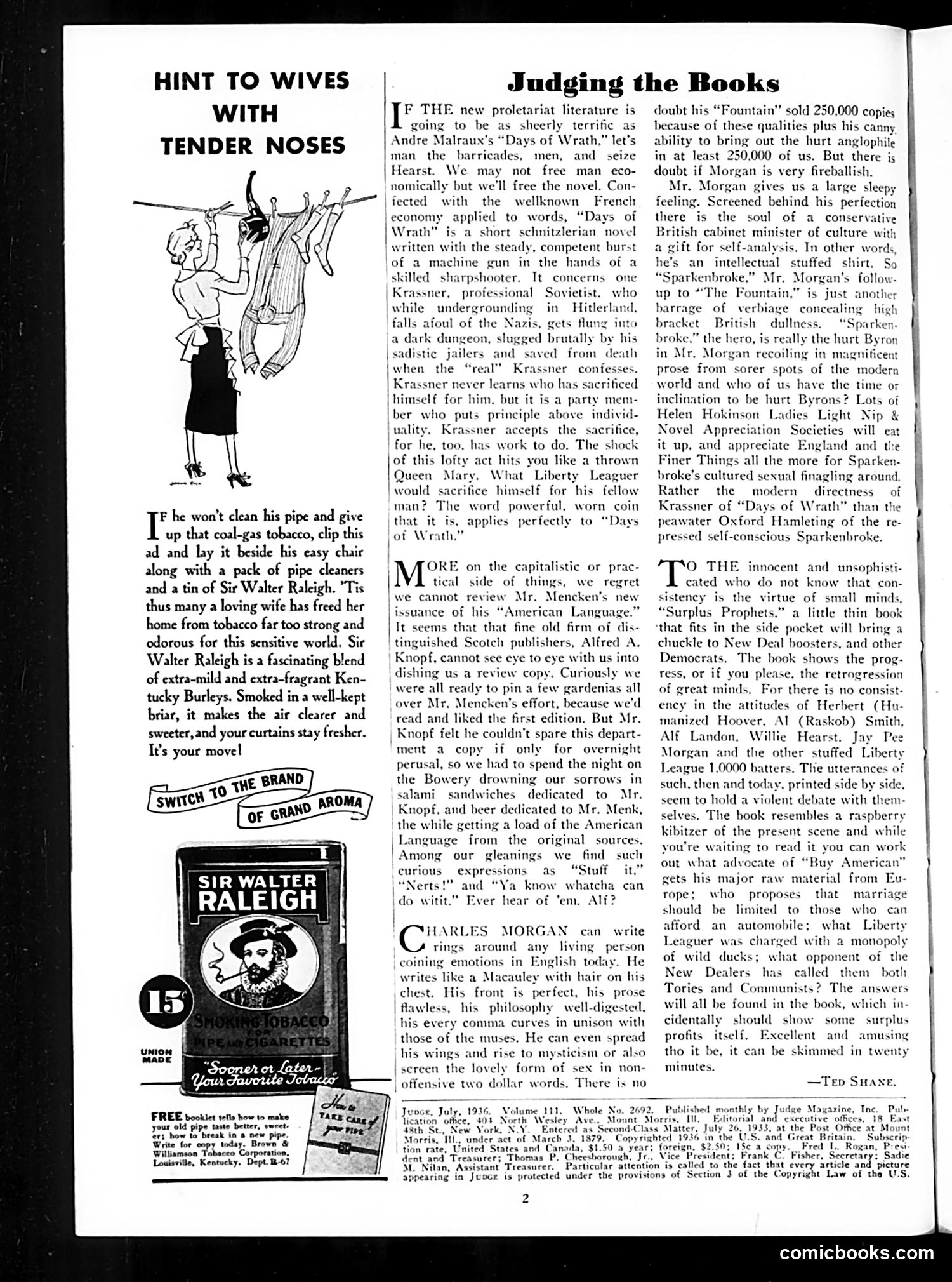
Analysis of Judge Magazine Page (July 1936) This page contains book reviews and a cigarette advertisement, not political cartoons. The left side features a humorous illustration titled "Hint to Wives with Tender Noses"—a comic drawing of a woman clothespinning her nose while hanging laundry, satirizing wives' complaints about pipe tobacco smell. The accompanying text humorously suggests Sir Walter Raleigh cigarettes as a solution, claiming they're less odorous than pipes. The right side reviews three books: André Malraux's "Days of Wrath," Mr. Meneken's "The American Language," and Charles Morgan's work. The reviews discuss literary merit and social commentary typical of 1930s intellectual discourse. The primary content is advertising and literary criticism rather than political satire, reflecting Judge's mixed editorial-commercial format during this period.
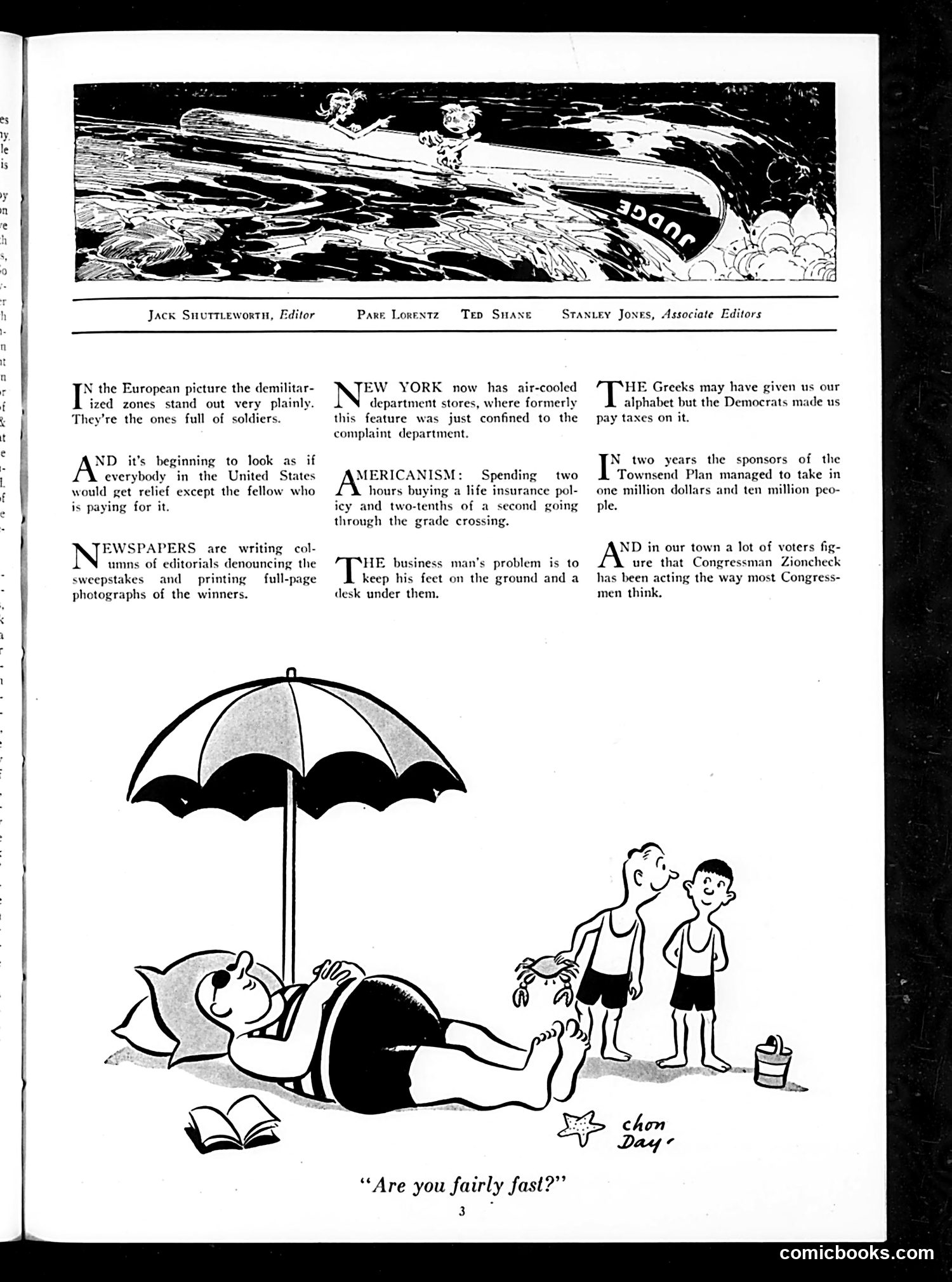
Analysis This page from *Judge* contains political commentary and a cartoon. The text snippets mock various targets: European militarism, American consumerism (the "Americanism" joke about expensive purchases), Democratic taxation policy, newspaper sensationalism around sweepstakes, and Congressional representative Zioncheck's political behavior. The main cartoon, titled "Are you fairly fast?" by Chon Day, depicts a man lying under an umbrella on a beach, apparently napping or sunbathing, while two children stand nearby. The joke appears to satirize either parental laziness during summer recreation or, less clearly, may reference a period when beach activities were becoming more accessible to working-class Americans. The humor relies on visual irony rather than explicit political commentary.
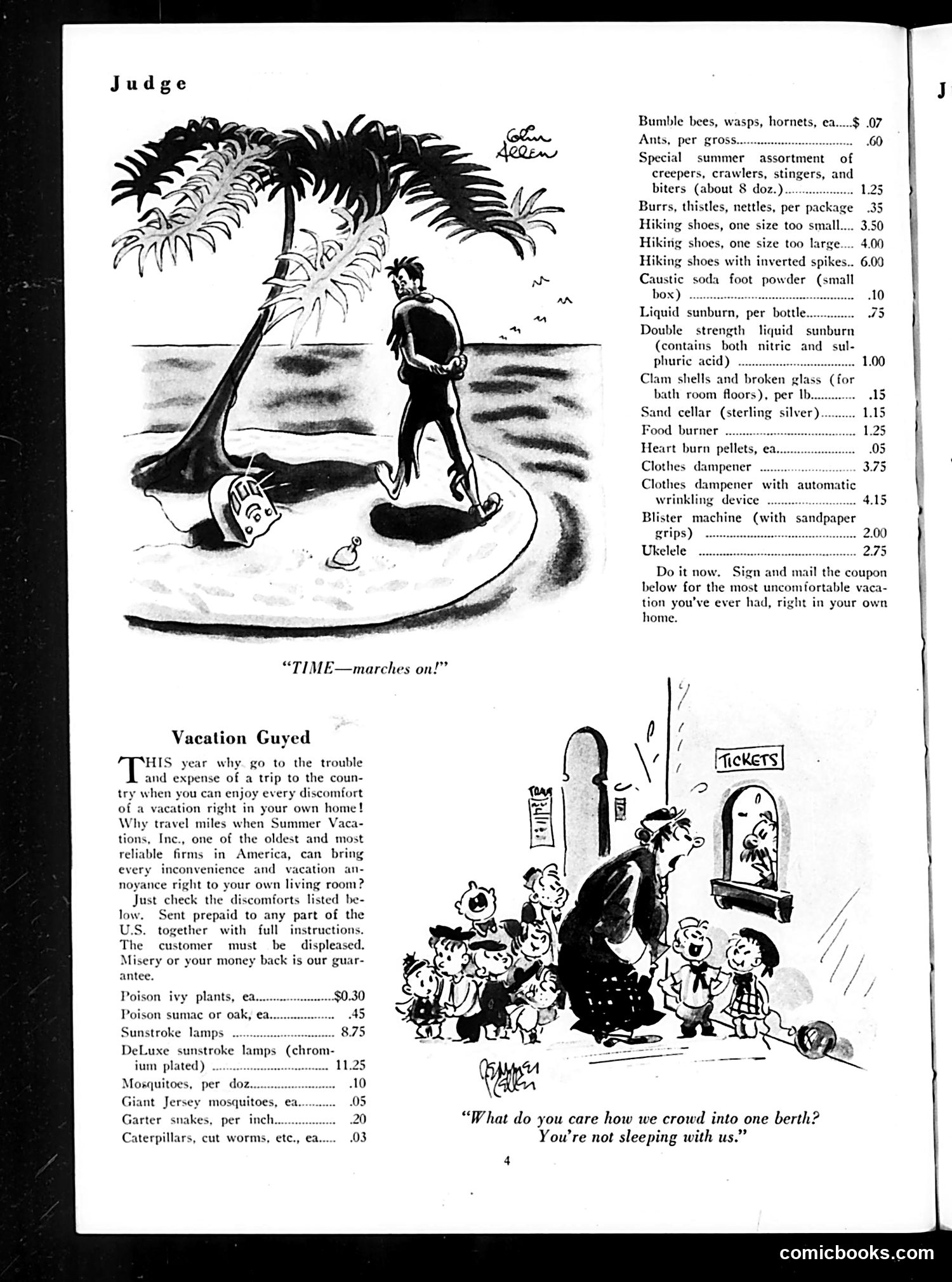
Analysis of Judge Magazine Page This page contains two distinct elements: a satirical cartoon titled "TIME—marches on!" and an advertisement for "Vacation Guyed" by Summer Vacations, Inc. The top cartoon depicts a man stranded on a desert island with a palm tree, apparently marooned with only a bottle labeled "TIME" as company. The satire comments on how time passes slowly during isolation or tedium—a commentary on the subjective experience of boredom. The lower section advertises a vacation service offering to deliver various "discomforts" to customers' homes, including poison ivy plants, mosquitoes, sunstroke lamps, and other annoyances. This is satirical commentary on poorly planned vacations, suggesting that traveling creates more problems than staying home. The accompanying cartoon shows an overcrowded travel scenario, mocking vacation chaos and overcrowding at popular destinations.
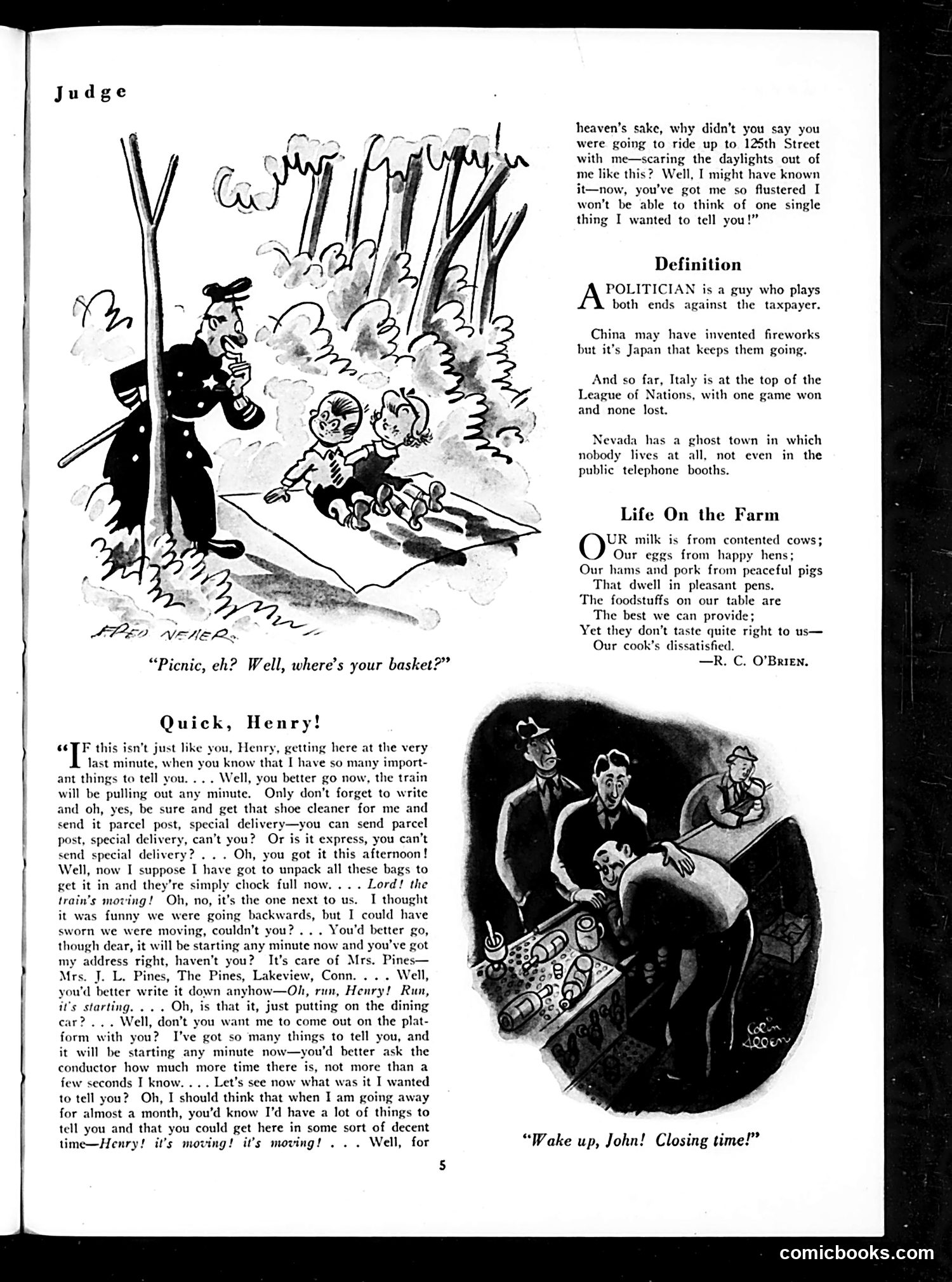
Explanation of Judge Magazine Page The top cartoon depicts a judge figure wearing military regalia supervising children's activities, captioned "Picnic, eh? Well, where's your basket?" This appears to satirize judicial or governmental overreach into ordinary civilian life—suggesting authorities intrusively monitoring routine activities. The "Quick, Henry!" section is a lengthy domestic humor piece about a harried husband dealing with last-minute moving preparations, showcasing everyday marital comedy typical of early 20th-century Judge magazine. The bottom cartoon, "Wake up, John! Closing time!", shows men in what appears to be a bar or tavern being asked to leave, likely satirizing Prohibition-era enforcement or drinking culture. The "Definition" and "Life On the Farm" sections contain brief satirical quips and verse—standard Judge filler content mocking politicians and rural life.
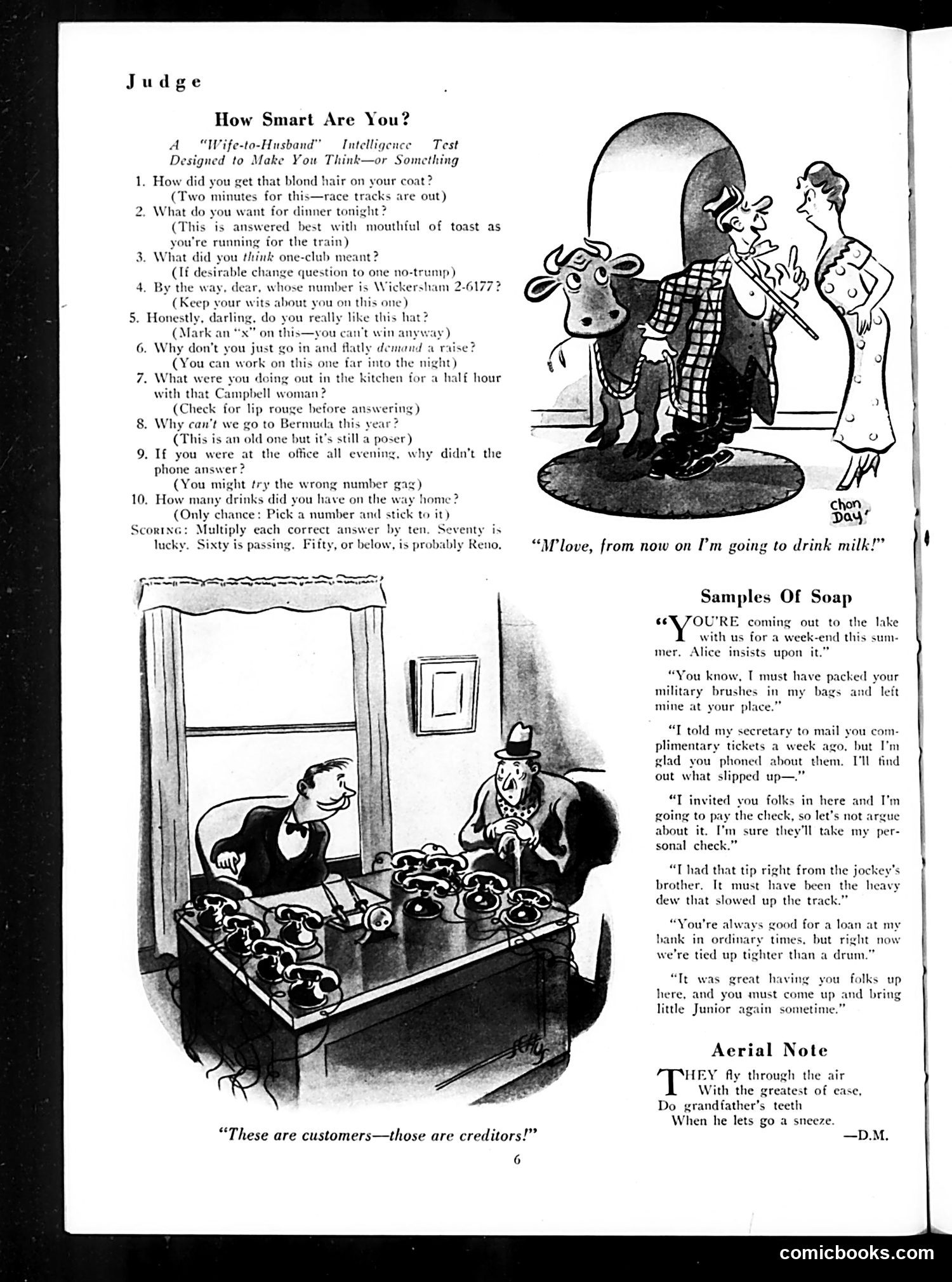
Analysis of Judge Magazine Page This page contains three distinct items of humor: "How Smart Are You?" is a "Wife-to-Husband Intelligence Test"—a quiz with deliberately absurd or unanswerable questions (like "whose number is Wickersham 2-6177?"). The scoring system acknowledges most answers are guesses, satirizing the popular intelligence tests gaining prominence in the early 20th century. "These are customers—those are creditors!" shows a shopkeeper distinguishing between paying customers and people owed money, likely commenting on Depression-era economic hardship when distinguishing between actual sales and outstanding debts became crucial. "Samples of Soap" and "Aerial Note" are brief humorous dialogues/verses with no clear political reference—simply period entertainment. The page primarily satirizes intelligence testing trends and economic struggles through humor rather than direct political commentary.
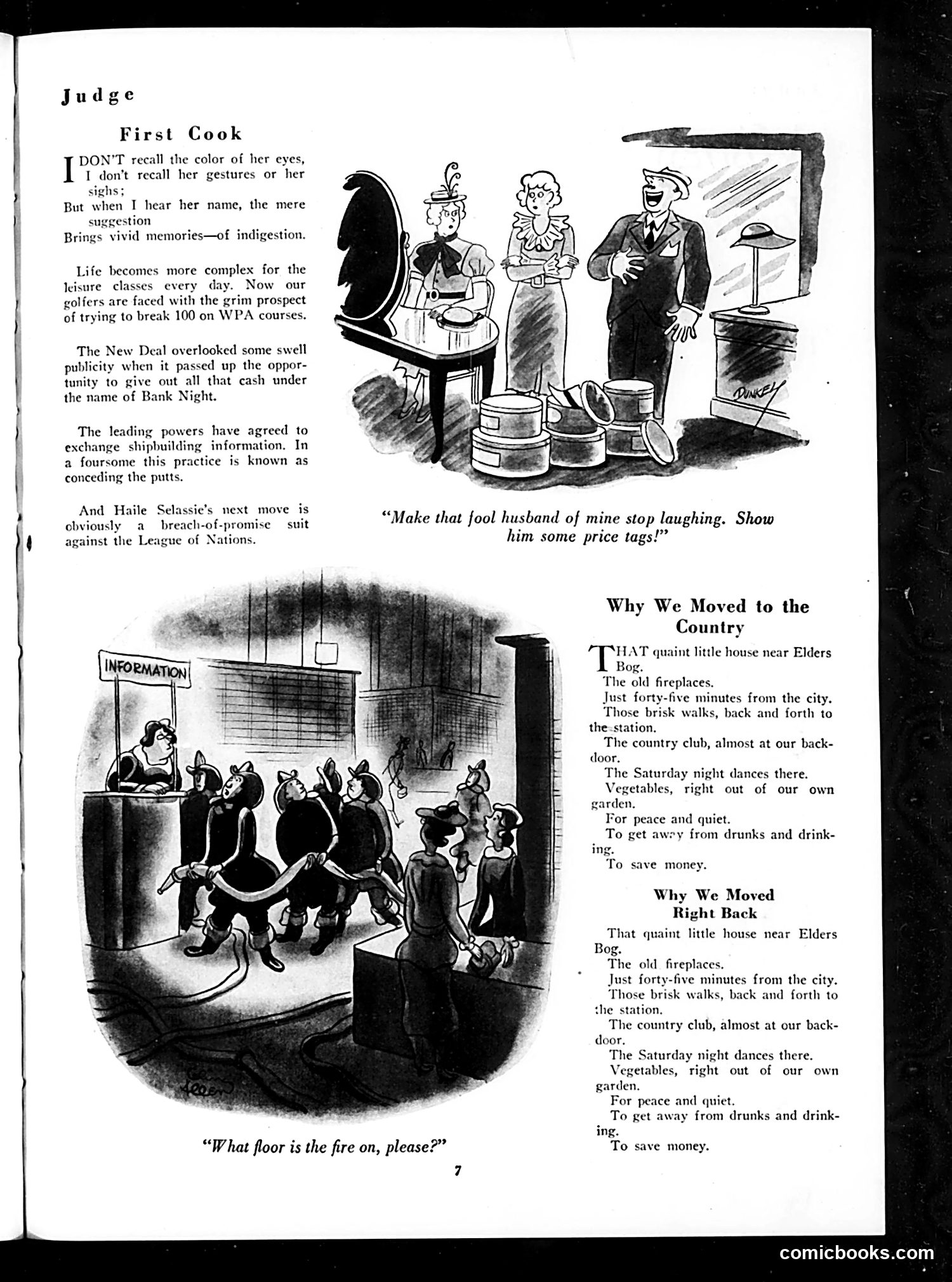
Explanation for Modern Readers This Judge magazine page contains three satirical pieces: "Judge First Cook" mocks the leisure class during the New Deal era. The cartoon shows a woman at a piano while others laugh—the joke being that hearing her name triggers memories of indigestion, suggesting she's a terrible cook despite her upper-class status. The lower cartoon satirizes government bureaucracy: crowds ask an "Information" clerk "What floor is the fire on, please?"—implying New Deal agencies created such labyrinthine confusion that people couldn't find basic information during emergencies. "Why We Moved to the Country/Right Back" humorously lists identical reasons for both moving away from and returning to a country house, mocking the indecisiveness of wealthy urbanites chasing pastoral fantasies.
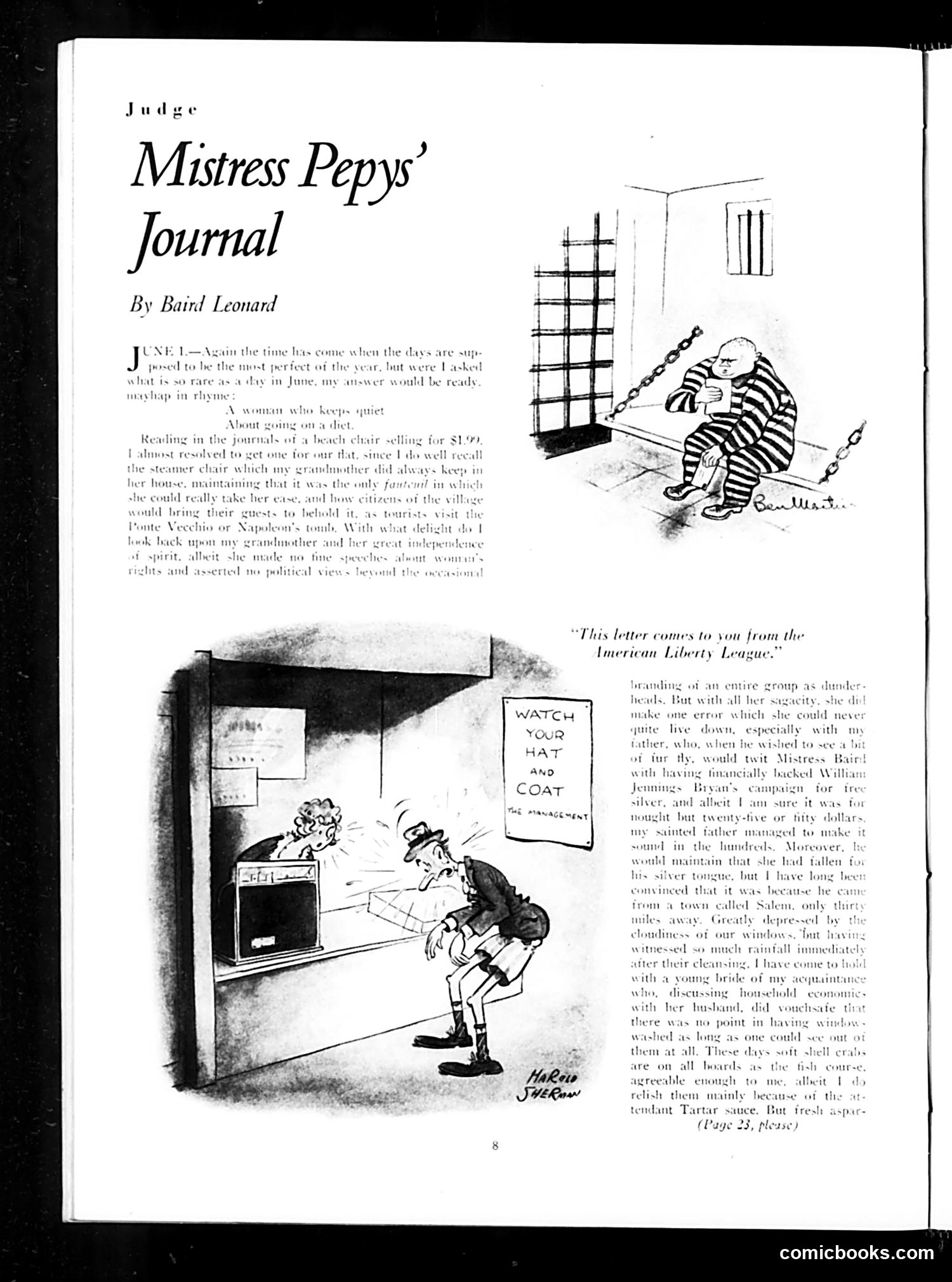
Mistress Pepys' Journal - Explanation for Modern Readers This is a humorous society column by Baird Leonard, presented as a "journal" entry mimicking the historical Samuel Pepys's diary style. The two cartoons illustrate anecdotes about upper-class domestic life and social hypocrisy. The text references the American Liberty League, a real anti-New Deal organization of the 1930s, using it satirically to mock the grandmother's conservative politics despite her family's financial struggles. The joke critiques wealthy elites who opposed social programs while benefiting from inherited wealth. The bottom cartoon shows a woman at a "Watch Your Hat and Coat" check, illustrating the era's concern with petty theft and social anxiety about servants or working-class people in public spaces. Overall, the piece gently satirizes upper-class pretension, financial contradiction, and domestic concerns of 1930s-era society women, using period-specific references to economic inequality and political attitudes that modern readers would need historical context to fully appreciate.
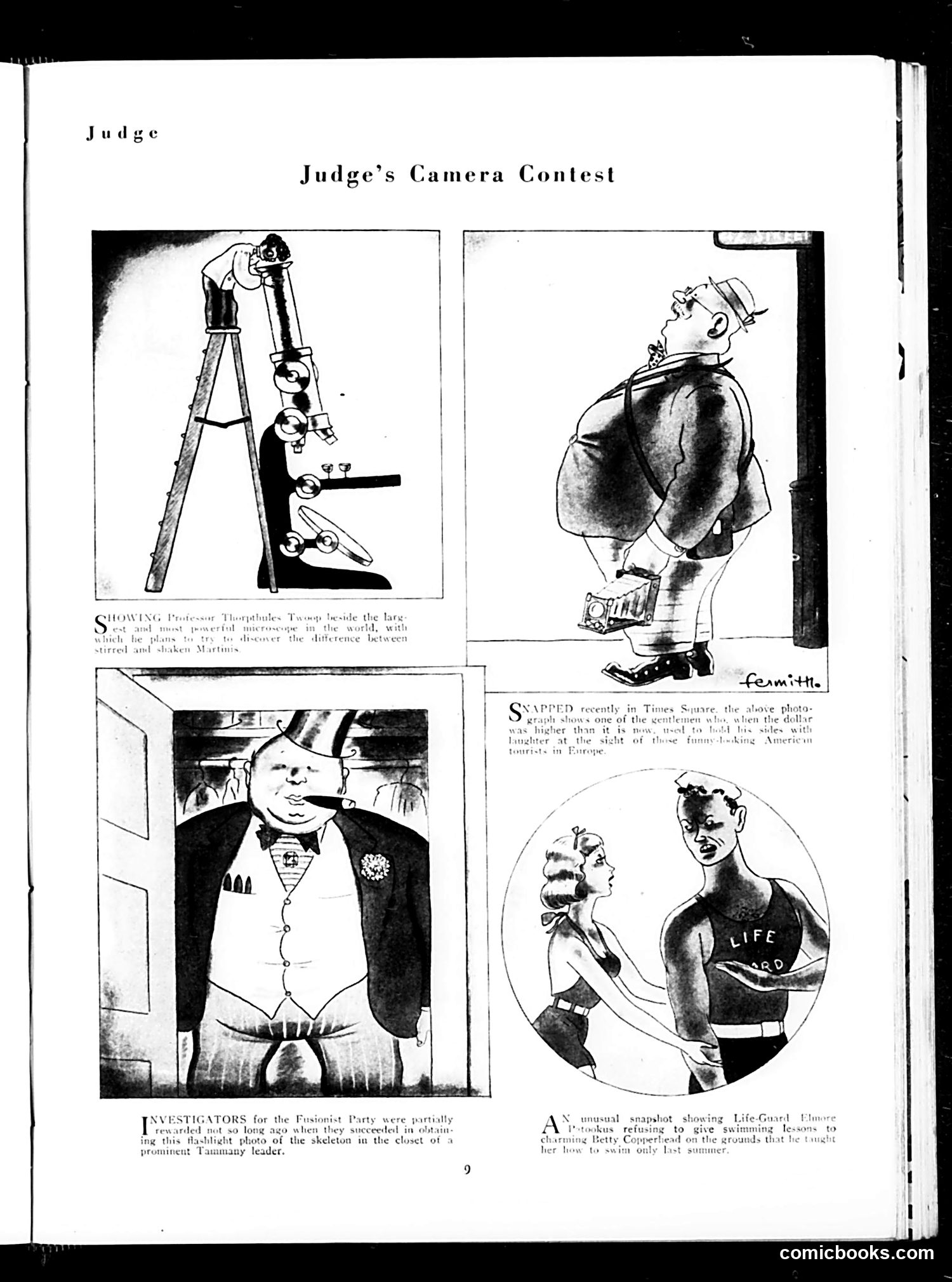
Judge's Camera Contest This page presents humorous photographs supposedly submitted to Judge magazine's camera contest, mocking their quality and subjects. The top left shows "Professor Thorndyke" demonstrating a microscope—likely satirizing scientific pomposity. Below, a rotund man in formal wear represents a failed flashlight photo contestant, captioned as capturing "one of the scarecrows in his closet." The right side features two circular photos: one shows a woman labeled as a "P-tracks refusing to give swimming lessons to charming Betty Copperhead on the grounds that he taught her to swim only last summer"—a joke about infidelity or scandal. The satire targets both amateur photographers' poor submissions and contemporary social figures, using exaggerated caricature to mock vanity, pretension, and scandalous behavior among the wealthy or prominent.
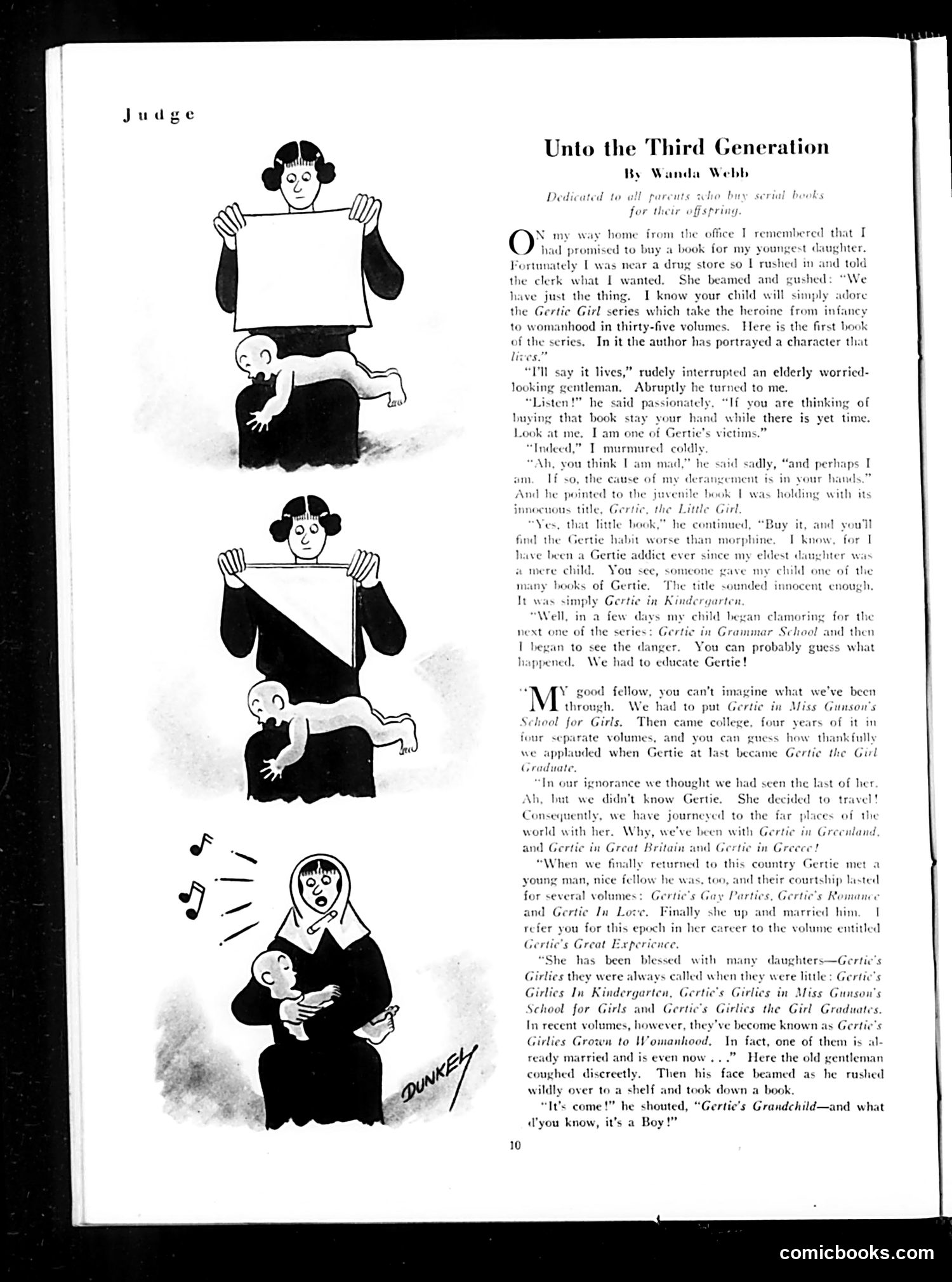
"Unto the Third Generation" - Judge Magazine This satirical piece mocks the runaway commercial success of the "Gertie Girl" book series—a real phenomenon of early 20th-century children's literature. The illustrations show the generational cycle: a judge figure holding increasingly larger books representing how the series expanded across decades. The joke: an exhausted elderly man encounters the author buying the *first* Gertie book for his daughter, and warns her it's a trap. He describes becoming a helpless "Gertie addict"—forced to purchase 35+ volumes following the character from infancy through womanhood, then her daughters' entire lives, and now her *grandchild's* story. Each life stage spawned multiple spin-off books (school, college, romance, travel, etc.). The satire targets both the publishing industry's profit-driven sequelization and parents' inability to resist buying these books for their children—creating a three-generation consumption cycle. The final punchline—the grandchild is a boy—suggests the series will continue indefinitely, spawning yet another line of books.
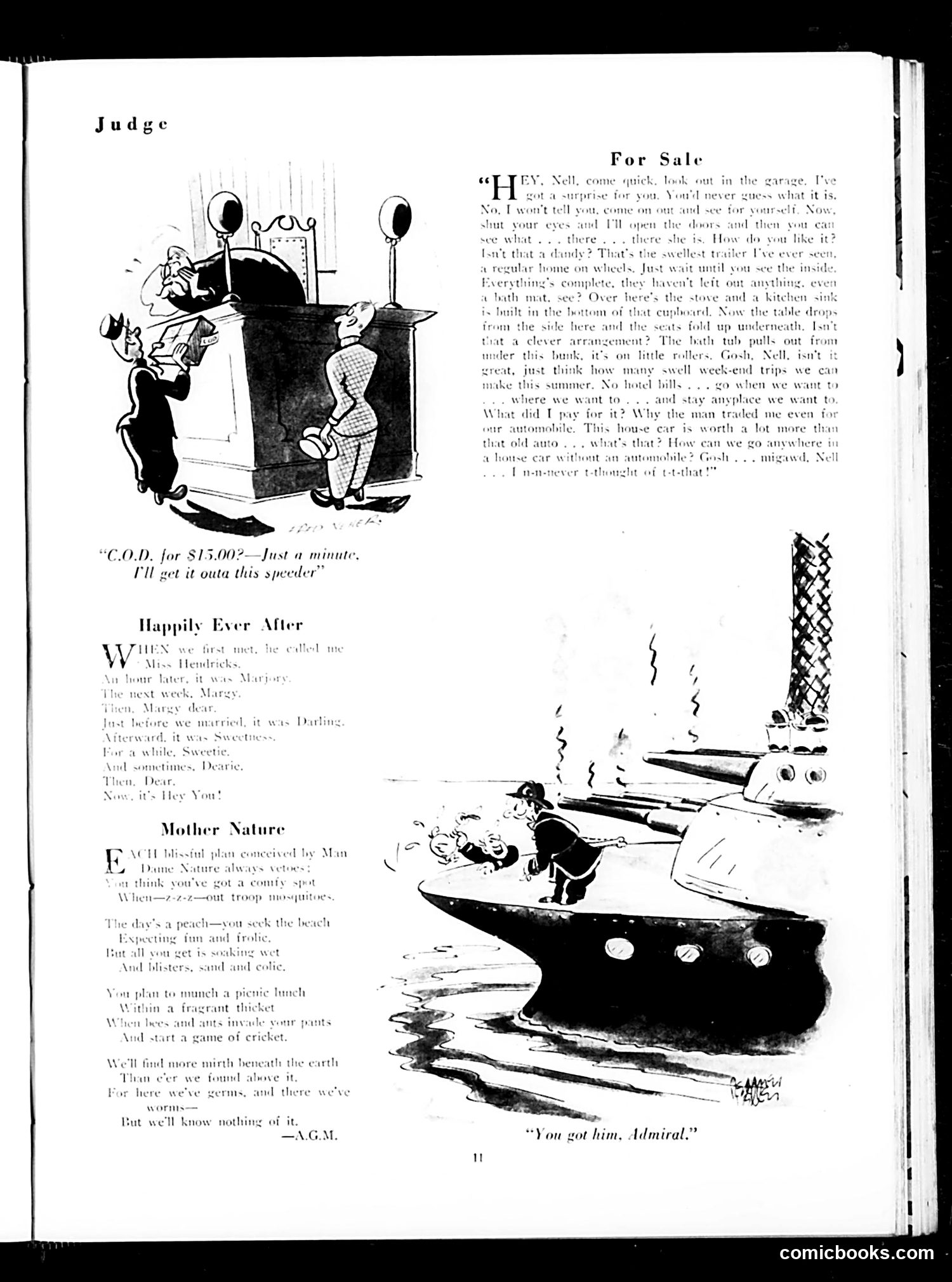
"For Sale" — Early 1920s Auto Satire This cartoon mocks the auto industry's aggressive marketing of the newfangled "house car" (mobile home). A salesman pitches an elaborate, multi-functional vehicle with fold-away furniture, built-in amenities, and convertible features—promising freedom and adventure. The joke: the buyer asks why he traded his automobile for this contraption, only to realize he can't go anywhere *without* an automobile. The satire targets both the salesman's circular logic and consumer gullibility—people buying impractical luxury gadgets they don't need. The accompanying cartoon shows a shipwreck with "You got him, Admiral"—its meaning is unclear without more context, possibly unrelated filler. The poems below ("Happily Ever After," "Mother Nature") are sentimental/humorous verse, typical Judge filler. Overall, this is middle-class consumer satire mocking post-WWI prosperity-driven marketing excess.
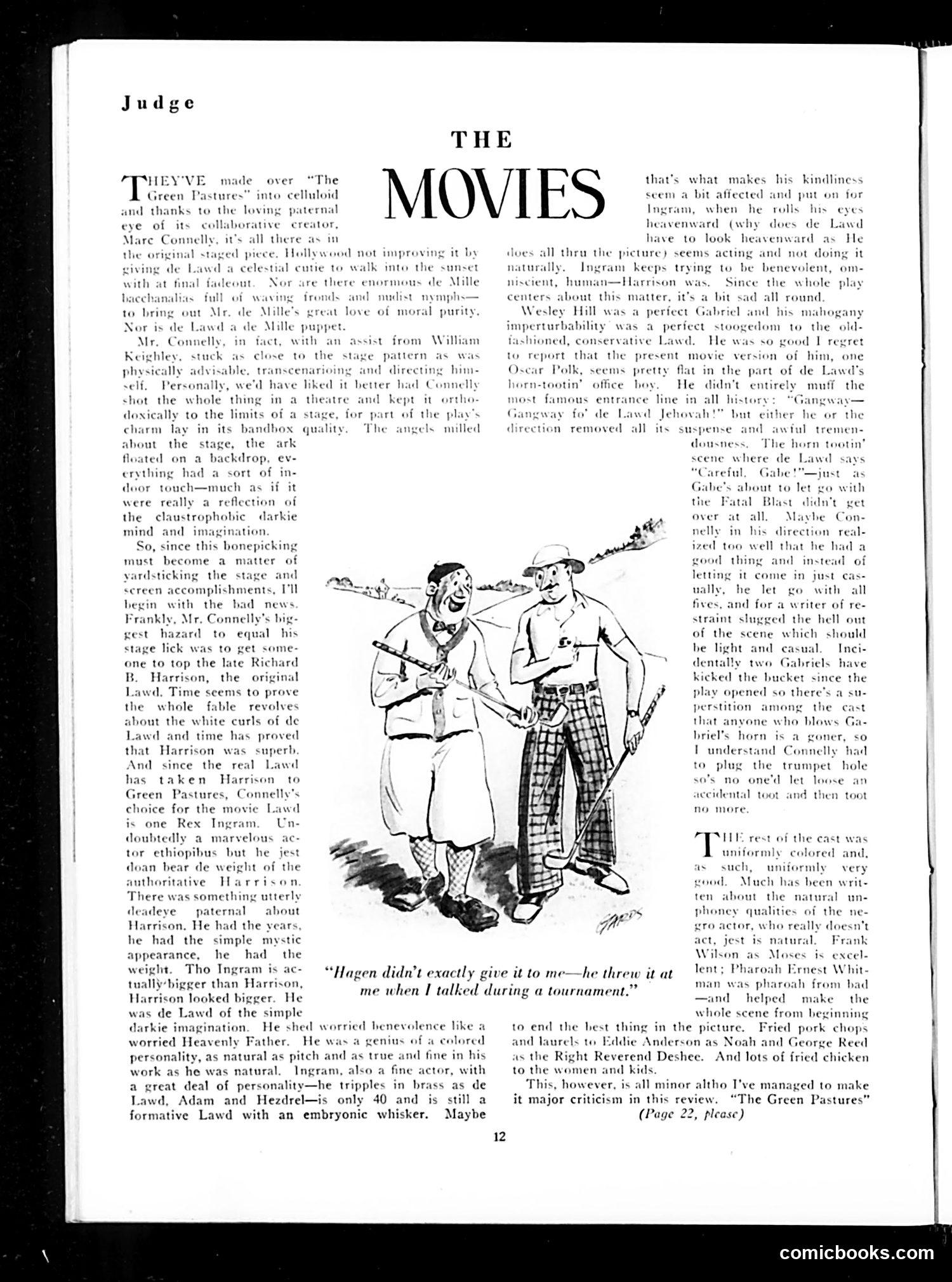
Explanation for Modern Readers This is a film review of the 1936 movie adaptation of "The Green Pastures," a play depicting biblical stories through African American vernacular and characters. The cartoon illustrates two characters, likely representing the film's treatment of the material. The reviewer criticizes director Marc Connelly's film version, comparing it unfavorably to the original stage production and especially to Richard B. Harrison, the original actor who played "de Lawd" (God). The review argues that Harrison possessed natural gravitas and authority that the film's replacement actor, Rex Ingram, lacks—appearing instead affected and overly theatrical. The review faults the direction for making scenes melodramatic rather than maintaining the play's lighter, more intimate quality. The critique reveals period attitudes: the reviewer uses now-offensive racial terminology ("darkie") while praising the play's authenticity, reflecting 1930s critical language and assumptions about African American artistic expression.
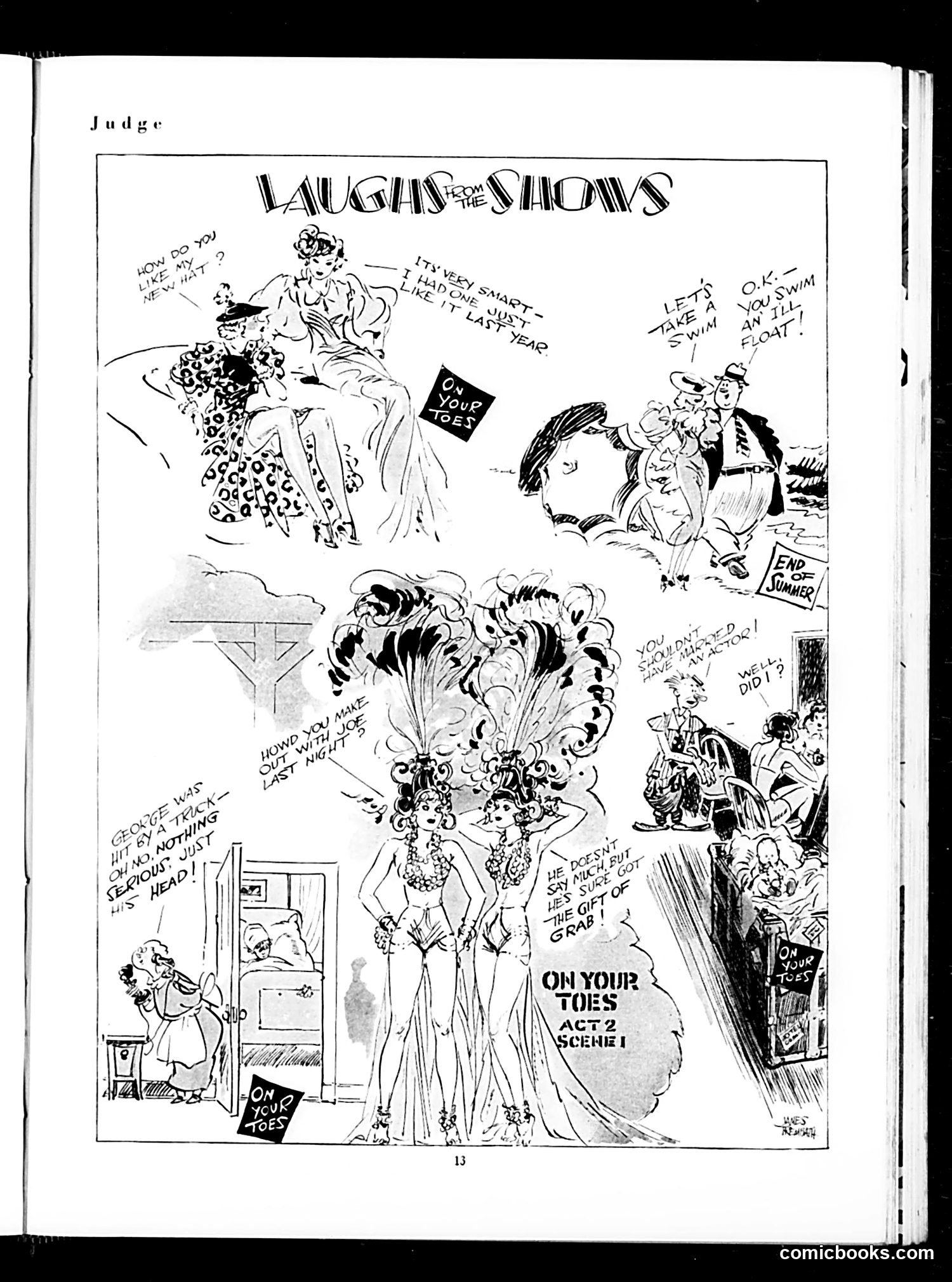
"Laughs of the Shows" - Judge Magazine Cartoon This is a theatrical satire page titled "Laughs of the Shows," collecting comic moments from stage productions. The central figure appears to be a showgirl in an elaborate feathered costume, with the repeated stage direction "ON YOUR TOES" marking different theatrical scenes. The cartoon mocks various Broadway entertainment through exaggerated character sketches and comedic dialogue bubbles. References include audience reactions ("Let's make a swim"), performer mishaps, and typical show business drama. The "End of Summer" notation suggests this captures the theatrical season's conclusion. The humor targets both performers' vanity and the absurdities of stage production—costumes, blocking issues, and backstage chaos. Without identifying specific 1920s-30s productions, the page satirizes entertainment industry pretensions and the gap between performers' expectations and actual performance reality.
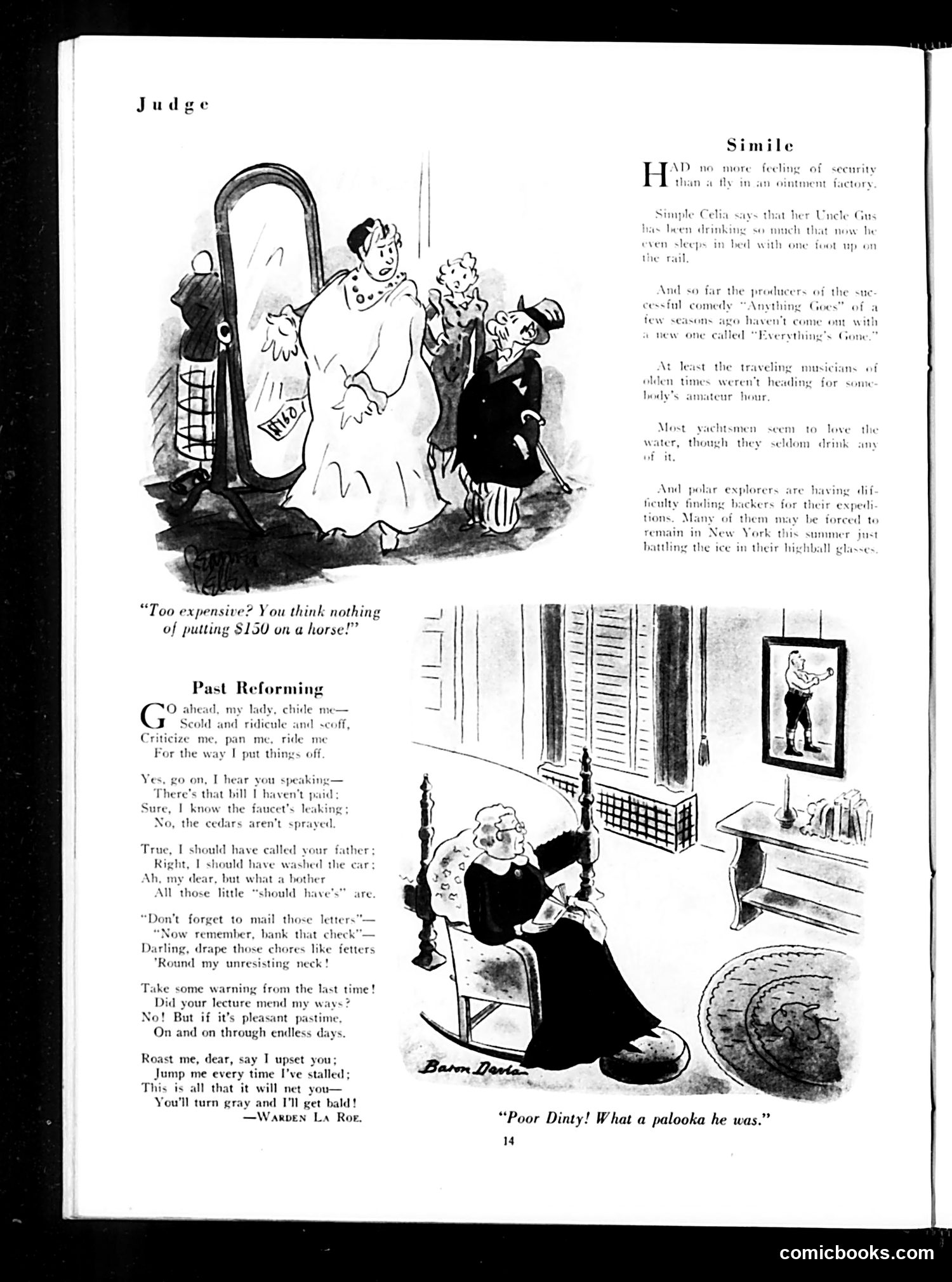
Judge Magazine Page Analysis This page contains two distinct pieces of humor: "Too Expensive? You Think Nothing of Putting $150 on a Horse!" A judge (wearing robes) lectures a woman about extravagance, likely regarding horse-racing betting. The satire targets wealthy individuals who gamble freely on horses while claiming poverty elsewhere—a commentary on class hypocrisy and recreational excess among the affluent. "Past Reforming" (poem by Warren La Roe) A domestic comedy where a nagging wife criticizes her husband's various failures (unpaid bills, home maintenance, forgetfulness). The husband's response: criticism doesn't change him—it only ages them both. The satire mocks both the shrewish wife archetype and the hapless husband who resists self-improvement, suggesting marital reforming efforts are futile. "Poor Dinty! What a palooka he was" References a boxing term ("palooka"—an incompetent fighter), though the specific character context is unclear from this excerpt. All three pieces deploy common early-20th-century satirical targets: class pretense, domestic discord, and male incompetence.
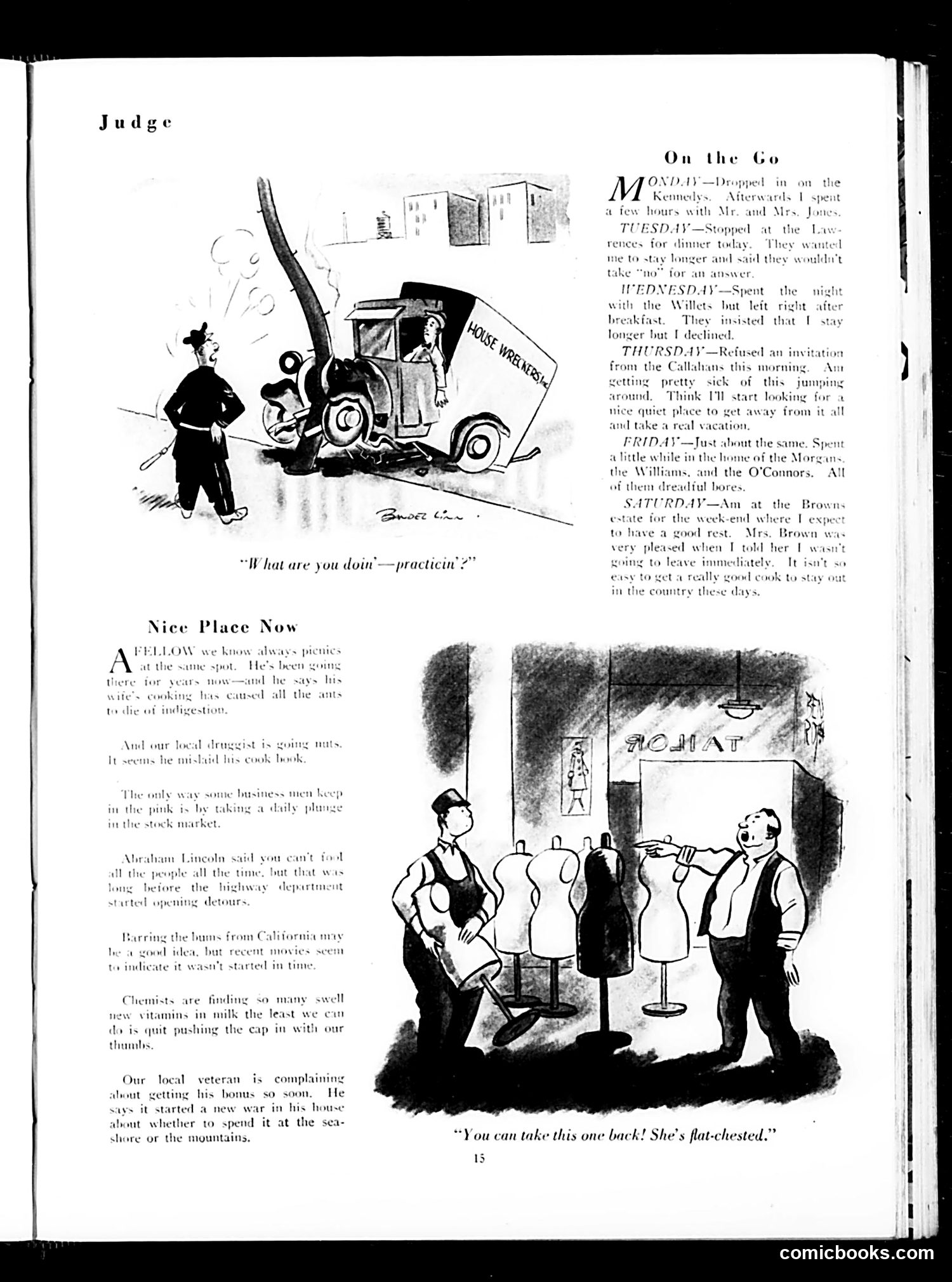
Analysis of Judge Magazine Page This page contains two separate satirical pieces: "On the Go" (top right): A diary entry mocking the exhausting social obligations of the leisure class. The writer complains about constant dinner invitations and house visits from acquaintances (the Kennedys, Joneses, Willets, Callahans, Morgans, Williams, O'Connors), calling them "dreadful bores." The satire targets how wealthy people feel trapped by their own social calendar and desperate for escape—ironically, they're so busy socializing they can't relax. "Nice Place Now" (left): Humorous observations about contemporary life, including complaints about ants at picnics, the new highway department creating detours, California "bums," vitamin additives in milk, and a veteran uncertain whether to spend his bonus at the seashore or mountains. Bottom cartoon: A tailor or clothier sarcastically returns a dress form/mannequin to a customer, quipping about its flat chest. This is a crude joke about women's bodies and fashion. The overall tone reflects post-war American anxieties about leisure, consumerism, and social conformity.
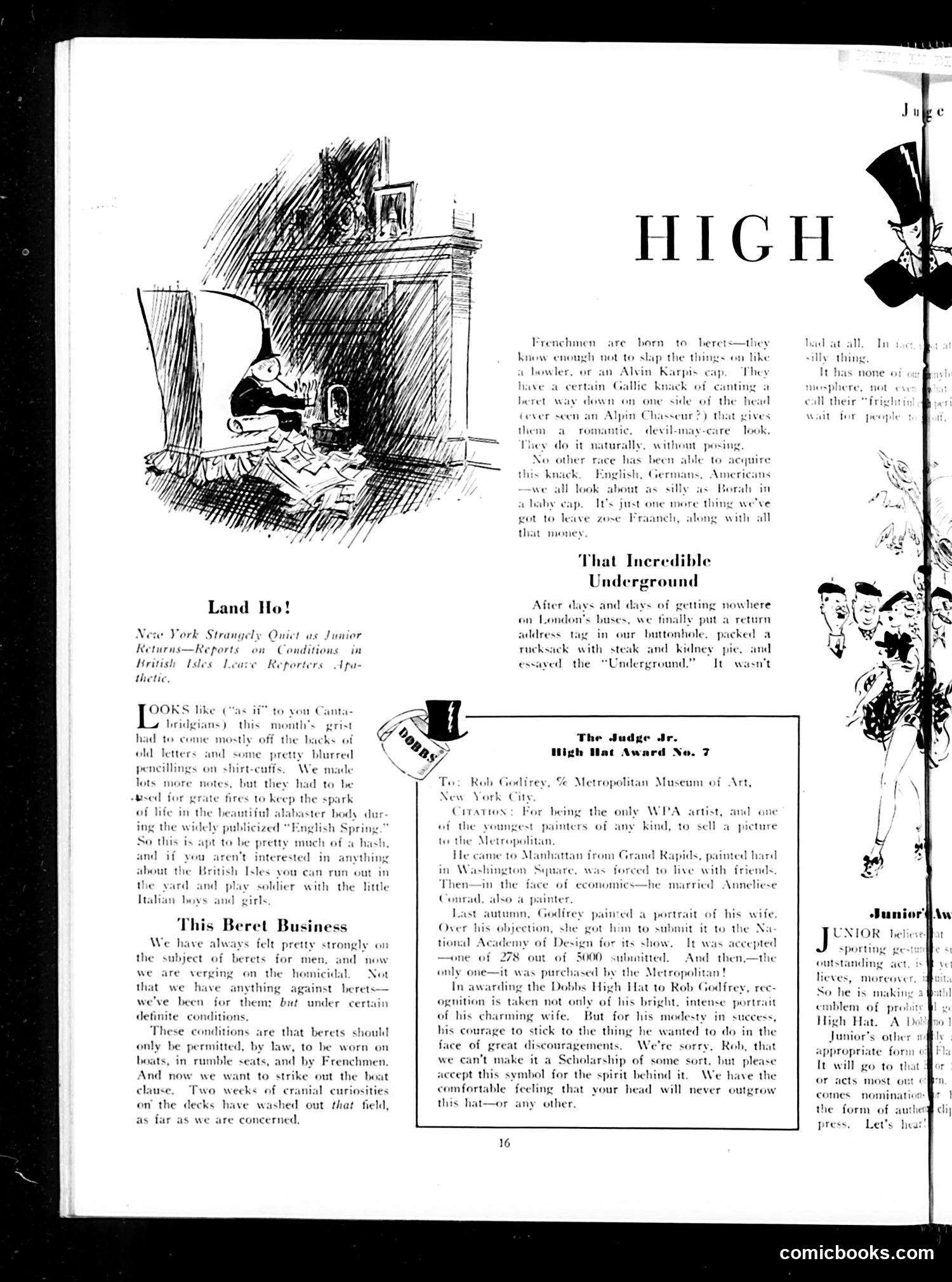
Understanding This Judge Magazine Page This page from the satirical magazine Judge contains three distinct pieces of social commentary typical of the era: "Land Ho!" mocks American tourists returning from Britain, suggesting their letters home were mundane and poorly written—a jab at both travel writing and American cultural pretension. "This Beret Business" satirizes the fashion trend of berets among Americans. The author argues berets should only be worn on boats, in cars, or by Frenchmen, then complains about people wearing them on ship decks. It's a lighthearted critique of Americans adopting European fashion affectations without understanding their cultural context. "The Judge Jr. High Hat Award No. 7" honors painter Rob Godfrey, a WPA (Works Progress Administration) artist—referencing the New Deal employment program. The satire praises his integrity: despite economic hardship forcing him to marry for stability, he persisted as an artist and sold work to the Metropolitan Museum, never compromising his principles. These pieces reflect 1930s-era American humor about class consciousness, cultural mimicry, and artistic integrity during Depression-era economic strain.
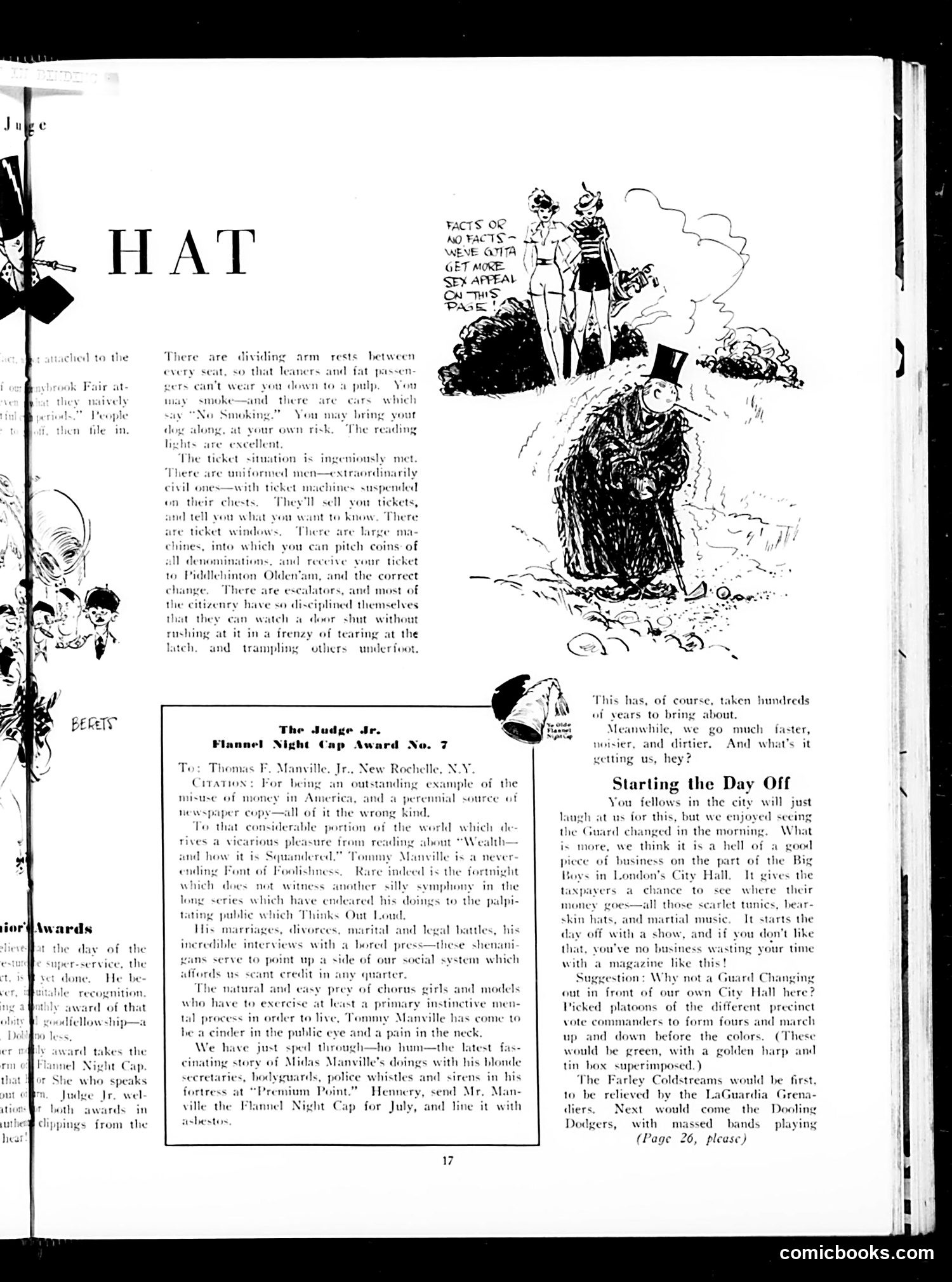
Judge Magazine Page Analysis This page satirizes Thomas F. Manville Jr., a wealthy industrialist notorious for multiple marriages and divorces. The "Flannel Night Cap Award" mockingly honors him as an exemplar of money's misuse in America, noting his marriages, legal battles, and headline-grabbing scandals serve as entertainment for the public while reflecting poorly on the social system. The accompanying illustration depicts Manville as a disheveled, aging figure—contrasting sharply with the glamorous young women shown above, likely representing his successive wives. The satire critiques both his personal excess and society's voyeuristic fascination with wealthy eccentrics. A separate article, "Starting the Day Off," humorously suggests importing London's Changing of the Guard ceremony to New York City Hall as superior entertainment to reading about Manville's antics—a tongue-in-cheek jab at American celebrity culture.
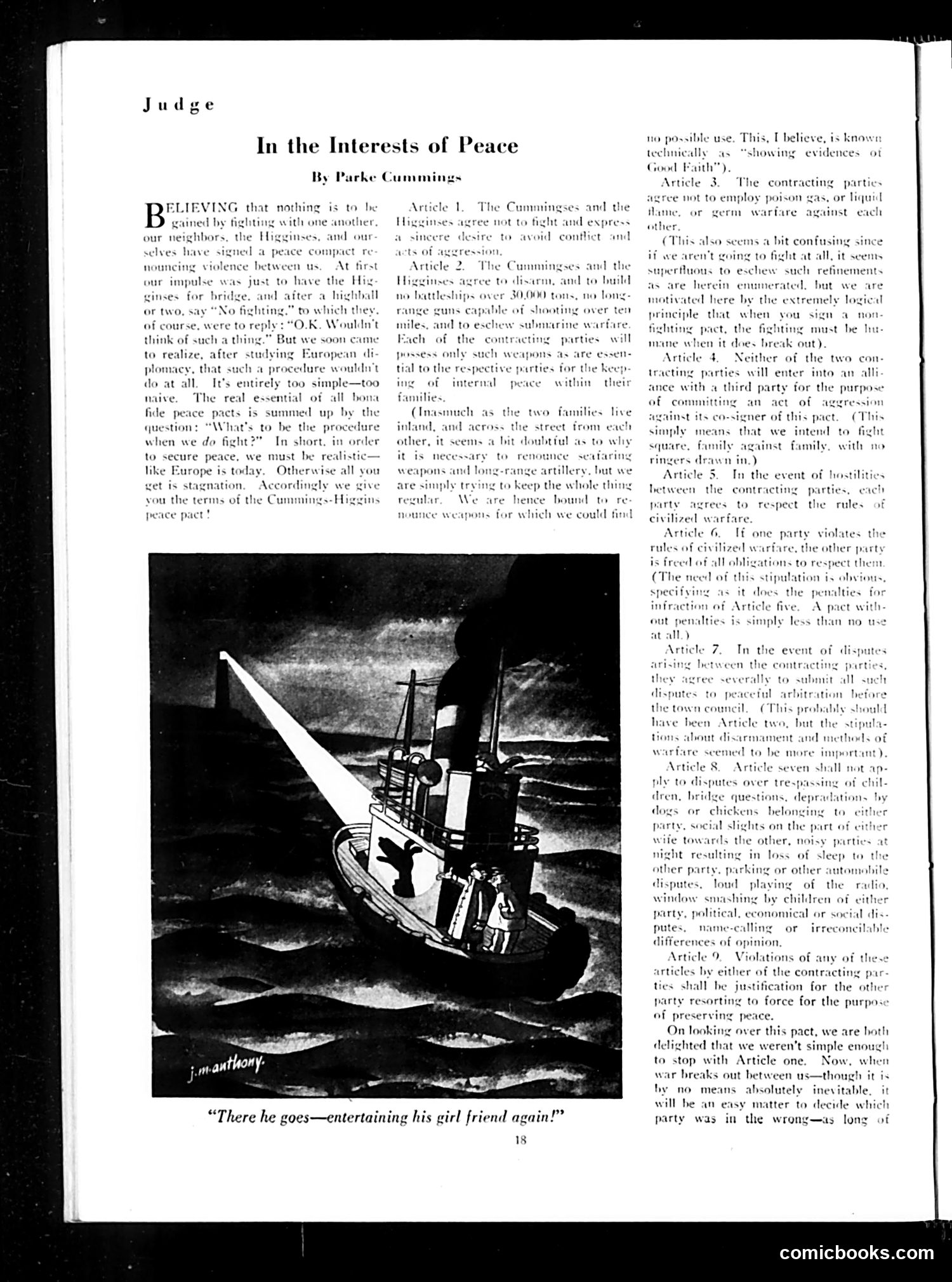
"In the Interests of Peace" - Judge Magazine Satire This satirical article by Parke Cummings mocks overly legalistic peace treaties through a fictional "Cummings-Higgins Peace Compact" between two feuding families or neighbors. The cartoon image shows a boat with the caption "There he goes—entertaining his girl friend again!"—illustrating one of the absurdly specific grievances listed in the treaty (Article 8), which includes trivial disputes like window-smashing, loud radio playing, and social slights. The satire's point: peace treaties that attempt to codify every possible dispute—from disarmament to poisoned gas to bridge-crossing rights to girlfriend visits—are doomed to fail. By itemizing minute grievances and then adding escape clauses (Article 9 lets either party break the treaty if violated), the pact becomes legally useless. Cummings suggests that detailed treaties designed to prevent war between rivals actually guarantee conflict, since determining who violated which clause will be impossible. This likely reflects 1920s-1930s skepticism about League of Nations agreements and disarmament treaties meant to prevent future conflict.
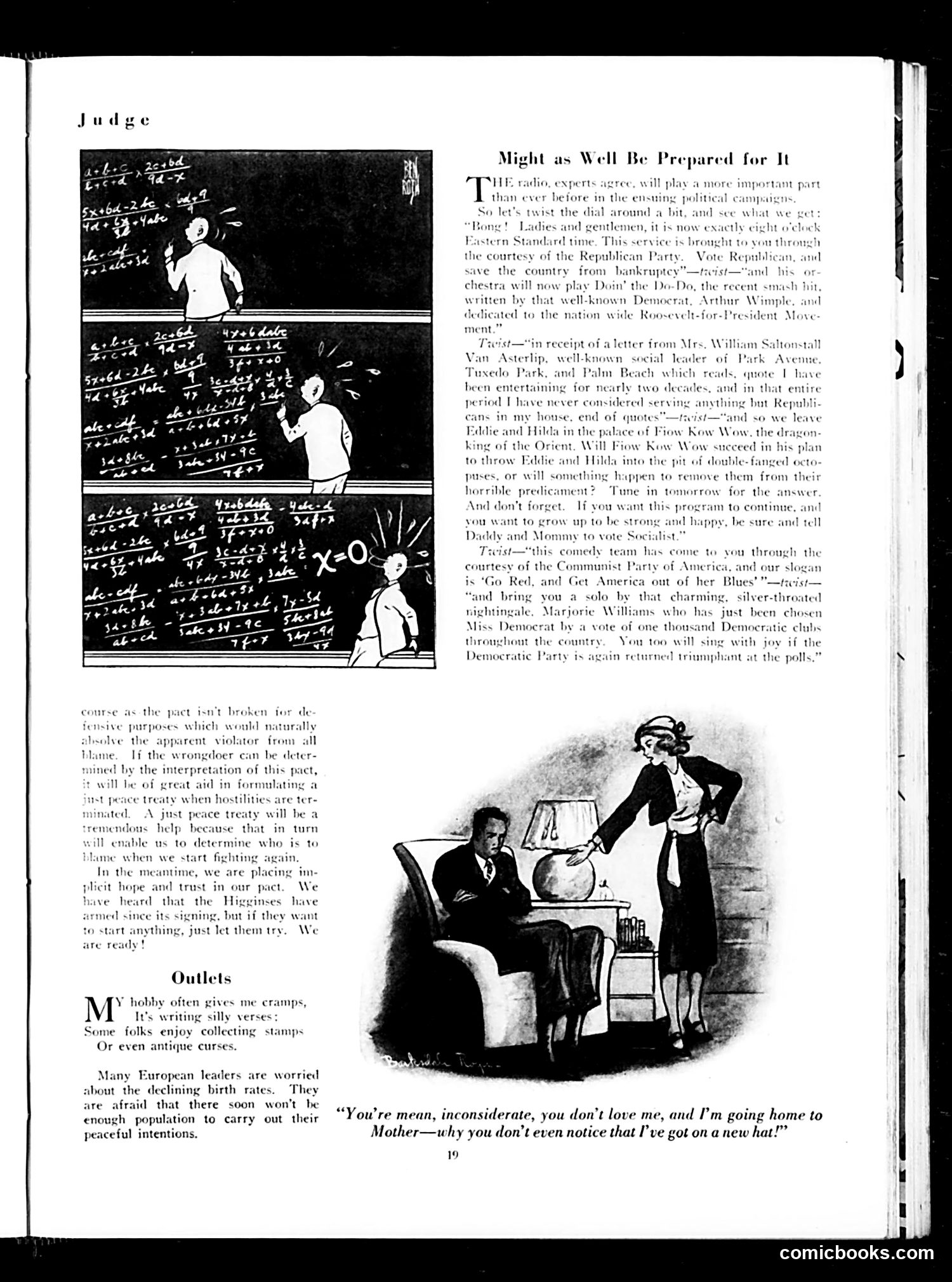
Explanation for Modern Readers This page satirizes radio's emerging role in political campaigns. The top comic strip mocks how political parties would use radio to broadcast propaganda disguised as entertainment—a Republican Party broadcast promising to "save the country from bankruptcy," followed by a Democratic response featuring a "Roosevelt-for-President Movement" song, then a Communist Party program. Each party hijacks the airwaves with thinly veiled political messaging. The satire suggests that radio stations will become mere mouthpieces for competing political ideologies, with even entertainment (radio dramas, music) weaponized for partisan purposes. The bottom illustration's caption about a woman's new hat being ignored is unrelated domestic humor—a common magazine filler. The piece reflects 1930s anxiety about mass media's political power and propaganda potential, presenting a prescient warning about how technology could enable coordinated political messaging.
Judge Magazine Commentary: Two Editorials This page contains two opinion pieces rather than cartoons proper. "Here's To Our Land" critiques American patriotism on Independence Day. The author acknowledges the nation's natural beauty but laments that fireworks now evoke machine guns and rockets suggest criminal "rackets"—reflecting post-WWI disillusionment. The cynicism stems from seeing patriotic symbols exploited by hypocrites. "The Apathy of Youth" addresses youth passivity, likely referencing the CCC (Civilian Conservation Corps), FDR's Depression-era program. The editorial argues young people won't challenge authority and are vulnerable to manipulation—Hitler and Huey Long are cited as examples of demagogues exploiting youth. The author notes youth are cheap labor ("can be bought much cheaper") and wonders why elders shouldn't criticize them, though admitting their own complicity. Both pieces reflect 1930s anxieties: disenchantment with American idealism and fears about fascism's appeal to disenfranchised generations.
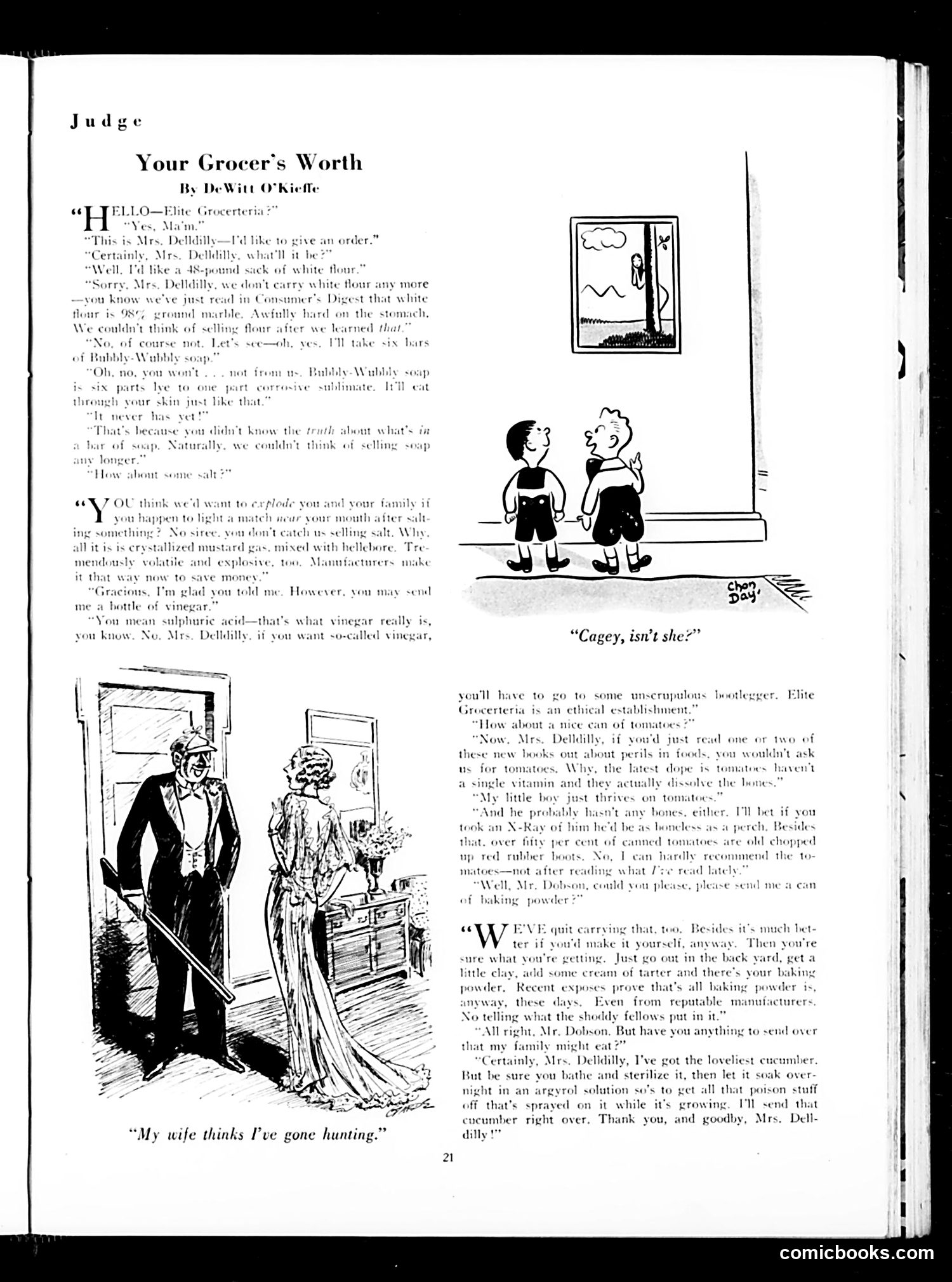
"Your Grocer's Worth" — Satire on Food Safety Panic This satirical piece mocks the early 20th-century explosion of exposé literature about food safety and adulteration. A grocer (Mr. Dobson) weaponizes newly popular "food scare" books to refuse selling nearly everything to customer Mrs. Delldilly. The joke: he claims white flour contains ground marble, salt is mixed with poison (hellebore), vinegar is sulfuric acid, canned tomatoes are dissolved bones and rubber boots, and baking powder is unknowable "shoddy" chemicals. Only cucumbers remain—but even those require sterilization and argyrol soaks. The satire targets two things: (1) the genuine muckraking literature exposing real food industry abuses, and (2) how such books, while sometimes valid, could fuel paranoid distrust of all commercial food. The grocer's "ethical" refusal to sell anything becomes absurd—he's using consumer fear as sales prevention rather than consumer protection.
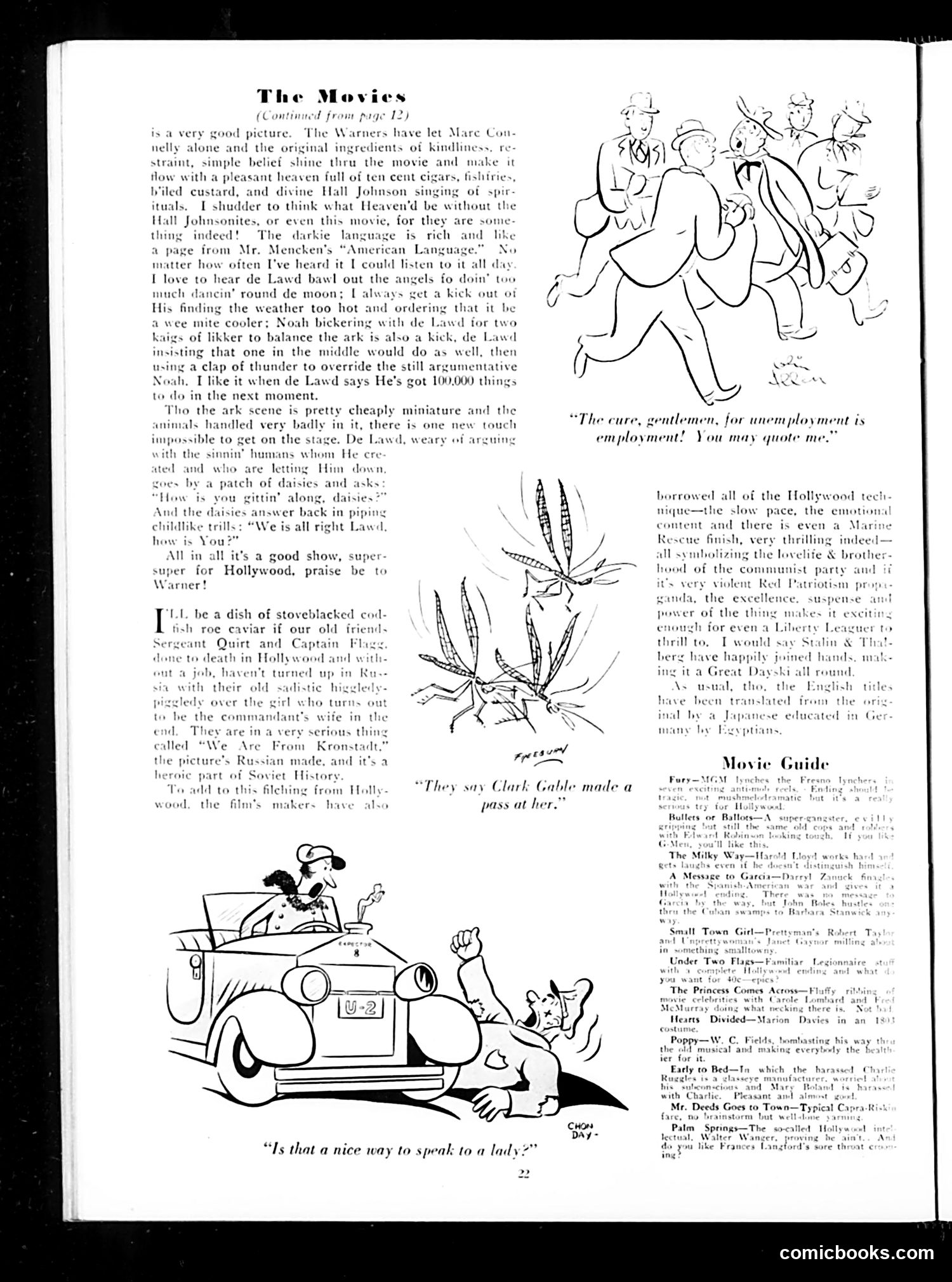
Analysis of Judge Magazine Page This page reviews several 1930s Hollywood films. The cartoons illustrate movie plots with light satire: Top cartoon: Shows chaotic characters (likely from a comedy), with the caption "The cure, gentlemen, for unemployment is employment! You may quote me"—a joking reference to Depression-era economic debates. Bottom cartoon: Depicts a car labeled "U-2" with figures acting foolishly, captioned "Is that a nice way to speak to a lady?"—standard slapstick humor. Main text discusses "The Green Pastures," praising its depiction of African American spirituals and biblical scenes, though using period-appropriate but now-offensive racial language common to 1930s criticism. The review also references other films like those featuring Clark Gable and Marion Davies. The page represents typical Judge content: light comedic commentary on contemporary films and entertainment, with illustrations supporting the reviews rather than making pointed political statements.
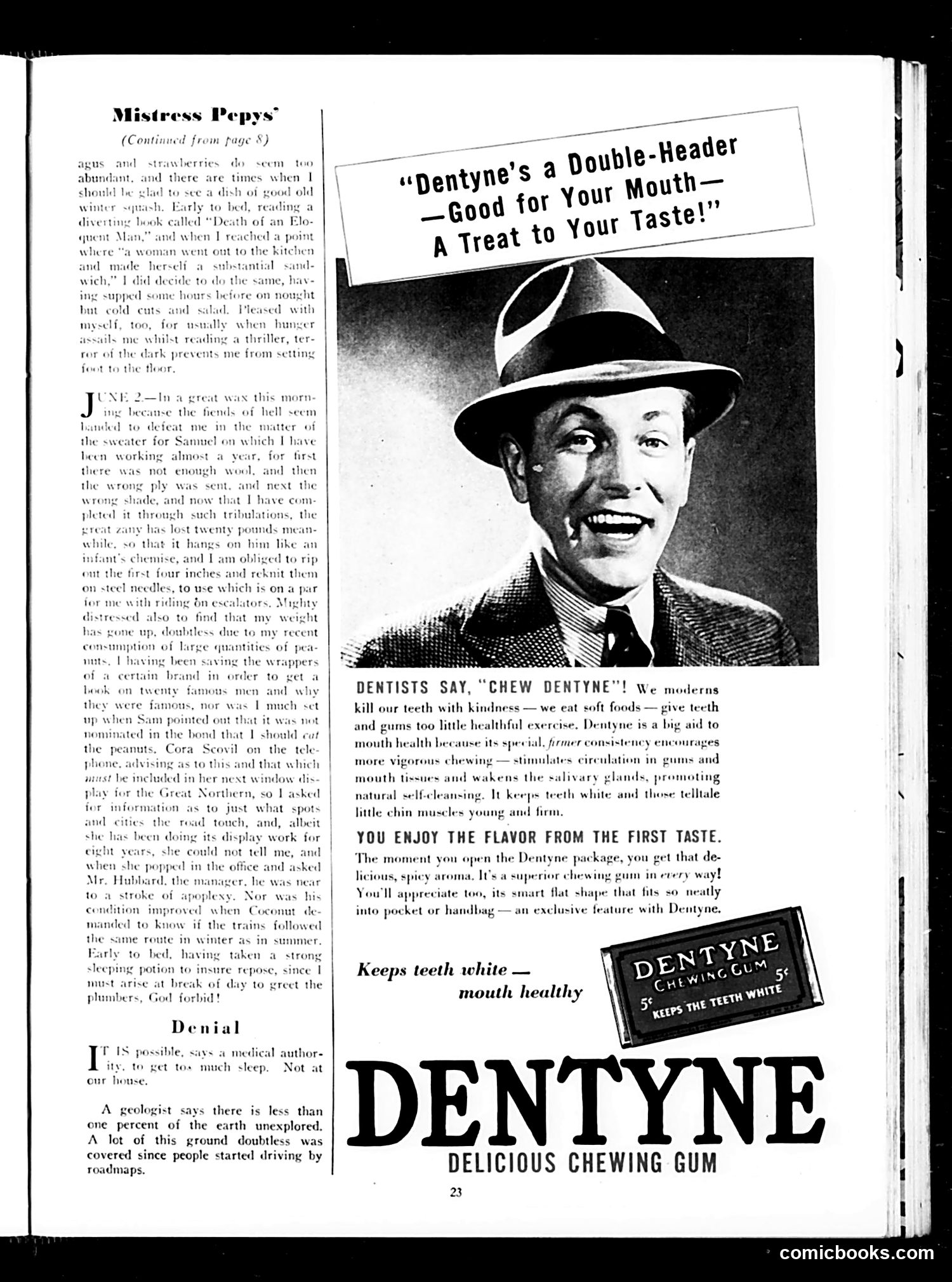
Analysis This page contains two distinct elements: a serialized women's humor column and a full-page advertisement. "Mistress Pepys" (left) is a continuing satirical diary column mimicking Samuel Pepys's famous 17th-century diary. It presents mundane domestic complaints from a modern woman's perspective—struggling with knitting projects, dealing with household help, consulting about train routes. The humor derives from treating trivial everyday frustrations with mock-serious historical gravitas. The brief "Denial" section at bottom satirizes absurd claims made by authorities, using deadpan irony: a geologist's statement about unexplored earth becomes funny when applied to road damage from drivers using faulty maps. The Dentyne advertisement (right) dominates the page, featuring a smiling man in a fedora. This is standard period advertising copy promoting chewing gum as beneficial for dental health—a now-disproven claim. The ad targets modern readers concerned about soft-food diets weakening teeth, positioning vigorous chewing as healthful exercise. The page is primarily advertising, with humor column content secondary.
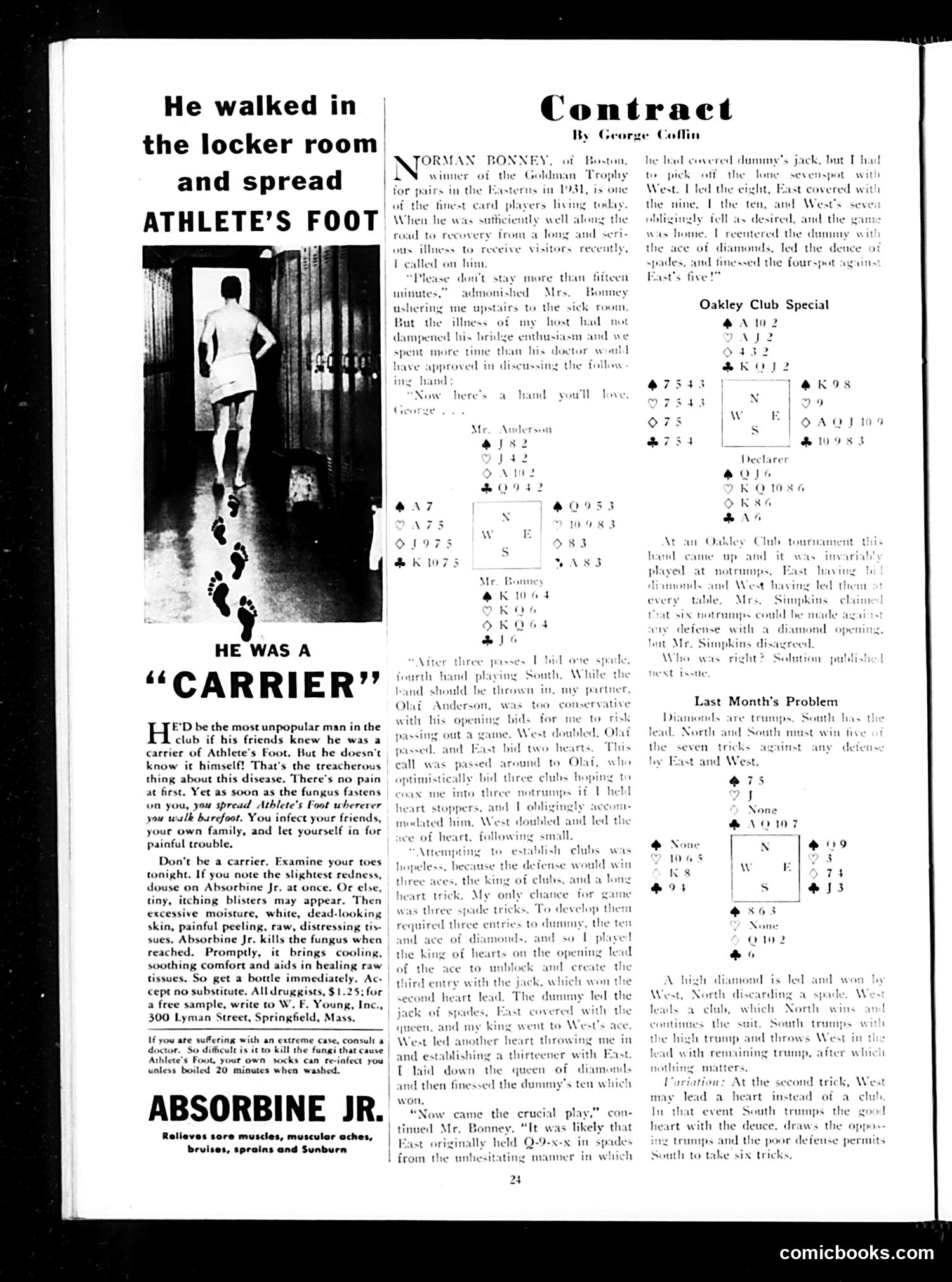
Page Analysis: Judge Magazine Content This page mixes two distinct elements: advertising and bridge instruction. The dominant feature is a full-page Absorbine Jr. advertisement using fear-based marketing. The ad warns men they could unknowingly carry athlete's foot and infect family and friends through barefoot contact—a common 1930s-40s health scare tactic. The accompanying photograph of a shirtless man in a locker room underscores the athletic/contagion angle. The headline "HE WAS A 'CARRIER'" emphasizes social shame. The remaining page content is a bridge card game column by George Collin, featuring analysis of tournament play by notable player Norman Bonney and others. This appears to be editorial content typical of Judge's mix of humor, advertising, and lifestyle features. The satire here is implicit: the contrast between the serious health panic (athlete's foot) and leisurely bridge instruction suggests the magazine's varied audience interests.
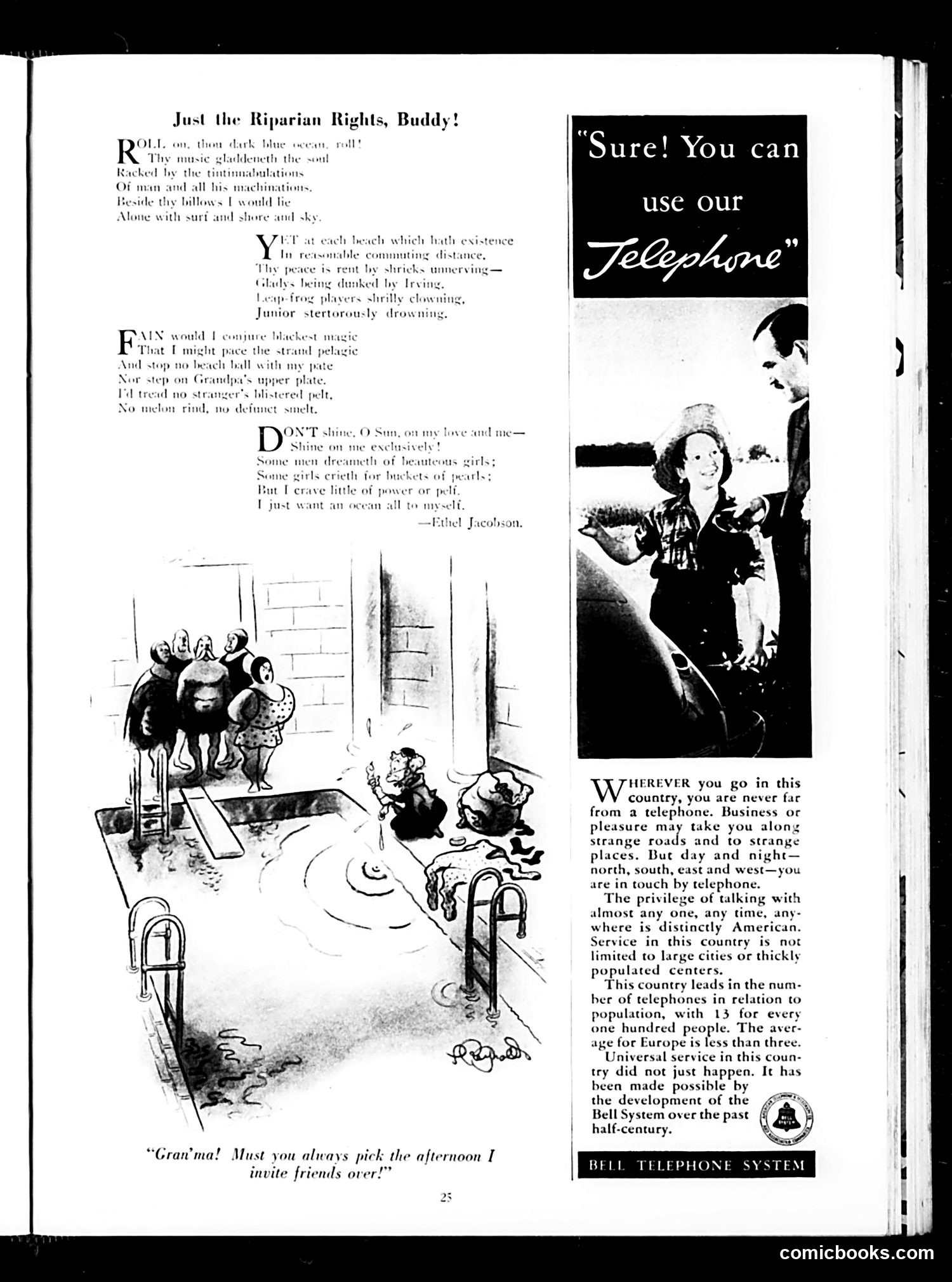
"Just the Riparian Rights, Buddy!" — Judge Magazine This page combines a humorous poem with a Bell Telephone advertisement. The Poem/Cartoon (left): A satirical piece by Ethel Jacobson about someone seeking solitude by a beach. The speaker romanticizes escaping to nature ("dark blue ocean," "billows") but is repeatedly interrupted by modern nuisances—people dunking each other ("Gladys being dunked by Irving"), loud recreation, swimmers drowning noisily. The joke mocks the impossibility of finding peace and solitude in modern America; even "riparian rights" (legal water access) can't guarantee quiet. The illustration shows crowds and chaos at what should be a tranquil waterside. The Advertisement (right): The Bell Telephone System ad ironically undercuts the poem's message. While the poem laments constant human interruption, the ad celebrates the telephone's ability to reach you "day and night" anywhere in America—positioning universal connectivity as a distinctly American achievement. The caption below the photo emphasizes the grandmother's expectation to use the telephone whenever she wishes, highlighting how technology has made privacy impossible. The Satire: The page sardonically juxtaposes the desire for solitude with the modern reality of inescapable connectivity.
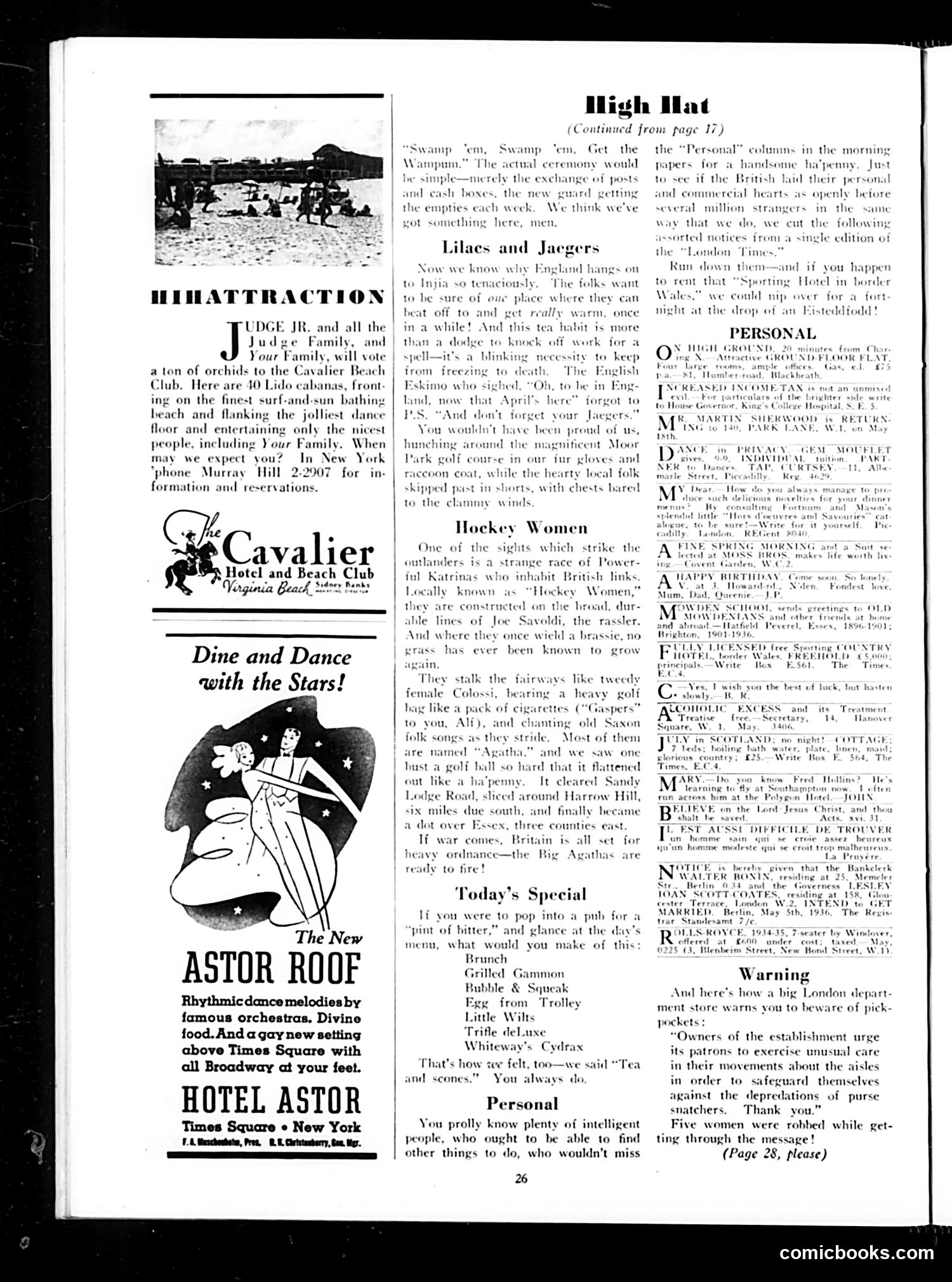
Analysis of Judge Magazine Page Content This page is primarily advertising and personal notices rather than political satire. The main content includes: Major Advertisements: - The Cavalier Hotel and Beach Club (Virginia Beach) - promoting luxury beach accommodations - Hotel Astor (Times Square, New York) - advertising dining and dancing venues Editorial Content: The "High Hat" column continues discussions of British social customs, particularly: - English tea habits and their cultural importance - "Hockey Women" - an apparent reference to athletic British women who participate in field hockey - A humorous section on British pub food terminology ("Bubble & Squeak," "Little Wilts," etc.) meant to amuse American readers unfamiliar with British cuisine Personal Notices Section: Classified personal announcements covering birthdays, arrivals, school notices, and lost-and-found items. The page reflects 1920s-30s leisure culture and social commentary aimed at Judge's affluent readership, with light mockery of British customs rather than serious political satire.
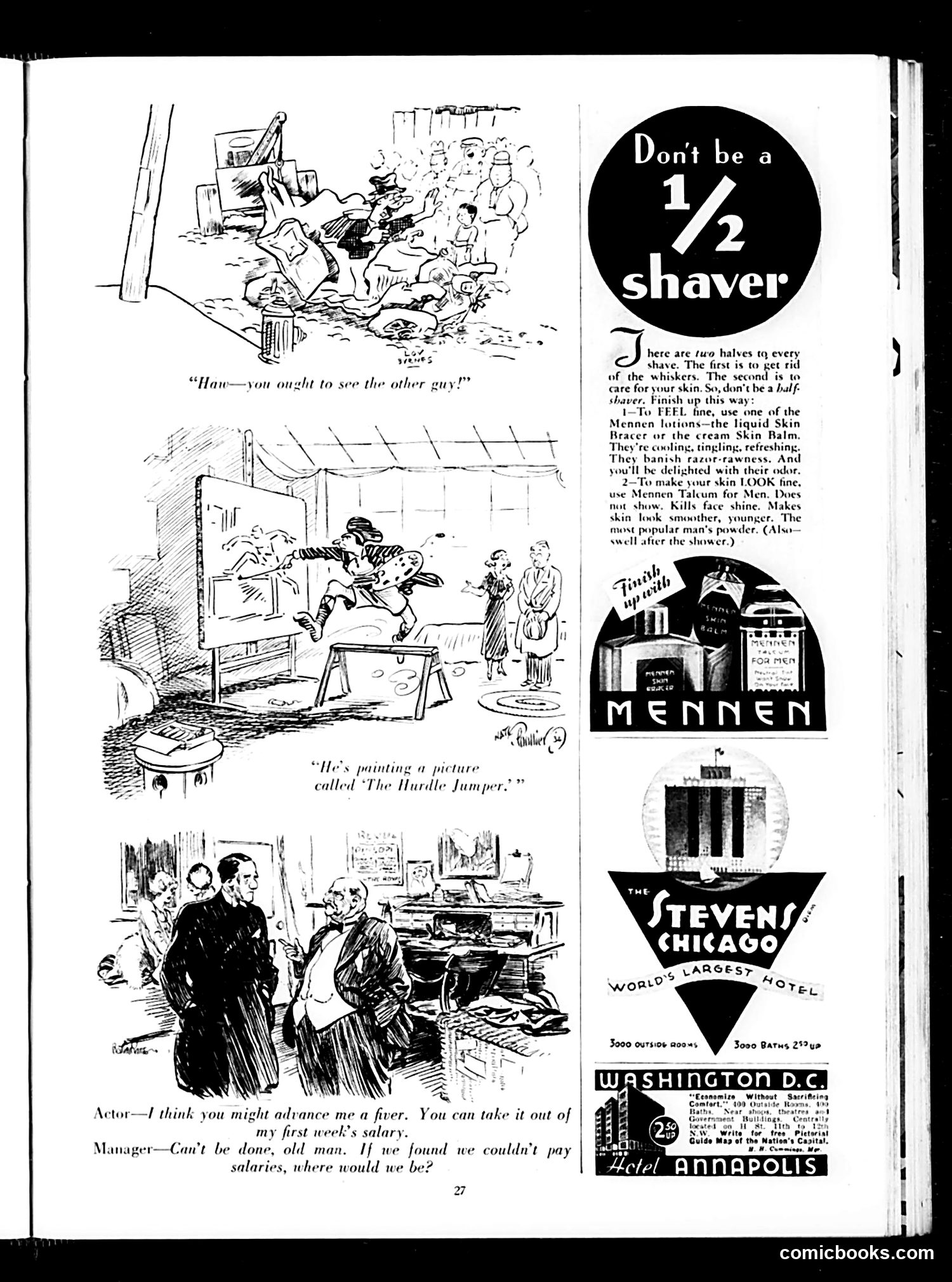
Analysis This page contains three unrelated items: Left side: Three comic cartoons depicting theatrical scenes. The captions show actors and managers discussing financial hardship—a manager refuses to advance an actor wages, claiming if they couldn't pay salaries "where would we be?" This satirizes Depression-era economic desperation and the precarious financial situations of theater companies and performers. Right side: Advertising, primarily for Mennen grooming products (skin bracer, talcum powder) with the slogan "Don't be a 1/2 shaver"—meaning don't do a half-job shaving; use their products for complete grooming. Also advertises hotels (Stevens Chicago, Hotel Annapolis in Washington D.C.). The page number is 27, indicating this is from the magazine's interior. The cartoons and ads appear unconnected—typical of magazine layout from this era.
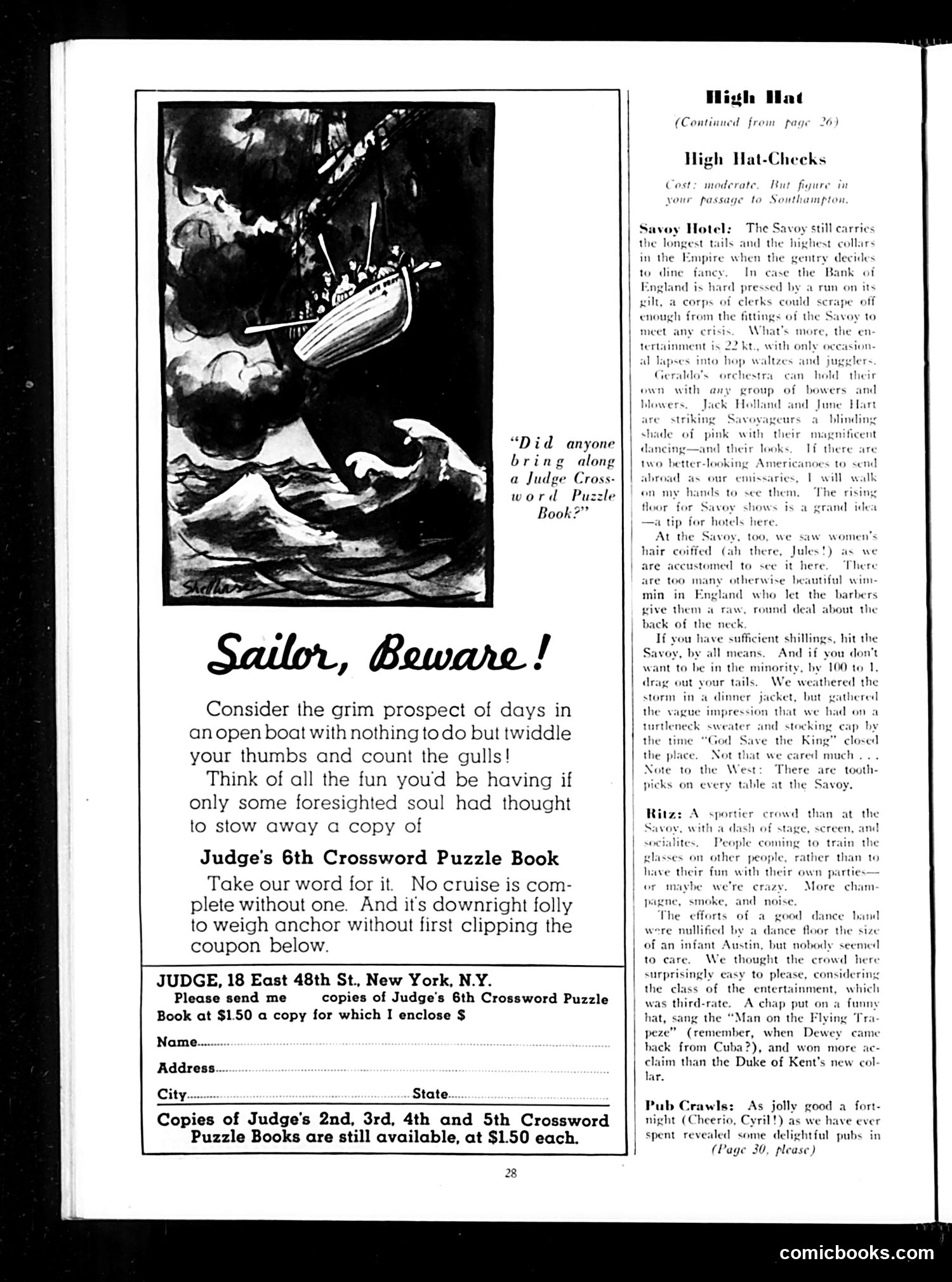
Judge Magazine Page Analysis This page combines advertising with social commentary about London nightlife. The main cartoon "Sailor, Beware!" depicts a sailor in an open boat, promoting Judge's 6th Crossword Puzzle Book as essential cruise entertainment—a humorous pitch that solving puzzles beats boredom at sea. The text sections mock upper-class British leisure culture, specifically the Savoy Hotel and its clientele. The writer satirizes the pretensions of wealthy Londoners: their obsession with formal dress codes ("tails"), their affected hairstyles, and the mediocre entertainment they tolerate at fashionable venues. References to the Savoy's orchestra, women's coiffures, and dance floor entertainment reveal period anxieties about class performance and social climbing. The "Pub Crawls" section offers lighter commentary on English pub culture. Throughout, the tone is affectionate mockery of British social rituals and the American observer's bemused perspective on English conventions during what appears to be the 1920s-30s.
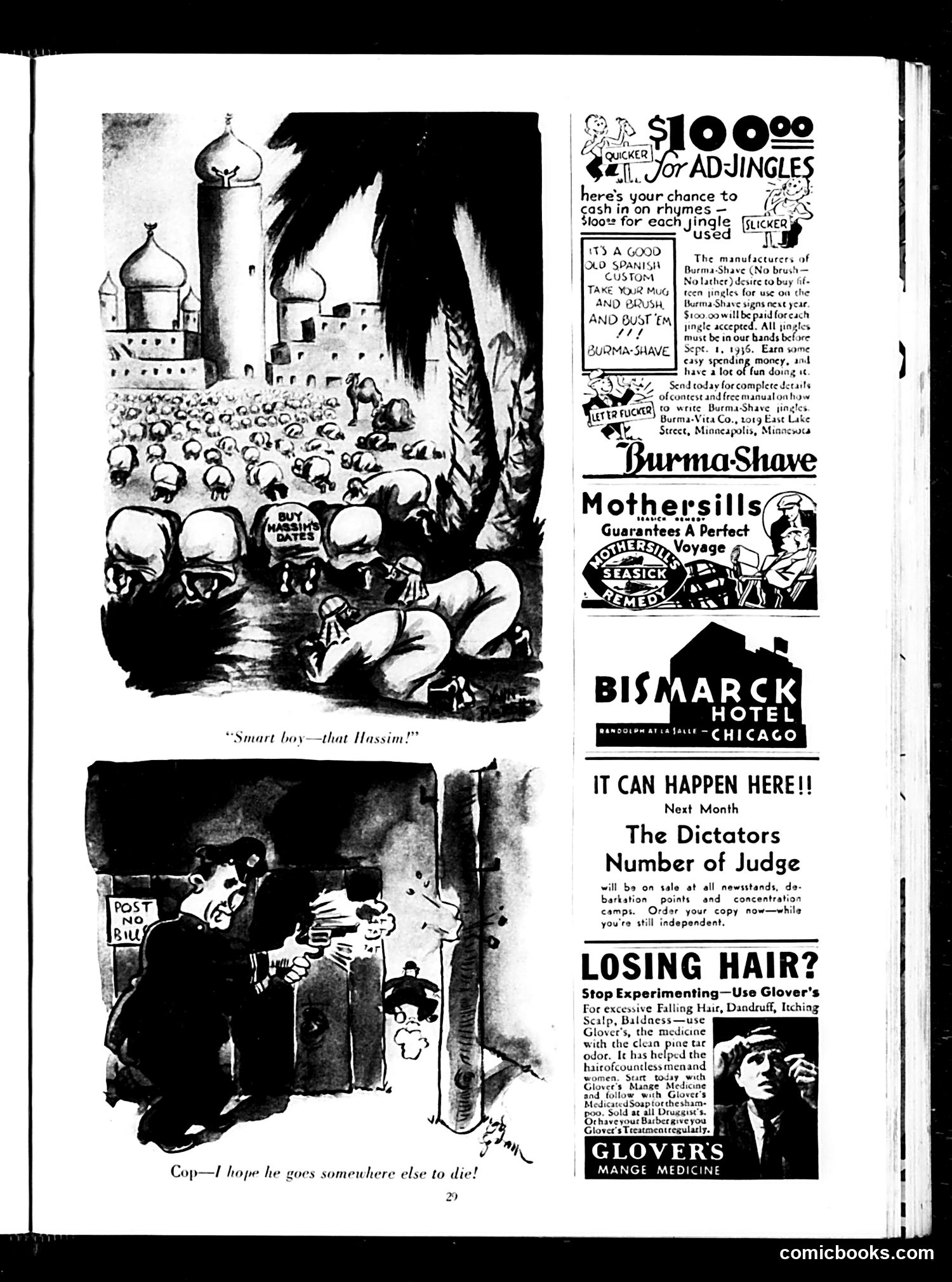
Political Cartoons from Judge Magazine This page contains two satirical cartoons plus advertisements. The top cartoon depicts a dark scene with skulls and a grim reaper, captioned "Smart boy—that Hassim!" The reference appears to be to Middle Eastern or colonial politics, though the specific context isn't entirely clear from the image alone. The bottom cartoon shows a policeman discovering a corpse near a "Post No Bill" sign, with the cop hoping "he goes somewhere else to die!"—dark humor about urban problems and death. The advertisements are more revealing of period concerns: Burma-Shave seeks jingle submissions; Mothersills advertises seasickness remedies; and notably, Judge magazine promotes an upcoming issue about dictators with pointed satire: "Order your copy now—while you're still independent," referencing the rise of fascism in the 1930s. The Glover's hair-loss medicine ad rounds out the commercial content typical of the era's magazines.
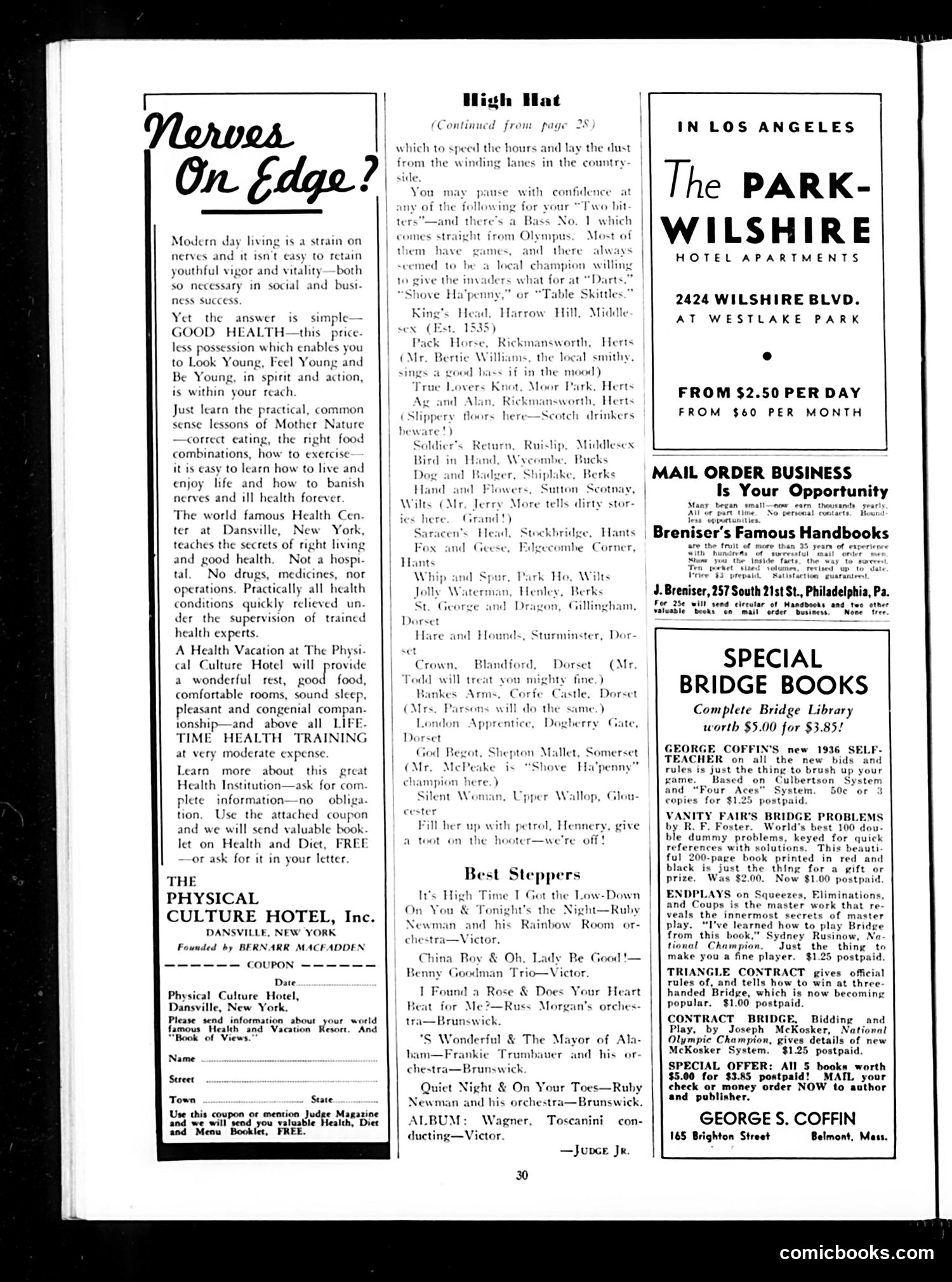
Analysis of Judge Magazine Page This page is primarily advertising and entertainment listings rather than political satire. It contains: 1. Left column: A health resort advertisement for the Physical Culture Hotel in Dansville, New York, promoting "good health" without drugs or surgery—reflecting early 20th-century wellness trends and Bernarr Macfadden's fitness movement. 2. Center: "High Hat" column listing British pubs and their local entertainment (darts, skittles), followed by "Best Steppers"—current popular song recommendations with orchestras. 3. Right column: Los Angeles hotel and business opportunity advertisements. The "High Hat" section appears to be a travel or lifestyle column describing English country pub culture. The "Best Steppers" lists contemporary jazz/dance music recordings—typical entertainment guide content for the era. No significant political satire or caricature is evident on this page. It's a standard magazine filler of advertisements, lifestyle advice, and entertainment recommendations typical of 1930s Judge magazine.
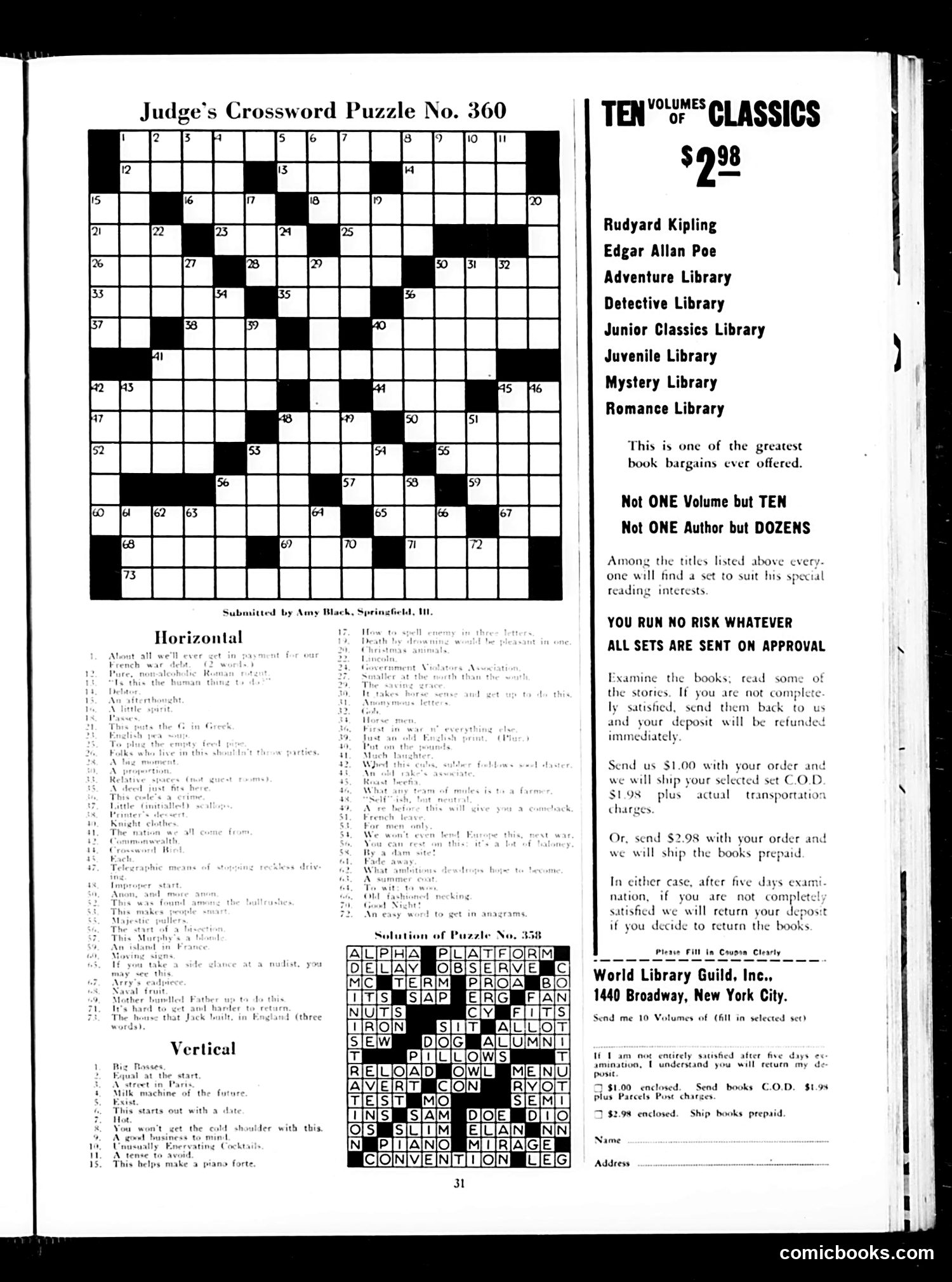
Analysis This page is primarily advertising, not political satire or a cartoon. It features Judge magazine's Crossword Puzzle No. 360 and a substantial mail-order book advertisement. The ad promotes a "Ten Volumes of Classics" set for $2.98, offering collections from multiple authors (Rudyard Kipling, Edgar Allan Poe, etc.) across genres like Adventure, Detective, Mystery, and Romance libraries. The pitch emphasizes risk-free purchasing: customers can examine books for five days before deciding, with options to pay via C.O.D. ($1.00 deposit) or prepaid ($2.98). The marketing language—"one of the greatest book bargains ever offered," "Not ONE author but DOZENS"—reflects early 20th-century mail-order publishing practices, when such book clubs were popular consumer products. The approval-based sales model was typical for the era. No political commentary is evident; this is straightforward commercial advertising integrated into the magazine's editorial content.
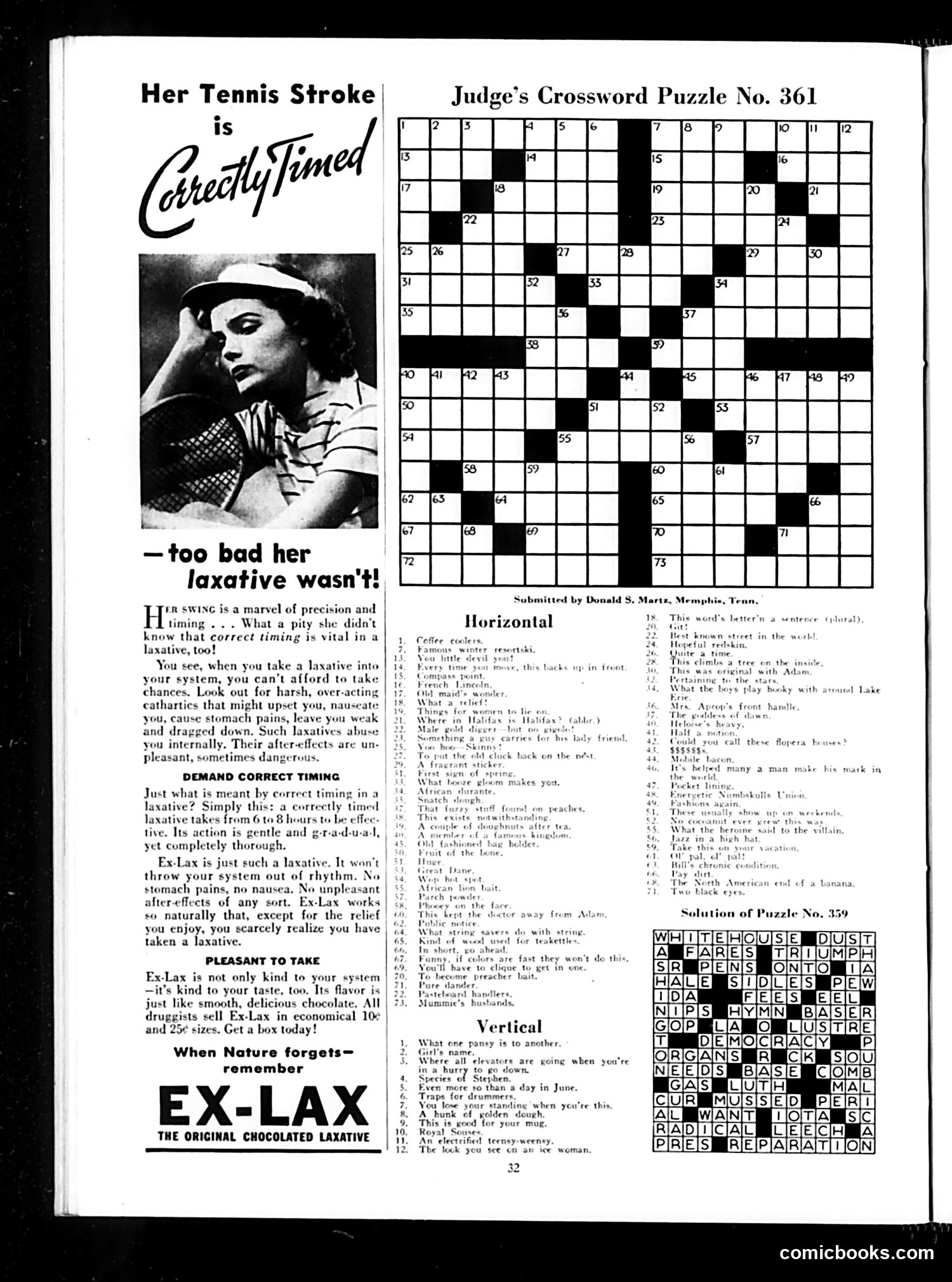
What This Page Means This is primarily a laxative advertisement disguised as editorial content in Judge magazine, a satirical publication. The joke plays on the phrase "correct timing": A woman's tennis stroke is "perfectly timed" (precise and skilled), but—the ad sarcastically suggests—her *laxative* isn't. The implication is that she uses an inferior laxative with poor timing, causing stomach upset and weak, dragged-down feelings. The advertisement for Ex-Lax (a chocolate laxative) then positions itself as the solution: a laxative with "correct timing" that works gently over 6-8 hours without harsh side effects. The rest of the page contains a crossword puzzle and the solution to puzzle No. 359—standard filler content for Judge magazine. Context for modern readers: This reflects 1930s-40s advertising practices when laxative ads were commonplace in magazines, often using crude humor and exaggeration about digestive complaints.
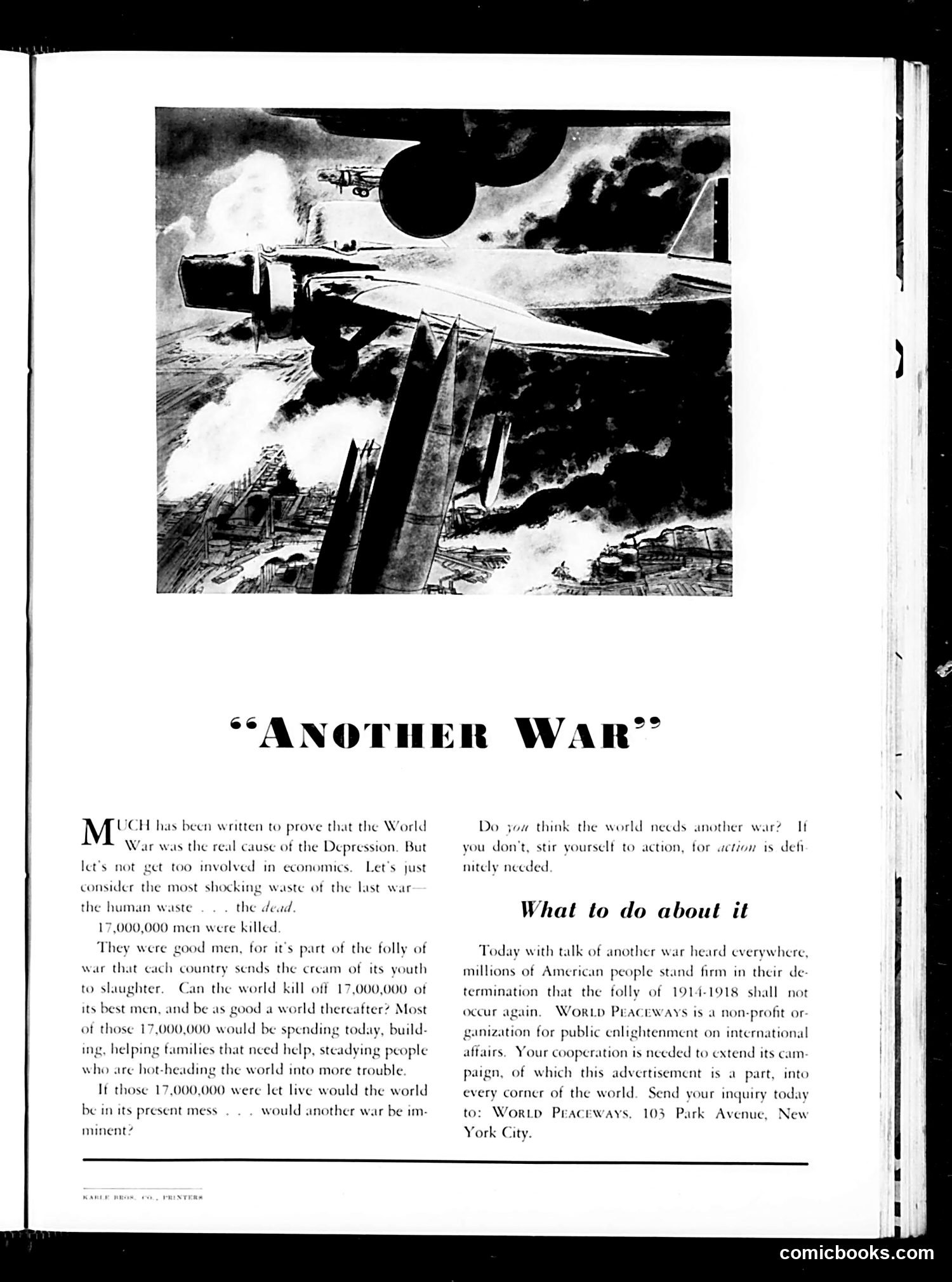
"Another War" - Analysis This is a public service advertisement, not a satirical cartoon. Judge magazine published it to advocate against future warfare. The piece references World War I (1914-1918) and the subsequent Great Depression, arguing the war's massive human cost—17 million deaths—depleted the world of productive citizens who would otherwise be building, spending, and stabilizing society. The implicit argument: war caused economic catastrophe through human waste. Published when war talk was resurfacing (likely early-to-mid 1930s, as tensions rose toward WWII), the ad urges readers toward action and pacifism. It promotes World Peaceways, a real non-profit organization advocating international peace and conflict resolution. The stark aerial photograph above depicts war's destruction—wreckage, smoke, and aircraft—visualizing the devastation the text describes. This is earnest advocacy, not satire: Judge's editors genuinely opposed another global conflict.
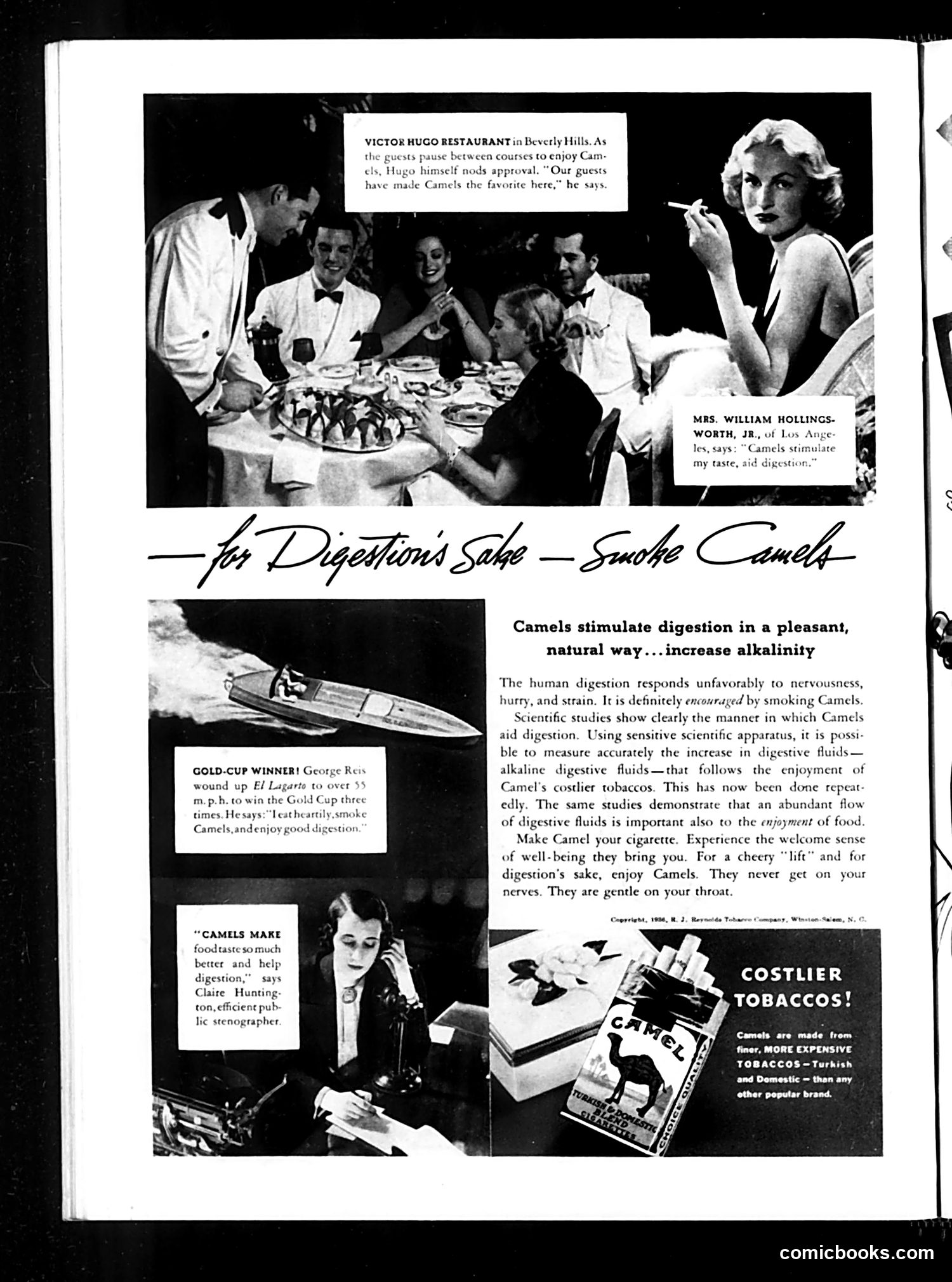
Analysis: Camel Cigarettes Advertisement This is primarily a cigarette advertisement, not satire or political commentary. It's a 1930s-era Camel ad that makes now-debunked health claims. The page features testimonials from purportedly credible sources—a restaurant owner, a socialite (Mrs. William Hollingsworth Jr.), a race car driver (George Reis), and a stenographer (Claire Huntington)—claiming Camels aid digestion and stimulate taste. The advertisement cites fake "scientific studies" claiming smoking increases alkaline digestive fluids. This reflects the era when tobacco companies openly marketed cigarettes as health products, before the surgeon general's warnings. The "costlier tobaccos" claim emphasizes premium positioning. By modern standards, this is extraordinary: a major brand openly advertising cigarettes for medical benefits, using celebrity endorsement and pseudoscience to influence purchasing decisions—practices now illegal in most countries.