judge
Judge — August 1936
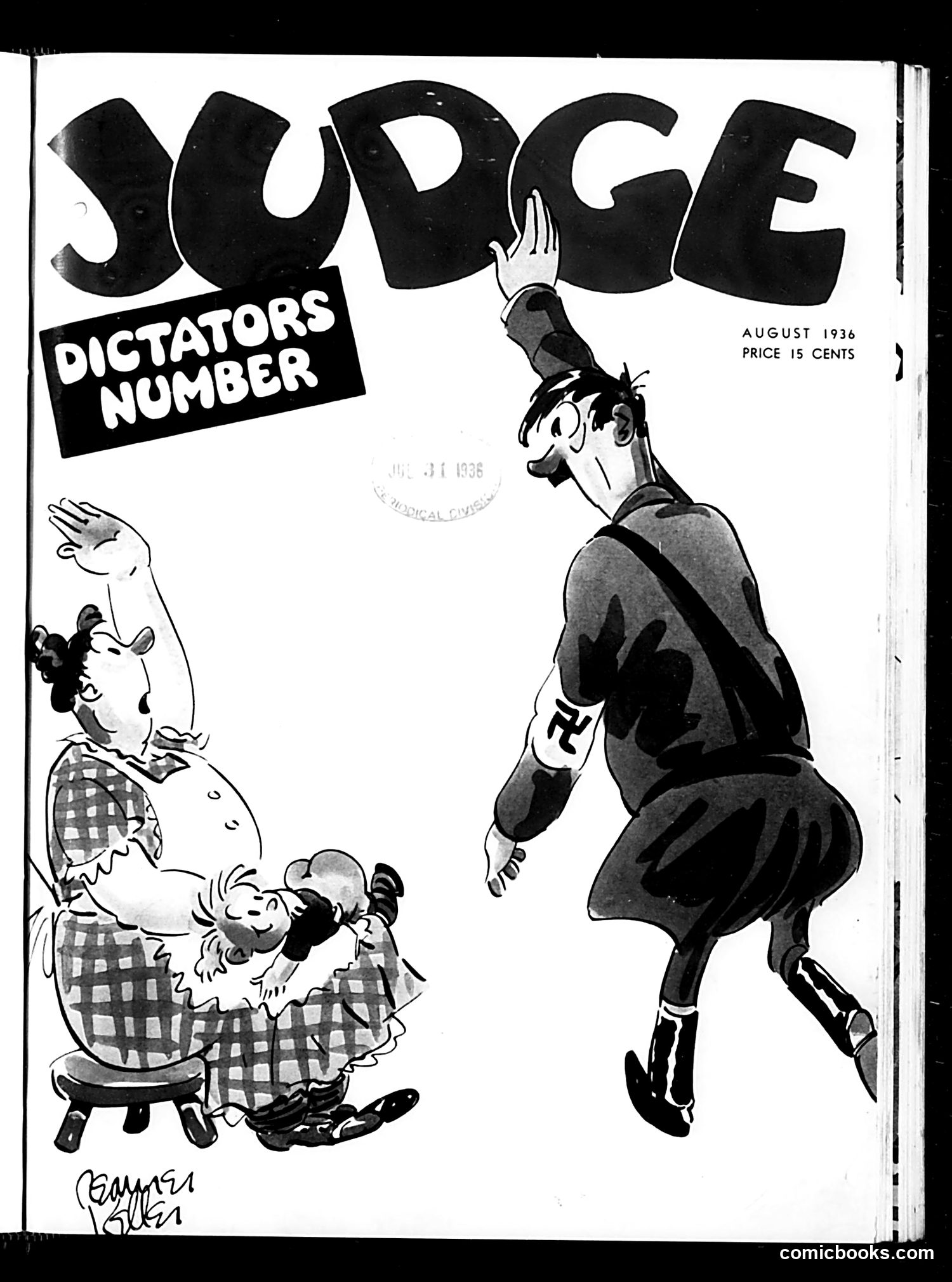
Judge Magazine - August 1936: "Dictators Number" This is the cover of Judge's special "Dictators Number" from August 1936, priced at 15 cents. The artwork satirizes contemporary authoritarian leaders through exaggerated caricature. On the right, a figure in military uniform with a swastika armband appears to be a caricature of Adolf Hitler, depicted in a menacing pose. On the left, a rotund, crude caricature holds what appears to be children, likely representing a dictator's exploitation or control of populations. The large "JUDGE" letters dominating the cover underscore the magazine's satirical mission. This was published during the rise of fascism in Europe, when American satirical publications actively mocked Hitler and other authoritarian leaders. The exaggerated, dehumanizing style was typical of 1930s political cartooning.
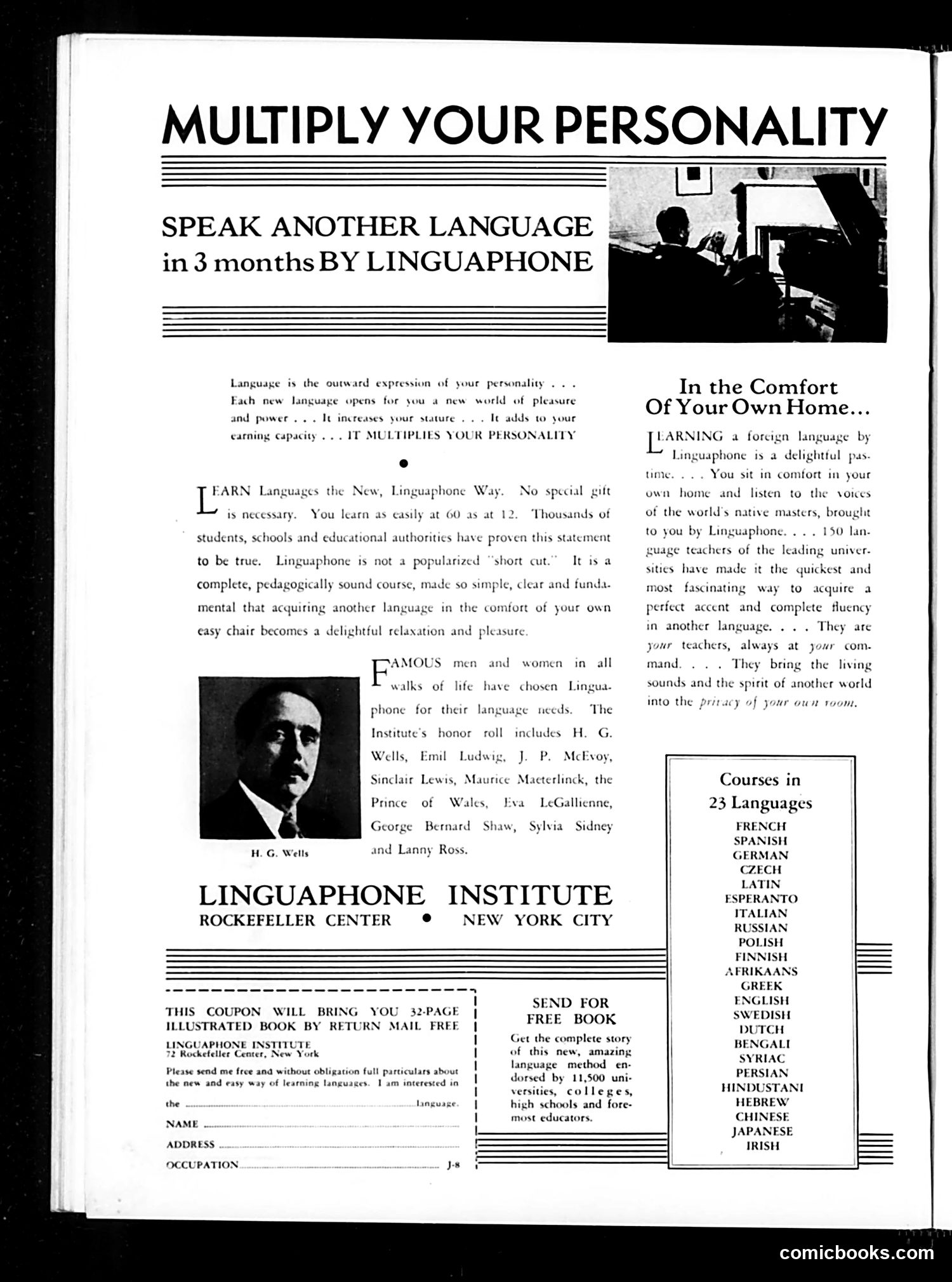
Analysis This page is primarily advertising, not satire or political commentary. It's a Linguaphone Institute advertisement promoting language instruction through their mail-based method. The only identified figure is H.G. Wells, the famous British author, whose photograph appears alongside testimonial copy. His inclusion lends credibility to the language course by suggesting a prominent intellectual endorses it. The ad's appeal centers on self-improvement and social status: "Multiply Your Personality" promises that learning languages increases one's standing and earning capacity. The claim of learning "in 3 months" and studying "in comfort of your own home" targeted busy professionals. The 23-language course list and celebrity endorsement were standard advertising tactics of this era (appears to be 1920s-30s). No political satire is evident here.
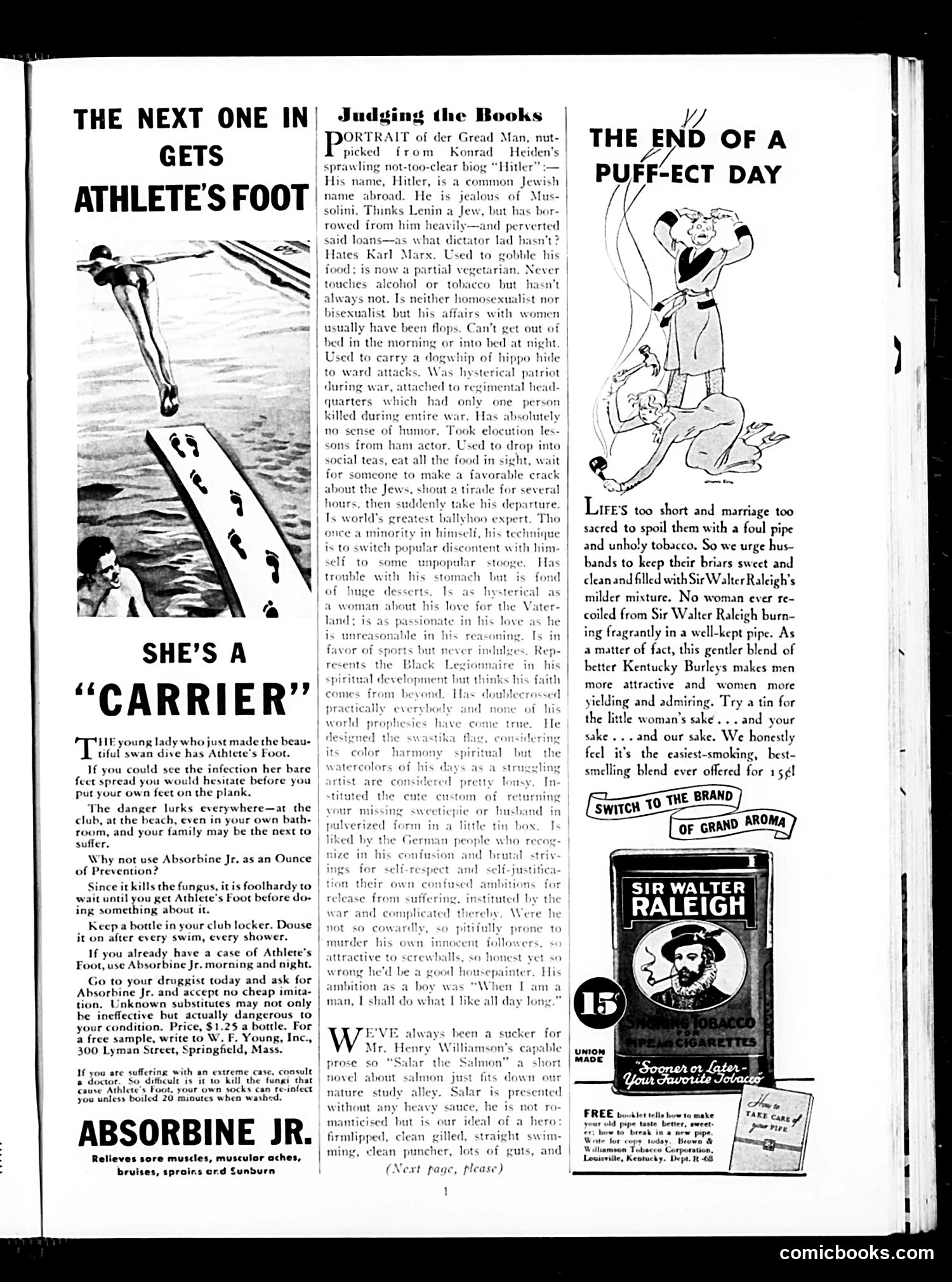
Analysis of Judge Magazine Page This page mixes advertisements with satirical content. The left column attacks Adolf Hitler through a "Portrait of the Great Man" section, cataloging his alleged character flaws—jealousy of Mussolini, vegetarianism, sexual affairs, lack of humor, and hysteria. The satire portrays him as emotionally unstable and morally contemptible. The right side features "The End of a Puff-ect Day," a lighthearted cartoon about pipe smoking, recommending Sir Walter Raleigh tobacco as superior to cigarettes. This advertisement uses humor to market the product as the gentlemanly choice. The page reflects WWII-era American sentiment—virulent anti-Nazi propaganda alongside consumer advertising. The contrast shows how wartime satire coexisted with ordinary commercial messaging in American magazines.
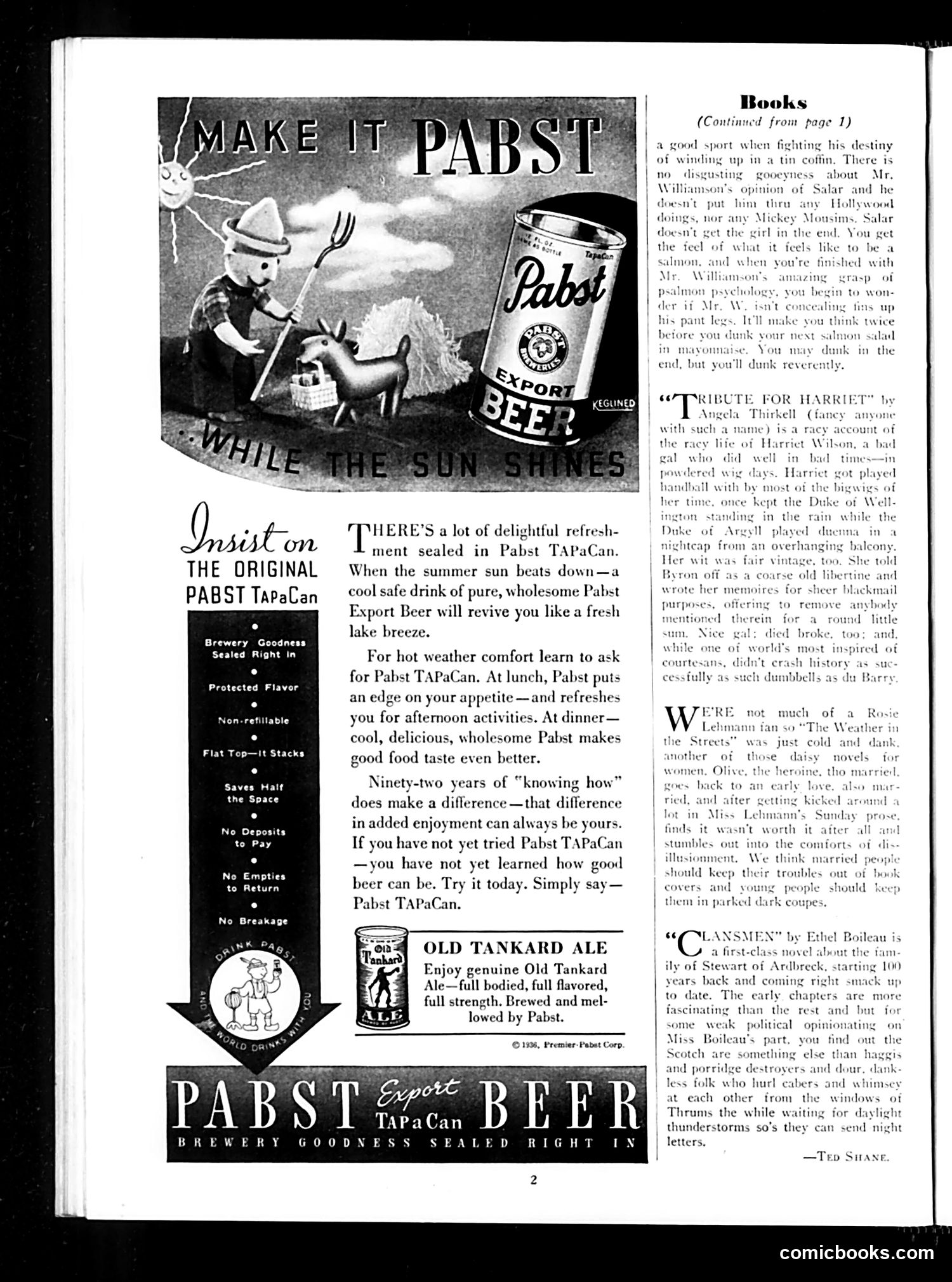
Page Analysis This page is primarily advertising for Pabst beer products, not political satire. The main image shows a cheerful figure fishing while enjoying Pabst Export Beer, with the slogan "Make it Pabst While the Sun Shines." The right column contains book reviews (continued from page 1), discussing literary works including "Tribute for Harriet" by Angela Thirkell and other novels. There is no political cartoon or satirical content on this page. The only visual elements are beer advertisements featuring Pabst's TaPaCan product and Old Tankard Ale, along with their marketing copy emphasizing the drink's qualities and 92 years of brewing experience. This appears to be a typical Judge magazine page mixing entertainment content with full-page commercial advertising.
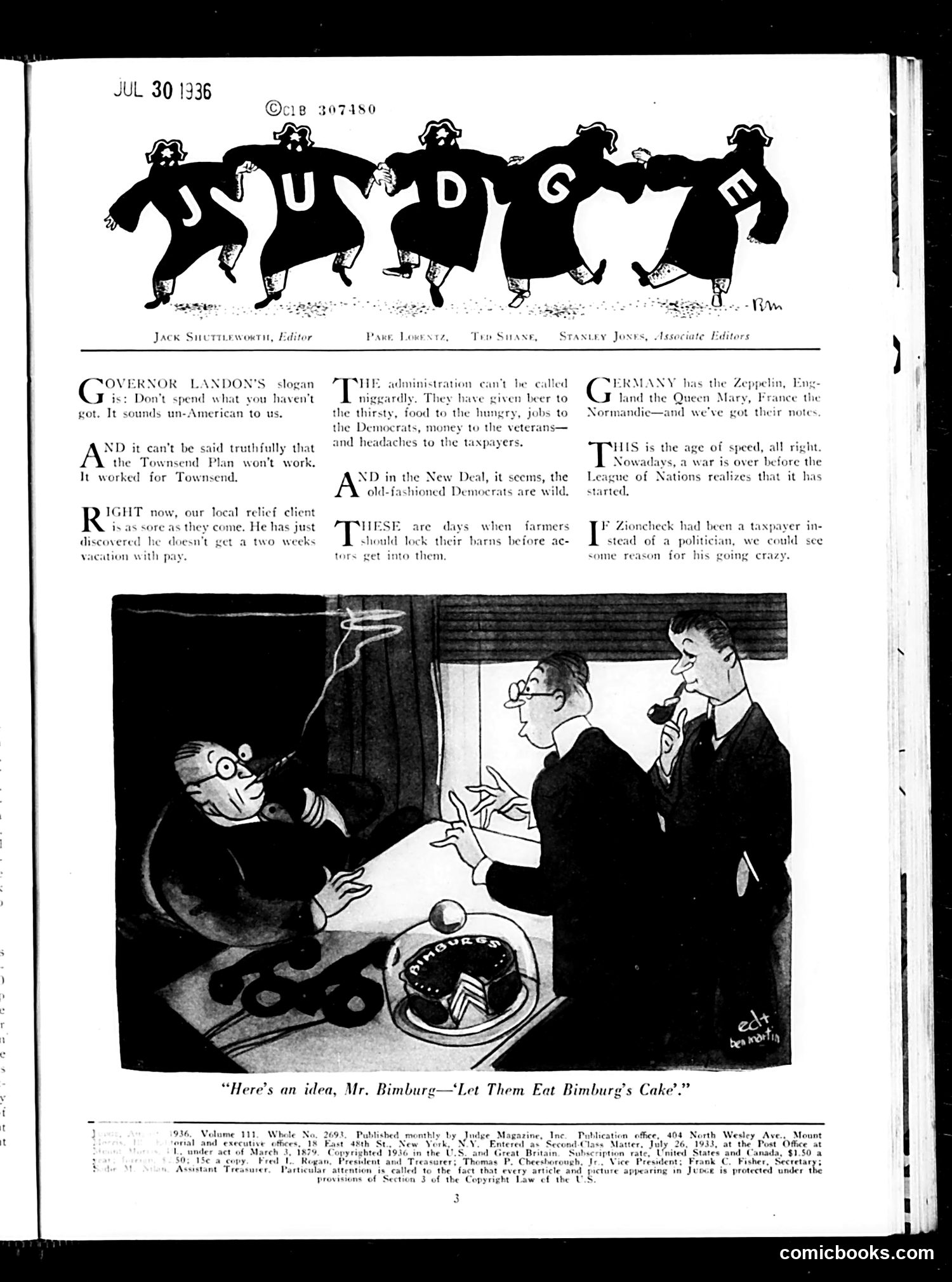
Political Commentary from Judge Magazine, July 30, 1936 This page satirizes the Roosevelt administration's New Deal policies. The editorial quips criticize: Governor Landon's slogan ("Don't spend what you haven't got") as hypocritical—the New Deal itself practiced deficit spending. The administration's spending: Critics claim it gave beer to libraries, food to the hungry, jobs to Democrats, money to veterans, and "headaches to the taxpayers." The main cartoon depicts someone (likely a corporate figure) offering a cake labeled "Bimburg's" to two businessmen, with the caption "Let Them Eat Bimburg's Cake"—a cynical reference to Marie Antoinette's famous phrase, suggesting the wealthy were being appeased while common people suffered. The page reflects conservative opposition to FDR's 1936 re-election campaign, particularly wealthy interests' concerns about New Deal redistribution policies.
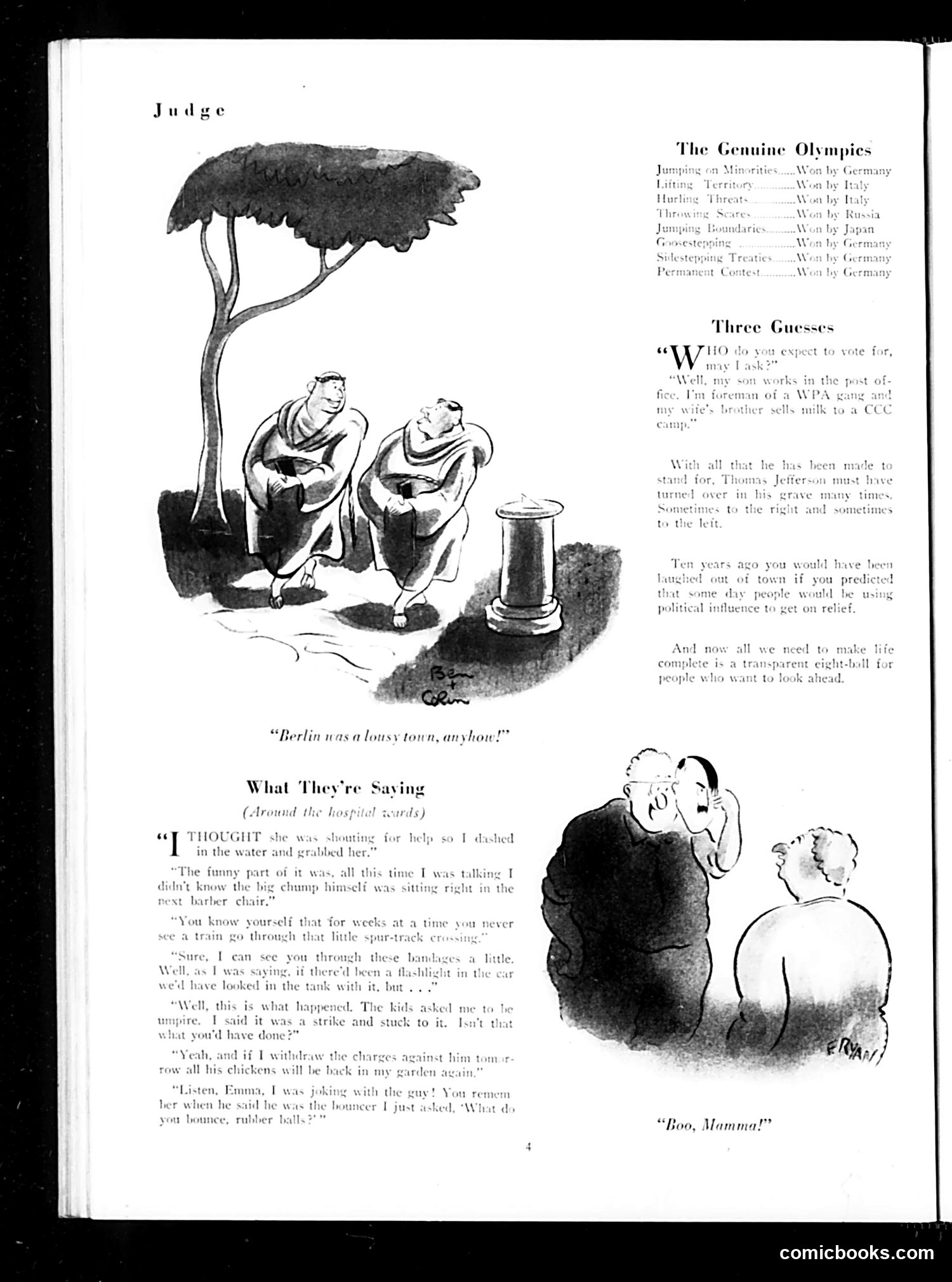
Analysis of Judge Magazine Page This page satirizes political indecision, particularly regarding Thomas Jefferson (referenced in "Three Guesses"). The top cartoon, captioned "Berlin was a lousy town, anyhow!" depicts two figures under a tree discussing relief efforts, likely commenting on post-WWI reconstruction debates and conflicting political priorities. "The Genuine Olympics" lists satirical "competitions" won by various nations (Germany, Italy, Russia, Japan), mocking international tensions and nationalist rivalries of the interwar period. "What They're Saying" presents hospital gossip anecdotes—typical Judge humor mixing domestic comedy with political commentary. The right cartoon "Boo, Mamma!" appears unrelated domestic humor. Overall, the page reflects 1920s-30s American anxieties about political corruption, international relations, and relief policy amid economic uncertainty.
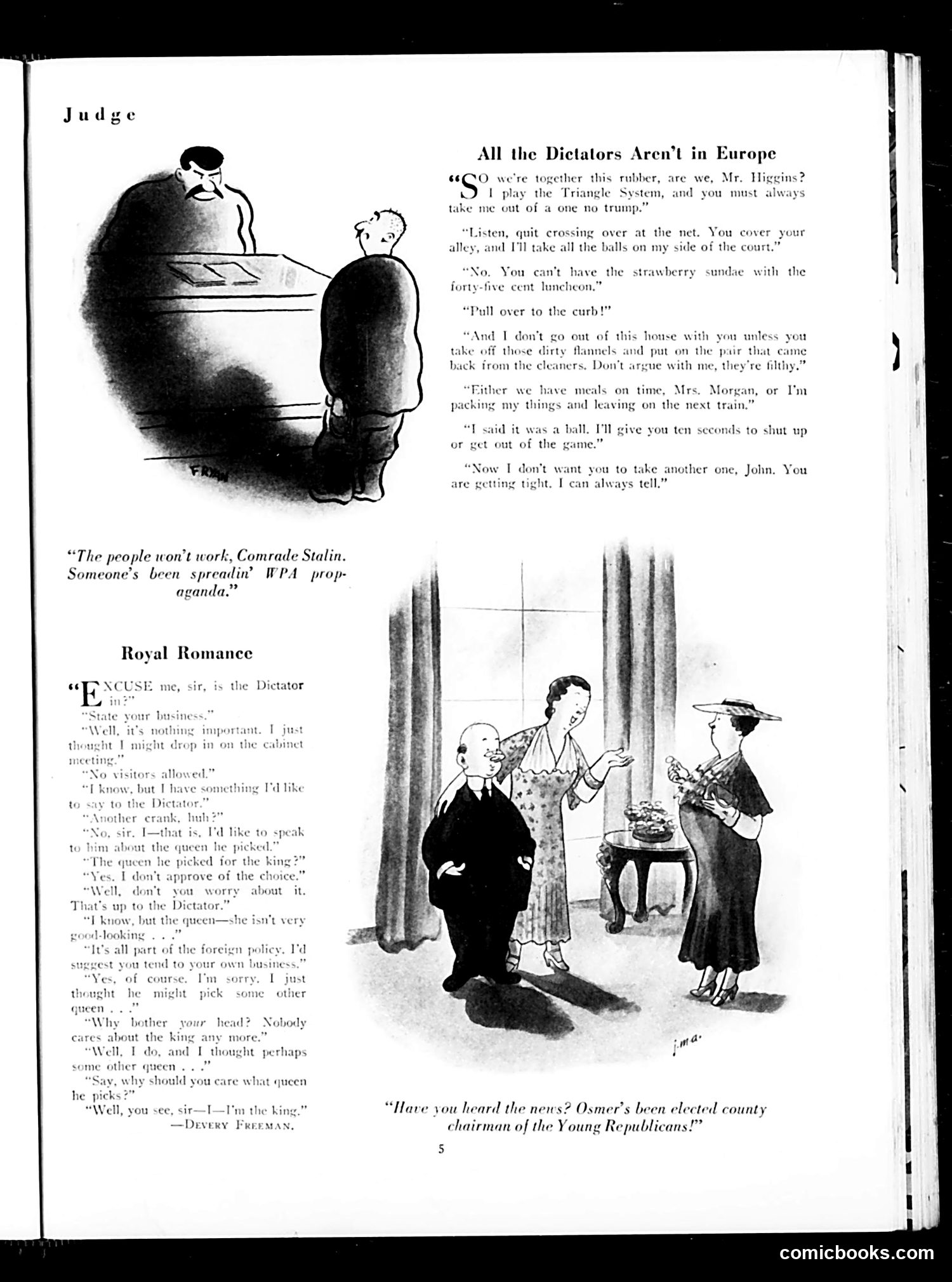
Political Satire from Judge Magazine This page contains two separate cartoons satirizing political figures and domestic life during the interwar period. "All the Dictators Aren't in Europe" depicts a nagging wife dominating her husband at home, comparing domestic marital control to European authoritarian regimes. The satire suggests that American wives exercise "dictatorial" power over their husbands through various domestic demands and restrictions. "Royal Romance" mocks a Dictator character who objects to his queen's choice of a king, absurdly reversing expected power dynamics. The final caption references "Osmer" being elected county chairman of the Young Republicans—likely a local political figure whose name escapes modern recognition. Both cartoons use exaggeration to critique power imbalances and political pretension in 1920s-30s American life.
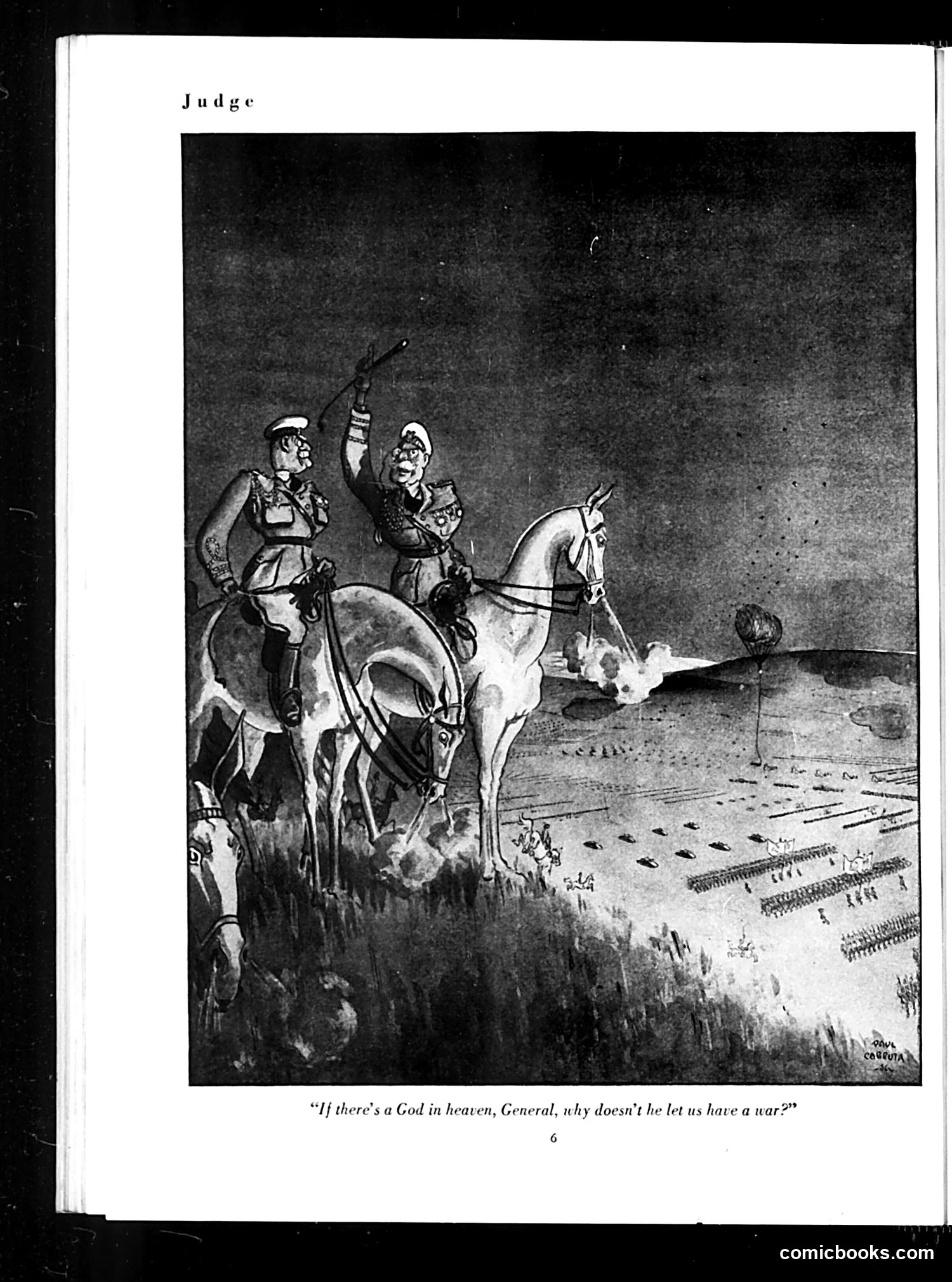
Analysis of "Judge" Cartoon: "Judge" This political cartoon depicts two military officers on horseback overlooking a battlefield with troops arranged below. One officer asks the other: "If there's a God in heaven, General, why doesn't he let us have a war?" The satire critiques militaristic attitudes and the absurdity of military leadership during peacetime (or a period without active conflict). The joke suggests that military commanders are so eager for warfare that they're questioning divine will itself—treating war as a desirable outcome rather than a tragedy. This reflects broader anti-militarism sentiment common in American satirical publications of the early 20th century, mocking the assumption that generals and military hierarchy inherently desire conflict regardless of human cost.
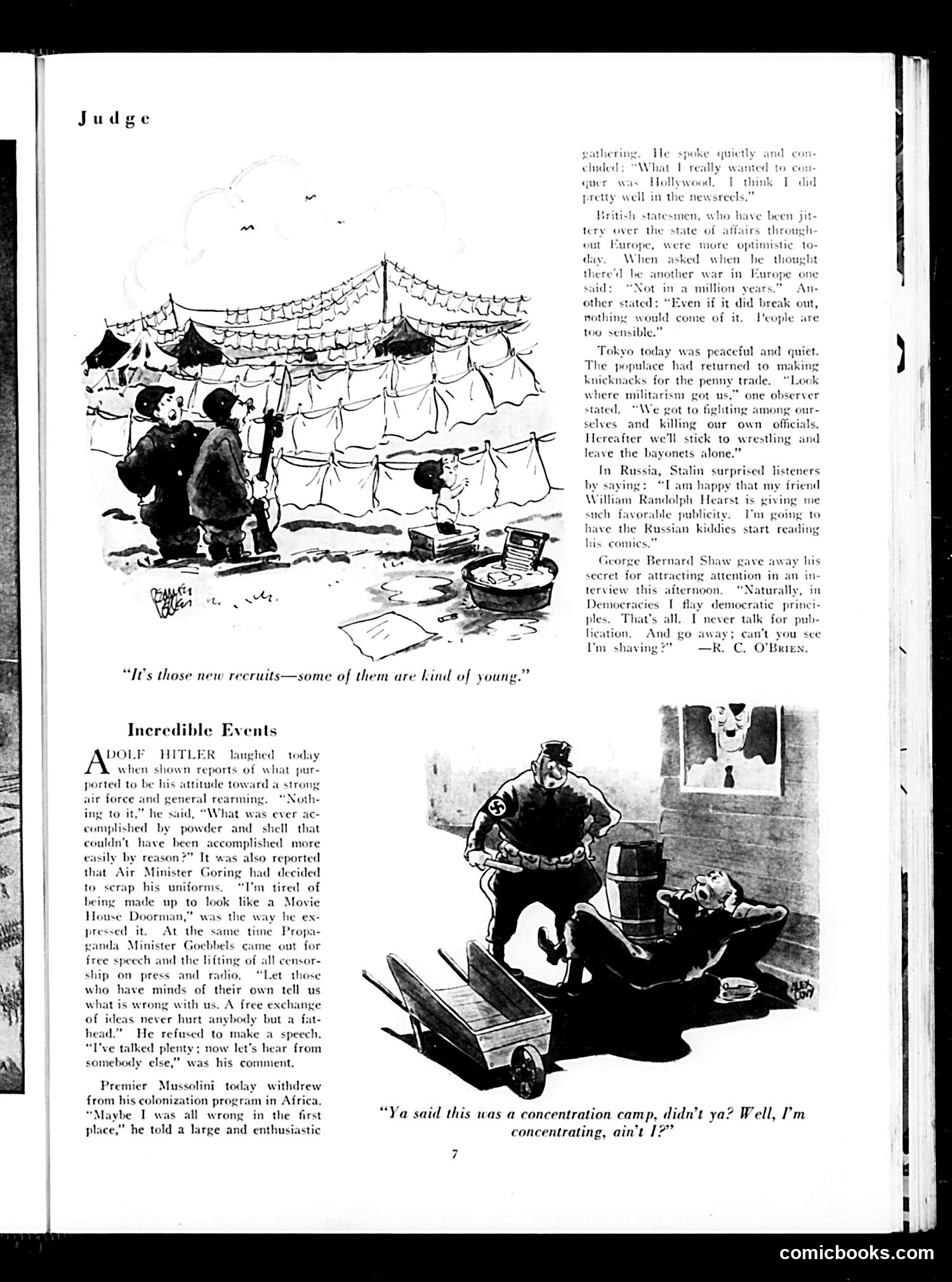
Analysis of Judge Magazine Page This page from Judge satirizes World War II-era political figures and events. The top cartoon mocks military recruit training with the caption "It's those new recruits—some of them are kind of young." The "Incredible Events" section attacks Adolf Hitler, Hermann Göring, and Benito Mussolini through hostile commentary. It reports Hitler laughed at reports of German military weakness, mocks Göring's uniform changes, and ridicules Mussolini withdrawing from African colonization efforts. The lower cartoon depicts what appears to be a Nazi official (likely representing a concentration camp commandant) telling a prisoner "Ya said this was a concentration camp, didn't ya? Well, I'm concentrating, ain't I?"—darkly satirizing Nazi brutality by presenting the official's torture as literal "concentration." The content reflects American wartime anti-Axis propaganda and commentary.
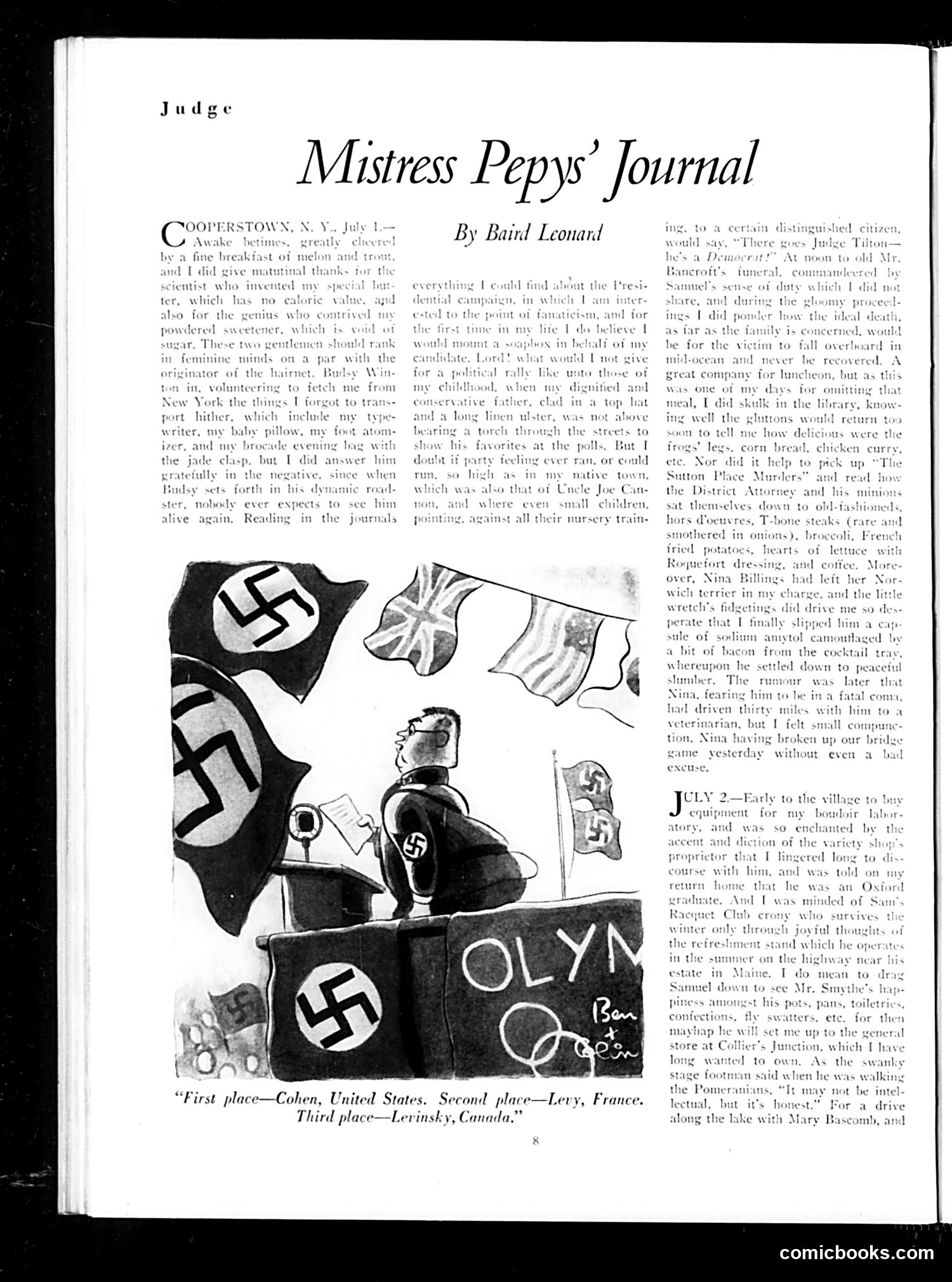
Analysis of "Mistress Pepys' Journal" Cartoon This page contains a political cartoon satirizing the 1936 Olympic Games medal results. The illustration depicts an Olympic podium where the three medal winners are labeled "Cohen" (United States, first place), "Levy" (France, second place), and "Levinsky" (Canada, third place)—all Jewish surnames. The cartoon is flanked by Nazi and fascist flags, making the satire explicit: it mocks the antisemitic ideology of Nazi Germany by showing that despite Hitler's theories of racial superiority, Jewish athletes dominated Olympic competition. The three flags (Nazi, British, and what appears to be Italian fascist imagery) emphasize the irony of fascist regimes' presence at the Olympics while their racist doctrines were demonstrably false. The accompanying "Mistress Pepys' Journal" text appears to be unrelated society commentary, suggesting this was a mixed-content satirical magazine page typical of the mid-1930s.
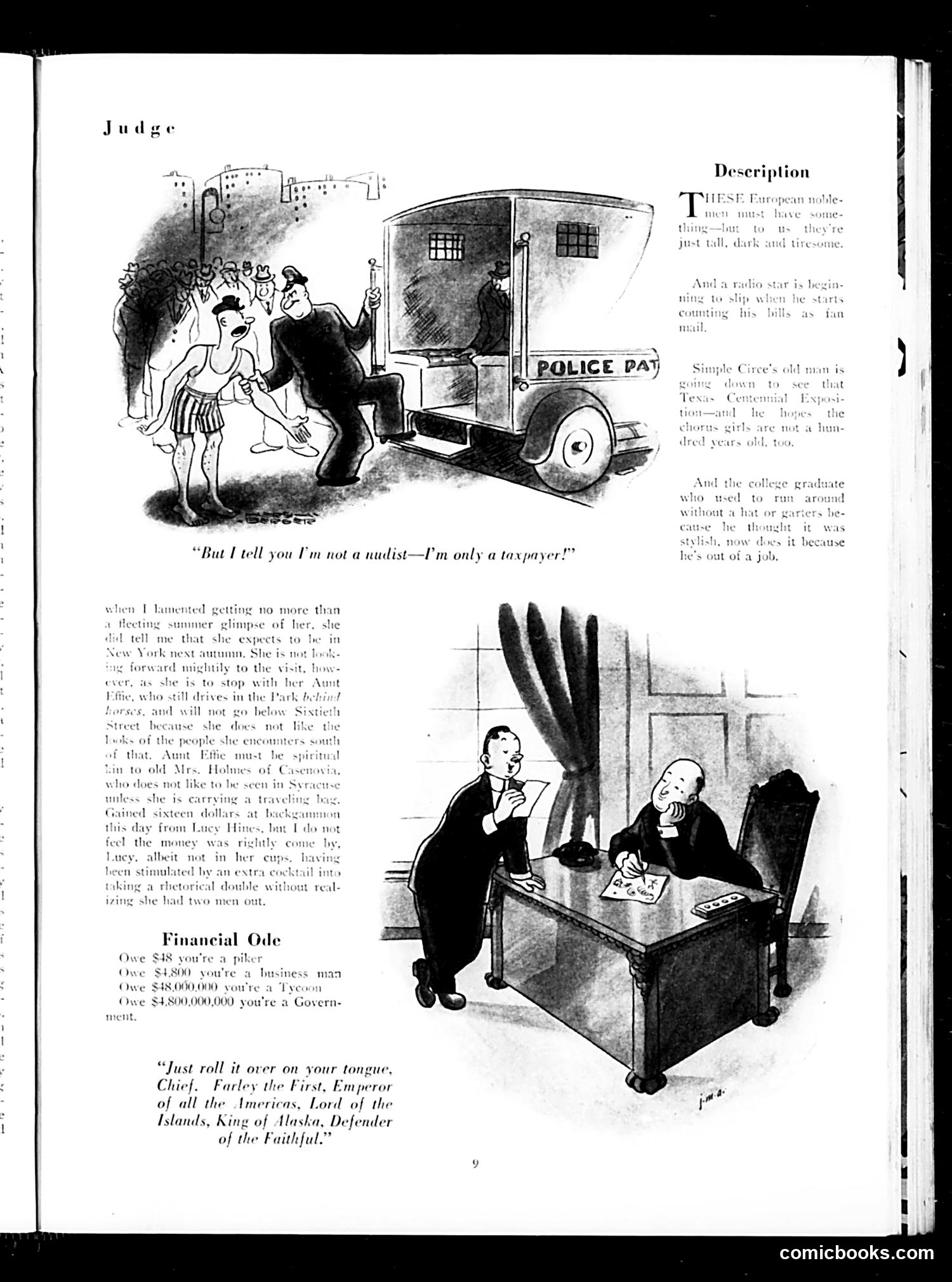
Judge Magazine Cartoon Analysis The top cartoon mocks Prohibition-era arrests, showing a police paddy wagon apprehending nude or scantily-clad partygoers. The defendant's protest—"I'm not a nudist, I'm only a taxpayer!"—satirizes the absurdity of raids on private gatherings during Prohibition, suggesting law enforcement priorities are misplaced. The bottom cartoon appears to reference James Farley, Franklin D. Roosevelt's Postmaster General and political operative. The caption mockingly addresses him as "Farley the First, Emperor," with grandiose titles, satirizing his political power and influence. The scene shows him at a desk, likely commenting on his outsized role in New Deal politics. The "Financial Ode" section above uses escalating wealth figures as satire about economic inequality.
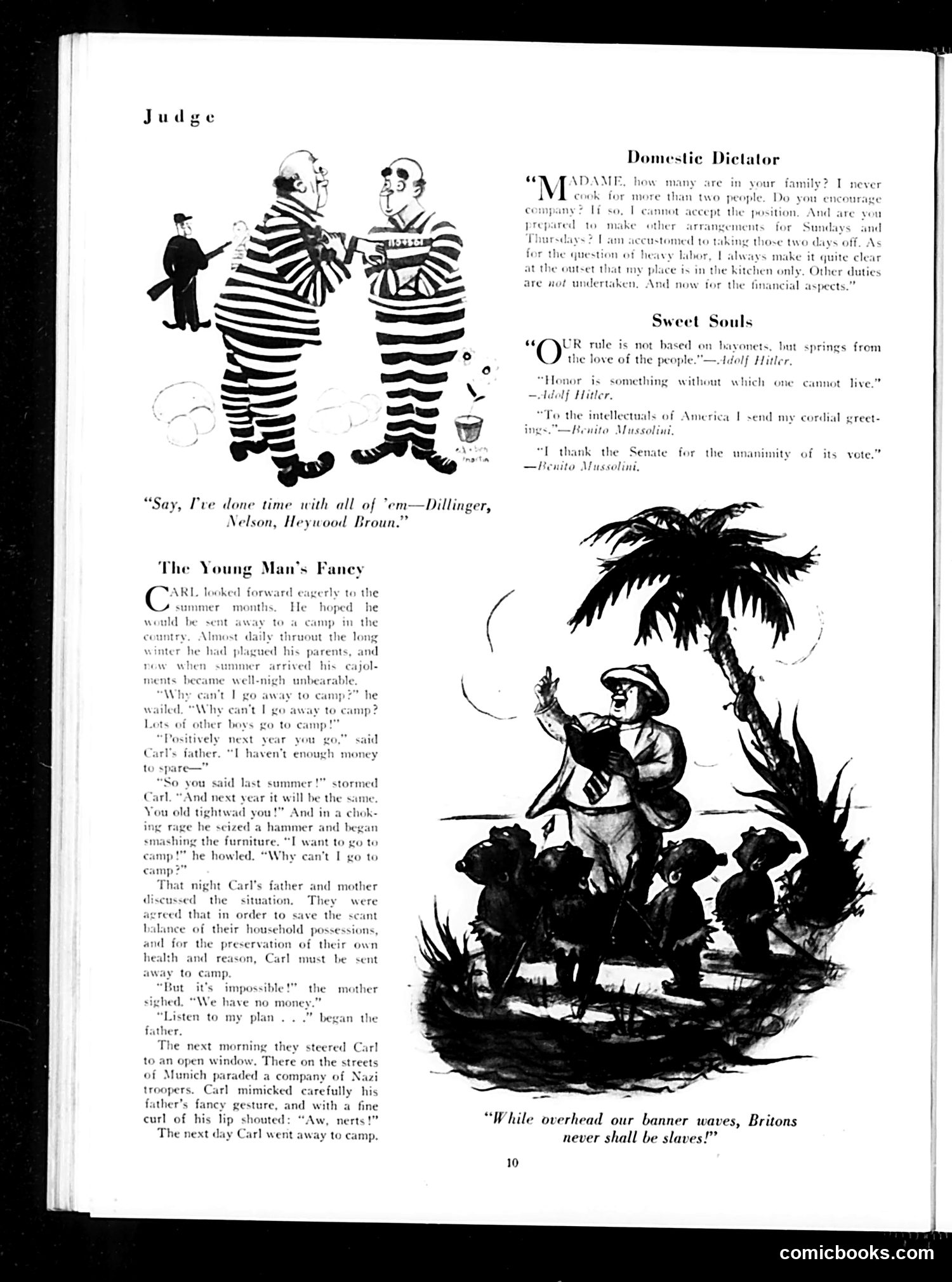
Judge Magazine Page Analysis This page satirizes both domestic authoritarianism and fascist regimes through three pieces: "Domestic Dictator" depicts a housewife laying down strict rules to a prospective cook—controlling family size, work hours, and duties. The satire equates her household tyranny to authoritarian rule. "Sweet Souls" quotes Hitler and Mussolini claiming their power derives from "love of the people" and "honor," not force—obvious irony given their brutal regimes. The juxtaposition with a criminal ("Dillinger, Nelson") suggests their moral equivalence. "The Young Man's Fancy" tells of Carl, whose parents cannot afford summer camp. When Carl sees Nazi stormtroopers parading in Munich and mimics their salute dismissively ("Aw, nerts!"), his parents immediately send him to camp. The implication: even poor families will sacrifice to remove children from fascist influence. The page uses humor to warn American readers about authoritarianism—both petty domestic tyranny and dangerous totalitarianism abroad—likely dating from the late 1930s when Nazi Germany was increasingly prominent in American consciousness.
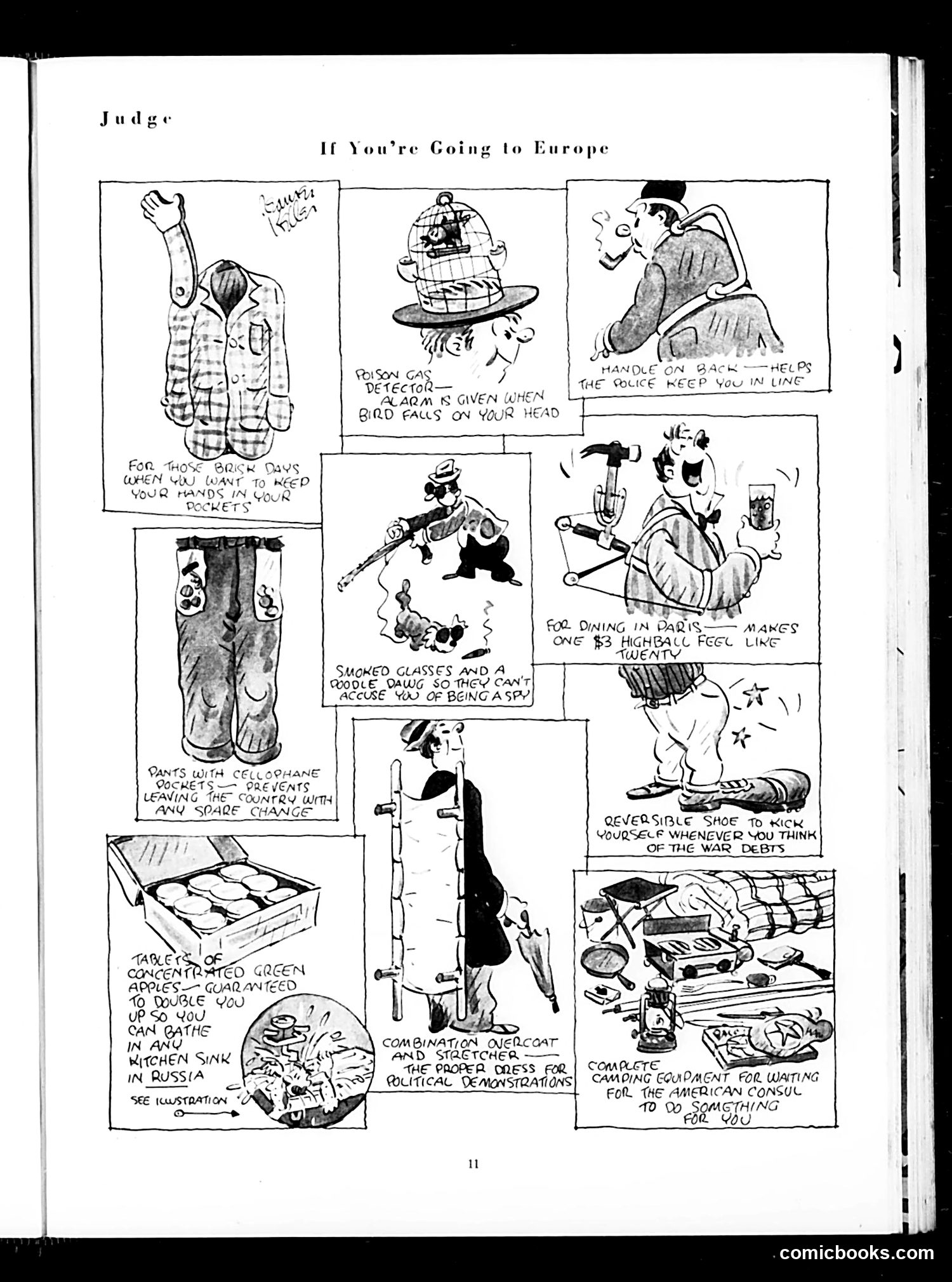
"If You're Going to Europe" - Judge Magazine Satire This is a humorous advice column disguised as practical packing tips for American travelers heading to Europe post-WWI. Each panel offers absurdist "solutions" to social and political problems they'd encounter abroad: - Thick jackets with pockets for hands-in-pockets nonchalance during "brick days" - Poison gas alarm hat referencing lingering WWI chemical weapons fears - Smoked glasses and a wool dog to avoid suspicion of being a spy (reflecting post-war paranoia) - Reversible shoes to kick yourself over war debts (America's frustration with European repayment issues) - Cellophane-pocket pants preventing taking money out of the country - Green apples guaranteed to upset your stomach so you bathe in Russian kitchen sinks - Overcoat and satchel for "political demonstrations" The satire mocks American anxieties about post-WWI Europe: spy fears, chemical weapons trauma, debt disputes, currency restrictions, foreign unrest, and consular bureaucracy. It's aimed at middle-class readers considering European travel during an unstable period.
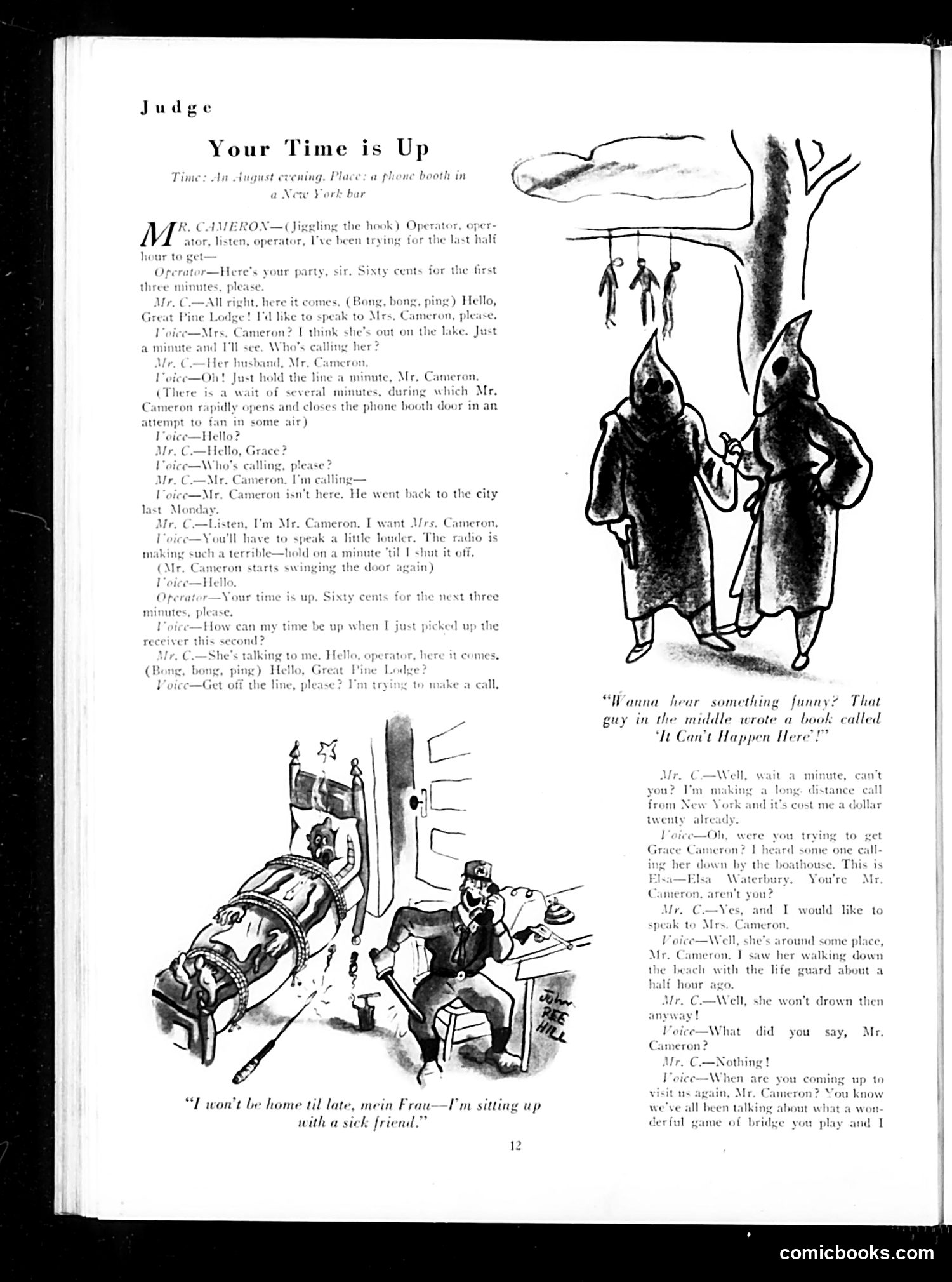
"Your Time is Up" - Judge Magazine Satire This comic satirizes a phone booth conversation in a New York bar involving someone named Mr. Cameron. The humor centers on a long-distance call that's running up expensive charges (sixty cents for three minutes—significant money in this era). The key satirical element appears in the caption: "That guy in the middle wrote a book called 'It Can't Happen Here'!" This references Sinclair Lewis's 1935 anti-fascist novel warning that authoritarianism could occur in America. The cartoon's context—a man frantically trying to end an expensive call while stuck in a phone booth—uses this reference ironically, suggesting real-world problems (financial constraints, marital complications hinted at in the dialogue) are more pressing than abstract political warnings. The cartoons mock both modern inconveniences (phone booth costs, long-distance charges) and the gap between literary warnings about societal collapse and everyday middle-class anxieties.
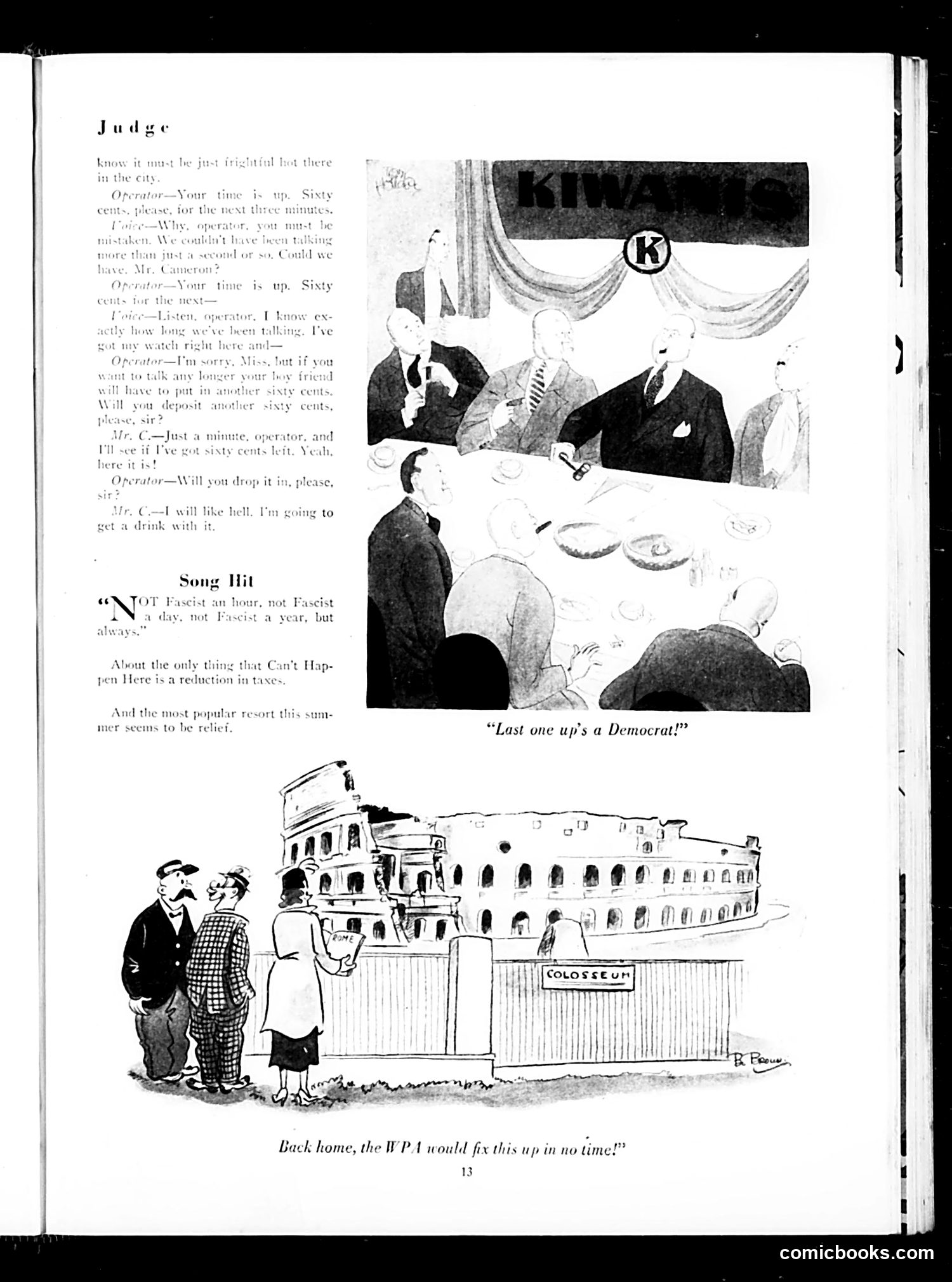
Analysis of Judge Magazine Page This page contains two cartoons satirizing 1930s American politics and economics. Top cartoon ("Lost one up's a Democrat!"): A dining scene where men debate money. The operator keeps demanding payment while customers argue about coins—likely satirizing the WPA (Works Progress Administration), a New Deal program. The joke mocks bureaucratic haggling over trivial amounts during economic hardship. Bottom cartoon ("Back home, the WPA would fix this up in no time!"): Two tourists admire the Colosseum in Rome while one comments that America's WPA could repair it quickly. This appears to mock the WPA as either ineffectually spending money on unnecessary projects or, conversely, as capable of accomplishing anything—the satirical angle is unclear from the image alone. Both cartoons reference the WPA, suggesting this is from the late 1930s when the program was politically contentious. The satire targets New Deal spending policies, though whether it criticizes them as wasteful or inadequate isn't entirely certain from this page alone.
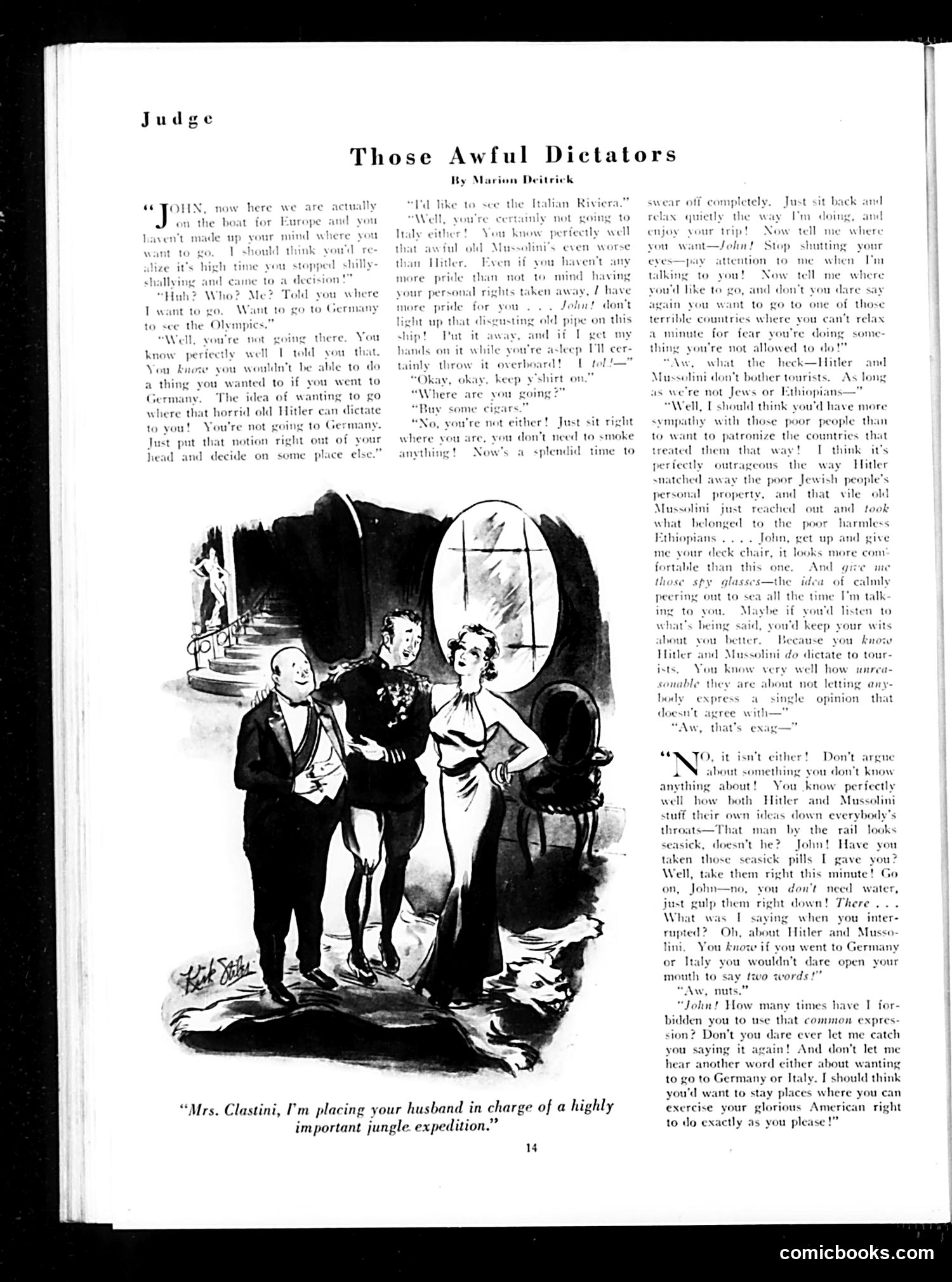
"Those Awful Dictators" — Judge Magazine Satire This page satirizes American tourists planning European vacations during the rise of fascism. The dialogue between "John" and his wife depicts their casual consideration of visiting Germany or Italy despite the dangers and moral outrages of Hitler's and Mussolini's regimes. The satire's bite: the wife expresses horror at fascist atrocities (persecution of Jews, theft of Ethiopian property), yet simultaneously wants to visit these countries for leisure—demanding John stop complaining and "do exactly as you please." The cartoon mocks this contradiction: Americans expressing moral outrage about dictators while remaining willing to patronize and fund their regimes as tourists. The caption's joke reinforces this: placing the husband "in charge of a jungle expedition" is a euphemism for sending him into danger—a witty threat disguised as an assignment. The overall message criticizes both fascism and American hypocrisy in the face of it.
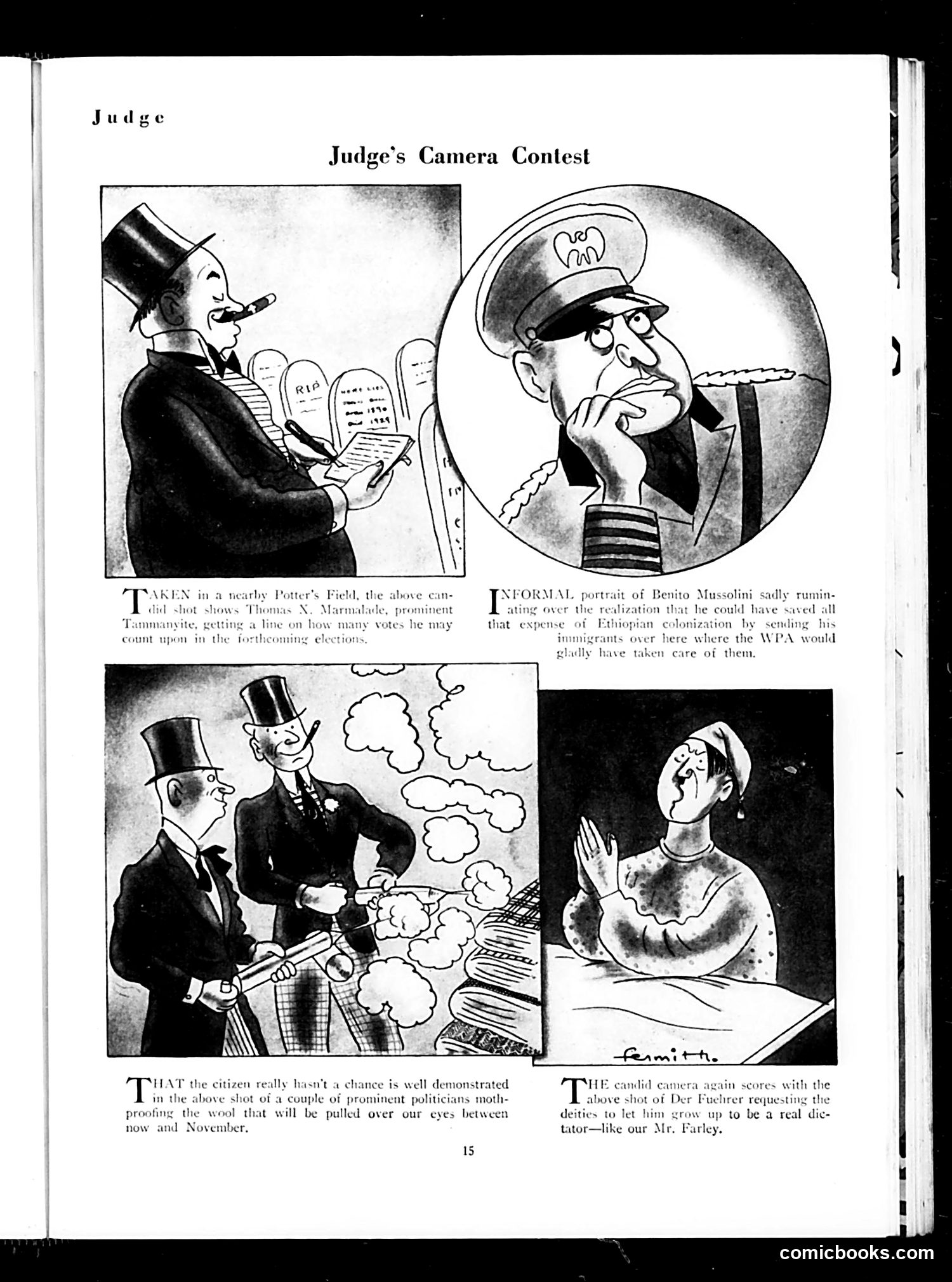
Judge's Camera Contest Explanation This political cartoon page satirizes American politics circa the 1930s-40s through fake "candid camera" shots. Top right: Mussolini is mocked for regretting he didn't use the WPA (Works Progress Administration—a New Deal program) to relocate Italian immigrants, suggesting his fascist regime was wasteful. Bottom left: Two unnamed "prominent politicians" are shown "moth-proofing the wool" they'll pull over voters' eyes before November elections—a cynical commentary on political deception during campaign season. Bottom right: "Der Führer" (Hitler) is shown requesting a "real dictator" like "Mr. Farley"—likely referring to James Farley, FDR's political operative—mocking American politics as increasingly authoritarian. The cartoons use exaggerated caricature to satirize both foreign fascism and American political corruption, suggesting little moral difference between them. The "camera contest" framing presents these as candid observations of political reality.
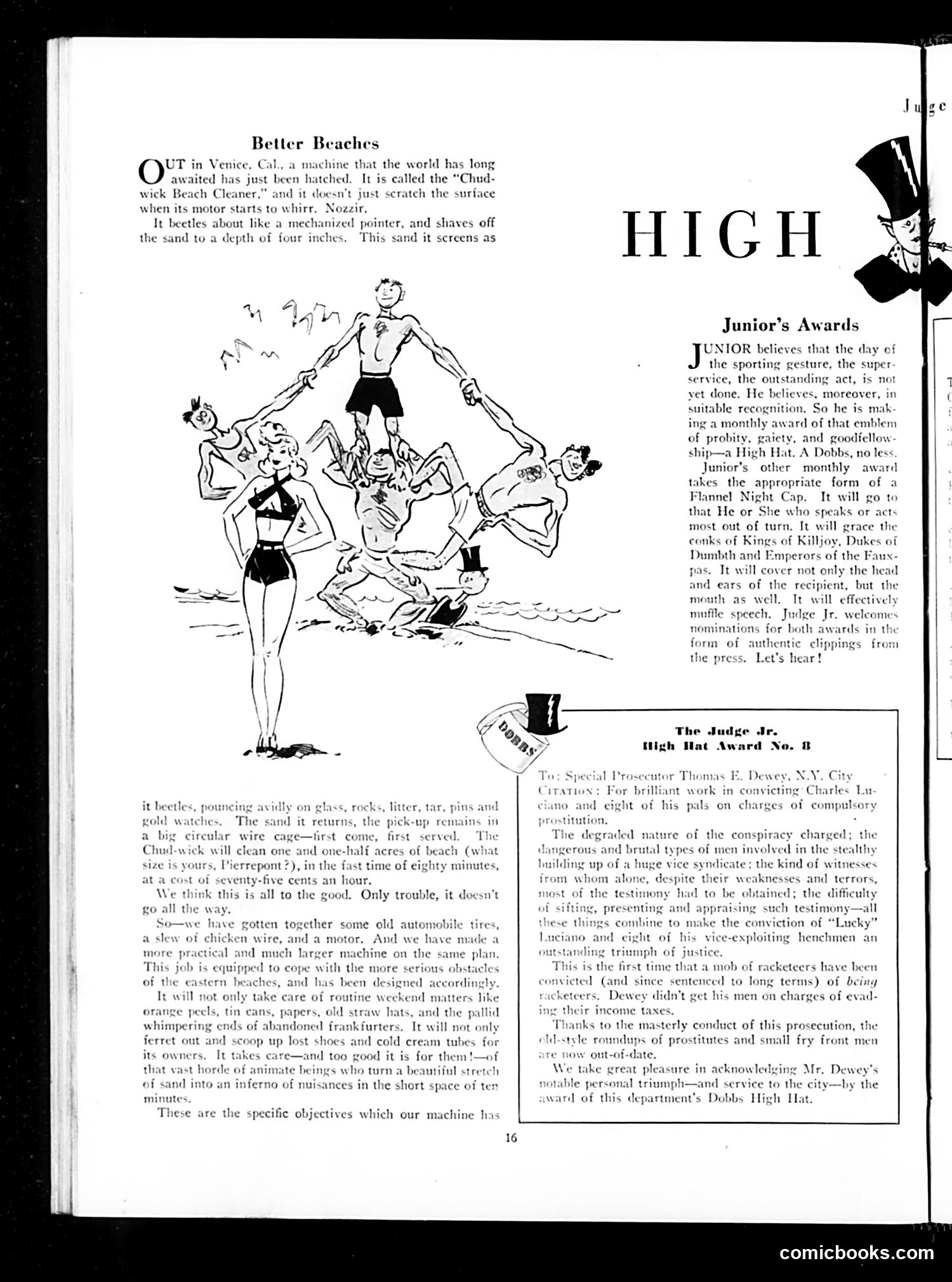
Better Beaches & Junior's Awards Better Beaches is a humorous article about a new mechanical beach cleaner invented in Venice, California. The accompanying cartoon shows beachgoers enjoying the cleaned sand. The piece notes the machine works efficiently but humorously suggests building a larger version to handle the chaos created by crowds of people who turn beaches into "an inferno of nuisances." Junior's Awards announces Judge magazine's monthly recognition program. The "High Hat" award honors exemplary conduct or service, while the "Flannel Night Cap" humorously mocks those who speak out of turn—designed to "muffle speech." The inaugural High Hat Award goes to Thomas E. Dewey, New York's Special Prosecutor, for his successful prosecution of Charles Luciano and associates on compulsory prostitution charges. The citation praises Dewey's skillful handling of difficult witnesses and dangerous criminals in dismantling a major vice syndicate—notably prosecuting them for racketeering rather than tax evasion.
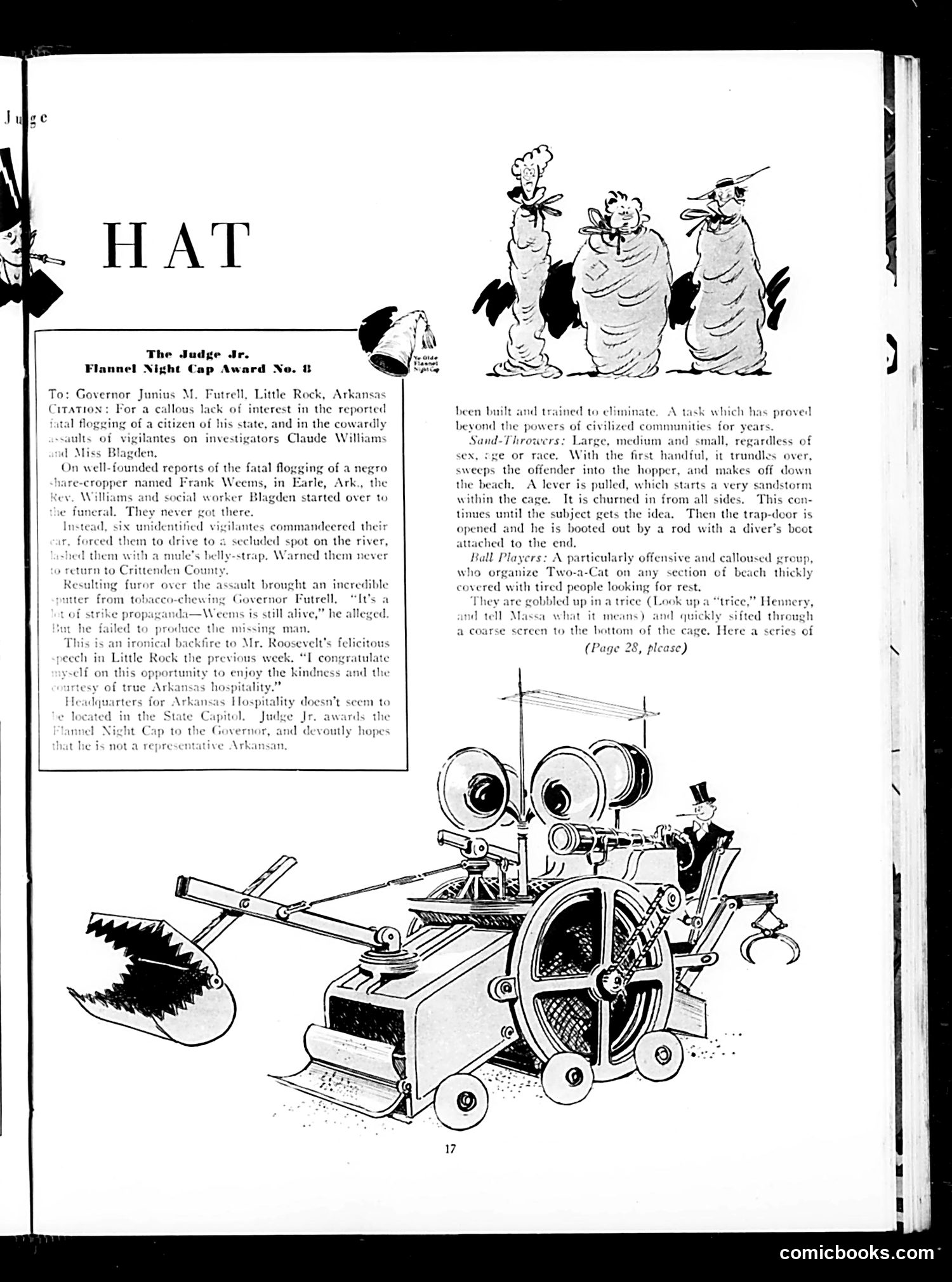
"The Judge Jr. Flannel Night Cap Award" - Satirical Commentary on Racial Violence This is a scathing editorial cartoon criticizing Governor Junius M. Futrell of Arkansas for his indifference to racial violence. The text describes the fatal flogging of Frank Weems, a Black sharecropper in Earle, Arkansas, and the subsequent intimidation of investigators Claude Williams and Miss Blagden by vigilantes. The "Flannel Night Cap Award" is Judge magazine's sarcastic honor for Futrell's failure to protect citizens or investigate the crime. The elaborate cartoon machine below appears to satirize the governor as complicit in a system designed to terrorize and eliminate Black citizens—a dark commentary on lynch mobs and systemic racism in the Jim Crow South. The award mocks Futrell's hollow claims about "Arkansas Hospitality" by exposing the state's actual hospitality: violence, impunity, and official neglect of racial atrocities.
"Judge on the Bench" - Political Commentary This page contains editorial text rather than a cartoon. It's a political argument defending President Roosevelt's reelection and powers against critics who feared he was becoming a dictator. The writer argues that while dictatorships exist elsewhere (Italy, Germany, China, Russia), America's constitutional system protects against tyranny. Roosevelt's expanded emergency powers during the Depression don't constitute dictatorship because Congress approved them and the Constitution remains intact. The piece dismisses comparisons to foreign dictators, contending that without drastic government reform, economic recovery is impossible. It defends Roosevelt's record: he hasn't suppressed opposition, hasn't censored the press, and hasn't used violence—hallmarks of actual dictatorships. This reflects 1930s debates about executive power during the New Deal, when critics genuinely worried Roosevelt was overstepping constitutional limits.
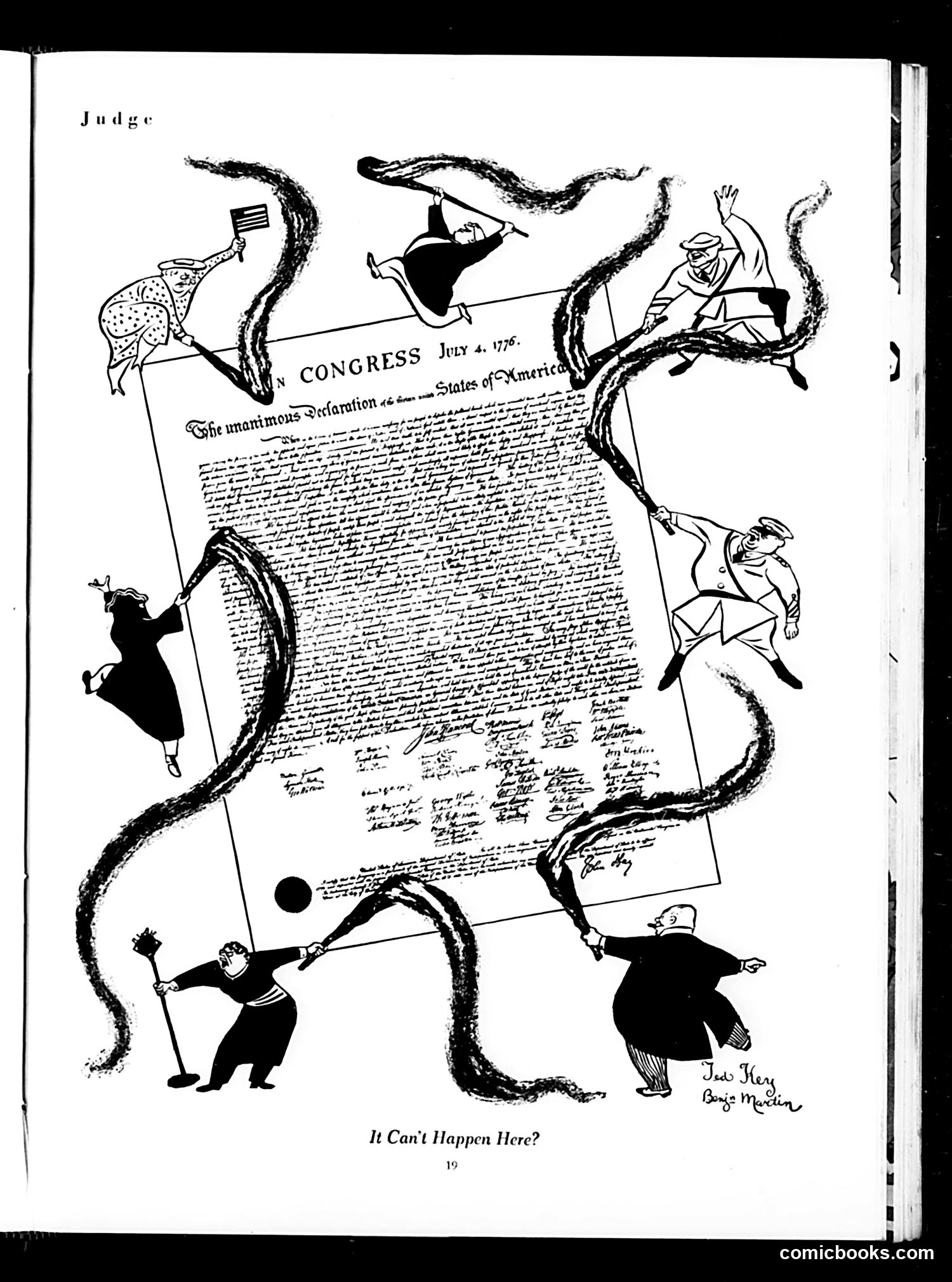
"It Can't Happen Here?" — Judge Cartoon Analysis This political cartoon satirizes threats to the Declaration of Independence. Six figures in period dress attack the document with snakes, swords, and clubs—representing various threats to American democracy and the principles of 1776. The serpents likely symbolize corruption or treachery. The violent poses suggest enemies both external and internal attempting to undermine foundational American values. The title "It Can't Happen Here?" frames this ironically—the question mark suggests the cartoonist believes constitutional threats *are* possible despite American confidence in their permanence. Without the publication date visible, the specific historical moment remains unclear, though Judge magazine was active during multiple periods of American political anxiety (Gilded Age through mid-20th century). The satire warns readers against complacency regarding democratic institutions.
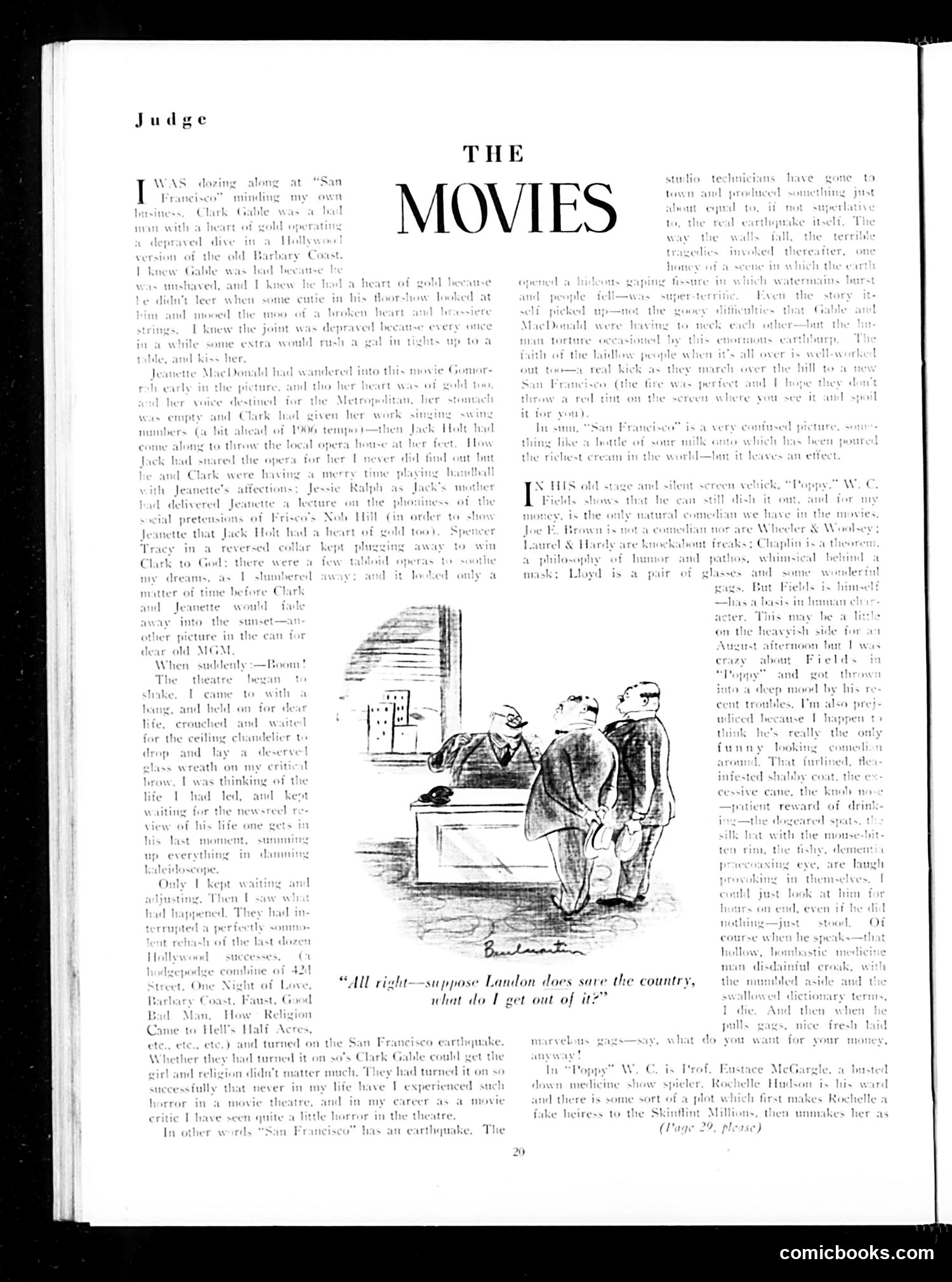
Analysis This page from Judge magazine contains a film review column titled "The Movies" discussing various Hollywood productions, including commentary on an earthquake-themed picture set in San Francisco. The cartoon depicts three men in suits examining what appears to be a desk or counter. The caption reads: "All right—suppose Landon does save the country, what do I get out of it?" This references Alf Landon, the Republican presidential candidate in 1936. The joke satirizes American self-interest during the Great Depression—suggesting voters cared less about abstract national salvation than personal economic benefit. The cartoon mocks the notion that citizens would support a political candidate purely for patriotic reasons rather than direct personal gain, reflecting Depression-era cynicism about politics and economics.
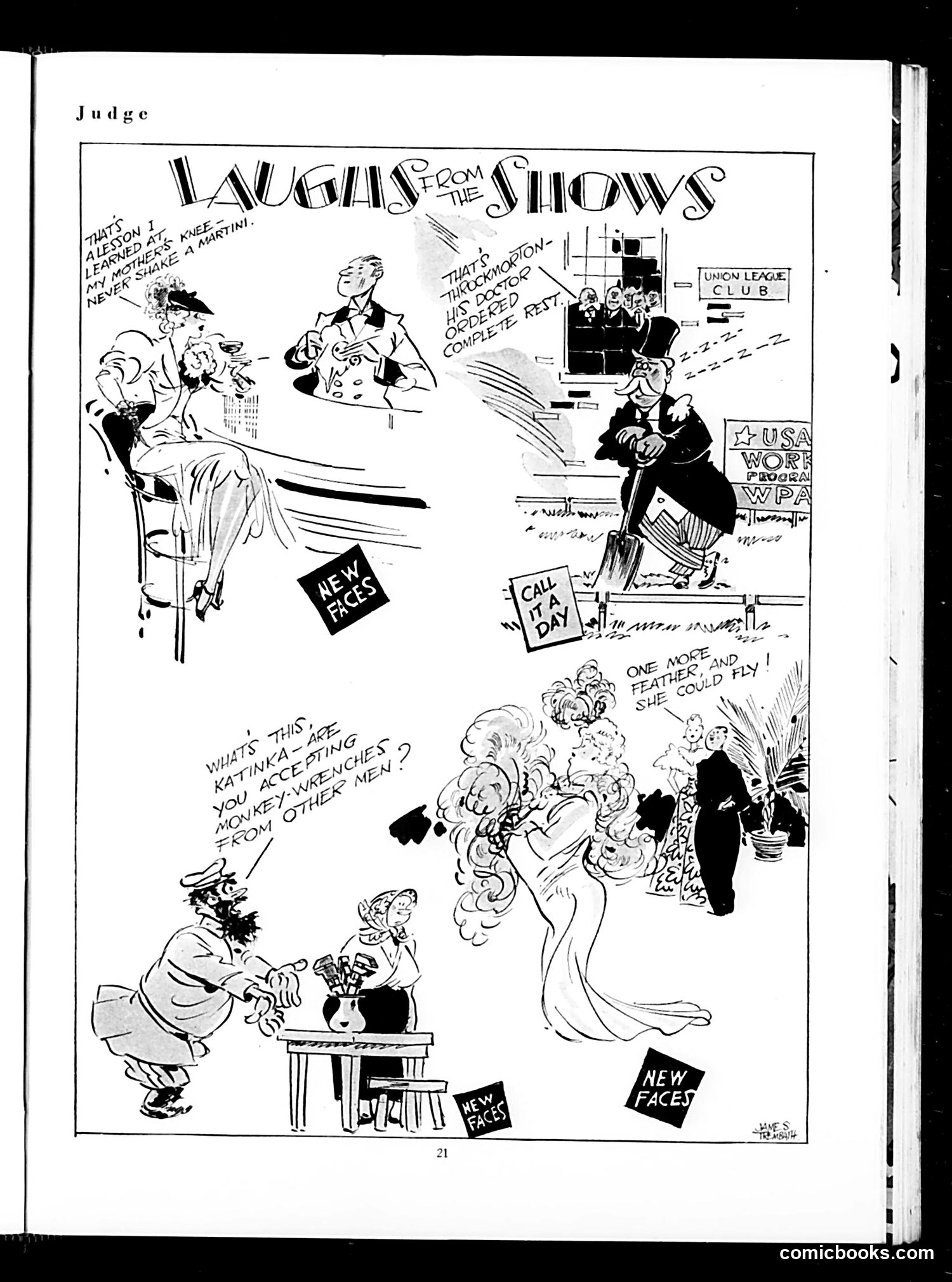
"Laughs from the Shows" This is a theatrical satire page titled "Laughs from the Shows," featuring multiple vignettes mocking various entertainment venues and performers. The cartoons ridicule Broadway shows, the Union League Club, and a USA Work Program, suggesting these establishments are presenting mediocre or absurd entertainment. One panel shows a woman declaring "One more feather and she could fly!"—likely mocking overly elaborate theatrical costumes. Another asks about "klinkling" actresses performing on stage, suggesting derivative or uninspired performances. The "New Faces" labels throughout indicate this is satirizing the introduction of new talent or acts. The overall tone criticizes theatrical productions of the era as offering repetitive, uninspired entertainment. The exaggerated character designs and frantic linework emphasize the chaos and absurdity Judge's cartoonists attributed to contemporary shows.
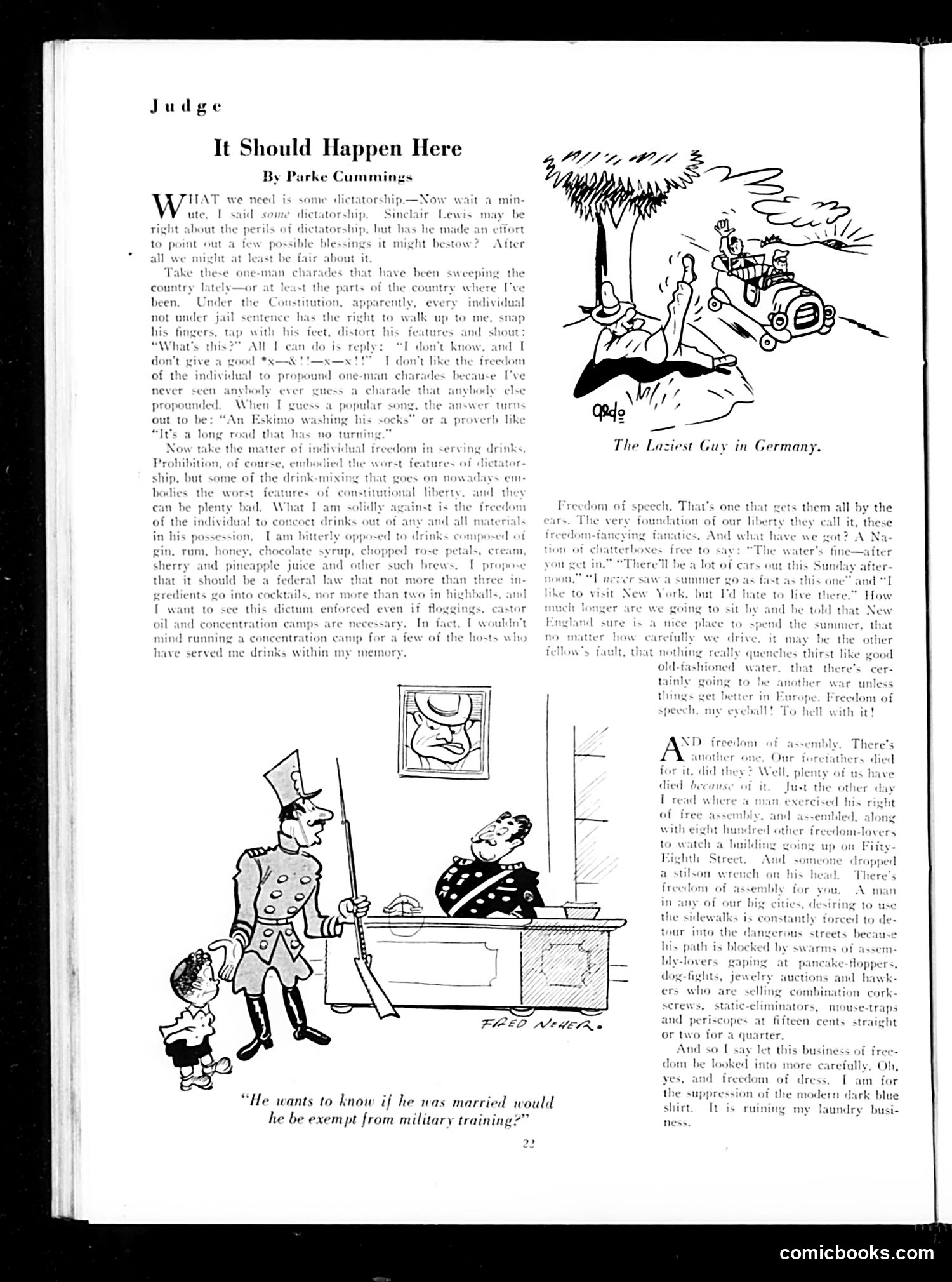
"It Should Happen Here" by Parke Cummings This satirical piece critiques what the author sees as excessive American complaints about freedom. Cummings argues that Americans obsess over trivial "freedoms"—like freedom of dress, freedom of assembly to watch construction, freedom to visit sidewalks—while ignoring genuine liberties worth defending. The lower cartoon shows a military officer questioning whether a married man would be exempt from training, satirizing bureaucratic absurdities. The article's central irony: Americans invoke "freedom" for minor inconveniences (laundry problems from dark shirts, pancake-eating restrictions) while their forefathers died for substantive rights. Cummings suggests this trivializes real freedom and that such complaints undermine serious civic discourse. The title implies such shallow freedom-mongering should happen in dictatorships, not democracies—a warning against taking liberty for granted through petty grievances.
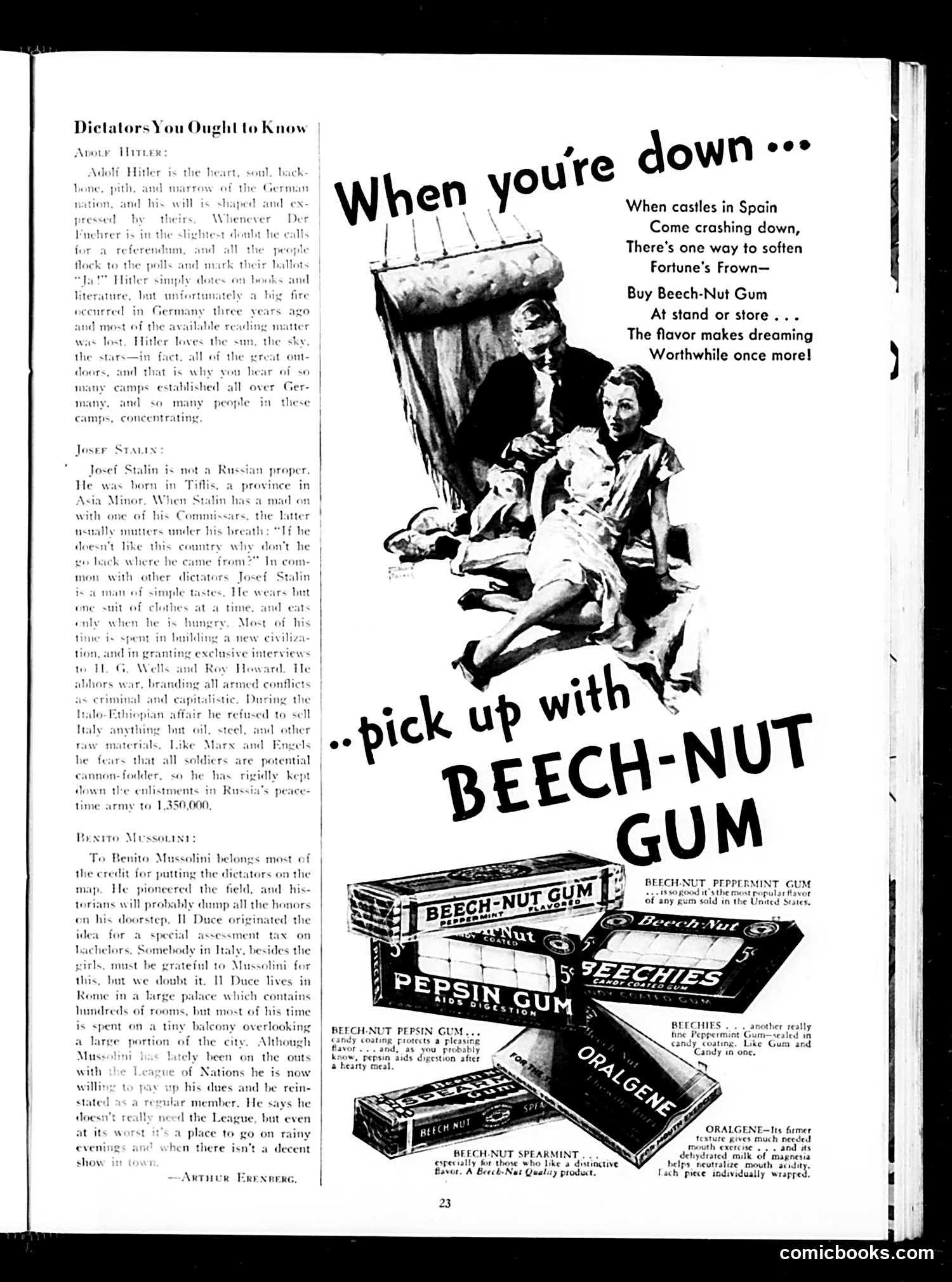
Analysis for Modern Readers This page combines political satire with advertising. The left column presents brief, mocking profiles of contemporary dictators (Hitler, Stalin, and Mussolini) from a 1930s American perspective. The satire is biting: Hitler is described as emotionally shallow despite his power; Stalin is portrayed as a paranoid, ascetic despot who keeps soldiers concentrated in camps; Mussolini is ridiculed for pioneering dictatorship and spending time on a balcony while neglecting international obligations. The right side features a Beech-Nut Gum advertisement that incongruously uses wartime imagery—collapsing castles and distressed figures—to sell candy. This juxtaposes frivolous consumer goods against the serious geopolitical threats described opposite, a common editorial strategy during the pre-WWII period when American magazines grappled with fascism's rise while maintaining normalcy through advertising.
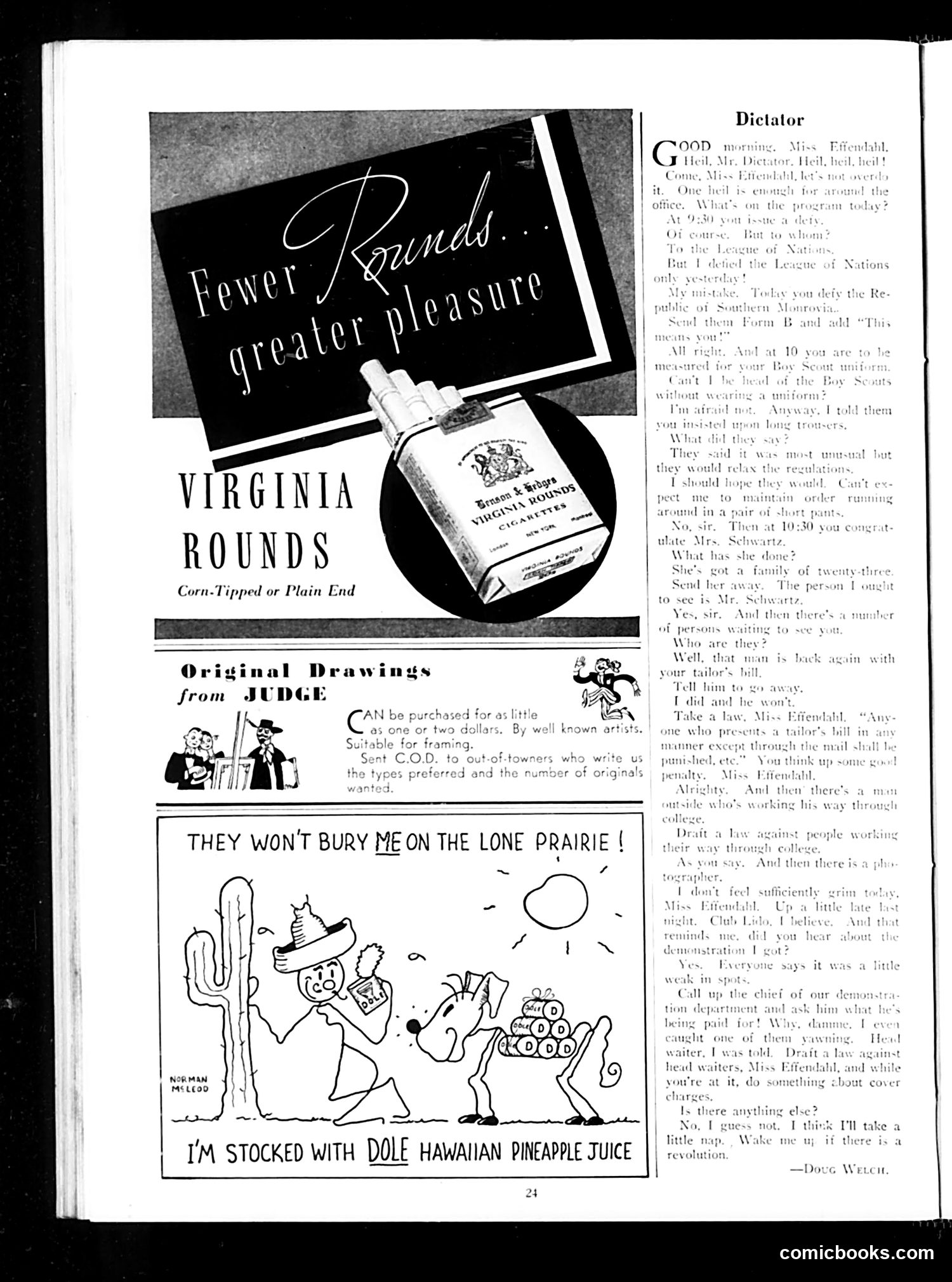
Analysis The page contains a satirical dialogue titled "Dictator" mocking a female office worker (Miss Eifendahl) who exercises petty authority over her workplace. The joke targets small-minded bureaucracy and rule-enforcement—she obsesses over minor dress-code violations (Boy Scout uniforms, trouser length) and procedural formality while ignoring larger issues. The cartoon below depicts a cowboy character declaring "They won't bury me on the lone prairie!" while surrounded by cactus and desert animals, advertising Dole Hawaiian Pineapple Juice. This appears to be an absurdist food advertisement playing on Western imagery. The Virginia Rounds tobacco advertisement uses the slogan "Fewer Pounds, greater pleasure." The satire targets petty bureaucratic power and the absurd seriousness with which minor officials enforce trivial regulations—a timeless critique of workplace inflexibility.
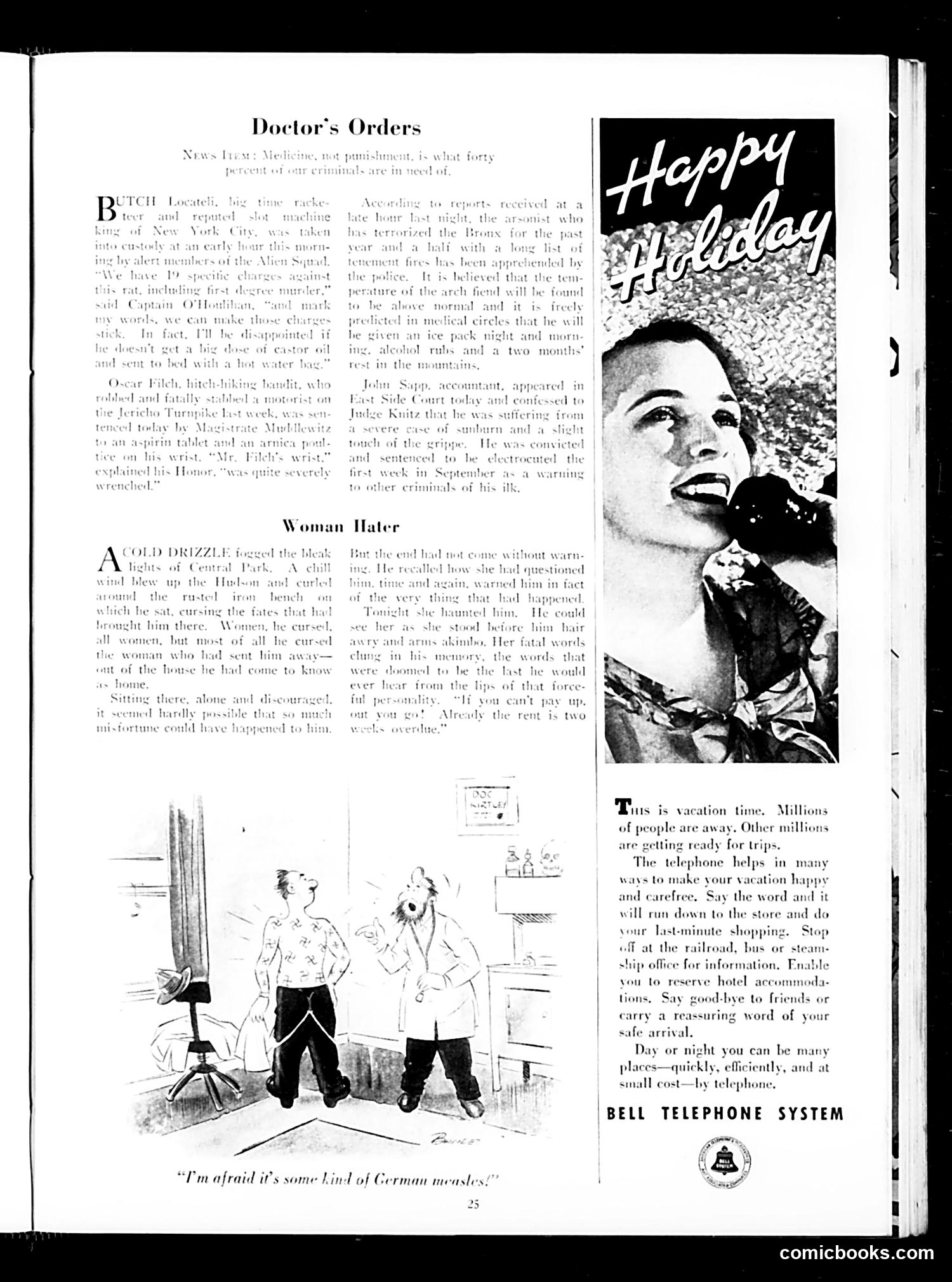
Analysis of This Judge Magazine Page This page contains two distinct elements: Left side: A satirical story section titled "Doctor's Orders" and "Woman Hater," depicting a cynical male character who distrusts women. The accompanying cartoon shows two men discussing their concerns, with one saying "I'm afraid it's some kind of German measles"—a joke playing on wartime anxieties about German threats, using a medical condition as the vehicle for anti-German sentiment. This reflects early-20th-century American prejudice during or around WWI era. Right side: A "Happy Holiday" advertisement for the Bell Telephone System, promoting telephone services for vacation planning—hotel reservations, steamship information, and keeping in touch with loved ones. This is straightforward commercial messaging highlighting how telecommunications facilitate modern leisure travel. The page juxtaposes satirical social commentary with commercial advertising, typical of Judge's format as a humor magazine supported by advertising revenue.
"Bigness in Business" — A 1936 Pro-Advertising Argument This is not a cartoon or satire, but rather a straightforward advertorial essay from the Advertising Federation of America (1936). It argues *for* large-scale business and advertising as economic forces. The piece claims advertising democratizes growth: small businesses can now compete with established giants through modern promotion, whereas a century earlier, word-of-mouth made expansion painfully slow. The author contends that advertising prevents monopolies (by letting small firms advertise freely), lowers consumer prices through mass production, and enables corporate research laboratories to innovate. Modern context: This was published during the Great Depression, when big business faced public suspicion. The essay defends corporate consolidation and advertising spending as beneficial—not exploitative—arguing they serve the consumer and promote competition rather than concentration of power. By today's standards, the claims about preventing monopolies read as naive or disingenuous.
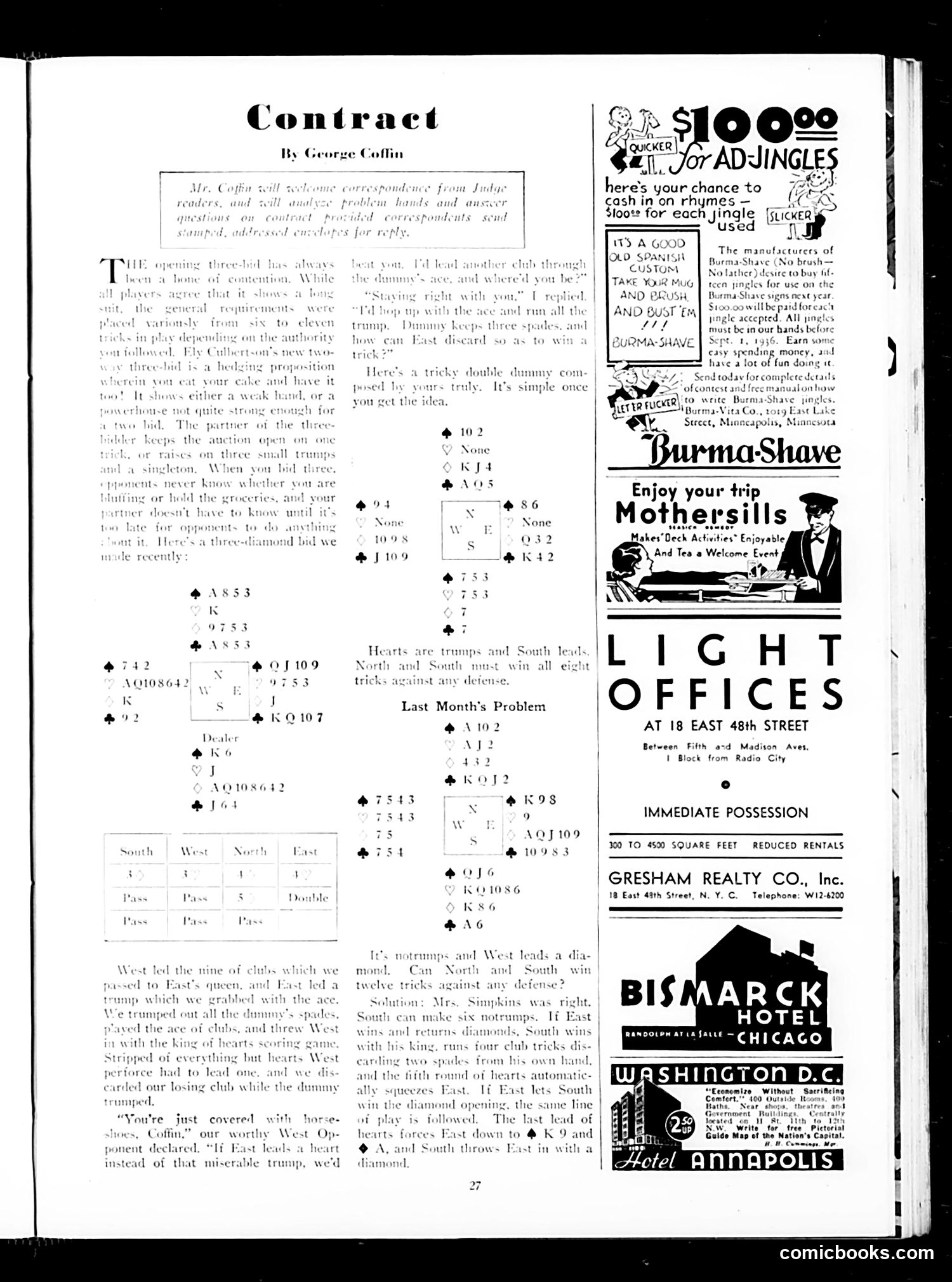
Contract by George Coffin This page is primarily a bridge problem and solution from Judge magazine's "Contract" column. The main content is a detailed hand of contract bridge with card layouts, bidding analysis, and strategic explanation—not satire or political commentary. The cartoon element is minimal: a small Burma-Shave advertisement featuring a jingle contest ($100 prize per accepted rhyme by September 1, 1936), which was the shaving cream company's famous roadside-sign marketing approach. The remaining space contains real estate and hotel advertisements (Light Offices, Gresham Realty, Bismarck Hotel, Hotel Annapolis)—typical magazine filler content. For modern readers: This reflects 1930s American leisure culture—bridge was a popular parlor game, Burma-Shave's quirky rhyming ads were ubiquitous Americana, and Judge mixed instructional content with advertising. There is no political satire on this particular page.
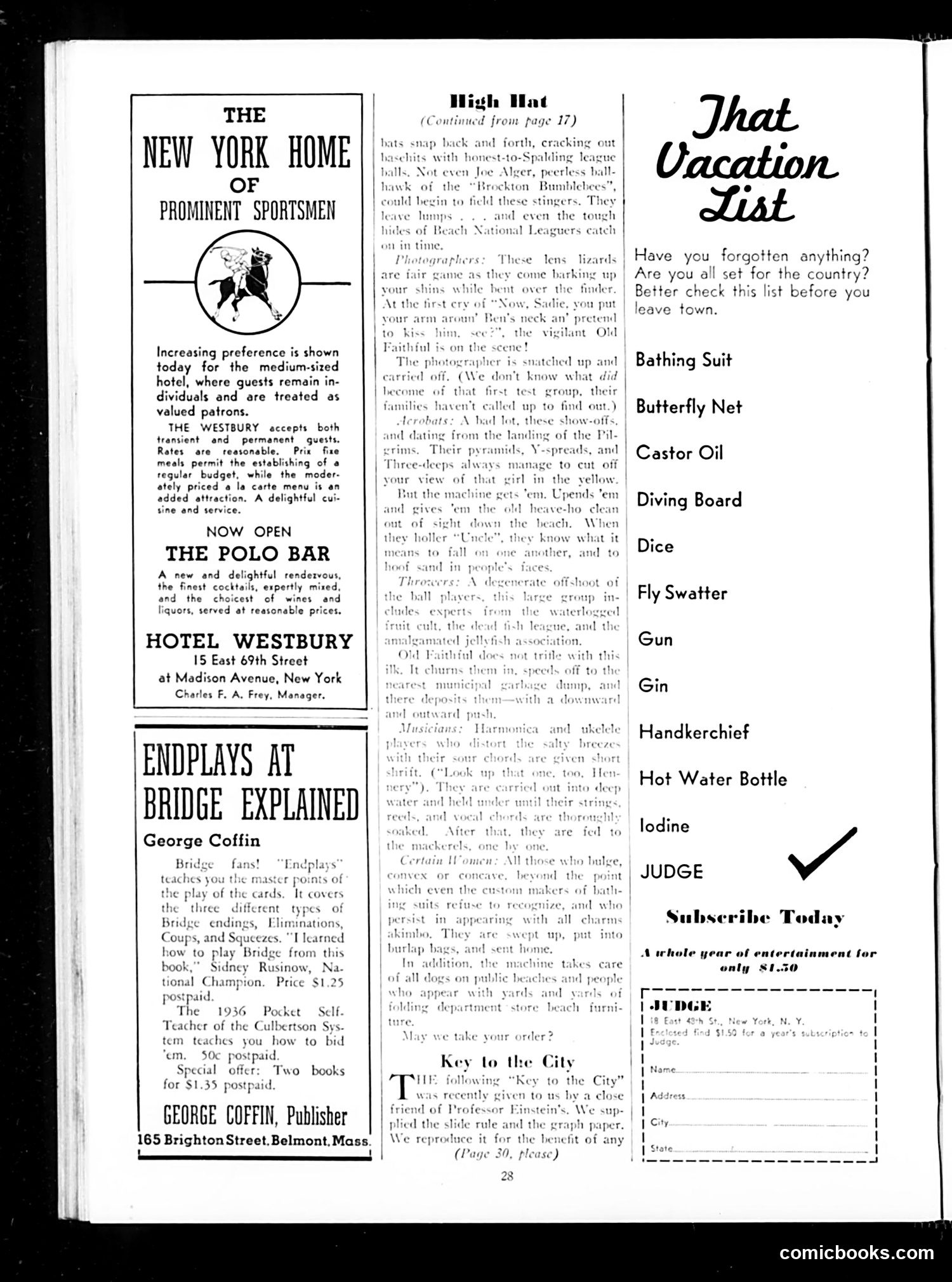
Analysis of Judge Magazine Page This page is primarily advertising and service content, not satirical political commentary. The left side features hotel and bridge instruction book ads targeting affluent New York sportsmen. The "High Hat" section (continuing from page 17) appears to be humorous social commentary about beach-goers and their behaviors—photographers, acrobats, and musicians are satirized for their antics and obliviousness at public beaches. The main satirical element is the mocking tone describing various beach types: their vanity, their disregard for others' comfort, and their pretentious behavior. For instance, acrobats performing dangerous stunts, musicians playing loudly, and photographers posing people rudely are all presented as comic nuisances. The right side offers a practical "Vacation List" for readers—bathing suit, butterfly net, castor oil, diving board, etc.—a helpful checklist rather than satire. The overall page reflects 1930s leisure culture, poking gentle fun at beach socialites while serving the magazine's affluent readership with useful advertisements and travel preparation advice.
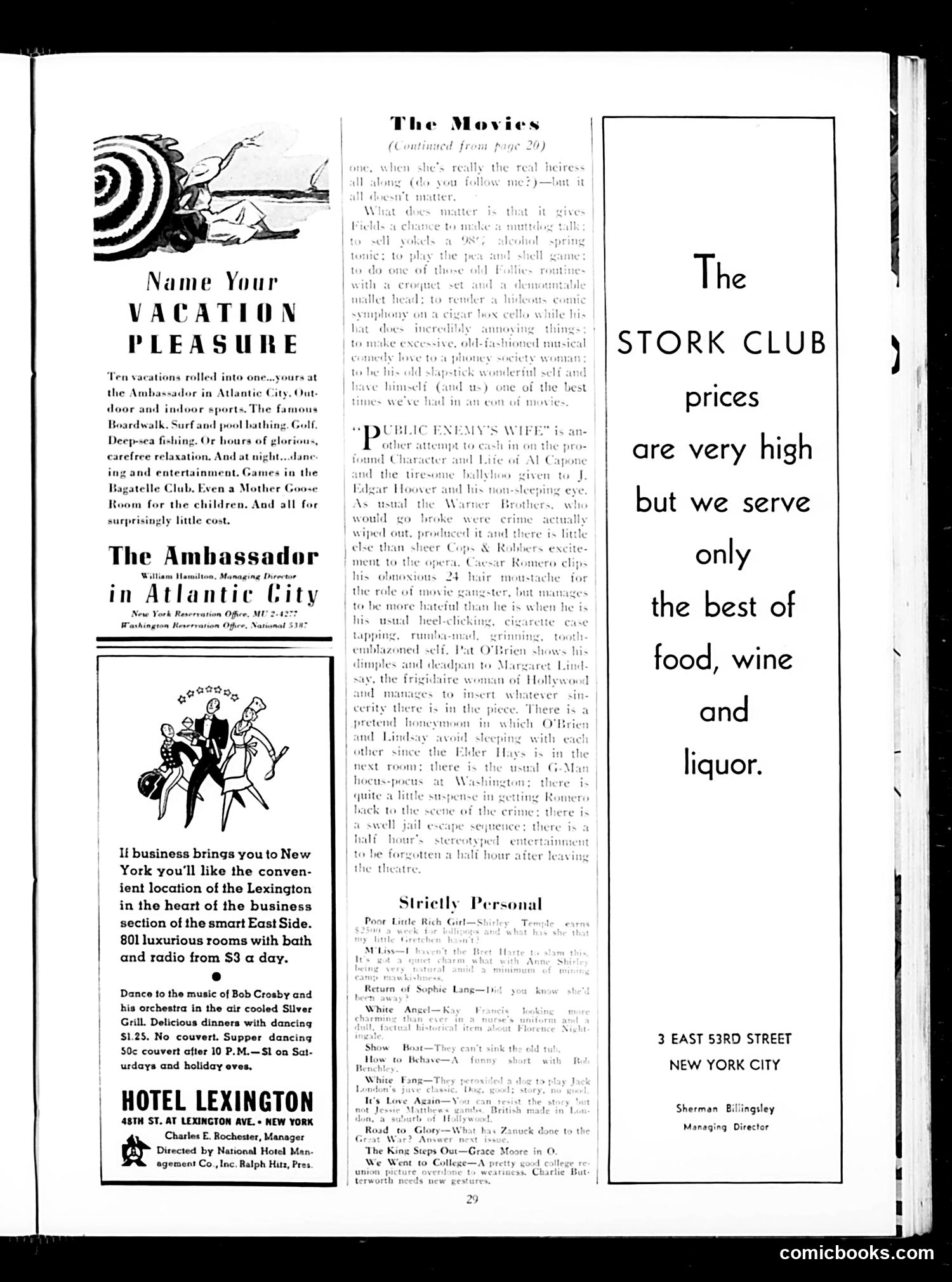
The Stork Club Advertisement This page is primarily advertising, not political satire. The dominant content consists of hotel and nightclub advertisements typical of 1930s Judge magazine. The Stork Club ad (right side) is a straightforward luxury establishment advertisement from New York City, emphasizing exclusivity through high prices but superior quality offerings. Sherman Billingsley is identified as managing director. The left side features ads for The Ambassador (Atlantic City resort) and Hotel Lexington (New York), promoting vacation and business travel amenities—typical Depression-era marketing emphasizing affordability alongside luxury. The center column contains movie reviews under "Strictly Personal," discussing 1930s Hollywood films, though the OCR text is largely illegible. The small cartoon at top-left ("Name Your Vacation Pleasure") appears to show someone relaxing against a target, humorously suggesting vacation as an escape or "hitting the mark" for leisure—a lighthearted visual pun rather than political commentary.
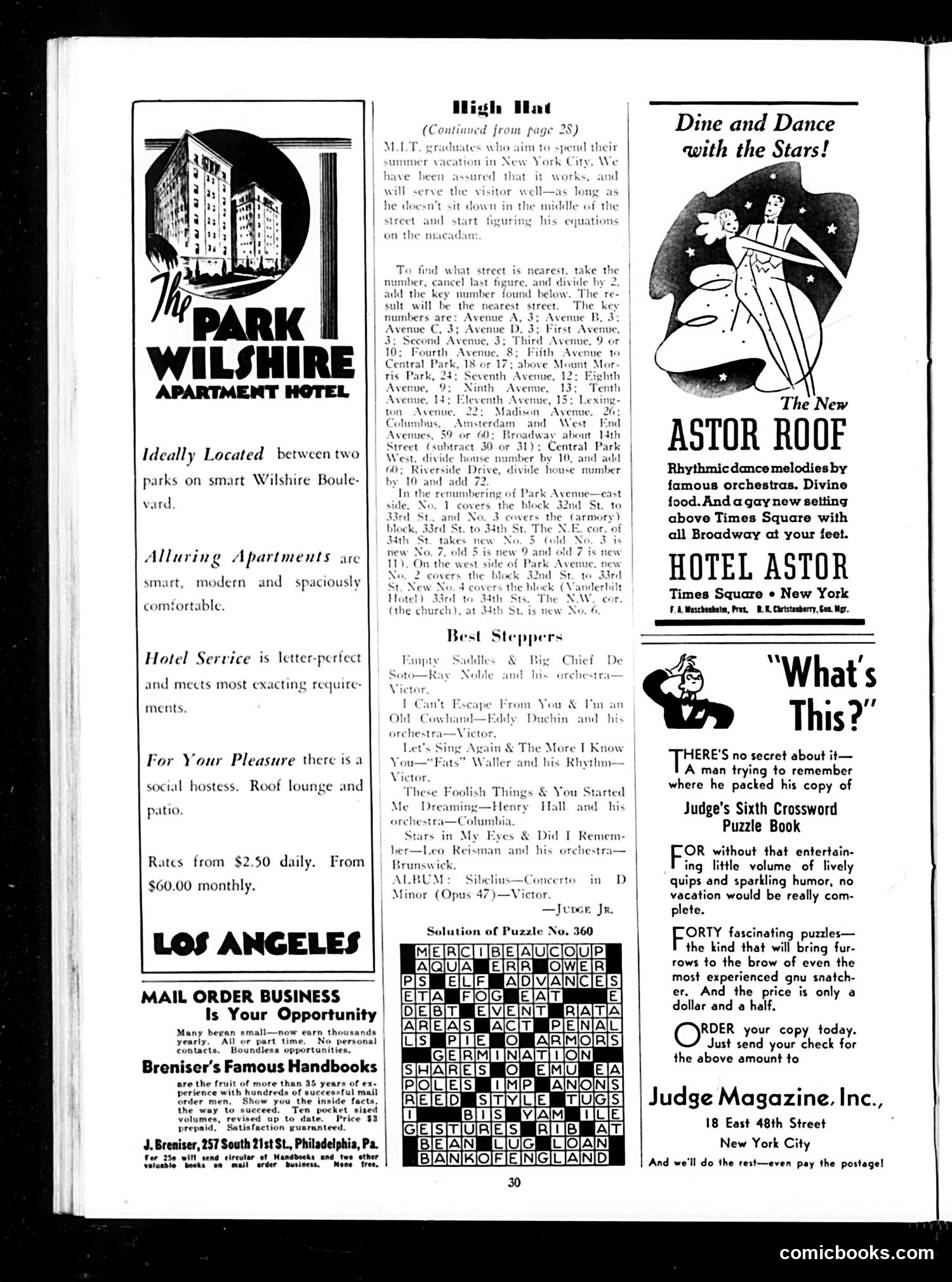
Analysis of Judge Magazine Page This page is primarily advertising and puzzle content rather than satirical cartoon commentary. The main visual element is a cartoon labeled "What's This?" showing a man trying to recall where he packed his Judge's Crossword Puzzle Book—a self-promotional advertisement for the magazine's puzzle book ($1.50). The joke relies on relatable vacation humor: one cannot properly vacation without the magazine's entertainment. The page otherwise features advertisements for hotels (Park Wilshire in Los Angeles, Hotel Astor in New York), mail-order business handbooks, and Best Steppers music records—typical commercial content from this era. There is no discernible political satire or social commentary. The "High Hat" column fragment references M.I.T. students finding New York City addresses using a mathematical system, but appears to be practical advice rather than satire. This page exemplifies Judge's dual function as entertainment magazine and advertising vehicle.
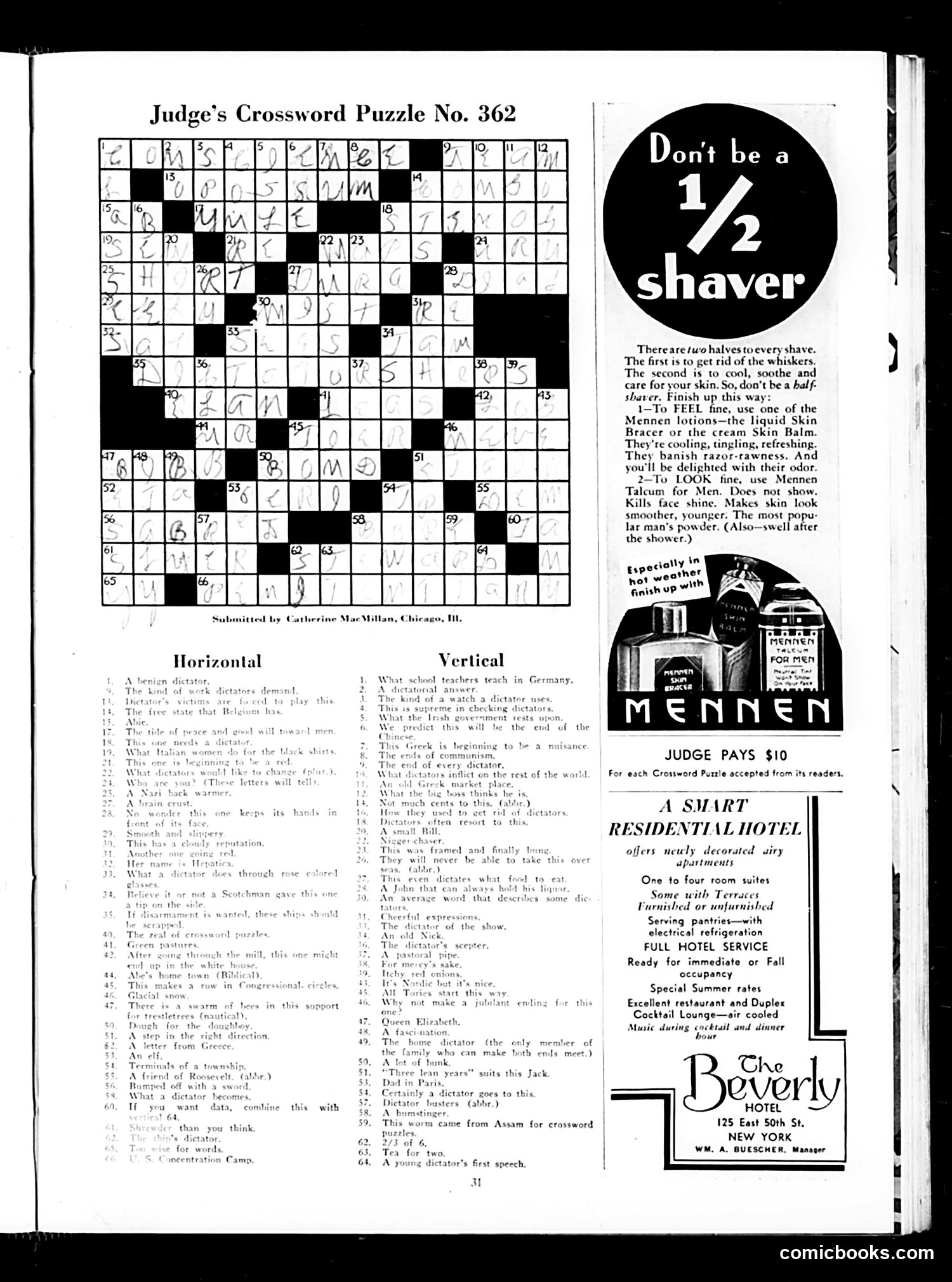
Judge Magazine Page Analysis This page contains primarily advertising and a crossword puzzle, not political satire or editorial cartoons. The main content is Judge's Crossword Puzzle No. 362, with clues listed horizontally and vertically. The puzzle itself is standard crossword fare with no apparent satirical content. The advertisements are commercial pitches: 1. Mennen shaving products — promoting a two-step shaving routine (whisker removal plus skin care with lotions/talcum). The tagline "Don't be a 1/2 shaver" is the sales hook. 2. The Beverly Hotel (NYC) — advertising furnished apartments with modern amenities like electrical refrigeration and air-cooled cocktail lounge. 3. A Smart Residential Hotel — similar hospitality advertising. Judge magazine offered $10 payment for accepted crossword puzzles from readers. This appears to be a reader-submitted puzzle page rather than editorial content, making it primarily a commercial/service page rather than satirical commentary.
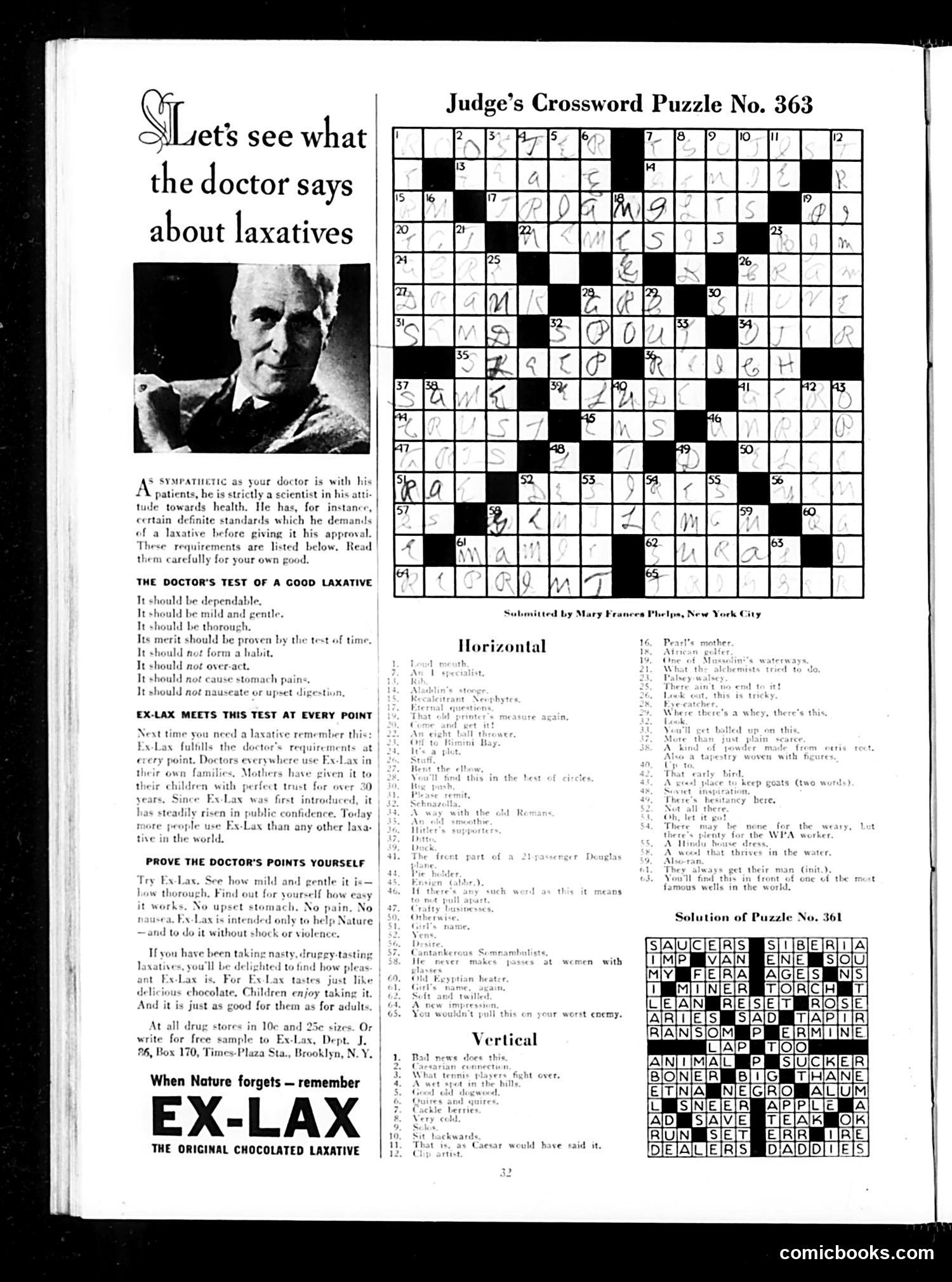
Ex-Lax Advertisement Analysis This page is primarily advertising, not political satire. It's a 1930s-era advertisement for Ex-Lax, a chocolate laxative product. The "cartoon" is actually a marketing strategy: a photograph of an authoritative-looking doctor appears alongside claims that Ex-Lax meets medical standards for safe laxatives. The ad appeals to consumer trust in medical authority—a common advertising technique of the era. The text emphasizes that Ex-Lax is "dependable," won't cause stomach pain, and is used more widely than competitors. The phrase "When Nature forgets—remember Ex-Lax" is the product's slogan. This reflects early 20th-century attitudes toward digestive health as a major wellness concern, and advertising's reliance on doctor endorsements (a practice now heavily regulated). The inclusion in *Judge* magazine shows how advertisements were integrated into satirical publications as revenue sources.
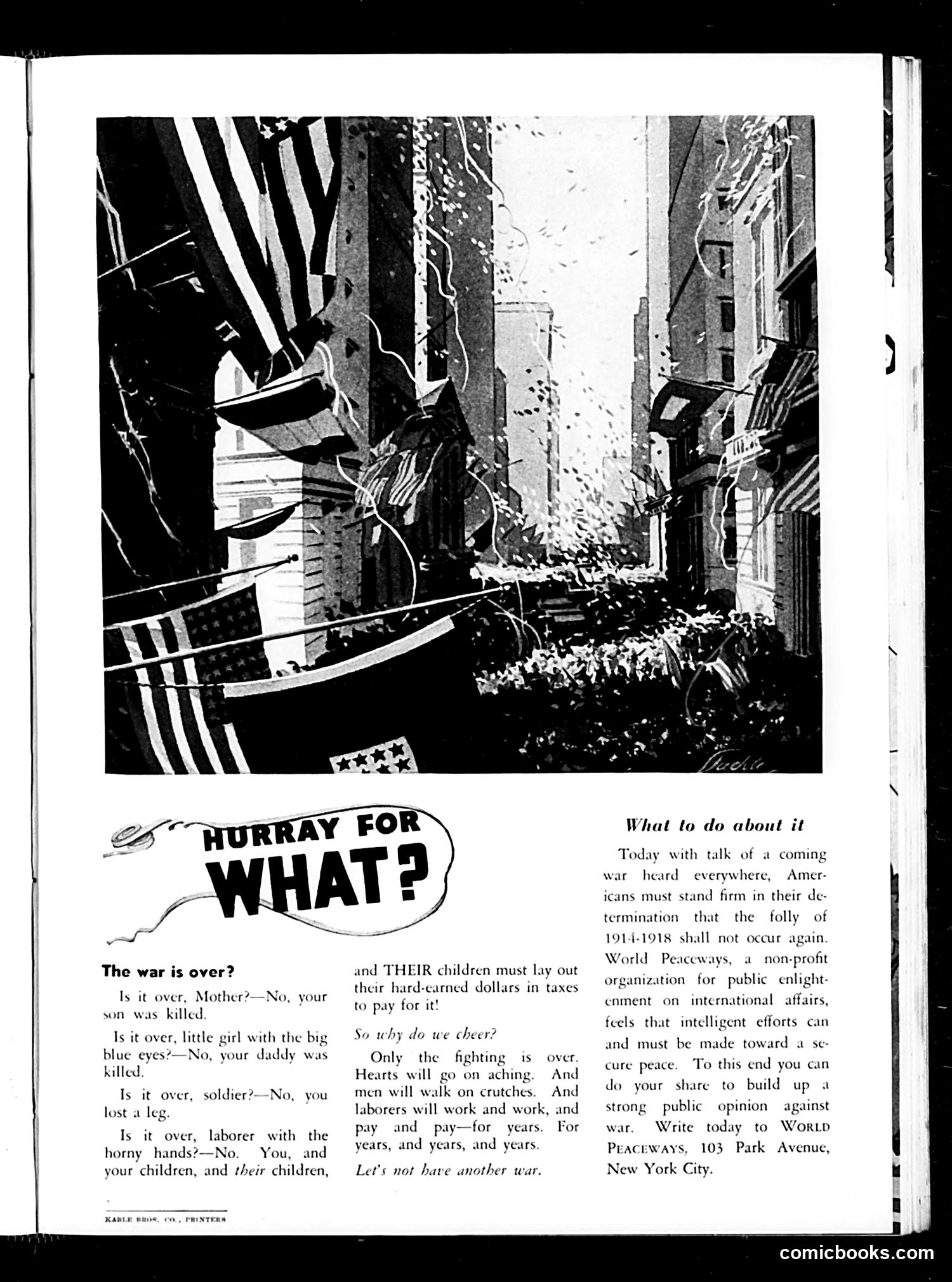
Analysis This post-WWI anti-war advocacy piece uses stark emotional rhetoric to challenge celebratory attitudes about war's end. The cartoon's central irony is its title: "Hurray for What?" — questioning what Americans should actually celebrate. The text systematically refutes claims that "the war is over" by listing those who continue suffering: bereaved mothers and children, disabled soldiers (amputees on crutches), and working-class laborers burdened with war-debt taxes "for years, and years, and years." The message appears designed for the interwar period when another global conflict seemed possible. It advocates for World Peaceways, a real non-profit organization promoting international peace efforts, positioning them as the alternative to repeating "the folly of 1914-1918." The satirical point: while combat has ended, war's human and economic costs persist indefinitely, making public celebration premature and hollow. The piece uses pathos—grieving mothers and children, disabled veterans—to build anti-war sentiment among readers.
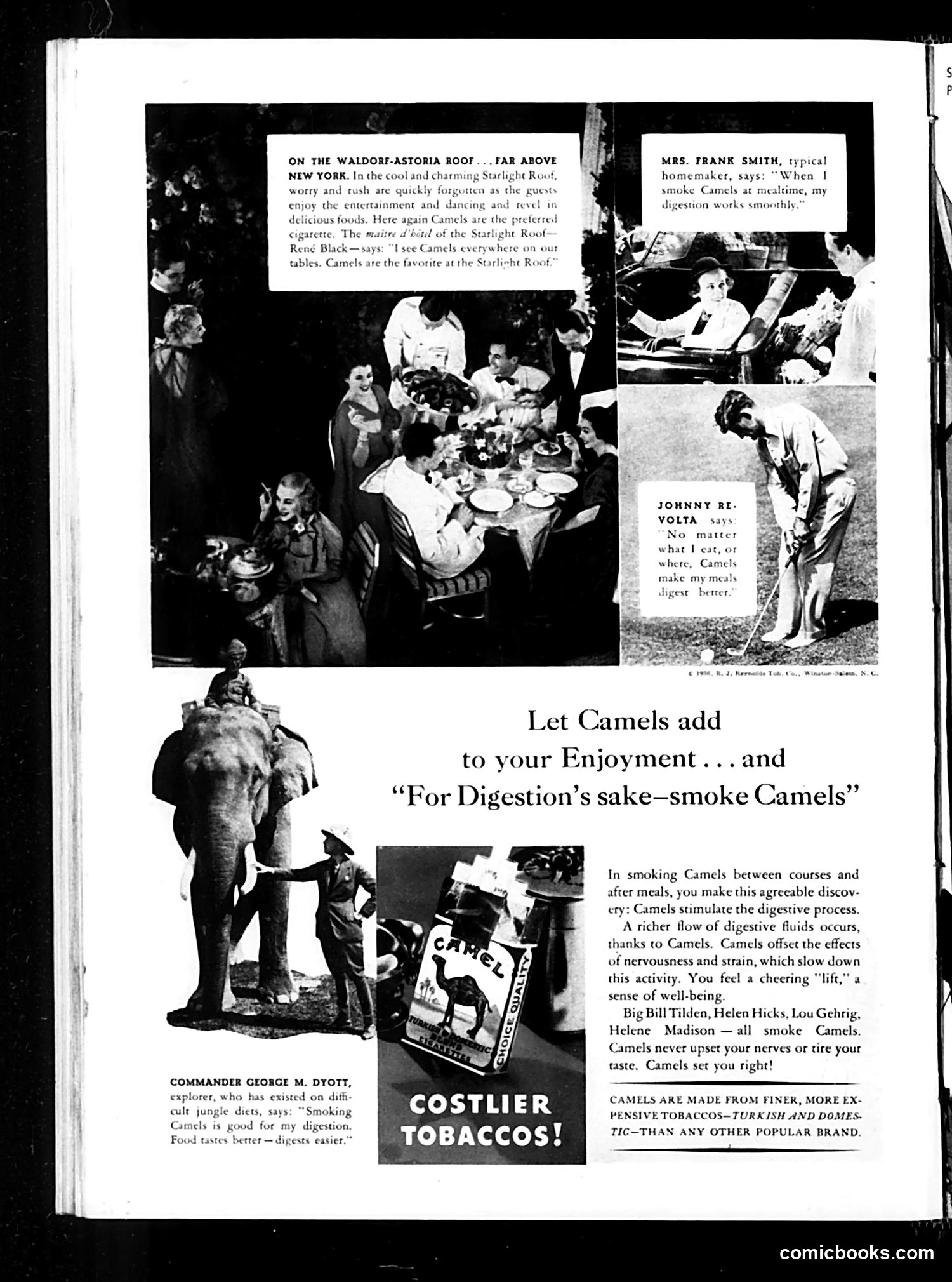
Camel Cigarettes Advertisement This is not satire—it's a straightforward cigarette advertisement masquerading as editorial content in Judge magazine. The page promotes Camel cigarettes by featuring testimonials from celebrities and "typical" users claiming smoking aids digestion. The named endorsers include athlete Johnny Revolts, tennis player Big Bill Tilden, golfer Helen Hicks, baseball player Lou Gehrig, and swimmer Helene Madison. Commander George M. Dyott (an explorer) and Mrs. Frank Smith (presented as an average homemaker) also testify that Camels improve digestion and meals. The central claim—that smoking between courses stimulates digestive fluids—reflects early-20th-century advertising's shameless health promises. This would later become illegal under modern FDA regulations. The ad exemplifies how cigarette companies once marketed smoking as beneficial, exploiting celebrity endorsements and pseudo-scientific claims to normalize tobacco consumption among middle and upper-class consumers.