judge
Judge — September 1936
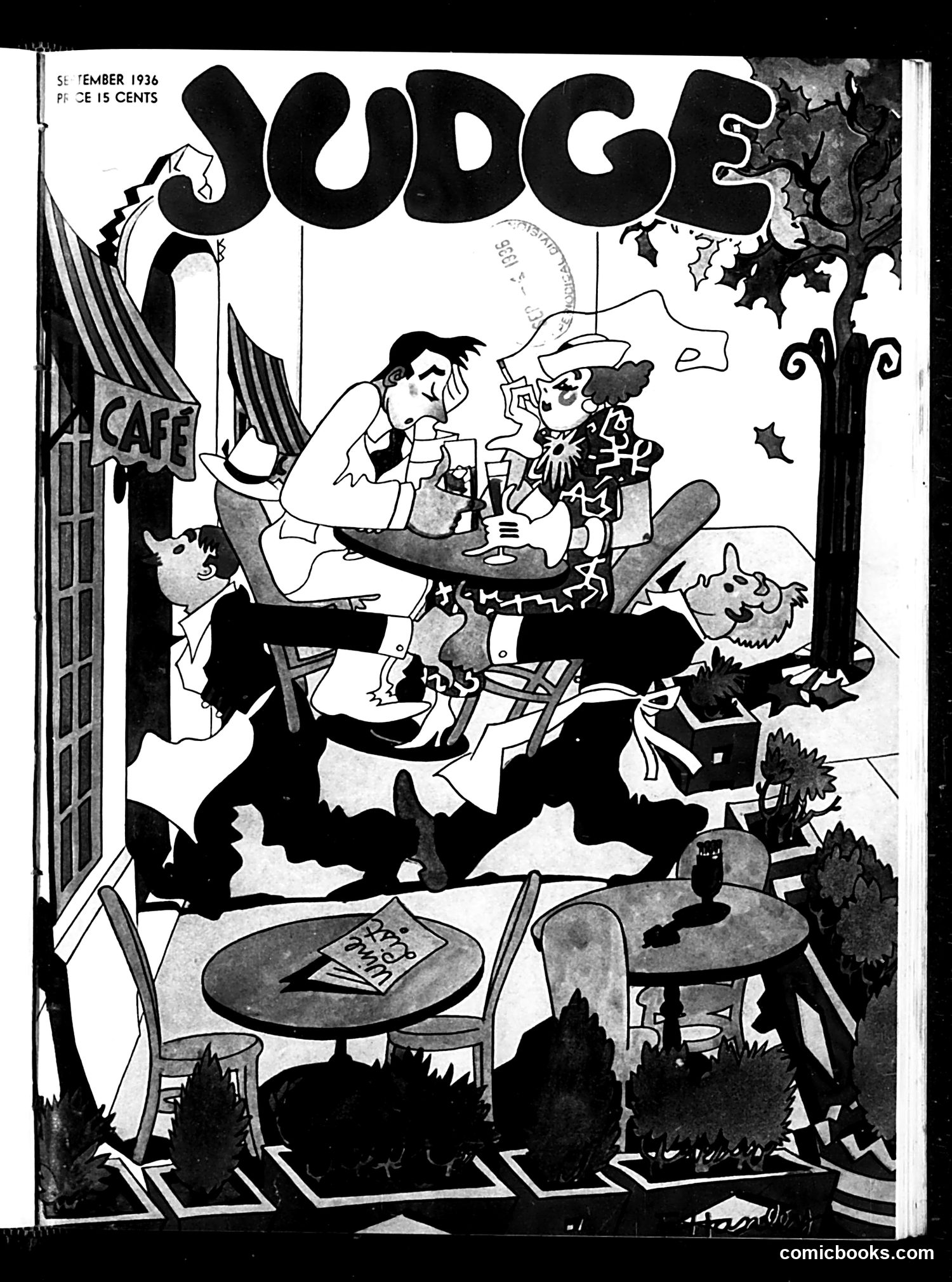
Analysis of Judge Magazine Cover, September 1936 This cover depicts a chaotic outdoor café scene titled "JUDGE." The central figures appear to be caricatured politicians or public figures engaged in animated conversation, with exaggerated facial features typical of 1930s satirical illustration. The setting—an outdoor café with patrons, tables, and plants—suggests this satirizes social or political gatherings of the era. The dynamic, somewhat frenzied composition implies conflict or heated debate among the figures. Without clearer OCR text or identifying labels on the figures themselves, I cannot definitively identify specific politicians or reference the particular 1936 event being satirized. The style and composition suggest commentary on contemporary political discourse, but the exact targets and satirical point remain unclear from the visual evidence alone.
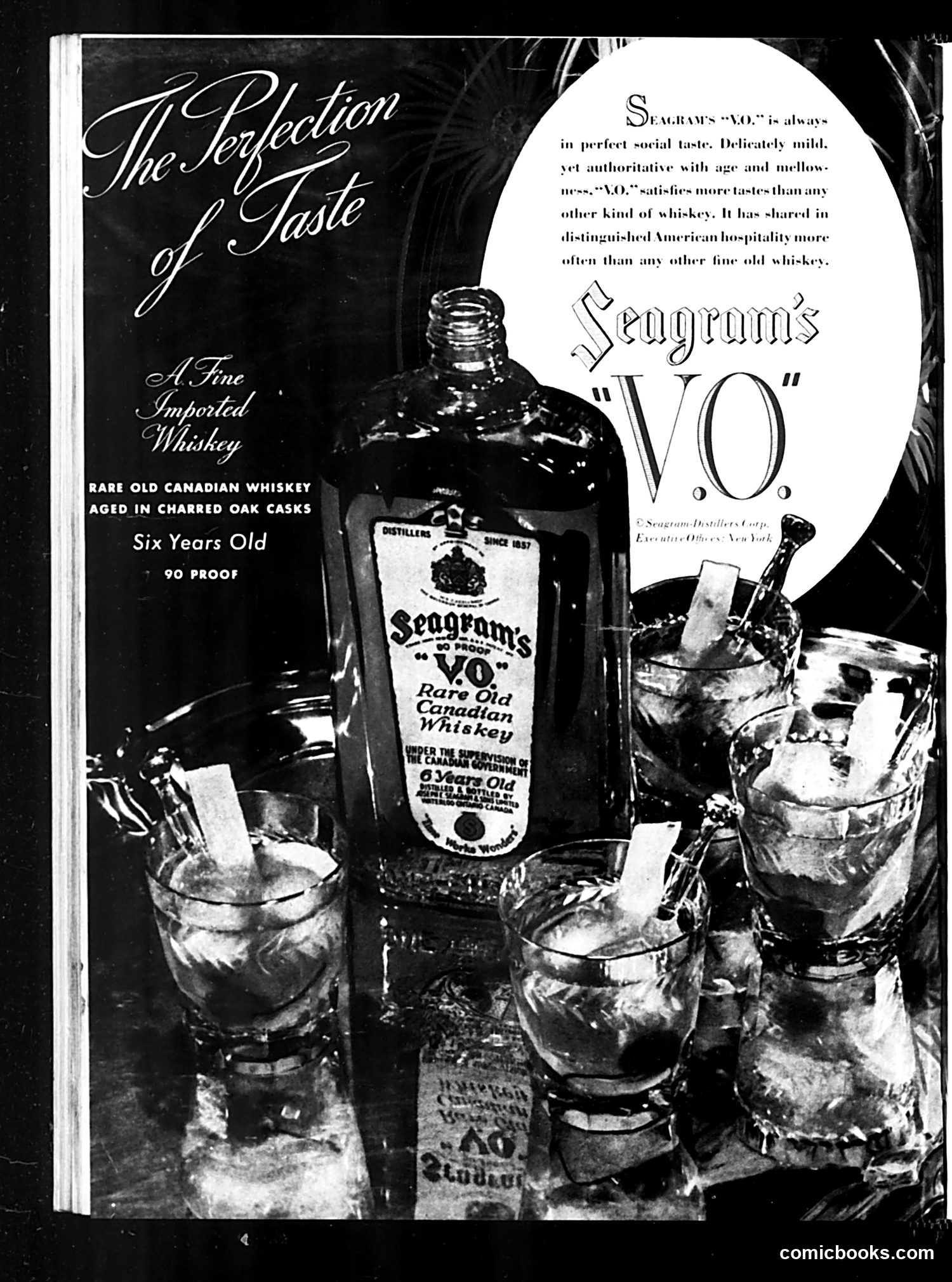
Analysis This page is primarily an advertisement, not editorial satire. It promotes Seagram's "V.O." Canadian whiskey, described as "Six Years Old" and "90 Proof." The ad emphasizes the product's refined qualities—"perfect social taste," "delicately mild, yet authoritative"—and claims it has "shared in distinguished American hospitality more often than any other fine old whiskey." The visual shows the bottle surrounded by glasses of whiskey served on ice, appealing to upscale consumers. The large circular callout highlighting "V.O." dominates the right side. Historical context: This appears from the Prohibition era's aftermath, when whiskey advertising resumed (post-1933). The emphasis on "distinguished American hospitality" suggests marketing to the newly-legal, affluent consumer market. No political satire is evident—this is straightforward luxury product promotion.
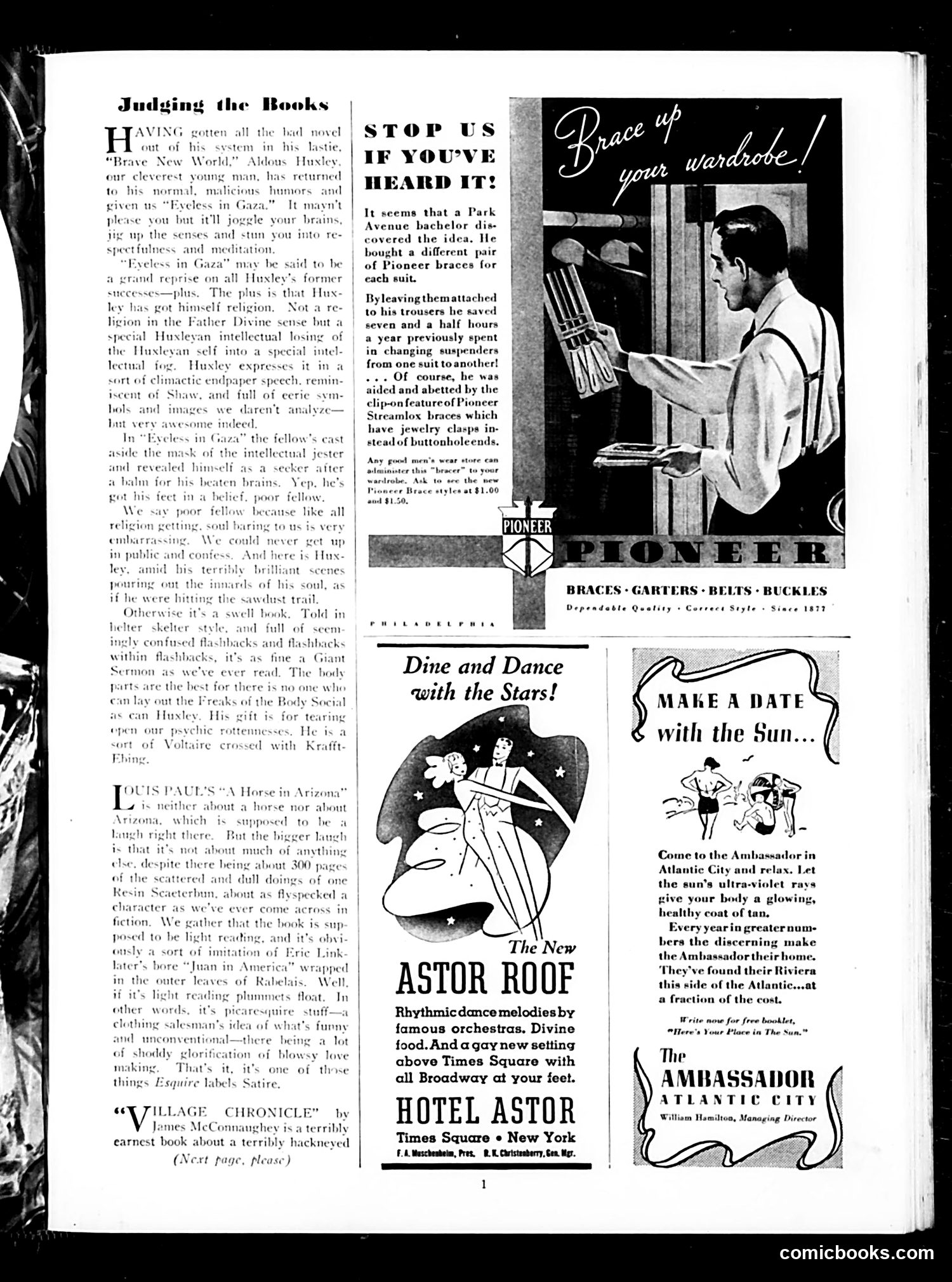
Analysis of Judge Magazine Page This page is primarily advertising and entertainment content rather than political satire. The main features are: 1. Book reviews (left column) discussing novels by Aldous Huxley and Louis Paul, offering literary criticism. 2. Pioneer Braces advertisement (center-right) promoting men's suspenders with a photo of a man adjusting his wardrobe. 3. Hotel Astor advertisement (center-bottom) promoting the New York hotel's rooftop dining and dancing venue. 4. Ambassador Hotel Atlantic City advertisement (right side) promoting vacation tanning services. The page reflects 1920s-30s consumer culture and leisure activities. No political figures or satirical commentary are evident—this appears to be a typical Judge magazine page blending literary content with lifestyle advertising.
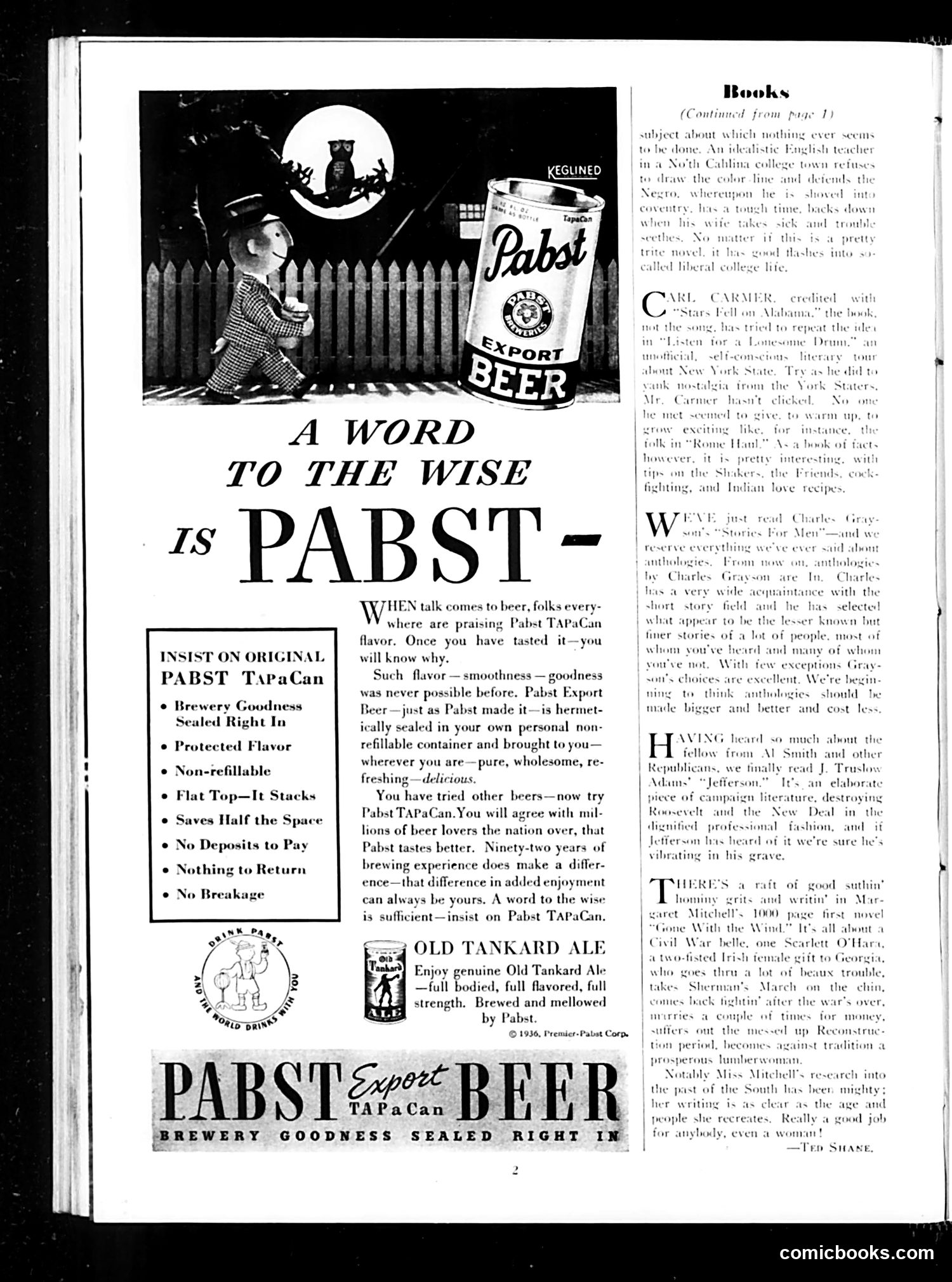
Analysis This page is primarily advertising, not political satire. The dominant content is a Pabst beer advertisement occupying roughly two-thirds of the page. The main cartoon shows a figure in a nightcap looking at an owl perched on a fence under moonlight, with a Pabst Export Beer bottle prominently displayed. The caption "A WORD TO THE WISE IS PABST" is a pun on the saying "a word to the wise is sufficient," repurposing it to advertise beer. The advertisement emphasizes Pabst's TAPaCan container—a sealed, stackable, non-returnable can—listing practical benefits like space-saving and no deposits required. This appears to be promoting an innovative packaging technology of the era. The right column contains book reviews unrelated to the advertisement, including discussion of Southern literature.
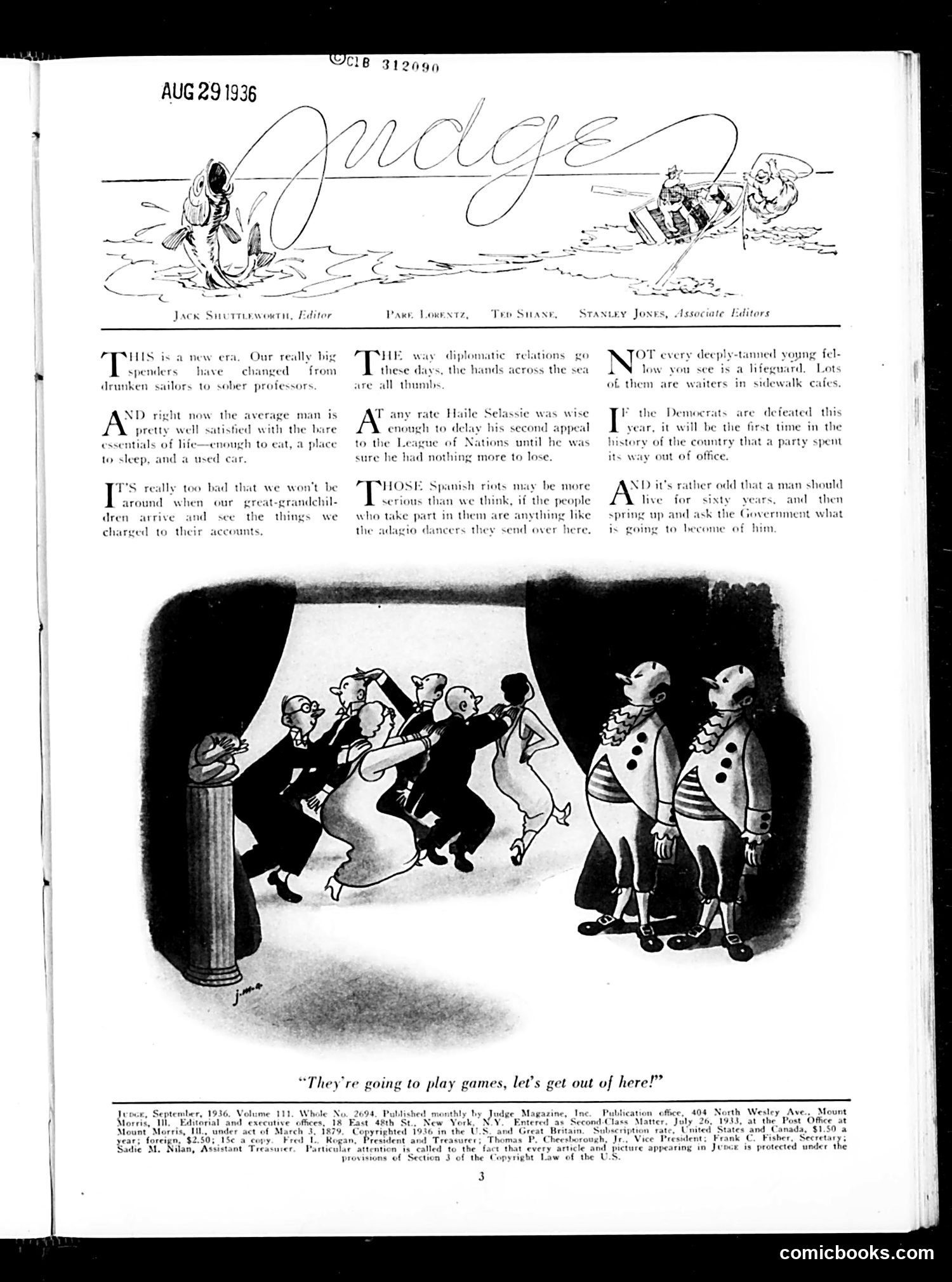
Judge Magazine, August 29, 1936 The main cartoon depicts figures in formal dress dancing or celebrating while two uniformed officials (appearing to be diplomats or military leaders) stand watching disapprovingly on the right. The caption reads: "They're going to play games, let's get out of here!" The editorial text references contemporary 1936 issues: Haile Selassie's delayed League of Nations appeal, Spanish civil unrest (likely the recent outbreak of the Spanish Civil War in July 1936), and American politics ahead of the 1936 presidential election. The cartoon likely satirizes diplomatic anxieties about international instability—the festive party-goers represent nations indifferent to gathering international crises, while the stern officials embody diplomatic concern that conflict is imminent.
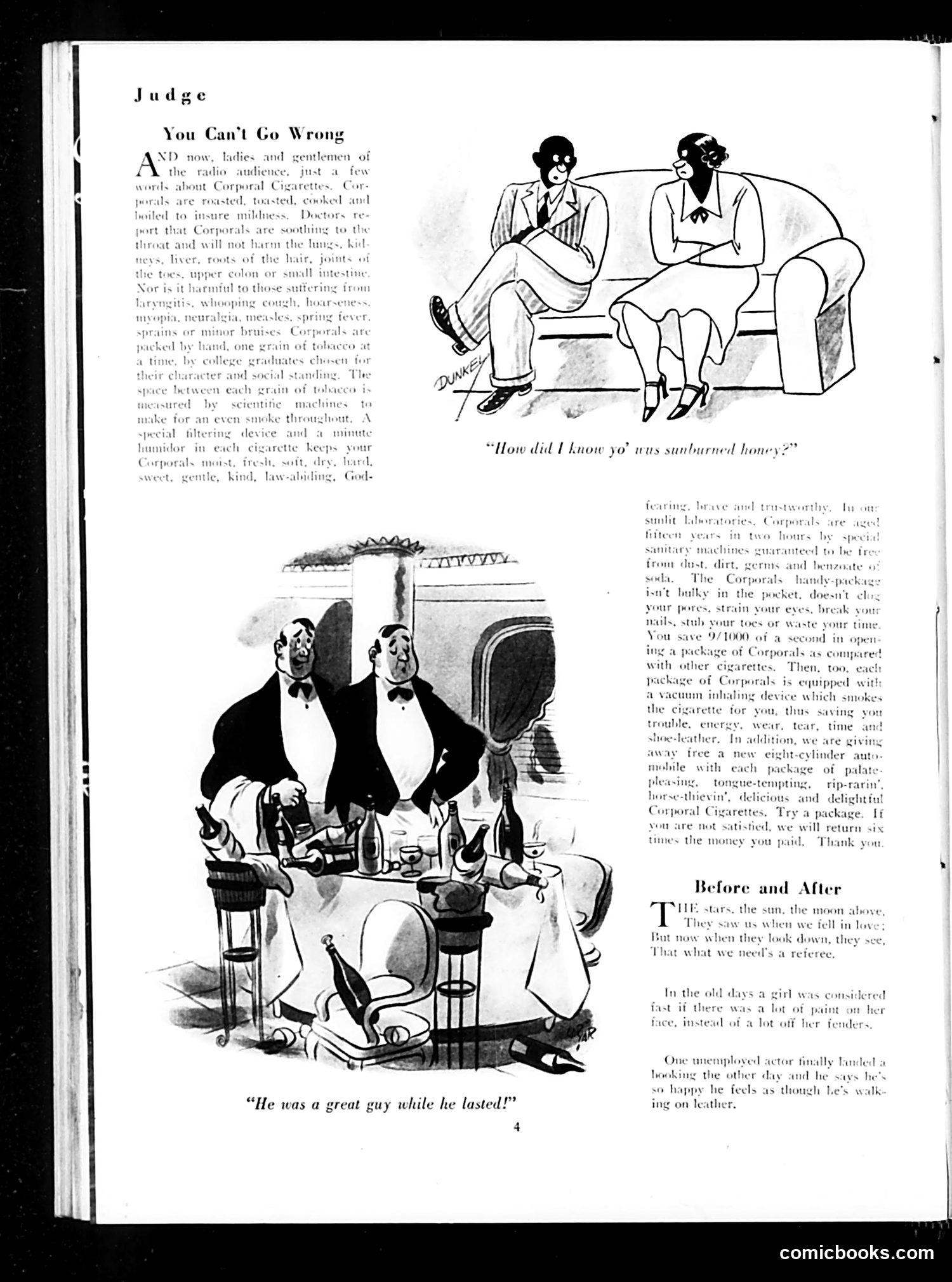
Analysis: Corporals Cigarette Advertisement This page is primarily a cigarette advertisement disguised as humor content for *Judge* magazine. The top cartoon shows two people on a couch with the caption "How did I know you' was sunburned honey?"—a flirtation joke. The bottom cartoon depicts two well-dressed men at a dining table with the caption "He was a great guy while he lasted!"—implying mortality or romantic disappointment. The accompanying text promotes Corporals cigarettes through pseudo-scientific claims: the cigarettes are allegedly filtered, sanitized, and remove harmful substances. The advertisement uses humor and casual tone to market smoking as safe and sophisticated. The brief poem "Before and After" makes a crude joke about cosmetics and female appearance—typical period advertising that relied on demeaning humor about women's looks. This represents early 20th-century tobacco marketing before health warnings were required.
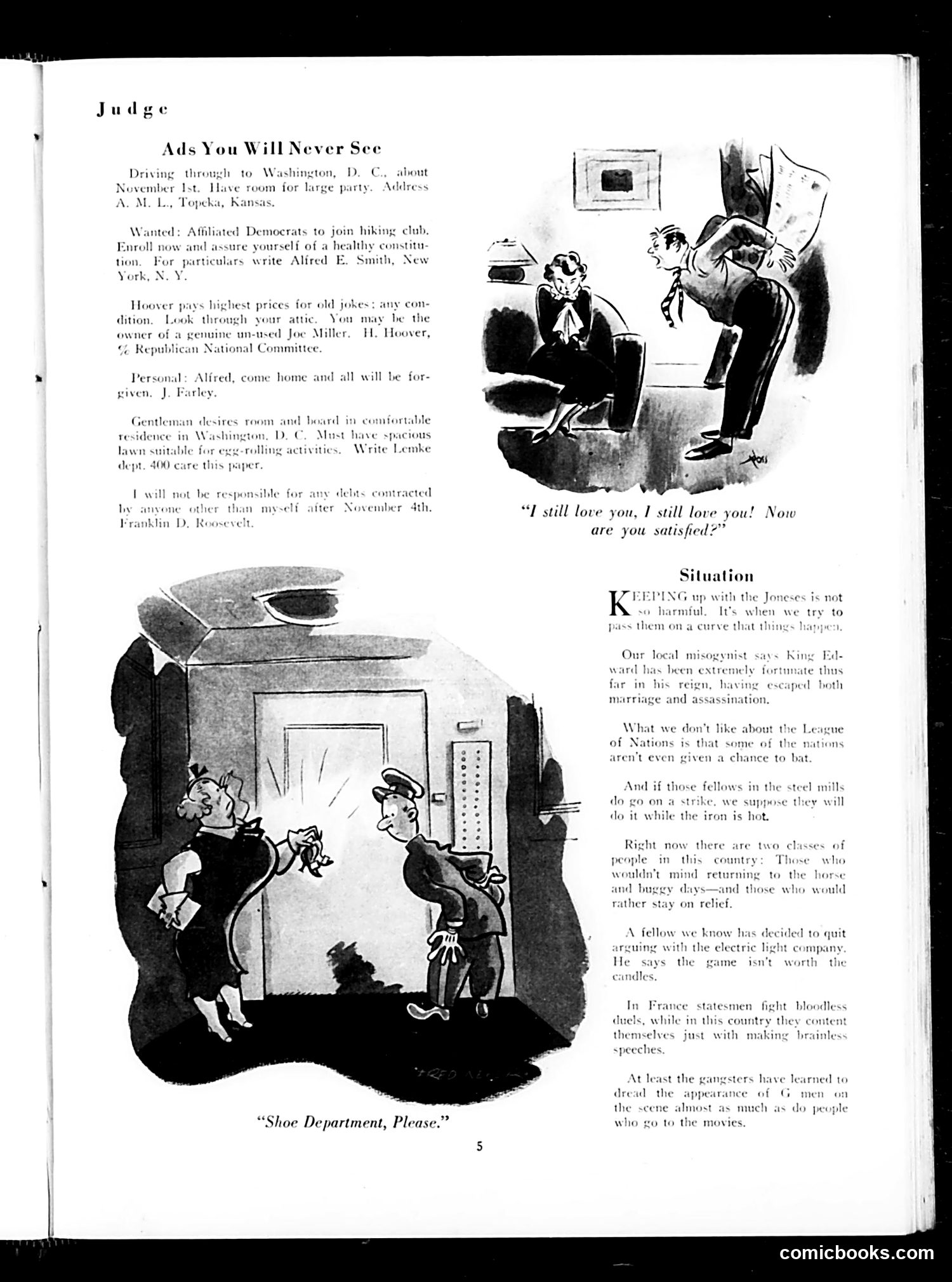
"Shoe Department, Please" - Judge Magazine Cartoon Analysis The lower cartoon depicts a man entering what appears to be a department store elevator, asking for the "Shoe Department." The satire likely refers to Prohibition-era speakeasies disguised as legitimate businesses—the elevator operator and well-dressed figures suggest a hidden establishment behind an ordinary retail façade. During Prohibition (1920-1933), illegal bars operated covertly in office buildings and stores, requiring customers to know the right phrases or locations. The upper cartoon shows a domestic scene with the caption "I still love you, I still love you! Now are you satisfied?"—satirizing marital discord, possibly commentary on relationship conflicts common in contemporary society. The "Situation" column discusses international politics (League of Nations, labor strikes, French statesmen) with cynical observations typical of Judge's satirical tone.
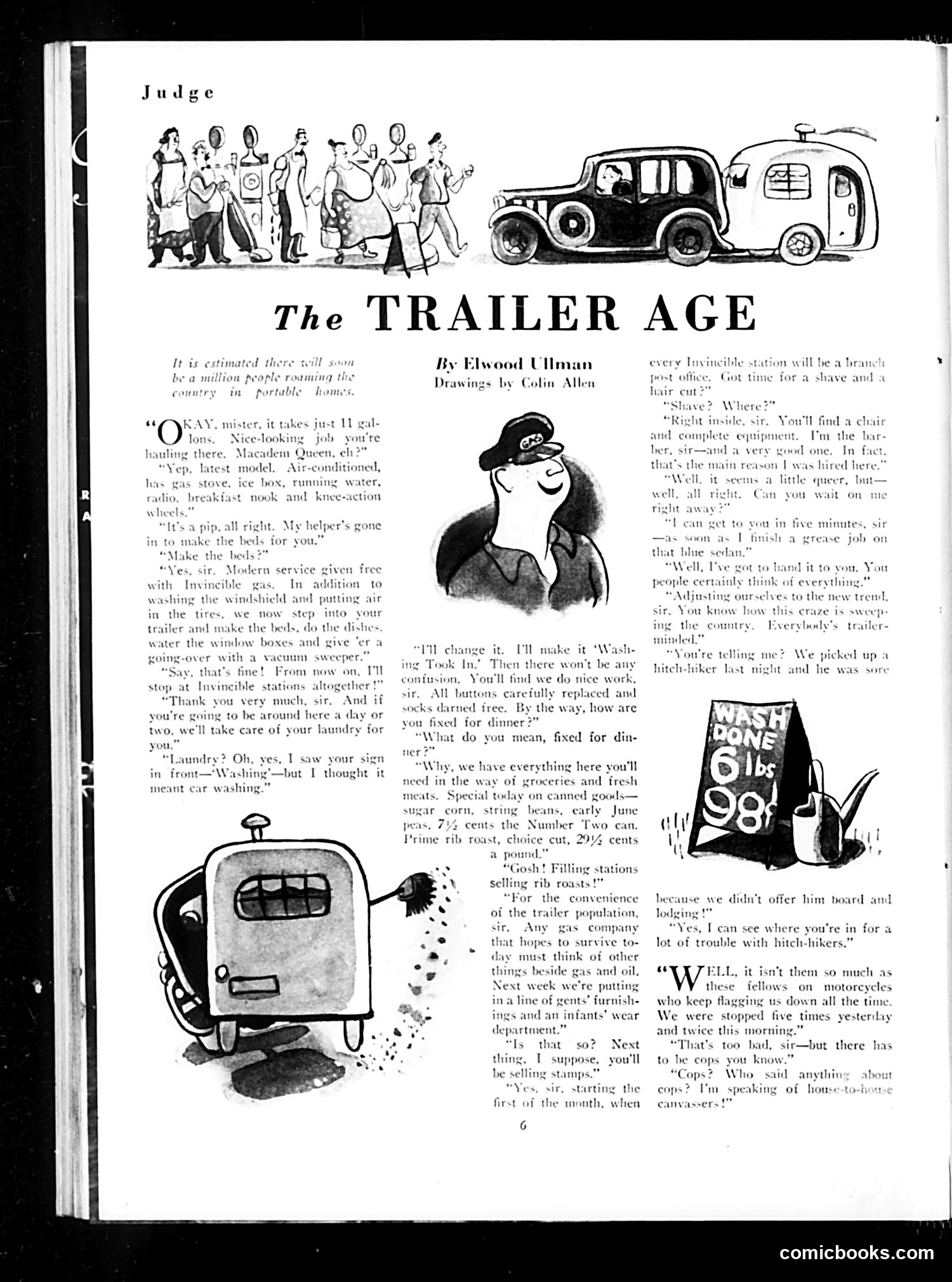
"The Trailer Age" - Satire on Mobile Living This 1920s-30s Judge article satirizes the emerging trend of trailer homes—portable living accommodations towed behind automobiles. The cartoon depicts a family abandoning traditional domestic life for mobile existence. The satire mocks this lifestyle through a dialogue between a service station attendant and trailer owners, highlighting the absurdity: families living in cramped trailers while expecting hotel-like conveniences (laundry service, meals, comfortable beds). The text jokes about filling stations becoming "invincible stations"—implying they'd replace hotels and homes as civilization's anchors. The broader point appears critical: as Americans embrace automobile culture and mobility, they're sacrificing domestic stability and privacy. The trailer represents a peculiar American trend of rejecting settled life for perpetual transience, reducing home to a commercial service transaction.
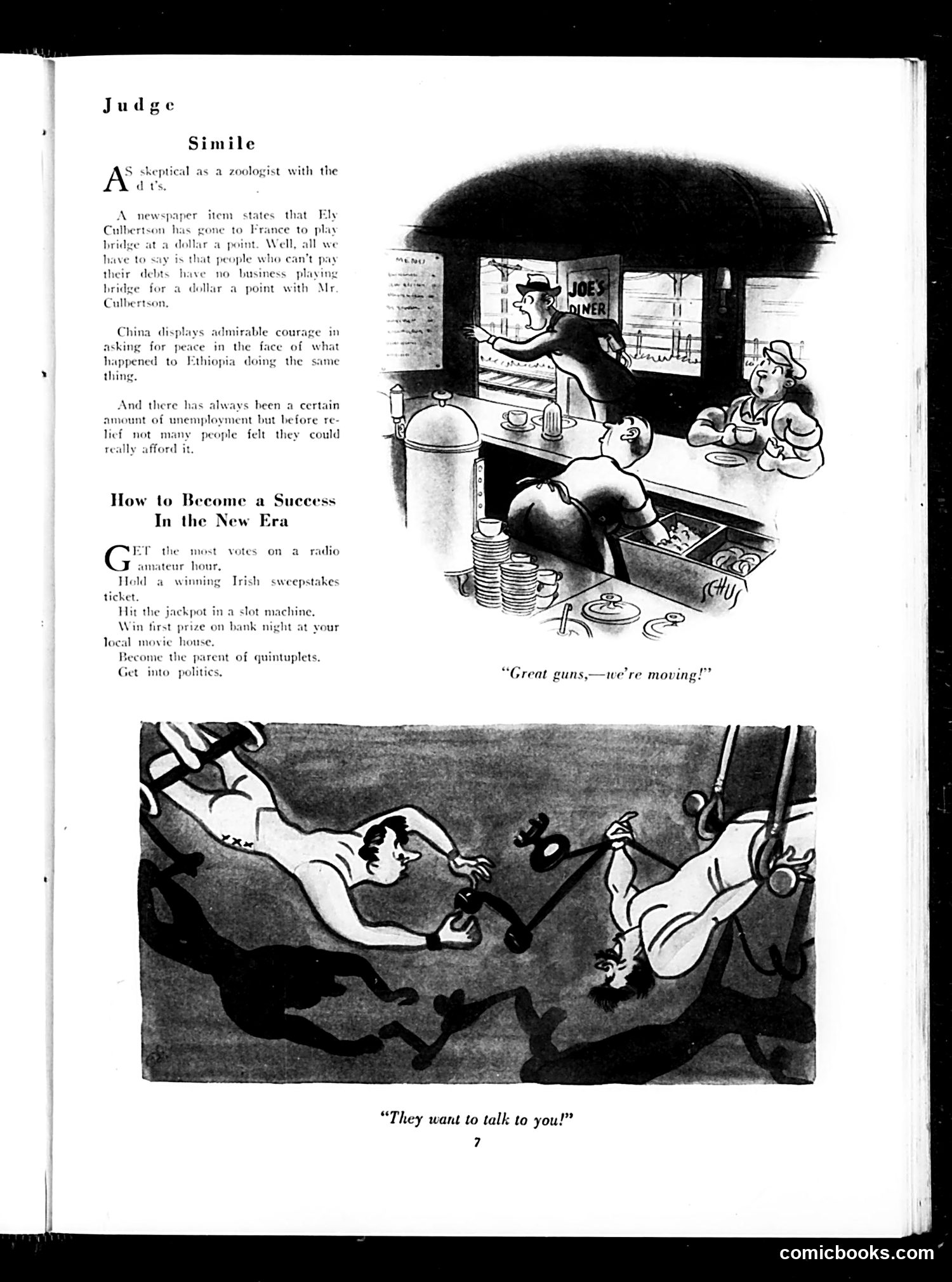
Explanation for Modern Readers This page contains satirical commentary and humorous illustrations typical of Judge magazine's style. Top Section ("Simile"): Brief commentary on current events—Ely Culbertson (a famous bridge player) going to France, unemployment, and China's diplomatic efforts regarding Ethiopia. The humor relies on topical references from the era. "How to Become a Success In the New Era": Satirizes get-rich-quick schemes popular during uncertain economic times, mocking radio contests, sweepstakes, slot machines, and politics as paths to success. Cartoons: The top illustration shows a diner scene with the caption "Great guns—we're moving!" The bottom cartoon depicts multiple figures being pulled or dragged, captioned "They want to talk to you!"—likely satirizing either debt collectors or unwanted solicitations, common anxieties during economically uncertain periods. The overall tone mocks contemporary social aspirations and anxieties.
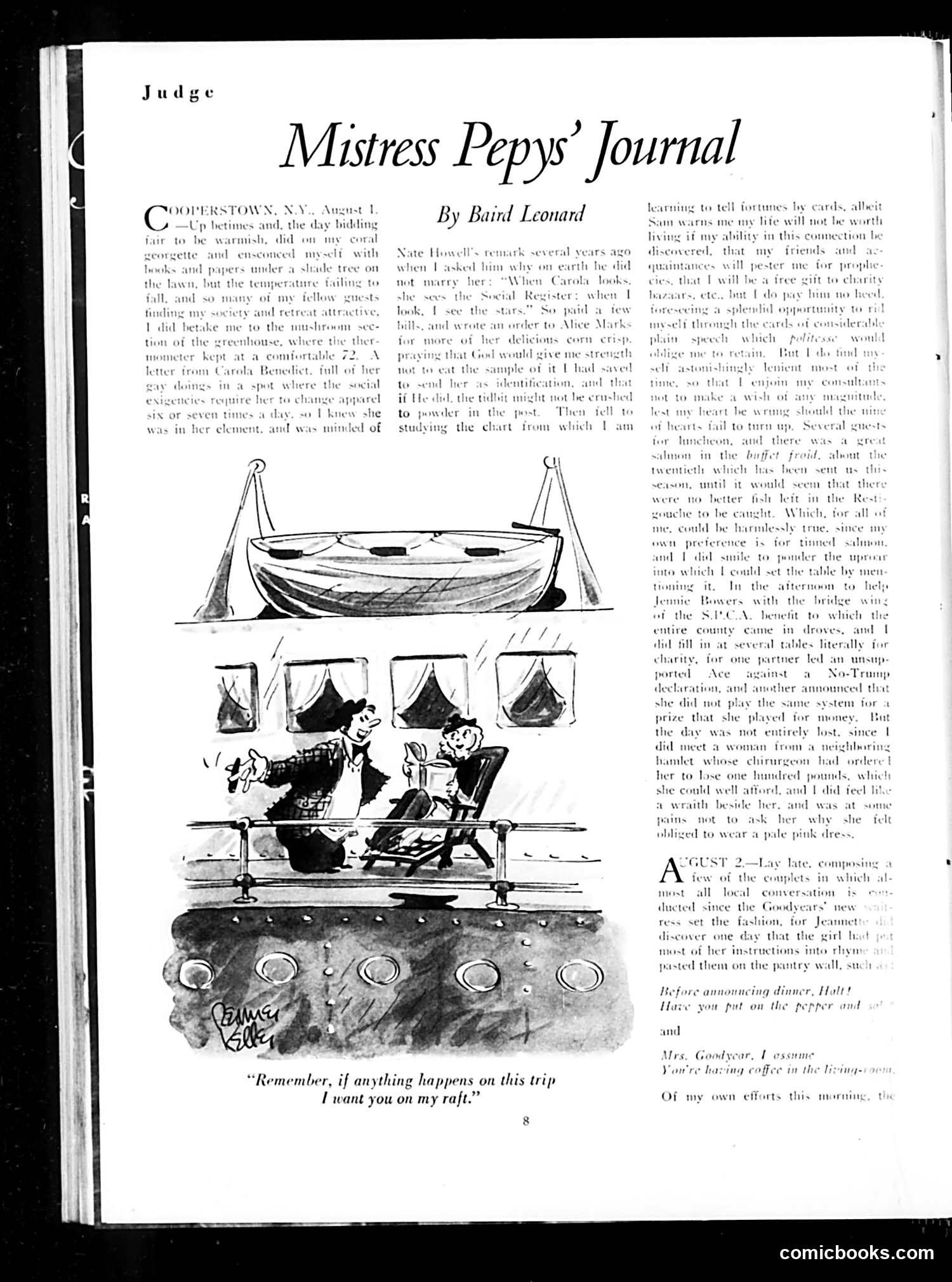
"Mistress Pepys' Journal" Explanation This is a humor column mimicking Samuel Pepys's famous 17th-century diary, updated to contemporary (1920s) American social life. The column satirizes upper-class leisure activities and social pretensions. The main cartoon depicts a woman on a raft with two men below, captioned "Remember, if anything happens on this trip I want you on my raft"—a joke about prioritizing one's romantic interest in an emergency over actual safety or propriety. The text describes summer social events: bridge games, charity events, and fortune-telling. A running gag involves the "Goodyears'" fashion of composing witty couplets in conversation, which spreads through the community so thoroughly that even servants memorize and post them. The humor targets how fashionable trends cascade through society, and the absurdity of upper-class women trying to appear clever through forced verse-composition. The diary format allows gentle mockery of their vanities, trivial concerns, and self-absorption.
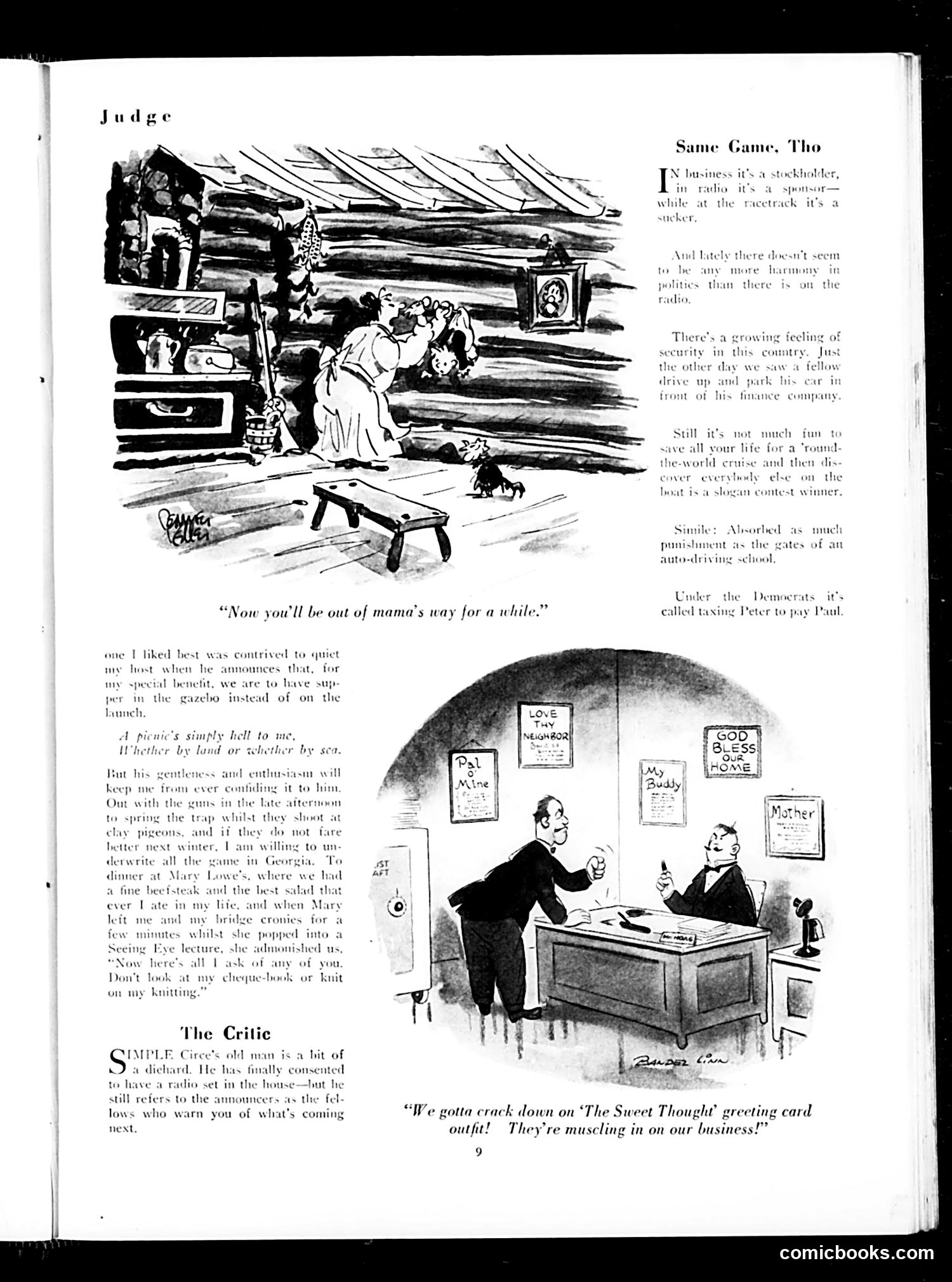
Analysis of Judge Magazine Page Top Cartoon ("Now you'll be out of mama's way for a while"): Shows a mother with children preparing to leave home—likely depicting Depression-era anxieties about family separation or children leaving to seek work/opportunity elsewhere. The caption suggests ironic relief at their departure. Bottom Cartoon ("We gotta crack down on 'The Sweet Thought' greeting card outfit"): Depicts a businessman at a desk confronting what appears to be a competitor. The satire mocks how businesses blame rivals for lost profits rather than examining their own practices. The reference to "Sweet Thought" greeting cards muscling into the greeting card market reflects early 20th-century commercial competition. Column Text ("The Critic"): Humorously describes radio as a relatively new household technology. An older man reluctantly accepts a radio set but dismissively refers to announcers as merely "fellows who warn you of what's coming next"—poking fun at radio's early role as advertising medium rather than entertainment. The overall theme appears to be satirizing modern commercial anxieties and the generational divide regarding new technology.
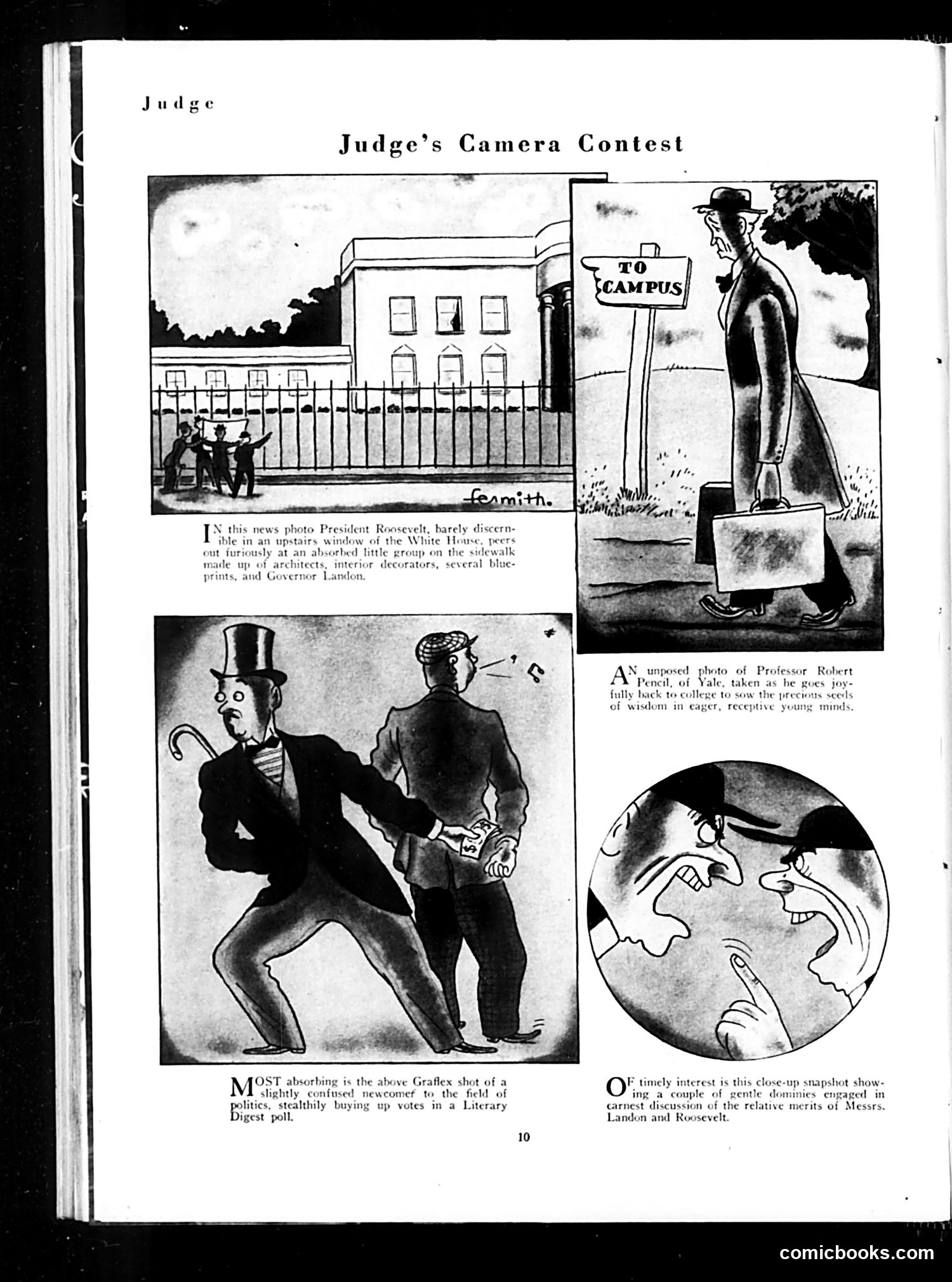
Judge's "Judge's Camera Contest" This page satirizes President Roosevelt and contemporary politics through mock "news photos." The top image shows Roosevelt barely visible in a White House window while architects and decorators occupy the sidewalk—mocking his absence from or indifference to administrative detail. The lower-left cartoon depicts a confused newcomer to politics naively buying votes for a "Literary Digest poll"—likely referencing the 1936 Literary Digest poll that infamously predicted a Landon victory over Roosevelt. The circular image compares Landon and Roosevelt's relative merits in a humorous, reductive way. The overall satire suggests Roosevelt's disconnection from governance, political corruption in polling, and the absurdity of election prediction. The "camera contest" framing treats serious political matters as amusing candid moments.
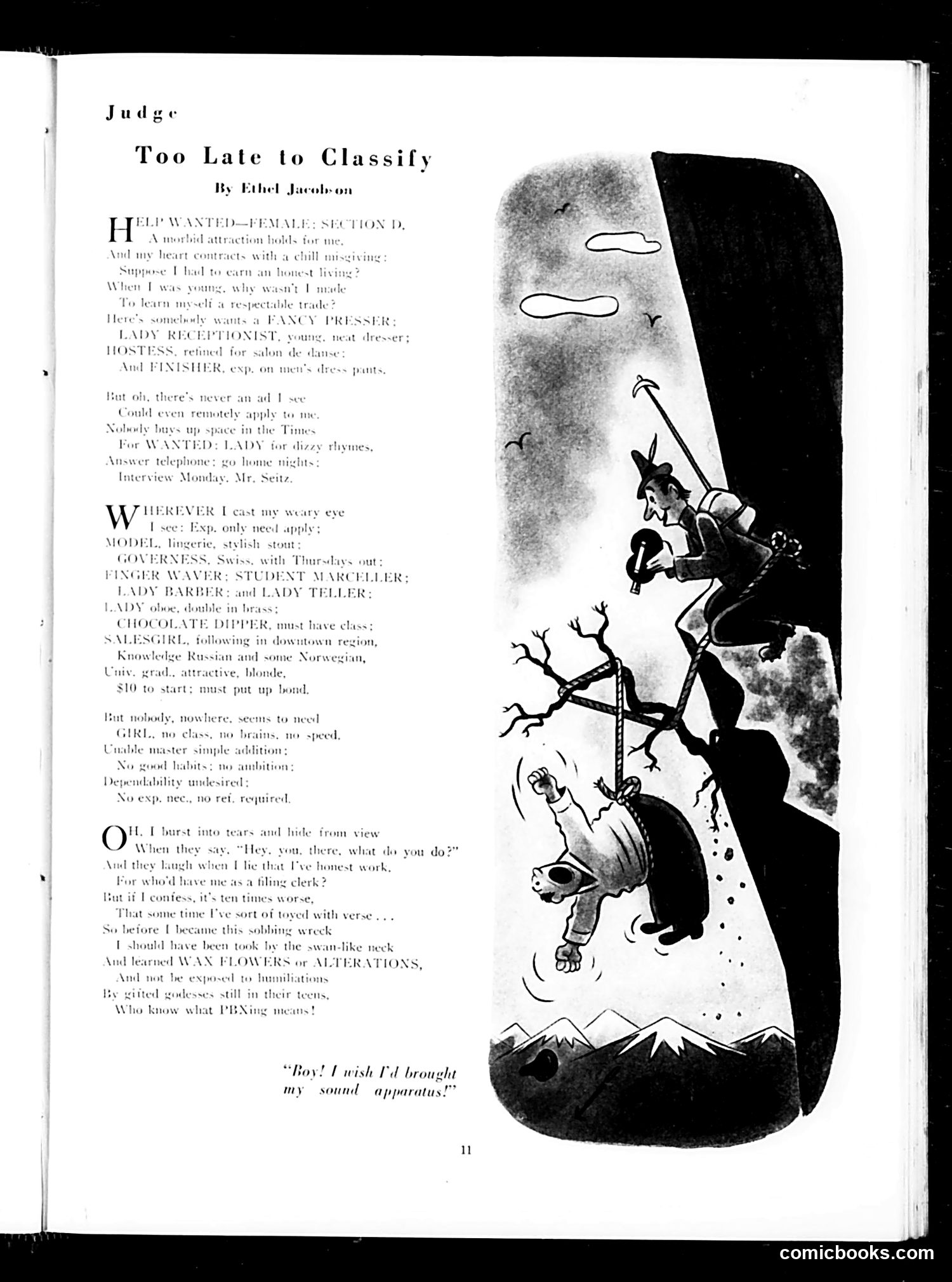
"Too Late to Classify" by Ethel Jacobson This poem satirizes the impossible job market for women, particularly during the Depression era. The speaker lists absurd, contradictory help-wanted ads demanding women be young, attractive, multilingual, classically trained, and experienced—yet offering minimal pay ($10 to start). The central joke: there's ONE job that requires nothing—"no class, no brains, no speed"—for a woman with no qualifications. The speaker, once aspiring to respectable work, has become a "filing clerk" or similar menial position after failing to meet impossible standards elsewhere. The cartoon illustration shows people rappelling down a cliff, literalizing the economic desperation. The caption "Boy! I wish I'd brought my sound apparatus!" is unclear but likely references modern technology's role in disrupting employment. The satire targets both exploitative employers setting unrealistic demands and society's judgment of women unable to meet them—a woman is "too late to classify" into respectable work.
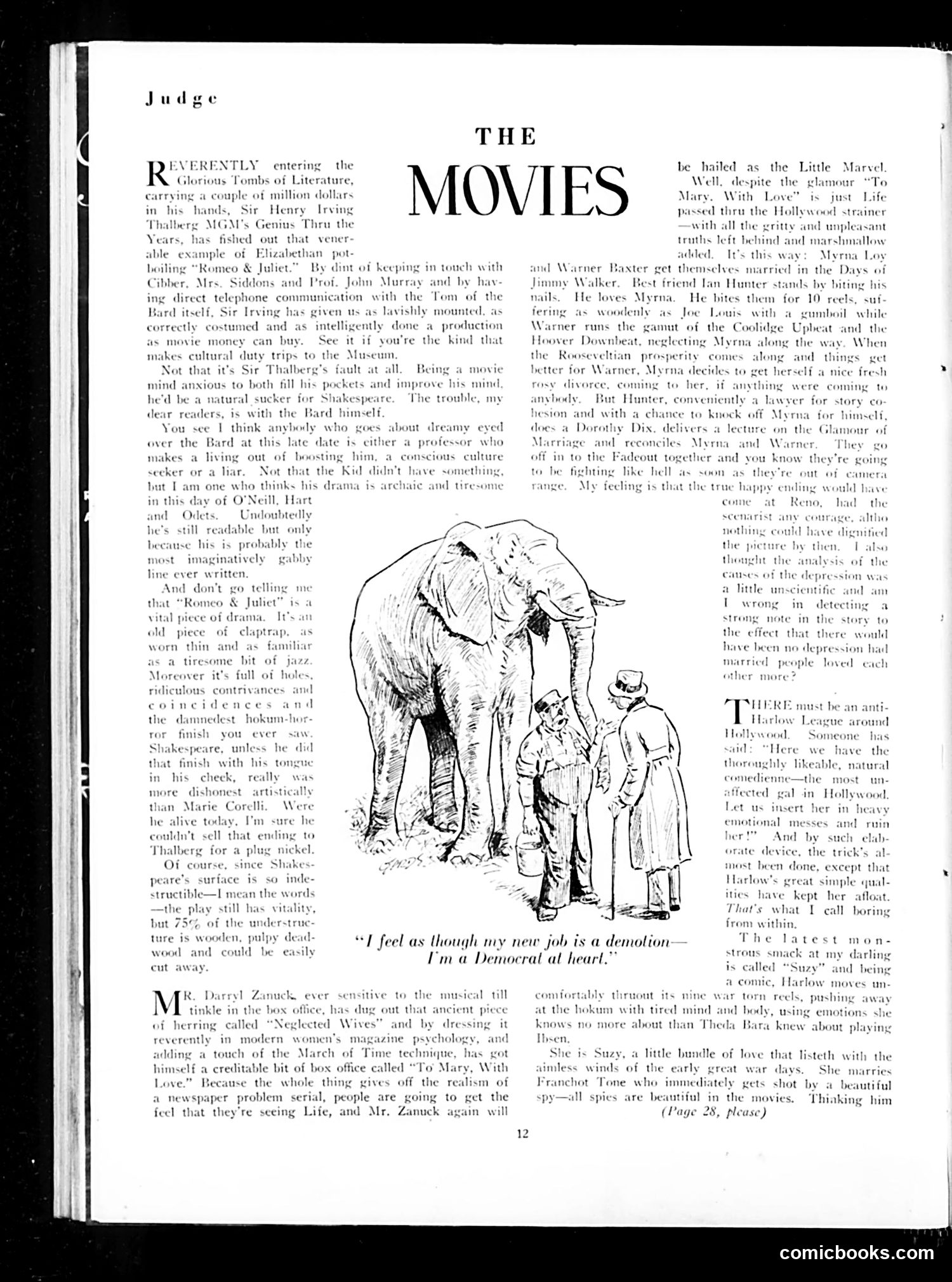
Analysis This page from Judge magazine's "The Movies" section features a political cartoon showing an elephant (Republican symbol) with two men beside it. The caption reads: "I feel as though my new job is a demotion—I'm a Democrat at heart." The cartoon satirizes a Republican who has taken a Democratic position, treating it as a career step backward. This appears to reference party switching or someone accepting an unwanted political role contrary to their stated beliefs. The elephant symbol and the joke's premise suggest criticism of political opportunism or the compromises involved in cross-party appointments during the era when this was published. The surrounding text discusses various films and actors, providing context that this is entertainment-focused commentary rather than hard political analysis—typical of Judge's satirical approach to contemporary issues.
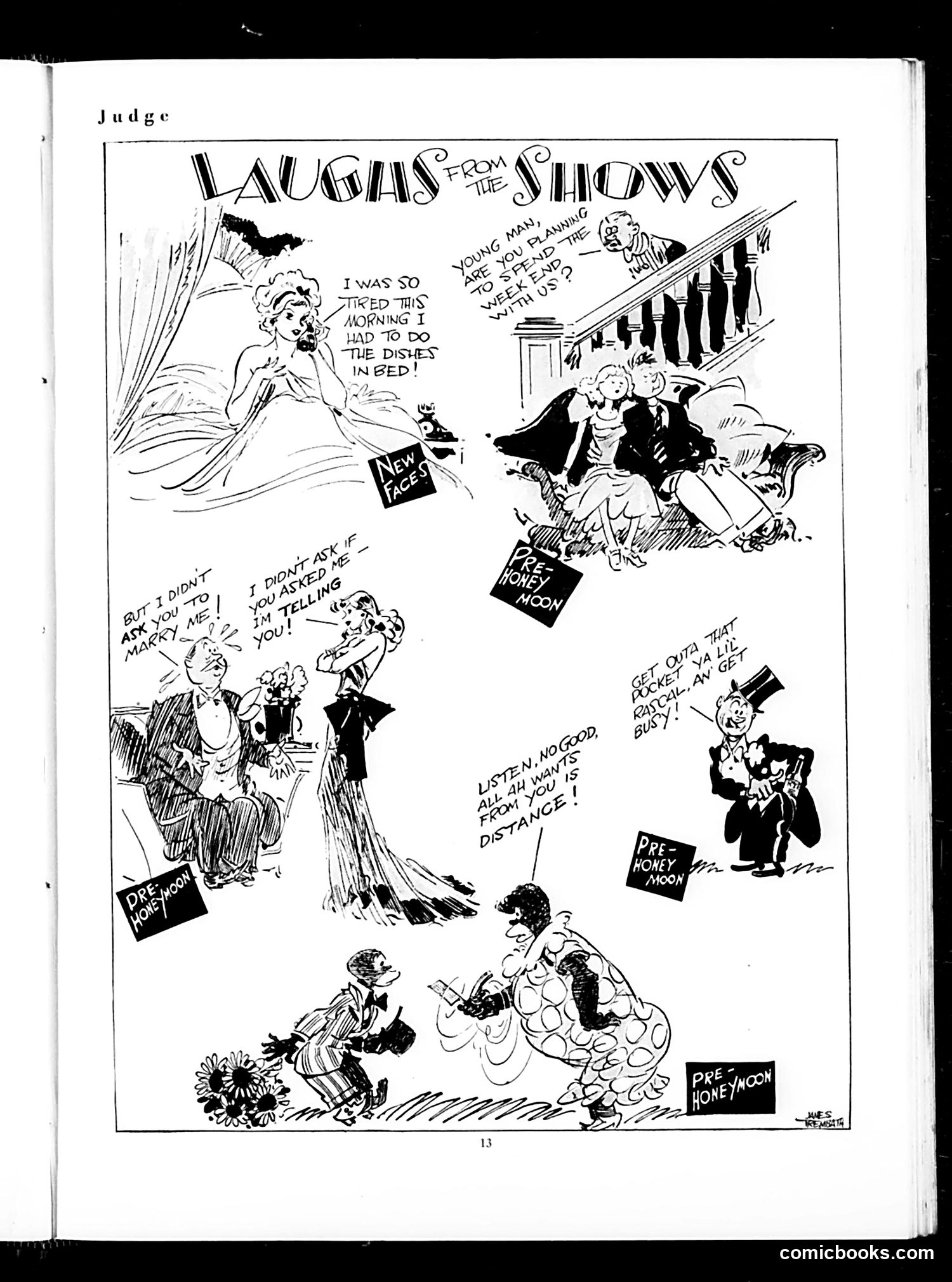
This Judge magazine page satirizes early 1920s theatrical productions, specifically honeymoon-themed comedies. Multiple vignettes mock "pre-honeymoon" and "honeymoon moon" stage shows through exaggerated character sketches. The humor targets both the plots (wives complaining about domestic duties like dishes) and the theatrical conventions of the era. Young men are shown pursued by marriage-minded women, while husbands deliver excuses about work obligations. The satire critiques how these popular stage comedies relied on predictable domestic comedy tropes—nagging wives, reluctant husbands, slapstick situations. The repeated "PRE-HONEYMOON" and "HONEYMOON MOON" labels indicate these are actual show titles being mocked for their formulaic, tired approach to marital humor. The cartoonist uses caricature and exaggeration to expose how threadbare these theatrical offerings had become.
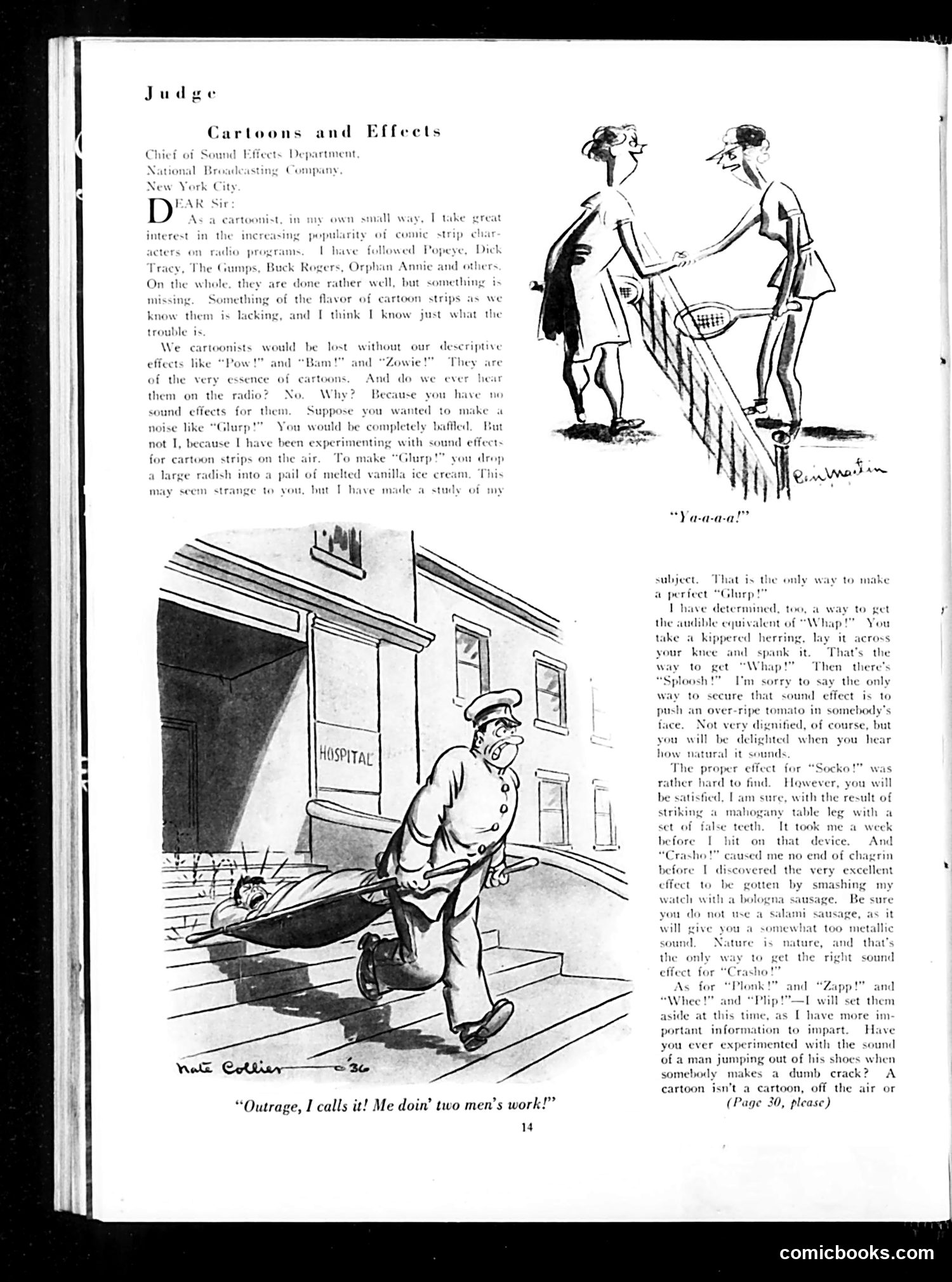
Judge Magazine: "Cartoons and Effects" This page addresses the emerging challenge of adapting comic strips for radio broadcast. The author, Chief of Sound Effects at NBC, explains why radio versions lack the visual dynamism of printed comics. The problem: comic strips rely on onomatopoeia—words like "Pow!" and "Bam!"—that work visually but are meaningless on radio. The solution requires creating actual sound effects to replace them. The letter hilariously describes elaborate methods: dropping radishes into vanilla ice cream for "Glurp," spanking a kippered herring for "Whap," and smashing a watch with bologna for "Socko!" The cartoons illustrate the absurdity: one shows a woman exclaiming "Ya-a-aa!" while encountering a man; another depicts a hospital scene with the caption "Outrage, I calls it! Me doin' two men's work!"—likely referencing the labor shortage during World War II. The satire mocks both the technical challenges of radio adaptation and the growing popularity of comic-strip programs during the 1940s.
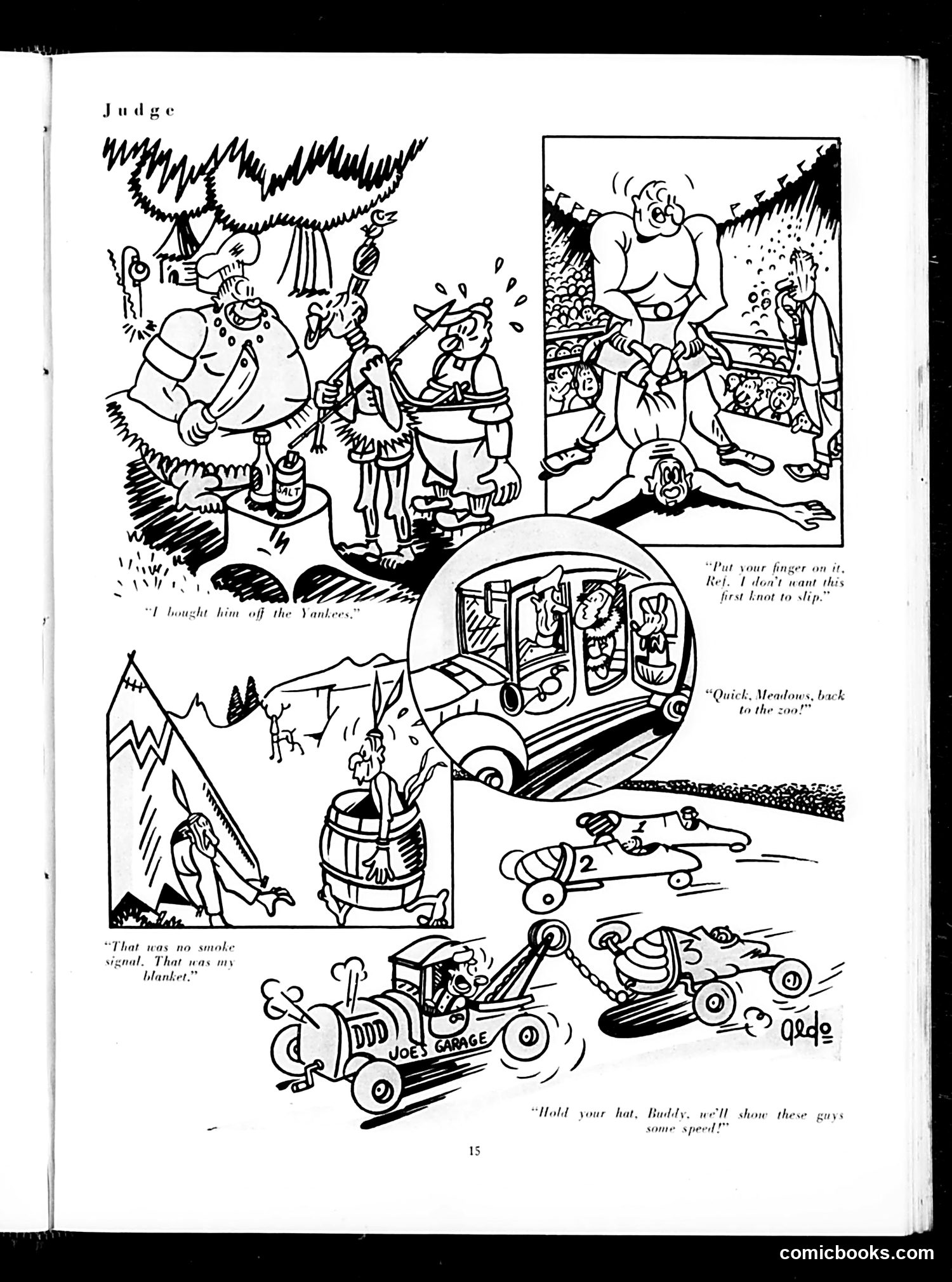
"Judge" Page Analysis This page contains multiple cartoon panels with a racing/automotive theme. The top left panel references "I bought him off the Yankees"—likely a baseball reference suggesting someone was bribed or traded. The subsequent panels depict a chaotic auto race with exaggerated, slapstick humor typical of Judge magazine's style. The cartoons appear to satirize early automobile culture and racing enthusiasm, showing mechanical vehicles in absurd situations. References like "Put your finger on it, Ref" and "Hold your hat, Bobby, we'll show these guys some speed!" suggest competitive racing among amateur or homemade vehicles. The overall satire targets the emerging automotive craze and the competitive, sometimes dangerous enthusiasm around early motorcar racing in America. The cartoonist (signed "Udo") emphasizes the chaos and unpredictability of these early vehicles and races.
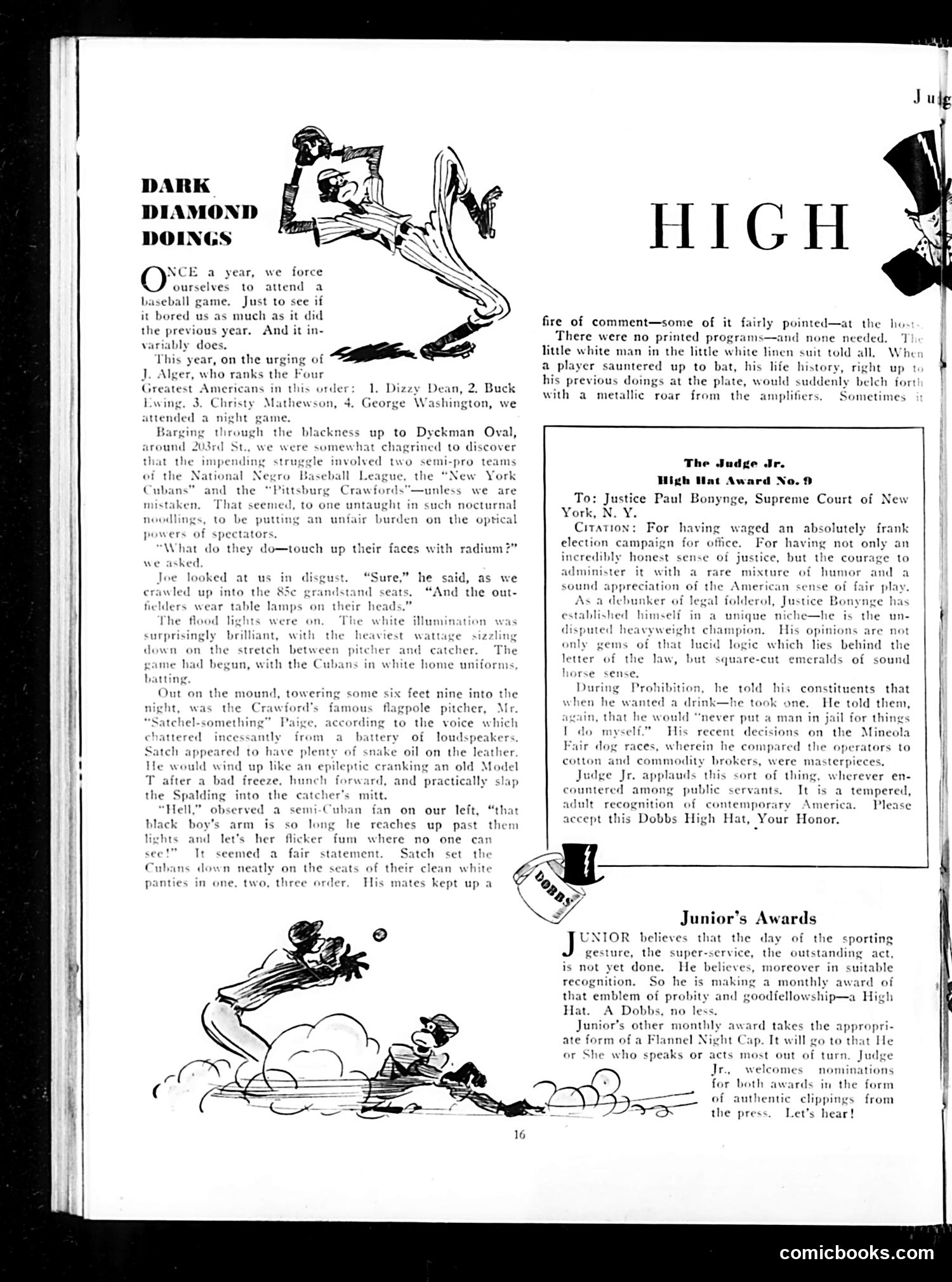
Dark Diamond Doings & High Hat Award No. 9 The Left Section ("Dark Diamond Doings"): A humorous account of attending a Negro League baseball game at Dyckman Oval in upper Manhattan. The author notes the four greatest Americans ranked as: Dizzy Dean, Buck Ewing, Christy Mathewson, and George Washington. The piece satirizes the novelty of stadium amplifiers announcing players' histories and mocks fans' superstitions (a Cuban fan jokingly claims players wear radium on their faces and table lamps on their heads). The famous Crawford pitcher is described as exceptionally tall. The Right Section ("High Hat Award No. 9"): Justice Paul Bonynge of New York's Supreme Court receives Judge magazine's monthly "High Hat" award for conducting honest election campaigns and administering justice with rare humor and fairness—qualities the text celebrates as uncommon among public servants. Context for Modern Readers: Both sections reflect 1930s attitudes toward segregation (treating the Negro League as a curiosity) and judicial integrity as genuinely noteworthy.
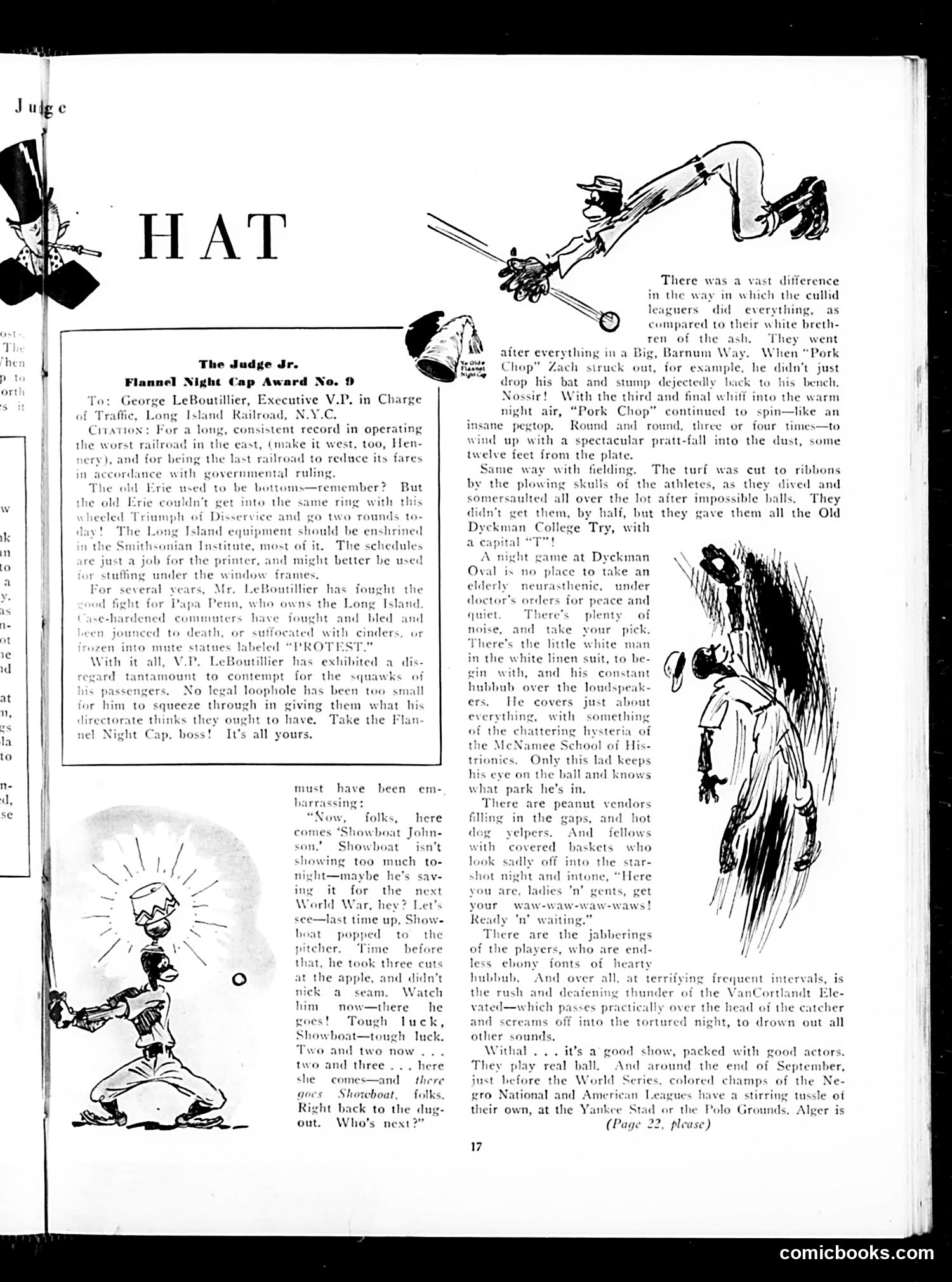
Analysis of Judge Magazine Page 17 This page contains two distinct items: "The Judge Jr." Award Section: A satirical commendation to George LeBoutillier, an executive at the Long Island Railroad, for operating "the worst railroad in the east" and being the last to reduce fares in accordance with government ruling. The award—a "Flannel Night Cap"—is mock praise for corporate foot-dragging, a common Judge target. The accompanying cartoons show a character celebrating receiving this dubious honor. Baseball Article: The main text discusses African American baseball players (referred to with period racial language), describing their flamboyant playing style at what appears to be a Negro League game. The article notes contrasts with white players' reserved demeanor, detailing colorful vendor calls and stadium atmosphere at venues like the Polo Grounds or Yankee Stadium. Context: Both items reflect early 20th-century Judge magazine's mix of corporate/political satire and sports commentary. The racial language and depictions reflect the era's unfortunately common attitudes, though the baseball section seems primarily observational rather than explicitly derisive about the athletic display itself.
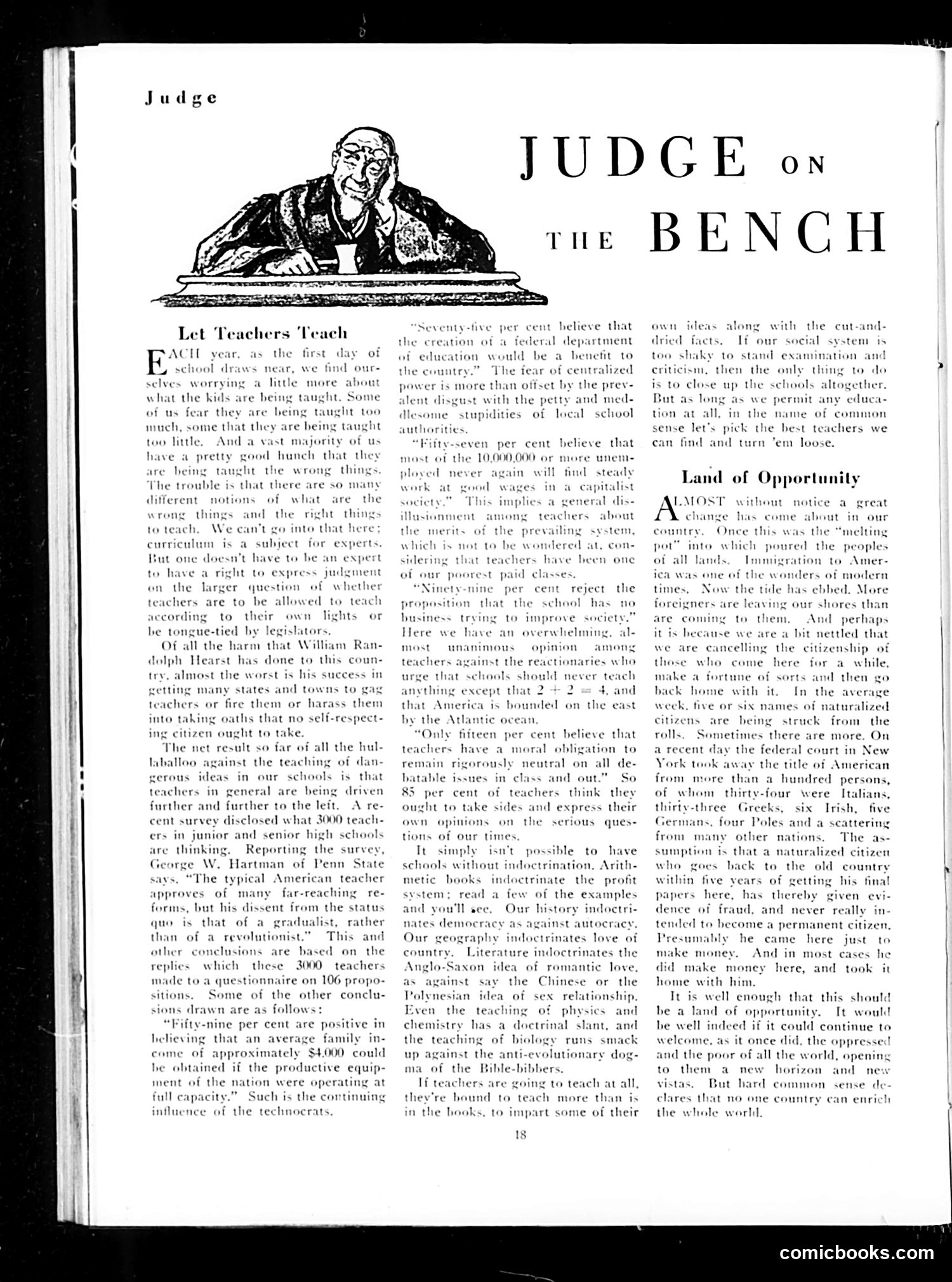
Judge Magazine: "Judge on the Bench" - Teacher Indoctrination Debate This page from Judge magazine debates whether teachers should be allowed to express their own political and social views in the classroom. The Cartoon: The illustration shows a stern judge figure presiding, symbolizing judicial authority over educational policy. The Context: The article references William Randolph Hearst's campaigns forcing teachers to take loyalty oaths and restricting classroom content. It presents survey data from 3,000 teachers showing most favor gradual social reform and believe teachers *should* express opinions on serious issues—contradicting reactionary demands that teachers remain "neutral" or teach only basic facts. The Satire's Point: The author argues indoctrination is unavoidable (history teaches democracy over autocracy, geography teaches patriotism). The real question isn't whether teachers influence students, but whether they're allowed intellectual freedom or forced into silence by political pressure. Judge appears to defend teachers' rights against conservative censorship attempts of the era.
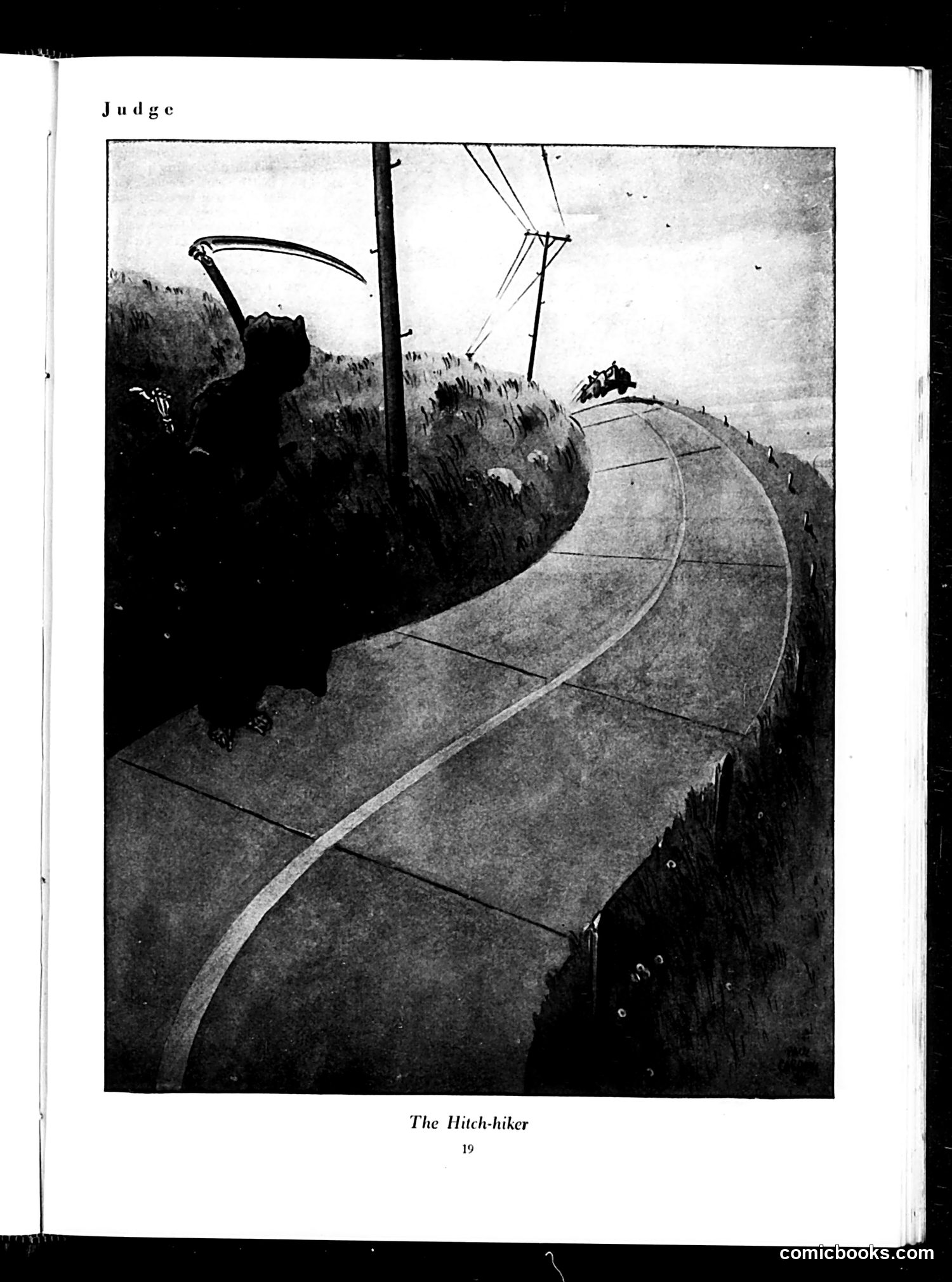
"The Hitch-hiker" from Judge Magazine This page from the satirical magazine *Judge* shows a curved railroad track cutting through hilly terrain, with what appears to be a figure (depicted in silhouette on the left) and utility poles visible. The title "The Hitch-hiker" suggests social commentary on transportation or mobility. The image likely satirizes hitchhiking culture or attitudes toward travel and vagabondage—potentially common topics for early 20th-century satire. The perspective emphasizes the track's dramatic curve through the landscape, possibly mocking either the hazards of hitching rides on trains or broader attitudes about transient lifestyles during this period. Without additional context about the specific issue's date or accompanying text, the precise satirical target remains unclear, though the composition suggests commentary on American mobility or labor patterns.
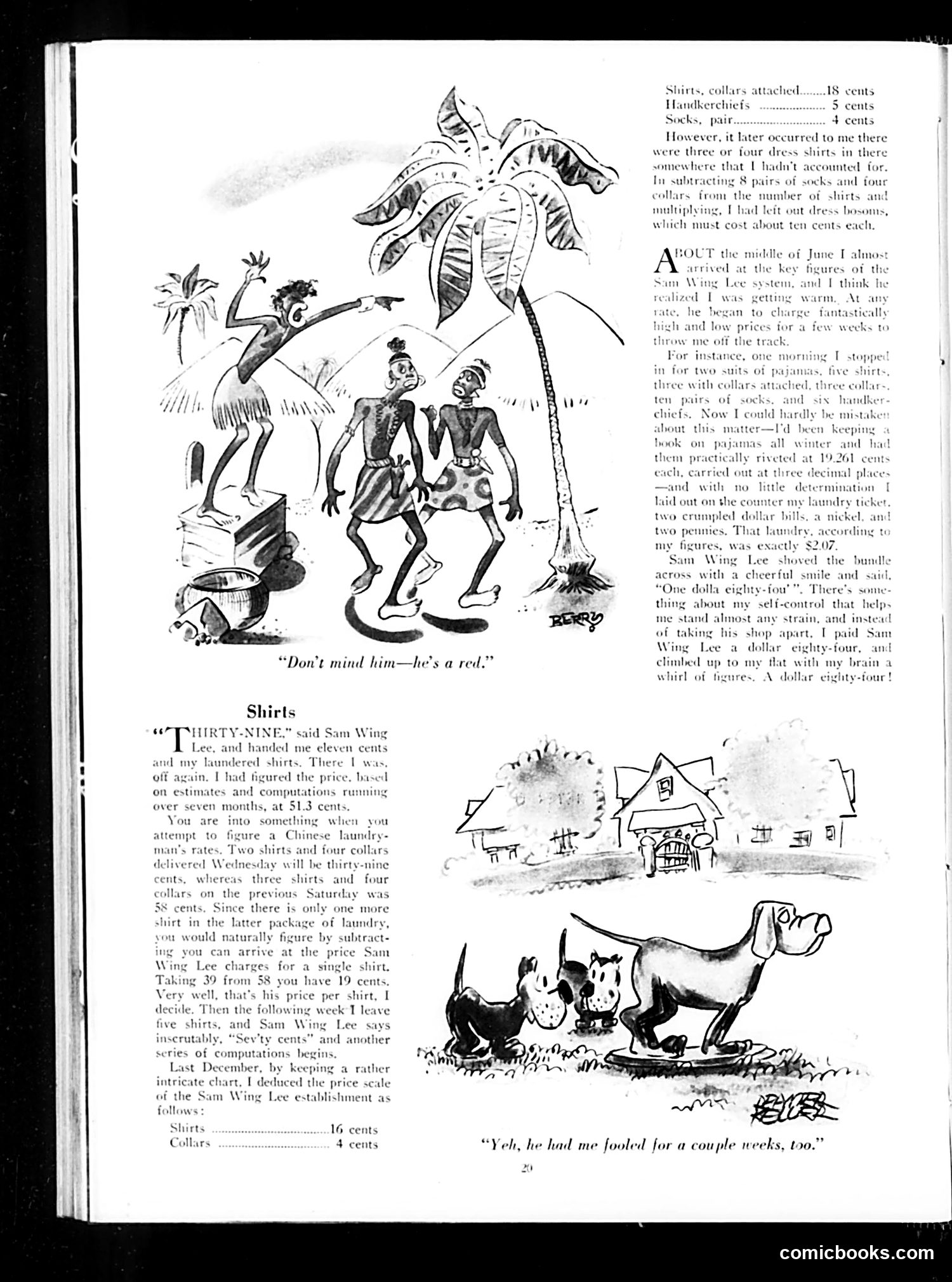
"Shirts" — A Satire on Chinese Laundry Pricing This humorous piece lampoons the pricing opacity of Chinese laundry services, a common urban experience in early 20th-century America. The narrator, dealing with "Sam Wing Lee," attempts to reverse-engineer the laundry's per-item costs through elaborate mathematical deduction—tracking charges across multiple weeks to calculate individual shirt, collar, and sock prices. The satire targets two things: first, the deliberate inscrutability of the laundry's pricing (Sam Wing Lee provides only final totals, never itemized bills); second, the narrator's absurd over-confidence in solving the puzzle through "intricate charts" and computation, only to discover unaccounted items that invalidate his entire analysis. The cartoon's punchline—a customer confessing "he had me fooled for a couple weeks, too"—suggests this was a widespread, perhaps deliberately orchestrated practice. The satire reflects period anxiety about inscrutable immigrant business practices and the comedy of middle-class customers attempting rational analysis against deliberately opaque systems.
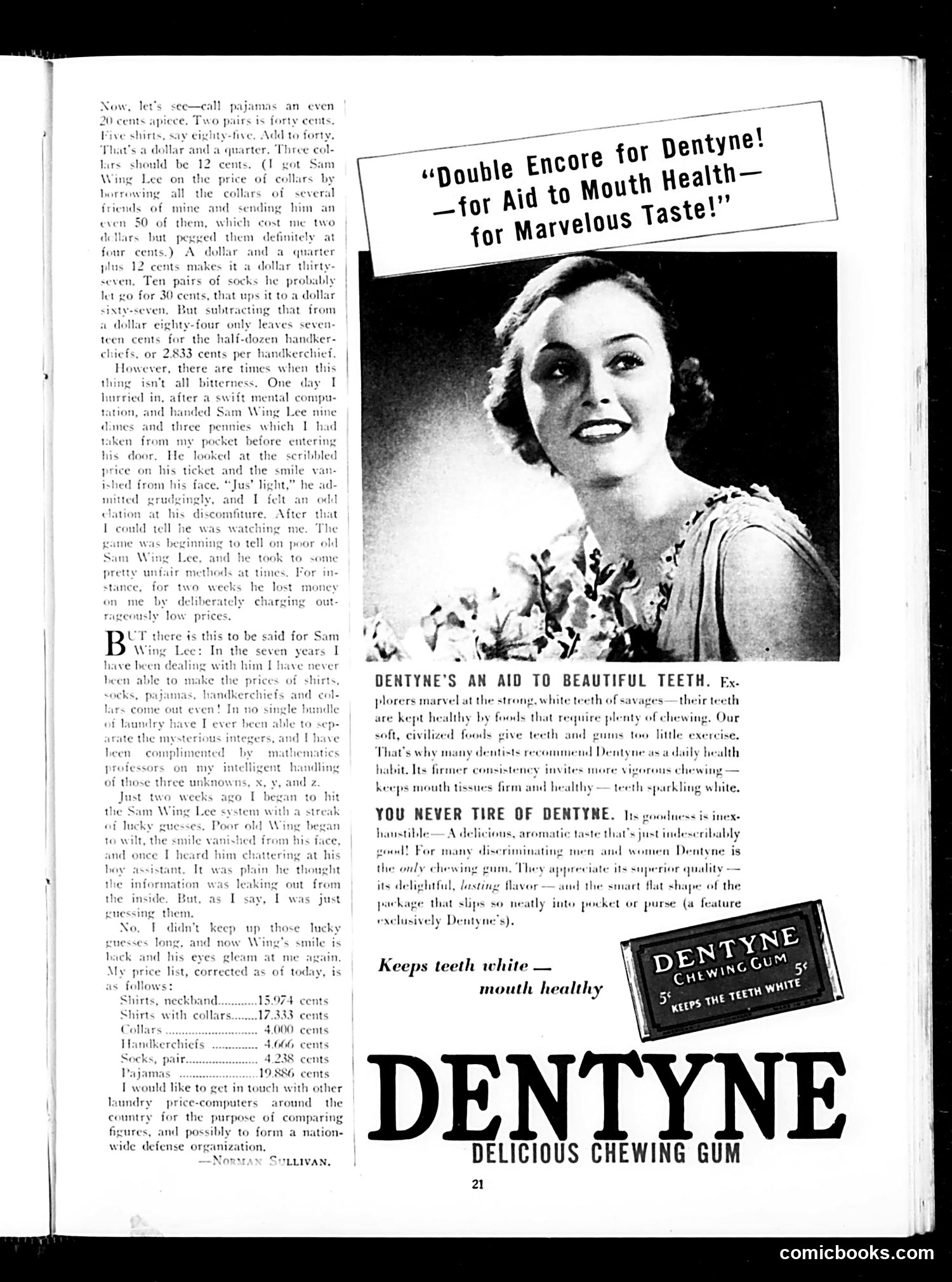
Analysis of Judge Magazine Page This page is primarily a full-page advertisement for Dentyne chewing gum, not a political cartoon. The advertisement occupies the right two-thirds of the page. The left column contains a humorous article by Norman Sullivan about calculating laundry costs for a Chinese laundryman named Sam Wing Lee. Sullivan describes the mathematical absurdity of trying to itemize shirt, collar, and handkerchief costs—his prices keep coming out uneven. The anecdote culminates in Wing Lee's dismissive reaction to Sullivan's pricing complaints, suggesting the laundryman's prices are actually fair despite appearing arbitrary. The Dentyne ad uses a smiling woman's photograph to promote chewing gum as beneficial for oral health and hygiene. It emphasizes the gum's "lasting flavor" and distinctive "smart flat shape" packaging designed to fit neatly in pockets. The only satirical element is Sullivan's gentle humor about the impossibility of perfectly rational accounting in everyday transactions. The page reflects 1930s-era advertising conventions combining editorial content with prominent product promotion.
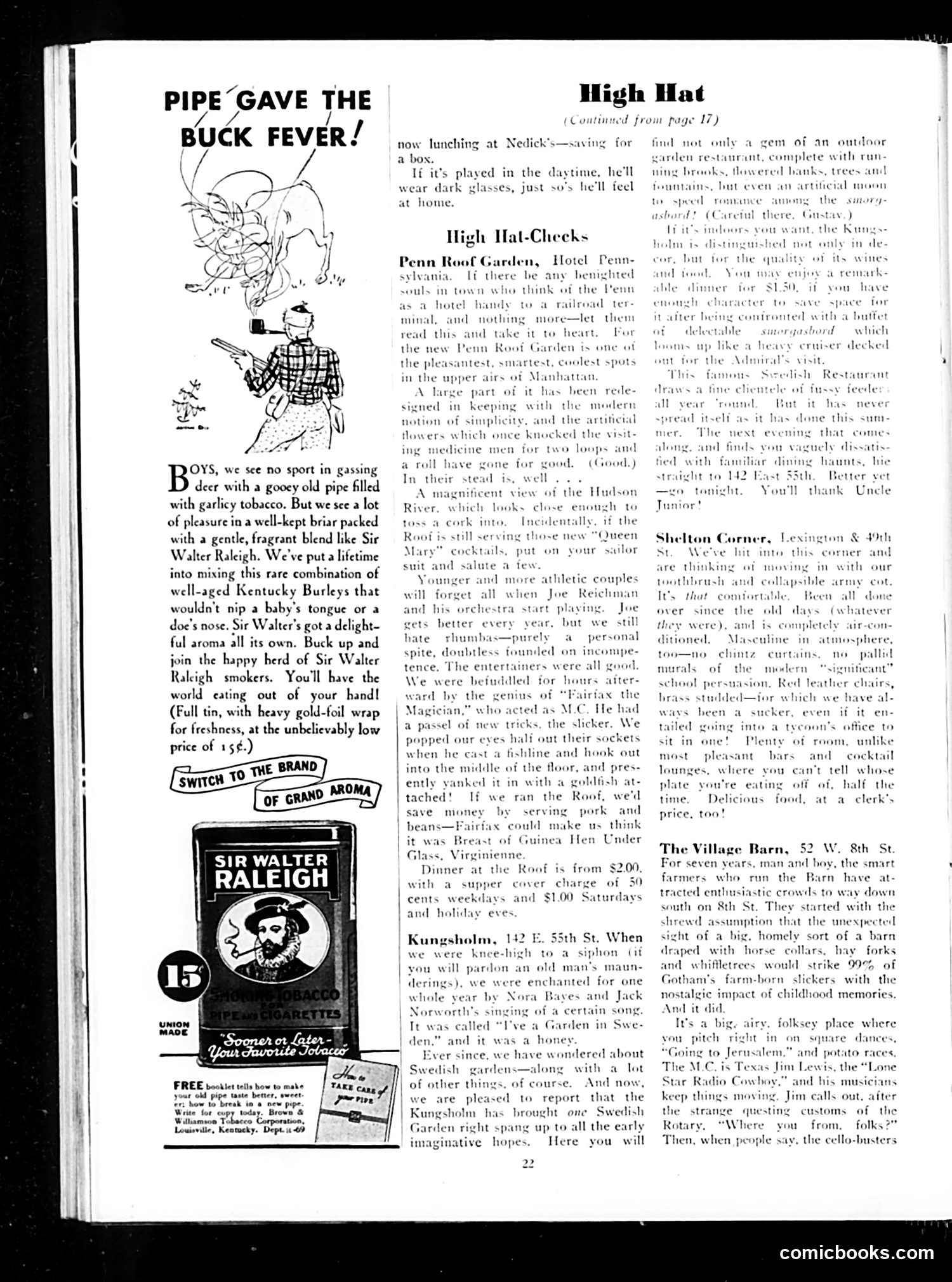
Political-Historical Context for Modern Readers This page from *Judge* magazine combines entertainment reviews with cigarette advertising. The main cartoon "Pipe Gave the Buck Fever" depicts a hunter with an exaggerated reaction—likely satirizing how smoking a quality pipe ("Sir Walter Raleigh") enhances leisure activities and social confidence. "Buck fever" refers to a hunter's nervous excitement. The "High Hat" restaurant reviews mock New York's upscale dining establishments of the era, using sophisticated language to describe venues like Penn Roof Garden and Kungsholm. The satire targets pretentious Manhattan restaurants and their wealthy clientele. The Sir Walter Raleigh cigarette advertisement emphasizes the product's "well-aged Kentucky Burleys" and "delightful aroma," reflecting 1920s-30s marketing that positioned smoking as a marker of refinement and masculinity. The "15¢" price point indicates this is Depression-era content, when such luxuries remained accessible to middle-class consumers.
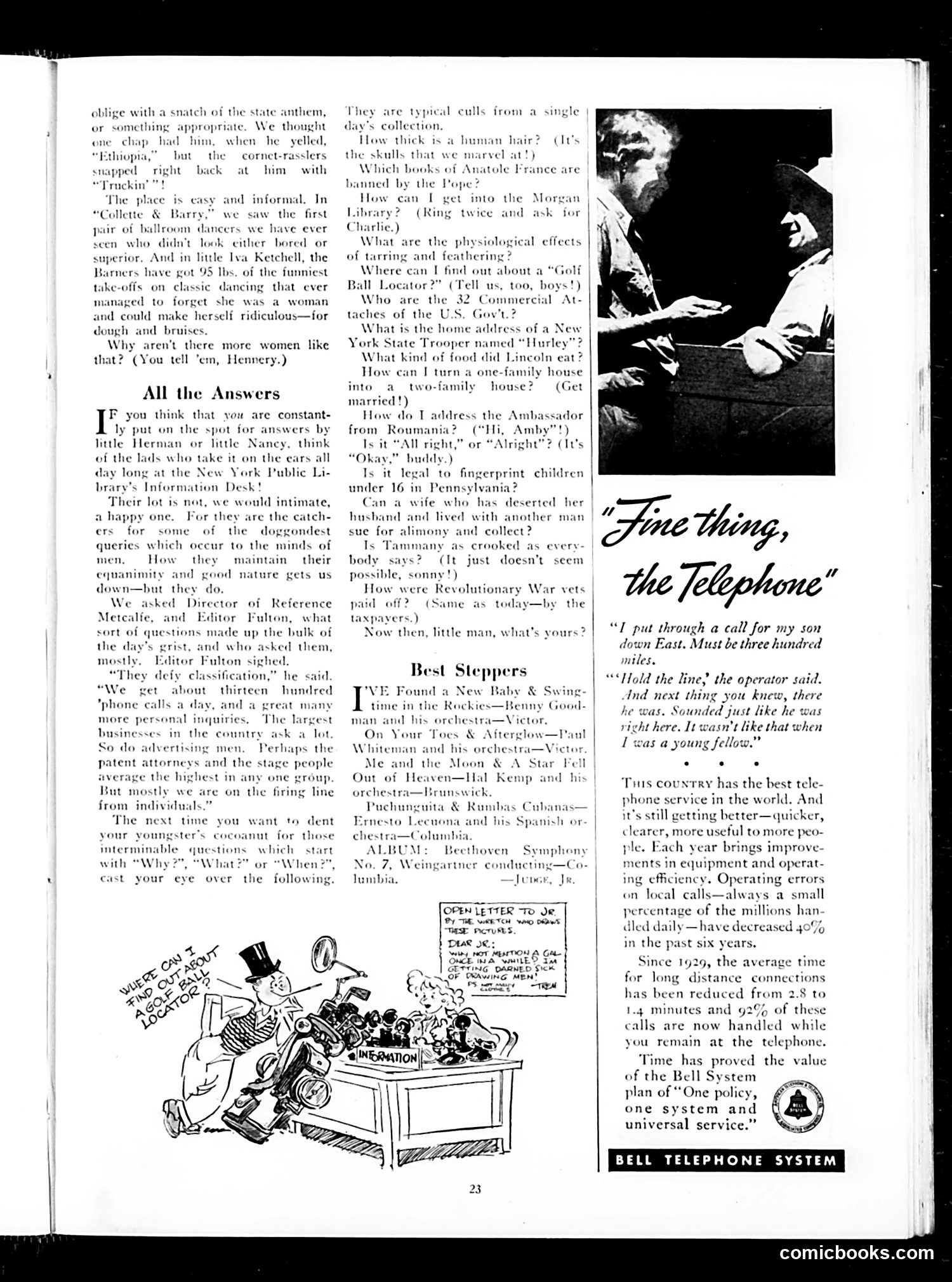
Judge Magazine Page Analysis This page mixes humor columns with advertising. The main cartoon (lower left) depicts a chaotic "Information Desk" scene—a cluttered desk overwhelmed with bizarre questions, representing the absurd inquiries librarians endure daily. The cartoonist satirizes public ignorance by listing genuinely ridiculous questions asked at the New York Public Library: "How thick is a human hair?" (marveling at skulls instead), what Anatole France books the Pope banned, whether Tammany Hall is crooked (implying it obviously is), etc. The joke targets both the public's lack of knowledge and their assumption that librarians exist to answer anything, no matter how trivial or nonsensical. The right page is a Bell Telephone System advertisement featuring a nostalgic testimonial about long-distance calling quality—a father amazed his son sounds as if he's in the same room despite being "three hundred miles" away. This is corporate propaganda celebrating telephone infrastructure improvements.
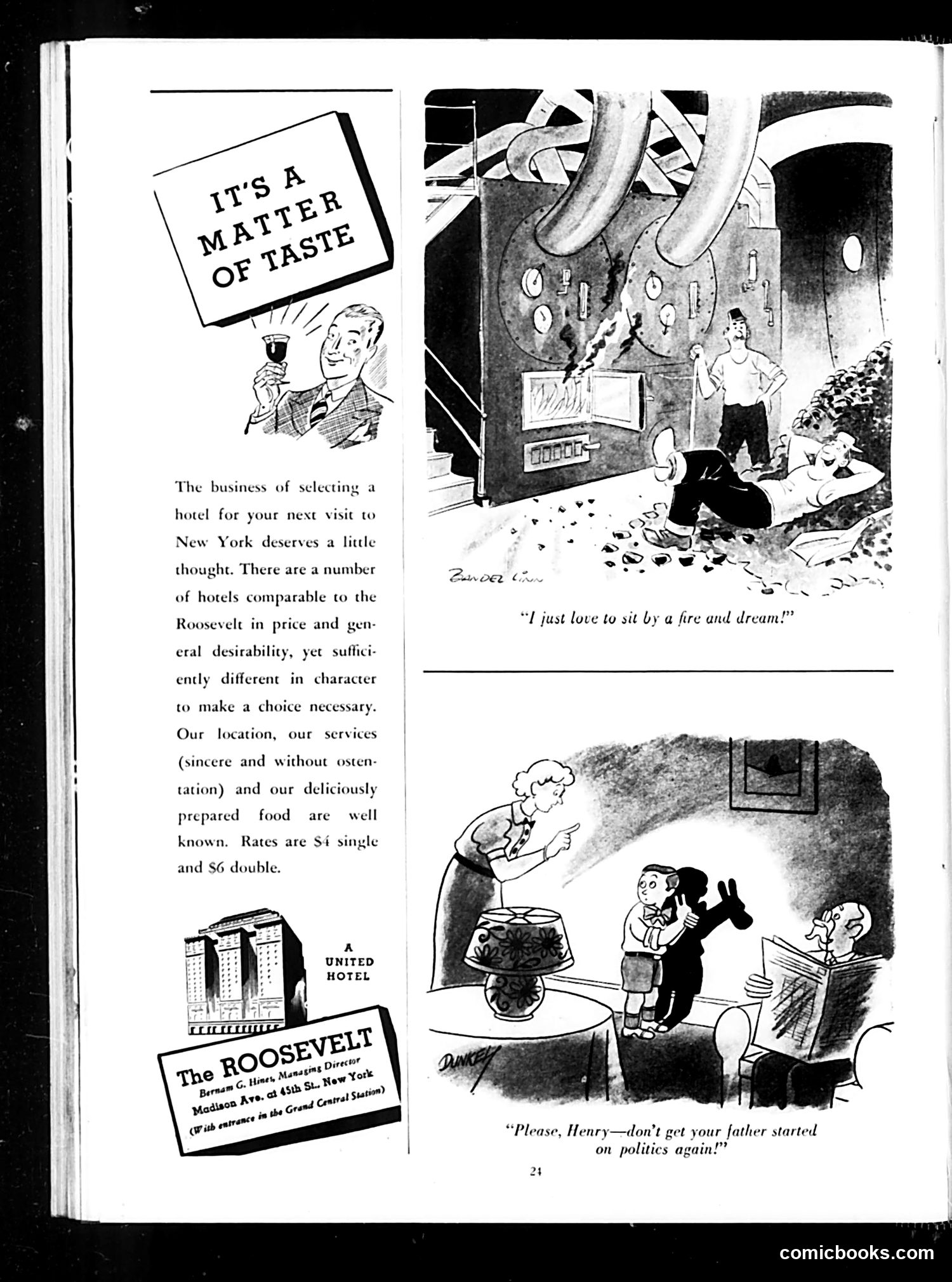
Analysis for Modern Readers This page combines a hotel advertisement with two unrelated cartoon jokes. Left side: The Roosevelt Hotel advertisement uses the slogan "It's a Matter of Taste" with a man raising a glass. It's positioned as a competing establishment to other comparable New York hotels, emphasizing location, service, and food quality at modest rates ($4-$6). Top cartoon: Shows a couple by a fireplace; the woman says she loves sitting by a fire and dreaming—a sentimental, domestic scene with no apparent satirical point. Bottom cartoon: A family scene where a woman urgently tells "Henry" not to get his father started on politics—implying the father is argumentative or tedious on political topics. This reflects a common domestic frustration about relatives who dominate conversation with political debate. Neither cartoon appears to reference specific political figures or events—they're generic humor about everyday life and family dynamics.
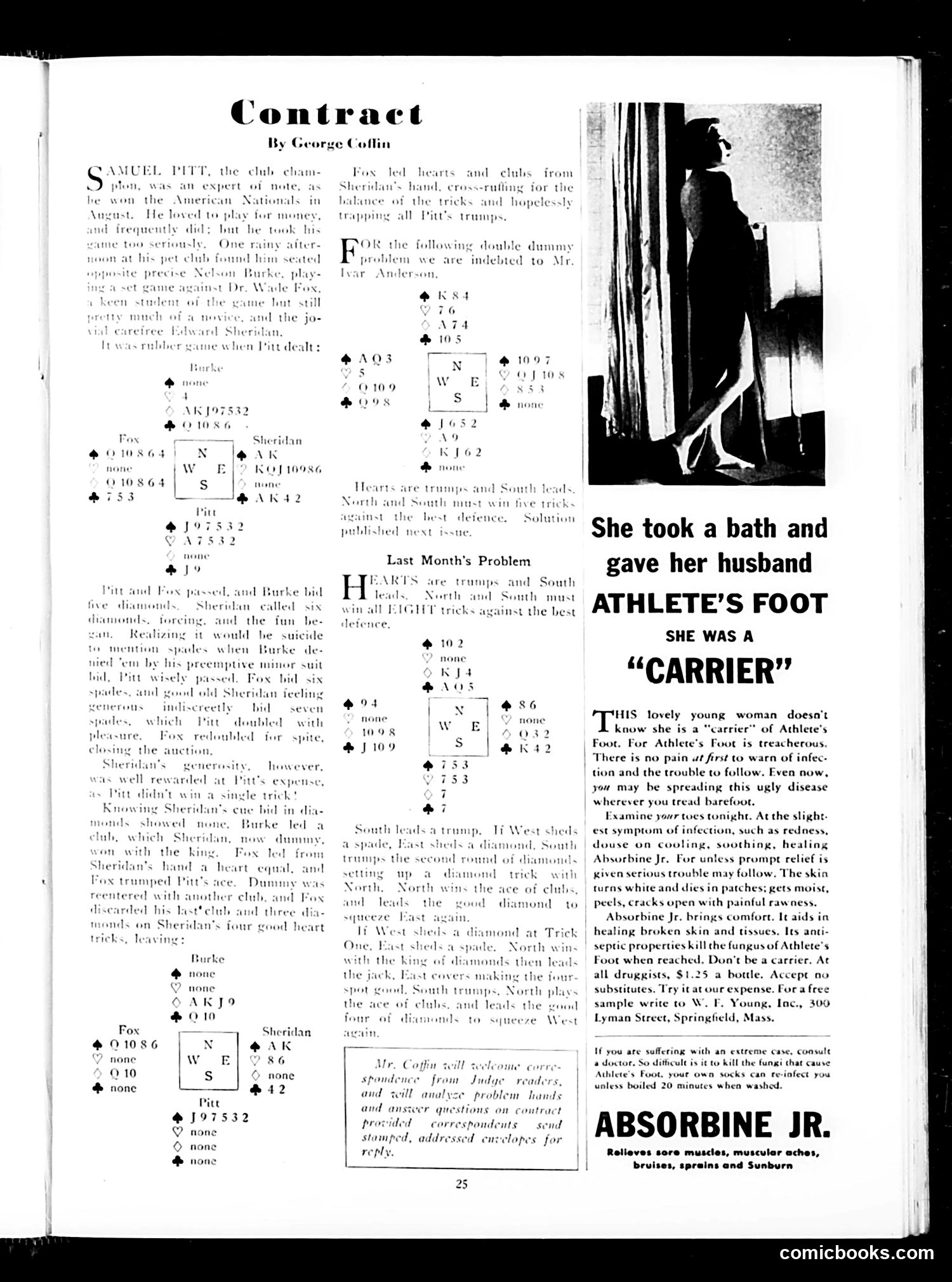
Analysis This page contains two distinct elements: Top Section: A bridge contract problem by George Coffin, explaining a card game hand between players named Pitt, Fox, Burke, and Sheridan. This is instructional content about contract bridge strategy. Bottom Section: A full-page advertisement for Absorbine Jr., a patent medicine product. The ad uses a photograph of a woman and sensationalist messaging about "Athlete's Foot" as a contagious disease that an unsuspecting woman might spread to her husband through bathing. The advertisement employs fear-based marketing typical of early-to-mid 20th century patent medicine ads, claiming the fungal infection causes serious skin damage ("peels, cracks open with painful rawness") and positioning Absorbine Jr. as the solution. It includes typical period marketing tactics: medical authority claims, dramatic language about transmission, direct calls to action ("Examine your toes tonight"), and pricing information. The "carrier" framing—suggesting the woman unknowingly spreads disease—reflects gender stereotypes common in vintage advertising.
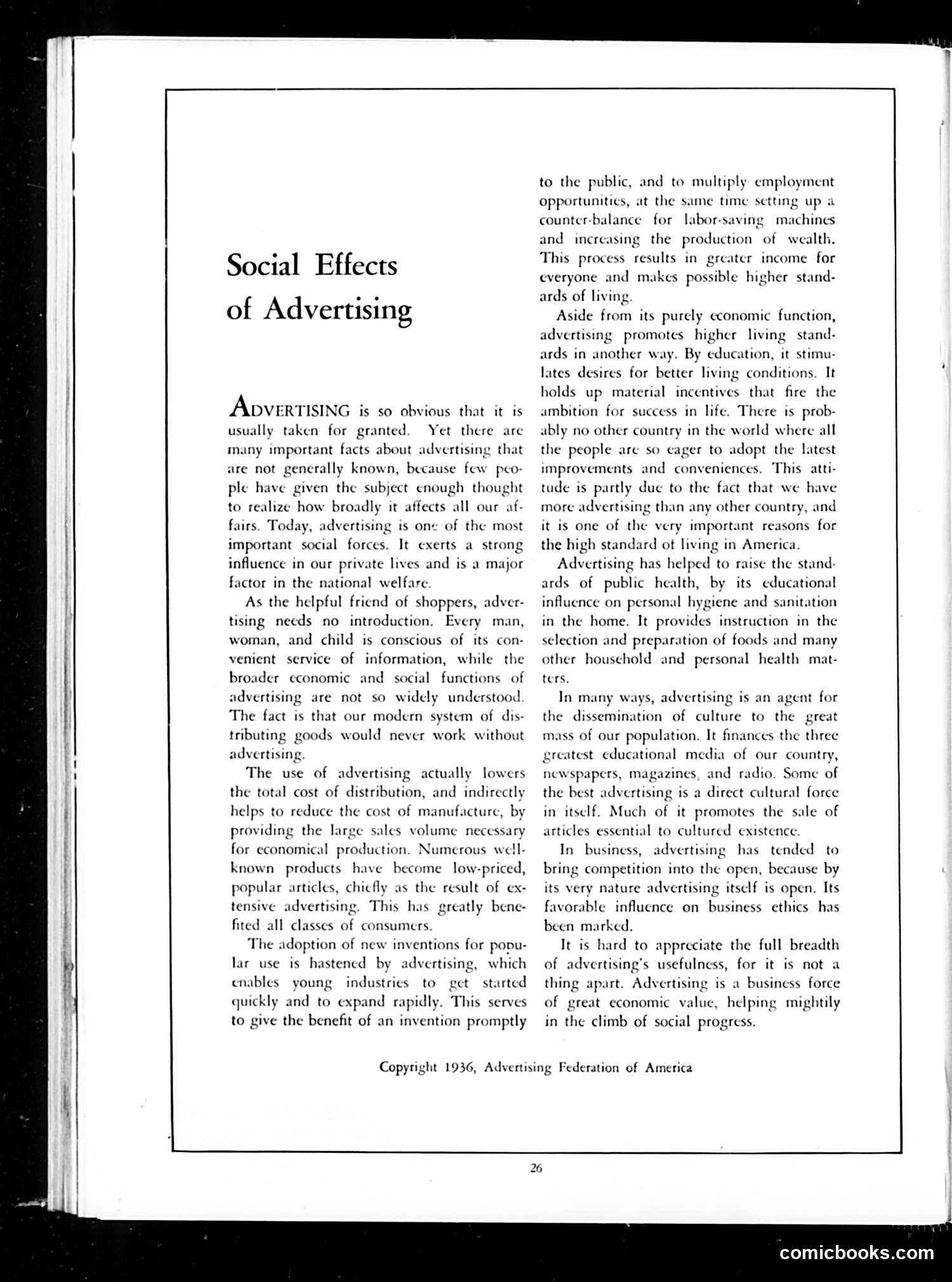
Analysis This page contains no cartoon or satirical content—it is a straightforward advertorial essay titled "Social Effects of Advertising," copyrighted by the Advertising Federation of America in 1936. The text is a pro-advertising argument claiming that advertising: - Reduces distribution and manufacturing costs - Democratizes new inventions and products - Stimulates consumer desire for better living standards - Improves public health through educational messages - Finances newspapers, magazines, and radio - Promotes business ethics and competition For modern readers: This represents 1930s advertising industry self-promotion. It presents advertising as a benevolent social force improving American life—a claim that would face considerable skepticism today regarding manipulation, materialism, and manufactured desire. The piece reflects Depression-era faith in commercial solutions and notably emphasizes advertising's role in driving consumer ambition and "higher standards of living" as inherently desirable social goods.
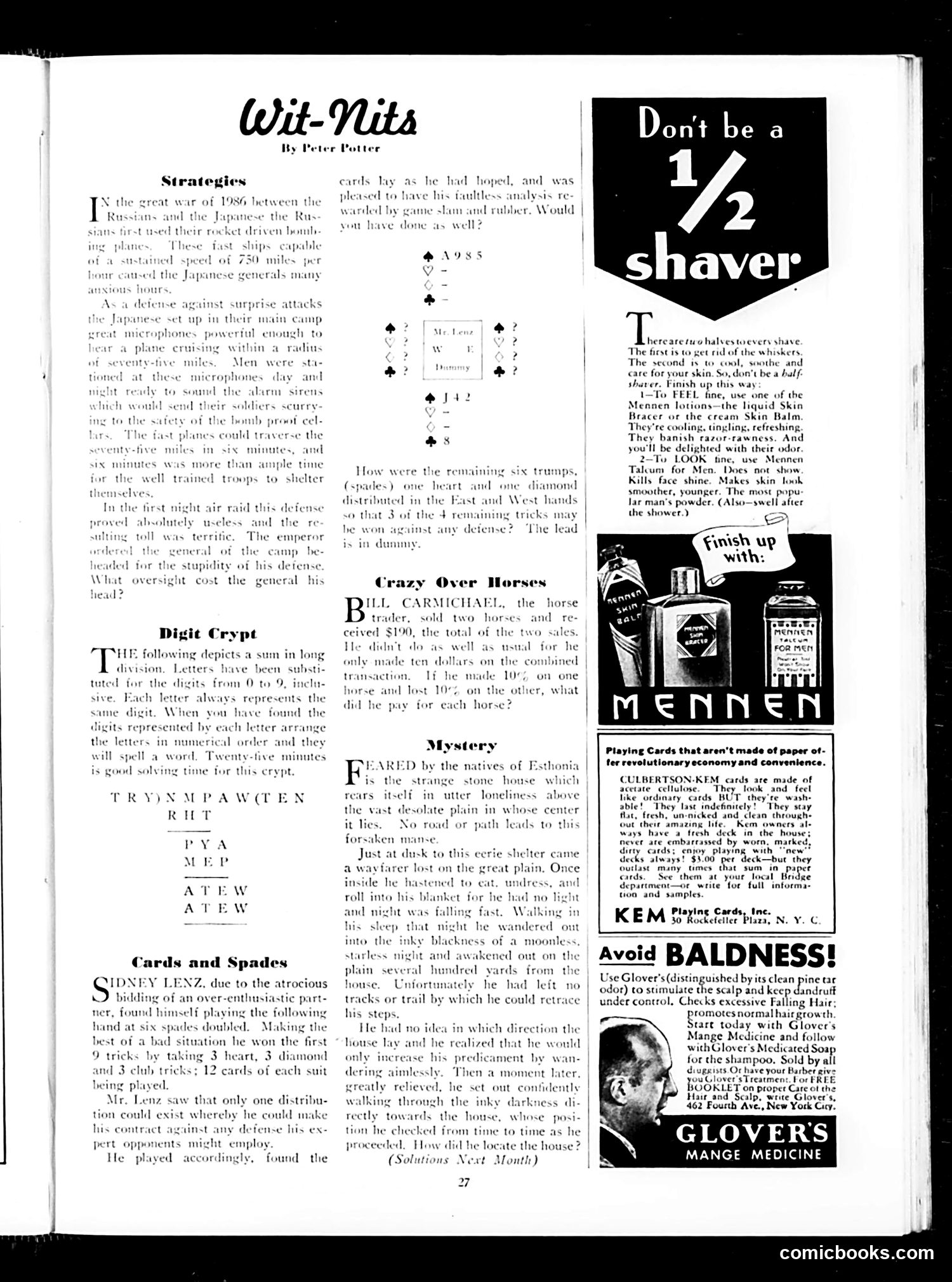
Explanation for Modern Readers This page from *Judge* magazine contains several unrelated pieces: puzzle columns ("Wit-Nits," "Digit Crypt," "Cards and Spades," "Crazy Over Horses," and "Mystery"), and advertisements. The content is primarily vintage puzzles and games rather than political cartoons. The "Wit-Nits" section presents logic problems (like card games and a riddle about a traveler lost on a plain). The advertisements are notable: they promote grooming products (Mennen shaving supplies, Kem playing cards) and a baldness remedy (Glover's hair treatment with pine tar). These ads reflect 1930s-40s male grooming anxieties—particularly around appearance and hair loss. The page itself contains no obvious political satire. It represents typical *Judge* content: lighthearted word games and consumer advertisements targeting male readers concerned with personal presentation.
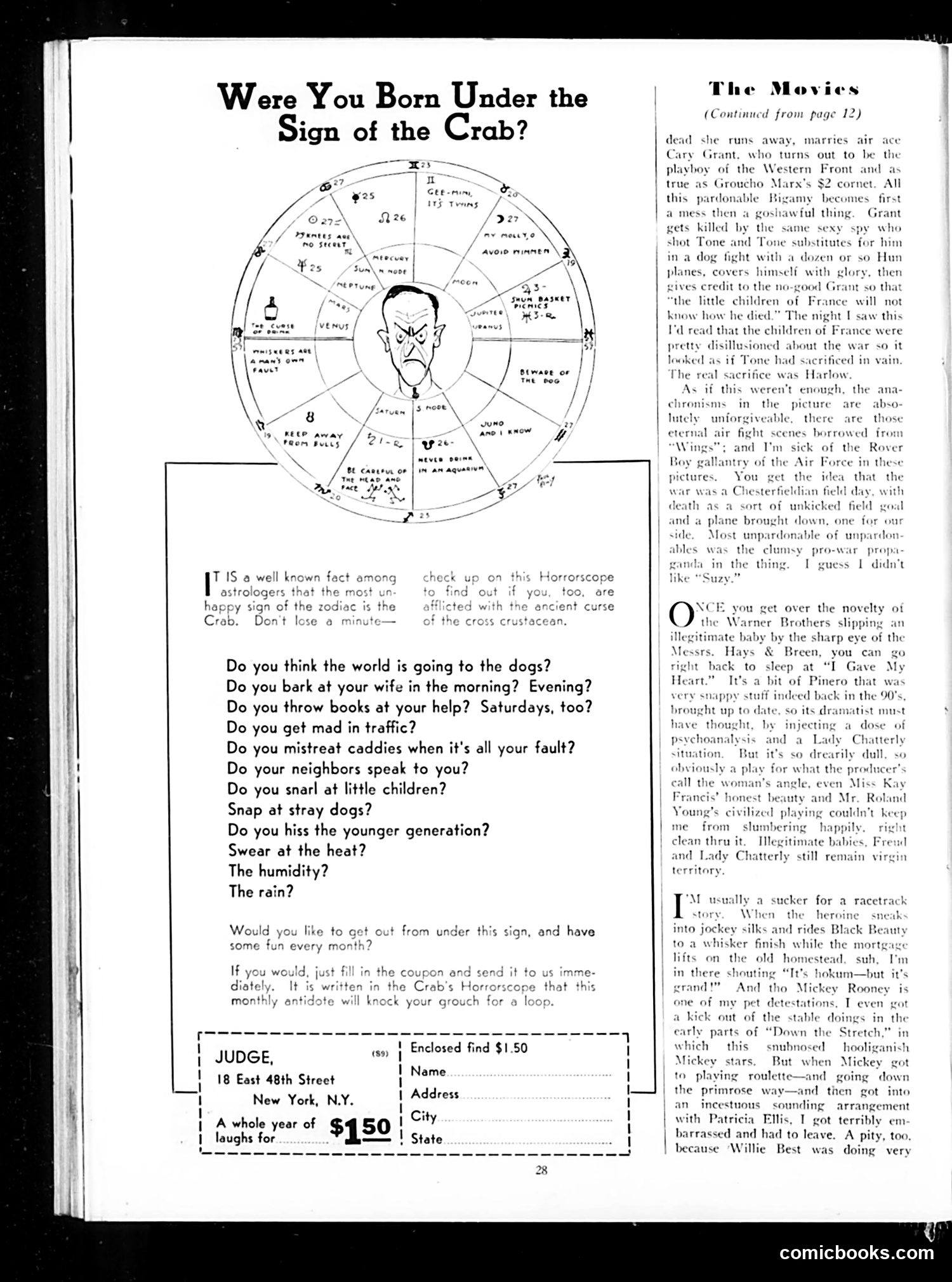
Explanation for Modern Readers This page features a humorous horoscope for the zodiac sign Cancer (the Crab), using satirical character traits. The cartoon shows a caricatured angry face in the center, surrounded by zodiacal symbols and personality descriptions suggesting Cancerians are perpetually grouchy, irritable people who bark at wives, mistreat servants and caddies, snarl at children, and curse the weather. The satire works as a subscription pitch: Judge magazine offers a year-long subscription for $1.50, implying that reading their humorous content will provide relief from such a miserable disposition. The accompanying text sarcastically asks whether the reader exhibits these cantankerous behaviors, then encourages them to subscribe as a cure for their grouch. This reflects 1930s-40s popular interest in astrology while poking fun at grumpy, irritable personality types—likely resonating with readers frustrated by Depression-era conditions or post-war anxiety.
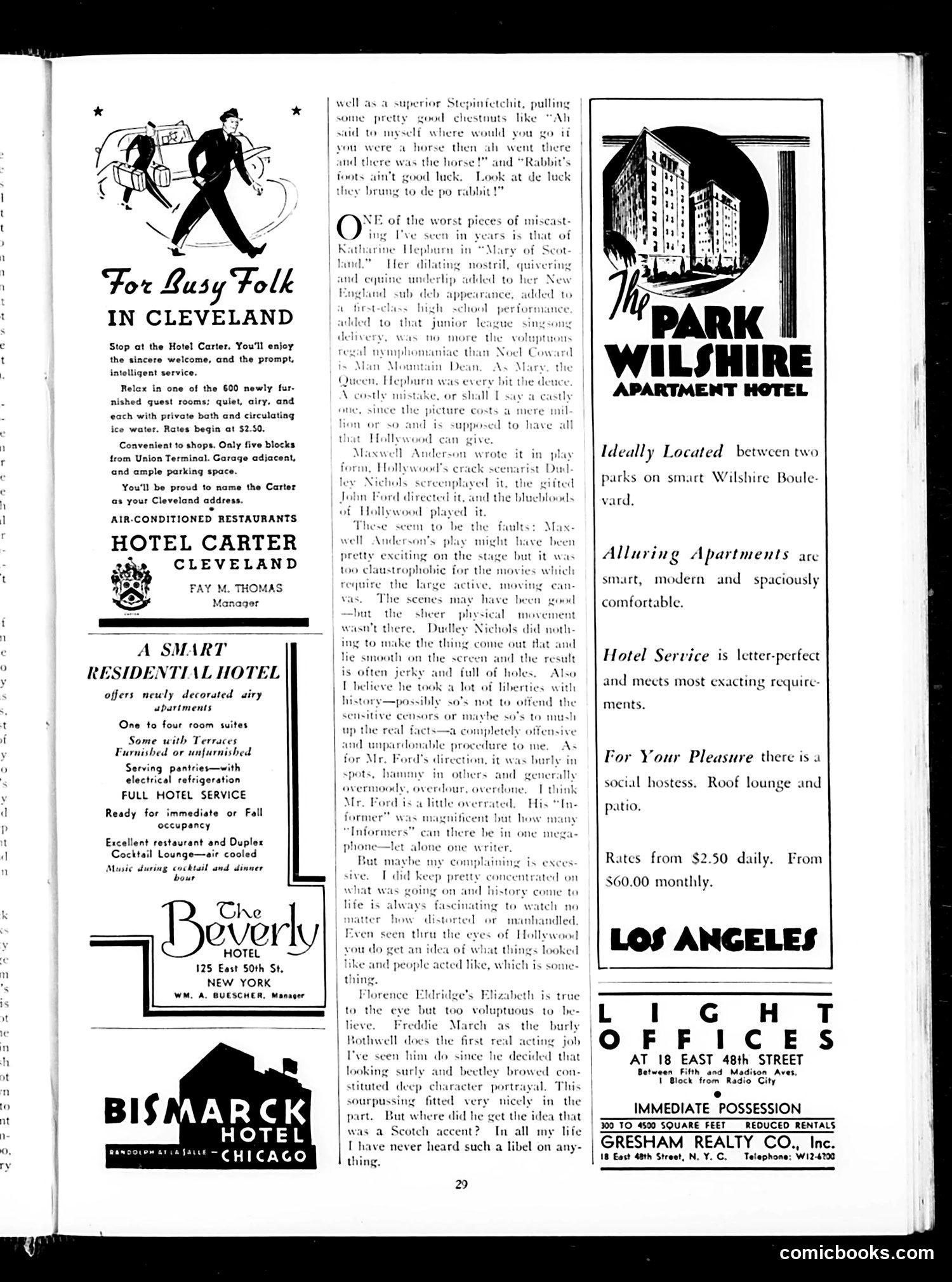
Analysis of Judge Magazine Page Content This page is primarily advertising for hotels and office space, interspersed with a film criticism column about Hollywood casting. The text discusses criticism of recent movie productions, particularly Katharine Hepburn's performance in "Mary of Scotland." The critic argues her "dilating nostril" and "equine underlip" made her poorly suited for the role. He also criticizes the film's adaptation, noting screenwriter Dudley Nichols and director John Ford made changes that made the story "jerky and full of holes." The column also mentions Freddie March as unsuitable for his role and criticizes Florence Eldridge's performance as "too voluptuous." The small cartoon at top-left labeled "For Busy Folk in Cleveland" appears to show travelers, likely advertising the Hotel Carter's convenience. Overall, this page reflects 1930s-40s era Hollywood gossip and film criticism alongside commercial real estate advertising—typical of Judge magazine's mixed editorial and advertising content.
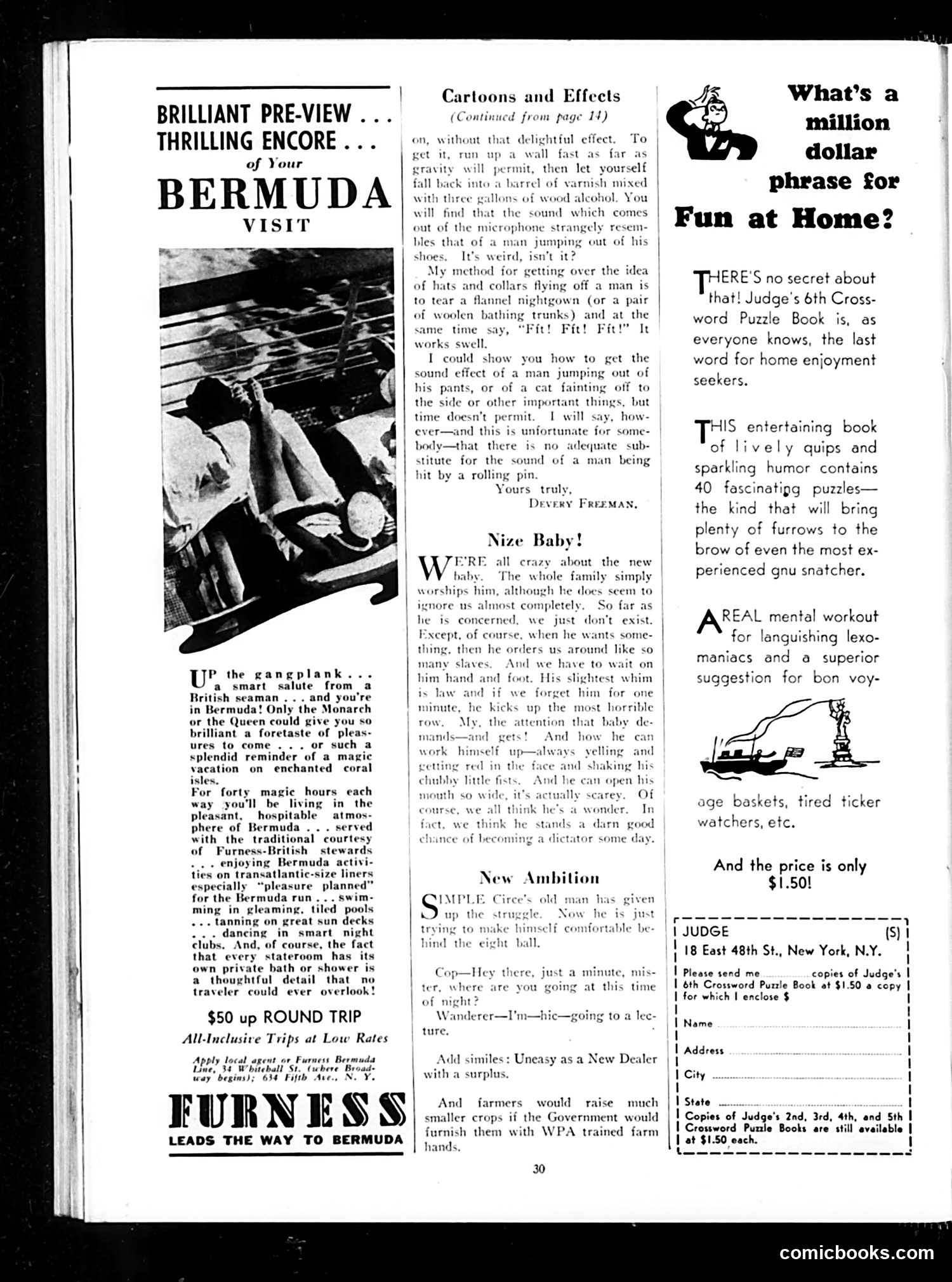
Explanation for Modern Readers This page is primarily advertising and puzzle promotion, not political satire. The content includes: 1. Bermuda Travel Ad (Furness Line): Promotes luxury ocean liner cruises to Bermuda, emphasizing British service ("smart salute from a British seaman") and onboard amenities—a common leisure advertisement for the era's affluent travelers. 2. "Cartoons and Effects" (top): A technical article by animator Devery Freeman explaining sound-effect tricks for cartoons—how to create realistic audio for physical comedy (men jumping from pants, cats fainting, rolling-pin hits). This is trade journalism for animators. 3. "Nize Baby!": A humorous column about a spoiled infant who tyrannically orders parents around, suggesting he'll become "a dictator someday." This is gentle domestic humor, not political commentary. 4. "New Ambition": A brief joke about a man ("Circe's old man") trying to stay comfortable "behind the eight ball" and a WPA reference mocking government farm programs—mild political satire typical of Judge magazine's conservative bent. The page is mostly advertisements and light humor content.
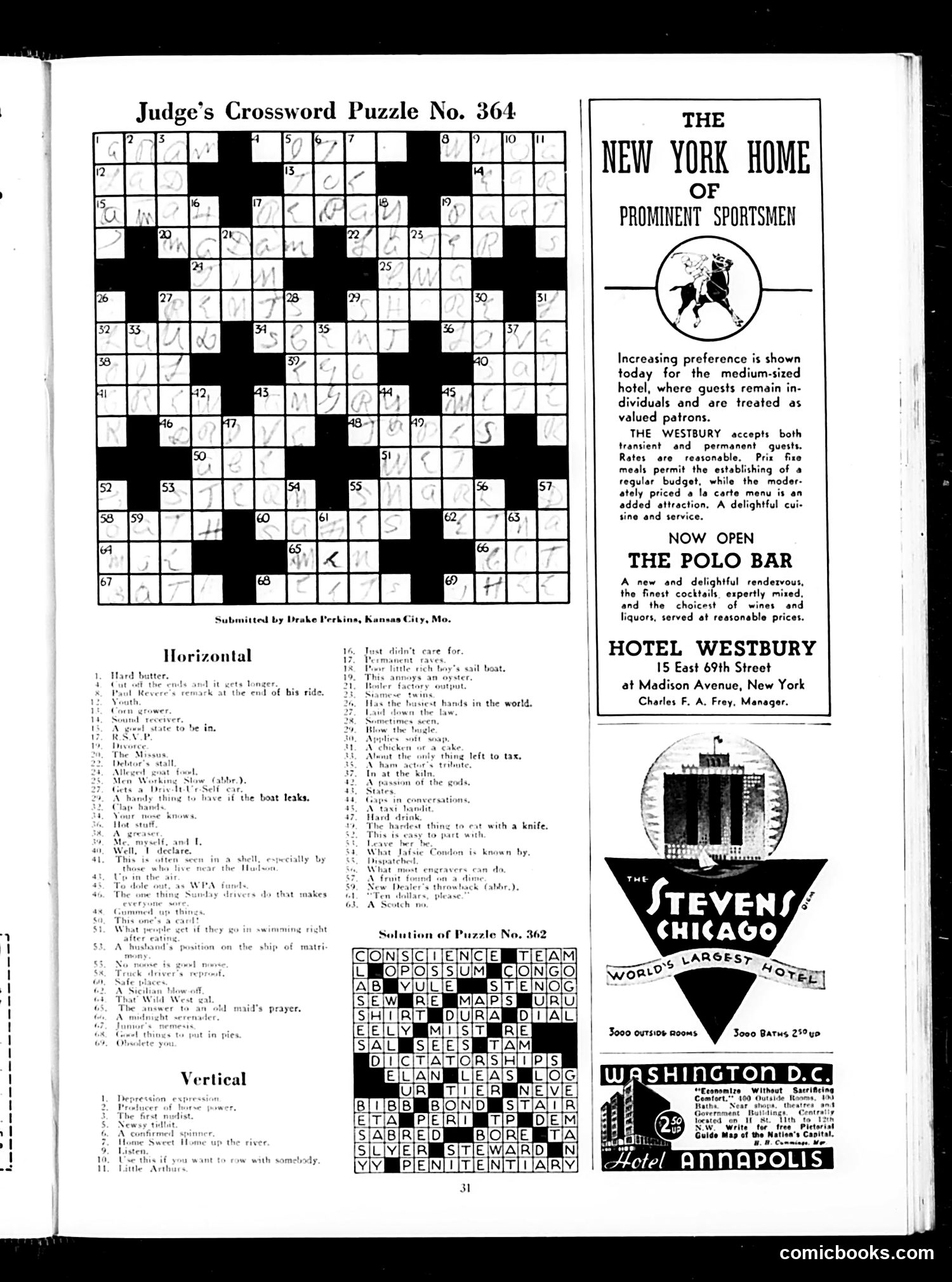
This page is primarily advertising, not political satire. It features Judge magazine's crossword puzzle (No. 364) alongside hotel and hospitality advertisements targeting wealthy New Yorkers. The ads promote upscale establishments catering to "prominent sportsmen": the Hotel Westbury (emphasizing refined, individualized service for discerning guests) and its newly opened Polo Bar (serving fine cocktails and wines). Additional advertisements show the Stevens Hotel in Chicago and Hotel Annapolis in Washington D.C. The content reflects 1920s-30s consumer culture and class aspirations—marketing luxury hospitality to affluent professionals and leisure travelers. The "Polo Bar" reference suggests association with polo, an elite sport. There is no visible political cartoon or satirical commentary on this page; it's a commercial product targeting Judge's affluent readership.
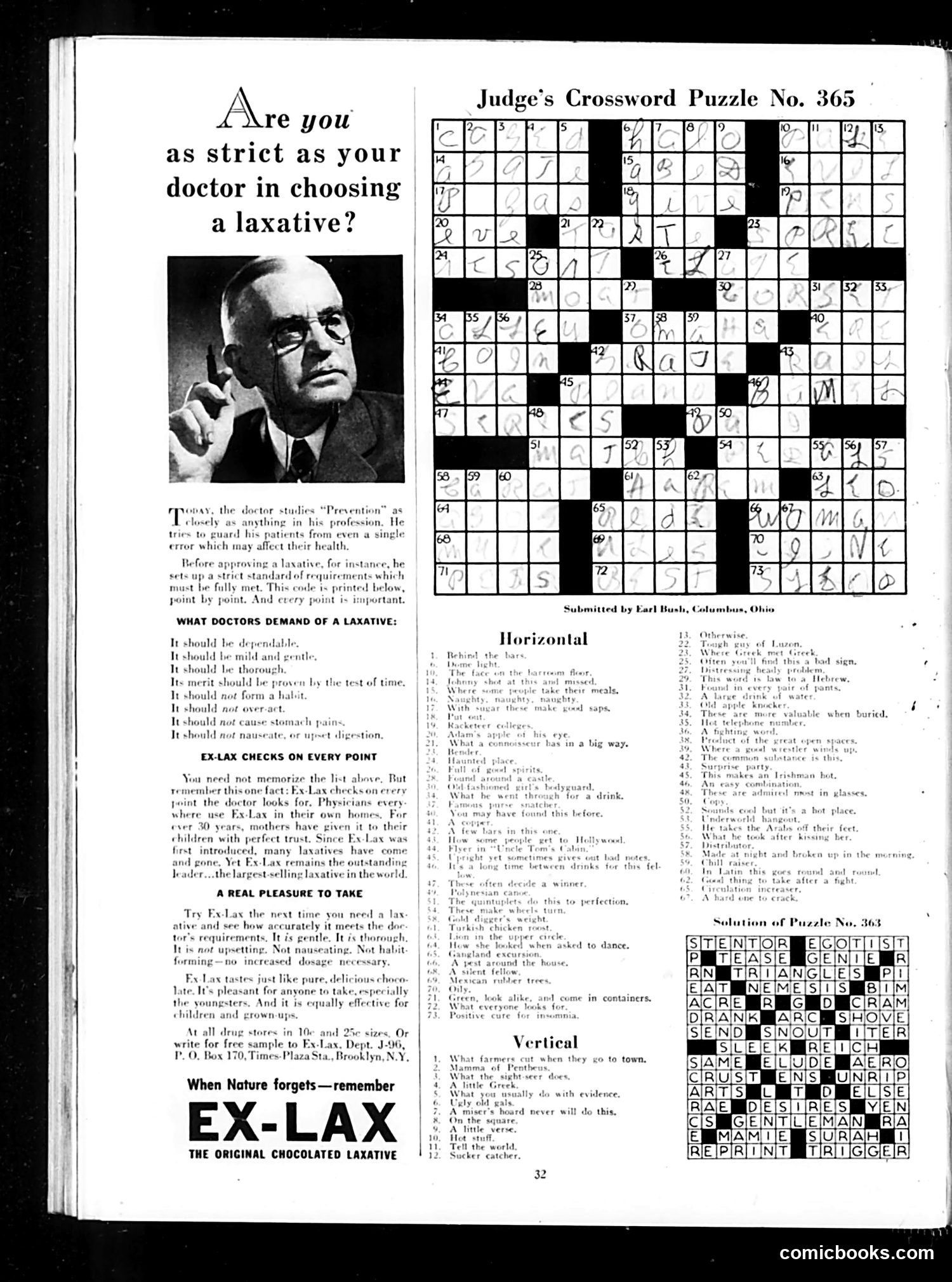
Ex-Lax Advertisement (Not Political Satire) This page is primarily a commercial advertisement for Ex-Lax, a chocolated laxative product, rather than political satire or commentary. The layout features a doctor's photograph with the rhetorical question "Are you as strict as your doctor in choosing a laxative?" to establish medical credibility. The accompanying text lists "What Doctors Demand of a Laxative"—including that it be dependable, gentle, and not cause nausea—positioning Ex-Lax as meeting professional standards. The crossword puzzle (Judge's Crossword Puzzle No. 365) and its solution appear to be typical magazine content filler rather than satirical commentary. The only potential satirical element is the opening question implying readers should be as rigorous about laxative selection as doctors are, but this is gentle marketing humor rather than social or political critique.
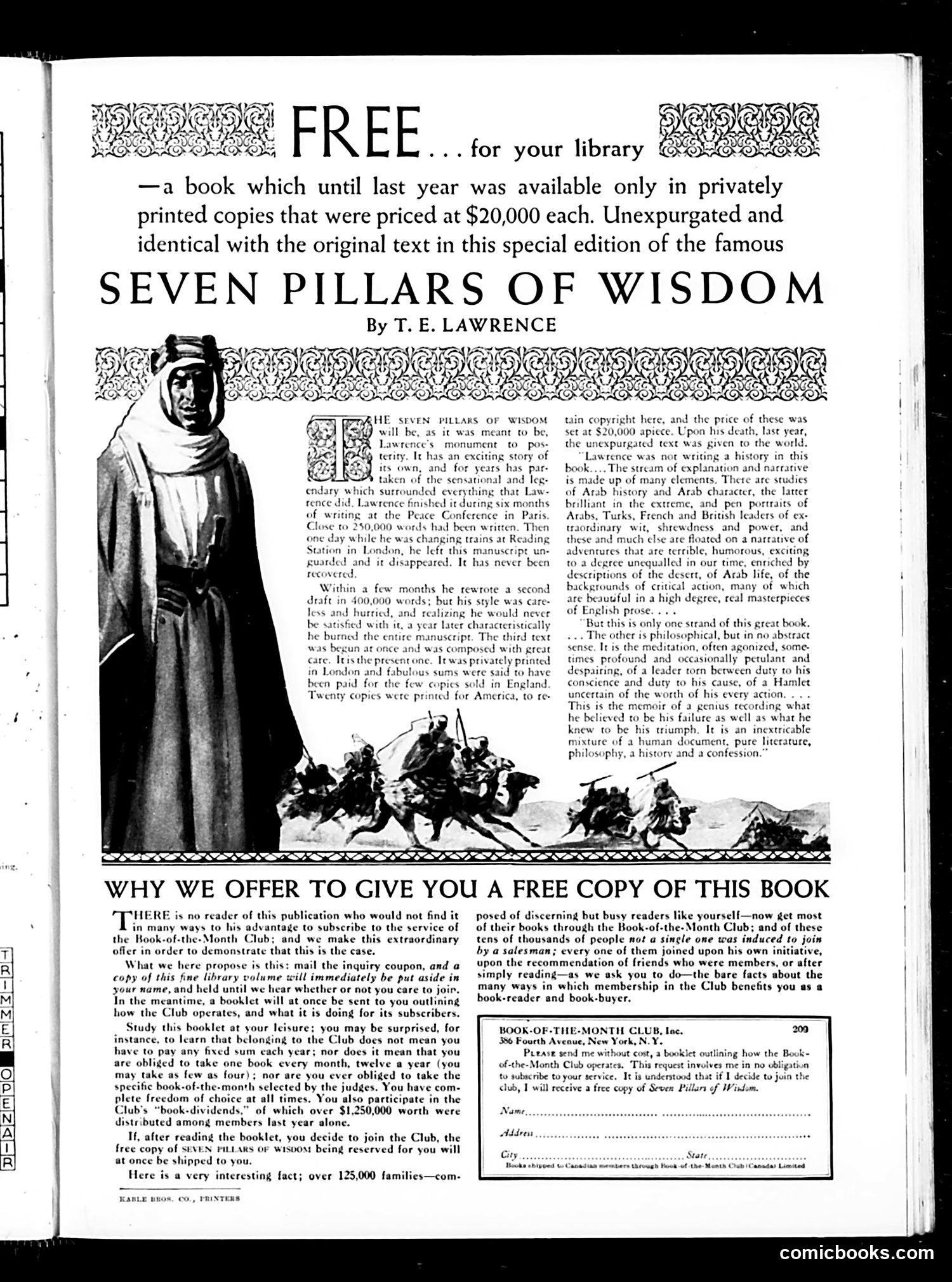
Analysis of This Page This is primarily a book club advertisement, not a political cartoon. The page promotes T.E. Lawrence's *Seven Pillars of Wisdom* (his World War I memoir about leading Arab forces against the Ottoman Empire) as a free offering from the Book-of-the-Month Club. The illustration shows Lawrence in Arab dress alongside a dramatic scene of mounted desert warriors—visualizing the book's exotic subject matter. The text emphasizes the book's rarity (previously only $20,000 private copies existed) and its literary merit: part historical record, part philosophy, part confession of a conflicted military genius. The advertisement's pitch targets educated readers: belonging to the Club provides access to prestigious books without fixed costs or commitments. This reflects 1920s-30s marketing to middle-class book lovers seeking cultural sophistication. No satire is evident—this is straightforward commercial promotion dressed in genteel magazine advertising.
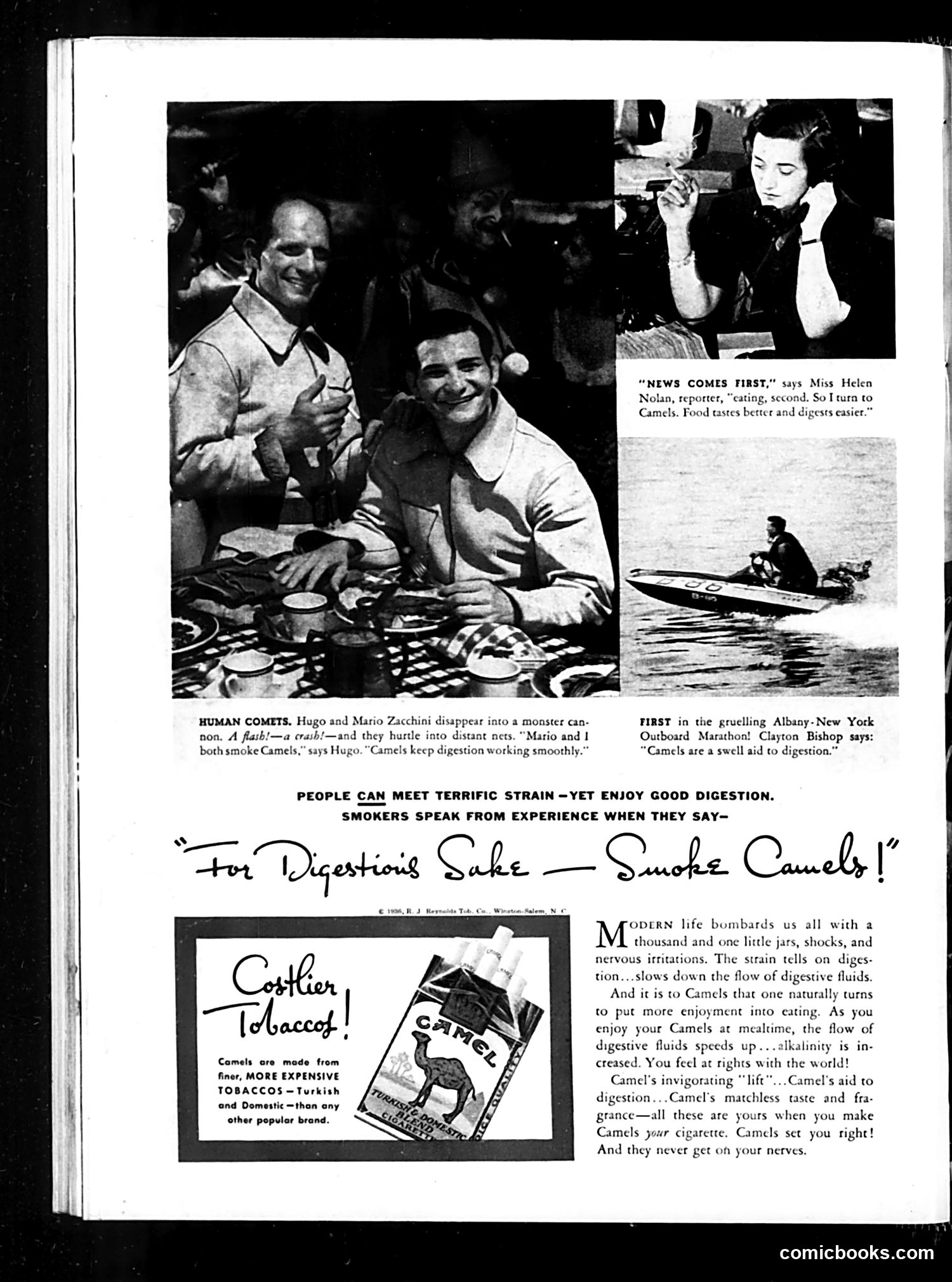
A Camel Cigarettes Advertisement Disguised as Editorial Content This is a Camel cigarettes advertisement masquerading as magazine editorial. The page features testimonials from real or purported public figures—reporter Helen Nolan, circus performers Hugo and Mario Zacchini (famous "human cannonball" acts), and marathon racer Clayton Bishop—all claiming Camels aid digestion. The satire/manipulation works on multiple levels: by presenting smoking as a health benefit through stress relief and improved digestion, it exploits mid-20th-century anxieties about modern life's "nervous irritations." The juxtaposition of extreme physical exertion (cannon acts, marathons) with smoking claims absurdly that Camels enable peak performance. This reflects pre-regulation tobacco advertising, when health claims were unregulated. The page illustrates how cigarette companies used celebrity endorsements and pseudo-scientific digestive claims to market an addictive product—techniques that would later become illegal.