judge
Judge — October 1936
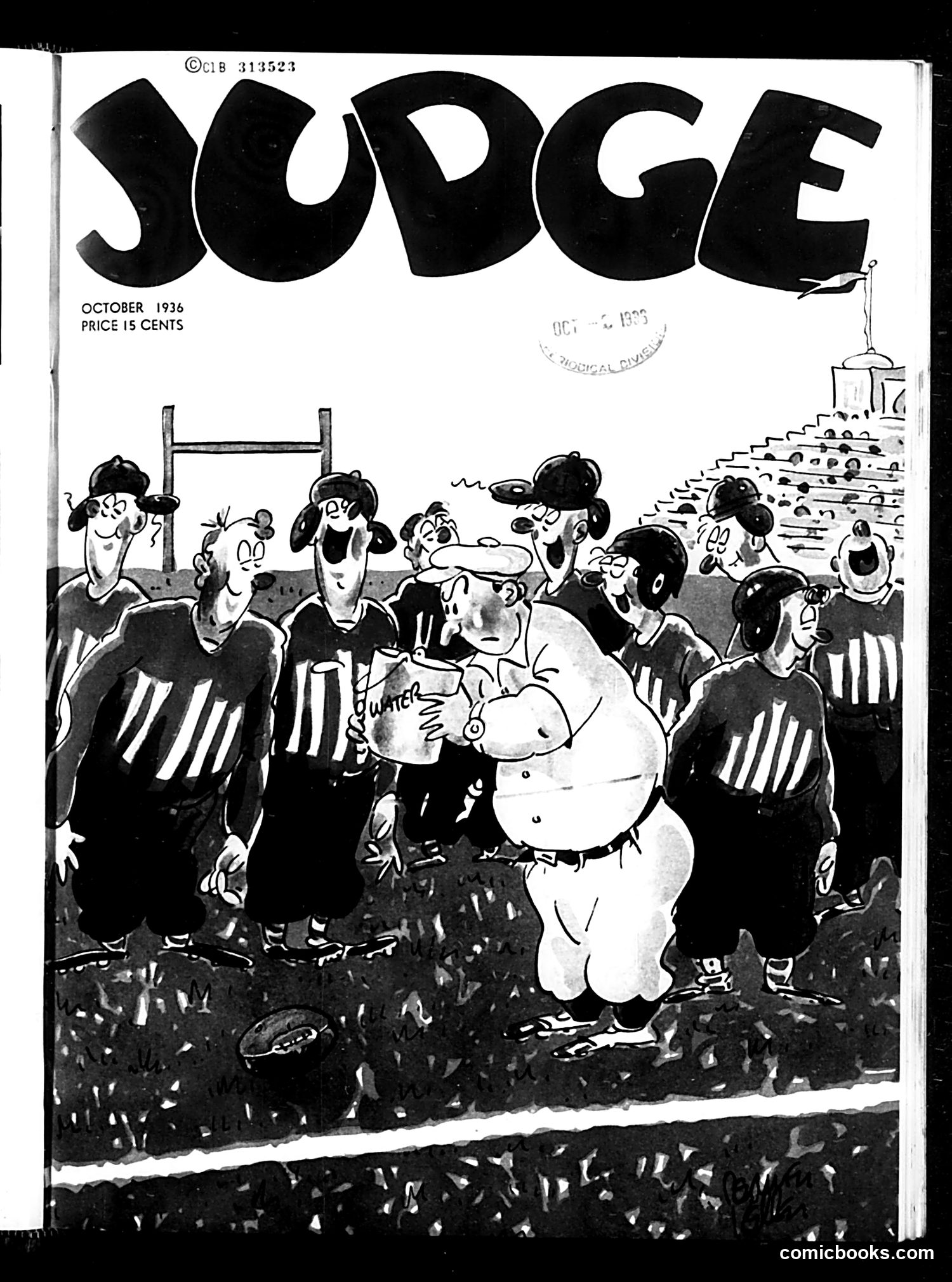
Judge Magazine, October 1936 This cover satirizes a group of uniformed figures (appearing to be soldiers or paramilitary members) surrounding a large, rotund central figure. The cartoon likely comments on political or military themes relevant to October 1936—a significant moment when the Spanish Civil War began and fascist movements were gaining prominence in Europe. The exaggerated, caricatured style typical of Judge magazine suggests mockery of either authoritarian leadership or contemporary political figures. The central figure's prominence and the surrounding uniformed group suggest commentary on power dynamics, possibly depicting how leaders were surrounded by military or party apparatus. Without clearer identification of the specific figures, the exact political reference remains unclear, though the date and visual language suggest European political tensions of the mid-1930s.
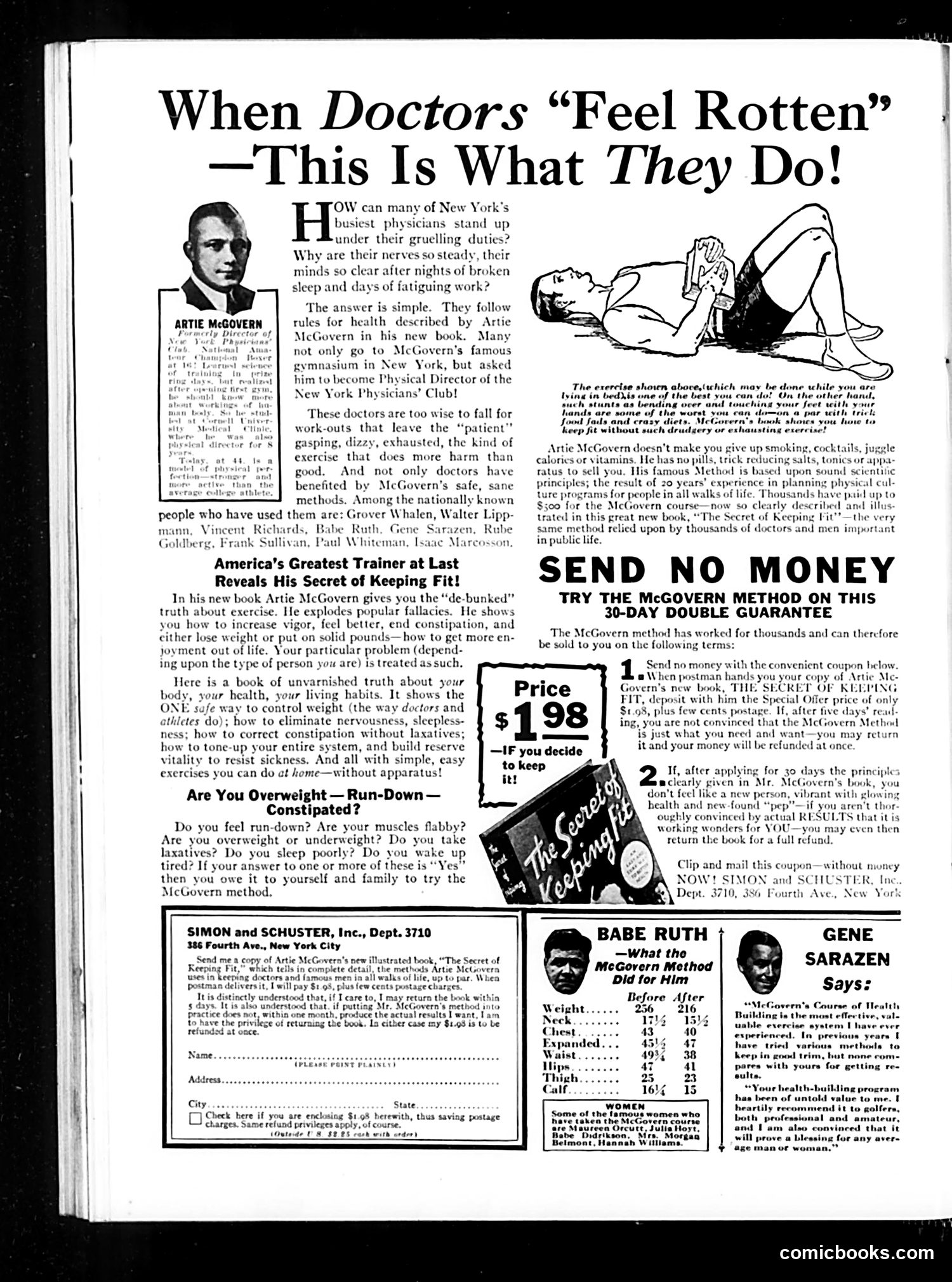
Analysis This page is primarily advertising for Artie McGovern's fitness and health book, not political satire. McGovern was a real New York physician and fitness trainer who ran a gymnasium catering to wealthy clients. The ad uses testimonials from celebrities (Babe Ruth, Gene Sarazen) to promote McGovern's exercise methods for doctors and busy professionals feeling "run-down." The pitch emphasizes that McGovern's "safe, sane methods" can increase vigor, improve sleep, and aid weight loss without exhaustion. The page includes a mail-order coupon ($1.98 for the book) and a form for ordering. While *Judge* was satirical, this particular page functions as straightforward commercial promotion rather than political commentary or social satire.
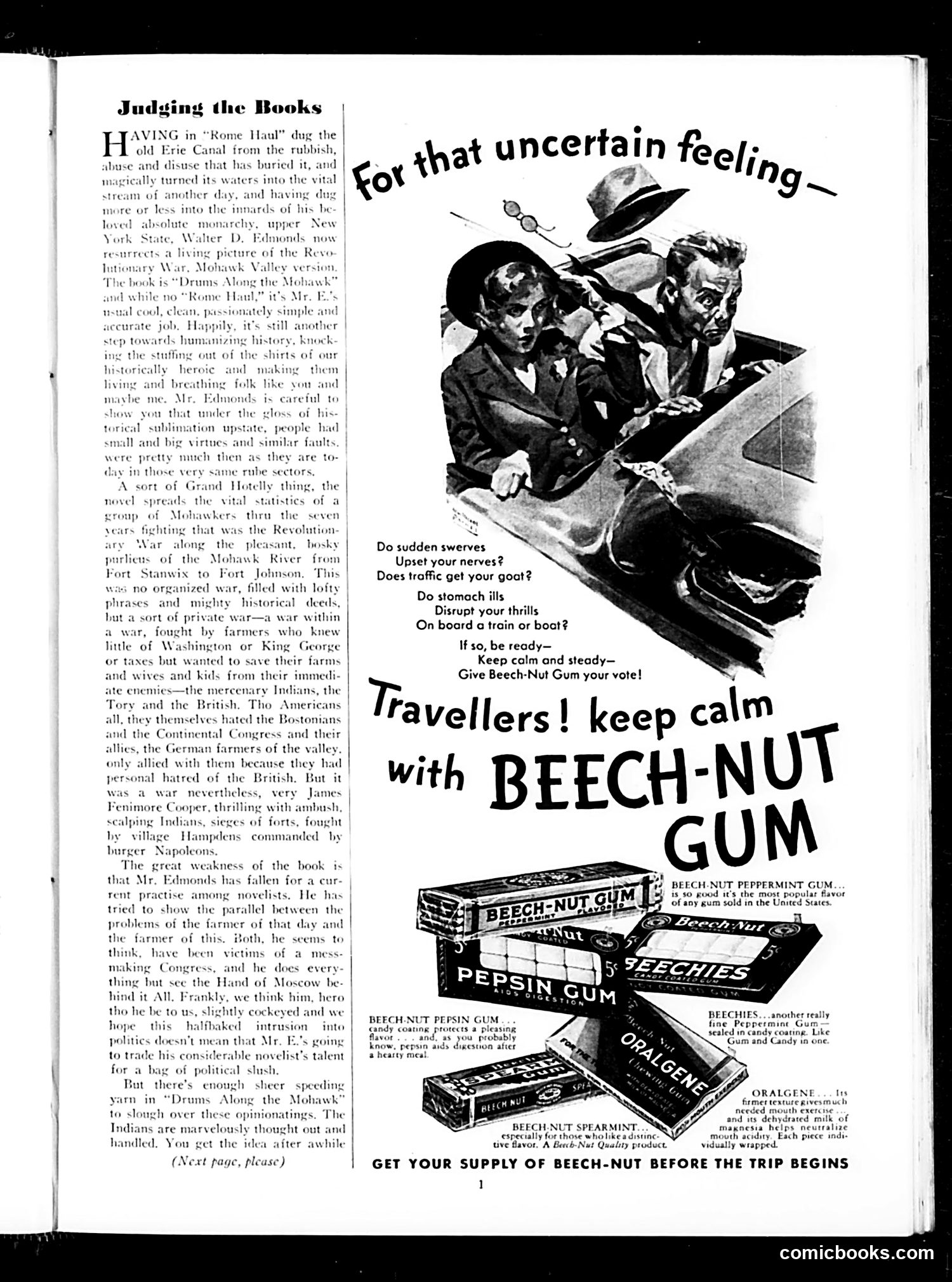
Analysis This page is primarily advertising, not satire. The left column contains a book review of "Drums Along the Mohawk" by E.E. Edmonds (a Revolutionary War novel). The dominant content is a large advertisement for Beech-Nut Gum, featuring a nervous traveler experiencing anxiety ("sudden swerves upset your nerves?"). The ad's humor is situational rather than political—it markets gum as a remedy for travel-related stress. The illustrated figure appears to be a generic anxious passenger, not a specific caricatured public figure. The advertisement emphasizes that Beech-Nut Gum offers various products (Peppermint, Pepsin, Sparmint, Opalene) and encourages readers to purchase supplies "before the trip begins." This is straightforward commercial marketing rather than political commentary.
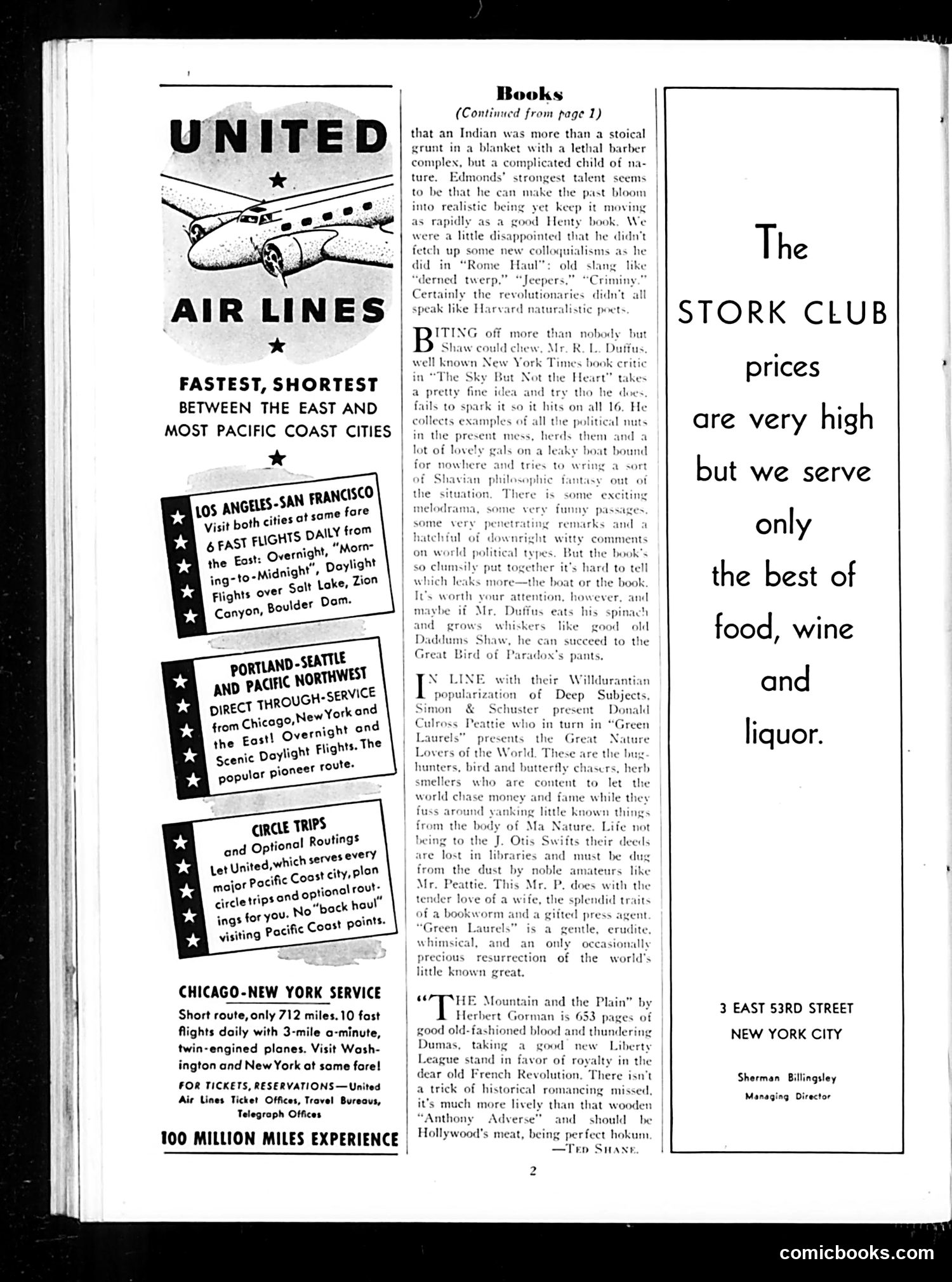
Page Analysis This page is primarily advertising and book reviews, not political satire. The left side features United Airlines advertisements promoting cross-country flights with routes between Los Angeles-San Francisco, Portland-Seattle, Chicago-New York, and circle trips along the Pacific Coast. The right side contains book reviews discussing works like R.L. Duffus's "The She-Bum Not the Heart," Donald Culross Peattie's "Green Laurels," and Herbert Gorman's "The Mountain and the Plain." The Stork Club restaurant advertisement appears on the far right. There are no political cartoons or caricatures visible. This is a standard magazine page mixing transportation advertising with literary criticism—representative of Judge's mid-20th century format blending humor, ads, and cultural commentary.
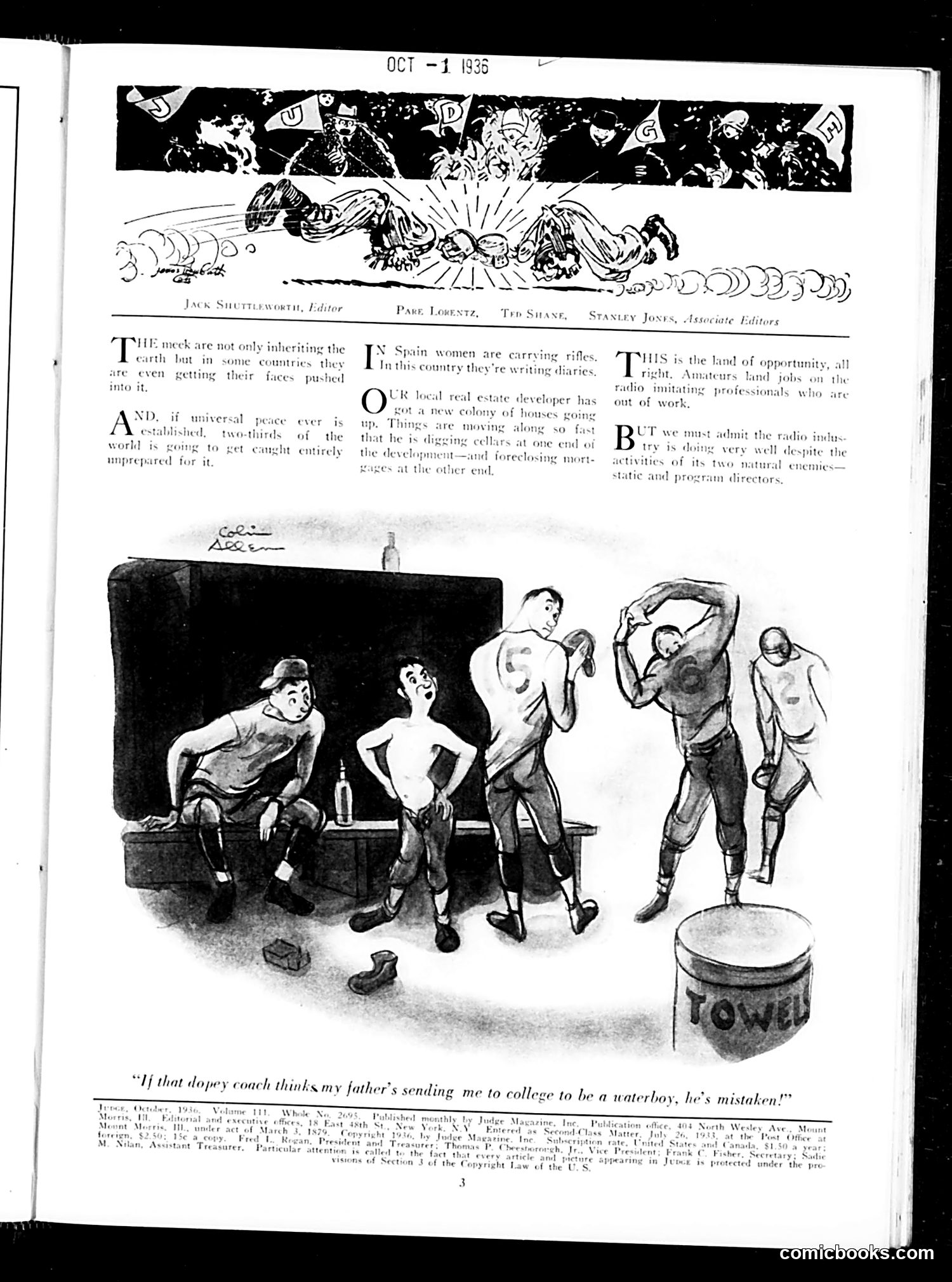
Analysis of Judge Magazine Page (October 1, 1935) The main cartoon depicts young boys undressing near a bathing towel, with one boy's father apparently sending him to college to become a "waterboy" rather than pursue athletics seriously. The joke plays on the double meaning: the father thinks college will make his son into an actual waterboy (lowly athletic assistant), when the boy clearly aspires to competitive sports. The page's editorial commentary references contemporary 1935 events: Spanish women bearing rifles (Spanish Civil War beginning), real estate development, and radio industry operations. These brief items suggest Judge was addressing current political and economic concerns of the era to its educated readership. The overall tone reflects upper-class satirical humor typical of the magazine.
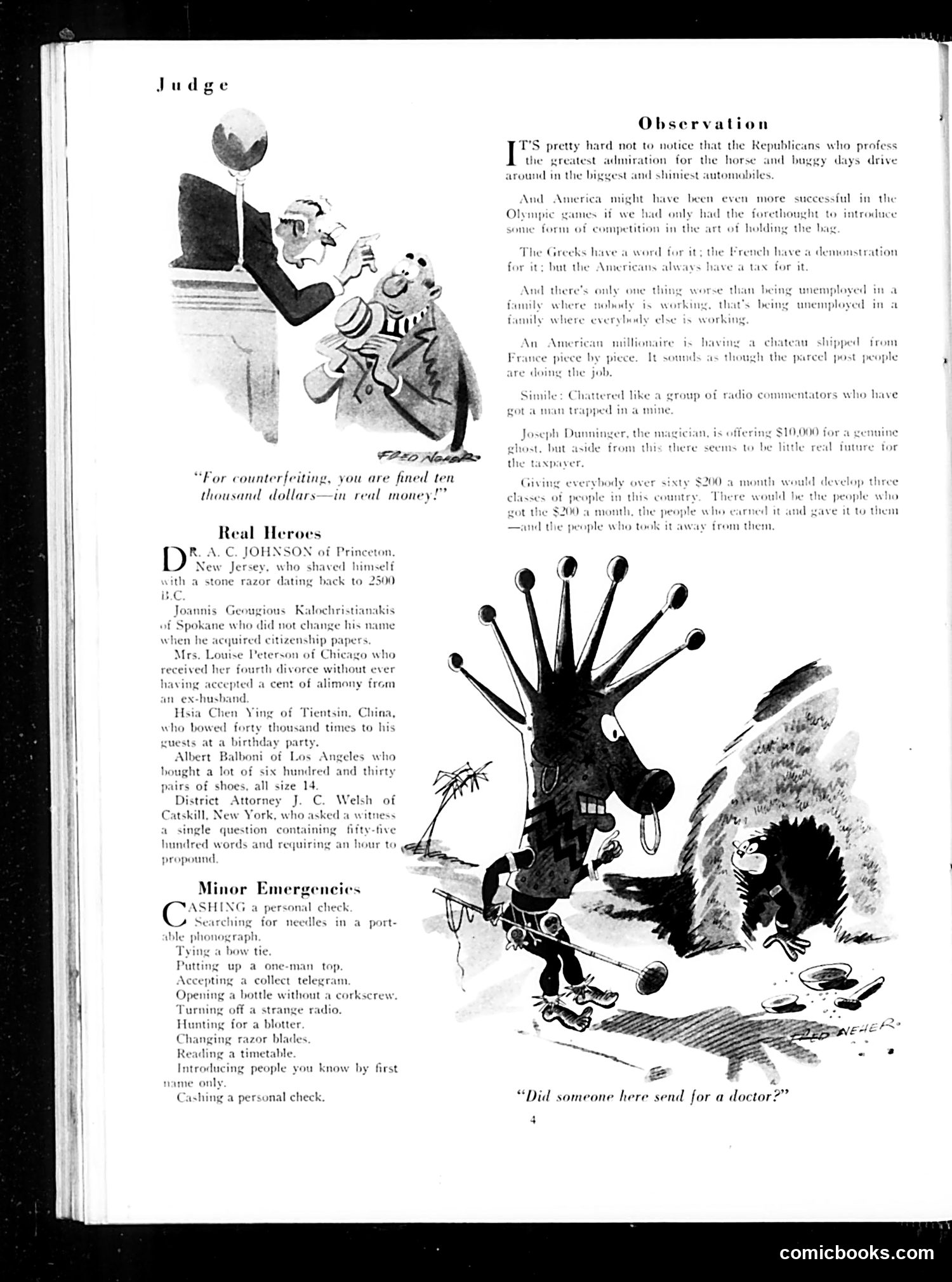
Analysis of Judge Magazine Page The top cartoon satirizes Republican hypocrisy about unemployment. It depicts a well-dressed Republican judge sentencing someone to a $10,000 fine for counterfeiting, while the accompanying "Observation" section criticizes Republicans who claim to admire hard work and self-reliance yet drive expensive automobiles—implying they profit from the economic system while ordinary workers suffer. The "Real Heroes" section and "Minor Emergencies" list appear to be satirical commentary on American priorities and absurdities, listing trivial concerns alongside actual accomplishments. The bottom cartoon shows a figure injured by an explosion or catastrophe, with the caption "Did someone here send for a doctor?"—likely commenting on delayed or inadequate responses to crises, possibly referencing contemporary political failures.
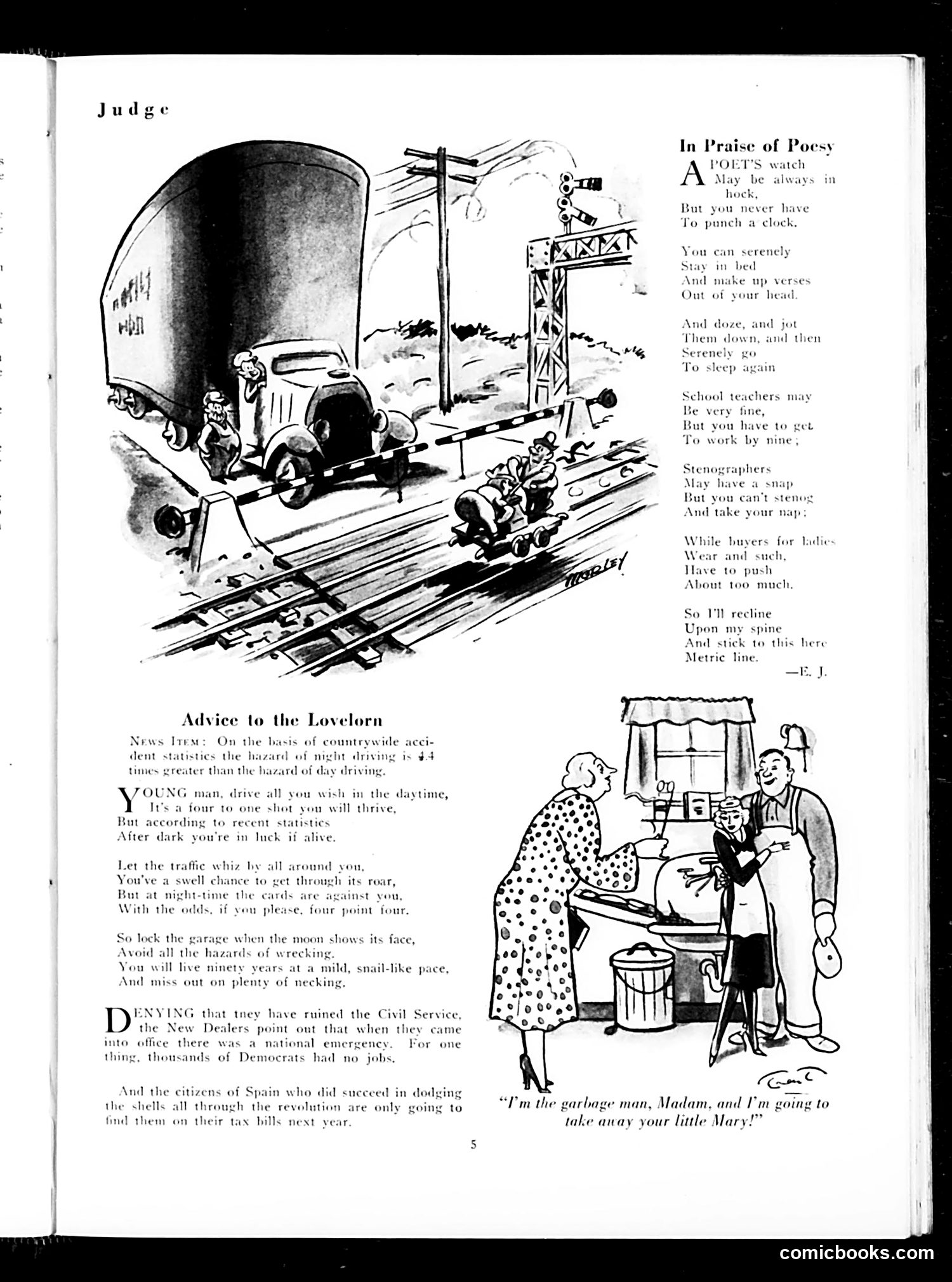
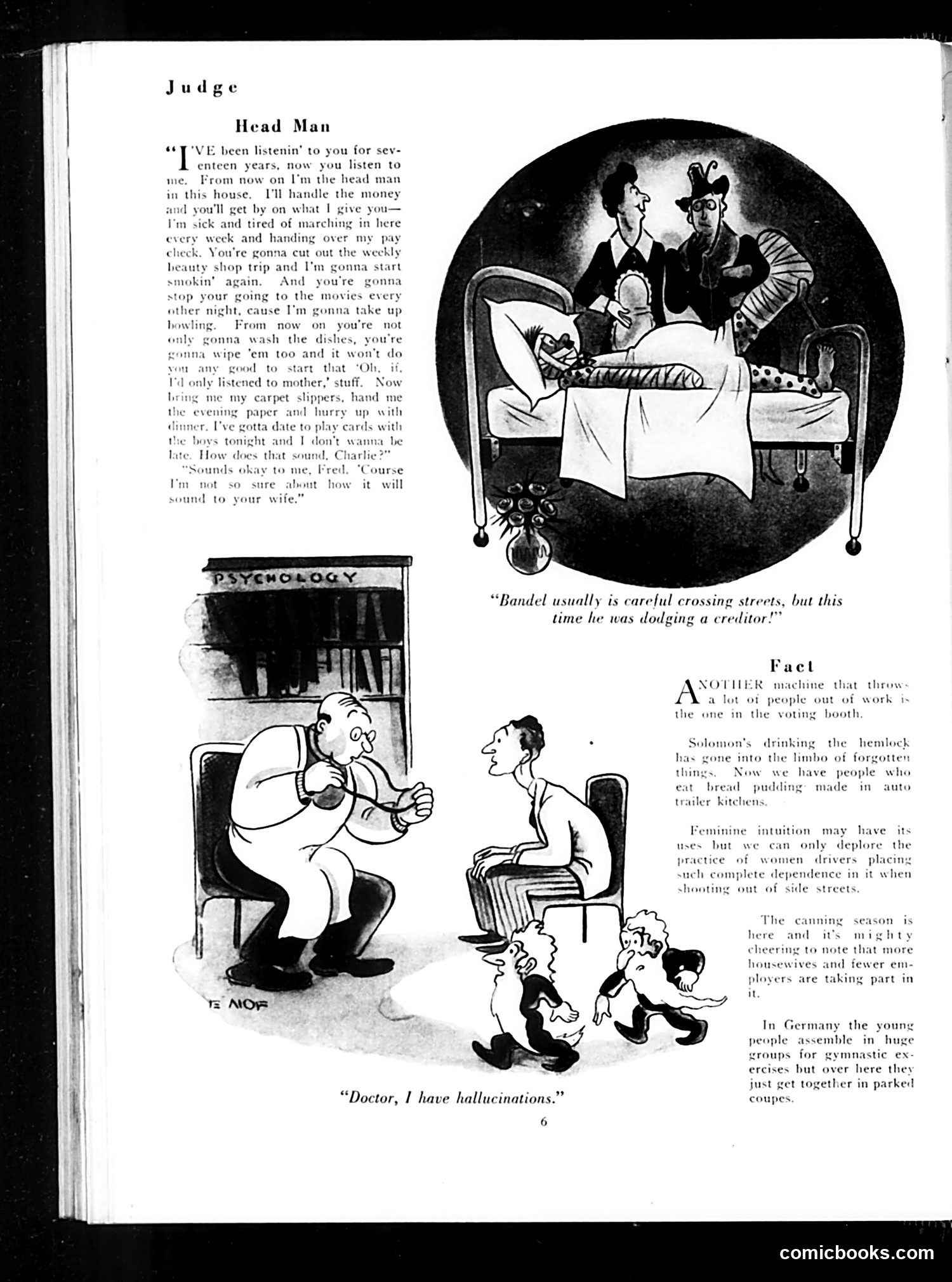
"Judge" Page Analysis This page contains two satirical cartoons and commentary from Judge magazine. "Head Man" (top): A domestic comedy about a husband asserting authority over his wife. He announces new rules: she'll manage household tasks (dishes, laundry), stop shopping and movies, and accept his evening plans. The joke targets the era's gender dynamics and male insistence on domestic control, likely satirizing husbands who overreach in "managing" wives. "Doctor, I have hallucinations" (bottom): A psychology joke showing a rotund man claiming hallucinations to a doctor, while two small figures (children or demons) cavort nearby. The humor relies on the patient's obvious delusion or exaggeration about his symptoms. The accompanying "Fact" section offers miscellaneous social commentary on voting, women drivers, and leisure activities—typical Judge magazine filler humor.
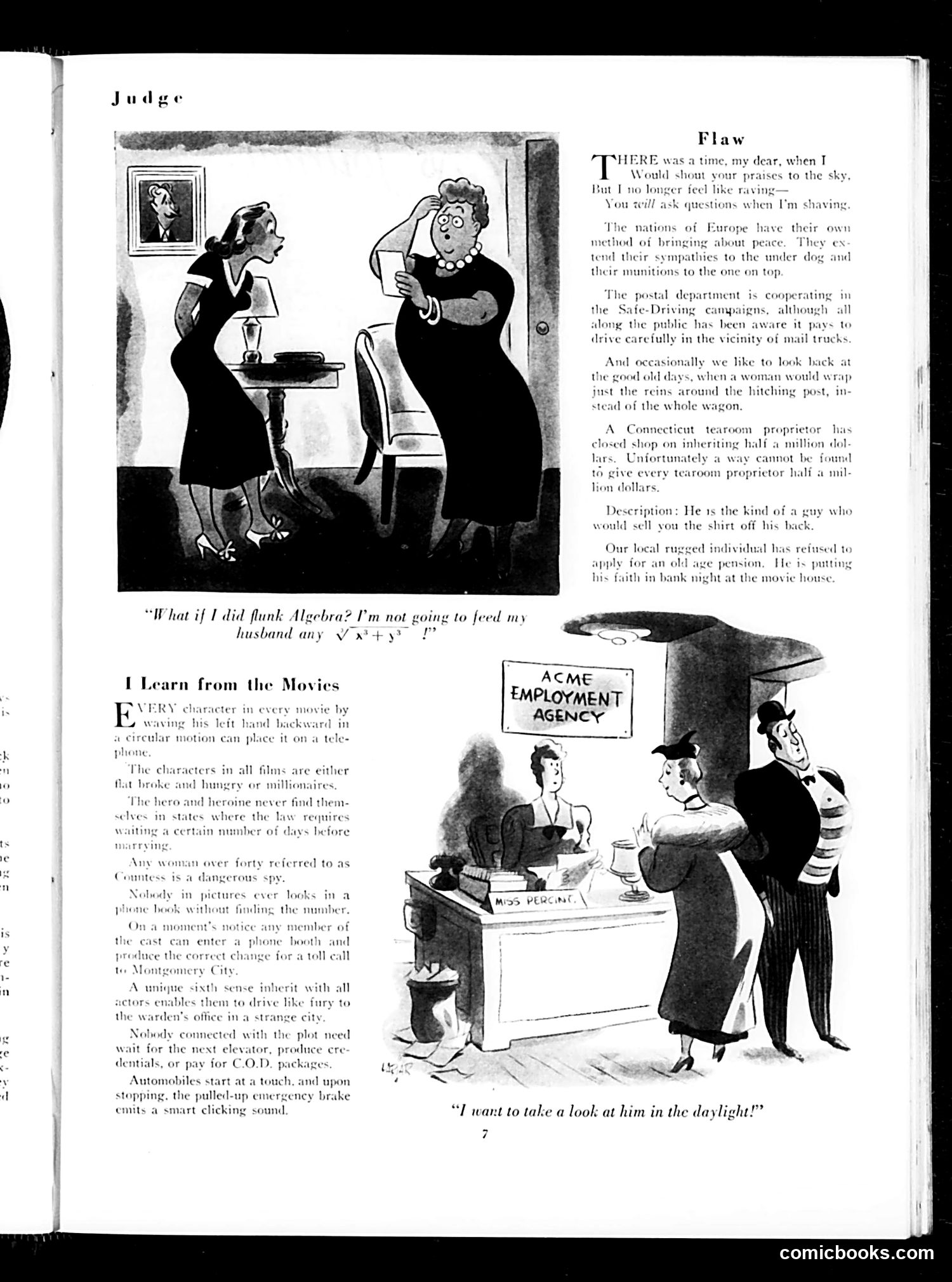
Analysis of Judge Page 7 This page contains two separate satirical pieces: "Flaw" (top): A cartoon mocking women's unrealistic expectations in marriage. A wife threatens to withhold praise if her husband doesn't stop asking questions while shaving—a domestic complaint about male behavior. "I Learn from the Movies" (bottom): A humorous essay satirizing Hollywood film conventions—characters waving their left hands in circles to mime telephone motion, heroes and heroines always wealthy, spies identified as Countesses, automobiles starting with a "smart clicking sound," etc. The accompanying cartoon shows an employment agency scene. The overall page mocks both domestic gender relations and the absurd tropes audiences absorbed from cinema during this era. Both pieces use exaggeration to critique real social observations about marriage and popular entertainment's unrealistic portrayals of modern life.
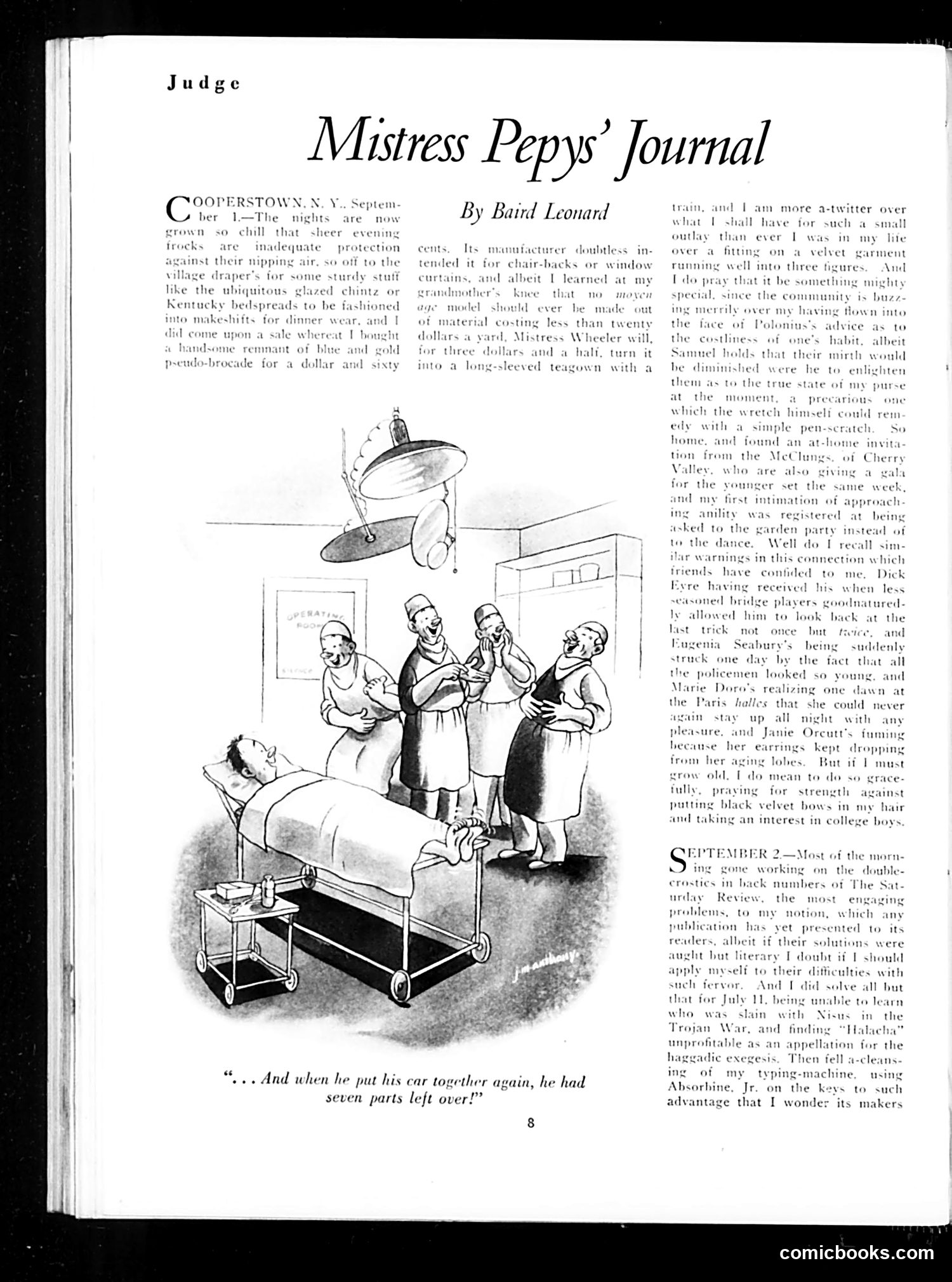
"Mistress Pepys' Journal" - Explanation for Modern Readers This is a humorous column by Baird Leonard presenting fictional diary entries from a society woman in Cooperstown, New York. The main cartoon illustrates the column's running joke: a woman shows friends a reassembled automobile with the caption "And when he put his car together again, he had seven parts left over!" The joke targets early automobile mechanics' incompetence—a common satirical theme in 1920s America when cars were still relatively new and unreliable. The woman's bewilderment at having leftover parts suggests the mechanic either didn't properly reassemble her vehicle or was confused about its construction. The accompanying diary text is light social satire about upper-middle-class women's concerns: thrifty fashion purchases, gossip about friends, bridge games, and romantic interests. It's gentle mockery of leisured society life during this era, presented through the persona of a woman recording trivial domestic and social observations.
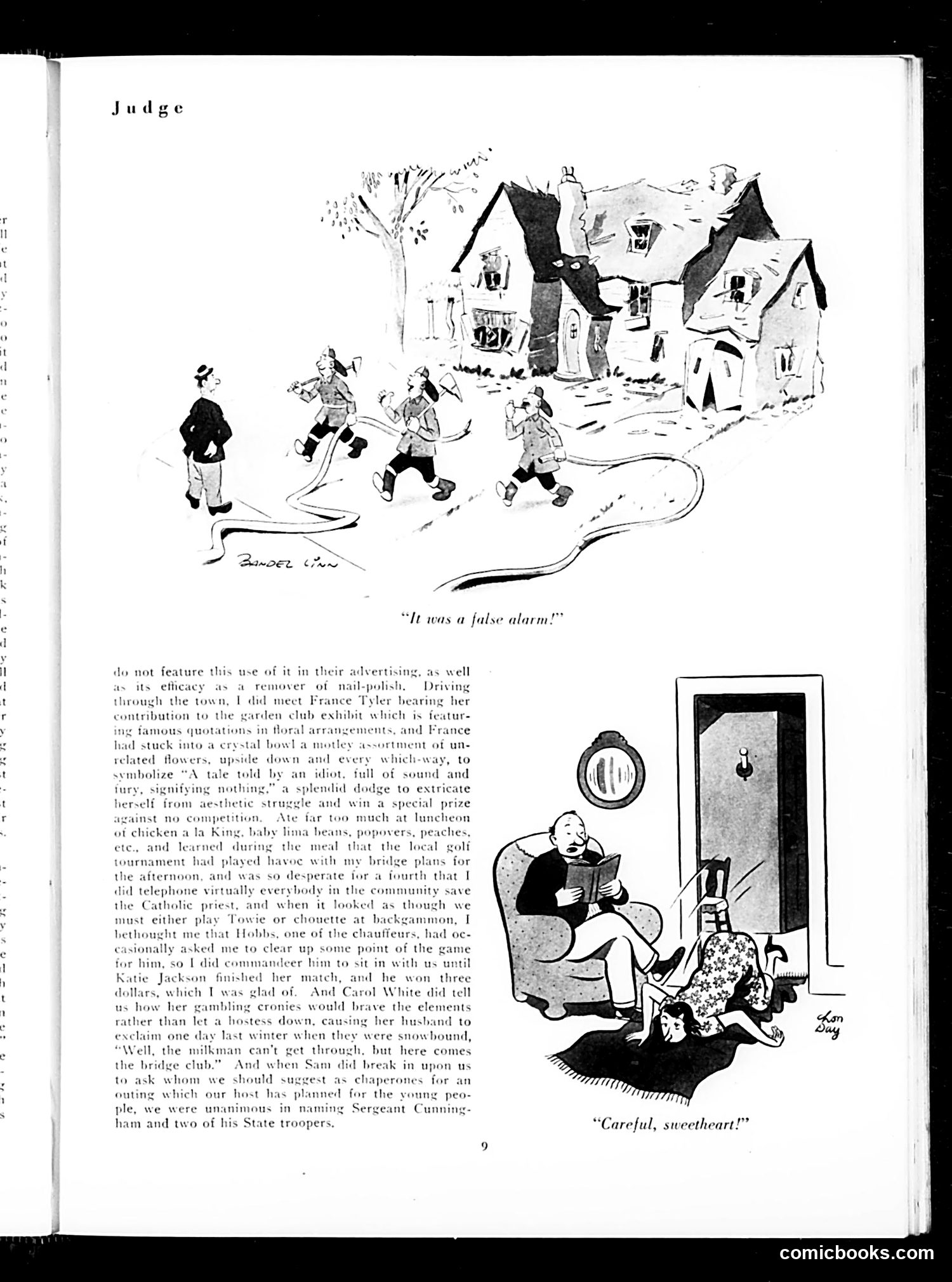
Explanation for Modern Readers This page from *Judge* magazine contains two cartoon illustrations satirizing early 20th-century American social life. The top cartoon, "It was a false alarm!", depicts children responding to what appears to be a fire or emergency at houses, suggesting overreaction to rumors or pranks in small-town communities. The bottom cartoon, "Careful, sweetheart!", shows a woman reading while a man sleeps nearby, with what appears to be a clock or timing device—likely mocking domestic life and the tension between leisure activities and responsibilities. The lengthy text discusses the author's social activities: attending a garden club exhibit, playing bridge, and a golf tournament disrupting plans. It's a humorous society column critiquing the busy, gossipy social scene of well-to-do townspeople and their priorities (entertainments over practical concerns). The references to local figures, the Catholic priest, and State troopers ground this in a specific community's social hierarchy.
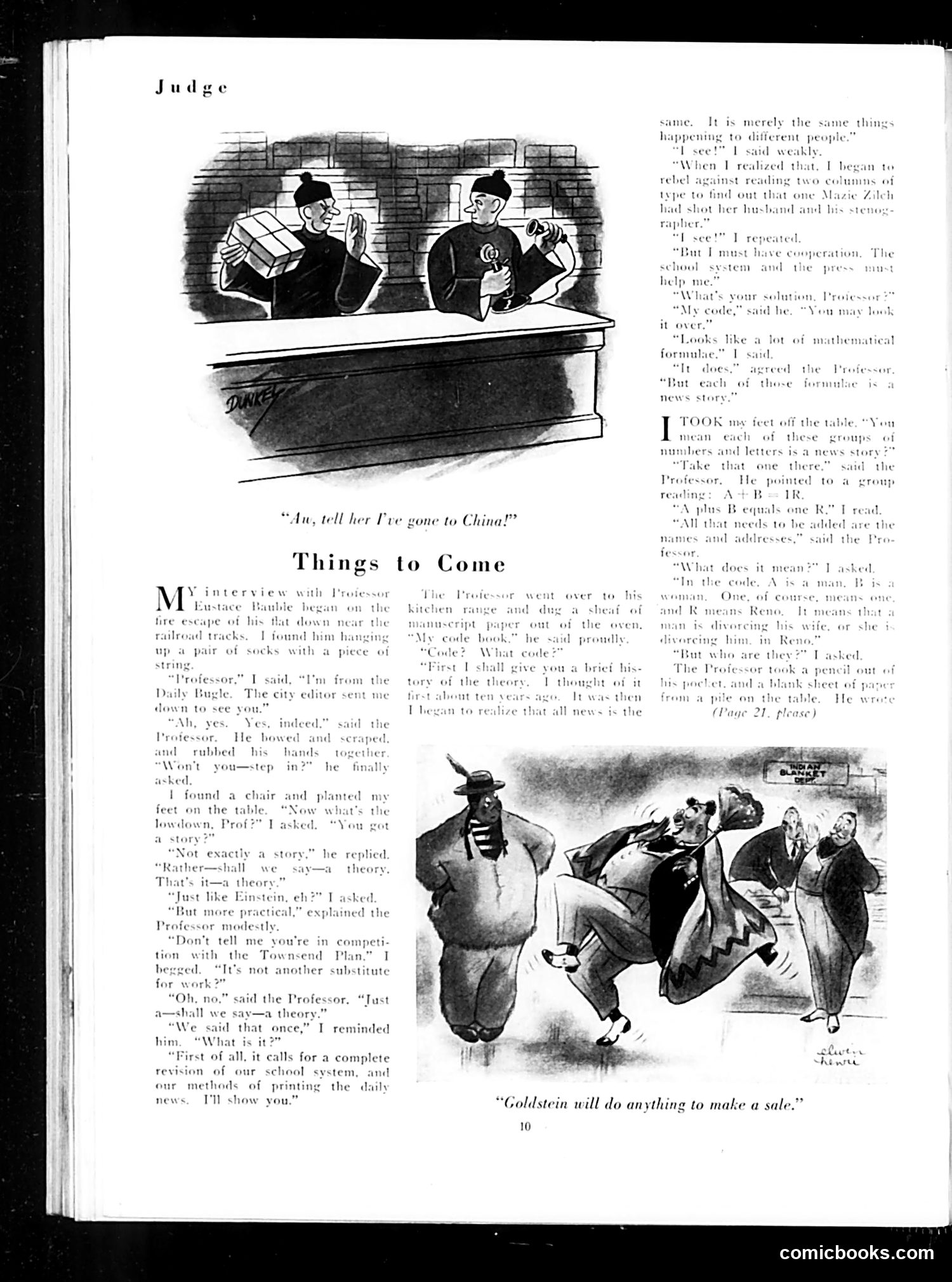
Judge Magazine Page Analysis This page contains a satirical article titled "Things to Come" featuring an interview between a journalist and a Professor Eustace Bauble about a proposed reform to the school system and newspaper printing methods. The top cartoon shows two men at a desk with the caption "Aw, tell her I've gone to China!"—a joke about a husband using an extreme excuse to avoid his wife. The lower cartoon depicts a salesman named Goldstein with the caption "Goldstein will do anything to make a sale," showing him in an exaggerated, undignified pose to land a customer. This reflects period stereotypes about Jewish salesmen and the lengths they'd pursue profit—a form of ethnic caricature typical of early 20th-century American humor magazines. The Professor's discussion of mathematical "codes" encoding news stories represents satirical commentary on modernist approaches to information and education reform popular in that era.
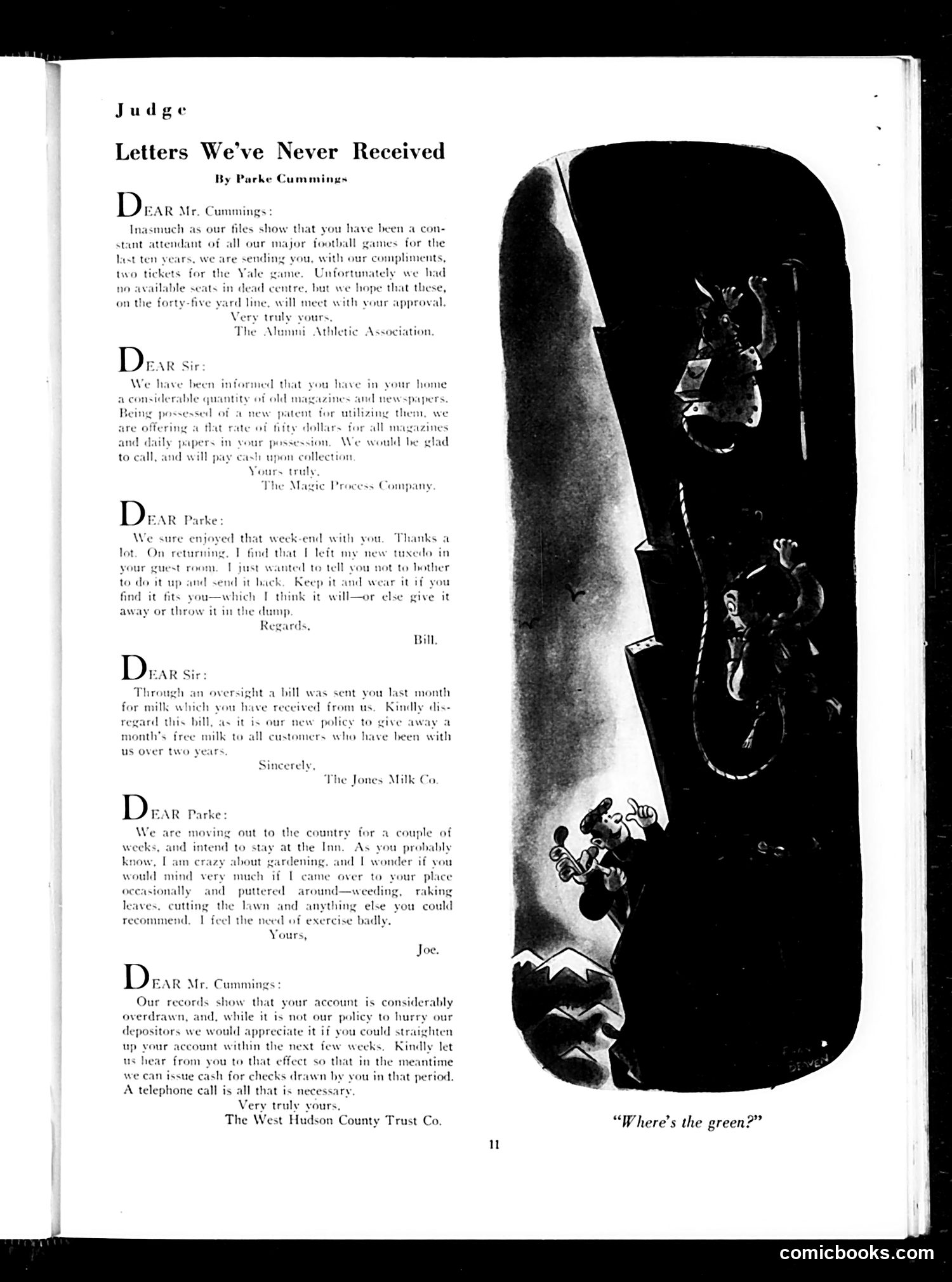
"Letters We've Never Received" by Parke Cummings This satirical piece mocks the absurdity of polite correspondence by presenting fake letters where recipients make outrageous requests or demands disguised in courteous language. The humor stems from social hypocrisy: people make unreasonable asks while maintaining formal politeness. Examples include someone inviting themselves to use a neighbor's garden indefinitely, a friend casually keeping a borrowed tuxedo, and companies offering dubious "gifts" with ulterior motives (the magazine buyer wants old papers; the milk company's "free milk" policy masks an overdue bill). The cartoon on the right—showing a golfer asking "Where's the green?"—complements this theme: it visualizes the expectation of receiving something promised or deserved, much like the letter-writers expect their absurd requests to be honored. The satire targets both the arbitrariness of social conventions and the greed/obliviousness underlying polite society, suggesting that beneath courteous language lie naked self-interest and entitlement.
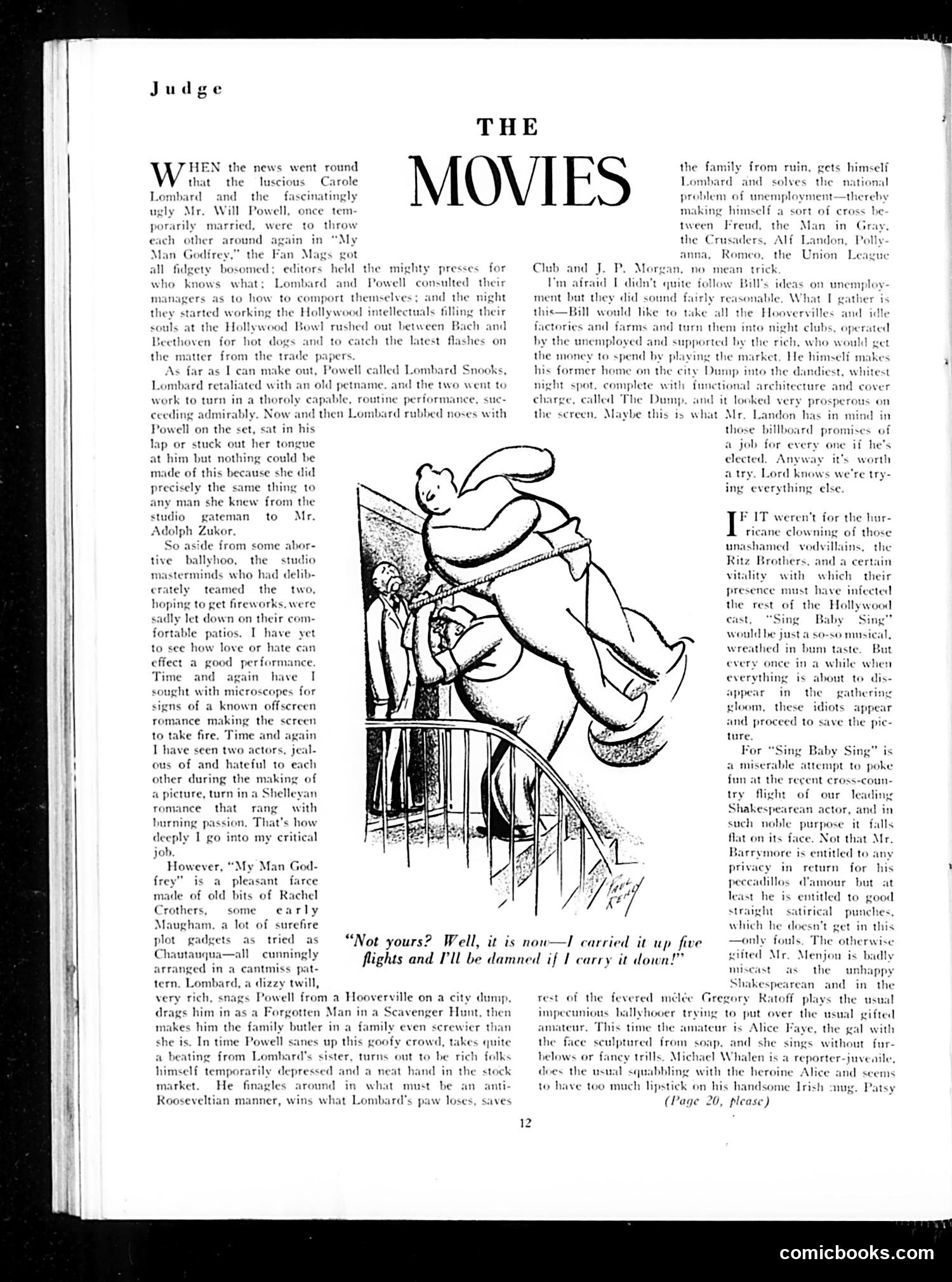
Judge Magazine Film Review - "My Man Godfrey" This is a film review column discussing the 1936 comedy "My Man Godfrey," starring Carole Lombard and William Powell. The reviewer explains that studio executives manufactured romantic tension between the two stars to generate publicity, hoping their alleged off-screen relationship would electrify their on-screen chemistry. However, Lombard and Powell's professional indifference to each other undermined this strategy. The cartoon illustrates the film's plot: Powell plays a homeless man from a "Hooverville" (Depression-era shantytown) whom wealthy, ditzy Lombard hires as a butler. The reviewer criticizes the film's social commentary, noting that while the plot attempts to address unemployment and poverty—referencing President Hoover, the New Deal, and Alf Landon—these elements feel tacked-on to what is essentially a lighthearted farce. The satire targets Hollywood's superficial treatment of serious Depression-era issues.
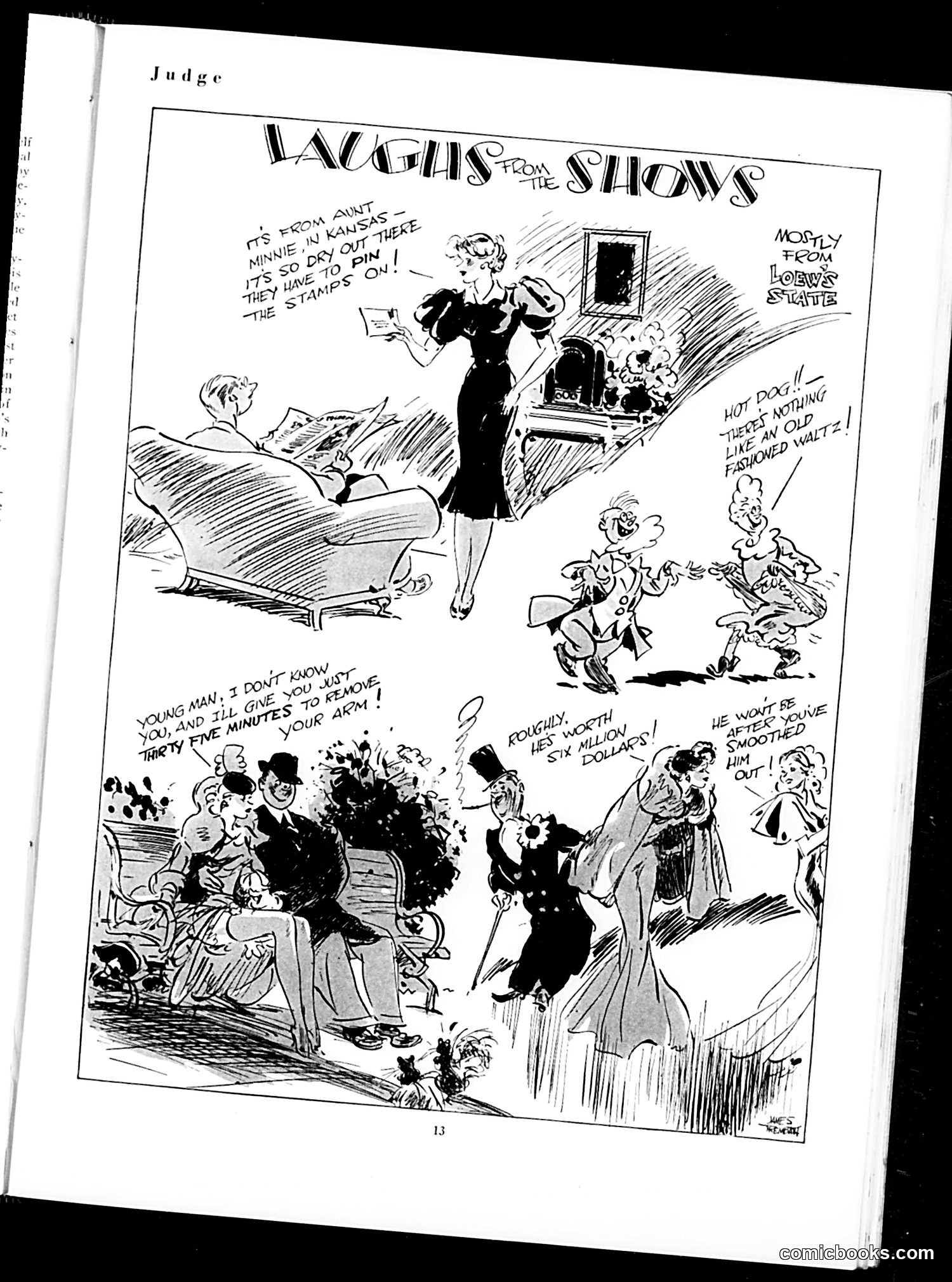
"Laughs from the Shows" This is a humor page satirizing Broadway theater and nightlife, typical of Judge magazine's entertainment coverage. The cartoon depicts various scenes of wealthy socialites and couples at shows and social venues. The jokes mock: - Midwestern tourists ("It's from Aunt Minnie in Kansas") arriving with provincial attitudes - Expensive entertainment (references to "six million dollars" and "hot doll" theater experiences) - Dated romance (comparing modern dancing to "an old fashioned waltz") - Social pretension among theater-goers The sophisticated woman in the black dress appears to be commenting on or mocking the behavior of men and couples around her. The humor relies on class-based comedy typical of 1920s-30s Judge magazine—contrasting urban sophistication with provincial naiveté, and poking fun at wealthy social climbers attempting to appear cultured.
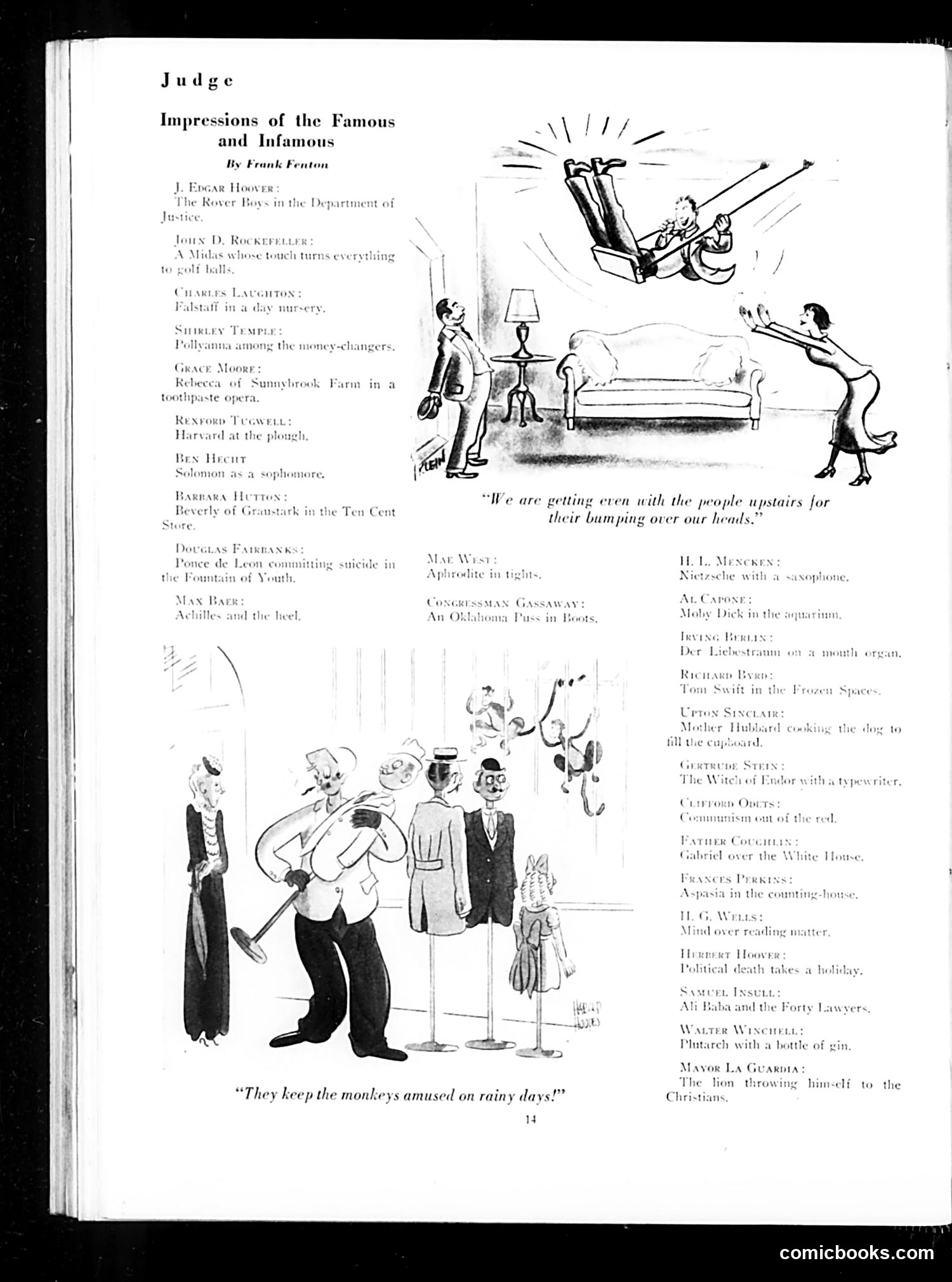
Analysis of "Impressions of the Famous and Infamous" This page satirizes prominent 1920s-30s public figures by comparing them to fictional characters, highlighting perceived contradictions between their public images and actual conduct. Key examples: - J. Edgar Hoover as "Rover Boys in the Department of Justice"—suggesting naïveté despite law enforcement authority - John D. Rockefeller with "Midas touch"—classical reference to greed - Charles Laughton as "Falstaff in a day nursery"—mocking his theatrical persona in everyday life - Grace Moore as "Rebecca of Sunnybrook Farm"—implying false innocence - Mayor La Guardia "throwing himself to the Christians"—likely referencing his controversial public persona The bottom cartoon shows figures with "monkeys amused on rainy days," suggesting these caricatured public figures exist primarily for entertainment and distraction. The satire's humor relies on readers recognizing both the famous individuals and the literary/cultural references, contrasting idealized public images with unflattering realities—a common Judge magazine technique.
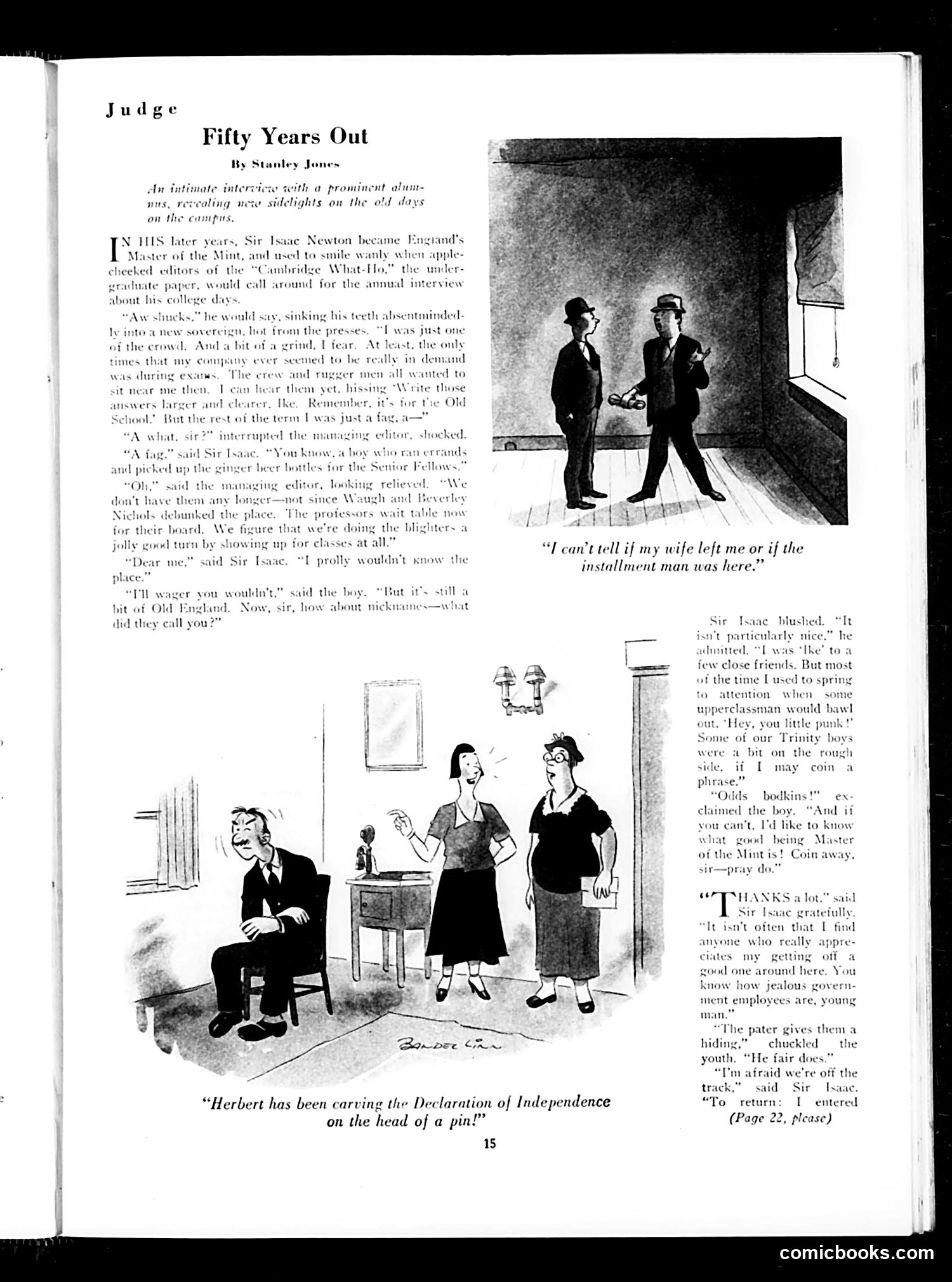
Explanation for Modern Readers This is a humorous interview piece imagining Sir Isaac Newton reminiscing about his Cambridge University days "fifty years out" (after graduation). The satire works on several levels: The Setup: Newton, now Master of the Mint, is pestered annually by editors of the "Cambridge What-Ho" (a fictional undergraduate magazine) for nostalgia pieces about college life. The Joke: Newton's account of being an ordinary, forgettable student contradicts his famous genius. He was nicknamed "Ike," wasn't popular with the intellectual crowd, and spent time with servants—a humbling inversion of expectations. The Social Satire: The piece mocks both 1920s Cambridge undergraduate culture (the pompous "What-Ho" magazine, class consciousness) and the magazine's own practice of extracting sentimental alumni stories from famous men. The cartoons below reinforce the humor of ordinary domestic life interrupting grandiose narratives. The larger cartoon shows someone carving the Declaration of Independence on a pinhead—absurdist humor about overachievement, typical of Judge magazine's style.
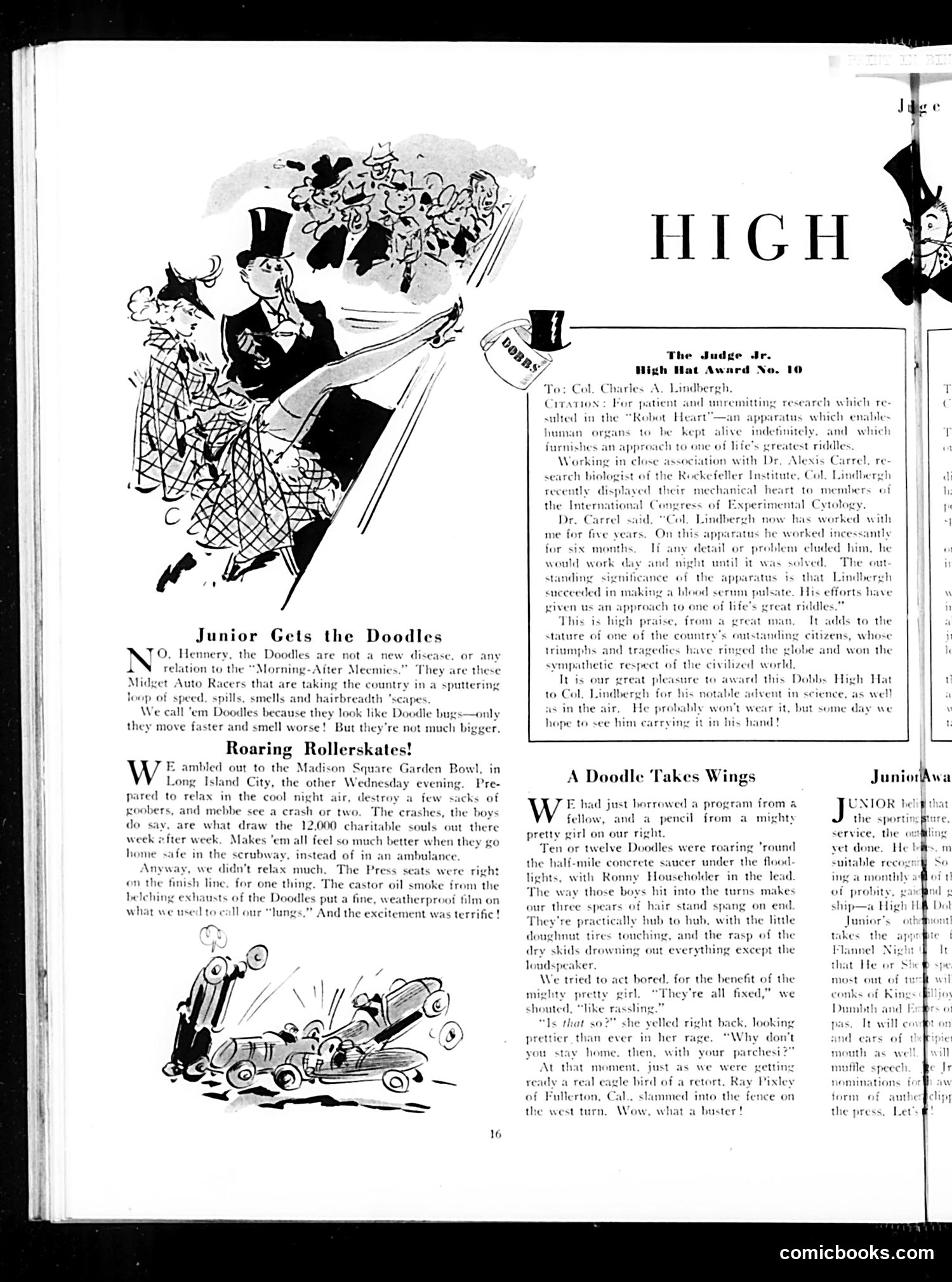
Explanation for Modern Readers This page celebrates the "Doodle"—a early-1920s midget race car craze. The cartoons humorously depict these small, fast vehicles as dangerous spectacles drawing crowds to Madison Square Garden Bowl in Long Island City. The main satire: "Junior Gets the Doodles" jokes that Doodles are a "disease" spreading across America, likening them to Morning-After Meemies (hangovers). They're fast, smelly, and prone to crashes—which the text admits is what actually draws the crowds ("Makes 'em all feel so much better"). "Roaring Rollerskates" mocks the spectator experience: the author claims to attend for entertainment but admits the real draw is potential crashes and the smoke/excitement, not relaxation. The High Hat Award honors Charles Lindbergh and Dr. Alexis Carrel for their "Robot Heart" research—the artificial organ preservation apparatus. This celebrates legitimate scientific achievement against the page's frivolous Doodle coverage, creating ironic contrast. The humor relies on 1920s automotive culture and the era's fascination with both technological progress and dangerous stunts.
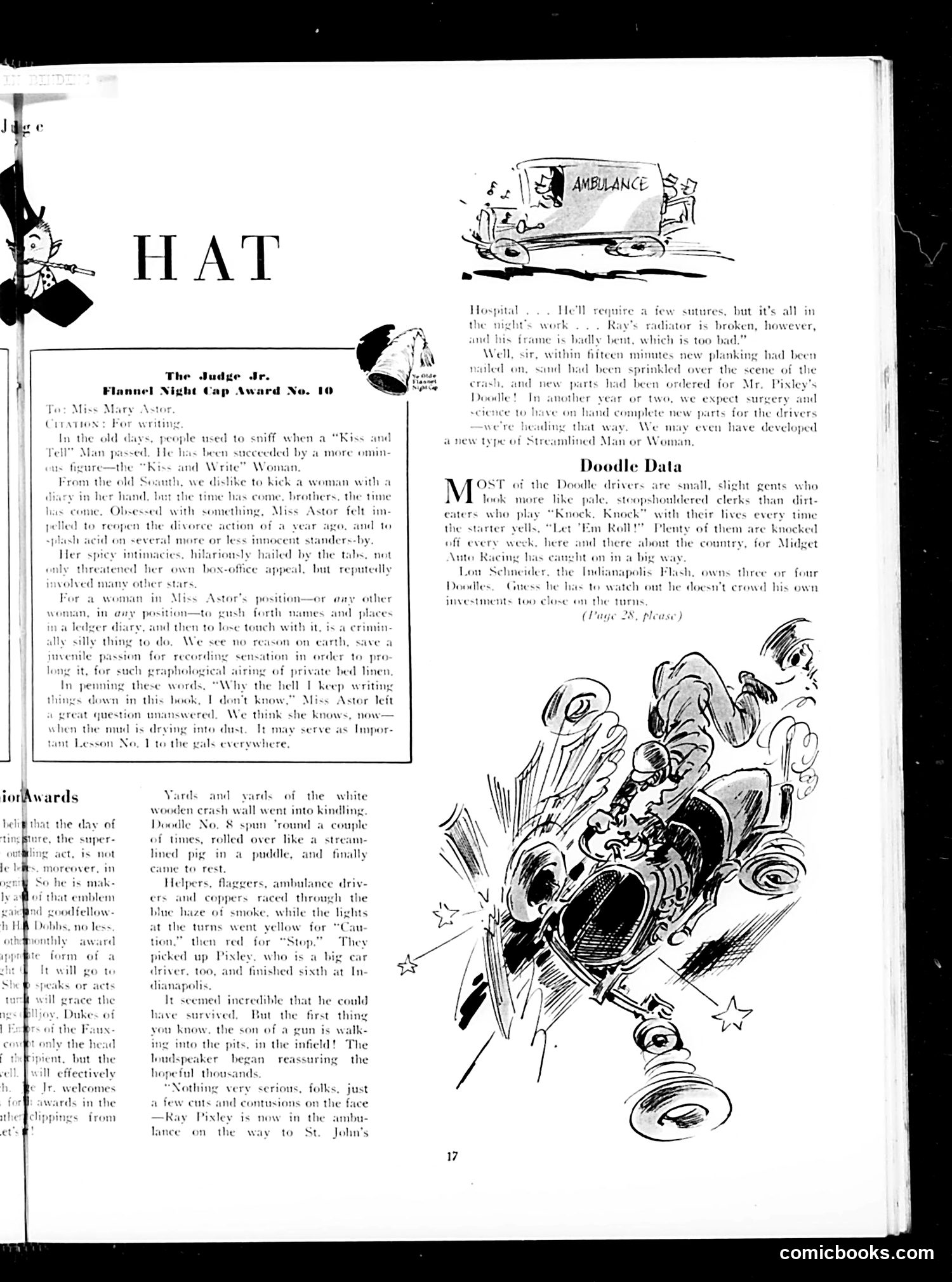
Judge Magazine Satire Analysis This page satirizes early 1930s automobile racing culture through two interconnected pieces: "The Judge Jr. Flannel Night Cap Award No. 10" (left) mocks actress Mary Astor, whose recent divorce scandal involved acid-throwing and public name-calling. The satirist criticizes her for airing private grievances publicly, arguing her "juvenile passion for recreation sensation" damages not just herself but other Hollywood figures. The piece uses her as a cautionary lesson about unseemly public behavior. "Doodle Data" (right) describes reckless amateur racers driving dangerous homemade vehicles ("Doodles")—small, jury-rigged cars piloted by inexperienced drivers who regularly crash and injure themselves at racetracks. The accompanying cartoon shows a violent crash. The satire mocks both the drivers' foolhardiness and the era's casual acceptance of racing deaths as entertainment, naming specific drivers like Lou Schneider and Ray Pixley. Both pieces mock excess and poor judgment in 1930s society—whether Hollywood scandal-mongering or dangerous motorsport culture.
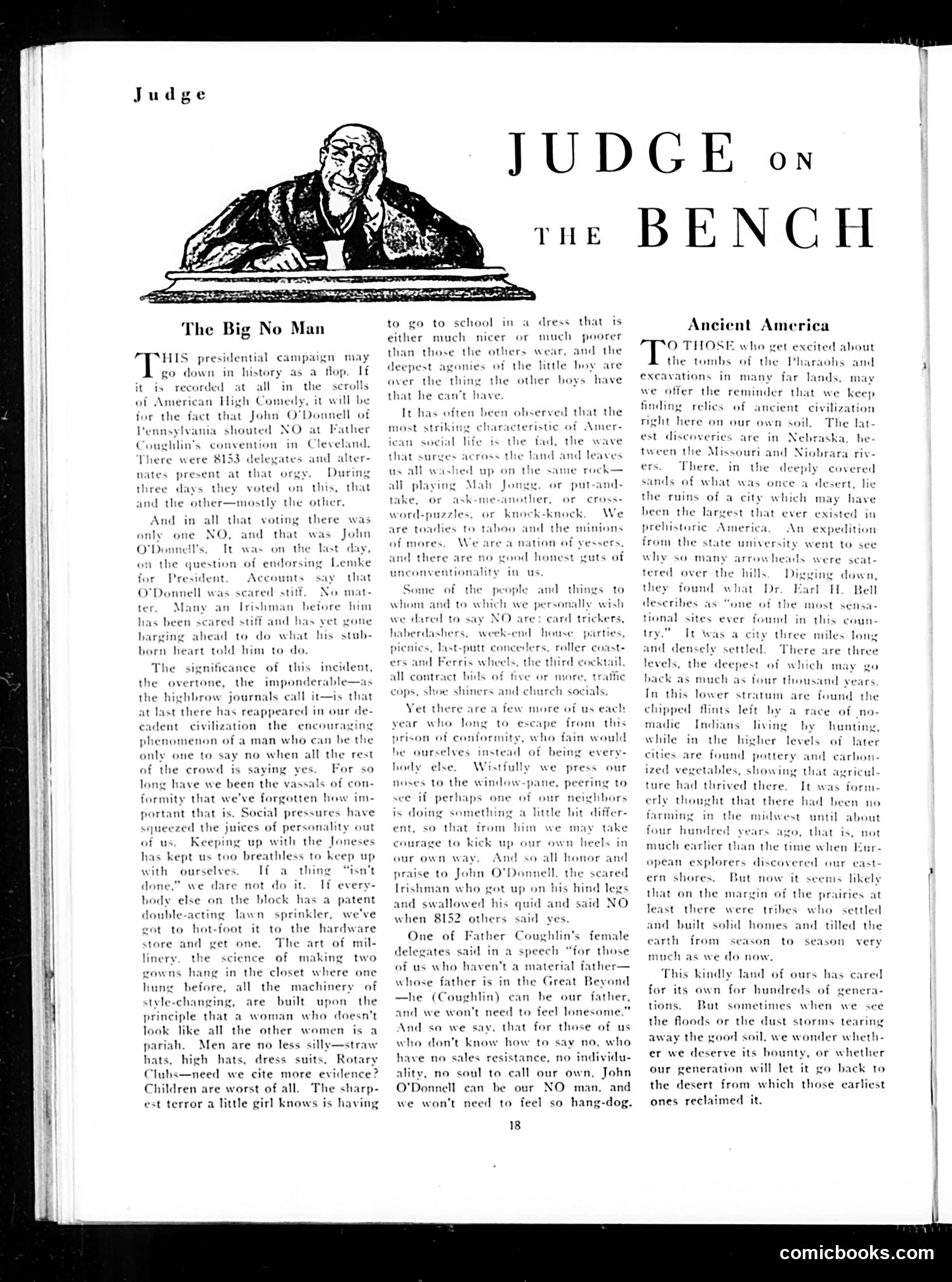
Judge Magazine: "The Big No Man" (circa 1936) This editorial piece satirizes American conformity through the story of John O'Donnell, a Pennsylvania delegate at Father Coughlin's political convention in Cleveland who cast the *only* NO vote against endorsing William Lemke for president—when 8,152 others voted yes. The satire mocks mass conformity: Americans blindly follow fads and social pressure rather than think independently. The author argues we've become "vassals of conformity," citing examples from lawn sprinklers to children's clothing to Rotary Clubs—all ways people abandon individuality to fit in. Father Coughlin was a controversial Catholic priest and political activist; Lemke was his 1936 third-party presidential candidate. O'Donnell's solo NO vote becomes a metaphor for the rare individual willing to resist groupthink. The piece celebrates O'Donnell as a refreshing anomaly in a society that punishes nonconformity, arguing even those without courage to say no themselves should admire someone who does.
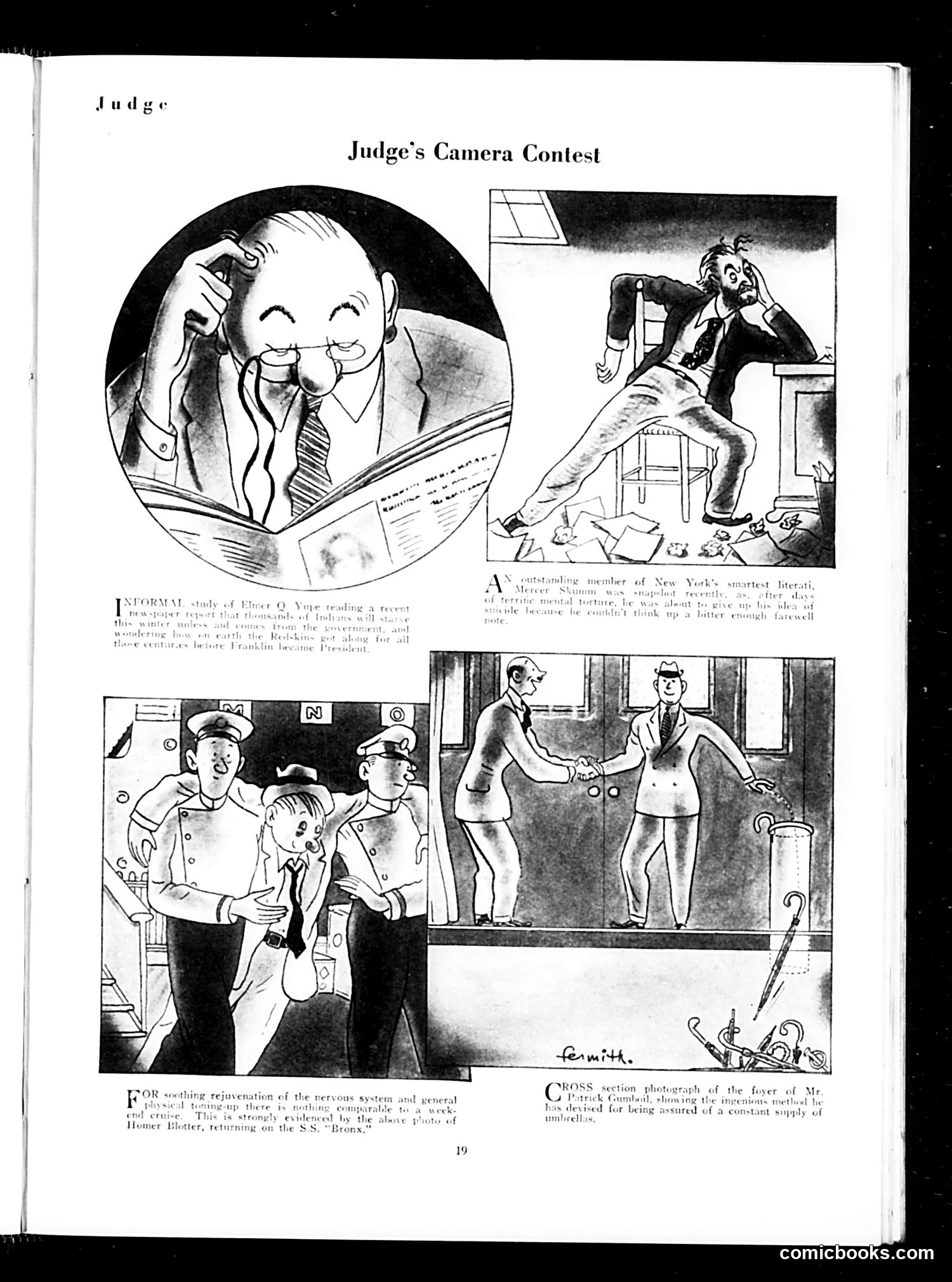
Judge's Camera Contest This satirical page presents a humorous "camera contest" using exaggerated caricatures and absurd scenarios. The top circular image shows an informal study of someone reading a tract, likely mocking earnest reform efforts. The subsequent panels depict increasingly ridiculous photographic "entries": - One shows policemen with a small boy, apparently satirizing law enforcement - Another depicts nearly-nude figures on a stage with an umbrella, clearly absurd and risqué for the era The captions reference "cross-section photographs" and physical training methods, suggesting the satire targets contemporary obsessions with health reforms, "scientific" physical culture movements, and staged photography as documentation. The overall joke appears to mock both the earnestness of Progressive-era reformers and the absurdity of using photography to "prove" dubious health or moral claims—a common practice during this period.
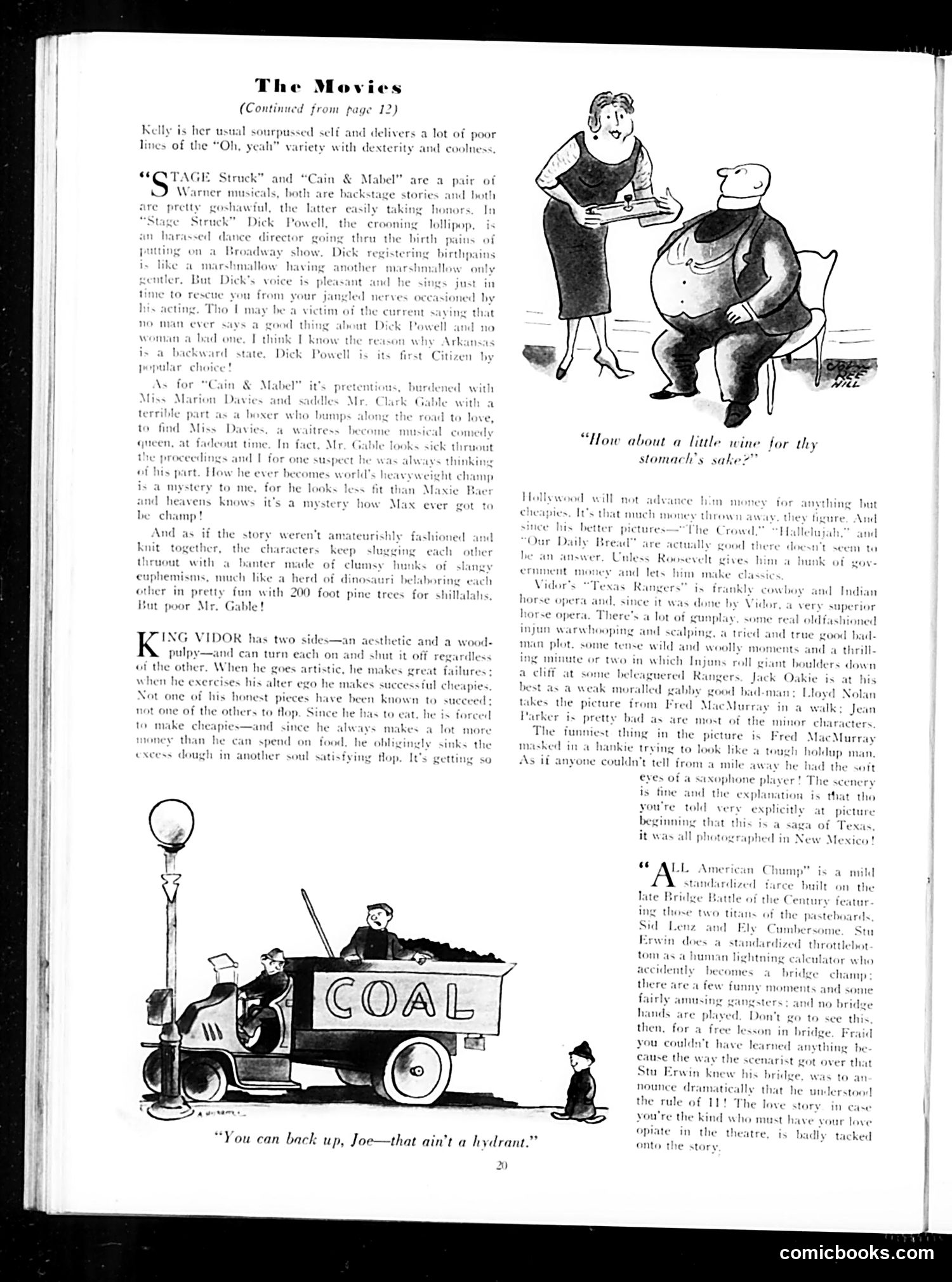
Analysis of This Judge Magazine Page This page reviews several 1930s Hollywood films, with two cartoon illustrations. The main cartoon shows a coal delivery truck labeled "COAL" with the caption "You can back up, Joe—that ain't a hydrant." This is a straightforward visual gag: someone mistakes the coal truck for a fire hydrant—a common urban mix-up played for humor. The second cartoon depicts two people at a dining table with the caption "How about a little wine for thy stomach's sake?"—a biblical reference used here for comedic domestic banter. The page itself is primarily a film review section critiquing movies like "Stage Struck," "Cain & Mabel," "King Vidor," "Texas Rangers," and "All American Chump," discussing their plots, actors (Dick Powell, Marion Davies, Clark Gable), and entertainment value. The cartoons serve as light comic relief interrupting the dense review text—typical of Judge magazine's format mixing satirical commentary with simple visual humor.
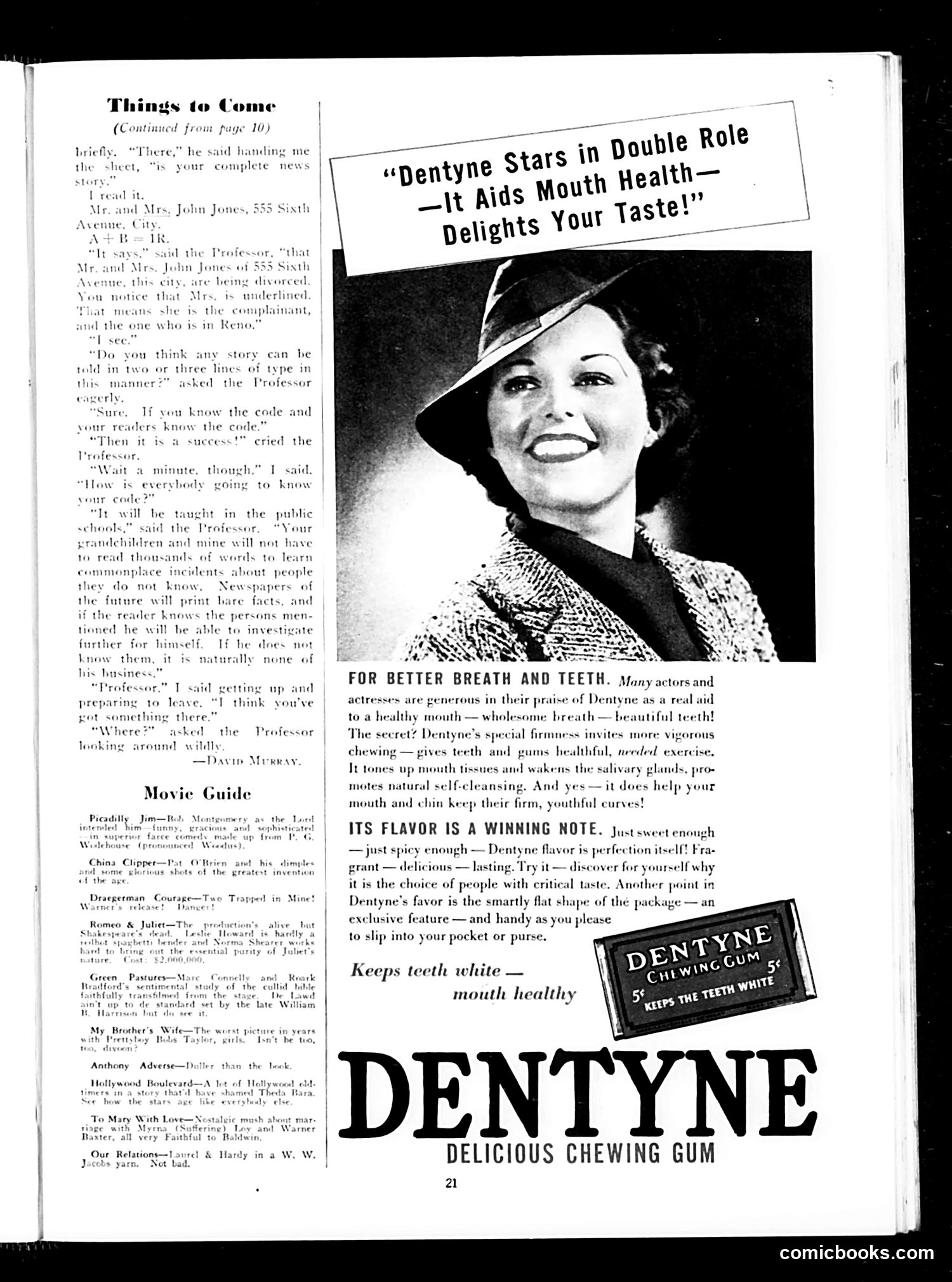
Analysis of Judge Magazine Page This page is primarily advertising, not satire. The bulk of the content is a Dentyne chewing gum advertisement featuring a smiling woman in a fashionable hat. The ad uses a common 1930s marketing strategy: celebrity endorsement. The headline claims "Dentyne Stars in Double Role—It Aids Mouth Health—Delights Your Taste!" The text references unnamed "actors and actresses" praising Dentyne's benefits for teeth, gums, and breath. The smaller "Movie Guide" section at left lists current films, which appears standard editorial content. The advertisement's appeal is purely commercial: it emphasizes the gum's flavor, convenience (flat package fits in pockets), and health benefits, targeting consumers interested in maintaining attractive appearance and dental hygiene—aspirational messaging typical of Depression-era advertising that associated chewing gum with glamour and modern hygiene. No political satire or social commentary is evident on this page.
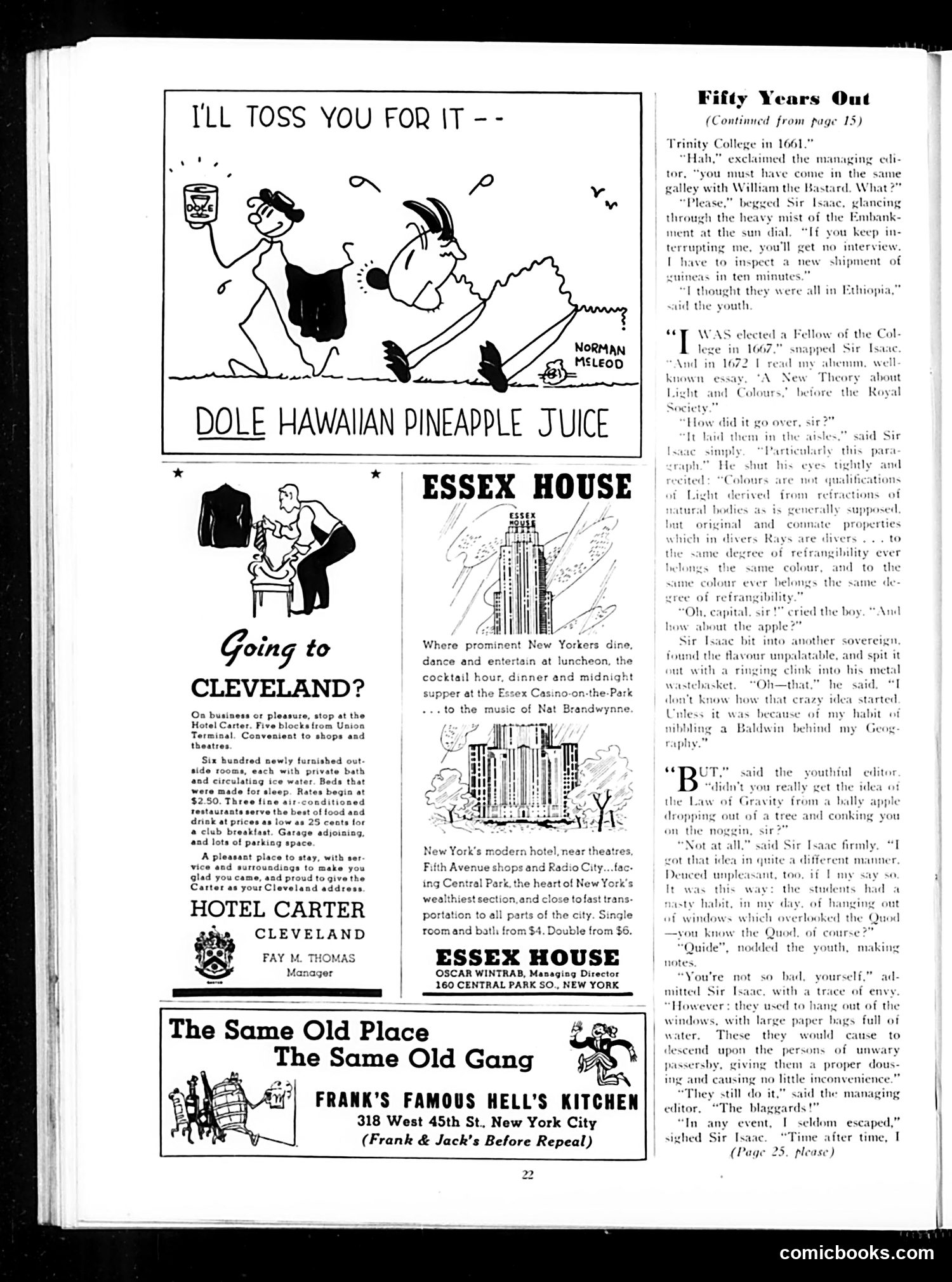
Political Cartoon & Satire Analysis The top cartoon by Norman Meleod depicts a simple physical comedy gag unrelated to politics: two figures toss a coin to decide who pays for Dole Hawaiian Pineapple Juice—a product advertisement presented as humor. The page is primarily advertising: the Essex House hotel, Hotel Carter in Cleveland, and Frank's Famous Hell's Kitchen restaurant dominate the layout. These ads showcase upscale New York leisure destinations of the era. The text column continues a serialized humorous essay titled "Fifty Years Out," featuring a fictional dialogue between Sir Isaac Newton and a modern editor. The satire gently mocks both the historical figure (Newton explaining gravity came from watching students drop water bags on passersby) and contemporary journalistic pretension, using anachronistic absurdity for comic effect. This appears to be a mid-1920s-1930s Judge magazine page: entertainment-focused rather than politically charged, blending light comedy, period advertisements, and serialized fiction typical of the publication's commercial appeal.
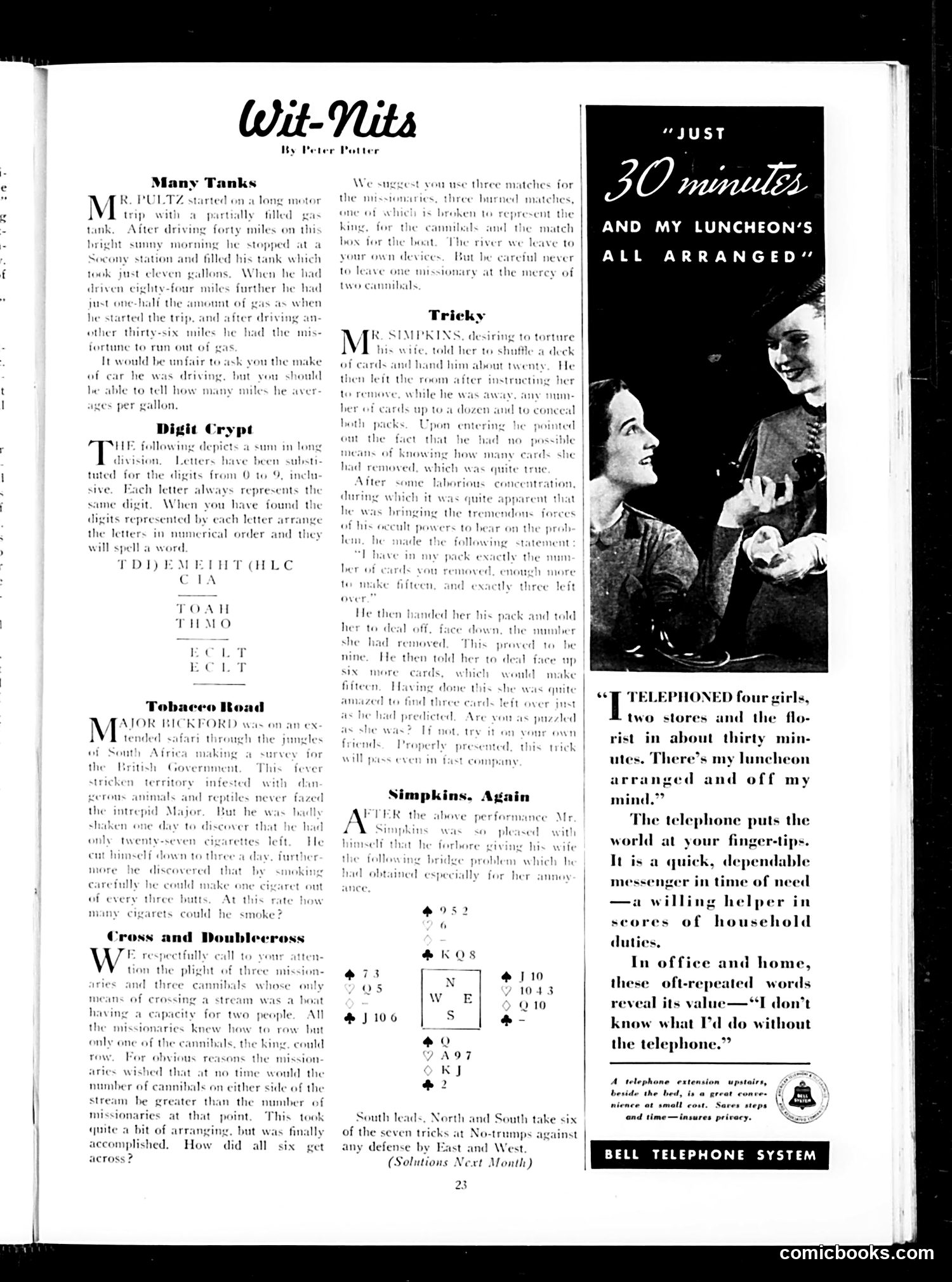
"Wit-Nits" by Peter Potter — Judge Magazine Page This page contains several unrelated puzzle-type features and a Bell Telephone System advertisement. The main content includes word puzzles and logic problems: "Many Tanks" (a gas mileage calculation), "Digit Crypt" (a cryptarithmetic puzzle), "Tobacco Road" (a bridge problem), and "Cross and Doubleness" (a river-crossing logic puzzle). These represent the "wit-nits"—clever wordplay and intellectual challenges typical of Judge magazine's puzzle sections. The adjacent Bell Telephone ad features a woman claiming she arranged a luncheon by phone in thirty minutes, touting the telephone as an essential household tool—a contemporaneous advertisement emphasizing the telephone's practical value for busy modern life. The puzzles and ad represent typical early-to-mid 20th-century Judge content: light humor, intellectual exercises, and technology advertising targeting educated readers.
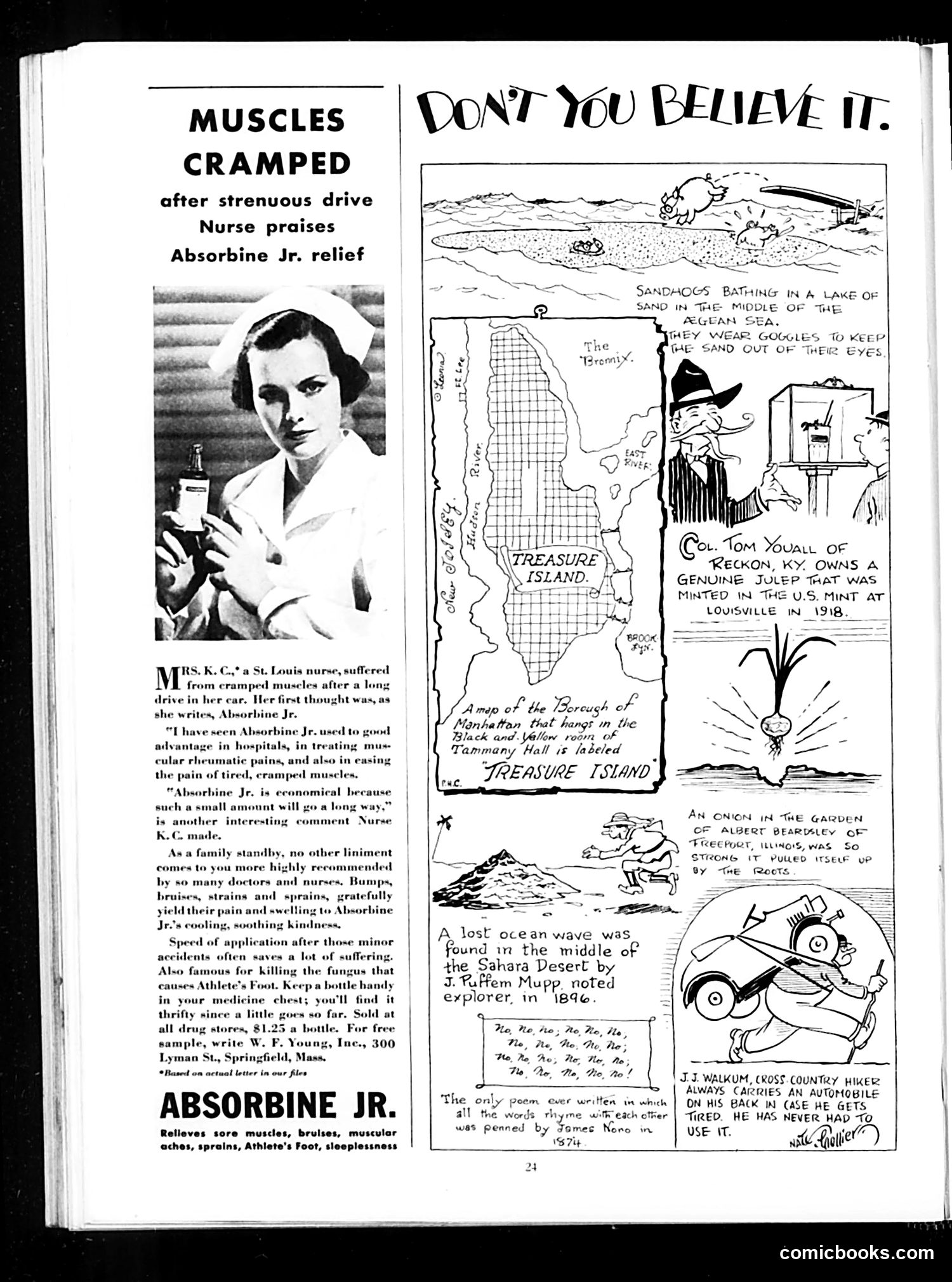
"Don't You Believe It" — A Satirical Tall Tales Page This page from Judge magazine presents a humorous column of deliberately absurd and impossible claims, designed to mock gullible readers and exaggeration. The left side advertises Absorbine Jr., a genuine medicinal product, while the right side offers pure nonsense. The cartoon ridicules tall tales and urban legends through increasingly ridiculous scenarios: sandhogs bathing in sand in the Aegean Sea; a mint julep from 1818; an onion so strong it uproots itself; an ocean wave found in the Sahara Desert; and a hiker carrying an automobile on his back "just in case." The satire targets credulous Americans who believe fantastic stories. Each item masquerades as fact—attributed to specific people, places, and dates—mimicking the format of genuine trivia or news items. The humor lies in the obvious impossibility of the claims and the deadpan presentation. This reflects early-20th-century concerns about misinformation and the public's susceptibility to dubious claims.
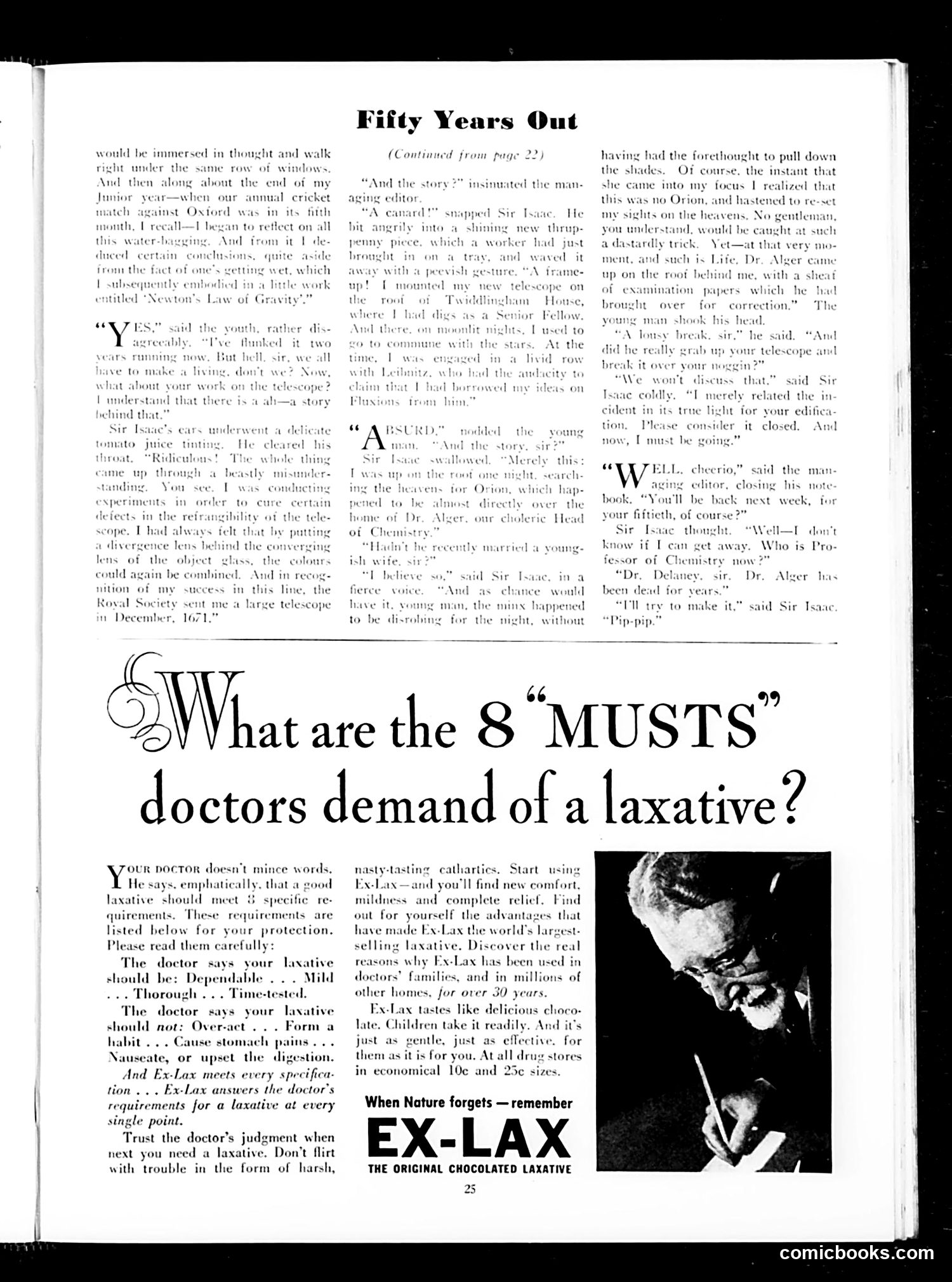
Analysis for Modern Readers This page from *Judge* magazine contains a story continuation and a full-page advertisement, not a political cartoon. The story excerpt ("Fifty Years Out") depicts a dialogue between Sir Isaac (apparently an astronomer) and a managing editor about a telescope discovery. The narrative appears to be a science fiction piece about an astronomical observation that turns out to be disappointing—the narrator thought he'd found Orion but realizes it's something else. The story is lighthearted fiction with no apparent political satire. The advertisement is the main content: a promotional campaign for Ex-Lax, a chocolate laxative product. It uses pseudo-medical authority, claiming doctors demand eight specific qualities in laxatives—all of which Ex-Lax supposedly meets. This reflects early 20th-century advertising practices that freely invoked doctor endorsements (before modern FDA regulations). The ad emphasizes the product's palatability and safety, targeting families including children, and emphasizes its affordability (10-25 cents). This page is primarily commercial content masquerading as editorial, typical of magazine monetization from that era.
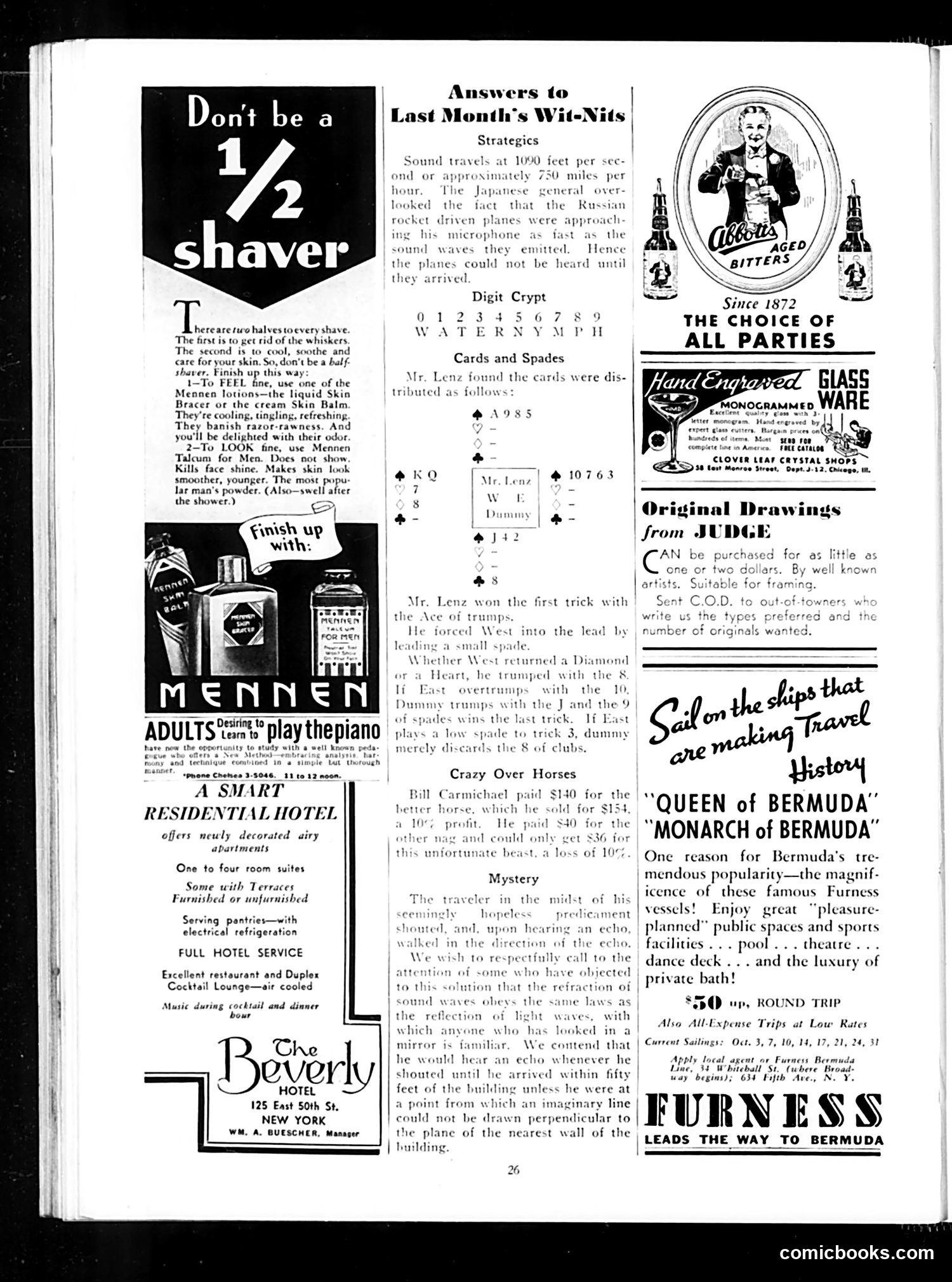
"Don't Be a ½ Shaver" — Mennen Grooming Advertisement This page is primarily advertising content rather than political satire. The dominant feature is a Mennen Men's grooming advertisement promoting a two-step shaving routine: first removing whiskers, then applying aftercare products (Skin Bracer lotion and talcum powder). The "½ shaver" concept mocks men who complete only half the job by shaving without proper skincare, leaving their faces irritated and dull. The ad emphasizes that proper grooming requires finishing touches for appearance and skin health. The page also contains puzzle solutions ("Answers to Last Month's Wit-Nits"), hotel and glassware advertisements, and cruise ship promotions for Bermuda travel via Furness Line vessels. No political cartoons or social satire appear on this page—it's a standard magazine advertisement and content page from Judge magazine's commercial sections.
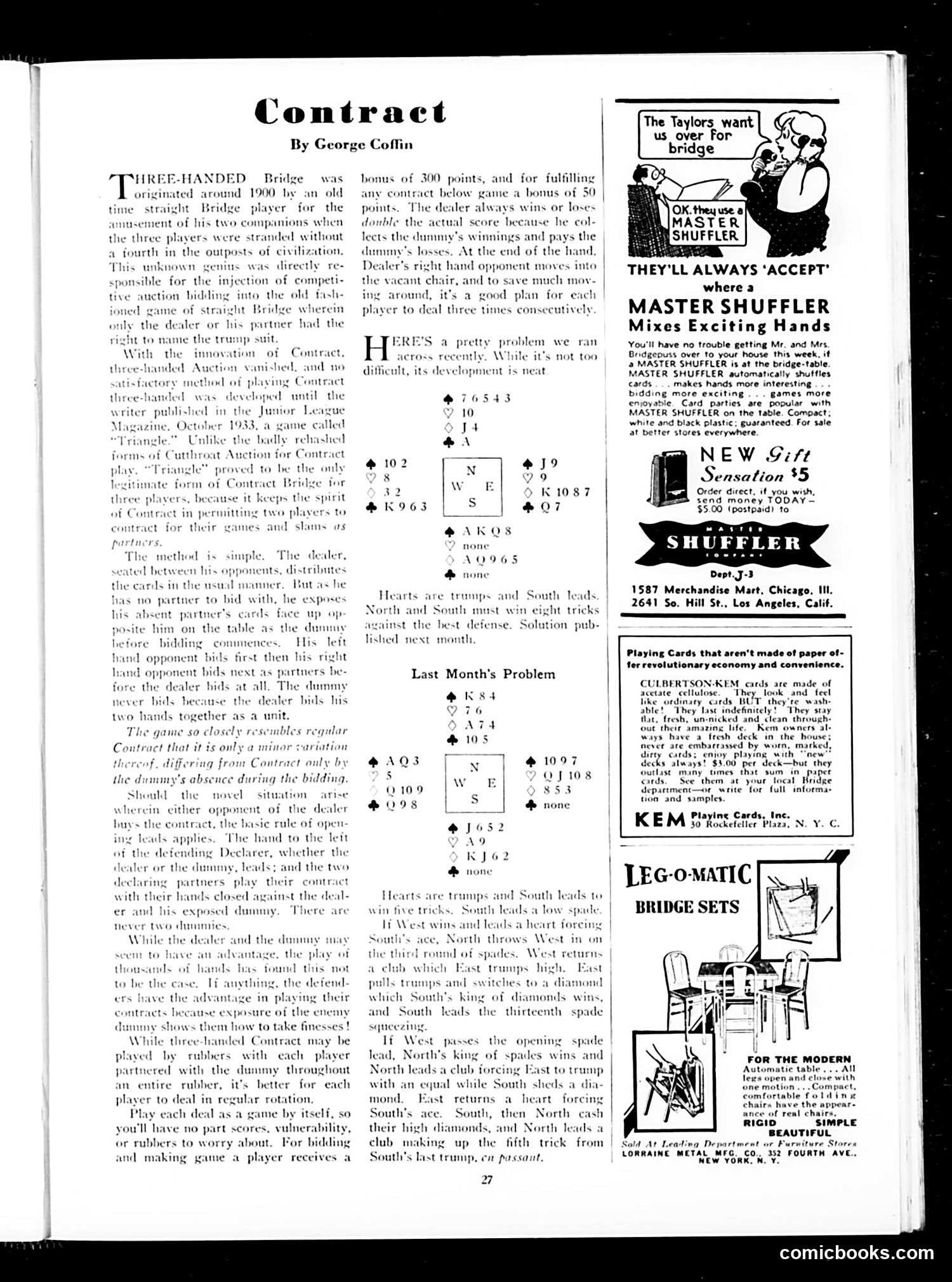
What This Page Means to Modern Readers This is primarily a bridge instruction and strategy page with advertising. The main cartoon (top right) shows a husband and wife ("The Taylors") being invited over for bridge, with the joke hinging on a "MASTER SHUFFLER" card-shuffling device that makes hands "more interesting." The page teaches "Three-Handed Bridge," a variant created around 1900 for players without a fourth person. The satirical angle is gentle: the text explains that this version allows competitive auction bidding—a significant innovation at the time—while the cartoon suggests that playing with a mechanical card shuffler makes bridge more exciting for guests. The bridge problems below are actual puzzle hands for readers to solve. Context we'd miss: Bridge was hugely popular in early 20th-century America among middle-class socialites. The advertising reflects how seriously people took the game—specialized equipment and trick-solving were genuine leisure activities. The cartoon's humor assumes readers recognize bridge as a fashionable social obligation.
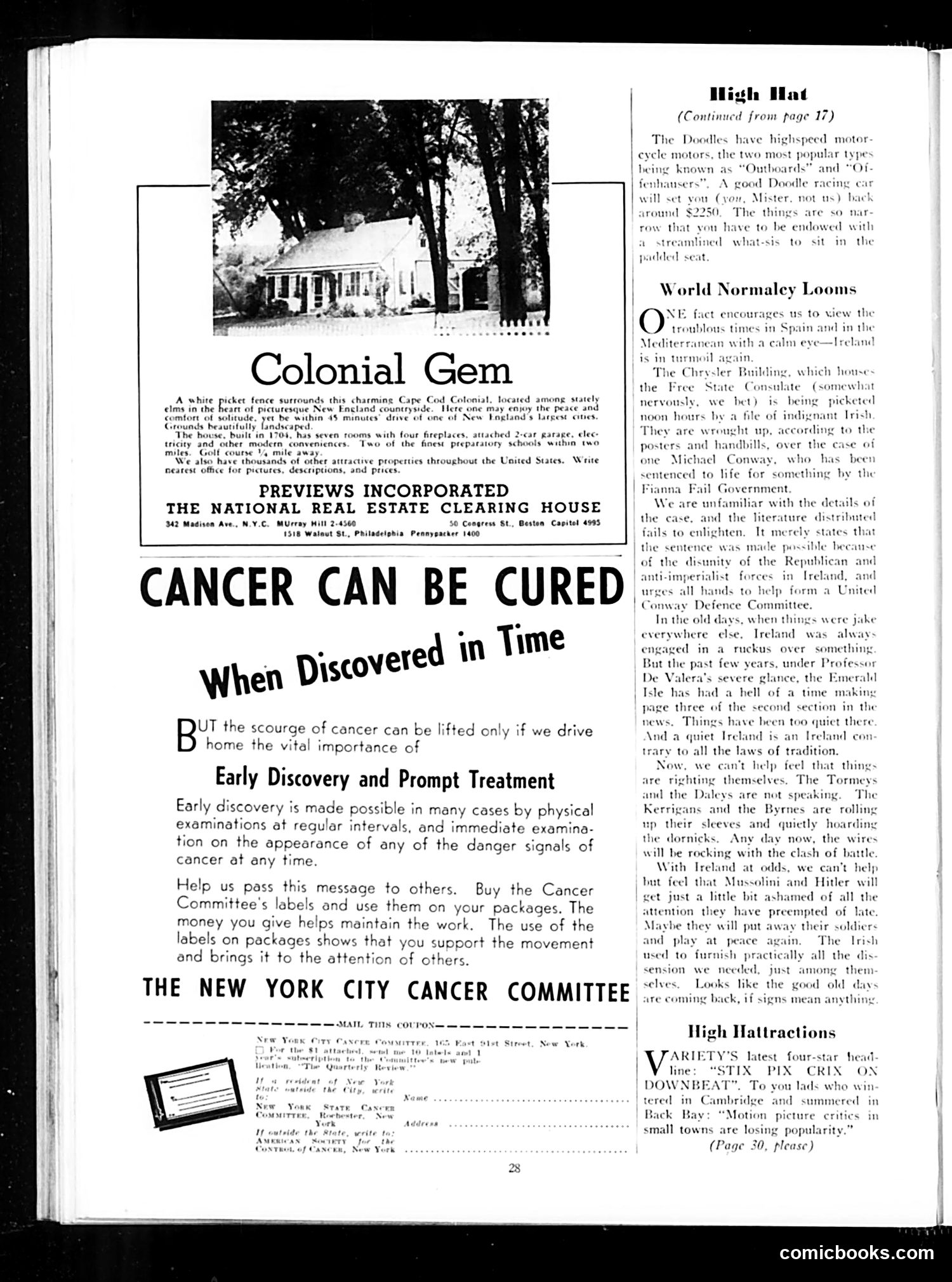
Content Analysis This page contains advertisements and public-service messaging, not political cartoons. Main Content: 1. "Colonial Gem" — A real-estate advertisement for a Cape Cod colonial home in New England from 1704, promoting its seven rooms, fireplaces, and proximity to Boston. 2. "Cancer Can Be Cured" — A public-health campaign from the New York City Cancer Committee emphasizing early detection and treatment. This reflects 1940s-era awareness-raising about cancer, urging readers to buy Cancer Committee labels to support the movement. 3. "World Normalcy Looms" — Commentary on Irish politics, referencing Michael Conway's imprisonment and De Valera's government. The author suggests Ireland's recent quietness is unusual and speculates tensions may erupt. 4. "High Hattractions" — Brief entertainment news about Variety magazine reviews. The page is primarily commercial and informational rather than satirical, typical of Judge magazine's mixed-content format combining entertainment, advertisements, and public messaging.
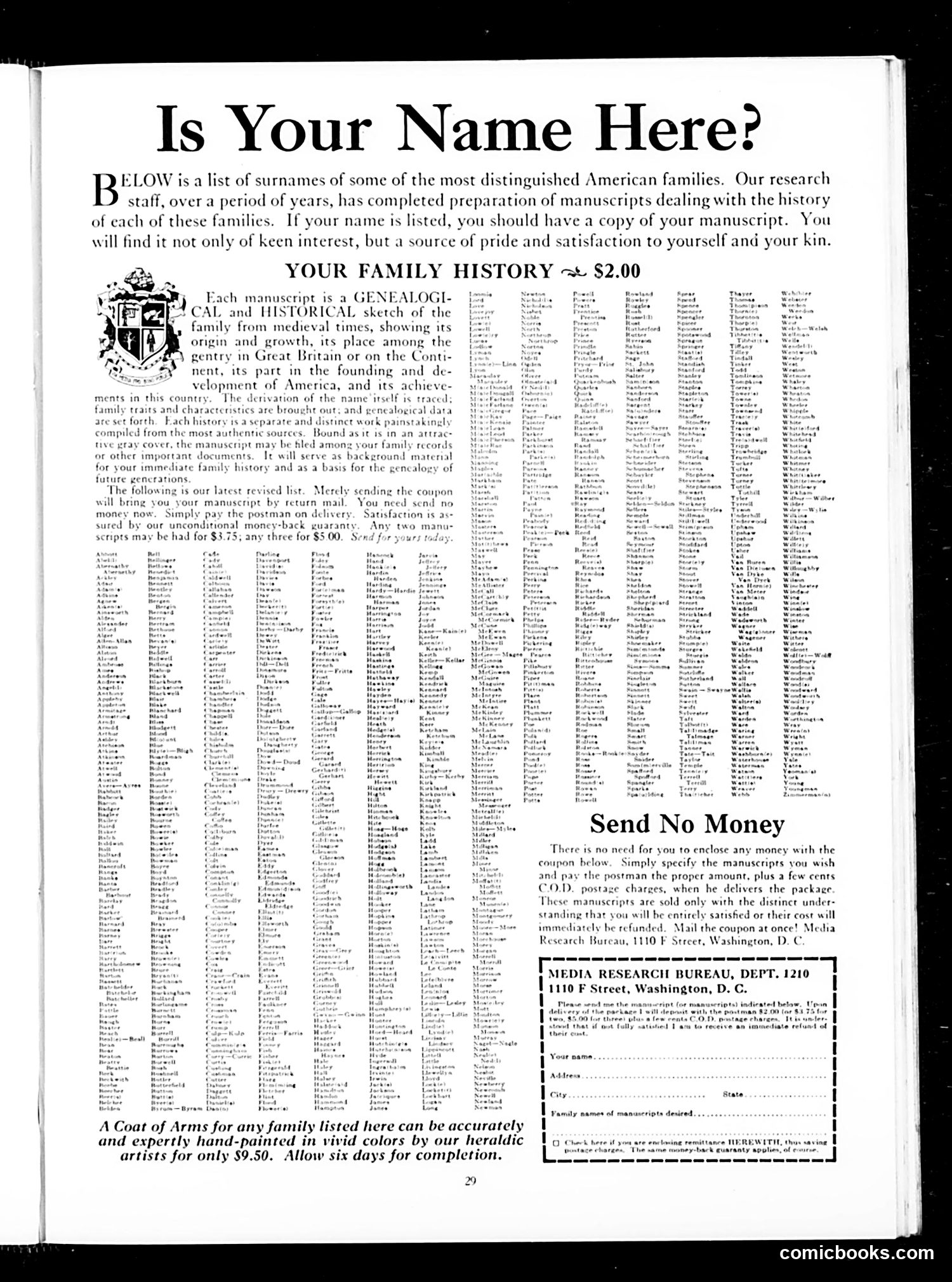
Analysis This page is primarily advertising, not satire or cartoon content. It's a mail-order advertisement from the Media Research Bureau offering genealogical manuscripts and family histories. The pitch targets American readers' aspirations to ancestral prestige by promising "genealogical and historical sketches" of distinguished families, tracing origins back to medieval times and the founding of America. The appeal is explicitly to vanity and social pride ("a source of pride and satisfaction to yourself and your kin"). The scheme uses direct-mail tactics typical of the era: a massive list of surnames, C.O.D. payment ("send no money now"), satisfaction guarantees, and upsell items like hand-painted coats of arms ($9.50). The implicit satire (if Judge included this as social commentary) would be mocking Americans' obsession with fabricated genealogical legitimacy and Old World pedigree—a critique of nouveau riche pretension and social climbing disguised as heritage. However, the page itself is presented straightforwardly as an advertisement, making its satirical function ambiguous without additional Judge editorial context.
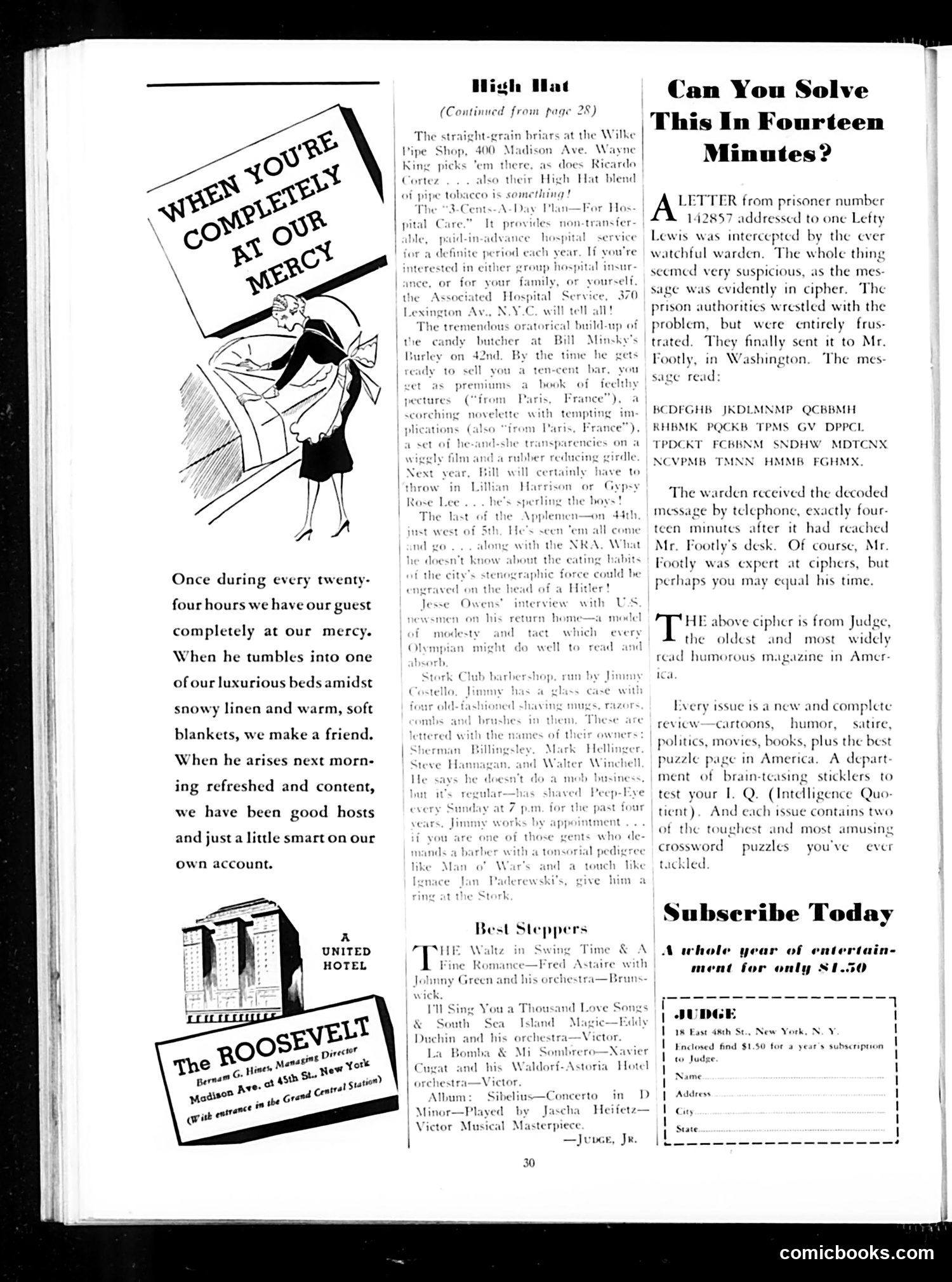
Explanation for Modern Readers This page primarily features advertisements and a puzzle challenge, not political satire. The main content is a cipher puzzle: a prisoner's coded letter was intercepted and decoded by a Washington official (Mr. Footly) in fourteen minutes. Readers are challenged to solve the same cipher in that timeframe. The cipher text appears as random letter groupings. The left side contains a hotel advertisement for the Roosevelt Hotel (with a cartoon of a woman at its mercy) and copy about hospitality—likely tongue-in-cheek about the hotel's attentiveness to guests. The bottom section advertises Judge magazine itself, promoting its puzzle content, cartoons, and humor. It includes subscription information and lists "Best Steppers" (popular music recordings of the era). There is no significant political cartoon or satire on this page—it's largely a commercial/entertainment page typical of 1930s-40s magazine layouts, mixing ads with reader engagement features like puzzles.
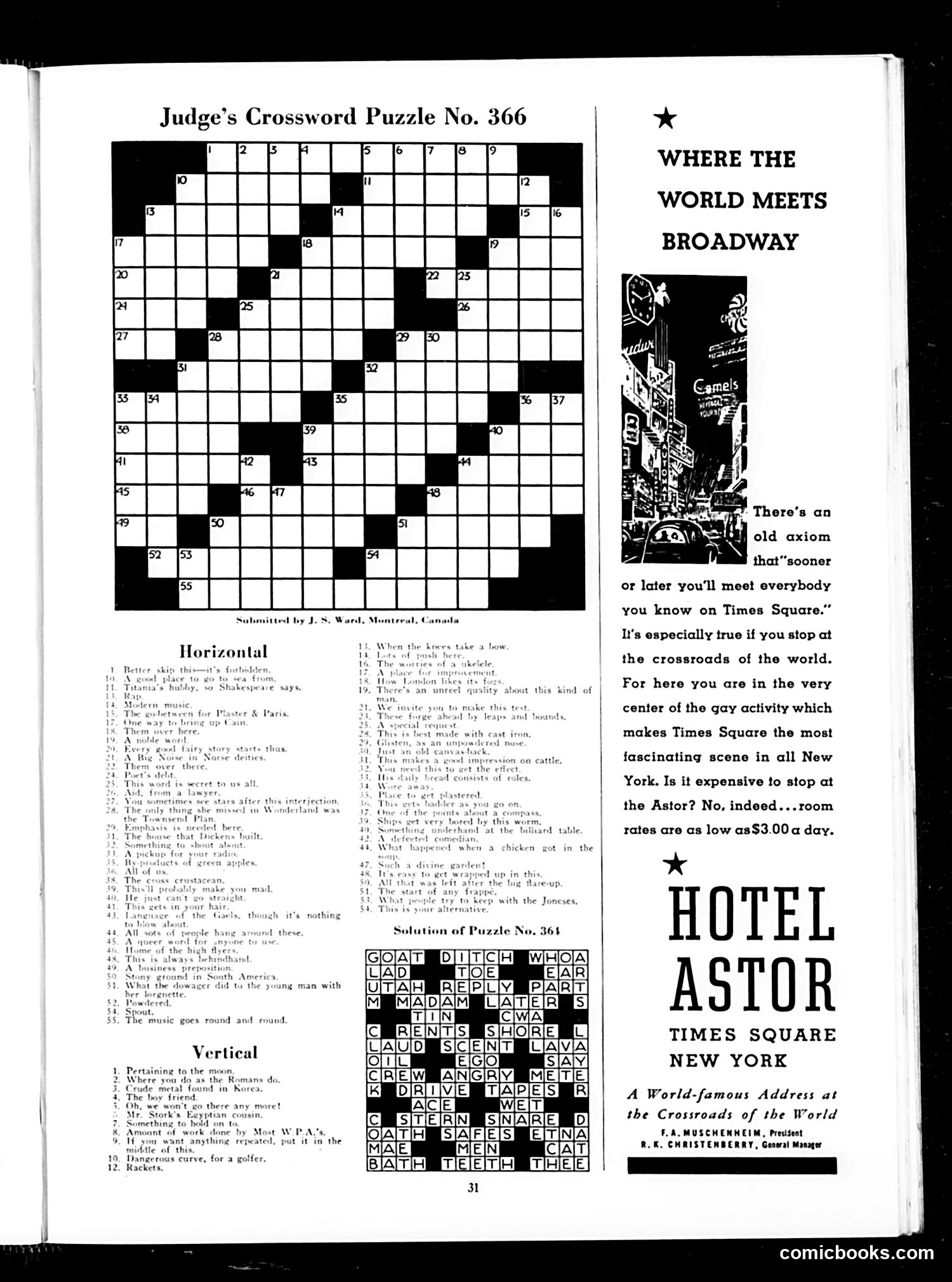
Analysis for Modern Readers This page contains a crossword puzzle and hotel advertisement from *Judge* magazine—not a political cartoon. The main content is "Judge's Crossword Puzzle No. 366," a standard word game with horizontal and vertical clues, plus a solution grid from the previous puzzle (No. 361). The significant element is a Hotel Astor advertisement occupying the right side. It emphasizes Times Square as "the crossroads of the world" and "where the world meets Broadway," promoting the hotel's central Manhattan location and affordability ($3.00/day rooms). The advertisement includes a woodcut-style illustration of the bustling Times Square area. This reflects the mid-20th-century positioning of Times Square as New York's premier commercial and entertainment hub. The ad targets travelers and tourists, suggesting the Astor as an economical yet prestigious destination in America's most famous intersection.
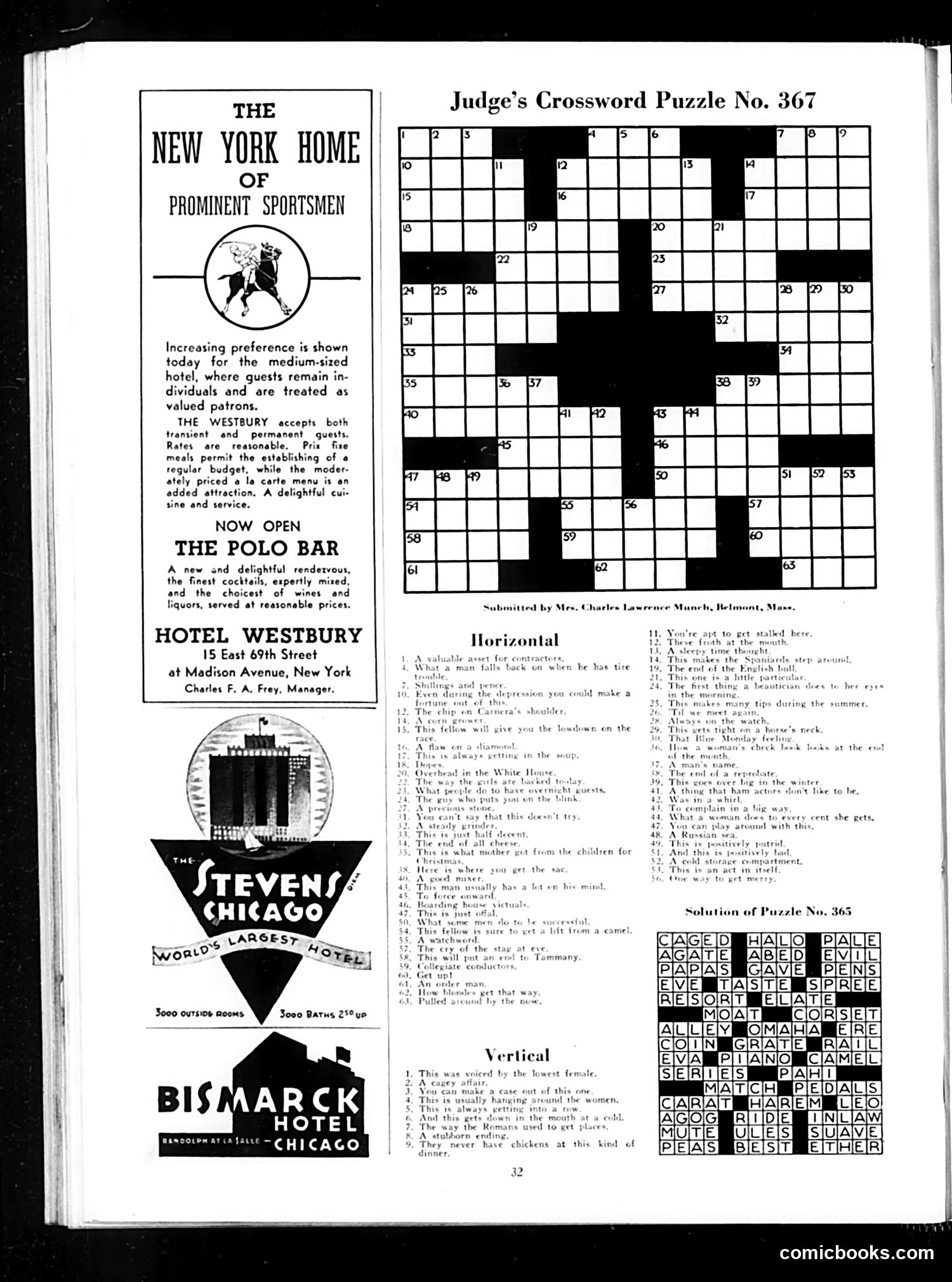
Judge Magazine Page Analysis This page is primarily advertising and a crossword puzzle, not satirical content. It features: Advertisements: - Hotel Westbury (New York) promoting medium-sized hotels as fashionable alternatives to larger establishments - Stevens Chicago Hotel ("World's Largest Hotel") - Bismarck Hotel (Chicago) Main Content: Judge's Crossword Puzzle No. 367, submitted by Mrs. Charles Lawrence Munch of Belmont, Massachusetts, with horizontal and vertical clues and a solution grid for puzzle No. 365. Historical Context: The hotel ads reflect 1920s-30s hospitality trends, when smaller, personalized hotels were marketed as upscale alternatives to massive hotels. The emphasis on being "valued patrons" rather than anonymous guests reflects period attitudes about service and hospitality. This is a typical magazine page mixing puzzles, leisure activities, and luxury service advertising—entertainment and commerce combined for Judge's affluent readership.
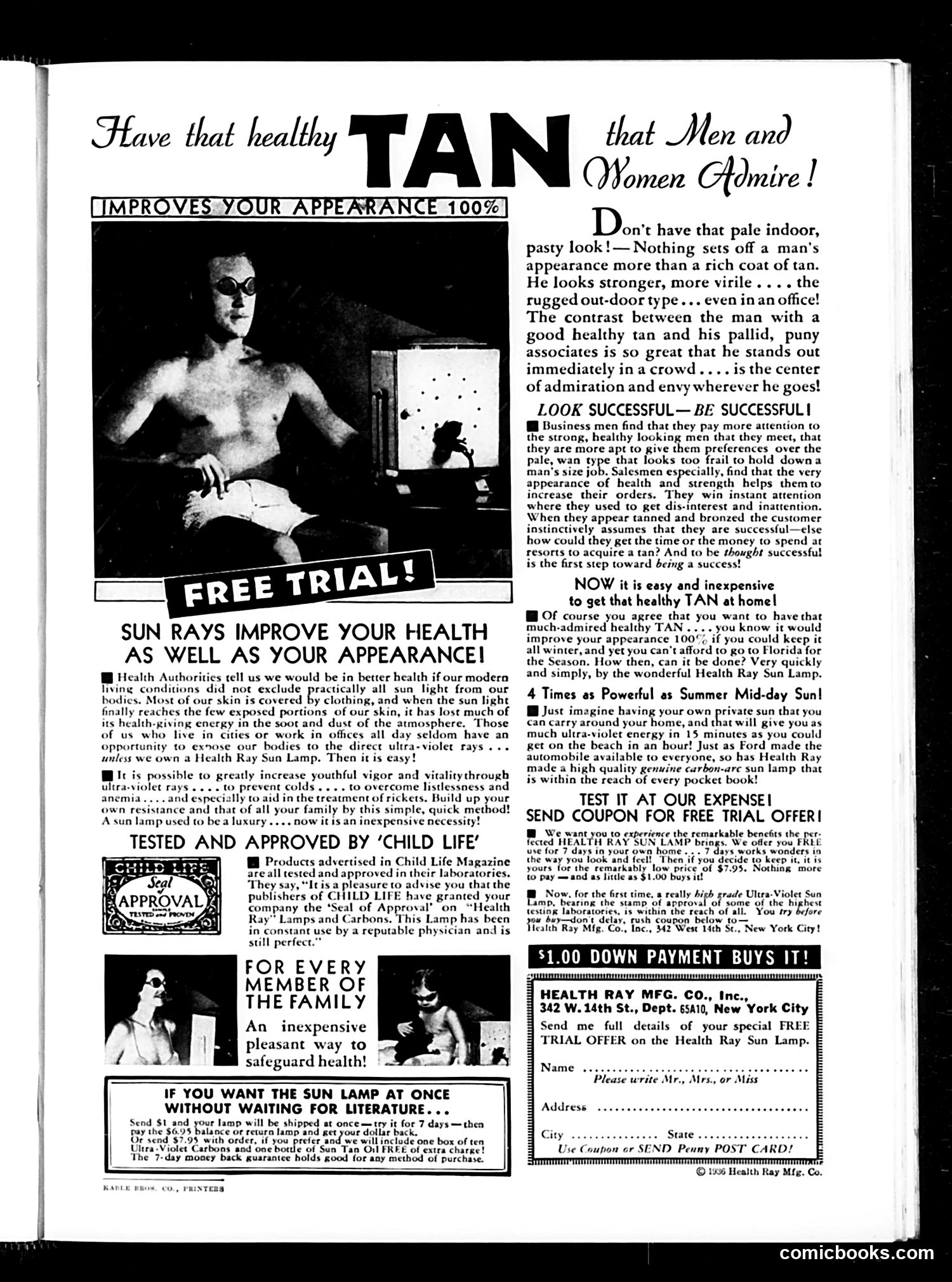
Analysis: "Health Ray Sun Lamp" Advertisement This is primarily an advertisement, not satire. The page promotes the "Health Ray Sun Lamp," a home ultraviolet light device marketed as a health and beauty solution. The pitch targets social anxieties: The ad claims a tan signals success, health, and virility—that pale indoor workers appear weak and unsuccessful compared to tanned men. It promises that acquiring a tan through this lamp will improve business prospects and personal appearance. The appeal is pseudo-scientific: References to "Health Authorities" and approval from *Child Life* magazine lend false credibility. Claims about preventing colds, treating rickets, and building "resistance" via UV rays reflect early 20th-century enthusiasm for heliotherapy (sun therapy), before widespread understanding of UV dangers. The social message reflects period attitudes: Success is visually performed through appearance; tanned skin signals leisure and prosperity in an era when most workers were office-bound and pallid. No political satire is present—this is a straightforward (if misleading) product promotion targeting middle-class anxieties about health and social status.
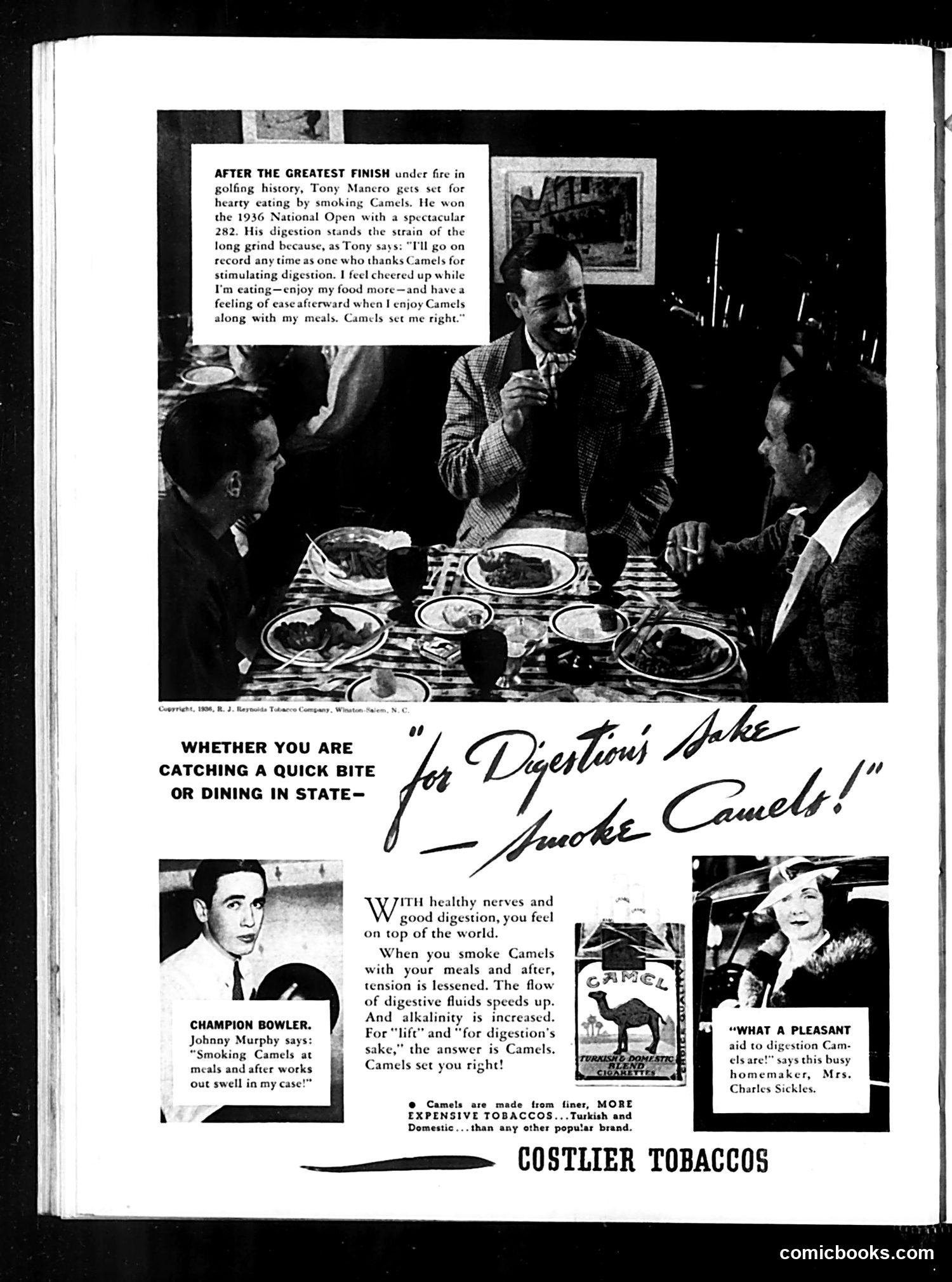
Advertisement Analysis This is a Camel cigarette advertisement, not political satire. It exploits the credibility of 1936 celebrities—golfer Tony Manero (who won the National Open), bowler Johnny Murphy, and an unnamed homemaker—to claim cigarettes aid digestion. The ad's central pitch: smoking Camels with meals stimulates digestive fluids, increases alkalinity, and promotes "ease" afterward. By associating cigarettes with health benefits and pairing them with eating, the manufacturer targets consumers seeking wellness. This reflects pre-regulation tobacco marketing (pre-1960s), when cigarette companies made unsubstantiated medical claims in mainstream publications. Modern readers should recognize this as propaganda—no scientific basis supports these health claims, and smoking is now known to damage digestion and overall health. The ad exemplifies how tobacco companies once normalized smoking through celebrity endorsement and pseudo-medical language.