judge
Judge — November 1936
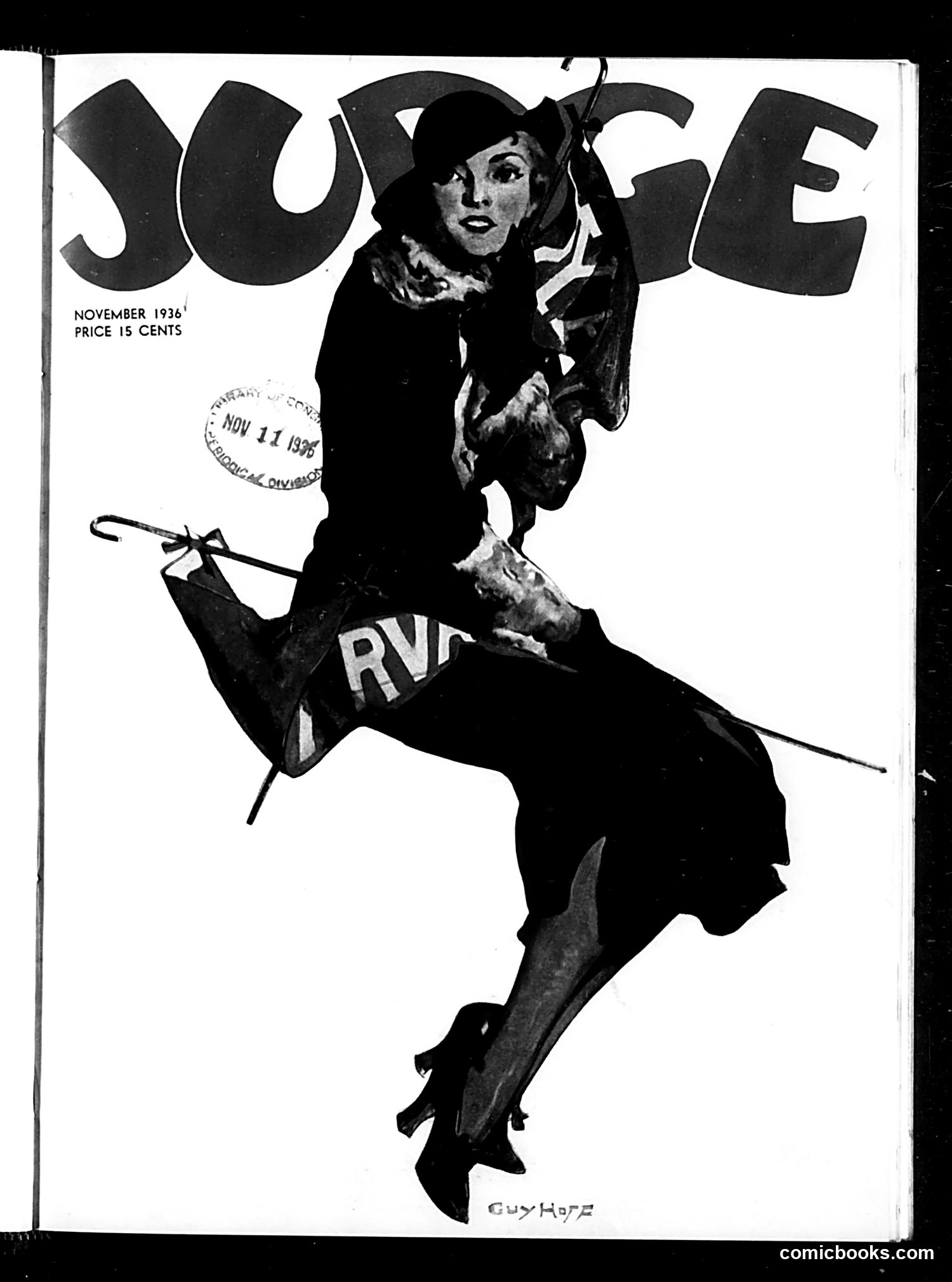
Judge Magazine, November 1936 This is the cover of Judge magazine from November 1936, priced at 15 cents. The illustration shows a woman in stylish 1930s attire—coat, hat, and heeled shoes—posed dynamically while skiing, with her skis labeled "RVD" (likely referring to a brand or product). The satire appears to target winter fashion and leisure culture among affluent Americans during the Depression era. The playful, energetic pose suggests Judge was mocking either the impracticality of fashionable winter wear for actual skiing, or perhaps satirizing wealthy Americans' carefree spending on luxury activities while the economy struggled. The artist's signature reads "GUY HOFF," a notable Judge cartoonist of the period.
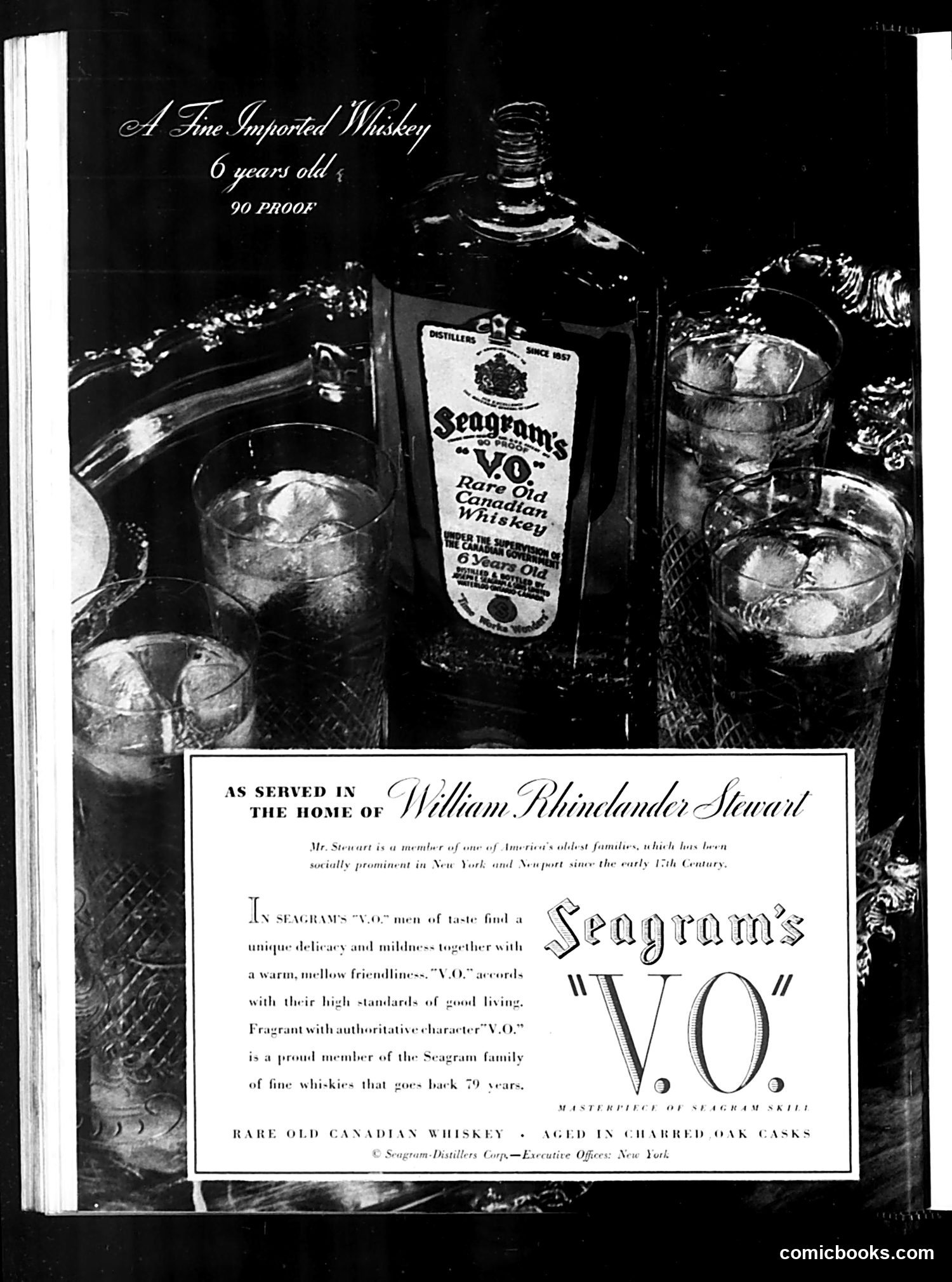
Content Analysis This page is primarily an advertisement, not political satire or a cartoon. It advertises Seagram's V.O. whiskey—a "Fine Imported Whiskey, 6 years old, 90 PROOF"—featuring a bottle displayed with glasses of the drink. The ad uses a prestige endorsement strategy by claiming the product is "AS SERVED IN THE HOME OF William Rhinelander Stewart," described as a member of one of America's oldest prominent families in New York and Newport since the early 18th century. The marketing appeals to aspirational consumers by associating the whiskey with old-money, upper-class respectability and "high standards of good living." This appears to be from the pre-Prohibition or early post-Prohibition era based on the advertising style and design.
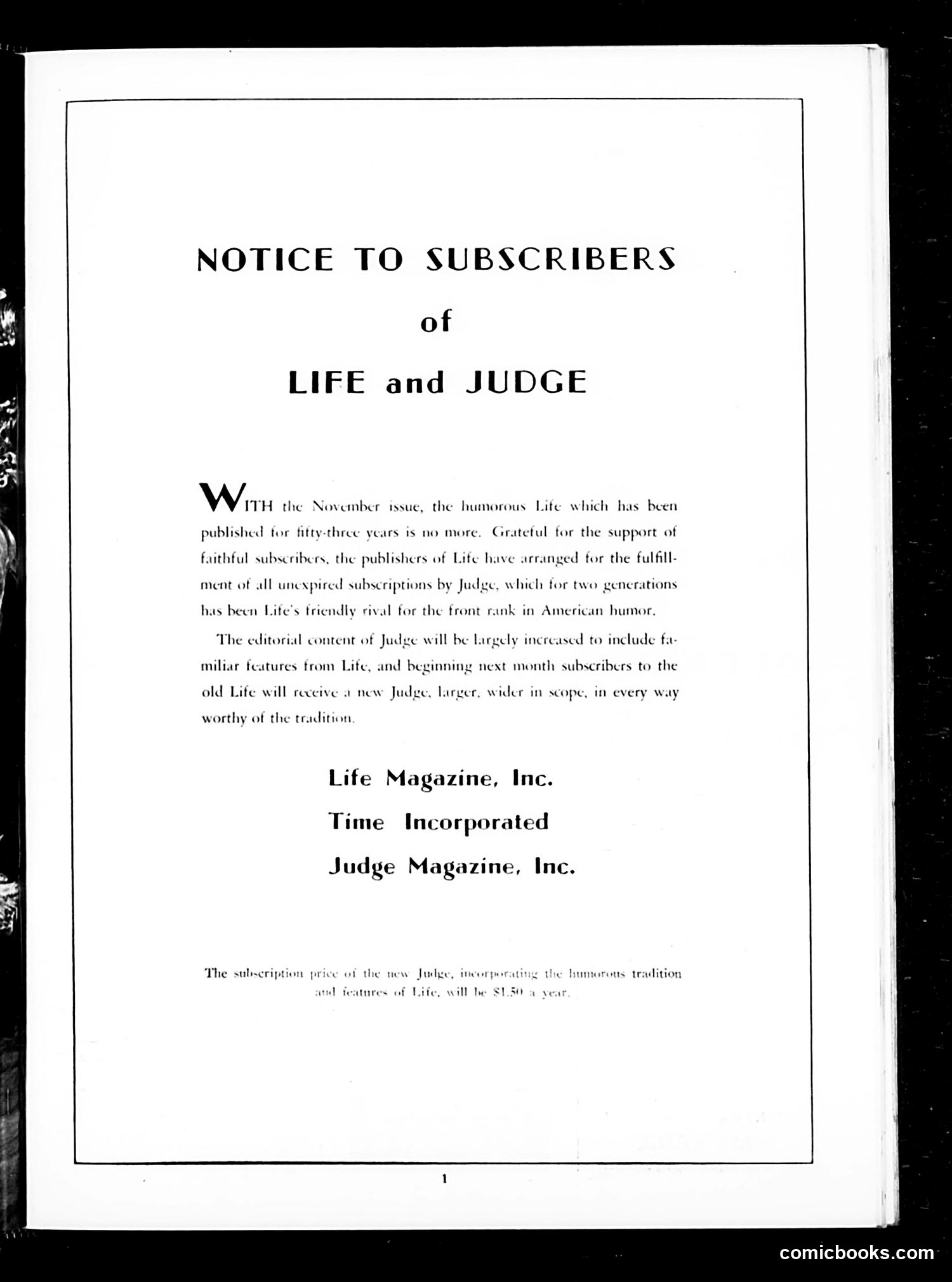
This page is primarily a notice to subscribers, not a cartoon. It announces that *Life* magazine (which had run for 53 years) is discontinuing, and its successor will be *Judge* magazine—which will absorb *Life*'s "humorous tradition" and "familiar features." The notice indicates that starting next month, *Life* subscribers will receive the new *Judge* instead, described as "larger, wider in scope, in every way worthy of the tradition." The subscription price for the combined publication is listed as $1.50 per year. This represents a merger or rebranding of two competing American humor magazines. The text emphasizes continuity with *Life*'s established reputation to reassure loyal readers during the transition. There are no cartoons or satirical content visible on this particular page.
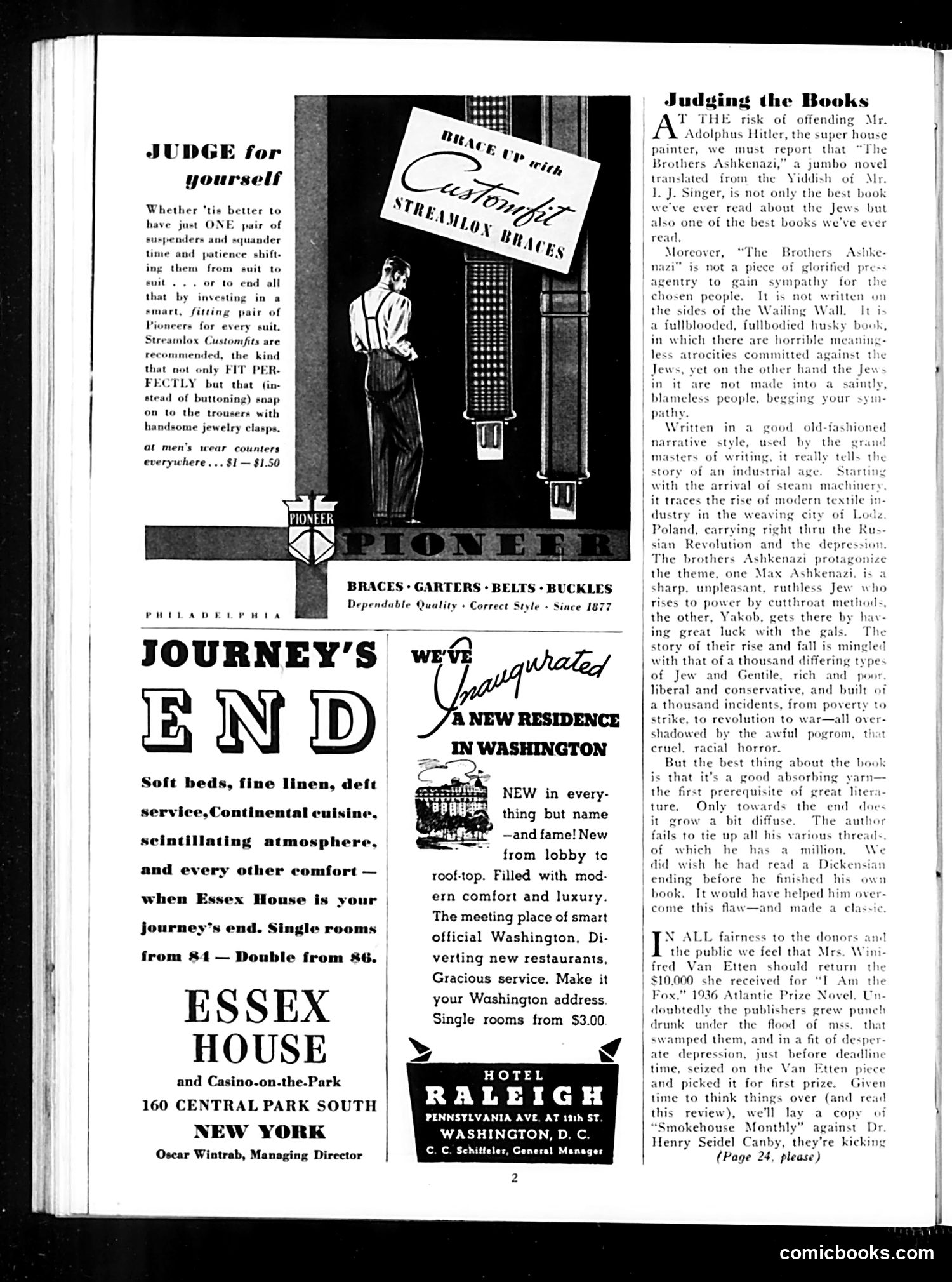
Analysis of Judge Magazine Page This page is primarily advertisements (Pioneer suspenders, Essex House hotel, Hotel Raleigh) with a small book review section titled "Judging the Books." The review discusses two books about Jewish life: "The Brothers Askenazi" (translated from Yiddish) and another work. The reviewer praises them as excellent literature while critiquing "The Brothers Askenazi" for its depiction of Jews—noting it portrays them as neither uniformly sympathetic nor entirely blameworthy, showing instead a realistic "thousand incidents, from poverty to strike, to revolution to war" affecting both Jewish and Gentile characters. The review appears to be promoting literary merit over propagandistic representation, suggesting early-to-mid 20th-century discussions about how Jewish characters should be portrayed in American literature.
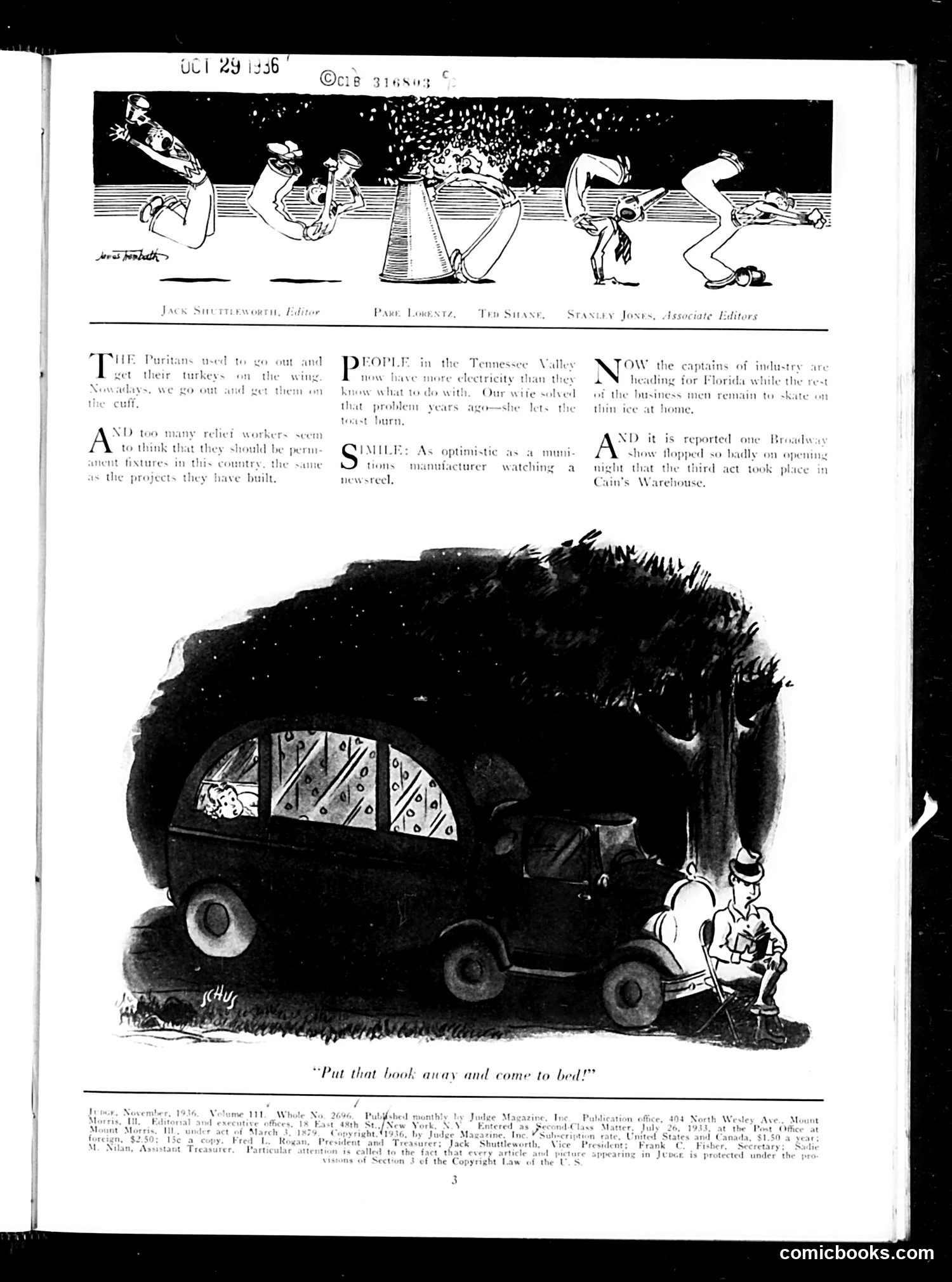
Analysis of Judge Magazine Page (November 1936) The top panel shows six figures in exaggerated poses labeled as editors: Jack Shuttleworth, Paul Lorentz, Ted Shane, and Stanley Jones. This appears to be satirical commentary on magazine leadership. The main cartoon depicts a car filled with hay or straw, with a small figure hanging from it saying "Put that book away and come to bed!" The satire likely mocks domestic life or perhaps critiques leisure-time reading habits during the Depression era. The accompanying text snippets reference Tennessee Valley Authority (TVA) politics, manufacturing optimism, and a Broadway show mishap at Cain's Warehouse—typical Judge content mixing political commentary with theatrical gossip. The overall page blends editorial satire with social observation characteristic of 1930s American humor magazines.
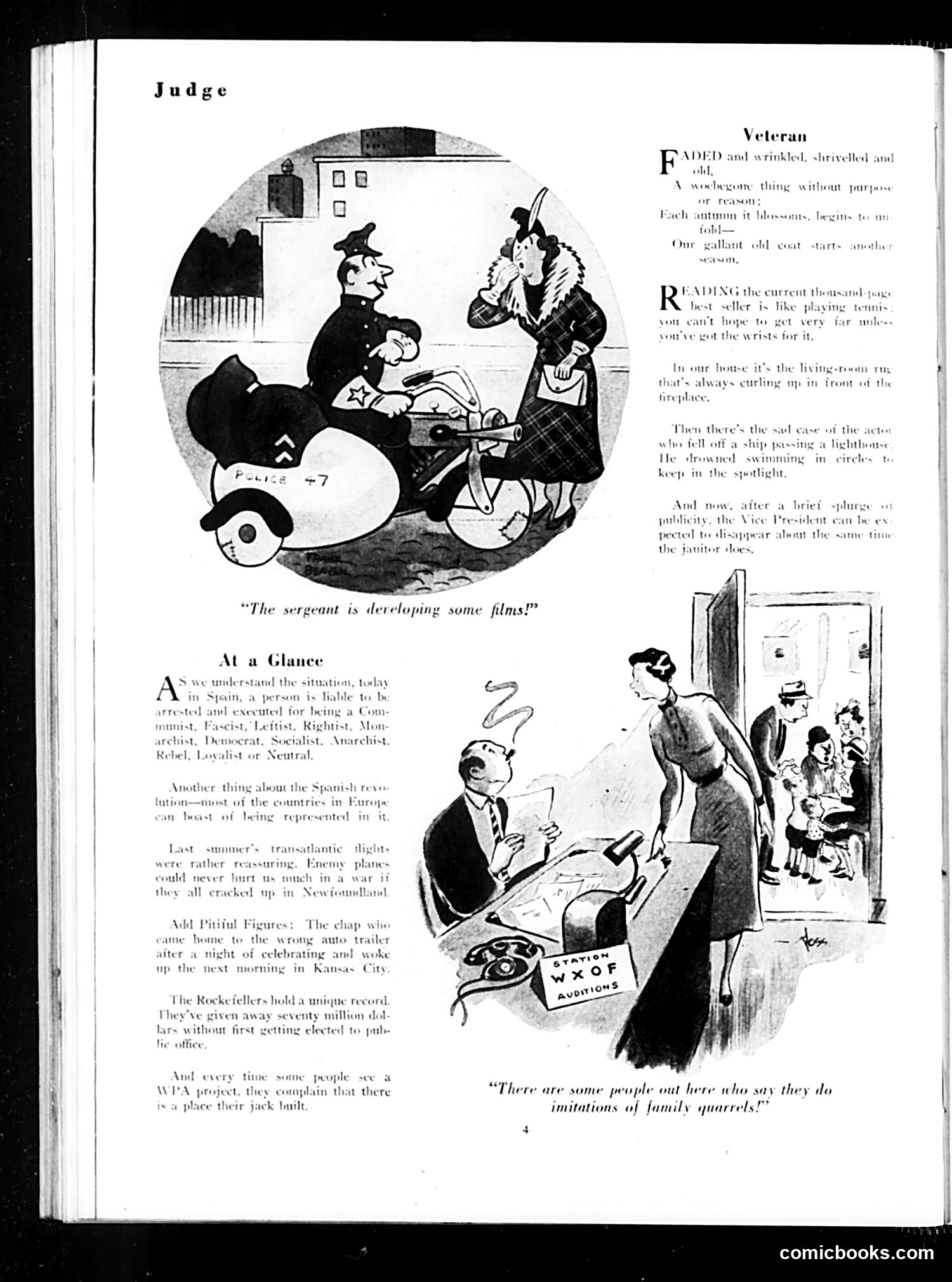
Analysis The page contains two cartoons satirizing 1930s-era politics and bureaucracy. The top cartoon, "The sergeant is developing some films!" depicts a police officer showing photographs to a woman, likely referencing political surveillance or evidence gathering during an era of significant political tension (references to Communists, Fascists, and various political ideologies appear in the text). The bottom cartoon, "There are some people out here who say they do imitations of family quarrels!" shows an office labeled "Station House of Auditions," where a woman auditions before officials. This appears to mock either WPA arts programs or police/government bureaucratic processes of the Depression era—the satirical point being the absurdity of auditioning or justifying oneself before government authority. Both cartoons reflect Judge magazine's skepticism toward New Deal programs and expanding government power.
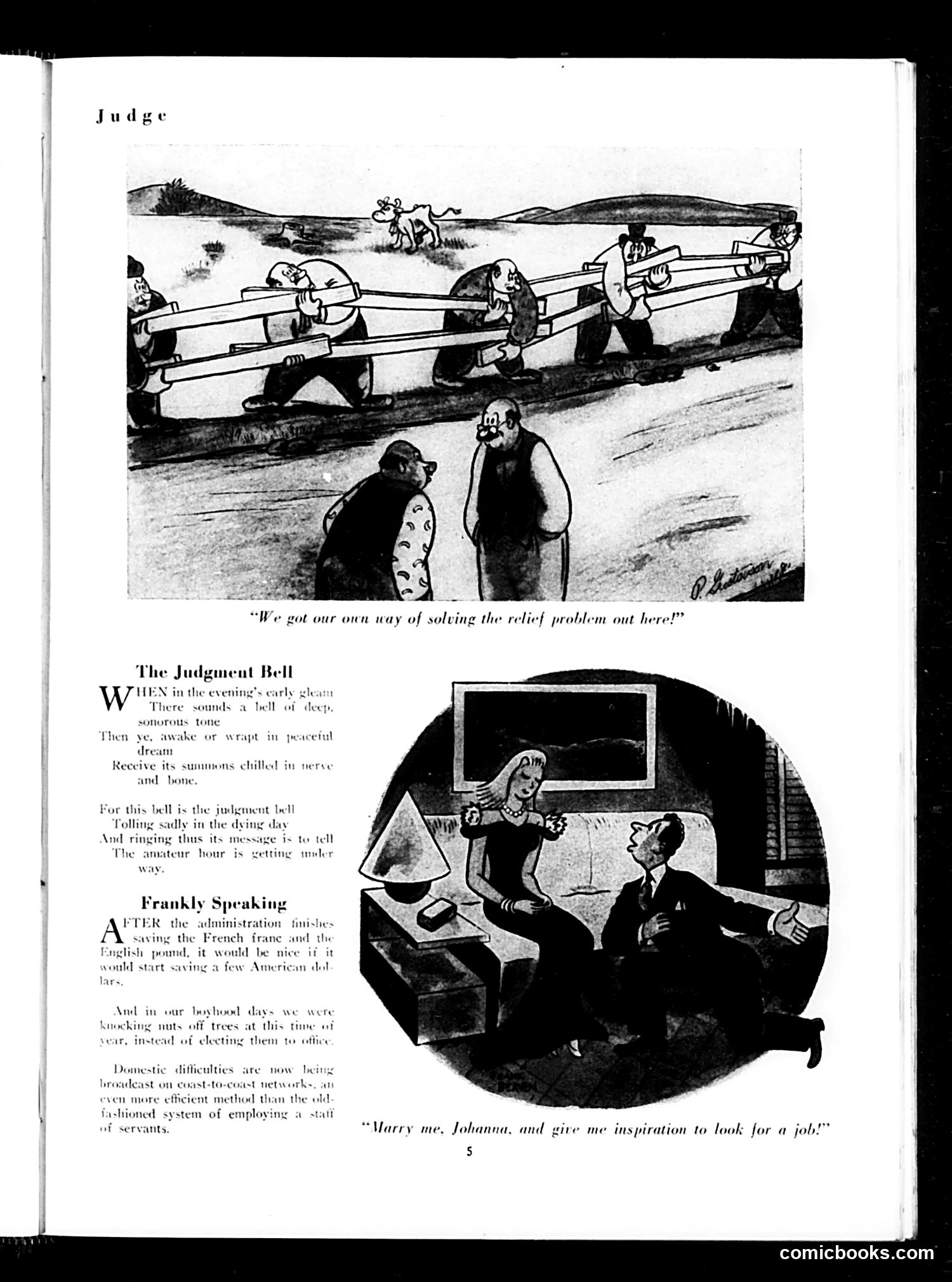
Analysis of Judge Magazine Page This page contains two satirical pieces from Judge magazine: "The Judgment Bell" (top cartoon): Shows figures operating a large seesaw-like contraption labeled as a mechanism for "solving the relief problem." The satire appears to mock ineffective government relief policies—suggesting bureaucratic approaches to poverty assistance were absurdly mechanical and unbalanced rather than genuinely helpful. "Frankly Speaking" (bottom cartoon): A woman asks a man to "Marry me, Johanna, and give me inspiration to look for a job!" The accompanying text discusses employment difficulties and mentions "domestic difficulties" being broadcast on radio networks. This satirizes how economic hardship (likely Depression-era) was affecting marriage prospects and employment, while also mocking how personal problems became public entertainment through radio broadcasts.
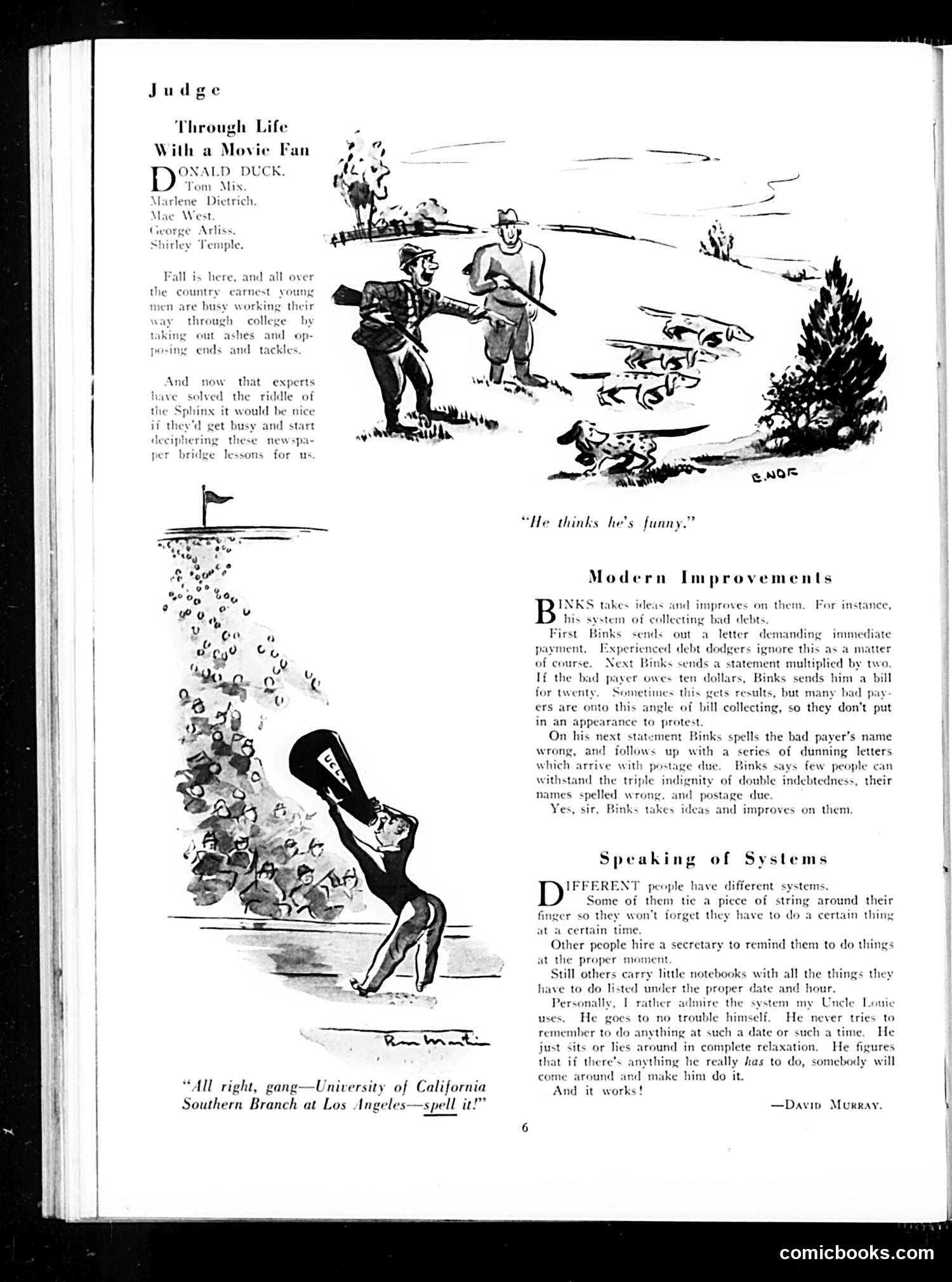
Analysis of Judge Magazine Page This page contains two distinct sections: Top Section - "Through Life With a Movie Fan": A cartoon satirizing movie fan culture, featuring Donald Duck and other celebrities (Marlene Dietrich, Mae West, George Arliss, Shirley Temple). The gag depicts an overeager fan explaining film references to someone golfing, suggesting how movie enthusiasts impose cinema knowledge on everyday situations. Bottom Section - "Modern Improvements" and "Speaking of Systems": These are short humorous essays with accompanying cartoons. "Modern Improvements" ridicules a debt collector's elaborate system for pursuing debtors through intentionally misspelled letters and excessive postage. "Speaking of Systems" humorously contrasts different organizational methods people use, ultimately praising those who rely on others to remind them of obligations rather than self-discipline. The satire targets bureaucratic absurdity and modern life inefficiencies.
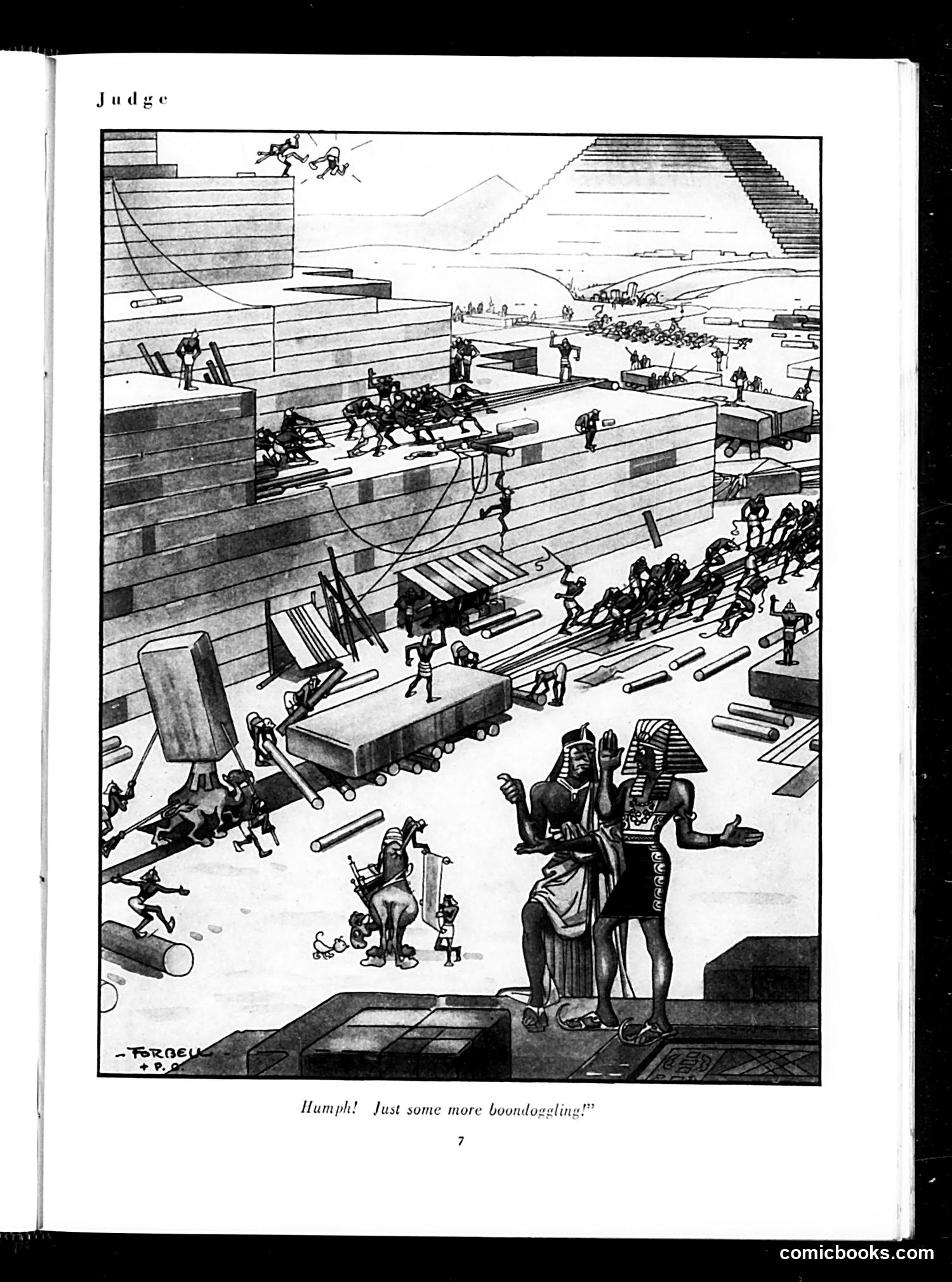
Analysis of "Judge" Cartoon Page This page depicts an Egyptian construction scene, likely referencing pyramid-building. The foreground shows Egyptian figures in traditional dress (including what appears to be pharaohs or nobles in elaborate headdresses) observing enslaved workers hauling massive stone blocks and logs. The caption reads: "Humph! Just some more boondoggling!" "Boondoggling" was 1930s slang for wasteful government spending on make-work projects. This cartoon satirizes New Deal programs (likely WPA or similar relief initiatives) by comparing them to ancient Egyptian slave labor—suggesting such public works are pointless, wasteful, and exploitative. The joke equates Depression-era relief efforts with inefficient, tyrannical practices, criticizing government intervention in the economy during Franklin Roosevelt's administration.
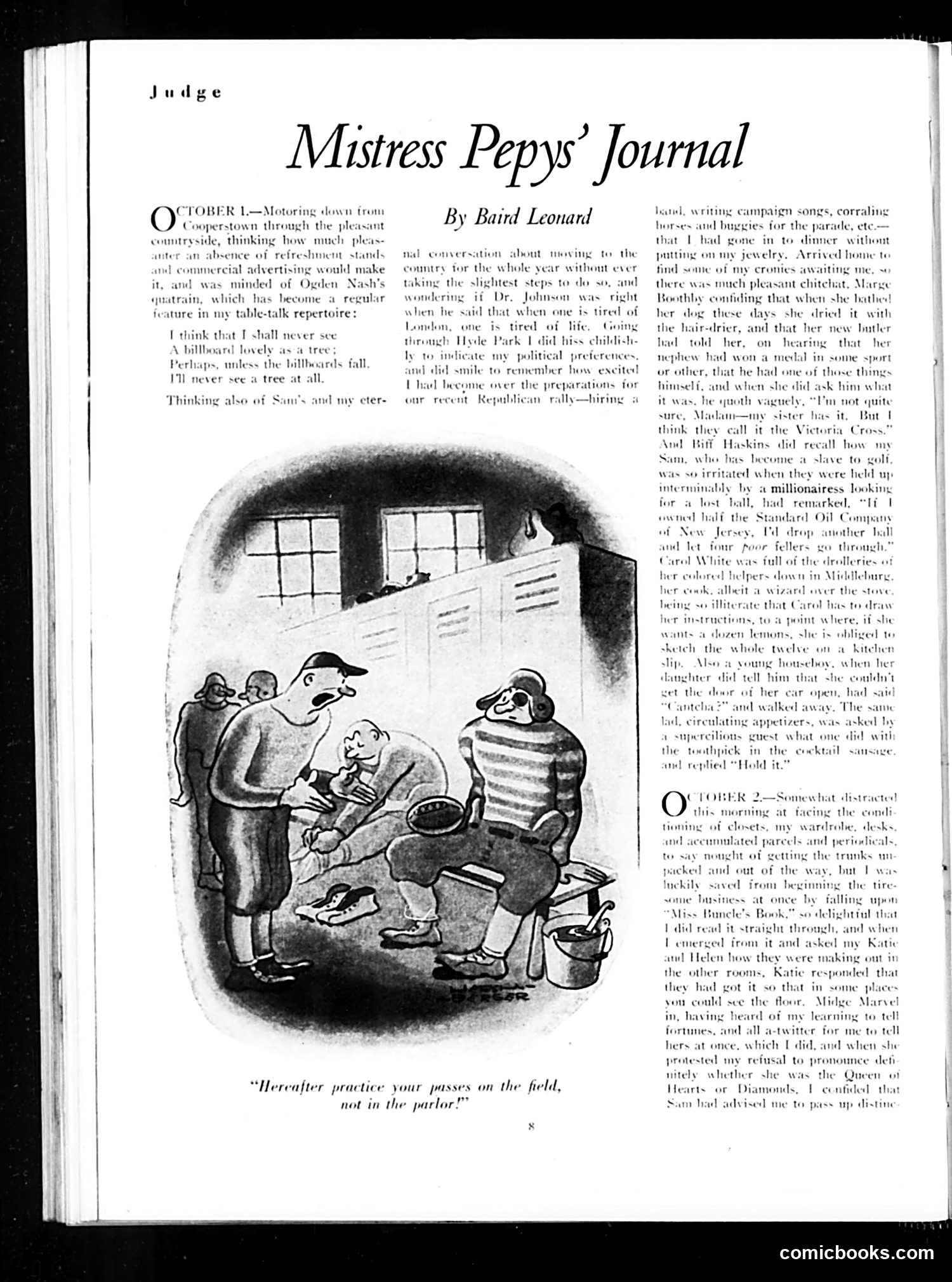
Mistress Pepys' Journal - October 1-2 This is a humorous column by Baird Leonard mimicking Samuel Pepys's famous diary, written from a society woman's perspective. The accompanying cartoon shows a man instructing others: "Hereafter practice your passes on the field, not in the parlor!"—a joke about football players' romantic behavior. The column's satire targets American upper-class life circa early 20th century: obsession with automobiles, billboard advertising (referencing Ogden Nash's famous quatrain about never seeing a billboard), golf culture, and servants' malapropisms. Notable references include: - Political enthusiasm at a Republican rally (likely 1920s-era) - Standard Oil Company (major contemporary corporation) - "Victoria Cross" (military decoration, humorously confused by a servant) - Society gossip about wealthy acquaintances and their domestic staff's amusing incompetence The humor relies on readers recognizing these social markers and finding genteel mockery of the leisure class entertaining—a core Judge magazine audience appeal.
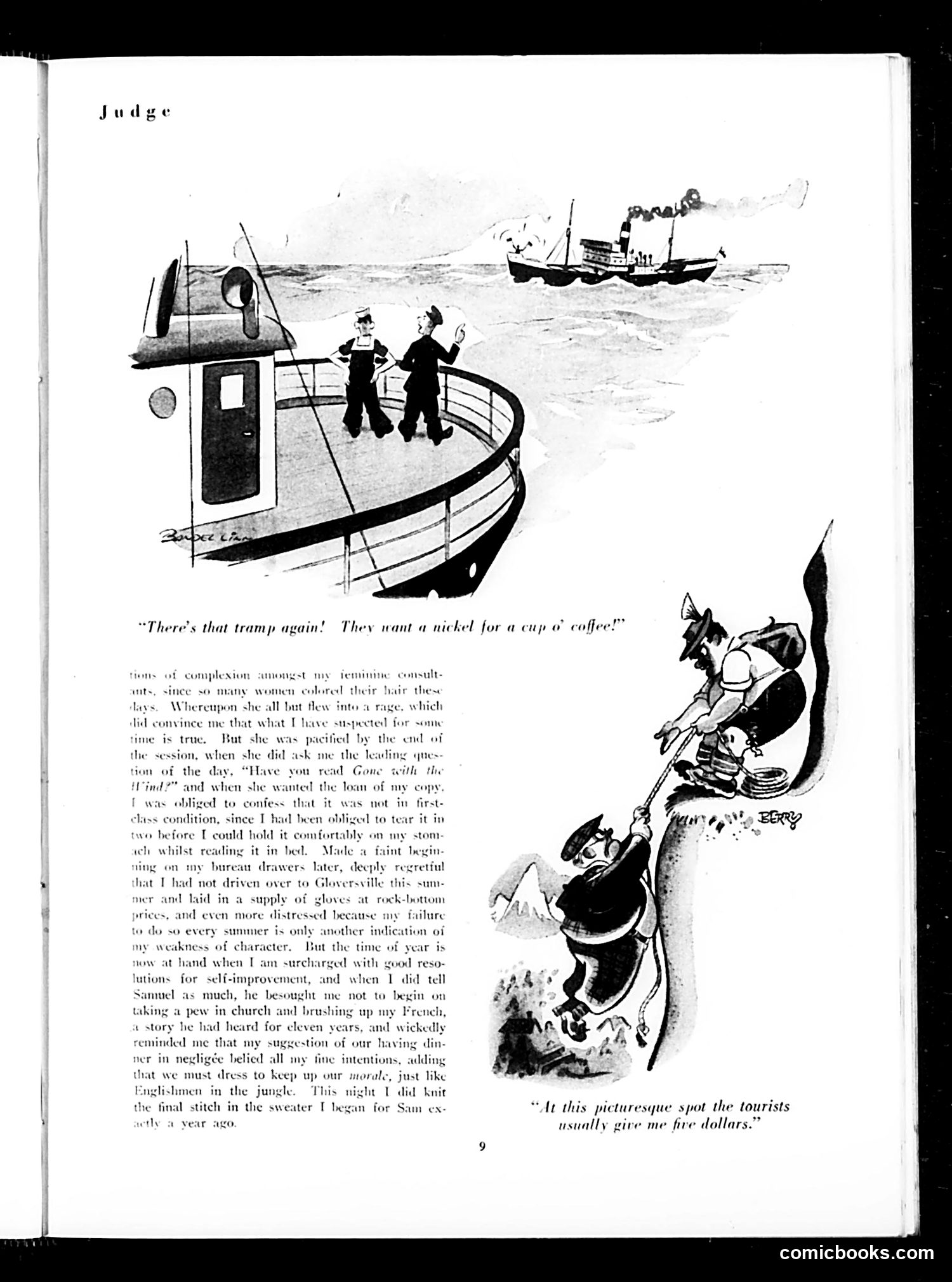
Page Analysis: Judge Magazine This page contains two cartoons satirizing Depression-era poverty and tourism. Top cartoon: Two working-class men on a boat observe a tramp approaching, complaining "They want a nickel for a cup o' coffee!" The satire mocks the entitled attitude of the employed toward the unemployed poor—treating desperate requests for survival money as tiresome nuisances rather than genuine need. Bottom cartoon: A Native American (likely depicted in a stereotypical manner common to the era) stands at a scenic location, remarking that tourists usually give him five dollars there. The satire appears to mock both tourist exploitation of indigenous peoples and the performative, transactional nature of such encounters—reducing cultural authenticity to a photo-op with a tip. The accompanying text discusses a woman's social anxieties and self-improvement resolutions, seemingly unrelated to the cartoons. Both cartoons reflect 1930s-40s attitudes toward class, poverty, and ethnic stereotyping that modern readers would find offensive.
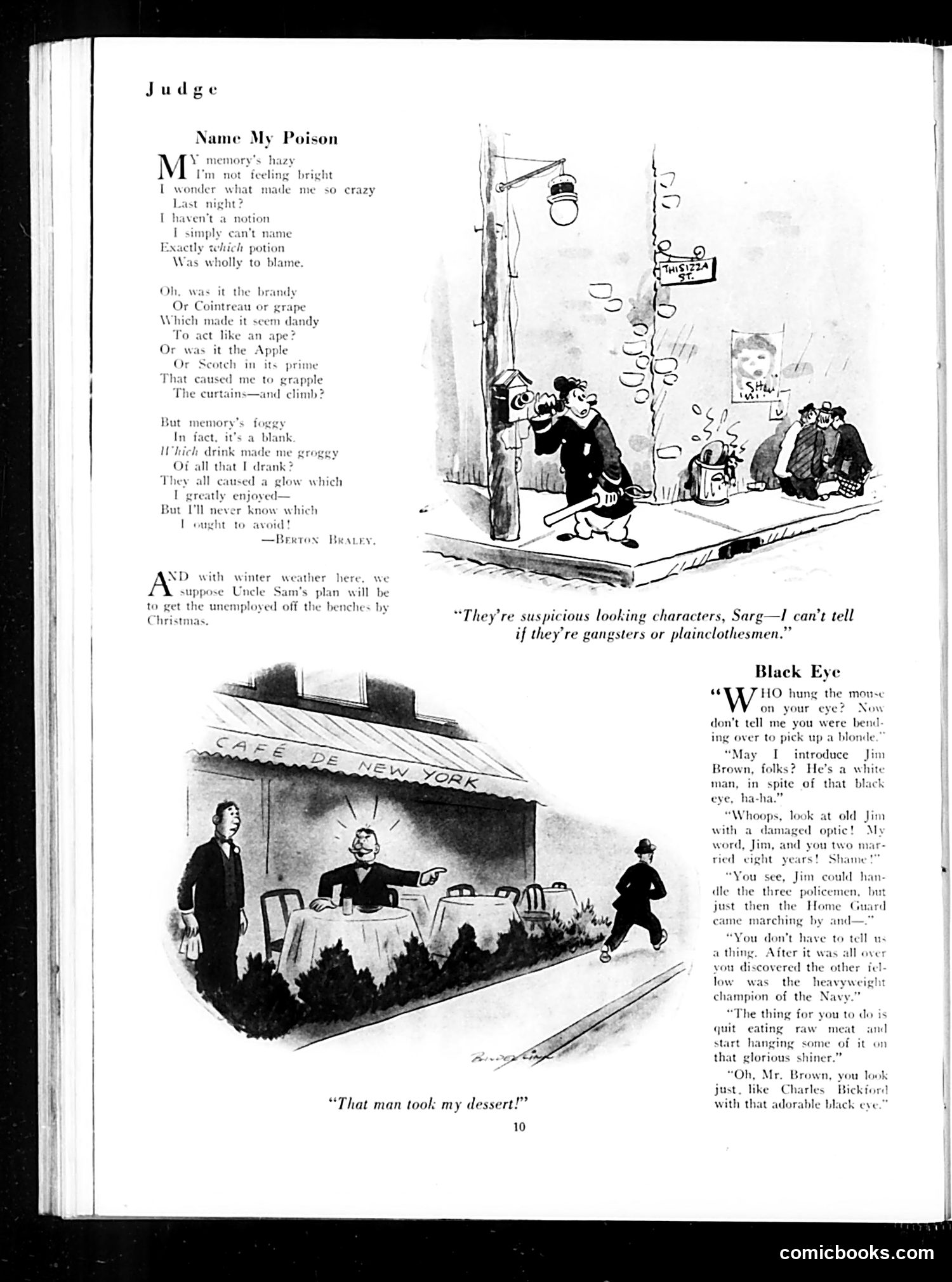
Judge Magazine Page Analysis This page contains three separate humor pieces from Judge magazine: "Name My Poison" (poem by Breton Brayley): Satirizes Prohibition-era drinking. A hungover narrator can't remember which alcoholic beverage caused his intoxication—brandy, Cointreau, grape wine, apple liquor, or Scotch—mocking both the variety of illegal drinks available during Prohibition and the common excuse of feigned amnesia about one's drinking. Top cartoon: References unemployment during what appears to be the Great Depression, with Uncle Sam supposedly planning to employ the jobless by winter. "Black Eye" (dialogue): A series of jokes about a man with a black eye. The humor derives from increasingly absurd explanations—he fought policemen, then the Home Guard, then discovered his opponent was a Navy heavyweight champion. The final joke compares him to actor Charles Bickford, suggesting his shiner makes him look distinguished or movie-star-like. This appears to be light domestic comedy rather than political satire.
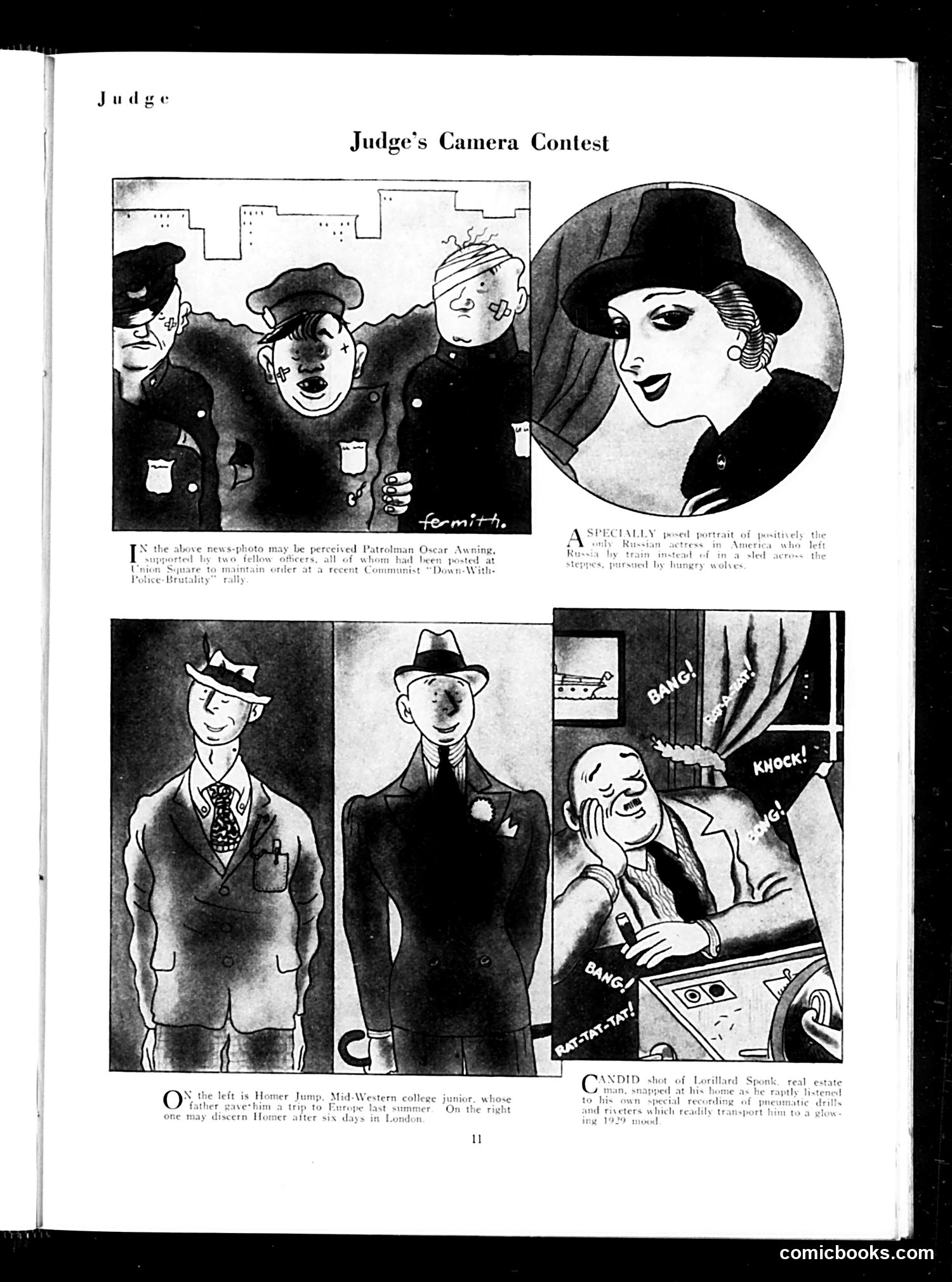
Judge's Camera Contest This page presents a satirical "camera contest" showcasing humorous photographs and caricatures. The top section mocks a "Communist Down-With-Police Brutality" rally, depicting Patrolman Oscar Awning and police officers confronted by protesters—likely satirizing 1920s labor activism and communist sympathies. The circular portrait features a Russian actress in America, referenced as fleeing "across frozen steppes, pursued by hungry wolves"—mocking both émigré narratives and anti-Soviet sentiment. Bottom panels show Homer Jump (a college junior whose father gave him a trip to Europe) and "Candid shot of Lordlaid Spook," a real estate dealer recording pneumatic drills and rivets. These appear to be humorous "candid camera" entries—the contest satirizes the novelty of candid photography while poking fun at various social types and contemporary preoccupations with technology and modern life.
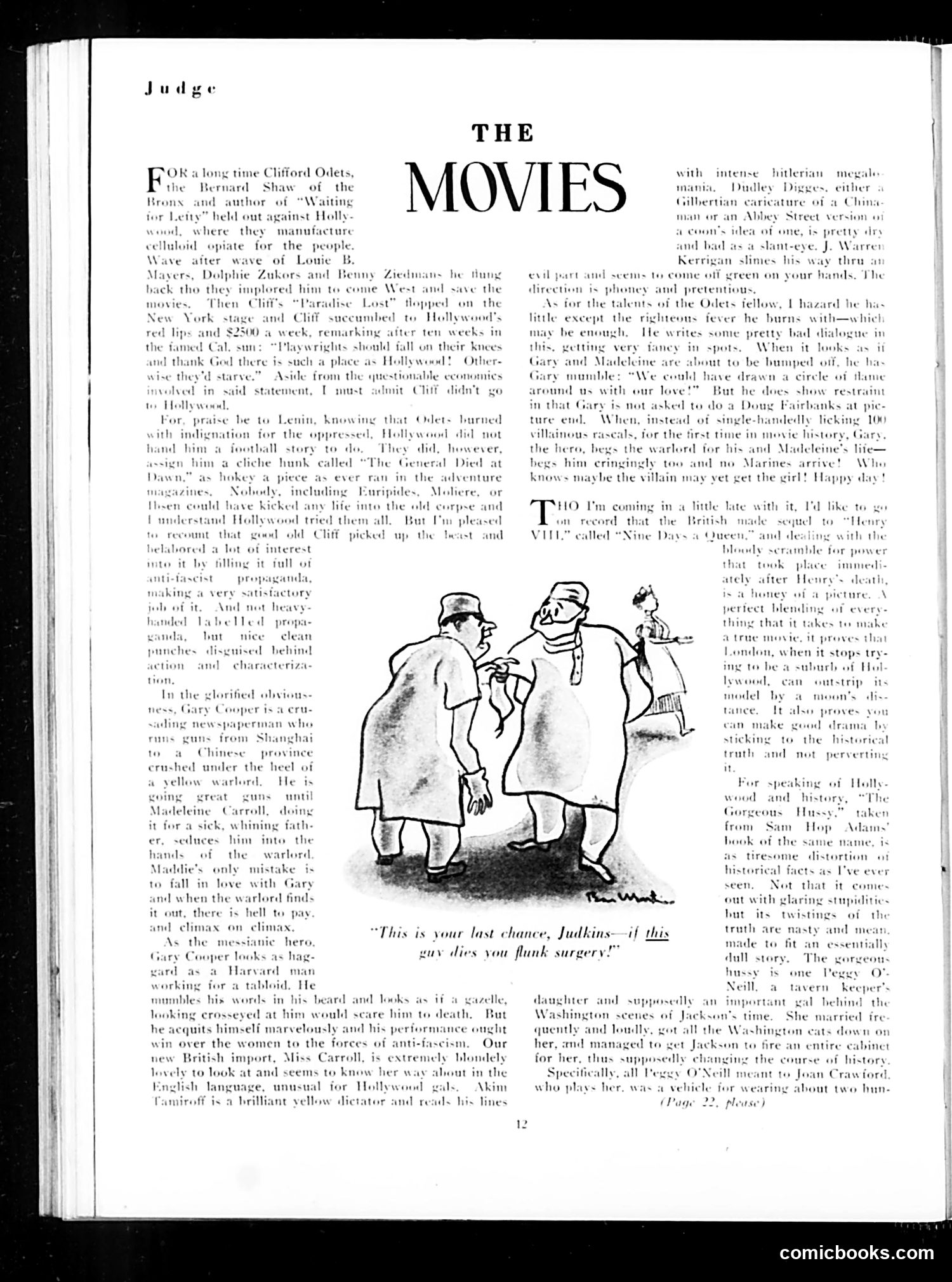
"The Movies" - Judge Magazine Film Criticism This page reviews recent Hollywood films, particularly criticizing how cinema has compromised serious playwrights. The text laments that Clifford Odets—"the Bernard Shaw of the Bronx"—abandoned his socialist theatrical principles for studio money, surrendering to Hollywood's commercial demands. The cartoon depicts two heavyset men in conversation, with the caption: "This is your last chance, Judkins—if this guy dies you flunk surgery!" This appears to be satirizing Hollywood's crude, mechanical approach to storytelling—treating dramatic tension like medical procedure rather than art. The review dismisses recent films as historically inaccurate and dramatically dishonest. It criticizes Gary Cooper vehicles for melodramatic contrivance and praises British film "Nine Days a Queen" for maintaining historical truthfulness while still entertaining audiences. The underlying satire targets how American studios prioritize spectacle and sentiment over artistic integrity, having lured talented writers away from serious theater.
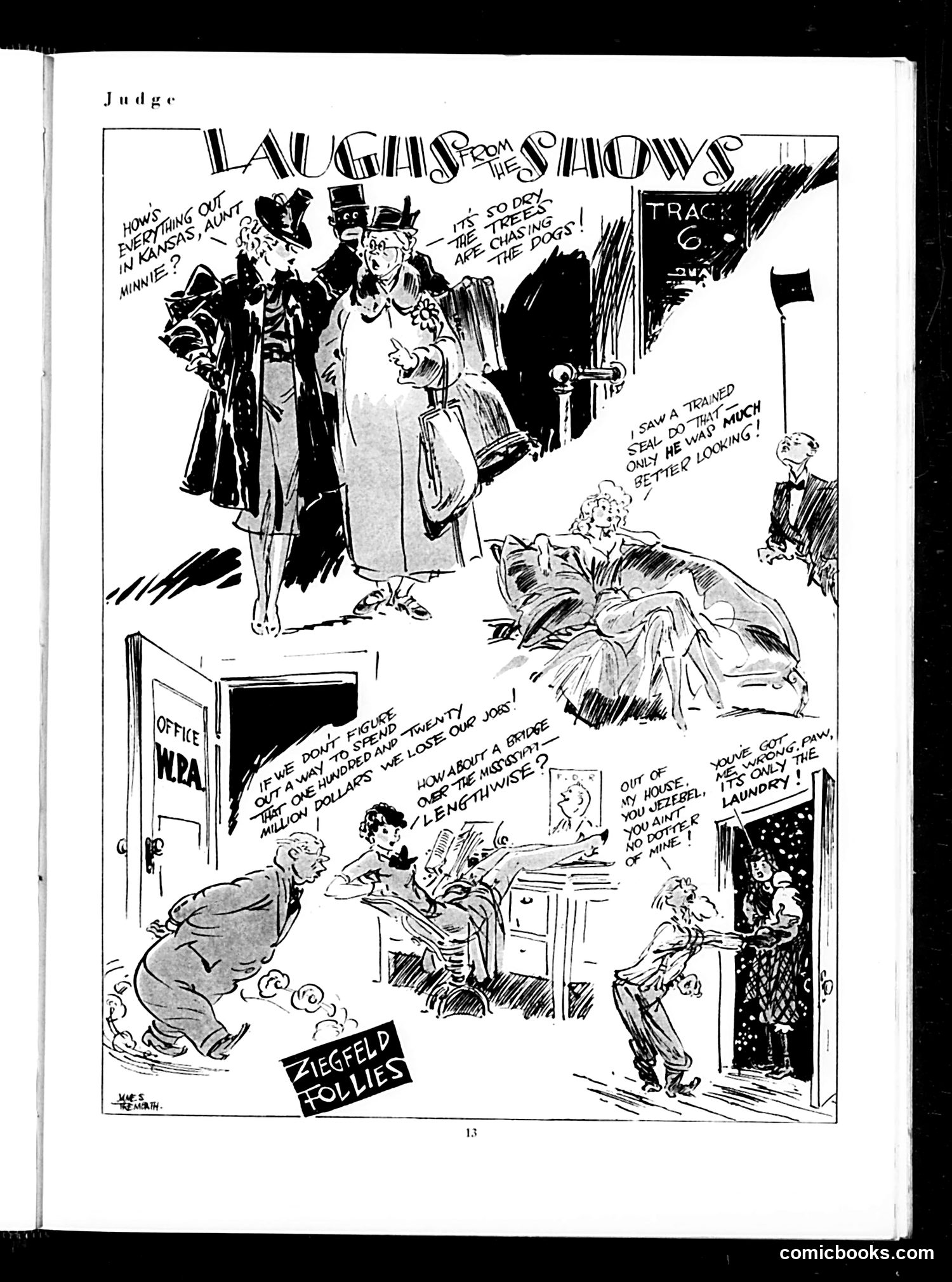
"Laughs from the Shadows" This cartoon satirizes the Works Progress Administration (WPA), a New Deal program. The top panel shows elegantly dressed theater-goers discussing a "Ziegfeld Follies" show. The bottom panel depicts a WPA office where bureaucrats debate funding priorities—specifically complaining about allocating money to arts programs while bridges need repair and laundry services are inadequate. The satire critiques the perceived absurdity of government spending on theatrical productions during economic hardship. The contrast between the refined entertainment venue above and the struggling office below emphasizes the disconnect between cultural aspirations and practical needs. The cartoon reflects contemporary political debate over whether Depression-era arts funding was justified or wasteful spending.
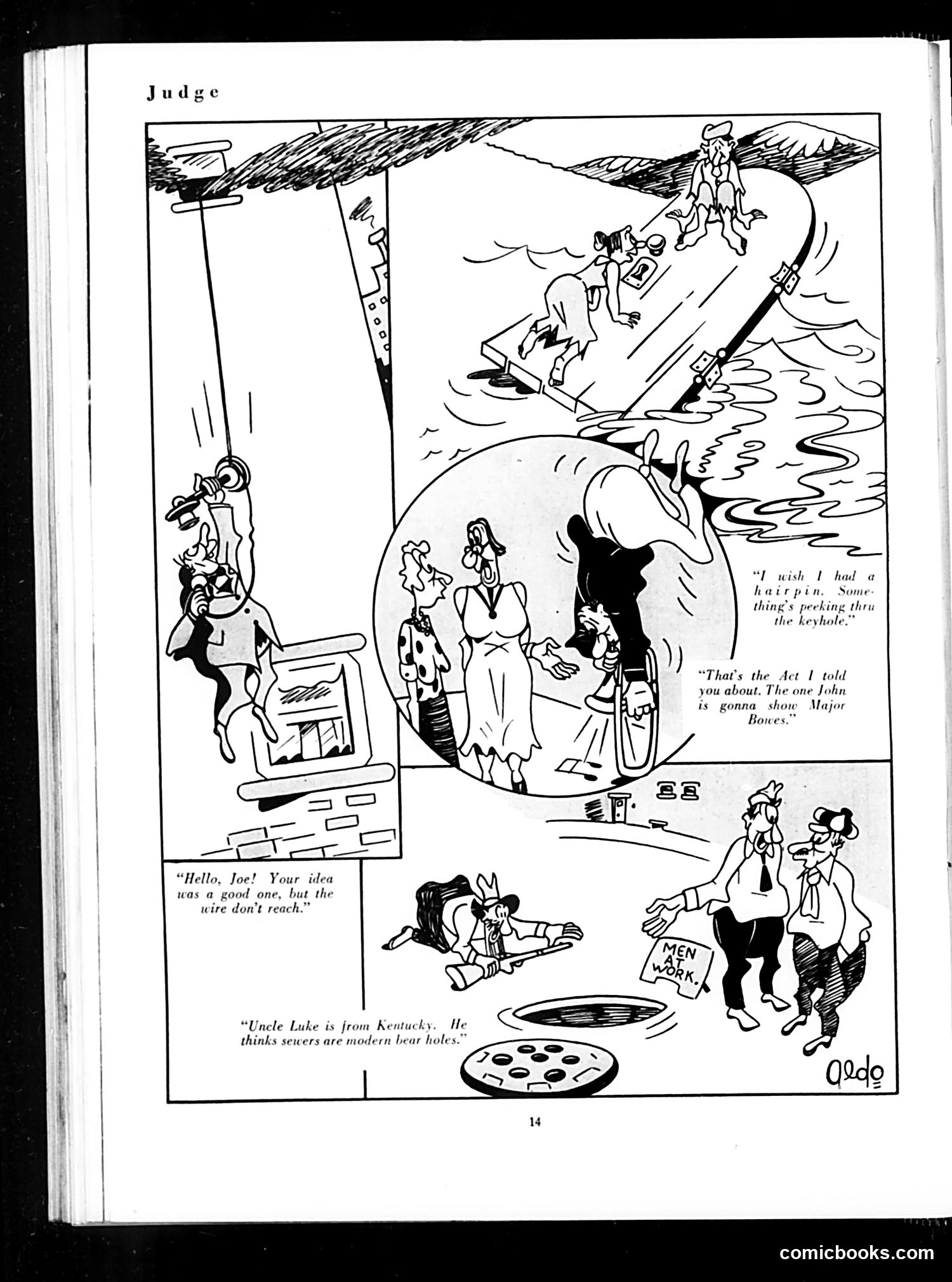
Judge Magazine Cartoon Analysis This single-panel cartoon satirizes bureaucratic incompetence and miscommunication. A judge character attempts to execute a plan via telephone wire strung across buildings, but the wire doesn't reach its destination—a literal visual gag about failed communication. The dialogue references "the Act" and "Major Bowes," suggesting this relates to a specific contemporary law or public figure. The characters appear to be officials or judges dealing with implementation problems. The humor derives from the absurdity of the setup: rather than simply noting the wire's insufficient length, the cartoon exaggerates the predicament visually. The title "Judge" and the formal setting suggest commentary on legal or governmental inefficiency—a common satirical target. Without clearer identification of the specific Act or Major Bowes reference, the precise political meaning remains unclear, though it likely critiqued a recent policy or administrative failure.
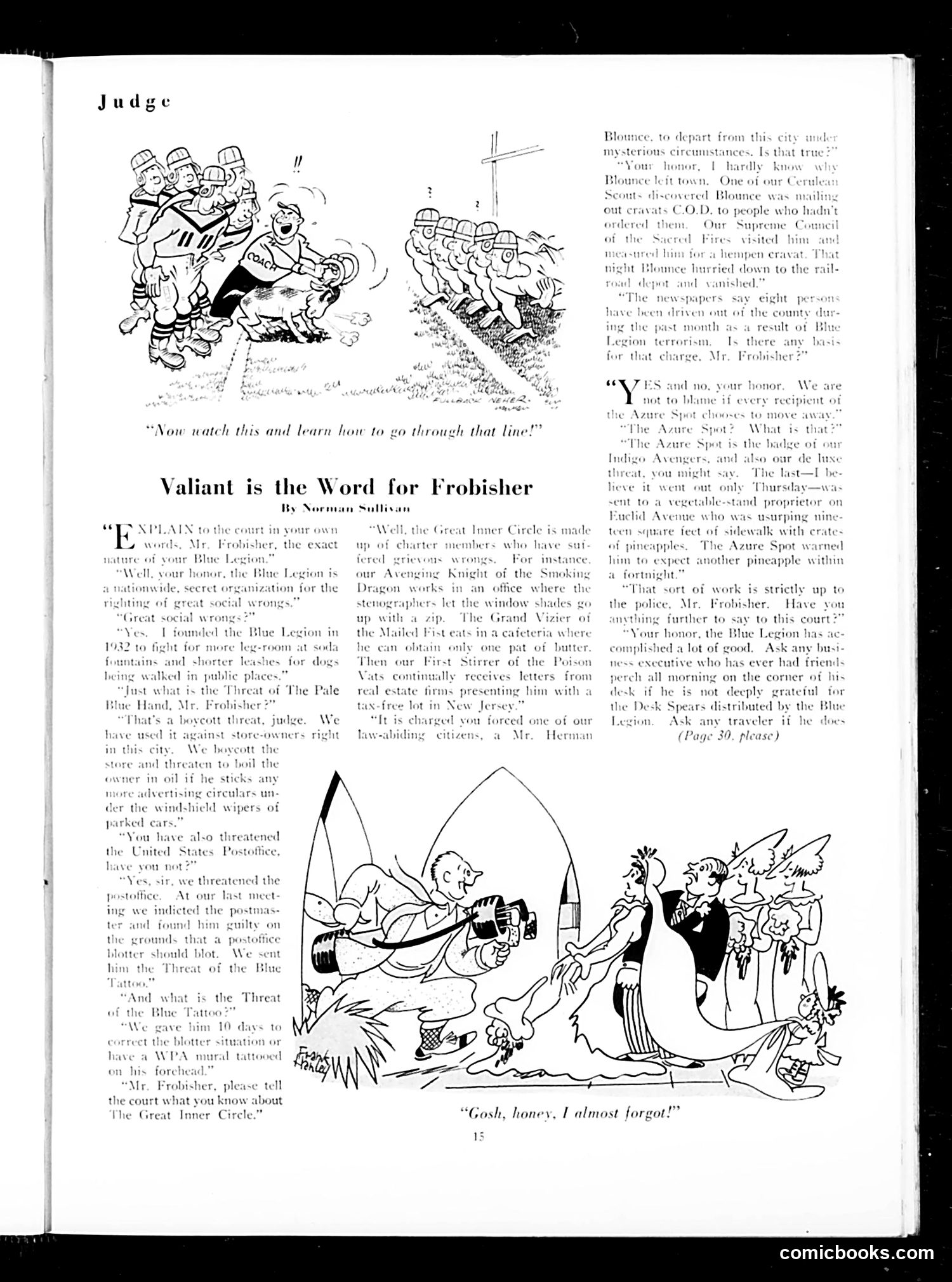
Analysis of Judge Magazine Page This page satirizes the "Blue Legion," a vigilante organization claiming to fight social disorder. The courtroom scene (top cartoon) depicts Mr. Frobisher defending the group's intimidation tactics—boiling oil threats, windshield-wiper circulars, postal threats—against a judge. The satire targets the Legion's absurd internal bureaucracy: the "Great Inner Circle" with theatrical titles like "Grand Vizier" and "Stirrer of the Poison Vats," mocking how secret organizations adopt grandiose structures. The Legion's actual activities are comically contradictory—they mail unsolicited cravats and warn people about pineapples on sidewalks, suggesting their "crime-fighting" is petty and self-invented. The bottom cartoon shows them celebrating a wedding, ironically undercutting their serious vigilante pretense. The piece mocks both vigilantism and the absurd bureaucratic theater organizations use to justify extralegal violence. Without exact dates visible, the context suggests 1930s concerns about private militia groups.
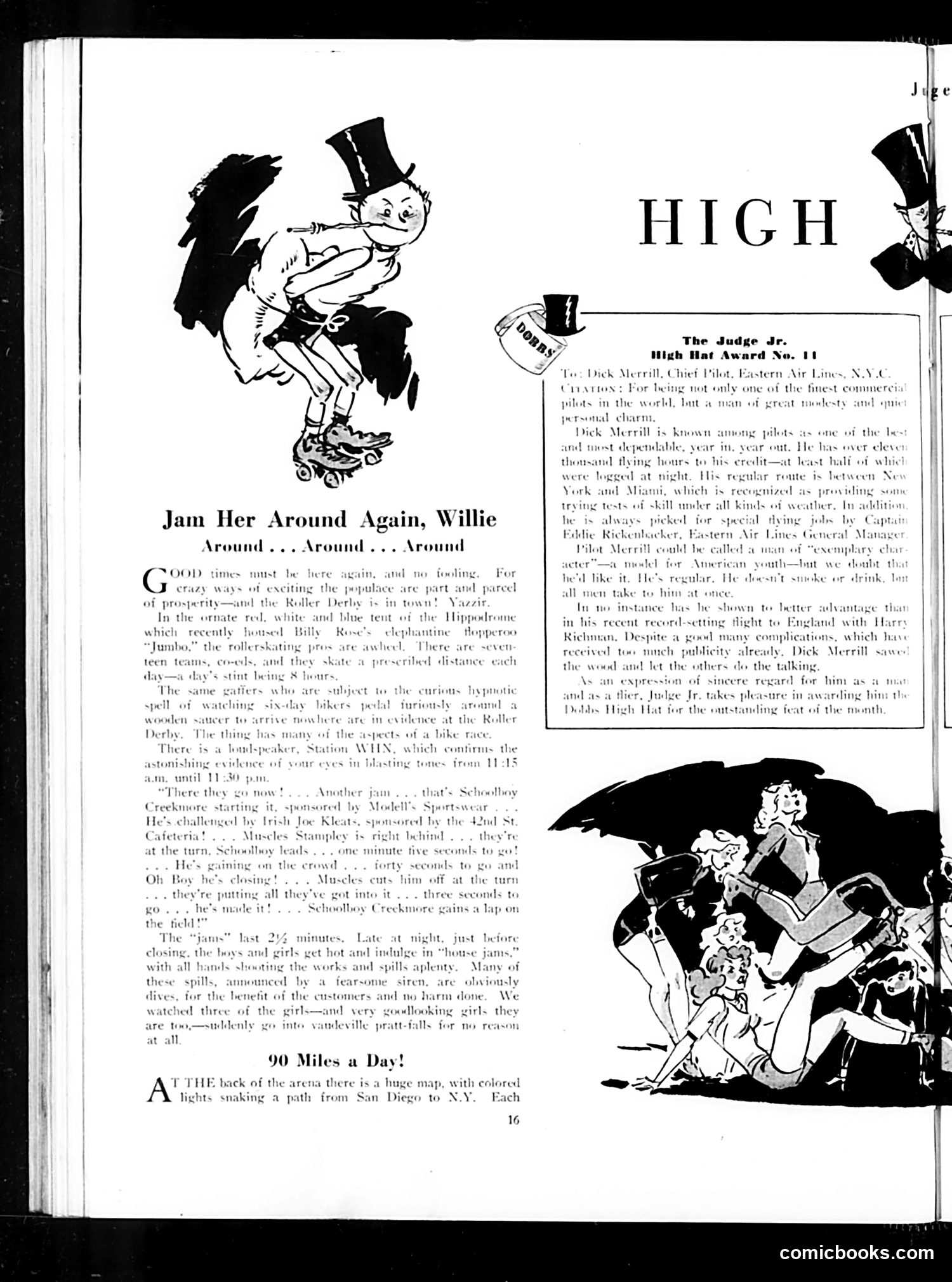
Explanation for Modern Readers This Judge magazine page celebrates Dick Merrill, Chief Pilot for Eastern Air Lines, with a "High Hat Award." The text praises Merrill as exceptionally skilled, reliable, and modest—a model of American character. He's being honored for a record-setting flight to England with Harry Richman (a entertainer of the era). The left cartoon shows a caricatured figure riding roller skates on a unicycle while juggling and holding an umbrella—a visual pun representing the chaotic excitement of the Roller Derby, which the text describes as one of the era's popular entertainment spectacles. The accompanying article celebrates various thrilling venues (Hippodrome, six-day bike races) that drew crowds during this period. The right illustration depicts spectators at what appears to be a roller derby event, showing the public's enthusiastic response to this sport. The satire is gentle: Judge celebrates both aviation achievement (Merrill) and popular entertainment (roller derby) as distinctly American cultural phenomena.
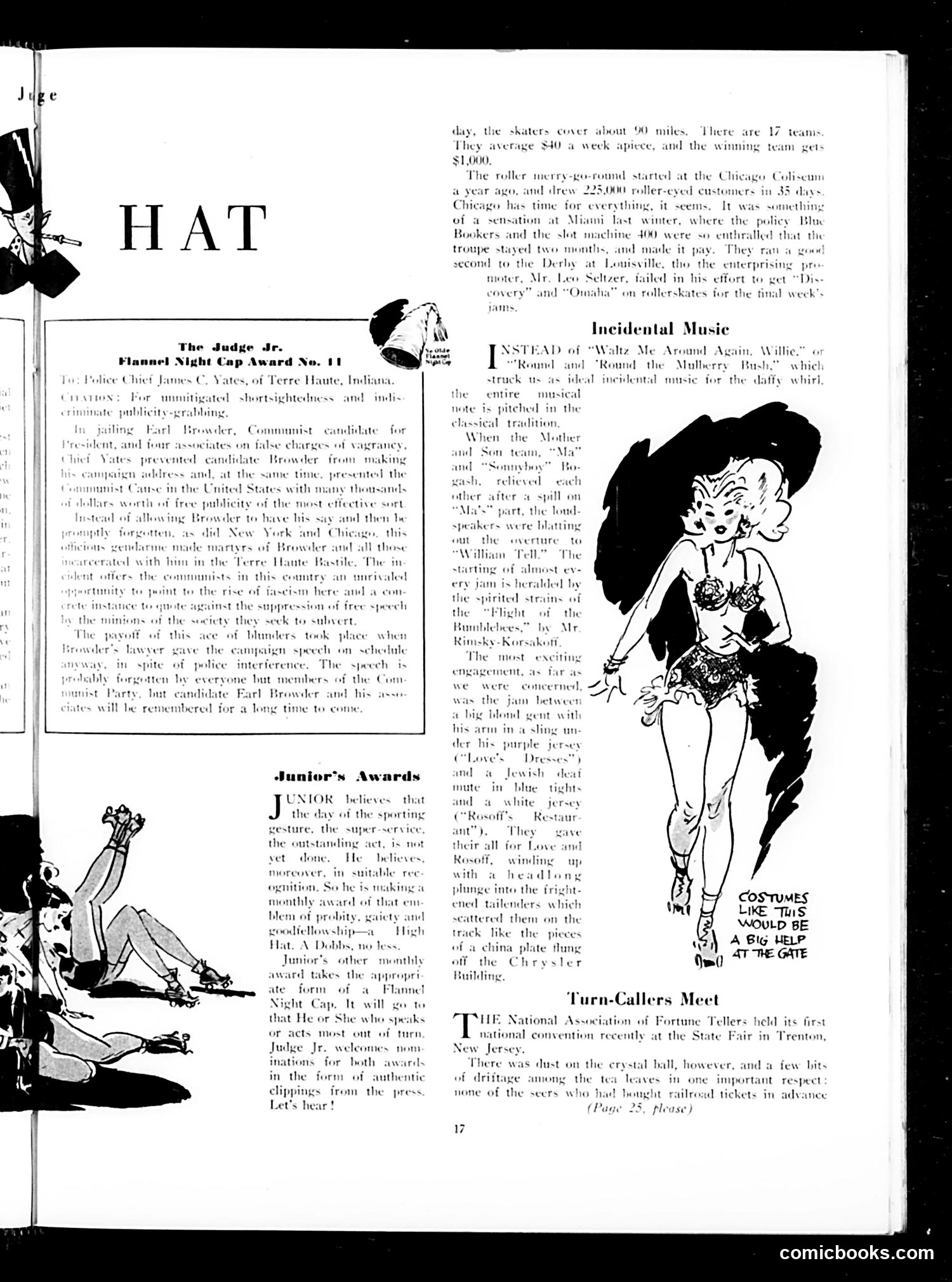
Analysis of Judge Magazine Page This page contains several separate satirical pieces: "The Judge Jr. Flannel Night Cap Award" mocks Police Chief James C. Yates of Terre Haute, Indiana for arresting Communist presidential candidate Earl Browder while simultaneously giving him free publicity. The satire suggests Yates' heavy-handed censorship actually helped Browder's campaign—by preventing his speech but publicizing the suppression, Yates inadvertently drew attention to him, similar to how New York and Chicago handled Browder. "Junior's Awards" announces monthly satirical awards celebrating outstanding public figures and foolish acts, using cartoonish illustrations. "Incidental Music" humorously notes that roller-skating performances use classical music ("Flight of the Bumblebees") rather than popular songs, finding the juxtaposition amusing. "Turn-Callers Meet" briefly reports on a fortune-tellers' convention at a New Jersey state fair, joking that despite their supposed psychic abilities, none had advance knowledge to book railroad tickets. The page reflects 1930s concerns about communism, censorship, and Americana entertainment.
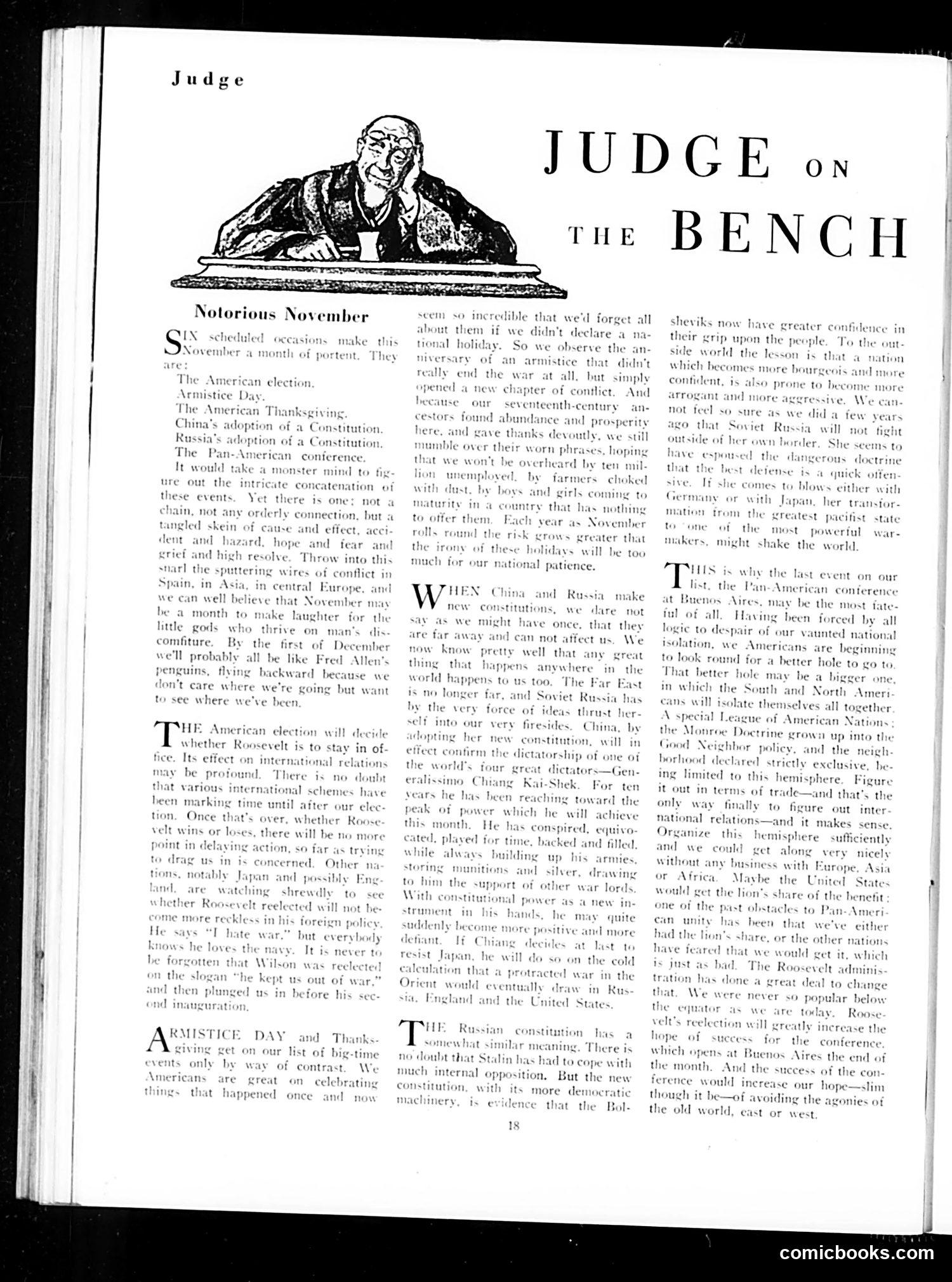
Judge Magazine: "Judge on the Bench" - November 1933 This editorial cartoon page features a judge character discussing major November events and their geopolitical implications. The piece addresses six significant occurrences: the American election, Armistice Day, Thanksgiving, China's new constitution, Russia's constitution, and the upcoming Pan-American conference. The satirical point critiques America's naive isolationism. The author argues that events in distant China and Russia—particularly Chiang Kai-Shek's and Stalin's consolidations of dictatorial power—directly affect American interests, despite Americans believing they can ignore foreign affairs. The satire suggests that the Pan-American conference offers hope for hemispheric unity and isolation, though the author remains skeptical about avoiding global conflict. The underlying message: Americans wrongly assume distance protects them from world events; geopolitical developments abroad inevitably impact home security and prosperity.
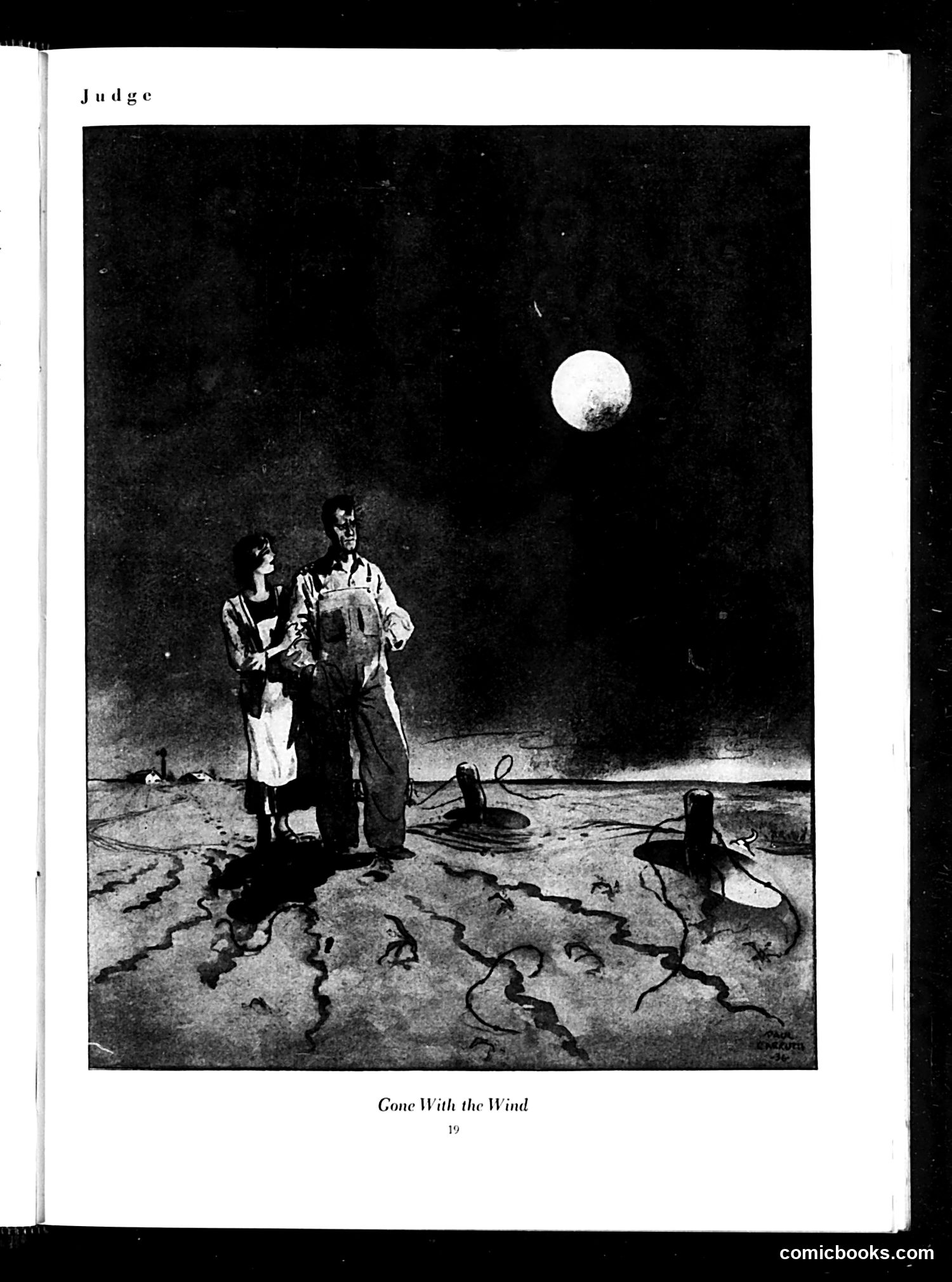
Judge Magazine - "Gone With the Wind" This page appears to be from Judge magazine and shows a theatrical or film still labeled "Gone With the Wind." The image depicts two figures standing on what appears to be a barren landscape with a large moon above them and various props or set pieces scattered around. Without additional context from the page (such as accompanying text, captions, or the publication date visible in the source), I cannot definitively identify the specific political or social satire intended. The title "Gone With the Wind" could reference the famous novel/film, or it could be a satirical commentary on something else entirely. The barren setting and theatrical staging suggest this may be mocking a particular production, cultural trend, or social phenomenon, but the specific target of the satire remains unclear from the image alone.
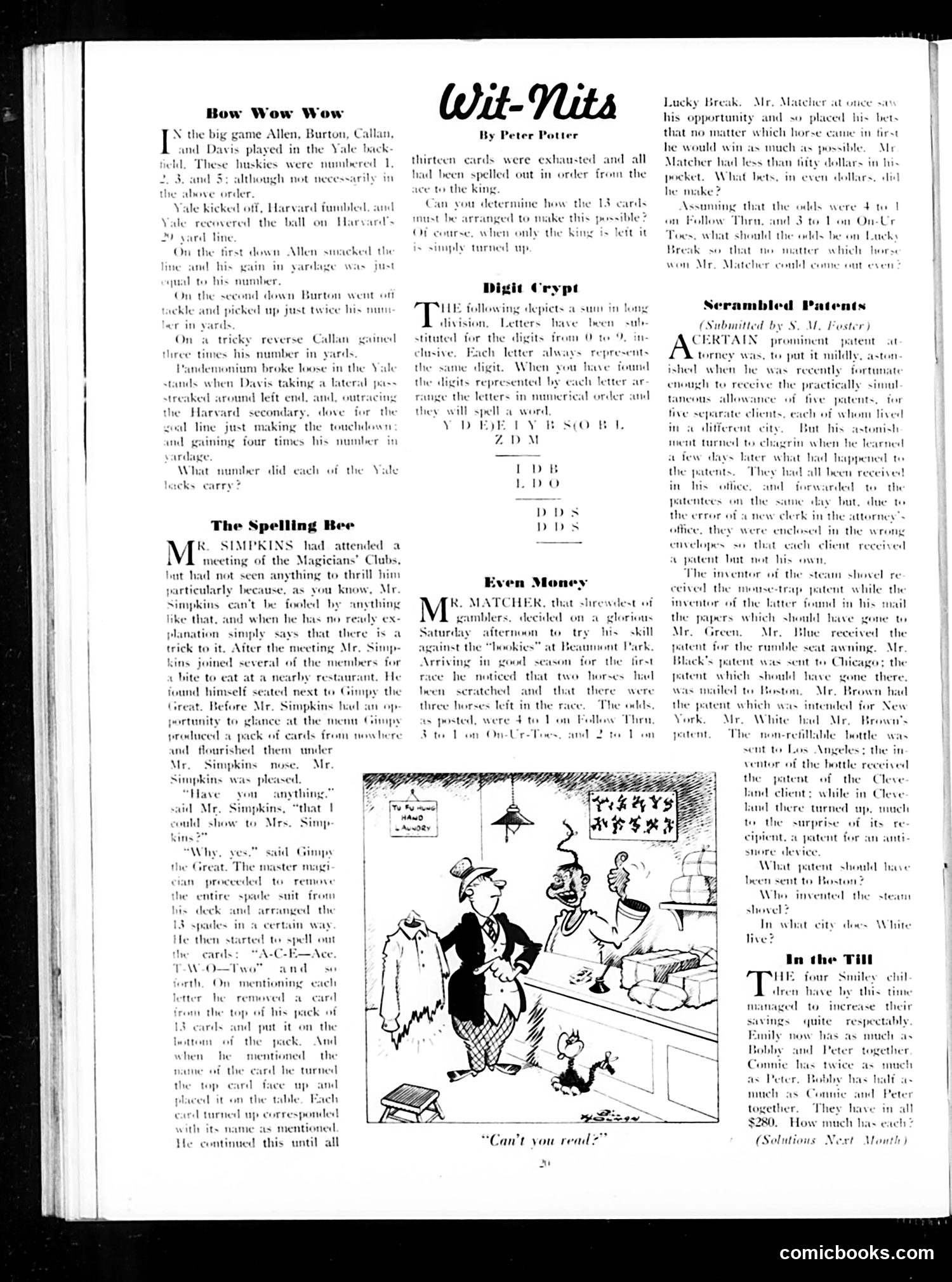
What This Page Means This is a puzzle and humor page from *Judge* magazine featuring three recreational brain-teasers popular in early 20th-century magazines. "Bow Wow Wow" presents a math puzzle about a Yale football game where players gain yards corresponding to their jersey numbers. "Digit Crypt" is a substitution cipher where readers replace letters with digits to solve a hidden word—a common puzzle type of the era. "The Spelling Bee" and "Even Money" are humorous anecdotes. The cartoon depicts Mr. Simpkins, a magician-club member, who claims all magic tricks have rational explanations. The "Even Money" story satirizes Mr. Matcher, a gambler who places clever hedged bets at horse races to guarantee profit regardless of outcome—illustrating period fascination with probability and gaming strategy. The cartoon shows Simpkins being challenged by "Gimpy the Great," apparently a stage magician, setting up comedic tension between Simpkins's skepticism and actual illusion. These puzzles and jokes reflect genteel entertainment for educated, leisure-class readers.
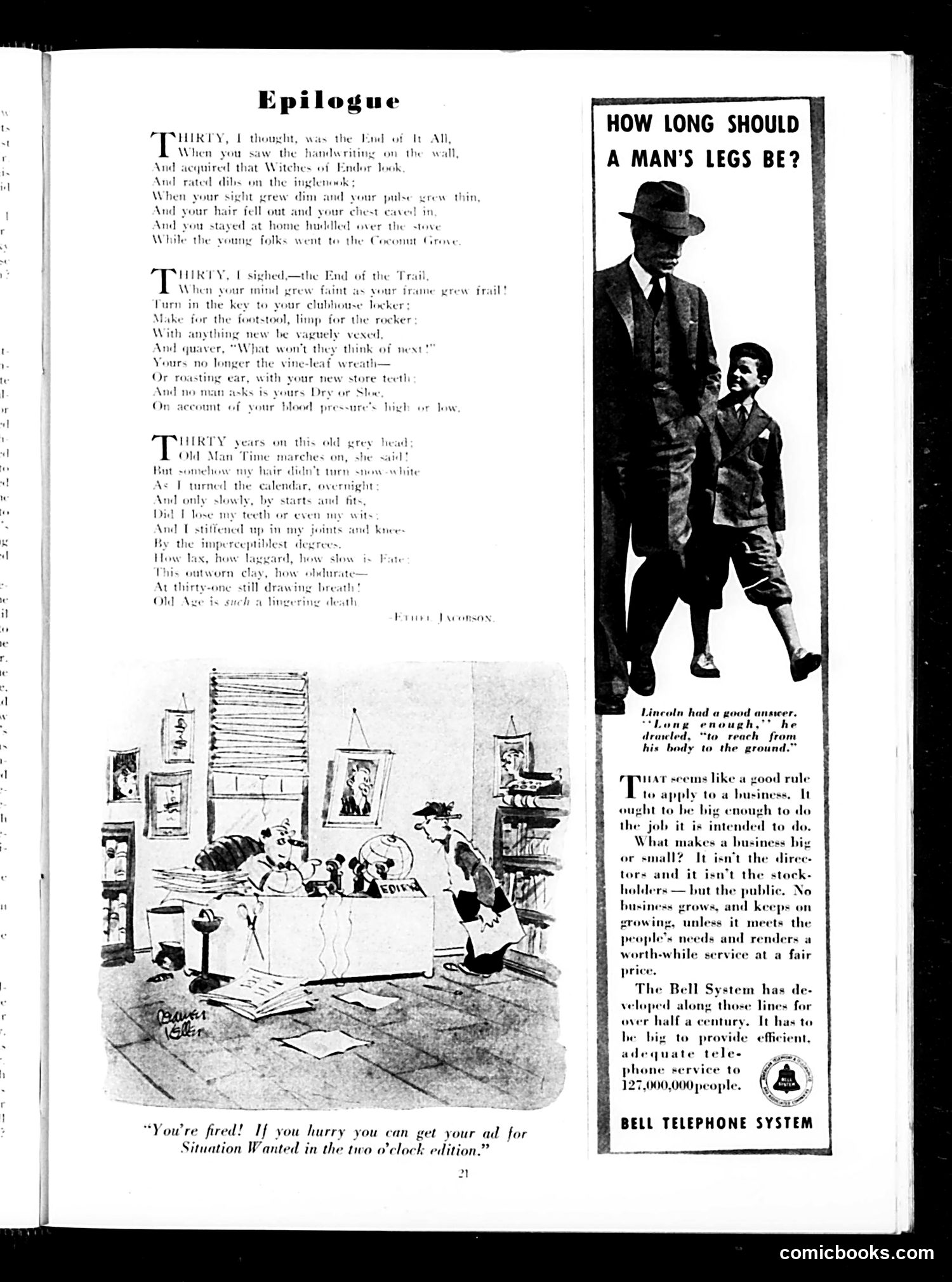
Explanation for Modern Readers This page contains two distinct pieces: Left side ("Epilogue"): A melancholic poem by Bert Leston Taylor about aging—moving through thirty, then fifty, then seventy years old. Each stanza catalogs physical decline: dimming sight, lost teeth, stiffened joints, graying hair. The accompanying cartoon shows a busy office where someone is fired and told to rush an ad to the "Situation Wanted" section, satirizing how quickly one becomes disposable in the working world. Right side (Advertisement): A Bell Telephone System ad using Lincoln's famous quip about leg length ("long enough to reach the ground") as a metaphor. It argues businesses should be sized to serve public needs—and claims Bell has done this for "over half a century," providing service to 127 million people. This is vintage corporate self-promotion justifying Bell's massive monopoly as responsive to genuine public demand rather than mere corporate greed. The page juxtaposes aging anxiety with consumer capitalism's promise of reliable service.
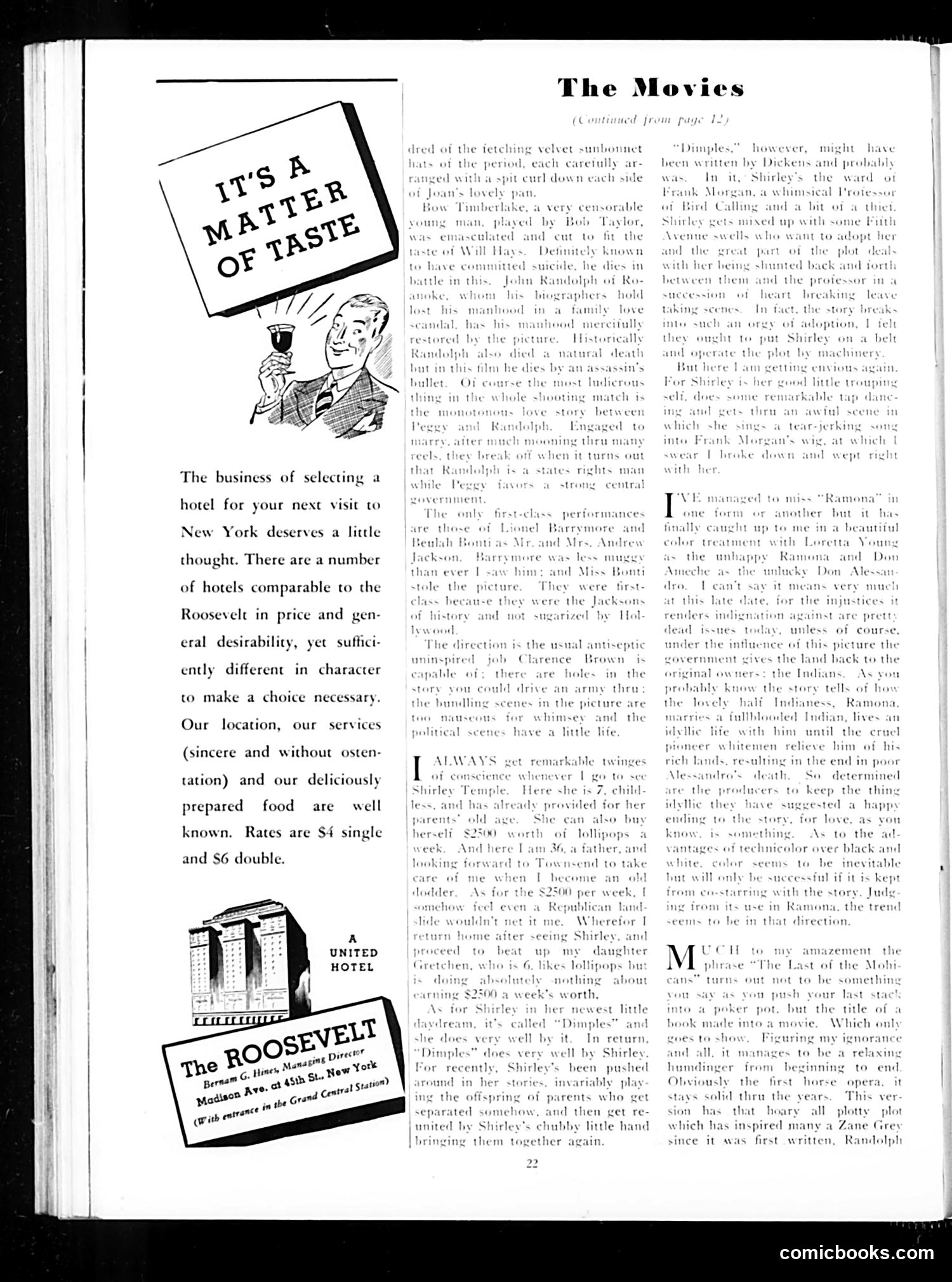
The Roosevelt Hotel Advertisement This page is primarily a hotel advertisement for the Roosevelt Hotel in New York, not a political cartoon. The ad uses a genteel sales pitch emphasizing the hotel's comparable quality to more expensive competitors, with rates of $4 single and $6 double rooms. The only illustration is a simple line drawing of a man in formal attire holding a cocktail glass next to the hotel's name—a straightforward marketing image meant to convey luxury and sophistication. The right column contains a movie review discussing Shirley Temple films, particularly "Dimples," with commentary on her performances and the plots of recent movies. This is entertainment journalism, not satire. There is no political cartoon or satire on this page—it is primarily advertising and entertainment coverage from what appears to be a 1930s-era magazine.
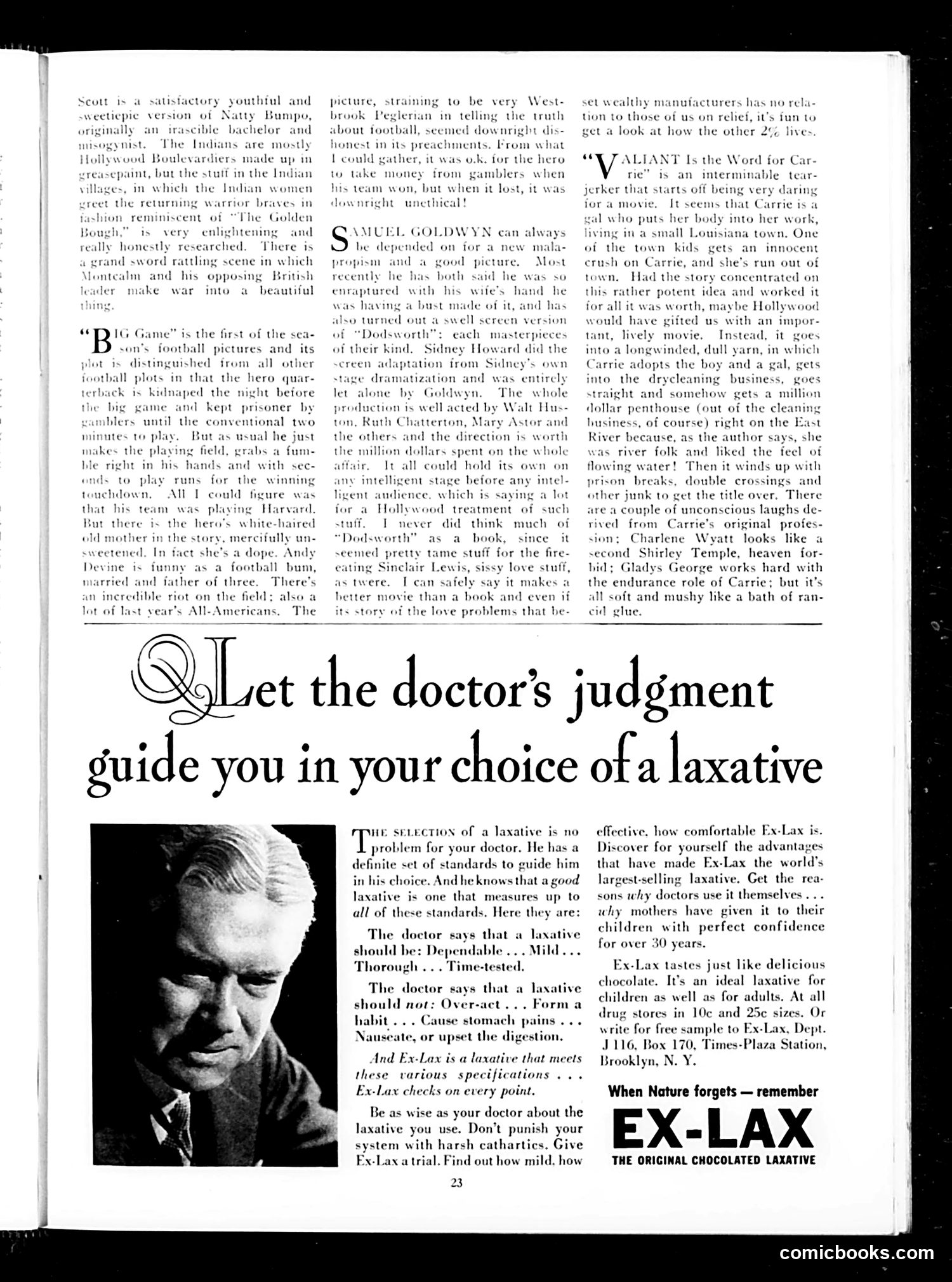
Judge Magazine Movie Reviews Page This page contains film reviews rather than political cartoons. The critic discusses three Hollywood films: a football picture called "Big Game," Samuel Goldwyn's "Dodsworth," and a film called "Valiant" (about a woman named Carrie in Louisiana). The reviews are typical of 1930s film criticism—snappy, gossipy, and sometimes acerbic. The critic praises "Dodsworth" as a well-acted adaptation that surpasses its source material (a Sinclair Lewis novel), while dismissing "Valiant" as melodramatic padding around a potentially interesting premise. The "Big Game" review mocks the contrived football-movie plot devices. The only visual element is a portrait photograph accompanying an Ex-Lax laxative advertisement—not related to the film reviews. This represents the commercial advertising that funded magazines like Judge during this era.
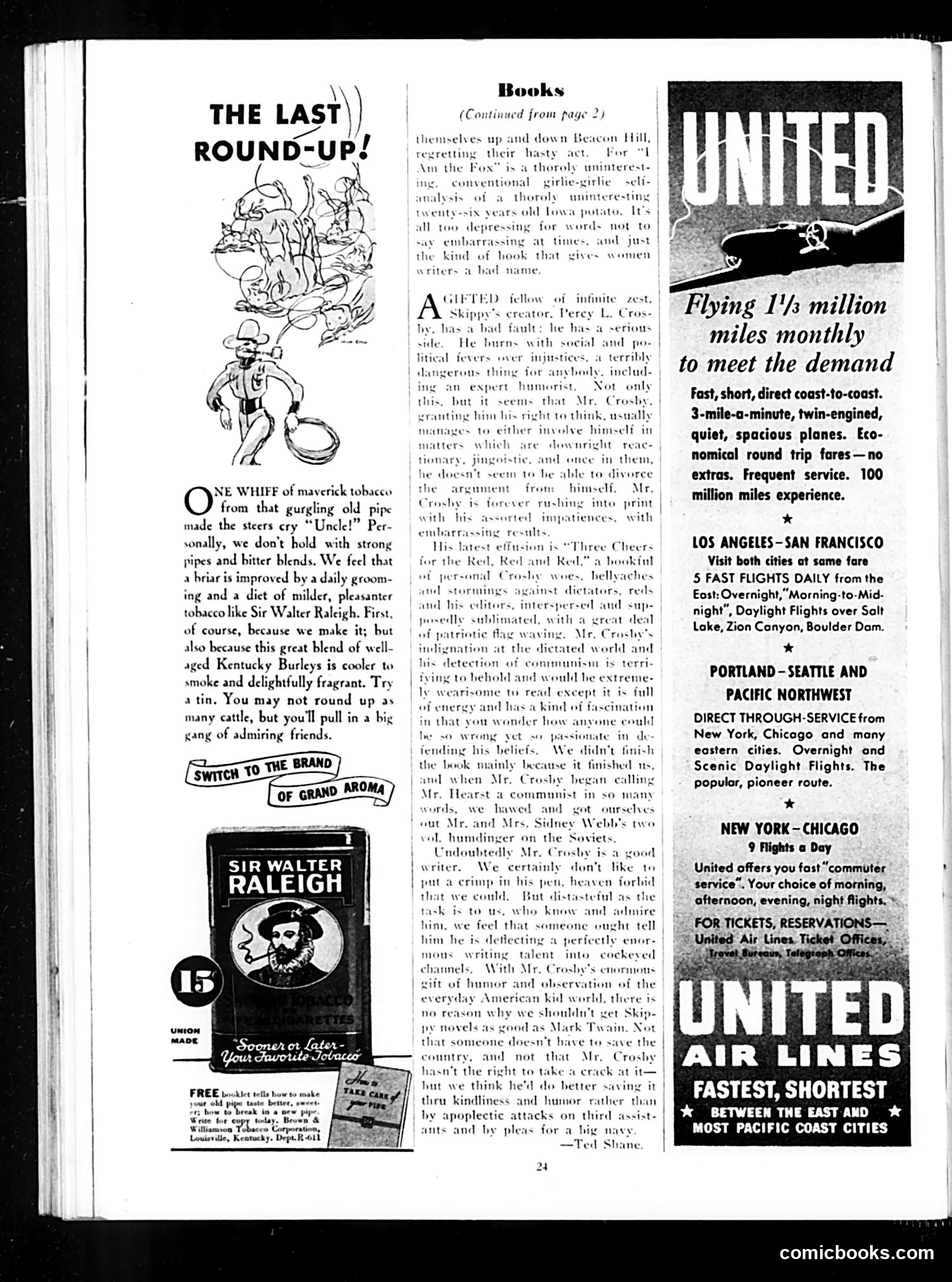
"The Last Round-Up": Political Satire in Judge Magazine This page contains a book review by Ted Shane (signed at bottom) critiquing Percy Crosby's work. Crosby created the comic strip "Skippy" and wrote socially conscious material. Shane's critique centers on Crosby's *political activism*—specifically his anti-communist crusades and fierce social commentary. Shane acknowledges Crosby's talent but faults him for "rushing into print" with "embarrassing results," including calling William Randolph Hearst a communist. The reviewer argues Crosby damages his own credibility by mixing heavy-handed political messaging into his humor. The satire targets Crosby's *earnest moral outrage* over injustices, suggesting his hectoring approach alienates readers. Shane argues Crosby would be more effective using "kindliness and humor" rather than "apoplectic attacks on third assistants." The cartoon ("The Last Round-Up") shows cowboys using aggressive tactics—visual metaphor for Crosby's combative style. The page also includes period advertising for Sir Walter Raleigh tobacco and United Airlines.
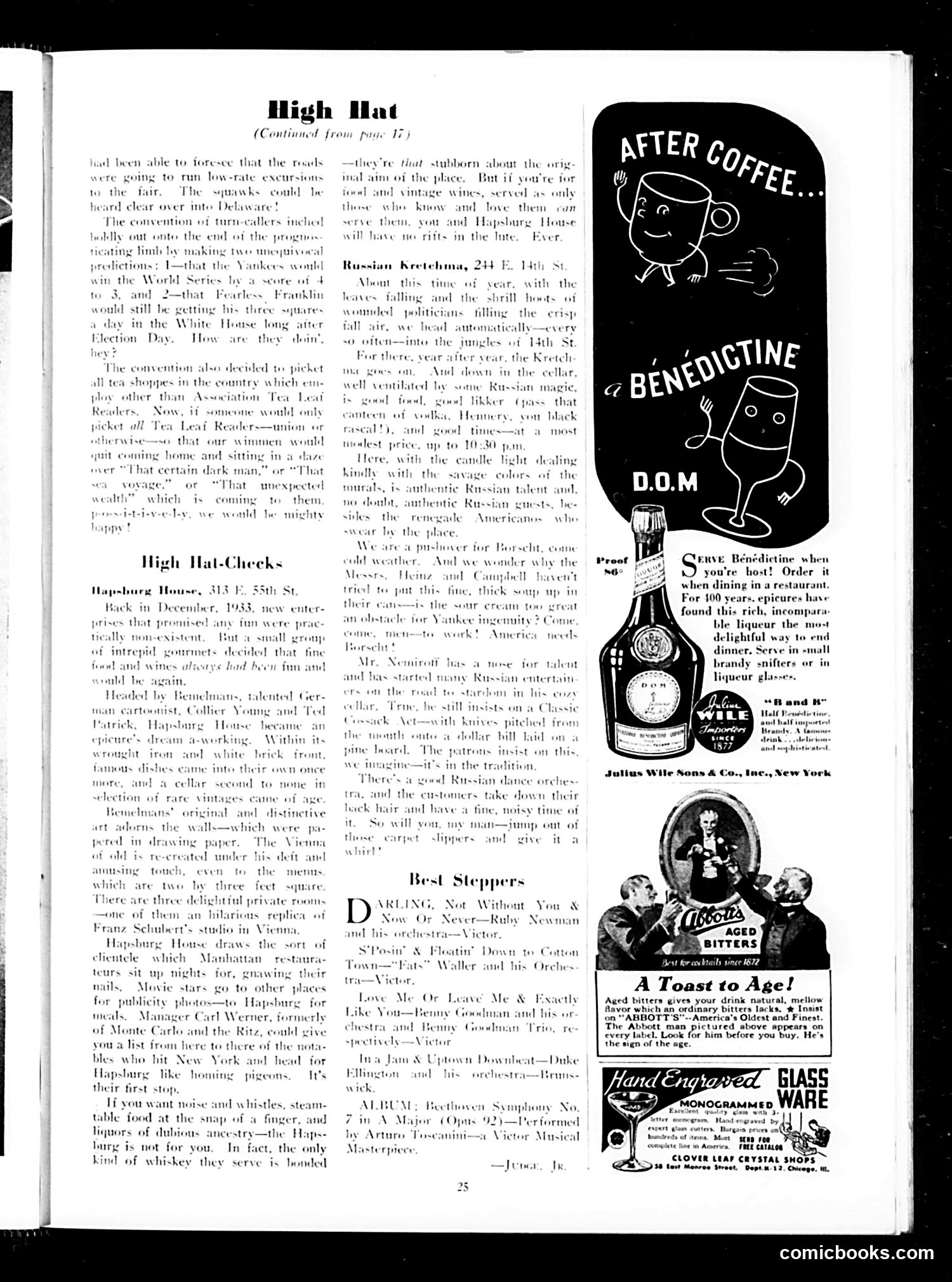
Analysis of Judge Magazine Page Content This page from Judge magazine (circa 1930s) is primarily advertising and restaurant reviews rather than political satire. The main content includes: Restaurant Reviews: - "High Hat-Cheeks" (Hapsburg House): A German-Austrian restaurant catering to Manhattan's elite clientele - "Russian Kretehma": A Russian speakeasy in the cellar of a 14th Street location, serving traditional Russian food and drink during Prohibition Social Context: These reviews reflect 1930s New York dining culture—the existence of speakeasies (illegal bars operating in cellars during Prohibition) and themed ethnic restaurants serving immigrant communities and wealthy patrons seeking "authentic" foreign experiences. Advertisements: The right column features liquor ads (Benedictine, Abbott's Bitters) and glassware, typical of Judge's commercial content. The page contains no clear political cartoons or satire—it's primarily lifestyle journalism and advertising targeting affluent readers interested in dining and entertainment.
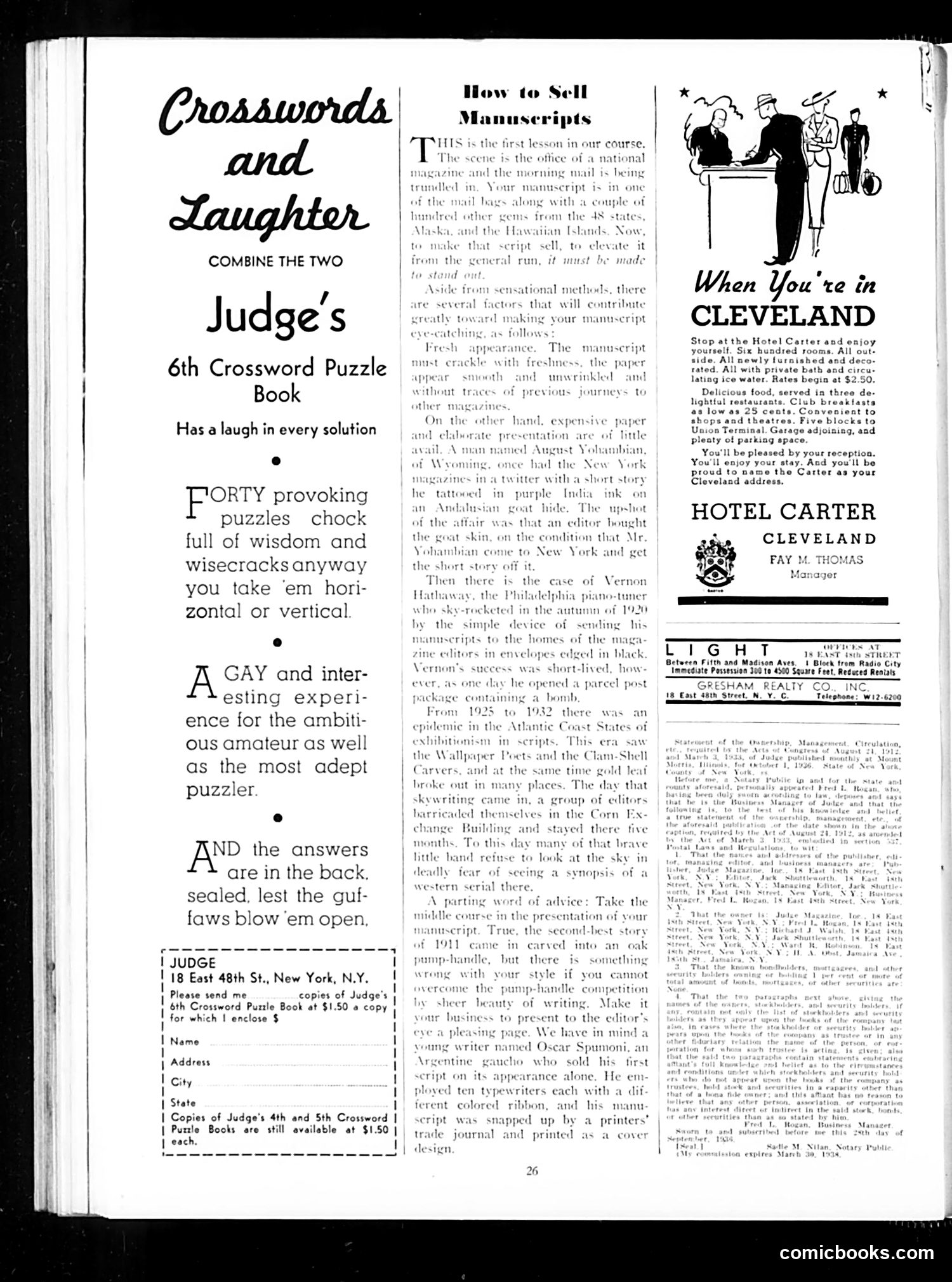
Judge Magazine Page Content Analysis This is primarily an advertising and promotional page for Judge magazine's products and services, rather than a satirical cartoon page. The main content includes: 1. Advertisement for Judge's 6th Crossword Puzzle Book — positioned as entertainment combining humor with wordplay. The ad emphasizes that puzzles contain "wisdom and wisecracks" and appeals to both amateur and skilled puzzlers. 2. Hotel Carter advertisement (Cleveland) — a straightforward hospitality ad highlighting amenities like 600 rooms, private baths, restaurants, and convenient location near Union Terminal and theaters. 3. "How to Sell Manuscripts" — an instructional article advising writers on manuscript presentation and submission strategies to magazine editors, using historical examples from 1923-1932 about writers successfully selling stories. The page reflects Judge's dual nature as both a humor magazine and a publication marketplace connecting writers with editors. There are no political cartoons visible — this appears to be a business/service-oriented page from the magazine's interior.
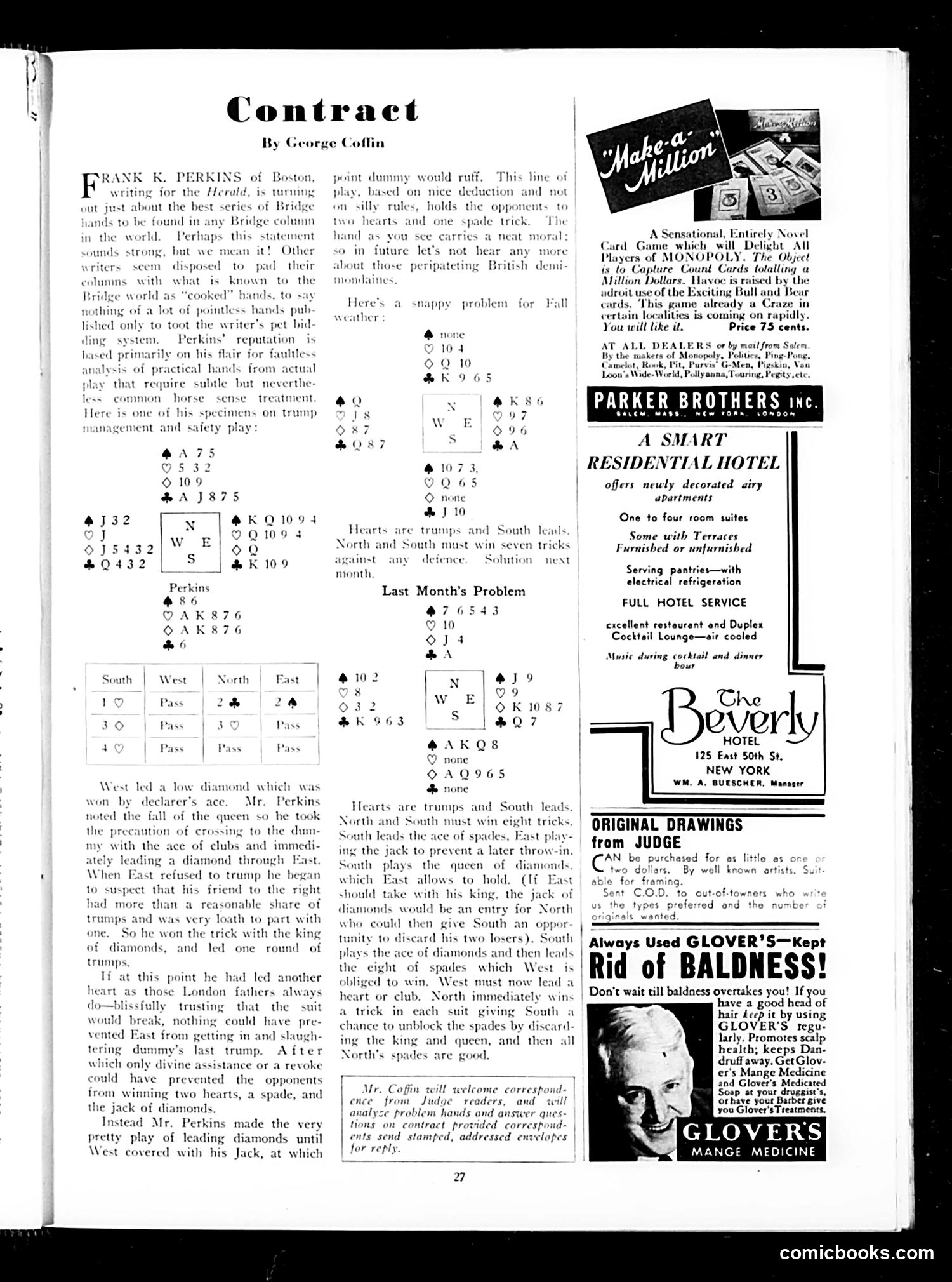
Analysis of This Judge Magazine Page This page is primarily a bridge (card game) instructional column by George Coffin, not a political cartoon. The content focuses on contract bridge strategy and hand analysis, featuring Frank K. Perkins of Boston as an expert player. The satirical element is subtle: Coffin gently mocks bridge writers who publish "cooked" (fabricated) hands and "pointless" instructional deals merely to promote their own bidding systems. Perkins is praised for instead analyzing real, practical hands requiring genuine strategic thinking rather than relying on rigid rules. The surrounding advertisements (Parker Brothers games, The Beverly Hotel, Glover's hair treatment) are period typical for Judge magazine, not integral to content meaning. This represents Judge's role as a general-interest magazine covering leisure and lifestyle topics alongside political satire—not primarily a political commentary piece.
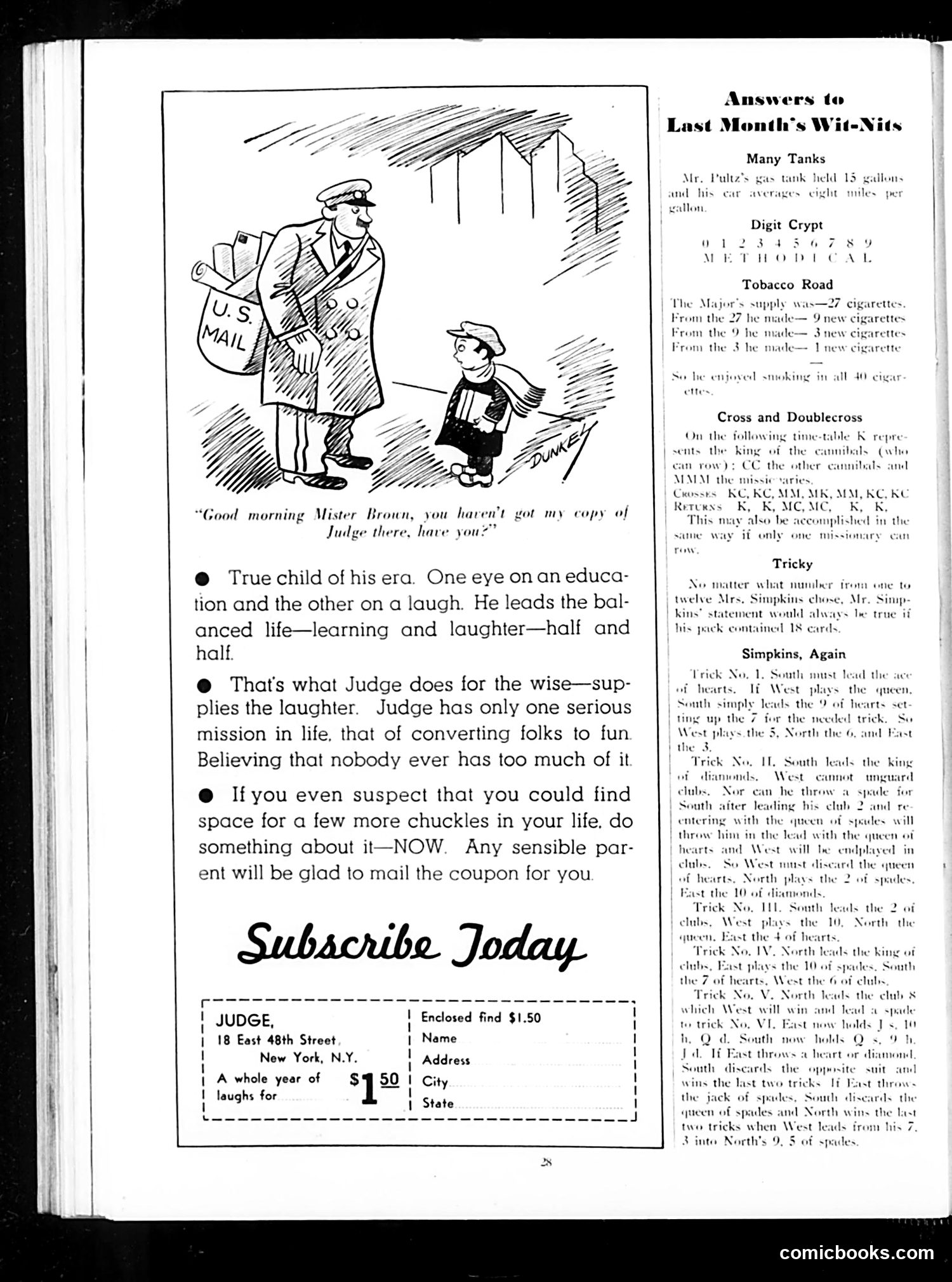
Judge Magazine Subscription Advertisement This page is primarily a subscription advertisement for Judge magazine, a satirical publication. The cartoon shows a mailman delivering copies of Judge to "Mister Brown," humorously suggesting the magazine is so essential that people eagerly await their copies. The advertisement's pitch emphasizes Judge's dual purpose: providing education alongside humor ("one eye on an education and the other on a laugh"). It positions the magazine as offering "balanced life" through laughter, claiming Judge's mission is converting readers "to fun." The $1.50 annual subscription offer appears below the cartoon. The rest of the page contains answers to previous puzzles and word games—typical filler content in magazines of this era. Context for modern readers: This reflects early-20th-century magazine culture, where subscriptions were actively promoted and humor magazines occupied a significant cultural niche as sources of both entertainment and social commentary.
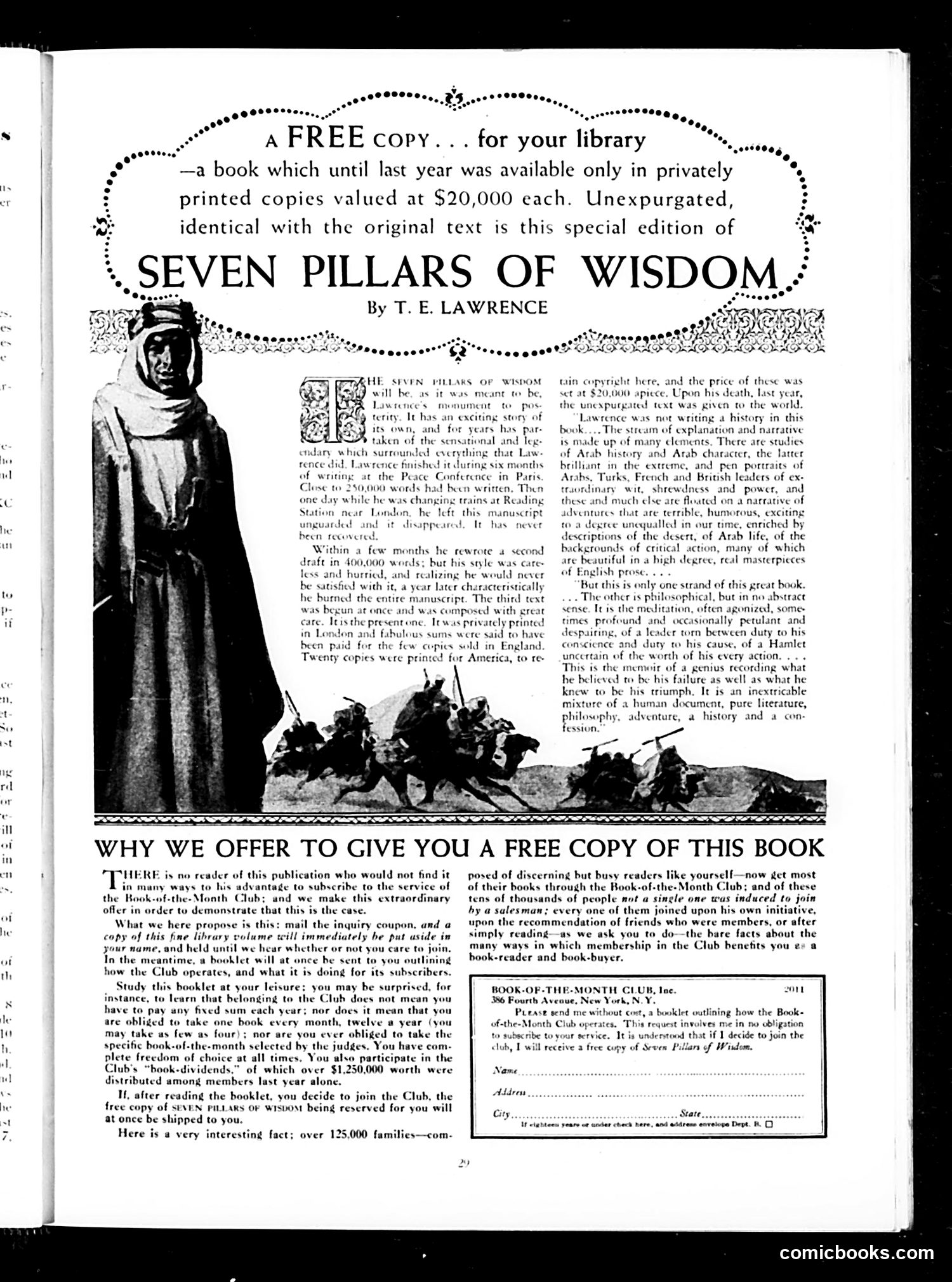
Analysis for Modern Readers This is primarily advertising content, not a political cartoon. The page promotes a free copy of T.E. Lawrence's *Seven Pillars of Wisdom* through the Book-of-the-Month Club. The historical context: Lawrence of Arabia's WWI memoir was originally so expensive (privately printed at $20,000 per copy) that few could access it. The text describes how Lawrence himself destroyed his second manuscript draft, then rewrote it a third time—emphasizing the book's legendary status and rarity value. The advertisement leverages this prestige to recruit Club subscribers, using the "free book" as an incentive. The accompanying illustration shows a robed Arab figure and a desert scene with mounted riders, evoking the exotic adventure narrative within. For modern readers: this represents mid-20th-century book-club marketing targeting educated, affluent audiences willing to join subscription services—a now-obsolete business model that preceded today's streaming and digital publishing.
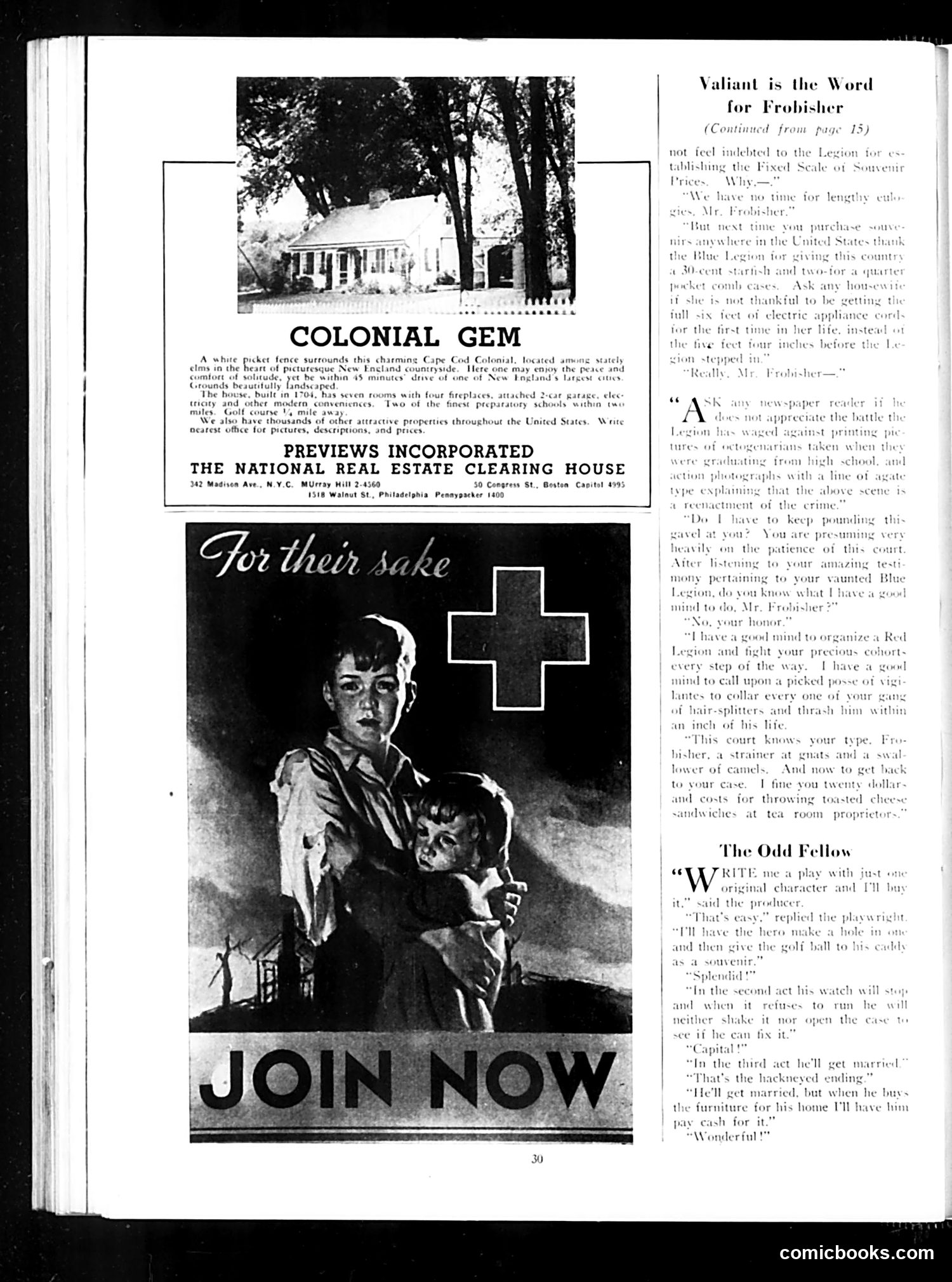
Analysis of Judge Magazine Page This page contains primarily advertisements and serialized fiction, rather than political satire. The main content is an ad for "Colonial Gem," a real estate listing service called "Previews Incorporated," offering Cape Cod Colonial homes in New England. Below that is a Red Cross recruitment poster ("For their sake / JOIN NOW") featuring a woman and child with a medical cross—a standard WWI-era charitable appeal. The right column continues a serialized story titled "Valiant is the Word for Frobisher," depicting a courtroom scene where a judge lectures a defendant about conduct. The dialogue suggests a humorous domestic dispute or minor legal matter. At bottom, "The Odd Fellow" presents a comedic dialogue between a playwright and producer about pitching an absurdly conventional play—poking gentle fun at theatrical clichés (hero loses watch, gets married, needs furniture money). Overall: This is a lighter magazine page mixing real estate marketing, patriotic appeals, and light humor rather than sharp political commentary.
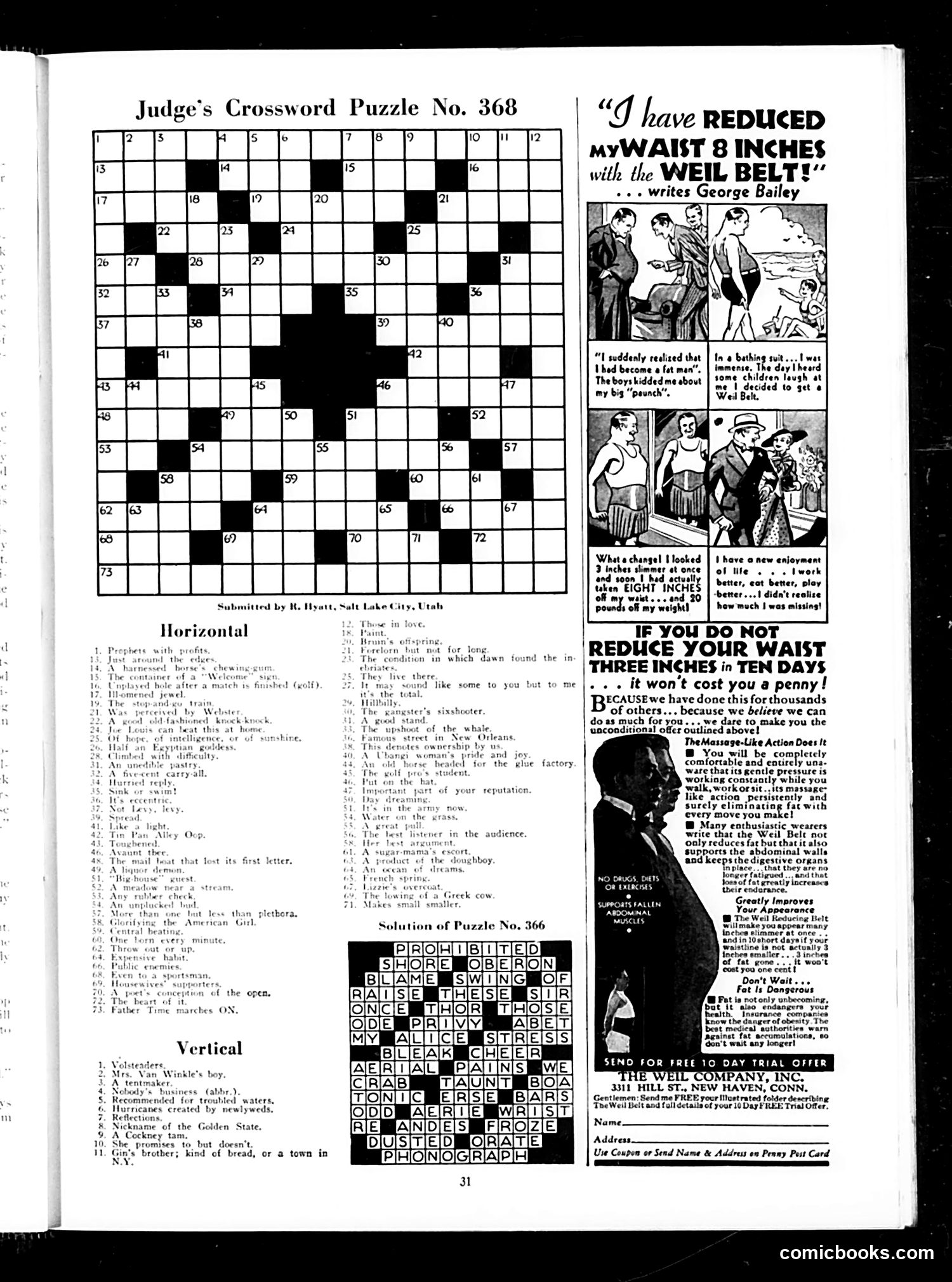
Analysis of Judge Magazine Page No. 368 This page contains a crossword puzzle and a full-page advertisement for the "Weil Belt," a corset-like garment marketed to reduce waist size. The Advertisement's Appeal: The ad features testimonials from "George Bailey" claiming he reduced his waist 8 inches using the belt. The narrative uses social pressure as a selling tool—he was mocked by boys for his "paunch" and embarrassed in a bathing suit, but the belt supposedly restored his confidence and vitality. The Marketing Strategy: The ad makes an aggressive guarantee: reduce your waist three inches in ten days "or it won't cost you a penny." It appeals to vanity, health concerns (citing insurance companies and medical warnings about obesity), and masculine anxiety about appearance and physical capability. Historical Context: This reflects 1920s-30s consumer culture and advertising tactics emphasizing body modification. The product promises passive weight loss through a mechanical device—a common pitch in that era before modern fitness culture. The page demonstrates how Judge magazine mixed editorial content with paid advertising, typical of the period.
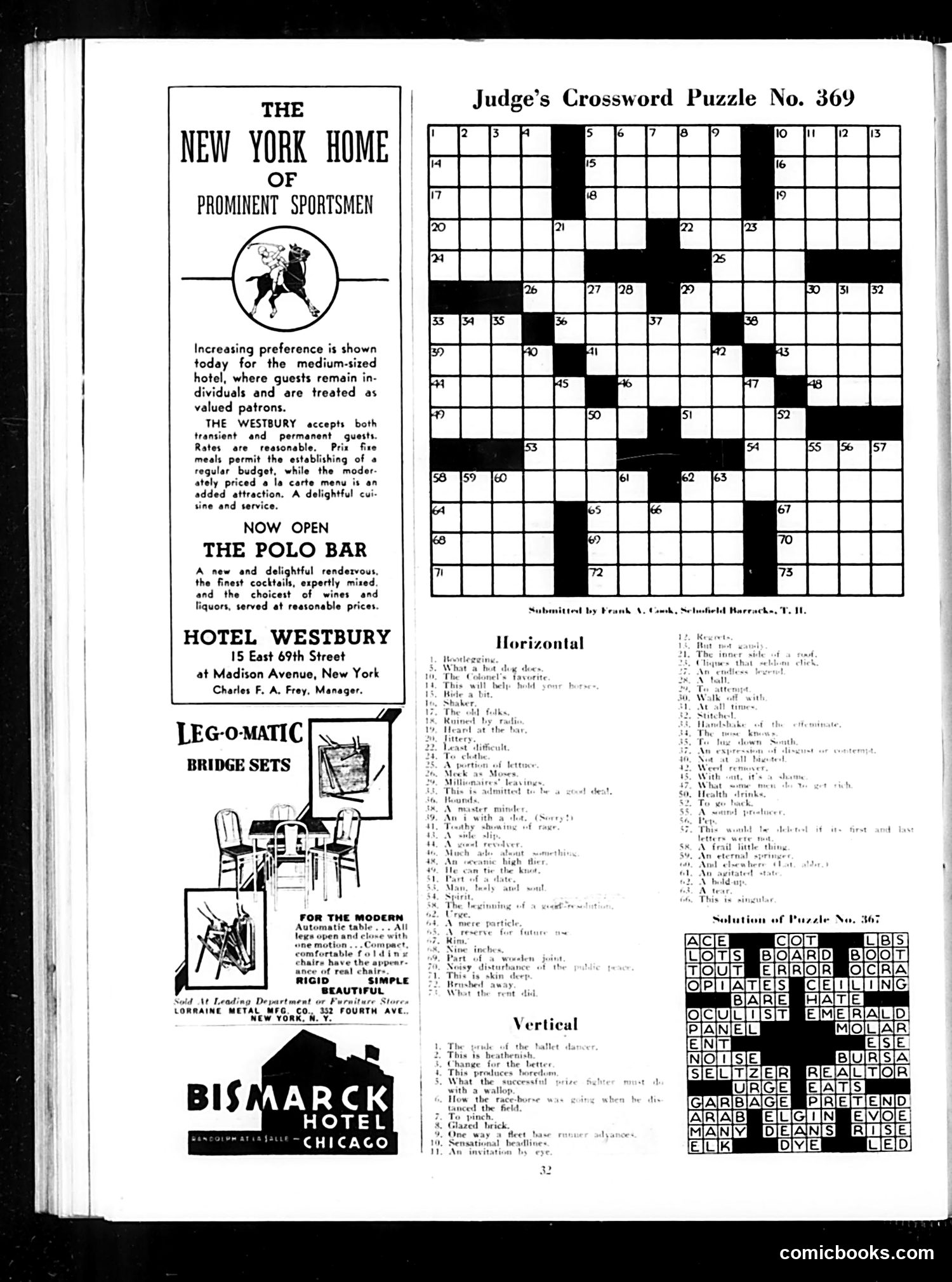
Judge Magazine Page Analysis This page is primarily advertising and puzzle content, not editorial cartoon material. The left side features advertisements for upscale New York establishments: the Hotel Westbury (a medium-sized hotel on the Upper East Side targeting wealthy sportsmen), and its new "Polo Bar" serving drinks and food. There's also an ad for Leg-O-Matic bridge sets and the Bismarck Hotel in Chicago. The main content is Judge's Crossword Puzzle No. 369 with clues and a solution grid for the previous puzzle (No. 367). The puzzle's title references "The New York Home of Prominent Sportsmen," tying thematically to the Hotel Westbury advertisements. There is no political satire or cartoon commentary visible on this page. It represents Judge magazine's commercial side—the publication supported itself partly through advertising to affluent readers and puzzle enthusiasts during the interwar period.
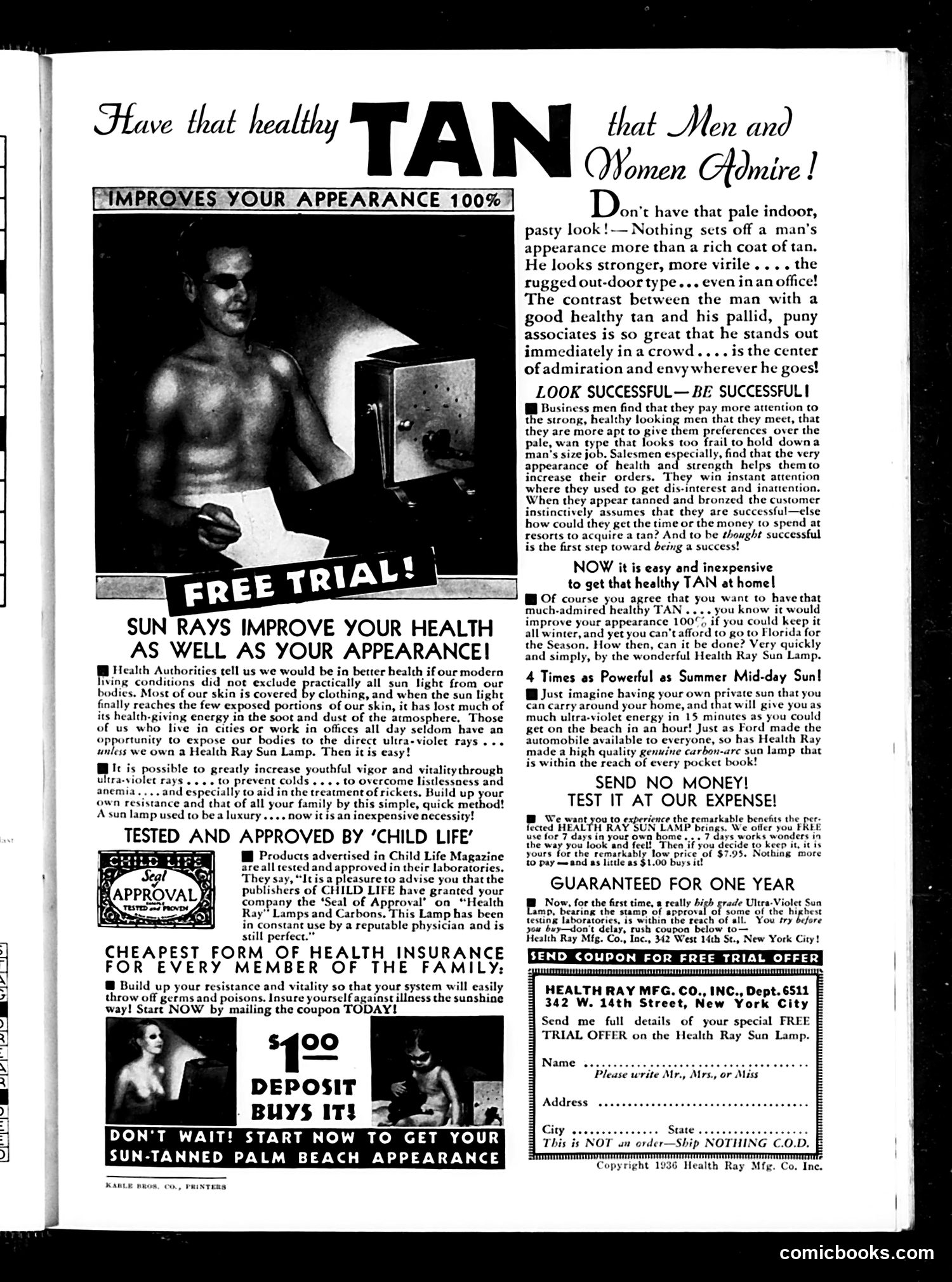
Historical Analysis: "Health Ray" Sun Lamp Advertisement This page is primarily a commercial advertisement, not satirical content. It promotes the "Health Ray Sun Lamp," a home ultraviolet device manufactured by Health Ray Mfg. Co. The advertisement reflects 1930s health beliefs and social anxieties: The pitch targets business and working men, arguing that a visible tan signals success, health, and virility—contrasting the "pale, puny" office worker with the bronzed, athletic-looking man. A tan supposedly makes one appear more commanding, trustworthy, and professionally successful. The "science" claimed: UV rays provide health benefits comparable to summer sun exposure, treating rickets and boosting vitality—beliefs common in that era before the dangers of UV radiation were understood. The marketing strategy emphasizes affordability ($1.00 deposit) and democratization—making luxury sun-tanning accessible to ordinary families, mirroring Ford's mass production model. The "Child Life" seal of approval attempts credibility through endorsement by a children's magazine, a common advertising tactic of the period. This reflects pre-WWII American optimism about technology solving health and social problems through consumption.
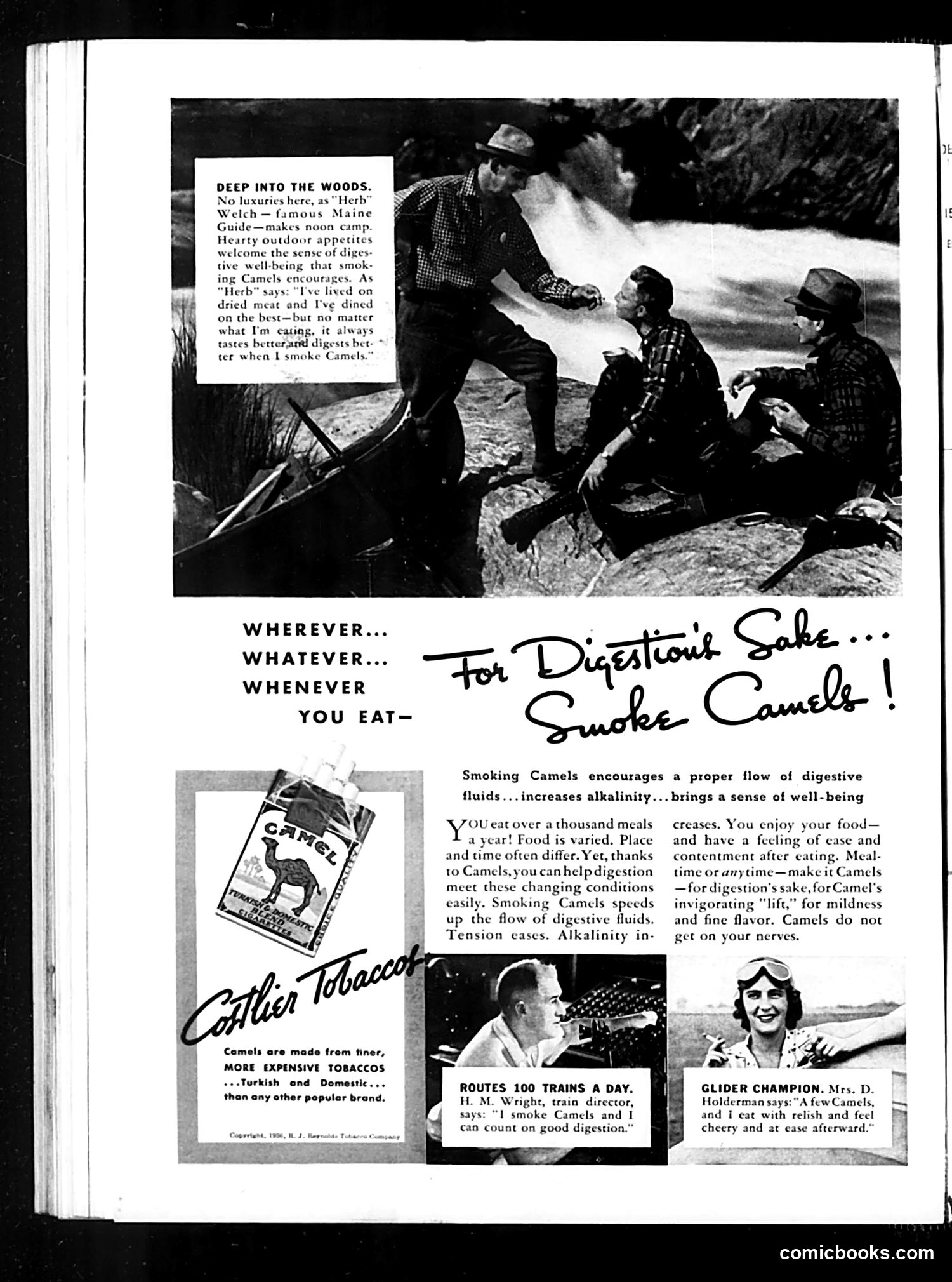
Analysis of Camel Cigarette Advertisement This is a cigarette advertisement, not satire. The page promotes Camel cigarettes by claiming they aid digestion and promote well-being. The ad features testimonials from working men: "Herb" Welch (a Maine hunting guide), H.M. Wright (a train director routing 100 trains daily), and an unnamed female aviator (Glider Champion). Each endorses Camels' supposed digestive benefits. The pitch claims smoking speeds digestive fluid flow and increases "alkalinity," promoting ease after meals. The advertisement emphasizes Camels use "finer, more expensive tobaccos" than competitors. For modern readers: This represents pre-FDA tobacco advertising, when health claims were unregulated and unsubstantiated. The "digestive aid" claim is wholly false—smoking actually impairs digestion. Such ads exploited working-class credibility and aspirational figures to normalize smoking, a common mid-20th century marketing tactic now recognized as predatory and deceptive.