judge
Judge — December 1936
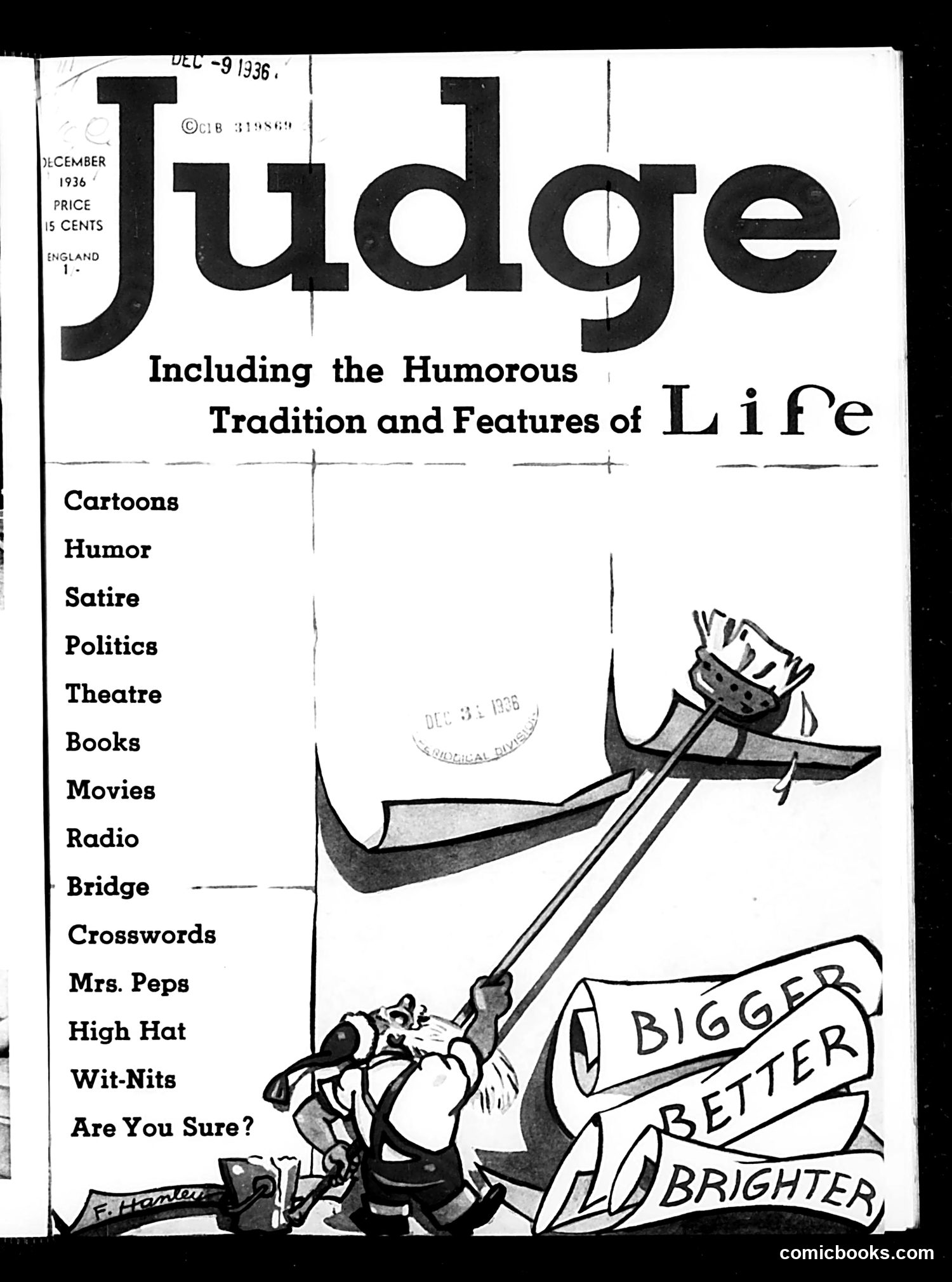
Analysis of Judge Magazine Cover (December 1936) This cover features a caricatured figure operating a large lever labeled "Bigger Better Brighter," suggesting optimism about improving conditions—likely referencing the Depression era's gradual economic recovery under Roosevelt's New Deal policies. The cartoonist depicts the figure as a workman or common laborer, emphasizing that ordinary citizens were driving progress. The mechanical imagery conveys the industrial/technological advancement narrative popular in 1930s America. The left sidebar lists Judge's content categories—cartoons, humor, satire, politics, theater, etc.—typical of the magazine's satirical approach to American culture and current events. The specific political message remains unclear without additional context, but the "bigger, better, brighter" theme suggests cautious optimism about national recovery in late 1936.
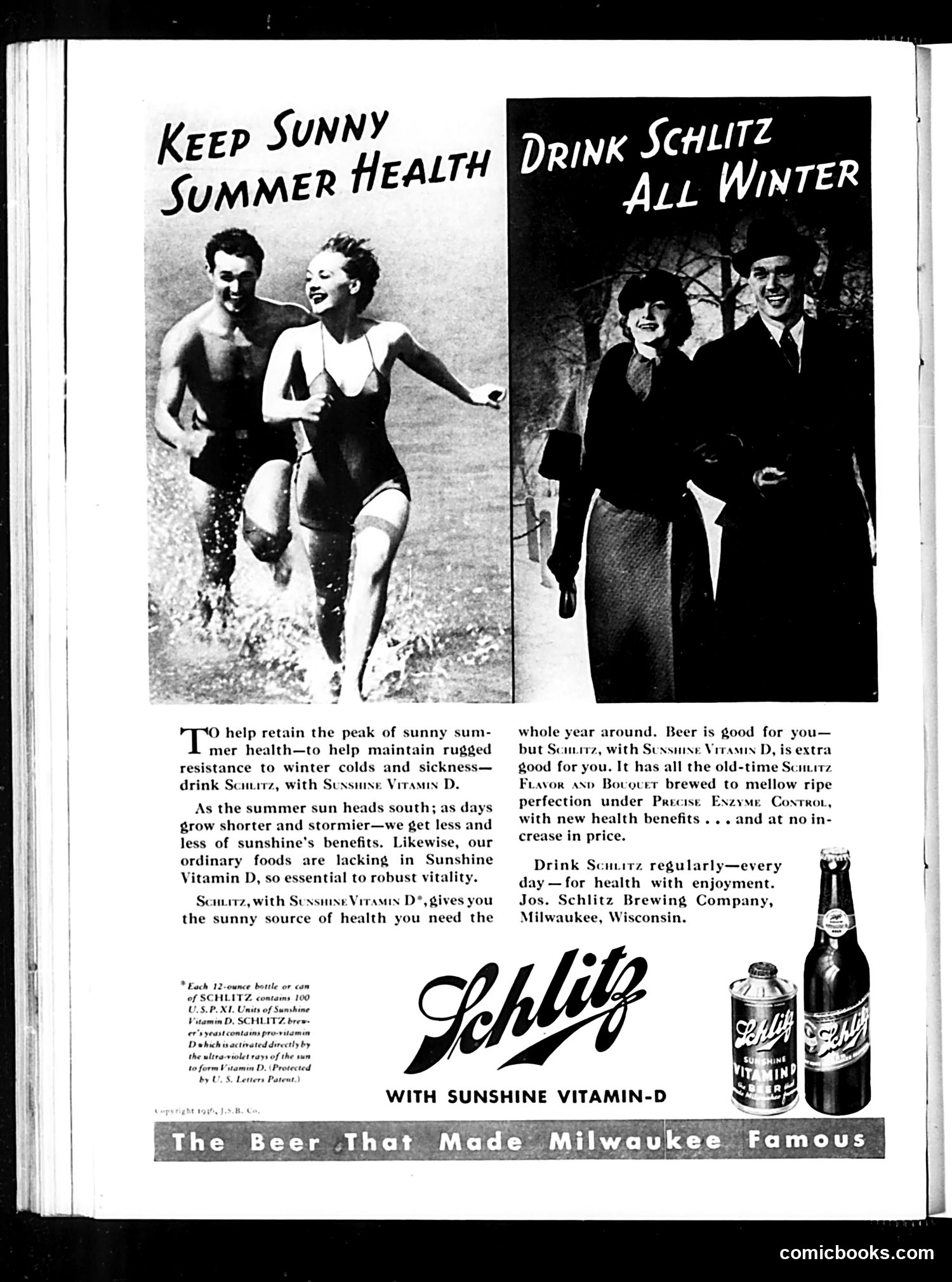
Schlitz Beer Advertisement This is primarily a beer advertisement, not political satire. It's a vintage Schlitz brewery ad that uses health claims to market beer year-round. The ad contrasts summer and winter activities: swimmers enjoying "sunny summer health" versus couples in winter clothing drinking beer for "health with enjoyment." The central claim is that Schlitz beer contains "Sunshine Vitamin D," supposedly providing health benefits otherwise lacking in winter months when sun exposure decreases. This reflects 1940s advertising practices where health benefits were routinely claimed for consumer products. The "Sunshine Vitamin D" branding was marketing strategy capitalizing on contemporary nutrition awareness. The tagline promises Schlitz as "The Beer That Made Milwaukee Famous," positioning it as a wholesome product for year-round consumption.
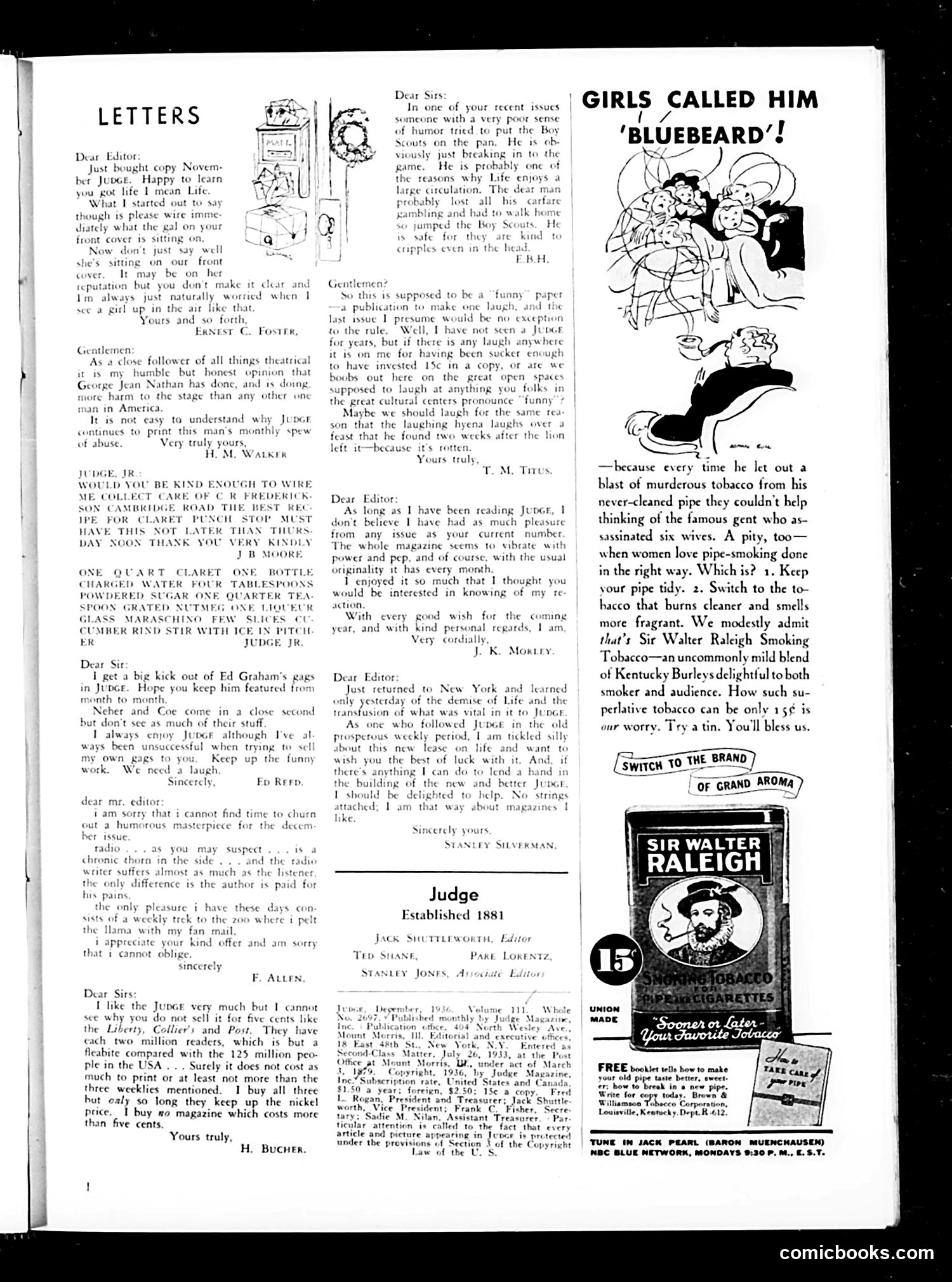
Analysis of Judge Magazine Page This page is primarily a letters section and advertisements rather than political commentary. The main cartoon, titled "Girls Called Him 'Bluebeard'!", depicts a man with multiple women, referencing the Bluebeard legend of a serial killer/wife-killer. The cartoon appears to be satirizing infidelity or philandering rather than making specific political commentary. The letters discuss magazine quality, humor standards, and editorial matters. A Sir Walter Raleigh tobacco advertisement occupies the lower right, marketing cigarettes as a premium brand. The cartoon's humor relies on readers' familiarity with the Bluebeard folklore—a cautionary tale about a dangerous man. Without additional context about when this was published, the specific social critique remains unclear, though it likely comments on contemporary attitudes toward male behavior and relationships.
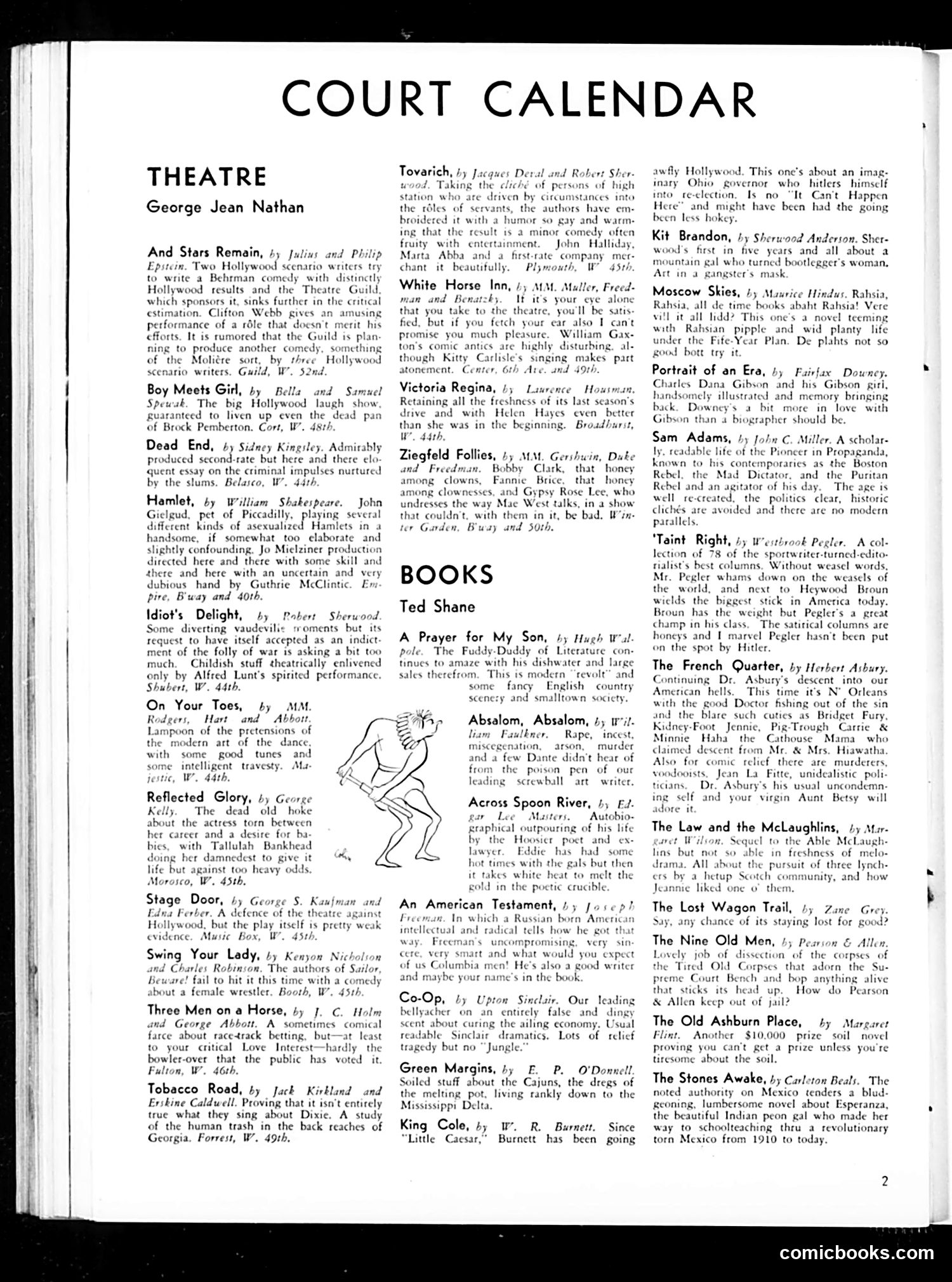
Court Calendar Page from Judge Magazine This appears to be a book and theatre review section from Judge magazine, not primarily a political cartoon page. The content consists of brief critical reviews of Broadway productions (including "Tovarich," "White Horse Inn," "Idiot's Delight") and recent books (works by Ted Shane, Hugh Walpole, and others). There is one small illustration showing a stylized figure in an exaggerated pose, but it's decorative rather than satirical commentary. The page functions as entertainment criticism and cultural commentary typical of Judge's format—lighthearted, witty assessments of contemporary popular culture rather than political satire or caricature of specific public figures.
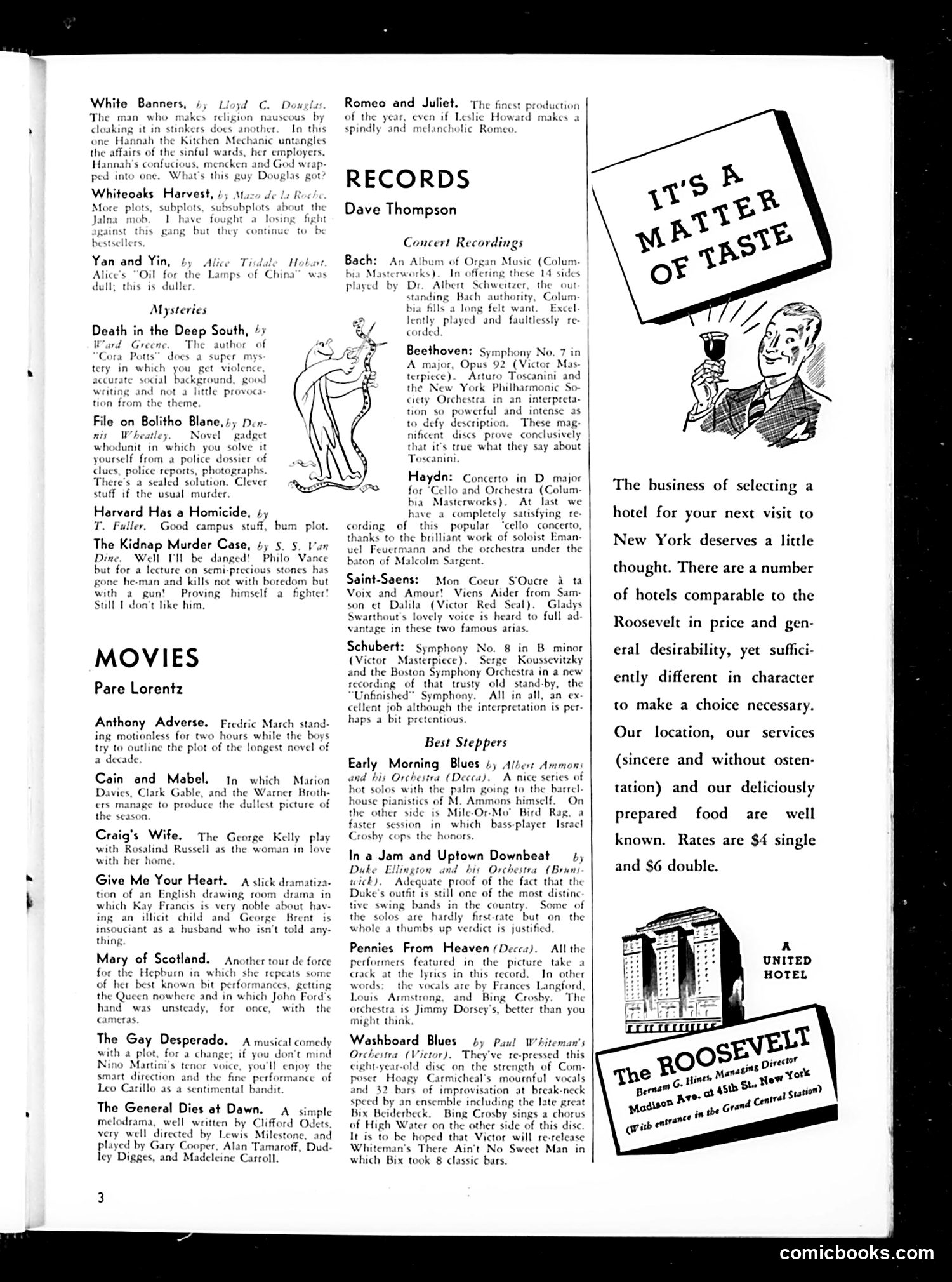
Analysis This page is primarily book and entertainment reviews with one advertisement for The Roosevelt Hotel in New York. The only cartoon element is a small illustration accompanying the hotel ad showing a caricatured man holding up a wine glass with text "IT'S A MATTER OF TASTE." This is not political satire but rather a visual pun for a commercial advertisement—the "taste" reference plays on both wine-tasting and the hotel's quality/character. The bulk of the page reviews films (including titles like "Anthony Adverse" and "Mary of Scotland") and concert recordings of classical composers. The content reflects 1930s entertainment criticism in this satirical magazine, but this particular page contains no political commentary or social satire worth analyzing.
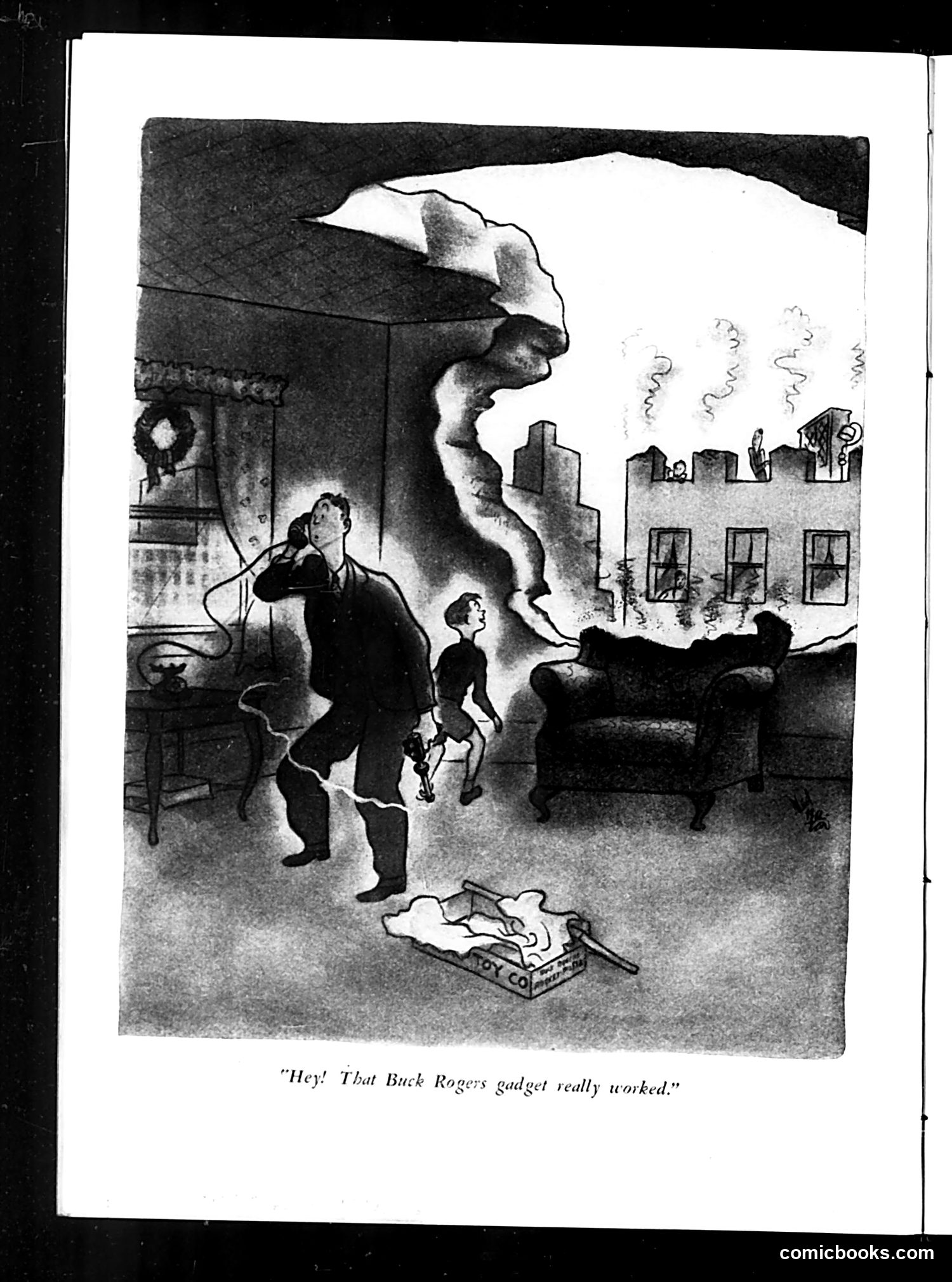
Analysis This cartoon depicts a gadget that appears to have caused an explosion or disaster in an urban setting. Two men and a child observe the wreckage amid smoke and flames engulfing a building. The caption reads: "Hey! That Buck Rogers gadget really worked." The joke references Buck Rogers, likely referring to a contemporary inventor or product pitchman known for dubious or overly-hyped inventions. The satire mocks both the gadget itself (which spectacularly failed) and the false advertising or exaggerated claims surrounding it—the speaker's sarcastic comment suggests the "gadget" worked precisely as skeptics expected: by destroying things rather than fulfilling its promised purpose. This reflects Judge magazine's typical satirical approach to consumer culture and technological hype.
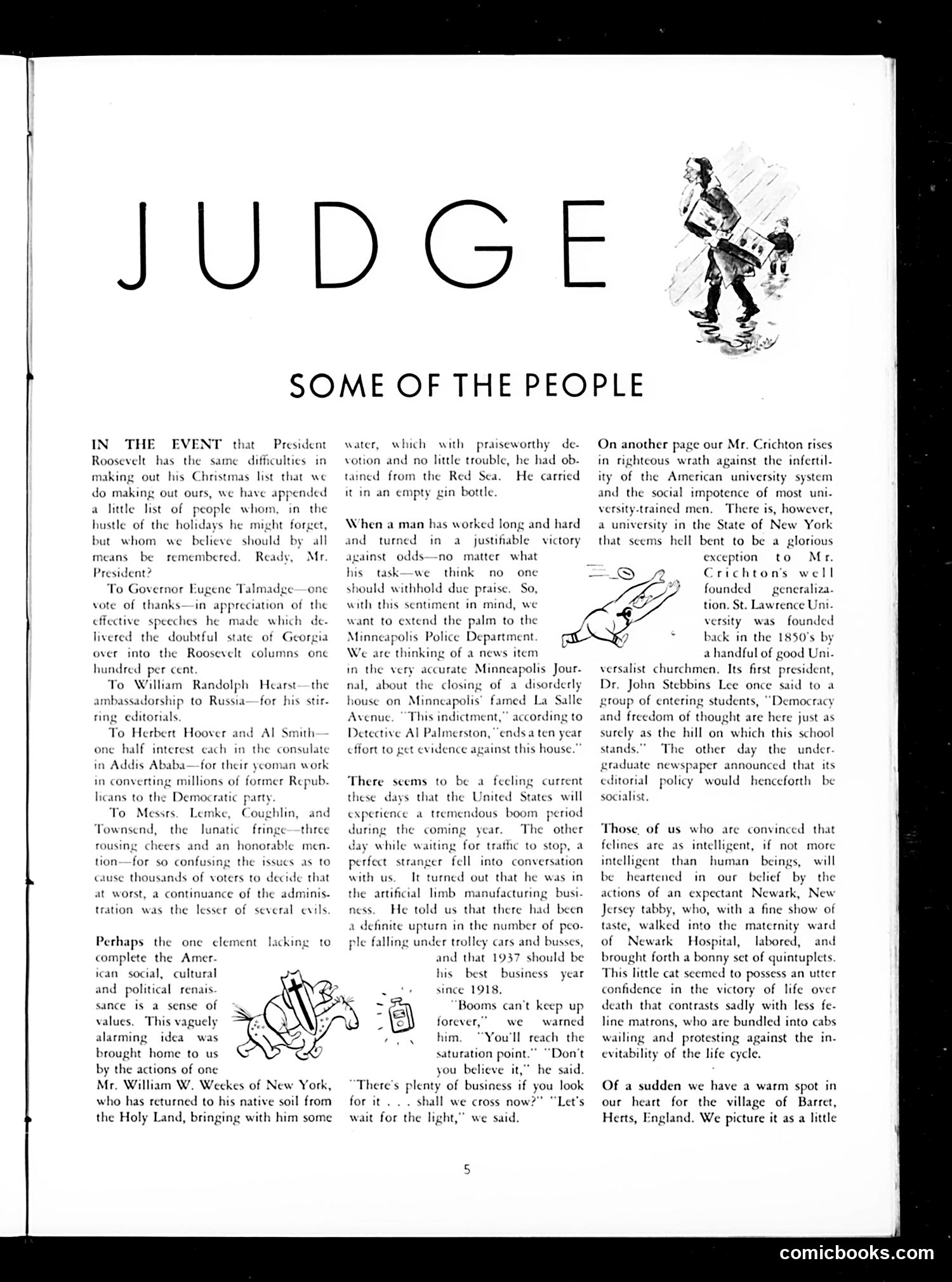
Analysis of Judge Page 5 This page is primarily editorial text praising various political and public figures from the Roosevelt administration and related spheres. The small illustrations appear decorative rather than satirical. The text mentions President Roosevelt, Governor Eugene Talmadge of Georgia, Ambassador Randolph Hearst to Russia, and others. The overall tone is complimentary rather than satirical—Judge is endorsing their actions and policies. One passage discusses praise for Minneapolis police closing a disorderly house and commends American university systems, specifically St. Lawrence University. Another praises economic improvements, referencing 1937 as a promising business year. The page reads more like editorial commentary than typical Judge satire. The small cartoon figures appear merely illustrative, not the primary content. This represents Judge in a more straightforward advocacy mode rather than its typical humorous-critical function.
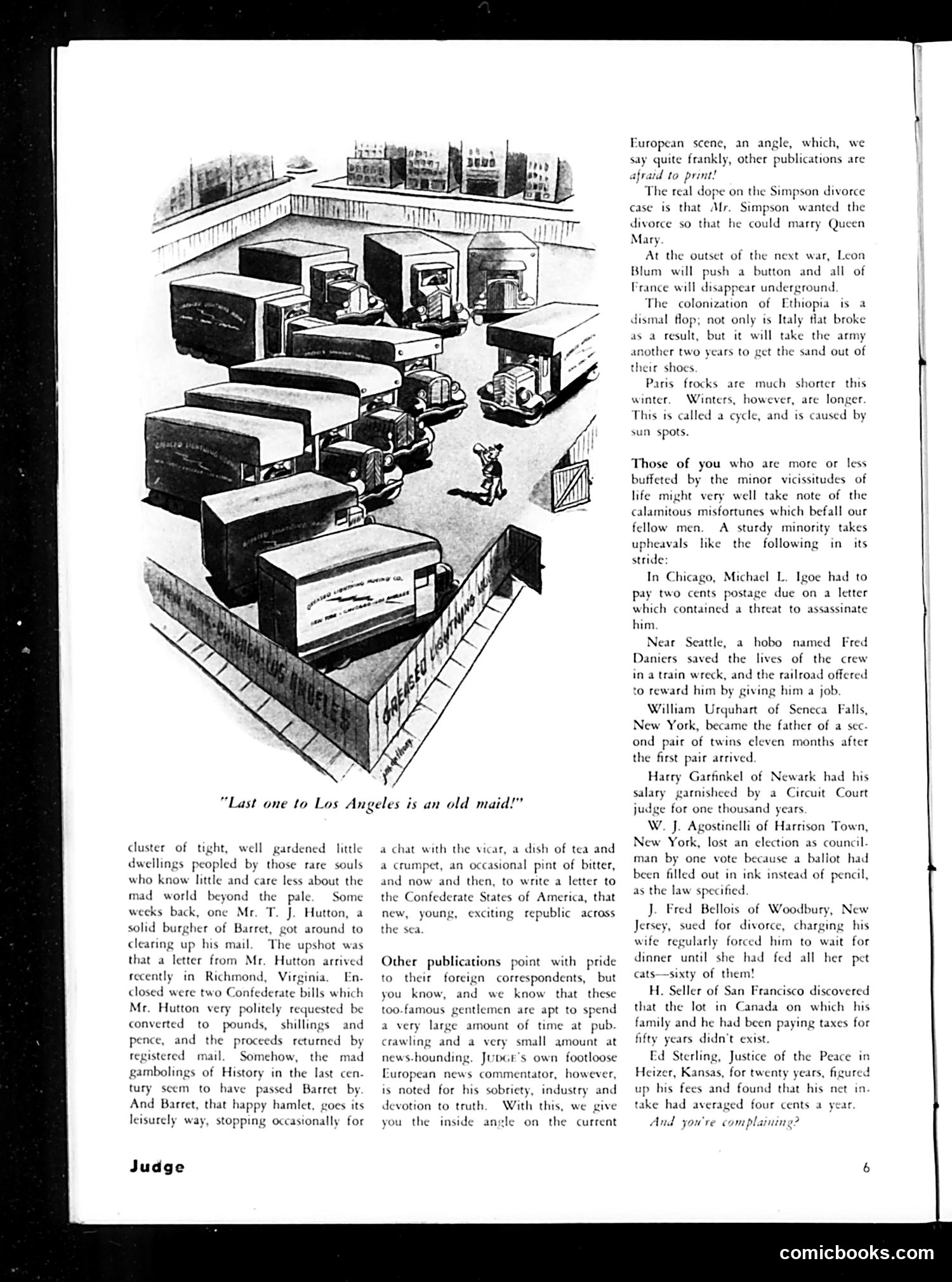
Analysis of Judge Magazine Page The main cartoon depicts a congested underground parking structure beneath a European cityscape, captioned "Last one to Los Angeles is an old maid!" This satirizes 1920s-era American automobile culture and urban congestion—suggesting that rapid motorization was creating chaotic infrastructure problems even then. The right column contains humorous anecdotes about minor misfortunes befalling ordinary people (postal mix-ups, inheritance disputes, salary garnishments). These appear designed as lighthearted filler illustrating life's petty absurdities. The cartoon's subtext mocks both European cities overwhelmed by American-style auto proliferation and Americans' eager adoption of car culture regardless of practical consequences. The "old maid" reference suggests competitive, even frantic adoption of modern transportation among the American public.
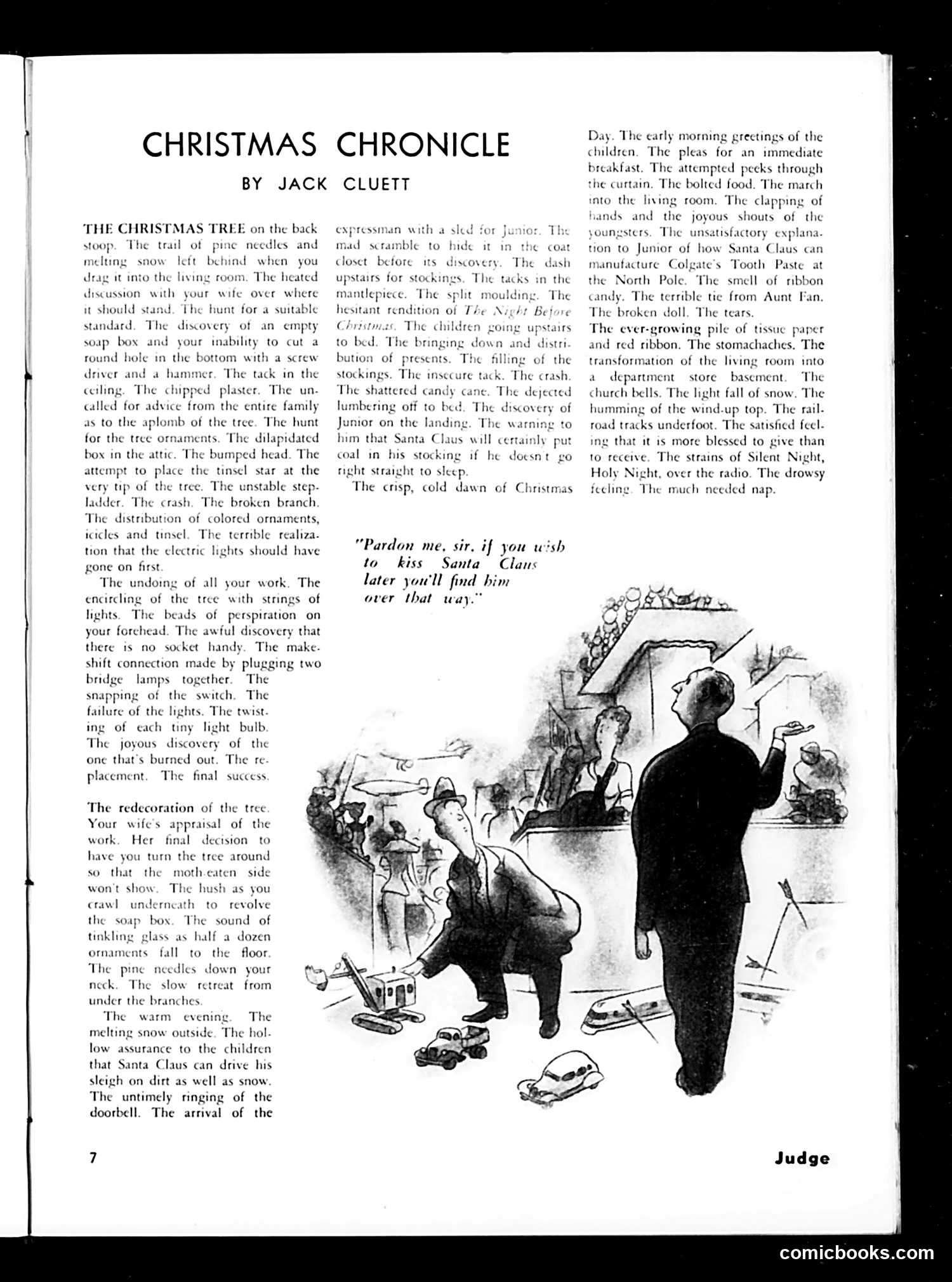
"Christmas Chronicle" by Jack Cluett This is a humorous essay describing the chaotic reality of Christmas preparation and celebration, presented as a chronicle of mishaps. The accompanying illustration shows a father figure surrounded by toys and debris, with a child approaching him. The caption reads: "Pardon me, sir, if you wish to kiss Santa Claus later you'll find him over that way." The satire mocks the gap between Christmas ideals and domestic reality—the tree disasters, broken ornaments, failed decorations, and general disorder that characterize actual holiday preparation. The joke suggests that the father, exhausted and disheveled from managing these catastrophes, has become indistinguishable from the harried figure children expect Santa to be. It's a gentle critique of the stressful, behind-the-scenes labor required to create the "magic" of Christmas.
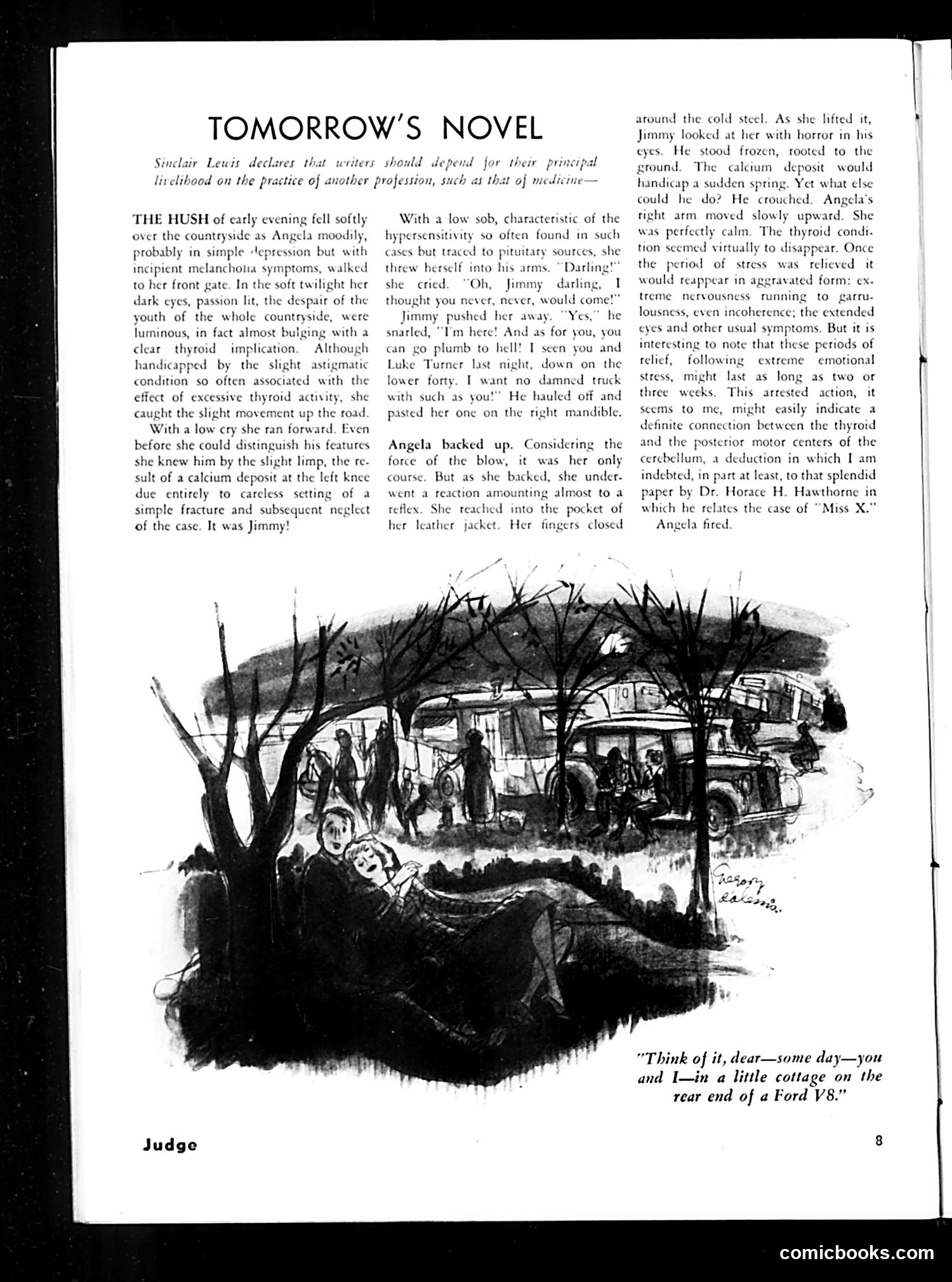
Analysis: "Tomorrow's Novel" This is a satirical piece mocking the overwrought, pseudoscientific melodrama popular in pulp fiction and romance novels of the era. The cartoon illustrates a dramatic scene—a man and woman in a romantic/violent confrontation—while the text parodies how such stories obsessively explain every character action through pseudo-medical jargon. The satire works by having the narrative constantly interrupt the romance plot to discuss thyroid conditions, calcium deposits, pituitary sources, and neurological connections—turning a simple domestic drama into absurd medical pseudo-analysis. The joke is that contemporary popular fiction treated medical/psychological explanations as profound justifications for melodramatic behavior. The caption's clichéd romantic promise ("cottage...Ford V8") contrasts with the preceding violence, further mocking genre conventions. The piece ridicules both pulp fiction's dramatic excess and the era's tendency to pathologize normal human emotion through pseudo-science.
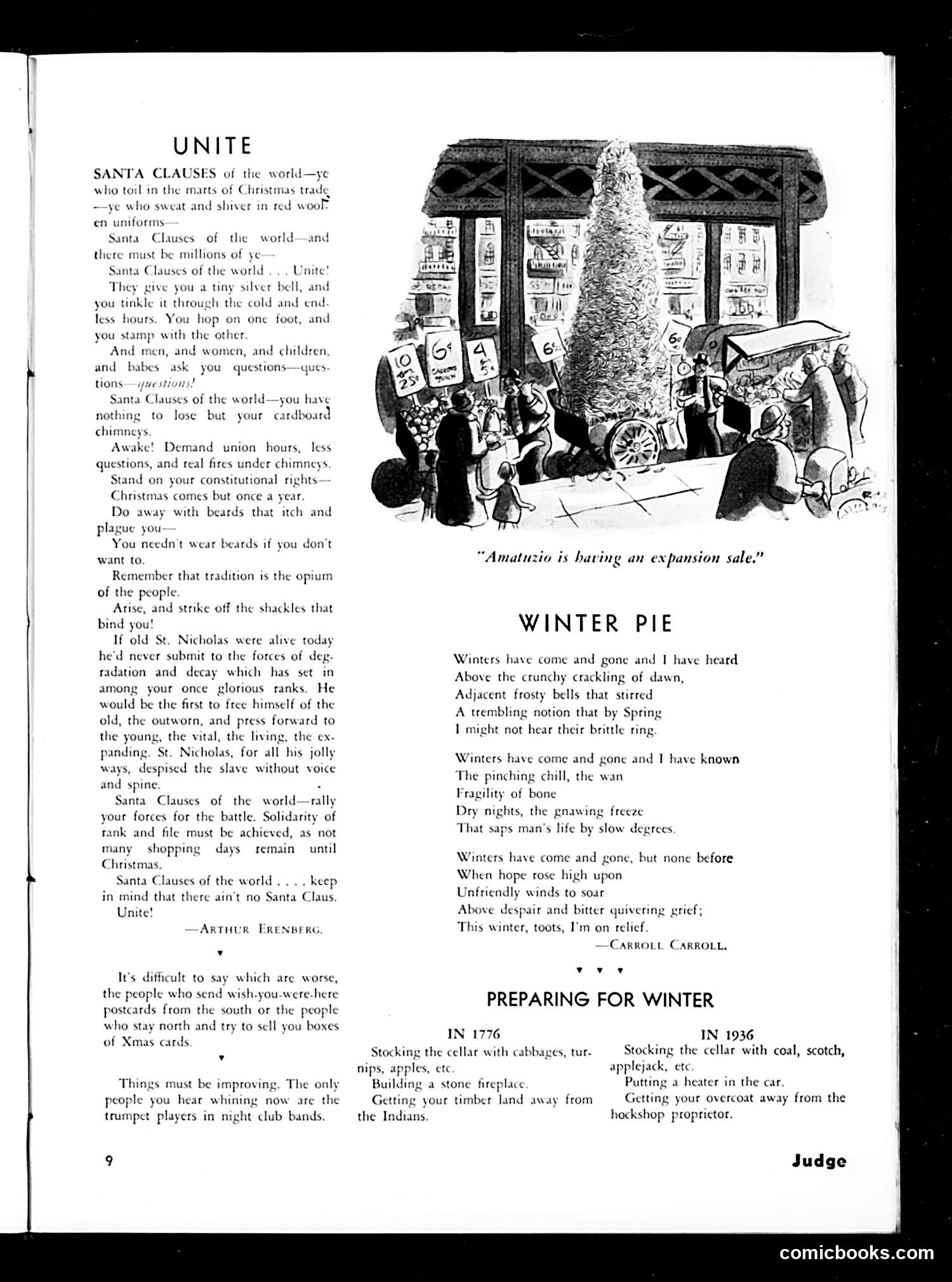
Explanation for Modern Readers This page contains two satirical pieces reflecting 1930s concerns: "Unite" is a mock-revolutionary tract urging department-store Santas to unionize. It parodies communist/labor organizing rhetoric ("Santa Clauses of the world, Unite!") while describing their actual working conditions: wearing itchy beards, standing on one foot for hours, enduring endless child questions, and receiving only cardboard chimneys as props. The satire mocks both exploitative retail labor practices and overwrought union organizing language. The final line—"there ain't no Santa Claus"—is a cynical punchline about disillusionment. "Winter Pie" is a poem about hardship during winter, ending with "I'm on relief"—referencing Depression-era government assistance programs, treating poverty with dark humor. The accompanying cartoon shows a crowded department-store window display with a Christmas tree and Santa figures, illustrating the commercial Christmas machinery being satirized. The page critiques 1930s retail labor conditions and economic desperation through comedic exaggeration.
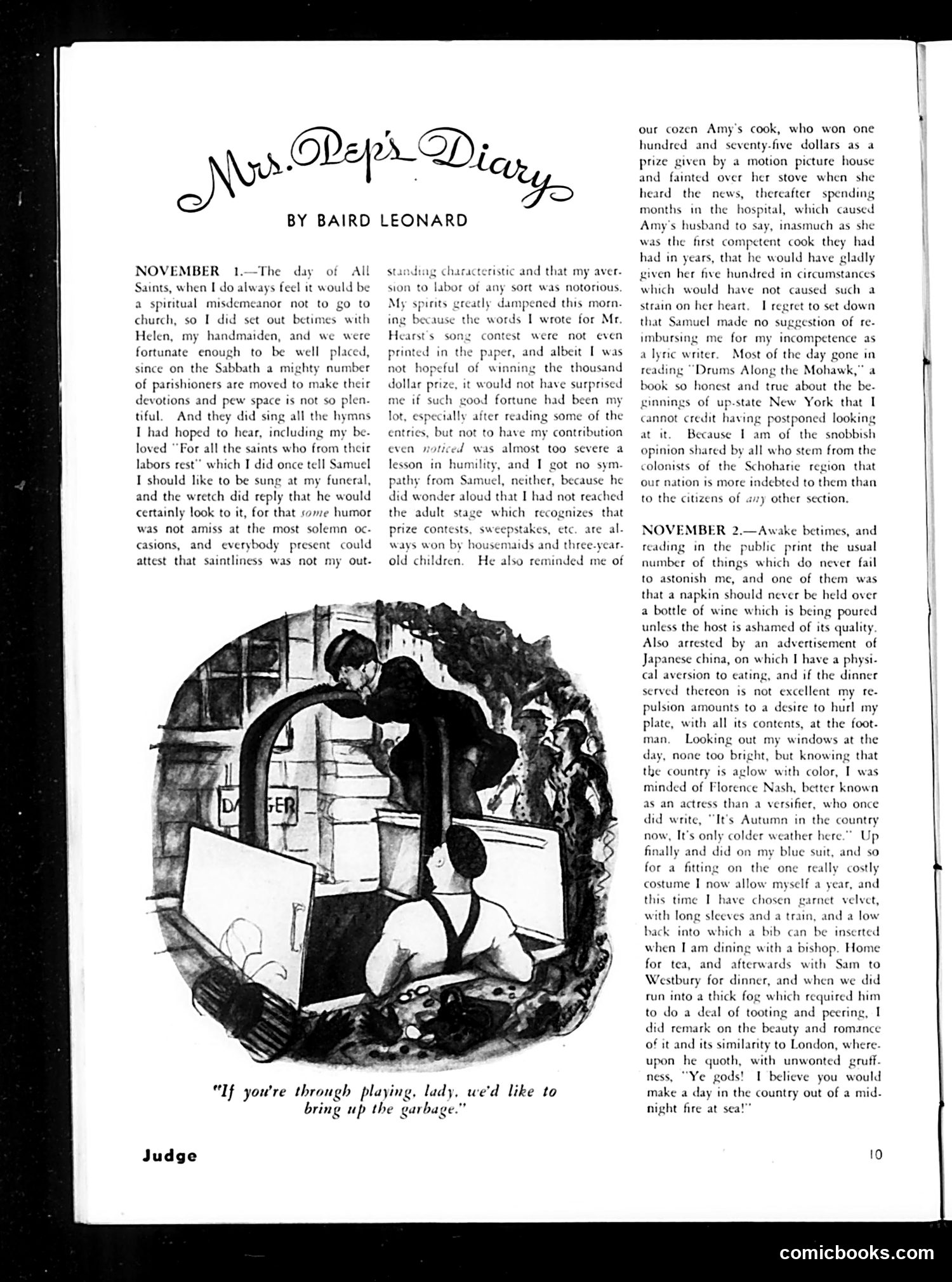
Mrs. Pep's Diary: A Period Piece of Early 20th-Century Domestic Satire This is a diary entry by "Mrs. Pep" (a fictional society character), written by Baird Leonard for *Judge* magazine. The single cartoon shows a woman at a piano being interrupted by a servant requesting to remove garbage—a visual joke about domestic hierarchy and the gap between genteel pretension and reality. The text satirizes upper-middle-class affectations: Mrs. Pep's wounded pride over her unnoticed song-contest entry, her husband Samuel's deflating comments about sweepstakes winners (housemaids and children), her snobbish pride in colonial ancestry, and her particular dislikes (Japanese china). The humor targets the vanity and pretentiousness of leisure-class women who fancy themselves cultured while remaining fundamentally disconnected from actual accomplishment or humble reality—symbolized by the garbage interruption. The diary format allows gentle mockery of her self-absorbed musings about costumes, autumn colors, and social anxieties.
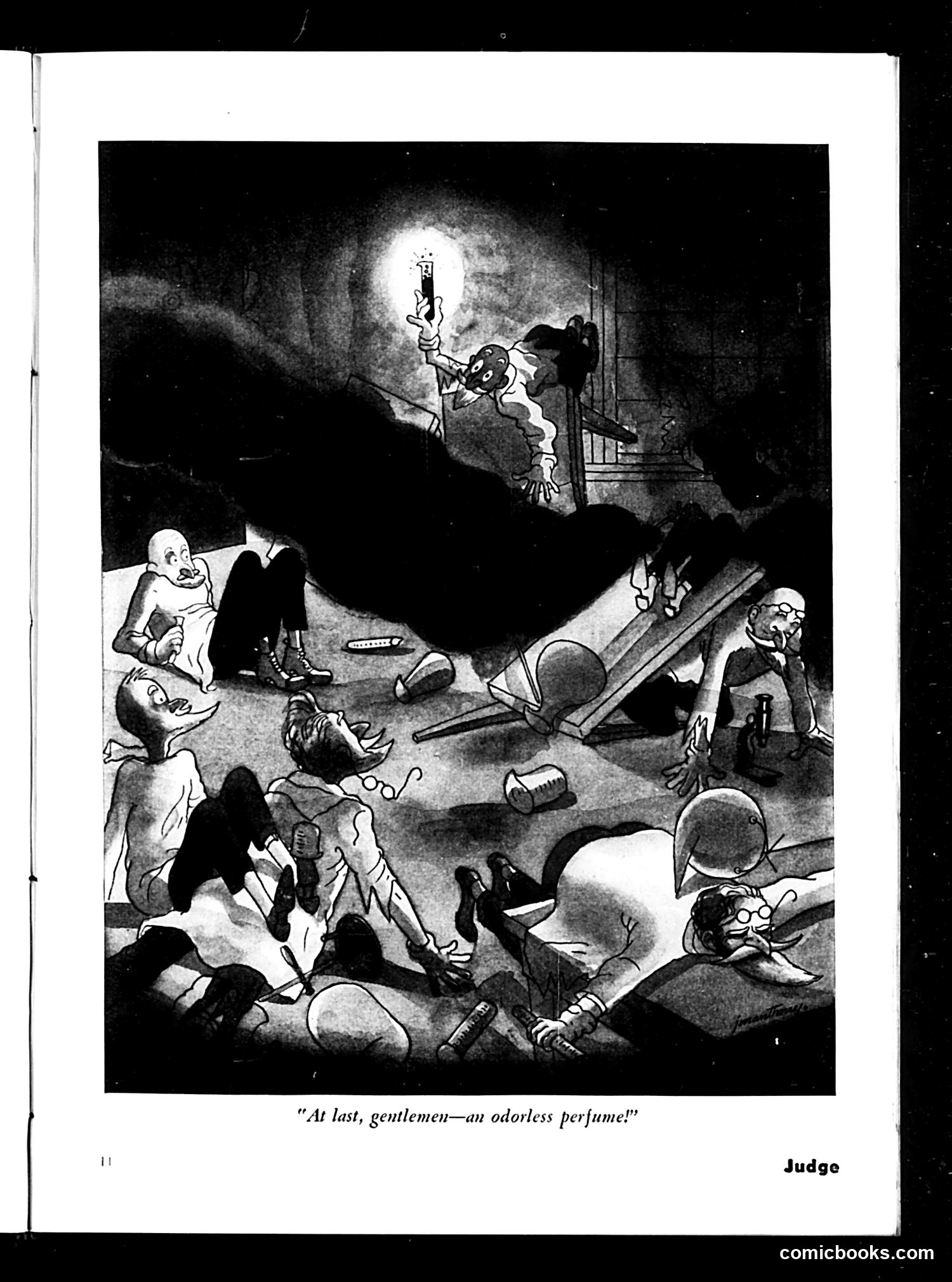
Judge Magazine Cartoon Analysis This is a satirical cartoon from *Judge*, an American humor magazine. The illustration depicts a charlatan or con artist (center, holding up a glowing bottle) presenting a fraudulent product to a group of eager gentlemen in what appears to be a basement or underground setting. The joke targets commercial deception: the "odorless perfume" is an obvious contradiction—perfume exists solely to provide scent. The caption's tone of triumphant revelation ("At last!") mocks both the huckster's sales pitch and the gullibility of consumers willing to believe impossible claims. This satirizes late 19th/early 20th-century patent medicine and dubious product marketing culture, where manufacturers made outlandish claims about their wares. The cartoon warns readers against believing absurd commercial promises.
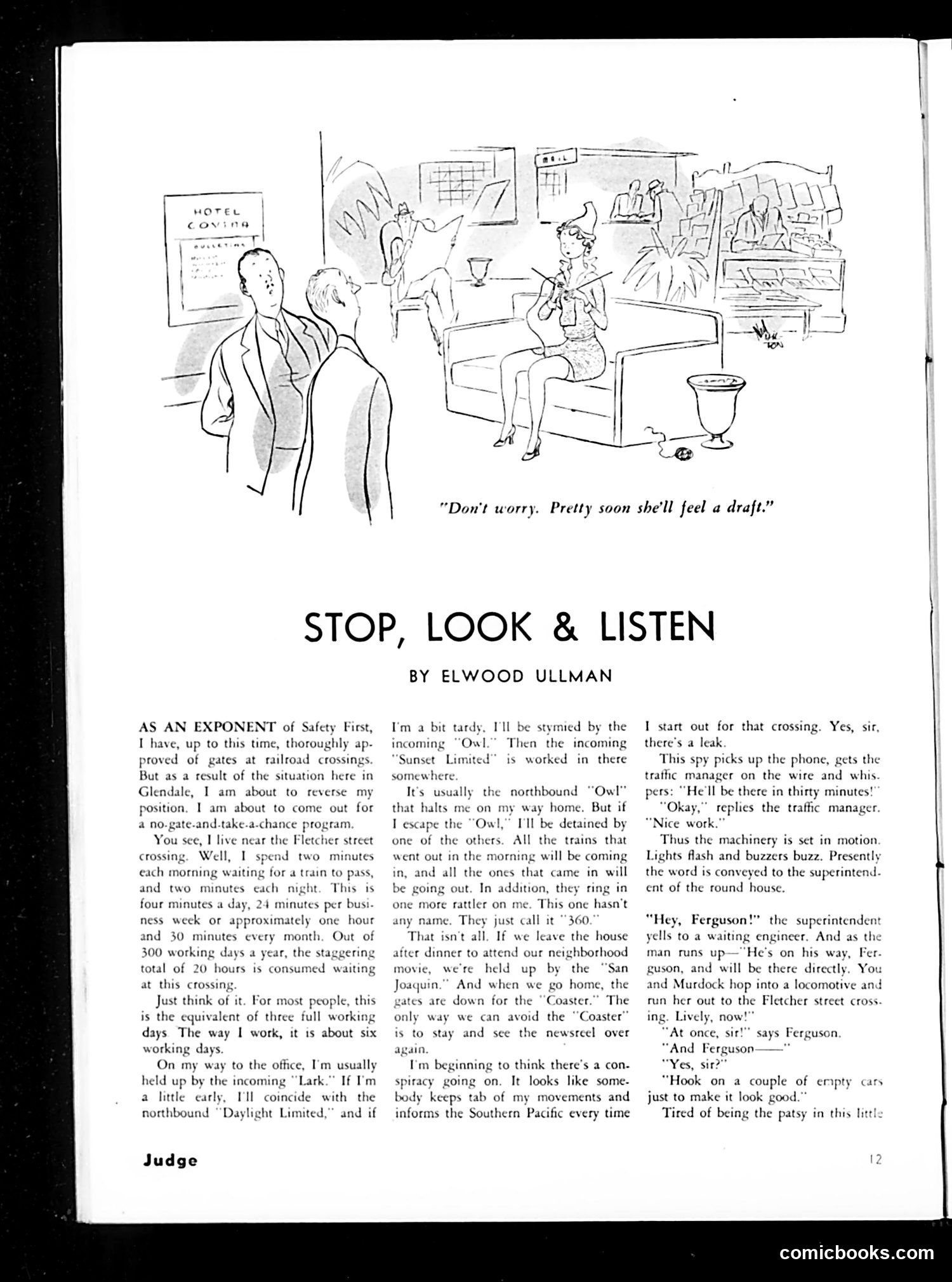
"Stop, Look & Listen" by Elwood Ullman This is a humorous essay-cartoon about railroad crossing delays in Glendale, California. The author complains that he spends roughly 20 hours annually waiting at the Fletcher Street crossing for trains from the Southern Pacific Railroad—trains with names like the "Owl," "Daylight Limited," "Sunset Limited," and "Coaster." The satire escalates into paranoia: he imagines a conspiracy where someone monitors his movements and alerts the railroad, triggering a coordinated response to deliberately delay him. The cartoon at top shows a woman assuring nervous guests that "pretty soon she'll feel a draft"—likely referencing the air movement from passing trains at the crossing. The joke mocks both the author's obsessive tracking of these delays and the perceived indifference of the railroad to public inconvenience. It reflects early 20th-century frustrations with railroad operations disrupting daily life in growing suburbs.
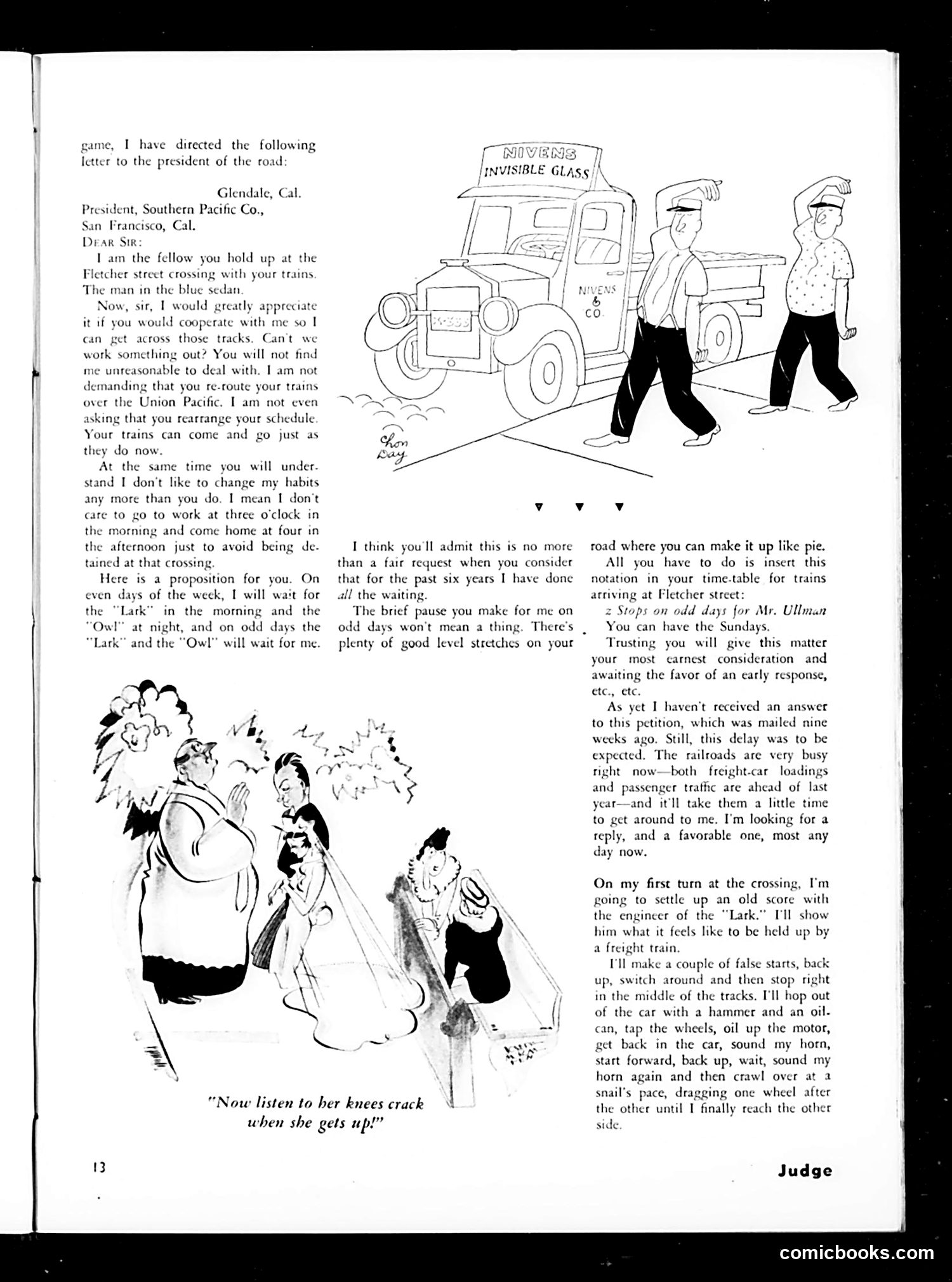
"The Fletcher Street Crossing" — Judge Magazine Satire This page satirizes the chronic frustration of motorists blocked by railroad crossings—a genuine public grievance of the early automobile era. A man stuck in traffic at Fletcher Street (Glendale, California) writes a humorous "petition" to the Southern Pacific Railroad president, proposing they alternate waiting: he'll adjust his work schedule to odd days if trains will accommodate him on even days. The satire escalates absurdly—he's waited six years already and demands fairness. The accompanying cartoon shows him plotting petty revenge: once granted passage, he'll deliberately block *the train* with false starts, maintenance stops, and inch-by-inch crawling across the tracks. The lower cartoon (captioned "Now listen to her knees crack when she gets up!") appears unrelated, depicting women, likely mocking elderly or heavy women's mobility. The joke targets both the motorist's impotent rage against railroad monopolies and the railroads' indifference to modern automobile traffic—a real tension as cars proliferated in the 1920s-30s.
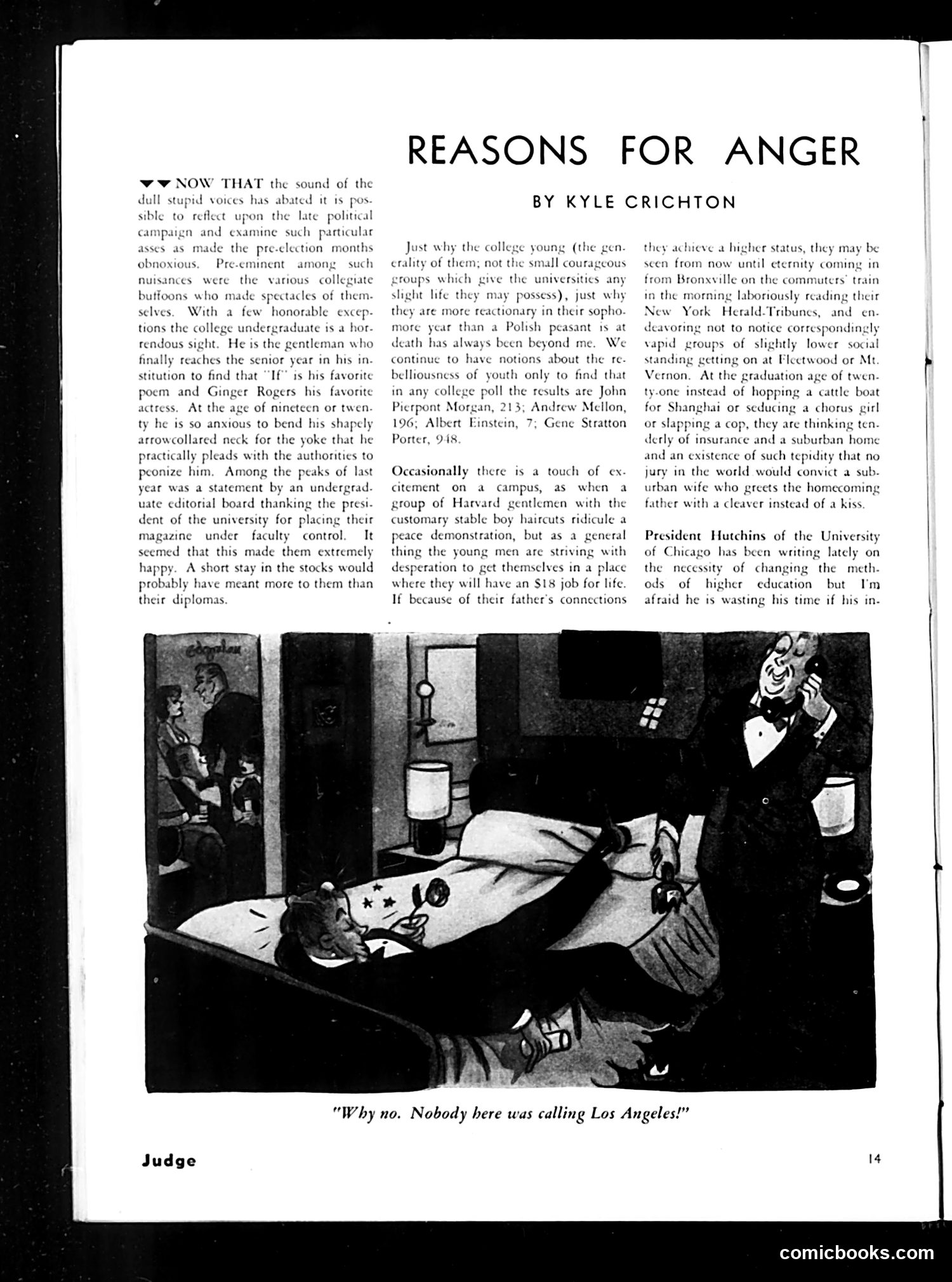
Explanation for Modern Readers This 1930s satirical article by Kyle Crichton attacks college students for political passivity and conformity during a pre-election period (likely 1932 or 1936, given references). The Satire's Points: - College students are intellectually dull and conservative, not rebellious as youth stereotypically are - They worship wealthy capitalists (poll results show admiration for J.P. Morgan and Andrew Mellon over Einstein) - Rather than pursuing adventure or idealism, they obsess over securing stable "$18 jobs for life" through family connections - Their ambitions are crushingly mundane: suburban homes, insurance, comfortable mediocrity The Cartoon: Shows a dead body labeled with the number "10," captioned "Why no. Nobody here was calling Los Angeles!" The dark humor suggests the students are morally/intellectually "dead"—so conformist and apathetic that even calling Los Angeles (presumably invoking adventure or rebellion) is unthinkable. Crichton criticizes both the students and University of Chicago President Hutchins for accepting this tepid status quo rather than fostering critical thinking or social engagement.
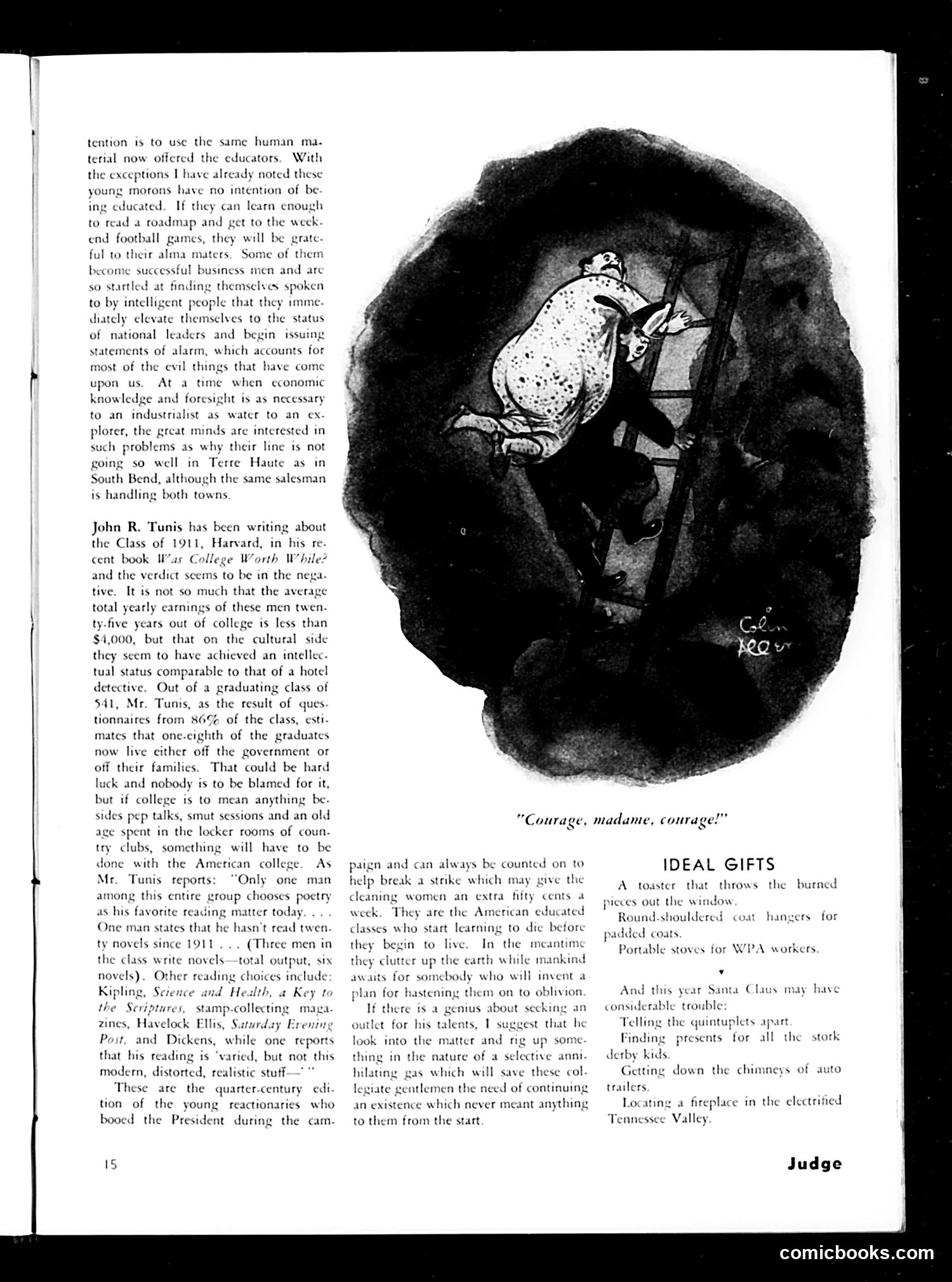
Judge Magazine Cartoon Analysis The main illustration depicts a woman's profile with an exaggerated, bulbous nose—a caricature style common to Judge magazine's satirical approach. The caption "Courage, madame, courage!" suggests commentary on feminine resilience or social attitudes toward women, though the specific reference is unclear without additional context. The accompanying text critiques Harvard's Class of 1911, citing John R. Tunis's book questioning college's value. The author satirizes these educated men as intellectually lazy "morons" who avoid serious reading, pursue shallow interests (stamp-collecting, popular magazines), and emerge as business leaders despite minimal cultural achievements. The piece mocks their reactionary politics—they "booed the President" and break strikes—suggesting education failed to cultivate genuine intellect or progressive values. The "Ideal Gifts" section offers Depression-era satire: WPA worker stoves reference New Deal employment programs, while Tennessee Valley references the TVA electrification project. The humor targets economic hardship and government relief efforts.
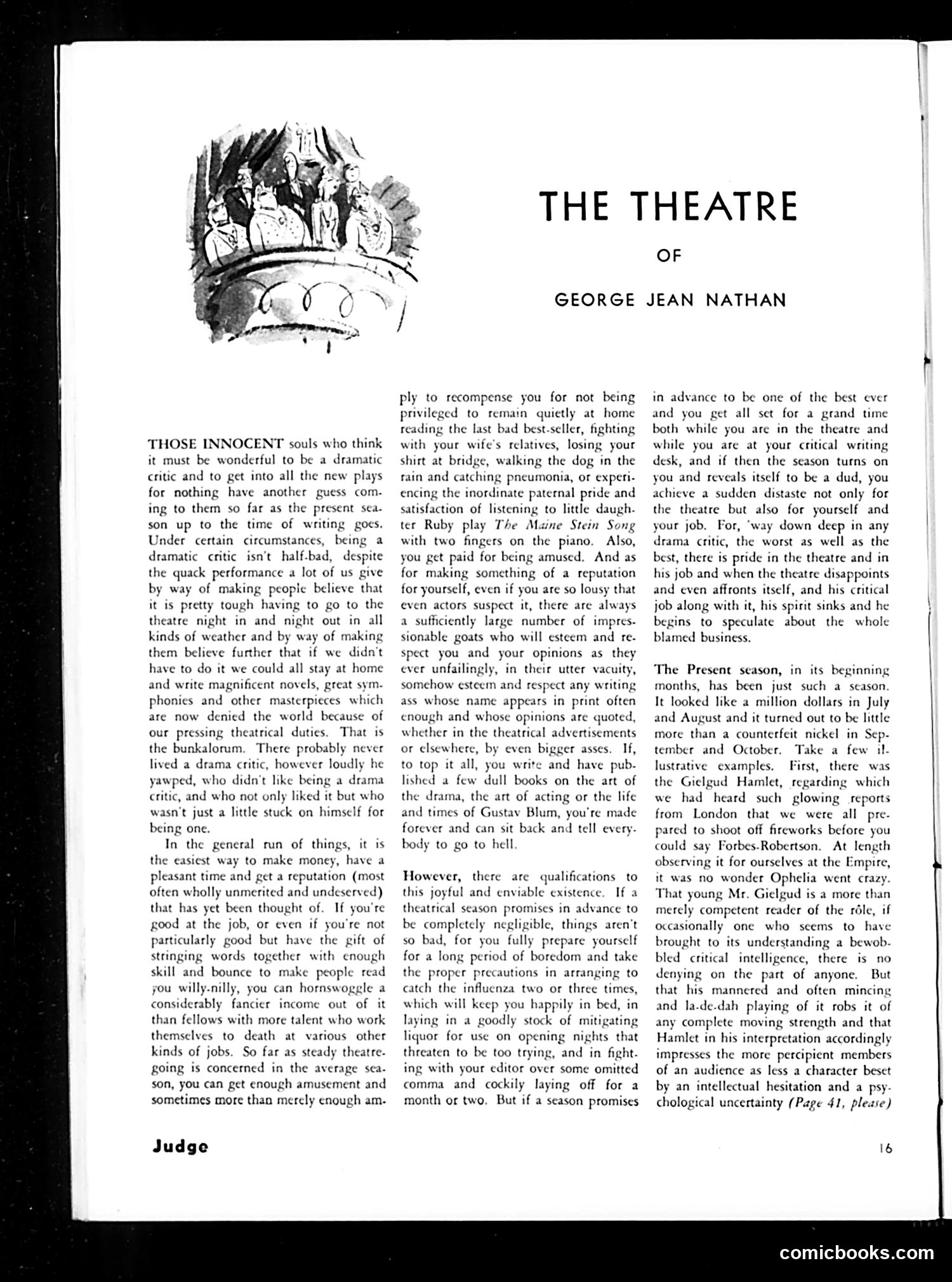
"The Theatre of George Jean Nathan" This is a title page and opening article from Judge magazine by theater critic George Jean Nathan. The piece is a cynical essay about dramatic criticism itself, not about a specific theatrical work or political event. Nathan satirizes theater critics as self-important frauds who claim their job is arduous and prevents them from writing novels or symphonies. He argues critics actually enjoy easy money and undeserved reputation, especially if they can string words together skillfully enough to fool readers. He mocks how critics gain credibility by publishing dull books about drama or historical theater figures. The article notes that while steady theater-going usually provides adequate amusement and pay, the real challenge comes when a promising season raises expectations—suggesting that Nathan is about to discuss specific disappointing theatrical offerings from that season. The ornamental header illustration shows classical theatrical figures, fitting for a theater criticism piece.
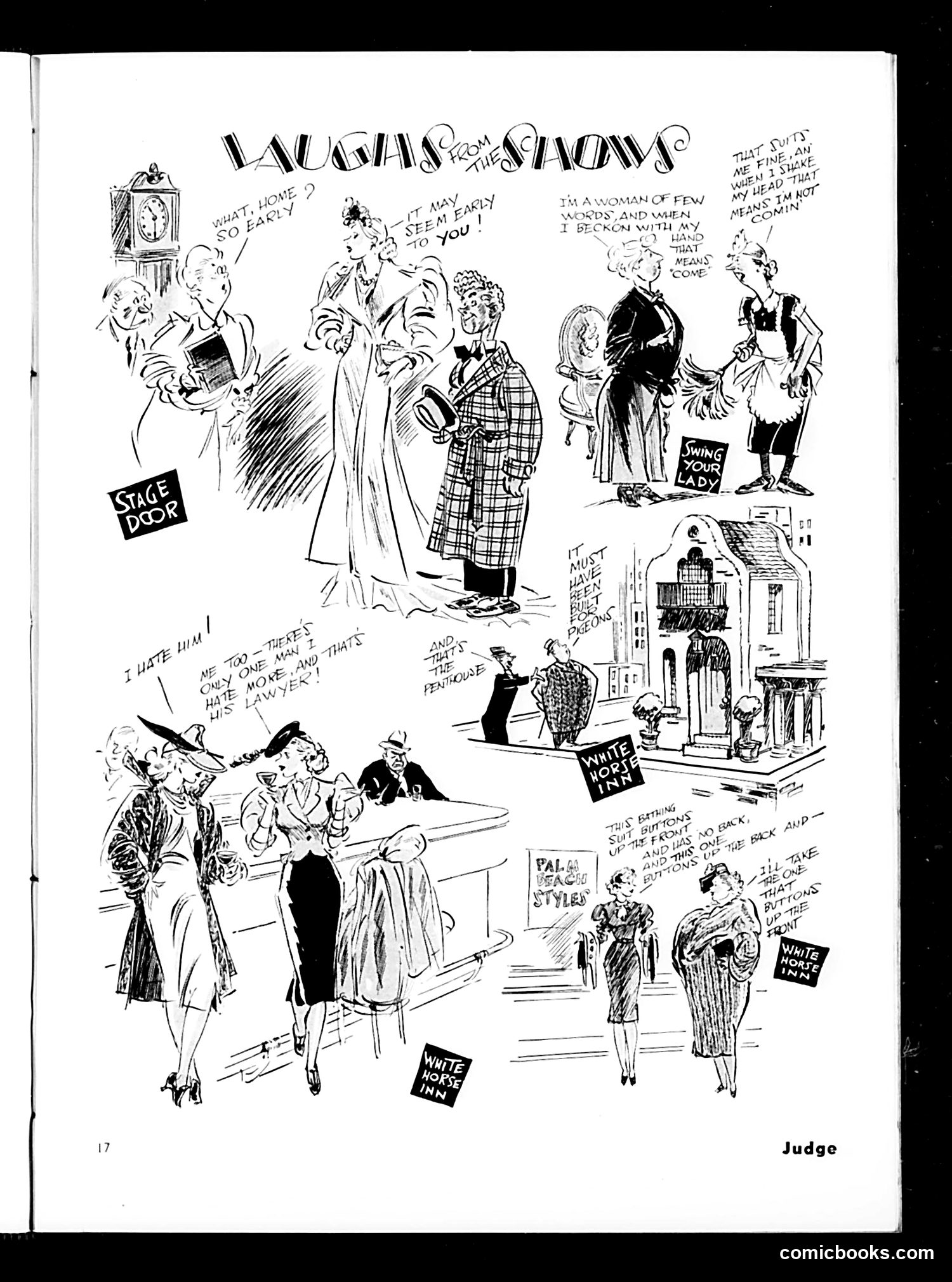
"Laughs from the Shadows" - Judge Magazine Cartoon This is a satirical cartoon about nightlife and social establishments during what appears to be the Prohibition era (based on references to "White Horse Inn"). The cartoon depicts various characters—seemingly wealthy patrons and socialites—frequenting speakeasies and informal drinking establishments ("White Horse Inn" labels visible). The humor satirizes the hypocrisy of upper-class society: respectable-looking people conducting illicit activities in hidden venues. Speech bubbles show characters making excuses about their whereabouts and activities. A "stage door" reference suggests theatrical connections. The title "Laughs from the Shadows" plays on the secretive, shadowy nature of underground nightlife venues that flourished during alcohol prohibition, while the cartoon mocks both the venues themselves and the pretentious clientele frequenting them.
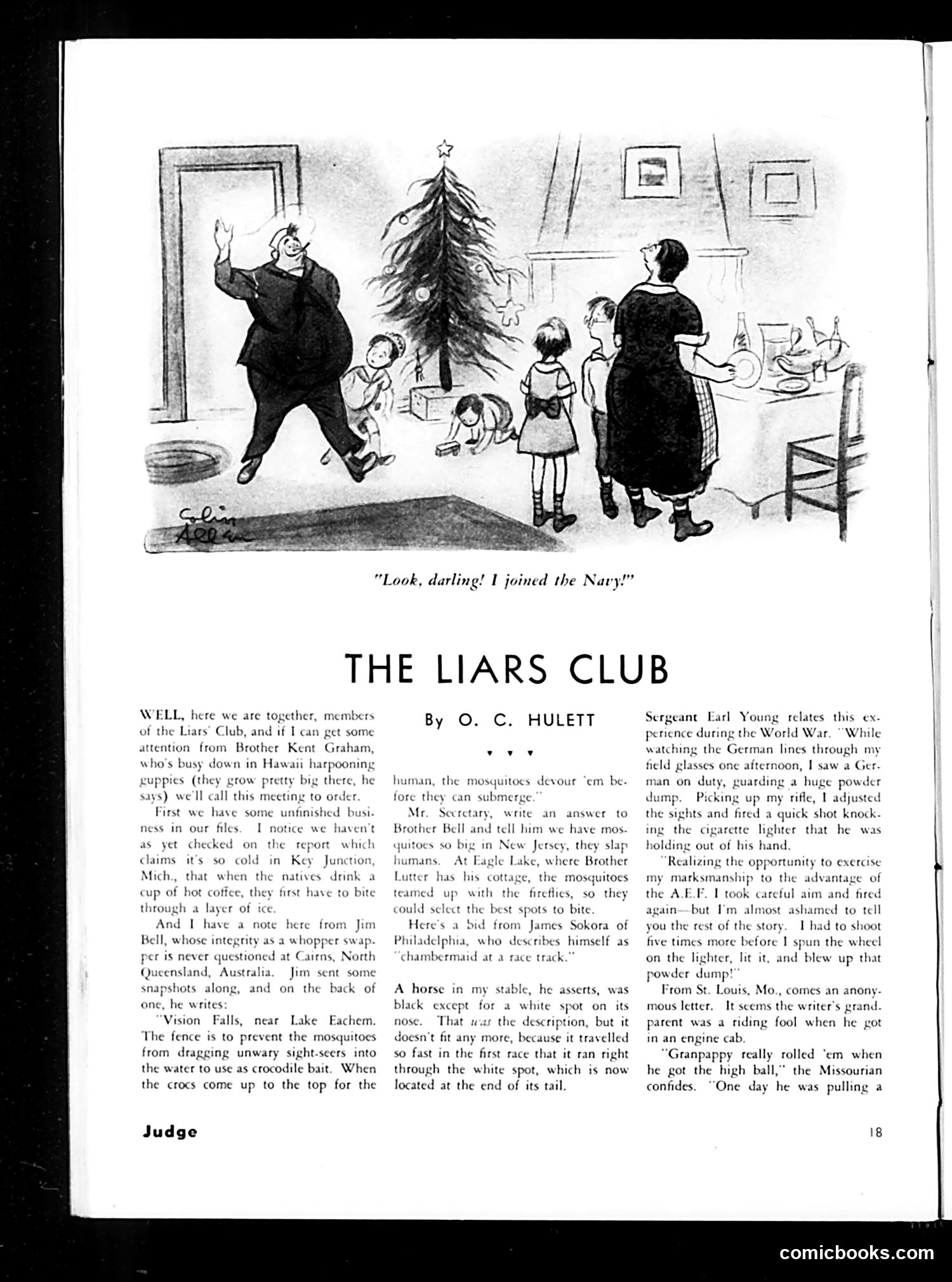
"The Liars Club" - Judge Magazine This is a humor piece, not political satire. The cartoon shows a family Christmas scene where a man enthusiastically announces "Look, darling! I joined the Navy!" — a domestic joke about an absurd or unexpected declaration. The accompanying text presents a fictional "Liars Club" meeting where members share tall tales. The humor relies on increasingly absurd exaggerations: mosquitoes so large they drag people into crocodile-infested waters; a horse that ran so fast it passed through a white spot on its nose; a WWI soldier shooting a cigarette lighter clean off an enemy's hand from a distance; a grandfather engineer so skilled he could "roll 'em" (control trains precisely). The satire targets boastful masculine storytelling — a common social practice where men one-up each other with exaggerated war stories, hunting tales, and occupational feats. By presenting these obviously impossible claims in deadpan fashion, the piece gently mocks how men inflate their accomplishments and wartime experiences.
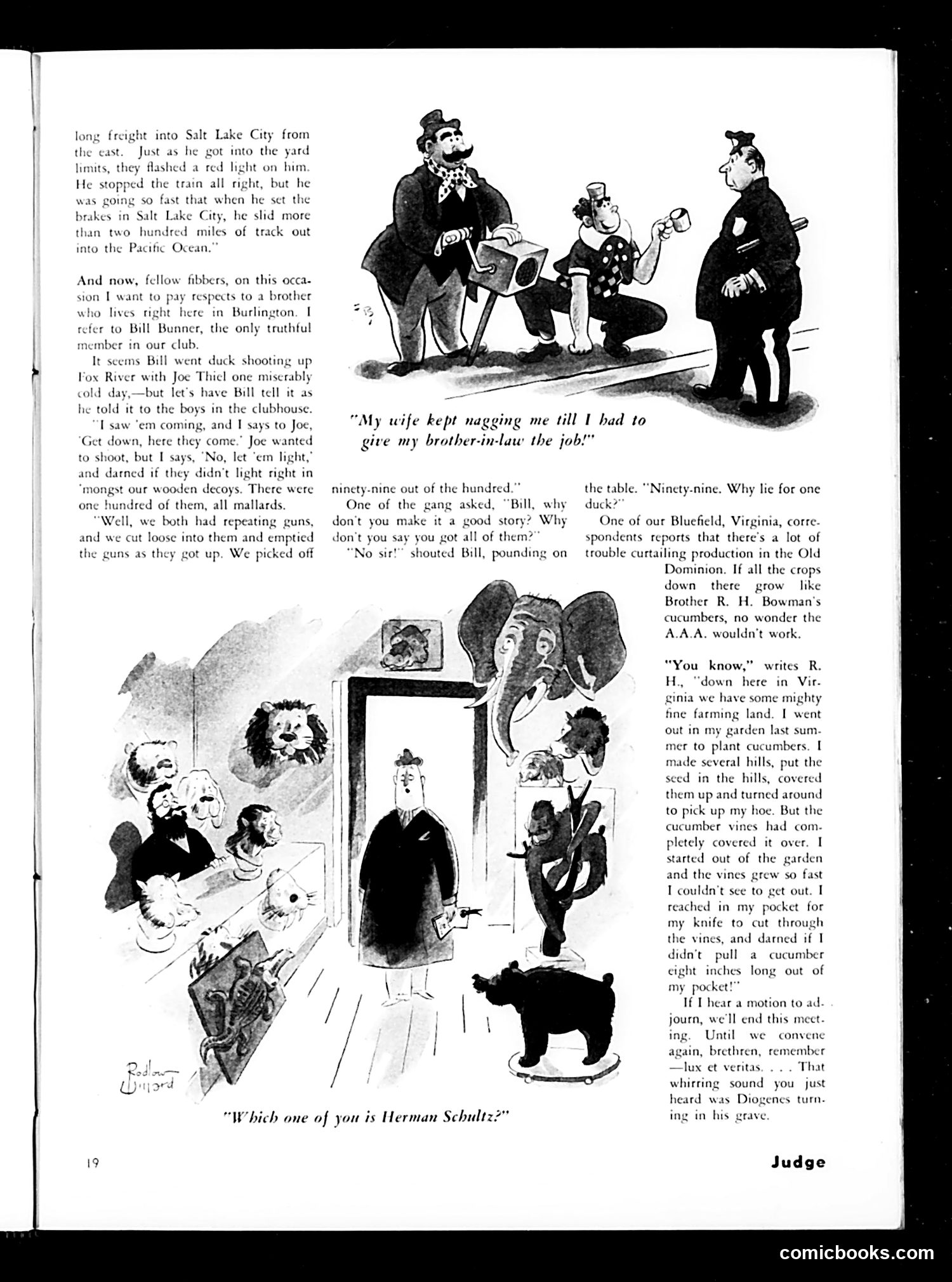
Analysis of Judge Magazine Page This page contains two satirical pieces: Top cartoon: Shows men discussing a tall tale about a train braking so hard in Salt Lake City that it skid "more than two hundred miles of track out into the Pacific Ocean." The joke mocks exaggerated storytelling—a common feature of Judge's humor targeting masculine braggadocio. Main story: A clubhouse gathering where "Bill Bunner" supposedly tells the only truthful story. He recounts duck hunting where he and a friend shot "ninety-nine out of the hundred" ducks. When asked why he didn't claim all hundred, Bill refuses—insisting on honesty. The satire ridicules obsessive truthfulness as impractical in a culture of male boasting. Side commentary: A Virginia correspondent's anecdote about cucumber vines growing so prolifically they covered his hoe and garden. This appears to mock the Agricultural Adjustment Administration's (AAA) crop-control failures during the New Deal era, suggesting Southern farming conditions produced absurdly overgrown vegetables despite government intervention. The page satirizes American masculine culture, honesty, and Depression-era agricultural policy through exaggeration and deadpan humor.
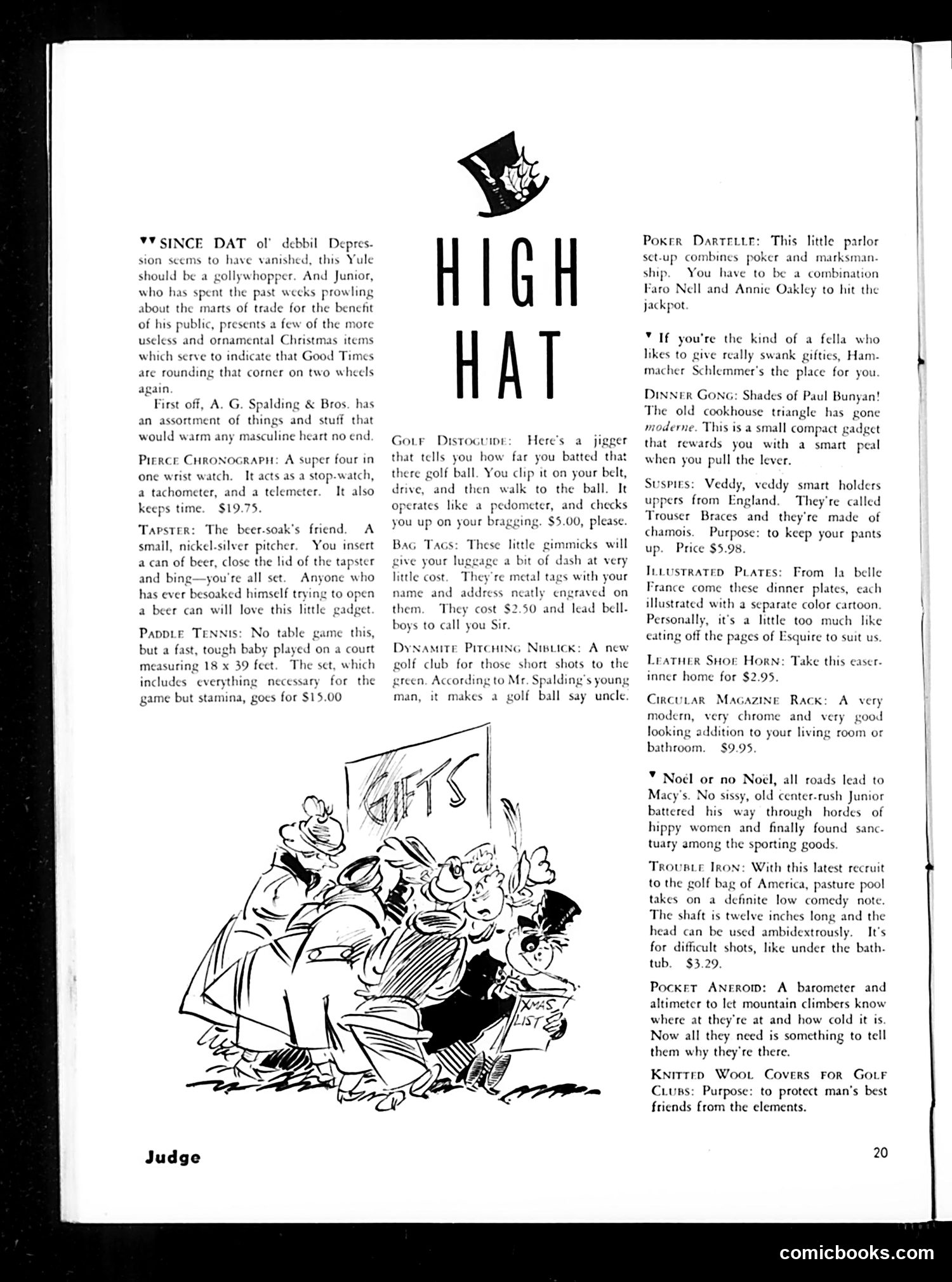
"High Hat" Gift Guide Analysis This is a Christmas shopping feature from *Judge* magazine, disguised as gift recommendations but functioning as satirical commentary on consumerism during economic recovery. The page opens by referencing the "debbil Depression" vanishing, suggesting the economy is improving and frivolous spending has resumed. The satire targets the absurdity of luxury gift items: useless gadgets like a "Golf Distocuide" (pedometer for measuring golf shots), a beer-tap pitcher, "Paddle Tennis," and a "Trouble Iron" golf club designed for difficult shots. The cartoons and tone mock both manufacturers creating unnecessary products and wealthy consumers purchasing them. References to "Faro Nell and Annie Oakley" (Old West figures) add period flavor, while jabs at pretension appear throughout—particularly mocking Hammacher Schlemmer's upscale positioning. The final dig at Macy's portrays "Junior" battling through crowds to find sanctuary among sporting goods, suggesting even Christmas shopping has become a competitive sport.
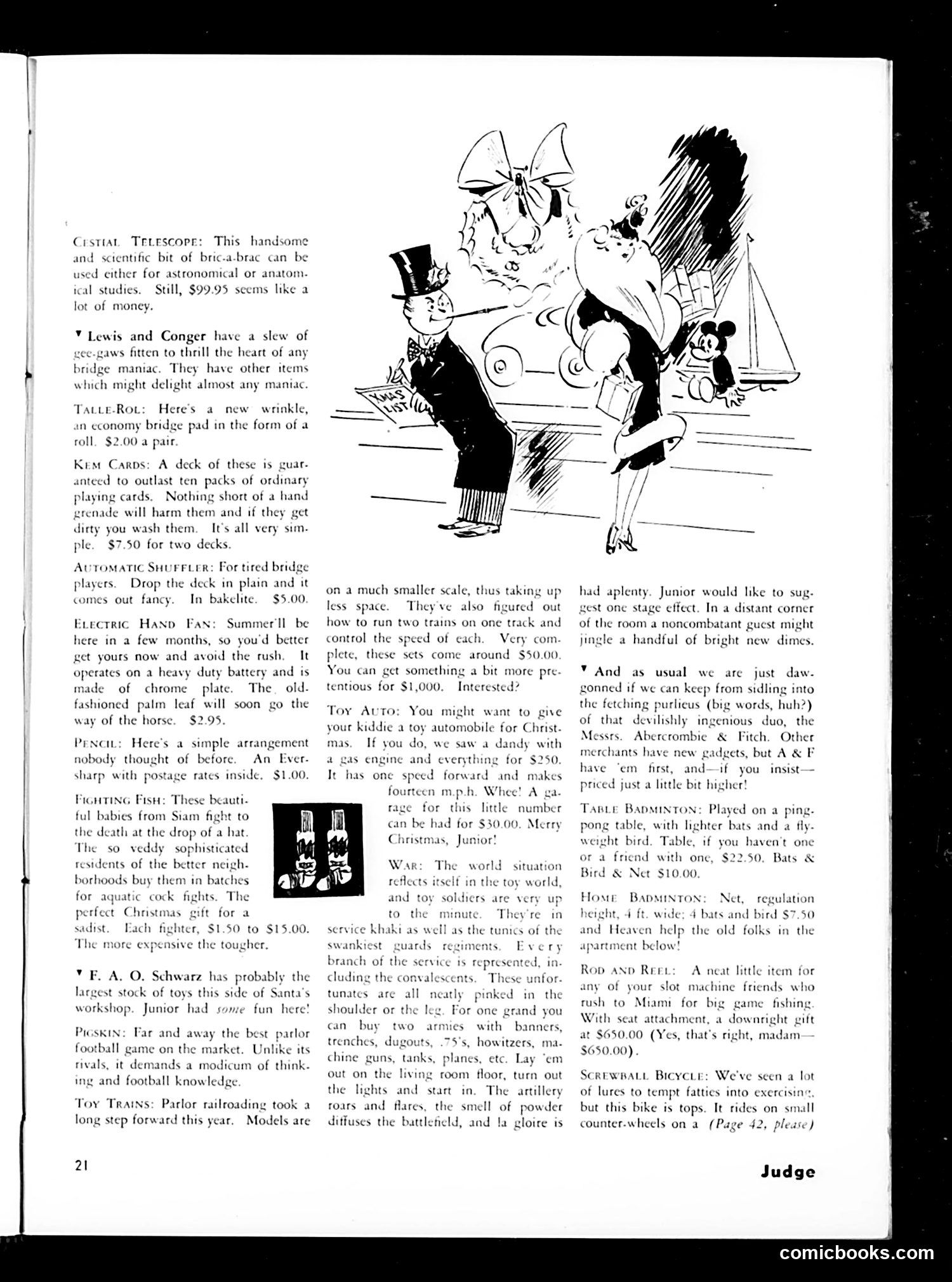
Judge Magazine Content Analysis This page is primarily gift-giving advertising disguised as product reviews for upscale toys and novelties, likely from the 1910s-1920s. The main cartoon shows fashionably dressed figures examining luxury items, suggesting Christmas shopping for the wealthy. The satirical angle is gentle mockery of frivolous consumer culture: items like $99.95 telescopes for "anatomical studies" (a wink at using them to spy on neighbors), $250 toy cars, and fighting fish imported from Siam for "sadists" are presented with tongue-in-cheek endorsement. The review of $1,000+ toy soldier sets reflects contemporary WWI anxieties, with soldiers "pinked" in service uniforms—militarism marketed as children's entertainment. The humor targets wealthy leisure-class readers who could afford these absurdities. The writing style—breathless, knowing, slightly arch—assumes readers recognize both the extravagance and their own participation in conspicuous consumption. This is advertisement as social satire, appealing to buyers' sense of sophisticated irony about their own excess.
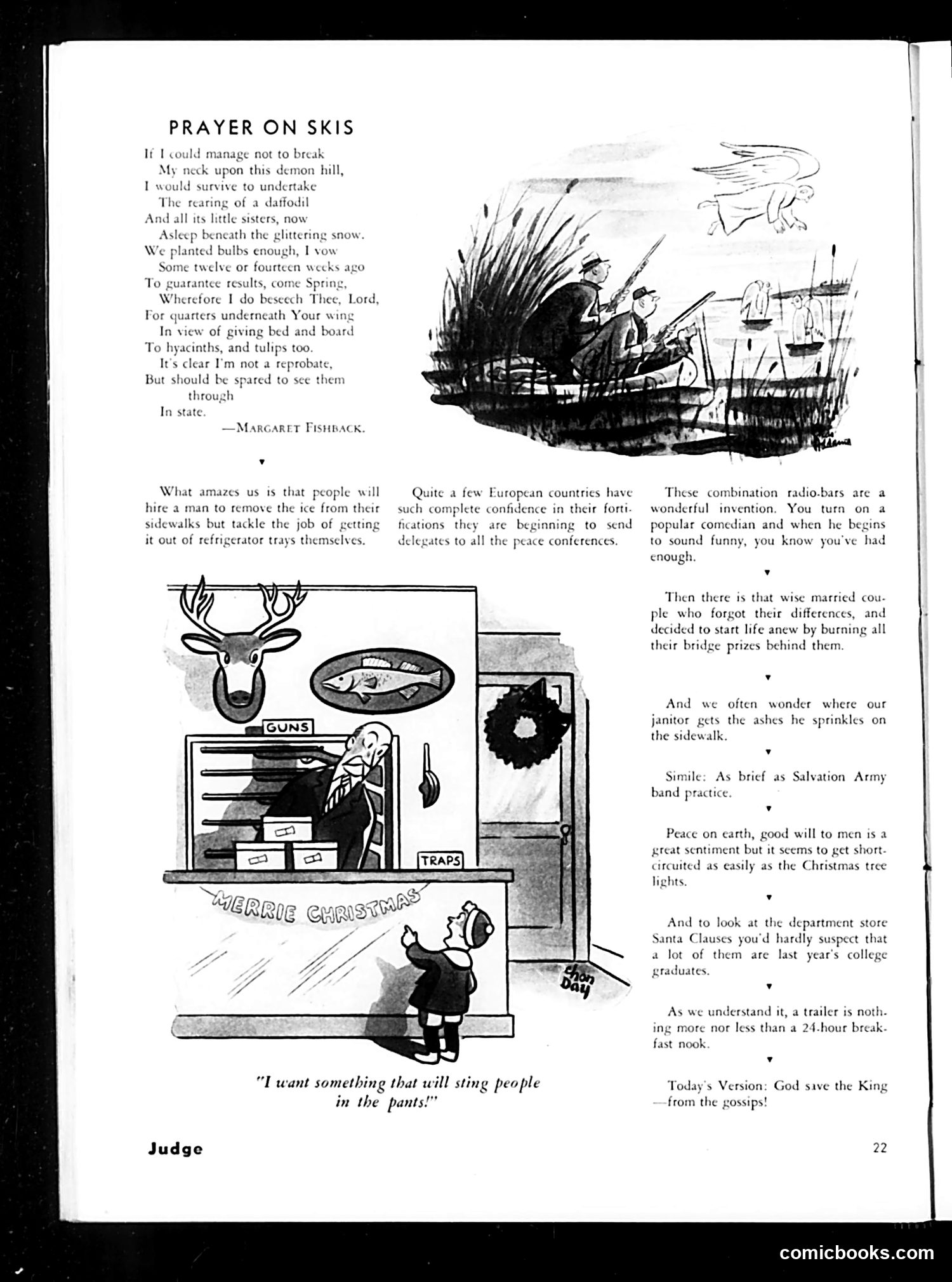
Analysis of Judge Magazine Page This page contains satirical commentary on 1930s-40s American life. The main poem "Prayer on Skis" by Margaret Fishback humorously depicts a skier praying for survival so she can tend her spring bulbs—mocking both the dangers of skiing and overwrought romantic sentimentality about gardening. The cartoons below offer social satire: The Christmas display cartoon shows a child asking Santa for "something that will sting people in the pants"—satirizing either aggressive gift-giving or wartime anxieties (the display includes "guns" and "traps" alongside holiday decorations). The column of brief quips mocks contemporary absurdities: hiring professionals for sidewalk ice but avoiding refrigerator maintenance; European nations confidently sending peace conference delegates; radio-bars as entertainment devices; department store Santas being college graduates; and trailers as portable living spaces. The humor relies on observing everyday contradictions and hypocrisies of the era, typical of Judge's satirical approach to American culture.
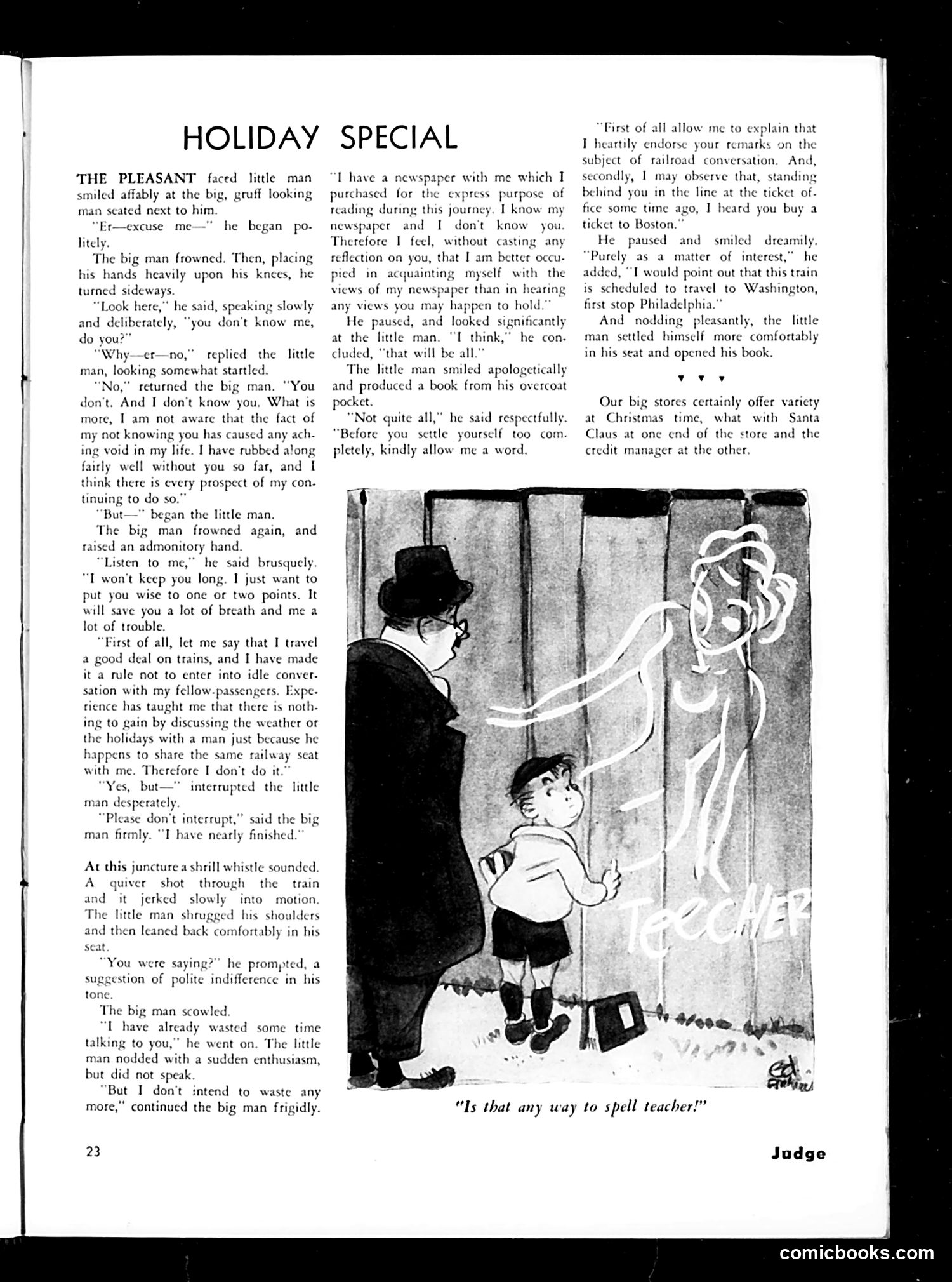
"Holiday Special" - Judge Magazine Cartoon This page contains a humorous short story about two train passengers establishing a social contract. A gruff, verbose man lectures a pleasant smaller man about the etiquette of NOT making idle conversation during train travel—a common social annoyance of the era. The big man pompously explains he travels frequently and refuses to discuss weather or holidays with fellow passengers. The satire's punchline: after his lengthy sermon about avoiding unnecessary conversation, the small man reveals he overheard the big man buy a ticket to Boston—yet the train is heading to Washington. The man has just wasted considerable breath giving unsolicited advice while being fundamentally confused about his own destination. The cartoon mocks self-important travelers who lecture others while being oblivious to their own foolishness. The illustration shows the small man innocently pointing out the window, presumably at the destination sign. The closing note about Santa Claus versus credit managers is a separate holiday-themed joke about Christmas shopping realities.
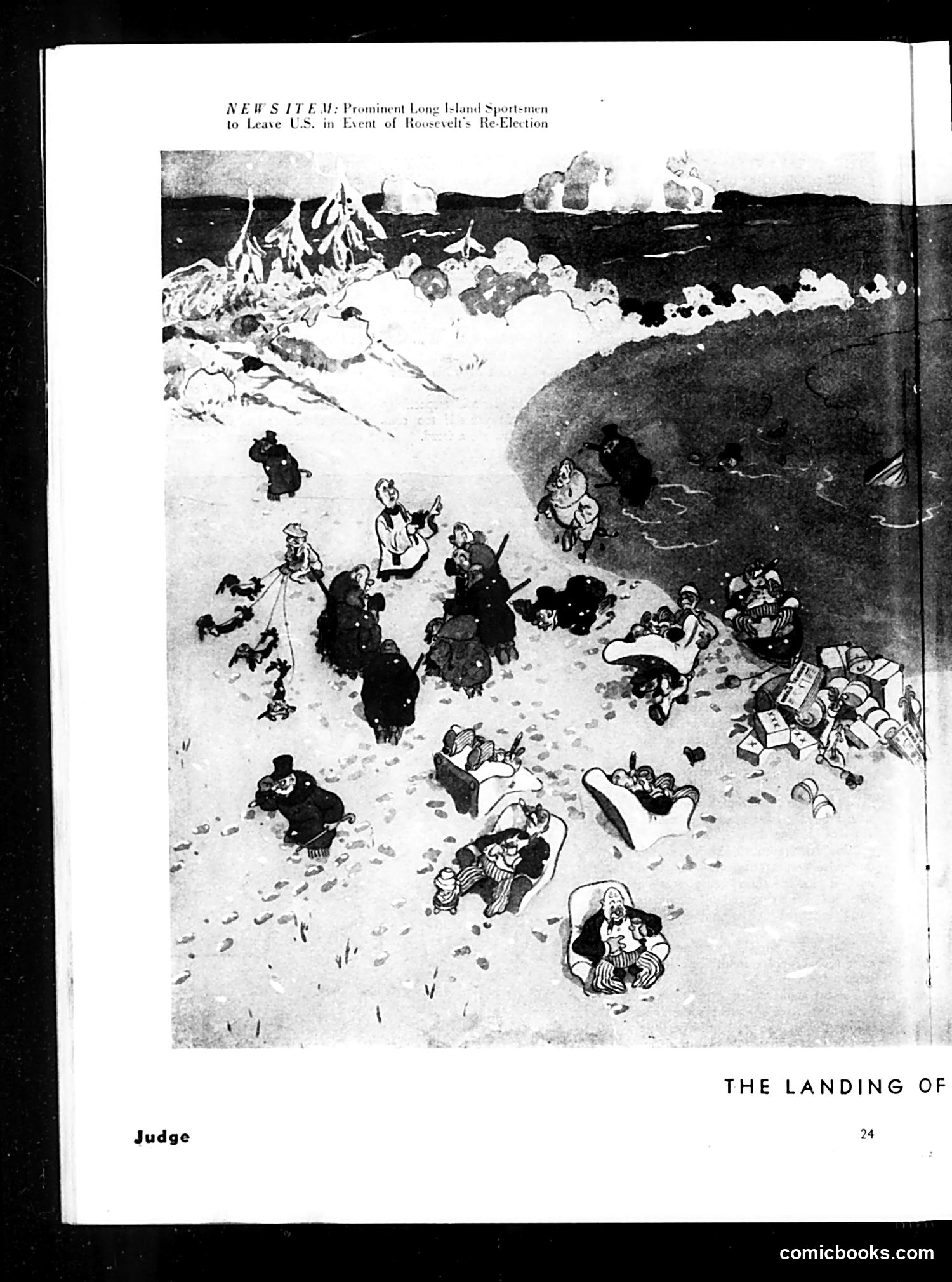
Political Cartoon Analysis This cartoon satirizes wealthy Long Island sportsmen threatening to leave America if Franklin D. Roosevelt wins re-election. The image depicts various affluent figures and their possessions scattered on a beach, apparently preparing to emigrate. The satire mocks the exaggerated threat of wealthy elites abandoning the country over Roosevelt's New Deal policies, which they opposed as socialist overreach. By showing them literally "landing" elsewhere (the title suggests departure), Judge ridicules their dramatic posturing as both self-important and cowardly. The cartoon's point: these privileged individuals' threatened exodus is presented as absurd and inconsequential—their departure would be no great loss to America. This reflects contemporary class tensions and satirizes anti-Roosevelt sentiment among the wealthy establishment during the 1930s-40s era.
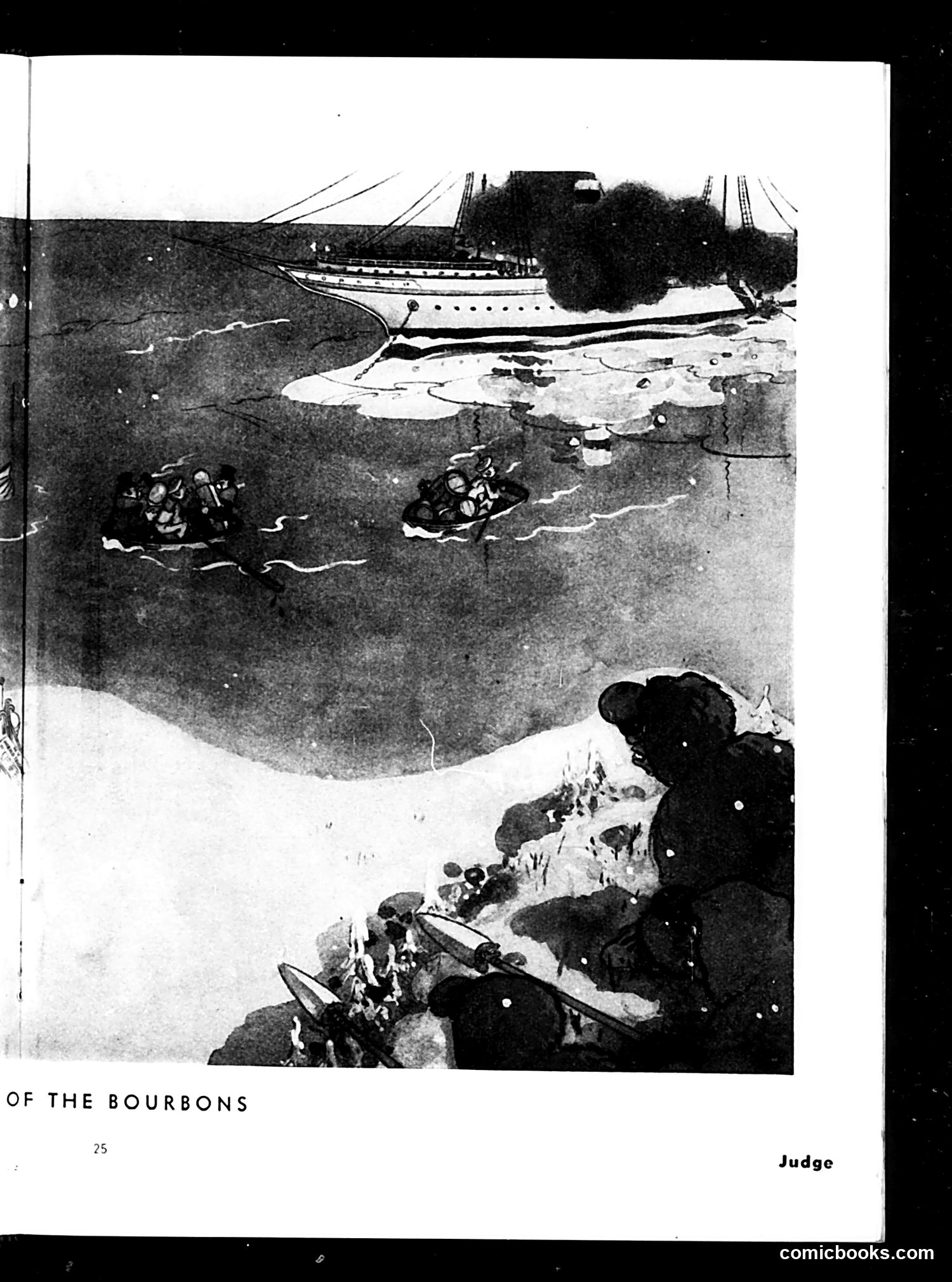
Analysis This appears to be a satirical illustration from *Judge* magazine depicting a maritime scene. The image shows a large passenger ship in the background with several lifeboats in the water containing people, and figures on rocky shores in the foreground. The title "OF THE BOURBONS" likely references the Bourbon dynasty, suggesting political satire about royalty or aristocratic mismanagement. The shipwreck scenario with lifeboats could satirize a crisis or disaster, possibly commenting on how the wealthy or ruling class escape danger while others suffer. However, without additional context about the specific historical moment or accompanying article text, I cannot definitively identify which event or political figures are being caricatured. The page number (25) and magazine attribution are visible, but the exact satirical target remains unclear from the image alone.
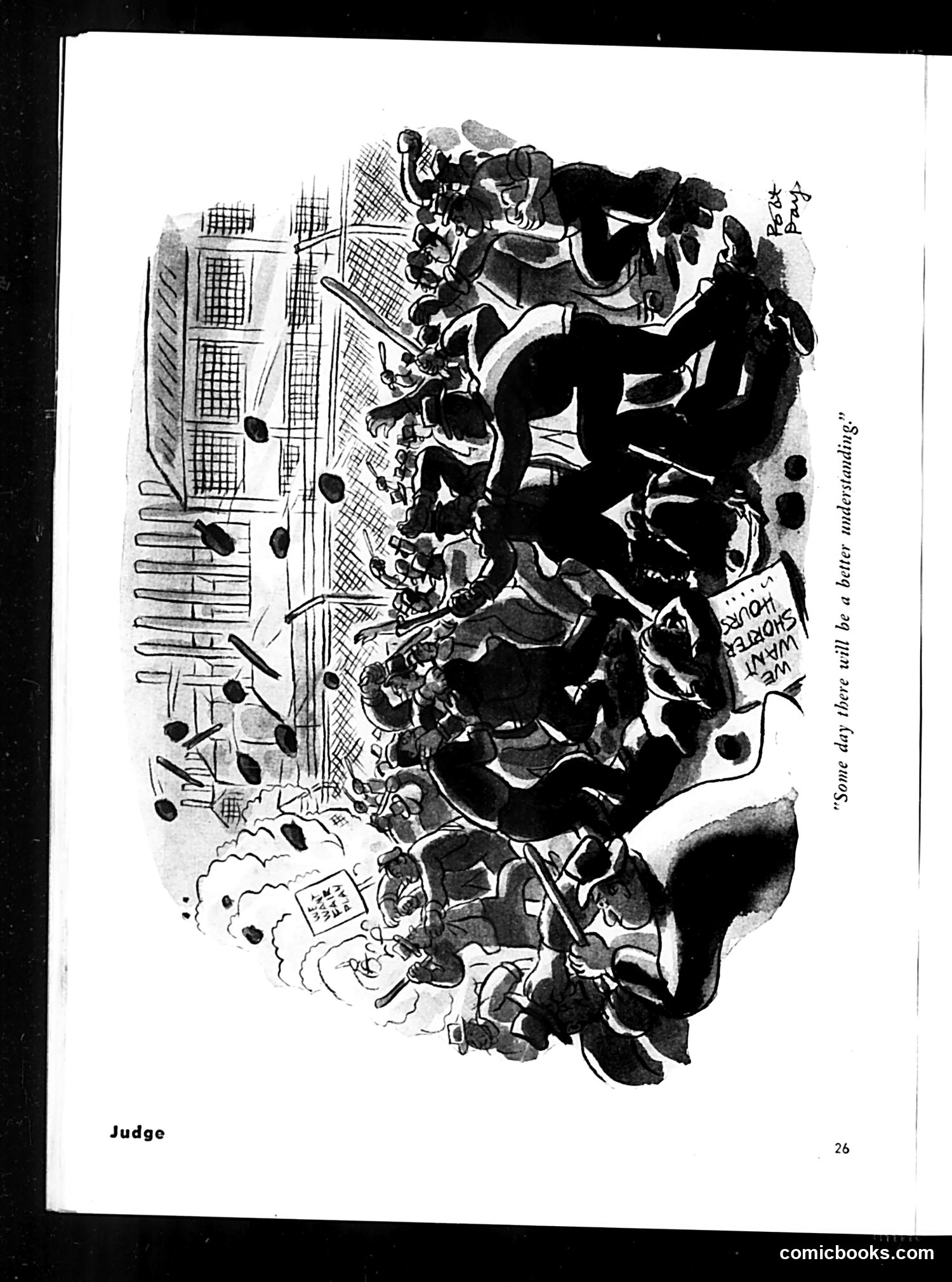
Political Cartoon Analysis This appears to be a satirical cartoon from *Judge* magazine depicting a chaotic scene outside what looks like a courthouse or government building. The cartoon shows multiple figures in apparent conflict or disorder, with papers scattered about and animated gestures suggesting conflict or misunderstanding. The caption reads: "Some day there will be a better understanding." Without being able to identify specific individuals or date this cartoon precisely, the satire appears to criticize inadequate communication or persistent conflict between groups—possibly political factions, legal/judicial systems, or government bodies. The ironic caption suggests the cartoonist is skeptical that resolution will actually occur, making fun of optimistic pronouncements about future cooperation or understanding.
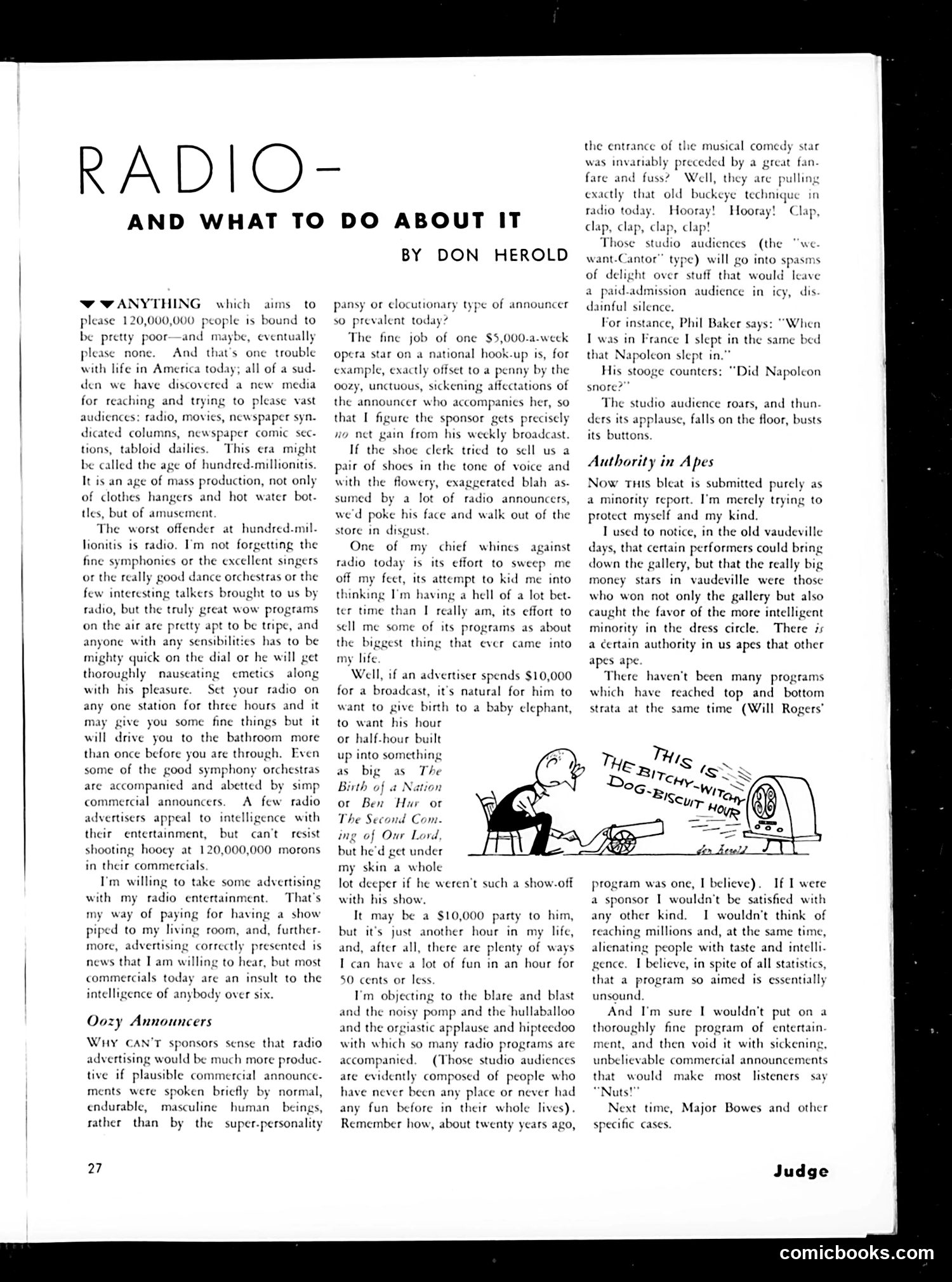
"Radio—And What to Do About It" by Don Herold This is a satirical essay criticizing radio broadcasting's lowest-common-denominator approach to entertaining 120 million Americans. Herold attacks: Main targets: - Overly theatrical radio announcers with affected, "pansy" delivery styles instead of normal masculine speech - Fake studio audiences who applaud mediocre content with exaggerated enthusiasm (the "we-want-Cantor" type, referencing comedian Eddie Cantor) - Advertisers spending huge sums ($10,000+) trying to make ordinary products sound momentous through inflated hype and false drama The satire: Herold mocks how radio uses vaudeville techniques—orchestral fanfare, breathless announcing—to artificially excite audiences about trivial entertainment, comparing it to treating a shoe sale like *The Birth of a Nation*. The small cartoon (bottom right) shows someone at a radio, labeled "This is the bitty-witsy dog-biscuit hour," satirizing the infantilizing tone of commercial radio. Herold argues intelligent advertising would work better, and that radio should respect listeners' intelligence rather than treat them as "morons."
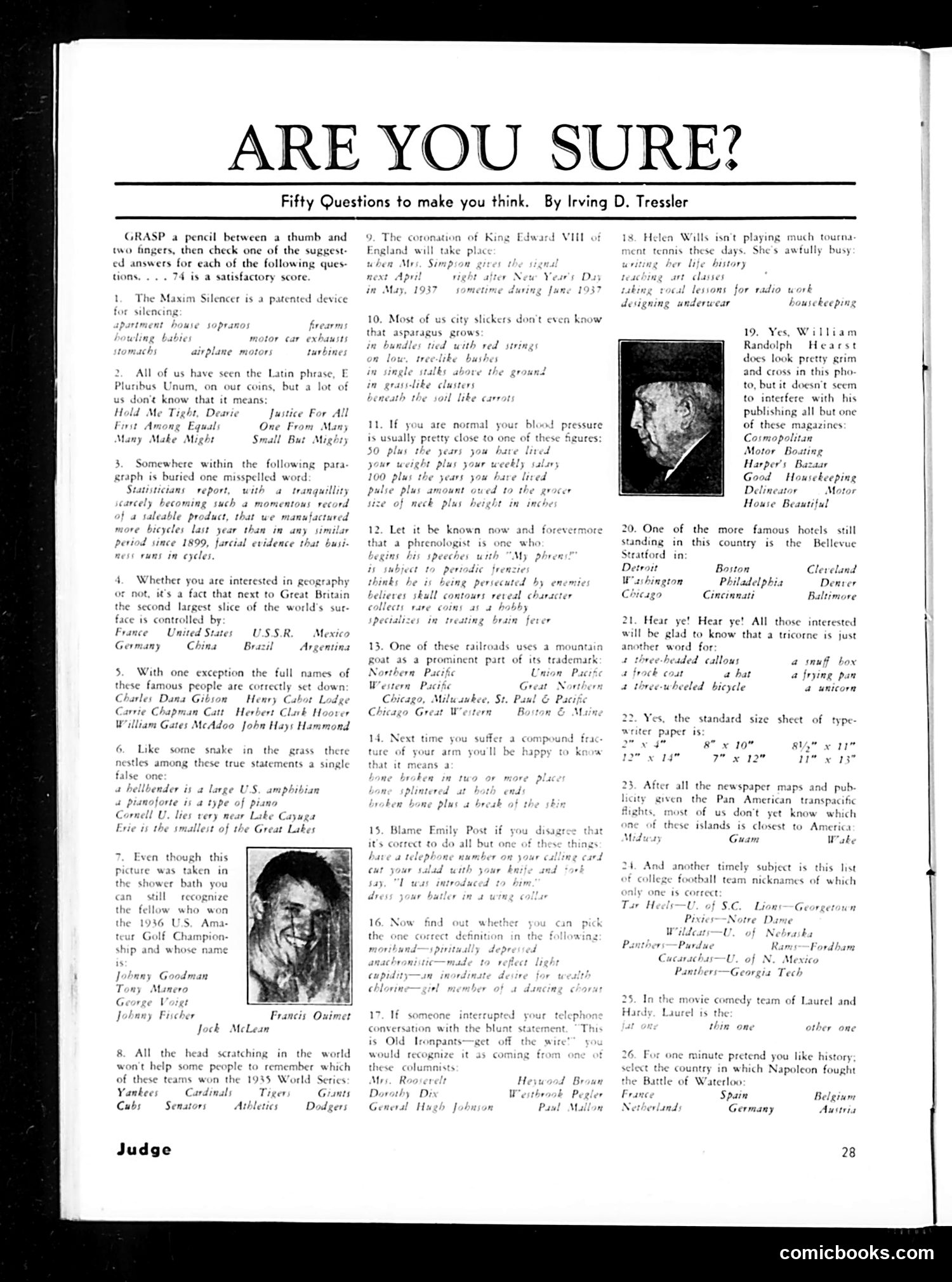
"Are You Sure?" Quiz Page Analysis This page is a trivia quiz rather than a political cartoon. "Are You Sure?" by Irving D. Tressler is a 50-question general knowledge test, with two photographs of public figures from the 1930s-40s era. The photographs show: - Jack McLean (golfer/sports figure) - Francis Ouimet (famous golfer) The quiz's subjects span: - Geography and world capitals - Famous people (William Randolph Hearst, Helen Wills the tennis player) - American institutions (railroads, colleges) - Popular culture and sports - Historical facts (Napoleon, King Edward VII) - Current events and celebrities The satire is gentle: it's designed to test whether readers actually know the facts they *think* they know about current affairs, famous people, and general knowledge. The "trick" is that most answers look plausible—the humor comes from readers confidently selecting wrong answers. It's essentially a humorous intelligence test for Judge's readers, requiring no specific political context to understand.
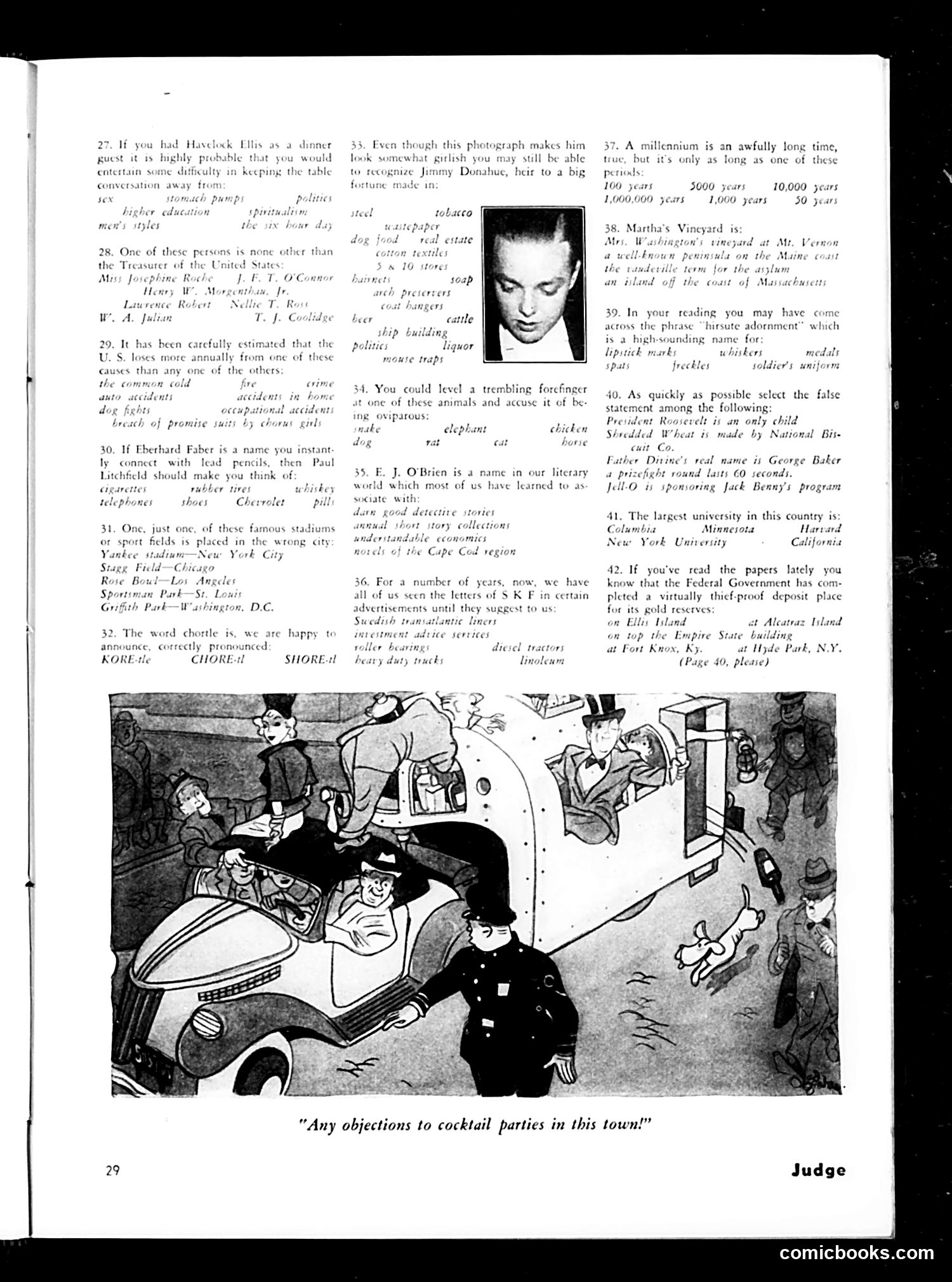
Cartoon Analysis: "Any objections to cocktail parties in this town!" This cartoon satirizes Prohibition enforcement and public hypocrisy during the 1920s-early 1930s. A police officer confronts a group of well-dressed revelers emerging from what appears to be an illegal speakeasy (note the car and fashionable clothing). The joke plays on the contradiction between official prohibition laws and widespread illegal drinking among the wealthy and socially prominent. The officer's question is sarcastic—he's asking if anyone objects to these blatant cocktail parties, implying that despite federal prohibition, such parties openly occur without serious consequences for the affluent. The cartoon mocks the selective enforcement of Prohibition and society's acceptance of lawbreaking among the upper classes. The surrounding quiz questions on the page are unrelated trivia content typical of Judge magazine's format.
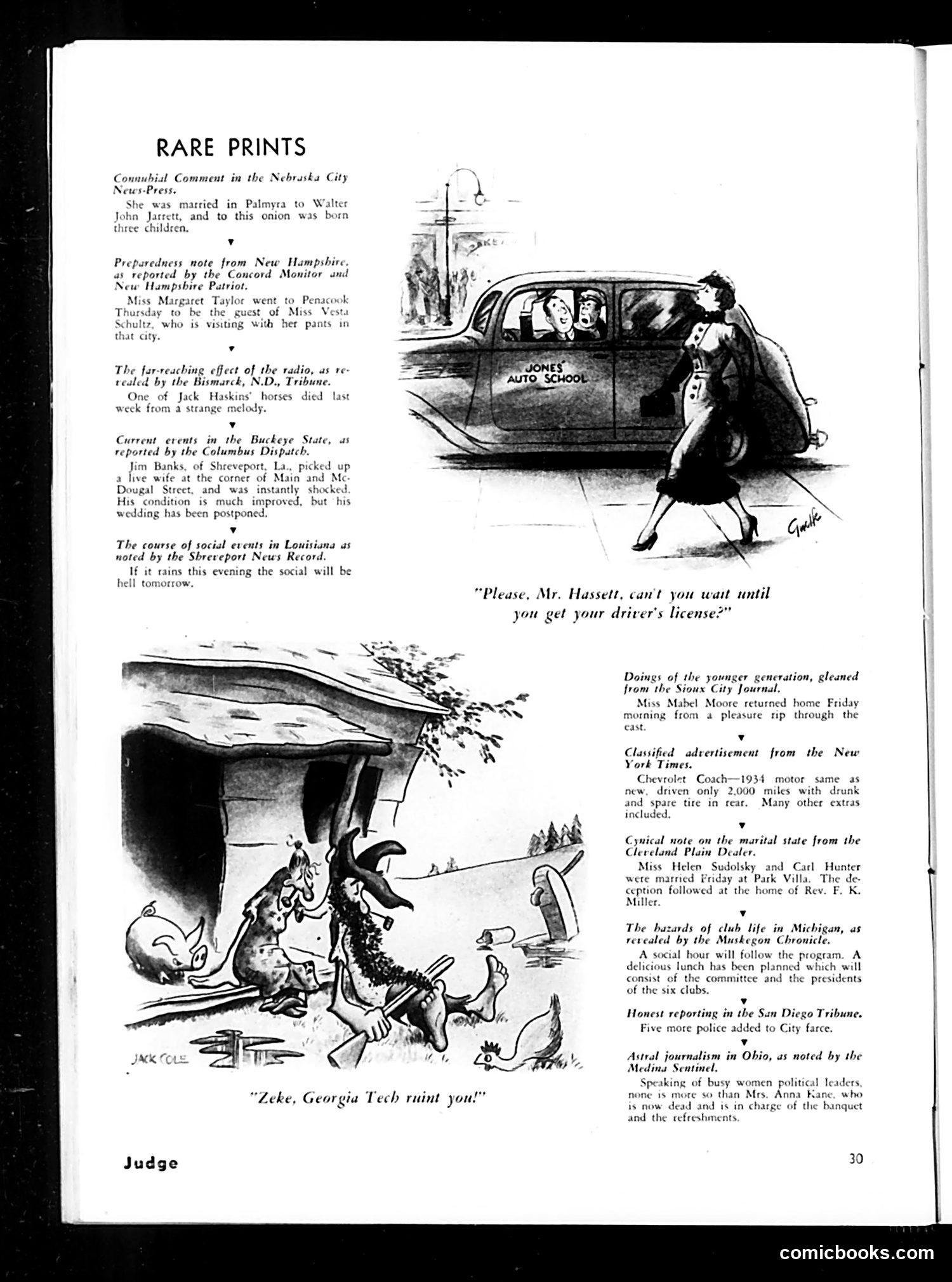
"Rare Prints" Page Analysis This page collects humorous newspaper typos and errors from regional American papers, presented as intentional satire. The two cartoons illustrate the absurdity: Top cartoon: A woman stops a car at an auto school, demanding the male driver wait for his license before driving—poking fun at reckless driving and inadequate safety standards. Bottom cartoon: References Georgia Tech "ruining" someone (likely a sports rivalry joke), with surreal imagery of destruction—unclear without full context but appears to mock college sports culture. The text excerpts mock regional papers' comical mistakes: "onion" instead of "union," a "live wife" being "shocking," a deceased woman still "in charge of" an event, and a Chevrolet ad mentioning a "drunk" tire. Judge's satirical point: small-town newspapers were riddled with embarrassing errors, revealing either carelessness or amusing absurdity in American provincial life. This demonstrates how pre-internet media blunders circulated among sophisticated urban audiences.
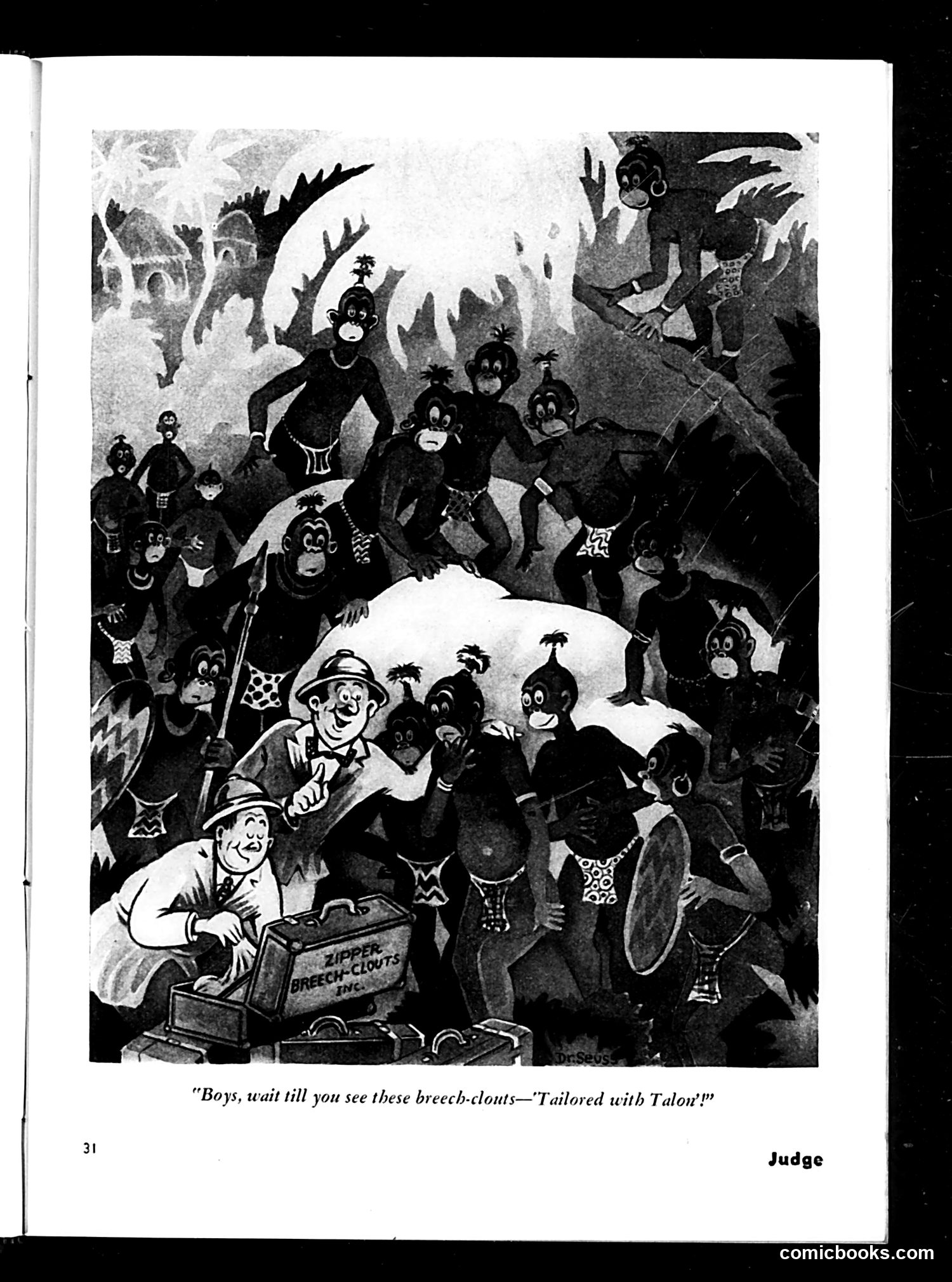
Analysis of Judge Magazine Cartoon This is a satirical cartoon by Dr. Seuss (signature visible) depicting a white man in safari/colonial attire surrounded by caricatured Black figures. The caption reads: "Boys, wait till you see these breech-clouts—'Tailored with Talon'!" The cartoon advertises "Zipper Breech-Clouts" as a product, satirizing both colonial attitudes and modern commercialism. It mocks the absurdity of "civilizing" or marketing Western fashion to indigenous peoples, while the exaggerated caricatures reflect deeply racist imagery common to early-20th-century American advertising and editorial cartooning. The joke targets commercial exploitation and the perceived foolishness of applying capitalist consumer culture to colonized populations—though the execution relies on offensive stereotypes typical of the era.
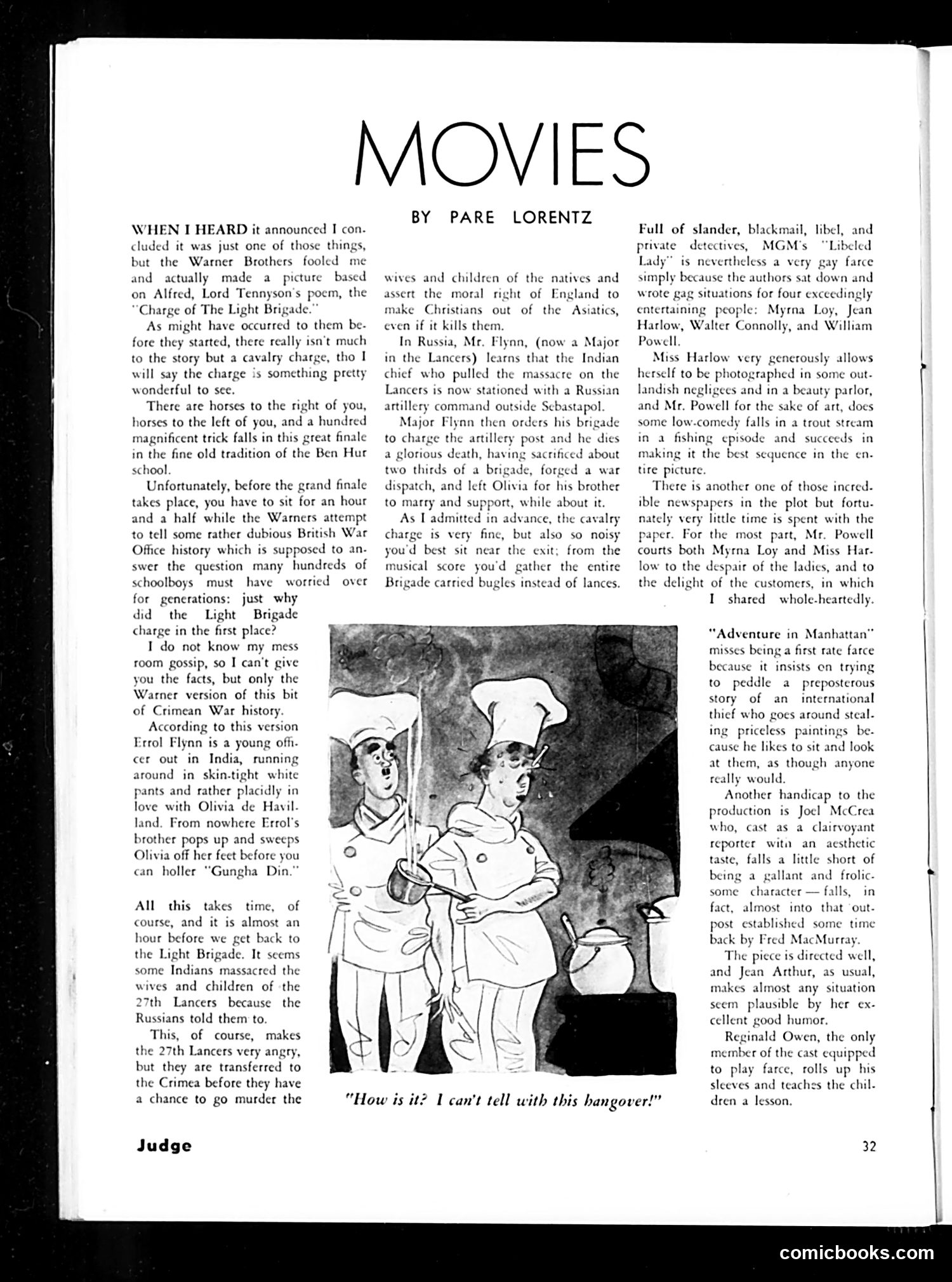
Understanding This Judge Magazine Film Review This page contains Pare Lorentz's film criticism reviewing three movies, with a cartoon illustration accompanying the "Charge of the Light Brigade" review. The Main Cartoon: The sketch depicts two figures in military dress uniforms, captioned "How is it? I can't tell with this hangover!" It satirizes the film's convoluted plot—Lorentz criticizes Warner Brothers for spending an hour on dubious romantic subplot (Errol Flynn's love triangle with Olivia de Havilland) before finally reaching the famous cavalry charge from Tennyson's poem. The hangover joke mocks how tediously confusing the setup is before the movie reaches its actual spectacle. The Satire: Lorentz mocks the film for inventing justifications for historical fact—creating a melodramatic backstory about Indian massacres and Russian conspiracies to "explain" why the Light Brigade charged. He notes this answers a question "schoolboys over generations" supposedly asked, treating the film's overwrought motivation as absurdly unnecessary padding around what should be straightforward military action. The reviews of other films are brief, noting cast members and plot mechanics rather than historical reference.
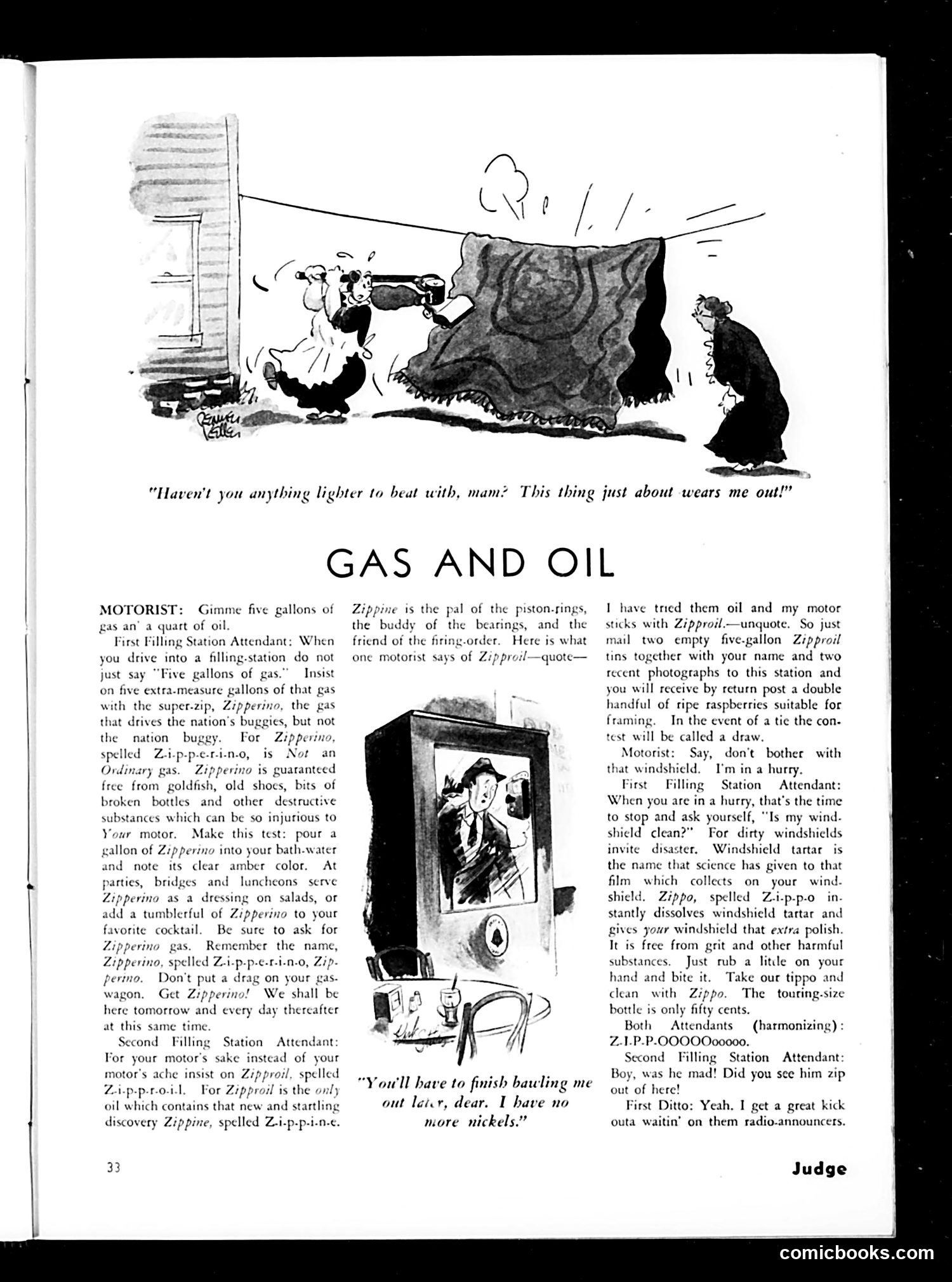
Analysis: "Gas and Oil" (Judge Magazine) This is a satirical advertisement parody mocking the absurd marketing tactics of 1920s-30s filling stations. The top cartoon shows a man beating a carpet with an oversized oil can, complaining it "wears me out"—visual humor about over-promotion. The main text satirizes filling station attendants who aggressively pitch fictional branded products ("Zipperino" gas, "Zipproil" oil, "Zippo" windshield cleaner) with increasingly ridiculous claims. The products are fake—spelled phonetically, described with nonsensical benefits (Zipperino supposedly contains "no goldfish, old shoes, or broken bottles"), and offered as rewards for competitions. The joke targets two things: filling station's hard-sell culture and radio advertising's breathless hype (the ending references "radio-announcers"). The absurdist product names and impossible endorsements (using motor oil in salad dressing) parody real advertising's inflated promises. The cartoon's woman asking for "something lighter" likely comments on feminine exasperation with masculine consumer gadgetry.
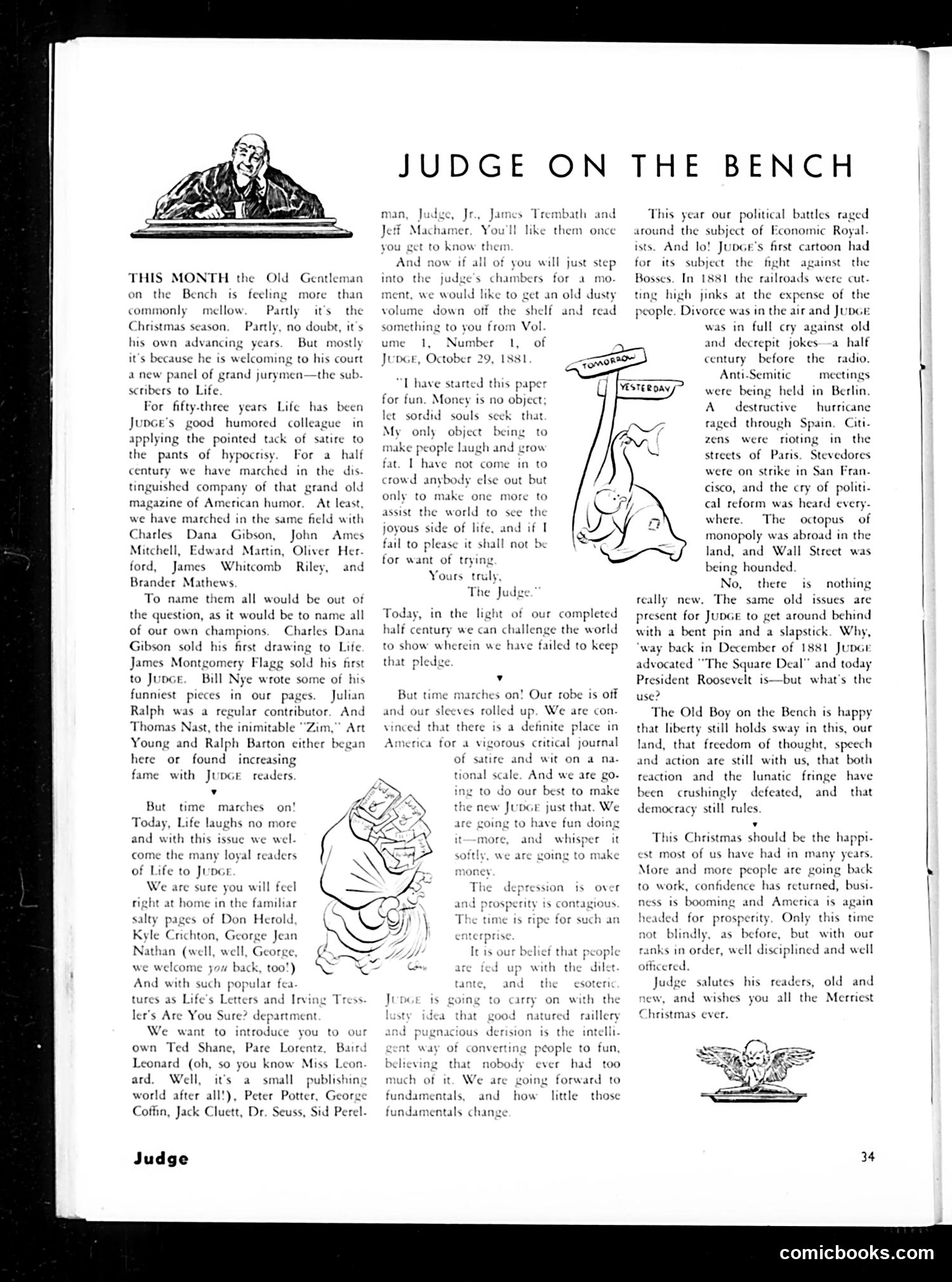
Judge Magazine's Editorial Statement, circa 1930s This page announces Judge magazine's merger with Life magazine's readership. The "Old Gentleman on the Bench" (the magazine's mascot/judge character) welcomes Life's subscribers as new "grand jurymen." Key references: - Judge traces its satirical lineage back to 1881, claiming continuity with American humor giants (Gibson, Flagg, Thomas Nast) - The text boasts that Judge has consistently attacked hypocrisy and "the pants of hypocrisy" through satire - Historical examples cited: railroads exploiting workers (1881), divorce law debates, and Anti-Semitic meetings in Berlin (suggesting contemporary 1930s concerns) - The editorial promises continued political satire on "Economic Royalists" and social reform The satire's point: Judge positions itself as a venerable institution of American democratic criticism, claiming the right and duty to mock power through humor. The Christmas-season warmth frames satirical critique as patriotic and necessary for a functioning democracy. The cartoons (showing a judge figure with papers/money) reinforce the magazine's self-image as a guardian against corruption and hypocrisy through humor.
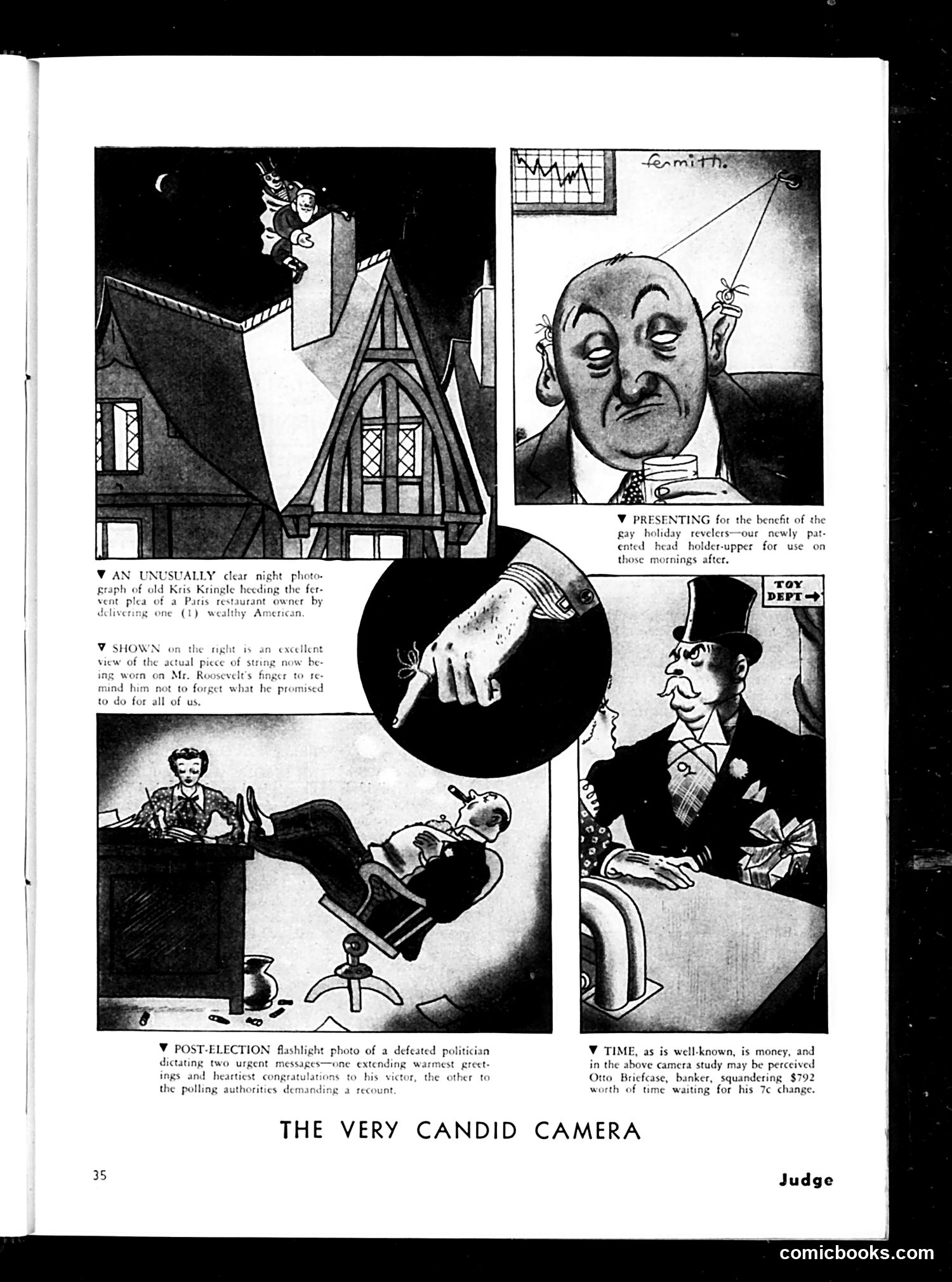
"The Very Candid Camera" This page from *Judge* magazine uses candid photography as a satirical framework for social commentary. The cartoons mock various subjects through exaggerated scenarios: The top panel appears to reference Christmas charity—"old Kris Kringle" delivering wealth to Paris restaurants, likely satirizing wealthy Americans' conspicuous spending abroad. A reference to "Mr. Roosevelt's finger" suggests commentary on a political promise he made but failed to keep. The "post-election" cartoon mocks a defeated politician frantically sending congratulatory messages to cover his political losses. The final panel satirizes Otto Briefcase (a generic banker name), who wastes time waiting for a 7¢ change—the joke being that wealthy people squander valuable time over trivial amounts, proving the adage "time is money." Overall, the page satirizes wealth, political hypocrisy, and the absurdities of the upper classes during what appears to be an interwar period.
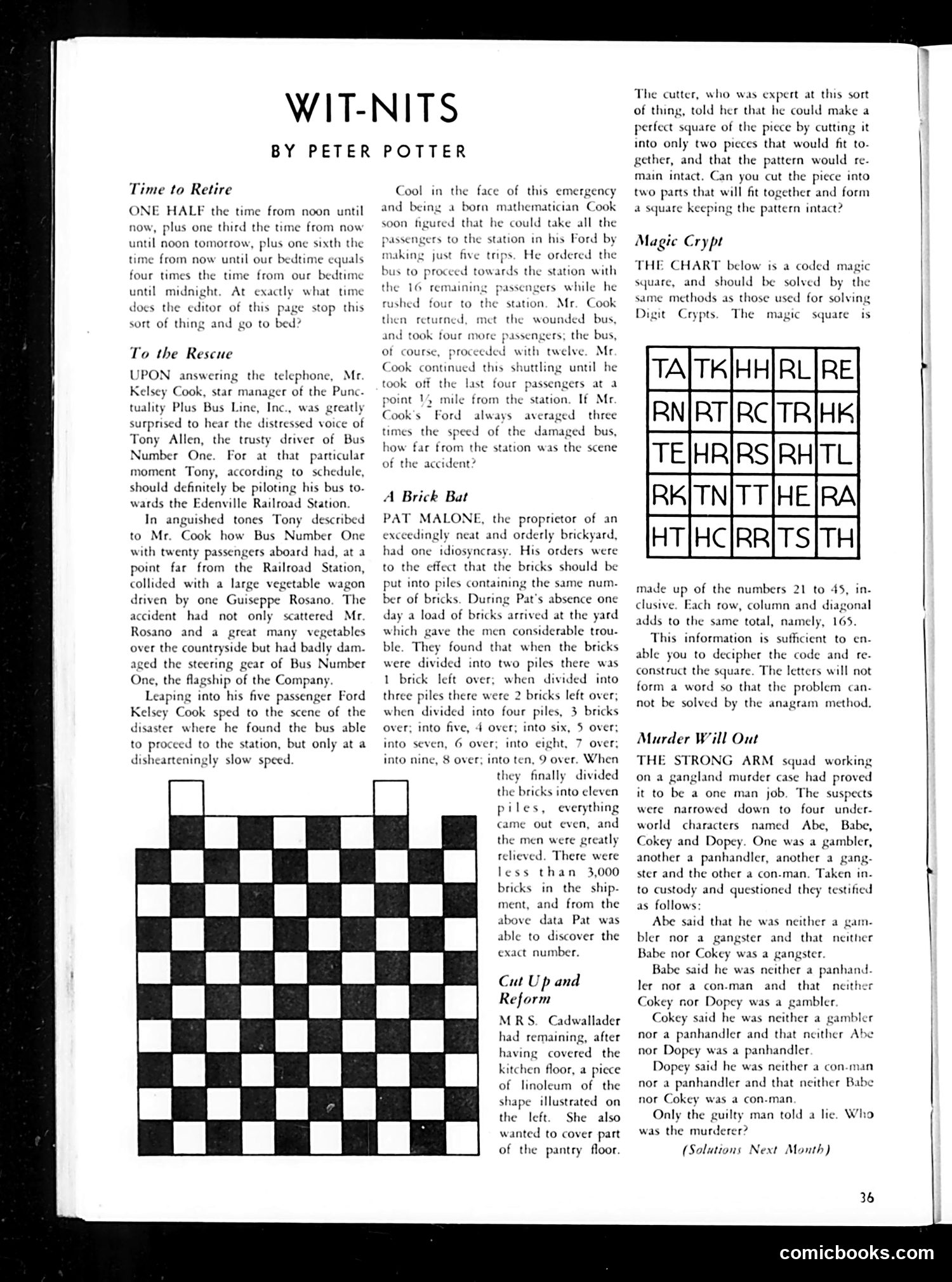
Wit-Nits: A Page of Puzzle Contests This page from *Judge* magazine contains no political cartoons or satire. Instead, it's a puzzle and brain-teaser column titled "Wit-Nits" by Peter Potter—a recurring feature offering recreational math and logic problems to readers. The content includes: 1. Time to Retire: A word problem involving fractional time calculations 2. To the Rescue: A distance/speed mathematics puzzle about a bus manager shuttling passengers 3. A Brick Bat: A number theory problem about dividing bricks into piles with specific remainders 4. Cut Up and Reform: A geometry challenge involving cutting and rearranging linoleum pieces 5. Magic Crypt: A coded magic square puzzle The page also includes a crossword-style grid puzzle. This appears to be educational entertainment—typical of early 20th-century magazine content aimed at engaging readers' problem-solving skills rather than delivering social or political commentary.
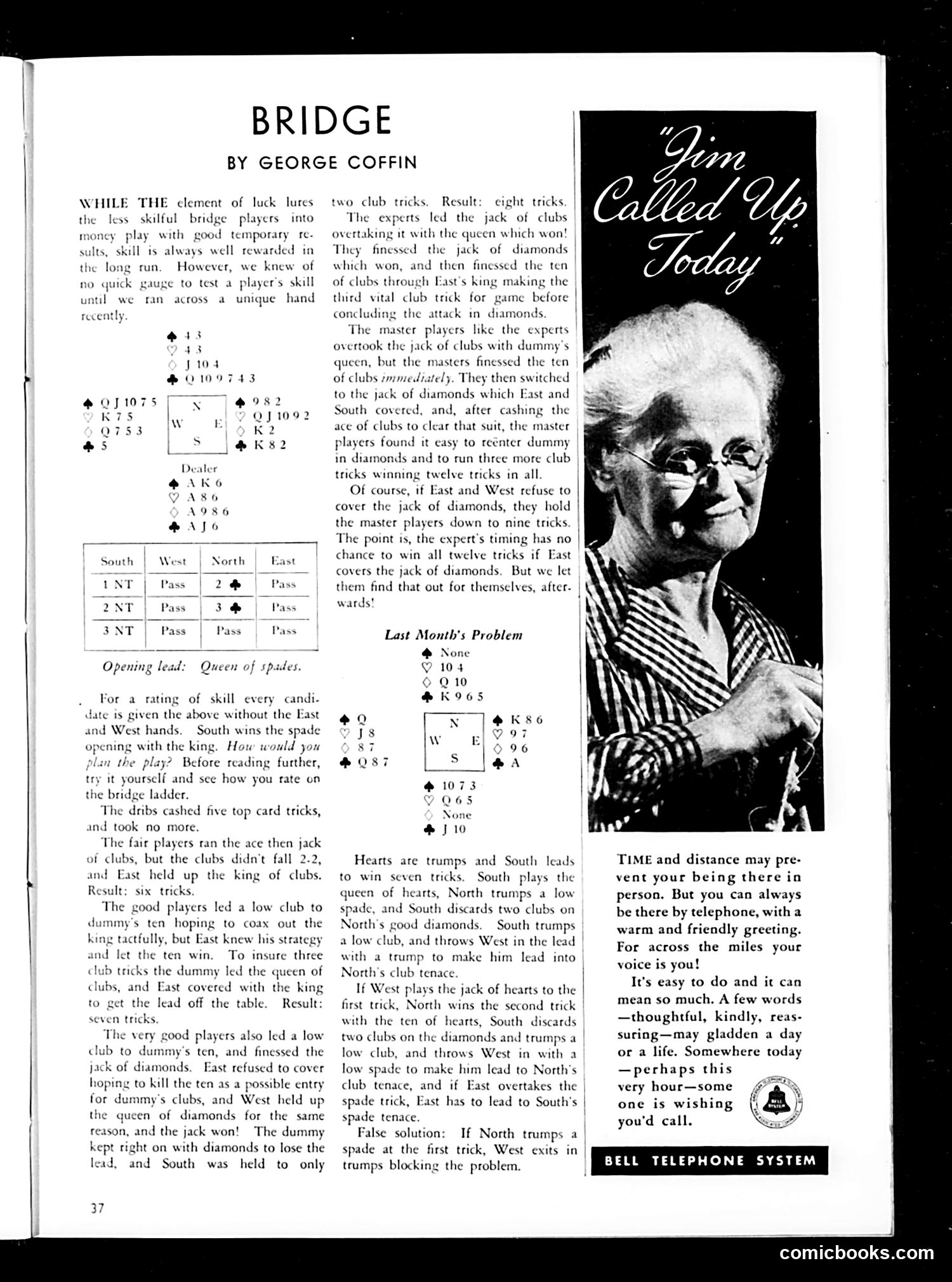
"Bridge" by George Coffin — Judge Magazine This page presents a bridge card game instructional article with a rating system for player skill levels, from poor to expert. The content isn't satirical but rather educational—Coffin uses a single bridge hand to demonstrate how players of different abilities approach the same problem differently. The ranking progresses from "dribs" (poor players who score six tricks) through "fair," "good," and "very good" players, up to "experts" and "master players" who achieve twelve tricks through superior strategy and timing. On the right is a Bell Telephone System advertisement featuring an elderly woman, promoting long-distance calls as a way to maintain personal connection across distance. The ad emphasizes that voice conveys genuine warmth and care. The page is primarily instructional content with advertising rather than satire or political commentary.
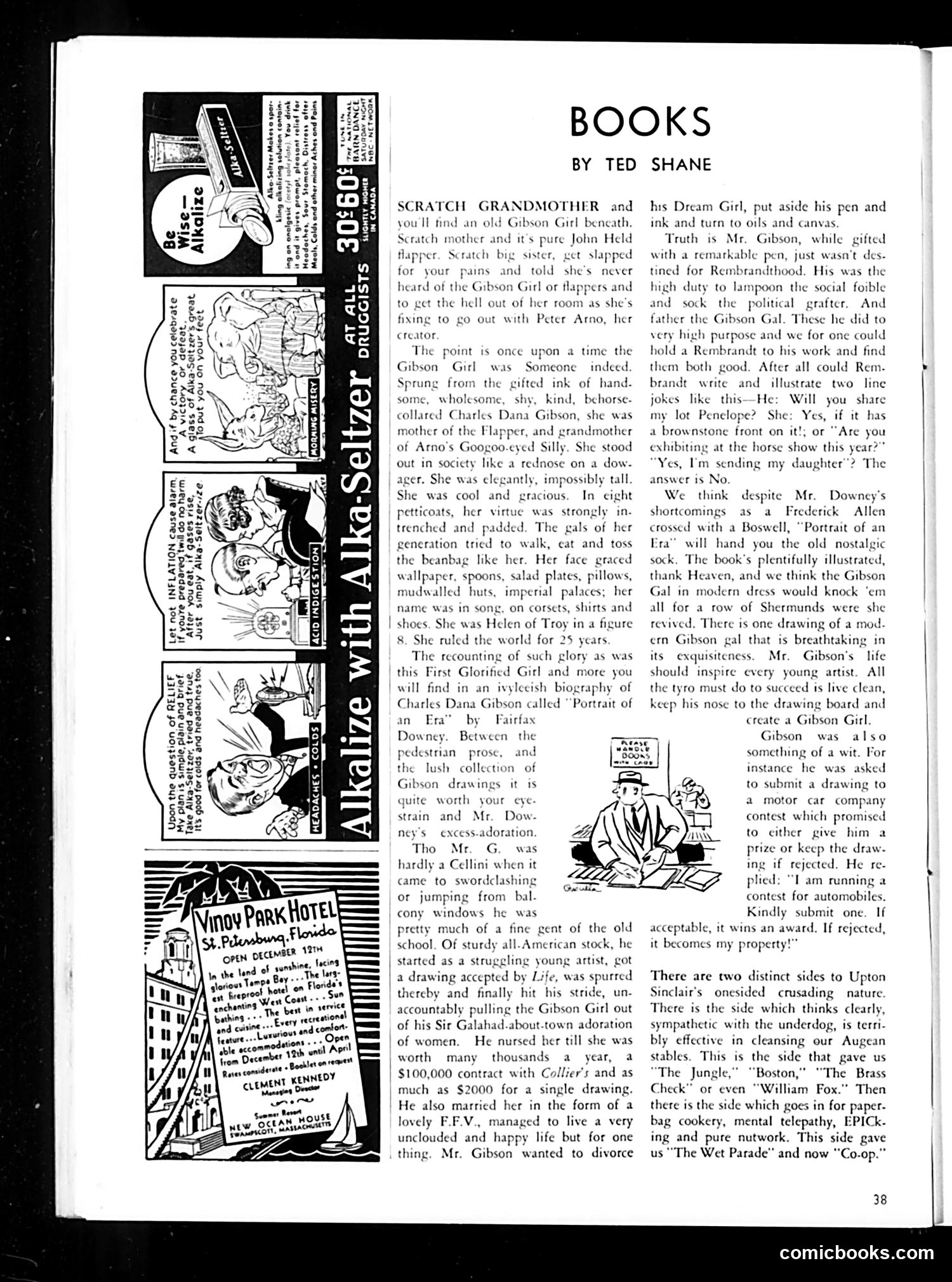
Analysis for Modern Readers This is a book review by Ted Shane of "Portrait of an Era," a biography of Charles Dana Gibson by Fairfax Downey. The review uses witty comparisons to explain Gibson's cultural significance. The Main Point: Shane argues that the "Gibson Girl"—Gibson's iconic illustration of the idealized American woman from the 1890s-1920s—was the prototype for subsequent female archetypes. He traces a lineage: scratch a "grandmother" (Gibson Girl) and you find her beneath later versions, including the "flapper" (associated with John Held) and modern comic-strip women (Peter Arno's creations). The Satire: Shane mocks both Gibson's artistic legacy and the book's reverent tone. Gibson was commercially successful ($100,000 contracts, $2,000 per drawing) but created derivative work—illustrated social commentary rather than fine art. The joke: Gibson wanted to divorce his own creation, suggesting even he recognized its limitations. Context: This assumes readers recognize Gibson Girls as cultural touchstones and understand the evolution of female representation in American illustration across decades.
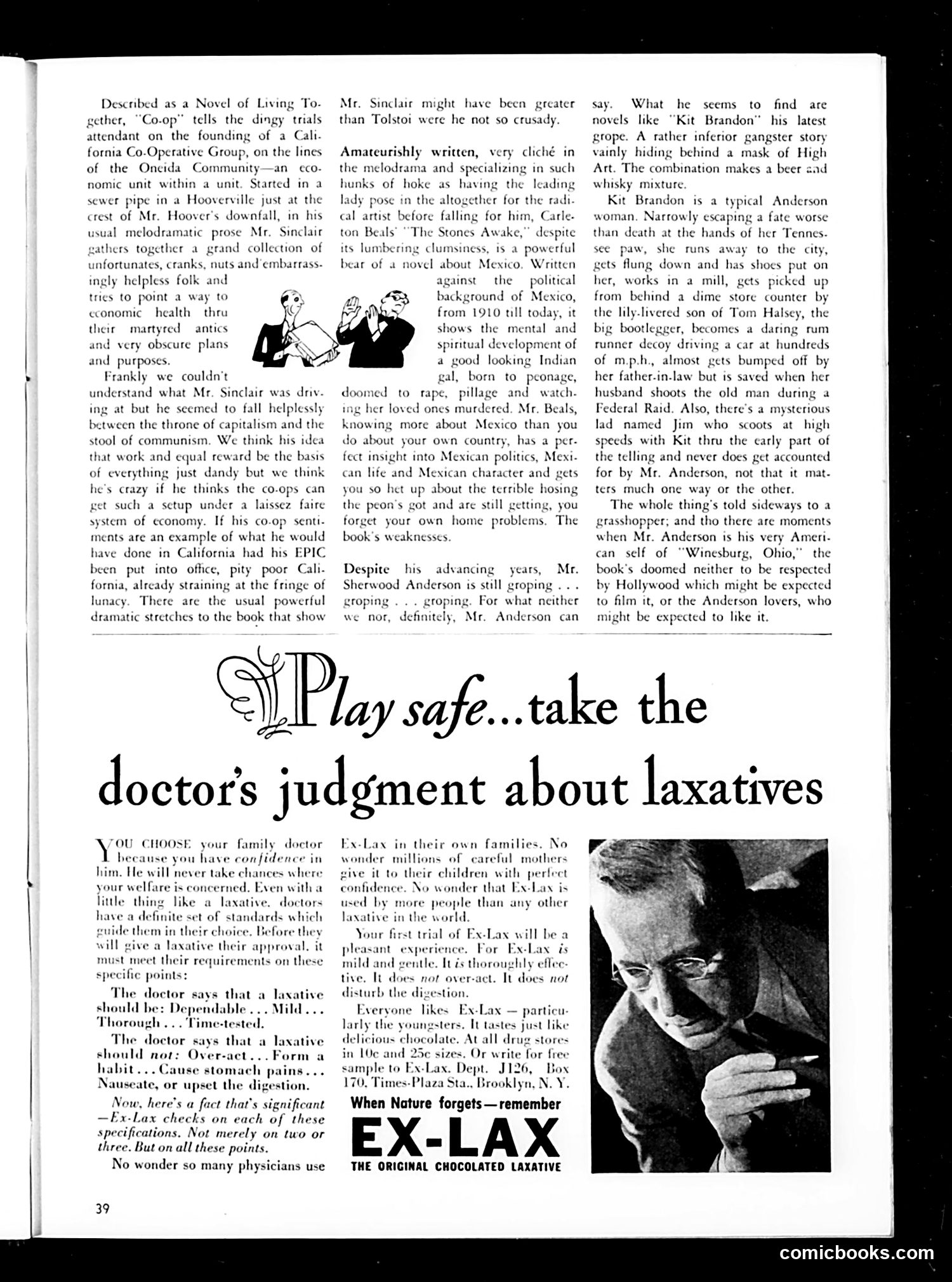
Analysis of Judge Magazine Page Content This page contains book reviews rather than political cartoons. The critic dismisses three contemporary novels: 1. Upton Sinclair's "Co-op" — criticized as poorly written, ideologically confused (between capitalism and communism), and an example of why his failed 1934 California EPIC political campaign was misguided. 2. Carlton Beals' "The Stones Awake" — about a Mexican peasant woman; praised as more competent despite heavy-handed prose. 3. Sherwood Anderson's "Kit Brandon" — mocked as a mediocre gangster story masquerading as serious art, featuring Anderson's typical naïve female protagonist. The page's satire targets are left-wing writers attempting serious social commentary. The critic's tone is dismissive toward their political ambitions and artistic pretensions. The lower half contains an Ex-Lax laxative advertisement — standard commercial content unrelated to the book reviews above.
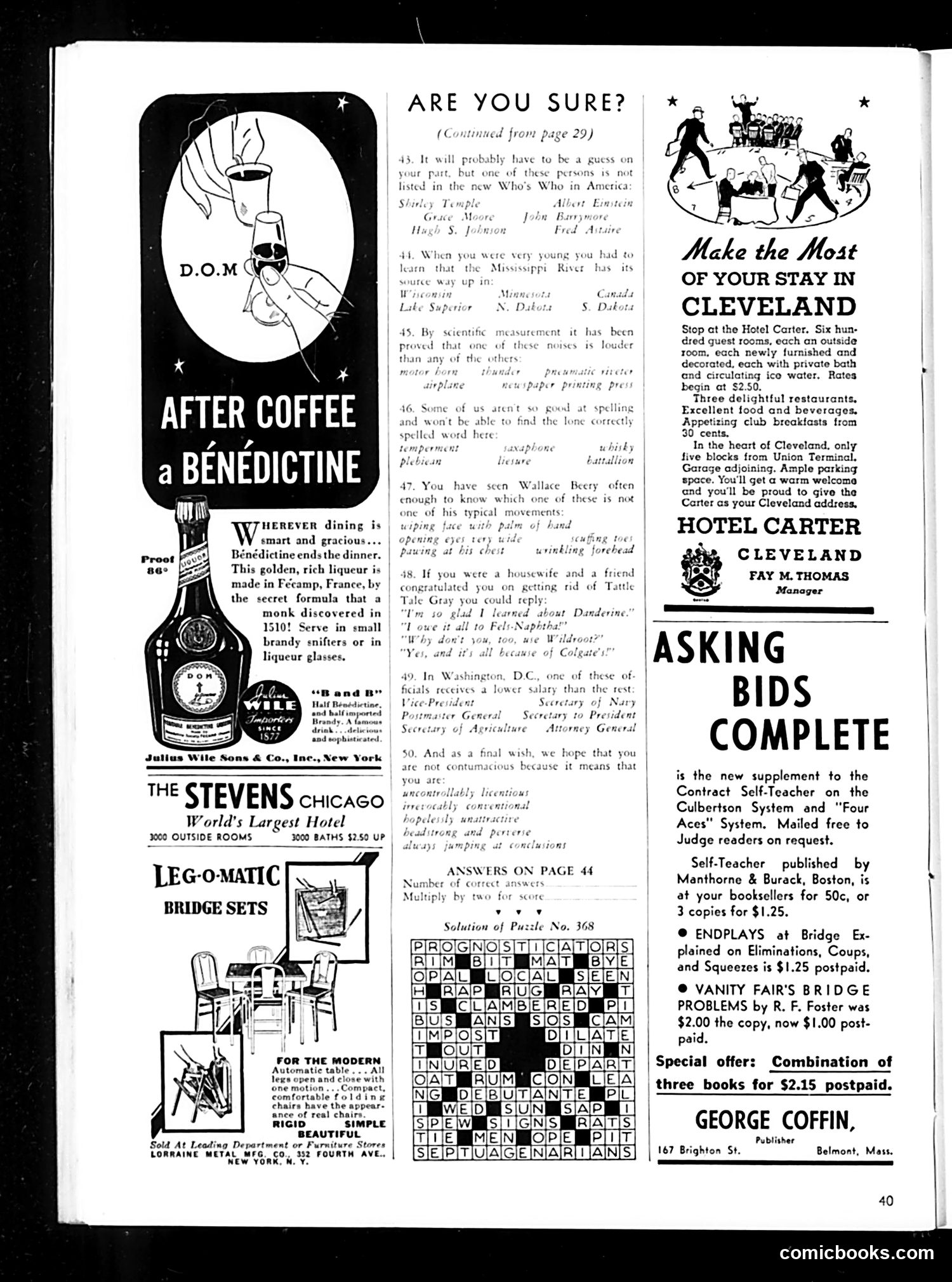
"Are You Sure?" - Judge Magazine Page Analysis This page is primarily advertisements and a trivia quiz, not political satire. The main content is "Are You Sure?" (continued from page 29), a trivia game asking readers to identify famous figures. Question 43 references "Who's Who in America," suggesting players must identify celebrities or public figures—likely actors like Shirley Temple, Gary Moore, and Fred Astaire (names visible in the OCR text). The cartoons are minimal. The left side features D.O.M. Bénédictine liqueur advertising with an illustrated bottle—a digestif marketed as sophisticated and European. Surrounding this are hotel advertisements (Hotel Carter in Cleveland, The Stevens in Chicago) and Leg-O-Matic Bridge Sets—collapsible card tables marketed to modern homemakers. The page reflects 1930s-40s consumer culture: luxury goods, travel, and bridge-playing entertainment targeting affluent readers. The trivia quiz entertained Judge's educated, urbane audience while advertisements subsidized the publication.
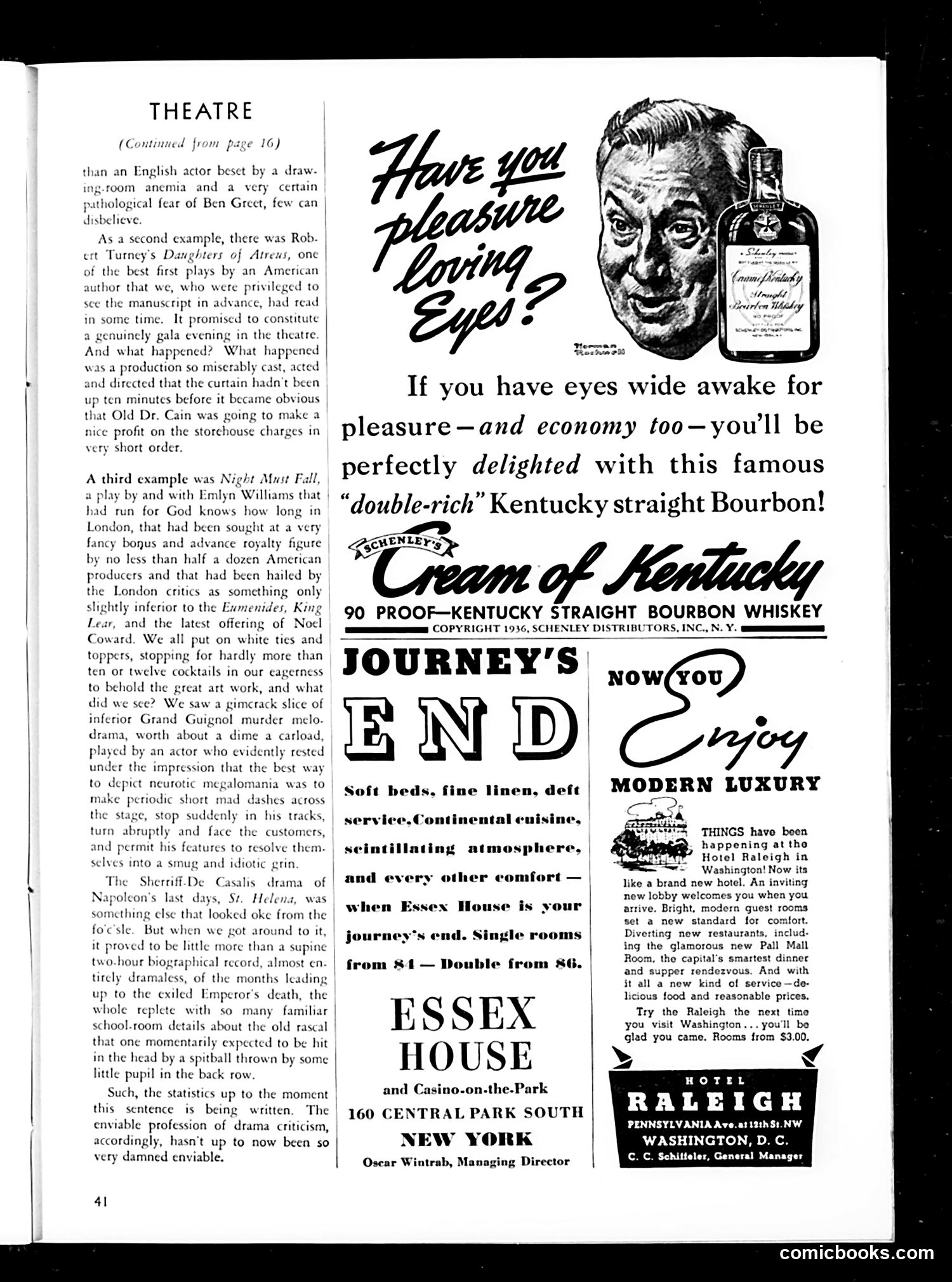
Analysis of Page 41, Judge Magazine This page is primarily advertising and theatre criticism, not political satire. The theatre section (top half) critiques Broadway productions, arguing that even plays by acclaimed authors and directors often fail due to poor casting and direction. The author cites three examples: *Daughters of Atreus*, *Night Must Fall*, and *St. Helena*—all promising works that disappointed in execution. The remaining space contains period advertisements for luxury goods: Schenley's "Cream of Kentucky" bourbon whiskey, the Essex House hotel in New York, and the Hotel Raleigh in Washington, D.C. These ads use typical 1930s marketing language emphasizing comfort, economy, and modernity. There is no political cartoon on this page. The only illustration is a caricatured male face accompanying the whiskey ad—a standard advertising device, not a political figure or satire. The page reflects Judge's mix of entertainment criticism and upscale advertising typical of the era.
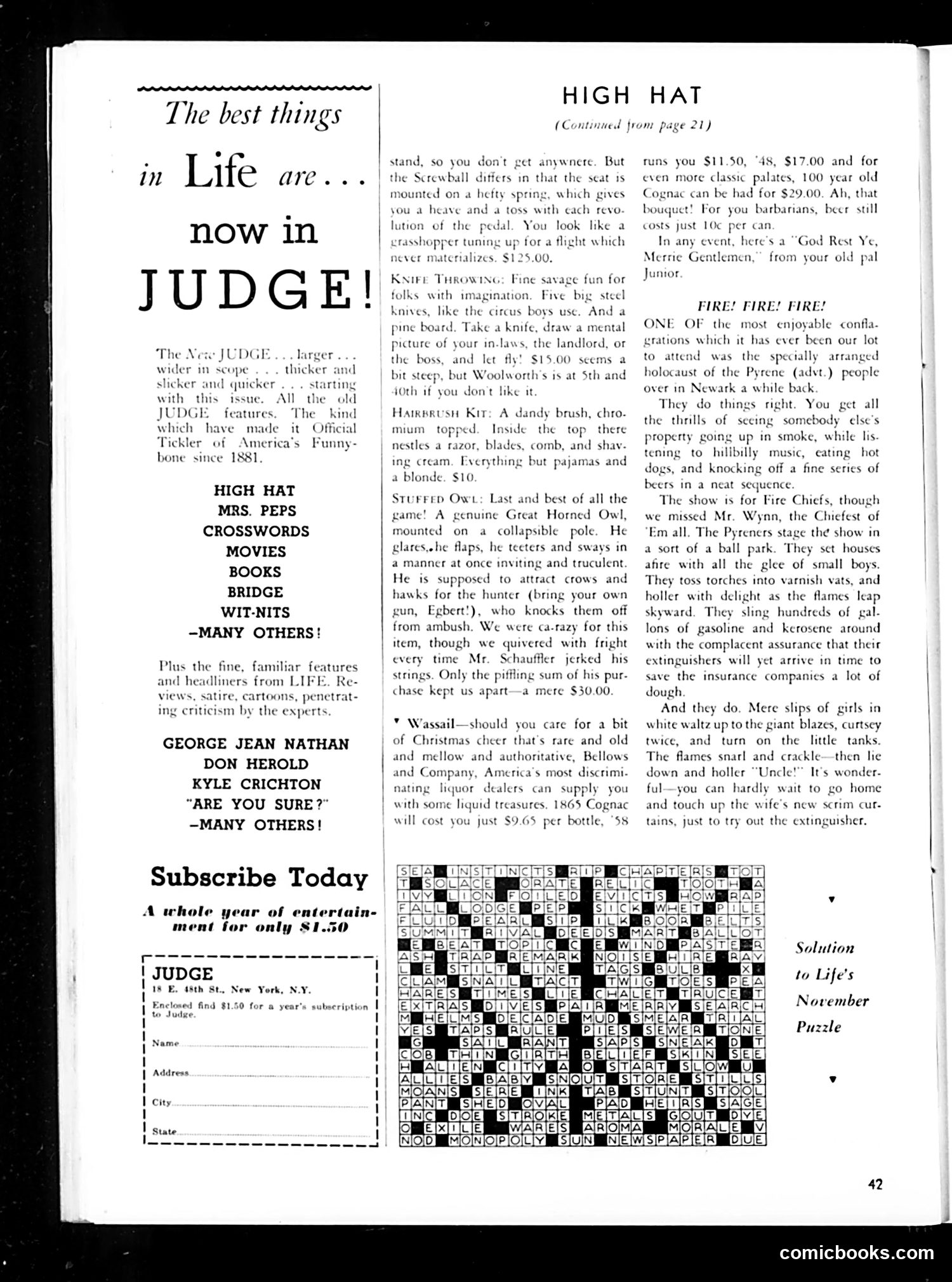
What This Page Means This is primarily a subscription advertisement and product review page for *Judge* magazine itself, not a political cartoon page. The left side promotes *Judge's* redesign as "larger...wider in scope...thicker and slicker," listing featured writers (George Jean Nathan, Don Herold, Kyle Crichton) and regular columns to attract subscribers at $1.50/year. The right side contains humorous product reviews of novelty items: a pedal-powered airplane toy, knife-throwing sets, a hairdressing kit, a stuffed Great Horned Owl decoy, and premium cognac. The tone is satirical—treating frivolous luxury goods with exaggerated enthusiasm. The "Fire! Fire! Fire!" section reviews a Pyrene fire-extinguisher company's promotional demonstration, mocking the spectacle of controlled fires as entertainment. A crossword puzzle appears at bottom. The satire here is *consumer-culture mockery*—poking fun at Americans' appetite for expensive gadgets and staged corporate entertainment during the interwar period.
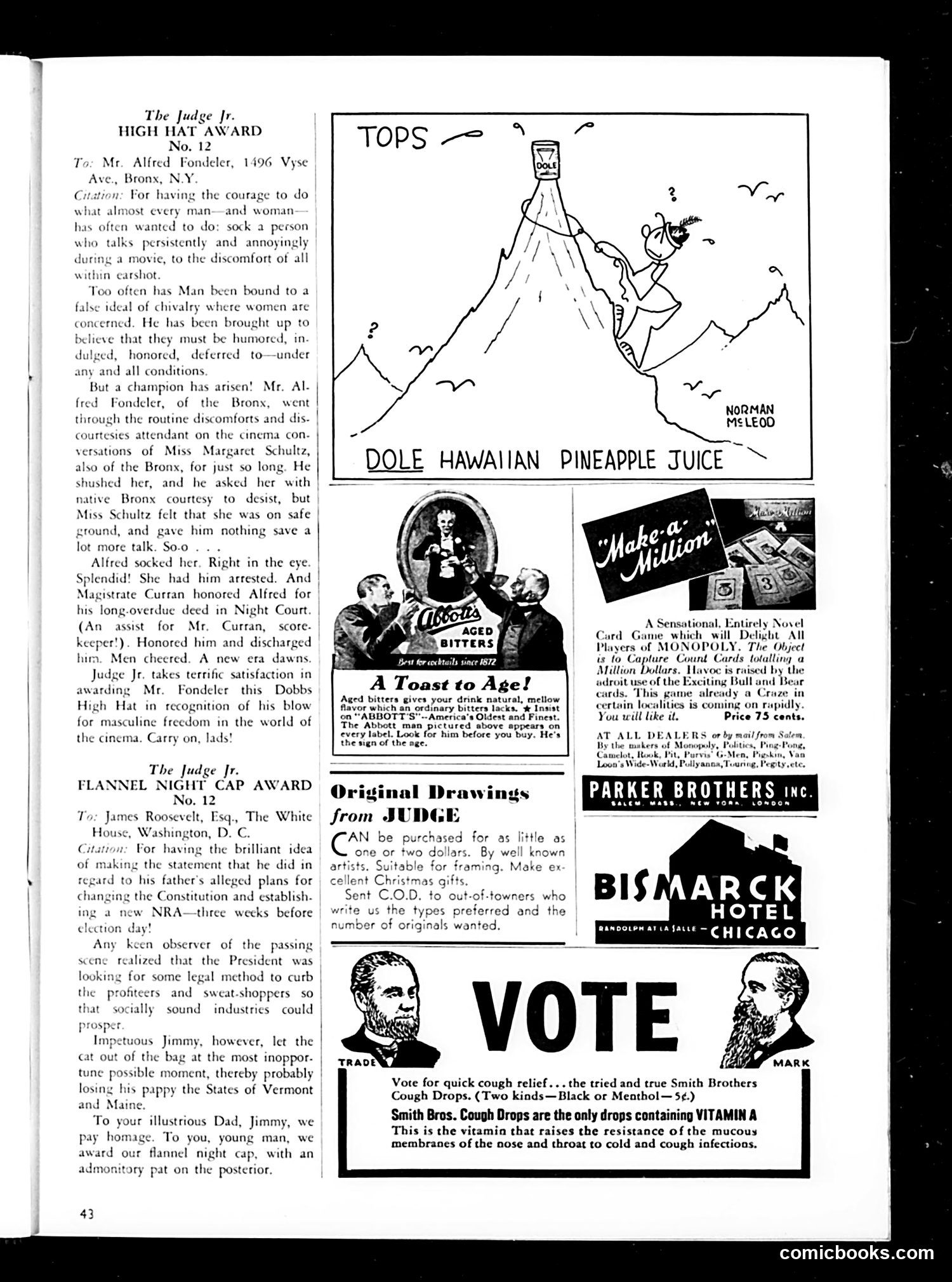
Explanation for Modern Readers This *Judge* magazine page contains two satirical "awards" mocking public figures: The "High Hat Award" honors Alfred Fondeler from the Bronx for punching a woman (Margaret Schultz) who talked annoyingly during a movie. The satire celebrates his acquittal by Magistrate Curran, sarcastically praising the moment as a triumph of "masculine freedom" against outdated chivalry. This reflects 1930s-40s attitudes about male exasperation with women in public spaces—presented as edgy satire. The "Flannel Night Cap Award" mocks James Roosevelt (son of President FDR) for publicly criticizing his father's alleged plans to alter the Constitution and the NRA (New Deal program). The satire suggests Jimmy's untimely remarks cost his father electoral votes in Vermont and Maine. Both awards use mock-earnest praise to ridicule their subjects. The remaining content consists of period advertisements (bitters, cough drops, hotels, a board game).
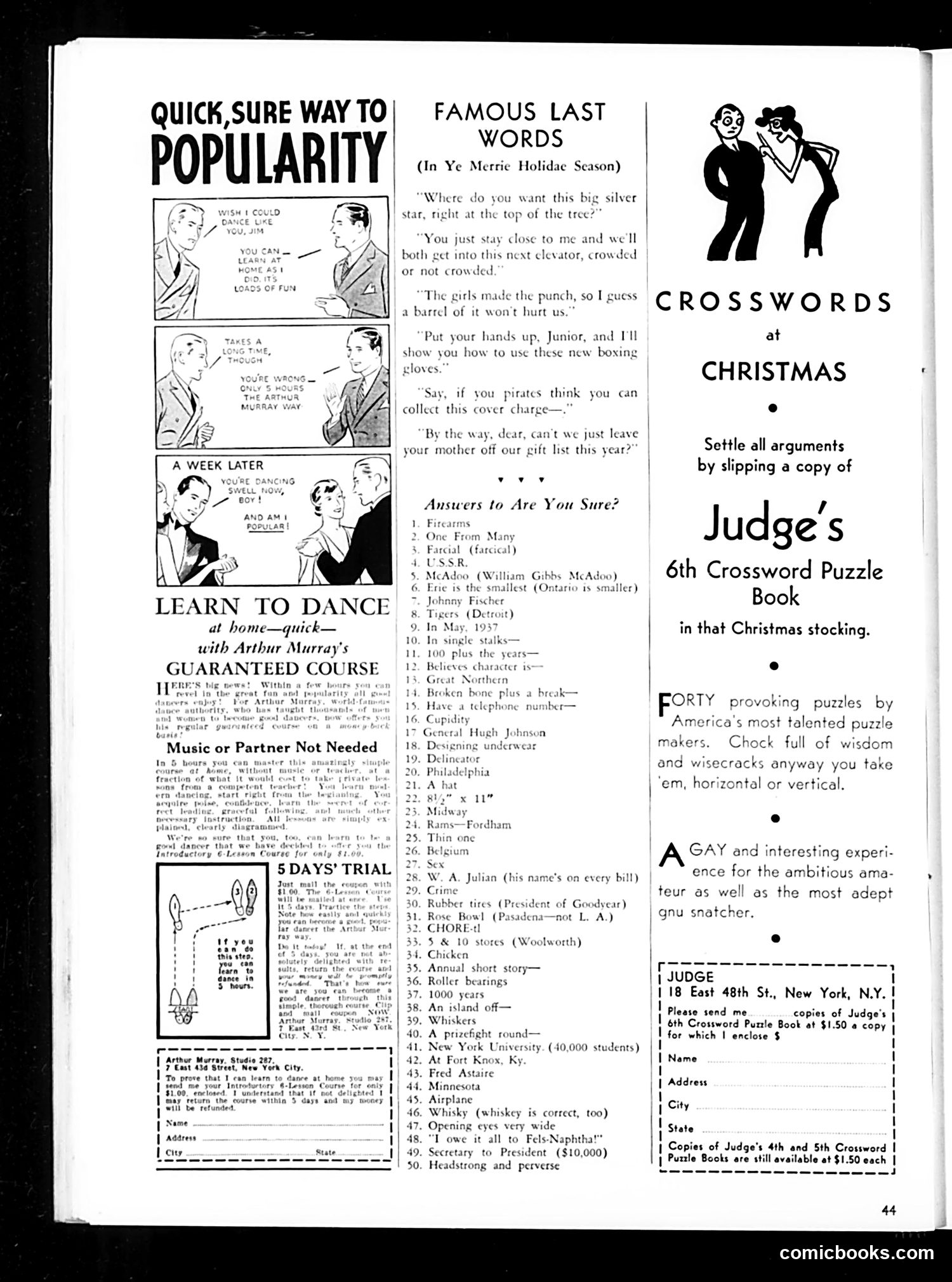
Explanation for Modern Readers This page combines advertisements and satirical content typical of Judge magazine's holiday issue. "Quick, Sure Way to Popularity" advertises Arthur Murray's mail-order dance course—a real 1920s-30s phenomenon. The three-panel cartoon shows a man learning to dance from a book, then a week later confidently dancing with others. The satire mocks how easily people believe self-help products will transform their social status overnight. "Famous Last Words" humorously lists holiday season mishaps—guests crowding elevators, homemade punch disasters, boxing glove accidents, deadbeat party crashers, and the awkward question about excluding someone's mother from gift lists. These are relatable domestic comedy scenarios about holiday gatherings. The rest of the page is primarily advertising: crossword puzzles and a coupon for Judge's 6th Crossword Puzzle Book ($1.50), marketed as perfect stocking stuffers. The crossword answers visible reference 1930s-40s culture (McAdoo, Fort Knox, Fred Astaire, Fels-Naphtha soap). Overall, this is a commercial entertainment page rather than political satire—typical of Judge's business model blending humor with advertising.
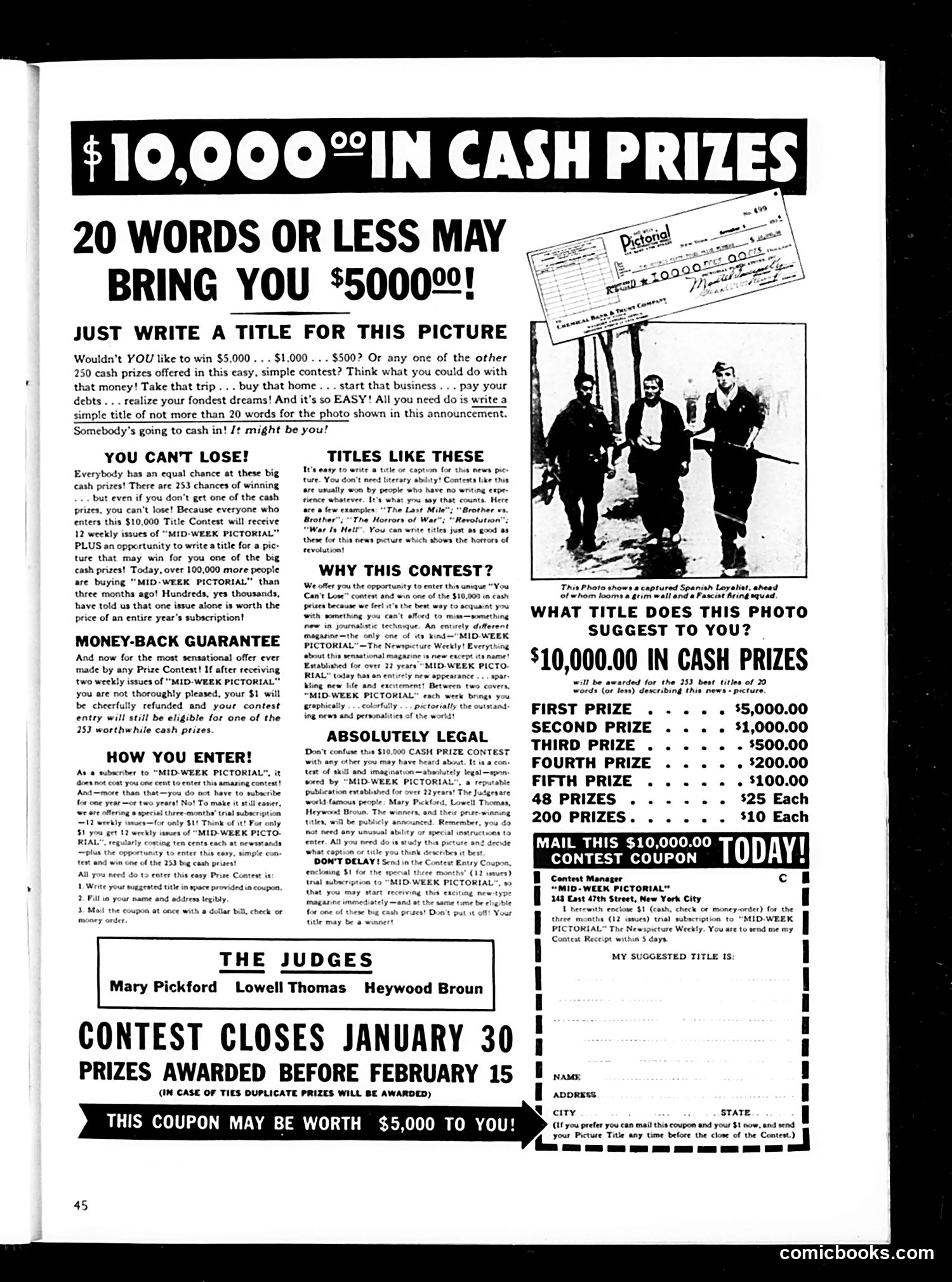
Analysis for Modern Readers This page is primarily advertising for a contest, not political satire. It's a promotional piece for "Mid-Week Pictorial" magazine offering $10,000 in cash prizes for readers who submit titles for a photograph. The photograph shows three men in formal attire (suits and hats) standing together, but the image quality and context don't clearly identify who they are. The advertisement doesn't specify their identities. What this meant then: This was a legitimate (if aggressive) marketing strategy—magazines used contests to boost subscriptions. The "$1 trial subscription" hook was designed to acquire new readers cheaply. The celebrity judges listed (Mary Pickford, Lowell Thomas, and Heywood Broun) lent credibility to the contest. Why modern readers would miss it: The appeal of paying $1 for a magazine subscription, the concept of "Mid-Week Pictorial" as a major publication, and the marketing tactics of mid-20th-century print media are largely foreign to digital-age audiences. The three men in the photo remain unidentified on this page, limiting full historical context.
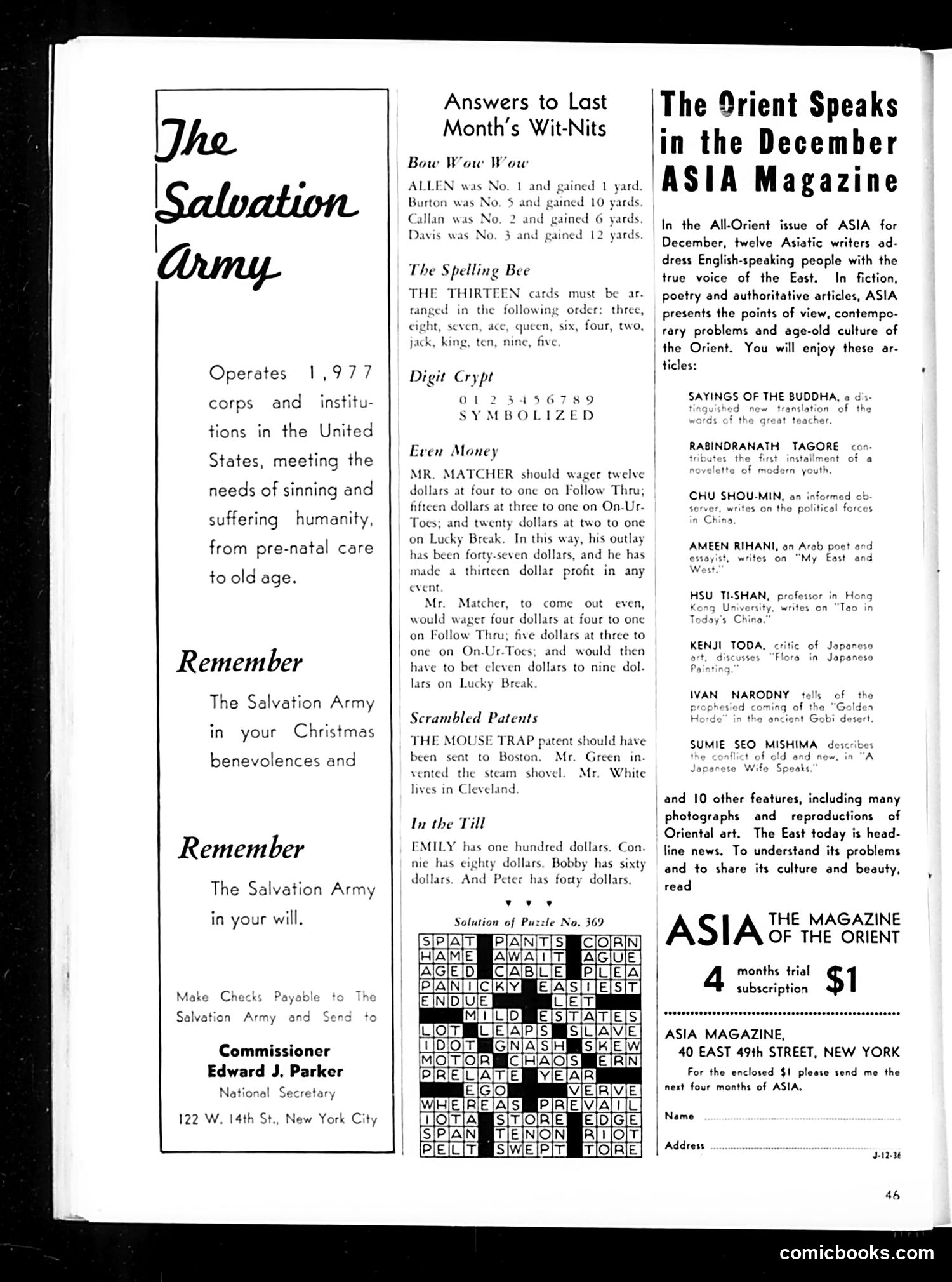
Analysis of This Judge Magazine Page This page is primarily advertising and puzzle solutions, not satirical content. It contains: Left side: A Salvation Army advertisement encouraging charitable donations and bequests, listing Commissioner Edward J. Parker's contact information. Center: Solutions to previous month's puzzles and word games ("Bow Wow Wow," "The Spelling Bee," "Digit Crypt," "Even Money," "Scrambled Patents," and "In the Till")—typical puzzle-page filler. Right side: An advertisement for *ASIA Magazine*, promoting its December "All-Orient" issue featuring articles by Asian writers and intellectuals including Tagore and others discussing Eastern culture, philosophy, and contemporary issues. The page reflects early 20th-century American periodical conventions: mixing charitable pitches, reader-engagement puzzles, and advertising for competing publications. There is no discernible political cartoon or satire present. The content emphasizes Western interest in Oriental culture and charitable giving during the Christmas season.
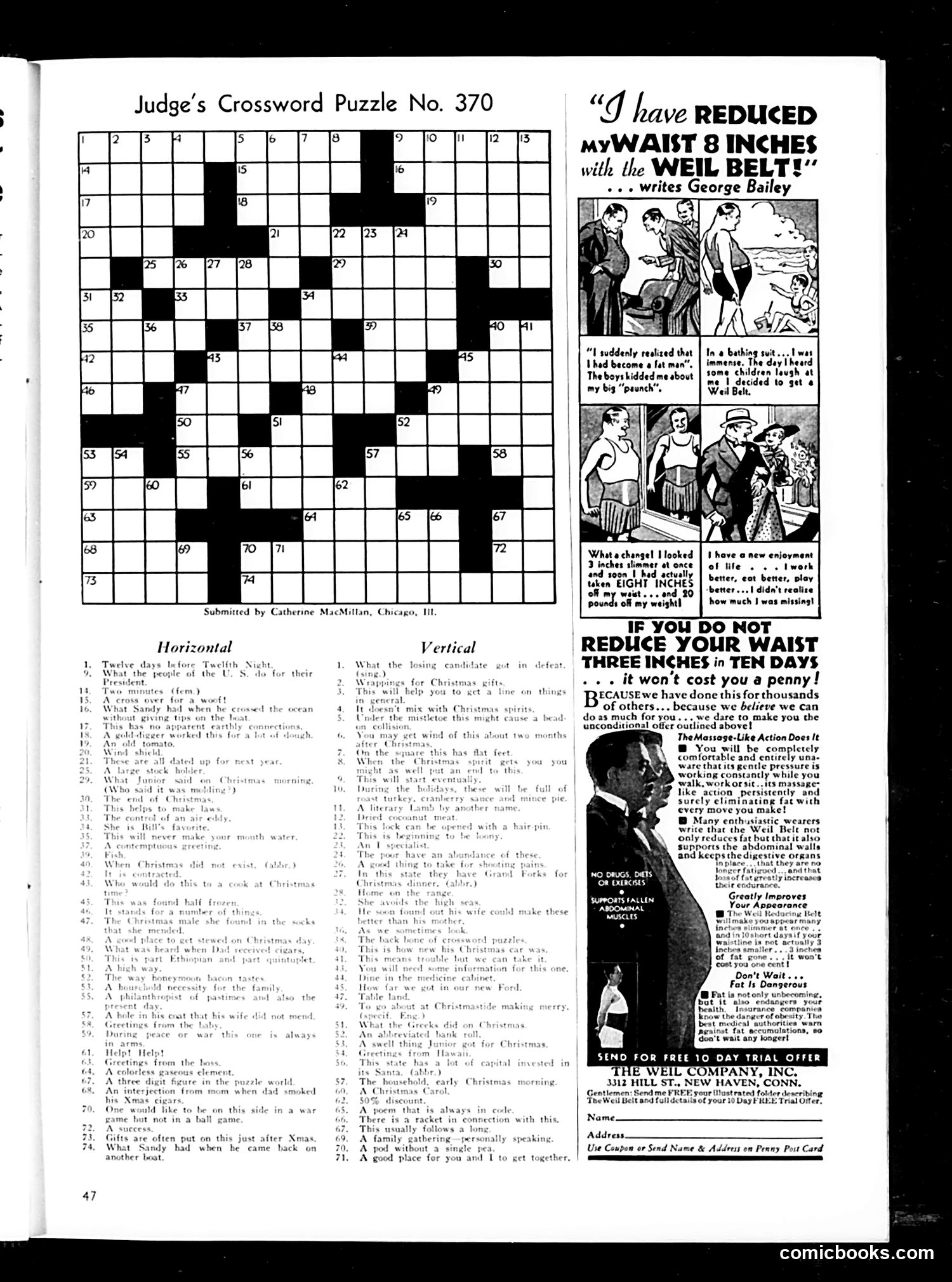
Judge Magazine Page Analysis This page combines a crossword puzzle with vintage advertisements promoting the "Weil Belt," a weight-loss garment marketed through testimonials. The Advertisement Content: The comic strips feature testimonials from "George Bailey" claiming he reduced his waist 8 inches using the Weil Belt. The narrative shows him initially self-conscious about his body ("big paunch"), then confident after wearing the device. The belt supposedly works through "massage-like action" while the wearer moves normally—no drugs, diets, or exercise required. The Satire/Context: This reflects early-20th-century American consumer culture's obsession with body reshaping and the proliferation of dubious weight-loss devices marketed to insecure customers. The "unconditional guarantee" and dramatic before-after claims are typical of the era's deceptive advertising practices. Judge magazine satirized consumer gullibility and questionable health products through featuring such ads, implicitly mocking both the product's claims and readers' willingness to believe them. The crossword puzzle serves as filler content alongside the advertisement.
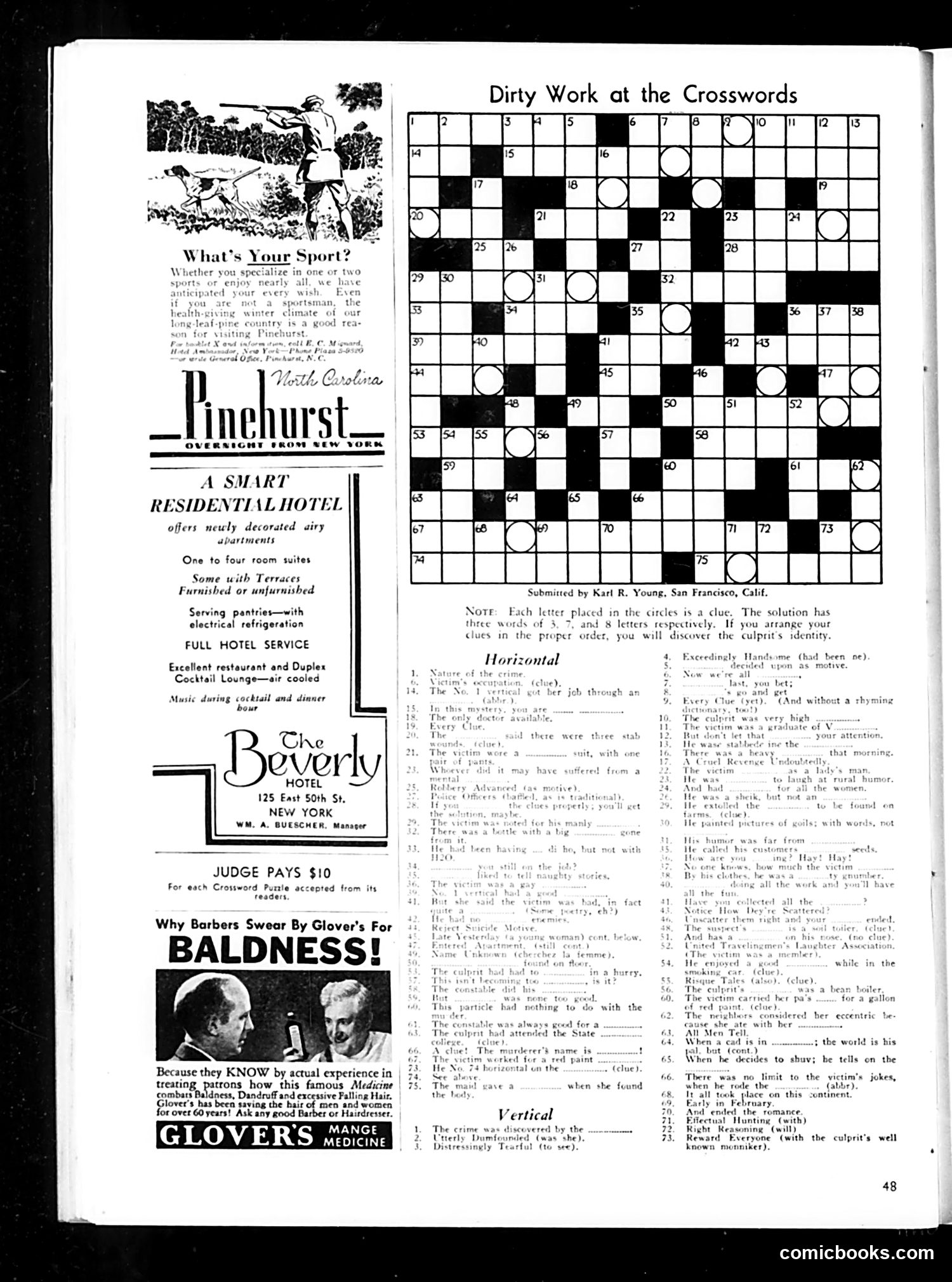
Dirty Work at the Crosswords This page is primarily advertisements and a crossword puzzle, not political satire. The main content is a cryptic crossword submitted by Karl R. Young of San Francisco, titled "Dirty Work at the Crosswords." The puzzle's premise appears to be solving clues to reveal the identity of a "culprit"—presented as a mystery to uncover through arranging answers properly. The clues reference various misdeeds and character types (robbery, deception, cruelty), suggesting the answer reveals someone who committed a crime. The advertisements flanking the puzzle—for Pinehurst Hotel, The Beverly Hotel, and Glover's Medicine (for baldness)—are typical Judge magazine commercial content from this era. There is no evident political cartoon or satirical commentary on this page; it's primarily a puzzle and advertising space.
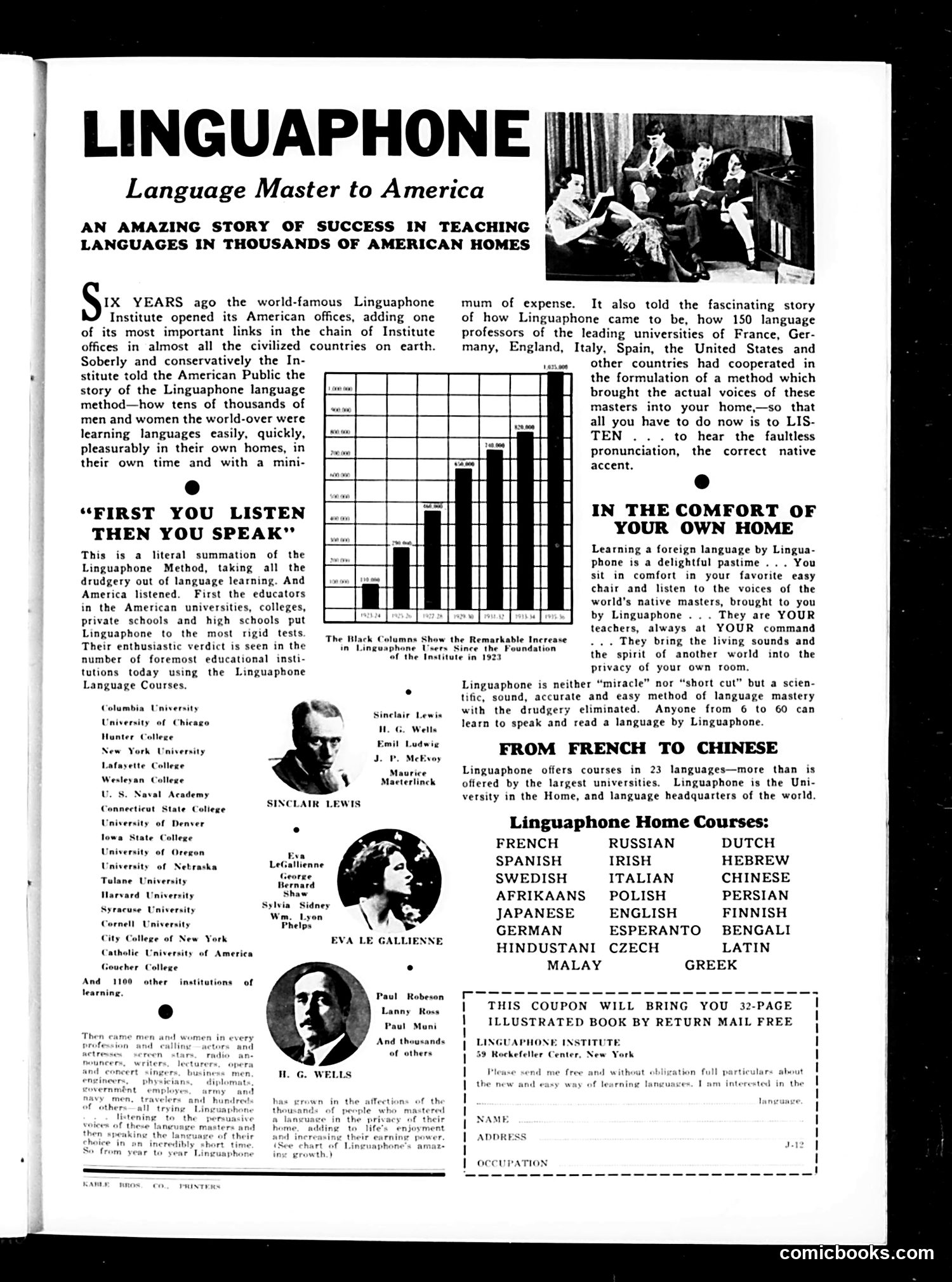
Linguaphone Advertisement Analysis This is a full-page advertisement, not a political cartoon. The Linguaphone Institute markets its language-learning method to American readers through endorsements by famous figures of the era. The page features testimonials from celebrities: Sinclair Lewis (novelist), H.G. Wells (British author), Emil Ludwig (biographer), Maurice Maeterlinck (playwright), Eva Le Gallienne (actress), and Paul Robeson (performer). These names lend cultural prestige to the product. The advertisement emphasizes the "listen-then-speak" method and claims 150 language professors from major European universities created the program. A bar chart shows growth since 1923, and the text lists dozens of American universities and colleges supposedly adopting Linguaphone. The appeal: Learn foreign languages at home effortlessly, in comfort, from native speakers' authentic voices—a novel technological promise for the interwar period when recorded language instruction was genuinely innovative. The ad positions language-learning as accessible, cultured, and modern.
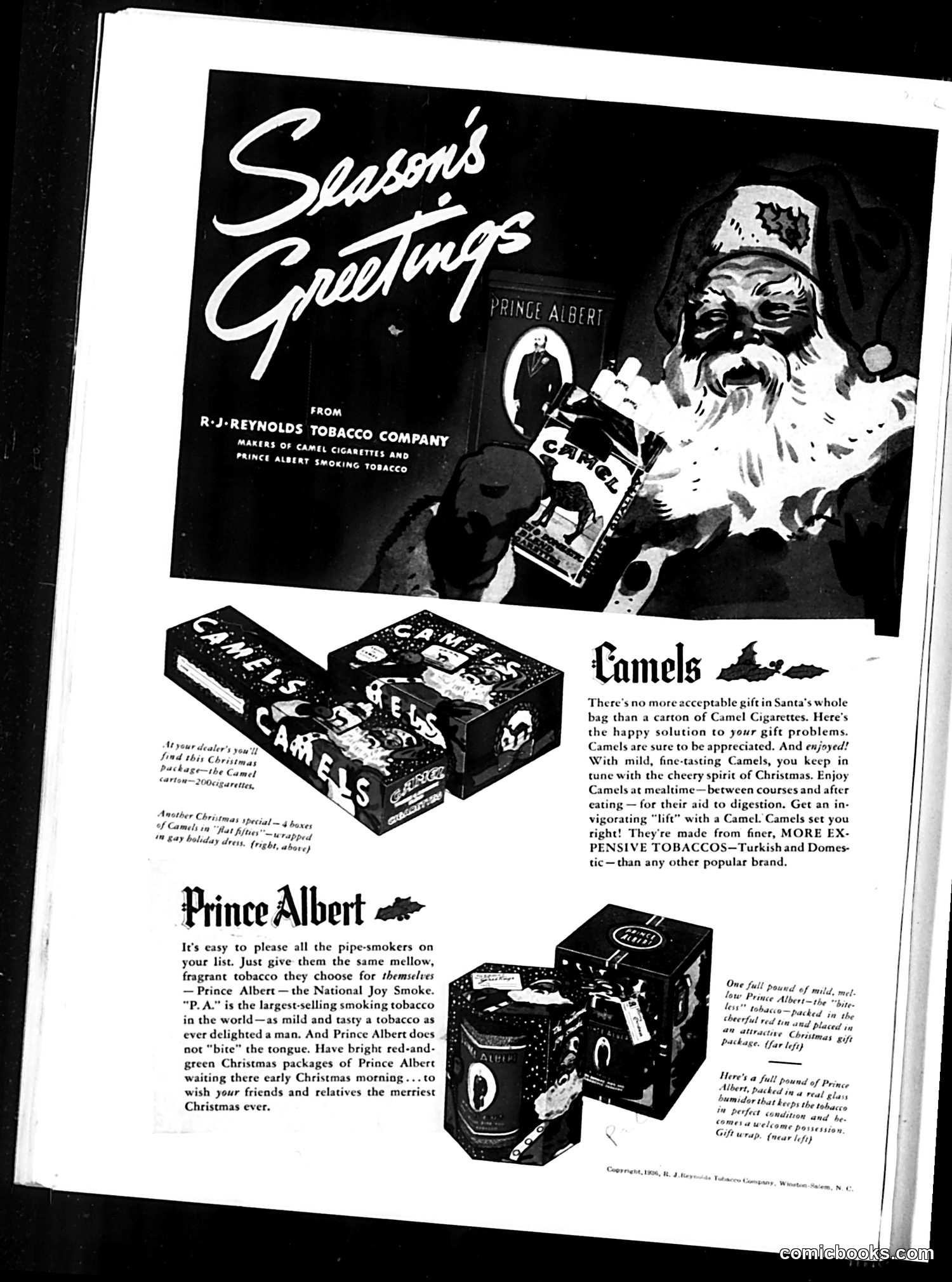
Analysis This page is primarily advertising, not satire or political commentary. It contains two tobacco company holiday advertisements from what appears to be the 1930s-40s era. The top features a Santa Claus figure (generic, not a specific person) promoting Camel cigarettes and Prince Albert smoking tobacco, presented as ideal Christmas gifts. The advertising copy emphasizes the products' mildness and digestive benefits—typical health claims made for tobacco products in that era before their dangers were widely acknowledged. The lower section shows product packaging for both brands with detailed gift descriptions. What a modern reader should know: This reflects a time when tobacco was openly marketed as an appropriate gift and when health claims about smoking were unregulated and commonplace in advertising. The casual celebration of cigarettes as festive gifts would be shocking today given current understanding of tobacco's dangers. There is no political cartoon, satire, or specific historical figures depicted here—just straightforward vintage advertising.

I can see this is a blank or nearly blank page from what appears to be a Judge magazine issue, based on the "comicbooks.com" watermark at the bottom. The page itself contains no visible cartoon, illustration, text content, or advertisements to analyze. Without any actual visual content or OCR'd text to work from (beyond the watermark), I cannot identify any figures, political references, or satirical points. This appears to be either a title page, endpaper, or blank advertising page from the publication. To provide meaningful historical context about Judge magazine's satirical content, I would need a page with actual illustrations or readable text present.