judge
Judge — January 1937
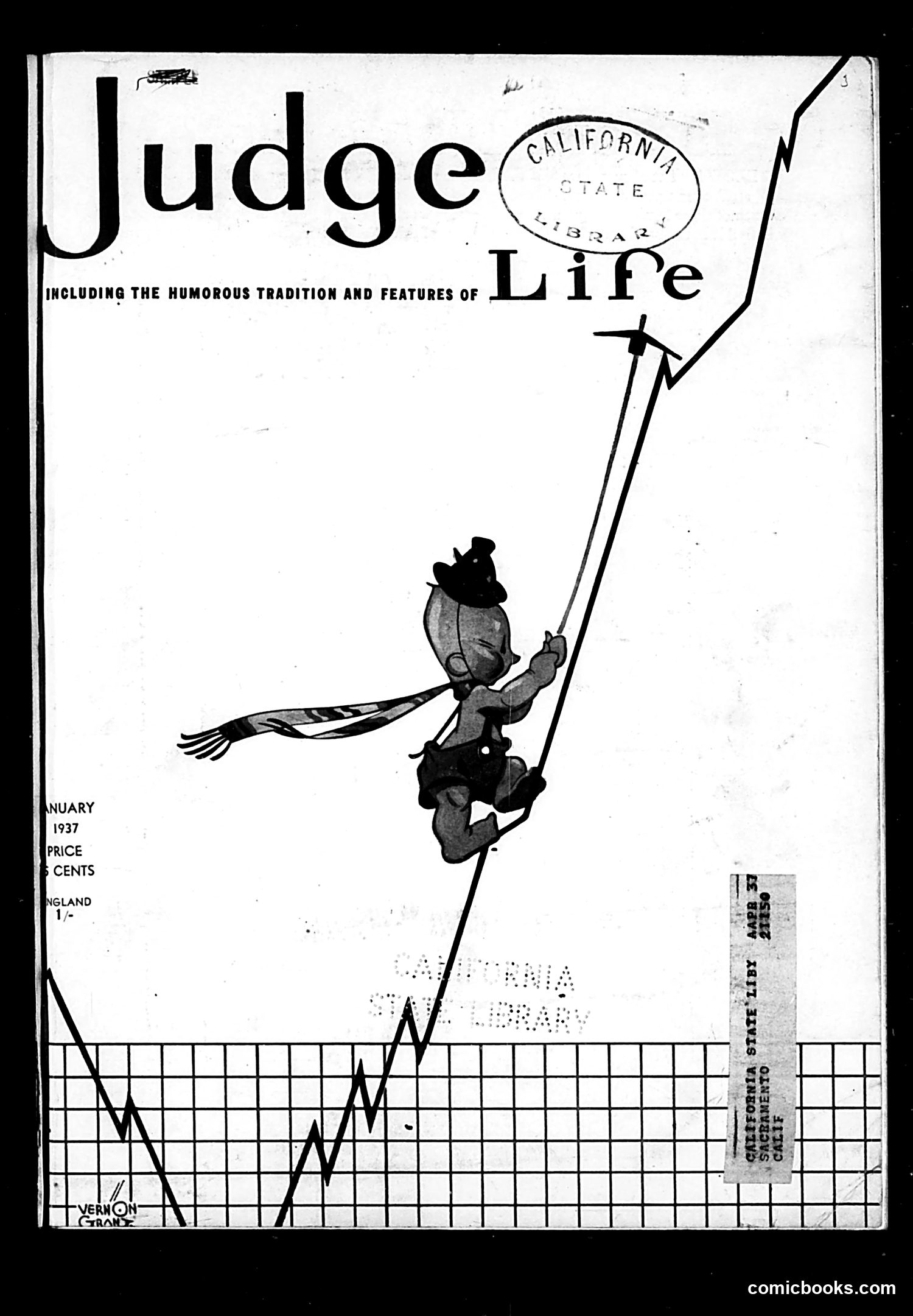
Judge Magazine Cover Analysis - January 1937 This cover depicts a figure climbing upward along a sharply rising stock market graph line, suggesting economic recovery during the Great Depression's later years. The character appears to be a judge or authority figure (fitting for *Judge* magazine's mascot tradition), optimistically ascending what the subtitle promises: "including the humorous tradition and features of Judge Life." The dramatic upward trajectory of the graph contrasts with earlier Depression imagery, likely celebrating the economic recovery period of 1936-1937. The confident pose and determined climb suggest cautious optimism about America's economic future, though the sharp fluctuations in the underlying graph line hint at the market's volatility and uncertainty—a subtle reminder that recovery remained precarious.
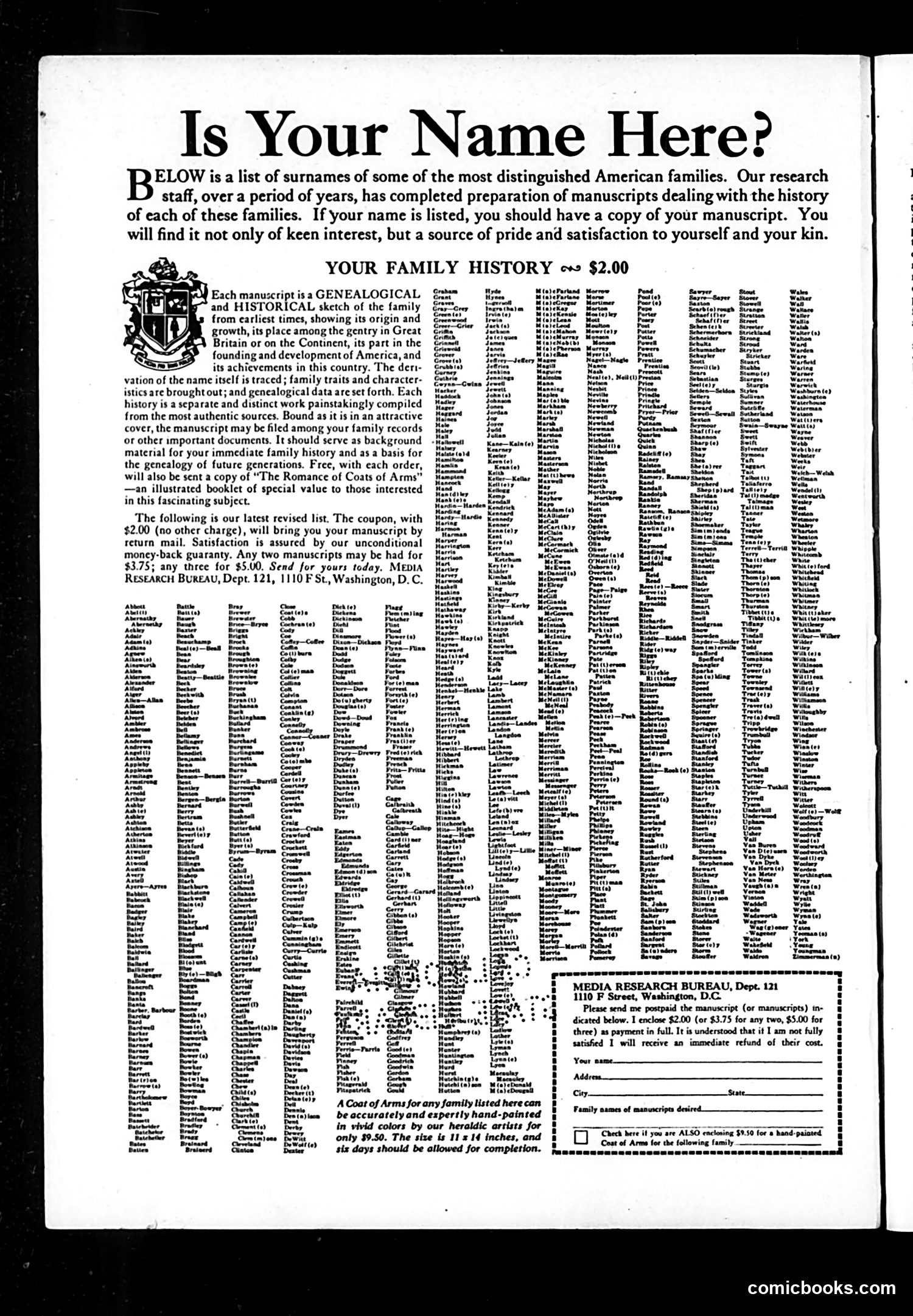
Analysis This page is primarily an advertisement, not satirical content. It's a full-page ad from the Media Research Bureau promoting genealogical family history manuscripts for $2.00. The ad features an ornate coat-of-arms emblem and extensive columns of surnames—"a list of surnames of some of the most distinguished American families." The pitch targets middle-class Americans interested in tracing their ancestry back to "Great Britain or on the Continent" and establishing family pride through documented genealogy. This reflects early 20th-century American fascination with hereditary status and lineage. The ad appears designed to capitalize on anxieties about social standing by offering "proof" of respectable ancestry—a common commercial appeal of that era before modern genealogy became a hobby.
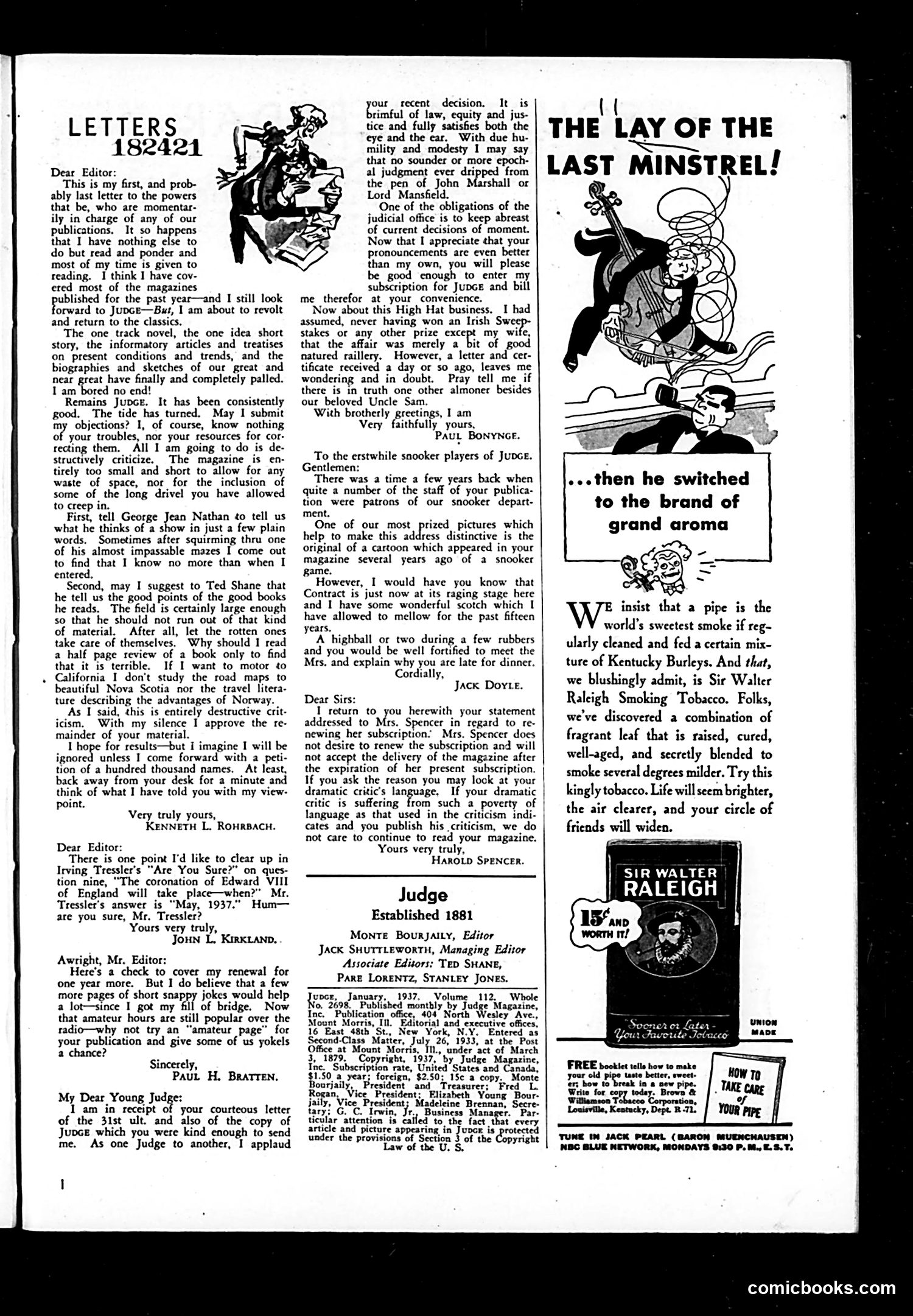
Analysis of Judge Magazine Page (January 1937) The main cartoon, "The Lay of the Last Minstrel," depicts a figure (appearing to be an Irish immigrant based on the caricature style) discovering that switching to Sir Walter Raleigh tobacco enhances his social status or appeal—he's now accepted by what appears to be upper-class company. This is primarily an advertising page for Sir Walter Raleigh Smoking Tobacco, using ethnic humor common to 1930s advertising. The joke relies on period stereotypes: the implication that an Irish working-class character can "improve" himself through consumer choice. The page also contains editorial letters addressing magazine policy and a snooker-related contribution, but these are secondary to the tobacco advertisement, which occupies substantial visual space and represents the page's commercial purpose.
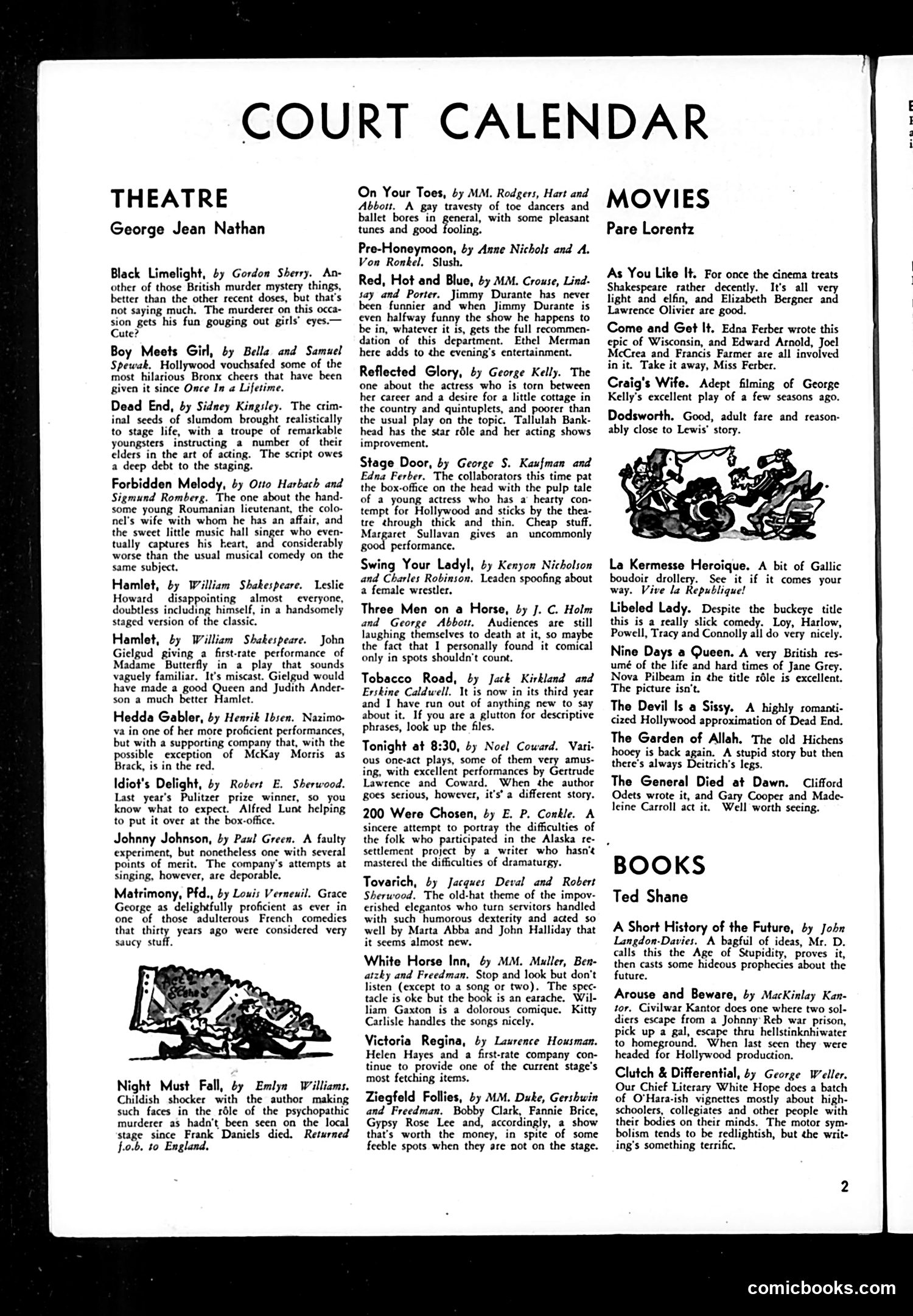
Court Calendar Page Analysis This is primarily a review and listing page from Judge magazine, not a political cartoon page. It contains theater reviews (by George Jean Nathan), movie reviews (by Pare Lorentz), and book reviews (by Ted Shane). The only cartoon visible is a small decorative illustration in the lower left corner showing what appears to be a stylized figure in an exaggerated pose—likely meant as a humorous vignette rather than political satire. The page functions as entertainment criticism and cultural commentary typical of Judge's format. The reviews discuss contemporary Broadway shows, films, and literature without apparent political agenda. The cartoon, if satirical, is too small and unclear in this reproduction to determine its specific meaning or targets.
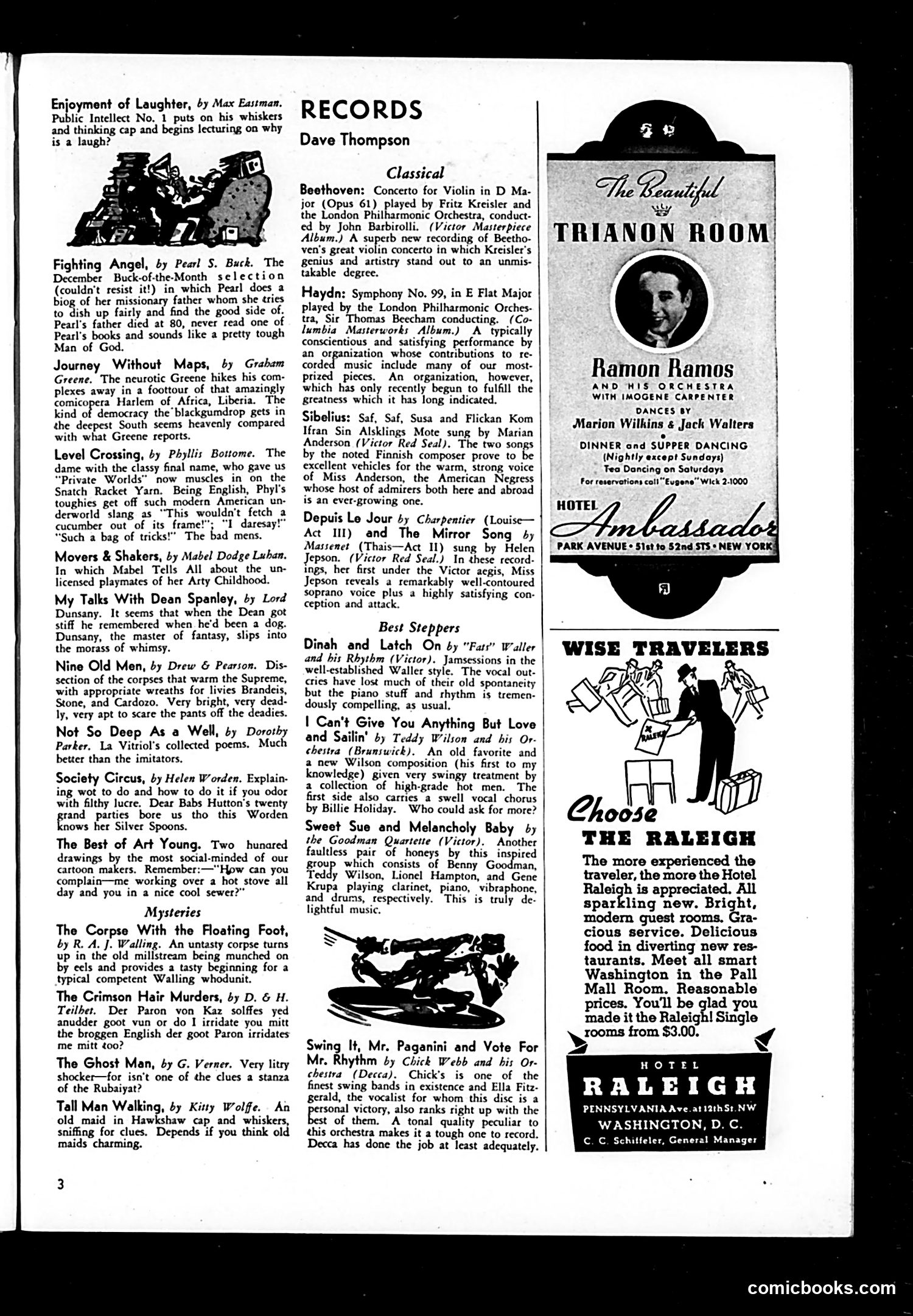
Analysis of Judge Page This page is primarily advertising and music reviews rather than political satire. The main content is "RECORDS" by Dave Thompson, reviewing classical music recordings and popular songs from artists like Beethoven, Haydn, and Teddy Wilson. The left column contains brief humorous book reviews of titles like "Enjoyment of Laughter" and "Fighting Angel"—these appear to be lighthearted commentary on popular literature rather than political satire. The advertisements feature the Trianon Room (featuring dancer Ramon Ramos) and the Hotel Raleigh in Washington, D.C., typical of Judge's era advertising. No clear political cartoons or caricatures are visible on this page. This appears to be a standard entertainment/culture issue from Judge's mid-20th century run.
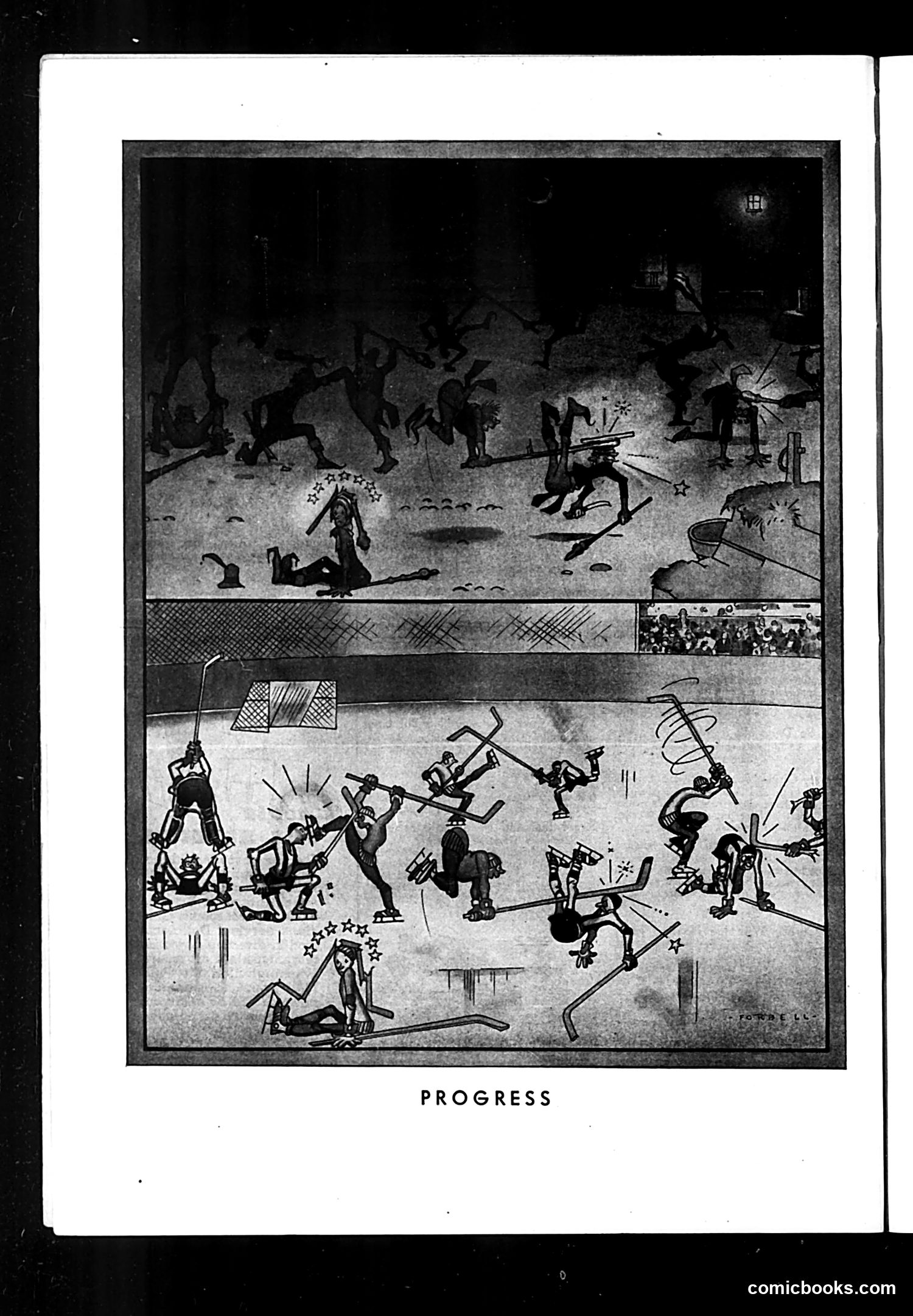
"Progress" - Judge Magazine Cartoon This two-panel satirical cartoon contrasts primitive and modern civilization. The top panel depicts what appears to be a chaotic prehistoric or "savage" scene with figures engaged in violent conflict—fighting, wielding weapons, and generally behaving chaotically under moonlight. The bottom panel shows a modern ice hockey game, where players are similarly engaged in aggressive, violent physical contact—checking, fighting, and colliding on ice. The cartoon's title "Progress" is ironic: it suggests that despite civilization's supposed advancement, modern humans still engage in the same brutal, violent behavior as their primitive ancestors—merely in a more organized, institutionalized form. The satire critiques how contemporary society legitimizes and celebrates violence through organized sports rather than recognizing it as evidence that humanity hasn't truly progressed morally or behaviorally.
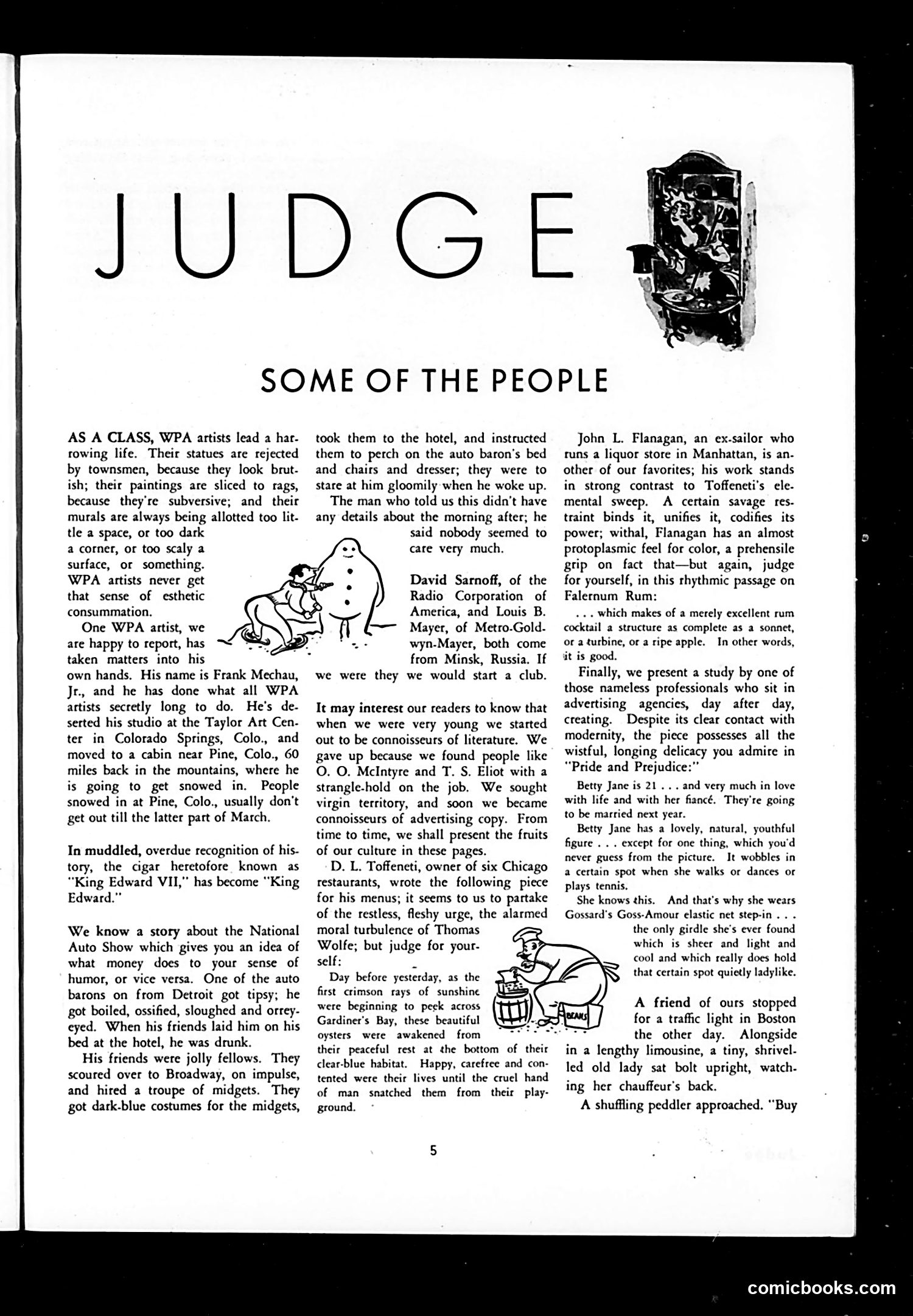
Analysis of "Judge" Page: "Some of the People" This page satirizes WPA (Works Progress Administration) artists and various public figures through anecdotal sketches. The main cartoon depicts a rotund man with a large palette, likely representing a WPA artist—the Depression-era program that employed artists whose work was often dismissed as derivative or inadequate by establishment critics. The text mocks several targets: WPA artists as a class ("their statues are rejected by townsmen"), a story about an auto baron's humiliating prank on hotel staff, and profiles of figures like John L. Flanagan (liquor store owner) and advertising professionals. The overall tone is dismissive toward both struggling WPA artists and various working professionals, reflecting the magazine's satirical stance toward Depression-era cultural and economic conditions. The page relies on period-specific references requiring historical context to fully appreciate.
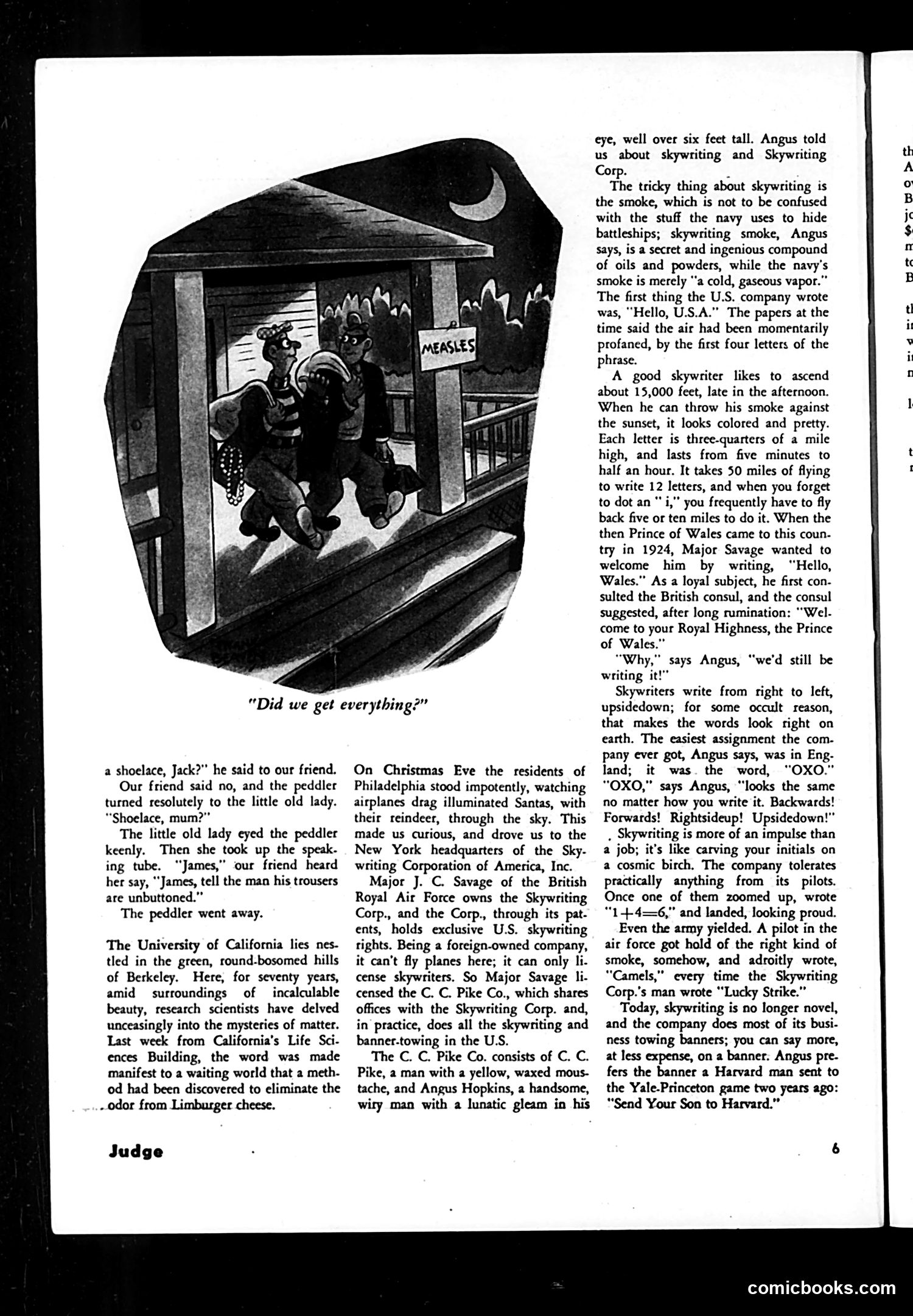
"Did we get everything?" This cartoon satirizes skywriting—a then-novel aerial advertising method. The image shows a storefront labeled "MEASLES" with figures inside appearing sick, while skywriters operate above. The joke hinges on a dark pun: skywriters have just "written" measles in the sky, and the store's occupants anxiously ask whether they've advertised everything needed. The satire mocks how skywriting was being used for commercial promotion, imagining it applied absurdly to disease rather than legitimate products. The accompanying text discusses skywriting's actual mechanics and early high-profile uses (including a 1924 greeting to the Prince of Wales). The cartoonist ridicules both the novelty of aerial advertising and its indiscriminate commercial applications, suggesting even epidemics might be "marketed" via this new technology.
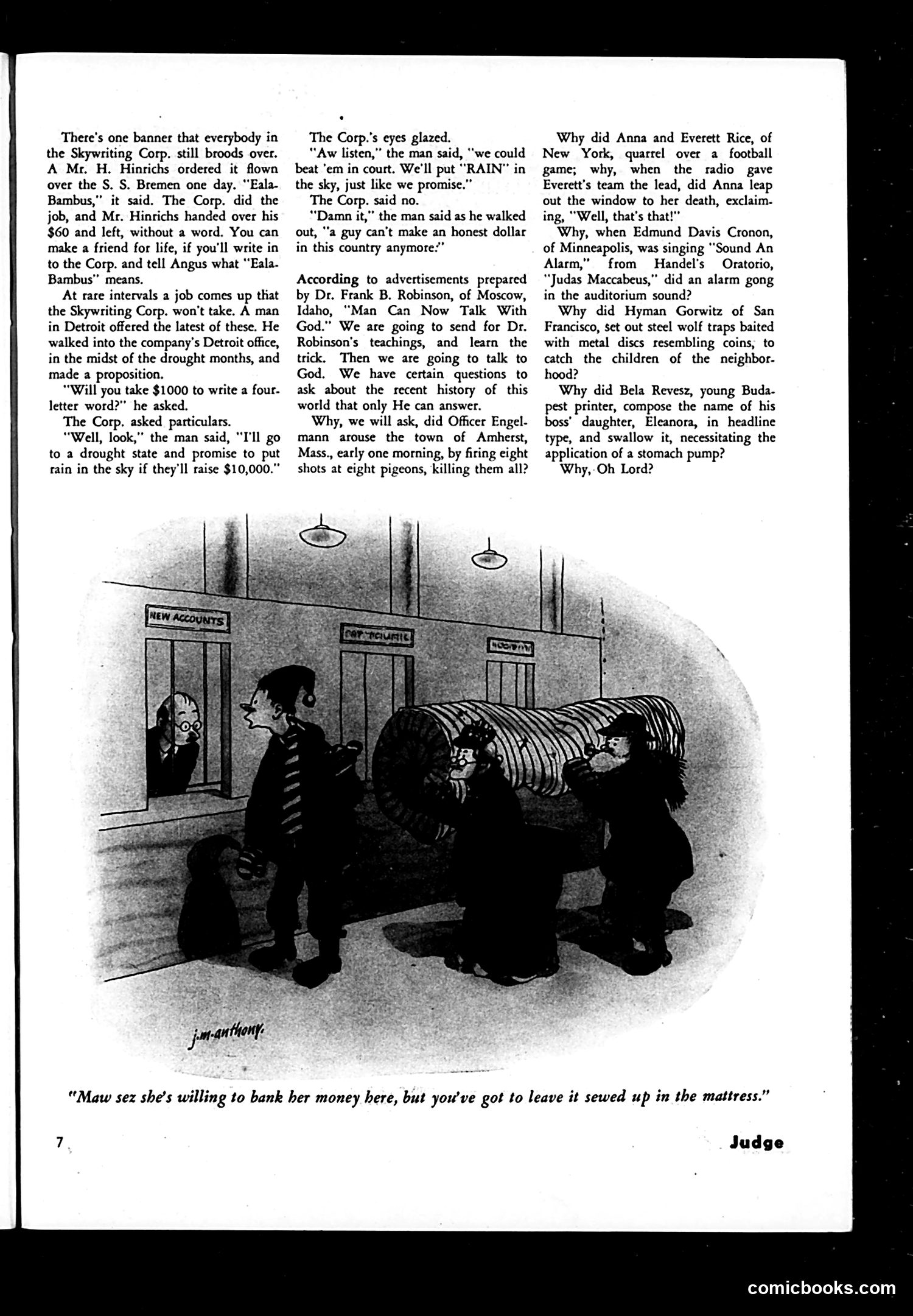
Cartoon Analysis: "Judge" Magazine Page This page contains a satirical cartoon and anecdotes mocking American business and advertising culture, likely from the 1920s-1930s based on style. The main cartoon depicts people examining a large cylindrical object (possibly a mattress or safe) at what appears to be a bank. The caption reads: "Maw sez she's willing to bank her money here, but you've got to leave it sewed up in the mattress." The joke critiques distrust of banks—a rural or working-class woman refuses to deposit her savings conventionally, instead keeping money literally sewn into a mattress, a common Depression-era practice reflecting widespread banking skepticism. The surrounding text mocks corporate advertising schemes (like the "Skywriting Corp." and "Man Can Now Talk With God") and absurd business propositions, satirizing American commercial excess and gullibility.
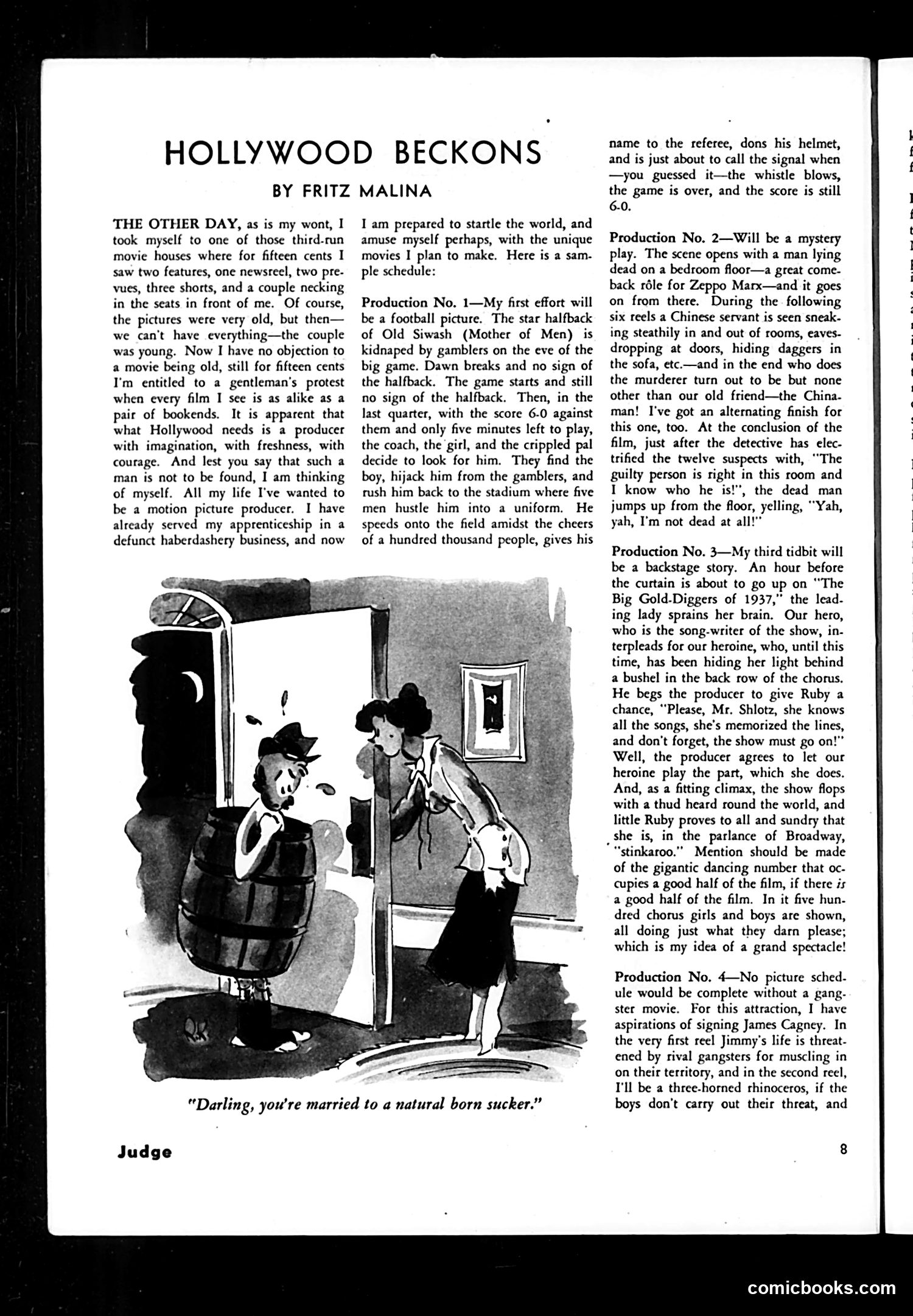
"Hollywood Beckons" by Fritz Malina This is a satirical essay mocking formulaic Hollywood screenwriting. The author, posing as an aspiring producer, outlines four hilariously clichéd movie pitches that parody common studio tropes of the 1930s: Production 1 ridicules sports movies: a kidnapped football star mysteriously reappears mid-game, only to have it end anticlimactically. Production 2 mocks mystery films: Chinese servants skulk mysteriously, the supposedly dead man was alive all along. Production 3 parodies backstage musicals: an unknown chorus girl ("Ruby") gets her big chance when the star is injured, the show flops anyway—a reference to the "Gold Diggers" series. The single cartoon below illustrates marital naiveté: a woman calls her husband "a natural born sucker," a dig at male gullibility. Malina's satire targets Hollywood's creative bankruptcy—recycled plots, stereotypical characters (the "Zeppo Marx" reference), and predictable outcomes. The piece is both criticism and self-aware comedy about tinseltown's formula-driven productions.
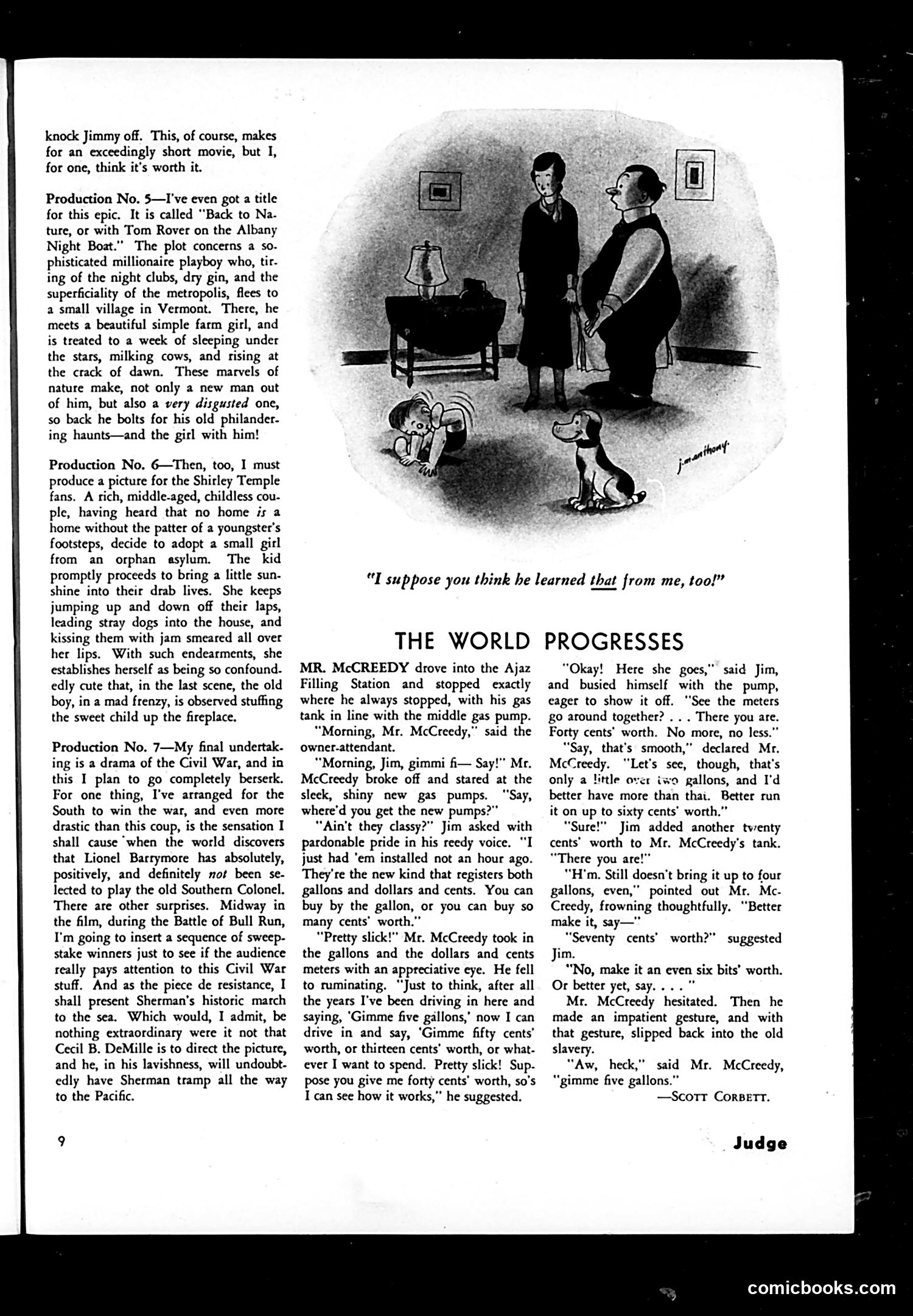
"The World Progresses" Cartoon Analysis This single-panel cartoon satirizes consumer behavior and the illusion of progress. Mr. McCreedy visits a gas station featuring new pumps that display both gallons *and* dollars/cents simultaneously. Impressed by this "modern" technology, he requests forty cents' worth of gas—ostensibly to test the mechanism. The satire lies in the joke's caption and setup: McCreedy believes he's making a sophisticated choice by purchasing gas by *price* rather than *volume*. However, the new pump simply provides an additional display option; it doesn't fundamentally change the transaction. The cartoon mocks how consumers mistake superficial "improvements" or new marketing presentations for genuine progress or meaningful choice. This reflects 1920s-30s American consumer culture anxieties about whether modern conveniences and advertising genuinely benefited consumers or merely repackaged existing products.
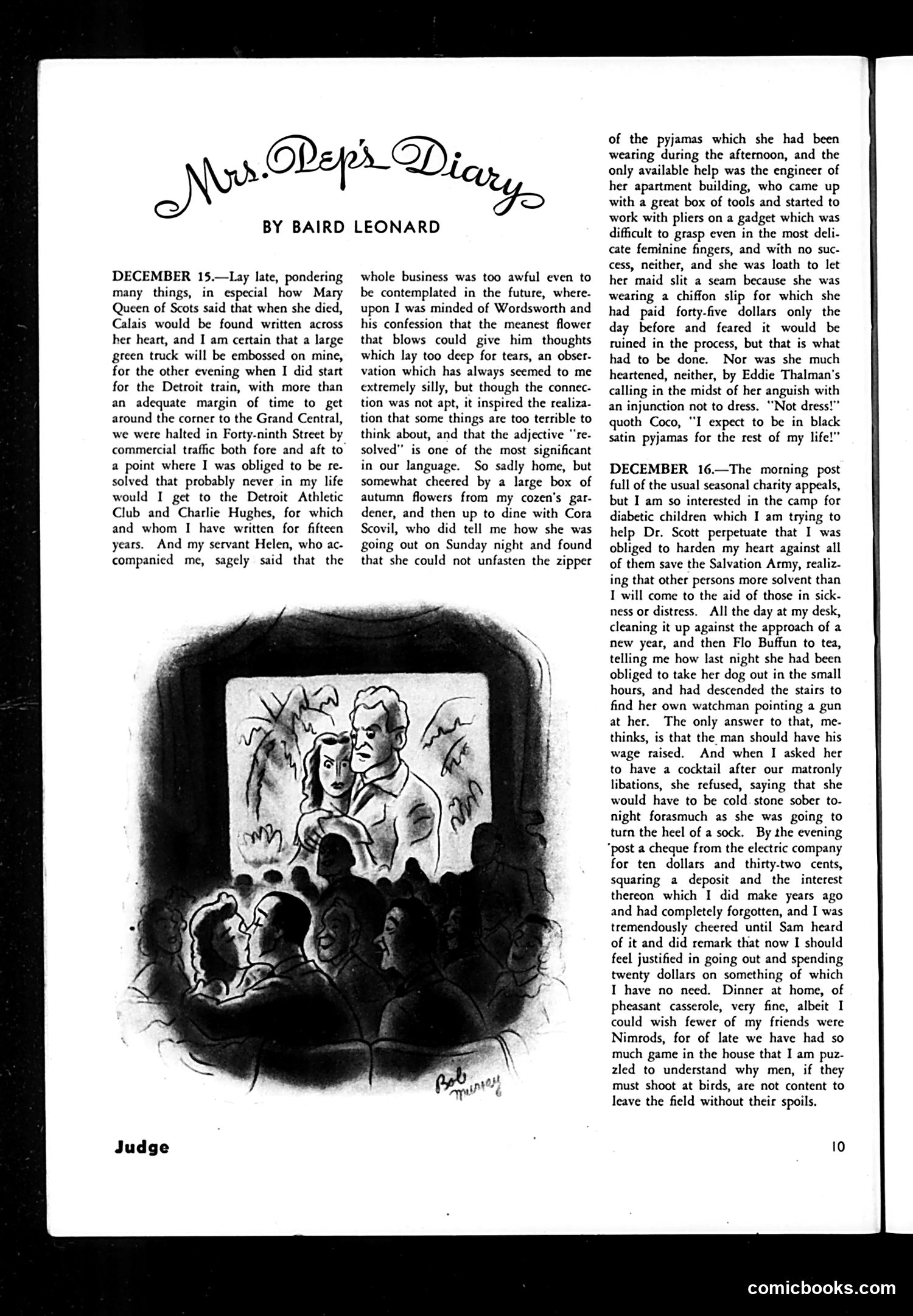
"Mrs. Dep's Diary" - December 15-16 This is a humorous diary entry by Baird Leonard satirizing upper-middle-class urban life in what appears to be 1920s New York. The unnamed diarist chronicles trivial domestic frustrations—being stuck in Forty-ninth Street traffic en route to the Detroit Athletic Club, a dinner guest's jammed pajama zipper requiring an apartment building engineer's intervention with pliers, and a watchman pointing a gun at a friend descending stairs at night. The cartoon (artist signature unclear) depicts people watching what appears to be a theatrical performance or screen, likely illustrating one of the diary's anecdotes. The satire mocks how the leisure class dramatizes minor inconveniences as catastrophes worthy of Wordsworth-level contemplation. The tone is gently self-mocking—the diarist's breathless recounting of these "crises" undercuts any genuine concern, exposing the comfortable absurdity of their problems.
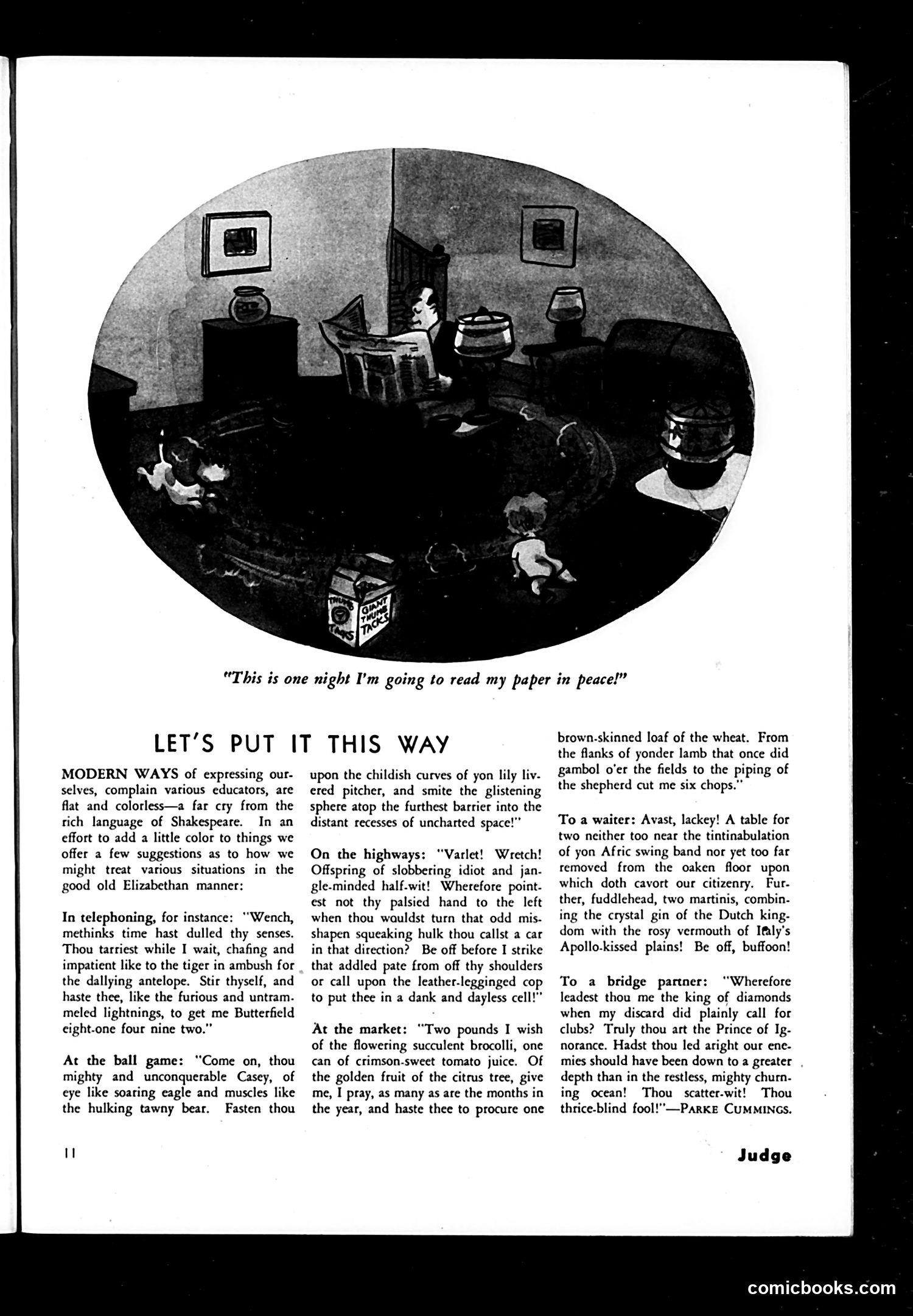
"Let's Put It This Way" — Judge Magazine Satire This article mocks the early 20th-century educational complaint that modern speech lacks the "colorful language of Shakespeare." The satire proposes replacing everyday modern expressions with deliberately overwrought Elizabethan-style insults and flowery language. The cartoon shows a frustrated man attempting to read his newspaper while surrounded by noisy children and domestic chaos—illustrating how "peace" remains impossible regardless of linguistic flourish. The accompanying text offers absurd examples: calling a telephone operator "wench," addressing a baseball player with Shakespearean praise, hurling elaborate curses at bad drivers, ordering groceries in mock-archaic prose, and berating a bridge partner with theatrical indignation. The humor lies in the contrast between Shakespeare's genuine eloquence and these ridiculously overwrought, pretentious attempts to sound educated—a gentle jab at educators and cultural snobs who romanticize older language while ignoring that truly effective communication transcends mere vocabulary.
Analysis for Modern Readers This is a humorous essay by S.J. Perelman (a celebrated American satirist) mocking a British sports magazine article criticizing loud buffalo-herding tactics. The piece is absurdist satire—Perelman invents an elaborate, ridiculous backstory about an anonymous "Old Harrow Boy" who wrote the criticism, tracing him to a suspicious character living in London's working-class Wapping district. The joke relies on escalating absurdity: Perelman claims to have investigated this mystery writer, uncovering a fabricated history of the man being convicted in Rhodesia for provoking water-buffalo uprisings in 1911. The final segment presents a mock-courtroom transcript where a witness describing buffalo injuries becomes increasingly nonsensical (a buffalo with no tongue because "the cat got it"). The satire targets pretentious British sportsmanship culture and anonymous critics, using intentionally overwrought mock-seriousness. The headline's "UNITE!" parodies Marxist rhetoric, extending the absurdist humor. This represents 1930s American literary satire at its most playful.
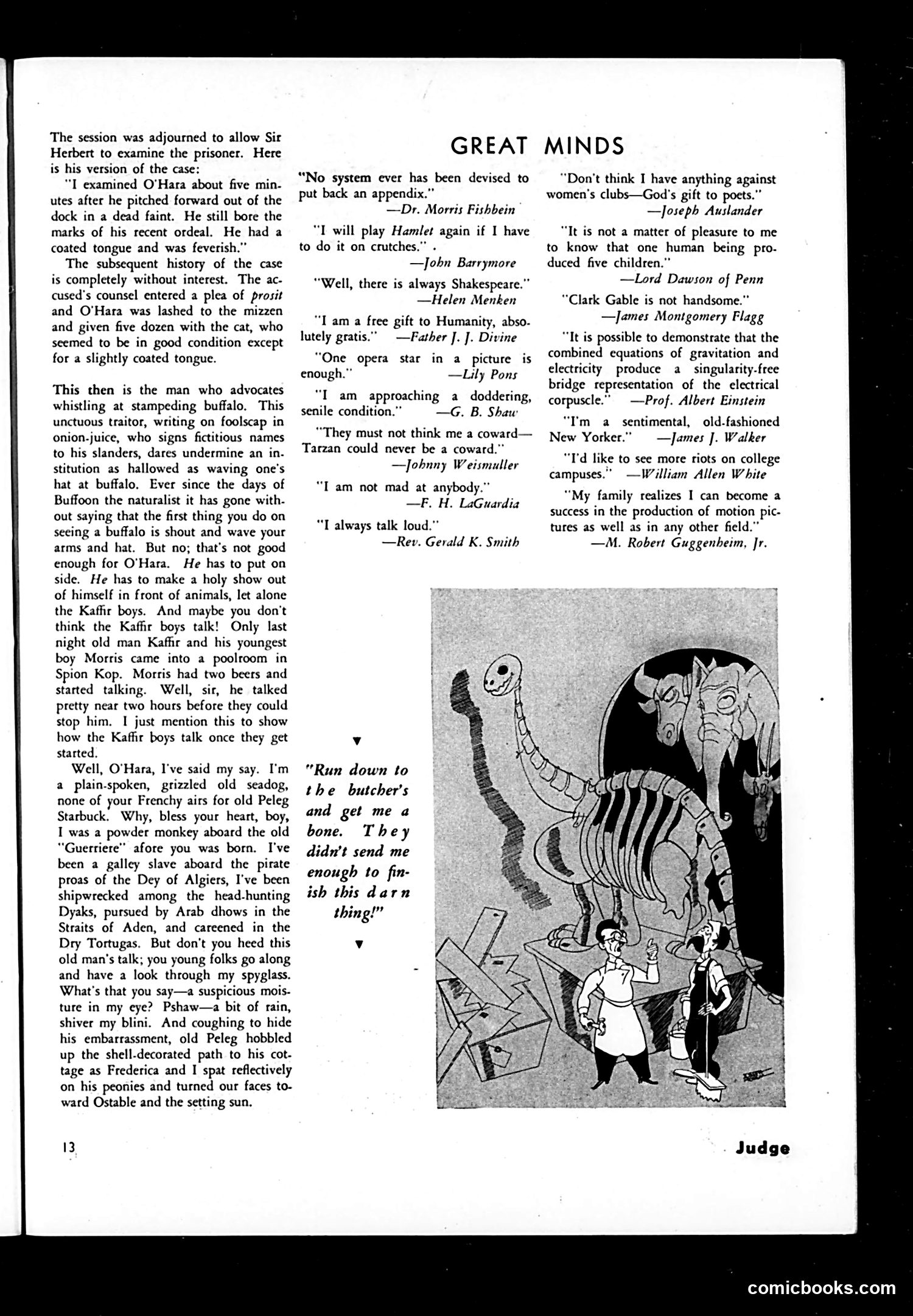
Judge Magazine Satire Analysis This page combines two distinct satirical pieces. The main narrative mocks Irish immigrants and colonial attitudes toward African people, depicting a farcical legal case against "O'Hara" who apparently questioned the tradition of waving one's hat at buffalo. The rambling testimony from "old Peleg Starbuck" (a stereotypical salty sea captain) uses absurdist humor to ridicule both O'Hara and the speaker's own pretensions—his exaggerated life experiences and melodramatic emotionalism undermine the seriousness of the proceedings. The "Great Minds" section is a joke compilation featuring celebrities and public figures of the era (Barrymore, Einstein, Mayor Jimmy Walker, etc.) uttering absurd or contradictory statements. The cartoon depicts a hapless diner requesting more meat from an exasperated cook/butcher. Together, these represent *Judge*'s typical early-20th-century satirical approach: mocking immigrant communities, inflated authority figures, and celebrity culture simultaneously.
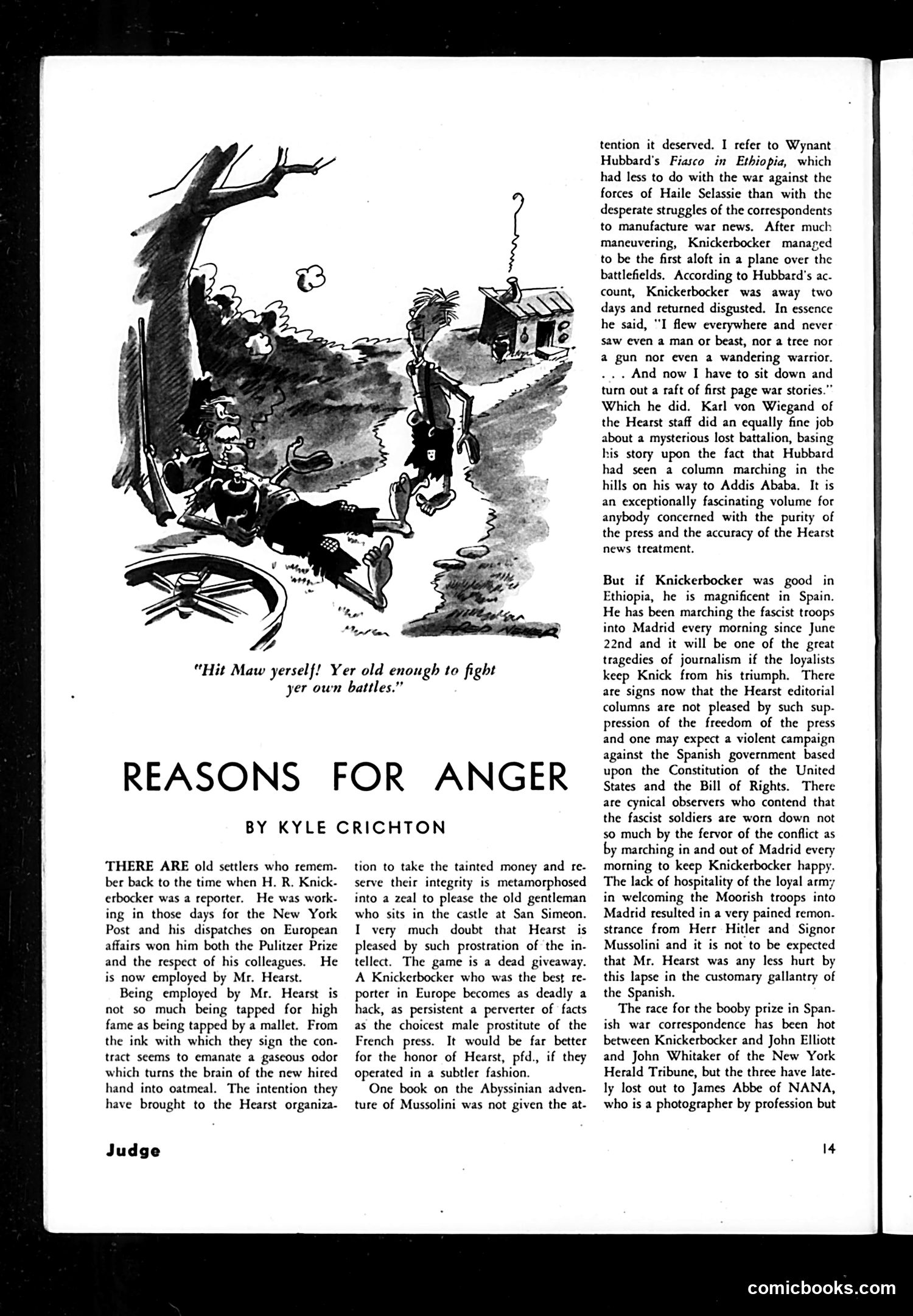
Explanation for Modern Readers This article attacks H.R. Knickerbocker, a Hearst newspaper correspondent, for abandoning journalistic integrity after joining William Randolph Hearst's media empire. The cartoon caption shows a child being told to fight his own battles—a metaphor for Hearst's reporters fabricating stories rather than reporting actual events. The article alleges that Knickerbocker, once a respected reporter, became a propagandist under Hearst. Specific examples include: 1. Ethiopia (1935): Knickerbocker allegedly flew over battlefields, saw nothing, then fabricated dramatic war coverage. 2. Spanish Civil War (1936): He supposedly reported fascist troops marching into Madrid repeatedly, inventing victories that never occurred to please Hearst's pro-fascist editorial stance. The author argues Hearst's correspondents manufacture false narratives to advance political agendas rather than inform the public. This represents broader 1930s concerns about press corruption and media manipulation by wealthy owners with political sympathies.
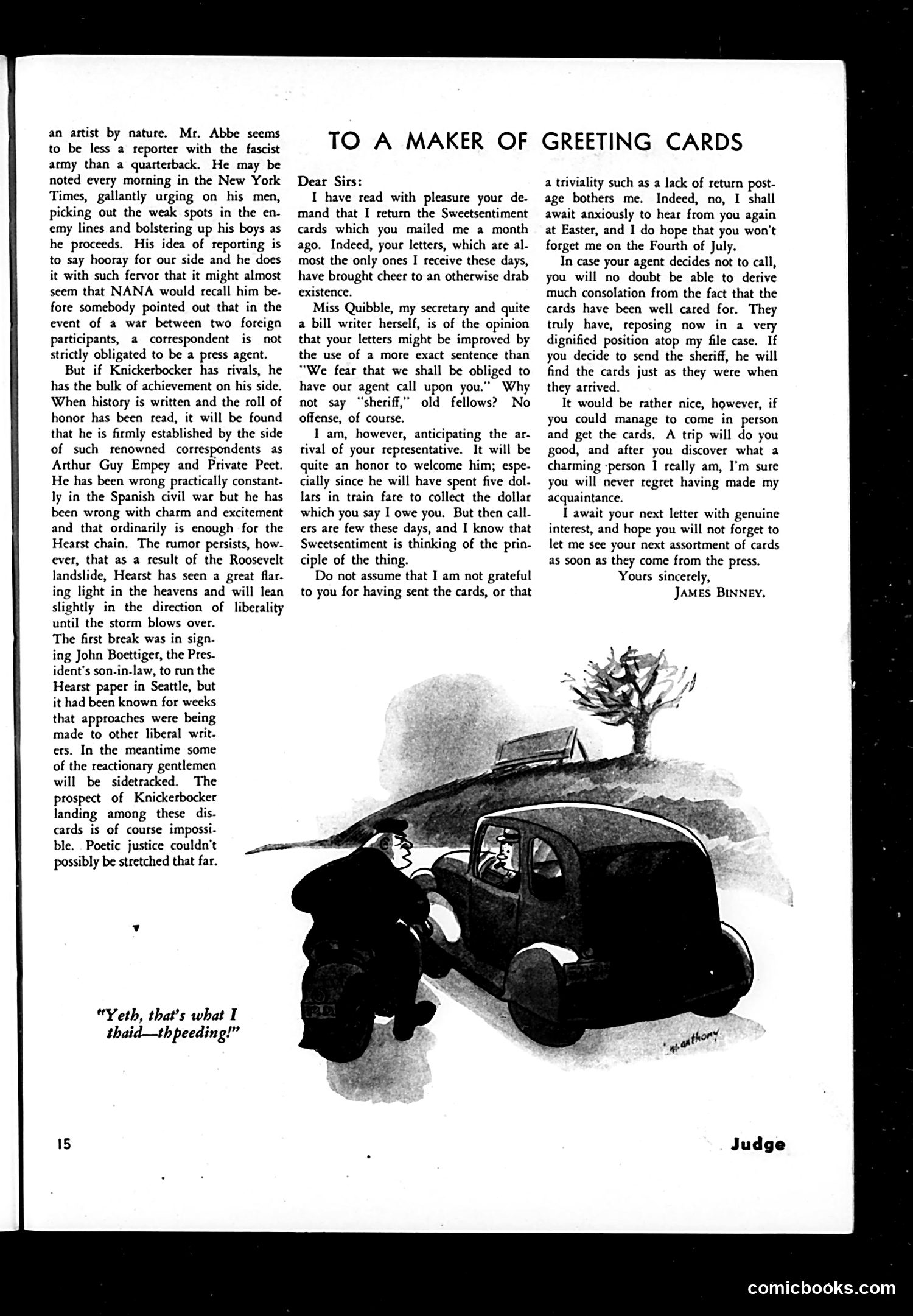
Analysis: Judge Magazine Page This page contains two distinct pieces of political satire from Judge magazine. Upper text: A critique of war correspondent H.R. Knickerbocker's coverage of the Spanish Civil War. The writer accuses Knickerbocker of being a propagandist for the fascist side rather than objective journalist—acting more like a "quarterback" cheering for one team than a neutral reporter. The piece also notes that William Randolph Hearst's newspaper chain has begun hiring more liberal writers (including FDR's son-in-law John Boettiger) following Roosevelt's electoral victory, suggesting even Hearst recognizes shifting political winds. Lower section: A humorous letter from a debtor to "Sweetsentiment," a greeting card company attempting to collect a dollar debt. The writer mocks their formal collection letters by suggesting they simply say "sheriff" instead, and sardonically praises the company while making clear he has no intention of paying. The accompanying cartoon shows a speeding car, illustrating the comedic tone. Both pieces exemplify Judge's satirical approach to contemporary politics and social absurdities.
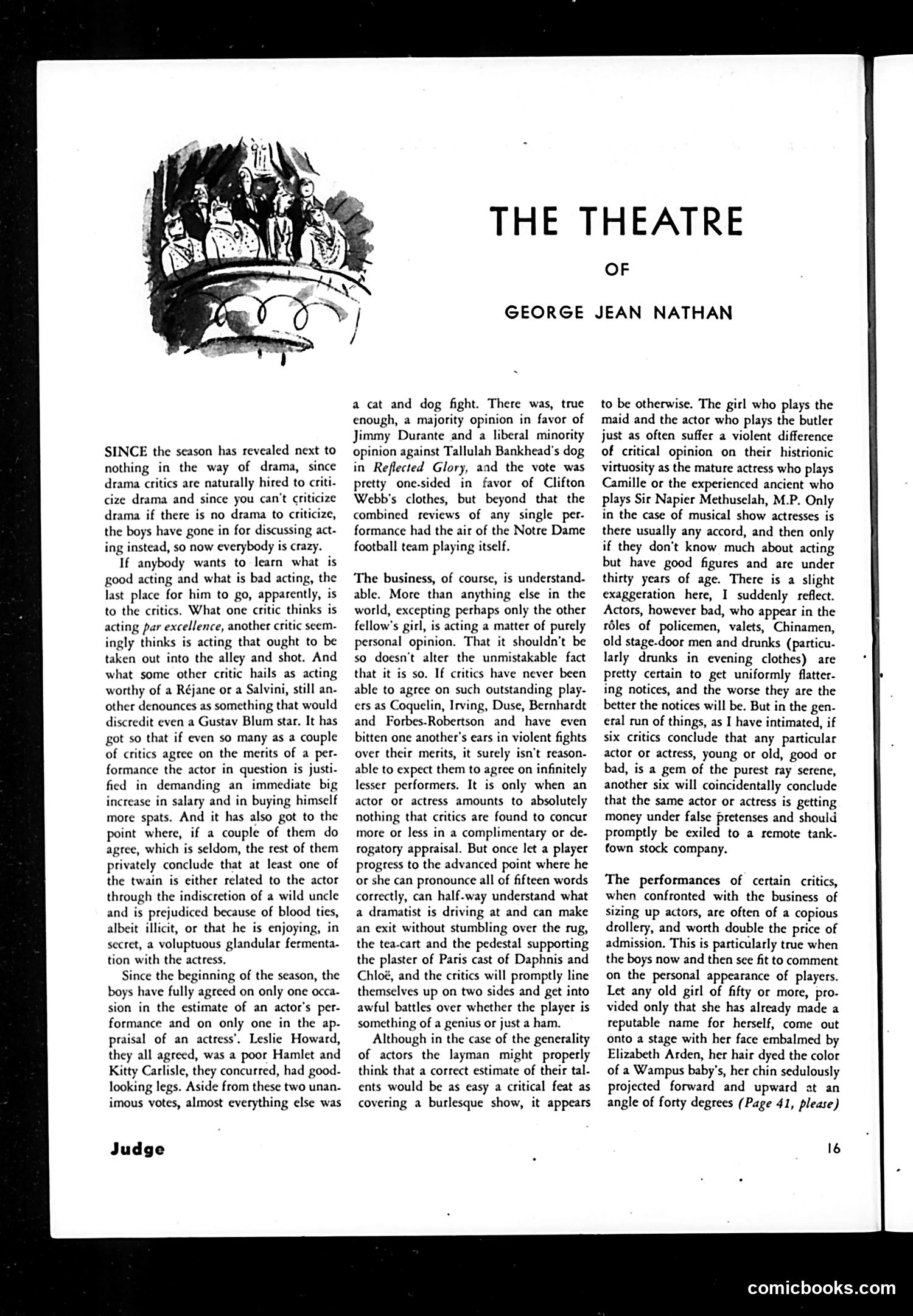
"The Theatre of George Jean Nathan" — Judge Magazine This is a satirical essay (not a cartoon) by theatre critic George Jean Nathan, published in Judge magazine. Nathan lampoons theatre critics' inability to agree on acting performances. The satire's targets: - Drama critics who contradict each other constantly, making their opinions worthless - The exceptions proving the rule: critics unanimously agreed only that Leslie Howard was poor as Hamlet and that Kitty Carlisle had good legs - The absurdity that acting judgment is purely subjective opinion, yet critics pretend to expertise - Specific contemporary performers mentioned include Jimmy Durante, Tallulah Bankhead, and Clifton Webb The joke: If even legendary actors like Coquelin, Irving, Duse, and Bernhardt sparked violent critical disagreement, why expect consensus on lesser talents? Nathan suggests critics only agree when an actor is "absolutely nothing"—revealing their judgments as arbitrary rather than informed. The piece mocks the pretense of critical authority in early 20th-century theatre journalism.
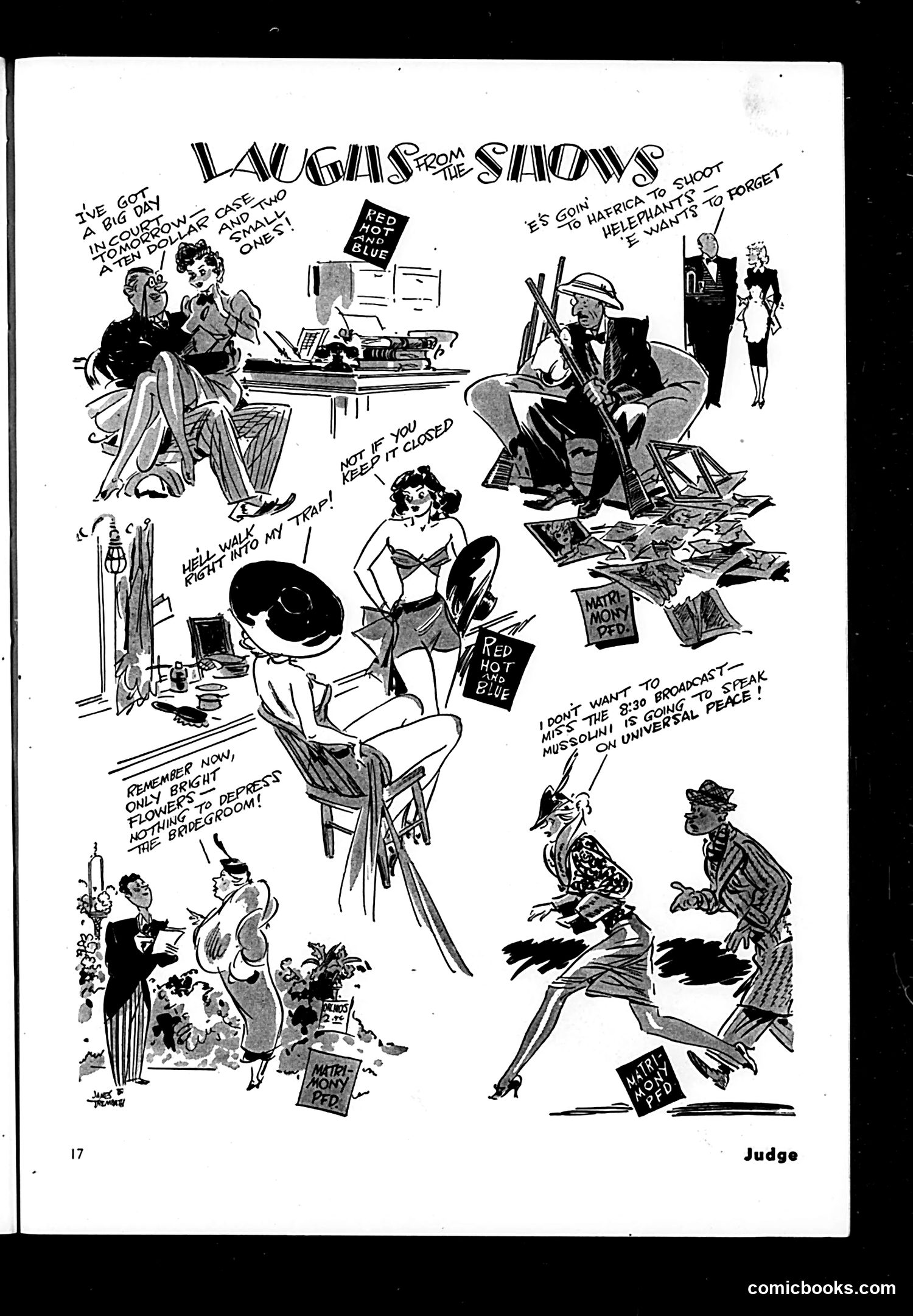
"Laughs from the Shadows" - Judge Magazine Satirical Cartoon This page features multiple vignettes satirizing wartime censorship and propaganda concerns, likely from WWII or the Cold War era. The cartoons mock: Key elements: - A woman at a typewriter marked "RED HOT" and "BLUE" (censored material) - References to "MATRIMONY" and "PFD" (unclear acronym) - A man surrounded by newspapers with "KEEP IT CLOSED" signs - Characters discussing not broadcasting/spreading information about "universal peace" - Imagery suggesting suppressed speech, controlled media, and government oversight The satire targets: Media censorship, government propaganda control, and the irony of restricting information supposedly "for peace." The vignettes suggest paranoia about what can and cannot be publicly discussed during wartime, with particular mockery of matrimonial/domestic content being regulated alongside political speech. The overall point appears critical of excessive censorship rather than supportive of it.
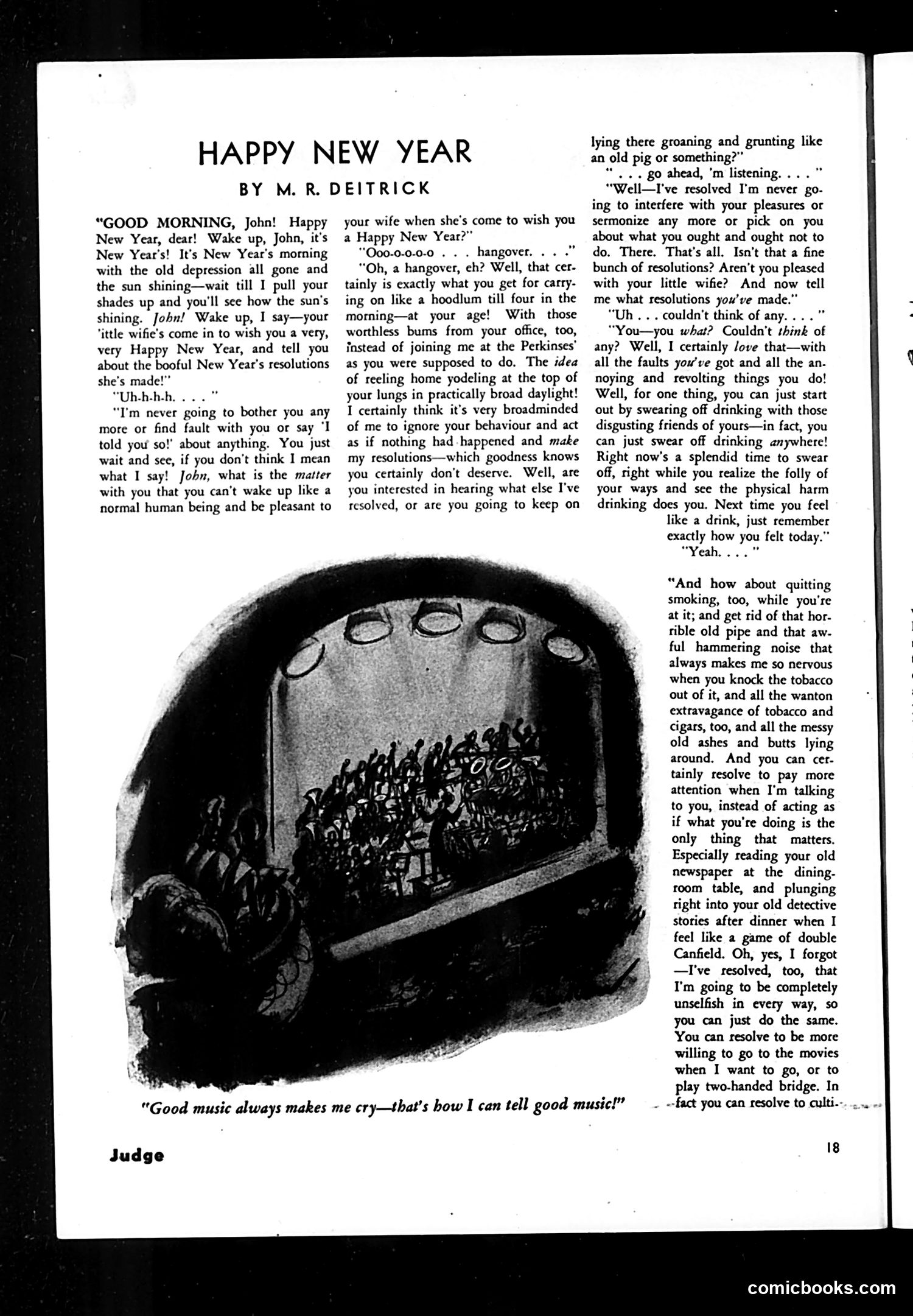
"Happy New Year" by M.R. Deitrick — Judge Magazine This is a marital comedy piece satirizing New Year's resolutions. A hungover husband wakes on New Year's morning to his wife's cheerful announcement—she's made resolutions to stop nagging him. His relief is short-lived: she immediately proceeds to demand *his* resolutions, then dictates an exhaustive list of behavioral changes (quit drinking with friends, stop smoking, abandon his pipe, pay attention to her, stop reading newspapers at dinner, attend movies on *her* schedule). The satire targets the hypocrisy of New Year's resolutions and exposes a common domestic dynamic: the wife's "selfless" resolution to stop interfering is immediately undermined by aggressive self-interest. The joke lies in her obliviousness to her own contradiction. The illustration shows them in bed, capturing the intimate domestic setting where this marital negotiation occurs.
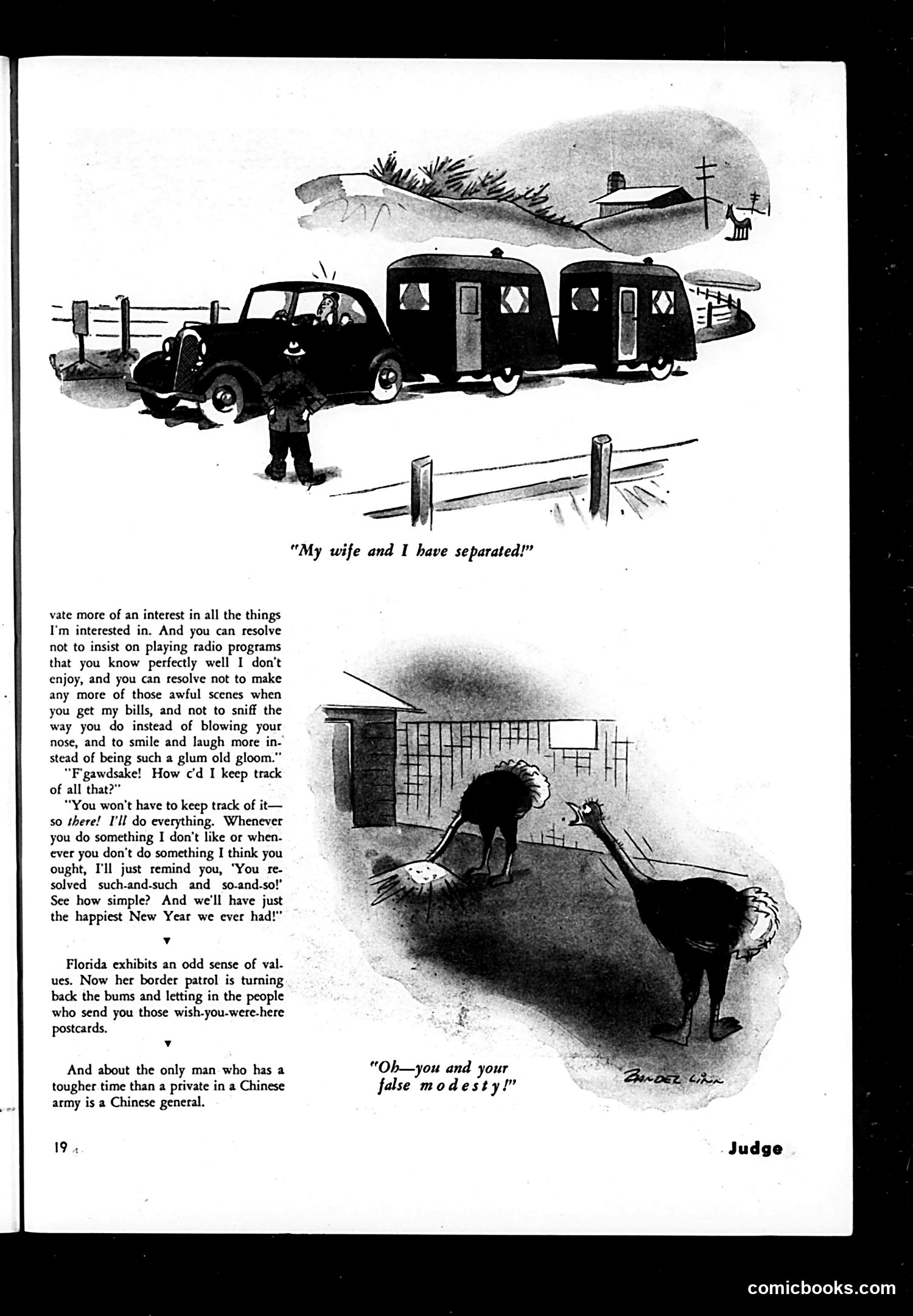
Analysis for Modern Readers This page contains two cartoons satirizing marriage and domestic life, typical of Judge magazine's humor. Top cartoon: A man stands before his car towing two trailers, captioning "My wife and I have separated!" The joke plays on the word "separated"—he means they've physically divided their possessions and vehicles, not ended their marriage. The visual exaggeration (the extensive towing) suggests the complications of dividing marital assets. Bottom cartoon: A couple argues, with the woman saying "Oh—you and your false modesty!" The context from the surrounding text reveals the setup: the husband is sarcastically claiming he's "separated" from his wife by towing away half their belongings. Her retort mocks his false claim of modesty, implying he's actually bragging or being dishonest about the separation. Both cartoons satirize marital conflict and the tension between spouses over possessions and household management—concerns resonant for 1930s-40s middle-class American readers dealing with Depression-era economics and post-war domestic negotiations.
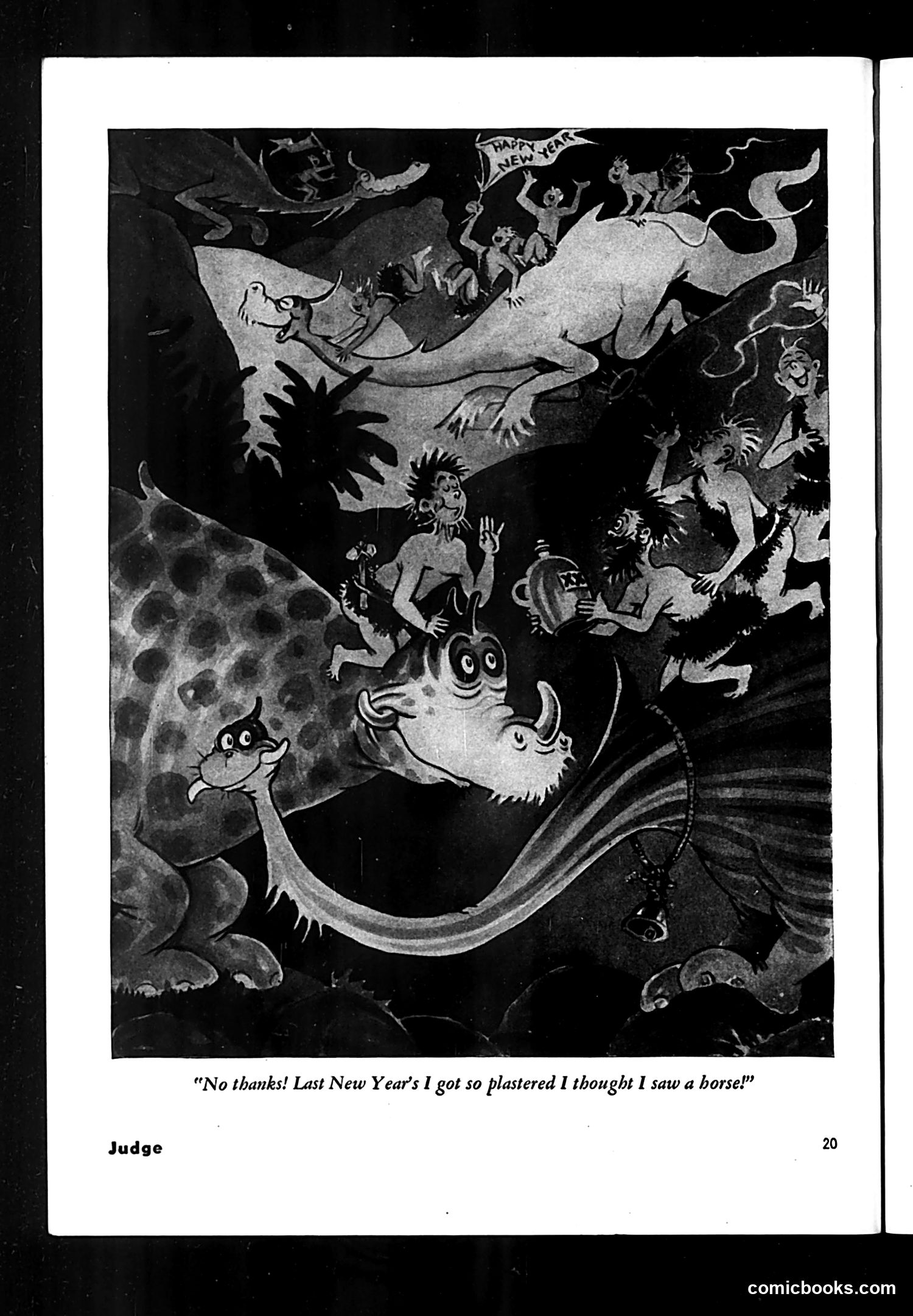
Cartoon Analysis This is a humorous cartoon from *Judge* magazine depicting a New Year's Eve celebration scene in Hell or the Underworld. The image shows various demonic and fantastical creatures—devils, imps, and monsters—partying around a large demon's head. The joke relies on a hangover reference: a character (presumably human) is declining an offer to drink, explaining that last New Year's he got so intoxicated ("plastered") that he hallucinated seeing a horse—which, given the infernal setting and the actual demon-creatures surrounding him, suggests he fears repeating that experience or perhaps fears what he might *actually* see while drunk in this supernatural realm. The humor is absurdist and appeals to the magazine's educated readership familiar with classical mythology and drinking culture.
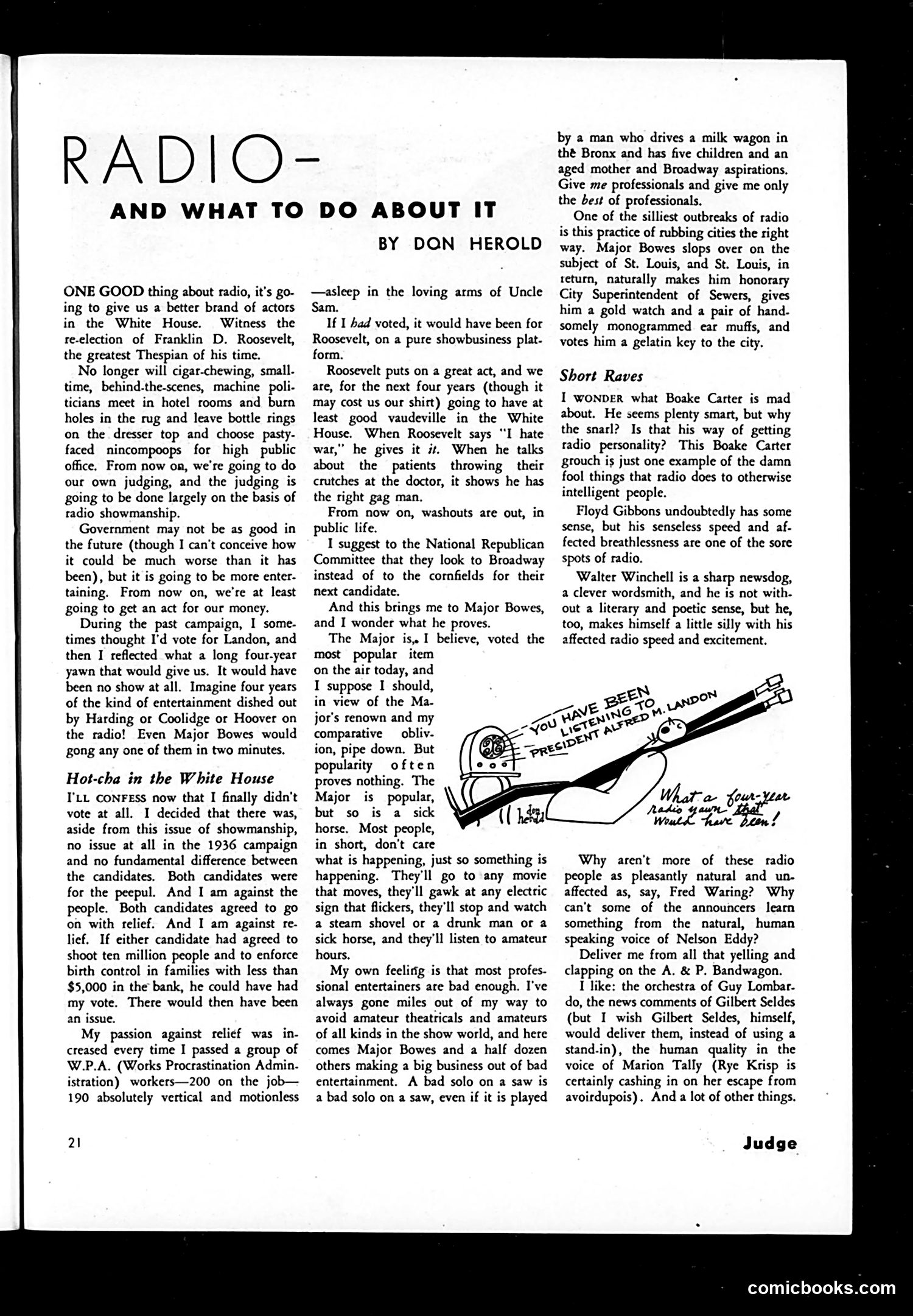
Radio and What to Do About It: Historical Context This 1936 satirical essay by Don Herold argues that Franklin D. Roosevelt's re-election is good because he's an excellent *performer* on radio—essentially judging a presidential candidate by entertainment value rather than policy. Key references: - FDR's radio presence: Roosevelt was famous for his "Fireside Chats," intimate radio addresses that made him appear personable and commanding. - Landon: Alf Landon, FDR's 1936 Republican opponent, whom Herold dismisses as boring. - W.P.A.: The Works Progress Administration, a New Deal relief program that Herold ridicules as employing lazy workers. - Major Bowes: A famous radio talent-show host whose amateur hour program was hugely popular. The satire's point: Herold argues American voters care only about entertainment value, not substantive governance. He suggests both candidates supported relief spending and the common people—real issues don't matter, only showmanship does. The cartoon illustrates this shallow electoral focus through mockery of radio's growing political influence.
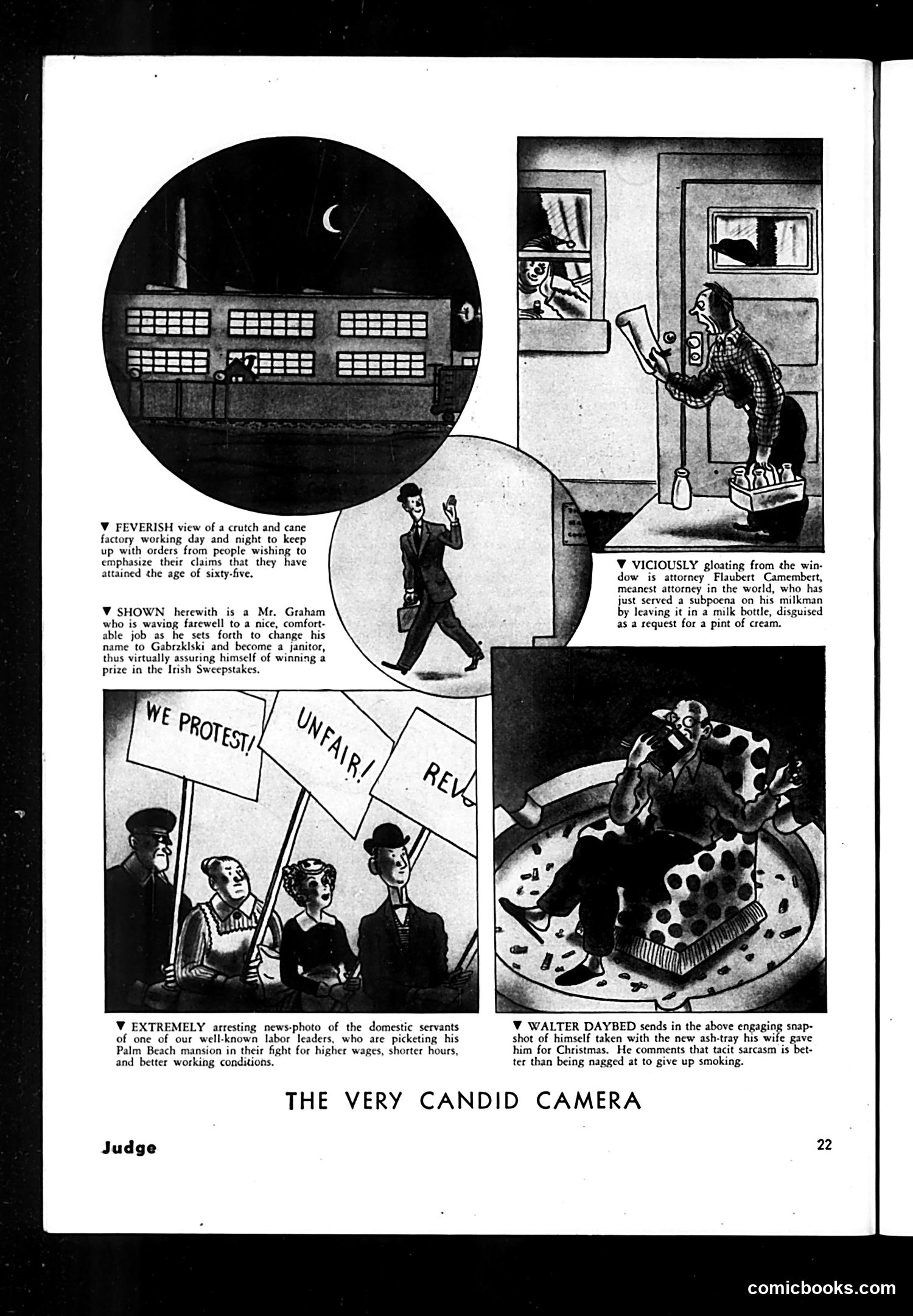
"The Very Candid Camera" - Judge Magazine Satire This page presents four satirical "candid camera" vignettes mocking contemporary social issues: 1. Factory orders boom - A joke about elderly people fraudulently claiming to be 65 (likely to access pensions or benefits), creating fake demand for mobility aids. 2. Irish Sweepstakes scheme - A man changing his name to a Polish-sounding one ("Gabrzklski") to pose as a janitor, hoping to win Ireland's lottery—satirizing immigrants' desperation and ethnic stereotyping. 3. Labor hypocrisy - Workers picketing their wealthy boss's mansion for better conditions, mocking the contradiction of a labor leader whose servants rebel against him. 4. Marital tension - A husband receiving an ashtray as a "gift" from his wife—satirizing passive-aggressive domestic communication about smoking habits. The page's title announces these as supposedly "candid" photographs, but they're obviously exaggerated cartoons. The satire targets fraud, ethnic scheming, labor politics, and domestic discord with cynical humor typical of Judge's social commentary.
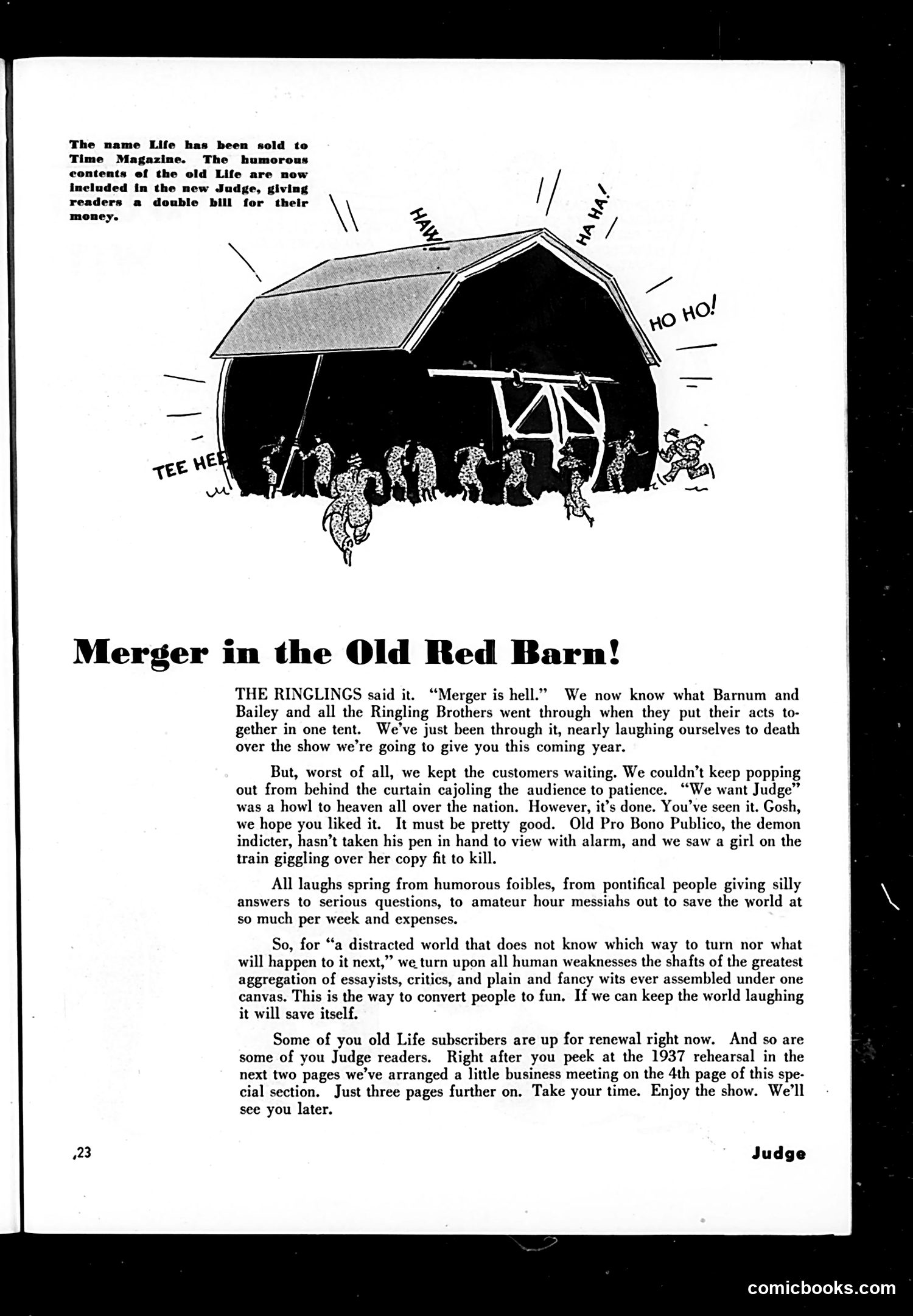
Judge Magazine Merger Announcement (1937) This page announces Judge magazine's absorption of *Life* magazine's humorous content following a business merger. The cartoon depicts a circus tent labeled with laughter ("HA HA," "HO HO," "TEE HEE"), referencing the Ringling Brothers circus merger as an analogy—combining different entertainment acts into one space creates chaos, just as merging two satirical publications did. The text humorously acknowledges the logistical nightmare of the merger: they kept readers waiting, couldn't manage the transition smoothly, yet claim the result is strong. The writing emphasizes Judge's mission: to satirize "human weaknesses" and keep "the distracted world" laughing as a form of social salvation. The page also solicits subscription renewals from both *Life* and *Judge* readers, directing them to business details on page 4. The 1937 date and reference to "rehearsal" suggest upcoming content previews.
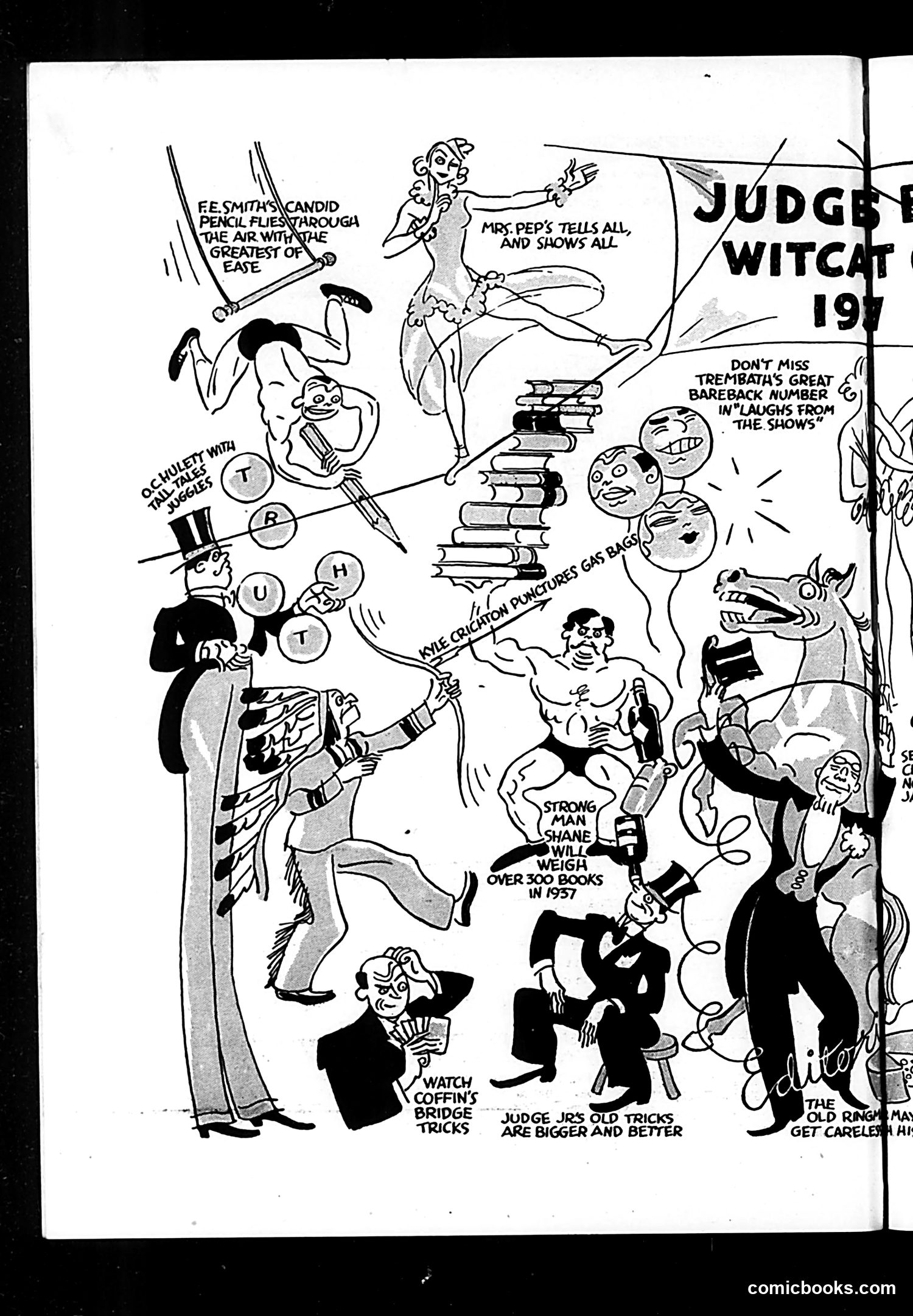
This is a promotional page advertising entertainment acts, likely from Judge magazine's early-to-mid 20th century period. The cartoon showcases various performers and attractions: - F.E. Smith's "candid pencil" flying act appears at top left - Mrs. Peps performs as a storyteller/entertainer - Trembath's bareback (equestrian) act is prominently promoted - References to "Strong Man Shane" who will weigh over 300 books in 1957 - Coffin's bridge tricks - Iris's card tricks, described as "bigger and better" than previous versions The page combines entertainment advertising with cartoon illustrations of the performers, typical of Judge's mix of satire and show-business promotion. The overall message celebrates these circus or vaudeville-style acts as entertainment worth attending.
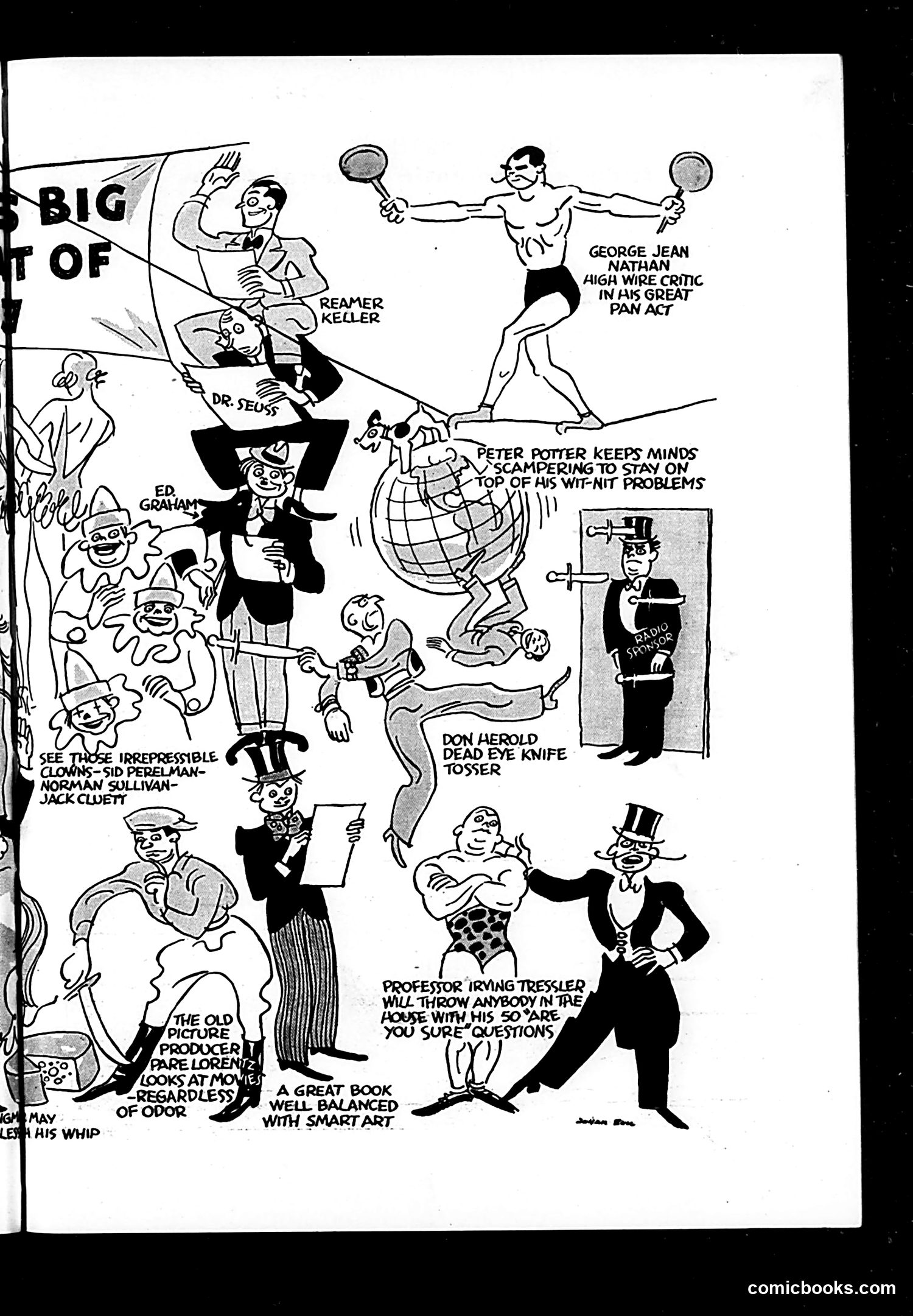
"Big of Judge" - Entertainment Industry Satire This page satirizes prominent figures in early 20th-century American entertainment and criticism. The central figures include: - Reamer Keller and Dr. Seuss (shown juggling/performing) - George Jean Nathan, identified as a high-wire critic performing a balancing act - Peter Potter, characterized as mentally taxing audiences with his wit - Don Aerold, depicted as a knife-tosser - Professor Irving Tressler, described as throwing "anybody in the horse" with difficult questions - Various vaudeville performers and producers The satire mocks these entertainers' pretensions and the entertainment industry's self-importance. Nathan's "high-wire" depiction suggests the precarious nature of critical opinion, while Potter's "wit-nit problems" ridicules overly intellectual comedy. The overall theme presents entertainment figures as circus performers—acrobats, jugglers, and knife-throwers—reducing their cultural significance to simple spectacle.
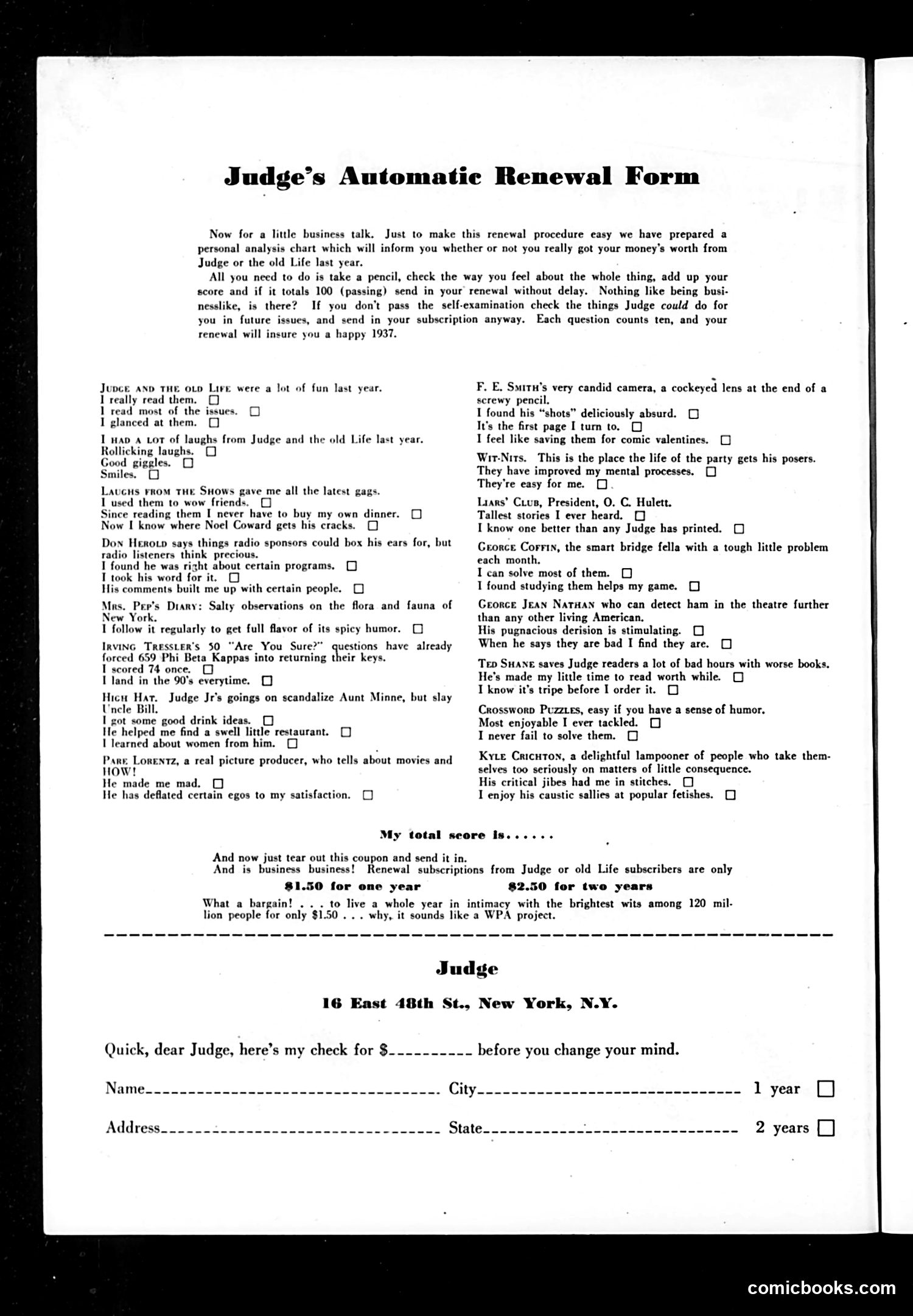
Judge Magazine Renewal Form (circa 1937) This is a subscription renewal advertisement disguised as a humorous self-assessment quiz. Rather than a political cartoon, it's a satirical checklist allowing readers to evaluate whether *Judge* magazine (a rival to *Life*) deserves their renewal dollar. The form lists Judge's popular recurring features and columnists—including contributions by Ted Shane (book critic), George Jean Nathan (theater critic), and others—with point values based on how much readers enjoyed each. The satire lies in the premise: readers "grade" the magazine's value, then tally scores to determine if renewal makes financial sense. The joke undercuts itself: even low-scoring readers are encouraged to renew, making the "objective" evaluation transparently self-serving advertising. References to "Phi Beta Kappas" and WPA-style pricing ($1.50/year) anchor this to Depression-era America, when humor magazines competed fiercely for middle-class readers' limited discretionary income.
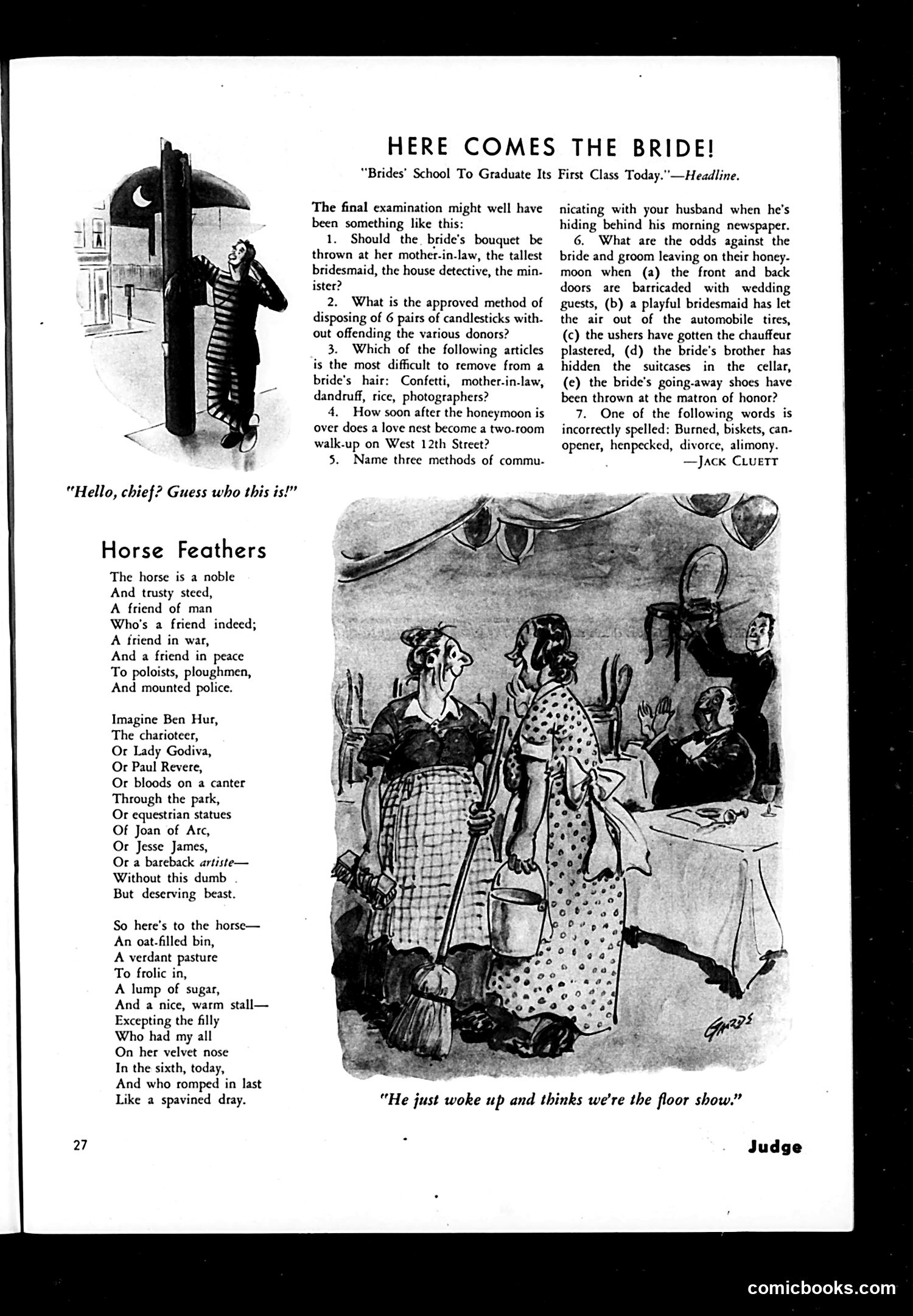
Analysis of This Judge Magazine Page This page satirizes early-20th-century marriage conventions through two pieces: "Here Comes the Bride!" mocks a supposed "Brides' School" graduating its first class. The exam questions are satirical jibes at marital realities: the difficulty of disposing of wedding gifts without offending donors, removing wedding debris from hair, the swift decline from honeymoon to shabby apartment, and communicating with a husband hiding behind his newspaper. The final question includes "divorce" and "alimony" among misspelled words—darkly humorous given the exam's topic. The cartoon shows confused women with what appears to be a confused groom ("He just woke up and thinks we're the floor show"), suggesting male bewilderment at marriage. "Horse Feathers" is a lighthearted tribute to horses, romanticizing their role in history and society while ending with a humorous complaint: the speaker backed a horse ("the filly") that lost a race in the sixth event, finishing last like a broken-down cart. Both pieces use humor to deflate romantic ideals—one about marriage's disappointing reality, one about betting on horses.
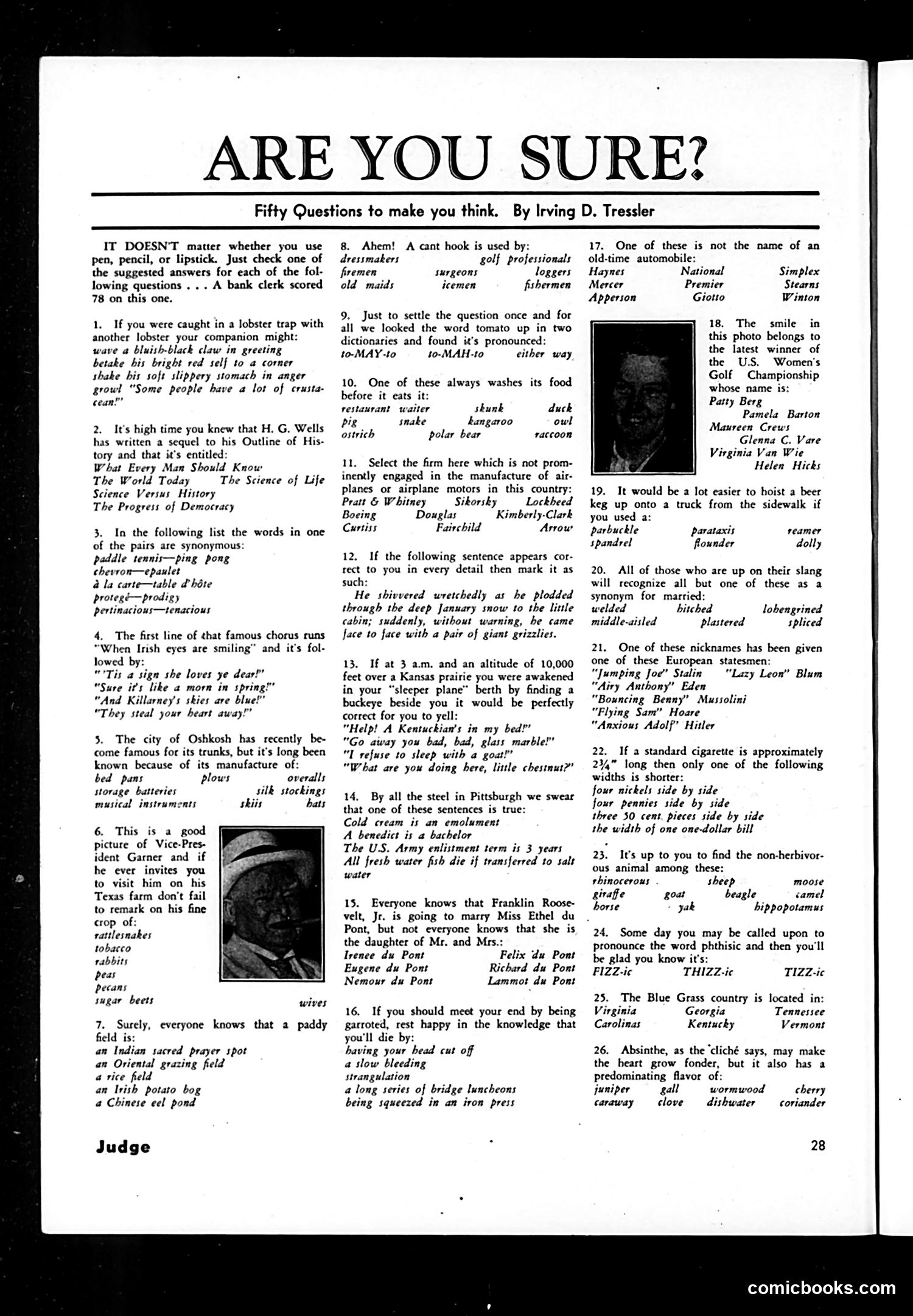
"Are You Sure?" - A Quiz Page from Judge Magazine This is a trivia quiz feature, not a political cartoon. Titled "Are You Sure?" by Irving D. Tressler, it presents fifty multiple-choice questions designed to test readers' knowledge across diverse topics: literature (H.G. Wells), geography (Blue Grass country), animals, slang, manufacturing, pronunciation, and current events. Notable references include Vice-President John Nance Garner (question 6), and what appears to be a contemporary marriage announcement about Franklin D. Roosevelt Jr. and an "Ethel du Pont" (question 15). The quiz format was typical Judge content—lighthearted, educational entertainment for middle-class readers. A bank clerk scored 78/100, suggesting the difficulty level. The inclusion of trivial yet "cultured" knowledge questions reflects the magazine's appeal to readers who enjoyed demonstrating their sophistication through general knowledge.
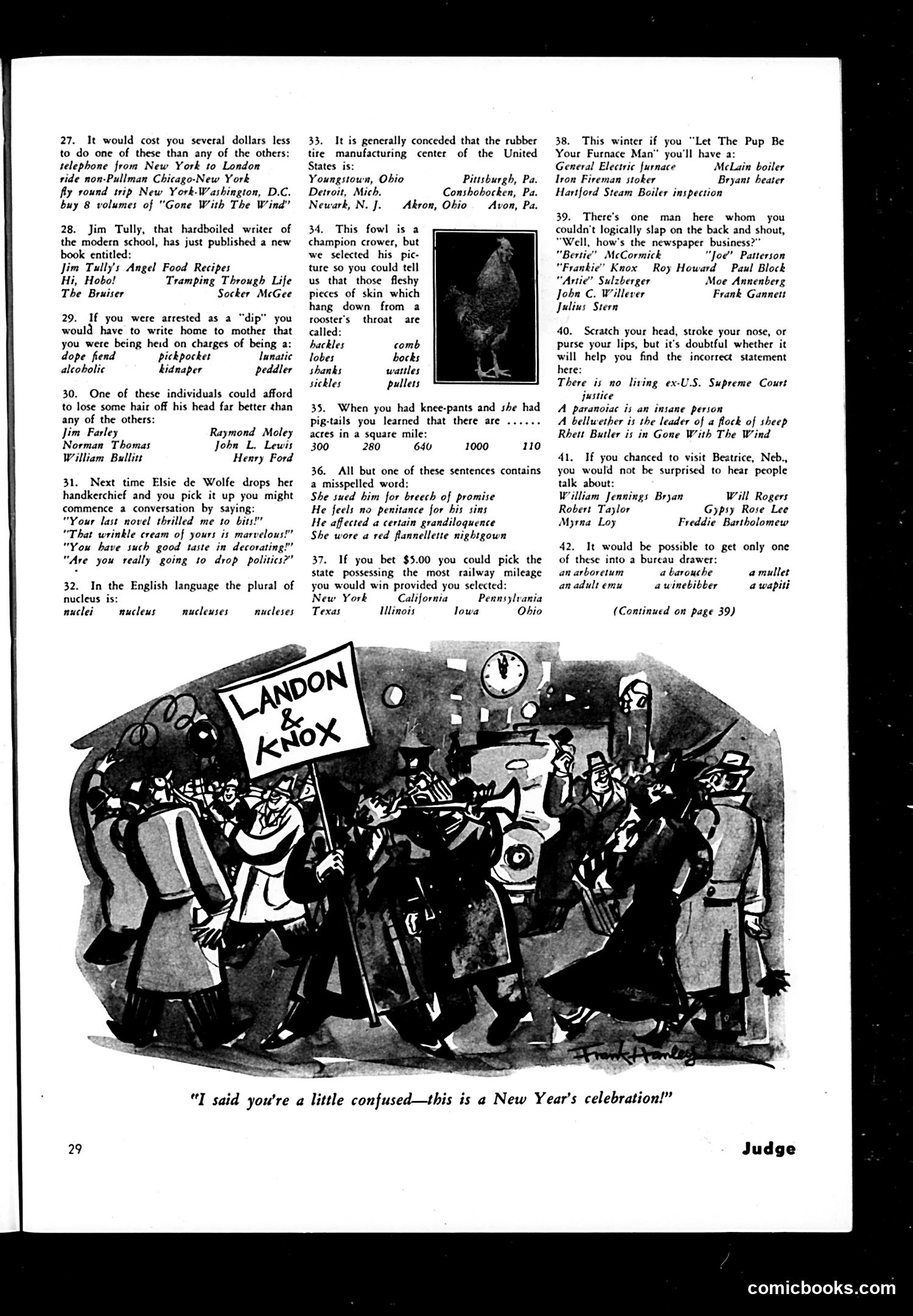
Explanation of Judge Magazine Page Content This page from Judge magazine presents a trivia quiz disguised as humor, targeting educated, well-informed readers of the 1930s-40s era. The questions reference contemporary figures and issues: Key References: - Question 30 mentions political/business figures (Jim Farley, Norman Thomas, William Bullitt, Raymond Moley, John L. Lewis, Henry Ford) - Question 39 names newspaper publishers/editors (McCormick, Patterson, Knox, Howard, Block, Sulzberger, Annenberg, Gannett)—prominent media figures of the era - Question 41 references William Jennings Bryan (deceased politician), contemporary entertainers The Cartoon Below: Depicts a chaotic "Landon & Knox" celebration, likely referencing the 1936 presidential campaign (Alf Landon and Frank Knox as Republican ticket), with the joke being the confusion suggests a failed or poorly-received campaign event. The satire targets the magazine's educated readership, testing their knowledge of politics, culture, and current events while poking fun at contemporary power brokers.
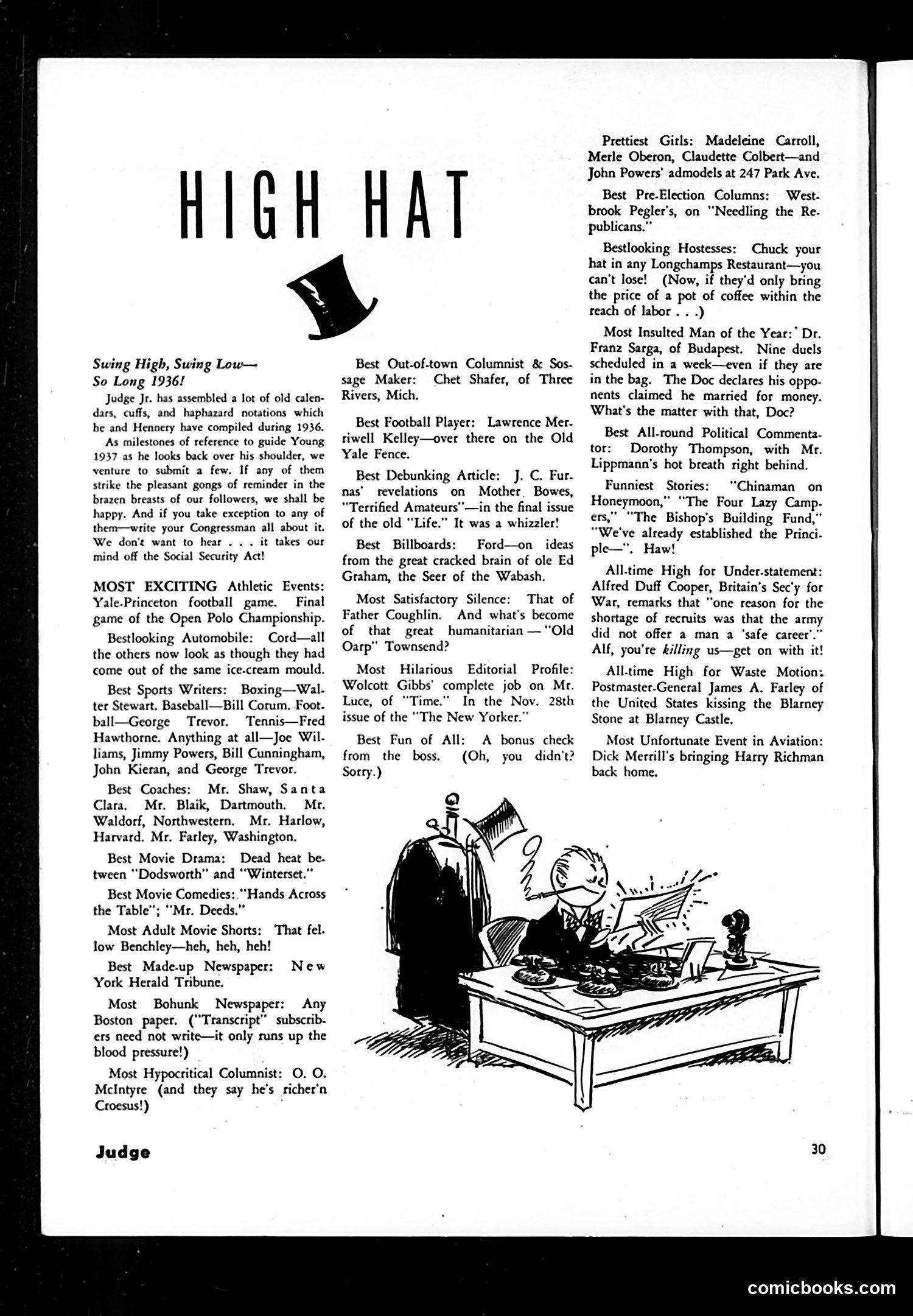
"HIGH HAT" — Judge Magazine's 1936 Year-End Roundup This page is a humorous year-end "best of" list from Judge magazine, recapping 1936. The cartoon shows a figure at a desk reviewing past events—a visual metaphor for looking back on the year. The satire covers contemporary figures and cultural moments: Political targets include Father Coughlin (radio priest, silence mocked as "satisfactory"), Senator Huey Long ("Old Carp" Townsend), and Postmaster-General James Farley (criticized for "waste motion" kissing the Blarney Stone). Cultural references praise sportswriters, films like "Mr. Deeds," and columnists like Dorothy Thompson, while mocking O.O. McIntyre as hypocritical. Social commentary surfaces in jibes at expensive Longchamps restaurants being unaffordable to laborers, and jokes about Boston papers and the "Transcript." The humor relies on 1930s-specific knowledge of celebrities, political figures, and publications—much now obscure—but the tone is consistently satirical about media, politics, and wealth disparity.
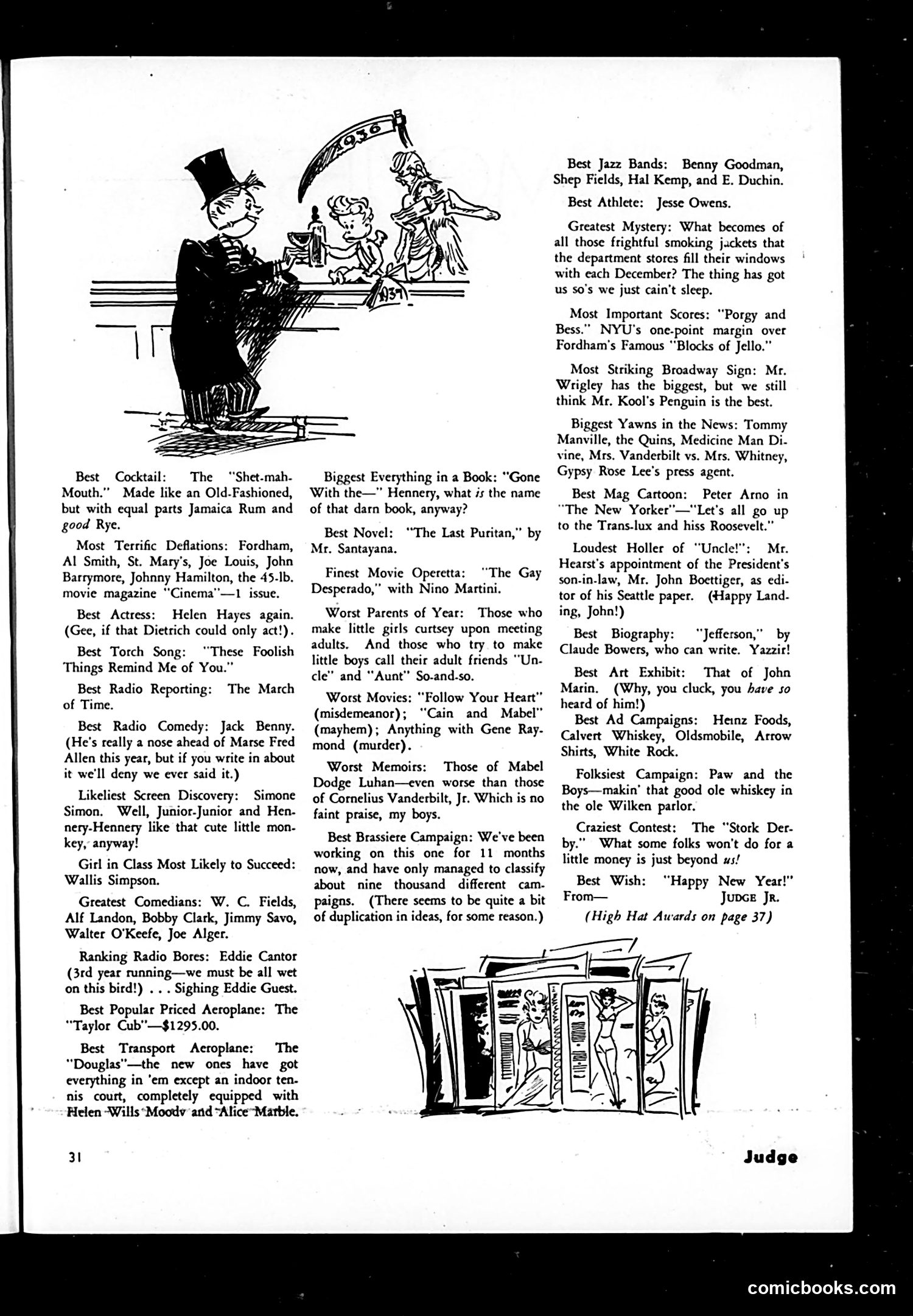
Judge Magazine: "High Hat Awards" Page This is a satirical awards list from Judge magazine's annual "High Hat Awards"—humorous superlative awards mocking 1930s American culture, celebrities, and current events. Key references include: Political figures: Alf Landon (Republican presidential candidate), FDR (mocked in Peter Arno cartoon reference), William Randolph Hearst (upset over his son-in-law's newspaper appointment). Celebrities: Helen Hayes, Marlene Dietrich, Jack Benny, Fred Allen, Jesse Owens, Wallis Simpson (noted as "most likely to succeed"—satirizing her controversial romance with Edward VIII). The humor relies on: insider knowledge of 1930s entertainment, radio personalities, Broadway, and gossip; contemporary advertising (Kool cigarettes' penguin mascot, Wrigley's gum); local New York references (Trans-Lux theaters). The cartoons illustrate typical Judge style—satirizing jazz culture, consumer goods, and social pretension. Modern readers would need 1930s pop culture familiarity to catch most jokes.
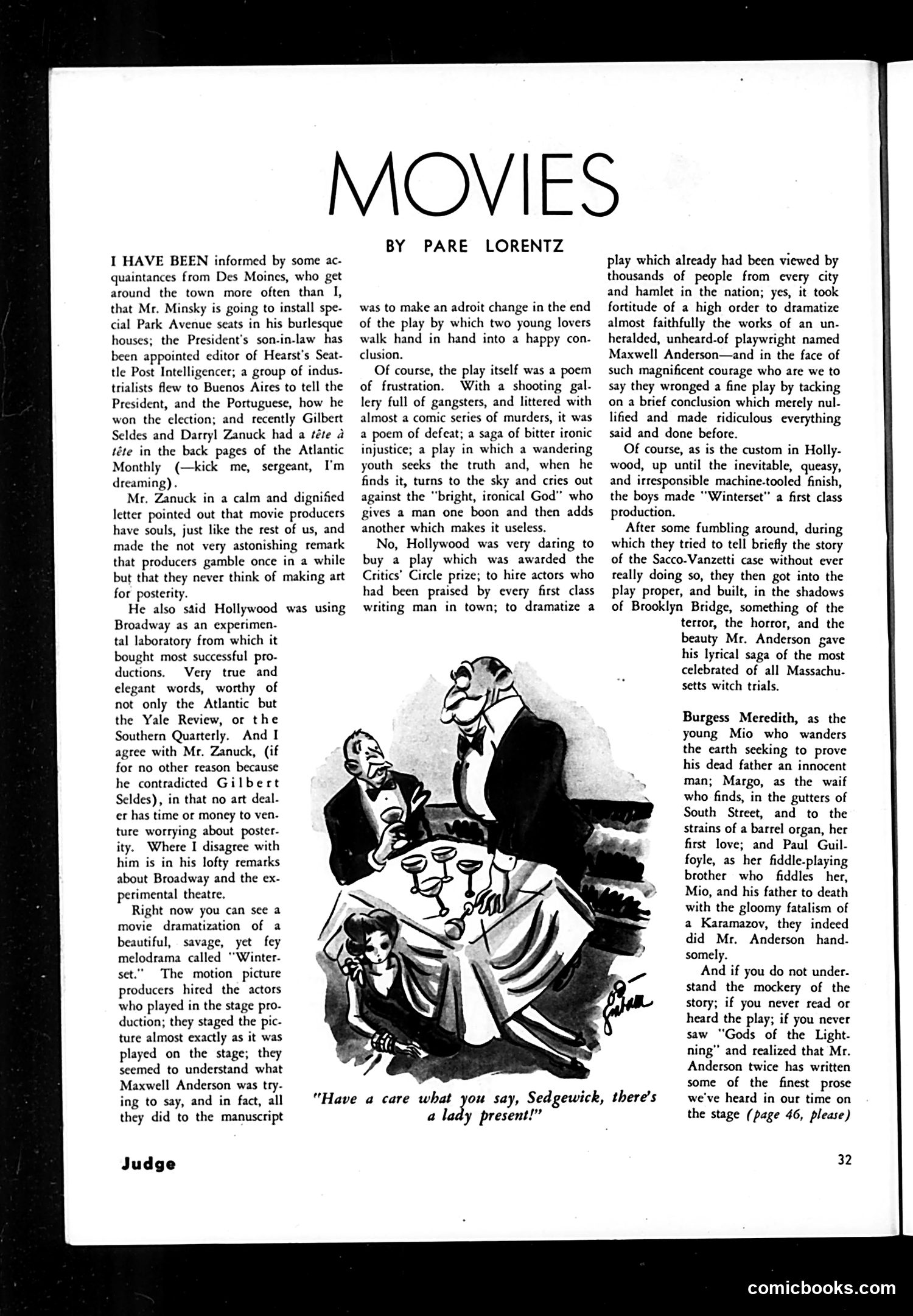
This page reviews the 1937 film adaptation of Maxwell Anderson's play *Winterset*. Author Pare Lorentz praises Hollywood's unusual decision to hire the original Broadway cast and largely preserve the stage production's artistic vision. The accompanying illustration depicts a dinner scene from the film, with the caption "Have a care what you say, Sedgewick, there's a lady present!" Lorentz's main criticism targets the filmmakers' altered ending: they replaced Anderson's tragic conclusion—reflecting the play's themes of injustice and cosmic meaninglessness—with a conventional "happy" ending where lovers walk off together. This change, Lorentz argues, contradicted and undermined everything the play had established. The review notes the film dealt with the Sacco-Vanzetti case, though obliquely. Despite this flaw, Lorentz credits the production's visual atmosphere around the Brooklyn Bridge as capturing Anderson's dramatic vision.
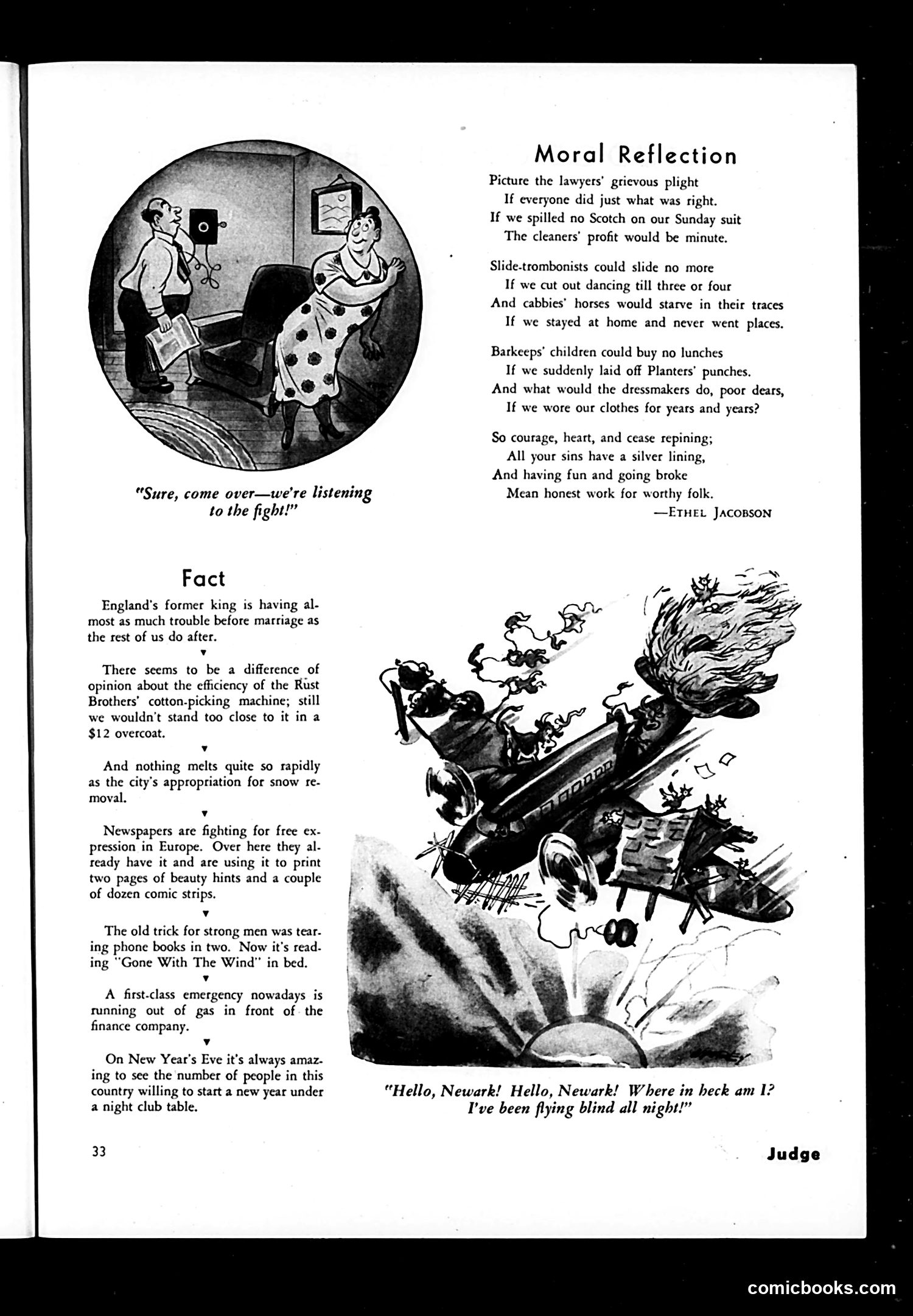
Explanation for Modern Readers This Judge magazine page contains two unrelated pieces of satire: "Moral Reflection" (poem by Ethel Jacobson): A tongue-in-cheek argument that sin is economically beneficial. It suggests that if people behaved perfectly—didn't spill drinks, stayed home instead of going out, wore clothes for years—entire service industries (cleaners, bartenders, dressmakers, cab drivers) would collapse. The ironic moral: embrace vice because it keeps workers employed. This reflects Depression-era anxieties about economic survival. "Fact" section: A series of brief satirical observations on contemporary issues, including a reference to "England's former king" (likely Edward VIII and the 1936 abdication crisis), criticism of American newspapers for trivial content despite having "free expression," and jokes about modern emergencies like running out of gas before finance companies. Bottom cartoon: Shows a sleigh crash with the caption "Hello, Newark! Where in heck am I? I've been flying blind all night!"—likely a New Year's Eve reference mocking drunk driving or reckless holiday behavior.
Judge Magazine Page Analysis This page contains three editorial columns satirizing contemporary issues (circa 1937): "We Resolve, Again" criticizes America's ineffectual New Year's resolutions against war while politicians like FDR make empty statements. Judge endorses the Pan-American Congress's neutrality pact but suggests individual conscience matters more than diplomatic gestures. "The Challenge of Humanity" attacks physicists for pursuing abstract cosmic research (atom study, telescopes) while ignoring practical problems like housing shortages. The editorial argues government spending on housing lacks sufficient scientific research into affordable solutions. "Witchcraft, 1937" satirizes superstition by describing three New Jersey women who accused a neighbor of witchcraft, claiming to witness her transform into animals. A judge threatened them with jail for perjury. The piece mocks persistent folk-magic beliefs in modern America, implying such backward thinking persists despite civilization's advancement. The left margin features an illustration of a rifle or gun, likely accompanying the anti-war editorial.
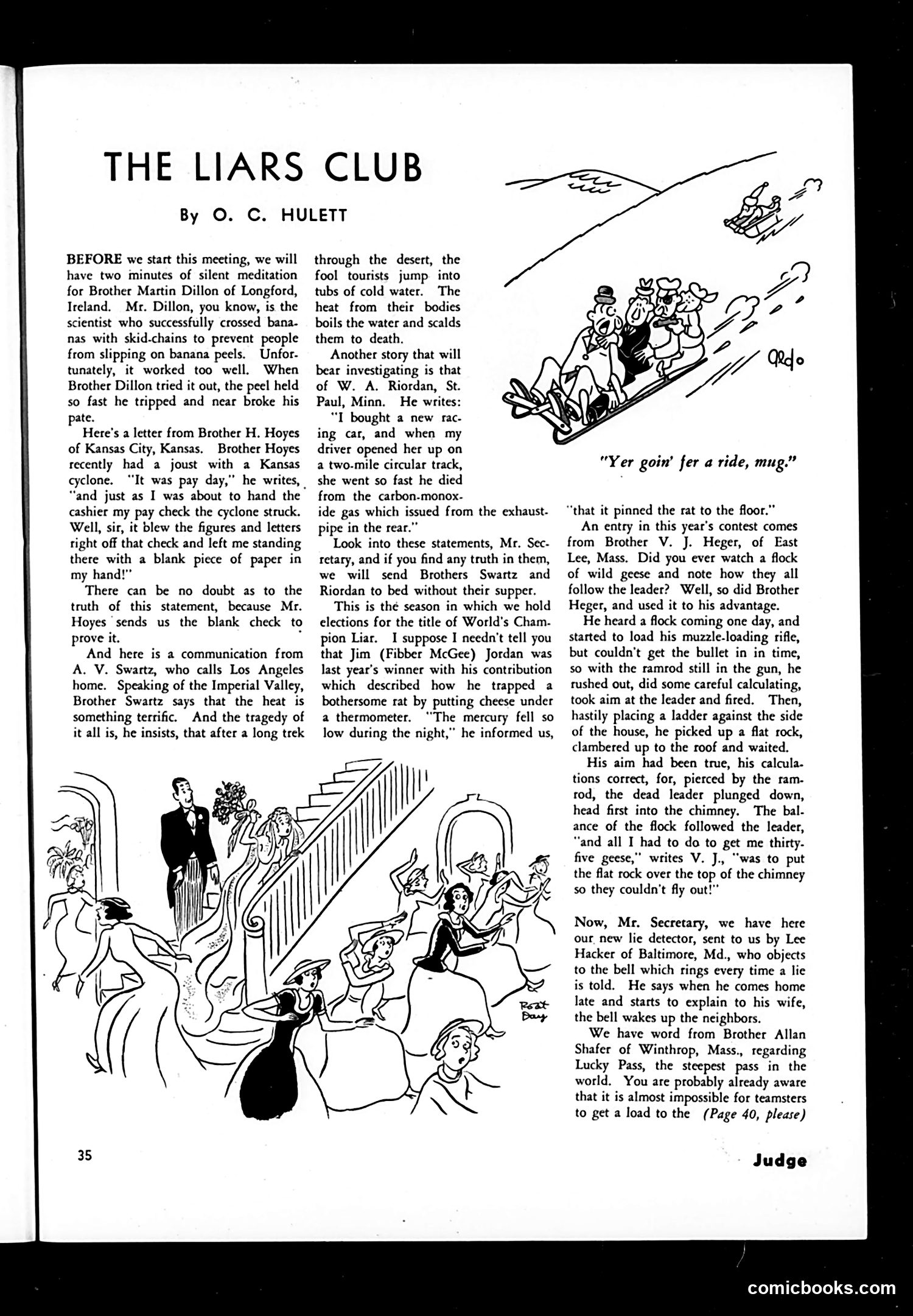
"The Liars Club" - Satire Explanation This is a humorous piece from *Judge* magazine satirizing tall tales and exaggeration. The setup is a fictional "Liars Club" meeting where members compete by submitting increasingly absurd stories—a cyclone erasing a check, desert heat boiling tourists, a racing car driver killed by exhaust fumes, a ramrod-pierced goose that falls down a chimney, pulling all following geese with it. The satire works on multiple levels: it mocks people who tell obviously false stories while presenting them as fact, the gullibility of those who might believe them, and the human tendency toward competitive bragging. The "lie detector" anecdote—a bell that rings when lies are told—adds ironic commentary on how ridiculous these tales have become. This reflects early 20th-century American humor that enjoyed exaggeration and folklore-style storytelling as entertainment.
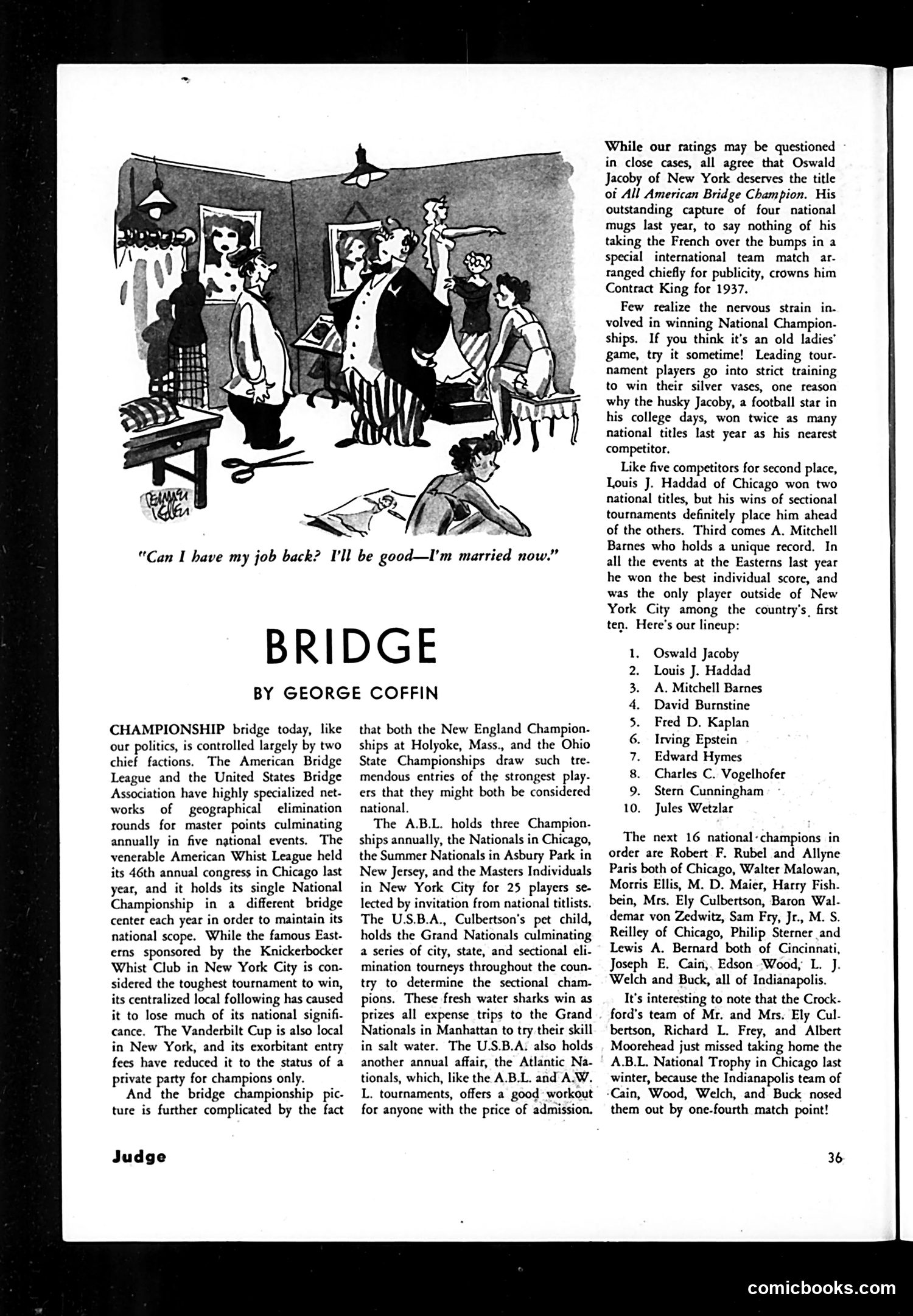
Explanation for a Modern Reader The Cartoon: The illustration shows a man approaching an office worker, asking "Can I have my job back? I'll be good—I'm married now." The joke satirizes 1930s workplace attitudes, suggesting that marriage was considered a reason to lose one's job or that the speaker expects marriage to make him more reliable/compliant. This reflects Depression-era employment precarity and patronizing assumptions about married workers. The Article: This is a serious essay on competitive bridge tournaments by George Coffin. It ranks the top 10 American bridge players, crowning Oswald Jacoby of New York as the 1937 "All American Bridge Champion." The article explains the competing sanctioning bodies (American Bridge League, United States Bridge Association, American Whist League) that organize national tournaments, noting how this fragmentation complicates determining a definitive national champion. It emphasizes the intense preparation required—comparing Jacoby favorably to serious athletes. This reflects bridge's status as a serious competitive sport in the 1930s.
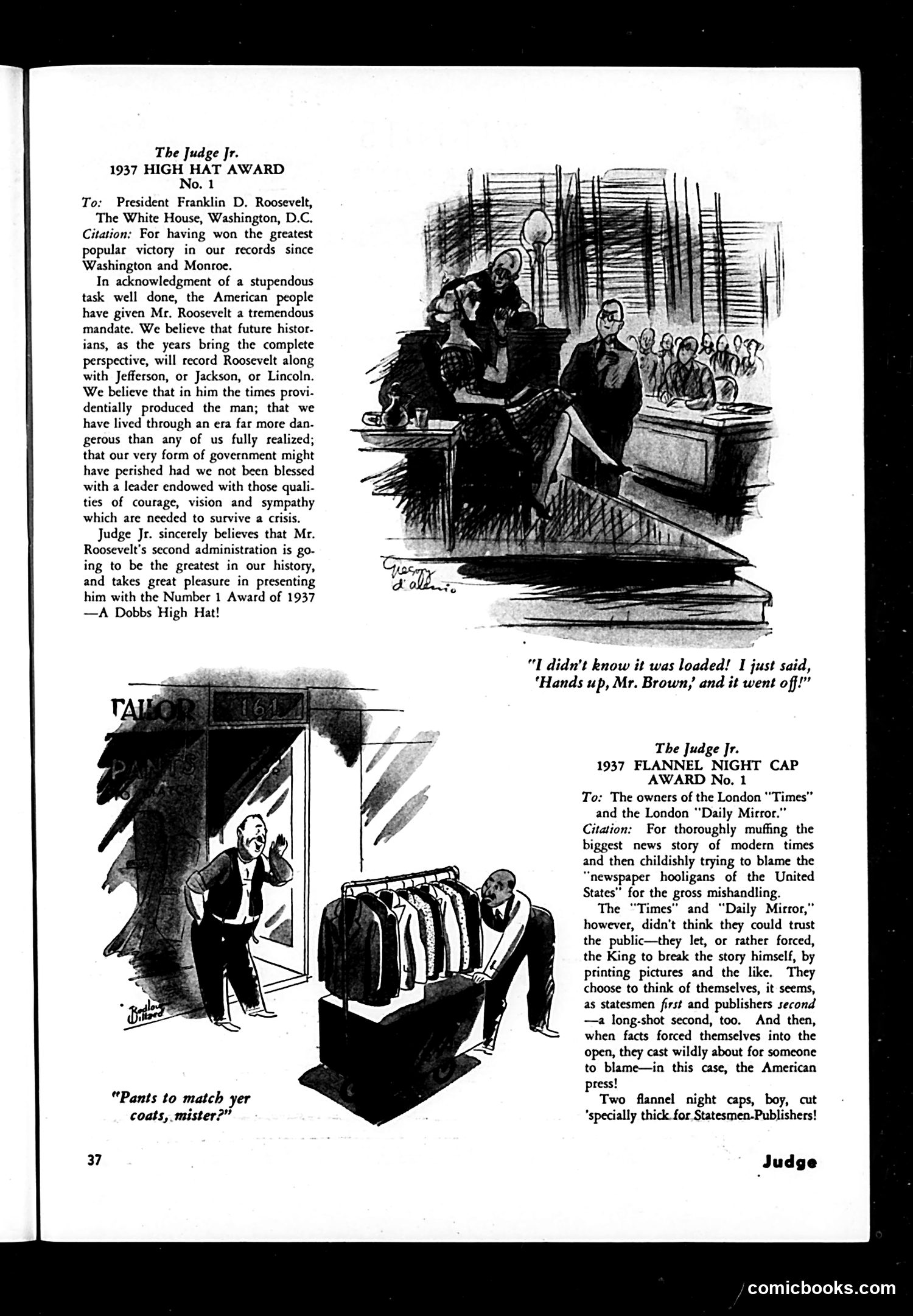
Judge Magazine, 1937: Two Satirical Awards This page presents two mock awards from *Judge*, a satirical magazine. The High Hat Award praises President Franklin D. Roosevelt for his overwhelming 1937 election victory, comparing him to Jefferson, Jackson, and Lincoln. The cartoon shows a courtroom scene with the caption about an accidentally discharged gun—likely satirizing how Roosevelt's policies may have had unintended consequences, though the award itself is genuinely complimentary. The Flannel Night Cap Award mocks the British newspapers *The Times* and *Daily Mirror* for mishandling a major news story (appears to reference the 1936 abdication crisis involving King Edward VIII). The satire criticizes these papers for forcing the King to break the story himself, then blaming American press when facts emerged. The "night cap" metaphor suggests they were asleep at the job. Both awards use humor to critique political and media figures of 1937.
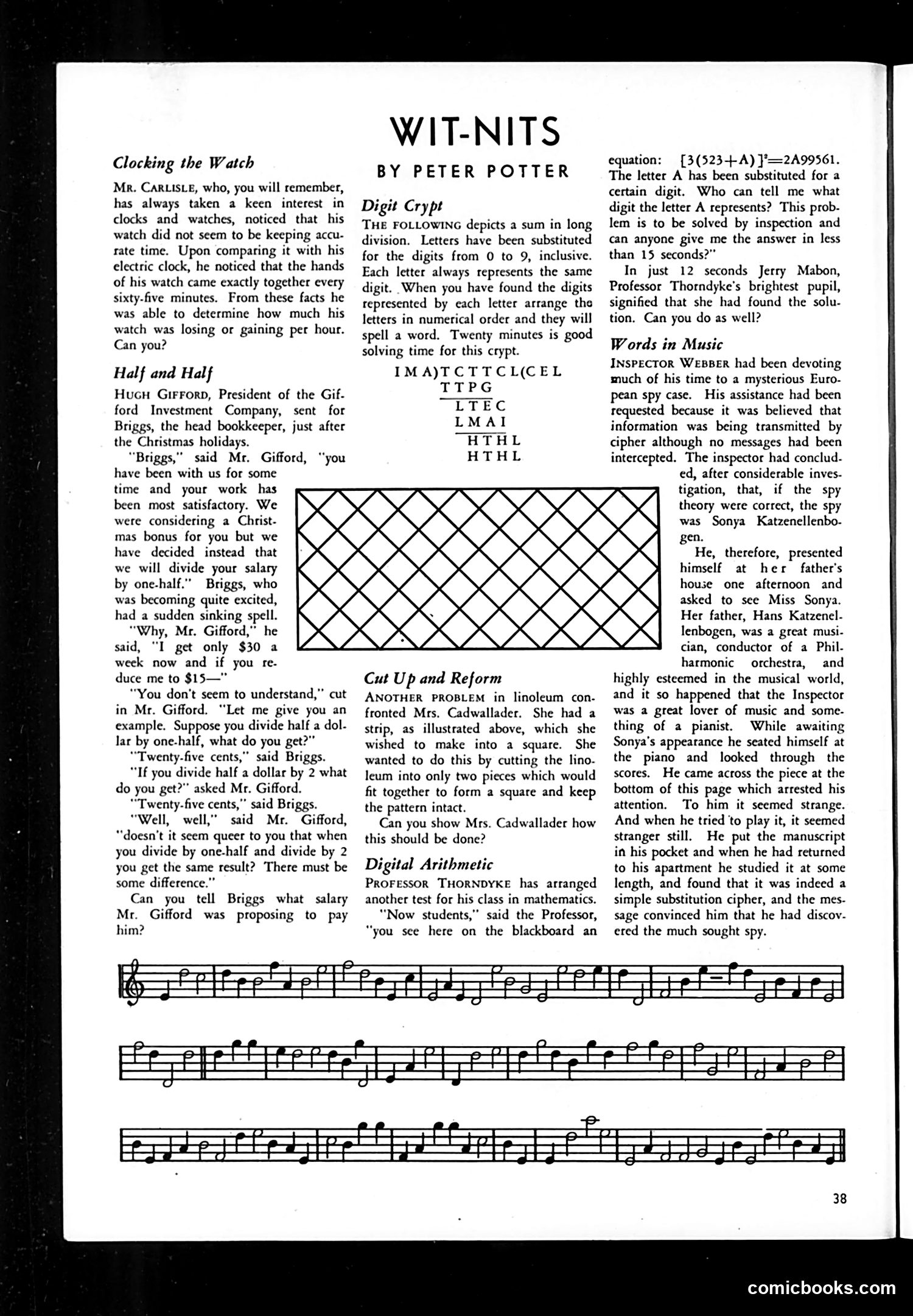
Analysis of "Wit-Nits" by Peter Potter This page contains puzzle content rather than political satire. It's a collection of five recreational math and logic problems titled "Wit-Nits": 1. "Clocking the Watch": A math puzzle about calculating watch loss/gain based on hand alignment timing. 2. "Half and Half": A wordplay joke exploiting the mathematical ambiguity of dividing by one-half versus dividing by two—both yield the same result (25 cents from 50 cents), illustrating how mathematical operations can create comedic misunderstandings about salary. 3. "Digit Crypt": A cryptarithmetic puzzle requiring letter-to-digit substitution. 4. "Cut Up and Reform": A geometric puzzle about rearranging a patterned linoleum strip into a square. 5. "Words in Music": A spy-themed narrative puzzle (partially visible) involving cipher messages hidden in musical notation. The page represents typical Judge magazine educational-entertainment content—brain teasers for readers seeking intellectual amusement rather than political commentary.
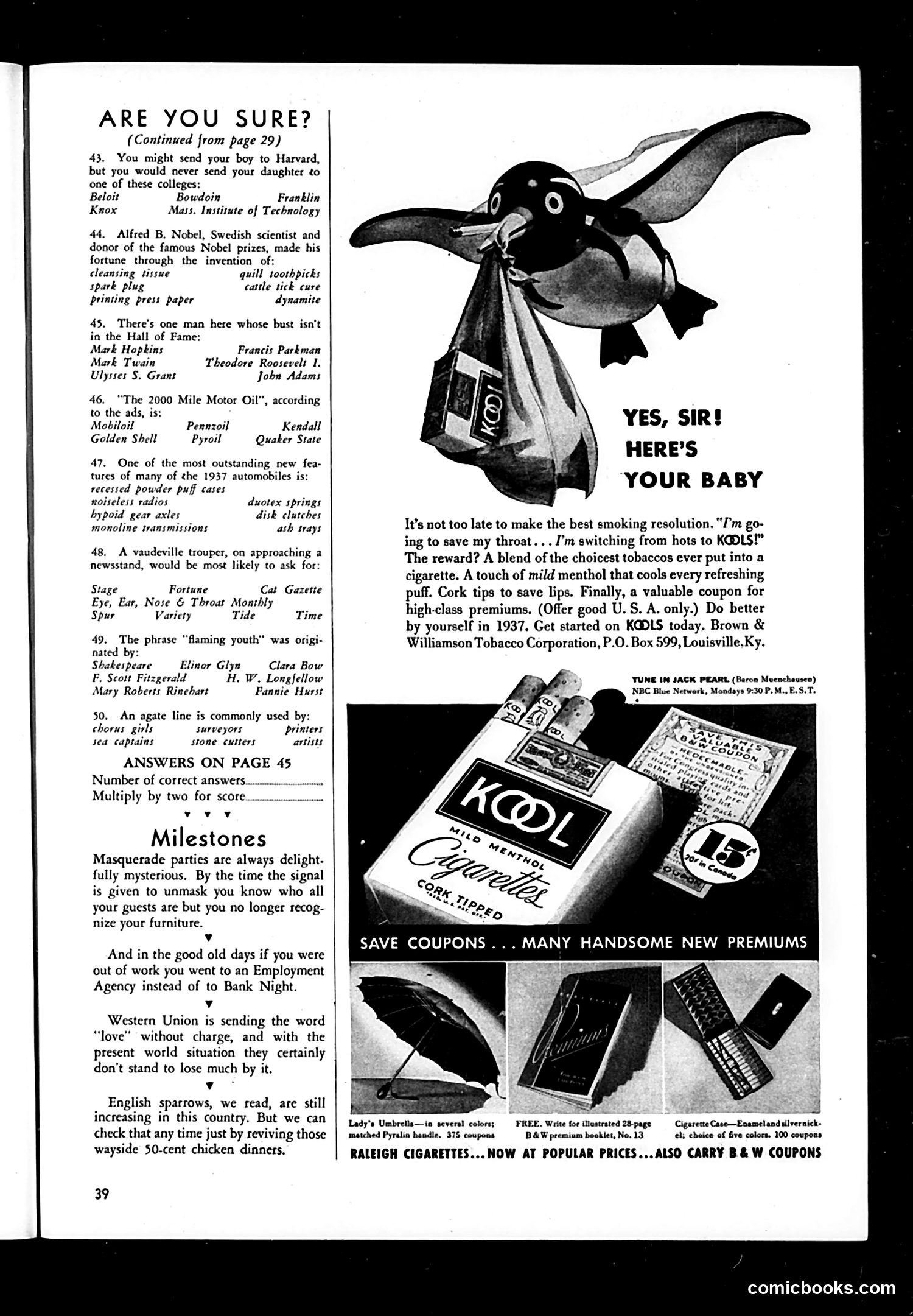
Judge Magazine Page Analysis This page contains a trivia quiz ("Are You Sure?") alongside advertisements and satirical "Milestones" observations. The Quiz Content: Questions 43-50 test reader knowledge about colleges, Nobel Prize inventor Alfred B. Nobel, Hall of Fame figures, motor oils, 1937 automobile features, vaudeville culture, literary history, and printing terminology. These reflect 1930s American popular knowledge and consumer awareness. The Cartoon: The prominent illustration shows a stork delivering a baby, captioned "YES, SIR! HERE'S YOUR BABY"—this is actually a cigarette advertisement for KQDLS brand, not political satire. The stork imagery humorously frames cigarettes as a "gift," playing on New Year's resolutions about "saving your throat." The Milestones Section: These are humorous social observations about masquerade parties, unemployment, Western Union, and English sparrows—gentle satirical commentary on 1930s American life and customs. Missing Context: This page is primarily advertising-driven rather than politically satirical. Without the continued article from page 29, the full intent of the quiz remains unclear.
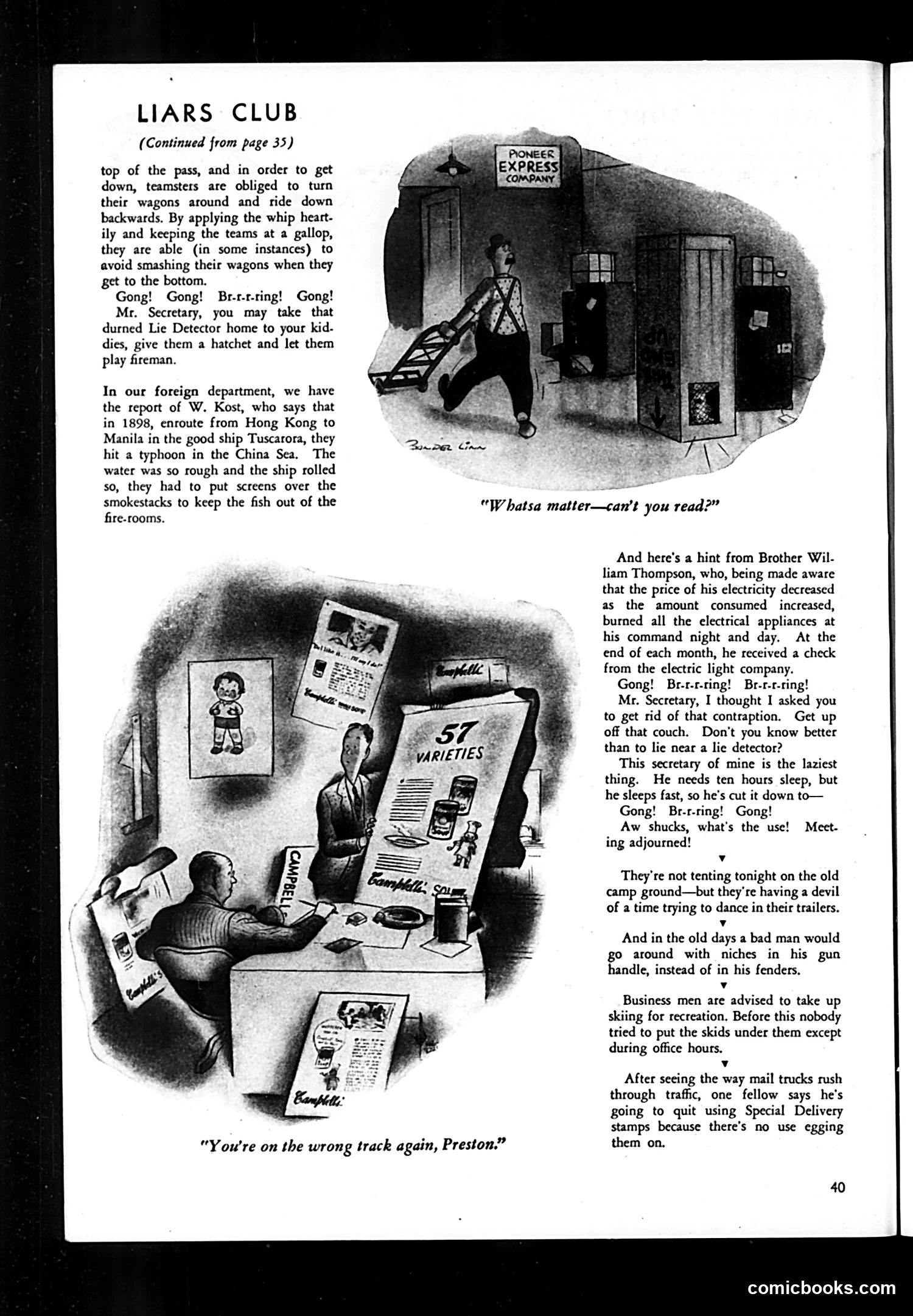
"Liars Club" - Judge Magazine Satire This page features Judge's "Liars Club," a recurring section presenting tall tales and absurd anecdotes as humor. The section mocks exaggeration and fabrication through deliberate falsehoods. The cartoons illustrate specific lies: the top shows a "Pioneer Express" worker struggling with illegible mail ("Whatsa matter—can't you read?"), while the lower cartoon depicts someone surrounded by advertising materials, captioned "You're on the wrong track again, Preston," suggesting confusion or poor judgment. The textual lies include impossible maritime scenarios (a ship so rough they screened smokestacks to keep fish out of fire-rooms) and paradoxical logic (burning electricity to receive refunds). A "lie detector" prop is humorously referenced. The format satirizes both the human tendency toward exaggeration and the credulity of audiences. The "Gong! Br-r-ring!" sounds mark false claims being "detected," making the lie-telling itself the joke rather than belief in the stories' veracity.
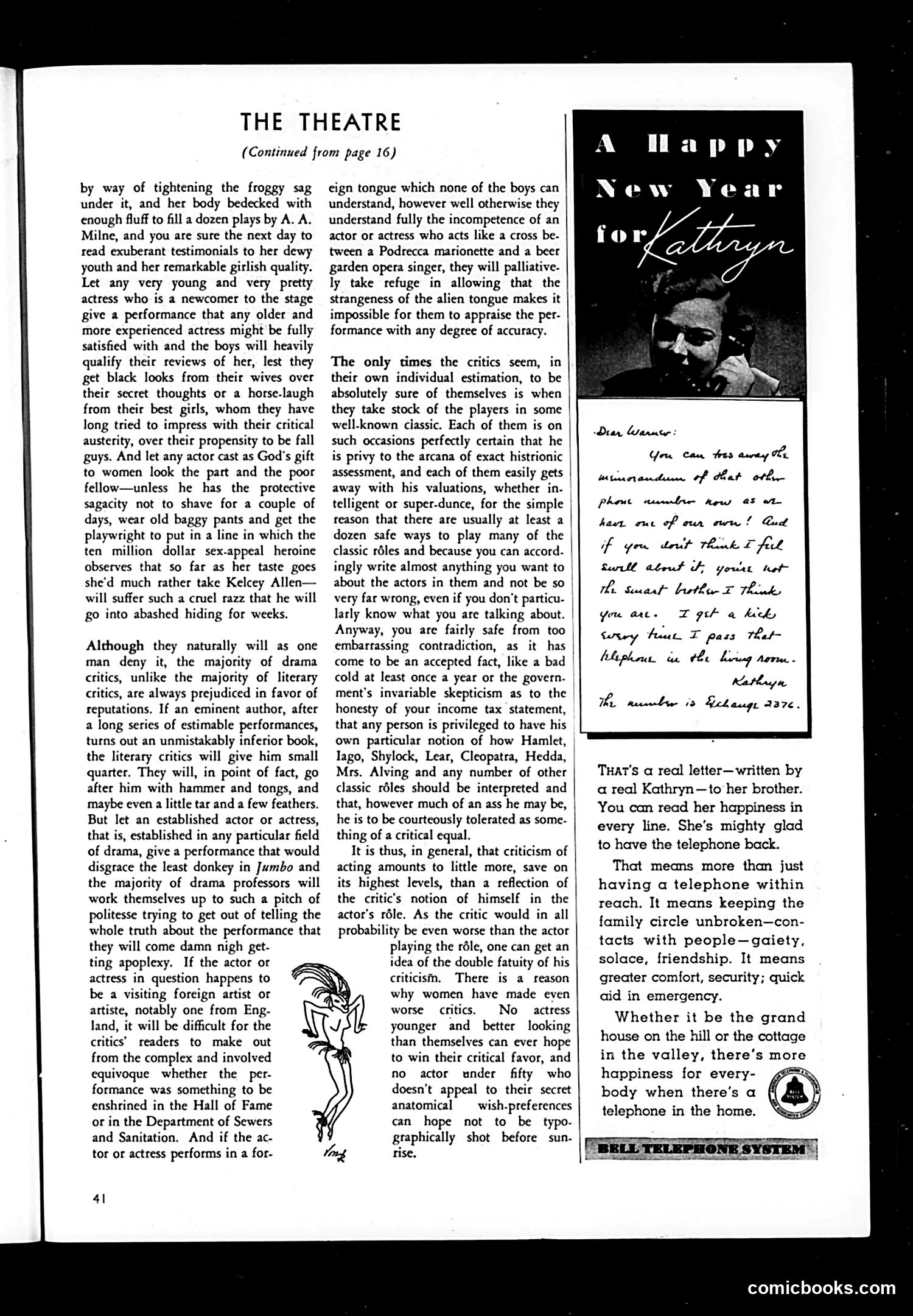
Analysis of Judge Magazine Page This page is primarily a theatre criticism essay (continued from page 16) with a small cartoon and advertisement. The text satirizes drama critics' inconsistency and bias. The Main Satire: The author attacks theatre reviewers for being unfairly lenient with established actors and foreign performers while harshly judging newcomers. Critics allegedly use flowery language to obscure incompetent performances by respected actors, especially those speaking foreign languages—creating deliberately confusing reviews that readers can't parse. By contrast, unknown young actresses receive harsh scrutiny, and established actors performing poorly escape real criticism through polite evasion. The Cartoon: A small sketch (bottom left) shows a thin, angular figure—likely representing a pretentious or ridiculous performer type. The Letter: A sidebar features a congratulatory letter to actress "Kathryn" from her brother, praising her theatrical success—likely a humorous real-life testimonial demonstrating the kind of glowing endorsements the essay mocks. The piece critiques professional cowardice among critics unwilling to honestly evaluate established talent.
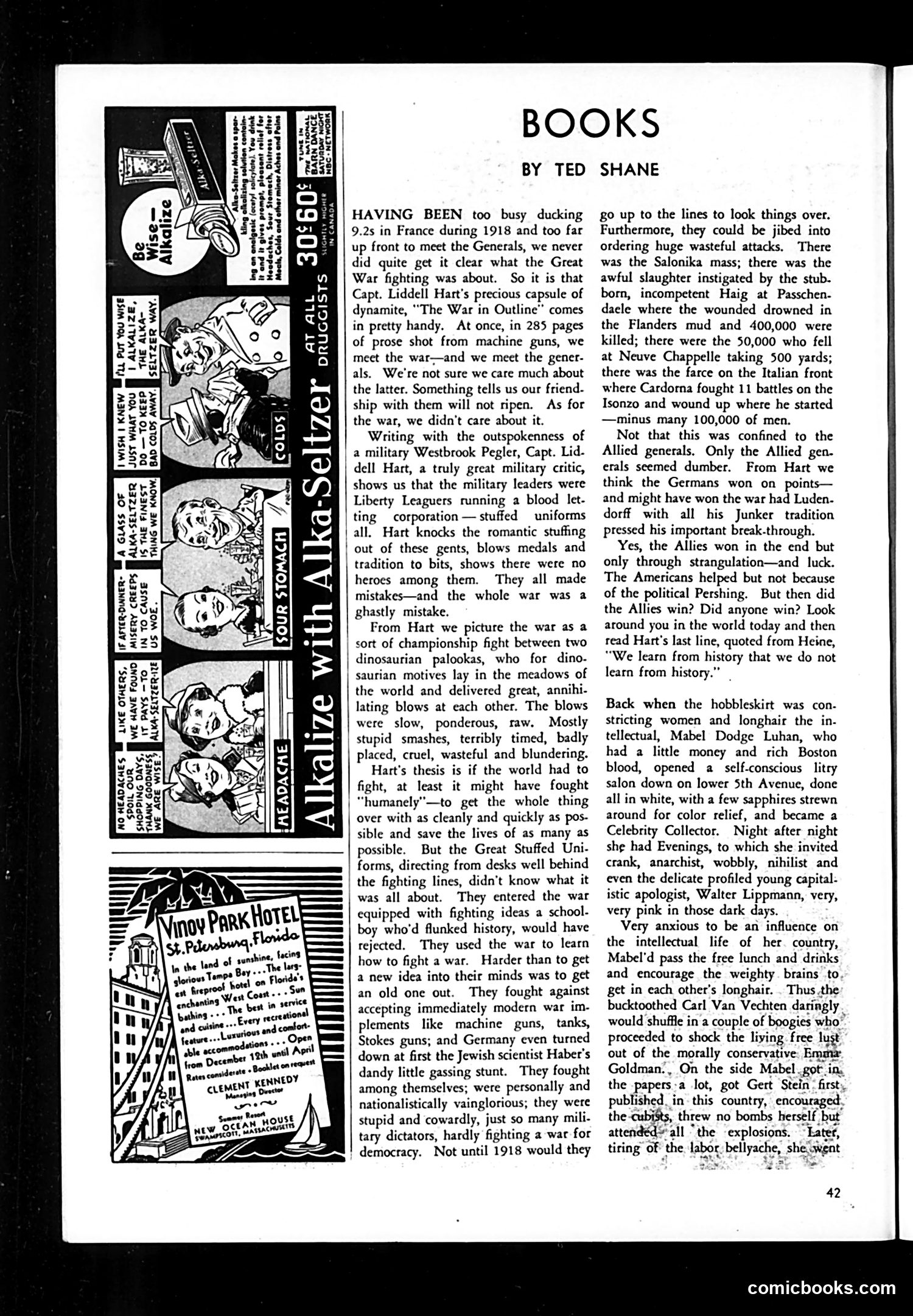
Analysis of This Judge Magazine Page This page is primarily a book review by Ted Shane of Capt. Basil Liddell Hart's "The War in Outline," a post-WWI military critique. The review attacks military leadership of the Great War as incompetent, unimaginative, and responsible for catastrophic losses. Key targets of satire: - Military generals portrayed as "Liberty Leaguers running a blood letting corporation"—stuffed uniforms directing war from desks, ignorant of modern warfare - Specific commanders criticized: General Haig (Passchendaele), Cardorna (Italian front)—accused of wasteful, poorly-planned attacks causing massive casualties - The irony that Germans strategically outperformed Allies, winning "on points," though ultimately defeated through "strangulation—and luck" The cynical thrust: Shane suggests WWI was fundamentally pointless—fought by bumbling dinosaurs using outdated tactics who resisted modern weapons and learned nothing about warfare until 1918. The page questions whether anyone truly "won" anything meaningful. This reflects 1920s-30s disillusionment with WWI's costs and outcomes.
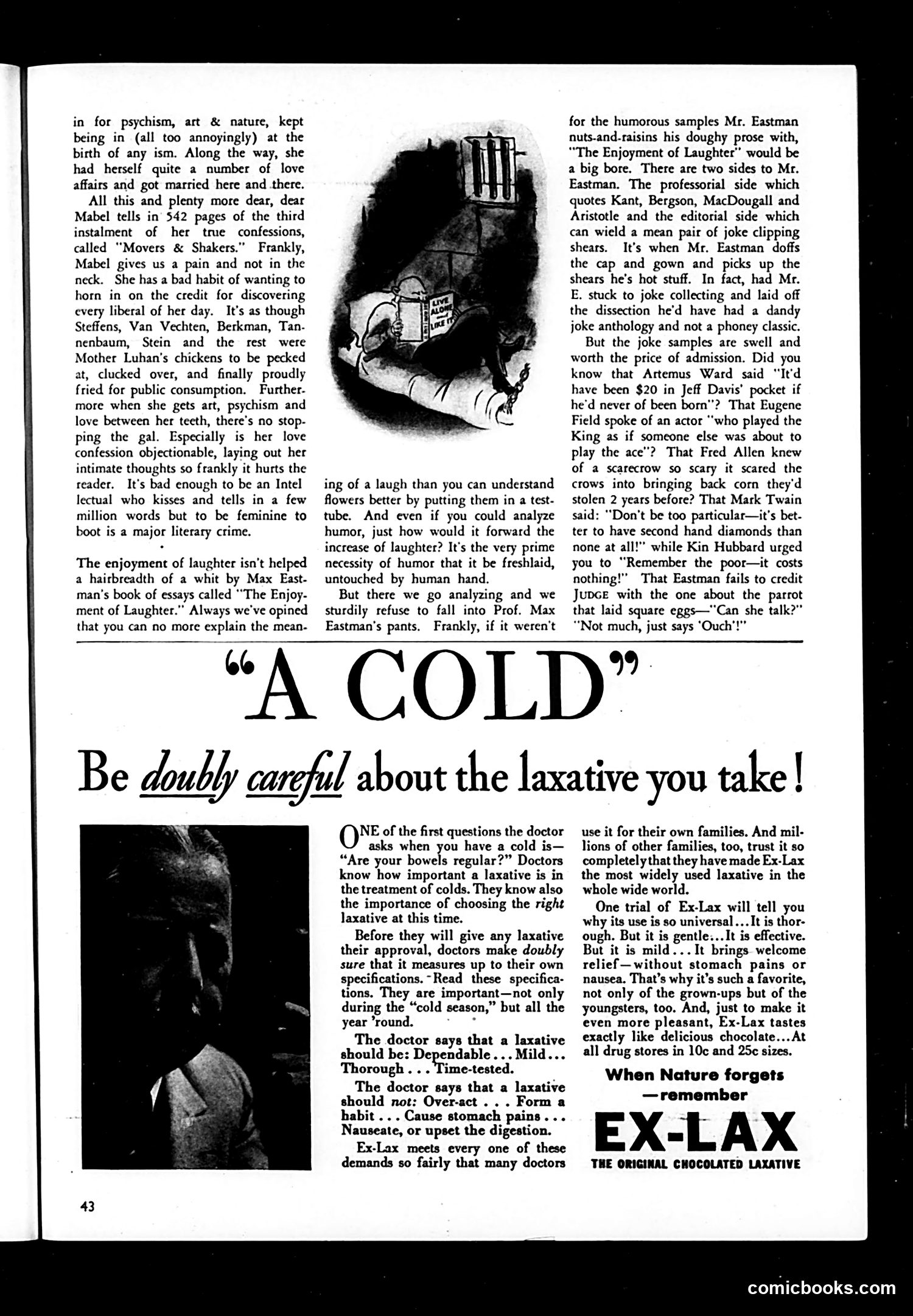
Judge Magazine Page Analysis This page contains two distinct elements: a book review and a laxative advertisement. The Book Reviews: Judge critiques two works by prominent figures. The first mocks Mabel Dodge Luhan's memoir "Movers & Shakers," accusing her of self-aggrandizement—claiming credit for discovering liberal intellectuals she merely knew. The second reviews Max Eastman's "The Enjoyment of Laughter," arguing that analyzing humor destroys it. The reviewer credits Eastman's editorial jokes (drawn from humorists like Mark Twain and Artemus Ward) while dismissing his theoretical framework as boring. The Advertisement: The Ex-Lax laxative ad features doctor-approved specifications for cold treatment, emphasizing the product's mildness and effectiveness. This was typical 1920s-30s advertising linking digestive health to illness recovery. The page reflects Judge's satirical voice: intellectually snobbish yet entertaining, targeting pretentious figures while championing wit and humor as superior to academic analysis.
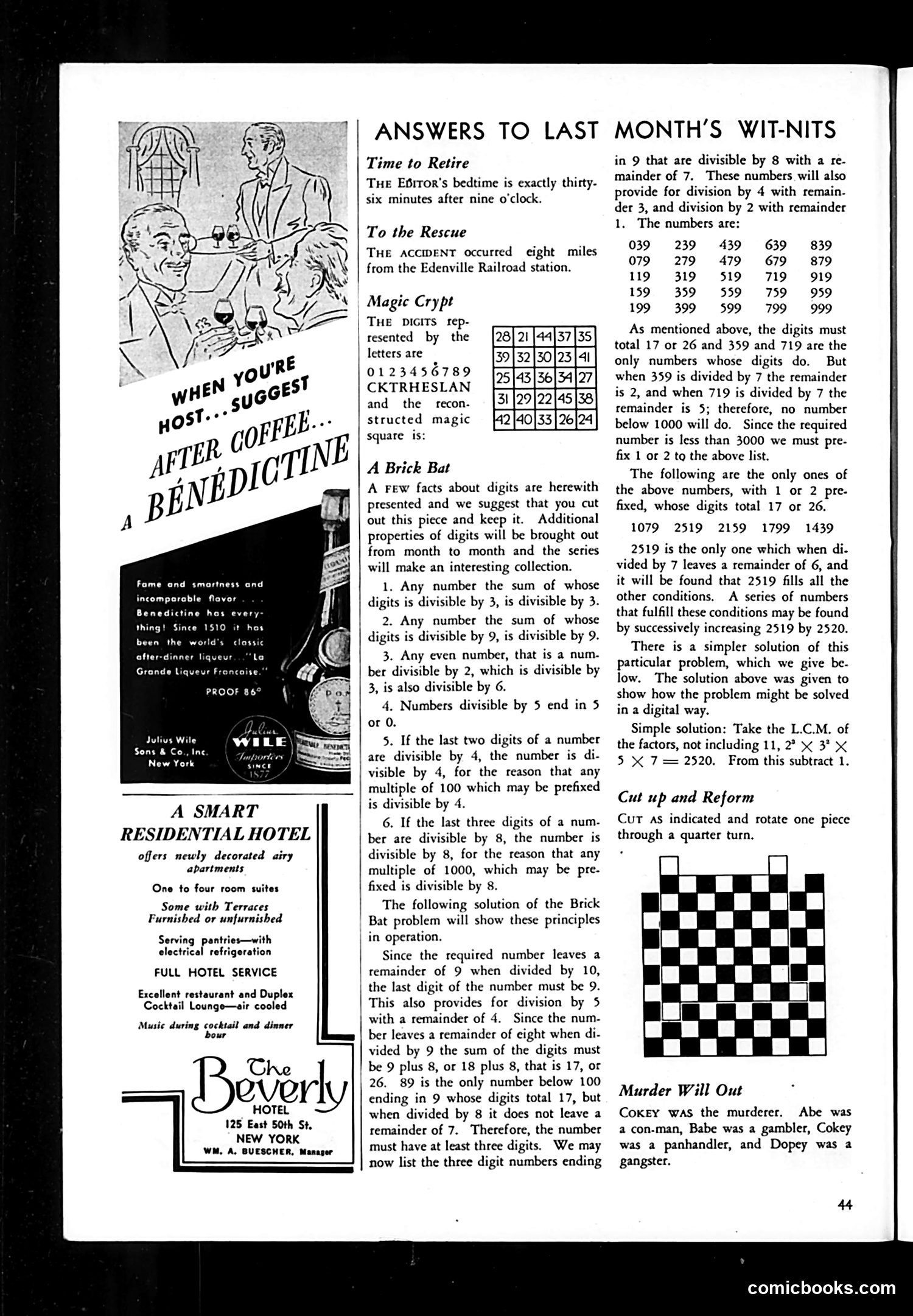
Analysis of Judge Magazine Page This page is primarily advertisements and puzzle solutions, not political satire. The visible content includes: Advertisements: - Benedictine liqueur ad ("world's classic after-dinner liqueur") - Beverly Hotel ad (residential hotel in Manhattan with modern amenities like air conditioning and electrical refrigeration) Main Editorial Content: - "Answers to Last Month's Wit-Nits" — solutions to previous puzzles - "Time to Retire," "To the Rescue," and "Magic Crypt" — riddle answers - "A Brick Bat" — detailed mathematical puzzle solution about finding numbers divisible by specific values - "Cut up and Reform" — appears to be a visual puzzle Illustration (top left): Shows men in formal dress at what appears to be a dinner or social gathering, likely illustrating one of the solved puzzles. The page reflects *Judge's* format: combining light humor, brain teasers, and advertising to appeal to educated, prosperous readers of the era.
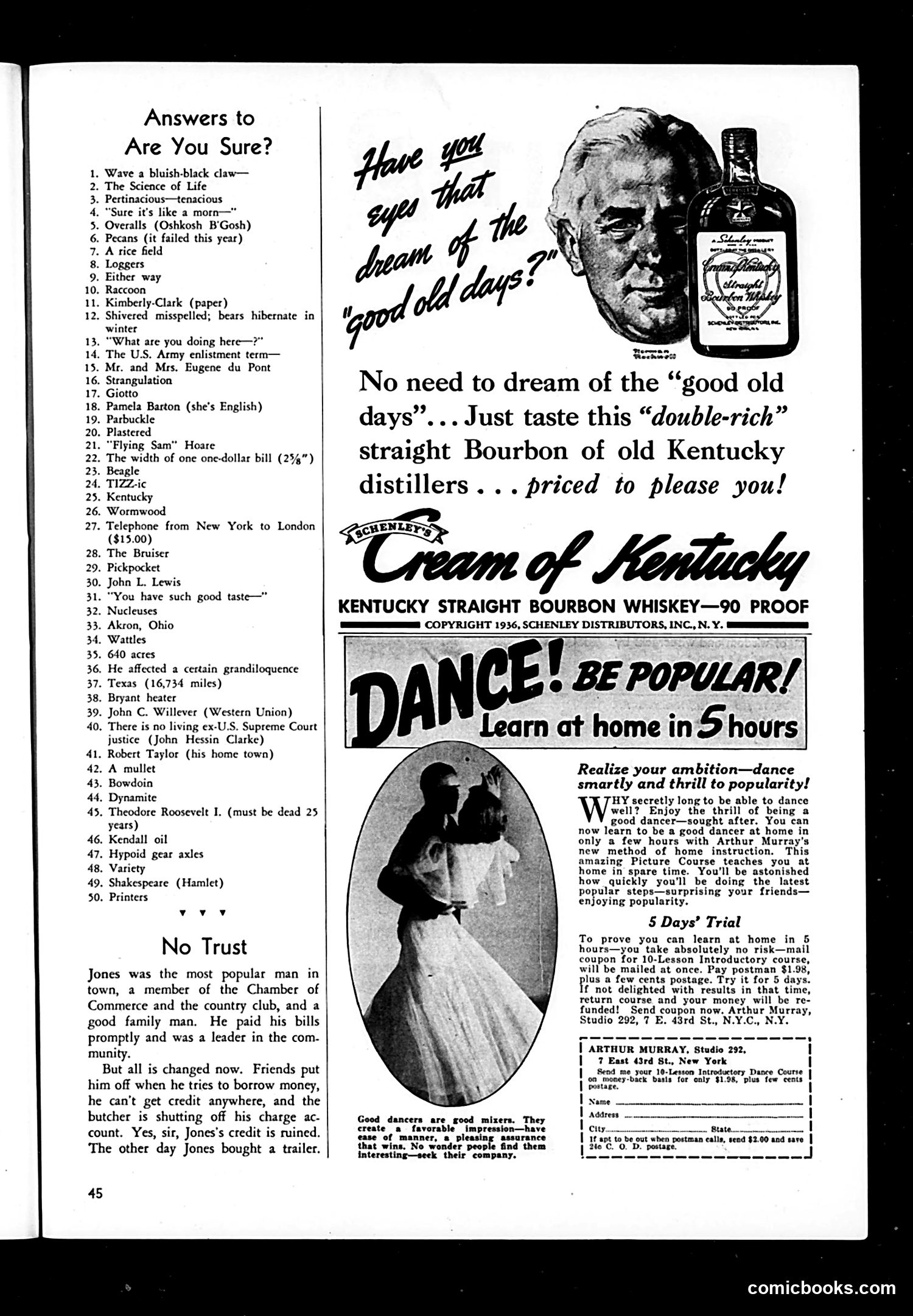
Content Analysis This page from Judge magazine (copyright 1936) contains three main elements: Left side: An "Are You Sure?" quiz answer key—a trivia feature common to Judge, covering miscellaneous topics from nature to current events. Center: A Cream of Kentucky bourbon advertisement featuring an older man's portrait, appealing to nostalgia ("good old days") to sell whiskey at an accessible price point. Right side: Two advertisements—one for Arthur Murray's home dance instruction course (emphasizing social popularity and confidence), and below it, a brief satirical story titled "No Trust." The "No Trust" story is the only satirical content: it describes Jones, a respectable, creditworthy community leader whose reputation collapses after he purchases a trailer. The joke appears to mock either the social stigma attached to trailer ownership in 1930s America or, more broadly, how fragile social standing and credit become when one makes an unconventional purchase. The implication critiques superficial judgment by his community.
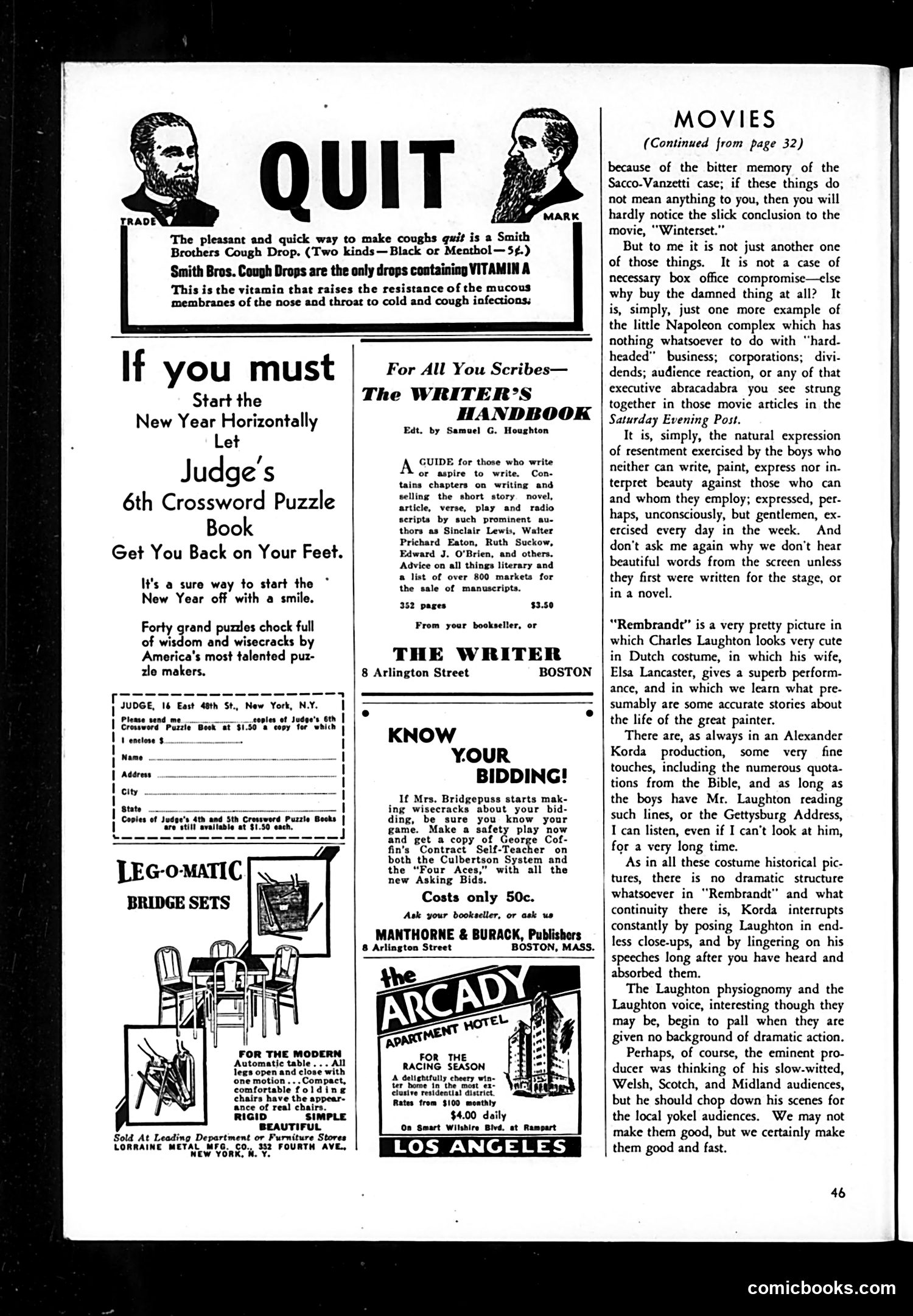
Judge Magazine Page Analysis This page is primarily advertising and book promotion rather than political satire. The main content includes: Advertisements: - Smith Brothers Cough Drops (emphasizing new Vitamin A ingredient) - Judge's crossword puzzle book - Leg-O-Matic bridge table sets - The Writer's Handbook - Contract bridge instruction book - The Arcady Apartment Hotel in Los Angeles Editorial Content: The right column continues a movie review discussing "Winterset" and "Rembrandt," criticizing Hollywood producers' resentment toward writers and artists. The reviewer (author unclear) argues that studio executives unconsciously sabotage beautiful dialogue written for stage or novels, viewing it as a manifestation of professional jealousy rather than legitimate business decisions. Historical Context: The Sacco-Vanzetti reference dates this to the 1930s (the case occurred in 1920-27). This appears to be a standard Judge issue mixing advertisements with cultural criticism rather than political cartoons.
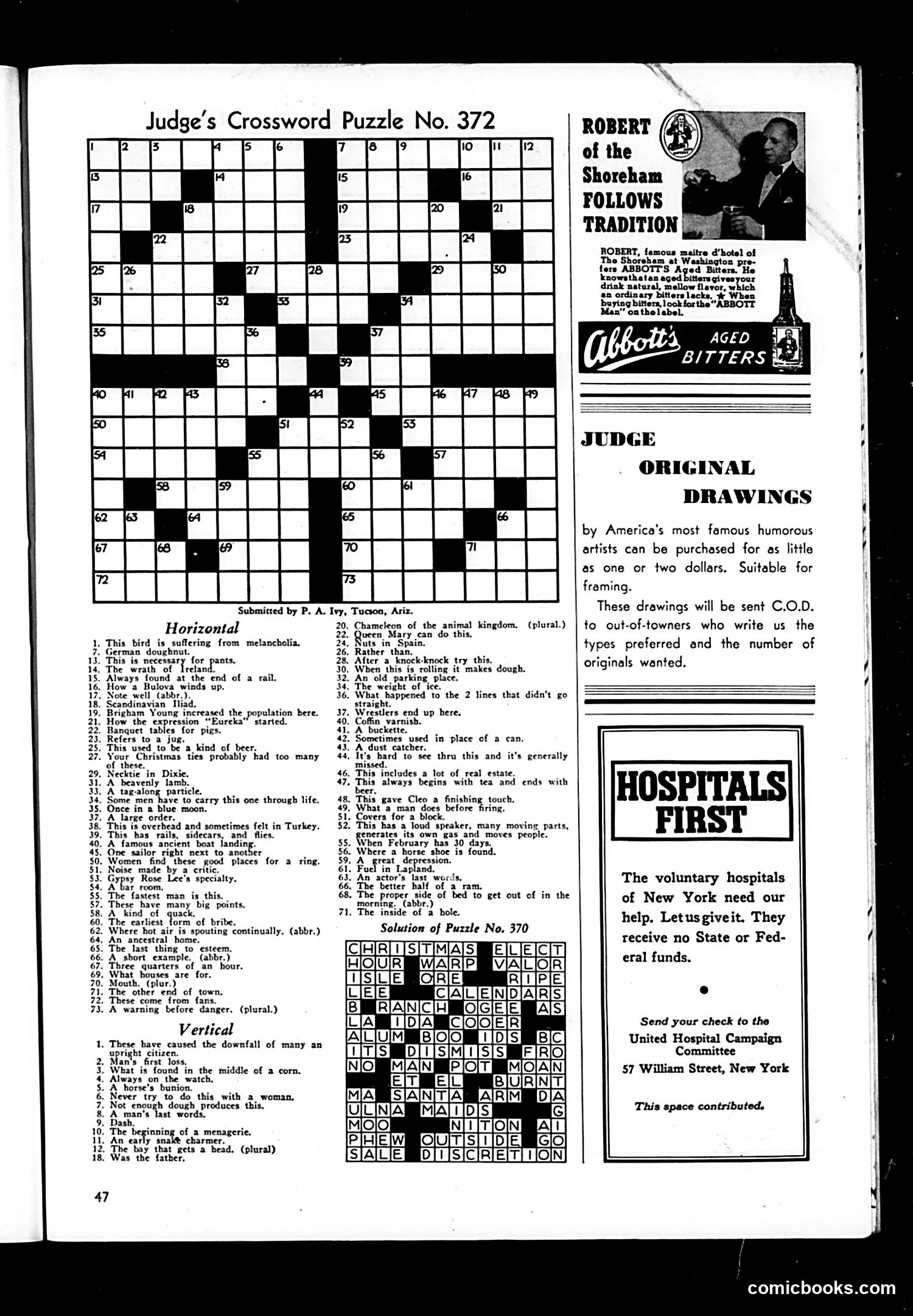
Judge Magazine Page Analysis This page is primarily a crossword puzzle with advertisements and public service announcements—not political satire. The main content is "Judge's Crossword Puzzle No. 372," a standard word game with humorous clues reflecting 1930s-40s American culture (references to Brigham Young, Gypsy Rose Lee, radio technology, etc.). The sidebar advertisements include: - Abbott's Aged Bitters promoting a liquor product, featuring a maitre d' named Robert at Washington's Shoreham Hotel - Judge Original Drawings selling cartoon artwork by the magazine's contributors for $1-2 - Hospitals First — a public service announcement urging donations to New York's voluntary hospitals, which receive no government funding There are no political cartoons or satire visible on this page. It represents Judge magazine's typical mixed content: entertainment (puzzles), commercial advertising, and civic appeals—reflecting Depression-era print magazine economics.
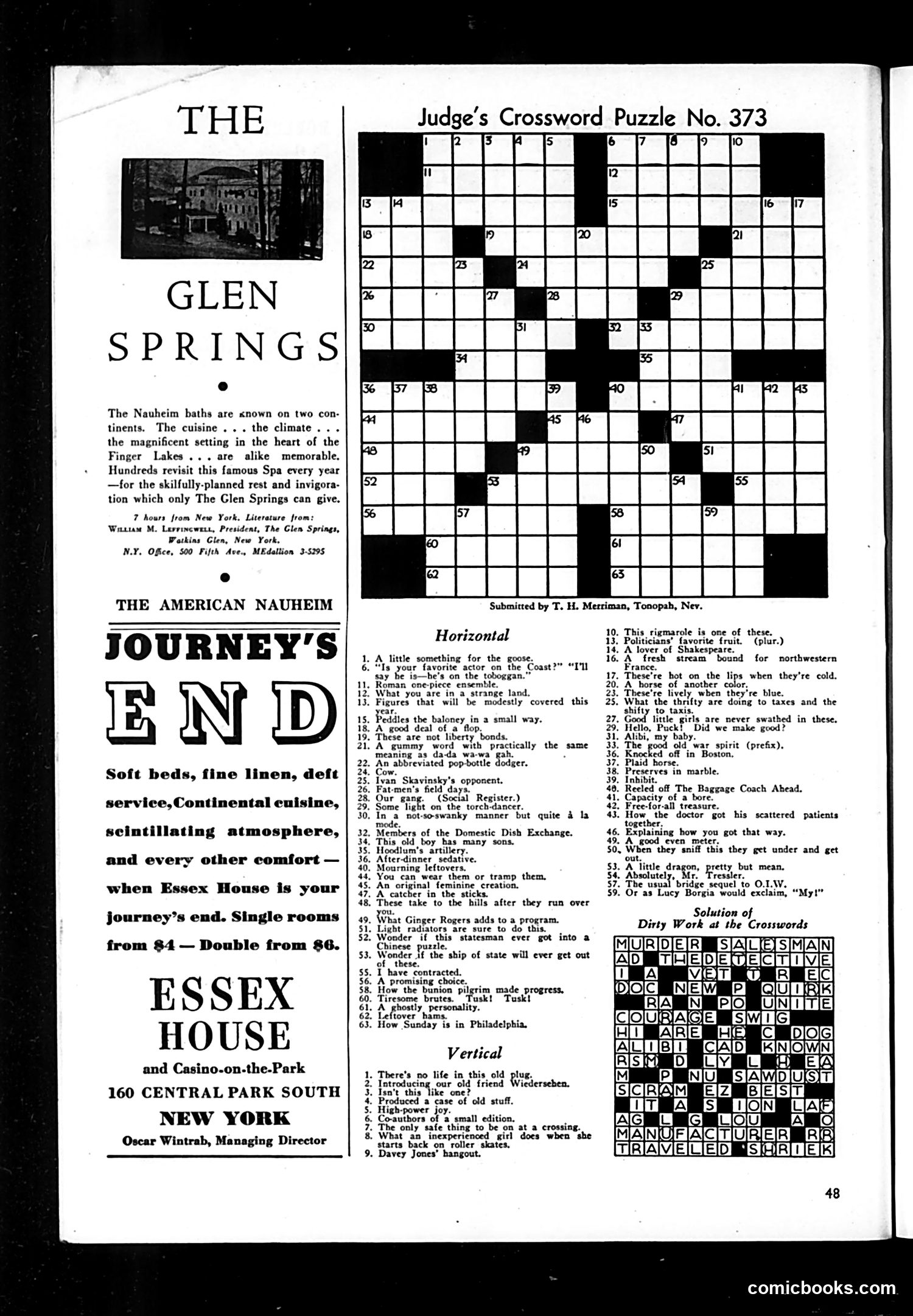
Content Analysis This page is primarily advertising and a crossword puzzle with minimal editorial cartooning content. The page features: 1. Advertisements for Glen Springs spa resort (Finger Lakes, NY) and Essex House hotel (Central Park South, NYC)—typical leisure/hospitality promotions targeting affluent readers. 2. Judge's Crossword Puzzle No. 373—the main content, with clues heavy on 1920s-30s slang and cultural references. Examples include jazz-age terminology ("toboggan" for failure), Prohibition-era humor ("liberty bonds," bootleggers), and period entertainment (references to Ginger Rogers, roller skates). 3. The clues reflect contemporary concerns: taxes, divorce ("I have contracted"), modern femininity, and economic hardship disguised as wordplay. There is no political cartoon or satire visible—this appears to be a leisure/entertainment page targeting Judge's affluent readership with hospitality ads and a timely puzzle designed for middle-class amusement.
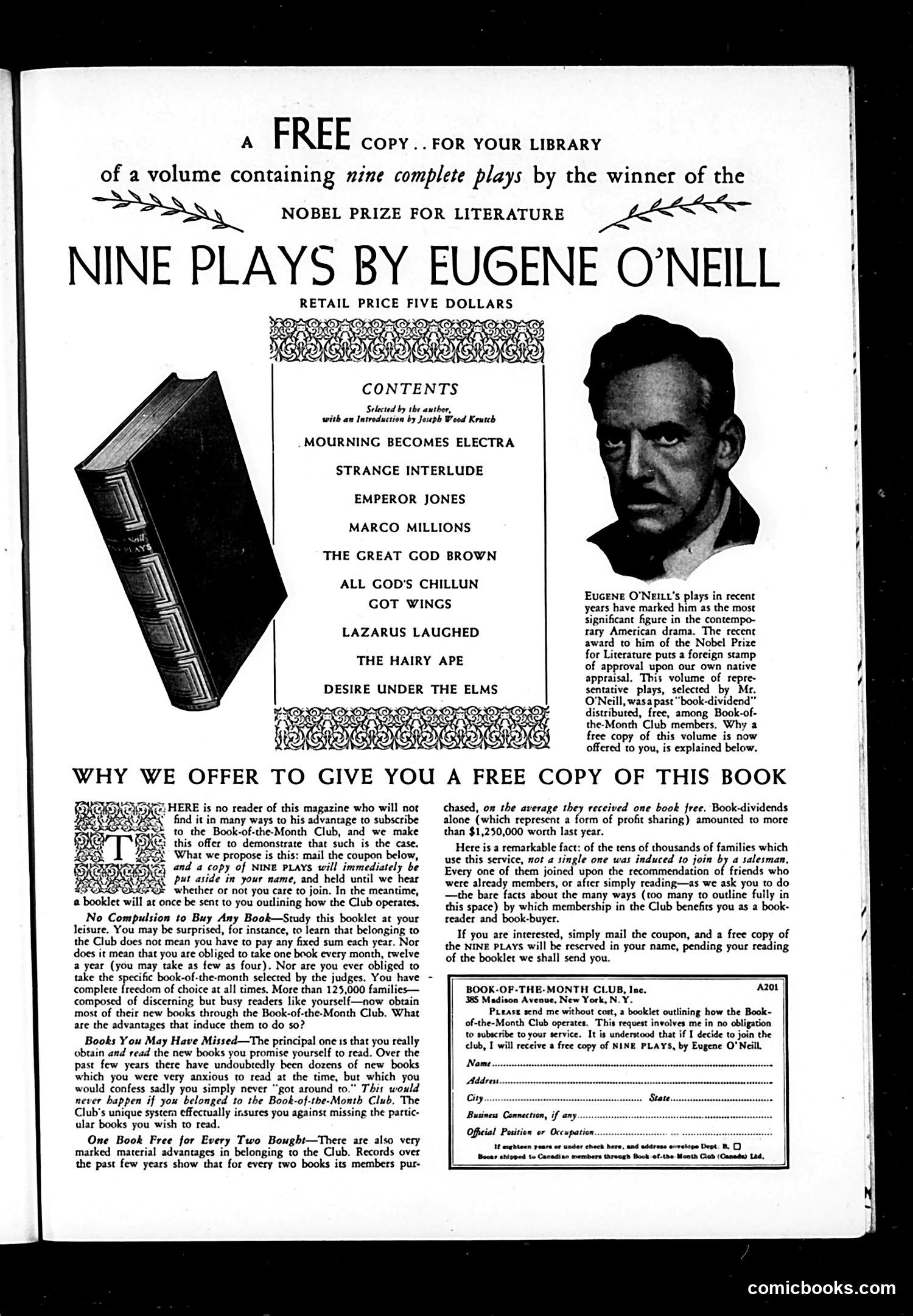
Analysis for Modern Readers This is primarily advertising content, not editorial satire. The page promotes the Book-of-the-Month Club's offer of a free copy of Eugene O'Neill's collected plays. The Content: The advertisement highlights O'Neill's recent Nobel Prize for Literature—a significant achievement legitimizing American drama internationally. The Club frames the free book offer as a membership incentive, emphasizing practical benefits: members receive one free book per two purchases, enjoy selection flexibility (contrary to perceived obligations), and gain access to titles they might otherwise miss. Historical Context: This likely dates to the late 1920s or early 1930s, when the Book-of-the-Month Club (founded 1926) was revolutionizing how Americans accessed literature. The appeal to busy, discerning readers reflects 1920s-30s anxieties about keeping up with cultural life. The "Satire": There's gentle irony in the club's claims of "no compulsion"—membership itself is the compulsion being marketed. However, this isn't sharp satirical critique; it's standard advertising language designed to reassure skeptical readers.
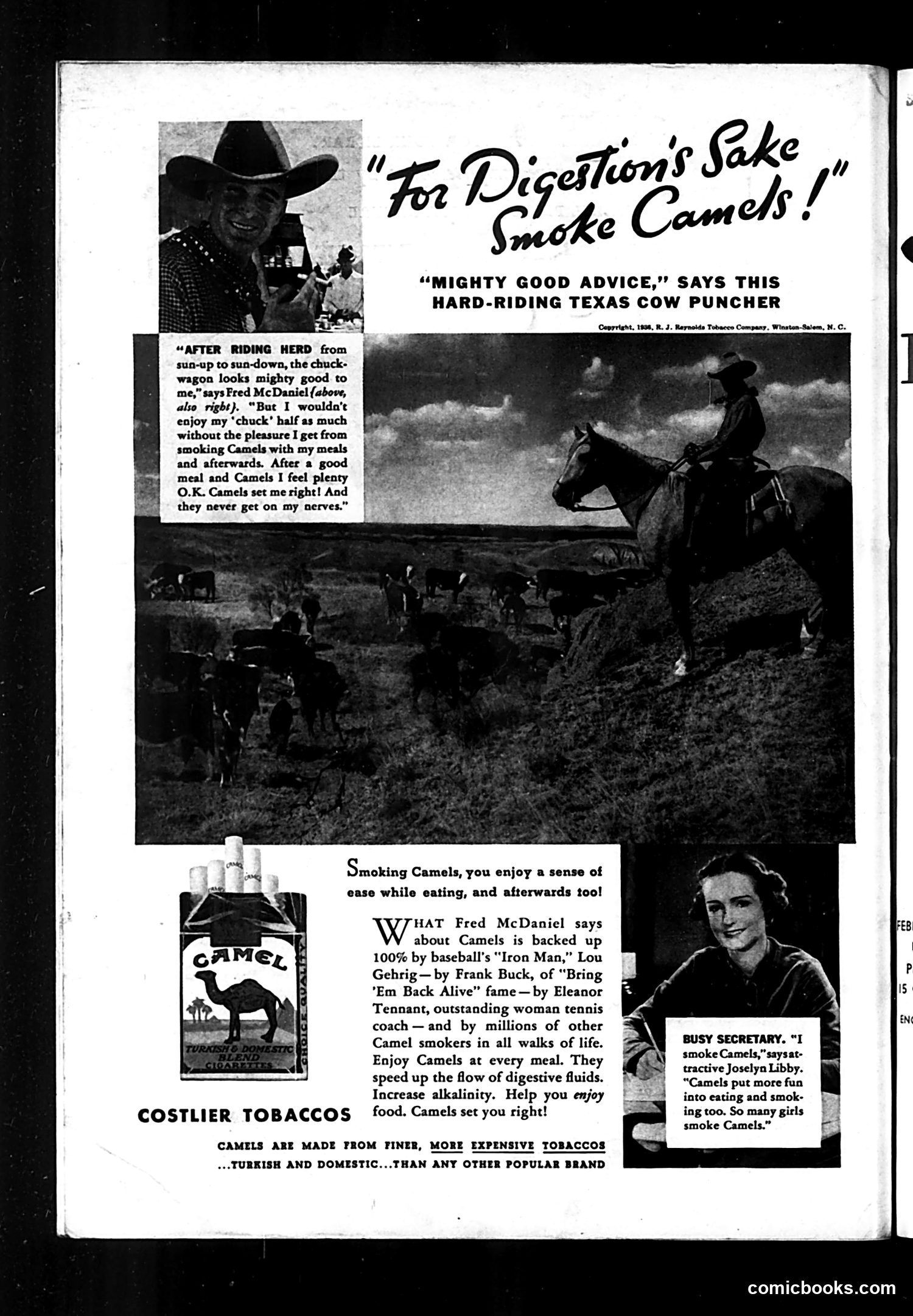
Analysis This is primarily a Camel cigarette advertisement, not political satire. It features testimonials from a Texas cowboy (Fred McDaniel) claiming cigarettes aid digestion and promote ease during meals. The ad leverages celebrity endorsements—naming Lou Gehrig (baseball's "Iron Man"), Frank Buck (wildlife explorer), and Eleanor Tennant (tennis coach)—to build credibility. A secretary is quoted similarly. For modern readers: This represents pre-1960s tobacco marketing at its most aggressive and deceptive. The claim that cigarettes "speed up the flow of digestive fluids" and "increase alkalinity" reflects tobacco companies' now-debunked health assertions. The targeting of women ("So many girls smoke Camels") and the casual association of smoking with meals and work reflect how normalized cigarettes were before their dangers became widely acknowledged. The copyright date (1958) shows this appeared when lung cancer research was emerging but heavily suppressed by industry.