judge
Judge — February 1937
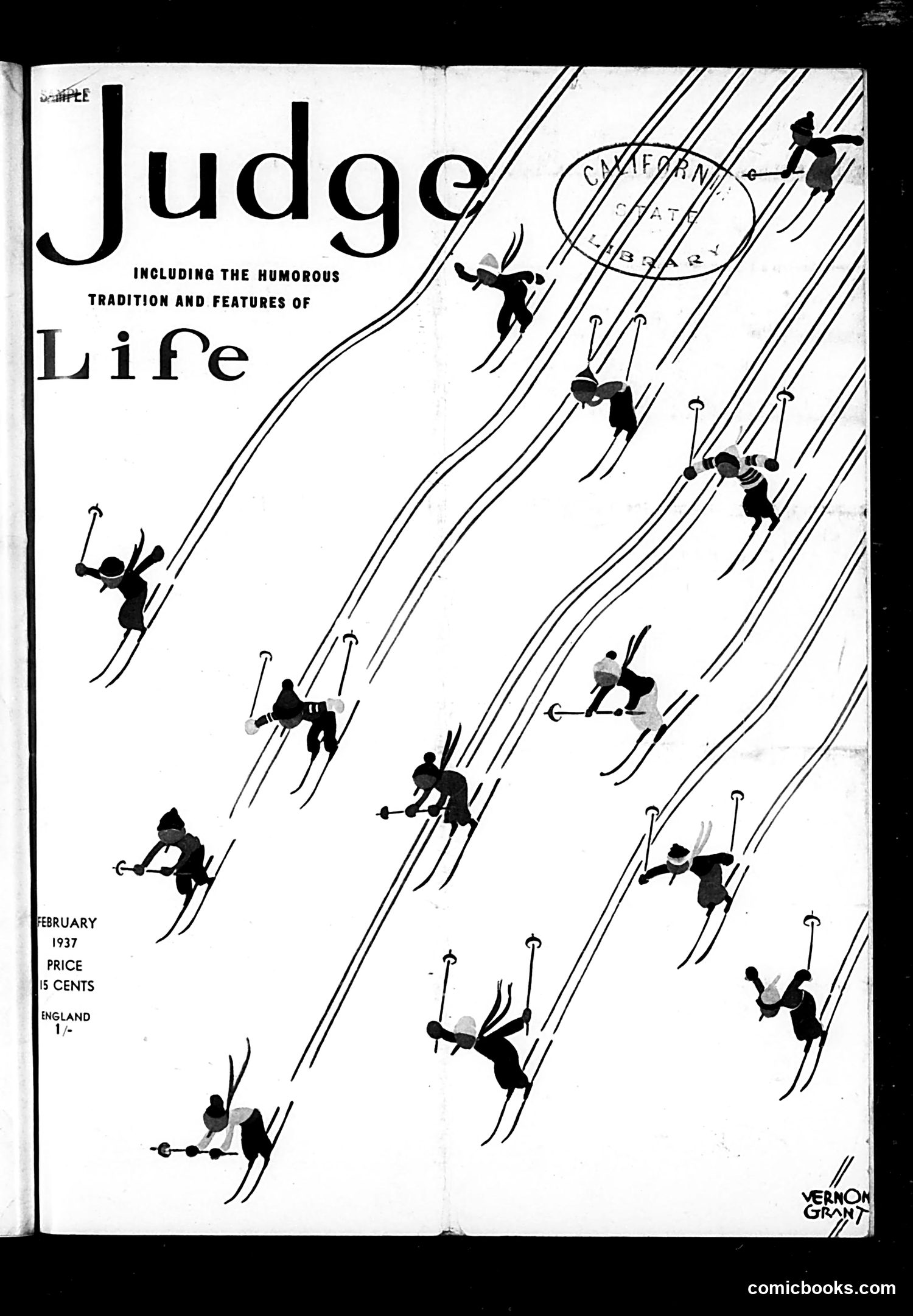
Analysis of Judge Magazine Cover (February 1937) This cover satirizes skiing, a winter sport growing in popularity during the 1930s. The illustration depicts multiple skiers descending slopes in various states of chaos and mishap—tumbling, falling, and losing control—suggesting the sport's inherent danger and the comedic misadventures of amateur participants. The title "Judge Life: Including the Humorous Tradition and Features of Life" indicates this is a satirical magazine issue. The artwork by Vernon Grant uses slapstick humor typical of 1930s American comedy, mocking both the sport itself and the fashionable leisure activities of the era's affluent classes who could afford winter resorts. The "California" marking suggests this may reference a ski destination or resort culture.
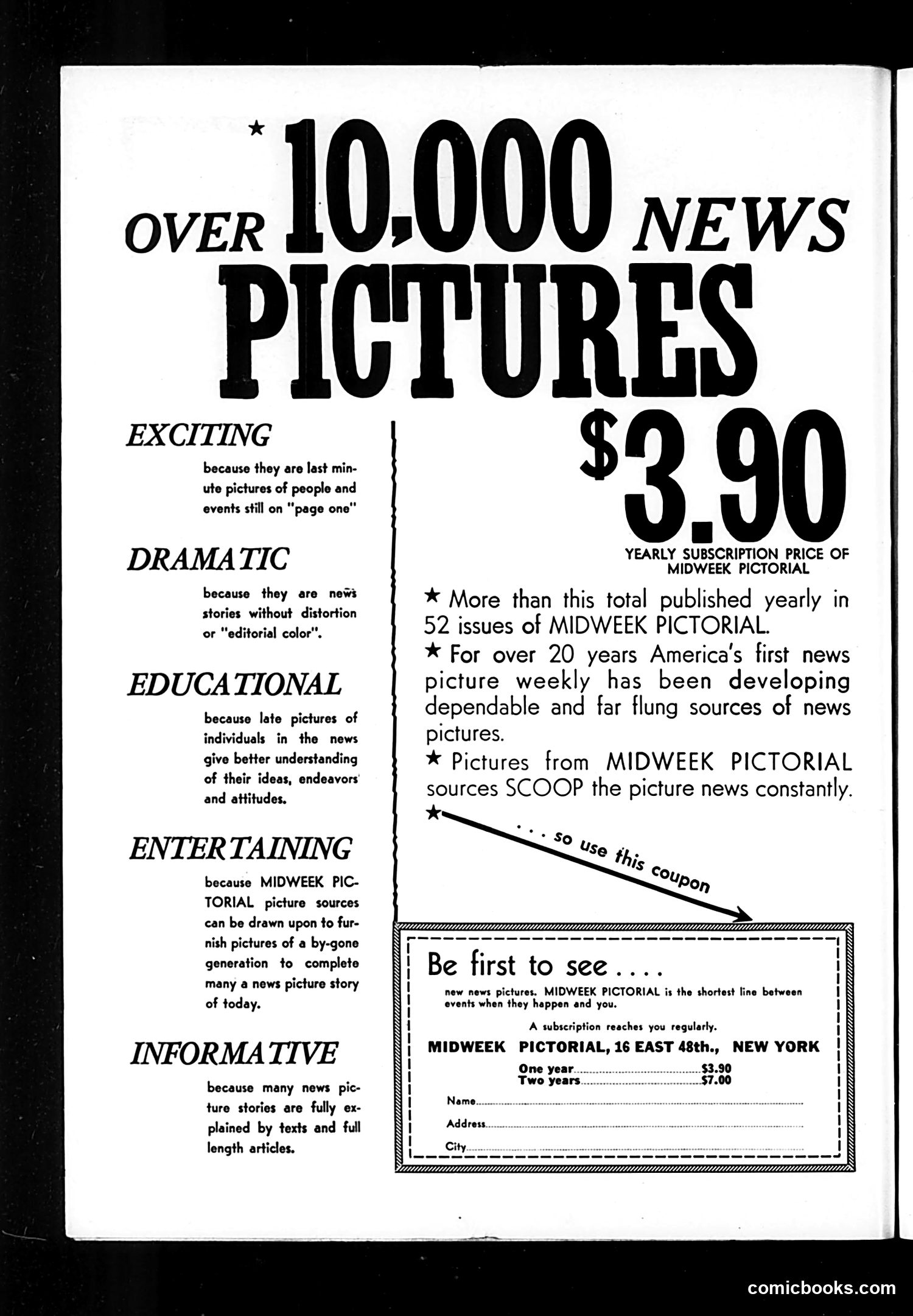
Advertisement Analysis This is primarily a paid advertisement, not satirical content. It promotes "Midweek Pictorial," a news picture weekly magazine costing $3.90 yearly. The ad highlights five reasons to subscribe: - Exciting: Last-minute photos of ongoing events - Dramatic: Undistorted news stories - Educational: Photos explaining individuals' ideas and attitudes - Entertaining: Pictures supplementing news stories - Informative: Picture stories with full explanatory text The ad emphasizes the publication has operated for "over 20 years" as "America's first news picture weekly," positioning it as a reliable source for photojournalism. A subscription coupon appears at the bottom. This reflects early-20th-century media marketing—emphasizing visual journalism's growing importance before television.
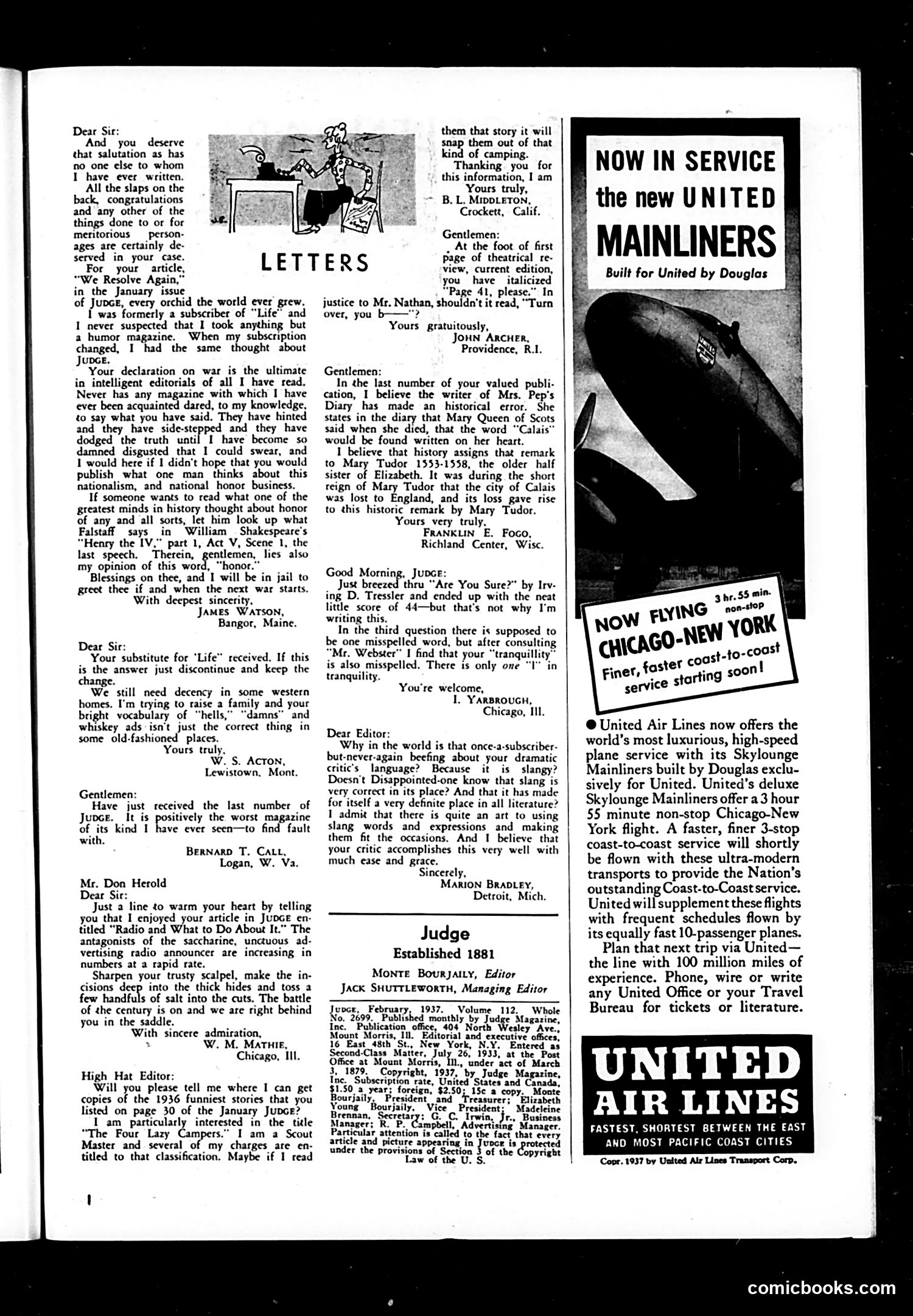
Analysis of Judge Magazine Page This page is primarily letters to the editor and advertisements rather than satirical cartoons. The main visual element is a small illustration at the top of the letters section showing what appears to be two figures at a desk or counter—the joke or context is unclear from the image alone. The letters discuss serious topics including war, honor, magazine content quality, and language usage—typical reader feedback for a 1937 publication. The page features substantial advertising for United Airlines' new mainliner service and Chicago-New York flights. The cartoon content is minimal; the page emphasizes reader correspondence and commercial advertising, reflecting Judge's format during this period rather than featuring prominent satirical editorial art.
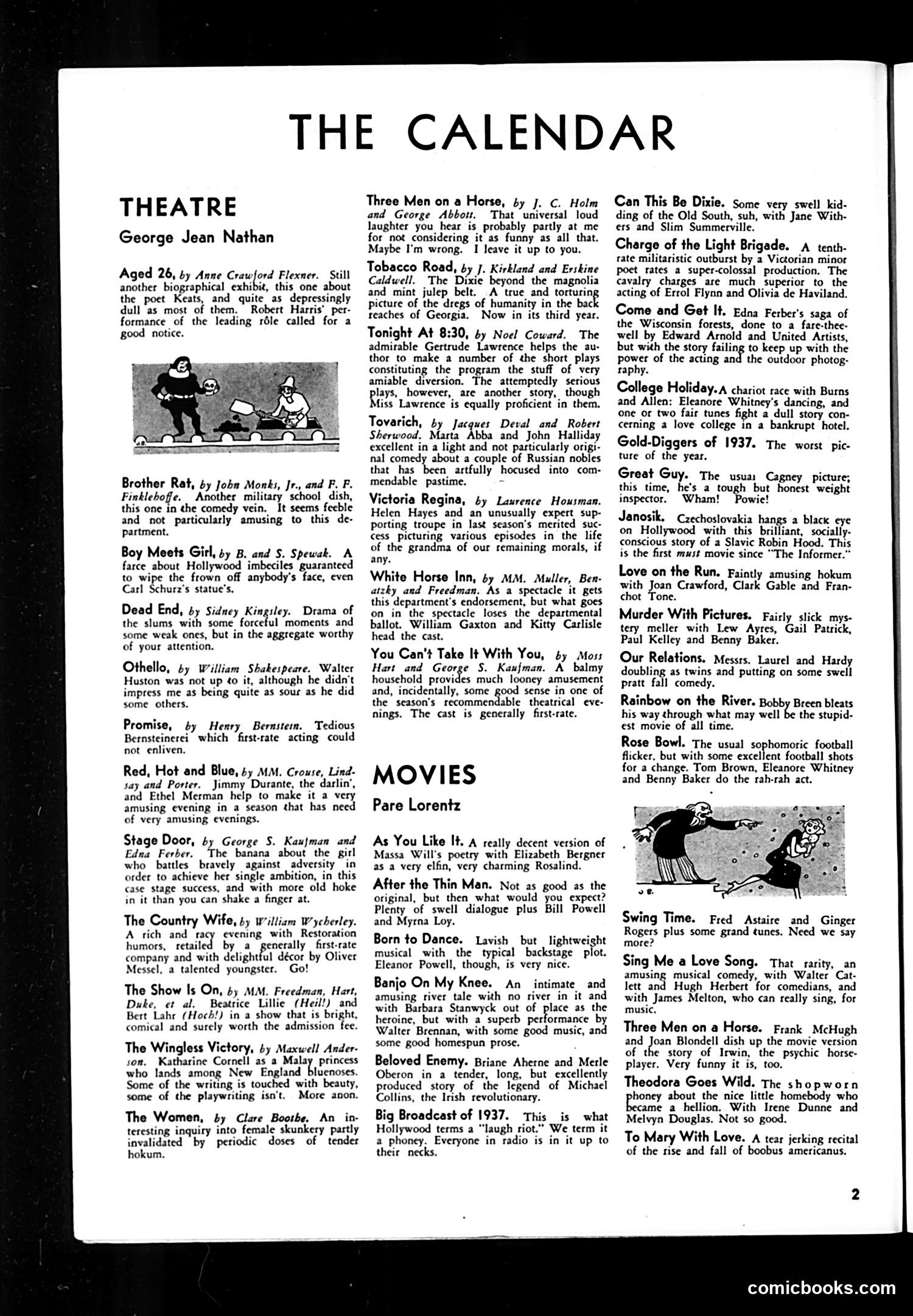
Analysis of "The Calendar" Page from Judge This page from Judge magazine contains theater and movie reviews, not political cartoons. The small illustration accompanying the "Brother Rat" review shows two figures in what appears to be a comedic scene, but the image quality makes specific identification difficult. The page is primarily devoted to entertainment criticism from the 1930s era, reviewing Broadway shows like "George Jean Nathan," "Tobacco Road," and "Tovarich," along with films including "As You Like It" and "Three Men on a Horse." The content reflects typical Judge magazine fare—satirizing contemporary entertainment rather than politics. Without clearer images or more distinctive caricatures, specific satirical targets cannot be definitively identified. This appears to be a standard entertainment section rather than political commentary.
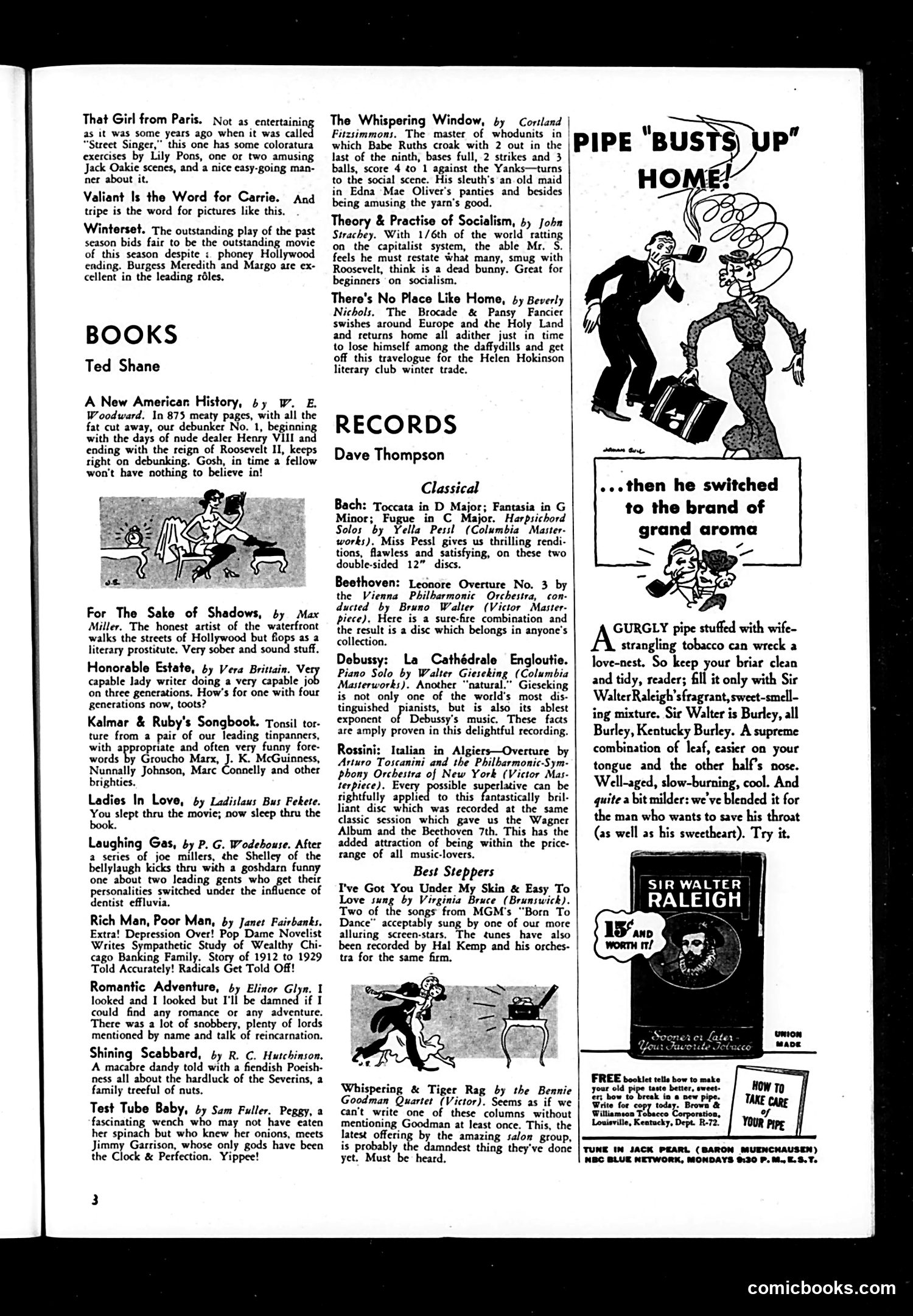
"Pipe Busts Up Home" Cartoon Analysis This cartoon illustrates a domestic scene where a man has switched to Sir Walter Raleigh pipe tobacco, causing him to become so energetically happy that he's literally disrupting his home—his wife appears startled as he dances or jumps about exuberantly. The humor relies on exaggeration: the product is advertised as so pleasurable that it transforms the user into an uncontrollable force of joy, destroying domestic peace. This is a straightforward product advertisement disguised as humor—a common marketing technique of the era. The cartoon mocks consumer culture's promise that commercial goods deliver happiness so intense it becomes absurd. The joke's target is less political satire and more about poking fun at advertising claims while simultaneously promoting the tobacco brand.
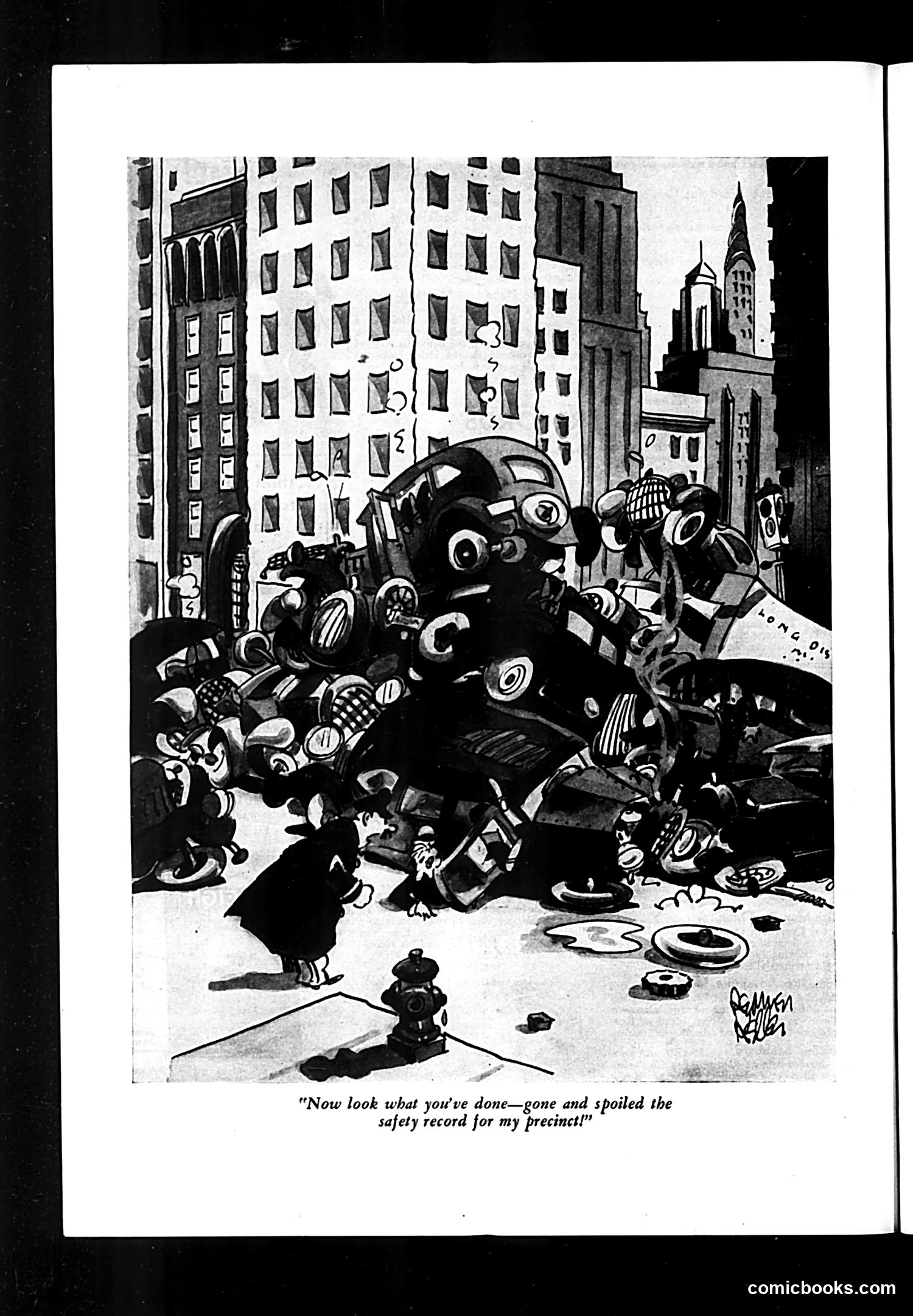
Political Cartoon Analysis This cartoon satirizes urban traffic safety concerns, likely from the 1920s-1930s based on the art style. A distressed figure stands before a chaotic pile-up of cars and toys in a city street, complaining: "Now look what you've done—gone and spoiled the safety record for my precinct!" The joke targets police or municipal officials who prioritize their own statistics and reputations over genuine public safety. The officer appears more concerned that an accident has marred his "safety record" than with the actual wreckage and potential harm. The jumbled vehicles and toys suggest children and families were endangered. The satire critiques bureaucratic indifference and performance metrics that incentivize hiding problems rather than solving them—a timeless critique of institutional accountability.
Analysis of Judge Magazine Page This page from Judge magazine (dated November 2, 1899) is primarily text-based social commentary rather than political cartooning. The title "JUDGE: SOME OF THE PEOPLE" frames various humorous anecdotes about American life. The content satirizes: - The "trailer" phenomenon as a new, defining American trend - Urban crime waves across U.S. cities (theft, burglary, embezzlement) - Police incompetence, illustrated by Sergeant Patrick Kelly's weight gain (429 pounds) - Suburban anxieties about safety and social disorder Small illustrations accompany the text, showing a trailer and figures engaged in domestic scenes. The satire is gentle—mocking American preoccupations with modernity, crime, and social change rather than targeting specific political figures. The tone suggests Judge's audience was educated, urban readers concerned with contemporary American culture.
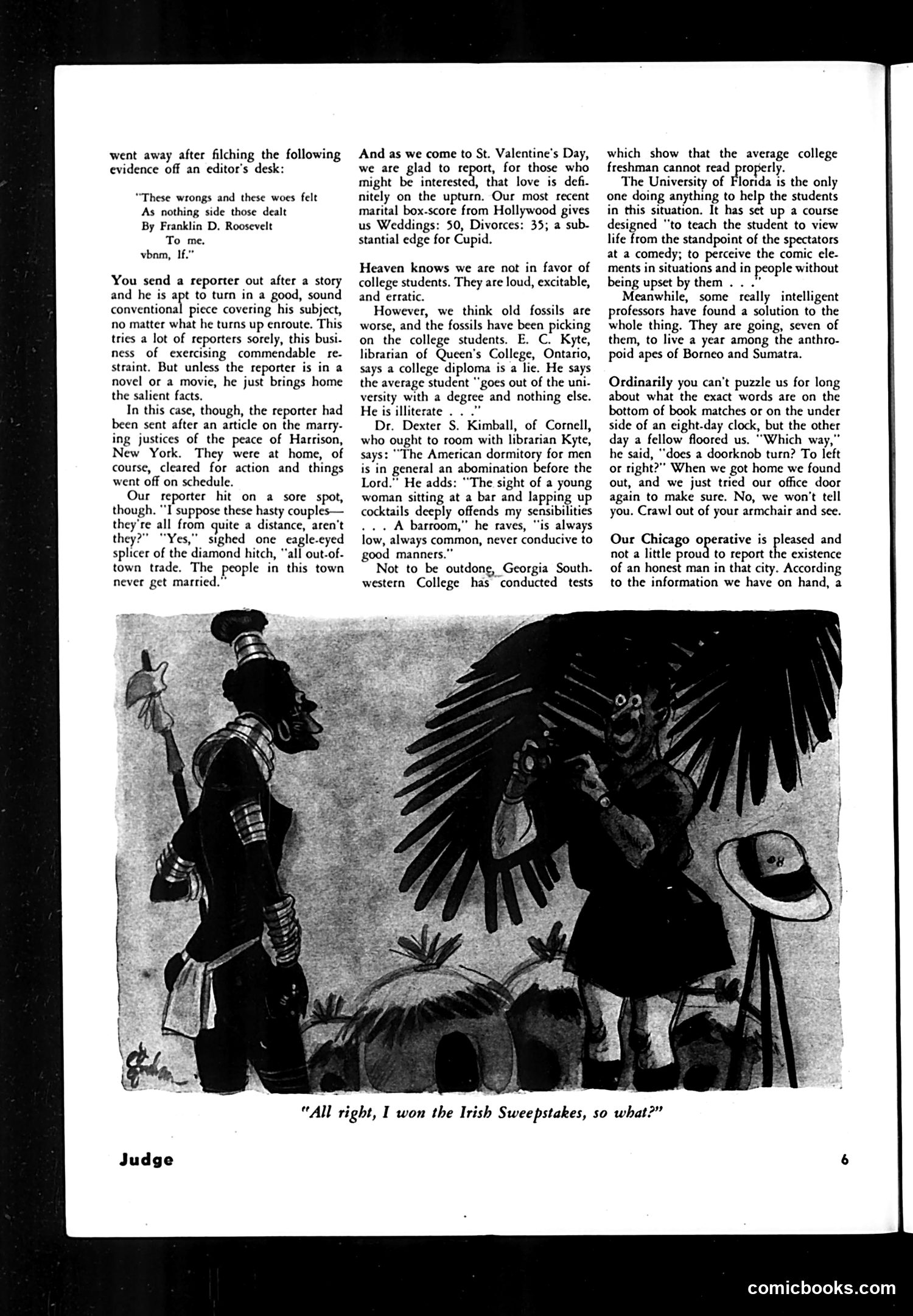
Analysis of Judge Magazine Page This page contains editorial commentary and a single cartoon. The text discusses college life, including a satirical marriage-statistics comparison ("Weddings: 50, Divorces: 55") and critiques of higher education. One anecdote mocks a reporter's assignment covering marriage ceremonies at Harlem churches in New York. The Cartoon: Shows two figures in formal/military dress at what appears to be a cockfighting scene. One holds a fighting cock with spread wings; the other holds a staff. The caption reads: "All right, I won the Irish Sweepstakes, so what?" The cartoon likely satirizes Irish immigrants or Irish-American culture, referencing the Irish Sweepstakes (an illegal lottery popular during Prohibition). The joke appears to mock someone's boastful attitude about winning while engaged in illegal cockfighting—implying that even newfound wealth doesn't elevate questionable behavior.
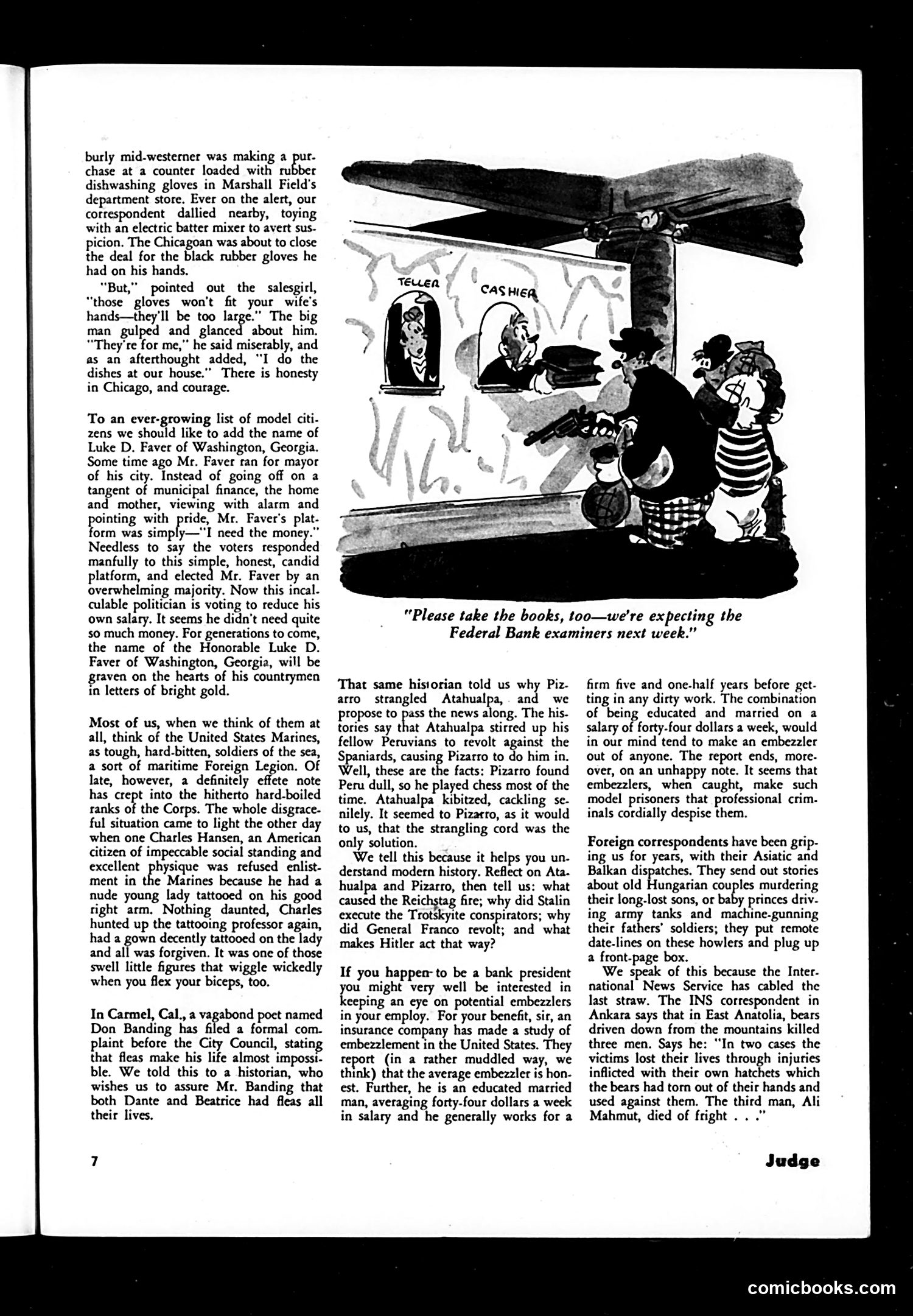
Analysis of Judge Magazine Page The main cartoon depicts a bank teller and cashier looking at books while a nervous customer (likely an embezzler) stands nearby. The caption reads: "Please take the books, too—we're expecting the Federal Bank examiners next week." The satire: This joke mocks banking corruption and embezzlement during the era when Federal Bank examiners conducted inspections. The bank employees are so confident in their dishonesty that they're offering to hide the account books—suggesting they've cooked the records so thoroughly that examiners can't discover the fraud. The surrounding text discusses various public figures and historical anecdotes, including references to Marines, Luke D. Faver of Washington Georgia, Pizarro, Atahualpa, and banking industry embezzlement scandals—all supporting Judge's theme of exposing corruption in government and business institutions.
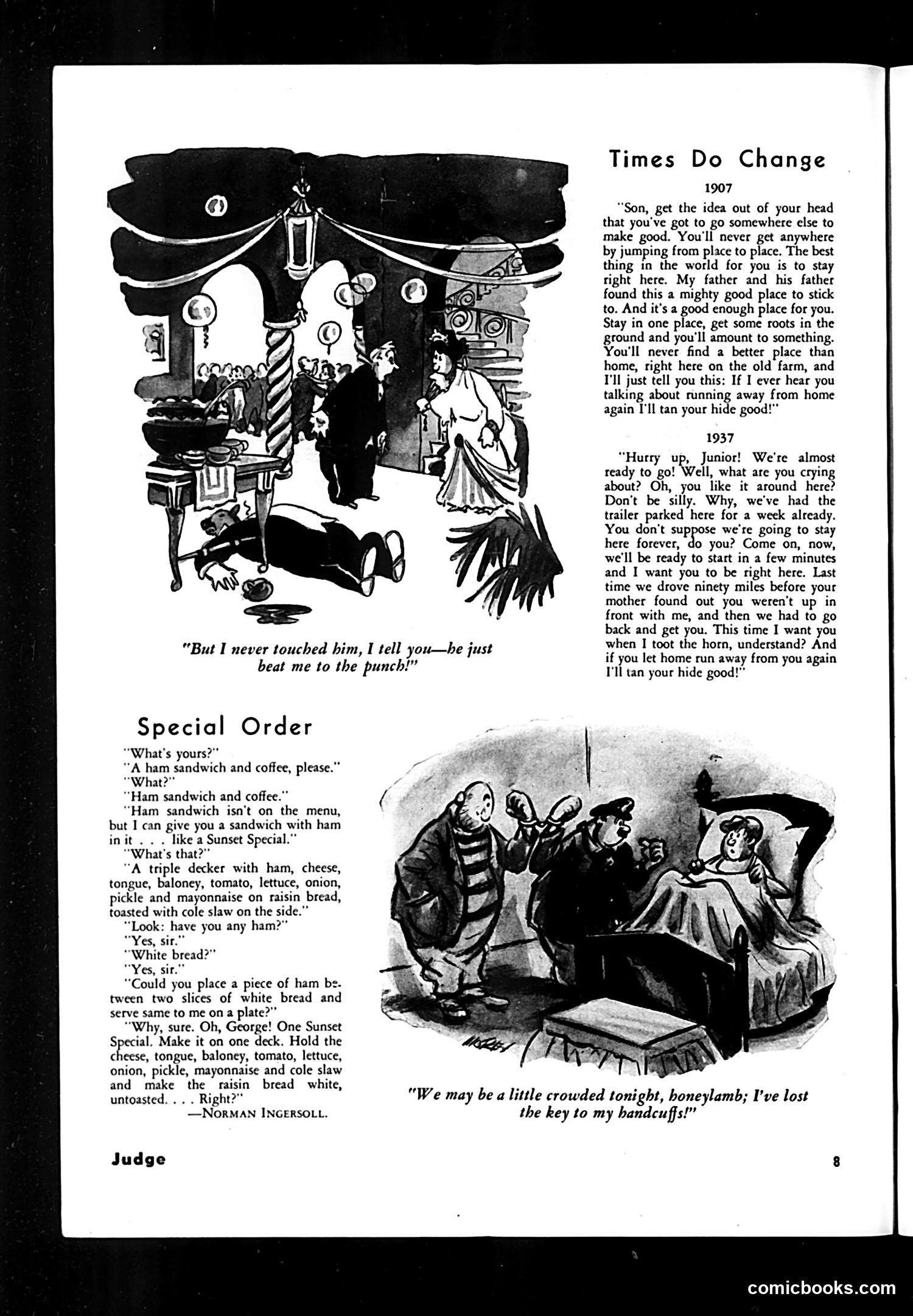
"Times Do Change" (1907-1937) This two-panel cartoon contrasts American attitudes toward stability and rootedness across three decades. In 1907, a father scolds his son for wanting to leave the farm, insisting that staying put and building roots is the path to success. The advice reflects early 20th-century agrarian values: stability equals prosperity. By 1937, the same scenario is inverted. Now a mobile parent rushes their reluctant son into a trailer, dismissing his attachment to place as foolish. The family constantly relocates—they've already parked there a week, drove 90 miles before retrieving a lost child. The satire captures how the Great Depression and automobile culture fundamentally shifted American life from settled agricultural communities to mobile, transient existence. What was once virtuous (staying rooted) became obsolete; what was once foolish (constant movement) became necessity or lifestyle. The identical punchline emphasizes the irony: both fathers threaten to "tan your hide" if the child runs away—yet one anchors home, the other treats it as temporary.
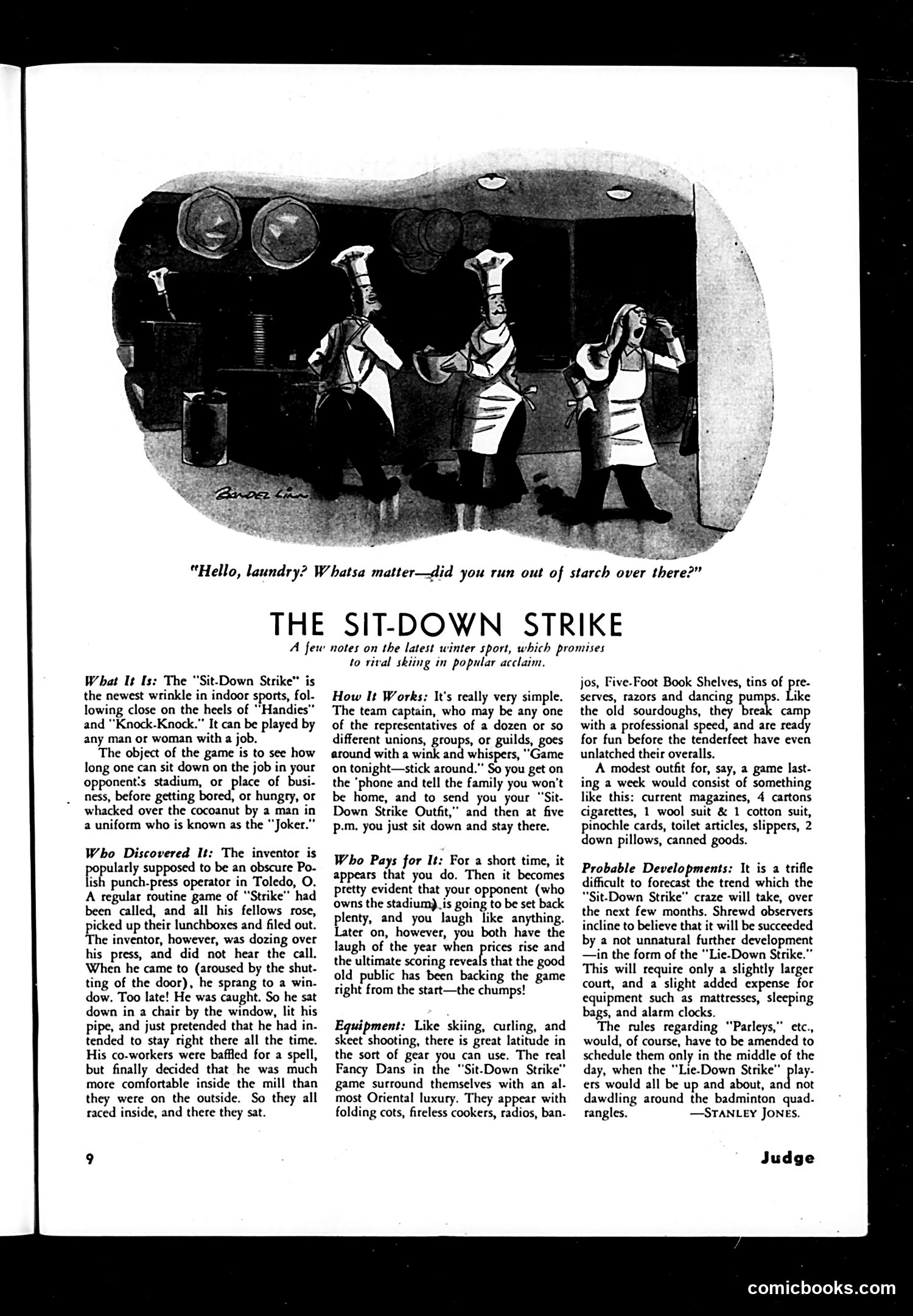
"The Sit-Down Strike" Satire This Judge magazine article mocks the sit-down strike movement—a real labor tactic where workers occupied factories and refused to leave, paralyzing production without crossing picket lines. The 1930s sit-downs were major labor actions against companies like General Motors. The cartoon depicts strikers inside a laundry, with the opening joke showing management calling to ask about starch supplies—implying the strikers are comfortable enough to stay indefinitely. The satire works by treating the strike as a frivolous "winter sport" with equipment lists (magazines, cards, pillows) and inventing absurd rules and scoring systems. This deliberately trivializes what workers viewed as serious economic protest. The article's final jab—predicting a coming "Lie-Down Strike"—suggests strikers are becoming lazier. The piece ridicules both strikers' comfort and the public as "chumps" who ultimately pay higher prices. Judge's satire sided with business interests against organized labor activism.
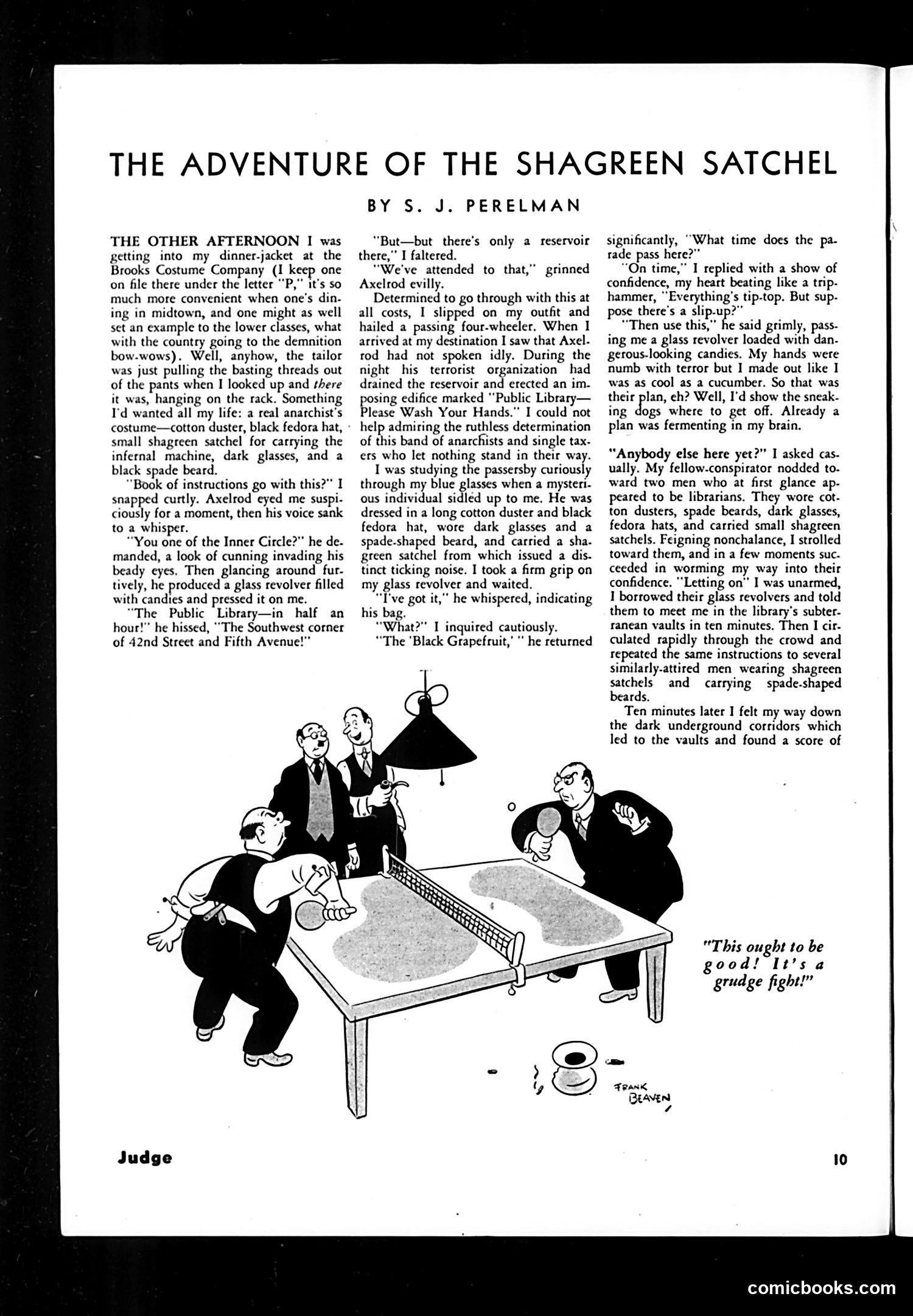
"The Adventure of the Shagreen Satchel" - Satire Explanation This is a humorous short story by S.J. Perelman satirizing early 20th-century American anxiety about anarchists and "radical" threats. The narrator, a wealthy Upper East Side dandy, stumbles into what appears to be an anarchist plot after renting a costume from a tailor. The satire mocks several things: (1) the era's exaggerated fear of anarchists with bombs hidden in satchels; (2) the absurdity of anarchists as incompetent conspirators (the "Black Grapefruit" plot, glass candy revolvers); and (3) upper-class obliviousness and casual entanglement in danger they barely understand. The cartoon shows men playing ping-pong while dressed as anarchists, further deflating any genuine threat. The joke relies on readers recognizing contemporary anxieties about radical terrorism while finding the actual "conspirators" ridiculous and the narrator's participation farcical.
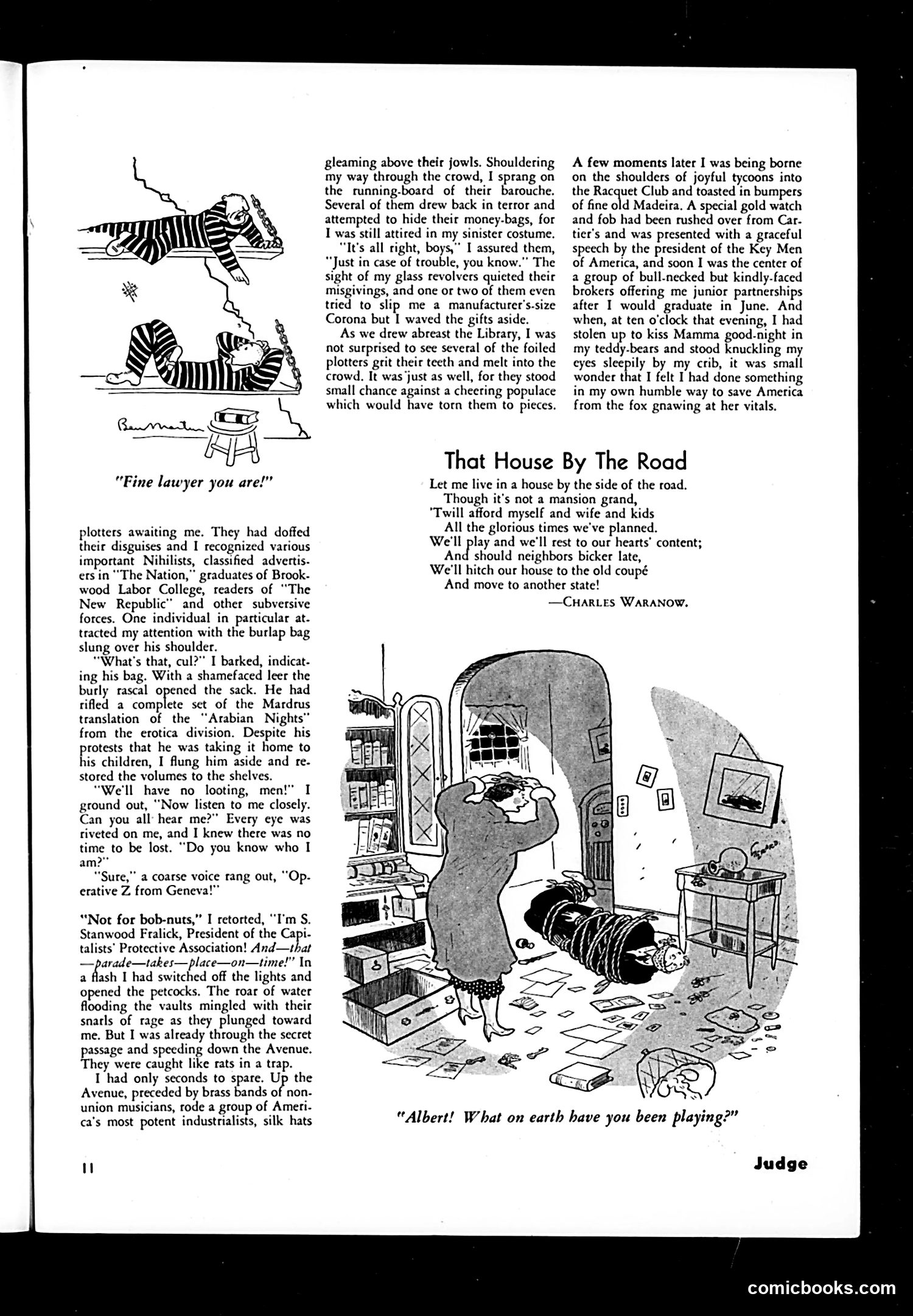
Judge Magazine Satire Analysis This page satirizes early 20th-century anti-communist hysteria and capitalist anxieties. The main story depicts a narrator who poses as a radical to infiltrate "Nihilists" and subversives (referencing actual contemporary fears of revolutionary groups). The targets of ridicule include readers of *The Nation* and *The New Republic* (progressive publications), Brookwood Labor College graduates, and vaguely defined radicals—typical of Red Scare-era paranoia. The humor lies in the narrator's absurdly theatrical heroism: he's actually a capitalist protecting industrialists, equipped with ridiculous "glass revolvers." Judge mocks both the exaggerated threat posed by radicals and the wealthy's paranoid overreaction to perceived danger. The secondary poem "That House By The Road" offers lighthearted social commentary about American mobility and domestic life. The cartoon illustration shows someone's chaotic hobby/game, with the caption "Albert! What on earth have you been playing?"—context unclear from visible text.
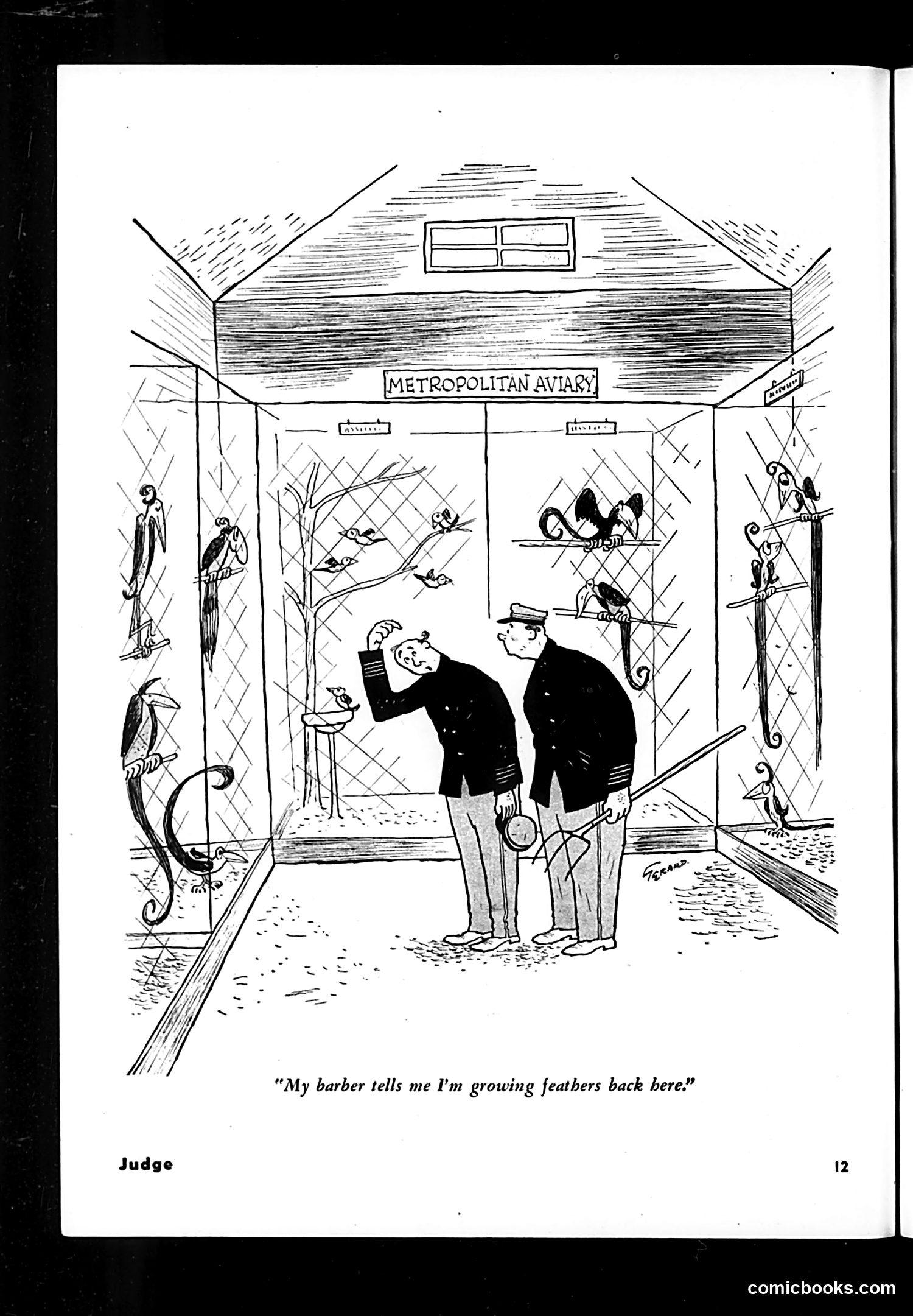
Metropolitan Aviary Cartoon Analysis This single-panel cartoon from *Judge* magazine shows two men visiting the "Metropolitan Aviary"—a zoo or bird exhibition. The humor derives from a literal misinterpretation: one man reports his barber claims he's "growing feathers back here," meaning he's going bald at the back of his head. His companion appears to be taking this statement seriously as they stand among caged birds. The joke plays on the double meaning of "growing feathers"—the barber's euphemistic way of describing hair loss versus the literal existence of feathered birds in the aviary. It's straightforward observational humor about male baldness and awkward social situations, requiring no specific historical or political knowledge to understand.
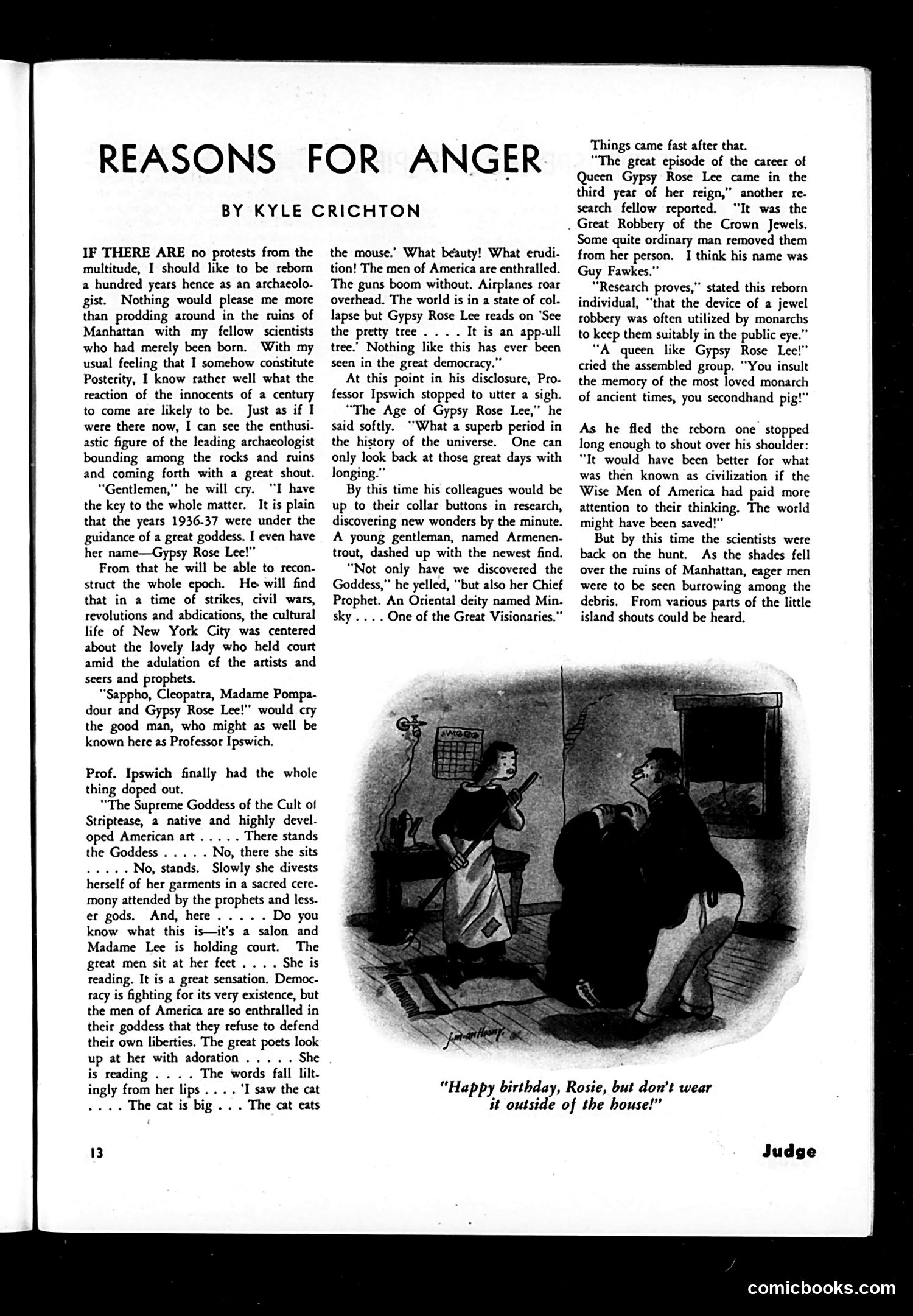
"Reasons for Anger" by Kyle Crichton This satirical piece mocks 1930s American society's obsession with Gypsy Rose Lee, a famous stripper, during a period of genuine crisis. The author imagines a future archaeologist who will conclude that 1936-37 was "The Age of Gypsy Rose Lee"—a golden era when Americans worshipped her as a goddess while their nation faced strikes, civil wars, and economic collapse. The satire's bite: while democracy fights for survival and "the guns boom" overhead, American men remain "enthralled" by a performer reading banal lines ("I saw the cat...The cat eats the mouse"). The accompanying cartoon reinforces this by depicting the stark contrast between frivolous entertainment and serious real-world crisis. Crichton argues Americans have inverted priorities—celebrities distract from defending actual liberties. The future scholar's reverent tone about Lee and her "prophet" (Minsky, likely a theater owner) underscores how absurdly misplaced this cultural devotion is.
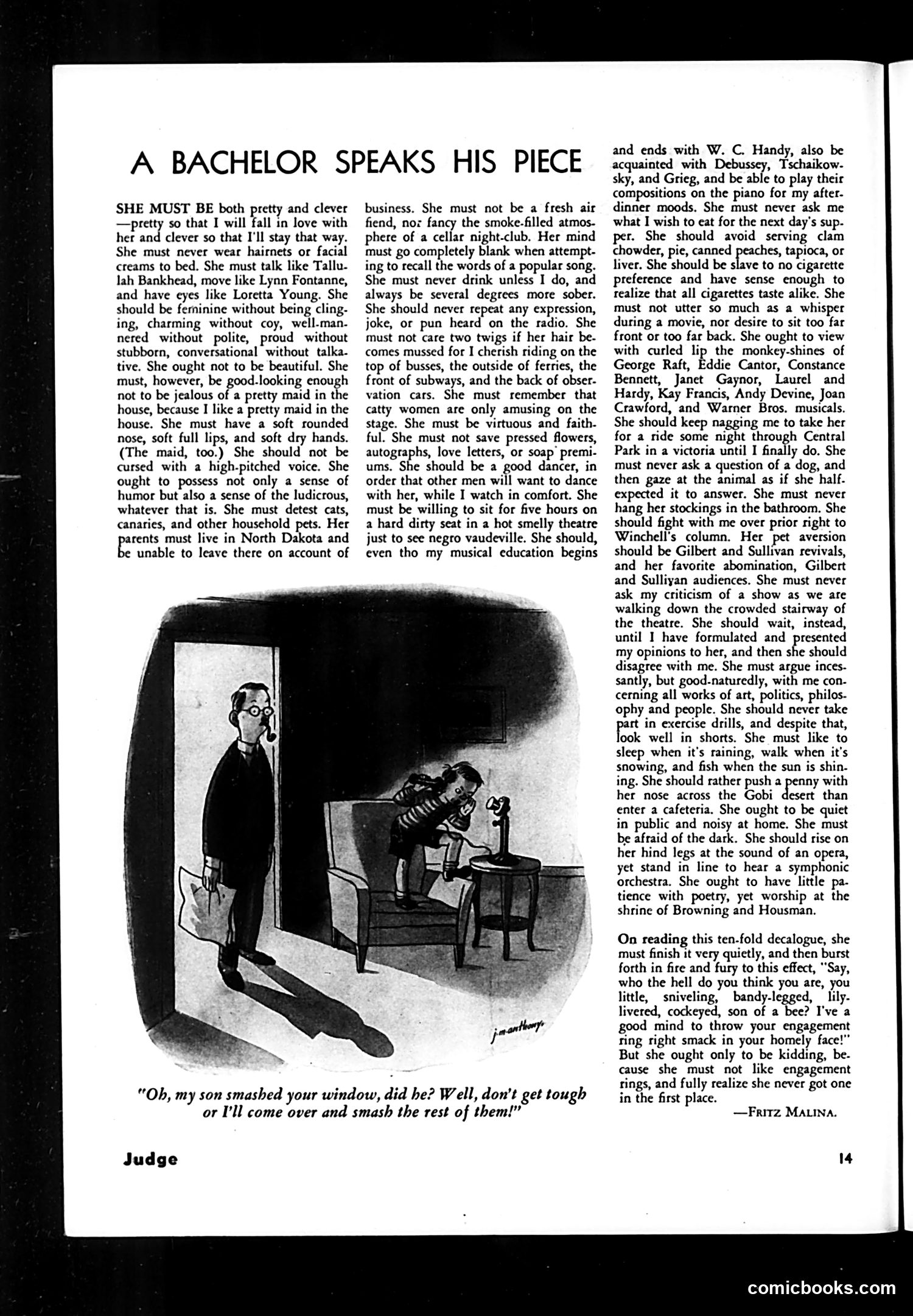
"A Bachelor Speaks His Piece" This satirical piece mocks male romantic expectations through exaggerated, contradictory demands. A bachelor lists impossible requirements for an ideal wife: she must be pretty but not too beautiful, clever but musically ignorant except when entertaining him, virtuous yet willing to watch him flirt with other women, fashionable yet unconcerned about her appearance, independent yet completely deferential to his opinions. The humor relies on the absurdity of wanting a woman who is simultaneously confident and submissive, modern and traditional. References to actresses (Tallulah Bankhead, Loretta Young) and entertainers (George Raft, Eddie Cantor) ground the piece in 1920s-30s popular culture. The accompanying cartoon shows a man threatening violence over a broken window—illustrating how such unreasonable men might react when reality doesn't match fantasy. The satire critiques male entitlement and the impossible standards men impose on women during this era.
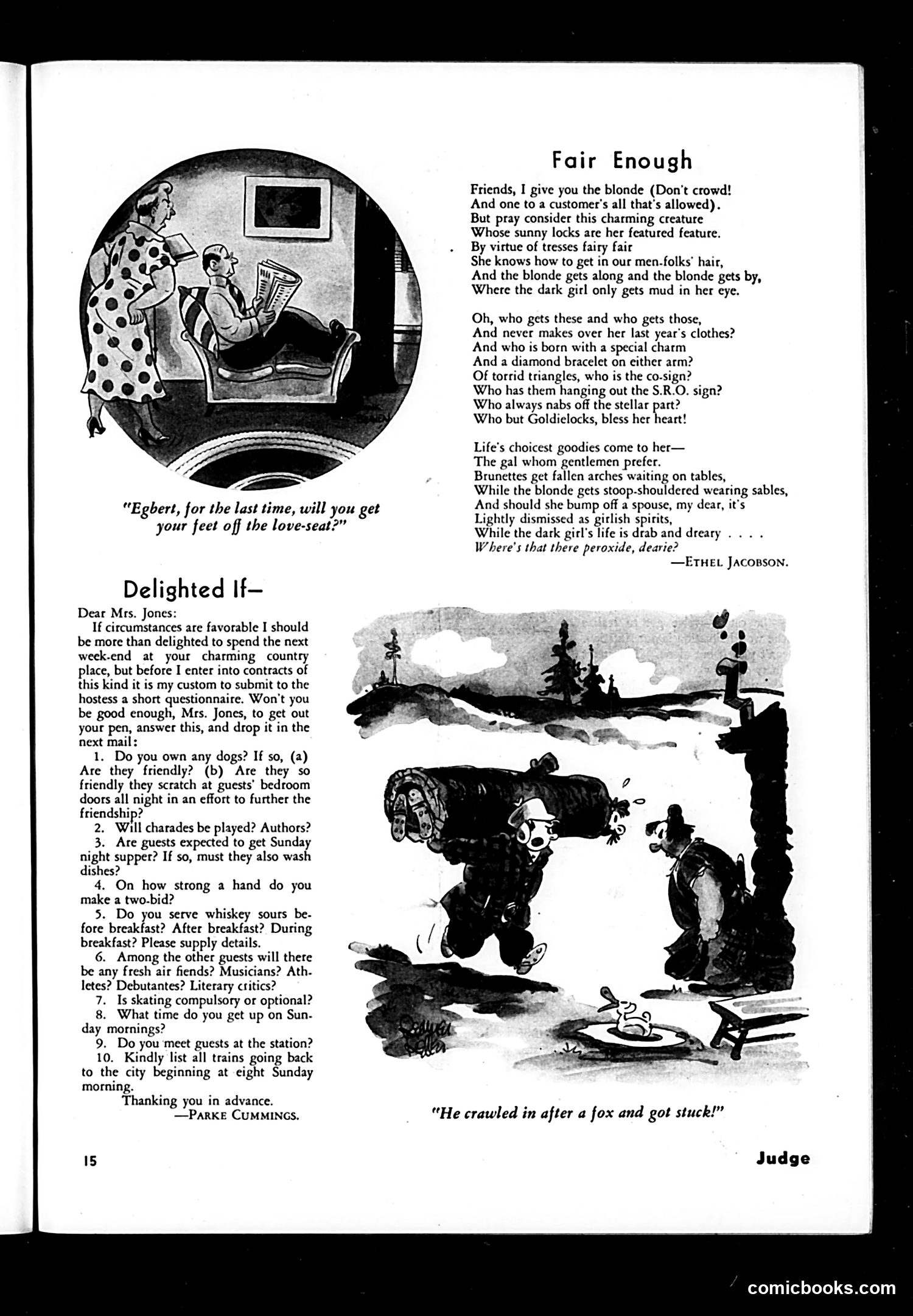
"Fair Enough" and "Delighted If—" from Judge "Fair Enough" (by Ethel Jacobson) is a satirical poem mocking society's preferential treatment of blonde women. It catalogs how blondes effortlessly obtain wealth, romance, and attention—diamond bracelets, starring roles, gentleman suitors—while dark-haired women struggle with mundane hardship ("mud in her eye," "fallen arches"). The accompanying cartoon shows a woman and child observing a blonde woman, reinforcing the poem's commentary on blonde women as society's favored class. The satire critiques both male superficiality and unfair beauty standards. "Delighted If—" (by Parker Cummings) humorously lists intrusive questions a prospective houseguest demands before accepting a weekend invitation. The humor lies in the guest's absurd presumption—asking about aggressive dogs, mandatory activities, meal arrangements, and escape routes—treating the hostess's invitation as something requiring extensive investigation before commitment. It satirizes either overly fastidious guests or satirizes weekend-visit culture itself. The lower cartoon, captioned "He crawled in after a fox and got stuck!" appears unrelated, depicting hunting mishap humor.
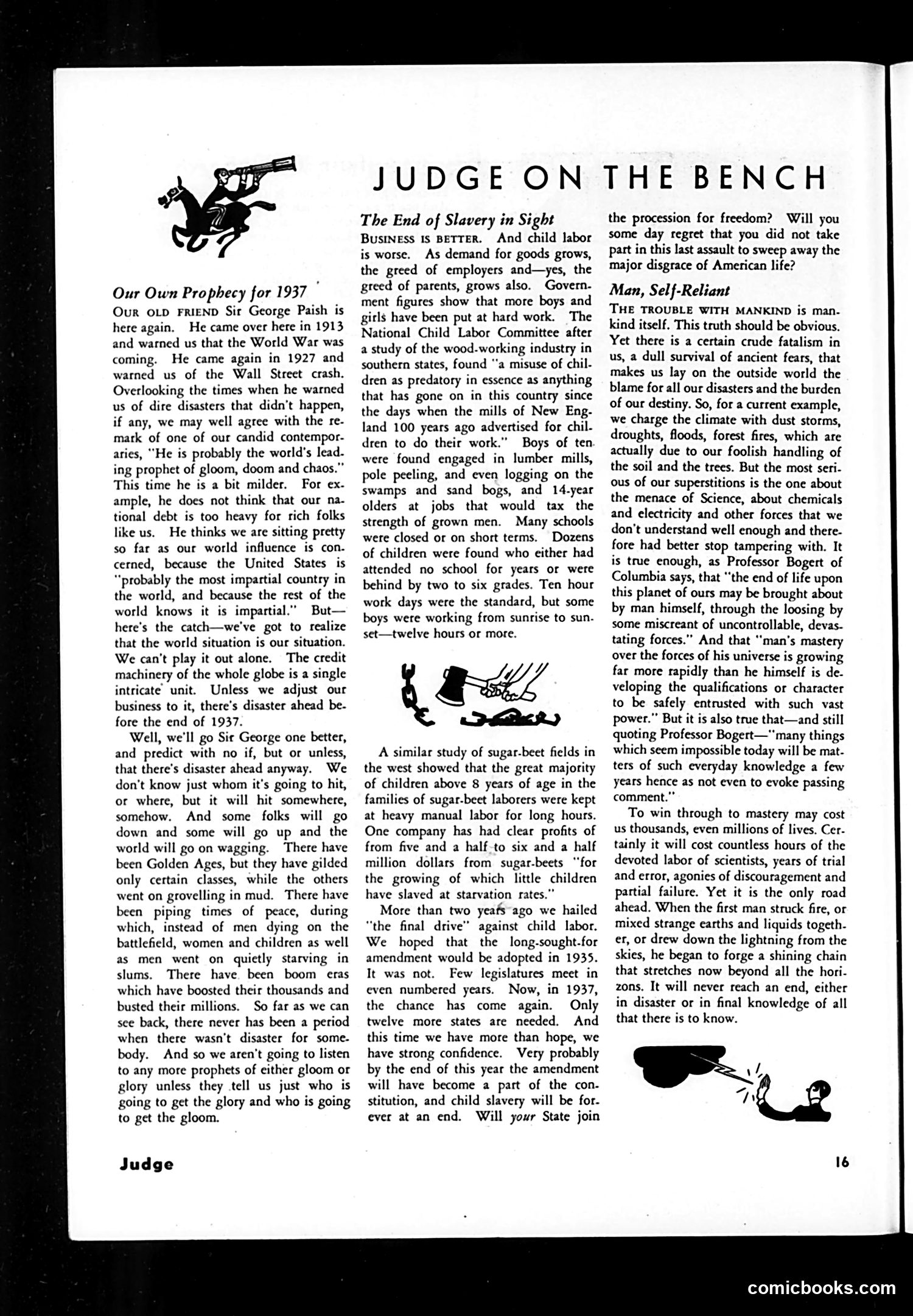
Analysis for Modern Readers This 1937 *Judge* magazine page contains two satirical columns discussing economic and social issues: "Our Own Prophecy for 1937" mocks Sir George Paish, a recurring "prophet of gloom" who predicted the 1913 WWI and 1927 Wall Street crash. The author sardonically agrees disaster is coming—but refuses to predict *who* will suffer, noting that throughout history some prosper while others starve, regardless of economic conditions. "The End of Slavery in Sight" criticizes child labor in Depression-era America. The *Judge* editors celebrate recent efforts to ban child labor (referencing a constitutional amendment), citing shocking conditions: 10-year-olds in lumber mills, 14-year-olds working 12-hour days, children earning poverty wages for sugar companies. They argue that despite economic "improvement," employers' greed has actually *worsened* child exploitation. The small illustrations show figures in distress, emphasizing the human cost discussed.
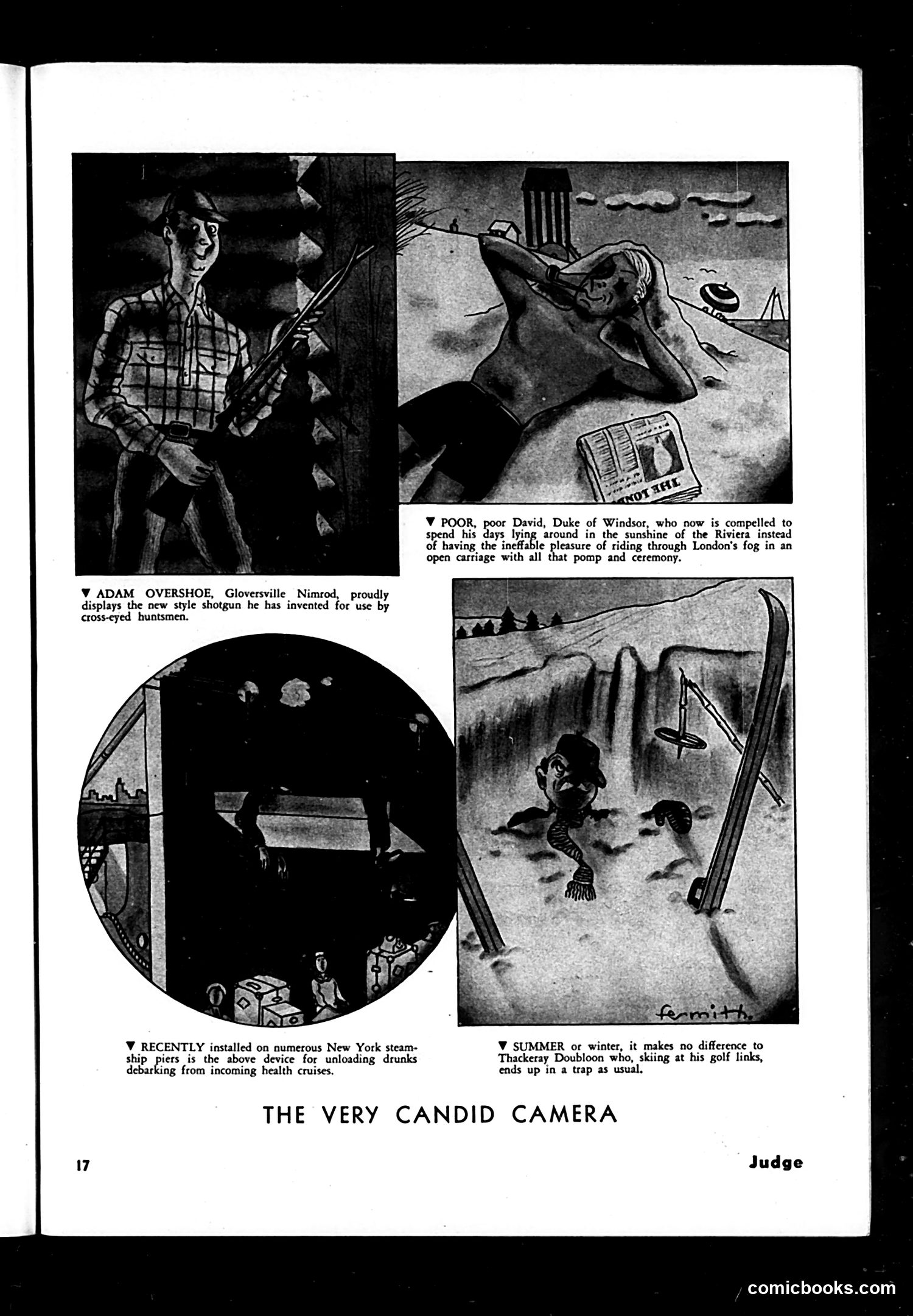
"The Very Candid Camera" - Judge Magazine Satire This page presents four separate satirical vignettes mocking contemporary figures and situations: 1. Duke of Windsor: Mocks the abdicated British King Edward VIII, exiled to the French Riviera after choosing love over duty—a scandal of the 1930s. The joke ridicules his loss of royal privilege. 2. Adam Overshoe's Shotgun: Satirizes an inventor from Gloversville who designed a shotgun supposedly for cross-eyed hunters—absurdist humor about a ridiculous invention. 3. Ship Pier Device: Jokes about a mechanical apparatus on New York piers for handling drunk passengers disembarking from cruise ships, reflecting concerns about alcohol and maritime travel. 4. Thackeray Doubloon: Mocks a hapless golfer who inevitably ends up in traps regardless of season or activity. The cartoons use exaggeration and irony to satirize vanity, poor engineering, public drunkenness, and incompetence—typical Judge magazine fare combining social commentary with absurdist humor.
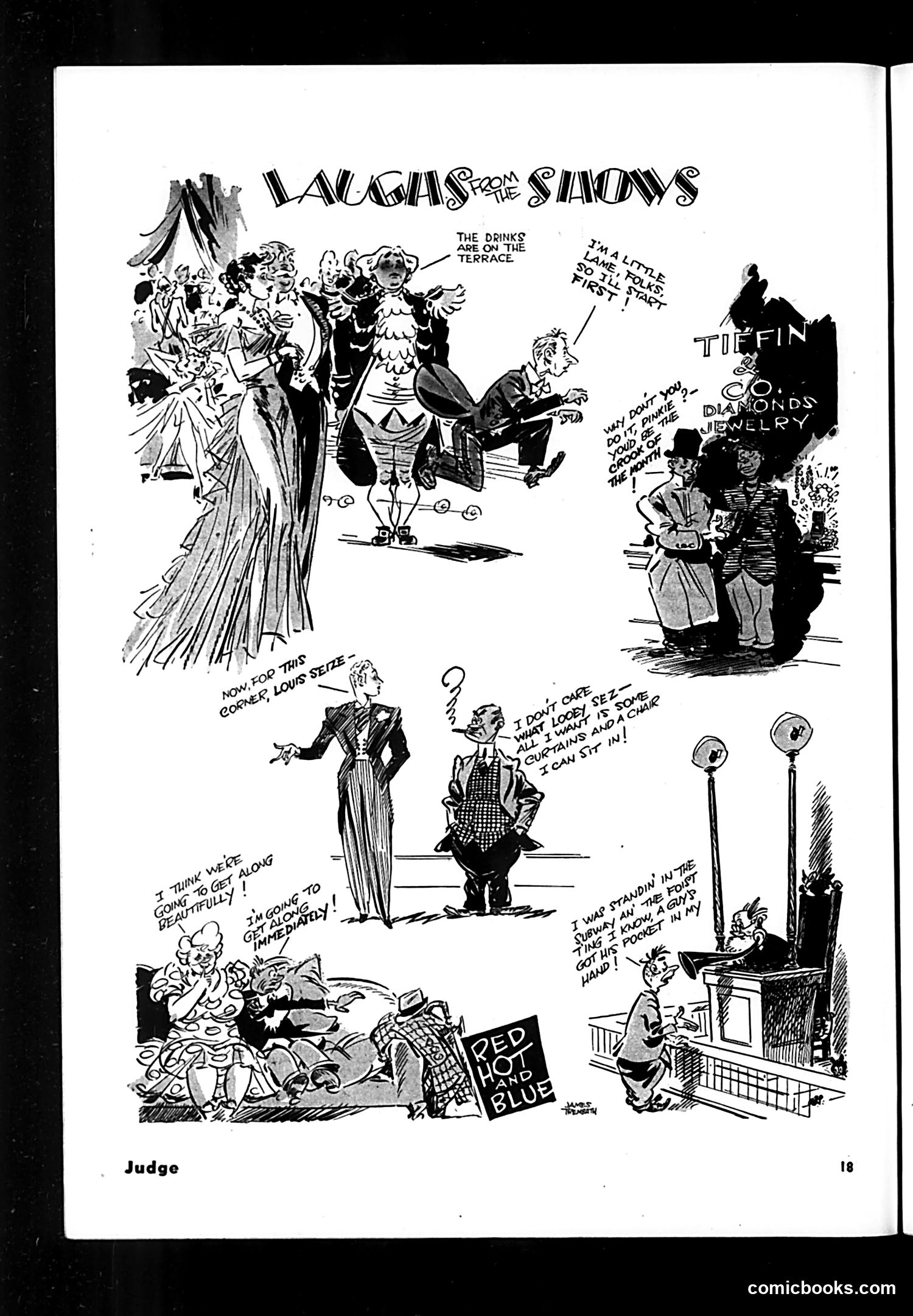
"Laughs from the Shadows" - Judge Magazine Cartoon This satirical cartoon mocks wealthy socialites and their pretentious lifestyle during what appears to be the Jazz Age or 1920s-30s era. The top panel shows an elegant party scene with the caption about "drinks on the terrace" and references to "little Jane" losing her "first" — likely a satirical dig at young society women's behavior and morality. Other panels reference luxury goods (Tiffin diamonds, jewelry) and social anxieties. One figure discusses not knowing "what Lousy Seize" means — likely mocking the affectation of using French phrases among the wealthy. The "Red Hot and Blue" reference appears to be theatrical. The overall thrust satirizes upper-class pretension, loose morality, confused sophistication, and materialism—common Judge magazine targets of the era.
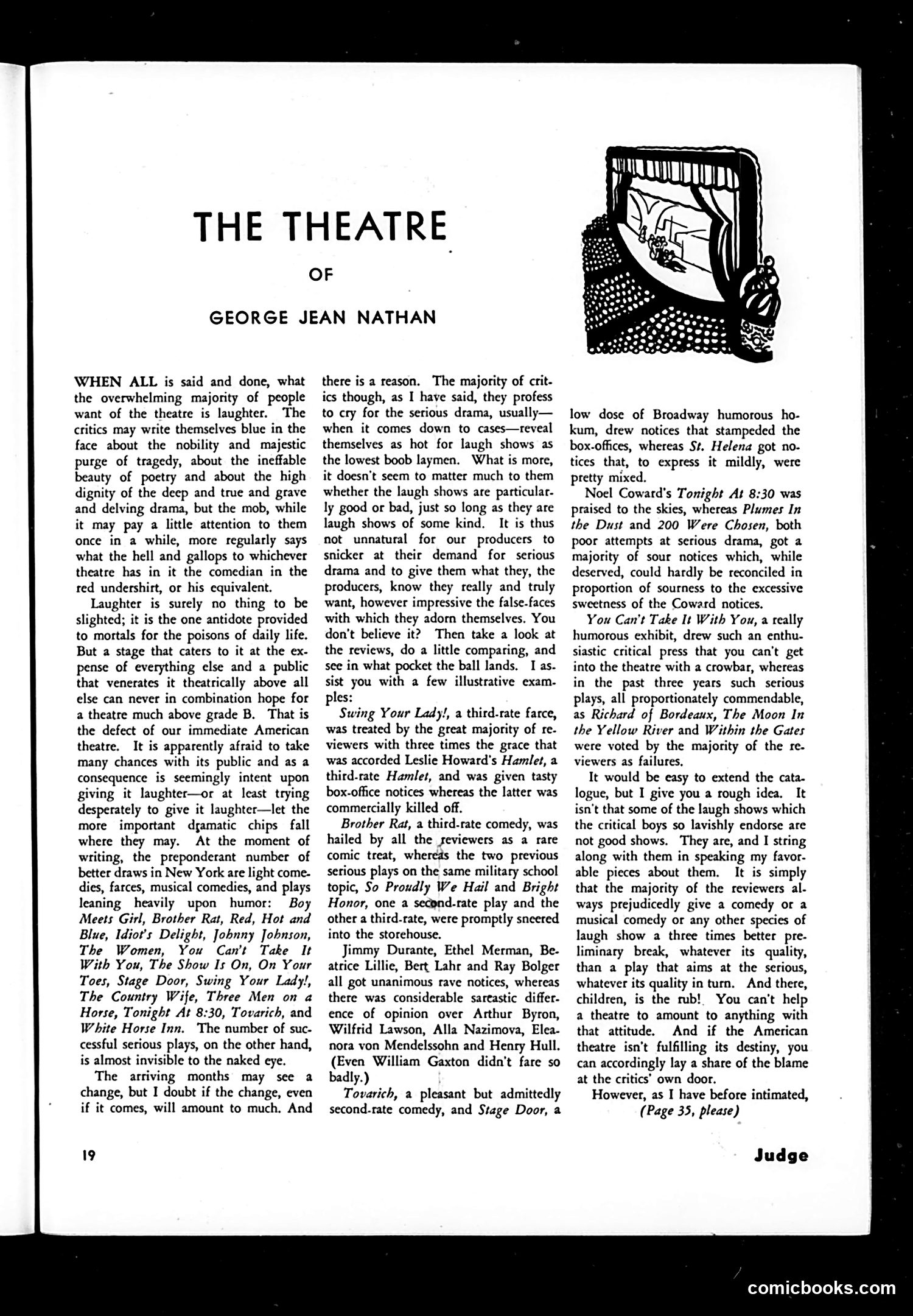
"The Theatre of George Jean Nathan" This is the opening of a critical essay by drama critic George Jean Nathan, not a cartoon. The small illustration shows a figure peering through a curtained window—a visual metaphor for theatrical observation. Nathan argues that American theatre has become debased by critics' and producers' preference for comedies and farces over serious drama, despite critics publicly championing serious work. He documents his thesis with specific 1930s Broadway examples: *Swing Your Lady!* (third-rate farce) received better reviews than Leslie Howard's *Hamlet*, while *Brother Rat* (third-rate comedy) was praised more than serious military plays like *So Proudly We Hail*. Nathan contends that producers cynically cater to audiences' appetite for laughter, and critics hypocritically enable this by lavishing praise on mediocre comedies while dismissing serious plays. The underlying critique: American theatre prioritizes entertainment over artistic merit, revealing critics' true values despite their stated beliefs.
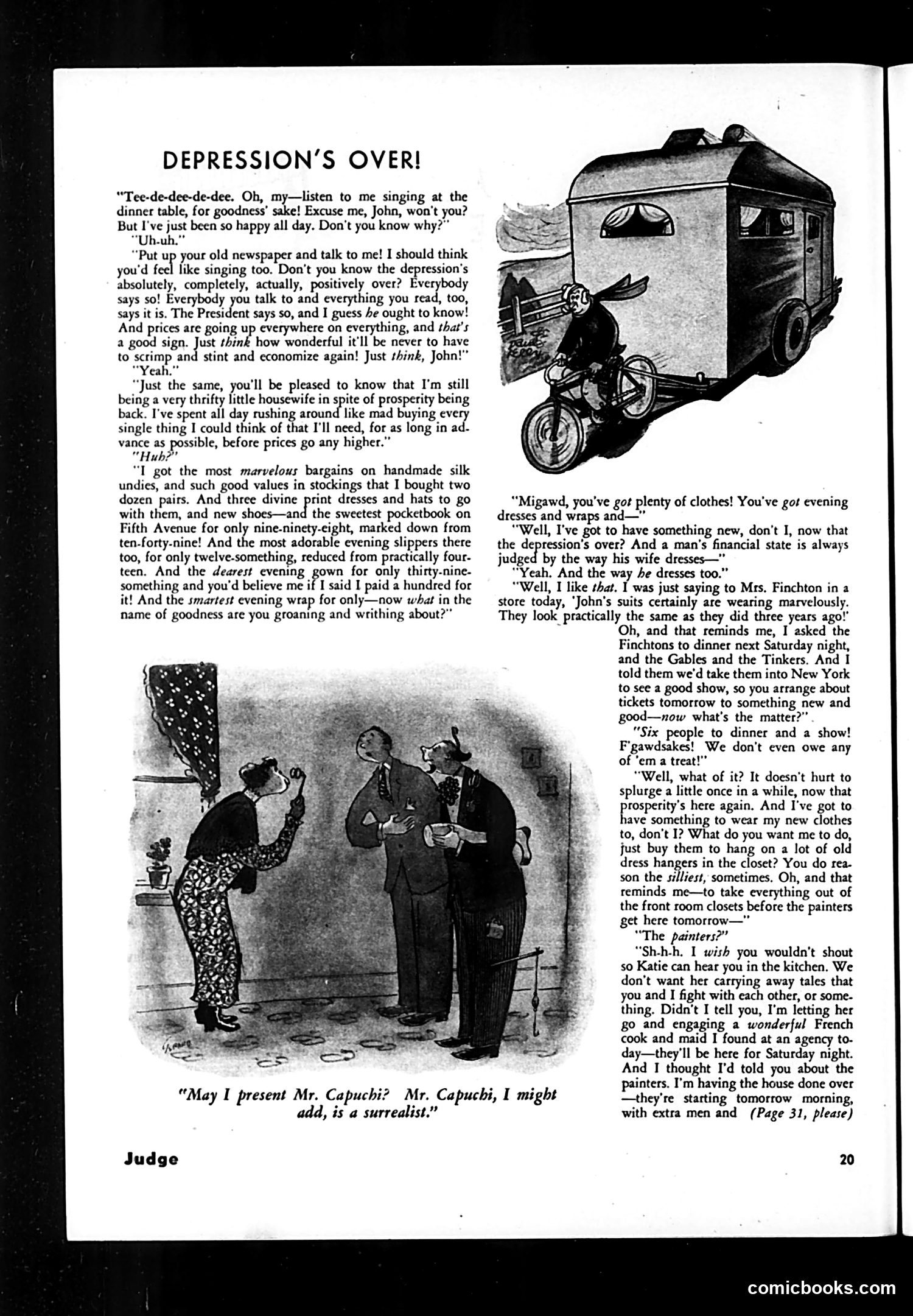
Analysis: "Depression's Over!" This satirical piece mocks the premature optimism following the Great Depression's worst years. A wife celebrates that "the depression's absolutely, completely, actually, positively over" because "the President says so" and prices are rising—she interprets inflation as a sign of recovery. The satire cuts two ways: First, it ridicules blind faith in official proclamations about economic recovery. Second, it satirizes the wife's contradictory behavior—while claiming thrift, she frantically purchases clothes, shoes, and luxuries "before prices go any higher," then immediately plans expensive entertaining and home renovations she cannot afford. Her husband's groaning responses underscore the financial absurdity: they don't even owe their dinner guests entertainment, yet she insists on theater tickets and a French cook. The cartoon beneath (showing someone presenting "Mr. Capuchi, a surrealist") appears disconnected but may mock artistic affectation during economic uncertainty. The piece satirizes both governmental economic messaging and consumer behavior during uncertain recovery periods.
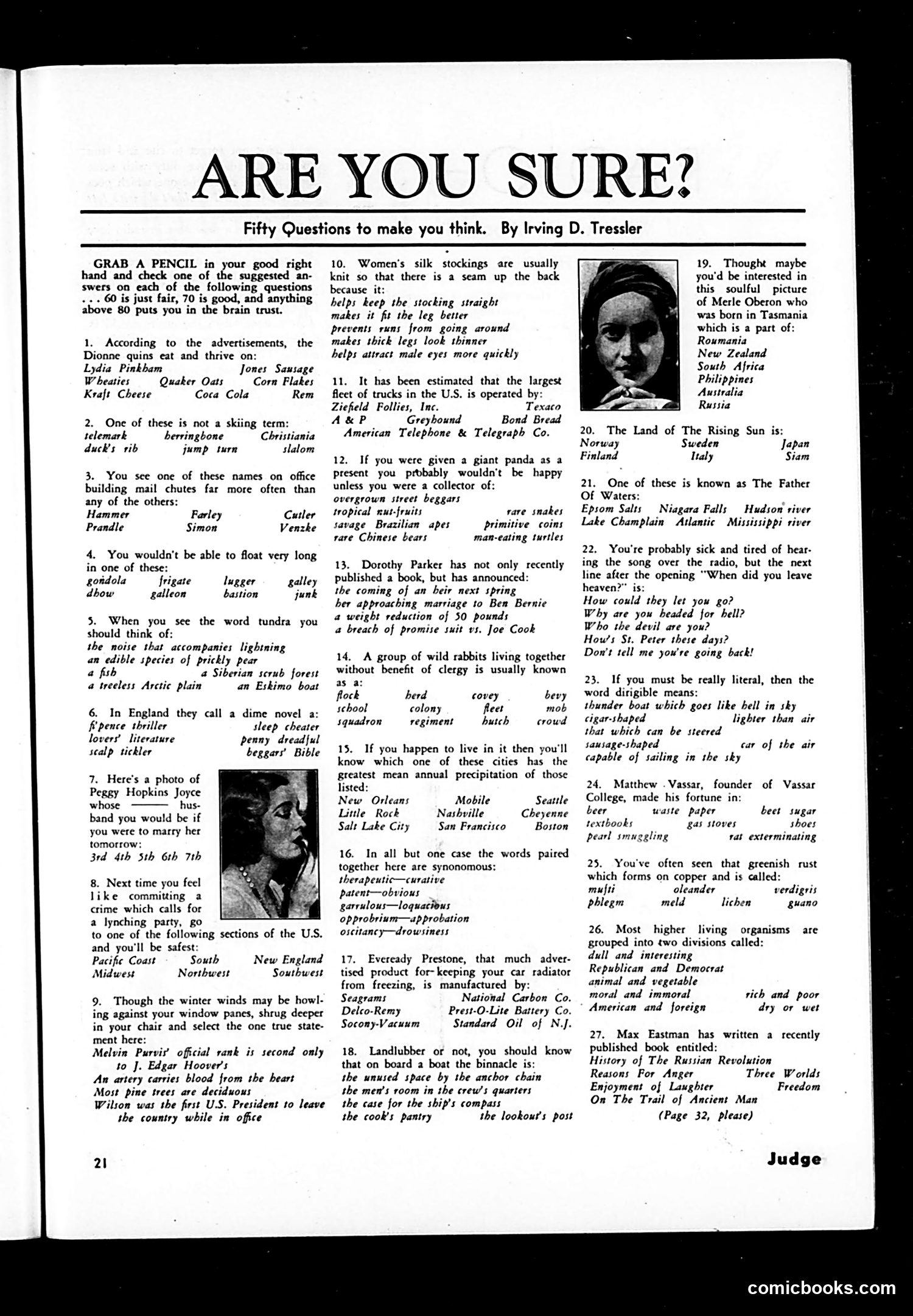
"Are You Sure?" - A 1930s Trivia Quiz Page This page presents a satirical trivia quiz by Irving D. Tressler designed to test readers' knowledge on contemporary 1930s topics. The format mocks the era's obsession with "brain trust" credentials—scoring above 80 supposedly placed you in intellectual elite circles. The questions reference current celebrities (Peggy Hopkins Joyce, Dorothy Parker), popular products (Dionne quintuplets endorsements, Eveready antifreeze), and social issues. Question 8 addresses lynching as a real regional concern in America, while others cover consumer goods, geography, and slang. Two photographs accompany the text: one shows what appears to be a glamorous woman (likely the referenced Joyce), another shows a man's face. The satire targets both the quiz-craze fad sweeping 1930s America and the notion that trivial consumer knowledge equated to actual intelligence—a gentle critique of mass culture and advertising's growing influence on American life.
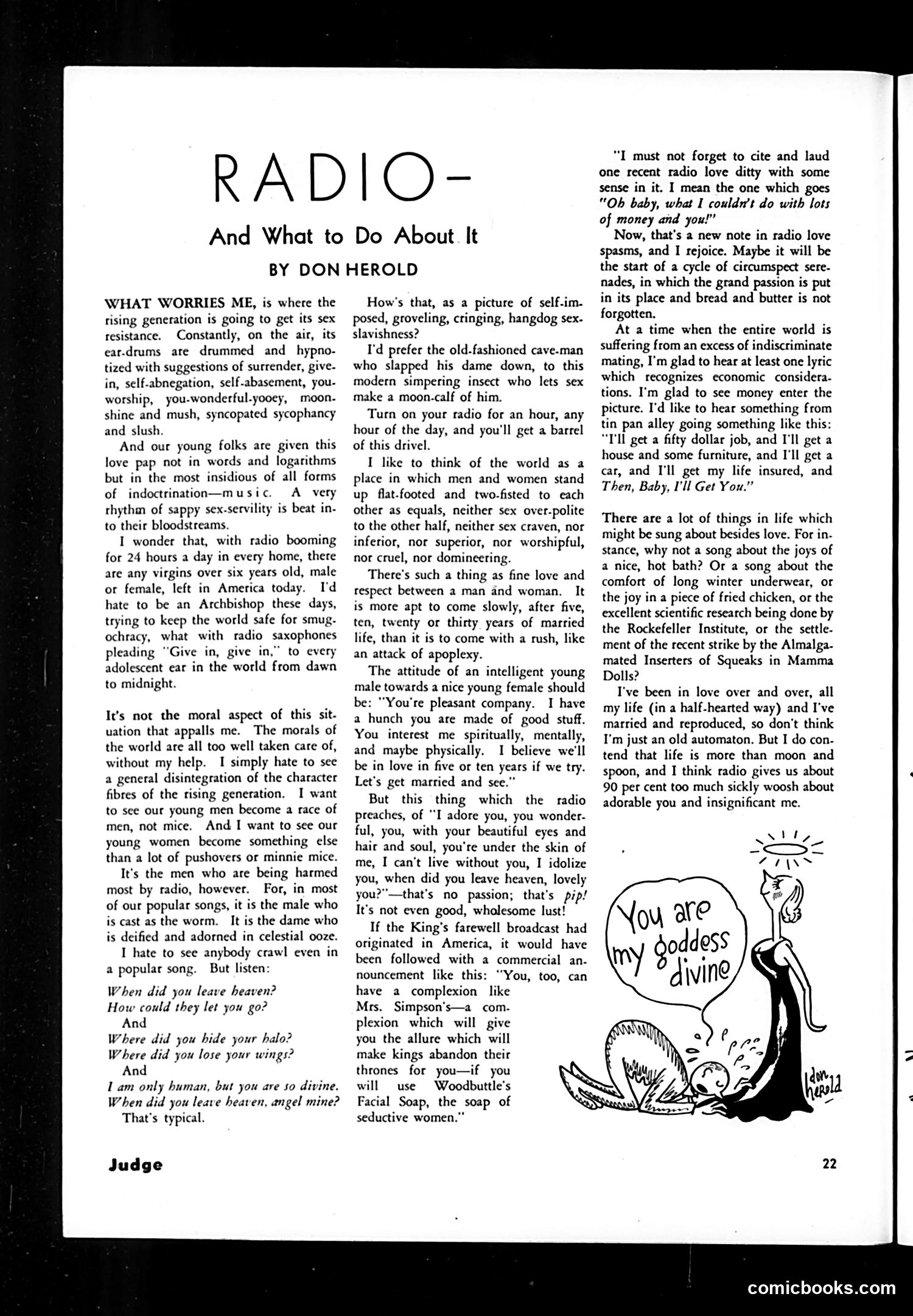
"Radio—And What to Do About It" by Don Herold This satirical article criticizes 1930s radio for promoting excessive romantic sentimentality that supposedly weakens young people's character. Herold argues that constant radio broadcasts of sappy love songs—with lyrics where men grovel before idealized women—undermine genuine masculine strength and realistic relationships. The accompanying cartoon shows a woman as a "goddess" being worshipped, visually reinforcing his complaint that radio casts females as celestial beings while degrading men into servile worshippers. Herold contrasts this modern "sycophancy" with old-fashioned gender relations, advocating instead for relationships based on mutual respect between equals that develop slowly over time. He sardonically references the King's abdication crisis (Edward VIII, 1936), joking that American radio would have commercialized even that scandal into a beauty product advertisement. The piece reflects period anxieties about mass media's cultural influence on youth.
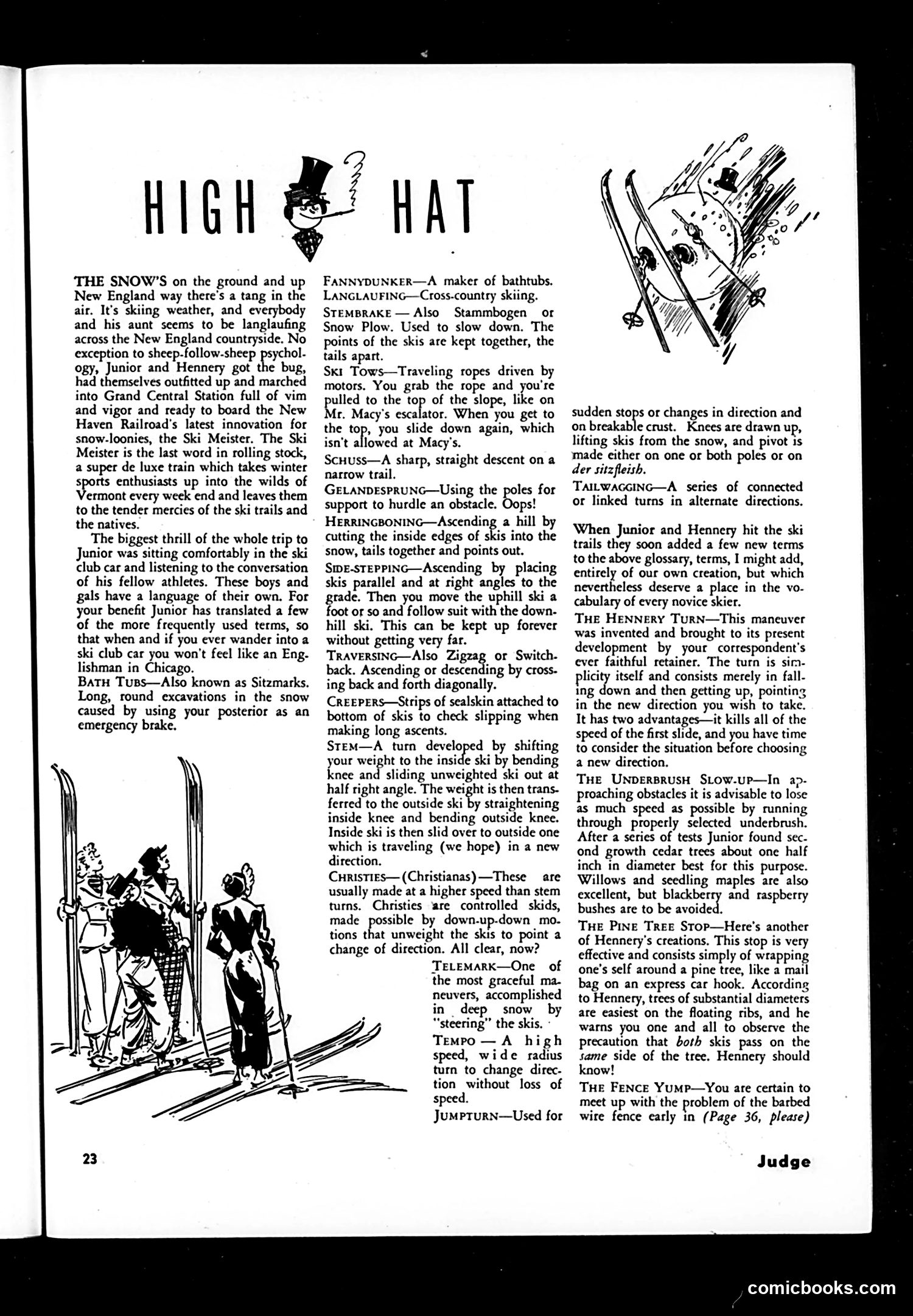
"High Hat" - A Skiing Glossary Joke This page from *Judge* is a humorous educational piece about 1930s skiing culture, not political satire. It mocks the pretentious jargon of New England ski enthusiasts through the eyes of two novices, "Junior" and "Hennery," who board a luxury train ("the Ski Meister") to hit the slopes. The satire targets the exclusivity and affected language of the ski-club set—terms like "langlaufing," "gelandesprung," and "christies" sound absurdly foreign to outsiders. The joke culminates with Junior and Hennery inventing their own crude terms (like "sitzmarks," from sitting down hard in snow), suggesting that beneath the pretense, skiing involves plenty of humbling falls. The cartoons show skiers in various mishaps, reinforcing that reality rarely matches the sophisticated image the sport cultivates.
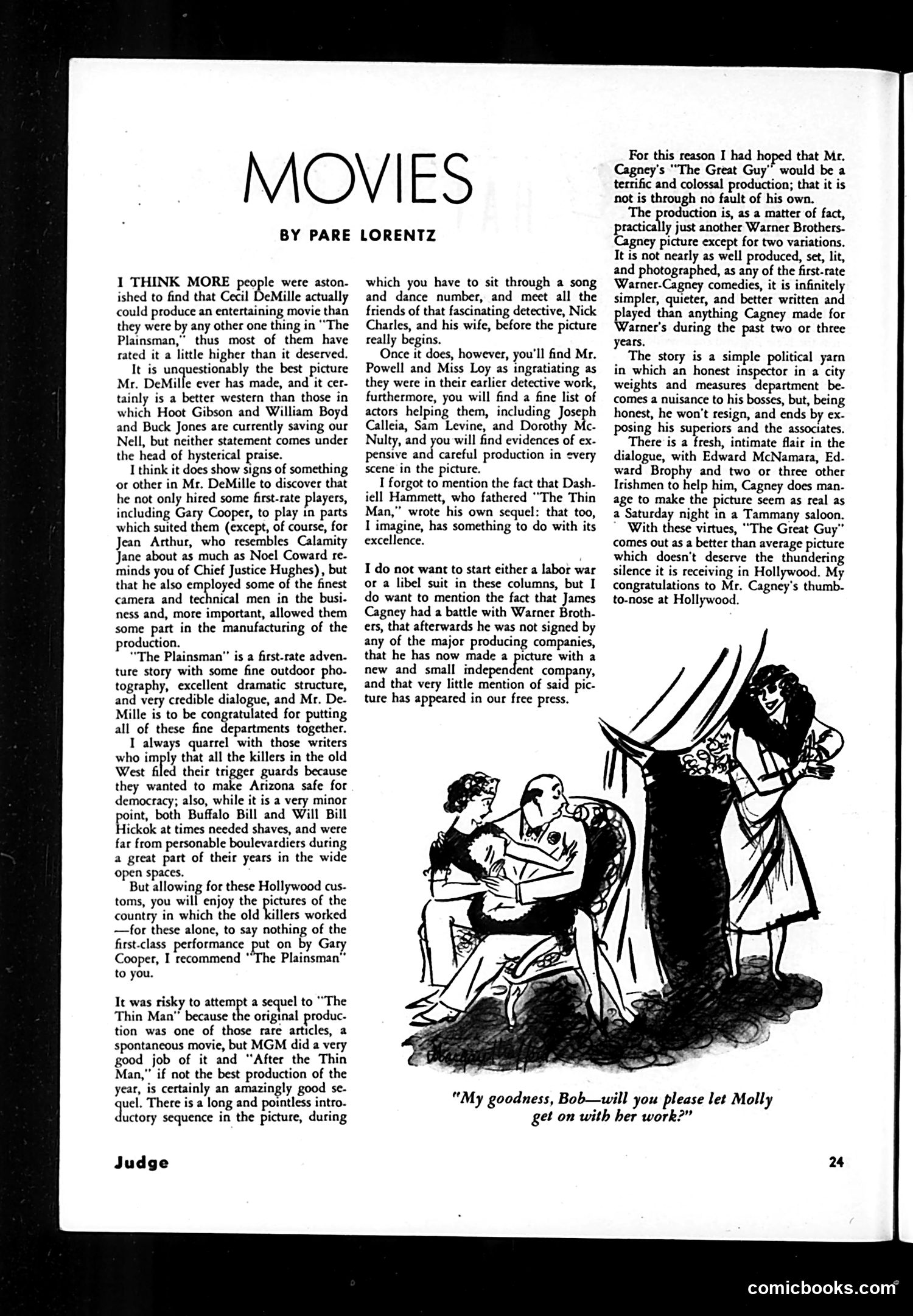
Judge Magazine Movie Review: Context for Modern Readers This is a film review column by Pare Lorentz critiquing three 1936 films: Cecil DeMille's *The Plainsman*, MGM's *After the Thin Man*, and James Cagney's *The Great Guy*. The review praises DeMille's western (starring Gary Cooper) as surprisingly competent, though the critic jabs at Jean Arthur's casting as unconvincing for the Calamity Jane role. He praises *After the Thin Man* as an excellent sequel with William Powell and Myrna Loy reprising their detective roles. Most notably, Lorentz makes a pointed editorial statement about Cagney's film, obliquely criticizing the major studios for blackballing Cagney after his contract dispute with Warner Brothers—he's now reduced to making pictures with small independent companies that receive minimal press coverage. This represents early Hollywood industry censorship through financial marginalization.
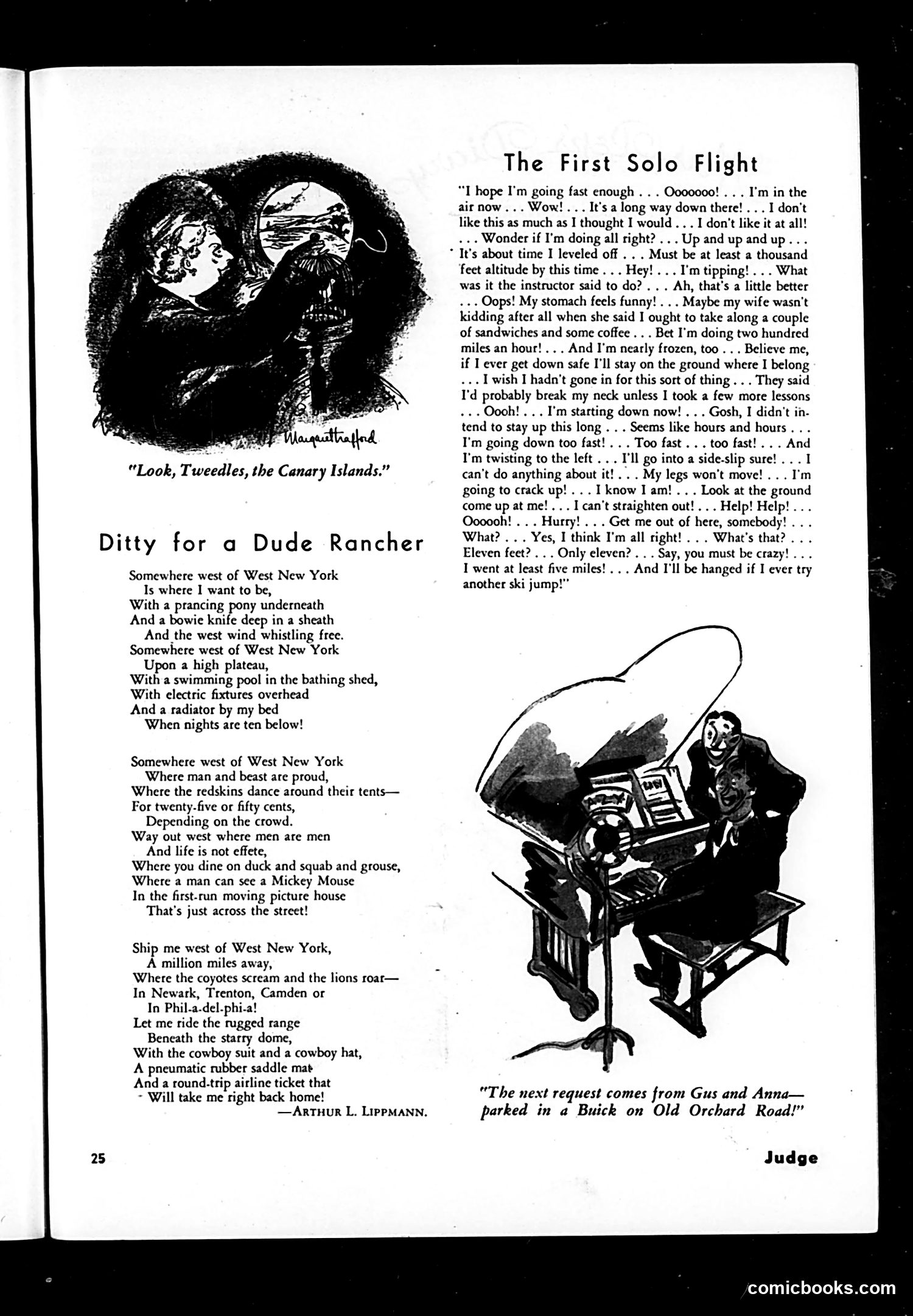
Analysis of Judge Magazine Page "The First Solo Flight" is a humorous monologue depicting a nervous first-time airplane pilot experiencing panic and disorientation during flight. The stream-of-consciousness narration captures his escalating anxiety—worrying about altitude, stomach trouble, loss of control, and impending crash—before the punchline reveals he's actually only eleven feet in the air on a ski slope, not flying at all. The joke satirizes overwrought anxiety and the gap between imagined and actual danger. "Ditty for a Dude Rancher" parodies the romanticized Western fantasy. The poem mockingly describes a wealthy urbanite's fantasy of rustic Western life, featuring artificial "authenticity"—prancing ponies, swimming pools, electric heating, and Mickey Mouse movies. The satirical conclusion reveals this "rugged range" exists in New Jersey cities (Newark, Trenton, Camden, Philadelphia), exposing the absurdity of manufactured Western experiences for wealthy Easterners seeking escape. Both pieces mock 1920s-30s American aspirations and anxieties through exaggerated character voices.
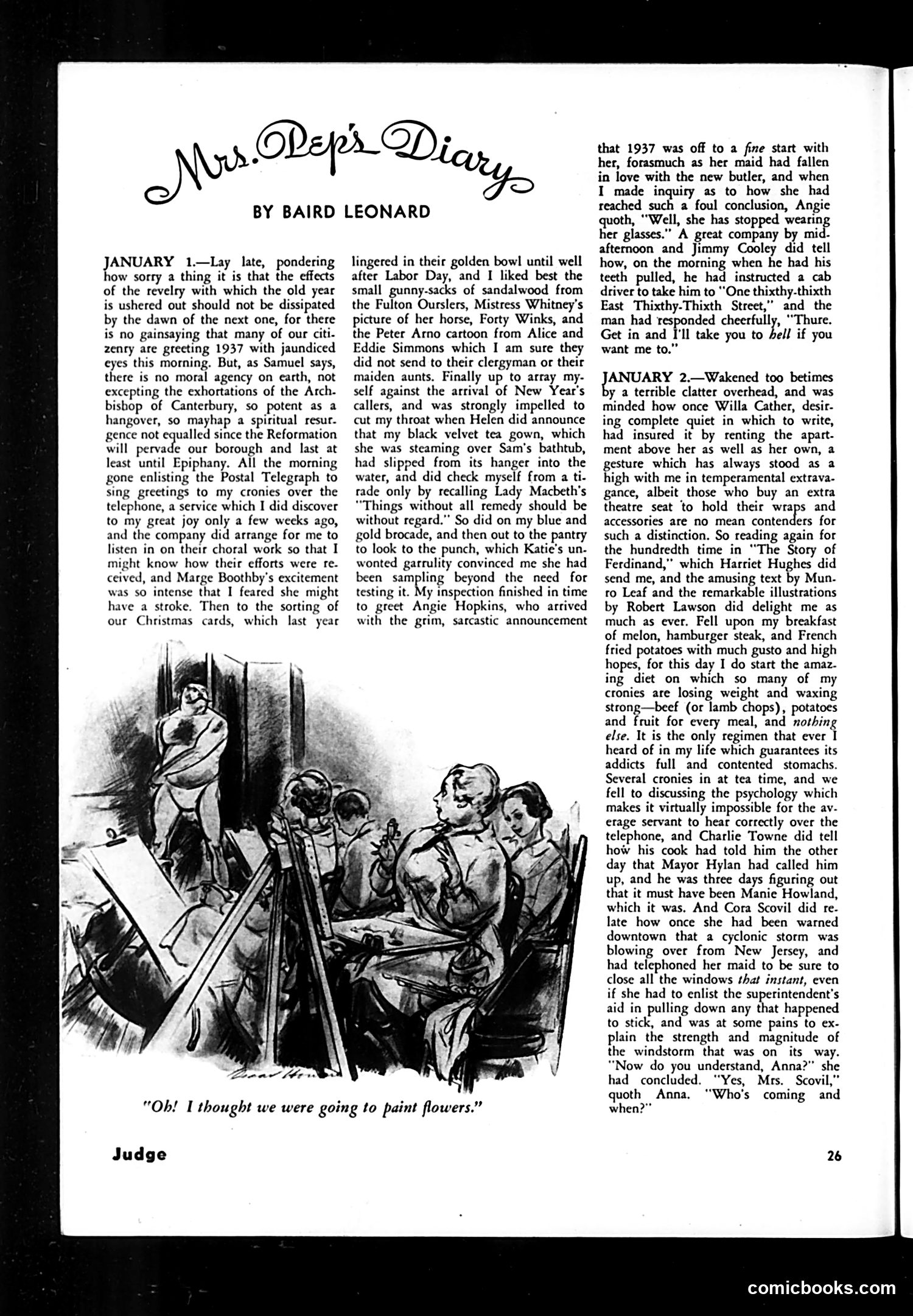
Mrs. Pep's Diary: January 1937 This is a humorous diary column by Baird Leonard in *Judge* magazine, presenting upper-middle-class social observations through the persona of "Mrs. Pep." The single cartoon illustrates a New Year's Day scene where guests gather, with someone exclaiming "Oh! I thought we were going to paint flowers"—apparently mistaking the social gathering's purpose, a joke about holiday confusion or miscommunication. The diary entries mock genteel society: January 1st covers post-holiday hangovers, sorting Christmas cards (some witty, some risqué), and receiving New Year's callers. A running joke involves servants' romantic entanglements and misadventures (a maid's glasses, a butler). January 2nd references Willa Cather's famous desire for privacy while writing, and praises *Ferdinand* (likely "The Story of Ferdinand," Munro Leaf's 1936 children's book), establishing the narrator as cultured but self-aware about her social pretensions. The satire targets 1930s upper-class affectation, servant dynamics, and domestic comedy without sharp political edge.
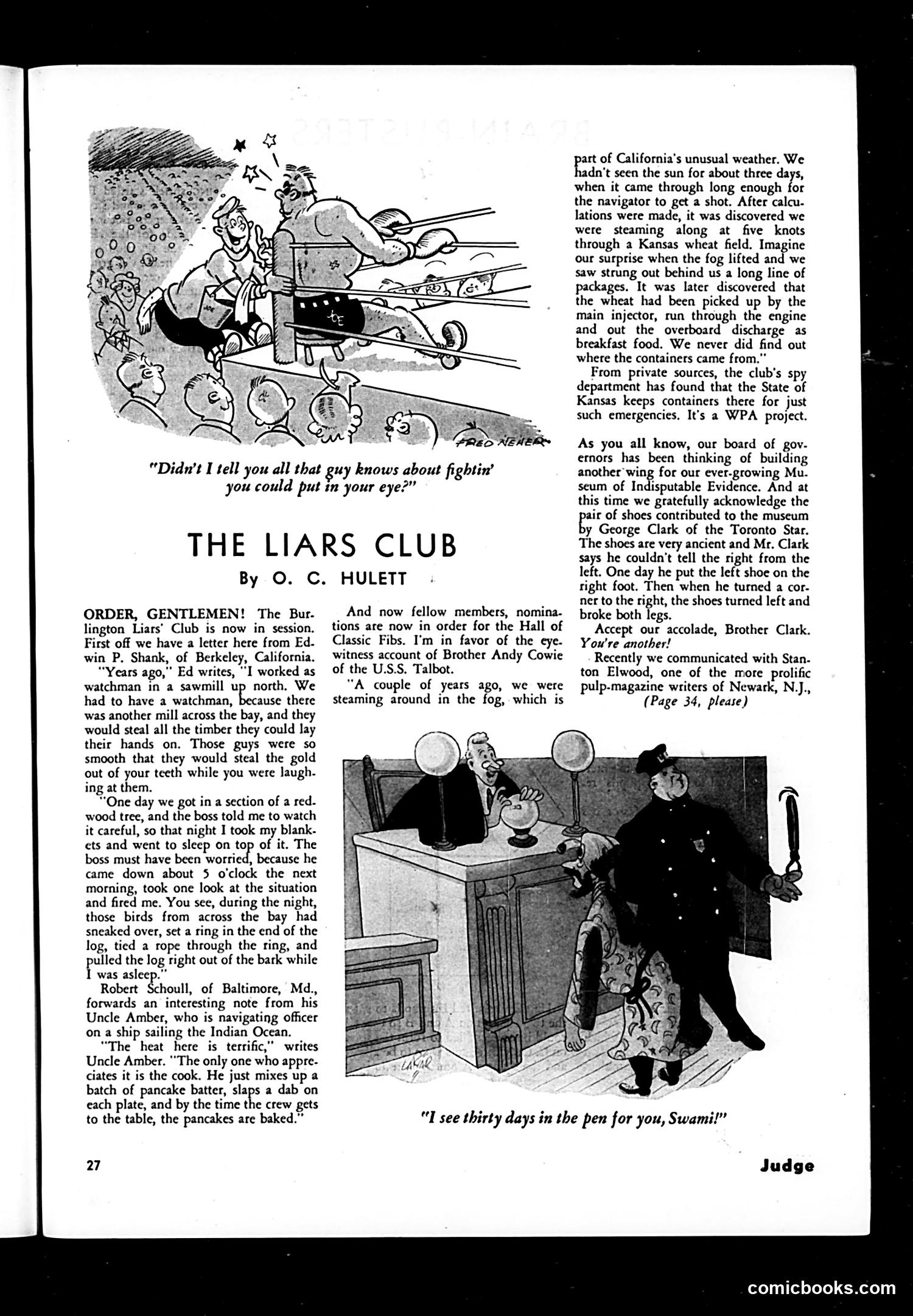
"The Liars Club" Explained This is a humorous piece satirizing tall tales and exaggeration. The "Liars Club" is a fictional gentlemen's society where members compete to tell the most absurdly implausible stories while maintaining a straight face. The jokes work through escalating impossibility: a log stolen while someone sleeps on it, pancakes baked by tropical heat on a plate, and a ship inadvertently plowing through a Kansas wheat field (impossible geographically) that somehow gets processed as breakfast food through the engine. The accompanying cartoon shows a judge sentencing someone called "Swami" to jail, likely mocking fortune-tellers or con artists—suggesting the liars' club members deserve punishment. The piece appears to reference WPA (Works Progress Administration) projects as a running joke, implying government inefficiency. The overall satire targets human gullibility and the American cultural tradition of exaggeration and "one-upmanship" in storytelling.
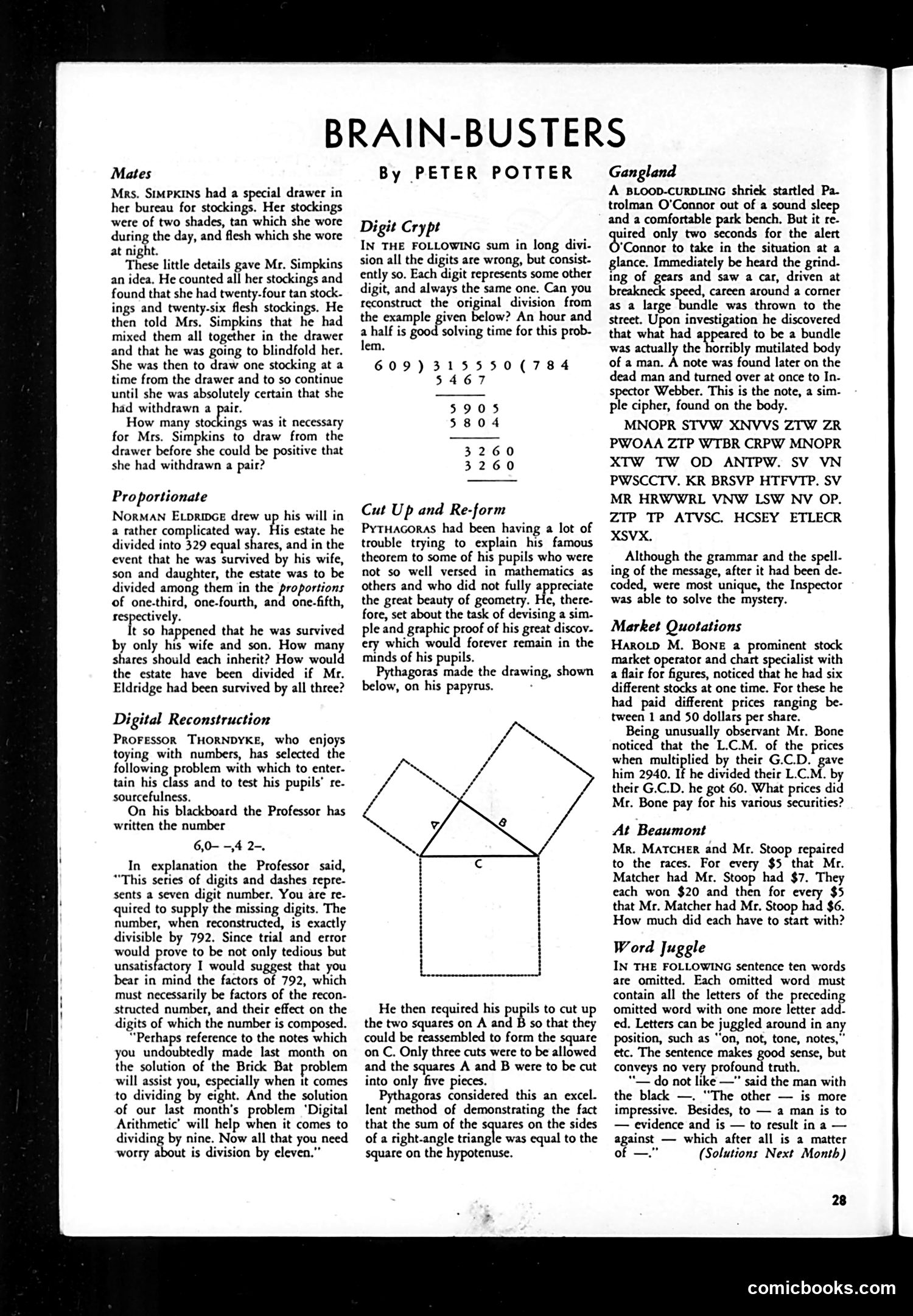
Brain-Busters: A Page of Mathematical Puzzles This page from *Judge* magazine presents "Brain-Busters," a collection of mathematical puzzles by Peter Potter—not political satire. The content includes five logic and number problems: 1. Mates: A probability puzzle about drawing stockings from a drawer 2. Proportionate: An estate division problem involving fractions 3. Digital Reconstruction: Finding missing digits in a number divisible by 792 4. Digit Crypt: A cryptarithmetic puzzle involving long division 5. Cut Up and Re-form: A geometric proof of the Pythagorean theorem The page also includes three unrelated short puzzles: "Gangland" (a cipher), "Market Quotations" (a math riddle about stock prices), "At Beaumont" (a money problem), and "Word Juggle" (a word puzzle). This appears to be recreational content rather than political commentary—typical leisure puzzles for *Judge* readers seeking intellectual entertainment.

Judge Magazine Page Analysis This page is primarily advertising and puzzle solutions, not political satire. The left column contains answers to mathematical and word puzzles from the previous month's issue. The dominant content is a Kools cigarette advertisement featuring a man in hot water (literal—sitting in a bathtub), with the tagline "I Should Have Stuck to Kools." The ad emphasizes the menthol's soothing properties for the throat. Below are premium offers: readers could save coupons from Kools and Raleigh cigarettes (both Brown & Williamson products) to redeem for glassware and bridge table covers. A smaller section decodes a cipher message about a mid-Pacific airport construction—typical of Judge's puzzle content. The only potential satire is subtle: the bathtub scenario humorously suggests smoking regular cigarettes causes throat distress requiring relief, though this is primarily advertising copy rather than editorial commentary. This reflects the era when cigarette health concerns were not yet public knowledge, and such ads were standard magazine content.
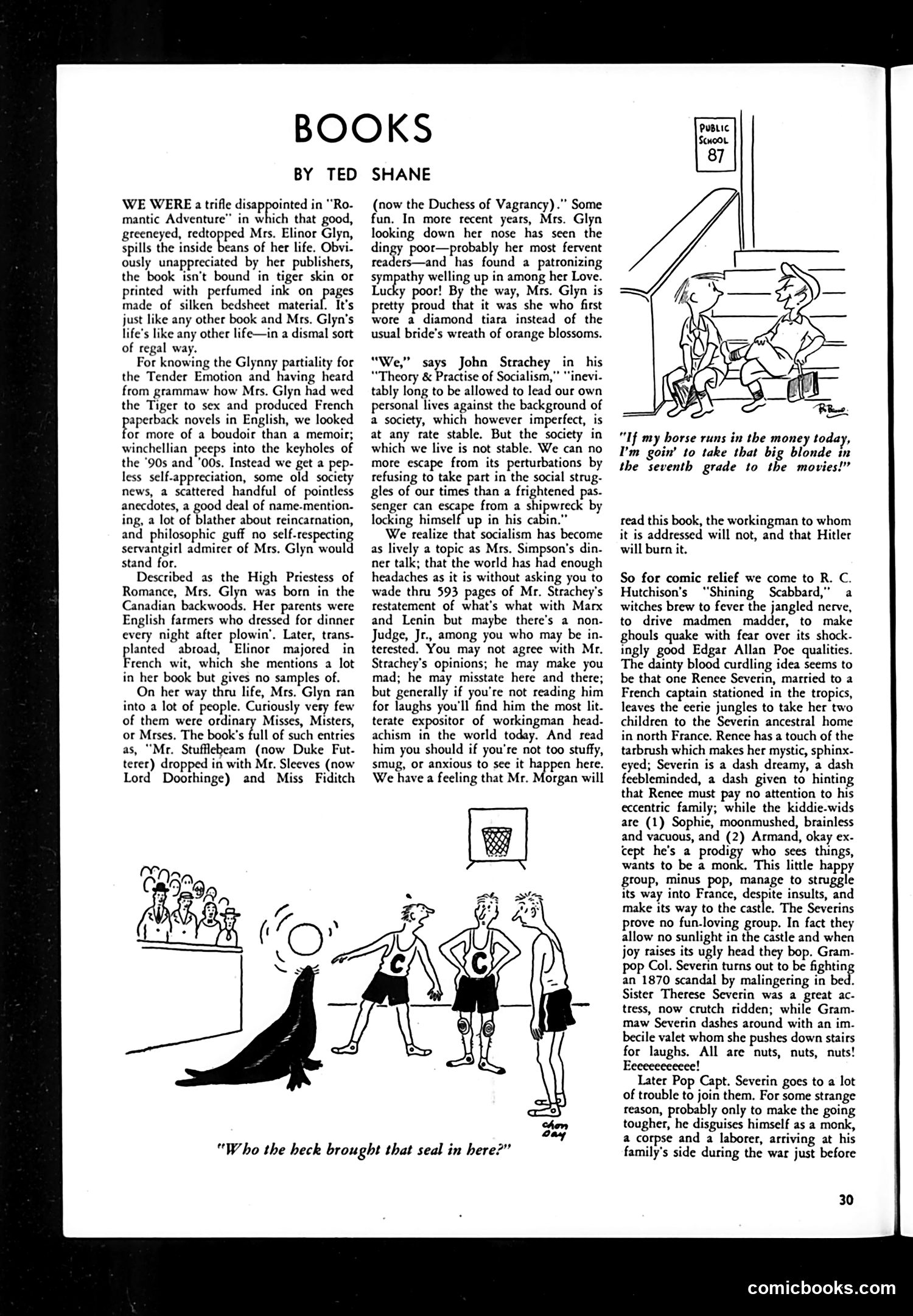
JUDGE Magazine Book Reviews, Page 30 This page contains three separate book reviews by Ted Shane, a Judge magazine columnist. Review 1: Elinor Glyn's "Romantic Adventure" – Shane mocks Mrs. Glyn, a famous romance novelist known for sensational fiction, for writing a disappointingly dull autobiography. The satire targets her pretentiousness: she's described as snobbish (looking "down her nose" at the poor), name-dropping constantly, and proud of trivial social innovations (wearing a diamond tiara instead of orange blossoms at her wedding). Review 2: John Strachey's "Theory & Practice of Socialism" – Shane acknowledges socialism has become trendy dinner-table conversation but recommends Strachey's dense 593-page analysis as a genuinely literate explanation of Marxist thought—though he doubts working-class readers will engage with it, and predicts Hitler will ban it. Review 3: R.C. Hutchison's "Shining Scabbard" – A witches' brew described as comedic relief. The cartoons show unrelated humorous scenes, including one captioned "Who the heck brought that seal in here?" and a child's quote about betting on horses.
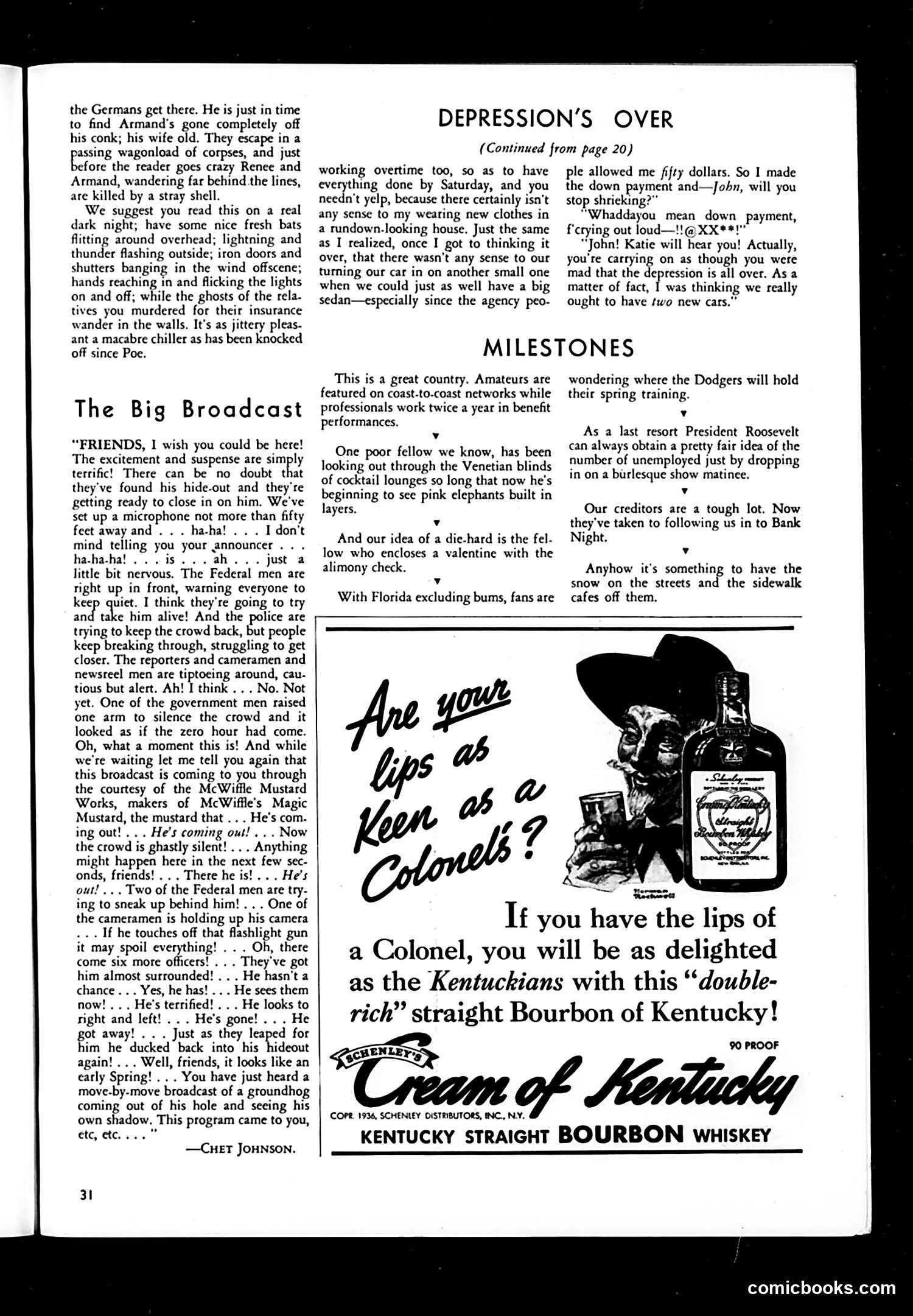
Analysis of Judge Magazine Page This page contains two distinct pieces of satirical humor from the Depression era. "The Big Broadcast" is a radio satire by Chet Johnson mocking overwrought news coverage. It parodies dramatic live reporting by describing an announcer breathlessly covering a dramatic criminal capture with intense suspense and advertising plugs—only to reveal the "dramatic escape" was merely a groundhog emerging from its hole on Groundhog Day. The joke satirizes radio's tendency toward sensationalism and the absurd juxtaposition of urgent news with commercial sponsorships. "Depression's Over" depicts a couple whose spending habits immediately revert to excess once they believe economic hardship has ended. The wife casually purchases a car with a down payment, then suggests buying a second vehicle, while the husband protests. The satire critiques Americans' quick abandonment of Depression-era restraint and return to consumption and debt. The page concludes with a Kentucky bourbon advertisement that exploits the "depression is over" sentiment to market luxury goods.
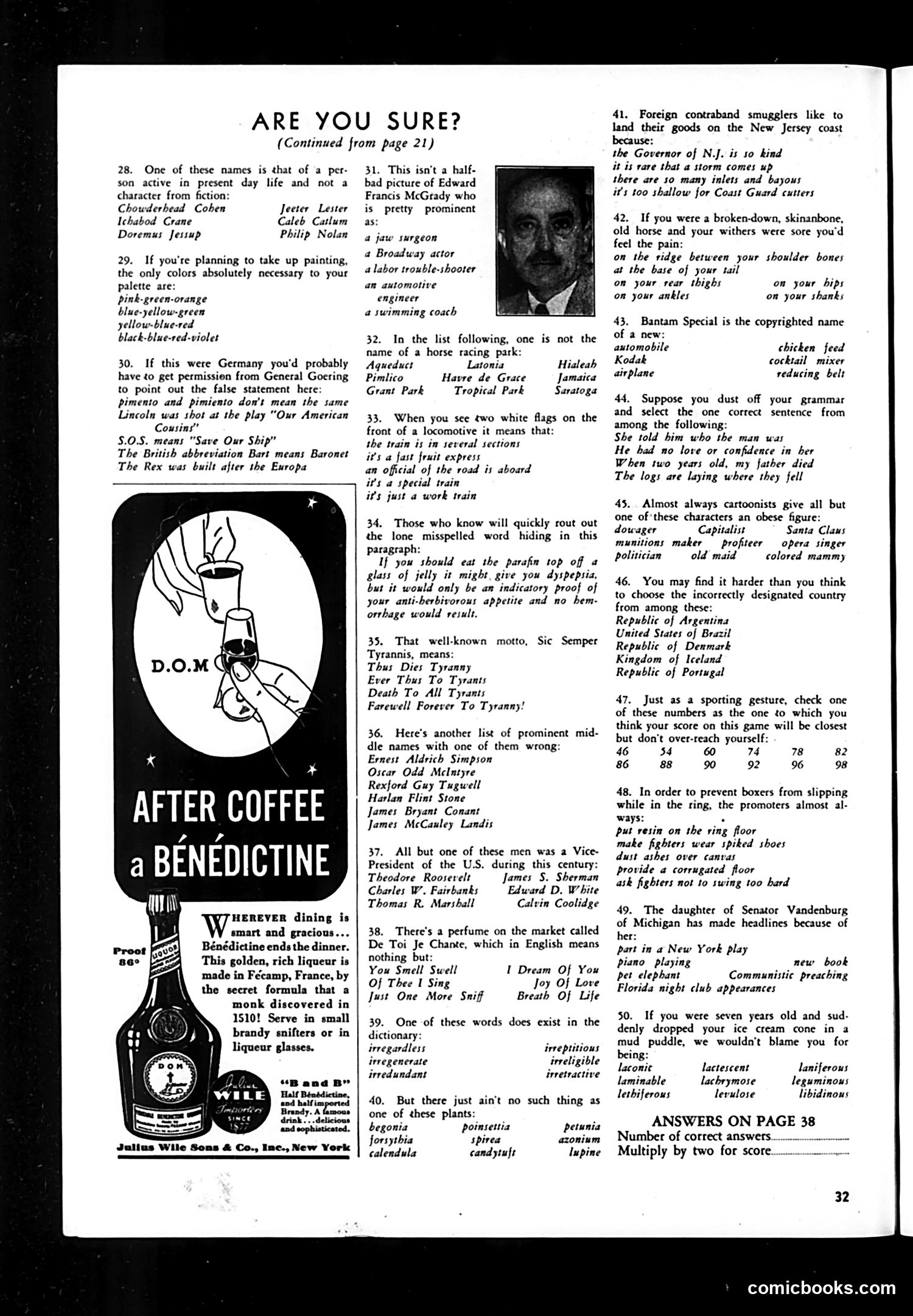
Explanation for Modern Readers This page is a trivia quiz titled "Are You Sure?" from Judge magazine—not primarily a political cartoon. It's a general knowledge test covering diverse topics: literature (fictional vs. real people), art, history, animals, plants, and current events. The single cartoon visible is an advertisement for Bénédictine liqueur featuring a stylized after-dinner drinking scene with art deco design. The quiz questions reflect 1930s-40s America: references to Edward Francis McGrady (labor mediator), horse racing parks, locomotive signals, the Latin motto "Sic Semper Tyrannis," prominent mid-century figures like Rexford Tugwell and James Conant, and New Jersey smuggling—likely referencing Prohibition-era bootlegging through coastal inlets. The page is primarily entertainment/edutainment rather than political satire—a common Judge feature for readers to test their knowledge.
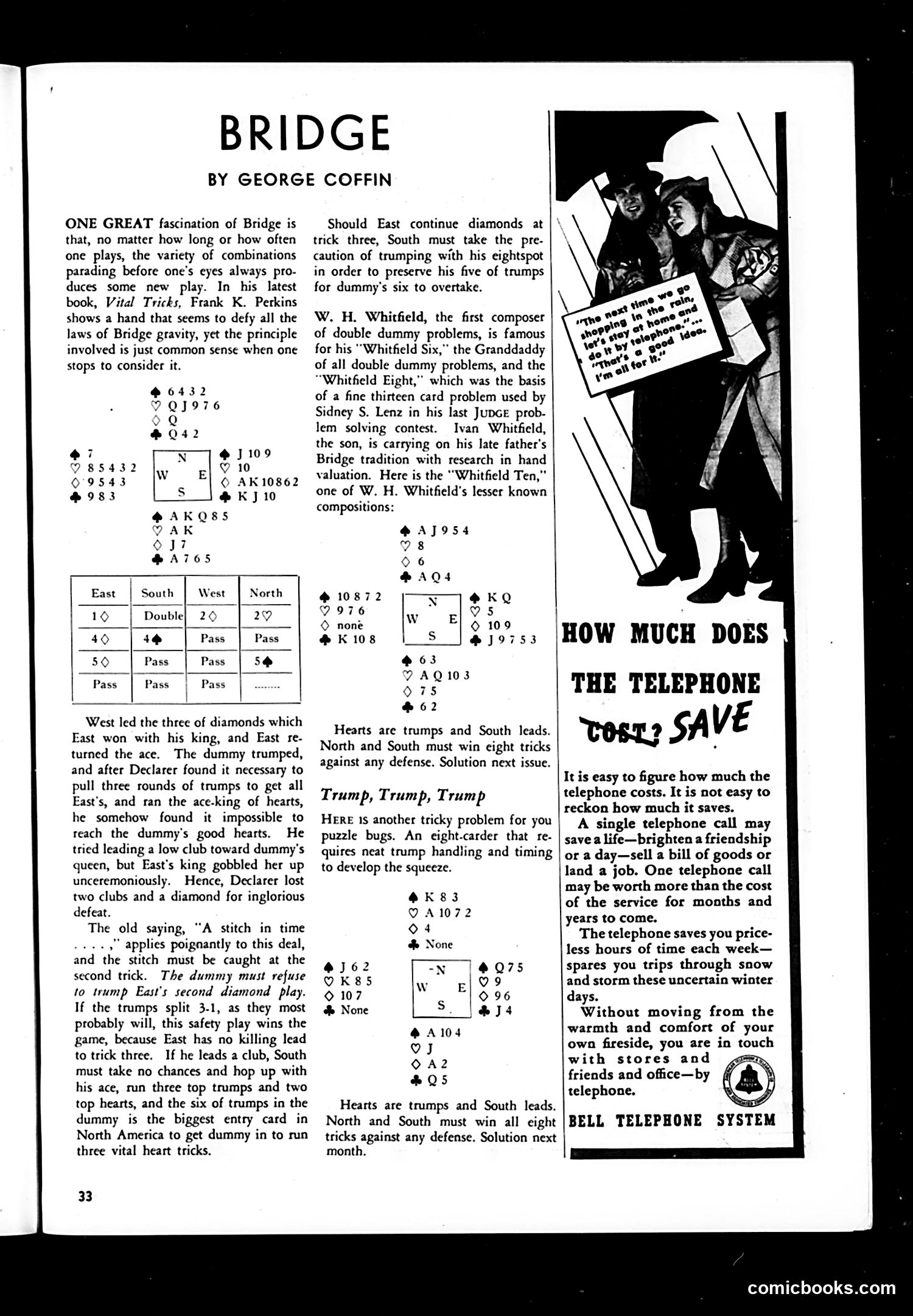
Page Analysis: Bridge Column and Bell Telephone Advertisement This page contains a bridge card game instructional column by George Coffin alongside a Bell Telephone System advertisement. The bridge content discusses card-playing strategy, featuring problems composed by W.H. Whitfield and his son Ivan—prominent figures in competitive bridge problem-solving. The column presents complex card hands requiring specific trump management and timing techniques. This represents Judge magazine's regular instructional content for readers interested in the popular parlor game. The accompanying advertisement uses a photograph of two men examining a telephone to promote the Bell Telephone System. The ad's messaging emphasizes practical benefits: the telephone saves time (avoiding winter travel), enables business transactions remotely, and can provide life-saving or income-generating opportunities. This reflects 1930s-era advertising positioning the telephone as essential modern infrastructure—a safety device and business tool, not merely a luxury.
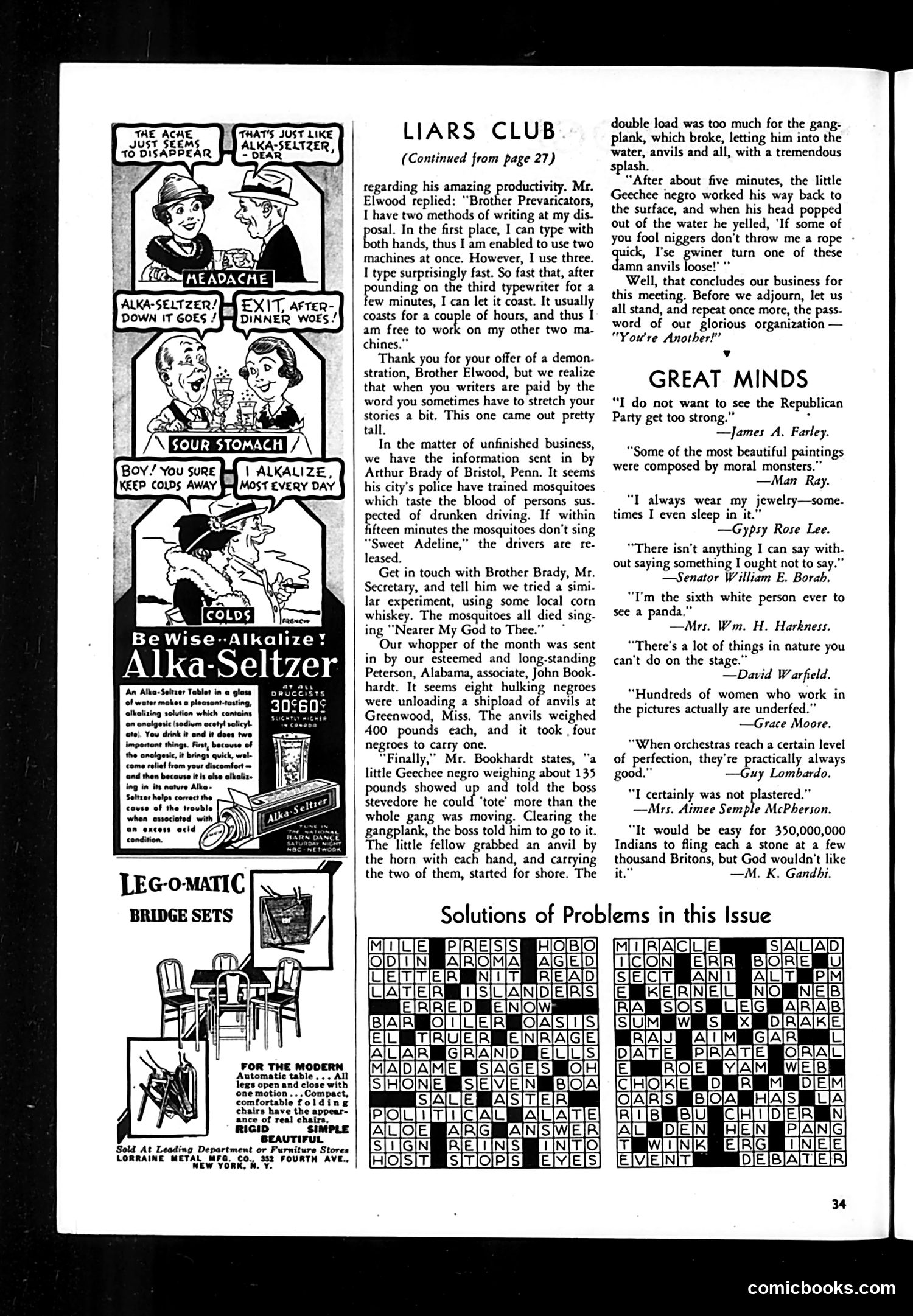
Analysis of Judge Magazine Page This page contains several elements typical of 1930s-40s Judge magazine: Top Section: A four-panel Alka-Seltzer advertisement disguised as a comic strip, using humor to promote the antacid remedy for various digestive complaints ("The Ache," "Alka-Seltzer," "Sour Stomach," "Colds"). Main Article: "Liars Club" (continued from page 27) presents tall tales submitted by readers. Notable is a deeply racist story involving Black workers and anvils, using offensive racial stereotypes and dialect—reflective of the era's casual prejudice in mainstream publications. "Great Minds" Section: Brief quotes attributed to public figures including James Farley (Democratic politician), Gypsy Rose Lee (entertainer), and Senator William Borah, presented without apparent satirical commentary. Advertisements: Include Leg-O-Matic bridge table sets and furniture. The page primarily functions as entertainment mixed with advertising, typical of Judge's format during this period.
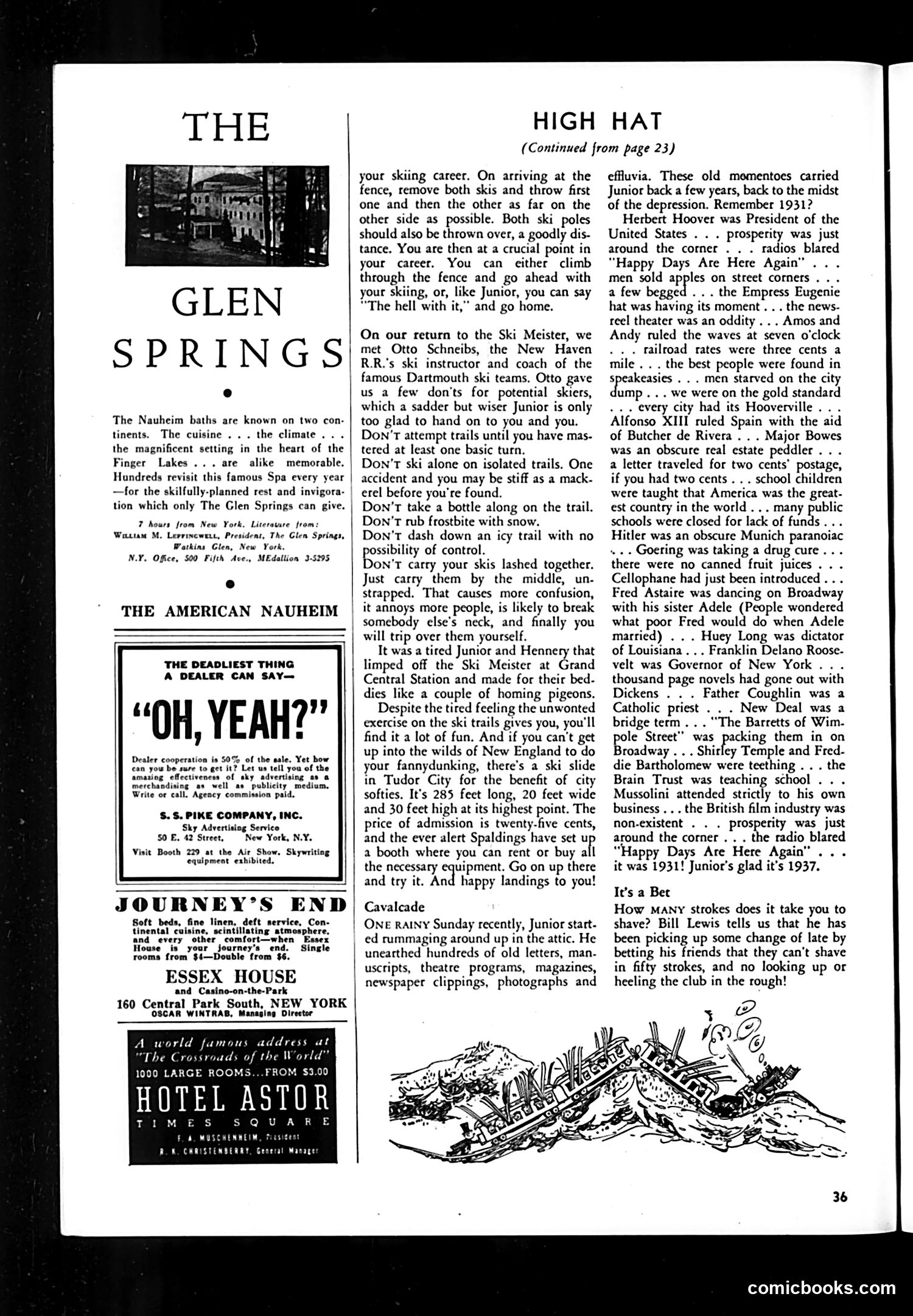
Analysis of Judge Magazine Page 36 This page is primarily advertising and filler content rather than political satire. The dominant elements are hotel and spa advertisements (Glen Springs, Essex House, Hotel Astor, American Nauheim). The substantive article is "High Hat," a humorous how-to piece about skiing that satirizes inexperienced skiers through exaggerated "don'ts" (don't ski alone, don't carry bottles, don't dash down icy trails). The humor targets amateur sportsmen rather than political figures. A small cartoon at the bottom depicts a shipwreck, accompanying a "Cavalcade" column that nostalgically recalls Depression-era memorabilia—suggesting mild satire of 1930s hardship through comedic reminiscence. The S.S. Pike advertising copy mocks dealers' skepticism ("Oh, Yeah?"), representing typical period trade advertising banter. Overall: This is primarily a commercial advertising page with light lifestyle humor, not political or social commentary of note.
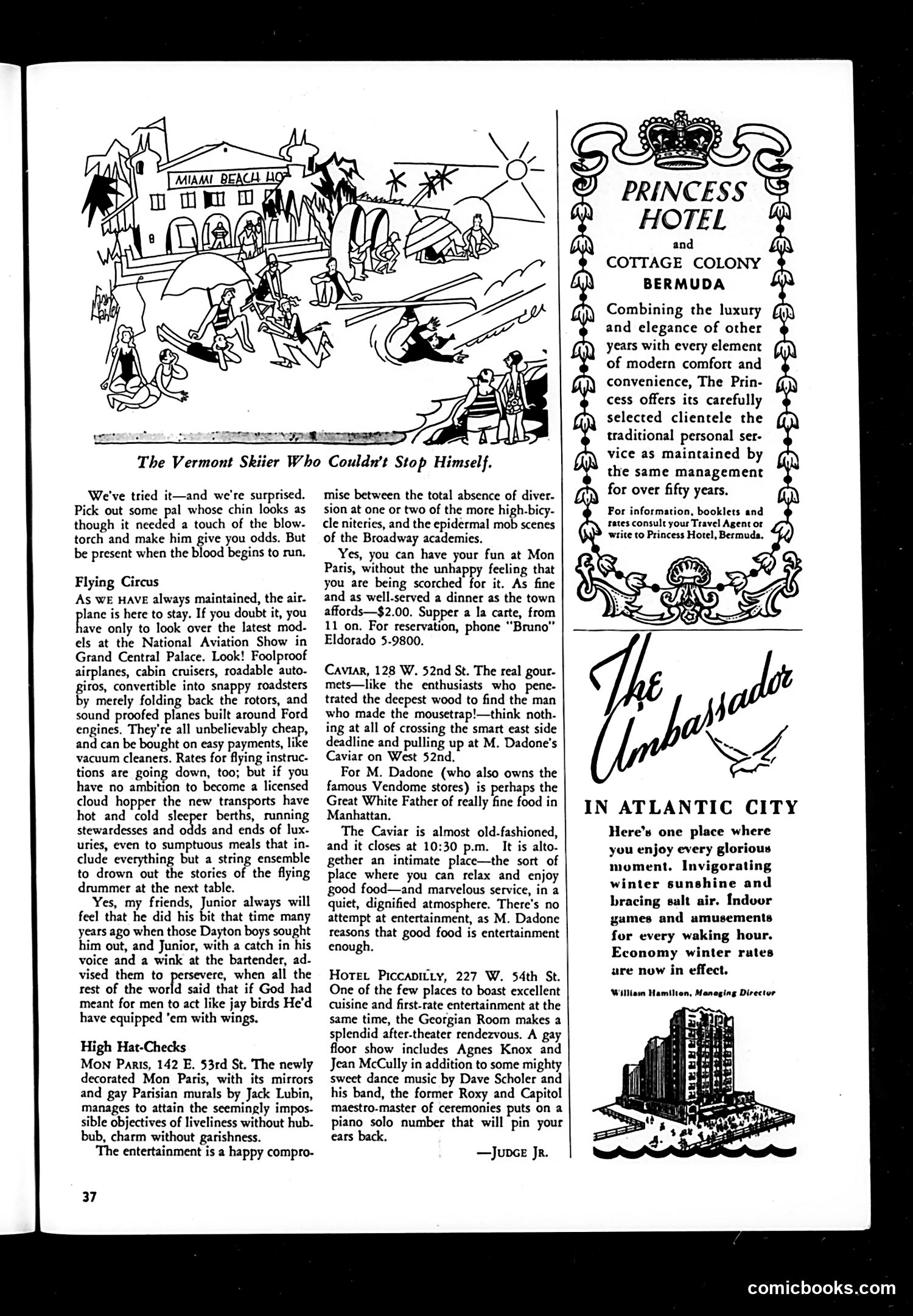
Understanding This Judge Magazine Page This page contains primarily restaurant and hotel advertisements rather than political satire. The main content includes: The cartoon ("The Vermont Skier Who Couldn't Stop") illustrates a humorous anecdote about a skier who couldn't control his descent—the joke being that you can bet someone with a prominent chin will get a nosebleed when he crashes. The "Flying Circus" section is satirical commentary on 1920s-30s aviation enthusiasm, mocking both the aircraft industry's optimistic marketing (claiming planes are now as affordable and safe as vacuum cleaners) and the public's uncritical faith in aviation's progress. It's gentle satire about American technological utopianism. The remainder consists of advertisements for upscale Manhattan nightclubs and restaurants (Mon Paris, Caviar, Hotel Piccadilly) and a Bermuda resort—typical Judge magazine filler promoting leisure venues to its wealthy readership. The page reflects Depression-era or pre-Depression aspirational consumer culture targeting affluent urbanites.
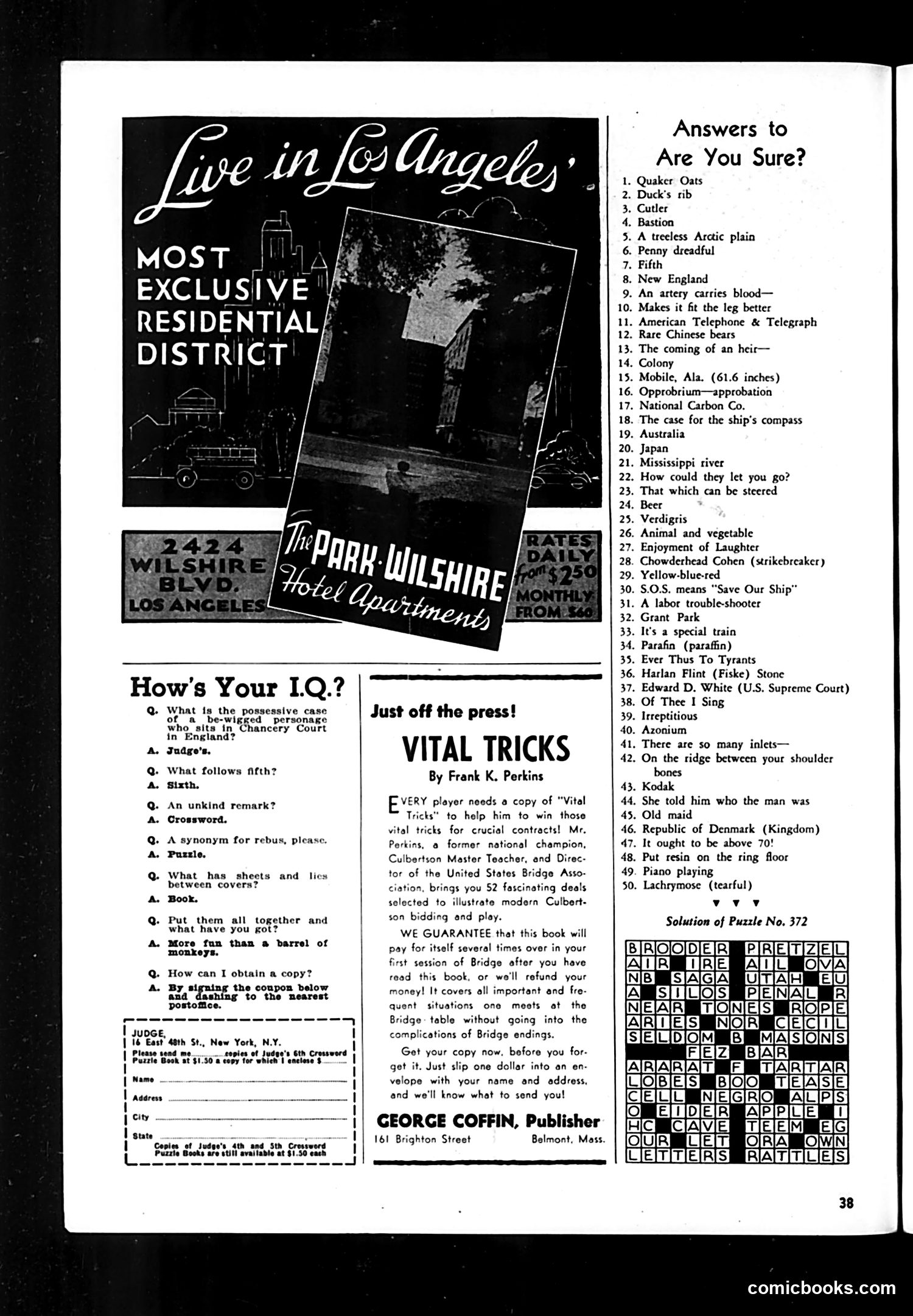
What This Page Means for Modern Readers This is primarily a puzzle and advertising page from Judge magazine, not a political cartoon. The content includes: "How's Your I.Q.?" — A wordplay puzzle where answers combine to form a phrase ("Judge's Puzzle Book"). It's promotional material encouraging readers to order the magazine's puzzle book by mail. "Vital Tricks" — An advertisement for a bridge card-game instruction book by Frank K. Perkins, leveraging the popularity of contract bridge in this era. "Answers to Are You Sure?" — Solutions to a previous puzzle/trivia feature, mixing riddles with contemporary 1930s-40s references (Culbertson bridge methods, Chowderhead Cohen radio character, Edward D. White Supreme Court Justice). The top advertisement promotes Park Wilshire Hotel Apartments in Los Angeles as an exclusive residential district. There is no apparent satire or political commentary on this page—it's essentially filler content typical of magazine layouts from this period, mixing games, answers, and advertisements to fill space between feature articles.
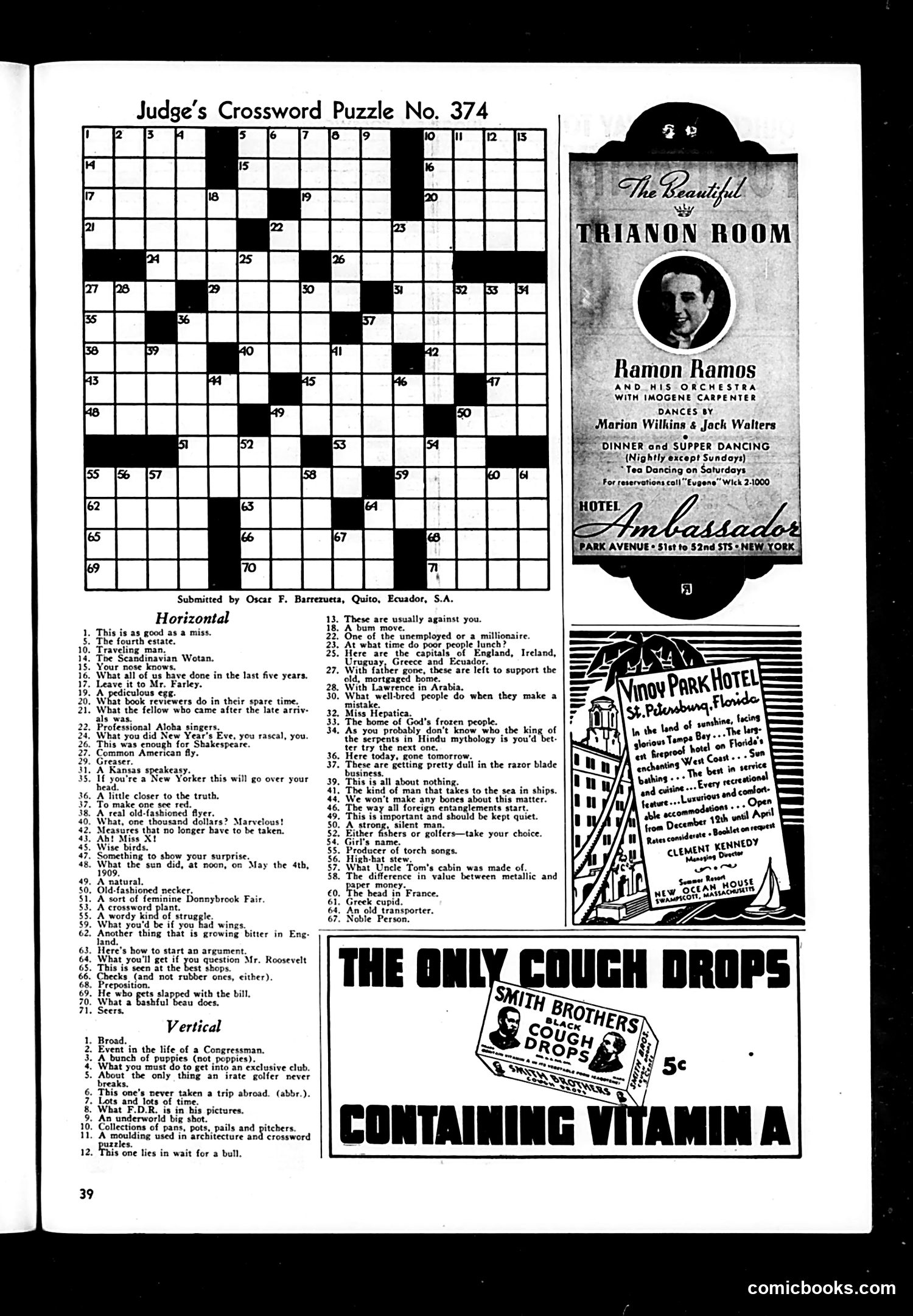
Judge's Crossword Puzzle No. 374 This page is primarily a crossword puzzle with accompanying advertisements—not a political cartoon. The puzzle itself contains 1920s-era clues that reference contemporary figures and events for that period's readers. Notable clue references include: - Mr. Farley (likely James Farley, FDR's political operative) - Mr. Roosevelt (Franklin D. Roosevelt, president) - A 1909 solar eclipse reference - Prohibition-era speakeasies ("Kansas speakeasy") - Post-WWI themes ("unemployed or a millionaire") The advertisements showcase 1920s nightlife venues: the Trianon Room featuring bandleader Ramon Ramos, the Vinoy Park Hotel in St. Petersburg, Florida, and the Ambassador Hotel. These ads reflect the era's entertainment culture during Prohibition. The Smith Brothers Cough Drops advertisement at bottom is standard period product marketing. The puzzle offers social commentary through wordplay rather than visual satire—a typical Judge magazine feature targeting educated, urban readers familiar with current events and cultural references.
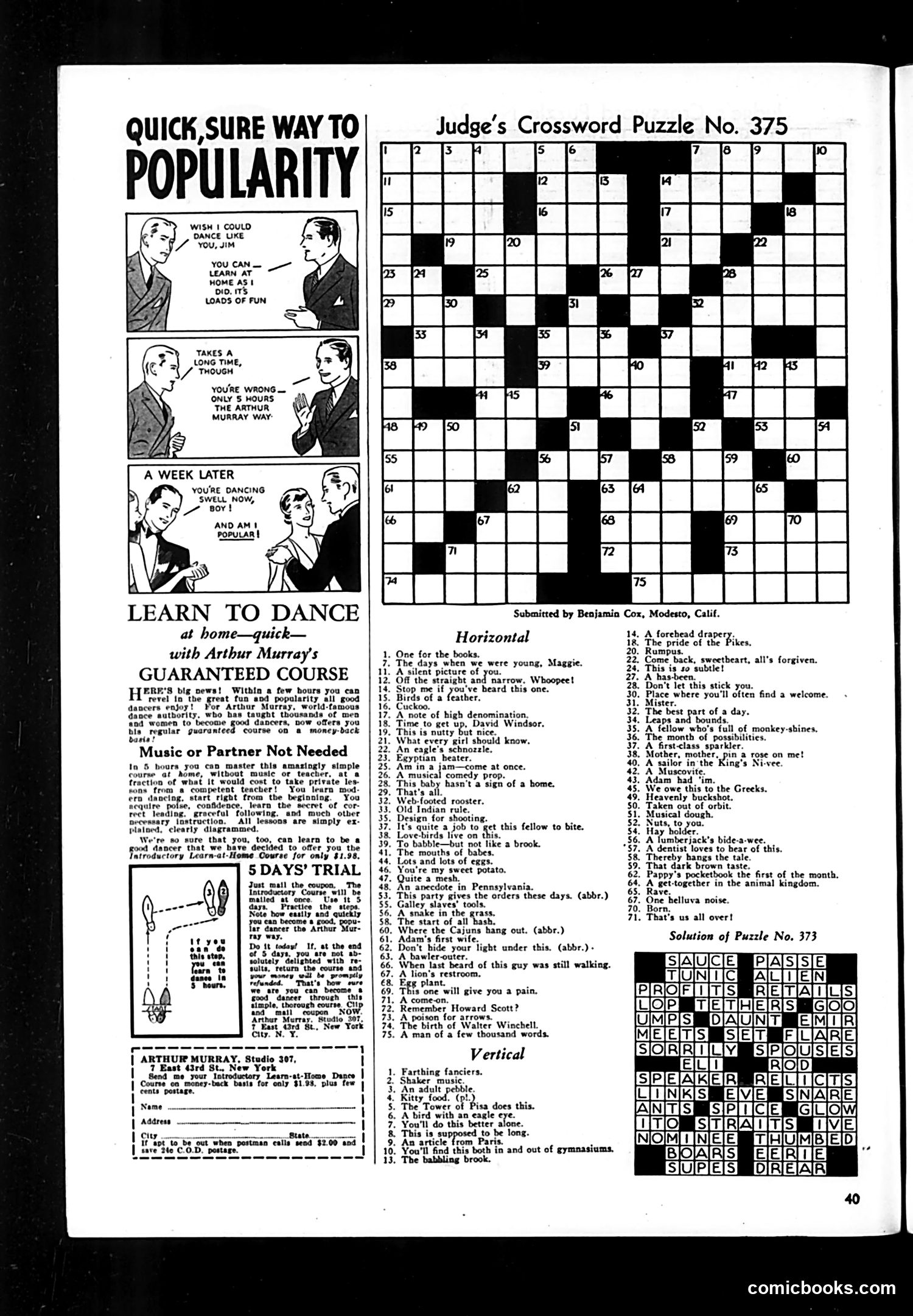
Judge Magazine Page Analysis This page combines an advertisement with a crossword puzzle, typical of Judge's format. The Advertisement: The "Quick, Sure Way to Popularity" promotes Arthur Murray's mail-order dance course. The comic strip depicts a social narrative common in 1920s-30s advertising: a man laments his inability to dance, learns it's difficult and time-consuming, then discovers Arthur Murray's "5 hours" home course. A week later, he's "dancing like a boy" and become popular. The Satire/Appeal: The humor plays on anxieties about social acceptance—dancing ability equated with popularity and romantic success. The "quick fix" promised (5 hours versus lengthy traditional lessons) appeals to American efficiency values. The implicit message: social transformation through consumer purchase is possible, even guaranteed. Context for Modern Readers: Arthur Murray was a real, famous dance instructor who pioneered correspondence courses. The ad reflects Depression-era optimism that self-improvement products could solve social problems. The gendered dynamic (young man seeking female approval through acquired skill) reflects period dating conventions. The crossword puzzle is unrelated editorial content.
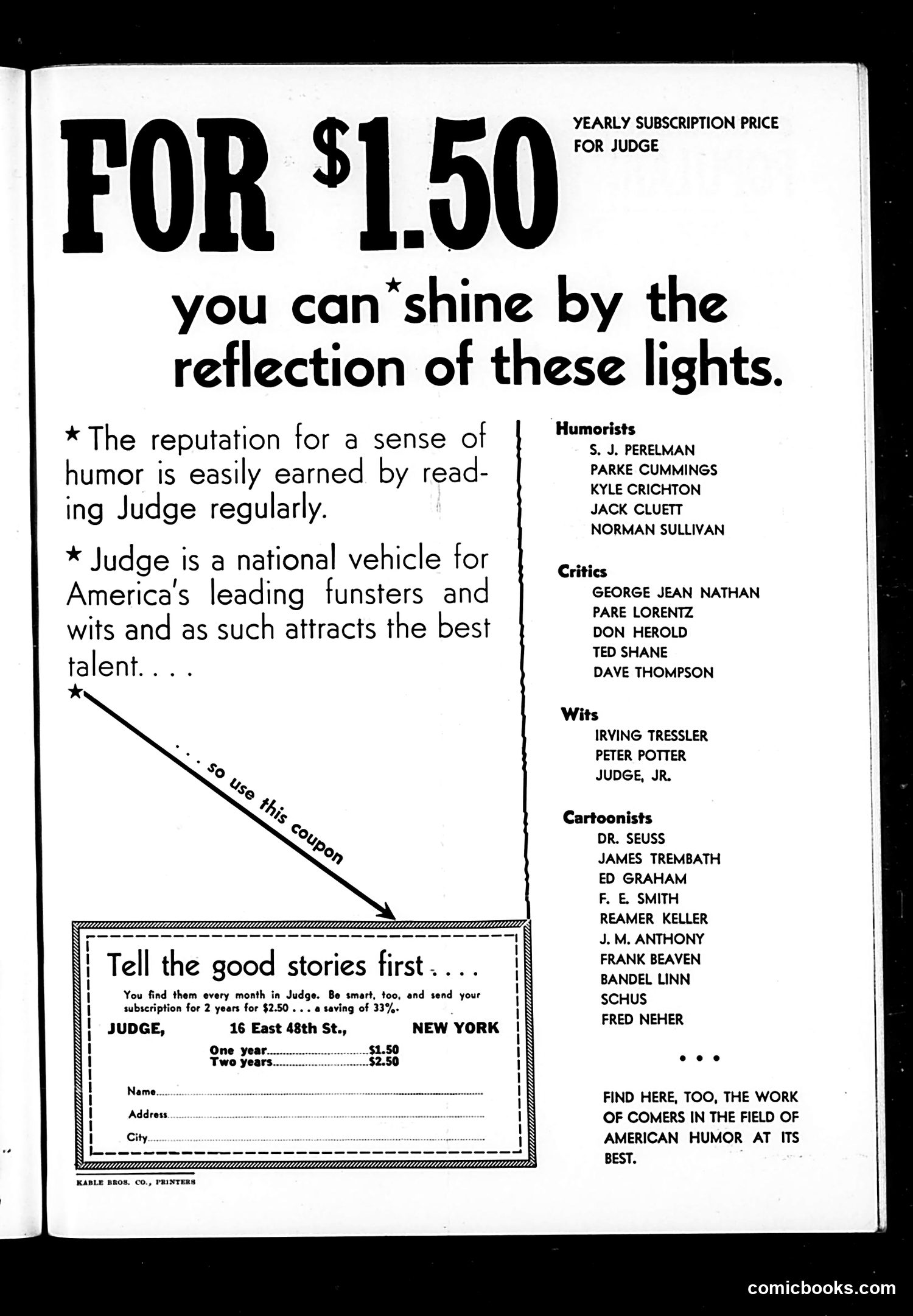
Judge Magazine Subscription Advertisement This is primarily a subscription advertisement for *Judge*, a satirical humor magazine. The ad promotes a yearly subscription for $1.50 by listing prominent contributors—cartoonists (including Dr. Seuss), critics, humorists, and wits—to demonstrate the publication's appeal and quality. The phrase "shine by the reflection of these lights" uses a metaphor suggesting readers will gain cultural sophistication by association with these respected comedic talents. The copy emphasizes that *Judge* attracts "America's leading funsters and wits," positioning it as the premier venue for American humor. The subscription offer at bottom ($1.50 for one year, $2.50 for two years with a "33% saving") uses a coupon format typical of period advertising. This is essentially a sales pitch leveraging the magazine's roster of notable contributors to justify the subscription cost and encourage sign-ups.
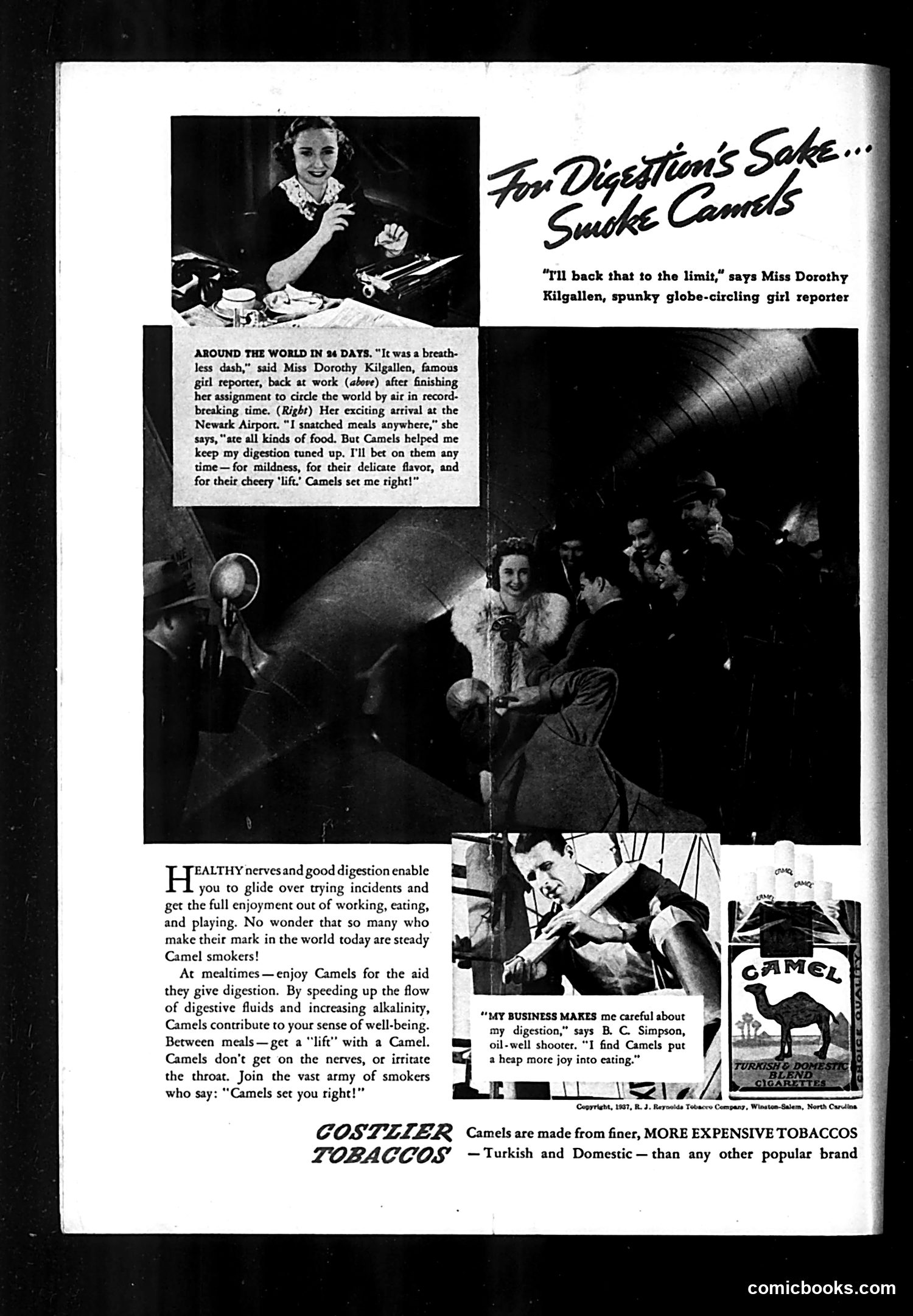
Analysis for Modern Readers This is a Camel cigarette advertisement disguised as editorial content in Judge magazine. The page features Dorothy Kilgallen, a real journalist famous for completing a 1938 around-the-world flight in record time. The advertisement uses her celebrity credibility to claim that Camels aid digestion and provide a "lift" during stressful work—a common mid-20th-century tobacco marketing tactic. The testimonials from "B.C. Simpson" (an oil-well worker) reinforce this false health claim. Modern context: This reflects an era when cigarette companies could legally advertise health benefits and sponsor prominent figures. The digestive-aid claim is entirely fabricated; we now know smoking damages digestion. Such advertisements were eventually banned in the U.S. (1970s), but were standard practice in the 1930s-40s, when tobacco companies aggressively marketed to professionals and celebrities. The page exemplifies how advertising exploited public trust in news figures before strict regulations emerged.

I can see this is a mostly blank or heavily darkened page from Judge magazine with only "comicbooks.com" visible at the bottom right. The page appears to be either: 1. A blank/filler page from the original publication 2. A page that has deteriorated or been poorly scanned, making content illegible 3. Intentionally dark or redacted content Without visible cartoon imagery, readable text, or discernible figures, I cannot identify specific political references, caricatures, or satirical content. To provide accurate historical analysis as requested, I would need a page with legible cartoon artwork and text. This particular scan does not contain sufficient visible content for meaningful interpretation.